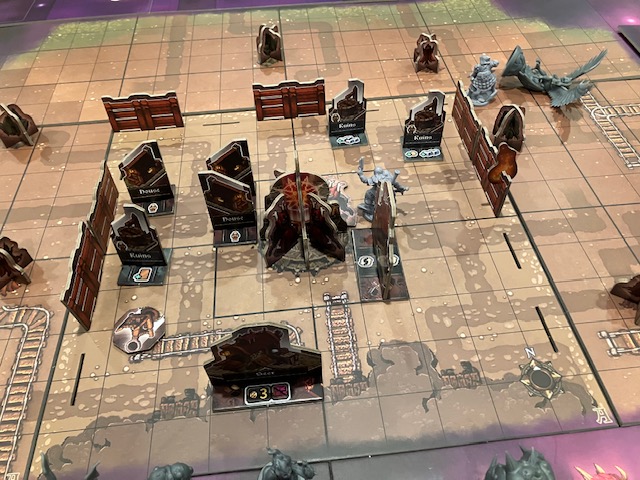
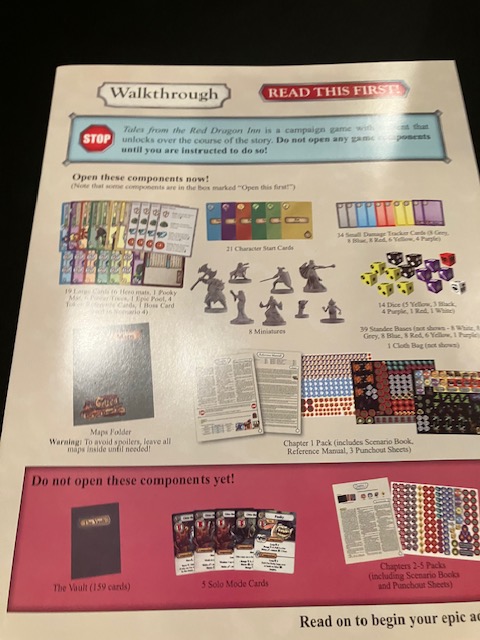
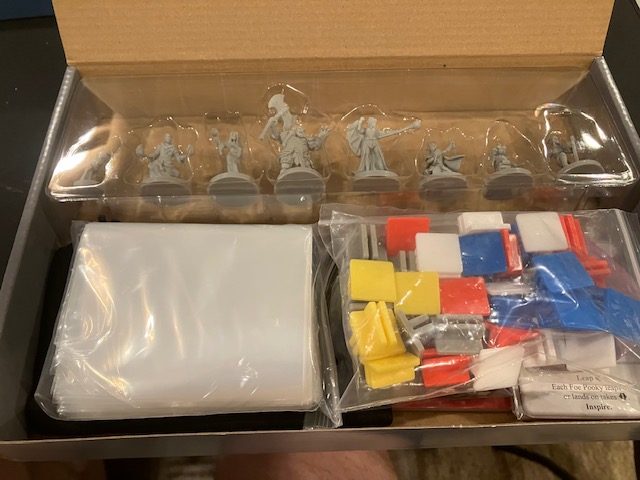
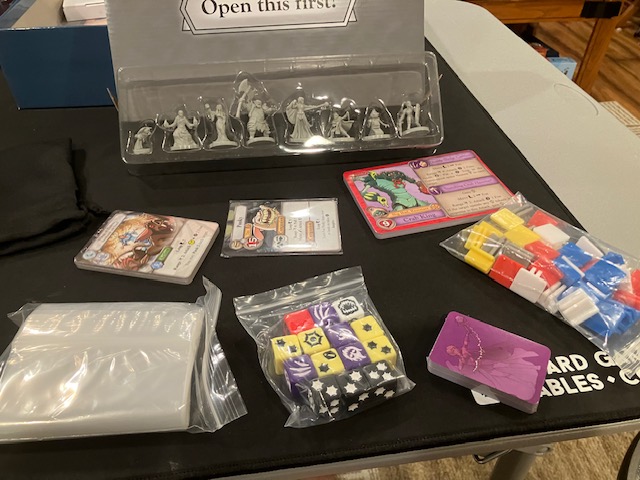
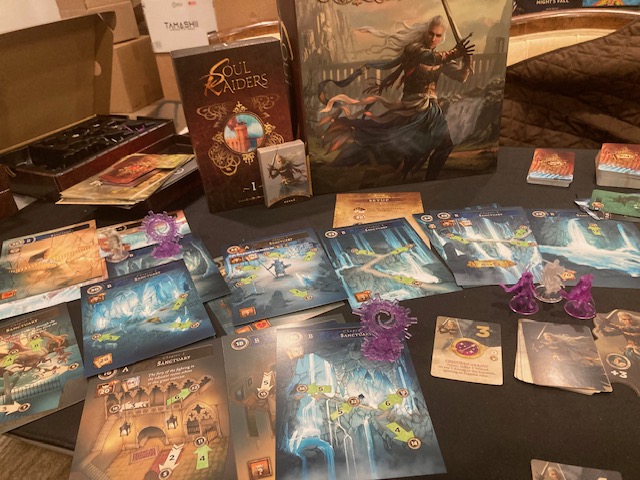
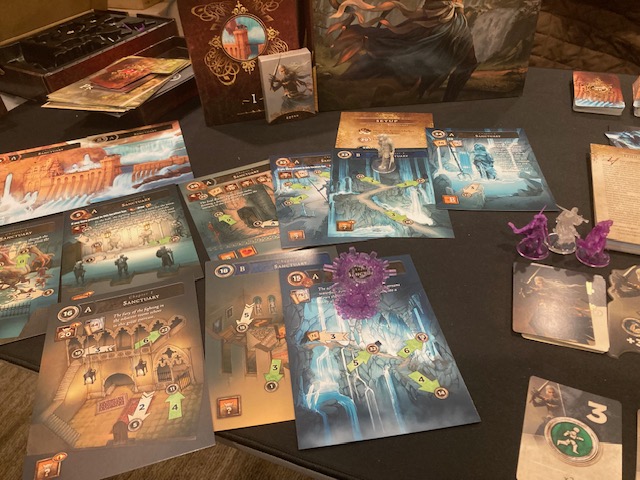
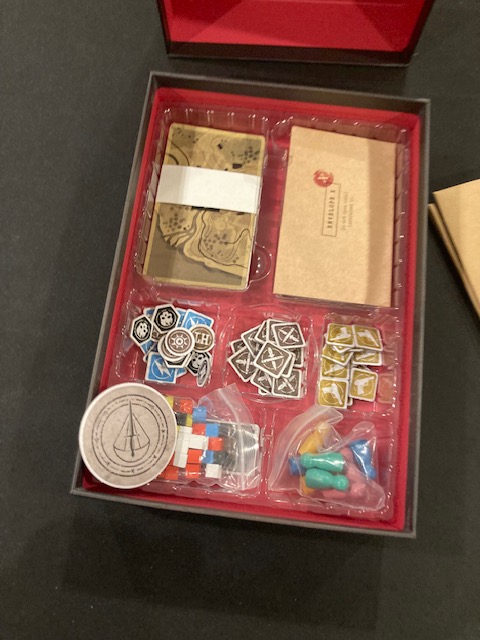
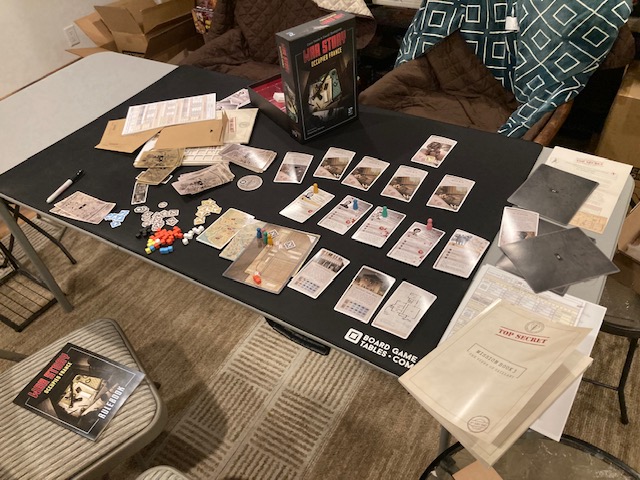
The Last Spell: The Board Game. A Solo and Cooperative Review

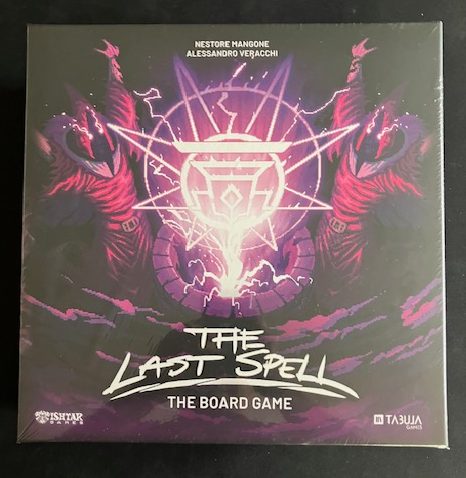
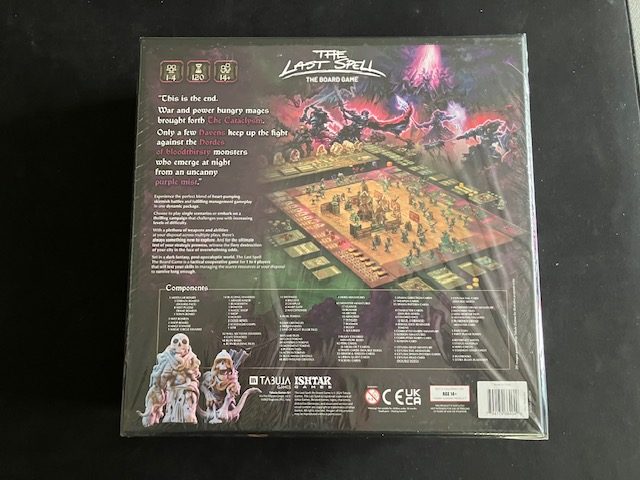
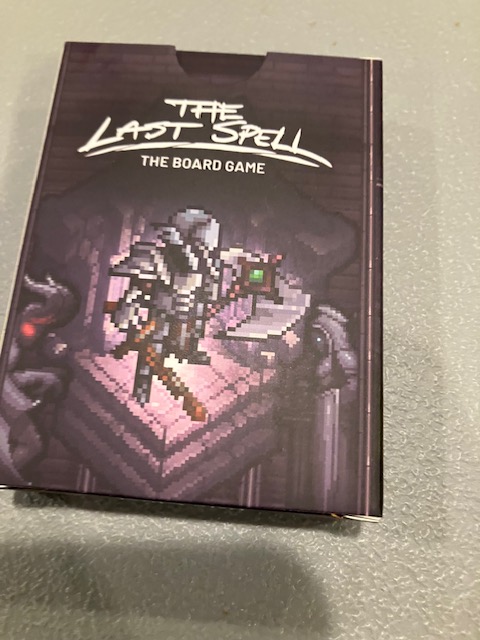
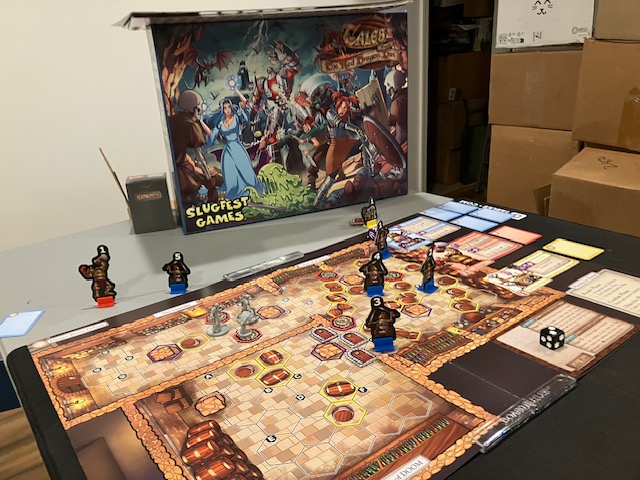
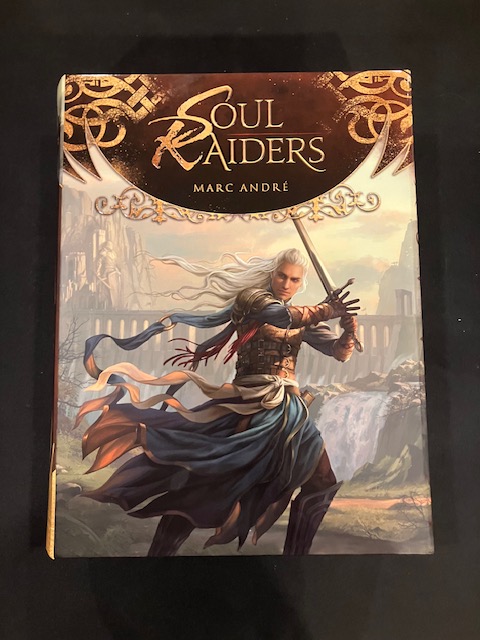
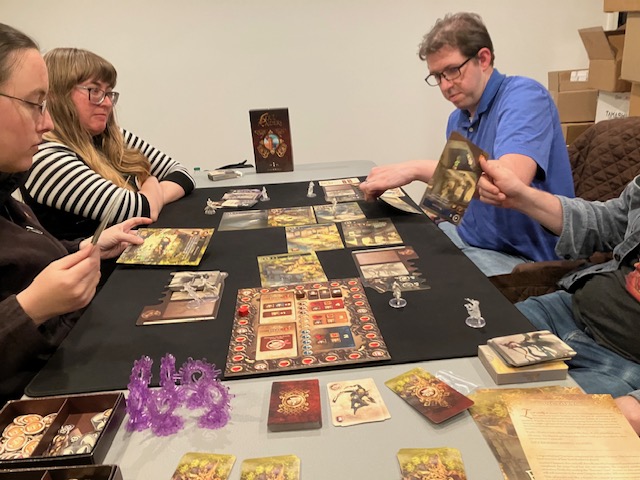
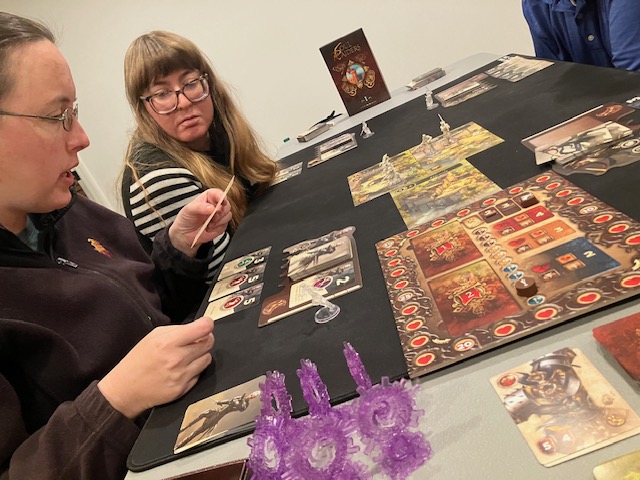
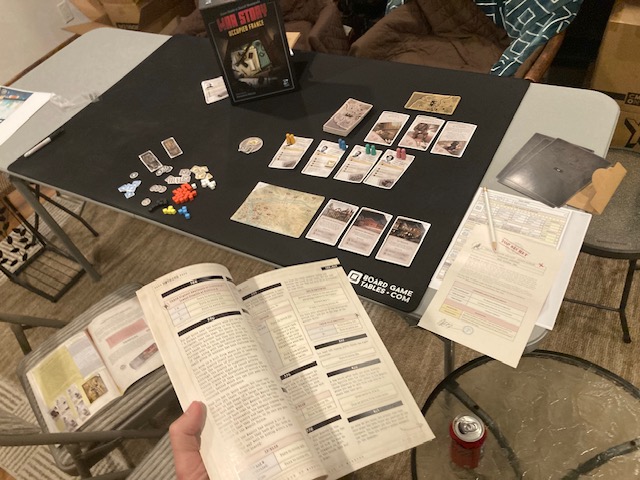
The Last Spell is a solo and cooperative board game (see above) based on a TRPG Tower Defense video game of the same name. The board game has the same idea; it’s a tower defense game where you cooperatively protect your town from the hordes of that monsters descend upon it!

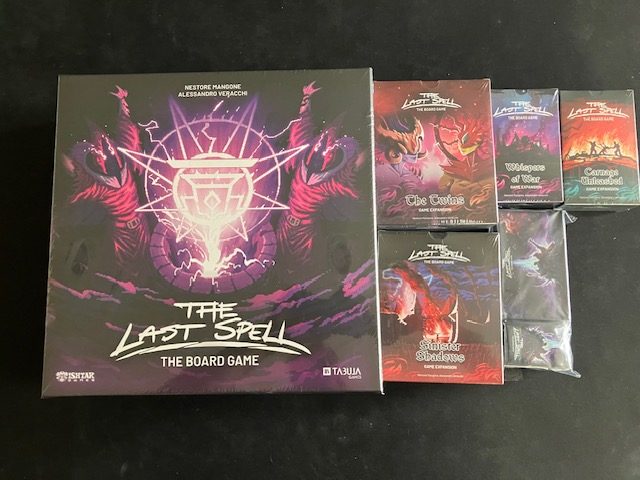
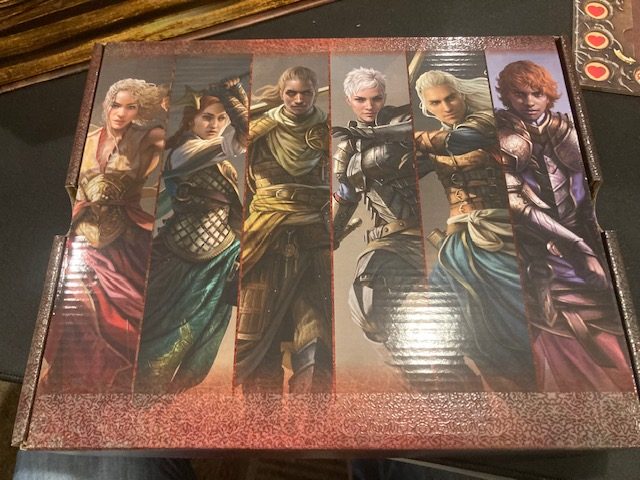
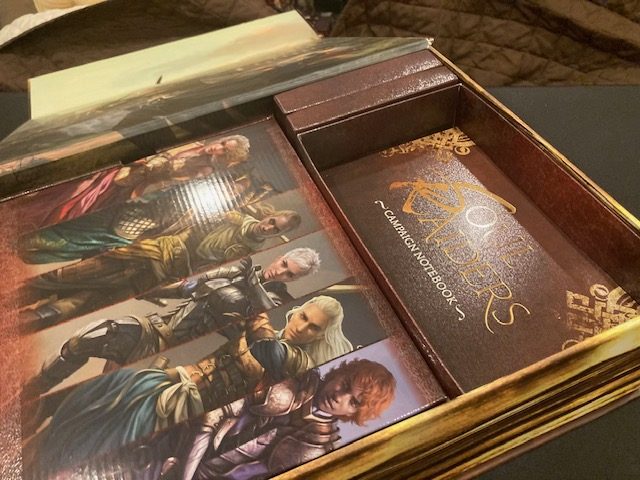
This was a pretty big Kickstarter with lots of expansions and other stuff (sleeves especially: see above). The Last Spell (the board game) was on Kickstarter back in May 2023, and it promised delivery in May 2024. It arrived at my house in early 2026, so it’s about two years late (which is not great).

Let’s take a look! We will ONLY be taking a look at the base game.

Unboxing and Gameplay

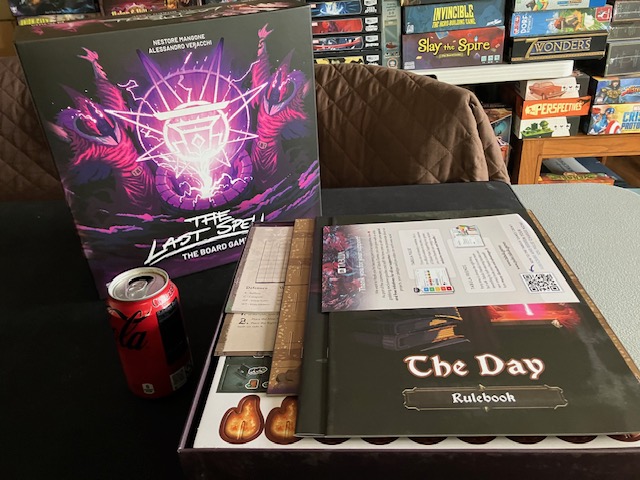
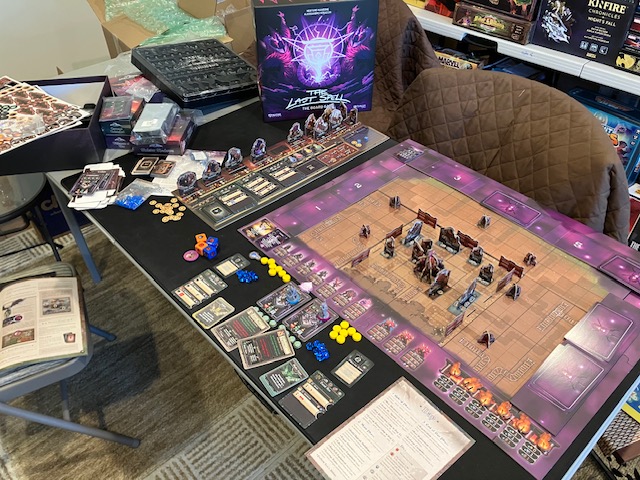
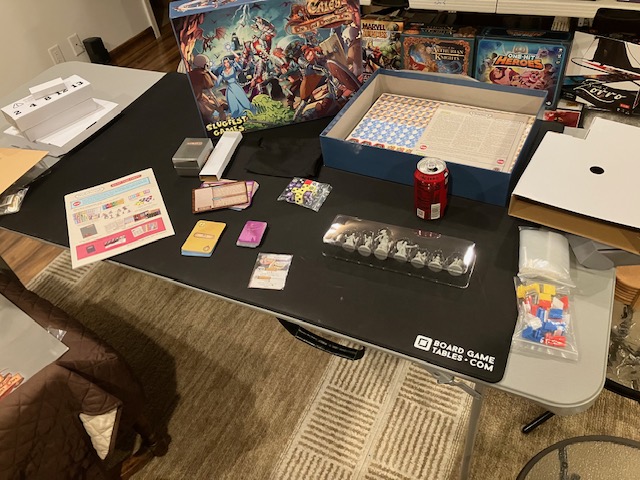
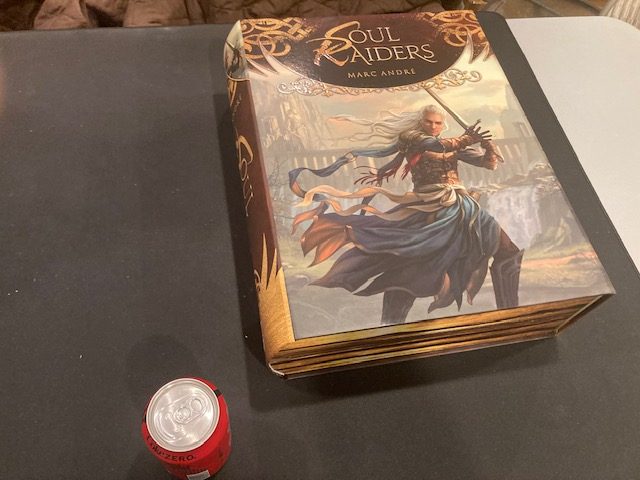
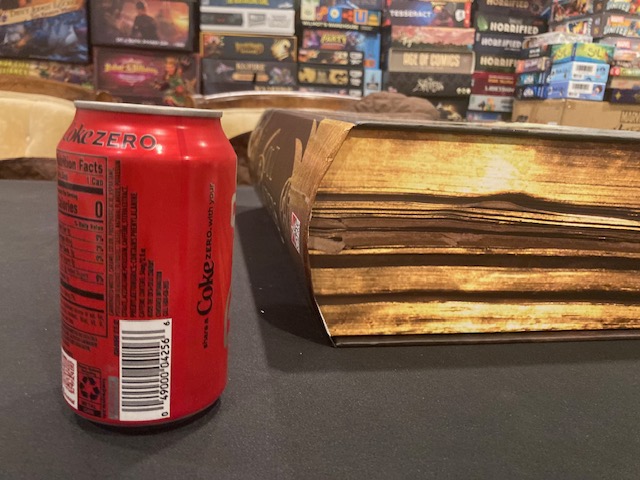
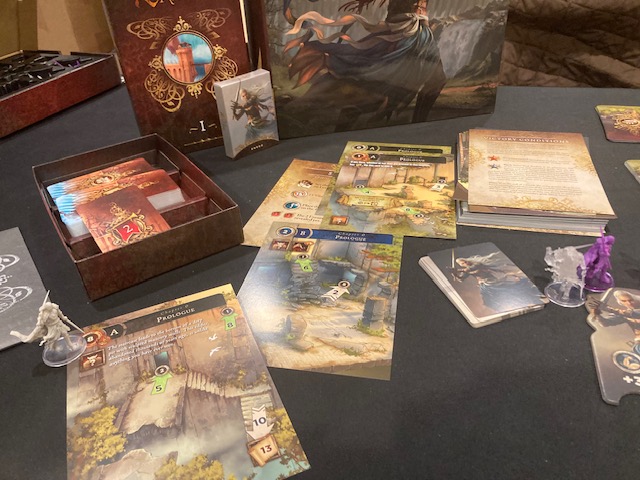
The Last Spell is a pretty standard sized box (see Coke can above for scale) except that it’s a little bit taller.

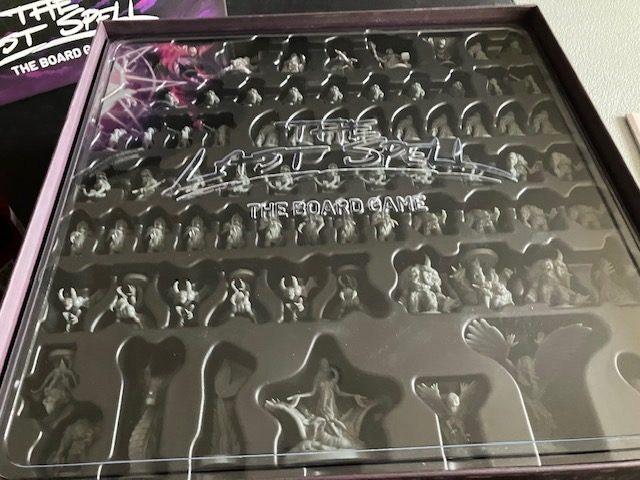
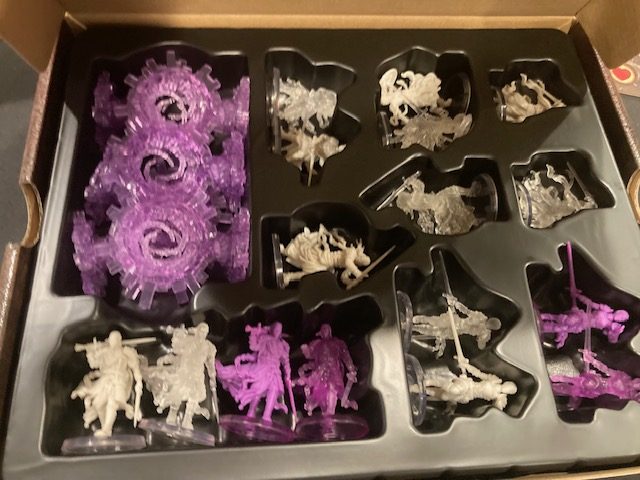
It’s taller because it comes with a bunch of miniatures!

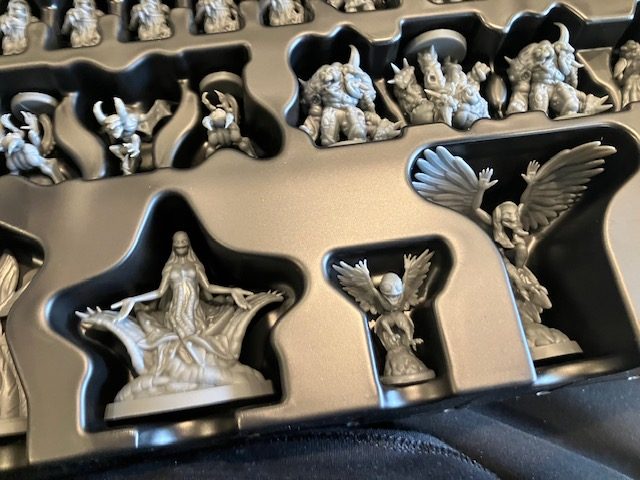
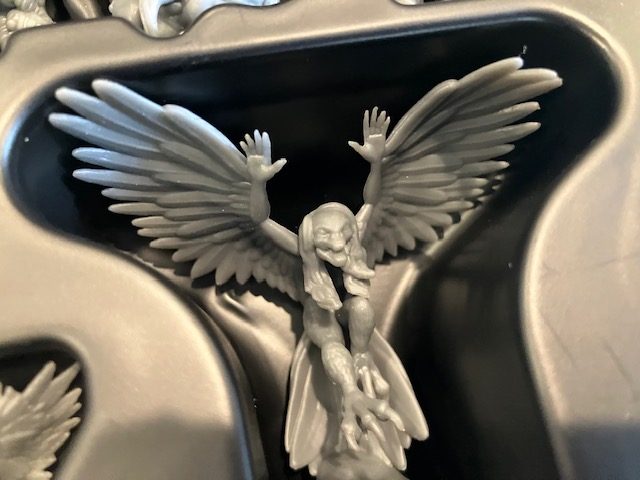
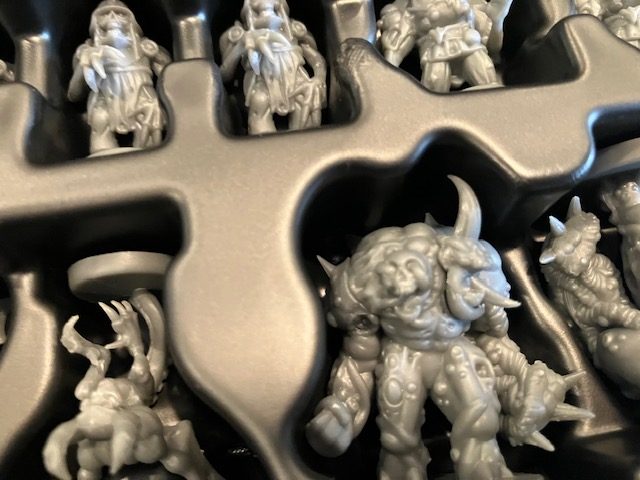
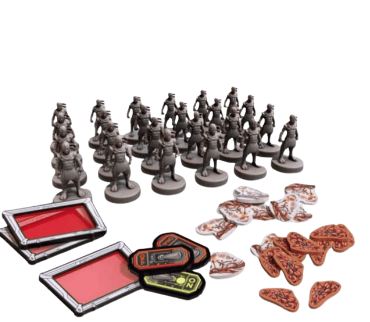
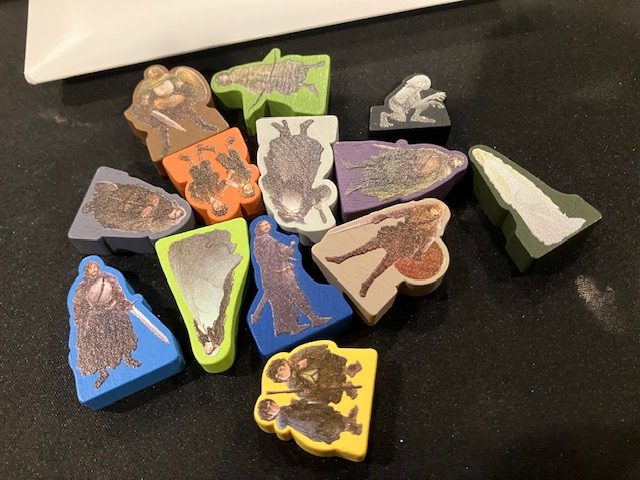
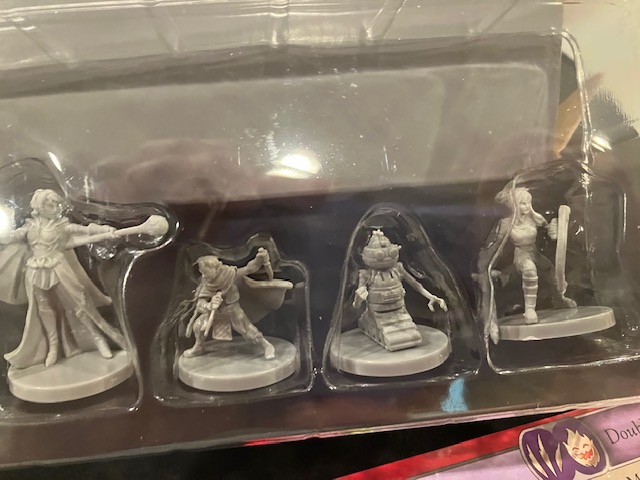
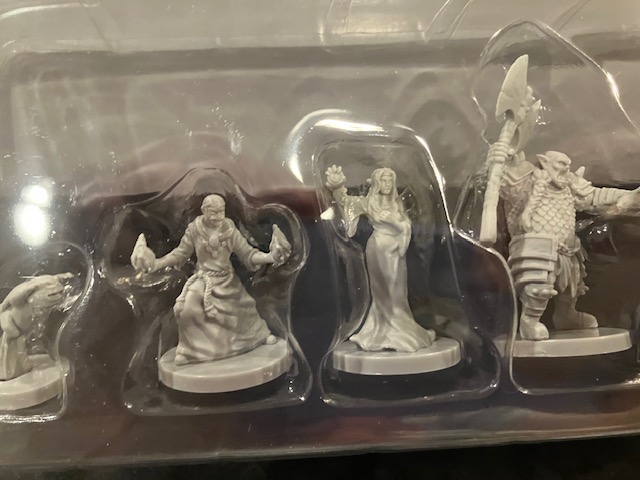
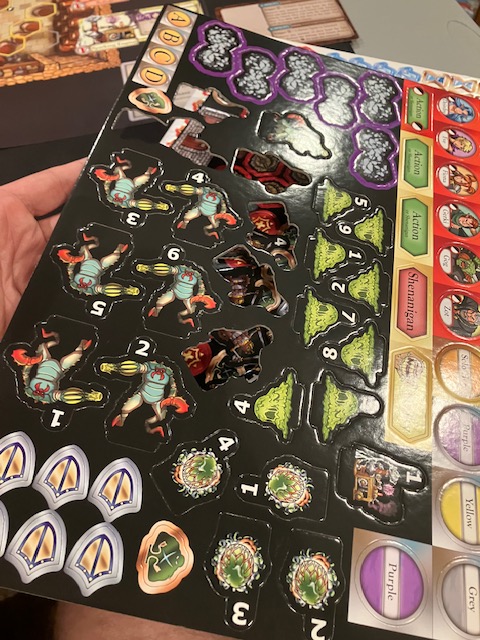
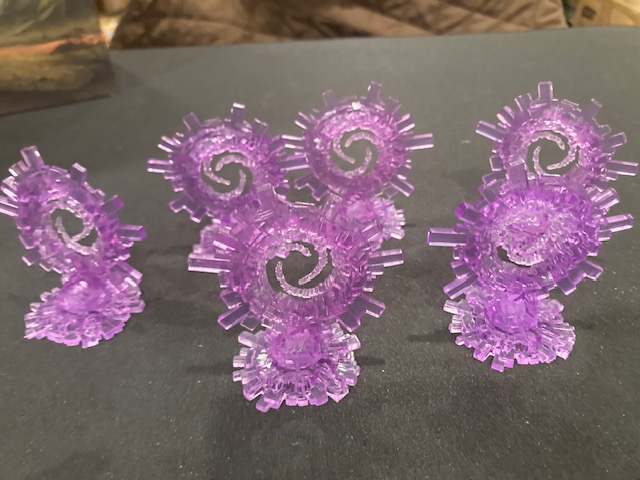
Most of the miniatures are the bad guys (part of the swarm) that invades your town!

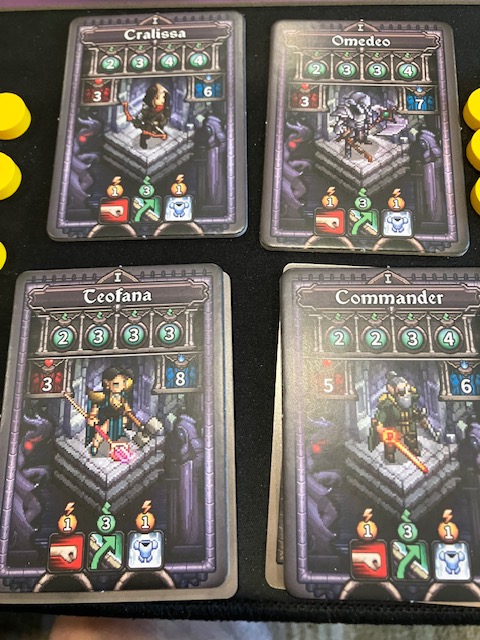
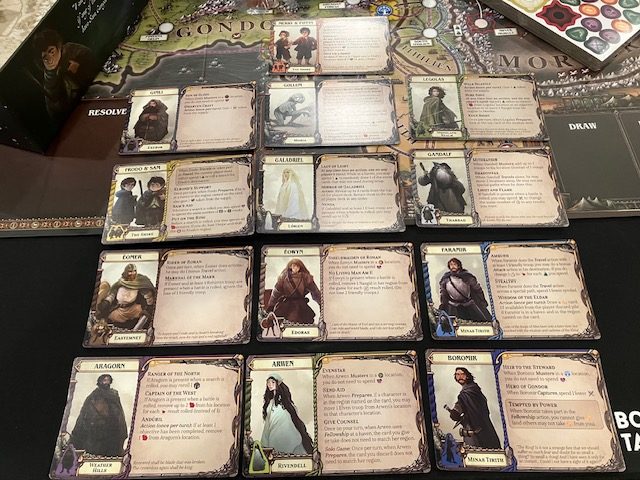
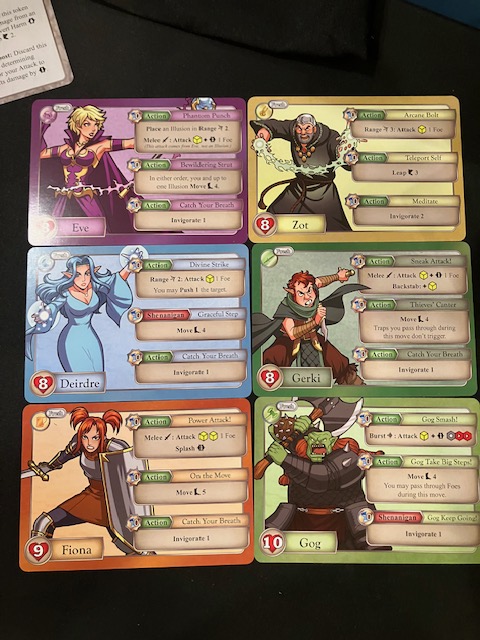
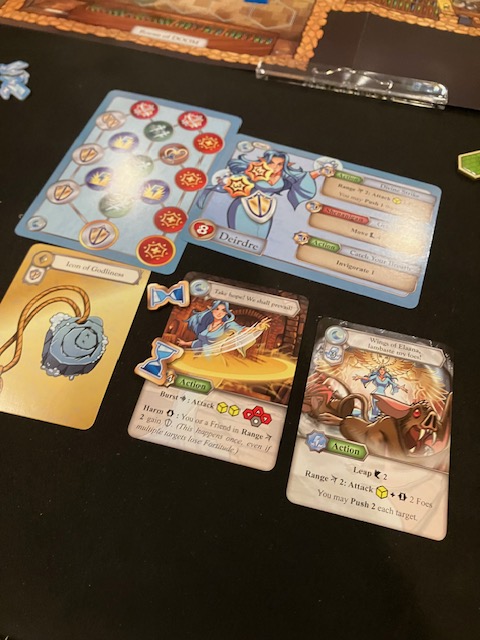
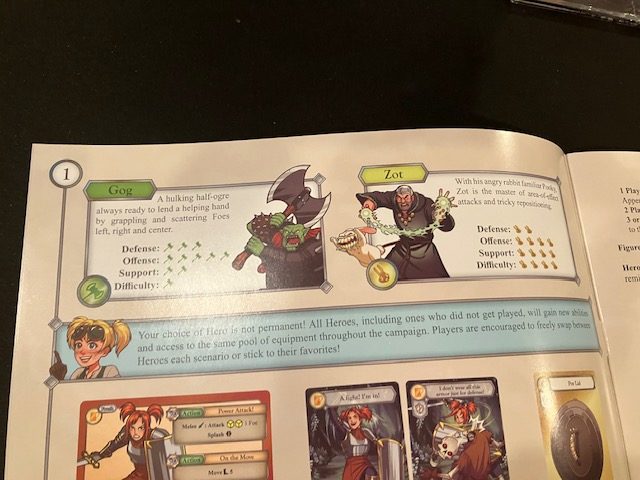
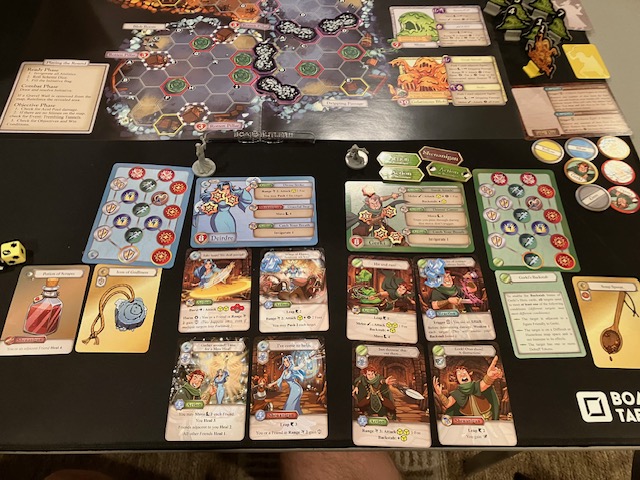
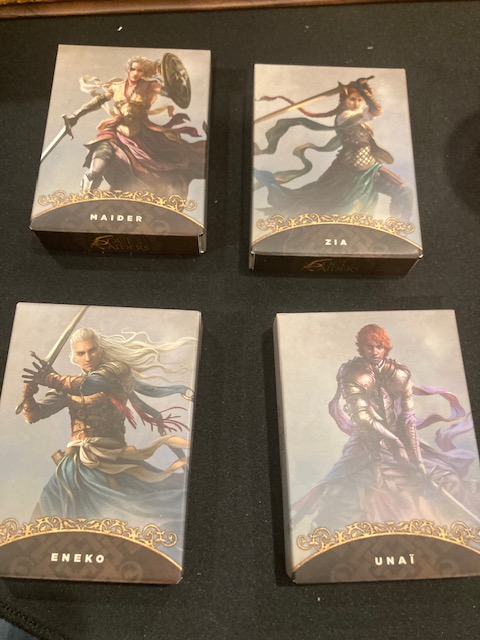
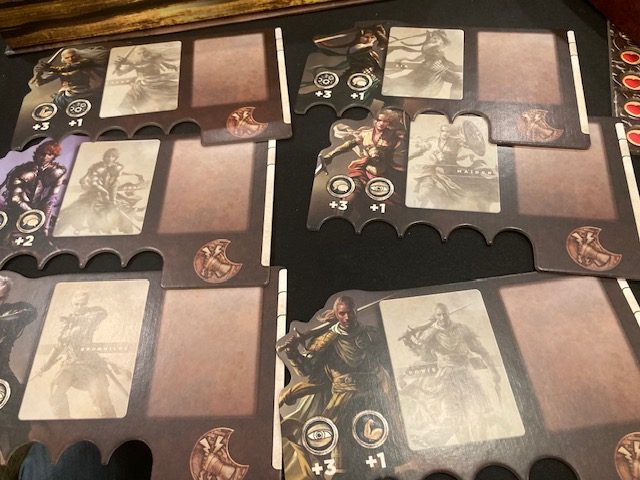
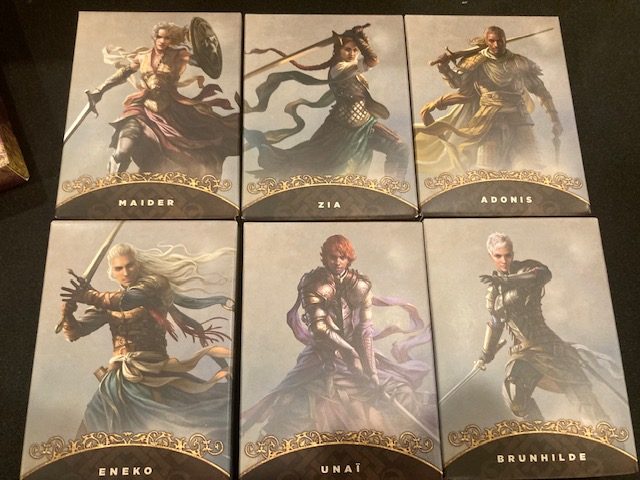
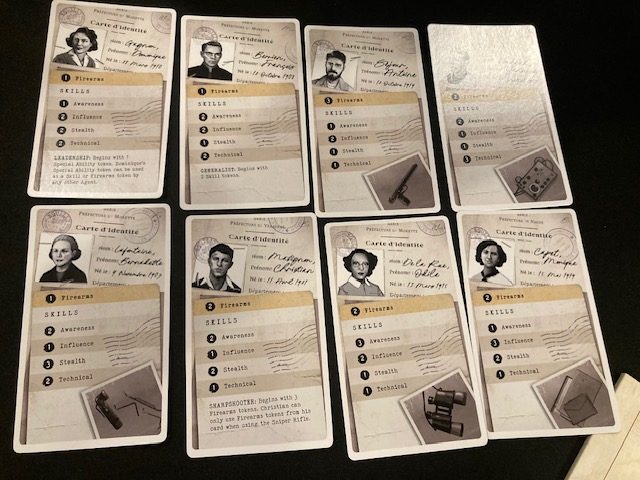
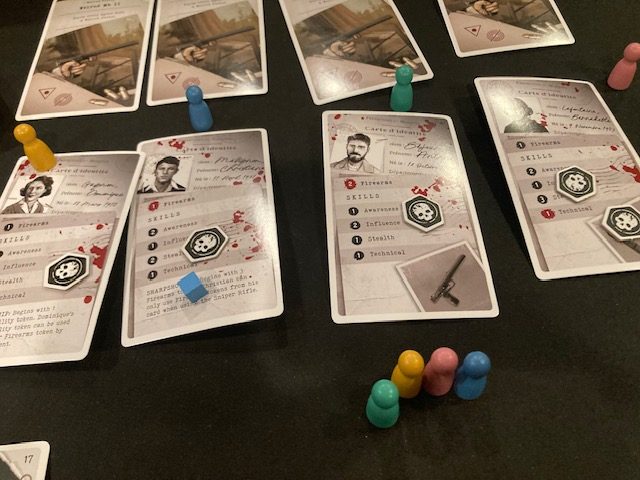
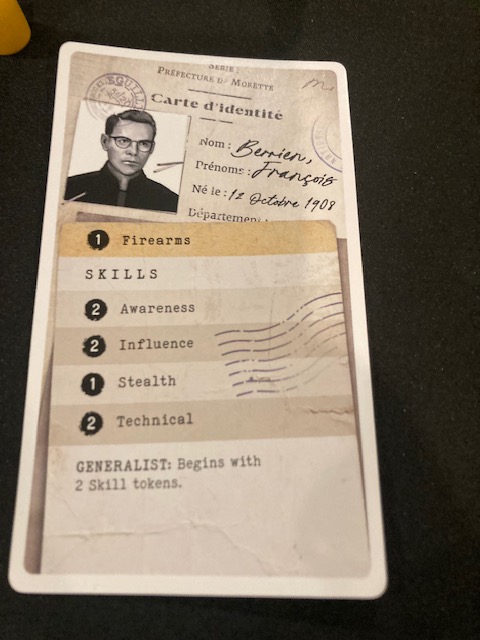
Each player takes the role of a single hero! See choices above!

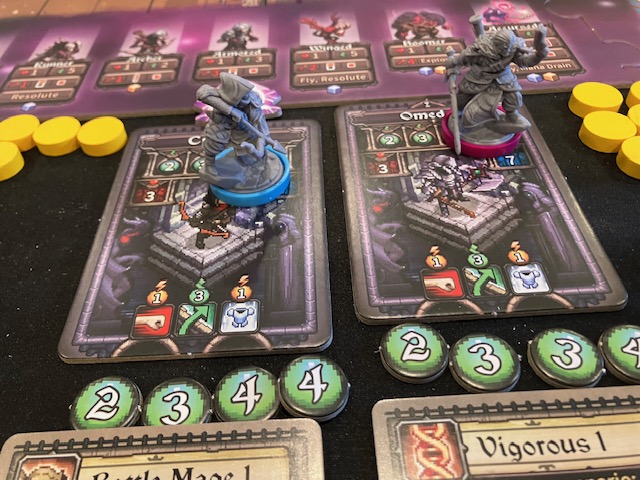
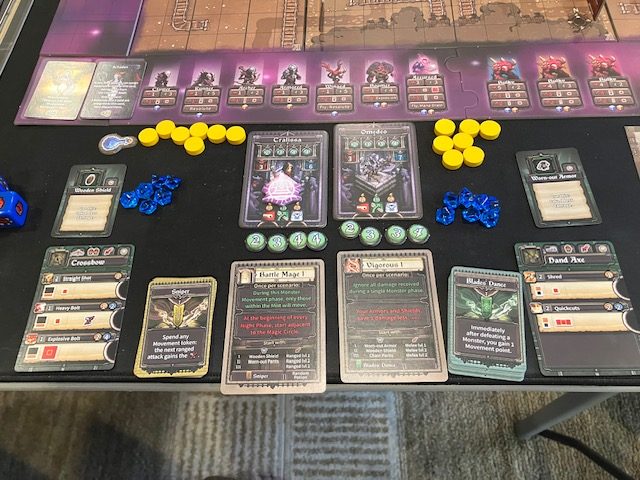
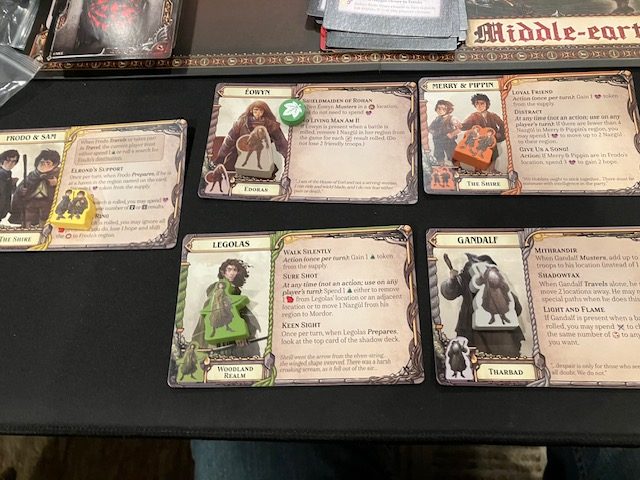
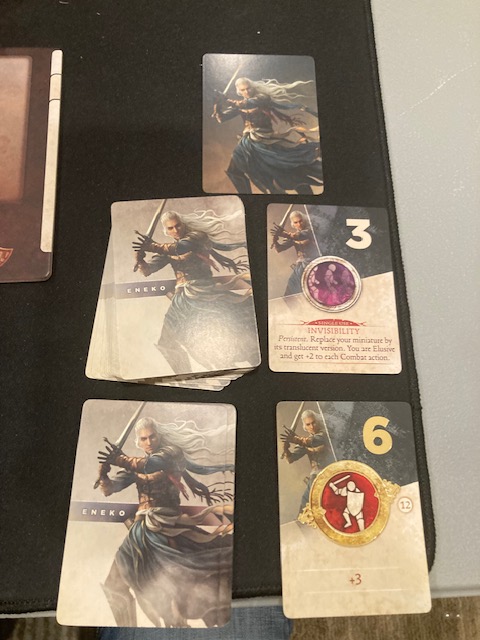
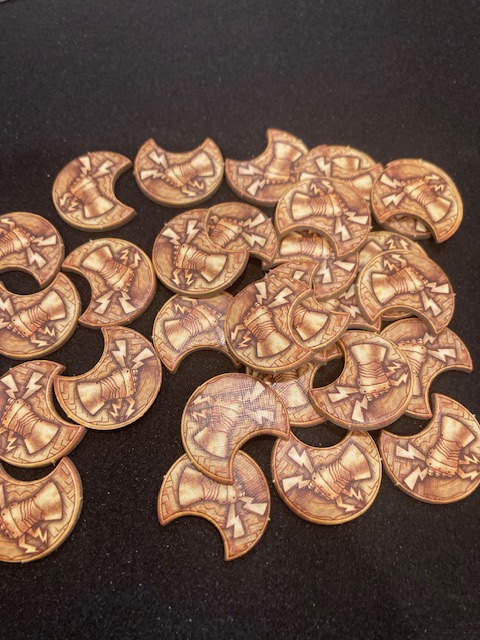
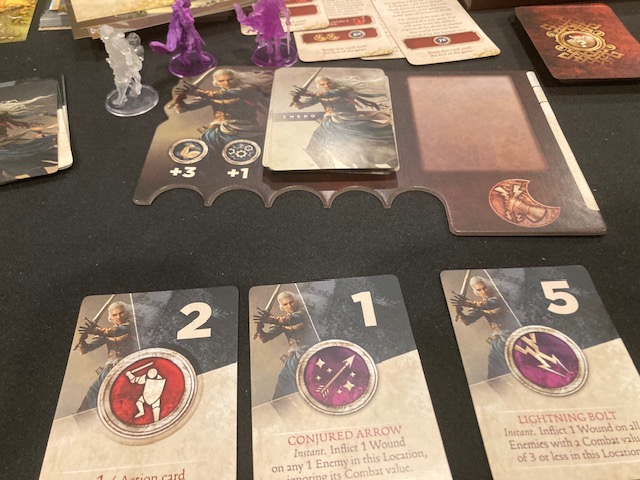
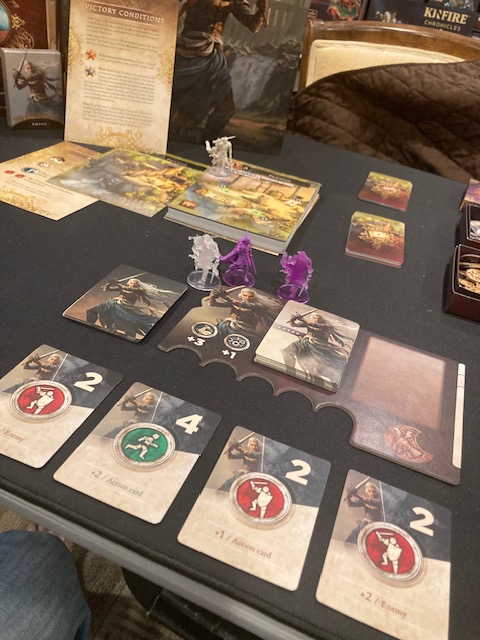
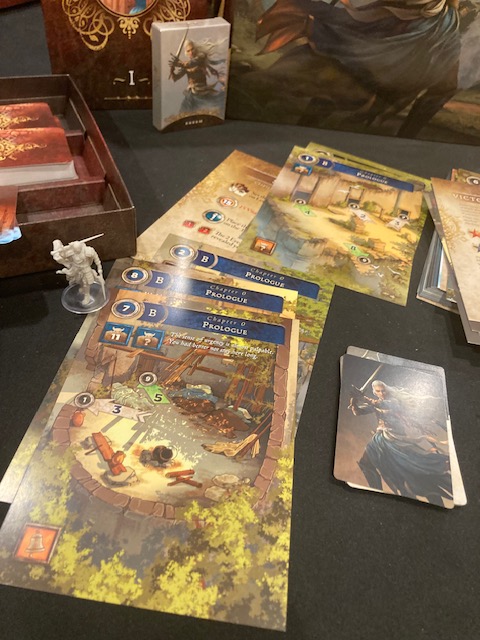
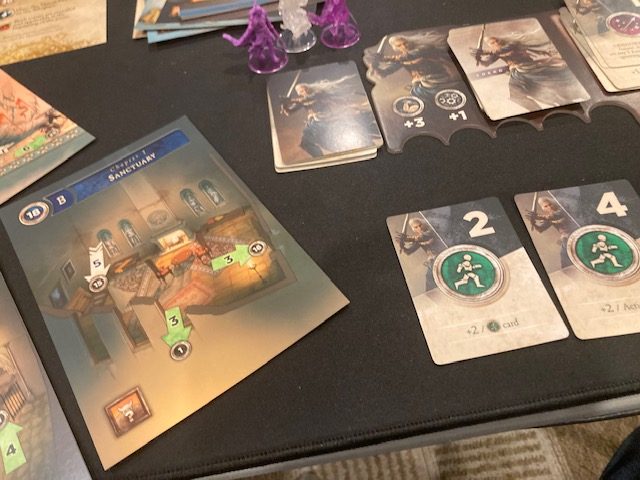
Each player gets the card and corresponding mini (see above). BTW, the colored bases ARE NOT for the players, they are for a particular set of bad guy, but I found they helped me distinguish the good guys from the bad guys. They probably should have included bases for the good guys! Each player has a bunch of action tokens (the yellow tokens) and 4 green movement tokens. You can spend the yellow action tokens to “do stuff” (do different attacks usually) and the movement tokens to move around the board.

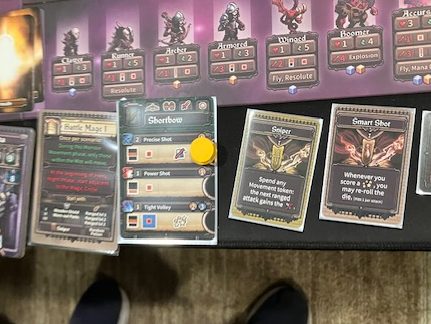
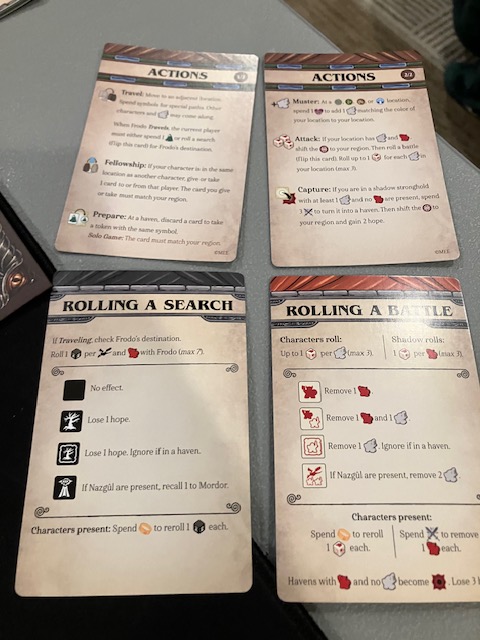
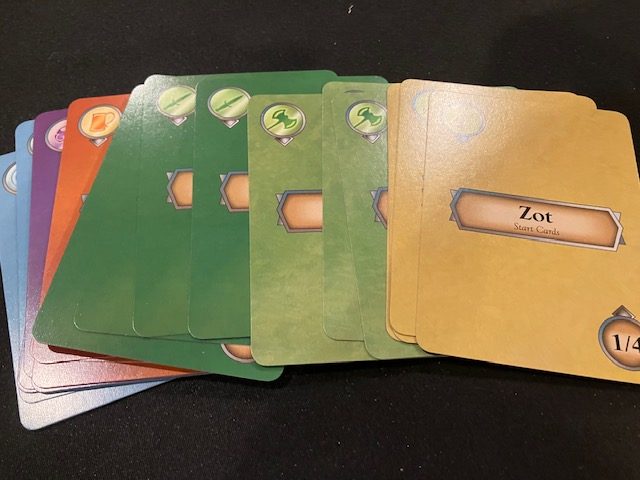
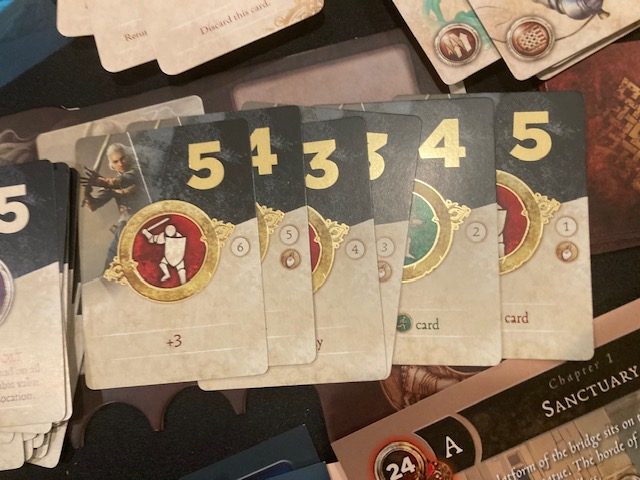
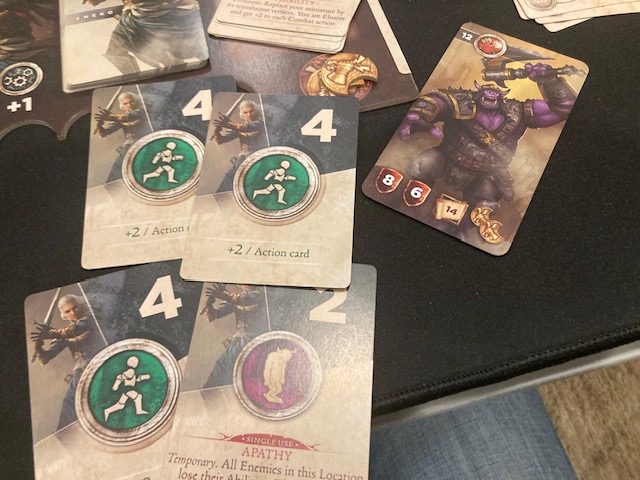
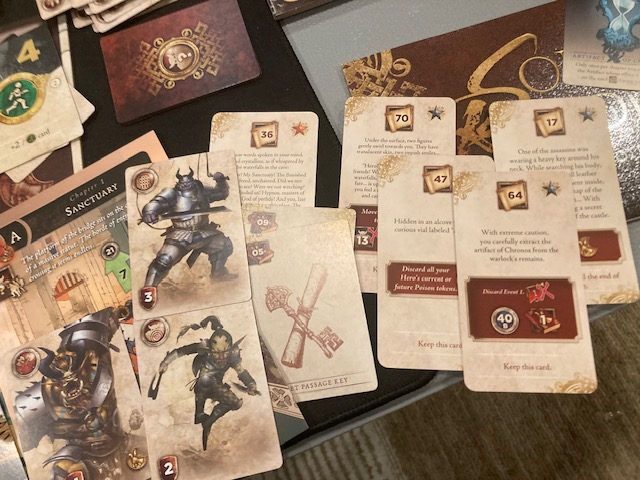
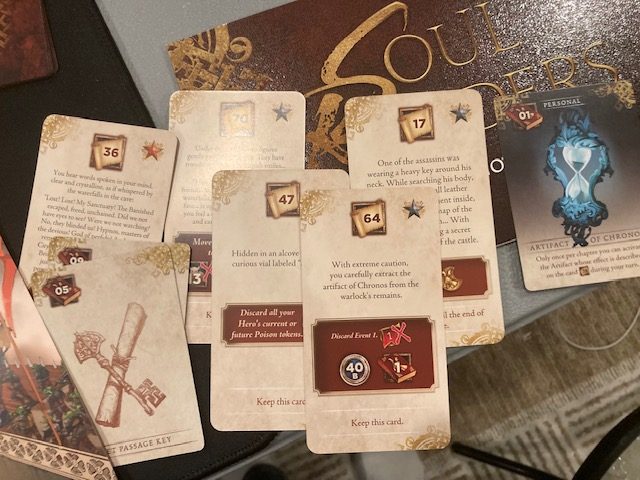
Each hero also gets some starting equipment and starting cards: see above.

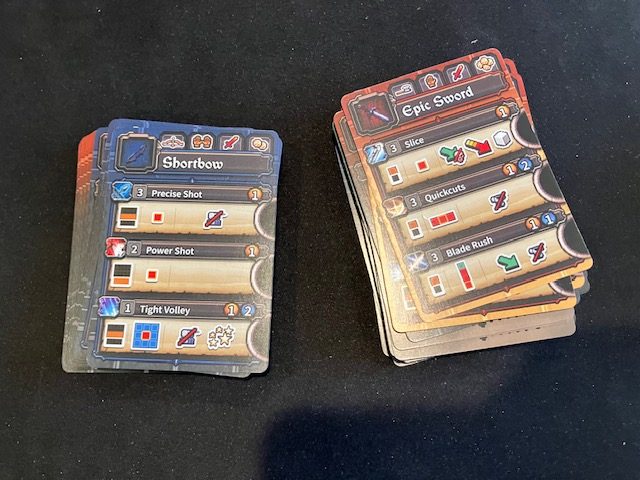
As the game progresses, you can upgrade your equipment and get better stuff!

Interestingly, a lot of upgrades come from building certain building!s So, the players make choices for building: do we want more gold? Do we want more materials? Do we want better weapons? Do we want better magic? The buildings the players choose to build define their upgrade path!

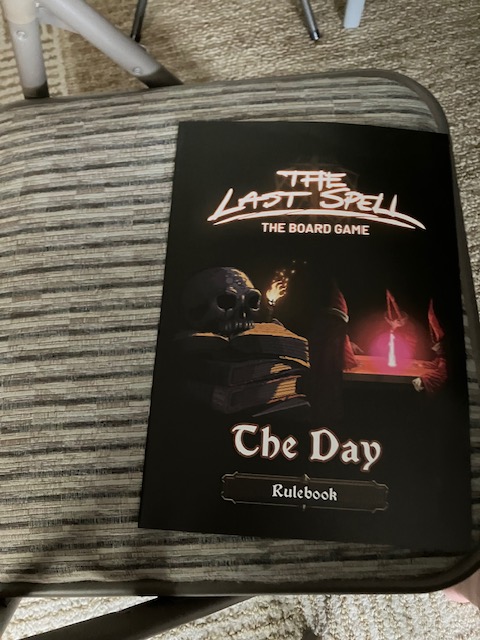
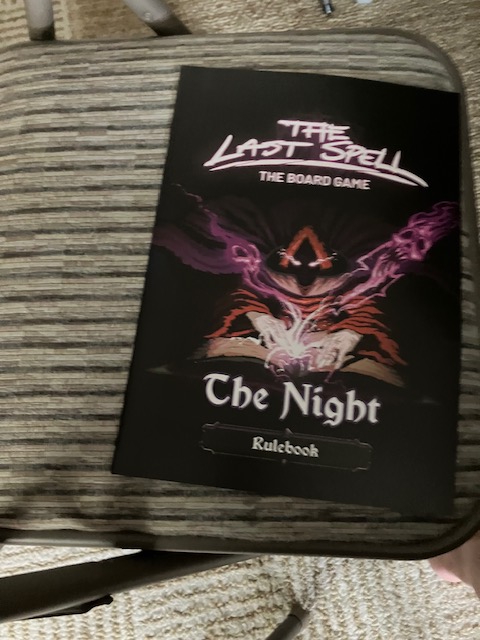
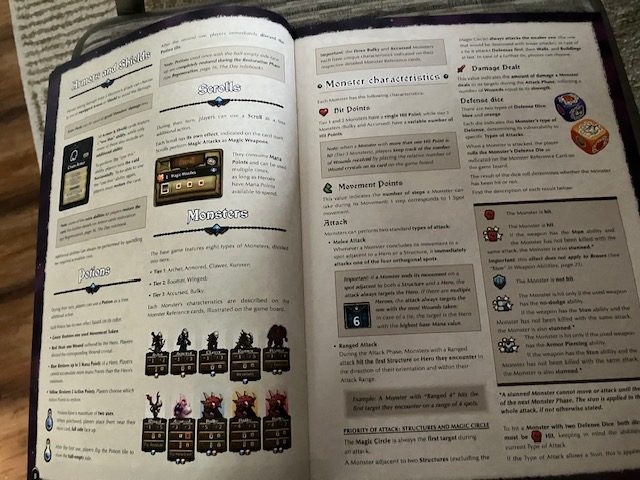
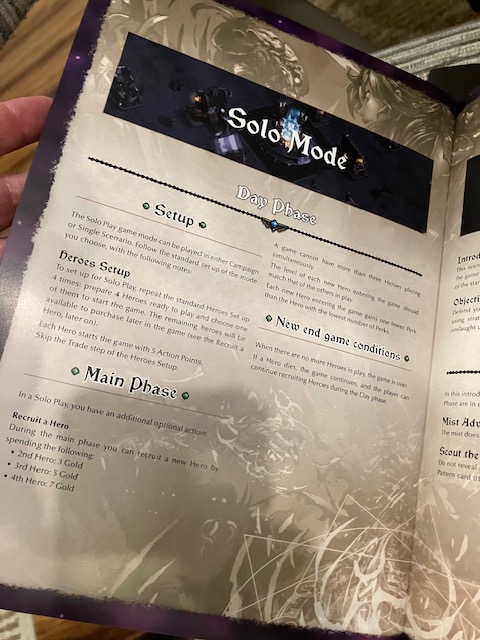
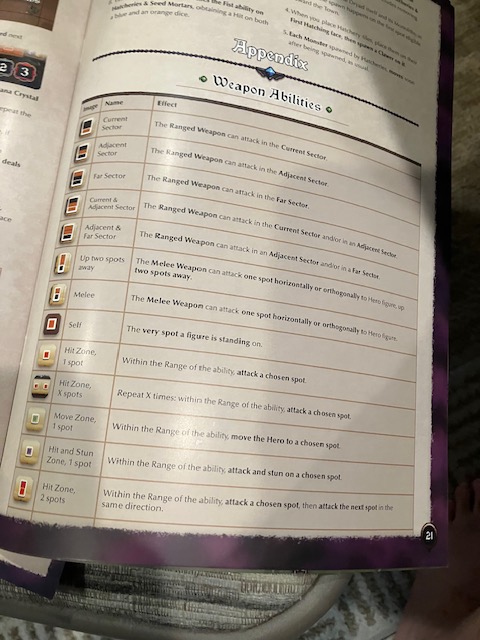
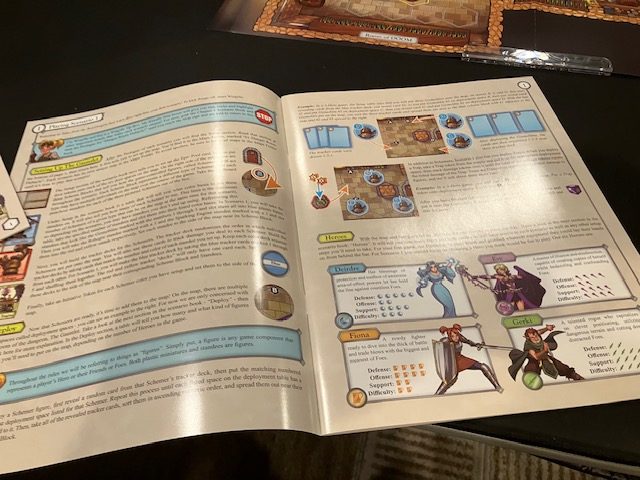
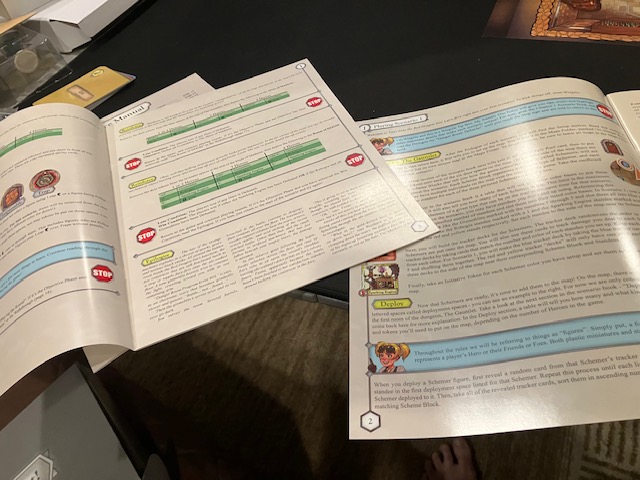
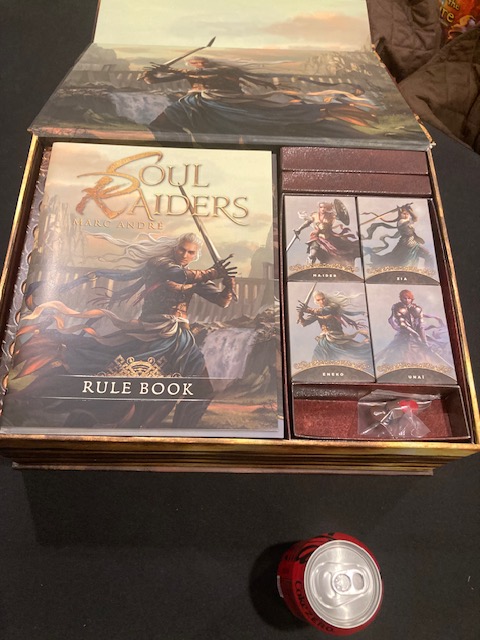
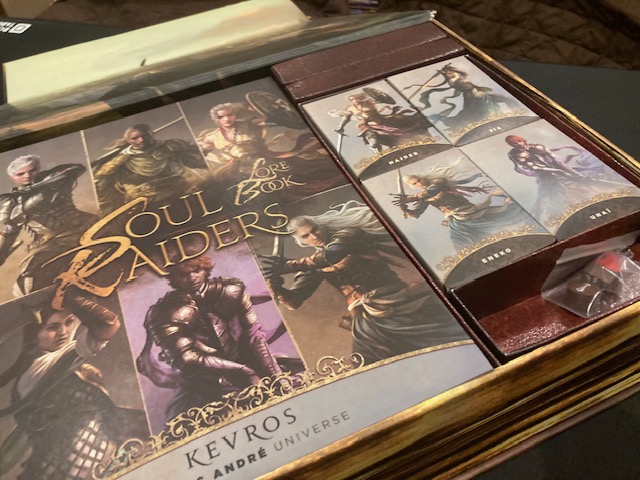
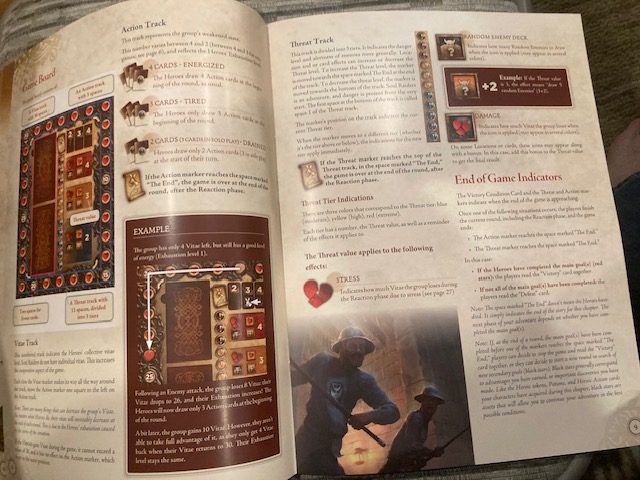
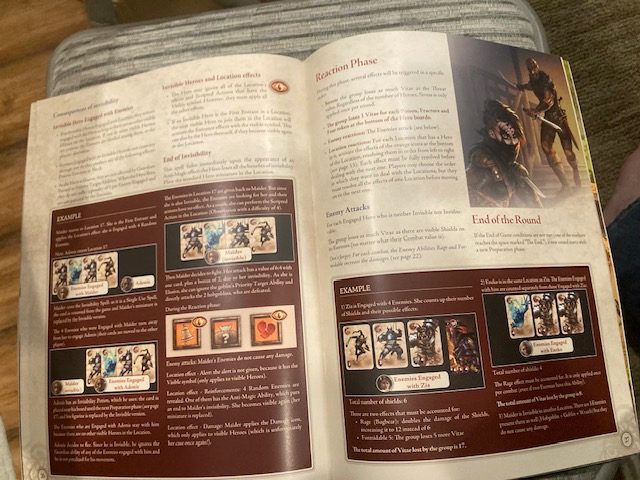
So the game has a weird arc: it takes place over 3 days: each day has a “Day Phase” (see rulebook above) and a “Night Phase” (see rulebook below).

That’s right! Each phase is pretty complicated, and you do it three times! 3 days and 3 nights!

The Day phase is all about spending resources (Gold, Materials), building buildings, fixing buildings from the night before, and generally getting ready for the Night phase. The Day phase is “getting ready” for combat.

The Night Phase is all about combat! The heroes are fighting the hordes as they advance!

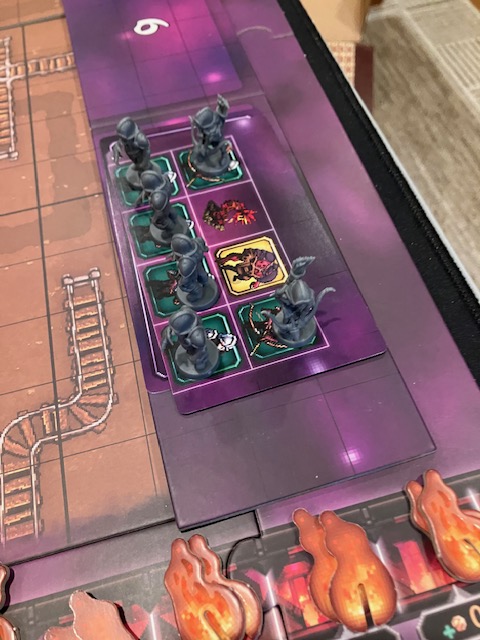
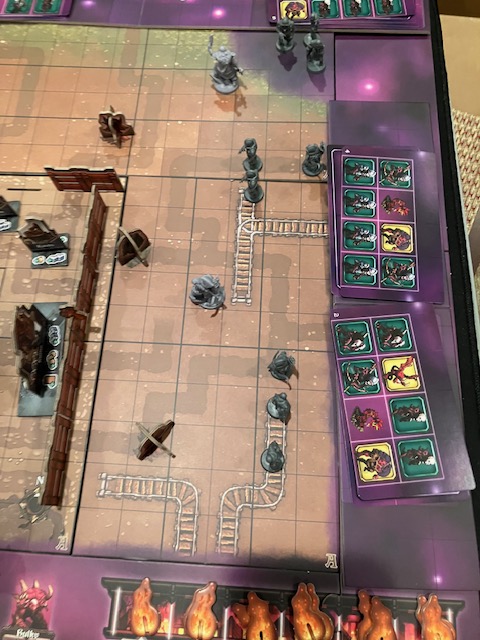
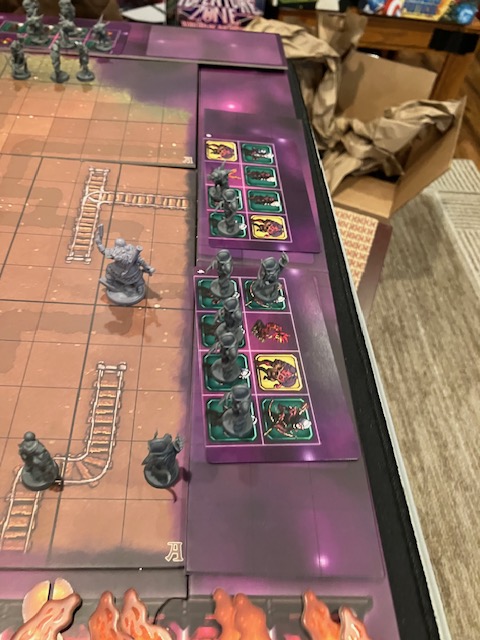
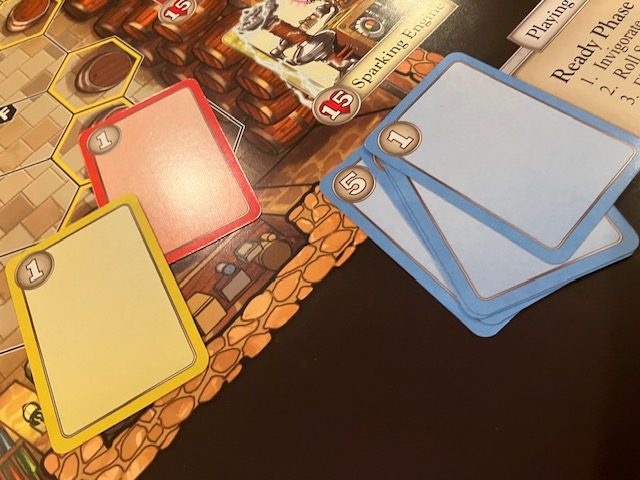
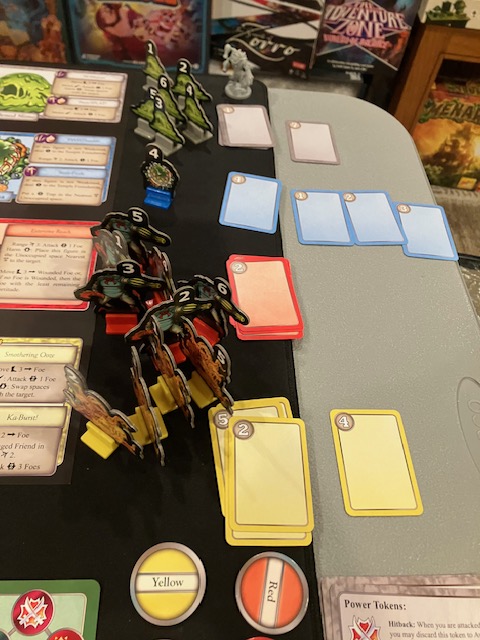
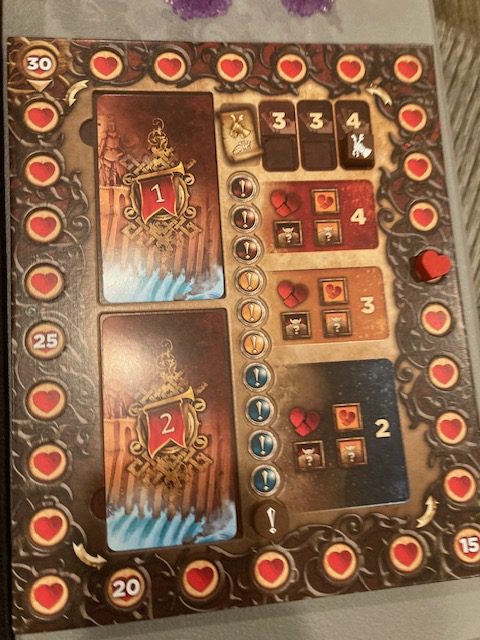
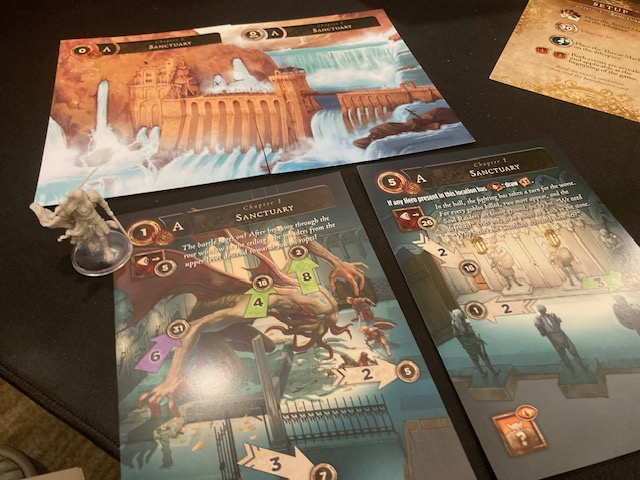
In the Night phase, cards full of hordes (see above) sit on the edge of the board and get ready to invade!

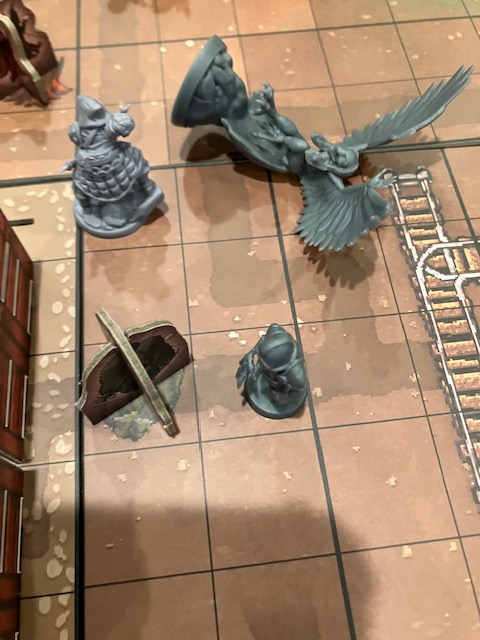
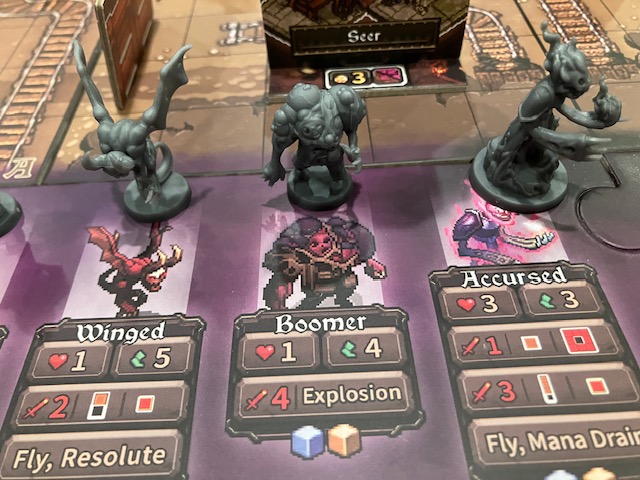
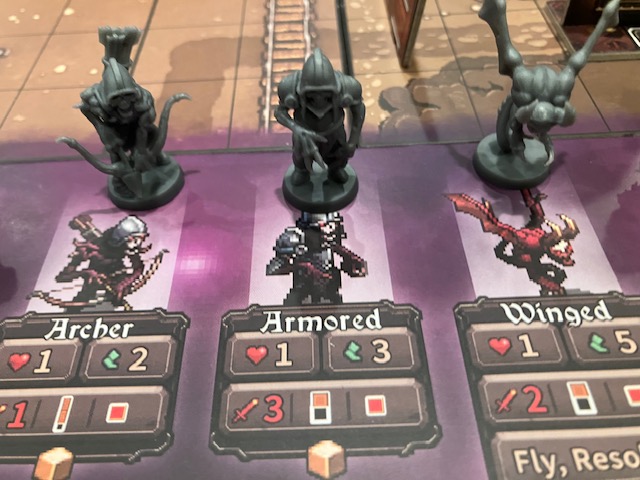
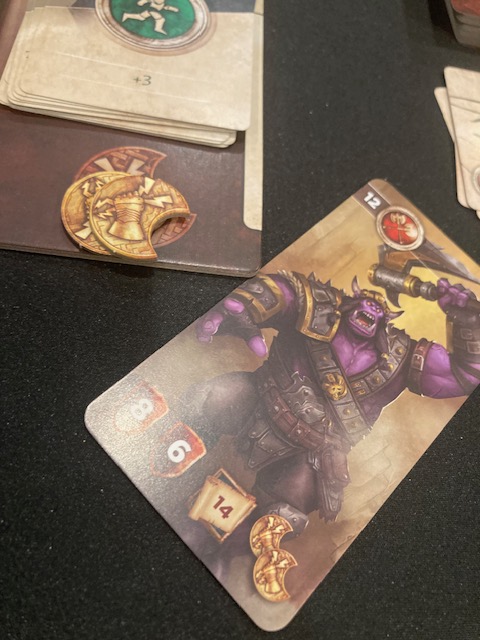
Each different type of monster has different Hit points and damage: see some above.

If the players can keep their spellcasters casting and keep all the monsters away from them, they win! If the monsters somehow kill all the spellcasters in the middle of the board, they win!

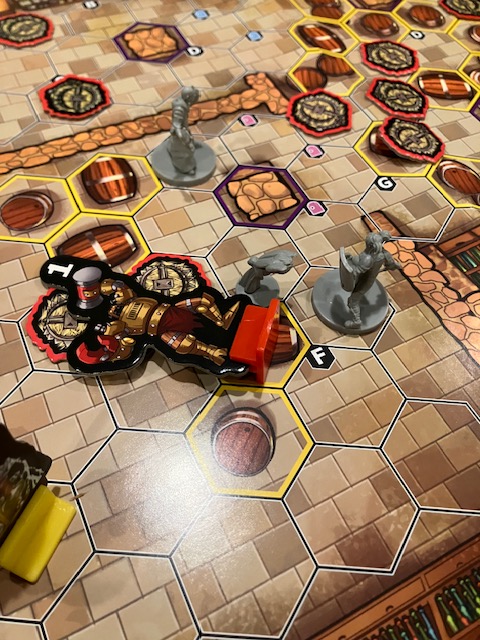
Of course, you can’t have a video game adaptation without a big boss! The big boss comes in the third night and will mess you up! See above as we were (luckily) able to kill them in that game!

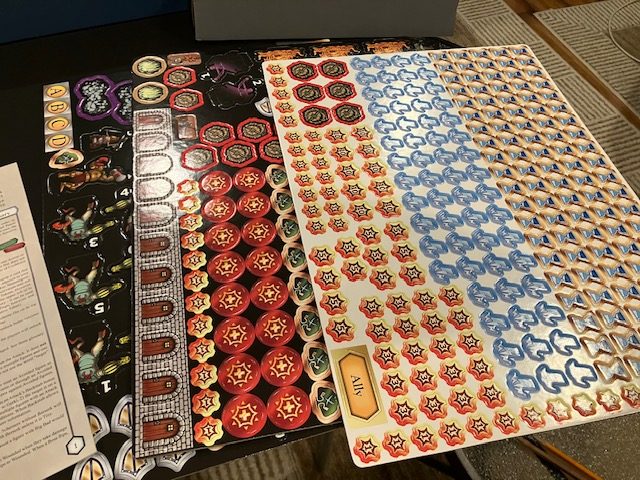
In case it’s not clear, this game embraces 8-bit art (like the video game) for just about all the art, but it uses detailed minis for the monsters on the board!

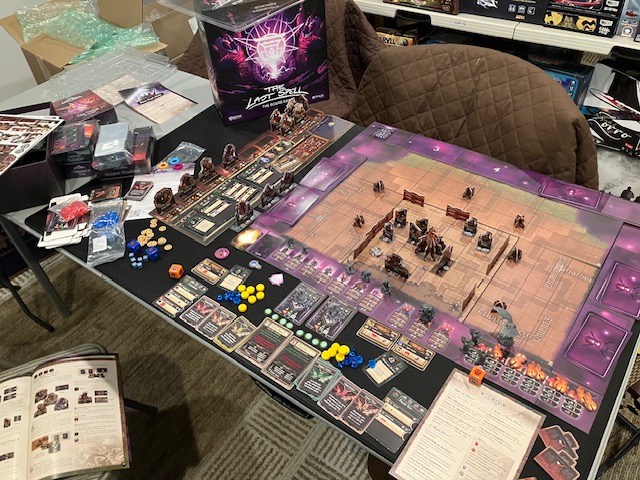
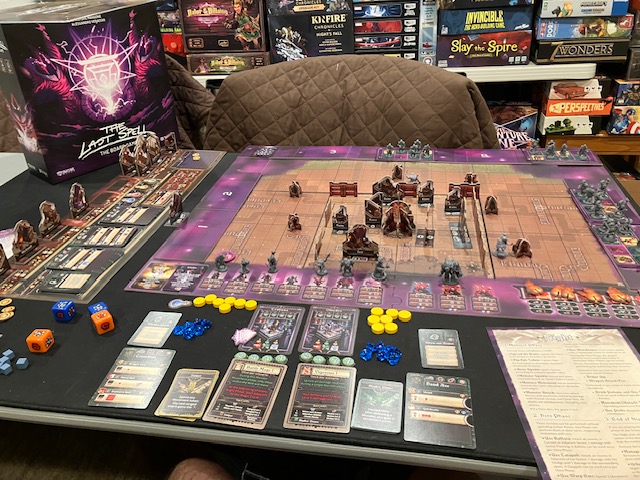
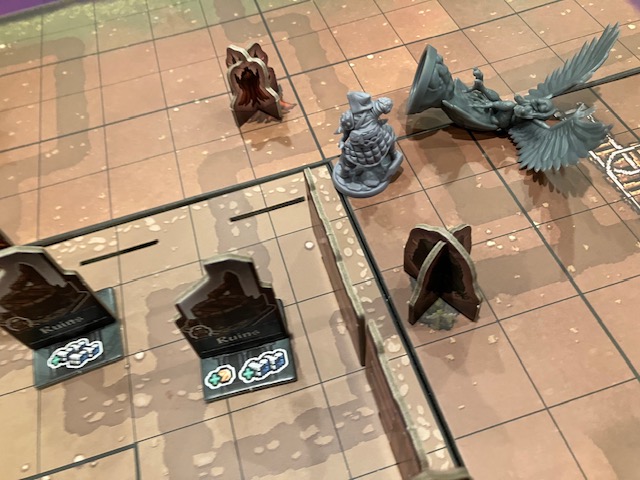
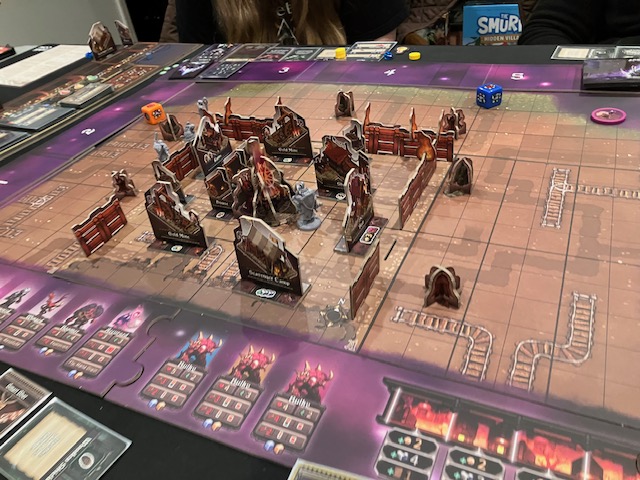
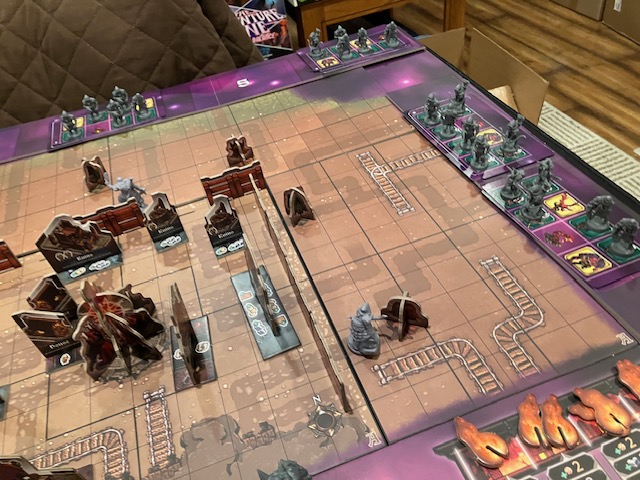
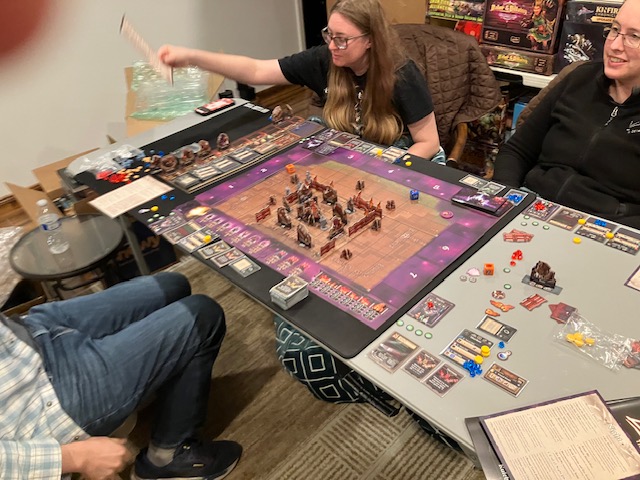
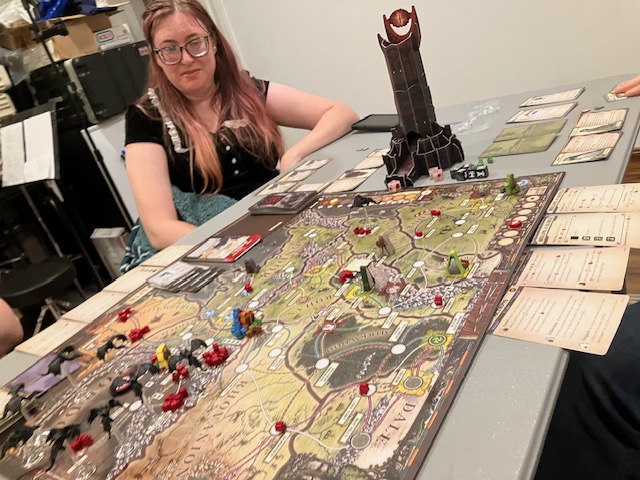
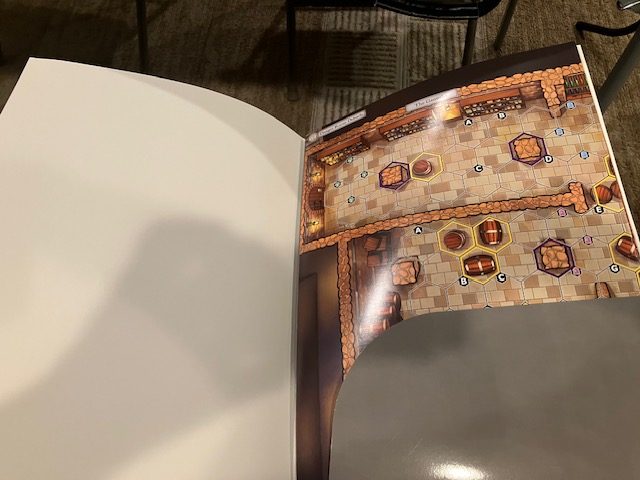
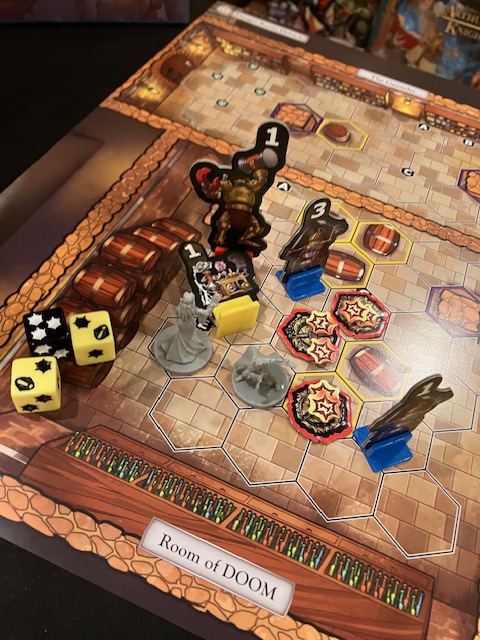
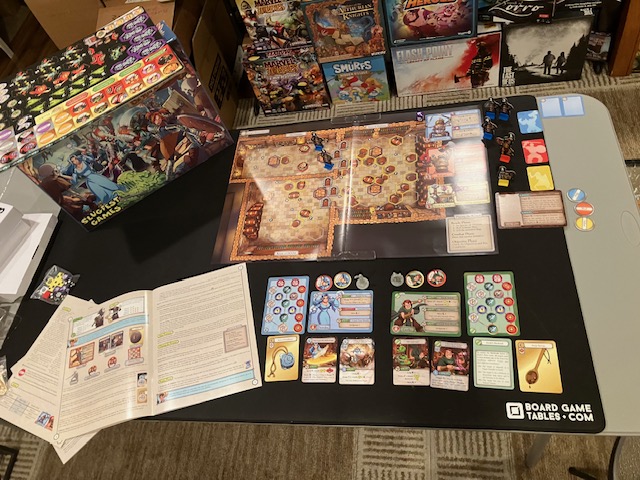
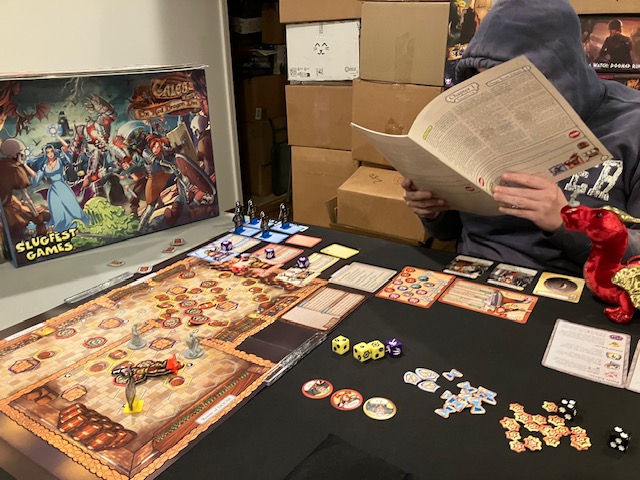
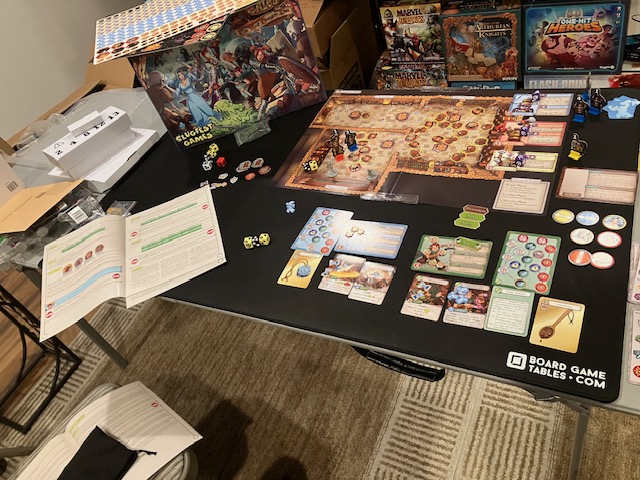
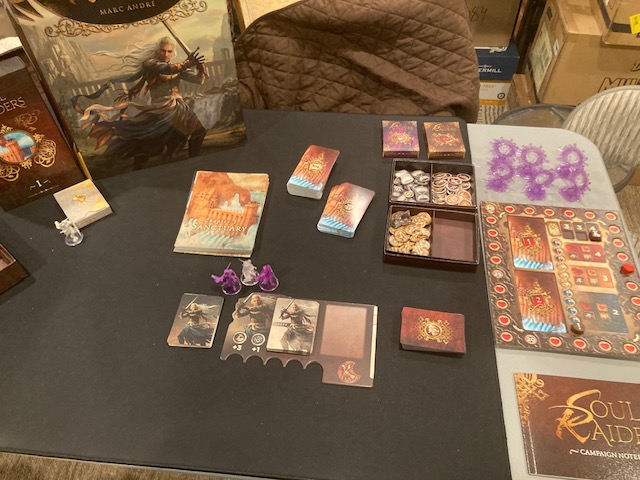
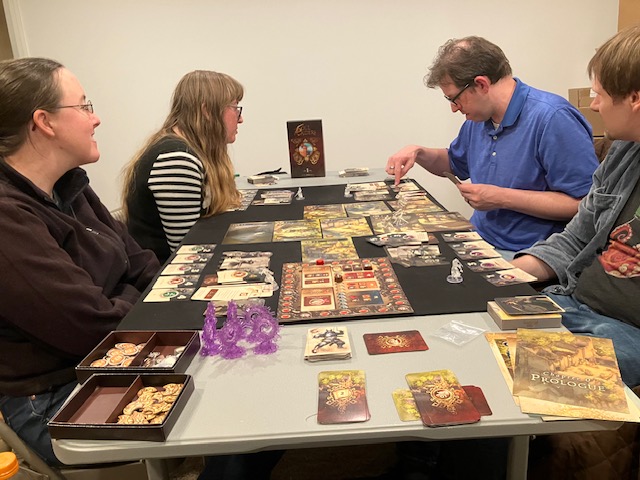
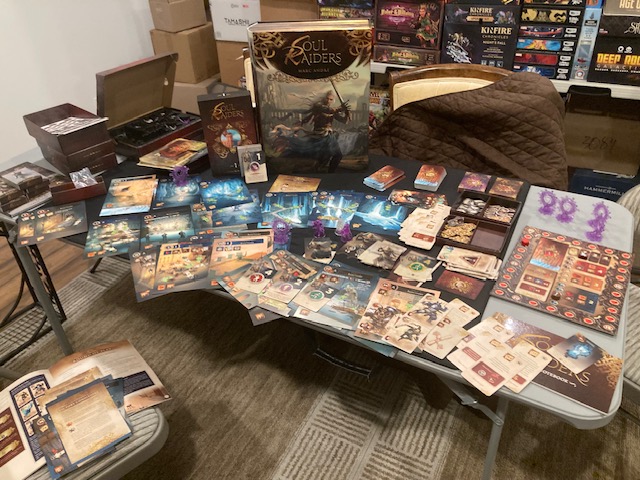
This is a big mama-jama on the table and takes up quite a bit of space! See above! The components are pretty darn good.

Rulebooks

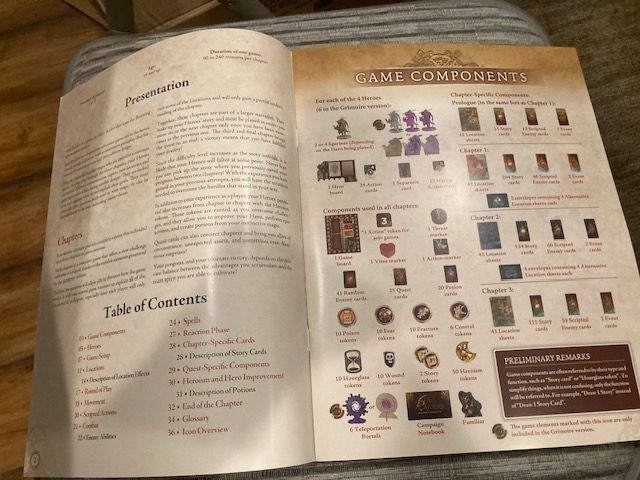
There are multiple rulebooks: one for The Day and one for The Night. At first, I was kind of upset by this … how big is this game that you need TWO separate rulebooks? But after some introspection, I think I prefer two rulebooks. Why? The alternative is a giant rulebook with a TERRIBLE binding like we saw in Valheim (see review here)! So, having two rulebook which lay flat? I am okay with that!

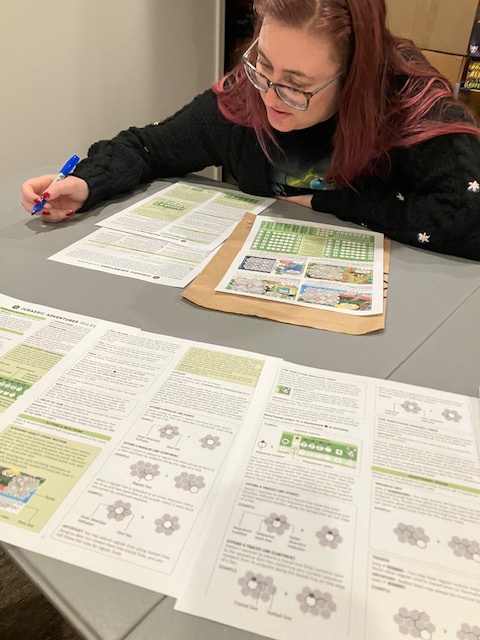
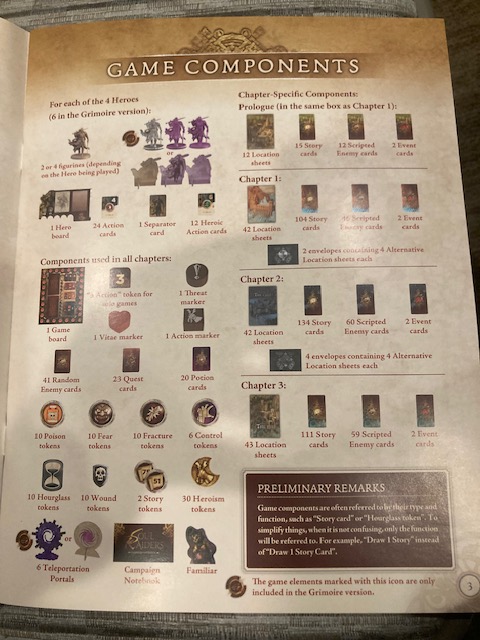
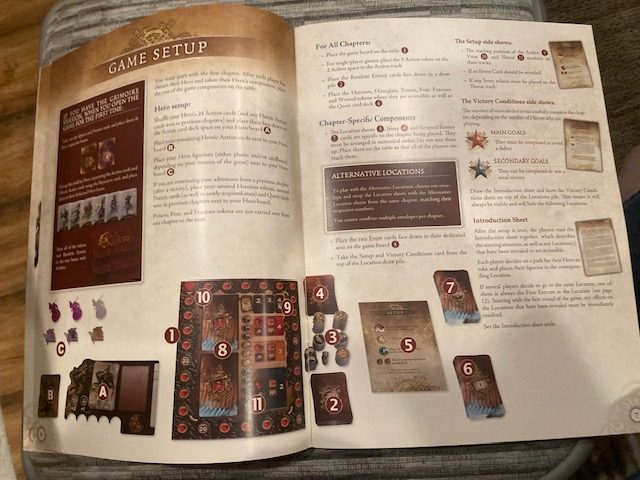
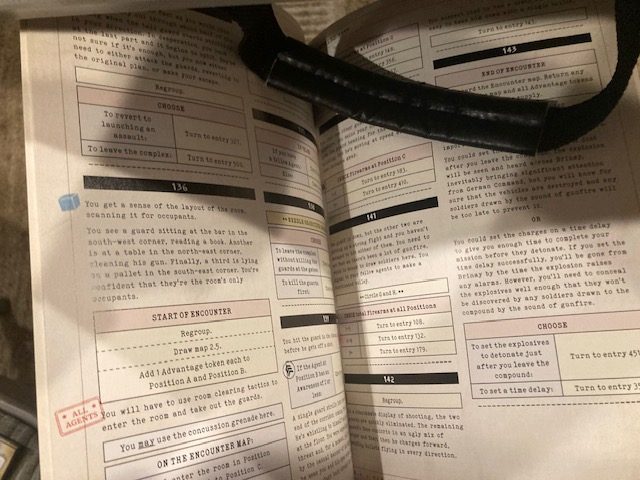
The rulebooks open nicely onto the chair next to me; the staple-binding keeps both pages open and easy to read. The font is fine and readable (see above) There are enough pictures to be useful has well. On The Chair Test, the rulebooks get an A-; they droop ever so slightly over the edges but generally look good on the chair next to me!

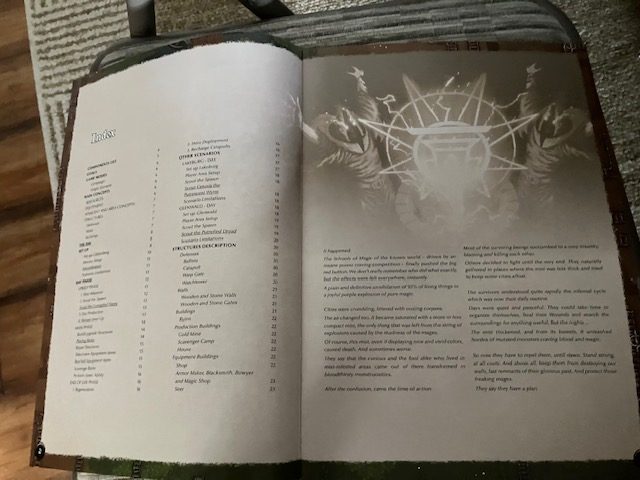
Having said that, I was very triggered by their use of the “Index”: they completely misused the word!!! See above! An Index is a list of keywords with references (page numbers or links of some kind), but an Index is sorted alphabetically so that people can easily search for relevant keywords using binary search! Unfortunately, what they label as an Index is a Table of Contents: phrases and concepts sorted by the page number! See above!!! A table of contents is used to show how the document is organized!! WHAT THEY HAVE IS NOT AN INDEX! That is a Table of Contents!!

I have to admit, this gave me a very worried feel about the rest of the game. If they can’t get this right, what else will they get wrong?

In general the rulebook was sorta “ok”. I didn’t love it, and I had some real trouble finding some rules (especially some edge cases, since they don’t have a real Index), but I guess it was “fine”. I guess. I am still upset about their misuse of the word Index. In both rulebooks.

Solo Play

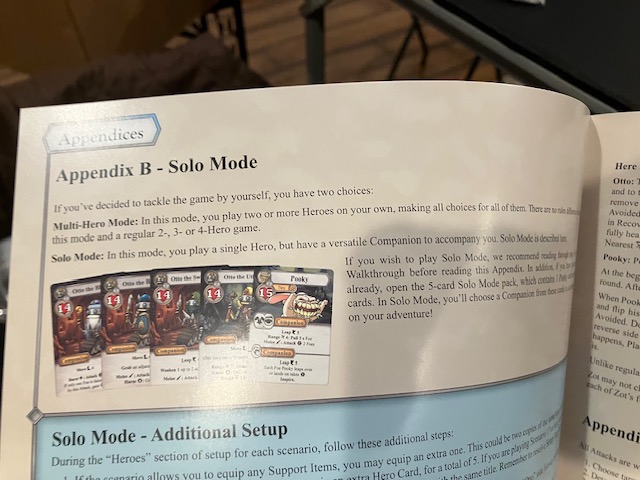
There is a solo mode! Thank you for following Saunders’ Law! Hurray! It’s not that much more complicated; you start as true solo (with one character), but you can recruit extra heroes. (See the rulebook above with the Solo mode documented in the back of the Day Phase rulebook).

Here’s the thing; for my first play, I wanted the game to run as smoothly as possible without any extra exceptions. I have to teach the cooperative game to my game group, and I want as few changes as possible. In the end, I ended up playing two-handed solo: alternate between two characters and play as-if it were a 2-Player game. I think this is the best way to play your first solo game; get all the base rules under your belt in a two-handed solo mode, and then if you like it, you can try the more complex solo mode given.

So, let’s be very clear: the majority of this game is in the Night Phase fighting monsters! The Day Phase, while important (as you figure out how to spend your resources to protect your town), is over quickly! Most of the time you are fighting monsters!

And you spend a LOT of time fighting monsters. My first day (Day 1/Night 1) probably took me 2 hours to get through. Holy cow! I had to leave the game set-up on the table overnight! I got better at running the game, but I also realized I got a LOT of rules wrong (if only they had a true Index to fix this…)

My second day (Day 2/Night 2) also took about 2 hours to play. I had to leave the game set-up on the table. A lot of this was correcting my incorrect notions from the previous Day and keeping my head in the rulebooks a lot.

My third day (Day 3/Night 3) was also about 2 hours to play. This day would probably have been shorter, as I was getting to know the rules, but then the Big Bad Boss came out! And the Big Bad Boss has her own very special rules that you have to study!

I ended up winning, but the game basically took me 3 REAL days to play … I basically played one “game day” per day, and left the game set-up on my table!

This is a long game. I think the game will probably cut by a third or even a half now that I have the flow of it, but it takes a long time to get the sense of the game.

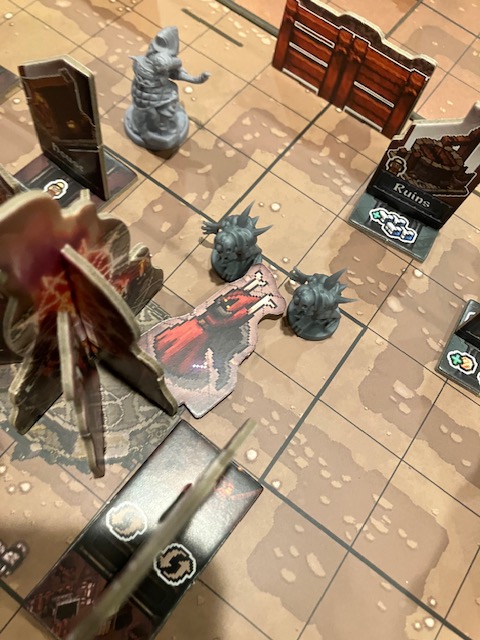
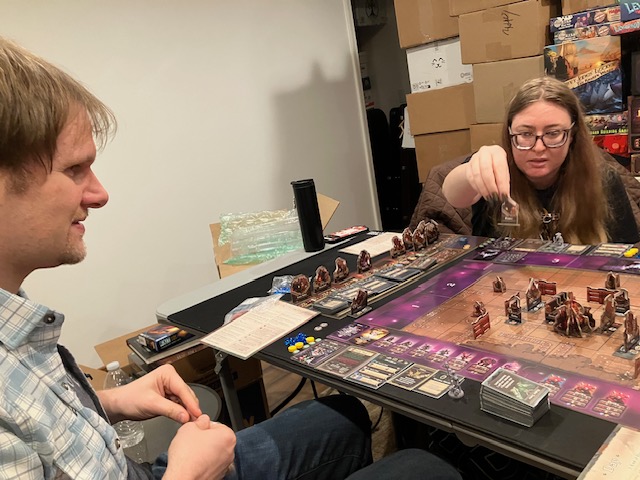
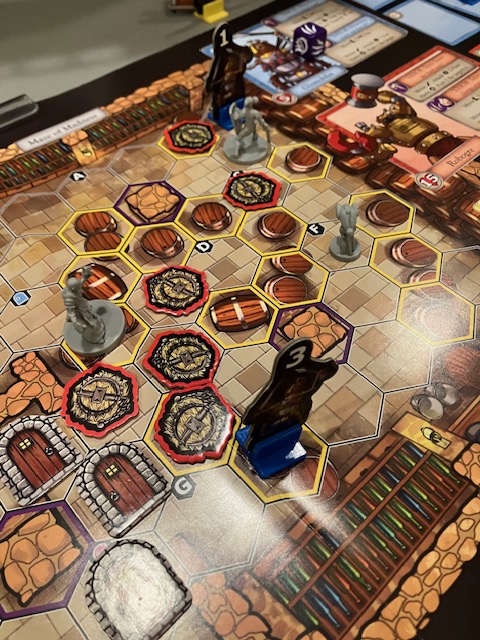
For the solo player, there is QUITE a bit of maintenance. SO MANY monsters come out and converge on the town! See above! The solo player basically has to spend quite a bit of time moving EVERY single monster towards the city; this is a lot of work. This is partly why the game takes so long to play … all the minis have to move! And the rules are “not great” when there are conflicts; they could have been better (how do I move the monsters?).

I am glad that I played The Last Spell solo to learn the game. I am also glad I played it two-handed solo; there’s just too many rules to keep track of that I don’t want to be wasting any time doing “solo stuff” that’s outside the normal path of execution. Now, tt’s one thing for ME to keep the game set-up on my table for 3 days while I wade through the game, but I cannot imagine trying to learn this with my friends at the same time! There’s just too much going on. Play this solo to learn it; play it two-handed.

Will I ever come back to this as a solo gamer? I don’t think so? There is SO MUCH maintenance for the solo gamer (moving all those minis), I can’t bear going back to this and doing all that work as a solo gamer. It’s not bad solo, but it’s just so much work! Maybe you like living in this world or really like the video game … maybe spending that time moving stuff around might be fun for you? It wasn’t for me.

Cooperative Play (4-Player)

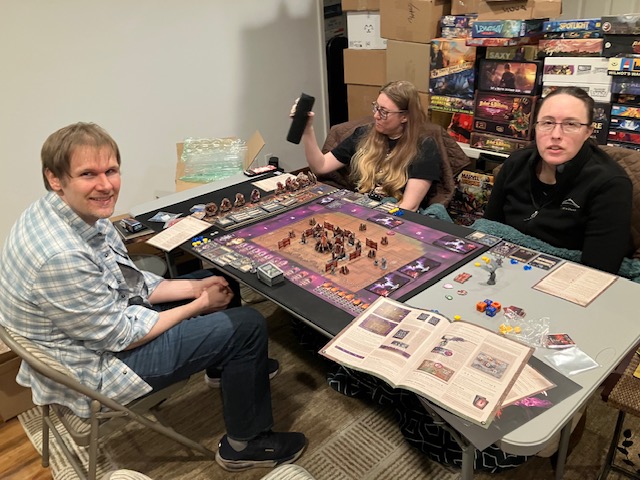
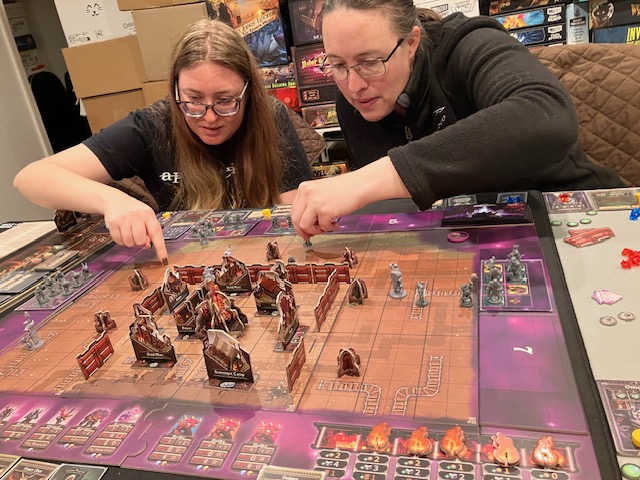
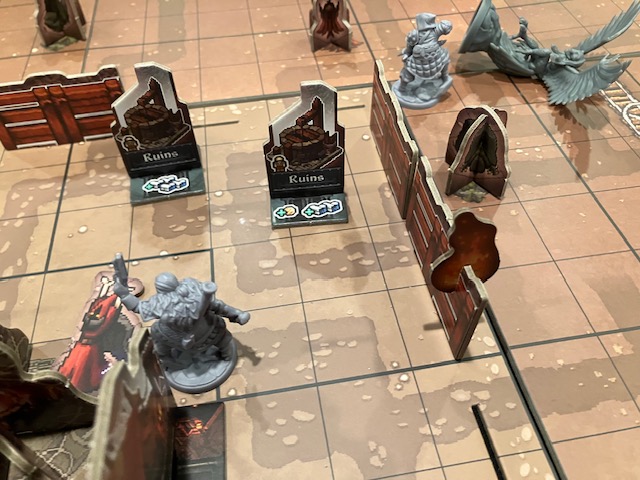
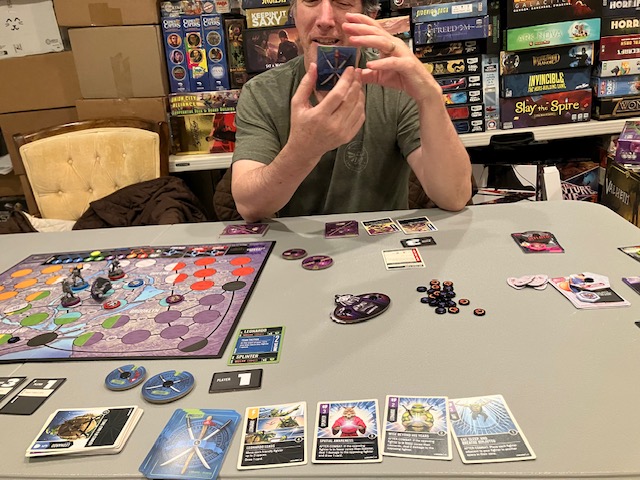
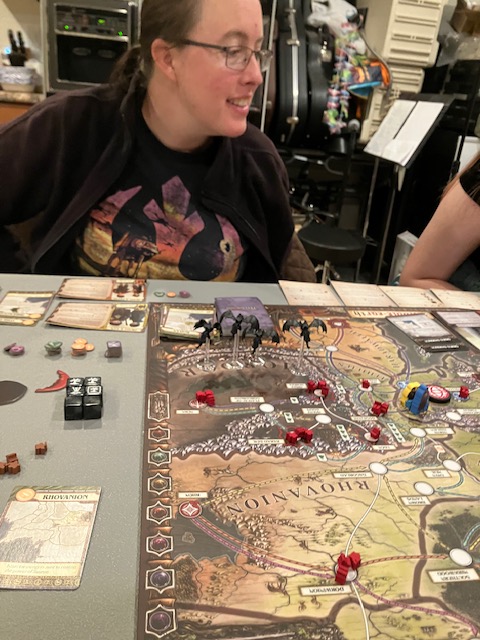
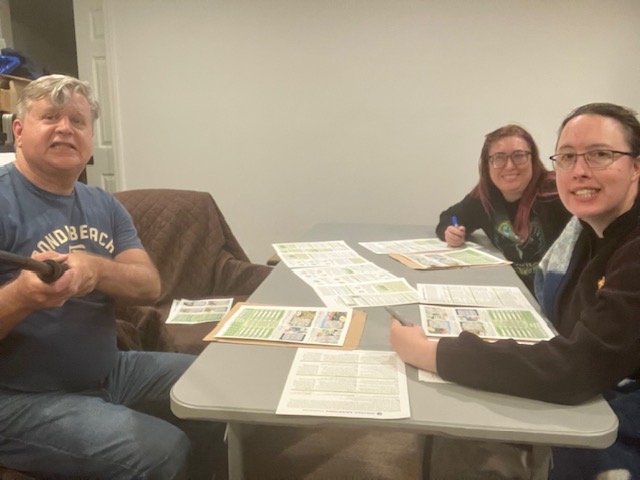
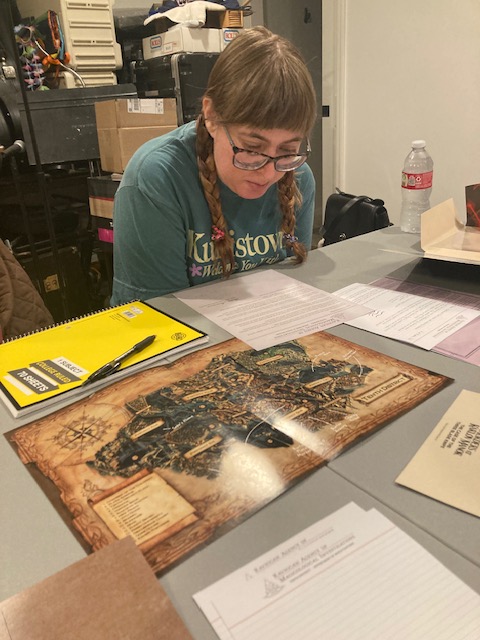
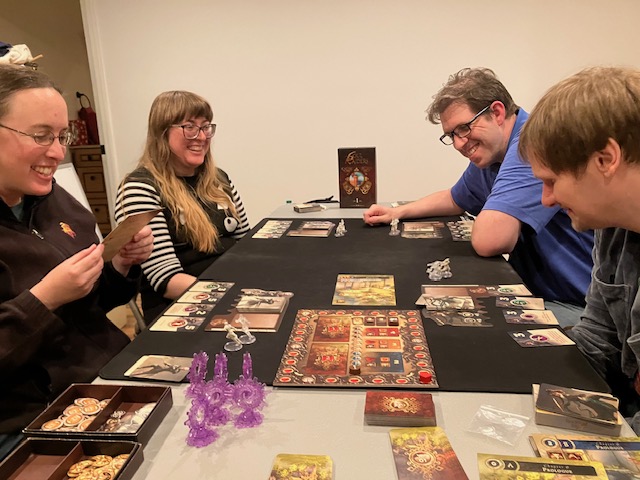
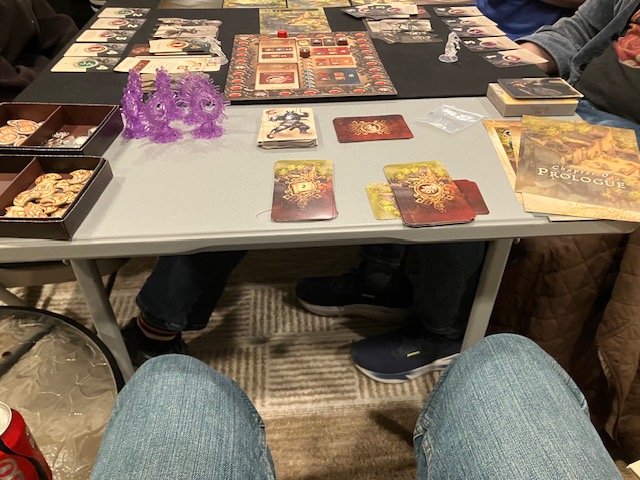
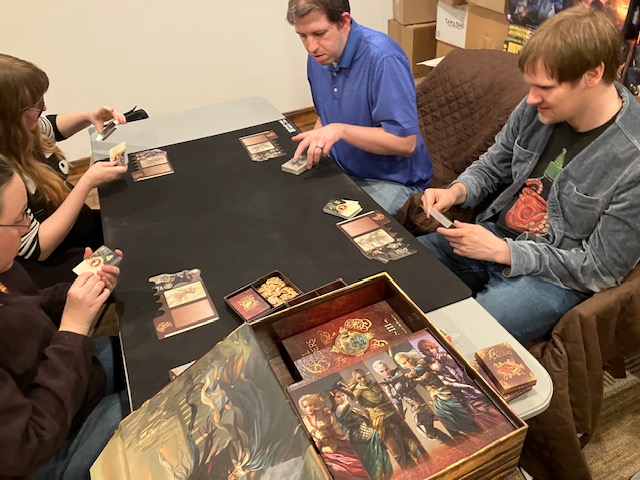
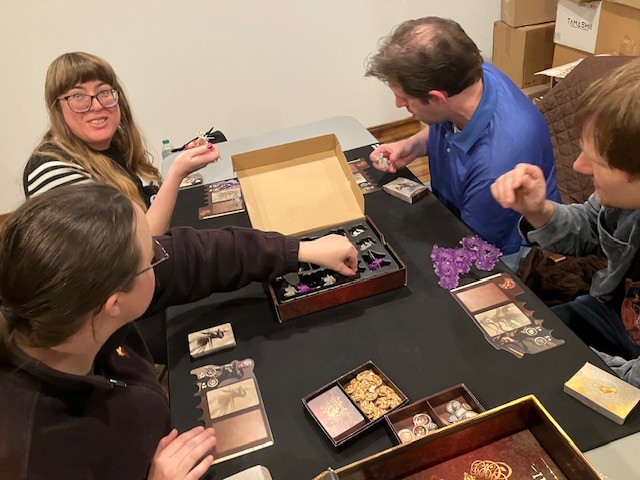
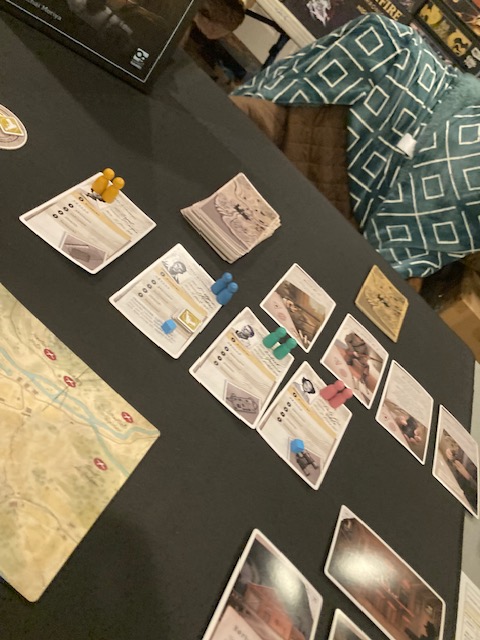
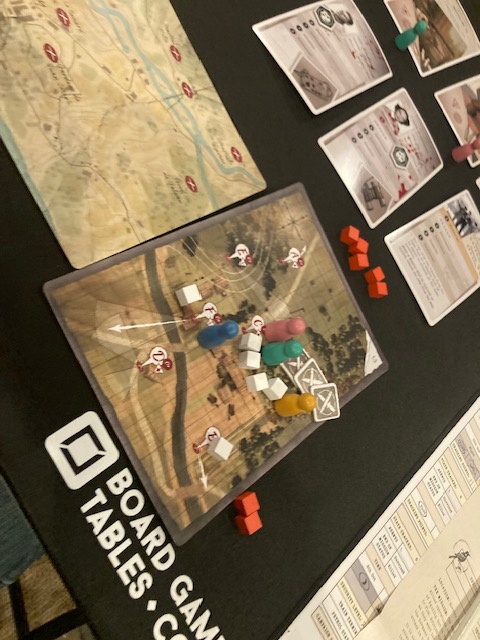
In session 1, we got 4 of us (me not pictured) to play the cooperative game! I was a little worried the game wouldn’t fit on the table, but we made it work … see above.

The major difference between the solo and cooperative game is that NOW the maintenance is shared! Sure, more enemies come out, but the game is a little more managable (and less work per player) as each player moves “their” monsters (on their side of the baord). This might be the best reason to play this cooperatively over solo play; the load is shared.

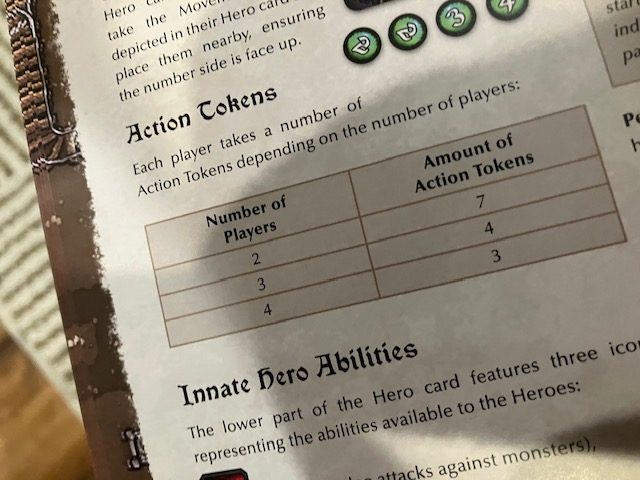
How does the game balance for more or fewer players? It boils down to how many action tokens you get! See the rulebook above! In my two-handed solo game, both characters got 7 action tokens! In the 4-player game, we each only got 3 action tokens! Now, this is balancing because with 4-players because the players can keep the monsters under control; each player monitors a section of the board! Based on plays, it seems like the balancing “generally” works. In fact, the third day was a 3-Player game (as one player was sick), so we got to see the balancing at all player counts; it seems to work.

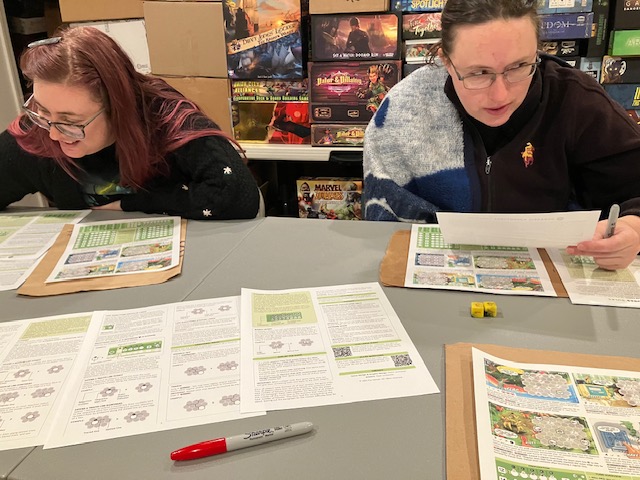
Even after playing solo, I was still the “rules guy”, looking up rules as we played. We were able to play 2 days of the game: 1 day, 1 night, 1 day, and 1 night. It took us about 3.5 hours to play 2/3 of the game. It was a little shorter than the solo game because we all shared the load of set-up.

What I am surprised about; how the game unfurled. We accidentally played with Player Selected Turn Order (PSTO) (because it was more fun and more strategic) and because my group knows how to deal with PSTO well. But I am surprised that we DID NOT play with simultaneous play … it seemed like most of our turns were fairly independent (“you deal that that part of board, I’ll deal with that part of the board”) as there were no interactions that we had to carefully sequence. Once the bad guys got closer, we had to be more careful, but I am surprised we didn’t play our turns simultaneously. It seems like we could? And even should have (because it would reduce play time)? I think we didn’t because we wanted to see how things went on each player’s turn? I think? Given how much work there is per turn, I really really thought we’d embrace simultaneous actions. But we didn’t.

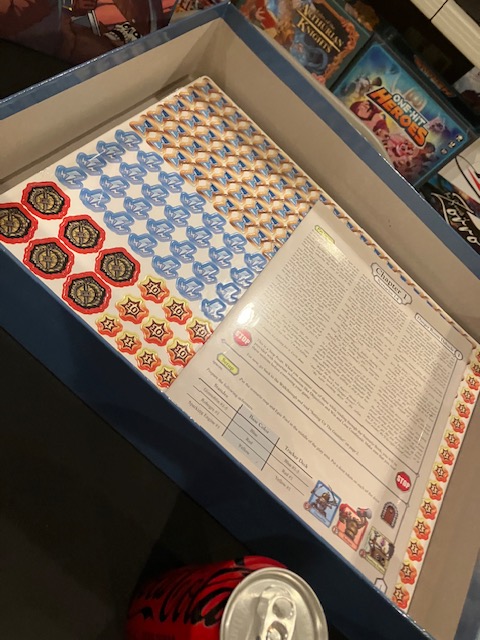
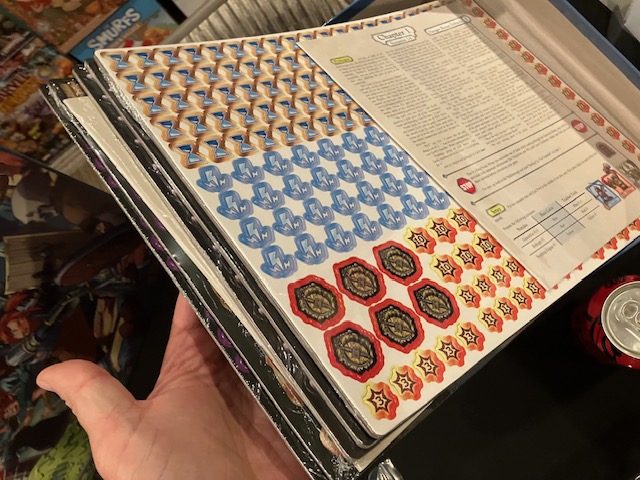
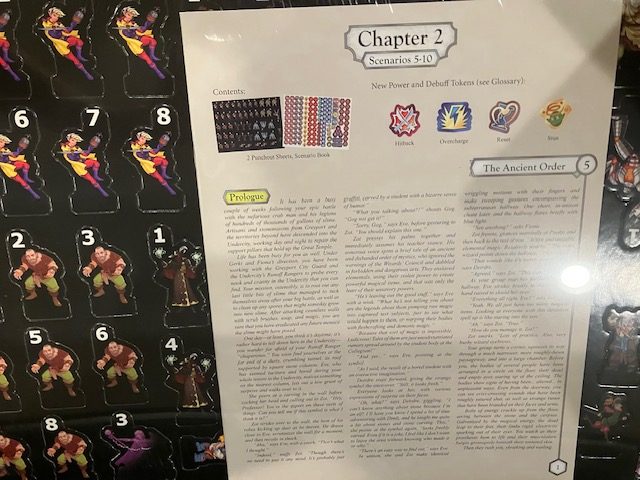
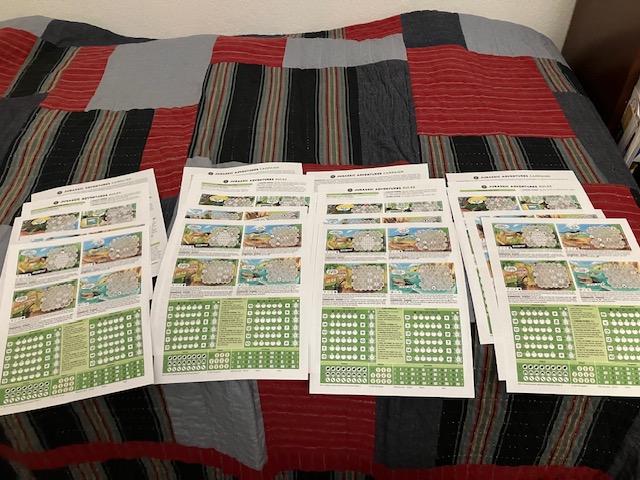
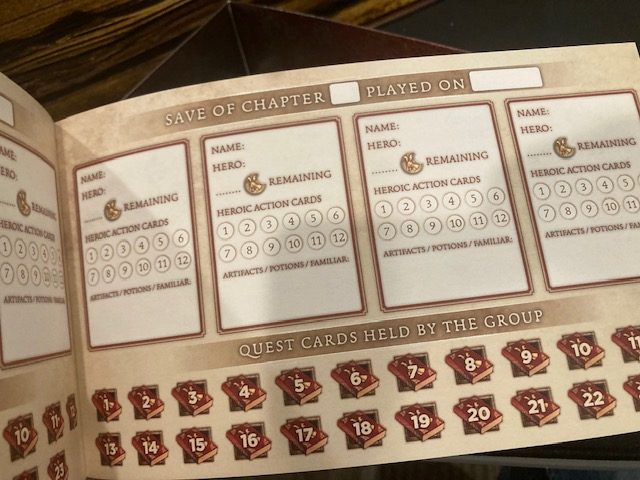
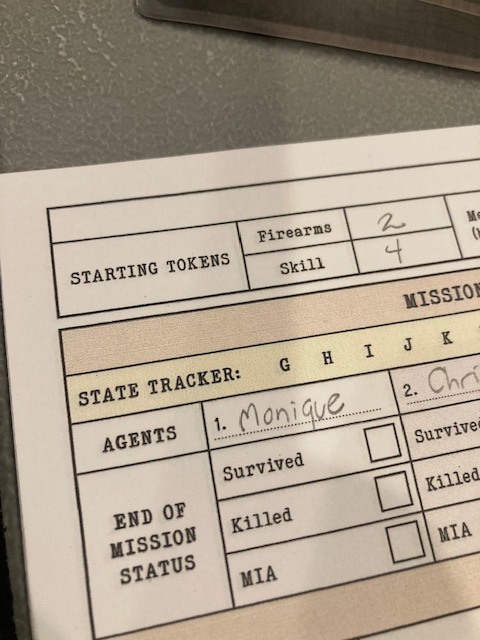
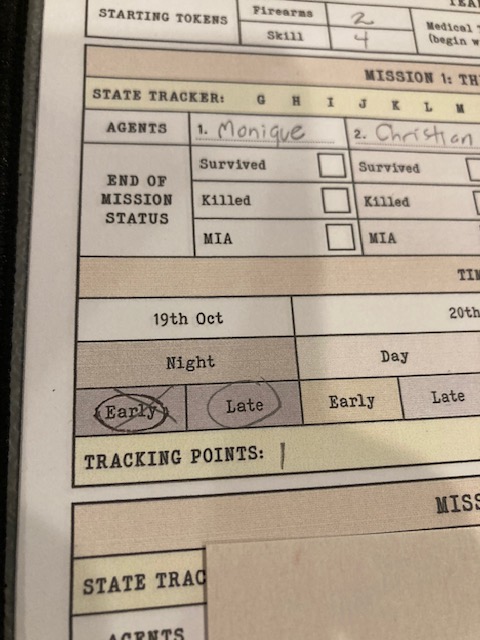
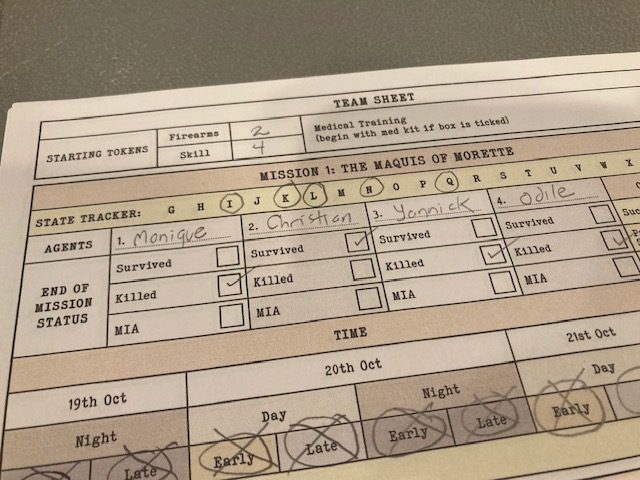
So, 2/3 of the game done in 3.5 hours. We saved the game to resolve it later. The good news is that there is a save system … it’s a pad of paper you write on … but we just took pictures (like the picture above).

Game 3 (3-Player Cooperative)

So, we resolved to finish the game. Due to some illness, we had to wait a few waits until we were all available, and even then, we were down to 3-Players instead!

Because the game balances by simply changing the number of action tokens, we were able to jump back into the game with 3-Players, even though the game started with 4 players! It’s also a good sign that everyone wanted to play again!

Here’s the thing; it took us 3.5 hours to play the final day of the game! Some of that was just setting back up (this is a big game after all, and resetting back to the saved state was a lot of work), but some of it was just all the maintenance that has to happen.

We finished and just barely won; I think we cheated on a few things accidentally, so maybe we should have lost. Either way, it was close.

What I Liked

Components: The game was quality and looked good.

Minis: The minis were cool and added a lot of flavor.

Save Game: There was a good system to save the game between sessions. And (even though we didn’t mention it) between campaigns!

What I Not Sure About

Style clash? I know The Last Spell is a video game, so embracing the 8-bit art makes some sense. But the disparity between using nice fluid minis for the monsters (and characters), but 8-bit graphics for everything else seemed to … clash? It made it a little harder to put them together and was a little jarring. Maybe it’s not a big deal …

Sectors: The game uses sectors for ranged attacks (usually not adjacencies or spaces away). The rules are very clear how the sectors work, and yet, they were very unintuitive! I think if you know the video game, then the sector ideas make more sense. In fact, I think a video game will enforce the sector boundaries easily! In the board game, we found the sector idea to be a little clumsy and unintuitive. .. but maybe if we had played The Last Spell the video game more, we would applaud the sector idea is just like the video game? I don’t know.

Combat: Combat is decided by dice, and there are a good number of mitigation mechanisms (things you buy, abilities, etc). But if you roll poorly, you can still get screwed pretty hard. Teresa especially had a bad third and was frustrated. Yet, the combat is simple to describe and simple to play. This simplicity makes it really easy to explain, quick to play, and simple to manage. So, it’s good on those axes, but yet you can really get screwed by bad rolls. So, I don’t know how I feel about this combat. I’ve played the game enough to see “ya, things seem to average out overall”, but when you are the recipient of the bad rolls, it’s very frustrating.

Things I Don’t Like

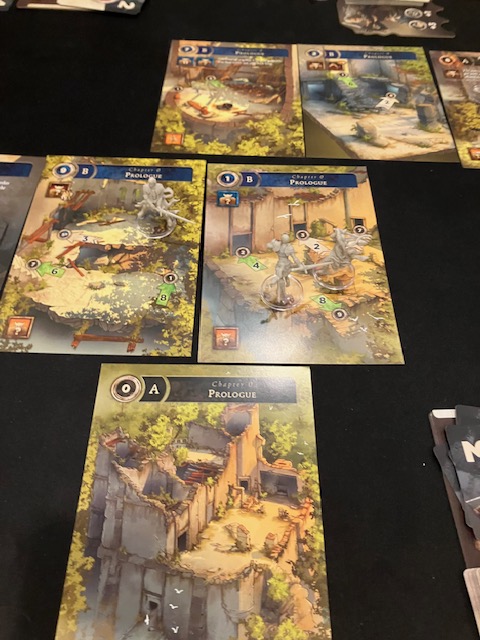
Minis and art: Because the game uses 8-bit art and the minis are smooth entities, we actually struggled to distinguish the enemies on the board (some of them really look a lot alike). And we struggled to correlate the minis with the monster stats. In fact, in my first game, I put one monster on each stat position so I could tell them apart! (See above) The minis needed a little more differentiation, even if it were something simple like a triangular base for some, square base for others, or something with color. It was frustrating enough to mention.

Maintenance: There is a lot of maintenance to keep this game going. As a solo gamer, it’s probably too much. As a cooperative game, the maintenance is tolerable but only of you friends help. Still, there’s a lot of work to keep the minis moving.

Length: The game just feels too long. I think this is because there are few too many rules? It needed just a smidge fewer rules; we paused too many times to lookup rules …

Index. The Index is NOT an index. If it had been a true index, it would have been significantly more useful.

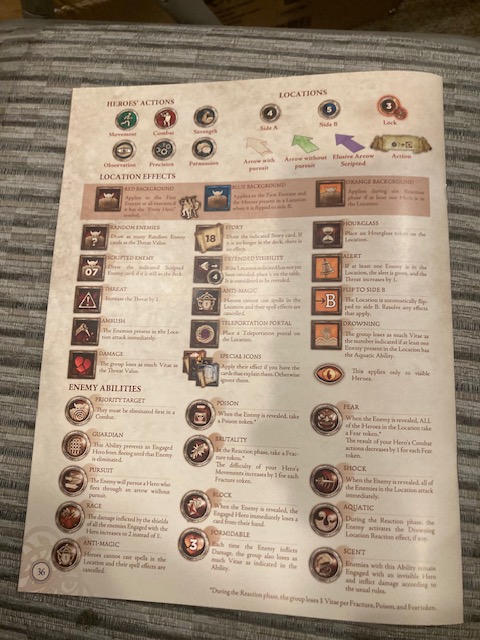
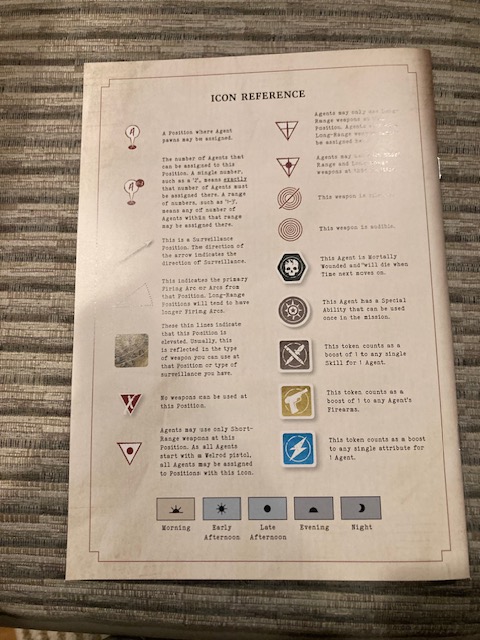
Icons: The Iconography is REALLY non-intuitive. We struggled with it and frequently had to look up the Icons (especially for ranged actions). It’s even more frustrating because the Icon are defined in exactly one place (the second rulebook). This really should have been on at least 1 more sheet that you could pass around.

Reactions

Sara liked this the best and would give it a 6.5 or 7/10. Teresa was right there with her.
Andrew and I were on the same page: about 5.5/10. Andrew would have called it a 6 earlier, but the Sector idea was so unintuitive, he felt that brought down the rating after the second session.

Conclusion

The Last Spell was divisive among the players in my group. We all liked the minis and the how well the game flowed once we got going, but it was still very long and had lots of maintenance in keeping the game going.

The clash of art styles between the minis and “the rest of the game” was actually a little jarring and some of the 8-bit art (mostly the buildings) was hard to distinguish. We all think the game would have been better if had been consistent between the art styles; the clash actually took us out the game a little. (This might be just because we had the minis Kickstarter version; the base game uses standees)

Interestingly, I liked another tower-defense game called Firesiege better than this (see review here from a few weeks ago), but my friend Sara liked The Last Spell better. I liked how quickly Firesiege played, but Sara seemed to like how The Last Spell played better. That’s two very different opinions!

As a solo game, the maintenance is probably too much for most people; between set-up, play, and tear-down, the solo player has way too much work to do to keep the game going. I’d probably give a 5/10 for solo. I’m not sure I’d play it again.

The Last Spell is better as a cooperative game, as the maintenance gets shared among all players. We even saw that the balancing mechanisms seem to work well at 2, 3, and 4 players! You can even switch the number of players between days! The reactions were mixed, from about 5.5 to 7/10. I think people who know The Last Spell the video game might like this a little more and give it another point.

Hopefully this review helps you decide if this is right for you. I suggest you play it and try it for yourself; there is a single day intro mode you can play to see how it works.

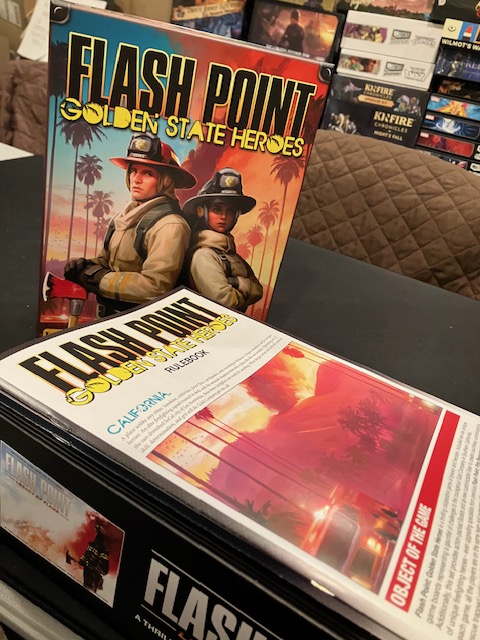
Flash Point: Golden State Heroes. A Solo and Cooperative Review After Full Playthrough

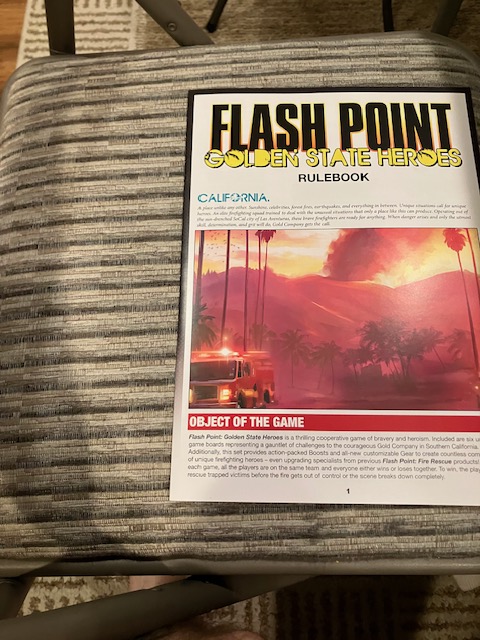
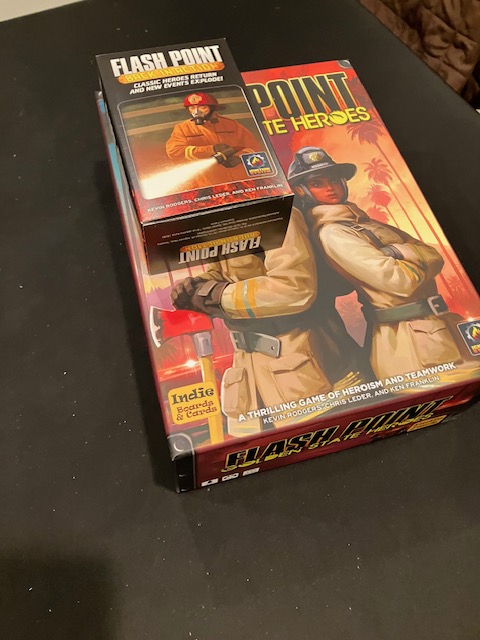
Flash Point: Golden State Heroes is a cooperative game about being firefighters rescuing people from a fire! It’s the third or fourth (or even fifth?) version of the Flash Point series of games. This particular one was on Kickstarter back in June 2025, promising delivery in January 2026. It arrived at my house in April 2026, so it’s about 4 months late (which isn’t bad in Kickstarter land).

Let’s take a look!

Unboxing and Gameplay

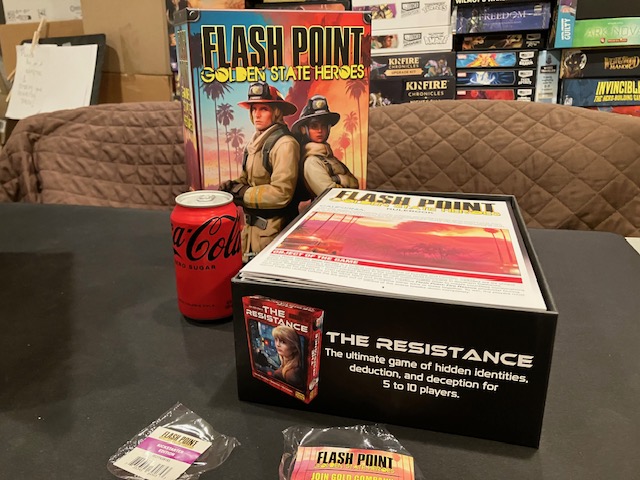
This is a pretty thick oversized box!  See the Coke Can above for scale

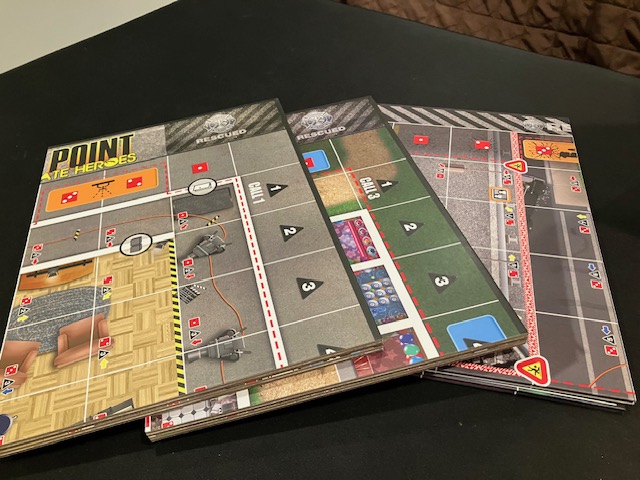
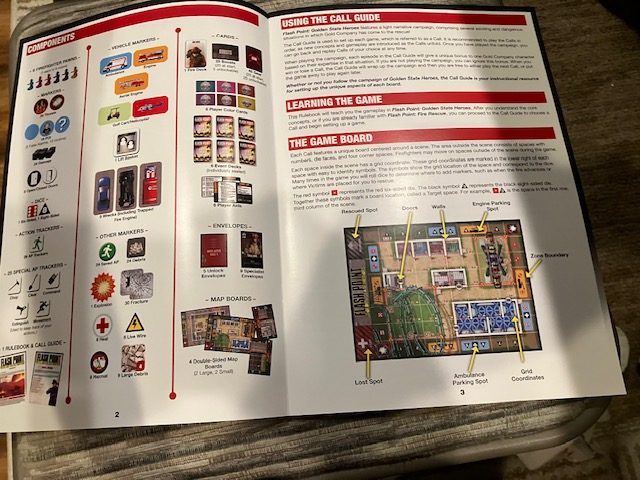
The reason it’s so thick is because there are 4 double-sided boards!  (2 of them go together to make a third board, so there are really only 6 different “boards”).

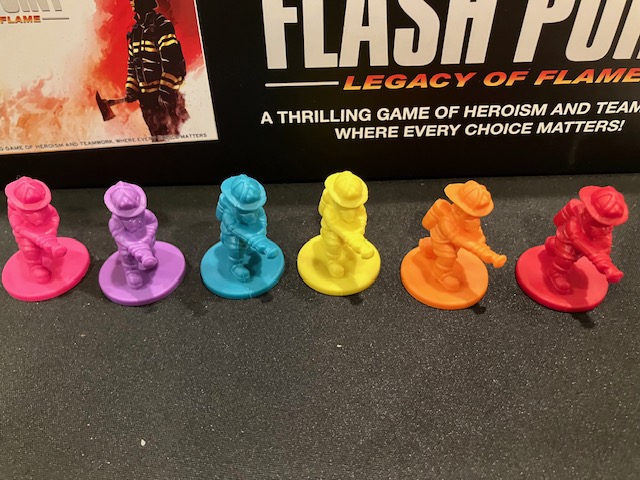
Each player assumes the role of a firefighter, each with different abilities!  The firefighter markers are above …

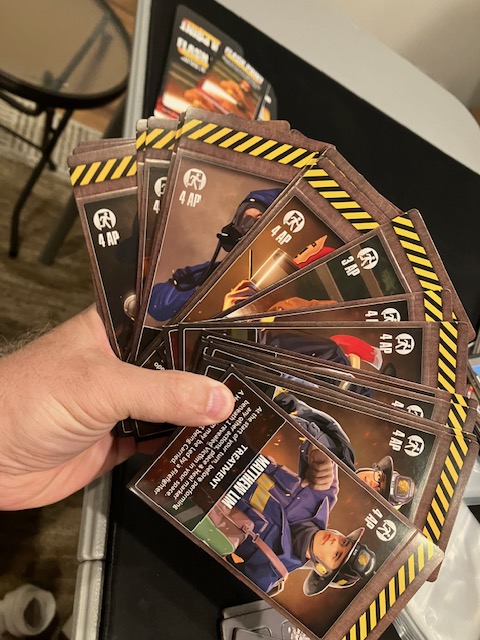
But you want to pick one of the characters.  The base game comes with 9 different characters (and if you got the Back In Action expansion, a bunch more!)   Each character has a special power that really changes how they interact with the game!

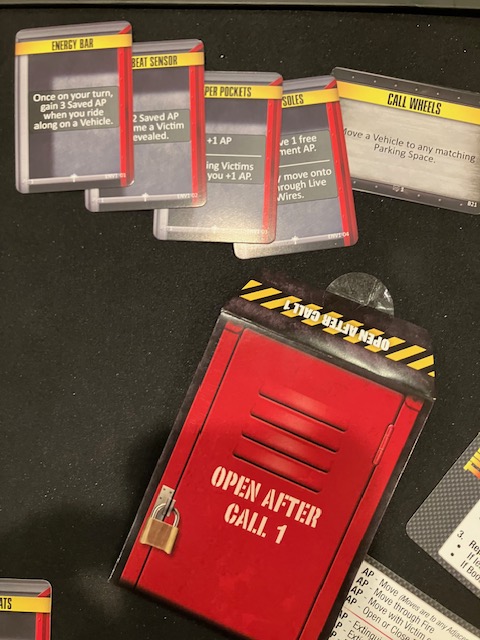
You might notice “Hey! Those are envelopes! Rich, why are they envelopes? That’s weird!!” Yup, this is a campaign game, and you will get to keep your gear in those envelopes between games.

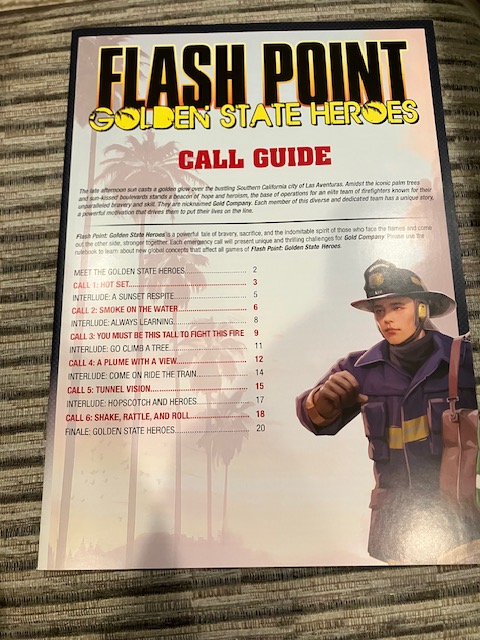
So, this is a campaign game, with a 6 episode arc!  Don’t get TOO excited, because there’s not really that much stuff that follows you between games.  Really, the only thing that follows you is your gear.  Now, each GAME is actually quite different, as described by the Call Guide book above. 

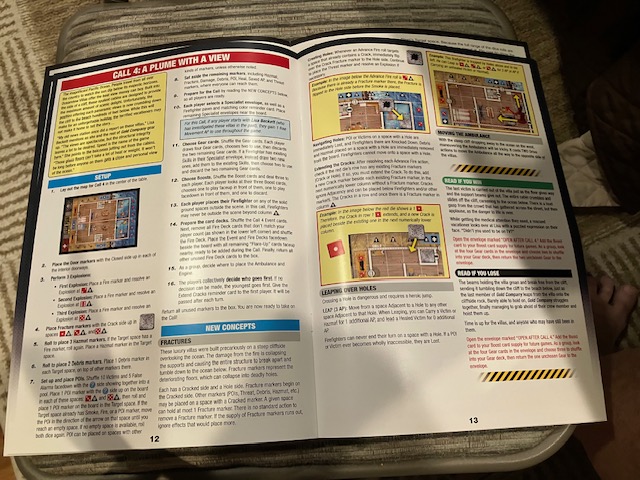
Each episode of the Campaign has some new rules/new concepts for just that game: see above for the rules for episode 4.  It’s not really much of a spoiler; there’s no real story unfolding between games that will be revealed.

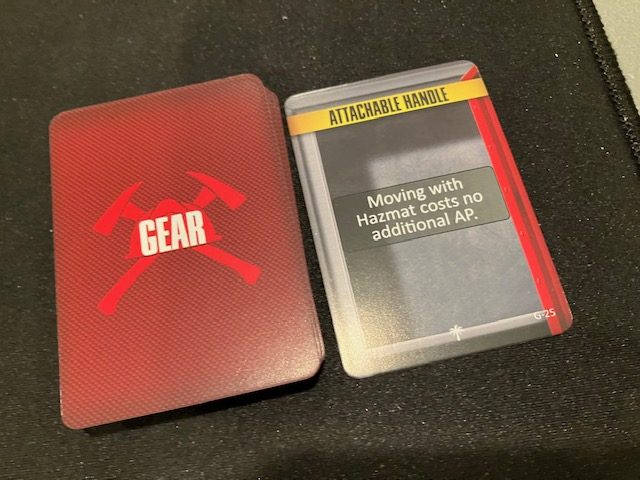
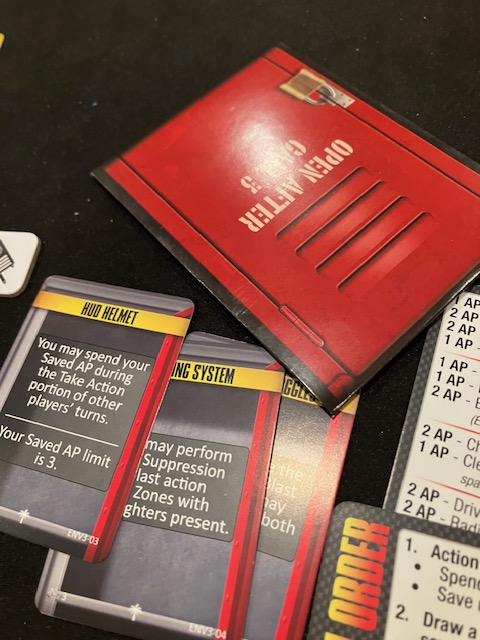
The gear is pretty cool; you usually get 4 and choose 2 at the start of the game (in later games, you draw 2 and use the previous gear).  But you get to CHOOSE extra powers to augment your built-in power!  

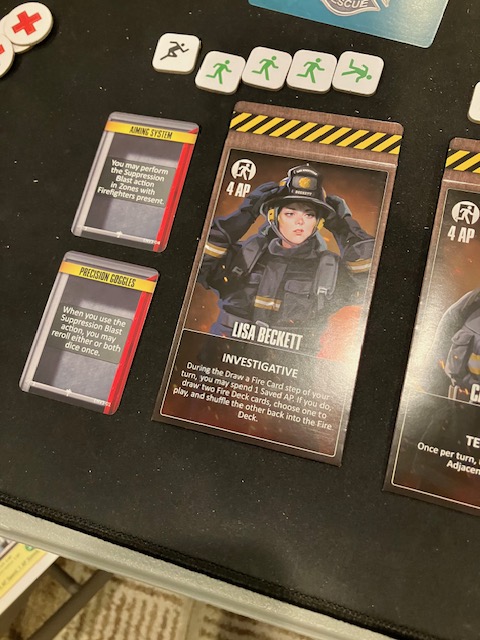
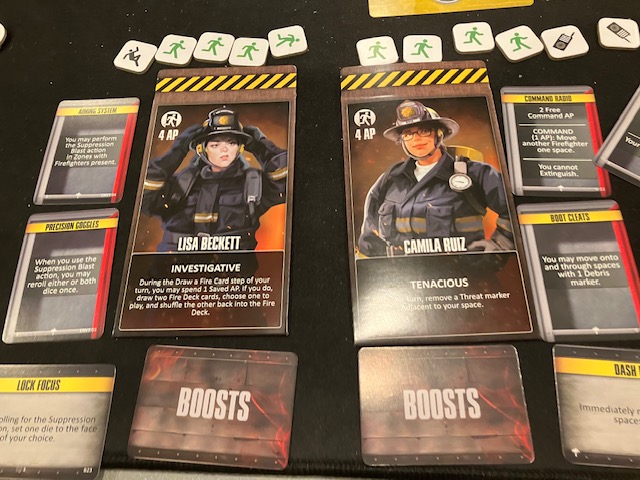
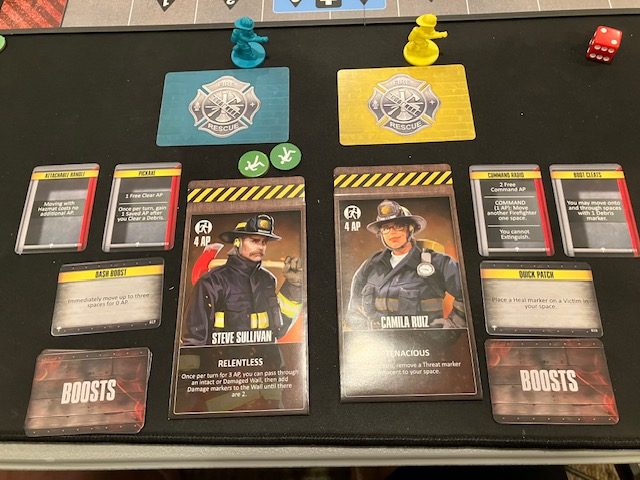
See as Lisa Beckett (whose base power is to mitigate Fire cards) chose stuff related the Supression Blast actions, so they can augment each other!  That’s some of the fun of this game, is that you get to CHOOSE some of your gear to go along with your innate power!

To win, you have to save 7 people (dogs and cats are people too) before the building collapses, or before 4 people get burned up!  That’s right, if you fail to save someone (because the fire engulfs them), people (dogs and cats are people too) will die!  So, this is a race to save 7 people!

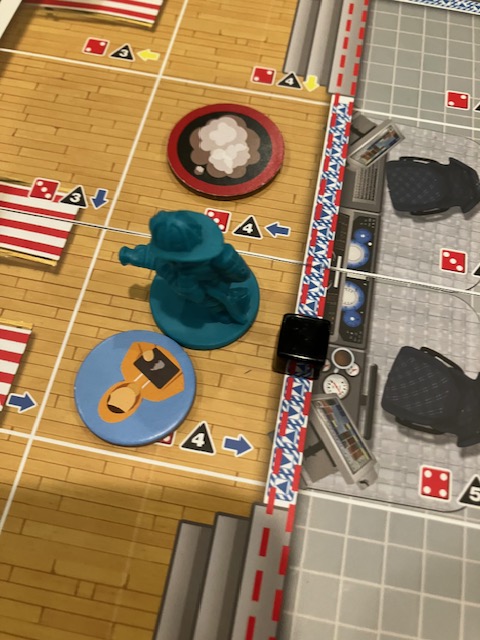
Players traverse a map, looking for POIs: “Points of Interest” (the blue ? markers above).  Usually, the POIs are people (remember, dogs and cats are people too), but sometimes the POI is empty! NO!  

To save a POI (after you flip to a people side), you have to carry them out.  Sometimes, they are healthy enough to walk out on their own, but you need to get them to a “safe place” (usually the ambulance) to count as a “saved person”!

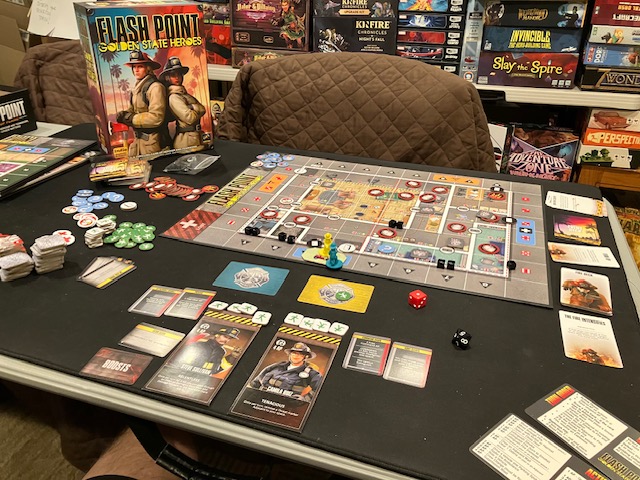
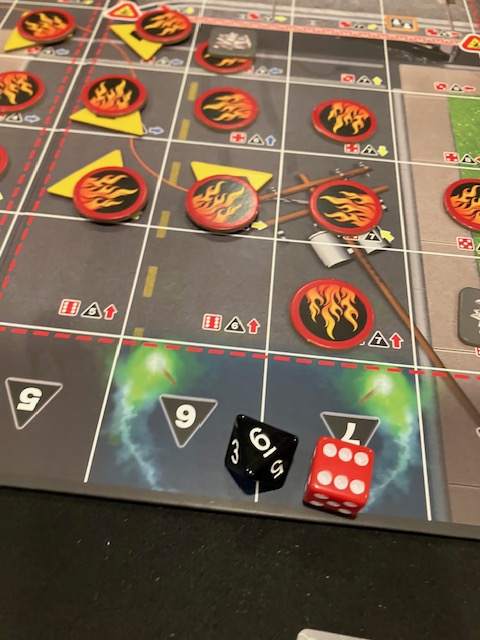
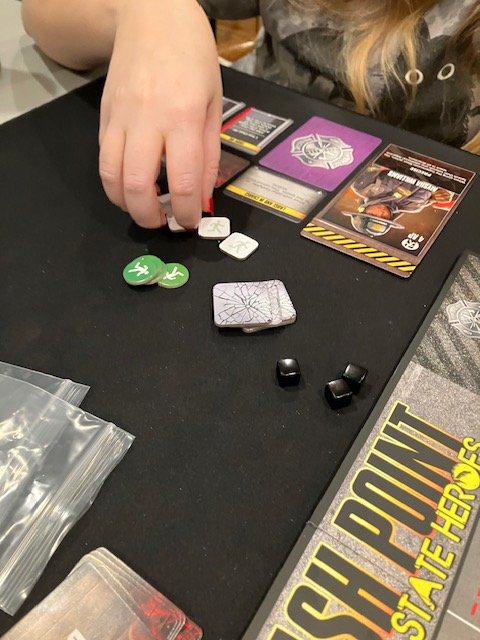
Along the way, smoke and fires comes out!  Every turn, you will roll dice and place a smoke on the cross: see as we place a Threat on 6-8!  Now, normally that would be a smoke (which isn’t QUITE fire), but since it’s adjacent to fire already there … that smoke immediately becomes fire!

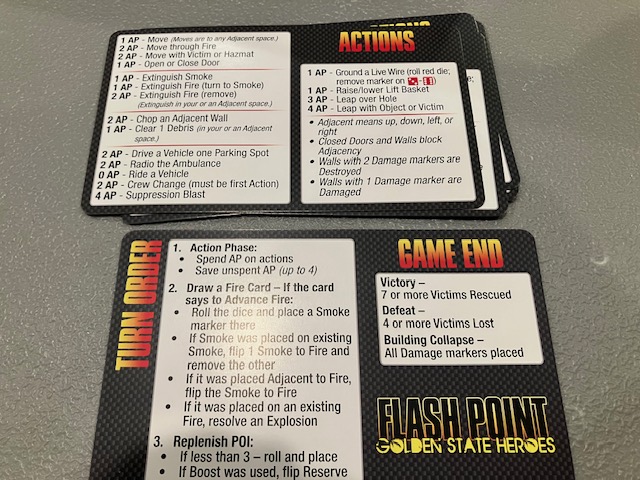
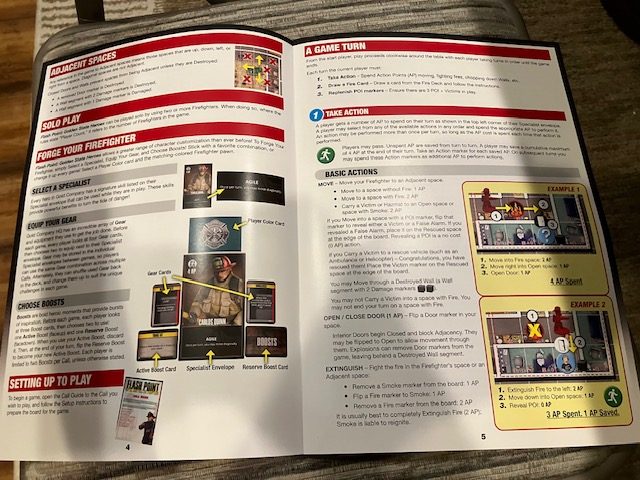
This is an action point game: each player has a certain number of action points to spend per turn: see chart above.  (These are nice player summary cards).   It’s only one action to extinguish smoke, but two actions to extinguish fire!  Usually, it’s just one action point to move, but saving people around is pretty intensive, it’s 2 AP to move a victim with you…. 

To be clear, this is NOT a real-time firefighter game!  Players decide how to spend their actions WITHOUT a timer.  If you wanted a more frantic real-time Firefighter game, check out Firefighters on Duty!  See our review of that here

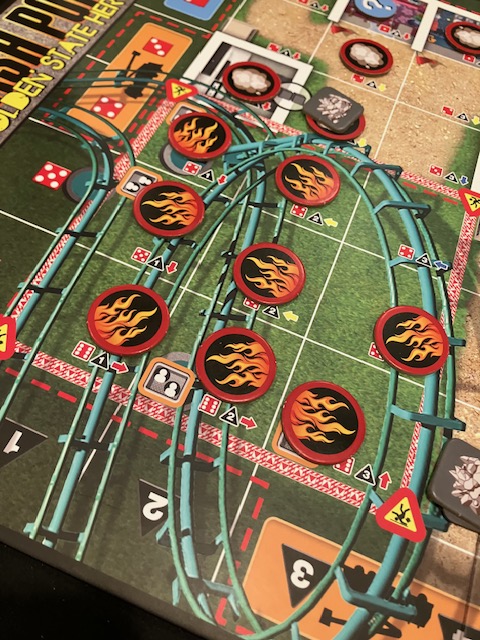
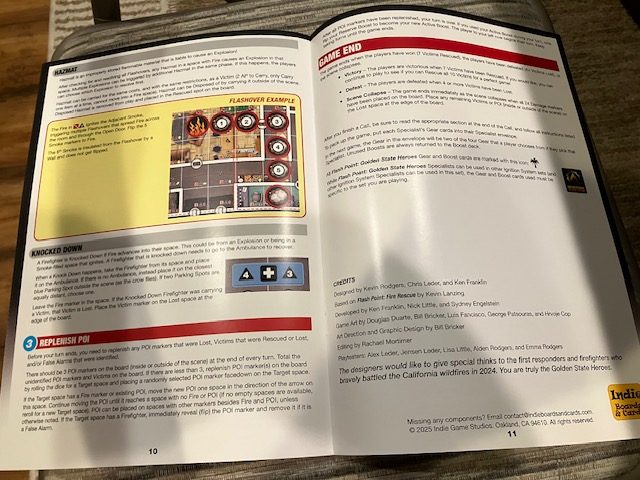
There are lots of other little rules, but the most important is that if you have to place a threat on a place with fire, it explodes!  This might a little like  Pandemic, but instead of disease cubes exploding, fire explodes out in all 4 directions!  It’s so much harder to fight fires after the fire explodes and spreads!! Even worse … those fires it may weaken the structure of the building and it may collapse!  Fires are bad, mkay?

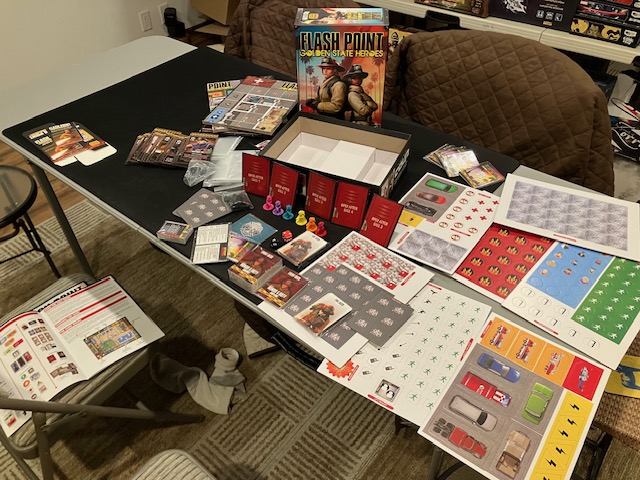
This game has a LOT of nice components.  Nothing is super awesome, but all the components are good quality and easy to read.   And there are QUITE a few components in here (see above), which is why you need the extra tall box for this!

Rulebook

The rulebook is pretty good; I have a few issues with it.  

The rulebook gets an A- on The Chair Test!  It fits perfectly on the chair next to me, it has plenty of pictures that are easy to see, and a font that’s easy to read!  It doesn’t waste too much space.  I think the only reason it isn’t an A is that I wish the font were just a little bit bigger.  But Solid A- on the Chair Test!  This rulebook is the perfect size and doesn’t droop AT ALL on the chair next to me!

The Components and intro are good enough, if a little cramped.  

The rules are generally well-spelled out, but as you get into the game, there are a lot of new rules that come out and some of these interactions are not well-specified. There’s going to cracks, helicopters, lift-basket, new gear, new spaces, new vehicles, new rubble, … all sorts of new stuff!  You’ll have questions about how things interact.  Sometimes it will be there, sometimes it won’t.  The nice thing is that this is a VERY thematic game, so can kinda make a call based on theme.

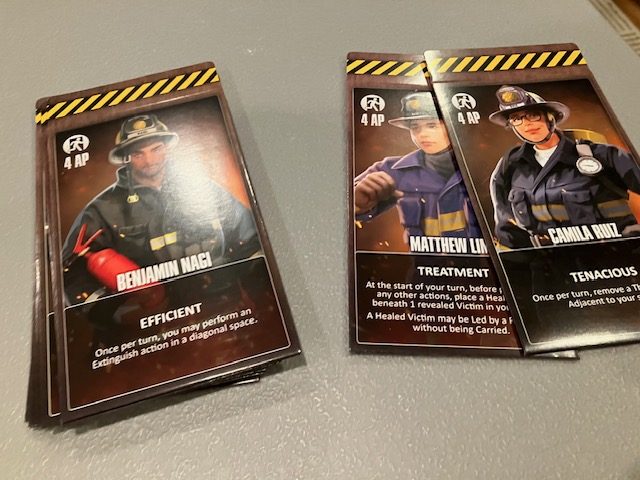
A simple example is my rock, Camila Ruiz (Camila followed me throughout all my 6 games of the campaign).  She can remove a threat marker for free.   I assumed that a threat marker was anything that was a threat!  Fire, smoke, hazmat, livewires … right?  Those are all threats?  I was beginning to think that was overpowered so I went searching.  I downloaded the PDF rulebook and searched for the word threat.  There were ONLY two places; one was a mention (without a definition) and the other was a picture of THREAT next to fire and smoke at the very front!!  So, yes, a “threat” token is sparsely defined to be ONLY a smoke or fire token.  Seriously, we could have used a sentence anywhere in the rulebook, even on Camila’s card (“A threat is a smoke or fire token”).  There’s not even an excuse for not enough space:  see how little writing is on Camila’s card and how much is on Lisa Beckett’s??? See above.

This was just an example of things could have been a little clearer.  It’s not a bad rulebook, and there was a lot of good stuff.

You know, this might be a textbook defintion of why we need an Index or Glossary:  If you had to put together an Index or Glossary, they would have realized “Oh! We don’t have a real good definition of Threat to refer to!”  There are SO MANY new rules that come out as you play, that an Index or Glossary with all the rules might have been helpful?

Anyway, I learned the game from the rulebook, but I made some mistakes.  You might too. 


The Campaign

As a campaign, this is probably the least campaigny campaign I have ever played.  Basically, every game was completely independent from the previous games (the final game just uses rules from previous games).

It’s cool that at the end of each game, you get more stuff; Gear and Boost usually.  See above after the end of call 1 (game 1).  I don’t feel any guilt about spoilers because it’s just a few things!

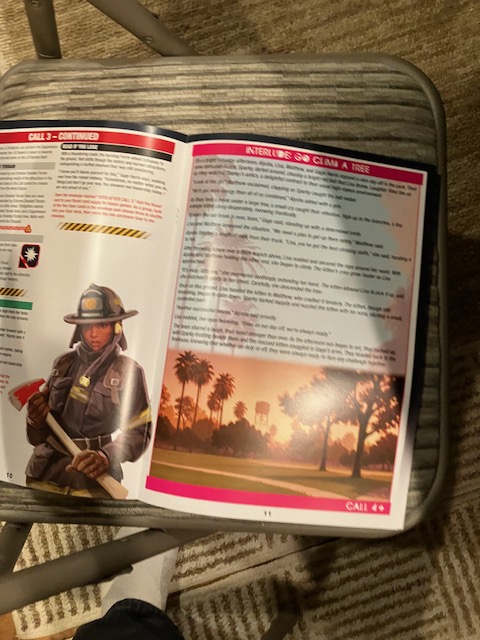
The campaign tries real hard to have an ongoing story: see above for some flavor text after game 3.  I gotta be honest, I never read the flavor text.  It really didn’t add much to the game for me.  My friends enjoy the flavor text a little more than me, so we read some of it in the cooperative game, but … it didn’t really add a lot.

What the campaign is, more than anything, is an excuse to play through 6 different games that come in the box.  There’s really just 6 different games with a little more gear and boosts available.  The grand finale (the 6th and final game) does a little bit more by bringing in rules from previous games, but even then there’s no “state” between games.

Don’t get me wrong, I liked the campaign.  It was a fun excuse to play all 6 boards in the box!  But there’s realllllly not a story or any state that moves from game to game (you can save gear, but that’s about it).   The flavor text that’s there is there if you want it.  I didn’t really read it.  Shrug?  Maybe you and your group will really like it?  It’s there?

Solo Game

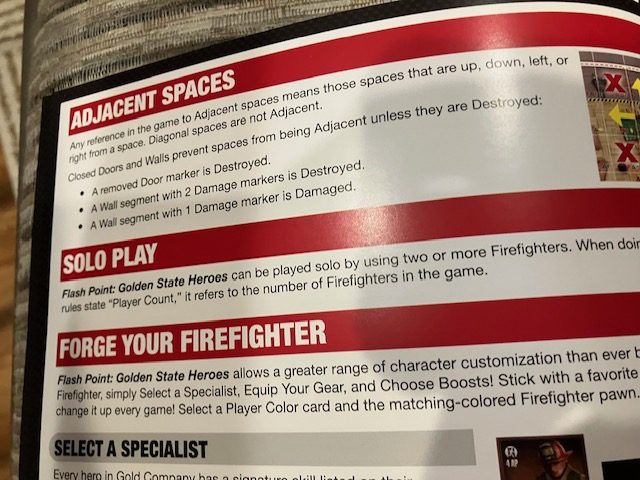
So, Flash Point: Golden State Heroes is very clear on how to play solo!  (Thank you for following Saunders’ Law!) .  On page 4, the rulebook very clearly states you simply play with 2 (or more) and the solo player operates them! See above!

So, this is not true solo play, but neither do we have to worry about any wonky new rules to adjust solo play!  Just play the game as it was meant to be played!  Like I said, Camila Ruiz was my rock as a I played; she was in every game of the campaign. 

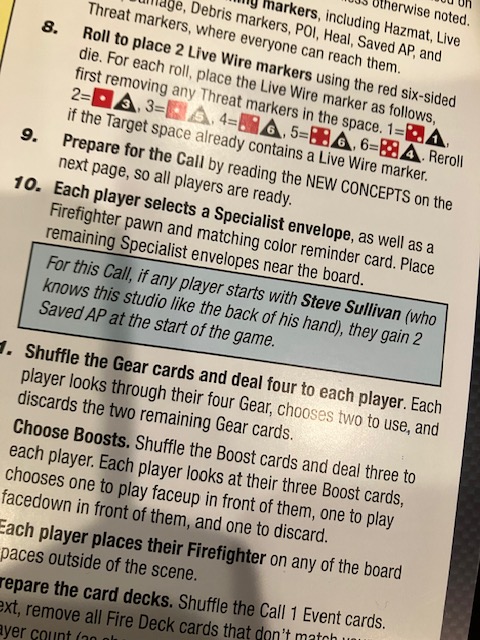
Interestingly, during set-up (each call has its own set-up in the call book) encourages you to use one of the characters explicitly! Call 1 (game 1) encourages using Steve Sullivan by giving him a little bonus at the start of the game! (See the text above in blue).    This was a nice way to make players cycle through all the the different characters in the game to really get a sense of everything in the board.  I applaud this; it gave you a “reason” to cycle through different characters!

I played the entire campaign with Camila as one of two characters.  Each game adds some very different rules (firefighting on a boat, in an amusement park, on the edge of a cliff!), so it was nice to know one of the characters really well so I could concentrate on the new rules being added every game.  Don’t get me wrong, the base game doesn’t change THAT much, but there was some very different and interesting firefights.

I played through the entire campaign solo.  Each game was its own thing; remember there’s not “really” any holdover state from the previous games, but each board was VERY different!

I liked playing through this solo, modulo one or two issues (see below for discussion).  I would play it again.  Playing two characters worked great!


Cooperative Game

I wanted to see where this would land with the cooperative game.   I was hoping I could convince my friends to play through the campaign with me, or at least a few games!

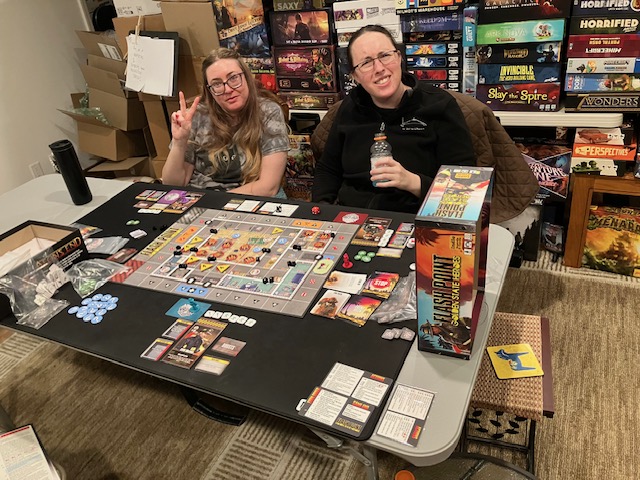
What happened: we didn’t do great in the first game.   Or rather, the dice didn’t go our way.  We cleaned out the board quickly when we started, but we got some explosions and empty POIS at the WRONG times.  We played for about two hours and lost.  We lost two ways, out of building cubes and 4 people died!  We weren’t sure what we would have done differently, and I think that really depressed my friends.  

Sara made the comment: “Ya, this is how the game went last time we played”.   We have played previous versions of Flash Point (Legacy of Flame), and had a similar result.

Last week, when we lost our first game of  Firesiege, my friends wanted to play again to redeem themselves! (See review here!)  This week, they were just done and didn’t want to play again.  The game wasn’t broken or anything, but it just felt like it might have been a little too random.  Losing the dog in the fire was the last straw.

Randomness

This is the hardest part of the game to come to terms with; there’s a lot of randomness.  EVERY turn, you roll two dice and place a smoke/fire (see above) … and sometimes you place more!  If you roll poorly, you can cause explosions all over the place!  The more explosions there are, the more fire there is, which makes it easier to have more explosions and fire!   A few bad rolls can really wreck your game.

I got lucky when I played the solo game, but maybe this game is a little easier with two firefighters. 

Flash Point is very similar to another cooperative game called Pandemic in many ways: players travel around a map trying to keep something under control (diseases or fire), players have action points, players have special powers, players need to keep things under control or they will explode (diseases or fire)!  For a while, when I was trying to introduce new people to cooperative games, I pointed to Flash Point!  Who doesn’t love working together as fire fighters to stop a fire?  Over time, I have deferred more to Pandemic as the better game and less random (as there’s fewer axes of randomness), so I would recommend Pandemic first … it’s just the theme of Pandemic is harder to get over sometimes.  We all lived it at some point.

Which Flash Point?

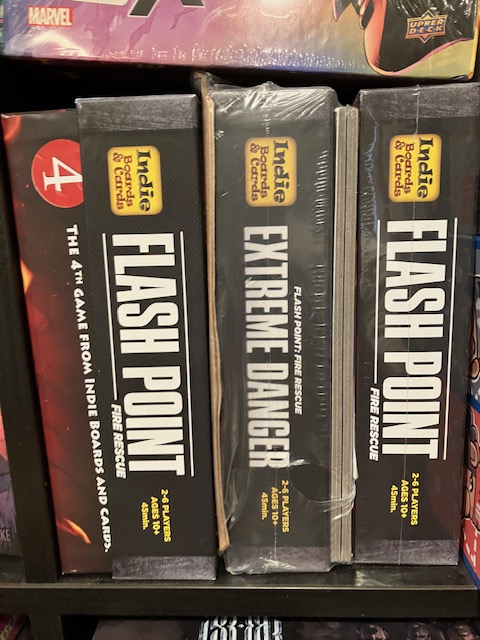
Flash Point has actually been around for some time!  I Kickstarted the original Flash Point back in July 2011!  And then the Extreme Danger Kickstarter too! See picture above!  But, as you can also see … I never got my Extreme Danger out of shrink wrap!  

Then I was SO EXCITED when Flash Point: Legacy of Flame went on Kickstarter in March 2024!  See above!  The game arrived in 2025, and I fully expected this to be as great as Pandemic Legacy!  But after two games of Legacy of Flame, it just fizzled out.  No one wanted to play again. And it all boils down (no pun intended) to the randomness of the game.  No one wanted to play a Legacy game where there was SOOO MUCH Randomness in the dice rolls!  If you start off with a few bad games, you’ll completely screw yourself!  My friends, I think saw this and didn’t want to pursue Legacy of Flame.

The nice thing about Flash Point: Golden State Heroes is that each game IS so independent, you don’t have to worry about being screwed by your previous game!  I think that of ALL of the Flash Points I have played, Flash Point Golden State Heroes is my favorite version.  Why? Because you get 6 VERY different firefighting scenarios that you can play at any time!  You don’t HAVE to play the campaign: you can just jump into any game you want!   The legacy issues of Legacy of Flame don’t become an issue.

House Rule

There’s one House Rule that I don’t think the game can live without.  Sure, the game can be random on dice rolls when the smoke/fire comes out, but the fire dice rolls “generally” distributes the fire pretty evenly over the board.  The game is random at you; that’s what games do.

The problem is the Fire Suppression action.  You spend your entire turn (4 actions) to roll dice and you MIGHT hit some fire.    Are you an incompetent fire fighter?  Can you not see where the fire is?  This is so ridiculous that you roll dice and pretty much have no control over this!

You might remember Lisa Beckett (see above) we mentioned earlier: I went ALL OUT trying to make her the Fire Suppressions expert!  I gave her two Gear related to that!  See above!  And she still sucked!  Because I rolled bad!  Now she’s not just rolling poorly, but she is actively contributing to losing because she has 4 actions THAT DO NOTHING!

The Fire Suppression, I think, is broken.  In fact, I remember playing the original Flash Point, and I tended to eschew the action!  “Oh, you have to roll to see if it’s successful?  And it takes all 4 actions?  And it may not do anything?  No thanks, I’d rather just do something that I know will make some progress”.

We added a house rule: you have more control.  The players, as a group, get 4 tokens. THAT YOU CAN ONLY SPEND ONCE!!  For a  Fire Suppression action,  roll the dice normally (with flips), then you can spend a token to up/down any/either dice any number of times (up to 4).  This makes it so you can maybe can’t cheat and just Fire Suppression the rest of the game, but the few times you do need it, you have SOME control, and not just random crap! This kind of limits the Fire Suppression to 1 or 2 shots … but that’s kinda what you want?

I won’t play without this House Rule.  If I do, I simply won’t do any Fire Suppression.  It is SO AGGRAVATING to spend 4 actions and do nothing.

Conclusion

We’ve sorta been all over the place in this review, and it may sounds we don’t like Flash Point.  We do like it!  It just … it can be frustrating.   As a solo gamer, I really enjoyed playing through all the campaign (even though it’s not REALLY a campaign, just 6 different boards).  I pretty much had to add the house rule about cleaning up the Fire Suppression action, or I might have hated it too.

The cooperative game didn’t go as well unfortunately.  I think my friends would play the game again but the randomness that can happen will prevent them from ever playing any campaign.  

I personally think Flash Point: Golden State Heroes IS the best of the Flash Point games.  If you like the idea of a cooperative fire-fighting game that has a Pandemic feel, I think this is the one to get.  It has so much variety (the 6 boards are all so very different) and you can play any game you want!  It’s not REALLY a campaign; it’s just an excuse to play all the boards!

I think Flash Point: Golden State Heroes has to get a ranged rating from [6-8] out of 10.  Whenever I give a ranged rating, it means the randomness can overwhelm the game and make it not fun, but when the game “behaves”, it can be fun!  The lower end of 6 is when the dice don’t behave; the game still works but it’s much less fun.  When the game is challenging but not too random, it’s fun and can be an 8!  

If you take away my house rule for Fire Suppression, this rating falls an entire point and would be [5-7]. 


A Review of Unmatched Adventures: Teenage Mutant Ninja Turtles.

Welcome to 2026! Some of the games that came out in December 2025 feel like they are on the cusp of 2026! Do we count them as 2025 or 2026? We’ll start this month with a game we received in early December … it was early enough that we got in enough plays in to count it as a 2025 release!

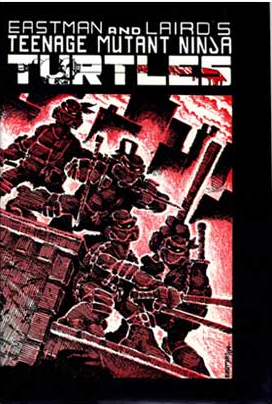
So, I never got into the Teenage Mutant Ninja Turtles. When I was in college, my friend CC was really into the black-and-white Eastman/Laird turtles, but they all had the same color headband … because they were in black-and-white. See below.

The reason I picked up this set because I really like what the original Unmatched Adventures did for the Unmatched universe:  It makes the game cooperative!  See original review here!  So, is it worth picking up the TMNT set even if you don’t like the turtles?  

Let’s take a look!

Unboxing

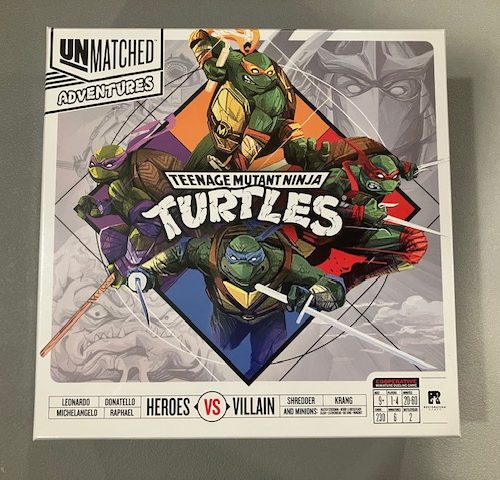
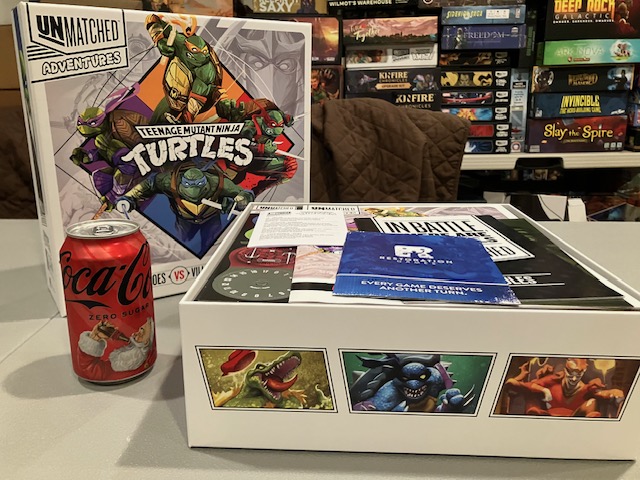
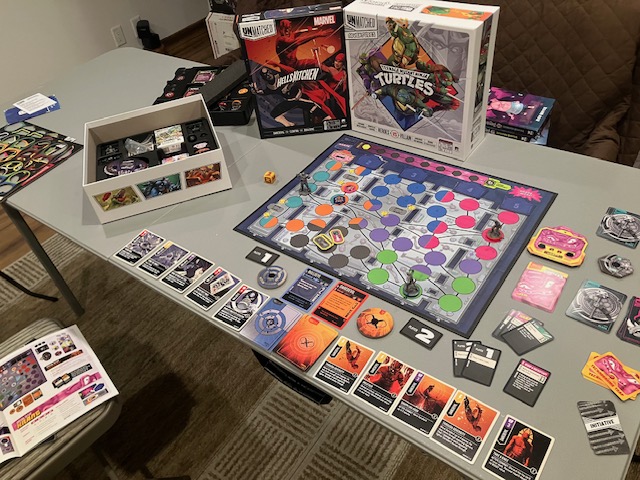
See TNMT box above with Can of Coke for perspective.  This is a pretty normal sized box, but it is taller.

It’s taller because it breaks into two sections.  The top section holds the four turtles: their minis, their cards, their sidekicks, and their initiative cards.   The top of the box is JUST the plain Unmatched turtles.  If you wanted to play turtle vs turtle in a standard Unmatched head-to-head game, you’d only need the top.  To be clear: you can use any of these turtles in the standard Unmatched game with any other set (Rafael vs Bullseye?  Donatello vs. Sherlock Holmes? Michelangelo vs. Bruce Lee? Leonardo vs. Tyrannosaurus Rex?) to play out any head-to-head fight you want.

If, however, you want to play the cooperative Unmatched Adventures part of this box, everything you need (except the initiative cards) is in the bottom part.

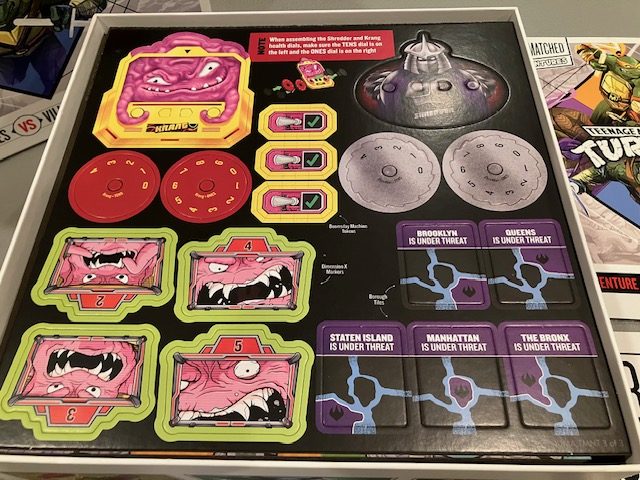
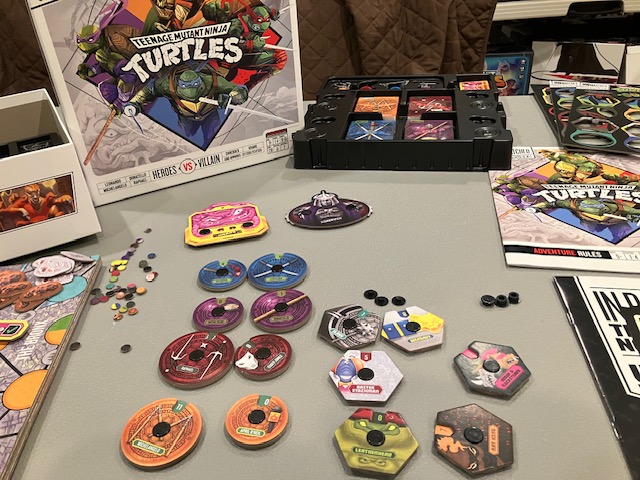
There’s minis for Shredder and Krang (the two big bad bosses you fight in the two scenarios), and a bunch of tokens for the minions, the cards and some dice!

There is a LOT of cardboard to punch out. See above. 

Most of the cardboard is for the spinners: these are hit point markers for the turtles (4), the minions (6), and the sidekicks (4).  I think I spent more than an hour punching out the spinners and putting them together; this might have the worst part of the game (although I have friends who love to punch stuff out for fun).

These inserts are exceptional, as everything fit back into the insert very well.  Everything in its place—see above as the spinners fit in really well into the grooves.

The pieces are all nice (and I only got the standard retail version: there’s a version/auxilary with a lot more minis).

The two-sided board is easy to read/see.  Each big bad boss has his own side of the board: Shredder or Krang. See above for Krang’s side.

The production on this game is fantastic: see above.

Rulebook

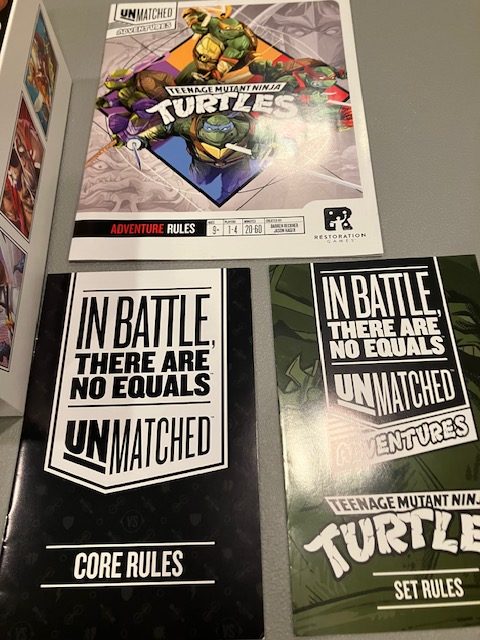
There are three rulebooks that come with this: core rules, set rules, and adventure rules.

The core rules are the basic head-to-head Unmatched rules which describe how to play head-to-head: the way Unmatched was originally meant to play.  This ruleset has evolved over many sets, so it’s great and describes the game well.   The Unmatched Adventures requires players to know the basics of the core game: the three things you can do (scheme, attack, or maneuver), the combat rules, set-up, and such.  This is a good rulebook that has evolved very well over time.

The set rules (above) simply describe and give more detail on the specifics of the turtles and their special powers. See above.

The Unmatched Adventures rulebook describes how to play cooperatively against one of two game-run big bad bosses: Shredder or Krang!

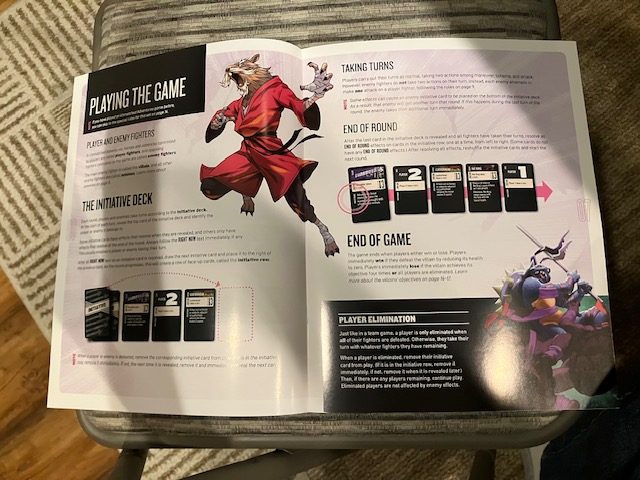
The Adventures rulebook does pretty well on the Chair Test: it droops ever so slightly over the edges, but the font is readable, the pictures and useful, it stays flat on the chair next to me, and it’s easy to read. B+/A-.  See above.

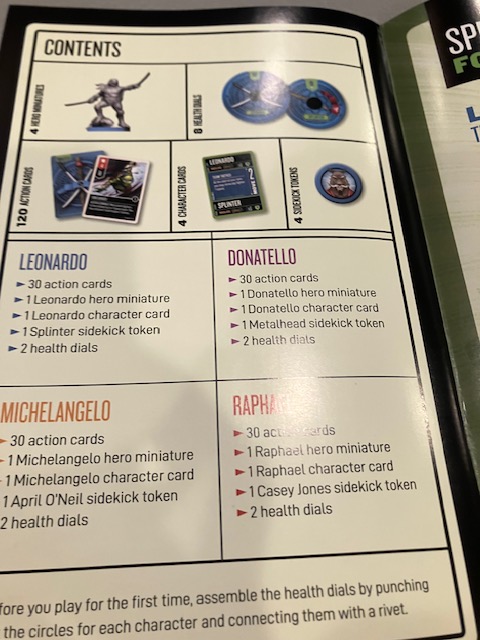
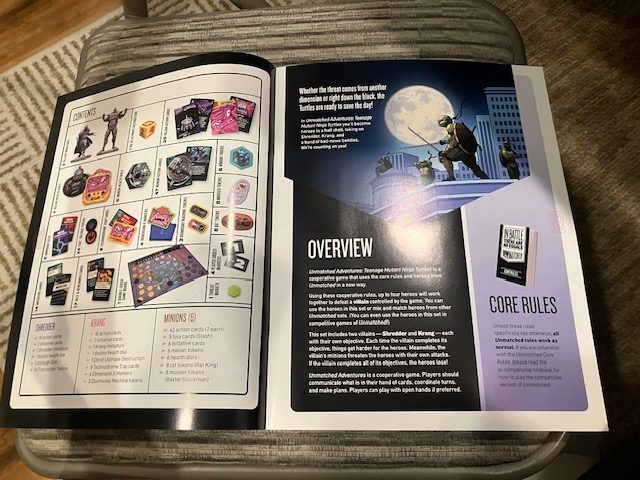
The Contents page is great: annotated pictures of everything.

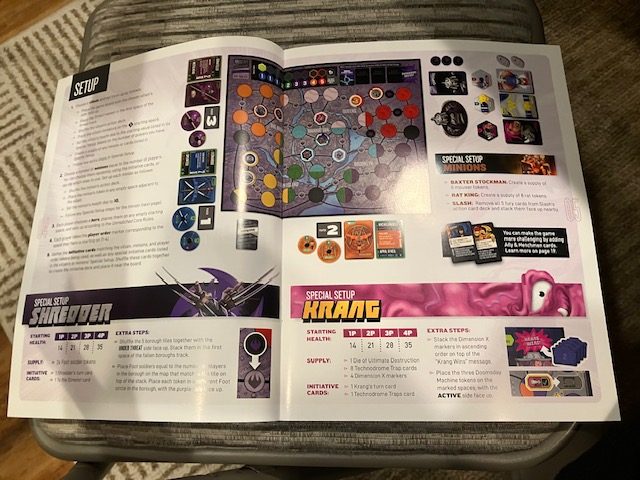
The set-up is perfect: it spans two pages (without crossing a page-turn boundary), and it is well notated.  See above.

In general, this is a good rulebook.

We wish there had been just a little more description in a few places:  for the Minions (For example: can we ever get rid of the Mousers?  The lack of text implies not, but I wish they would have stated it explicitly), and I just wanted a little bit more.  There was also some discrepancy between turns and rounds (especially on Raphael) that tripped us up, and some of the text of Krang was unclear of the relationship between the machines and the zones. 

Generally, good rulebook though.

Gameplay

This is a variable turn order game, with the initiative deck dictating when the good guys (the players) go and when the bad guys (the big boss and his minions) go.  The gameplay is very similar to what we saw in Unmatched Adventures: see that review here.  

I still have some problems in general with variable turn order games: see a very full discussion here: A Discussion of Variable Turn Order and How To Mitigate Its Randomness.  

Some of my favorite games have variable turn order, but that still doesn’t mean I love the mechanism; it seems to be a necessary evil for some games.  As we dive into different player counts, we’ll see how this affects the game.

Solo Play

To be clear, Unmatched Adventures supports solo play! (Thanks for following Saunders’ Law).  See 1-4 Players on box!

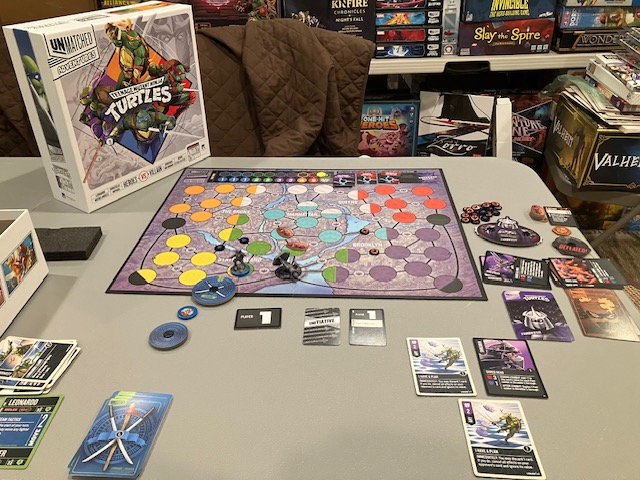
In fact, Unmatched Adventures support pure solo, as one player controls one character! See above as Leonardo takes on Shredder all by himself!

There are two main mechanisms for game balance at different player counts:
1. The big bad boss Hit Points (Shredder above) scale for the number of players.  It’s 7 * (number of players + 1), so 7 * 2 = 14 hit points for the solo game.

2. The number of minions is the same as the number of players.  My solo game (above) has one minion: Rat King!

The solo player still has to manage his deck as well as the Big Bad Boss and Minion deck.  There is some maintenance as you play solo, but it’s not too bad.

I think the worst part of the solo game is how small the initiative deck is: only 4 cards!  One for the player/sidekick, one for the minion, and two for Shredder!   I still liked the solo game, but I was often frustrated when the bad guys got so many turns in a row!  In the worst case, the bad guys can get 6 unanswered turns in a row!  

I still liked the solo game.  I like how it’s true solo play (you only have to play one character), I just noted the variable turn order felt overwhelming sometimes … to be fair, that does sometimes describe how a true head-to-head game feels: sometimes the other guy will just mess you up!  (This just re-emphasizes some of these same feelings of the solo mode in our previous review).

As usual, we recommend playing solo first so you can learn the game to teach your friends cooperatively.  And the true solo mode works, if a touch random.

Cooperative Play (4-Players) With No Fans

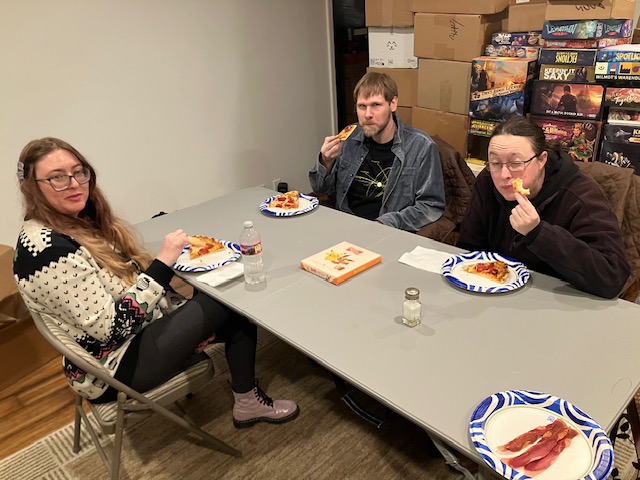
It goes without saying that we had to eat Pizza first before we played a full-up all four turtles game!  I am not a TMNT fan, but even I know they eat pizza!  

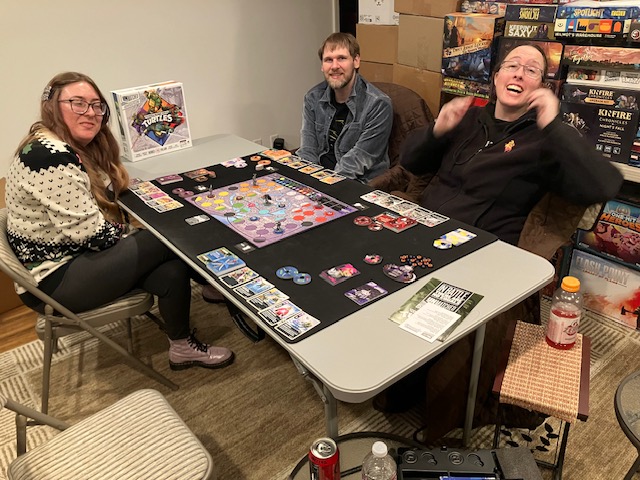
The four player cooperative game went over pretty well.   Like we noted in previous Unmatched Adventures, the variable turn order problems are much less pronounced with more players.  There are enough initiative cards that players don’t get stuck with the bad guys getting too many turns in a row.

A problem we had with 4 players is that it was sometimes too hard to get around Shredder to do damage!  Each of the turtles gets a sidekick, so there are 8 good guys (4 turtles and 4 sidekicks (April, Casey Jones, etc) and sometimes it was a little frustrating as they couldn’t get some of the good guy to do anything useful!   This does feel a little like a first-world problem (“Oh no, we can’t all do damage to Shredder!”), but it did cause some frustration in my group as sometimes you couldn’t get anything done on your turn because there was no place to move to!

We generally had fun and took down Shredder as all 4 turtles!

Interestingly, no one in my group was a TMNT fan!  They all knew of the turtles, all were okay with the turtles, but no one was “a fan”.  Despite not being fans, we all had fun playing the turtles. 

Generally, I think the game is more fun cooperatively than solo.

Cooperative Play (3-Player) With A Big Fan

My friends Jon is a huge TMNT fan; so I had to make sure to get is opinion when he played.

In general, he liked it.  I do think a 3-player game was a little better than 4-player game you get back to your turn quicker,  and vying for space around the board wasn’t quite as bad.  4-Player still worked, but I do think 3-Player is better. 

Solo Play (2-Player)

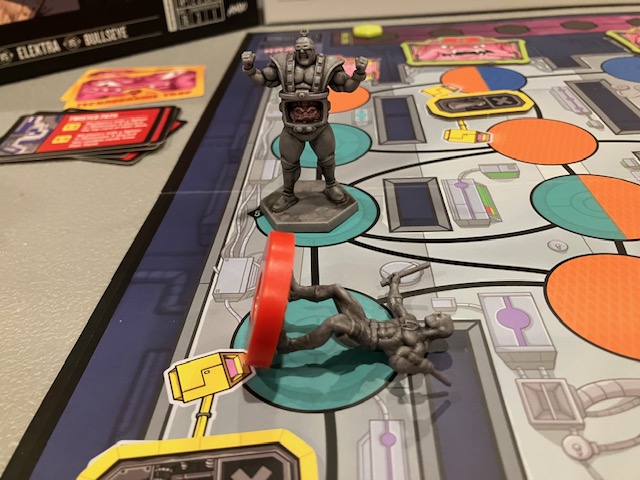
For comparison purposes, I did want to see how (a) how other heroes played in this world (b) how the Krang scenario played (c) how 2-Player/2-handed solo played.   So, I played a two-handed solo game of Daredevil and Bullseye against Krang!  See above!  It’s an unlikely alliance, but Daredevil and Bullseye have teamed up to protect their city!

The first game went horribly as Krang took out Daredevil early. Bullseye just looked at the board, said “no way”, and walked away (he is, after all, a villain).  Krang won!

After resetting, Daredevil and Bulleye used their abilities better together and Daredevil took Krang our with a Feint on the very last round (see below) … he only had to do one damage, but the Feint cancels all bad-guy effects!  So, Daredevil‘s Feint won the game! It was great!

This was a very thematic session of two games: Daredevil and Bullseye failed in the their first team-up (Daredevil  Comics #992), but then after learning from their failure, they were able to go in and take out Krang! (Daredevil Comics #993).  It just felt like two comics back-to-back!

I think I enjoyed two-handed solo more than pure solo.  Like I have said many times, the presence of more heroes in the initiative deck helps “smooth out” the randomness of the variable turn order system.  And, in this case especially, it felt very comic-booky over two issues.

Dice Throne Adventures/Missions vs. Unmatched Adventures

What Dice Thone Adventures does for Dice Throne, Unmatched Adventures does for Unmatched: it takes a head-to-head game and turns it into a cooperative adventure!  If you weren’t sure which one to get, let’s do a quick comparison. 

  1. Both have Marvel Characters
    1. Dice Throne has 8 Marvel generic and 9 X-Men=17 characters
    2. Unmatched has 16 generic Marvel characters (only 1 X-Man).
  2. Both have a ton of other/non-IP characters.
    1. Dice Throne has 16 from Season 1 and 2, plus Santa and Krampus, 4 for Outcasts, another 4 from Vanguard = 26?
    2. Unmatched has sooo many characters, I can’t even count. See here!

The fun of these systems is that there are SO MANY characters to choose from both.  Dice Throne has a slight advantage in Marvel characters, but Unmatched probably has more characters overall.

The one thing I will say is that I think it’s easier to jump into a Unmatched Adventures game than a Dice Throne Adventures game.   We found out the hard way that you HAVE to play your Dice Throne character(s) beforehand, otherwise the rules overhead will be too much.  Usually, this means playing a quick head-to-head Dice Throne game to see how the characters work.  As we’ve seen in this review (and the Unmatched Adventures review), we’ve been able to drop new players into the  Unmatched Adventures game and they immediately understand!   

Dice Throne Adventures is a little more tactical (but see randomness issues below), but the powers of the Dice Throne Adventures are pretty neat too.  I’d recommend playing them both to see which one you like better; they both scratch a similar itch.

Scenarios

Of the two scenarios, I liked the Shredder experience more: it was  less random.  

The Krang scenario had a little too much luck for me.

This deck in particular (see above) was very random and kind of made me mad a few times.  And you have to roll every round to maybe/maybe not activate machines.  I didn’t love the randomness of the Krang scenario.

Overall, I will probably play the Shredder experience a lot more than Krang, but Krang is a unique experience for which I will “tolerate” the randomness now and then.  Of all the scenarios from both Unmatched: Adventures: Mothman, Aliens, Shredder, and Krang Krang was by far my least favorite.   

Unfortunately, the randomness of the Krang scenario does bring my rating down a little for this set.  It makes it a little harder to recommend this for a non-turtles person.

Sharing the Load

Because there is one minion per player (for scaling to the number of players), we shared the load by having each player operate one of the minions.   I liked this because it makes everyone feel a little more invested! If I were running everything myself, then people would feel less involved (and I would be grumpy because I was doing everything).  Since everyone has to run at least one of the minions, that makes the game feels more interactive.
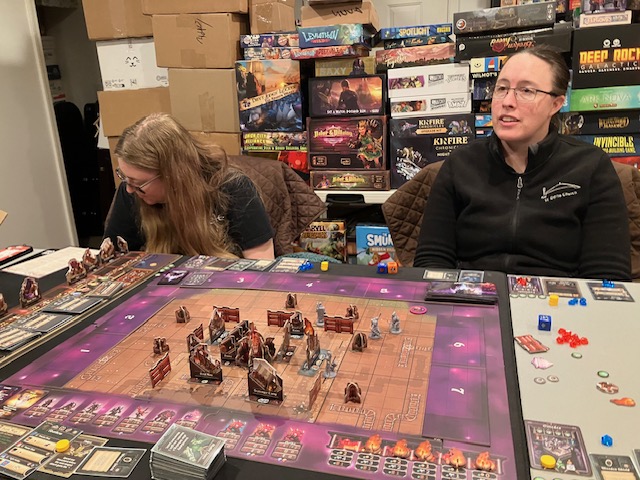
I liked that we could share the load; it made the game feel more cooperative.

Conclusion

Everyone liked  Unmatched Adventures: Teenage Mutant Ninja Turtles; it was fun at all player counts, with pure solo possibly being the weakest.  Even if you don’t know/don’t like the TMNT, this is still a good get because it expands the Unmatched Adventures world and gives you two more scenarios!   (Be aware that one of the scenarios is more random than the others,  so that might have an influence on your decision).   And the turtles were fun to play, even though we didn’t know/love them.
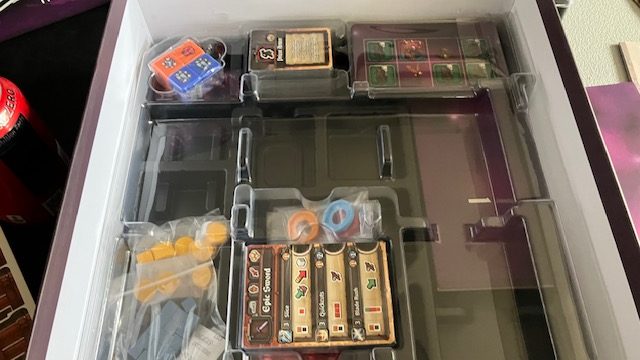
Overall, Unmatched Adventures: Teenage Mutant Ninja Turtles is probably about a 7.5/10 or 8/10.  If you love TNMT, that probably adds another 1 or even 2 points to that score.  If you are turtles fan, be aware there is a mini-upgrade kit (see above) which turns a lot of tokens into cool minis … you might want that.

To be clear, this is a standalone set. If you love TNMT and don’t really care about any of the other Unmatched warriors, this is perfect for you: you don’t need anything else. If you just liked Unmatched Adventures system, this does add more scenarios for you! Just be aware that Krang is a little more random.

We liked this enough to be on our Top 10 Cooperative Expansions of 2025!

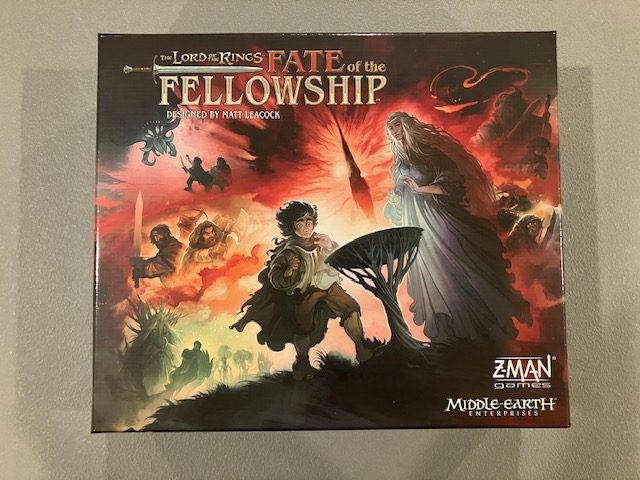
An Epic Struggle! A Review of Lord of the Rings: Fate of the Fellowship

Over the course of a few weeks, I played Lord of the Rings: Fate of the Fellowship many many many times and different ways trying to find the joy and fun. I have to admit, it was an Epic Struggle! I gave this game way more chances than I should have because of its theme and designer, but I struggled with it. Follow me in my journey to see if I keep Lord of the Rings: Fate of the Fellowship in my collection or throw it into Mount Doom along with the Ring!

My journey to play Lord of the Rings: Fate of the Fellowship began back in January 24, 2025!  The game was up for pre-order on the Asmodee web site, and I pre-ordered with an expectation that it would arrive in late May or early June (as was the original promise).
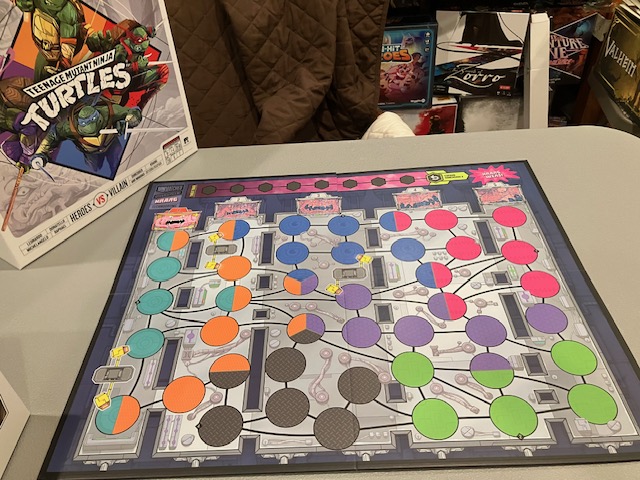
Well, things changed (Asmodee had trouble shipping) and it didn’t deliver to me until Monday August 19th.  This was frustrating because I had seen SO MANY people put up reviews on BGG, and yet, as a paying customer who ordered early, I didn’t get mine until 7 or 8 months later.
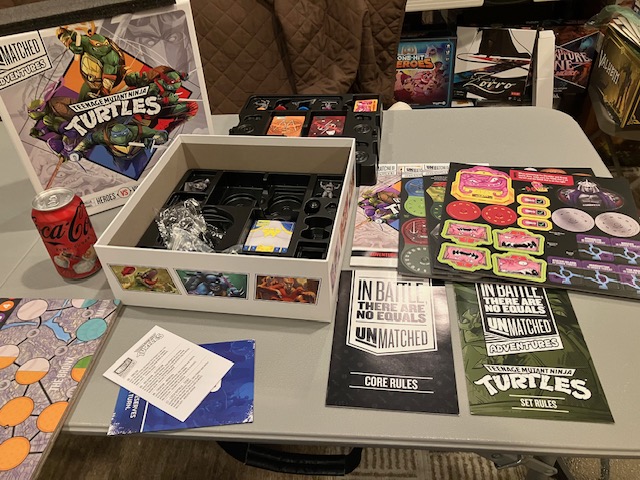
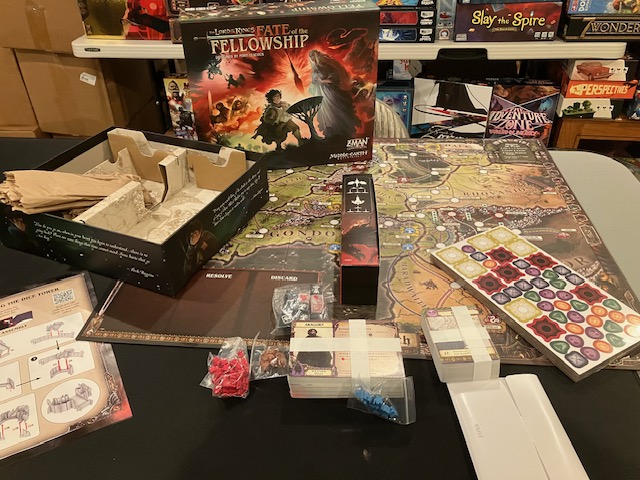
I was very excited for this: this is a game in the Pandemic System (see above)!  What that means is that it’s not quite Pandemic, but if you squint, you can see the elements of Pandemic in the game!  I generally love Pandemic and its ilk (see reviews of Pandemic: Ibera, Star Wars : The Clone Wars Pandemic, and World of Warcraft Pandemic), but I have not loved all Pandemics (see our review of Freedom Five).  Will this be a good Pandemic or a bad Pandemic? (What a strange sentence)

Let’s follow this Journey!

Rulebook

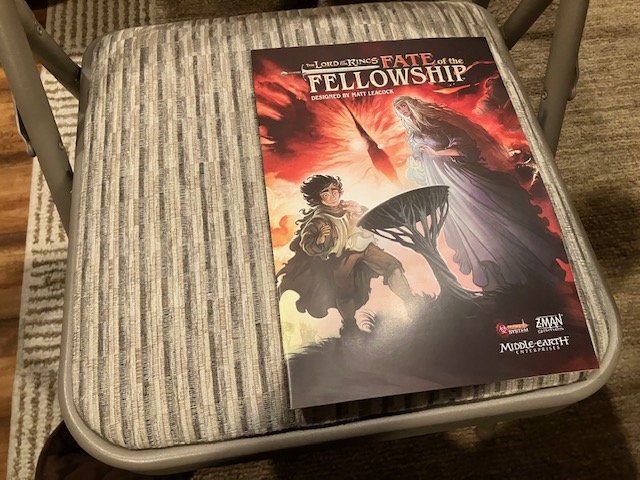
The rulebook is very good and is the first thing you see when you unpack the game.  This rulebook gets an A on the Chair Test!

The rulebook opens up and stays open on the chair next to me.  The font is big, the pictures are well-annotated, and it’s easy to read on the chair next to me!

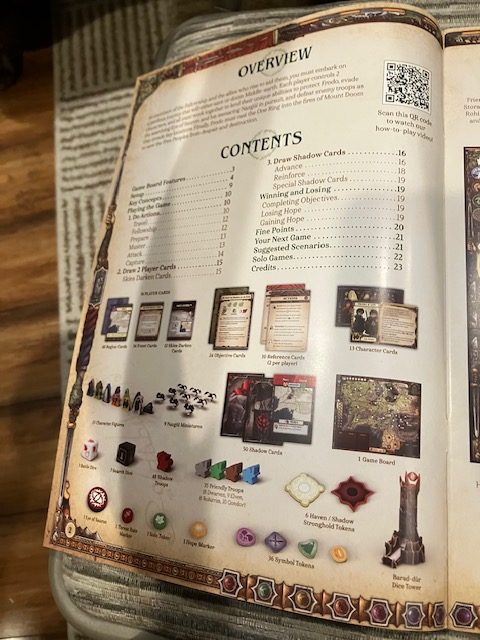
The Component page is well-labelled with pictures and text: see above.

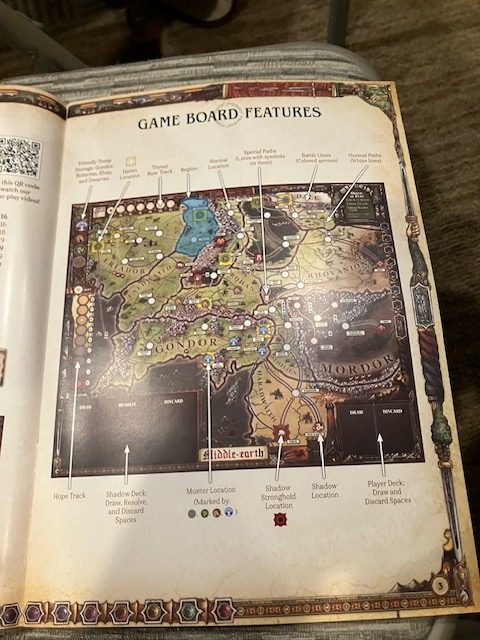
The Game Board Features is really nice as you try to understand this world.

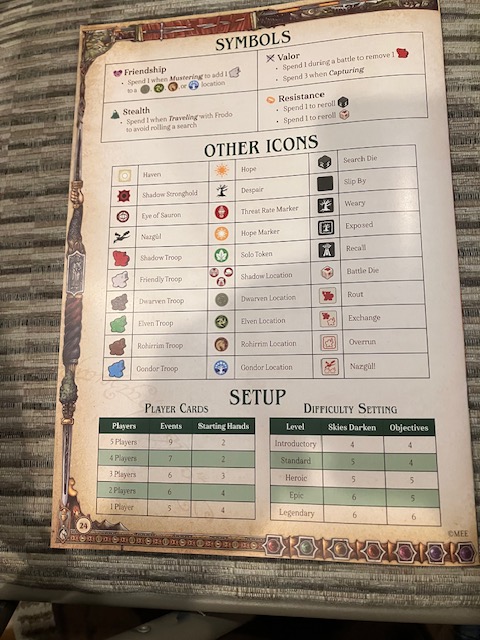
Generally, this was a good rulebook with a Table of contents (yay), but no Index (boo!).  The back of the rulebook shows useful info and icons.

There is one issue with solo rules that’s not well-specified (see below).

Generally, this was a good rulebook.

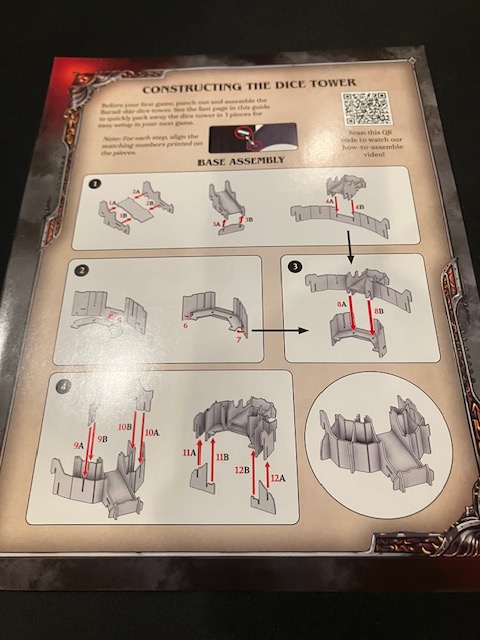
Unboxing and Set-Up: Building the Dice Tower!

Total time: it took me about 2 hours to unbox and set-up for my first game

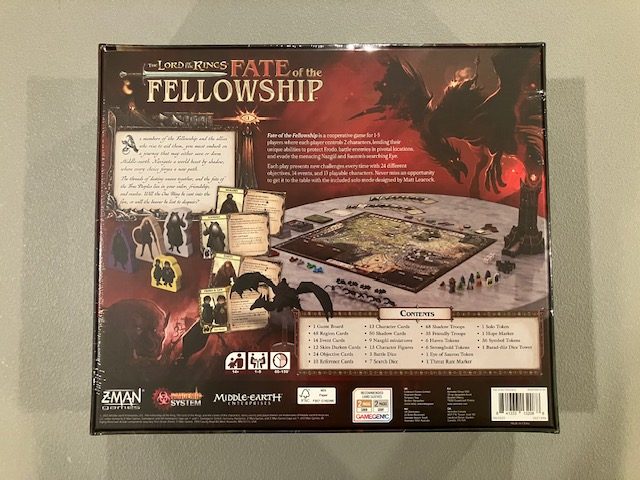
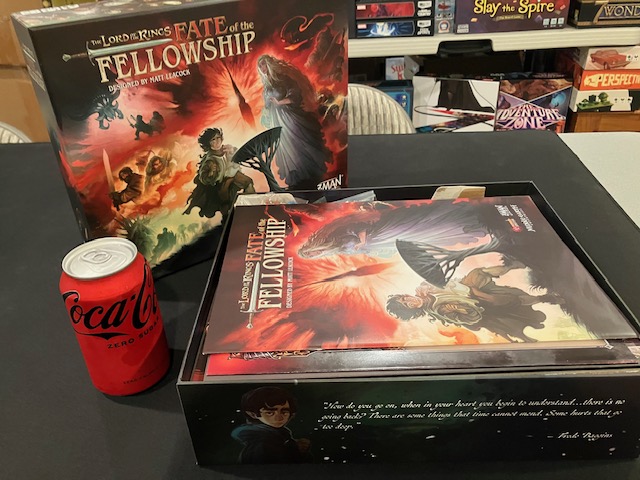
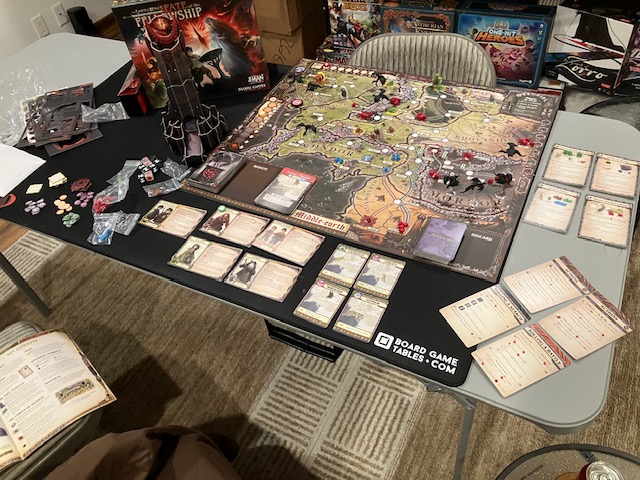
See Box above with Can of Coke for scale.

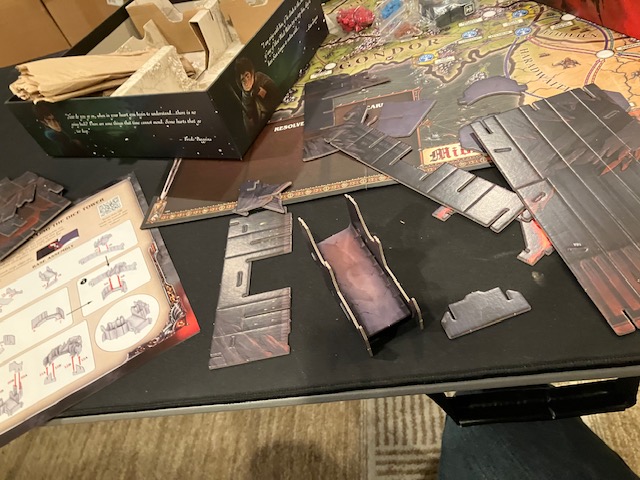
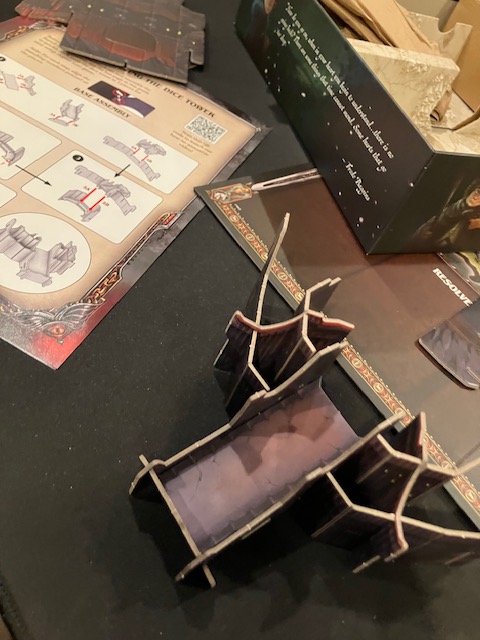
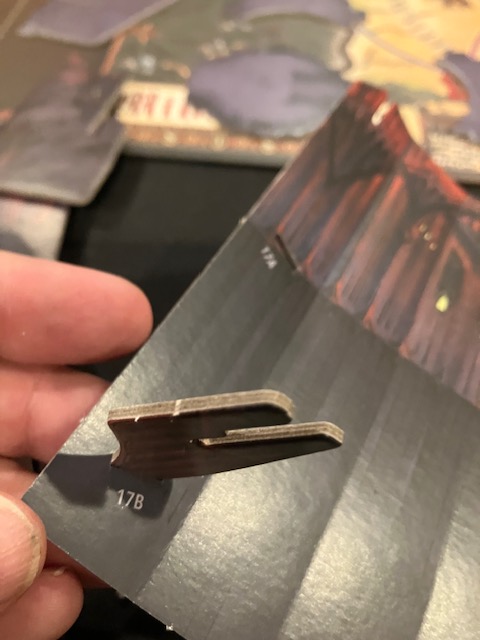
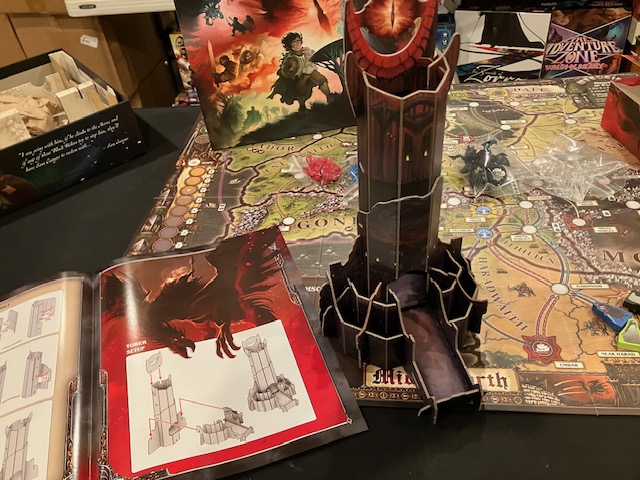
The first part of the game unboxing was building the dice tower: this consumed about 20 minutes!  The directions are pretty good, but it was annoying.  Unfortunately, this was a little foreshadowing for the game itself.

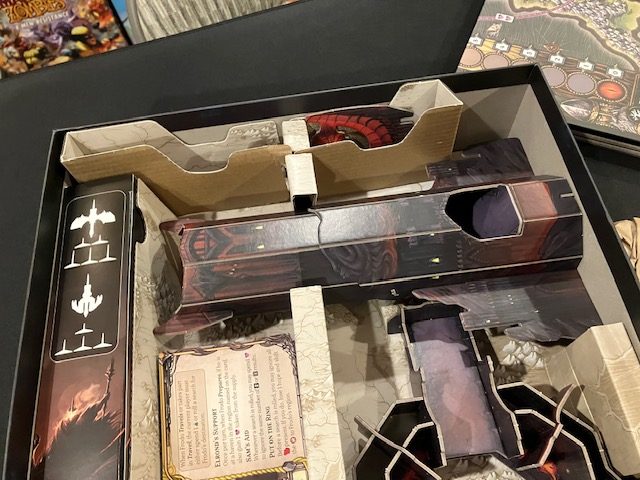
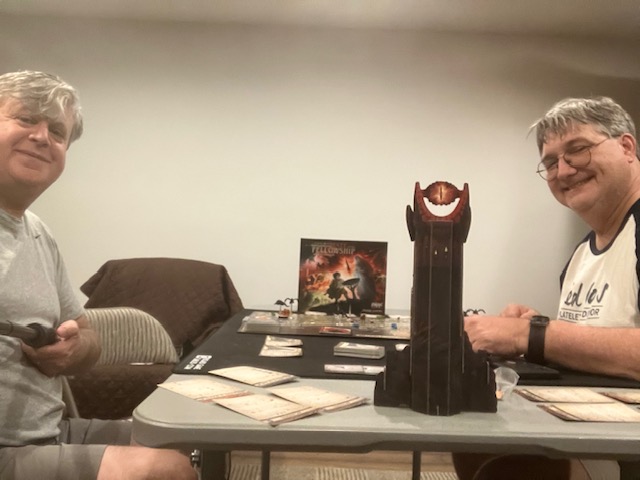
In the end, the Dice Tower looks really cool (see above), but holy cow, this was kind of annoying to build.  Once you’ve built it, it does come apart easily and go back into the box (in 3 pieces: see below).

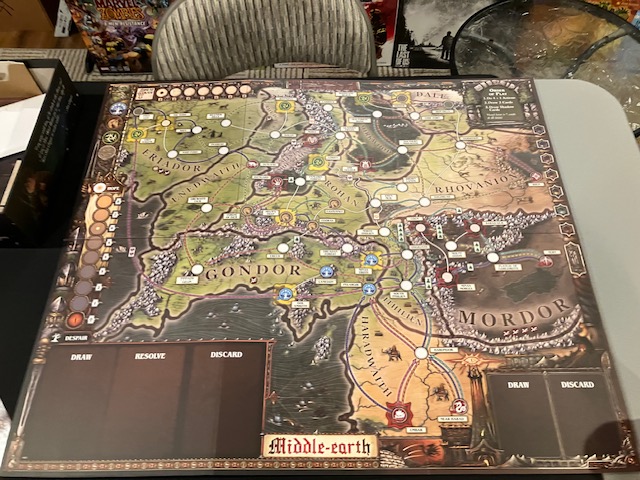
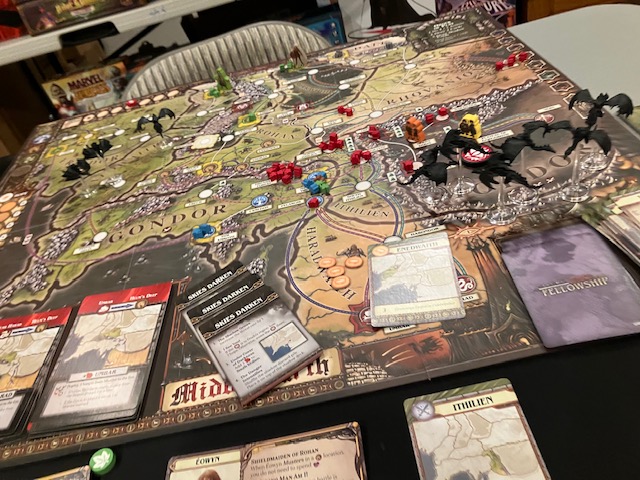
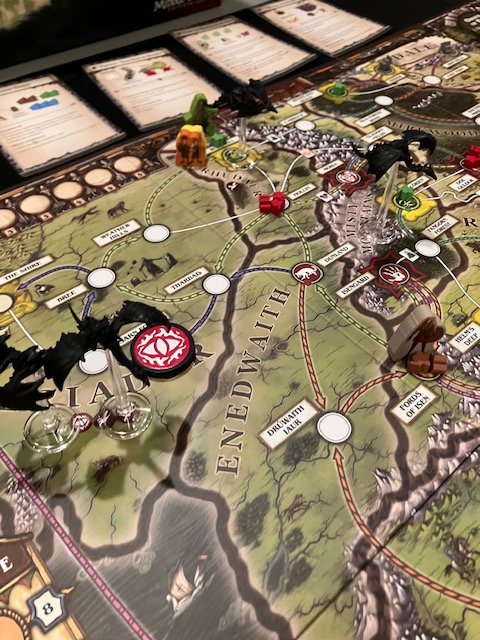
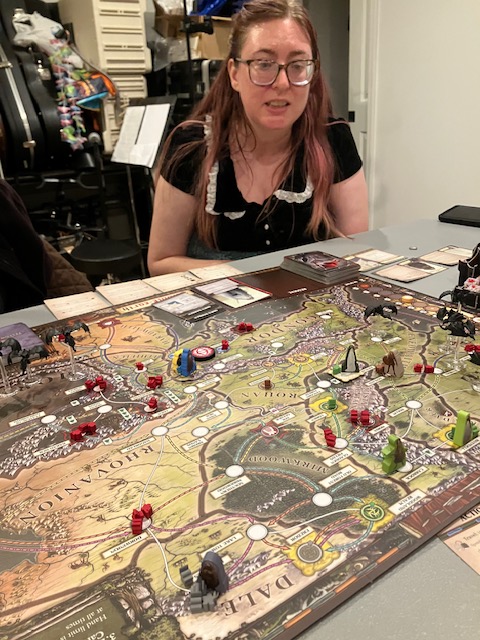
The board is a huge 6-fold board.  It’s very busy and very daunting at first glance: see above.  It does get better once you get to know the board, but, yes, it is very busy.

I was told by my friends who LOVE Lord of the Rings that this board is very accurate and consistent with the map at the front of the books. 

If you squint, you can see the Pandemic underneath!  The Region cards feel very similar to the player cards we’ve seen from Pandemic!

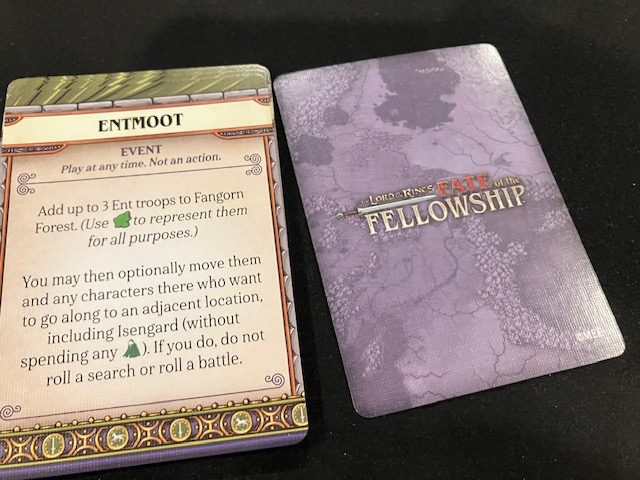
Just like Pandemic, there’s Events (of course, they are flavored for this universe).

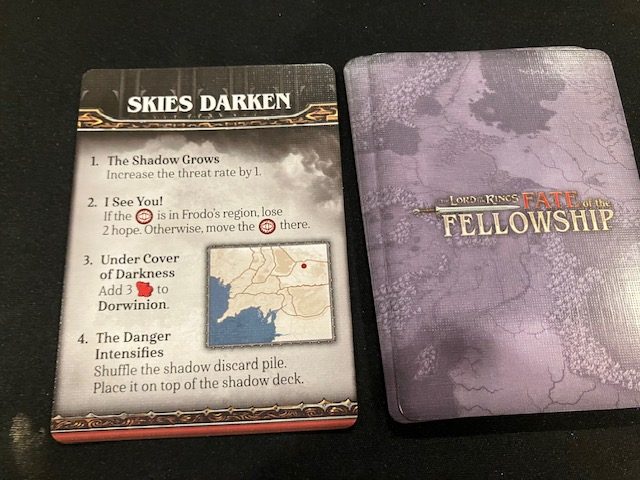
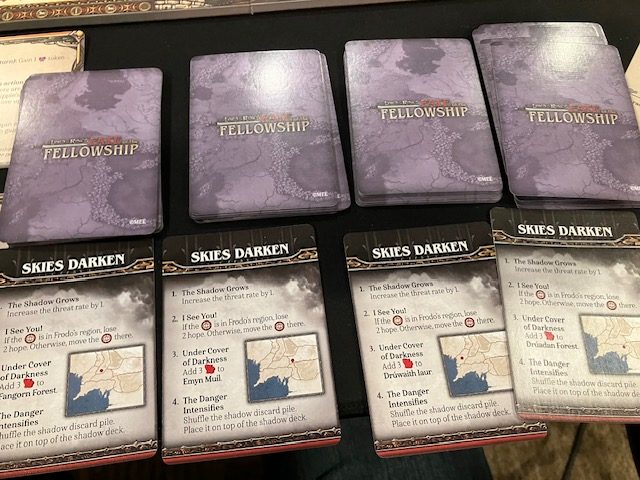
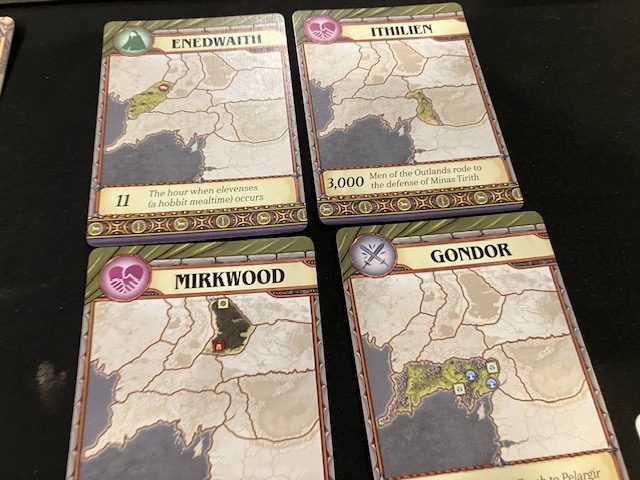
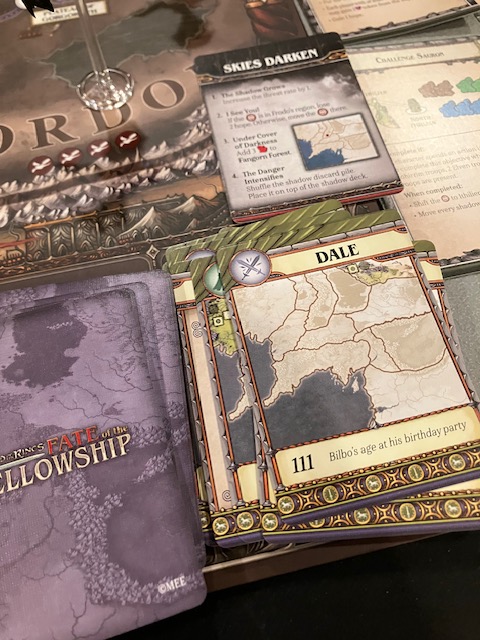
The Skies Darken cards (above) are very much like the Epidemic cards from the original Pandemic!

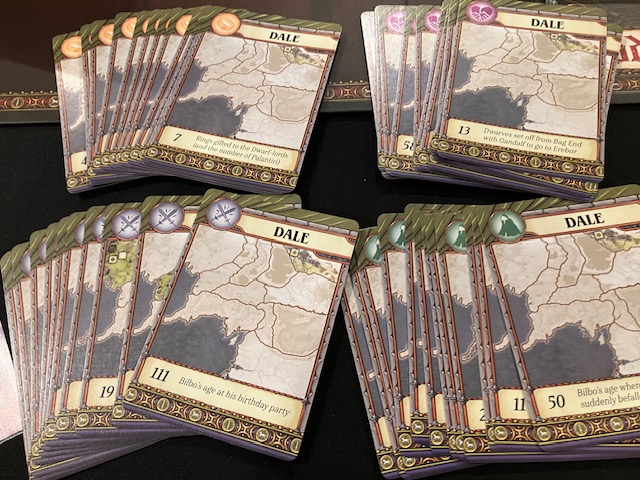
Like the original Pandemic, you divide the deck into fourths and put one of these “bad news” into each part of the Region cards.  That way you get one Skies Darken at about every quarter of the game!

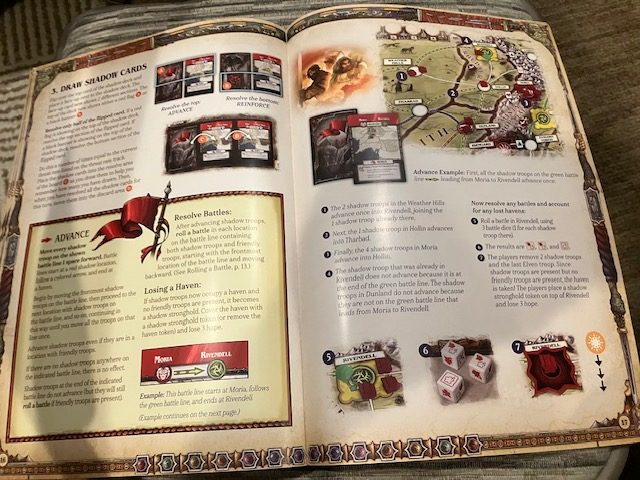
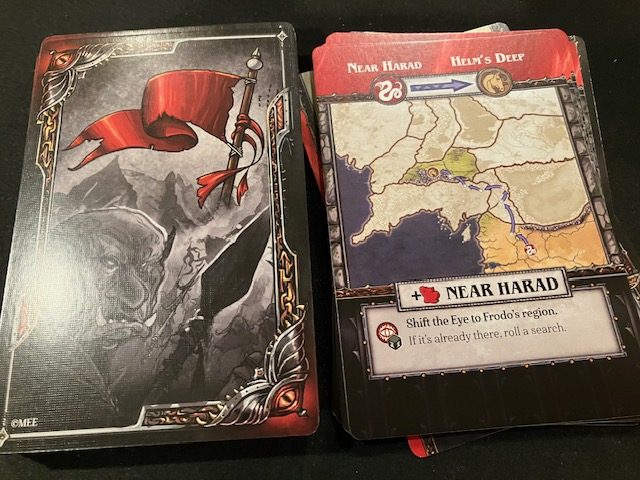
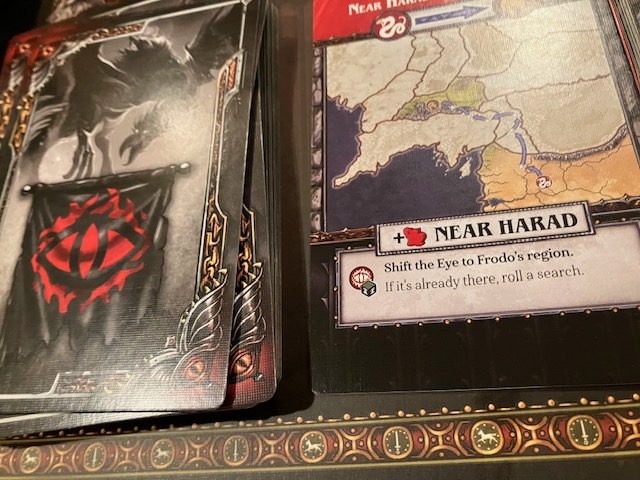
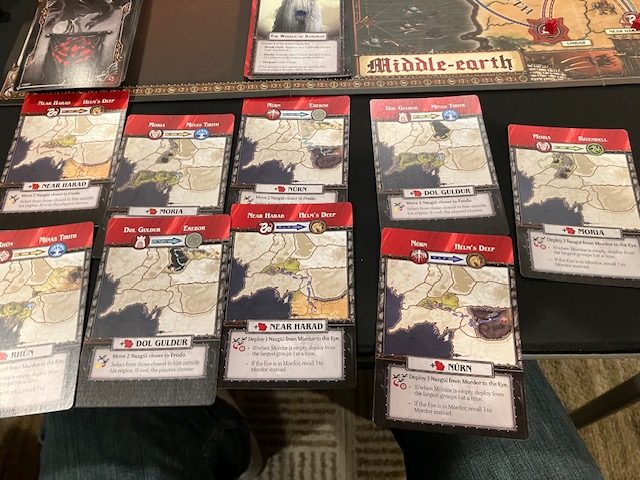
The true Bad News deck is the called the Shadow Cards; you get two (or more) per turn.  This is just like the Infection Deck from Pandemic.   There’s a big difference though!  If the Shadow Card to the left of the card you play is a red banner (see above), you activate the TOP part of card!

If the left card is a black Banner, you activate the BOTTOM part.  The bad news you get depends on the top card of the deck!  This can have wild swings to the game!

Like Pandemic, these Shadow Cards go to the top of the Shadow Deck and will come out again and again, whenever you draw a Skies Darken!  You seed the game with “troops” (not disease cubes) very much like the disease cubes.

If you’ve played Pandemic in any form, those Skies Darken cards will feel VERY familiar.

Every player will play TWO characters! Not just one! That’s different!

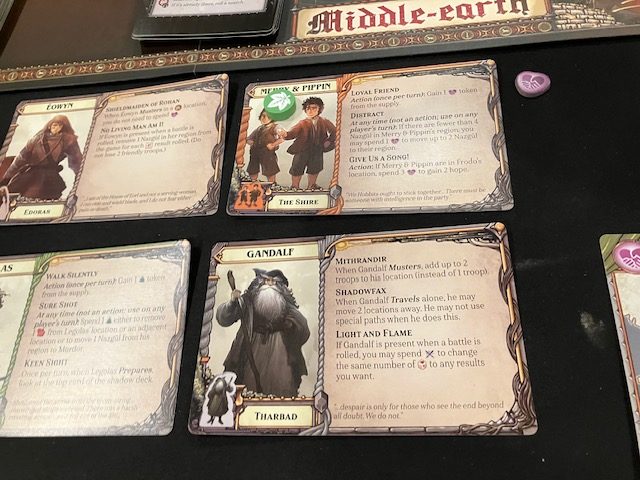
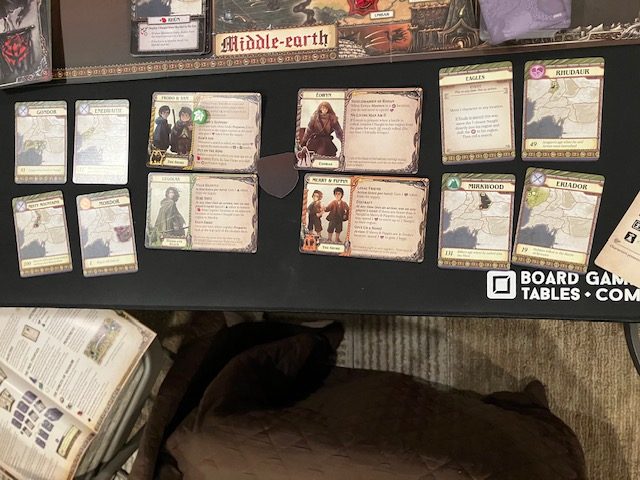
The characters should be very familiar to the LOTR fans! See above!

One characters gets 4 actions (like Pandemic), and other only gets 1 Action Point. That’s a little different.

With those 4 Actions (see documented above), you do things like Pandemic.  However, there are a lot of differences here!  This is where the game starts to drift from the original game a LOT more, as you can attack (with dice), capture Havens, Prepare, Fellowship!  There’s SOME Pandemic here, but the actions you get really are very different.  For example, you can trade in a card for token for hand-management reasons, but only at a Haven!

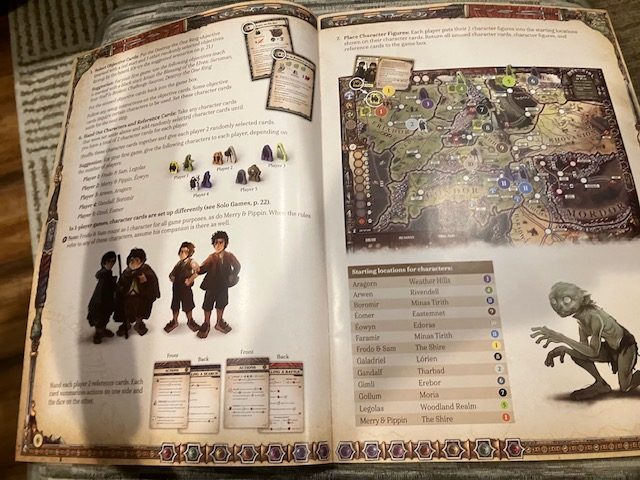
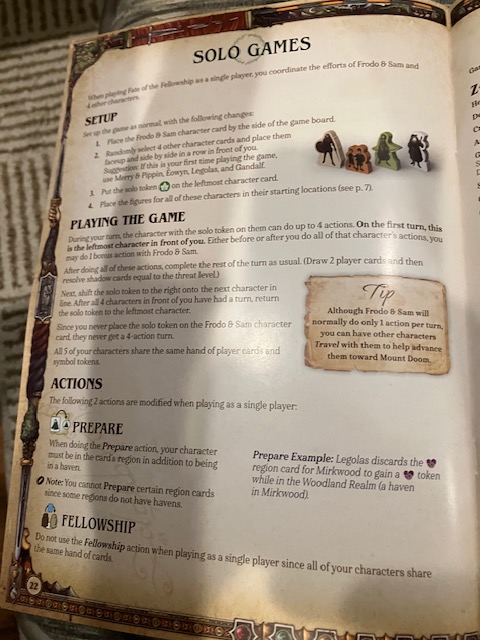
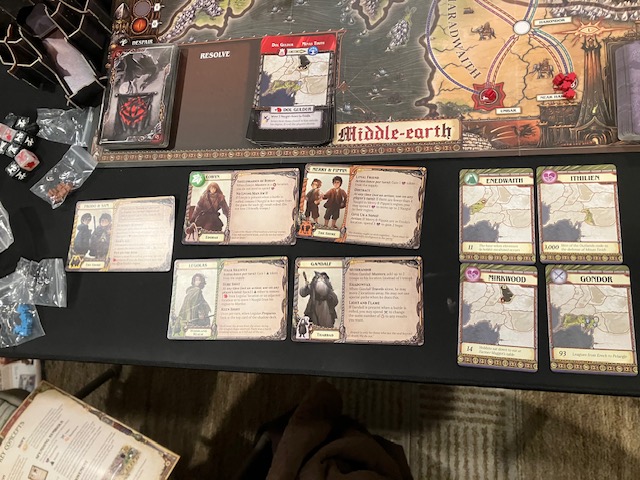
So I decided to start my journey using the Solo Rules/Set-up! See above as I operate 5 characters (well, 4 and 1).

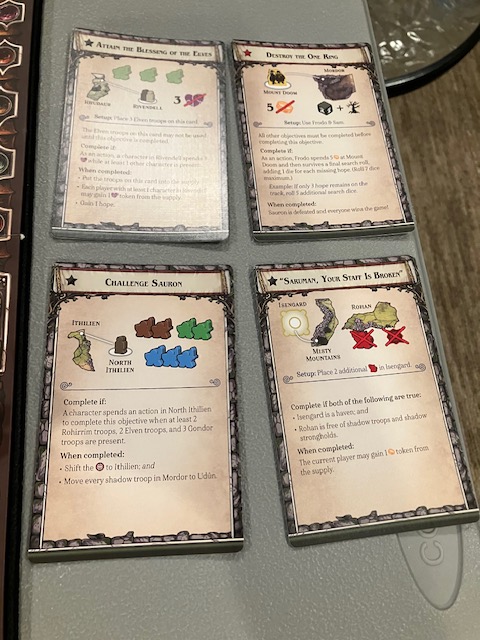
Winning, as you might guess, is throwing the Ring into Mount Doom: see above, top right!  But before you can do that, you must fulfill the previous three missions!  Each of these missions (see above) is very different: Attain the Blessing of the Elves, Challenge Sauron, Sauraman Your Staff Is Broken!  This is reminiscent of Pandemic, where you had to stop 4 diseases!  Here, you have to fulfill 4 very different missions!  (There are actually a number of different missions to choose from, but you always have Destroy One Ring as the final mission!)

At the end of Day 0, I was pretty exhausted!  Putting together the Dice Tower and setting up the game took a lot of work!

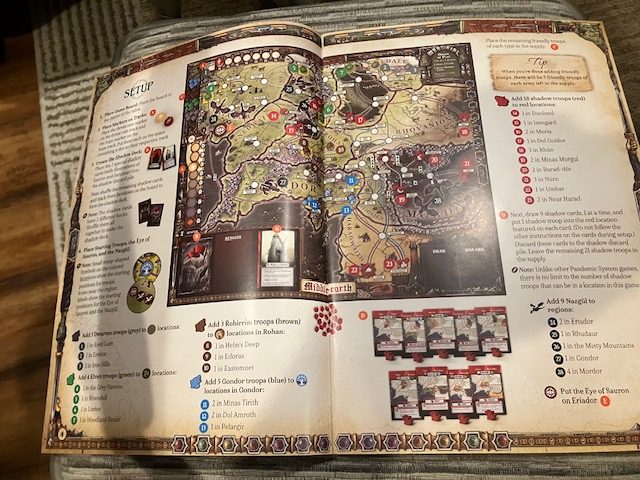
The Set-up actually spans 5 pages!  That’s right, 5 pages! 

At the end of Day 0, I was too tired to move forward and play my first game.

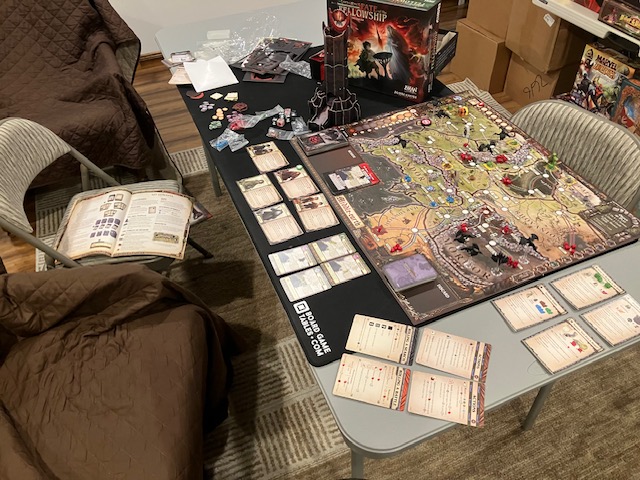
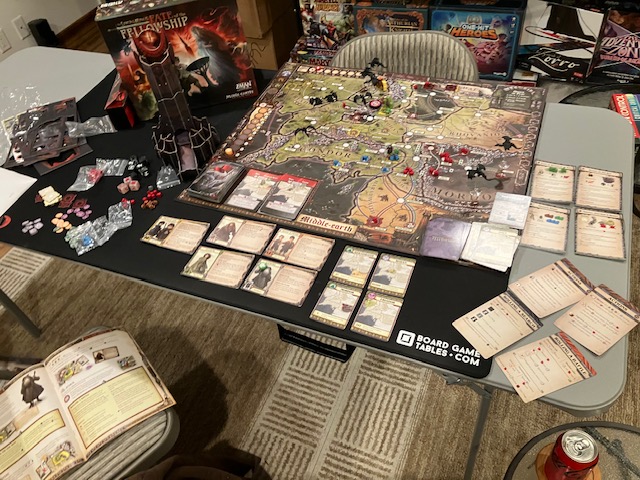
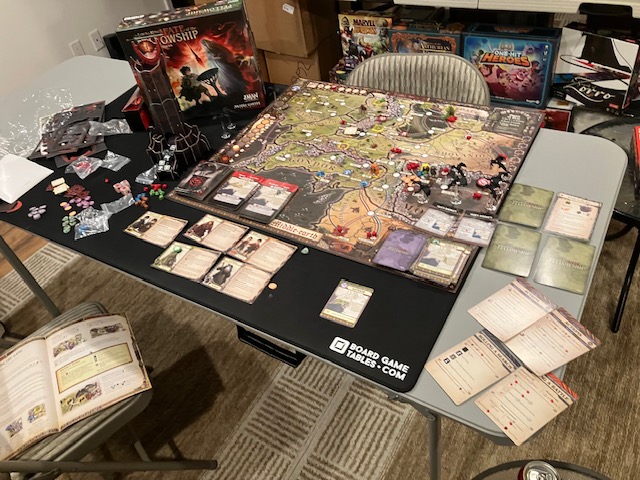
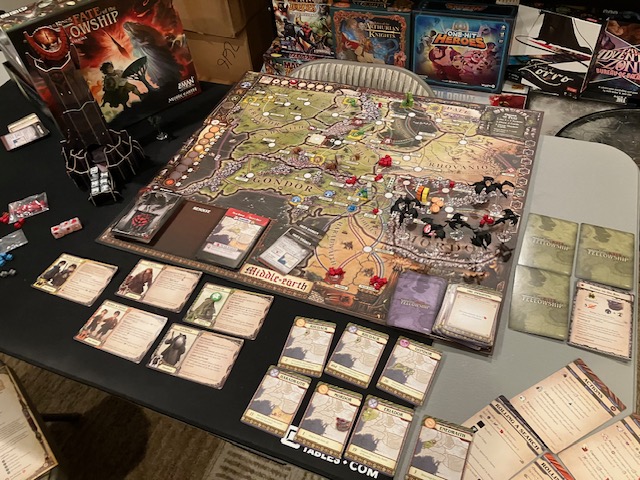
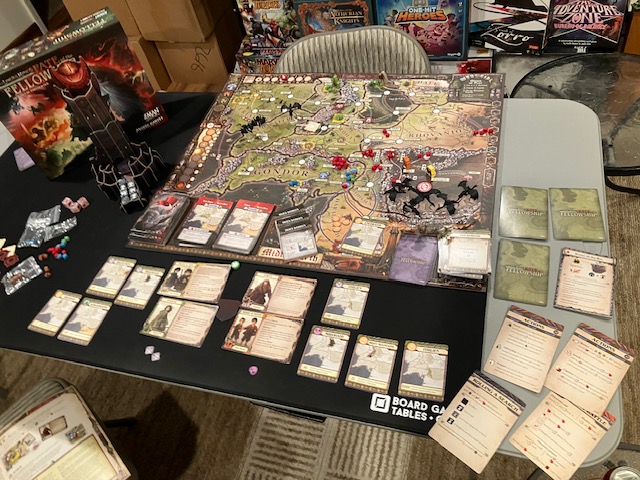
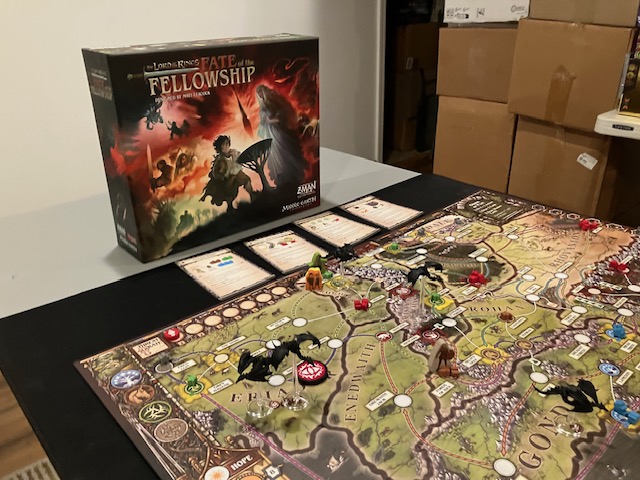
It looks cool set-up on the table though!  See that Dice Tower!  That cool LOTR board!

Playing Solo Mode Using Two Kinds of Solo Rules

The solo rules are well documented on page 22.  See above! (And thank you for following Saunders’ Law!)  These rules are generally very good and very clear. One problem I had: it’s not quite clear if you can share the tokens between all 5 characters, … but you can sort of infer that you can (because when a single players plays two characters, they can share tokens); it should have been stated more explicitly. EDIT: Yes, the rule is there! I missed it, and I could have sworn I looked like 3 times. My mistake!!!

The solo player plays 5 characters … well 4 characters and (Frodo and Sam).   You choose 4 characters to play (although the rulebook suggests characters for your first few games), but you always get Frodo and Sam (since Frodo has to throw the Ring Into Mount Doom) as the fifth character.  Yes, Frodo and Sam is considered one character.

There is only one hand of cards for the solo player, so all the cards are shared among the 5 characters.  This is both boon and bane; you don’t have to worry about sharing cards (indeed, the Fellowship action which shares cards, is disabled in the solo game), but you also are stuck with the 7-Card hand limit for all characters.  

You move the little green solo token around (above) to show which character you are activating this turn; the character you activate gets 4 actions, and then Sam and Frodo get one action.  That’s right, Sam and Frodo always get one action and the other character gets four actions.

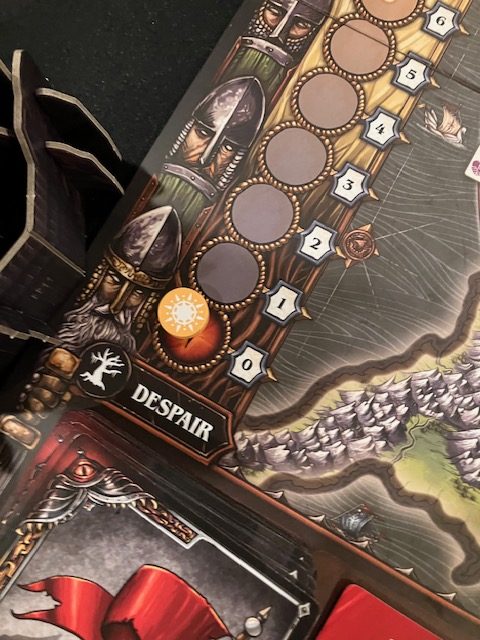
My first game ended in a loss after about 14 turns as my Hope went to zero.  That’s right!  If your Hope track ever goes to zero, you immediately lose!  There are MANY things that cause your Hope to suffer: Search Checks, Losing a Haven, running out of cards.   In other Pandemics , the end generally comes when the player cards runs out.  Every game of Fate of the Fellowship I have lost was because the Hope went to zero very early in the game.  It’s VERY EASY to lose via Hope in this game. You have to be very careful with Hope, and it’s generally hard to get Hope back (but not impossible).

It was very weird to me that I lose before I was even barely one-fourth through the game: I had only gotten one Skies Darken!

Although I lost because I lost Hope, generally my combats were terrible; I rolled poorly.

Nonetheless, I realized I had played a LOT of rules wrong.   You have to understand that there are lots and lots and lots and lots and lots and lots of little rules in this game that you have to keep track of.  As someone who has played many many many games of Pandemic, I think I expected something more akin to the original Pandemic.  Nope!  This game is very different and requires you to bend your brain a lot more.

I was grumpy how hard I lost (as I said, I have played lots of Pandemic), but I realized how many rules I got wrong and things I missed, so my first game just got me the “feel” of the game; I should expect to lose.

My next solo game was a win, but I realized I STILL got a bunch of rules wrong.  

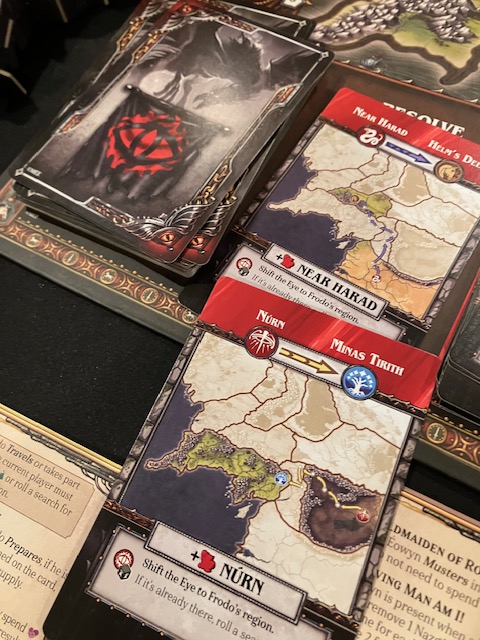
My third game was a complete loss in 3 turns.  That’s right, 3 turns! I got two “Shift The Eye To Frodo’s Region” and the Eye was there.  I had 5 search dice to roll, twice.  I lost because I lost all hope.  In turn 3.  That’s right, 3 turns.

I was ready to throw this game into Mount Doom; this games feels so messy and random.   Sure, I’ve had games of Pandemic go bad, but never this bad. Lost. In. 3. Turns.

I played a fourth game and lost after about halfway through the deck. By losing Hope of course.

I took a break to think about this. I realized that one of my problems was that I sometimes felt like I couldn’t do anything because I ran out of cards quickly.  This is because all 5 characters share the (7-card limit) deck.  When you have turns where you maybe don’t want to move (or can’t move), then you can spend some actions turning cards into tokens at a Haven.  With all characters sharing this hand, this “sometimes” action causes your hand to go to zero cards quite a bit.

So, I decided to play the traditional solo game: play the cooperative game two-handed, alternating between two players. See above.  After playing this way, I don’t think I can go back to the solo mode as written.  With playing 2-handed solo, I felt like I had more options (“how should I activate my characters? 4 or 1 or 1 and 4? Who should move?  Do I need to share?”).  Basically, the Fellowship option is important, but you don’t use it that much in a game—it’s generally better to have more cards in the 2-Player mode.

After 7 solo games, I think that the two-handed solo game is superior way to play solo. The solo player simply feels like he has more choice in actions (to choose how to divvy actions), more cards work with (spread over two hands), more mobility around the board (to deal with bad news as it pops up). To be honest, I didn’t start having fun until I started playing 2-handed solo.

I felt like the built-in solo mode might actually do the game a disservice. I kind of hated my first five solo games; it wasn’t until I went to the two-handed solo mode that I actually started having fun. If you had caught me in my first 5 solo games, this game would be burning in Mount Doom right now. I am someone who loves Pandemic, I am someone who loves Matt Leacock designs, I am someone who has played a lot of Pandemic in his life. Yet, the built-in solo mode almost caused me to hate this game. Caveat Emptor.

I recommend the two-handed solo mode.

Two Player

One of the things that convinced me that the 2-Player solo game was superior to the built-in solo mode was playing two players!

Over one Sunday, my friend Don and I played a 2-Player game and had fun!  Now, be aware that I had played many many solo games my this point, so I had the rules down, I had the strategy down, I had the teach down.  

I think we lost, but I don’t care?  We had fun: Don definitely knows like LOTR better than me and he thought it was fun.  He also reminded me that several of his Pandemic games went south in a few turns.  

It felt like there were more options in a 2-Player game. This cemented, in my mind at least, that the 2-handed solo mode is superior.

4-Player Game

So, after teaching the 2-Player game, we went into the 4-Player game.

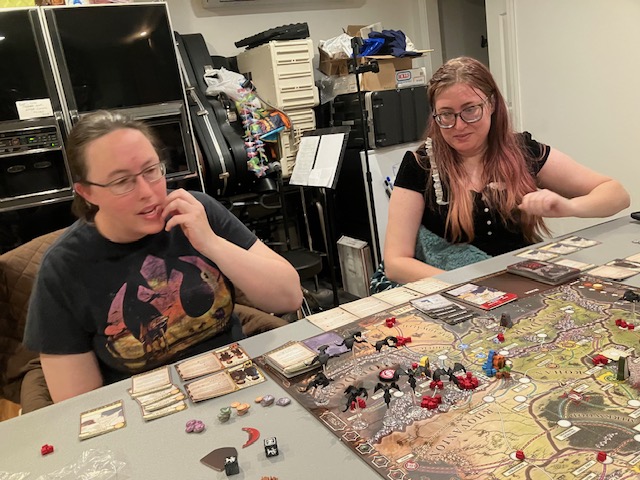
The game was fun, but we saw more of the randomness emerge  It was also frustrating that sometimes players couldn’t do anything.  The muster action can only be done on certain locations IF you have friendship cards.  The Prepare action can only be done on a Haven.  So, if you didn’t have friendship or weren’t on a Haven (because you were out fighting), sometimes turns felt a little anti-climactic (as you couldn’t do much).

I was reminded by friends Charlie and Allison (after they played Pandemic Legacy: Season 1), that 2-Player Pandemic is easier than 4-Player Pandemic.  Usually because 2-Players can deal with Bad News “quicker”, as you only have to alternate players.  In a 4-Player Pandemic, the only person who can deal with some “bad News” is 3 turns away.

I think we saw this in our game of Pandemic; we came close to winning, but needed just a few more turns.  We didn’t “quite” deal with the Bad News as efficiently as we should have.

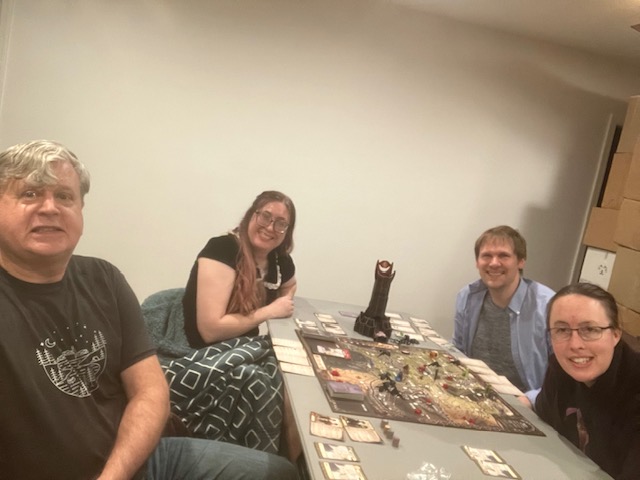
Did we have fun? Yes.  Did we love it?  No?  We liked it.   We would play again, if only to wipe the shame from our faces for losing.

Randomness

There are 4 major axes of Randomness in this game.

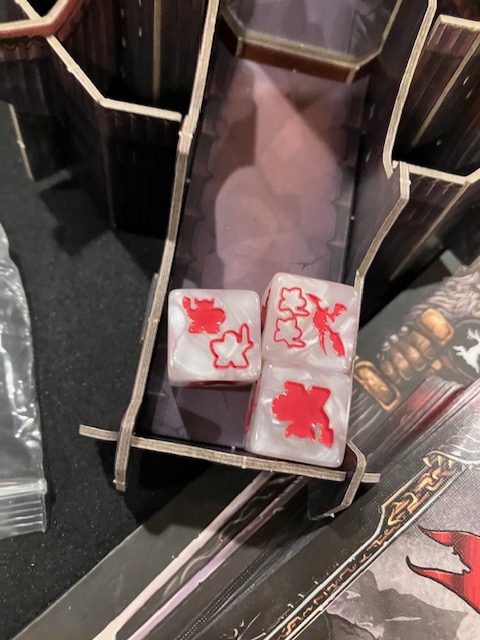
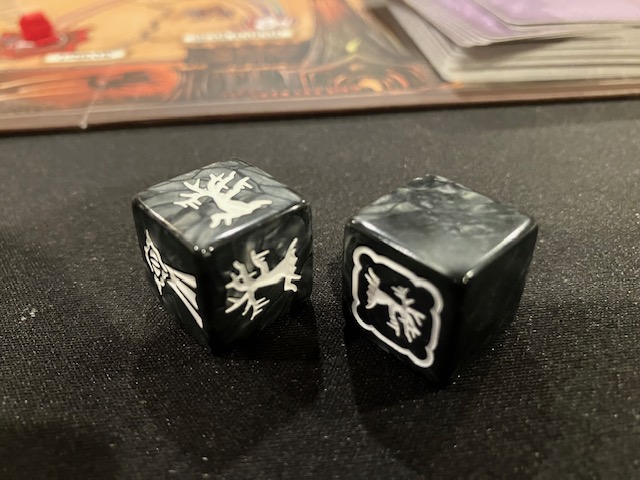
Axis 1: The Search Dice.  These must be rolled whenever Frodo travels (if he can’t sneak), or if a Shadows card forces a Search roll.   The number of dice depend on the number of Nazguls in your region.  See above for all 6 faces.   If you roll an “evil tree” (see above), you lose Hope.  Remember, if your Hope goes to 0, you lose.  You can re-roll some dice, at the cost of some resources.  They are re-rolls, not guarantees.

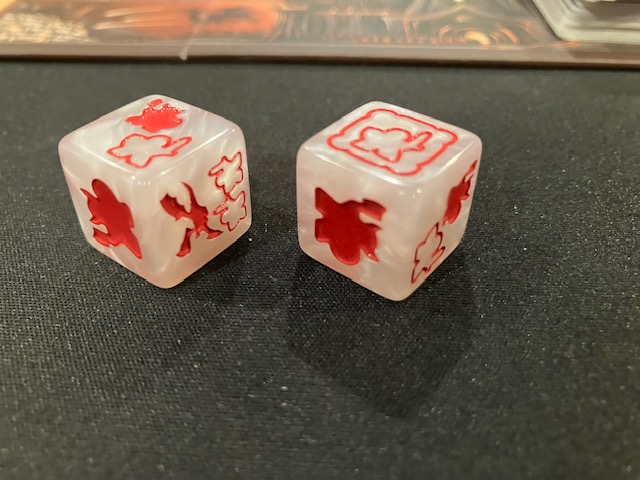
Axis 2: Combat dice. See above for all 6 faces. The red faces mean the bad guys lose a troop. The white faces mean the good guys lose a troop. A particularly bad roll can wipe out all the good guy troops and completely screw you. You can re-roll if you have a character in the region, at the cost of a ring. You can use swords to eliminate bad guys if you still have anything left (if you have a character there).

Axis 3: Shadow Cards.  What bad news do you get?  Even though the Shadow cards go back to the top of the deck (like Pandemic), the bad news you suffer depends on the next card at the top of the deck.  That little difference almost adds an extra axis of randomness.

Axis 4: Cards.  Which cards do you get? In one game, I waited 10? 12? 14? turns and could not get a sword!  See above! This basically meant my mission to win Isengard was thwarted and wasted time/resources.

This 4-axes of randomness (5 axes if you count the extra randomness of Shadow cards) can be debilitating.   There are ways to mitigate this, of course, but sometimes you just get screwed.  Pandemic kind of only had the 2-axes of randomness, and it felt plenty hard.

Be aware.  This game is much more random than the original Pandemic.  It may be too random for you.

Conclusion

It’s hard to recommend Fate of the Fellowship.   The extra randomness (relative to base Pandemic) inherent in the game with the Search Dice and Combat Dice can really bring your game down.  I also think that the recommended solo mode is flawed; and I think it will do a disservice to players if they decide to start with that. If you do want to play solo, I recommend 2-handed solo: you will feel like you have more options and more choices.

The game also feels like you can’t do things sometimes; you can only muster at hubs, you may only prepare at Havens, you may not move Frodo unless you either sneak or roll search.  The game feels like there are a lot more constraints on “useful” things you can do you on your turn … because there are more constraints, I think part of this experience is just realizing how important Havens and hubs are and getting used to that.  But, it “feels like” you can do less and that can be frustrating.

It took me almost 6 plays before I started having fun and figuring out the game works.  There are a lot of complex systems, there is a lot more randomness, there are many more constraints on player actions.  It may take you a while to really get this game; it has a huge learning curve.

Having said all that, Fate of the Fellowship is incredibly thematic, with the map, the missions, the special powers, and the characters!   All of my friends who love Lord of the Rings really feel like they nailed the game.

So what’s my final recommendation?  If you love the theme, you can probably suffer through learning the rules and love this game.  If you are a Lord of the Rings fan, you will probably enjoy this world despite all the complexity and randomness.  Losing is just excuse to embrace this universe and game some more!

If you just like Lord of the Rings, be aware that this game has a huge learning curve, a lot of complexity, and a lot of randomness! Much more so than base Pandemic.  If you can get past all that and learn the game, you can come to like it, but be aware it may take quite a number of plays to get to that point.  However, if you have a good shepherd (someone who knows the game and strategies), those first few games can be much more fun: my friends all had fun playing right away because I had done all the painful prep work.

My final score is a range: 4 to 7 out of 10.  That’s a huge range because I hated the extra randomness (that’s the 4), but when it was fun, it was fun (that’s the 7).  So am I keeping it? Yes. 
Be aware this probably won’t work for you right out of the box; you may have to live with it.

Was this a good Pandemic or a bad Pandemic?  It was a Grey Pandemic.

Late To The Party, But The Party’s Still Going! A Solo and Cooperative Review of Tales from Red Dragon Inn!

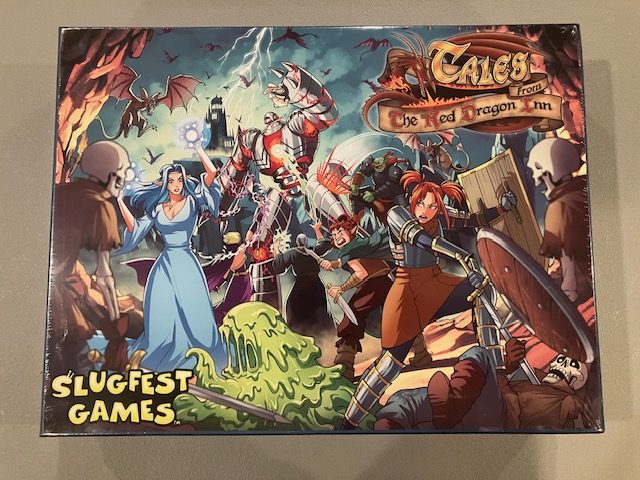
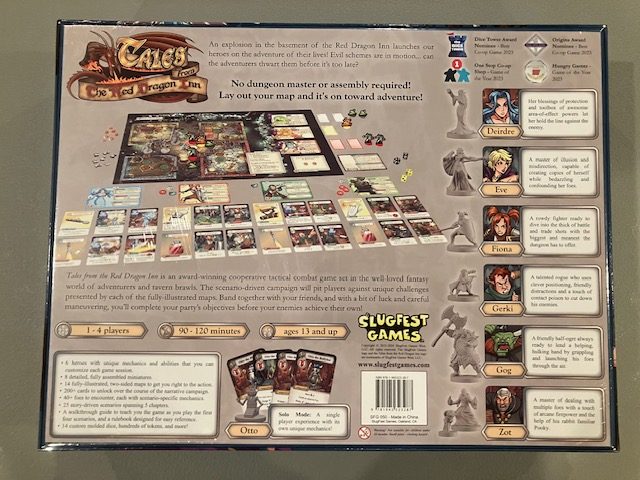
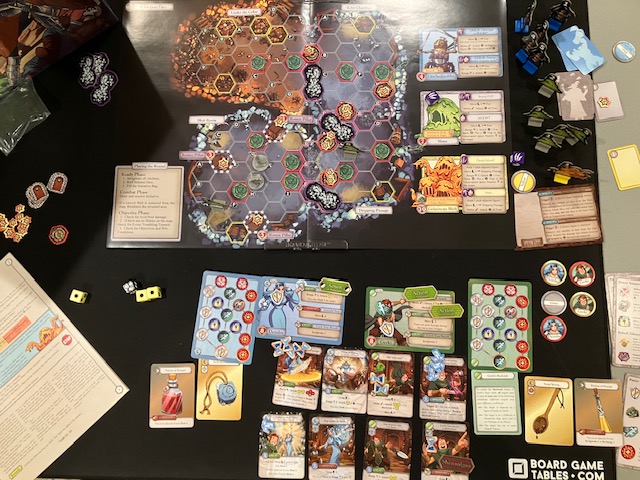
So, the original Tales from Red Dragon Inn was on Kickstarter way back in October 2021, and delivered to backers in 2024.  It was so popular, they had a second Kickstarter in June/July 2024, and that’s the one I backed!   This cooperative dungeon crawler for 1-4 players looked really cool!

Why didn’t I back the original? I think I was afraid of getting YET ANOTHER DUNGEON CRAWLER (YADC) campaign that I wouldn’t play!

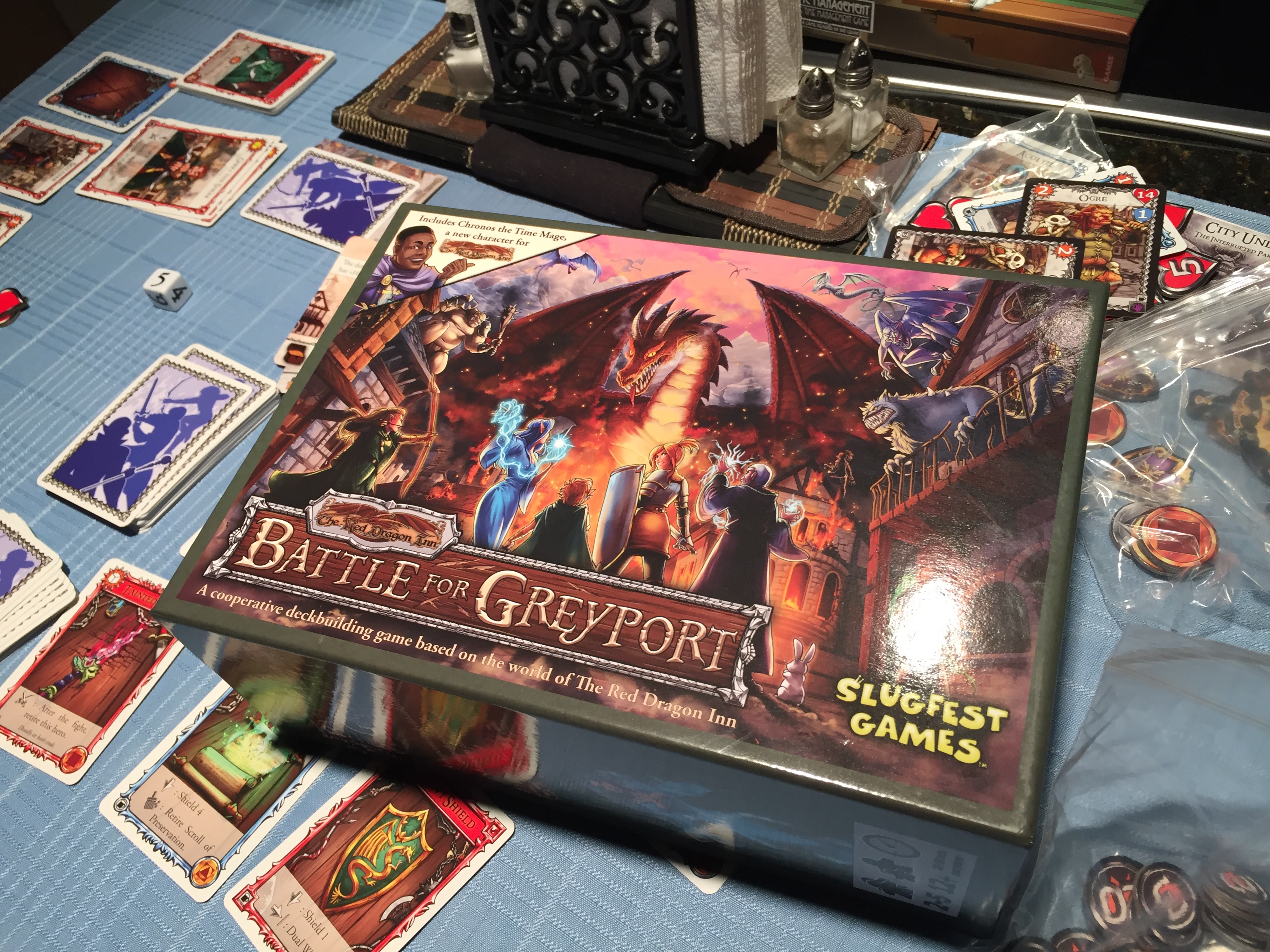
I do love this universe … especially the Red Dragon Inn cooperative Deck-Building game called Battle for Greyport (see review here and here: It’s also in our Top 10 Cooperative Deck-Building Games!)! I love the art-style and the silly vibe of this universe!

Let’s take a look!

Unboxing

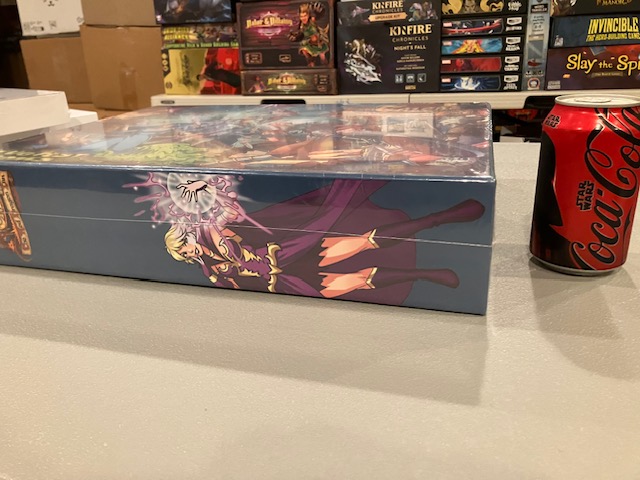
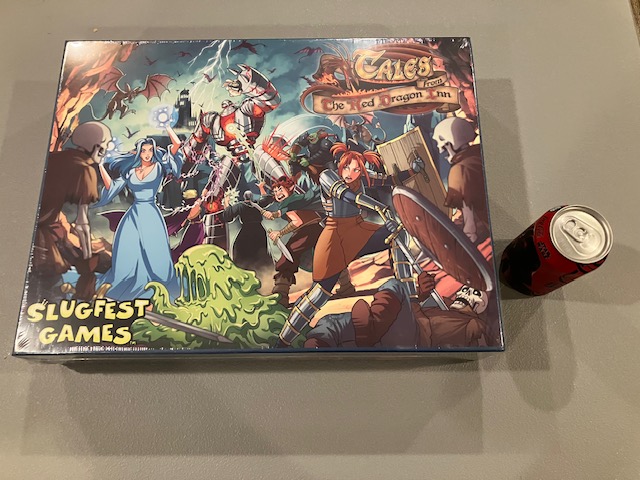
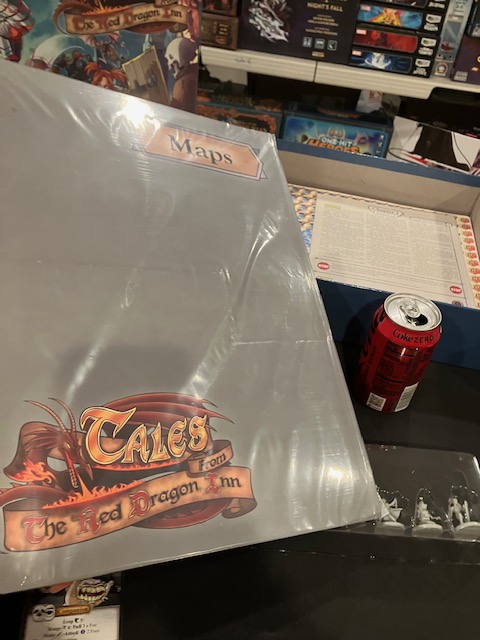
This is a fairly big mama-jamba of a box: see Coke can above and below for scale.

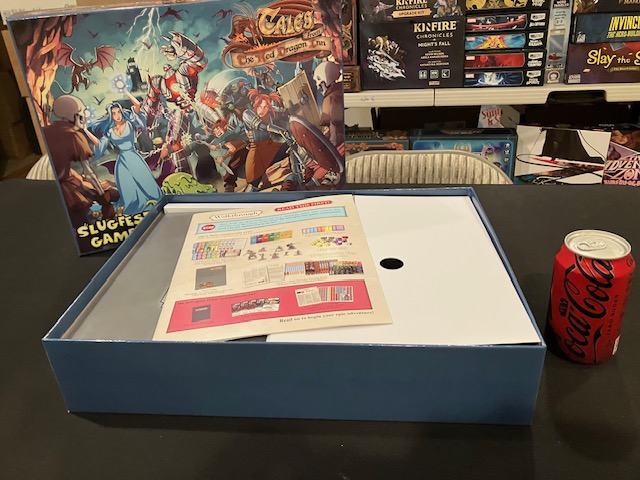
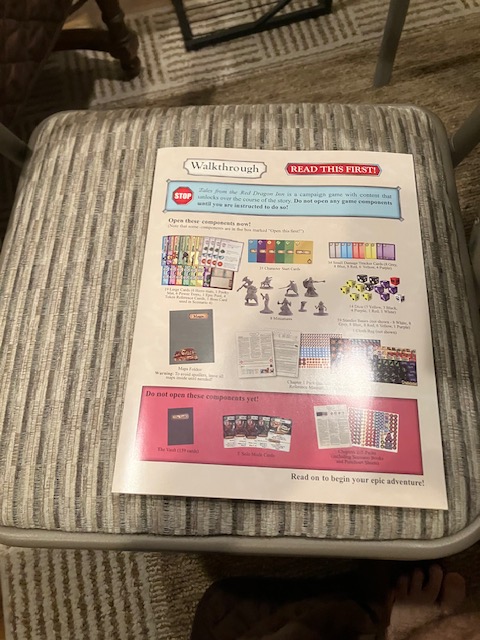
Ah, this game comes with a first-play walkthrough!  This is a really good walkthrough!

What’s in here?

The game comes with most of the cards and minis in this little grey box.  (Grey box?  Greyport? Get it?)

And some dice.

The minis are pretty good.

Underneath all that are the map packs.

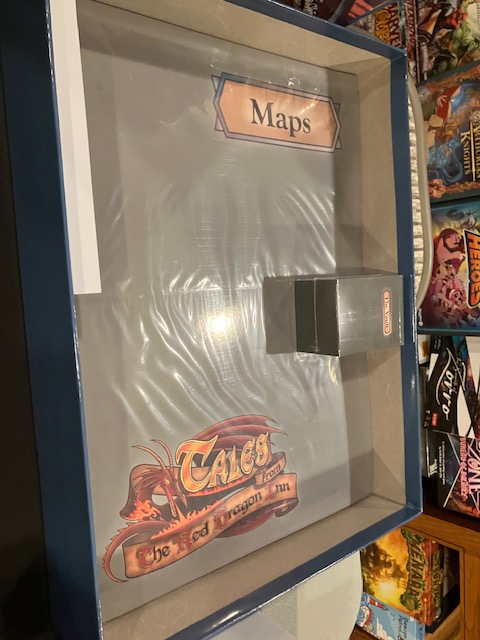
This map pack is pretty huge! See Coke can above for scale.

… and there are quite a few maps for the adventurers to go on!

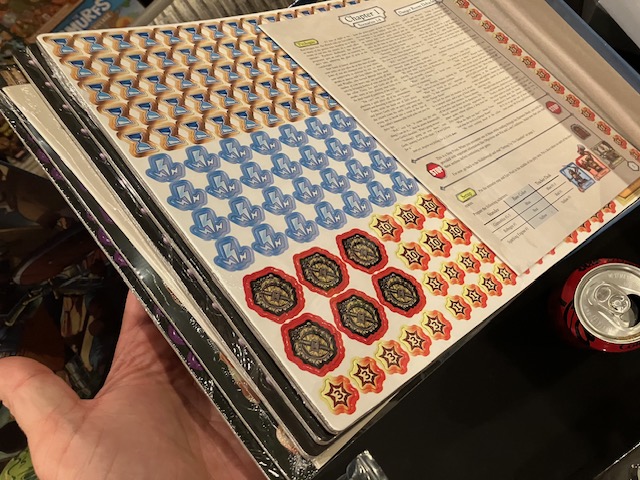
Underneath the maps are TONS OF PUNCHOUTS.  And by tons, I mean tons by weight!

There are 5 individually wrapped punchout sets (with multiple punchout sheets per set!)

And a new chapter rulebook per set!  Whew!

There are … so …. many … punchouts!

But overall, this looks pretty cool!  I am just scared of how many punchouts there … (but keep reading below …)

Gameplay

This is a cooperative dungeon-crawler where each player takes the role of a different hero … the typical Dungeons and Dragons archetypes are all here: thief, fighter, barbarian, etc.  Despite the classes being fairly generic, these characters have so much … character! 

Each character has some character specific cards giving the asymmetric powers.

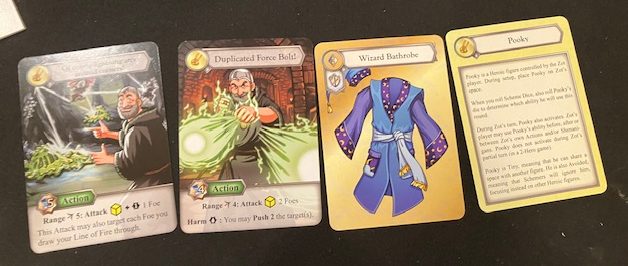
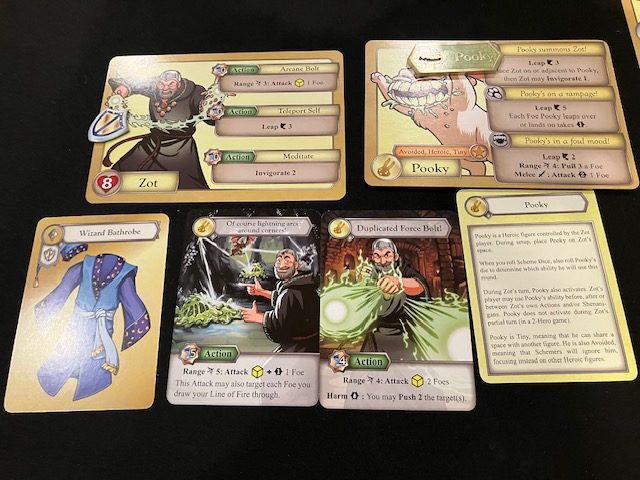
For example, Zot (above) has some special Actions specific to his character!  But notice the art and the feel!  This is not your typical dungeon crawler!  There’s character and a sense of humor here!  The game looks light and fun … and surprise! It is!  And pooky!

Players will set up the Chapter of their campaign; see scenario 1 of Chapter 1 above!

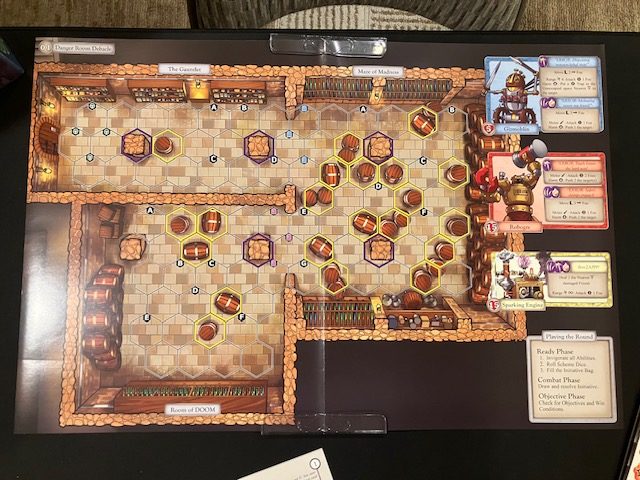
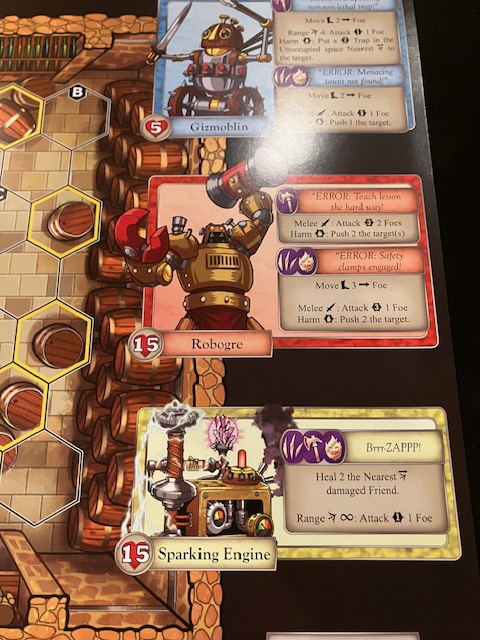
One of the coolest parts of this game is that the monsters are all described ON THE MAT!  So, you don’t have to go searching books or monster manuals for the monster info!

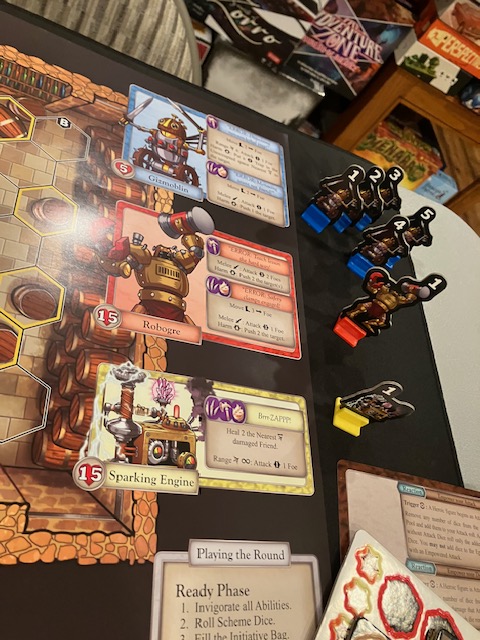
The minis are color-coded via bases, and this system works great. I was a little worried that the bases might “harm” the cardboard standees ( … Gloomhaven: I am looking at you …), but the standees stand well and the bases DO NOT harm the cardboard (NOTE: After a number of plays, there’s a little bit of wear and tear, but it doesn’t ruin the cardboard: it just indents it a little).

To keep track of hit points, each mini has a number above it, and  it also a little card associated with the number. See above.

It makes it really easy to correlate the mini with its hit point card!  This system is simple and works surprisingly well! They used colors really well here.

Players operate these heroes, explore the dungeon, and fight the baddies!

This is a fight-em-up dungeon crawler!

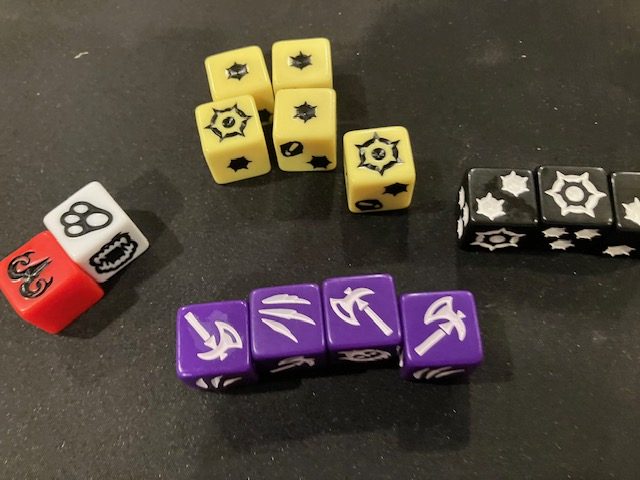
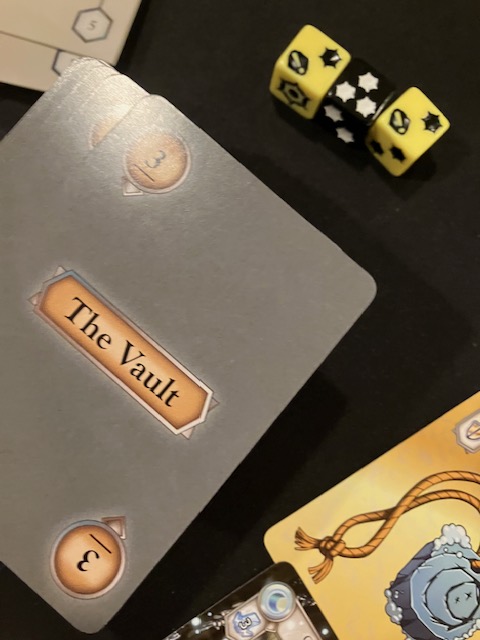
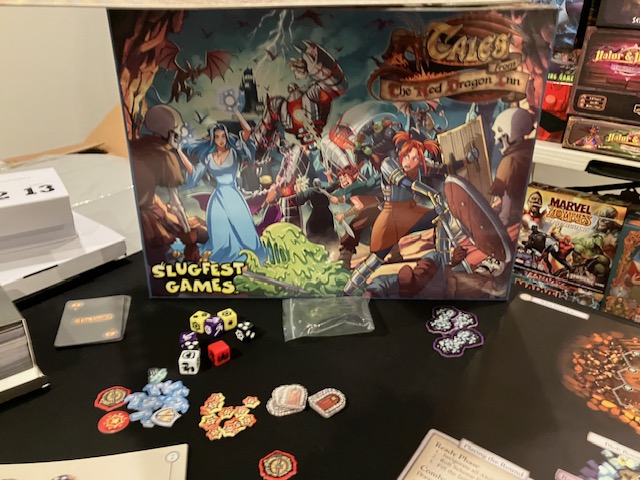
Combat is decided by the yellow and black dice.  You might be worried that the game is too random if dice decide a lot, but the dice are pretty consistent.  You will always get at least one success per dice, sometimes you will get exploding dice (which you can reroll over and over) and sometimes you will get some extra epic dice for FUTURE rolls!

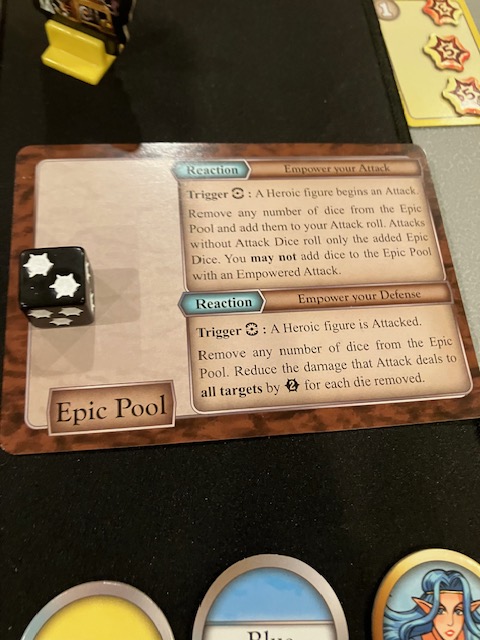
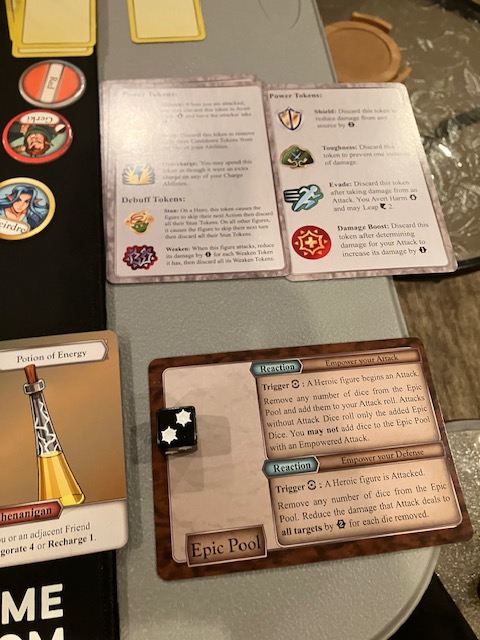
If you roll the ! (exclamation point) symbol on the yellow dice, you get an Epic black die (modulo some rules) which you can use on a future turn! My favorite part of this is that you can CHOOSE when to use the Epic dice on a future turn!  This reminds me a little of the Hour of Need system (see review here and here) where current rolls can contribute to future successes WHEN YOU WANT/NEED THEM!  You choose when to use those Epic Dice!  That’s so cool!

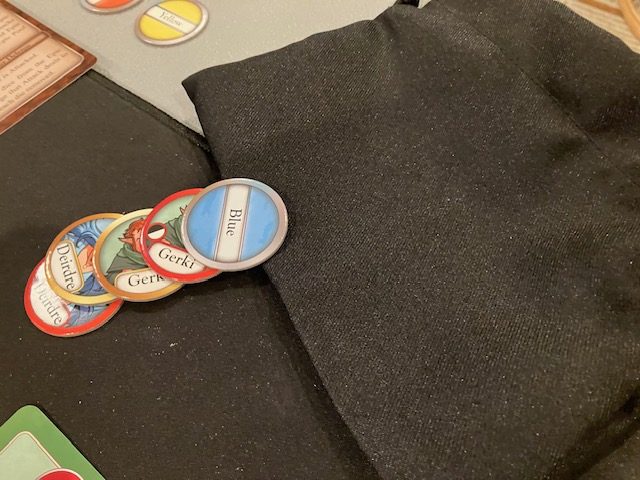
This is a Variable Turn Order game: each player and each set of monsters gets a token and one players pulls the token out of a bag to decide when each one goes.  See above.  I was very worried when I saw Variable Turn Order: was I going to have to worry about all the problems and try to come up with a solution?  See a very in-depth discussion of Variable Turn Order and its problems/solutions here!

After all was said and done, the Variable Turn Order system didn’t seem to suffer from the problems we normally see!

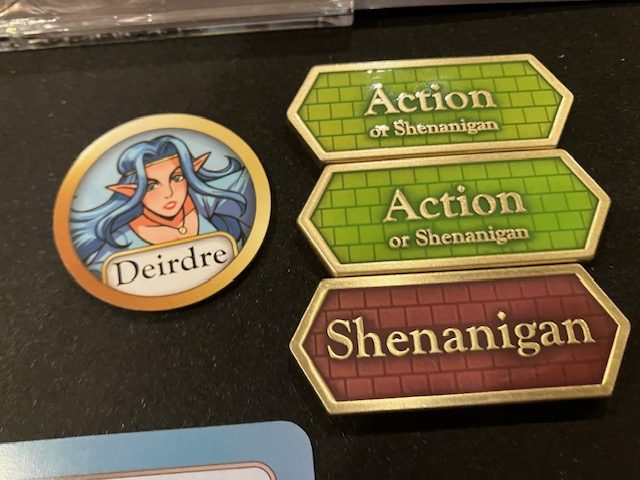
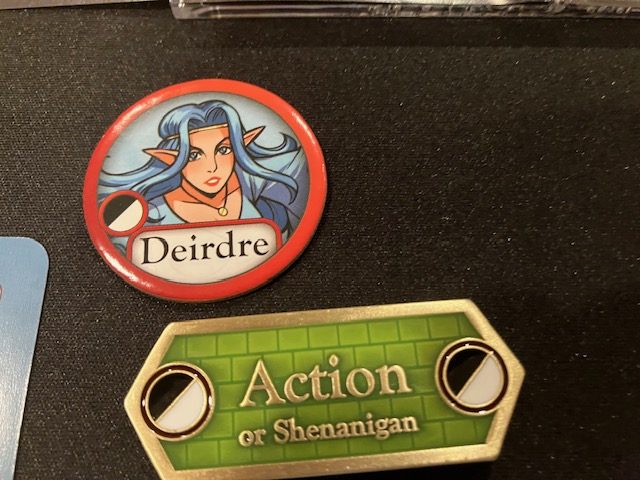
Depending on the token you draw, you either get 2 Actions and 1 Shenanigan …

Or 1 Action or Shenanigan! (1 and 2-Player games with partial actions).

Your Actions and Shenanigans are well defined on your cards!  See above!

Note that every character has very different Actions and Shenanigans! It’s funny, that one word Shenanigans kind of implies the overall vibe in this game …

This is all about your characters moving around the maps and fighting baddies!

If you reach the final objective (killing the yellow slime above for scenario 1: see above), you win (… if you survive to the objective phase…)! If any character dies, you lose! There are other losing conditions too, as you get further into the game.

It’s a fun dungeon crawler! And you get to level-up your characters too! As the game gets further along, you can get new cards from THE VAULT which you can use to choose upgrades!

Walkthrough

By far the best part of this game is HOW GOOD the first play walkthrough is!

This Walkthrough takes you through the first 4 scenarios of Chapter 1 in great detail!  There’s no need to read the rulebook ahead of time (well, because there isn’t one) … you are just learning the rules as you play from the Walkthrough!

Coupled with the Walkthrough is also the Chapter Guide (see above).  The Walkthrough tells you when to look at the Walkthrough and when to look at the Chapter Guide for specific set-up.

I can’t tell you HOW MUCH I liked this walkthrough!  Worried about getting into the game?  Naaah … this Walkthrough is fabulous!  It slowly introduces you to all the rules as you go.  This reminds me very much a video game training mode; it works so well!

Incremental Punchout

One thing I was VERY worried about was punching out ALL THOSE TOKENS before you can play!  And guess what!  You don’t have to!  You can punchout what you need as the game flows!

Do you need some monsters?  Just punch them out now when you need them!

This Incremental Punchout philosophy worked really well with the way that the Walkthrough taught the rules; learn a little bit at a time, punchout a little bit at a time!!! So, don’t get overwhelmed by all the tokens … just take tokens as you need them.  I wish the rulebook had emphasized this point, because just LOOKING at the token sheets gave me heartburn! 

I strongly recommend you punchout as you go and do not do everything at once: you’ll get right into the game that much quicker!

What Is This?

How would I describe this game?  In one word: LighthavenTales From Red Dragon Inn has a lot of similarities to Gloomhaven: it’s a cooperative dungeon-crawler campaign!  Players explore the world, fight monsters, upgrade characters, and quest quest quest.  But the gameplay is lighter, the rules are lighter, the world is “lighter”, the art is lighter and cuter … there’s no Gloom here!  

Like Gloomhaven, Tales from Red Dragon Inn does have a lot of components, but this world just feels just so easy to jump into.  

There is some story here: about as much story as Gloomhaven.  If you are looking for more adventure games, consider games like Arydia (see review here) or storybook games like Tales of the Arthurian Knights (see review here).  If you want story story story, this probably isn’t the game for you … this is a dungeon crawler where you fight monsters!

Solo Play

So, Tales from the Red Dragon Inn does support a solo mode!   (Thanks for following Saunders’ Law!)   In fact, two solo modes!

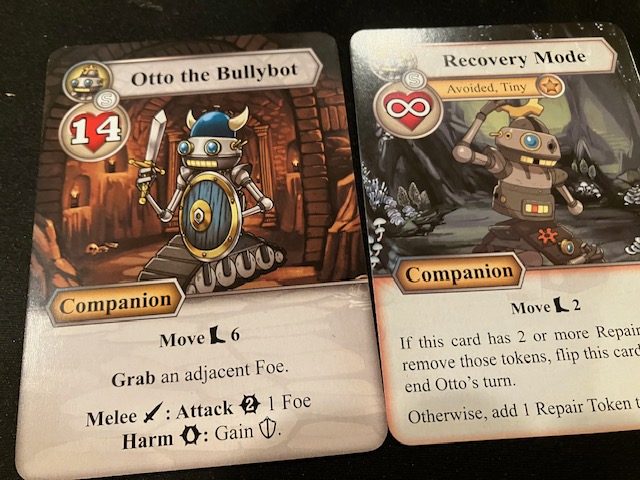
It’s a little bit of a bummer that the solo play isn’t addressed right up front … you have to go looking for the solo rules in the Glossary (a very complete book!) that comes with the game.  See above.  There are two solo modes; play normal, but alternate between some characters like a multiplayer game …  or play a solo character with a Companion.

The Companion has a special set of cards: see above.  The Companion rules also take up a full page on the Glossary with lots of exceptions to gameplay.  I usually HATE solo modes with lots of exceptions to the rules, so I opted to just alternate between two characters because there are NO RULES CHANGES.  I strongly recommend this is how you play solo; the Companion is still an “extra” thing to play and doesn’t save that much context switch overhead.  At this point, I have played the first Chapter all the way through with two characters and didn’t have any problem going back and forth between characters. In other words, the context switching between two characters didn’t seem to cause me any issues as I played solo.

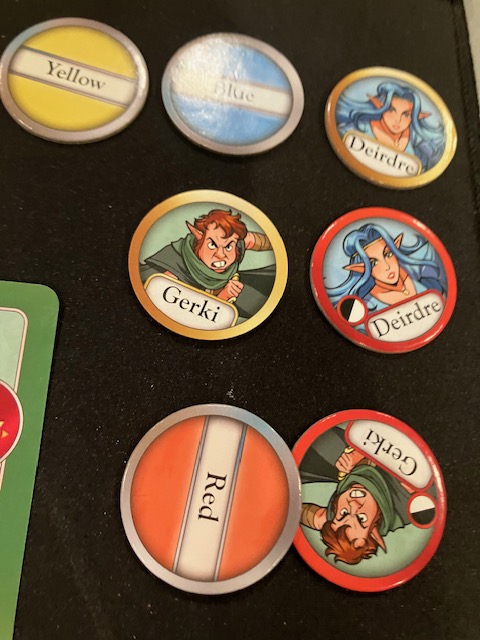
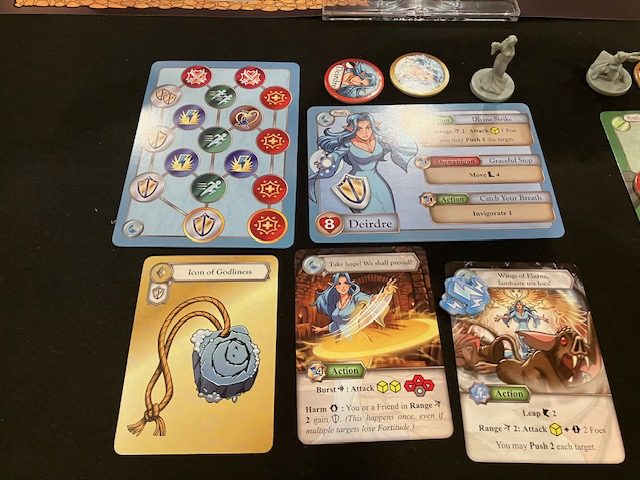
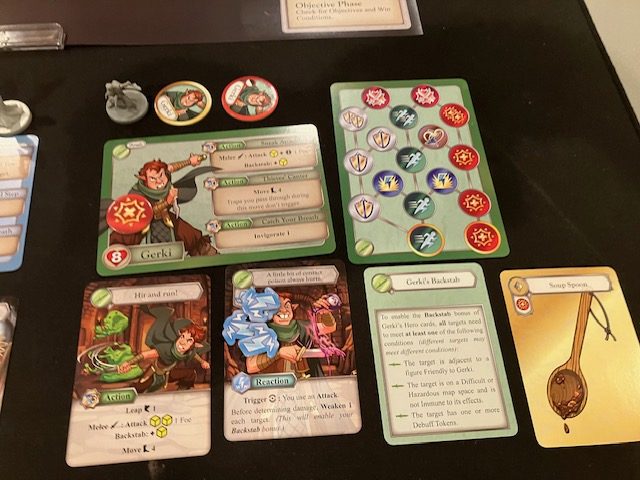
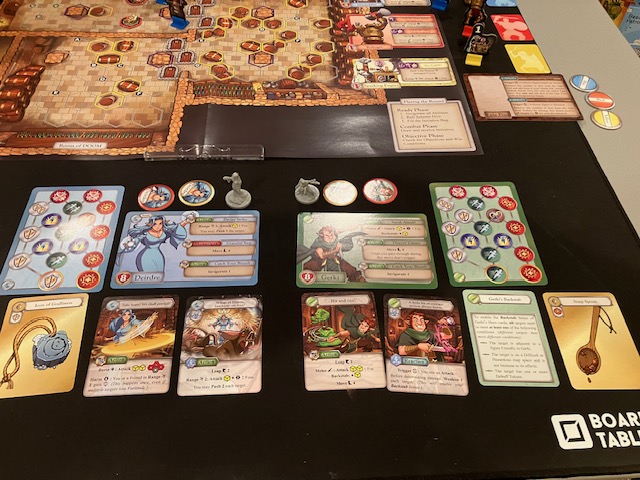
My solo game was operating Deidre and Gerki.  They made a great team!  These two characters really worked well together; Deidre is better at long distance stuff, but occasionally she’ll get in there and help Gerki!  If she stands NEXT TO some monsters, Gerki gets his backstab ability (an extra die!)  The amount of cooperation between the two was quite good.  

I have spent about 15 hours playing the game solo.  I learned the game solo, set-up the game solo, upgraded, read the Walkthrough solo, and played all 4 scenarios of Chapter 1!  I had a blast!  I loved the simplicity of the system, I loved how the characters can work together well and support each other, I loved the “sense of humor” the art implies, I loved the art, I loved the vibe!

Once you know the game, your sessions can be quicker, but be prepared for your first 4 sessions to take about 15 hours or so!  But, it flies by!  You are having fun and always doing something!

I look forward to more solo sessions, but I had to reset the game (this is not a legacy game, but it is a campaign game and you can reset it) so I could play it cooperatively with my friend(s).

Cooperative Play

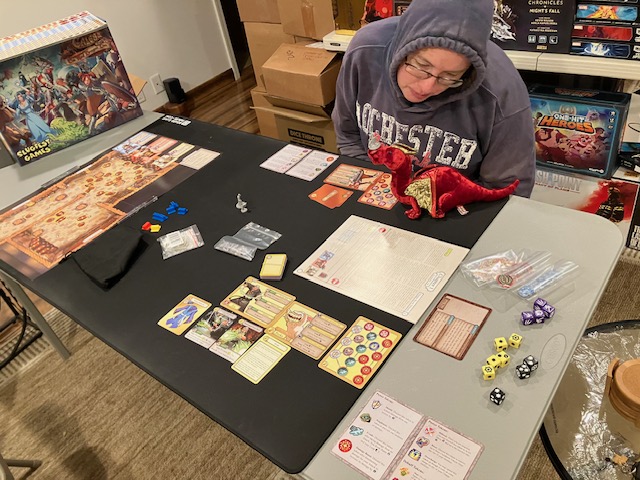
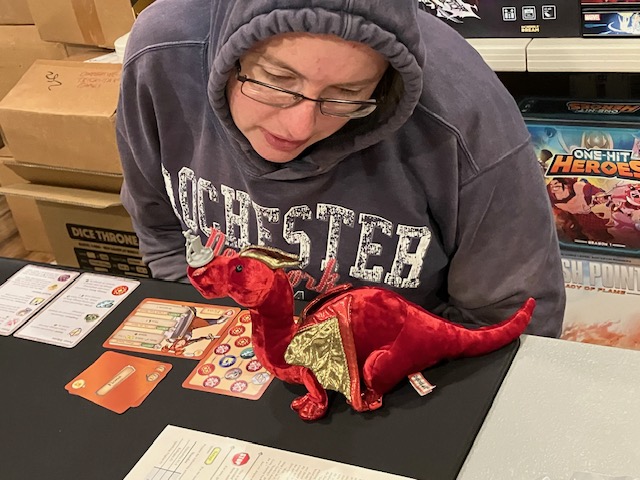
My first cooperative experience was a 2-Player game with Teresa.  She brought over a little red dragon as a mascot … it was quite apropos!

For a different experience from the solo game, I played Zot the wizard.  He was funny!

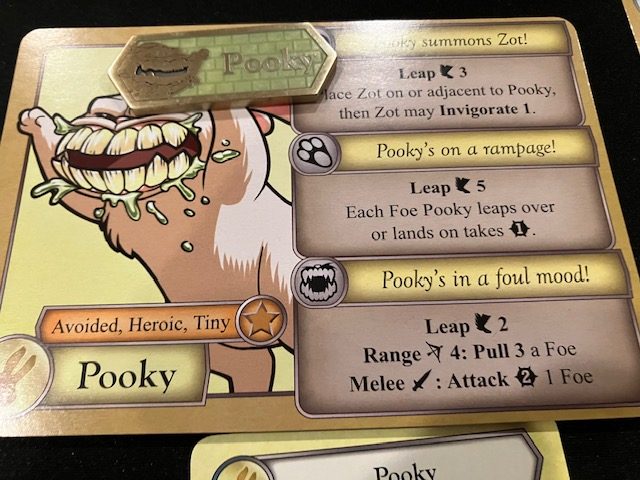
It’s hilarious that the little guy POOKY who helps Zot summons HIM!  (Not the other way around) See above!  That’s hilarious!  And yes, we are convinced this is the rabbit from Monty Python and The Holy Grail.

Like the solo game, we saw some good cooperation as Teresa’s Fiona Character was all melee, while Zot was all distance!  A good combo!

The game also moved much more quickly since I had already played the entire Chapter 1 solo.  A lot of those “15 hours” I spent in the first 4 solo games were shortened considerably!  I think Teresa and I got through Scenario 1 is about an hour!

Playing solo ahead of time significantly increased how quickly we were able to get into this game.  

Will we play more?  Basically, Teresa wants to wait until Sara comes back and then we’ll start a 3-Player campaign!  

I think it was a success cooperatively: it’s always a good sign when your friends ask to continue the campaign!

Story vs Flavor Text

There’s not a lot of story per se, but there is a lot of flavor text that gives the game direction and charm, and helps establish the parameters of the game.   To be clear, you really don’t HAVE to read the flavor text … I didn’t read it all in my solo play, but it didn’t really detract from the game by not reading it.  Teresa LOVES flavor text, so we did read it (see above) and it did contribute to the atmosphere of the game: see above.

What I Liked

Charm: This game has so much charm!   The art style that permeates this game is just so much fun! It stays within the Red Dragon Inn universe … Dragonverse?

Unique Characters: The characters are also so unique and different! For example: the fact that Pooky (the little familiar) summons Zot is hilarious!

Walkthrough:  This first play Walkthrough is exceptional and makes it easy to jump in!

The Dice System:  I was really worried the dice system would be too random, but it’s really not.  You always get at least one success, you can get exploding dice, and you can choose to use Epic Dice if you want for “extra help”!  The Epic Dice system worked well!  You could choose when to use the Epic Dice when you really needed a win!  

Vibe:  This is a light-hearted Gloomhaven … it could have easily been called Lighthaven! Yet, it’s still a deep game with lots of play and meaningful decisions!

Level-Up:  Levelling-up is easy and interesting!  Every character levels up, but it’s not described u pages and pages of tables in a book!  You just grab the cards destined for you, or choose some! It’s really easy!

What I Didn’t Like

SO MANY PUNCHOUTS!  The sheer number of punchouts in this game is terrifying.  Word of advice, just punch out tokens as you need them.  In fact, I ended up trying to put the monsters BACK into the token sheets when I was done with them!  Partly I did this to reset the game, but the game just stores easier if you keep things in the punchout sheets as much as possible. I know, that’s not ideal. 

Part of this was a little foreshadowing too … you saw how many punchout sheets are coming, right?  Do you REALLY think you are going to be able store ALL THESE tokens in bags back in the box?  So, I put as many tokens as a I could back into the punchouts as a favor to future me.

Conclusion

Well, Tales from Red Dragon Inn should have made my Top 10 Cooperative Games of 2024 because the first release came out in 2024.  But I didn’t get it until the second Kickstarter, so I didn’t get it until 2025!  So, it will probably make my Top 10 Cooperative Games of 2025 … but it might have to be an honorable mention, just because it wasn’t released in 2024.  Or maybe I’ll just count it as 2025 since I backed the second Kickstarer … not sure …

This is a fun and light dungeon-crawler, but still lots of depth and meaningful decisions.  You fight monsters and you have fun as a group of adventurers!  There is some story here, but it’s mostly just fun flavor text.

Tales from Red Dragon Inn is a great solo and cooperative game: 9/10. It’s so fun!

I think the only reason this didn’t get a 10/10 was because the Variable Turn Order can sometimes be … disappointing.  I wish there had been a way to mitigate/control the Variable Turn Order, but it didn’t get in the way that much. 


A Cooperative/Solo Print-And-Play Roll-and-Write Game! Roll or Stand: Jurassic Adventures! The Theme is EXACTLY What You Think It Is!

Roll or Stand: Jurassic Adventures is a print-and-play solo and cooperative roll-and-write game that was on Kickstarter back in March 2025, and it promised delivery in April 2025.  That’s right! One month afterwards!!  And it did it!!!  How did they do that?  Because there was no actual physical delivery; I was sent some PDFs in email after the Kickstarter fullfilled.  It’s a print-and-play!

In order to play, you need to print 3 pages per player (if you want the full campaign). You also need just one copy of the rules (4 pages of rules) and one copy of the campaign rules (1 page).  See above. For one person, you need to print 3+1+4 = 8 pages.  For 4 people, you have to print 4*3 + 1 + 4 = 17 pages.

Ever since my first print-and-play was a little more work and money than I expected (see our review of Legends of Storm City), I picked up a newer printer that was was MUCH cheaper to print stuff on.  I was able to print pages for one solo game and a 4-Player cooperative game without worrying too much about the cost.  (But see our Legends of Storm City review if you want more discussion of how much it can cost to print print-and-play games!)

In case it isn’t instantly clear (see above): this is a roll-and-write with a Jurassic Park theme! The publisher probably won’t get sued for calling it Jurassic Adventures, but you never know!

Let’s take a look!

Printing

What are the pages you need to print?

The rules: See above.  The rules are very nicely done over 4 pages.  The rules have lots of examples! The font, although is a little small, is very nice and, dare-I-say, pleasant to look at?

There were a few times when I wish the rules were a little better, but they do seem to specify everything: you might just have to look through them a little.   Luckily, you can reuse these rules over and over after you print them.

The Campaign Sheet:  See above.  This sheet gives bonuses and starting conditions for each game plus a little flavor text.  You only need one of these for each group (arguably, you can reuse this over and over if you don’t put your name at the bottom).

But the most important pages are the 3 Scenario Sheets (see them above). Each player will need their own copy of these Scenario Sheets to play: this is the one thing of which EVERYONE will have to have their own copy!

Each scenario sheet has four chapters (puzzles) at the top of the page (see above), and a shared preparation area at the bottom.  The player will marking both the top part AND and bottom part up! See below!

Gameplay

Every turn, two dice are rolled (you have to supply your own dice).   These two numbers are shared to everyone playing.

The stamina area “forces” dice to a certain regime; if there is no entry (“charge”) for one of the numbers you rolled, you must decrease that die until you find an empty charge (rolling over back to 6).  Once a stamina line is “filled”, you move to the next line … and possibilities open up again.  Let’s be clear; when the stamina line is almost filled, you have a very good idea what the next numbers will have to be!  This really helps mitigate some of the randomness of rolling dice!

After you get your two numbers, you choose to record one number on the left Preparation side and one number to the right Preparation area. See above.

If you wish to “futz” with your two numbers, you can cross off “ideas” to add or subtract one to the numbers (for you only: this doesn’t affect anyone else).

You record the number to the next empty box.  If you want, you can push-your-luck and “roll”, hoping to add more numbers to you line on the next roll of the dice.

Or, if you want to, you can “Stand” (marking off the leftmost square with a cross) and activate your actions!  You are now committed to act!

The number of actions you get is based on how far you pushed your luck: the longer you wait, the more actions you get.  See above as I get 6 actions when I activate my line!

How many actions do you get?  Your sum (4+2+6 = 12) – rightmost (6) = 6 actions!

Note that you CAN BUST if you put too many numbers on a line!  In the case above, I BUST because my numbers exceed the MAX (10) by being 2+3+1+6 = 12!!  If you do BUST, you lose all the actions of that line BUT you get a booby prize of one of the tools (the rightmost symbol: the binoculars at the right under the 6).

So this is a game about pushing your luck, and knowing when to activate a line to get your actions! The Kickstarter called this a “blackjack-like” mechanism! Basically, push-your-luck so you don’t bust!

Once you have your actions, what do you do with them?  Basically, you mark off lines on the current puzzle!  With each action, you can mark a line!

Which lines?  It depends on the numbers on the line!  On the line above, I had a 2, 4, and 6 which means I can only draw upper left, upper right, and down lines!

That’s right!  You are limited to what lines you can draw by the numbers you used to activate the line!  

This is why ideas and Tools are so important! If you really need to up/down a dice, you can use ideas or tools to draw the line you need!  Be careful!  Ideas/Tools are a limited resource!

After you achieve the current puzzle, you immediately move to the next! 

If you can get all 4 puzzles done before the stamina or preparation lines run out, you are done!

Whether or not you win depends on “how many puzzles you failed!”  If you failed NO puzzles, you get the Success story!

If you have under 1 failure per player, you get the Delayed outcome (which is usually still a success .. see above!)

Play all 3 scenario sheets for a full campaign!

Solo Play

I had my solo copy ready since April 2025, but I just had never gotten around to playing it.  It didn’t take too long to print out (3 months ago), but I was ready to go!

Over the course of one evening, I played through the entire 3-sheet campaign. I took a break after scenario 2 for dinner, but came back to it.  All in all, it probably took about 2 hours to play all the way through, with about an extra 1.5 hours of reading and deciphering the rules.  

The solo campaign is easy to get to the table; it has some interesting decisions as you have to decide when to use your limited ideas, limited tools, which dice to use in which area, when to stand and when to roll!

This is also a very spatial-oriented puzzle, as you have to make sure you have the right line segments to do what you need to on your current puzzle!  The puzzle above starts at the top (3), and you want more “downwards” line segments to help!

There’s a lot of great decisions, but the game moves along at a pretty good clip.  You can have as much analysis paralysis as you want, but generally the game moved along.  I freely admit that I stopped a few times and had some analysis paralysis …

I had a fine time playing solo.  Even though the puzzles are similar in some ways (just draw line segments), they were pretty thematic with the “Jurassic park”-like concept.  There was a good variety over 12 puzzles in the campaign—I saw a neat little story unfold.

Fun solo.

Cooperative

For my cooperative game, I readied myself for a 4-Player game.  I may have overprinted the game; I probably didn’t have to print rules sheets for everyone, but in my group, people like to have their own copy of the rules!

We ended up only playing a 3-Player cooperative game!  

This went over … okay.  The only real opportunities for cooperation are that you can share Ideas and/or Tools.  Thematically, that made some sense!  “Hey!  I got an Idea I can share with you!” Unfortunately, we didn’t end up sharing at all!  The resources are so limited in the game (you only have so many Ideas and Tools) that it never felt good to share them!  Although the opportunity was there, we never availed ourselves of the “sharing”.  

This game was mostly multi-player solitaire. But at least we weren’t getting in each others way.

Pen vs. Pencil

A pencil probably won’t work with this game.  Can you tell I circled the first 5 Ideas above?  No? Me neither!

I ended up using a red sharpie so it was VERY clear when I noted something. See above.

Ah!  Now you can tell I circled the Ideas!

Of course, sharpies may bleed, so I got a paper bag on the back side to handle any bleed through.

The only problem with the Pen is you really can’t correct any mistakes.  Remember my BUST example?  Can you tell that was a 6 on the right?  It was only a 6 after I “sorta” corrected it.  

If you find yourself wanting to play more of this, consider laminating the Scenario sheets and using dry-erase (extra-thin!!) markers; then you can correct them and re-use the sheets over and over.

Small House Rule

The rules specifically say to write the number of actions in the right most area: see above as I clumsily write a 6, and it obscures the direction wedges!

What I ended up doing is writing the number of actions off to the side!  See above as the actions are on the LEFT for the left prep area, and the actions are on the RIGHT for the right prep area!  And then it’s MUCH easier to see which wedges are available for your actions, since the action number isn’t obscuring the wedges!

Things I Liked

Theme: there’s a surprising amount of theme and story 

Choices: I generally feel like I have a lot of choices, and I know what’s coming because of the stamina concept forging the dice.   This had just enough randomness to be interesting, but not enough to infuriate me.

What I Didn’t Like

Too small: the sheets at times felt a little too small! Each scenario sheet feels like it should be two sheets; the top half should be its own sheet, and the bottom half should be its own sheet. I am surprised this wasn’t a printing option. The whole thing does fit on a page, which is nice, but I think if I wanted to laminate this and use dry-erase pens, I’d want bigger sheets. I wish a full-sized upper half and full-sized lower half had been PDFs included in my distribution.

Cooperation: There wasn’t really any cooperation.  Although the opportunities were there, we didn’t avail ourselves of them because the resources were so limited.

House Rule for More Cooperation

How can we cooperate more? One complaint is that the game really wasn’t that cooperative.

Looking back on our cooperative game, the one thing you can do is change the dice separately! The players have to take the dice as rolled, but then each player can spend Ideas “separately” to +- 1 the dice on their board. What if this were more cooperative? What if, as a group, we could decide to spend an Idea and have it change a dice for all of us? This would promote a lot of conversation and lots of interaction! “Well, I really need a 6!” “But we both need 5s!” “Hm, you can save an Idea if you change it once!”

This is just an idea for a House Rule, but it would make the game more cooperative and interactive.

Conclusion

Jurassic Adventures was a mixed bag.  I liked it solo and might play it again: the theme and gameplay was fun!  It was a 6.5/10 or maybe 7/10.  My friend Sara probably wouldn’t play it again cooperatively, (5/10) but my friend Teresa would (6/10).  Although the game bills itself as cooperative, it felt much more multiplayer solitaire … mostly because the resources were so limited that it was too hard to share!   We do propose a house rule that might make Jurassic Adventures more cooperative and more enjoyable, but you may like this “mostly” multiplayer solitaire game as it is.

If you do play this, make sure you play with a pen instead of a pencil; even though you can’t correct your pen without making a mess, you just can’t see the pencil marks!

Magic And Murder Mysteries! A Review of Murders at Karlov Manor: The Case of the Three Blade Knife

IMG_7366

So, this is a murder mystery in the world of Magic: The Gathering?  Yup, that’s what this is!  Although its official title is Murders At Karlov Manor: The Case of the Three Blade Knife! See the BoardGameGeek listing here.

IMG_7365

My friends and I really enjoy our murder mysteries (see our Top 10 Cooperative Detective Games), so we were excited to try this out!

Let’s Take a Look!

Unboxing

IMG_7323

Part of the problem with reviewing Murder Mysteries is that part of the fun of the game is exploring the system!  What’s new in the box?  How do things work?  How does this do stuff differently?  

To that end, we’ll give some very generic thoughts up front which shouldn’t reveal too much of the mystery.   Feel free to stop reading after that if you want to just try it yourself!  After that, we’ll have some minor spoilers, followed by possibly some major spoilers.  Read as far as you want!

High-Level Thoughts: No Spoilers!

IMG_7327

This was a mystery set in the world of Magic: The Gathering.  I know nothing of this world, and my friends know just a little.  Not knowing the world didn’t affect whether or not we could play the murder mystery.  I am sure there there were plenty of “A-HA!” moments for Magic: The Gathering players, but it didn’t stop us from enjoying the game.

IMG_7344

There are a LOT of materials to get through: our game took place in one night for 2.5 hours.  We were able to get to the end of the crime and solve it in one night.  This is a little bit of a slog to get through: there are a lot of materials to read out loud and share!

IMG_7324

In the end, we didn’t love this. 

Rich: Has specific complaints, which he will address in the spoilers section below.
Teresa: Liked it the best, as she got to “perform” and she really enjoys reading stuff out loud. 
Andrew: thought it was a little bit of a slog, as there was so much paperwork to get through!  He still thought it was better than Detective (the Portal Games).  It kinda felt like work.
Sara: It was pretty good.

The general consensus was that it was okay.  Rich liked it the least (probably with a 4/10) and Teresa liked it the most (with a 7/10).   The biggest complaint from everybody was that, even though this was set on the world of magic, specifically Magic: The Gathering, it felt like it could have been in any world: Noir, Cthulu, Voodoo Pirate, something else?   We still dusted for fingerprints, but it felt like someone searched and replaced “dusted for fingerprints” with “used fingerprint ooze“.   Sara pointed out (I think correctly) that this would have been a better mystery set in the 1920s world of Cthulu.

Overall, it was ok.  There were some nice highlights in the experience, but it was a lot of paperwork to slog through, and the mystery itself had its issues.   The 4/10 from Rich was because he really disagreed with how the mystery was handled, Andrew was probably a 5/10, Sara a 6/10, and Teresa a 7/10. 

Maybe you just like living in this world, and just like doing the paperwork of a mystery, and reading the materials: then you, like Teresa may really enjoy this.   The story presented overall was interesting.

If you want to read more specific complaints, read on. 

…. space left intentionally blank …

… space left intentionally blank …

Minor Spoilers: Some Issues

IMG_7328

The game comes with a very cool metal pendant!  It serves as your RAMI badge for the game!

IMG_7335

You download an app, and put your phone above it to get “some augmented reality options!”  See above!

IMG_7338

One complaint is that The Case of the Three Blade Knife looked like it would be a cool immersive augmented reality adventure! Look at the cool app above!  But it really wasn’t!!

IMG_8499

We loved The Arkham Asylum Files: Panic in Gotham City (see review here) and it even made the #1 spot on our Top 10 Cooperative Games of 2023!  We were blown away by the augmented reality here!

IMG_7337

This wasn’t really much of an augmented reality experience. We used the phone just a few times? We could have replaced the phone with a piece of red acetate for some of it.  The best part of the phone app was in the finale, where THE GAME WAS ON RAILS!  At the end of the game, the phone was cool in that it presented the finale really well (cool voice acting), but during the adventure when it mattered, we used it like once.

IMG_7336

How much money was spent on the metal RAMI badge?  How much money was spent on making the app?  If we used the phone more during the adventure, this would have been cooler.  But we didn’t.  The ending was cool, but by that point, the adventure was over and this was just a “presentation”, not an interactive murder mystery with cool augmented reality.

I am not sure it was worth the extra money for the metal RAMI badge and the money to make the app.

I will say that the finale was very cool.

… space intentionally left blank …

…. space intentionally left blank …

… space intentionally left blank …

Major Spoilers: Mystery Progression

IMG_7341

There was a lot of reading: This was work. The materials were well-organized, but getting through them was almost like homework. Still, the materials were very cool: see some above and below.

IMG_7334

There were two major problems with the mystery: 

1) Ignore motive.  The game literally said something like “don’t worry about the motive, just choose someone“.  So, we are looking for means and opportunity only?

2) What are The rules of Magic?  We live in a world of magic, literally Magic: The Gathering!!  What the rules of magic?   Magic can make means and opportunity that much more opaque (teleportation, scrying, Bigby’s giant hands!).   We have NO IDEA what the rules of magic are going into this adventure, so that completely obscures means and opportunity.

I feel like, unless the rules of Magic are somehow explained in some way, it makes it too easy to make a murder mystery unsolvable.  “The murder weapon could have been handled remotely, the murdered could have teleported in and away, the murdered could stop time to leave no trace, etc.., etc., etc., etc.”. 

So, hints, evidence, don’t seem to matter as much.  Because magic can do anything.  This really soured some of us on the mystery after it was revealed:  we had spent 2.5 hours combing through evidence only to have a Deus Ex Machina explanation. I hated it.

.

… the space left intentionally blank …

… this space left intentionally blank …

Giant Spoiler!! Read At Your Own Peril!!

IMG_7343

In the end, the only major use of magic was to possess someone and frame them for the murders.  We had no clue this was happening, we had no books to read, we had no idea.  We just “guessed” the murderer based on location, and then went to the endgame.  By the time you are in endgame, the game is on rails and it’s easy to solve.

This game pissed me off because it didn’t feel like a mystery.  You just guessed at someone based on  location, but all the while “magic” (whose rules were unexplained) was the driving cause.  

This was more of a “explore this world, make some guesses, and enjoy the story”.  If I had known that going in, I may have enjoyed it more.  But I was so busy trying to put a good solid well-crafted mystery story on top, I was pissed off when I learned what actually happened.

My friends, who enjoyed the story for what it was, had more fun that I did. 

… this space intentionally left blank …

… this space intentionally left blank …

Conclusion

IMG_7340

If you look at Murder At Karlov Manor: The Case of the Three Bladed Knife as a story that unwraps, then maybe you’ll enjoy it for what it us.  Given how much work there is to go through all the paperwork, I was very frustrated with the lack of clues,  lack of evidence, lack of explanations of rules of Magic, and the Deux Ex Machina final solution.

But I was definitely the outlier here: my friends enjoyed the story and had fun.  I didn’t.

Soul Raiders: A Solo and Cooperative Review

Soul Raiders is a cooperative fantasy adventure game that was on Kickstarter back in July 2021 and promised delivery in December 2022.  I backed the deluxe Grimoire Edition (above). Well, it finally arrived last month (March 2025), so it’s about 2.3 years late.  This wasn’t on my Top 10 Anticipated Cooperative Games of 2022, but it probably was my #11 or #12!

This sat unplayed in the box longer than it should have; I think I was scared of how big it was! Look how big it is!!!  Did I have the cycles to even try it?

Well, I finally got around to getting out and trying it … was it worth it?

Unboxing

Although this unboxing here is to show you what’s in the box, it’s also here to remind me how to put the box together!  So, it’s for me and you!

This is a BIG box.  This is the Grimoire Edition.

It’s got a lot of stuff packed in: see the character boxes above (this is a cooperative fantasy adventure game).

This game is so grandiose, it has it’s own lore book!

If you really want to get into a fantasy universe, this might be the right game for you!

This dual-layered board (above) keeps track of a lot of shared attributes and state of the game.

There’s lot of little boxes to store your game between sessions.

There’s some fabulous minis.


The campaign notebook allows to save the game between chapters.

There’s a bunch of cardboard tokens.

And boards for the characters.

Underneath all that, are the three main chapters of the game.

The cards of the game are in two boxes: see above.

Each of the chapter boxes has huge Location cards and little cards.

This game is GORGEOUS.  The production is GORGEOUS.

Consult the pictures above for when you need to repack your box!

Rulebook

The rulebook is good.  Well, ish.

It gets about a B+ on the Chair Test: it overhangs on the chair next to me just a little (see above), but it lays flat and open, it has a big readable fonts, and it has lot of pictures.

The components page is well-labelled and notated (see above).  It even breaks up the cards by chapters.

The set-up works pretty well, although it doesn’t show how the story cards will be laid out (which we need to discuss more).

This is a gorgeous rulebook that’s written pretty well, it has lots of examples and lots of pictures.

It even ends with a very useful summary of icons on the back!

Although I liked this rulebook a lot, it made the mistake of putting too much content into the examples.  I like it when rules have clear definitions, then maybe use the examples to help explain and/or clarify.  Unfortunately, I think this leaned a little too much into using the examples AS the rules a few times.    Don’t get me wrong, I am glad the examples are there, but I wanted clear succinct rules as well.  (I think the last time we noticed this “rules in examples” phenomena was back Sleeping Gods rules: see link here).

The rulebook was generally good, and it frankly looks gorgeous (like the rest of the game).

Gameplay

The best way to describe this game? It feels like it a video game: a  Point-And-Click (fantasy) Adventure game with lots of monster fighting.

Each player takes the role of one of six characters: see the character boxes above.

Each character has his own set of cards: there’s basic Action cards (above top) and Heroic Action cards (above bottom).  Notice the Heroic Action cards have a special foil on them so you can tell them apart!

These Heroic Action cards are earned (in order) by spending Heroism tokens (3 to earn a new Heroic Action card).  Cool fact; you can spend 3 Heroism tokens at ANY time to immediately earn a new card! Very useful when you need a card immediately!

You get Heroism tokens are various plot points in the story, but the most reliable way to getting Heroism Tokens is by defeating BIG BAD MONSTERS!  Defeating the one above opens Story Card 14, but also earns the player 2 Heroism tokens!

By the end of Chapter 1, I had been able to earn 6 new Heroic Actions cards! (Heroic Action Cards must be earned in order: note the numbers on far right).

The cards are you primary currency for “getting things done”.  Some cards are more attuned to movement (as you must explore) … see above …

… and some cards are more attuned to fighting!  See above.  Basically, you can always use the value on the card for whatever you want, but the card will have “bonuses” if you use it for the specific specialization!

For example, Heroic Action card #6 (the top one) has a basic value of 5, but if you use it for fighting, you get an extra +3!

Example above: Even though the cards I drew were all movement-centric, I can use the values on the cards for fighting: 4+4 = 8 takes out the first shield on the bad guy, and 4+2 = 6 takes out the second shield!  I used all my cards, and I didn’t get any advantages, but I was able to do what I needed!

Basically, your character explores the world, moves around, interacts with the world, and fights monsters!  All actions are based on the values on your cards!

Basically, you character(s) move around on the Location sheets and explore!

The Locations have arrows which tell you how much its cost to move between Locations: see above and below.

For example, to move to Location 2, I need to spend 4 points from my cards.

This is kind of a choose-your-own adventure tale!  You decide which paths to take, which monsters to fight, which puzzles to interact with!  It feels very much like a choose-your-own adventure!

What’s cool is that each Location has pretty great art (a little comic-booky, but I like it) which describes all the things you can do at that Location … kind of like a choose-your-own-adventure book does in each section.

See above as the character starts on the maps!

An interesting thing that happens is that there is a “clock” pushing the game forward.  At the end of every “turn” after you’ve played all your cards, the Vitae track moves down.  Basically, every time it “wraps around” back to 30, you drop the Action token one space (upper right).  If your threat or the action space ever get to the end, the game is over!

To win, you need to find the Red Stars on the story cards.  If you don’t find appropriate story cards, you lose!

Explore, fight monsters, interact with your world: this is an adventure game!  The way the movement works, it feels very much like a choose-your-adventure game (as the Locations could just be pages numbers in a book!)   This game also feels like a Point-And-Click Adventure game too!  See our Top 10 Point-And-Click Adventure Board Games for more discussion of this genre!

Solo Play

So, this game supports the solo player (thank you for following Saunders’ Law).  This is a true solo game: the solo player operates one character.

The only real change for solo play is on the Game board:

On the Game Board, the final space has a “3” marker on it (instead of 2).  This is the number of cards you draw every turn, so the solo player has that extra advantage that (on the last set of rounds) they get three Action cards instead of two.  And that’s the only change!

The solo player explores, fights, and interacts … but just by himself!  There’s no real balancing anywhere else.    It seems a little weird that there are no other balancing mechanisms, but basically what tends to happen is that more enemies come out as more people play, so that tends to balance the game.  We’ll address that a little more in the cooperative section.

Cooperative

The cooperative game brought up a lot of rules I didn’t have to deal with in the solo game!  When you explore new Locations, whether or not someone is already there “changes” how the Location works!

Unfortunately, the Icons were very confusing about this.  A slight change of color AND whether its on side A or B makes a big difference.  It actually took us almost half the game sessions to get this right!

Although the cooperative game has a sense of Player Selected Turn Order, there really is no turn order!  Players just play when they want and support each other if it made sense.  Although I love this idea, as it should make the game go faster, the game tended to serialize as each player waited to see what happened to see if they needed help.  “Let’s wait to see what Sam gets!”   I love this from a cooperative point of view, as it lets us support each other!! Unfortunately, what really happened more often than not is that the game really just slowed down behind one (the current active player).  To be fair, there were also plenty of times when concurrent play kept the game moving forward.  This system worked pretty well from a cooperative point of view.  From a length of game point of view, this was not optimal.

Although this game is a 1-4 Player game, I was the fifth player and “the rules guy”.  I just read the rules and taught the game and looked up clarifications.  Sadly, this was a very busy position for most of the game!  I would constantly be looking up rules clarifications, icon clarifications, and other things.  I had played the solo game for about 8 hours, and I was still struggling to find some rules!

There are good moments of cooperation as the players supported each other.  Me being the “rule guy” actually worked pretty well, although it was sort of depressing that I had to fill this role.

Urgency

This game has, essentially, a built-in clock.  Every time you have finished playing all your cards, you have to take “Vitae” damage (basically, a shared hit point pool) based on the the current.  The threat will go up occasionally as monsters or other things happen.   And you can’t “usually” just rest on a Location: almost all Locations force you to fight new monsters if you stay there.

So the game is just always pushing forward:   This is both good and bad.  If you are looking for a contemplative adventure/exploration game, this isn’t really it.  If you want an adventure game that doesn’t stand still, but presents a sense of “you have to keep moving“, this is the adventure game for you.   Here’s a very bad analogy; some sharks have to keep moving in water or they die.  That’s kind of what you feel like here: players always have to keep moving (exploring) or you die.

Whether you like that urgency or not is up to you.

Kind of a Big Mess

When you take out the Location cards, there’s no real rhyme or reason to them.  They don’t form a map (like Arydia Locations did: see that review here), they are more like “pages of a book”.  See my big mess after finishing chapter 1!

The problem is that you WANT to see the connections from previous Locations you visited!  So you try to keep a lot of Locations out as you play so you can see how you came here.  And you can see my big mess above as I try to keep some Locations out.  To be clear: the Locations DO NOT form a map! (The rulebook even emphasizes this point).

So, the Locations that come out are kind of a mess.  Shrug.  It feels like there should be a better way to deal with it?

Portals

There are some very cool minis for portals!  See above!

You can see above as I have built at least one early in the game!  I was hoping to make this spot an easy one to come back since there are no “monster spawners” there!

And yet, I don’t think I took full advantage of the portals.  At all. I don’t think I used them once.  Which is a real shame, because they are so nice!

This is where I feel like this is even more like a Video game … where you replay the level to get the highest score and use the portals to their best advantage.  I played Chapter One and got a few extras, but not enough.  I feel like what I would do in a video game is replay it until I got the perfect score for that level!  I think to do that, I think you’d almost have to use the portals.

Maybe the portals will become more useful later on.  I was … disappointed with them.  Given how you never really get to just “think” (see Urgency section above), the only time it feels like you might be able to take full advantage of them is to replay the level.  Remember how I said this feels like a video game?  That min-max feeling emphasizes that point even more …

Save Game

This is a campaign.  You will need to save you game between chapters.  Unless you can leave the game set-up (and it is a table hog), you will have to save your game.

You can either use the campaign book   (above) …

Or just take a picture of your game and extras at the end (see above).  The cards are pretty well marked.

Let’s be clear: this is a campaign you can reset!  I have a solo game going, but we are also playing a cooperative game at the same time.  Sure, I’ll have to “pick” the cards out I want, but it’s fairly easy to reset the campaign to replay it from scratch.  This is not a legacy game.

Too Many Rules?

For such a lavish game, it’s both really simple and really complicated.  The basic card play is really straight forward, but all the little rules for combat and especially movement feel very complicated.  If you enter a Location with someone else, it has a different effect depending on the Icon in there, which has subtle difference between other Icons.

The fact that my role as “The Rules Guy” (as the 5th player and NOT playing the game) was pretty active the entire game might be an indicator that maybe there’s a few too many rules.

Reactions

Oof, Soul Raiders did not go over well with my group. My friends compared this to Tainted Grail (see part I and part II here) where it was just a grind to explore.   Andrew even commented: “This doesn’t feel like an exploration game, even though it kind of looks like one!  I have no mental model for how the map lays out because it’s so clumsy!”  Sara commented that the “.. Exploration feels like Tainted Grail because you just keep getting monsters!  You don’t really feel like you advance!”

Andrew pointed out, “It’s not even really choose-your-own Adventure, because you don’t really have a lot of choices!  You left, right, or forward most of the time! And it feels randoms!”   

The reactions were ok to not great.

Sara and Andrew: 5/10.  “Don’t really want to play it again.  It didn’t feel like exploration. It felt too grindy like Tainted Grail.”

Sam: 5.5/10 “I’d play it again, but I really didn’t love it.  I thought Luddite from last week was more thematic than Soul Raiders!”

Teresa:  6.5/10 “I had okay fun and would play again.”

Rich: As a cooperative game, I definitely saw what my friends saw with the grindiness, and I could see why my friends didn’t love it.  As a solo game, I’m right on the fence of recommending it:  I’ll give it a 7/10 for the solo game, and maybe I could see it working as an intimate 2-Player game.  I think as a solo player, I became more invested in the story, but I still had some of the problems that my friends had. I love the art, and I really like the simplicity of the card system.  I also really like the upgrade system (where you can IMMEDIATELY grab a card with 3 Heroism).  I think there is some interesting stuff happening in the story, but the game does fall to the grind sometimes.

Conclusion

Soul Riders is a gorgeous cooperative adventure with a sense of urgency.  That urgency adds to it’s video game feel: it’s kind of a Point-And-Click Adventure in a board game, with exploring and interacting, but also lots of fighting!

Unfortunately, this game didn’t go over very well with my friends as a cooperative game, with scores ranging between 5/10 and 6.5/10.  Soul Raiders reminded my friends too much of the grindiness of the original Tainted Grail in both its exploration and fighting.  And that grindiness was a big turn off. Having said that, the system worked well from a cooperative perspective, because my friends seemed to cooperate well!

As a solo player, I become fairly invested in the story and I enjoyed it a little more.  I think the solo player can reflect a little more than a cooperative team, so maybe that urgency in the game is less intrusive for the solo player?  I do think that an intimate  2-Player game could go over well as the solo game.

Hopefully this review can tell you whether or not that Soul Raiders is right for you.

War Story: A Choose-Your-Own Adventure Game Where Choices Really Matter

I pre-ordered War Story from GameNerdz on Oct 17th, 2024. I wanted to play it as soon as possible, so I went ahead and paid full shipping for it (I normally try to get to $75 or so to get free shipping); that’s how excited I was to get this! I paid for shipping to get it sent separately ASAP!

War Story arrived at my house on February 21, 2025 (I noted the date on the tab on the back).  Over about three days I played the entire campaign solo: one chapter a day for three days.  (This is a fully replayable campaign game, but you can also just play single chapters if you like).

What is War Story and why was I was I so excited to get it?  This is a Choose-Your-Own Adventure game set in World War II, but it is unique and different.

Let’s check it out!

Unboxing

This is a smaller box (see Coke Can above for perspective) but it’s actually quite heavy; it’s brimming with books!

There’s thee Mission Books (see above), three big envelopes, one small envelope, a status pad, cards, and tokens. See above: there seems to be quite a bit in here for a Choose-Your-Own Adventure game!

To preserve the longevity and replayability of the game, I went and made a few copies of the status sheets (see above).   See, even though this is a Choose-Your-Own Adventure game, it’s fairly replayable!   You need a status sheet for each game/campaign you play.

There’s a bunch of punchouts and tokens.  The cubes all have different uses that become clear as you play.  Spoiler: the orange cubes are the Nazis! (Although the are called red, they look more orange to me).

As you might guess from the components, there’s more to this game than first meets the eye.  Don’t be fooled by the Choose-Your-Own Adventure monicker: this is a pretty different game.

Rulebook

The rulebook is good.

The rulebook gets an A on the Chair Test: it can sit wide open on the chair next to me, within easy view when I need to see it (which is weird because the Mission Book completely fails the Chair Test: see more discussion below); they really got the Rulebook form factor right.

The Components and Set-Up pages are fine.  It’s a little confusing because the set-ups are intermingled between the mission books and the rulebooks, and there’s a few things that aren’t quite clear (unless you read closely): I had trouble finding where to setting the entry for starting tokens (at the top of the Status sheet).  Just be patient and I think everything reveals itself to you as you read.

And the Rulebook ends with a nice summary of Icons. 

One quick note: I usually don’t like it when rulebooks use “thematic” fonts (this one uses a typewriter monospace font: see pictures above).  This thematic font doesn’t detract too much from reading the rules here, so I’ll give it a pass.

Good rulebook.

Gameplay

There’s a few minor minor spoilers in the pictures below, but they are from the first few minutes of the first mission, so they shouldn’t spoil too much.  Out of context, they aren’t much of a spoiler, but feel free to skip this section if you don’t want any surprise.

War Story nominally plays 1-6 players, but honestly it’s just a solo game where the other players just all help decisions together (kind of like Eila and Something Shiny: see review here).   The player(s) lead a group of 8 resistance fighters in France during World War II.  Your first choice in the game is to choose your crew of 4 for the first missions.

These 4 characters, whose names you must write down, will serve as your Agents during the missions.  You use the tokens to mark where the Agents act (there are 2: one to keep on the card for and one to move into the field; this way you remember which agent is which).

Your Status Sheet gives you a hint of what can happen to your Agents as you play: Survived, Killed, MIA.  See above.  If you think all your Agents are getting out alive, well, good luck to you.

And again, notice we wrote their names down.   I think it brings an emotional connection to the characters a little more than usual.

At this point, you open the first envelope and being reading the Mission Parameters!  See the Top Secret note above (too small to see anything unless you go zooming in, but that’s on you). See above!  This tells you what you need to do to “win” this mission!

Off to the right of the Status sheet are marks for the Primary and Secondary Objective(s); did you succeed? Partially Succeed? Fail?  These will all influence your final score.  

From here on out, it’s all about making choices and reading from the Mission Book. (Mission Book page blurred on purpose).

As you read from the book, things will happen, you make choices turn to entry 17, make a choice, turn to entry 31, and so on.

You have Locations you can visit as you start, and what entry you get in the rulebook depends on the time of day.

As the game unfolds, you will be told to “advance time” and move to the next time space (see As we move fro Early night to Late night).  What this means; what happens when you visit a location depends on the time of day.

It’s a Choose-Your-Own Adventure game!  Player read and choose, read and choose, read and choose … until it’s clear their chapter is up!

Combat

You will get into combat as you play, and combat will also be resolved using a Choose-Your-Own Adventure mechanism.  That’s right, your French Resistance fights the Nazis using a Choose-Your-Own Adventure mechanism!  “Do you shoot the guy coming right at you? Read section 12! Do you shoot the guy hiding in the bushes?  Read section 701!”

And let’s be clear, your Agents can die.

Death

Death is part of this game. You kill Nazi guards with your gun. You blow up Nazis with grenades. And your Agents will die. See above as Christian is the only survivor of Chapter 1. He definitely has some PTSD going.

Granted, you are generally “trying” to sneak around to achieve your objectives, and usually the sneakier you are, the better. But, combat will inevitably come up. And even it though it might seem weird at first to use Choose-Your-Own adventure books as a combat resolution mechanism, it does work. In some sense, you feel more vested in the combat as you are making hard decisions: “Do I shoot the guy coming at me because he is an immediate threat, or do I shoot the guy trying to come up behind me who might be an even worse later threat?” Somehow it feels more immediate.

So, combat will happen. People will die. Your Agents might die. Or you might have to put a bullet in the Nazi’s head. Be aware that death is at the forefront of this game. If that sounds too intense for you, then I suspect this game is not for you and you should just get out now.

Choices Matter

I know some of you (including myself) blanche a little when you hear Choose-Your-Own Adventure.  I still remember (40 years later?) how random my first Choose-Your-Own Adventure book was: The Cave of Time (see above).  What seemed like the right choice lead nowhere and the dumb choice led you to a cool adventure!  It didn’t seem like your choices mattered, you just “did stuff” and see what happened.  Choices didn’t “really” matter; you were just along for the ride.

That is very much NOT the case in War Story.  Of all the Choose-Your-Own Adventure games I have played, it feels like this is the one where the choices matter the most.

First of all, there are other choices in the game besides which entry you read. There will be Skill checks: “If your Sneak is 4+, read entry 12, else read entry 11″. You can choose to raise your Sneak by using Advantage tokens (either from a shared pool or sometimes a separate pool, depending on the Agent): see tokens above. You start with a limited amount of Advantage/Firearms tokens, and you have to choose when it’s best to choose a middling result or when you REALLY need an extraordinary success!!!

Second of all, as the progresses, the choices you made earlier WILL AFFECT your outcomes.  Did you let that Nazi survive?  Maybe that was a good choice, maybe that was a bad choice, but either way … it affects what happens to you later in the game!  See the State Tracker above for game 2 as Events G and M were circled.  Was it good I left that Nazi alive and showed mercy? Or not? Was that Event G?  I hope that doesn’t came back to bite me!!  And it might bite you, or it might help you.

Your choices matter here. They really matter.

Emotional

So, this game is pretty emotional.  You feel … close to the war, you feel close to the resistance, you feel close to death.  My second game of the campaign, all my Agents on the mission died.

I was left with one Agent left (poor Francois) as I headed into Chapter 3.  How well could I do with one agent?  There was so much emotion as my entire squad died … and poor Francois was all that was left.

Over three nights I played through the story.  This game is pretty emotional. Be aware.  

Binding

I need to say something about the binding on the Mission books:  I hate it.  War Story uses the thick glue binding for a large book.   This binding does NOT stay open; it is the worst choice for board games!

We had this same problem with the binding on the Freedom Five books from last year  (see review here), and the binding on the rulebook for the Forests of Admiron (see review here), and the binding on the Batman: Gotham City Chronicles Solo/Cooperative Expansion (see review here).  This type of binding does not lay flat.

You can’t hold these books open unless you completely counterfold the books!  (See above as I try to hold the Mission book open with a little leather thingee).  Even then, the books don’t really stay open!  It’s very frustrating!  If you “slip” and lose your place in the book, you lose the page you were on, as the book closes on you!!!  In my third chapter, I slipped a few times and had to literally replay the introduction three times so I could find where I left off!  It was very annoying and almost put me off the game.

This binding does not work.  Please, I beg you board game companies, don’t use this binding ever again!

I came in to play this game the first day I got it … I was so excited!!!  I saw the binding on the Mission books and I was immediately turned off.  In fact, I was so turned off by the binding, I went inside my house and did my Income Taxes.  The binding was so debilitating that I did my Taxes instead of playing this WONDERFUL game.  

Conclusion

And I don’t feel like I can say too much more, because I don’t want to give anything else away. I liked War Story! This is NOT the Choose-Your-Adventure books of yore, where nothing really matters: this is a Choose-Your-Own Adventure game where choices really matter! And you feel like you have choices!

Be aware that War Story is not for everyone: it’s gritty and people will die.  Nazis will die. Your Agents will die.  You will actively take part in the resistance and shoot Nazis in the head.  But this was the life of the French Resistance in World War II.  I think this game really captures the spirit and vibe of that time.  

I can’t give it a rating except to say you will probably know if you will like it based on the description in this review. I liked it, and I am glad I played it: It felt very emotional and really captured the vibe of World War II (I think; I wasn’t there). But I think you will know if this is for you or not.

A Story Unfolds: Review of Tales of the Arthurian Knights (Solo and Cooperative Modes)

Tales of the Arthurian Knights is a cooperative and solo storybook game. What’s a cooperative storytelling/storybook game you might ask?  Take a look at our Top 10 Cooperative  Storytelling/Storybook Games for more discussion of this genre!

Tales of Arthurian Knights is a follow-up to the hugely popular storybook game Tales of the Arabian Nights, (another massive storybook game) … but the original is not cooperative!

What makes this “Tales of …” series of these games so impressive is the size of the book(s) that come with the game! Players basically make skill checks and have adventures from this book! See the book from Tales of the Arabian Nights above!

Now, the original game Tales of the Arabian Nights was a competitive game (although my friend Greg always argued that it was kinda a co-op), but Tales of Arthurian Knights has added a true solo mode and a true cooperative mode! Let’s take a look!

Unboxing

The size of this box feels pretty standard, except that it is a pretty tall box! It’s also quite heavy! See the Coke can and #2 pencil for perspective on the size.

There are a TON of cardboard sheets to punch out! A ton I tells ya! See above as I use the Coke can to demonstrate how tall the pile of cardboard is!

But what makes this game heavy and a storybook game … is the storybook.

This is a hardcover storybook! And it is very thick! See the Coke can again measuring its height!

Underneath the storybook are a bunch of cards.

That’s what’s in the box … let’s take a closer look at some of the components!

The Rulebook

The rulebook was pretty darn good.

The components page shows just about everything, but here’s a little warning: you should be careful about how you punch some stuff out (we’ll discuss this more below).

The set-up is across two pages and has a picture and correlating notations; it works great.

There’s even a Bibliography (!) and A Pronunciation guide! That’s right! You can tell the people who made this game really care about the Arthurian Mythos! This care shines through from the very beginning, and manifests in the writing!

In general, this was a good rulebook: the fonts are big, the pictures help understanding, and it seems well organized. And the game gets an A- on the Chair Test: I can keep the rulebook open on the chair next to me, and it stays open and flat so it is easy to consult!

And the rulebook even ends with a QuickStart guide on the back: see above.

This was a good rulebook.  The only major fault with this rulebook was that it didn’t have an Index (which is weird for a game that has a Bibliography and Pronunciation Guide), but it wasn’t that big of a deal.

Storybook

The storybook is GORGEOUS! It’s a hardcover! The entire game centers on the stories that come out of this book!

Even the paper is nice (it’s not cheap paper by any means), and it has a built-in bookmark … what?? See above!

The binding on the book is very high quality! I still do that thing you do with new textbooks; slowly open the book and let pages fall left-and-right to ensure I don’t break the binding. (Am I the only one who does that?) See above.

The font is easy to read and it’s high quality: and no, the above isn’t a big spoiler: it’s the VERY FIRST ENTRY every game reads (but it shows what the font looks like).

Most entries in the book have you read some text to the current player (or yourself if you are playing solo), and presents you with a choice … something like … Do you want to use HONOR to solve this issue or PIETY?  You make a skill check against that Skill and read the appropriate SUCCESS or FAILURE.    

See above for an example for a reward (from the rulebook). Getting a SUCCESS usually gives you extra Skills, extra Ranks in Divinity/Villainy/Romance, or Statuses.

This storybook is just gorgeous (you said that Rich … I know, I know, it’s just so awesome).

Punchouts

There are a LOT of punchouts for this game (see above): BE WARNED!! I don’t think you need to punch them all out at first.  Each player takes the role of a Knight of the Round Table (see above: there are 8 possible Knights).

You really only need to punchout the components for THAT KNIGHT! Most of the tokens I need to play Sir Palomides (see above) are just on HIS SHEET; so there’s no reason to punchout EVERYTHING.

I played Sir Lancelot in my first solo game.

I only punched out the components for Sir Lancelot … I didn’t have to punch out everything!

I hate to say it, but I wish this game came with baggies. I stole baggies from some other games I have, and used those. Basically, I give each character THEIR OWN BAG for tokens (and the other shared components go into other bags).

You will to punchout the Skill tokens: every Knight gets 12 (which only some become active as you play).   I made separate bags for each set of 12 tokens.

In fact, there are 8 sets of Skill tokens (even though the game only plays 1-4 players): Why? Because you can  be ACCOMPANIED and have a companion who has skills … like I said, I just punched out the Skill tokens and put each 12 into separate bags (for a total of 8 separate bags of Skill Tokens, and 8 different bags for the 8 characters).  

This game really needs baggies I think.

So, be wary: if you punchout everything right when you open the game, you might want to have a bag per character to store their stuff. And 1 bag per 12 Skills. And a few more baggies for other components.

The SKILLS give you bonuses to certain SKILL checks: See above as Lancelot gets +2 on Peity, Shield and Sword, and Honor SKILL checks.

Status Cards

As you play the game, stuff happens to you. And this is represented by the STATUS cards! Each player gets a stack of STATUS cards which may become activated as you play.

The nice thing is that STATUS cards can expire! See above as I am IMPRISONED! As the start of every turn, if I can’t escape my prison, the STATUS token (red dot) moves down, and if it ever moves to the last space, the STATUS goes away naturally! I have to say, after some games of Tales of Arabian Nights, I got stuck in prison and couldn’t get out! At least with this “expiration” mechanism, I won’t get completely stuck!

Quests

What generally “directs” you in the game is the QUEST!  Every player starts with a STARTING QUEST (see above) and that directs you to places on the map to “do stuff”!  You don’t HAVE to do these quests, but usually the rewards for QUESTS are worth it!

There are many places where you can get more QUESTs as you explore, but if you never have one, you just draw from the QUEST pile!

Your QUESTS have a very pick-up and deliver feel; you usually have to visit 1 or 2 Locations on the map (see above), and do “something” (SKILL check, standard encounter) to finish the QUEST.


The QUEST locations are notated with your little markers (see above).

Destiny

To win the game, you (solo/cooperative group) need to get enough DESTINY POINTS: see above.

How much DESTINY you need depends on the number of players and the difficulty you choose. For example: The solo game at SQUIRE level requires 35 (see above), and a 4-Player cooperative game requires 126 DESTINY!

You mostly get DESTINY from two sources; completing  a QUEST (see above) or succeeding on a SKILL check.  There are also other ways that come up in the game, but those are the most likely sources.

The Map and Encounters

This is a big game where you explore the world, hunting down QUESTS as you move around the map!  Just about everything you do has someone read “something” from the storybook!

The most common encounters (standard encounters) are in the game are made up from two decks: a FEATURE deck (which has an adjective and the last two digits of a 4 digit number) …

And the ENCOUNTER deck, which is frequently a traveller.  The LOST KNIGHT will be entry 1215 in the storybook!   See above! And that will be the encounter for that Location!

Every encounter in the storybook is a 4-digit number (see above).

And that’s the basics of the game; explore the world, go on QUESTS, read from the Storybook, make skill checks, and try to get enough DESTINY to win!

Solo Play

So, there is a solo mode in this game (thank you for following Saunders’ Law), and it is “generally” well-thought out; but there are some issues.  

Let’s be clear; even though Tales of Arthurian Knights has a solo and cooperative mode, it is a competitive game first.  Most STATUSES and QUEST cards have “another player” make a choice for you!  See above as ENSORCELLED STATUS has another player, who is your competitor, make choices for you!  

So, when another player is supposed to make a choice for you, you instead draw a card from the SOLO/CO-OP deck (see above) and that makes the choice for you! 

For example, if another player were to choose a REGION, the card above instead specifies what to do.  Same with City, Terrain, or the STATUSes LOST, ENSORCELLED, or MAD.  Don’t know what to do?  Draw a card!

The problem is that there are still ambiguities that come up.  Which Forest space?  Which sea space?  There’s a whole page discussing how to place things from those cards, and it’s still not 100% clear sometimes; Honestly, it’s a little bit of a wart on this system.  Rather than get bogged-down in some detail, I’d get “about” where I was supposed and just pick one.  It’s better to move forward than get obsessed. (Because this game can very random, it feels very silly to obsess on some of these rules).

Besides that one issue, the solo game worked pretty well. See above as I had the board set-up!

This is a true solo player game: the solo player plays one character! See above as I played Sir Lancelot. Player proceeds pretty much as the main game; just get enough DESTINY to win!

What this means, of course, is that the solo player has to read all the text to themselves. You have to be a little careful not to read too far ahead, as you can see what the “difficulties” are when you really shouldn’t: “Choose PIETY or HONOR” (oops, I accidentally saw that HONOR needs a 4 check, but PIETY is a 6 … I’ll just go with HONOR”): you aren’t really supposed to know the difficulty of your checks. You are supposed to choose the check based SOLELY on the type of check, nothing else! So, it’s easy to “accidentally” cheat and see what the SKILL checks are.

But, if you can survive 12 rounds (you have to play a full 12 rounds) and get enough DESTINY (see above as I do!), you win!

The solo experience is fairly sedate; you read to yourself, you roll the dice, you make choices. It was fun, and I really enjoyed the text, but it’s a quiet experience with a lot of reading.

The solo mode is a great way to learn the game, but I didn’t love it because it was so sedate. It was a good way to learn most of the systems of the game, and I might play it again solo. The solo mode is a 6.5 or 7/10? It works, and it teaches the game, but I didn’t love it (especially with some of the ambiguity).

Cooperative Mode

Cooperative mode, on the other hand, was a rolicking good time!

It’s hard to believe, especially since the players are reading from this tome all the time, but the game was such a HOOT! What happened was that we read the book with silly voices! We quoted Monty Python and the Holy Grail all night long!

Some of the best things that happen in the game are when you FAIL and the story just gets crazy! Sara’s story was so wacky as she had three lovers, including Morgana! We laughed as Dame Enid’s Villany track escalated as she kept three lovers! In the meantime, Sir Galahad struggled to keep his Villainy down! Sure, you make choices as the game proceeds, but you may or may not make it … it’s all the crazy things that happen!

Let’s be clear, this is not a “silly” storybook game like Wandering Galaxy (see review here), Freelancers (see review here), or Forgotten Waters (see review here)! Those game are built as silly from the ground up! But Tales of Arthuran Knights is nominally a serious game (I mean, it’s got a Bibliography for goodness sake), but the moments that happen, the plot twists, the fails, the wins, are all kind are electrifying! The mood of the game is light as Monty Python quotes fall from the tongue (“Bad, naughty Zoot!”) and players giggle at your wins and losses! “Wait, Dame Edid has THREE lovers now??? Save some for everyone else, Sara!!”

My players loved this game! They gave it an 8/10, which is especially high for Sara!

The only thing that would have made this more fun is if it were more cooperative! We certainly enjoyed reading to each other, but at the end of the day, the game was pretty much multiplayer solitaire as we each had our own adventures! Had there been mechanisms for “questing together” or “moving together”, maybe that would have elevated the game to a 9/10 or 10/10? Don’t get me wrong, we LOVED this game, but we just wish there were a little more cooperation …to be clear, there’s plenty of interaction among the players, as they read to each other and choose entries, so there is definitely full engagement, but that’s sort of outside the game (in the running of it). The actual cooperation in-game is pretty much non-existent. Again, this game is great, but it’s not a cooperative touchstone by any means.

Overall, my friends loved this game.   It was so fun!

House Rules

One possible set of house rule to encourage cooperation might be the following:
1) If two (or more players) are on the space or move through each other, they can “pick-up” and “drop-off” other characters during movement. This might allow some sharing of movement points and encourage players to move together and move quicker around the map. They have to talk and discuss strategy!
2) If another character is with you on an encounter, that other player can spend his DESTINY (we would assume players get their own DESTINY even if needs to be shared) to up SKILL roles: discard DESTINY on a one-for-one basis to increase the check!!! BUT you could only do that if someone ELSE did it, not the person in the encounter! (I think this means each player would still get their own encounter though … it’s just travelling together allows players to influence each other)
These two House rules might help engender a little more cooperation. They would obviously need more some balancing (I think it might make the game slightly easier), but it’s easy to just up the difficulty level by one and see how you do!

What I Liked

Failure is still good! We didn’t mention this when we discussed SKILLS, but even a failure is good! First of all, sometimes a failure is interesting or even funny from a story perspective, so that good! More importantly, a failure on a SKILL roll almost invariably leads to “gain experience” in that SKILL and up it by 1! For example, If I fail a DIPLOMACY SKILL check, I will learn from it! “Oooooohhh, that’s a good example of what NOT to do when negotiating! Lesson learned!” .. and my DIPLOMACY goes up +1!

The Game Is Electifying Cooperatively! If you have the right group who is just a little silly, will quote Monty Python, and read the text with silly accents, this game is just electrifying and a fun romp! I think to enjoy this game to the fullest, you have to “lighten up” a little and just enjoy the ride!

Cooperative mode:  The original Tales of the Arabian Nights was fantastic, but it was a competitive game!  By Tales of Arthurian Knights being cooperative, it seems to “lighten” the atmosphere a little.  In general, this new version just seems more approachable.

What I Didn’t Like

Time is wrong: After many solo and cooperative plays, I think the playing time is off. I’d say it’s more like 1 hour per player (plus set-up and tear-down). It’s not a big difference, but it may keep you from playing the 4-Player game!! The 3-Player game at 3 hours is just about the right time.

Ambiguity/Extra Complexity: In the solo and cooperative mode, you depend on the solo/coop cards to resolve ambiguity when placing Locations and other things. Unfortunately, sometimes the rules are just ambiguous or at the very least contorted for placement! See above as we place on Sea spaces, which require looking up the rules for placing Quest Markers which span almost an entire page! In the end, you still just “Place the Marker on the location closest to the indicated City that matches the correct terrain type (including Sea space, if required)“. I think, if you study page 17, you can resolve most things, but it’s much more complex than it should be. This can really take a light-hearted game and bring it down: “Please give me a few minutes to look up this rule!“. In the end, we just kept the game moving and made the best choice on the card to keep the game moving.


Reboxing:  I think you will struggle with the reboxing.  Even with little baggies (which don’t come with the game: make sure you get some), you may struggle to fit everything in the box.  

Randomness

Let’s be clear about one thing: this is a story you (hopefully) get swept up in!  Although you do “level-up” as you play (your SKILLS get better and better, and your Renown goes up, etc), it’s still kind of a random game.  

I get the LOST KNIGHT encounter randomly (see above) which might be great for my SKILLS, or it might be sucky!   Stuff happens to you, and you roll dice.  This is a game with a lot of randomness!  The dice make the SKILL checks more random!  The encounters you get are random! The QUESTS you get are random!  I normally hate all that randomness, but it works here!  Why?

Because this is a story that you get swept up into!  Maybe, like Dame Enid, you’ll have 3 lovers! Maybe, like Sir Lancelot, you’ll have no love in your life, but get the plague and save others from the plague!  It’s all about what happens to you as you play! It’s all about the well-written story, the shared experience, the aloud reading, and the silly fun with your friends! It’s random, but it’s fun.

To be clear, Tales of the Arabian Nights was even MORE random (and that could be a bit much); at least Tales of the Arthurian Nights has backed off on some of the randomness and improved upon the original (with expiring statuses, upgrading skills, and upping reknown).  If you didn’t like Tales of the Arabian Nights, this may still appeal to you.  If you like Tales of the Arabian Nights, you may find this even more enjoyable!  It’s a slightly less random experience. 

Conclusion

What a great time! I think that Tales of the Arthurian Knights might be my friends’ favorite game we have played in some time! They both give it an 8 or 8.5/10: it would actually be higher, but the game is mostly multiplayer solitaire! The game is very interactive, but just not particularly cooperative. We did suggest some House Rules to encourage a little more cooperation; see previous section.

The solo game works, but it’s just a little less fun because you are just reading to yourself as random things happen to you. What makes this game great are the crazy things that happen to you when you are with your friends! That shared experience of failing and being swept up in the story is so much more satisfying when you are with your friends! So, I didn’t love the solo game: The solo game is still respectable and will teach the game: 6.5 or 7/10.

In the end, this is best as a shared experience where players get swept up in the story and don’t care too much about “winning”; it’s all about the experience! It’s all about the story!

If you are willing to quote Monty Python and the Holy Grail, be open to the story that unfolds around you, read lots of text, and enjoy this with a light heart, I think you might really enjoy Tales of the Arthurian Knights! Be aware that there is a lot of reading, so if that doesn’t sound like fun to you, you may want to stay away from this game.