
Welcome back to Cooperative Cthulhu Month! We’ve been looking at cooperative Cthulhu Mythos games, starting last week with Horror on the Orient Express! For the next few weeks, we will be continue delving into the cooperative games in the Cthulhu Mythos! This week, we’ll with a cooperative roll-and-write game (kinda) called Cthulhu Rift!

Cthulhu Rift was one of of a group of three Cthulhu-based games from the Lovecraft Games Collection on Kickstarter back in June/August 2025. They promised delivery Feb 2026 and were about 6 months late: my backed collection of games arrived mid August 2026. (Technically, one of them arrived much earlier, but that’s not this game).

I backed this collection because of the game Cthulhu Rift! Cthulhu Rift is a cooperative roll-and-write board game (sort of) for 1 to 4 players! Like Yahtzee, but cooperative and Cthulhu? Sort of?
Would Cthulhu Rift make our Top 10 Cooperative Roll and Write/Flip And Write Games? Let’s take a look!
Unboxing and Gameplay

See game above with Can of Coke for scale.

Players each take the role of one of the investigators in the game! See above!

Each investigator has their own roll-and-write board! They also each have a once-per-game special powers (lower left) and some skills you can unlock as the game unfurls (bottom right).

This is a dice game (after all, it is fundamentally a roll-and-write game): see the different colored dice above. On a turn, the “driver” (first player) rolls the dice and each player must take a die … and that’s the symbol they get for that turn! (Some players may get more than one symbol).

Symbols aren’t immediately used! After you record a symbol on your sheet, you “may” cross out and activate a symbol if it’s adjacent to another symbol! This is a game about “collecting” symbols so you can use them later!

You can literally get stuck in a corner! The orange magnifying glass (above) can’t be used because there are no other adjacent (non-crossed) magnifying glasses!

There’s all sorts of symbols you use: magnifying glasses to find runes, books to decipher runes, and portals to seal rifts! And guns to kill cultists! Gulp!

The overall objective (at least in Case 1) is to find and decipher the runes to seal the gates! For the 2-Player “easy” game (see above), we have to seal 4 gates! The runes on each row indicate what you need to find in order to close and seal it!

The reason I said this is “kind of” a roll-and-write is that you also traverse a map! On the active player’s turn, you move around the map, trying to find what you need as well as “disposing of” Cultists along the way!

If you don’t deal with the Cultists quickly enough, they WILL summon Cthulhu! Or at least some of his tentacles. That’s what Cultists do!

See a winning board above, where 4 portals have been sealed! The Cultists (blue stars) had taken over almost half the map, and they even summoned one Cthulhu tentacle, but we did win!

You might have noticed that the dice and the symbols in the game all have colors! Generally, you can “only” apply one your symbols to an activity if you have the matching color! The colors of the location and the colors of the dice “generally” matter! You can only record symbols on the appropriately colored spaces! So, the colors do matter of the Location for activating and recording symbols!

To repeat: the colors matter! White is wild, but generally the symbols can only be applied to a Location with a matching color!

Seal all the gates before you run out of space, Cultists, or Tentacles!

The game generally has pretty good components: see above. The art might be slightly divisive, but I think it’s very thematic art as it has an “edge” to it that implies a supernaturally weird element.
Rulebook

So, this game has 4 different rulebooks in 4 different languages! See above! That’s why there’s not a lot of text anywhere; it was meant to be language independent!

Sigh. The rulebook form factor is ok. It gets like a C+/B- on the Chair Test: it can sit on the chair next to me, but it droops more than it should (see below).

The rulebook is fine. I didn’t love it, but I didn’t hate it. For some reason, I had trouble reading this! I don’t know if it’s because it’s a translation or the organization? Or something else? You will have to read it a few times to get the game. It’s not a hard game, but it felt like this should have been easier to get. I think that a Player Summary Card might have helped quite a bit? (There is no Play Summary cards; probably because of the language independence of the game).
It was fine. It taught the game.
Solo Mode

So Huzzah to Cthulhu Rift for having a solo mode! Congratulations for following Saunders’ Law!

The included solo mode is even a true solo mode! The solo player plays the one character, Dr. Elias Grimsby. Now, even though this is the official solo mode, that is NOT how I played my first solo game.

For my first solo mode, I played two-handed solo, alternative between two characters as-if it were a 2-Player game. Why?

If you look at the solo rules (see above), there’s about a page of exceptions to the rules. This game is kind of a bear to learn and teach, so after reading through the rules, I thought it would better to play “the simplest way” possible, which is to play the game without all the rules exceptions of the solo mode.

Another reason to play two-handed solo is that my plan is always to teach and play with my friends! So , it’s easier to teach the cooperative mode if I have played the cooperative mode (albeit solo)!
I think playing two-handed solo was the right way to play the first game. This game has rules that are hard to grok the first time through, so it makes sense to avoid the extra complications of the solo game and play it straight vanilla the first time through.
I lost in my first game, pretty badly. I think that’s because some rules that take at least one full game to grok (if you are playing from the rulebook). In fact, I was very worried about how poorly I had done because my dice rolls were so bad!! Is this going to be a game that’s too random?? I held off making a pronouncement until I had a few more plays under my belt.
I think it’s important to play this at least a few times before you decide if you do or don’t like it: there’s enough rules interactions you might not get the game the first few times through.
BUT it was important to see the base rules unadorned by solo exceptions to get the sense of the game. I recommend playing your first solo game two-handed solo.

Once I got the base rules down, then I tried the solo game. I liked it! There were enough rules changes/additions that I think it makes sense to have played that two-handed game first, but I think the official solo game is the better way to play solo once you know the game.

You’ll notice the solo player has a lot more spaces than a plain character! But, that makes sense as spaces are a fundamental resource in this game! You need enough spaces to make progress. (You have to unlock some of those spaces when you roll Chthulhus too).
Once you get the sense of the extra rules, this is the better way to play solo. You only have to deal with one page, and I generally prefer true solo modes when possible because you feel like you are inhabiting the character! You are becoming Dr. Elias Grimsby!

After losing my two-handed solo game and winning my true solo game, I am a little less concerned about the randomness of the dice. That first game was a pretty rough loss, but after the second game, everything started the make sense.
The true solo game is fun, it’s engaging, and the way I will play solo moving forward. Yet, I still recommend playing your first solo game as a two-handed solo mode so you can learn the vanilla cooperative rules! With the vanilla cooperative roles under your belt, you can then apply the (fairly numerous) changes to the solo mode without getting lost.
Cooperative Mode

The cooperative mode works up to 4 players! This is a cooperative roll-and-write!
It’s a bit hard to teach this game. Even after explaining a bunch of things, it’s still kind of hard to wrap your head around everything. Here’s the thing: once you get it, you get it! It’s pretty easy once you put everything together. But I absolutely recommend playing the game solo (maybe even twice: both two-handed and true solo) so one player can shepherd the game. Luckily, the game does start hitting for people quickly. I think the idea that you “save symbols” to mark-off later is different than most roll-and-write games; it takes a while for this and all the little rules to sink in.

There’s a good level of cooperation in the game; mostly high-level discussions. Where do we drive? What can we do? How many Cultists can we “take care of”?

Because each player has their own sheet, there is a good element of “multi-player solitaire” to the game: you have your own sheet and other people don’t really interfere on it. Each player having their own sheet is a good Alpha Player deterrent too. Most of the cooperation is pretty high-level: which dice do you want? You discuss what to do and what you can do, but you don’t really tell people how to do things!

I noticed that we did tend to specialize: Beatrice Langford became the “Cultist Assassin” and her main task was to take out Cultists! So many guns on her sheet!

Overall the game was pretty fun and pretty cooperative … once you got the rules. There was enough high-level cooperation to make the game feel cooperative, but enough low-level activity (recording symbols on your sheet) that each player still felt like they had their own agency.
Play the game solo before you teach your friends. I feel like the game is weird enough that a cooperative learn might go poorly?
A Few Recommendations

Make Copies. The number of roll-and-write sheets in the game is a limited resource. There’s a lot, but you can run out. I went ahead and made copies of the sheets and used those instead. I supposed you could also laminate them too.

Don’t Mark Up Some of the Sheets! In my first solo plays, I did what the rulebook said and marked out some of the spaces on the Big Bad (Cthulhu): see above.

Don’t do that! Just use some coins to “mark-out” the places you aren’t supposed to use! See above as we use the Stonemaier coins to mark off the spaces we don’t use! There is NO REASON to completely waste a sheet for that!

Play Solo Two-Handed Before Teaching. This is an easy game, once you grok it, but it’s kinda weird and kinda hard to grok. Play solo (two-handed) to get a sense of the game and then teach it: I think the play will go a lot better that way.
What I Liked

Choose Where You Drive: There’s a certain play element we didn’t emphasize, but I think it might be critical to the game: when you drive somewhere, “someone” on your team gets the symbol of the place you are driving too! This means, if you are rolling badly, you can ALWAYS guarantee you can get at least one of the symbols you need (if you can drive there). This rule really helps mitigate the randomness of the dice, as you can always get at least one symbol you need. Don’t overlook this rule; it can be easy to miss.

Once You Get It, It’s Easy: This game is hard to teach, but once you get it, it’s pretty straight-forward to play.
What I Didn’t Like
Randomness: At the end of the day, this is still a dice game. Even with some of mitigation techniques in the game, you can still roll badly and lose badly. I was very very concerned about the random nature of the game on my first solo playthough, but once I understood the game better, it’s not that bad.
Having said that, randomness in a game with limited resources (the sheets you write on) is a little more concerning than most games. I would be so very frustrated if I rolled badly and used up 5 sheets in one game! What a waste!
And you can still roll badly, especially on the bad news phase (which summons cultists and then tentacles) and just lose.
A few very minor house rules helped us a little:
1) You can re-roll just the dice you want. When you unlock this ability, the driver can re-roll the dice. But only all of them? This seems to lean into the “too much randomness”.
2) Once you unlock all your abilities, you can choose to not take a die (and someone else has to take it). It seems unnatural that you can’t choose to do NOTHING on your turn. Of course, there are consequences to doing “nothing”, and one of your compatriots must take the die and write the symbol down. But this feels like it should be a choice.
These very minor house rules are in the name of making the game feel a little less random and giving you some agency.
Conclusion

I liked Cthulhu Rift game and so did my friends. It wasn’t the greatest game ever, but we had fun. It’s a 7/10 for the cooperative game.
The solo game is true solo, and it’s a good game (7/10), but I’d recommend playing your very first time as a two-handed solo game with the vanilla rules to learn the game. The true solo game is the better game, but there are too many rules exceptions in the solo game to make it a good first game.
I recommend making copies of the sheets or laminating them so you don’t waste the limited sheets in the game. I also recommend using coins instead of actual marks on some of the sheets so you don’t HAVE to waste them. Because this is a game with more randomness than some others, we do recommend a few minor house rules: nothing is more annoying than wasting a limited resource because you rolled poorly.
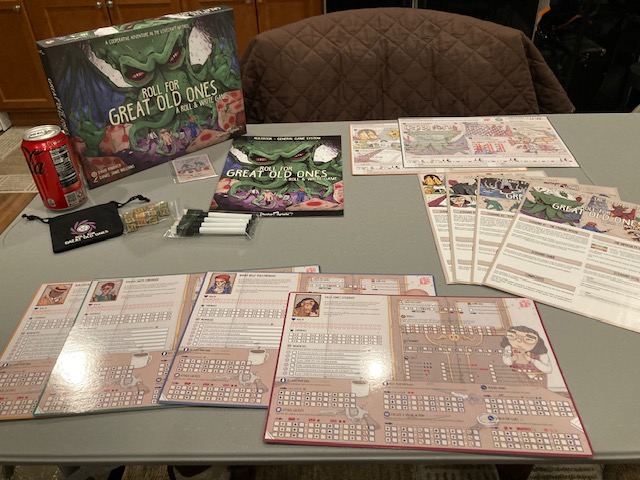
If you like the idea of a cooperative roll-and-write game with a Cthulhu theme, I also recommend you check out Roll For Great Old Ones (see review here). It’s a little better game, but it’s also a little more complicated. Cthulhu Rift is an easier game to sit-back and just play … once you’ve grok it.
And yes, Cthulhu Rift would make our Top 10 Cooperative Roll-And-Write Games!


One thought on “Cooperative Cthulhu! A Review of Cthulhu Rift (Solo and Cooperative Modes), A Roll-And-Write Game!”