Legendary DC or DC Legendary? A Solo and Fully Cooperative Review.

Legendary DC released July 29th, 2026. My online order arrived pretty much then; I ordered and bought a copy directly from Upper Deck.
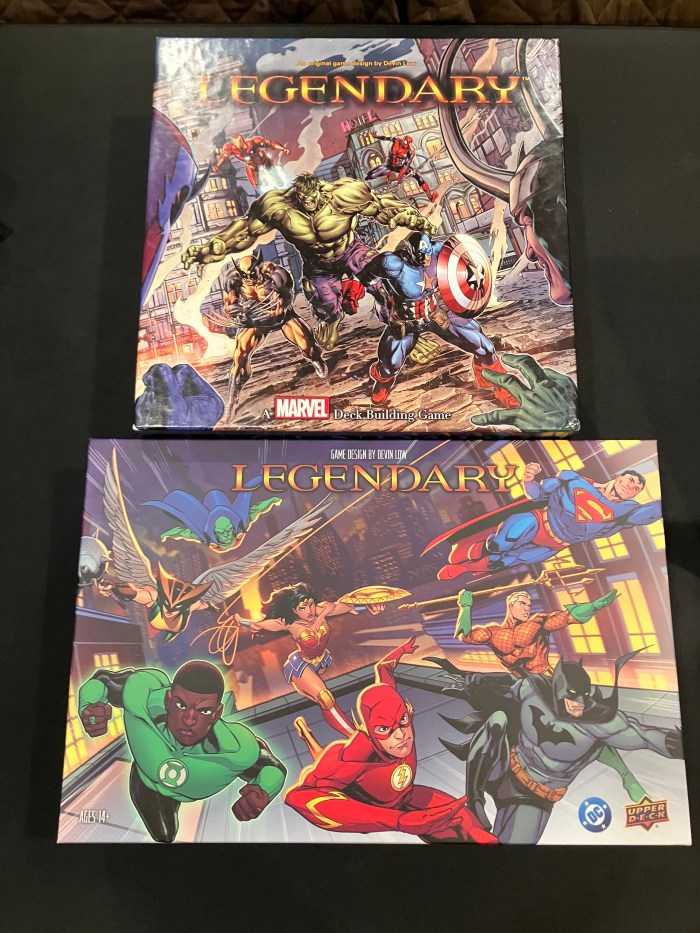
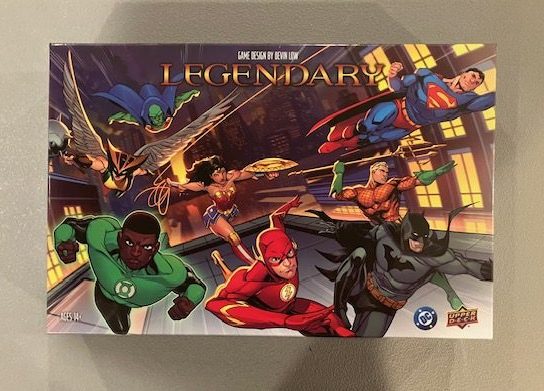
Legendary DC is the a re-theming of the Legendary Marvel game, but in the the DC universe!
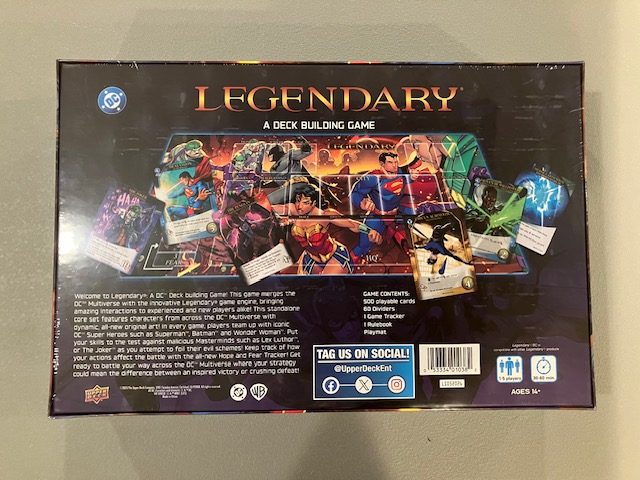
Legendary DC is a deck-building game with superheroes from the DC Universe! It’s a fully cooperative (at a certain way to play) and solo game about hiring a team of heroes to fight the bad guys! We love the theme and the original Legendary Marvel made our Top 10 Cooperative Superhero Games!

Will Legendary DC make that Top 10?

Unboxing and Gameplay
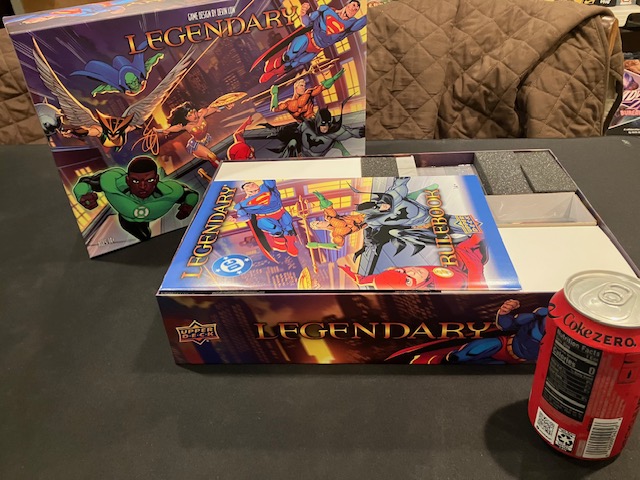
The box is a slightly odder shape than the original game: see box and Coke Can (above) for perspective.
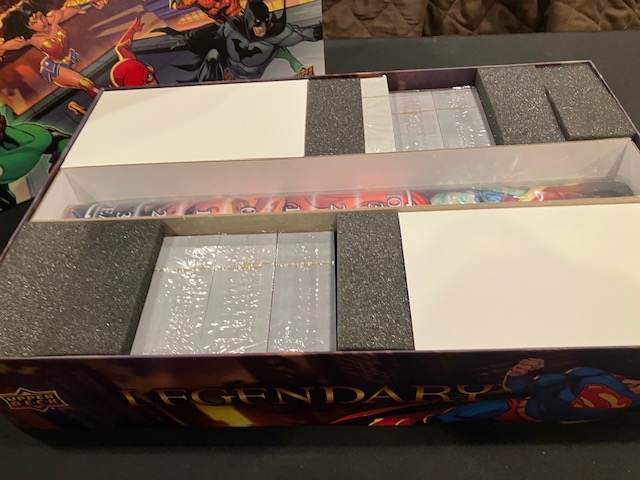
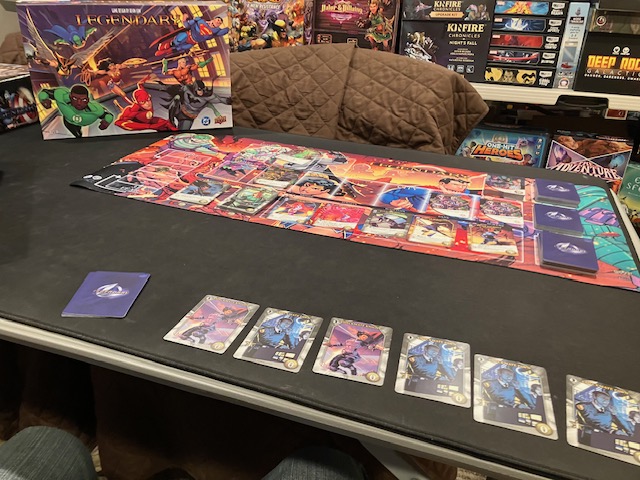
It’s a slightly different shape because it comes with a rolled-up neoprene map! See above and below!
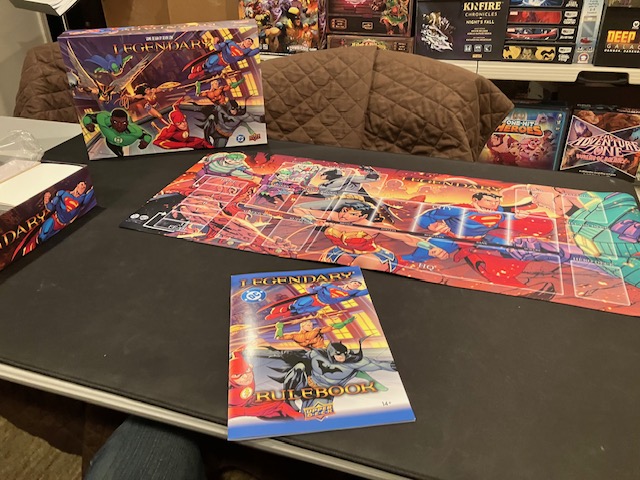
The original Legendary Marvel did NOT have the neoprene mat included! Later games in the Legendary line (especially the Legendary Adventures, like Aliens) came with mats! And everyone loved them! So, I think that’s why the newer sets now all have them.
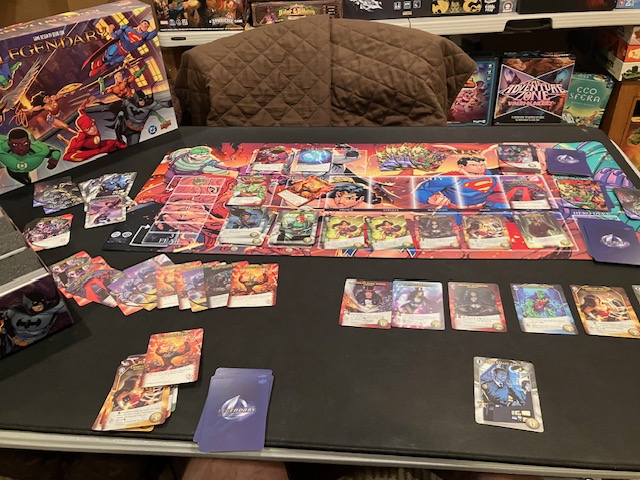
They really do help organize the game. See above.
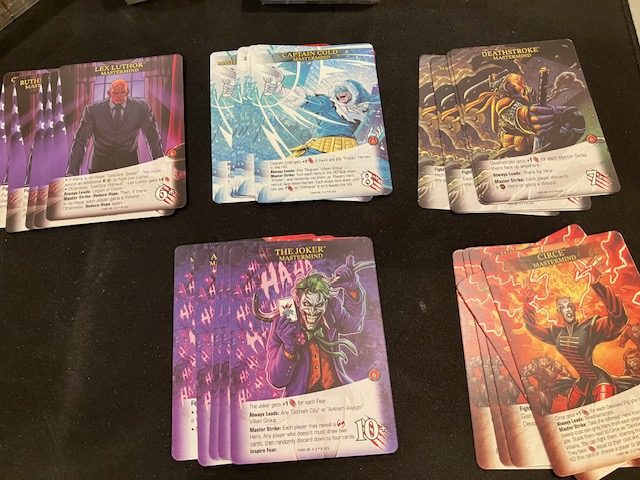
To play a game, players must first choose a Mastermind to fight: See the base five Masterminds that come with this set. To win, you almost always have to fight and defeat the Mastermind in four battles for an ultimate victory!
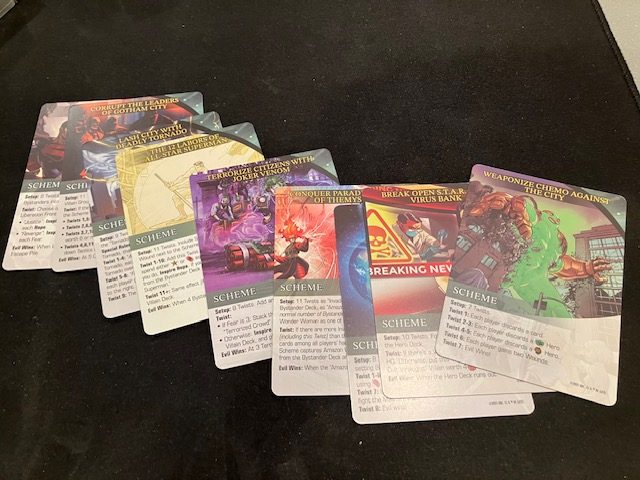
The Mastermind has a Scheme they are trying to achieve; the Scheme defines the losing conditions.
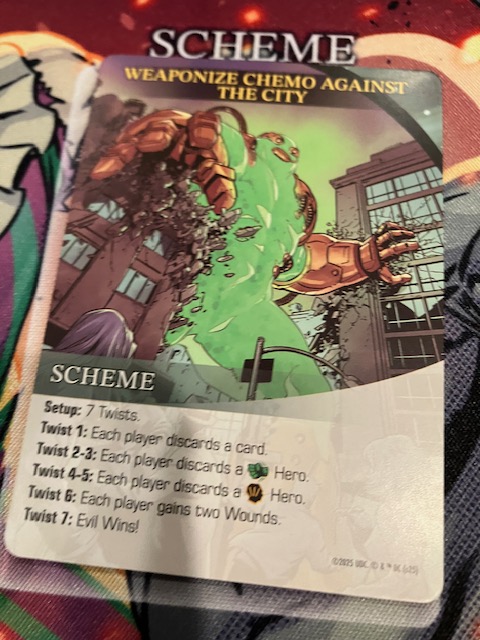
For example, Weaponizing Chemo (see above) is a scheme with 7 Twists! If all 7 Twists come out, the players lose!
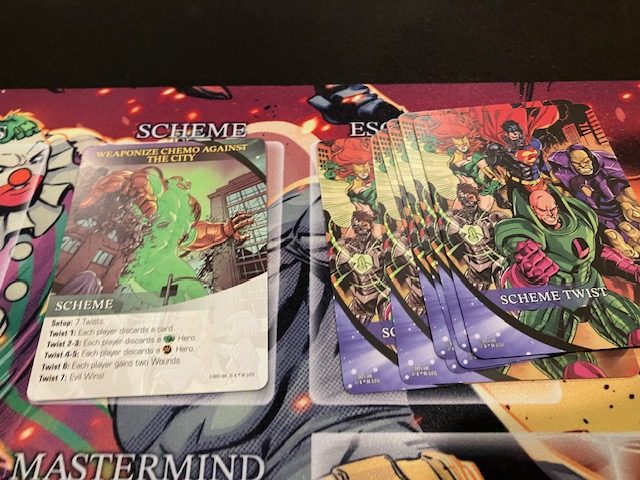
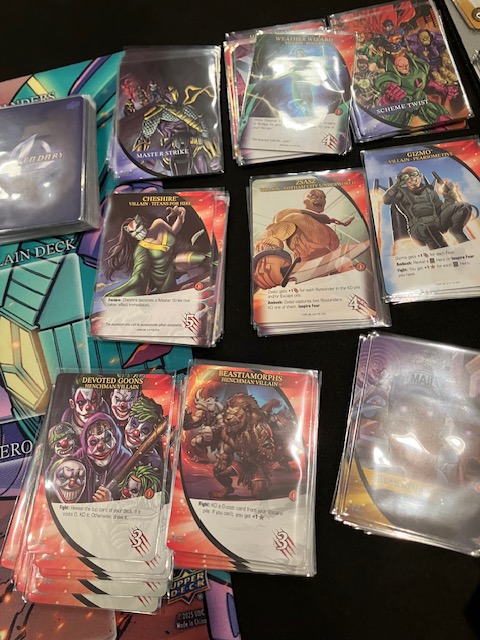
The Scheme Twists (see above, right) are shuffled into the Villain’s Deck! The Villain’s deck is a mish-mash of all sorts of bad news cards!
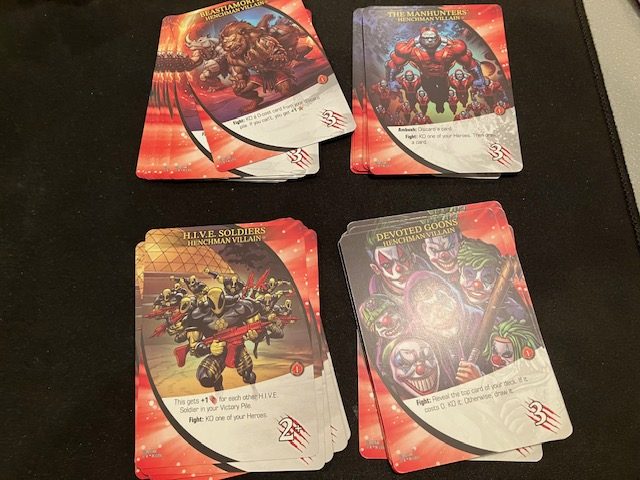
Each Villain deck typically includes some Henchmen (see 4 sets above) …
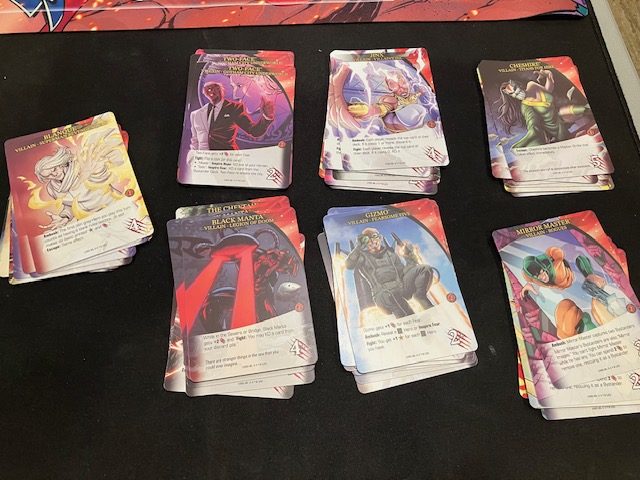
They also include some Villain Groups! See the seven base Villain Groups above!
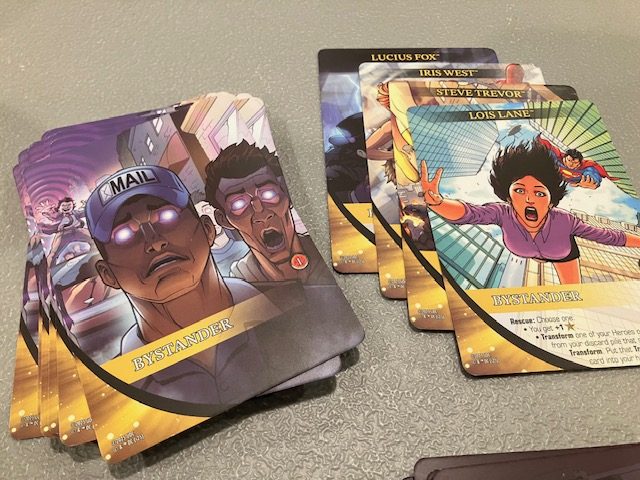
There’s also some innocent bystanders (some named you will recognize, and some nameless ones) that get shuffled into the Villain Deck …
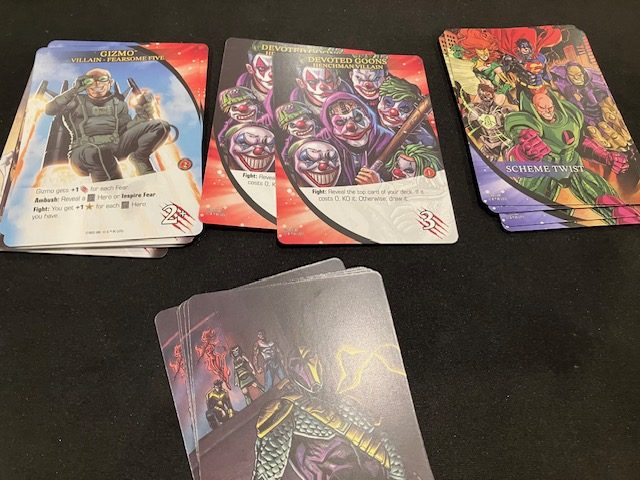
These cards, also coupled with the Masterstrike cards (which lets the Mastermind get involved) form the Villain Deck! Every turn players must draw a card from the Villain Deck and “something bad” happens!
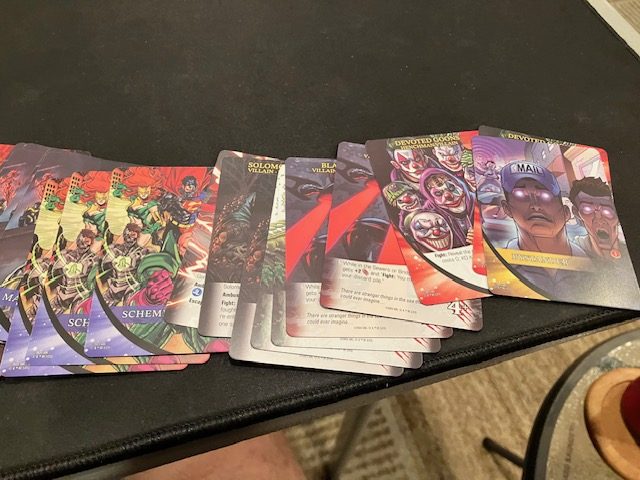
This deck (see it splayed above) is the Bad News deck. To be clear, it changes in every game, depending on the Villain Groups and Henchmen and Scheme you choose!
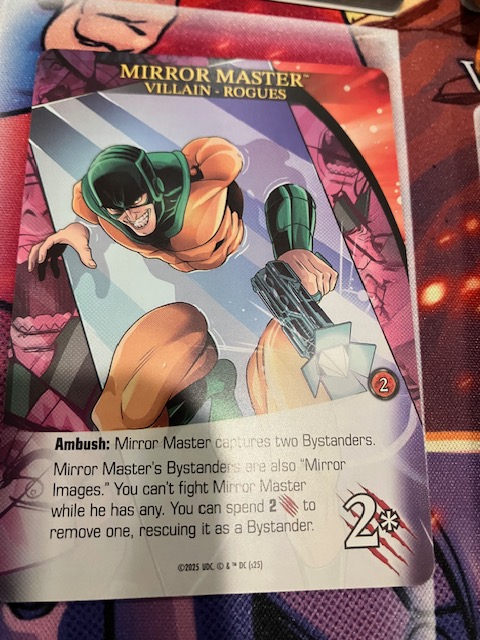
Usually, you fight a Villain from the Villain Deck; a Villain will enter the City that you have to fight!
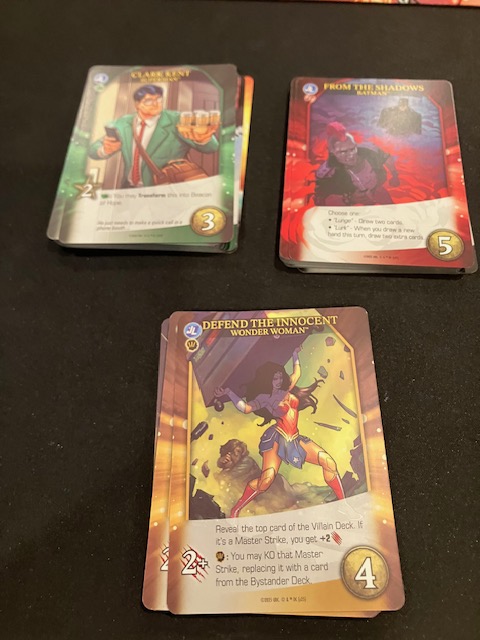
Legendary DC is a little different than most Superhero games! You do NOT play a single hero! Instead, you are collecting heroes in a “team” (your deck) to fight the bad guys!
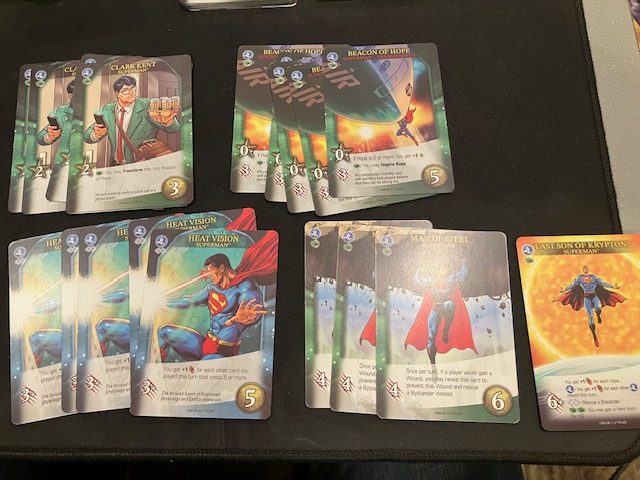
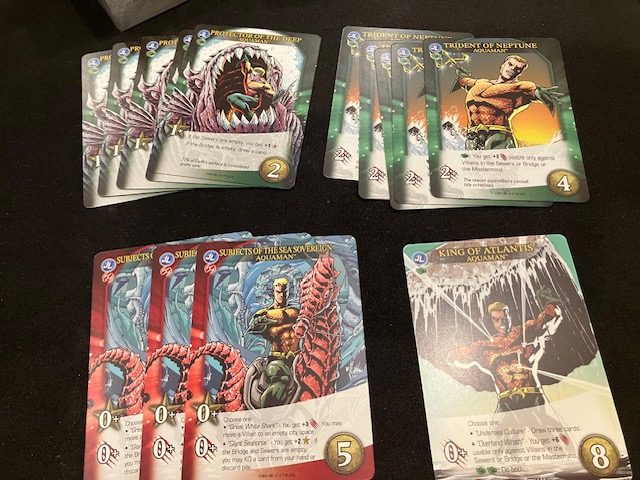
For example, you have a bunch of Superman cards available! At the start of the game, you can only afford the cheaper Superman cards (cost in lower right), but as the game goes on, you can afford to get the better and better Superman cards!
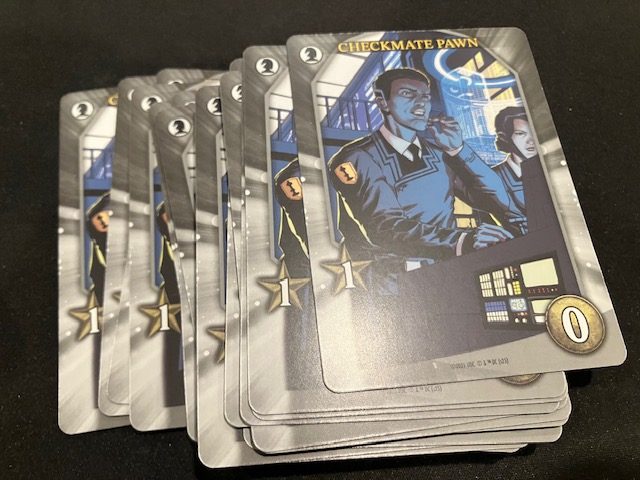
Every player starts with a simple crew from Checkmate (which is quite a bit like Shield from Marvel)! It’s a low-level group of good guys! The Pawns (you start with 8) can only help you recruit Heroes (the Star is how much “recruitment” they can afford)!
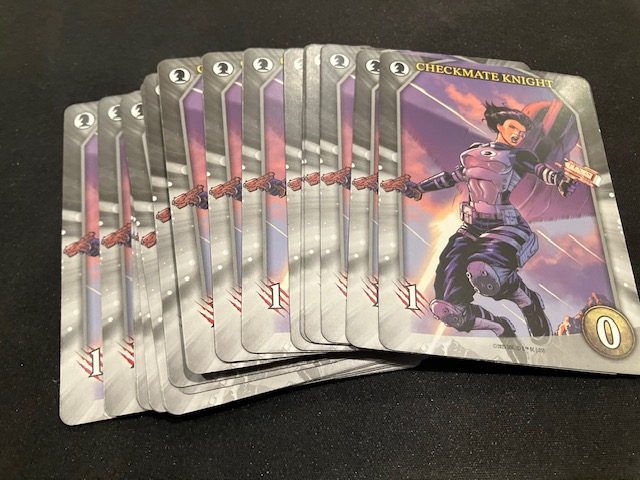
The Checkmate Knights can do a little bit of damage to bad guys! (Players start with 4 of these Knights).
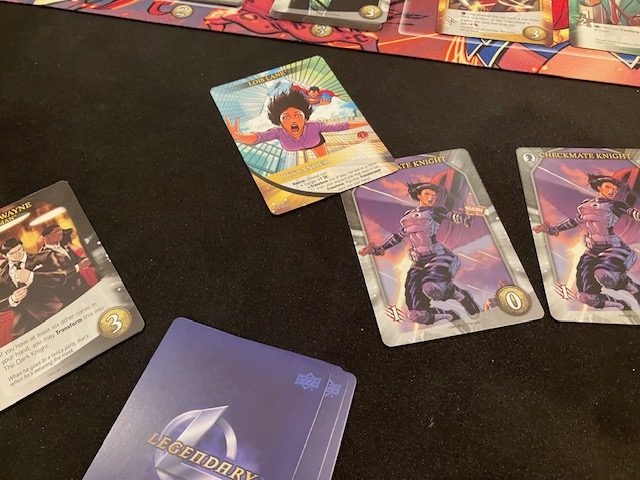
As the game goes on, you recruit better Heroes, save Bystanders, fight Villains and hopefully confront the Mastermind 4 times before his Scheme completes! If the Hero deck or Villain deck depletes, you ran out of time and lost! Usually, though, you will lose because the final Scheme comes out and you lose!
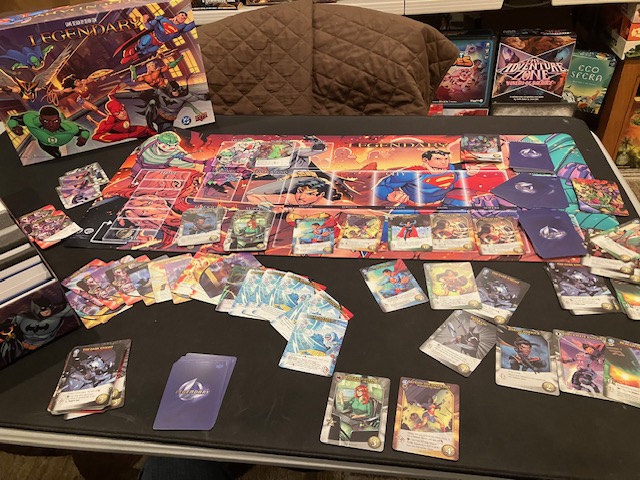
There are a few more rules (which we will discuss below), but that’s the basics of the game! The cards and art are all pretty great!

Rulebook
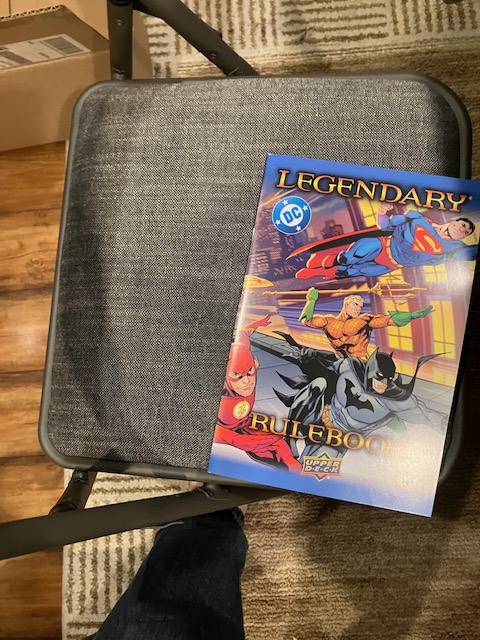
The rulebook is actually quite good!
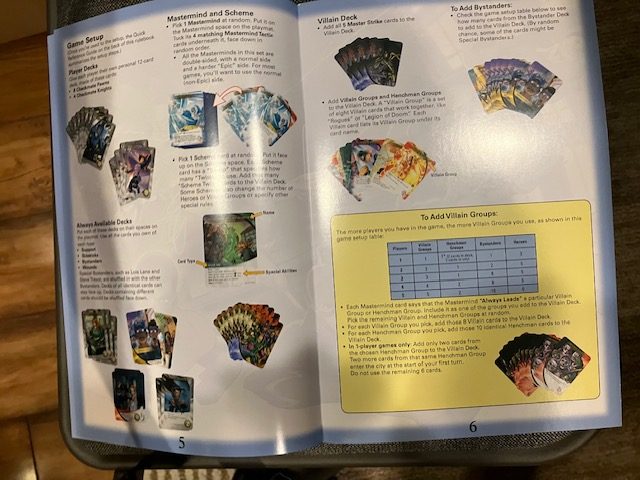
The rulebook does really well on the Chair Test! See above as it opens up to two pages just fine without any drooping! It’s probably a B+ or A- on the Chair Test. The font is a little small, and the later rulebook pages have a lot more text than pictures. Still, the rulebook is very usable on the chair next to me.
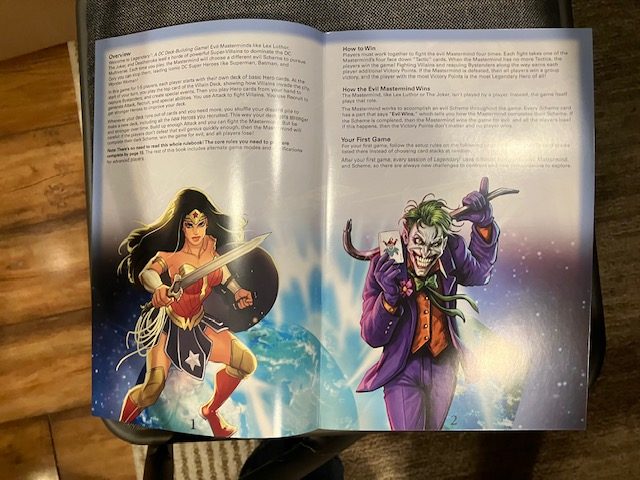
I think the rulebook actually fails the Components test. The Components are NOT defined until the very last page? They are not on the first few pages? I know how to play Legendary, but I worry a little about newer players; this doesn’t really talk about how to “Uncard” the game.
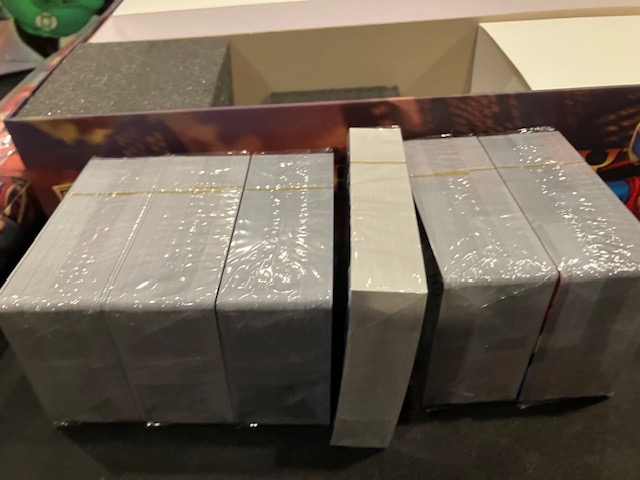
What do I do with all these cards? I still think the rulebook should have an Uncardening section at the very beginning (somehow coupled with the Components list). See more discussion of Uncardening in our discussion of Union City Alliance (another Superhero deck-building game).

I think the next few pages hold the players hands enough to get them through all the cards. Rather than list all the components up front, this rulebook takes you through them a little at a time. Maybe this works; I still think the rulebook needs to acknowledge how many cards are in the game and maybe even a sentence or two (or picture) talking about how to do an Uncardening.
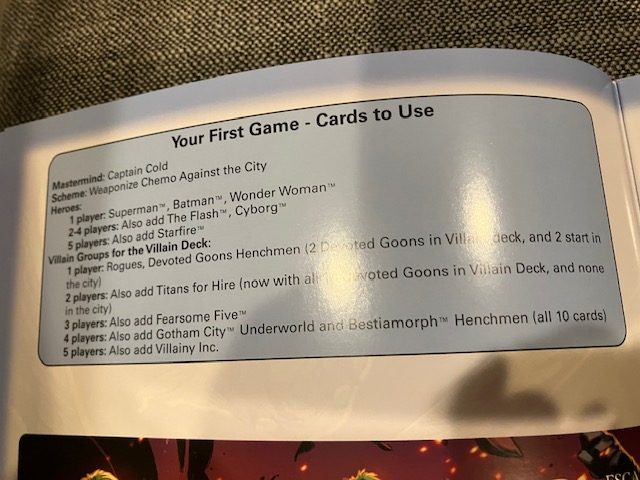
Still, this rulebook worked pretty well. It even has a list of cards to use for your first game!
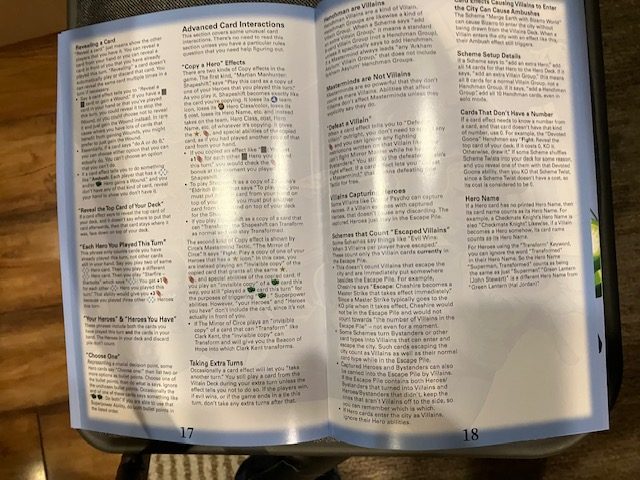
As we get later in the rulebook, there are fewer pictures and much more text. I think this rulebook could have used an Index. (I found “Always Leads” finally after looking, but it’s buried in a floating box and hard to find). Maybe you just get the online version and search the PDF and have that be the Index?

Generally this is a good rulebook; I feel like this is a much better rulebook than the original Legendary Marvel rulebook: I hated that rulebook!

Solo Play
So Legendary DC embraces the solo player! Yay! Thanks for following Saunders’ Law!
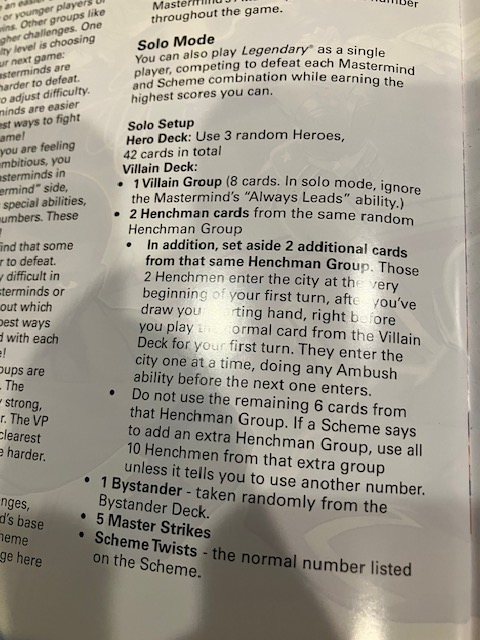
And you can either true solo or multi-handed solo! To play true solo, it’s one player and one deck (one set of heroes): see rules above.
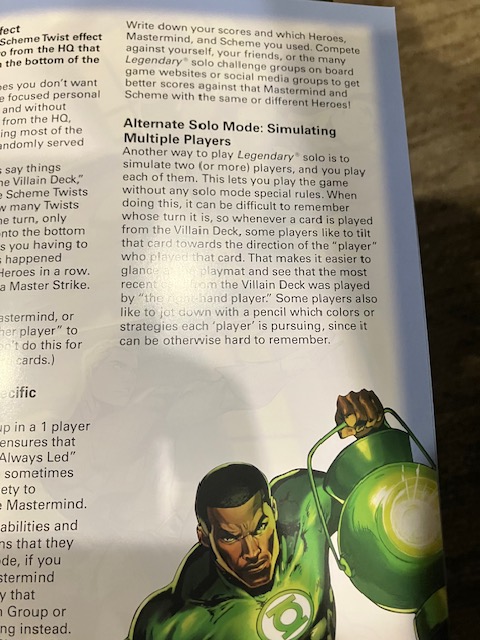
You can also play 2-handed solo (with two sets of decks) or more! I love that this game embraces both solo modes! I generally prefer the 2-handed solo mode because there are generally NO EXCEPTIONS to rules, which makes it easier to learn! Surprisingly, I think I prefer the true solo for Legendary DC, despite there being some changes. Why? Well, to be frank, there’s SO MANY cards between the heroes, the villains, the bystanders, etc etc etc, it’s easier to JUST manage one deck.
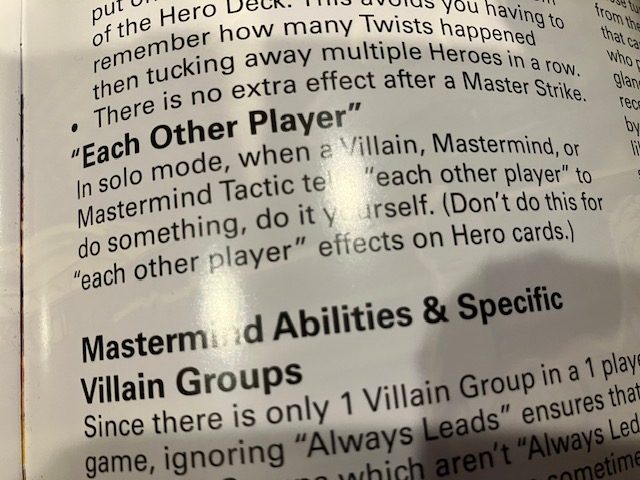
There are some extra rules for the true solo mode: they redefine “Each Other Player” to be yourself (see above; this is a pretty common thing in a true solo mode). They also add an extra Scheme Twist effect and change the set-up so there are fewer Henchmen (and two always start already in the city). The true solo rules are a little clumsier than I thought at first, but I still prefer only managing one deck of Heroes at a time! I think the fewer decks/more rules of true solo outweighs the costs of the more decks/fewer rules for 2-handed solo!

Honestly, the rulebook does a real good job helping you set-up the solo game just fine: see above.
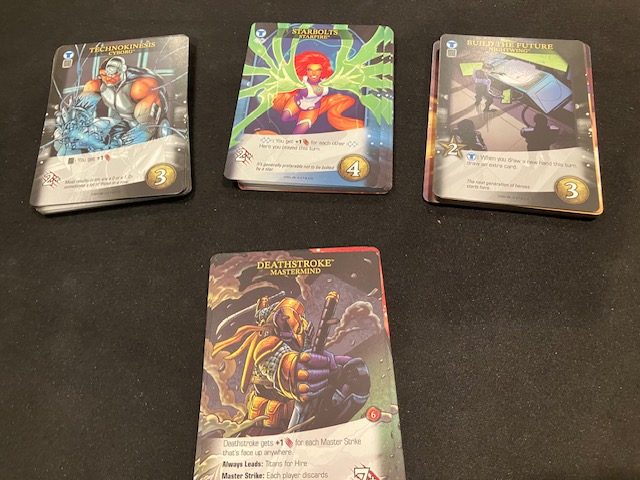
You only get 3 three Heroes, and fewer Villain Groups and Henchmen groups in true solo.
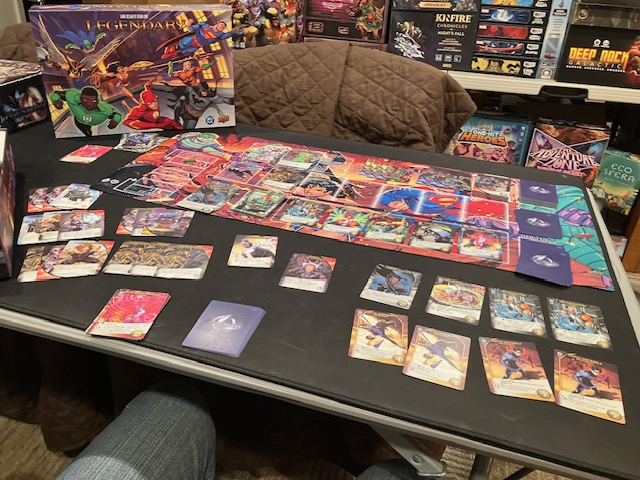
Did I like playing Legendary DC true solo? Yes!!! Over the course of a week, I played at least 7 times solo! There’s so much variety in this game, I loved seeing what would happen! There’s 14 Heroes, 7 Villain Groups, 4 Henchmen, 5 Masterminds, and 9 different Schemes! There’s a ton of variety in this box!
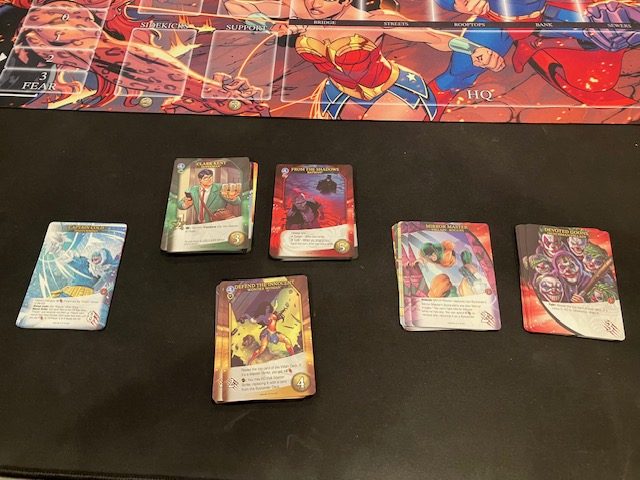
I started with the typical first game of Captain Cold/Rogues vs Superman/Batman/Wonder Woman! Fun! I won the first game!
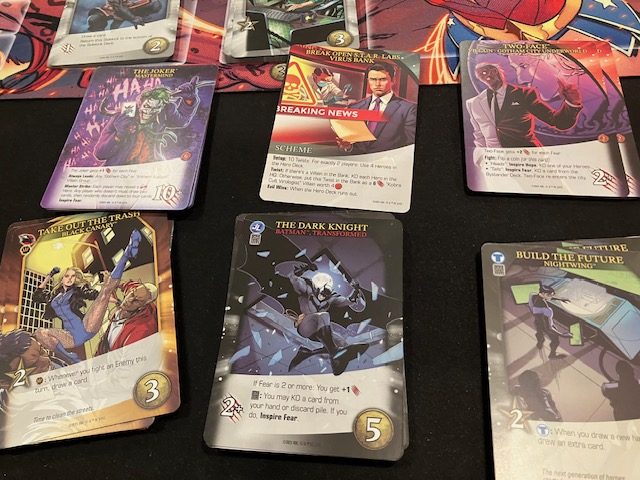
I then moved to a game themed for Gotham City! Joker/Gotham City Underworld vs. Black Canary/Batman/Nightwing! I actually lost this game, but played again and was able to do a lot better once I knew more about the villains and heroes!
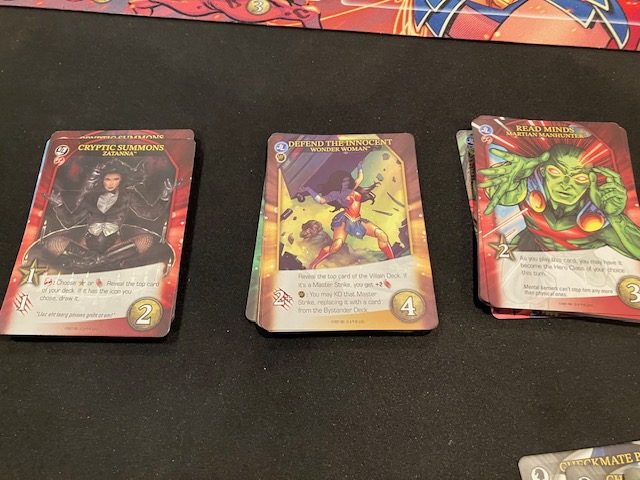
I also did a “weird” group of Heroes with Zatana/Wonder Woman/Martian Manhunter! They are all kinda funky heroes! See above!

And of course, I had to do a Teen Titan’s based game with Cyborg/Starbolt/Nightwing vs. Deathstroke!
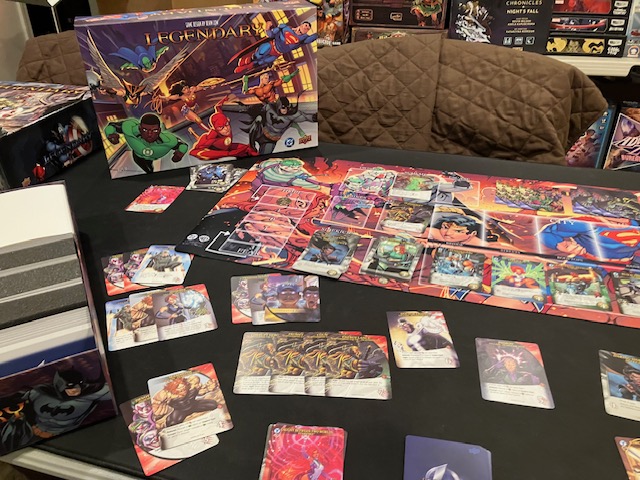
Over the course of a week, I played a lot of games and had a lot of fun. There’s a lot of set-up and shuffling for the solo player, as you have to shuffle together all the hero decks and the villain deck. But, once you are set-up, the game flows quickly!

I was generally very pleased with the true solo mode offered by Legendary DC. The worst part of the solo game is the set-up and tear-down, as the solo player has a LOT of decks to shuffle (set-up) then separate (tear-down). But, if you have played Legendary in any form, you already knew this.

Cooperative Mode
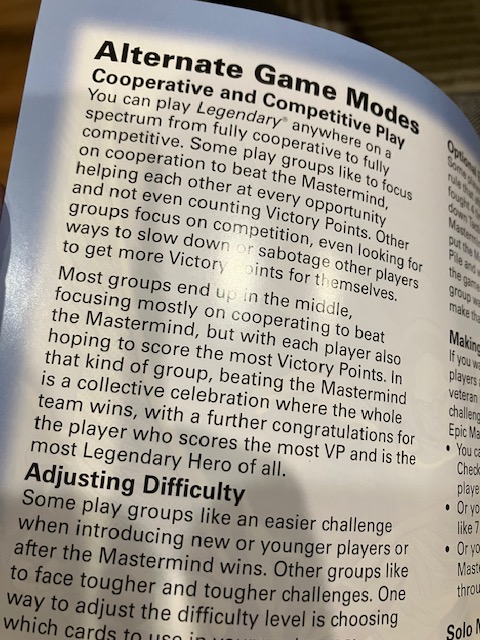
It’s a strange thing; this game can be played cooperatively or semi-co-op (getting the most victory points). See rulebook above: If you don’t defeat the Mastermind together, everyone loses! Yet, I don’t personally know anyone who plays semi-co-op for victory points? It seems out of character to play a super hero game … in any way competitively? But you can?
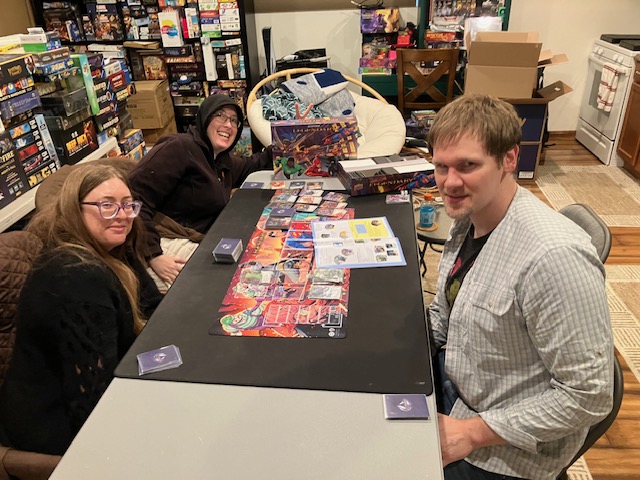
So, cooperatively is all about making sure we defeat the Mastermind in combat 4 times!
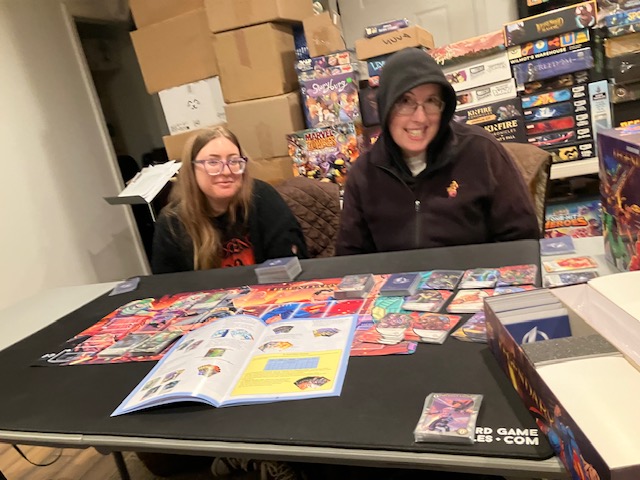
One of the best things about playing Legendary DC (or any Legendary) cooperatively is sharing the load for set-up and tear-down! There are a LOT of cards in this game; the more players that play, the more cards! That means set-up is all about shuffling together a ton of cards for the Hero decks and the Villain deck! And then the tear-down is arguably worse, as you have to separate ALL THOSE CARDS back into their original decks. Luckily, if you have a good group, you can share the load and have everyone help. That group help really makes the game feel a little less like work and more like fun.
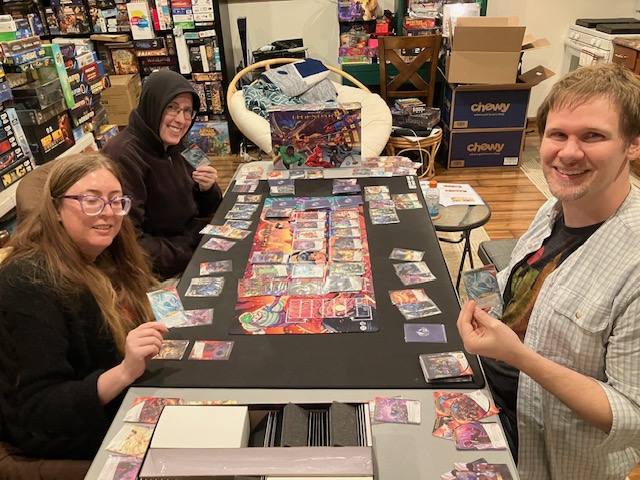
Although we almost always (always?) play Legendary cooperatively, it’s not particularly cooperative! Don’t get me wrong; we are all working together to defeat the Mastermind, and we point out issues and talk about how to resolve them, but there’s not really a lot of cooperative mechanisms in the game. Each player’s turn is mostly taken in solitaire; this is mostly multi-player solitaire! There’s no real mechanisms for sharing cards, or directly helping someone with your cards! Mostly, it’s about talking about how the solitaire turns will interact with each other and the current board!

Some people might think the “lack of cooperative mechanisms” makes this a bad cooperative game; not at all! This multi-player solitaire nature helps keep the Alpha Player Syndrome in check, so that’s one reason a lot of people might like this! And some people really like the idea of a cooperative game without too much player interaction.

Just be aware of the kind of cooperation Legendary DC provides; it is fully cooperative and players will discuss how to win together, but the turns are mostly multi-player solitaire.

Sleevening
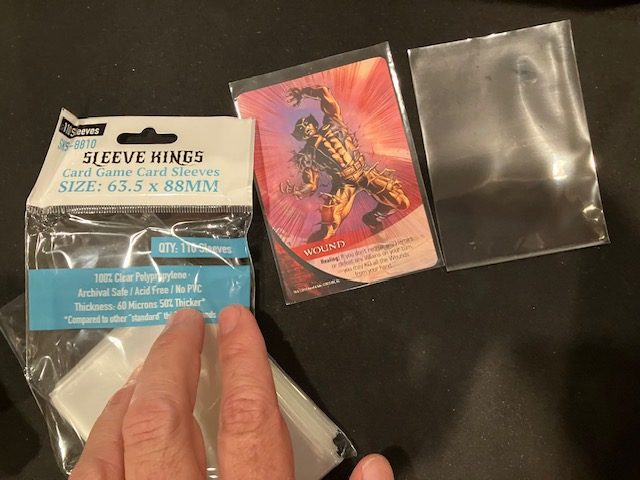
You should probably sleeve your game if you plan to play it a lot. I played my first 7 games without sleeves, and I noticed some of the starter cards (Checkmate cards) getting smudged and a little messy.
I was a late sleever, but I think it’s worth it for this game. Heck, usually most deck-builders are worth sleeving! I used the Sleeve Kings 63.5 x 88 mm sleeves! See above.

House Rule for Schemes To Reduce Randomness

A lot of Scheme cards shuffle a bunch of Scheme Twists into the deck: see above!! But if you just happen to get all of the Scheme Twists at the start of the game, you quickly lose! Sure, it’s unlikely. But after all that set-up, how annoying is it if your game ends quickly because the Scheme Twists end up in the upper part of the Villain Deck?
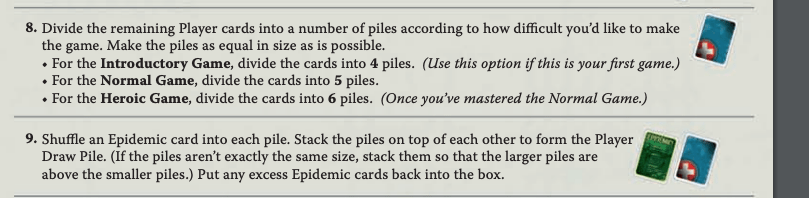
Games like Pandemic break apart the deck into piles (see rules above), then shuffle one of the Infection cards (like Scheme Twists) into each pile. Then the piles go back on top of each other! See above for rules of Pandemic! This keeps the bad news cards from being all clumped in the top (game too hard) or the bottom (game too easy)!

Why don’t we do this with the Scheme Twists? With the Pandemic method, the Scheme Twists are distributed equally throughout the Villain Deck! This seems like a simple house rule to keep some of the randomness under control.

What I Liked
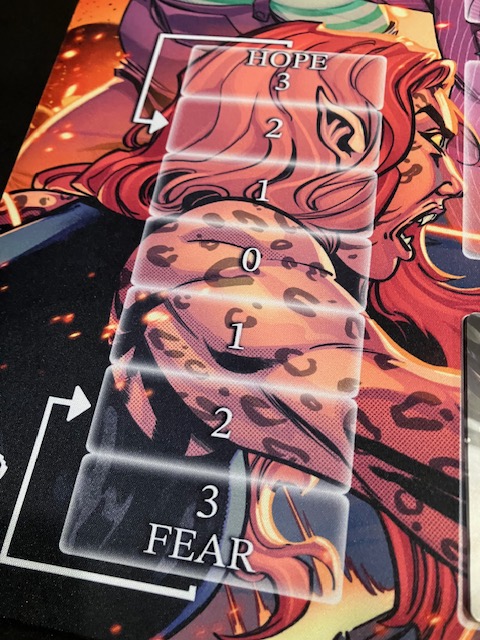
Hope and Fear: Legendary DC has a notion of Fear and Hope (two sides of the coin). See mat above! Some Villains and/or Heroes do less or more damage depending on where the Fear track is! Superman does better when Hope is higher, and Batman does better when Fear is bad! I like this mechanism a lot; it gives a nice flavor of atmosphere to the game! There’s also a more mechanical reason to like this: if you get a “bad hand” and can “only” generate 3 fight on your turn, you can still do something useful and fight crime (generate hope or fear, as you want)!!! That’s right, if you have really hard Villains out, you can still do something useful! This new feature (at least for me) really helps elevate the game by giving the players more to do on a turn, even when faced with a bad hand!
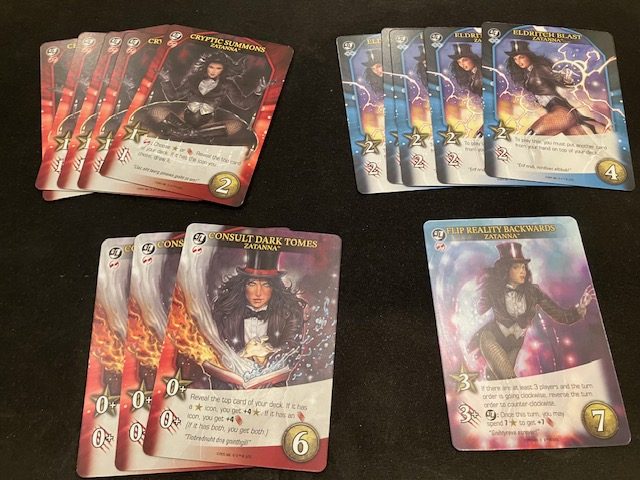
Art On Cards: The art on the cards is generally fantastic! The heroes, the villains, the masterminds are all pillars of good comic book art!

Rulebook: Despite a few grumbles with the rulebook, I generally really liked this rulebook. Even though I already knew how Legendary worked, I feel like the quality has significantly increased since the first one! It still needs an Uncardening section.
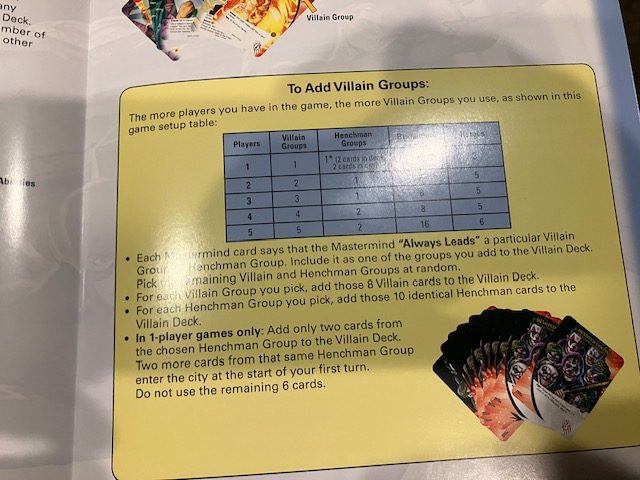
Player Counts All Work: The rulebook goes out of its way to make little mods to make sure sure the game works at all player counts! The solo rules have special set-up and rules, the 4 and 5 player games get an extra “free” turn makes me feel like this game will work at all the player count! My experience is only solo and 4-player, but these tweaks seemed to work!
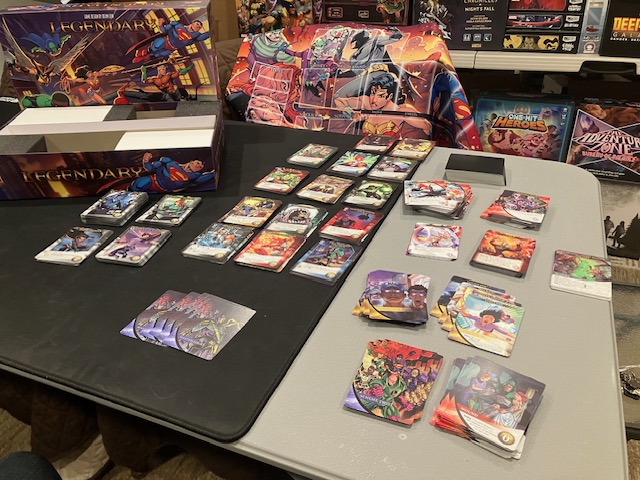
Variety: There is SO much variety in this game, you could be happy with just this base set for quite a while!
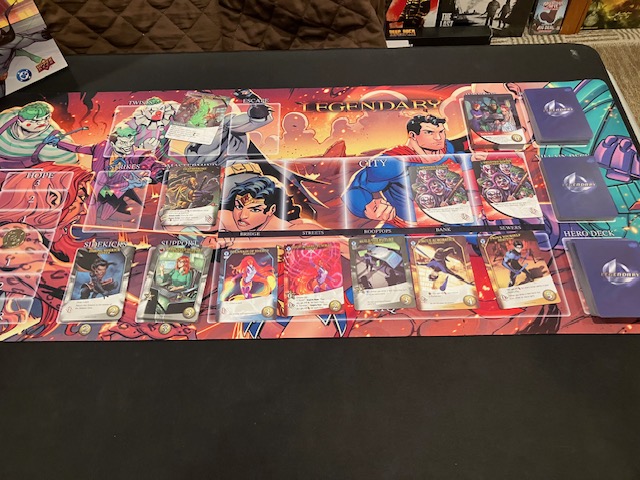
The Player Mat: The fact that this version of the game comes with a player mat is great! It really helps keep the game more organized and easy to set-up!

What I Didn’t Like
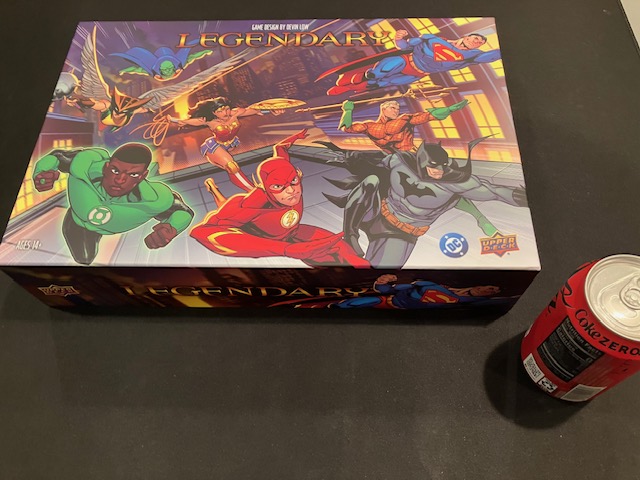
The Cover Art: The cover art seems … out-of-place with the rest of the art? The cover art looks like a “Super Friends” kind of art (lesser quality) and the innards are more like “Justice League of America” art (higher-quality)? I don’t know, if I saw this game at a game store and didn’t know anything about it, I might think it’s for young kids only? I think the cover belies what’s inside.

Play Mat: As much as I love the playmat, I think it’s busy and distracting. The Heroes and villains on the mat are “distracting”. They are also of the lesser art like the cover. I would rather have the heroes and villain be removed from the playmat and have the the background only! However, given a choice between no playmat and a busy playmat, I’d MUCH rather have the playmat!
Randomness: The Hero decks and Villain Decks are random: you can get completely screwed by bad draws. It’s not big deal, because it usually balances out (especially if you build a good hero deck). BUT in a game where it’s so much work to set-up and tear-down, it can very frustrating to have a game end because of bad draws; this is probably the worst part of Legendary DC, and every Legendary game ever.

Conclusion

I think Legendary DC is my current favorite version of Legendary! All it’s little tweaks (Fear and Hope, player count adjustments, multiple solo modes, etc) show all the advancements that have been done in this system! This is the newest evolution to this game and it works well. There is also so much variety in the game that you can play this set for quite a while without needing any expansions! Trust me though, more expansions are coming. The art is fantastic and the DC Superhero theme works well with this.

The set-up and tear-down can be daunting, especially for the solo player, but the cooperative game is a lot easier to set-up/tear-down because players can share the load to make it easier for everyone. Be aware: there is a fair amount of randomness in the game, so bad draws that ruin a game are a little more painful when the set-up and tear-down is so pronounced! Having said that, the randomness of the game isn’t “usually” too bad, especially with one minor house rule we suggest.

The solo game is a blast and I couldn’t stop playing it! There’s even rules for true solo and 2-handed solo! I prefer the true solo despite the few extra rules and really enjoyed the puzzle and gameplay. 8.5/10 maybe 9/10?

The cooperative game isn’t that cooperative; it’s more multiplayer solitaire. It’s still a lot of fun, but don’t expect lots of sharing or turns where you help someone else; most of the communication in the game is “general strategy”, but that’s still fun. It’s a great game: players work together a little … but the cooperation isn’t particularly pronounced. There just aren’t a lot mechanisms in the game that promote cooperation. 8.5/10.

I don’t think I know anyone who plays this semi-co-op; it seems out of character for a super-hero game to NOT be fully cooperative.

And yes, this would make our Top 10 Cooperative Superhero Games!! I think it’s better than Legendary Marvel!

Hero Appendix

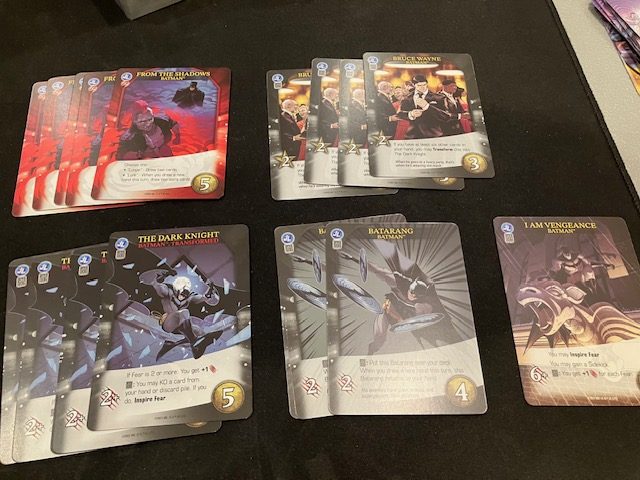
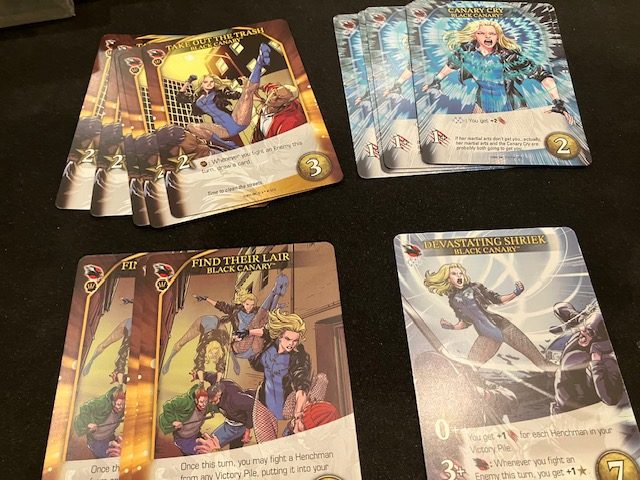
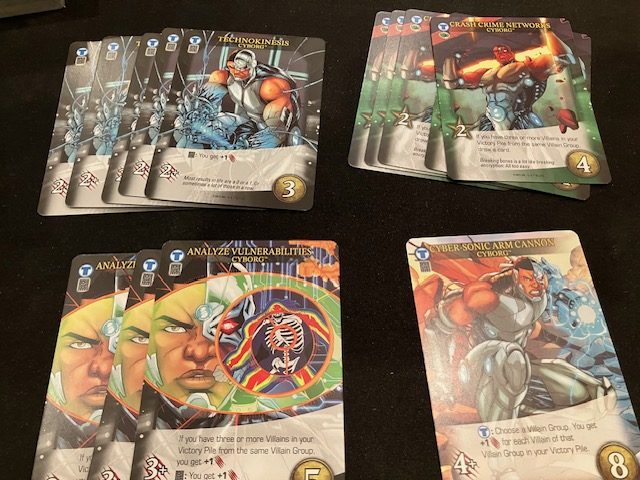
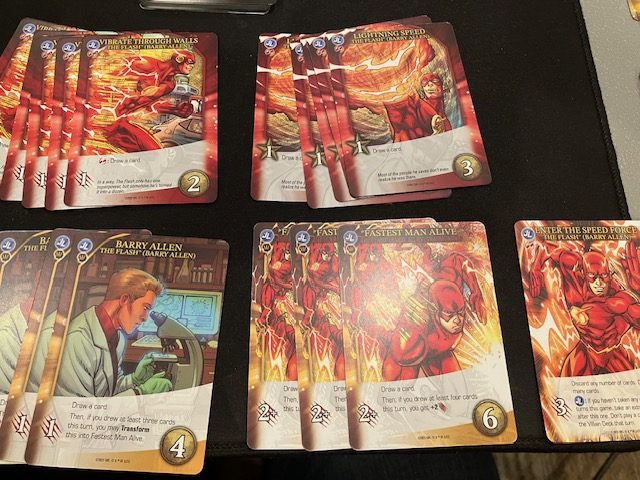
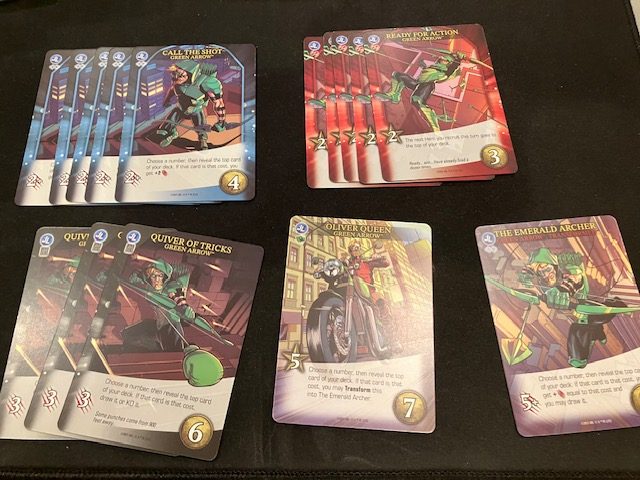
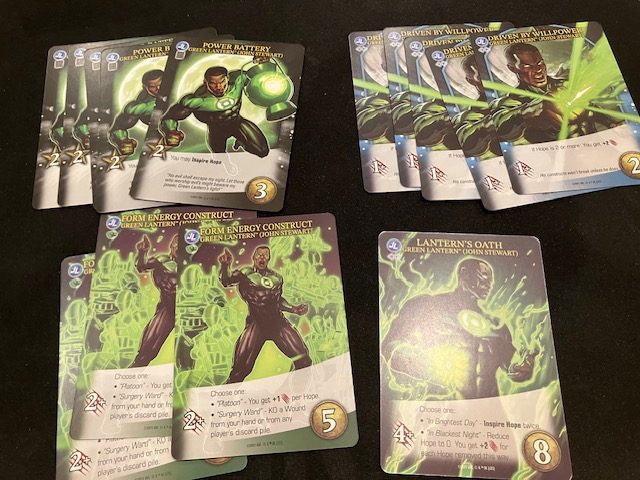
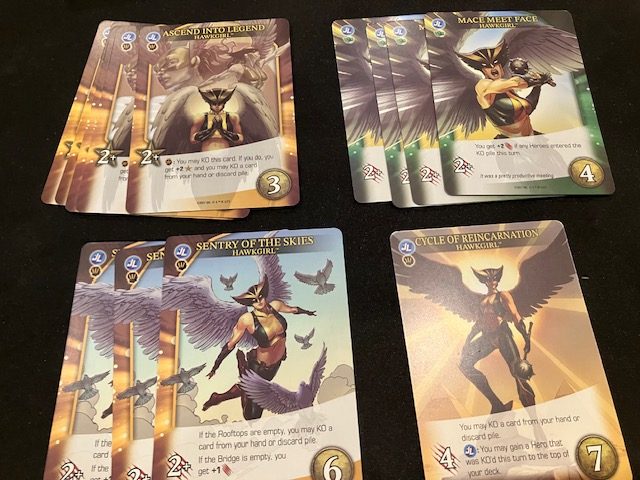
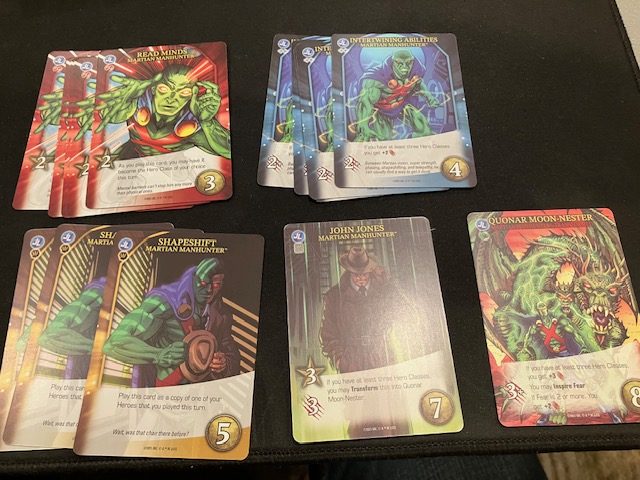
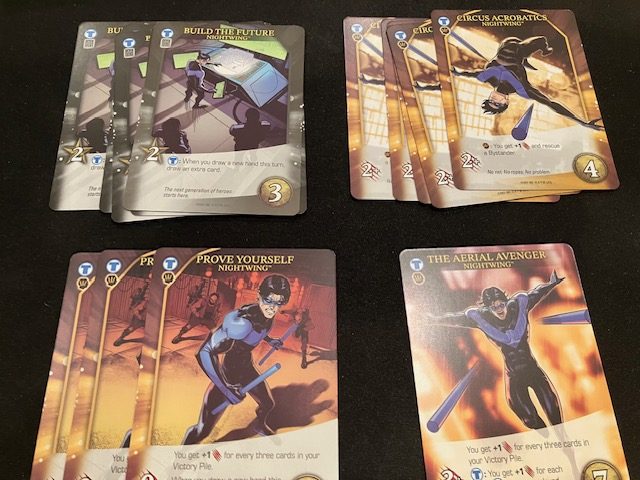
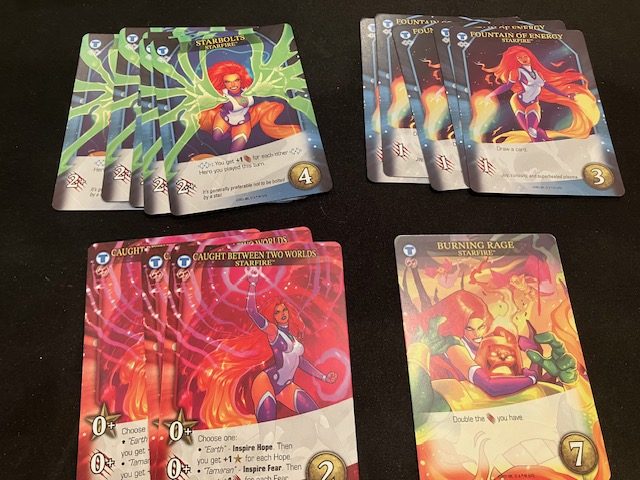
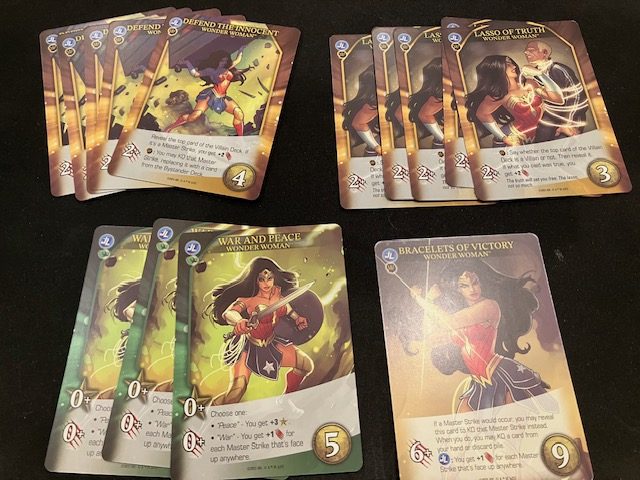
Here’s all the Superheroes and their cards.
Viking Route: Solo and Cooperative Review After Full Playthrough

Viking Route is a solo and cooperative game from Kickstarter back in December 2024. I backed at the Jarl level and my copy arrived early August 2026. It had promised delivery October 2025, so it’s almost a year late! That’s Kickstarter for you!

This game made our Top 10 Anticipated Cooperative Games of 2026! Why were we so excited for it??? Magnets and Vikings!!! You heard me, Magnets!!! And Vikings!!!

How on earth does this board game use magnets??? Let’s tale a closer look!

Unboxing and Gameplay

See game above with Can of Coke for perspective!

There’s a big bad boss loose in the world, and it’s your job to deal with it! See the 5 bosses above! Each boss plays very differently too!

Players play 4 Vikings sailing the seas! Each Viking has a special power activated by discarding Clan Spirit tokens! See characters above! No matter the number of players, there must always be 4 Vikings in play. A solo player will operate all 4 vikings, 4 players will each get their own viking, 2 players would each get 2 vikings … (and 3 player has a weird rule).

Players are sailing the seas trying to defeat the enemy! This game is “kinda” a boss-battler, but the game is more about sailing your ship to get to the enemy and avoiding land and other things! The ship itself is sort of a worker-placement area! Each zone of the ship does something different: the Deck has the most options and is adjacent to everything, the Sail is for adjusting the sail (full-up, half-up, or all-down), the Hold is for grabbing some useful tokens, the Lookout is for adjusting the wind (sorta), and the Ballista is for shooting things!

Your ship is represented by a compass on the board! See above! When the sails are unfurled, the ship will move in the direction of the red arrow on the compass! How does the compass point? Magnets!

When you do you sail? At the end of every turn, players draw a bad news card which “usually” also moves ship in the direction of the wind! Plus some bad stuff …

There are 4 heavy magnets that affect the compass (your ship): the three ravens (scattered on the edges of the board) and “the wind”, right in the middle of the board.

See above as the ship (The Drakkar) is near the green raven, so that magnet has the most influence over the ship on that part of the board!

If you move your Viking to the Lookout, you can activate a Raven and move it around the board a little bit! See the video above as the moving Raven affects your heading on the compass!

But it’s not just the Ravens: “the wind” in the center affects you too! The direction she points has a big effect on your heading! She is actually a pretty power magnet herself! This game is all about managing the “overlapping magnetic fields” from the Ravens on the edges and “the wind” in the middle! (You can only adjust the wind in the middle if you are within two spaces).

Along the way, you have to deal with Valkyries as they slowly (and sometimes quickly) approach your ship!

Sometimes the Valkyries makes it ON the ship and damage it! See above as the sails area get damaged! You have to fight the push them off the ship! Of course, the Valkyries are immortal, so all you can do is push them away!

Combat is decided by dice! See all 6 faces of the dice above! Basically, 2 sides are misses 3 sides are plain hits, and 1 side is a critical hit! Usually a hit is good enough, but critical hits can be great, depending on the bad guy you are fighting!

Each viking sheet tells how many dice they can roll for Combat! So you “usually” want Urwulf or Helga doing combat since they roll 2 dice during an attack (Astrid and Kuba only roll 1 dice).

To win, you have to “do something” to take down the big bad boss! Usually, you have to collect all 3 Magic Stones from around the world, then hit the boss with some critical hits! There are 5 different bosses in the game, and they all operate a little differently!

That’s kinda the basics of the game! Although the tokens are fine, it’s really the whole “toy factor” with the magnets that makes this so cool!

Rulebook

The rulebook is pretty good.

The rulebook knocks it out the park on The Chair Test! This rulebook fits perfectly next to me on the chair, it opens up easily, and is easy to read! A on Chair Test!

The components are described well and set-up of the Drakkar work well.

The Set-Up was good: see above.

In general, this rulebook was pretty good. It’s main flaw was the it seems to miss edge cases more often than it should: It’s usually edge cases in the specific monsters you are fighting that were the problem. We’d occasionally get ourselves into a situation where the rulebook didn’t answer something, so we’d just a make a ruling; it happened more often than it should have. None of the underspecificity was ever particularly egregious, but it just happened a few too many times.

Solo Play

So, there is a solo mode! Thank you for following Saunders’ Law!

Since all modes must always play Vikings, the solo player operates all 4 vikings! Normally I worry about how much context switching it takes to operate 4 completely different vikings … but the Vikings aren’t really THAT distinct! The real difference is their special power, how many dice they roll, how much they can carry, and how many hits. That’s it! It’s all very apparent on their sheets!

Each Viking has a token they place on the board to show they’ve gone (yes, I know that’s backwards; see below). Viking Route uses coarse-grained Player Selected Turn Order (PSTO)! (See description here) I love that! PSTO usually really elevates a game for me, as I feel I have more choices to get stuff done!

The context switching between characters really isn’t a big deal! I had no issue jumping right in and playing all 4 Vikings! It sounds more daunting than it is; once you’ve played once, you’ll see that it’s easy to play all 4 vikings as a solo player!

The solo game works really well. I had no problem jumping in. In fact, I ended up playing the entire campaign over 5 days as a solo player! I had the ability to leave it set-up between days, so that helped.

From a maintenance perspective, there’s a little bit of work to set-up and tear-down, but it’s not too bad. As usual, the cooperative game makes set-up and tear-down a little easier as you share the load.

Is this a good solo game? Absolutely! The choices you make about when to furl/unfurl the sails, fight or sail, directions to sail, when to move the wind or the ravens, are delicious choices! You are basically balancing keeping the ship sailing in the proper direction with all the stuff that happens along the way: Battling Valkyries! Tracking the Big Bad Boss! Grabbing Resources! Avoiding Land! The fact that there are 4 magnets with overlapping influence works really well!

Great solo game. I played the entire campaign because it was so fun.

Cooperative Game

The cooperative game was mostly just an extension of the solo game! What do I mean by that? Well, instead of making all the sailing and fighting decisions as a single player, we tended to decide things as a group! With the Player Selected Turn Order, we’d decide on which viking goes next! What do we concentrate on? Should we fight or sail? Should we unfurl? Should we reroll? Should we request Help From the Gods?

As a group, we’d play with this magnetic system! And it was fun!

The trade-off here is that multiple people playing might see something you miss, but the counterpoint is that you have to make most decisions as a group.

Everyone loved the magnets.

There is something to be a little worried about; this game is susceptible to Alpha Player Syndrome (see link here for description). If you are playing too strictly, you aren’t supposed to play with the magnets too much, and an Alpha Player might either stop you from playing with the magnets (“that’s cheating! You can’t do that!”) or maybe just say “I know how the magnets work, let me do it”.

The right thing to do: just let people play with the magnets and have fun.

The cooperative game worked; we saved our game and plan to play more games in the campaign.

The Campaign

There is a 5 game campaign with 5 different bosses. Each one plays differently, but not THAT differently.

The game proceeds in two phases: In phase 1, you have to sail around the board and get the 3 Magic Stones! That seems to be the same for every game in the campaign! Then in phase 2, you “do something” with the stones! See above as I crit hit the Kraken three times to win!

Each world has a different board with different rules! Board 2 has lots of Fog which stops you from looking at the compass! Eek!

Board 3 is in the river and Fenrir buzzes around trying to Ram you! The River makes you drift every turn!

The 4th board has a giant land mass which is a real pain to move around, and some “remnants” of the Bifrost bridge which do weird things?

The final board is Loki! He pretends to be all the monsters you already fought! I have to admit, I thought the final battle was the weakest. It seemed sort of too long and very samey. It was my least favorite of the campaign games.

Despite all that, the campaign IS fun. Each game is different enough and keeps you engaged in the world. It’s also fun between games to get upgrades for your team! That’s right! This is a campaign where you can upgrade as you go! See the Port Upgrades pages above!

Magnets

Let’s address the elephant is the room: do the magnets work? Does the game work? Yes! 100% yes and yes! After playing the solo campaign all the way through and some cooperative games, yes, I can verify that the system of magnets works! And the game works too!

It’s even quite thematic: the winds are a “mysterious, unseeing force that affects you”, and the magnets really capture that feeling!

The game also doesn’t seem too hard or too easy either. The magnets work in the game and give a nice challenge.

What I Liked

Art Style: I like the art style: it seems a good choice for a viking game.

Magnets: I love the magnets. They work! And it’s fun to play with them!

Player Selected Turn Order: Player Selected Turn Order works really well here: it helps make the game feel like your choices matter more. They even have the tokens to help notate when a turn has been taken!

Table Presence: This has a really cool table presence!

What I Didn’t Like

Underspecificity: There’s a number of places in the rulebook where the game seems underspecified. What happens when “something” happens? The rules don’t seem to handle a lot of edge cases! The rules also seem to use some variation of the phrase “if there’s a choice, players decide” quite a bit! That deferment of rules works in a cooperative game, but it always feels like a cop out to me (see Resolving Ambiguity in Cooperative Games for more discussion). I think with just a little bit of work, it could have been a bit more precise with a bit more thought. It wasn’t game-ending by any means, but a small nuisance.

Randomness: At the end of the day, this is still a dice game where rolling poorly will cause you to lose the game. There are a few mitigation techniques (Crit tokens, flipping the Ballista, re-rolling Urwulf attacks with Clan Spirit), so it’s not the end of the world if you roll poorly, but just be aware that it can be frustrating occasionally.

Conclusion

Viking Route was a big hit among me and my friends! The toy factor of the magnets was overwhelmingly fun! They designers have crafted a very good game around the magnetic pieces, and that works really well!

As a solo game, this is a 8.5/10 or 9.0/10. It might be a 9.5, but the randomness and underspecificity of the rules brought the game down just a little bit for me. But the game was so much fun, I played through the entire campaign and enjoyed it (the finale was a bit underwhelming; that also contributed to the 8.5/10 or 9/10). The game was fun and I had a blast playing it solo! And don’t worry about operating four Vikings in the solo game, as it really wasn’t an issue.

Cooperatively, this is an 8.0 or 8.5/10. The game may be a little more likely to be susceptible to Alpha Player Syndrome because of the nature of the cooperative interactions, but my friends all enjoyed how unique this game was. The randomness and underspecificity of the solo game are a little more pronounced in the cooperative game (as the solo player can just move through those issues a little easier without needing consensus), so it’s just a 8 or 8.5/10.

This game may just tickle your fancy that you don’t care about some of these issues! You may just give it a 9/10 or 10/10: it’s just so unique and interesting! I mean, there’s a reason this made our Top 10 Anticipated Cooperative Games of 2026!

A Review of 20 Strong Nemesis: Is This a Cooperative Game or a Semi-Cooperative Game? Isn’t the Answer Obvious???

I had been hearing great things about this system (called 20 Strong) for years, but I had never played any of the games in the 20 Strong line; the Nemesis: 20 Strong Kickstarter felt like the place to start.

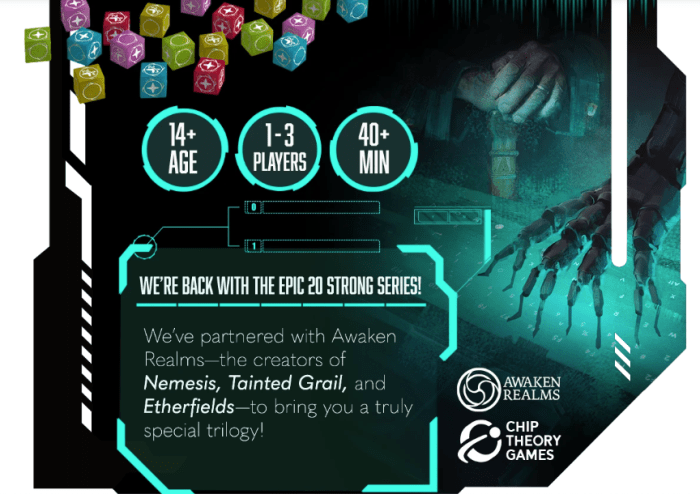
Why here?  Because it’s both solo and cooperative! See above from the Gamefound page!

Oh wait, is it cooperative?

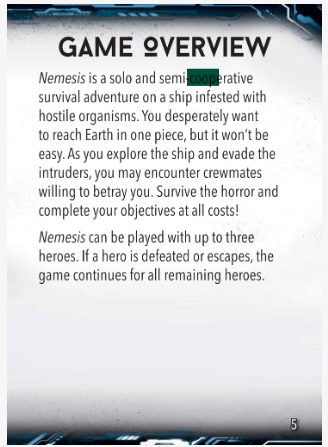
Or is it semi-coop? Hmm … looking on the Gamefound web page, there are literally only two mentions of it being cooperative and/or semi-cooperative! And those two terms are contradictory! The two above! Surely, the rulebook will clarify all! (And YES, a fully cooperative game is VERY different than a semi-cooperative game!)

Oh wait, now it’s cooperative again?

Or is it semi? So, the Gamefound site has two conflicting entries and the rulebook has two conflicting entries. Which is it?

Of course, anyone who knows Nemesis (the original game this is based on) knows it’s absolutely a semi-cooperative game (see Shut-Up and Sit Down video above: one of my favorite): it’s obviously a semi-co-op!

…but recent releases do make it cooperative. See video above!

What’s going on here? Which is it? Semi-co-op or co-op??? There were just enough suggestions that 20 Strong Nemesis works cooperatively (and I wanted to see what all the 20 Strong fuss was about), that I went ahead and picked it up and used it as my on-ramp into the 20 Strong system.

How was it?

Unboxing 20 Strong

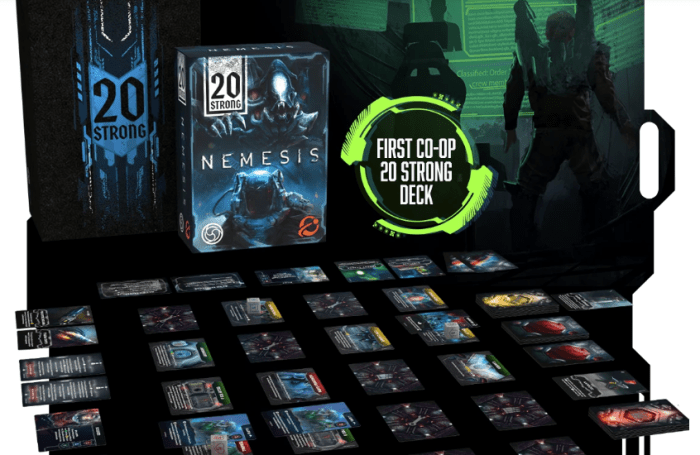
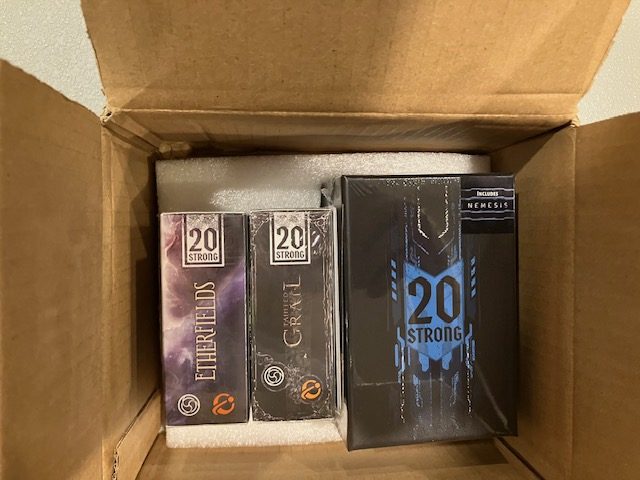
What I backed (with my own hard-earned money) included the 20 Strong Nemesis box, as well as the two solo boxes for Etherfield and Tainted Grail. See above. We will discuss the Etherfields and Tainted Grail boxes a little more later, but we are focusing on the 20 Strong Nemesis box for this review.

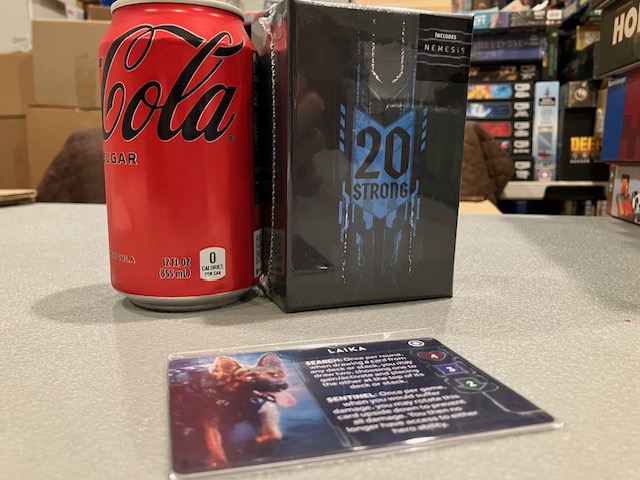
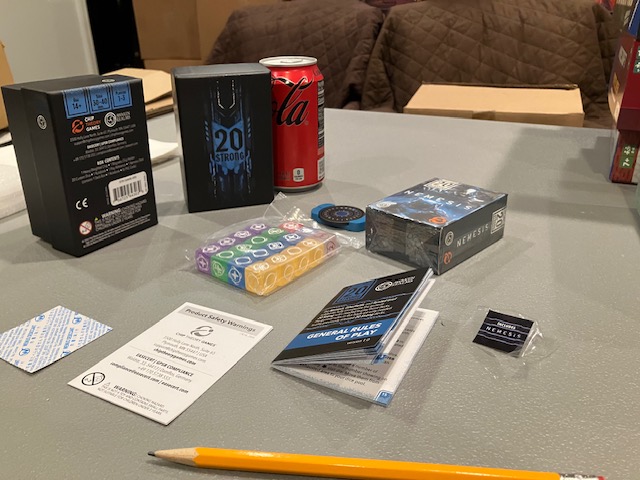
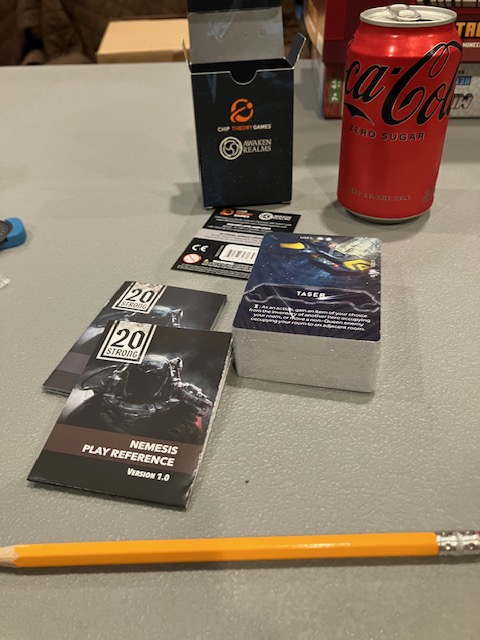
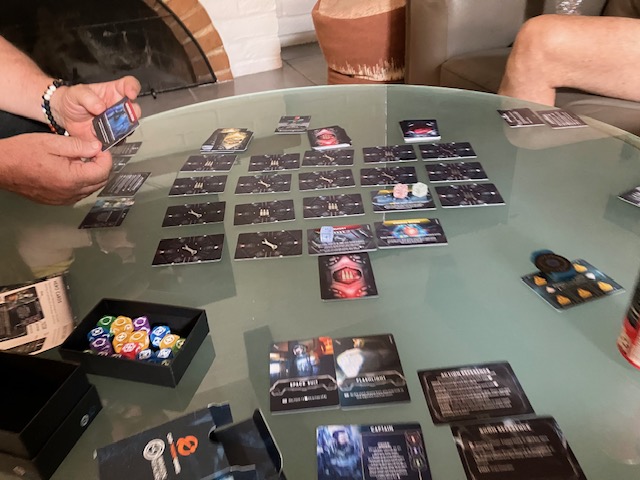
This is a surprisingly small box! See Coke can above for scale. What’s in this thing?

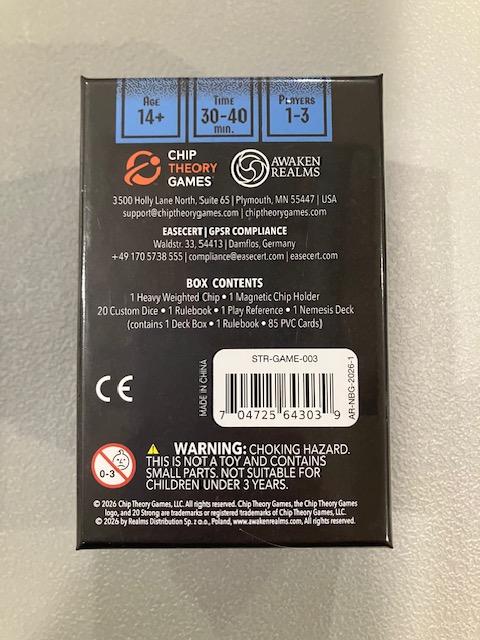
Some dice, a rulebook, a tracker, and the Nemesis box.

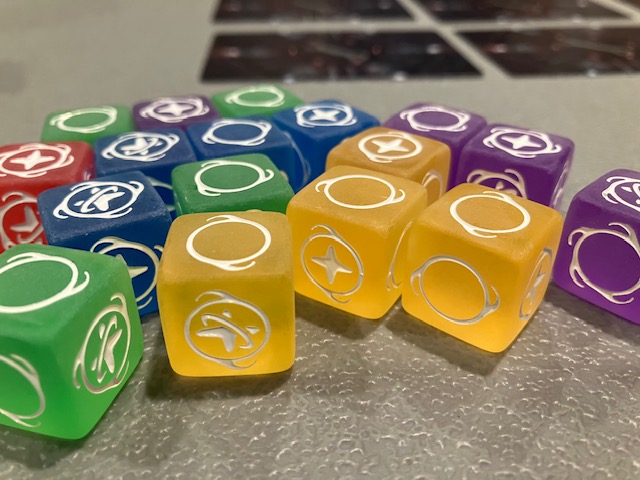
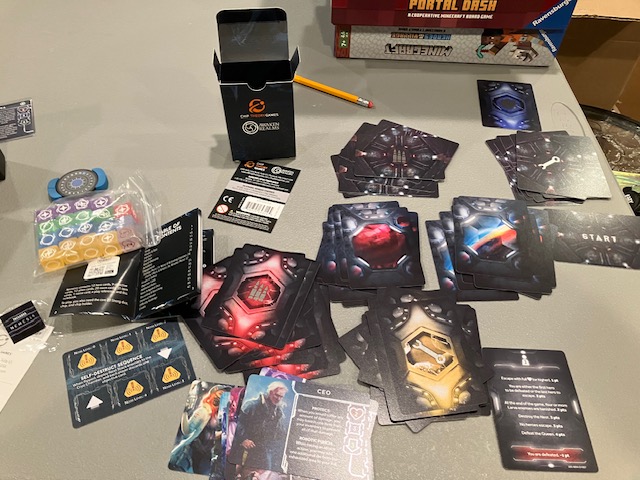
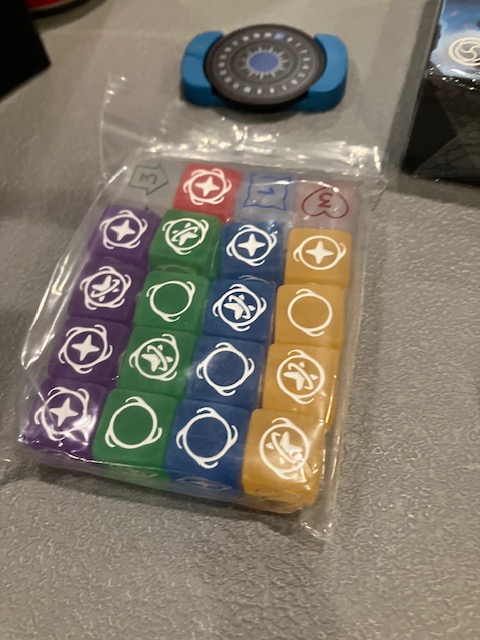
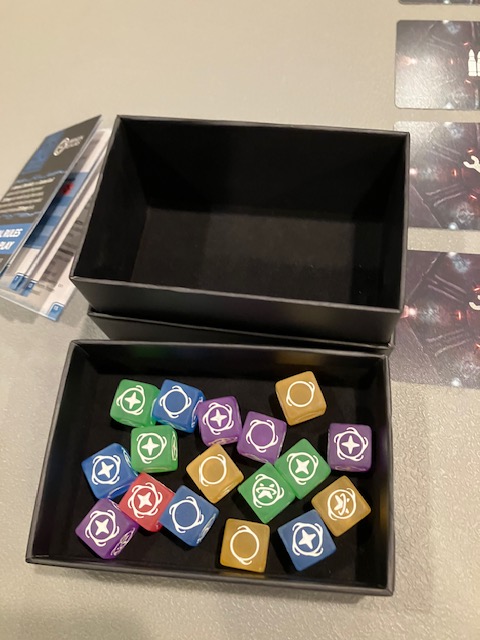
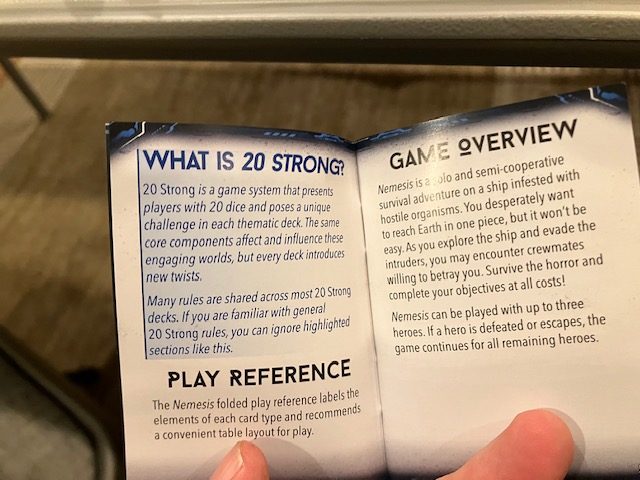
First of all, you have to understand a little about 20 Strong. 20 Strong is the fundamental backbone system of a lot of games; it’ s not really a game by itself.  It has 20 really nice dice (see above), thus the name 20 Strong !

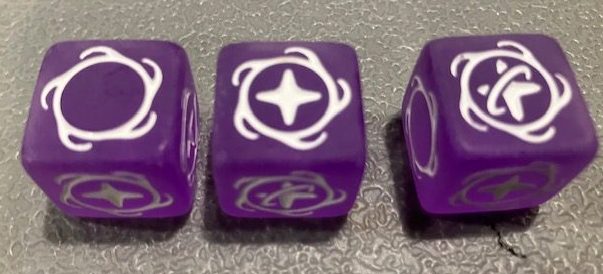
There are a bunch of generic rules about dice: misses (empty circle, left) and hits (+, middle) and critical hits (+ and more, right). The number of tendrils on the outer circle tell you how many of the 6 sides have hits or critical hits: for the purple dice, 5 of the 6 sides have hits!

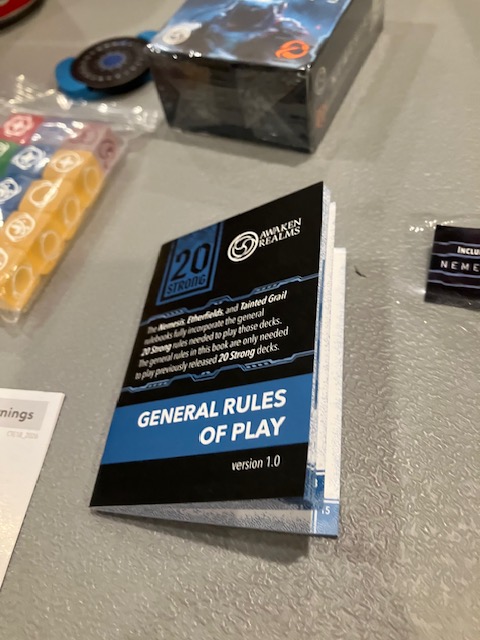
Each game in the 20 Strong system takes these General Rules of Play (see above) and adds/modifies/subtracts rules to make a new game based on this fundamental dice game.

Nemesis is the deck that sits on top of the 20 Strong system!

Unboxing 20 Strong:Nemesis and Gameplay

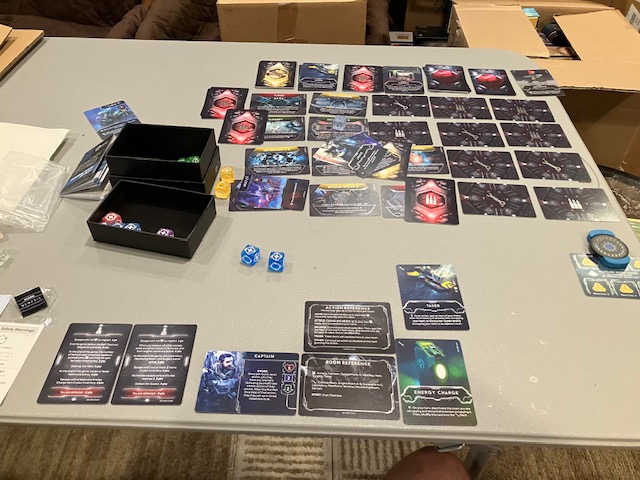
Nemesis 20 Strong card box itself has a bunch of cards; about 85 total. See above.

These cards are AMAZING! They are PVC, not cardboard, so you don’t need to sleeve them! They also all have some foil embellishments that make these POP on the table. These are amazing cards! They look great! And the art is great too!

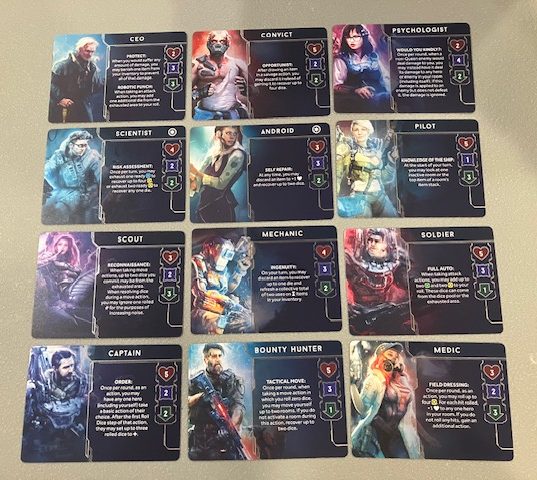
Each player chooses 1 of 12 characters to play. See above.

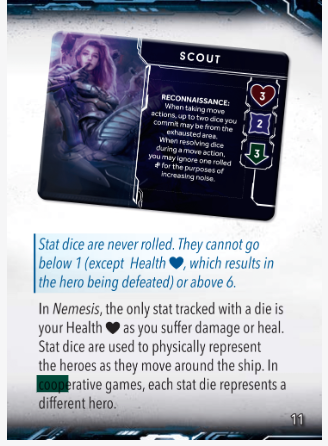
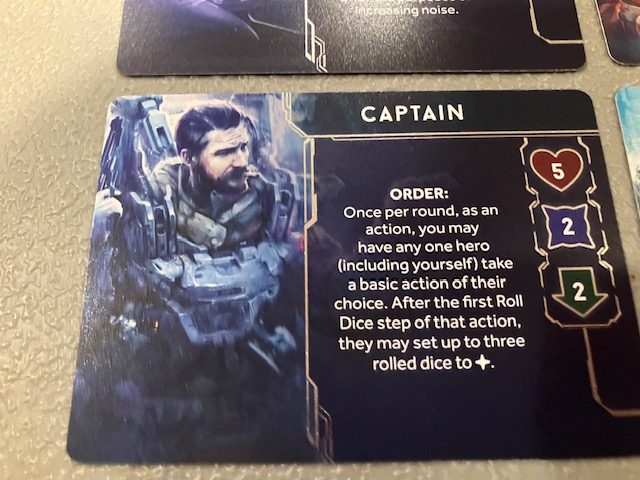
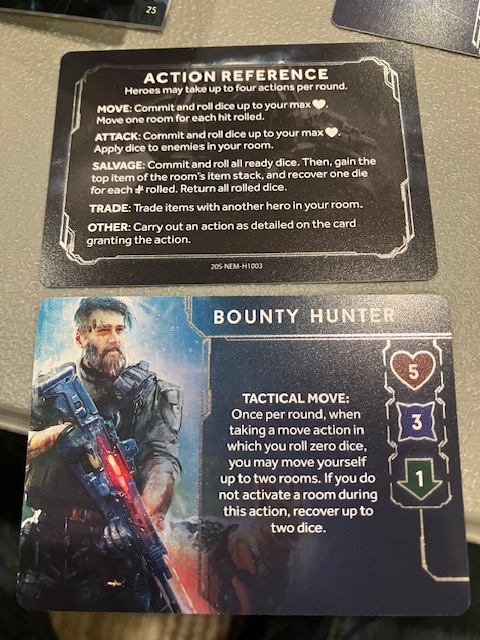
Each character has a special ability (see above) as well as some stats. The Red Heart is how many hit points, the purple thing is strategy (that controls some rerolls/retries and how many cards you can have), and finally the green arrow is how many dice you recover at the start of your turn.

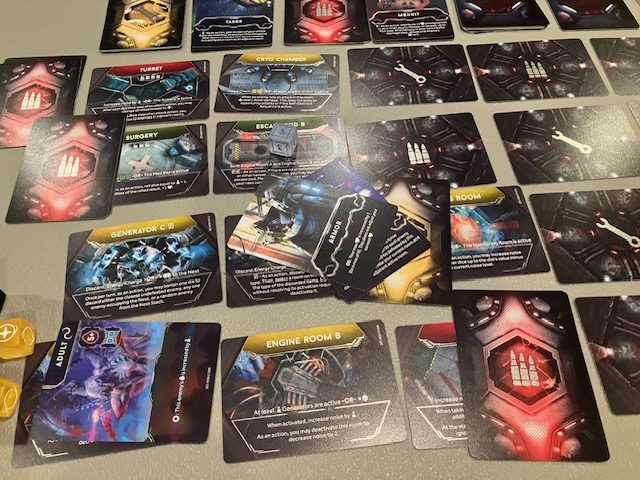
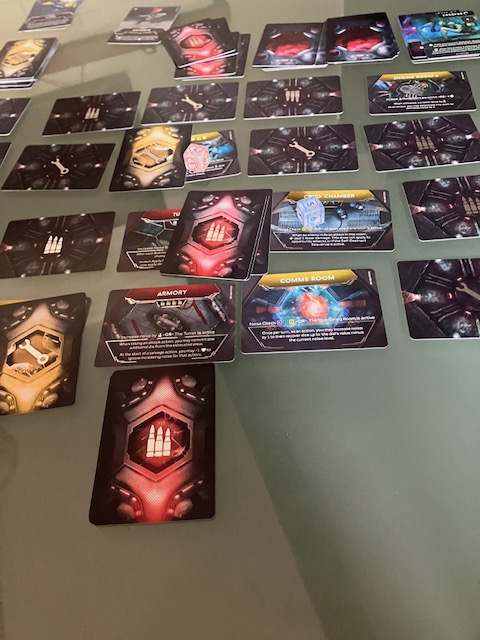
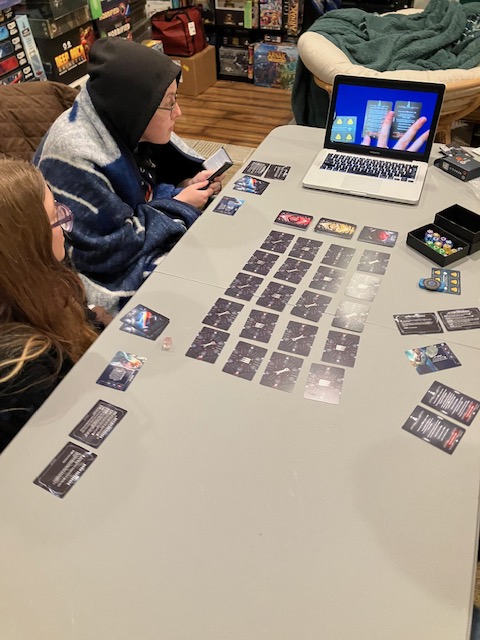
Players explore a 4×5 grid (4 rows, 5 columns) of Locations. At the start of the game, all Locations are face-down, so you don’t know what’s what.

As the game evolves, more and more Locations are revealed! To win the game, players must find the Escape Pods, but they can’t activate the Escape Pods until they activate the Engines, which they can’t activate until they find the Generators! It’s all about exploration!

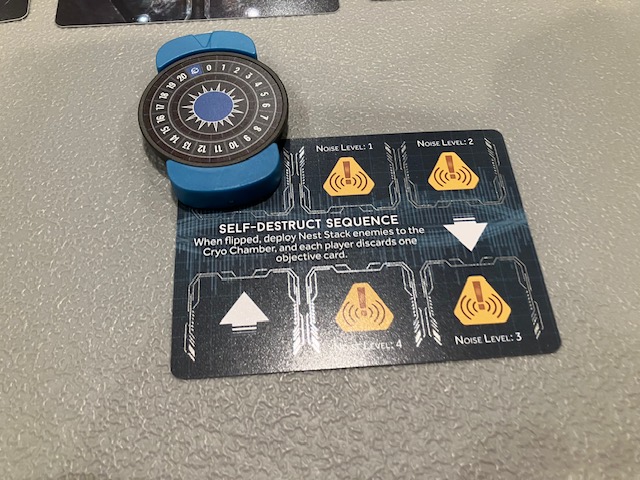
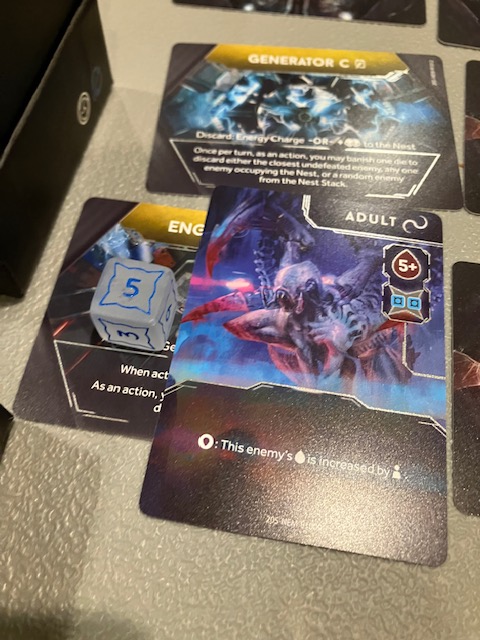
As you explore, you generate noise! There are actually a lot of ways to generate noise! If you ever roll a critical hit (far right) and apply it, it counts as noise! Many Locations also generate noise when you activate them (like turning on the Ship’s engines .. that’s pretty noisy, right?).

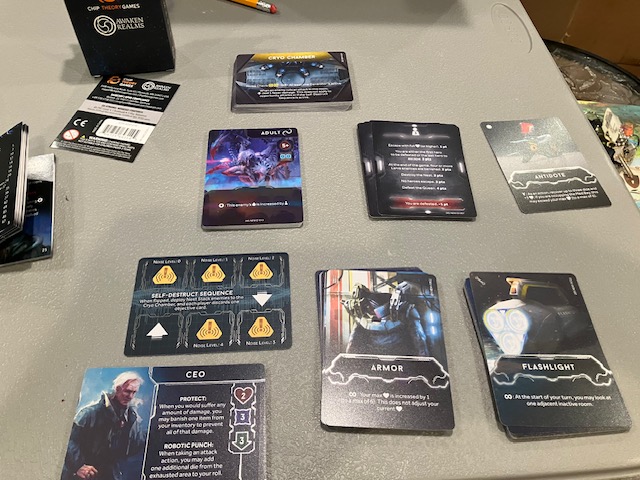
See the noise tracker above! Noise is bad!! Why? When the noise tracker comes all the way around, you accidentally summon an alien!

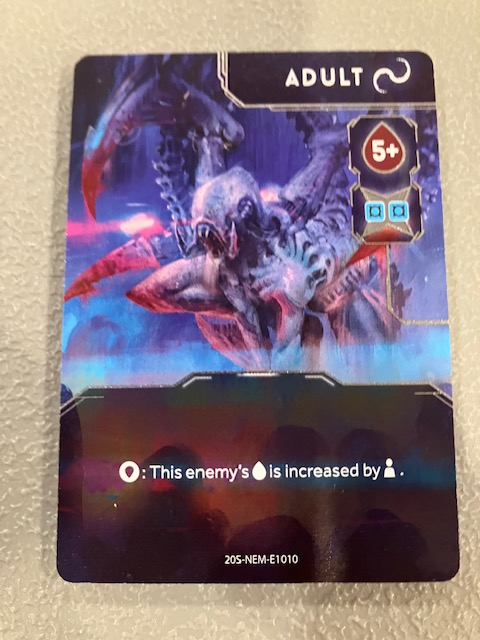
These are the aliens (which look nothing like Aliens from the movies) that hunt you and fight you!

The noise coming back around immediately summons an alien to your Location! Gulp! You better hope you still have some actions to fight it!

On your turn, you have 4 actions to move, attack, salvage, trade, and other. See the Action Reference (on the back of other character cards) above!

To be clear, the dice are key to everything you do here; every move, attack, salvage involves some of the dice.

As you play, dice move from the active to inactive pool! You have to decide how many dice to allocate on your turn! And which dice! Every color die has its own number of successes! The yellow dice are the weakest, and the red die is the strongest! (And you don’t always want to strongest dice on your turn; at the end of your turn you may generate even more noise using the strongest die used!). Let’s be 100% clear: this is a dice game.

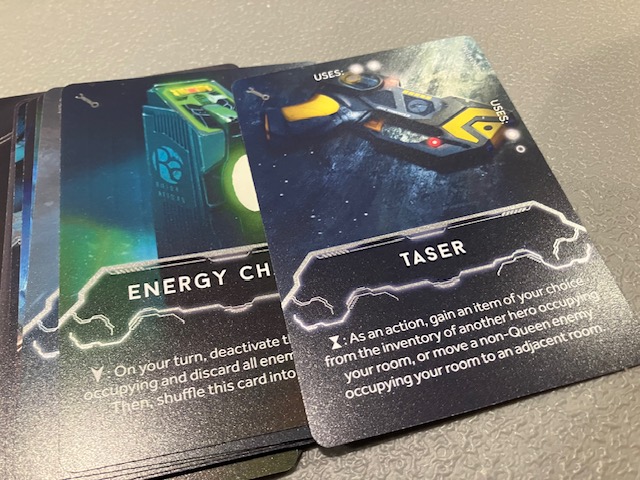
Along the way, you can also pick up items when you salvage; see above as I have a Taser and Energy Charge.

If you can escape the ship in an Escape Pod, you “win!” But, winning is very different if you are playing cooperatively or semi-co-op!!

Cooperative vs. Semi-Cooperative

All right, let’s address the alien in the room: is this a cooperative or semi-cooperative game? The answer is VERY much not answered by the rulebook! Nor the Gamefound site! Like I said, both allude to both co-op and semi-co-op natures, but neither really answer the question.

The answer seems to be very much answered by the official How To Play 20 Strong: Nemesis video from Chip Theory games (the publisher). See above.

Semi-Co-op for the Win!

The answer? This is very much a semi-co-op. I guess that’s a “Well, Duh” to most people. But, after “trying” to play it cooperatively, this game can be played cooperatively, but it’s just not as strong. It’s really how you deal with the objective cards in the game more than anything.

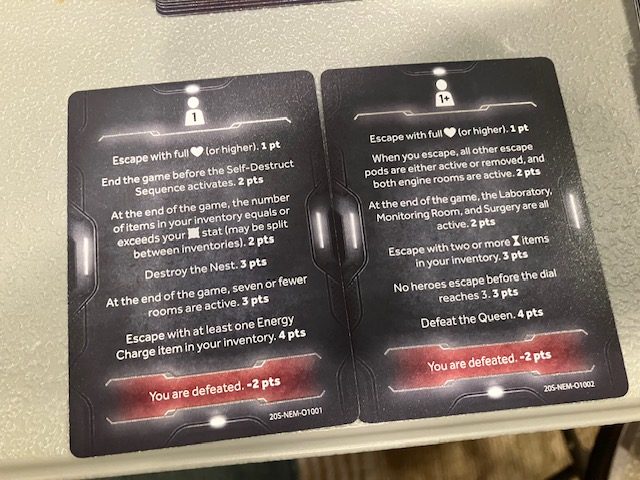
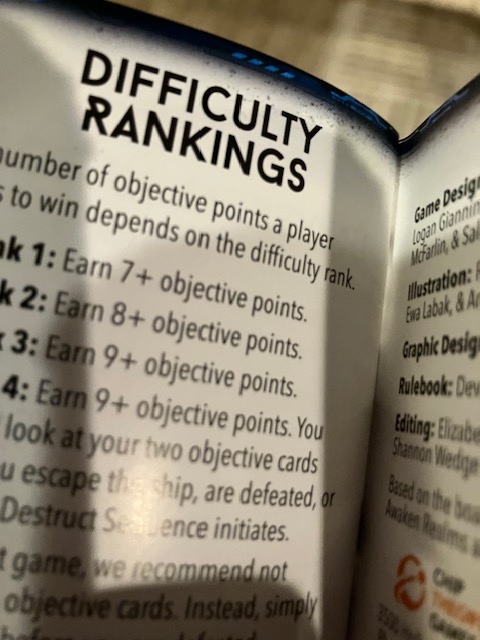
At the start of the the game, each player gets two objective cards. At a certain point in the game (when the round dial counts down to specific placed based on the difficulty and player count), you must discard one or the other: this defines how you get points for the rest of the game! This defines your play-style: do you screw your compatriots for points or play nice? The objectives majorly inform your style!

In the semi-co-op game, you are trying to get the most objective points to win! That’s it!! If you die (pardon me, are “defeated”), you can still win if you can get more points than the other players! So, in the semi-co-op game, everything you do is in the name of getting points: you may lie about what Locations you discover, you may lie about what your objectives are, you may lie about what you are trying to do. You do not HAVE to show the Locations you find, you do not HAVE to show your objectives. You may work a little with the other players to discover the ship, but in general, you are trying to get the most points.

In many ways, 20 Strong: Nemesis is Nemesis: the dice game. Cooperate a little, but lie lie lie.

You Can Still Play Cooperatively

But, you can still play Strong 20: Nemesis fully cooperatively; no lying. Unfortunately, the rulebook kinda sucks, and all the things you have to do to “really” play cooperatively aren’t “really” spelled out. Here’s what we discovered to play cooperatively:

  1. You have to share and discuss your objectives pretty heavily out-loud! There are plenty of objectives that are truly mutually exclusive, and you need to talk so everyone can “do the right thing” to make it so everyone can fulfill their objectives!
  2. You need to specify the “fully cooperative” win condition! After playing many cooperative games, the fully cooperative objective seems to be “all players must escape and have enough objective points!” I think all players need to survive and have enough points to call this a win. I “guess” if a player dies, but still somehow has enough points, they are considered part of a winning team?
  3. You need to communicate well. No lying.

The worst part is that it’s not 100% clear what the win condition should be cooperatively! I think everyone should escape AND have enough objective points? But I can also imagine a scenario where one player dies by making the ultimate sacrifice to help the others. but can still is in the winner’s circle because his objective points were achieved.

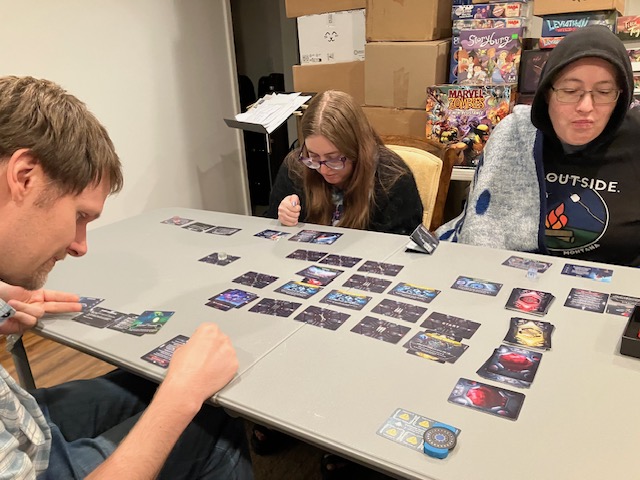
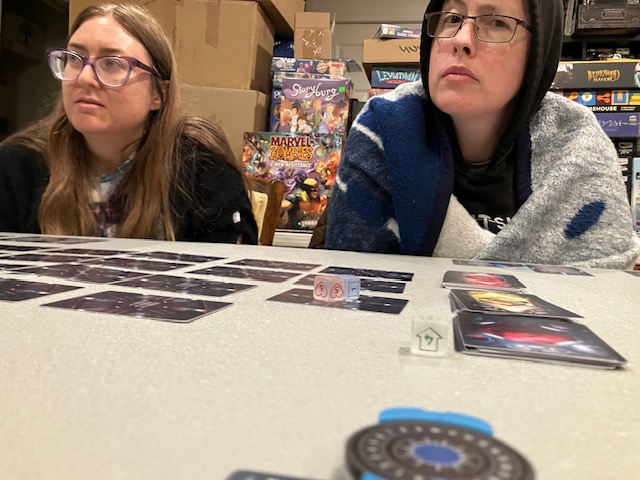
I taught/watched a 3-Player cooperative game, and my friends did a great job cooperating! They had to figure out a way so that everyone escaped the ship with at least 7 objective points! They talked about their objectives, they talked about how to meet them, they talked about how to help each other meet their objectives!

It was surprising just how cooperative this game can be, if you just know what cooperative rules should be. The rulebook could have easily had a few pages distinguishing semi-cooperative play from cooperative play. And a co-op mode does seem to work.

But as-is, 20 Strong: Nemesis is a semi-co-op.

Rulebooks and Rules

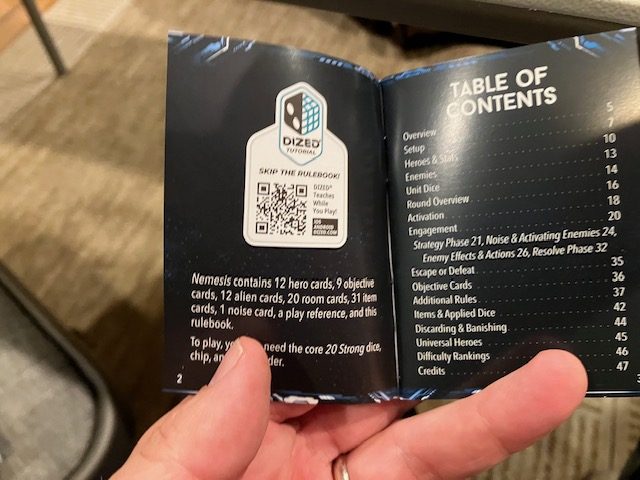
I did not like this rulebook. First of all, it said to try out the Dized tutorial! Not available yet! (at the time of the play).

This game probably gets a D on the Chair Test! As much as I hate the form factor (as it was tiny and small), they did a good job with the font: I could read it.

There were a lot of things that weren’t really well specified. I had to re-read the rules several times (what does the turn timer start at? What does a crit hit do when I attack? The aliens attack? For a noise check? The crit means different things depending on the context! ) I ended up going to the official How To Play video from Chip Theory games, and I still didn’t get everything answered! (The Strategy component is not really explained in the video at all).

It really took about 5 plays to get the rules down. For a “simple” dice game, I was very frustrated. Part of it was also the fact that the base 20 Strong rules are interspersed with Nemesis rules, and it’s confusing: see above.

I recommend watching the How To Play Video from Chip Theory games, and hopefully the Dized tutorial will be online by the time you read this. But you are still gonna have to read this little rulebook a little. I didn’t love it. I hated the form factor.

Solo

You can play solo. I played a few games solo to get the feel of it. You can even play true solo and only play one character!

I won. It was ok. It was .. fine.

Reactions

The reactions … weren’t great.
Ralph: It was ok.
Sara: 5/10. I’d play again if someone wanted to, but only fully cooperative. I’d never play semi-co-op.
Andrew: 5/10. Same
Teresa. It was ok 6/10. I’d never play semi-co-op
Rich: It was ok solo. 6/10. I think the co-op was better: 6.5/10. I also would never play semi-co-op.

Conclusion

I really wanted to like 20 Strong: Nemesis, but me and my groups were pretty disappointed by it. Some of that disappointment was that the co-op wasn’t great, but 20 Strong: Nemesis is really probably best as a semi-co-op. This is management of expectations: you can’t really like a cooperative game if it’s really a semi-cooperative game.

I think if you take 20 Strong: Nemesis as what it is, as a semi-co-op, then it’s pretty good. I think objectively that it’s probably a 7.5/10: it’s a shorter, faster, stream-lined version of the original game of Nemesis. You may love it!

If you take it as a cooperative game, the rating drops to a 5 or 6 for my friends; I was highest at 6.5/10. (Solo was just “ok” at 6/10).

The weird thing is that watching my friends play it fully cooperatively (which is really not an official version), it was pretty darn cooperative! They were talking and working together so well! I have to be honest, I’m not sure what it would take to move this up just a bit more: there is a good cooperative game in here, I just think it needs something else. I saw the cooperation happening! I saw the discussion of mutually exclusive objectives! There is something here! I just don’t “quite” know what’s missing for this to be a good fully cooperative game?

If you are looking for a good fully cooperative spaceship exploration game that’s short and moves around a grid, I would recommend Solar Storm instead of this (see review here); Solar Storm made our Top 10 Cooperative Games of 2020!

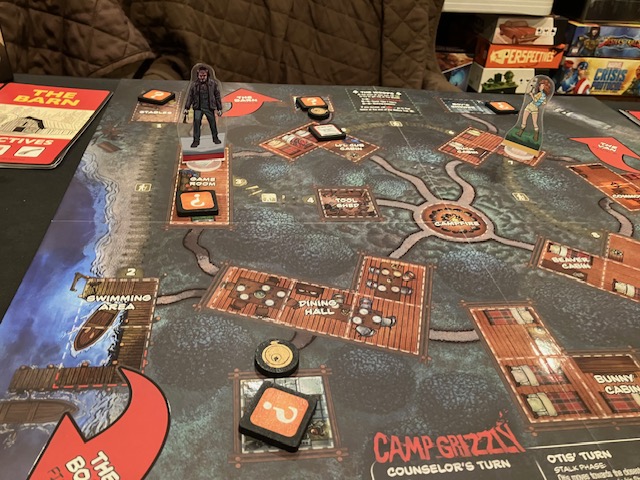
Stupid Fun. A Two Word Review of Camp Grizzly: Second Edition

Stupid Fun. That’s all you need to know about Camp Grizzly: Second Edition.

What? You want to know more? Ok, we’ll talk a little more about this.

Stupid, Random, but very Thematic Fun! There! Is that better?

No? That’s still not enough? All right, all right …. we’ll look a look closer at this cooperative (yes, it is cooperative, that’s why we are here) horror game.

Unboxing

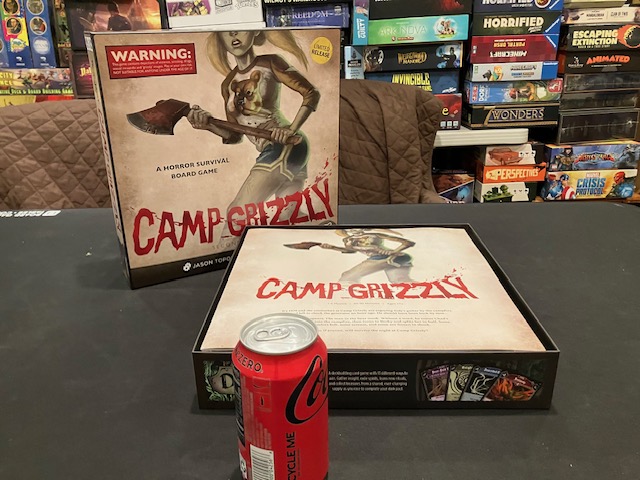
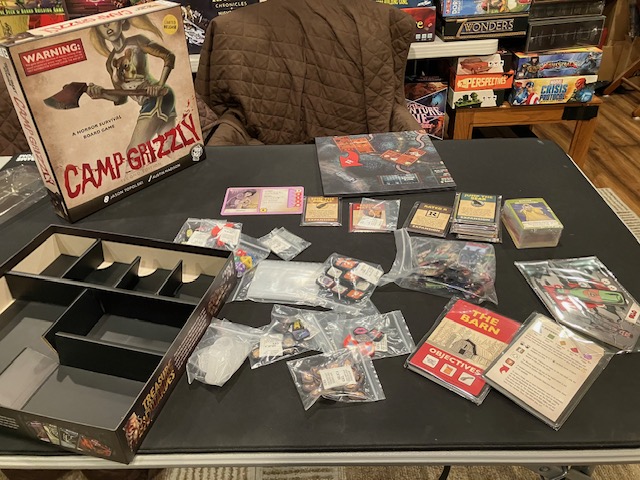
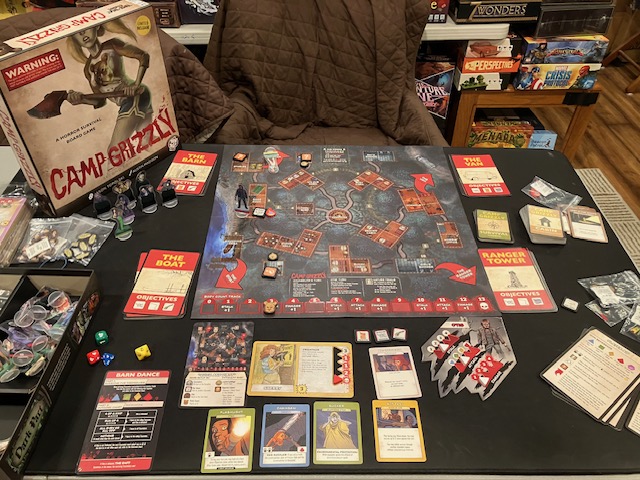
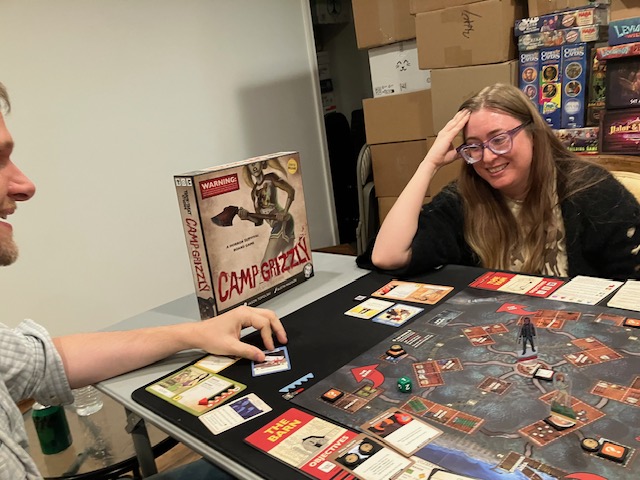
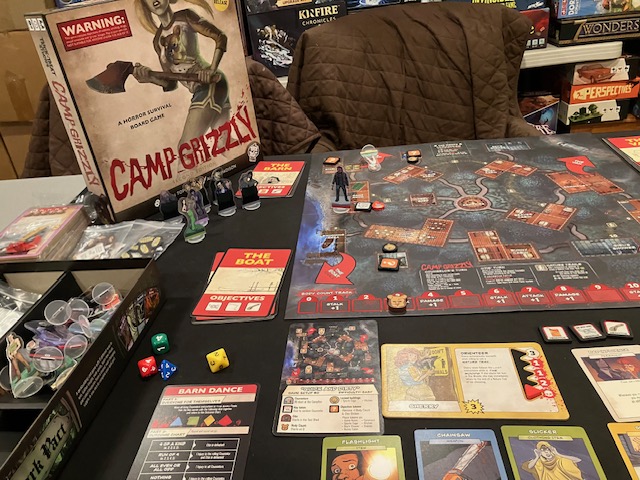
This is the second edition of the silly cooperative game called Camp Grizzly. See Coke can and box above for scale.

I backed Camp Grizzly:Second Edition from Kickstarter back in August 2025, and it arrived at my house in early July 2026. It arrived early! It was originally slated to arrive August 2026!! What? An Early Kickstarter??? That never happens! I was on the fence for backing this, but it was Mike Heller who convinced me this was a good choice! The game I backed was the Limited Release version with lots of acrylic tokens and standees.

Acrylic Standees

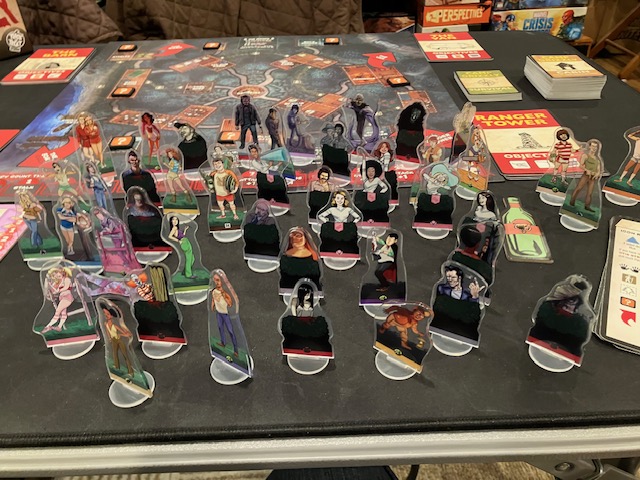
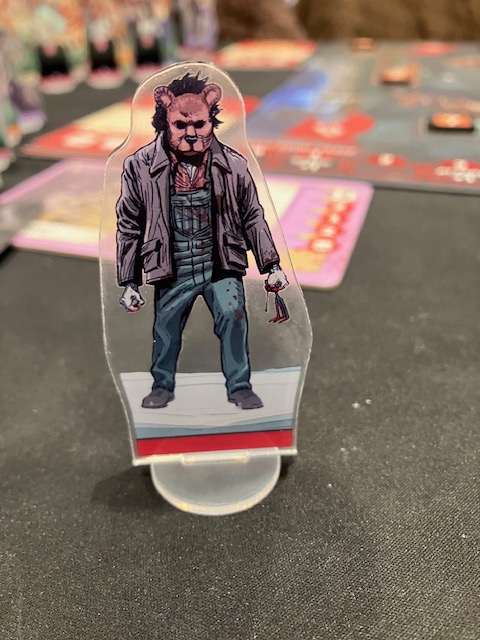
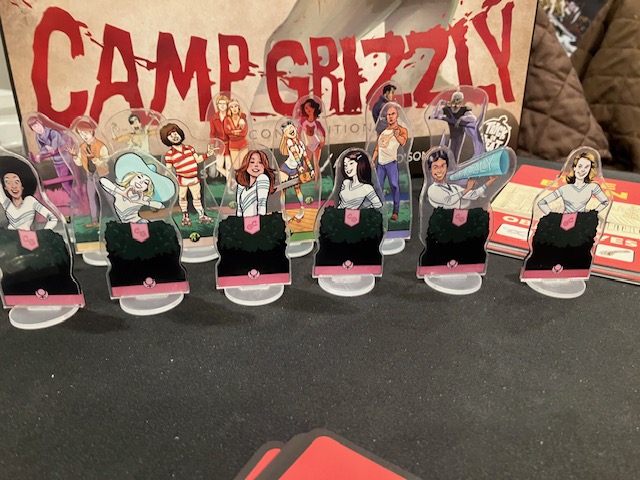
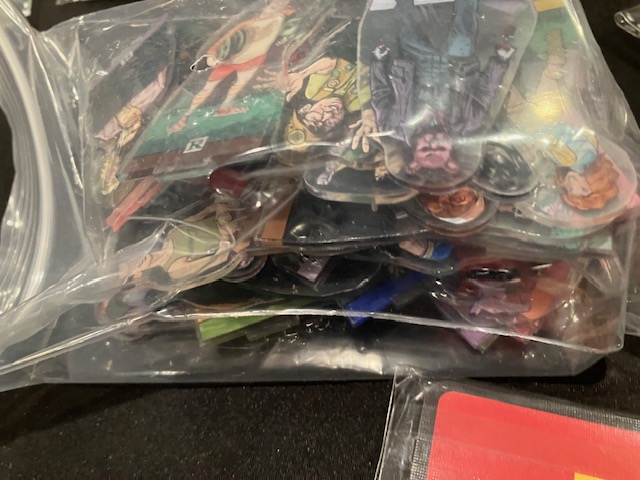
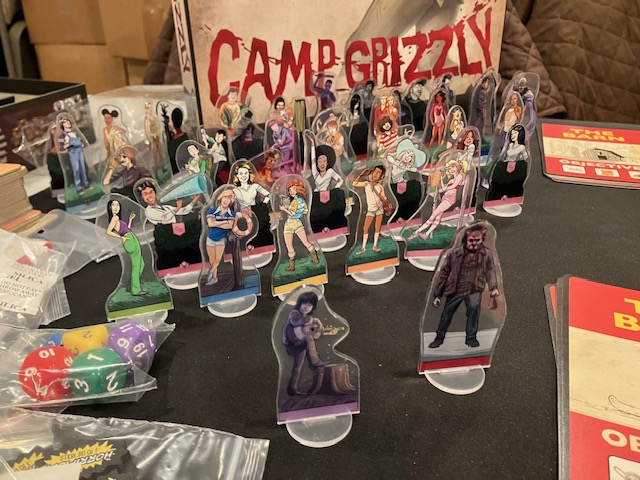
I am embarrassed to say that one of the reasons I was so excited for this game was the Acrylic Standees! The version I got (Limited Release) comes with Acrylic Standees that are so funny and goofy and thematic! See the full bag above of them!

The Acrylic Standees work SO WELL for this game! The art style is very “comic booky”, and I find that style works really well with Acrylic Standees: The colors are more vibrant and just pop!

There’s a LOT of them too! See above!! Why so many? Because this particular version comes with 8 expansions, and some of these standees are just for the expansions that come in the box!

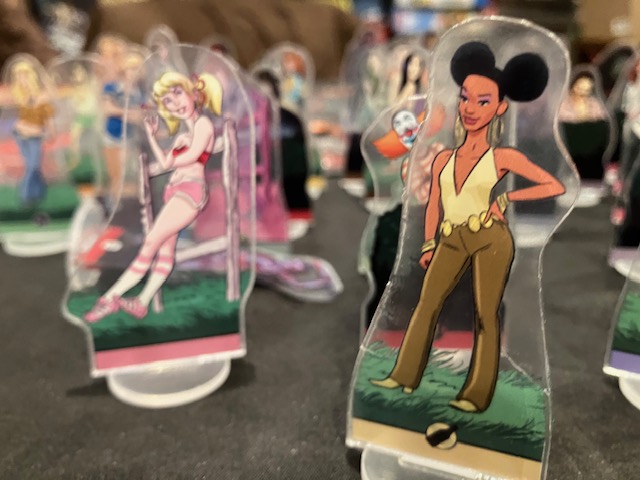
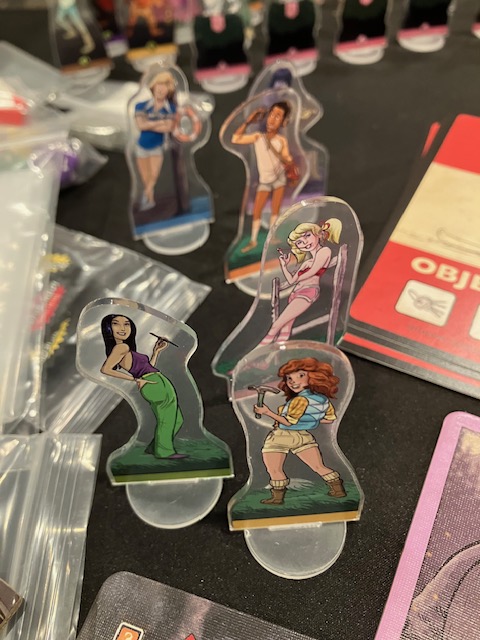
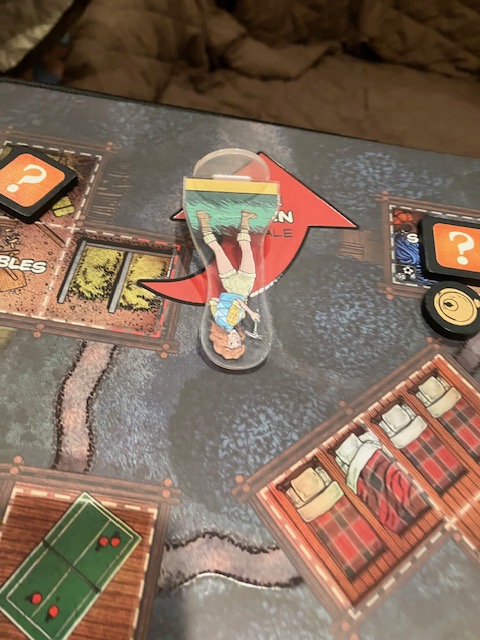
Note the two above; the lady on the left has no “symbol” on the bottom of her standee, so she’s a base game character. The lady on the right has a bottle-looking symbol: she’s from the Spin The Bottle expansion!

Some of the expansions have a TON of standees! See all the Mountain characters above!

I adore the Acrylic Standees; they work so well! If you have a chance to buy and/or play Camp Grizzly: Second Edition, try to get the version with the Acrylic Standees! I think they are that great!

Gameplay

The premise of this game is simple; have some Counselors survive Otis and make it to the Finale! If all Counselors die, everyone loses! If some counselors survive, everyone wins! Let’s be 100% clear; some of the Counselors will die!! And possibly you might die!! But don’t take it personally.

Otis (see above) is at Camp Grizzly and he is the BIG BAD HORROR monster chasing the Counselors! Otis is the amalgam of Jason, Freddy Krueger, Micheal Meyers, Leprechaun (blah) and all your “favorite” horror movie baddies! Just to be clear: no player is operating Otis and hunting the Counselors: the game plays Otis via some rules.

There are several modes of play in the game: Modern Murder Mode and Classic Action Mode.

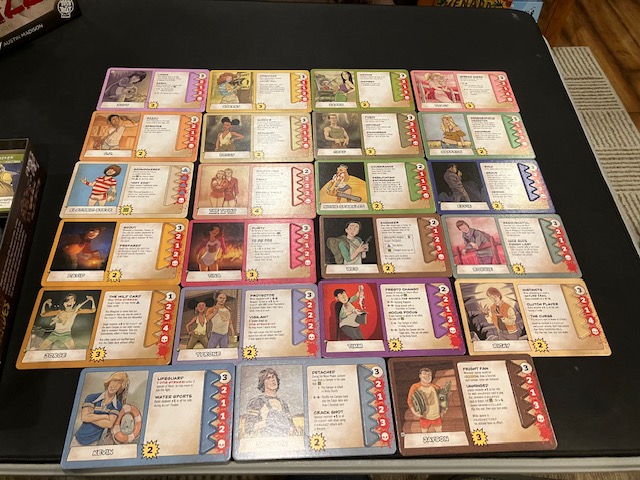
In Classic Action Mode, the players choose 6 Counselors (see all Counselors above; some are from expansions) and the players as a group operate the 6 Counselors: there are always 6 Counselors (well, until they get killed … and they probably will …).

In Modern Murder Mode, each player takes the role a single Counselor: one character per player. If your Counselor dies, you get another one.

And just a reminder, in case I haven’t mentioned it yet, counselors will die.

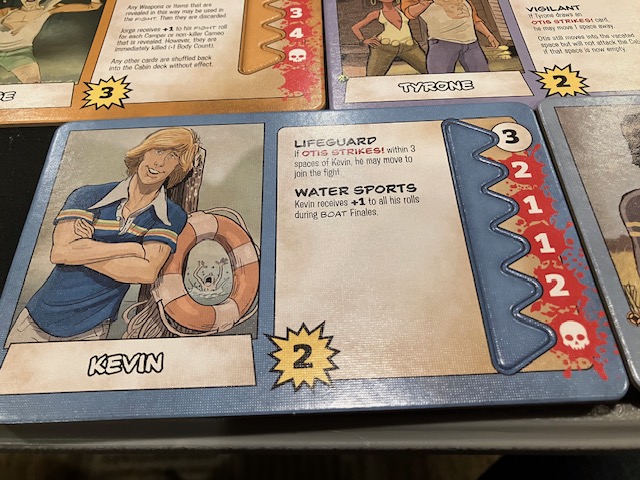
Counselors each have a Special ability to help them! Kevin (see above), for example, may move to a fight and gets +1 during BOAT finales! Kevin only has 5 hit points (note, it’s NOT the number next to you: that’s your movement). Notice that the healthier you are are, the faster you move! At full health, Kevin moves 3 spaces per turn, but as he gets wounded, his movement degrades to 2 then 1 (and then with a second wind back to 2)! If Kevin ever PANICS (yellow bam), he can run up to 2 away.

The players choose a Scenario (as specified by a number of cards) and set it up!

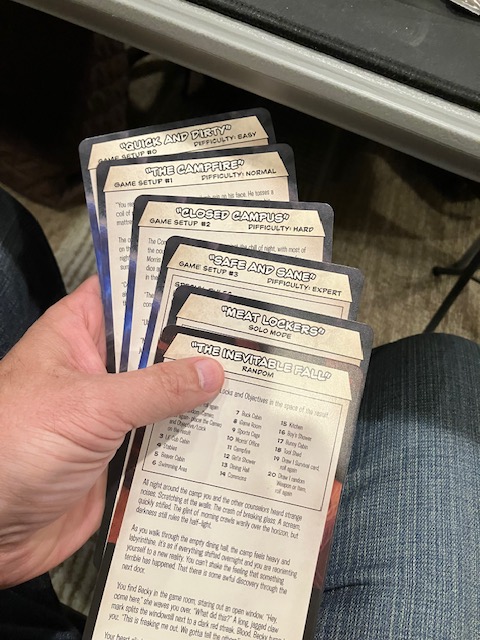
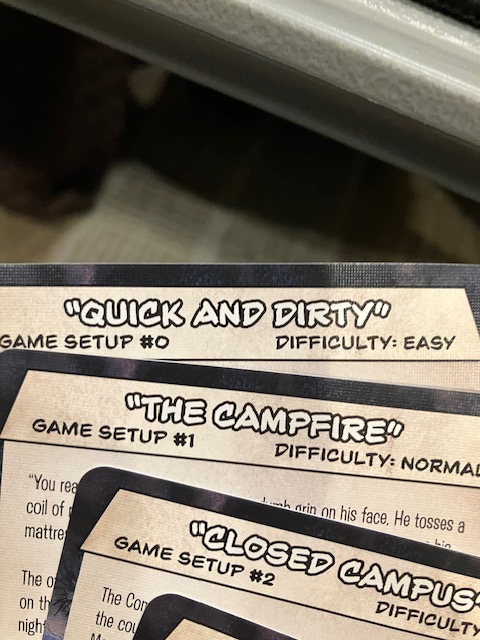
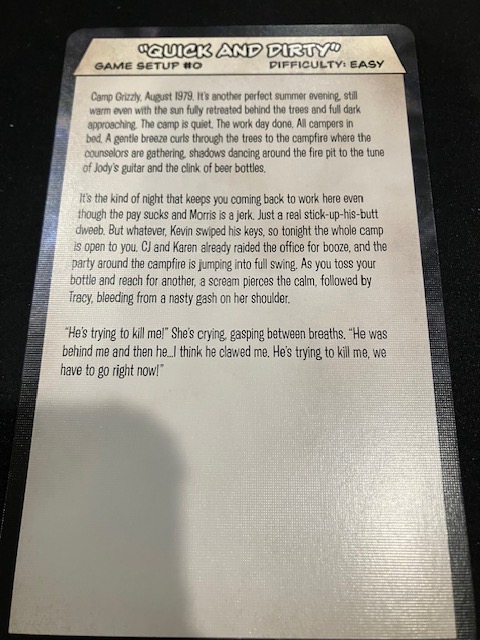
There are a number of set-ups of different difficulties. The game recommends starting with “Quick and Dirty”: see above.

After reading the flavor test (whosoever is the most dramatic and over-the-top reader should read this), the other side gives the set-up for the game!

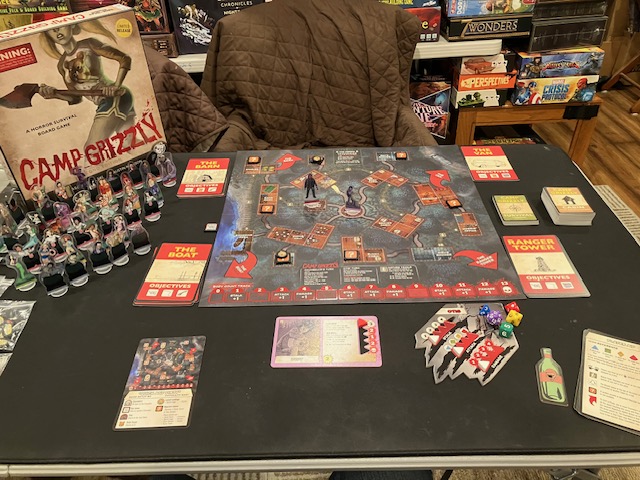
The set-up puts the characters, Otis, and some Objective Tokens on the board.

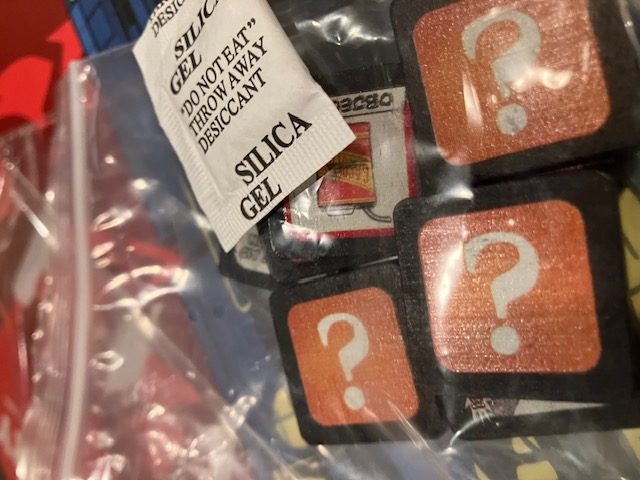
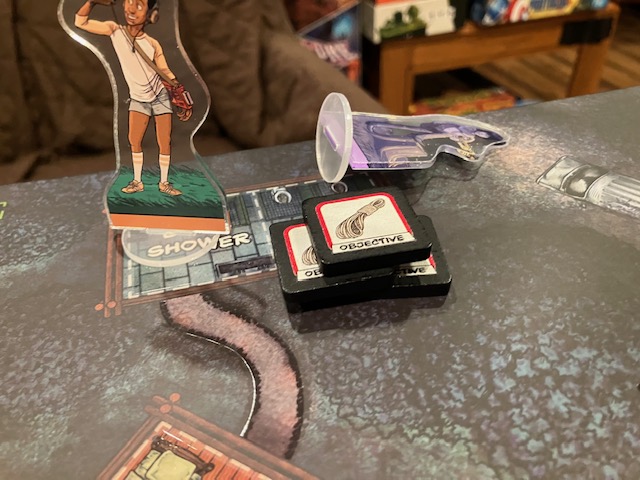
The Objective Tokens have various things on them (First Aid Kit, gas, rope, … other things). The players are trying to the objective tokens so as to trigger one of the end Finales!

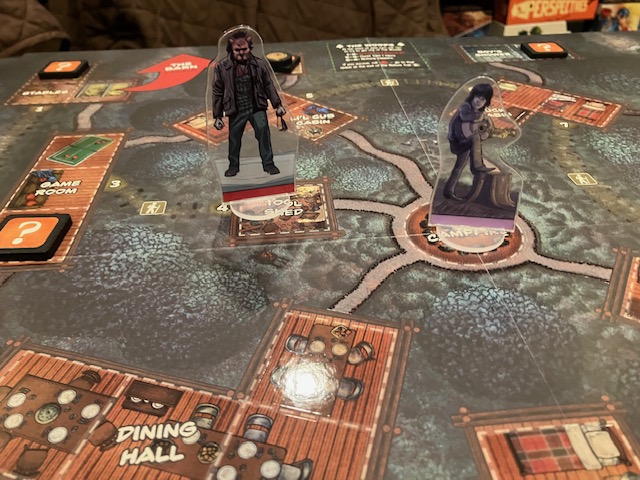
There are 4 possible finale-triggers at the 4 corners of the board; the BARN, the BOAT, the VAN, the RANGER tower: see above.

If you can get the three Objective tokens (keys, crowbar, battery), you can move to the Ranger Tower and initiate the Finale!

Depending on which tokens you get (they are all hidden at the start of the game), you may have to run to the VAN or the BOAT instead! Each finale needs different resources! (To be clear, there are a lot of finales; it looks like 24 for my version of the game).

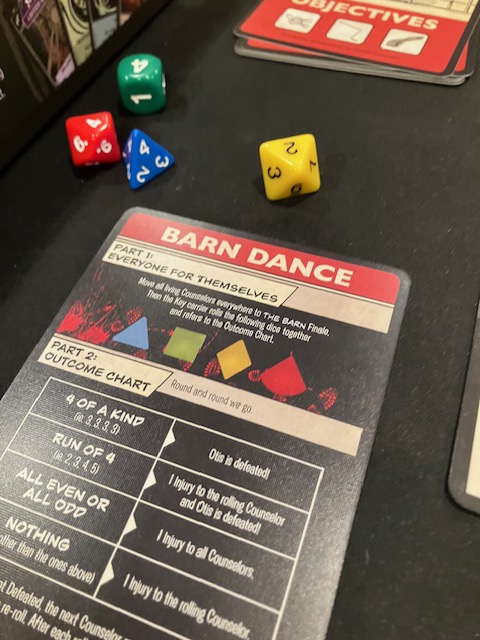
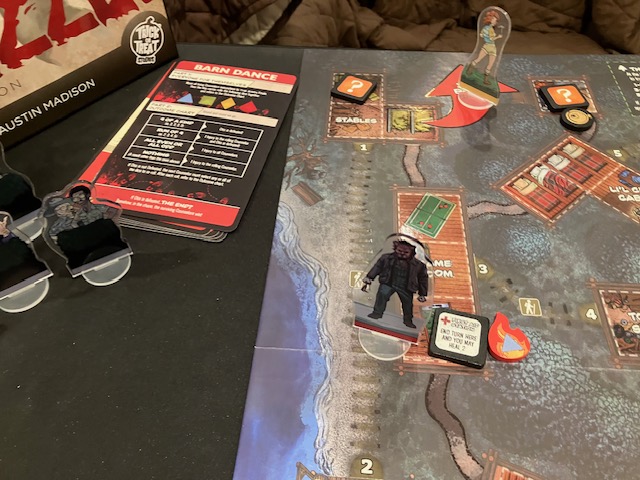
The finale can be SO VERY different! One of them is a Barn Dance, where you have to roll dice and try to get a certain match! In another, I had to sacrifice one of the Counselors! … and each one is really different.

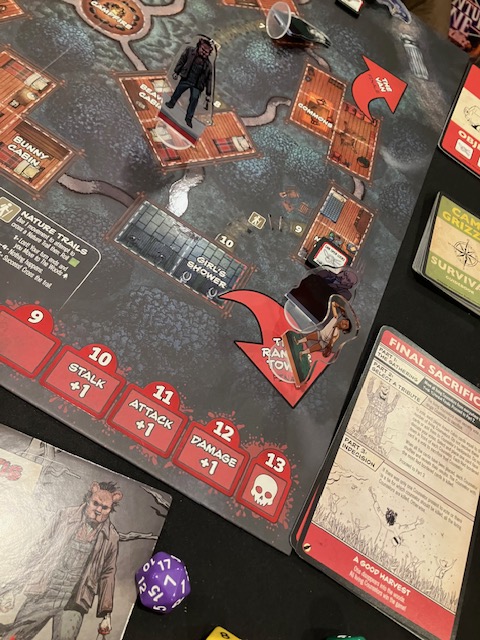
As the game goes on, Otis gets more and more terrifying! He starts to move faster, attack for more!

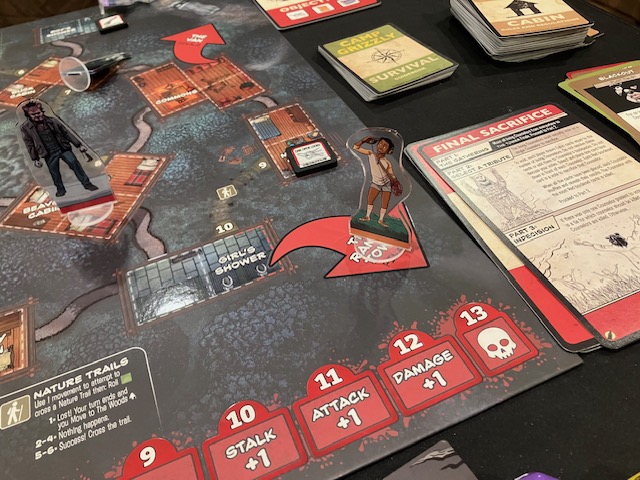
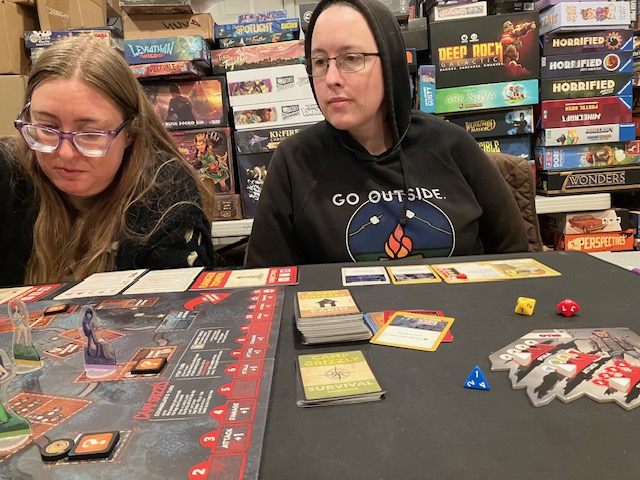
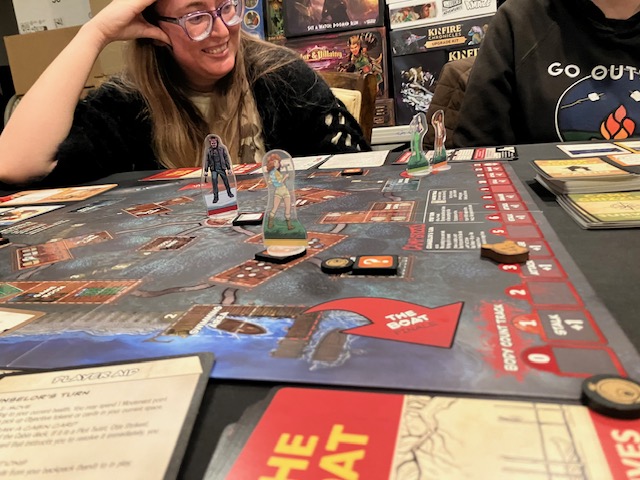
Basically, as the Body Count goes up (yes, there’s a body count track), Otis slowly get more powerful! Funny, even if the Counselors don’t die, there are extras that die all over the place: Cameos and other NPC campers.

If players can’t trigger a finale, and the Body Track gets too high, there will be a final fight instead!

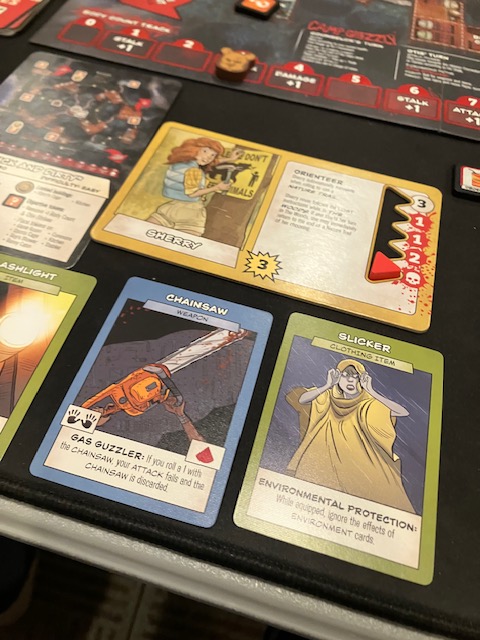
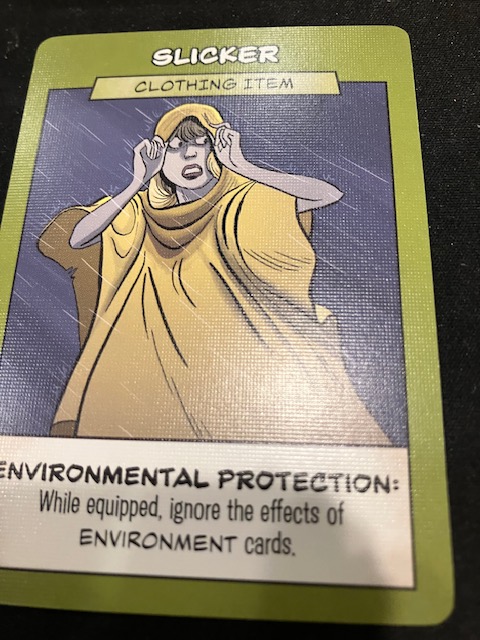
Along the way, you’d better hope you find some stuff to help you! Sherry was lucky enough to find the Chainsaw and Slicker! See above!

There’s a Cabin deck that players will draw from every turn, and a Survival Deck you can get lucky and draw from occasionally. What’s in the Cabin deck? So much random stuff!

You might get good stuff … like the Slicker …

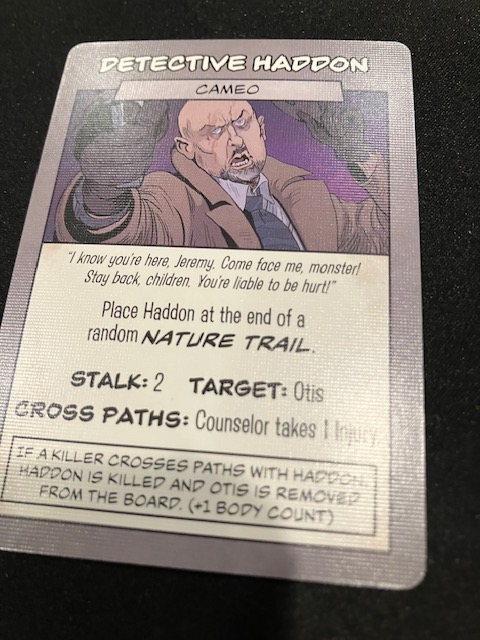
You might get a Cameo by a famous actor (who will probably die very quickly) …

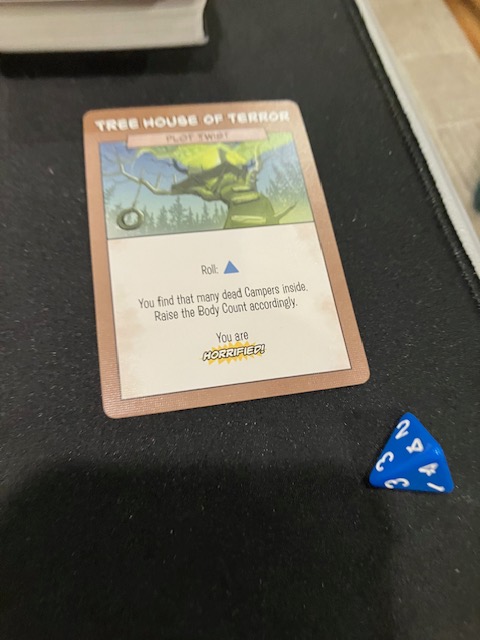
You might get a Plot Twist, which screws you!

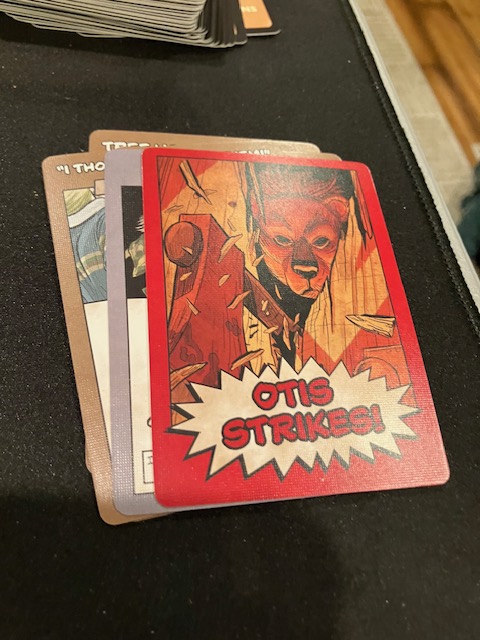
… or you might get Otis Strikes!

You can fight Otis (a little), but generally he overwhelms you and you take damage. If your Counselor runs out of hit points, you either just die (Classic Mode) or respawn a new character (Modern Murder Mode).

Survive the Finale or the Final Fight and you win!

Rulebook

The rulebook is generally pretty good.

It gets a D- or an F on the Chair Test, as the rulebook is the same size as the box, and hopelessly droops over the edges. You might be able to use it on the chair next to you, but maybe not. It’s too bad, because the rulebook is pretty good otherwise.

I wish the rulebook had an Index; there are a few too many concepts and/or keywords, so I wanted to look stuff up quickly via an Index.

Solo Game

So, Camp Grizzly: Second Edition works as a solo game! (Thanks for following Saunders’ Law!) Interestingly, because there are two modes to the game (Classic and Modern), you can choose to either play 6 Counselors at once as the solo player in the Classic mode, or you can play true solo in the Modern mode, and play just one Counselor!

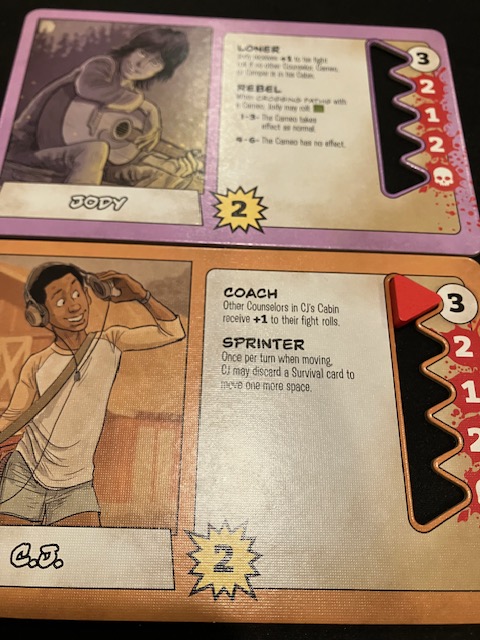
I opted for the true solo game with one Counselor. See above as Jody decides it’s a good idea to stay at camp alone at night! Wait … maybe that’s NOT a good idea …

Jody died pretty quickly, but C.J. stepped up (“spawned”) after Otis killed Jody! The great thing is that C.J. was that he was able to pick up all the stuff Jody dropped when he died! See above! This is really thematic that you can loot the dead bodies!

Now, C.J. made it to a Finale at the Ranger Tower! And what happened?? Because there was only ONE Counselor alive, C.J. had to be sacrificed! If there had been TWO Counselors, we could have won, as one of us had to die … but as long as at least one Counselor survives, we win! I COULDN’T WIN! No matter how I played the true solo mode, I couldn’t have won .. at least with this Finale.

Huh. I wasn’t frustrated. I thought it was kind of funny! Are all scenarios this poopy for the solo player?

I set-up the same intro scenario and had Sherry run this one by herself!

Sherry did MUCH better than C.J. or Jody! She made it all the way to the BARN Finale with no wounds and a CHAINSAW!!

The BARN DANCE was a very different Finale! Sherry had to roll some dice to survive … and she did not survive.

Sherry died. So I lost again. But I could have won … I am beginning to think I actually would have had a better chance with at least one more Counselor. I am beginning to think 2-handed solo (2 Counselors in Modern mode) is probably the best way to play solo?

Again, you might think I was frustrated that I lost. Nah. It was goofy fun. You have to realize .. these games were very quick! Once you get into the groove of this game, I think my second solo game took 45 minutes? This game moves quickly. And you really can’t take it too seriously.

Cooperative Mode

So, when I first looked at Camp Grizzly: Second Edition on Kickstarter, the game is billed as “semi-cooperative”; see above!! I actually didn’t back it at first when I saw that!

I don’t think that’s quite accurate. I think a strict playing might be “only the players that survive” are the winners. But the thing is, it’s almost always in your best interest to keep many Counselors alive! I have seen a number of Finales now, and it always behooves you to have more Counselors! The more Counselors you have, the better chances you have of surviving and winning!

Even the rulebook points out: “look, if anyone survives, y’all win”. It’s cooperative! Mostly; even when you have to screw other players (like when we had to sacrifice a Counselor), it’s still in the name of common good! As long as one Counselor makes it out alive, you all win!

The basic cooperative game was pretty easy to explain and jump into. I didn’t have too many problems teaching the game.

The Finale was actually a little harder to explain and how it worked.

This game reminds me a lot of Betrayal at House On The Hill! The Finale was “wonky” and we had to try and figure out what the card meant! I have to admit, I had this problem a little in the solo game too! Each Finale you trigger is very different, but it means the rules aren’t quite as well defined because they are different every time! Luckily, this is a cooperative game (unlike Betrayal At House On The Hill), so you players can discuss “What does this mean?” One of the problems with Betrayal At House On The Hill is that the environment is so tense and antagonistic because you can’t ask questions… because that might give something away! At least here in Camp Grizzly, the wacky Finales can be discussed as a group.

And we definitely saw what “could” be semi-co-op nature of this game!!! We had to leave poor Teresa behind because her movement had dropped to 1! There was no way she could make it to the Finale in time! So, we had to trigger the Finale and “leave her behind”. If this had been a true semi-co-op, Teresa would have just lost. But, like a Horror movie, even if your favorite character dies, you still hope the Counselors will survive! The flavor of this game was cooperative; we aren’t gonna win if we have to wait for Teresa, so we all made the decision to leave her behind! And she was cool … she was just hoping one of us would survive!

In the end, Sara just barely survived the Finale: both Andrew and I died in the Finale, but since Sara survived, we all won! Hurrah! It was a bummer to die, but we “knew” we won!

So, our game was over in about an hour. The game moved quickly, and was “generally” easy to teach! I did have to look up some rules in the rulebook as we played, but it wasn’t too bad.

I think this game is simple enough that a group could learn this “cold” at a Convention without too much trouble. This probably could have made our Top 10 Cooperative Games To Play at Conventions! It is very simple to learn.

Thematic

Growing up in the 80s, I was forced to watch a ton of Horror Movies with my friends. CC and Sloppy loved the horror genre, and I didn’t. But they outvoted me many times! So, I watched a lot more Horror than I expected to as a teenager. In fact, I was once made to watch ALL 7 Leprechaun Horror movies! (Yes!! There are 7 Leprechaun movies!! I think there are more now)!! It was to settle a bet: Which Leprechaun was the best one? CC liked Leprechaun 1 the best, but Sloppy liked Leprechaun 2 the best! But, of course we had to watch them all! (I liked a different one: Leprechaun in Space the best).

All of this is to say, I was exposed to a lot of Horror tropes! And Camp Grizzly nails the theme! Cheerleaders! Chainsaws! Cameos! The big three Cs! And this game does NOT take itself seriously.

But it nails the Horror theme and tropes perfectly.

Randomness

Jody died very quickly in my first because he had bad luck. C.J. did great and made it to the Finale, but lost because of bad luck. There is a LOT of randomness and luck in this game! You absolutely cannot take it seriously! You may die right away. You may win easily. You may get screwed by Otis or a die roll or a bad card draw or ….

There’s a lot of luck in this game. A lot.

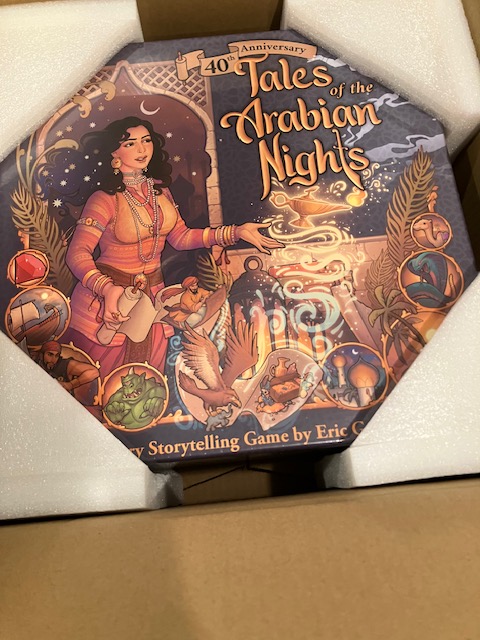
Camp Grizzly reminds me a lot of Tales of Arabian Knights: see our review here. The advice we give when we play Tales of Arabian Nights: Don’t take it seriously; play and have fun! I think I like Camp Grizzly better than Tales of Arabian Nights for one major reason: it’s shorter! A Tales of Arabian Nights game can take 2-3 hours! Camp Grizzly? Dead in 45-60 minutes!

As long as you know this game will random and silly, I think you will enjoy it! Just don’t go in expecting a big thinky thing.

Reactions

Not everyone loved this.

Sara said it was “Fine”. That’s a 6/10 for her.
Teresa liked it. That’s a 7/10 for her.
Andrew said it was fine, but he’d prefer Tales Of Arabian Nights over this. He’s probably a 6.5/10.
Rich liked it the best. Maybe a 9/10?

Conclusion

Camp Grizzly is just stupid fun. It’s random, it’s goofy, it’s unfair, but it nails the horror movie theme and tropes! And it’s only 60 minutes!

If you think you would enjoy the Horror theme and like the idea of a stupid fun game, this game is for you. If you don’t like the Horror theme, Tales of Arabian Nights (see review here) or Tales of the Arthurian Nights (see review here) might be better choices for you: they are both silly story games like Camp Grizzly, but with different themes.

The problem with being stupid fun is that some people will just think this is just stupid … without the fun. My friends were more middling on this than I was: they gave it between 6 and 7. I gave Tales of Arabian Nights a 9/10, so I think I have to give Camp Grizzly something similar: 9/10. Tales of Arabian Nights has more “story”, but Camp Grizzly is over so much faster! Both are pretty darn random.

Stupid fun.