The Last Spell: The Board Game. A Solo and Cooperative Review

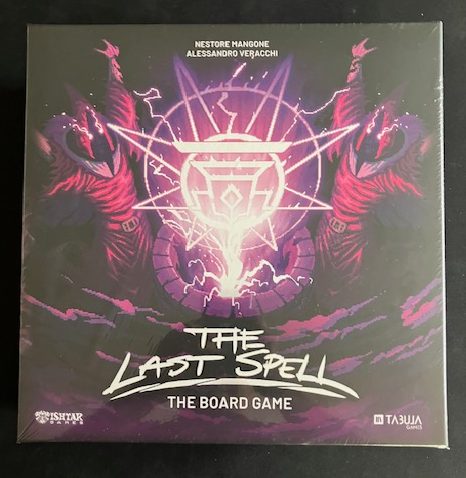
The Last Spell is a solo and cooperative board game (see above) based on a TRPG Tower Defense video game of the same name. The board game has the same idea; it’s a tower defense game where you cooperatively protect your town from the hordes of that monsters descend upon it!
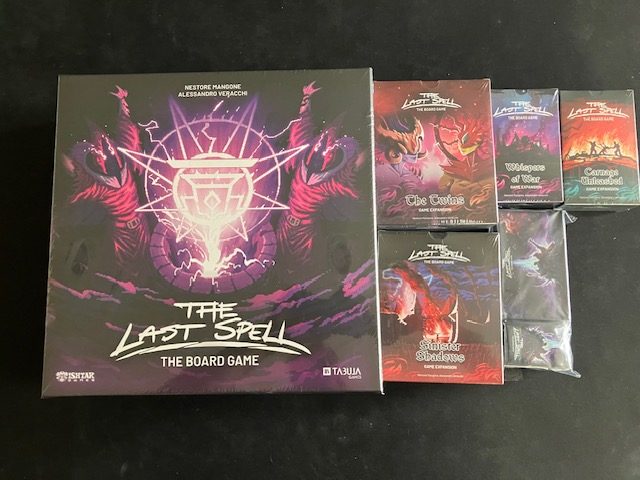
This was a pretty big Kickstarter with lots of expansions and other stuff (sleeves especially: see above). The Last Spell (the board game) was on Kickstarter back in May 2023, and it promised delivery in May 2024. It arrived at my house in early 2026, so it’s about two years late (which is not great).
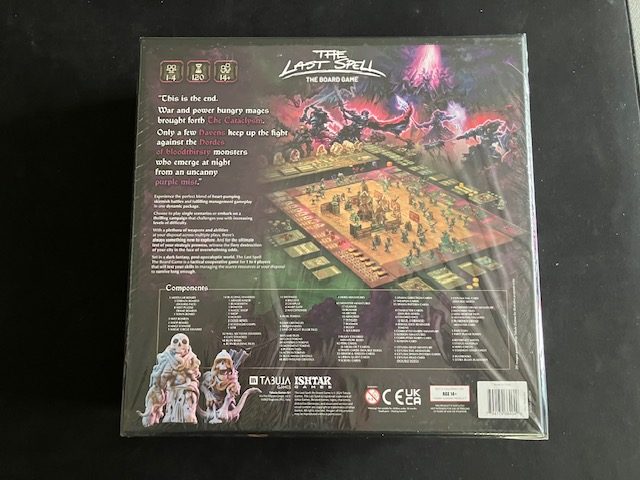
Let’s take a look! We will ONLY be taking a look at the base game.

Unboxing and Gameplay
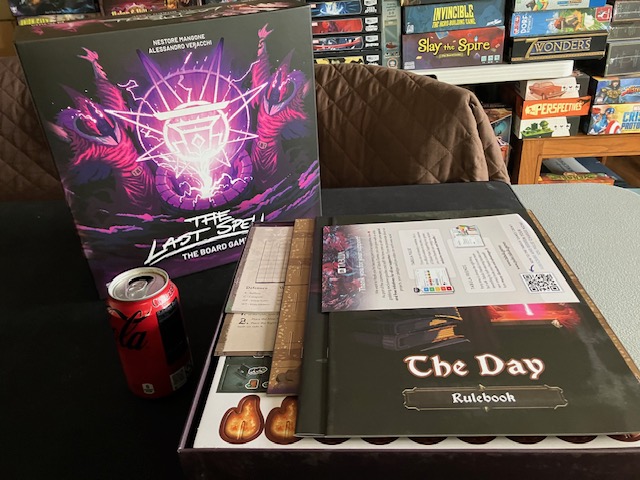
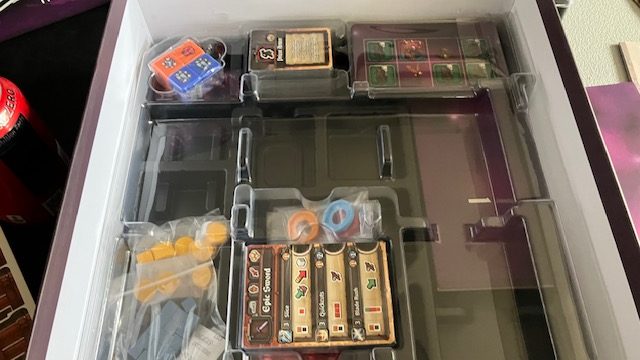
The Last Spell is a pretty standard sized box (see Coke can above for scale) except that it’s a little bit taller.
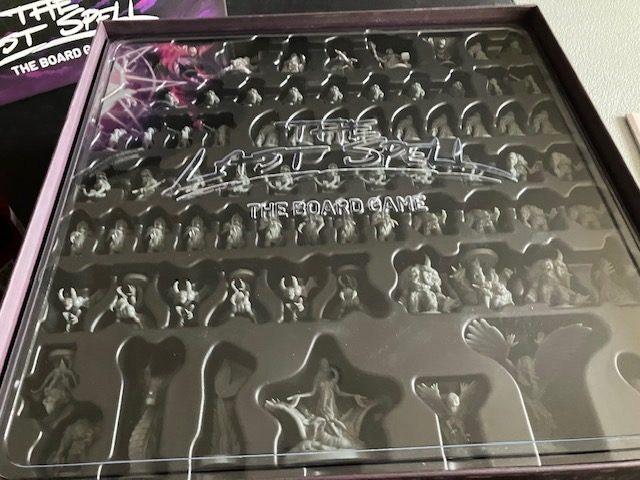
It’s taller because it comes with a bunch of miniatures!
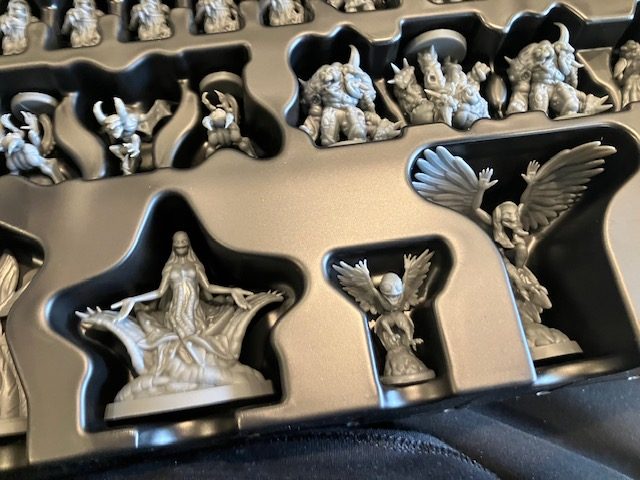
Most of the miniatures are the bad guys (part of the swarm) that invades your town!
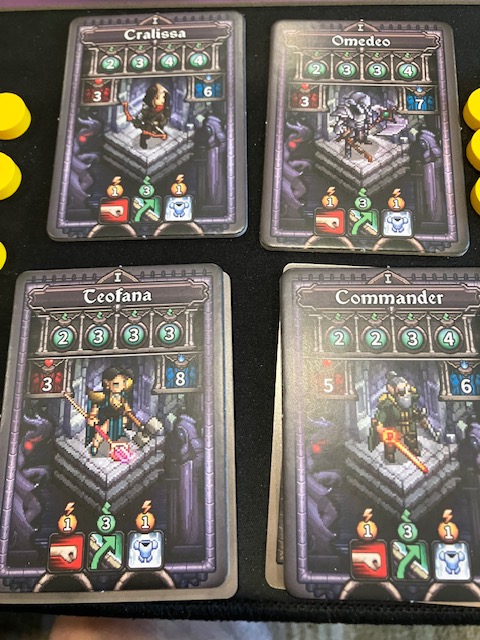
Each player takes the role of a single hero! See choices above!
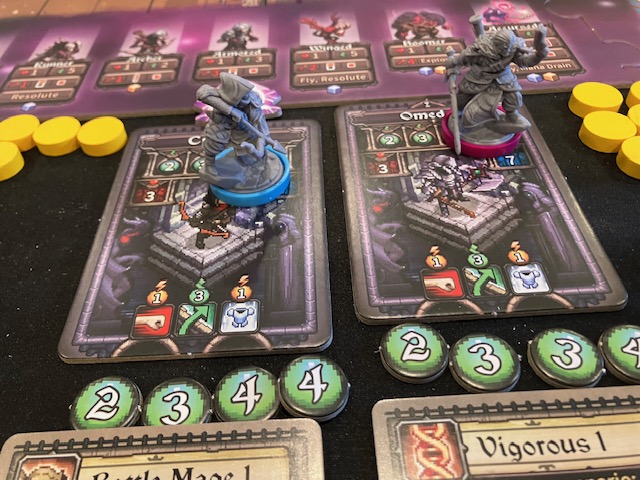
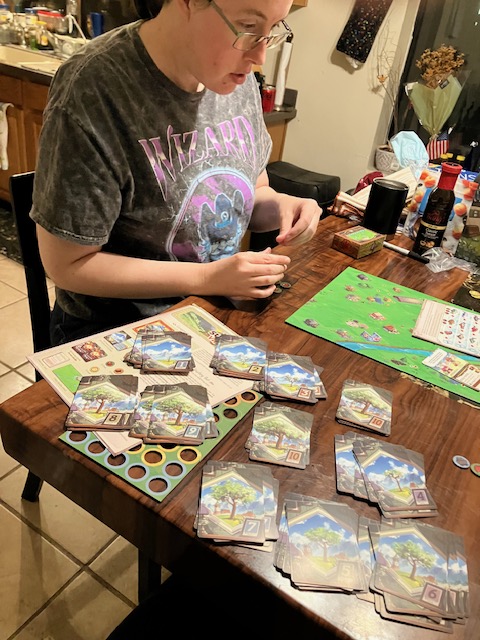
Each player gets the card and corresponding mini (see above). BTW, the colored bases ARE NOT for the players, they are for a particular set of bad guy, but I found they helped me distinguish the good guys from the bad guys. They probably should have included bases for the good guys! Each player has a bunch of action tokens (the yellow tokens) and 4 green movement tokens. You can spend the yellow action tokens to “do stuff” (do different attacks usually) and the movement tokens to move around the board.
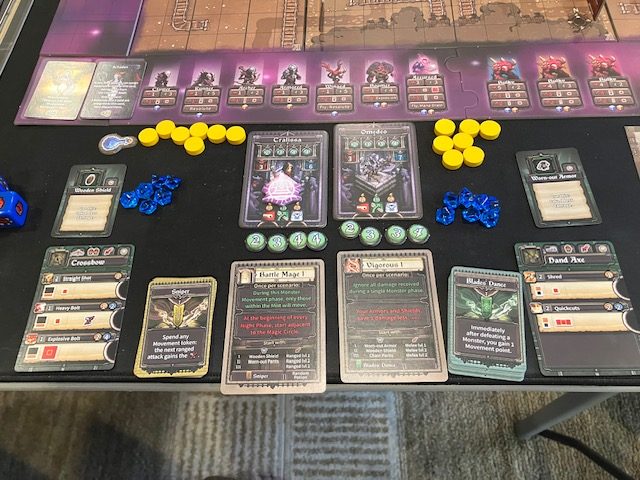
Each hero also gets some starting equipment and starting cards: see above.
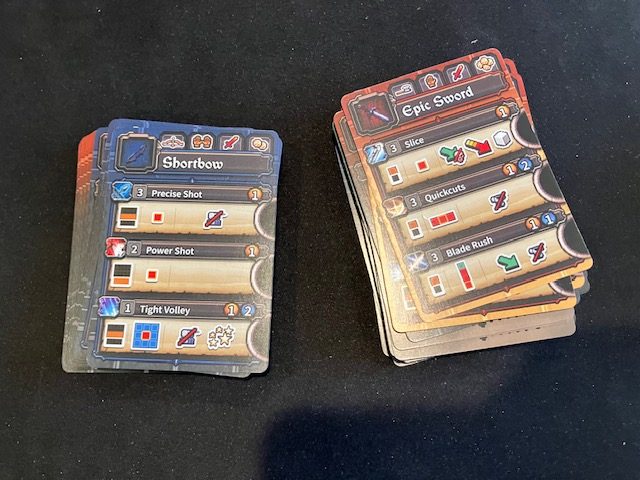
As the game progresses, you can upgrade your equipment and get better stuff!
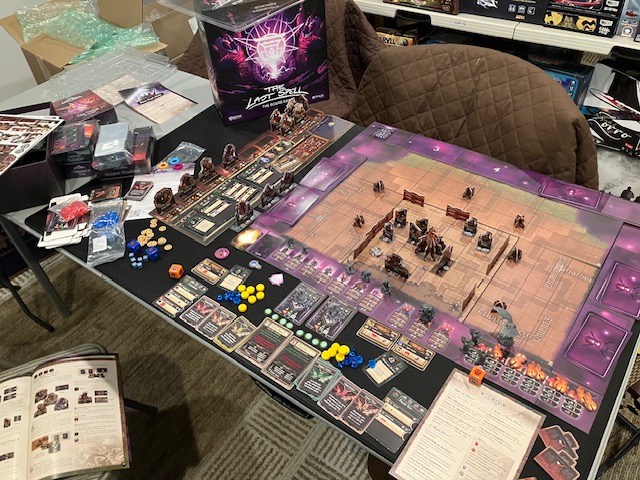
Interestingly, a lot of upgrades come from building certain building!s So, the players make choices for building: do we want more gold? Do we want more materials? Do we want better weapons? Do we want better magic? The buildings the players choose to build define their upgrade path!
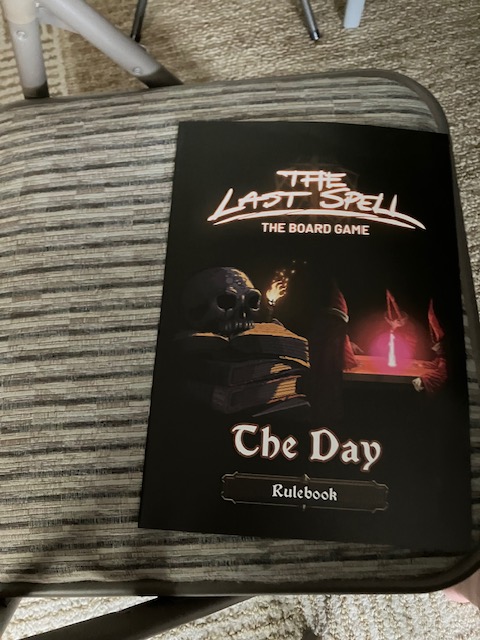
So the game has a weird arc: it takes place over 3 days: each day has a “Day Phase” (see rulebook above) and a “Night Phase” (see rulebook below).
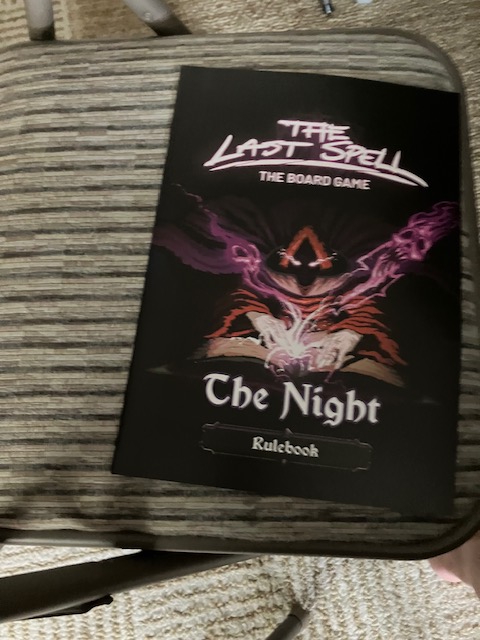
That’s right! Each phase is pretty complicated, and you do it three times! 3 days and 3 nights!
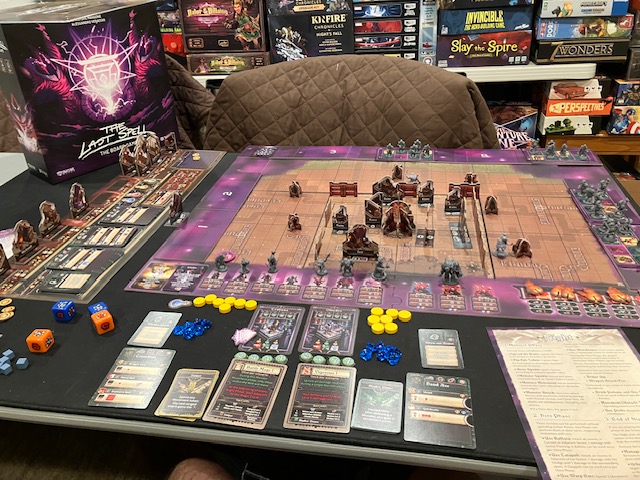
The Day phase is all about spending resources (Gold, Materials), building buildings, fixing buildings from the night before, and generally getting ready for the Night phase. The Day phase is “getting ready” for combat.
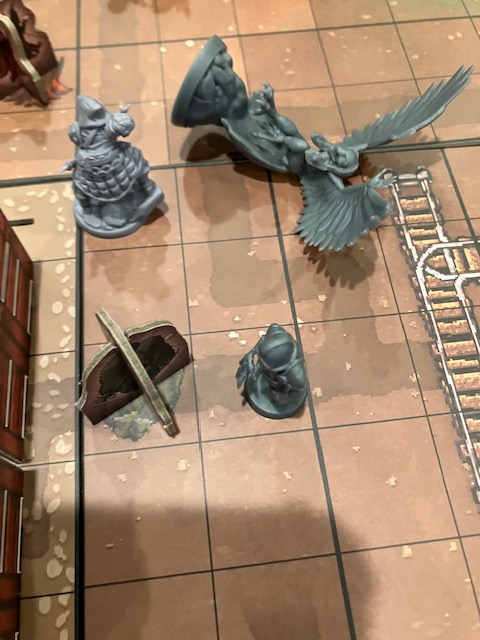
The Night Phase is all about combat! The heroes are fighting the hordes as they advance!
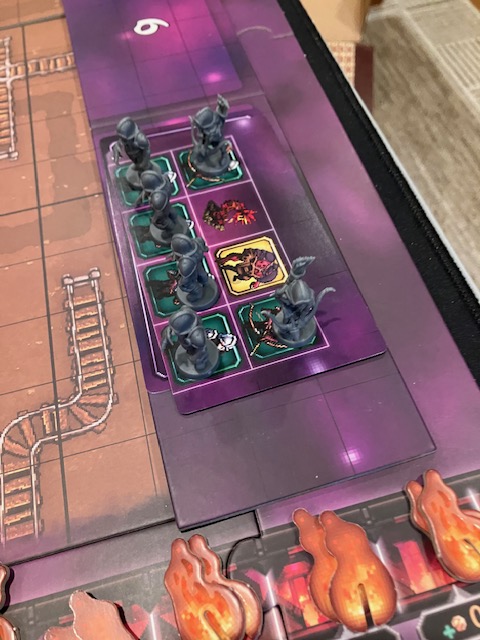
In the Night phase, cards full of hordes (see above) sit on the edge of the board and get ready to invade!
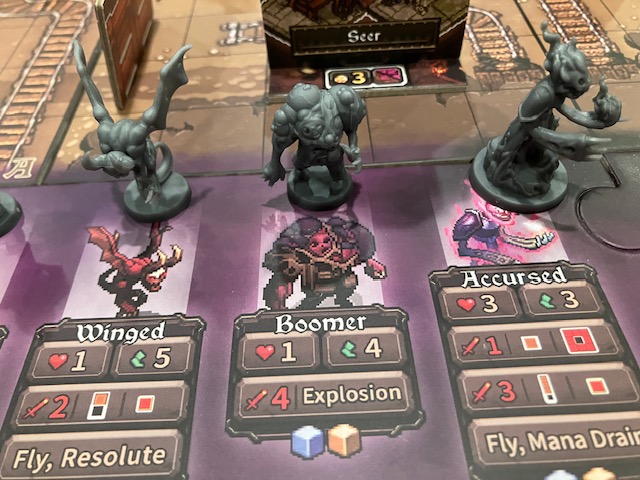
Each different type of monster has different Hit points and damage: see some above.
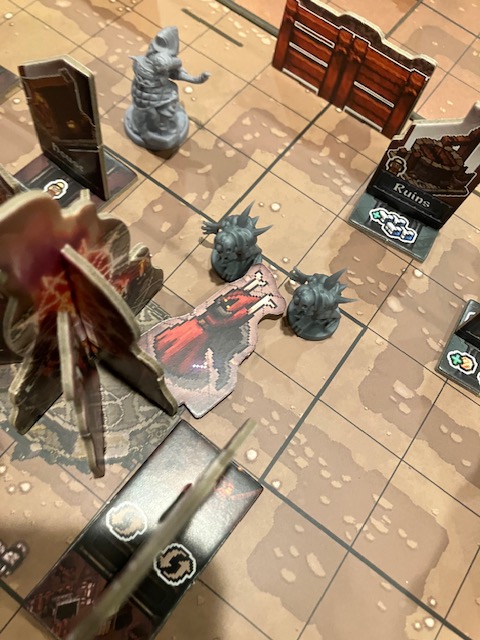
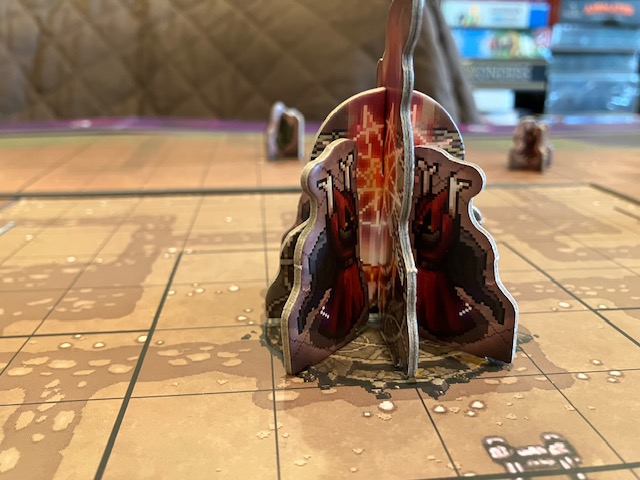
If the players can keep their spellcasters casting and keep all the monsters away from them, they win! If the monsters somehow kill all the spellcasters in the middle of the board, they win!
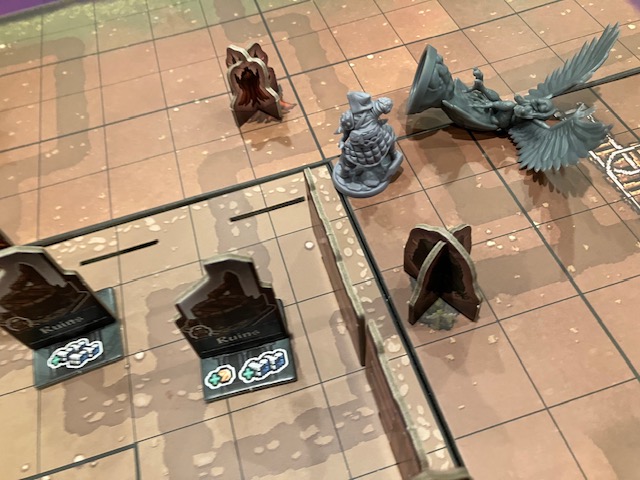
Of course, you can’t have a video game adaptation without a big boss! The big boss comes in the third night and will mess you up! See above as we were (luckily) able to kill them in that game!
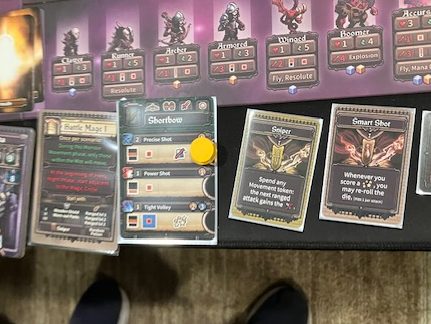
In case it’s not clear, this game embraces 8-bit art (like the video game) for just about all the art, but it uses detailed minis for the monsters on the board!
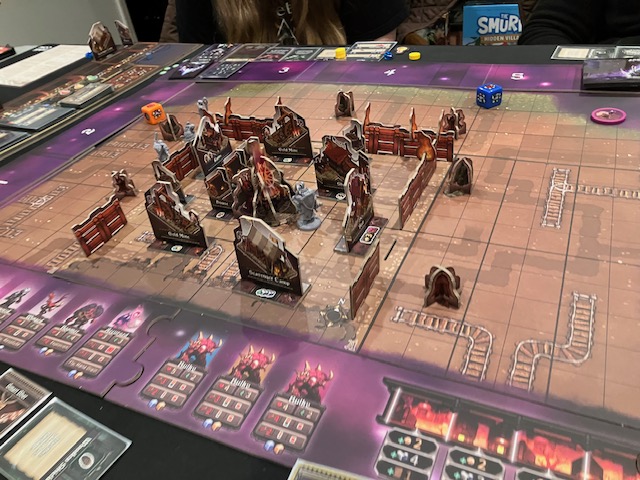
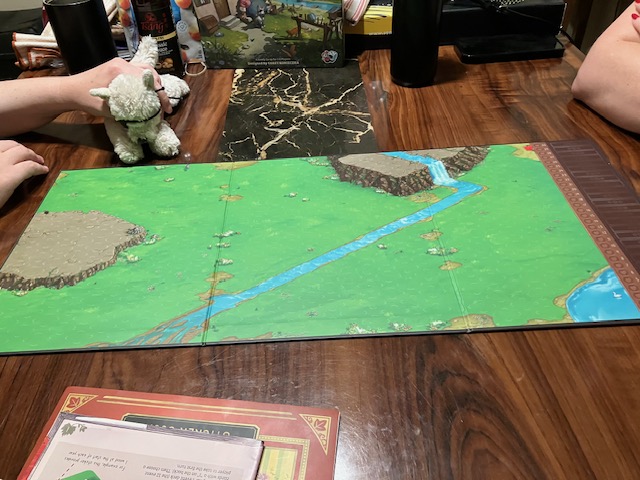
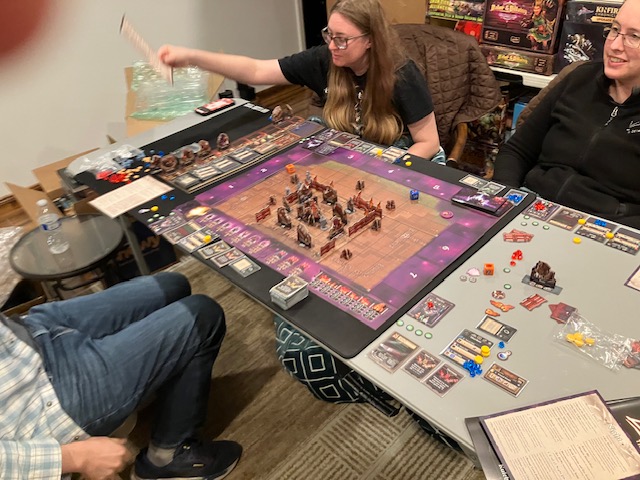
This is a big mama-jama on the table and takes up quite a bit of space! See above! The components are pretty darn good.

Rulebooks

There are multiple rulebooks: one for The Day and one for The Night. At first, I was kind of upset by this … how big is this game that you need TWO separate rulebooks? But after some introspection, I think I prefer two rulebooks. Why? The alternative is a giant rulebook with a TERRIBLE binding like we saw in Valheim (see review here)! So, having two rulebook which lay flat? I am okay with that!
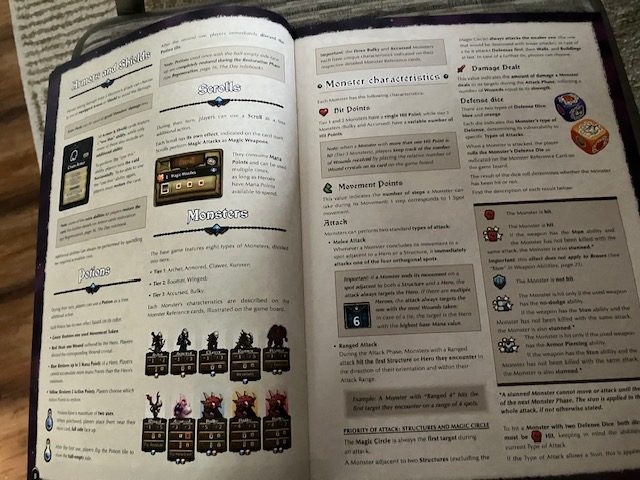
The rulebooks open nicely onto the chair next to me; the staple-binding keeps both pages open and easy to read. The font is fine and readable (see above) There are enough pictures to be useful has well. On The Chair Test, the rulebooks get an A-; they droop ever so slightly over the edges but generally look good on the chair next to me!
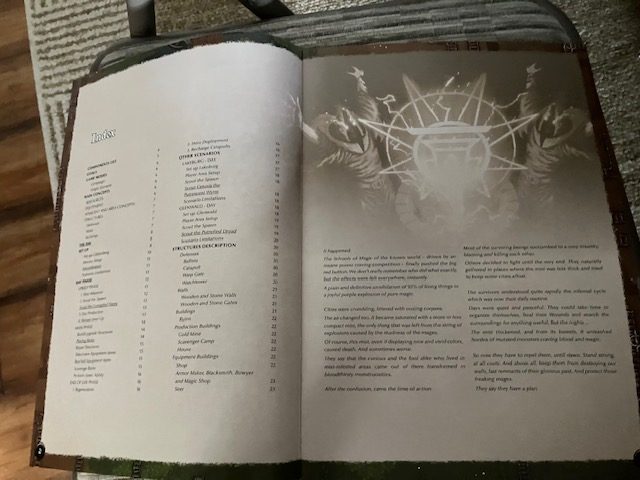
Having said that, I was very triggered by their use of the “Index”: they completely misused the word!!! See above! An Index is a list of keywords with references (page numbers or links of some kind), but an Index is sorted alphabetically so that people can easily search for relevant keywords using binary search! Unfortunately, what they label as an Index is a Table of Contents: phrases and concepts sorted by the page number! See above!!! A table of contents is used to show how the document is organized!! WHAT THEY HAVE IS NOT AN INDEX! That is a Table of Contents!!

I have to admit, this gave me a very worried feel about the rest of the game. If they can’t get this right, what else will they get wrong?

In general the rulebook was sorta “ok”. I didn’t love it, and I had some real trouble finding some rules (especially some edge cases, since they don’t have a real Index), but I guess it was “fine”. I guess. I am still upset about their misuse of the word Index. In both rulebooks.

Solo Play
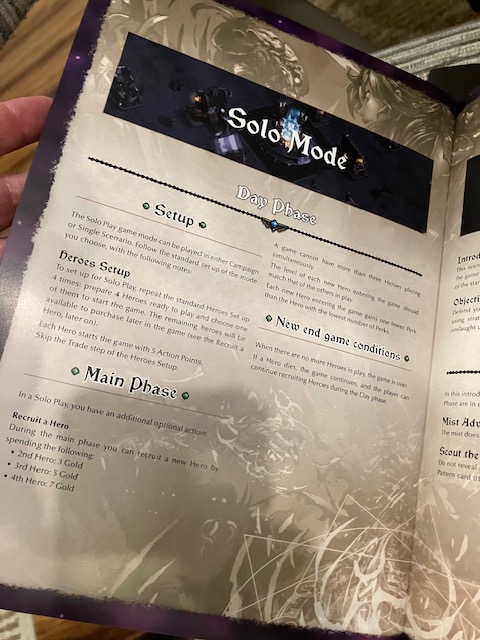
There is a solo mode! Thank you for following Saunders’ Law! Hurray! It’s not that much more complicated; you start as true solo (with one character), but you can recruit extra heroes. (See the rulebook above with the Solo mode documented in the back of the Day Phase rulebook).

Here’s the thing; for my first play, I wanted the game to run as smoothly as possible without any extra exceptions. I have to teach the cooperative game to my game group, and I want as few changes as possible. In the end, I ended up playing two-handed solo: alternate between two characters and play as-if it were a 2-Player game. I think this is the best way to play your first solo game; get all the base rules under your belt in a two-handed solo mode, and then if you like it, you can try the more complex solo mode given.
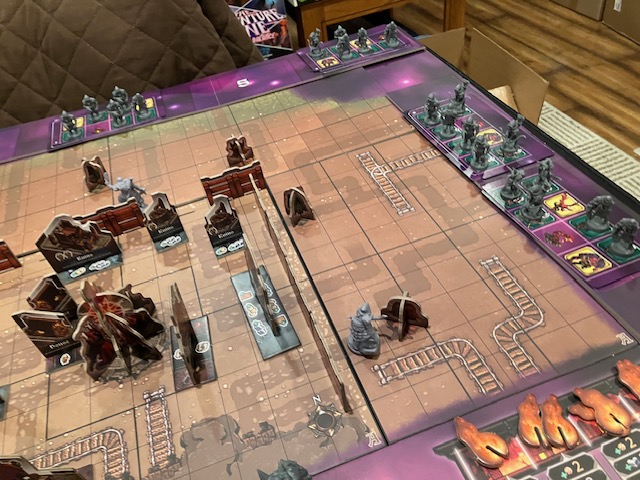
So, let’s be very clear: the majority of this game is in the Night Phase fighting monsters! The Day Phase, while important (as you figure out how to spend your resources to protect your town), is over quickly! Most of the time you are fighting monsters!
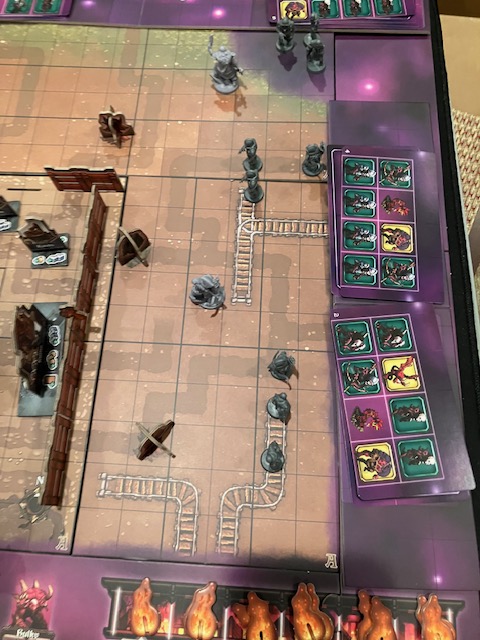
And you spend a LOT of time fighting monsters. My first day (Day 1/Night 1) probably took me 2 hours to get through. Holy cow! I had to leave the game set-up on the table overnight! I got better at running the game, but I also realized I got a LOT of rules wrong (if only they had a true Index to fix this…)

My second day (Day 2/Night 2) also took about 2 hours to play. I had to leave the game set-up on the table. A lot of this was correcting my incorrect notions from the previous Day and keeping my head in the rulebooks a lot.

My third day (Day 3/Night 3) was also about 2 hours to play. This day would probably have been shorter, as I was getting to know the rules, but then the Big Bad Boss came out! And the Big Bad Boss has her own very special rules that you have to study!
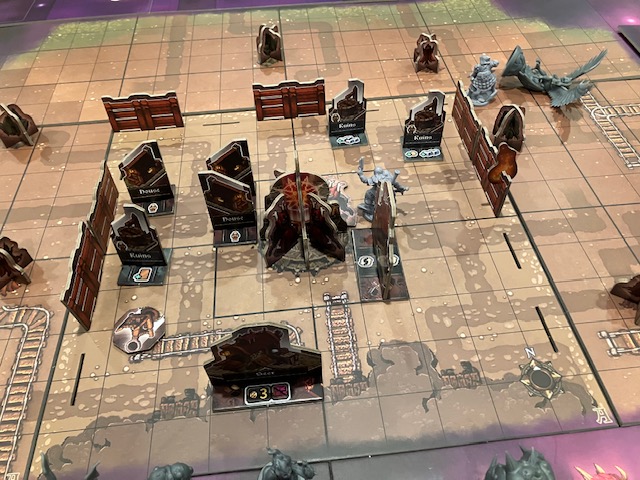
I ended up winning, but the game basically took me 3 REAL days to play … I basically played one “game day” per day, and left the game set-up on my table!

This is a long game. I think the game will probably cut by a third or even a half now that I have the flow of it, but it takes a long time to get the sense of the game.
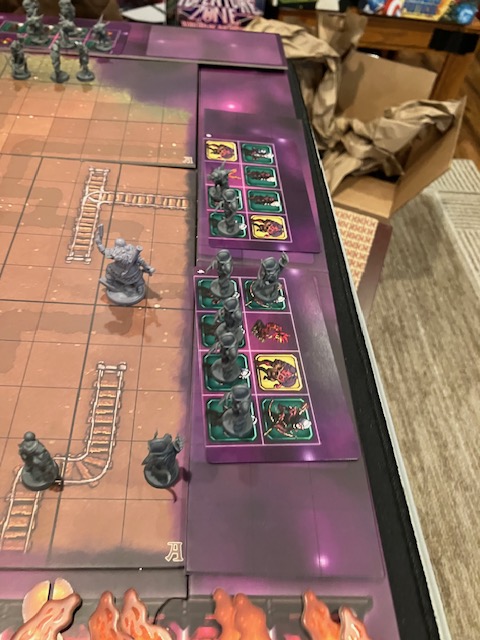
For the solo player, there is QUITE a bit of maintenance. SO MANY monsters come out and converge on the town! See above! The solo player basically has to spend quite a bit of time moving EVERY single monster towards the city; this is a lot of work. This is partly why the game takes so long to play … all the minis have to move! And the rules are “not great” when there are conflicts; they could have been better (how do I move the monsters?).

I am glad that I played The Last Spell solo to learn the game. I am also glad I played it two-handed solo; there’s just too many rules to keep track of that I don’t want to be wasting any time doing “solo stuff” that’s outside the normal path of execution. Now, tt’s one thing for ME to keep the game set-up on my table for 3 days while I wade through the game, but I cannot imagine trying to learn this with my friends at the same time! There’s just too much going on. Play this solo to learn it; play it two-handed.

Will I ever come back to this as a solo gamer? I don’t think so? There is SO MUCH maintenance for the solo gamer (moving all those minis), I can’t bear going back to this and doing all that work as a solo gamer. It’s not bad solo, but it’s just so much work! Maybe you like living in this world or really like the video game … maybe spending that time moving stuff around might be fun for you? It wasn’t for me.

Cooperative Play (4-Player)
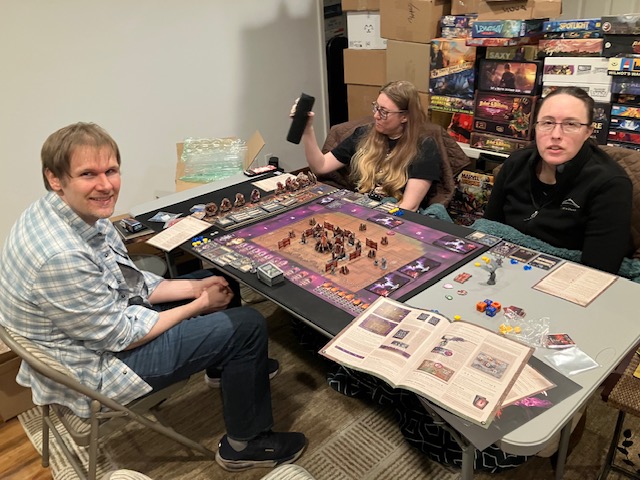
In session 1, we got 4 of us (me not pictured) to play the cooperative game! I was a little worried the game wouldn’t fit on the table, but we made it work … see above.
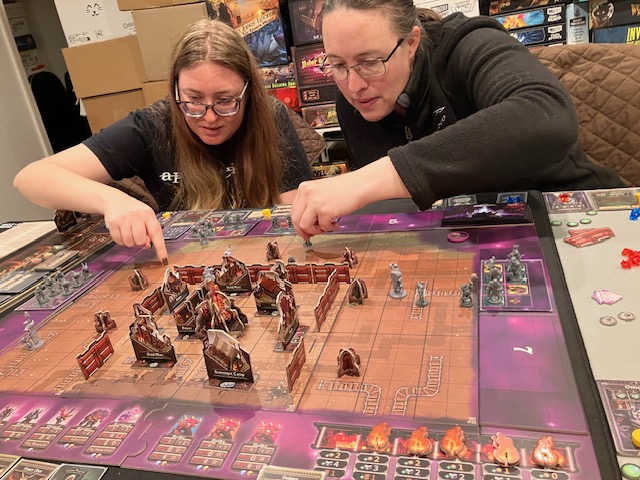
The major difference between the solo and cooperative game is that NOW the maintenance is shared! Sure, more enemies come out, but the game is a little more managable (and less work per player) as each player moves “their” monsters (on their side of the baord). This might be the best reason to play this cooperatively over solo play; the load is shared.
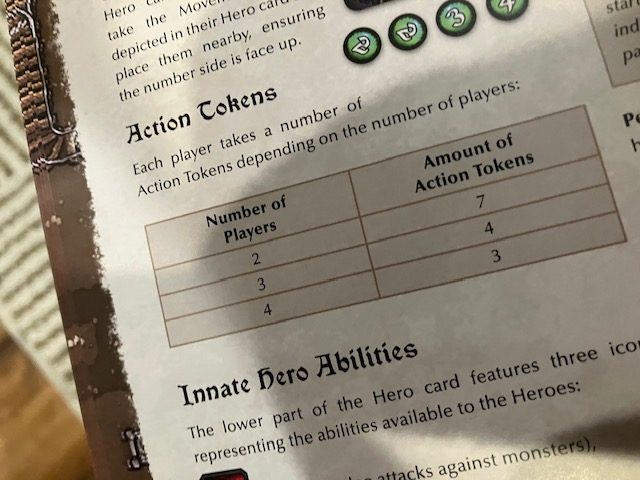
How does the game balance for more or fewer players? It boils down to how many action tokens you get! See the rulebook above! In my two-handed solo game, both characters got 7 action tokens! In the 4-player game, we each only got 3 action tokens! Now, this is balancing because with 4-players because the players can keep the monsters under control; each player monitors a section of the board! Based on plays, it seems like the balancing “generally” works. In fact, the third day was a 3-Player game (as one player was sick), so we got to see the balancing at all player counts; it seems to work.

Even after playing solo, I was still the “rules guy”, looking up rules as we played. We were able to play 2 days of the game: 1 day, 1 night, 1 day, and 1 night. It took us about 3.5 hours to play 2/3 of the game. It was a little shorter than the solo game because we all shared the load of set-up.

What I am surprised about; how the game unfurled. We accidentally played with Player Selected Turn Order (PSTO) (because it was more fun and more strategic) and because my group knows how to deal with PSTO well. But I am surprised that we DID NOT play with simultaneous play … it seemed like most of our turns were fairly independent (“you deal that that part of board, I’ll deal with that part of the board”) as there were no interactions that we had to carefully sequence. Once the bad guys got closer, we had to be more careful, but I am surprised we didn’t play our turns simultaneously. It seems like we could? And even should have (because it would reduce play time)? I think we didn’t because we wanted to see how things went on each player’s turn? I think? Given how much work there is per turn, I really really thought we’d embrace simultaneous actions. But we didn’t.
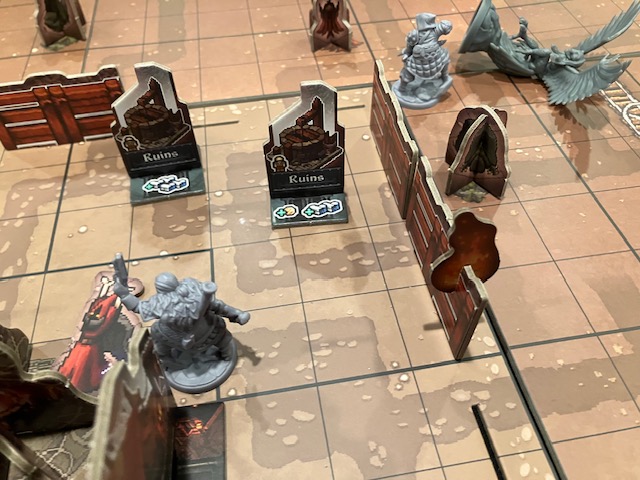
So, 2/3 of the game done in 3.5 hours. We saved the game to resolve it later. The good news is that there is a save system … it’s a pad of paper you write on … but we just took pictures (like the picture above).

Game 3 (3-Player Cooperative)

So, we resolved to finish the game. Due to some illness, we had to wait a few waits until we were all available, and even then, we were down to 3-Players instead!

Because the game balances by simply changing the number of action tokens, we were able to jump back into the game with 3-Players, even though the game started with 4 players! It’s also a good sign that everyone wanted to play again!

Here’s the thing; it took us 3.5 hours to play the final day of the game! Some of that was just setting back up (this is a big game after all, and resetting back to the saved state was a lot of work), but some of it was just all the maintenance that has to happen.

We finished and just barely won; I think we cheated on a few things accidentally, so maybe we should have lost. Either way, it was close.

What I Liked
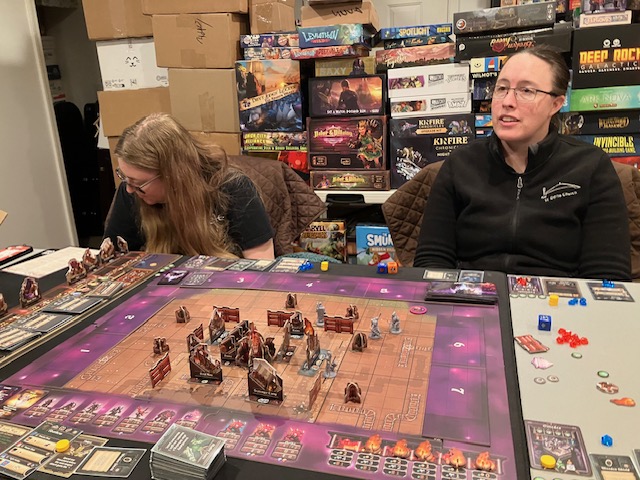
Components: The game was quality and looked good.
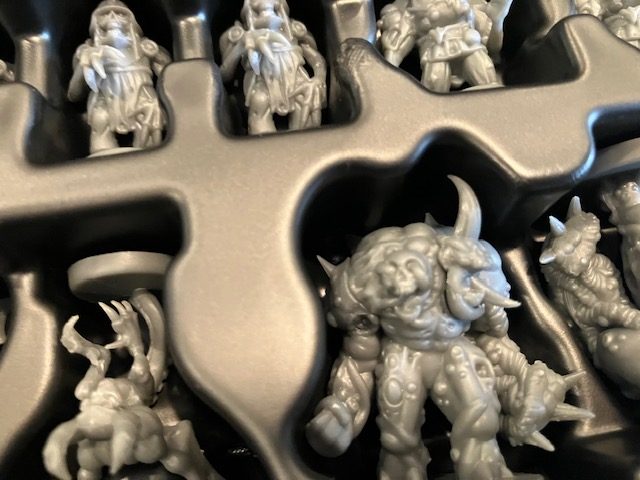
Minis: The minis were cool and added a lot of flavor.
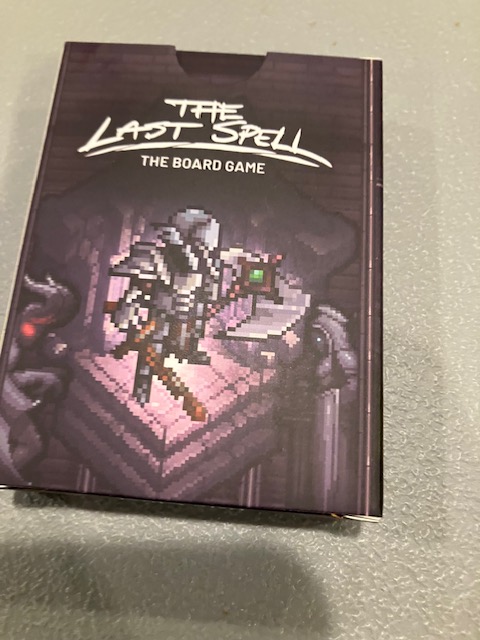
Save Game: There was a good system to save the game between sessions. And (even though we didn’t mention it) between campaigns!

What I Not Sure About

Style clash? I know The Last Spell is a video game, so embracing the 8-bit art makes some sense. But the disparity between using nice fluid minis for the monsters (and characters), but 8-bit graphics for everything else seemed to … clash? It made it a little harder to put them together and was a little jarring. Maybe it’s not a big deal …
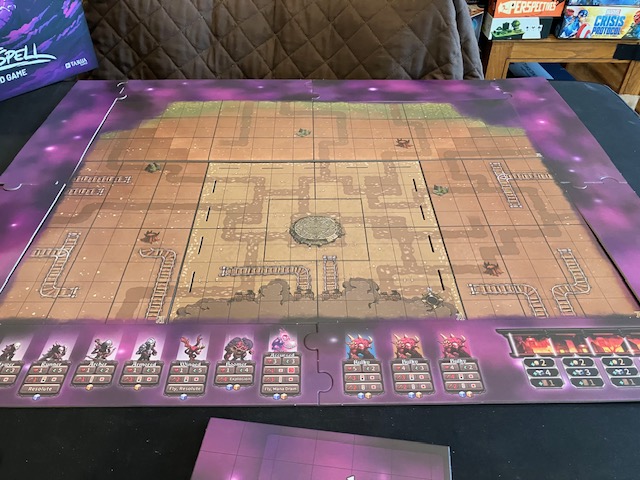
Sectors: The game uses sectors for ranged attacks (usually not adjacencies or spaces away). The rules are very clear how the sectors work, and yet, they were very unintuitive! I think if you know the video game, then the sector ideas make more sense. In fact, I think a video game will enforce the sector boundaries easily! In the board game, we found the sector idea to be a little clumsy and unintuitive. .. but maybe if we had played The Last Spell the video game more, we would applaud the sector idea is just like the video game? I don’t know.
Combat: Combat is decided by dice, and there are a good number of mitigation mechanisms (things you buy, abilities, etc). But if you roll poorly, you can still get screwed pretty hard. Teresa especially had a bad third and was frustrated. Yet, the combat is simple to describe and simple to play. This simplicity makes it really easy to explain, quick to play, and simple to manage. So, it’s good on those axes, but yet you can really get screwed by bad rolls. So, I don’t know how I feel about this combat. I’ve played the game enough to see “ya, things seem to average out overall”, but when you are the recipient of the bad rolls, it’s very frustrating.

Things I Don’t Like

Minis and art: Because the game uses 8-bit art and the minis are smooth entities, we actually struggled to distinguish the enemies on the board (some of them really look a lot alike). And we struggled to correlate the minis with the monster stats. In fact, in my first game, I put one monster on each stat position so I could tell them apart! (See above) The minis needed a little more differentiation, even if it were something simple like a triangular base for some, square base for others, or something with color. It was frustrating enough to mention.

Maintenance: There is a lot of maintenance to keep this game going. As a solo gamer, it’s probably too much. As a cooperative game, the maintenance is tolerable but only of you friends help. Still, there’s a lot of work to keep the minis moving.
Length: The game just feels too long. I think this is because there are few too many rules? It needed just a smidge fewer rules; we paused too many times to lookup rules …

Index. The Index is NOT an index. If it had been a true index, it would have been significantly more useful.
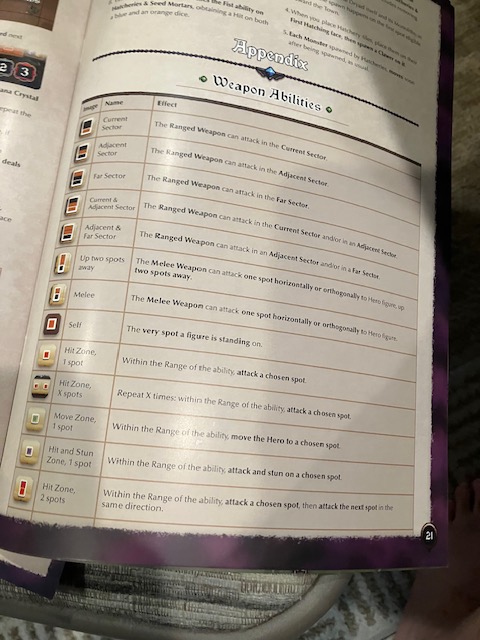
Icons: The Iconography is REALLY non-intuitive. We struggled with it and frequently had to look up the Icons (especially for ranged actions). It’s even more frustrating because the Icon are defined in exactly one place (the second rulebook). This really should have been on at least 1 more sheet that you could pass around.

Reactions
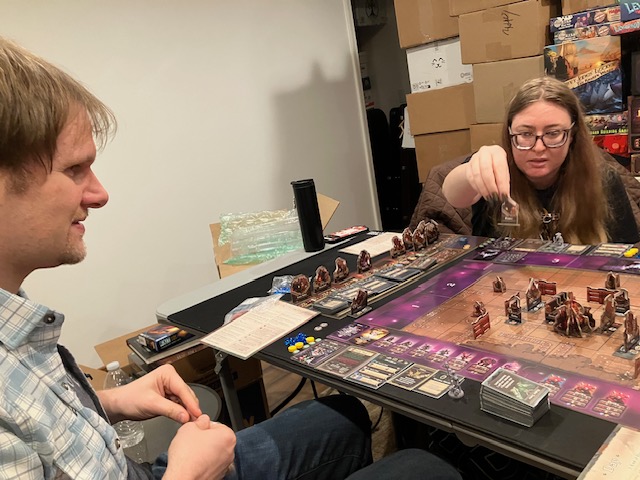
Sara liked this the best and would give it a 6.5 or 7/10. Teresa was right there with her.
Andrew and I were on the same page: about 5.5/10. Andrew would have called it a 6 earlier, but the Sector idea was so unintuitive, he felt that brought down the rating after the second session.

Conclusion
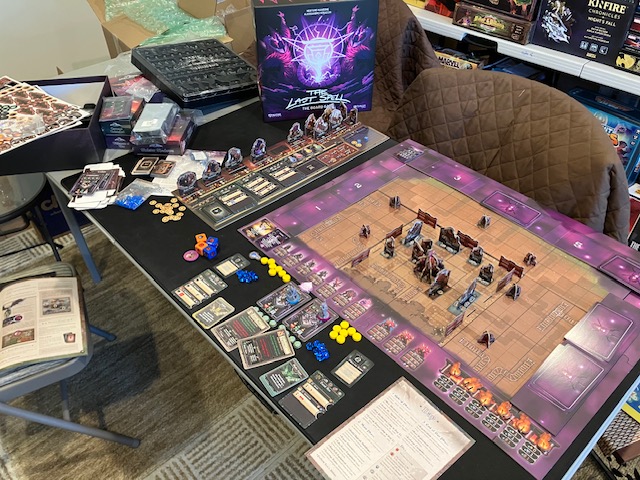
The Last Spell was divisive among the players in my group. We all liked the minis and the how well the game flowed once we got going, but it was still very long and had lots of maintenance in keeping the game going.
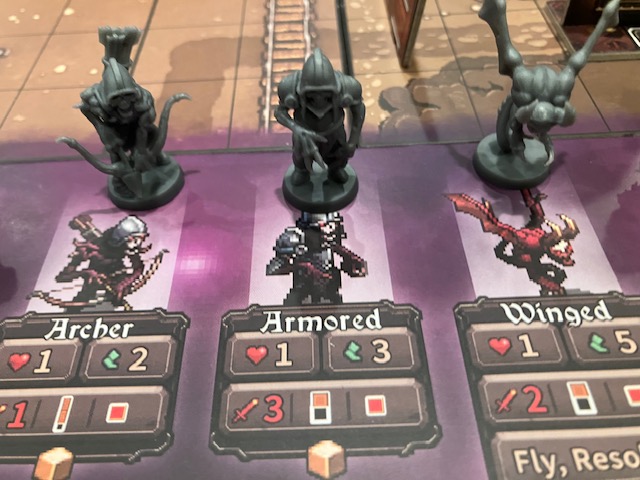
The clash of art styles between the minis and “the rest of the game” was actually a little jarring and some of the 8-bit art (mostly the buildings) was hard to distinguish. We all think the game would have been better if had been consistent between the art styles; the clash actually took us out the game a little. (This might be just because we had the minis Kickstarter version; the base game uses standees)

Interestingly, I liked another tower-defense game called Firesiege better than this (see review here from a few weeks ago), but my friend Sara liked The Last Spell better. I liked how quickly Firesiege played, but Sara seemed to like how The Last Spell played better. That’s two very different opinions!

As a solo game, the maintenance is probably too much for most people; between set-up, play, and tear-down, the solo player has way too much work to do to keep the game going. I’d probably give a 5/10 for solo. I’m not sure I’d play it again.

The Last Spell is better as a cooperative game, as the maintenance gets shared among all players. We even saw that the balancing mechanisms seem to work well at 2, 3, and 4 players! You can even switch the number of players between days! The reactions were mixed, from about 5.5 to 7/10. I think people who know The Last Spell the video game might like this a little more and give it another point.

Hopefully this review helps you decide if this is right for you. I suggest you play it and try it for yourself; there is a single day intro mode you can play to see how it works.
Detective-Heists and Heartbreak. A Solo and Cooperative Review of a new Expansion for Detective: City of Angels

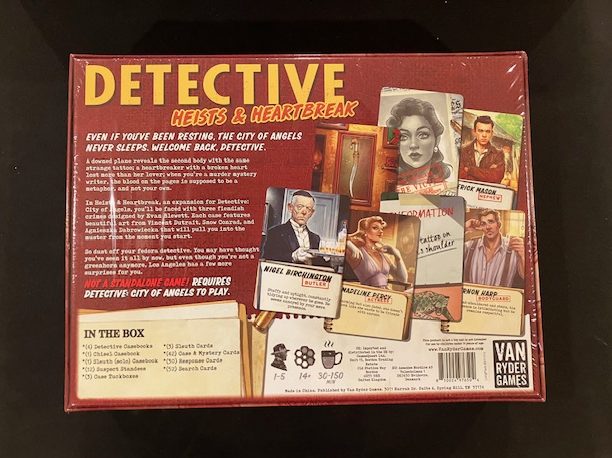
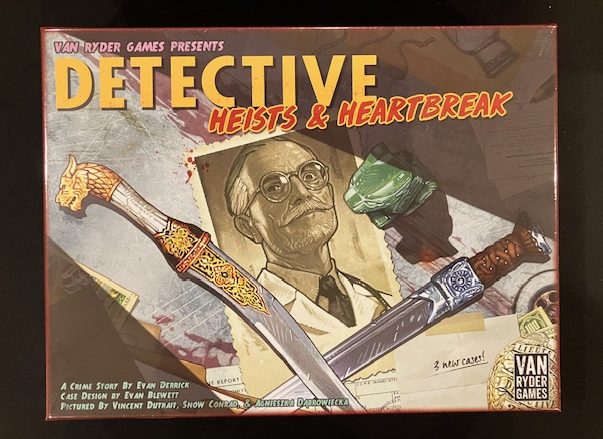
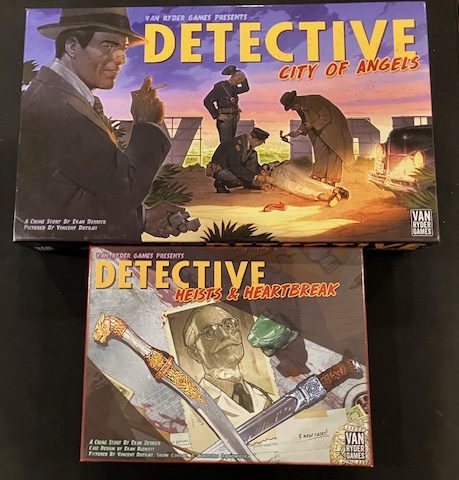
Detective: Heists & Heartbreak is an expansion for the mystery board game Detective: City of Angels. This expansion was originally up on Gamefound as a pre-order December 2025. It pretty much delivered on time in early 2026.
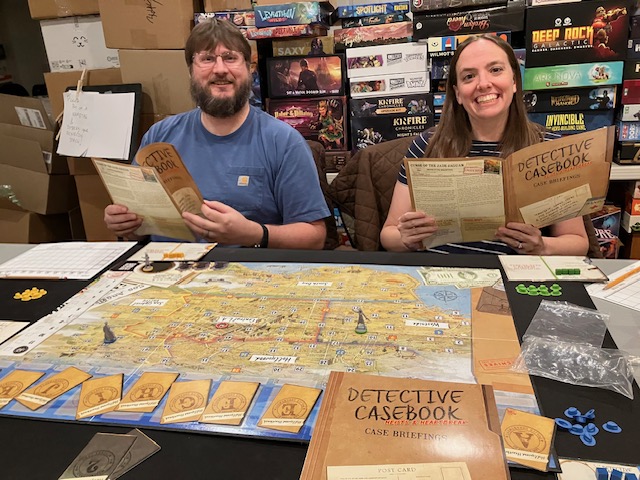
Although the primary way to play Detective: City of Angels is as a 1-vs-many game (the chisel vs the detectives), that’s not the way we choose to play! The base game comes with a cooperative mode (built-in) where the detectives work together to solve the mystery of the week; we always play this cooperatively! And it works great!

There are three mysteries in this box that augment the original game!

Let’s take a look!

Unboxing

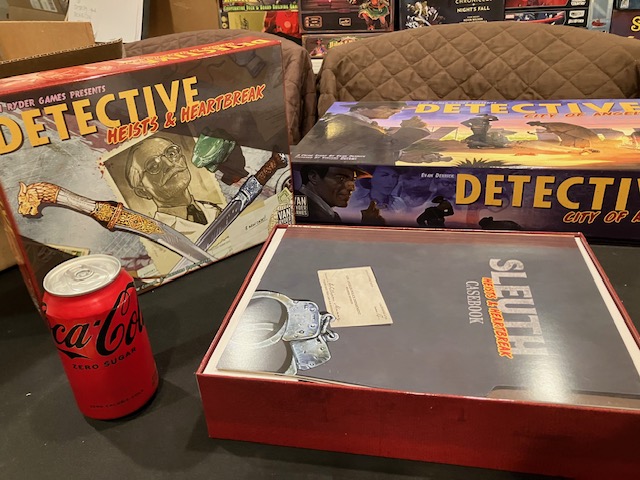
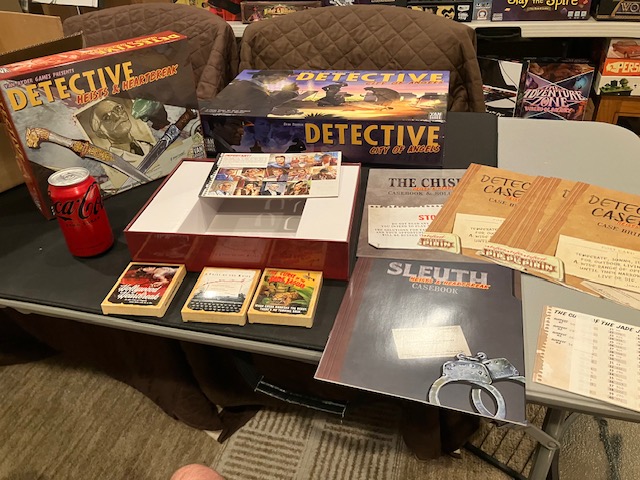
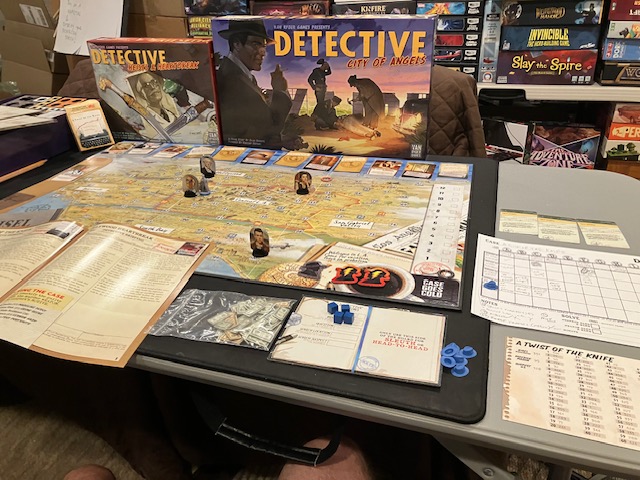
The box is probably bigger than it needs to be; see Coke can above for scale.

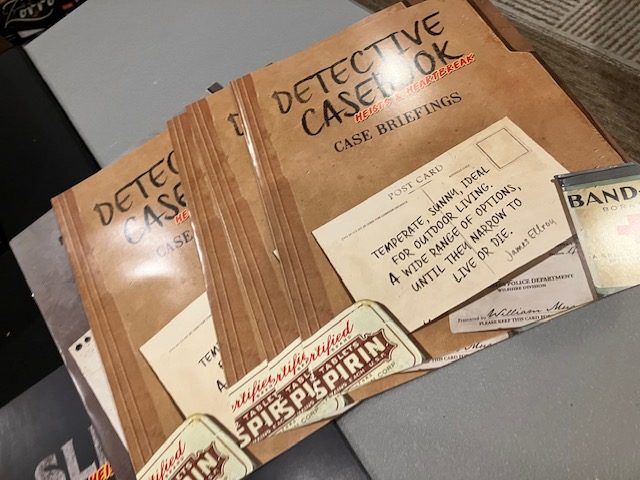
There’s four case books (one for each player, up to 4 players cooperatively) which include the three new cases.

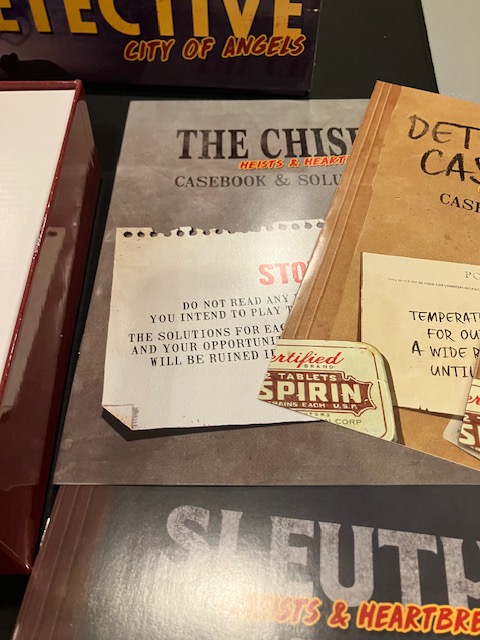
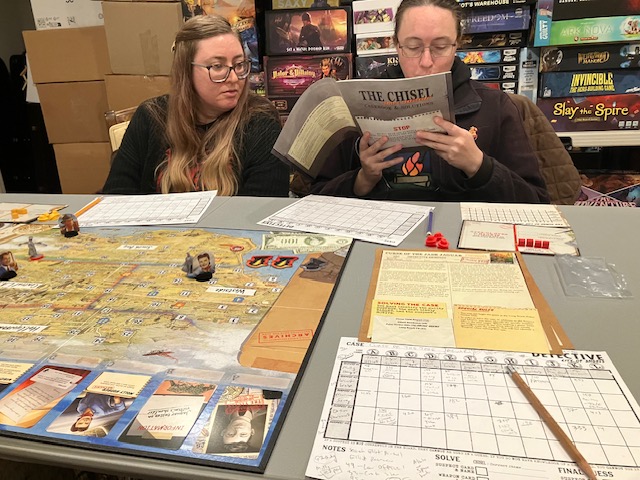
The Chisel book is included for the new cases … fun fact, you still need the Chisel book for the “final mystery summary” even if you are playing fully cooperatively! It replays the case and all the clues in a final “wrap-up”, kind of like what you expect in your favorite mystery shows like Death in Paradise, Midsomer Murders and other murder mystery shows.

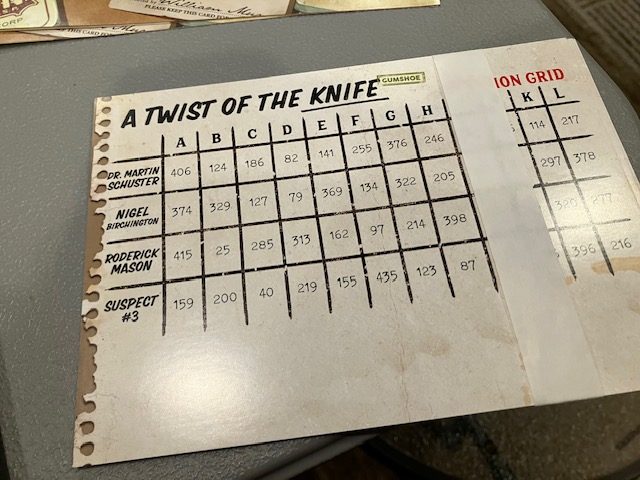
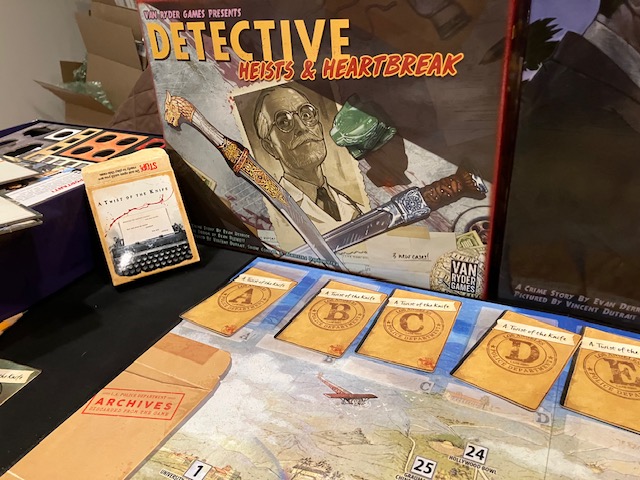
For the cooperative game, there’s a sheet you use to indicate a passage to read … you are basically questioning suspects and witnesses about the murders and getting responses!

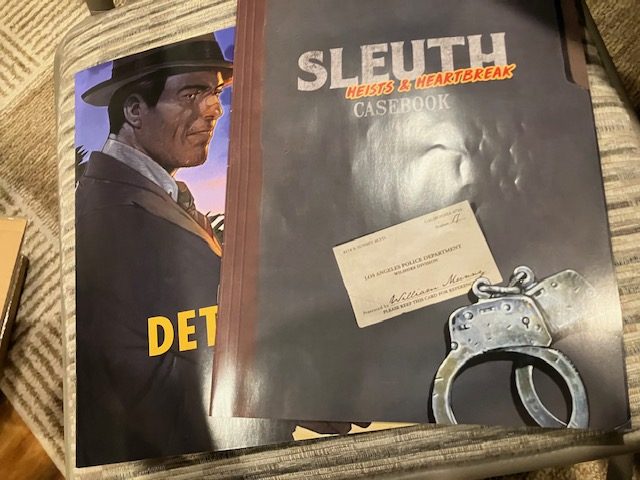
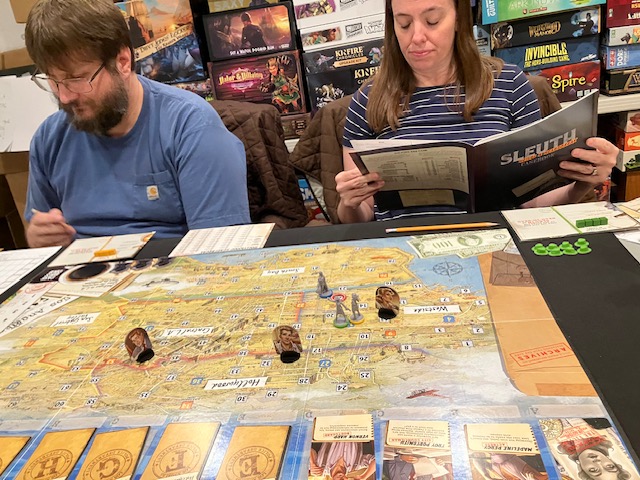
The Sleuth Casebook has all the entries for the grid: this is a storybook AND deduction AND mystery game! If you truly want a mystery like Death in Paradise, with all the interactions of witnesses and suspects, this is what you are looking for!

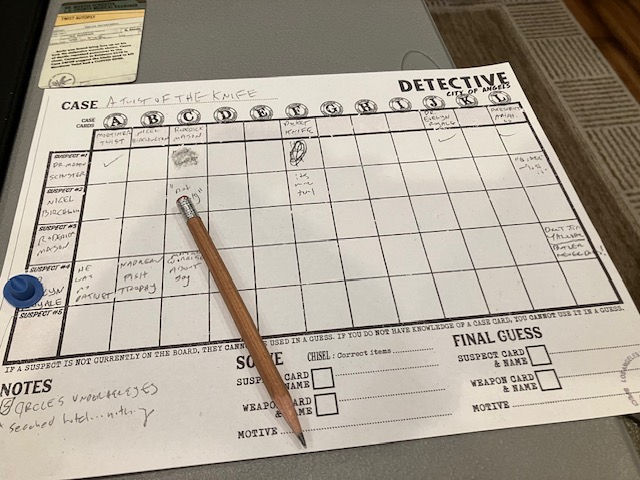
Using sheets from the original game, you make notes to yourself about what you saw and have to solve the mystery!

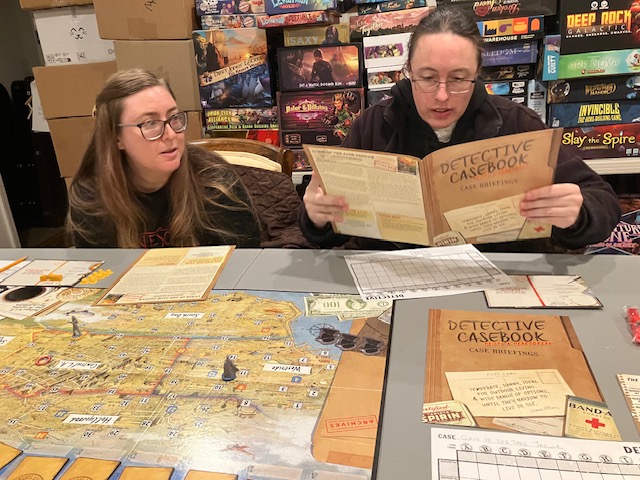
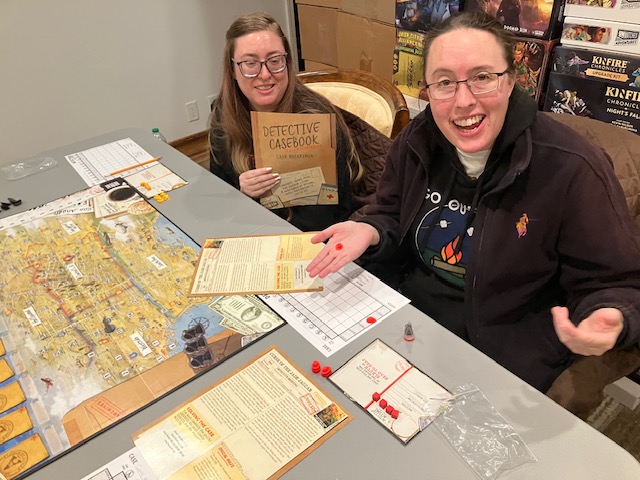
This expansion fits right in with the original vibe: it looks great! See above.

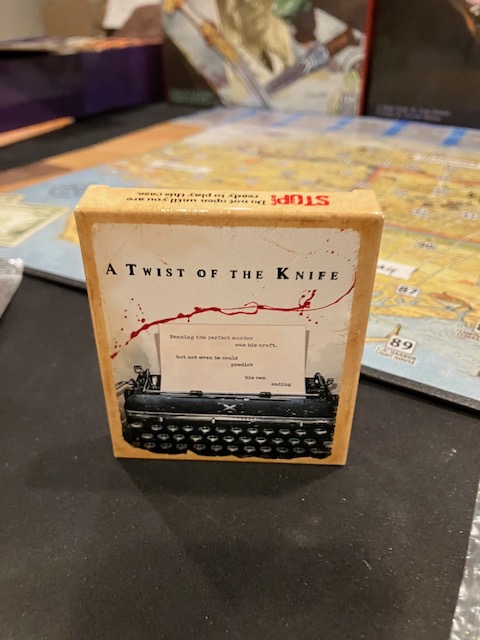
Case 1: A Twist of the Knife (Solo Play)

So, Detective: City of Angels has both a solo mode and cooperative built-in! Thank you for following Saunders’ Law!

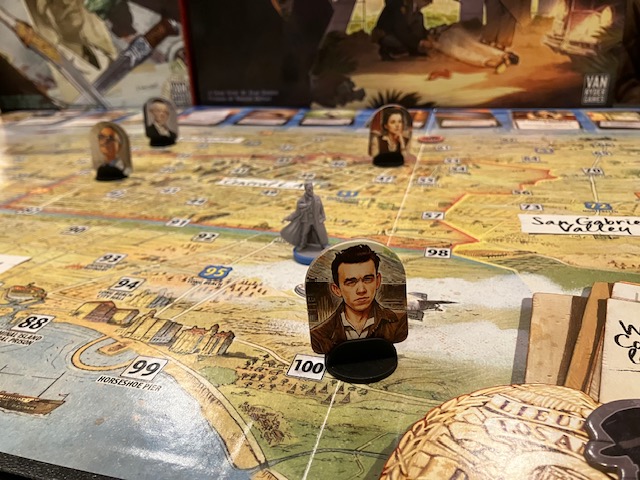
The solo mode for the game is a true solo mode: one player plays one detective, wandering around LA and questioning suspects, searching locations, and searching suspects!

The game balances itself by having 12 “days” to discover the solution, where each “day” is one player taking 4 actions. The solo player has it a little harder, because he has to travel all over the map by himself, but this is how the game balances for multiple players: the players (whether one or many) always gets 12 days with 4 actions per day, no matter how many players. The solo player gets all the actions, but the cooperative players have to divvy those actions between themselves.

I played the first mystery, A Twist of the Knife solo partly to remind myself how to play, and partly just because I love solving mysteries! I watch and read a LOT of mysteries, and I am always try to figure them out! And yes, I figured out the first mystery, but only after a second chance … if you fail to get the Motive, Weapon, and Reason within 12 days, you get a second chance … 3 more days …

The solo player is hamstrung a little on travel, because he’s only one detective having to wander all of LA to find things! That is balanced because the solo detective has the clarity of a single vision to push himself forward. It’s also a little harder on the solo player because he has to look up everything by himself! Look at the grid to find the entry, then find the entry in the Sleuth book, then read to himself! It’s not a terrible amount of work, but the game is more work for the solo gamer.

A Twist of the Knife worked great a solo game, and it reminded me why I love this system so much: I feel like a real detective solving a real mystery; I have to find the clues, do the hard work of questioning, follow my instincts, and make suppositions!

I will absolutely play Detective: City of Angels solo in any form. This new expansion fits right in.

Case 2: Hollywood Heartbreak (Cooperative)

Part of the reason I played the first case solo was to remind myself how to play so I could “re-teach” the game to my friends! I think Charlie and Allison like mystery games almost as much as I do! They are my Escape Room/Mystery buddies!

The best part of the cooperative experience is that we share the load! The active player takes their turn, one other player consults the grid when necessary, and a different player reads the entry from the Sleuth book! This really keeps everyone involved as we play, as everyone is active during a player turn!

Not only are we sharing the physical load of consulting and reading, we are sharing the cognitive load! Frequently, puzzle games like this can be better with multiple players because one player may notice something others did not! We come up with, as a group, the shared story of what we think is happening! This cooperative experience of sharing the physical and cognitive load really just works so well.

It’s apropos that this case is called Hollywood Heartbreak because it broke our hearts that we didn’t solve this! We even took a second chance and still couldn’t break it. Granted, this case is a Veteran level mystery, but we think we missed something along the way; we “somehow” missed a clue. We think it was in the cluebook, and maybe we were SUPPOSED to see it, but we missed it? That one clue made all the difference.

Still, even when we lost, the experience was still great. My friends and I were solving (well, trying) to solve a mystery together!

Case 3: Curse of the Jade Jaguar (Cooperative)

The final case unfolded very similarly to Case 2. The one thing I noticed more explicitly is that three detectives were able to cover a lot more ground than the single detective! By splitting up and covering different parts of LA, we were able to get a lot of suspects questioned quickly! Of course, there is a little less clarity of vision with three detectives trying to come to consensus, so it balances out a little.

I have to say, this mystery was one of my favorite of all time! All the suppositions that flew around the room that were proved and disproven were so interesting! We literally figured the mystery out on the VERY LAST ACTION! I took a chance on my last question, and that proved to be the vital piece of the puzzle! It felt very tension-filled and thematic as we figured it at the last minute!

Then we read the final summary and it felt like such a satisfying conclusion! This mystery was also a Veteran mystery, but we got it!

Conclusion

Why watch a mystery show on TV tonight when you can play one? Detective: Heists & Heartbreaks is the best kind of expansion: more content! You also DO NOT have to get it unless you have completed all the cases from the original game and other expansions! This is like a new season of your favorite detective show! You can watch it after you have watched the previous seasons! (To be fair, the mysteries do not have to played in any order; they don’t depend upon each other).

Detective: City of Angels is truly one of my favorite detective games of all time: It’s #2 on my Top 10 Cooperative Detective Games, but maybe it should be #1! I always come back to this game because it’s so much fun and I really do feel like I am solving a mystery. I might have to move Detective: City of Angels to a 10/10 because I will ALWAYS play it and there is so much content for it!

A few weeks ago, my friends and I really enjoyed LA-1 (see review here); it’s a storybook game with all the trappings of a detective game, but it’s not a detective game … you don’t solve mysteries in LA-1, you explore the city and advance the plot with exploration reading from story cards. But it’s not really a mystery. It’s a great game, but you don’t solve mysteries using your brain.

Detective: City of Angels is a real mystery game with mysteries coming to life with story and clues and intuition. Detective: Heists & Heartbreak is just a new season your favorite detective show and it’s just as good as the first few seasons. It’s still very very very good.

Ace of Spades Solo and Cooperative Review. Would You Call This A Cozy Game?

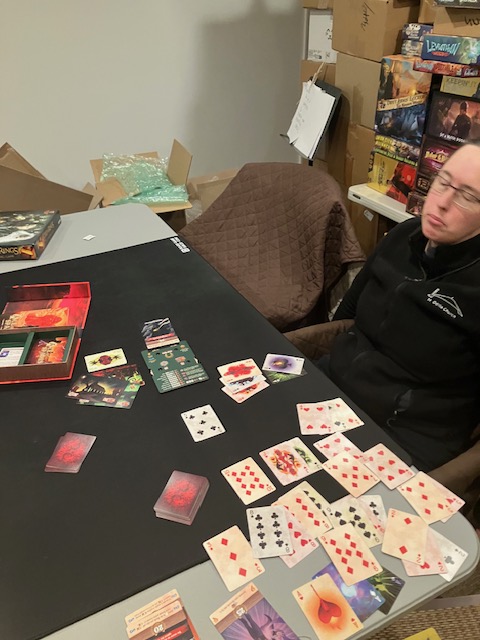
What kind of crazy person would call this a cozy game? This is set in a hard and unforgiving old west town, with gunfighters battling bad guys! The art is great but kind of harsh, the theme is hard, and the game … just doesn’t look cozy. But I argue that it kinda is! Check out why below …

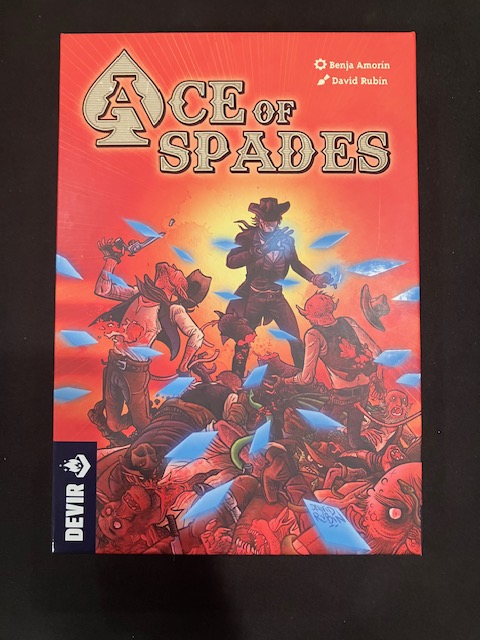
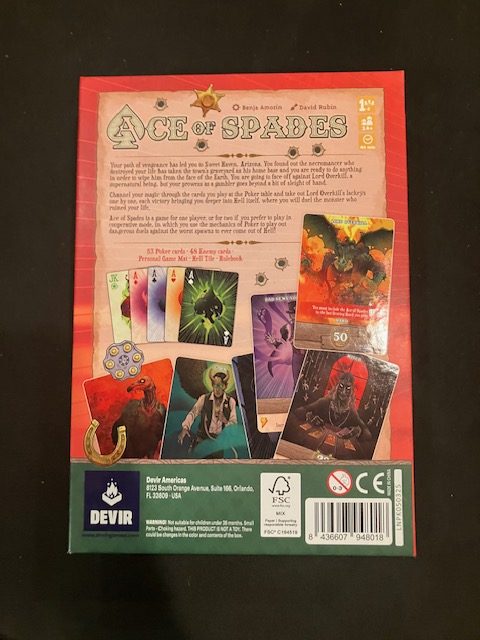
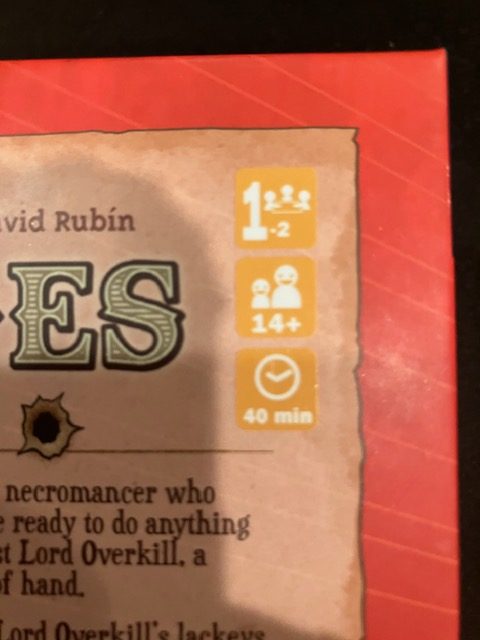
Ace of Spaces is a solo or 2-Player cooperative game: players battle bad guys using Poker Hands to do damage; bigger and more powerful bad guys emerge as play continues!

Although Ace of Spades was originally released in 2025, the original publication was recalled because of some offensive cards. So, the publisher Devir re-released this game fairly recently in 2026, so we are calling this a 2026 release? I guess?

Let’s take a look!

Unboxing and Gameplay

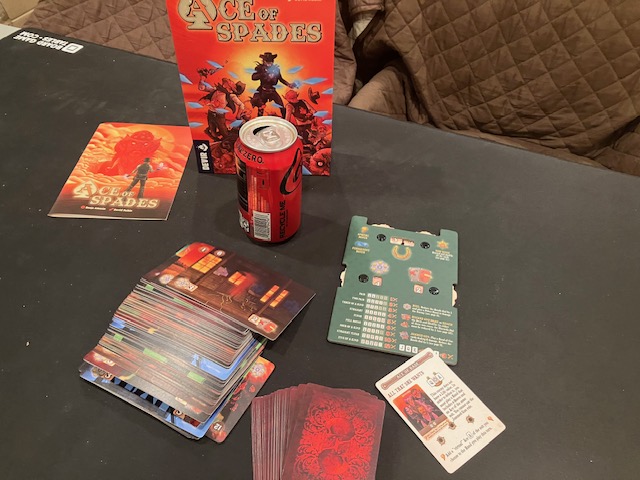
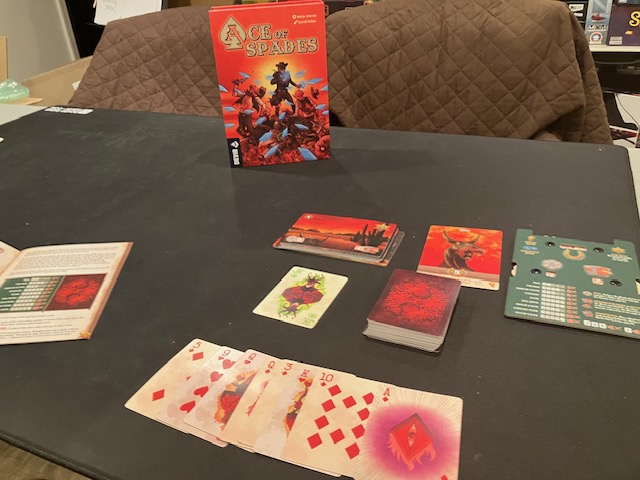
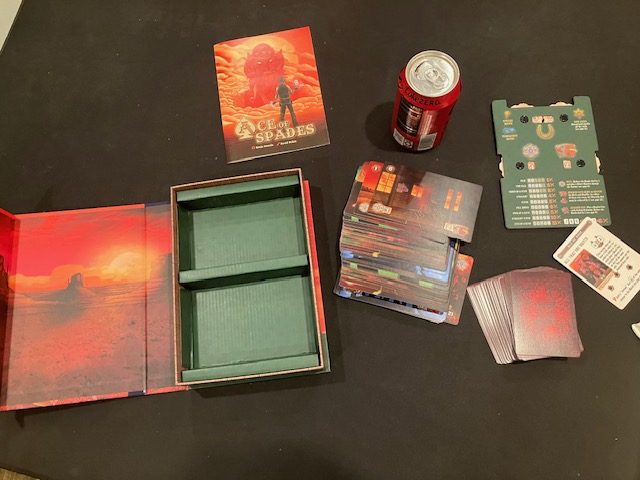
Ace of Spades is a smaller box (see Coke can above for scale) mostly because it’s just cards (and one giant notater for hit points).

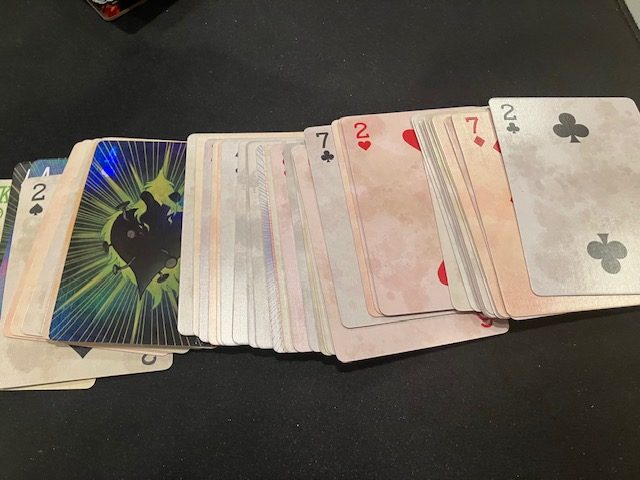
Players use poker hands to do damage to bad guys, so the game includes a “standard” deck of cards (see the fake “worn” veneer above) with a special “Foil” ace of spades card.

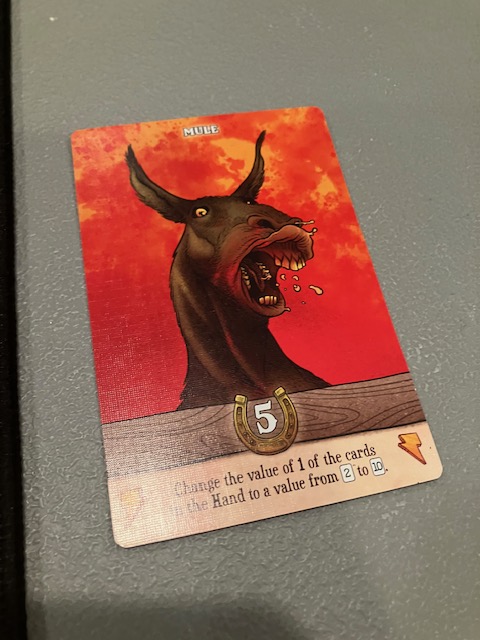
There are enemies you fight along the way to the big boss. The starting enemies are simple (like the 5 hit point Mule above) …

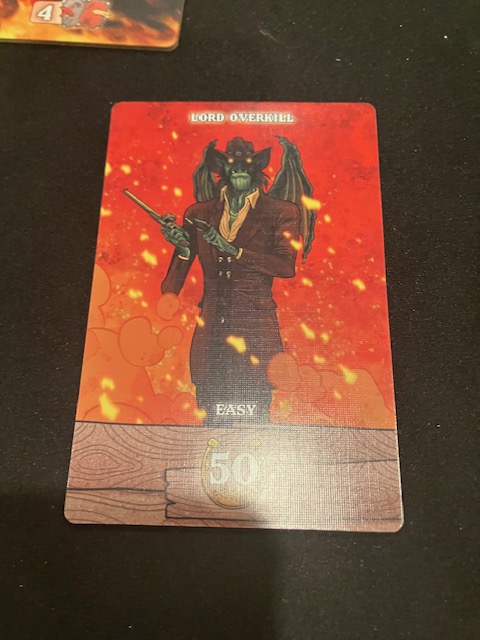
… and the final enemy is Lord Overkill (above with 50 hit points!) And that’s the easy boss!!

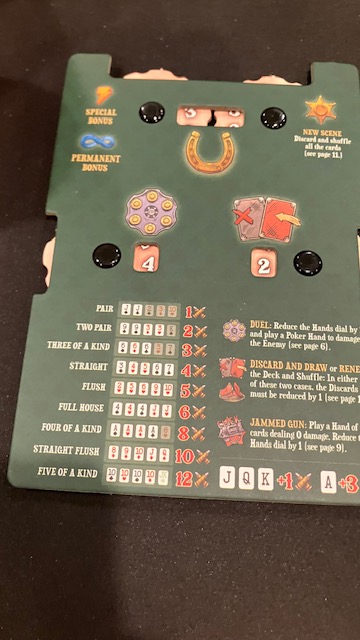
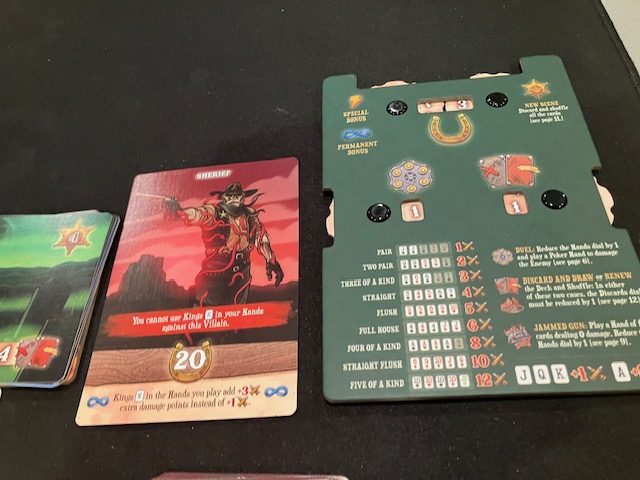
How do you do damage to enemies? You play poker hands, and each poker hand has a “damage” it does! See above as the Flush does 5 points of damage, the Full House does 6 and so on. You’ll also notice that face cards (JQK) do extra +1 damage, and Aces do +3!!

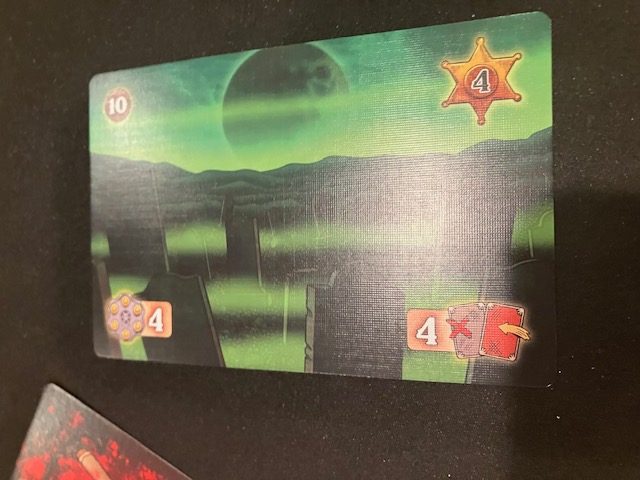
Each enemy you face has an “environment” (like the one above) which describes how many poker hands you can play, and how many redraws you get. The bullets (4) are the number of poker hands you can play, and the deck arrow (4) is the number of redraws you get.

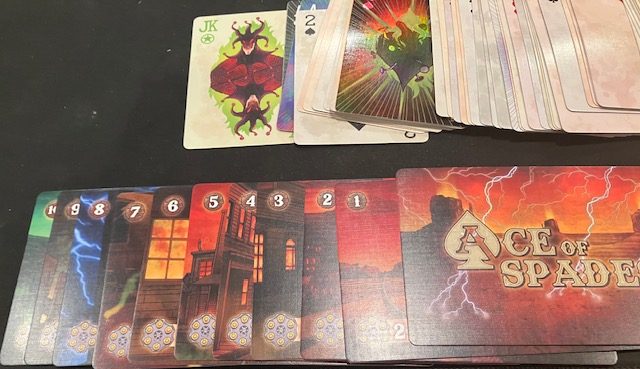
There are 11 bad guys overall on the way to Lord Overkill!! See above! If you can take all 12, you win! You lose if you can’t take out an enemy with the given number of poker hands.

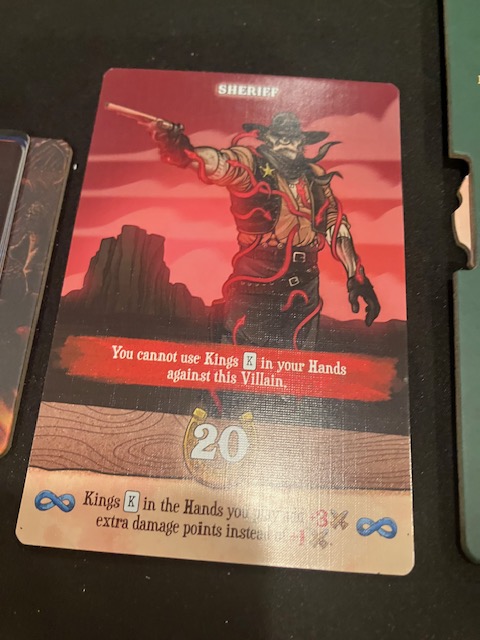
If you look at the bottom of the cards of the enemies, you’ll see that killing them gets you a “one-time” or “ongoing” power you can use in later combats. For example, if you take out the Sheriff above, you get the ongoing power that Kings to do extra extra damage!

If you can make it all the way to the end and kill Lord Overkill, you win!

It’s really just playing poker hands to do damage to bad guys.

Controversy

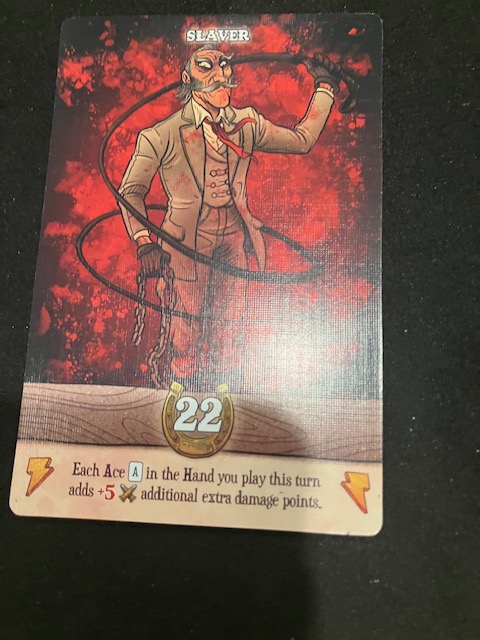
So, I didn’t know too much about the Ace of Spades controversy until I got my copy! I got a 1st edition used from a Board Game auction from my LFGS … and it turns out the 1st edition has the controversial cards! One of them is above (the slaver) and the others … I don’t to want to show. One of them is a slave card.

If you want to know more about the controversy, see this board game geek thread. You probably want to get the 2nd edition WITHOUT the slaver, slave, and other cards. It’s the 2nd edition that came out in 2026 and that’s probably the one you want.

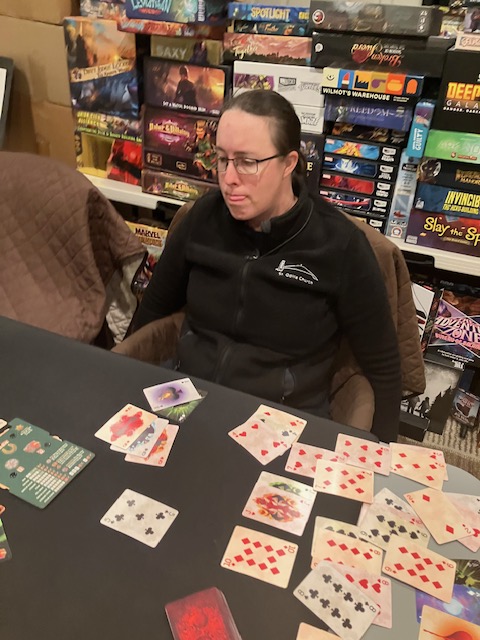
When I played with my friend Teresa, we just kinda put the controversial cards off to the side and didn’t play with them.

Solo Play

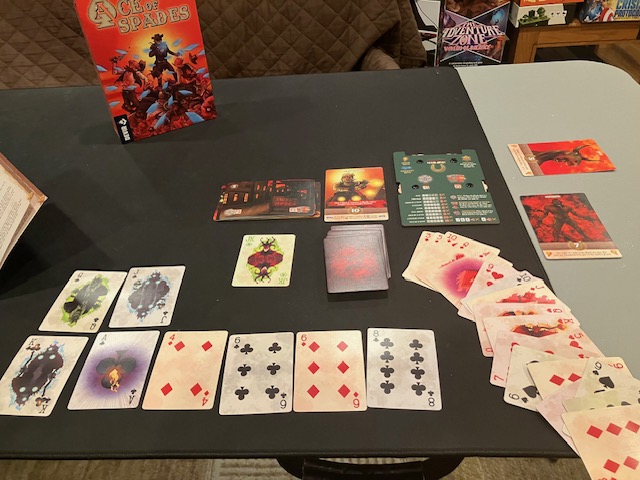
So, this is either a solo game or a 2-Player cooperative game. See above. Thanks for following Saunders’ Law and having a solo mode!

The solo game unfolds as you expect: you get poker hands and try to damage to your current bad guy! In the solo game, you get a full hand of 8 cards and play 5 at a time (fewer if you are playing easy mode) to play a poker hand to do damage. There are also ways to scale to make it easier and harder.

As a solo game, it was fine. The problem is that you are very dependent on the cards you get! Sure, that’s how poker is, but I found this really hard to win: it was very random. Sure, you can play smart and use the one-shot and ongoing abilities, and sure you can play the odds and get better hands. But I have yet to win a game.

And here’s the weird thing: since I know it’s kind of random and I’ll just have to do the best I can, it’s not stressful. I know that my game is completely defined by the cards I draw, and if I do great, HUZZAH! If I do poorly, oh well. I can try to play smart and I can try to think my way out, but since I know it can be very random … I don’t care? Not in a bad way but in a “Eh, that’s the way it goes”. I am going to make a controversial statement: this is a cozy game. You do the best you can, but meh, whatever.

I have played quite a number of games and haven’t won. I don’t care that I haven’t won … in a good way? It’s kinda fun.

Cooperative Play

As a 2-Player game, the game basically plays the same, but you alternate between the two players. There are still 8 cards out, but 3 are shared between the players, while each player has his own hand of 5. Here’s the thing: you have limited communication between the 2 Players. You cannot communicate what you have, except vague stuff.

I generally don’t like limited communication games; the rules are generally pretty vague except for “you can’t shared exactly what you have”. So, we probably stepped over the line a little. I think I would have preferred some limited communication rules more like The Crew (where you get a single communication per round) or something like that.

There were also no rules for sharing. To be fair, the 3 cards in the middle are shared between the two players, but it would have been nice to have other limited sharing rules.

I actually think (but I am not sure) the game would have been more fun with either some sharing or more explicit communication rules. Having said that, my favorite way to play this is 2-Player. Why? As I said before: it’s a cozy game! I am pretty sure I stuck getting what cards I get, so if I lose, whatever.

Again, calling this cozy is not necessarily a bad thing. I can sit with my friend for hours just playing and hoping we can get a good run to win! But we know the odds are against us. If we win, great! In not, oh well. That’s my definition of a cozy game: I can keep playing and not be stressed. My friend and I can hang out. Since I know the luck of the cards governs the winning, I don’t be stressed because I know I can’t do too muich about it (mostly) and I just play and have fun.

Conclusion

Play poker solo (or cooperatively with your friend ) and beat-up bad guys! It’s a simple premise, and it’s probably easy to get anyone to play it because most people know how to play poker! (Just make sure you get the 2nd Edition so you don’t offend anyone). I really like the idea that I can pull this game out for non-gamers and show them how a cooperative game works using poker hands! That’s a really neat way to introduce people to cooperative games! Most people know how poker hands work!

I also love the art in this game; it’s very comic-booky (Jonah Hex?) and very striking.

I am calling this a cozy game because I know the game is too random to take it too seriously: I will be always be at the whim of my draws, so I can lean back, play the best I can, and say “oh well” when I lose … because I will lose quite a bit. I know! With art and theme like this, how can you call this a cozy game? A cozy game for me is just sitting back and playing and saying “ok” as we play.

In the end, I prefer Ace of Spades 2-Player. It’s a cozy game where I can hang our with my friend and play a friendly (a truly friendly) game of poker. We can play all night and probably lose, but we’re still playing together and hanging out and having fun.

6.5/10 for solo play (too random to want to play all the time), but 7.5/10 or 8/10 for the 2-player game.

Appendix: Coziness vs Agency

I wonder … if we added house rules for sharing and/or communicating if I would like the game more or less? I KNOW the game is too random so I don’t care too much, that’s why it’s cozy for me … I can’t do much about how the cards come out for me and my friend, so I just say “whatever”; that makes it cozy for me. But if I added some sharing rules (“we can give one card per turn”) or communication rules (“we share show one card per turn”), maybe I would start caring more? Then maybe I would be more stressed and it wouldn’t be a cozy game anymore? Or maybe I’d like it more because I had more agency? I don’t know!

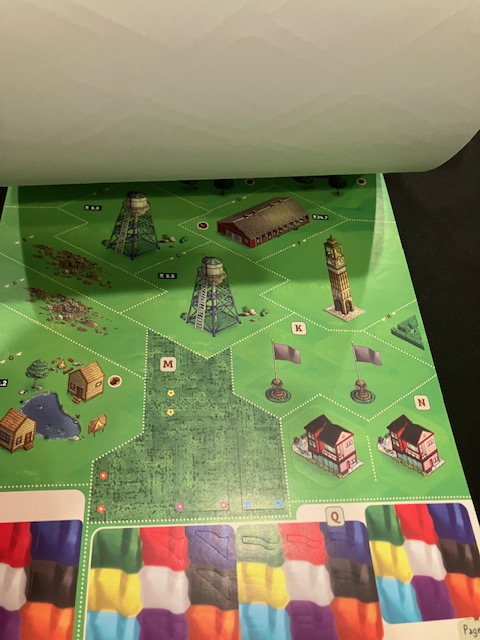
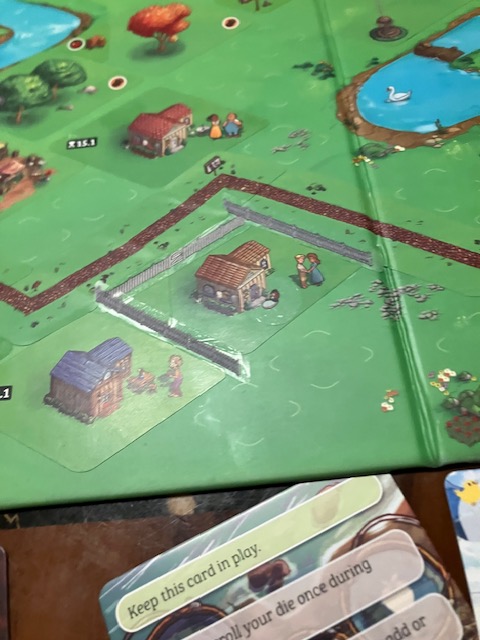
Cozy Stickerville: A Series of Fortunate Events

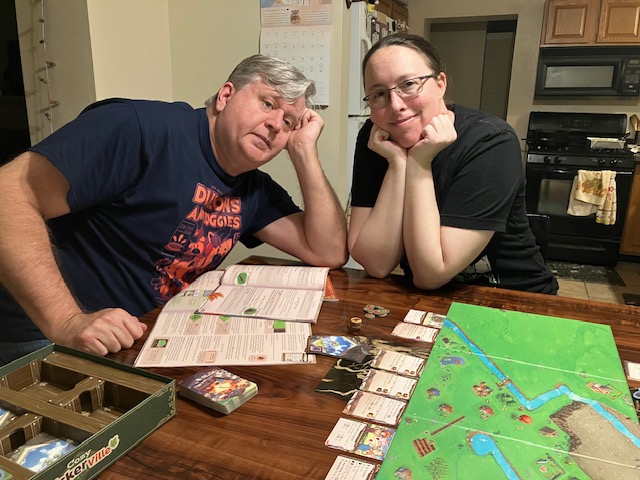
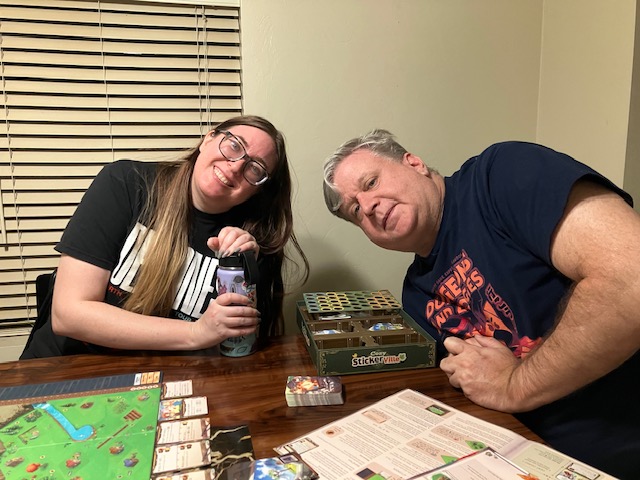
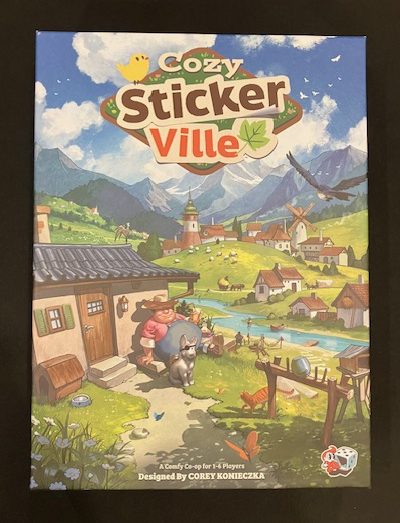
Without embellishment, I can honestly say that playing all the way through Cozy Stickerville has been one of my favorite gaming experiences of all time. It’s easily cooperative, it’s very engaging, it’s truly cozy as you and your friends work together to build a town.

I became aware of Cozy Stickerville from many sources. It turns out the designer of Cozy Stickerville (Cory Koniecza) designed my favorite games of 2023: The Initiative! See review here. So, I was super excited for this! I ended up ordering Cozy Stickerville directly from the website in early 2026 to get it as soon as I could. My friends were excited to play it; I presented the game as “Stardew Valley in a board game!” and my friends, especially Teresa (who is a big Stardew Valley fan) were excited.


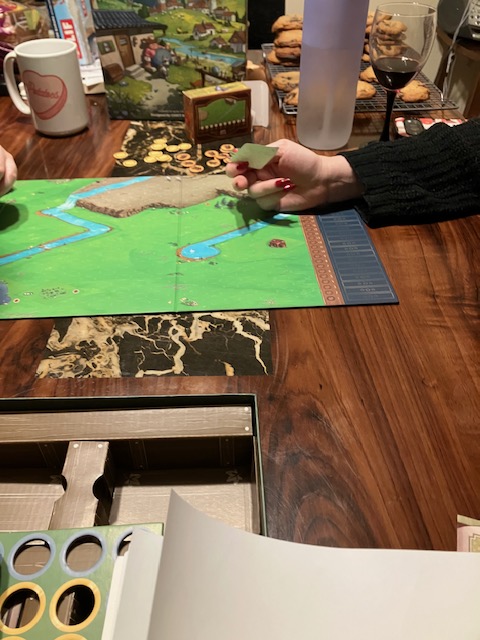
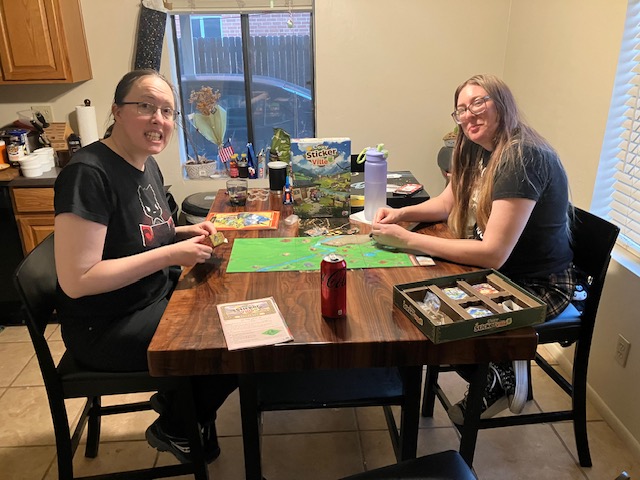
The nature of this game meant we had to play it OUTSIDE our normal circles. What do I mean by this? Stardrew Valley … sorry, I mean Cozy Stickerville, is a legacy game lasting ten episodes. A legacy game mean means a couple of things: 1) we’ll be changing the state of game as we play and 2) The game spans multiple sessions, so we’ll have to make a committed effort to get the same group together to play again and again! My playgroups are fairly fluid; people come and go, work gets in the way, and it’s sometimes hard to always get the same group together. So, to play Cozy Stickerville, me and Sara and Teresa had to commit to playing all ten games together, even outside our normal gaming rotations.

Over the course of two months, we played “about” every two weeks, and playing two or three of the episodes of the ten episode arc.

Stickers!

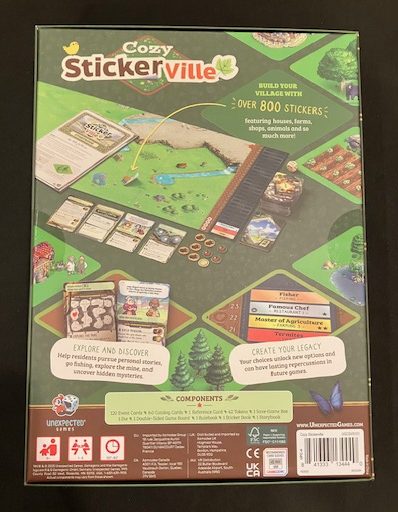
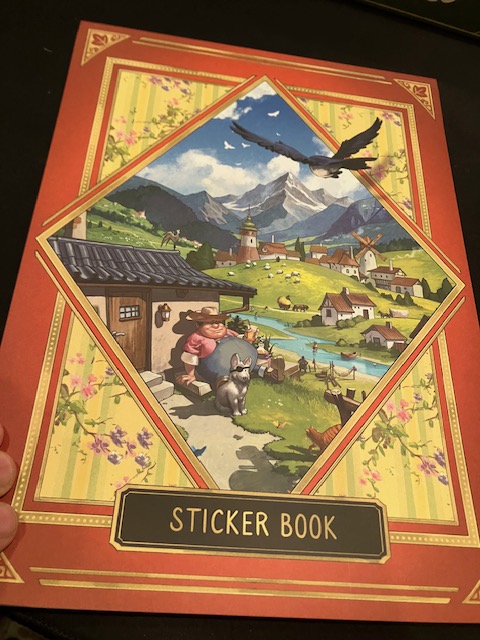
If you aren’t quite sure what a legacy game is, it’s usually tearing up cards and/or adding stickers to things. In the case of Cozy Stickerville, they have completely embraced the sticker part of the game! The game comes with a huge book full of stickers; no joke, it’s about 12 page full of stickers! As you play new games, you add stickers to board and stickers to story points and stickers stickers stickers!

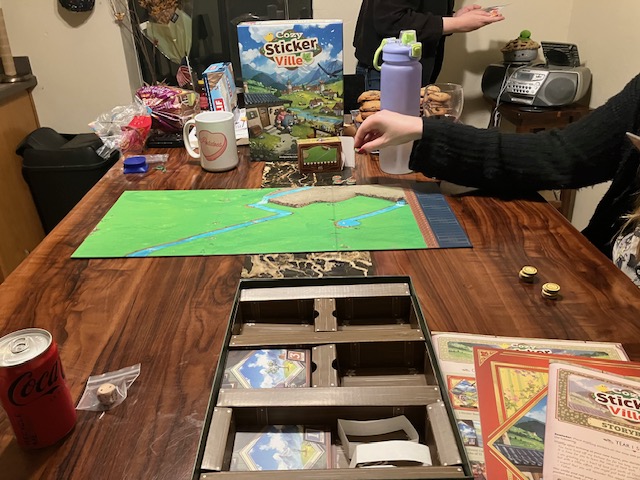
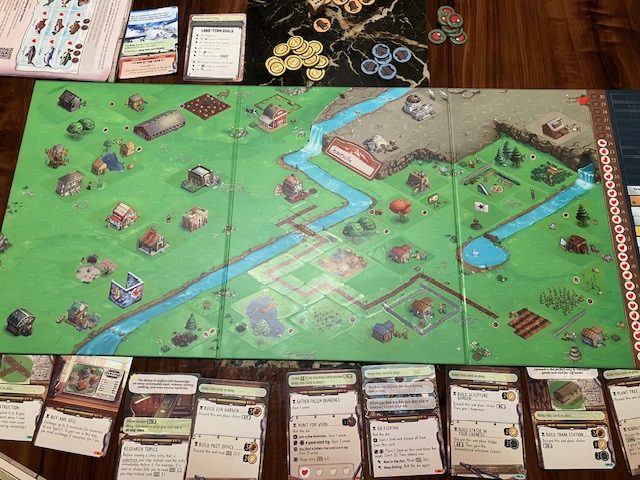
Cozy Stickerville is a game all about building your town. The stickers you put in the board help define the character of the town! The structures you build, the people you choose, the families, the businesses! You put people stickers, flower stickers, bird stickers, animal stickers … on your board! And this is what Cozy Stickerville is! It’s all about making decisions, as a group, about the town you want to build! The mechanism it uses to build the town is stickers.

Gameplay

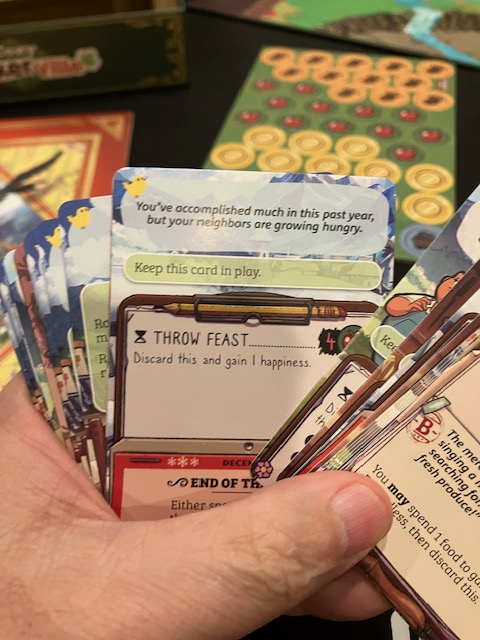
Gameplay is pretty easy; there are twelve events per episode, and each player takes an event card (which usually forces a decision), and then gets to do “something” in town.

Sometimes the “something” is getting resources (you might need wood to build some business, you might need money to add a new building, you might need food to feed your people), and sometimes the something is adding a sticker!

Each turn is really simple; draw an event, deal with it, then do something. And that’s it! But it’s the conversations that come out of all this are what make this so fun! As a group, we decide what flavor of town we want to build! Each player still has agency on their turn, as they are the final arbiter of what they do on their turn, but we found that we were always talking and discussing!

Each single game (a single episode) only last about 15 to 20 minutes. And that’s it! That’s why we were able to play two to three games (episodes) per session.

To be clear, once we are done playing all ten episodes, the game is done. The game is full of stickers and you have defined your town (but see below).

Cozy

This is definitely a cozy game. It’s not taxing at all to play. It’s simple gameplay; it’s fun and silly to place the stickers. But it’s the overall experience that makes this cozy. Me and my friends are just hanging out, making little decisions about our town, and placing stickers. You might think it sounds “stressful” to build a town … oh, it is so not stressful. You just make little choices and see what happens.

This is probably the coziest game I have ever played.

Conclusion

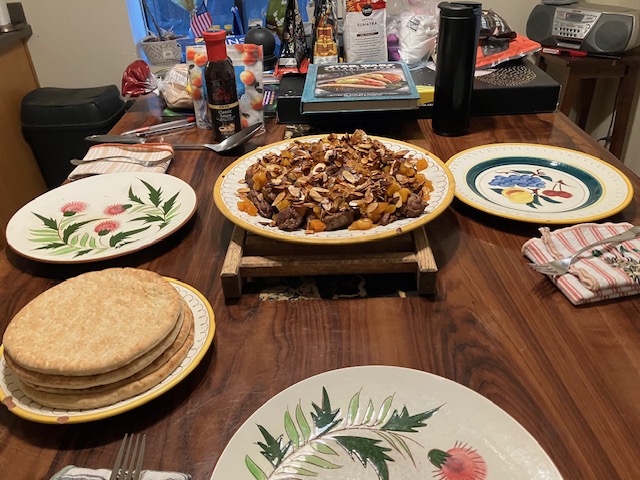
I wasn’t quite sure where I would land on this, but I think I have to give this a 10/10. I had more fun playing this little silly game than anything I have played in a while. This game became something I looked forward to; it became an event! Teresa would make some crazy food from the Star Wars cookbook, or the Stardrew Valley cookbook, and we would eat and chat! We would reminisce about the last session, as we came up to speed on all the decisions we made!

Cozy Stickerville became an event in every sense of the word; we planned schedules around it, we planned food around it, and we looked forward to each session.

I have to admit to feeling a little sad once our final game was over. It was a fantastic journey and a series of fortunate events made this so fun. 10/10 for me and my friends, and probably my cooperative game of the year.

Appendix (It’s Not QUITE Over!)

It turns out, even after you are done, you can still play the game one more time! You flip the board over and build a new town using the stickers that are still leftover! All the decisions you made in the previous game exclude some of the cards from the game, but you can actually play it again!