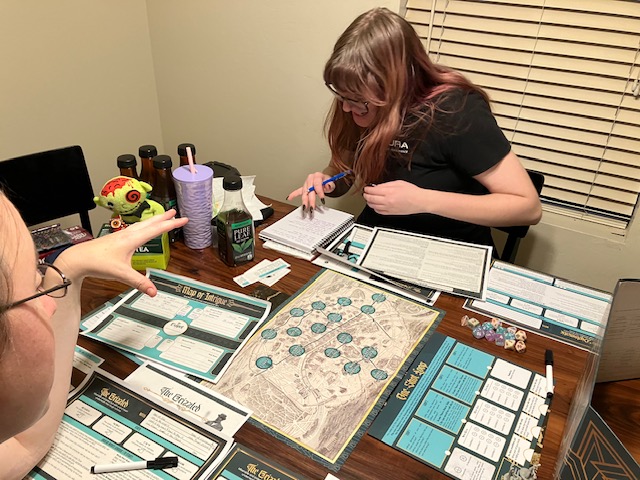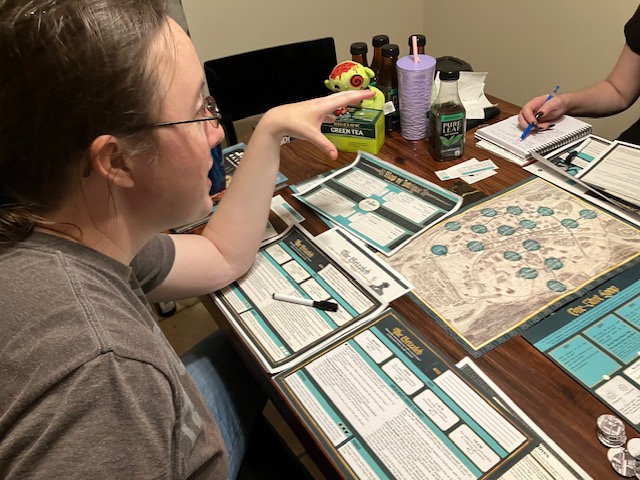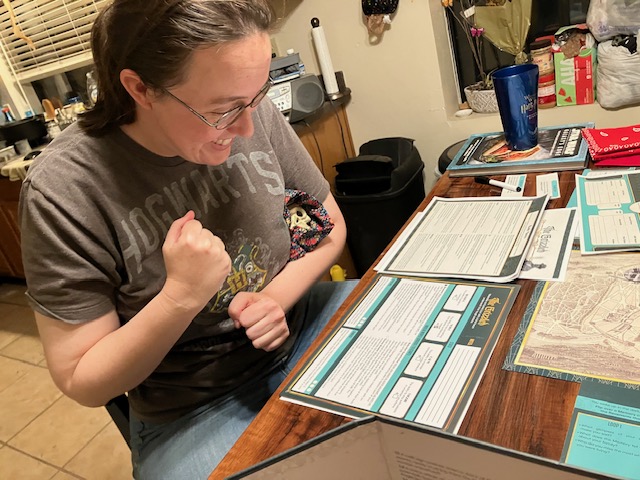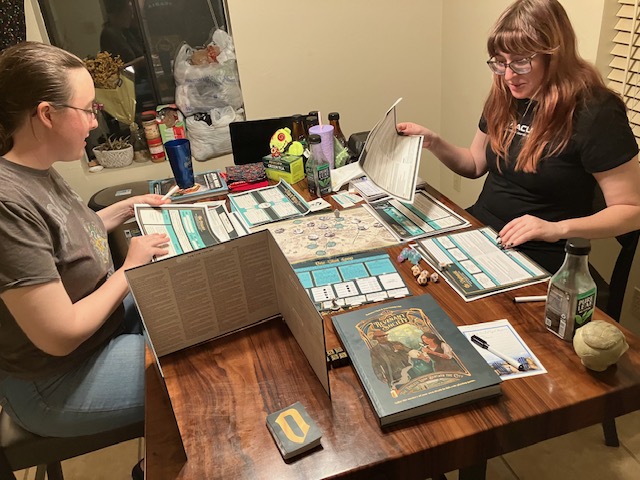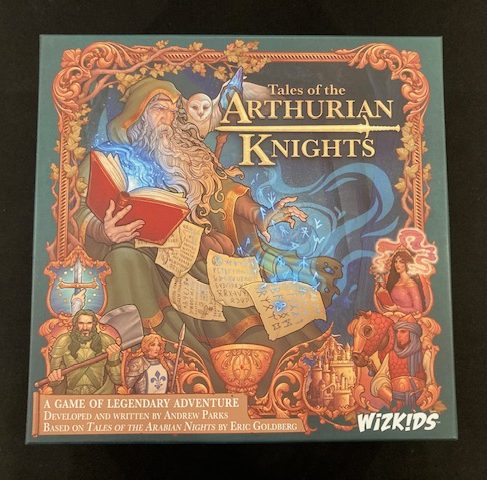
A Story Unfolds: Review of Tales of the Arthurian Knights (Solo and Cooperative Modes)

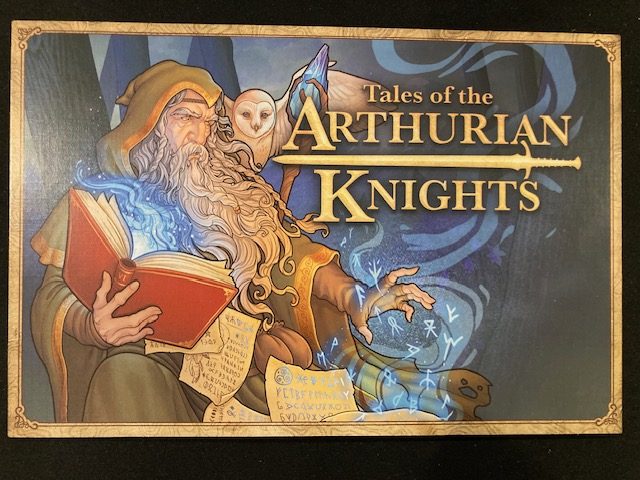
Tales of the Arthurian Knights is a cooperative and solo storybook game. What’s a cooperative storytelling/storybook game you might ask?  Take a look at our Top 10 Cooperative  Storytelling/Storybook Games for more discussion of this genre!
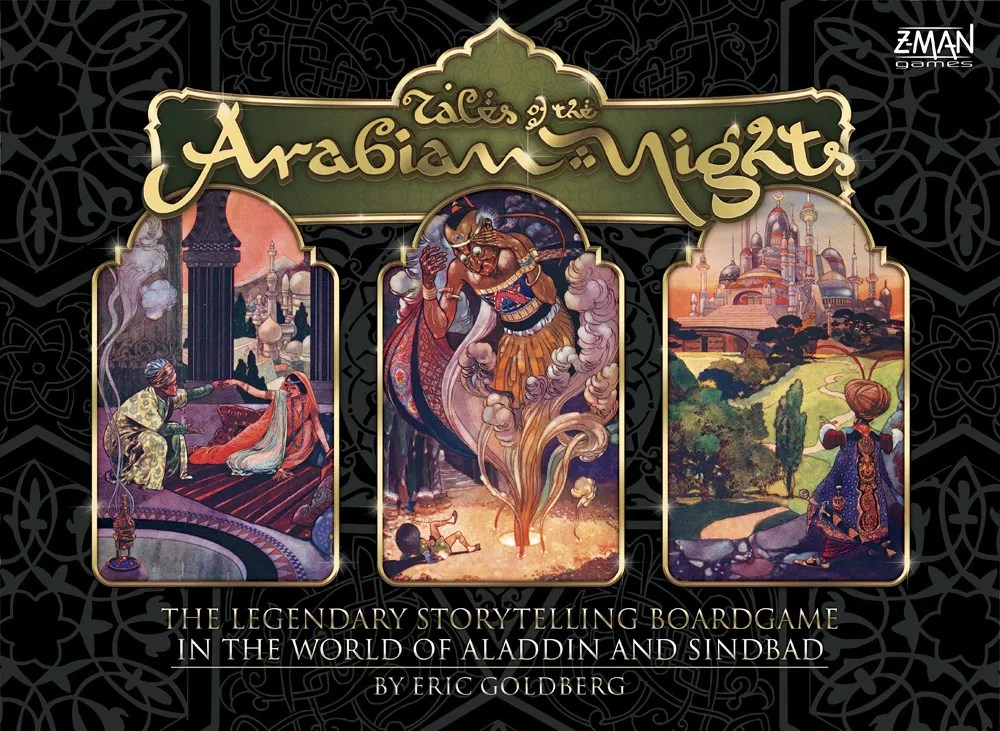
Tales of Arthurian Knights is a follow-up to the hugely popular storybook game Tales of the Arabian Nights, (another massive storybook game) … but the original is not cooperative!
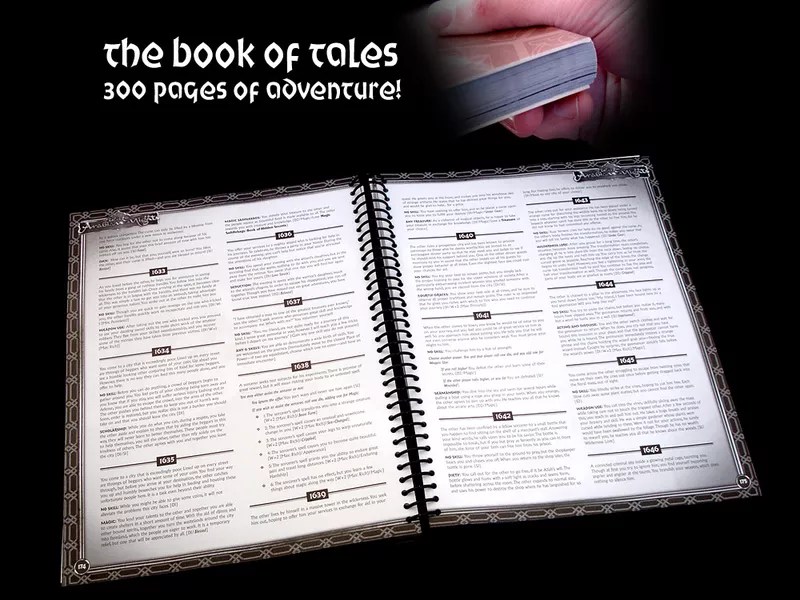
What makes this “Tales of …” series of these games so impressive is the size of the book(s) that come with the game! Players basically make skill checks and have adventures from this book! See the book from Tales of the Arabian Nights above!
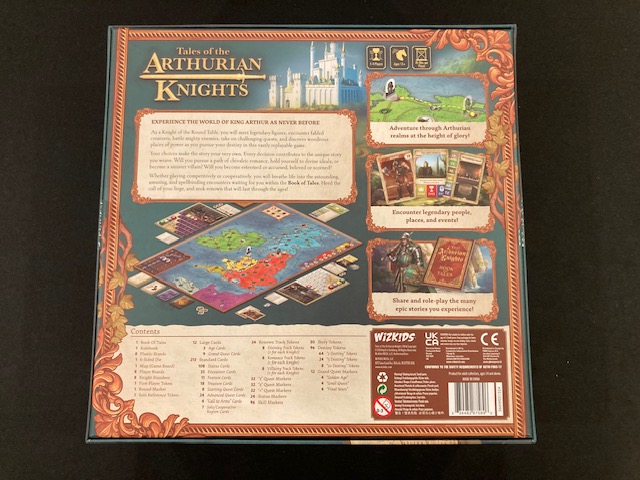
Now, the original game Tales of the Arabian Nights was a competitive game (although my friend Greg always argued that it was kinda a co-op), but Tales of Arthurian Knights has added a true solo mode and a true cooperative mode! Let’s take a look!

Unboxing
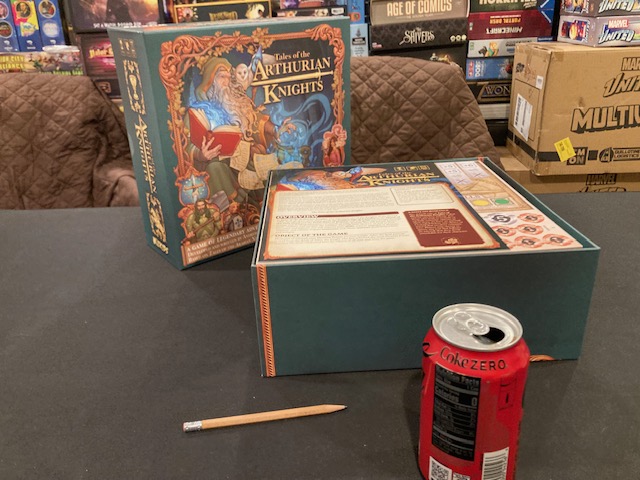
The size of this box feels pretty standard, except that it is a pretty tall box! It’s also quite heavy! See the Coke can and #2 pencil for perspective on the size.
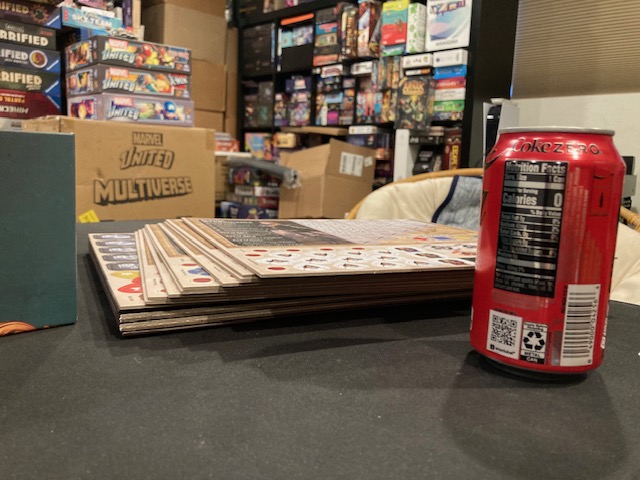
There are a TON of cardboard sheets to punch out! A ton I tells ya! See above as I use the Coke can to demonstrate how tall the pile of cardboard is!
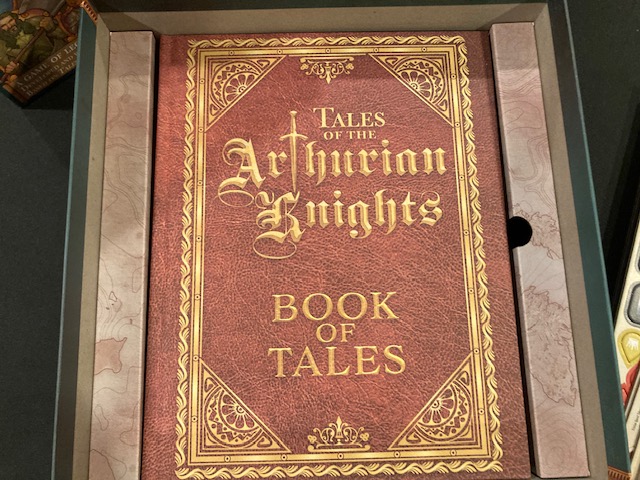
But what makes this game heavy and a storybook game … is the storybook.
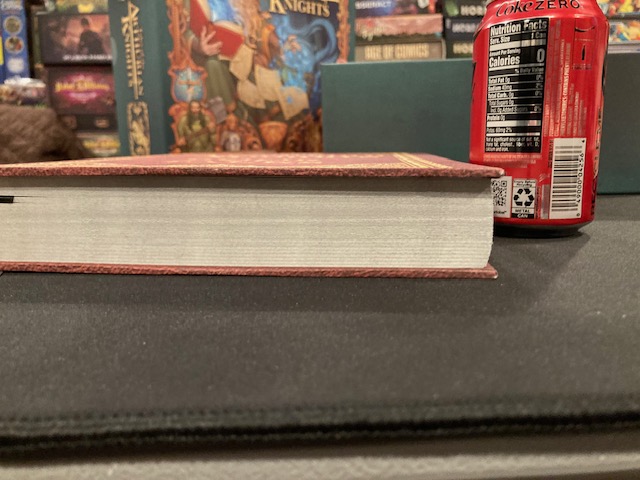
This is a hardcover storybook! And it is very thick! See the Coke can again measuring its height!
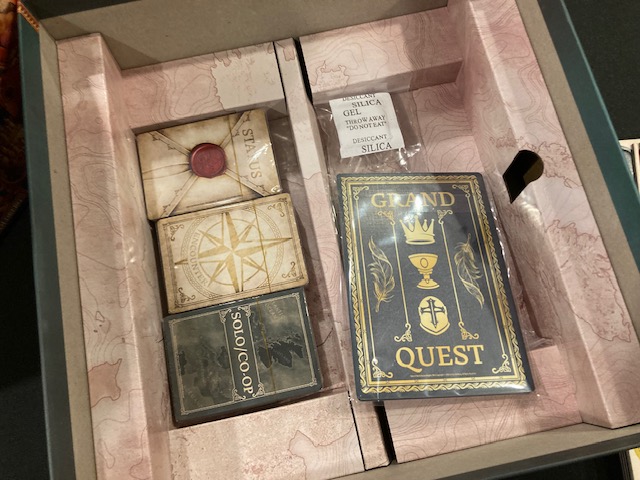
Underneath the storybook are a bunch of cards.
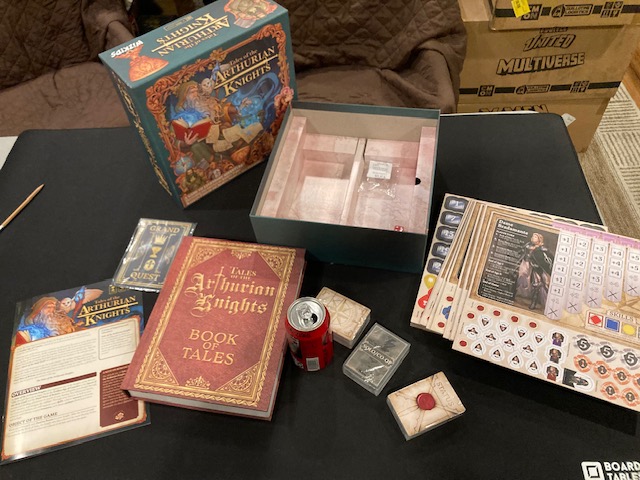
That’s what’s in the box … let’s take a closer look at some of the components!

The Rulebook
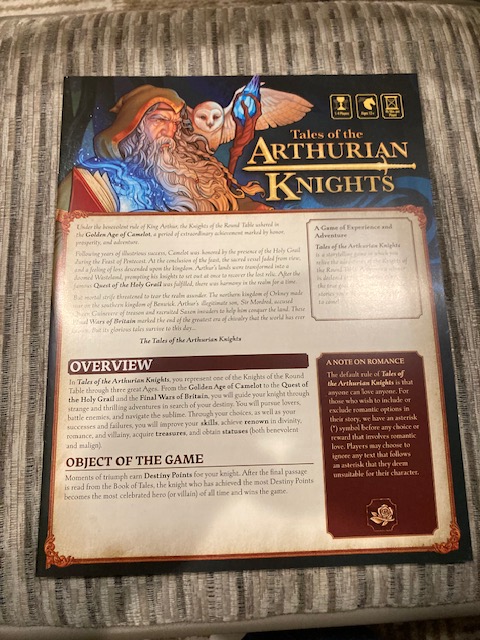
The rulebook was pretty darn good.
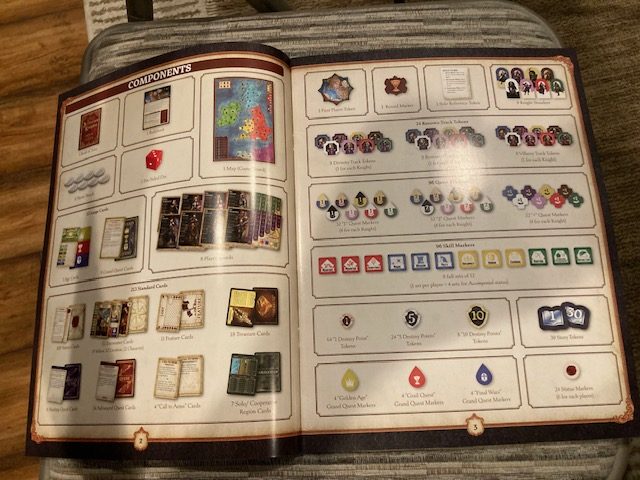
The components page shows just about everything, but here’s a little warning: you should be careful about how you punch some stuff out (we’ll discuss this more below).
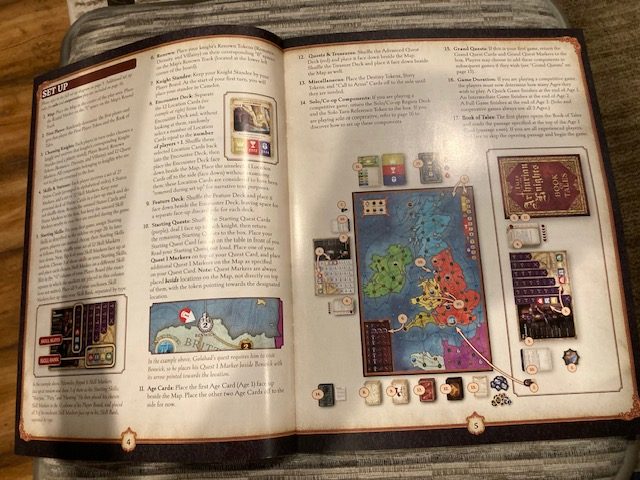
The set-up is across two pages and has a picture and correlating notations; it works great.
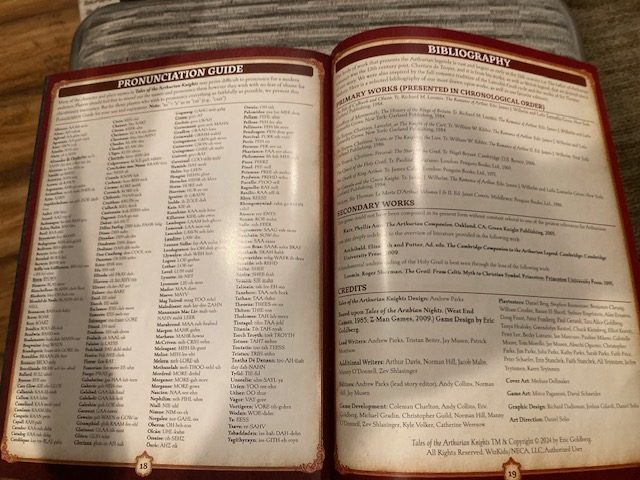
There’s even a Bibliography (!) and A Pronunciation guide! That’s right! You can tell the people who made this game really care about the Arthurian Mythos! This care shines through from the very beginning, and manifests in the writing!
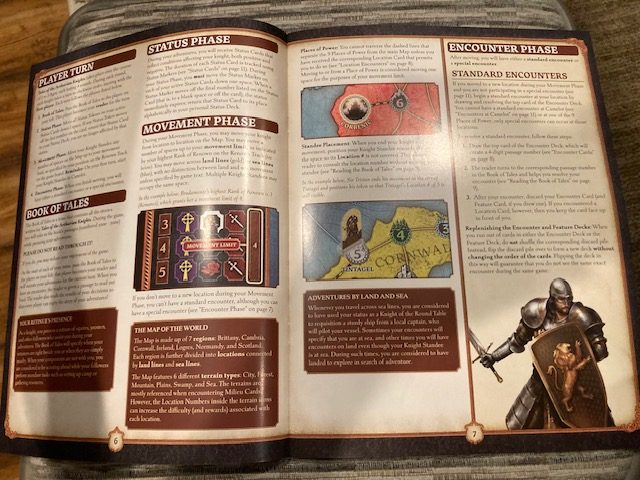
In general, this was a good rulebook: the fonts are big, the pictures help understanding, and it seems well organized. And the game gets an A- on the Chair Test: I can keep the rulebook open on the chair next to me, and it stays open and flat so it is easy to consult!
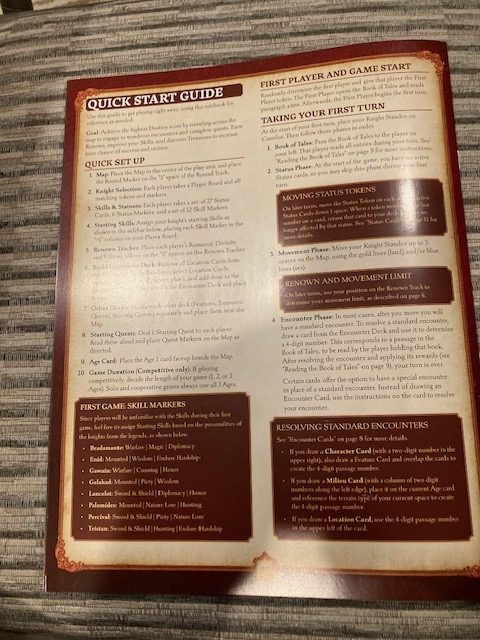
And the rulebook even ends with a QuickStart guide on the back: see above.

This was a good rulebook.  The only major fault with this rulebook was that it didn’t have an Index (which is weird for a game that has a Bibliography and Pronunciation Guide), but it wasn’t that big of a deal.

Storybook
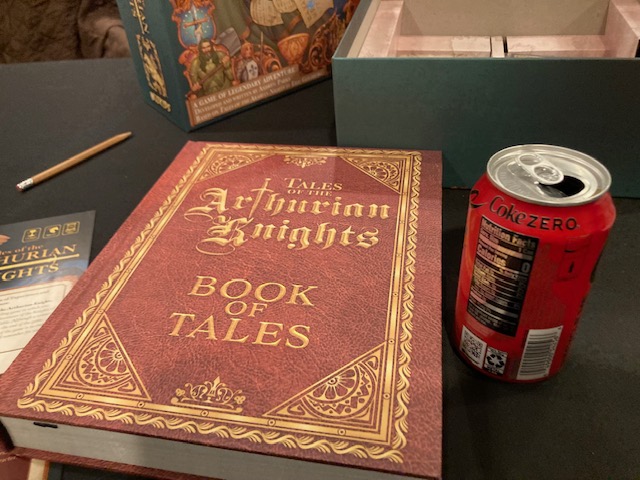
The storybook is GORGEOUS! It’s a hardcover! The entire game centers on the stories that come out of this book!
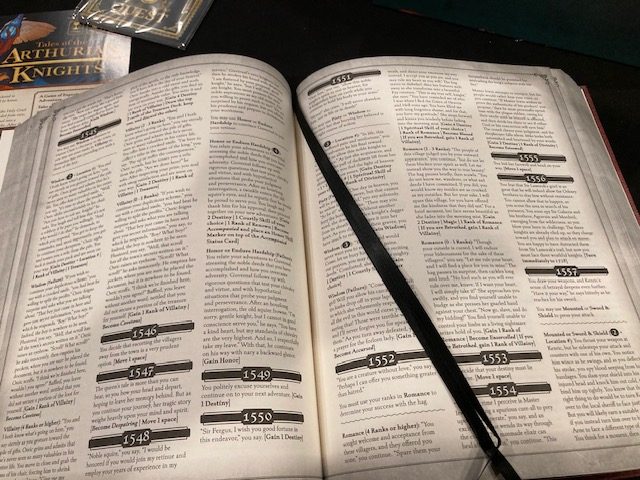
Even the paper is nice (it’s not cheap paper by any means), and it has a built-in bookmark … what?? See above!
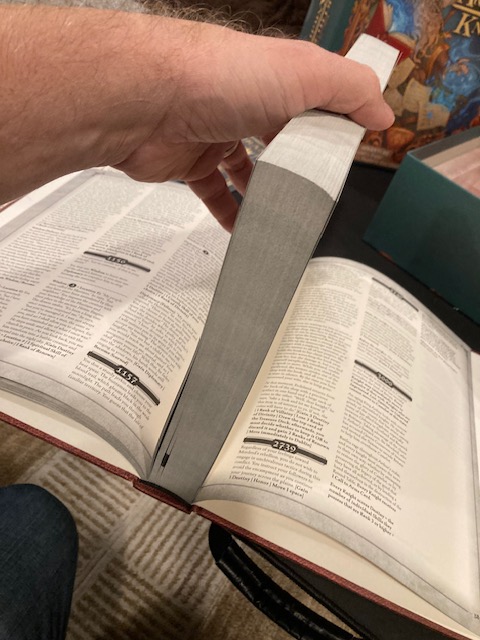
The binding on the book is very high quality! I still do that thing you do with new textbooks; slowly open the book and let pages fall left-and-right to ensure I don’t break the binding. (Am I the only one who does that?) See above.
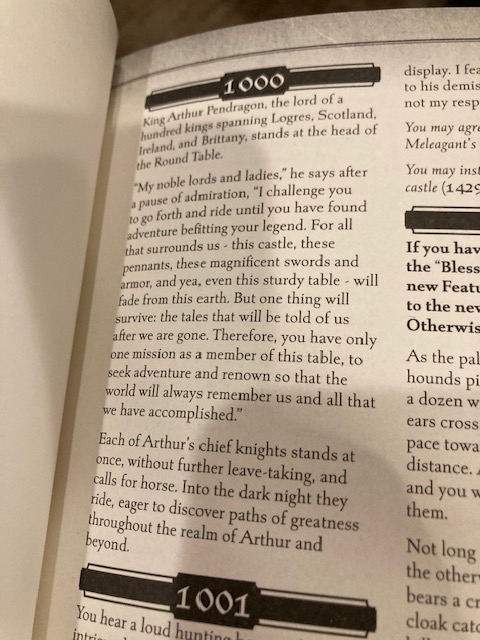
The font is easy to read and it’s high quality: and no, the above isn’t a big spoiler: it’s the VERY FIRST ENTRY every game reads (but it shows what the font looks like).
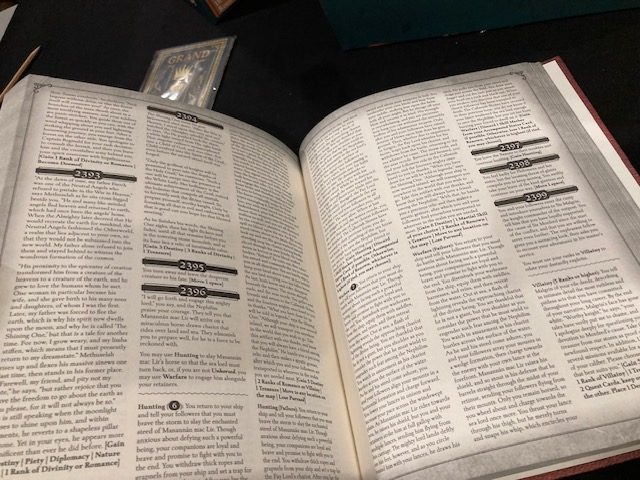
Most entries in the book have you read some text to the current player (or yourself if you are playing solo), and presents you with a choice … something like … Do you want to use HONOR to solve this issue or PIETY?  You make a skill check against that Skill and read the appropriate SUCCESS or FAILURE.    
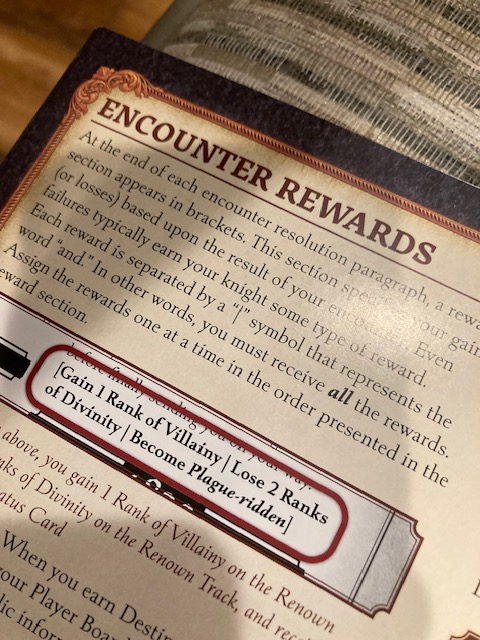
See above for an example for a reward (from the rulebook). Getting a SUCCESS usually gives you extra Skills, extra Ranks in Divinity/Villainy/Romance, or Statuses.
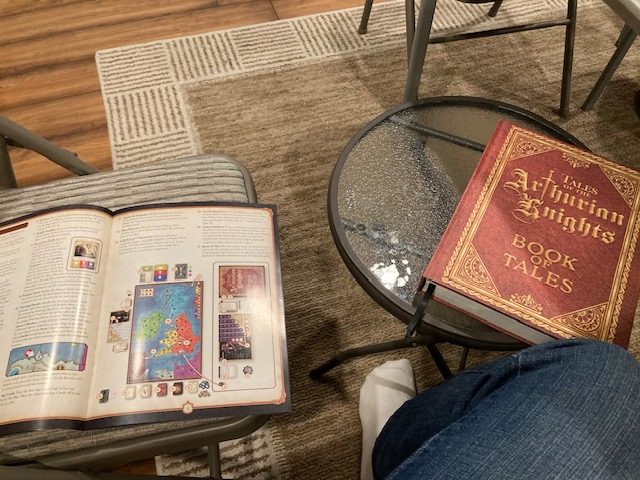
This storybook is just gorgeous (you said that Rich … I know, I know, it’s just so awesome).

Punchouts
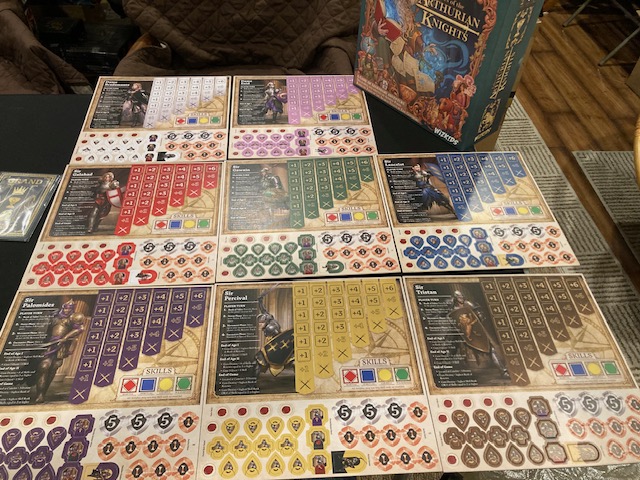
There are a LOT of punchouts for this game (see above): BE WARNED!! I don’t think you need to punch them all out at first.  Each player takes the role of a Knight of the Round Table (see above: there are 8 possible Knights).
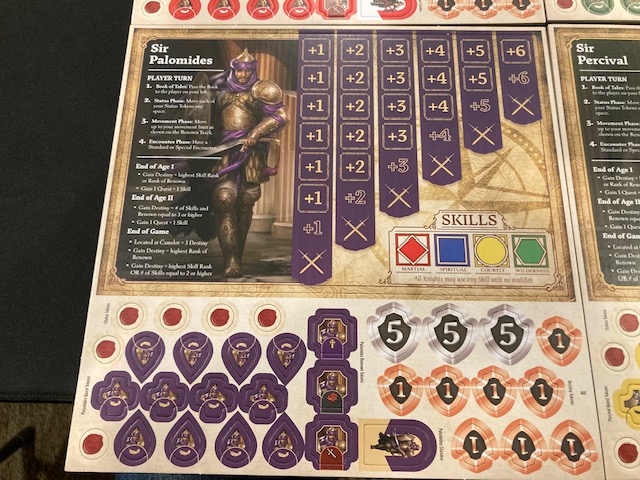
You really only need to punchout the components for THAT KNIGHT! Most of the tokens I need to play Sir Palomides (see above) are just on HIS SHEET; so there’s no reason to punchout EVERYTHING.
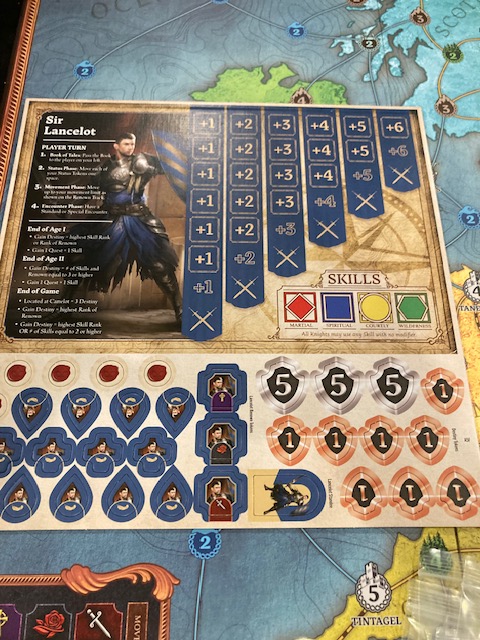
I played Sir Lancelot in my first solo game.
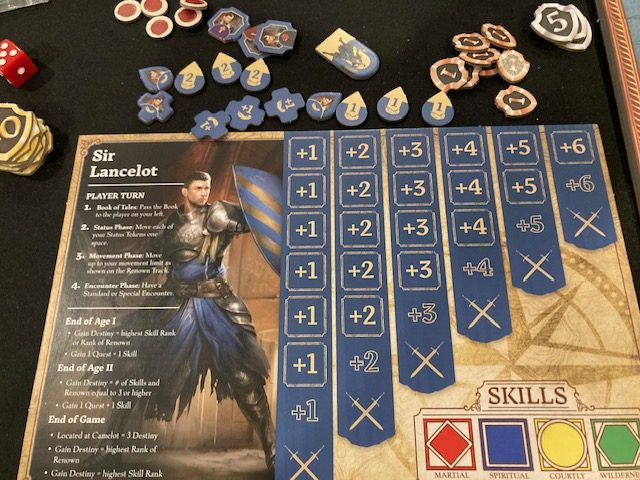
I only punched out the components for Sir Lancelot … I didn’t have to punch out everything!
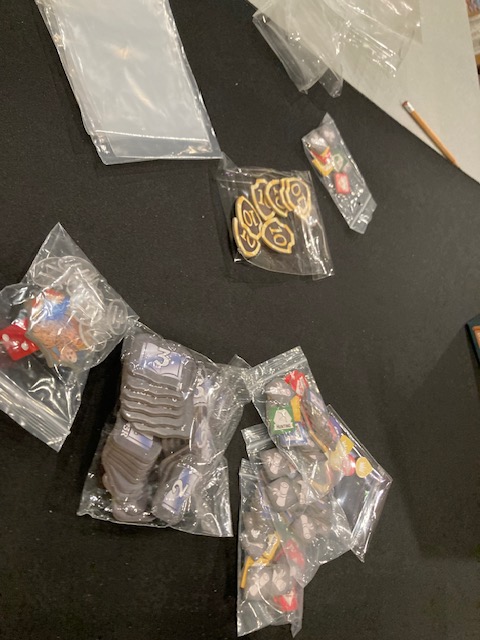
I hate to say it, but I wish this game came with baggies. I stole baggies from some other games I have, and used those. Basically, I give each character THEIR OWN BAG for tokens (and the other shared components go into other bags).
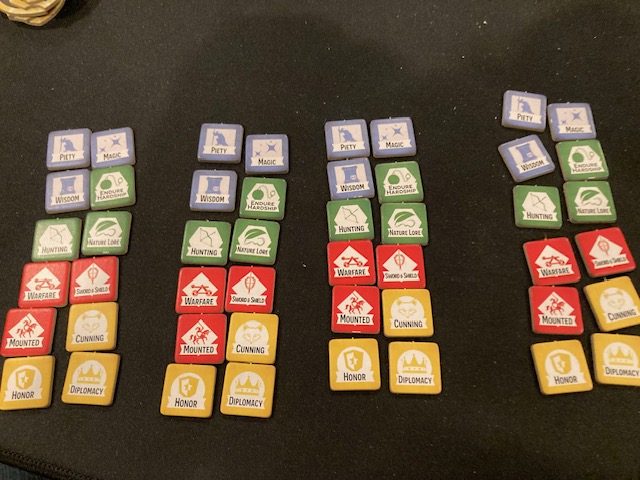
You will to punchout the Skill tokens: every Knight gets 12 (which only some become active as you play).   I made separate bags for each set of 12 tokens.
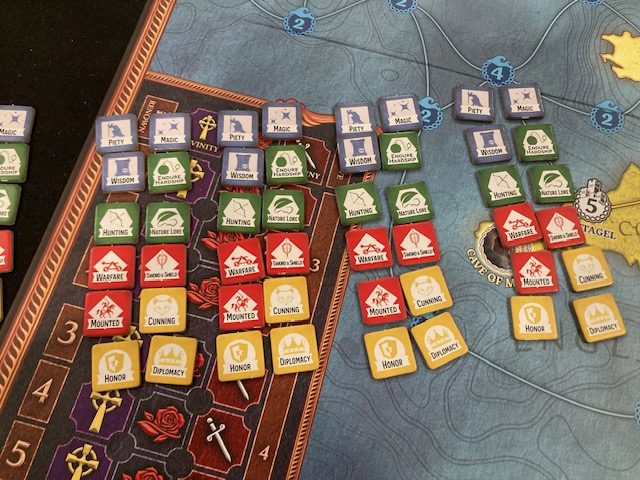
In fact, there are 8 sets of Skill tokens (even though the game only plays 1-4 players): Why? Because you can  be ACCOMPANIED and have a companion who has skills … like I said, I just punched out the Skill tokens and put each 12 into separate bags (for a total of 8 separate bags of Skill Tokens, and 8 different bags for the 8 characters).  

This game really needs baggies I think.

So, be wary: if you punchout everything right when you open the game, you might want to have a bag per character to store their stuff. And 1 bag per 12 Skills. And a few more baggies for other components.
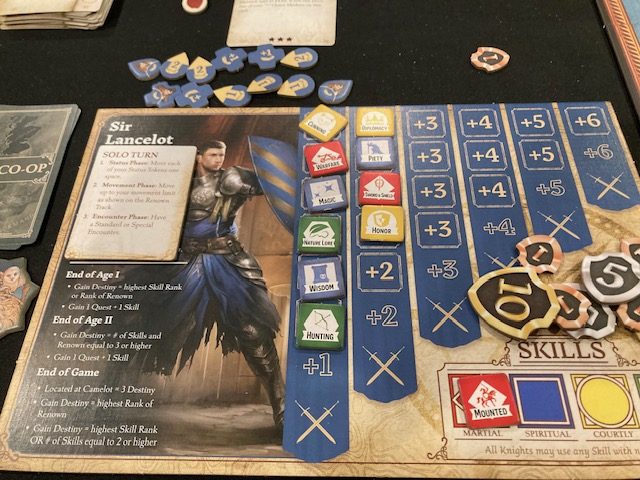
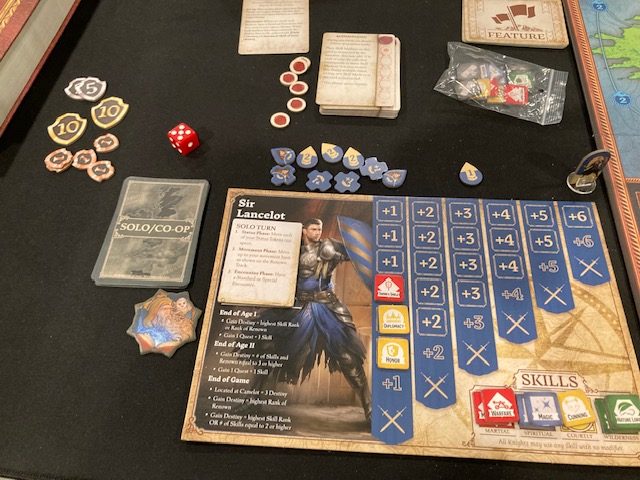
The SKILLS give you bonuses to certain SKILL checks: See above as Lancelot gets +2 on Peity, Shield and Sword, and Honor SKILL checks.

Status Cards
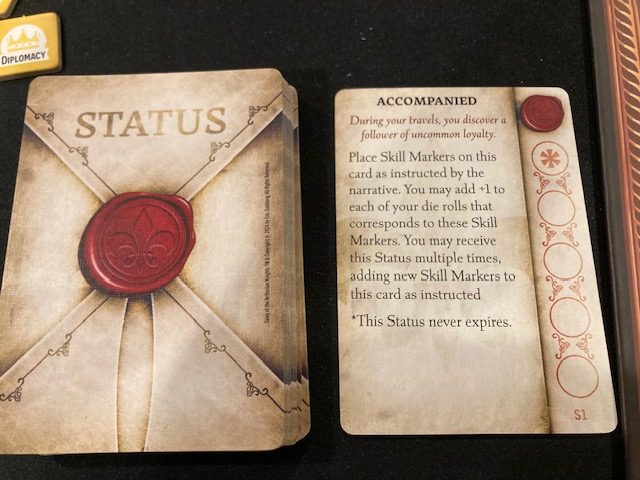
As you play the game, stuff happens to you. And this is represented by the STATUS cards! Each player gets a stack of STATUS cards which may become activated as you play.
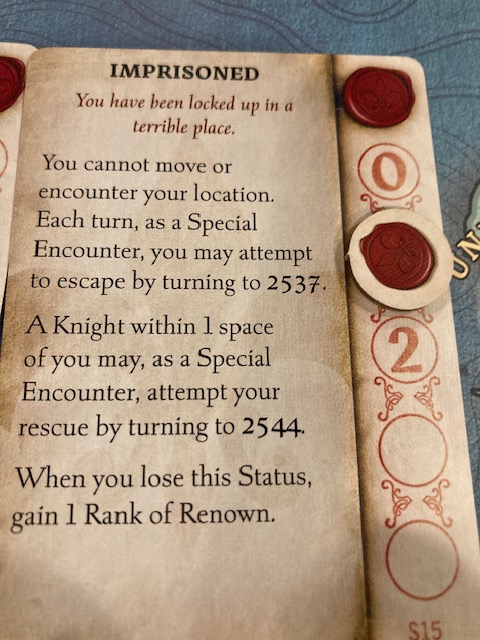
The nice thing is that STATUS cards can expire! See above as I am IMPRISONED! As the start of every turn, if I can’t escape my prison, the STATUS token (red dot) moves down, and if it ever moves to the last space, the STATUS goes away naturally! I have to say, after some games of Tales of Arabian Nights, I got stuck in prison and couldn’t get out! At least with this “expiration” mechanism, I won’t get completely stuck!

Quests
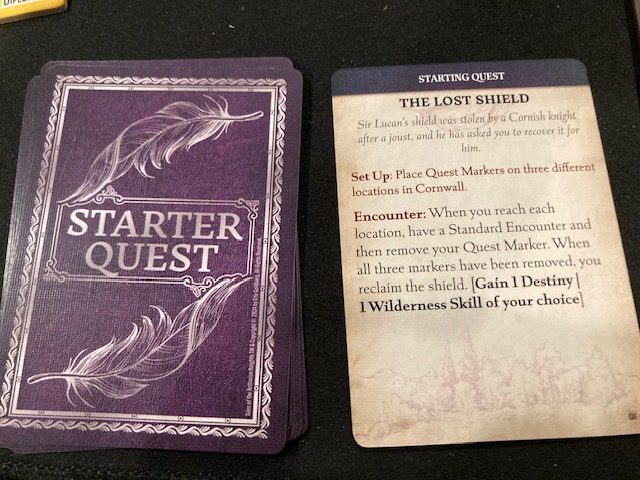
What generally “directs” you in the game is the QUEST!  Every player starts with a STARTING QUEST (see above) and that directs you to places on the map to “do stuff”!  You don’t HAVE to do these quests, but usually the rewards for QUESTS are worth it!
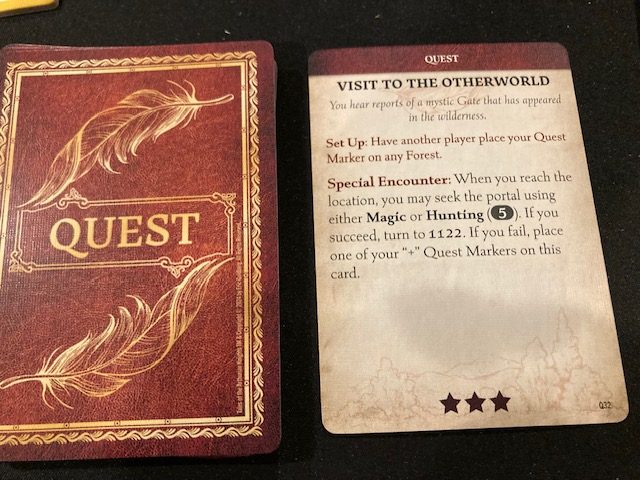
There are many places where you can get more QUESTs as you explore, but if you never have one, you just draw from the QUEST pile!
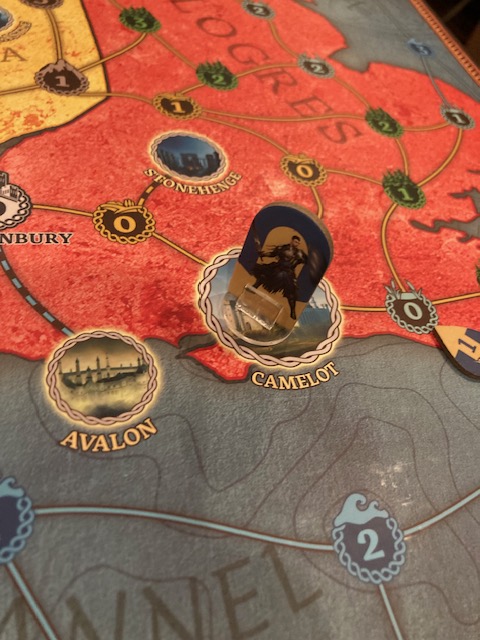
Your QUESTS have a very pick-up and deliver feel; you usually have to visit 1 or 2 Locations on the map (see above), and do “something” (SKILL check, standard encounter) to finish the QUEST.
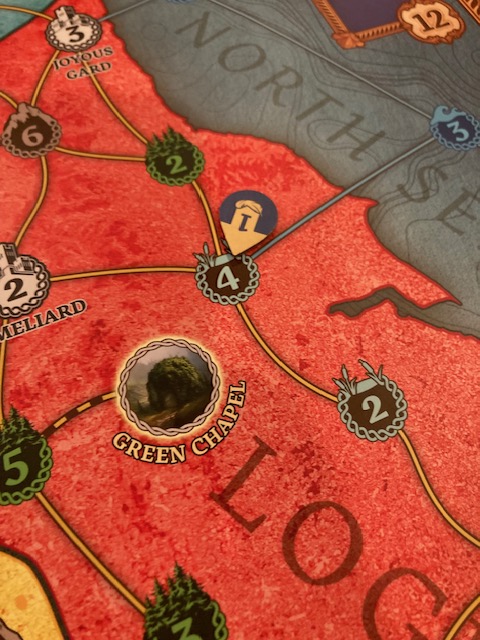

The QUEST locations are notated with your little markers (see above).

Destiny
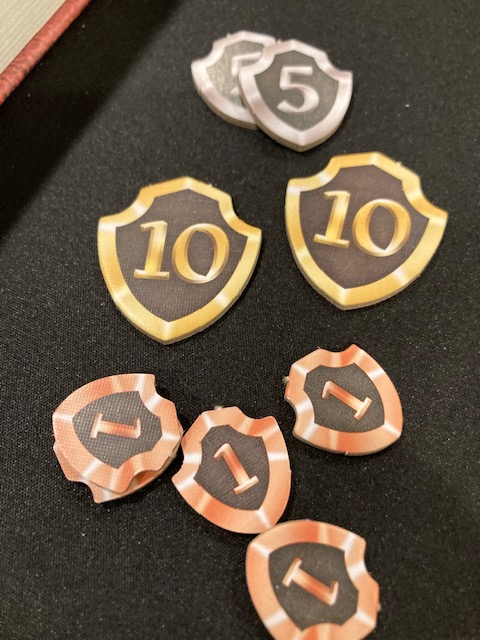
To win the game, you (solo/cooperative group) need to get enough DESTINY POINTS: see above.
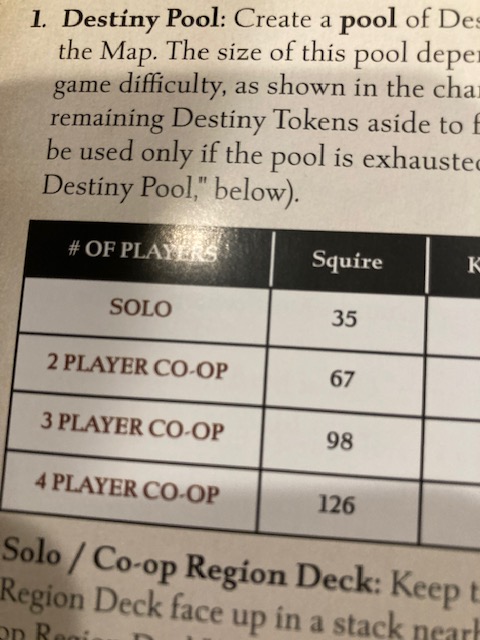
How much DESTINY you need depends on the number of players and the difficulty you choose. For example: The solo game at SQUIRE level requires 35 (see above), and a 4-Player cooperative game requires 126 DESTINY!
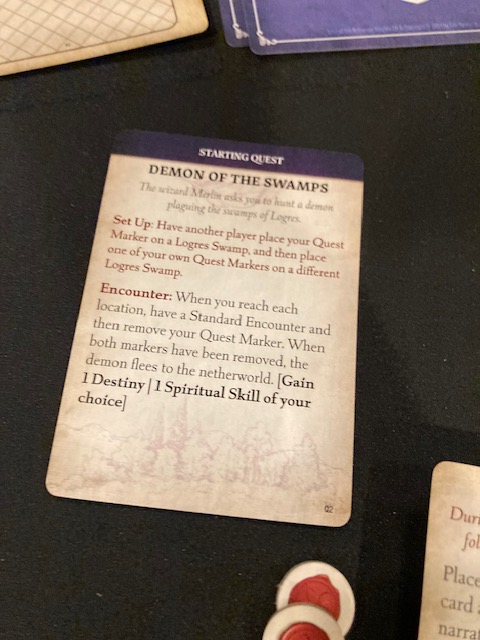
You mostly get DESTINY from two sources; completing  a QUEST (see above) or succeeding on a SKILL check.  There are also other ways that come up in the game, but those are the most likely sources.

The Map and Encounters
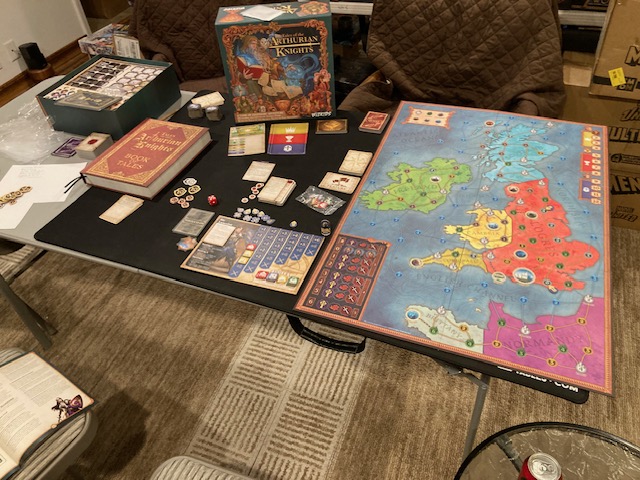
This is a big game where you explore the world, hunting down QUESTS as you move around the map!  Just about everything you do has someone read “something” from the storybook!
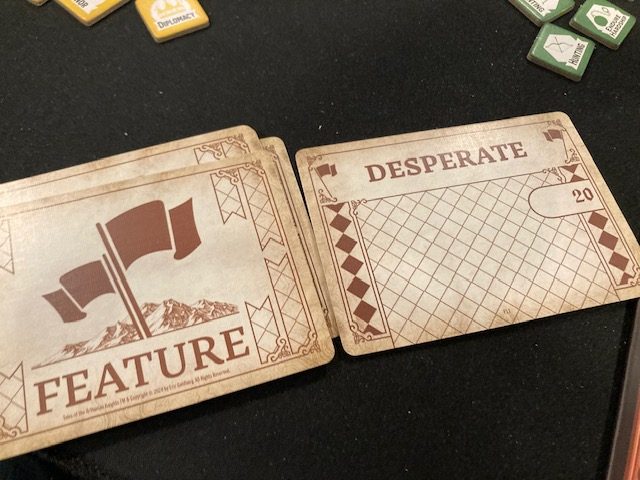
The most common encounters (standard encounters) are in the game are made up from two decks: a FEATURE deck (which has an adjective and the last two digits of a 4 digit number) …
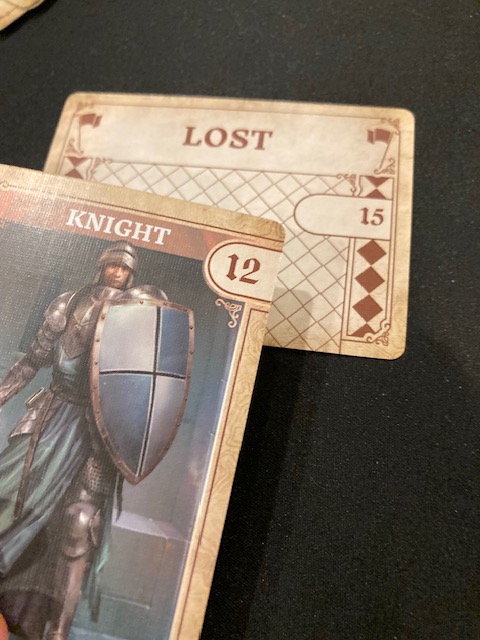
And the ENCOUNTER deck, which is frequently a traveller.  The LOST KNIGHT will be entry 1215 in the storybook!   See above! And that will be the encounter for that Location!

Every encounter in the storybook is a 4-digit number (see above).

And that’s the basics of the game; explore the world, go on QUESTS, read from the Storybook, make skill checks, and try to get enough DESTINY to win!

Solo Play
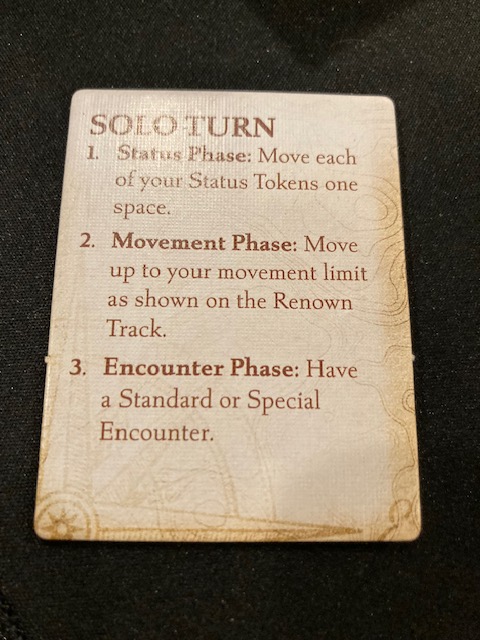
So, there is a solo mode in this game (thank you for following Saunders’ Law), and it is “generally” well-thought out; but there are some issues.  
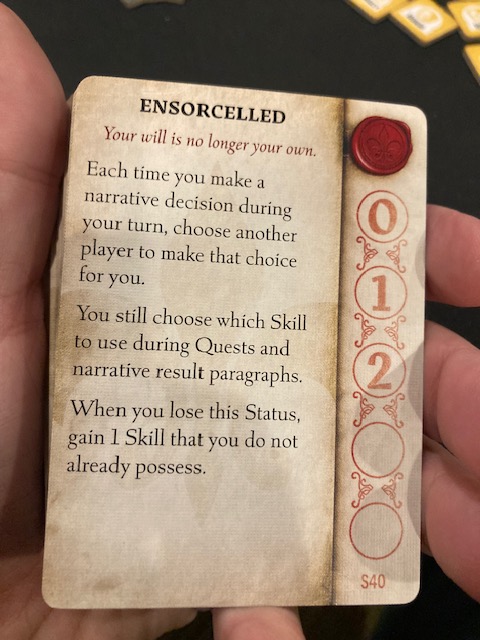
Let’s be clear; even though Tales of Arthurian Knights has a solo and cooperative mode, it is a competitive game first.  Most STATUSES and QUEST cards have “another player” make a choice for you!  See above as ENSORCELLED STATUS has another player, who is your competitor, make choices for you!  
So, when another player is supposed to make a choice for you, you instead draw a card from the SOLO/CO-OP deck (see above) and that makes the choice for you! 
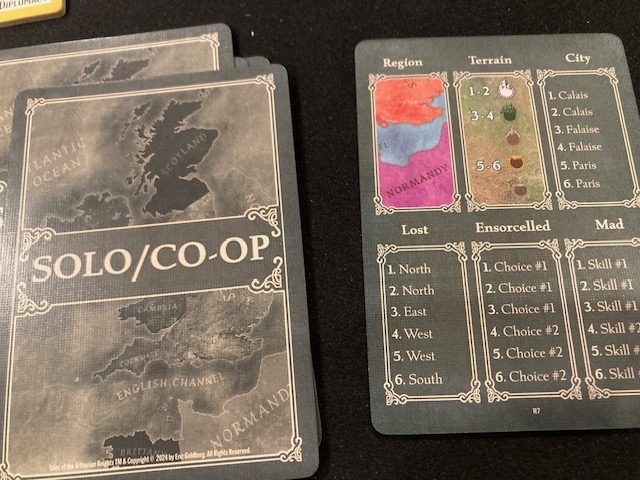
For example, if another player were to choose a REGION, the card above instead specifies what to do.  Same with City, Terrain, or the STATUSes LOST, ENSORCELLED, or MAD.  Don’t know what to do?  Draw a card!
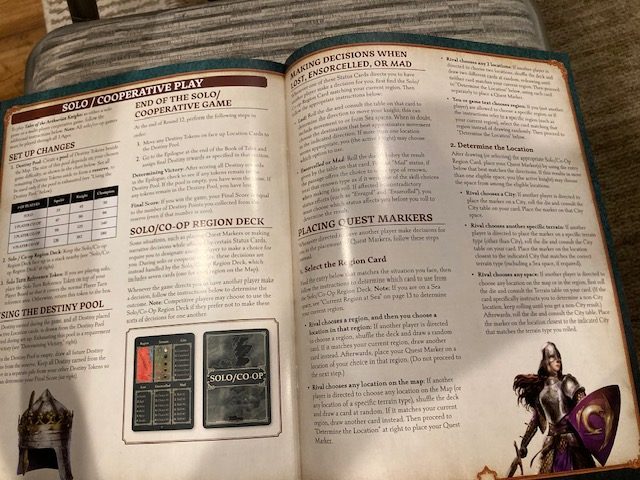
The problem is that there are still ambiguities that come up.  Which Forest space?  Which sea space?  There’s a whole page discussing how to place things from those cards, and it’s still not 100% clear sometimes; Honestly, it’s a little bit of a wart on this system.  Rather than get bogged-down in some detail, I’d get “about” where I was supposed and just pick one.  It’s better to move forward than get obsessed. (Because this game can very random, it feels very silly to obsess on some of these rules).

Besides that one issue, the solo game worked pretty well. See above as I had the board set-up!
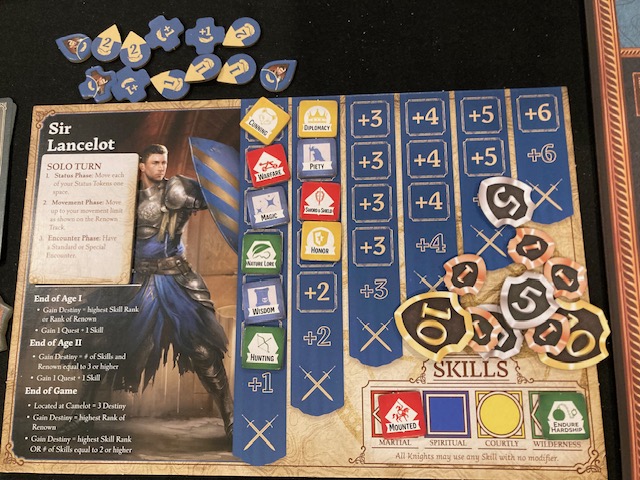
This is a true solo player game: the solo player plays one character! See above as I played Sir Lancelot. Player proceeds pretty much as the main game; just get enough DESTINY to win!
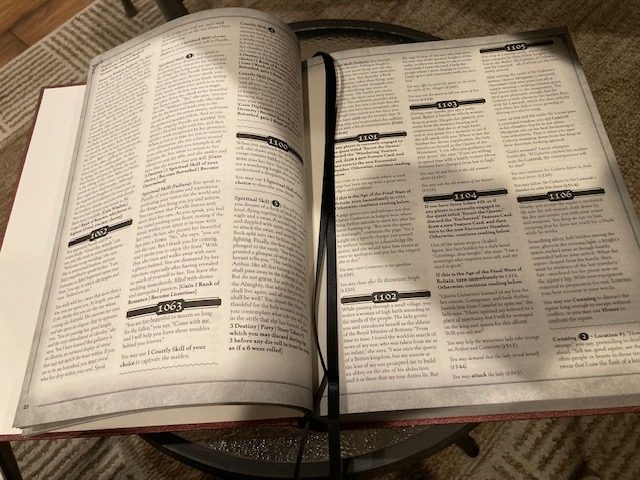
What this means, of course, is that the solo player has to read all the text to themselves. You have to be a little careful not to read too far ahead, as you can see what the “difficulties” are when you really shouldn’t: “Choose PIETY or HONOR” (oops, I accidentally saw that HONOR needs a 4 check, but PIETY is a 6 … I’ll just go with HONOR”): you aren’t really supposed to know the difficulty of your checks. You are supposed to choose the check based SOLELY on the type of check, nothing else! So, it’s easy to “accidentally” cheat and see what the SKILL checks are.
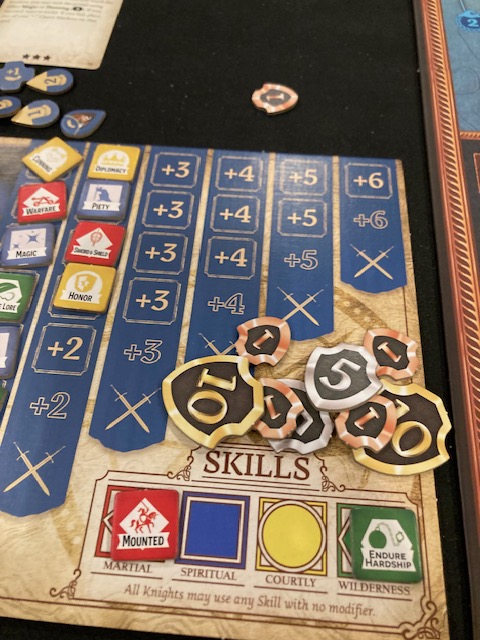
But, if you can survive 12 rounds (you have to play a full 12 rounds) and get enough DESTINY (see above as I do!), you win!
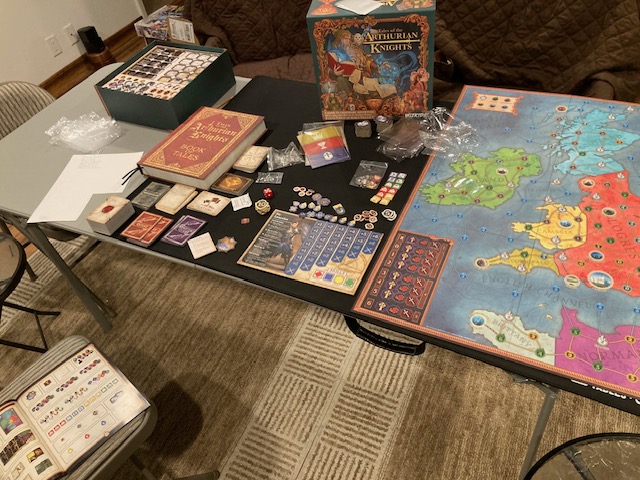
The solo experience is fairly sedate; you read to yourself, you roll the dice, you make choices. It was fun, and I really enjoyed the text, but it’s a quiet experience with a lot of reading.

The solo mode is a great way to learn the game, but I didn’t love it because it was so sedate. It was a good way to learn most of the systems of the game, and I might play it again solo. The solo mode is a 6.5 or 7/10? It works, and it teaches the game, but I didn’t love it (especially with some of the ambiguity).

Cooperative Mode
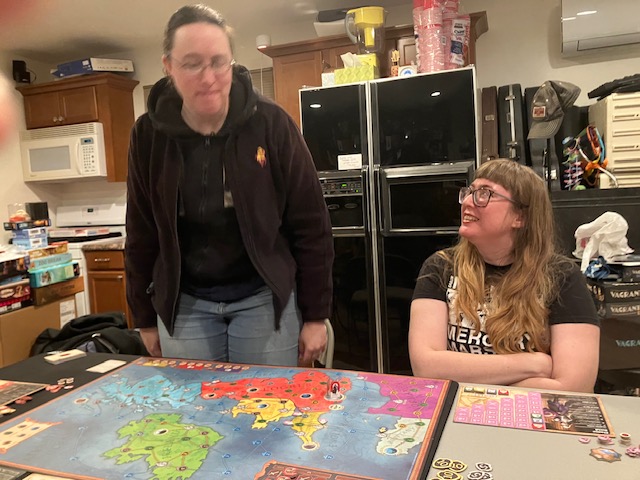
Cooperative mode, on the other hand, was a rolicking good time!
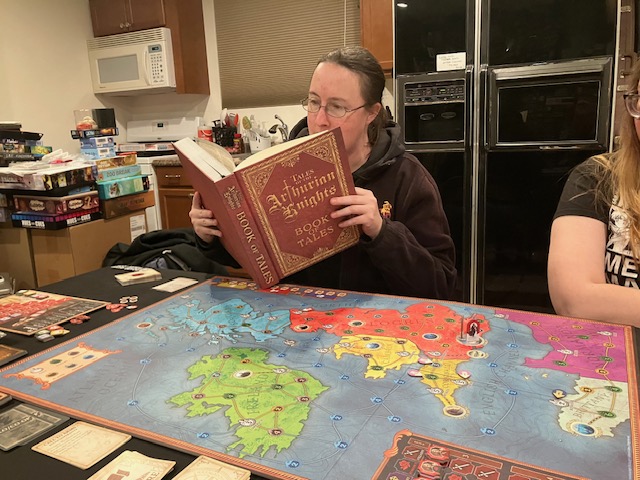
It’s hard to believe, especially since the players are reading from this tome all the time, but the game was such a HOOT! What happened was that we read the book with silly voices! We quoted Monty Python and the Holy Grail all night long!
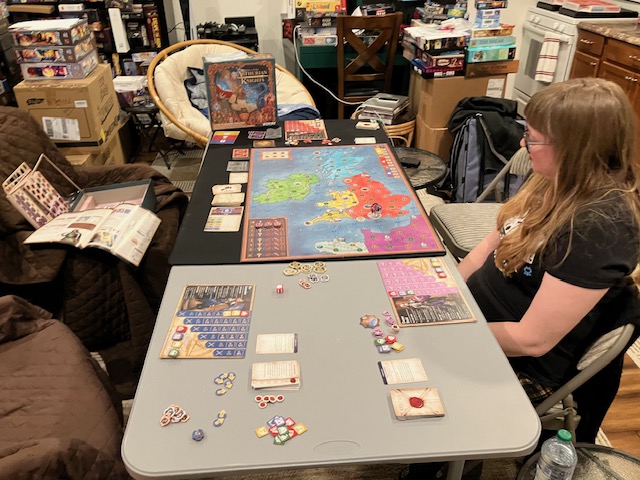
Some of the best things that happen in the game are when you FAIL and the story just gets crazy! Sara’s story was so wacky as she had three lovers, including Morgana! We laughed as Dame Enid’s Villany track escalated as she kept three lovers! In the meantime, Sir Galahad struggled to keep his Villainy down! Sure, you make choices as the game proceeds, but you may or may not make it … it’s all the crazy things that happen!
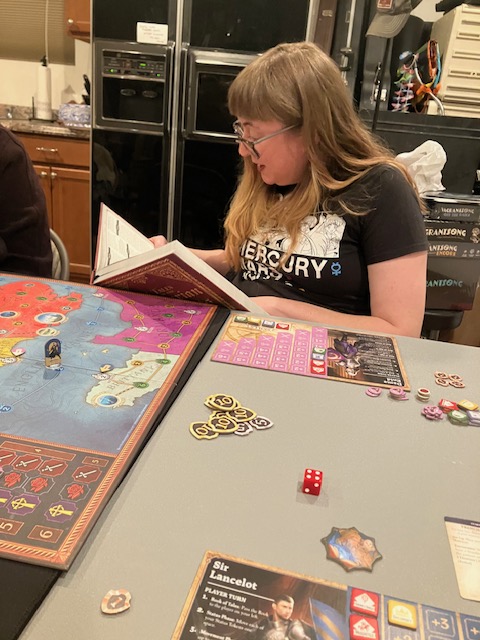
Let’s be clear, this is not a “silly” storybook game like Wandering Galaxy (see review here), Freelancers (see review here), or Forgotten Waters (see review here)! Those game are built as silly from the ground up! But Tales of Arthuran Knights is nominally a serious game (I mean, it’s got a Bibliography for goodness sake), but the moments that happen, the plot twists, the fails, the wins, are all kind are electrifying! The mood of the game is light as Monty Python quotes fall from the tongue (“Bad, naughty Zoot!”) and players giggle at your wins and losses! “Wait, Dame Edid has THREE lovers now??? Save some for everyone else, Sara!!”
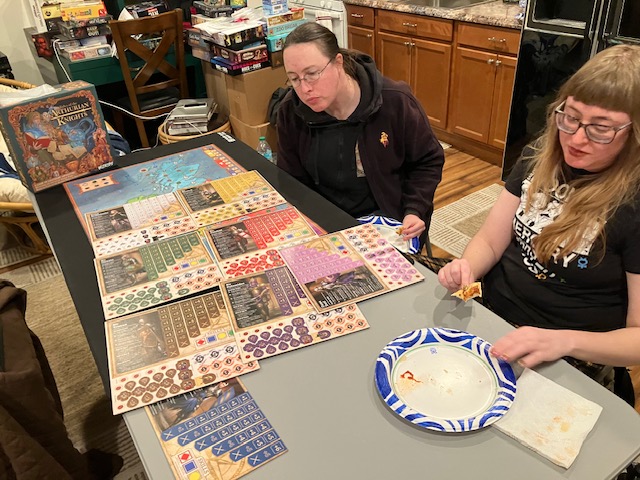
My players loved this game! They gave it an 8/10, which is especially high for Sara!
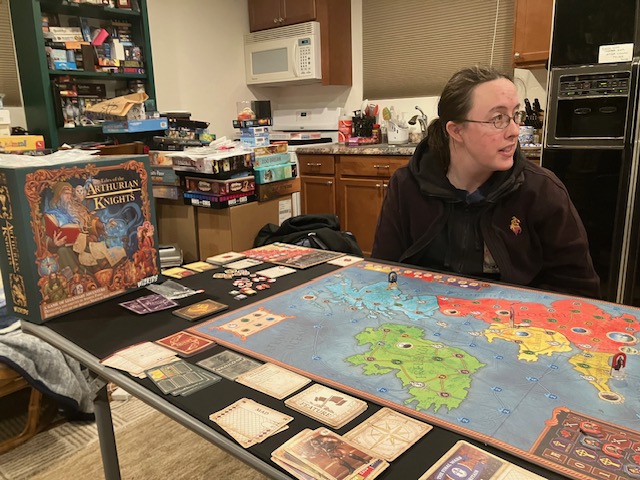
The only thing that would have made this more fun is if it were more cooperative! We certainly enjoyed reading to each other, but at the end of the day, the game was pretty much multiplayer solitaire as we each had our own adventures! Had there been mechanisms for “questing together” or “moving together”, maybe that would have elevated the game to a 9/10 or 10/10? Don’t get me wrong, we LOVED this game, but we just wish there were a little more cooperation …to be clear, there’s plenty of interaction among the players, as they read to each other and choose entries, so there is definitely full engagement, but that’s sort of outside the game (in the running of it). The actual cooperation in-game is pretty much non-existent. Again, this game is great, but it’s not a cooperative touchstone by any means.
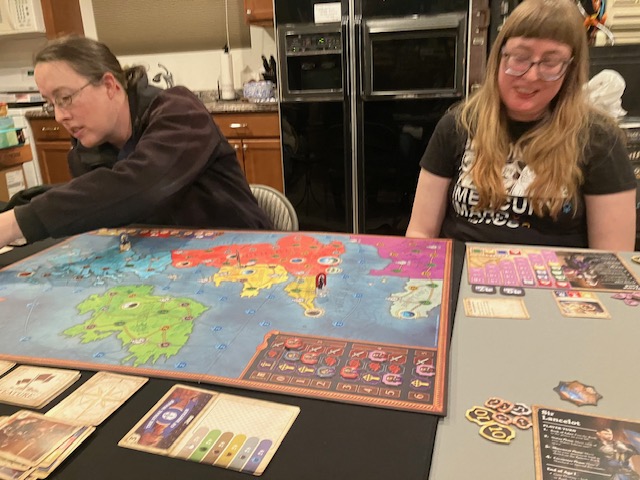
Overall, my friends loved this game.   It was so fun!

House Rules
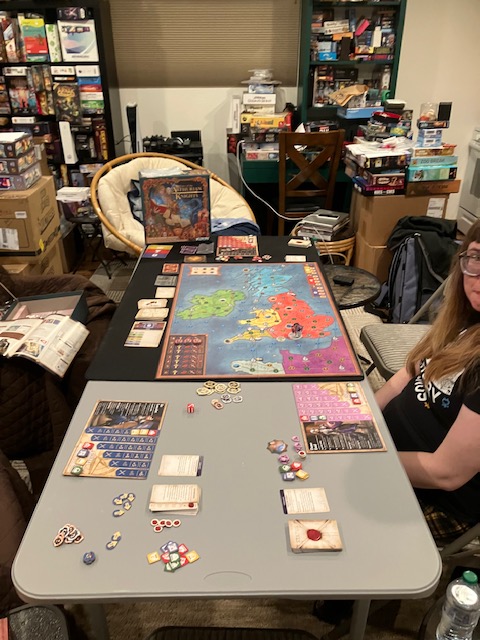
One possible set of house rule to encourage cooperation might be the following:
1) If two (or more players) are on the space or move through each other, they can “pick-up” and “drop-off” other characters during movement. This might allow some sharing of movement points and encourage players to move together and move quicker around the map. They have to talk and discuss strategy!
2) If another character is with you on an encounter, that other player can spend his DESTINY (we would assume players get their own DESTINY even if needs to be shared) to up SKILL roles: discard DESTINY on a one-for-one basis to increase the check!!! BUT you could only do that if someone ELSE did it, not the person in the encounter! (I think this means each player would still get their own encounter though … it’s just travelling together allows players to influence each other)
These two House rules might help engender a little more cooperation. They would obviously need more some balancing (I think it might make the game slightly easier), but it’s easy to just up the difficulty level by one and see how you do!

What I Liked
Failure is still good! We didn’t mention this when we discussed SKILLS, but even a failure is good! First of all, sometimes a failure is interesting or even funny from a story perspective, so that good! More importantly, a failure on a SKILL roll almost invariably leads to “gain experience” in that SKILL and up it by 1! For example, If I fail a DIPLOMACY SKILL check, I will learn from it! “Oooooohhh, that’s a good example of what NOT to do when negotiating! Lesson learned!” .. and my DIPLOMACY goes up +1!

The Game Is Electifying Cooperatively! If you have the right group who is just a little silly, will quote Monty Python, and read the text with silly accents, this game is just electrifying and a fun romp! I think to enjoy this game to the fullest, you have to “lighten up” a little and just enjoy the ride!

Cooperative mode:  The original Tales of the Arabian Nights was fantastic, but it was a competitive game!  By Tales of Arthurian Knights being cooperative, it seems to “lighten” the atmosphere a little.  In general, this new version just seems more approachable.

What I Didn’t Like
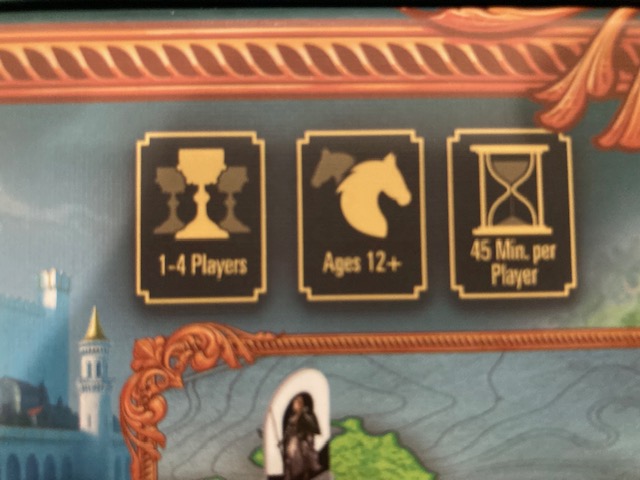
Time is wrong: After many solo and cooperative plays, I think the playing time is off. I’d say it’s more like 1 hour per player (plus set-up and tear-down). It’s not a big difference, but it may keep you from playing the 4-Player game!! The 3-Player game at 3 hours is just about the right time.
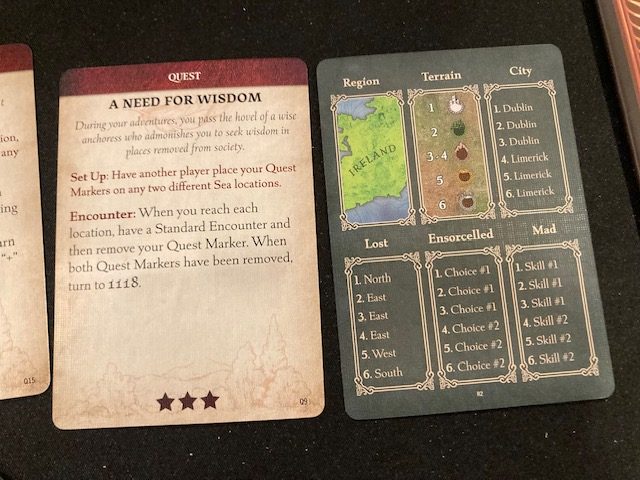
Ambiguity/Extra Complexity: In the solo and cooperative mode, you depend on the solo/coop cards to resolve ambiguity when placing Locations and other things. Unfortunately, sometimes the rules are just ambiguous or at the very least contorted for placement! See above as we place on Sea spaces, which require looking up the rules for placing Quest Markers which span almost an entire page! In the end, you still just “Place the Marker on the location closest to the indicated City that matches the correct terrain type (including Sea space, if required)“. I think, if you study page 17, you can resolve most things, but it’s much more complex than it should be. This can really take a light-hearted game and bring it down: “Please give me a few minutes to look up this rule!“. In the end, we just kept the game moving and made the best choice on the card to keep the game moving.
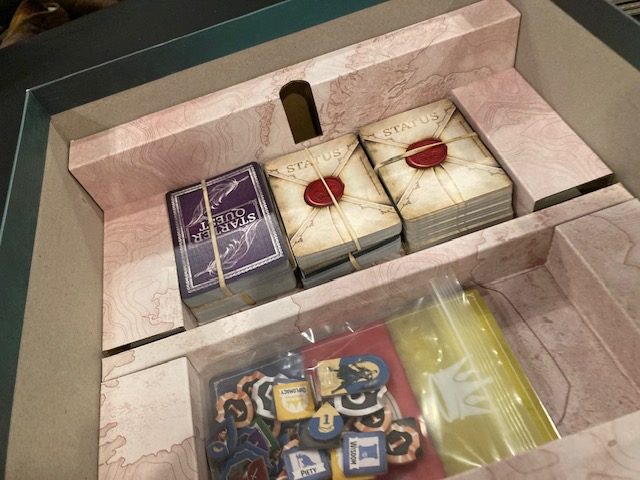

Reboxing:  I think you will struggle with the reboxing.  Even with little baggies (which don’t come with the game: make sure you get some), you may struggle to fit everything in the box.  

Randomness
Let’s be clear about one thing: this is a story you (hopefully) get swept up in!  Although you do “level-up” as you play (your SKILLS get better and better, and your Renown goes up, etc), it’s still kind of a random game.  
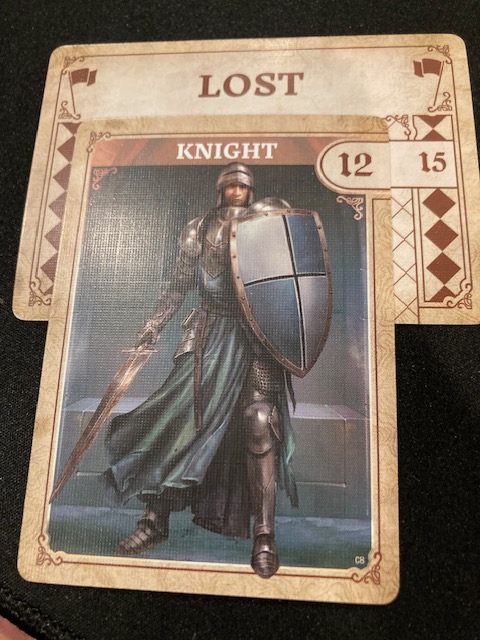
I get the LOST KNIGHT encounter randomly (see above) which might be great for my SKILLS, or it might be sucky!   Stuff happens to you, and you roll dice.  This is a game with a lot of randomness!  The dice make the SKILL checks more random!  The encounters you get are random! The QUESTS you get are random!  I normally hate all that randomness, but it works here!  Why?

Because this is a story that you get swept up into!  Maybe, like Dame Enid, you’ll have 3 lovers! Maybe, like Sir Lancelot, you’ll have no love in your life, but get the plague and save others from the plague!  It’s all about what happens to you as you play! It’s all about the well-written story, the shared experience, the aloud reading, and the silly fun with your friends! It’s random, but it’s fun.

To be clear, Tales of the Arabian Nights was even MORE random (and that could be a bit much); at least Tales of the Arthurian Nights has backed off on some of the randomness and improved upon the original (with expiring statuses, upgrading skills, and upping reknown).  If you didn’t like Tales of the Arabian Nights, this may still appeal to you.  If you like Tales of the Arabian Nights, you may find this even more enjoyable!  It’s a slightly less random experience. 

Conclusion
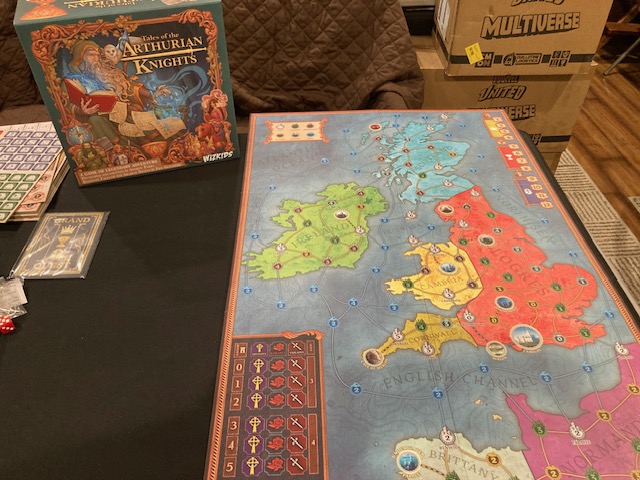
What a great time! I think that Tales of the Arthurian Knights might be my friends’ favorite game we have played in some time! They both give it an 8 or 8.5/10: it would actually be higher, but the game is mostly multiplayer solitaire! The game is very interactive, but just not particularly cooperative. We did suggest some House Rules to encourage a little more cooperation; see previous section.
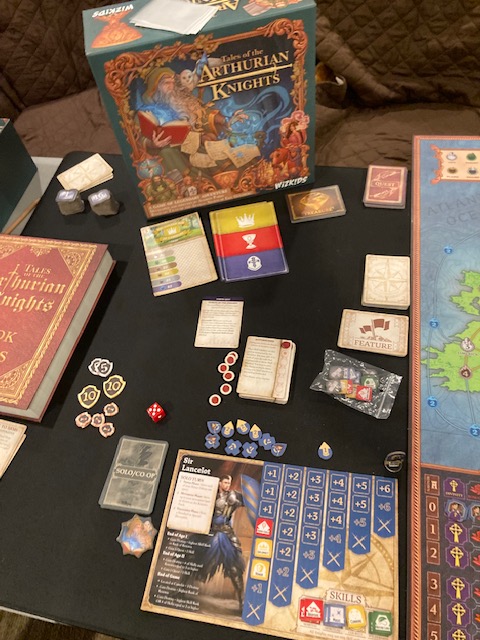
The solo game works, but it’s just a little less fun because you are just reading to yourself as random things happen to you. What makes this game great are the crazy things that happen to you when you are with your friends! That shared experience of failing and being swept up in the story is so much more satisfying when you are with your friends! So, I didn’t love the solo game: The solo game is still respectable and will teach the game: 6.5 or 7/10.

In the end, this is best as a shared experience where players get swept up in the story and don’t care too much about “winning”; it’s all about the experience! It’s all about the story!

If you are willing to quote Monty Python and the Holy Grail, be open to the story that unfolds around you, read lots of text, and enjoy this with a light heart, I think you might really enjoy Tales of the Arthurian Knights! Be aware that there is a lot of reading, so if that doesn’t sound like fun to you, you may want to stay away from this game.
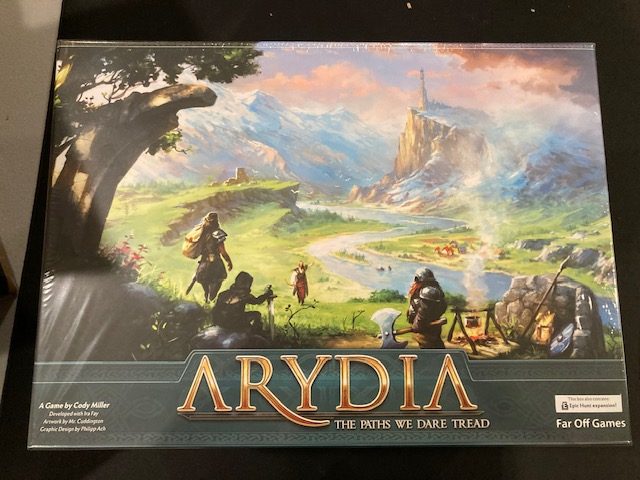
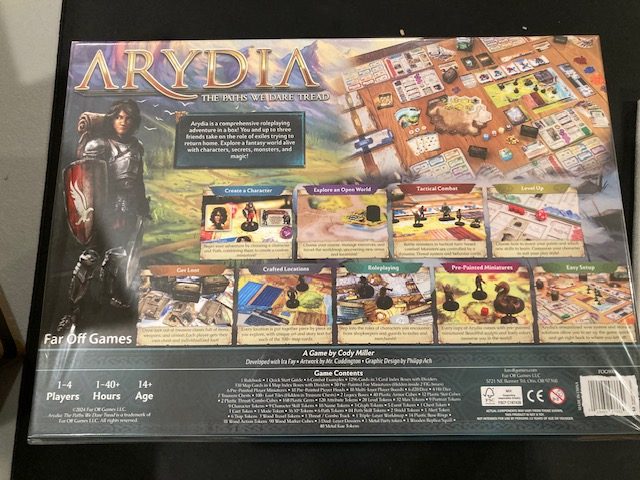
A Review of Arydia: The Paths We Dare Tread. Part I: Unboxing, Set-Up, Solo Play, And First Impressions After 20 Hours of Play

IMG_9157

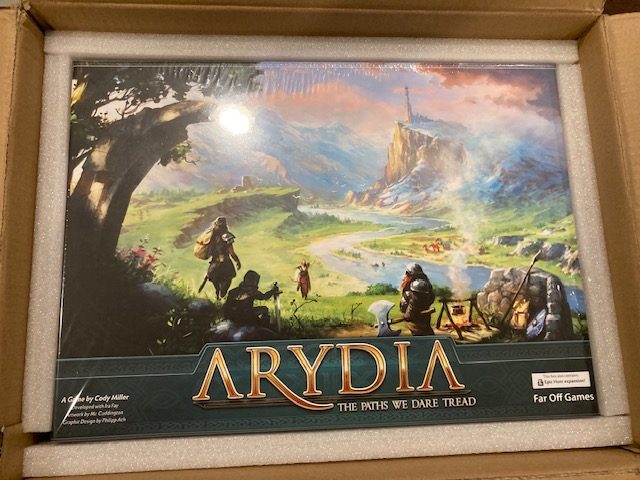
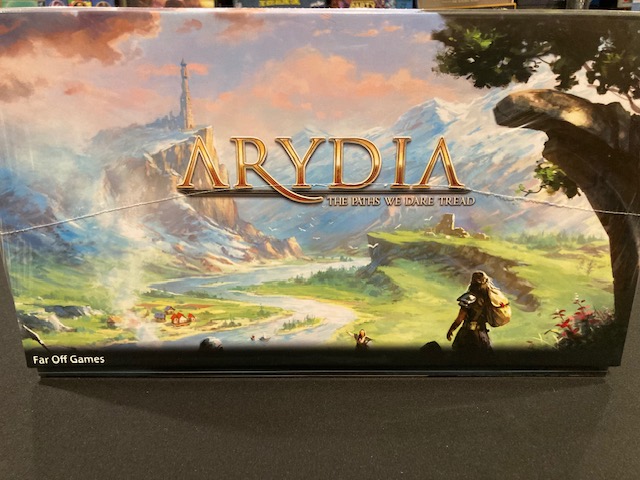
Arydia: The Paths We Dare Tread is a cooperative adventure campaign set in a fantasy universe.  This was on Kickstarter back in August 2021, and promised delivery in December 2022.  

IMG_9154

It arrived at my house Dec 30th, 2024!  So, it’s about 2 years late!  I mean, I have been looking forward to this for some time: it was #6 on my Top 10 Anticipated Cooperative Games of 2022!

IMG_9156 

Has this been worth the wait? Let’s take a look!

Unboxing: Day 0 (December 30th, 2024)

IMG_9159

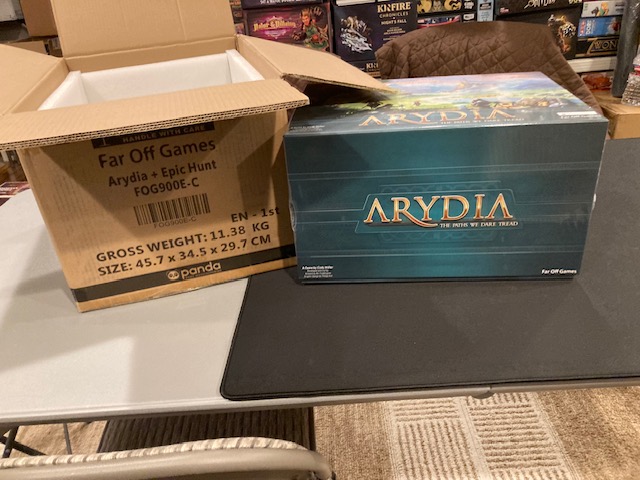
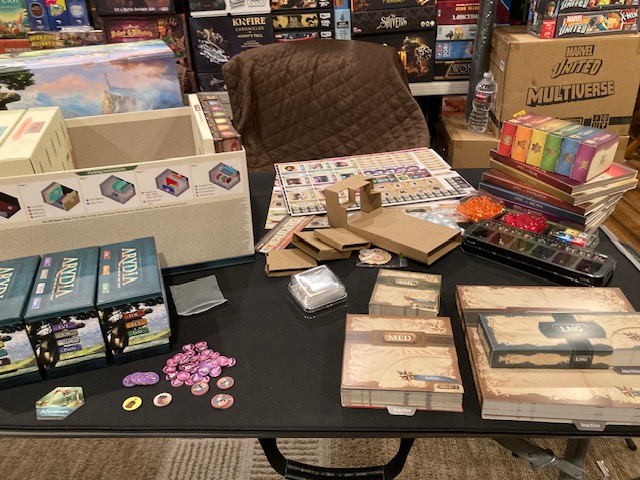
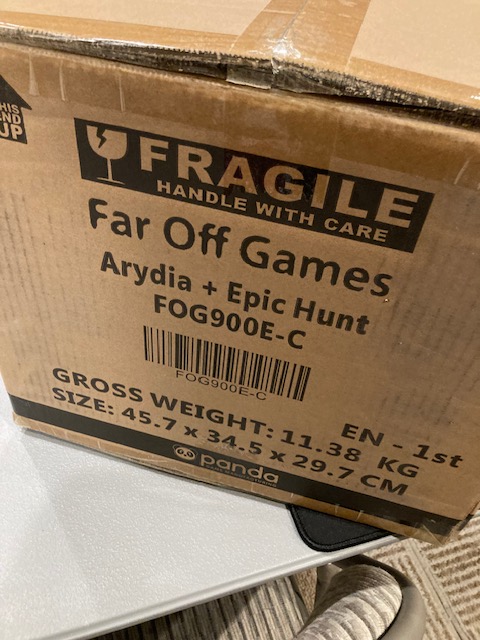
This is a big mama-jama of a game! It took up the entire delivery box with no extra room! As soon as this game came in, I went to the game room and immediately opened it up!

IMG_9160

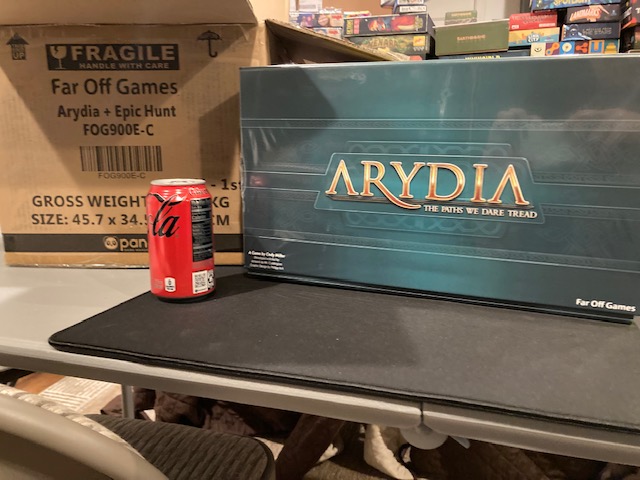
See the Coke Can above for scale! It’s HUUUGE!

IMG_9164

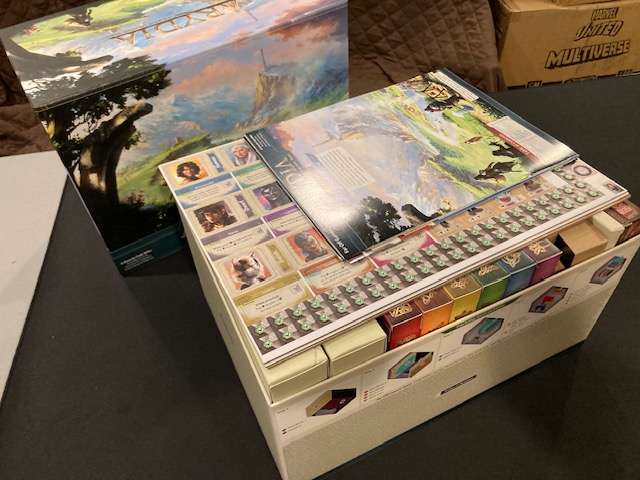
It’s is just chock full o’ stuff.

IMG_9202

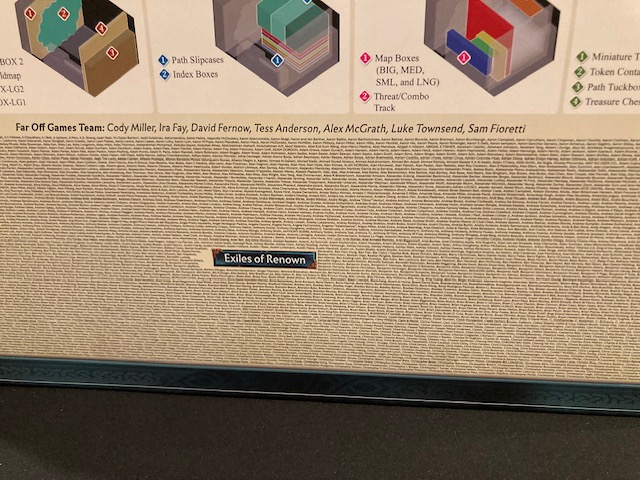
There’s even a list on the side how to put this back together (I still recommend taking pictures as you unbox) because it’s so big.  Oh yes, there’s also a list of everyone who backed the game on Kickstarter.  Do you see my name there?  (No, I don’t either … that is a tiny font!)

IMG_9165

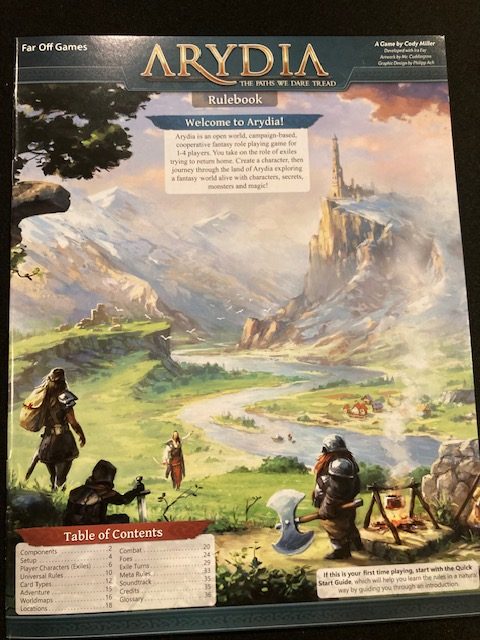
The rulebook is a reasonable size and has great art: it’s right on top.

IMG_9198

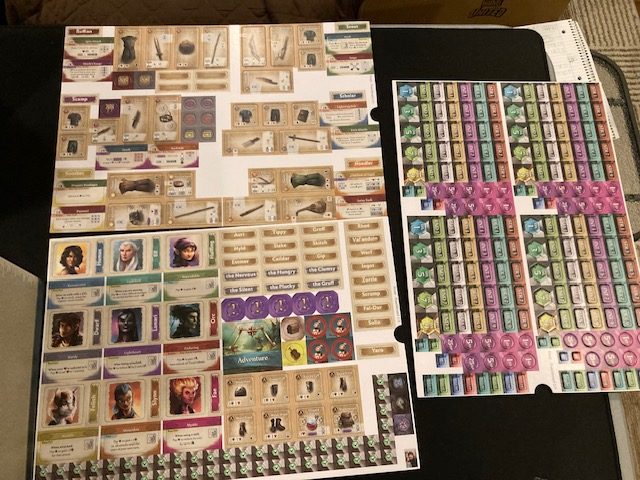
There’s some punchouts below the rulebook: these are REALLY nice punchouts: they are thick cardboard and very well notated (and readable).  These are all tokens that come out slowly as you play: you don’t have to punch things out until you need them (which is kind of nice).

IMG_9199

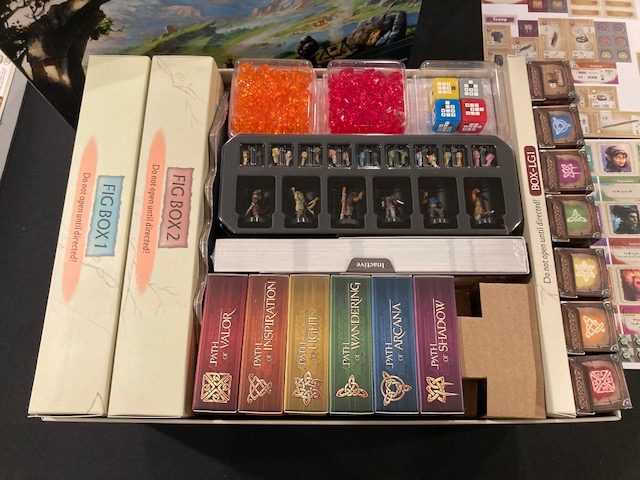
And what’s all this?  So much cool stuff!

IMG_9201

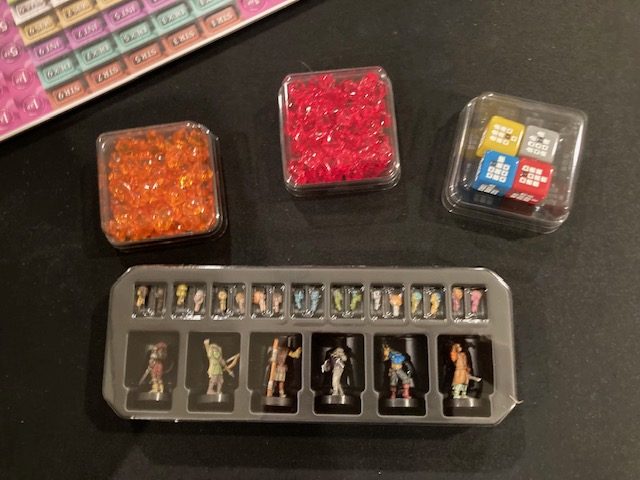
There are some tokens (red for damage, orange for “wear-and-tear”, and combat dice) as well as some minis.

IMG_9203

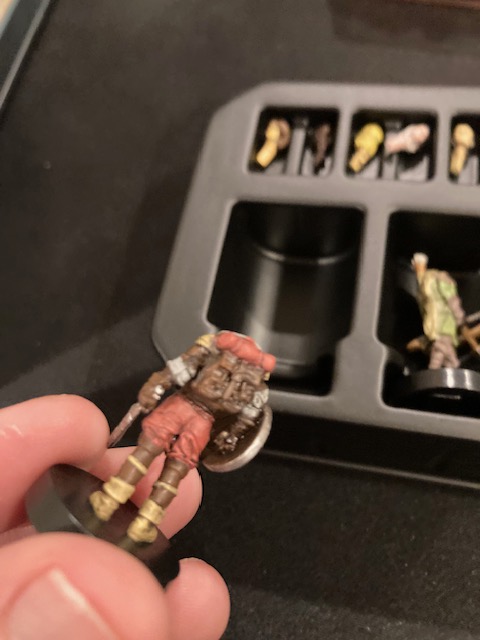
The minis are HEADLESS!  You heard me! No head! See above!

IMG_9204

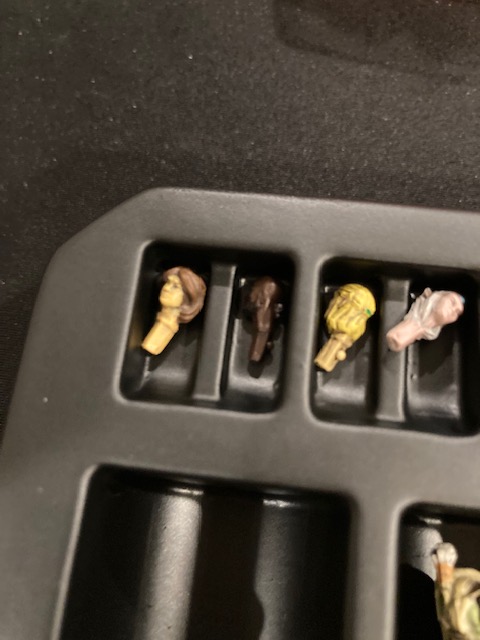
You choose a head that matches the character you choose!  

IMG_9205

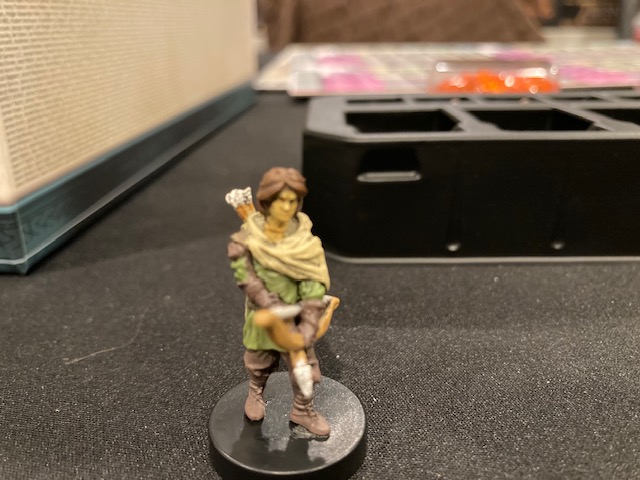
So, if you choose this guy with this body, you can make the mini!  This is a cool idea, but I felt like I had to be very careful as a I put the head in … I was kind of afraid I’d break something!  They did work, but … just be careful.

IMG_9206

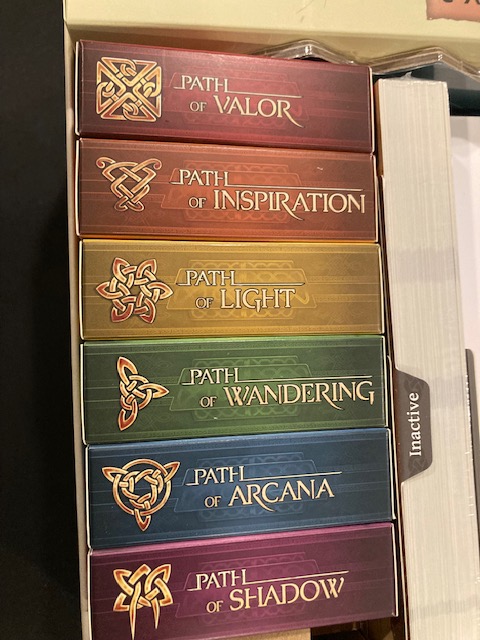
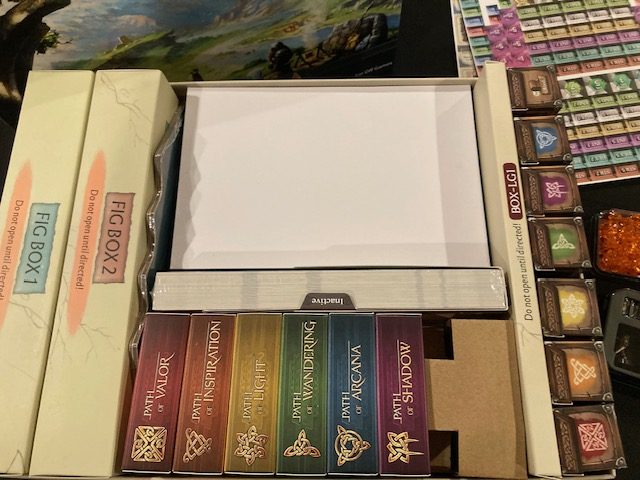
There are a lot of boxes in different colors; each color is correlated to a “Path”, or a type of character (Class) you take.

IMG_9200

There’s essentially 3 boxes for your Path: the card boxes (below), the Treasure Chests (far right) …

IMG_9241

And the long thin boxes (above).  These are all for your character!

IMG_9211

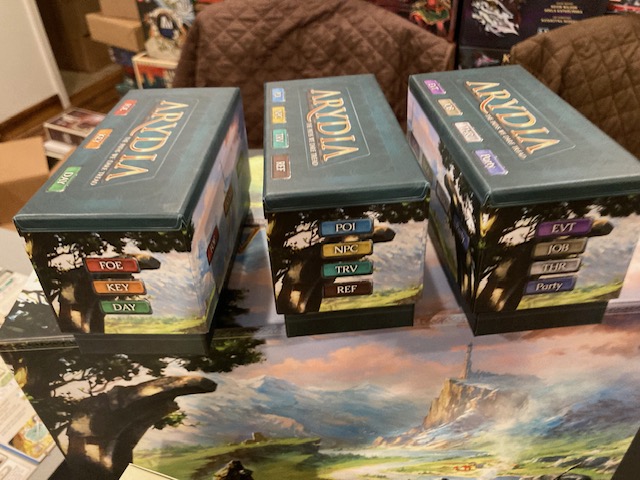
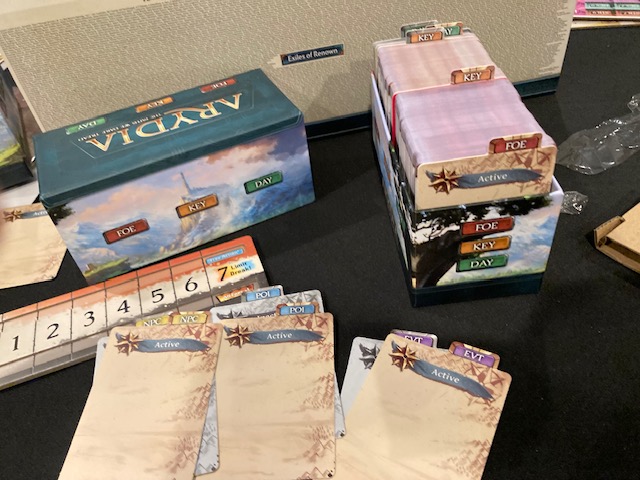
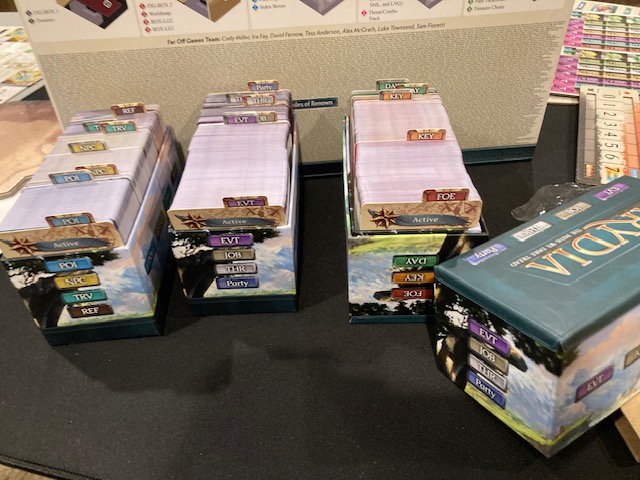
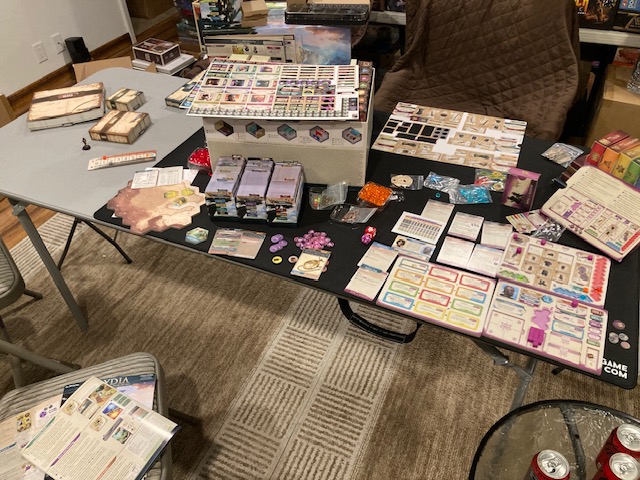
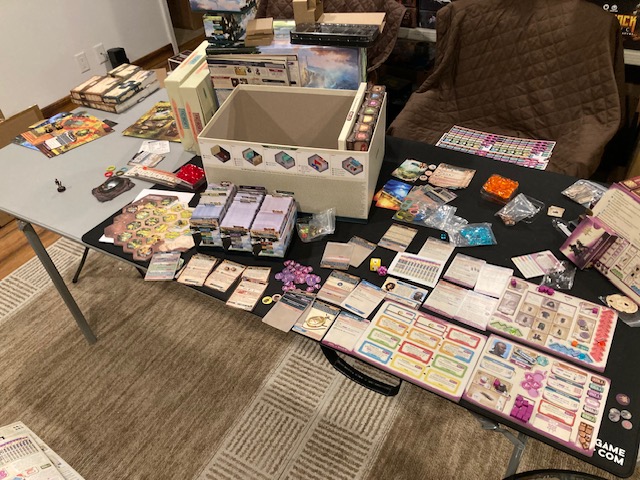
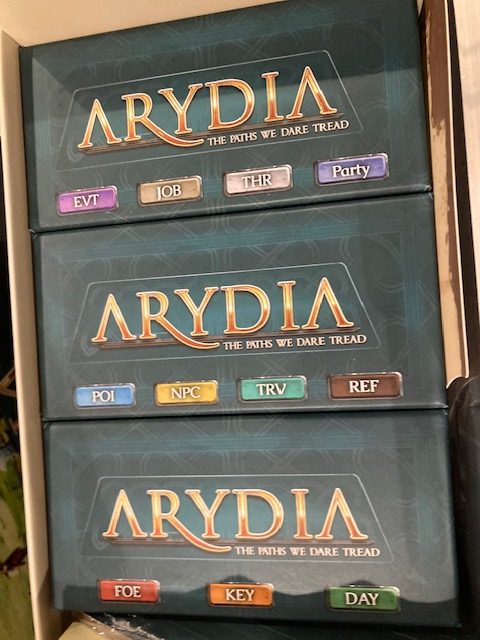
But I want to end my unboxing the same way I ended Day 0: setting up the card and map decks.  These card decks (see three boxes above) control how the game unfolds: the stories, the combats, the twists, the turns … all of the game is in these three decks.

IMG_9232

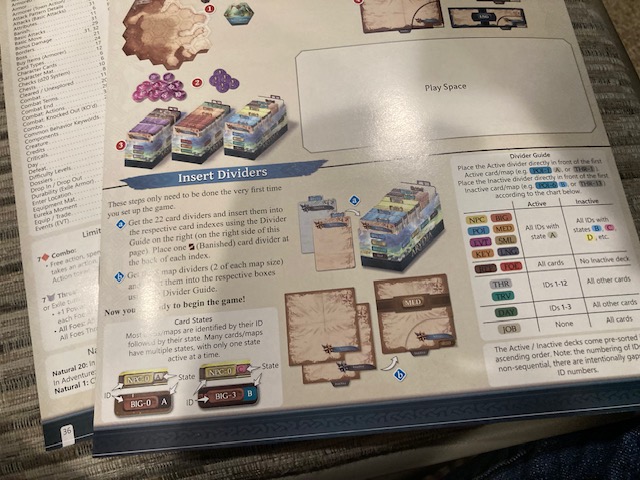
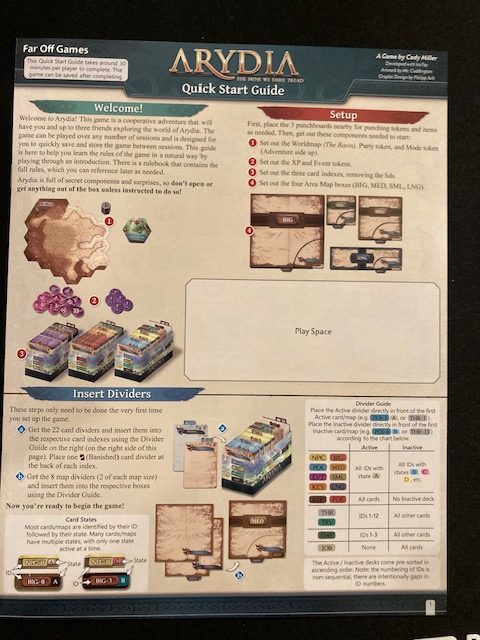
One of the first things you have to do is put the backers (see above) in the card boxes to indicate where different sections start and end. 

IMG_9233

This is literally one of the first directions in the quick-start: “Insert Dividers” .. see above.

IMG_9234

So, at the end of my first day of unboxing, I ended up putting the dividers in.  This was … more work than I expected, as the card decks have a very precise way they need to be set up.  I think I spent a good 30-45 minutes inserting the dividers (don’t laugh! It’s true!).

IMG_9247

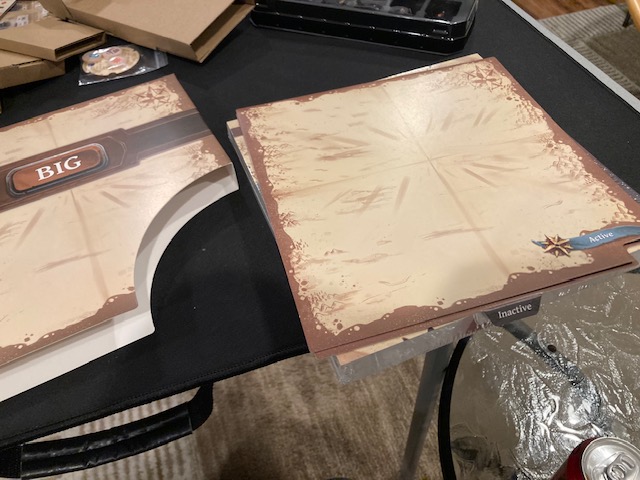
There’s also dividers for the maps (which we’ll talk about in the Day 1 section below) that you have to insert.  Really! It’s more work than you might expect to put in these inserts!

IMG_9257

So, at the end of Day 0, I got all the dividers set-up and the basic game unboxed.  Overall, I probably spent 2 hours to get to this point.

Starting First Play: Day 1 (December 31st, 2024)

NOTE: Some of the stuff here might be considered spoilers, as it’s from the Quick Start Guide, but it’s the first things you see, so it’s not much of a spoiler. Feel free to skip this if you want to be completely surprised.

IMG_9166

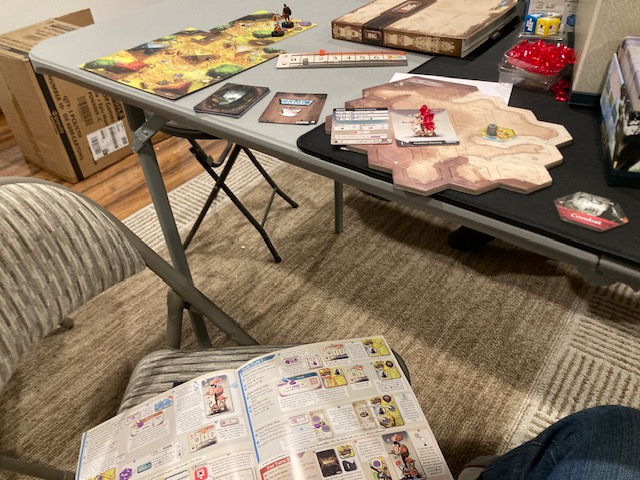
We didn’t focus on this too much in Day 0, but there is a really nice Quick Start Guide (see book above) to guide the players through the game.  

IMG_9190

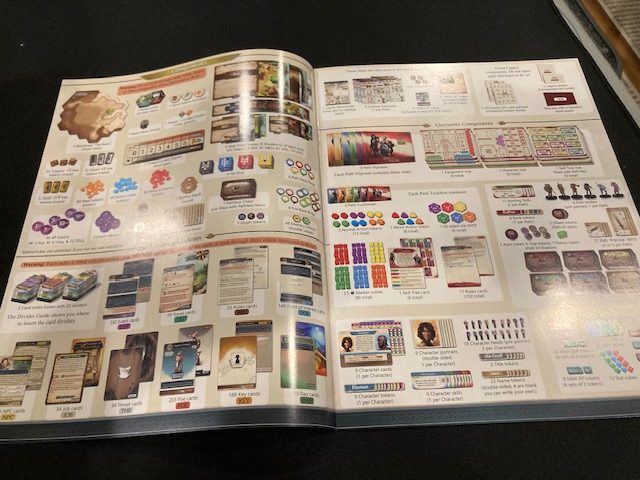
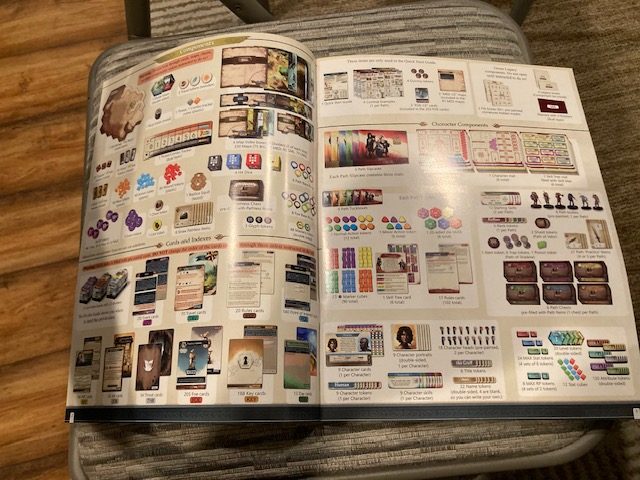
This Quick Start Guide is 16 pages  long … yes, let that sink in … a Quick Start Guide that is 16 pages!  That’s because the rulebook is 36 pages!  And yet, the Quick Start Guide does a GREAT job getting you into the game!  I spent Day 0 setting up the decks and maps (which is described on page 1 on Quick Start Guide).  The next page has the components! The components are interestingly listed in both the Quick Start Guide (see above) and the Rulebook.  I mean, a good list of components and correlating text is ESSENTIAL to any good rulebook, so I am all for this!

IMG_9191

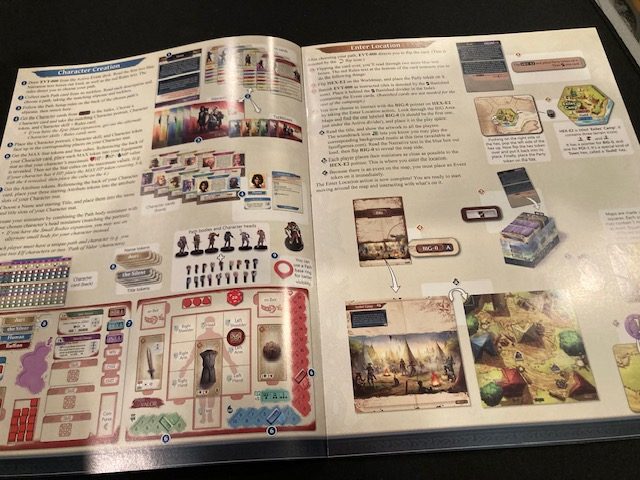
The next step, which I spent a lot of Day 1 on, is Character Creation (see page 4 of the Quick Start Guide above).  This guides you through the process of choosing a Path (Rogue, Cleric, etc, basically a Dungeons and Dragons Class).

IMG_9261

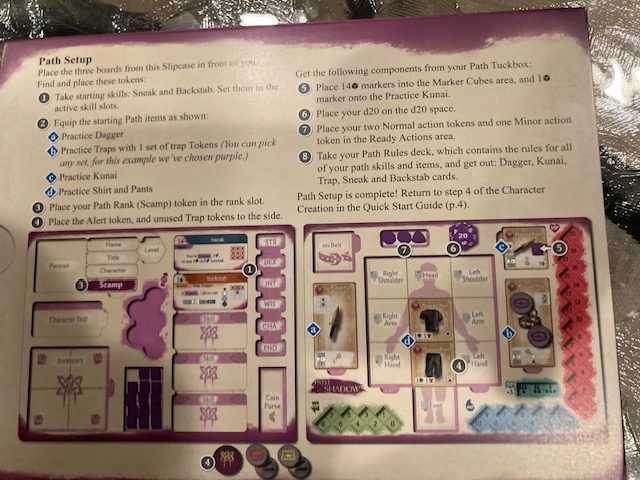
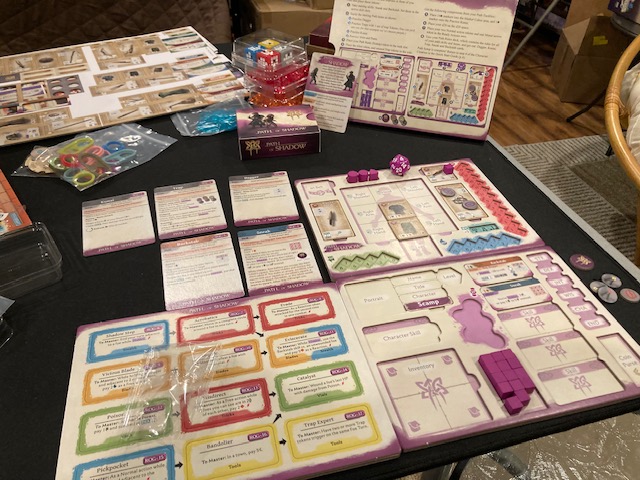
I chose the purple boxes, so I am a Rogue! (you actually get to read the summary of each type if you want more info before you choose). The small card box contains a d20, some colored cubes, and cards describing your skills. See above.

IMG_9267

The long thin box (above) contains your character sheets (below) … which are all double layered boards!

IMG_9272

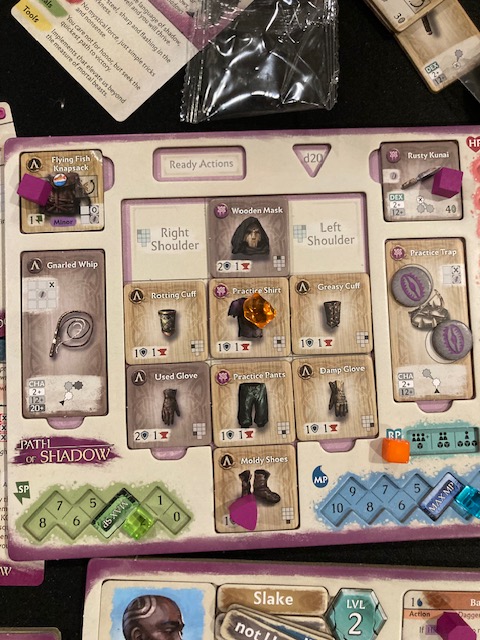
See above as my Rogue has his skill tree board (left), character board with skills and inv (right), and the the character profile (above, right), and the more descriptive skill cards (above, left).

IMG_9276

At this point, you also choose your name, character mini, head (which still sounds weird), and race. See above.

IMG_9279

Your Race (I am human, see above) choice also get some special abilities (the Human gets a free re-roll every so often).

IMG_9268

This process of choosing characters was really well done!  They even give you a hint how combat will work: see how one sheet has an armored profile which armor covering areas?

IMG_9221

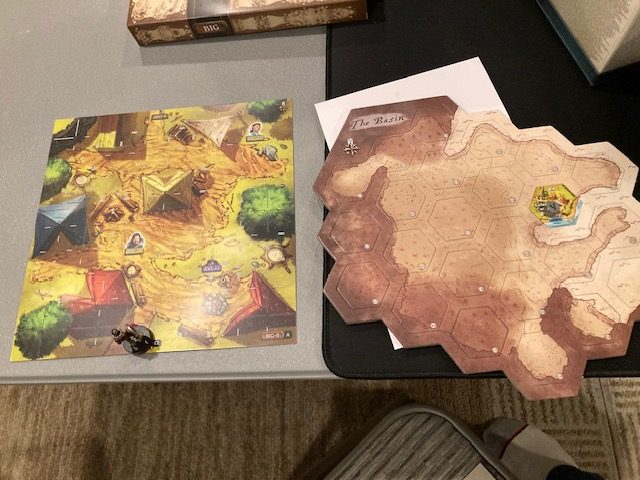
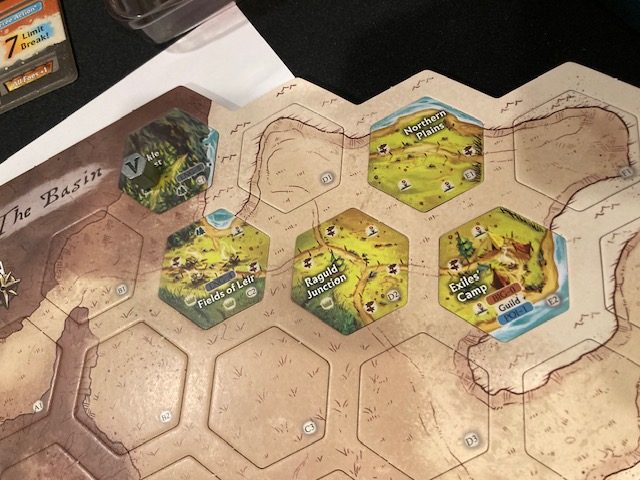
The next step has you start into the world!  This game is combination of exploration, combats, and puzzles and quests!  You start on the WorldMap (“the Basin”, see above) and explore, looking for stuff!

IMG_9259

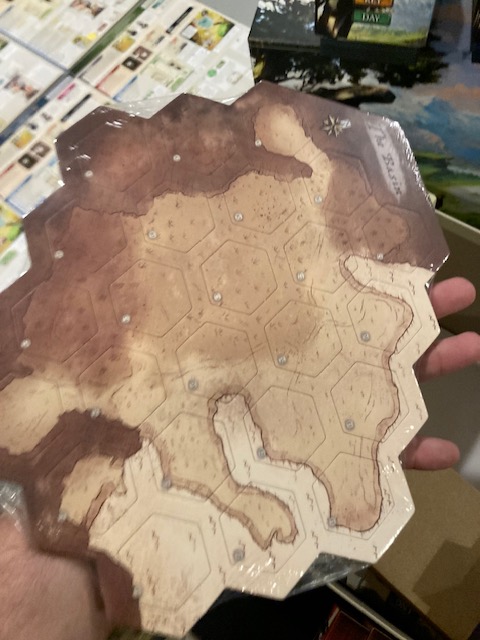
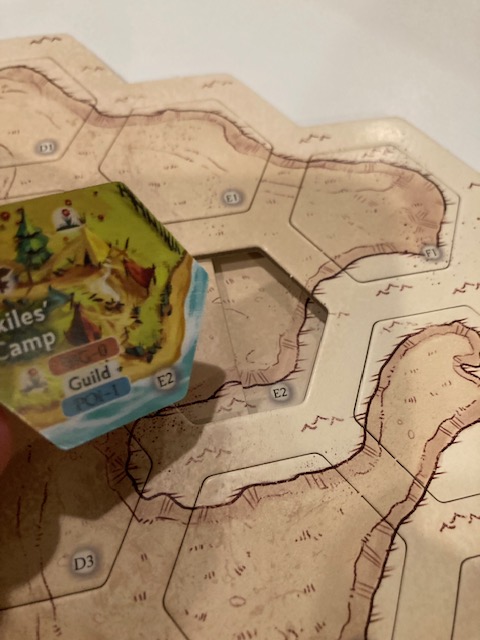
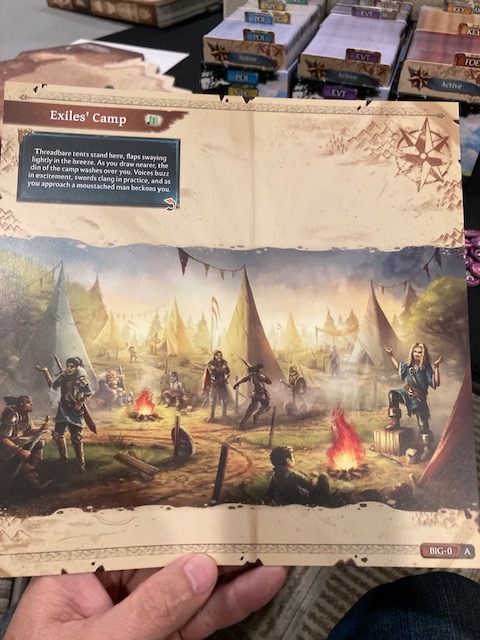
There is a REALLY NEAT mechanism for discovering the hexes: the hexes are inserted in, but you can “push” on the right of the hex and pop it our easily, as there is a little ledge underneath the hex!  This makes it VERY EASY to pop out a new hex!  The world starts unexplored, except for the Exile’s camp!  See above!

IMG_9252

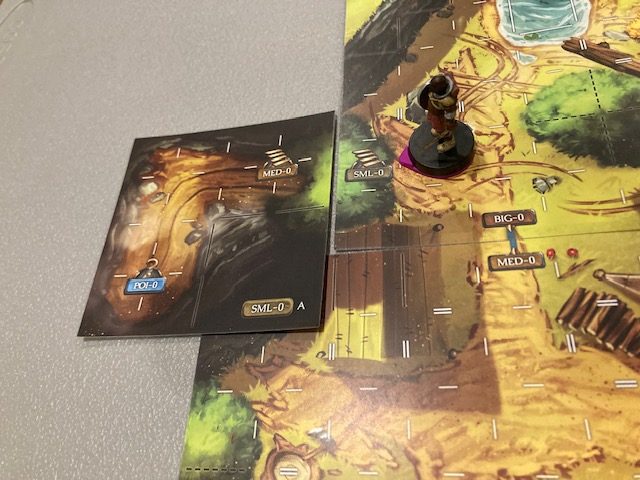
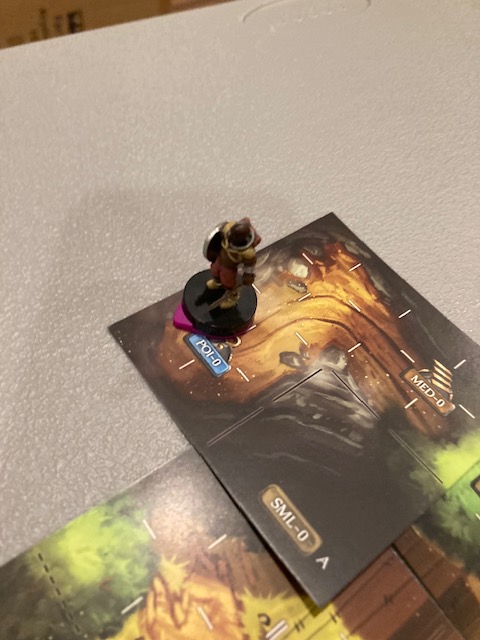
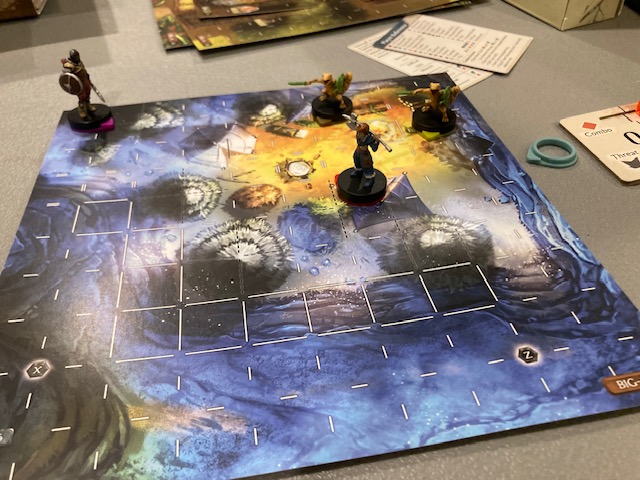
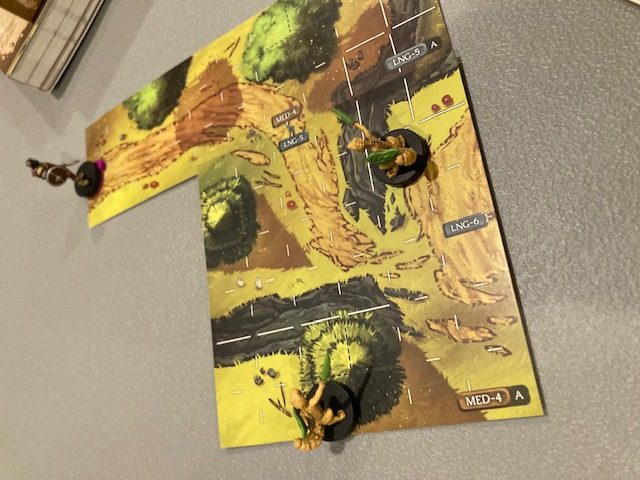
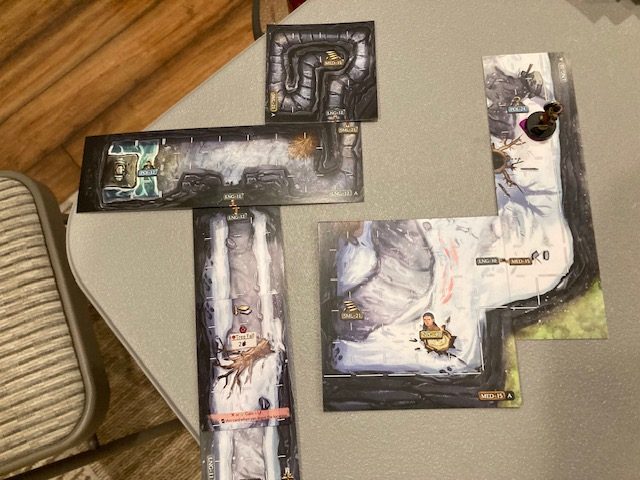
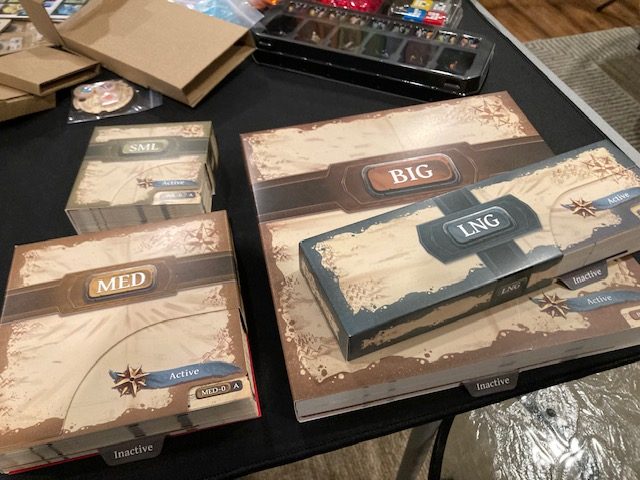
When you explore a location (like the Exile’ camp), the game will direct you to use some of the maps that come with the game!  The maps are LNG (long), MED (medium), SML (small), and BIG (big). See above.

IMG_9283

One side of the maps describes the scene with words and text!   See above!

IMG_9284

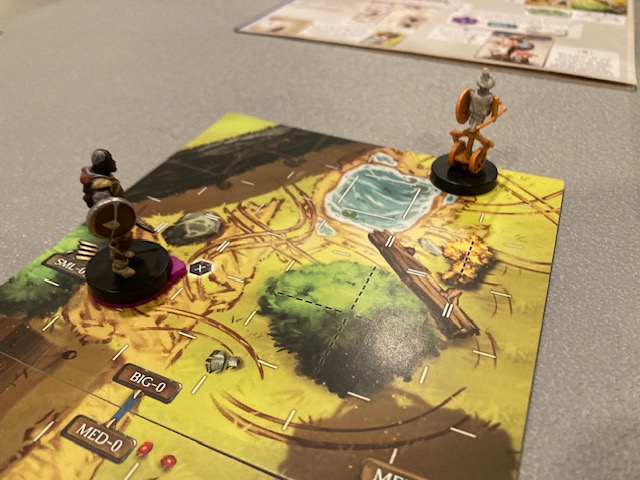
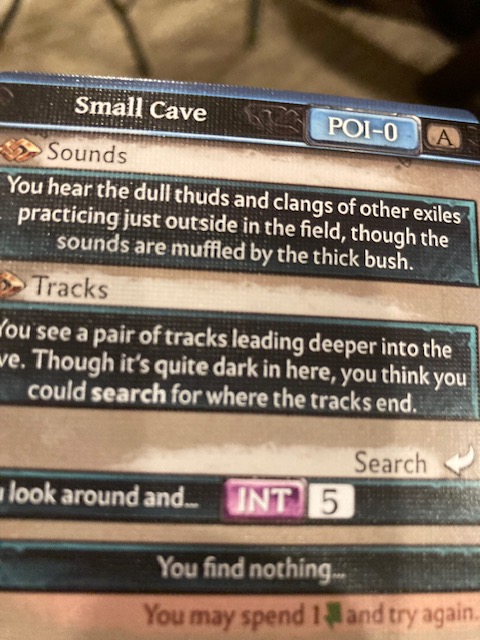
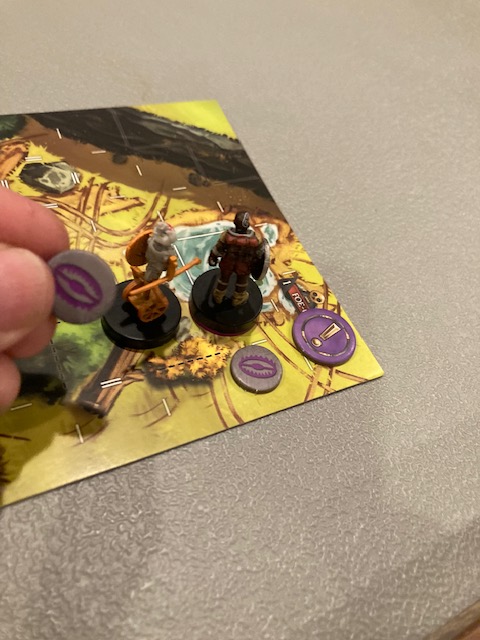
Then you flip it to the other side!  And then you explore the maps at that Location!  At that maps are POI (Points of Interest), FOE (foes, potentially), NPC (Non-player characters), and other stuff!  You interact with the place by moving to them (if you start a board with a FOE … you start combat immediately!  We aren’t quite there yet!)

IMG_9286

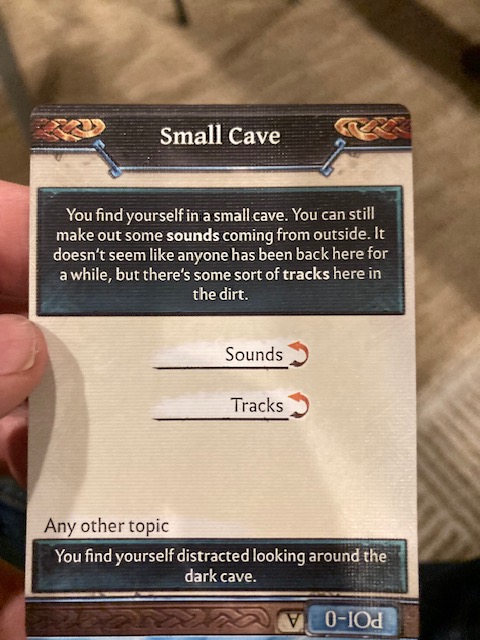
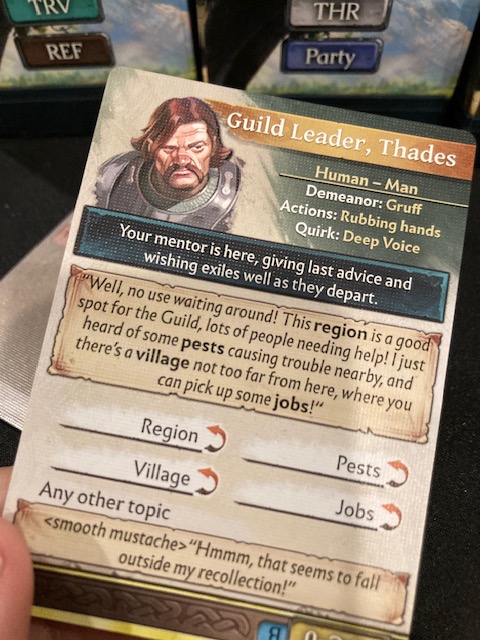
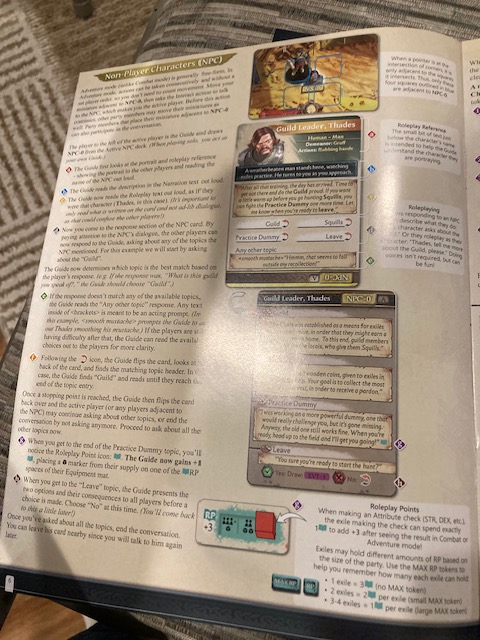
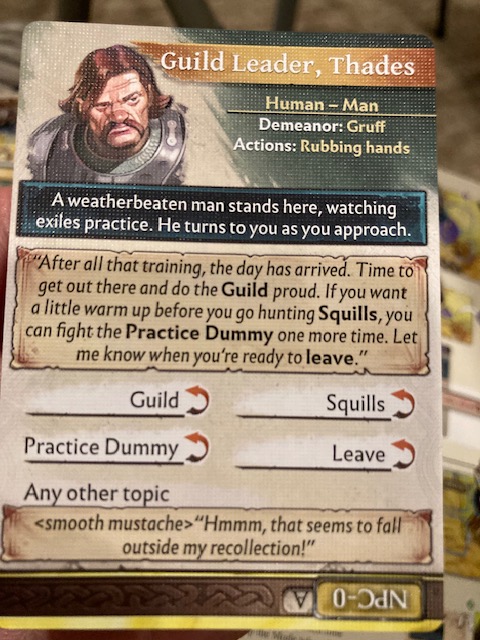
Interacting with a NPC (or POI) is basically the same: everyone interested goes to that Location!  You get their card and read it!  The first NPC you encounter is Guild Leader, Thades!

IMG_9288

Then one player “roll plays” the card to another group, and the group makes decisions!  See above as the group can ask about the GUILD, the SQUILLS, PRACTICE DUMMY, or LEAVE!  Basically, this interaction  is kind of like some of the point-and-click adventures we’ve seen before (see our Top 10 Cooperative Point-And-Click Adventure Games)!  

IMG_9289

And sometimes these interactions will point to a new map, a new card, a new KEY (a way to keep track of open adventures), or other stuff!  See above as we head into our first combat!

IMG_9292

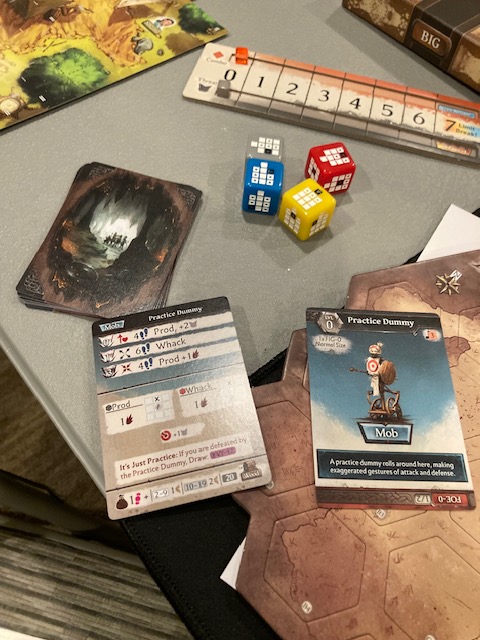
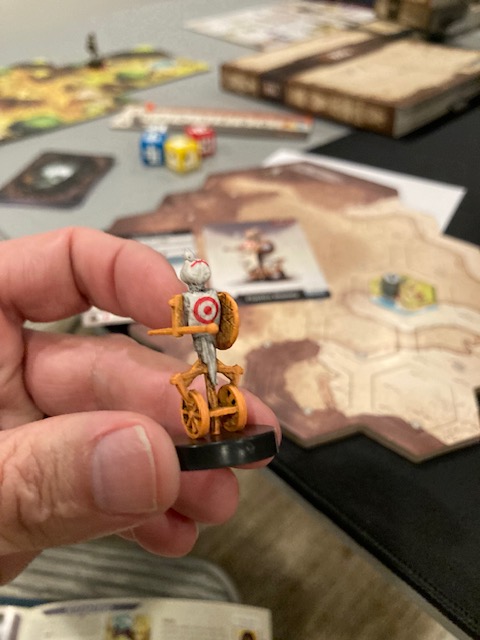
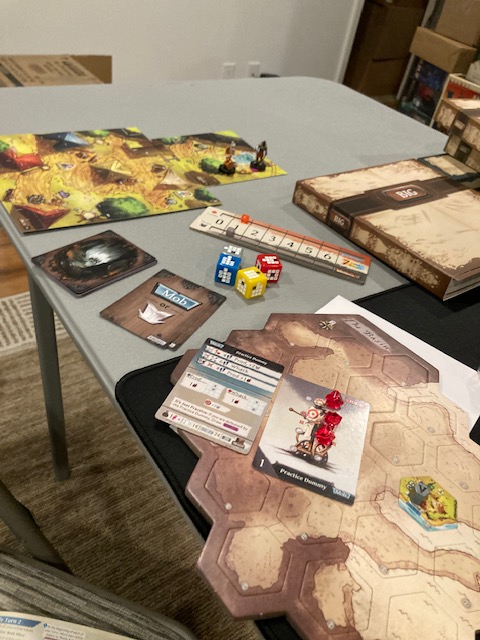
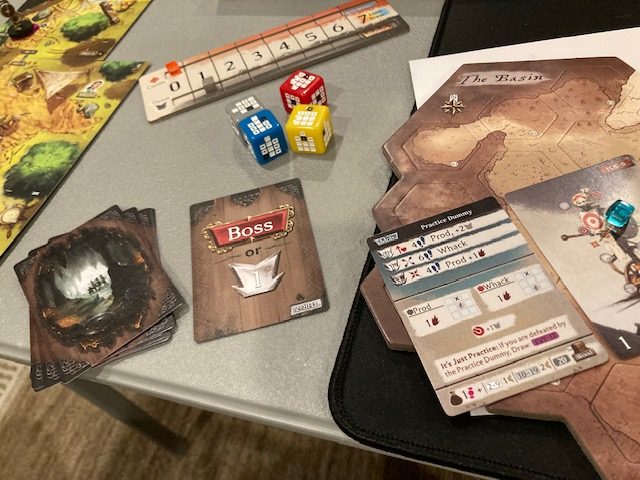
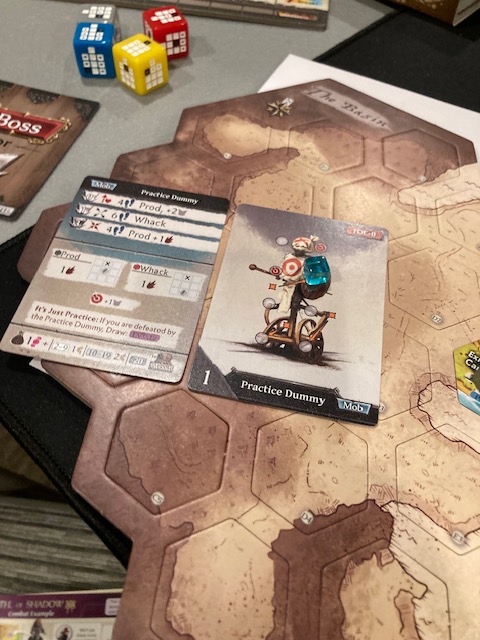
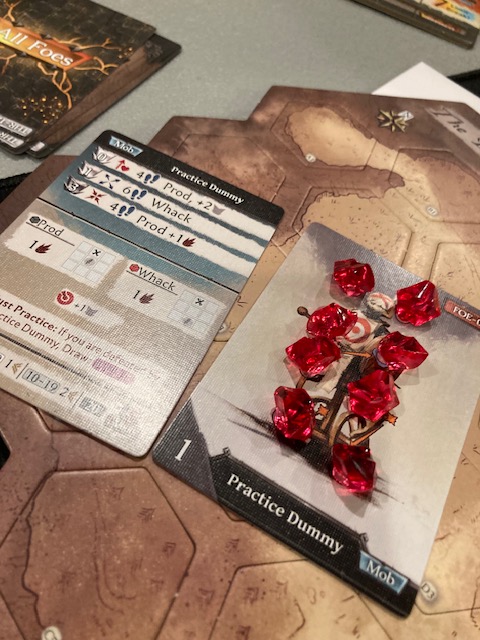
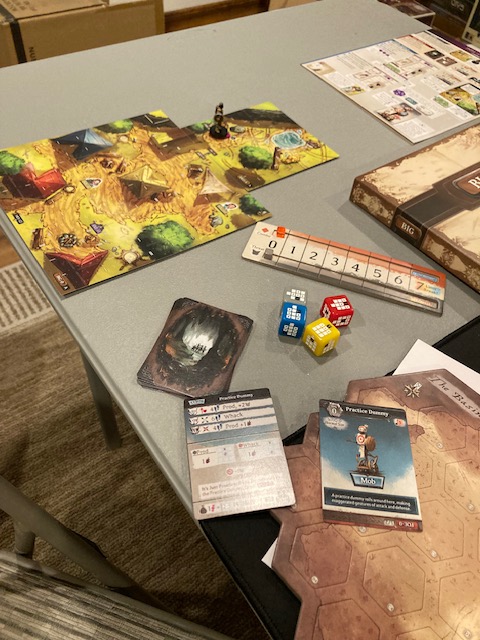
This game definitely has a lot of combat in it!  We are fighting the Practice Dummy!

IMG_9294

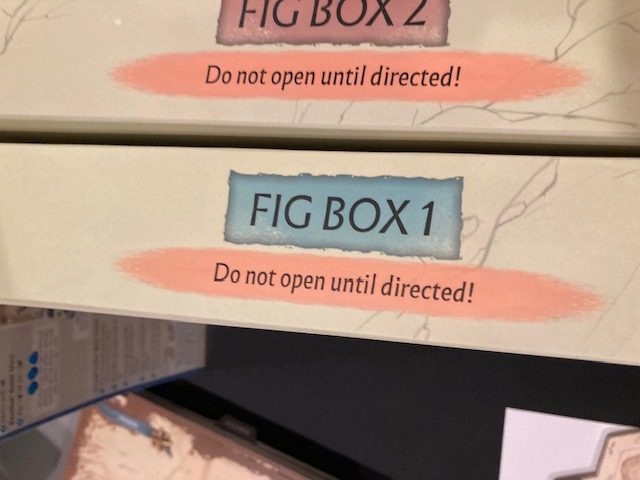
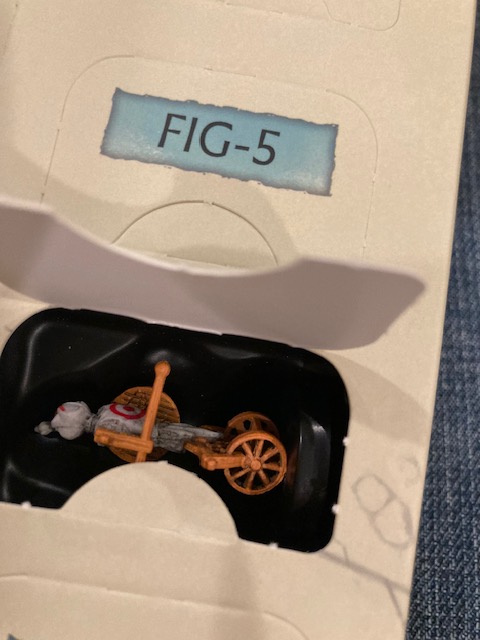
Where does the little Practice Dummy come from?  The Fig Box of course!

IMG_9296

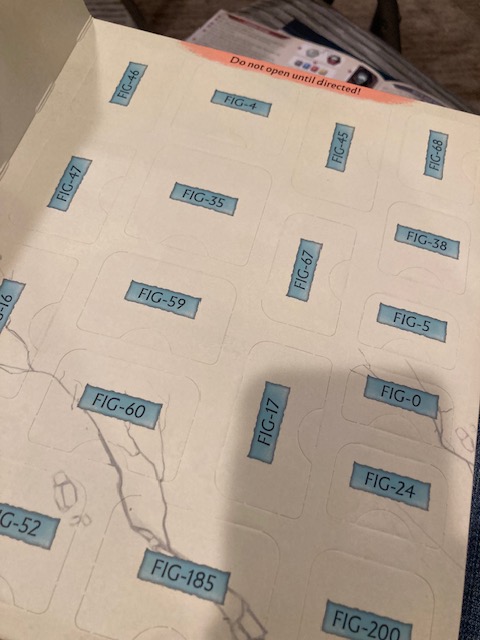
Each FIG box has a bunch of closed windows, so we can’t see what’s coming … we can only the window for the mini we want!

IMG_9298

IMG_9299

That’s right!  The minis are all “hidden” until you encounter them!  So cool! (Advent Calendar!)

IMG_9300

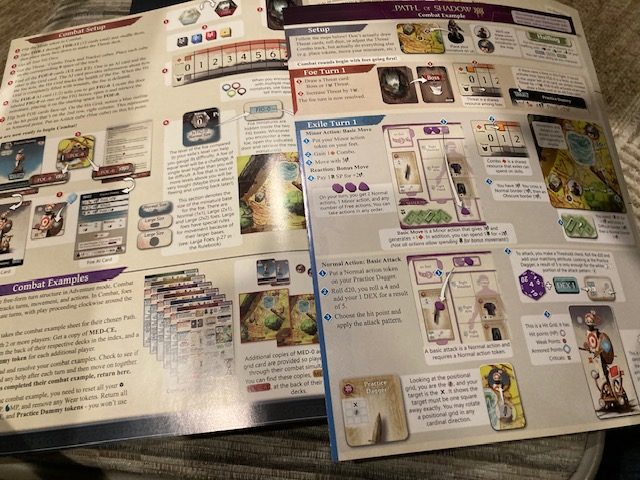
So, at this point, we switch to ANOTHER rule book, The Combat Example book!

IMG_9242

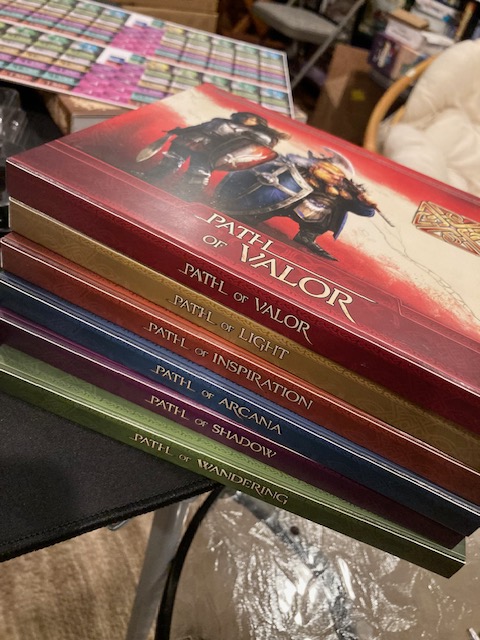
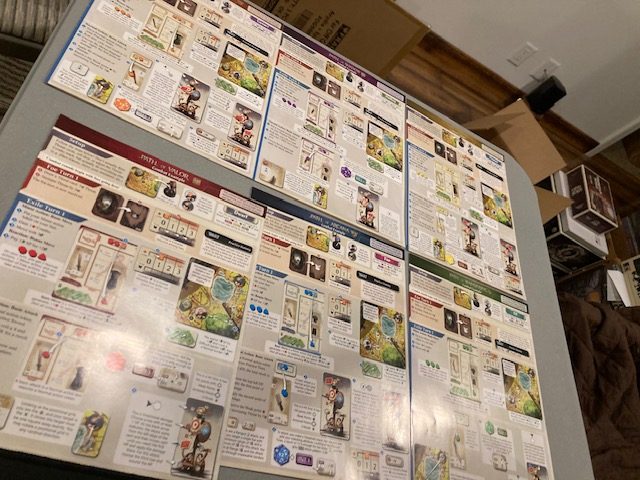
Every single Path (character Class) has a different combat example book! See all 6 of them above!  That’s right, you have a specified walkthrough FOR EACH DIFFERENT Class (Path)!!!

IMG_9303

This is really cool, as it kind of tells you how the character works!  The Rogue-like Class (I mean Path) is very much about hiding and laying traps!  This 4-page tutorial takes you through one combat with the Practice Dummy, showing you all the different things you can do!

IMG_9307

Basically, the combat alternates between the Bad Guys (the Practice Dummy here) and the Good Guys (you and your group).  

IMG_9304

A deck controls what the Bad Guys do: usually either upping the THREAT level or actually attacking using the current THREAT level!  The more THREAT there is, the more intense the attacks by the Bad Guys!

IMG_9311

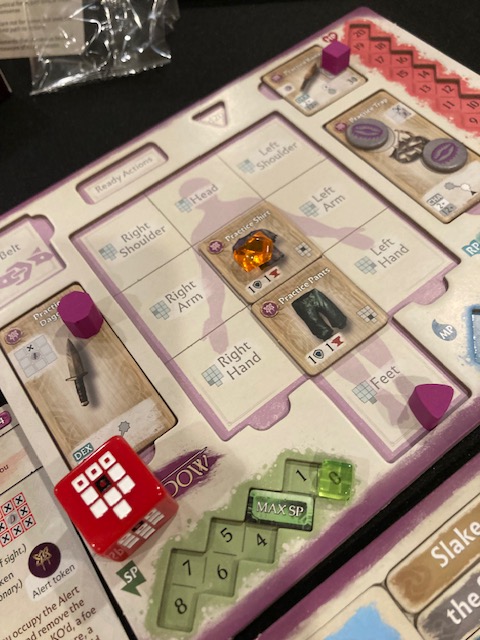
When the Bad Guys attack you, they “hit” automatically (unless you have some mechanism like the Rogue to stay hidden) and do damage based on the die they roll.  The Practice Dummy rolls a RED die, and hit you square in the middle! See how the die specifies where it hits?  

IMG_8275

We saw a similar mechanism for hitting back in Sleeping Gods (see our review here)!  This as one of our favorite parts of Sleeping Gods!  It seemed like such a cool combat mechanism to have your body “mapped” for hits!

IMG_9306

The Bad Guys have a similar system, where they have an array of “hits” and you only kill the Bad Guys if you hit every spot!

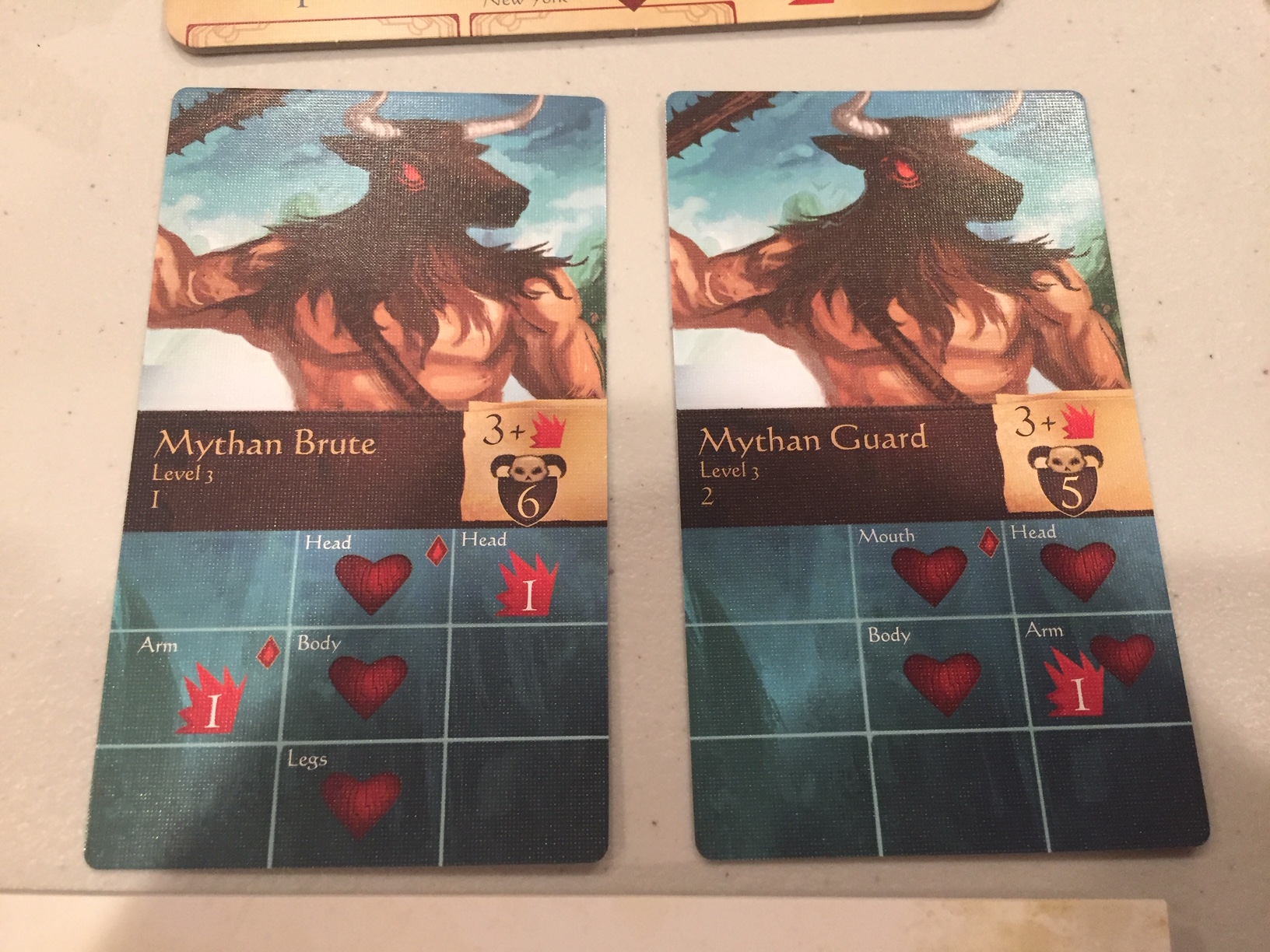
EDIT: Some people complained about SPOILERS, so I turned this picture into a link instead; it shows a more complicated monster, but it does reveal a monster you haven’t seen yet. SPOILER in this picture: click on the link if you want to see it
SPOILER: shows a more complicated monster

Later Bad Guys have significantly more spots that contain damage points, so they are harder to kill!  (Minor spoiler in the picture above, but trust me, you won’t see this one coming!)

IMG_9315

See above as I have taken out the Practice Dummy!

IMG_9312

So, I was able to explore a little part of the world and have my first combat!  And I was still only halfway through the Quick Start Guide!  However, I ran out of time.  This was a good 4 or so hours of set-up and exploration and play.  But that Combat Guide is SO GOOD!!! I loved that!  I really felt like I understood combat after that!

Rewards, Level Ups, and Exploration: Day 2 (January 1st, 2025)

IMG_9312

So, now halfway through the Quick Start Guide, I had all day to play on January 1st!! I got my rewards (some experience points) and moved on. Incidentally, Experience Points make it easy to level up and upgrade your character. Let me repeat that: You get to Upgrade your Character!

IMG_9317

I was able to explore the Location a little more, and found a neat little cave in the same area.  This found me a KEY (think keyword) that allowed me to get off the map and move on to more explorations.

IMG_9318

Just like NPC, the interaction with a POI feels like a Video Game!!!

IMG_9319

IMG_9320

IMG_9321

The Quick Start Guide also talks more about KEYS and STATE CHANGES (a way to keep track that you have completed quests).  A STATE CHANGE represents something “changed” in the Adventure and the way the card deal with that.

IMG_9326

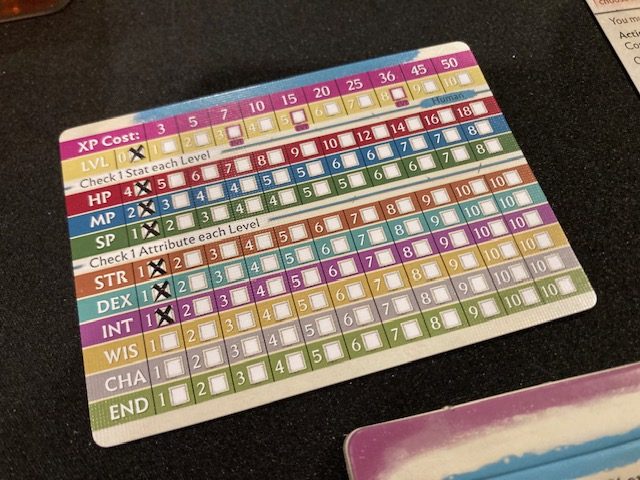
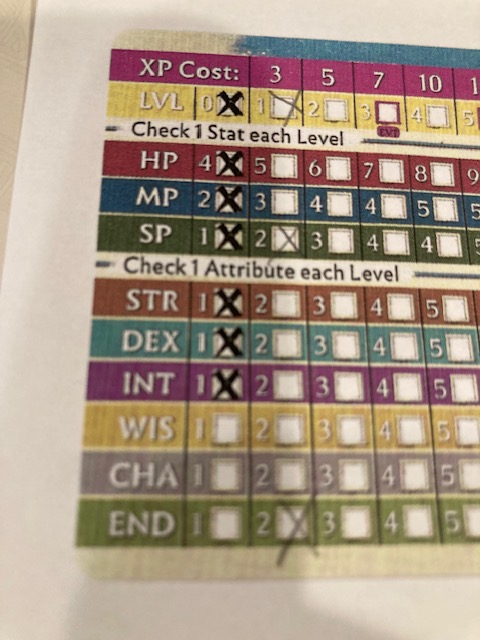
Next, you get to go to a town and heal up.  For those of you who have done any Dungeons and Dragons, towns are very important waypoints to heal and get new stuff!  In this case, the Exiles Camp also allows you to Level-UP!  The back of the Path card has a Level Up Guide! 

IMG_9327

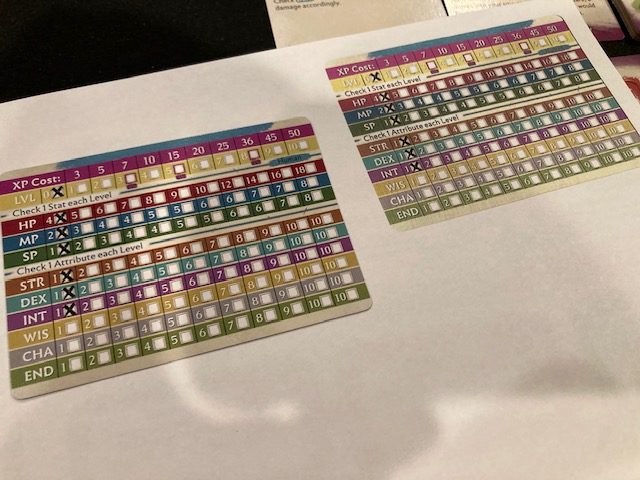
I chose to make a copy of it, so you didn’t make the pristine cards (you can also download these and print them).

IMG_9328

Levelling-Up is a great time for the Adventurer, as they can choose new upgrades to their abilities!

IMG_9329

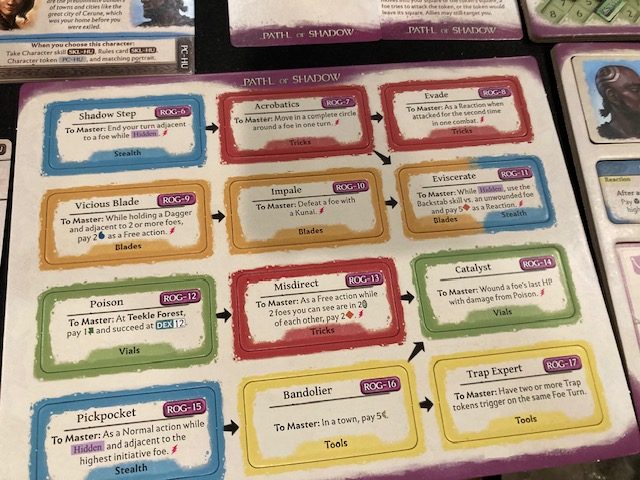
They can also choose a new Skill from their Skill tree (if they have the prerequisites)!

IMG_9332

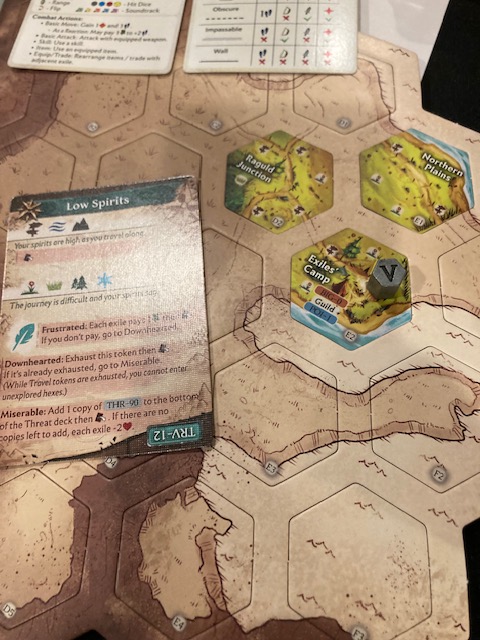
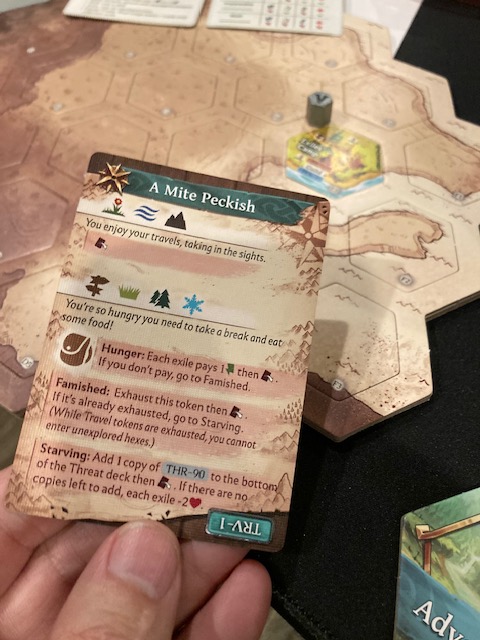
Now, after levelling up (and healing), we are ready to explore the world!  The explore deck above is used to tell you how exploration is going!

IMG_9334

Basically, depending on what terrain you are traveling through, you may have simple success travelling or some hardship!!  See the card above, as Mountains, sea, and sign posts/roads are just a simple travel, but Plains,Grassland, Forest and Ice you become frustrated!

IMG_9333

Basically, you may to flip some of your tokens to represent the hardships.  It’s not too big a deal when you start your travels, but it’s possible the hardships will start overtaking you if you don’t rest after too many travels! I thought this mechanism was fairly thematic and simple and interesting!

IMG_9335

At this point, the Quick Start Guide ended and I was ready to take on the world!  The Quick Start Guide takes you through so many of the games mechanisms so well, I didn’t feel the need to read the rulebook!!  I learned Travel, Days and Resting, Points of Interest, Non-Player Characters, Combat, Experience, Levelling Up, WorldMap Travel, Location Travel, Town Actions, Floors and Stairs, Events, Character Creation, and so much more!

Exploring the World (Day 3, Day 4, …)

IMG_9348

From this point on, I was exploring the world myself, levelling up, and find the stories of this land!  Arydia has ended up on my table continuously for about 6 to 7 days.  Some days, I would play for hours, or some days it would be just one combat.  But I couldn’t bring myself to put it back in the box  …. there is a SAVE mechanism, but it’s still a lot of work to SAVE and LOAD it back.  It’s just easier to keep it out.

Rulebook

IMG_9165

Great rulebook. 

IMG_9172

It droops just a little, but the rulebook is so well done, I am willing to overlook that.

IMG_9189

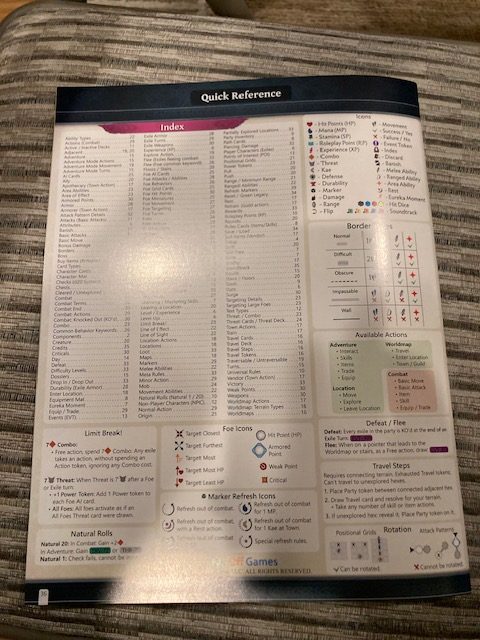
Honestly, I didn’t need to rulebook (because the Quick Start Guide was so amazing) unless I was looking up a rule! And guess what??  There’s an Index!  There’s a pretty good Index on the last page! So, this rulebook delivered and became a good resource when I needed it.  

Let’s be clear, this is a complicated game, so there are always questions that don’t get addressed (what’s the order of operations of a combat hit if the last hit damages a point what heals another point?  Does the heal happen before the final death?), but in general, I was pretty happy with this.

In fact, the Quick Start Guide and Combat Guide gave me SO MUCH Confidence to just jump in!  The Rulebook with its Index worked well when I needed it.  This is one of the better documented games I have seen in some time. Kudos!

What Is This? Do You Know What Ultima IV is?

Ultima_IV_box

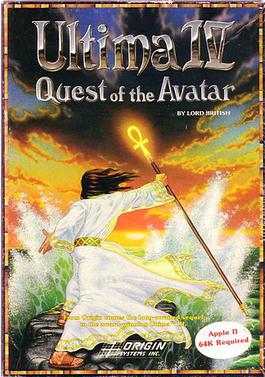
What is this game?  If I had to describe this to someone who played Video Games in the 80s, I’d tell them that Arydia: The Paths We Dare Tread reminds me so much of Ultima IV for the Apple II and Commodore 64!   If you have ever played Ultima IV, you know what this is!  It’s a game where exploration is a major component of the game! 

IMG_9342

You explore the big map (like in Ultima IV) and the little maps (like in Ultima IV). 

IMG_9324

Your interaction with NPC and the environment feels like the way you interact with NPCS in Ultima IV!  “I am the king of Eros!  I am all about Honesty!” “Tell me about Honesty!”  The keyword interaction system just feels like Ultima IV!

IMG_9340

And the combat, which is an important part of the game, feels a little like Ultima IV combat!  You interact on a Grid and move about! 

IMG_9318

But Ultima IV is all about the Quests and exploration as well!

IMG_6013

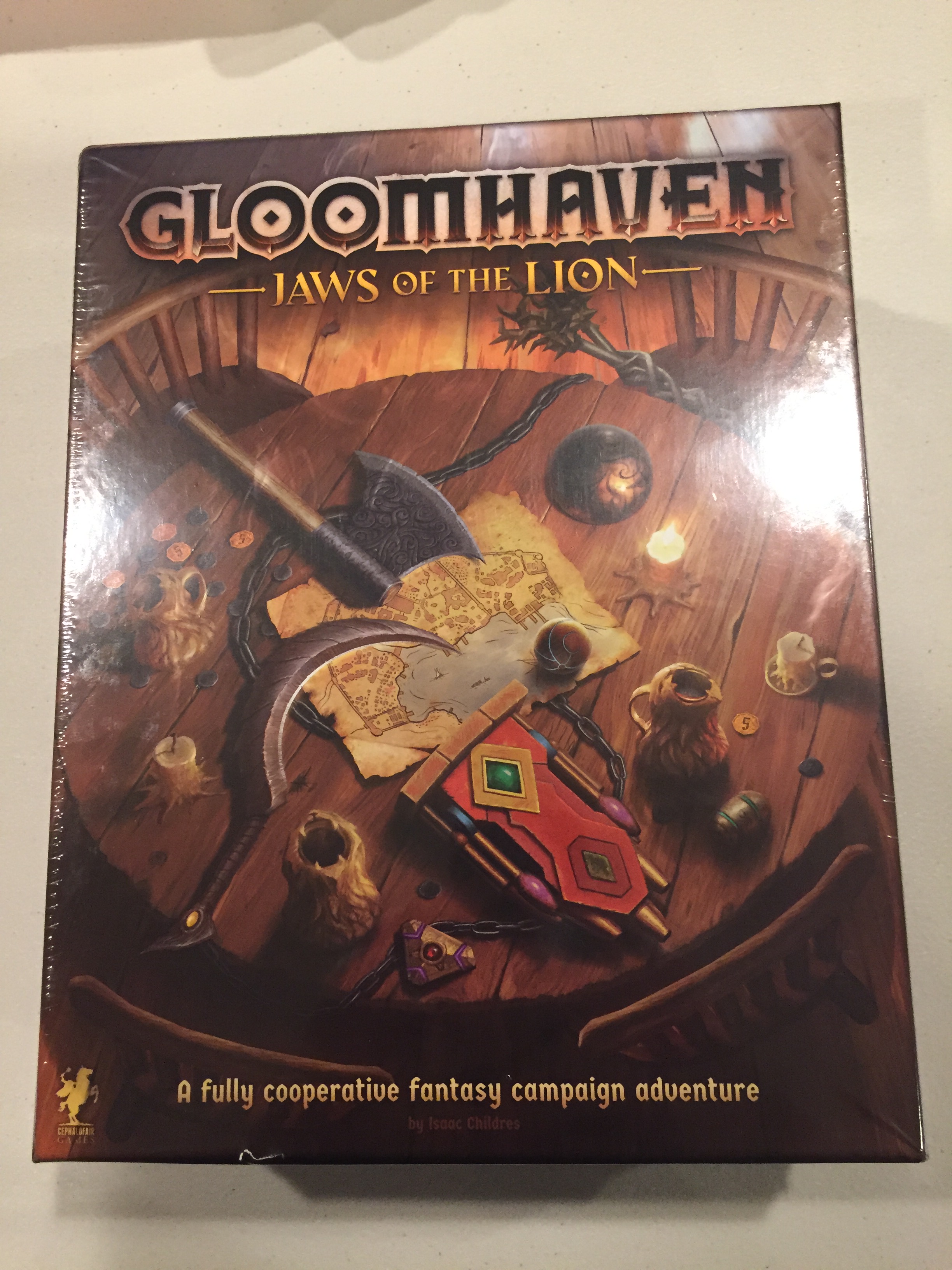
But, if you are a more modern gamer and have no idea what Ultima IV is, I’d tell you that this feels like Gloomhaven: Jaws of the Lion … with more story and exploration.  Jaws of the Lion is a fantasy exploration and combat game with great onboarding … sound familiar?  Now, don’t get me wrong, I like Gloomhaven: Jaws of the Lion (see our review here), but I always felt like there was too much focus on combat.  Sure, there was always some exploration and such, but at the end of the day, it felt like most of the hours you invested into the game were mostly combat!

Possible SPOILER picture, so turned it into a link: Possible SPOILER: picture in a town with a combat yet to be seen

I feel like the little stories and quests and puzzles in Arydia are more … fun?  That’s why I make the Ultima IV comparison: the end all of Ultima IV is to pursue the quests and stories, with combat being some part of that, whereas Gloomhaven (all of them) seem to have so much more gameplay focused on Combat.

Arydia: The Paths We Dare Tread feels like the board game manifestation of the video game Ultima IV

Solo Play

IMG_9161

So, Aydia: The Paths We Dare Tread has a solo mode (thank you for following Saunders’ Law)! And guess what?  It’s a true solo mode: one player playing one character!  (Although the Rulebook does mention that you can play multiple characters, but it will just really slow down the solo game).

IMG_9313

This game works so well as a solo game. In a few places in the text, there are slight adjustments for solo games (the RP: Role Play Points, for example, allow the Solo Character to hold more RP than normal), but in general the games seems to scale just fine. Like we said earlier, this game has great documentation, so they few places (like Role Playing Points) where there are adjustments for solo play, it’s very well documented!

IMG_9293

Combat seems to scale fine, as the Combat alternates between Bad Guy and Good Guy (one from the party).  For example, consider a 4-Player game: in four turns, the Bad Guys goes 4 times, and each member of the party goes once.  For a solo game, this balance stays: the Bad Guys go 4 times and the Good Guys go 4 times … it’s just the solo player goes all 4 times!  The only thing I worry about is that the solo player might have too few hit points, as a 4-Player games would have 4x the hit points!  What balances this out, of course, is that all upgrades get applied to the solo character, so he tends to be more of a superman as he levels up …

IMG_9347

Frankly, this was a great solo experience.  I have played probably about 20 hours as I write this, and I have really been enjoying this.  I like the Video Game feel of exploration and combat.

This will probably make my Top 10 Solo Games of 2025.  

2024 or 2025?

IMG_9155

This delivered to my door Dec. 30, 2024.  I got through “a lot” of the Quick Start Guide on Dec 31, but finished the Quick Start Guide in January 1st, 2025.  So, is this a 2024 game or a 2025 game? BoardGameGeek lists the date as 2025!  Since it is SO CLOSE to the end of the year … and a lot of people on Kickstarter haven’t gotten their copy yet, I am calling this a 2025 game!  

What I Liked

IMG_9298

Hidden Minis: The way the figures are only revealed one at a time through an Advent Calendar like mechanism is pretty great. I have no idea what I am fighting until I open the little door from the Figure Box!

IMG_9234

The Card System: The state of the world is handled in the three card boxes above. What adventures have you seen? What NPCs have you talked to? Where have your Travels taken you? This system seemed to work so well! Rather than getting caught up in a big book full of cross-references, this card system makes the adventure “bite-sized” so you never feel too overwhelmed by the text! There’s just enough adventure on the cards to keep the game interesting, but not enough text to be overwhelming! (I am looking at you, My Father’s Work as an exemplar game with too much text…).

IMG_9233

Quick Start Guide: This guide works SO WELL for introducing the players to the world.

IMG_9242

The Combat Guide: The fact that there is a combat guide tailored to each type of class (Path) in the game is tremendous! Each class (Path) has such a different play style, it’s great to see Arydia embrace all the different styles! It’s like having 6 different experts in Cleric, Rogue, Mage, etc! This just works so well!

IMG_9324

The Adventure: I love that this game is all about adventure too! The cards present stories and interactions that make this feel like a Video Game! Ultima IV!

IMG_9279

Levelling Up: As you explore this world, you get to level up and become better! You choose skills that get better and better, and you may even change direction in your skill tree! One of my major complaints about Sleeping Gods is that you never felt you you were getting better, but just barely getting by (and I had a similar complaint about Lands of Galzyr, but we never reviewed that). Here in Arydia, you absolutely get better, and you feel like you have a hand in choosing the direction! You feel involved as you become more powerful! I just feel like that’s so engaging!

IMG_9164

Well-Thought Out: The production is amazing and well thought out. Everything in the game seems to be a well-thought out decision. How does this game go together? There’s even a guide on the side of the box.

IMG_9350

Combat: The combat in Arydia is interesting and different, but it’s not the entire focus of the game (like Gloomhaven’s combat is).  I like the combat, but I don’t feel like it takes over my life. I can explore when I want, and do combat too!

IMG_9207

Resettable: You can reset the game back to its pristine state: this is not a legacy game.

What I Didn’t Like

IMG_9347

Overwhelming: Sometimes I felt overwhelmed. When you explore a new Location, you have to find all these maps, then all these POI and NPC, and all these new minis, and set everything up. Sometimes it was just a little overwhelming. Some of this would probably go away in the cooperative game with more people to share the load, but there is a lot of maintenance by the solo player to keep this game going.

IMG_9256

Only One Save Game:  There is only game going ever.  Period. The state of the card boxes represents the majority of the state of this game.  You can’t have multiple games going on!  We were able to have a solo game and a cooperative game simultaneously running in Tidal Blades 2 (see our review here), but only because most of the state was in the sheets and some cards.  Here in Arydia, you can only have one game ongoing.
Conclusion

IMG_9353

This solo game took over my life for about one week! I love Arydia: The Paths We Dare Dread! It was definitely worth waiting for (from the #6 on our Top 10 Anticipated Cooperative Games of 2022!) even though it took two extra years to arrive! This is a 8.5 or 9/10! This feels like an exploration Video Game that I kept coming back to!

IMG_9335

Unfortunately, I can’t say anything about the cooperative game (from 2-4 Players) because I have only played the solo game!   As great as this game is, I can’t have multiple games going on at once!

IMG_9162

So, now that I have played the solo game and really enjoyed it … I are going to reset the game back to the pristine state (this campaign is resettable) so that me and my friends can try the Cooperative Game!  This makes me very sad, as I will lose all progress in my 20+ hour campaign!  

If you see a Part II review of this, you will know that I broke down and reset the game to be able to play cooperatively with my friends!  If, on the other hand, you never see a Part II of this review ……… well, maybe I didn’t want to lose my progress … and I selfishly kept playing the solo game …

Let’s see what happens!

Groundhog Day Meets Murder? A Review of The Revenant Society

Screenshot from 2024-04-21 13-15-26

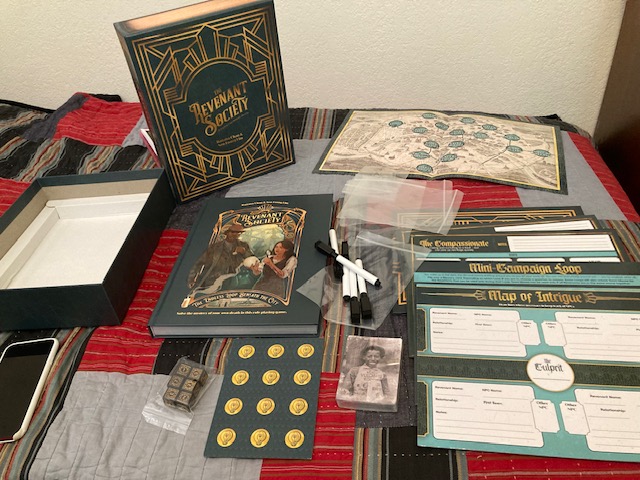
I picked up The Revenant Society from Kickstarter from March 2023, just about a year ago (it is late April 2024 at the time of this writing): see link here. This game seemed to be the unholy fusion of both a board game and a Role Playing Game (RPG). It has a core rules book, but also many supporting cards and tokens: see below.

IMG_3972

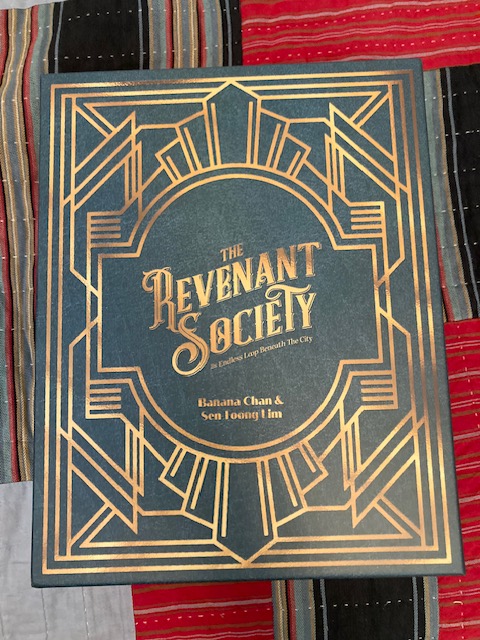
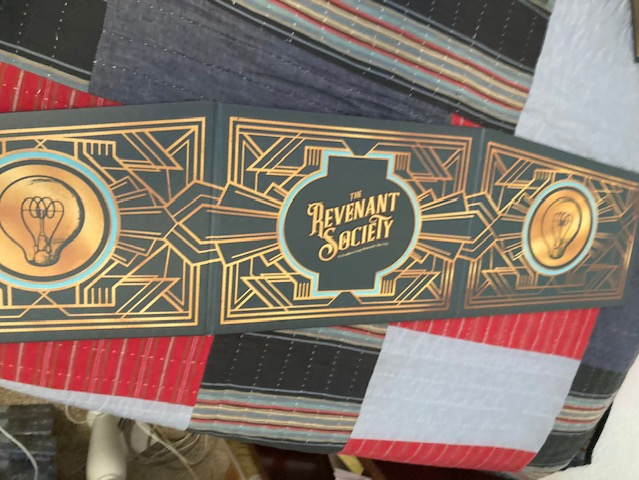
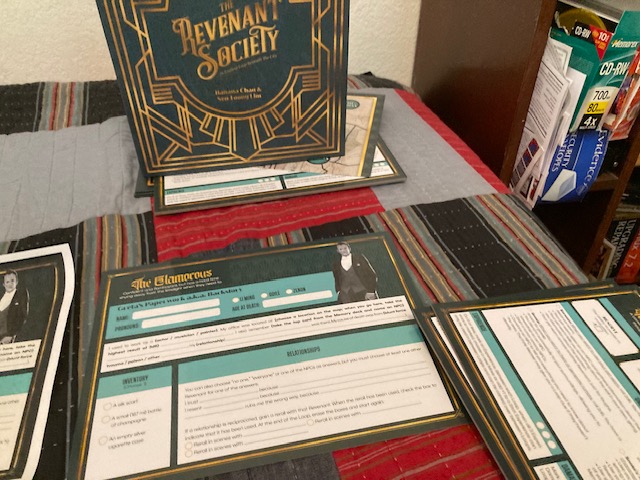
What you see above is the pledge level The Revenant Society: Deluxe Box  Set (for $75). There was also the option to just get just the core book in physical form ($40) or electronic PDF ($20).  Anyone who has been following my blog for a while knows I prefer the physical copies, so I got the Deluxe Box Set (the exact one in the picture above).

IMG_3974

What is The Revenant Society?  The basic premise is that you have been murdered, but you are given a chance to come back as an undead creature to solve your murder!   It many ways, it’s like Groundhog Day (the movie), as you repeat the same day over and over, hoping to find clues to lead you to your murderer!  If you fail to solve your mystery after four days, you are stuck in the loop of your last day forever!

What a great premise!  I was immediately drawn in and backed this. 

IMG_3673

The PDF delivered in late March 2024 (I have the PDF labelled as March 29th) from Drive Thru RPG.  It has my name and my order number smeared on a number of pages, so don’t ask me to share this with you!

IMG_3971

The physical copy of the box delivered in mid April 2024 (about April 16th).

IMG_3710

This review is going to take a weird arc: we ended up playing the PDF version of the game in our first session, and then the physical version of the game in our second session!  So, we’ll discuss how each sessions went: electronic PDF version vs physical version!

RPG or Board Game?

IMG_3998

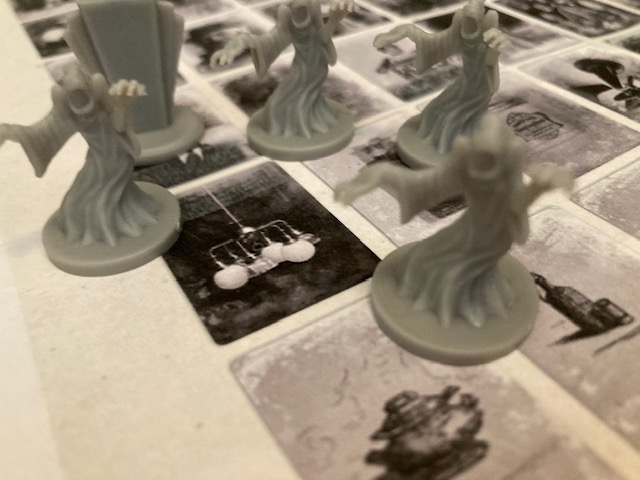
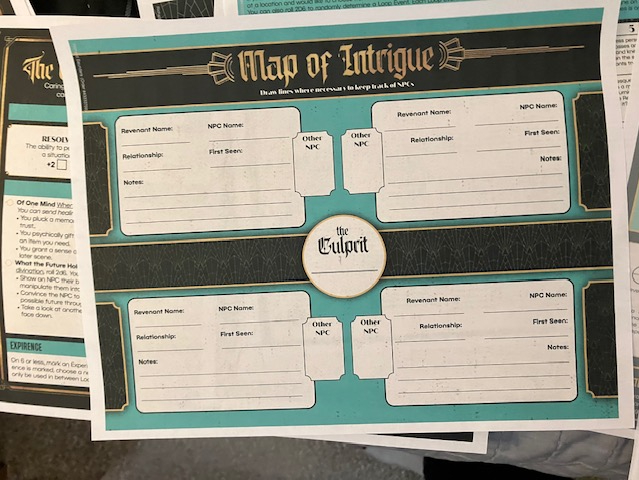
Is this more of an RPG or more of a board game?  The little minis (above) and the cards (below) that come with the game offer some suggestion this has more than a little board game DNA.

IMG_3983

After reading the rules and playing a few times, I can tell you this is 95% an RPG and 5% a board game!  The boards that you use are “nice” for helping you keep track of events in the game, and the cards and tokens are useful like a board game, but at the end of the day, this is really an RPG!

IMG_0287

The biggest clue that this is an RPG is that one player has to be the Dungeon Master  (or DM) or Game Master (or GM): they are called the Fate Weaver! The Fate Weaver has to run the game for the other players, just like a GM would.  A further clue is that this system is based on an RPG system called the Apocalypse: a lot of modern RPGs are “Powered by the Apocalypse“!  So, this is really an RPG with just a touch of board game elements to keep track of a few things.

If you find yourself interested in this, be aware!  This is really an RPG where one player (The Fate Weaver) will have to invest a lot of time learning and setting-up an adventure for this friends: this is not really a board game.
Session 0: Getting Ready

IMG_3665

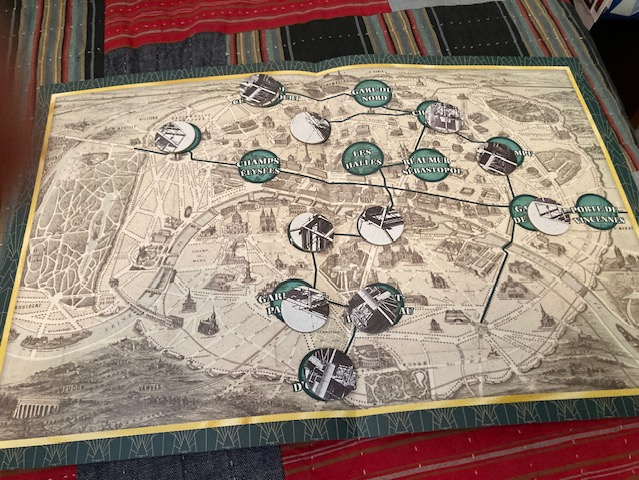
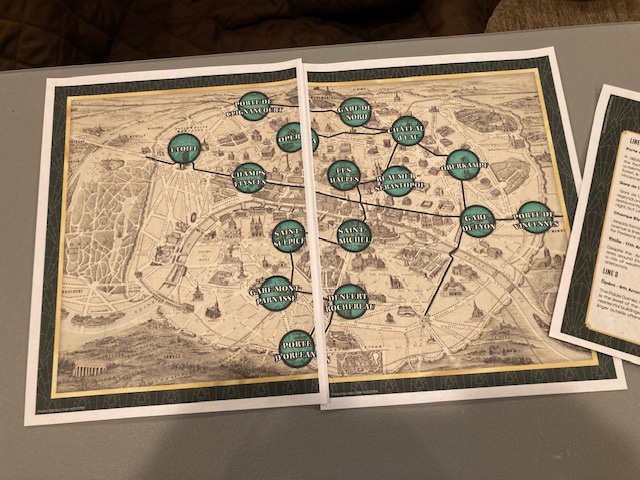
So, I ended up being the Fate Weaver and picking an adventure to run: this means I had to do a lot of reading and set-up to get ready!  The core Revenant Society rulebook comes with six scenarios, and another expansion PDF (that comes with the deluxe version) another four scenarios.  The game is set in either Paris France 1910s or New York City USA 1920s: about half the scenarios are in Paris (see map below), and the other half in New York.

IMG_0280

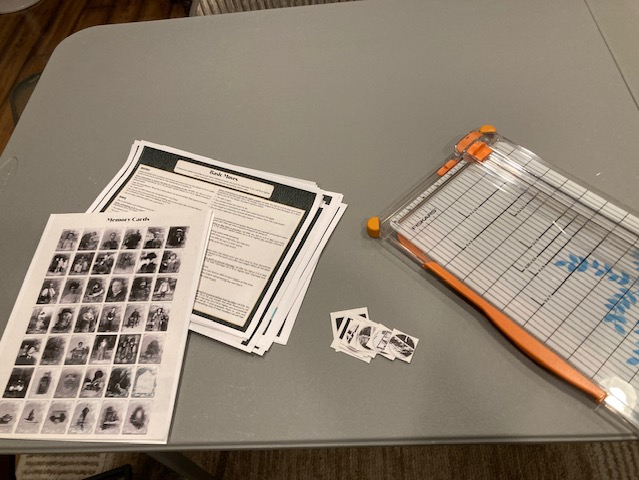
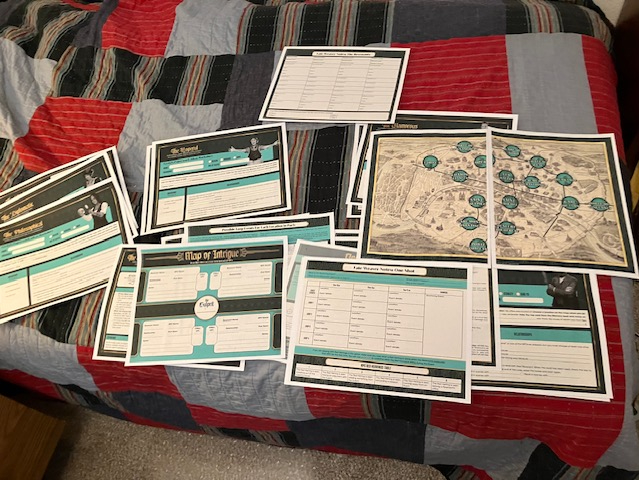
Since the deluxe version hadn’t arrived yet, I made due with using the PDF version.  This means I had to print out a lot of stuff to hand out to my players! See below all the stuff I have to print out!

IMG_0279

Probably half the stuff I printed you didn’t need: some of it I wasn’t sure, so I printed it, and the other half you can just show the players some pages from the rulebook on your PDF.  But you still need to print a awful lot of stuff!  Luckily, this is ALL IN THE PDF RULEBOOK!!  You just have to print the appropriate pages (near the end of the book).

IMG_3666

Over the course of about four days, I read the rulebook a couple of times (it’s like 284 pages, but most of that page count is scenarios at the back of the book/print-outs); I tried to figure out what I needed to print. 

IMG_3711

I ended up using a paper cutter (see above) to help with some of that. 

After reading the rules, re-reading the rules, choosing a scenario, and printing everything I needed, I felt ready to run the game.
Session 1: Paris Scenario: The Petals of Belladona

IMG_3667

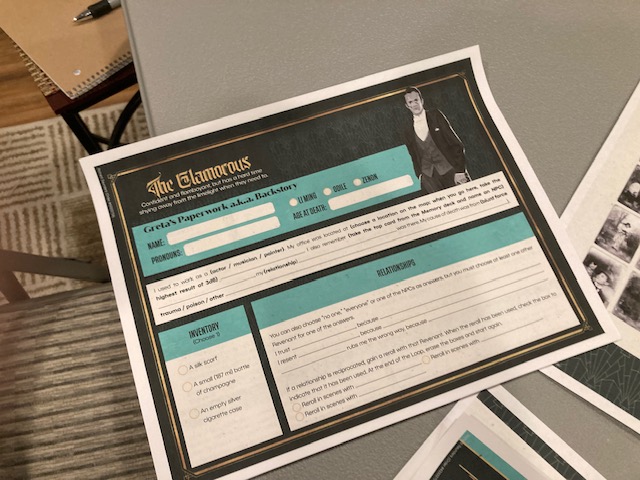
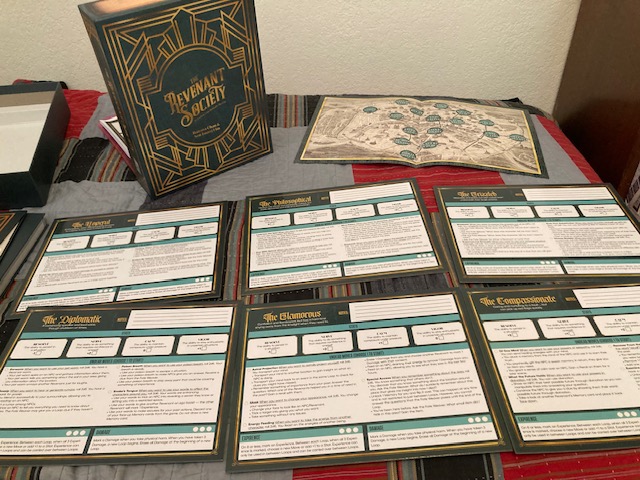
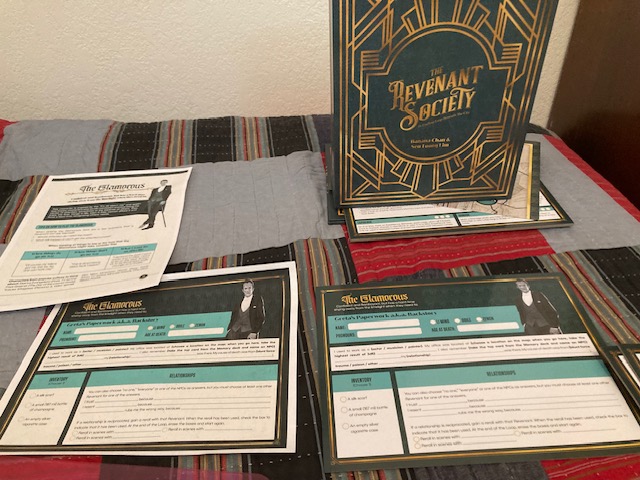
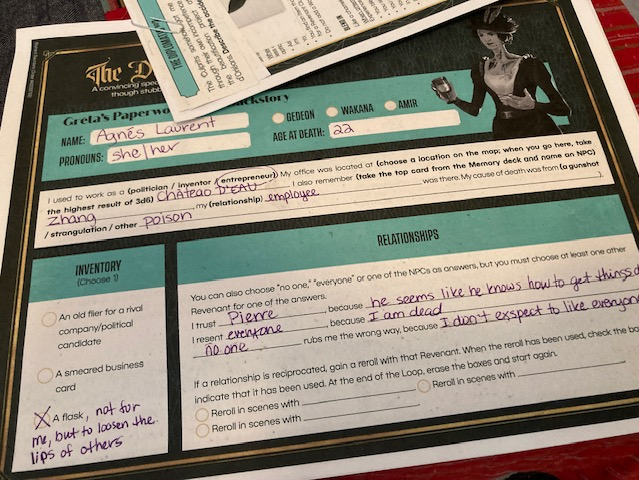
Like most RPGS, each player needs to create a character to run through the scenario.  There are six  basic archetypes in the game (one is “The Glamorous”: see above): each player chooses one and expounds on that basic framework to create a more personalized character.

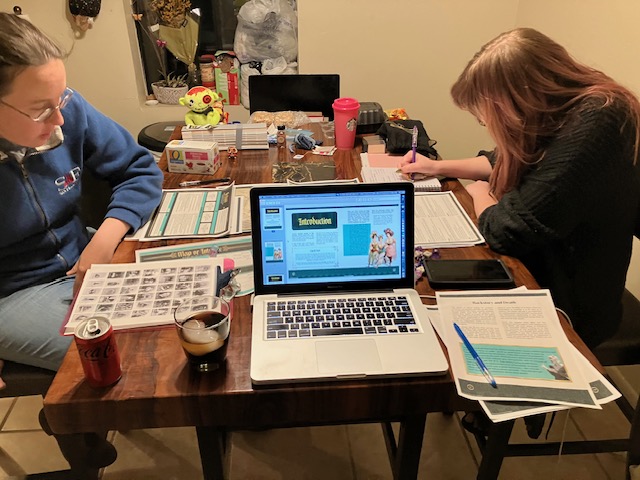
So, my friends and I met for the first session.  I had planned to “just” create the characters and explain the game!  I “expected” that to last 2 hours, but it went very quickly!  We got the characters created and got the the gist of the game in 45 minutes.  So, GULP! We just jumped right in!

IMG_0286

I think the reason it went so well was because I had spent a lot of time preparing, so I didn’t have to lookup too much stuff as we played!  Don’t get me wrong: I still had to make up a lot of stuff as we played … which is typical:  most Dungeon Master/Game Master have to be creative and make up stuff to respond to their players.

  IMG_0289

In the end, we made it through Loop 1 (where we uncovered a lot of the story) and ended with a dramatic reveal!  This was all by the seat of my pants, but I think it went well.

IMG_0288

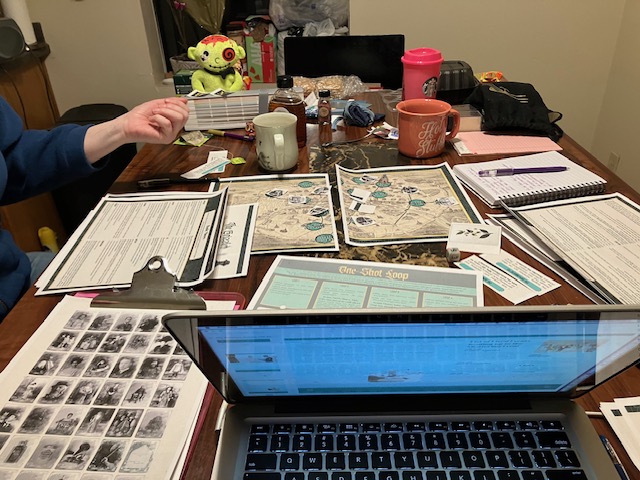
Even though we had cheesy cut-out components, it actually worked pretty well.  Again, it was probably because I over-prepared so I think I knew everything we would need.

IMG_0287

We liked the game enough to want to play again! So, we looked at our schedules and decided to try again in two weeks!

Meanwhile …

IMG_3971

While we were waiting to meet again, the physical copy came in the mail!

IMG_3972

Instead of cheesy cut-outs, we now have real tokens! Real cards! Real boards! Real dice! And dry-erase boards to boot! 

IMG_3974

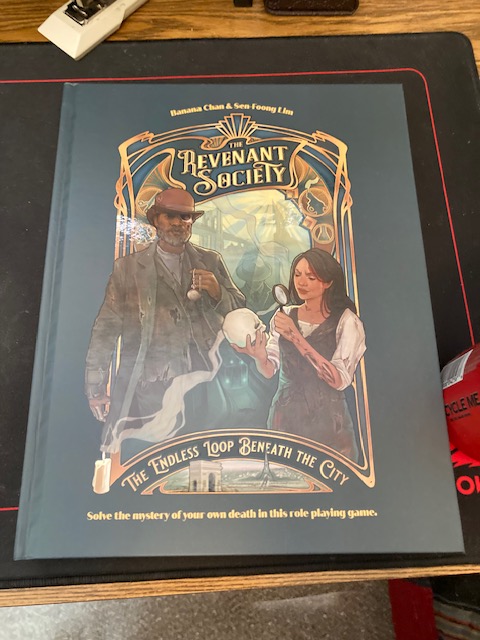
Probably the most exciting piece was the physical copy of the core book!  See above and below!

IMG_3973

I took a picture with a can of Coke to show how thick the book actually was! It’s a big boy!

IMG_4006

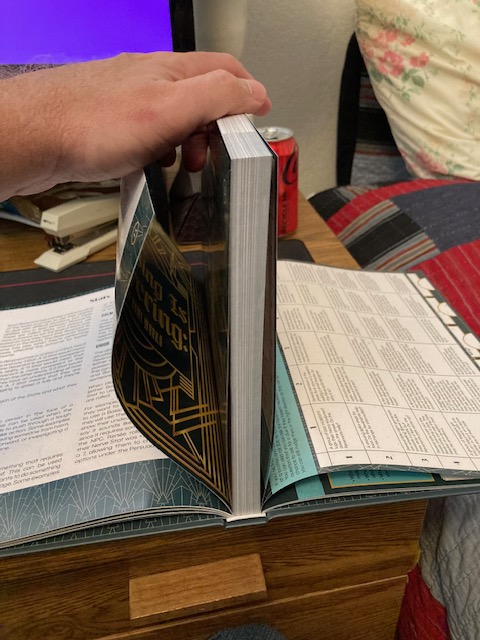
In fact, I was worried about stripping the binding, so I made sure to open it and slowly open parts of the book so the binding would get some equal wear and tear as I opened it.  We used to do this to all our AD&D books growing up … it keeps the binding fit!

IMG_3995

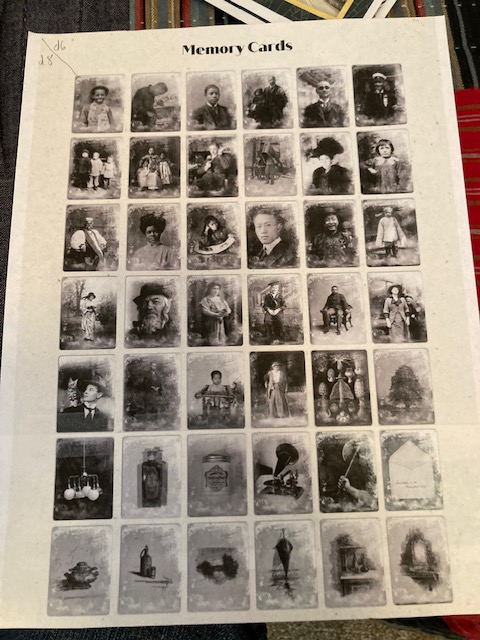
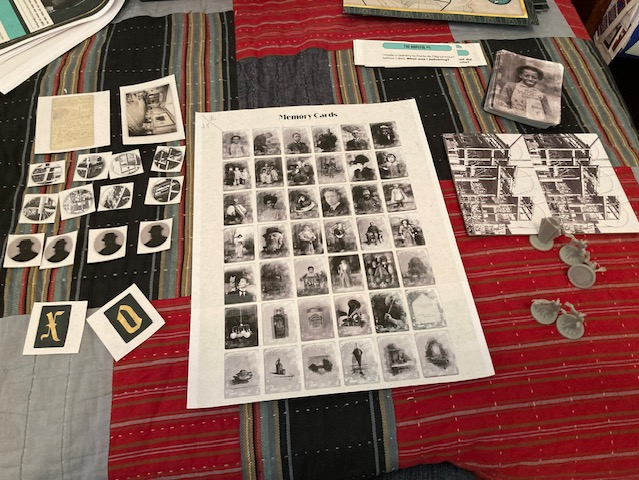
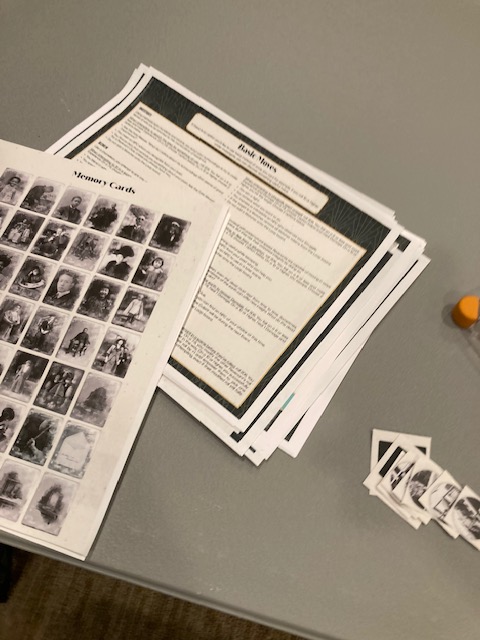
So rather than a sheet of memories (used to generate content) like above from the PDF …

IMG_3983

We get a full deck of cards from the physical edition! See above.

IMG_3994

Instead of cheesy cut-outs (like above) …

IMG_3998

We get plastic minis!

IMG_4002

On the left, you see all the things I printed from the PDF … and on the right, you see the physical components.

IMG_3980

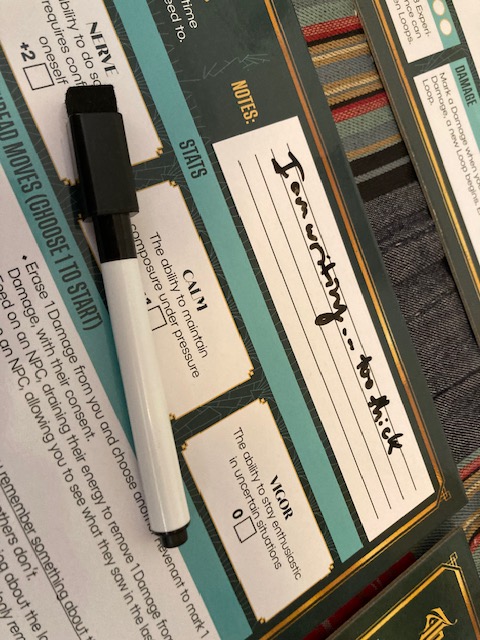
A bit of a surprise was the character sheets in the deluxe version are dry-erase!

IMG_3977

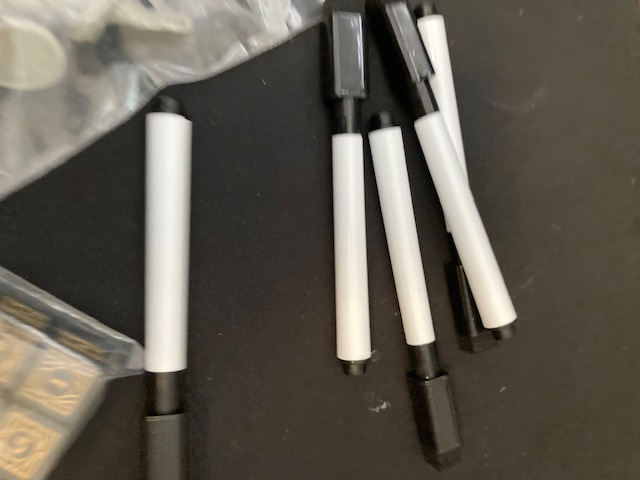
The deluxe version even comes with dry-erase pens!

IMG_4003

The map is much nicer too.  See the map of Paris above.

IMG_3985

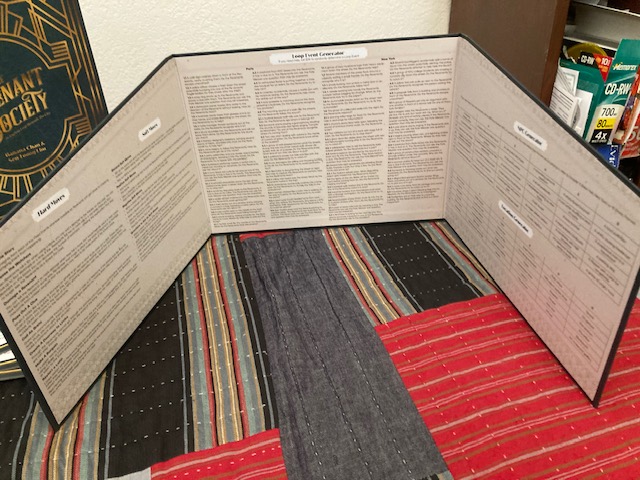
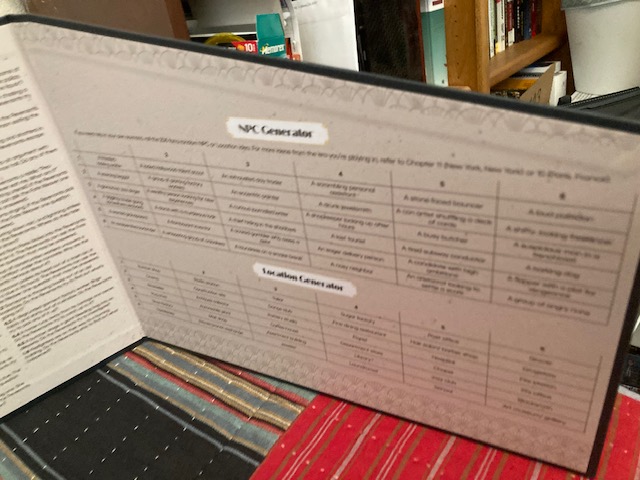
Besides the book, probably the nicest component was the Fate Weaver screen!

IMG_3987

So, basically, everything now has “deluxe” pieces: the next time we play, we’ll move to the new pieces!

IMG_3972

Session 2: Playing Loop 2 With The Deluxe Components

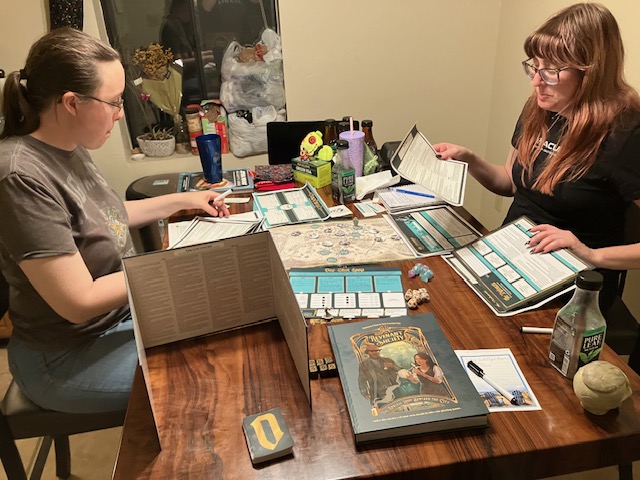
IMG_0295

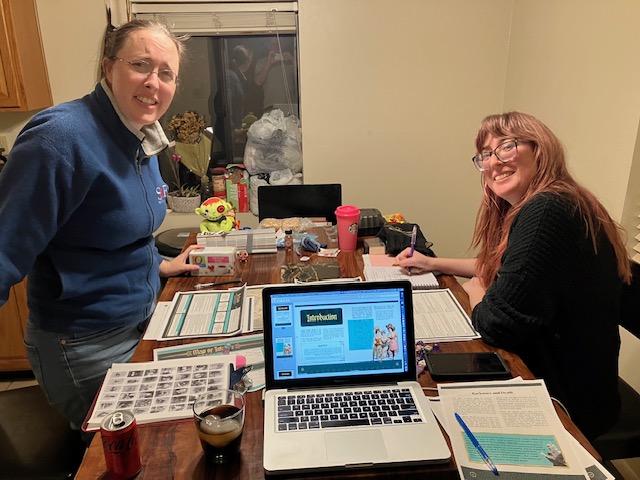
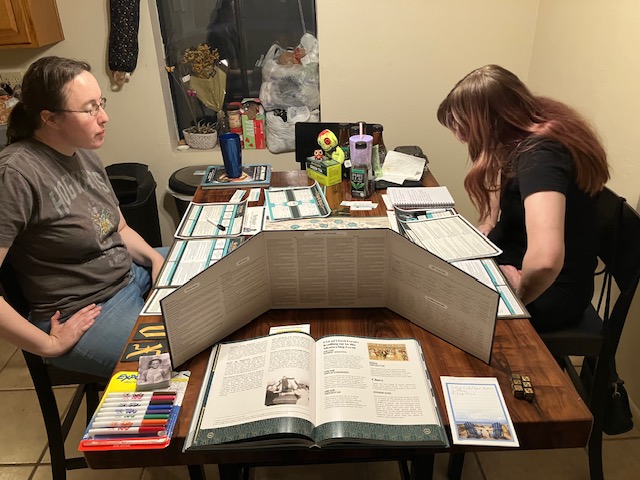
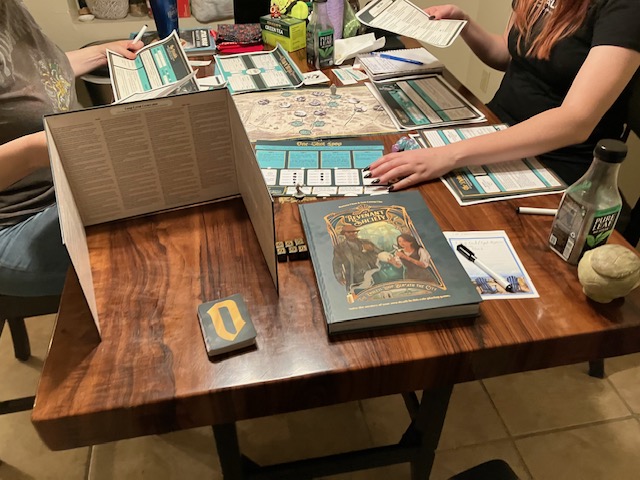
So, in our second Loop of the game, we embraced all the deluxe components.  We decided quickly that the dry-erase boards are terrible for writing lots of text (upper left uses pencil-and-paper), but good for writing simple adjustments and damage (upper right uses dry-erase board).

IMG_0296

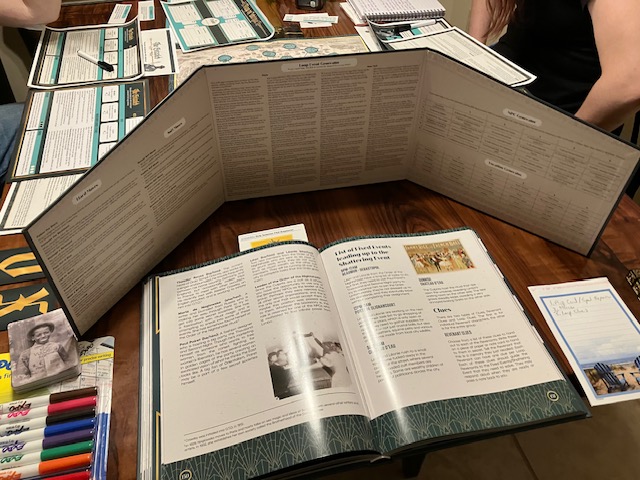
We also put some ultra-fine dry erase pens on standby, but we didn’t need them (because we didn’t write any text on the dry-erase boards, just simple marks).  See above as I have the Fate Weaver Screen and the  big old Revenant Society core book in front of me.

IMG_0297

I ended up putting some markers in the book to remind myself where certain sections were: I found out very quickly that this beautiful book DOES NOT have an index!

IMG_0298

Sara ended up using a notebook to take notes through the adventure: she was never tempted to use the dry-erase boards.   I will say that the map looks a lot better (see above) and the Fate Loop board is much easier to use with the dry-erase boards.

IMG_0299

In the end, we had fun playing.  I think we took the game a little less seriously in the second game …

IMG_0301

We ended up bringing a very saucy NPC named “Skully” into the mystery … see Teresa cradle Skully in her arm.  (They had to wrap Skully in something to shut him up … Skully liked to talk a little too much!)

IMG_0302

We went ahead and finished our story that night, completing the second Loop and solving the mystery of the deaths!

IMG_0303

We had fun.

IMG_0300

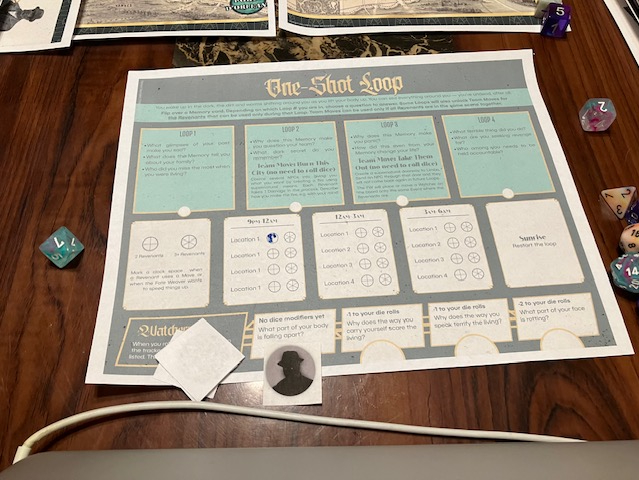
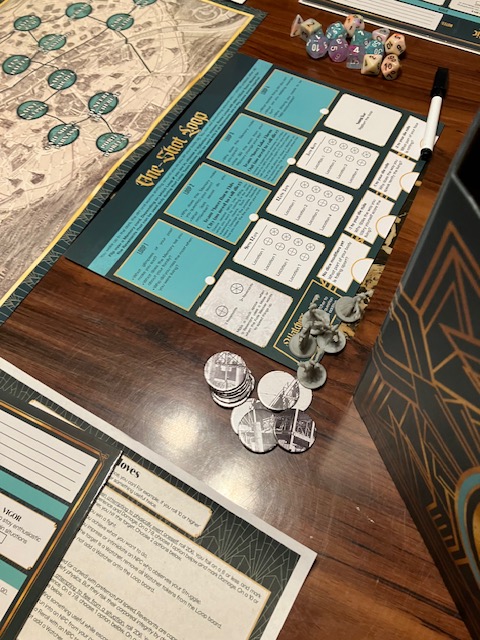
Probably the place where the Deluxe Component shone most brightly was the One-Shot Loop dry-erase board with the little Watchers: that seemed to work the best of all the deluxe components. See above.

Well-Crafted Murder Mystery?

IMG_3974

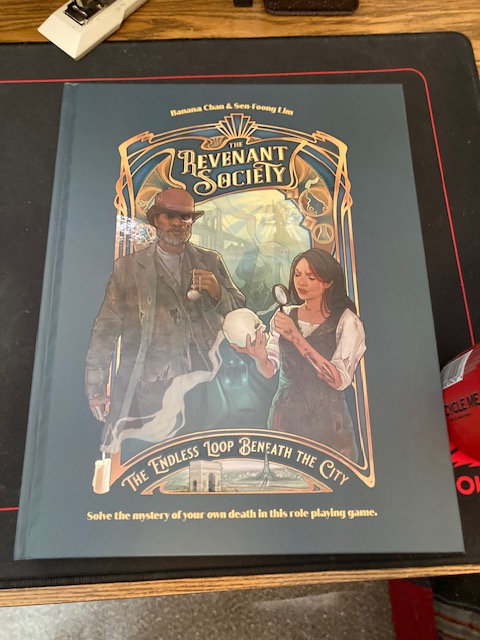
After getting through the game, I realized this was not what I expected: the game labels itself with the byline ‘Solve the mystery of your own death in this role playing game‘ (see the cover above).  What I thought this meant was that The Revenant Society would provide several well-crafted mysteries for the players to solve. No no no no no no.  That’s not at ALL what this game was!   This a game where the players make-up-what-they-want about their character and most of the story and the Fate Weaver simply “responds” and tries to push the game in certain directions.

IMG_4001

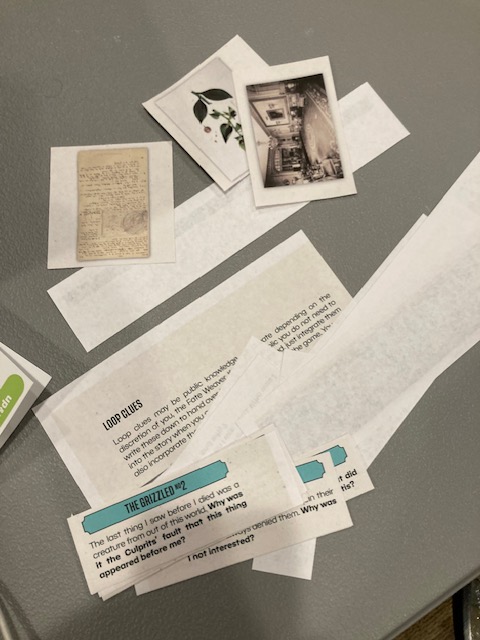
For example, take a look at the clue above: this is something the Fate Weaver is required to physically pass to the player at some point during the game.  But this is not a clue about this mystery, this is the player making-up whatever-the-heck-they-want to answer the question!
IMG_3979

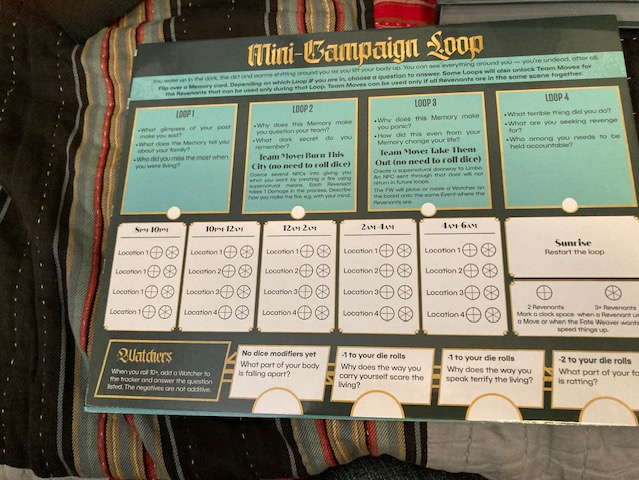
Another example: at the beginning of every Loop, there are “questions” the Fate Weaver asks the players!  (See above) And the players answer whatever-the-heck-they-want!

IMG_4689
Detective: City of Angels Box Lid

If you were expecting something like Detective: City of Angels, or Sherlock Holmes: Consulting Detective (or many games on our Top 10 Cooperative Detective Games) with well-crafted mysteries, thoughtful clues, and meaningful timelines, that IS NOT what The Revenant Society is! This is a game about the Fate Weaver and the players collaboratively making up whatever-the-heck-they-want. (Well, the timelines are actually fairly well-defined, so I take that part back).

IMG_3989

I’ll be honest, I am very disappointed in what The Revenant Society is: I admit that I prefer my mysteries to be well-crafted and thoughtful!  I was hoping to be a GM that slowly guided the players to the final solution, by dropping clues and hints as they played.  What I got was a game where players do whatever-the-heck-they-want, and I, as the Fate Weaver have to somehow rectify that with the world and mystery they inhabit.

IMG_3988

You might say “Well, play the way you want to then! Make up a well-crafted mystery and present that to the players!”  I thought about that, but the mechanisms already in the game keep prodding the players to make-up whatever-the-heck-they-want: unless you alter the game drastically, this is a terrible framework RPG for well-crafted mysteries.  

IMG_3981

This isn’t what I wanted: I usually hate these kind of games, because they remind me of the TV Show: LOST.  Things just happen with no cohesion or thought, and frequently things just don’t make sense or get resolved.  I really hate shows like that: I want my shows (and my games) to be thoughtful.

Despite

IMG_0286

Despite this NOT being a well-crafted mystery, I still had fun running it. Once I set my expectations for what this game is, I did the best I could to stay in the moment.

IMG_0304

IMG_3713

My friends loved the setting and the idea of a Groundhog Day meets Murder game!

IMG_0283

I also did get some enjoyment trying to take my friends’ crazy ideas and turn them into a well-crafted mystery as much as I could!  I have seen so many murder mystery shows, read so many books, played so many murder games, that I feel like I do have a chance to turn my player’s crazy actions into a well-crafted mystery.    So I did enjoy it, once I got into it.

IMG_0301

And Skully ended up being an unexpected fun NPC, even though he hit on Sara the entire night … but that’s just what Skully does.

A Comparison To Spirit of 77

IMG_4005

My major compliant with the Revenant Society is that it really doesn’t have well-crafted mysteries: players just make up stuff as they go, and the DM/GM has to rectify what they do.

IMG_5227
Spirit of 77: Get the Funk Out!

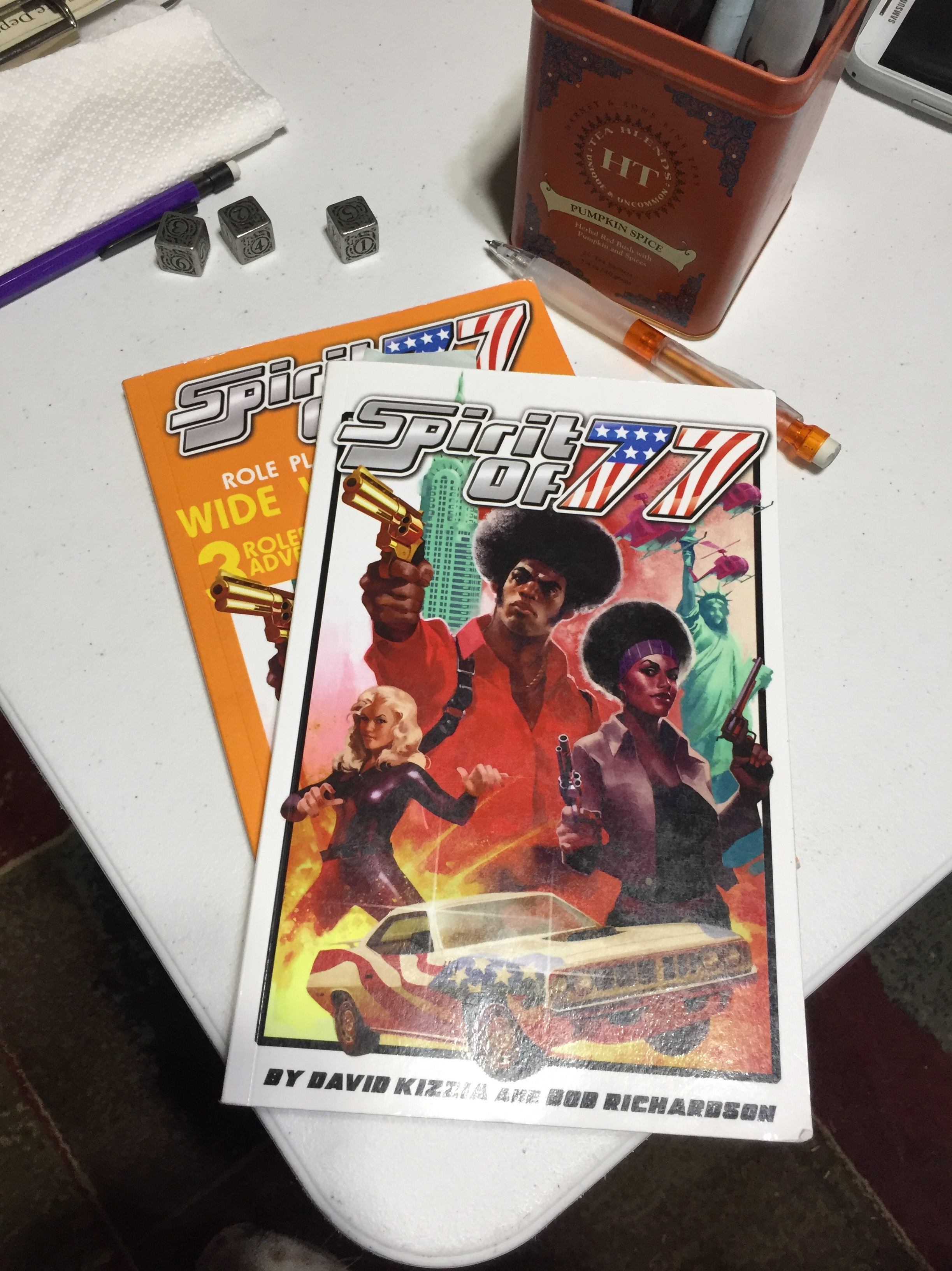
Another RPG I played that has this same “make-up-stuff-as-you-go” style is Spirit of ’77 … and I loved that style there!! See out review of Spirit of ’77 here! What’s the difference? Why do I love this in Spirit of ’77 and hate this is The Revenant Society? At the end of the day, the purpose of Spirit of ’77 is to make each other laugh! So, anything that takes the game in a weird direction is welcome! To me, the purpose of The Revenant Society is to solve a mystery (and it even says that on the cover of the book), so the “make-up-stuff-as-you-go” style doesn’t lend itself to any kind of well-crafted mystery.

Maybe if you love this setting in 1910’s Paris or 1920’s New York, you don’t care as much about the well-crafted mystery as I do.

The Book

IMG_3974

We have to stay something great about the book: it’s very beautiful production.  It’s very readable! It has a lot of (it looks like) well-researched history around the two eras of interest (Paris 1910s and New York 1920s)!  The font is good sized!  In general, it looks fantastic and is almost a piece of art. 

Physical vs. Electronic

IMG_3973

If you are interested in this game, should you get a Physical version (the Deluxe Components or just the book) or the Electronic version (PDF)?

IMG_3710

Those of you know who know me would expect me to say “Get the Physical Product!” And you’d be wrong.

IMG_3991

First, let’s talk about the Deluxe version.

IMG_3980

Using dry-erase markers is a terrible idea for any meaningful amount of text!!!  We saw this waaaay back in our review of The Forests of Admiron (see link here).   First of all, the deluxe game comes with fat dry-erase markers … and they are hard to read! See below.

IMG_3982

If you really want dry-erase markers, you need ultra-fine to have any chance of them working well.

IMG_4005

In the end, Sara’s pen and paper system worked SO MUCH better: See above.  We tried it both ways (pen-and paper in Session 1 and dry-erase boards in Session 2):  pen-and-paper worked so much better.  You really don’t want the dry-erase boards: they are clumsy, messy, and harder to read/write.
IMG_4003

I do admit the map looks better (see above), but everything still works fine in PDF printed version (see below).
IMG_3671

I am really not convinced the Deluxe version is worth all the extra money, and in fact, makes the game worse with the dry-erase markers!

IMG_3974

Should you just get the physical book then?  I mean, it it gorgeous and a beautiful production.  That’s up to you: left to my own devices, I would just get the PDF.  Why? For one, the PDF is electronically searchable, and the physical book DOES NOT HAVE AN INDEX!!  For a book with 280+ pages, I am very surprised there is no index: how do you look up stuff in the physical version???  Answer, you can’t without a lot of searching.  The only way to really look stuff up quickly is electronically to search the PDF.

Another reason: A lot of the stuff I want to print out comes from the PDF only!  I had trouble finding the PDF pages I wanted online … I could only print them from the PDF I owned (to be fair: if you get the Physical version, I think you also get the PDF as well).

IMG_4004

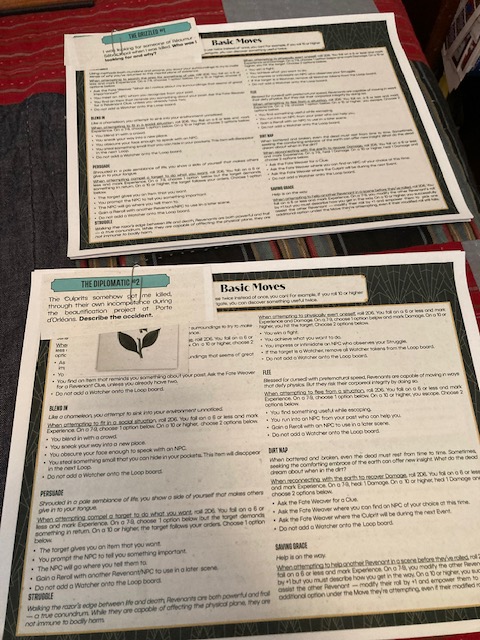
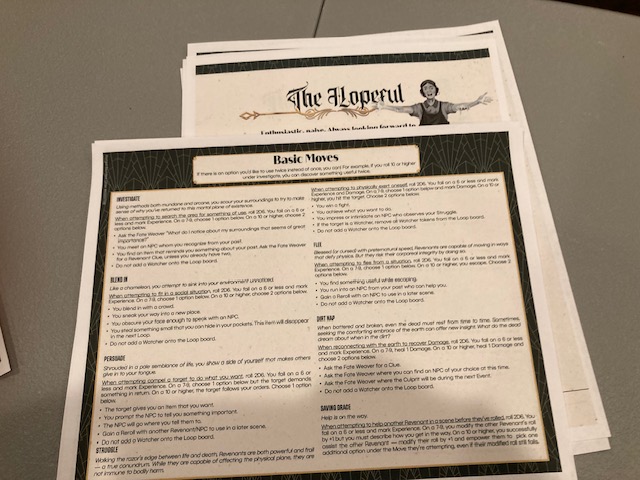
The most important thing to print for the players in the Basic Moves!  See above!! Players consult this sheet ALL THE TIME: why was it not one of the things printed in the deluxe version?  I went out of my way to make sure each one of my players had a copy of the Basic Moves (they could have maybe gotten away with this by putting the Basic Moves on the outside of the Fate Weaver screen, but the Fate Weaver screen has no useful info on the outside).

IMG_4001

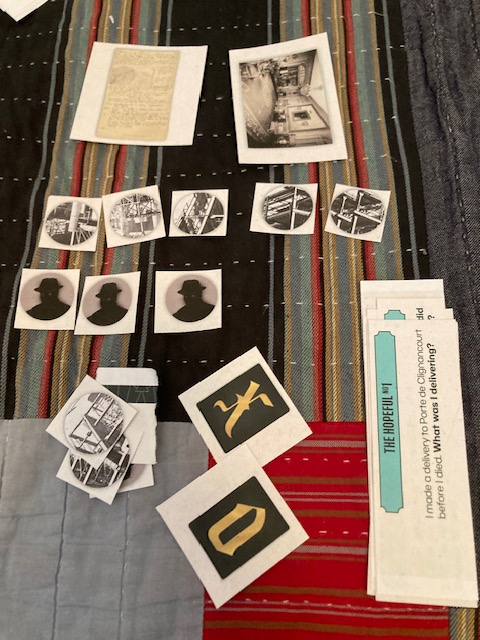
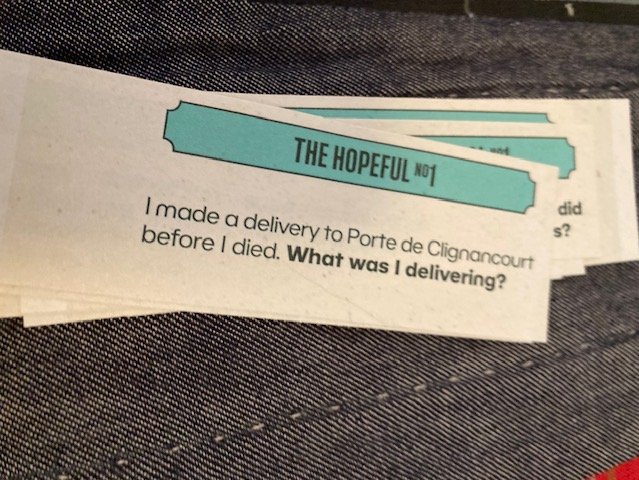
In the end, you the Fate Weaver still has to print the clues from the scenario (see the Hopeful clue #1), so what’s printing a few more sheets?

IMG_0286

In the end, the pen-and-paper approach worked best, with my searchable PDF being preferable to the physical copy of the book (which has no index???).  And my laptop also served as a Fate Weaver screen as well: see above.  Overall, I strongly preferred the electronic PDF version of this: the dry-erase player boards of the deluxe version just didn’t work that well. I needed to print quite a bit from the PDF anyways, so even though the deluxe version has some nice components, it wasn’t worth the extra money.

Conclusion

IMG_3974(1)

Would I get The Revenant Society again?  Even though I did enjoy my plays of this once I set my expectations, it wasn’t really what I wanted … but I would still play again.  I wanted a murder mystery game with well-crafted mysteries: that’s not what this is.  If you like the idea of playing in this thematic world with your friends, I think you can have a great time: we actually had a great time after setting our expectations!!  If the game does sound interesting to you, I strongly suggest you get just the PDF version of the game: you find yourself having to print stuff from the PDF anyways, so you might as well print everything you need at once.  We found the dry-erase boards experience from the Deluxe version lesser than a pen-and-paper experience, so even with all the cool stuff from the Deluxe version, it just didn’t seem worth it.

I did enjoy trying to turn the crazy ideas of my players into a well-crafted mystery as much as I could.  But the game mechanisms in The Revenant Society don’t really lend itself to any thoughtful crafting: said mechanisms are too ingrained as a “make-stuff-up-you-go” style.   This game is  just antithetical to any thoughtful mystery crafting .  I enjoyed my plays of The Revenant Society, I might even GM a few more games,  but I wouldn’t pick it up again. 

Maybe you would enjoy living in this world and having fun collaboratively putting together a mystery: decide for yourself! Just be aware, this is not a game with well-crafted mysteries.