Marvel Crisis Protocol: Alliances. Green Goblin’s Head Fell Off A Lot!

Welcome to Cooperative Comics Month! This month, we take a look at a bunch of cooperative games from comic book worlds! We’ll look at DC Comics! Marvel Comics! Image Comics! Space Comics! We start the month with Marvel Crisis Protocol: Alliances, a brand new game from the Marvel Comics universe!
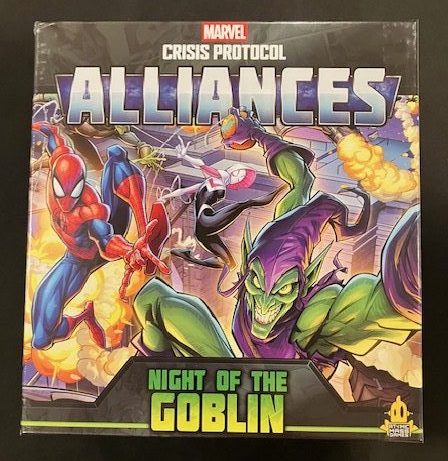
Marvel Crisis Protocol: Alliances is a cooperative miniatures game for 1-4 players; this is set in a Spider-Man universe, if that’s wasn’t clear! This is a super-hero game! Spider-people cooperatively fight the Green Goblin people!
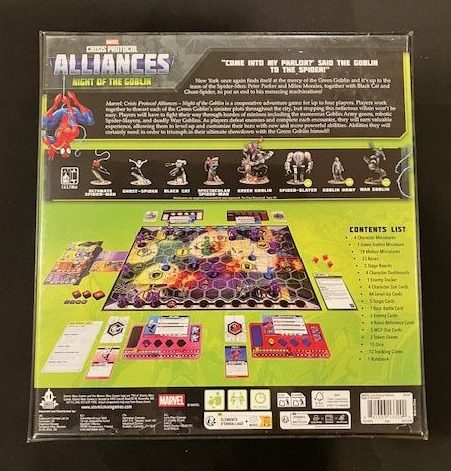
I ordered this directly from the manufacturer; it arrived about a month ago (late August/early September 2026). It just released! I’ve been messing with for about a month now. It was kind of expensive: I paid around $100 of my own money (like we do for every game here at CO-OP Gestalt), so it wasn’t “cheap”.
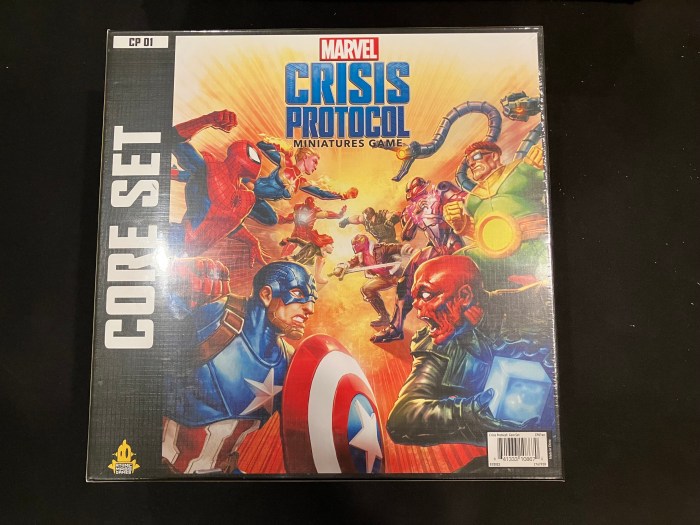
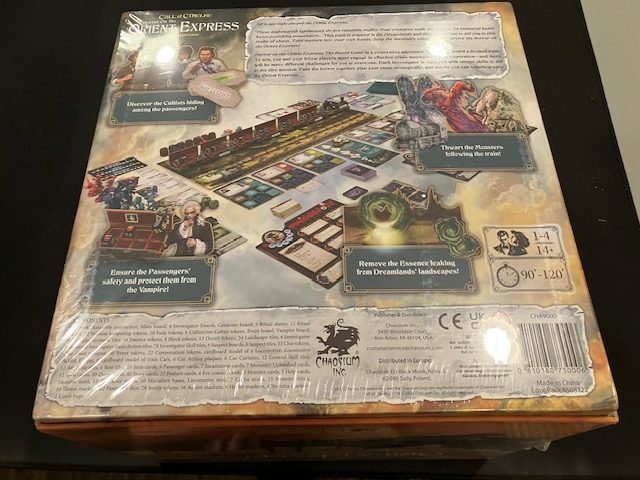
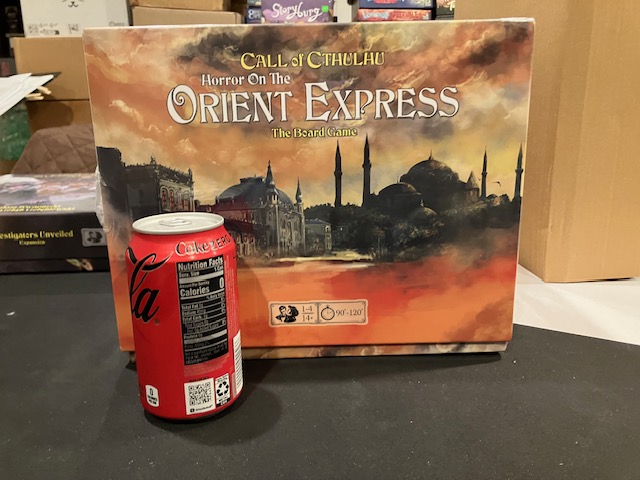
I tried getting into the original Marvel Crisis Protocol quite a while ago! I even bought the introductory set years ago! I had heard there are a “cooperative scenarios” online, and my friends Jeremy and Ralf expressed interest in trying this! Jeremy and Ralf got promoted and became super busy, so we never got to play! Part of the problem for me, at least, is that at its core, Marvel Crisis Protocol is a competitive game! Red Skull and bad guys vs Captain America and good guys! So, the original Marvel Crisis Protocol languished in my collection for years … never opened … (and it’s still in shrink today: see above).
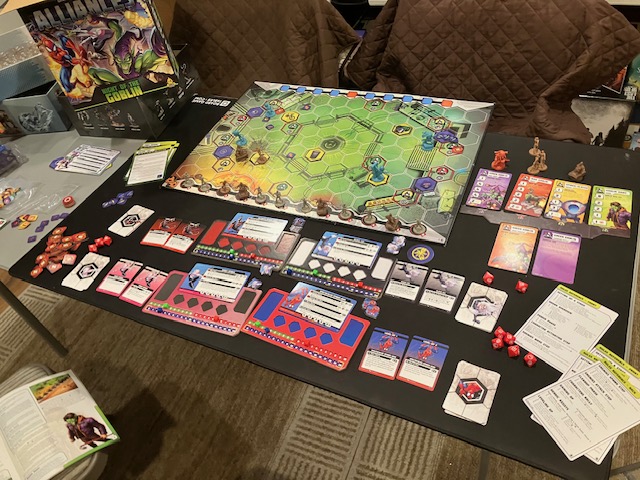
BUT! The new Marvel Crisis Protocol: Alliances is fully cooperative! And plays solo too! I was able to justify getting the newer version to the table very quickly! Spider-people (players) fight together against the Green Goblin (who is run by the game).
What did I think of this?

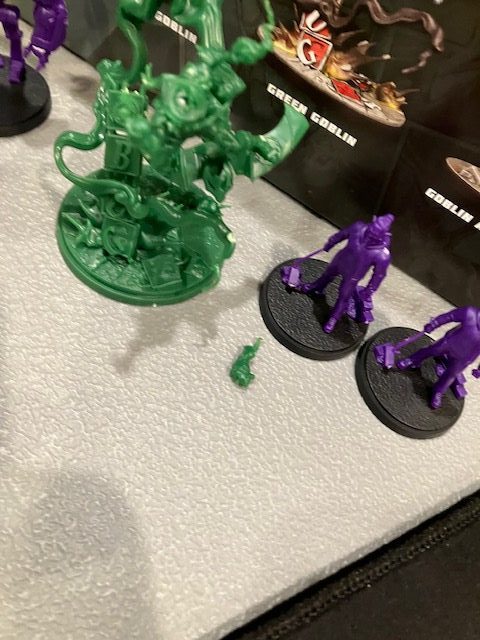
If there’s one phrase that captured the essence of this game, it’s the phrase “Green Goblin’s Head Fell Off A Lot!” See above.

Unboxing the First Time
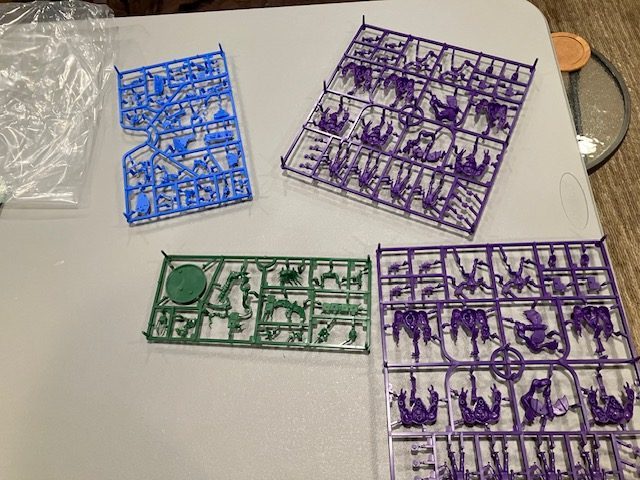
The first time I opened the box brand new, I saw … this!! Where are the miniatures? Oh, in case it wasn’t clear, you have to assemble them yourself!!
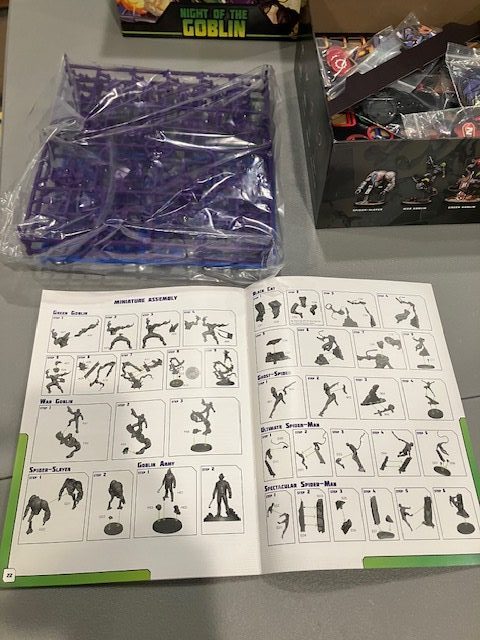
The instructions aren’t great: they assume a lot of knowledge! They show pictures (see above), but they don’t discuss many things! Do you need glue? What kind of glue? How do you separate the pieces? Are there tools you should use? I was so depressed after opening the box the first day, I pretty much just stopped. I had NO IDEA what I am supposed to do.
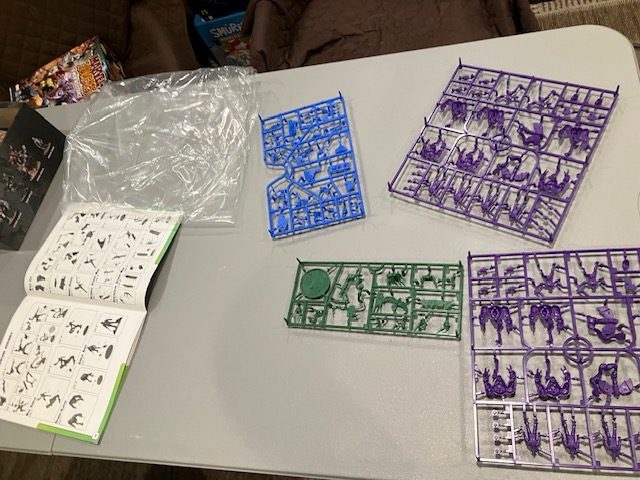
By the way, you might hear the term “sprues” associated with these miniatures: they are holding the minis pieces. Technically, a sprue is “a channel or waste piece in manufacturing and casting”, which describes the leftovers and plastic frames holding the minis.

I guess most people probably already knew you’d have to do assemble the miniatures : I did not. I just saw the advertisements on BGG and thought “Oh! A cooperative minis game!”. Don’t get surprised like me!

(Avengers Assemble has a VERY different meaning in this game!)

Replacements

I have to admit, I was scared to death of assembling these minis. The assembly instructions are minimal (arguably, there should be much more in the instructions), and it’s unclear what tools you need. I have a friend who loves craft projects, so I asked her to help me assemble the miniatures. While waiting for her to help me, I still wanted to try the game, so I found some … replacements.
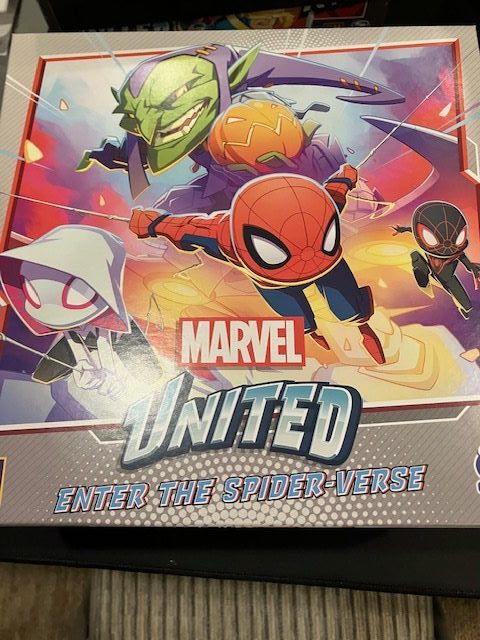
It turns out Marvel United has a a lot of the miniatures I needed!
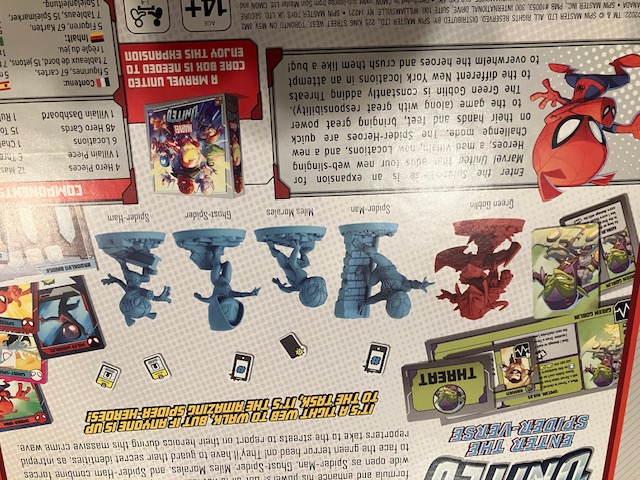
Basically, Marvel United: Enter The Spiderverse has all the good guys I need and the main Green Goblin! See above!
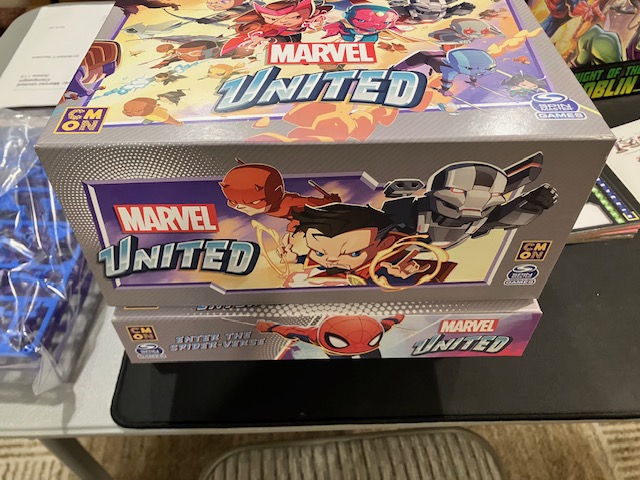
Unfortunately, Black Cat comes from the Stretch Goals (Season 1) (see above), which a lot of people may not have (I do). If you only have Enter the Spiderverse, you can cheat and use Spider-Ham mini for Black Cat.
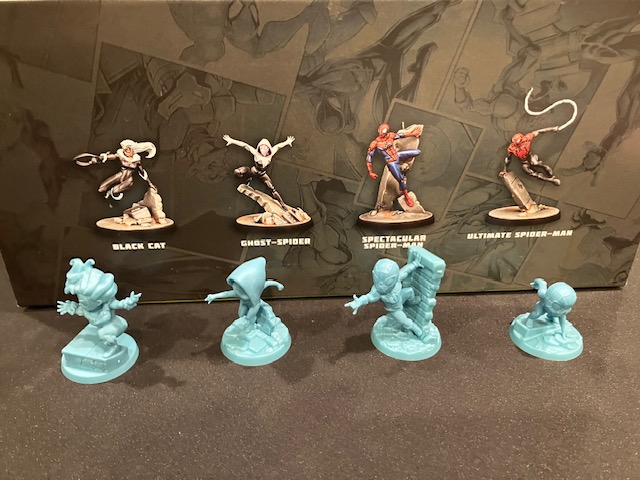
The minis look great for the heroes!
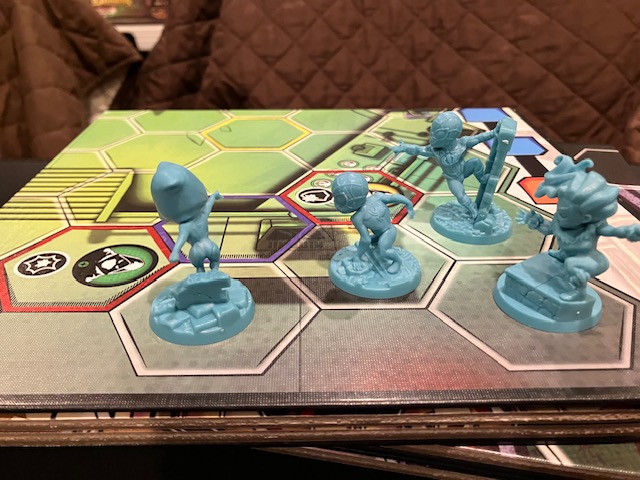
.. and they even fit well on the board.
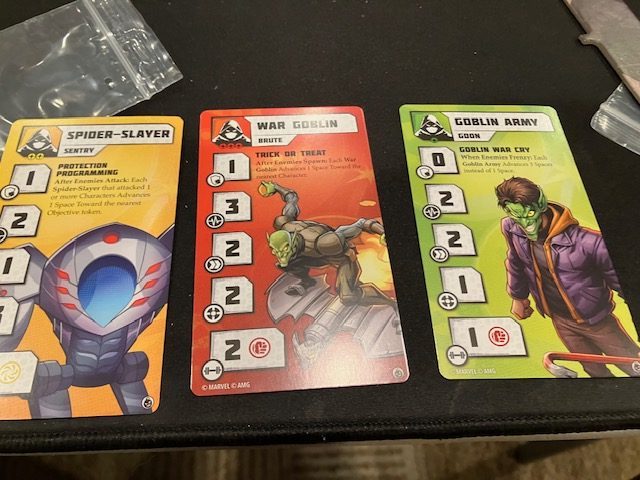
What about the bad guys? Well, Marvel United is the wrong game to use for the bad guys: there’s like 18 bad guys total, spread over three types (see above).
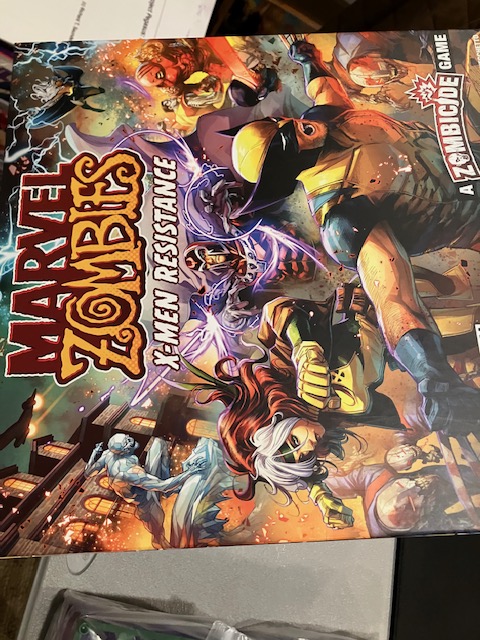
Marvel Zombies: X-Men Resistance to the rescue for bad guy minis! These aren’t quite as good a fit as the Marvel United, but they still worked reasonably well.
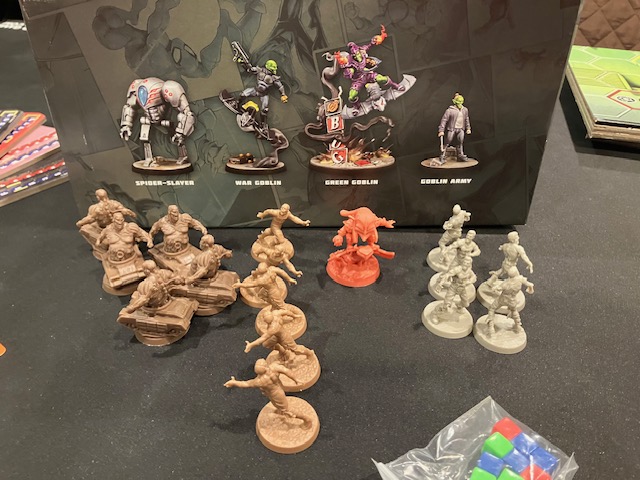
See above as the three different type of zombies “kinda” work for the three different bad guys. Green Goblin is perfect from Marvel United. If nothing else, the colors of each set of bad guys are distinct.
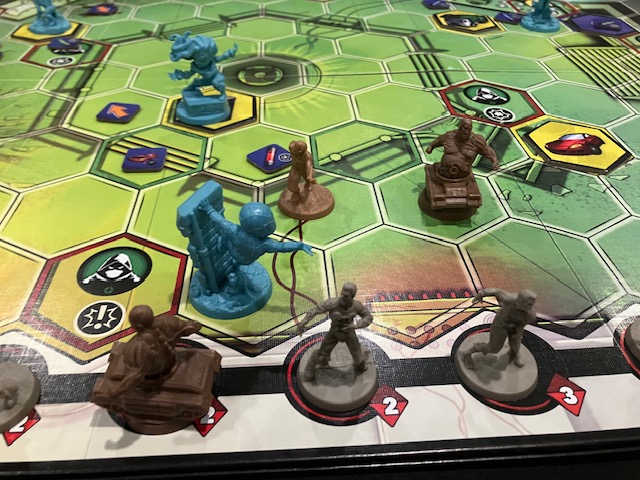
While waiting for my friend to help me assemble the minis, I was able to play the game and get a sense of everything using Marvel United minis (for the good guys) and Marvel Zombicide (for the bad guys)! See above as everything is set up and works pretty well!

Solo Mode
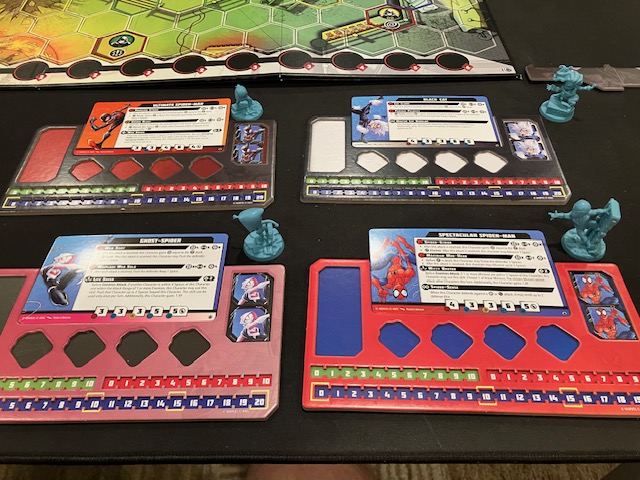
So, Marvel Crisis Protocol: Alliances does have a solo mode! Congratulations on following Saunders’ Law!
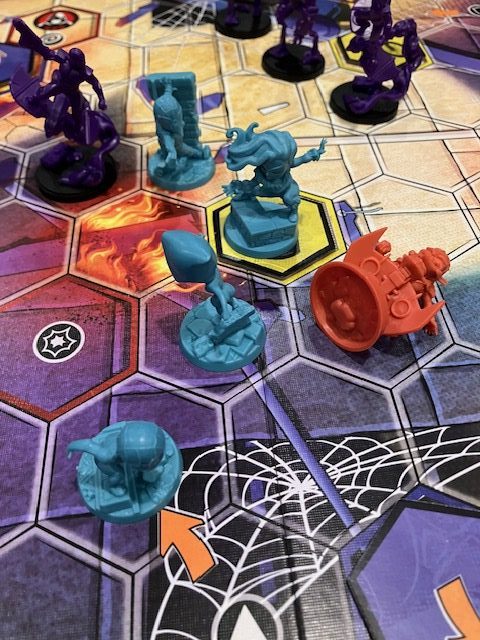
Unfortunately, this is not a true solo mode. The solo character must operate all four characters in the game! In fact, the game ALWAYS requires all four characters to be in play! So, the solo mode is simply the cooperative mode, overlaid with how many people operate the four Spider-People!
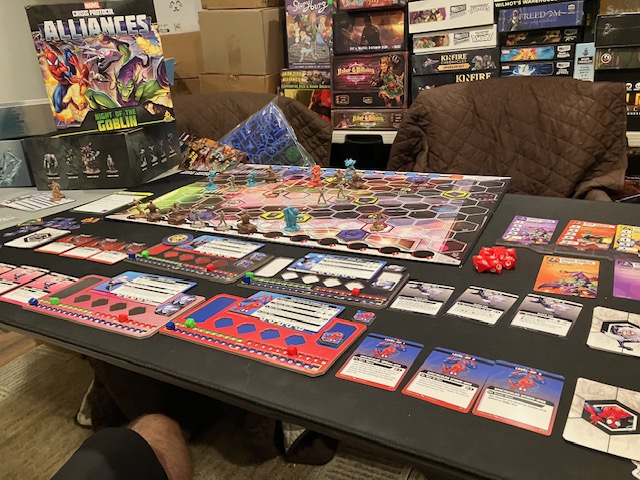
I gotta be honest: this is a rough solo mode. Why? Because each character has a lot of things to consider when they operate! What’s their special powers? How do I take best advantage of my character’s position? There is a LOT of context switching between characters as you play. Each character turn requires significant amount of thought (what do I use, what are my powers, do I have enough power, where do I end up), and then completely resets for the next character!
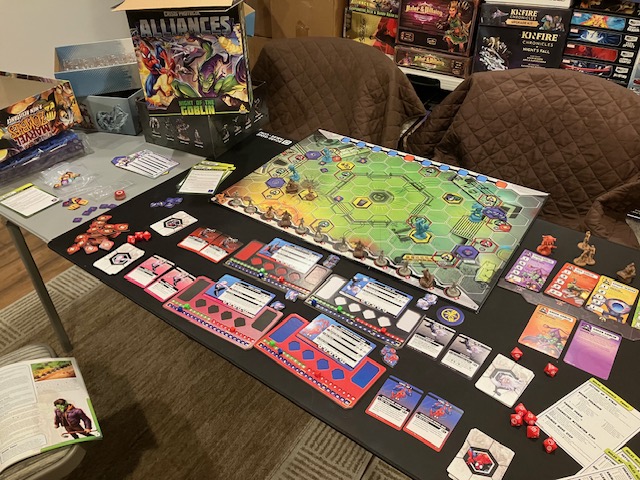
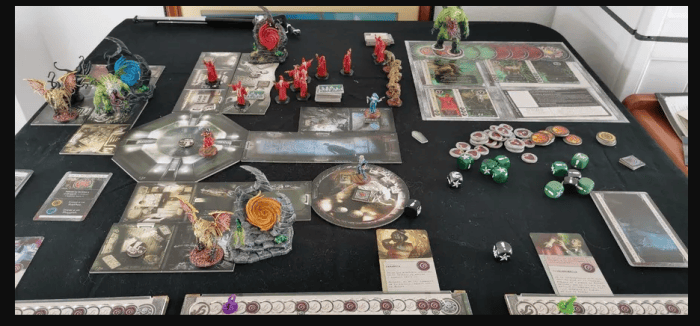
And, as you can above, that the solo game basically takes up the entire table!! This is a big solo mode with lots of work to operate.

Now, if you like puzzles, if you like really taking your time to figure out what each character can do, this might be a perfectly cromulent solo mode for you. For those of you are worried about the context switching cost between characters, let me just say that the context switch cost is non-trivial.
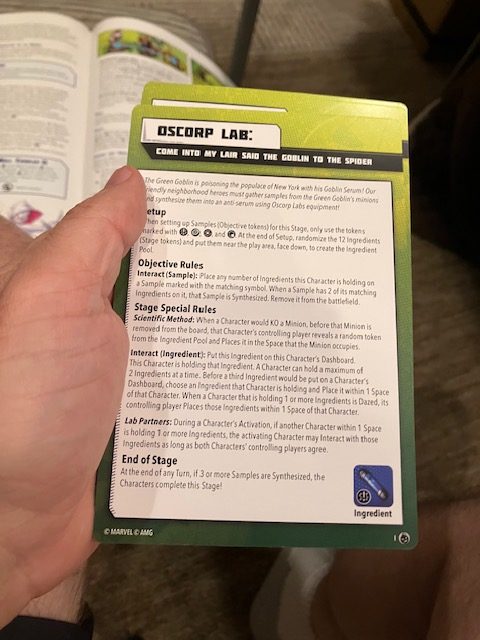
I liked the solo game … ish. I was able to play through an entire three game campaign. Each campaign has two intro games (see one above), and a final boss battle against the Green Goblin. That final boss battle is … hard. In fact, it was so hard, I sorta cheated once so I didn’t have to reset everything to retry.

Goblin-People Assemble!
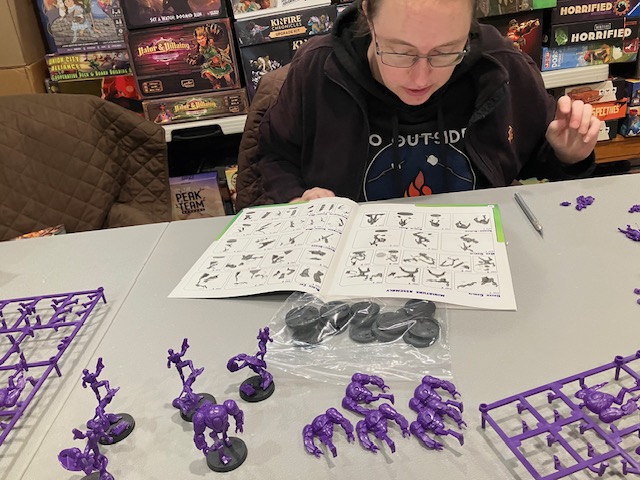
Well, thanks to Teresa, we actually got the minis assembled! To be fair, it took us two sessions (about 1 hour each) to get the miniatures assembled! In the first session, we used Exacto Knives and some Gorilla glue to assemble the bad guys.
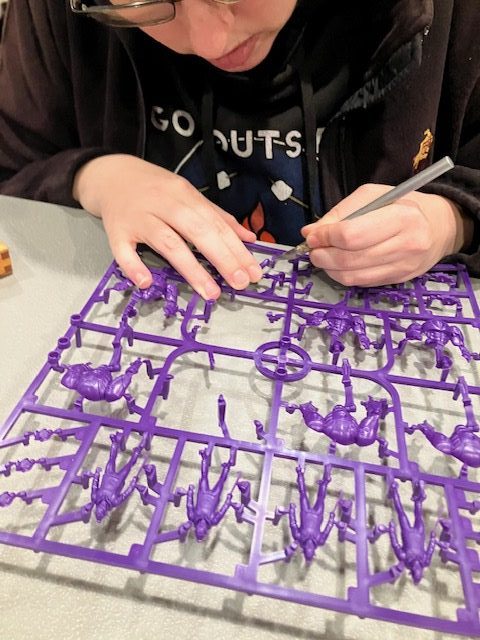
First, the Exacto knives “worked”, but they are not the optimal tool for this job. We had to “work hard” to get the Exacto Knives to cut through the Sprues. We were afraid a few times we might either cut ourselves or hurt the minis.
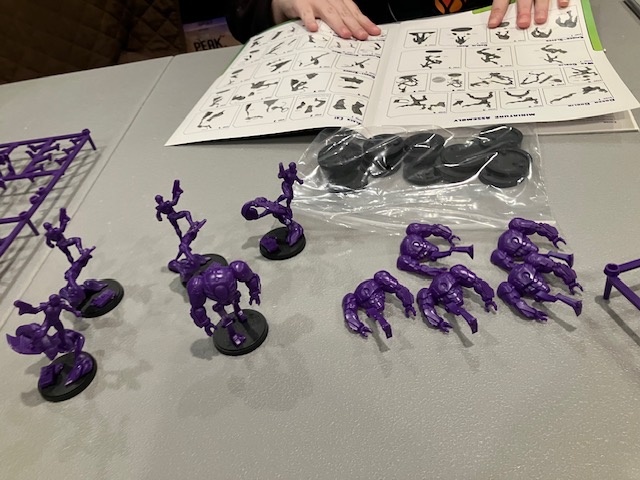
Second, the bad guys are significantly easier to assemble than the Heroes. The bad guys just have a few parts, and we were able to get 18 minis assembled in our first hour-long session.
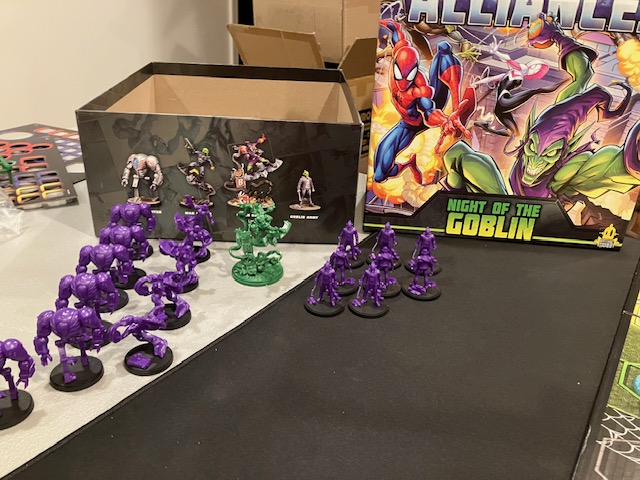
Thanks to Teresa and her efforts, we were able to use the Bad Guys for our first cooperative game!
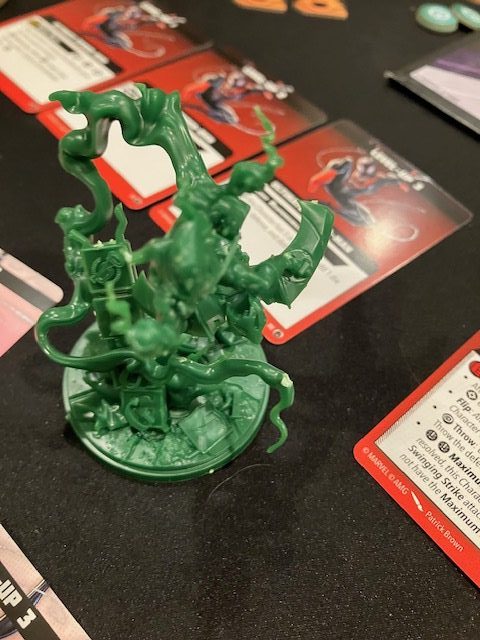
We did get Green Goblin assembled, but he head kept falling off. We weren’t sure if we were supposed to glue it?

Summary: Over two sessions at an hour each, me and my friend assembled all the miniatures. Avengers assemble! So, four hours of work total? If it were just me, it would have probably taken 5 hours for everything (if you just go by the workload and my lack of experience with craft projects).

Cooperative Game (3-Players) with Bad Guys minis!
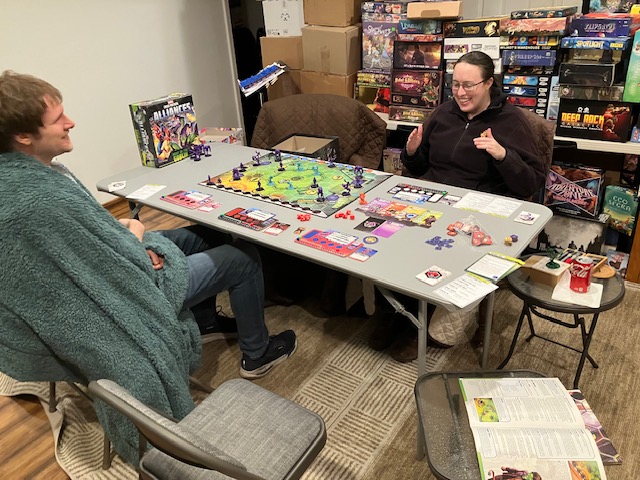
So, for our first cooperative game, we played a 3-Player game! Remember, you must ALWAYS have four characters in play, so Andrew and I “shared” the duty of operating Miles Morales, Teresa operated Black Cat, I operated Spiderman, and Andrew operated Spider Gwen. (I guess we shouldn’t call her Spider-Gwen … that gives away her secret identity!) See above and below as we use the newly assembled bad guys, but still use Marvel United good guys.
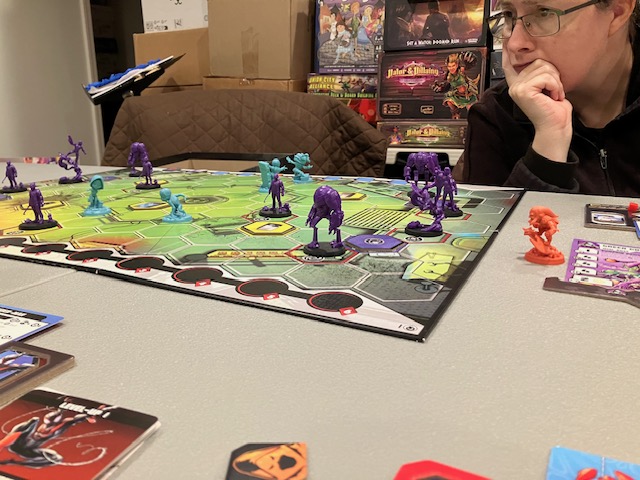
We had a fine time, not great, but we got a sense of the game. The game definitely moves a little quicker than the solo game, as each player keeps fewer “contexts” in their mind.

One of my favorite parts of the cooperative game was the use of Player Selected Turn Order (see link here for discussion of PSTO). To be complete: Marvel Crisis Protocol: Alliances uses coarse-grained Player Selected Turn Order. This means that players can take their turns in any order they choose (they just can’t split up their turns). This was a good part of the strategy of the game, as you could try to plan for who has the Priority token, plan for bad guys coming out, and try to reinforce other player’s turns. I think that worked exceptionally well in this game. To be fair, I am a big advocate of PSTO in cooperative games (as I think PSTO usually makes the games more cooperative).

To a lesser extent, the Heroic Action worked pretty well for the cooperative game. When players defeat a bad guy, they can use a Heroic Action to give another player a move, a power, or a heal. It’s great for making the game more cooperative (“Give Andrew a heal! Spider-Gwen is really far down!!), but it doesn’t seem particularly thematic? Why does me defeating a bad guy give someone else a heal? It’s great, I think it helps balance the game … it just doesn’t feel particularly thematic. It definitely helps the cooperation.

My friends liked the game enough so that we could continue onto the second game in the campaign. Next time. It took quite a while to get into the game and play it. We could only get one session done in one game night.

Spider-People Assemble!
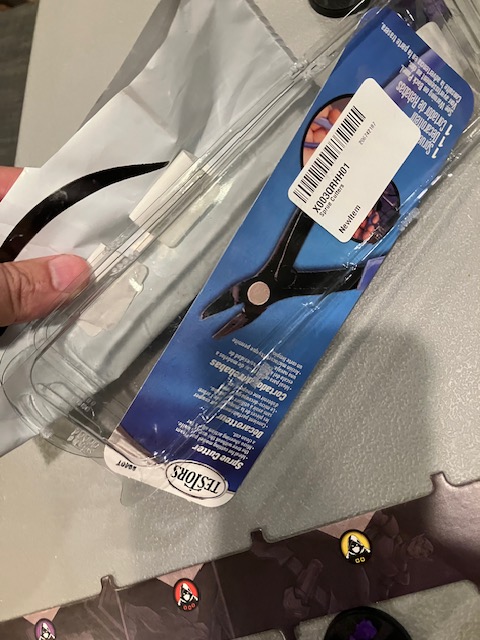
Because the Exacto knives were just “ok”, I found some Sprue cutter on Amazon for like $10. That made a big difference! It was SO MUCH easier to remove the minis using the Sprue Cutters!!! Why wasn’t this in the rulebook??
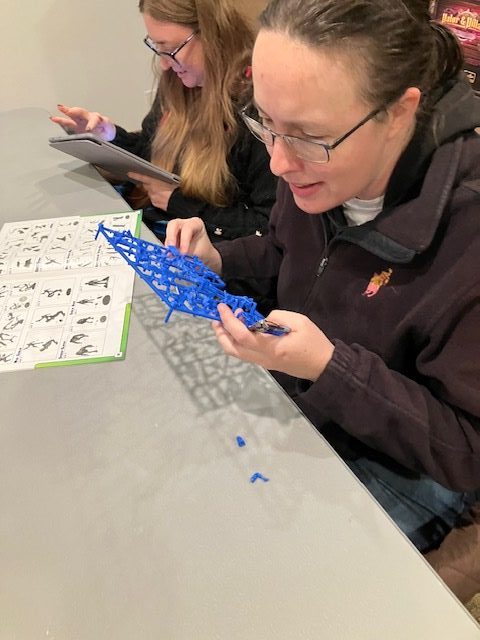
It was good we waited a week to get the Sprue cutters to help us, because the good guy miniatures are significantly harder to assemble! There’s only 4 good guys (and 18 or 19 bad guys), but it still took us an hour to assemble them!
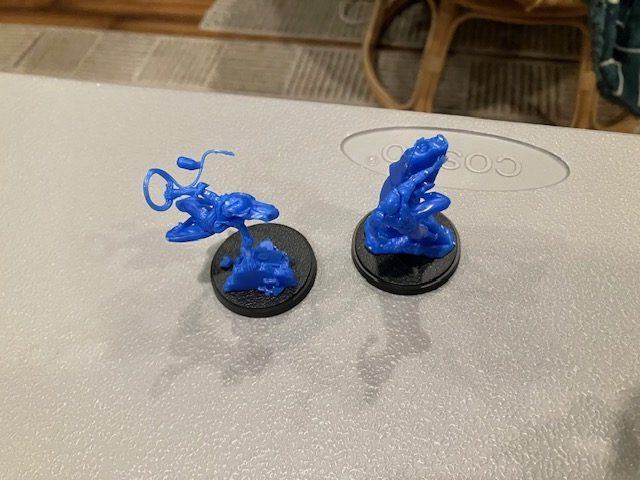
But the good guys are also a lot more intricate, and unfortunately, more fragile. See Black Cat’s thin thin whip?
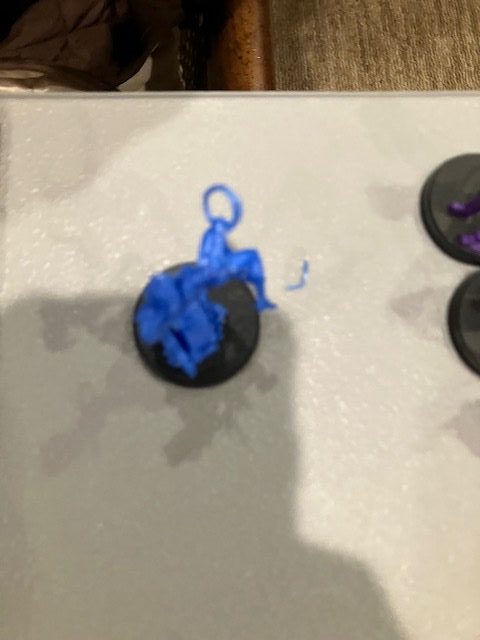
It fell off during normal handling!
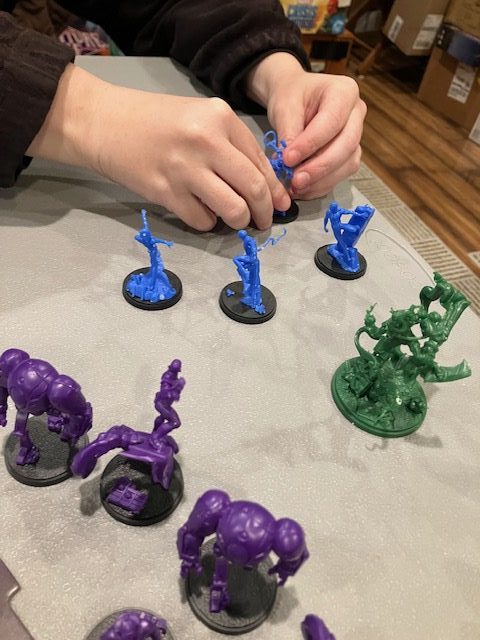
In the end, we got all four good guys assembled. With a lot glue to keep fixing breaking parts! They took an hour! They were much more complex! If you are reading this and plan to get this game, make sure you get Gorilla Glue and some Sprue cutters or you will hate life!

Cooperative Game (4-Players) with all minis!
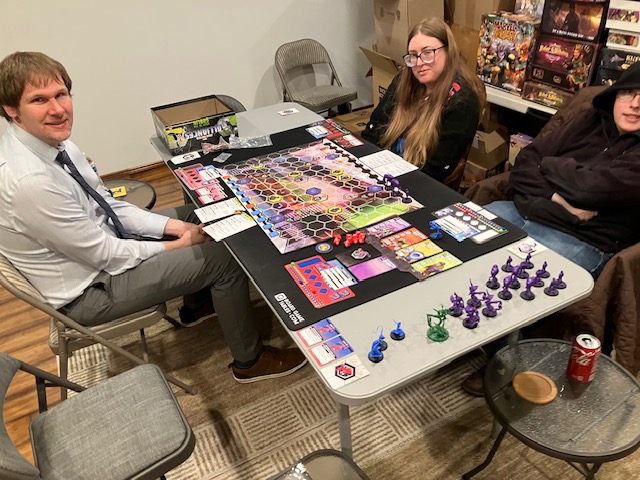
So, for our second game, we were able to play with 4-Players! And to be fair, I think that makes the game a lot more fun. I prefer playing when you have one character per player! Then I FEEL like a Superhero! But, if I have to operate multiple heroes, it’s not quite the same experience?

If you do end up getting this game, I would strongly recommend getting a group of 4 players to play it! This game is strongest at 4-Players because each player is a super-hero!
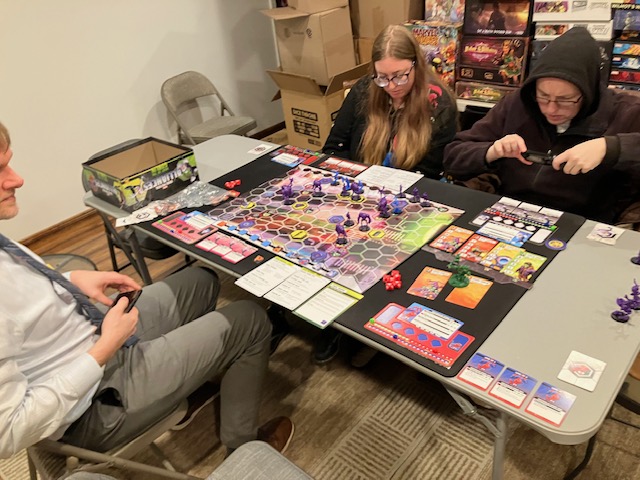
We ended up playing through and winning, but I don’t think my friends want to continue to game 3 (the Boss Battle).

Reactions
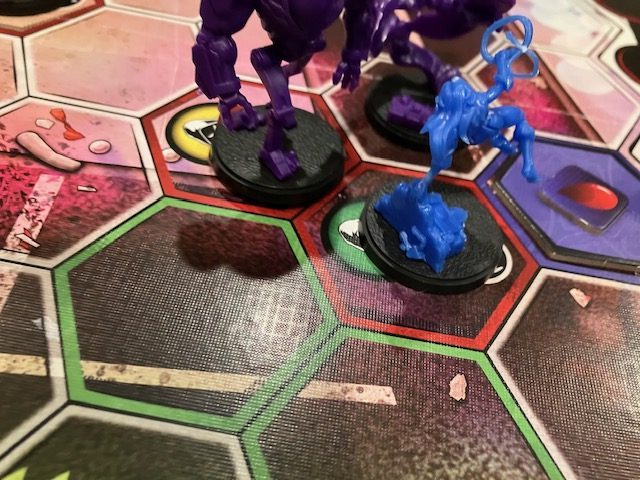
The reactions were pretty much, “It was okay, but nothing special”.

The main complaints were two-fold: One, if you didn’t have enough power, you could only do one really useful thing on your turn. There wasn’t a lot of choice?? Second, you can only do one thing on your turn … which is usually move or use a power. Not being to move and do something (move and strike) seemed … less fun?

To be fair, a lot of the powers allowed you to move and strike, but only if you could afford the power cost. It also felt weird that you “get power” usually when someone hits you? The power economy seemed very athematic (“wait, I get power when someone HITS me???”). It seemed balanced and it worked, but it didn’t seem… thematic.

Another complaint was that forces were “overwhelming”. On your turn, you might defeat 6 bad guys, but they pretty much all come back next turn! Andrew argued that it almost didn’t matter that we had this cool hex board, because the bad guys just came back out next turn! And it was very random! Doing a bunch of damage to bad guys is the only way to “move forward” (get power, get heroic actions, get experience), but they all just came back. It didn’t seem like there was a lot of strategy: the bad guys just always come back. It was also sort of depressing: you’d defeat a lot of bad guys, but it didn’t matter.

What I Liked
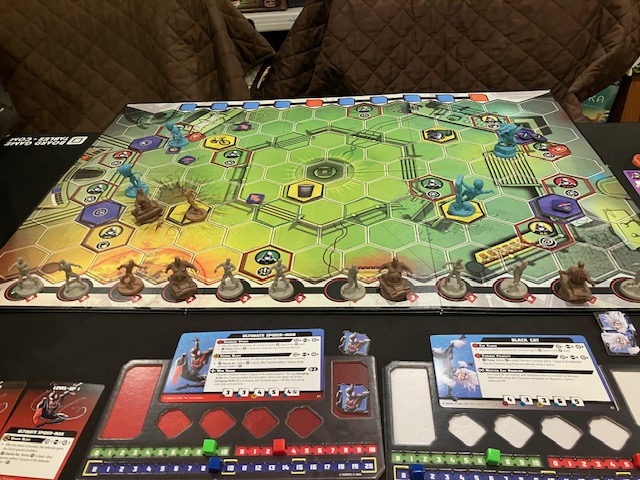
PSTO: The Player Selected Turn Order worked very well in this game; for me, it was almost the highlight of the game that it worked so well.
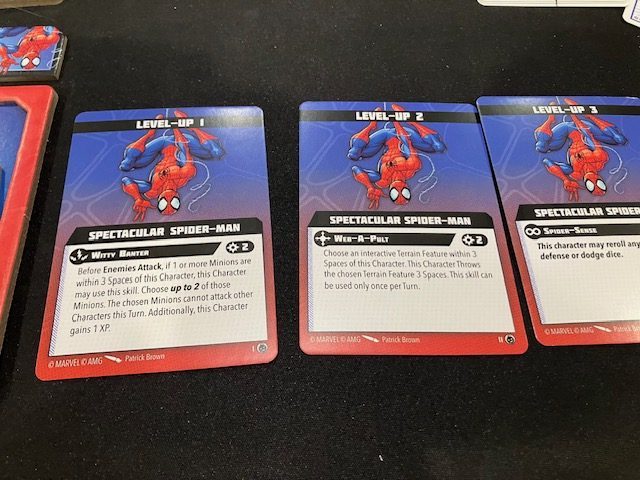
Power-Ups: As the game progresses, you get power-up cards when you go up a level! That was very cool, that you felt like you character was always getting more powerful. By the time you get to game 3, your Spider-person is pretty powerful!
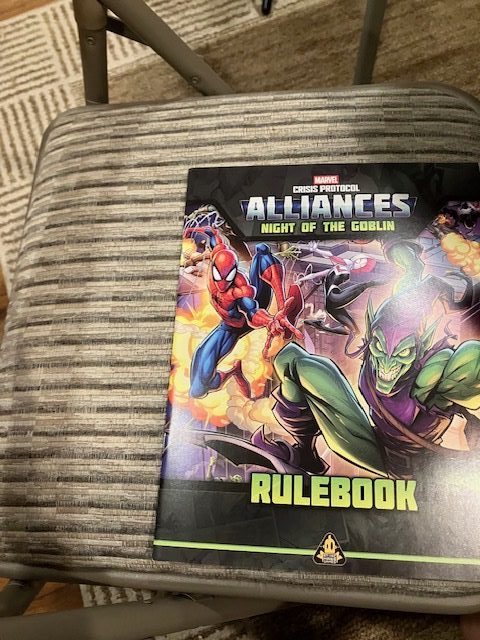
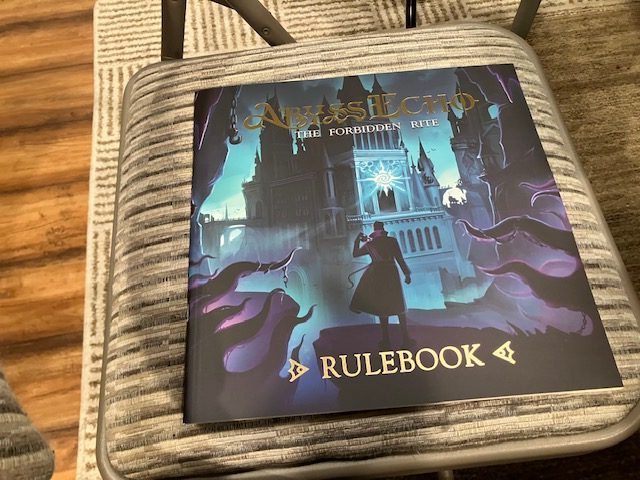
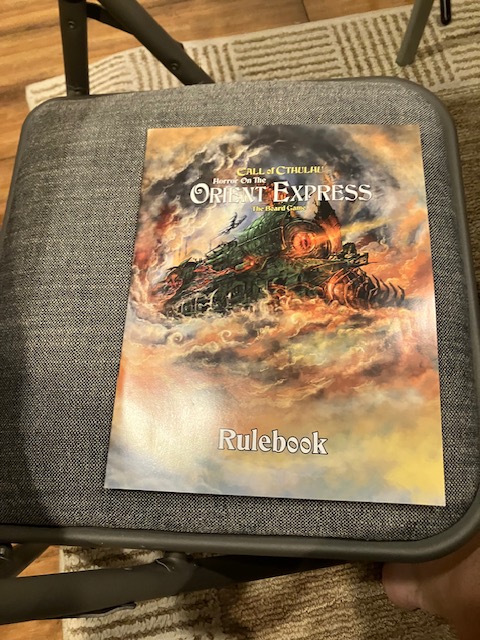
The Rulebook: The rulebook had some problems (where is my Index? How do I assemble the minis?), but it was decent for the rules (but … it really needs an Index). It also had a good form factor, and gets a B+ on the Chair Test (it works well on the chair next to me).

Cooperation: With the PSTO, the Heroic Actions, power-ups, and the theme of the game, the cooperation came out pretty well.

What I Didn’t Like

Miniature Assembly: I had NO IDEA what I was getting into with the minis when I got this game! Assembling the miniatures is its own mini-game! Be aware of what you need to assemble the minis: get Sprue cutters and glue or you will hate life!

Fragile: These miniatures are fragile. Green Goblin’s head kept falling off, Black Cat’s whip broke off during gameplay, and the Goblin Army’s crowbar broke off during assembly. As a direct juxtaposition, I have NEVER had any problems with my Marvel United miniatures … and I have 100s of those miniatures and have played Marvel United so many times!!
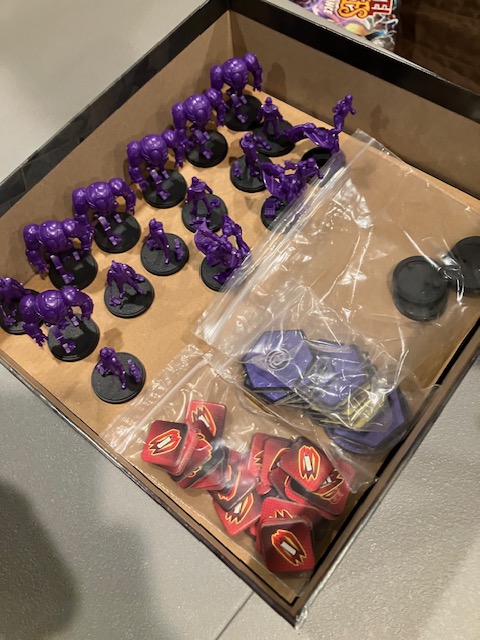
Storage: How the hell am I supposed to store these miniatures? Right now, I just set them up standing in the box, but this solution is so fraught with peril! See above! Any slight bump, and these “already fragile” minis will go everywhere! I can’t store this sideways? This just seems like a major failing!
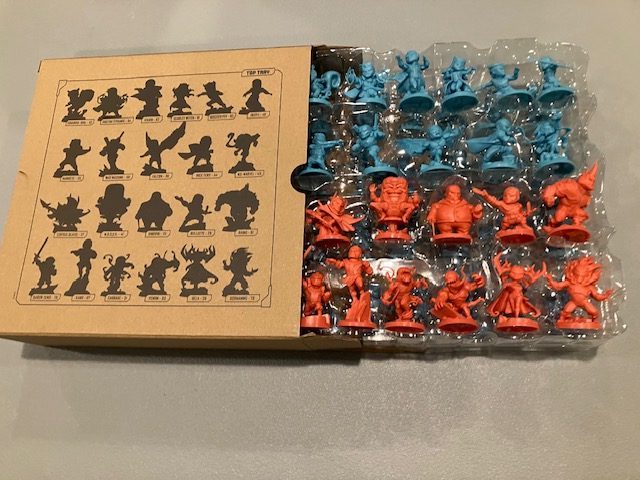
Compare that to my Marvel United minis! They always fit well back into the box well … with a storage solution.

Four Characters: there’s only four characters in the box. And you always have to play with four characters. There’s not a lot of variety (but I hear more Alliances are coming out). The solo game is really rough, especially as the characters get more and more powers: by the time each character is level 4, the number of powers for the solo gamer to keep track of is mind-bending!
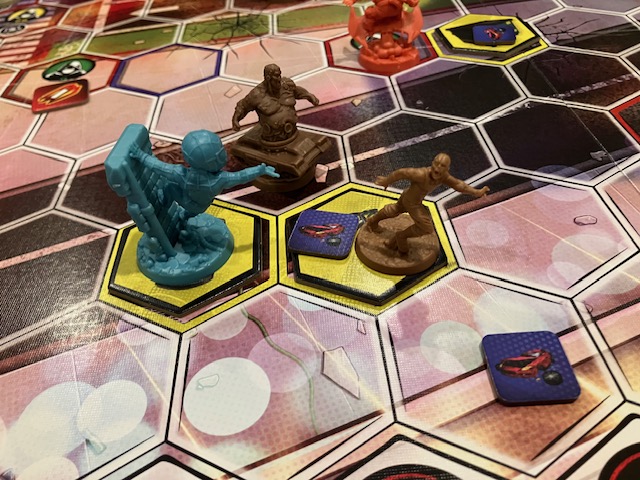
Gameplay: The “constant pressure” of the game made it so it felt only tactical and not strategic. Everything depends on the dice you roll for where the enemies spawn: you don’t really know where the enemies will end up. You sort of get tired of they way they spawn: “what’s the point in defeating a bunch of bad guys when they just come back?” I know a lot of super-hero games do this, but it feels like you are making more progress in other games?
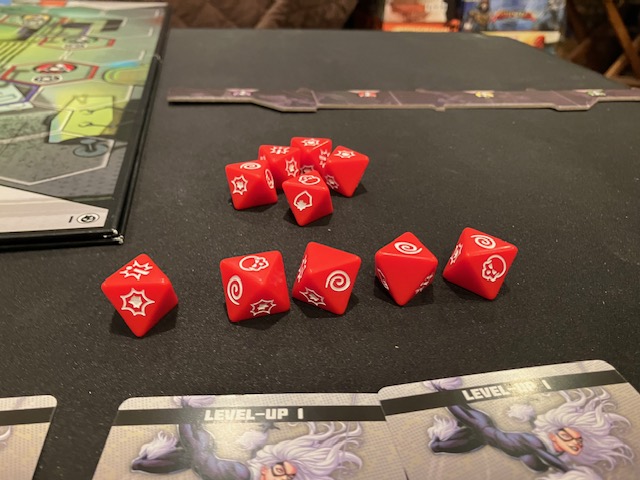
Random. At the end of the day, this is a dice game. The dice decide if you get hit, the dice decide if you hit, the dice decide where the bad guys spawn, the dice decide if enemies frenzy. It can be random and it can be frustrating if you wanted a more strategic game.

Conclusion
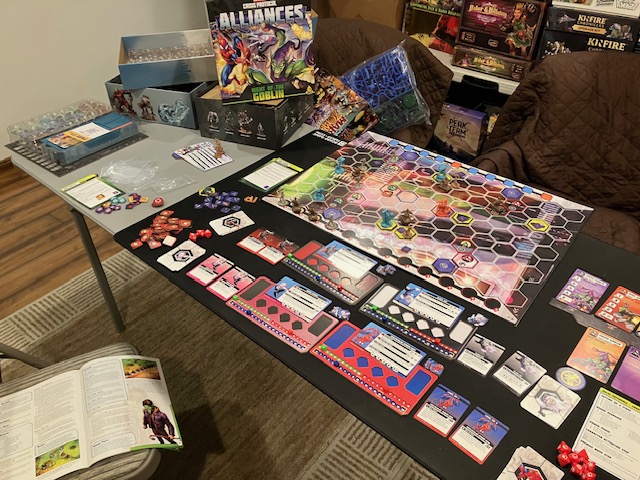
Where you end up on Marvel Crisis Protocol: Alliances depends on a lot of things.

The constant pressure of combat feels more like an intense video game: you may love that, or you may hate that. Enemies spawn and just constantly put intense pressure on the heroes! The game is very very tactical and much less strategic than you might assume … I don’t know about you, but if I see a game with a hex-map, I assume it’s quite strategic? (I guess that makes me a hexist).
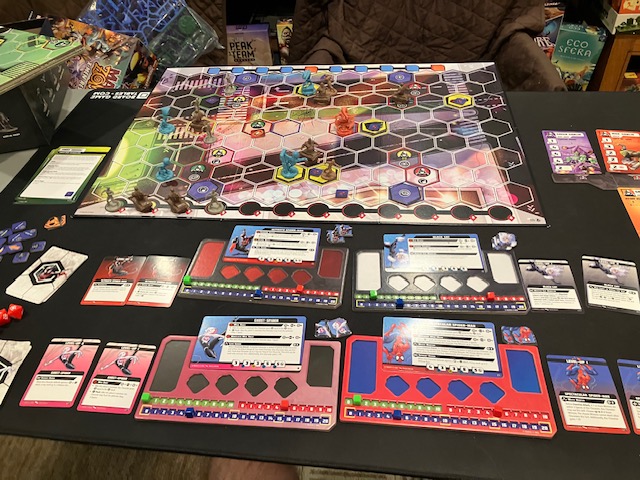
The solo game is rough as you have to operate four Spider-People! If you love that slow solo game and context-switching between complicated characters, then this might be perfect for you. It’s a puzzle? It’s just .. a bit more random because everything depends on how well you roll the dice.

The best version of this game is the 4-Player cooperative game, as each player gets to be a Super-Hero! I think 2-Player is probably the next best (as each player operates 2 heroes). The cooperation that does emerge via PSTO, Heroic Actions, powers, and the theme shows this to be a good cooperative game.

Be aware of the miniatures experience! If you aren’t expecting the sprued miniatures, Marvel Crisis Protocol: Alliances can be overwhelming! If you are interested in this, make sure you pick up some Sprue cutters and some Gorilla glue (as Green Goblin’s Head keeps falling off!!) The miniatures are cool, but they are fragile. And I have no idea how you are supposed to store them.

If you want a simpler super-hero game with miniatures, Marvel United might be a better choice. Marvel United is a better game, has a better experience with miniatures (they actually have a storage solution), is significantly cheaper ($25 for the base Marvel United game vs. $100 for the base of Alliances), has more variety, and is significantly easier. Be aware that some people blanche at the minis in Marvel United because they hate the chibi look.

If you like the experience of dissecting, assembling, and painting miniatures so you can then play with them, then Marvel Crisis Protocol: Alliances might be the perfect choice for you! The game does work, and it is a pretty good cooperative game.

The final grade is divided:

Sara and Andrew give it a 6/10: it’s okay and it works, but there are better games.
Rich gives it a 6.5/10 : Rich liked the cooperation and superhero theme, but the random nature of the dice brought it down just below recommendation. It could be a 7/10?
Teresa gives it 7/10. Teresa liked the minis; she helped assemble them, so she is aware that she may have a vested interest.

So, on average 6.5/10? Hopefully you can figure where you end up based on this write-up
Top 10 Cooperative Cthulhu Mythos Games!

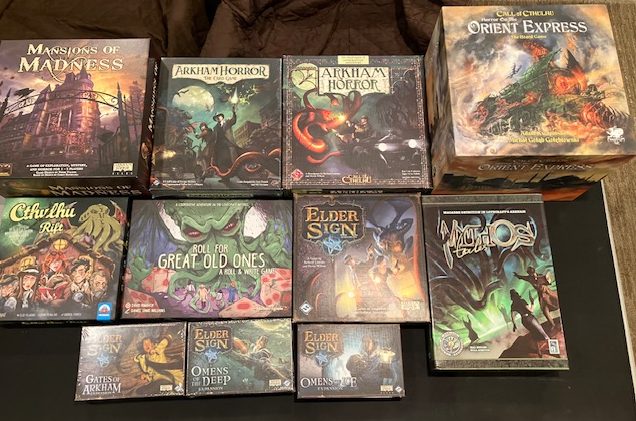
Welcome to the end … of Cooperative Cthulhu month! We’ve seen three brand new cooperative Cthulhu games in the last month! How do these stack up against old favorites? It seems fitting to end Cooperative Cthulhu month with a Top 10!

This list is a composite of about 20 different people’s opinions! It was compiled over the last month to try and capture what a community of board gamers think of cooperative Cthulhu games! The data wasn’t clear in some cases, so I made the best judgment I could based on all the ratings I saw! In the end, my preferences tended to shape the final list!

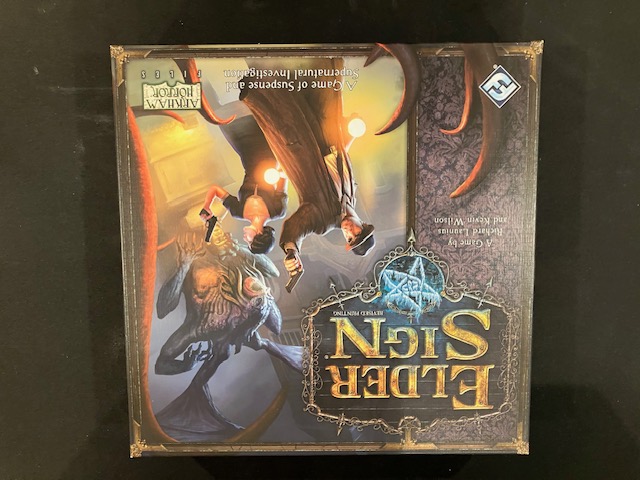
10. Elder Sign

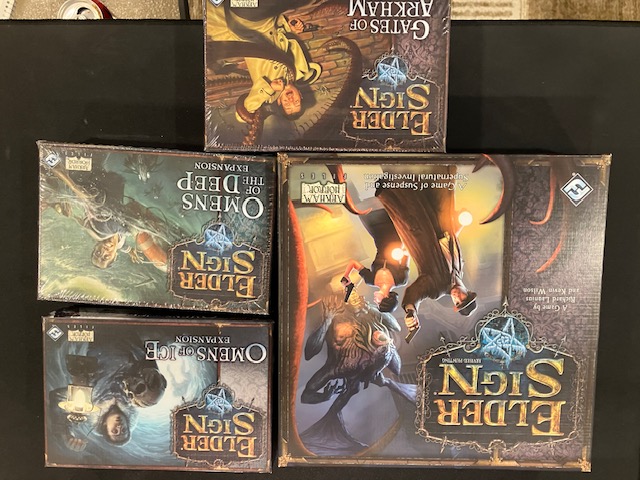
At its core, Elder Sign is really just a dice game, kinda like Yahtzee. But it’s the expansions that keep Elder Sign alive and thematic! Players explore someplace creepy, a museum, an ice flow, the oceans, … and uses dice to help resolve things!


This one may have made the list for nostalgic reasons, but there are so many expansions that keep this game fresh and alive through the years!

A lot of people put this on their list, even if it wasn’t their favorite Cthulhu-esque game! This is a favorite that still comes out from time to time!

9. Cthulhu Rift

I was surprised how much my friends who have played Cthulhu Rift liked it! Not many have played this, but those who had liked it and its roll-and-write simplicity!

Like any good Cthulhu game, players must fight cultists, navigate Arkham, find clues, and plug portals! It’s surprising how well this works in a roll-and-write (kind of) games.

Take a look at our review of Cthulhu Rift to see if you might be interested in this! This is a bit of hidden gem, but all my friends who played this have liked it!

8. Roll For Great Old Ones

Roll For Great Old Ones was one of our favorite cooperative roll-and-write games from the Top 10 Cooperative Roll-And-Write Games! It’s actually quite thematic for a roll-and-write game in this universe!

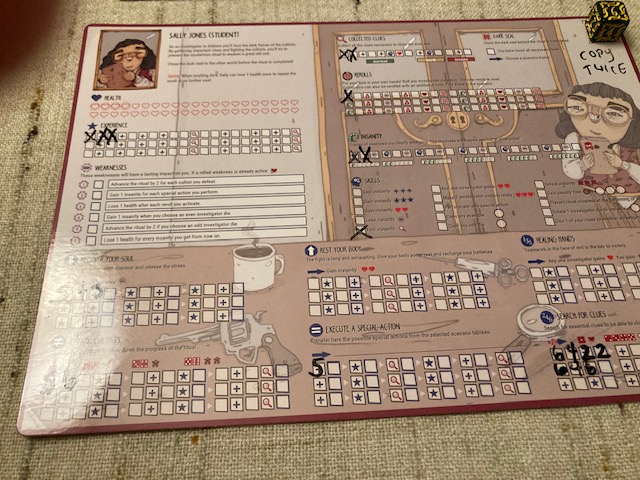
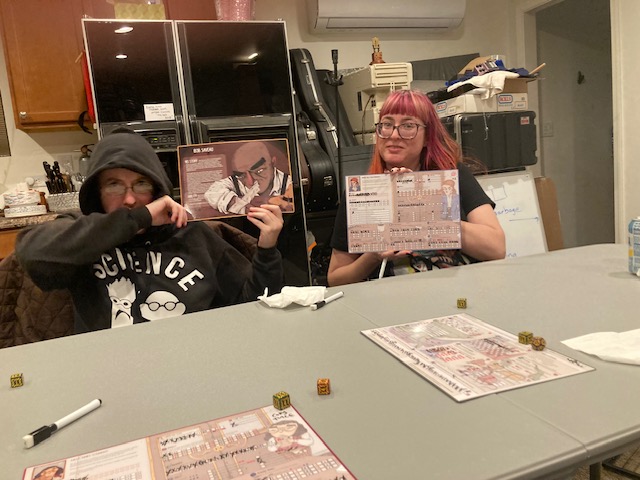
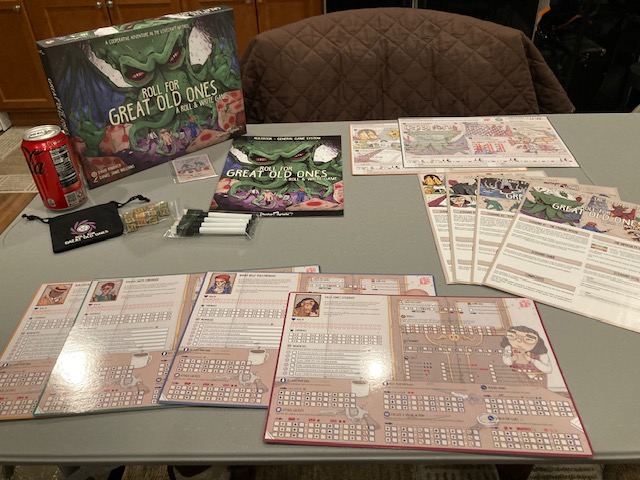
Every turn, players roll the dice and “COPY TWICE” and mark things off their sheet! Summon creatures! Perform rituals! This is a fairly complicated roll-and-write with lots of stuff going on. See one of the the great laminated sheets above! Everyone has their own sheet as well with different powers!

Even though this is a little more complicated that Cthulhu Rift (previously mentioned at #9), I generally think Roll For Great Old Ones is the better game. See our review of Roll for Great Old Ones here to see if this is something you might like.

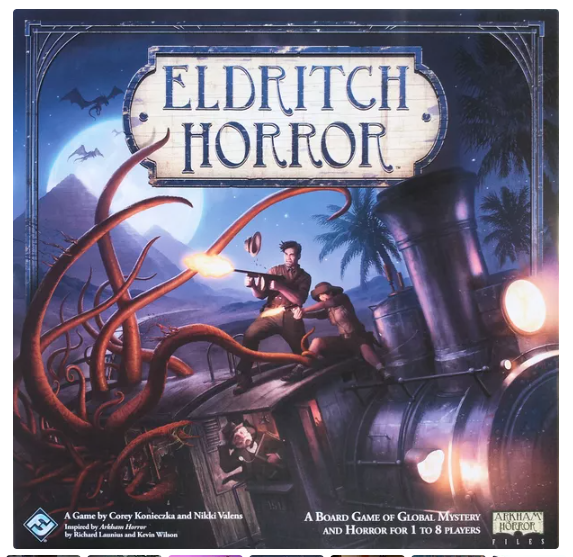
7. Eldritch Horror

Although I have never played Eldritch Horror, a lot of my friends spoke up and gave Eldritch Horror a nod! For some of them, it replaces Arkham Horror 2nd Edition! It’s nominally a little shorter and less dense!

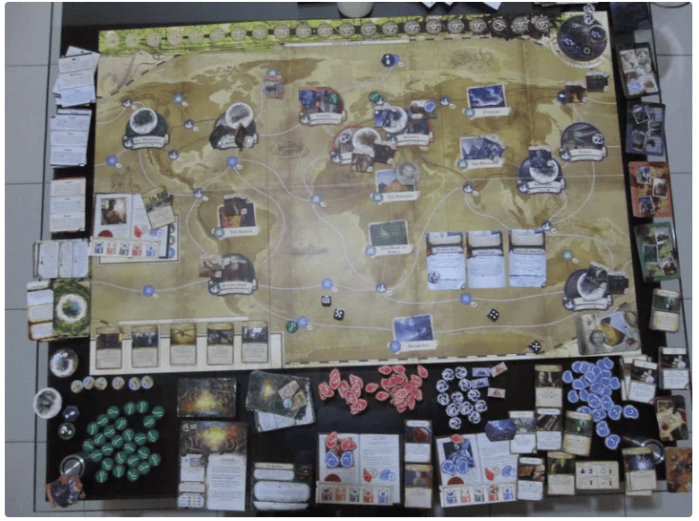
It’s also a little different theme! Rather than wandering the streets of Arkham looking for Cthulhoid type creatures, you are more like Indiana Jones wandering the earth! This is an adventure game in the Cthulhu-esque universe with epic combats and thematic treks across the globe!

Some people still prefer Arkham Horror 2nd edition, arguing that Eldritch Horror is not THAT much shorter or THAT much simpler. But, some people prefer Eldritch Horror for that epic sprawling adventure! Either way, it deserved a space!

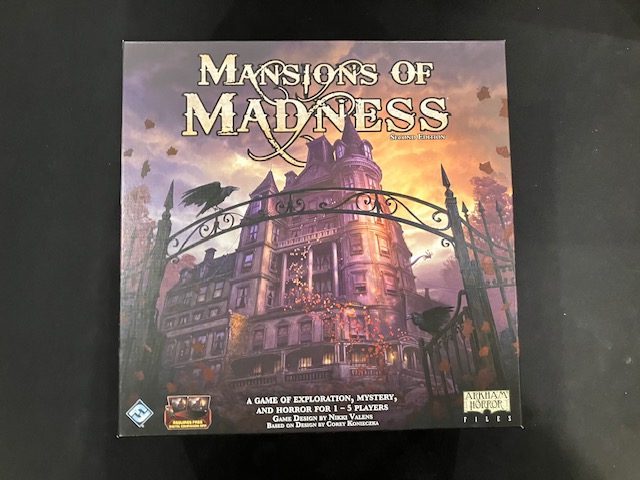
6. Mansions of Madness: 2nd Edition

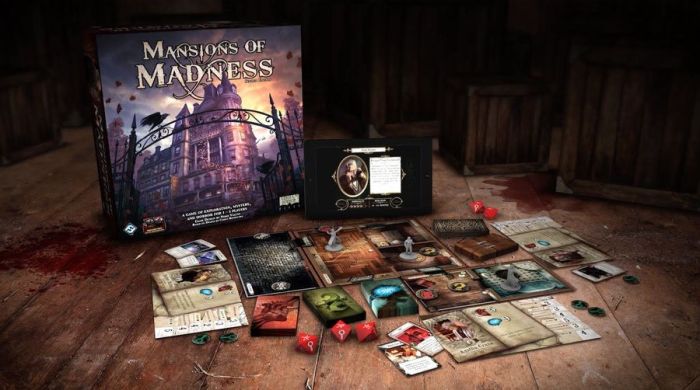
I have a complicated relationship with Mansion of Madness. The first time I played the 1st edition of Mansions of Madness, I absolutely hated it! The 1st edition is a one-vs-many game as one player runs the mansion, and the other players play against him! This antagonistic atmosphere really put me off the game.

I did pick up the 2nd Edition of Mansions of Madness on a whim, and I am glad I did! In the 2nd Edition, an app plays the role of the Mansion and the players all work together fully cooperatively to survive! Some people may not love the idea of an app running the bad guys, but I it does work.

Over the years, I have played some fun games of Mansions of Madness, usually on Halloween! The game is creepy and thematic as the app boths runs the game and plays creepy music! There’s a ton of content for the game and I have come to have some really good creepy times playing in this creepy Mansion! Also, a lot of my friends also gave the same props to Mansions of Madness, 2nd Edition.

5. Arkham Horror: The Card Game

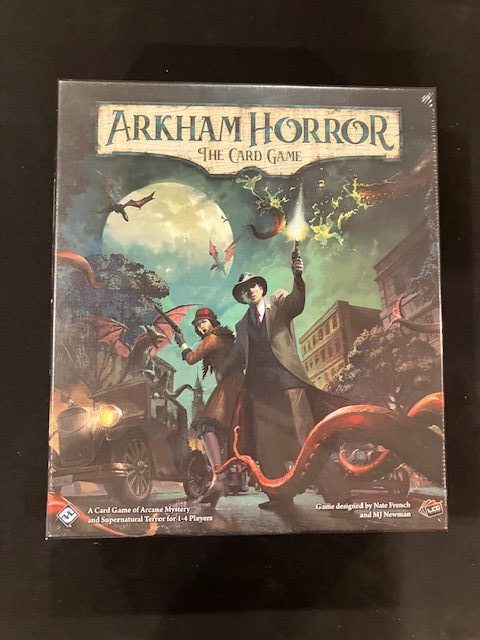
Arkham Horror: The Card Game is probably the most divisive game on this list, which is why it is only #5! Some people loved it, and claimed it as their #1 game, and some people said how much they didn’t like it, and other people said that Marvel Champions has completely replaced The Arkham Horror Card Game for them! It’s very similar to Marvel Champions in terms of gameplay, but arguably the Arkham game has a lot more story!?

Still, a small group of my friends in Las Cruces get together and play this regularly! They LOVE it! There’s a ton of story! There is SO MUCH content with new adventures for this game! If you find yourself drawn to this, you will have plenty of content to choose from! Just be careful, as there is a 1st edition and 2nd edition (and newer one which is still compatible with 2nd).

4. Horror on the Orient Express

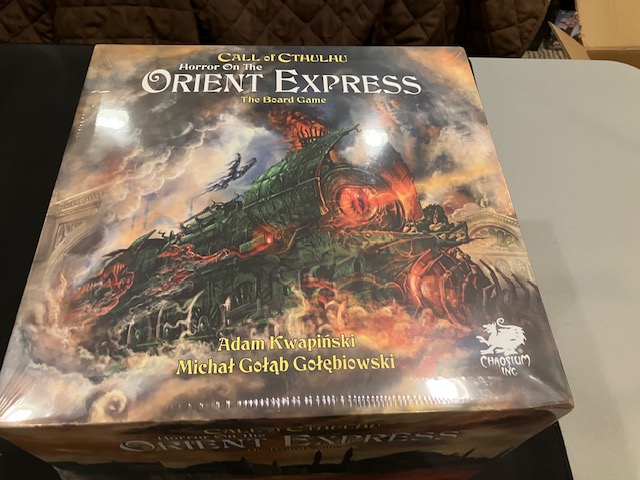
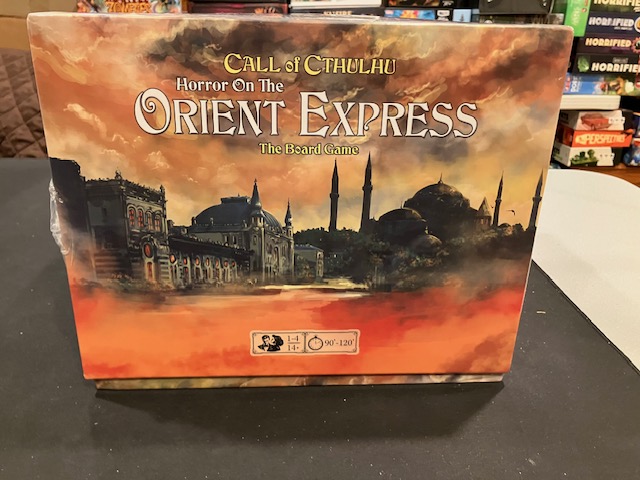
For a newer game, Horror on the Orient Express went over quite well with my groups! This is basically Cooperative Cthulhu Clue as players work together to solve a mystery while traveling on the Orient Express!

Players have to uncover facts to find out who are the Cultists in your group, with a kind of Clue-like vibe!

At the same time, players must fight Cthulhoid type creatures racing along with the train in the Dreamlands! It doesn’t matter if you solve the mystery if you can’t keep the train and its passengers safe!

There’s an awful lot to this game: it will require a substantial time investment. And there’s a ton of content and expansions! But, like some of us, if you love the idea of an Agatha Christie mystery novel taking place in a Cthulhu-esque world, this is a perfect game for you! See our review here of Horror on the Orient Express to see if this might be a game for you and your group!

3. Death May Die

Death May Die is not the most popular game in my gaming circles, but the people who love it, love it! This was far and away the favorite Cthulhu game of a number of people, which is why it’s so far up the list!

This was far and away Adrian’s favorite game! And I am pretty sure it is one of Mike Heller’s favorite Cthulhu games too!

2. Mythos Tales

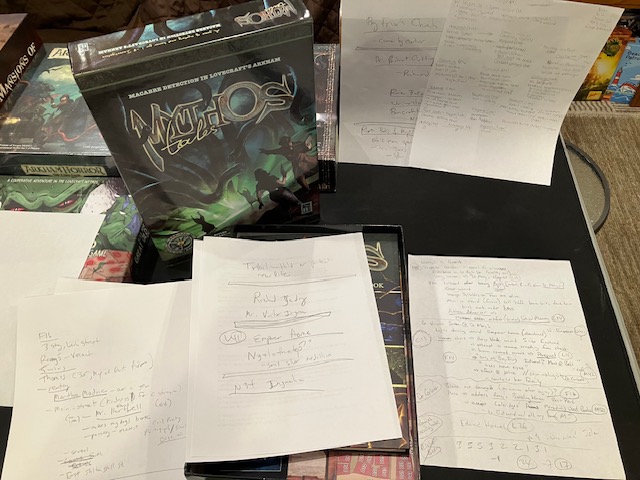
This one might surprise you … some of you have probably never even heard of this! Mythos Tales is basically Sherlock Homes: Consulting Detective themed with Cthulhu Mythos! Of course, there’s a very good chance you’ll go insane solving the mystery, but that’s par for the course for most Cthulhu games!

Part of the reason this game ranks so highly is that it hit some of us so hard … in a good way! My friend Joe, at his job as a teacher, was able to engage at-risk readers with this game! The idea of reading stories, looking at maps, and investigating this world was so much fun! It turns out, if you gives someone a reason to read (investigating horror), then they want to read!

This is, unfortunately, long out-of-print, but it’s pretty easy to get a used copy. If you like the idea of being a detective in the Cthulhu world, using Sherlock Holmes: Consulting Detective mechanics, this is the perfect game for you! (Make sure you get the 2nd edition if you can; if not, make sure you get the errata).

1. Arkham Horror: 2nd Edition

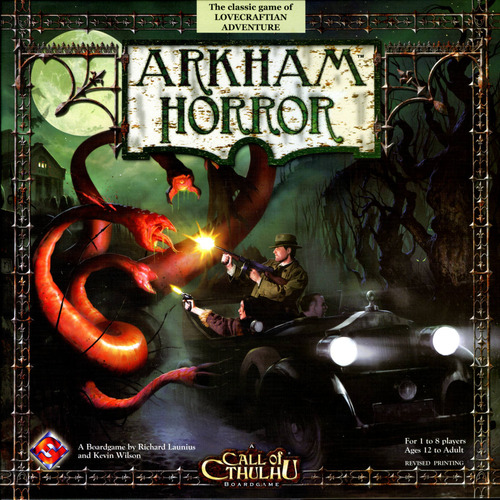
Arkham Horror: 2nd edition has a special place among me and my friends! That’s why it’s #1! It was arguably the first cooperative board game many of us have played, and we embraced all the content for it! I think I personally have all the expansions for it! You’ll notice Arkham Horror: 3rd Edition is nowhere on this list … frankly, most of us saw no reason for investing in the 3rd edition since we still had and loved the 2nd edition!

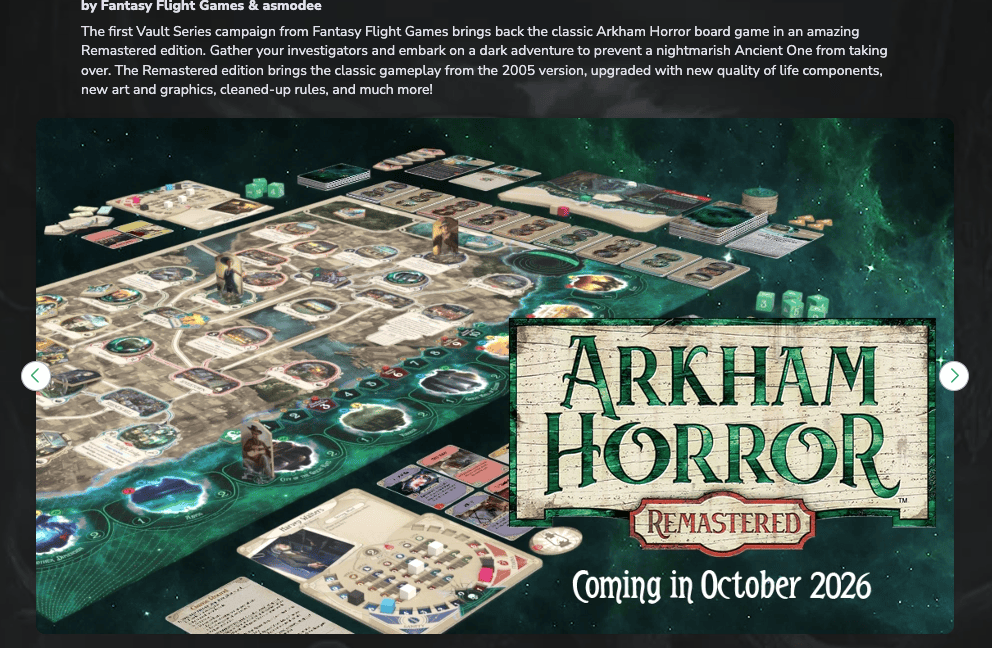
At the time of this writing, a newer revised 2nd edition called Arkham Horror: Remastered will be coming to Gamefound. It will curious to see how well this does in our hearts and minds!

At the end of the day, Arkham Horror: 2nd edition is one of me and my friends favorite games of all time. Sure, it’s long. Sure, it’s overly thematic. Sure, it’s complex. But me and my friends have had so many fun hours playing Arkham Horror: 2nd edition, it had to be in the #1 spot!

Abyss Echo: A Game (?) in a H.P. Lovecraft-esque Universe. Part I: Unboxing and Initial Playthrough Thoughts
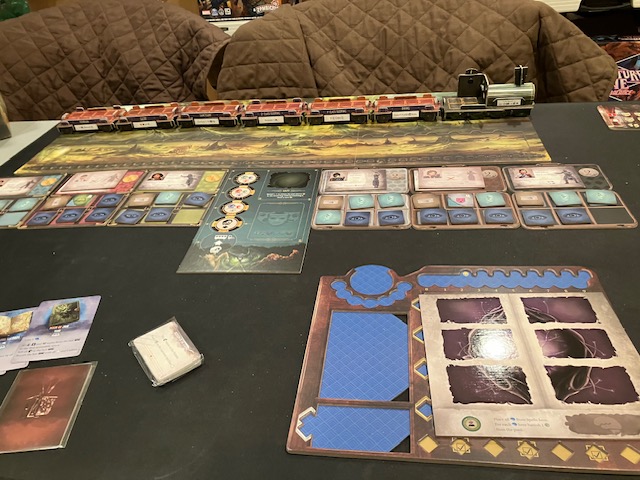
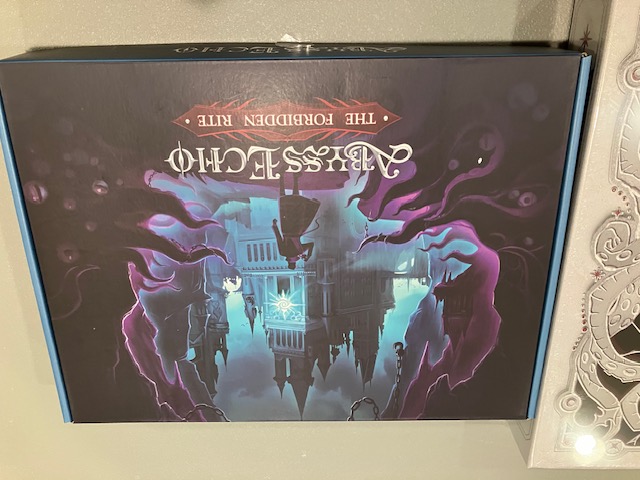
Welcome back to Cooperative Cthulhu Month! We’ve seen some new games in the past few weeks: Horror on the Orient Express (cooperative Cthulhu Clue) and Cthulhu Rift (a simple roll-and-write). This week, we head to the opposite end of the spectrum and take a look at a big, massive game in an H.P. Lovecraft-esque Universe called Abyss Echo: The Forbidden Rite!

Abyss Echo is a cooperative Escape Room type game …. well, maybe it’s more of a Choose-Your-Own-Adventure Game. Or something else? Well, it was on Kickstarter back in July 2025. It promised delivery in April 2026 and it was basically on time (it might have been a month or two late).

The reason it took me so long to get to this game: I had the hardest time getting a group of people together! This is a BIG game! And it requires a bit of commitment!

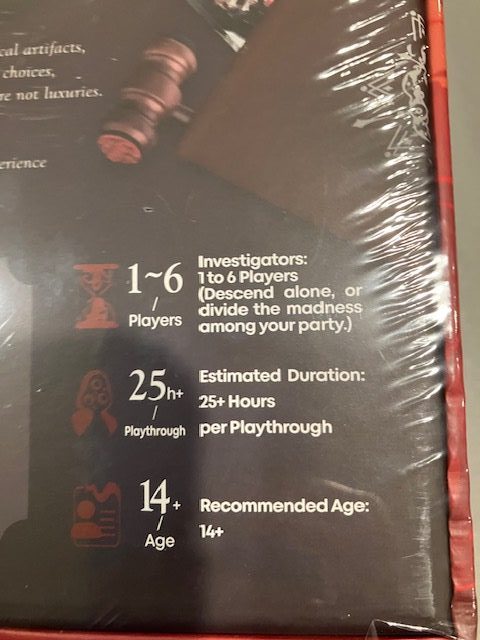
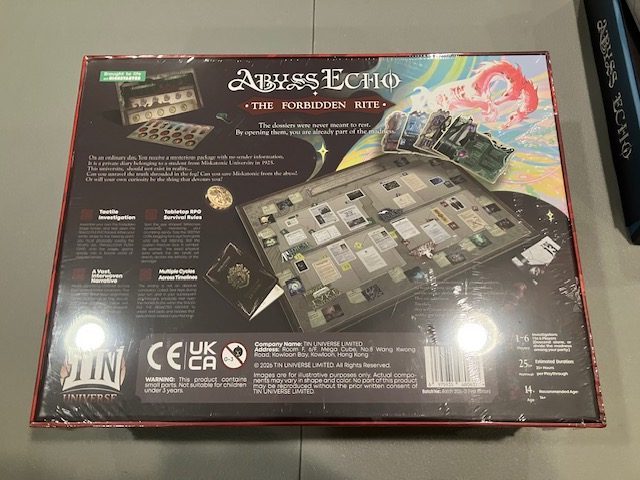
From the box (above): you can see an estimated 25h+ playthrough! Zoinks! I wanted to try to get a dedicated group together to play this so we could commit to the game (if we liked it).

Abyss Echo was on my Top 10 Anticipated Cooperative Games of 2026 at the #2 position!!! Did we like it enough to continue playing?

Unboxing

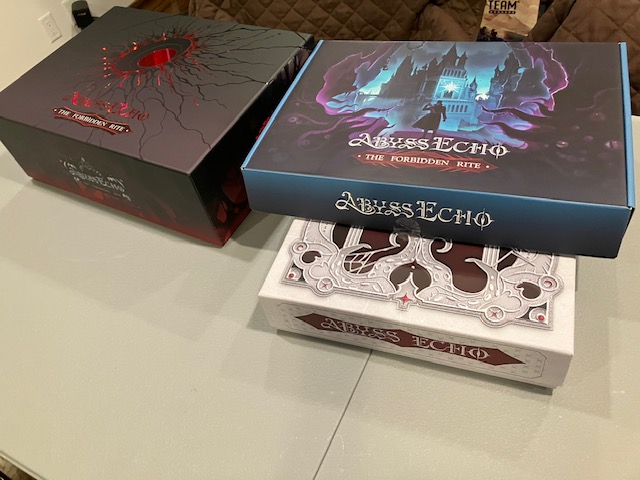
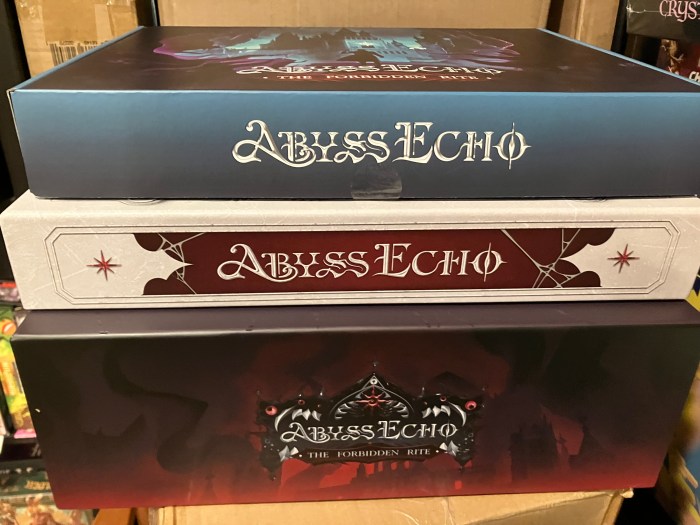
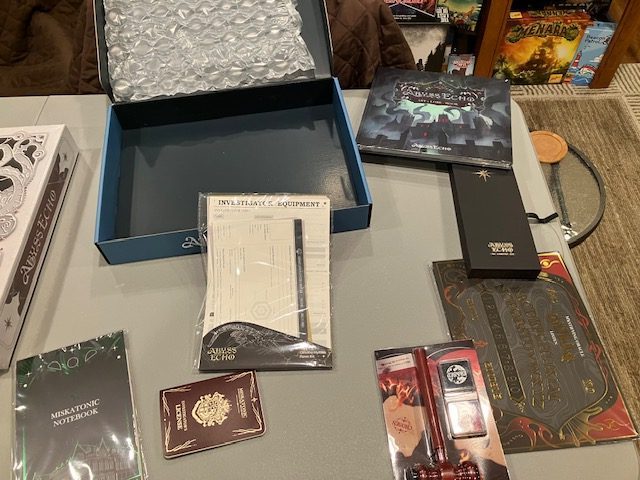
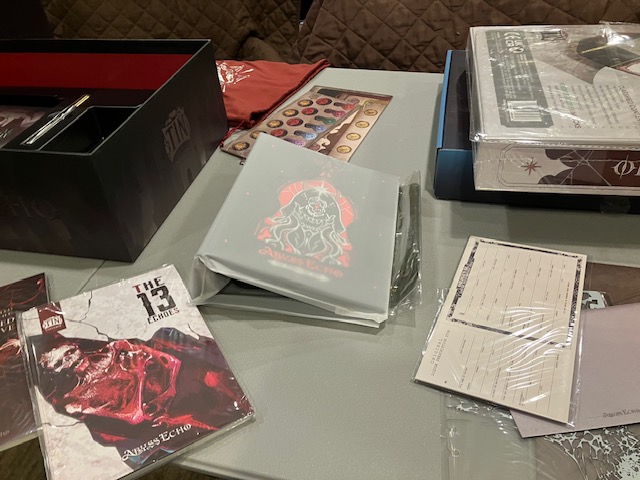
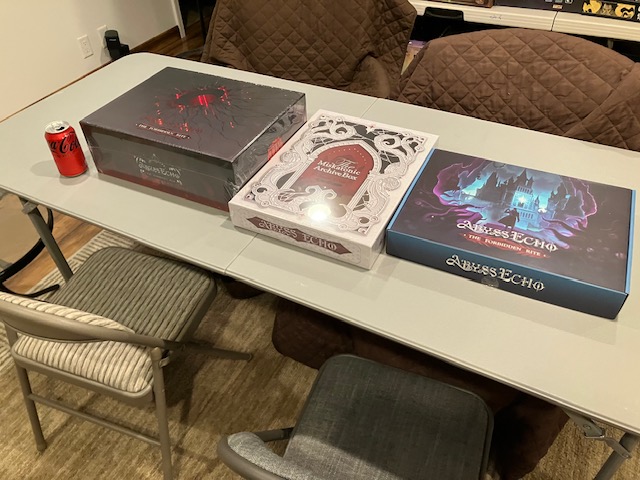
I went ahead and backed at the ALL-IN level, which game me three boxes of stuff!

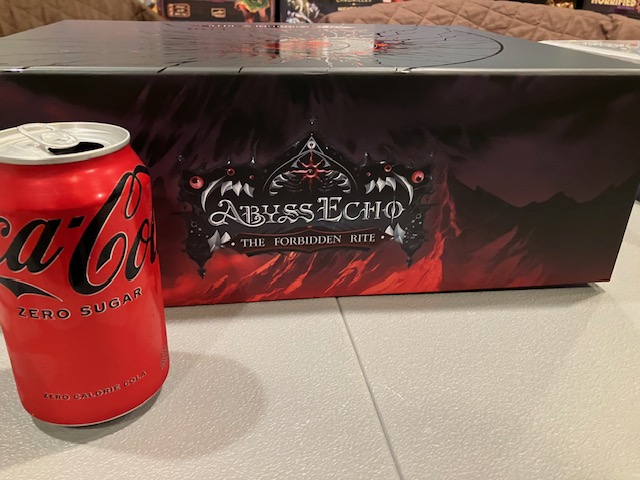
The Stretch Goals box (see above) was pretty much just “extraneous”.

It was mostly just “thematic” stuff which added to the vibe of the universe, but really did nothing for gameplay. If I had to do it over again, I would NOT have gotten all this. This box in particular really wasn’t useful. It looked cool.

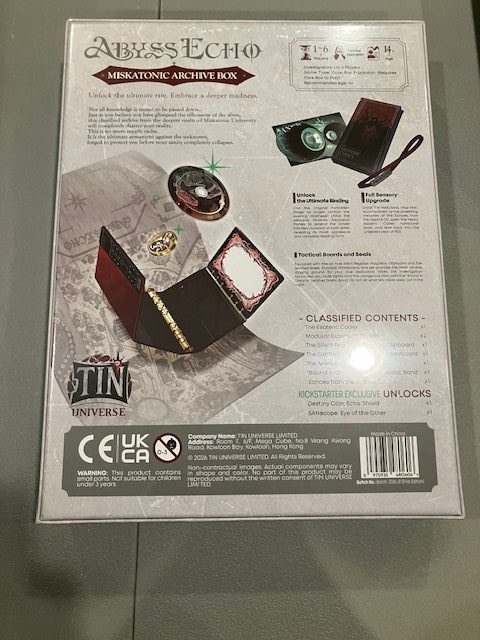
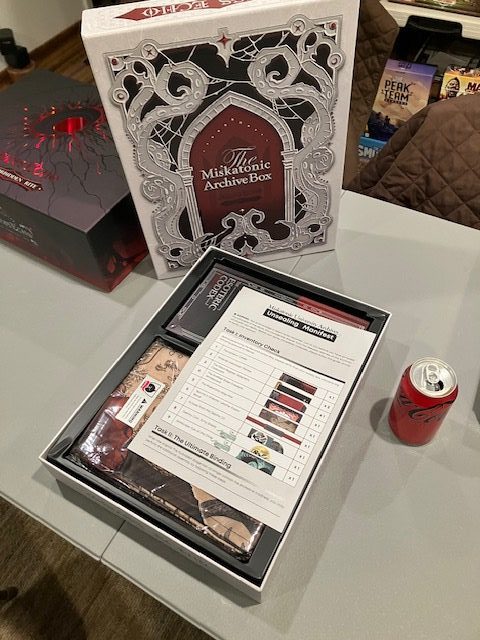
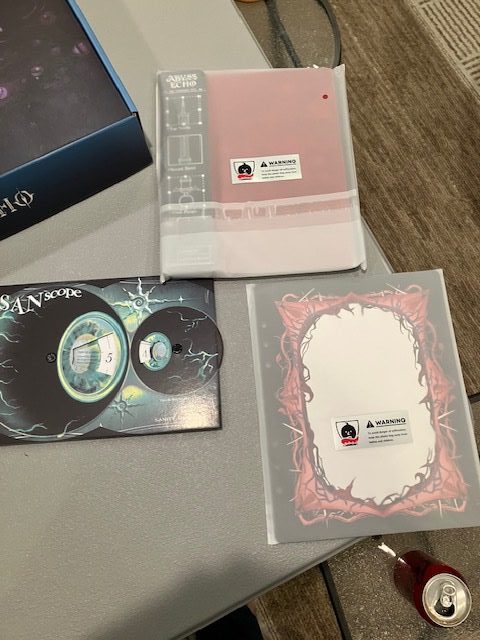
The second box was a “Miskatonic Archive Box”: see above. It was a little more useful, but I’m still not sure I would have picked it up either.

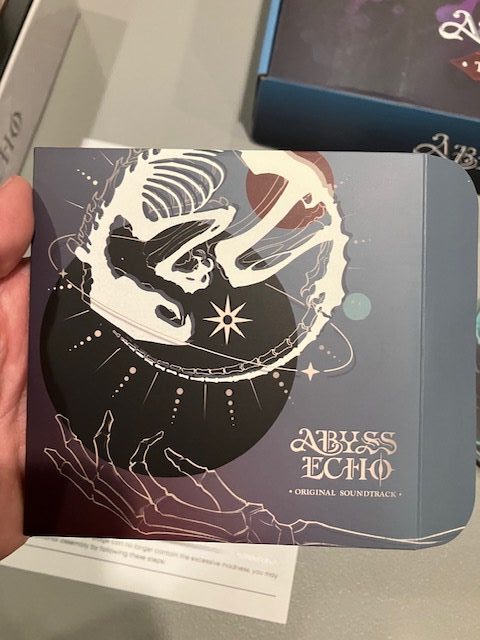
The most useful thing was a notebook extender. But even that wasn’t that useful. The thing we LIKED the most was the thematic CD of music!

I don’t know; if you can get this box for a reasonable price, it might be worth getting.

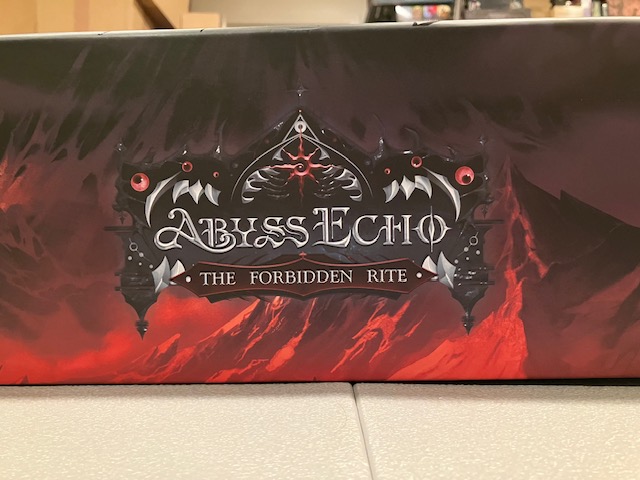
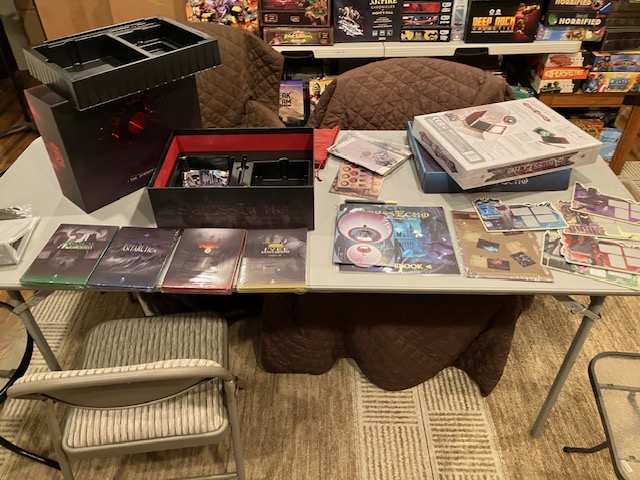
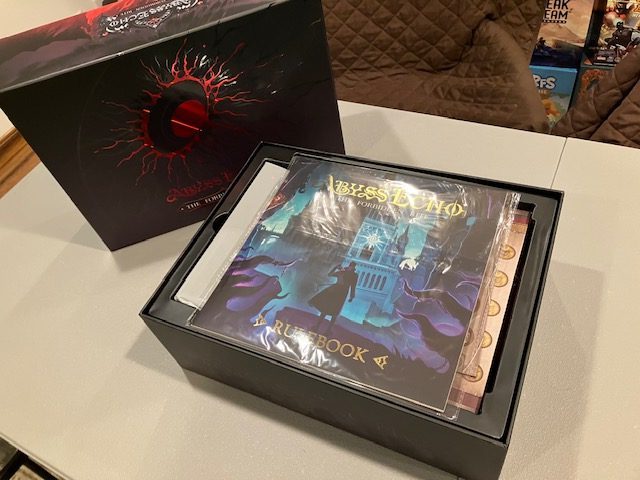
The main box was the Abyss Echo: The Forbidden Rite box! See above!

This is a pretty big box of stuff.

There is a lot in here but it’s all really nice! A lot of it STILL seems extraneous!

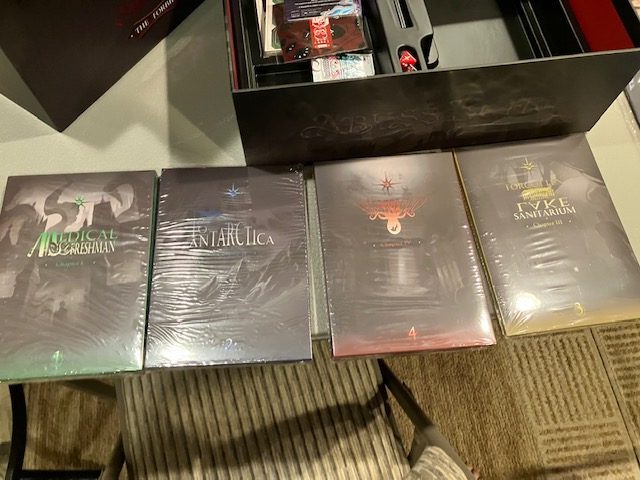
The most important part of the game are the 4 parts of a story: see above.

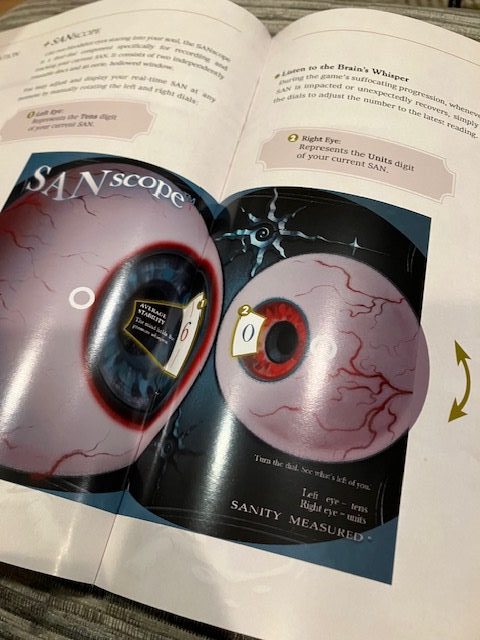
Because this is a Cthulhu game, you must track you Sanity! See the San Tracker!

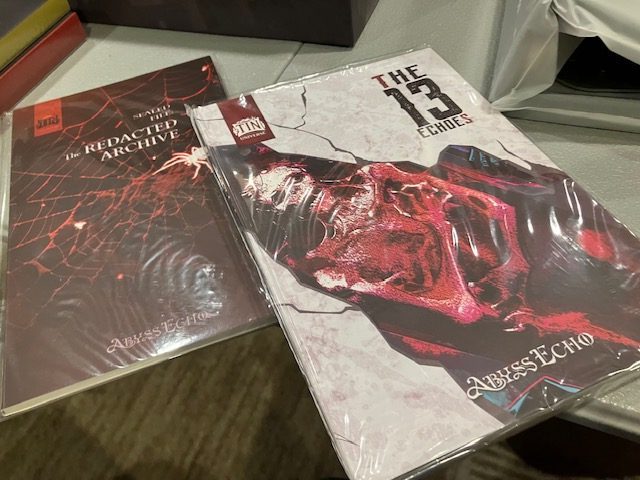
As you unlock things in the game, you will read from the Redacted Archive. When you “finish” the game, you will read from the 13 Echos … there are 13 endings, depending on where you get and your SANITY!!! If you ever die early, because you know, NO SANITY, you reading ending 0!

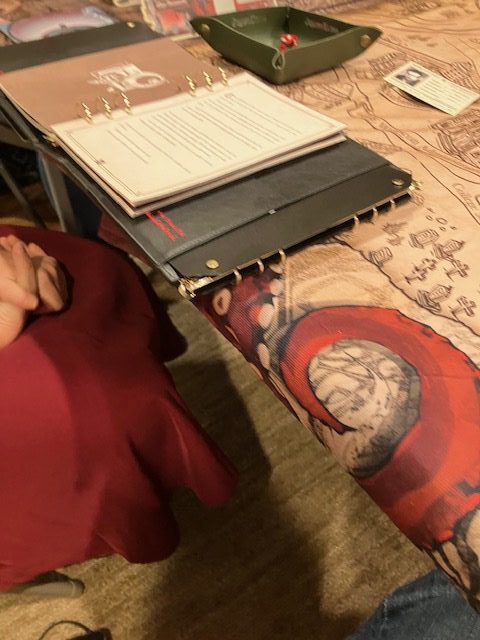
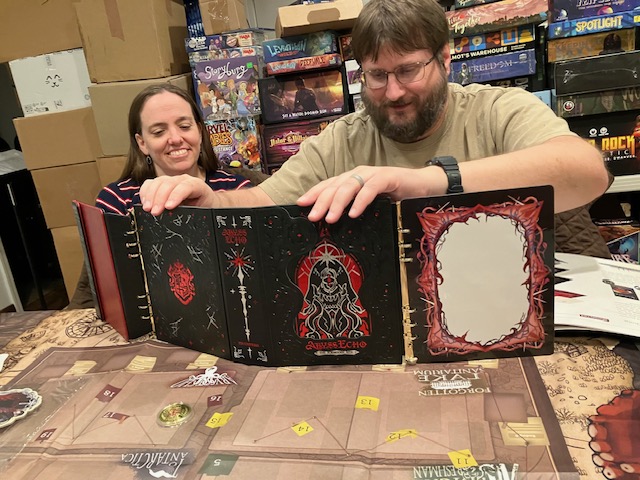
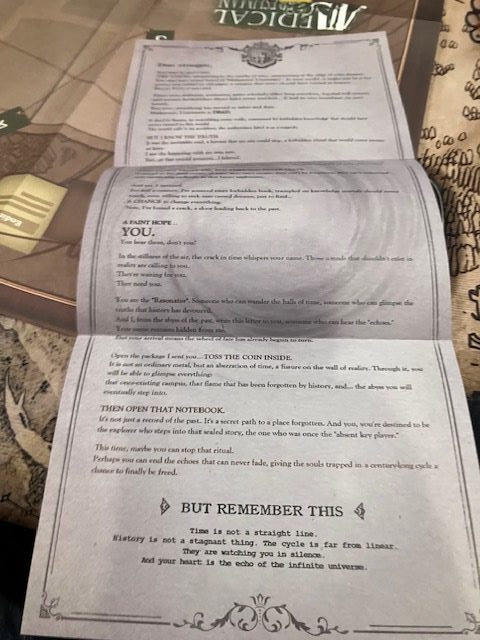
There’s also a little notebook that you will hold all your papers as you investigate: It is the centerpiece of the game.

Gameplay

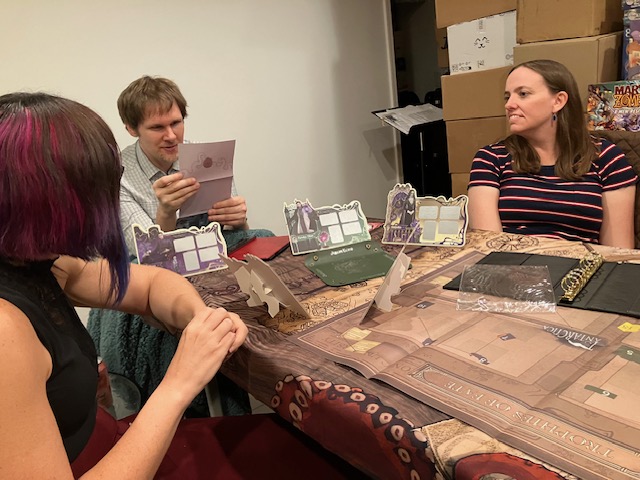
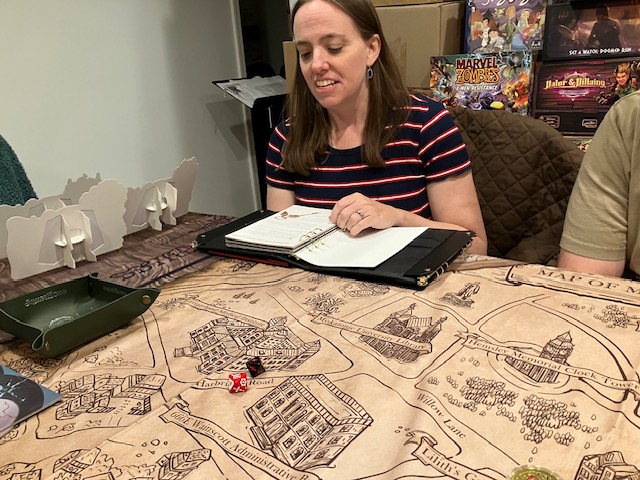
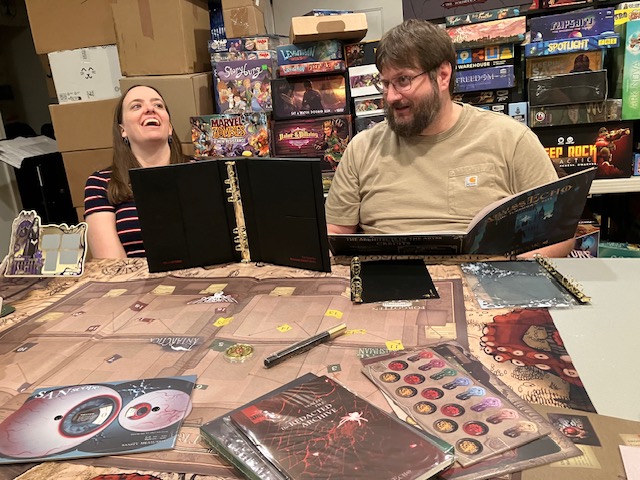
I hesitate to call this a game: it has a few “Choose-Your-Own-Adventure” moments, and a few dice rolls, and some combat. But the majority of the game is reading text out loud for everyone. This feels like you are in a Lovecraft-based book club, where everyone takes turns reading from the book!

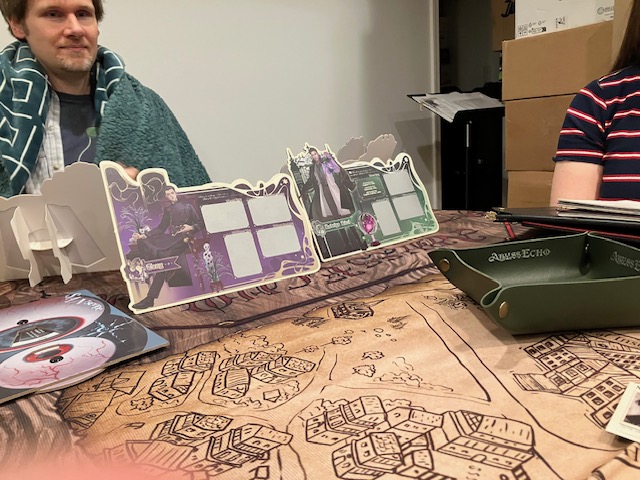
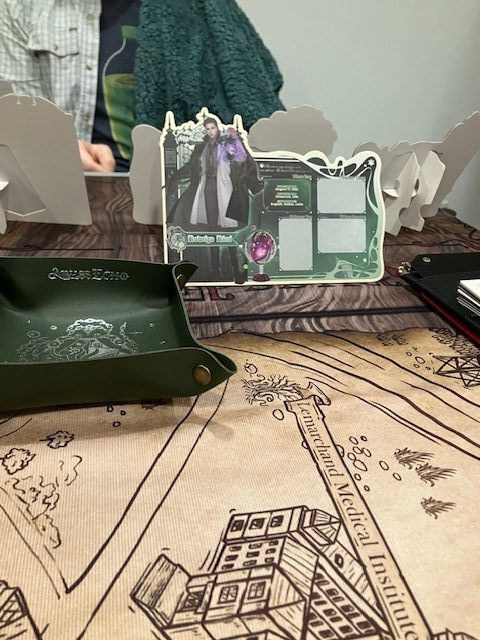
As you read, characters will be introduced. See above. It’s cool! The characters have story and depth and they are interesting: the little pop-ups help you see them in your mind’s eye!

The book is the most important part of this game: it’s the story. You start off in Chapter One. Based on what we’ve seen so far, it looks like each Chapter will take “about 6 hours”, so in a 3-hour game session will finish half a chapter. This does jive with the expected playtime: 25 hours+ of content! (8 sessions of 3 hours each?)

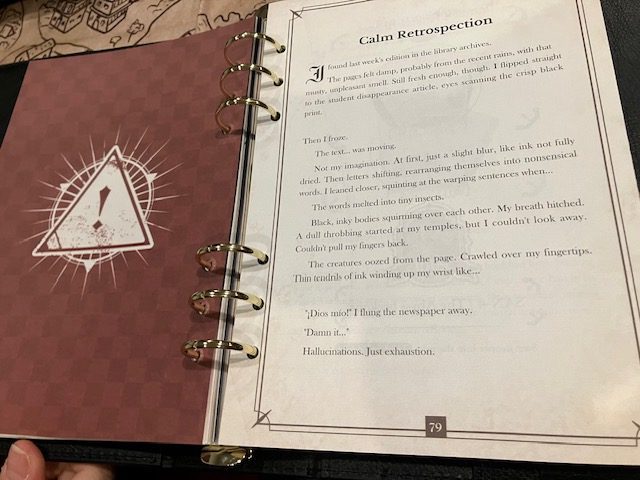
Over the course of the night, you pass the book around and people read from it and tell the very thematic story of students at Miskatonic University. It’s VERY thematic; it feels like the style of H.P. Lovecraft, but maybe the text flows a little more easily.

Let’s be clear: we read the story for a 3 hours and made a few dice rolls and a few Choose-Your-Own Adventure decisions. And that was 3 hours! It feels more like a “shared narrative” and less like a game.

Reactions

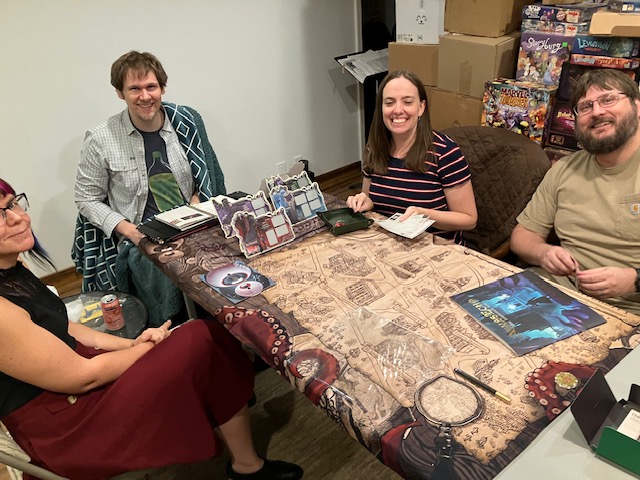
A group of me and 4 friends took one crazy evening to take this for a test run; our first session was abut 3.5 hours (.5 hours setting up, 3 hours playing). We made it about halfway through Chapter 1 (we think).

We have decided we will continue to the end of Chapter 1 and see if we want to continue from there. We liked it enough to continue moving forward for now.

I bought Abyss Echo as an expectation of an Escape Room game with elements of a Mystery in a Cthulhu universe … and I was completely wrong what this was. I was right about the theme, but the “game” is much much much more about reading. Much much more about reading!

Worries or Thematic Elements?

We did encounter some inconsistencies in the game as we read. Olga’s hair was first described as blonde then very black? And she drank Vodka but then it was Bourbon? We hope this is the game messing with us and not a translation issue (the game came from Hong Kong). After all, as our grip on reality loosens, you could see the game “thematically” being inconsistent so as to screw with you …

We just hope it’s not translation errors, but thematic immersion. We hope?

Legacy?

Is this a legacy game? There are stickers you put on a map. There are things to open. There are actually spaces to scratch-off (see Rodrigo has one space scratched).

So far, it sounds like it is will be a Legacy game, with the stickers and scratch-off, but it feels (from what we’ve seen) that it could be reset with just a little effort? Not sure. I think “nominally” this a is a Legacy game for the moment, but it’s not clear it has to be. I need to see more.

Conclusion

Abyss Echo was not at all what I expected. I thought it was going to be an Escape Room with Mystery/Detective elements; it’s really not. Abyss Echo is really an interactive novel with just a few points of “game” interactions (roll dice, make decisions, fight monsters), but generally you spend the vast majority of your time reading the text aloud to become part of a story set in the Miskatonic University.

Stepping back away from the disappointment of initial expectation, this was a wonderfully thematic group novel. My friends and I had fun reading aloud the text and immersing ourselves in an H.P. Lovecraft-esque world of Misakatonic University. The text was pretty good (it was thematic) and the characters were pretty interesting. And it was creepy … just like you expect in this world.

Be aware: H.P. Lovecraft has a stye that can be a little wordy/turgid and it really turns some people off. This H.P. Lovecraft writing style influences the text in Abyss Echo, but it is a little more modern. Still, if you hate H.P. Lovecraft’s writing style, this style and text might really turn you off.

We still have plenty of material to get through, and so far, my friends seem willing to continue playing. Will we make all the way through all 25 hours? Or will we stop after Chapter 1?

If you find yourself interested in this, just be aware of what it is and isn’t. There’s a lot of reading! And I think I recommend ONLY getting the base game: all the other boxes were almost useless.

Be on the lookout for Part II for our final summary. It may be a while if we play through the entire thing, or it may be over quickly if we decide this isn’t for us! Only time will tell!

Cooperative Cthulhu! A Review of Cthulhu Rift (Solo and Cooperative Modes), A Roll-And-Write Game!

Welcome back to Cooperative Cthulhu Month! We’ve been looking at cooperative Cthulhu Mythos games, starting last week with Horror on the Orient Express! For the next few weeks, we will be continue delving into the cooperative games in the Cthulhu Mythos! This week, we’ll with a cooperative roll-and-write game (kinda) called Cthulhu Rift!

Cthulhu Rift was one of of a group of three Cthulhu-based games from the Lovecraft Games Collection on Kickstarter back in June/August 2025. They promised delivery Feb 2026 and were about 6 months late: my backed collection of games arrived mid August 2026. (Technically, one of them arrived much earlier, but that’s not this game).

I backed this collection because of the game Cthulhu Rift! Cthulhu Rift is a cooperative roll-and-write board game (sort of) for 1 to 4 players! Like Yahtzee, but cooperative and Cthulhu? Sort of?

Would Cthulhu Rift make our Top 10 Cooperative Roll and Write/Flip And Write Games? Let’s take a look!

Unboxing and Gameplay

See game above with Can of Coke for scale.

Players each take the role of one of the investigators in the game! See above!

Each investigator has their own roll-and-write board! They also each have a once-per-game special powers (lower left) and some skills you can unlock as the game unfurls (bottom right).

This is a dice game (after all, it is fundamentally a roll-and-write game): see the different colored dice above. On a turn, the “driver” (first player) rolls the dice and each player must take a die … and that’s the symbol they get for that turn! (Some players may get more than one symbol).

Symbols aren’t immediately used! After you record a symbol on your sheet, you “may” cross out and activate a symbol if it’s adjacent to another symbol! This is a game about “collecting” symbols so you can use them later!

You can literally get stuck in a corner! The orange magnifying glass (above) can’t be used because there are no other adjacent (non-crossed) magnifying glasses!

There’s all sorts of symbols you use: magnifying glasses to find runes, books to decipher runes, and portals to seal rifts! And guns to kill cultists! Gulp!

The overall objective (at least in Case 1) is to find and decipher the runes to seal the gates! For the 2-Player “easy” game (see above), we have to seal 4 gates! The runes on each row indicate what you need to find in order to close and seal it!

The reason I said this is “kind of” a roll-and-write is that you also traverse a map! On the active player’s turn, you move around the map, trying to find what you need as well as “disposing of” Cultists along the way!

If you don’t deal with the Cultists quickly enough, they WILL summon Cthulhu! Or at least some of his tentacles. That’s what Cultists do!

See a winning board above, where 4 portals have been sealed! The Cultists (blue stars) had taken over almost half the map, and they even summoned one Cthulhu tentacle, but we did win!

You might have noticed that the dice and the symbols in the game all have colors! Generally, you can “only” apply one your symbols to an activity if you have the matching color! The colors of the location and the colors of the dice “generally” matter! You can only record symbols on the appropriately colored spaces! So, the colors do matter of the Location for activating and recording symbols!

To repeat: the colors matter! White is wild, but generally the symbols can only be applied to a Location with a matching color!

Seal all the gates before you run out of space, Cultists, or Tentacles!

The game generally has pretty good components: see above. The art might be slightly divisive, but I think it’s very thematic art as it has an “edge” to it that implies a supernaturally weird element.

Rulebook

So, this game has 4 different rulebooks in 4 different languages! See above! That’s why there’s not a lot of text anywhere; it was meant to be language independent!

Sigh. The rulebook form factor is ok. It gets like a C+/B- on the Chair Test: it can sit on the chair next to me, but it droops more than it should (see below).

The rulebook is fine. I didn’t love it, but I didn’t hate it. For some reason, I had trouble reading this! I don’t know if it’s because it’s a translation or the organization? Or something else? You will have to read it a few times to get the game. It’s not a hard game, but it felt like this should have been easier to get. I think that a Player Summary Card might have helped quite a bit? (There is no Play Summary cards; probably because of the language independence of the game).

It was fine. It taught the game.

Solo Mode

So Huzzah to Cthulhu Rift for having a solo mode! Congratulations for following Saunders’ Law!

The included solo mode is even a true solo mode! The solo player plays the one character, Dr. Elias Grimsby. Now, even though this is the official solo mode, that is NOT how I played my first solo game.

For my first solo mode, I played two-handed solo, alternative between two characters as-if it were a 2-Player game. Why?

If you look at the solo rules (see above), there’s about a page of exceptions to the rules. This game is kind of a bear to learn and teach, so after reading through the rules, I thought it would better to play “the simplest way” possible, which is to play the game without all the rules exceptions of the solo mode.

Another reason to play two-handed solo is that my plan is always to teach and play with my friends! So , it’s easier to teach the cooperative mode if I have played the cooperative mode (albeit solo)!

I think playing two-handed solo was the right way to play the first game. This game has rules that are hard to grok the first time through, so it makes sense to avoid the extra complications of the solo game and play it straight vanilla the first time through.

I lost in my first game, pretty badly. I think that’s because some rules that take at least one full game to grok (if you are playing from the rulebook). In fact, I was very worried about how poorly I had done because my dice rolls were so bad!! Is this going to be a game that’s too random?? I held off making a pronouncement until I had a few more plays under my belt.

I think it’s important to play this at least a few times before you decide if you do or don’t like it: there’s enough rules interactions you might not get the game the first few times through.

BUT it was important to see the base rules unadorned by solo exceptions to get the sense of the game. I recommend playing your first solo game two-handed solo.

Once I got the base rules down, then I tried the solo game. I liked it! There were enough rules changes/additions that I think it makes sense to have played that two-handed game first, but I think the official solo game is the better way to play solo once you know the game.

You’ll notice the solo player has a lot more spaces than a plain character! But, that makes sense as spaces are a fundamental resource in this game! You need enough spaces to make progress. (You have to unlock some of those spaces when you roll Chthulhus too).

Once you get the sense of the extra rules, this is the better way to play solo. You only have to deal with one page, and I generally prefer true solo modes when possible because you feel like you are inhabiting the character! You are becoming Dr. Elias Grimsby!

After losing my two-handed solo game and winning my true solo game, I am a little less concerned about the randomness of the dice. That first game was a pretty rough loss, but after the second game, everything started the make sense.

The true solo game is fun, it’s engaging, and the way I will play solo moving forward. Yet, I still recommend playing your first solo game as a two-handed solo mode so you can learn the vanilla cooperative rules! With the vanilla cooperative roles under your belt, you can then apply the (fairly numerous) changes to the solo mode without getting lost.

Cooperative Mode

The cooperative mode works up to 4 players! This is a cooperative roll-and-write!

It’s a bit hard to teach this game. Even after explaining a bunch of things, it’s still kind of hard to wrap your head around everything. Here’s the thing: once you get it, you get it! It’s pretty easy once you put everything together. But I absolutely recommend playing the game solo (maybe even twice: both two-handed and true solo) so one player can shepherd the game. Luckily, the game does start hitting for people quickly. I think the idea that you “save symbols” to mark-off later is different than most roll-and-write games; it takes a while for this and all the little rules to sink in.

There’s a good level of cooperation in the game; mostly high-level discussions. Where do we drive? What can we do? How many Cultists can we “take care of”?

Because each player has their own sheet, there is a good element of “multi-player solitaire” to the game: you have your own sheet and other people don’t really interfere on it. Each player having their own sheet is a good Alpha Player deterrent too. Most of the cooperation is pretty high-level: which dice do you want? You discuss what to do and what you can do, but you don’t really tell people how to do things!

I noticed that we did tend to specialize: Beatrice Langford became the “Cultist Assassin” and her main task was to take out Cultists! So many guns on her sheet!

Overall the game was pretty fun and pretty cooperative … once you got the rules. There was enough high-level cooperation to make the game feel cooperative, but enough low-level activity (recording symbols on your sheet) that each player still felt like they had their own agency.

Play the game solo before you teach your friends. I feel like the game is weird enough that a cooperative learn might go poorly?

A Few Recommendations

Make Copies. The number of roll-and-write sheets in the game is a limited resource. There’s a lot, but you can run out. I went ahead and made copies of the sheets and used those instead. I supposed you could also laminate them too.

Don’t Mark Up Some of the Sheets! In my first solo plays, I did what the rulebook said and marked out some of the spaces on the Big Bad (Cthulhu): see above.

Don’t do that! Just use some coins to “mark-out” the places you aren’t supposed to use! See above as we use the Stonemaier coins to mark off the spaces we don’t use! There is NO REASON to completely waste a sheet for that!

Play Solo Two-Handed Before Teaching. This is an easy game, once you grok it, but it’s kinda weird and kinda hard to grok. Play solo (two-handed) to get a sense of the game and then teach it: I think the play will go a lot better that way.

What I Liked

Choose Where You Drive: There’s a certain play element we didn’t emphasize, but I think it might be critical to the game: when you drive somewhere, “someone” on your team gets the symbol of the place you are driving too! This means, if you are rolling badly, you can ALWAYS guarantee you can get at least one of the symbols you need (if you can drive there). This rule really helps mitigate the randomness of the dice, as you can always get at least one symbol you need. Don’t overlook this rule; it can be easy to miss.

Once You Get It, It’s Easy: This game is hard to teach, but once you get it, it’s pretty straight-forward to play.

What I Didn’t Like

Randomness: At the end of the day, this is still a dice game. Even with some of mitigation techniques in the game, you can still roll badly and lose badly. I was very very concerned about the random nature of the game on my first solo playthough, but once I understood the game better, it’s not that bad.

Having said that, randomness in a game with limited resources (the sheets you write on) is a little more concerning than most games. I would be so very frustrated if I rolled badly and used up 5 sheets in one game! What a waste!

And you can still roll badly, especially on the bad news phase (which summons cultists and then tentacles) and just lose.

A few very minor house rules helped us a little:
1) You can re-roll just the dice you want. When you unlock this ability, the driver can re-roll the dice. But only all of them? This seems to lean into the “too much randomness”.

2) Once you unlock all your abilities, you can choose to not take a die (and someone else has to take it). It seems unnatural that you can’t choose to do NOTHING on your turn. Of course, there are consequences to doing “nothing”, and one of your compatriots must take the die and write the symbol down. But this feels like it should be a choice.

These very minor house rules are in the name of making the game feel a little less random and giving you some agency.

Conclusion

I liked Cthulhu Rift game and so did my friends. It wasn’t the greatest game ever, but we had fun. It’s a 7/10 for the cooperative game.

The solo game is true solo, and it’s a good game (7/10), but I’d recommend playing your very first time as a two-handed solo game with the vanilla rules to learn the game. The true solo game is the better game, but there are too many rules exceptions in the solo game to make it a good first game.

I recommend making copies of the sheets or laminating them so you don’t waste the limited sheets in the game. I also recommend using coins instead of actual marks on some of the sheets so you don’t HAVE to waste them. Because this is a game with more randomness than some others, we do recommend a few minor house rules: nothing is more annoying than wasting a limited resource because you rolled poorly.

If you like the idea of a cooperative roll-and-write game with a Cthulhu theme, I also recommend you check out Roll For Great Old Ones (see review here). It’s a little better game, but it’s also a little more complicated. Cthulhu Rift is an easier game to sit-back and just play … once you’ve grok it.

And yes, Cthulhu Rift would make our Top 10 Cooperative Roll-And-Write Games!

Horror on the Orient Express! An Initial Review After My First 15 Hours of Solo and Cooperative Horror! Cooperative Clue with Cultists, Cthulhoids, Clues, and Choo-Choos!

Welcome to Cooperative Cthulhu Month! This month, we take a look at a bunch of cooperative Cthulhu board and card games! We start the month with a very brand new game called Horror on the Orient Express which just delivered to Kickstarter backers!!

Horror of the Orient Express answers the age-old question: What would it be like if Agatha Christie’s Poirot had to solve a mystery on the Orient Express with Chtulu-like creatures chasing him? Philosophers have pondered this question for years, and now Horror on the Orient Express gives the definitive answer!

The game arrive at my house Saturday August 22nd. I was very excited by this; it is was on my Top 10 Anticipated Cooperative Games of 2025!

Over the next week, I would spend so much of my precious time with this game system. I have spent 15+ hours going though this so far! How does that time break down? Let’s take a look!

Day 0. Unboxing and Reboxing (and some discussion of gameplay): 4 Hours

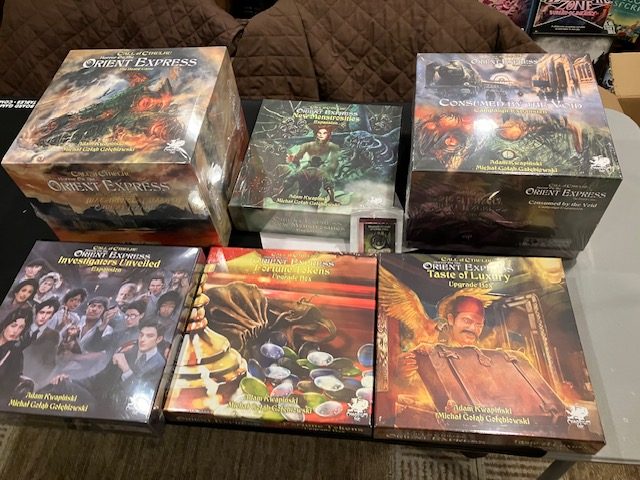
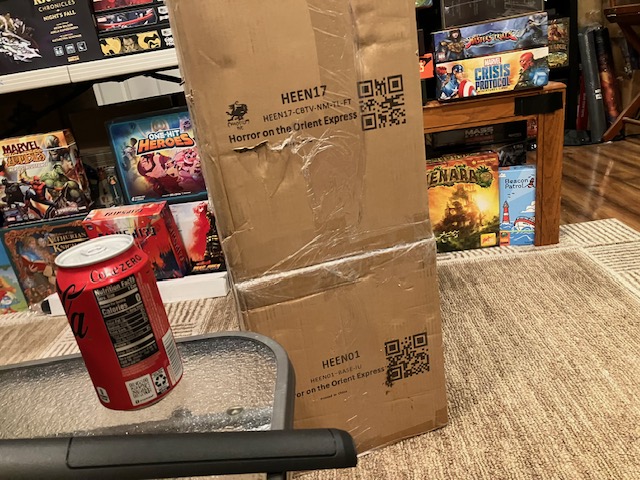
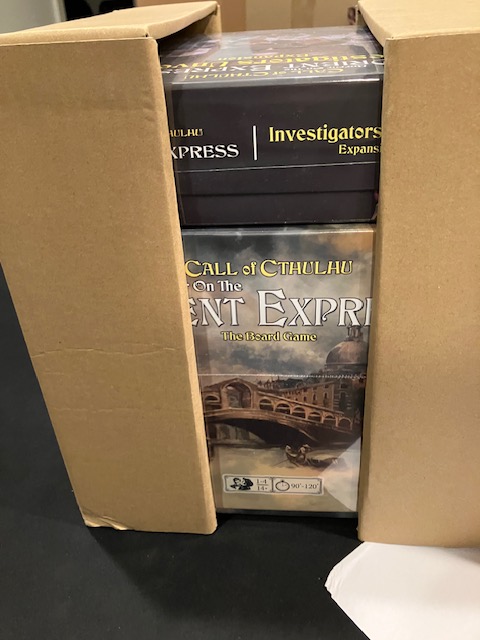
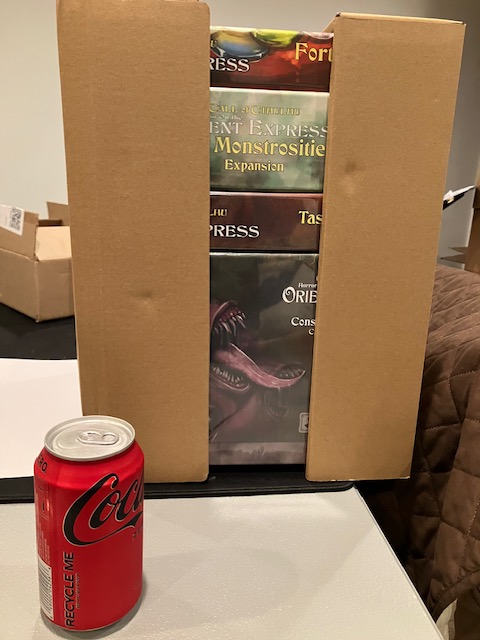
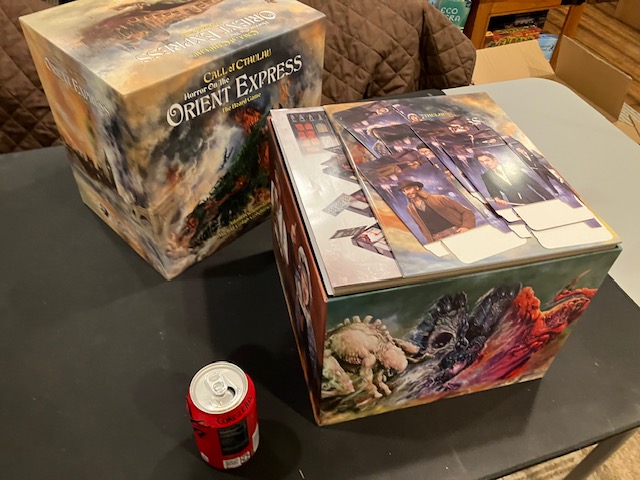
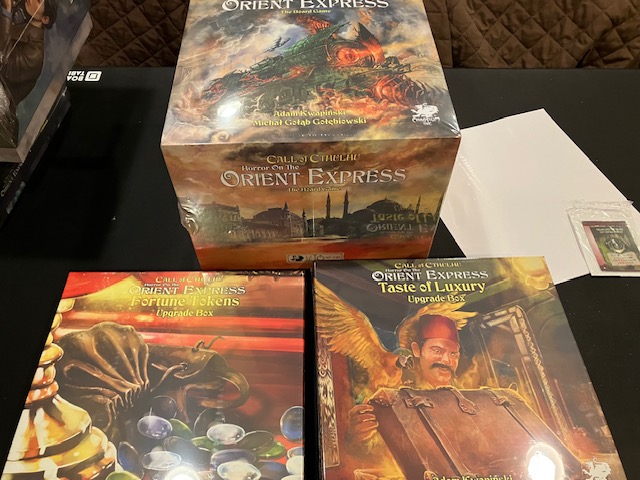
You heard me right; this took 4 hours to unbox. And that was just the base game and some deluxe components! Part of the story here is just how much content arrived! There were two boxes that were actually tapes together when delivered to my house! See above!

The smaller of the two boxes came with the base game and an investigators expansion (giving more investigators and suspects).

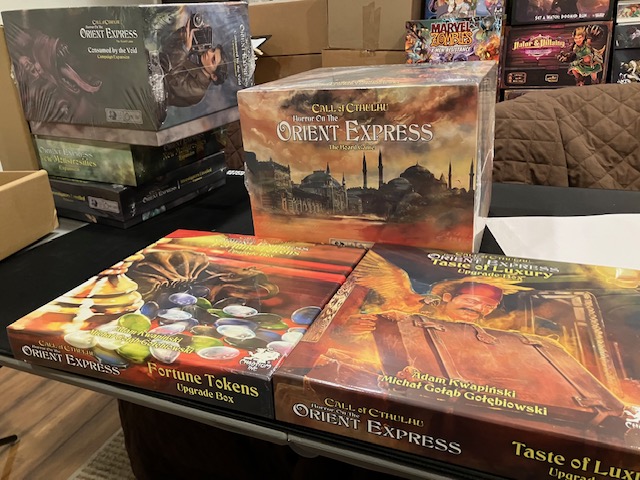
The bigger box came with the campaign expansion (bottom box), more monsters (green middlebox) and some deluxe components (the other two). See Coke can above for some perspective on this!

This is probably the biggest Kickstarter I have ordered in some time! And remember, here at CO-OP Gestalt, we pay for everything with our own money! See all the boxes (and a correction card) above!

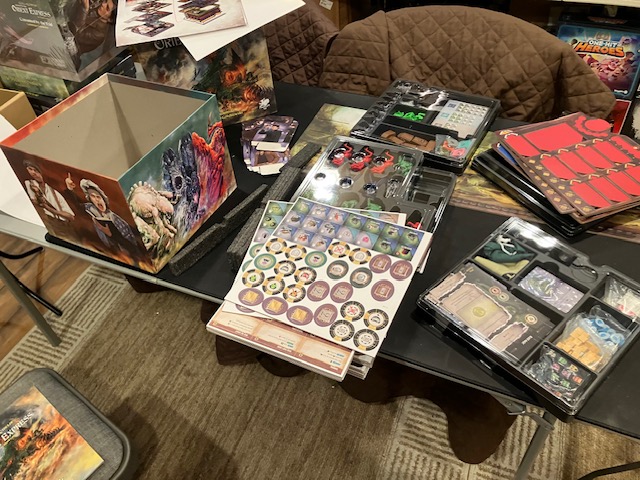
In the end, I chose to only unbox the base game and deluxe components (see boxes above). I’ll come back to the others later! That seems like a sane decision, right? Just limit myself to unpunching and assembling the base box with a few extra acrylic tokens? It still took 4 hours!!!

This is a monster of a game! See coke can above for scale!

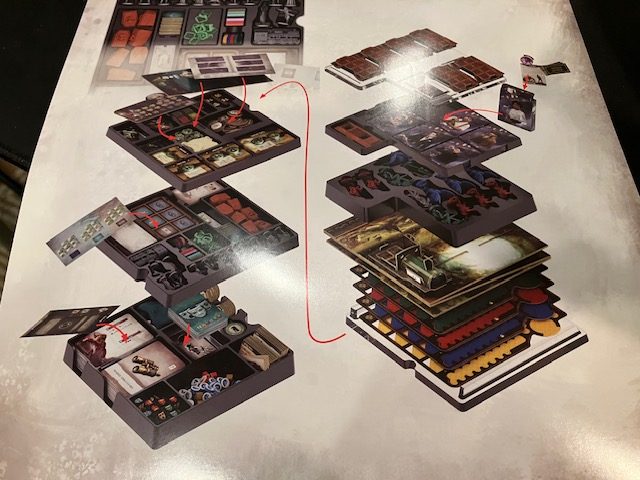
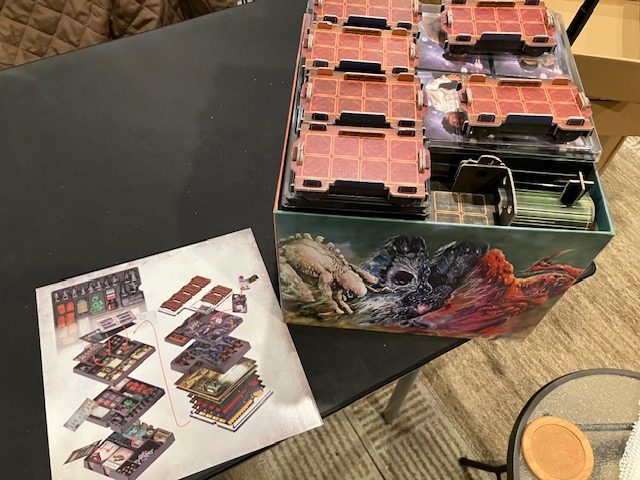
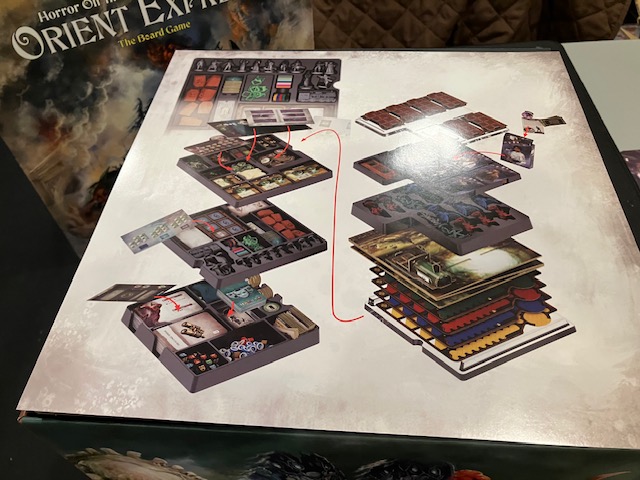
To get a sense of how much stuff is in here, the game includes a really nice boxing/unboxing guide. See above.

So much stuff!!

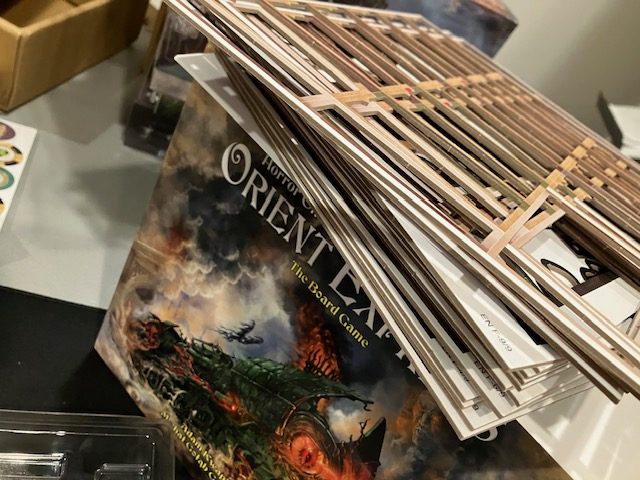
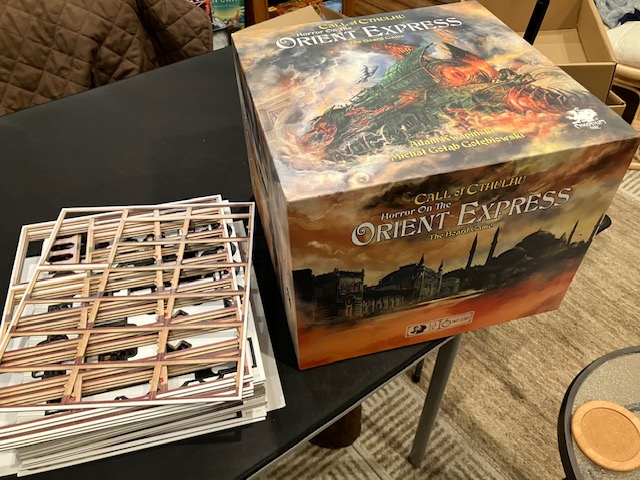
There were SO MANY things to punch out! See all the cardboard skeletons above!! SO MANY PUNCHOUTS! And no, I don’t think I can keep these punchout Skeletons … even if I wanted to.

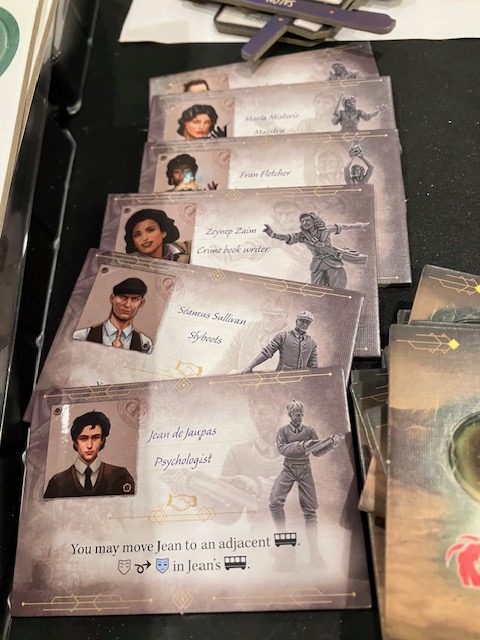
Players each the role of an investigator! See the choices above.

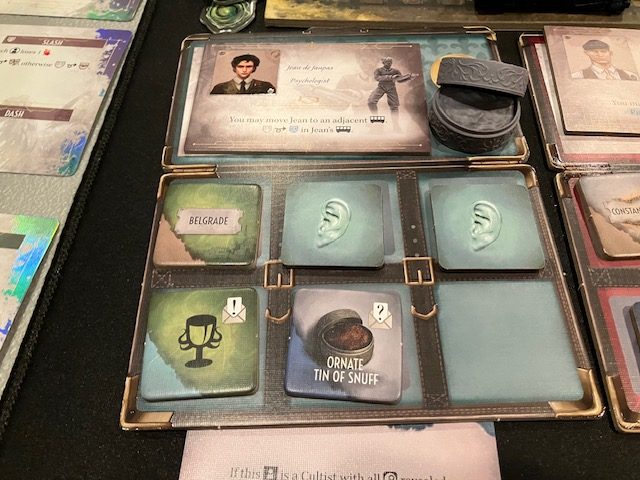
Each investigator has their own set of “main action” cardboard punchouts. See above and below.

Each investigator is actually fairly unique: their main action cards define the flavor of the character! There’s no special power per se, but each investigator has a different pool of actions that are quite thematic!

All these cards go back into little tuck boxes (it actually makes it a lot easier to start the game).

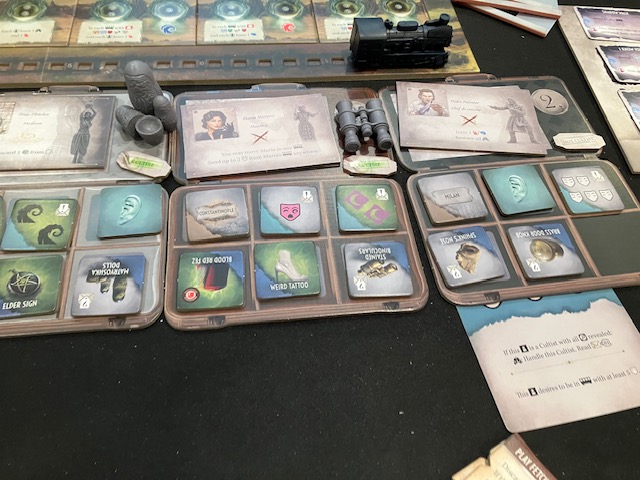
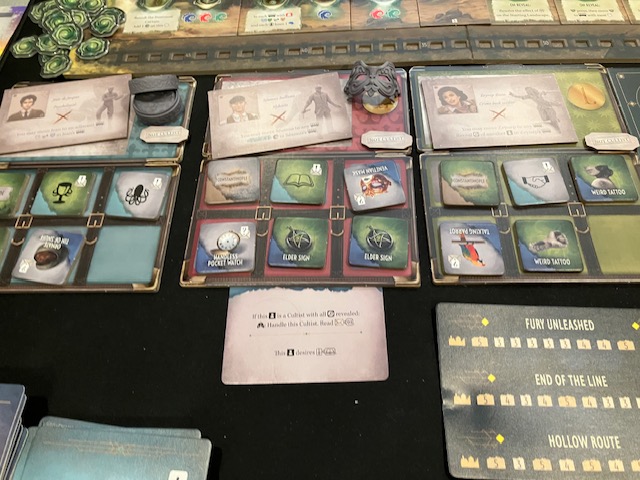
So what are you investigating? As a group, the players cooperatively are trying to figure out which of the suspects (see the 6 suspects above) is a Cultist and which is NOT a cultist! This is cooperative Clue with Cultists and Cthulhu!

Each suspect has some “luggage” with Clues on them. The nature of the stuff in their luggage tells you whether or not they are cultsists! Do they have a blood red Fez??? They must be a cultist! Are they going to Constantinople? Their stuff is an indicator that they are cultists or not! There is actually a precise definition (based on their stuff) of what makes someone a cultist!

At the start of the game, all suspects have their clues turned face down, and throughout the course of the game, there are many ways to uncover the items and see exactly which suspects ARE Cultists and which ones are NOT! You have to get them all identities correct or you lose the game! This is the primary goal of the game: discover the loyalties of all suspects!

To be clear, all the PLAYERS are in the clear automatically; there is no hidden traitor or anything like that! Players work together to find out who are the cultists!

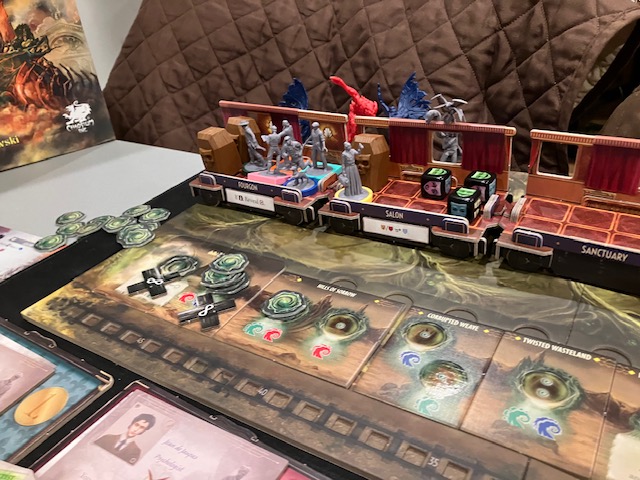
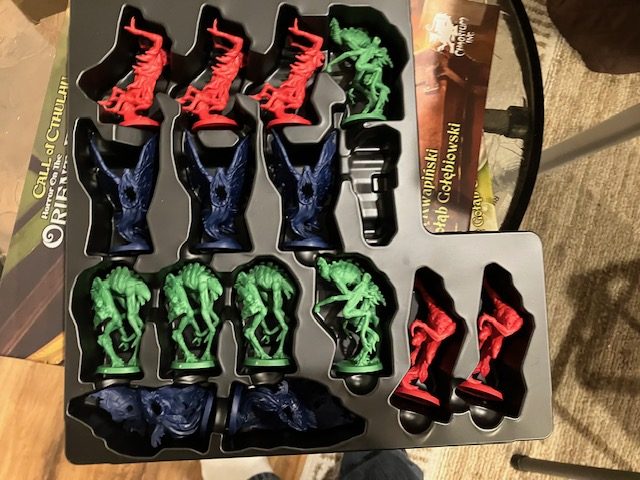
But of course, everyone got stuck on a train that’s driving in the Dreamlands, and we have to survive the Cthulhoid creatures that are chasing the train! See the creatures above and below! They are much less fearsome inside their box!

The Cthulhoid creatures race alongside the train and reach in to do damage to passengers and suspects!

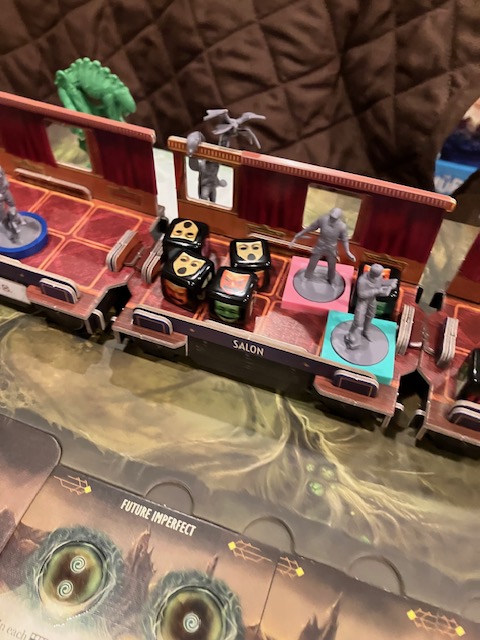
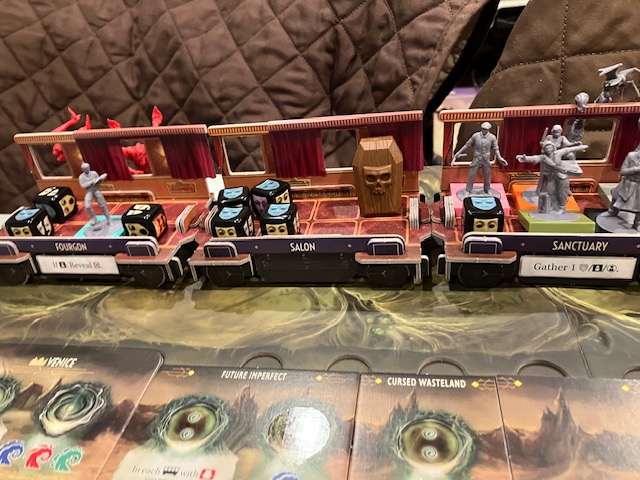
The train is where everything takes place! The investigators, the suspects, the monsters, the passengers, and even a vampire!

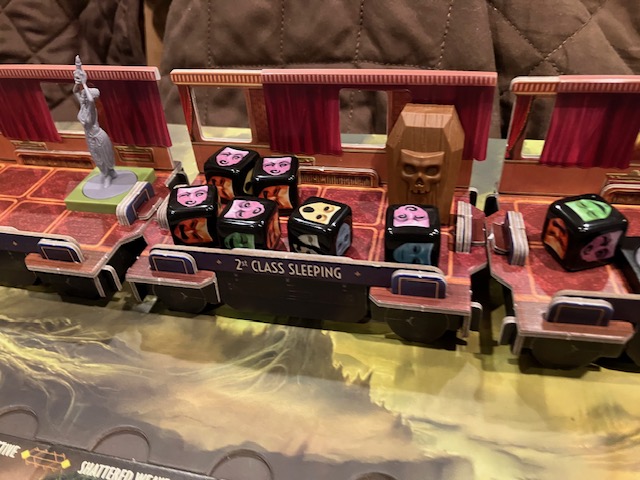
The “other passengers” (not suspects) are represented by die which show a face showing that they are happy, worried, neutral, crazy, mad, or injured! See above! You have to be careful to protect as many passengers as you can! It’s hard to talk to passengers that are mad or crazy! And you need to talk to passengers to find out about the suspects! Remember, you are an investigator!

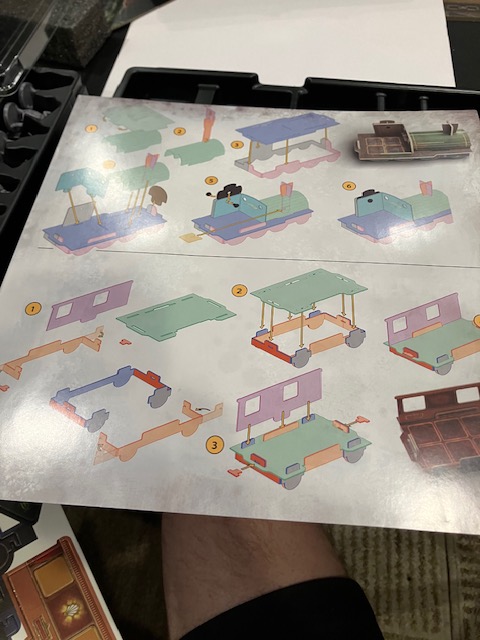
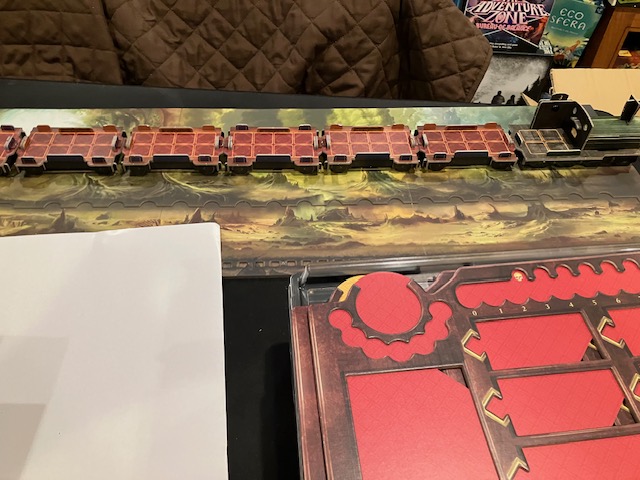
Putting this train together (which is really cool) was actually a surprising amount of time from the 4 hour unboxing time! The instructions are “ok”, but let me give you a little hint now: BUILD FROM THE BOTTOM! See below!! The instructions (see above) show building the train cars from the top, and that just doesn’t work very well.

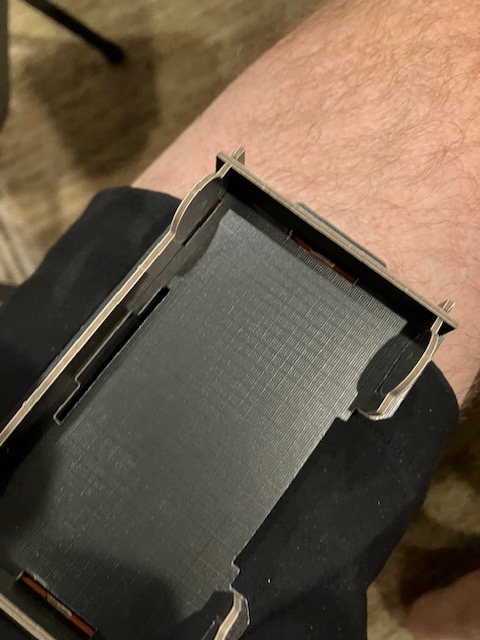
Build from the bottom like I did: See above.

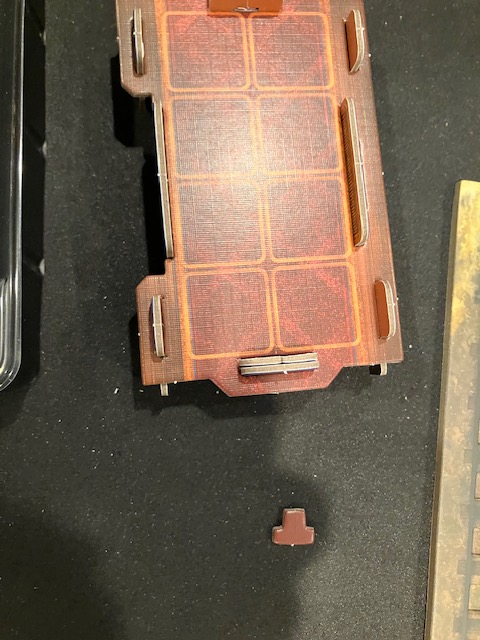
Also, I recommend gluing the final crossbar piece (see above). They kept coming out on me!

By the time you are done building six train cars and the locomotive, you get a little exhausted. I ended up taking some time to do other stuff before I finally came back to finish my unboxing and reboxing everything back in! (And no, I don’t count that time off in the 4 hours … this really took 4 hours!!)

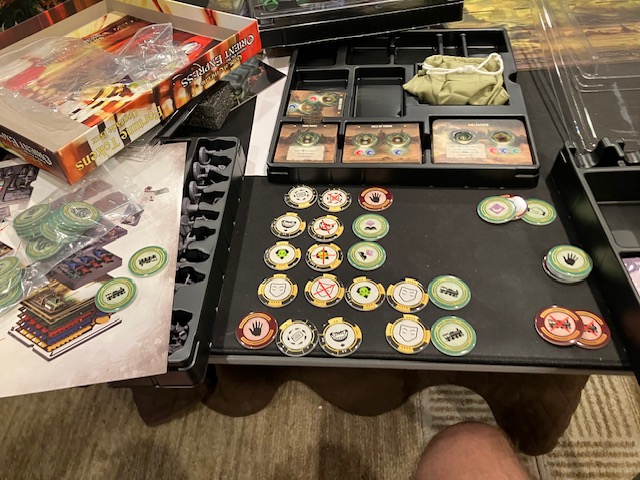
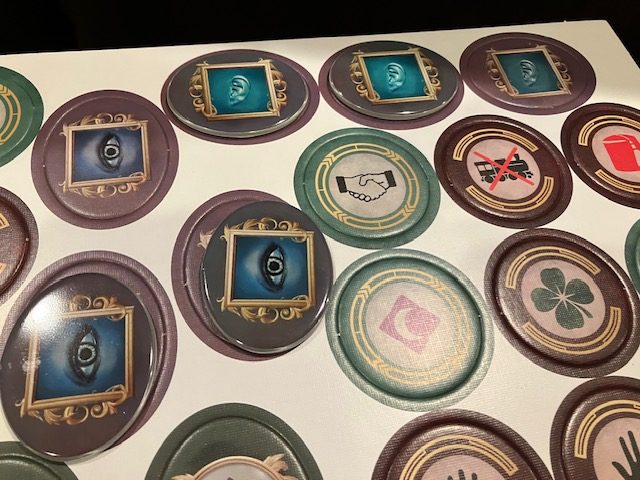
Oh yes, I need to comment on some of the deluxe components. The acrylic conversation tokens and event tokens from the upgrade box are really cool!!! See above!

… but they are not well-labelled! In fact, the expansion box has acrylic tokens for EVERYTHING (including other expansions), so you don’t really need ALL the acrylic tokens for the base game! And in fact, they don’t all fit if you try to use all of them!!! I ended using the unpunched cardboard tokens (see above) as a guide to which tokens to keep! This was extremely frustrating that I DID NOT know which tokens to use for the base game and which tokens to use for the campaign and other pieces! They reallllllly needed to have some better labeling.

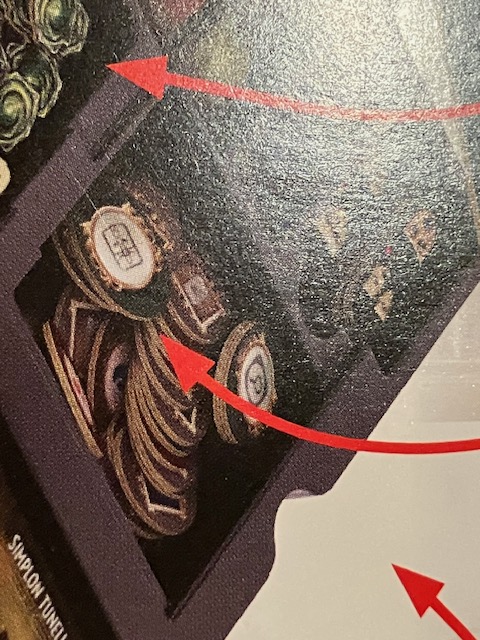
As you put things back in the box, you will both love and hate the sheet above! Why? Because it shows everything (I love that) but it’s so hard to see detail! (I hated that!)

See above as I had to use my phone to zoom in so I could see the detail!!!

Putting everything back into the box in its proper place (after punching everything out) was a chore. But it did work.

Yep. It took me 4 hours to unbox everything, punch out so many things (see cardboard skeletons above), dig through deluxe tokens (and realize there’s no way I can put them all in the base box), assemble the train, then finally rebox!!

Whew!

Day 1. Set-Up: 2 Hours

You might ask “why did you put everything back in the box if you knew you just needed to get it all out again?” I asked myself that same question! Seriously though, there is some value in handling all the components again; there’s a kinesthetic boon to seeing/touching all the components in the game again.

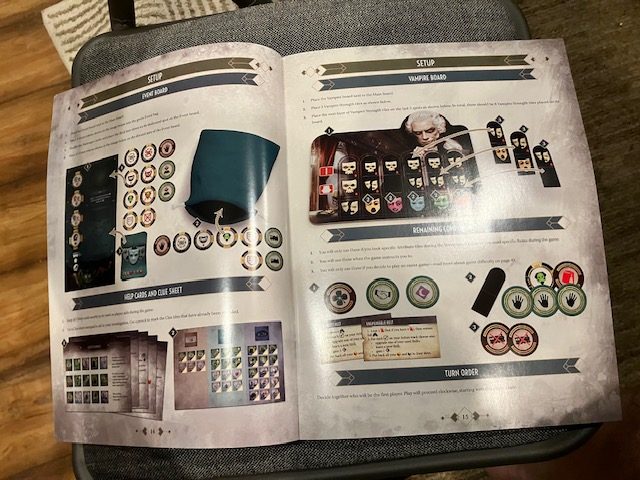
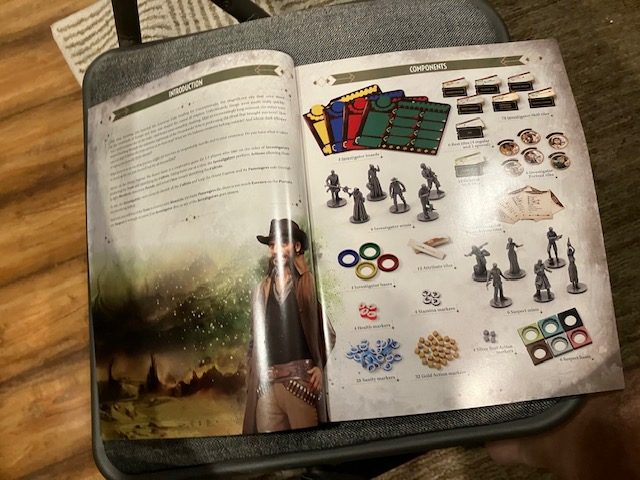
If you think that 2 hours is ridiculous to set-up the game, I point you at the rulebook: setup takes about 10 pages! That’s right, about 10 pages of the 48 page rulebook is just to set-up the game.

Uh-oh. This is gonna be hard.

Day 2a. Reading Of The Rules. 2 Hours.

If you think this is a big complicated game with lots of rules … you would be correct. The rulebook is 48 pages long.

The rulebook is good, but there are a LOT of rules … a lot of rules that you will have to lookup again and again.

The rulebook does fit well on the chair next to me: it stays open and is easy to read, but there is just a little bit of drooping of the pages. I’ll give this rulebook a B+ or A- on The Chair Test; It has a good form factor.

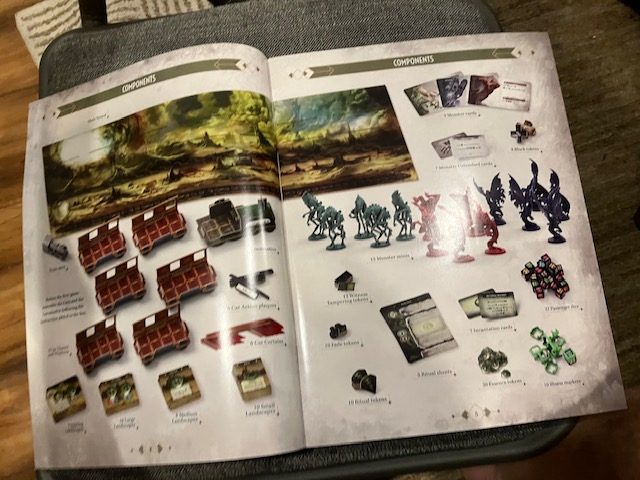
The components pages are nice, but they span multiple pages. The actual Set-Up also spans multiple pages!

In the end, you just have to get through this rulebook. I sat with the game set-up in front of me, and read the rulebook while constantly referencing the set-up game. This rulebook kind of feels like a legal document because there are so many rules and descriptions. It’s not too bad, but it took me 2 hours to get all the way through the rulebook so that I had an idea of what was going on.

I didn’t really feel like I could jump into the game until I read just all the rules. There’s too much going on to say “let’s just try it!” Nope, that’s a recipe for disaster! You absolutely need someone to read the rules ahead of time, or you will end up reading 2 hours of rules with your friends and annoying them.

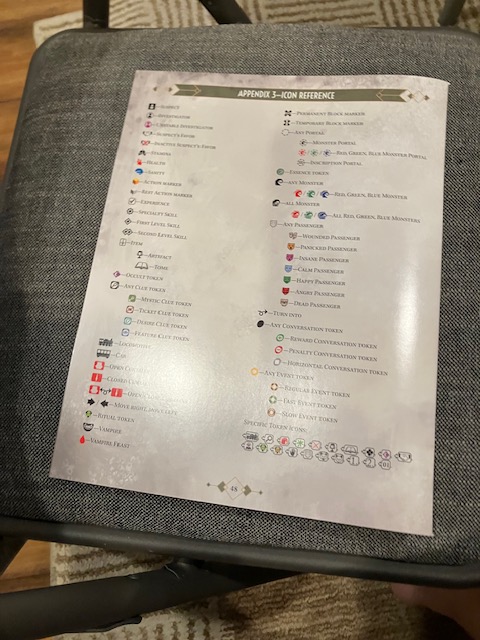
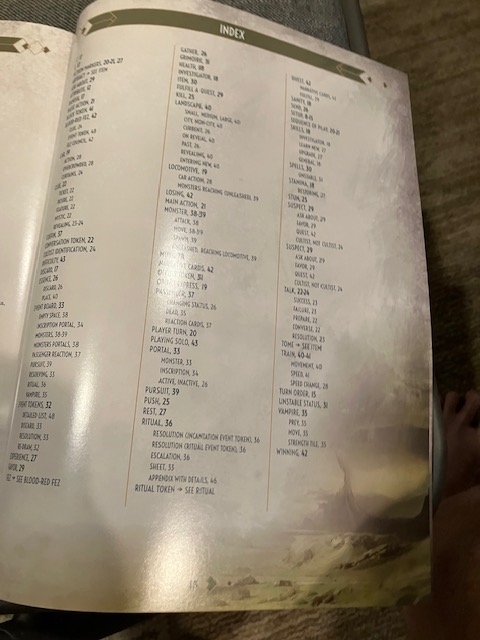
I was very pleased that the rulebook included an Index. It wasn’t perfect, but it was good enough to help when I needed to look up something.

This was a good, if long and legalese rulebook. You will refer to it a LOT as you play.

Day 2b. Solo Game: 3 Hours

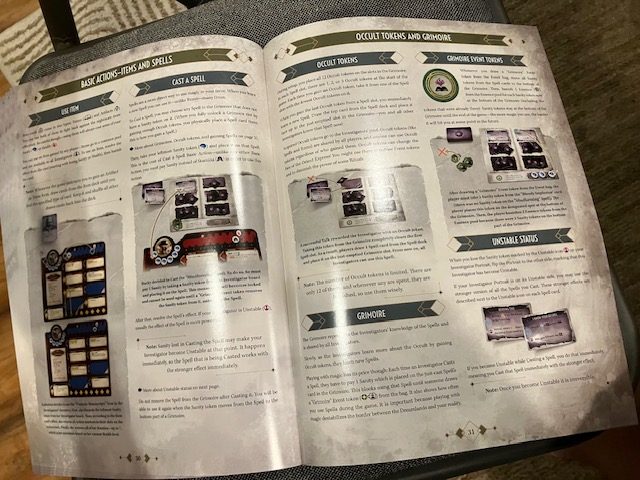
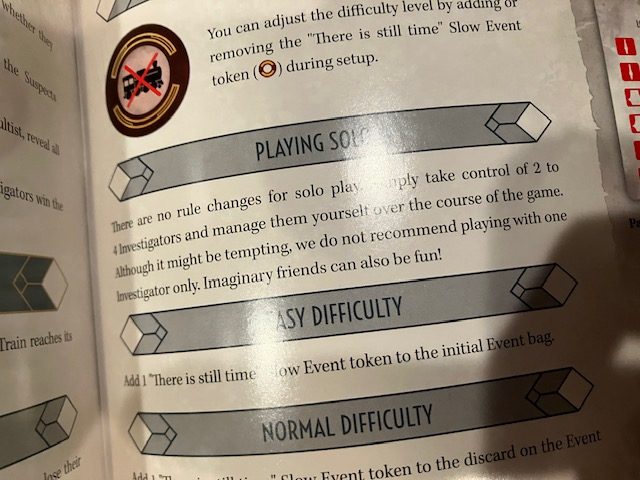
There is a solo mode (huzzah on following Saunders’ Law!)! See rulebook above. Basically, you are supposed to play 2-Handed solo, alternating between two characters.

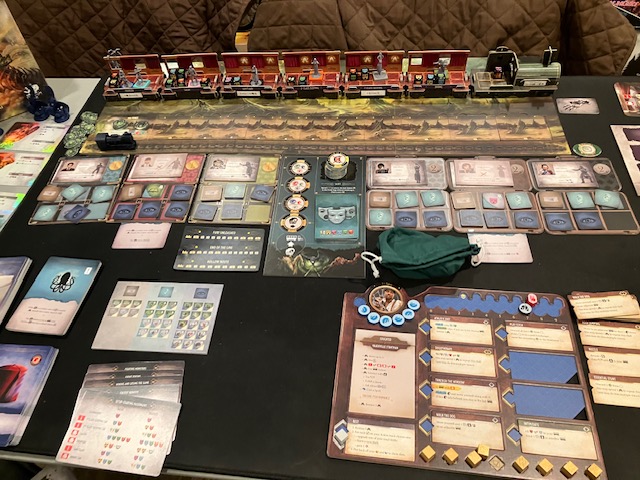
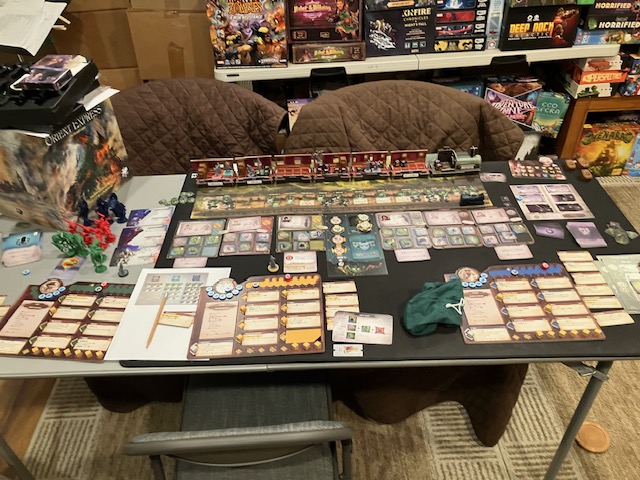
Now, I think I misread this the first time I set-up, as I just went ahead and played true solo: I operated a single character. See set-up above. After playing with a single character, I am glad I made that mistake! There are SO MANY rules in this game, that alternating between two characters just seemed like too much work.

See above as my character advanced pretty quickly.

After accidentally playing true solo, boy, I am really glad I did! I think I would have hated alternating between two characters as I I was learning the game. There are a LOT of rules in this game, and each character has a LOT of options and main powers … I think I would have been completely overwhelmed on first game had I played 2-handed solo.

I think what I am saying is … this was a happy mistake! Maybe your first game should be a true solo game so you can get a sense of everything in the game. I know I cheated a few times in my solo game, on accident and maybe once on purpose (just to get to the later game), but I think … this might be the best way to learn?

I can’t comment too much on the balance of a solo game (because I was just playing true solo to learn the game), but I think I would prefer if the game had a true solo mode? This is hard for me to say because I frequently prefer 2-handed solo mode because they typically don’t have rules exceptions! I think this is case where a minor rules change (or two) for true solo might be worth it; it might be as simple as you start the game with a couple of items already in your inventory (one of them a healing item).

In the end, the true solo player was able to keep the Cthulhoid monsters under control and accurately guess the identity of all the cultists! And it only took 3 hours!

This was a learning game, so I expected it to be longer than normal games. But it was 3 hours to play EVEN after setting everything up ahead of time! And I didn’t even tear-down, because I left it “mostly” set-up for cooperative play!

Day 3a. Cooperative Game: 3.5 Hours.

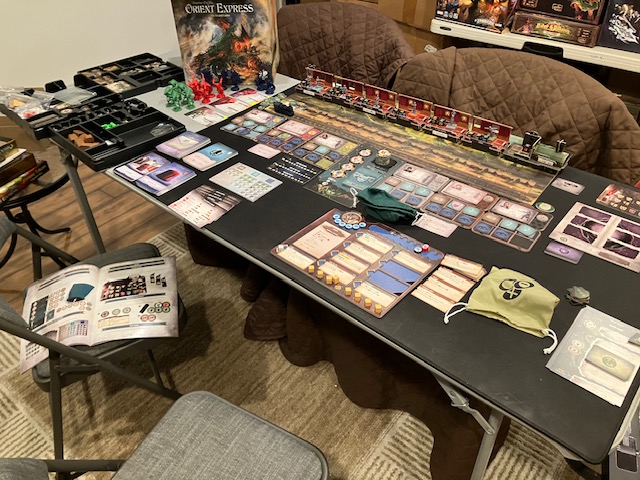
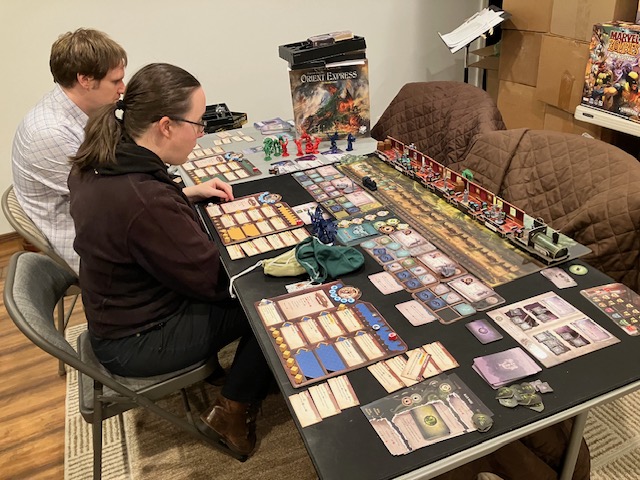
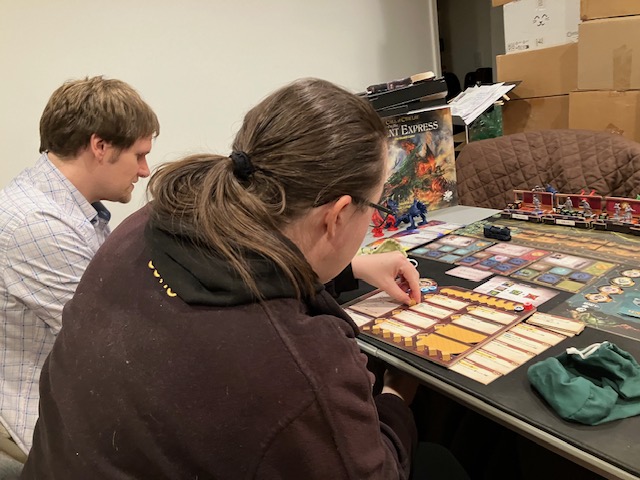
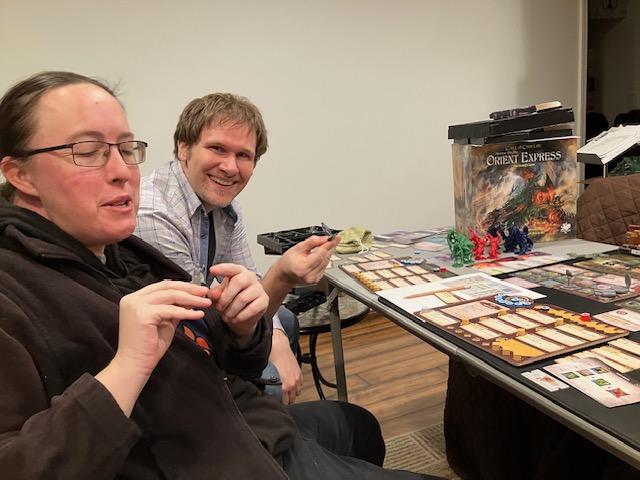
Interestingly, the game suggests that a cooperative game all sits on one side of the board. This would work fine for a 1,2 or 3 player game, but I worry that a 4 player game just wouldn’t fit? We only played a 3-Player game (above), and we just barely fit. Maybe you just need a bigger table if you play 4 players?

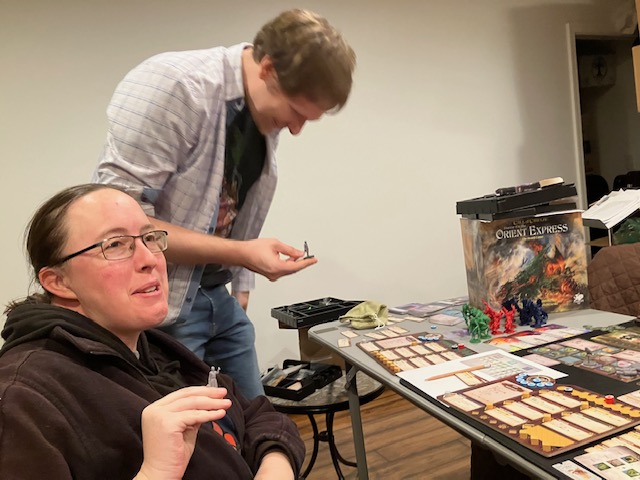
I am SO HAPPY that I set-up, read the rulebook, and played a preliminary game before my friends came over. We ended up playing 3.5 hours of just pure playing time! Let’s be clear: my friends and tried-and-true gamers who have played many complex games: we did not get “stuck” on anything!! The game moved along as it should with some rule lookups, but it still took 3.5 hours to play!

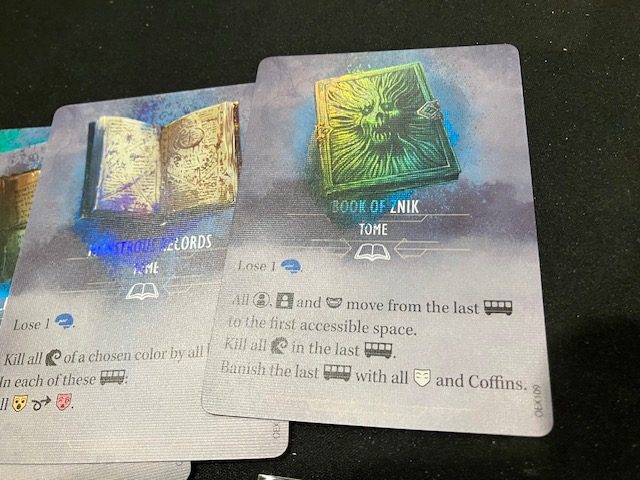
The game has some interesting ways to promote cooperation: for one, all spells and items are shared! That means there’s no need to worry about explicit “share” actions or anything like that! On your turn, if you want to cast a spell or use an item, you just use the shared pool and do it! There’s no “I have to move to you to give you the Book of Znik so you can use it!” You could argue it’s not thematic (how do you share items if you aren’t even in the same train car??), but it does get around all the problems of sharing and wasting actions to get stuff to each other. The fully shared paradigm does help the cooperation.

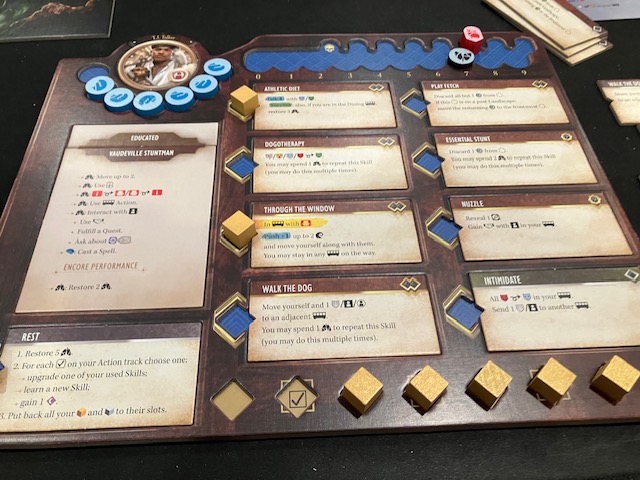
At the start of the game, most turns tend to be fairly multiplayer solitaire. Don’t get me wrong, there are mechanisms that affect other players (For example: TJ could walk his dog and have another player move with him), but players did their own thing. What I saw happen was the people kind of took their own turn and did what they wanted at the start of the game. I think this was good; it helped players become familiar with their powers, the rules, and the interactions.

What I saw happen was that as things became more dire, we started setting each other up and helping each other directly more and more.

“We really need to find out if he’s a cultist before the train reaches the end!!”
“Ya, but I have 3 cthulhoids coming up behind me! I need to deal with those!”

So, in the end game, we started working together more and more. To be fair, we pretty much had to cooperate or we would have lost the game!

From this point of view, I think the game is a good cooperative game! Players have agency to learn their characters at the start of the game, but learn to cooperate as the situation gets more dire!

To be fair, it still took 3.5 hours to play a single game. Even though it was a learning game, I did everything right to make the game introduction as simple as possible (set-up, read rulebook, played solo) and it still took 3.5 hours to play!

Day 3b. Tear-down: .5 hours

After winning our 3.5 hour game, my friends helped me tear this down.

This unboxing sheet (see above) made all the difference in the world! Tearing down the game was a cooperative experience worth its own game! I saw massive parallelism as my friends and I would each take “some pieces” from the game and consolidate them into the box! Seriously, I felt like the tear-down was its own cooperative game.

Hm, I kind of wonder if how well you tear-down a game together is a measure of how well your group cooperates together? I can say with pride that my core game group works well together! Someone was always doing something and working on putting this back together!

It still took a while to put this back together.

What I Liked

Table Presence: The game looks sooo cool on the table! The train cars, the cthulhoid creatures chasing the train, the vampire hanging on the windows, the amazing landscape, the characters, … everything! This just looks so epic!

Component Quality: In general, the component quality was good.

The Arc: The arc of the cooperative game was interesting and a very good development to encourage cooperation. The game starts fairly multiplayer solitaire, then converges to being much more cooperative as the game unfolds.

What I Didn’t Like

Deluxe Component Issues: I love the deluxe components, but there’s two major problems. One, there’s no discussions (especially in the fortune tokens) about which tokens you need for which box! Second, there’s no way the deluxe components can all fit in the core box. If you were hoping to have all the deluxe components fit into the base box, think again! If you wanted to throw away your deluxe component boxes … well, you may have to hold onto them longer than you expected.

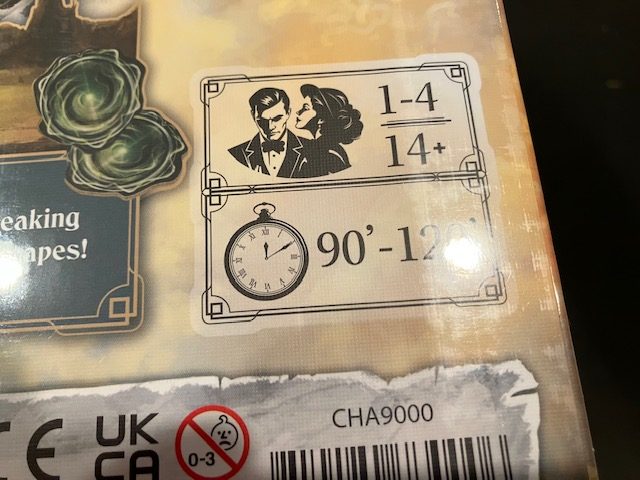
The Length: I find it very very hard to believe that this game plays in 90-120 minutes. Even if you cut-off the set-up and tear-down times, the game length still feels waaaaaaay off. There are so many rules.


Colors are a little wonky: The suspects each had a colored base that helped you identify them, but they really didn’t match the suitcase colors very well. At all. The brown suitcase we think uses the orange colored base?

Cthulhu Game?

Is this a hu game? Well, if your definition is “Cthulhu must appear”, then no, this is not a Cthulhu game. Maybe the better question to ask “Is this game set in Cthulhu Mythos?” Strictly speaking, the answer might still be no! The only real allusion is that the “train is driving through the Dreamlands”. But the vibe, the feel, the plot, everything feels like this is a Cthulhu game! Then I think the answer is yes! The train has sailed into the Dreamlands, Cultists are summoning and conspiring, portals are opening …

I mean, Chaosium does Cthulhu games. I am calling this a Cthulhu Mythos game.

*I was going to search the rulebook for the word Cthulhu and Cultists, but the PDF rulebook in the BGG files section IS NOT SEARCHABLE. They need to fix that.

Reactions

Andrew thought it was fun, but was worried that the time-investment vs. fun wasn’t good enough. His point was that there are a lot of rules and the game is really long. We had fun playing for 3.5 hours, but there’s many games we could play that are half that time but arguably more fun.

Teresa liked it and would play again. This would make one of her top Cthulhu games.

Conclusion

Horror on the Orient Express is a monster of a game … in every conceivable notion! It’s a monster of a box, with big monsters, a monster 48-page rulebook, a monster set-up and tear-down time, and a monster playtime of at least 3 hours. You have to decide if the monster aspects might be too much for you!

I would call this Cooperative Cthulhu Clue, as it’s a deduction game where you flip clues, but that would lure you into thinking this is a simple replacement for Clue! Absolutely not! Horror on the Orient Express is a deduction game where you worry about investigating while also fighting monsters and fighting vampires and saving passengers and basically keeping spinning plates going! There’s a lot going on! If you have always wanted something more complex than Clue set in a cooperative environment and fighting monsters, then maybe this is right for you! But don’t be lulled into a simple “Oh this is just Cooperative Cthulhu Clue!” No! It’s so much more! And that’s good or bad, depending on whether you you like this world.

If you like living in a Cthulhu-esque world of monsters and cultsists, then Horror on the Orient Express nails the theme! If you live that theme, you will love this world. If you just like the theme, you need to decide if the overwhelming nature of the rulebook, the game, the box, the length may be too much for you.

I look forward to playing this with some friends in Las Cruces, as they love Cooperative Cthulhu Mythos games! I know a few will blanche at the length and complexity, while others will embrace this monster of a game! Hopefully this review will help you decide if this is for you or not.