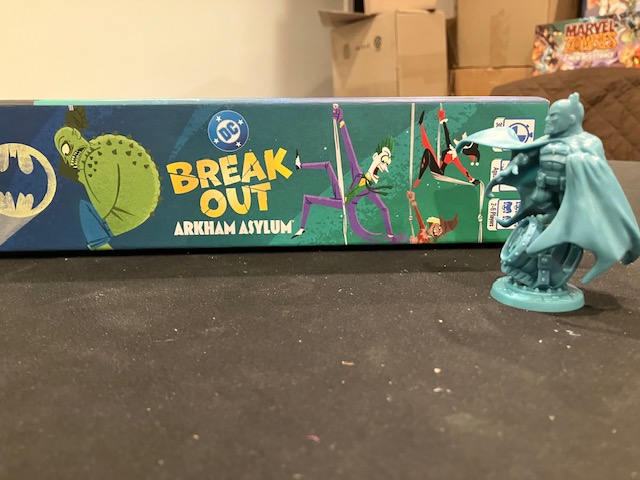
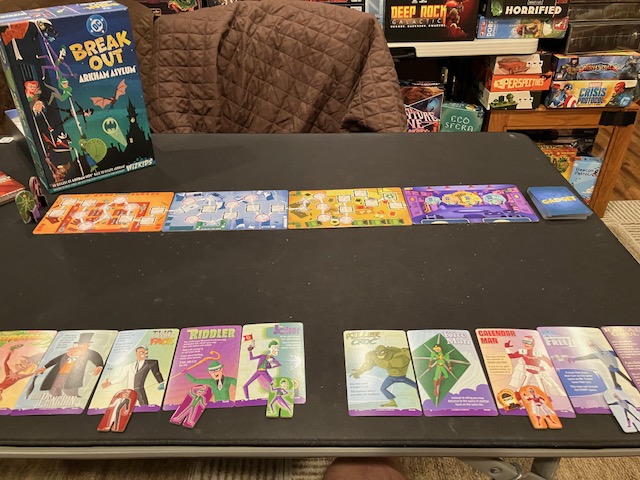
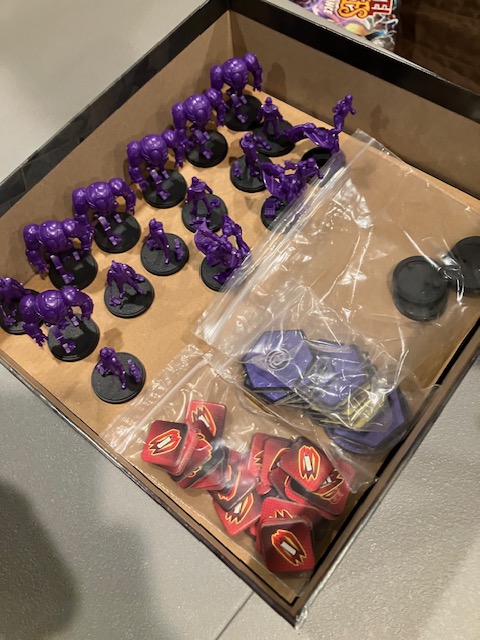
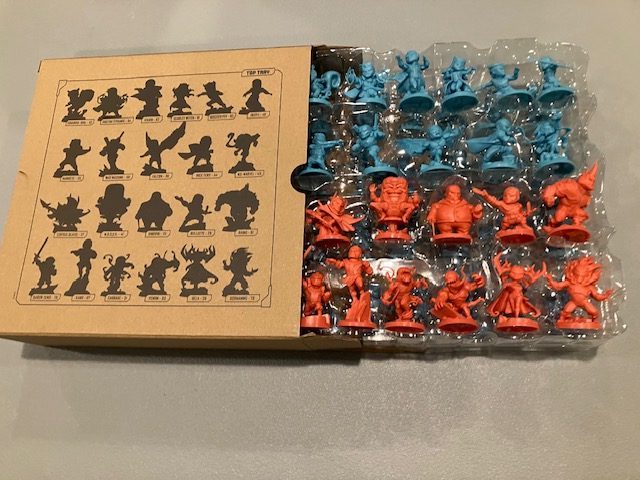
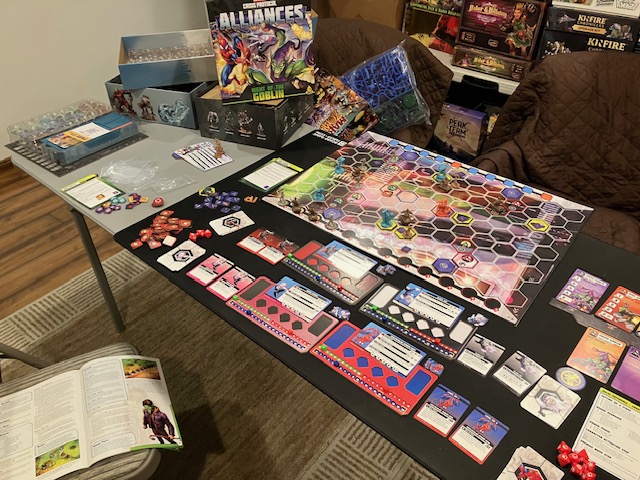
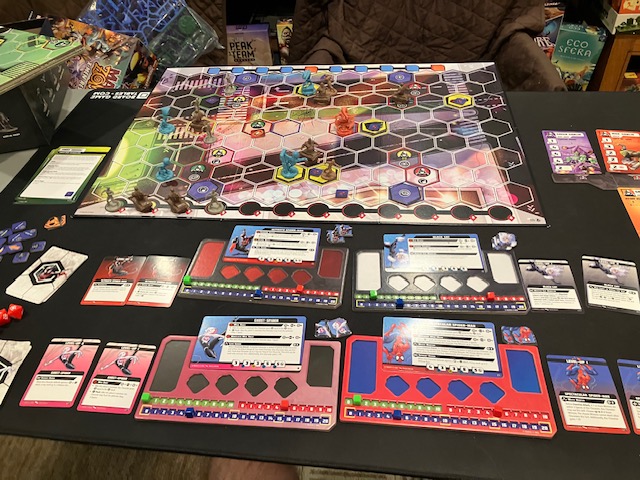
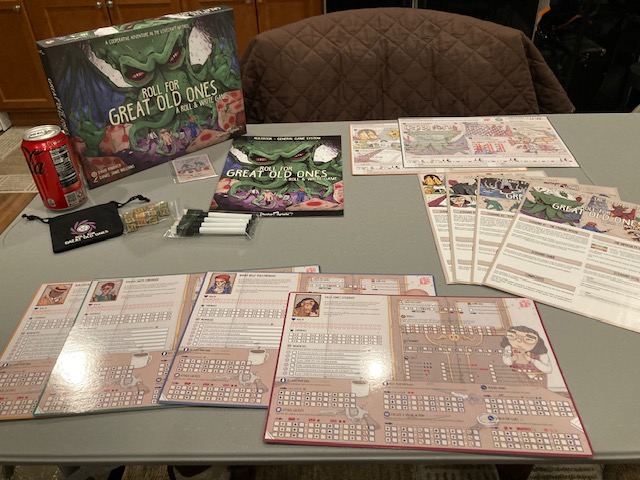
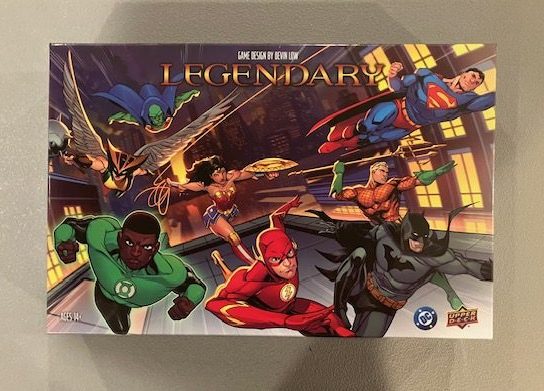
Welcome back to Cooperative Comics Month! We saw Marvel Crisis Protocol: Alliances last week in the Spiderverse! This week, we head to the DC Universe and take a look at a game that is a racing game? Cooperative racing game are incredibly rare, but using the special rules below, Breakout Arham Asylum can become a fully cooperative and solo (and semi-cooperative) game!
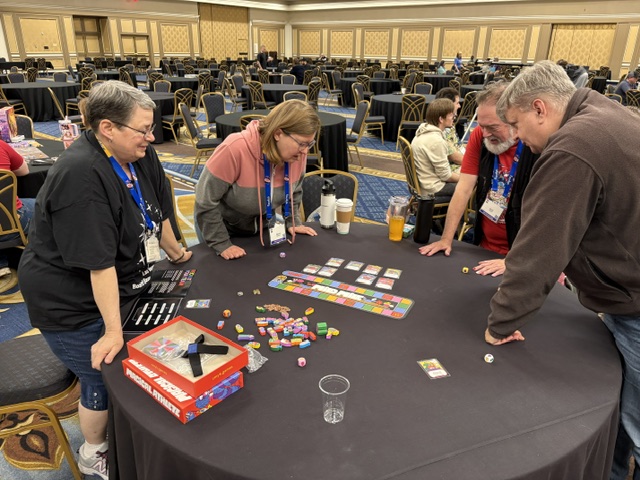
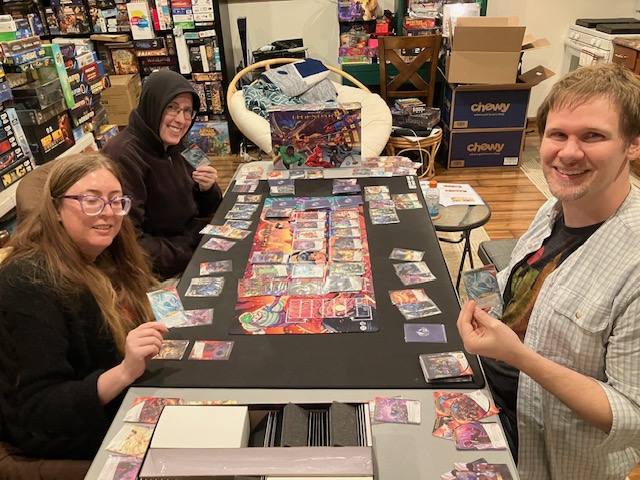
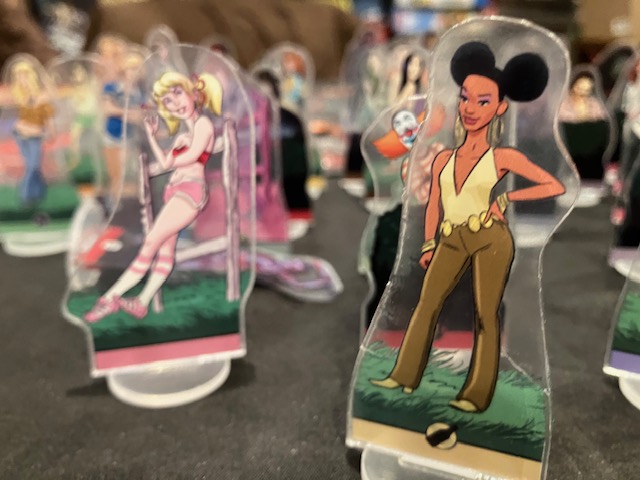
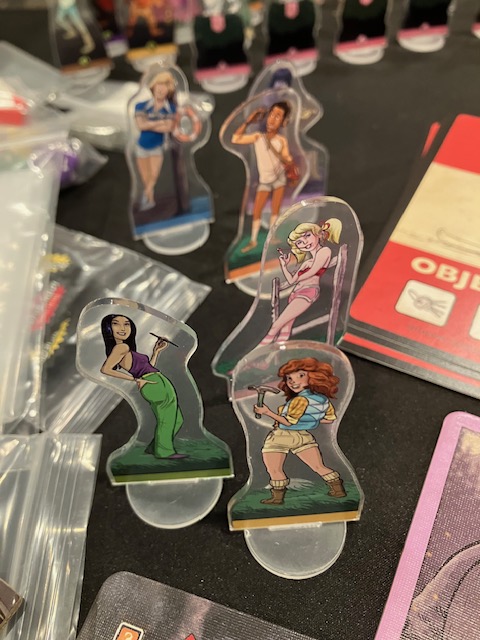
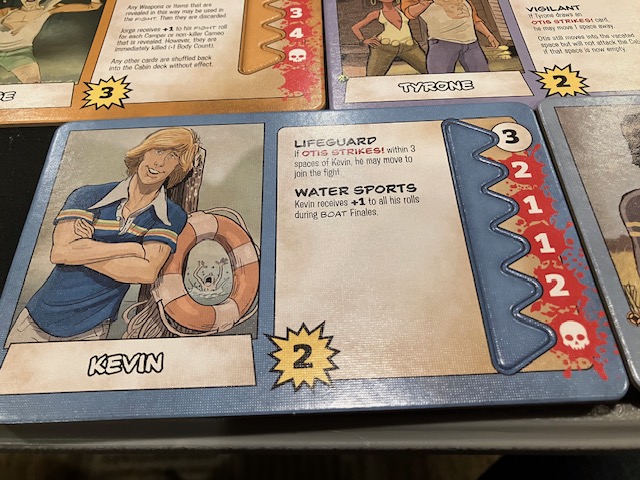
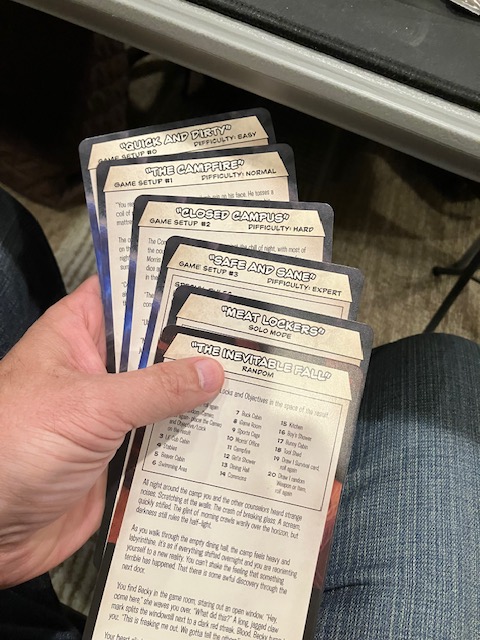
Last Dice Tower West 2025, I finally got to play Magical Athlete! See above!! It’s a silly silly competitive race game with roll-and-move! And it’s very quick!! Usually, roll-and-move is a mechanism that doesn’t work well, but this game is over so quickly and it’s so silly and funny, you don’t care! It’s got some take-that elements which I usually don’t like … but here’s the thing … I liked playing Magical Athlete! It was Stupid Fun! Magical Athlete was very divisive in that group: Kurt and I both loved it, but Dan didn’t like it … it was too random for him … but that’s the point!?
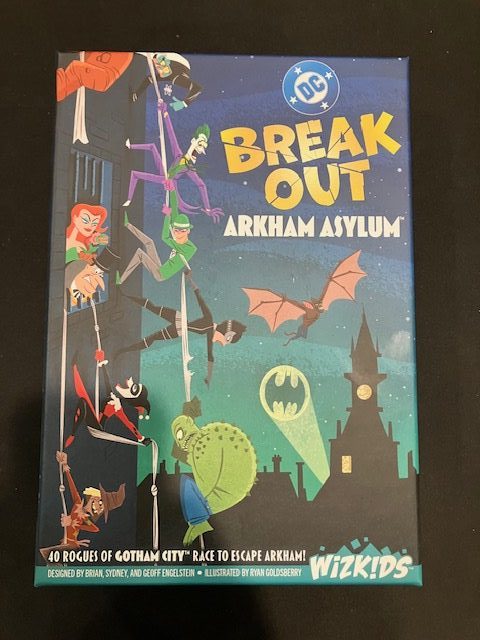
Fast forward a few months, and I heard about a game very similar to Magical Athlete called Breakout Arkham Asylum! This is the same kind of game as Magical Athlete, but it has villains from the Batman Rogue’s Gallery trying to escape the Arkham Asylum! A super-villain game in the DC universe!??!! I love that theme!
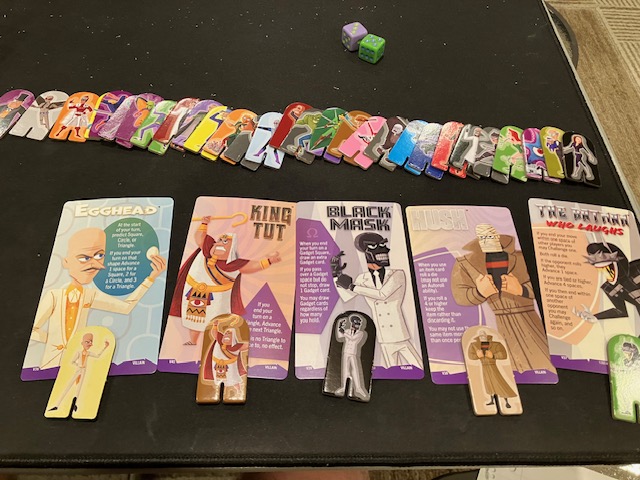
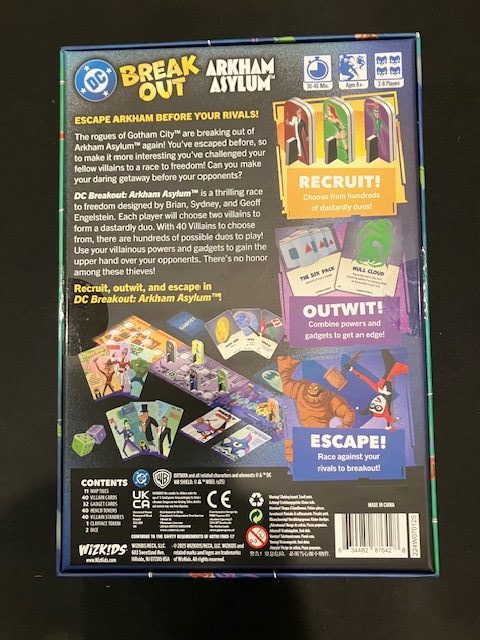
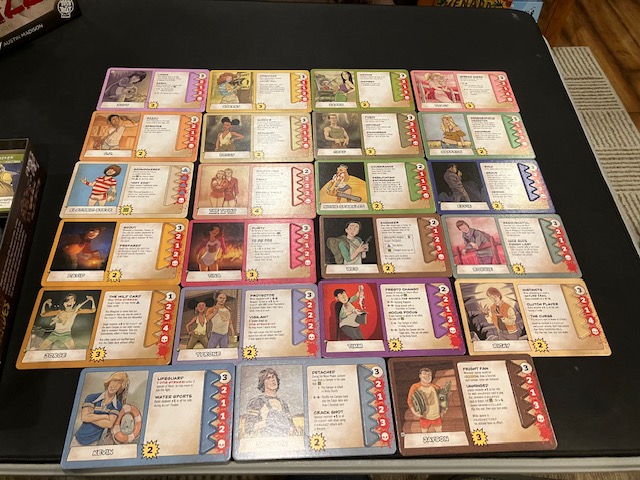
Breakout Arkham Asylum is very similar to Magical Athlete! It’s roll-and-move, but you get to choose the Villains you play! And these villains all have powers! And you choose a villain pair to play, so you can choose two powers that may combo well together! Honestly, given a choice between Magical Athlete and Breakout Arkham Asylum, I would choose Breakout Arkham Asylum because of the theme and the dual powers! At the end of the day, it’s a quick, silly, stupid game that’s over quickly as players roll dice and race towards the end!
Here’s the thing, you can’t play Breakout Arkham Asylum solo or cooperatively. I guess you could play it two-handed solo against yourself, but it’s take-that against yourself? That’s not really fun. Maybe playing it cooperatively would make a stupid roll-and-move game a little more fun and less take-that?
I think it’s pretty obvious what you need to make this cooperative and solo … you need Batman!
Cooperative Mode: Needs More Batman!
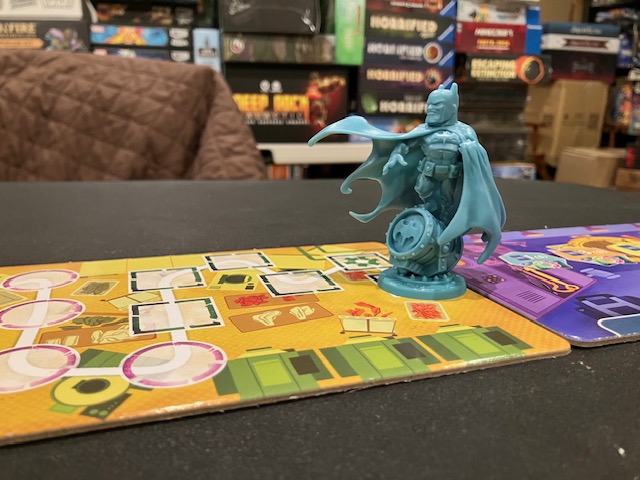
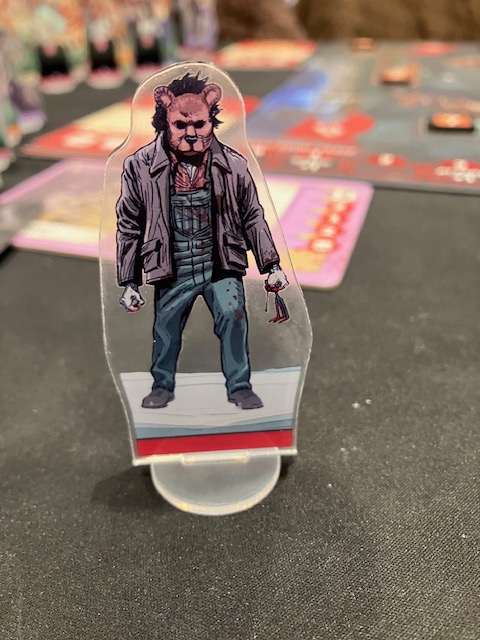
The cooperative mode introduces Batman to the game! My Batman figurine came from DC United: Hush, but you can use Batman from Gotham City Chronicles as well! You can also just use Man-Bat from the game if you have no other Batman figure…
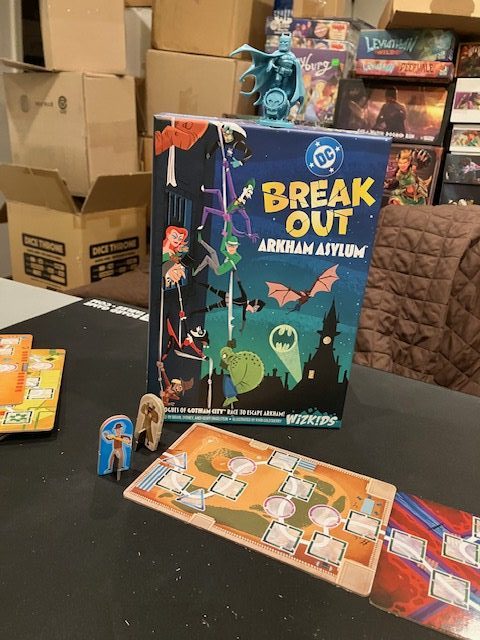
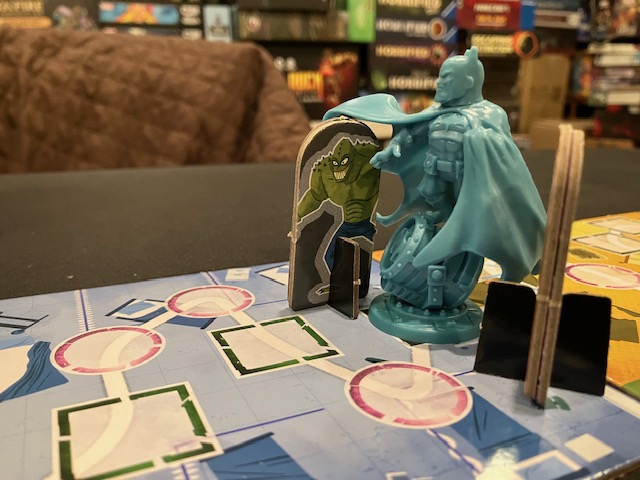
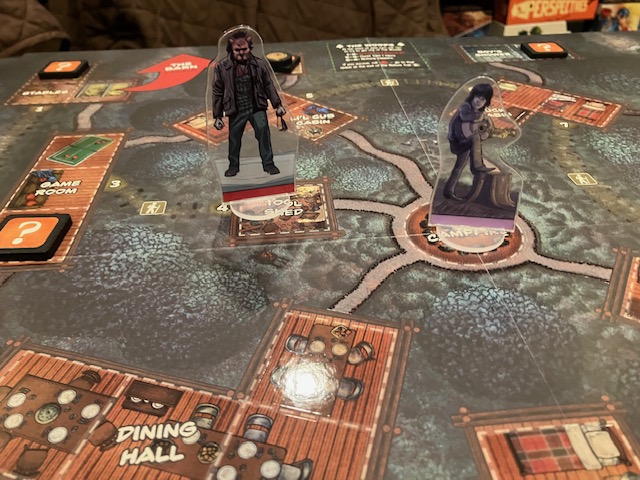
Batman has heard that the villains are escaping Arkham Asylum, but he only needs to capture a single villain pair to find out their plan and stop them! So, in order to win, the Villains must ALL escape without getting captured by Batman! Batman starts the game above the fray … see above!
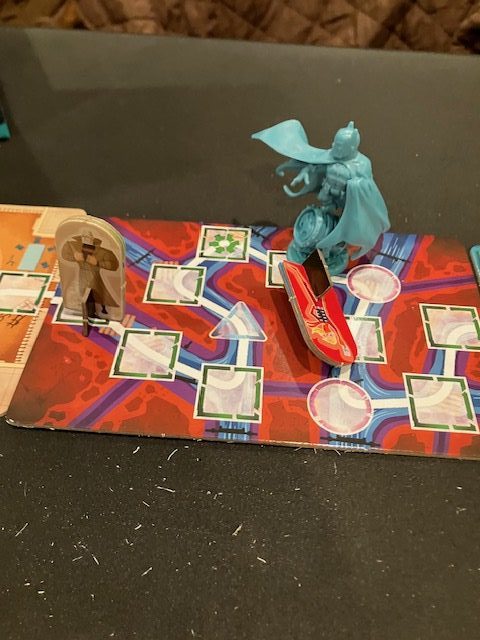
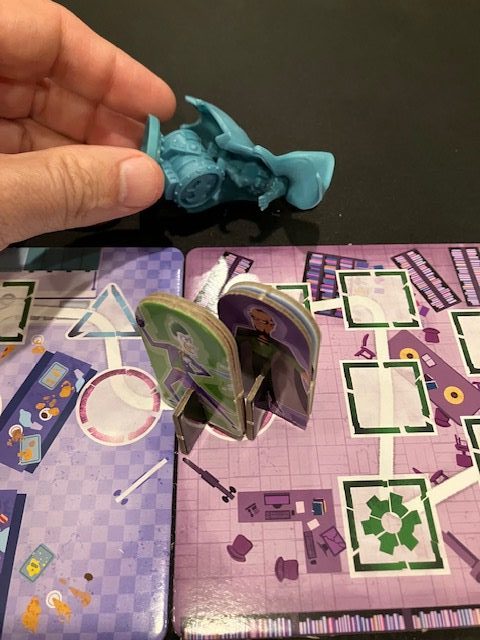
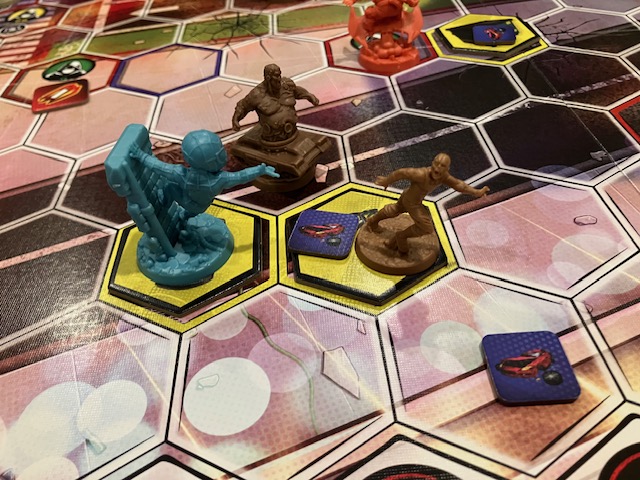
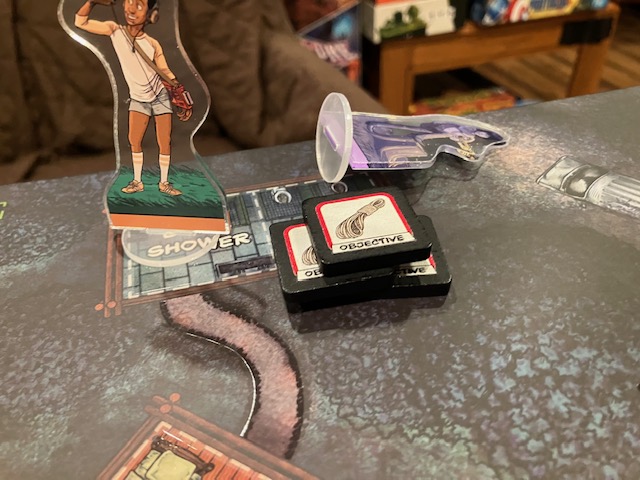
If Batman ever ends up on a space with a single villain pair, he captures those villains, grills them, and discovers the Master Plan! GAME OVER! See above as Batman captures Calendar Man (one side of the villainpair)!
If, however, Batman is ever on a space with two or more villain pairs, then they overwhelm him! If Batman is overwhelmed, he flees and he escapes back to the top of the Asylum! See above!!
The cooperative version of Breakout Arkham Asylum plays very similarly to the basic competitive game: villains all need to escape Arkham Asylum by rolling and moving! The difference is that the villains are working together to keep out of Batman’s way! They tend to stay together to keep from being captured: there’s safety in numbers!
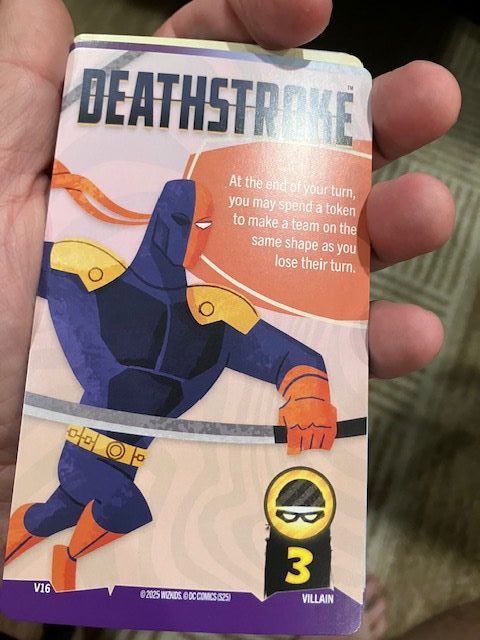
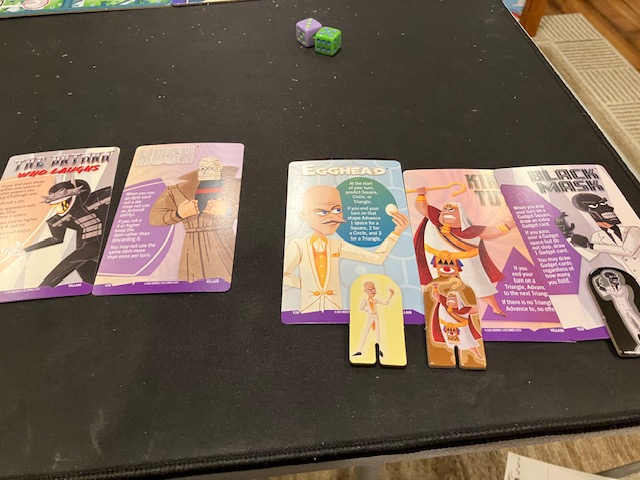
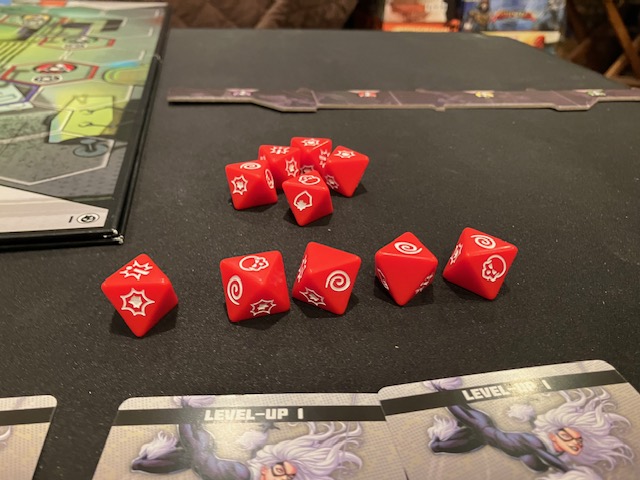
All powers work exactly the same*, which might seem a weird thing at first, because the Villain powers typically hinder other players! But here’s the thing; sometimes a Villain Pair WANTS to be hindered so they don’t go barreling headlong into Batman! “Batman is three spaces away? GULP! Someone please help me lose a turn!” See above as Deathstroke can make that happen!
It’s a different way to look at the world: those Villain powers can actually HELP each other by hurting each other!
Solo Mode: Two-Handed Solo
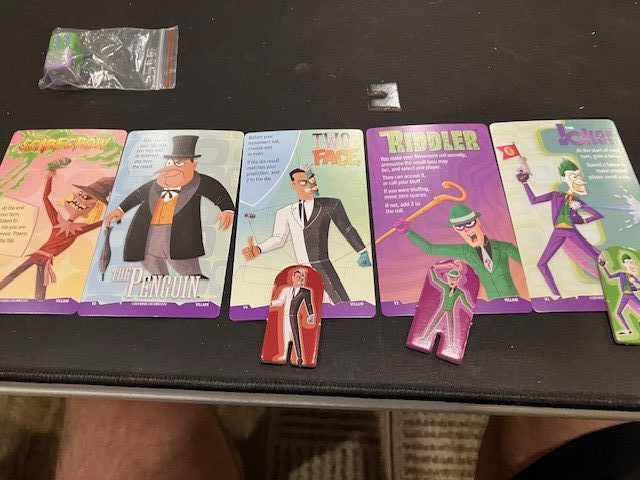
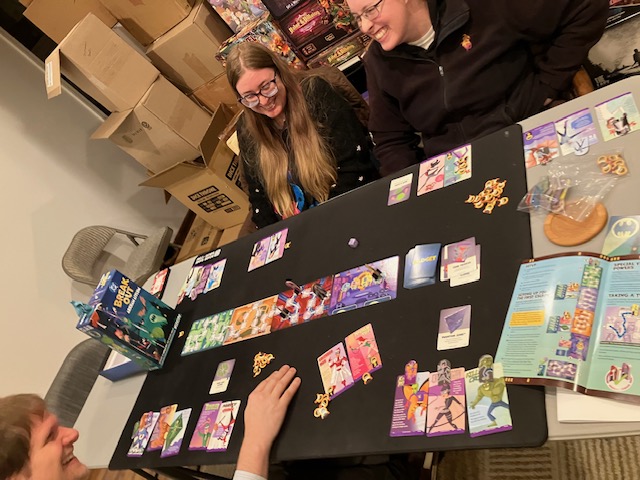
The solo mode is simple: set-up as a 2-Player cooperative game (with two hands and two sets of Villain Pairs). The solo player then alternates between the two Villain Pairs as if it were a 2-Player cooperative game. See set-up above!
Discussion
One thing that DOES change in the cooperative game: players are allowed to talk about the hand of 5 Villains they were dealt at the start of the game! This extra bit of talking and strategizing can help the players find the right combo of powers to stay out of Batman’s way!
This way, players can, as a group, strategize to find the right combo of powers!
Rules
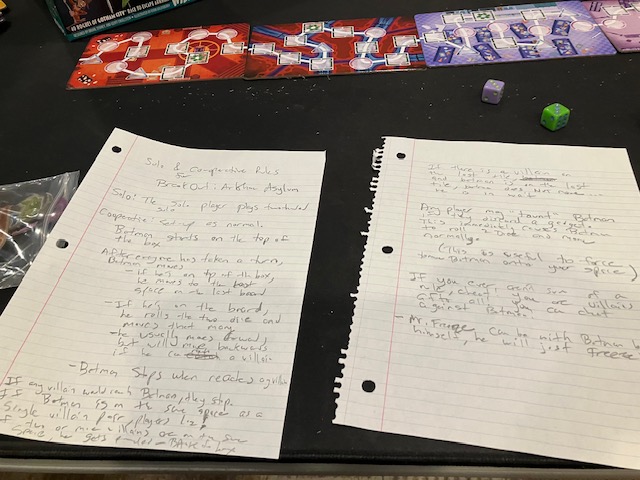
The rules originally started on two sheets of paper (see above), but I have transferred them to a PDF. See the full rules PDF below! The current version is 1.2.2. It’s gone through a number of revisions as I try find little tweaks to make the game more fun!
To be clear, this tries very hard to keep the spirit of Magical Athlete and the original Breakout Arkham Asylum! Silly roll-and-move fun, but turn the take-that into help-this!
Note that this new set of rules make a semi-cooperative mode trivial; just continue to play even after Batman captures someone!
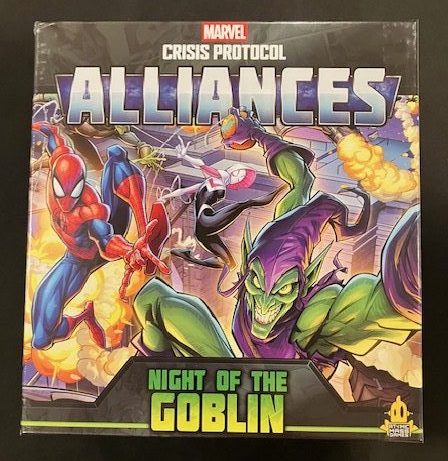
Welcome to Cooperative Comics Month! This month, we take a look at a bunch of cooperative games from comic book worlds! We’ll look at DC Comics! Marvel Comics! Image Comics! Space Comics! We start the month with Marvel Crisis Protocol: Alliances, a brand new game from the Marvel Comics universe!
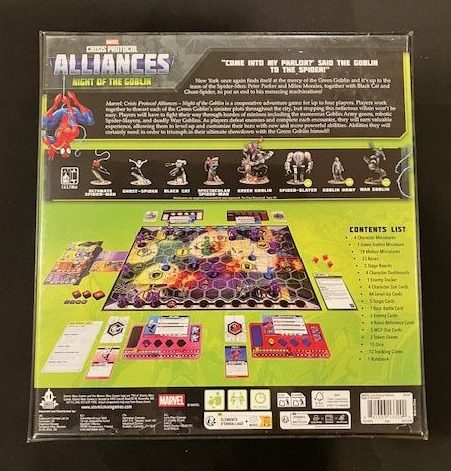
Marvel Crisis Protocol: Alliances is a cooperative miniatures game for 1-4 players; this is set in a Spider-Man universe, if that’s wasn’t clear! This is a super-hero game! Spider-people cooperatively fight the Green Goblin people!
I ordered this directly from the manufacturer; it arrived about a month ago (late August/early September 2026). It just released! I’ve been messing with for about a month now. It was kind of expensive: I paid around $100 of my own money (like we do for every game here at CO-OP Gestalt), so it wasn’t “cheap”.
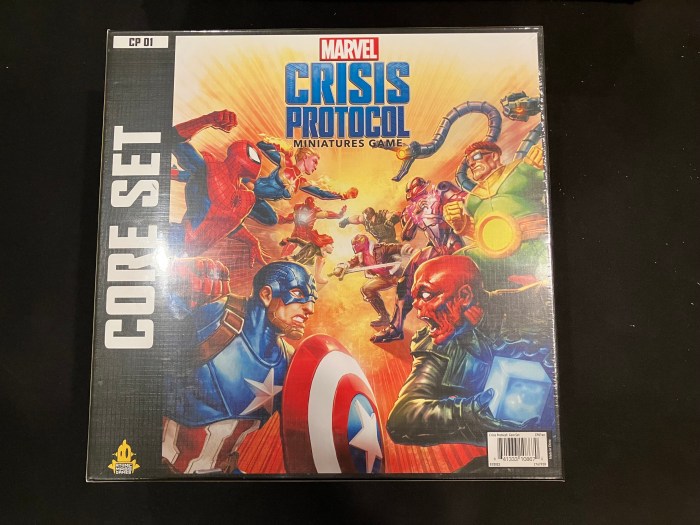
I tried getting into the original Marvel Crisis Protocol quite a while ago! I even bought the introductory set years ago! I had heard there are a “cooperative scenarios” online, and my friends Jeremy and Ralf expressed interest in trying this! Jeremy and Ralf got promoted and became super busy, so we never got to play! Part of the problem for me, at least, is that at its core, Marvel Crisis Protocol is a competitive game! Red Skull and bad guys vs Captain America and good guys! So, the original Marvel Crisis Protocol languished in my collection for years … never opened … (and it’s still in shrink today: see above).
BUT! The new Marvel Crisis Protocol: Alliances is fully cooperative! And plays solo too! I was able to justify getting the newer version to the table very quickly! Spider-people (players) fight together against the Green Goblin (who is run by the game).
What did I think of this?
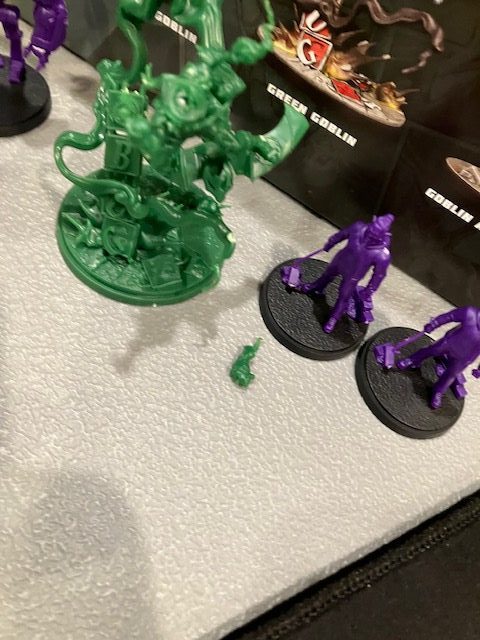
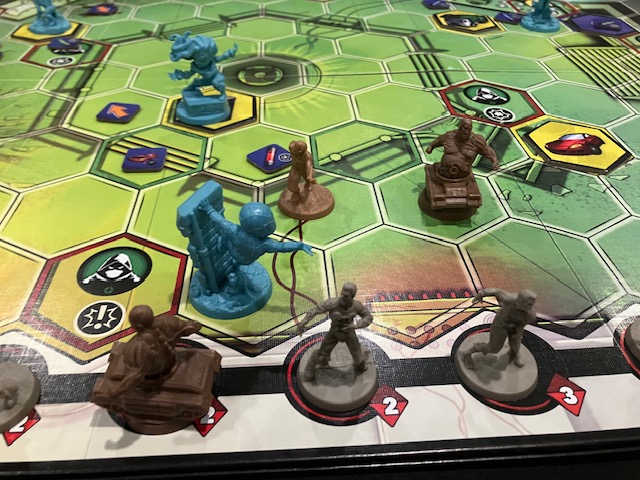
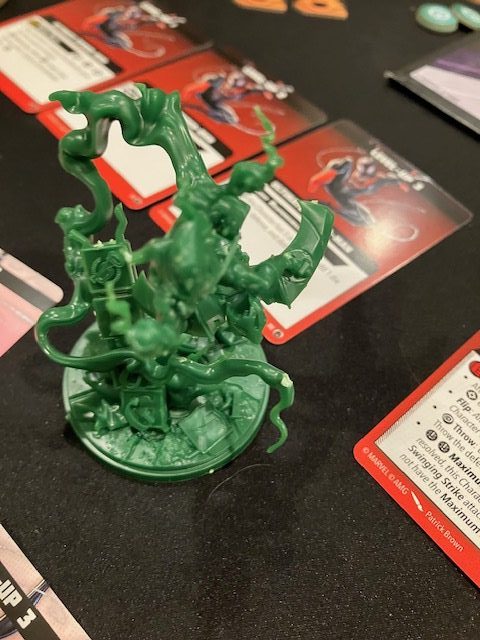
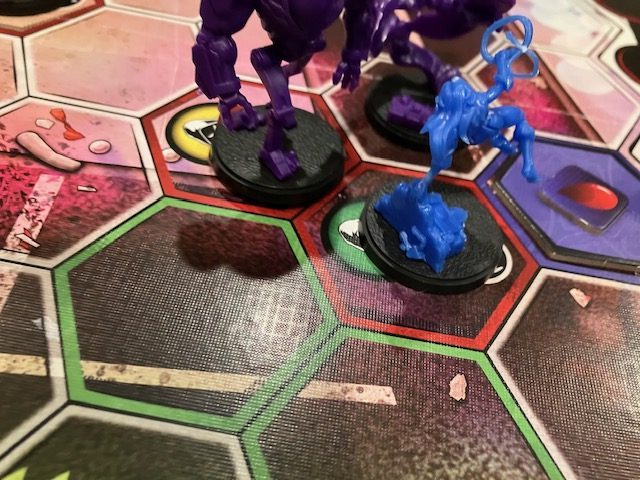
If there’s one phrase that captured the essence of this game, it’s the phrase “Green Goblin’s Head Fell Off A Lot!” See above.
Unboxing the First Time
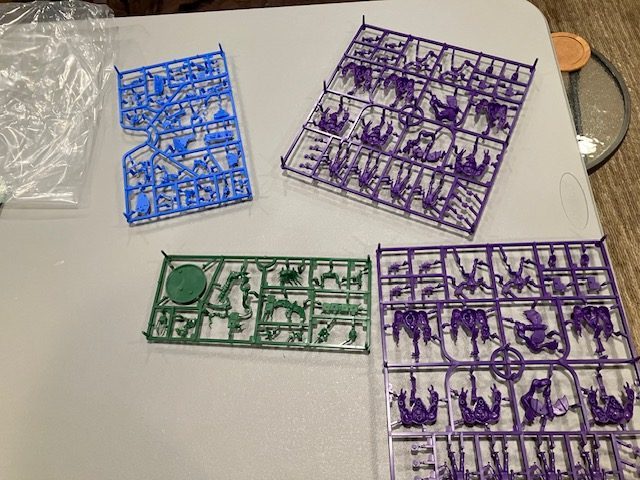
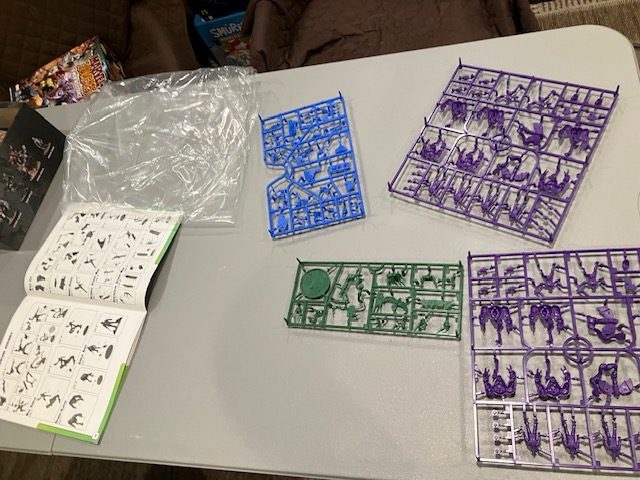
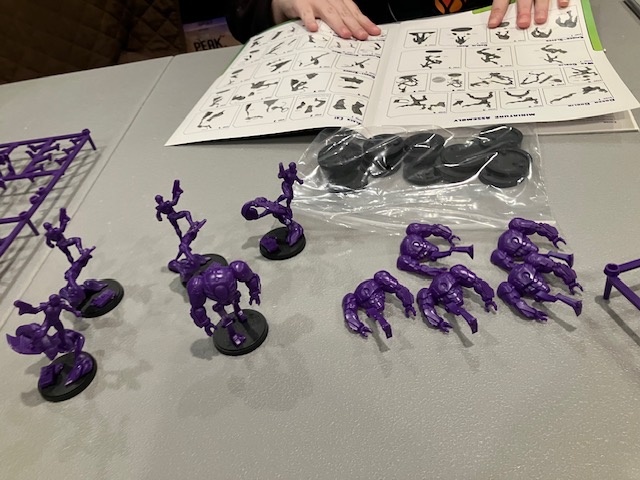
The first time I opened the box brand new, I saw … this!! Where are the miniatures? Oh, in case it wasn’t clear, you have to assemble them yourself!!
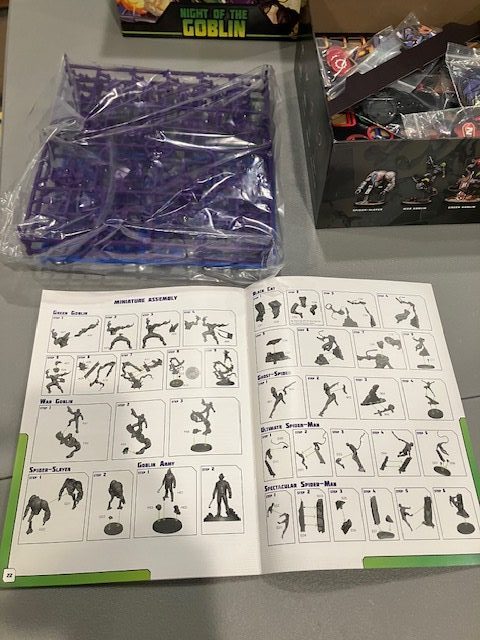
The instructions aren’t great: they assume a lot of knowledge! They show pictures (see above), but they don’t discuss many things! Do you need glue? What kind of glue? How do you separate the pieces? Are there tools you should use? I was so depressed after opening the box the first day, I pretty much just stopped. I had NO IDEA what I am supposed to do.
By the way, you might hear the term “sprues” associated with these miniatures: they are holding the minis pieces. Technically, a sprue is “a channel or waste piece in manufacturing and casting”, which describes the leftovers and plastic frames holding the minis.
I guess most people probably already knew you’d have to do assemble the miniatures : I did not. I just saw the advertisements on BGG and thought “Oh! A cooperative minis game!”. Don’t get surprised like me!
(Avengers Assemble has a VERY different meaning in this game!)
Replacements
I have to admit, I was scared to death of assembling these minis. The assembly instructions are minimal (arguably, there should be much more in the instructions), and it’s unclear what tools you need. I have a friend who loves craft projects, so I asked her to help me assemble the miniatures. While waiting for her to help me, I still wanted to try the game, so I found some … replacements.
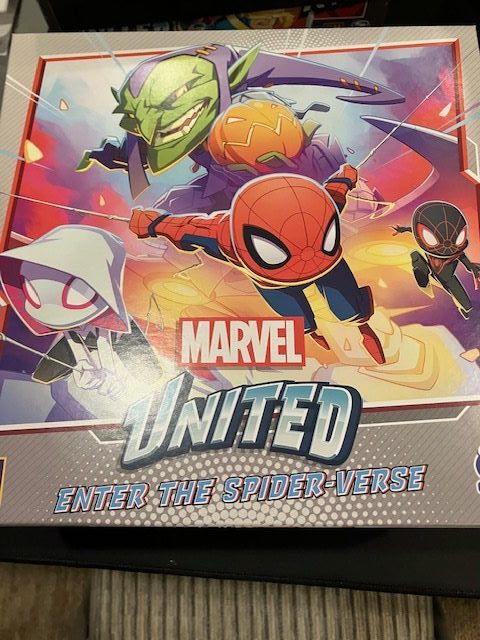
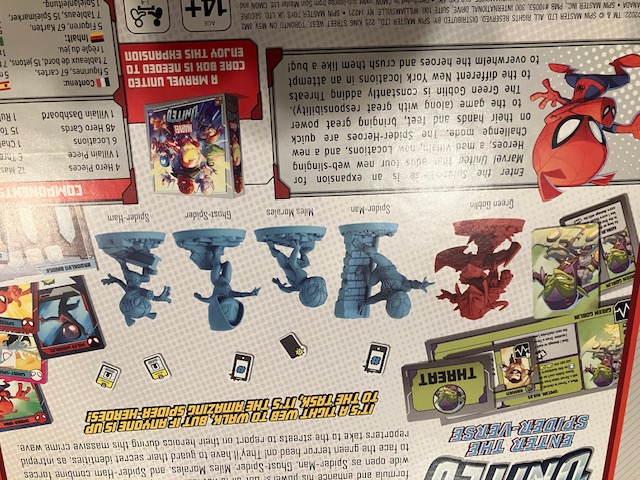
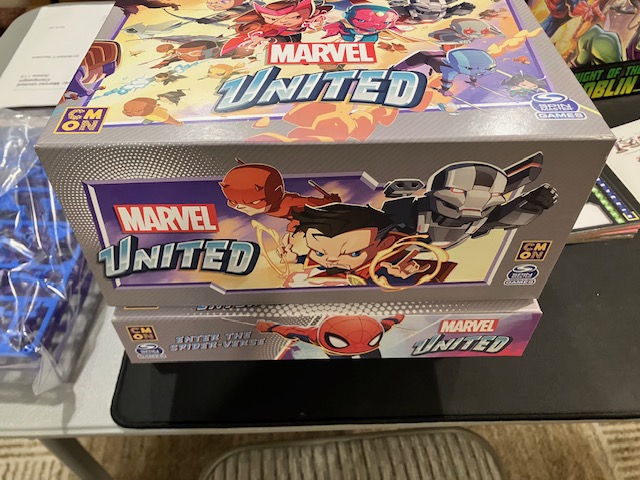
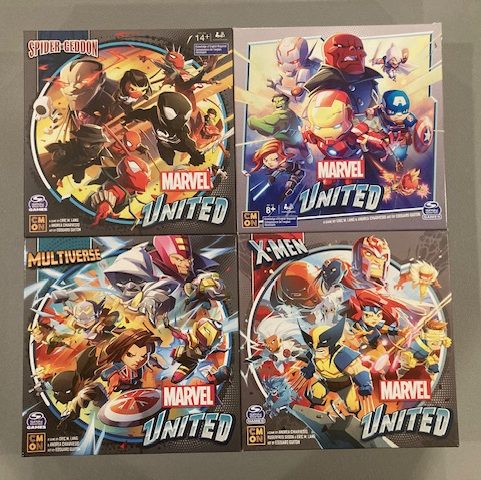
It turns out Marvel United has a a lot of the miniatures I needed!
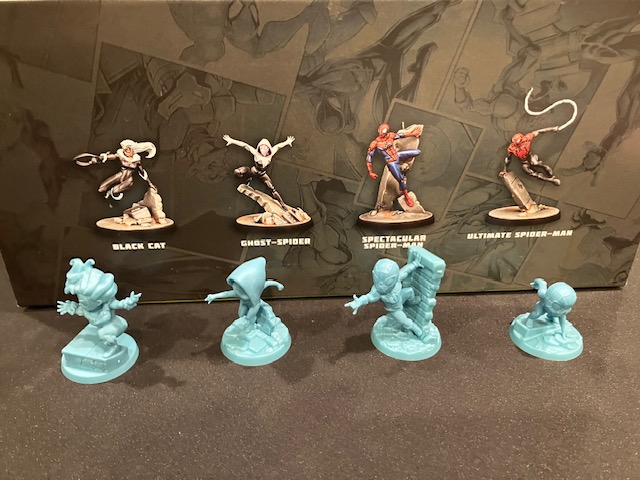
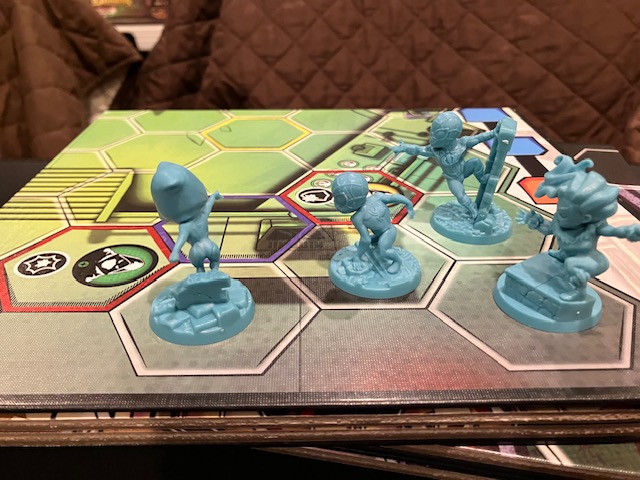
Basically, Marvel United: Enter The Spiderverse has all the good guys I need and the main Green Goblin! See above!
Unfortunately, Black Cat comes from the Stretch Goals (Season 1) (see above), which a lot of people may not have (I do). If you only have Enter the Spiderverse, you can cheat and use Spider-Ham mini for Black Cat.
The minis look great for the heroes!
.. and they even fit well on the board.
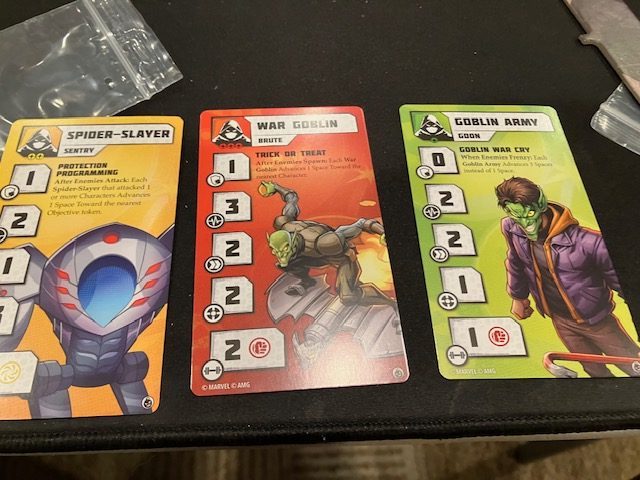
What about the bad guys? Well, Marvel United is the wrong game to use for the bad guys: there’s like 18 bad guys total, spread over three types (see above).
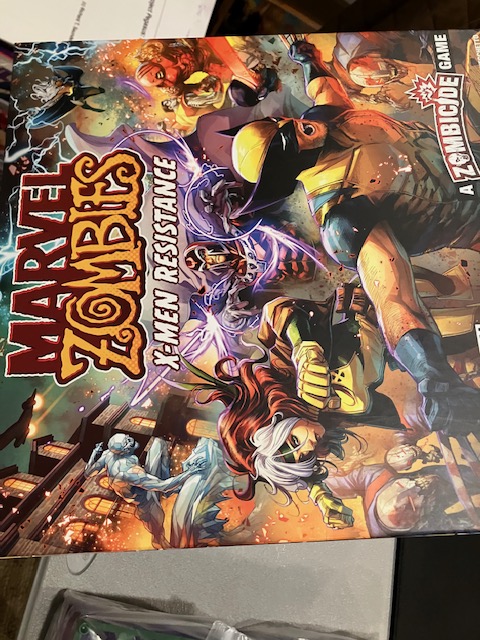
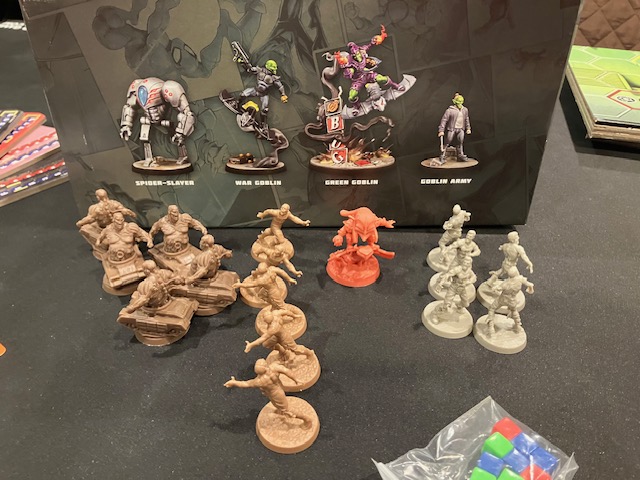
Marvel Zombies: X-Men Resistance to the rescue for bad guy minis! These aren’t quite as good a fit as the Marvel United, but they still worked reasonably well.
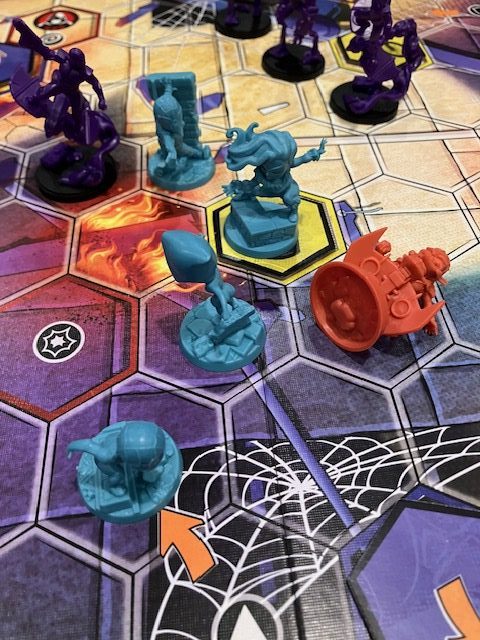
See above as the three different type of zombies “kinda” work for the three different bad guys. Green Goblin is perfect from Marvel United. If nothing else, the colors of each set of bad guys are distinct.
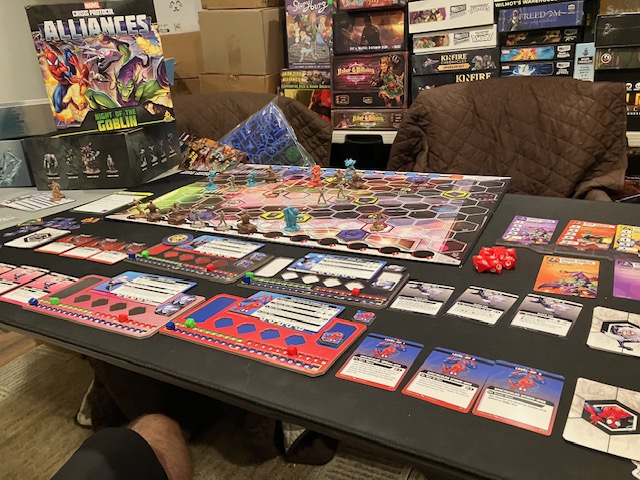
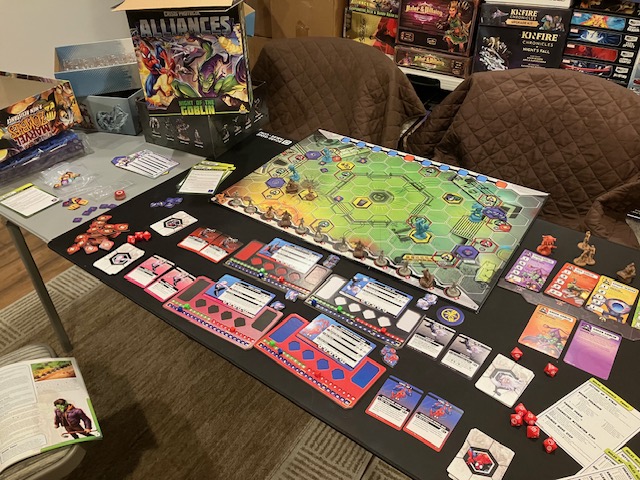
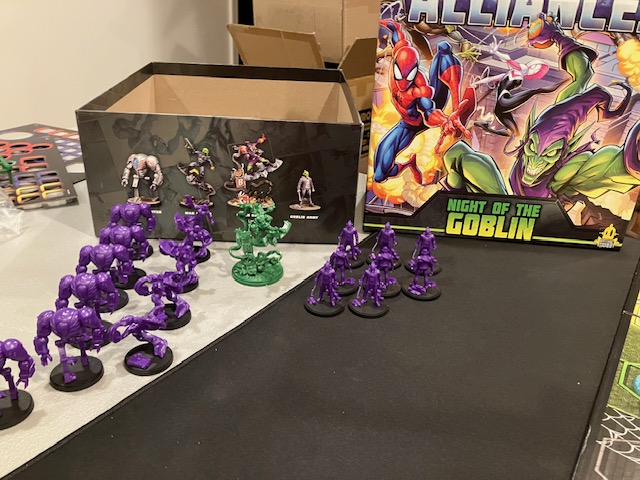
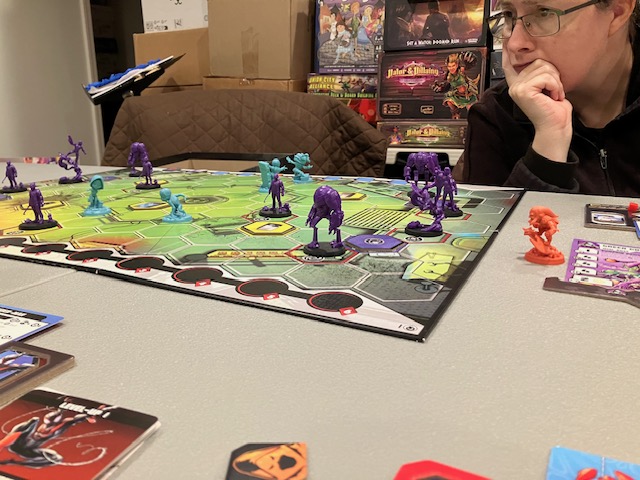
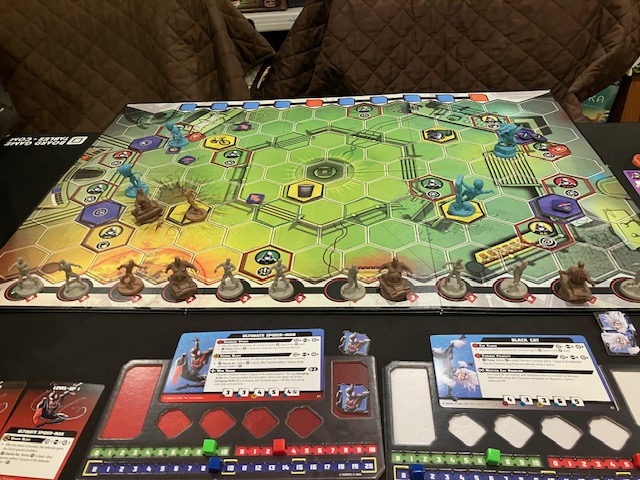
While waiting for my friend to help me assemble the minis, I was able to play the game and get a sense of everything using Marvel United minis (for the good guys) and Marvel Zombicide (for the bad guys)! See above as everything is set up and works pretty well!
Solo Mode
So, Marvel Crisis Protocol: Alliances does have a solo mode! Congratulations on following Saunders’ Law!
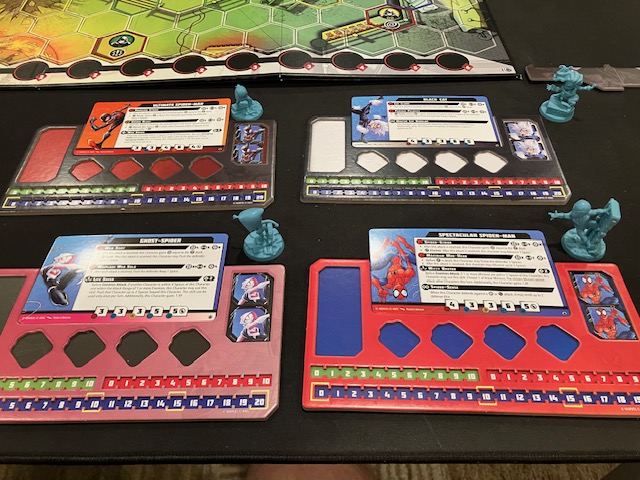
Unfortunately, this is not a true solo mode. The solo character must operate all four characters in the game! In fact, the game ALWAYS requires all four characters to be in play! So, the solo mode is simply the cooperative mode, overlaid with how many people operate the four Spider-People!
I gotta be honest: this is a rough solo mode. Why? Because each character has a lot of things to consider when they operate! What’s their special powers? How do I take best advantage of my character’s position? There is a LOT of context switching between characters as you play. Each character turn requires significant amount of thought (what do I use, what are my powers, do I have enough power, where do I end up), and then completely resets for the next character!
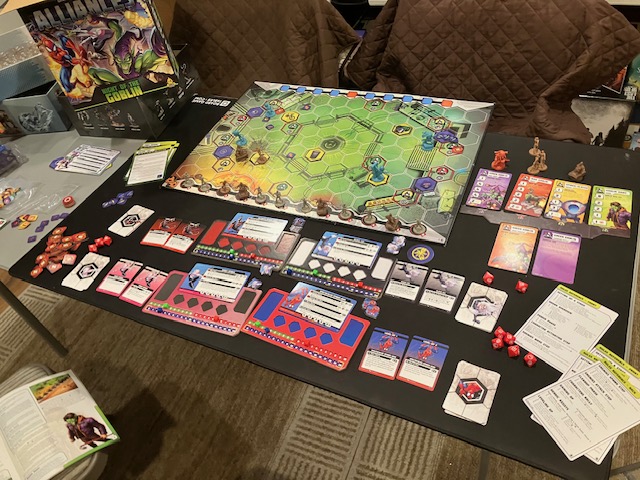
And, as you can above, that the solo game basically takes up the entire table!! This is a big solo mode with lots of work to operate.
Now, if you like puzzles, if you like really taking your time to figure out what each character can do, this might be a perfectly cromulent solo mode for you. For those of you are worried about the context switching cost between characters, let me just say that the context switch cost is non-trivial.
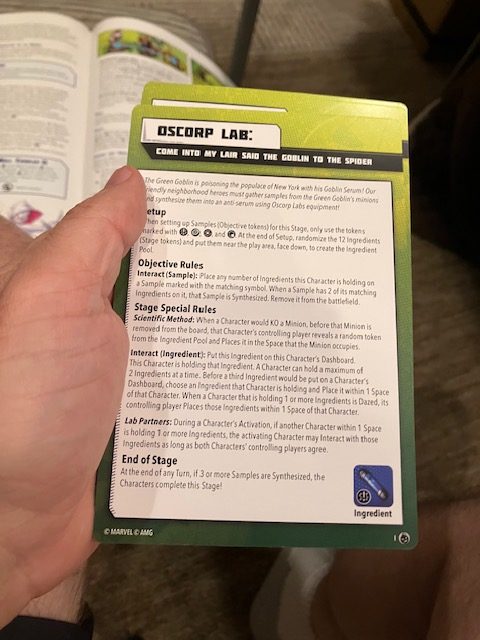
I liked the solo game … ish. I was able to play through an entire three game campaign. Each campaign has two intro games (see one above), and a final boss battle against the Green Goblin. That final boss battle is … hard. In fact, it was so hard, I sorta cheated once so I didn’t have to reset everything to retry.
Goblin-People Assemble!
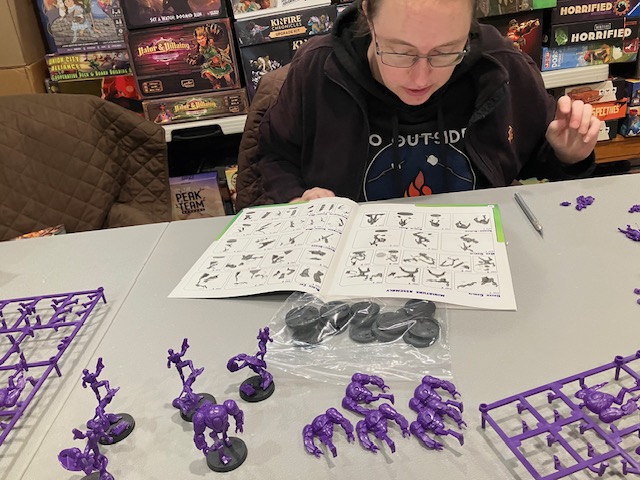
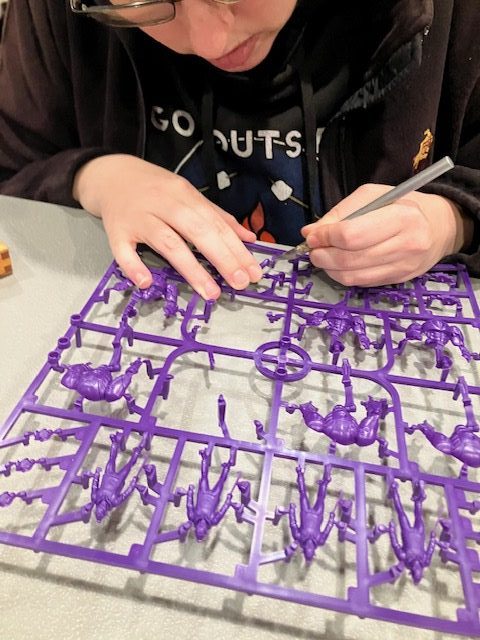
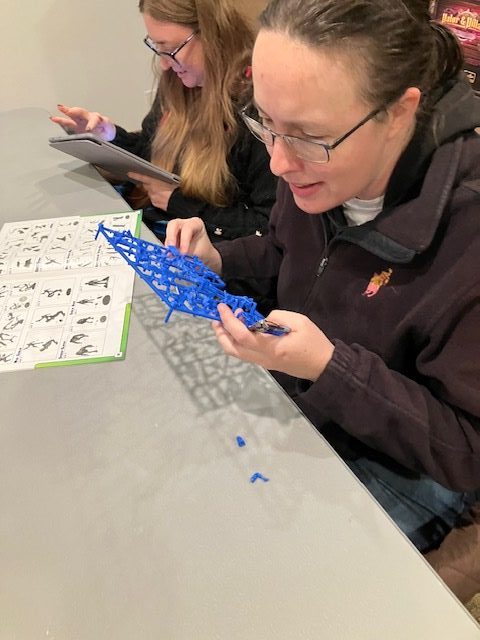
Well, thanks to Teresa, we actually got the minis assembled! To be fair, it took us two sessions (about 1 hour each) to get the miniatures assembled! In the first session, we used Exacto Knives and some Gorilla glue to assemble the bad guys.
First, the Exacto knives “worked”, but they are not the optimal tool for this job. We had to “work hard” to get the Exacto Knives to cut through the Sprues. We were afraid a few times we might either cut ourselves or hurt the minis.
Second, the bad guys are significantly easier to assemble than the Heroes. The bad guys just have a few parts, and we were able to get 18 minis assembled in our first hour-long session.
Thanks to Teresa and her efforts, we were able to use the Bad Guys for our first cooperative game!
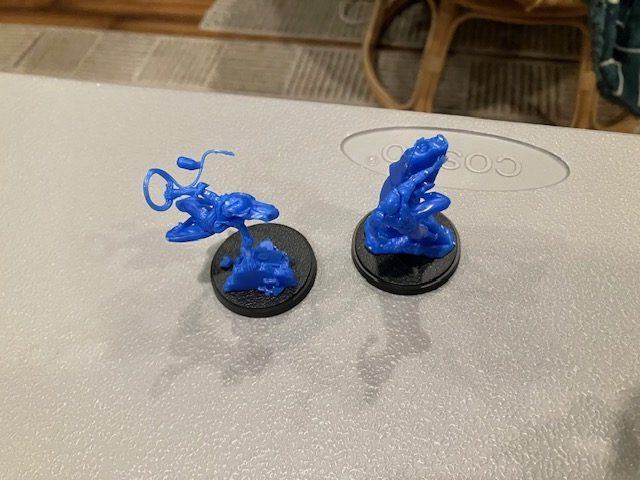
We did get Green Goblin assembled, but he head kept falling off. We weren’t sure if we were supposed to glue it?
Summary: Over two sessions at an hour each, me and my friend assembled all the miniatures. Avengers assemble! So, four hours of work total? If it were just me, it would have probably taken 5 hours for everything (if you just go by the workload and my lack of experience with craft projects).
Cooperative Game (3-Players) with Bad Guys minis!
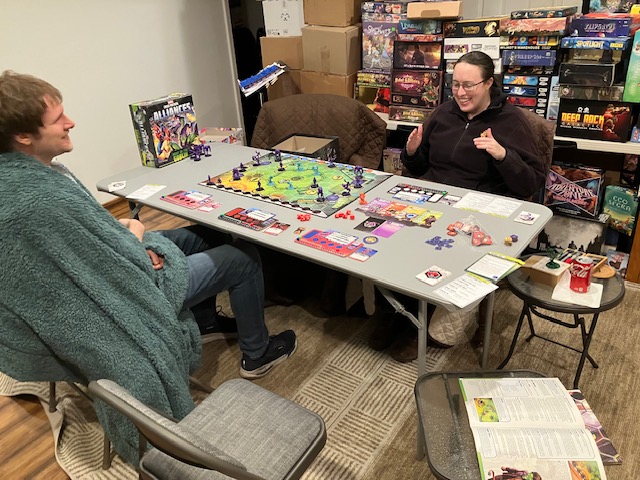
So, for our first cooperative game, we played a 3-Player game! Remember, you must ALWAYS have four characters in play, so Andrew and I “shared” the duty of operating Miles Morales, Teresa operated Black Cat, I operated Spiderman, and Andrew operated Spider Gwen. (I guess we shouldn’t call her Spider-Gwen … that gives away her secret identity!) See above and below as we use the newly assembled bad guys, but still use Marvel United good guys.
We had a fine time, not great, but we got a sense of the game. The game definitely moves a little quicker than the solo game, as each player keeps fewer “contexts” in their mind.
One of my favorite parts of the cooperative game was the use of Player Selected Turn Order (see link here for discussion of PSTO). To be complete: Marvel Crisis Protocol: Alliances uses coarse-grained Player Selected Turn Order. This means that players can take their turns in any order they choose (they just can’t split up their turns). This was a good part of the strategy of the game, as you could try to plan for who has the Priority token, plan for bad guys coming out, and try to reinforce other player’s turns. I think that worked exceptionally well in this game. To be fair, I am a big advocate of PSTO in cooperative games (as I think PSTO usually makes the games more cooperative).
To a lesser extent, the Heroic Action worked pretty well for the cooperative game. When players defeat a bad guy, they can use a Heroic Action to give another player a move, a power, or a heal. It’s great for making the game more cooperative (“Give Andrew a heal! Spider-Gwen is really far down!!), but it doesn’t seem particularly thematic? Why does me defeating a bad guy give someone else a heal? It’s great, I think it helps balance the game … it just doesn’t feel particularly thematic. It definitely helps the cooperation.
My friends liked the game enough so that we could continue onto the second game in the campaign. Next time. It took quite a while to get into the game and play it. We could only get one session done in one game night.
Spider-People Assemble!
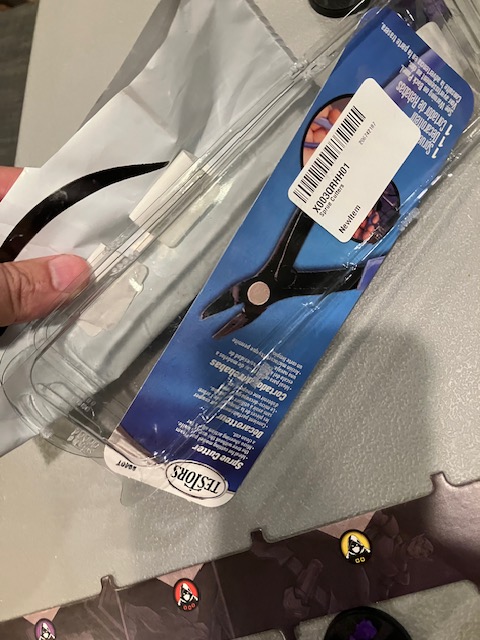
Because the Exacto knives were just “ok”, I found some Sprue cutter on Amazon for like $10. That made a big difference! It was SO MUCH easier to remove the minis using the Sprue Cutters!!! Why wasn’t this in the rulebook??
It was good we waited a week to get the Sprue cutters to help us, because the good guy miniatures are significantly harder to assemble! There’s only 4 good guys (and 18 or 19 bad guys), but it still took us an hour to assemble them!
But the good guys are also a lot more intricate, and unfortunately, more fragile. See Black Cat’s thin thin whip?
It fell off during normal handling!
In the end, we got all four good guys assembled. With a lot glue to keep fixing breaking parts! They took an hour! They were much more complex! If you are reading this and plan to get this game, make sure you get Gorilla Glue and some Sprue cutters or you will hate life!
Cooperative Game (4-Players) with all minis!
So, for our second game, we were able to play with 4-Players! And to be fair, I think that makes the game a lot more fun. I prefer playing when you have one character per player! Then I FEEL like a Superhero! But, if I have to operate multiple heroes, it’s not quite the same experience?
If you do end up getting this game, I would strongly recommend getting a group of 4 players to play it! This game is strongest at 4-Players because each player is a super-hero!
We ended up playing through and winning, but I don’t think my friends want to continue to game 3 (the Boss Battle).
Reactions
The reactions were pretty much, “It was okay, but nothing special”.
The main complaints were two-fold: One, if you didn’t have enough power, you could only do one really useful thing on your turn. There wasn’t a lot of choice?? Second, you can only do one thing on your turn … which is usually move or use a power. Not being to move and do something (move and strike) seemed … less fun?
To be fair, a lot of the powers allowed you to move and strike, but only if you could afford the power cost. It also felt weird that you “get power” usually when someone hits you? The power economy seemed very athematic (“wait, I get power when someone HITS me???”). It seemed balanced and it worked, but it didn’t seem… thematic.
Another complaint was that forces were “overwhelming”. On your turn, you might defeat 6 bad guys, but they pretty much all come back next turn! Andrew argued that it almost didn’t matter that we had this cool hex board, because the bad guys just came back out next turn! And it was very random! Doing a bunch of damage to bad guys is the only way to “move forward” (get power, get heroic actions, get experience), but they all just came back. It didn’t seem like there was a lot of strategy: the bad guys just always come back. It was also sort of depressing: you’d defeat a lot of bad guys, but it didn’t matter.
What I Liked
PSTO: The Player Selected Turn Order worked very well in this game; for me, it was almost the highlight of the game that it worked so well.
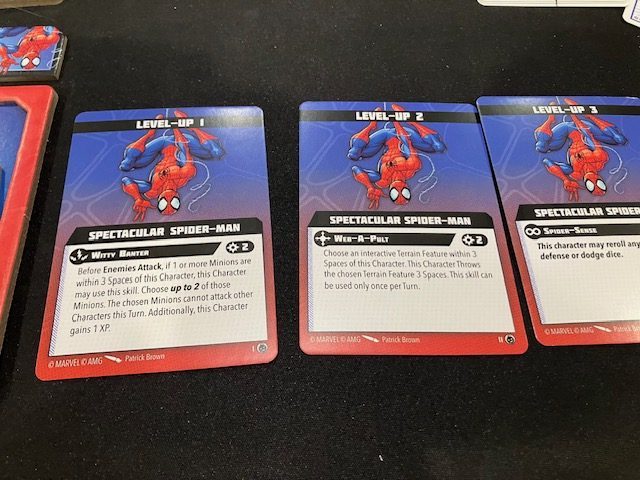
Power-Ups: As the game progresses, you get power-up cards when you go up a level! That was very cool, that you felt like you character was always getting more powerful. By the time you get to game 3, your Spider-person is pretty powerful!
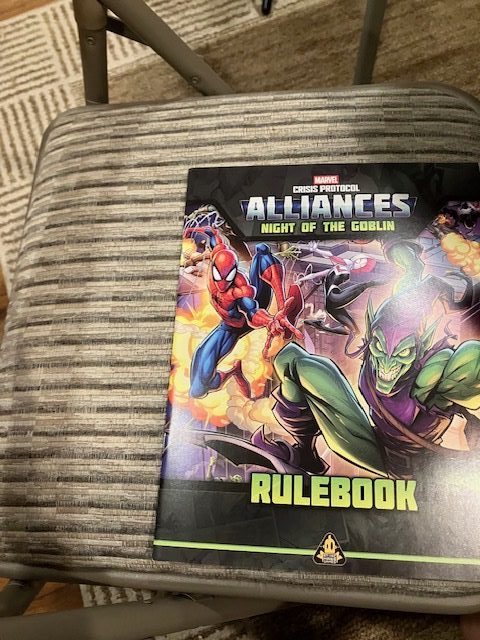
The Rulebook: The rulebook had some problems (where is my Index? How do I assemble the minis?), but it was decent for the rules (but … it really needs an Index). It also had a good form factor, and gets a B+ on the Chair Test (it works well on the chair next to me).
Cooperation: With the PSTO, the Heroic Actions, power-ups, and the theme of the game, the cooperation came out pretty well.
What I Didn’t Like
Miniature Assembly: I had NO IDEA what I was getting into with the minis when I got this game! Assembling the miniatures is its own mini-game! Be aware of what you need to assemble the minis: get Sprue cutters and glue or you will hate life!
Fragile: These miniatures are fragile. Green Goblin’s head kept falling off, Black Cat’s whip broke off during gameplay, and the Goblin Army’s crowbar broke off during assembly. As a direct juxtaposition, I have NEVER had any problems with my Marvel United miniatures … and I have 100s of those miniatures and have played Marvel United so many times!!
Storage: How the hell am I supposed to store these miniatures? Right now, I just set them up standing in the box, but this solution is so fraught with peril! See above! Any slight bump, and these “already fragile” minis will go everywhere! I can’t store this sideways? This just seems like a major failing!
Compare that to my Marvel United minis! They always fit well back into the box well … with a storage solution.
Four Characters: there’s only four characters in the box. And you always have to play with four characters. There’s not a lot of variety (but I hear more Alliances are coming out). The solo game is really rough, especially as the characters get more and more powers: by the time each character is level 4, the number of powers for the solo gamer to keep track of is mind-bending!
Gameplay: The “constant pressure” of the game made it so it felt only tactical and not strategic. Everything depends on the dice you roll for where the enemies spawn: you don’t really know where the enemies will end up. You sort of get tired of they way they spawn: “what’s the point in defeating a bunch of bad guys when they just come back?” I know a lot of super-hero games do this, but it feels like you are making more progress in other games?
Random. At the end of the day, this is a dice game. The dice decide if you get hit, the dice decide if you hit, the dice decide where the bad guys spawn, the dice decide if enemies frenzy. It can be random and it can be frustrating if you wanted a more strategic game.
Conclusion
Where you end up on Marvel Crisis Protocol: Alliances depends on a lot of things.
The constant pressure of combat feels more like an intense video game: you may love that, or you may hate that. Enemies spawn and just constantly put intense pressure on the heroes! The game is very very tactical and much less strategic than you might assume … I don’t know about you, but if I see a game with a hex-map, I assume it’s quite strategic? (I guess that makes me a hexist).
The solo game is rough as you have to operate four Spider-People! If you love that slow solo game and context-switching between complicated characters, then this might be perfect for you. It’s a puzzle? It’s just .. a bit more random because everything depends on how well you roll the dice.
The best version of this game is the 4-Player cooperative game, as each player gets to be a Super-Hero! I think 2-Player is probably the next best (as each player operates 2 heroes). The cooperation that does emerge via PSTO, Heroic Actions, powers, and the theme shows this to be a good cooperative game.
Be aware of the miniatures experience! If you aren’t expecting the sprued miniatures, Marvel Crisis Protocol: Alliances can be overwhelming! If you are interested in this, make sure you pick up some Sprue cutters and some Gorilla glue (as Green Goblin’s Head keeps falling off!!) The miniatures are cool, but they are fragile. And I have no idea how you are supposed to store them.
If you want a simpler super-hero game with miniatures, Marvel United might be a better choice. Marvel United is a better game, has a better experience with miniatures (they actually have a storage solution), is significantly cheaper ($25 for the base Marvel United game vs. $100 for the base of Alliances), has more variety, and is significantly easier. Be aware that some people blanche at the minis in Marvel United because they hate the chibi look.
If you like the experience of dissecting, assembling, and painting miniatures so you can then play with them, then Marvel Crisis Protocol: Alliances might be the perfect choice for you! The game does work, and it is a pretty good cooperative game.
The final grade is divided:
Sara and Andrew give it a 6/10: it’s okay and it works, but there are better games. Rich gives it a 6.5/10 : Rich liked the cooperation and superhero theme, but the random nature of the dice brought it down just below recommendation. It could be a 7/10? Teresa gives it 7/10. Teresa liked the minis; she helped assemble them, so she is aware that she may have a vested interest.
So, on average 6.5/10? Hopefully you can figure where you end up based on this write-up
Welcome back to Cooperative Cthulhu Month! We’ve been looking at cooperative Cthulhu Mythos games, starting last week with Horror on the Orient Express! For the next few weeks, we will be continue delving into the cooperative games in the Cthulhu Mythos! This week, we’ll with a cooperative roll-and-write game (kinda) called Cthulhu Rift!
Cthulhu Rift was one of of a group of three Cthulhu-based games from the Lovecraft Games Collection on Kickstarter back in June/August 2025. They promised delivery Feb 2026 and were about 6 months late: my backed collection of games arrived mid August 2026. (Technically, one of them arrived much earlier, but that’s not this game).
I backed this collection because of the game Cthulhu Rift!Cthulhu Rift is a cooperative roll-and-write board game (sort of) for 1 to 4 players! Like Yahtzee, but cooperative and Cthulhu? Sort of?
Players each take the role of one of the investigators in the game! See above!
Each investigator has their own roll-and-write board! They also each have a once-per-game special powers (lower left) and some skills you can unlock as the game unfurls (bottom right).
This is a dice game (after all, it is fundamentally a roll-and-write game): see the different colored dice above. On a turn, the “driver” (first player) rolls the dice and each player must take a die … and that’s the symbol they get for that turn! (Some players may get more than one symbol).
Symbols aren’t immediately used! After you record a symbol on your sheet, you “may” cross out and activate a symbol if it’s adjacent to another symbol! This is a game about “collecting” symbols so you can use them later!
You can literally get stuck in a corner! The orange magnifying glass (above) can’t be used because there are no other adjacent (non-crossed) magnifying glasses!
There’s all sorts of symbols you use: magnifying glasses to find runes, books to decipher runes, and portals to seal rifts! And guns to kill cultists! Gulp!
The overall objective (at least in Case 1) is to find and decipher the runes to seal the gates! For the 2-Player “easy” game (see above), we have to seal 4 gates! The runes on each row indicate what you need to find in order to close and seal it!
The reason I said this is “kind of” a roll-and-write is that you also traverse a map! On the active player’s turn, you move around the map, trying to find what you need as well as “disposing of” Cultists along the way!
If you don’t deal with the Cultists quickly enough, they WILL summon Cthulhu! Or at least some of his tentacles. That’s what Cultists do!
See a winning board above, where 4 portals have been sealed! The Cultists (blue stars) had taken over almost half the map, and they even summoned one Cthulhu tentacle, but we did win!
You might have noticed that the dice and the symbols in the game all have colors! Generally, you can “only” apply one your symbols to an activity if you have the matching color! The colors of the location and the colors of the dice “generally” matter! You can only record symbols on the appropriately colored spaces! So, the colors do matter of the Location for activating and recording symbols!
To repeat: the colors matter! White is wild, but generally the symbols can only be applied to a Location with a matching color!
Seal all the gates before you run out of space, Cultists, or Tentacles!
The game generally has pretty good components: see above. The art might be slightly divisive, but I think it’s very thematic art as it has an “edge” to it that implies a supernaturally weird element.
Rulebook
So, this game has 4 different rulebooks in 4 different languages! See above! That’s why there’s not a lot of text anywhere; it was meant to be language independent!
Sigh. The rulebook form factor is ok. It gets like a C+/B- on the Chair Test: it can sit on the chair next to me, but it droops more than it should (see below).
The rulebook is fine. I didn’t love it, but I didn’t hate it. For some reason, I had trouble reading this! I don’t know if it’s because it’s a translation or the organization? Or something else? You will have to read it a few times to get the game. It’s not a hard game, but it felt like this should have been easier to get. I think that a Player Summary Card might have helped quite a bit? (There is no Play Summary cards; probably because of the language independence of the game).
It was fine. It taught the game.
Solo Mode
So Huzzah to Cthulhu Rift for having a solo mode! Congratulations for following Saunders’ Law!
The included solo mode is even a true solo mode! The solo player plays the one character, Dr. Elias Grimsby. Now, even though this is the official solo mode, that is NOT how I played my first solo game.
For my first solo mode, I played two-handed solo, alternative between two characters as-if it were a 2-Player game. Why?
If you look at the solo rules (see above), there’s about a page of exceptions to the rules. This game is kind of a bear to learn and teach, so after reading through the rules, I thought it would better to play “the simplest way” possible, which is to play the game without all the rules exceptions of the solo mode.
Another reason to play two-handed solo is that my plan is always to teach and play with my friends! So , it’s easier to teach the cooperative mode if I have played the cooperative mode (albeit solo)!
I think playing two-handed solo was the right way to play the first game. This game has rules that are hard to grok the first time through, so it makes sense to avoid the extra complications of the solo game and play it straight vanilla the first time through.
I lost in my first game, pretty badly. I think that’s because some rules that take at least one full game to grok (if you are playing from the rulebook). In fact, I was very worried about how poorly I had done because my dice rolls were so bad!! Is this going to be a game that’s too random?? I held off making a pronouncement until I had a few more plays under my belt.
I think it’s important to play this at least a few times before you decide if you do or don’t like it: there’s enough rules interactions you might not get the game the first few times through.
BUT it was important to see the base rules unadorned by solo exceptions to get the sense of the game. I recommend playing your first solo game two-handed solo.
Once I got the base rules down, then I tried the solo game. I liked it! There were enough rules changes/additions that I think it makes sense to have played that two-handed game first, but I think the official solo game is the better way to play solo once you know the game.
You’ll notice the solo player has a lot more spaces than a plain character! But, that makes sense as spaces are a fundamental resource in this game! You need enough spaces to make progress. (You have to unlock some of those spaces when you roll Chthulhus too).
Once you get the sense of the extra rules, this is the better way to play solo. You only have to deal with one page, and I generally prefer true solo modes when possible because you feel like you are inhabiting the character! You are becoming Dr. Elias Grimsby!
After losing my two-handed solo game and winning my true solo game, I am a little less concerned about the randomness of the dice. That first game was a pretty rough loss, but after the second game, everything started the make sense.
The true solo game is fun, it’s engaging, and the way I will play solo moving forward. Yet, I still recommend playing your first solo game as a two-handed solo mode so you can learn the vanilla cooperative rules! With the vanilla cooperative roles under your belt, you can then apply the (fairly numerous) changes to the solo mode without getting lost.
Cooperative Mode
The cooperative mode works up to 4 players! This is a cooperative roll-and-write!
It’s a bit hard to teach this game. Even after explaining a bunch of things, it’s still kind of hard to wrap your head around everything. Here’s the thing: once you get it, you get it! It’s pretty easy once you put everything together. But I absolutely recommend playing the game solo (maybe even twice: both two-handed and true solo) so one player can shepherd the game. Luckily, the game does start hitting for people quickly. I think the idea that you “save symbols” to mark-off later is different than most roll-and-write games; it takes a while for this and all the little rules to sink in.
There’s a good level of cooperation in the game; mostly high-level discussions. Where do we drive? What can we do? How many Cultists can we “take care of”?
Because each player has their own sheet, there is a good element of “multi-player solitaire” to the game: you have your own sheet and other people don’t really interfere on it. Each player having their own sheet is a good Alpha Player deterrent too. Most of the cooperation is pretty high-level: which dice do you want? You discuss what to do and what you can do, but you don’t really tell people how to do things!
I noticed that we did tend to specialize: Beatrice Langford became the “Cultist Assassin” and her main task was to take out Cultists! So many guns on her sheet!
Overall the game was pretty fun and pretty cooperative … once you got the rules. There was enough high-level cooperation to make the game feel cooperative, but enough low-level activity (recording symbols on your sheet) that each player still felt like they had their own agency.
Play the game solo before you teach your friends. I feel like the game is weird enough that a cooperative learn might go poorly?
A Few Recommendations
Make Copies. The number of roll-and-write sheets in the game is a limited resource. There’s a lot, but you can run out. I went ahead and made copies of the sheets and used those instead. I supposed you could also laminate them too.
Don’t Mark Up Some of the Sheets! In my first solo plays, I did what the rulebook said and marked out some of the spaces on the Big Bad (Cthulhu): see above.
Don’t do that! Just use some coins to “mark-out” the places you aren’t supposed to use! See above as we use the Stonemaier coins to mark off the spaces we don’t use! There is NO REASON to completely waste a sheet for that!
Play Solo Two-Handed Before Teaching. This is an easy game, once you grok it, but it’s kinda weird and kinda hard to grok. Play solo (two-handed) to get a sense of the game and then teach it: I think the play will go a lot better that way.
What I Liked
Choose Where You Drive: There’s a certain play element we didn’t emphasize, but I think it might be critical to the game: when you drive somewhere, “someone” on your team gets the symbol of the place you are driving too! This means, if you are rolling badly, you can ALWAYS guarantee you can get at least one of the symbols you need (if you can drive there). This rule really helps mitigate the randomness of the dice, as you can always get at least one symbol you need. Don’t overlook this rule; it can be easy to miss.
Once You Get It, It’s Easy: This game is hard to teach, but once you get it, it’s pretty straight-forward to play.
What I Didn’t Like
Randomness: At the end of the day, this is still a dice game. Even with some of mitigation techniques in the game, you can still roll badly and lose badly. I was very very concerned about the random nature of the game on my first solo playthough, but once I understood the game better, it’s not that bad.
Having said that, randomness in a game with limited resources (the sheets you write on) is a little more concerning than most games. I would be so very frustrated if I rolled badly and used up 5 sheets in one game! What a waste!
And you can still roll badly, especially on the bad news phase (which summons cultists and then tentacles) and just lose.
A few very minor house rules helped us a little: 1) You can re-roll just the dice you want. When you unlock this ability, the driver can re-roll the dice. But only all of them? This seems to lean into the “too much randomness”.
2) Once you unlock all your abilities, you can choose to not take a die (and someone else has to take it). It seems unnatural that you can’t choose to do NOTHING on your turn. Of course, there are consequences to doing “nothing”, and one of your compatriots must take the die and write the symbol down. But this feels like it should be a choice.
These very minor house rules are in the name of making the game feel a little less random and giving you some agency.
Conclusion
I liked Cthulhu Rift game and so did my friends. It wasn’t the greatest game ever, but we had fun. It’s a 7/10 for the cooperative game.
The solo game is true solo, and it’s a good game (7/10), but I’d recommend playing your very first time as a two-handed solo game with the vanilla rules to learn the game. The true solo game is the better game, but there are too many rules exceptions in the solo game to make it a good first game.
I recommend making copies of the sheets or laminating them so you don’t waste the limited sheets in the game. I also recommend using coins instead of actual marks on some of the sheets so you don’t HAVE to waste them. Because this is a game with more randomness than some others, we do recommend a few minor house rules: nothing is more annoying than wasting a limited resource because you rolled poorly.
If you like the idea of a cooperative roll-and-write game with a Cthulhu theme, I also recommend you check out Roll For Great Old Ones (see review here). It’s a little better game, but it’s also a little more complicated. Cthulhu Rift is an easier game to sit-back and just play … once you’ve grok it.
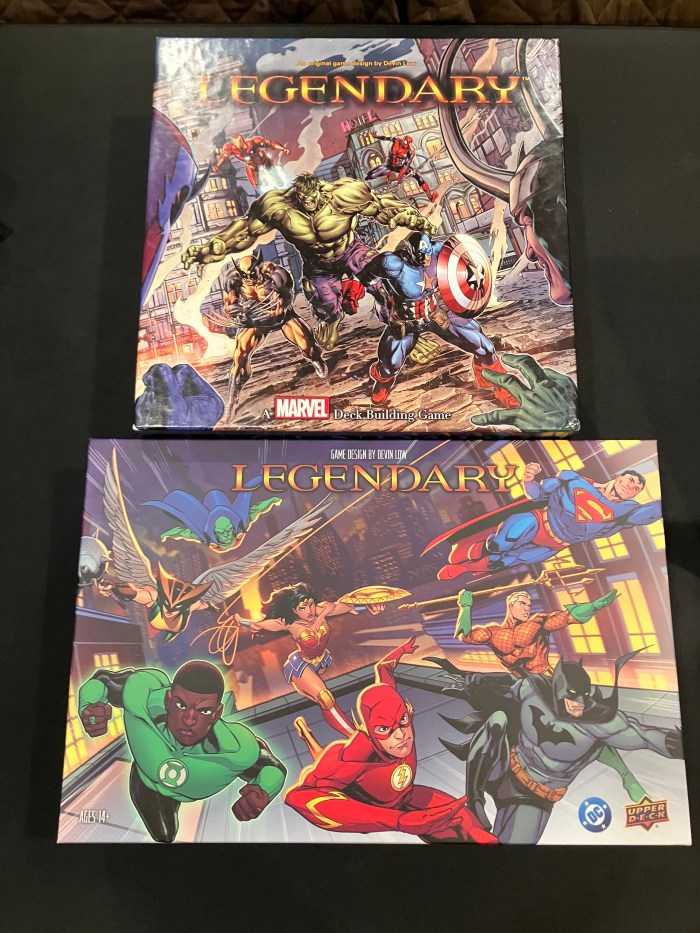
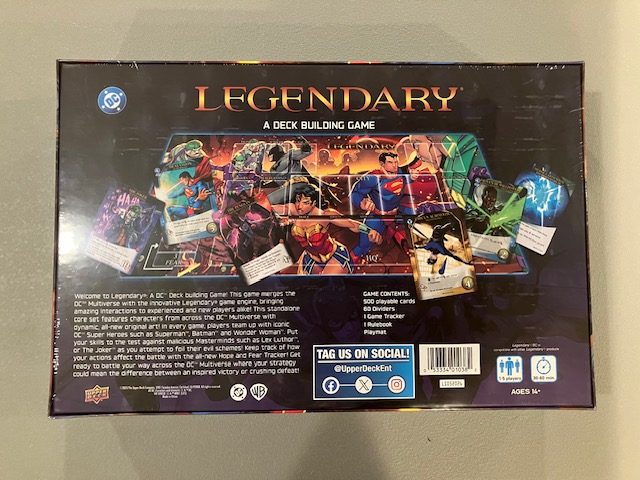
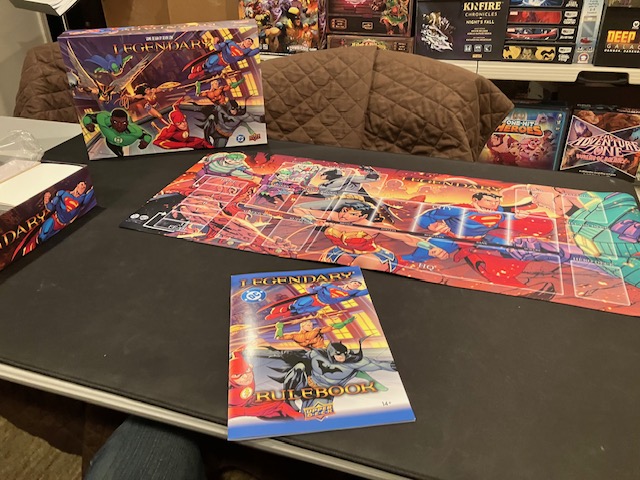
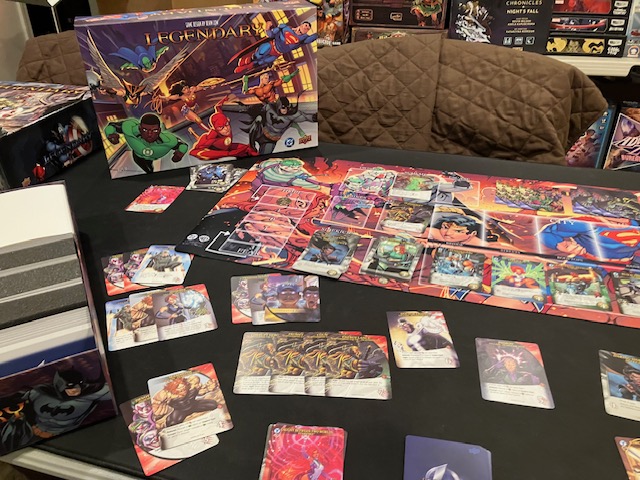
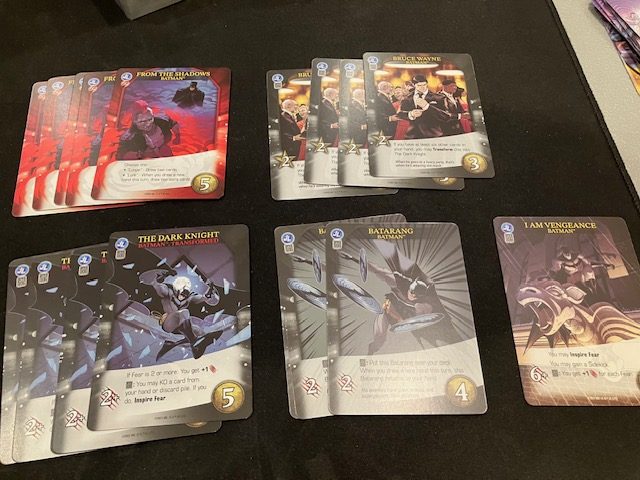
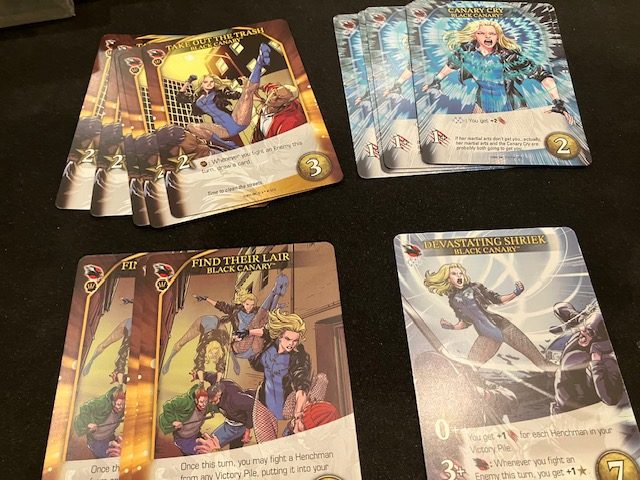
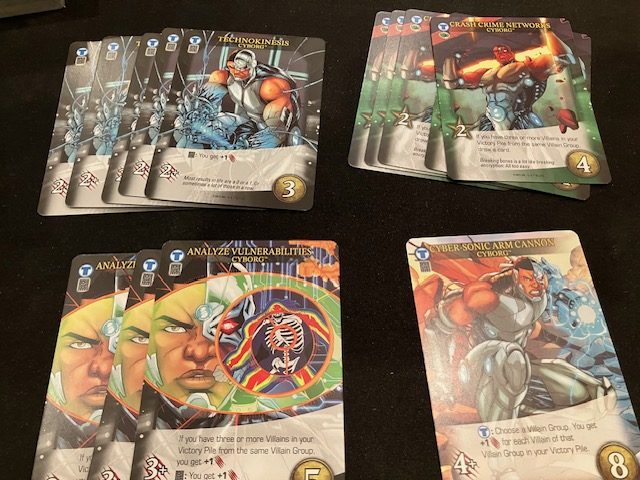
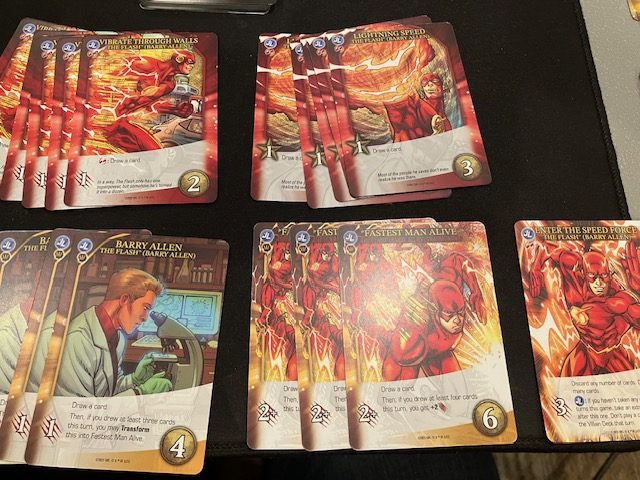
Legendary DC released July 29th, 2026. My online order arrived pretty much then; I ordered and bought a copy directly from Upper Deck.
Legendary DC is the a re-theming of the Legendary Marvel game, but in the the DC universe!
Legendary DC is a deck-building game with superheroes from the DC Universe! It’s a fully cooperative (at a certain way to play) and solo game about hiring a team of heroes to fight the bad guys! We love the theme and the original Legendary Marvel made our Top 10 Cooperative Superhero Games!
Will Legendary DC make that Top 10?
Unboxing and Gameplay
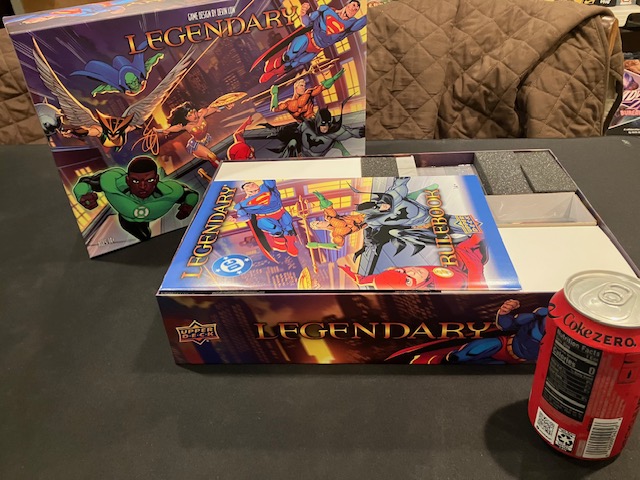
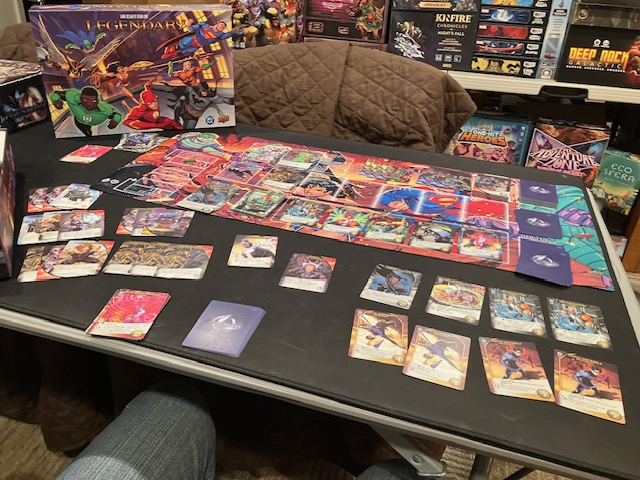
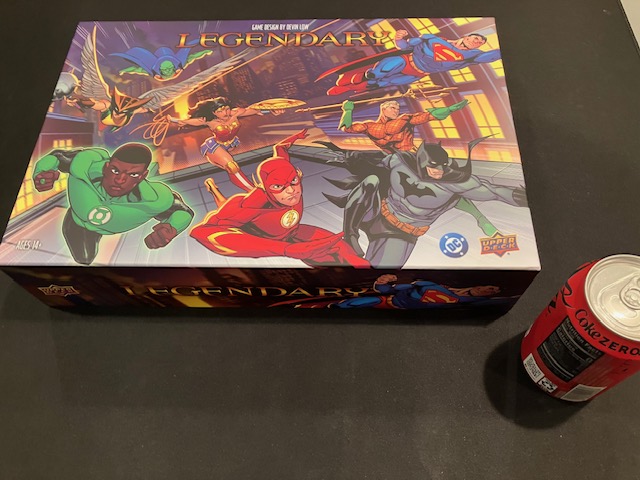
The box is a slightly odder shape than the original game: see box and Coke Can (above) for perspective.
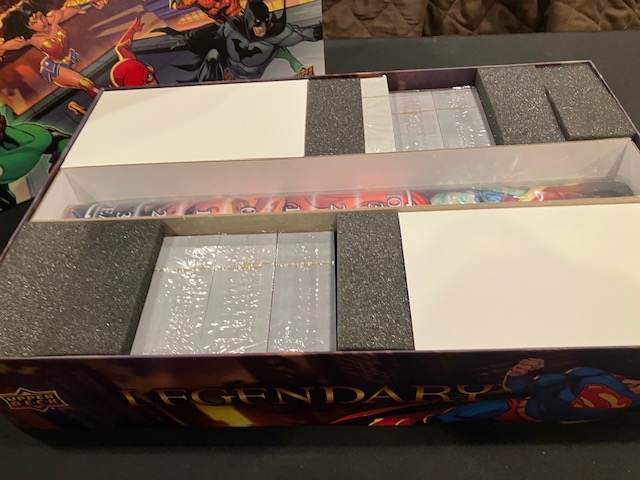
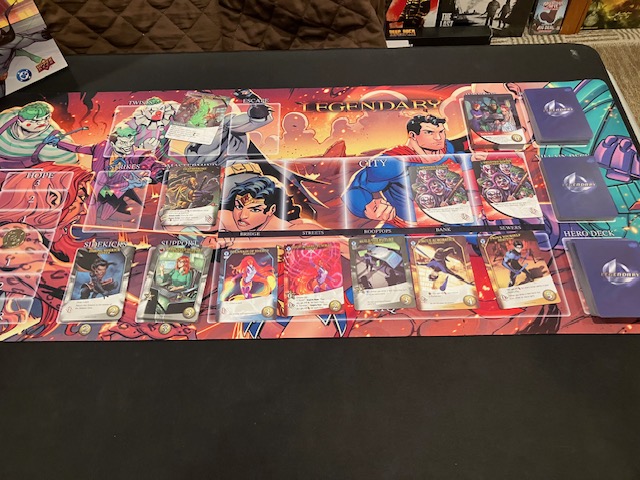
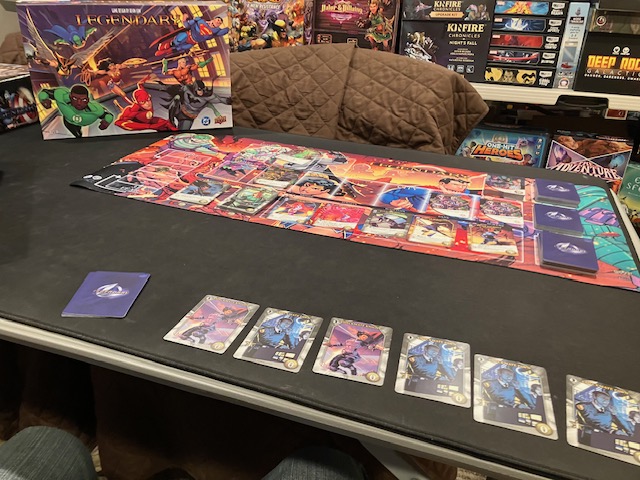
It’s a slightly different shape because it comes with a rolled-up neoprene map! See above and below!
The original Legendary Marvel did NOT have the neoprene mat included! Later games in the Legendary line (especially the Legendary Adventures, like Aliens) came with mats! And everyone loved them! So, I think that’s why the newer sets now all have them.
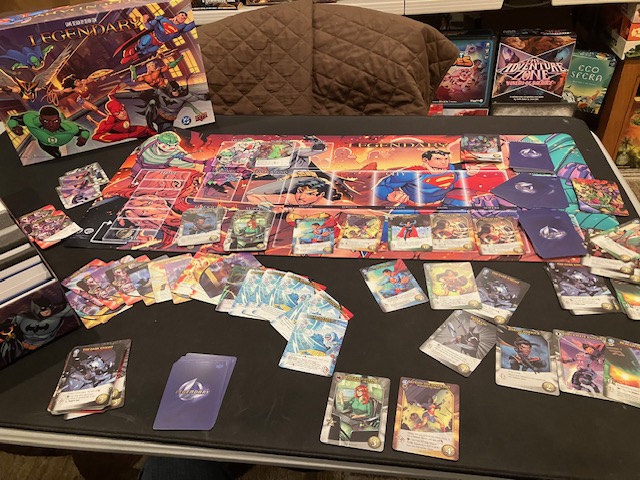
They really do help organize the game. See above.
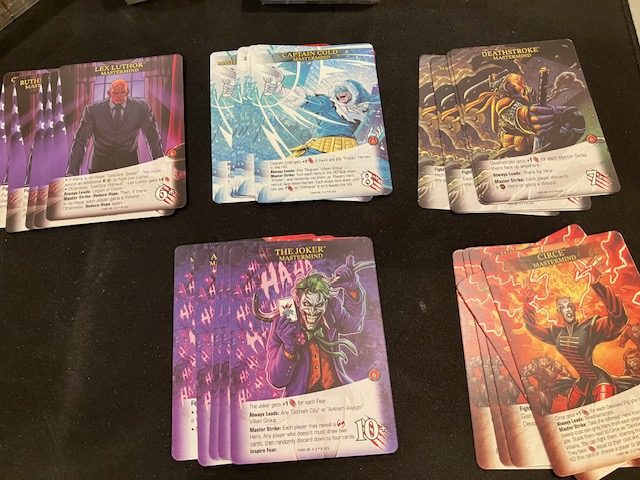
To play a game, players must first choose a Mastermind to fight: See the base five Masterminds that come with this set. To win, you almost always have to fight and defeat the Mastermind in four battles for an ultimate victory!
The Mastermind has a Scheme they are trying to achieve; the Scheme defines the losing conditions.
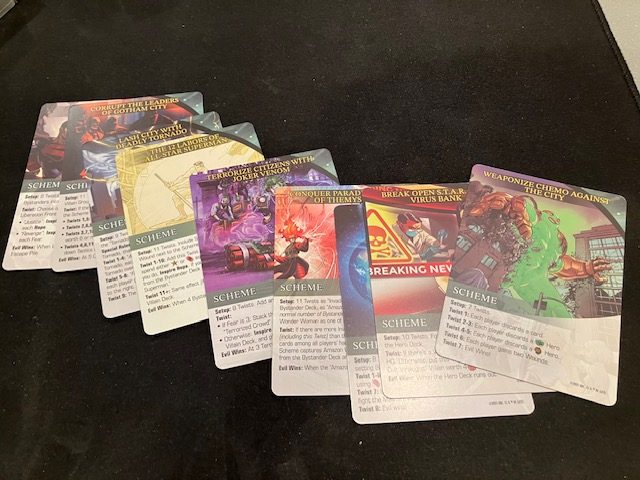
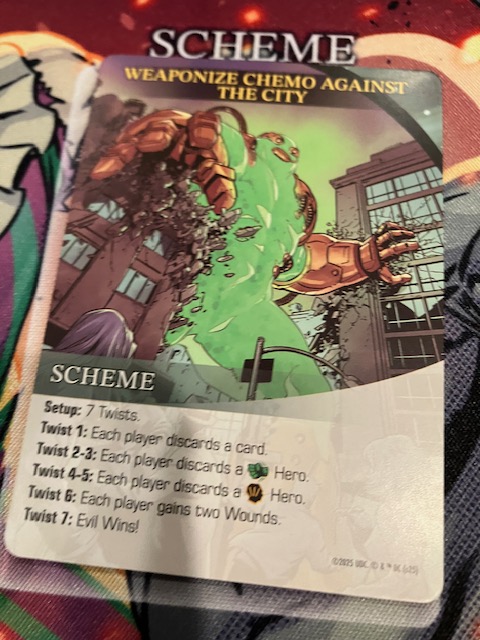
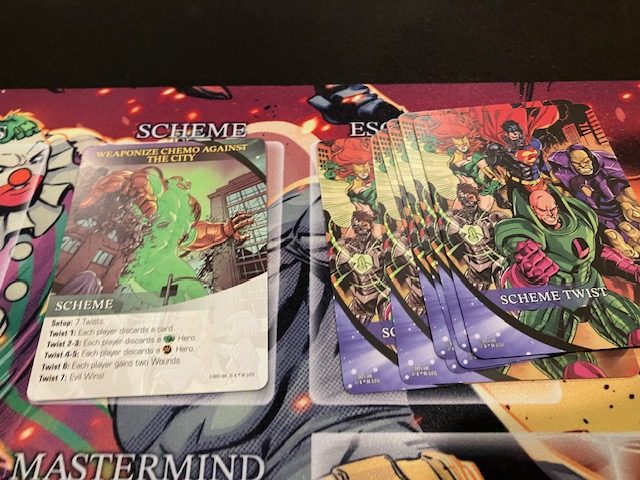
For example, Weaponizing Chemo (see above) is a scheme with 7 Twists! If all 7 Twists come out, the players lose!
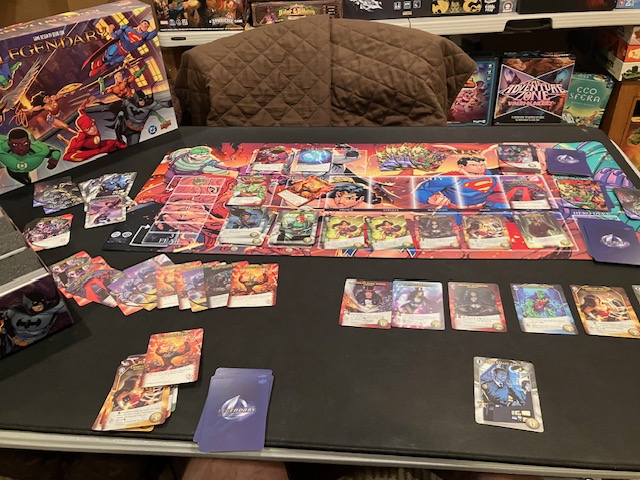
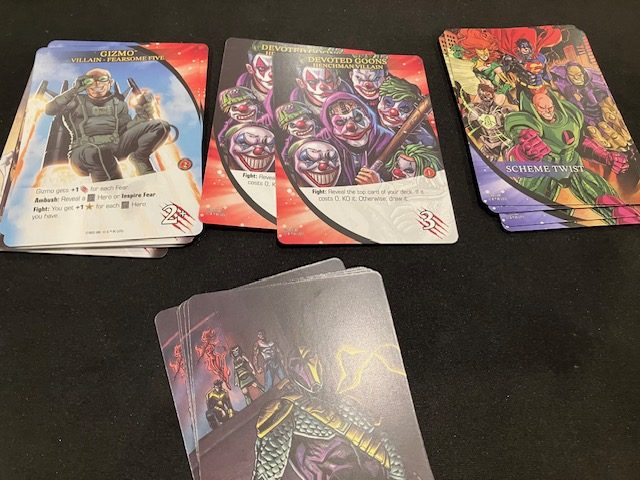
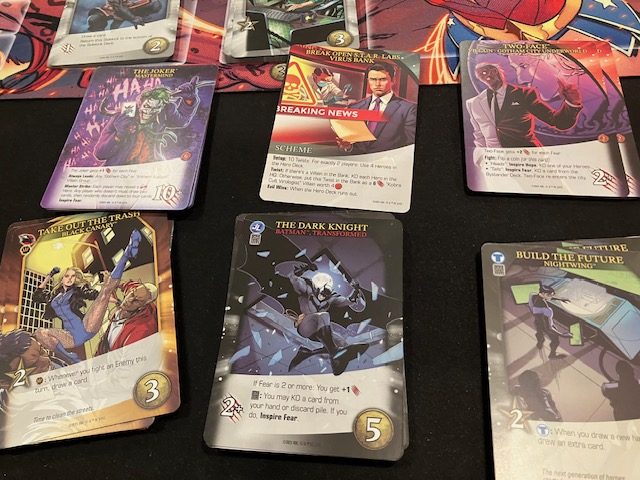
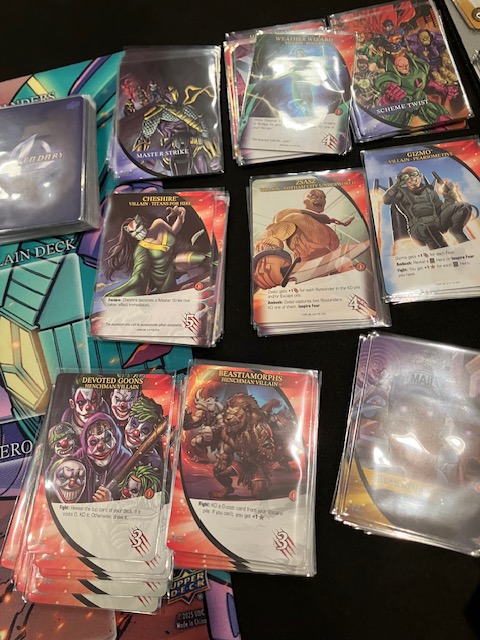
The Scheme Twists (see above, right) are shuffled into the Villain’s Deck! The Villain’s deck is a mish-mash of all sorts of bad news cards!
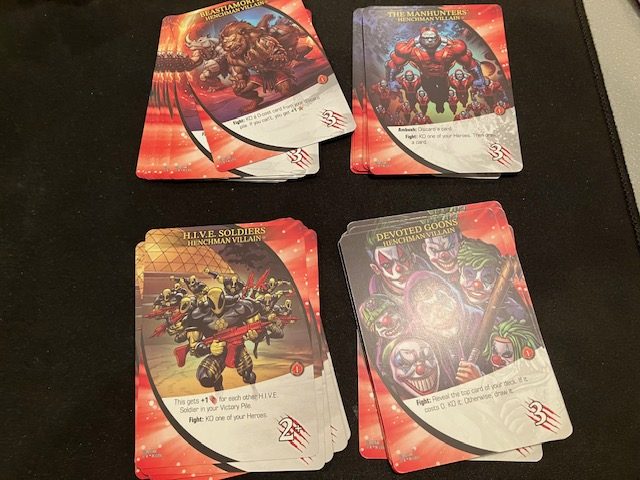
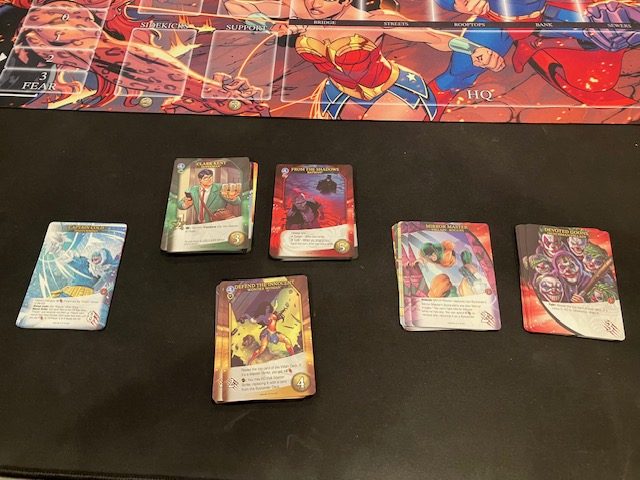
Each Villain deck typically includes some Henchmen (see 4 sets above) …
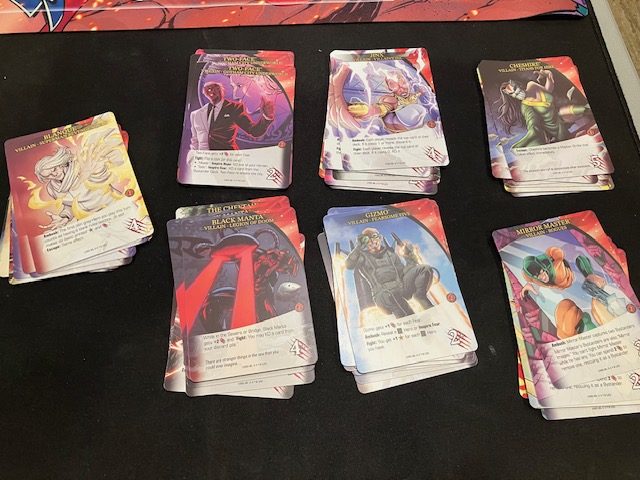
They also include some Villain Groups! See the seven base Villain Groups above!
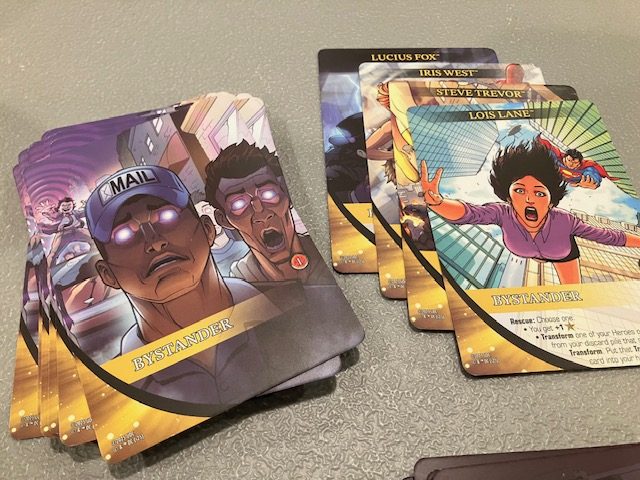
There’s also some innocent bystanders (some named you will recognize, and some nameless ones) that get shuffled into the Villain Deck …
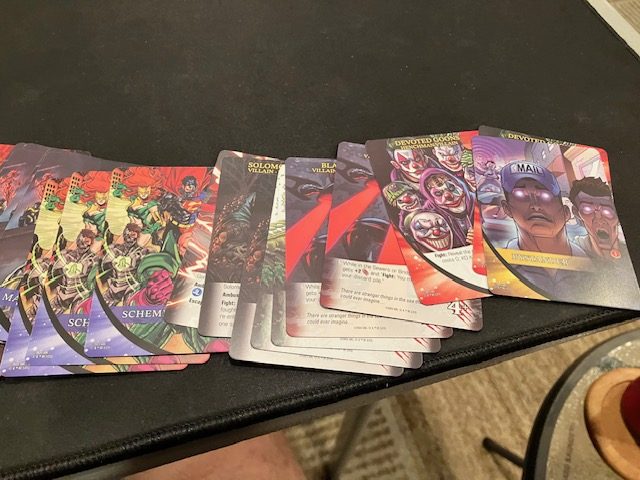
These cards, also coupled with the Masterstrike cards (which lets the Mastermind get involved) form the Villain Deck! Every turn players must draw a card from the Villain Deck and “something bad” happens!
This deck (see it splayed above) is the Bad News deck. To be clear, it changes in every game, depending on the Villain Groups and Henchmen and Scheme you choose!
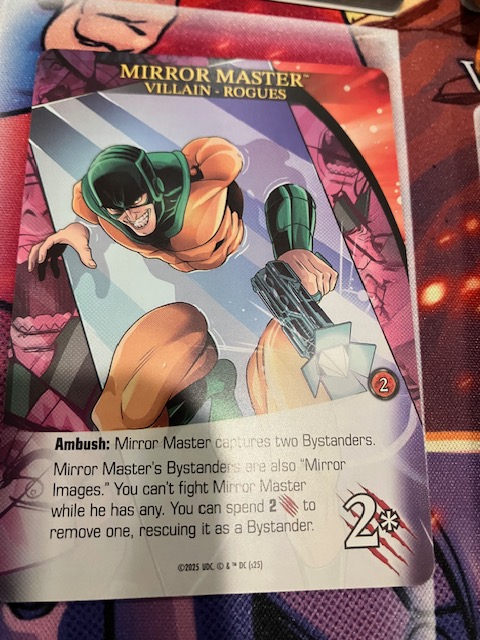
Usually, you fight a Villain from the Villain Deck; a Villain will enter the City that you have to fight!
Legendary DC is a little different than most Superhero games! You do NOT play a single hero! Instead, you are collecting heroes in a “team” (your deck) to fight the bad guys!
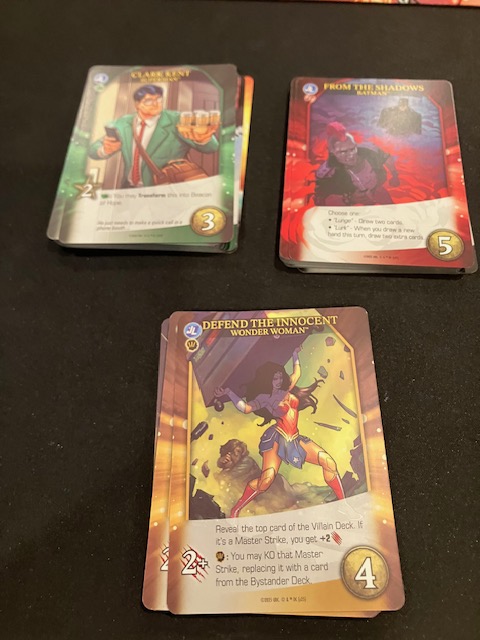
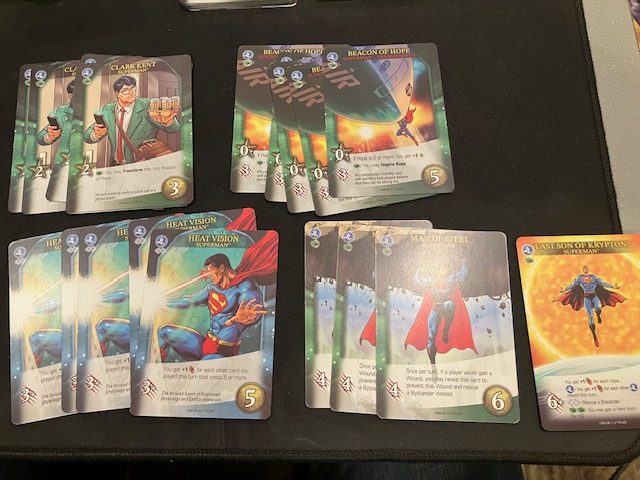
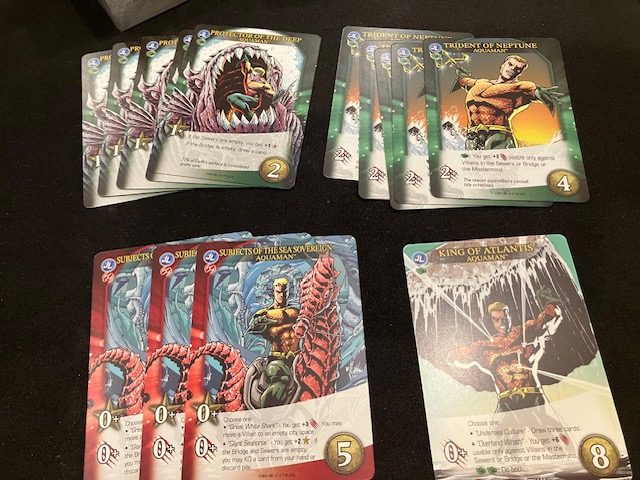
For example, you have a bunch of Superman cards available! At the start of the game, you can only afford the cheaper Superman cards (cost in lower right), but as the game goes on, you can afford to get the better and better Superman cards!
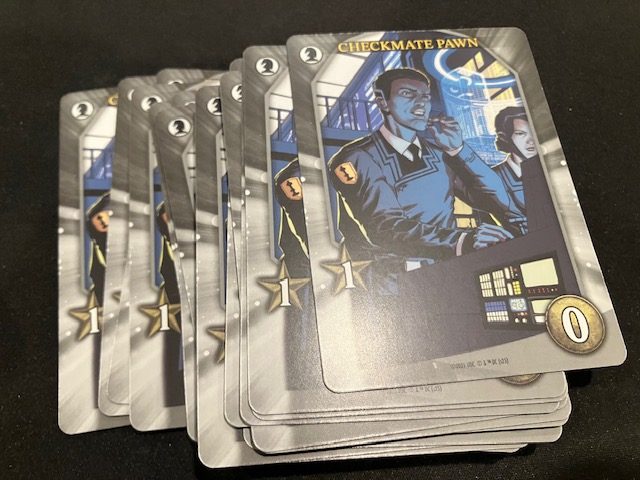
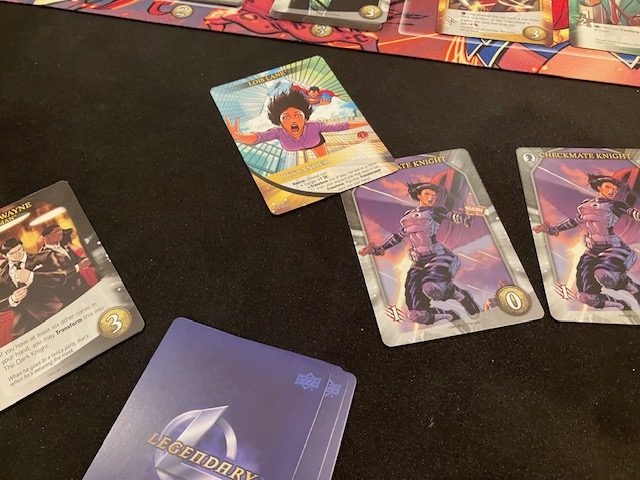
Every player starts with a simple crew from Checkmate (which is quite a bit like Shield from Marvel)! It’s a low-level group of good guys! The Pawns (you start with 8) can only help you recruit Heroes (the Star is how much “recruitment” they can afford)!
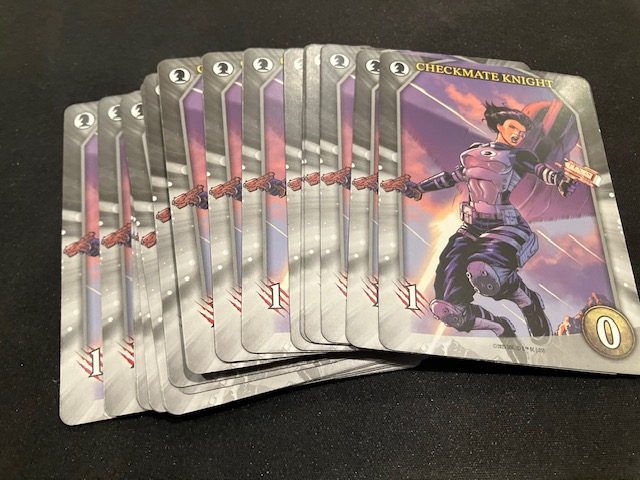
The Checkmate Knights can do a little bit of damage to bad guys! (Players start with 4 of these Knights).
As the game goes on, you recruit better Heroes, save Bystanders, fight Villains and hopefully confront the Mastermind 4 times before his Scheme completes! If the Hero deck or Villain deck depletes, you ran out of time and lost! Usually, though, you will lose because the final Scheme comes out and you lose!
There are a few more rules (which we will discuss below), but that’s the basics of the game! The cards and art are all pretty great!
Rulebook
The rulebook is actually quite good!
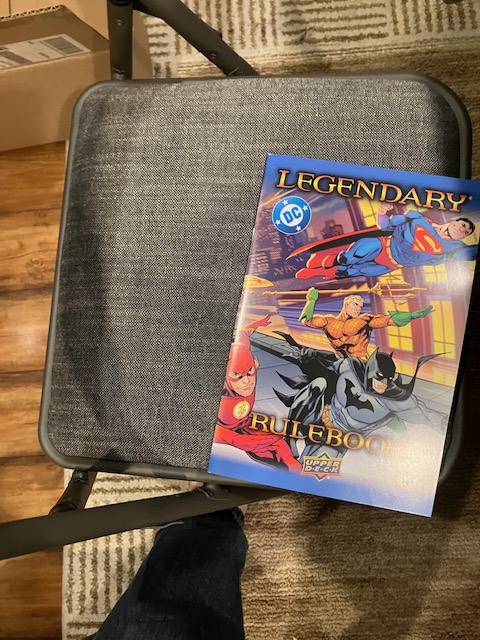
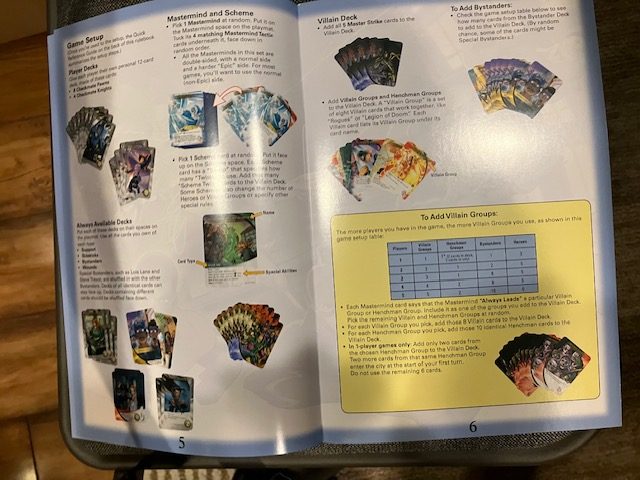
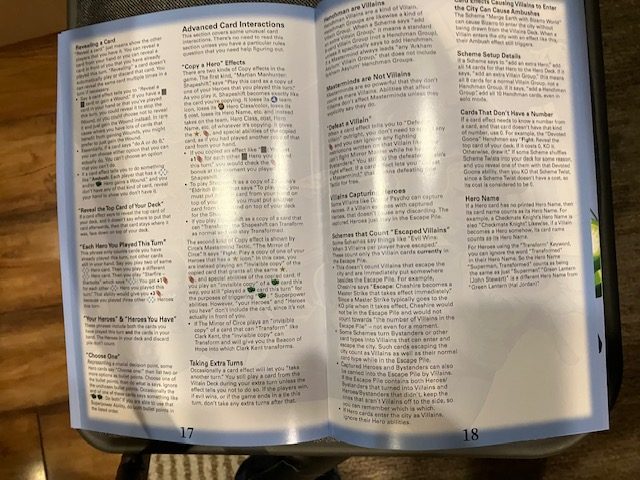
The rulebook does really well on the Chair Test! See above as it opens up to two pages just fine without any drooping! It’s probably a B+ or A- on the Chair Test. The font is a little small, and the later rulebook pages have a lot more text than pictures. Still, the rulebook is very usable on the chair next to me.
I think the rulebook actually fails the Components test. The Components are NOT defined until the very last page? They are not on the first few pages? I know how to play Legendary, but I worry a little about newer players; this doesn’t really talk about how to “Uncard” the game.
What do I do with all these cards? I still think the rulebook should have an Uncardening section at the very beginning (somehow coupled with the Components list). See more discussion of Uncardeningin our discussion ofUnion City Alliance (another Superhero deck-building game).
I think the next few pages hold the players hands enough to get them through all the cards. Rather than list all the components up front, this rulebook takes you through them a little at a time. Maybe this works; I still think the rulebook needs to acknowledge how many cards are in the game and maybe even a sentence or two (or picture) talking about how to do an Uncardening.
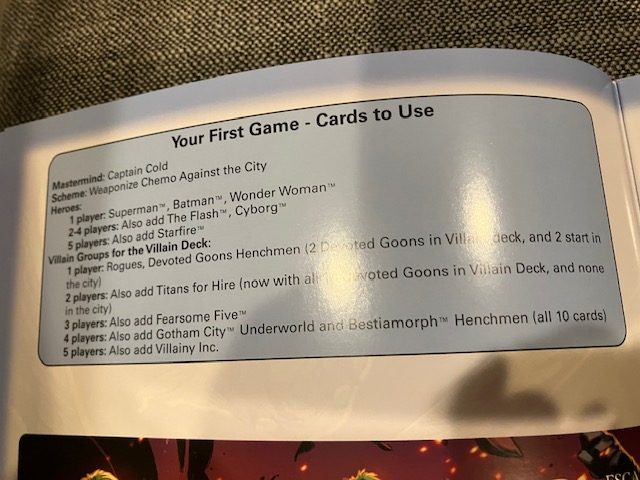
Still, this rulebook worked pretty well. It even has a list of cards to use for your first game!
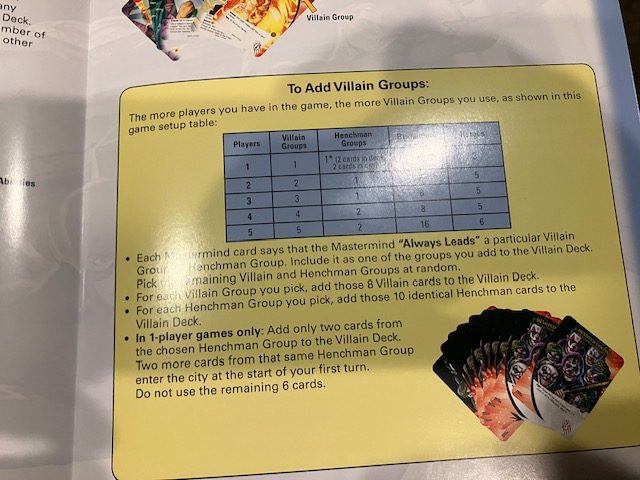
As we get later in the rulebook, there are fewer pictures and much more text. I think this rulebook could have used an Index. (I found “Always Leads” finally after looking, but it’s buried in a floating box and hard to find). Maybe you just get the online version and search the PDF and have that be the Index?
Generally this is a good rulebook; I feel like this is a much better rulebook than the original Legendary Marvel rulebook: I hated that rulebook!
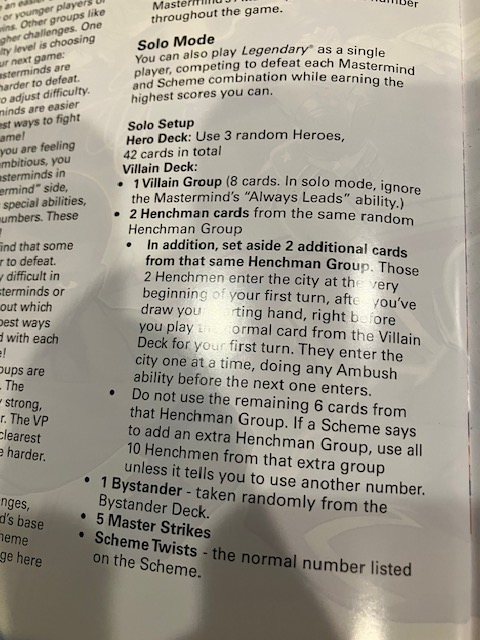
And you can either true solo or multi-handed solo! To play true solo, it’s one player and one deck (one set of heroes): see rules above.
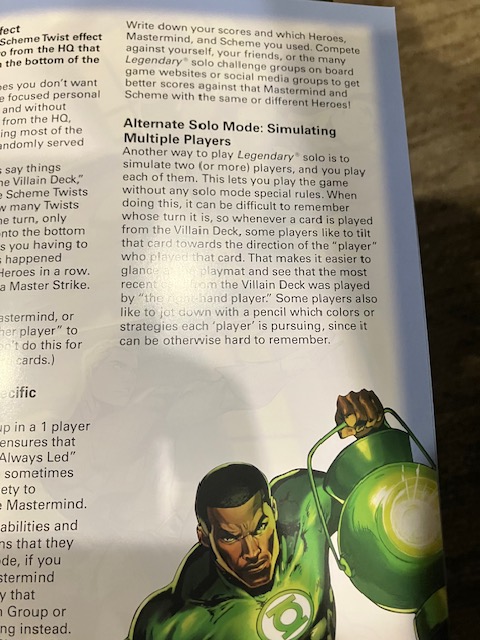
You can also play 2-handed solo (with two sets of decks) or more! I love that this game embraces both solo modes! I generally prefer the 2-handed solo mode because there are generally NO EXCEPTIONS to rules, which makes it easier to learn! Surprisingly, I think I prefer the true solo for Legendary DC, despite there being some changes. Why? Well, to be frank, there’s SO MANY cards between the heroes, the villains, the bystanders, etc etc etc, it’s easier to JUST manage one deck.
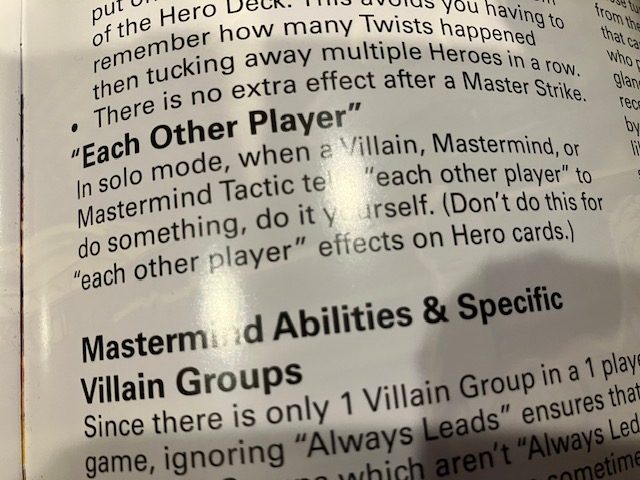
There are some extra rules for the true solo mode: they redefine “Each Other Player” to be yourself (see above; this is a pretty common thing in a true solo mode). They also add an extra Scheme Twist effect and change the set-up so there are fewer Henchmen (and two always start already in the city). The true solo rules are a little clumsier than I thought at first, but I still prefer only managing one deck of Heroes at a time! I think the fewer decks/more rules of true solo outweighs the costs of the more decks/fewer rules for 2-handed solo!
Honestly, the rulebook does a real good job helping you set-up the solo game just fine: see above.
You only get 3 three Heroes, and fewer Villain Groups and Henchmen groups in true solo.
Did I like playing Legendary DC true solo? Yes!!! Over the course of a week, I played at least 7 times solo! There’s so much variety in this game, I loved seeing what would happen! There’s 14 Heroes, 7 Villain Groups, 4 Henchmen, 5 Masterminds, and 9 different Schemes! There’s a ton of variety in this box!
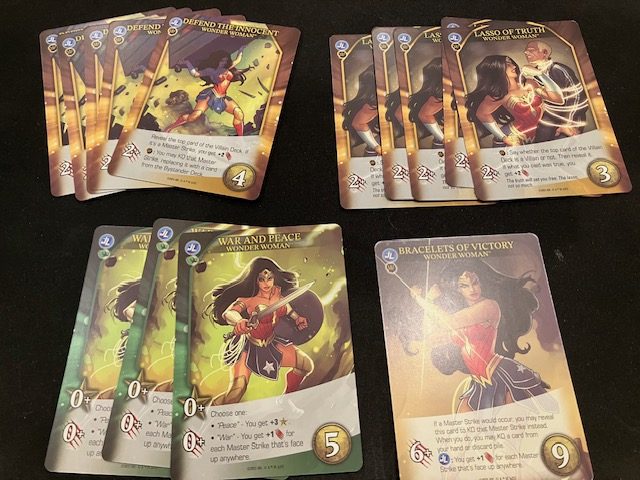
I started with the typical first game of Captain Cold/Rogues vs Superman/Batman/Wonder Woman! Fun! I won the first game!
I then moved to a game themed for Gotham City! Joker/Gotham City Underworld vs. Black Canary/Batman/Nightwing! I actually lost this game, but played again and was able to do a lot better once I knew more about the villains and heroes!
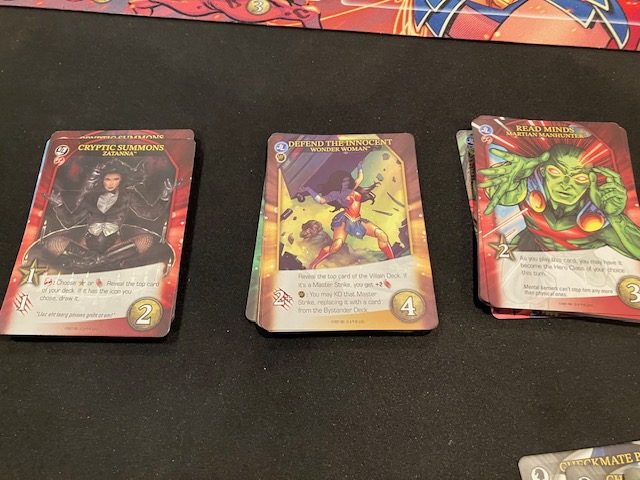
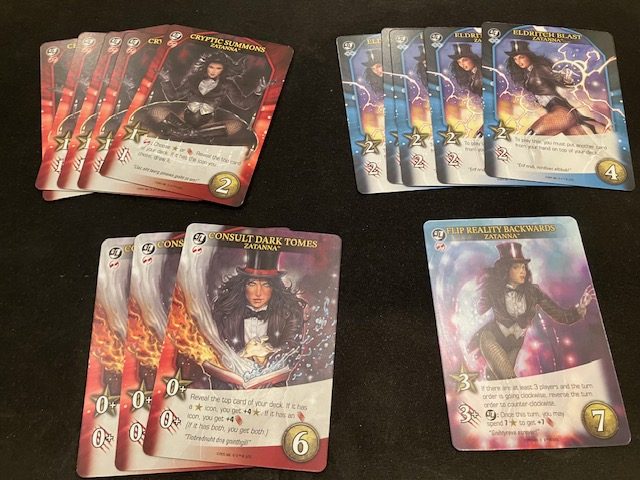
I also did a “weird” group of Heroes with Zatana/Wonder Woman/Martian Manhunter! They are all kinda funky heroes! See above!
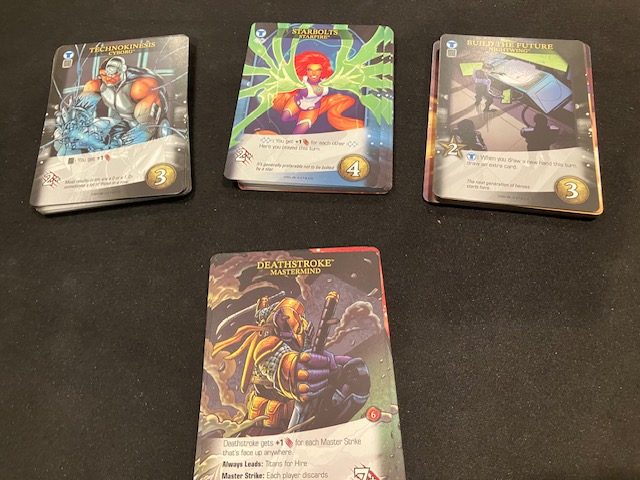
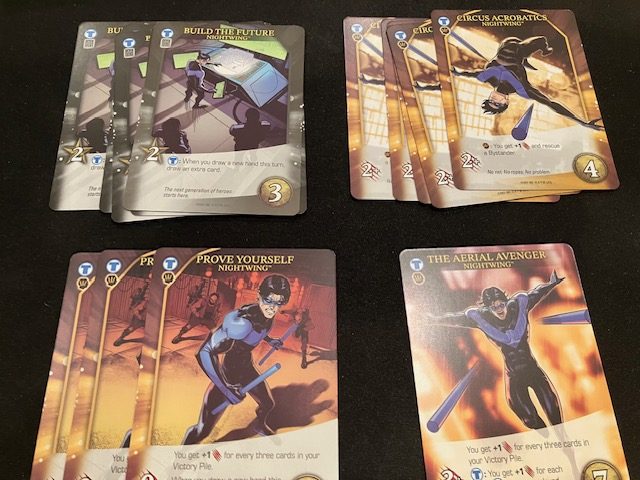
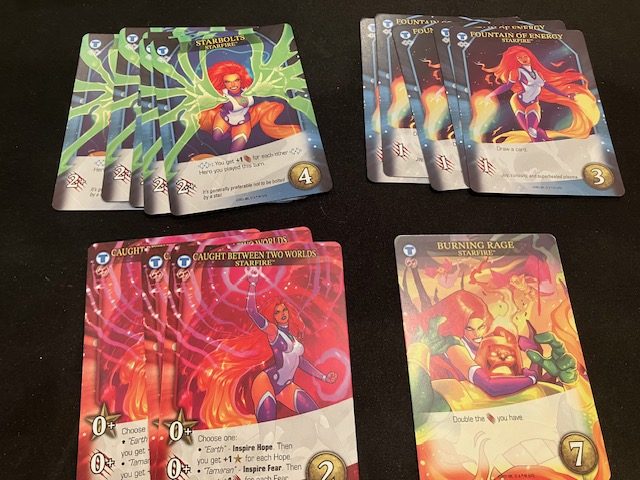
And of course, I had to do a Teen Titan’s based game with Cyborg/Starbolt/Nightwing vs. Deathstroke!
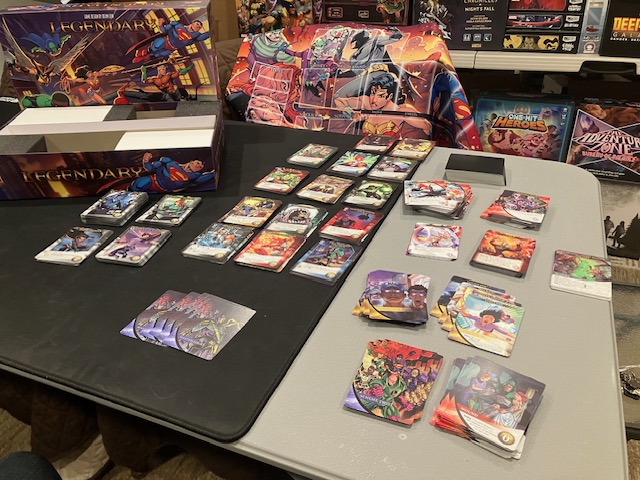
Over the course of a week, I played a lot of games and had a lot of fun. There’s a lot of set-up and shuffling for the solo player, as you have to shuffle together all the hero decks and the villain deck. But, once you are set-up, the game flows quickly!
I was generally very pleased with the true solo mode offered by Legendary DC. The worst part of the solo game is the set-up and tear-down, as the solo player has a LOT of decks to shuffle (set-up) then separate (tear-down). But, if you have played Legendary in any form, you already knew this.
Cooperative Mode
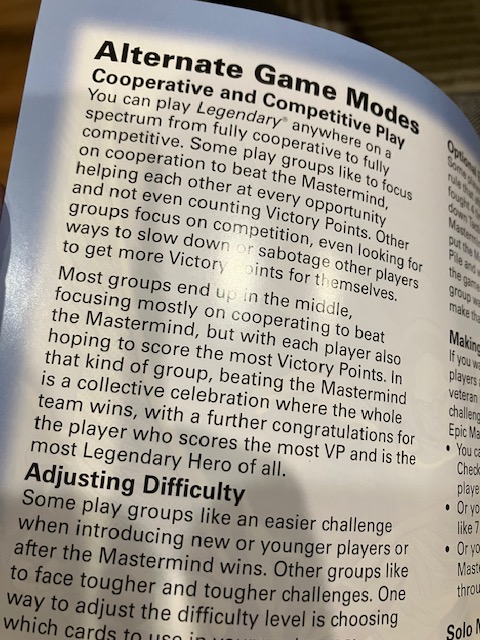
It’s a strange thing; this game can be played cooperatively or semi-co-op (getting the most victory points). See rulebook above: If you don’t defeat the Mastermind together, everyone loses! Yet, I don’t personally know anyone who plays semi-co-op for victory points? It seems out of character to play a super hero game … in any way competitively? But you can?
So, cooperatively is all about making sure we defeat the Mastermind in combat 4 times!
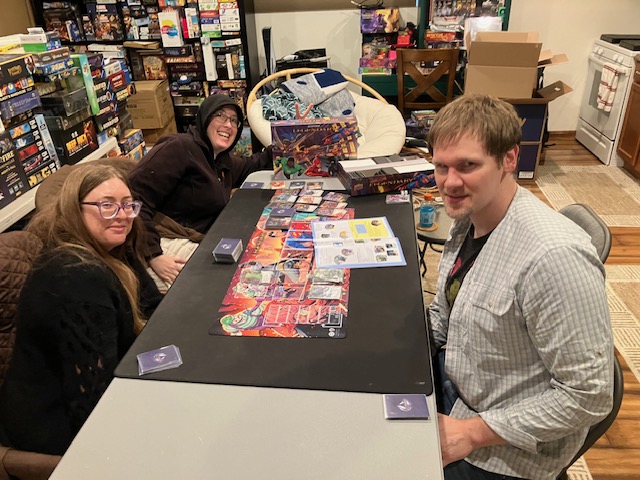
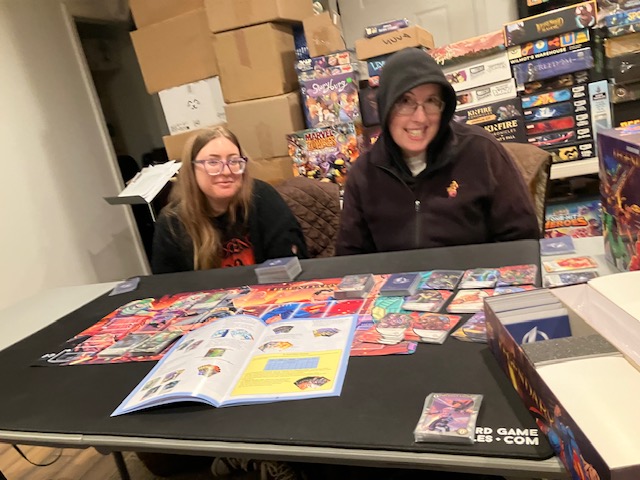
One of the best things about playing Legendary DC (or any Legendary) cooperatively is sharing the load for set-up and tear-down! There are a LOT of cards in this game; the more players that play, the more cards! That means set-up is all about shuffling together a ton of cards for the Hero decks and the Villain deck! And then the tear-down is arguably worse, as you have to separate ALL THOSE CARDS back into their original decks. Luckily, if you have a good group, you can share the load and have everyone help. That group help really makes the game feel a little less like work and more like fun.
Although we almost always (always?) play Legendary cooperatively, it’s not particularly cooperative! Don’t get me wrong; we are all working together to defeat the Mastermind, and we point out issues and talk about how to resolve them, but there’s not really a lot of cooperative mechanisms in the game. Each player’s turn is mostly taken in solitaire; this is mostly multi-player solitaire! There’s no real mechanisms for sharing cards, or directly helping someone with your cards! Mostly, it’s about talking about how the solitaire turns will interact with each other and the current board!
Some people might think the “lack of cooperative mechanisms” makes this a bad cooperative game; not at all! This multi-player solitaire nature helps keep the Alpha Player Syndrome in check, so that’s one reason a lot of people might like this! And some people really like the idea of a cooperative game without too much player interaction.
Just be aware of the kind of cooperation Legendary DC provides; it is fully cooperative and players will discuss how to win together, but the turns are mostly multi-player solitaire.
Sleevening
You should probably sleeve your game if you plan to play it a lot. I played my first 7 games without sleeves, and I noticed some of the starter cards (Checkmate cards) getting smudged and a little messy.
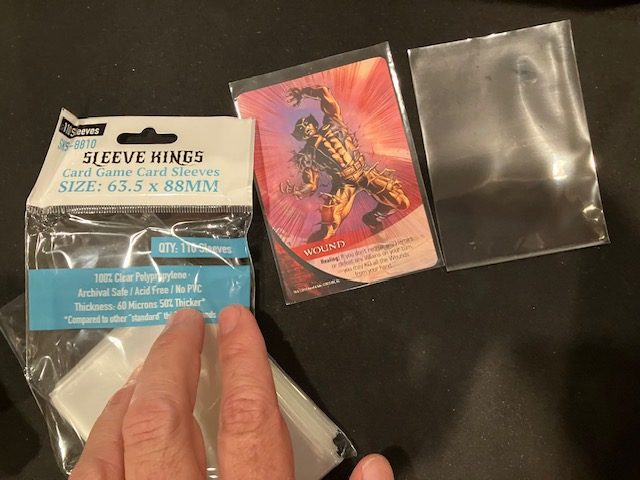
I was a late sleever, but I think it’s worth it for this game. Heck, usually most deck-builders are worth sleeving! I used the Sleeve Kings 63.5 x 88 mm sleeves! See above.
House Rule for Schemes To Reduce Randomness
A lot of Scheme cards shuffle a bunch of Scheme Twists into the deck: see above!! But if you just happen to get all of the Scheme Twists at the start of the game, you quickly lose! Sure, it’s unlikely. But after all that set-up, how annoying is it if your game ends quickly because the Scheme Twists end up in the upper part of the Villain Deck?
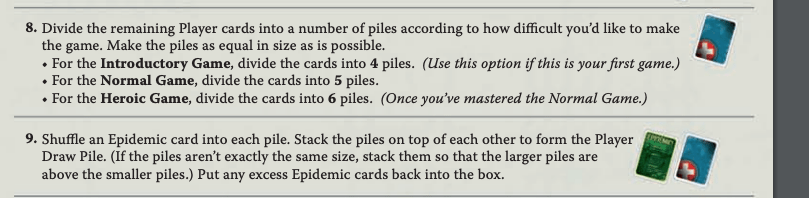
Games like Pandemic break apart the deck into piles (see rules above), then shuffle one of the Infection cards (like Scheme Twists) into each pile. Then the piles go back on top of each other! See above for rules of Pandemic! This keeps the bad news cards from being all clumped in the top (game too hard) or the bottom (game too easy)!
Why don’t we do this with the Scheme Twists? With the Pandemic method, the Scheme Twists are distributed equally throughout the Villain Deck! This seems like a simple house rule to keep some of the randomness under control.
What I Liked
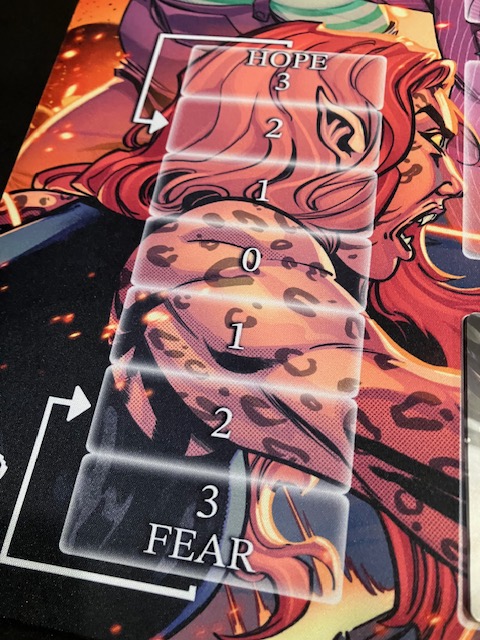
Hope and Fear:Legendary DC has a notion of Fear and Hope (two sides of the coin). See mat above! Some Villains and/or Heroes do less or more damage depending on where the Fear track is! Superman does better when Hope is higher, and Batman does better when Fear is bad! I like this mechanism a lot; it gives a nice flavor of atmosphere to the game! There’s also a more mechanical reason to like this: if you get a “bad hand” and can “only” generate 3 fight on your turn, you can still do something useful and fight crime (generate hope or fear, as you want)!!! That’s right, if you have really hard Villains out, you can still do something useful! This new feature (at least for me) really helps elevate the game by giving the players more to do on a turn, even when faced with a bad hand!
Art On Cards: The art on the cards is generally fantastic! The heroes, the villains, the masterminds are all pillars of good comic book art!
Rulebook: Despite a few grumbles with the rulebook, I generally really liked this rulebook. Even though I already knew how Legendary worked, I feel like the quality has significantly increased since the first one! It still needs an Uncardening section.
Player Counts All Work: The rulebook goes out of its way to make little mods to make sure sure the game works at all player counts! The solo rules have special set-up and rules, the 4 and 5 player games get an extra “free” turn makes me feel like this game will work at all the player count! My experience is only solo and 4-player, but these tweaks seemed to work!
Variety: There is SO much variety in this game, you could be happy with just this base set for quite a while!
The Player Mat: The fact that this version of the game comes with a player mat is great! It really helps keep the game more organized and easy to set-up!
What I Didn’t Like
The Cover Art: The cover art seems … out-of-place with the rest of the art? The cover art looks like a “Super Friends” kind of art (lesser quality) and the innards are more like “Justice League of America” art (higher-quality)? I don’t know, if I saw this game at a game store and didn’t know anything about it, I might think it’s for young kids only? I think the cover belies what’s inside.
Play Mat: As much as I love the playmat, I think it’s busy and distracting. The Heroes and villains on the mat are “distracting”. They are also of the lesser art like the cover. I would rather have the heroes and villain be removed from the playmat and have the the background only! However, given a choice between no playmat and a busy playmat, I’d MUCH rather have the playmat!
Randomness: The Hero decks and Villain Decks are random: you can get completely screwed by bad draws. It’s not big deal, because it usually balances out (especially if you build a good hero deck). BUT in a game where it’s so much work to set-up and tear-down, it can very frustrating to have a game end because of bad draws; this is probably the worst part of Legendary DC, and every Legendary game ever.
Conclusion
I think Legendary DC is my current favorite version of Legendary! All it’s little tweaks (Fear and Hope, player count adjustments, multiple solo modes, etc) show all the advancements that have been done in this system! This is the newest evolution to this game and it works well. There is also so much variety in the game that you can play this set for quite a while without needing any expansions! Trust me though, more expansions are coming. The art is fantastic and the DC Superhero theme works well with this.
The set-up and tear-down can be daunting, especially for the solo player, but the cooperative game is a lot easier to set-up/tear-down because players can share the load to make it easier for everyone. Be aware: there is a fair amount of randomness in the game, so bad draws that ruin a game are a little more painful when the set-up and tear-down is so pronounced! Having said that, the randomness of the game isn’t “usually” too bad, especially with one minor house rule we suggest.
The solo game is a blast and I couldn’t stop playing it! There’s even rules for true solo and 2-handed solo! I prefer the true solo despite the few extra rules and really enjoyed the puzzle and gameplay. 8.5/10 maybe 9/10?
The cooperative game isn’t that cooperative; it’s more multiplayer solitaire. It’s still a lot of fun, but don’t expect lots of sharing or turns where you help someone else; most of the communication in the game is “general strategy”, but that’s still fun. It’s a great game: players work together a little … but the cooperation isn’t particularly pronounced. There just aren’t a lot mechanisms in the game that promote cooperation. 8.5/10.
I don’t think I know anyone who plays this semi-co-op; it seems out of character for a super-hero game to NOT be fully cooperative.
Viking Route is a solo and cooperative game from Kickstarter back in December 2024. I backed at the Jarl level and my copy arrived early August 2026. It had promised delivery October 2025, so it’s almost a year late! That’s Kickstarter for you!
How on earth does this board game use magnets??? Let’s tale a closer look!
Unboxing and Gameplay
See game above with Can of Coke for perspective!
There’s a big bad boss loose in the world, and it’s your job to deal with it! See the 5 bosses above! Each boss plays very differently too!
Players play 4 Vikings sailing the seas! Each Viking has a special power activated by discarding Clan Spirit tokens! See characters above! No matter the number of players, there must always be 4 Vikings in play. A solo player will operate all 4 vikings, 4 players will each get their own viking, 2 players would each get 2 vikings … (and 3 player has a weird rule).
Players are sailing the seas trying to defeat the enemy! This game is “kinda” a boss-battler, but the game is more about sailing your ship to get to the enemy and avoiding land and other things! The ship itself is sort of a worker-placement area! Each zone of the ship does something different: the Deck has the most options and is adjacent to everything, the Sail is for adjusting the sail (full-up, half-up, or all-down), the Hold is for grabbing some useful tokens, the Lookout is for adjusting the wind (sorta), and the Ballista is for shooting things!
Your ship is represented by a compass on the board! See above! When the sails are unfurled, the ship will move in the direction of the red arrow on the compass! How does the compass point? Magnets!
When you do you sail? At the end of every turn, players draw a bad news card which “usually” also moves ship in the direction of the wind! Plus some bad stuff …
There are 4 heavy magnets that affect the compass (your ship): the three ravens (scattered on the edges of the board) and “the wind”, right in the middle of the board.
See above as the ship (The Drakkar) is near the green raven, so that magnet has the most influence over the ship on that part of the board!
If you move your Viking to the Lookout, you can activate a Raven and move it around the board a little bit! See the video above as the moving Raven affects your heading on the compass!
But it’s not just the Ravens: “the wind” in the center affects you too! The direction she points has a big effect on your heading! She is actually a pretty power magnet herself! This game is all about managing the “overlapping magnetic fields” from the Ravens on the edges and “the wind” in the middle! (You can only adjust the wind in the middle if you are within two spaces).
Along the way, you have to deal with Valkyries as they slowly (and sometimes quickly) approach your ship!
Sometimes the Valkyries makes it ON the ship and damage it! See above as the sails area get damaged! You have to fight the push them off the ship! Of course, the Valkyries are immortal, so all you can do is push them away!
Combat is decided by dice! See all 6 faces of the dice above! Basically, 2 sides are misses 3 sides are plain hits, and 1 side is a critical hit! Usually a hit is good enough, but critical hits can be great, depending on the bad guy you are fighting!
Each viking sheet tells how many dice they can roll for Combat! So you “usually” want Urwulf or Helga doing combat since they roll 2 dice during an attack (Astrid and Kuba only roll 1 dice).
To win, you have to “do something” to take down the big bad boss! Usually, you have to collect all 3 Magic Stones from around the world, then hit the boss with some critical hits! There are 5 different bosses in the game, and they all operate a little differently!
That’s kinda the basics of the game! Although the tokens are fine, it’s really the whole “toy factor” with the magnets that makes this so cool!
Rulebook
The rulebook is pretty good.
The rulebook knocks it out the park on The Chair Test! This rulebook fits perfectly next to me on the chair, it opens up easily, and is easy to read! A on Chair Test!
The components are described well and set-up of the Drakkar work well.
The Set-Up was good: see above.
In general, this rulebook was pretty good. It’s main flaw was the it seems to miss edge cases more often than it should: It’s usually edge cases in the specific monsters you are fighting that were the problem. We’d occasionally get ourselves into a situation where the rulebook didn’t answer something, so we’d just a make a ruling; it happened more often than it should have. None of the underspecificity was ever particularly egregious, but it just happened a few too many times.
Solo Play
So, there is a solo mode! Thank you for following Saunders’ Law!
Since all modes must always play Vikings, the solo player operates all 4 vikings! Normally I worry about how much context switching it takes to operate 4 completely different vikings … but the Vikings aren’t really THAT distinct! The real difference is their special power, how many dice they roll, how much they can carry, and how many hits. That’s it! It’s all very apparent on their sheets!
Each Viking has a token they place on the board to show they’ve gone (yes, I know that’s backwards; see below). Viking Route uses coarse-grained Player Selected Turn Order (PSTO)! (See description here) I love that! PSTO usually really elevates a game for me, as I feel I have more choices to get stuff done!
The context switching between characters really isn’t a big deal! I had no issue jumping right in and playing all 4 Vikings! It sounds more daunting than it is; once you’ve played once, you’ll see that it’s easy to play all 4 vikings as a solo player!
The solo game works really well. I had no problem jumping in. In fact, I ended up playing the entire campaign over 5 days as a solo player! I had the ability to leave it set-up between days, so that helped.
From a maintenance perspective, there’s a little bit of work to set-up and tear-down, but it’s not too bad. As usual, the cooperative game makes set-up and tear-down a little easier as you share the load.
Is this a good solo game? Absolutely! The choices you make about when to furl/unfurl the sails, fight or sail, directions to sail, when to move the wind or the ravens, are delicious choices! You are basically balancing keeping the ship sailing in the proper direction with all the stuff that happens along the way: Battling Valkyries! Tracking the Big Bad Boss! Grabbing Resources! Avoiding Land! The fact that there are 4 magnets with overlapping influence works really well!
Great solo game. I played the entire campaign because it was so fun.
Cooperative Game
The cooperative game was mostly just an extension of the solo game! What do I mean by that? Well, instead of making all the sailing and fighting decisions as a single player, we tended to decide things as a group! With the Player Selected Turn Order, we’d decide on which viking goes next! What do we concentrate on? Should we fight or sail? Should we unfurl? Should we reroll? Should we request Help From the Gods?
As a group, we’d play with this magnetic system! And it was fun!
The trade-off here is that multiple people playing might see something you miss, but the counterpoint is that you have to make most decisions as a group.
Everyone loved the magnets.
There is something to be a little worried about; this game is susceptible to Alpha Player Syndrome (see link here for description). If you are playing too strictly, you aren’t supposed to play with the magnets too much, and an Alpha Player might either stop you from playing with the magnets (“that’s cheating! You can’t do that!”) or maybe just say “I know how the magnets work, let me do it”.
The right thing to do: just let people play with the magnets and have fun.
The cooperative game worked; we saved our game and plan to play more games in the campaign.
The Campaign
There is a 5 game campaign with 5 different bosses. Each one plays differently, but not THAT differently.
The game proceeds in two phases: In phase 1, you have to sail around the board and get the 3 Magic Stones! That seems to be the same for every game in the campaign! Then in phase 2, you “do something” with the stones! See above as I crit hit the Kraken three times to win!
Each world has a different board with different rules! Board 2 has lots of Fog which stops you from looking at the compass! Eek!
Board 3 is in the river and Fenrir buzzes around trying to Ram you! The River makes you drift every turn!
The 4th board has a giant land mass which is a real pain to move around, and some “remnants” of the Bifrost bridge which do weird things?
The final board is Loki! He pretends to be all the monsters you already fought! I have to admit, I thought the final battle was the weakest. It seemed sort of too long and very samey. It was my least favorite of the campaign games.
Despite all that, the campaign IS fun. Each game is different enough and keeps you engaged in the world. It’s also fun between games to get upgrades for your team! That’s right! This is a campaign where you can upgrade as you go! See the Port Upgrades pages above!
Magnets
Let’s address the elephant is the room: do the magnets work? Does the game work? Yes! 100% yes and yes! After playing the solo campaign all the way through and some cooperative games, yes, I can verify that the system of magnets works! And the game works too!
It’s even quite thematic: the winds are a “mysterious, unseeing force that affects you”, and the magnets really capture that feeling!
The game also doesn’t seem too hard or too easy either. The magnets work in the game and give a nice challenge.
What I Liked
Art Style: I like the art style: it seems a good choice for a viking game.
Magnets: I love the magnets. They work! And it’s fun to play with them!
Player Selected Turn Order:Player Selected Turn Order works really well here: it helps make the game feel like your choices matter more. They even have the tokens to help notate when a turn has been taken!
Table Presence: This has a really cool table presence!
What I Didn’t Like
Underspecificity: There’s a number of places in the rulebook where the game seems underspecified. What happens when “something” happens? The rules don’t seem to handle a lot of edge cases! The rules also seem to use some variation of the phrase “if there’s a choice, players decide” quite a bit! That deferment of rules works in a cooperative game, but it always feels like a cop out to me (see Resolving Ambiguity in Cooperative Games for more discussion). I think with just a little bit of work, it could have been a bit more precise with a bit more thought. It wasn’t game-ending by any means, but a small nuisance.
Randomness: At the end of the day, this is still a dice game where rolling poorly will cause you to lose the game. There are a few mitigation techniques (Crit tokens, flipping the Ballista, re-rolling Urwulf attacks with Clan Spirit), so it’s not the end of the world if you roll poorly, but just be aware that it can be frustrating occasionally.
Conclusion
Viking Route was a big hit among me and my friends! The toy factor of the magnets was overwhelmingly fun! They designers have crafted a very good game around the magnetic pieces, and that works really well!
As a solo game, this is a 8.5/10 or 9.0/10. It might be a 9.5, but the randomness and underspecificity of the rules brought the game down just a little bit for me. But the game was so much fun, I played through the entire campaign and enjoyed it (the finale was a bit underwhelming; that also contributed to the 8.5/10 or 9/10). The game was fun and I had a blast playing it solo! And don’t worry about operating four Vikings in the solo game, as it really wasn’t an issue.
Cooperatively, this is an 8.0 or 8.5/10. The game may be a little more likely to be susceptible to Alpha Player Syndrome because of the nature of the cooperative interactions, but my friends all enjoyed how unique this game was. The randomness and underspecificity of the solo game are a little more pronounced in the cooperative game (as the solo player can just move through those issues a little easier without needing consensus), so it’s just a 8 or 8.5/10.
This game may just tickle your fancy that you don’t care about some of these issues! You may just give it a 9/10 or 10/10: it’s just so unique and interesting! I mean, there’s a reason this made our Top 10 Anticipated Cooperative Games of 2026!
I had been hearing great things about this system (called 20 Strong) for years, but I had never played any of the games in the 20 Strong line; the Nemesis: 20 Strong Kickstarter felt like the place to start.
Why here? Because it’s both solo and cooperative! See above from the Gamefound page!
Oh wait, is it cooperative?
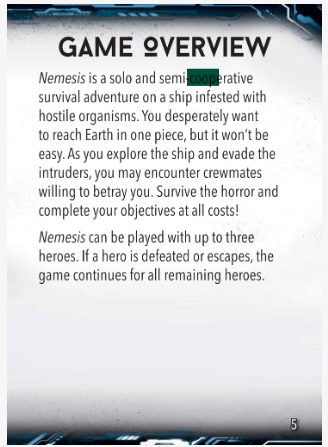
Or is it semi-coop? Hmm … looking on the Gamefound web page, there are literally only two mentions of it being cooperative and/or semi-cooperative! And those two terms are contradictory! The two above! Surely, the rulebook will clarify all! (And YES, a fully cooperative game is VERY different than a semi-cooperative game!)
Oh wait, now it’s cooperative again?
Or is it semi? So, the Gamefound site has two conflicting entries and the rulebook has two conflicting entries. Which is it?
Of course, anyone who knows Nemesis (the original game this is based on) knows it’s absolutely a semi-cooperative game (see Shut-Up and Sit Down video above: one of my favorite): it’s obviously a semi-co-op!
…but recent releases do make it cooperative. See video above!
What’s going on here? Which is it? Semi-co-op or co-op??? There were just enough suggestions that 20 Strong Nemesis works cooperatively (and I wanted to see what all the 20 Strong fuss was about), that I went ahead and picked it up and used it as my on-ramp into the 20 Strong system.
How was it?
Unboxing 20 Strong
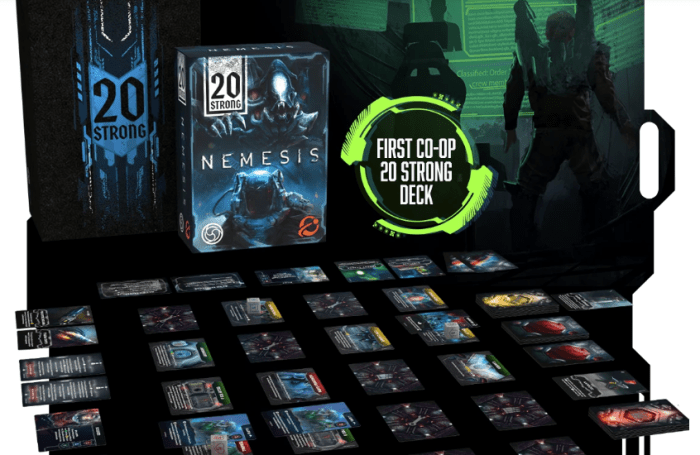
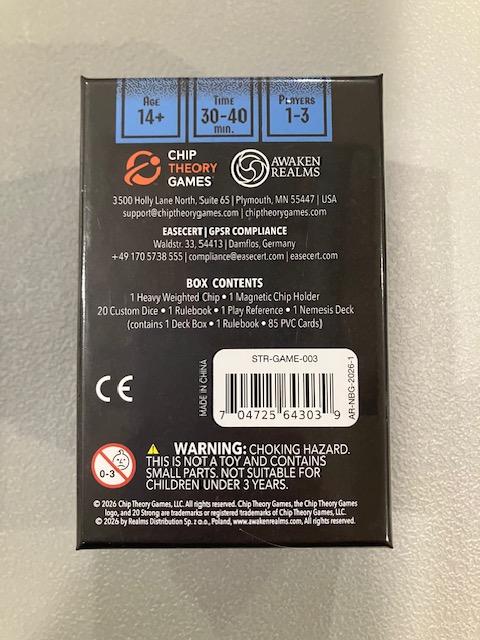
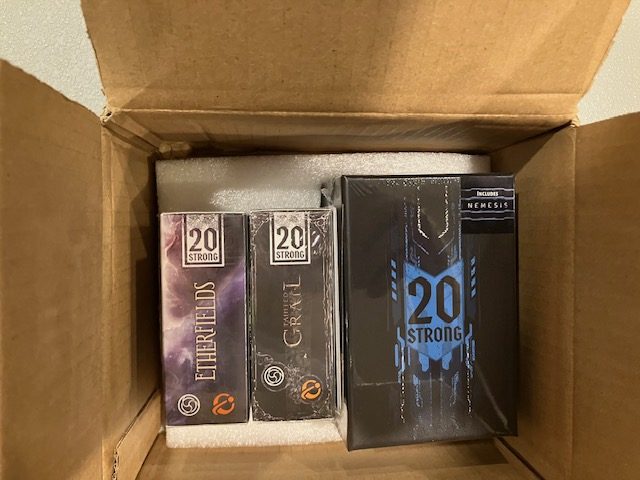
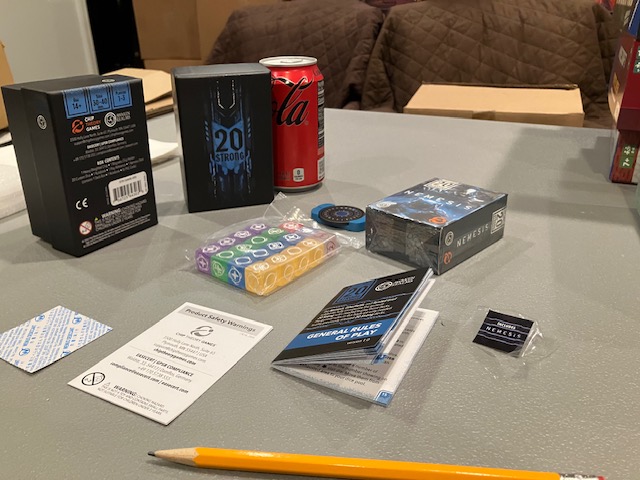
What I backed (with my own hard-earned money) included the 20 Strong Nemesis box, as well as the two solo boxes for Etherfield and Tainted Grail. See above. We will discuss the Etherfields and Tainted Grail boxes a little more later, but we are focusing on the 20 Strong Nemesis box for this review.
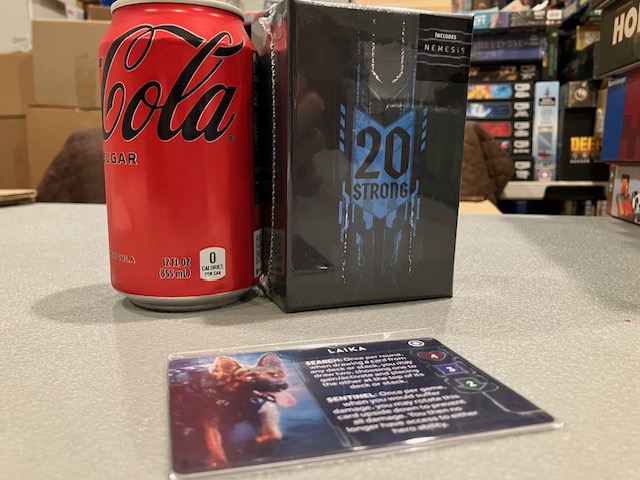
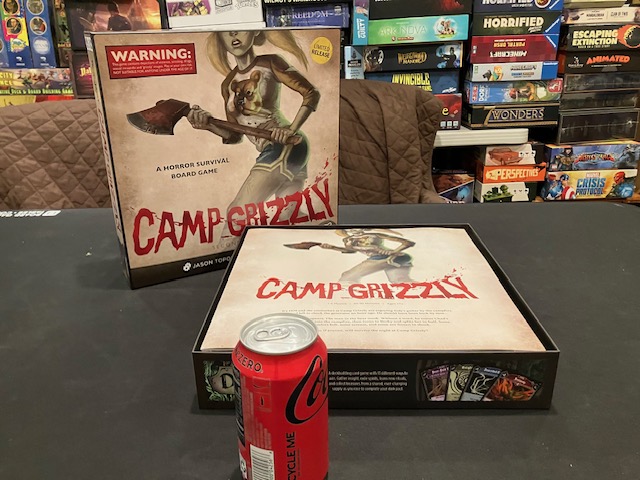
This is a surprisingly small box! See Coke can above for scale. What’s in this thing?
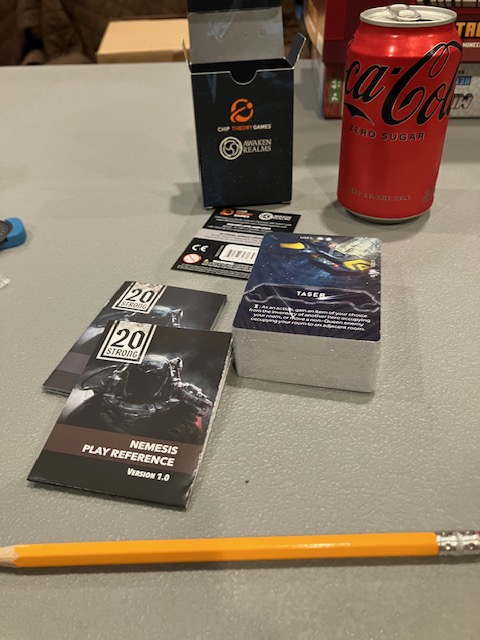
Some dice, a rulebook, a tracker, and the Nemesis box.
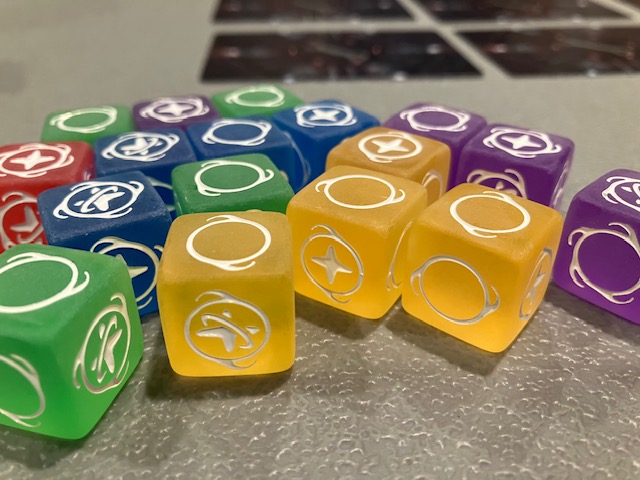
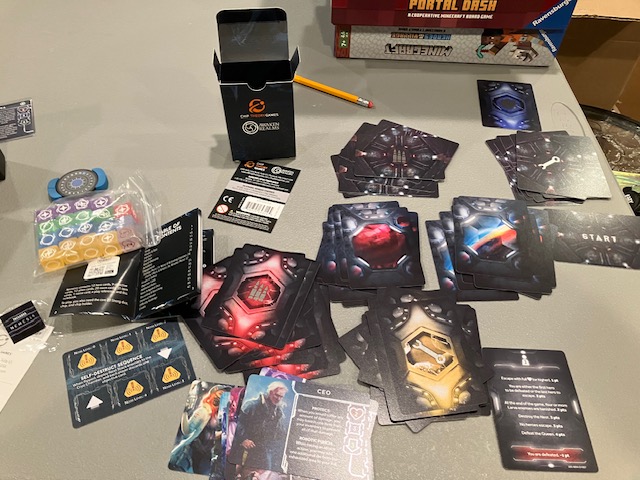
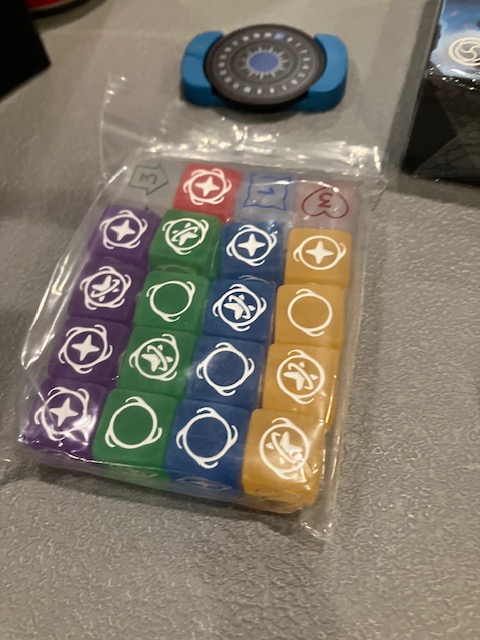
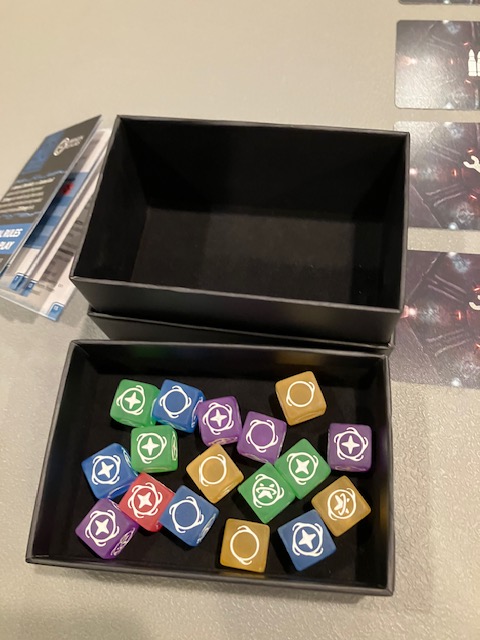
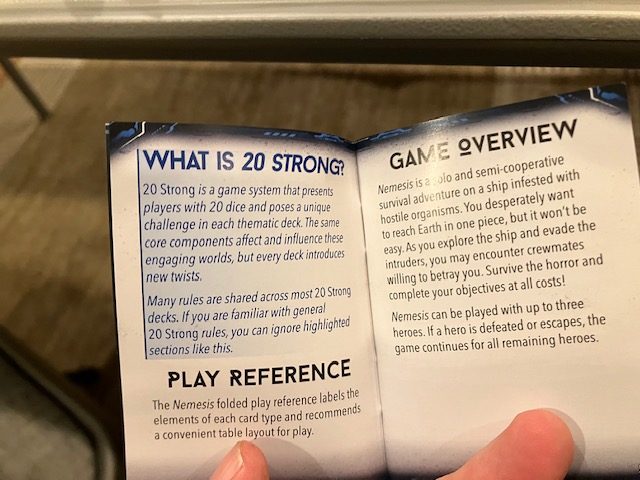
First of all, you have to understand a little about 20 Strong. 20 Strong is the fundamental backbone system of a lot of games; it’ s not really a game by itself. It has 20 really nice dice (see above), thus the name 20 Strong !
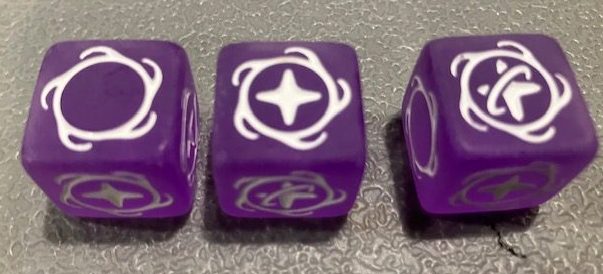
There are a bunch of generic rules about dice: misses (empty circle, left) and hits (+, middle) and critical hits (+ and more, right). The number of tendrils on the outer circle tell you how many of the 6 sides have hits or critical hits: for the purple dice, 5 of the 6 sides have hits!
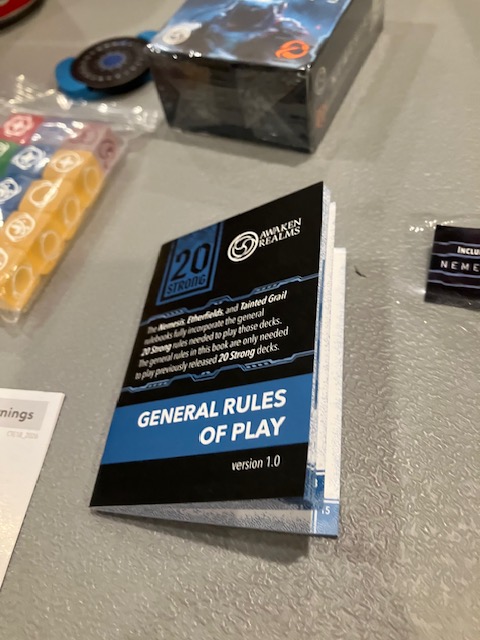
Each game in the 20 Strong system takes these General Rules of Play (see above) and adds/modifies/subtracts rules to make a new game based on this fundamental dice game.
Nemesis is the deck that sits on top of the 20 Strong system!
Unboxing 20 Strong:Nemesis and Gameplay
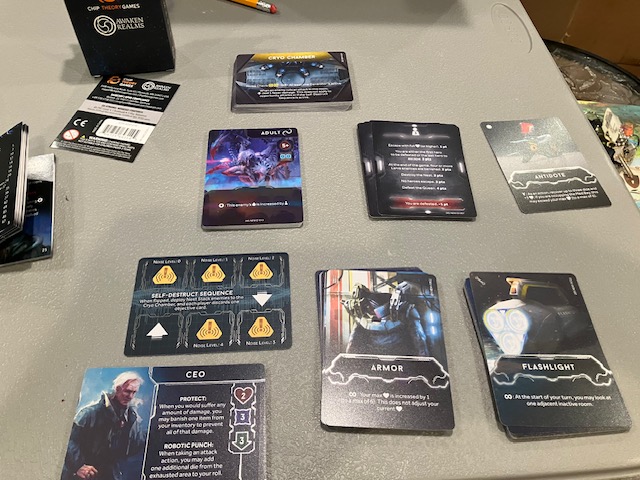
Nemesis 20 Strong card box itself has a bunch of cards; about 85 total. See above.
These cards are AMAZING! They are PVC, not cardboard, so you don’t need to sleeve them! They also all have some foil embellishments that make these POP on the table. These are amazing cards! They look great! And the art is great too!
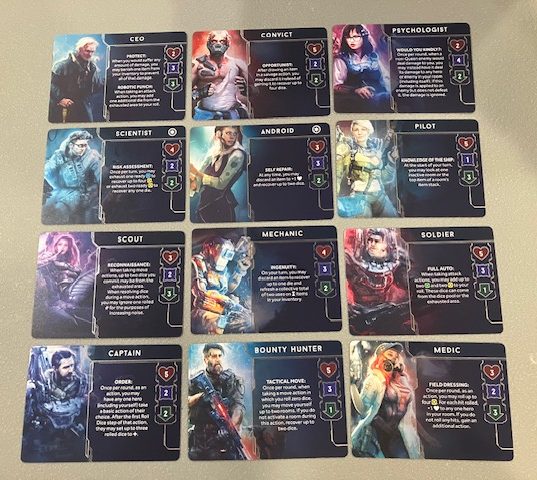
Each player chooses 1 of 12 characters to play. See above.
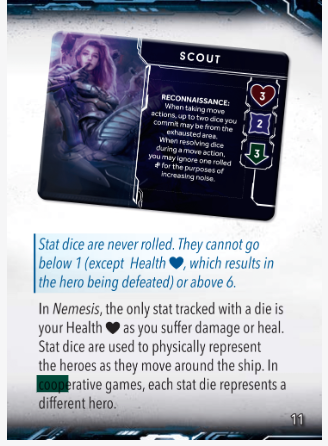
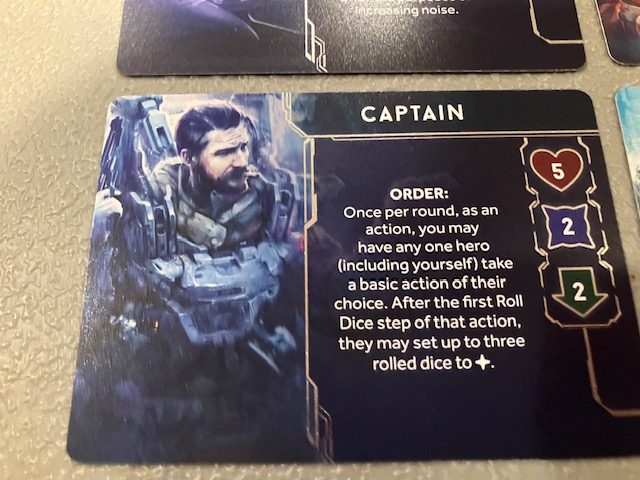
Each character has a special ability (see above) as well as some stats. The Red Heart is how many hit points, the purple thing is strategy (that controls some rerolls/retries and how many cards you can have), and finally the green arrow is how many dice you recover at the start of your turn.
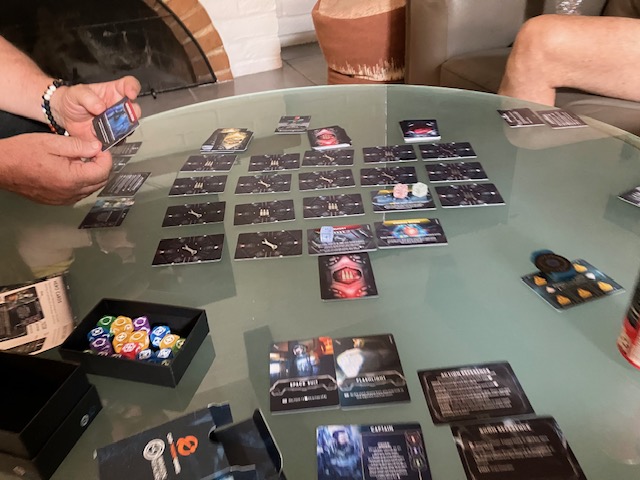
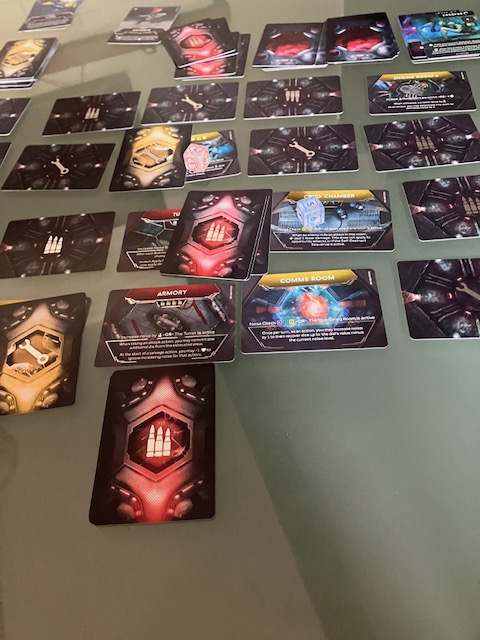
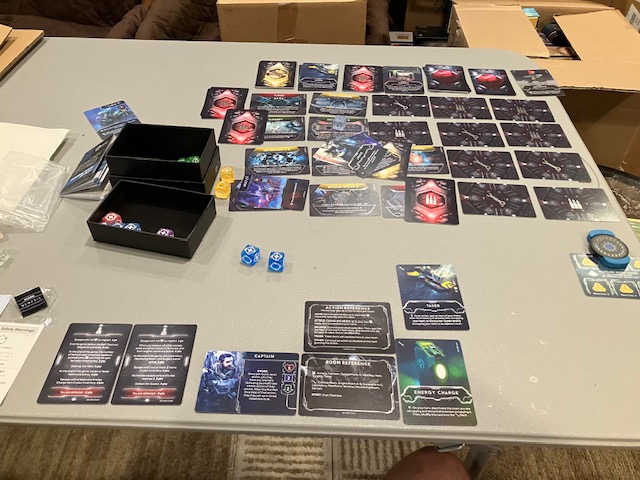
Players explore a 4×5 grid (4 rows, 5 columns) of Locations. At the start of the game, all Locations are face-down, so you don’t know what’s what.
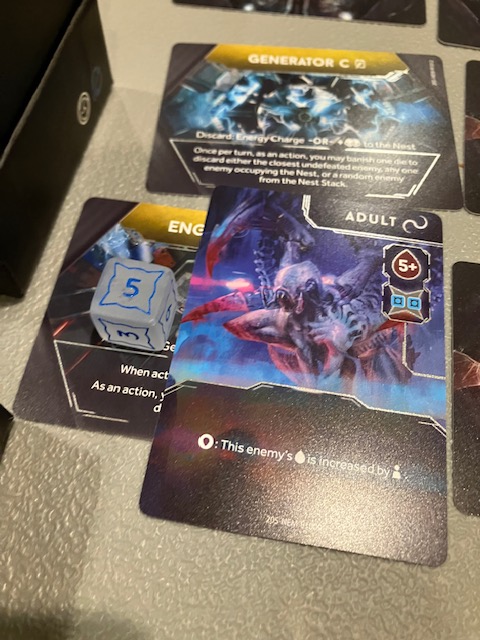
As the game evolves, more and more Locations are revealed! To win the game, players must find the Escape Pods, but they can’t activate the Escape Pods until they activate the Engines, which they can’t activate until they find the Generators! It’s all about exploration!
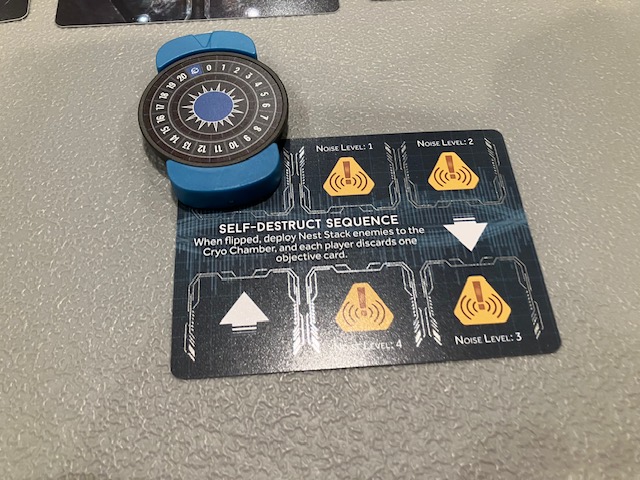
As you explore, you generate noise! There are actually a lot of ways to generate noise! If you ever roll a critical hit (far right) and apply it, it counts as noise! Many Locations also generate noise when you activate them (like turning on the Ship’s engines .. that’s pretty noisy, right?).
See the noise tracker above! Noise is bad!! Why? When the noise tracker comes all the way around, you accidentally summon an alien!
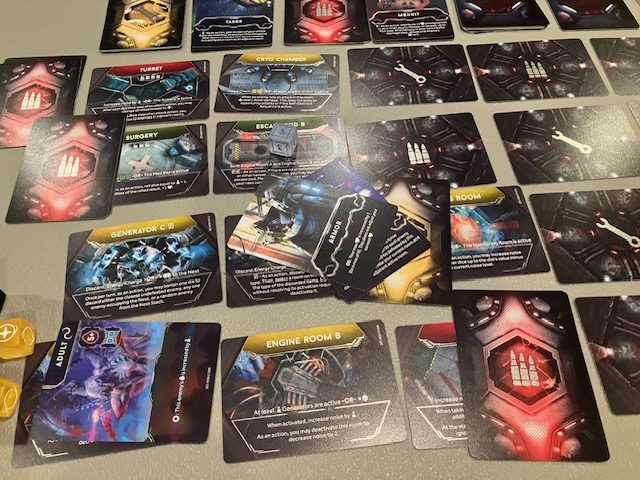
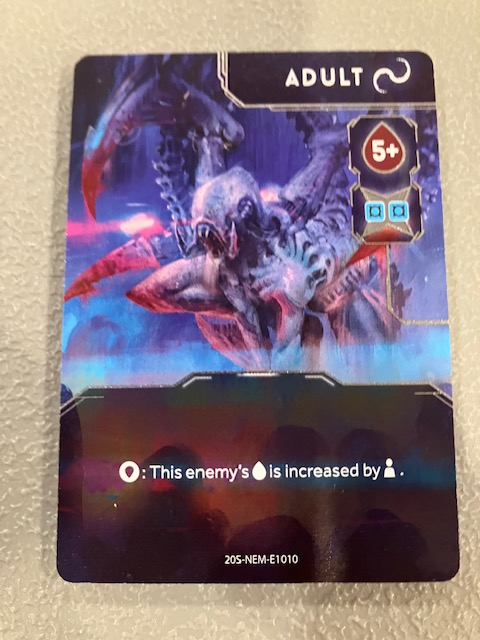
These are the aliens (which look nothing like Aliens from the movies) that hunt you and fight you!
The noise coming back around immediately summons an alien to your Location! Gulp! You better hope you still have some actions to fight it!
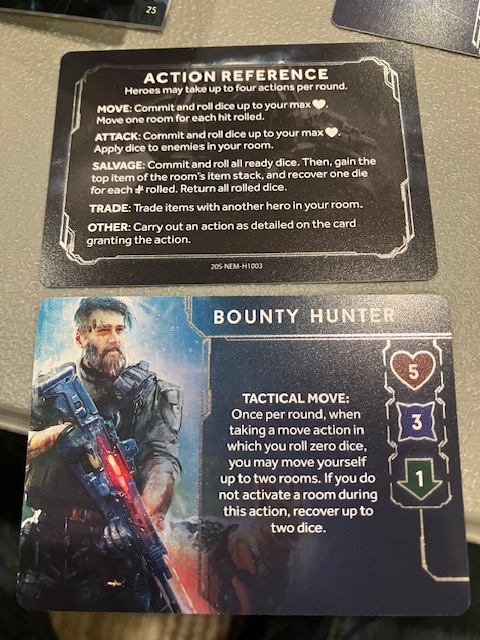
On your turn, you have 4 actions to move, attack, salvage, trade, and other. See the Action Reference (on the back of other character cards) above!
To be clear, the dice are key to everything you do here; every move, attack, salvage involves some of the dice.
As you play, dice move from the active to inactive pool! You have to decide how many dice to allocate on your turn! And which dice! Every color die has its own number of successes! The yellow dice are the weakest, and the red die is the strongest! (And you don’t always want to strongest dice on your turn; at the end of your turn you may generate even more noise using the strongest die used!). Let’s be 100% clear: this is a dice game.
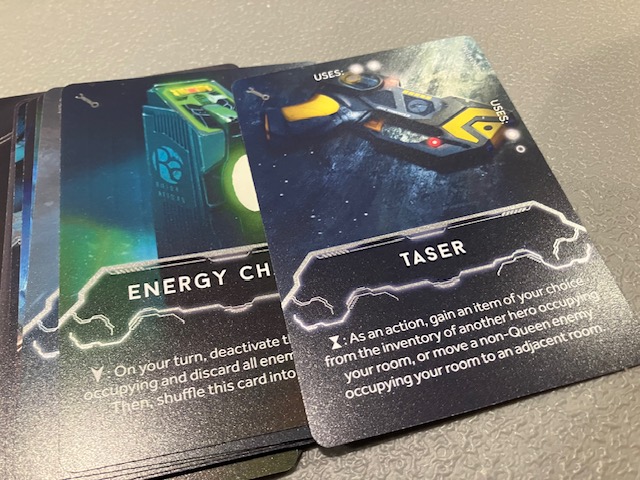
Along the way, you can also pick up items when you salvage; see above as I have a Taser and Energy Charge.
If you can escape the ship in an Escape Pod, you “win!” But, winning is very different if you are playing cooperatively or semi-co-op!!
Cooperative vs. Semi-Cooperative
All right, let’s address the alien in the room: is this a cooperative or semi-cooperative game? The answer is VERY much not answered by the rulebook! Nor the Gamefound site! Like I said, both allude to both co-op and semi-co-op natures, but neither really answer the question.
The answer seems to be very much answered by the officialHow To Play 20 Strong: Nemesis video from Chip Theory games (the publisher). See above.
Semi-Co-op for the Win!
The answer? This is very much a semi-co-op. I guess that’s a “Well, Duh” to most people. But, after “trying” to play it cooperatively, this game can be played cooperatively, but it’s just not as strong. It’s really how you deal with the objective cards in the game more than anything.
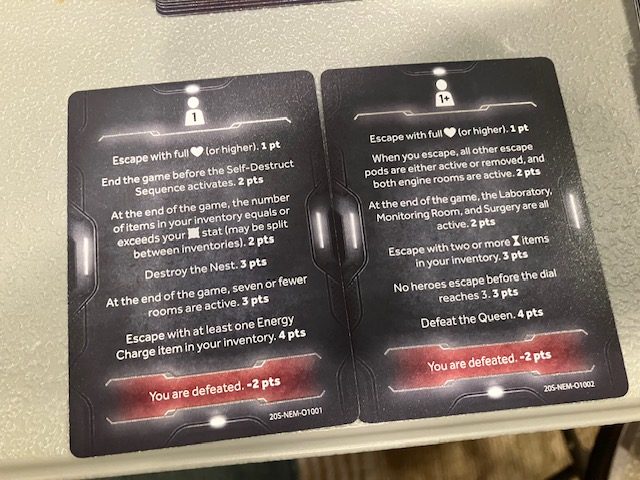
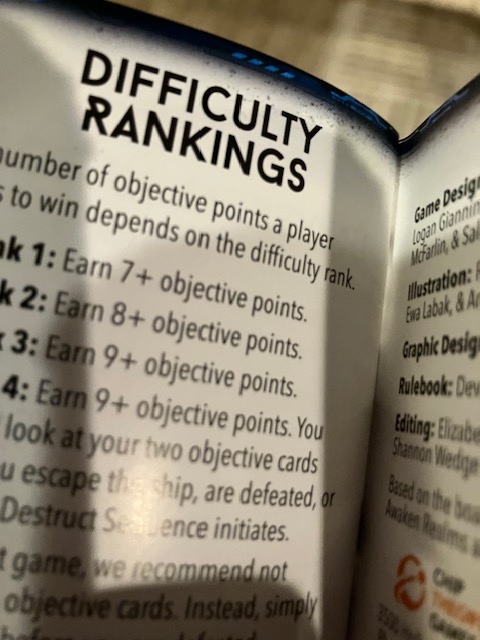
At the start of the the game, each player gets two objective cards. At a certain point in the game (when the round dial counts down to specific placed based on the difficulty and player count), you must discard one or the other: this defines how you get points for the rest of the game! This defines your play-style: do you screw your compatriots for points or play nice? The objectives majorly inform your style!
In the semi-co-op game, you are trying to get the most objective pointsto win! That’s it!! If you die (pardon me, are “defeated”), you can still win if you can get more points than the other players! So, in the semi-co-op game, everything you do is in the name of getting points: you may lie about what Locations you discover, you may lie about what your objectives are, you may lie about what you are trying to do. You do not HAVE to show the Locations you find, you do not HAVE to show your objectives. You may work a little with the other players to discover the ship, but in general, you are trying to get the most points.
In many ways, 20 Strong: Nemesis is Nemesis: the dice game. Cooperate a little, but lie lie lie.
You Can Still Play Cooperatively
But, you can still play Strong 20: Nemesis fully cooperatively; no lying. Unfortunately, the rulebook kinda sucks, and all the things you have to do to “really” play cooperatively aren’t “really” spelled out. Here’s what we discovered to play cooperatively:
You have to share and discuss your objectives pretty heavily out-loud! There are plenty of objectives that are truly mutually exclusive, and you need to talk so everyone can “do the right thing” to make it so everyone can fulfill their objectives!
You need to specify the “fully cooperative” win condition! After playing many cooperative games, the fully cooperative objective seems to be “all players must escape and have enough objective points!” I think all players need to survive and have enough points to call this a win. I “guess” if a player dies, but still somehow has enough points, they are considered part of a winning team?
You need to communicate well. No lying.
The worst part is that it’s not 100% clear what the win condition should be cooperatively! I think everyone should escape AND have enough objective points? But I can also imagine a scenario where one player dies by making the ultimate sacrifice to help the others. but can still is in the winner’s circle because his objective points were achieved.
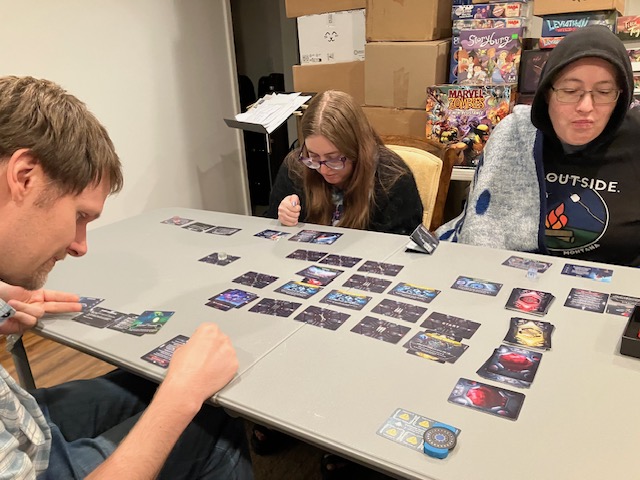
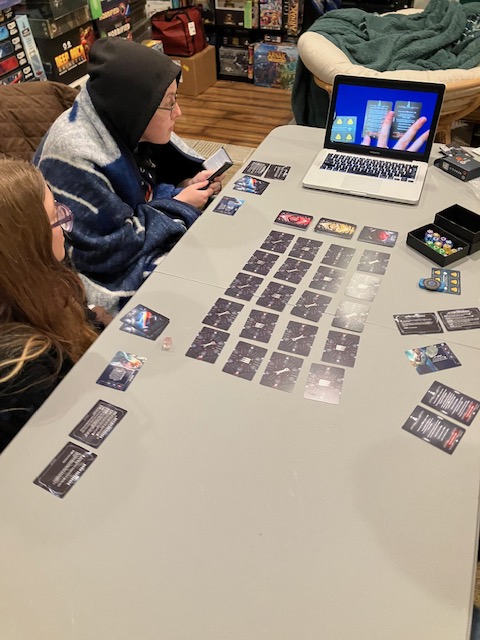
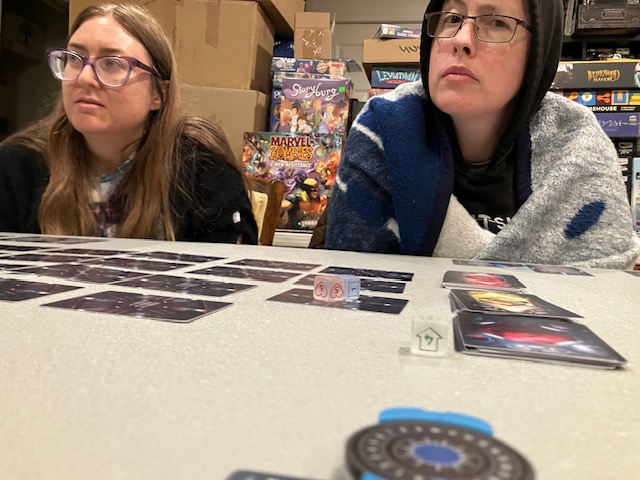
I taught/watched a 3-Player cooperative game, and my friends did a great job cooperating! They had to figure out a way so that everyone escaped the ship with at least 7 objective points! They talked about their objectives, they talked about how to meet them, they talked about how to help each other meet their objectives!
It was surprising just how cooperative this game can be, if you just know what cooperative rules should be. The rulebook could have easily had a few pages distinguishing semi-cooperative play from cooperative play. And a co-op mode does seem to work.
But as-is, 20 Strong: Nemesis is a semi-co-op.
Rulebooks and Rules
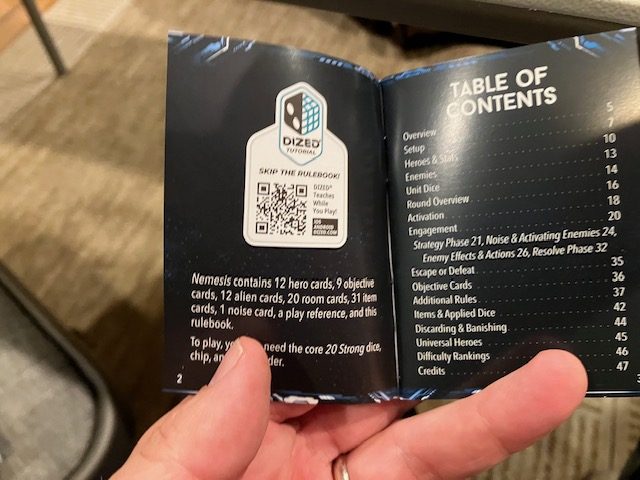
I did not like this rulebook. First of all, it said to try out the Dized tutorial! Not available yet! (at the time of the play).
This game probably gets a D on the Chair Test! As much as I hate the form factor (as it was tiny and small), they did a good job with the font: I could read it.
There were a lot of things that weren’t really well specified. I had to re-read the rules several times (what does the turn timer start at? What does a crit hit do when I attack? The aliens attack? For a noise check? The crit means different things depending on the context! ) I ended up going to the official How To Play video from Chip Theory games, and I still didn’t get everything answered! (The Strategy component is not really explained in the video at all).
It really took about 5 plays to get the rules down. For a “simple” dice game, I was very frustrated. Part of it was also the fact that the base 20 Strong rules are interspersed with Nemesis rules, and it’s confusing: see above.
You can play solo. I played a few games solo to get the feel of it. You can even play true solo and only play one character!
I won. It was ok. It was .. fine.
Reactions
The reactions … weren’t great. Ralph: It was ok. Sara: 5/10. I’d play again if someone wanted to, but only fully cooperative. I’d never play semi-co-op. Andrew: 5/10. Same Teresa. It was ok 6/10. I’d never play semi-co-op Rich: It was ok solo. 6/10. I think the co-op was better: 6.5/10. I also would never play semi-co-op.
Conclusion
I really wanted to like 20 Strong: Nemesis, but me and my groups were pretty disappointed by it. Some of that disappointment was that the co-op wasn’t great, but 20 Strong: Nemesis is really probably best as a semi-co-op. This is management of expectations: you can’t really like a cooperative game if it’s really a semi-cooperative game.
I think if you take 20 Strong: Nemesis as what it is, as a semi-co-op, then it’s pretty good. I think objectively that it’s probably a 7.5/10: it’s a shorter, faster, stream-lined version of the original game of Nemesis. You may love it!
If you take it as a cooperative game, the rating drops to a 5 or 6 for my friends; I was highest at 6.5/10. (Solo was just “ok” at 6/10).
The weird thing is that watching my friends play it fully cooperatively (which is really not an official version), it was pretty darn cooperative! They were talking and working together so well! I have to be honest, I’m not sure what it would take to move this up just a bit more: there is a good cooperative game in here, I just think it needs something else. I saw the cooperation happening! I saw the discussion of mutually exclusive objectives! There is something here! I just don’t “quite” know what’s missing for this to be a good fully cooperative game?
If you are looking for a good fully cooperative spaceship exploration game that’s short and moves around a grid, I would recommend Solar Storm instead of this (see review here); Solar Storm made our Top 10 Cooperative Games of 2020!
Stupid Fun. That’s all you need to know about Camp Grizzly: Second Edition.
What? You want to know more? Ok, we’ll talk a little more about this.
Stupid, Random, but very Thematic Fun! There! Is that better?
No? That’s still not enough? All right, all right …. we’ll look a look closer at this cooperative (yes, it is cooperative, that’s why we are here) horror game.
Unboxing
This is the second edition of the silly cooperative game called Camp Grizzly. See Coke can and box above for scale.
I backed Camp Grizzly:Second Edition from Kickstarter back in August 2025, and it arrived at my house in early July 2026. It arrived early! It was originally slated to arrive August 2026!! What? An Early Kickstarter??? That never happens! I was on the fence for backing this, but it was Mike Heller who convinced me this was a good choice! The game I backed was the Limited Release version with lots of acrylic tokens and standees.
Acrylic Standees
I am embarrassed to say that one of the reasons I was so excited for this game was the Acrylic Standees! The version I got (Limited Release) comes with Acrylic Standees that are so funny and goofy and thematic! See the full bag above of them!
The Acrylic Standees work SO WELL for this game! The art style is very “comic booky”, and I find that style works really well with Acrylic Standees: The colors are more vibrant and just pop!
There’s a LOT of them too! See above!! Why so many? Because this particular version comes with 8 expansions, and some of these standees are just for the expansions that come in the box!
Note the two above; the lady on the left has no “symbol” on the bottom of her standee, so she’s a base game character. The lady on the right has a bottle-looking symbol: she’s from the Spin The Bottle expansion!
Some of the expansions have a TON of standees! See all the Mountain characters above!
I adore the Acrylic Standees; they work so well! If you have a chance to buy and/or play Camp Grizzly: Second Edition, try to get the version with the Acrylic Standees! I think they are that great!
Gameplay
The premise of this game is simple; have some Counselors survive Otis and make it to the Finale! If all Counselors die, everyone loses! If some counselors survive, everyone wins! Let’s be 100% clear; some of the Counselors will die!! And possibly you might die!! But don’t take it personally.
Otis (see above) is at Camp Grizzly and he is the BIG BAD HORROR monster chasing the Counselors! Otis is the amalgam of Jason, Freddy Krueger, Micheal Meyers, Leprechaun (blah) and all your “favorite” horror movie baddies! Just to be clear: no player is operating Otis and hunting the Counselors: the game plays Otis via some rules.
There are several modes of play in the game: Modern Murder Mode and Classic Action Mode.
In Classic Action Mode, the players choose 6 Counselors (see all Counselors above; some are from expansions) and the players as a group operate the 6 Counselors: there are always 6 Counselors (well, until they get killed … and they probably will …).
In Modern Murder Mode, each player takes the role a single Counselor: one character per player. If your Counselor dies, you get another one.
And just a reminder, in case I haven’t mentioned it yet, counselors will die.
Counselors each have a Special ability to help them! Kevin (see above), for example, may move to a fight and gets +1 during BOAT finales! Kevin only has 5 hit points (note, it’s NOT the number next to you: that’s your movement). Notice that the healthier you are are, the faster you move! At full health, Kevin moves 3 spaces per turn, but as he gets wounded, his movement degrades to 2 then 1 (and then with a second wind back to 2)! If Kevin ever PANICS (yellow bam), he can run up to 2 away.
The players choose a Scenario (as specified by a number of cards) and set it up!
There are a number of set-ups of different difficulties. The game recommends starting with “Quick and Dirty”: see above.
After reading the flavor test (whosoever is the most dramatic and over-the-top reader should read this), the other side gives the set-up for the game!
The set-up puts the characters, Otis, and some Objective Tokens on the board.
The Objective Tokens have various things on them (First Aid Kit, gas, rope, … other things). The players are trying to the objective tokens so as to trigger one of the end Finales!
There are 4 possible finale-triggers at the 4 corners of the board; the BARN, the BOAT, the VAN, the RANGER tower: see above.
If you can get the three Objective tokens (keys, crowbar, battery), you can move to the Ranger Tower and initiate the Finale!
Depending on which tokens you get (they are all hidden at the start of the game), you may have to run to the VAN or the BOAT instead! Each finale needs different resources! (To be clear, there are a lot of finales; it looks like 24 for my version of the game).
The finale can be SO VERY different! One of them is a Barn Dance, where you have to roll dice and try to get a certain match! In another, I had to sacrifice one of the Counselors! … and each one is really different.
As the game goes on, Otis gets more and more terrifying! He starts to move faster, attack for more!
Basically, as the Body Count goes up (yes, there’s a body count track), Otis slowly get more powerful! Funny, even if the Counselors don’t die, there are extras that die all over the place: Cameos and other NPC campers.
If players can’t trigger a finale, and the Body Track gets too high, there will be a final fight instead!
Along the way, you’d better hope you find some stuff to help you! Sherry was lucky enough to find the Chainsaw and Slicker! See above!
There’s a Cabin deck that players will draw from every turn, and a Survival Deck you can get lucky and draw from occasionally. What’s in the Cabin deck? So much random stuff!
You might get good stuff … like the Slicker …
You might get a Cameo by a famous actor (who will probably die very quickly) …
You might get a Plot Twist, which screws you!
… or you might get Otis Strikes!
You can fight Otis (a little), but generally he overwhelms you and you take damage. If your Counselor runs out of hit points, you either just die (Classic Mode) or respawn a new character (Modern Murder Mode).
Survive the Finale or the Final Fight and you win!
Rulebook
The rulebook is generally pretty good.
It gets a D- or an F on the Chair Test, as the rulebook is the same size as the box, and hopelessly droops over the edges. You might be able to use it on the chair next to you, but maybe not. It’s too bad, because the rulebook is pretty good otherwise.
I wish the rulebook had an Index; there are a few too many concepts and/or keywords, so I wanted to look stuff up quickly via an Index.
Solo Game
So, Camp Grizzly: Second Edition works as a solo game! (Thanks for following Saunders’ Law!) Interestingly, because there are two modes to the game (Classic and Modern), you can choose to either play 6 Counselors at once as the solo player in the Classic mode, or you can play true solo in the Modern mode, and play just one Counselor!
I opted for the true solo game with one Counselor. See above as Jody decides it’s a good idea to stay at camp alone at night! Wait … maybe that’s NOT a good idea …
Jody died pretty quickly, but C.J. stepped up (“spawned”) after Otis killed Jody! The great thing is that C.J. was that he was able to pick up all the stuff Jody dropped when he died! See above! This is really thematic that you can loot the dead bodies!
Now, C.J. made it to a Finale at the Ranger Tower! And what happened?? Because there was only ONE Counselor alive, C.J. had to be sacrificed! If there had been TWO Counselors, we could have won, as one of us had to die … but as long as at least one Counselor survives, we win! I COULDN’T WIN! No matter how I played the true solo mode, I couldn’t have won .. at least with this Finale.
Huh. I wasn’t frustrated. I thought it was kind of funny! Are all scenarios this poopy for the solo player?
I set-up the same intro scenario and had Sherry run this one by herself!
Sherry did MUCH better than C.J. or Jody! She made it all the way to the BARN Finale with no wounds and a CHAINSAW!!
The BARN DANCE was a very different Finale! Sherry had to roll some dice to survive … and she did not survive.
Sherry died. So I lost again. But I could have won … I am beginning to think I actually would have had a better chance with at least one more Counselor. I am beginning to think 2-handed solo (2 Counselors in Modern mode) is probably the best way to play solo?
Again, you might think I was frustrated that I lost. Nah. It was goofy fun. You have to realize .. these games were very quick! Once you get into the groove of this game, I think my second solo game took 45 minutes? This game moves quickly. And you really can’t take it too seriously.
Cooperative Mode
So, when I first looked at Camp Grizzly: Second Edition on Kickstarter, the game is billed as “semi-cooperative”; see above!! I actually didn’t back it at first when I saw that!
I don’t think that’s quite accurate. I think a strict playing might be “only the players that survive” are the winners. But the thing is, it’s almost always in your best interest to keep many Counselors alive! I have seen a number of Finales now, and it always behooves you to have more Counselors! The more Counselors you have, the better chances you have of surviving and winning!
Even the rulebook points out: “look, if anyone survives, y’all win”. It’s cooperative! Mostly; even when you have to screw other players (like when we had to sacrifice a Counselor), it’s still in the name of common good! As long as one Counselor makes it out alive, you all win!
The basic cooperative game was pretty easy to explain and jump into. I didn’t have too many problems teaching the game.
The Finale was actually a little harder to explain and how it worked.
This game reminds me a lot of Betrayal at House On The Hill! The Finale was “wonky” and we had to try and figure out what the card meant! I have to admit, I had this problem a little in the solo game too! Each Finale you trigger is very different, but it means the rules aren’t quite as well defined because they are different every time! Luckily, this is a cooperative game (unlike Betrayal At House On The Hill), so you players can discuss “What does this mean?” One of the problems with Betrayal At House On The Hill is that the environment is so tense and antagonistic because you can’t ask questions… because that might give something away! At least here in Camp Grizzly, the wacky Finales can be discussed as a group.
And we definitely saw what “could” be semi-co-op nature of this game!!! We had to leave poor Teresa behind because her movement had dropped to 1! There was no way she could make it to the Finale in time! So, we had to trigger the Finale and “leave her behind”. If this had been a true semi-co-op, Teresa would have just lost. But, like a Horror movie, even if your favorite character dies, you still hope the Counselors will survive! The flavor of this game was cooperative; we aren’t gonna win if we have to wait for Teresa, so we all made the decision to leave her behind! And she was cool … she was just hoping one of us would survive!
In the end, Sara just barely survived the Finale: both Andrew and I died in the Finale, but since Sara survived, we all won! Hurrah! It was a bummer to die, but we “knew” we won!
So, our game was over in about an hour. The game moved quickly, and was “generally” easy to teach! I did have to look up some rules in the rulebook as we played, but it wasn’t too bad.
I think this game is simple enough that a group could learn this “cold” at a Convention without too much trouble. This probably could have made our Top 10 Cooperative Games To Play at Conventions! It is very simple to learn.
Thematic
Growing up in the 80s, I was forced to watch a ton of Horror Movies with my friends. CC and Sloppy loved the horror genre, and I didn’t. But they outvoted me many times! So, I watched a lot more Horror than I expected to as a teenager. In fact, I was once made to watch ALL 7 Leprechaun Horror movies! (Yes!! There are 7 Leprechaun movies!! I think there are more now)!! It was to settle a bet: Which Leprechaun was the best one? CC liked Leprechaun 1 the best, but Sloppy liked Leprechaun 2 the best! But, of course we had to watch them all! (I liked a different one: Leprechaun in Space the best).
All of this is to say, I was exposed to a lot of Horror tropes! And Camp Grizzly nails the theme! Cheerleaders! Chainsaws! Cameos! The big three Cs! And this game does NOT take itself seriously.
But it nails the Horror theme and tropes perfectly.
Randomness
Jody died very quickly in my first because he had bad luck. C.J. did great and made it to the Finale, but lost because of bad luck. There is a LOT of randomness and luck in this game! You absolutely cannot take it seriously! You may die right away. You may win easily. You may get screwed by Otis or a die roll or a bad card draw or ….
There’s a lot of luck in this game. A lot.
Camp Grizzly reminds me a lot of Tales of Arabian Knights: see our review here. The advice we give when we play Tales of Arabian Nights: Don’t take it seriously; play and have fun! I think I like Camp Grizzly better than Tales of Arabian Nights for one major reason: it’s shorter! A Tales of Arabian Nights game can take 2-3 hours! Camp Grizzly? Dead in 45-60 minutes!
As long as you know this game will random and silly, I think you will enjoy it! Just don’t go in expecting a big thinky thing.
Reactions
Not everyone loved this.
Sara said it was “Fine”. That’s a 6/10 for her. Teresa liked it. That’s a 7/10 for her. Andrew said it was fine, but he’d prefer Tales Of Arabian Nights over this. He’s probably a 6.5/10. Rich liked it the best. Maybe a 9/10?
Conclusion
Camp Grizzly is just stupid fun. It’s random, it’s goofy, it’s unfair, but it nails the horror movie theme and tropes! And it’s only 60 minutes!
If you think you would enjoy the Horror theme and like the idea of a stupid fun game, this game is for you. If you don’t like the Horror theme, Tales of Arabian Nights (see review here) or Tales of the Arthurian Nights (see review here) might be better choices for you: they are both silly story games like Camp Grizzly, but with different themes.
The problem with being stupid fun is that some people will just think this is just stupid … without the fun. My friends were more middling on this than I was: they gave it between 6 and 7. I gave Tales of Arabian Nights a 9/10, so I think I have to give Camp Grizzly something similar: 9/10. Tales of Arabian Nights has more “story”, but Camp Grizzly is over so much faster! Both are pretty darn random.
We’ve all played that game of Monopoly that lasted 6 hours, or that game of Scrabble where everyone was yelling at each other, or that old traditional game where we all hated each other at the end! In the modern world of board and card games, there’s no reason for this! There are now many cooperative games that can replace the hate with joy! These are ten modern cooperative games that can replace some of old traditional board games with a more interactive and friendly game.
This list is ordered by how “obvious” a replacement game is! The games at the bottom of the list has obvious replacements, but the higher up the list you go, the harder it is to find a cooperative replacement! The top positions will really make you think about how hard it might be to replace those!
10. Monopoly -> CO-OP: The Co-op Game
If Monopoly is all about making money and crushing your opponents in a game that’s way too long, CO-OP: The Co-op Game is all about making just enough money to keep the co-op (a cooperative store and place of business with Customers) alive, while still keeping the place fun! The game is over quickly (no 6 hour game here), as players must learn to cooperative and reinforce each other’s actions! There’s actual “cooperate” actions, where players run Car Washes together to make money, or have Drum Circles to attract customers! At the end of the day, players must still make enough money (like Monopoly) to win, but it’s the delicate balance of money vs. fun that makes this so much more enjoyable than Monopoly!
CO-OP: The Co-op Game also embraces Player Selected Turn Order (see link here) allowing players to embrace the fairly modern concept choosing turn order as you play. As opposed to everyone hating each other at the end of Monopoly, high-fives end of the game when you save the CO-OP in CO-OP: the co-op game!
Disclaimer: the main designer of CO-OP: the Co-op Game is a major contributor to this web site CO-OP Gestalt, so take this with a grain of salt. But we’d still rather play CO-OP: the Co-op Game rather than Monopoly!
9. Poker -> Ace of Spades
Everyone knows how to play Poker … but sometimes it’s not the vibe you want! A “friendly game of Poker” is never truly friendly … until now! Ace of Spades is a 1 or 2-Player game where players cooperatively use poker hands to fight bad guys!
There’s a “river” of cards, shared among the players! Each player needs to form the best Poker hands they can to do damage to the current bad guy!
There’s a series of bad guys you must fight! If you can make it to the last one and defeat him, you cooperatively win! Take a look at our review of Ace Of Spadesto see if this might be a good game for you!
8. Scrabble -> Word Weaver Adventures
Scrabble, at least in my family, was a vicious game where players vied for bonus spaces, and sometimes played stupid words just to block others from playing words on bonus spaces! There were heated arguments about words, but also deathly quiet!! The quiet around the table was deafening as players had to think, and there was so much analysis paralysis as player turns took forever! I love word games, but I hated playing Scrabble.
Word Weaver Adventures transcends all those petty issues! The game is gorgeous and encourages talking and communication! The vibe is open and flowing! And players all work on their words together at the same time, so turns don’t take forever! Players are all doing simultaneous word selection!
Carcassonne is a fun tile-laying game that’s been out for a while! Carcassonne is now considered a “classic”, uttered by many people in the same breath as Monopoly and Scrabble! It’s actually a great game, but if you are looking for a cooperative version of this, the Carcassonne people have you covered! They already have something called Mists Over Carcassonne!
Mists Over Carcassonne makes the game cooperative by adding a new element: ghosts! When tiles come out, you have to worry about capturing ghosts by enclosing them using fairly standard Carcassonne rules! If too many ghosts comes out, players lose as a group!
This is a cooperative victory point game where players have to earn enough victory points (as a group) in order to win, while still keeping the ghosts at bay! Mists Over Carcassonne is a great cooperative tile-laying game, while still preserving all the things you love about Carcassonne! Take a look at our review here to see if Mists Over Carcassonne is something you might like!
So, Yahtzee is all about rolling those dice! Keep what you want, then re-roll! Keep what you want, then re-roll one final time! Sure, it’s fine, but there’s no real interaction among people as you play; you just get the best score you can! What if you could use the Yahtzee ideas to fight bad guys? And play together at the same time??? That’s exactly what The Reckoners is! A cooperative game about fighting the bad guys together, using Yahtzee-like dice! It’s even based on a fairly well-known book by Brandon Sanderson!
The dice: this is really just a Yahtzee game, but the dice are SO nice!
The dice in this game are just gorgeous! Rolling them is a real treat! Players move around a board, looking for weaknesses and fighting bad guys together! There’s even a fine-grained Player Selected Turn Order going on that makes this so cooperative! (See link here discussing fine-grained Player Selected Turn Order).
After playing with this amazing production, you can’t go back to Yahtzee again! See above! The players are all interacting, cooperating, and rolling dice together for the common purpose of taking out bad guys! Playing talk to strategize, figure out how to use their dice as a group, and generally beat-up bad guys! Take a look at our review of The Reckoners here and it’s expansion here to see if you might like this more than Yahtzee!
Apples To Apples is a fun party game that had its heyday 20 years ago! One player would be the “judge” and everyone else would try to play a card to “play to the judge!” It introduced the idea of the judge player to many people, but it was still competitive! Some of my friends would get angry if the judge didn’t choose their cards! And people would get frustrated if they got crappy cards! Apples To Apples became an instant classic, but it has faded out for my groups because of the frustrating problems.
Just One took the judge idea and made it cooperative! Now players were working together to get the judge to guess the one word (word 2: Frankenstein!) Players could be creative and think of any word they want! They tried to think out-of-the-box so as not to collide with other words! Now, no one was getting mad that their word wasn’t chosen!! People would laugh when you only had one clue, and people would generally high-five when the judge guessed the word! Just One is all the great things of Apples to Apples without its baggage! Just One is a shared experience that has worked every time I have played it! This recently the #1 position on our Top 10 Cooperative Games To Play At Gaming Conventions!
4. War -> Regicide
War is the game I remember playing at sleepovers when I was a kid. You’d take a normal deck of cards and just play all night. So easy! Cut the deck in half, each player gets a half! Flip the top card; whosoever has the highest card wins both cards! A tie? You resolve with 3 more cards, then flip again! I remember so many sleepovers and just playing this all night long.
Later on, you come to realize that War is just random. If only there were a cooperative game of fighting you could play with just a deck of cards! With a little more strategy! There is! Regicide! Regicide has the vibe of War very much; you have to do enough “damage” to bad guys (not each other), take cards, and you have to worry about losing cards!
3. Spades, Hearts, or Bridge -> The Crew: Quest For Planet Nine or The Crew: Mission Deep Sea
Spades, Hearts, or Bridge are standard trick-taking games that many people grow up with! Bridge even has its own groups! My Mom had Bridge ladies over all the time for tournaments! It was serious business to play Bridge! My Mom was actually quite good, but it was hard to keep up with her! In fact, you couldn’t keep up with her! She would destroy you!! If only there was cooperative trick-taking I could play with Mom instead of Bridge!
There is! The Crew: Quest for Planet Nine, or its second version The Crew: Mission Deep Sea are cooperative trick-taking games where players of all skill levels can play together! Even though none of us are as good as my Mom at Bridge, we can all still have fun playing this together, and still get that trick-taking game vibe my Mom loved so much!
There’s actually quite a number of cooperative trick-taking games that can take the place of Spades, Hearts, or Bridge! See The Top 10 Solo and Cooperative Trick-Taking Games here! But The Crew is our favorite replacement!
2. Risk -> Spirit Island or Horizons of Spirit Island
Original version of Spirit Island from the Kickstarter: signed by R.E. Reuss!
There’s a rather infamous story in my friend circle from High School about me giving Joe a bloody nose during a game of Risk! Yes, Risk is random, Risk is mean and vicious, but it’s the standard area-control game for most people! If you don’t want to risk giving bloody noses to your friends, then maybe there’s a better area-control game than Risk?
Spirit Island is game where players work together to control areas to to kick-out invaders! Players have to strategically inhabit the lands and keep control of lands (much like area control)! Spirit Island is an incredible modern hit, making our Top 10 Cooperative Games of 2017 and, as of this writing, the #11 game OF ALL TIME on the BGG list of games!
There’s even a slightly lighter version of Spirit Island called Horizons of Spirit Island! And it’s available at Target!! Spirit Island is a very complex game, and jumping straight into Spirit Island from Risk maybe a bad idea, but jumping into Horizons of Spirit Island from Risk is probably the right way to start with it! Horizons of Spirit Island is simplified enough to get you going and see if you might like it! Take a look at our review here of Horizons of Spirit Island to see if Spirit Island can replace Risk for you!
1. Chess -> Santorini: Riddle of the Sphinx
Chess is a hard game to replace. People either love or hate Chess, usually because games are so imbalanced when one player is clearly much better than the other. What if there was a way to take advantage of all that Chess knowledge to solve puzzles together?
Santorini: Riddle of the Sphinx is all about moving pieces around the board, getting into position, and strategically setting up the next turn! It has a very “Chess” feel as players move pieces around the board to solve a puzzle! Let’s be clear, Santorini: Riddle of the Sphinx is absolutely a puzzle! The board sets up a puzzle and players have to solve it as a group or solo player!
This absolutely feels like Chess as move you characters around the board and solve the puzzles presented! Every Chess player I know thinks of board configurations like “puzzles to be solved”! Santorini: Riddle of the Sphinx absolutely has that board configurations as “puzzle to be solved” vibe, but working together in a cooperative game!
See our review here to see if you think Santorini: Riddle of the Sphinx might replace Chess for you! This is probably the most oblique replacement on our list, which is why it is #1! Let’s be clear; you need both Santorini and Riddle of the Sphinx expansion to play this!
This week we take a look at a game from our Top 10 Anticipated Cooperative Games For 2026! We want to give it some attention because RichieCon 2026 is in a few weeks, and *spoiler* I think some people will really like this game!
Companion Quest is a cooperative dice game that on Kickstarter back in March 2025. It promised delivery in December 2025, but just delivered to my house here in June 2026 … so, it’s about 6 months late.
Although we got the Kickstarter edition with a few expansions, there are better versions with mats and other upgrades! We’l just be taking a look at the base game.
The size of this box might surprise you a little; it’s a smaller game! See Coke can above for scale.
This is front-and-center a dice-rolling/dice-placement game. But what are the right words to use? Is this a dice-placement game? Is this a dice-rolling game? What’s the right gnomenclature? According to BGG: it’s dice-rolling (but it feels a little like dice-placement).
Although the name and cover might imply a little more questy game (and there is some questing), the dice-rolling/dice-placement portion of this game is the majority of gameplay. If you were looking for a game with lots of story and fighting, you probably need to look elsewhere!
Each player takes the role of a Gnome!
Each Gnome has his own power and a companion that accompanies him!
See all the companions above!
Each Gnome has his own special power, and an attached “companion”! The companions are bonded to the specific Gnomes, so you can’t choose willy-nilly. See above as Bubbles the Gnome has Arlo the companion!
The special powers of the Gnome or companion are activated by “tapping” (turning the card sideways) to show the ability has been used. How do you recharge the power(s)?
You recharge with Cookies of course! Cookies are phenomenally useful in this game! They can recharge any Gnome or companion …
… or the Cookies can be used to recruit new companions to your menagerie! There is always four companions available for recruiting on your turn!
How do you win? There’s “gnominally” (nominally? With Gnomes? Get it? Ok, it’s not that funny) a bad guy named Gu’Gu who is popping around dimensions and causing chaos! To win, you must catch him!
If you can move your Gnome marker (collective Gnome marker) to the Gu’Gu, players win! How do you move?
Every time players complete a “Quest” (see Quest above), the players advance forward one space! The quests are solved by placing dice on the quest spaces!
See above as the Gnome’s Nook is completed by placing dice correctly on the last few spots! Usually, you have to match the color and/or odd/evenness of a space on the quest!
Once you complete a quest, flip the Quest card over to see your rewards; move closer to Gu’Gu AND get some cookies AND increase your carrying capacity! See above!
The carrying capacity defines how many dice you can get on your turn! At the start of your turn, you grab some dice and use the dice to solve either Portal Problems or the Quest! Early in the game you can only grab 3 worth of dice: red, green, and blue cost 1! And orange, purple, and orange cost 2!
Portal Problems are “issues” the players must solve (at the bottom of the board)! Players place dice on them to solve them! There’s two types: Challenge and Danger cards. The Danger cards (with the yellow warning) must be solved before you can Quest again!
To “solve” a Portal Problem, you place dice! For example, to “Unlock The Chest”, you have to play three dice total (possibly over multiple player turns) so that their difference is on an orange die!
For example, 5-3 = 2 works fine, as long as the final dice is orange! See above!
If, on your turn, you DO NOT solve a Portal Problem, Gu’Gu moves forward one space towards the portal! See above as Gu’Gu is almost at the portal!
The game is all about trying to decide how to place the dice you roll on your turn, and when to use the special powers on the Gnomes and companions! Do you solve a Quest to move forward? Or do you solve a Portal Problem to keep Gu’Gu from moving forward? Do you use a precious cookie to augment your companion menagerie? Or do you use your cookie to refresh someone?
This is a game all about balance; you need to Quest to win, but you have to solve smaller Portal Problems along the way to keep the chaos at bay!
This game is absolutely gorgeous! The cover was one of the reasons this game originally piqued our interest! The components are really nice, especially the rulebook.
Rulebook
For such a small box (and arguably smallish game), this rulebook is really good!
The game gets an A on the Chair Test! This rulebook sits very well on the Chair next to me … and it is so very readable! There is no droopiness, the fonts are big and readable, there’s tons of pictures and annotated text, and the colors just pop!
The Components page is great! See above!
Everything about this rulebook is quality. I don’t think it needs an Index because the game is pretty straight-forward! There aren’t a lot of keywords, so I won’t ding it for not having an Index.
There are two things that needed a little more discussion, but we’ll go over those below.
Otherwise, just a great rulebook!
Solo Play
So, congratulations to Companion Quest for following Saunders’ Law! We have a solo mode! The solo mode is a true solo mode, where the solo player takes the role of a single Gnome! The rules are well-defined on page 16 of the rulebook.
Normally I don’t “love” solo rules that change up the game, but the solo rules are pretty simple. There are two changes:
The solo Gnome can activate his own Gnome’s power to help himself (in the cooperative game, your Gnome power can ONLY help others). This is pretty typical of true solo modes: any ability that normally helps other players can be used to help yourself instead!
When you “refresh” your Gnome, you actually need to get a new Gnome instead! This forces you to cycle through the Gnomes and their special powers.
You can also keep a die from a previous round, but this is pretty much the same as the cooperative game; it’s just “the next player” isn’t someone else, it’s you!
The solo game is an easy way to learn this game. All the rules are there, and it’s pretty easy to jump straight in. I had a fine time learning the game this way. I played about three solo games; I had a good time while getting the gist of the game. It’s pretty fun to roll the dice, think about which dice to use for which thing (Quest? Portal Problem? Companion?), and try to catch Gu-gu. There is some brain power needed to do well; it’s not as simple and cute as the rulebook and look belies.
The balancing for the solo game seems to be achieved by cookie distribution. If you have just one Gnome, you start with two cookies, and get another two cookies at the end of a quest stage (see above). Since cookies are pretty powerful (usually in getting companions), it’s clear these need to be rationed. A 2-Player games starts with two cookies distributed amongst the two players (one each) . Interestingly, a 3 and 4-player game start with no cookies. We’ll revisit that decision some more below.
The solo game is cute and adorable, and it’s a great way to learn the systems of the game. I might come back to it again as a solo player, but I think cooperatively is the funner way to play. You might say, cooperatively is “gnominally” the best way to play! Sorry, that joke should get gnominated as worst joke in this review!
Cooperative Mode
I’ve been able to get Companion Quest played at 2 and 3 players. I’ve played a couple of times with my friend Teresa (below) and one with my niece Megan (see above).
So, the rule about “you can only use someone else’s Gnome powers” makes the game a little more cooperative. Players then need to talk a little more about what you can do “Hey Rich, I need a +1, can you help me get that with your Gnome?” So, that simple mechanism does help bring players interact more.
There is a little bit of downtime between turns, as you really do need to think a bit about the best way to use your dice. Depending on the group, this will either bring out conversation (making the game more interactive) or it MIGHT invite the dreaded Alpha Player in (making it less fun)! You get so excited when you see someone else roll the amount they need that sometimes you start accidentally Alpha Playering! I KNOW I did to Teresa a few times and I feel terrible! For Megan, she was asking for help more, so it worked out there more (my Alpha Player was more of a teacher). But I think you need to be a little careful about making sure you don’t Alpha Player!!!
With that little warning, I do think cooperatively is more fun that solo! Most people love the little Gnomes and their little companions. The game is pretty quick (besides some of the thinkiness that might occur on your turn), and the 30 minutes playtime as indicated on the box is about right. Most turns are pretty multiplayer solitaire (if you don’t have an Alpha Player … Rich …) so it’s still fun to make your own choices!
The game is bright and gorgeous and draws people in with its art. The cooperation is pretty good; even if you can’t use a die on your turn (sometimes, you just can’t get a die out), it’s pretty cool you can pass a die to the next player for their turn. It makes you feel like you are helping them! That rule (and the “you have to use someone else’s gnome powers”) make the game pretty cooperative and interactive despite the multiplayer solitaire nature of each turn.
Things I Liked
Using Dice for Wake-up! We didn’t mention this in the overview, but there is an another way to wake-up companions! We mentioned that you can use a Cookie to “wake up” a resting (tapped) companion … but there is another way to “wake up” a companion! Using a colored die wakes-up a companion! You might notice that every Companion has a color associated with it! Kusa (above) is red and Peppy and Snaps are both yellow. If you ever place a die, you can wake up one companion of that color! So, placing the yellow die above, we can wake up Peppy!
This really expands the choices you can make in the game! When you get some dice at the start of your turn, do you get dice to help with the Quest? Do you get dice to help with the Portal Problems? Or do you get dice to wake up your companions? This just really makes the choices so interesting! I really think this one mechanism elevates the game!
Art: I adore the art in this game! That cover may be one of my favorite covers of the year! I also really like how this game uses color! I love the colors in this game!
Things I Didn’t Like
Dice: At the end of the day, it’s still a dice game and you may get stuck with bad rolls. This is balanced out by it being a pretty short game; I don’t might a dose of randomness for a 30 minute game. Also, you generally can mitigate bad dice rolls with all the special powers you have.
Cookie Balancing at 3 and 4-Player: One of the funnest parts of the game is deciding when to use the cookies for their myriad of effects! (Recruit? Awaken? Reinvigorate?) Yet, the 3 and 4-player games start with NO COOKIES. It’s clear that when you finish a quest that everyone generally gets a cookie, but our first few 3-Player games seemed “less fun” and “less balanced” as we struggled more with no cookies to start the game. It “feels like” that there should be at least 2 cookies always at the start of the game? The balance felt a little off in the 3-Player game without cookies. In the end, after failing multiple times at 3-Players, we sorta started with a couple of cookies and that seemed to make the game a little more palatable. This probably sets the balance off a little at later levels, but it made us want to play more because cookies make it more fun!
Some Clarity: It seems like, when you play, that “completing a quest” should stop Gu-gu from moving forward. After searching the rules several times, it seems clear that Gu-gu will ALWAYS move if you don’t finish a “portal problem!” The interaction between those two (finishing Quest and finishing Portal Problems) should have been more specified! If you “cheat” and don’t move Gu-gu after a quest, then the game may seem too easy? But it also is MUCH harder if you do move Gu-gu! I wish this had been clearer in the rules. (Arguably it’s the flow of the game, so it doesn’t need to be specified, but the intuition seems to be counter-intuitive on this point … requiring more specification). Look, maybe you won’t have this problem, maybe I saved you from looking something up, but just be aware that completing a quest isn’t considered solving a portal problem (for Gu-gu movement purposes).
Modular Arithmetic: So, this game embraces that “adding 1” to a 6 flips it to a 1. And subtracting 1 from a 1 turns it into a 6. That’s modular math!!! Additions roll over, and subtractions underflow. That’s great! Because of this one feature, we are now using modular math (Modulo 6, Offset 1). This usually makes sense in the game, but they need some discussion. And what about negative numbers? What is 3-4 in this system? There is NO discussion of this! By opening the door to modular math, they need to define what that means! So, 1+6 = 7 = 1. Easy. 2+6 = 8 = 2. Easy. 3-1 = 2. 3-2 = 1. 3-3 = 0 = ??? By the rules we have, this should be 6!!! So, 3-4 = -1 = 5. An easy way to think of this; just do the normal math and add 6 or subtract 6 from the number until you get a number that’s between 1 and 6!
Some of cards, like “Unlock The Chest” (above) can be a lot easier if you can do modular math. And the game has opened the door for this! But they need to embrace the modular math and show examples! 6 is the additive identity here! I don’t think you can open the door and not specify this.
Conclusion
Companion Quest is a fun little cooperative dice-rolling/dice-placement game, but be aware! Compansion Quest is a lot more thinky than it looks! I don’t think this a gateway game; I think this is a game that needs a little sophistication and brain-power. Don’t get caught in the trap of thinking “Aw, it’s so cute, it must be simple!” This isn’t something super deep and heavy (remember, games really only last about 30 minutes), but it does have a lot of thinky decisions.
With an appropriate shepherd, I think most people can play this, but it might be a little too much out of the box for newbies.
But, overall, all my friends and nieces liked Companion Quest; it was a fun, cute, fast, simple game with deceptively more thinkiness than you might imagine. I might play it again solo? It’s a good game solo, but for me, the better game is the cooperative game with the dice-sharing and gnome-power sharing! I’d give this a [6.5-7/10] for solo and [7.0-7.5/10] for cooperative. It’s good! But, at the end of the day, it’s still a dice game and that randomness can be too much! That’s why we have a ranged rating; when the dice are poorly behaved, the game is less fun (for the lower ratings), and the game is more fun when the dice don’t conspire against you (for the upper rating).
As RichieCon 2026 approaches, we are reminded that not all cooperative games are created equal! A convention hall (or equivalent thereof) usually has a very different atmosphere than a home or a store. A convention tends to be a noisier, you may play with people you don’t know, and maybe you’ve been up too long so you are tired! In this convention environment, some cooperative games work better than others! For each game we list below, we indicate WHY we think this is a good cooperative convention game!
Unfortunately, a convention is a place where the Alpha Player Syndrome can manifest more easily (as you tend to play with strangers who you don’t know or trust), so we choose games where the Alpha Player is kept at bay by something! Each game we choose will also somehow address mitigating the Alpha Player!
The order for this list matters less than other top 10 lists; these games are mostly just good cooperative games to play at conventions! Here’s my current Top 10 Cooperative Convention Games! Every single one of these I would be happy to play with you and/or teach you at RichieCon 2026!
All of these games will be at RichieCon 2026!
#10 Kinfire Council + Winds Of Change Cooperative Expansion
Ok, this is a weird one, but follow me here! So, this is a long game! It’s kind of complex! The base game is nominally a really good worker placement game, but it’s just too chaotic and fragile as a competitive game. There are a lot of rules, so if you are playing competitively, it makes it a lot harder to ask questions and address issues! The cooperative expansion (Winds of Change) makes the game more interactive and a lot more fun! The complexity is not nearly as overwhelming because players are all working together to play! The game is a lot for a convention, but if you can get someone to teach it to you, the game is more tractable (which is why it’s only #10 on this list and not higher).
The Alpha Player is kept away because the game is very multiplayer solitaire! Each players has their own set of workers and upgrades that, frankly, are too much for others to follow! This game has a lot of choices, and players tend to negotiate to help each other and not get in each others’ way too much. We also strongly suggest that you play with the house rule that you may also share a resource as an errand. See our review of Kinfire Council + Winds of Changes for more discussion of this and some house rules!
I have taught this at Dice Tower West, and to at least 4 different game groups, and it was always a joy! It also made the top position of our Top 10 Cooperations Expansions of 2025!
#9. Marvel United or Marvel United: X-Men or Marvel United:Multiverse or …
Marvel United is a great convention game for many reasons; it’s easy to teach, easy to play, but still quite cooperative! The game is usually under an hour!
The idea that each player uses the symbols of the previous player’s card is genius! Most people love this simple idea that they haven’t seen elsewhere!
Another reason this is a great convention game is because anyone can play the hero that they want! Who’s your favorite Marvel Hero? You can probably play them! The three Seasons of Marvel United have almost every hero from Marvel that you might want to play! Play the quirky Ant-Man! Or the powerful Venom!! Or play the baroque and mysterious Dr. Strange! Or play Wolverine!
The only reason this is just #9 on the list is that Marvel United is slightly susceptible to the Alpha Player since everyone can see each other’s hands; this makes it slightly easier for the Alpha Player to slide in and tell everyone what to do. I personally haven’t had any issues like that, despite having probably played 50 or more games! Each player is generally playing multiplayer solitaire, so that tends to keep the Alpha Player away!
Good Dog, Bad Zombie is a light game that’s easy to jump into at a convention! It’s easy to play, easy to explain, and people can jump in and out very easily as the game is playing!!
Players play as dogs keeping the dumb humans away from the zombies! The dogs are adorable and will probably immediately bring you into the game!
This is a pretty light game with a touch of randomness, but when you are tired and just want a light game (where you can easily add people or take them out), this is a great choice! It’s quite cute too! See our review of Good Dog, Bad Zombiehere to see if this is something you want to play at a convention!
#7. Tembo: Survival of the Savanna
Tembo is a very cute game about moving elephants along in the Savanna! The players work together to move the elephants to different watering holes, eating trees along the way, and keeping the herd away from the Lion and Lioness!
This game has amazing art from Vincent Dutraite, and the elephant meeples (elepheeples?) just pop on the table! My friends all adored the cute vibe this game exuded!
But this is still a fun little game for 1-4 players. I am actually expecting to teach Max and Cassidy this game at RichieCon 2026! They will really enjoy this I think! As will you; it’s a quick, cute game that’s easy to teach and you can be done in under an hour.
The Alpha Player is kept in check because there’s a notion that each player’s perspective informs how the tiles must be played on the board, and the Alpha Player can’t necessarily see all that! Each player must play tiles along their perspective! This is a unique way to keep the Alpha Player away!
Aetherspire is really great at a convention because it is looks so interesting on the board!
The structures you build look so cool! Each player’s turn is fairly multiplayer solitaire, so the Alpha Player can’t sneak in. The game is easy to describe, but it moves well and has some interesting and unique ideas. In the end, it’s the 3-D structures you build that make this game pop in a convention!
I can almost guarantee you’ve never heard of this game! It had a very small Kickstarter, and it’s a little rare! But the boisterous energy of this game matches the boisterous energy of a convention!
Players move around a music festival, trying to make sure they see their favorite bands, but making sure to eat enough, pee enough, and drink enough! Along the way, players will stop and see other bands with their friend and just have a good time!
This is a game about having fun together as you traverse a music festival. It’s goofy, the names of the bands are goofy, the characters are goofy, and the game is just goofy. But this is a great game that works for 3 to 8 players! It’s rare to get a game that works for so many players!
I know the Alpha Player can’t really invade this game; I tried playing it solo and there’s just too much going on for the Alpha Player to tell you what to do! Everyone has to see their own favorite bands, and that scheduling can really only handled per player! See our review here to see if this might be a game you are interested!
#4. The Crew: The Quest for Planet Nine or Mission Deep Sea
I have played The Crew (either one) in so many environments, and it has always worked! Missions are short, and it’s really easy for people to hop in or out of this game! You may start with 3 people, add 2 more, then drop to 4! This is just the nature of conventions; people come and go, and The Crew can easily accommodate that! And the game is fun the entire game, even with people coming and going! And you can play as long as you want!! The Crew is also a cooperative game that works well at 5 people, and sometimes it’s just harder to find good cooperative games that work at 5! What a great game; it’s never failed me! The Crew has also made our Top 10 Cooperative Space Games, and the Top 10 Cooperative Trick-Taking games!
The Alpha Player is kept at bay because this is a game of hidden information; the Alpha Player can’t tell you what to do because he can’t see everything! While I personally like The Crew better than most trick-taking games, I can’t deny there was a more popular trick-taking game that works so well at a convention … see #2 below!
#3. Fate: Defenders of Grimheim
There are multiple reasons Fate: Defenders of Grimheim works so well in a convention! For one, the rules are simple to teach and easy to internalize: it’s a tower defense game! Defend the homeland in the middle!
For another, the board is so well-labelled! Everything you need is well-labelled on the board with big enough fonts to read!
For another, the game feels very multiplayer solitaire, but in a good way. Every player is upgrading their own character with their own rules and their own cards, so everyone feels like they are getting powerful! The Alpha Player is kept at bay because each player is too busy concentrating on their own deck; the Alpha Player can’t see what everyone is doing with their own very different deck!
A game of Fate: Defenders of Grimheim starts off very multiplayer solitaire, as each player defends a different direction, but as the game progresses and more shared area is threatened, the game becomes much more cooperative! This is a great dynamic for a bunch of strangers because they can slowly get to know each and slowly become more cooperative as the tension increases!
See our review here to see if Fate: Defenders of Grimheim might be right for you! Oh yes! I have also taught this at Dice Tower West and it went swimmingly!
#2. Lord of the Rings: Fellowship of the Ring, Trick-Taking Game. Also, The Two Towers!
This is a cooperative trick-taking game set in the first book of the Lord of The Rings. There are 18 very thematic chapters that people play through!
I know this is a good convention game because I saw it being played non-stop at RichieCon 2025 and Dice Tower West 2025! People just seem to love this game!
Everyone seems to love the simplicity of this game! Like other games on this list, the game does scale so you can jump in and out (a little, the game is best at 3 or 4), but it’s been my experience that people just want to keep playing! See our review of Lord of the Rings: Fellowship of the Ring, Trick-Taking Game here!
The Alpha Player is kept at bay because this is a limited communication and limited information game; the Alpha Player can’t tell you what to do because he can’t see everything!
And don’t worry RichieCon 2026 people; the next game in the (The Two Towers) will also be available to play at RichieCon 2026!
#1. Just One
I have never had a session of Just One fail me! I have played with gamers, non-gamers, and casual gamers … and it has always worked! This simple party cooperative game is easily to explain, easy to play, and addicting to keep playing! People can drop in and out without any consequences, and it can play small numbers (like 3 players) all the way up to 9 players (with a little cheating) and still work flawlessly! This word game has a simple premise: everyone choose one word to make the guesser guess the secret word. That’s it! If any words are the same, they are eliminated, so players must think outside the box sometimes to get thing working! Each round is quick, and people can easily join or drop!
The Alpha Player is kept at bay because players simply aren’t allowed to communicate during the word choice phase! There’s no way the Alpha Player can sneak in because he simply can’t talk! (And if he is talking, he is cheating!)