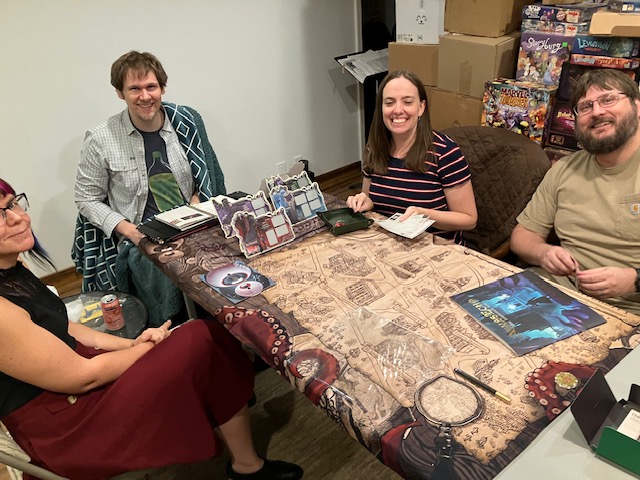
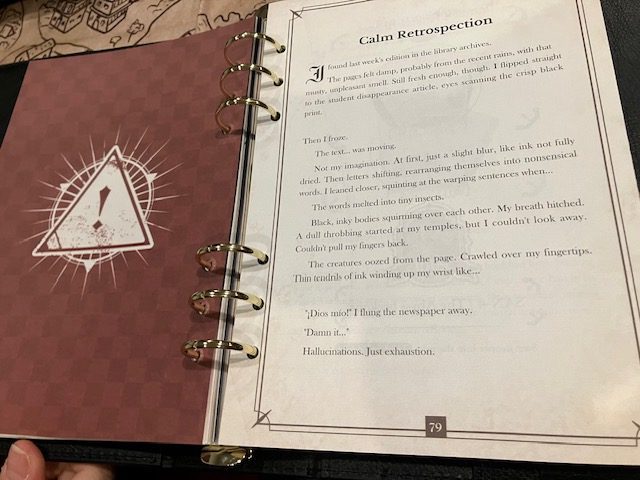
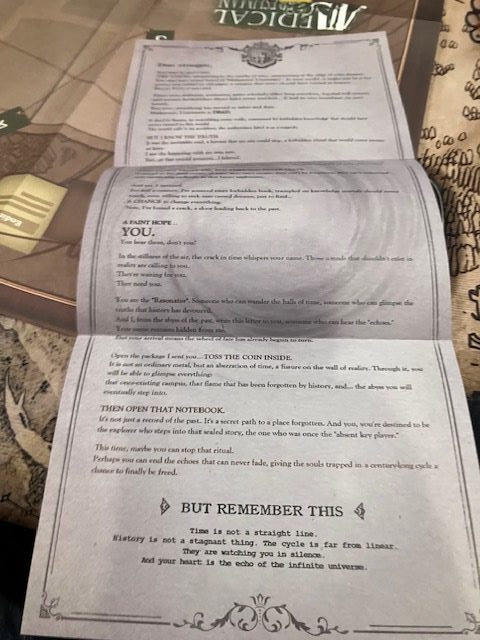
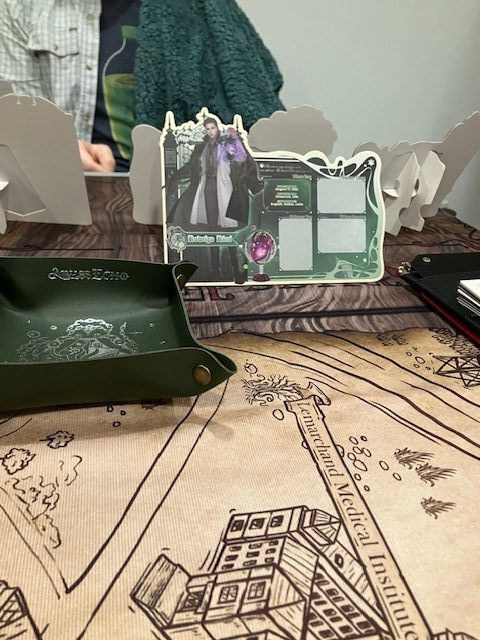
Cooperative Cthulhu! A Review of Cthulhu Rift (Solo and Cooperative Modes), A Roll-And-Write Game!

Welcome back to Cooperative Cthulhu Month! We’ve been looking at cooperative Cthulhu Mythos games, starting last week with Horror on the Orient Express! For the next few weeks, we will be continue delving into the cooperative games in the Cthulhu Mythos! This week, we’ll with a cooperative roll-and-write game (kinda) called Cthulhu Rift!

Cthulhu Rift was one of of a group of three Cthulhu-based games from the Lovecraft Games Collection on Kickstarter back in June/August 2025. They promised delivery Feb 2026 and were about 6 months late: my backed collection of games arrived mid August 2026. (Technically, one of them arrived much earlier, but that’s not this game).

I backed this collection because of the game Cthulhu Rift! Cthulhu Rift is a cooperative roll-and-write board game (sort of) for 1 to 4 players! Like Yahtzee, but cooperative and Cthulhu? Sort of?

Would Cthulhu Rift make our Top 10 Cooperative Roll and Write/Flip And Write Games? Let’s take a look!

Unboxing and Gameplay

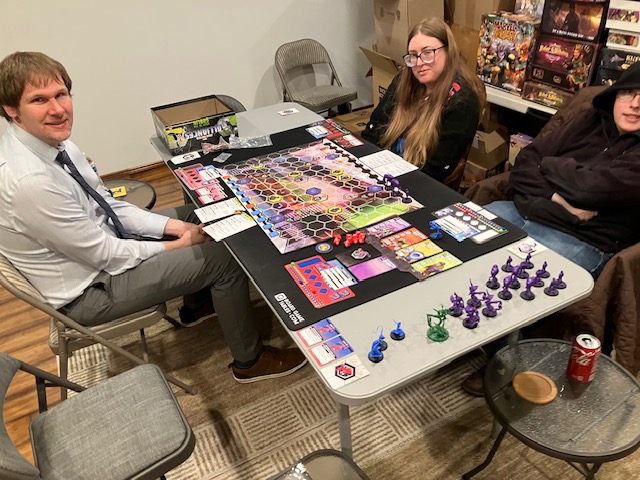
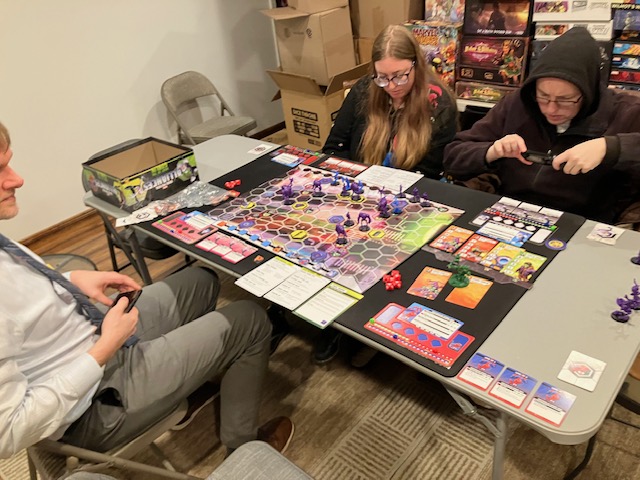
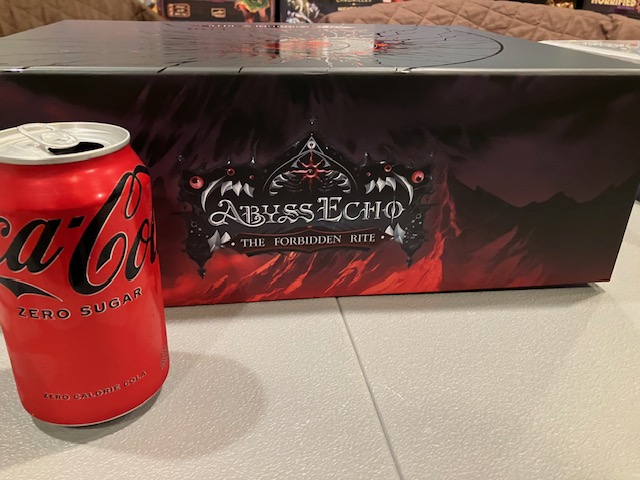
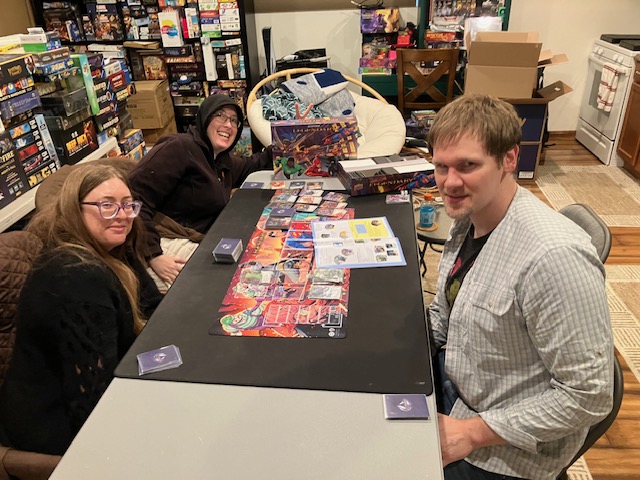
See game above with Can of Coke for scale.

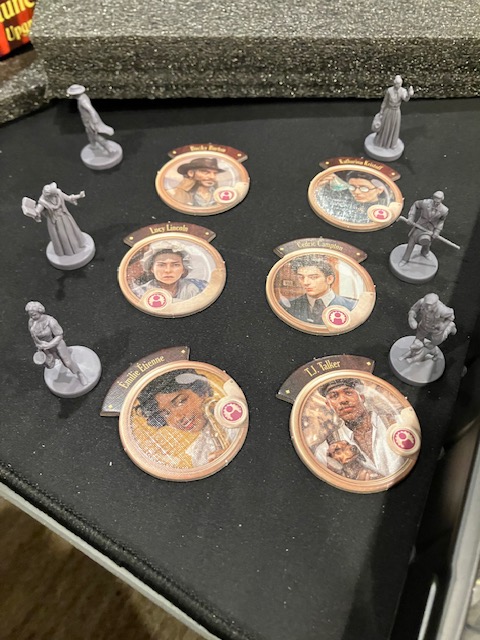
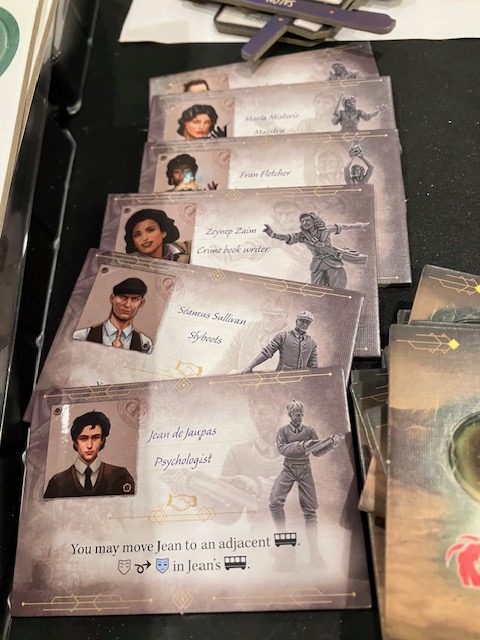
Players each take the role of one of the investigators in the game! See above!

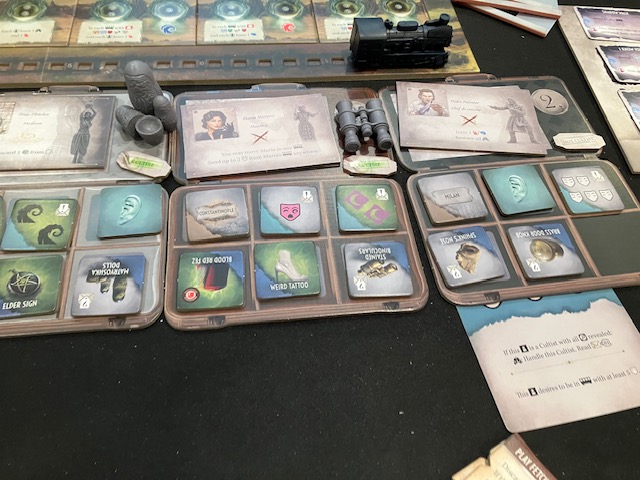
Each investigator has their own roll-and-write board! They also each have a once-per-game special powers (lower left) and some skills you can unlock as the game unfurls (bottom right).

This is a dice game (after all, it is fundamentally a roll-and-write game): see the different colored dice above. On a turn, the “driver” (first player) rolls the dice and each player must take a die … and that’s the symbol they get for that turn! (Some players may get more than one symbol).
Symbols aren’t immediately used! After you record a symbol on your sheet, you “may” cross out and activate a symbol if it’s adjacent to another symbol! This is a game about “collecting” symbols so you can use them later!

You can literally get stuck in a corner! The orange magnifying glass (above) can’t be used because there are no other adjacent (non-crossed) magnifying glasses!

There’s all sorts of symbols you use: magnifying glasses to find runes, books to decipher runes, and portals to seal rifts! And guns to kill cultists! Gulp!

The overall objective (at least in Case 1) is to find and decipher the runes to seal the gates! For the 2-Player “easy” game (see above), we have to seal 4 gates! The runes on each row indicate what you need to find in order to close and seal it!

The reason I said this is “kind of” a roll-and-write is that you also traverse a map! On the active player’s turn, you move around the map, trying to find what you need as well as “disposing of” Cultists along the way!

If you don’t deal with the Cultists quickly enough, they WILL summon Cthulhu! Or at least some of his tentacles. That’s what Cultists do!

See a winning board above, where 4 portals have been sealed! The Cultists (blue stars) had taken over almost half the map, and they even summoned one Cthulhu tentacle, but we did win!

You might have noticed that the dice and the symbols in the game all have colors! Generally, you can “only” apply one your symbols to an activity if you have the matching color! The colors of the location and the colors of the dice “generally” matter! You can only record symbols on the appropriately colored spaces! So, the colors do matter of the Location for activating and recording symbols!

To repeat: the colors matter! White is wild, but generally the symbols can only be applied to a Location with a matching color!

Seal all the gates before you run out of space, Cultists, or Tentacles!

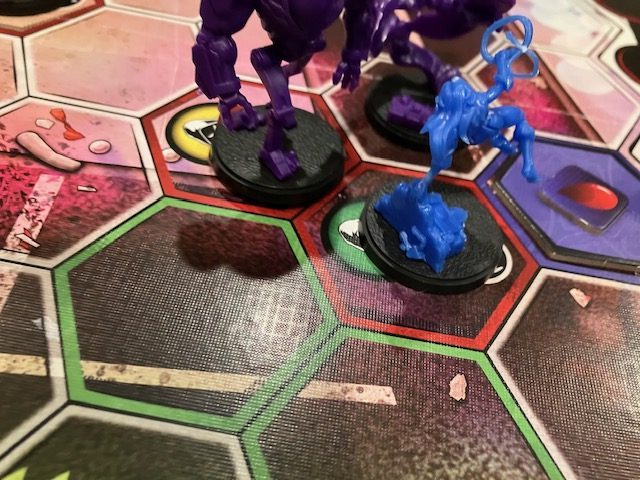
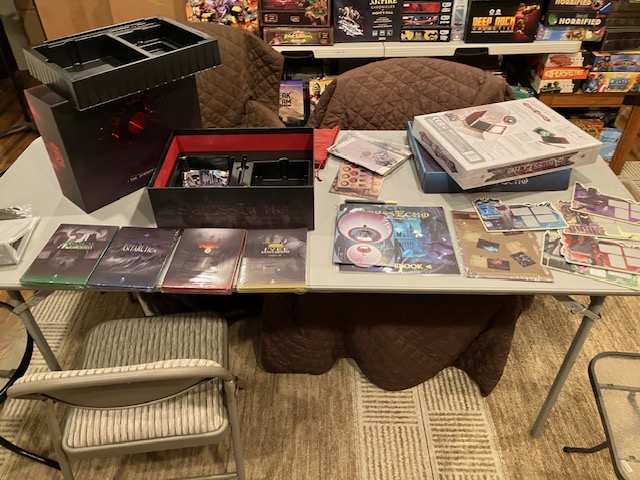
The game generally has pretty good components: see above. The art might be slightly divisive, but I think it’s very thematic art as it has an “edge” to it that implies a supernaturally weird element.

Rulebook

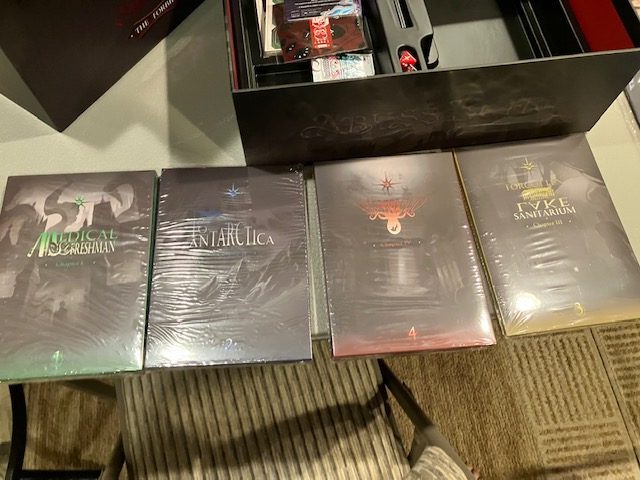
So, this game has 4 different rulebooks in 4 different languages! See above! That’s why there’s not a lot of text anywhere; it was meant to be language independent!

Sigh. The rulebook form factor is ok. It gets like a C+/B- on the Chair Test: it can sit on the chair next to me, but it droops more than it should (see below).
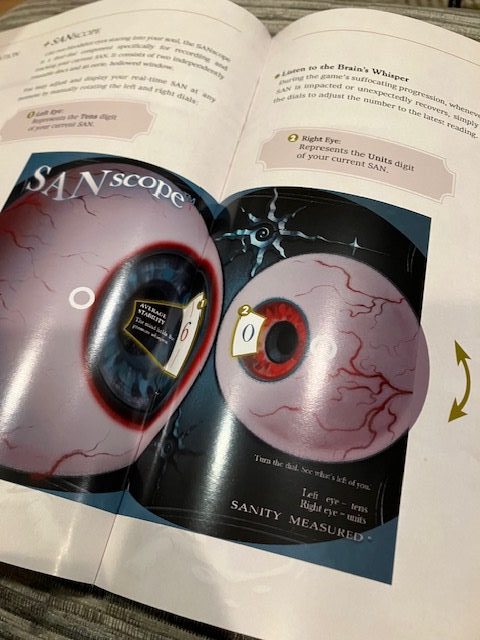
The rulebook is fine. I didn’t love it, but I didn’t hate it. For some reason, I had trouble reading this! I don’t know if it’s because it’s a translation or the organization? Or something else? You will have to read it a few times to get the game. It’s not a hard game, but it felt like this should have been easier to get. I think that a Player Summary Card might have helped quite a bit? (There is no Play Summary cards; probably because of the language independence of the game).
It was fine. It taught the game.

Solo Mode

So Huzzah to Cthulhu Rift for having a solo mode! Congratulations for following Saunders’ Law!

The included solo mode is even a true solo mode! The solo player plays the one character, Dr. Elias Grimsby. Now, even though this is the official solo mode, that is NOT how I played my first solo game.

For my first solo mode, I played two-handed solo, alternative between two characters as-if it were a 2-Player game. Why?

If you look at the solo rules (see above), there’s about a page of exceptions to the rules. This game is kind of a bear to learn and teach, so after reading through the rules, I thought it would better to play “the simplest way” possible, which is to play the game without all the rules exceptions of the solo mode.

Another reason to play two-handed solo is that my plan is always to teach and play with my friends! So , it’s easier to teach the cooperative mode if I have played the cooperative mode (albeit solo)!

I think playing two-handed solo was the right way to play the first game. This game has rules that are hard to grok the first time through, so it makes sense to avoid the extra complications of the solo game and play it straight vanilla the first time through.

I lost in my first game, pretty badly. I think that’s because some rules that take at least one full game to grok (if you are playing from the rulebook). In fact, I was very worried about how poorly I had done because my dice rolls were so bad!! Is this going to be a game that’s too random?? I held off making a pronouncement until I had a few more plays under my belt.

I think it’s important to play this at least a few times before you decide if you do or don’t like it: there’s enough rules interactions you might not get the game the first few times through.

BUT it was important to see the base rules unadorned by solo exceptions to get the sense of the game. I recommend playing your first solo game two-handed solo.

Once I got the base rules down, then I tried the solo game. I liked it! There were enough rules changes/additions that I think it makes sense to have played that two-handed game first, but I think the official solo game is the better way to play solo once you know the game.

You’ll notice the solo player has a lot more spaces than a plain character! But, that makes sense as spaces are a fundamental resource in this game! You need enough spaces to make progress. (You have to unlock some of those spaces when you roll Chthulhus too).

Once you get the sense of the extra rules, this is the better way to play solo. You only have to deal with one page, and I generally prefer true solo modes when possible because you feel like you are inhabiting the character! You are becoming Dr. Elias Grimsby!

After losing my two-handed solo game and winning my true solo game, I am a little less concerned about the randomness of the dice. That first game was a pretty rough loss, but after the second game, everything started the make sense.

The true solo game is fun, it’s engaging, and the way I will play solo moving forward. Yet, I still recommend playing your first solo game as a two-handed solo mode so you can learn the vanilla cooperative rules! With the vanilla cooperative roles under your belt, you can then apply the (fairly numerous) changes to the solo mode without getting lost.

Cooperative Mode

The cooperative mode works up to 4 players! This is a cooperative roll-and-write!

It’s a bit hard to teach this game. Even after explaining a bunch of things, it’s still kind of hard to wrap your head around everything. Here’s the thing: once you get it, you get it! It’s pretty easy once you put everything together. But I absolutely recommend playing the game solo (maybe even twice: both two-handed and true solo) so one player can shepherd the game. Luckily, the game does start hitting for people quickly. I think the idea that you “save symbols” to mark-off later is different than most roll-and-write games; it takes a while for this and all the little rules to sink in.

There’s a good level of cooperation in the game; mostly high-level discussions. Where do we drive? What can we do? How many Cultists can we “take care of”?

Because each player has their own sheet, there is a good element of “multi-player solitaire” to the game: you have your own sheet and other people don’t really interfere on it. Each player having their own sheet is a good Alpha Player deterrent too. Most of the cooperation is pretty high-level: which dice do you want? You discuss what to do and what you can do, but you don’t really tell people how to do things!

I noticed that we did tend to specialize: Beatrice Langford became the “Cultist Assassin” and her main task was to take out Cultists! So many guns on her sheet!

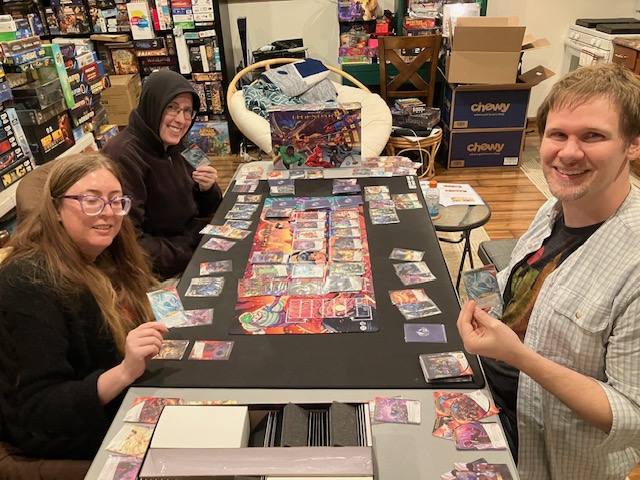
Overall the game was pretty fun and pretty cooperative … once you got the rules. There was enough high-level cooperation to make the game feel cooperative, but enough low-level activity (recording symbols on your sheet) that each player still felt like they had their own agency.

Play the game solo before you teach your friends. I feel like the game is weird enough that a cooperative learn might go poorly?

A Few Recommendations

Make Copies. The number of roll-and-write sheets in the game is a limited resource. There’s a lot, but you can run out. I went ahead and made copies of the sheets and used those instead. I supposed you could also laminate them too.

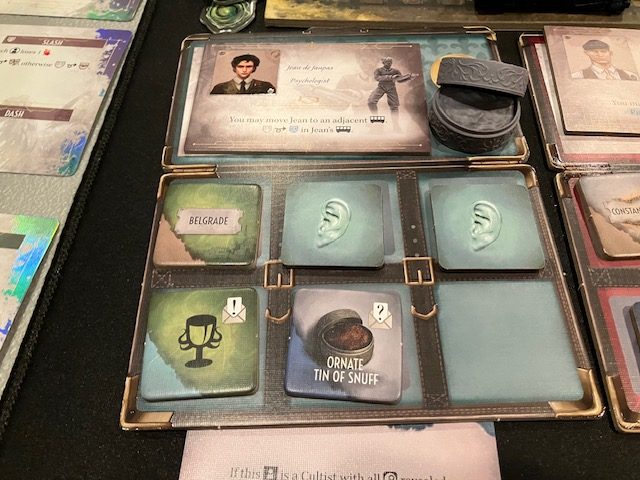
Don’t Mark Up Some of the Sheets! In my first solo plays, I did what the rulebook said and marked out some of the spaces on the Big Bad (Cthulhu): see above.

Don’t do that! Just use some coins to “mark-out” the places you aren’t supposed to use! See above as we use the Stonemaier coins to mark off the spaces we don’t use! There is NO REASON to completely waste a sheet for that!

Play Solo Two-Handed Before Teaching. This is an easy game, once you grok it, but it’s kinda weird and kinda hard to grok. Play solo (two-handed) to get a sense of the game and then teach it: I think the play will go a lot better that way.

What I Liked

Choose Where You Drive: There’s a certain play element we didn’t emphasize, but I think it might be critical to the game: when you drive somewhere, “someone” on your team gets the symbol of the place you are driving too! This means, if you are rolling badly, you can ALWAYS guarantee you can get at least one of the symbols you need (if you can drive there). This rule really helps mitigate the randomness of the dice, as you can always get at least one symbol you need. Don’t overlook this rule; it can be easy to miss.

Once You Get It, It’s Easy: This game is hard to teach, but once you get it, it’s pretty straight-forward to play.

What I Didn’t Like

Randomness: At the end of the day, this is still a dice game. Even with some of mitigation techniques in the game, you can still roll badly and lose badly. I was very very concerned about the random nature of the game on my first solo playthough, but once I understood the game better, it’s not that bad.

Having said that, randomness in a game with limited resources (the sheets you write on) is a little more concerning than most games. I would be so very frustrated if I rolled badly and used up 5 sheets in one game! What a waste!

And you can still roll badly, especially on the bad news phase (which summons cultists and then tentacles) and just lose.

A few very minor house rules helped us a little:
1) You can re-roll just the dice you want. When you unlock this ability, the driver can re-roll the dice. But only all of them? This seems to lean into the “too much randomness”.

2) Once you unlock all your abilities, you can choose to not take a die (and someone else has to take it). It seems unnatural that you can’t choose to do NOTHING on your turn. Of course, there are consequences to doing “nothing”, and one of your compatriots must take the die and write the symbol down. But this feels like it should be a choice.

These very minor house rules are in the name of making the game feel a little less random and giving you some agency.

Conclusion

I liked Cthulhu Rift game and so did my friends. It wasn’t the greatest game ever, but we had fun. It’s a 7/10 for the cooperative game.

The solo game is true solo, and it’s a good game (7/10), but I’d recommend playing your very first time as a two-handed solo game with the vanilla rules to learn the game. The true solo game is the better game, but there are too many rules exceptions in the solo game to make it a good first game.

I recommend making copies of the sheets or laminating them so you don’t waste the limited sheets in the game. I also recommend using coins instead of actual marks on some of the sheets so you don’t HAVE to waste them. Because this is a game with more randomness than some others, we do recommend a few minor house rules: nothing is more annoying than wasting a limited resource because you rolled poorly.

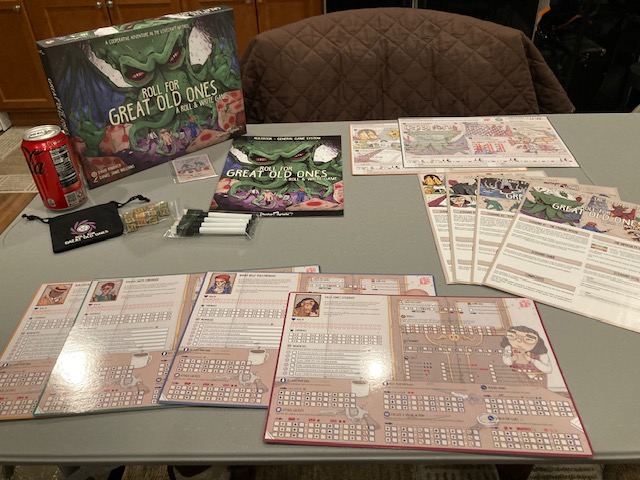
If you like the idea of a cooperative roll-and-write game with a Cthulhu theme, I also recommend you check out Roll For Great Old Ones (see review here). It’s a little better game, but it’s also a little more complicated. Cthulhu Rift is an easier game to sit-back and just play … once you’ve grok it.

And yes, Cthulhu Rift would make our Top 10 Cooperative Roll-And-Write Games!

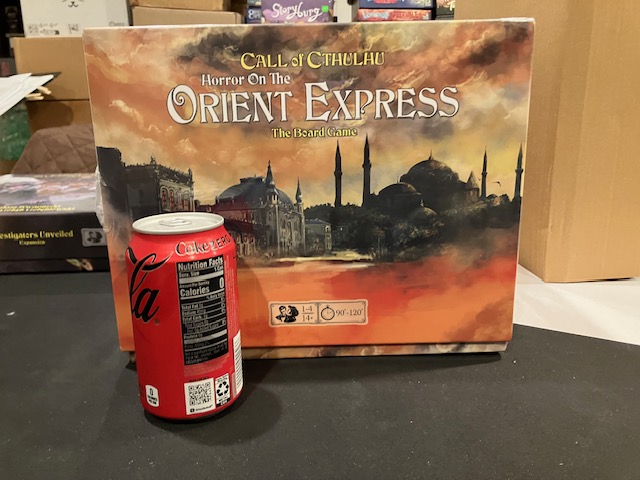
Horror on the Orient Express! An Initial Review After My First 15 Hours of Solo and Cooperative Horror! Cooperative Clue with Cultists, Cthulhoids, Clues, and Choo-Choos!

Welcome to Cooperative Cthulhu Month! This month, we take a look at a bunch of cooperative Cthulhu board and card games! We start the month with a very brand new game called Horror on the Orient Express which just delivered to Kickstarter backers!!

Horror of the Orient Express answers the age-old question: What would it be like if Agatha Christie’s Poirot had to solve a mystery on the Orient Express with Chtulu-like creatures chasing him? Philosophers have pondered this question for years, and now Horror on the Orient Express gives the definitive answer!

The game arrive at my house Saturday August 22nd. I was very excited by this; it is was on my Top 10 Anticipated Cooperative Games of 2025!

Over the next week, I would spend so much of my precious time with this game system. I have spent 15+ hours going though this so far! How does that time break down? Let’s take a look!

Day 0. Unboxing and Reboxing (and some discussion of gameplay): 4 Hours

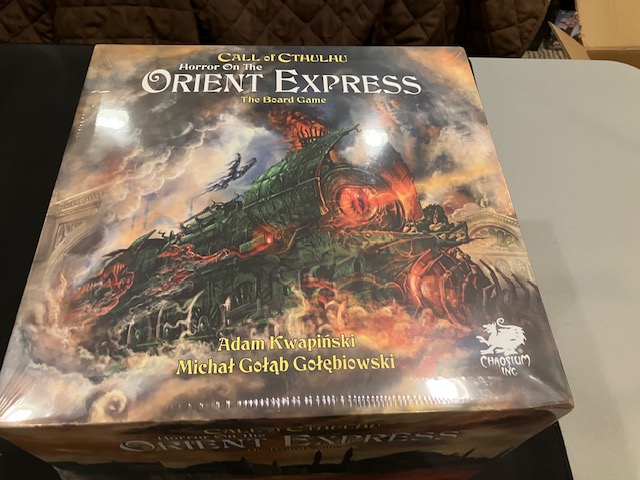
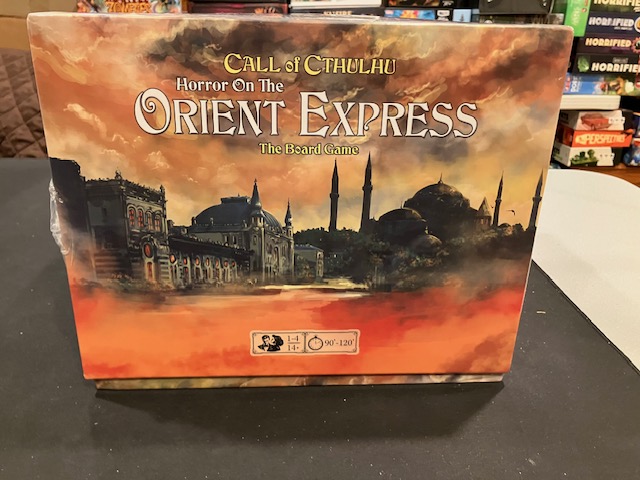
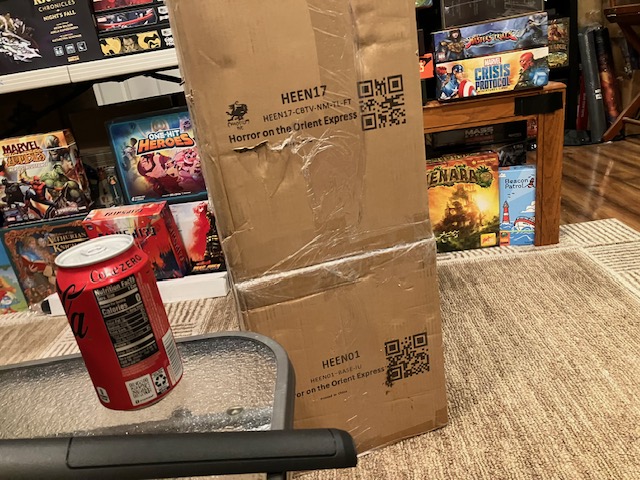
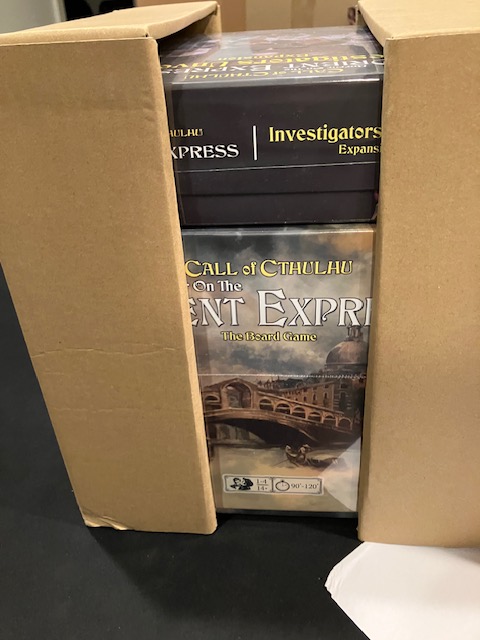
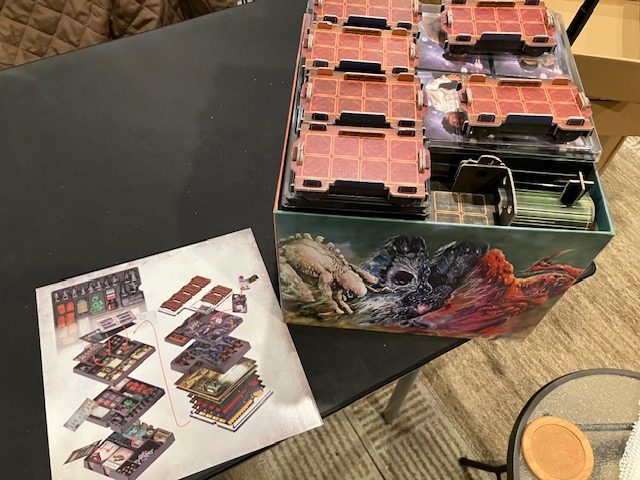
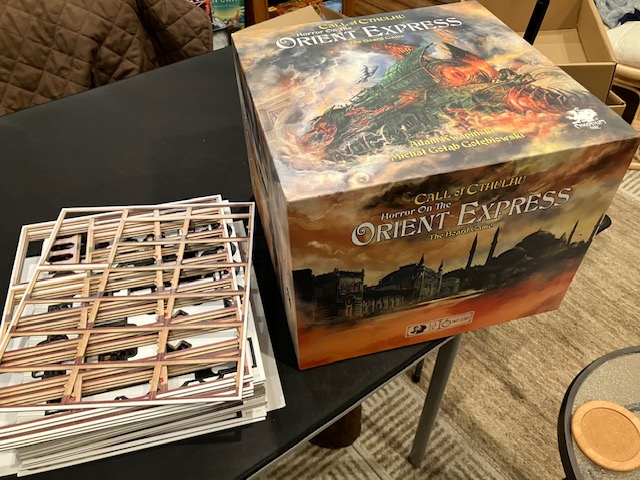
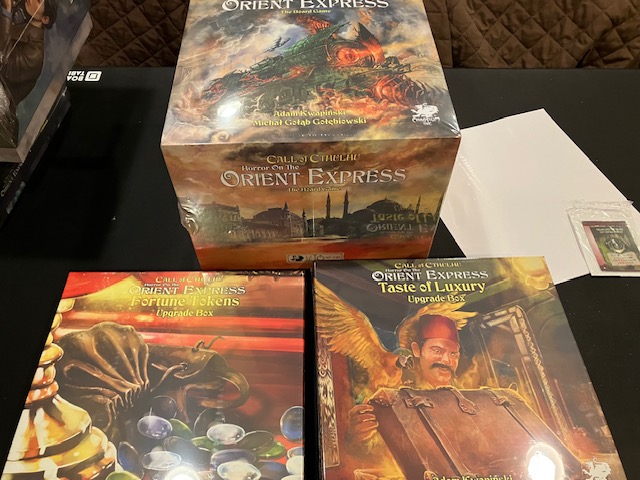
You heard me right; this took 4 hours to unbox. And that was just the base game and some deluxe components! Part of the story here is just how much content arrived! There were two boxes that were actually tapes together when delivered to my house! See above!

The smaller of the two boxes came with the base game and an investigators expansion (giving more investigators and suspects).

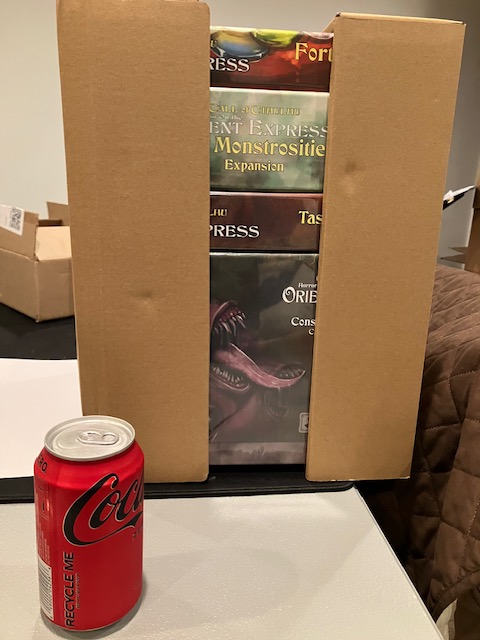
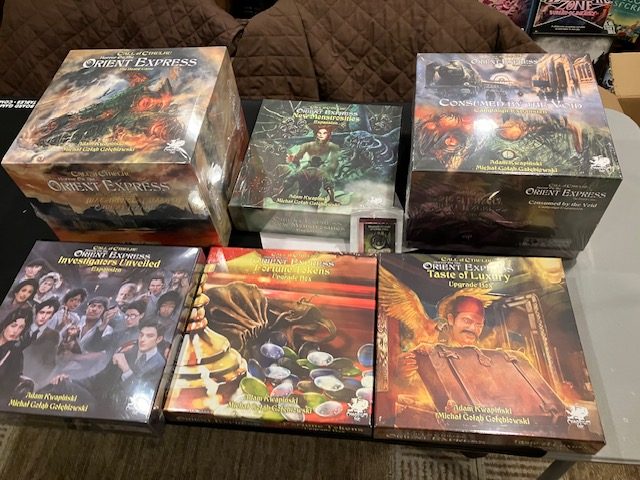
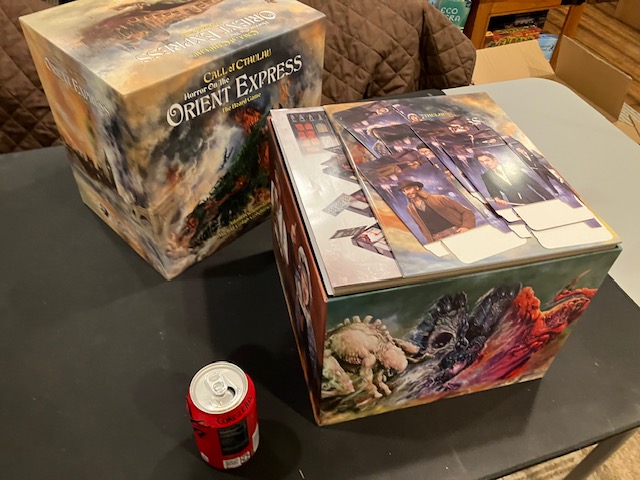
The bigger box came with the campaign expansion (bottom box), more monsters (green middlebox) and some deluxe components (the other two). See Coke can above for some perspective on this!

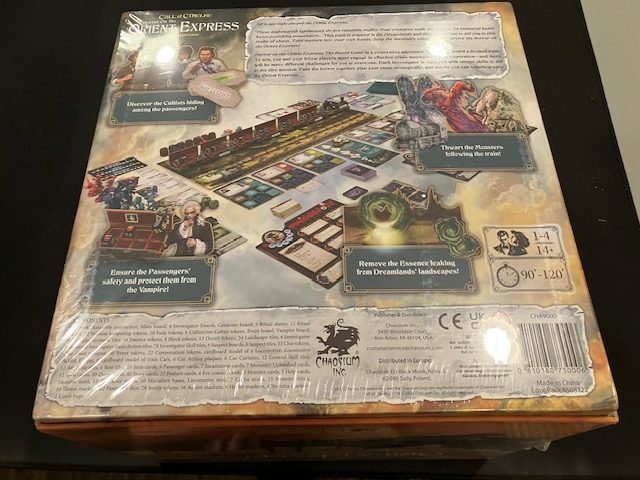
This is probably the biggest Kickstarter I have ordered in some time! And remember, here at CO-OP Gestalt, we pay for everything with our own money! See all the boxes (and a correction card) above!

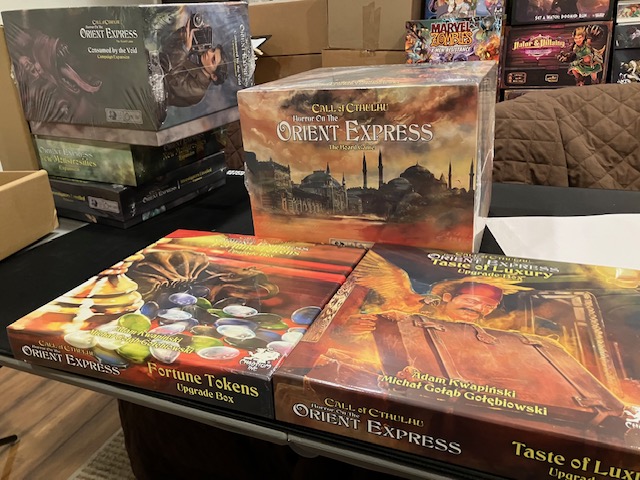
In the end, I chose to only unbox the base game and deluxe components (see boxes above). I’ll come back to the others later! That seems like a sane decision, right? Just limit myself to unpunching and assembling the base box with a few extra acrylic tokens? It still took 4 hours!!!

This is a monster of a game! See coke can above for scale!

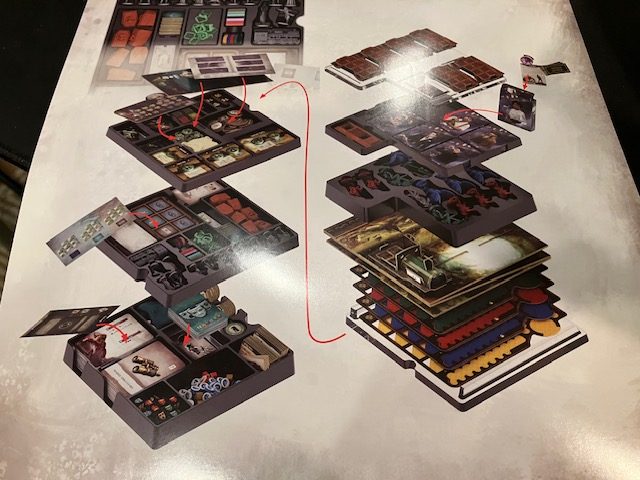
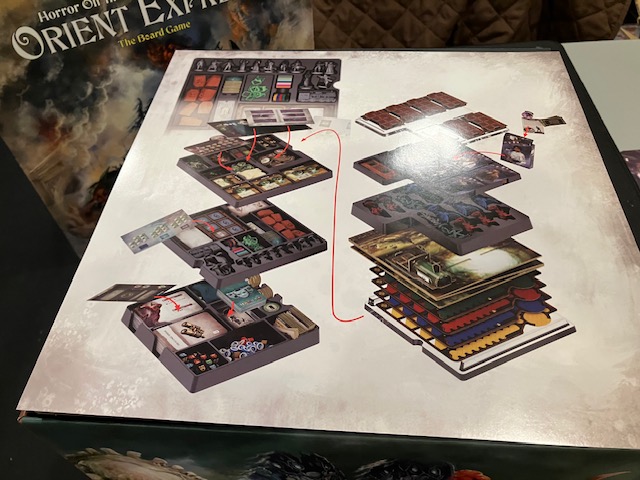
To get a sense of how much stuff is in here, the game includes a really nice boxing/unboxing guide. See above.

So much stuff!!

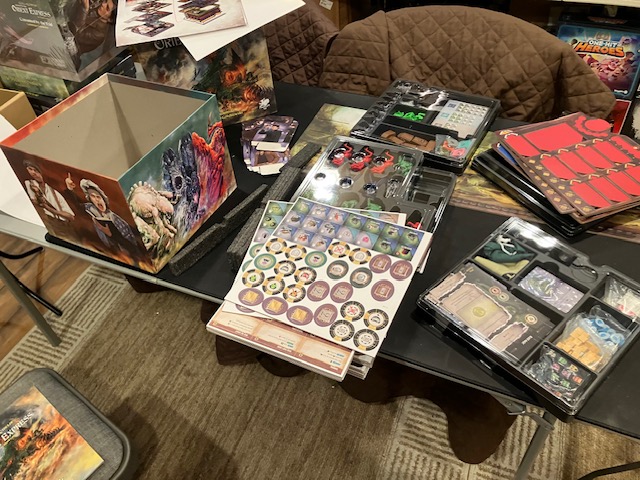
There were SO MANY things to punch out! See all the cardboard skeletons above!! SO MANY PUNCHOUTS! And no, I don’t think I can keep these punchout Skeletons … even if I wanted to.

Players each the role of an investigator! See the choices above.

Each investigator has their own set of “main action” cardboard punchouts. See above and below.

Each investigator is actually fairly unique: their main action cards define the flavor of the character! There’s no special power per se, but each investigator has a different pool of actions that are quite thematic!

All these cards go back into little tuck boxes (it actually makes it a lot easier to start the game).

So what are you investigating? As a group, the players cooperatively are trying to figure out which of the suspects (see the 6 suspects above) is a Cultist and which is NOT a cultist! This is cooperative Clue with Cultists and Cthulhu!

Each suspect has some “luggage” with Clues on them. The nature of the stuff in their luggage tells you whether or not they are cultsists! Do they have a blood red Fez??? They must be a cultist! Are they going to Constantinople? Their stuff is an indicator that they are cultists or not! There is actually a precise definition (based on their stuff) of what makes someone a cultist!

At the start of the game, all suspects have their clues turned face down, and throughout the course of the game, there are many ways to uncover the items and see exactly which suspects ARE Cultists and which ones are NOT! You have to get them all identities correct or you lose the game! This is the primary goal of the game: discover the loyalties of all suspects!

To be clear, all the PLAYERS are in the clear automatically; there is no hidden traitor or anything like that! Players work together to find out who are the cultists!

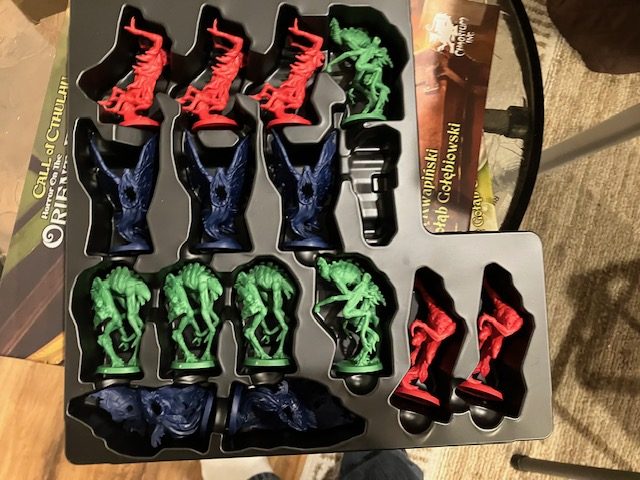
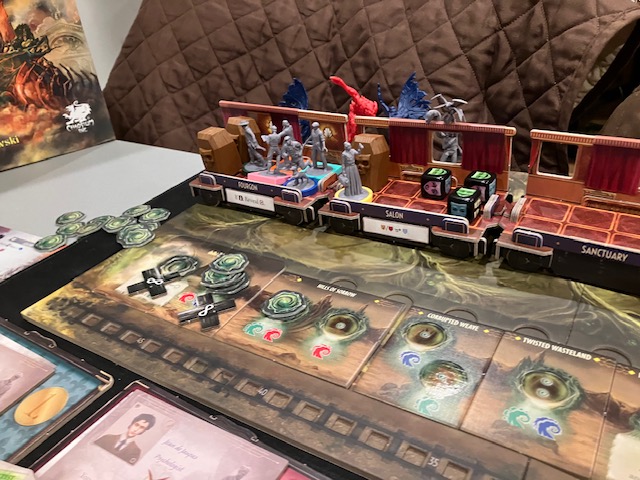
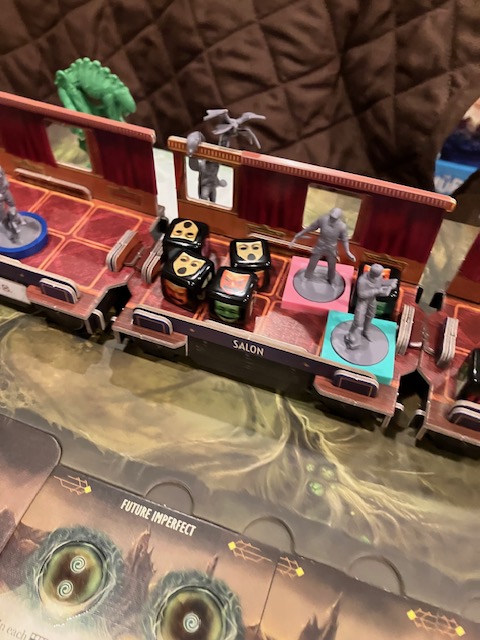
But of course, everyone got stuck on a train that’s driving in the Dreamlands, and we have to survive the Cthulhoid creatures that are chasing the train! See the creatures above and below! They are much less fearsome inside their box!

The Cthulhoid creatures race alongside the train and reach in to do damage to passengers and suspects!

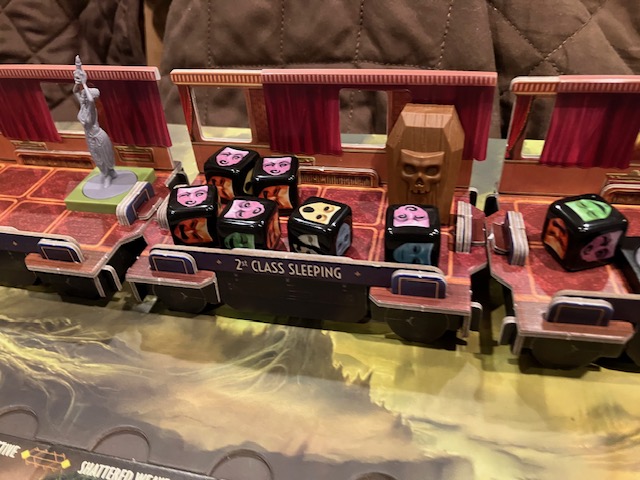
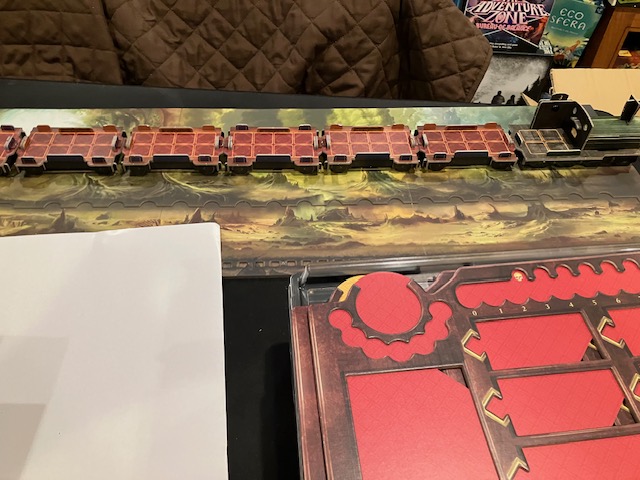
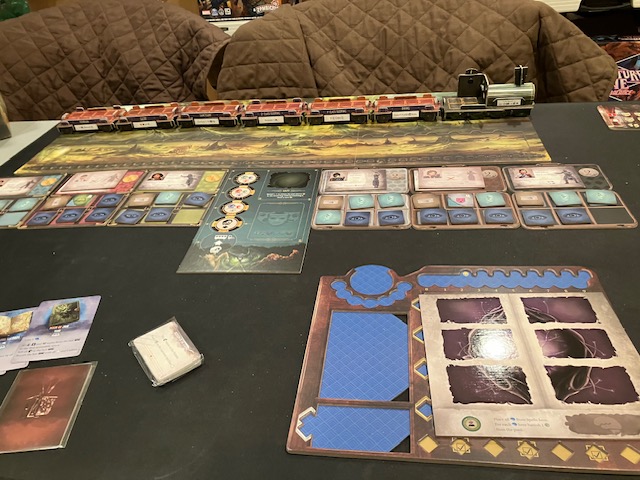
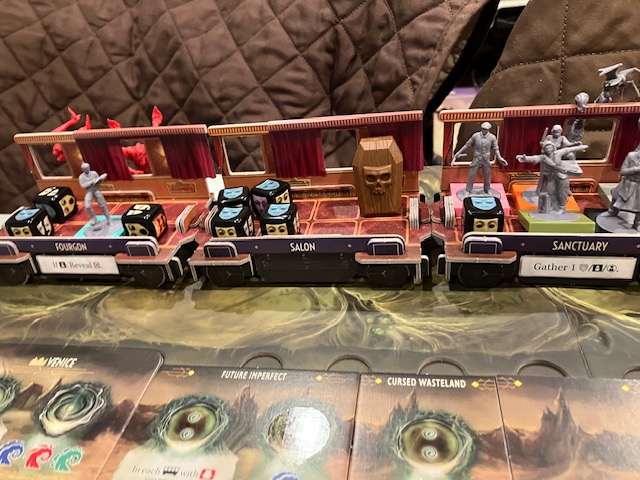
The train is where everything takes place! The investigators, the suspects, the monsters, the passengers, and even a vampire!

The “other passengers” (not suspects) are represented by die which show a face showing that they are happy, worried, neutral, crazy, mad, or injured! See above! You have to be careful to protect as many passengers as you can! It’s hard to talk to passengers that are mad or crazy! And you need to talk to passengers to find out about the suspects! Remember, you are an investigator!

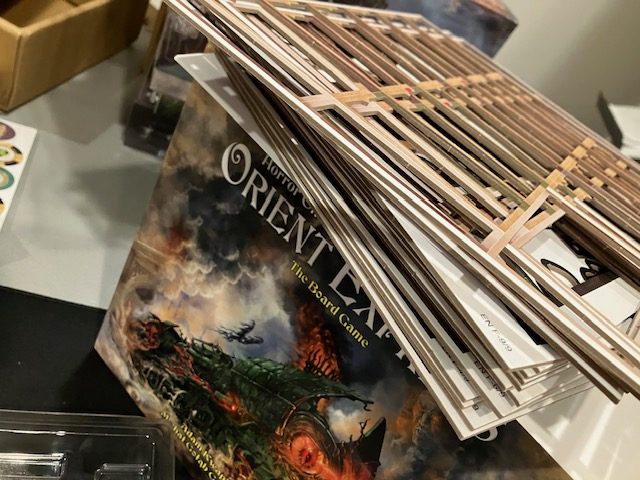
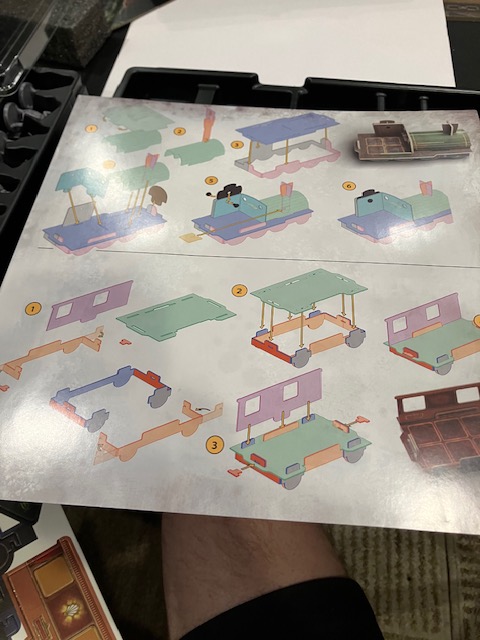
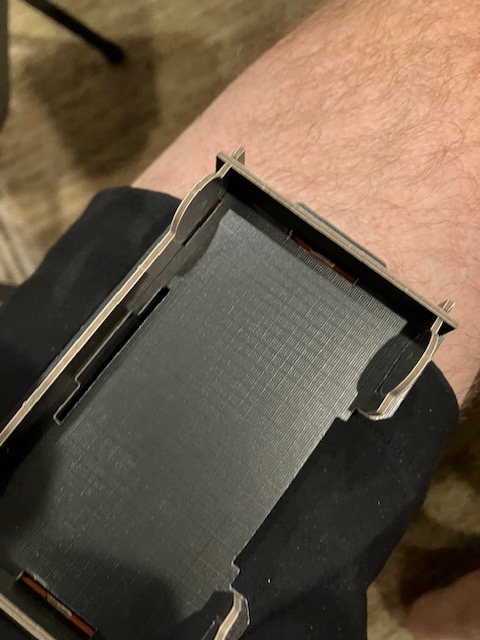
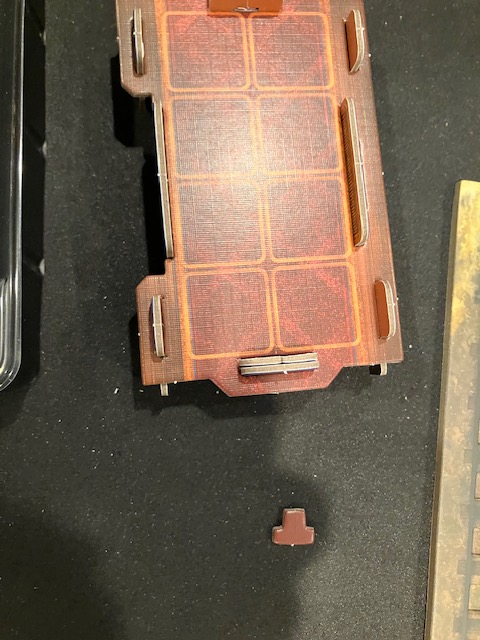
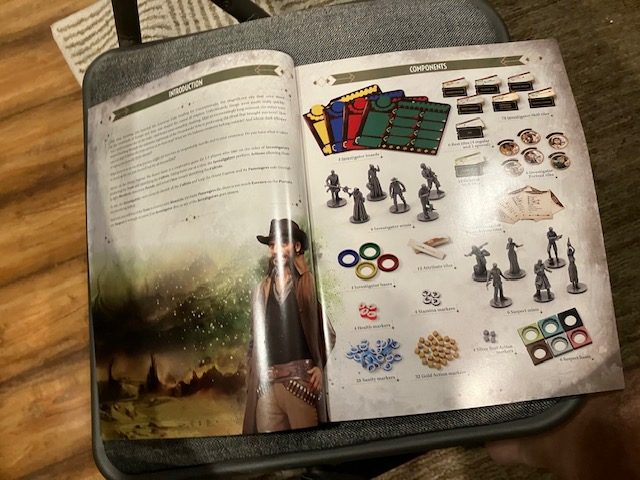
Putting this train together (which is really cool) was actually a surprising amount of time from the 4 hour unboxing time! The instructions are “ok”, but let me give you a little hint now: BUILD FROM THE BOTTOM! See below!! The instructions (see above) show building the train cars from the top, and that just doesn’t work very well.

Build from the bottom like I did: See above.

Also, I recommend gluing the final crossbar piece (see above). They kept coming out on me!

By the time you are done building six train cars and the locomotive, you get a little exhausted. I ended up taking some time to do other stuff before I finally came back to finish my unboxing and reboxing everything back in! (And no, I don’t count that time off in the 4 hours … this really took 4 hours!!)

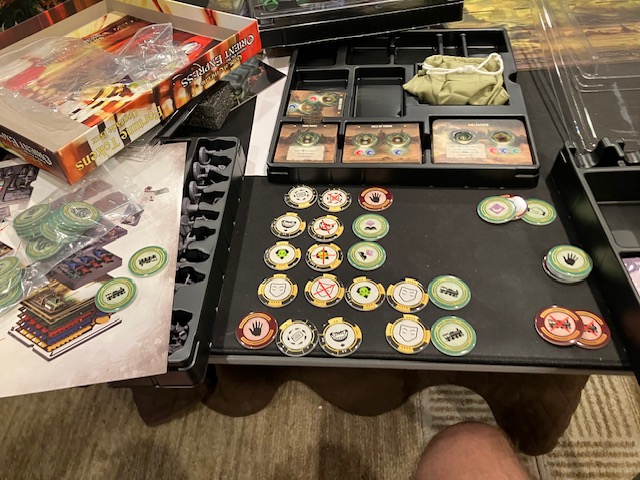
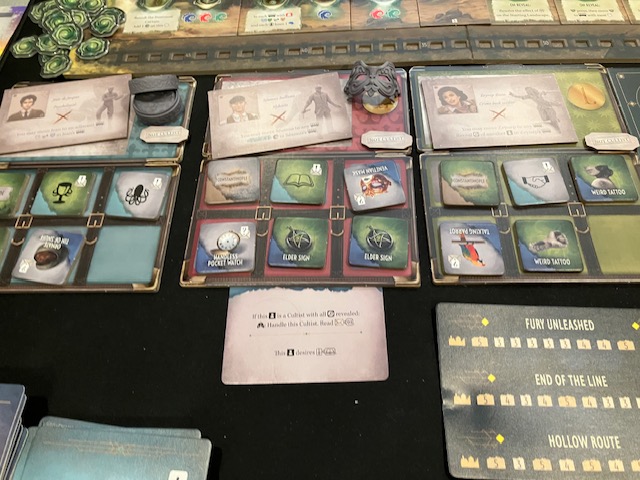
Oh yes, I need to comment on some of the deluxe components. The acrylic conversation tokens and event tokens from the upgrade box are really cool!!! See above!

… but they are not well-labelled! In fact, the expansion box has acrylic tokens for EVERYTHING (including other expansions), so you don’t really need ALL the acrylic tokens for the base game! And in fact, they don’t all fit if you try to use all of them!!! I ended using the unpunched cardboard tokens (see above) as a guide to which tokens to keep! This was extremely frustrating that I DID NOT know which tokens to use for the base game and which tokens to use for the campaign and other pieces! They reallllllly needed to have some better labeling.

As you put things back in the box, you will both love and hate the sheet above! Why? Because it shows everything (I love that) but it’s so hard to see detail! (I hated that!)

See above as I had to use my phone to zoom in so I could see the detail!!!

Putting everything back into the box in its proper place (after punching everything out) was a chore. But it did work.

Yep. It took me 4 hours to unbox everything, punch out so many things (see cardboard skeletons above), dig through deluxe tokens (and realize there’s no way I can put them all in the base box), assemble the train, then finally rebox!!

Whew!

Day 1. Set-Up: 2 Hours

You might ask “why did you put everything back in the box if you knew you just needed to get it all out again?” I asked myself that same question! Seriously though, there is some value in handling all the components again; there’s a kinesthetic boon to seeing/touching all the components in the game again.

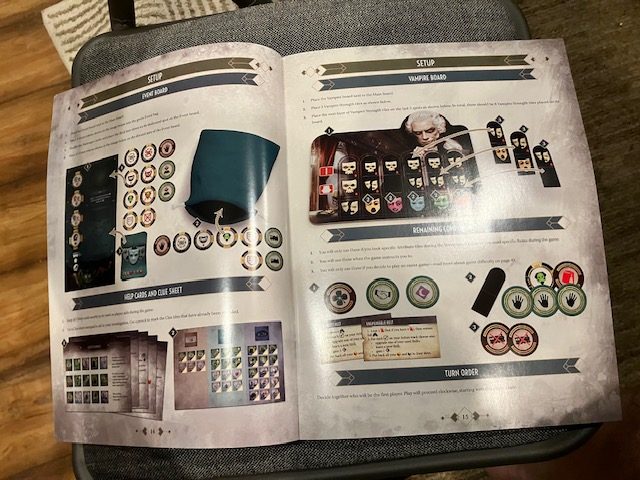
If you think that 2 hours is ridiculous to set-up the game, I point you at the rulebook: setup takes about 10 pages! That’s right, about 10 pages of the 48 page rulebook is just to set-up the game.

Uh-oh. This is gonna be hard.

Day 2a. Reading Of The Rules. 2 Hours.

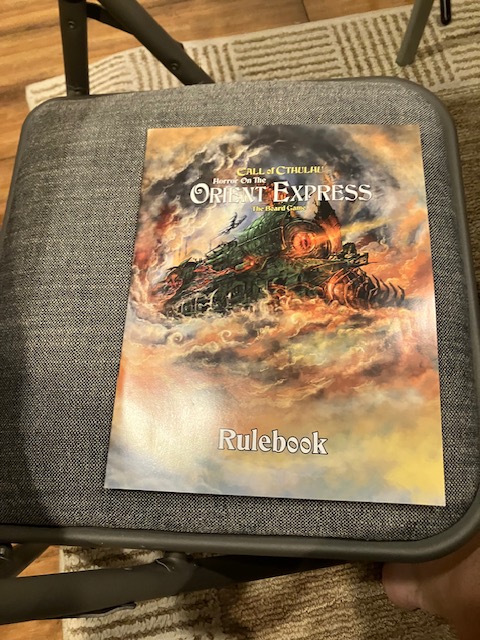
If you think this is a big complicated game with lots of rules … you would be correct. The rulebook is 48 pages long.

The rulebook is good, but there are a LOT of rules … a lot of rules that you will have to lookup again and again.

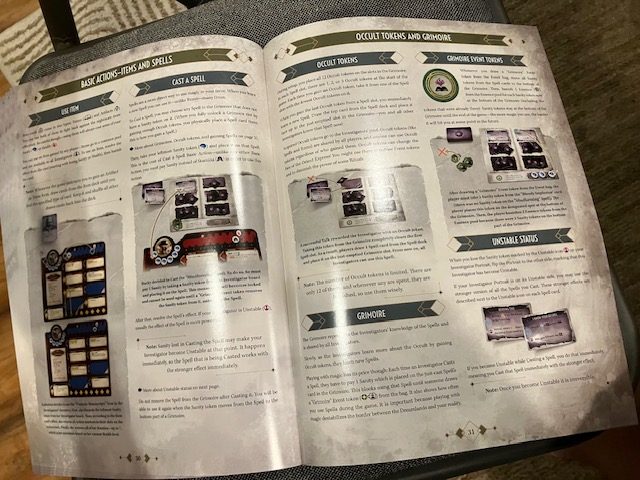
The rulebook does fit well on the chair next to me: it stays open and is easy to read, but there is just a little bit of drooping of the pages. I’ll give this rulebook a B+ or A- on The Chair Test; It has a good form factor.

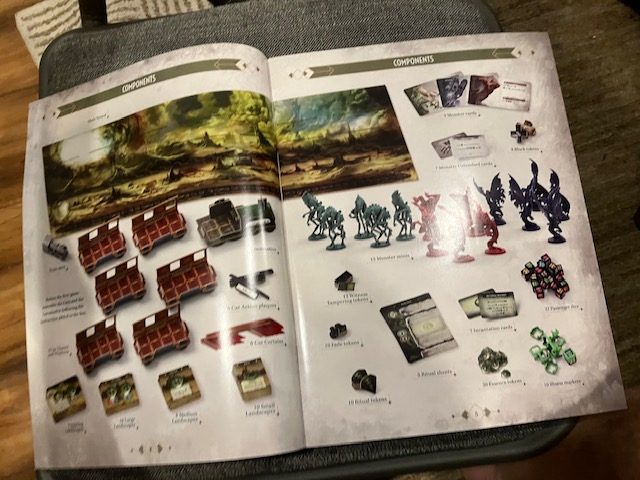
The components pages are nice, but they span multiple pages. The actual Set-Up also spans multiple pages!

In the end, you just have to get through this rulebook. I sat with the game set-up in front of me, and read the rulebook while constantly referencing the set-up game. This rulebook kind of feels like a legal document because there are so many rules and descriptions. It’s not too bad, but it took me 2 hours to get all the way through the rulebook so that I had an idea of what was going on.

I didn’t really feel like I could jump into the game until I read just all the rules. There’s too much going on to say “let’s just try it!” Nope, that’s a recipe for disaster! You absolutely need someone to read the rules ahead of time, or you will end up reading 2 hours of rules with your friends and annoying them.

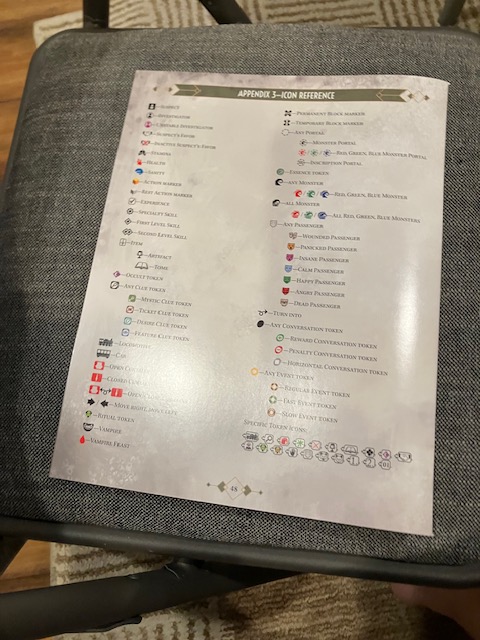
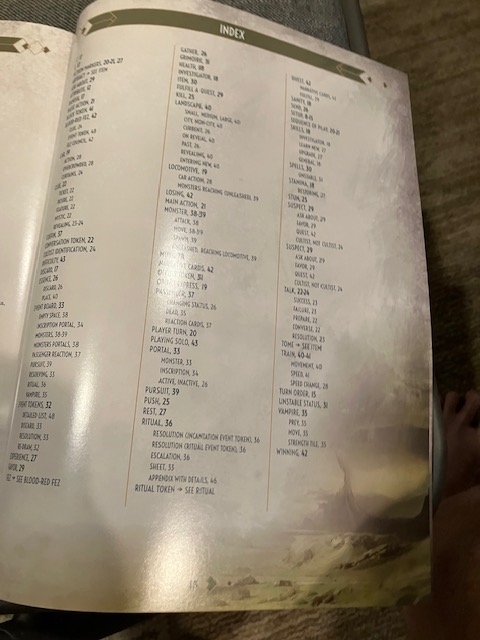
I was very pleased that the rulebook included an Index. It wasn’t perfect, but it was good enough to help when I needed to look up something.

This was a good, if long and legalese rulebook. You will refer to it a LOT as you play.

Day 2b. Solo Game: 3 Hours

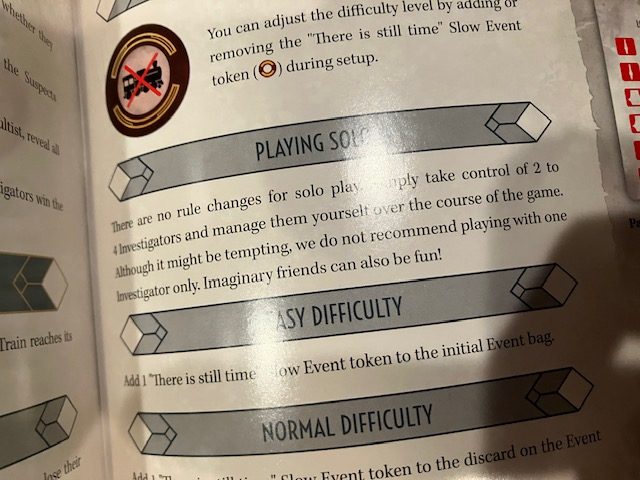
There is a solo mode (huzzah on following Saunders’ Law!)! See rulebook above. Basically, you are supposed to play 2-Handed solo, alternating between two characters.

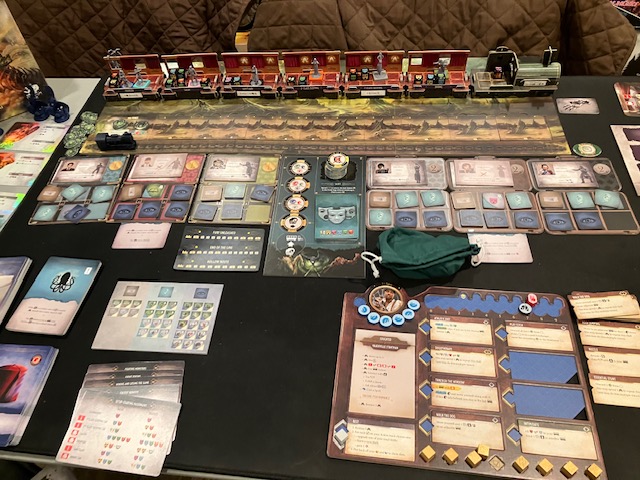
Now, I think I misread this the first time I set-up, as I just went ahead and played true solo: I operated a single character. See set-up above. After playing with a single character, I am glad I made that mistake! There are SO MANY rules in this game, that alternating between two characters just seemed like too much work.

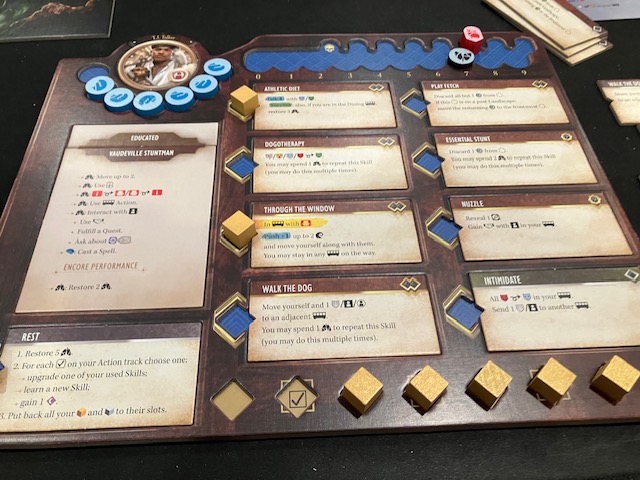
See above as my character advanced pretty quickly.

After accidentally playing true solo, boy, I am really glad I did! I think I would have hated alternating between two characters as I I was learning the game. There are a LOT of rules in this game, and each character has a LOT of options and main powers … I think I would have been completely overwhelmed on first game had I played 2-handed solo.

I think what I am saying is … this was a happy mistake! Maybe your first game should be a true solo game so you can get a sense of everything in the game. I know I cheated a few times in my solo game, on accident and maybe once on purpose (just to get to the later game), but I think … this might be the best way to learn?

I can’t comment too much on the balance of a solo game (because I was just playing true solo to learn the game), but I think I would prefer if the game had a true solo mode? This is hard for me to say because I frequently prefer 2-handed solo mode because they typically don’t have rules exceptions! I think this is case where a minor rules change (or two) for true solo might be worth it; it might be as simple as you start the game with a couple of items already in your inventory (one of them a healing item).

In the end, the true solo player was able to keep the Cthulhoid monsters under control and accurately guess the identity of all the cultists! And it only took 3 hours!

This was a learning game, so I expected it to be longer than normal games. But it was 3 hours to play EVEN after setting everything up ahead of time! And I didn’t even tear-down, because I left it “mostly” set-up for cooperative play!

Day 3a. Cooperative Game: 3.5 Hours.

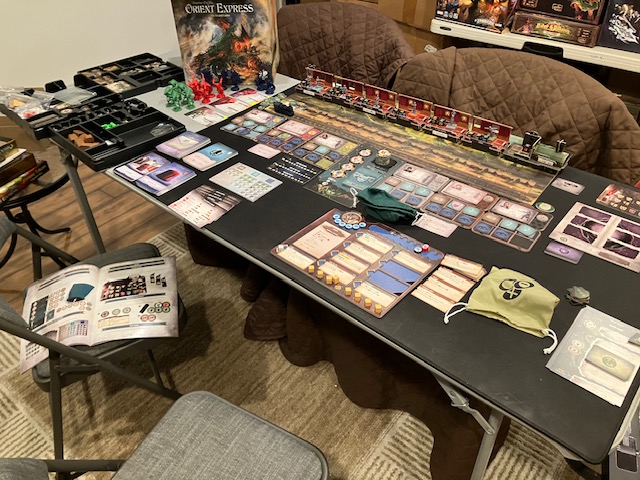
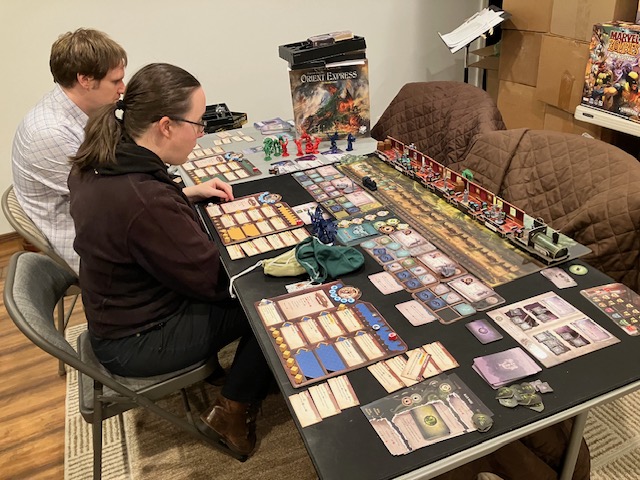
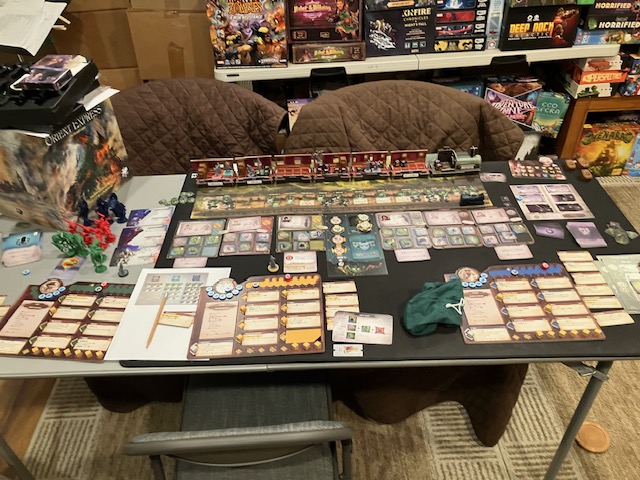
Interestingly, the game suggests that a cooperative game all sits on one side of the board. This would work fine for a 1,2 or 3 player game, but I worry that a 4 player game just wouldn’t fit? We only played a 3-Player game (above), and we just barely fit. Maybe you just need a bigger table if you play 4 players?

I am SO HAPPY that I set-up, read the rulebook, and played a preliminary game before my friends came over. We ended up playing 3.5 hours of just pure playing time! Let’s be clear: my friends and tried-and-true gamers who have played many complex games: we did not get “stuck” on anything!! The game moved along as it should with some rule lookups, but it still took 3.5 hours to play!

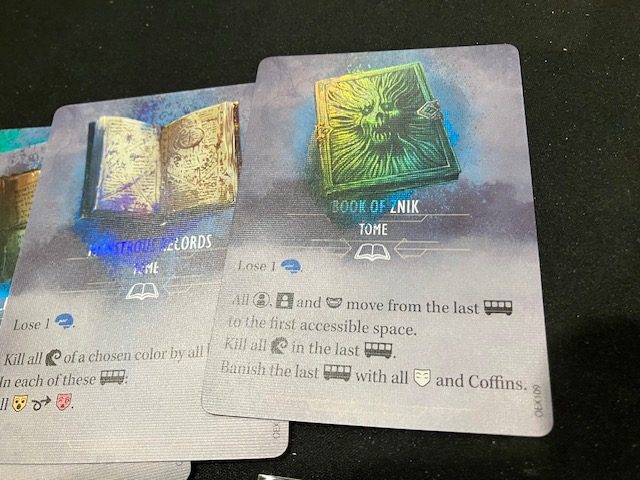
The game has some interesting ways to promote cooperation: for one, all spells and items are shared! That means there’s no need to worry about explicit “share” actions or anything like that! On your turn, if you want to cast a spell or use an item, you just use the shared pool and do it! There’s no “I have to move to you to give you the Book of Znik so you can use it!” You could argue it’s not thematic (how do you share items if you aren’t even in the same train car??), but it does get around all the problems of sharing and wasting actions to get stuff to each other. The fully shared paradigm does help the cooperation.

At the start of the game, most turns tend to be fairly multiplayer solitaire. Don’t get me wrong, there are mechanisms that affect other players (For example: TJ could walk his dog and have another player move with him), but players did their own thing. What I saw happen was the people kind of took their own turn and did what they wanted at the start of the game. I think this was good; it helped players become familiar with their powers, the rules, and the interactions.

What I saw happen was that as things became more dire, we started setting each other up and helping each other directly more and more.

“We really need to find out if he’s a cultist before the train reaches the end!!”
“Ya, but I have 3 cthulhoids coming up behind me! I need to deal with those!”

So, in the end game, we started working together more and more. To be fair, we pretty much had to cooperate or we would have lost the game!

From this point of view, I think the game is a good cooperative game! Players have agency to learn their characters at the start of the game, but learn to cooperate as the situation gets more dire!

To be fair, it still took 3.5 hours to play a single game. Even though it was a learning game, I did everything right to make the game introduction as simple as possible (set-up, read rulebook, played solo) and it still took 3.5 hours to play!

Day 3b. Tear-down: .5 hours

After winning our 3.5 hour game, my friends helped me tear this down.

This unboxing sheet (see above) made all the difference in the world! Tearing down the game was a cooperative experience worth its own game! I saw massive parallelism as my friends and I would each take “some pieces” from the game and consolidate them into the box! Seriously, I felt like the tear-down was its own cooperative game.

Hm, I kind of wonder if how well you tear-down a game together is a measure of how well your group cooperates together? I can say with pride that my core game group works well together! Someone was always doing something and working on putting this back together!

It still took a while to put this back together.

What I Liked

Table Presence: The game looks sooo cool on the table! The train cars, the cthulhoid creatures chasing the train, the vampire hanging on the windows, the amazing landscape, the characters, … everything! This just looks so epic!

Component Quality: In general, the component quality was good.

The Arc: The arc of the cooperative game was interesting and a very good development to encourage cooperation. The game starts fairly multiplayer solitaire, then converges to being much more cooperative as the game unfolds.

What I Didn’t Like

Deluxe Component Issues: I love the deluxe components, but there’s two major problems. One, there’s no discussions (especially in the fortune tokens) about which tokens you need for which box! Second, there’s no way the deluxe components can all fit in the core box. If you were hoping to have all the deluxe components fit into the base box, think again! If you wanted to throw away your deluxe component boxes … well, you may have to hold onto them longer than you expected.

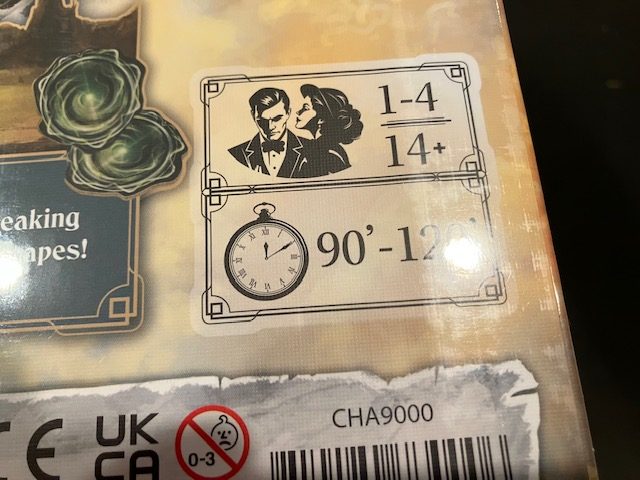
The Length: I find it very very hard to believe that this game plays in 90-120 minutes. Even if you cut-off the set-up and tear-down times, the game length still feels waaaaaaay off. There are so many rules.


Colors are a little wonky: The suspects each had a colored base that helped you identify them, but they really didn’t match the suitcase colors very well. At all. The brown suitcase we think uses the orange colored base?

Cthulhu Game?

Is this a hu game? Well, if your definition is “Cthulhu must appear”, then no, this is not a Cthulhu game. Maybe the better question to ask “Is this game set in Cthulhu Mythos?” Strictly speaking, the answer might still be no! The only real allusion is that the “train is driving through the Dreamlands”. But the vibe, the feel, the plot, everything feels like this is a Cthulhu game! Then I think the answer is yes! The train has sailed into the Dreamlands, Cultists are summoning and conspiring, portals are opening …

I mean, Chaosium does Cthulhu games. I am calling this a Cthulhu Mythos game.

*I was going to search the rulebook for the word Cthulhu and Cultists, but the PDF rulebook in the BGG files section IS NOT SEARCHABLE. They need to fix that.

Reactions

Andrew thought it was fun, but was worried that the time-investment vs. fun wasn’t good enough. His point was that there are a lot of rules and the game is really long. We had fun playing for 3.5 hours, but there’s many games we could play that are half that time but arguably more fun.

Teresa liked it and would play again. This would make one of her top Cthulhu games.

Conclusion

Horror on the Orient Express is a monster of a game … in every conceivable notion! It’s a monster of a box, with big monsters, a monster 48-page rulebook, a monster set-up and tear-down time, and a monster playtime of at least 3 hours. You have to decide if the monster aspects might be too much for you!

I would call this Cooperative Cthulhu Clue, as it’s a deduction game where you flip clues, but that would lure you into thinking this is a simple replacement for Clue! Absolutely not! Horror on the Orient Express is a deduction game where you worry about investigating while also fighting monsters and fighting vampires and saving passengers and basically keeping spinning plates going! There’s a lot going on! If you have always wanted something more complex than Clue set in a cooperative environment and fighting monsters, then maybe this is right for you! But don’t be lulled into a simple “Oh this is just Cooperative Cthulhu Clue!” No! It’s so much more! And that’s good or bad, depending on whether you you like this world.

If you like living in a Cthulhu-esque world of monsters and cultsists, then Horror on the Orient Express nails the theme! If you live that theme, you will love this world. If you just like the theme, you need to decide if the overwhelming nature of the rulebook, the game, the box, the length may be too much for you.

I look forward to playing this with some friends in Las Cruces, as they love Cooperative Cthulhu Mythos games! I know a few will blanche at the length and complexity, while others will embrace this monster of a game! Hopefully this review will help you decide if this is for you or not.

Legendary DC or DC Legendary? A Solo and Fully Cooperative Review.

Legendary DC released July 29th, 2026. My online order arrived pretty much then; I ordered and bought a copy directly from Upper Deck.

Legendary DC is the a re-theming of the Legendary Marvel game, but in the the DC universe!

Legendary DC is a deck-building game with superheroes from the DC Universe! It’s a fully cooperative (at a certain way to play) and solo game about hiring a team of heroes to fight the bad guys! We love the theme and the original Legendary Marvel made our Top 10 Cooperative Superhero Games!

Will Legendary DC make that Top 10?

Unboxing and Gameplay

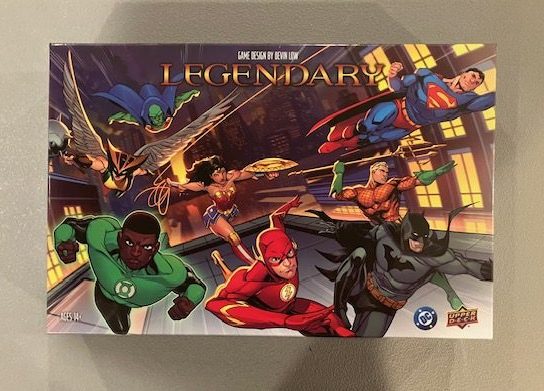
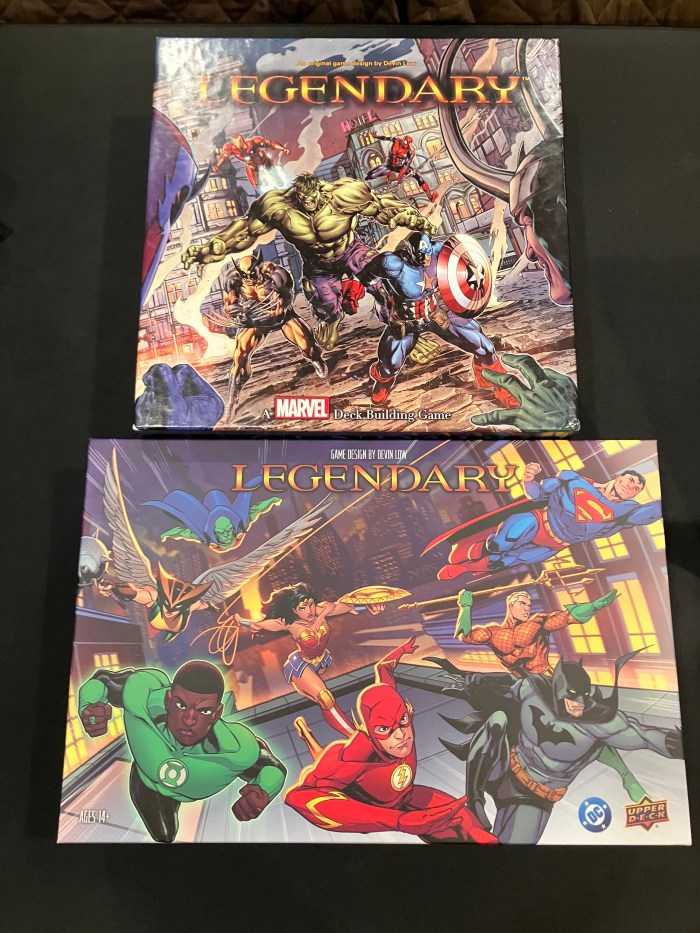
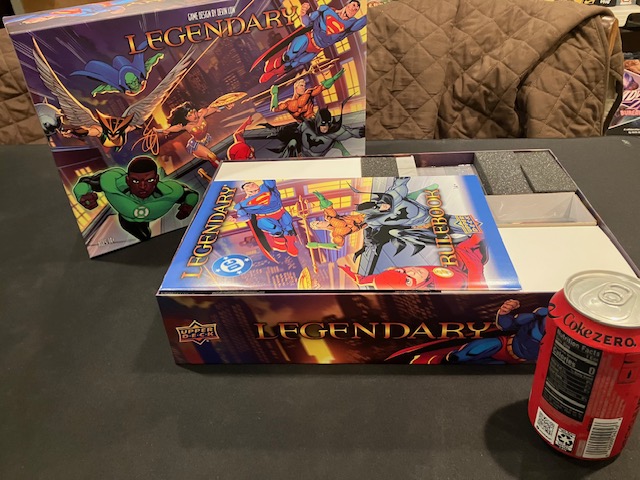
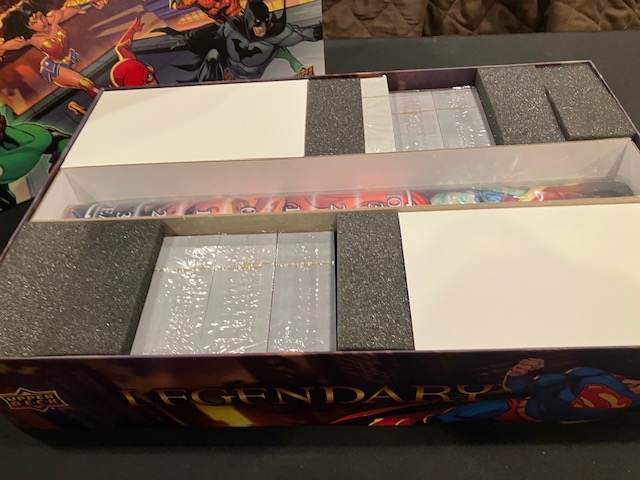
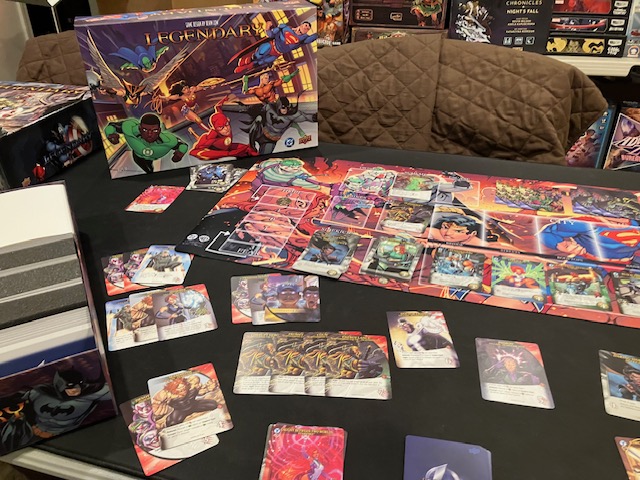
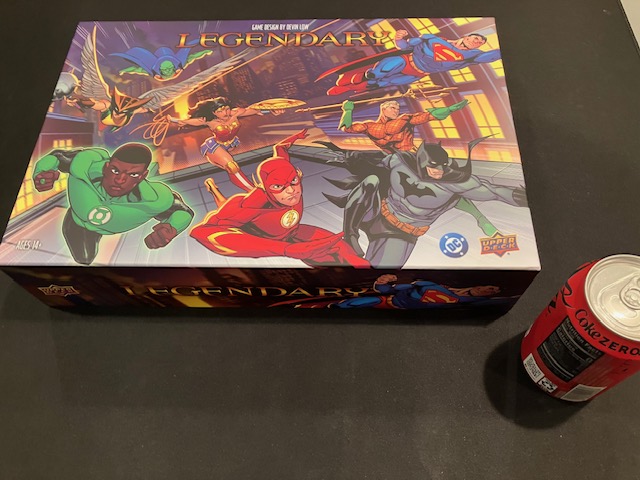
The box is a slightly odder shape than the original game: see box and Coke Can (above) for perspective.

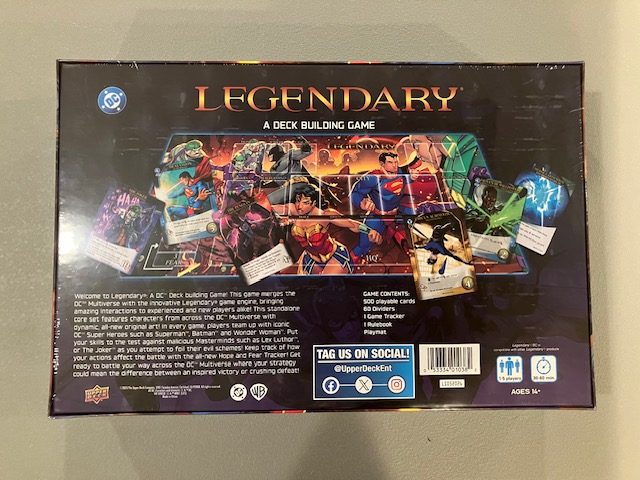
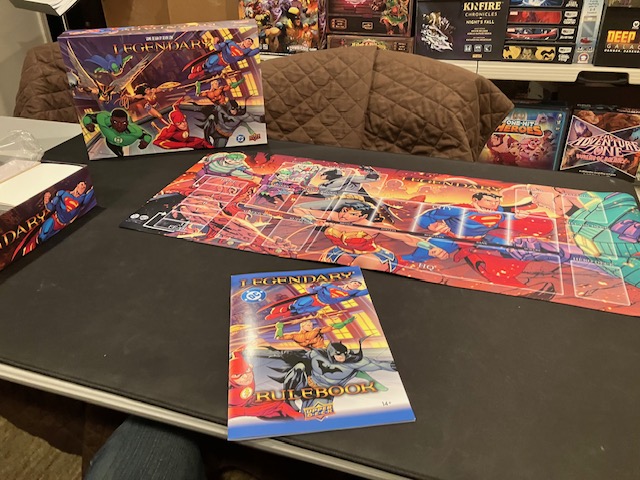
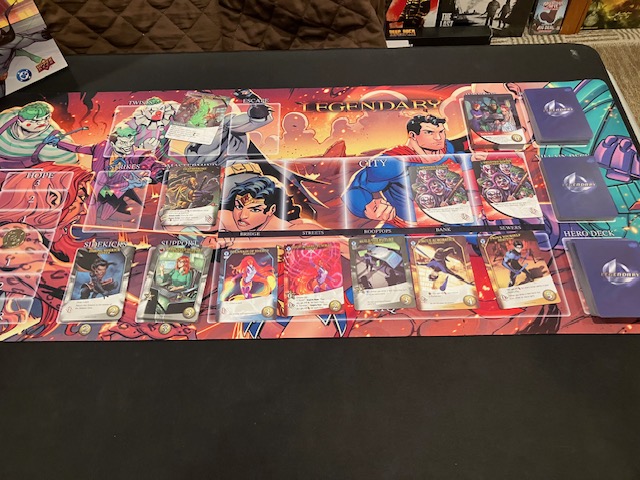
It’s a slightly different shape because it comes with a rolled-up neoprene map! See above and below!

The original Legendary Marvel did NOT have the neoprene mat included! Later games in the Legendary line (especially the Legendary Adventures, like Aliens) came with mats! And everyone loved them! So, I think that’s why the newer sets now all have them.

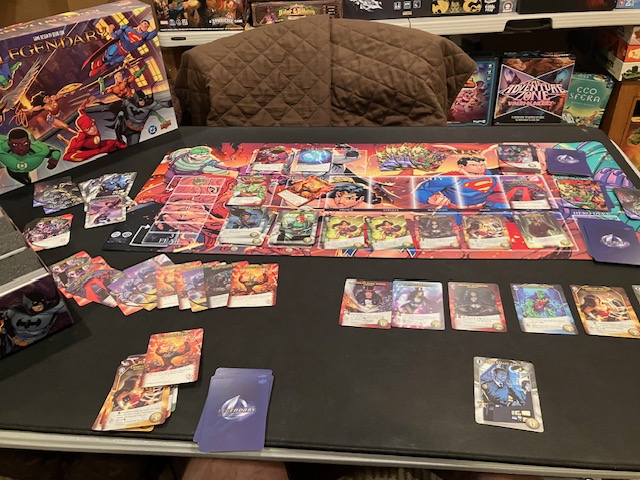
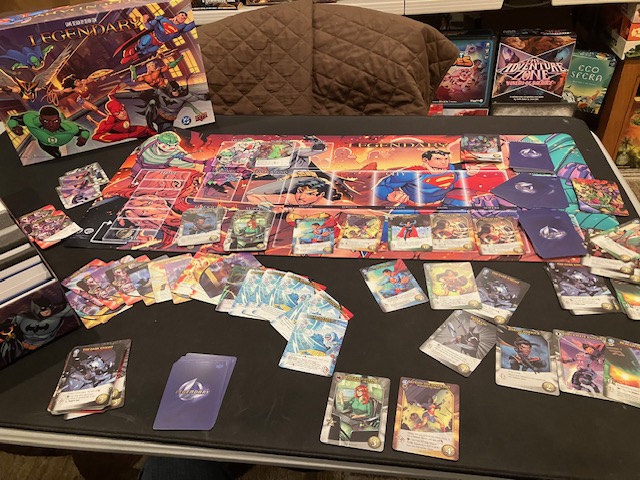
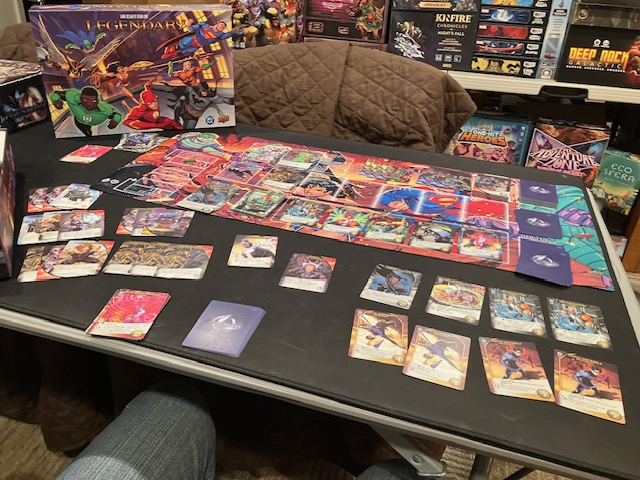
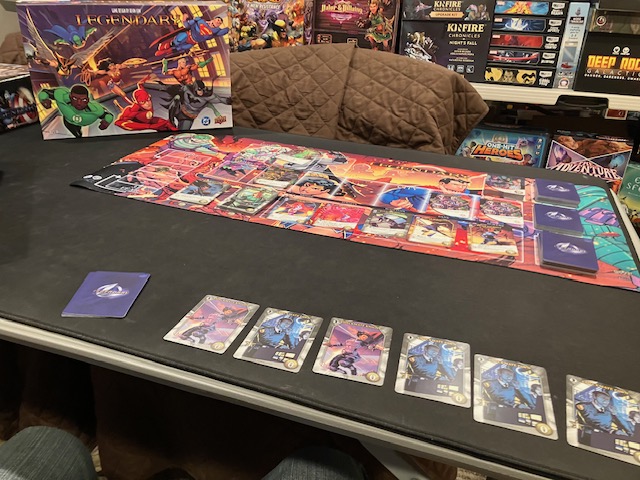
They really do help organize the game. See above.

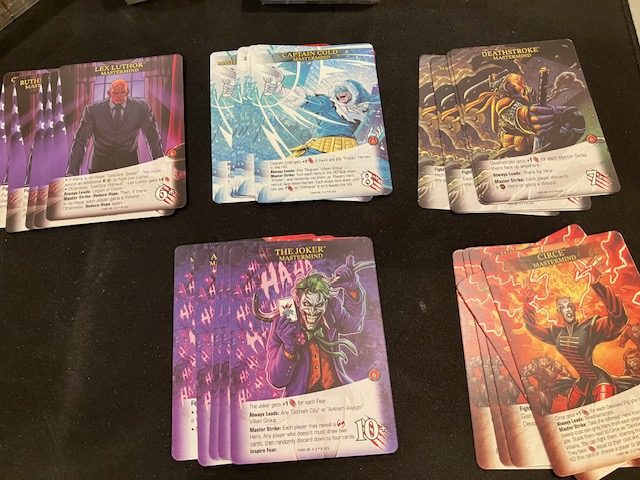
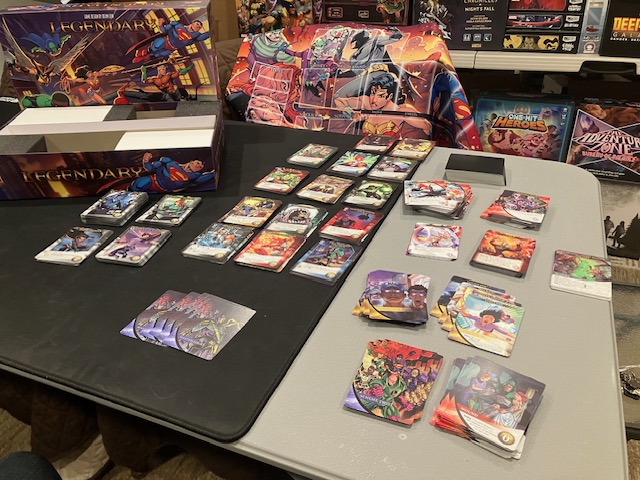
To play a game, players must first choose a Mastermind to fight: See the base five Masterminds that come with this set. To win, you almost always have to fight and defeat the Mastermind in four battles for an ultimate victory!

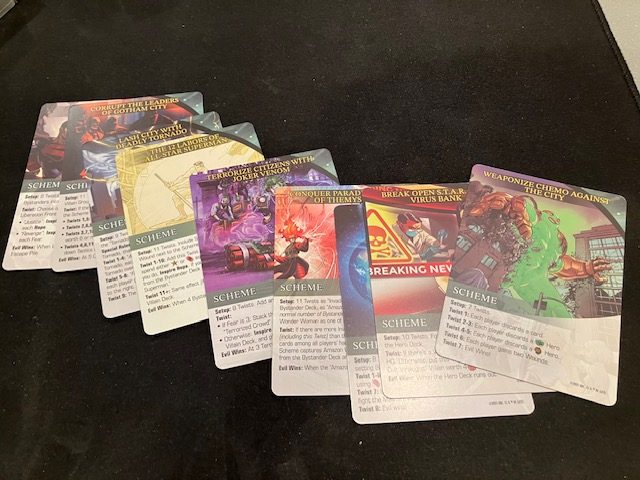
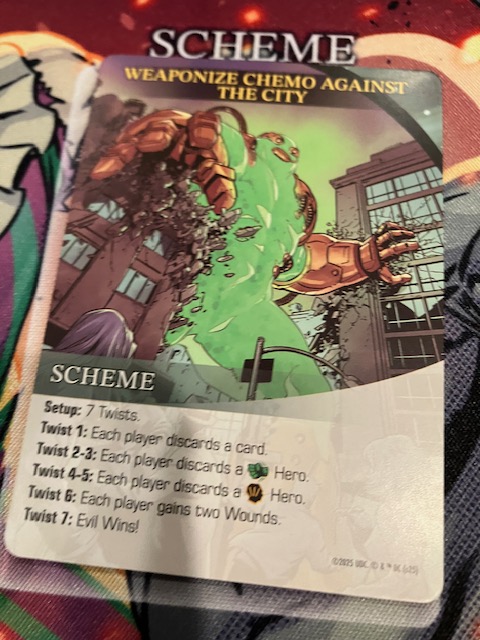
The Mastermind has a Scheme they are trying to achieve; the Scheme defines the losing conditions.

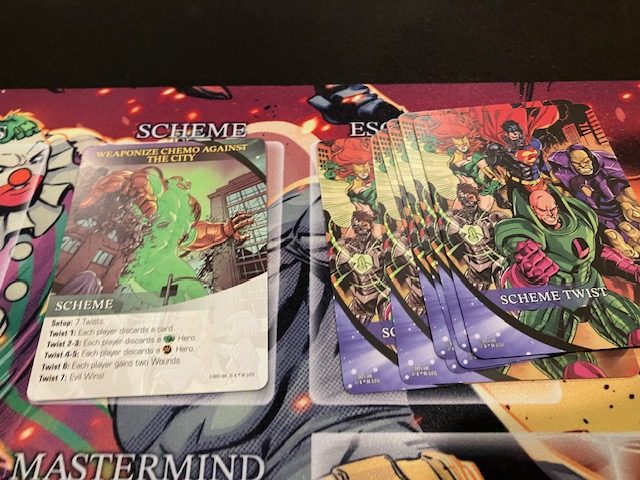
For example, Weaponizing Chemo (see above) is a scheme with 7 Twists! If all 7 Twists come out, the players lose!

The Scheme Twists (see above, right) are shuffled into the Villain’s Deck! The Villain’s deck is a mish-mash of all sorts of bad news cards!

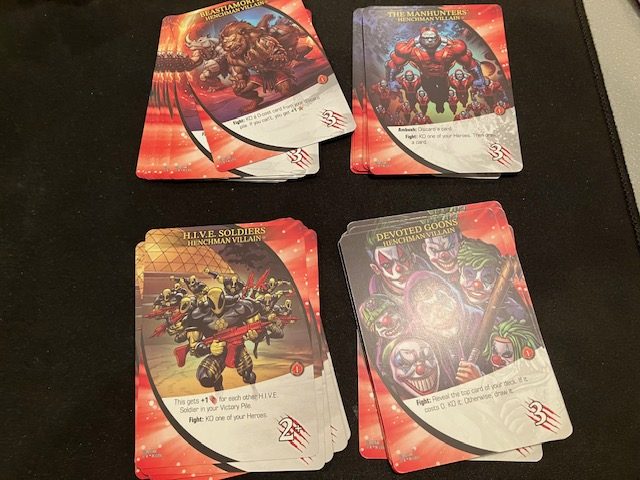
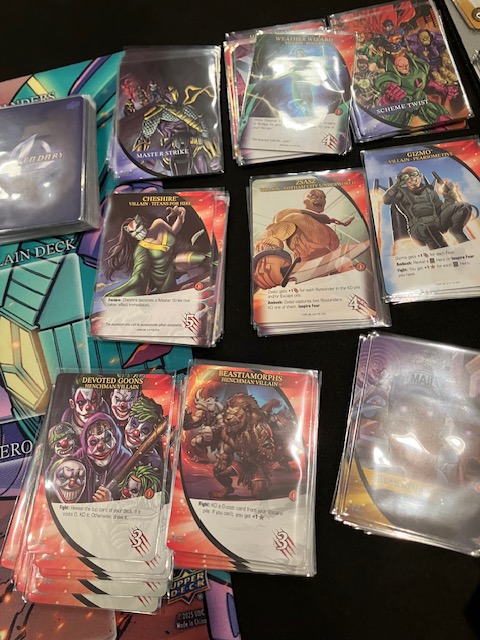
Each Villain deck typically includes some Henchmen (see 4 sets above) …

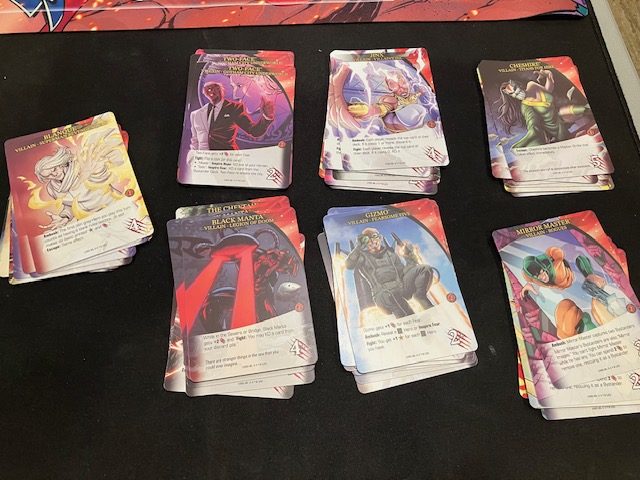
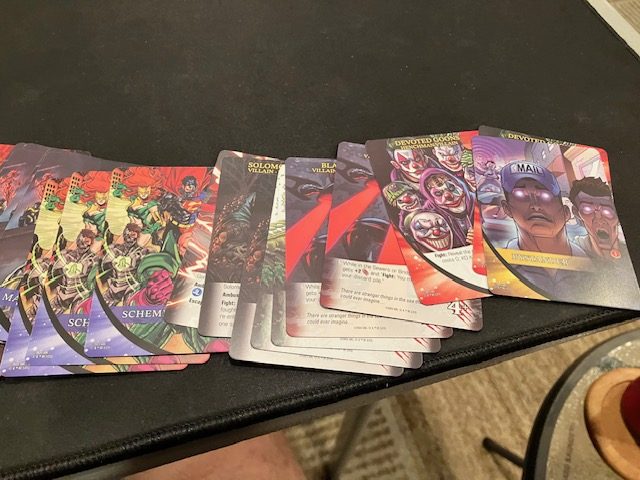
They also include some Villain Groups! See the seven base Villain Groups above!

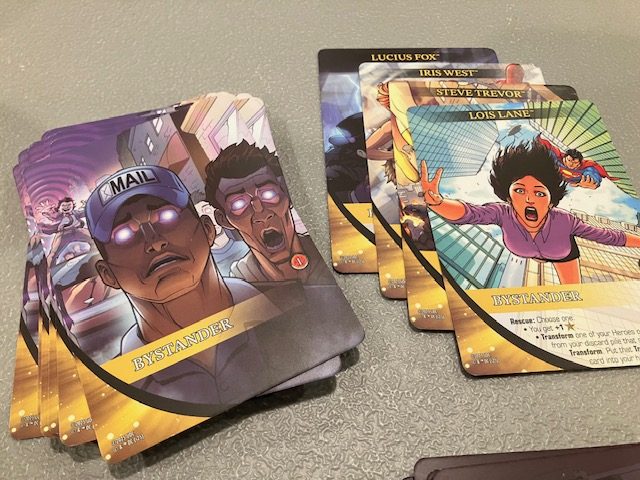
There’s also some innocent bystanders (some named you will recognize, and some nameless ones) that get shuffled into the Villain Deck …

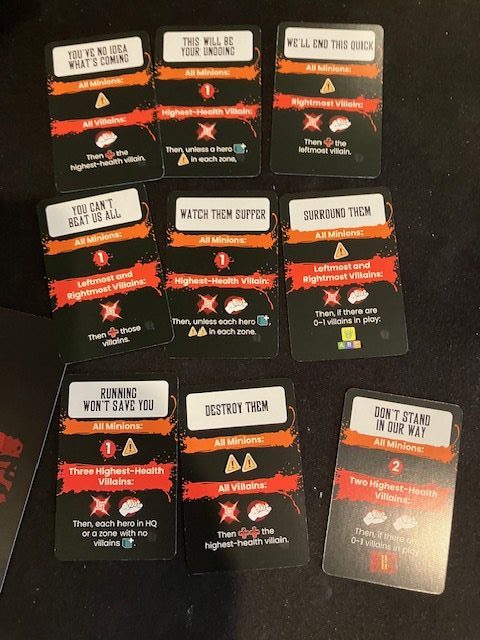
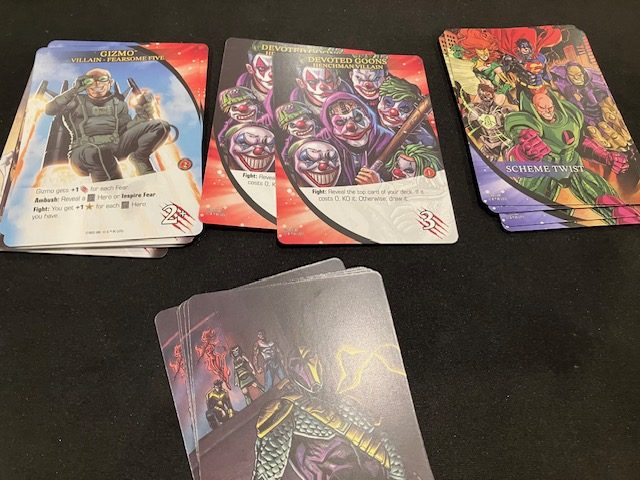
These cards, also coupled with the Masterstrike cards (which lets the Mastermind get involved) form the Villain Deck! Every turn players must draw a card from the Villain Deck and “something bad” happens!

This deck (see it splayed above) is the Bad News deck. To be clear, it changes in every game, depending on the Villain Groups and Henchmen and Scheme you choose!

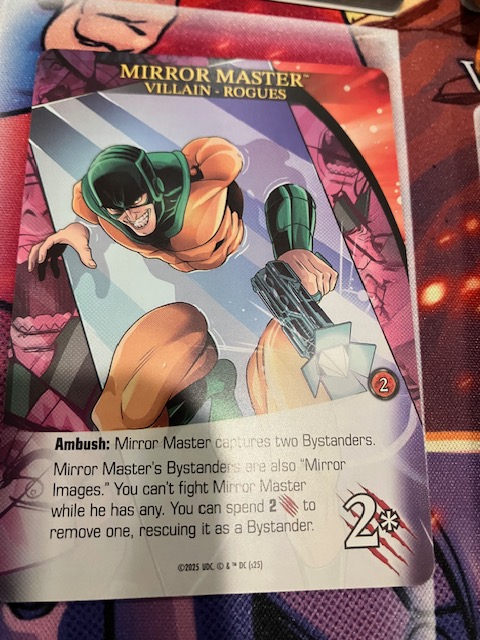
Usually, you fight a Villain from the Villain Deck; a Villain will enter the City that you have to fight!

Legendary DC is a little different than most Superhero games! You do NOT play a single hero! Instead, you are collecting heroes in a “team” (your deck) to fight the bad guys!

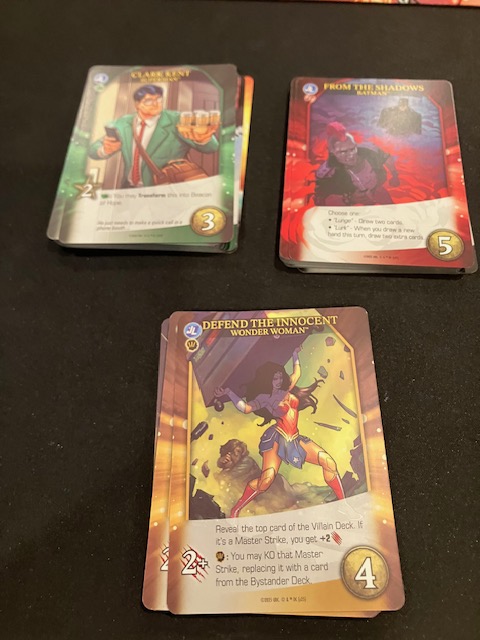
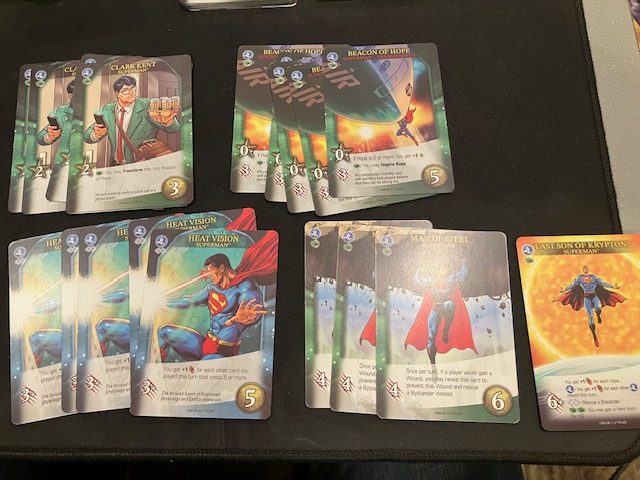
For example, you have a bunch of Superman cards available! At the start of the game, you can only afford the cheaper Superman cards (cost in lower right), but as the game goes on, you can afford to get the better and better Superman cards!

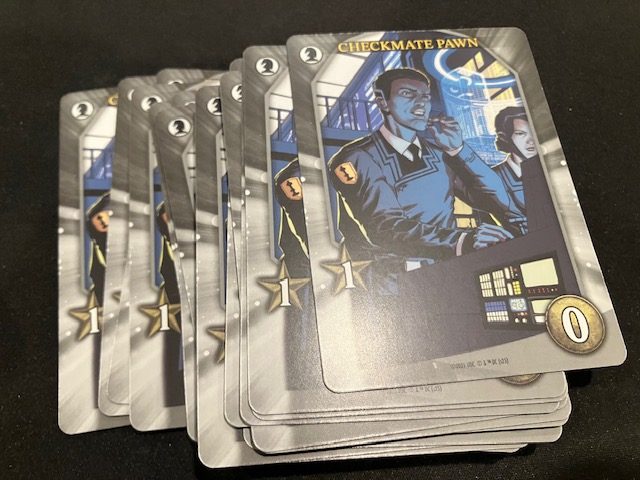
Every player starts with a simple crew from Checkmate (which is quite a bit like Shield from Marvel)! It’s a low-level group of good guys! The Pawns (you start with 8) can only help you recruit Heroes (the Star is how much “recruitment” they can afford)!

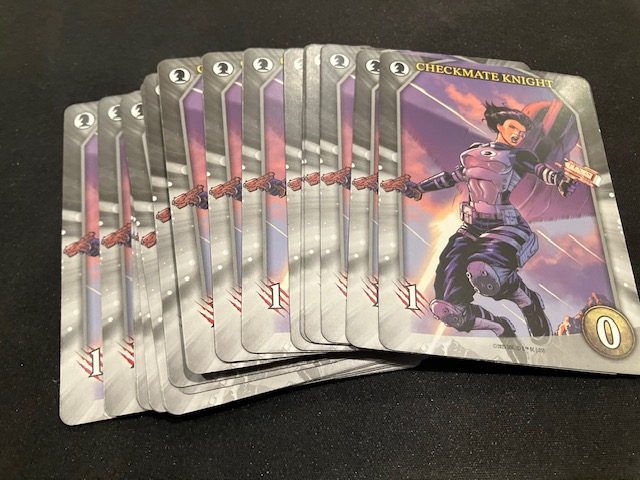
The Checkmate Knights can do a little bit of damage to bad guys! (Players start with 4 of these Knights).

As the game goes on, you recruit better Heroes, save Bystanders, fight Villains and hopefully confront the Mastermind 4 times before his Scheme completes! If the Hero deck or Villain deck depletes, you ran out of time and lost! Usually, though, you will lose because the final Scheme comes out and you lose!

There are a few more rules (which we will discuss below), but that’s the basics of the game! The cards and art are all pretty great!

Rulebook

The rulebook is actually quite good!

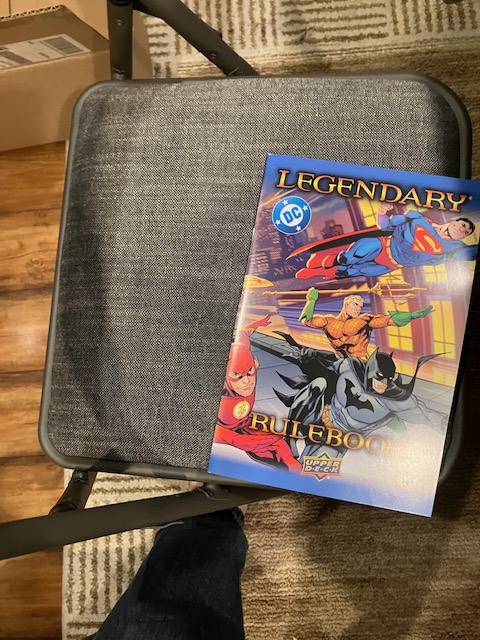
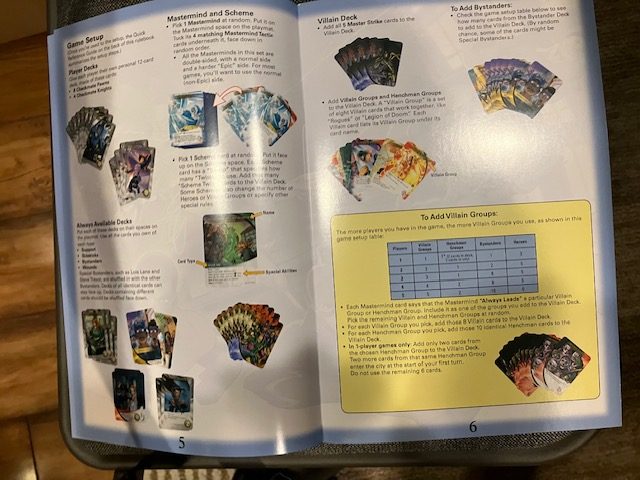
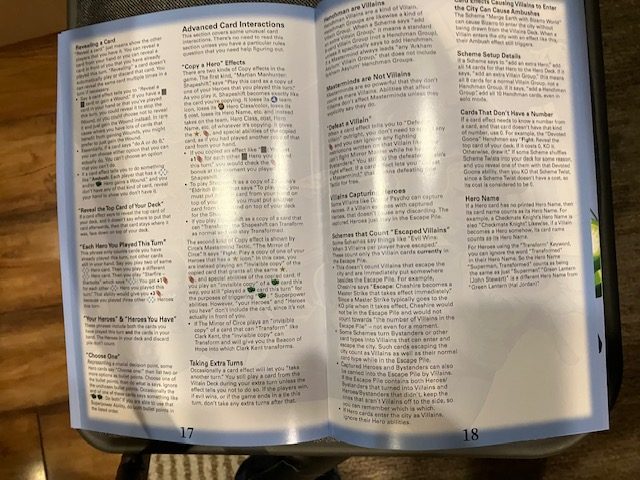
The rulebook does really well on the Chair Test! See above as it opens up to two pages just fine without any drooping! It’s probably a B+ or A- on the Chair Test. The font is a little small, and the later rulebook pages have a lot more text than pictures. Still, the rulebook is very usable on the chair next to me.

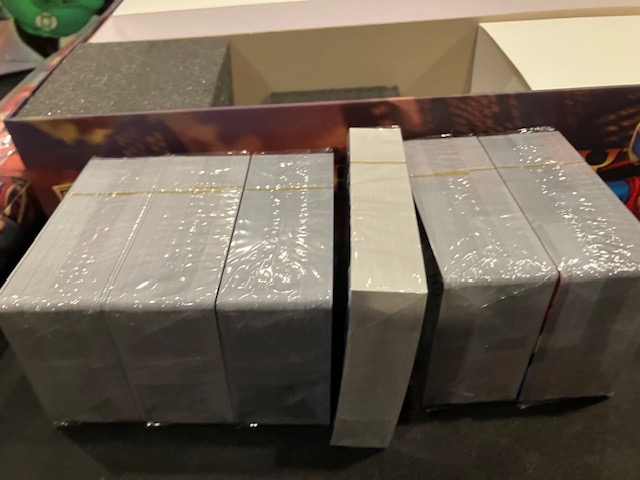
I think the rulebook actually fails the Components test. The Components are NOT defined until the very last page? They are not on the first few pages? I know how to play Legendary, but I worry a little about newer players; this doesn’t really talk about how to “Uncard” the game.

What do I do with all these cards? I still think the rulebook should have an Uncardening section at the very beginning (somehow coupled with the Components list). See more discussion of Uncardening in our discussion of Union City Alliance (another Superhero deck-building game).

I think the next few pages hold the players hands enough to get them through all the cards. Rather than list all the components up front, this rulebook takes you through them a little at a time. Maybe this works; I still think the rulebook needs to acknowledge how many cards are in the game and maybe even a sentence or two (or picture) talking about how to do an Uncardening.

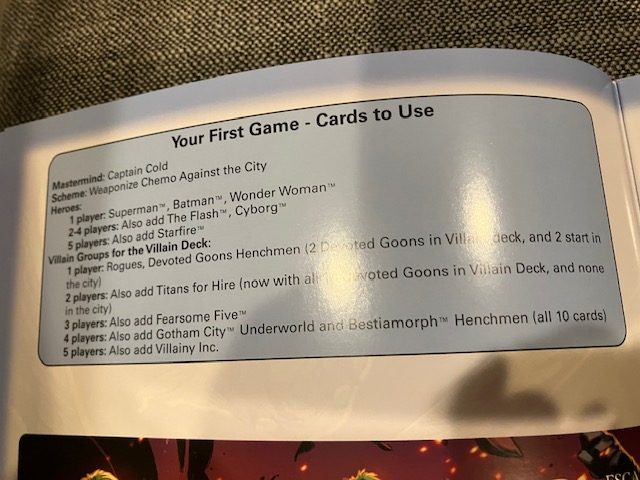
Still, this rulebook worked pretty well. It even has a list of cards to use for your first game!

As we get later in the rulebook, there are fewer pictures and much more text. I think this rulebook could have used an Index. (I found “Always Leads” finally after looking, but it’s buried in a floating box and hard to find). Maybe you just get the online version and search the PDF and have that be the Index?

Generally this is a good rulebook; I feel like this is a much better rulebook than the original Legendary Marvel rulebook: I hated that rulebook!

Solo Play

So Legendary DC embraces the solo player! Yay! Thanks for following Saunders’ Law!

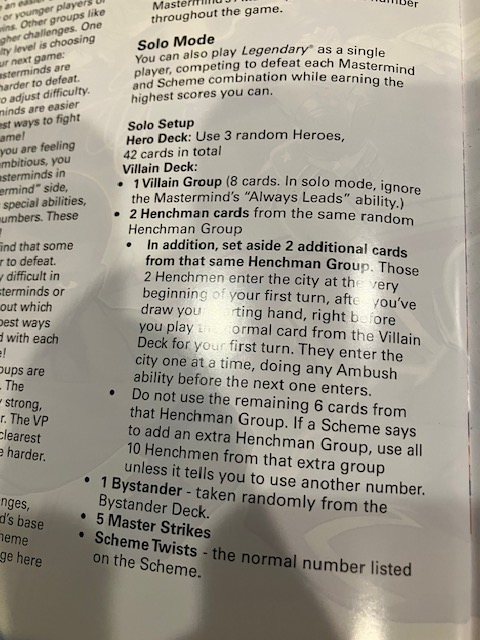
And you can either true solo or multi-handed solo! To play true solo, it’s one player and one deck (one set of heroes): see rules above.

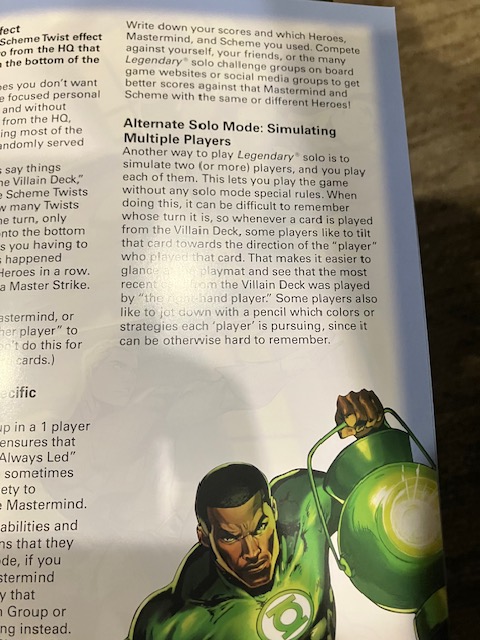
You can also play 2-handed solo (with two sets of decks) or more! I love that this game embraces both solo modes! I generally prefer the 2-handed solo mode because there are generally NO EXCEPTIONS to rules, which makes it easier to learn! Surprisingly, I think I prefer the true solo for Legendary DC, despite there being some changes. Why? Well, to be frank, there’s SO MANY cards between the heroes, the villains, the bystanders, etc etc etc, it’s easier to JUST manage one deck.

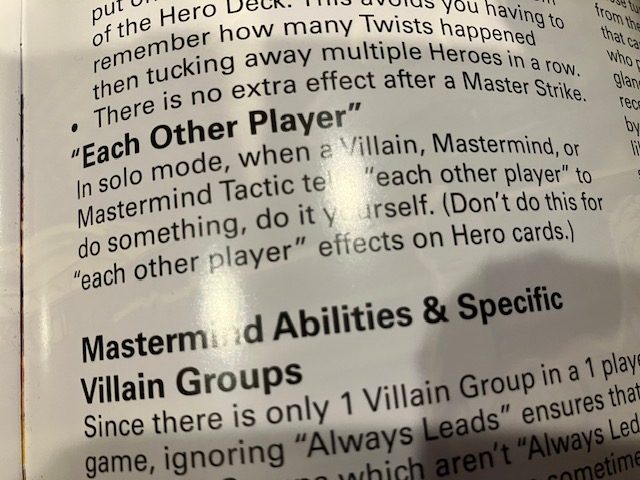
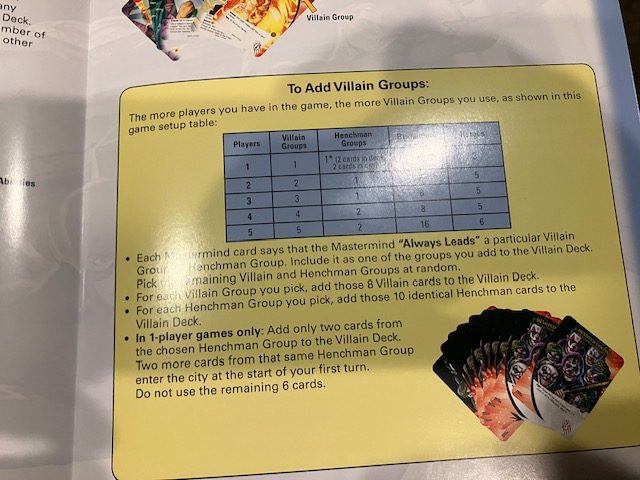
There are some extra rules for the true solo mode: they redefine “Each Other Player” to be yourself (see above; this is a pretty common thing in a true solo mode). They also add an extra Scheme Twist effect and change the set-up so there are fewer Henchmen (and two always start already in the city). The true solo rules are a little clumsier than I thought at first, but I still prefer only managing one deck of Heroes at a time! I think the fewer decks/more rules of true solo outweighs the costs of the more decks/fewer rules for 2-handed solo!

Honestly, the rulebook does a real good job helping you set-up the solo game just fine: see above.

You only get 3 three Heroes, and fewer Villain Groups and Henchmen groups in true solo.

Did I like playing Legendary DC true solo? Yes!!! Over the course of a week, I played at least 7 times solo! There’s so much variety in this game, I loved seeing what would happen! There’s 14 Heroes, 7 Villain Groups, 4 Henchmen, 5 Masterminds, and 9 different Schemes! There’s a ton of variety in this box!

I started with the typical first game of Captain Cold/Rogues vs Superman/Batman/Wonder Woman! Fun! I won the first game!

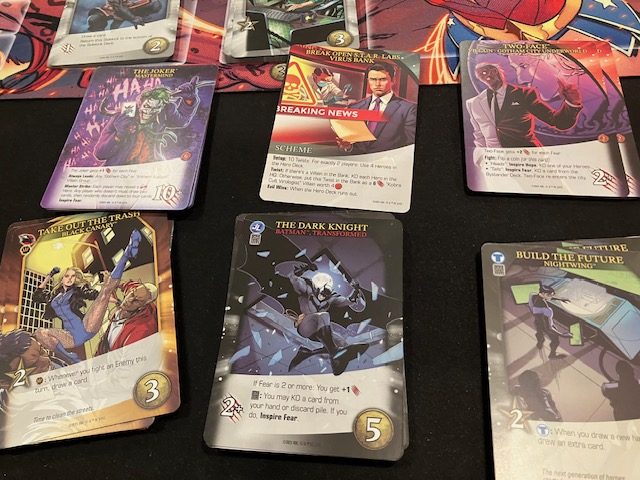
I then moved to a game themed for Gotham City! Joker/Gotham City Underworld vs. Black Canary/Batman/Nightwing! I actually lost this game, but played again and was able to do a lot better once I knew more about the villains and heroes!

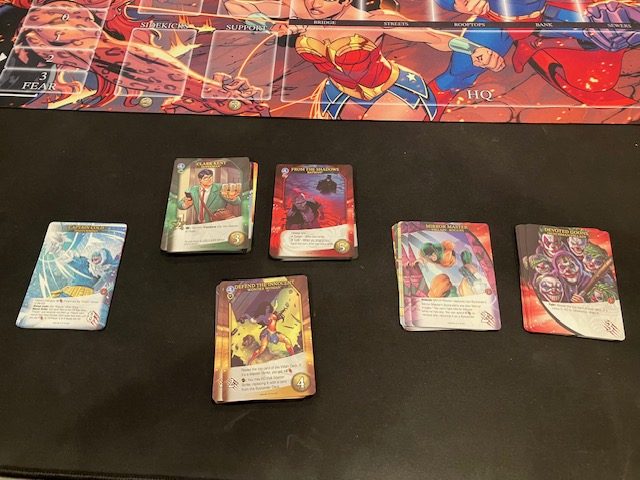
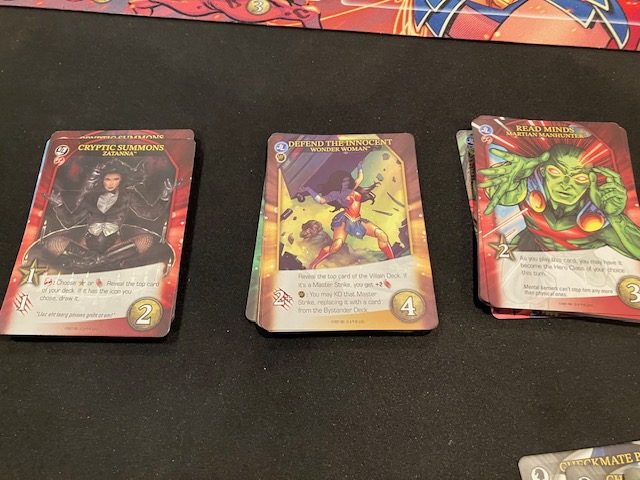
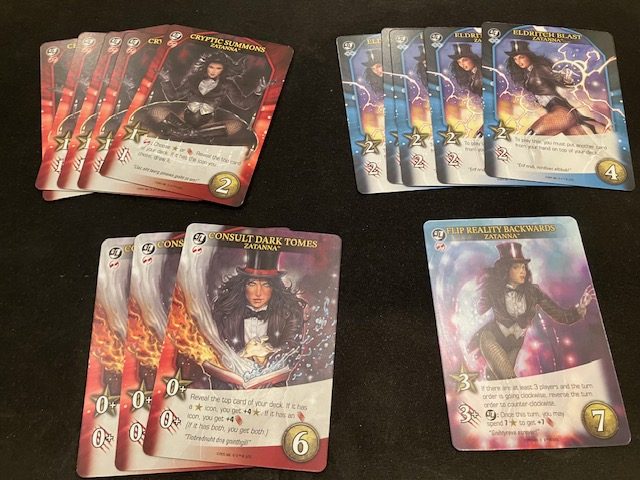
I also did a “weird” group of Heroes with Zatana/Wonder Woman/Martian Manhunter! They are all kinda funky heroes! See above!

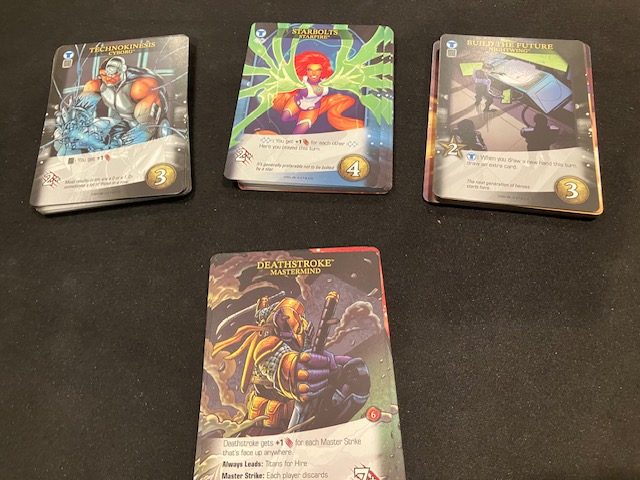
And of course, I had to do a Teen Titan’s based game with Cyborg/Starbolt/Nightwing vs. Deathstroke!

Over the course of a week, I played a lot of games and had a lot of fun. There’s a lot of set-up and shuffling for the solo player, as you have to shuffle together all the hero decks and the villain deck. But, once you are set-up, the game flows quickly!

I was generally very pleased with the true solo mode offered by Legendary DC. The worst part of the solo game is the set-up and tear-down, as the solo player has a LOT of decks to shuffle (set-up) then separate (tear-down). But, if you have played Legendary in any form, you already knew this.

Cooperative Mode

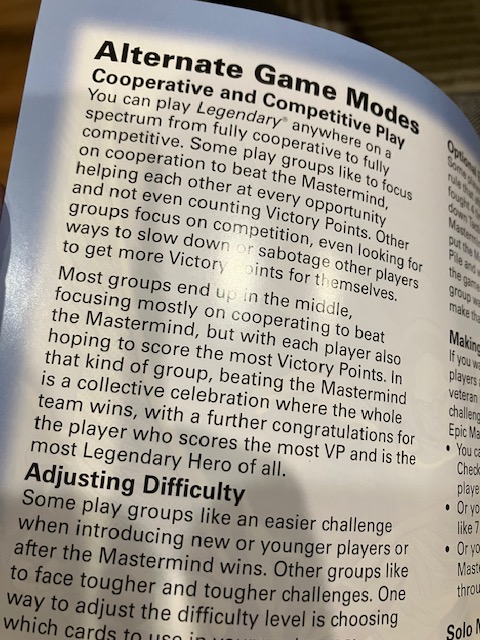
It’s a strange thing; this game can be played cooperatively or semi-co-op (getting the most victory points). See rulebook above: If you don’t defeat the Mastermind together, everyone loses! Yet, I don’t personally know anyone who plays semi-co-op for victory points? It seems out of character to play a super hero game … in any way competitively? But you can?

So, cooperatively is all about making sure we defeat the Mastermind in combat 4 times!

One of the best things about playing Legendary DC (or any Legendary) cooperatively is sharing the load for set-up and tear-down! There are a LOT of cards in this game; the more players that play, the more cards! That means set-up is all about shuffling together a ton of cards for the Hero decks and the Villain deck! And then the tear-down is arguably worse, as you have to separate ALL THOSE CARDS back into their original decks. Luckily, if you have a good group, you can share the load and have everyone help. That group help really makes the game feel a little less like work and more like fun.

Although we almost always (always?) play Legendary cooperatively, it’s not particularly cooperative! Don’t get me wrong; we are all working together to defeat the Mastermind, and we point out issues and talk about how to resolve them, but there’s not really a lot of cooperative mechanisms in the game. Each player’s turn is mostly taken in solitaire; this is mostly multi-player solitaire! There’s no real mechanisms for sharing cards, or directly helping someone with your cards! Mostly, it’s about talking about how the solitaire turns will interact with each other and the current board!

Some people might think the “lack of cooperative mechanisms” makes this a bad cooperative game; not at all! This multi-player solitaire nature helps keep the Alpha Player Syndrome in check, so that’s one reason a lot of people might like this! And some people really like the idea of a cooperative game without too much player interaction.

Just be aware of the kind of cooperation Legendary DC provides; it is fully cooperative and players will discuss how to win together, but the turns are mostly multi-player solitaire.

Sleevening

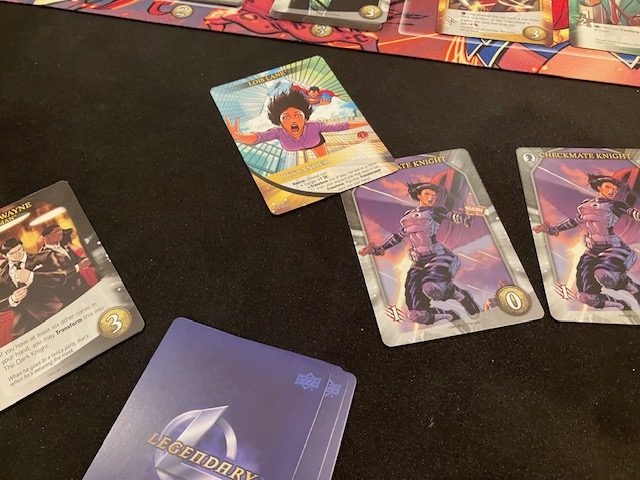
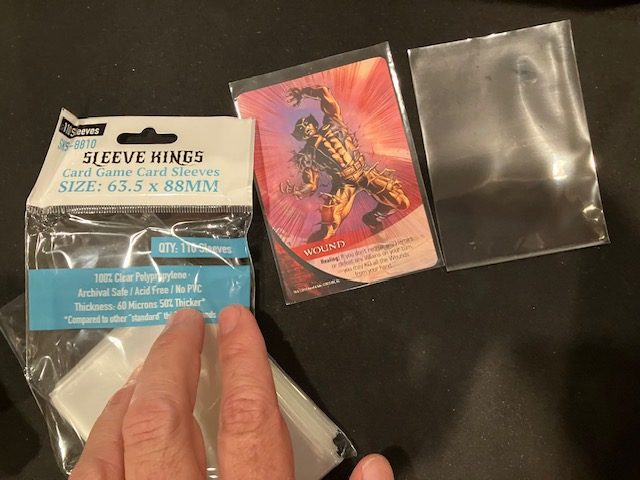
You should probably sleeve your game if you plan to play it a lot. I played my first 7 games without sleeves, and I noticed some of the starter cards (Checkmate cards) getting smudged and a little messy.

I was a late sleever, but I think it’s worth it for this game. Heck, usually most deck-builders are worth sleeving! I used the Sleeve Kings 63.5 x 88 mm sleeves! See above.

House Rule for Schemes To Reduce Randomness

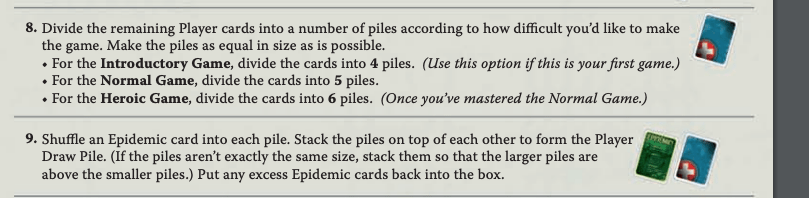
A lot of Scheme cards shuffle a bunch of Scheme Twists into the deck: see above!! But if you just happen to get all of the Scheme Twists at the start of the game, you quickly lose! Sure, it’s unlikely. But after all that set-up, how annoying is it if your game ends quickly because the Scheme Twists end up in the upper part of the Villain Deck?

Games like Pandemic break apart the deck into piles (see rules above), then shuffle one of the Infection cards (like Scheme Twists) into each pile. Then the piles go back on top of each other! See above for rules of Pandemic! This keeps the bad news cards from being all clumped in the top (game too hard) or the bottom (game too easy)!

Why don’t we do this with the Scheme Twists? With the Pandemic method, the Scheme Twists are distributed equally throughout the Villain Deck! This seems like a simple house rule to keep some of the randomness under control.

What I Liked

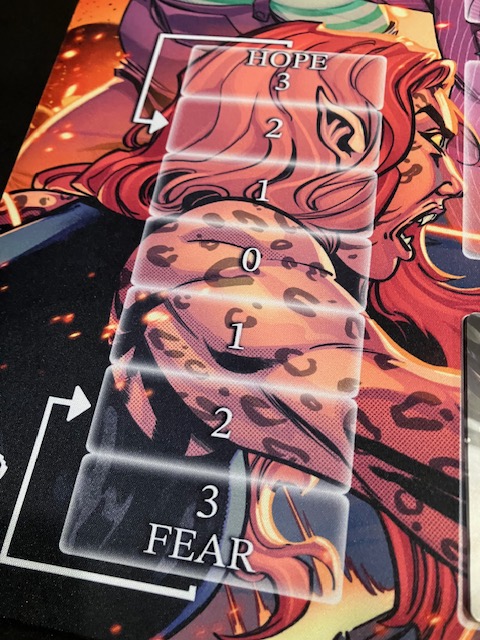
Hope and Fear: Legendary DC has a notion of Fear and Hope (two sides of the coin). See mat above! Some Villains and/or Heroes do less or more damage depending on where the Fear track is! Superman does better when Hope is higher, and Batman does better when Fear is bad! I like this mechanism a lot; it gives a nice flavor of atmosphere to the game! There’s also a more mechanical reason to like this: if you get a “bad hand” and can “only” generate 3 fight on your turn, you can still do something useful and fight crime (generate hope or fear, as you want)!!! That’s right, if you have really hard Villains out, you can still do something useful! This new feature (at least for me) really helps elevate the game by giving the players more to do on a turn, even when faced with a bad hand!

Art On Cards: The art on the cards is generally fantastic! The heroes, the villains, the masterminds are all pillars of good comic book art!

Rulebook: Despite a few grumbles with the rulebook, I generally really liked this rulebook. Even though I already knew how Legendary worked, I feel like the quality has significantly increased since the first one! It still needs an Uncardening section.

Player Counts All Work: The rulebook goes out of its way to make little mods to make sure sure the game works at all player counts! The solo rules have special set-up and rules, the 4 and 5 player games get an extra “free” turn makes me feel like this game will work at all the player count! My experience is only solo and 4-player, but these tweaks seemed to work!

Variety: There is SO much variety in this game, you could be happy with just this base set for quite a while!

The Player Mat: The fact that this version of the game comes with a player mat is great! It really helps keep the game more organized and easy to set-up!

What I Didn’t Like

The Cover Art: The cover art seems … out-of-place with the rest of the art? The cover art looks like a “Super Friends” kind of art (lesser quality) and the innards are more like “Justice League of America” art (higher-quality)? I don’t know, if I saw this game at a game store and didn’t know anything about it, I might think it’s for young kids only? I think the cover belies what’s inside.

Play Mat: As much as I love the playmat, I think it’s busy and distracting. The Heroes and villains on the mat are “distracting”. They are also of the lesser art like the cover. I would rather have the heroes and villain be removed from the playmat and have the the background only! However, given a choice between no playmat and a busy playmat, I’d MUCH rather have the playmat!

Randomness: The Hero decks and Villain Decks are random: you can get completely screwed by bad draws. It’s not big deal, because it usually balances out (especially if you build a good hero deck). BUT in a game where it’s so much work to set-up and tear-down, it can very frustrating to have a game end because of bad draws; this is probably the worst part of Legendary DC, and every Legendary game ever.

Conclusion

I think Legendary DC is my current favorite version of Legendary! All it’s little tweaks (Fear and Hope, player count adjustments, multiple solo modes, etc) show all the advancements that have been done in this system! This is the newest evolution to this game and it works well. There is also so much variety in the game that you can play this set for quite a while without needing any expansions! Trust me though, more expansions are coming. The art is fantastic and the DC Superhero theme works well with this.

The set-up and tear-down can be daunting, especially for the solo player, but the cooperative game is a lot easier to set-up/tear-down because players can share the load to make it easier for everyone. Be aware: there is a fair amount of randomness in the game, so bad draws that ruin a game are a little more painful when the set-up and tear-down is so pronounced! Having said that, the randomness of the game isn’t “usually” too bad, especially with one minor house rule we suggest.

The solo game is a blast and I couldn’t stop playing it! There’s even rules for true solo and 2-handed solo! I prefer the true solo despite the few extra rules and really enjoyed the puzzle and gameplay. 8.5/10 maybe 9/10?

The cooperative game isn’t that cooperative; it’s more multiplayer solitaire. It’s still a lot of fun, but don’t expect lots of sharing or turns where you help someone else; most of the communication in the game is “general strategy”, but that’s still fun. It’s a great game: players work together a little … but the cooperation isn’t particularly pronounced. There just aren’t a lot mechanisms in the game that promote cooperation. 8.5/10.

I don’t think I know anyone who plays this semi-co-op; it seems out of character for a super-hero game to NOT be fully cooperative.

And yes, this would make our Top 10 Cooperative Superhero Games!! I think it’s better than Legendary Marvel!

Hero Appendix

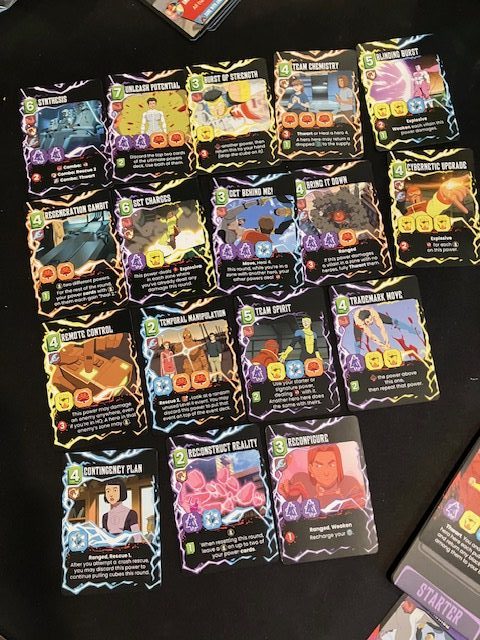
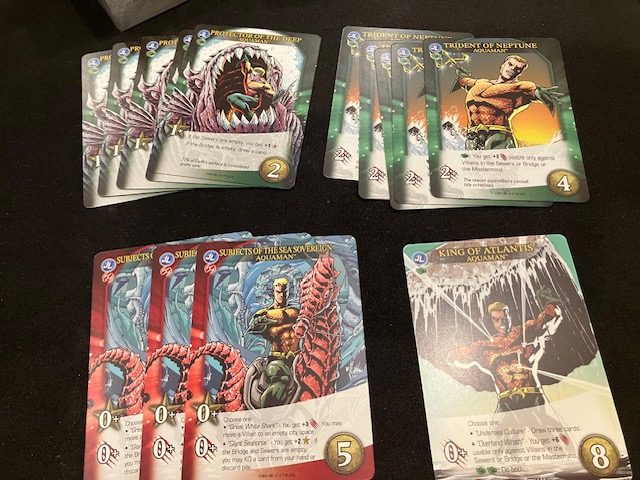
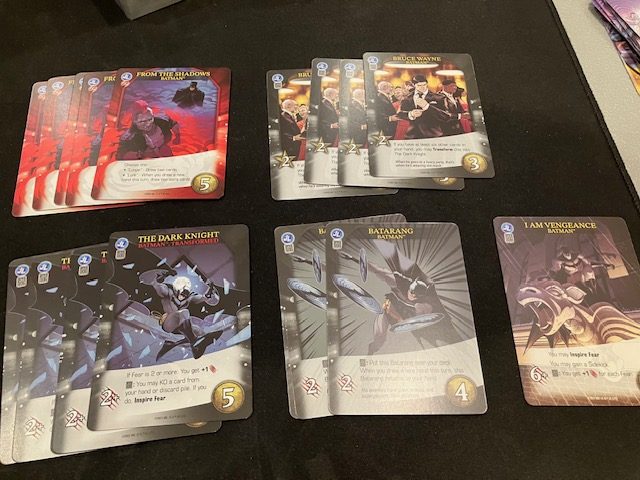
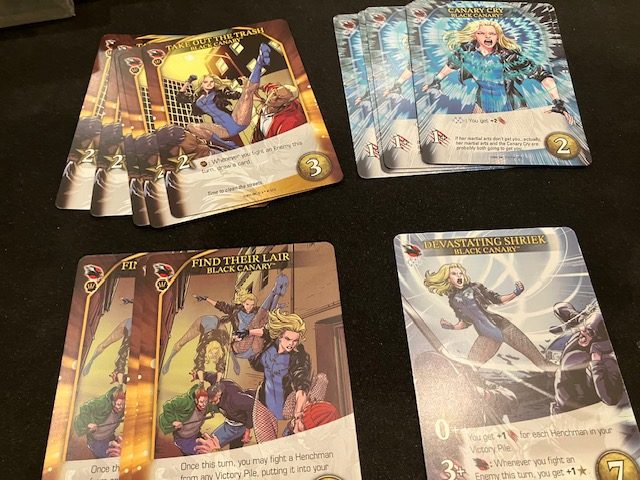
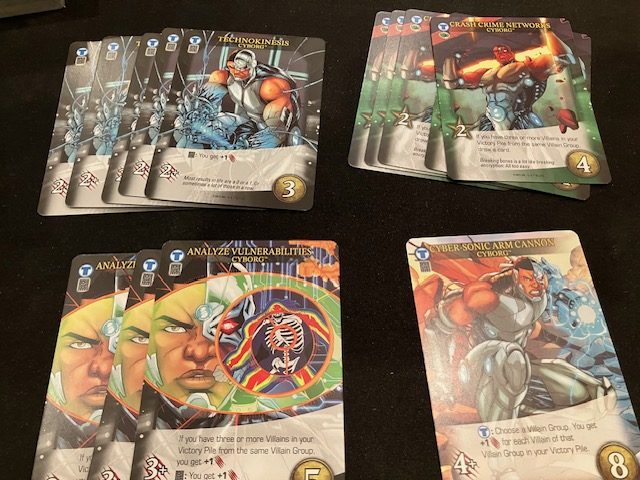
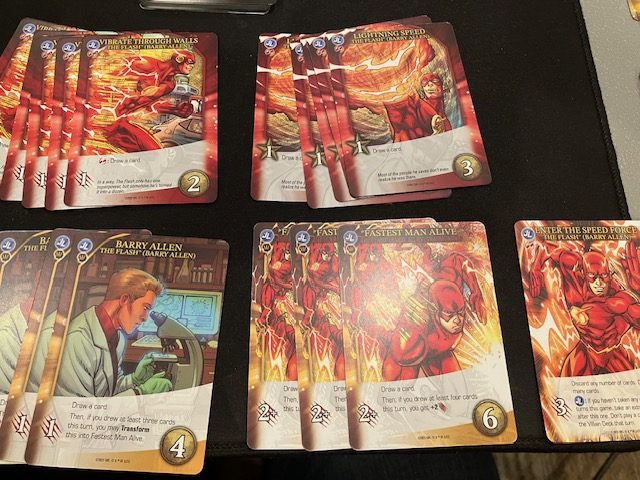
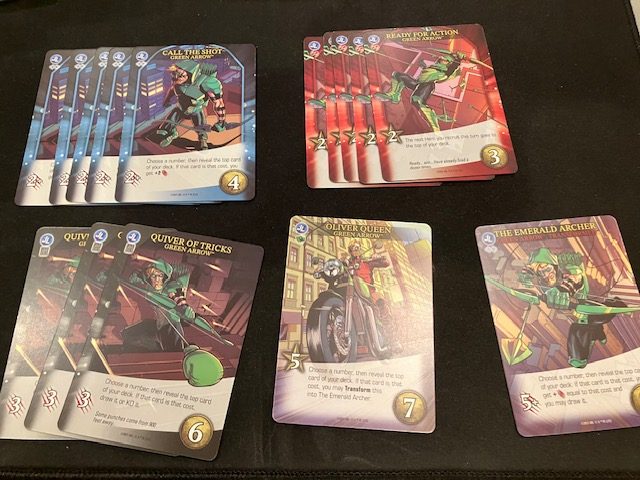
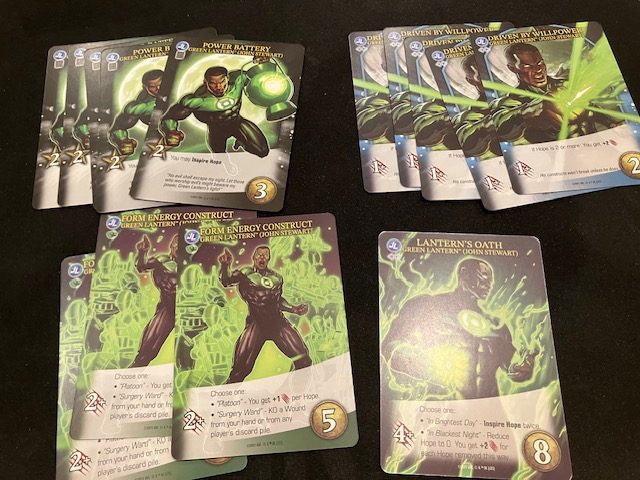
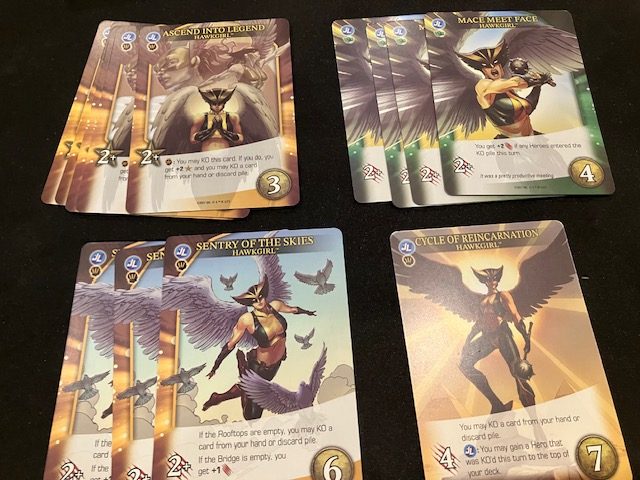
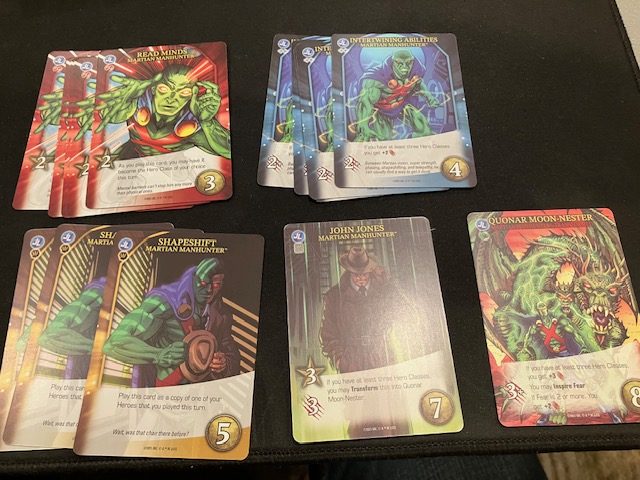
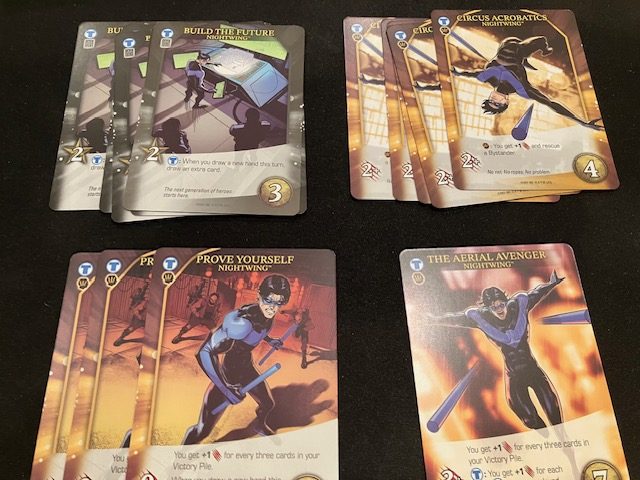
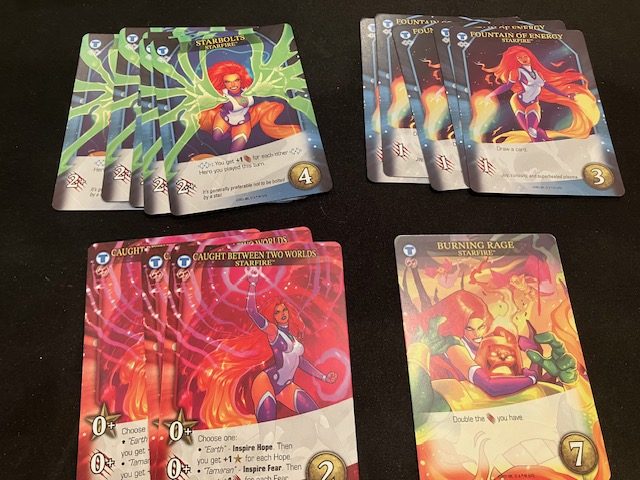
Here’s all the Superheroes and their cards.

Viking Route: Solo and Cooperative Review After Full Playthrough

Viking Route is a solo and cooperative game from Kickstarter back in December 2024. I backed at the Jarl level and my copy arrived early August 2026. It had promised delivery October 2025, so it’s almost a year late! That’s Kickstarter for you!

This game made our Top 10 Anticipated Cooperative Games of 2026! Why were we so excited for it??? Magnets and Vikings!!! You heard me, Magnets!!! And Vikings!!!

How on earth does this board game use magnets??? Let’s tale a closer look!

Unboxing and Gameplay

See game above with Can of Coke for perspective!

There’s a big bad boss loose in the world, and it’s your job to deal with it! See the 5 bosses above! Each boss plays very differently too!

Players play 4 Vikings sailing the seas! Each Viking has a special power activated by discarding Clan Spirit tokens! See characters above! No matter the number of players, there must always be 4 Vikings in play. A solo player will operate all 4 vikings, 4 players will each get their own viking, 2 players would each get 2 vikings … (and 3 player has a weird rule).

Players are sailing the seas trying to defeat the enemy! This game is “kinda” a boss-battler, but the game is more about sailing your ship to get to the enemy and avoiding land and other things! The ship itself is sort of a worker-placement area! Each zone of the ship does something different: the Deck has the most options and is adjacent to everything, the Sail is for adjusting the sail (full-up, half-up, or all-down), the Hold is for grabbing some useful tokens, the Lookout is for adjusting the wind (sorta), and the Ballista is for shooting things!

Your ship is represented by a compass on the board! See above! When the sails are unfurled, the ship will move in the direction of the red arrow on the compass! How does the compass point? Magnets!

When you do you sail? At the end of every turn, players draw a bad news card which “usually” also moves ship in the direction of the wind! Plus some bad stuff …

There are 4 heavy magnets that affect the compass (your ship): the three ravens (scattered on the edges of the board) and “the wind”, right in the middle of the board.

See above as the ship (The Drakkar) is near the green raven, so that magnet has the most influence over the ship on that part of the board!

If you move your Viking to the Lookout, you can activate a Raven and move it around the board a little bit! See the video above as the moving Raven affects your heading on the compass!

But it’s not just the Ravens: “the wind” in the center affects you too! The direction she points has a big effect on your heading! She is actually a pretty power magnet herself! This game is all about managing the “overlapping magnetic fields” from the Ravens on the edges and “the wind” in the middle! (You can only adjust the wind in the middle if you are within two spaces).

Along the way, you have to deal with Valkyries as they slowly (and sometimes quickly) approach your ship!

Sometimes the Valkyries makes it ON the ship and damage it! See above as the sails area get damaged! You have to fight the push them off the ship! Of course, the Valkyries are immortal, so all you can do is push them away!

Combat is decided by dice! See all 6 faces of the dice above! Basically, 2 sides are misses 3 sides are plain hits, and 1 side is a critical hit! Usually a hit is good enough, but critical hits can be great, depending on the bad guy you are fighting!

Each viking sheet tells how many dice they can roll for Combat! So you “usually” want Urwulf or Helga doing combat since they roll 2 dice during an attack (Astrid and Kuba only roll 1 dice).

To win, you have to “do something” to take down the big bad boss! Usually, you have to collect all 3 Magic Stones from around the world, then hit the boss with some critical hits! There are 5 different bosses in the game, and they all operate a little differently!

That’s kinda the basics of the game! Although the tokens are fine, it’s really the whole “toy factor” with the magnets that makes this so cool!

Rulebook

The rulebook is pretty good.

The rulebook knocks it out the park on The Chair Test! This rulebook fits perfectly next to me on the chair, it opens up easily, and is easy to read! A on Chair Test!

The components are described well and set-up of the Drakkar work well.

The Set-Up was good: see above.

In general, this rulebook was pretty good. It’s main flaw was the it seems to miss edge cases more often than it should: It’s usually edge cases in the specific monsters you are fighting that were the problem. We’d occasionally get ourselves into a situation where the rulebook didn’t answer something, so we’d just a make a ruling; it happened more often than it should have. None of the underspecificity was ever particularly egregious, but it just happened a few too many times.

Solo Play

So, there is a solo mode! Thank you for following Saunders’ Law!

Since all modes must always play Vikings, the solo player operates all 4 vikings! Normally I worry about how much context switching it takes to operate 4 completely different vikings … but the Vikings aren’t really THAT distinct! The real difference is their special power, how many dice they roll, how much they can carry, and how many hits. That’s it! It’s all very apparent on their sheets!

Each Viking has a token they place on the board to show they’ve gone (yes, I know that’s backwards; see below). Viking Route uses coarse-grained Player Selected Turn Order (PSTO)! (See description here) I love that! PSTO usually really elevates a game for me, as I feel I have more choices to get stuff done!

The context switching between characters really isn’t a big deal! I had no issue jumping right in and playing all 4 Vikings! It sounds more daunting than it is; once you’ve played once, you’ll see that it’s easy to play all 4 vikings as a solo player!

The solo game works really well. I had no problem jumping in. In fact, I ended up playing the entire campaign over 5 days as a solo player! I had the ability to leave it set-up between days, so that helped.

From a maintenance perspective, there’s a little bit of work to set-up and tear-down, but it’s not too bad. As usual, the cooperative game makes set-up and tear-down a little easier as you share the load.

Is this a good solo game? Absolutely! The choices you make about when to furl/unfurl the sails, fight or sail, directions to sail, when to move the wind or the ravens, are delicious choices! You are basically balancing keeping the ship sailing in the proper direction with all the stuff that happens along the way: Battling Valkyries! Tracking the Big Bad Boss! Grabbing Resources! Avoiding Land! The fact that there are 4 magnets with overlapping influence works really well!

Great solo game. I played the entire campaign because it was so fun.

Cooperative Game

The cooperative game was mostly just an extension of the solo game! What do I mean by that? Well, instead of making all the sailing and fighting decisions as a single player, we tended to decide things as a group! With the Player Selected Turn Order, we’d decide on which viking goes next! What do we concentrate on? Should we fight or sail? Should we unfurl? Should we reroll? Should we request Help From the Gods?

As a group, we’d play with this magnetic system! And it was fun!

The trade-off here is that multiple people playing might see something you miss, but the counterpoint is that you have to make most decisions as a group.

Everyone loved the magnets.

There is something to be a little worried about; this game is susceptible to Alpha Player Syndrome (see link here for description). If you are playing too strictly, you aren’t supposed to play with the magnets too much, and an Alpha Player might either stop you from playing with the magnets (“that’s cheating! You can’t do that!”) or maybe just say “I know how the magnets work, let me do it”.

The right thing to do: just let people play with the magnets and have fun.

The cooperative game worked; we saved our game and plan to play more games in the campaign.

The Campaign

There is a 5 game campaign with 5 different bosses. Each one plays differently, but not THAT differently.

The game proceeds in two phases: In phase 1, you have to sail around the board and get the 3 Magic Stones! That seems to be the same for every game in the campaign! Then in phase 2, you “do something” with the stones! See above as I crit hit the Kraken three times to win!

Each world has a different board with different rules! Board 2 has lots of Fog which stops you from looking at the compass! Eek!

Board 3 is in the river and Fenrir buzzes around trying to Ram you! The River makes you drift every turn!

The 4th board has a giant land mass which is a real pain to move around, and some “remnants” of the Bifrost bridge which do weird things?

The final board is Loki! He pretends to be all the monsters you already fought! I have to admit, I thought the final battle was the weakest. It seemed sort of too long and very samey. It was my least favorite of the campaign games.

Despite all that, the campaign IS fun. Each game is different enough and keeps you engaged in the world. It’s also fun between games to get upgrades for your team! That’s right! This is a campaign where you can upgrade as you go! See the Port Upgrades pages above!

Magnets

Let’s address the elephant is the room: do the magnets work? Does the game work? Yes! 100% yes and yes! After playing the solo campaign all the way through and some cooperative games, yes, I can verify that the system of magnets works! And the game works too!

It’s even quite thematic: the winds are a “mysterious, unseeing force that affects you”, and the magnets really capture that feeling!

The game also doesn’t seem too hard or too easy either. The magnets work in the game and give a nice challenge.

What I Liked

Art Style: I like the art style: it seems a good choice for a viking game.

Magnets: I love the magnets. They work! And it’s fun to play with them!

Player Selected Turn Order: Player Selected Turn Order works really well here: it helps make the game feel like your choices matter more. They even have the tokens to help notate when a turn has been taken!

Table Presence: This has a really cool table presence!

What I Didn’t Like

Underspecificity: There’s a number of places in the rulebook where the game seems underspecified. What happens when “something” happens? The rules don’t seem to handle a lot of edge cases! The rules also seem to use some variation of the phrase “if there’s a choice, players decide” quite a bit! That deferment of rules works in a cooperative game, but it always feels like a cop out to me (see Resolving Ambiguity in Cooperative Games for more discussion). I think with just a little bit of work, it could have been a bit more precise with a bit more thought. It wasn’t game-ending by any means, but a small nuisance.

Randomness: At the end of the day, this is still a dice game where rolling poorly will cause you to lose the game. There are a few mitigation techniques (Crit tokens, flipping the Ballista, re-rolling Urwulf attacks with Clan Spirit), so it’s not the end of the world if you roll poorly, but just be aware that it can be frustrating occasionally.

Conclusion

Viking Route was a big hit among me and my friends! The toy factor of the magnets was overwhelmingly fun! They designers have crafted a very good game around the magnetic pieces, and that works really well!

As a solo game, this is a 8.5/10 or 9.0/10. It might be a 9.5, but the randomness and underspecificity of the rules brought the game down just a little bit for me. But the game was so much fun, I played through the entire campaign and enjoyed it (the finale was a bit underwhelming; that also contributed to the 8.5/10 or 9/10). The game was fun and I had a blast playing it solo! And don’t worry about operating four Vikings in the solo game, as it really wasn’t an issue.

Cooperatively, this is an 8.0 or 8.5/10. The game may be a little more likely to be susceptible to Alpha Player Syndrome because of the nature of the cooperative interactions, but my friends all enjoyed how unique this game was. The randomness and underspecificity of the solo game are a little more pronounced in the cooperative game (as the solo player can just move through those issues a little easier without needing consensus), so it’s just a 8 or 8.5/10.

This game may just tickle your fancy that you don’t care about some of these issues! You may just give it a 9/10 or 10/10: it’s just so unique and interesting! I mean, there’s a reason this made our Top 10 Anticipated Cooperative Games of 2026!

A Review of 20 Strong Nemesis: Is This a Cooperative Game or a Semi-Cooperative Game? Isn’t the Answer Obvious???

I had been hearing great things about this system (called 20 Strong) for years, but I had never played any of the games in the 20 Strong line; the Nemesis: 20 Strong Kickstarter felt like the place to start.

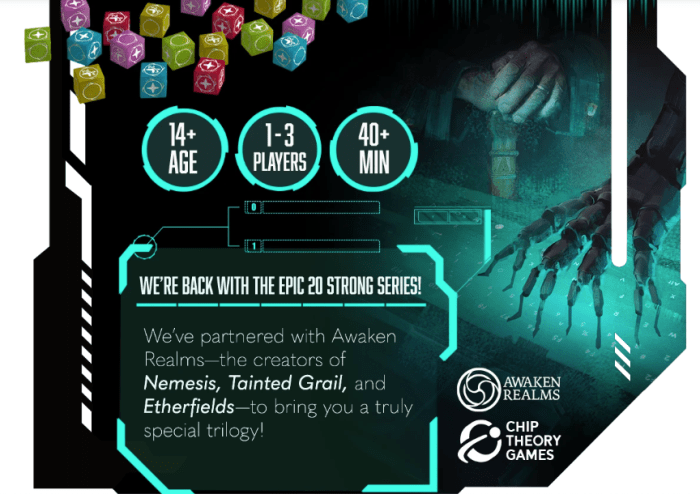
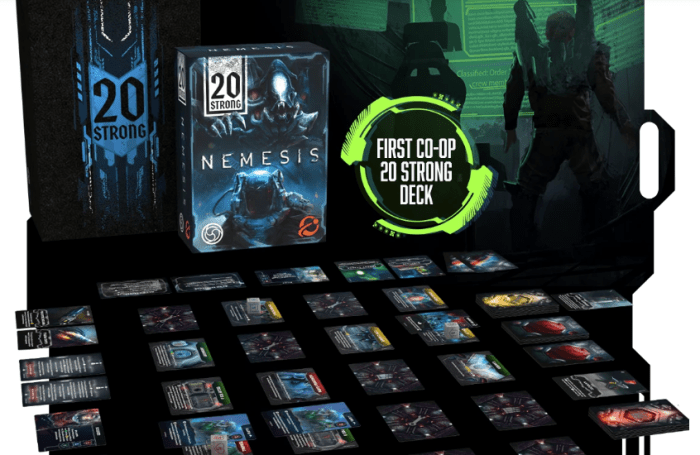
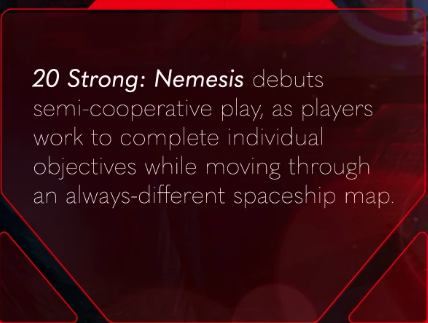
Why here?  Because it’s both solo and cooperative! See above from the Gamefound page!

Oh wait, is it cooperative?

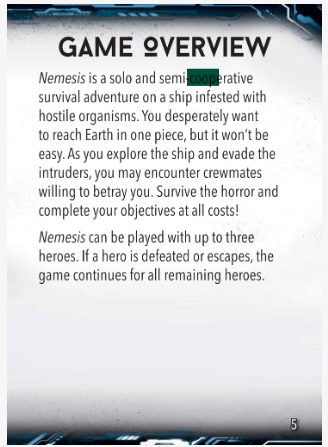
Or is it semi-coop? Hmm … looking on the Gamefound web page, there are literally only two mentions of it being cooperative and/or semi-cooperative! And those two terms are contradictory! The two above! Surely, the rulebook will clarify all! (And YES, a fully cooperative game is VERY different than a semi-cooperative game!)

Oh wait, now it’s cooperative again?

Or is it semi? So, the Gamefound site has two conflicting entries and the rulebook has two conflicting entries. Which is it?

Of course, anyone who knows Nemesis (the original game this is based on) knows it’s absolutely a semi-cooperative game (see Shut-Up and Sit Down video above: one of my favorite): it’s obviously a semi-co-op!

…but recent releases do make it cooperative. See video above!

What’s going on here? Which is it? Semi-co-op or co-op??? There were just enough suggestions that 20 Strong Nemesis works cooperatively (and I wanted to see what all the 20 Strong fuss was about), that I went ahead and picked it up and used it as my on-ramp into the 20 Strong system.

How was it?

Unboxing 20 Strong

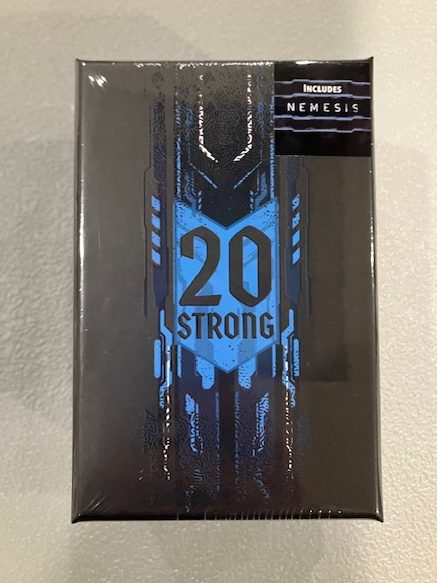
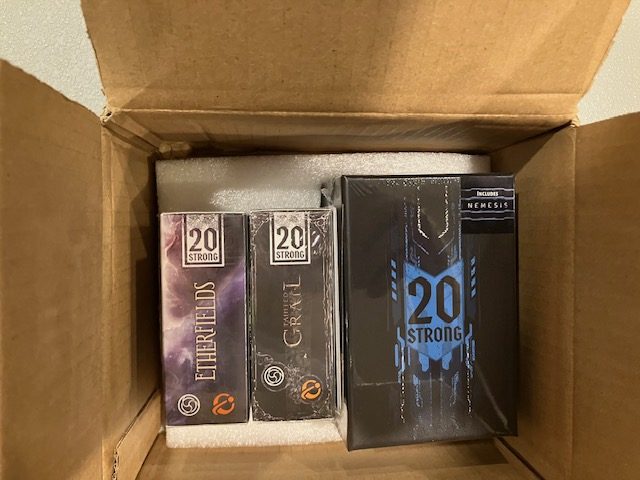
What I backed (with my own hard-earned money) included the 20 Strong Nemesis box, as well as the two solo boxes for Etherfield and Tainted Grail. See above. We will discuss the Etherfields and Tainted Grail boxes a little more later, but we are focusing on the 20 Strong Nemesis box for this review.

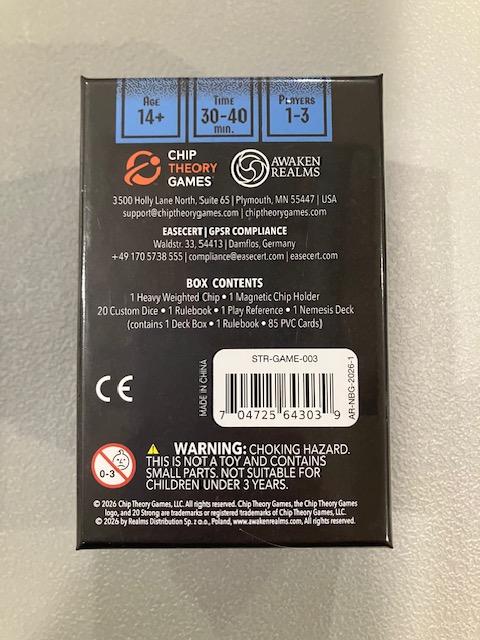
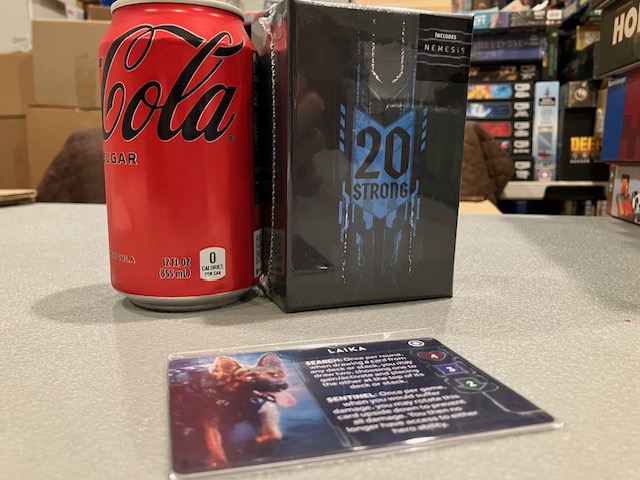
This is a surprisingly small box! See Coke can above for scale. What’s in this thing?

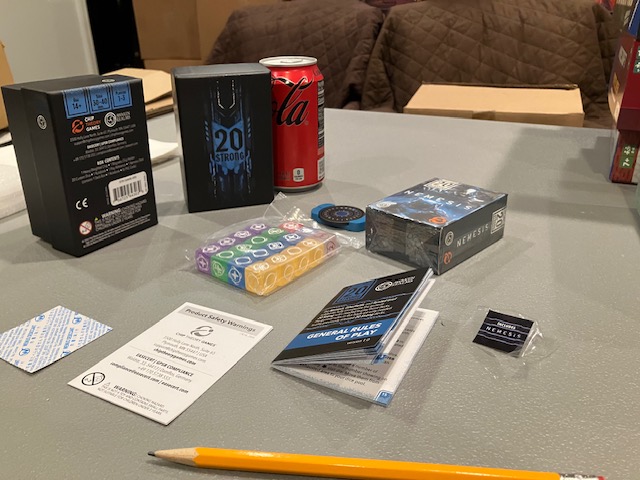
Some dice, a rulebook, a tracker, and the Nemesis box.

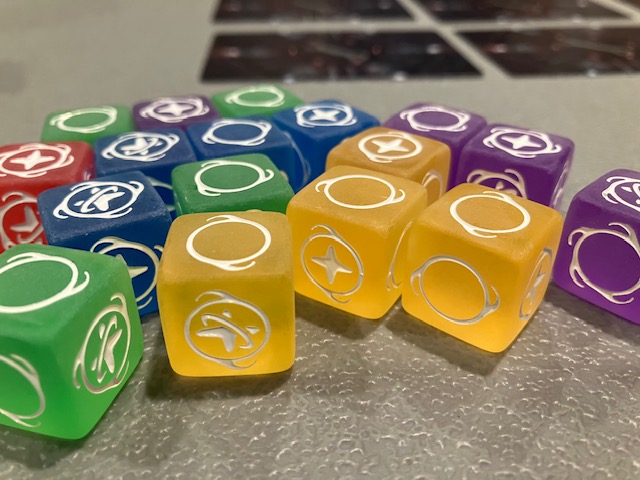
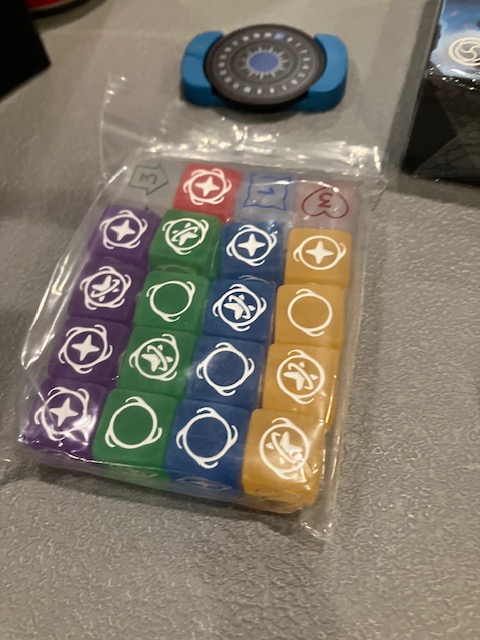
First of all, you have to understand a little about 20 Strong. 20 Strong is the fundamental backbone system of a lot of games; it’ s not really a game by itself.  It has 20 really nice dice (see above), thus the name 20 Strong !

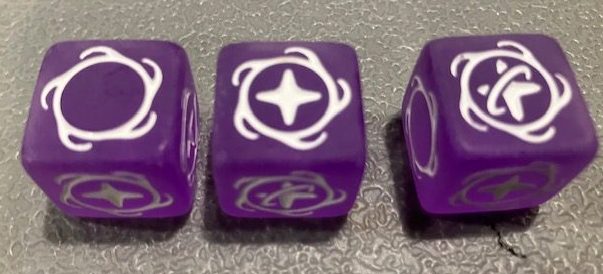
There are a bunch of generic rules about dice: misses (empty circle, left) and hits (+, middle) and critical hits (+ and more, right). The number of tendrils on the outer circle tell you how many of the 6 sides have hits or critical hits: for the purple dice, 5 of the 6 sides have hits!

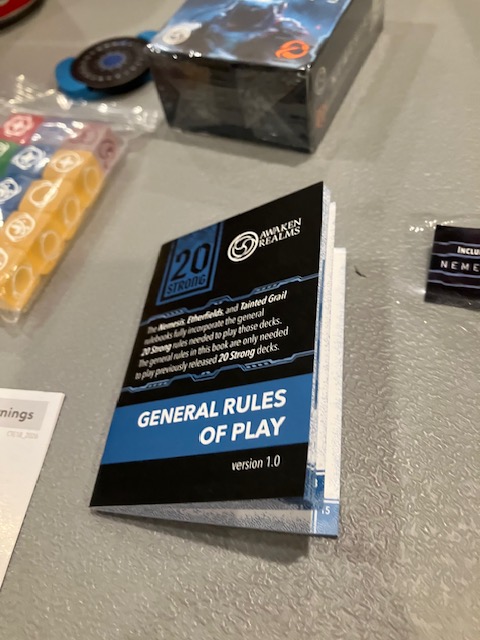
Each game in the 20 Strong system takes these General Rules of Play (see above) and adds/modifies/subtracts rules to make a new game based on this fundamental dice game.

Nemesis is the deck that sits on top of the 20 Strong system!

Unboxing 20 Strong:Nemesis and Gameplay

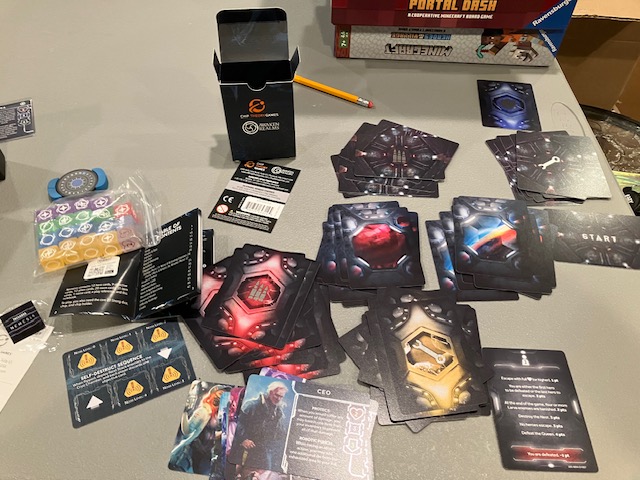
Nemesis 20 Strong card box itself has a bunch of cards; about 85 total. See above.

These cards are AMAZING! They are PVC, not cardboard, so you don’t need to sleeve them! They also all have some foil embellishments that make these POP on the table. These are amazing cards! They look great! And the art is great too!

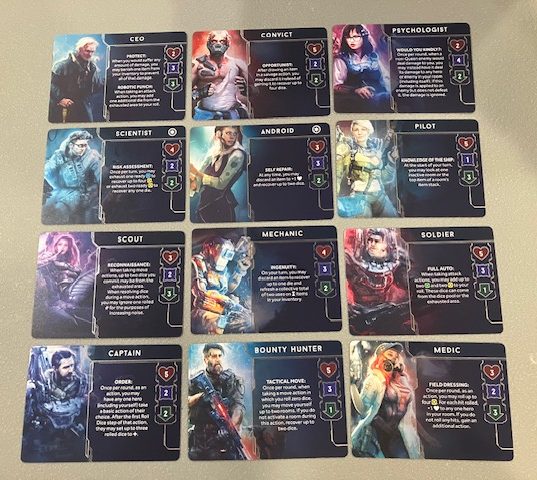
Each player chooses 1 of 12 characters to play. See above.

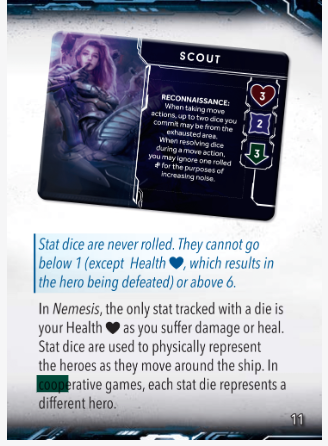
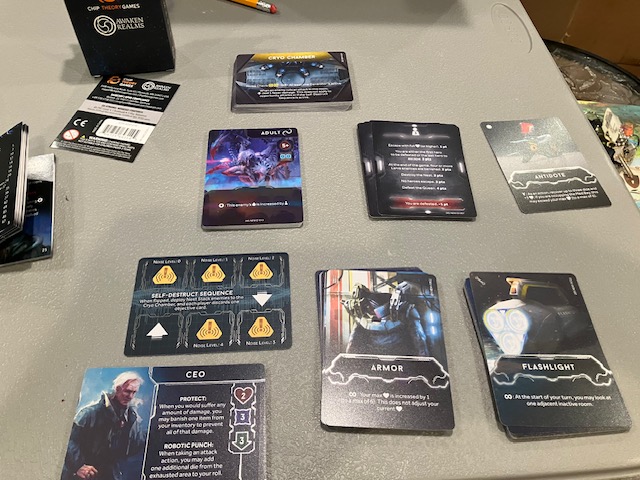
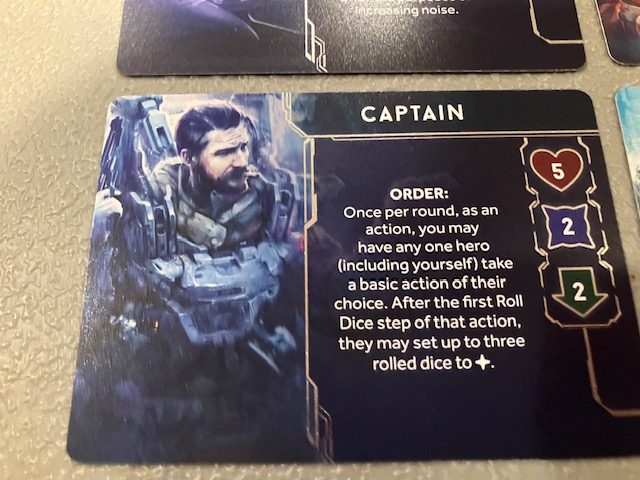
Each character has a special ability (see above) as well as some stats. The Red Heart is how many hit points, the purple thing is strategy (that controls some rerolls/retries and how many cards you can have), and finally the green arrow is how many dice you recover at the start of your turn.

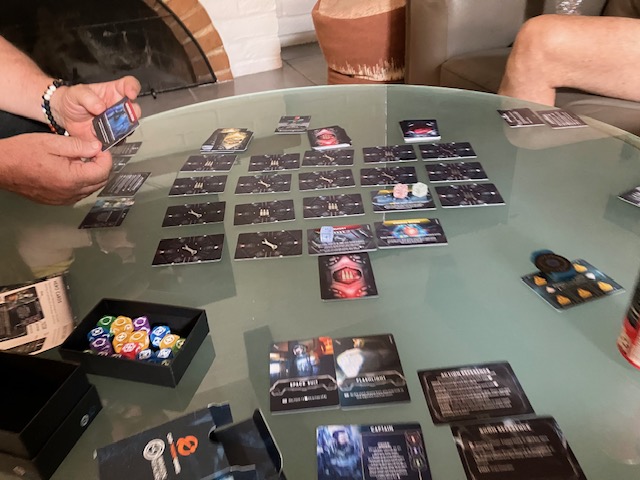
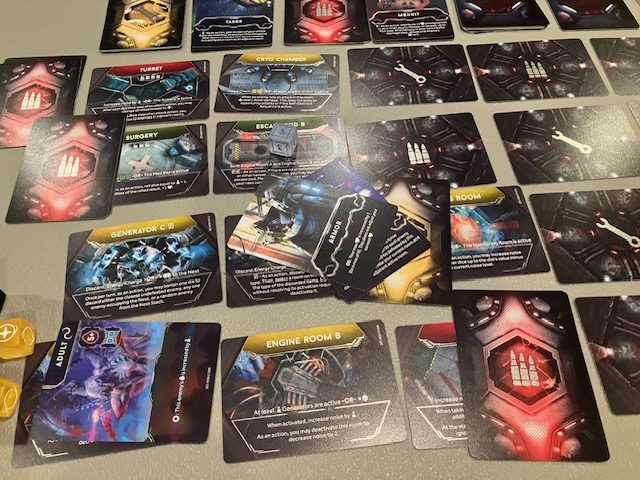
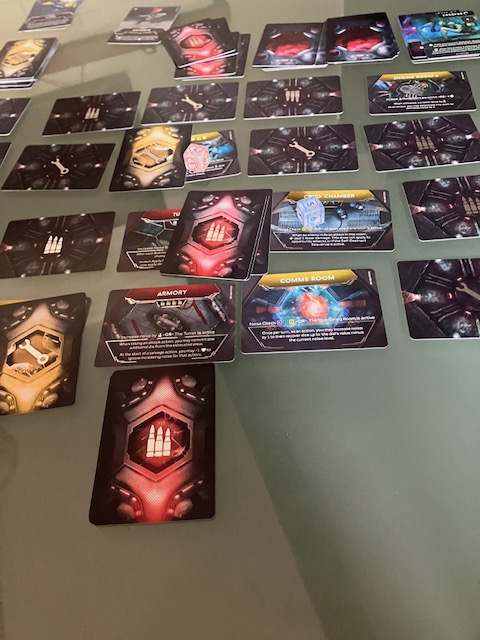
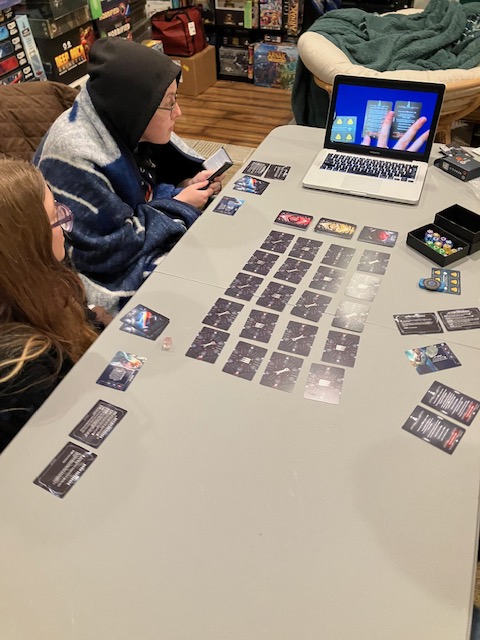
Players explore a 4×5 grid (4 rows, 5 columns) of Locations. At the start of the game, all Locations are face-down, so you don’t know what’s what.

As the game evolves, more and more Locations are revealed! To win the game, players must find the Escape Pods, but they can’t activate the Escape Pods until they activate the Engines, which they can’t activate until they find the Generators! It’s all about exploration!

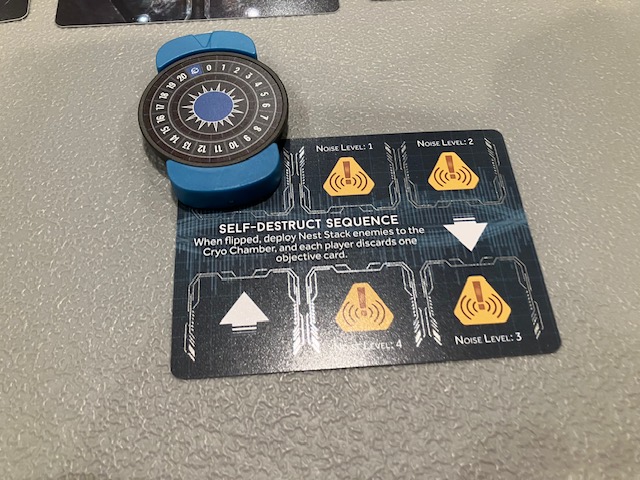
As you explore, you generate noise! There are actually a lot of ways to generate noise! If you ever roll a critical hit (far right) and apply it, it counts as noise! Many Locations also generate noise when you activate them (like turning on the Ship’s engines .. that’s pretty noisy, right?).

See the noise tracker above! Noise is bad!! Why? When the noise tracker comes all the way around, you accidentally summon an alien!

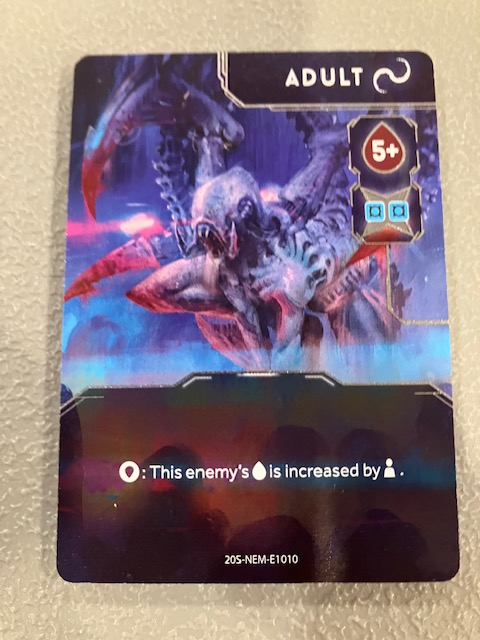
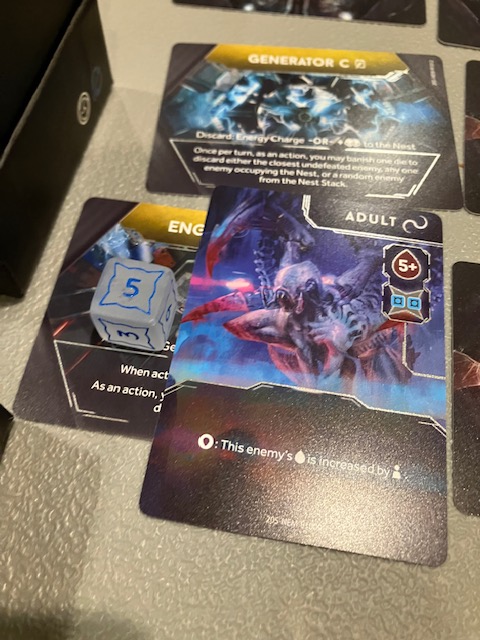
These are the aliens (which look nothing like Aliens from the movies) that hunt you and fight you!

The noise coming back around immediately summons an alien to your Location! Gulp! You better hope you still have some actions to fight it!

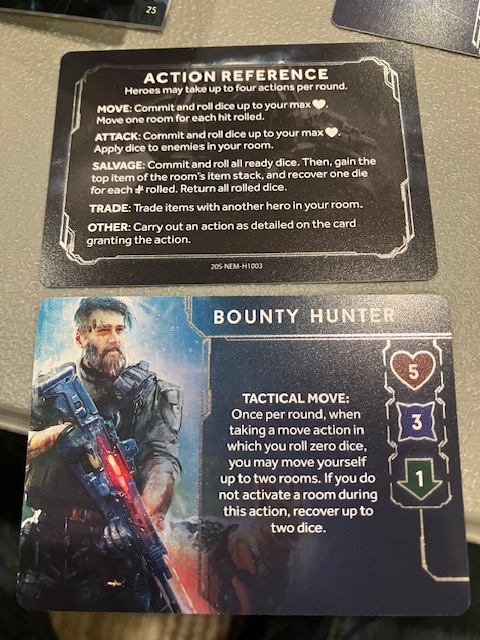
On your turn, you have 4 actions to move, attack, salvage, trade, and other. See the Action Reference (on the back of other character cards) above!

To be clear, the dice are key to everything you do here; every move, attack, salvage involves some of the dice.

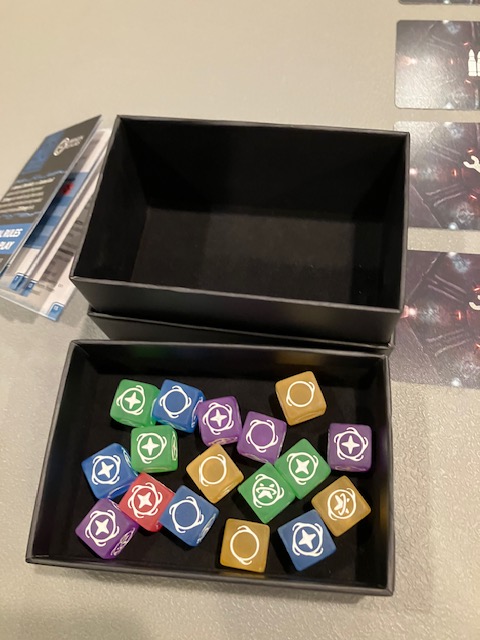
As you play, dice move from the active to inactive pool! You have to decide how many dice to allocate on your turn! And which dice! Every color die has its own number of successes! The yellow dice are the weakest, and the red die is the strongest! (And you don’t always want to strongest dice on your turn; at the end of your turn you may generate even more noise using the strongest die used!). Let’s be 100% clear: this is a dice game.

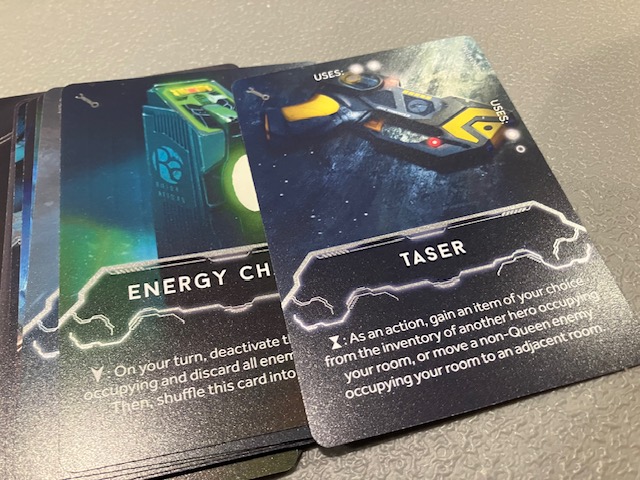
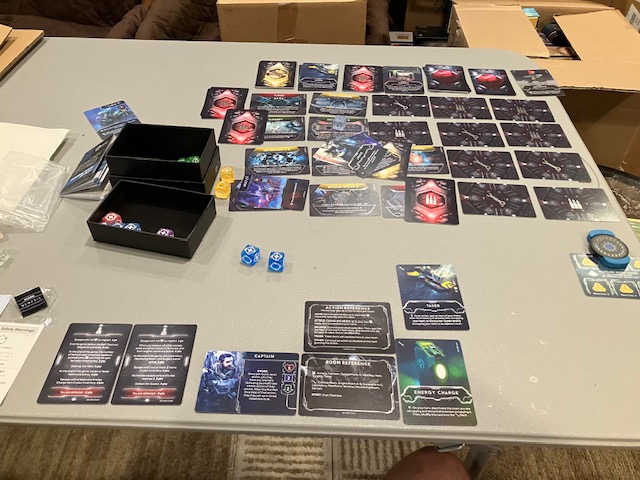
Along the way, you can also pick up items when you salvage; see above as I have a Taser and Energy Charge.

If you can escape the ship in an Escape Pod, you “win!” But, winning is very different if you are playing cooperatively or semi-co-op!!

Cooperative vs. Semi-Cooperative

All right, let’s address the alien in the room: is this a cooperative or semi-cooperative game? The answer is VERY much not answered by the rulebook! Nor the Gamefound site! Like I said, both allude to both co-op and semi-co-op natures, but neither really answer the question.

The answer seems to be very much answered by the official How To Play 20 Strong: Nemesis video from Chip Theory games (the publisher). See above.

Semi-Co-op for the Win!

The answer? This is very much a semi-co-op. I guess that’s a “Well, Duh” to most people. But, after “trying” to play it cooperatively, this game can be played cooperatively, but it’s just not as strong. It’s really how you deal with the objective cards in the game more than anything.

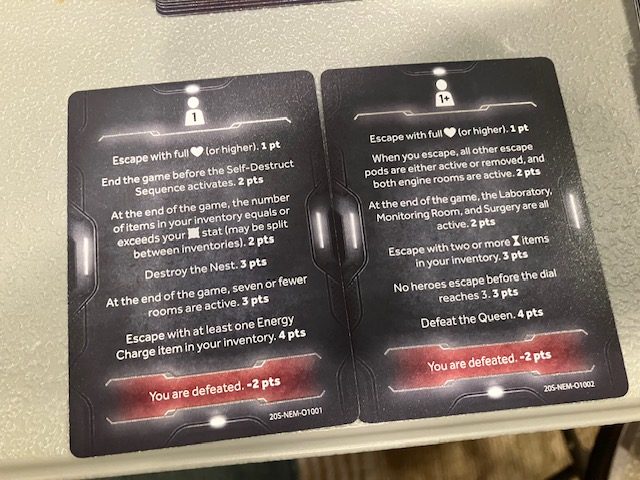
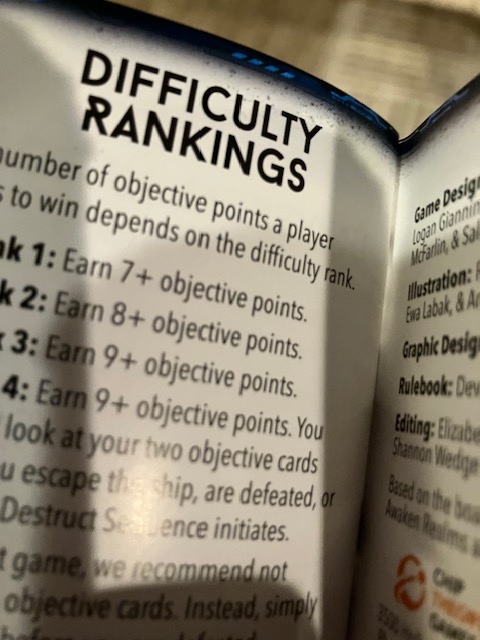
At the start of the the game, each player gets two objective cards. At a certain point in the game (when the round dial counts down to specific placed based on the difficulty and player count), you must discard one or the other: this defines how you get points for the rest of the game! This defines your play-style: do you screw your compatriots for points or play nice? The objectives majorly inform your style!

In the semi-co-op game, you are trying to get the most objective points to win! That’s it!! If you die (pardon me, are “defeated”), you can still win if you can get more points than the other players! So, in the semi-co-op game, everything you do is in the name of getting points: you may lie about what Locations you discover, you may lie about what your objectives are, you may lie about what you are trying to do. You do not HAVE to show the Locations you find, you do not HAVE to show your objectives. You may work a little with the other players to discover the ship, but in general, you are trying to get the most points.

In many ways, 20 Strong: Nemesis is Nemesis: the dice game. Cooperate a little, but lie lie lie.

You Can Still Play Cooperatively

But, you can still play Strong 20: Nemesis fully cooperatively; no lying. Unfortunately, the rulebook kinda sucks, and all the things you have to do to “really” play cooperatively aren’t “really” spelled out. Here’s what we discovered to play cooperatively:

  1. You have to share and discuss your objectives pretty heavily out-loud! There are plenty of objectives that are truly mutually exclusive, and you need to talk so everyone can “do the right thing” to make it so everyone can fulfill their objectives!
  2. You need to specify the “fully cooperative” win condition! After playing many cooperative games, the fully cooperative objective seems to be “all players must escape and have enough objective points!” I think all players need to survive and have enough points to call this a win. I “guess” if a player dies, but still somehow has enough points, they are considered part of a winning team?
  3. You need to communicate well. No lying.

The worst part is that it’s not 100% clear what the win condition should be cooperatively! I think everyone should escape AND have enough objective points? But I can also imagine a scenario where one player dies by making the ultimate sacrifice to help the others. but can still is in the winner’s circle because his objective points were achieved.

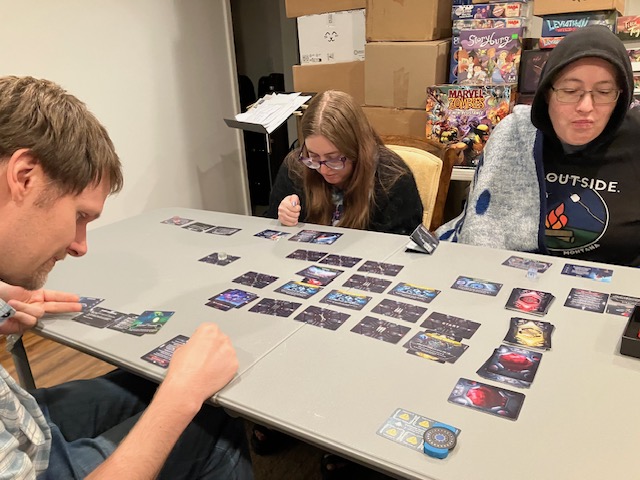
I taught/watched a 3-Player cooperative game, and my friends did a great job cooperating! They had to figure out a way so that everyone escaped the ship with at least 7 objective points! They talked about their objectives, they talked about how to meet them, they talked about how to help each other meet their objectives!

It was surprising just how cooperative this game can be, if you just know what cooperative rules should be. The rulebook could have easily had a few pages distinguishing semi-cooperative play from cooperative play. And a co-op mode does seem to work.

But as-is, 20 Strong: Nemesis is a semi-co-op.

Rulebooks and Rules

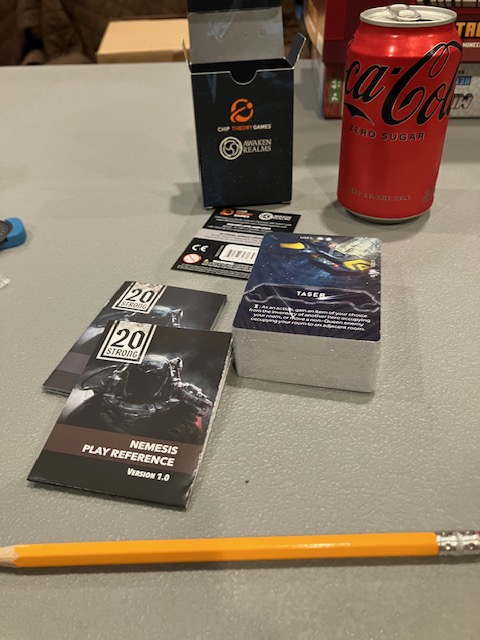
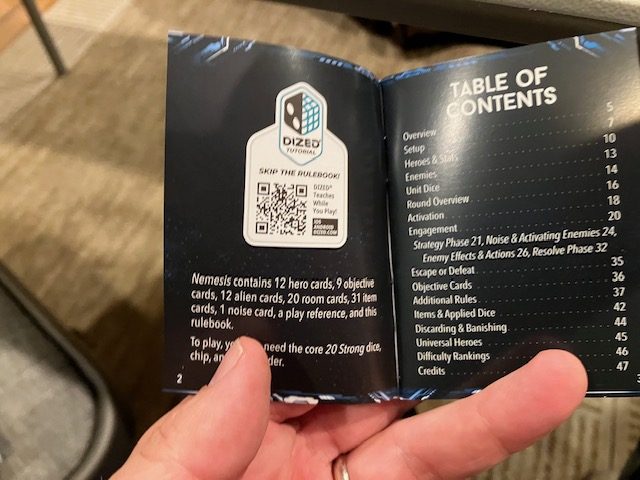
I did not like this rulebook. First of all, it said to try out the Dized tutorial! Not available yet! (at the time of the play).

This game probably gets a D on the Chair Test! As much as I hate the form factor (as it was tiny and small), they did a good job with the font: I could read it.

There were a lot of things that weren’t really well specified. I had to re-read the rules several times (what does the turn timer start at? What does a crit hit do when I attack? The aliens attack? For a noise check? The crit means different things depending on the context! ) I ended up going to the official How To Play video from Chip Theory games, and I still didn’t get everything answered! (The Strategy component is not really explained in the video at all).
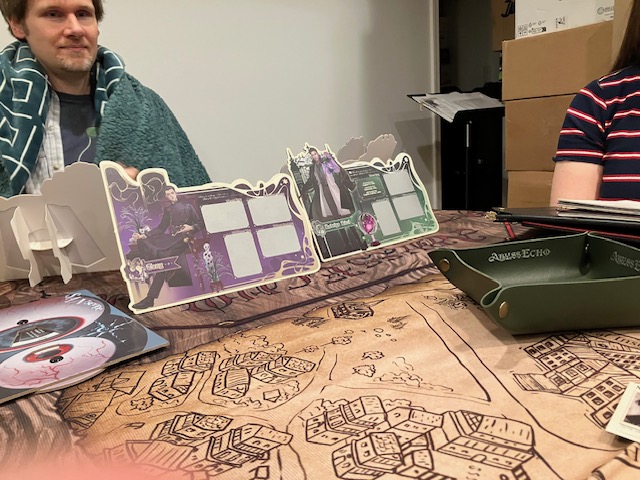
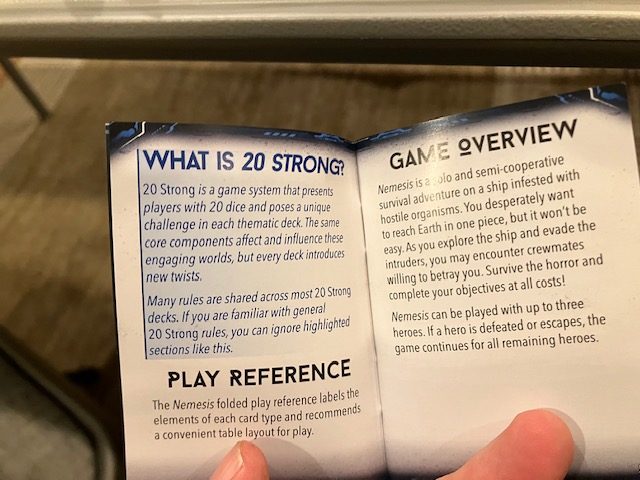
It really took about 5 plays to get the rules down. For a “simple” dice game, I was very frustrated. Part of it was also the fact that the base 20 Strong rules are interspersed with Nemesis rules, and it’s confusing: see above.

I recommend watching the How To Play Video from Chip Theory games, and hopefully the Dized tutorial will be online by the time you read this. But you are still gonna have to read this little rulebook a little. I didn’t love it. I hated the form factor.

Solo

You can play solo. I played a few games solo to get the feel of it. You can even play true solo and only play one character!

I won. It was ok. It was .. fine.

Reactions

The reactions … weren’t great.
Ralph: It was ok.
Sara: 5/10. I’d play again if someone wanted to, but only fully cooperative. I’d never play semi-co-op.
Andrew: 5/10. Same
Teresa. It was ok 6/10. I’d never play semi-co-op
Rich: It was ok solo. 6/10. I think the co-op was better: 6.5/10. I also would never play semi-co-op.

Conclusion

I really wanted to like 20 Strong: Nemesis, but me and my groups were pretty disappointed by it. Some of that disappointment was that the co-op wasn’t great, but 20 Strong: Nemesis is really probably best as a semi-co-op. This is management of expectations: you can’t really like a cooperative game if it’s really a semi-cooperative game.

I think if you take 20 Strong: Nemesis as what it is, as a semi-co-op, then it’s pretty good. I think objectively that it’s probably a 7.5/10: it’s a shorter, faster, stream-lined version of the original game of Nemesis. You may love it!

If you take it as a cooperative game, the rating drops to a 5 or 6 for my friends; I was highest at 6.5/10. (Solo was just “ok” at 6/10).
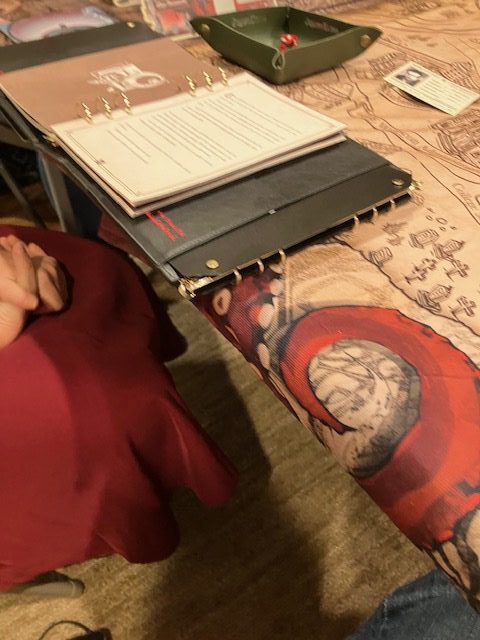
The weird thing is that watching my friends play it fully cooperatively (which is really not an official version), it was pretty darn cooperative! They were talking and working together so well! I have to be honest, I’m not sure what it would take to move this up just a bit more: there is a good cooperative game in here, I just think it needs something else. I saw the cooperation happening! I saw the discussion of mutually exclusive objectives! There is something here! I just don’t “quite” know what’s missing for this to be a good fully cooperative game?
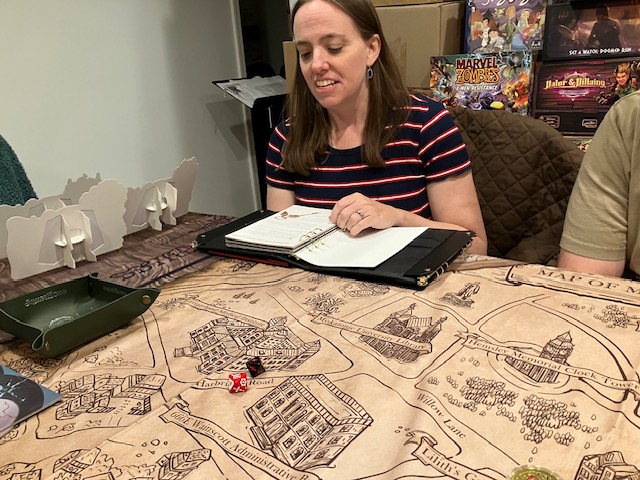
If you are looking for a good fully cooperative spaceship exploration game that’s short and moves around a grid, I would recommend Solar Storm instead of this (see review here); Solar Storm made our Top 10 Cooperative Games of 2020!

Stupid Fun. A Two Word Review of Camp Grizzly: Second Edition

Stupid Fun. That’s all you need to know about Camp Grizzly: Second Edition.

What? You want to know more? Ok, we’ll talk a little more about this.

Stupid, Random, but very Thematic Fun! There! Is that better?

No? That’s still not enough? All right, all right …. we’ll look a look closer at this cooperative (yes, it is cooperative, that’s why we are here) horror game.

Unboxing

This is the second edition of the silly cooperative game called Camp Grizzly. See Coke can and box above for scale.

I backed Camp Grizzly:Second Edition from Kickstarter back in August 2025, and it arrived at my house in early July 2026. It arrived early! It was originally slated to arrive August 2026!! What? An Early Kickstarter??? That never happens! I was on the fence for backing this, but it was Mike Heller who convinced me this was a good choice! The game I backed was the Limited Release version with lots of acrylic tokens and standees.

Acrylic Standees

I am embarrassed to say that one of the reasons I was so excited for this game was the Acrylic Standees! The version I got (Limited Release) comes with Acrylic Standees that are so funny and goofy and thematic! See the full bag above of them!

The Acrylic Standees work SO WELL for this game! The art style is very “comic booky”, and I find that style works really well with Acrylic Standees: The colors are more vibrant and just pop!

There’s a LOT of them too! See above!! Why so many? Because this particular version comes with 8 expansions, and some of these standees are just for the expansions that come in the box!

Note the two above; the lady on the left has no “symbol” on the bottom of her standee, so she’s a base game character. The lady on the right has a bottle-looking symbol: she’s from the Spin The Bottle expansion!

Some of the expansions have a TON of standees! See all the Mountain characters above!

I adore the Acrylic Standees; they work so well! If you have a chance to buy and/or play Camp Grizzly: Second Edition, try to get the version with the Acrylic Standees! I think they are that great!

Gameplay

The premise of this game is simple; have some Counselors survive Otis and make it to the Finale! If all Counselors die, everyone loses! If some counselors survive, everyone wins! Let’s be 100% clear; some of the Counselors will die!! And possibly you might die!! But don’t take it personally.

Otis (see above) is at Camp Grizzly and he is the BIG BAD HORROR monster chasing the Counselors! Otis is the amalgam of Jason, Freddy Krueger, Micheal Meyers, Leprechaun (blah) and all your “favorite” horror movie baddies! Just to be clear: no player is operating Otis and hunting the Counselors: the game plays Otis via some rules.

There are several modes of play in the game: Modern Murder Mode and Classic Action Mode.

In Classic Action Mode, the players choose 6 Counselors (see all Counselors above; some are from expansions) and the players as a group operate the 6 Counselors: there are always 6 Counselors (well, until they get killed … and they probably will …).

In Modern Murder Mode, each player takes the role a single Counselor: one character per player. If your Counselor dies, you get another one.

And just a reminder, in case I haven’t mentioned it yet, counselors will die.

Counselors each have a Special ability to help them! Kevin (see above), for example, may move to a fight and gets +1 during BOAT finales! Kevin only has 5 hit points (note, it’s NOT the number next to you: that’s your movement). Notice that the healthier you are are, the faster you move! At full health, Kevin moves 3 spaces per turn, but as he gets wounded, his movement degrades to 2 then 1 (and then with a second wind back to 2)! If Kevin ever PANICS (yellow bam), he can run up to 2 away.

The players choose a Scenario (as specified by a number of cards) and set it up!

There are a number of set-ups of different difficulties. The game recommends starting with “Quick and Dirty”: see above.

After reading the flavor test (whosoever is the most dramatic and over-the-top reader should read this), the other side gives the set-up for the game!

The set-up puts the characters, Otis, and some Objective Tokens on the board.

The Objective Tokens have various things on them (First Aid Kit, gas, rope, … other things). The players are trying to the objective tokens so as to trigger one of the end Finales!

There are 4 possible finale-triggers at the 4 corners of the board; the BARN, the BOAT, the VAN, the RANGER tower: see above.

If you can get the three Objective tokens (keys, crowbar, battery), you can move to the Ranger Tower and initiate the Finale!

Depending on which tokens you get (they are all hidden at the start of the game), you may have to run to the VAN or the BOAT instead! Each finale needs different resources! (To be clear, there are a lot of finales; it looks like 24 for my version of the game).

The finale can be SO VERY different! One of them is a Barn Dance, where you have to roll dice and try to get a certain match! In another, I had to sacrifice one of the Counselors! … and each one is really different.

As the game goes on, Otis gets more and more terrifying! He starts to move faster, attack for more!

Basically, as the Body Count goes up (yes, there’s a body count track), Otis slowly get more powerful! Funny, even if the Counselors don’t die, there are extras that die all over the place: Cameos and other NPC campers.

If players can’t trigger a finale, and the Body Track gets too high, there will be a final fight instead!

Along the way, you’d better hope you find some stuff to help you! Sherry was lucky enough to find the Chainsaw and Slicker! See above!

There’s a Cabin deck that players will draw from every turn, and a Survival Deck you can get lucky and draw from occasionally. What’s in the Cabin deck? So much random stuff!

You might get good stuff … like the Slicker …

You might get a Cameo by a famous actor (who will probably die very quickly) …

You might get a Plot Twist, which screws you!

… or you might get Otis Strikes!

You can fight Otis (a little), but generally he overwhelms you and you take damage. If your Counselor runs out of hit points, you either just die (Classic Mode) or respawn a new character (Modern Murder Mode).

Survive the Finale or the Final Fight and you win!

Rulebook

The rulebook is generally pretty good.

It gets a D- or an F on the Chair Test, as the rulebook is the same size as the box, and hopelessly droops over the edges. You might be able to use it on the chair next to you, but maybe not. It’s too bad, because the rulebook is pretty good otherwise.

I wish the rulebook had an Index; there are a few too many concepts and/or keywords, so I wanted to look stuff up quickly via an Index.

Solo Game

So, Camp Grizzly: Second Edition works as a solo game! (Thanks for following Saunders’ Law!) Interestingly, because there are two modes to the game (Classic and Modern), you can choose to either play 6 Counselors at once as the solo player in the Classic mode, or you can play true solo in the Modern mode, and play just one Counselor!

I opted for the true solo game with one Counselor. See above as Jody decides it’s a good idea to stay at camp alone at night! Wait … maybe that’s NOT a good idea …

Jody died pretty quickly, but C.J. stepped up (“spawned”) after Otis killed Jody! The great thing is that C.J. was that he was able to pick up all the stuff Jody dropped when he died! See above! This is really thematic that you can loot the dead bodies!

Now, C.J. made it to a Finale at the Ranger Tower! And what happened?? Because there was only ONE Counselor alive, C.J. had to be sacrificed! If there had been TWO Counselors, we could have won, as one of us had to die … but as long as at least one Counselor survives, we win! I COULDN’T WIN! No matter how I played the true solo mode, I couldn’t have won .. at least with this Finale.

Huh. I wasn’t frustrated. I thought it was kind of funny! Are all scenarios this poopy for the solo player?

I set-up the same intro scenario and had Sherry run this one by herself!

Sherry did MUCH better than C.J. or Jody! She made it all the way to the BARN Finale with no wounds and a CHAINSAW!!

The BARN DANCE was a very different Finale! Sherry had to roll some dice to survive … and she did not survive.

Sherry died. So I lost again. But I could have won … I am beginning to think I actually would have had a better chance with at least one more Counselor. I am beginning to think 2-handed solo (2 Counselors in Modern mode) is probably the best way to play solo?

Again, you might think I was frustrated that I lost. Nah. It was goofy fun. You have to realize .. these games were very quick! Once you get into the groove of this game, I think my second solo game took 45 minutes? This game moves quickly. And you really can’t take it too seriously.

Cooperative Mode

So, when I first looked at Camp Grizzly: Second Edition on Kickstarter, the game is billed as “semi-cooperative”; see above!! I actually didn’t back it at first when I saw that!

I don’t think that’s quite accurate. I think a strict playing might be “only the players that survive” are the winners. But the thing is, it’s almost always in your best interest to keep many Counselors alive! I have seen a number of Finales now, and it always behooves you to have more Counselors! The more Counselors you have, the better chances you have of surviving and winning!

Even the rulebook points out: “look, if anyone survives, y’all win”. It’s cooperative! Mostly; even when you have to screw other players (like when we had to sacrifice a Counselor), it’s still in the name of common good! As long as one Counselor makes it out alive, you all win!

The basic cooperative game was pretty easy to explain and jump into. I didn’t have too many problems teaching the game.

The Finale was actually a little harder to explain and how it worked.

This game reminds me a lot of Betrayal at House On The Hill! The Finale was “wonky” and we had to try and figure out what the card meant! I have to admit, I had this problem a little in the solo game too! Each Finale you trigger is very different, but it means the rules aren’t quite as well defined because they are different every time! Luckily, this is a cooperative game (unlike Betrayal At House On The Hill), so you players can discuss “What does this mean?” One of the problems with Betrayal At House On The Hill is that the environment is so tense and antagonistic because you can’t ask questions… because that might give something away! At least here in Camp Grizzly, the wacky Finales can be discussed as a group.

And we definitely saw what “could” be semi-co-op nature of this game!!! We had to leave poor Teresa behind because her movement had dropped to 1! There was no way she could make it to the Finale in time! So, we had to trigger the Finale and “leave her behind”. If this had been a true semi-co-op, Teresa would have just lost. But, like a Horror movie, even if your favorite character dies, you still hope the Counselors will survive! The flavor of this game was cooperative; we aren’t gonna win if we have to wait for Teresa, so we all made the decision to leave her behind! And she was cool … she was just hoping one of us would survive!

In the end, Sara just barely survived the Finale: both Andrew and I died in the Finale, but since Sara survived, we all won! Hurrah! It was a bummer to die, but we “knew” we won!

So, our game was over in about an hour. The game moved quickly, and was “generally” easy to teach! I did have to look up some rules in the rulebook as we played, but it wasn’t too bad.

I think this game is simple enough that a group could learn this “cold” at a Convention without too much trouble. This probably could have made our Top 10 Cooperative Games To Play at Conventions! It is very simple to learn.

Thematic

Growing up in the 80s, I was forced to watch a ton of Horror Movies with my friends. CC and Sloppy loved the horror genre, and I didn’t. But they outvoted me many times! So, I watched a lot more Horror than I expected to as a teenager. In fact, I was once made to watch ALL 7 Leprechaun Horror movies! (Yes!! There are 7 Leprechaun movies!! I think there are more now)!! It was to settle a bet: Which Leprechaun was the best one? CC liked Leprechaun 1 the best, but Sloppy liked Leprechaun 2 the best! But, of course we had to watch them all! (I liked a different one: Leprechaun in Space the best).

All of this is to say, I was exposed to a lot of Horror tropes! And Camp Grizzly nails the theme! Cheerleaders! Chainsaws! Cameos! The big three Cs! And this game does NOT take itself seriously.

But it nails the Horror theme and tropes perfectly.

Randomness

Jody died very quickly in my first because he had bad luck. C.J. did great and made it to the Finale, but lost because of bad luck. There is a LOT of randomness and luck in this game! You absolutely cannot take it seriously! You may die right away. You may win easily. You may get screwed by Otis or a die roll or a bad card draw or ….

There’s a lot of luck in this game. A lot.

Camp Grizzly reminds me a lot of Tales of Arabian Knights: see our review here. The advice we give when we play Tales of Arabian Nights: Don’t take it seriously; play and have fun! I think I like Camp Grizzly better than Tales of Arabian Nights for one major reason: it’s shorter! A Tales of Arabian Nights game can take 2-3 hours! Camp Grizzly? Dead in 45-60 minutes!

As long as you know this game will random and silly, I think you will enjoy it! Just don’t go in expecting a big thinky thing.

Reactions

Not everyone loved this.

Sara said it was “Fine”. That’s a 6/10 for her.
Teresa liked it. That’s a 7/10 for her.
Andrew said it was fine, but he’d prefer Tales Of Arabian Nights over this. He’s probably a 6.5/10.
Rich liked it the best. Maybe a 9/10?

Conclusion

Camp Grizzly is just stupid fun. It’s random, it’s goofy, it’s unfair, but it nails the horror movie theme and tropes! And it’s only 60 minutes!

If you think you would enjoy the Horror theme and like the idea of a stupid fun game, this game is for you. If you don’t like the Horror theme, Tales of Arabian Nights (see review here) or Tales of the Arthurian Nights (see review here) might be better choices for you: they are both silly story games like Camp Grizzly, but with different themes.

The problem with being stupid fun is that some people will just think this is just stupid … without the fun. My friends were more middling on this than I was: they gave it between 6 and 7. I gave Tales of Arabian Nights a 9/10, so I think I have to give Camp Grizzly something similar: 9/10. Tales of Arabian Nights has more “story”, but Camp Grizzly is over so much faster! Both are pretty darn random.

Stupid fun.

Clark Kent Robs a Train? A Review of The Glasgow Train Robbery

The Glasgow Train Robbery is a 2-Player only cooperative game that was on Gamefound back in April 2026. I backed it, and it delivered to me in late June 2026. That’s right, only 3 months from crowdfunding to delivery!

This is the story of the Great Train Robbery of 1963 (see wikipedia entry here)! Yes, this game is modeling a real event! Two players work together to try to pull off that same train heist! This is an asymmetric cooperative game with limited communication for only two people!

Let’s see how well in works!

Unboxing and Gameplay

See Coke can above for scale.

This is a dual-language product: Spanish and English. See above for the two rulebooks that come in the game!

Some cards are language independent (see middle set above) and other cards are definitely tied to a language (the same card in English on the right and Spanish on the left).

I had to spend a little bit of time separating the two out. In the end, I put all the Spanish cards together with one rubber band and just put it back in the box.

The two players are playing very asymmetric roles in this game. One player plays the Glasgow side, playing the Coordinator. See above. I wish the game had included ome way to mark which side was which, so I made my own little cards!! The Coordinator is all about supplies and handling the first four stages of the Plan for the train robbery! The first four Plans are all about the set-up and execution of the robbery!

A Plan (level 1 above) is executed by spending the resources (on the left side of the card) when the train is at the location (upper right on card) with appropriate characters (upper left of card) next to it! So, you need resources, minions in the right place, and the train in the right place! Whew! Now, you can resolve a Plan card, even if you don’t have all the resources, but the penalty is listed on the bottom of the card for EACH resource you can’t pay! In this case, you add more fingerprints to the bag.

This is also a bag-building game to some extent; the bag is filled (very carefully and specifically) with resources that you may need to complete challenges. The big is filled and emptied (usually only) when players REST for an action.

The resources (see above) are all tokens you can collect by either drawing from the bag (at certain points in the game, usually a REST), visiting a hideout, or having a special card! These resources are “criminal” resources: gloves, guns, rope, etc (see above) needed for the heist! These resources are surprisingly sparse; it’s harder to get resources than you think.

The resources are usually managed by the Coordinator: the Coordinator’s side has a house with all the resources. When it’s time to put resources in the bag (during a REST action), one resource is put in for each person in the room with that resource! The Coordinator moves people around the house (and outside the house to help), so this is a delicious tension! When should the Coordinator use his precious turns to move people in the house (so we can have more rope in the bag at a REST) or when should he move people OUTSIDE the house because the other guy needs more help?

The Operator is the other side (in London). Once the people have left the house, the Coordinator no longer controls them; only the Operator may move them! The Operator’s job is to have people in the right place at the right time! The Operator is also given the unenviable position of dealing with unexpected “issues” that crop up! The game calls these issues Contingencies.

Contigencies are kinda similar to the Plan cards; they are resolved by discarding resources, but you have to have enough characters next to the landmark to resolve the contingency! See above. If you don’t take care of contingencies, they cause time to expire sooner, fingerprints to explode, and make the game end faster.

This is a limited communication game; you can occasionally discard a card to say “3 keywords” and tell the other player what you need. RED-BLUE-TOWER probably means “get a red guy and a blue guy next to the water tower so I can complete phase 1 of the Plan!”

This is very much an asymmetric game; each player has special decks (Coordinator or Operator decks), different ways to operate, and different actions! If you can get solve stages 1-5 of the Plans without leaving too many fingerprints before the Train gets to London, you win! Whew!

This is a really interesting looking game with its own “style” of art! I think it looks pretty neat.

Clark Kent is Robbing a Train?

When my friend Teresa first saw the game box, she said “Is Clark Kent robbing a train?” I had to tell her, no, he’s not, but I can see why she said that.

I think the game art is meant to mimic some known pictures of the original heist members, and if you look at the pictures from Wikipedia on The Great Train Robbery … that one guy on the right looks suspiciously like Clark Kent.

Solo Play

Let’s be 100% clear; this is ONLY a 2-Player game! There is no solo mode at all. None. No Saunders’ Law here!

And yet, solo was the first way I played!!! And I recommend you play solo the first time as well! What do I mean by this? This is applying the Changing Perspectives idea (see link here) where you “pretend” you don’t know what the other player knows, and try to play the game without using the other character’s knowledge. In this case, you alternate between the Operator and the Coordinator characters, but “pretend” you don’t know what Plans/Contingencies they have!

It is a little wonky to play the game solo like this, and it’s also hard! You can only use the information on the board and the keywords communicated to inform your decisions! It’s also very instructive to think: “Ok, if I didn’t know what the Operator’s Plan’s were, and only the keywords they’ve told me, what would I do?” This is a really interesting thought experiment. It’s also a better way to play solo than I thought it would be. It does work, but you just have to have the mental discipline to not “cheat”!

Even if you hate this idea of the Changing Perspectives, it’s a great way to learn the game: you get to play both sides, you get to see what operations are available, you see when it makes sense to communicate, and you see how the game flows. I also recommend physically switching sides when you play one position or the other: you almost have to because of the way the game sets-up! I strongly encourage this physical switching; it really throws you into the appropriate character when you are in their physical shoes!! (I don’t recommend changing shoes every time you switch sides; that’s too much).

Play the game solo once using Changing Perspectives idea, then you can decide if you ever want to play it again solo. I think I do? But, more importantly, I can now teach my friend how to play!

Cooperative Play – Two Players

Of course, the real way this is meant to be played is 2-Players! On opposite sides of each other! We can see the guys and gals we have in play and their specials, but we can’t see each other’s Plans or Contingencies.

I’ve played a few 2-Players games now (with first Teresa then Sam), and it’s clear that first game is absolutely a teaching game. The Glasgow Train Robbery has a lot of systems and rules, and seeing how all these systems interplay is complex! My first games with both Sam and Teresa were both losses. Because they are learning the game!

After we lost, we talked about “WHY” we lost! “Oh, I need to move the people out quicker so they can have more stuff” Oh, I need to be communicating sooner”, etc. Let’s be clear; it does feel like we have enough agency to affect the endgame; we just need to know what to do with that agency!

This is an odd game with lots of systems, but it works as a 2-Player game. The Limited Communication takes a little getting used it (you can really only communicate using keywords when you take that action), but it does work. It even seems thematic to a certain degree, because it was a lot harder to communicate back in 1963! No cell phones! Fewer phones!

Those first few games take about 2.5 hours. The box says 60 minutes. This estimate seems really wrong, unless you have mastered the game.

What I Liked

Style: The art style and graphics design is “quirky”, but it works. It is very readable as well.

Quirky: Everything about this game is quirky; the art, the gameplay, the actions, the limited communication, the gameplay, the asymmetric sides, it’s all so … quirky. But it works.

Monopoly: In the original real-life heist, they literally caught some of the people by finding their fingerprints on the board! And this game models that mechanism! The more people people in a room with the Monopoly token when you REST (see above), the more fingerprints get thrown in the bag! If you ever run out off fingerprint tokens, you lose! The police caught you!

That’s right, this game penalizes you for playing Monopoly, like it should.

What I Don’t Like

Keywords: When you communicate to the other side, you can “only communicate in keywords” (see rules above). But, it literally never defines what a keyword is! The only two uses of the word “keyword” are on page 17 of the rulebook (above). They give an example of a communication, which gives you a sense of what a keyword might be! But it’s very frustrating they don’t define this! Can you use numbers? Character’s names? Can you use purple to imply red + blue? It seems like you might be able to be smart and come up with a code and get more info out! For a game where limited communication is such an important part of the game, this really needed to be more clearly defined. What you can/can’t communicate is poorly defined, and it will affect your gameplay in some way!

Action Cards and Randomness: There are some great Action cards, and there are some not-so-great Action cards. Some of these Action Cards can mean the difference between winning and losing IF THEY COME OUT EARLY in the game! So, for example, you may get lucky and can activate a character powers early on … and that makes the game viable! But it comes out too late, it sorta screws you. It can be a little frustrating to have such a swinginess to a game with so many systems. It’s frustrating when a complex game like The Glasgow Train Robbery can go south because of too much randomness.

Things I Am Not Sure About

Modules: There are 5 modules you can add to the game to change it up. That’s cool. You can extend the life of the game. I just don’t know if I will ever play any of those modules? This game is hard to get to the table as it is, with its 2-Player only, limited communication, asymmetric play! I don’t know if I can about these modules?

Conclusion

It’s hard to recommend this cooperative game; it’s quirky, complicated, asymmetric, limited communication, 2-player only, and it’s hard to teach. And yet, I do recommend it! Its quirky nature makes it something different and interesting. I would suggest playing this (at least a few times) to get a sense of it before you decide if you like it or not. You have to kind of absorb it because there’s a lot going on; I think the juice is worth the squeeze.

This is 6.5/10 for solo (I know, it doesn’t really have a solo mode, but you can play it solo using the Changing Perspectives idea), and 7.0/10 for cooperative. It’s right on the cusp of a full recommendation, but I do like it and I do recommend it. It’s just so quirky.

I am guessing this game would be great for a couple who could really dive in, try multiple plays, and enjoy the modules.

The Gnomenclature of the Dice! Companion Quest: A Solo and Co-op Review

This week we take a look at a game from our Top 10 Anticipated Cooperative Games For 2026! We want to give it some attention because RichieCon 2026 is in a few weeks, and *spoiler* I think some people will really like this game!

Companion Quest is a cooperative dice game that on Kickstarter back in March 2025. It promised delivery in December 2025, but just delivered to my house here in June 2026 … so, it’s about 6 months late.

This is also a game that was on our Top 10 Anticipated Cooperative Games For 2026!

Was it worth waiting for?

Unboxing and Gameplay

Although we got the Kickstarter edition with a few expansions, there are better versions with mats and other upgrades! We’l just be taking a look at the base game.

The size of this box might surprise you a little; it’s a smaller game! See Coke can above for scale.

This is front-and-center a dice-rolling/dice-placement game. But what are the right words to use? Is this a dice-placement game? Is this a dice-rolling game? What’s the right gnomenclature? According to BGG: it’s dice-rolling (but it feels a little like dice-placement).

Although the name and cover might imply a little more questy game (and there is some questing), the dice-rolling/dice-placement portion of this game is the majority of gameplay. If you were looking for a game with lots of story and fighting, you probably need to look elsewhere!

Each player takes the role of a Gnome!

Each Gnome has his own power and a companion that accompanies him!

See all the companions above!

Each Gnome has his own special power, and an attached “companion”! The companions are bonded to the specific Gnomes, so you can’t choose willy-nilly. See above as Bubbles the Gnome has Arlo the companion!

The special powers of the Gnome or companion are activated by “tapping” (turning the card sideways) to show the ability has been used. How do you recharge the power(s)?

You recharge with Cookies of course! Cookies are phenomenally useful in this game! They can recharge any Gnome or companion …

… or the Cookies can be used to recruit new companions to your menagerie! There is always four companions available for recruiting on your turn!

How do you win? There’s “gnominally” (nominally? With Gnomes? Get it? Ok, it’s not that funny) a bad guy named Gu’Gu who is popping around dimensions and causing chaos! To win, you must catch him!

If you can move your Gnome marker (collective Gnome marker) to the Gu’Gu, players win! How do you move?

Every time players complete a “Quest” (see Quest above), the players advance forward one space! The quests are solved by placing dice on the quest spaces!

See above as the Gnome’s Nook is completed by placing dice correctly on the last few spots! Usually, you have to match the color and/or odd/evenness of a space on the quest!

Once you complete a quest, flip the Quest card over to see your rewards; move closer to Gu’Gu AND get some cookies AND increase your carrying capacity! See above!

The carrying capacity defines how many dice you can get on your turn! At the start of your turn, you grab some dice and use the dice to solve either Portal Problems or the Quest! Early in the game you can only grab 3 worth of dice: red, green, and blue cost 1! And orange, purple, and orange cost 2!

Portal Problems are “issues” the players must solve (at the bottom of the board)! Players place dice on them to solve them! There’s two types: Challenge and Danger cards. The Danger cards (with the yellow warning) must be solved before you can Quest again!

To “solve” a Portal Problem, you place dice! For example, to “Unlock The Chest”, you have to play three dice total (possibly over multiple player turns) so that their difference is on an orange die!

For example, 5-3 = 2 works fine, as long as the final dice is orange! See above!

If, on your turn, you DO NOT solve a Portal Problem, Gu’Gu moves forward one space towards the portal! See above as Gu’Gu is almost at the portal!

The game is all about trying to decide how to place the dice you roll on your turn, and when to use the special powers on the Gnomes and companions! Do you solve a Quest to move forward? Or do you solve a Portal Problem to keep Gu’Gu from moving forward? Do you use a precious cookie to augment your companion menagerie? Or do you use your cookie to refresh someone?

This is a game all about balance; you need to Quest to win, but you have to solve smaller Portal Problems along the way to keep the chaos at bay!

This game is absolutely gorgeous! The cover was one of the reasons this game originally piqued our interest! The components are really nice, especially the rulebook.

Rulebook

For such a small box (and arguably smallish game), this rulebook is really good!

The game gets an A on the Chair Test! This rulebook sits very well on the Chair next to me … and it is so very readable! There is no droopiness, the fonts are big and readable, there’s tons of pictures and annotated text, and the colors just pop!

The Components page is great! See above!

Everything about this rulebook is quality. I don’t think it needs an Index because the game is pretty straight-forward! There aren’t a lot of keywords, so I won’t ding it for not having an Index.

There are two things that needed a little more discussion, but we’ll go over those below.

Otherwise, just a great rulebook!

Solo Play

So, congratulations to Companion Quest for following Saunders’ Law! We have a solo mode! The solo mode is a true solo mode, where the solo player takes the role of a single Gnome! The rules are well-defined on page 16 of the rulebook.

Normally I don’t “love” solo rules that change up the game, but the solo rules are pretty simple. There are two changes:

  1. The solo Gnome can activate his own Gnome’s power to help himself (in the cooperative game, your Gnome power can ONLY help others). This is pretty typical of true solo modes: any ability that normally helps other players can be used to help yourself instead!
  2. When you “refresh” your Gnome, you actually need to get a new Gnome instead! This forces you to cycle through the Gnomes and their special powers.

You can also keep a die from a previous round, but this is pretty much the same as the cooperative game; it’s just “the next player” isn’t someone else, it’s you!

The solo game is an easy way to learn this game. All the rules are there, and it’s pretty easy to jump straight in. I had a fine time learning the game this way. I played about three solo games; I had a good time while getting the gist of the game. It’s pretty fun to roll the dice, think about which dice to use for which thing (Quest? Portal Problem? Companion?), and try to catch Gu-gu. There is some brain power needed to do well; it’s not as simple and cute as the rulebook and look belies.

The balancing for the solo game seems to be achieved by cookie distribution. If you have just one Gnome, you start with two cookies, and get another two cookies at the end of a quest stage (see above). Since cookies are pretty powerful (usually in getting companions), it’s clear these need to be rationed. A 2-Player games starts with two cookies distributed amongst the two players (one each) . Interestingly, a 3 and 4-player game start with no cookies. We’ll revisit that decision some more below.

The solo game is cute and adorable, and it’s a great way to learn the systems of the game. I might come back to it again as a solo player, but I think cooperatively is the funner way to play. You might say, cooperatively is “gnominally” the best way to play! Sorry, that joke should get gnominated as worst joke in this review!

Cooperative Mode

I’ve been able to get Companion Quest played at 2 and 3 players. I’ve played a couple of times with my friend Teresa (below) and one with my niece Megan (see above).

So, the rule about “you can only use someone else’s Gnome powers” makes the game a little more cooperative. Players then need to talk a little more about what you can do “Hey Rich, I need a +1, can you help me get that with your Gnome?” So, that simple mechanism does help bring players interact more.

There is a little bit of downtime between turns, as you really do need to think a bit about the best way to use your dice. Depending on the group, this will either bring out conversation (making the game more interactive) or it MIGHT invite the dreaded Alpha Player in (making it less fun)! You get so excited when you see someone else roll the amount they need that sometimes you start accidentally Alpha Playering! I KNOW I did to Teresa a few times and I feel terrible! For Megan, she was asking for help more, so it worked out there more (my Alpha Player was more of a teacher). But I think you need to be a little careful about making sure you don’t Alpha Player!!!

With that little warning, I do think cooperatively is more fun that solo! Most people love the little Gnomes and their little companions. The game is pretty quick (besides some of the thinkiness that might occur on your turn), and the 30 minutes playtime as indicated on the box is about right. Most turns are pretty multiplayer solitaire (if you don’t have an Alpha Player … Rich …) so it’s still fun to make your own choices!

The game is bright and gorgeous and draws people in with its art. The cooperation is pretty good; even if you can’t use a die on your turn (sometimes, you just can’t get a die out), it’s pretty cool you can pass a die to the next player for their turn. It makes you feel like you are helping them! That rule (and the “you have to use someone else’s gnome powers”) make the game pretty cooperative and interactive despite the multiplayer solitaire nature of each turn.

Things I Liked

Using Dice for Wake-up! We didn’t mention this in the overview, but there is an another way to wake-up companions! We mentioned that you can use a Cookie to “wake up” a resting (tapped) companion … but there is another way to “wake up” a companion! Using a colored die wakes-up a companion! You might notice that every Companion has a color associated with it! Kusa (above) is red and Peppy and Snaps are both yellow. If you ever place a die, you can wake up one companion of that color! So, placing the yellow die above, we can wake up Peppy!

This really expands the choices you can make in the game! When you get some dice at the start of your turn, do you get dice to help with the Quest? Do you get dice to help with the Portal Problems? Or do you get dice to wake up your companions? This just really makes the choices so interesting! I really think this one mechanism elevates the game!

Art: I adore the art in this game! That cover may be one of my favorite covers of the year! I also really like how this game uses color! I love the colors in this game!

Things I Didn’t Like

Dice: At the end of the day, it’s still a dice game and you may get stuck with bad rolls. This is balanced out by it being a pretty short game; I don’t might a dose of randomness for a 30 minute game. Also, you generally can mitigate bad dice rolls with all the special powers you have.

Cookie Balancing at 3 and 4-Player: One of the funnest parts of the game is deciding when to use the cookies for their myriad of effects! (Recruit? Awaken? Reinvigorate?) Yet, the 3 and 4-player games start with NO COOKIES. It’s clear that when you finish a quest that everyone generally gets a cookie, but our first few 3-Player games seemed “less fun” and “less balanced” as we struggled more with no cookies to start the game. It “feels like” that there should be at least 2 cookies always at the start of the game? The balance felt a little off in the 3-Player game without cookies. In the end, after failing multiple times at 3-Players, we sorta started with a couple of cookies and that seemed to make the game a little more palatable. This probably sets the balance off a little at later levels, but it made us want to play more because cookies make it more fun!

Some Clarity: It seems like, when you play, that “completing a quest” should stop Gu-gu from moving forward. After searching the rules several times, it seems clear that Gu-gu will ALWAYS move if you don’t finish a “portal problem!” The interaction between those two (finishing Quest and finishing Portal Problems) should have been more specified! If you “cheat” and don’t move Gu-gu after a quest, then the game may seem too easy? But it also is MUCH harder if you do move Gu-gu! I wish this had been clearer in the rules. (Arguably it’s the flow of the game, so it doesn’t need to be specified, but the intuition seems to be counter-intuitive on this point … requiring more specification). Look, maybe you won’t have this problem, maybe I saved you from looking something up, but just be aware that completing a quest isn’t considered solving a portal problem (for Gu-gu movement purposes).

Modular Arithmetic: So, this game embraces that “adding 1” to a 6 flips it to a 1. And subtracting 1 from a 1 turns it into a 6. That’s modular math!!! Additions roll over, and subtractions underflow. That’s great! Because of this one feature, we are now using modular math (Modulo 6, Offset 1). This usually makes sense in the game, but they need some discussion. And what about negative numbers? What is 3-4 in this system? There is NO discussion of this! By opening the door to modular math, they need to define what that means! So, 1+6 = 7 = 1. Easy. 2+6 = 8 = 2. Easy. 3-1 = 2. 3-2 = 1. 3-3 = 0 = ??? By the rules we have, this should be 6!!! So, 3-4 = -1 = 5. An easy way to think of this; just do the normal math and add 6 or subtract 6 from the number until you get a number that’s between 1 and 6!

Some of cards, like “Unlock The Chest” (above) can be a lot easier if you can do modular math. And the game has opened the door for this! But they need to embrace the modular math and show examples! 6 is the additive identity here! I don’t think you can open the door and not specify this.

Conclusion

Companion Quest is a fun little cooperative dice-rolling/dice-placement game, but be aware! Compansion Quest is a lot more thinky than it looks! I don’t think this a gateway game; I think this is a game that needs a little sophistication and brain-power. Don’t get caught in the trap of thinking “Aw, it’s so cute, it must be simple!” This isn’t something super deep and heavy (remember, games really only last about 30 minutes), but it does have a lot of thinky decisions.

With an appropriate shepherd, I think most people can play this, but it might be a little too much out of the box for newbies.

But, overall, all my friends and nieces liked Companion Quest; it was a fun, cute, fast, simple game with deceptively more thinkiness than you might imagine. I might play it again solo? It’s a good game solo, but for me, the better game is the cooperative game with the dice-sharing and gnome-power sharing! I’d give this a [6.5-7/10] for solo and [7.0-7.5/10] for cooperative. It’s good! But, at the end of the day, it’s still a dice game and that randomness can be too much! That’s why we have a ranged rating; when the dice are poorly behaved, the game is less fun (for the lower ratings), and the game is more fun when the dice don’t conspire against you (for the upper rating).

Boaromia: The Goofiest Cooperative Game You’ve Never Heard Of!

Boaromia: The Cooperative Festival Game! was a very small crowdfunding game that was on Gamefound in Dec. 2025/Jan 2026! It has only 97 backers for €7293!!

This is a game for 3-8 players (!) and it is pretty quick; 60-90 minutes feels right, but it can be quicker with fewer people.

Let’s take a look at this goofy game! Is it fun?

Unboxing and Gameplay

This is a pretty weird sized box; it’s not standard sized. See Coke can above for perspective.

Boaromia is a game for 3-8 players! Each player takes the roll of a friend going to a music festival! Each different friend has a special “gift” that helps them navigate the music festival! See above!

For example, Crazy Q (above) has the “Festival Vibe” and can push through crowds without being hindered by them!

There’s a board (2-sided) which is the festival grounds! (One side is easier than the other)

Players move around the board, going to venues to see concerts! Seeing concerts with your friends is the best way to have fun in the game!

The object of the game, and this sounds ridiculous, is to have fun! Although you have metaphysical “fun” while you play, each player has a “fun” marker (see pink cube above) which you need to get to 8! If each player has 8 fun and can end together at the same location for a final picture, you win! That’s right, to win, you all have to have fun together!!

So, when we won, we all took a photo together!! See above!

Although alternative ways to have fun come up as you play, the best way to have fun is to attend the MUST SEE bands with your friends, and avoid the MUSS MISS bands! For example, Fire Circle and Primatez are MUST SEEs and Pale Pink and Harinna are the MUST MISS bands! Now, you get +1 fun per MUST SEE bands, but if a friend is with you, you get another +1 (as does the friend!)

To see a band, you (and hopefully your friends) must all end a turn at the Concert Venue with that band! See above as all three friends get +1 “fun” for seeing a show … another +1 if it’s a MUST SEE!

There is a concert schedule showing when and where the bands all play! See above! The colors are used very well to demarcate each venue and when bands are playing!

This game is all about coordinating with your friends to try to see bands together! Sometimes you see a band just to have fun together (even if it isn’t a MUST SEE), and sometimes you have to see a MUST SE band by yourself because everyone else has their own MUST SEE bands, and sometimes you may see a MUST MISS show just to cheer up a friend who isn’t having as much fun!

This game is all about seeing shows with friends and having fun together.

You have to keep your energy up, by visiting bars and the food court! A festival can be draining, so every round, you lose energy! You gotta get beer and coffee and curry to keep moving! See the BAR above (left), where you can get beer, coffee, mix drinks, and water … and see the fry stand above (right) where you can get food!

You start the game with some money to buy drinks and food. Notice that you have a BLADDER track (see above)! All this drinking blows up your bladder … if you are ever have a full bladder, you can do nothing else on your turn but find the restrooms! Just like a real festival, this game is all about seeing shows, keeping your energy up, but also keeping your bladder under control!

You can get money by going to the ATM, but you can also share money if you are on the same space with your friends! “Dude, low on energy? Let me buy you a curry!!” This is a cooperative game, so of course you are going to keep your friends spirits up!

Like any cooperative game, this is bad news of some sort. In this game, the EVENTS unveal every round (the first part of the festitval is in the day, the second part at night). The EVENTS move the “talky” guy and the crowds around! The crowds and the “talky” guy are the things working against you!!

The “talky” guy hangs out at the bars across the festival and moves around in the game. If you ever enter a bar where the “talky” guy is, you have to immediately end your turn! “Hey Rich! Come here! I gotta tell you something!” The “talky” guy is nice, but he can mess up your movement plans if you don’t stay away from him!

The other part of the bad news EVENT cards are the crowds: see above as the DUROC venue is full of people! Crowds don’t STOP your movement, but they impede it; it takes 2 movement points to get through a crowded space! (Everyone has 6 movement points per turn, modulo special abilities like Crazy Q who isn’t affected by crowds!)

There are some side goals that come up as you play which can help you. For example, if two of you end up near the swings, you can immediately satisfy the “Blurred Lines” Goal and one of you gets a fun! Presumably, one player pushes the other player on the swing … these goals are “secondary” ways to get fun!

At the end of the festival, if everyone has 8 fun and you all end up on the same square for a group picture … you win! If not, well, it was fun to see those bands anyways!

The components aren’t great, but they work and are readable. There is one major issue we will discuss below!

Overall, the components work.

Rulebook

I liked this rulebook. First of all, it wasn’t on shiny paper! It was on ordinary paper! See above! I think I’ve come to prefer rulebooks on non-shiny paper! It makes it SO MUCH easier to read in the light! There’s no reflection! Those of you paying attention might remembers The Plum Island Horror from a while ago (see review here); it also had the non-shiny paper! I find myself wishing more companies would use non-shiny paper!

This game is an A on the Chair Test! It fits very well on the chair next to me, it has a very readable font, I can see and consult the rulebook on the chair next to me, and the rulebook is filled with lots of good pictures!

The Components page and set-up were fine! They showed the map and where to put things!

I think there were a few minor rule questions as we played, but overall this was a good rulebook! Lots of examples, well-laid out rulebook, lots of pictures; they did a good job. Did it need an Index? I don’t think so? It’s a pretty simple game.

Solo Game?

So, there is no solo mode! See above as the player count is 3-8 ! Boo for not following Saunders’ Law! … until I tried it solo!!

So, I said, “I’ll just try a 3-handed solo game!” See above for set-up! This should work, right?

Nope! I got slaughtered! This game is all about planning how each character separately moves about the map! Each character MUST SEE some shows, and tries to hook up with their friends for other shows! Sometimes there are Goals which are useful, but this game is all about the coordination and trying to get to events! Every game I have played has characters barely making events at the last minute! And that’s the fun! Trying to hook up with your friends.

As a solo gamer, it’s too much work trying to run 3 characters at the same time. “Wait, he has to be here, she has to be here, wait, he needs energy, he needs to pee… ARGHGH!” I totally understand why there’s no solo mode. Having said that, I think I would recommend trying a solo game three-handed just to see how the game works! For the purposes of having “fun”, a three-handed solo game isn’t fun, but it’s very instructive.

Play solo (three characters) once to learn the game, then never play solo again.

Cooperative Play

This game is totally made for cooperative play! There is so much to keep track of for just one character, so you pretty much have to play just one character! You have to make sure your character achieves their goals … but in order to get fun (and win), you absolutely have to work with everyone!! Part of the fun of this game is calling out to the game board:
“HEY! I MUST SEE the Primatez!! Who wants to come with me?” And you’ll hear,
“I’d love to, but I have to pee first! I’ll see you at the stage!”
“Not me! I HATE the Primatez!!! I’ll get some curry and meet you later!”

The game is goofy! You are all trying to coordinate your actions to see as many shows as you can! You have to manage your money, your bladder, and your fun as you run around the board.

This game is so cooperative! You have to work with your friends to see shows, because the best way to get fun in the game is to see shows together, with your friends!!!! It’s actually a lot of work to have fun at the show!

The theme of the game is so goofy, that if you lean into it, you can have so much fun! We would high-five as we saw a MUST SEE show together! We’d share money so our buddy could get a curry and keep his strength up! We’ve go swing on the swings together between shows!

I have played a 3-player and 5-player game of this, and both worked so well! Everyone was laughing and having a good time!

What I Liked

So Interactive! As we played, there was so much interaction! Sometimes you’d hang with one set of friends, sometimes you’d hang with a different set of friends … and see shows together! The game was all about seeing shows with your friends, even as little groups come and go as you see your MUST SEE bands!

Goofy! I loved how goofy this game was! The band names are goofy, the character names are goofy! It makes it easy to lean into this theme and just have goofy fun! I don’t mean goofy to be bad in any way! I loved the goofy nature of this game!

Band Names: In case you haven’t figured it out, all the band names in this game as “peterbations” of real names! Some of the fun was trying to figure out who the “real” band was! Lukewarm Vanilla Snippets? We are pretty sure they are the Red-Hot Chile Peppers!!

What I Didn’t Like

Pawns and Character Colors: The worst part of this game was the mapping of the character colors to the pawn colors! Look above at all the characters! The washed-out colors all kind of blend into each other, and some character colors are almost indistinguishable! The pawns to character mappings are also very unclear, to the point where it sometimes interfered with gameplay! “Wait, why are you moving my pawn?” “Oh sorry, I thought that was my color!”

Considering how WELL they used colors to distinguish the venues, the colors for the characters pawns and character mats seemed surprisingly poorly chosen. I think they were trying to use primary colors for the venues and “off” colors for the characters to distinguish them? I applaud the effort, but it just didn’t work.

A Worry About Replayability: The game uses the same schedule and the same band names for every game. I’ve played the game at least 3 times now, and the game is still a hoot! I worry it will become “samey” after a few more games; I wish there had been another schedule with different band names.

I think this game needs a Heavy Metal expansion, with names like “Poorly Whiteless’ Prismatic Spray” (for “Richie Blackmore’s Rainbow”) and a different schedule! I kind of wish that more schedules with different theres: a “Pop” and a “Heavy Metal” and a “Alternative” festival should have all been included. But I get it; I think this is literally the smallest Kickstarter I have ever funded. It only had 97 people, so they could only do so much with limited funds.

Conclusion

Boaromia: The Cooperative Festival Game is definitely a hidden gem of a game! If you have a group of friends who can lean into the music festival theme and enjoy the dynamic little groups that form from show to show, I think this will be a great hit! If you are looking for a deeply serious and strategic game with cooperative elements, Boaromia: The Cooperative Festival Game probably isn’t for you. This game is best enjoyed by being goofy with your friends!

From this description, I think you will know if you and your friends will like Boaromia! I am surprised how much me and my groups of friends liked this! I was going to give this a 7/10, but I can still see the smiles on ALL of my friends faces as we played this … it has to be at least an 8/10!!

There are few issues to consider; the game might be come a bit “samey” as the bands and schedule don’t change, and the color choices for the pawns and characters mats actually detract from the game. I would love to see a bigger better edition with better colors, multiple themes/bands, with multiple schedules to give the game some variety! But as it stands, I really enjoyed this game!

I think this game would would work fabulously in a convention environment! The raucous energy of this game matches the raucous energy you get at a board game convention! I expect this to be on my Top 10 Cooperative Games To Play at a Convention next week! (Spoilers!)

Cooperative Scrabble? A Solo and Cooperative Review of Word Weaver Adventures

Word Weaver Adventures is a cooperative word and (sorta) boss-battler game from Gamefound back in June 2024. It arrived at my house sometime April 2026. There were delays along the way from tariffs and other issues, but it delivered!

I have to admit, I almost didn’t back this! This wasn’t a well-known company or anything like that, just a bunch of passionate new gamers. They promised a cooperative word game (maybe like a cooperative Scrabble?) .. and the art and the enthusiasm for the project amped me up enough to back the project! It ended up being a smallish Gamefound project at about $13,000 with only 152 backers.

In the end, when the game finally arrived, I enjoyed the personal letter they sent. See above.

Will this be a hidden gem? Let’s check it out!

Unboxing and Gameplay

Word Weaver Adventures is a smallish box; see Coke can above for perspective.

The rulebook is, unfortunately, a folded pamphlet. Sigh. See above.

If Ace of Spades (from a few weeks ago) uses poker hands to take out bad guys cooperatively, then Word Weaver Adventures uses words (with point values like Scrabble) to take out bad guys cooperatively! There’s actually a surprising amount of overlap in the ideas!

Each player takes the role of one of four characters: see the choices above.

Each character has a special ability, powered by letters and gems. See above as Fulminate : The Exploder can double the value of a letter!

Each use of your power consumes a gem and 2 letters (see above). You only start with 3 gems, which means you only get to use your special ability 3 times during the game! And that use also costs precious letters!

At the start of each turn, each player draws up to 7 letters, and uses them to try to spell things! It has kind of a Scrabble vibe, eh?

The letters are really nice wooden letters, ala Scrabble. They are in a very nice bag holding them … see above!

The words you spell do “damage” to bad guys! How much damage? It depends on how much the letters of the words are worth! JARS above (with no modifiers) would be worth 8+1+1+1 = 11 points of damage!

This is a boss-battler game! Sort of! To win, you have to take down one of the big bosses (see above) by doing enough damage! I keep saying this is a boss-battler, but these “bosses” are just challenging you to spell! My first pass through the game, I thought these were bosses you “defeated”! No no no!! The theme is that they are teachers quizzing you, and you have to get enough points to move on to the next teacher! The “damage” you do is just points towards overcoming a “test” or “quiz!”

Along the way, you must pass smaller quizzes from Assistant Teachers! See The Termite Colonizers above! He’s an Assistant Teacher who gives you little quizzes! They are just a minor quizzes on the way to the big test at the end! (The bad guys are all grouped; we are spelling for the yellow diamond bad guys! See the little yellow diamond in the upper right corner)

The (left) bottom of the card describes how many points they have, plus (right bottom) how much “damage” they do to the characters if the survive to the next round! Damage to characters is done “cracking” a letter spot so that character(s) get fewer letters next turn!

If the players can survive the big boss (called Head Teacher) test and take out little spelling quizzes along the way (with Assistant Teachers), players win! Basically, if all slots are cracked (meaning players can’t draw any letters), players lose!

Overall, these components are just fantastic!

Rulebook

Yes, the rulebook is a pamphlet. Sigh. I really detest this form factor for rulebooks.

It DOES fit on the chair next to me without drooping, but the text is a little hard to read. They did a good job of not wasting space (there’s almost no wasted space: see above), and there is no droopage, but it’s still a pamphlet that’s kind of hard to read: this gets a C on the Chair Test?

The rules were ok, but a little unclear on a few things. I didn’t realize until I looked at the Variations, that you can generally only spell one word per turn with your tiles! If you play the Early Spellers Variation (above), you can spell multiple words! Whoops! I wish that had been clearer!

I mean, I got the game played from this rulebook. . I would have been so much happier if this had been a little rulebook. But I get it; there were only 152 backers for this campaign. They did such a great job with the cards and characters and the art therein, I guess someplace had to suffer a little. I’d rather have the great art and cards (which you look at all the time) and an ok rulebook (which you only ever look at once or twice). So, I get it. The rulebook mostly taught the game; It was fine.

Solo Play

Strictly speaking, this game DOES NOT support the solo player! Only 2-4! So sad, no support for Saunders’ Law.

It is SO EASY to support solo play! Just play the 2-Player mode (play as two characters) and alternate between them as-if the game were 2-Player! This is perfect example of 2-handed solo working just fine! I found that this solo mode worked! I am a little surprised they didn’t include this simple solo mode.

This is how I learned the game; playing 2-handed solo mode! In the end, I had a fine time playing.

Cooperative Mode

We played a few cooperative games. We liked it enough, after the first game, that we wanted to play again! In fact, we probably should have upped the difficulty in the second game! We crushed it!

From a mechanism point of view, there isn’t really that much cooperation. Every turn, you can maybe swap one letter each, and each player can only swap once! (Which means in a 3-player game, there is a limit of one swap total per turn). Basically every turn is mostly multiplayer solitaire (see Teresa above looking at her letter) as each player tries to get the best word they can with their letters! So, there’s not that much cooperation, at least at the spelling word level.

Interestingly, even if the “spelling” part of the game had pretty minimal communication and/or sharing, some of the higher-level strategies emerged as we chatted. “You know, if I spell a lesser word, I can use my shield to protect us all from cracking!“Oh ya! Do we have good letters? I can double the best letter? Is this a good idea now?” As the monkey, I was good at shielding …

The special powers and special cards (treasures) actually became very important part of the strategy of this game. The discussions that revolve around when to use these cards was the main cooperation that emerged.

To be clear, there are NO communication limitations (thank goodness) in this game! Players can talk as much as they want! And even the rules aren’t 100% clear, I am pretty sure you are allowed to show all your tiles to all other players! That encourages the cooperation and helping! You can kinda tell when someone is having trouble with their letters, and you can look across the table and offer suggestions! I did that a few times … and I was offered suggestions a few times as well. It works; each player still make all the decisions with their own letters, but minor help occasionally from your friends does help.

The game is mostly multiplayer solitaire, as players spell their words fairly independently. There’s a minor mechanism for sharing letters, but much of the conversation that flows in the game is high-level strategizing about how to use special powers and treasures. Despite the multiplayer solitaire nature of the spelling part of the game, the rest of the game is fairly interactive and cooperative!

What I Liked

The Art: The art in this game is generally fantastic! I love the vibe that this art exudes! No adjustment needed on the art at all! This art is AWESOME!

Cooperative Scrabble: I like that I can generally describe this as a cooperative Scrabble game! Most people know what Scrabble means, but they wonder how it comes together as a cooperative game! It’s tempting to hear, “Oh, you can play Scrabble cooperatively?”

Easy To Pull Out. In general, this game is easy to pull out and teach.

What I Didn’t Like

No Solo Mode? It’s really weird that there’s no solo mode. Play 2-handed solo; it works fine.

Scaling: The game scales weirdly. It’s supposed to be Easy/Medium/Hard difficulty, but honestly, the game is so much easier with more people! If you have 4 people, you can do so much more “damage” per turn! I was struggling in a 2-Player game at the “easy” level, and I realized I would be destroying the game with 3 or 4 characters playing! So, it sorta feels like the difficulty should be a function of the number of players? It’s not!!! I think that the difficulty level should probably be the number of characters in play: Use easy for 2 characters, medium for 3 characters, and hard for 4 characters. (Note that I say characters because a solo game would be 2 characters!) I guess you can choose to make the game easier or harder by upping or lowering the difficulty.

It felt like a mistake the game had no notion for scaling for the number of characters in play. This is probably the biggest flaw in the game; there needs to be an orthogonal scaling factor for the number of players and the difficulty; they conflated them and I think that’s a mistake (and confusing).

Pamphlet For Rulebook. Yes, I’ve complained about this a lot; I’ll shut up now. I’d much rather have the amazing art and a pamphlet than mediocre art and a real rulebook. I’ll shut-up about this. The pamphlet worked. This is a personal issue.

What’s a Word? There is no discussion really of “what’s a legal word I can use?”. I think they are relying on the Scrabble back-knowledge of most people, assuming people will use standard Scrabble rules for “what’s a legal word”. But there wasn’t really a discussion.

Conclusion

Word Weaver Adventures is a hidden gem of a game! Most people know what Scrabble is, so it should be easy to pull this out and teach this to most people. As long as you know about the scaling issues (and know how to correctly use the difficulty based on the number of players), this game is great! 8/10.

You can play solo; have the solo player operate two characters and alternate between them. It’s surprising this solo mode isn’t in the rules.

I am so glad I have a simple and gorgeous cooperative Scrabble game I can pull out and show anyone.