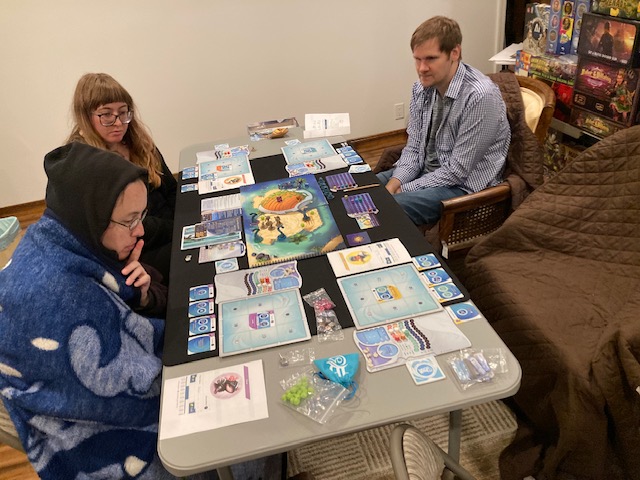
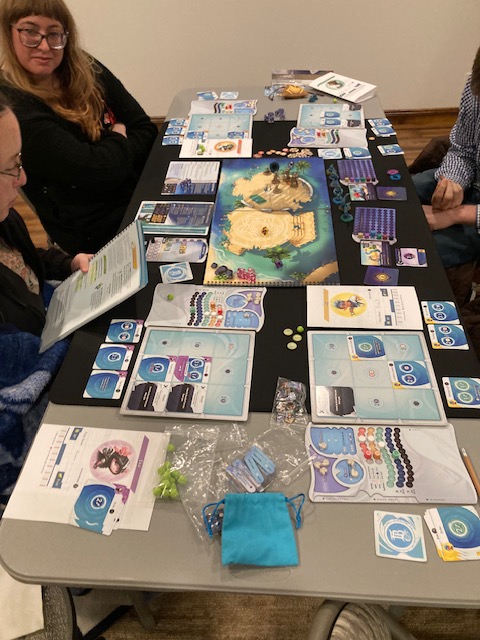
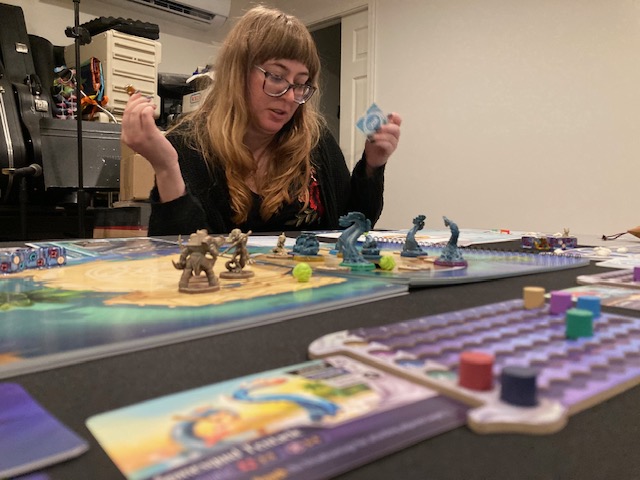
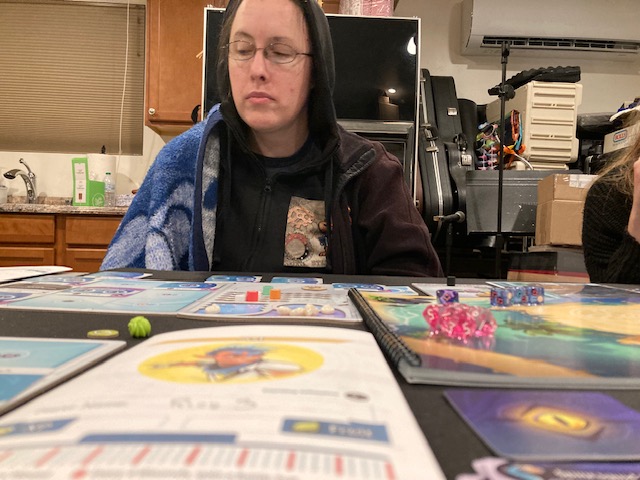
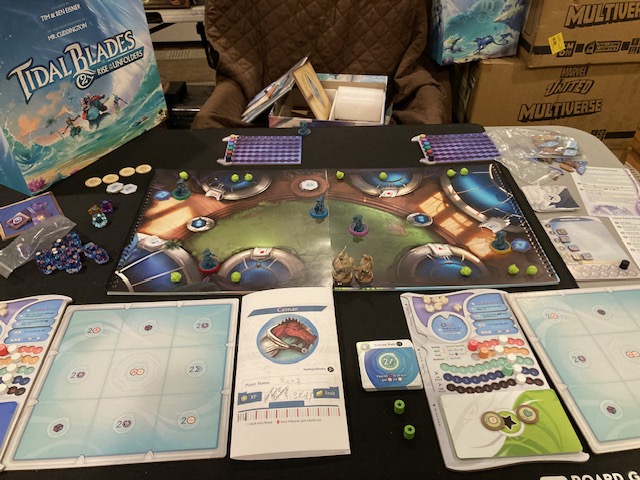
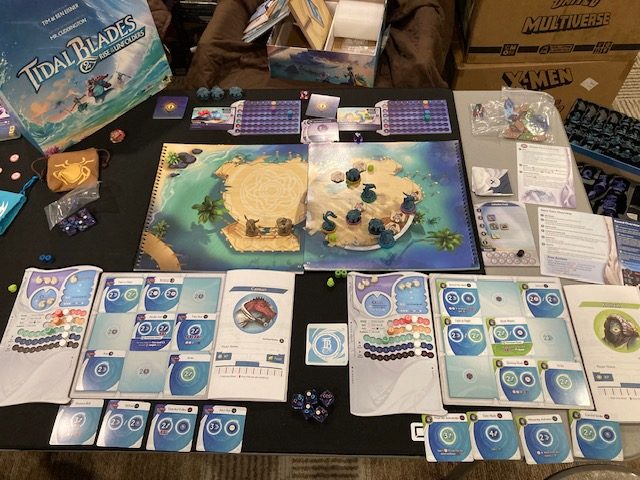
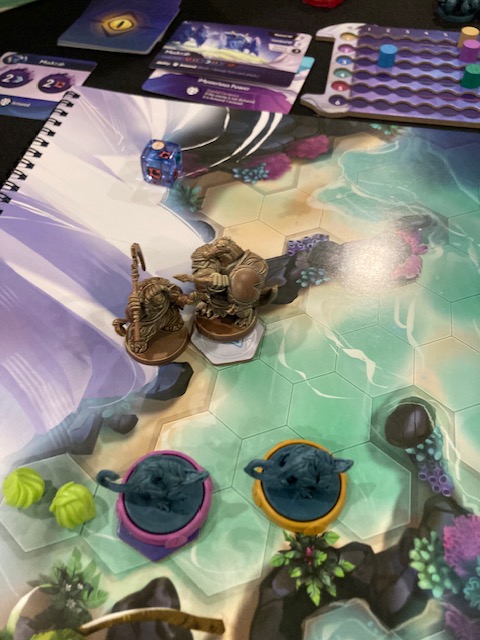
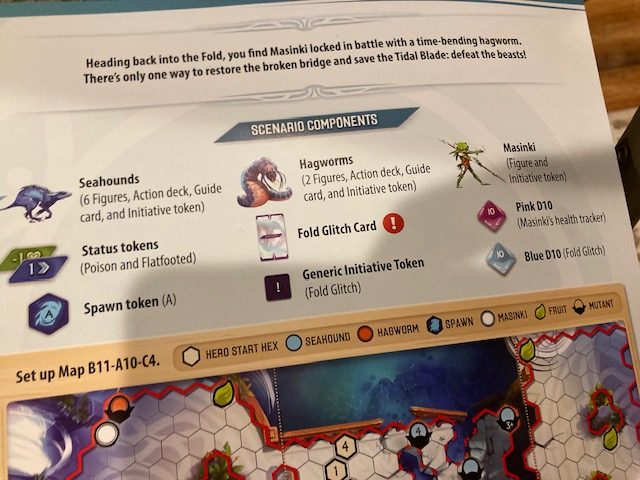
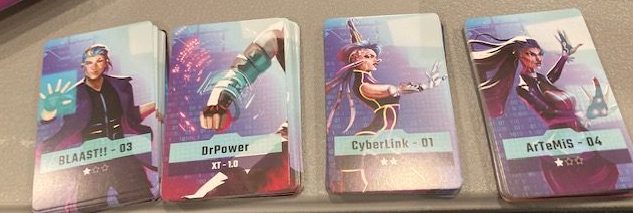
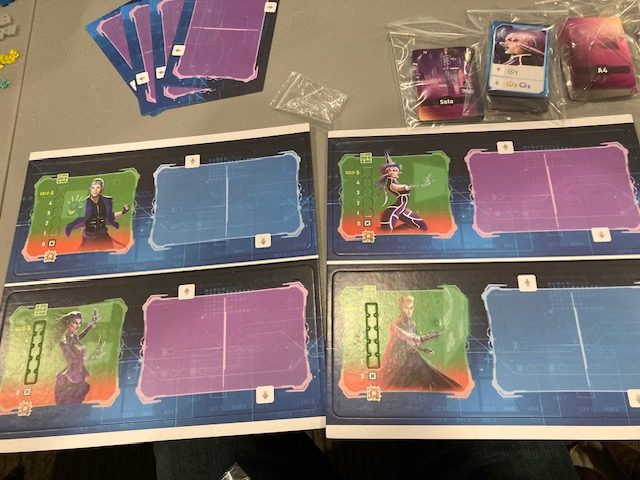
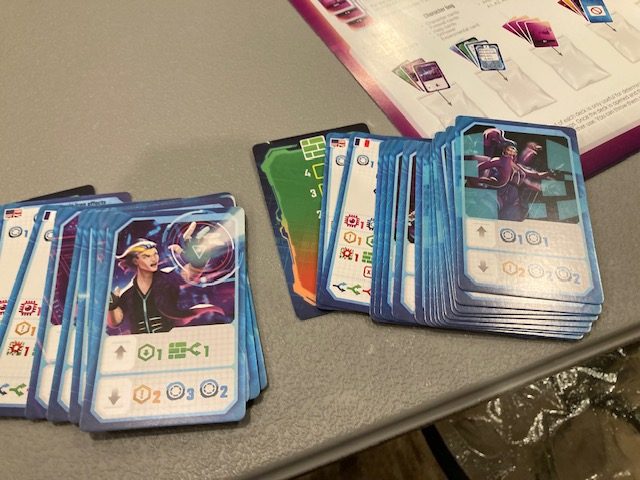
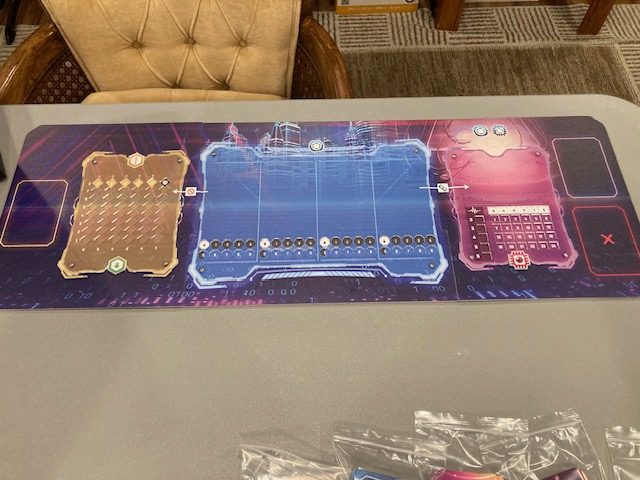
Wait, What Am I Unfolding Again? Review of Tidal Blades 2: Rise of the Unfolders

IMG_7706

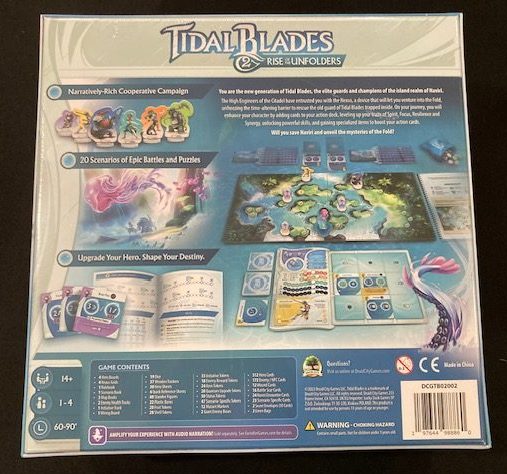
Tidal Blades 2: Rise of the Unfolders is a cooperative campaign that was on Kickstarter back in April 2022. This was the follow on to the original Tidal Blades game (which is really more of a head-to-head skirmish game). I knew nothing about the original Tidal Blades when I backed this: only that the components looked really cool. I backed it because it looked like it had a cool solo and co-op campaign.

IMG_7675

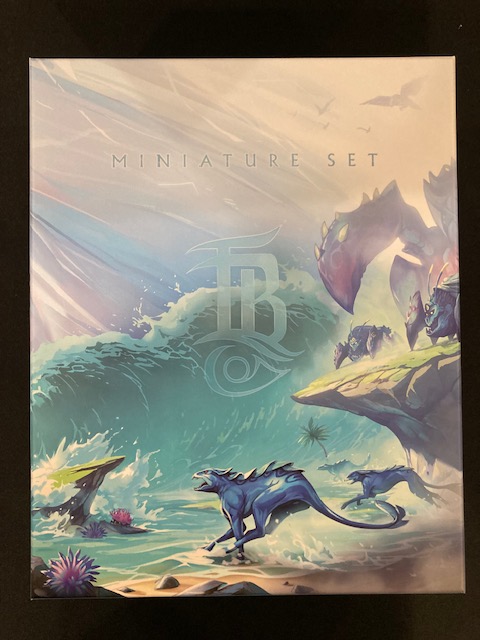
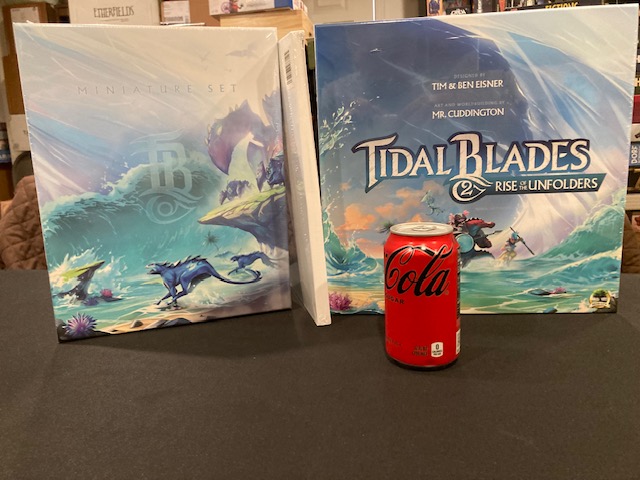
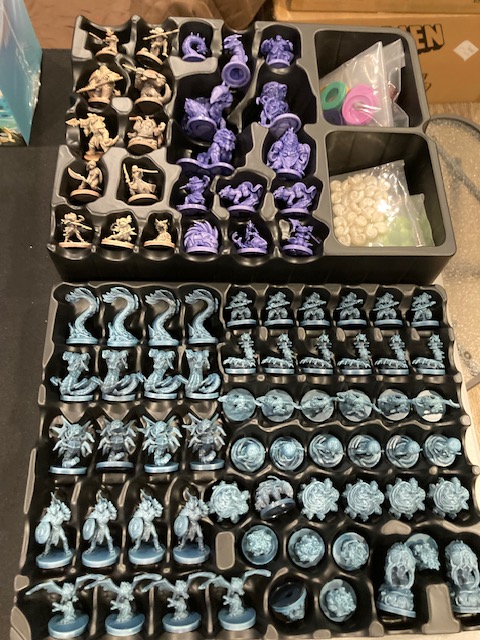
I went all-in and got the base game (lower right), the stretch goals (upper), and the miniatures (lower left): See above.  This is the deluxe version with awesome miniatures!

IMG_7679

The most important thing to realize is that this is a standalone solo or cooperative campaign game!  I.e., you don’t need the previous game at all!!! 

IMG_0939

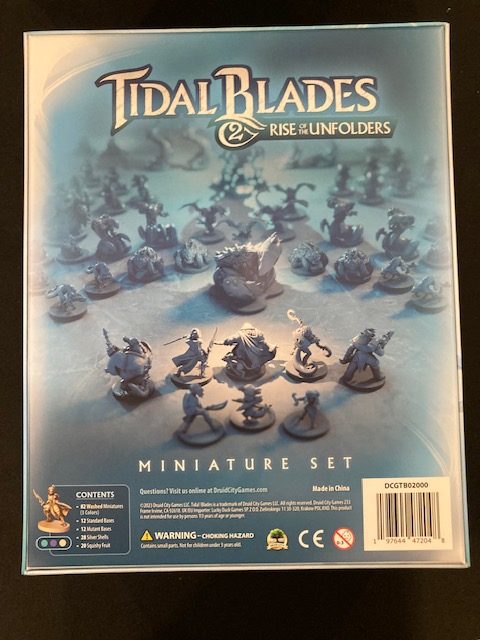
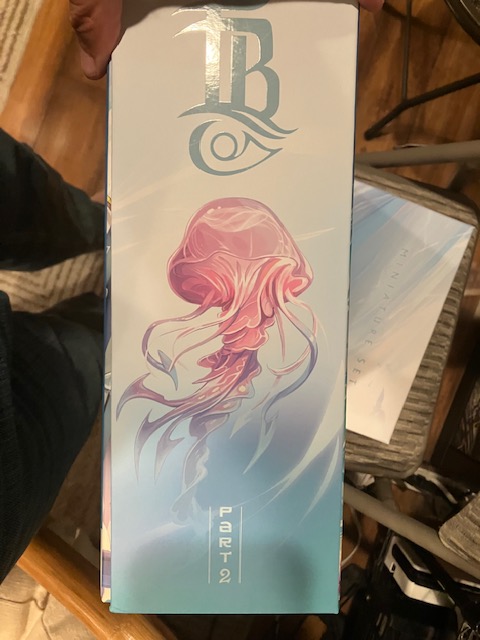
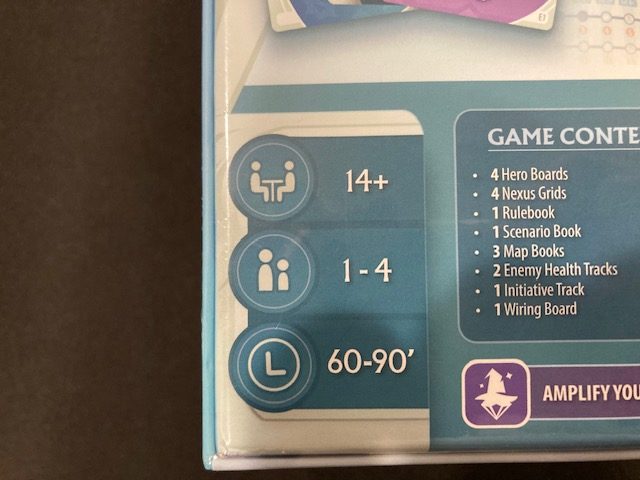
It’s a little confusing because the side of the box says “Part 2” (see above), but this is really just the next game in the same universe! Tidal Blades 2 continues with the ideas of the original Tidal Blades (which was NOT cooperative) but in a solo and cooperative game!

IMG_7704

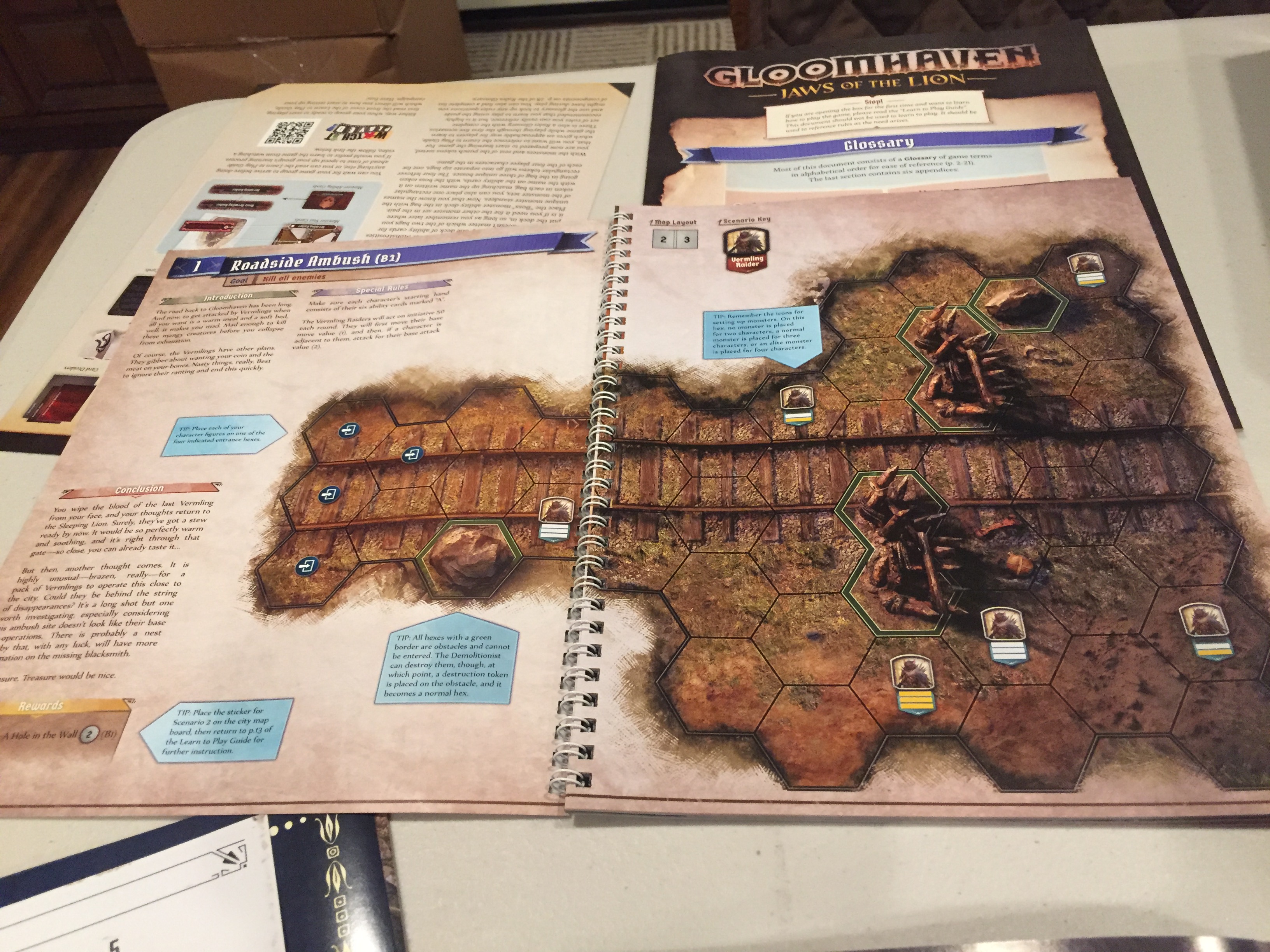
So, in some sense, this is still a skirmish game, as players play cooperatively against monsters in the game.  Honestly, this game really gives me a Gloomhaven (see review of Jaws of The Lion here) or Batman: Gotham City Chronicles (solo or cooperative mode: see our review here) vibe! Players move around on a map in a book and fight monsters!  You’ll see what I mean more below.

Let’s take a closer look!

Unboxing the Miniatures

IMG_7678

As much as you really want to see what’s in the main box, I gotta show you the miniatures first.  They are fantastic!

IMG_7680

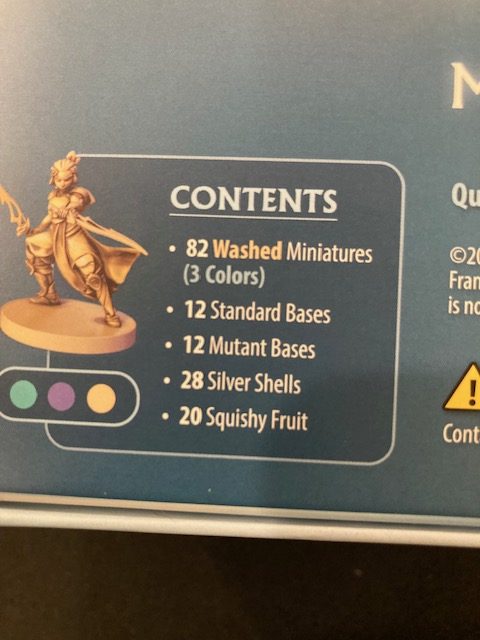
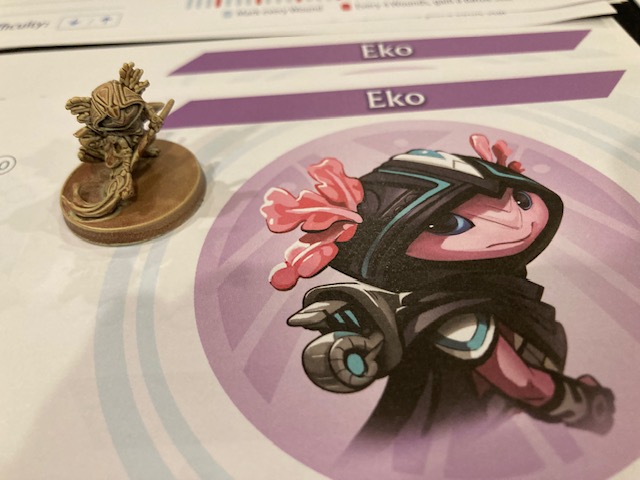
The minis are washed, they are tri-color,  and they have 2 sets of bases!  These are some of the nicest miniatures I have seen!

IMG_7690

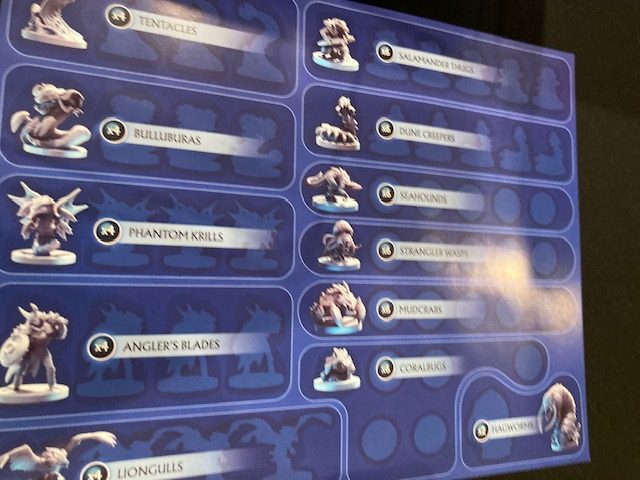
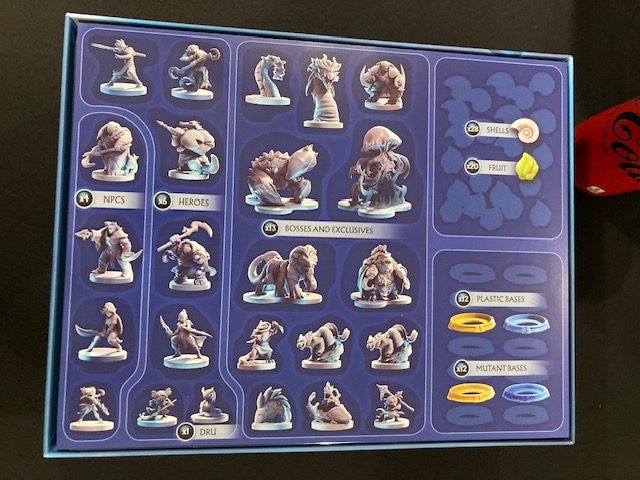
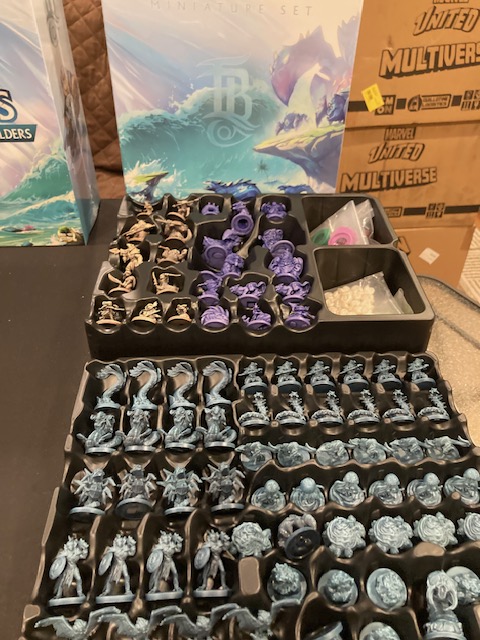
The top part of the box comes with the monsters you fight: they are all notated on a sheet (and, eben better, are labelled where they are in the box!!!) at the top of the box.

IMG_7686

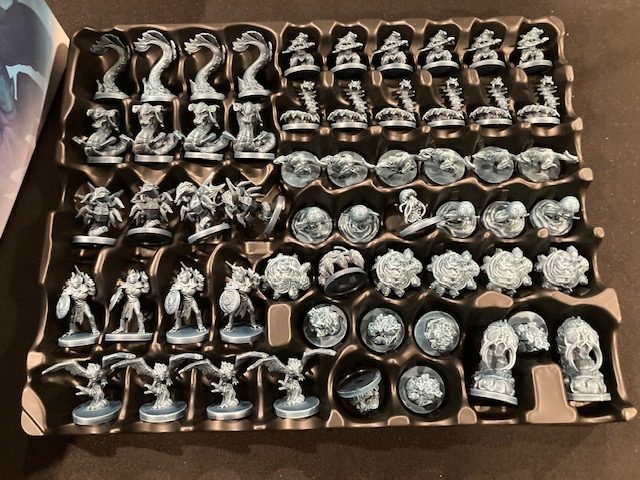
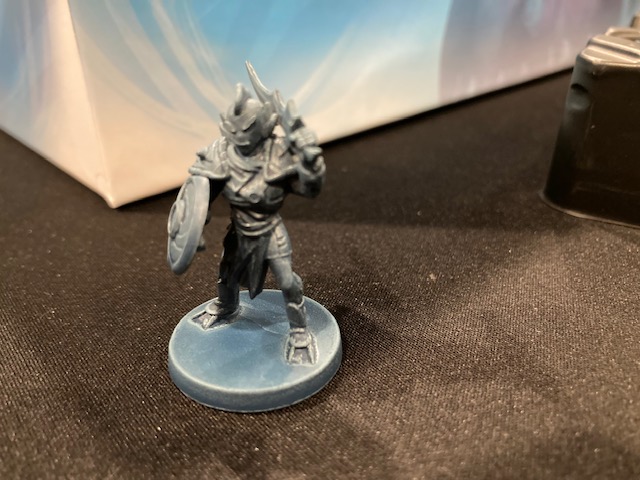
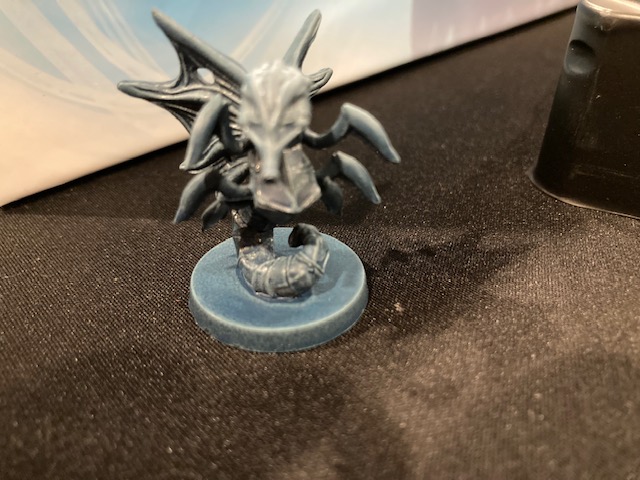
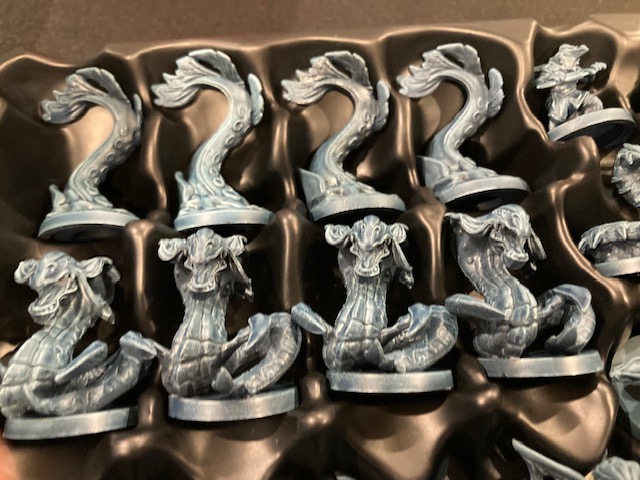
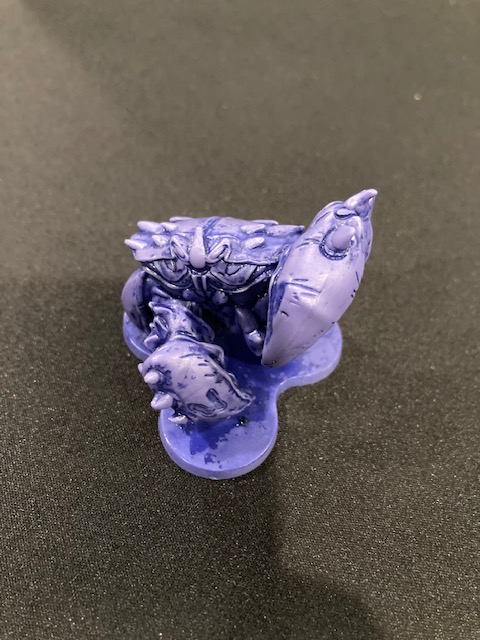
Wow!  The monsters are all bluish and really great! See above!  Let’s take a look at a few!

IMG_7687

IMG_7688

IMG_7689

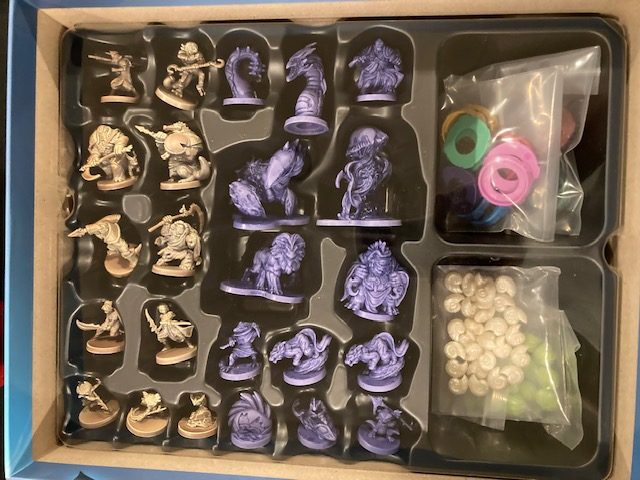
These are pretty awesome!  Below the tray with the monsters are the Heroes and Boss Monsters!

IMG_7683

The Heroes are light brownish, and the monsters are very purple: see below.

IMG_7685

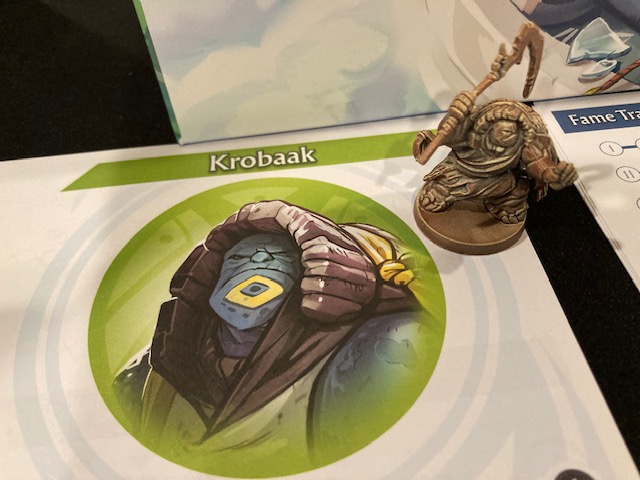
Let’s take a closer look at some Heroes (below):

IMG_7722

IMG_7721

The Boss Monsters are very purple! See below.

IMG_7695

These miniatures are just awesome!

IMG_7693

IMG_7694

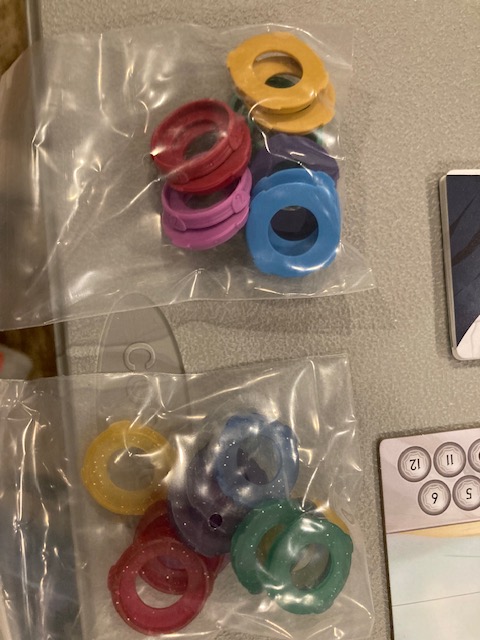
The game also comes with plastic bases for the minis so you can tell them apart.  The normal bases denote the normal monsters, and the sparkly bases denote the “mutant” monster (like the Elite monsters in Gloomhaven).  The “mutants” are just the tougher version of the monsters!

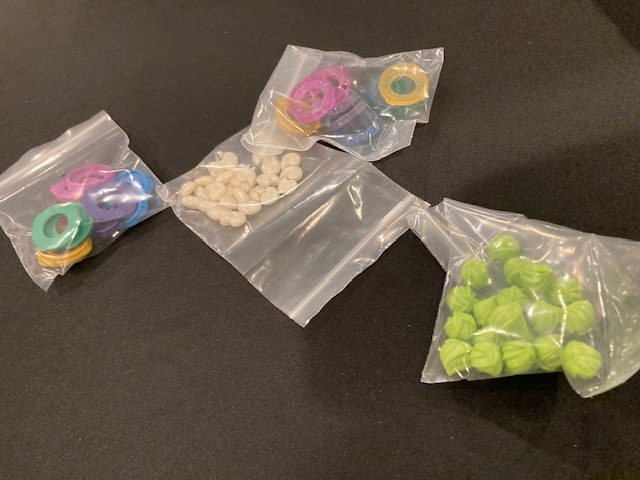
We also have really nice plastic Fruit and shells (replacing the cardboard from the base game).

IMG_7828

See above as the colored hit point tracks match the colors of the base?  And the “sparkly” yellow one is the mutant!

IMG_7807

These bases really make it easier to tell monsters apart so you can track the hit points.

IMG_7880

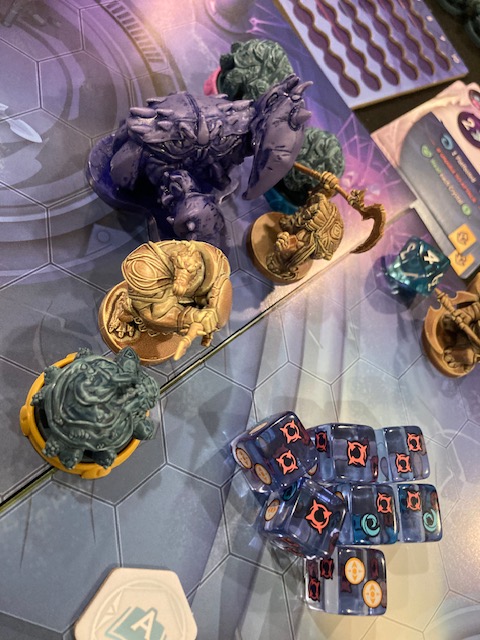
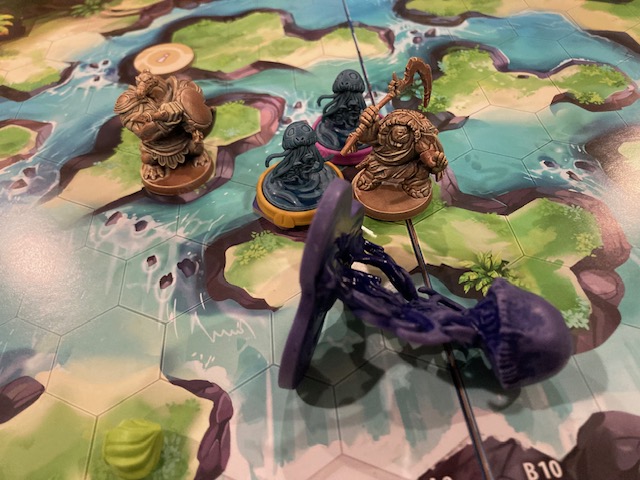
Overall, the colors and bases are well-thought out and make each entity stand out on the table. See above with some monsters, characters, and a boss monster all in the same frame! 

These minis are just fantastic.

Rulebook

IMG_7738

The rulebook is quite good.  But it has two major flaws.

IMG_7742

The rulebook completely fails the Chair Test!  See above as it flops over both edges being almost unusable!  This rulebook made a fundamental error by being the same size as the box!

IMG_7765

Much like Batman: Gotham City Chronicles, the solution is to use TWO chairs, and have the spine of the rulebook sit in between!  See above as we can keep the rulebook open and useful!  I do like that the fonts are big!  And the rulebook is full of good pictures!  It is easy to see the rules on the chair next to me … once there are TWO chairs!

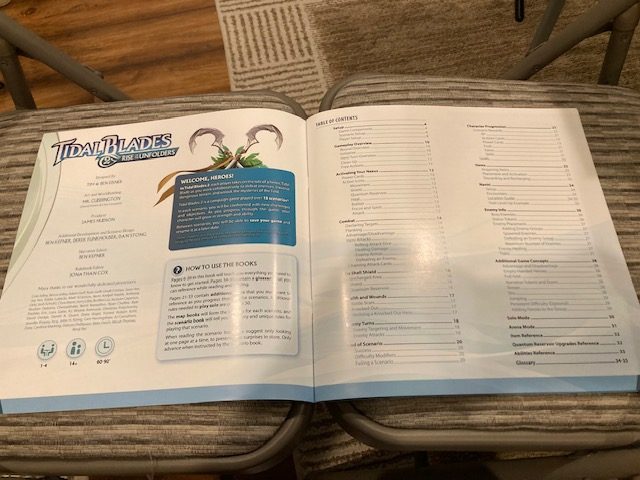
IMG_7741

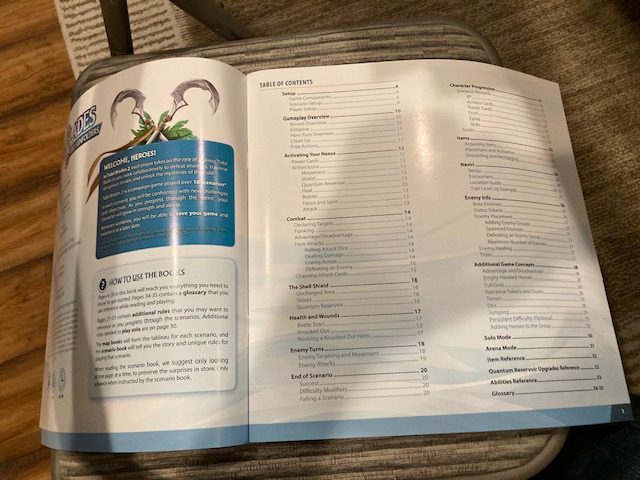
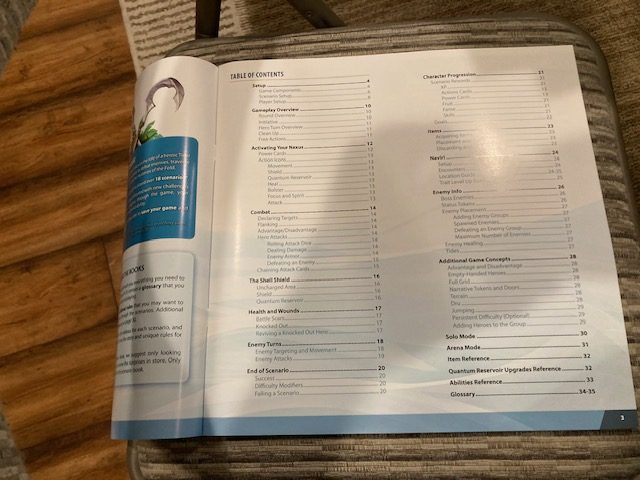
The rulebook has a Table of Contents that make it easy to look stuff up! Nice!

IMG_7770

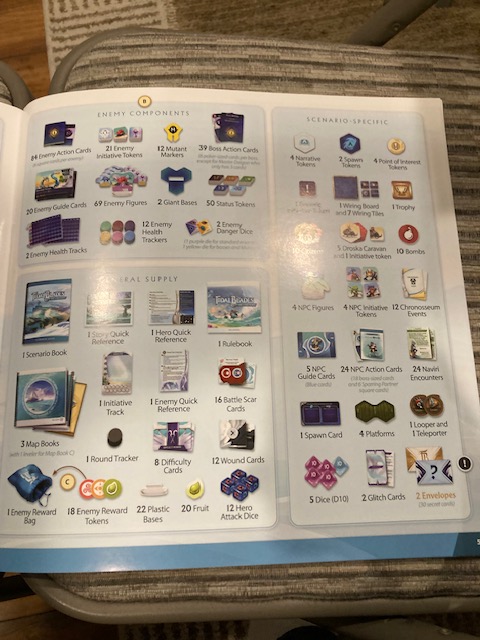
The components pages are great, with every component having a picture and being well-labelled!

IMG_7750

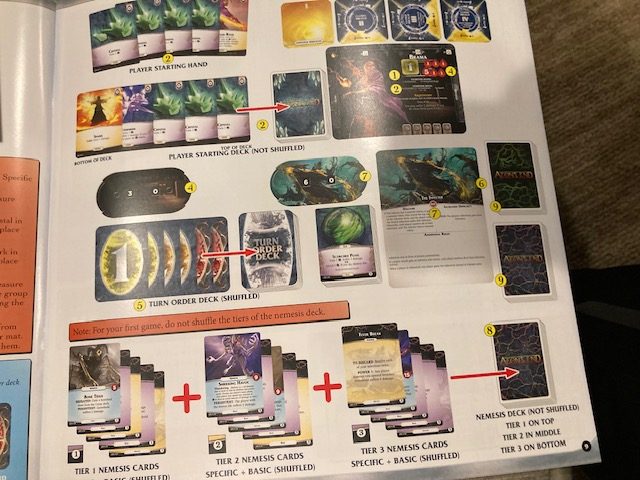
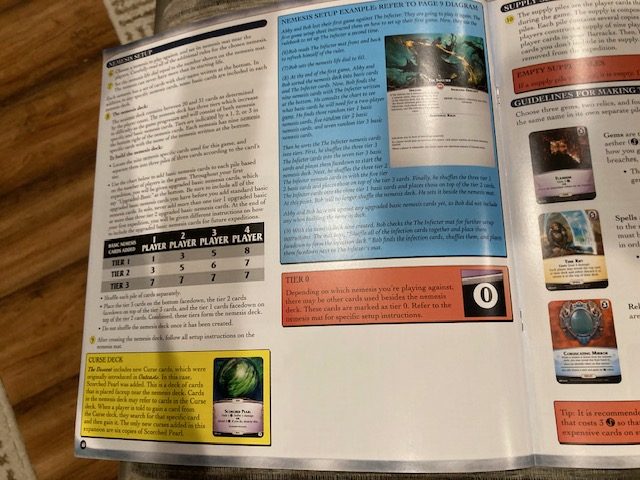
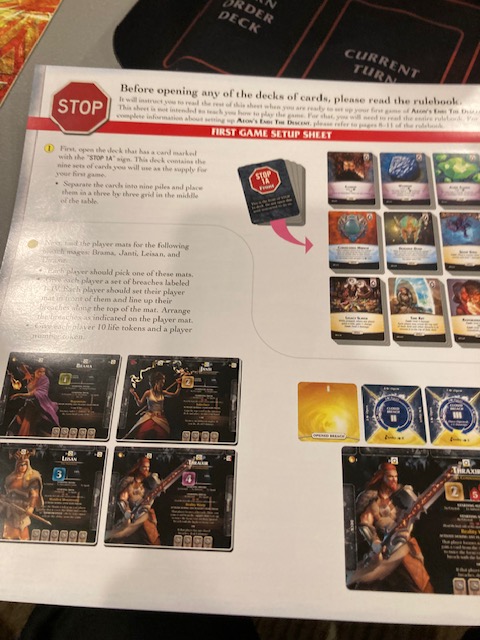
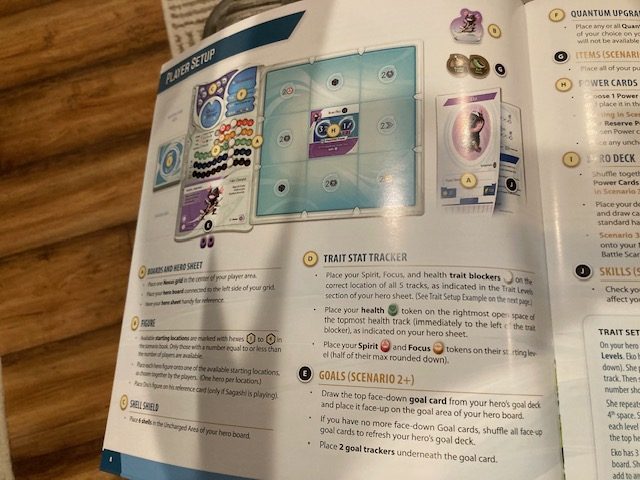
The set-up is nice (it’s over three pages), but some of the set-up is deferred to the campaign book. See above.

In general, I thought this rulebook was great.   There’s a nice glossary in the back (ya), but no index.  I’ll forgive the lack of index because the glossary and Table of Contents were great.

My other major complaint (besides the form factor) was that the combat wasn’t quite as well specified as I want.  We’ll discuss that below.

Otherwise, great rulebook!

Unboxing the Base Game 

IMG_7676

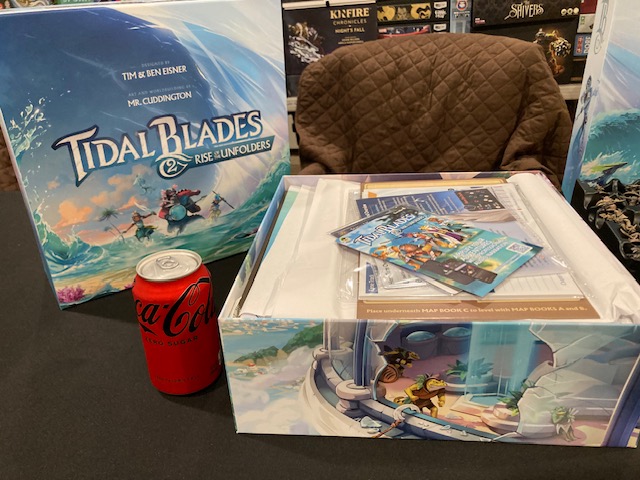
This base box (and the minis box) and both pretty big!  My friends lifted the main box and were surprised how heavy it was! What’s in this gargantuan box?

IMG_7707

See how tall the box is too (relative to a can of Coke)!

IMG_7709

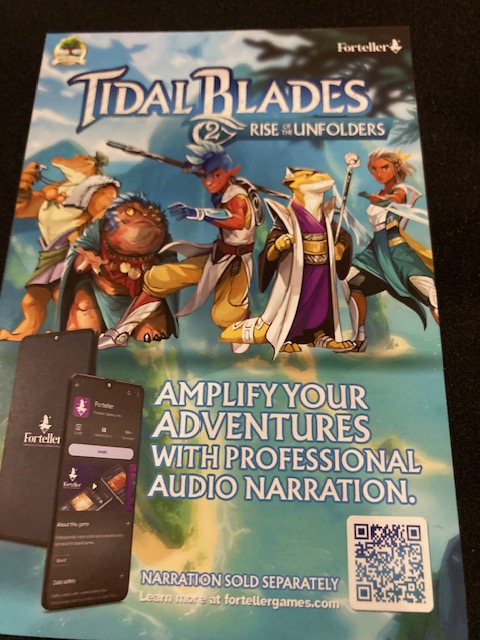
If you want, you can use the Foreteller app to read the “plot” as you go: this is a campaign game where a story unfolds and you may want to get some professionals reading it aloud.  I didn’t get the Forteller narration … and it was just fine without it (but it does have the option: sold separately).

IMG_7755

IMG_7762

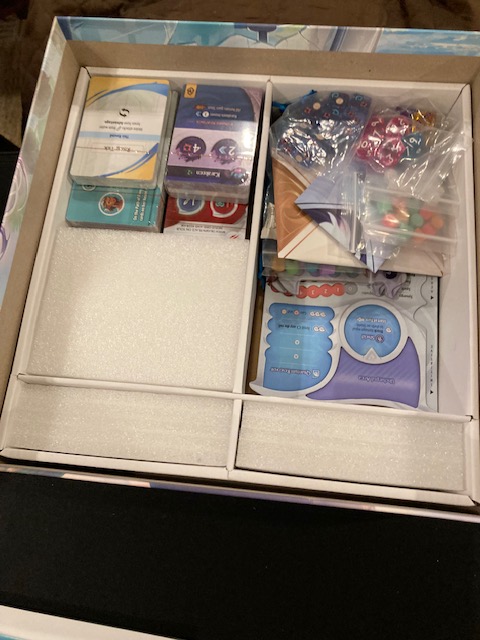
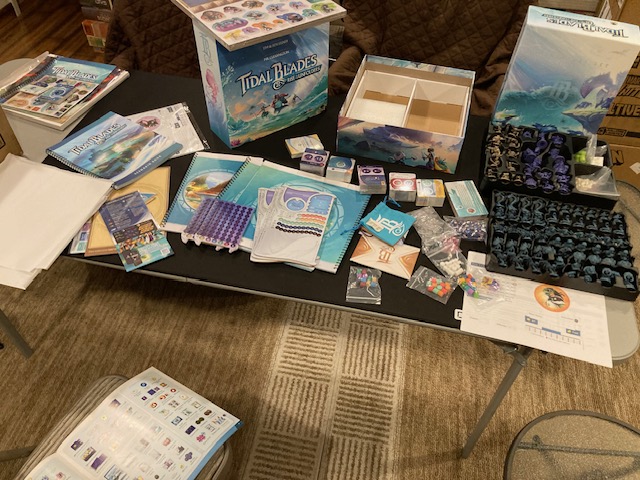
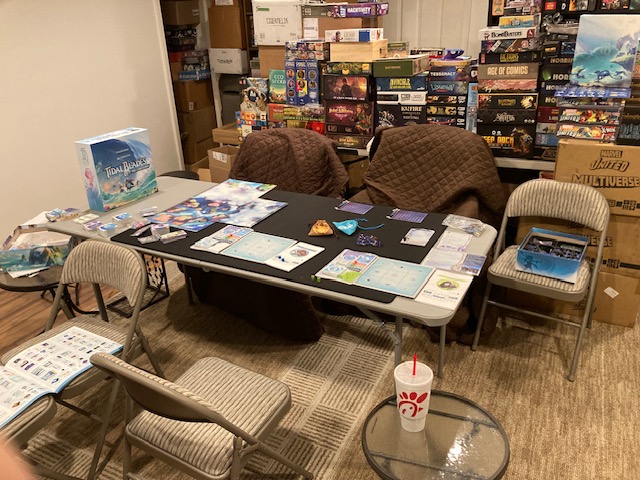
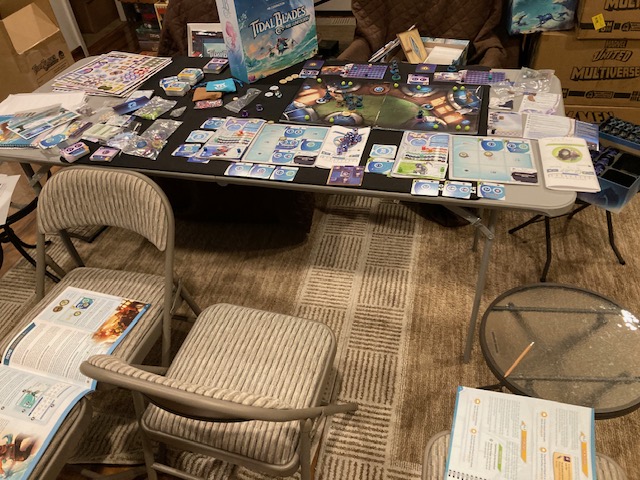
There’s a LOT of stuff when you unbox (see above); we’ll go through the components as we discuss gameplay.

Gameplay

IMG_7711

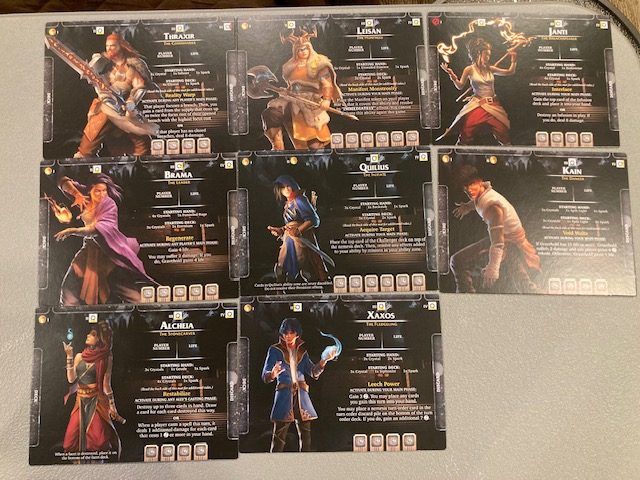
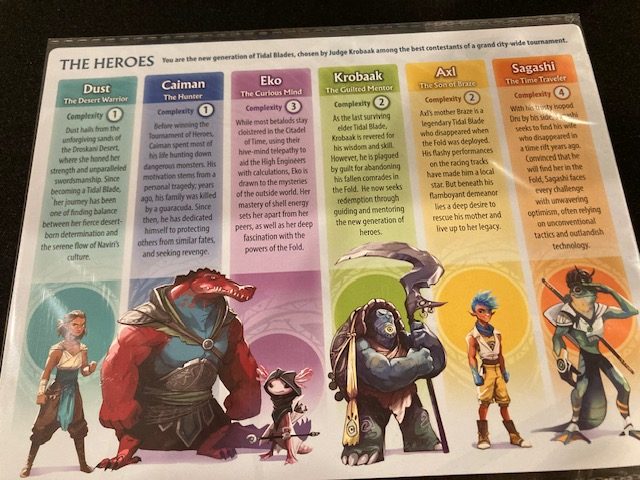
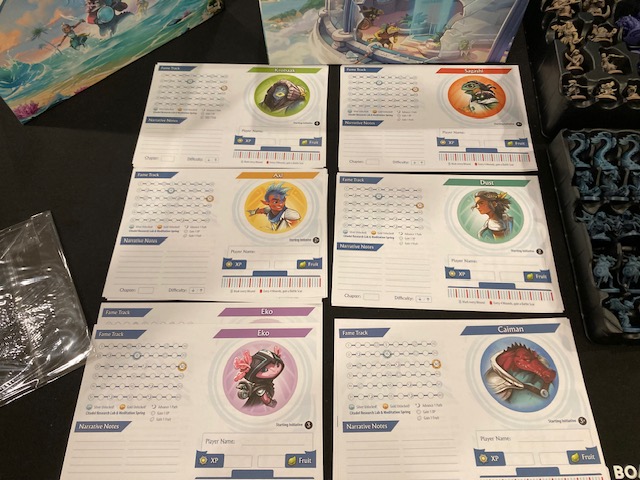
Each player (1-4 players) chooses a Tidal Blade warrior to play. See the six options above and below.

IMG_7718

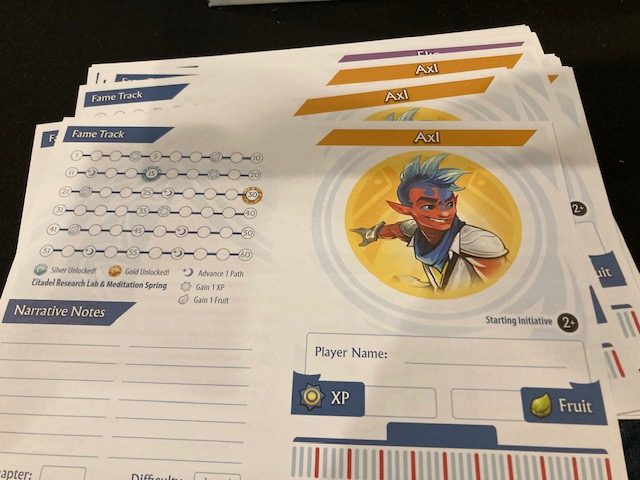
Each player gets a sheet with their character: see the six above and one (closer, below).

IMG_7717

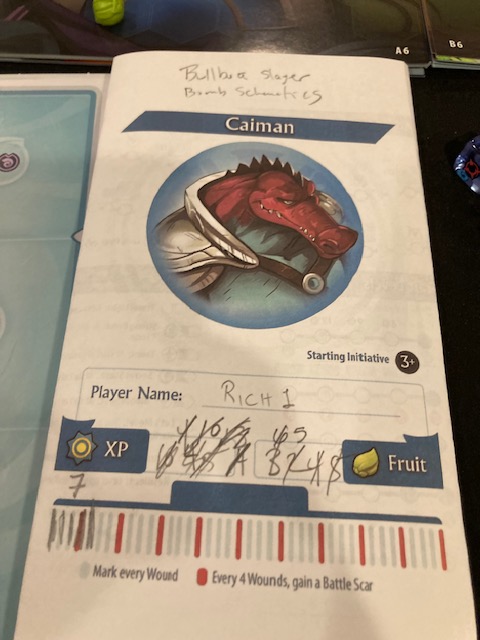
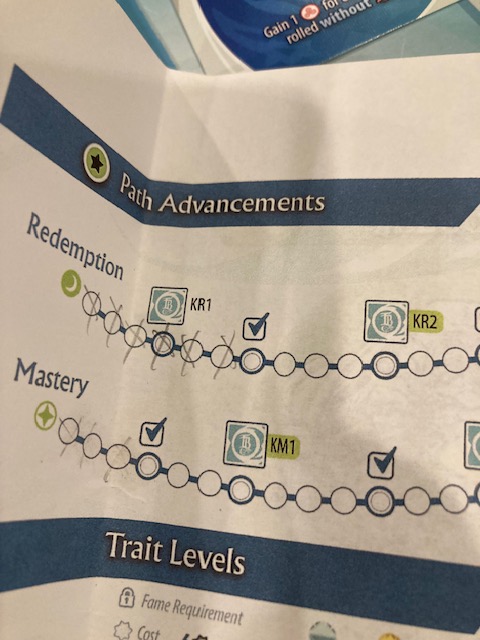
Each character sheet is for recording stuff as your character levels up during the campaign. Tidal Blades 2: Rise of the Unfolders is campaign game! Characters will be leveling up; you will be making decisions about how to do that! This sheet will become incredibly marked up as you play…

IMG_7926

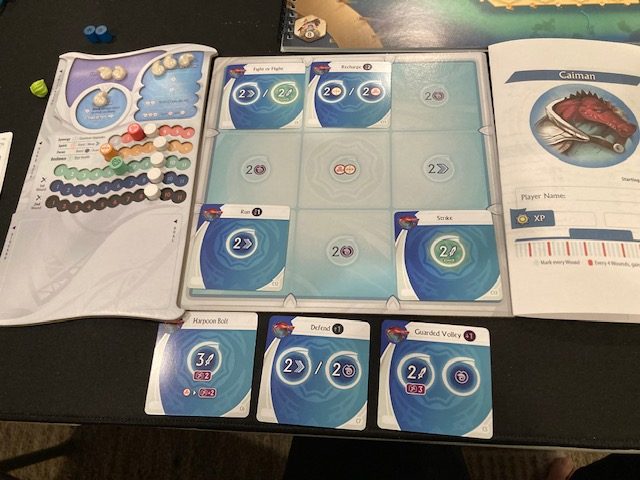
See above as Caiman has experienced a lot and marked up his character sheet!

IMG_7895

On the back of your character sheet are “tracks” where you will make choices about how you use experience points and other forms of up-levelling.   To be clear: each character is different! They have a different sheet with different cards and powers that can be activated!

IMG_7776

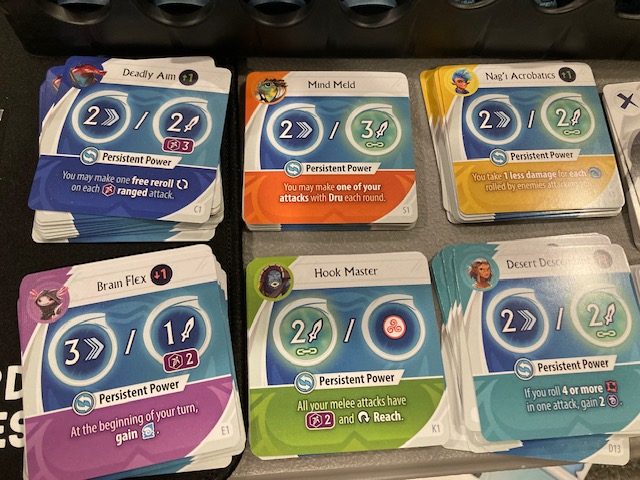
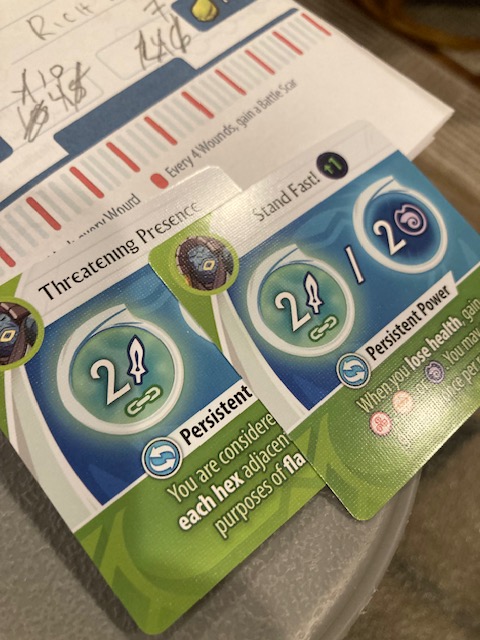
But, what really distinguishes the characters are the combat decks: see above!!!  Each player has a different Persistent Power (see above) when they start, as well as a different deck!!!  (Well, some cards are in common, but generally the decks are different!!)   These decks will be augmented, culled, and clogged as you play!  To be clear, Tidal Blades 2 is not a deck-building game per se (as that implies you are dynamically changing the deck as you play), it’s what we called a deck-advancement game.  We made this distinction back in our review of Adventure Tactics: See that review here for more discussion of the difference.    Suffice to say, your combat deck only changes/updates  at the end/beginning of each chapter of the campaign.

IMG_7877

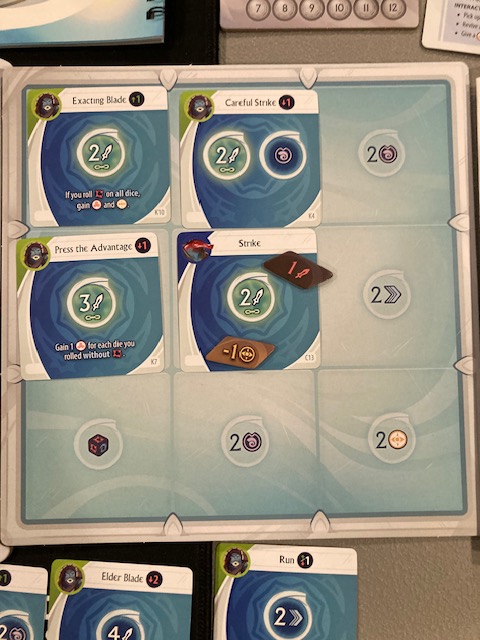
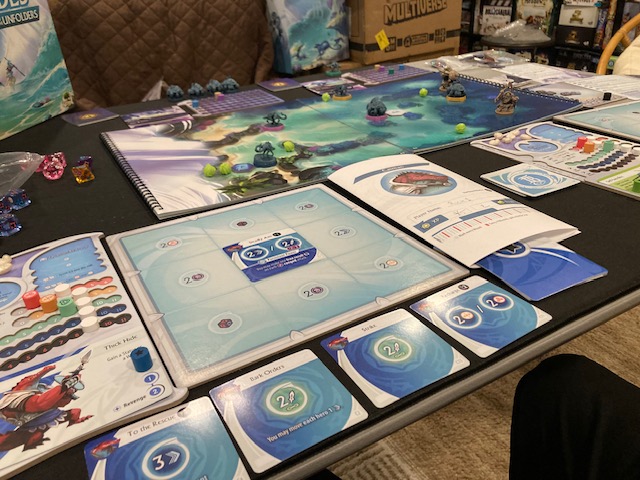
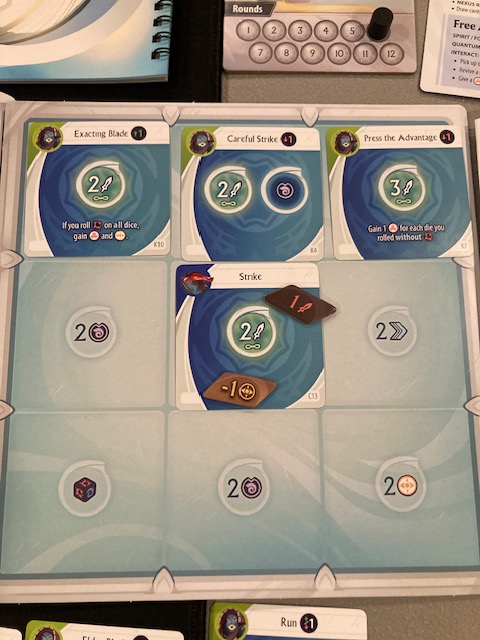
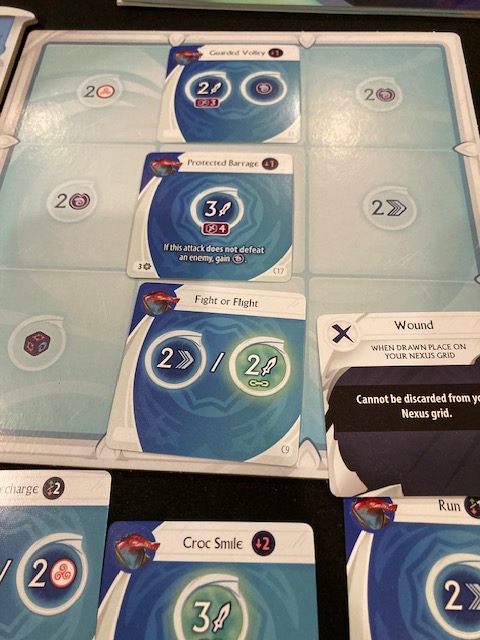
What’s even cooler is that when you use of the cards during play, you activate either a row or a column on your board!  What this means, of course, is that you piggy-back on our previous turn! For example, if we just played Careful Strike to the board (top middle), we are allowed to activate ALL the actions in either the middle column or the top row!  Some actions give you shells (armor), some actions allow melee strike (swords), some actions give you resources (yellow/pink), some actions give you movement, and so one!

IMG_7892

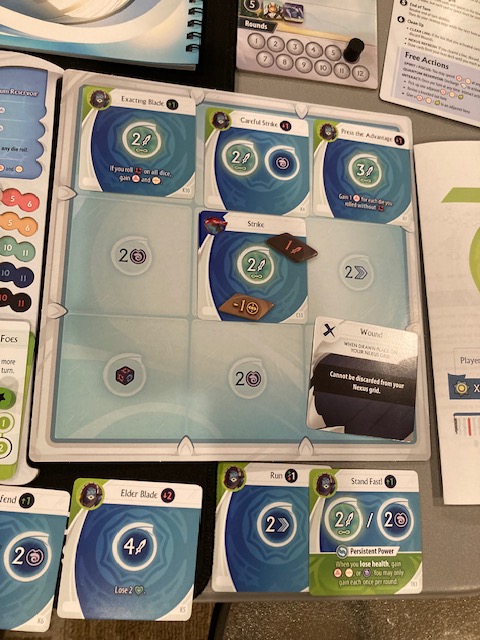
As your character takes excessive damage throughout the game,  you can take WOUNDS (see bottom right) which clog your board!  Now, if activate the last row or column, you can’t use anything from that last space!

IMG_7889

This mechanism of playing a card to a row is central to the game!  What card you choose dictates your initiative (Stand Fast! gives me +1 initiative), your current turn, and what actions you might want to play on future turns!  And it’s really fun, because you feel like you have a lot of choices:

IMG_7835
1) Which card do I play?  It affects my current turn and initiative!
2) Where do I place my card?  It affects which “core” symbols I block!
3) Which row or column do I activate?  What previous cards do I want to leverage?
4) Do I want to finish a row with 3 cards?  I may clear it, but I get a very powerful one turn!
Each turn is just rife of choice!

IMG_7827

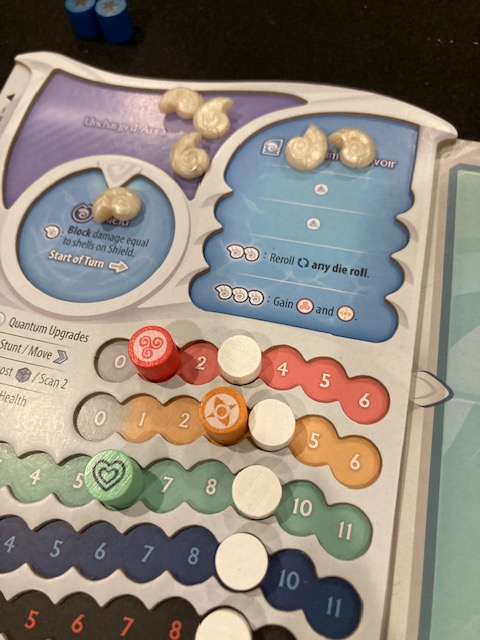
Each character also has spirit, focus, and some “shells” which can serve as armor or activate other abilities!  Armor in the game is handled by putting shells from your uncharged area into your blocking area!  So, if you want to play defensive for a round, you can choose the shells action! Yet another type of choice: defensive or offensive!

IMG_7965

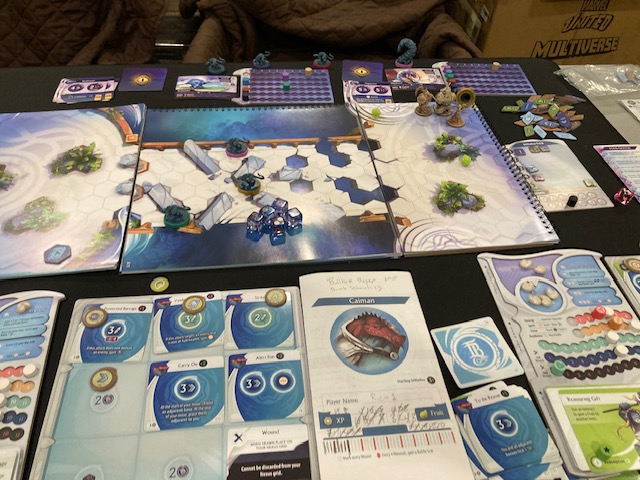
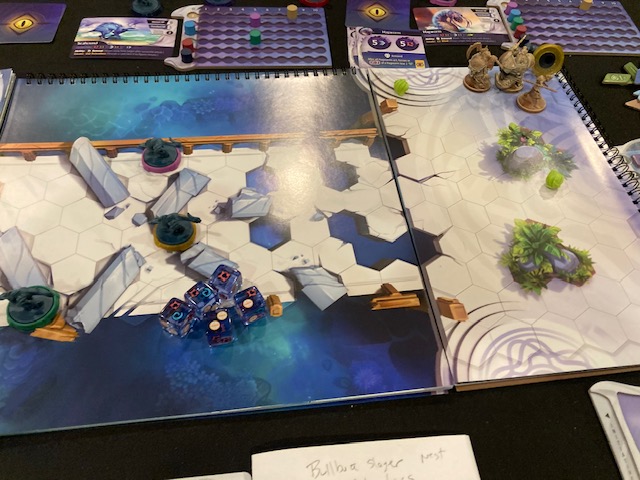
Players move around a map of hexes, fighting creatures! (Sound familiar? Gloomhaven, I am looking at you…)  See above.

IMG_7733

The map books remind me a little of Gloomhaven: Jaws of the Lion, as you just set-up the board from a book of maps and go!  This map book was the key innovation in Gloomhaven: Jaws of the Lion. What’s cool, is that Tidal Blades 2 furthers that innovation!

IMG_6063
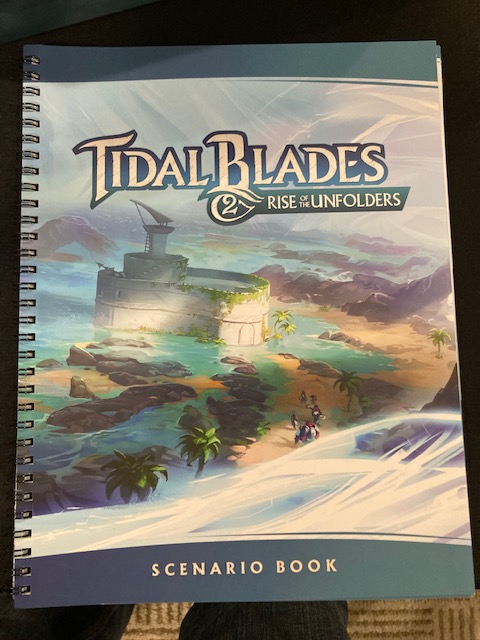
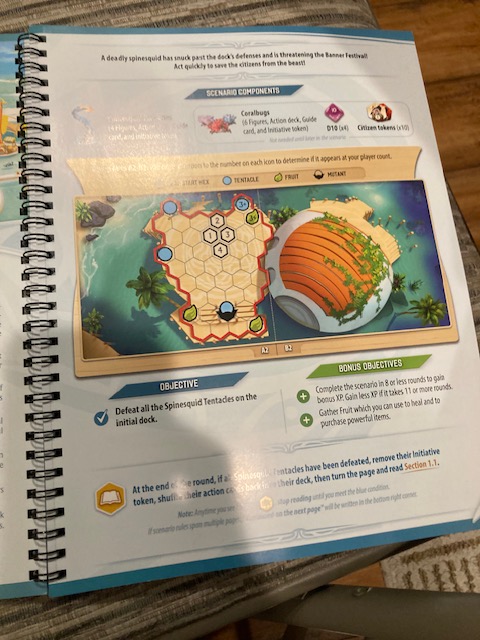
The storybook is the play area! Set-up is easy! Just turn to that page!

Players move around the map, but the stupid spiral binding gets in the way of the map in Jaws of the Lion!  See above.

IMG_7798

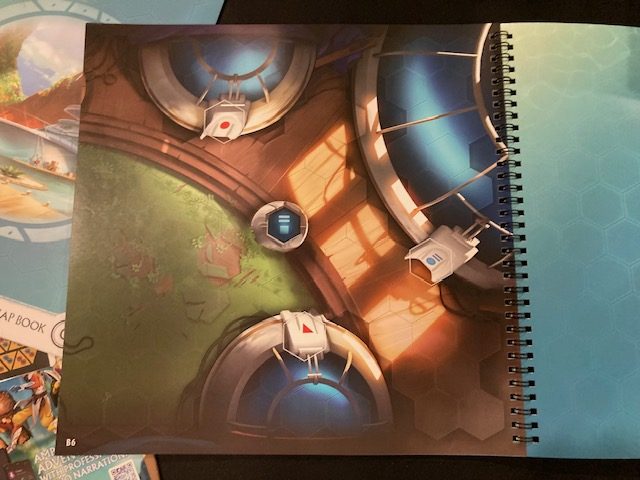
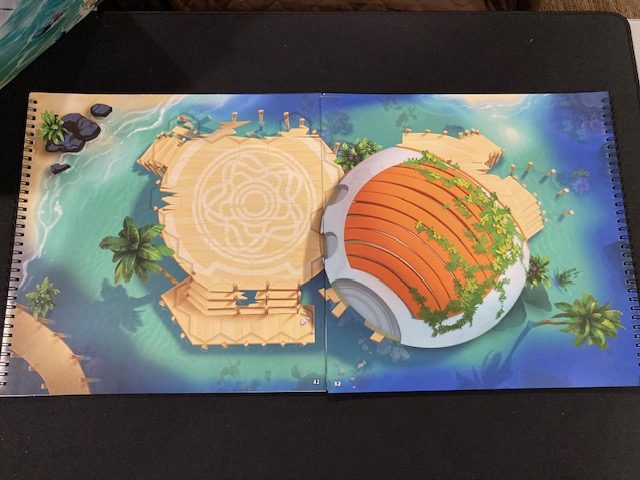
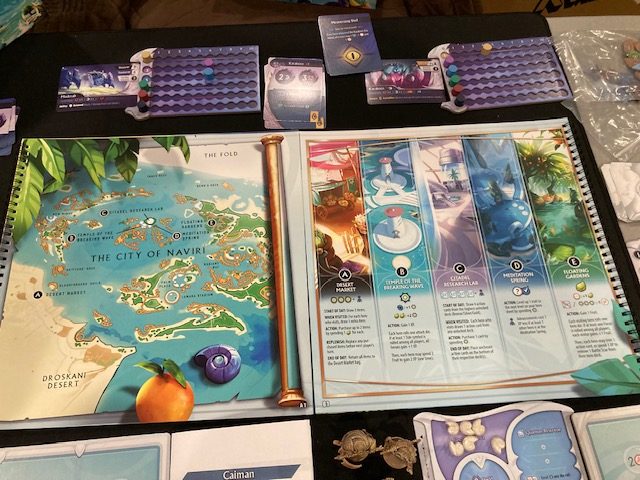
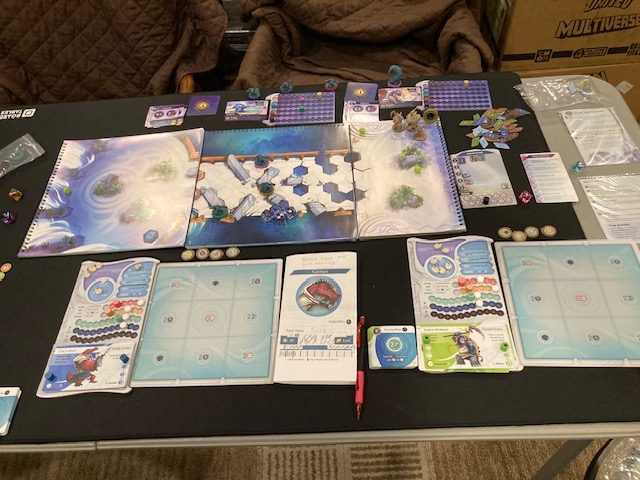
What Tidal Blades 2 does is very clever! Rather than just one map book, Tidal Blades 2 has two map books (actually 3), but each book is rotated so that the spiral bindings are on the outside!  Instead, the middles just touch and make a contiguous surface!  See above!  The middle of the board, where a lot of action is, in untainted by the spiral bindings!  It looks more like a contiguous surface!

IMG_7982

It’s really easy to set-up each chapter of the campaign!  Just turn the book to the proper pages!

IMG_7880

Combats are decided by dice: every SWORD you generate from your cards gives you a die! Red symbols are a straight-up hit, blue CAN be a hit if you have advantage (if your compatriots are flanking), and yellow focus CAN be a hit … if you spend a focus point!  And that decides how much damage you do!

IMG_7883

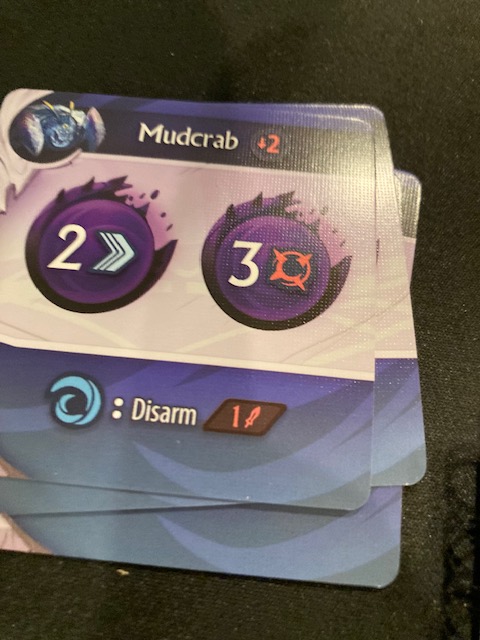
Monster combats are similar: all monsters perform the actions of their current card: see above as the mudcrabs move 2 (to the closest character) and then just do 2 straight damage! (This is modified a little by a damage die).

IMG_7946

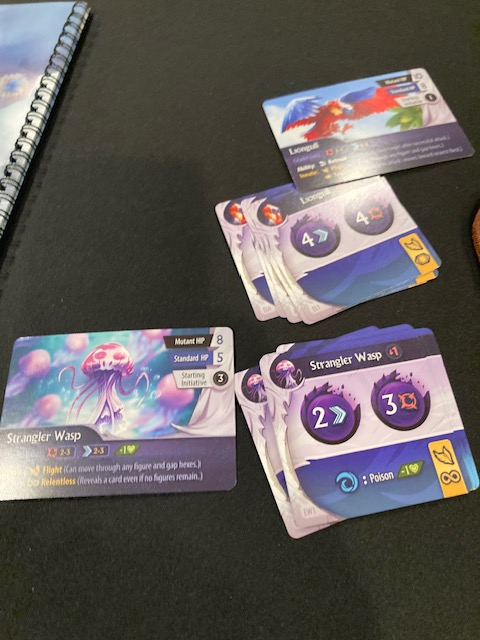
There’s all sorts of monsters with all sorts of abilities! Some poison you! (See above)

IMG_7828

Each monster is tracked by a hit point track (see above) with the bases differentiating them.  The purple die (lower left) modifies every monster attack!

IMG_7977

There’s a lot more to this game, but that’s the “flavor” of the game!

Campaign

IMG_7727

Let’s be 100% clear: this is a campaign game!  It last about 18 chapters, and each game is about 2 to 2.5 hours (including set-up and tear-down: a lot of your time will be set-up and tear-down).

IMG_7830

Each chapter describes in great detail which maps you need, which monsters you fight, and what the set-up is!  See the first chapter above! (Minor spoilers above).

IMG_7932

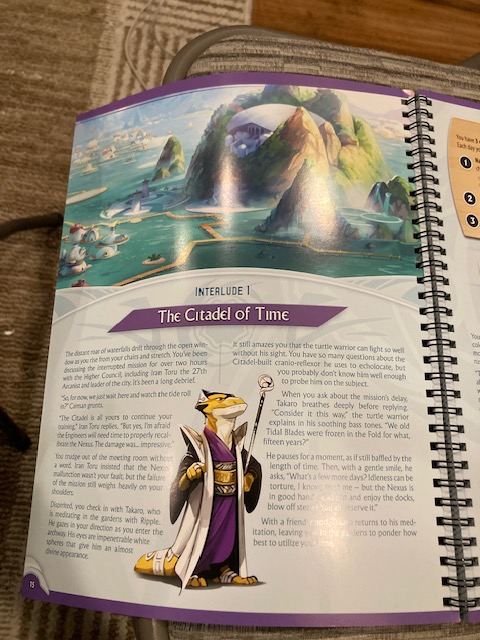
There is a story unfolding (pun not intended) about the folds of time.  Each chapter begins with some text describing the story (picture blurred on purpose above).

IMG_7898

After a few chapters, there will be Interludes which give you a chance to level up.  To be clear, there is SOME levelling-up after most chapters, but the Interludes offer significant levelling-up!

IMG_7900

At these Interludes, Players choose where to go to “spend” their resources: the market? The floating gardens? It depends how you want to level-up your character. Cull cards? Add Items?  Add skills? Whatever you want!

IMG_7698

Although this is a campaign, the Stretch Goals pack (see above) comes with 5 one-shot scenarios.

IMG_7724

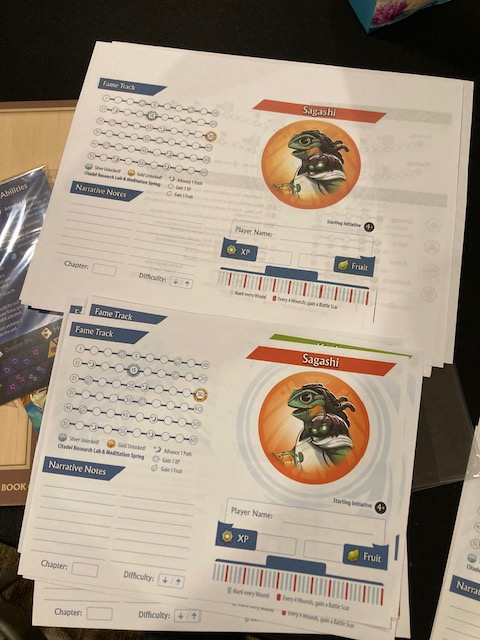
Since this is a campaign, and you have to mark up your sheet, I went ahead and made a copy of all the character sheets so I don’t have to sully the originals.  There are enough sheets in there that you “probably” don’t have to do this, but I prefer not to mark up the originals if possible.

Solo Play

IMG_7705

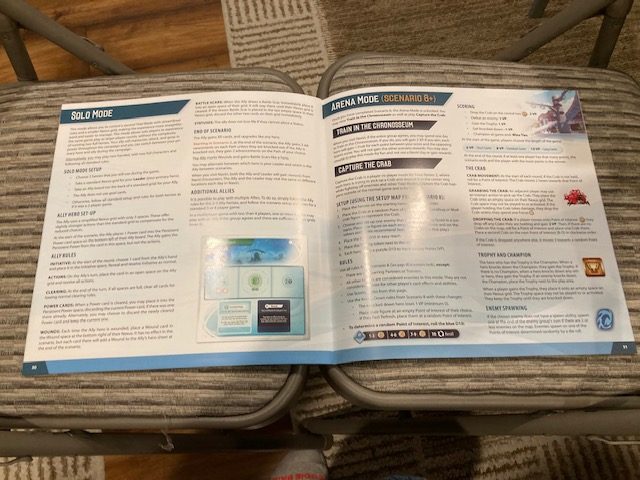
So, Tidal Blades 2: Rise of the Unfolders has two solo modes! (Congratulations for following Saunders’ Law!)  The simpler of the two solo modes is to just play two-handed: choose two characters and operate them as-if it were a 2-Player game.  This is the route I chose. And so should you!!

If you REALLY REALLY REALLY want a solo mode where you only play 1 character (but then still kinda have to operate some other pets/creatures anyways) with complicated exceptions, there is a second solo mode.  I usually eschew complicated solo modes because the exceptional rules are always SO HARD to keep track of!  Play two-handed: you’ll thank me for embracing the simpler mode … the simpler two-handed solo mode has NO exceptions to rules; you just play the game they way it was meant to be played.

IMG_7985

At the time of this writing, I am eight chapters into the campaign!  I have seen boss battles, several maps, several different ideas (jumping, running water, flying, etc), and some really great miniatures!    Every new chapter introduces new monsters and new ideas and keeps the game fresh!

IMG_7981

Playing two characters is juuuust about the right level of complexity.  Sometimes it’s a little overwhelming, since each character has their own deck with their own unique cards, but since the system is well-described and well-notated (seriously! The icons are VERY intuitive), it doesn’t make it too hard to context switch back and forth between the characters.

IMG_7976

One drawback is that there is a lot of maintenance for the solo player: set-up, run character 1, run character 2, operate the initiative track, operate the villains, lather-rinse-repeat, tear-down. This is really where the vibe felt like Batman: Gotham City Chronicles: there’s just a lot of work to keep the game going!  But, it’s kinda fun!  Everything is so bright and well-notated! The monsters are well-tracked (with the bases and colored hit point tracks), and the rules are pretty solid (so there’s not much second guessing, modulo one issue).

IMG_7858

I really like this solo mode: I hope to finish this campaign at some point during the year.  I am currently playing two campaigns: my solo campaign with 2 characters and a cooperative campaign with the other 4 characters (with my friends).

I fully expect this to make my Top 10 Solo Games of 2024: it’s that good!  There are just so many good choices!  Where do I go? What cards do I play?  How do I level-up my character? The choices keep me involved the whole time, even if there is quite a bit of maintenance per turn.

IMG_7705

The solo game took longer to play than perhaps it should: the box says 60-90 minutes but I frequently was at 2 hours; I also tend to like a little analysis paralysis when I play by myself.  There’s no one around, so I can try lots of things without fear of wasting someone else’s time.

Cooperative Play

IMG_7933

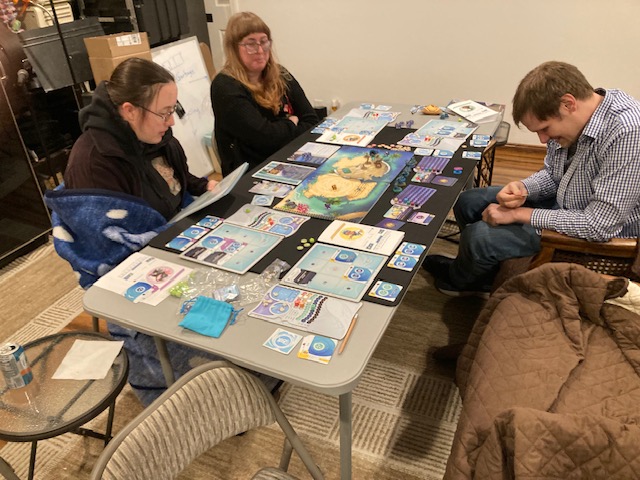
The cooperative experience is just in its infancy as we are only two games in, but my friends still keep wanting to play it!  “Let’s keep playing it!”  They really like it!

IMG_7943

Every player has agency on their turn; the game is just too complicated for an Alpha Player to come in and ruin a player’s experience … there are just too many choices for a single player: the Alpha Player will be too busy figuring out his own turn!! At the same time, there’s plenty of cooperation and players plan when to flank (see below), which enemies to engage, which actions to take, when to defend vs. attack!   This has a good blend of agency and cooperation.

IMG_7939

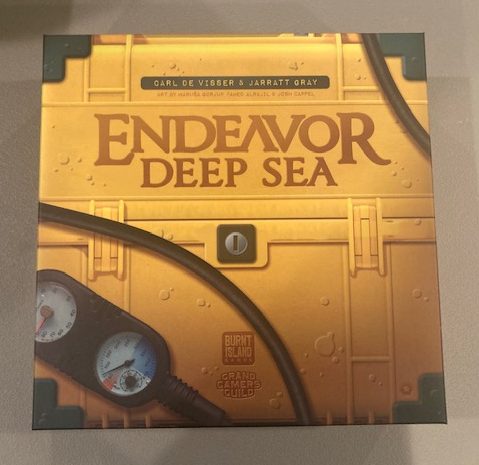
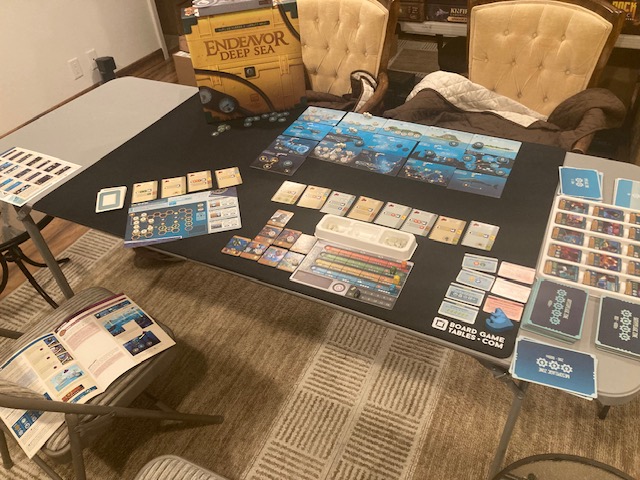
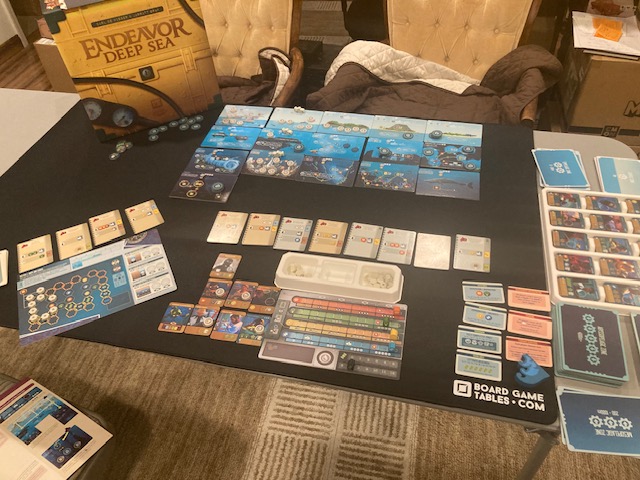
One of the things we DIDN’T like about the cooperative game Endeavor Deep Sea (from two weeks ago: see review here) was that the game didn’t “really” have any mechanisms for helping each other too much; players had a lot of multiplayer solitaire going on in Endeavor Deep Sea.  That’s not the case here!  Even you though you can choose to play multiplayer solitaire, you can also do quite a few things to directly help your compatriots!  You can spend shells to allow your friends to re-roll dice (if they run out of re-rolls)!  You can set-up flanking opportunities! You can use skills that help everyone within 2 spaces!  There’s a number of mechanisms where the sole purpose is to help your compatriots!  And that does increase the level of cooperation!  Even choosing the initiative order can be an act of cooperation!  And THANK GOODNESS there are no Communications Limitations in this game!  Just last week, we saw how the Communications Limitations ruined that cooperative game!  Luckily, you can talk all you want and work together in Tidal Blades 2!!

IMG_7940

The only real negative for the game is that sometimes it can take a while to get back around to your turn (as there is no simultaneous play): players must play in initiative order.  Like any game with lots o choices, sometimes a little Analysis Paralysis can slip in and slow down the game.  It’s still not too bad, because you can always be talking with your friends or figuring your own turn out while waiting for others.

IMG_7942

It’s easier to overlap turns in a cooperative game (like Tidal Blades 2) because you can ask your friends to leave the board “in a certain state” so you can preplan your turn!  In a competitive game, you always have to wait until the previous turns are over to re-assess the board every turn!  With a little cooperation, there can be much more overlap!  And we saw some of that overlap here in Tidal Blades 2!  It’s a minor point, but that overlap can make cooperative games (without simultaneous actions) move a little faster.

IMG_7941

Overall, this game was a lot of fun cooperatively.   It’s a good blend of agency and cooperation, and there are many ways players can help each other.  It’s fun to talk and plan with your friends!

Flanking and Advantage

IMG_7822

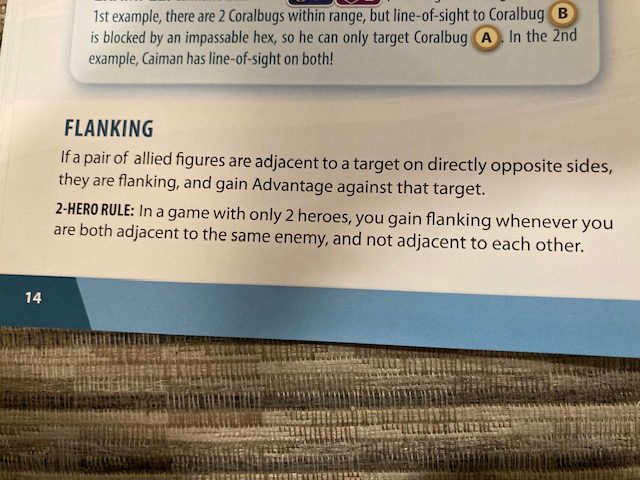
So, this is, at its core, a miniatures fighting game!  Which means you have rules for flanking and advantage!  If you flank  (players surround an enemy adjacently from opposite sides), you can get advantage (which allows you to turn the blue wave symbols on dice into hits)!  This is very cool, because it is a mechanism that encourages the players to cooperate and coordinate their attacks!  The best results come if you cooperate, flank an enemy and maybe get 50% more hits because you can gain advantage!

If you saw “Flanking and Advantage” and thought “What is this … 5th Edition Dungeons and Dragons?”  You are not the only one who thought that!!!  But, these ideas in this game really do help improve the cooperation: they encourage an easy way to increase the odds of hits! 

What I Liked

IMG_7691

The minis!  You can get the game and just use cardboard standees, but I would strongly recommend getting the miniatures! See above!! They are so well done, with the different bases, the beautiful sculpts, the different colors to highlight the different types!  I feel like they really made the game feel more thematic.  The minis add to the cost of the game (as you buy them separately), but I think in this case, they were worth it.

IMG_7876

Combat Mechanism! The combat mechanism of choosing a card, then choosing where to put it, then choosing a row or column to activate is so cool!   Your choices affect your current turn as well as future turns!! This mechanism is at the core of the game, and it makes you feel like you have choices at all times!

IMG_7828

Well-done Monsters! The monsters are pretty easy to run (modulo one problem, see below)!  The cards clearly specify what to do, the bases clearly denote which monster is which, and it’s pretty quick to set-up a game!  Heck, I spent more time putting plastic bases on monster minis than I did setting up the cards!  It really is easy and quick to SET-UP and RUN the monsters!

IMG_7880

Not too much Randomness!  I was very worried that there would be too much randomness with dice deciding combat … but here’s the thing, there’s not that much randomness!  There is usually at least one hit per die and sometimes your focus shows (which means you may have to spend focus if you want extra hits).  See the dice above! If you roll XXX dice, you will probably get about XXX hits!  If you have extra focus to spend, or some special abilities, or flanking (see below), you may need much better!  It’s like having a baseline of hits, and you choose (by having focus, or flanking) if you need to do better!  I really like this system!   I usually dislike the randomness of dice, but how it’s done here works for me!

IMG_7918

Easy-to-Read! The components are well-labelled, bright, and have very easy-to-discern icons!  This game is very intuitive and easy to read!

IMG_7834

The Components!  The components (even if you don’t get the miniatures ) are fantastic!!  The dual-book system solves the spiral middle problem, the cards are linen finished, the dice are clear and beautiful, and the cardboard components are well-done … just overall the components are a joy!

IMG_7965

Cooperation and Agency!  The game has many many ways to encourage cooperation, but still allow each character to have their own agency.   The card choice mechanism is very intense and full of choice; players are allowed to coordinate if they like (there are no silly communication limits)!!  Players must decide who goes after what!   Players must decide if it makes sense to flank!  But, you can’t really Alpha Player the game because each deck is so different, and frankly, each character is so involved (in a good way) to run!  Players will have intense agency on their turn to operate their character, while still having to work together to come up with a plan!  And that flanking mechanism I think really encourages finer cooperation: it’s so good to gain advantage, you just need to!

IMG_7870

Loot 2.0!  In some ways, Tidal Blades 2 feels like it should be called Gloomhaven 2.0.   One of the things we house ruled in Gloomhaven was the Loot Rule (see discussion here: Top Seven House Rule for Cooperative Games).  Basically, stopping to pick up  loot  takes you out of the flow as you have to stop and use actual resources to do that.  The nice thing in Tidal Blades 2 is that you can a free action every turn to “interact” with one item!  So, maybe you can’t pick up three pieces of fruit or five rewards, but you can move by something and pick it up without needing to spend one of your precious actions.  Granted, you may still have to spend movement, but usually a reward (when you kill an enemy) comes out right next to you, and you just pick it up!  We enjoyed this free interaction SO MUCH more than Loot in Gloomhaven!

What I Didn’t Like

IMG_7978

Wait, What Am I Unfolding?  I love story in my games (it’s why I like Astro Knights: Eternity better than the original … it has a compelling story!!), but the story and the writing here feels … forced and a little turgid.   And I like story!   But it felt like Tidal Blades 2 were trying to hard to have their own “surfer-techno” lingo, and it just didn’t work for me.   I tended to just skim over the exposition and head straight into the scenarios.

IMG_7767

Enemy Movement:  As easy as the monsters are to set-up and operate, the AI for the monsters movement is a little weak.  There’s some nonsense about “clockwise heading north” in the case of ties, but the description in the text and the picture don’t match (for me anyways).   In the end, the final rule for specifying things is done using “Fastest Initiative”: the character with the fastest initiative is the tie-breaker … that tended to be my goto rule!  Many times, that was the tie-breaker (when it was really unclear) for us because it just make things easier.  Otherwise, the enemy movement phase becomes an overwrought “look at all possibilities”, which isn’t fun.  Gloomhaven did a better job at specifying the enemy AI, but at the cost of more rules.

The AI basically works, but if you focus too much on it, the game can become overwrought.  I worry that zealots for rules will make playing this less fun as you spend the entire game getting the AI rules “just right”.  And that’s fine if that’s what you want, but I think most people won’t love that.  Just play the game; it’s good!

Bases didn’t Work? Some of the mutant bases didn’t quite work: the miniature just kind of “slipped” out the base: see the video above.  It wasn’t all the mutant bases, and most of them worked, but it was weird that some of them didn’t work!

Reactions

IMG_7942

Rich: This is probably a Top Ten Game of the year, both solo and cooperatively! I am keeping my solo campaign alive as I still venture cooperatively with my friends!  There is just so much to like!  This feels like the next evolution of Gloomhaven!  This is a 9.5/10 for me. I just wish the AI was better and the story was better: that’s what keeps it from a 10/10.
Sara: I really liked it! Let’s keep on playing it!  It’s probably a 7 for me!
Andrew: Ya! Let’s keep playing it! A 6.5 or 7 for me!
Teresa: I loved the minis and how the game worked, 7 or 8 for me! It was like a better Gloomhaven, and not nearly as dark!

Conclusion

IMG_7945

Tidal Blades 2: Rise of the Unfolders is a fantastic game!  I still am not quite sure what we are unfolding (I think we are unfolding space and time), but there are so many things to love in this campaign miniatures skirmish game!   The components are first-class, the miniatures are stellar, the cards are easy-to-read and intuitive, the combat system has so many great choices, the leveling up is fun, and the campaign is really interesting! In some ways, Tidal Blades 2 is the next evolution of Gloomhaven as Tidal Blades 2  evolves the map book ideas, the Loot rules, and the combat with the row/column mechanism!

IMG_7890

The card “activate column/row” mechanism works so well, that I think it elevates the game significantly.  It’s such a unique mechanism and makes the player feel like they can do so much! I expect to see this mechanism in upcoming games because it just works so well.

IMG_7923

This is a 9.5/10 for me, with my group rating in highly with 7s and 8s as well. This will make our Top 10 Solo Games of 2024 and the Top 10 Cooperative Games of 2024!  
YANG: Yet Another Nature Game. A Review of the Cooperative Nature Deck-Building Game Ecosfera

IMG_7223

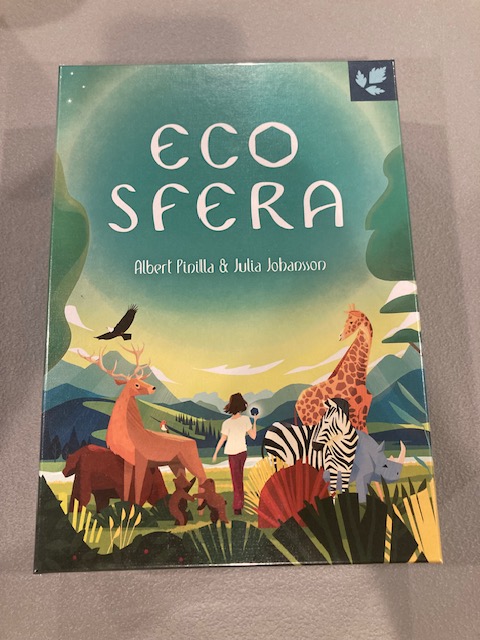
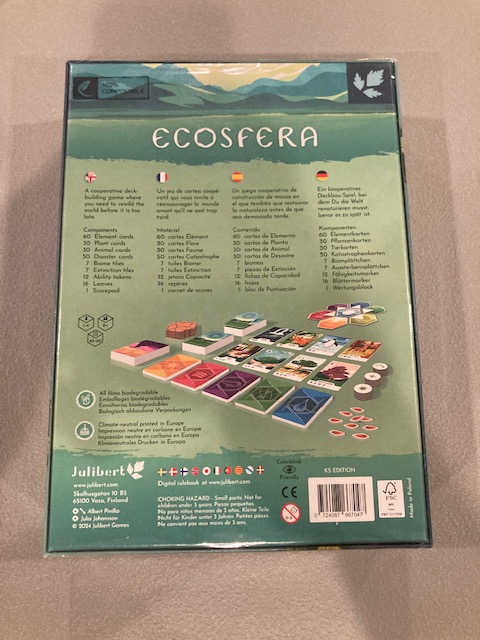
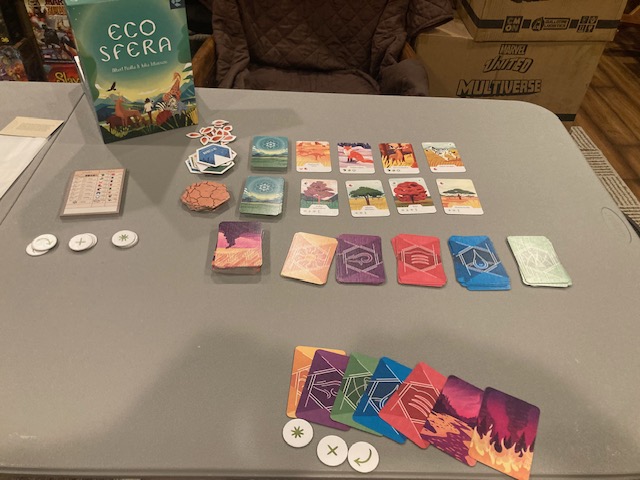
Ecosfera (Eco sfera as implied by the cover) was a game on Kickstarter in April 2023: See here.

IMG_7224

This is a cooperative deck-builder with a few push-your-luck elements. This is also a nature themed game! Nature is a very hot theme for games right right, so I call this Yet Another Nature Game (YANG). Many nature games are competitive, so this stands out as a cooperative YANG.

IMG_7226

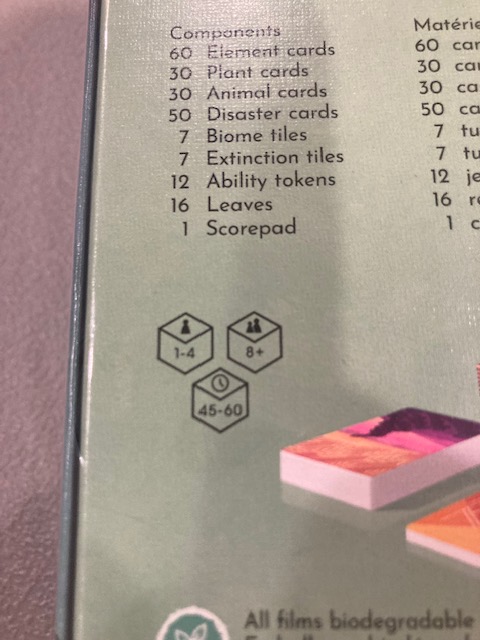
This is a game intended for 1-4 players, ages 8+. The intended time is 45-60 minutes, which is about right, but see more discussion below.

Let’s take a look!

Unboxing and Gameplay

IMG_7228

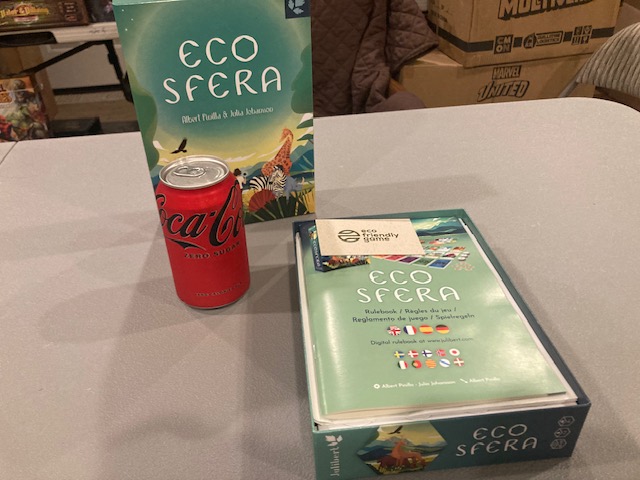
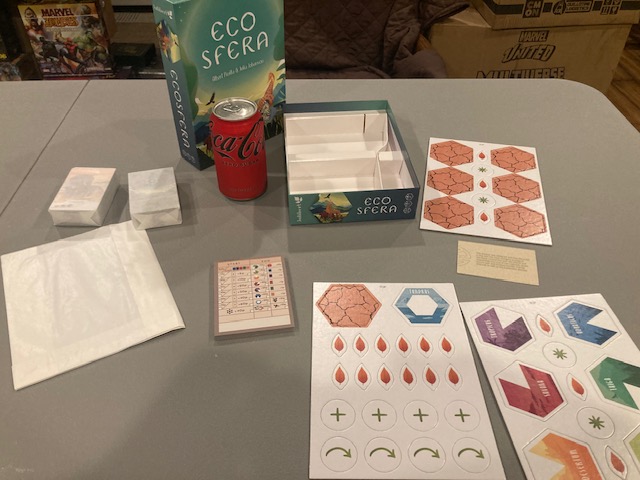
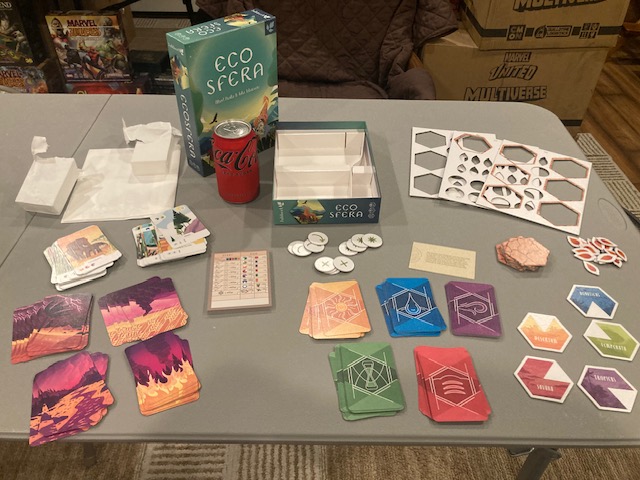
Ecosfera is a smaller box game: see Coke Can above for scale.

IMG_7237

Ecosfera is mostly a card game, but it also has a lot of punch out tokens: see above.

IMG_7348

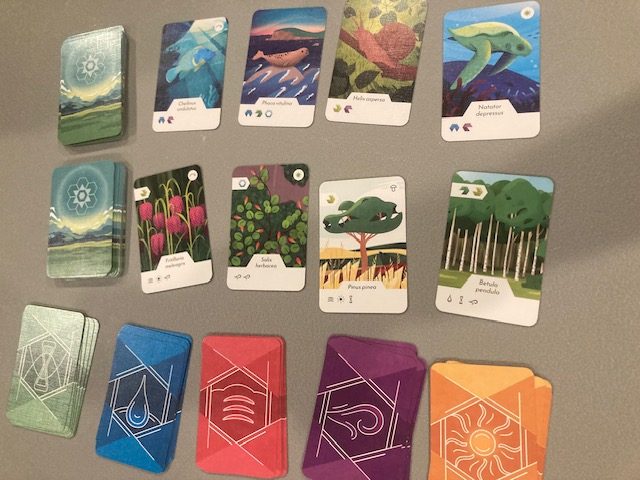
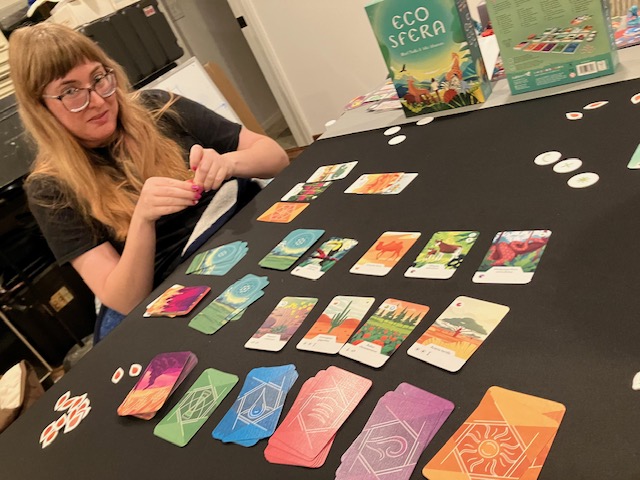
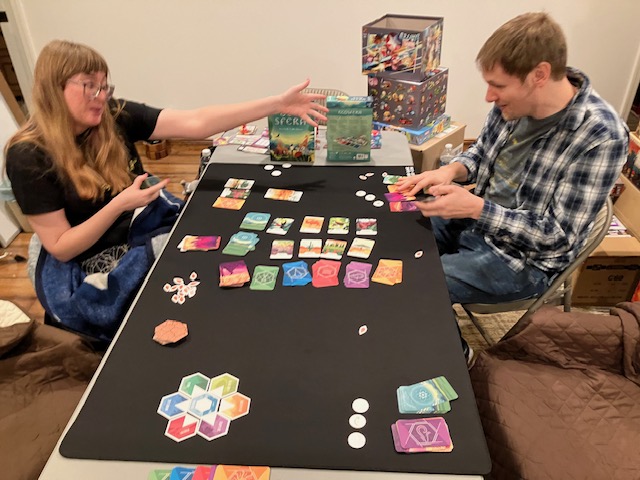
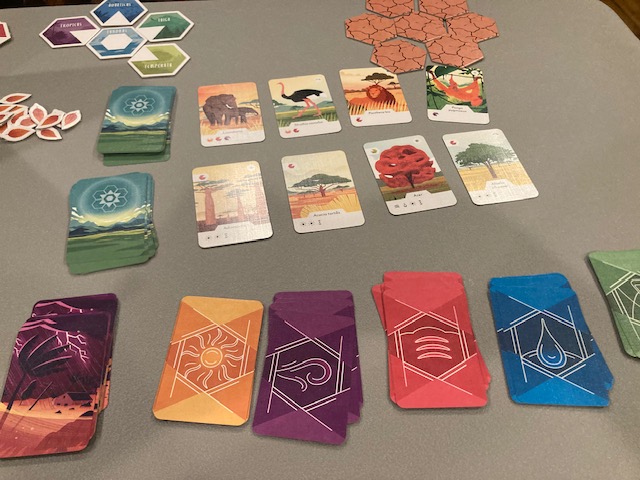
This is a deck-builder with three different “currencies” of buying.  Elements buy plants, plants buy animals, and animals buy biomes.  See the offering of elements, plants, and animals above!

IMG_7243

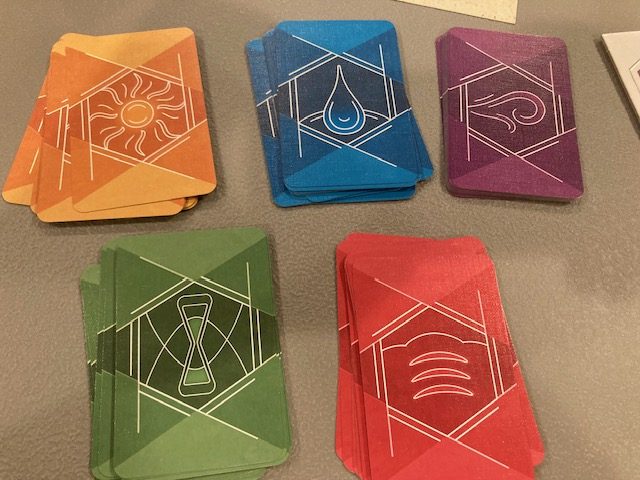
The base currency is the elements: the multi-colored cards above are also multi-labelled cards to avoid color-blind issues.  These elements can only buy plants.

IMG_7278

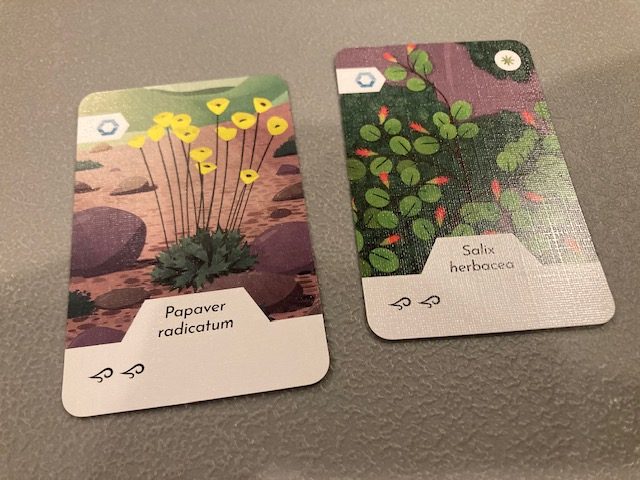
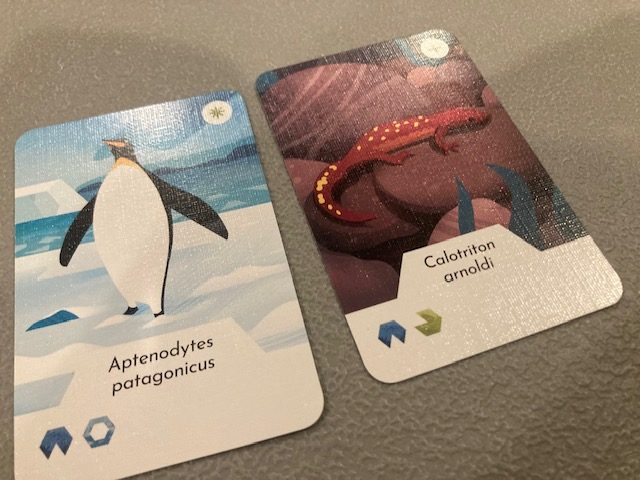
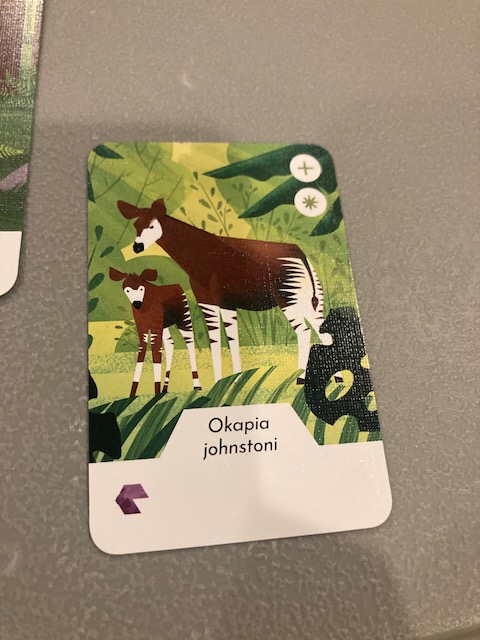
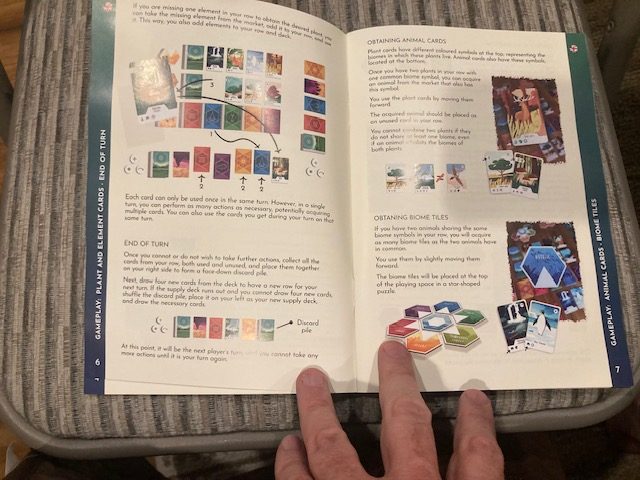
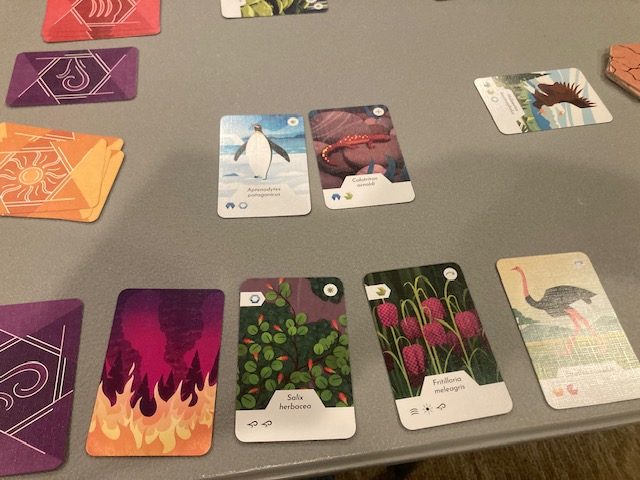
See two plants above: notice the element symbols on the BOTTOM of the cards. You can only buy a plant if you have the elements (we need two winds to buy the Papever radictum). You can be missing one element and still buy a plant … if so, you get that extra missing element for free into your hand. You’ll also notice the symbols at the TOP of the cards: these are the currency for buying the next level: animals.

IMG_7355

Animals can ONLY be bought if you have two plants with matching symbols on that animal!  Again, the cost to buy animals is on the BOTTOM of the card.   Using the two plants from above, we can buy a Penguin, because we have two of the Tundrus symbol!

IMG_7290

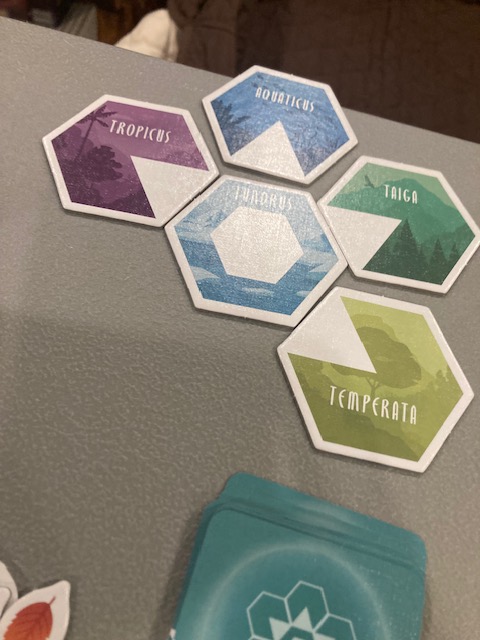
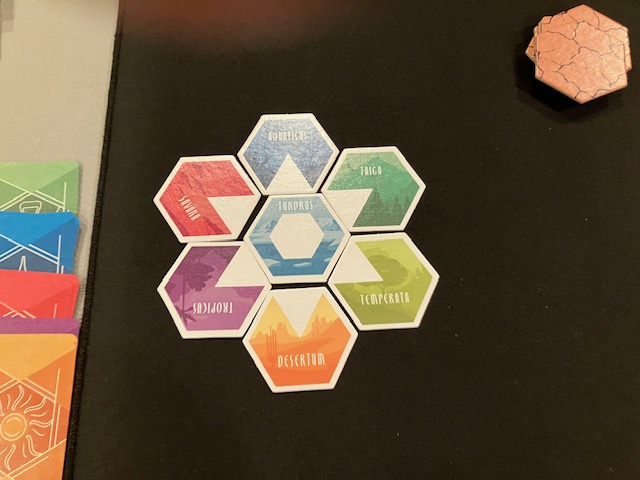
Finally, the animals buy biomes.  If you have two animals sharing some biomes, you can immediately spend them to buy the overlapping biomes!  Using the penguin and the lizard above, we can acquire the Aquaticus biome since the animals share that!

IMG_0884

If you make all biomes, you win!

IMG_7244

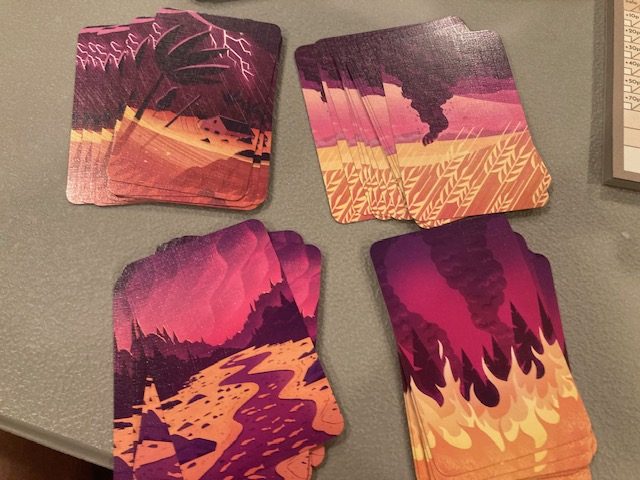
Along the way, many things can go wrong: you can get the Disaster cards (see above: the different symbols mean nothing)! These cards clog your deck, preventing you from buying things along the way!

IMG_7270

If you can’t buy anything on your turn (either a plant or animal or biome), you get a Disaster card in your deck. By itself, the Disaster card doesn’t do anything: it clogs your deck mostly.

IMG_7286

But, if you ever get 3 Disasters in your hand (see above) …

IMG_7247

… your turn immediately ends and you get an Extinction Tile! (If you get 4 Disasters, you immediately get 3 Extinction Tiles!)

IMG_7285

If you ever get 7 Extinction Tiles, you lose!

IMG_7248

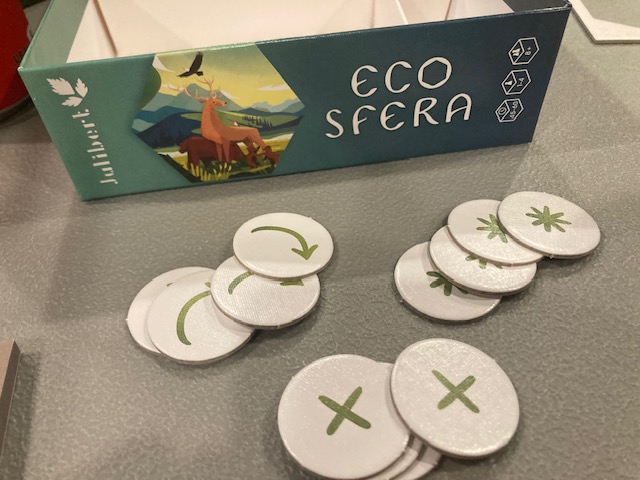
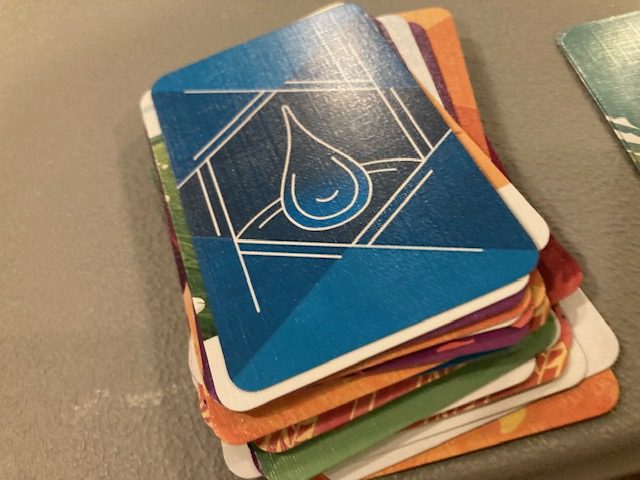
Along the way, each Player gets some tokens to help them.  The Plus (+) can be spent to pull an extra card, the Star (*) can be spent to refresh a line of cards (to get better buy options), and the Arrow is the most important symbol in the entire game: you can use it to move cards to other players OR to cull cards (ya, but you can’t EVER cull Disaster card).

These are one-time usage, however, you do refresh them every time you have an animal pair that matches a biome in your hand.  (So even if you can’t buy a new biome, you can still refresh your tokens).

IMG_7275

You’ll notice that some of the cards ALSO have these symbols: you can choose to use these symbols from your hand as well! (Only one OR the other)
IMG_7276

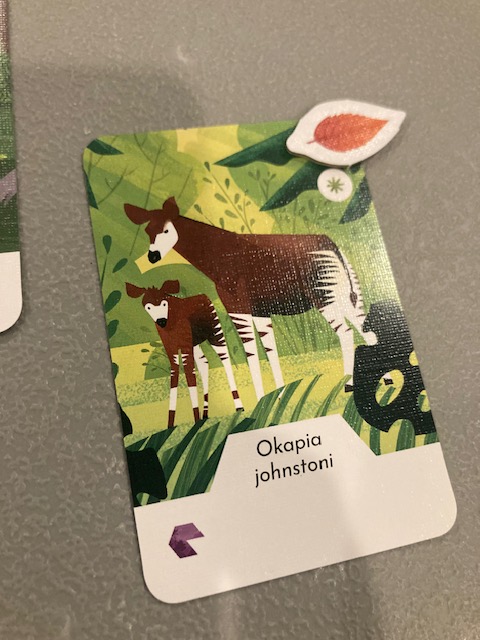
To help remind you which cards have been used, the game provides some leaf reminders: see above as we use to remind ourselves that we used the + and can’t use that card again.

IMG_7249

This game is quite lovely to look at: the art and tokens are easy to read, and cards are a very nice linen-finish.  In all my game groups and plays, the players commented on how nice the art on the cards is.   This is a beautiful production.

Rulebook

IMG_7231

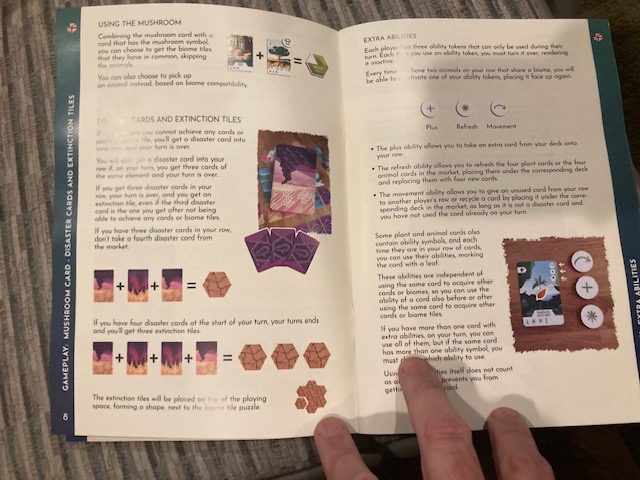
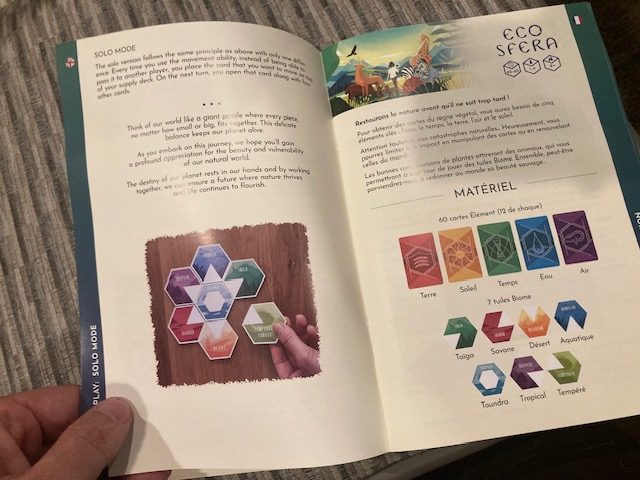
The rulebook was okay.  It looks a bit daunting because it’s very thick, but it also have 4 translations in it.  It only take about 9 pages to get the rules across.

IMG_7254

Although the rulebook works fairly well on the chair next to me, and the font is a decent sized, I was slightly annoyed that I had to hold the rulebook open many times! I want my rulebook to lay open on the chair next to:  this ventures into C territory for The Chair Test, but since I can “break the spine” to get the rulebook to stay open, I’ll give this a B- on The Chair Test.

IMG_7233

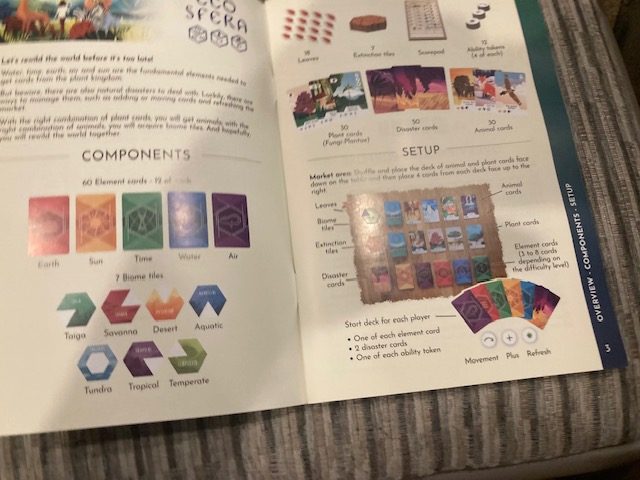
The set-up and components were fairly well-notated on the first two pages.  This allowed me to jump in fairly quickly, which was nice.

IMG_7255

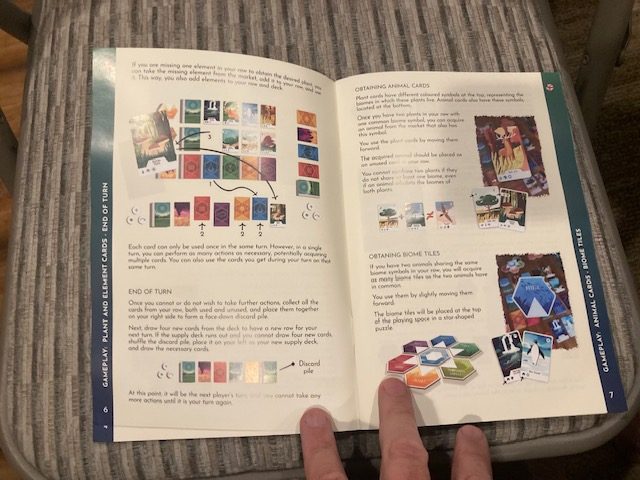
The rules had some nice pictures showing how the game flows and plays (see above).

IMG_7256

I felt like some of the organization was a little off: they spent precious space showing simple rules, but then failed to elaborate more complex rules in a few places. 

IMG_7257

The rulebook was fine: it taught the game, but sometimes you will have to go hunting for a rule.

I won’t ding this for the lack of an index because it is a pretty simple game overall; it doesn’t need one.

Player Count

IMG_0881

More than any other game I have played in some time, the Player Count matters for this game.  It’s either a slog of playing of cards that play themselves, or a dynamic event! 

Solo Game

IMG_7268

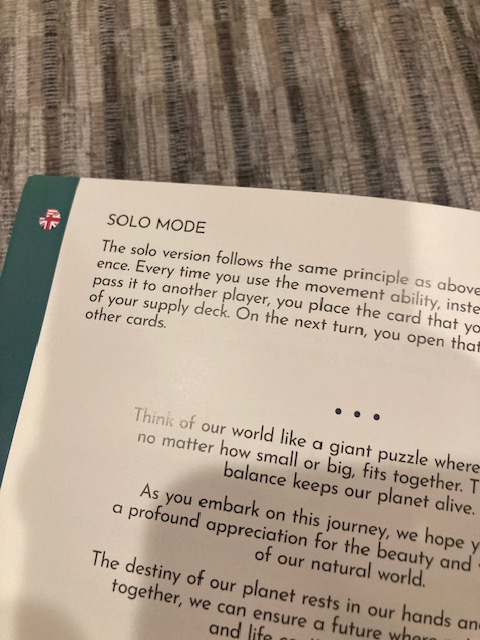
This game does support solo play (see top of page 10): Thank you for following Saunders’ Law and giving us a solo mode. The only real difference is that the Arrow symbol means that you can’t share cards with anyone else (you can still cull), you can only share with yourself and give yourself an extra card.

IMG_7252

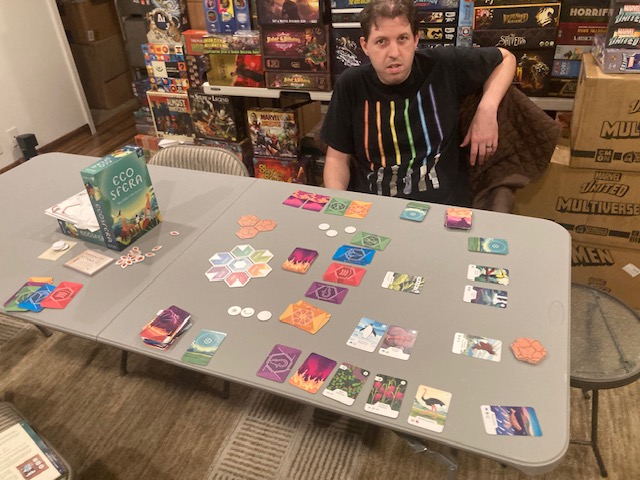
See above as I have a solo game set-up!  The solo mode does allow you to learn the game: I have played this game quite a bit solo.

IMG_7285

My first solo game was a slog and I hated the game. What am I missing? I found this thread on BoardGameGeek where someone else had the same experience: What Am I Missing? Armed with that information, I tried again and did a little better.

The most important thing you learn from a few games is that the Arrow symbol is critical.

IMG_7277

The major problem with solo mode is that your deck just builds and builds (see how huge my solo deck is) and many times you feel you have no agency!   You just draw cards and hope you get the cards you need.  You can either do something or not.  That’s it.  The game feels like it plays itself!!!  If you have used all your tokens, well, it’s even less fun.  Right now, the solo game hovers at a 4/10 for me.  (I will revisit this below)

I had enough information to teach my friends AND emphasize the Arrow. Maybe the game works better with more people?

Two Player

IMG_7361

Sam came over and we gave it a a try: I made sure to emphasize the Arrow symbol and that we needed to talk.

IMG_7353

The game went a little better as we tried to be intelligent about the use our symbols. Again, the most important feature is to use Arrow to share cards at the right times.

IMG_7359

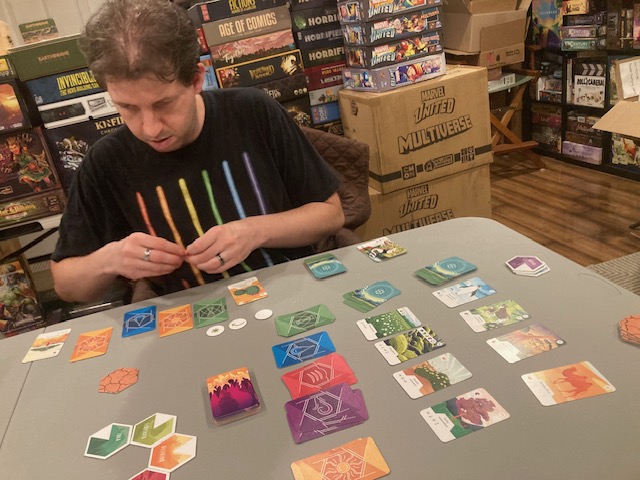
The decks still got pretty big (see above), and many turns had nothing happen as we acquired Disaster after Disaster. See below.

IMG_7349

IMG_7356

We started to see a little more strategy: maybe it made sense to move a card to my compatriot, maybe it made sense to cull this card.  There was more sharing as we tried to help each other.

In the end, we won, and there was some sharing.  And there was some discussion.  And there was some strategizing.  But there were a whole lot of turns where nothing happened and we just acquired a Disaster.   During those turns, it just felts like the game was playing itself.

In the end, Sam gave the 2-Player game about a 6/10.  I was a little more down on the game after my solo play and I gave it a 5.5/10.    The decks got huge, and there were still a lot of turns where nothing happened, but we saw a glimmer of the sharing and strategy.

3- Player and 4-Player

IMG_0882

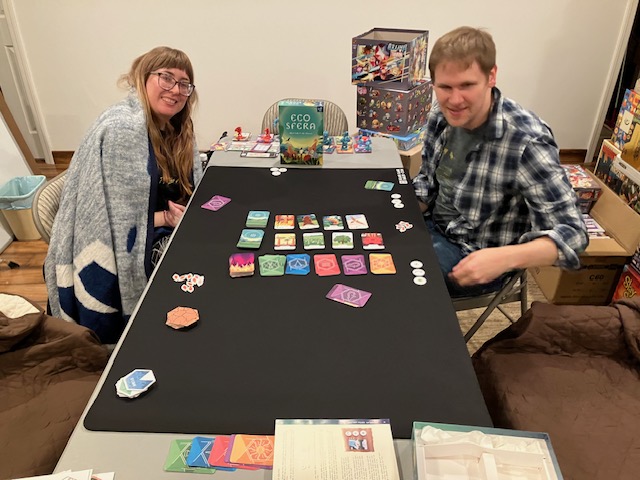
We saw, in the first 3-Player game that this game CAN be fun!  As long as you use all the symbols on the cards, and try to use the Arrows to move and cull cards, and communicate and cooperate, the game feels like you have agency!

IMG_0883

The difference between a solo/duo game and a 3 to 4-Player game is the number of opportunities!  More players means more opportunities to share resources smartly!

“I can share this card, but Sara doesn’t have any animals.  AH!  But Andrew does! I’ll share this with him so we can get the last biome!” 

All of a sudden, people are looking around the table for opportunities to share!  People are talking, people are communicating, people are cooperating!  

IMG_0885

The 3 and 4-Player game is fun!  As long as you exploit the shared opportunities, this game can be quite fun!  My friends all had fun and wanted to play again.  

I mentioned the problems with  solo and duo play, and my friends said “There’s just more opportunities to be smart with more players!”

Be aware, if you are looking for a game that is good as a multiplayer solo game, this isn’t the game for you!  If you play Ecosfera like multiplayer solitaire (no one really works together and everyone just plays by themselves), Ecosfera will have all the problems of the solo game … and it won’t be fun.  In order to truly enjoy this game, you need 3 or 4 players with a group that will engage with each other! 

You need to have opportunities to share.  You also need to strategize to use those opportunities well.  There’s a lot more of this in the 3 and 4-player game.

Conclusion

IMG_7287

If you are looking for a solo game, I can’t recommend this game: although the solo game is good enough to teach the game, it leaves a bad taste in the mouth that this game plays itself.  It’s about 4.5/10 at a solo play because it just barely works.

IMG_7361

Even a 2-Player game isn’t quite right: there’s not enough quite opportunities for intelligent sharing; the game still feels like it’s playing itself too much of the time.  It’s better at 2-Player than solo (maybe a 5.5 or 6/10), but I still can’t recommend it.

IMG_0881

It’s not until you get to 3 or 4 players together that this game opens up and becomes fun!  There are so many more opportunities to work together and strategize together as a group when you have 3 or 4 players!!!   In that configuration, I can recommend this game, as can my friends: they have suggested we play again! This is a 6.5 or 7.0/10 for 3 to 4 players.  Just make sure you play with a dynamic group!

I don’t think we’ve ever had a game that is so player count dependent! If you want a solo game or something to play with your partner, I can’t recommend this game.  If you want a game that plays multiplayer solitaire with little interaction, again, I can’t recommend this game.   I think this game only works with 3 to 4 players with a dynamic group … and then it’s fun.

The Nature theme is fairly thematic, the art is pretty, and the game is gorgeous …. but that will only get you so far: Be aware of when this game works and when it doesn’t before you pick it up.

Coop: The Co-op Game! A Review of Flock Together

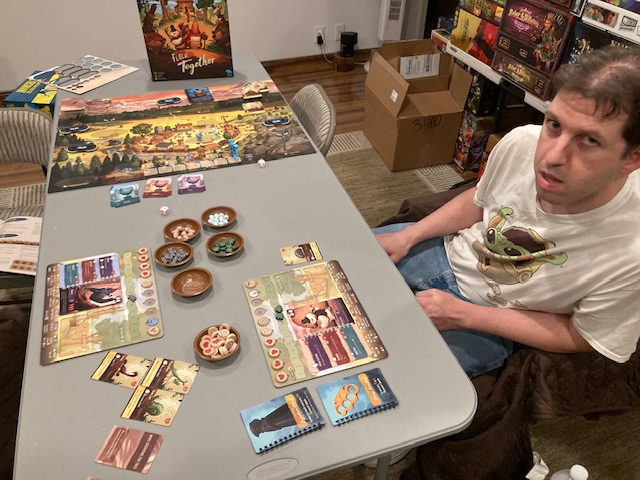
As we head into RichieCon soon, I wanted to highlight some games that I think a lot of people will want to play during RichieCon: Flock Together is one of them. Spoiler Alert! We liked this game! I think a lot of my friends will really enjoy this game!

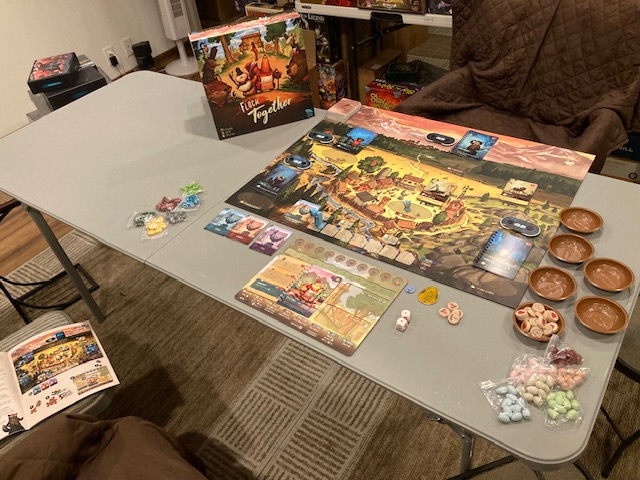
IMG_5776

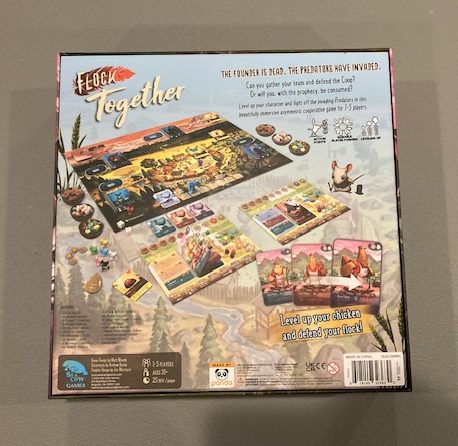
Flock Together is a light cooperative boss-battler game for 1-5 player;  this was #6 on our Top 10 Anticipated Cooperative Games of 2024!
IMG_5779

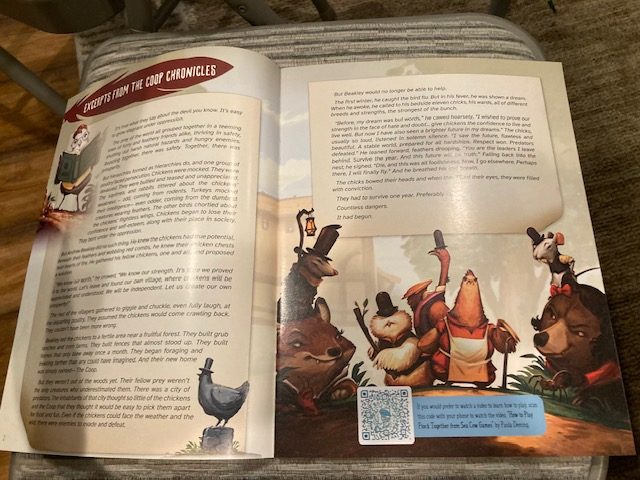
This is game all about chickens with asymmetric powers!  (There’s a sentence you never thought you’d hear!)  It’s all about chickens leveling up and working together to fight off the invading predators!  My friends and I joke that this is Coop: the co-op game as players cooperatively defend the chicken coop!

IMG_5781

Flock Together plays 1-5 players, ages 10+ (but I think younger players could handle this), and lasts about 25 minutes per player.    This is what the box says, and that feels fairly accurate.

IMG_5778

This was on Kickstarter back in Sept 2023 and it promised deliver in June 2024.  It arrived at my house in early July 2024, so it’s a few weeks late.  In the grand scheme of Kickstarters, a few weeks late is on time!

Let’s take a look!

Unboxing And Gameplay

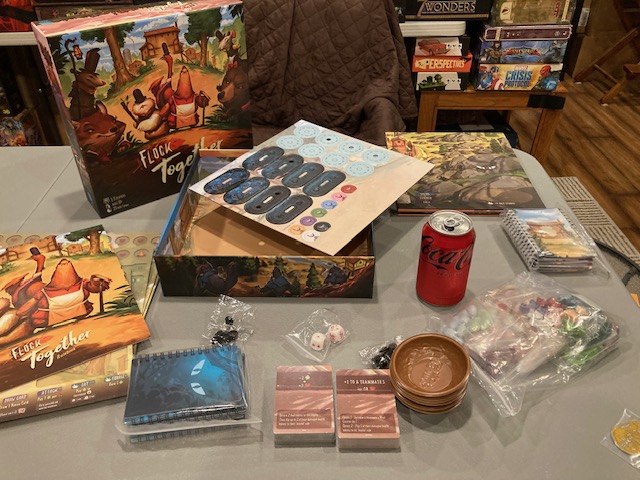
IMG_5782

This is standard size board game box: see Coke can for perspective above.

IMG_5783

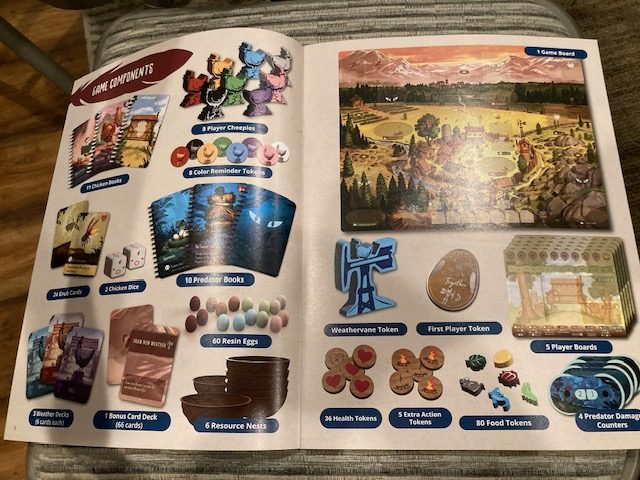
The components are first class!  There was only one level backing this Kickstarter, so I think everyone will be getting this amazing production when it comes to retail!

IMG_5796

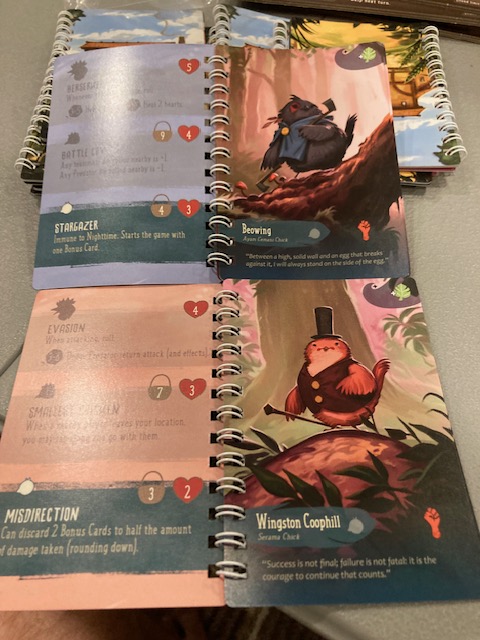
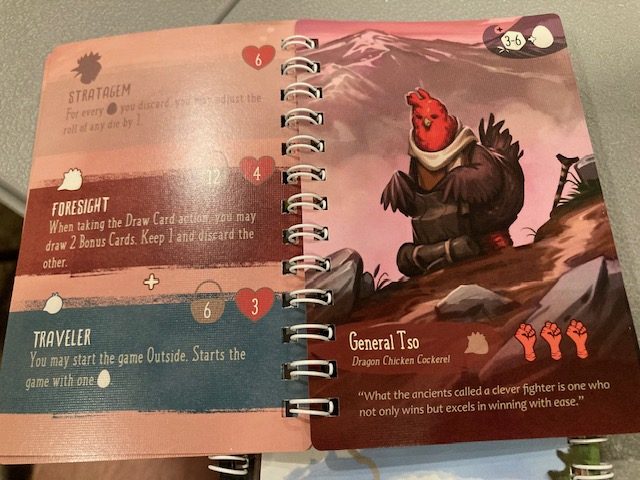
Each player plays a chicken!  Bock!  Each players chooses 1 of 11 chicken books!  See two above!

IMG_5797

Each chicken has kind of punny name: see General Tso above.  My friends and I found these puns funny and not too annoying.  It also sets the mood: this is a lightish, fun game.

IMG_5803

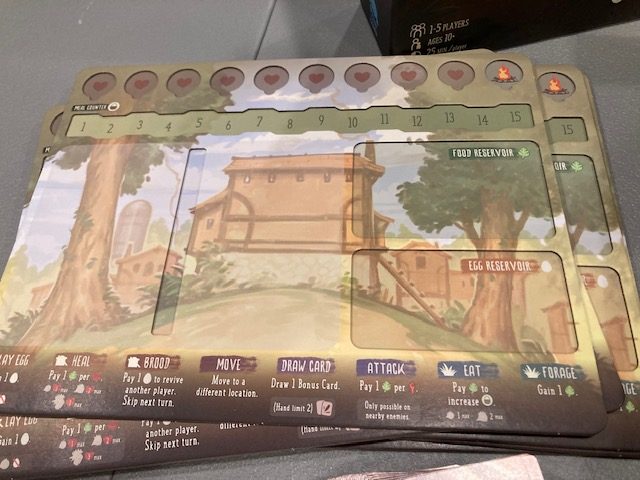
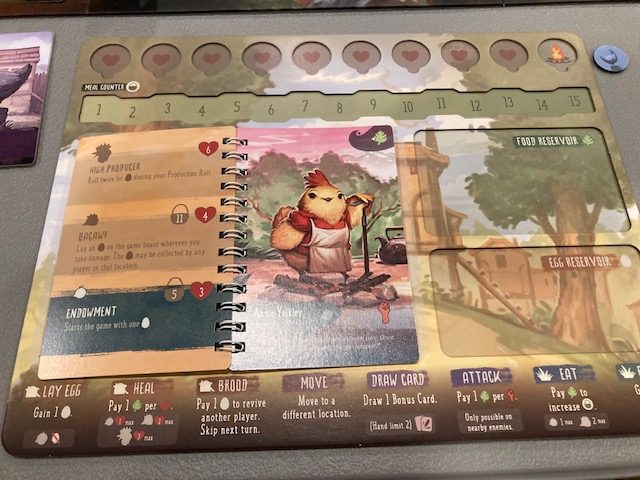
Each player then takes a player board (see the dual-layered board above) …

IMG_5828

I want to point this out because it’s really nice: the spine of the chicken book fits into an indent on the player board! See the indent above!

IMG_5829

And that little book fits nicely into the board!  See above!

IMG_5780

As your chicken plays, she levels up the more she eats!

IMG_5840

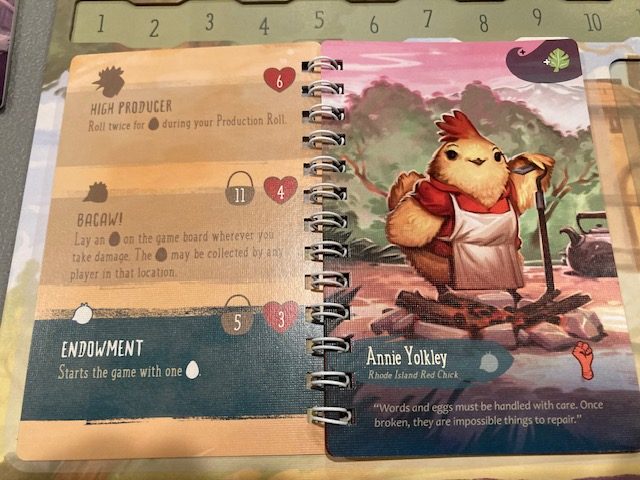
You start as a chick (level 1: see above) with only the power highlighted at the bottom.

IMG_5841

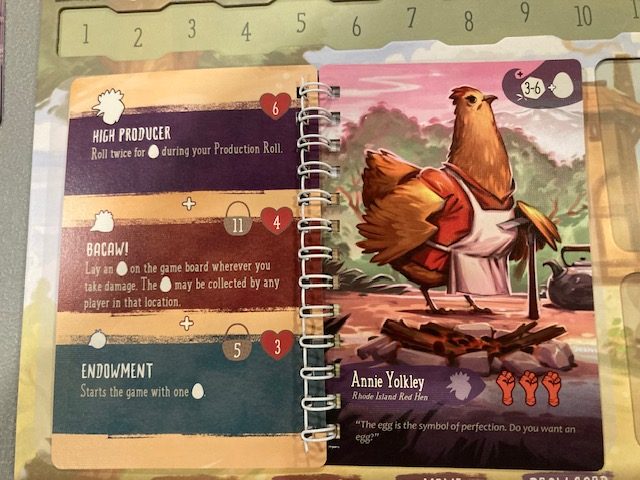
If Annie eats 5 food (the little basket tells you how much food you need to eat), you turn the page to get to level 2: A Pullet!  Now, Annie Yokley has two powers and 1 more hit point! See above!

IMG_5842

And finally at 11 food, Annie is a Hen! With 6 full hit points and 3 full powers!

IMG_5809

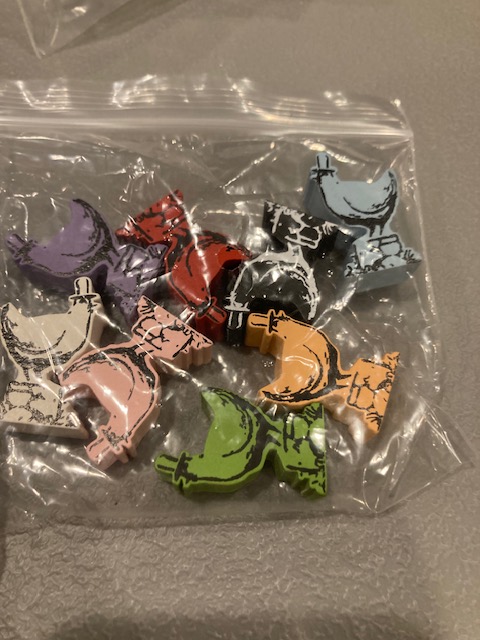
Each player takes a colored chicken (see above) to move around the board (see below)!

IMG_5815

The board is a beautiful scene with the chicken coop in the middle (“inside”) and the world surrounding it (“outside”)! Chickens move around in this world to do stuff!

IMG_5866

The actions that a player take on her turn are all listed at the bottom of the board! See above. Note that there are “outside” actions (little grass symbol) and “inside” actions (with a coop symbol).

IMG_5867

The player has two action points on her turn and can do any two of these actions (and can repeat). It makes the game feel a little like worker placement, because you have to move your chicken either “inside” or “outside” to perform certain actions, but I can’t really call this worker placement (as players can share spaces).

IMG_5798

Although this doesn’t look like it, this is really a boss-battler game!  You have to fight 3 predators, and then you can fight the final boss to win!   The predators use the same book system as the players: they can level up just like the players!  

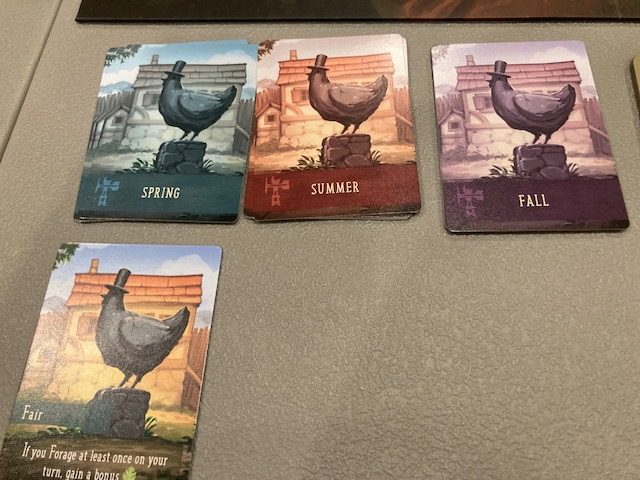
IMG_5826

Basically, at the end of a “season” (see Spring, Summer, Fall above), the predators level up!  Each season has its own set of “bad news” cards.  

IMG_5868

This is co-op game, so you have to have “bad news” season cards!  These don’t come out every turn, they come out between the 1, 3, and 6th turn of the season. It’s fairly well notated on the board: see above.  A season ends on the 7th space and a new one starts!

IMG_5825

If you go through all 3 seasons without defeating all 4 bosses, you lose!

IMG_5836

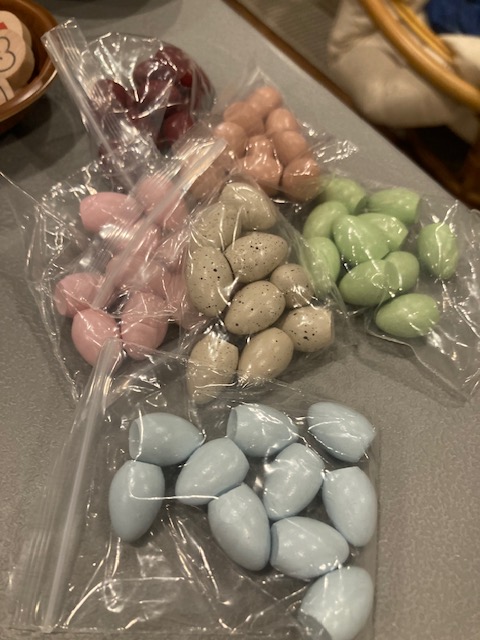
This is a game about needing resources: food (above)  …

IMG_5837

…and eggs.  The food is used to power most actions in the game (attacking, levelling up), but they are slightly more volatile.  The eggs can become food, if you choose to convert during them between rounds.  The eggs are more resilient to weather (“bad news”) than the food, but they must be converted to food to be useful.

IMG_5818

If the players can defeat the three easy predators (see two above) …

IMG_5819

They uncover the big boss who is immediately revealed at level 3!  If the players can defeat the big boss before the last season runs out, they win!

IMG_5801

Oh, to gain confidence and a few special abilities, players can also fight grubs (yellow cards above) or get a power up card (brown).

IMG_5800

Rulebook

IMG_5784

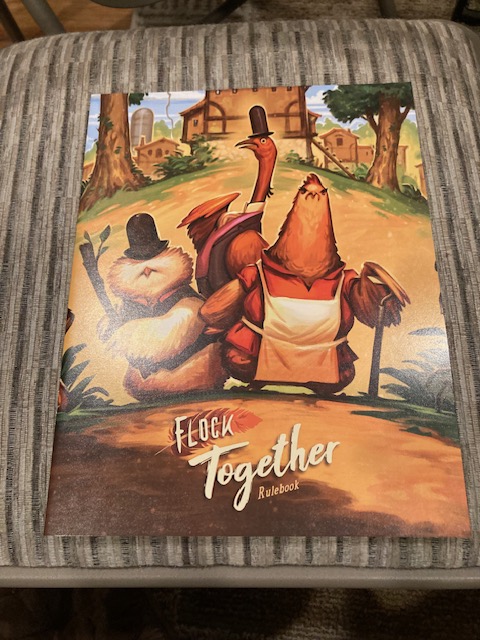
This is a great rulebook.  And I am not just saying that because it’s linen-finished and feels really nice.

IMG_5785

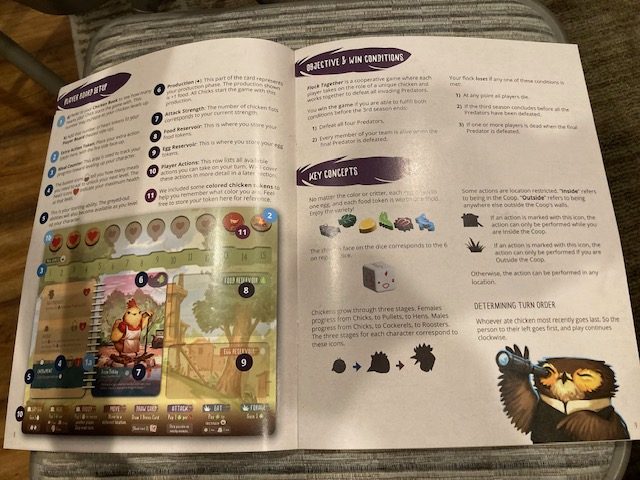
This rulebook gets an A- on the Chair Test: it lays flat, doesn’t flop too much, and has a big readable font.  It’s easy to consult on the chair next to me when I need to look up rules. This game has an excellent form factor.

IMG_5786

The Components page (above) is well-notated and easy to consult.  I always like to correlate components with their names: this components list even spans the same two opposite pages so it’s very easy to consult on the chair next to me.

IMG_5787

The set-up has a great picture: it is well-notated, well-labelled, easy to read, and spans two opposite pages easily so you can correlate the picture with the directions!  Fantastic! What an easy  set-up!

IMG_5788

The rest of the rulebook is the same caliber: it’s easy to read and get into.  In general, it dos a great job of teaching the game.

IMG_5794

It even ends with useful notes on the back.

This is one of the better rulebooks we have seen in a while.  And the linen-finish just takes the cake.

There is one complaint, which I will discuss below.  Otherwise, this is a fantastic rulebook.

Solo Play

IMG_5822

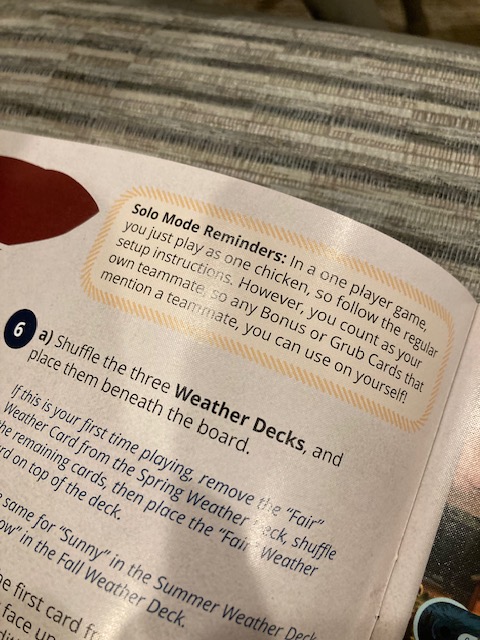
This game has only one real note for how to do solo play: it’s in the set-up for describing solo play!  See above!  Fantastic! This game follows Saunders’ Law!   And it’s a great solo game: all the rules stay the same except for one: you are your own teammate!  There’s no long list of rules exceptions: this is such an easy game to get to the table solo.

IMG_5820

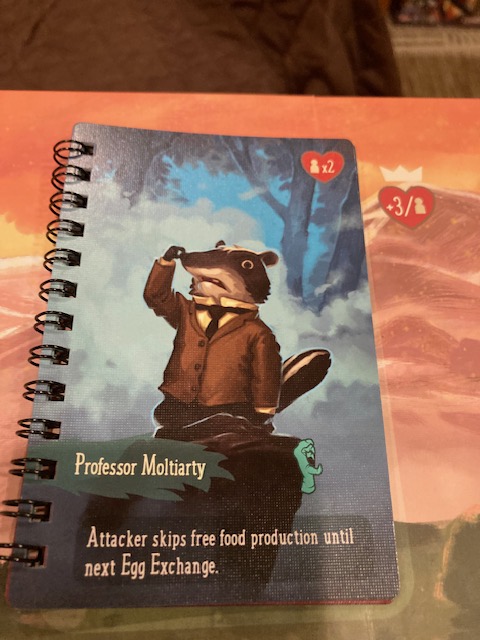
For balance, the hit points of each of the bosses is a multiplier of the number of players!  This is how the game scales the difficulty for the number of players!  So, Professor Moltiarity (above) has 2 *1 + 3*1 = 5 hit points for a solo game (and would have 2*2 + 3*2=10 hit points for a 2-Player game, etc). 

IMG_5852

My first solo game was playing Annie Yokley (see above) and my final boss was Professor Moltiarity!

IMG_5830

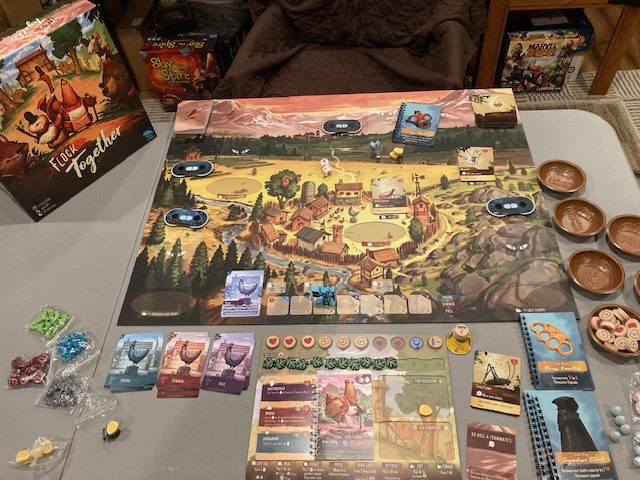
The game sets-up quickly and easily. See above as I have the rulebook open on the chair next to me and the game set-up (with Annie) on the table!  It really pops!

IMG_5859

The game is light and plays quickly: you take your two actions per turn, leveling up while you eat, attack grubs, attack predators, and forage for food!  You can always go back to the coop to heal if you need to.

IMG_5860

My first game ended in about 20 minutes with a win!  I don’t feel like I got any rules wrong (I tend to get a few rules wrong in many of my first plays), as the rules are easy and well-described in the rulebook! 

At the end of my game, I felt confident I could teach my friends this game; it was fun and breezy.  I enjoyed the puns and flavor text on the cards.   It was only a 20 minute game and I had fun.   I could see Flock Together getting slightly repetitive if the game lasted any longer, but the solo game felt just the right length! And there was always something interesting to do on your turn, even if you only had two actions! The game moved quickly and I had a good time. 

I am not sure how often I would get the game out just to play solo though.  But the solo game teaches the game well.

Cooperative Play

IMG_0569

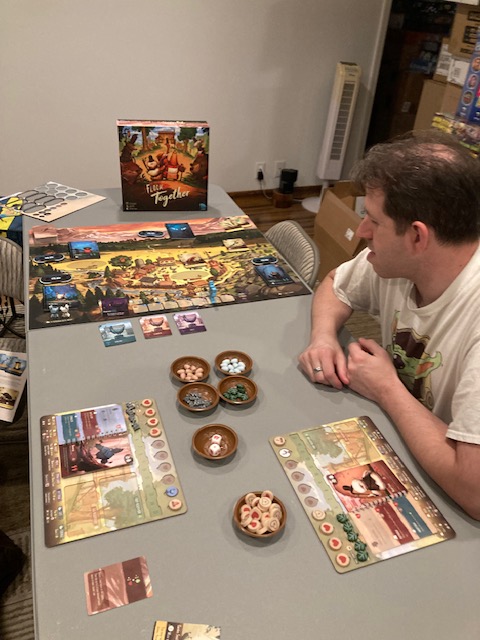
My first cooperative play went pretty well.  My friend Teresa loved this world! She loved the art, the cute game, the flavor text, and she loved the chickens!  And of course, we made tons of chicken jokes as we played: we were poultry in motion!

IMG_0555

The game doesn’t take itself too seriously and that flavor (chicken flavor) seems to come out as you play! It really kind of elevates our spirits!

IMG_5861

Early in the game, turns are a little more “multiplayer solitaire”, and each player needs to level up.  Your actions will be just trying to get your chick into something that can fight!   

IMG_0568

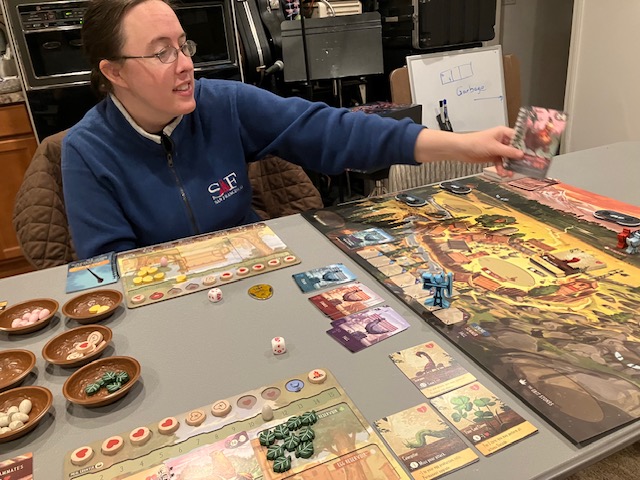
But to win, you will almost certainaly have to cooperate in the end game!  See above as Teresa and I fight the Big Bad together.

IMG_0566

The amount of cooperation kind of depends on the chickens you choose and the powers (and one-shots) you get: cooperation isn’t baked-in to the main actions (pun not intended … well, maybe it was intended)! You can’t share resources or actions or do anything necessarily cooperative with your base actions: it seemed like most cooperative endeavors were from specials.   It worked fine for us, but it’s possible your game won’t be particularly cooperative if you don’t get the cards/powers that enable that cooperation. It’s not a dig against the game: it’s just not quite as cooperative as you might hope, especially early on.  We do have a suggestion that would make it more cooperative (see below).

IMG_0558

Teresa and I had fun playing cooperatively.    Teresa says she really wants to play this with her sister! A good sign!

IMG_6019

My second cooperative game wasn’t quite as successful: Sam and I ran out of time and couldn’t defeat the final boss.

IMG_6023

Honestly, it was the weather cards that destroyed us: the weather had us doing 1 less damage to a predator.  We did look back on the game and realized we made a few strategic mistakes, but the bad news weather cards screwed us more than we cared to admit.

IMG_6025

Sam didn’t love Flock Together.

Play Order

IMG_5804

The first player token in this game is a gorgeous metal token! See above! It indicates who the first player is!

IMG_5864

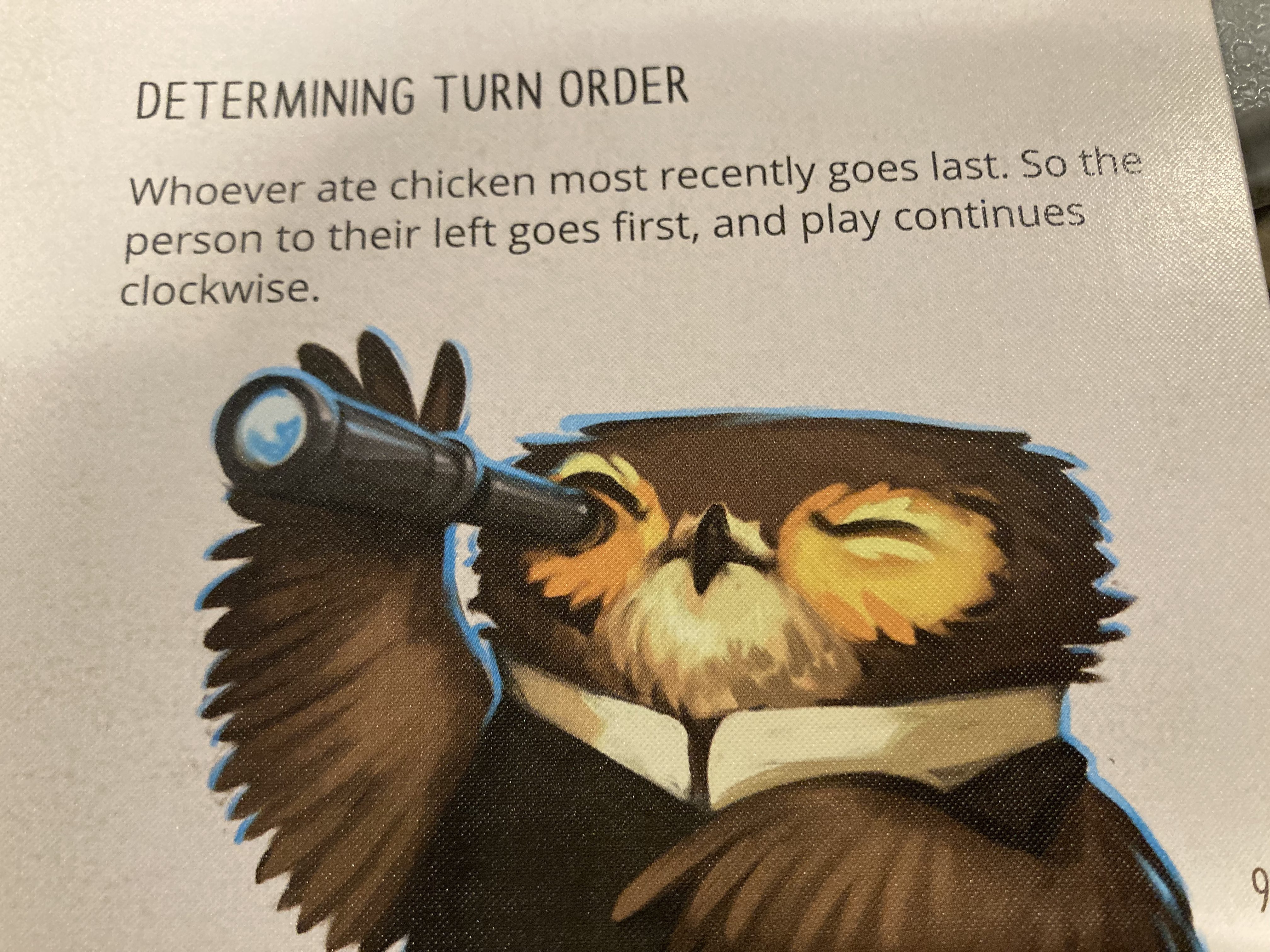
And the rules specify that the game proceeds clockwise (see above, from page 9). 

The first question was: does the play order token move or does the first player always the first player?  The rules, as great as they are, do not specify this!  Most “modern” board games have the player order token move clockwise so that each player gets a chance to go first.  So, do we do that?  Or does it always stay at the same player?  Not clear?

IMG_0567

As we played, we actually got annoyed at this first player marker: we kept passing the player token back and forth, but since none of the rules say anything about when to do this, we forget a few times and lost track of who the first player was!

In the end, we just reverted to Player Selected Turn Order (coarse-grained).  We would decide cooperatively, per turn, who would go first (if it made a difference)!  Then we’d just take our turns in that order that we chose.  In fact, since we didn’t even have turn order, we could take our turns simultaneously sometimes (if we didn’t interfere with each other) … and the game would move along that much quicker!

This is totally a house rule: it’s not in the rulebook.  However, I recommend Player Selected Turn Order in your game of Flock Together: it will make the game move faster and the game will be more cooperative.  I love that first player marker, but it wasn’t working for us (especially since the rules seems silent on it).

What I Liked

IMG_5860

This production is magnificent. 

IMG_5799

The cards are beautiful and linen-finished with Andrew Bosley art!  Just so nice!

IMG_5784

Even the rulebook is linen-finished!  And it’s a very good rulebook (modulo the First Player issue).

IMG_5800

I didn’t mention the Power cards too much in the overview, but if you ever have a turn where you might have a “wasted” action (“I need to move to the coop, but what else can I do?“), you can always use an action to get a Power card: see above.  You never feel like you have a wasted action (which you could sometimes get in other games with Action Points, like Pandemic), as you can always take a Power card!  

IMG_0560

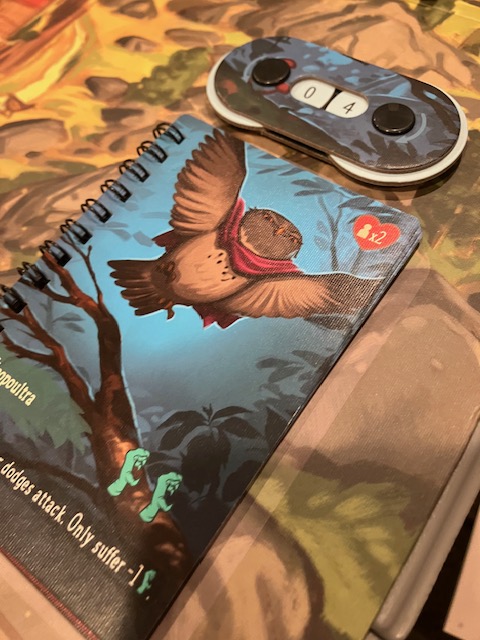
The comedy in this game, although silly, seemed to land for us. See Cleopoultra (oof, what a pun) above!!

What I Didn’t Like

IMG_5837

All the eggs (above) and food (below)  are different colors … and that difference means nothing. 

IMG_5836

I thought different colored eggs would have different powers or something!  Nope!  All eggs are the same!  I actually found that distracting and thought “Oh did I miss a rule?  Why are they all different?”   Maybe an expansion down the road will make that mean something?  Sure, it’s pretty, but I actually think it’s distracting.

IMG_5805

This one is related to the different colors: how are you supposed to sort the eggs and food?  We have 6 (really cool) trays to hold the resources, but because there are 6 kinds of food and 6 different kinds of eggs, which ones do you put in trays?  This sounds dumb, but the instructions don’t tell you how to use the trays (well, they sorta do on page 6, bullet 8, but it doesn’t tell you how to distribute them).  I mean this sounds like a dumb complaint, especially since the trays are so nice, but it does make you pause during the (otherwise great) set-up instructions.

IMG_5804

The Player Turn Order rules don’t work great: this games needs a house rule: use Player Selected Turn Order.  It makes the game more cooperative, more fun, and even moves it along quicker!

IMG_6024

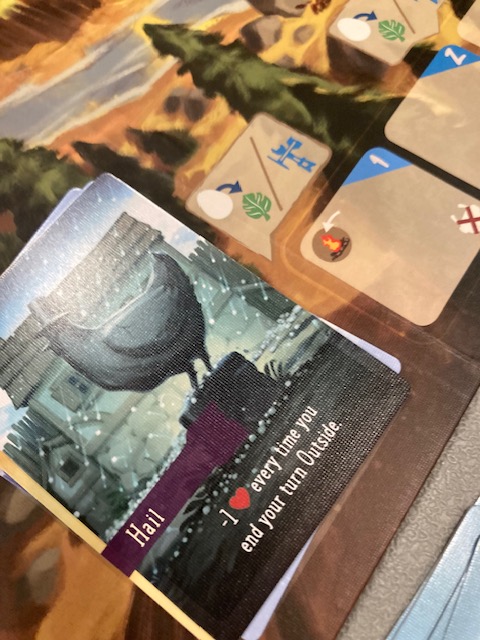
The Weather cards can be a little random and really mess with the dynamic of the game.  It can be frustrating. But since the game is short, it’s not too big a deal.

IMG_5794

Although you have all your actions on your player board, a turn summary/outline would have been nice: if we had one of these, we could have addressed the first player issue! It also would have reminded us of our actions at the end of each turn.   It seems silly, given that this game is pretty easy, but a little turn order card would have been useful.

Reactions

IMG_0562

Teresa gives this a 7 or 8 out of 10.  “I want to play this with my sister!  It’s on a list of games I want to play at RichieCon again!”

Richie gives it the same?  It’s very light (7/10), but it trends up (7.5? 8? /10) because the game is so uplifting with its amazing art, breath-taking components, silly puns, and light gameplay! The only real complaint “might be” that it can get random, but  since the game is so short, that really hasn’t been too big of a deal.

Sam didn’t like it quite as much as us:
Flock 6.5/10: I liked the silliness of the theme but felt like we didn’t have enough actions and the turns were too short to keep track of the round upkeep tasks

Conclusion

IMG_5863

Me and (most of) my friends recommend Flock Together!   The components and art are just stunning, the game has a silly vibe which puts you in a good mood, and the gameplay moves quickly! 

IMG_5853

If you find yourself interested in this game, we recommend playing with the house rule of  Player Selected Turn Order to make the game feel a little more cooperative and engaging.   The game is cooperative, but it may feel less so, depending on the power cards that emerge or characters you choose; The Player Selected Turn Order helps elevate the game’s cooperation factor.

Averaging me and my friends scores, this is probably something like a 7/10 or 7.5/10.  The cuteness and simplicity of the game may elevate that score for you.

A Review of Slay The Spire (The Board Game) From Someone Who Doesn’t Like Rogue-like Games And Has Never Played The Video Game!

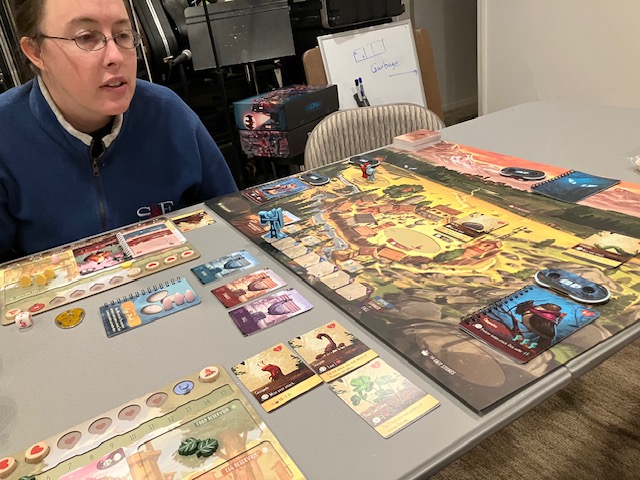
IMG_4652

Rogue

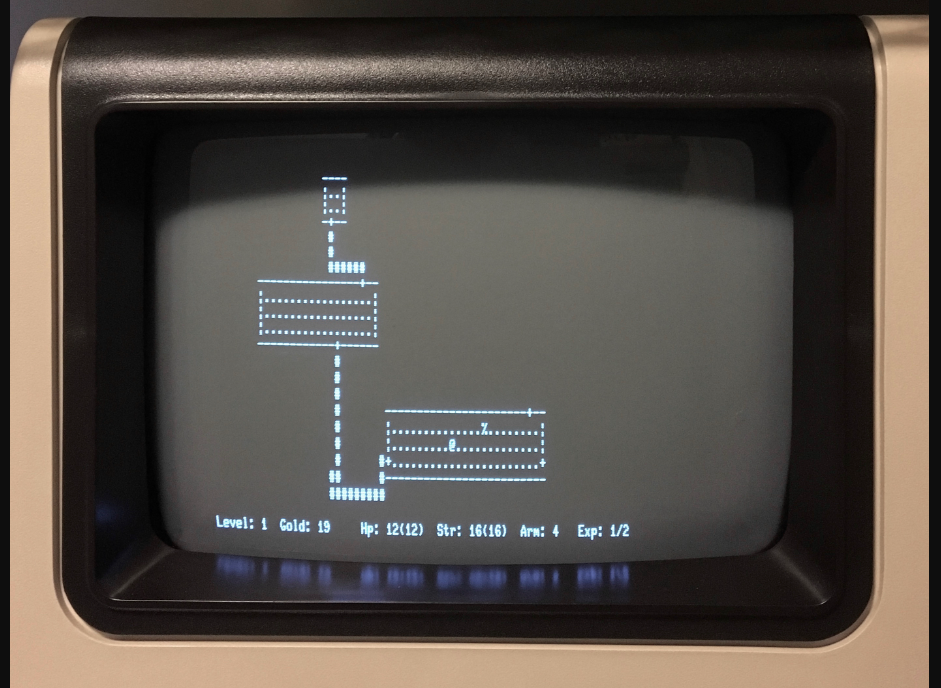
When I was an undergrad at college, a lot of my friends played a game called Rogue on the vt100 computer terminals.

vt100rogue

It was a little dungeon crawler that my friends spent HOURS and HOURS playing.

It’s a Dungeon Crawler? Fun!  Do you save you characters very often?
“Uh, … no.  You just play until you die.  You don’t save characters.”
I’m out!”

And that was pretty much where I learned to dislike Rogue-like games.  If I play a dungeon crawler spending hours leveling up my character, I want to save it!  Part of the fun, for me at least, is returning to my character that I’ve invested in.  I have no desire to play a formless character that just dies.

To be fair, my opinion has not aged well.  I have been informed by many people that Rogue-like games have some saving capability.  Still, my malformed opinion has persisted through the years.

Slay The Spire

IMG_4653

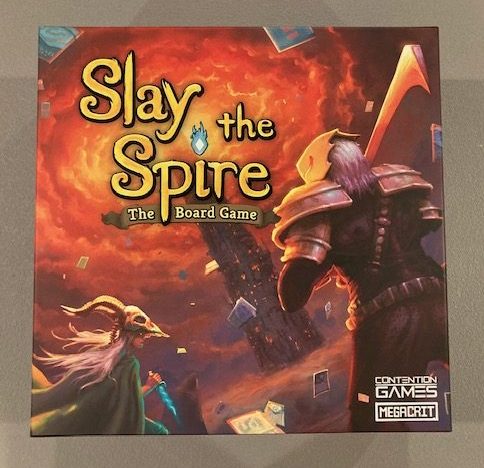
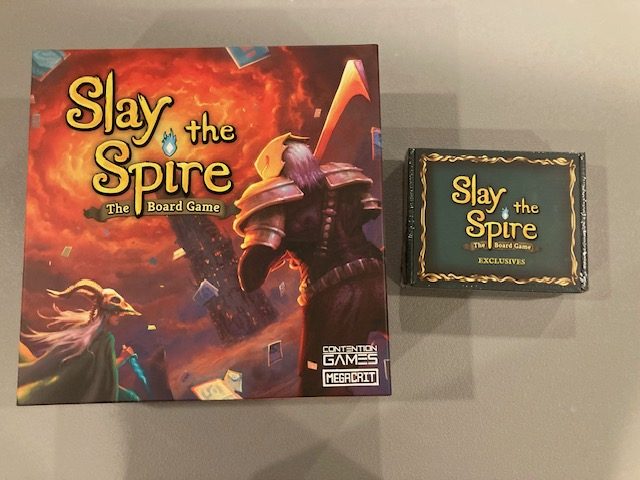
Because of my prejudice against Rogue-like games, I have never played the original Video game Splay The Spire.  I must admit, though, that I was intrigued by Slay The Spire (a cooperative deck-building game) when it appeared on Kickstarter back in November 2022.   The original Slay The Spire video game was really only a solo game … maybe the transition to cooperative board game would make it something more up my alley?

IMG_4657

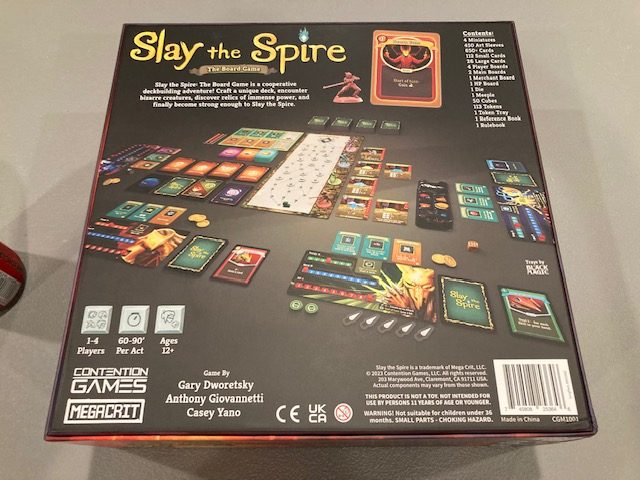
This arrived at my house in May 2023 (see above); it had promised delivery in Dec 2023, so it’s about 5 months late.  In the world of Kickstarter, 5 months late is not bad.

IMG_4656

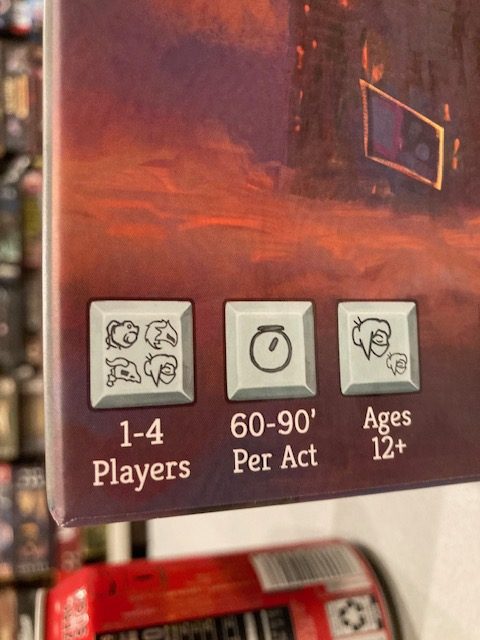
This is a cooperative board game for 1-4 players, Ages 12+, with only 60-90 minutes per Act!  I was intrigued!  To be fair, a lot of my friends seemed “excited” to play this game, so I freely admit that their enthusiasm was contagious.  

Let’s take a look!

Unboxing

IMG_4659

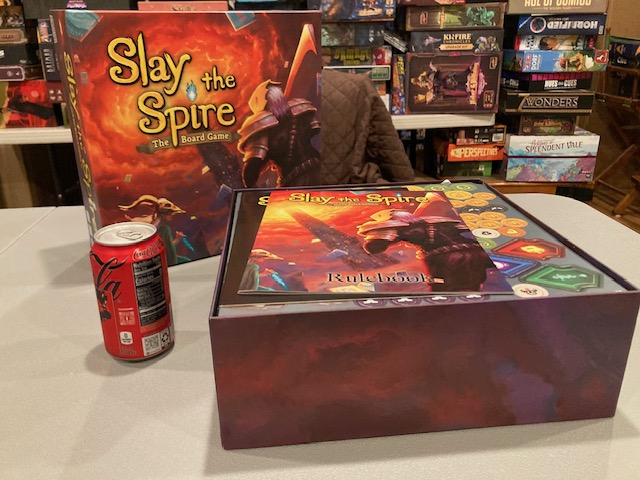
This is a pretty tall box (see Coke can above for perspective), but  it’s about the same form factor (in length and width) as a Ticket To Ride size box.

IMG_4661

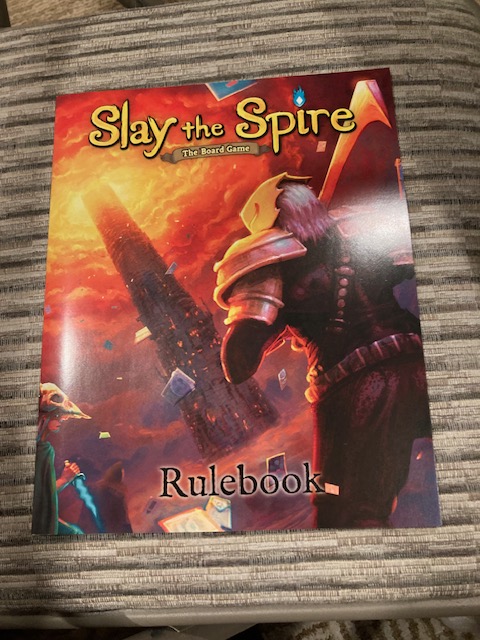
The top of the box has the rulebook and Upgrades and Items guide.

IMG_4665

Don’t be too impressed by this Upgrades and Items guide: all it does is show all the cards!  It has no disambiguating text!

IMG_4668

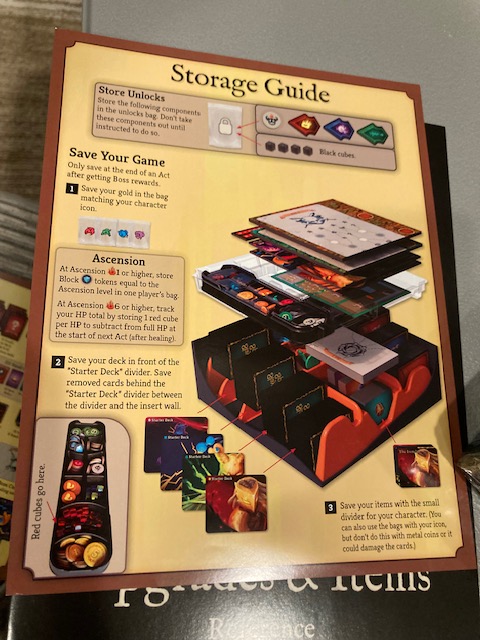
There is a very nice boxing/unboxing guide for putting this together and taking this apart. See above.

IMG_4680

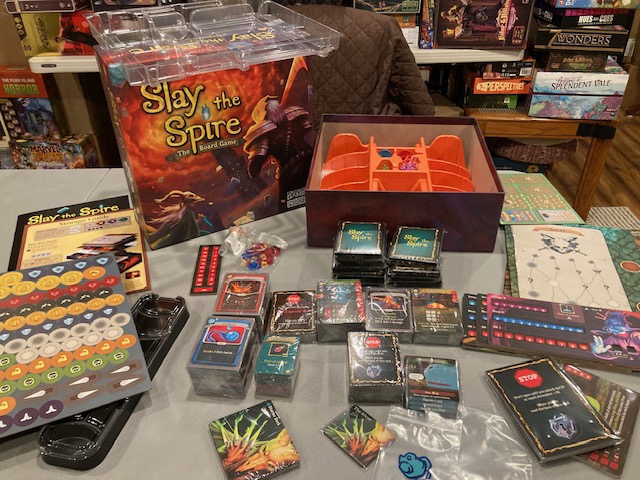
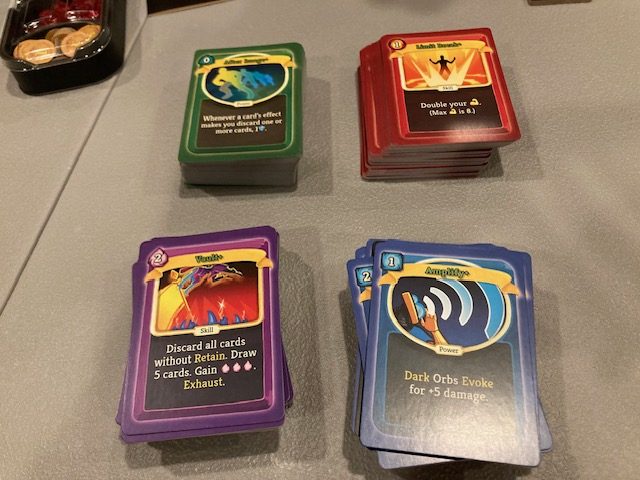
Are you like me as one of the few people and didn’t know that Slay The Spire Video Game was a deck-building game? Well, the board game is also a deck-building game!  As a deck-building game, this game comes with SO MANY cards!  See above and below. And its own sleeves!  For more discussion of Cooperative deck-builders like this, check out our Top 10 Cooperative Deck-Building Games!

IMG_4721

I have been informed that the cards and art look exactly like the Video Game.

IMG_4687

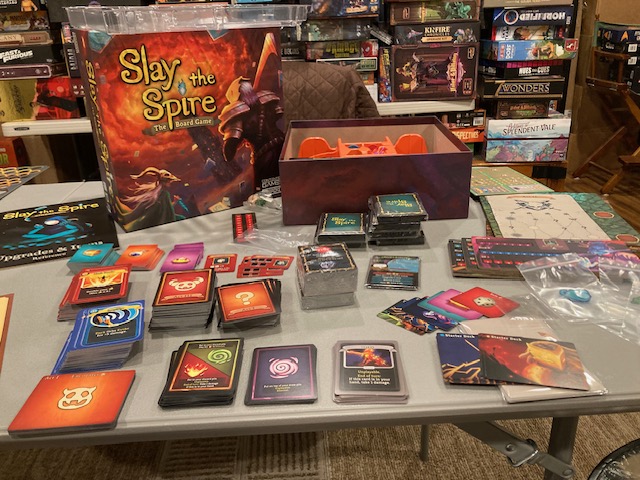
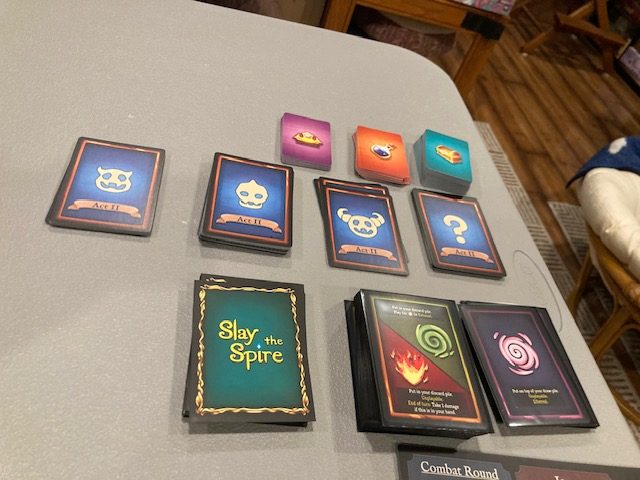
And there are a ton of cards and boards!  See above!  This game looks really fantastic! See above!

And it looks like the Video Game.

IMG_4731

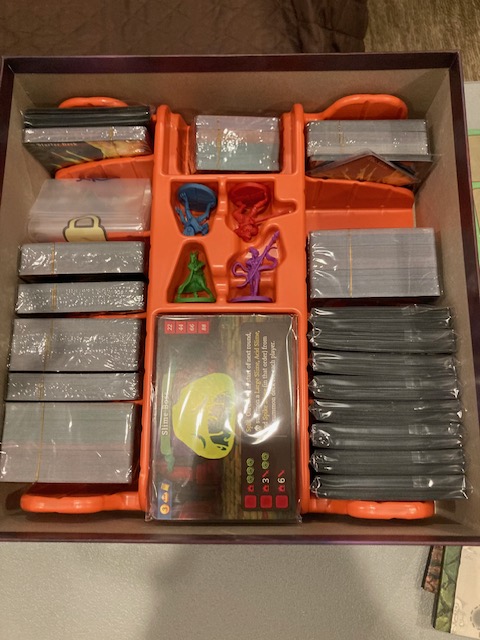
I want to be 100% clear about this: this production is amazing!  It’s a deck-building game that comes with sleeves!  The tokens come in an easy-to-use tray! The cards can all be stored very easily in the box!   The box is easy to repack!   They really knocked it out of the park on the production of this game!

Gameplay

IMG_4673

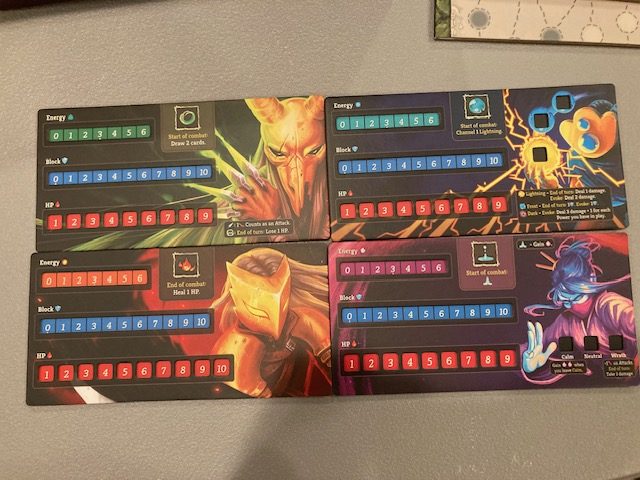
Each player chooses one of 4 characters to play: see the characters above. I have been informed by players of the Slay The Spire Video Game that these are straight out of the Video Game!

IMG_4688

Each player also takes the corresponding figurine: these will be used to notate which “row” you will be fighting in; we’ll describe that more below.

IMG_4708

Each player has their own deck of cards to start with: each deck is a little different and really represents a different play style.  Simplifying a little too much: the blue deck is defensive, the red deck is offensive, and the green deck is all about poison.  

IMG_4774

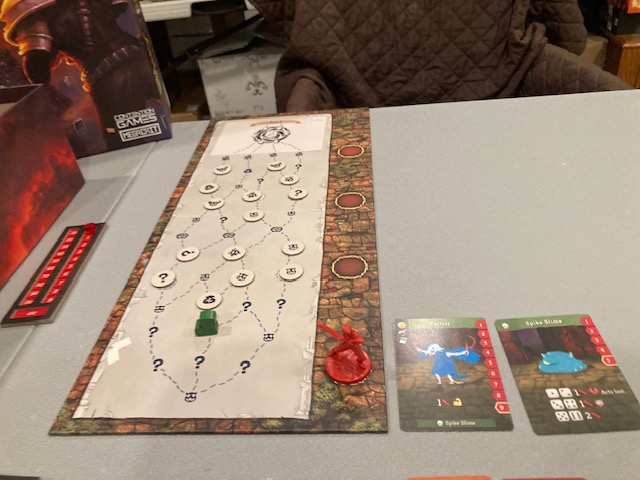
Players together choose a “path” to take to get to the final Bad Guy (at the top of the board above). These decisions can have you fight a monster, summon the merchant, build a fire (“smith” or heal: I learned the word “smith” from one of the Slay The Spire Video Game friends), fight Epic monsters, or take events. I was informed these choices were very reminiscent of things that happen in the Video Game.

IMG_4814

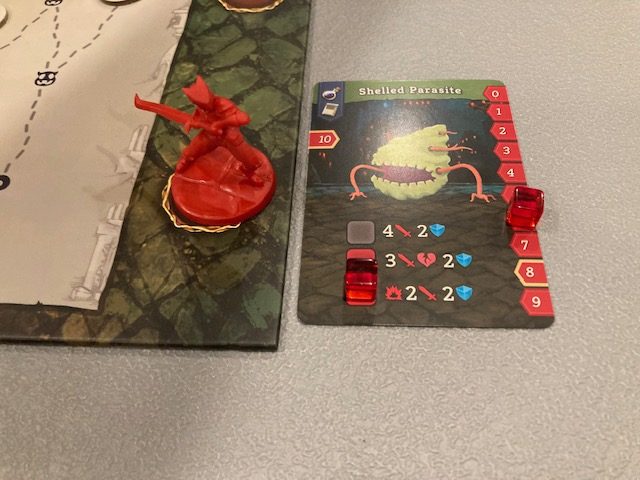
When you fight a monster, each row next to a character gets some monster(s) from the Encounter Deck! See above as “the red guy” fights a Shelled Parasite. (I don’t know “the red guy’s” name because it is not notated on his board). Note that the monster has some hit points (left and right of card), and some icons: those icons tell you what the monster does when it attacks you.

IMG_4759

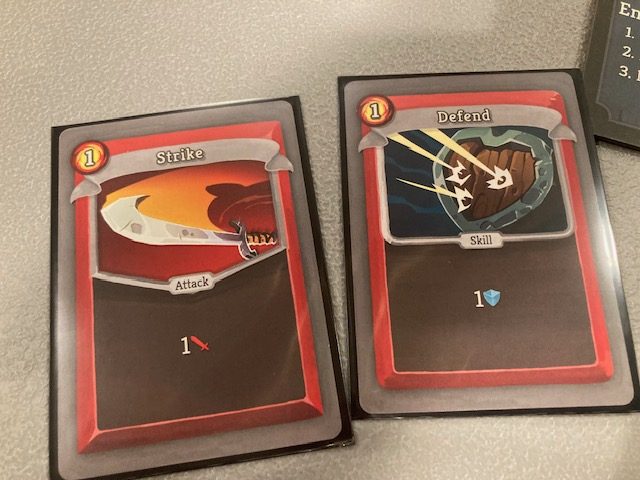
As a card game, you play cards to attack your monster and/or defend yourself!! Shields up your defense (blue icons above), and swords up your attack (red swords above). You only have a limited amount of energy per turn to spend to play a card (usually 3 energy worth), so that limits which cards you can play (the energy cost is in the upper left corner).

You draw up to 5 cards every turn, and discard all when you are done. That feels very much like a deck-builder.

IMG_4772

Typically after you win a battle with a monster, you can add an upgraded card to your deck: you deal 3 and choose 1 (apparently, just like the Video Game). See an example draw above.

IMG_4844

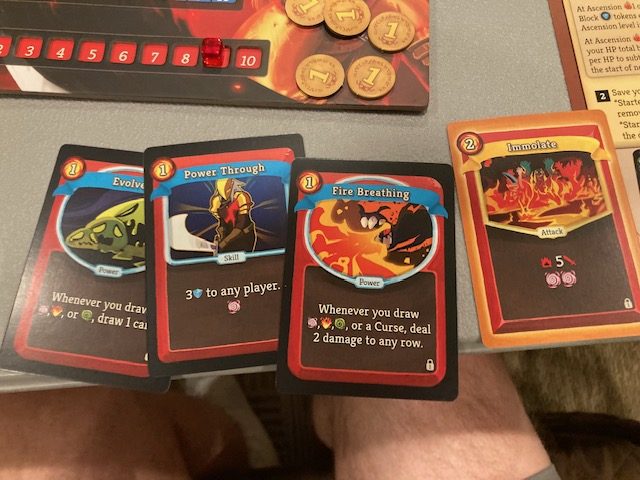
See above as some of my cards have a GREEN text for the title?  This means that I was able upgrade the card BY FLIPPING IT OVER!  Each card has two sides, a normal side and an upgraded side: you can “Smith” to turn the card over and therefore improve it!!  This is a really neat mechanic in a deck-building … and rare! I can’t think of another deck-builder that does this!

IMG_4795

You can also occasionally get new additions from a rare deck (see yellow outline): these are much better cards!

IMG_4752

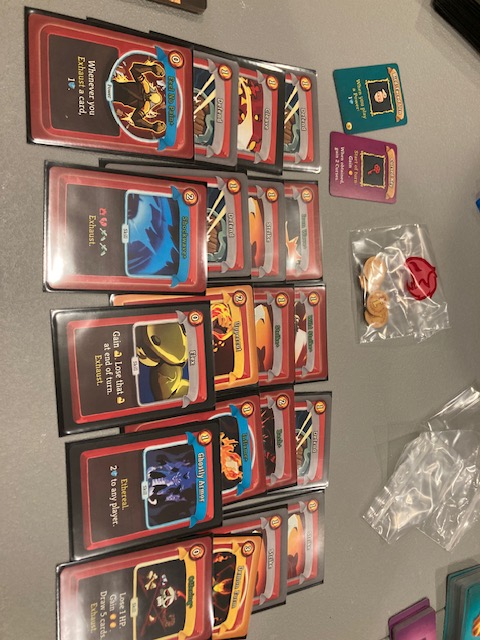
To be clear, each character has their OWN upgrade deck to draw from and their OWN rares deck to draw from!  See above: the red guy has a starter cards (grey outline), upgrade deck (black outline), and rares deck (yellow outline).  This makes each character very distinct as they are built to upgrade a specific way.  Like we said earlier, the red guy’s decks concentrate on attacks, blue guy’s deck concentrate on defense, and green guy’s decks concentrate on poison.  

IMG_4776

You occasionally can buy stuff from the passing merchant, including potions or treasures and even random cards. This even includes a way to cull cards: we call this The Andrew rule: A deck-building game MUST have a fairly systematic way to cull cards. Luckily, Andrew would (and does) like this game because he can cull cards.

IMG_4807

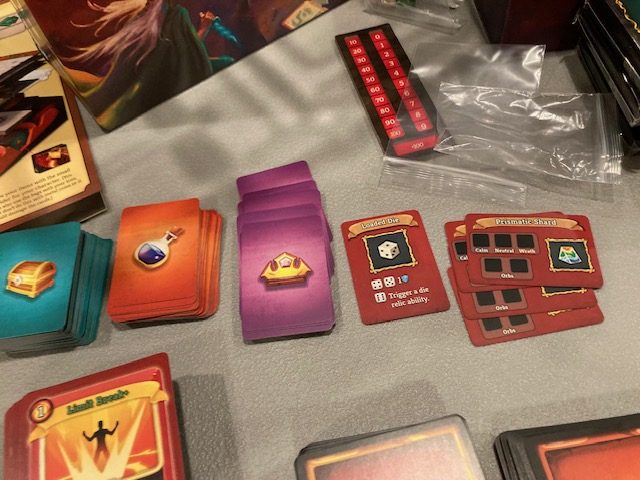
Along the way, there are all sorts of other cards that come out: Events, Monsters, Potions, Treasures, Epic Treasures, and deck-cloggers (Daze and fire).  I have been told this is just like the video game!

IMG_4819

But of course, the purpose of all this is to take down the Big Bad Monster at the top!  See above as I fight the Big Bad Bronze Automaton and a Bronze Orb! 

Like many cooperative games, all players win together when they defeat the Big Bad, or they lose if any of them dies! So, it’s in everyone’s best interest to cooperate and keep each other alive!

The Rulebook

IMG_4661

 I need to talk about the rulebook.  It’s okay, but not great. It really should have been better given how great the production of the rest of this game.

IMG_4689 (1)

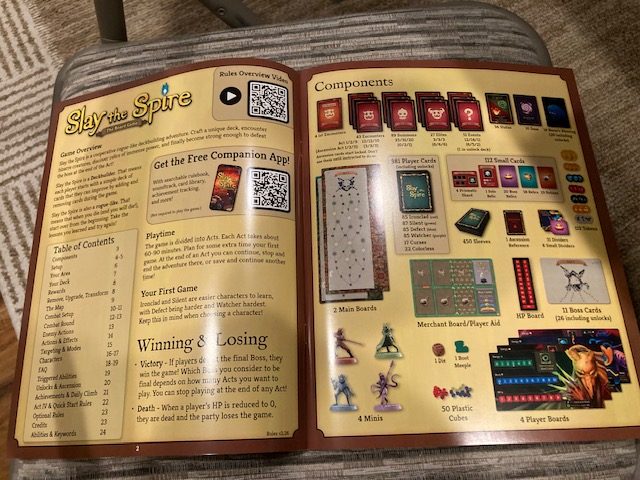
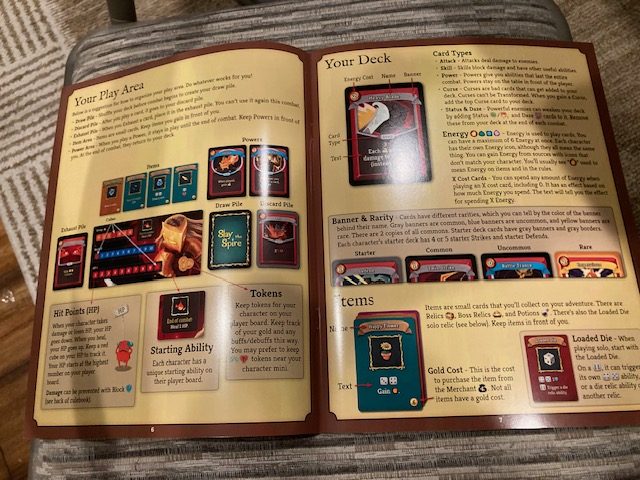
It does well on The Chair Test: it only droops over  the edges a little, the font is big and readable, and the book stays open on the chair next to me so I can see the rules without taking up precious table space.  This rulebook gets an A- on The Chair Test!!

IMG_4690

The game starts off great with a Table of Contents, a link for a Companion App, a link for a How to Play video, and a list of all components (most) with correlating pictures!!  Very very nice! I felt very happy to see this!  My only fix might be that I had wished they had labelled the tokens better … there are a lot of tokens and I didn’t know what any of them were!! 

IMG_4691

The set-up is pretty good, but this where the cracks start to develop.  This is my first example of this rulebook being too minimal: I accidentally shuffled the Summon deck, but it doesn’t say WHY you shouldn’t it!  I didn’t know how to recover?!?!??!  It turns out the Summon deck should “probably” just be alphabetically sorted so you can find cards easily … that’s the only reason to not shuffle it, you just make your life harder when you have to find a card.  Really, I could have used a sentence:

  “Don’t shuffle the Summon Deck because you will be searching for cards (alphabetically) in it later in the game.  Just sort the deck alphabetically if you accidentally shuffle it!

But other than that, the set-up went fairly well.  

IMG_4692

This rulebook is pretty well annotated with lots of pictures and examples.   See above.  In general, the rules are fairly clearly set out.  But the real problem with this rulebook is that it seems to assume that you have played the video game.  There are a lot of places where a rulebook for a normal game would be chastised.  I can’t tell you how many times I played with Jon and Keala (who have played the Video Game A LOT), and when I went to lookup a rule, they told me “it’s just like that in the video game!  So it probably means that!” So many times, they clarified a rule by saying “it’s like that in the video game!”  … which is not good for those of us who haven’t played the video game or other Rogue-Lites.

IMG_5328

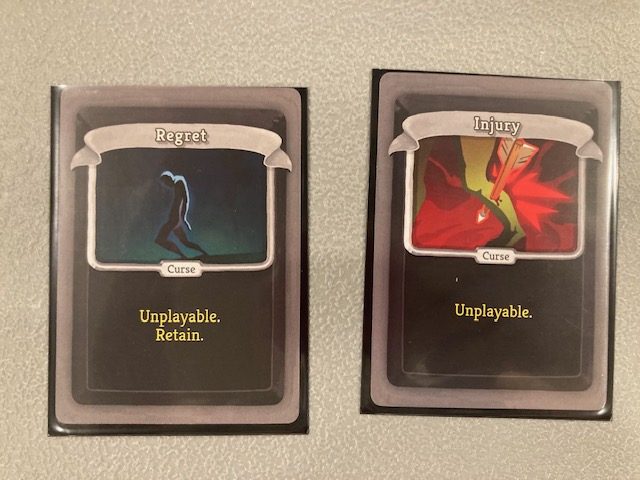
My canonical example of this was the Regret curse.  I actually got two curses one one turn, Regret and Injury (see above)!  My reading of these was that Injury was a worse curse because it keeps clogging my deck as I draw it and shuffle it back in.  I though Regret was a better curse because you just got once and it was out of your deck.   Nope! It clogs your hand so you draw fewer cards!   You draw up to 5 cards, so if Regret is in your hand, you can only draw 4 cards.  I didn’t think the rule was well-specified in the rulebook, but when I asked Keala and Jon they said “Oh it’s just like the Video Game, you can only draw 4 cards!”.  I really wish the rules had made this clearer!  This is just one of SO MANY examples where Jon and Keala said “Oh it’s like that in the video game!”.  This rulebook should have been vetted by someone who has NOT played the video game so as to clarify a lot of finer points.

IMG_4701

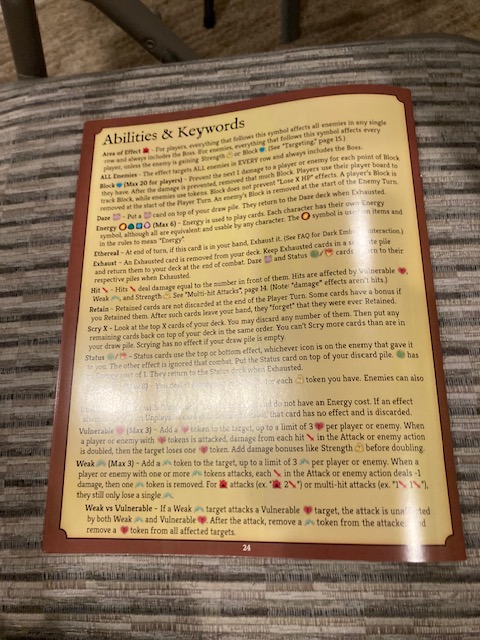
Even though this game doesn’t have an Index (and it really should), the back of the rulebook had an invaluable list of Abilities and Keywords.

Don’t get me wrong, there’s a lot of good stuff in the rulebook, but it was too minimal in a few places (For example: a few more sentences about the Retain keyword or why Summon deck shouldn’t be shuffled).  I was able to learn the game and playthrough solo … and I had fun. I was able to play cooperatively with a bunch of friends (who hadn’t played the Video Game) … and we all had fun.  It wasn’t until I played with seasoned Video Gamers that knew the game that I realized this rulebook needed some more clarifications: it depended a little too much of knowledge of the video game.

Solo Game

IMG_4788

Like the Video Game, you can play this solo (thank you for following Saunders’ Law)! See above as I set-up the red guy for a solo game. There’s not really a lot of special rules or exceptions for the solo game, you just play! The main balancing mechanisms are really in combat:

  1. In plain combat, a monster comes out per row (i.e. per player). Thus, the solo player will be fighting just one row of monster(s).
  2. In Big Bad combat, the number of hit points is scaled to the number of players.

So, in general, you can just jump in and play the solo game without any real special rules! Thank you Slay The Spire! It was SO EASY to jump in solo!

IMG_4846

I had so much fun playing solo that I played through the first three Acts of the game! I had a blast!  There are so many places where you upgrade or get new cards, that you always feel like you are making progress!  You always feel like you are getting better!

Really, solo was fun.  I had a blast. I played wrong on a few points (one to discuss below), but even without knowing the Video Game, I had a good time.

Cooperative Play with Players Who DO NOT Know the Video Game

IMG_4895

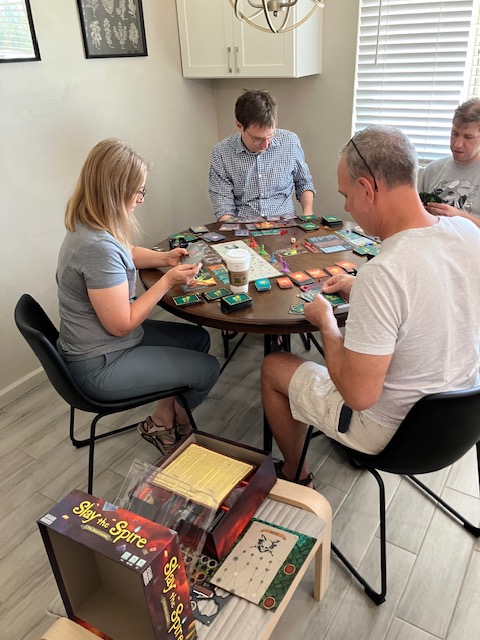
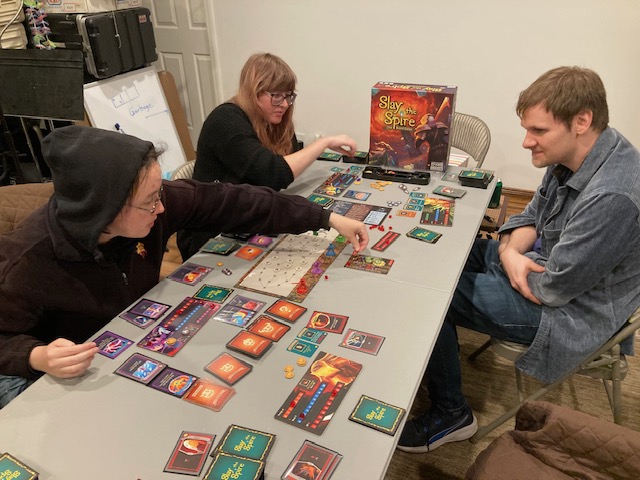
I ended up playing a full 4-Player game of Slay The Spire with three of my friends who have never played the Video Game!  We ended up playing through Act I in one night in about 90 minutes (with a little extra time for set-up and tear-down).   So, I just had to teach the game as-is … no one (including myself) had ever played Slay The Spire the Video Game!

IMG_4896

The biggest conceptually difference, of course, is that this is a fully cooperative game! Slay The Spire is always thought of as a solo game! But the board game is fully cooperative!

IMG_4898

The biggest change is that every character gets his/her own row of monsters to fight!  See above!  While you nominally tend to fight the monster in your row (it sort of becomes “your responsibility” as it does damage to you only), you can target any monster in any row!  So, if a monster has a particularly bad effect for everyone (certain monsters can attack everyone), or if a comrade just needs a little help, players may choose to work together to take out particularly vexing monsters! 

IMG_4903 

My favorite rule in this game is that it allows fine-grained Player Selected Turn Order (see more discussion of PSTO here).  The rulebook calls this out on page 12:

“Players can play cards, use potions, and activate abilities in any order they choose.”

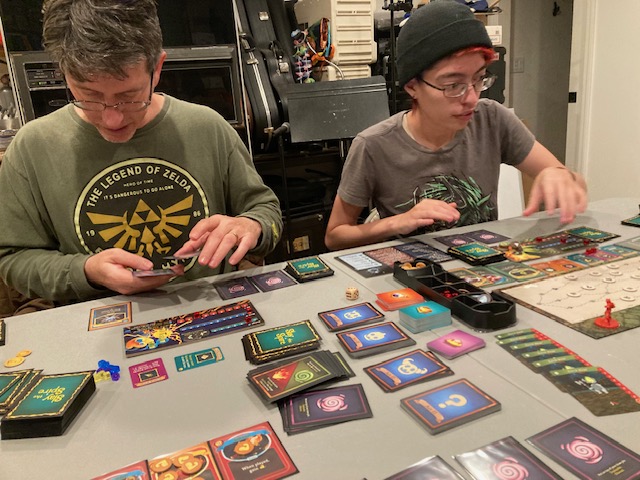
What this means, is that we (as players) can intersperse our actions to accomplish things! If we need Sara to play a Potion, then Andrew attacks to add a Vulnerable, to which then Sara can play another card and attack (for double damage), we can do that! Players can work together to find the best combination of their interspersed actions to take down the baddies!

IMG_4897

In fact, in some ways, Slay The Spire gets the best of both worlds! Since you “generally” need to fight the monster in your row, players can do Simultaneous Actions to fight their own monster, but defer to fine-grained Player Selected Turn Order if they really need to! The Simultaneous Actions helps keep everyone involved … rather than waiting for “your turn”, you can all fight the monsters at once … this means there is much less downtime.

I think this is where Slay The Spire shines the brightest as a cooperative game: the players can choose the best way to play to either help each other (with fine-grained Player Selected Turn Order) or move the game along quickly (with an easy way to Simultaneous Actions fighting your monsters!) It’s the player’s choice, and I noticed we shifted between these modes pretty seamlessly when we played! It was something I didn’t notice until I looked back on our plays.

IMG_4901

The cooperative game worked fantastically, probably better than the solo game because I got to talk and strategize and have fun with my friends!

Cooperative Play With People WHO HAVE PLAYED The Video Game

IMG_5308

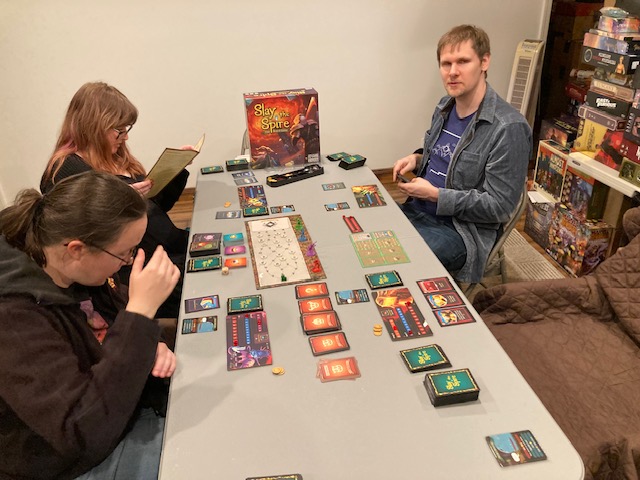
So, I wanted to make sure I played this game cooperatively with some friends who have played the video game: I wanted to see what they thought.   Jon and Keala (above) are both fans and have played (and like) Slay The Spire the video game.

IMG_5312

What happened sort of surprised me: we fell into a rhythm fairly quickly.  Every time there was any rules question, Jon or Keala spoke up and said “Well, it’s like this in the video game”, so we didn’t spend very much time pouring over the rulebook.  The Video Game became the reference implementation of the game!  This was both cool and annoying.  It was cool that the game seemed to fall inline with the Video Game, but it was annoying that the rulebook didn’t do better at explaining a lot of things.

IMG_5310

We had so much fun playing, we ended up playing Act I and Act II in one night!   The game just seemed fun to everyone.

IMG_5304

Jon saved our bacon a number of times: he had the ability to shield other players (as the blue guy), which worked out very well!  I would be able to attack something (as the red guy) and Jon (as the blue guy) would shield me or Keala (the green guy) so that we wouldn’t die!   This cooperation seemed seamless!  It just happened that way!   

IMG_5311

The game really clicked for everyone that night: I feel like I know the game better (with all my friends’ comments on how the Video Game works), and I was able to bring my friends into the card game quickly from reading the rules.  We had a great time and plan to play again!

A While

IMG_5313

It’s taken a while for me to get to this point.  I initially had some misgivings about the game.

At first, I was grumpy at the rulebook for how minimal is was: it really needs a lot more elaborations on the rules.  There was one rule in particular I was enchanted with, until I realized I was playing wrong. The “Draw 5 Cards: there is no maximum hand size” (p. 12) lead me to believe that maybe I had more choice of which cards I could discard.  Maybe I could keep cards between hands?   Why else would you emphasize this rule of no maximum hand size?  Jon and Keala had to tell me this, but you always discard all your cards!! All of them! … just like in the video game.   (to be fair, it is in the rulebook but it is one sentence).  I think that rule is there to show that during your turn you can draw as many cards as you want.  

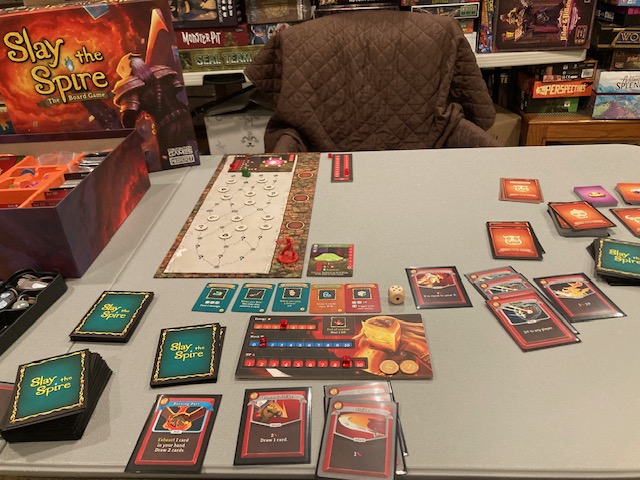
IMG_5074

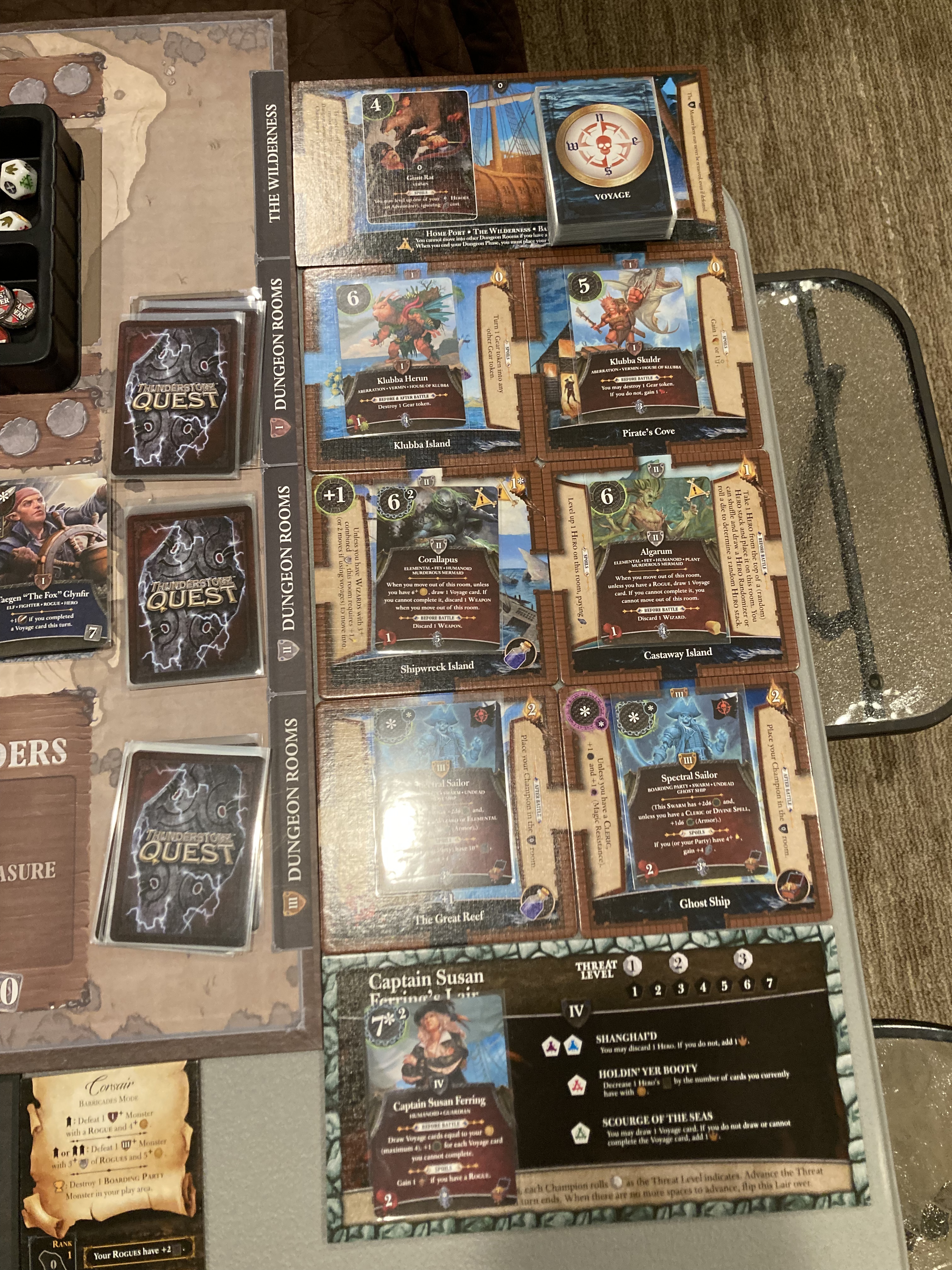
Another thing that threw me off for a while was the art. I had just gotten a new deck-building expansion for Thunderstone Quest (see art above), and the art and graphic design for Thunderstone Quest (above) is significantly better than the art for Slay The Spire (below).

IMG_4805

Comparatively, the art for Slay The Spire is a little anemic after looking at Thunderstone Quest. But I seem to be the only one who doesn’t love the art.  I will admit, the art for Slay The Spire has grown on me a little: it’s very simple and not too busy.  It’s also very readable.  But since I have never played the original video game, I was not as “enchanted” with this art as others.

Flaws

IMG_5314

This is a funny flaw in the game: you can’t (easily) have multiple games going on!  You can save your game fairly easily (putting the appropriate cards in the appropriate slots), so you know you can come back and do another session.  The problem is, if you want to play another game, you can to reset ALL THE CARDS for each deck!!  We worked around it by taking pictures of our decks: if worse comes to worse, we can always use the picture of all our cards (see above) to recreate our save game.   I suspect many people will want to try this game, and we won’t be able to easily have many games going on.  In some ways, this is a product of its own success: it’s so much fun, people want to try it!  But, be aware that a single game is easy to save, multiple games will require taking pictures of all your cards. And also the Unlocks sheet (see below) .. which presents more issues.

IMG_4799

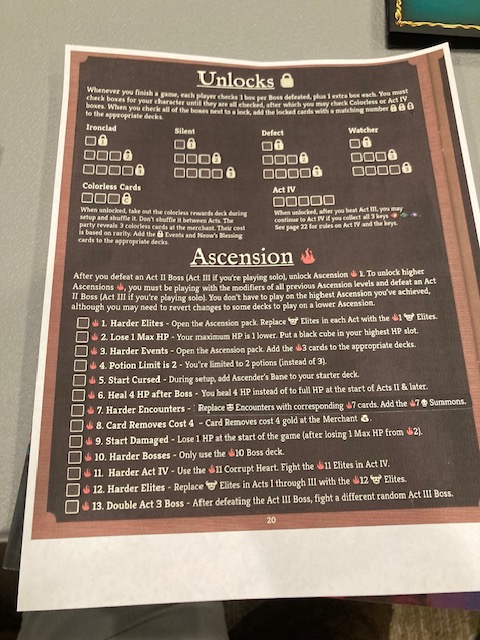
Another problem with this game is it’s really unclear how you move on once you play through Acts I, II, and III.  The Ascension decks (see above) add some variety and keep the game interesting, but it’s kind of unclear how this fits in.  Do you start a new game at Act I with the changes?  Do you start a new deck?  To play Act IV, you have to unlock it, but are you playing Act III again and again and again?  Like everything I have seen in this rulebook, I wanted more elaboration!  This rulebook frustrates me!  Give me an example, give me a few more sentences, give me a page!  I have played a solo game all the way through Act III.  What do I do now?  Add Ascension cards? Start over at Act I?  This is very unclear!!!   This is probably my biggest ding against the game: I don’t know exactly how to move forward.  Sure, I suspect I will post to BoardGameGeek and someone will respond, and I will be able to move forward.  But this rulebook does not make it clear how to move forward after Act III. UPDATE: I had lunch with my friend who has played the Video Game.  He told me that in the Video Game, you just reset everything (including you deck) back to ACT I, but make a few cards (like the uncoloreds) available.  I really DID NOT get that sense from the rulebook … another instant where knowledge of the Video Game helped and the rulebook didn’t. 

Conclusion

IMG_5300

Honestly, this Slay The Spire board and card game has really grown on me: I have played it solo numerous times, and I have shown it to many diverse game groups. The more I play it, the more I seem to like it!  The upgrade paths makes this game great: there are so many opportunities to augment and upgrade your deck as you are playing!  The fact that each players is so distinct in both powers and upgrades really contributes to how great this game is!

IMG_5302

The production is fantastic, and the art is … thematic to the game.  I have grown to appreciate the simple art and graphic design, but I still think the art and graphic design is a little anemic.  

IMG_4758

The solo game is great: it’s about an 8.5/10.  It’s easy to play, and there’s really no exceptional rule changes needed to get the solo game to the table.   

IMG_4902

The cooperative game is about a 9/10: the base game is all there, with all the upgrade and augment paths, but the cooperation really shines brightly! Players can choose so many ways to help each other with fine-grained Player Selected Turn Order, with Simultaneous Play keeping everyone engaged at all times! And even though these play modes seem mutually exclusive, players seem to weave in and out of Simultaneous Play and PSTO without even noticing! 

IMG_5301

Players who know Slay The Spire the video game might find this to be a 10/10 for them: the game is great and also evokes so much atmosphere from the Video Game!  

Over the course of many  play sessions (both solo and cooperative), I ended up liking the game more and more.  There are some issues with the rulebook, as it seems to assume players know Slay The Spire Video Game pretty well! Other than my issues with the rulebook, the game is great.  Putting everything together, this feels like a 9.5/10 as an overall production!  This game surprised me how much I liked, especially given my anti-Rogue-lite tendencies.

Cooperative Hacking: A Review of Hacktivity

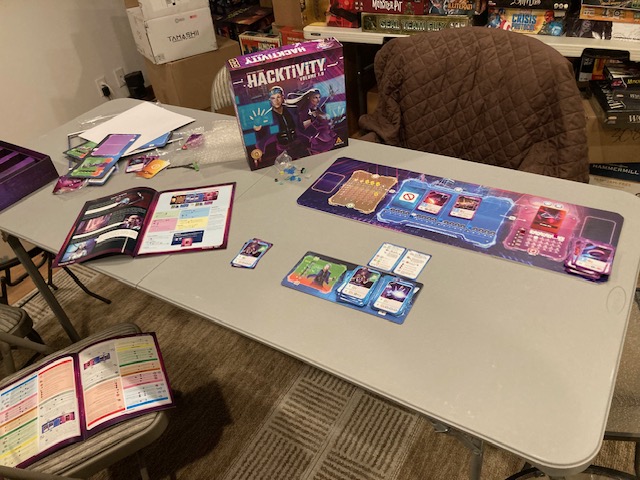
IMG_3734

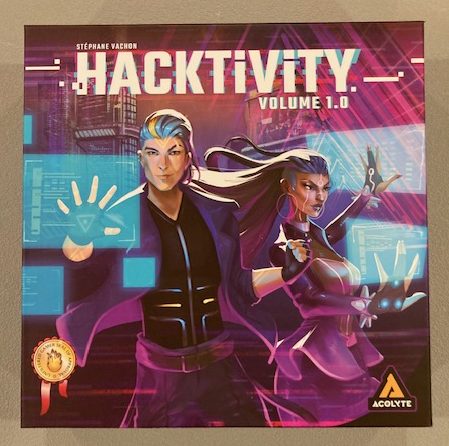
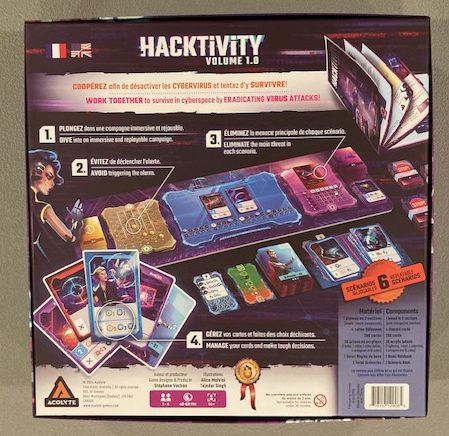
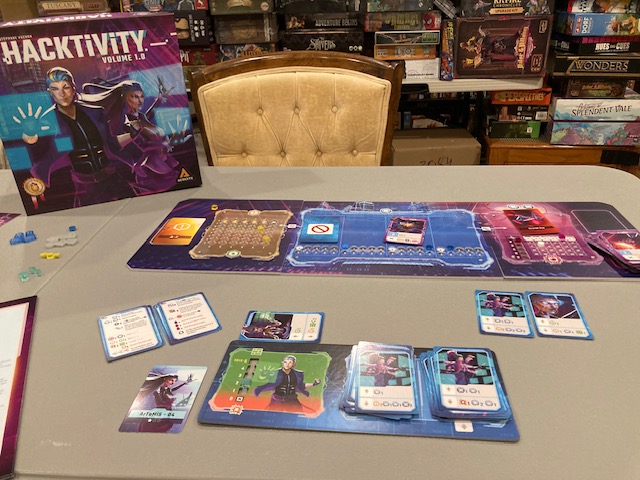
Hacktivity was a game on Kickstarter back in June 2022: see link here.   This is a cooperative hand management game for 1-4 players.  It originally promised delivery in February 2023, but didn’t deliver to my house until late April 2024: this makes it over a year late!  

IMG_3737

I was originally a little concerned about this game because at some point there was a Kickstarter update saying they lost their manufacturer! I was worried that this meant we might never see the game, but the Hacktivity people persevered and did deliver final copy! I was actually quite impressed with their positive attitude and communication during the Kickstarter! I’ve had a number of Kickstarters recently with poor communication and it was nice to see someone owning every step of the process!

IMG_5181

Let’s take a look!

Unboxing and Gameplay

IMG_3740

This is a fairly standard sized box (“about” the size of  a Ticket to Ride sized box): see Coke can above for perspective.

IMG_5182

In this game, each player takes on the role of a special hacker. See the four decks above.

IMG_3786

Each hacker has their own board as well: see the boards above.

IMG_3777

Each hacker’s deck is different and has a different emphasis or/and special powers.  See two such decks above.

IMG_3780

The players are interacting with a board (see above) with three separate regions. Notice how nice the plastic components  of each region are! 

IMG_3807

This is a game about managing cards.  The purple cards are the virus cards that have bad effects … we’ll dub these the “bad news” cards.  The blue cards are the player cards that keep the bad news (the viruses) under control.  We’ll call the blue cards the “good news” cards. See above.

IMG_3821

The leftmost board (yellow) keeps track of activity: you move the leftmost yellow cube up as a “bad news” as the games plays.  If all yellow cubes make it to the top (see above), players lose!  

IMG_3810

The middle board (blue) is a place where you can “isolate” viruses that come out.  This isolation defers their effects and makes you deal with them later.

IMG_3811

The right-most red board keeps track of “the strange bug”: this is usually what you are trying to keep under control.  In the first game, you need to keep the “strange bug” in the white area to win.

IMG_5205

In order to win, players (usually) need to make it through all of the bad news cards (purple cards) and all of their own cards (blue) without losing! See above, a winning game!  All bad news (purple cards) are in the discard! And “the strange bug” was kept under control in the white zone!

IMG_5196

What’s interesting about this game is that every turn presents a lot of choices!  The first choice: how many bad news (purple) cards do you take and how many good news (your character cards) do you take?  See above as we choose two good news (ArTeMis) and one bad news (A1).  You have to work your way all the way through both decks eventually, so you can’t always take more good than bad! You have to balance that out!

IMG_5187

Once everyone chooses their cards, everybody flips and has to deal with their cards!

IMG_3806

Every card offers one of two choices.  For the bad news card above, you can choose the top or bottom: either isolate the virus on the blue board (notice the blue circle on the TOP CHOICE) with hope to destroy it later OR you can destroy it immediately, but pay the full cost on the bottom of the card.

But it’s a choice.

IMG_3805

The good news cards (your player cards) are also a choice: the top choice is usually a lesser choice, but with no side effects.  The bottom choice is usually more powerful, but with a bad side effect! On the card above, the upper choice is an attack of 2 on an isolated virus … but no side effect.  The bottom choice is a more powerful attack of 3, but having the side effect of raising the activity (the yellow board).  

IMG_5201

Players continue to play until they meet the winning conditions!  Usually, this means playing though all decks (bad news and good news decks) and keeping “the strange bug” under control!

IMG_3754

Given that the Kickstarter had to switch manufacturers halfway through, the game has really nice components!  My only major complaint is that I wish the cards were linen-finished: you do handle the cards a lot as you play.  But I liked the art and three-part board works well.

IMG_3760

Rulebook

IMG_3743

The rulebook is two-sided: one part is in French and the other in English! It’s much less daunting when you know it’s only 12 pages (with the other 12 pages being the French rules).

The game does pretty well on The Chair Test: The rulebook fits on the chair next to me pretty well.  The rulebook is a little bigger than I wanted, but it still stays open.  The font is a little thin and a little small, so it’s a little harder to read than it should, but it still works: this is about a B+ on The Chair Test.

IMG_3762

The components are well-labelled. See above.

IMG_3763

The Set-up (above) is pretty well documented: this set-up spans two opposite pages, so it’s easy to set-up by just leaving the rulebook open.

IMG_3765

The rules are generally pretty good and well notated.

IMG_3768

The biggest flaw is that there is no index (boo), but the last page of the book has a nice list of symbols.

IMG_3766

I was happy with this rulebook.  This rulebook was obviously a translation, but there were only a few places where that was readily apparent.

Solo Play

IMG_3738

So, the game does have a nice solo mode (thanks for following Saunders’ Law)! 

IMG_3799

The solo game is NOT playing two characters: basically, you combine the decks of two characters (see above as I play BLASSST!!! and ArTeMis!) and just play that one deck (setting up the rest of the game as if it were a 2-Player game).  I was worried about this solo mode at first … “Is this really different from the cooperative mode?”   And it’s really not.  You just have more cards to play through.   I am surprised I like this solo mode: I usually prefer playing two separate characters with two positions (see Leviathan Wilds from a few weeks ago), but this combined-deck solo-mode worked for me.  

IMG_5189

So, the solo game combines two decks and has the solo player become a “cyborg” of those characters (I am taking artistic license here).  See above.

IMG_5205

Interestingly, I played my first solo game when I got the game a while ago, but it took a while to interest my friends!  So I had to remind myself how to play with a few more solo games right before I taught them how to play.  I am happy to say that I enjoyed the solo mode more the more I played it.  It’s only a 40-60 minute game! It moves quickly!  And it was easy to remember how to set-up and play.

I liked Hacktivity solo and I liked the solo mode that came with it.

Cooperative Mode

IMG_5208

The cooperative mode was easy to teach.  The basic flow of the game is pretty simple once you get the idea.  

IMG_5210

I think the least favorite aspect of the cooperative game were the limits on communication.  Strictly speaking, you can’t say much about your hand: you can sort of hint about how much damage you can inflict,  and you can hint at stuff.   As we played, we kind of ended-up slowly moving around this restriction … because it wasn’t fun!  We play cooperative game because we want to talk and interact with our friends: we usually dislike cooperative games with limits on communication. 

IMG_5211

There are a lot of little icons in this game as well: that took a little to get our heads around, and the rulebook had to be passed around a little (see above).  After a while, the icons took hold and we could just play: it didn’t take too long (and the little player aid cards helped a lot).

IMG_5212

In general, the cooperative game went pretty well, but not great.  The real issue was the limit on communication.  And we get it: sometimes you need that restriction to keep the Alpha Player in check … but we ended up just going around the communication restrictions.

What I Liked

IMG_3817

The color-coding scheme worked very well.  The blue section of the board … gets affected by the blue markers.  The yellow part of the board … is affected by the yellow icons.  This was very clear and very well done.  This color coordination really helped move the game forwards, as it appealed to your intuition (“this color goes here”).

IMG_3807

The order in which you resolve your good news and bad news cards is players’ choice:  You can even intersperse your card resolutions between players!  You can do good news first, then bad news, or all at once!  It’s players’ choice!! This is fine-grained Player Selected Turn Order at its finest!!  This is where the cooperation shined (shone?) most in this game!  As a group, we had to figure out the order to resolve cards, and we felt clever when we could avoid certain bad news effects by playing these certain orders!  I really really liked how they used Player Selected Turn Order in Hacktivity! It really made the game feel that much more cooperative.

IMG_5190

Every card is a choice!  This is great! Every single cards has to be resolved, and you have a choice of whether to take the top or bottom option!  

IMG_5195

The game is easy to teach and play quickly. And it’s a pretty quick game at 40-60 minutes. 

IMG_3755

We didn’t get into it too much, but there is a campaign here if you want to pursue it.

What I Didn’t Like

IMG_5207

This is more of a missed opportunity than a dislke: the backs of the bad news card don’t mean anything (unless it’s a yellow activity card, which happens just a few times). See the A1 and A2 above? They mean nothing useful for gameplay: they only denote which player count decks you are using. Paleo did the wonderful thing (see our review here) of having the back of the cards be a “hint” as to what’s on the front of the card. The A1 and A2 on the backs of the cards above …. don’t really mean anything. They SHOULD give you a hint to “how hard” the bad news is, but they really don’t.

Since you are drawing bad news cards without knowing anything, it makes the game feel a little more random. How many Bad News cards should I draw? I don’t know … I don’t hav a sense of how hard each one is!!! I think a “hint” of some kind would make the game feel less random.

IMG_5212

The limited communication rules felt too constraining; they hampered our enjoyment of the game. The best combinations we played in the game where when we could keep the bad news cards from having any effect … and we could only do this if we were more sharing. This game needs an Open Hand rule:

“If you and your friends are comfortable with Open Hand, go ahead and play with all cards showing. Realize that Open Handed may make the game easier, invite analysis paralysis, and/or cause Alpha Players to take over the game.”

Really, this communication limit drop probably dropped by friend’s rating of the game: see below.

Conclusion

IMG_3823

I liked Hacktivity! I enjoyed all the choices in the game: choosing how many good news/bad news cards to choose, the order to resolve the cards (fine-grained Player Selected Turn Order), and the choices per card! All of this really made me feel like I was making choices that mattered as I played.

IMG_5208

I was be remiss if I didn’t include my friend’s opinions: I liked this more than them. I would give this a 7/10, and suggest we play Open Hand. My friend Teresa liked it ok (no rating), but Sara said “I would give it a 4/10: I liked it okay, but there’s a lot better games to play!” I don’t necessarily agree with her, but you may feel as she does. The main issues for Sara were the lack of Hints on the back of the bad new cards and the stifling of cooperation. The limited communication can be counteracted by playing Open Hand, but the lack of hints can make the bad news feel too random and I am not sure what we can do about that.

IMG_5204

I would be happy to teach this to you: I think Hacktivity is a quick and easy game to teach/learn and it promotes a lot of choice.  The solo game was fun and the cooperative game was fun once we added Open Hand.

Union City Alliance: Heroes Unite! Like Marvel Legendary, but Now With More Theme! A Review

IMG_4178

Union City Alliance is a cooperative super-hero deck-building games that was originally on Kickstarter back in March 2021.  The game looked great and promised delivery in October 2021! I was so excited for this game that Union City Alliance made the #1 spot on my Top 10 Anticipated Cooperative Games of 2022!

IMG_4179

Unfortunately, the game is about 2.5 years late: The game arrived at my house April 30th, 2024! It’s basically been 3 long years since I backed the Kickstarter.
IMG_4180

Interestingly enough, I was never worried that this wouldn’t finally arrive.  The designer would do a pretty decent job of keeping us updated (with Kickstarter updates): he would offer full timelines of delivery and discussions of progress.  I was grumpy that Union City Alliance was 2.5 years late, but at the end of the day, the Kickstarter was well-run … and they delivered!
Let’s see what we got!
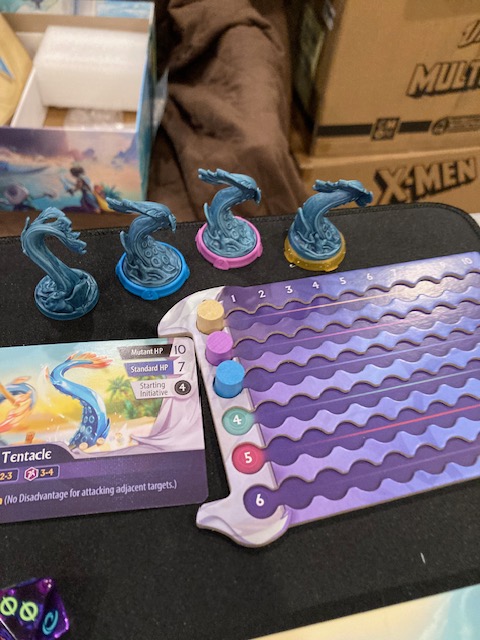
Unboxing

IMG_4185

The base game is about the size of a Ticket to Ride sized box: see above with a Coke can for perspective.

IMG_4190

The rulebook is the full-size of the box on top!

IMG_4193

There’s a lot of punchouts; these are just handy tokens to keep track of Heroism and other resources (Valor, Speed, Might).  Interestingly, the Heroism and Damage tokens, which persist between rounds, are circular tokens.  The Valor, Speed, and Might tokens, which evaporate between rounds, are square tokens.   Even though the game never calls this out, that subtle consistency (persistent vs. ephemeral) was a nice touch.

IMG_4195

Also included is a source book;  It has both set-up for various scenarios and tons of flavor text and back story for the heroes and villains: see below.

IMG_4197

IMG_4204

There are a TON of pre-punched standees that are both the Villain and Hero markers.   See above.

IMG_4205

There’s also a GIANT (see can of Coke per perspective above) pile of Locations!  These Locations come out slowly as the Heroes explore the city!

IMG_4206

But, this is cooperative deck-building game.  So, at its core, this game is all about the cards. When you first open the box, it’s a little daunting to see so many cards!

IMG_4207

From an initial Unboxing perspective, this game looks great! 

Uncardening

IMG_4218

I feel like this needs to be a new phrase: uncardening.  It’s the event when you have take a lot of  cards out of a new game box and sort them appropriately.  But it’s not just sorting: it’s about collecting together “like” cards, figuring out where the cards go in the box, and making sure they are ready to go for play!

IMG_0689 (1)

Basically, we had to do the same thing in Earthborne Rangers: go through the cards, sort them, put like cards together (for some notion of “like”), and figure out where they go in the box.  See above.   Earthborne Rangers had a fairly grumpy uncardening (see our review of Earthborne Rangers here): the components page was misleading, and we spent far too much time trying to uncard the game.

IMG_4220

I almost think that the word uncardening (which is a word we coined for Earthborne Rangers) has a negative connotation: it implies you have to spend an extraordinary amount of time putting cards in order.  

IMG_4933

I remember when I first got Legendary: A Marvel Deck-Building game some 10 or so years ago.  It has the worst box opening experience I have ever had!  I just have tons of cards and no idea how to put cards together!  The rulebook is completely silent on how to sort!  As a gaming nubie at the time, I asked my friend John N. to help me (because he had Legendary), and with his help, I was able to put things together.  The phrase uncardening applied to Legendary, it applied to Earthborne Rangers, and unfortunately, it now applies now to Union City Alliance

If you think all deck-building games need a negative uncardening, I suggest you look at the Aeon’s End series of games! They do an amazing job of making the uncardening (in a good sense) easy.  See our review of Aeon’s End and Aeon’s End: War Eternal here, and Aeons’ End: Outcasts here!

IMG_4192

The first two pages of the rulebook … DO NOT address how to take the cards apart, sort them, put like cards together, and fit them back into the box.  I am actually annoyed by this: The Union City Alliance rulebook wasted two very large pages (see above) with huge fonts for credits and an introduction.  I am all for getting credit, but I was very annoyed at these designers because it was so hard to uncard their game!  They SHOULD HAVE used those two pages for something useful: how to uncard the game!

IMG_4223

A simple question: why is there a Playable Hero and a Team-up Hero for Wrangler?  See above. Which cards for Wrangler go where? This is an easy concept (once you know it) that should have been presented on those first two pages.

IMG_4222

And it takes some knowledge of board games (and perception) to know to look in the lower right corner of the card: the Wrangler cards are the W!  See above!

IMG_4242

Once you start looking around some more, you’ll notice there is a manifest on the back of the dividers!  Yay!  They list both the number and the card title (good job!).  

IMG_4241

I am SO GLAD they have both the title and the card number on the manifest!  The card number on the cards are SO SMALL as to be almost unreadable!!  I had to zoom in pretty heavily with my phone in the picture above to see the #2 Captain Jupiter card!  But having the titles on the manifests helped.

IMG_4225

There’s just a lot of cards.   I probably spent about an hour and half, maybe two hours uncardening this game.  It really shouldn’t have been this much work, and it really shouldn’t have been so cumbersome.  The cards are well-labelled, but throwing someone at the game without any directions is a misstep.  I am an experienced gamer (now), so I was able to get through this, but I worry a newbie will just give up in disgust trying to uncard this.

IMG_4247

But, everything is labelled (once you know where to look: bottom right, and the divider manifests) so you can get there.  And once everything is back in the box, it’s very satisfying. See above.   This lack of uncardening direction may be the biggest misstep in the entire game: the uncardening just needed a little bit of discussion in the manual.

Rulebook, Er, Play Guide

IMG_4189 (1)

This rulebook is gigantic, being the same size as the box.

IMG_4191

How does this rulebook do on The Chair Test?  Unfortunately, it gets a D on the Chair Test.

IMG_4192

It is almost impossible to have this on the chair next to you spread open because it was so big!  It does have lots of good pictures and good font, but it was almost unusable on the chair next to me.

IMG_4396

However, this game has spawned a new test: The Two-Chair Test.  If you put two chairs together (see picture above), you can have the rulebook open and readable without taking up valuable table space!  So, the rulebook gets a A in the Two-Chair Test (a second tier test) So, the rulebook lays flat, the fonts are big and readable, and I can read it easily from my chair.  In the end, The Chair Tests are all about keeping the rulebook(s) off to the side so I can look stuff easily and not take up valuable table space!

IMG_4213

I have to admit, I was a little non-plussed to learn that this wasn’t the full rulebook! It was only the Play Guide!  See above: “… but it is only a quick reference...”. You have to go to the website for a full rulebook.  It’s cool they have all this on the website (FAQ, full rulebook, etc), but at the time I went there, the web site wasn’t up yet! See below.

IMG_4235 (1)

At the time of this writing, however, the web site is up.  But, I had to play using only the Play Guide!

IMG_4214

Once you get past how HUGE this rulebook, pardon me … Play Guide  … is, it’s pretty good at getting you into the game.  I don’t usually like thematic fonts for rules (see our review of Hour of Need here and Obliveaon here), but it works here.  I think I like it because it’s a very big font, and it’s peppered with a lot of supporting pictures and colors: see above.  

IMG_4291

There’s no Index to the Play Guide (boo), but there is a Glossary (yay)!  See above, In fact, the Glossary seems very complete; it covered just about everything that came up when I played.

IMG_4290

Once we got going with the two chairs and through the uncardening, the Play Guide was pretty good at getting me set-up: there were lots of pictures, lots of flavorful text, lots of helpful annotations.

I am still annoyed I didn’t get the full rulebook.  I look at computers all day; the last thing I want to do is look online for full rulebook for a board game.  The Play Guide has been “good enough”, so I have been just pushing forward with that.  I haven’t needed the web site … yet.

Gameplay

IMG_4313

Union City Alliance is a cooperative super-hero deck-building game.  That tells you a lot about this game already!  See our Top 10 Cooperative Deck-Building Games for more discussion of deck-building games!

IMG_4258

Each player chooses a hero to operate: that player gets the Playable Hero deck for that character: see above as Player One chooses Captain Jupiter.

IMG_4256

An interesting thing that Union City Alliance does is the cards are divided into two groups: your initial deck (with the 0 in the upper right corner) and the Power deck (with the green in the upper right corner).  See above.   Power cards are separated out, and only that player can buy those Power cards later in the game, using the (green) resource Heroism.  It’s a real neat way of keeping each character very distinct, as each character has their own set of Power cards!

IMG_4263

So, when you set up, you have your normal intro deck and your Power deck “tempting” you with some cards you can buy! See above as Captain Jupiter sets-up with two Power Cards available to buy, with her initial 5 card hand at the bottom.

IMG_4300

Each card can be played for Resources! The three main resources are Valor (blue), Speed (yellow) and Might (red).  See the Plucky Interns above giving 1 Valor! Valor is generally the resource used for buying Hero Upgrade cards!

IMG_4266

You need at 2-4 characters to play: see above as Doctor Tomorrow and Captain Jupiter are set-up!

IMG_4405

One of the curious things this does as a deck-builder: you don’t usually get upgrade cards you can buy unless you go exploring!  As you explore the city, more Hero cards come out that you can buy!  This is different from other deck-building games like Legendary and Dominion and Aeon’s End where there’s just “9 types of cards to buy!”.  See an example from Aeon’s End below.

IMG_3697

As you explore Union City, new cards come out: see below.

IMG_4312

Every time you explore a new Location, two new Hero cards come out! (And a City Card, which is typically Bad Newsish).

This is interesting, as it forces the player to explore and look around to get upgrades.  There’s no “set set” of upgrades: you get what you get as you explore!  And you can only buy (generally) Hero Cards from the Location you are on!  This is a nice and thematic twist on the deck-building genre.

IMG_4280

To win, players must take out the baddies!  See above which represents “the bad guys!’  The bad guys in Union City Alliance are pretty complicated to run: there’s a Peril deck, a Plot deck, issues #1-4 of the Plot Deck, and specialized baddies (Mobsters and Gangsters in this case).   To win with Pterano-Don and the Dino-Mafia, players must defeat all the Mobsters!

IMG_4326

It’s quite hard to take out the Mobsters!

IMG_4332

The city has to be big enough for the Mobsters to come out (a rule requires that), so that also forces the exploration aspect!  See above as the city is pretty huge with one of the Mobsters looming!

IMG_4333

To win, take out all the Mobsters! As I took them out, I put them in “jail” on top of the box! See above!

Solo Play

IMG_4181

Unfortunately, there is no provided solo mode in the game!  See above, as the game is only listed for 2-4 Players.  

IMG_4266

It’s very discouraging that they didn’t follow Saunders’ Law here:  no solo mode!  So, I went ahead and played my first game two-handed solo.  That’s right, I operated Doctor Tomorrow and Captain Jupiter and just played this as if it were a 2 Player game, alternating between the two.

IMG_4339

I think I know why they didn’t include the two-handed solo mode in the game: it’s pretty complicated.  I ended up playing my first game (granted, a learning game) in about three hours.  Each character in the game is very distinct with a very different play-style!  There is a lot of context switching between the characters, as each character has their own specific cards and Power deck that players need to be thinking about!  And the game can get pretty overwhelming as you play: see the picture above near the end of my solo game!  There are a lot of distinct Hero cards and distinct challenges and distinct Locations! 

IMG_4279

And the Villains are complicated to play too!  Plot card, Peril Cards, issues, distinct baddies! So, the solo player has to run two characters AND the Villain deck!

IMG_4340

See above at the end of my first solo game!  The board is a bit of a mess between two characters, the villains, the Locations, and all the cards!  

I can see why the Union City Alliance people chose to avoid the two-handed solo mode: this game is very overwhelming in solo mode!  My first solo game took about three hours to play! It probably wasn’t the best way to learn the game, but I believe in trial-by-fire for learning games: the only way to learn is to jump in!  So, I think, if you are determined, the two-handed solo mode will work. And once you learn the game, the basic flow is pretty straight-forward.

Cooperative Mode

IMG_4394

My second game was a two-player, two character game!  I learned quite a bit in my solo game: things to do and NOT to do!

IMG_4399

First, I learned to allocate signficantly more space for the Locations!  See above as I leave half the table for that!

IMG_4400

I also learned to be more methodical when placing Locations: each Location (when explored) adds Two Hero cards and one City Deck card.  Since space is at a premium, we tried to make sure the two City Cards are on the bottom half, and the City Card (whether a challange or a Bad guy) is on the top of the Location.  Since each Location also has a unique ability, we made sure that text was readable!  So, there are four things you need to see on a Location: let’s make sure they are consistent and readable as we place!  That makes the game … less messy … as the city gets explored!

IMG_4405

See above as the city is a little less daunting as we have more space and the layout is a little more consistent.

IMG_4414

Even though each player runs their own character, which tends to make the players more isolated turns, Union City Alliance still encourages cooperation.  Players have to work together figure out how to take out certain monsters and challenges to clear the way to take out the Mobsters!  The game ramps up in difficult pretty quickly, and some coordination between the heroes is necessary to keep the badness under control.

IMG_4403

I liked the solo game, but the game is better at two or more: there’s more people to share the responsibility!  Union City Alliance can be very overwhelming (there’s quite a bit of maintenance per round) as solo gamer, but the sharing of responsibilities made this much easier to get through.  Teresa was in charge of The Green Death (that was here hero) and the Locations, and I was responsible for Captain Jupiter (that was my hero) and the Villain decks.  Off-loading some of the maintenance to other players made the game much more fun!  I could play without worrying about keeping the game up!

IMG_4181

Solo was fun, but the game is just more fun with more players. I see why they chose NOT to put 1-4 Players on the box.  

Theme

IMG_4410

This game is dripping with theme!

IMG_4415

Each hero is very distinct and plays very differently, representing the sum of their powers!   

IMG_4300

There’s a ton of flavor text on the cards, which you can ignore if you like, but it really does draw you into your character.

IMG_4194

The Source Book just digs even deeper into each character!  You want back story? You got it!

IMG_4337

The Power Decks, which are unique to each character, also contribute to making each character just feel so different and flavorful! 

IMG_4286

The Villain deck is quite complicated to run, but is very thematic! The “harder” cards come out in later issues of the game!  There’s quite a it happening per round with the Villain deck, but it is all unique to the Villain .. again contributing to the theme.

IMG_4286

The larger than normal standees (especially for the dino-mob) makes the game feel thematic! They are so cool looking!

IMG_4415

If you haven’t noticed, just about every card has unique art on it! It’s all the consistent from the same artist and just draws you into the game!

IMG_4397

This game has so much theme to it: I’d give it a 10/10 for theme.  The events, the characters, the Locations, the heroes, the art, the standees, the vibe of the game: 10/10.

IMG_4411

You do pay a price for this theme, though: from minor costs like flavor text (“Oh man, there’s flavor text on the card I should read“), to annoying costs (“set up the next city Location“), intrinsic costs like understanding you Power cards, to major costs (like running the very distinct Villain decks).  My games of Union City Alliance have run about 2.5 to 3 hours.  Some of that time  is just the sheer maintenance of immersing yourself into this universe.

The Art

IMG_4319

I love the art in this game.  It’s pretty clear the art is mostly the product of one artist (Antonio Garica), and I think he just knocked it out of the park!  The art feels very comic-booky and super-heroey.  It’s so thematic and so good.

IMG_4329

My only complaint, and this is not even really a complaint …  is that his style might be thought of as too cartoony!  I don’t have any problem with that, but if you saw the game cover in a store, you might this this is a game for younger audiences.  While Union City Alliance is generally family friendly, this is a deep complex game that might be too much for younger audiences.

IMG_4181

The age limits of 14+ should absolutely be adhered to (see back of the box), as I think someone who’s just starting in games might think “Oh that game looks cartoony and kinda cute! Let’s get it!”  Union City Alliance is much heavier than the art belies. Caveat Emptor.

Conclusion

IMG_4340

If you want theme, you have to pay for it!  If you want a lighter super-hero deck-building game, you should bring out Marvel Legendary: It has your Marvel heroes and is pretty straight-forward to teach.  But honestly,  I always thought the theme was lacking in Marvel Legendary: “Wait, you are buying a team of heroes? What?”  

IMG_4395

Union City Alliance is a deck-building super-hero game that has the theme I always wanted in Marvel Legendary.   In Union City Alliance, characters have unique powers, Villains are distinct, exploration/upgrading is both natural and encouraged, upgrades are tailored to your hero, and the art is very consistent and thematic.  

IMG_4332

If you want theme, you have to pay for it: Union City Alliance takes longer than many games (2.5-3 hours), has more upkeep per turn, and has more complicated set-up and interactions.   You pay for this incredibly thematic game by having a game that’s more complex.

IMG_4177

I want that theme!  Union City Alliance would easily make my Top 10 Cooperative SuperHero Games with a 9/10 and it will probably be near the top spot of my Top 10 Cooperative Games of 2024.  It took about 3 years to get Union City Alliance, but I was totally right to make this my #1 on my Top 10 Anticipated Cooperative Games of 2022!