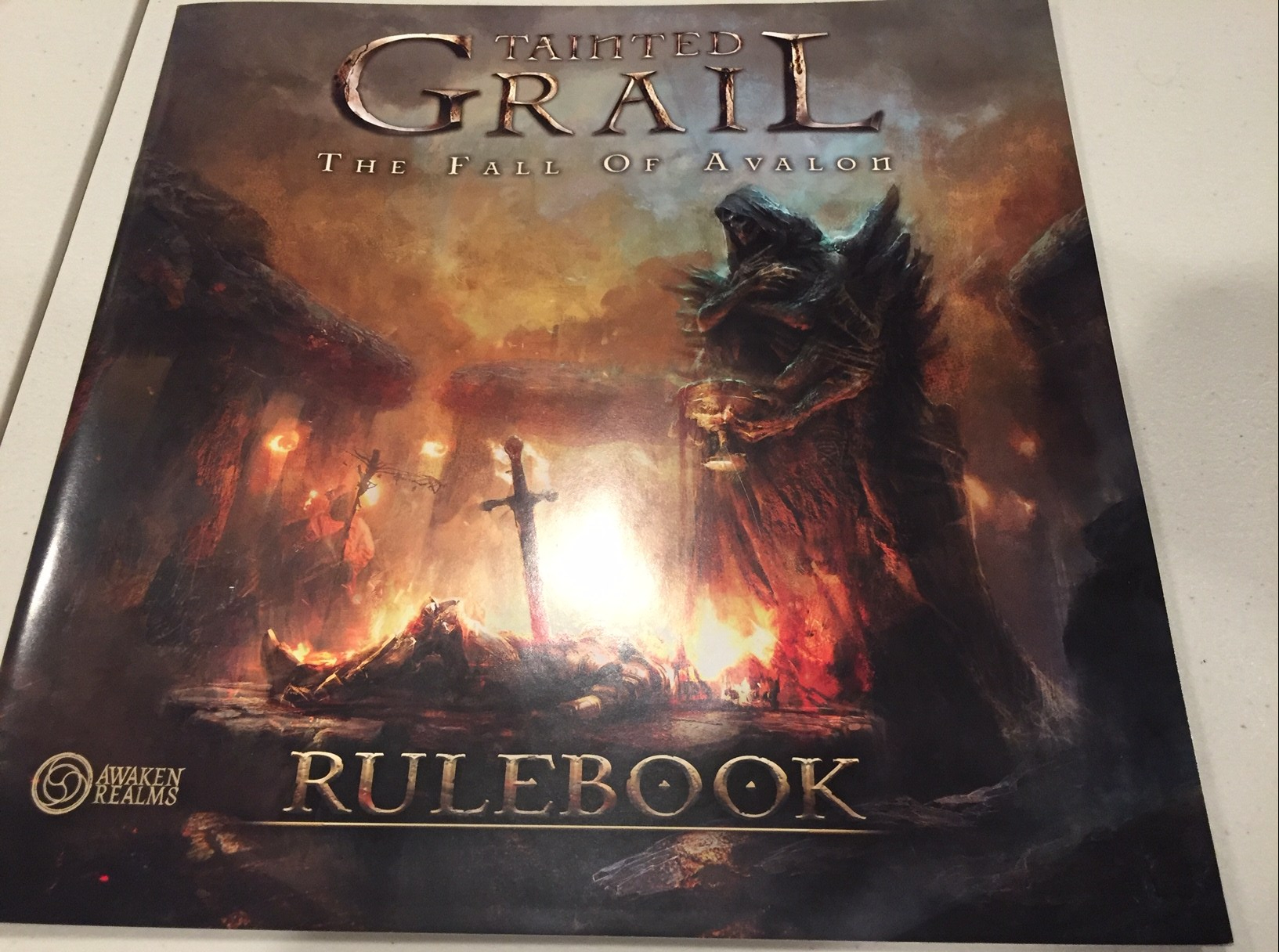
A Review of Tainted Grail, Part I. Unboxing, Solo Play, and First Impressions

IMG_8020

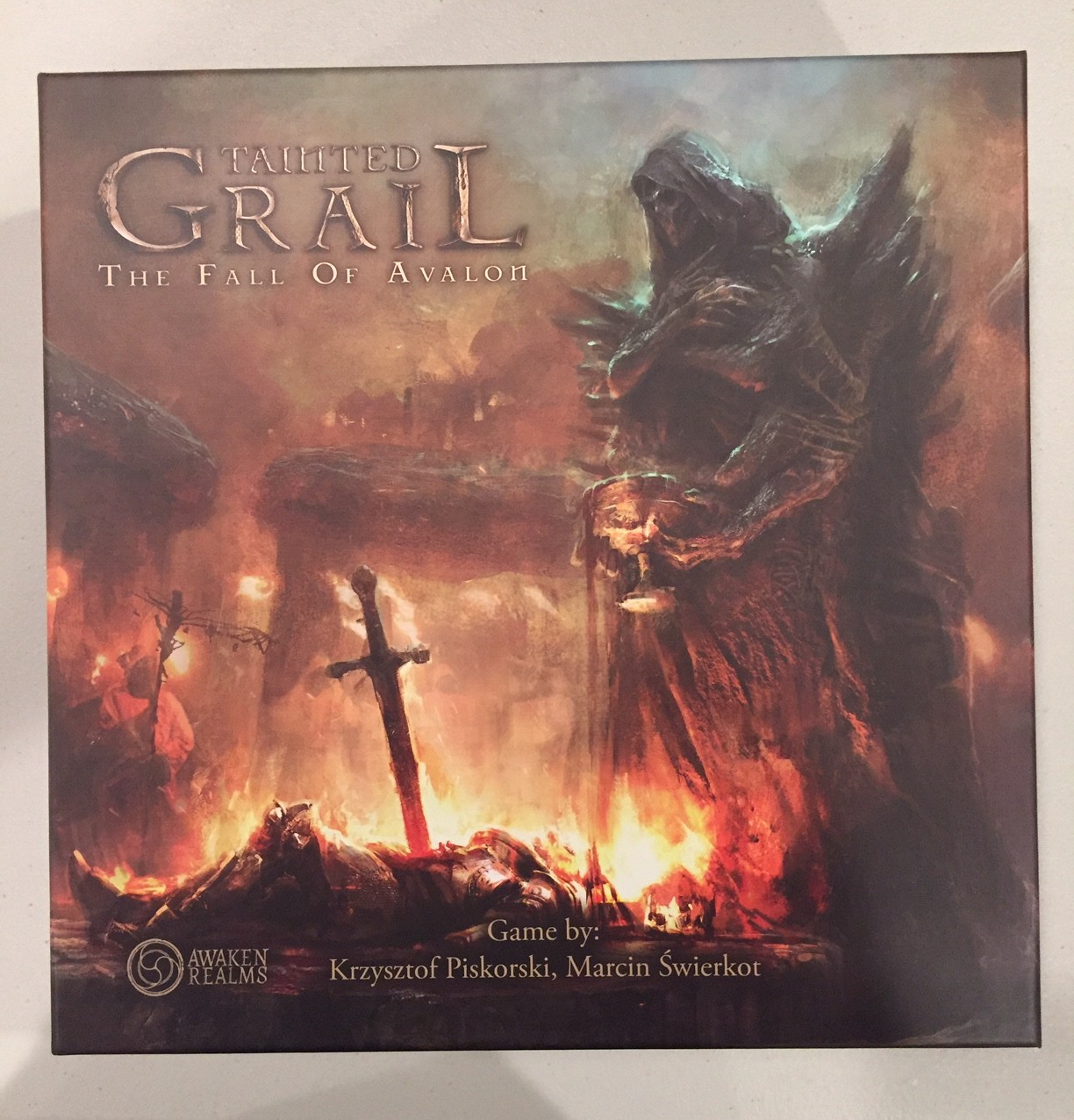
Tainted Grail was on Kickstarter quite some time ago (December 2018).  Tainted Grail is a cooperative campaign game with exploration, combat, diplomacy, and a rich story (it has a story book) set in the world of Arthurian legends.  The world is not the “happy” Arthurian world of Camelot! Not that the story of Arthur is happy, but Tainted Grail is a dark game centering on a world where Avalon has faded.  IMG_7657

I had essentially only backed the base game of Tainted Grail  (which, by default,  came with some great Stretch Goals).  I had not read the fine print, which indicated that there were two Waves of shipping: Wave I (shipping to backers sometime in in November 2019) and Wave II (which JUST came to me in mid January 2021)!  Even though I only ordered the base game, the Stretch Goals box wasn’t ready, so they deferred the Stretch Goals box until Wave 2.  If I had paid something like an extra $10 (?), I could have gotten the base game shipped back in November 2019.   I hadn’t paid close enough attention (my fault) to this shipping scheme, so I just got (mid January 2021) all my Tainted Grail stuff!

Before I get into this, you have to understand there was a little grumpiness here: a lot of reviewers had proclaimed Tainted Grail the “game of the year” for 2019: as a Kickstarter backer who didn’t see this until just now … I admit being a bit grumpy it took sooooo long to get to me.

Unboxing Extra Content and Stretch Goals

IMG_7572

I showed my friends the box it all came in (see the Coke can for scale). They joked it was a Clorox box! (Big and heavy, just like a Bleach box. Side note: if you are ever moving: get bleach boxes! They are built to handle heavy loads! Back to your review …). What’s in the box?

Oh ya, I had gotten some minis: The Monsters of Avalon: Pretty cool, but not strictly necessary: they will be monsters that augment the game when you go into combat. See below.

And this was the reason I had to wait: the Stretch Goals box.

IMG_7988

And you know what?  It was worth the wait … I think.  Inside the Stretch Goals box was essentially as much stuff as the original game! It has two campaigns (Age of Legends and Last Knight), which includes two new storybooks and tons of new cards and new miniatures!  It’s almost like getting two new games!

We still aren’t to the main box, because we got a surprise box! In here was basically just an art book for the next game and a little almanac/art book for Tainted Grail. There were “nice”, but I don’t know how much I’d use them. Still, always nice to get more!

As cool as all the extra content is, let’s take a closer look at the Base Game.

Unboxing the Core Game

IMG_7587

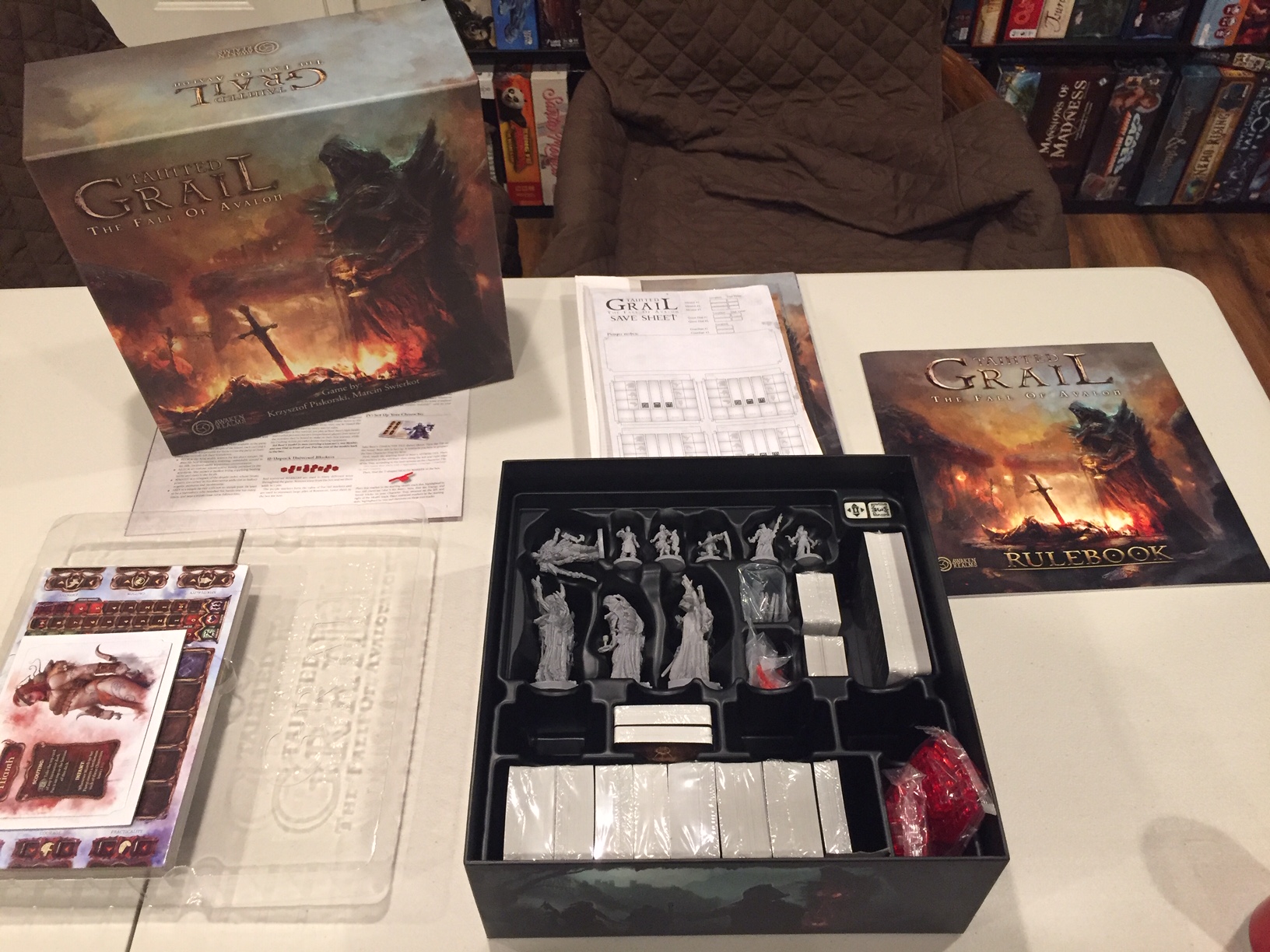
The base game box is pretty big. The first thing you see when you open it is the getting started pamphlet!

IMG_7595

What’s this?  The “Start Here” booklet promises to get you up and running in the game in 1 hour!  We’ll take a look at how it does below!  Let’s take a look at what else is in here. The rulebook is next:


Then the Exploration Journal (this is, after all, a Storybook game). It’s quite thick!

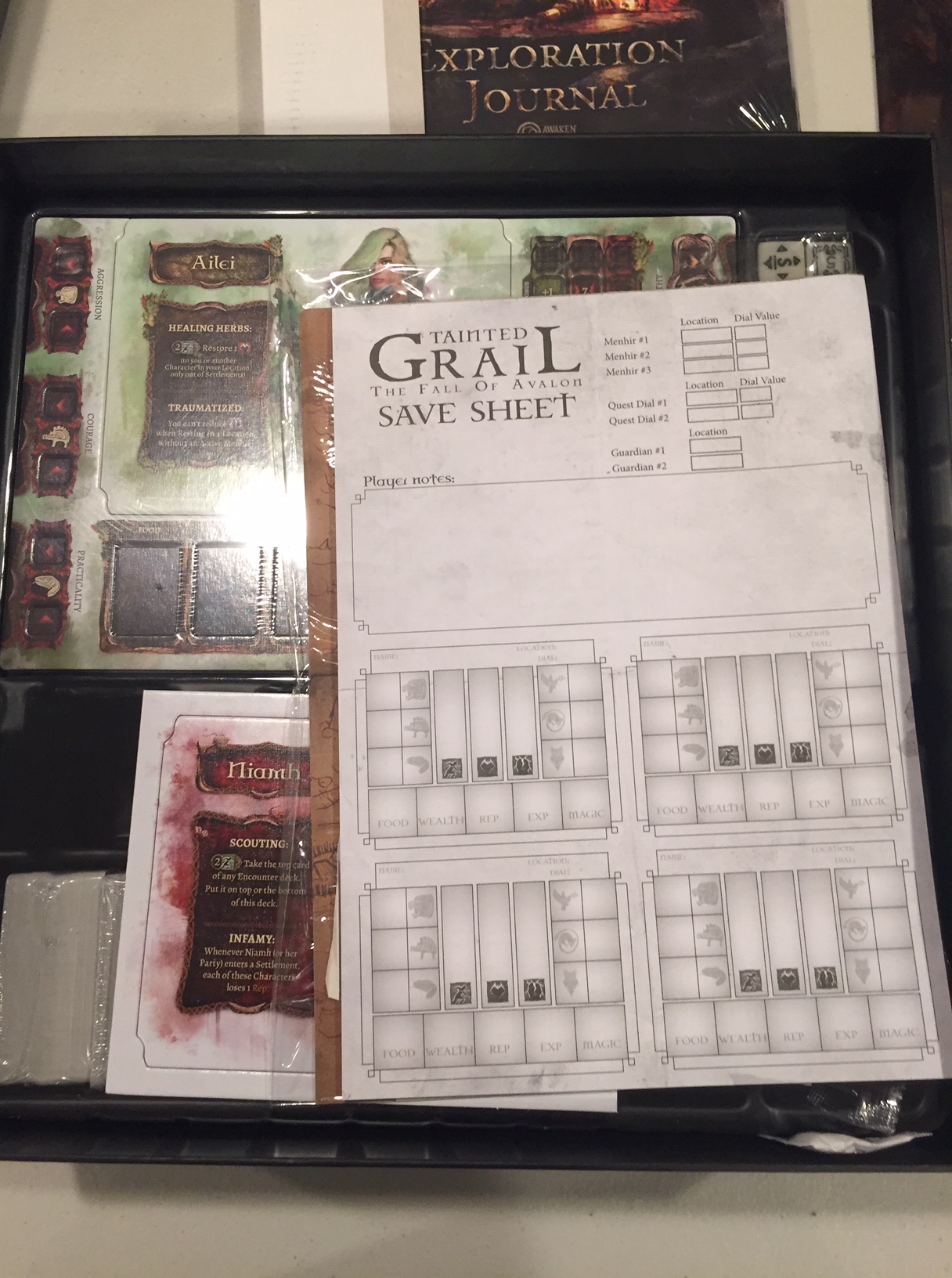
There’s some “save sheets” because this is a campaign game.

IMG_7603

And some “letters”: there’s one of these letters addressed to each member of the party!

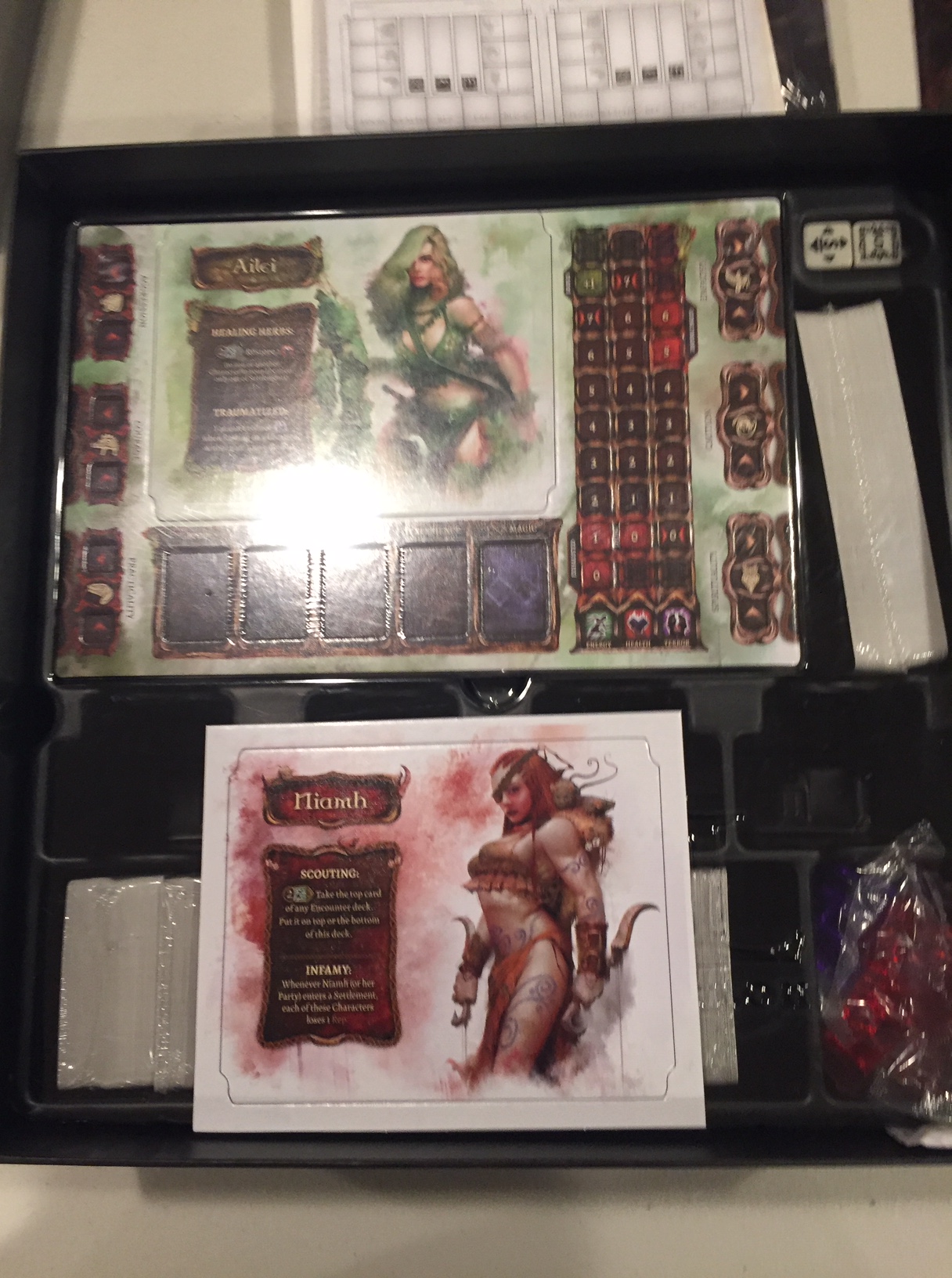
Underneath all the books and paper, we start getting into the meat of the game. Each player will take the role of a character: you can see the character boards here and a Stretch Goal (an alternative character named Niamh: the game is still only 4 characters, but she offers an alternative).

IMG_7606

These character sheets are pretty nice: notice how they are dual-layer!

IMG_7607

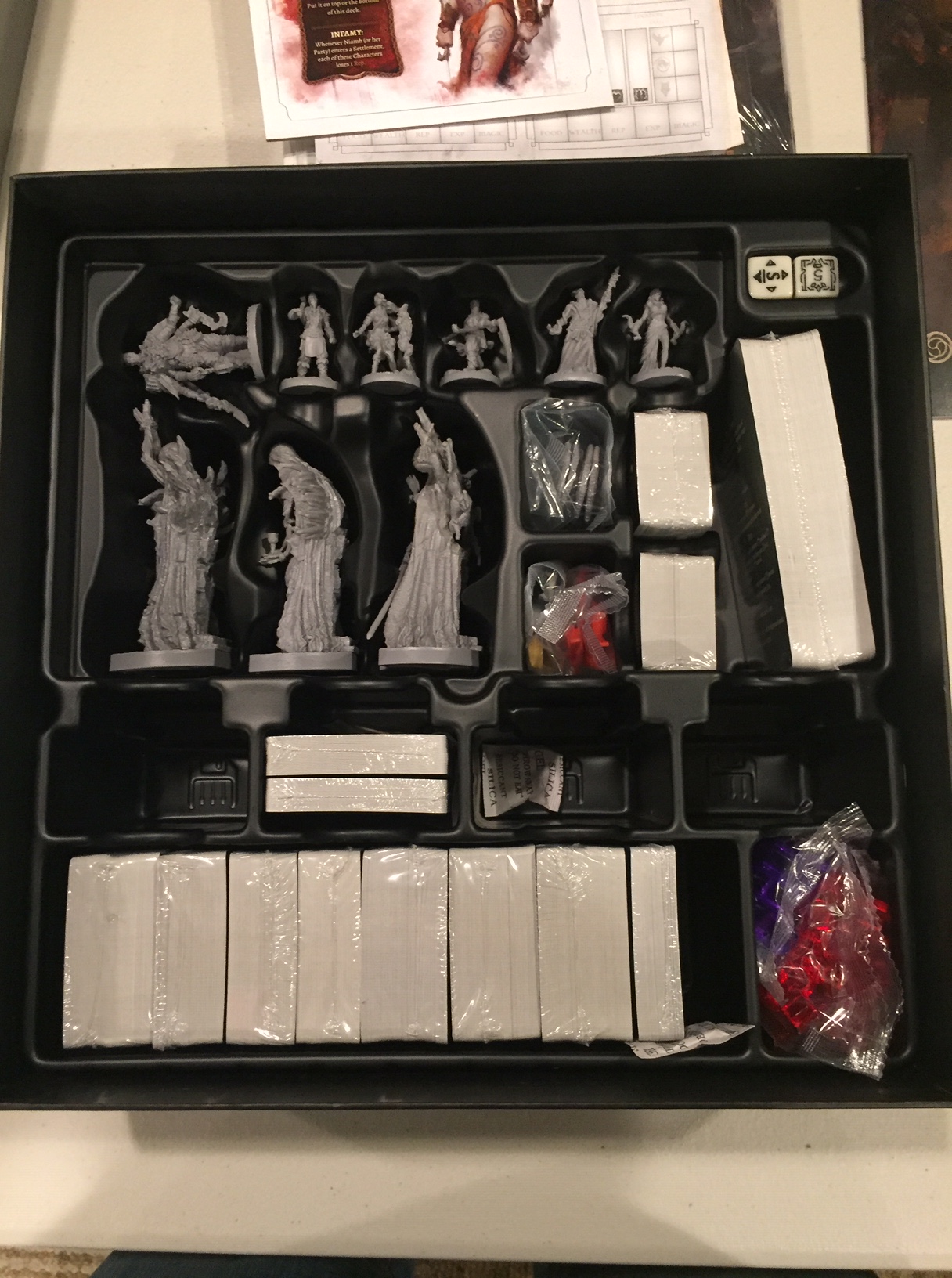
Inside the box, you see all the main stuff! The miniatures, the dice, some plastic components and SO MANY CARDS!!!


IMG_7608

The miniatures are quite nice:

IMG_7609

Here’s one close up:

And again to emphasize: SOO MANY CARDS!  Also note that are slots to store cards: we’ll find out later that a lot of those slots are to “save” your hand between chapters in the campaign.

IMG_7612

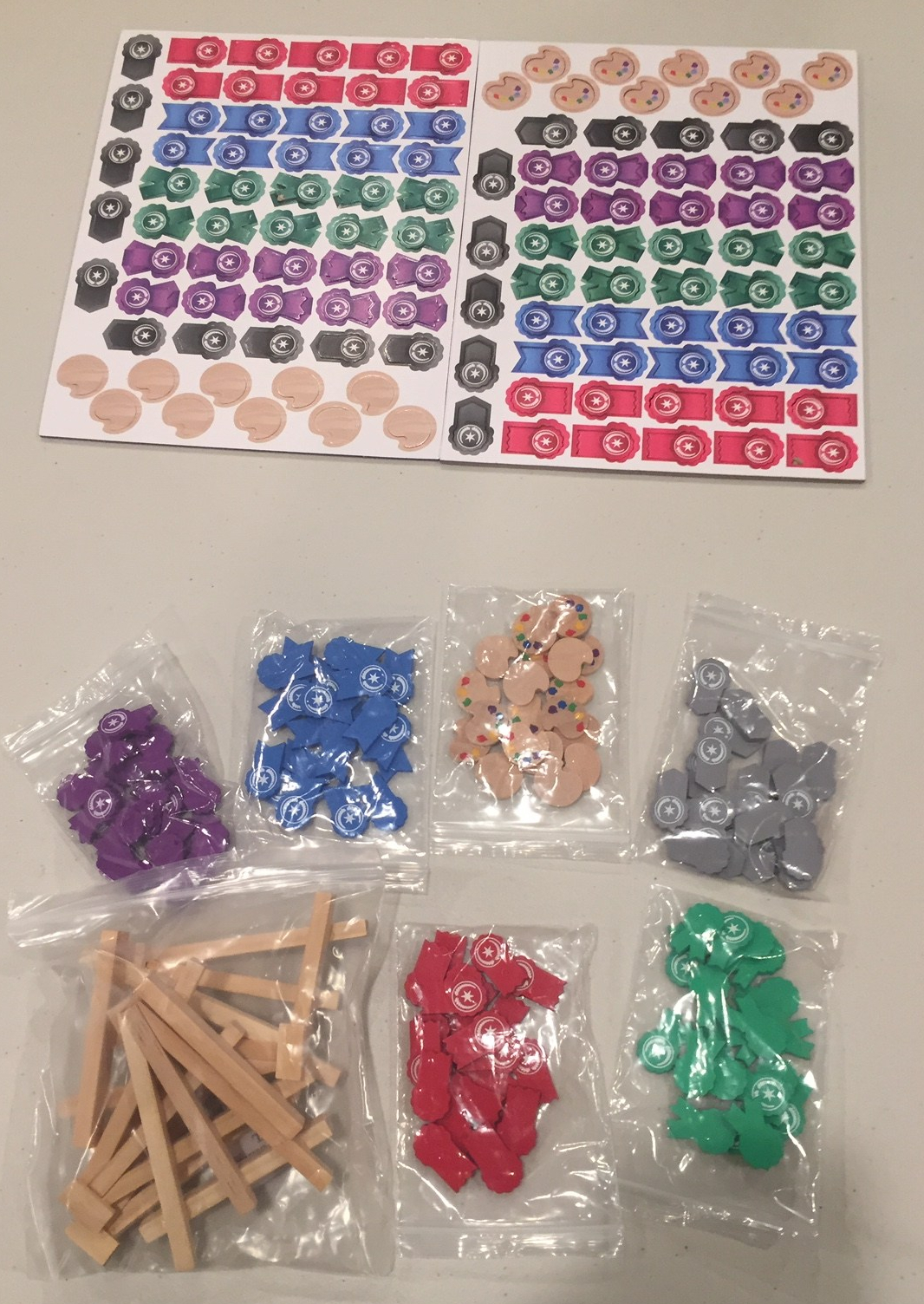
There’s some plastic components as well: the red markers you see will be used for marking most things in the game.

Here’s some of the cards unpacked:

Let’s take a closer look at the board again. Note that the main board comes out!

Overall, the components in Tainted Grail are just FANTASTIC (as are most Awaken Realms games are).

IMG_7626

First Play

IMG_7596

So, Tainted Grail hits it out the park for your first play. There’s a lot of decks, but you don’t need to unwrap ALL your components just to try it out! There’s a 4 page pamphlet that takes you through the game and it only takes about an hour!

As we have said many times, the best way to learn a co-op game is to learn the game as a solo player and teach it to your friends (see Saunders’ Law entry here).  And that’s what Tainted Grail does as its first play! First, you choose one of the 4 (5 with stretch goals) character to play: I choose Boer.

Then you set yourself up with that character! A lot of the set-up is actually on the character cards themselves:

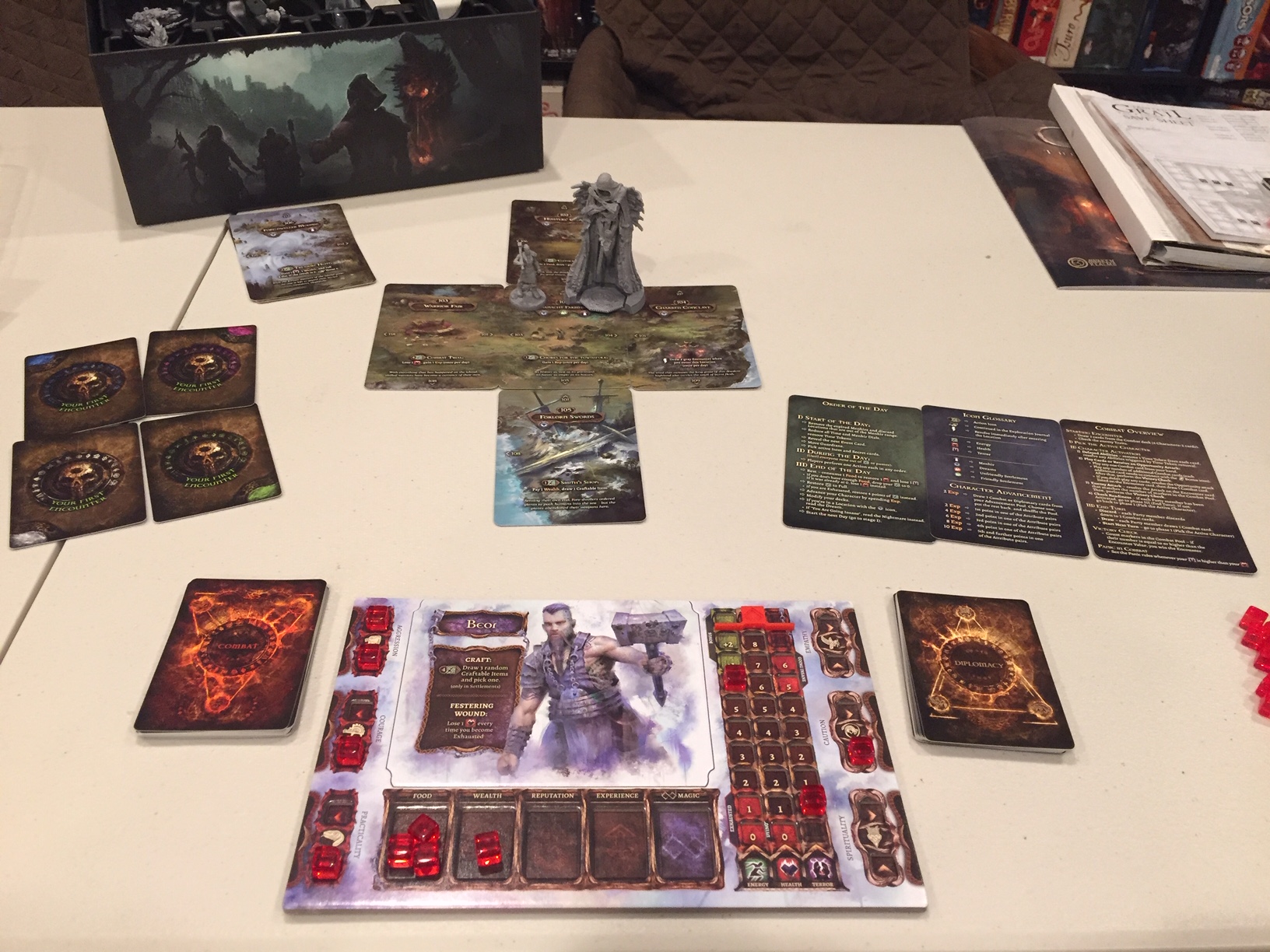
The red markers are used for just about any demarcation in the game. For the characters, they are used for your attributes (on the left and right sides) and your Energy, Health, and Terror (long column on left side of card). The game is essentially split into two parts: 1) “Stuff you do during the day” (like exploration or movement) and that costs Energy and 2) Combat or Diplomacy (which consumes your Health and maybe Terror). These will be replenished by eating food (at the very bottom of the character sheet above).

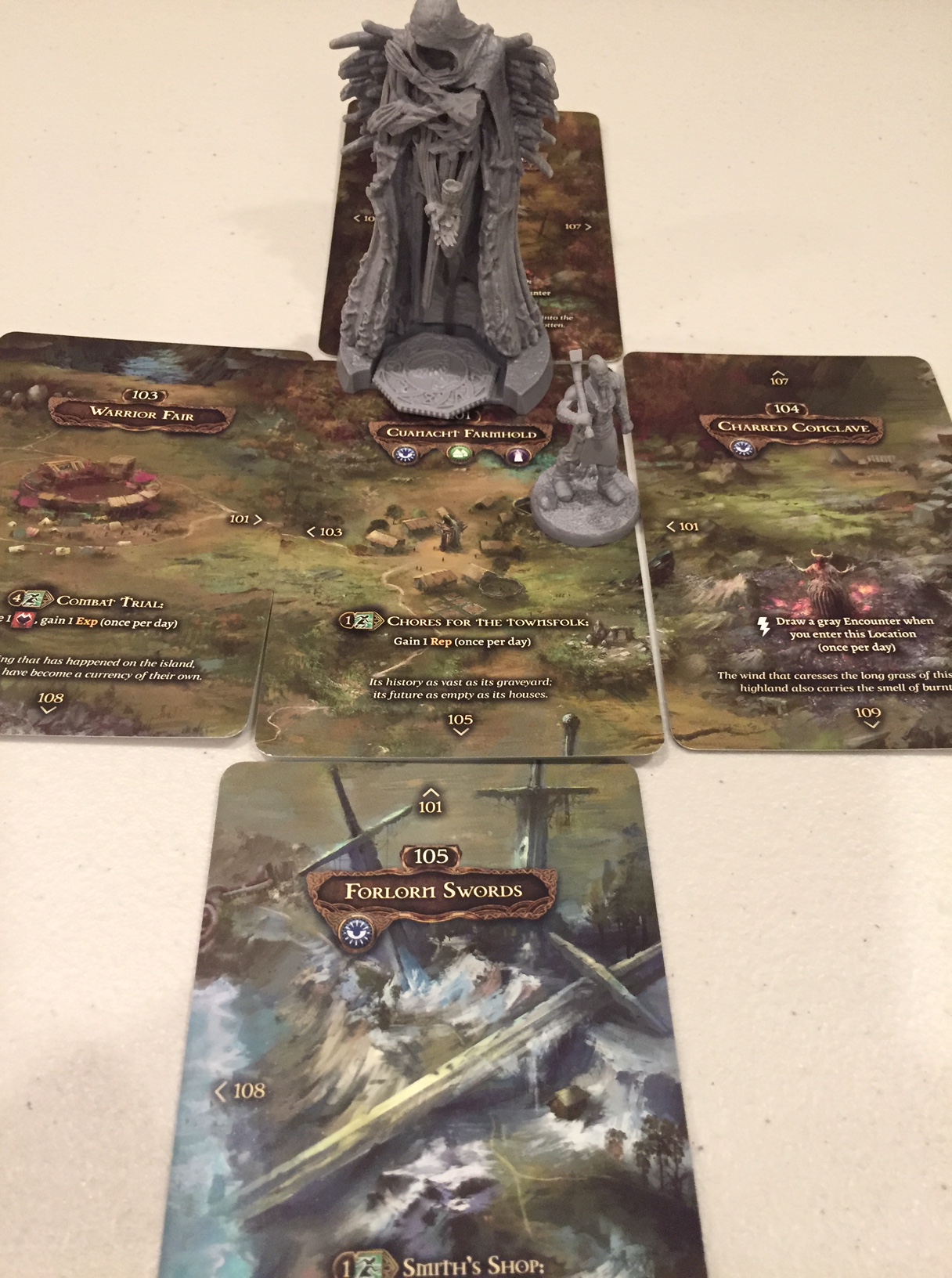
The FIRST PLAY rules are very clear how to set this up! The FIRST PLAY also sets up your world: these are oversized cards that connect to each other (ala The 7th Continent or Etherfields).

As you explore this world above, the FIRST PLAY takes you through a sample Combat and a sample Diplomacy, both coming from the encounter cards (each of the colors denotes a different type of encounter).

When everything is all set-up for your first play, the board should look something like this. Note the special Combat and Diplomacy decks for the character on the left and right side!

IMG_7643

As you head into the game, you also start looking at the Exploration Book (remember, this is a campaign game with an ongoing story in the Exploration Book!)

IMG_7645

As you explore and move on your first day, you read the Campaign book (above). One of the first things you do, after moving is get into a combat!! The FIRST PLAY walks you through a Combat very well: it actually notates the first Combat card for you!

For Combat, you take some cards from your Combat deck and play them left to right, letting the Monster attack after you play a few cards for the round. Damage and effects happen because the little squares on the edges “line up” (see below).

IMG_7648

As you are in Combat, you do damage trying to get 4 damage in this case to win (see above). If you win, you get the loot (in this case, some food). As you are fighting, you will probably lose some Health and maybe some other stuff.

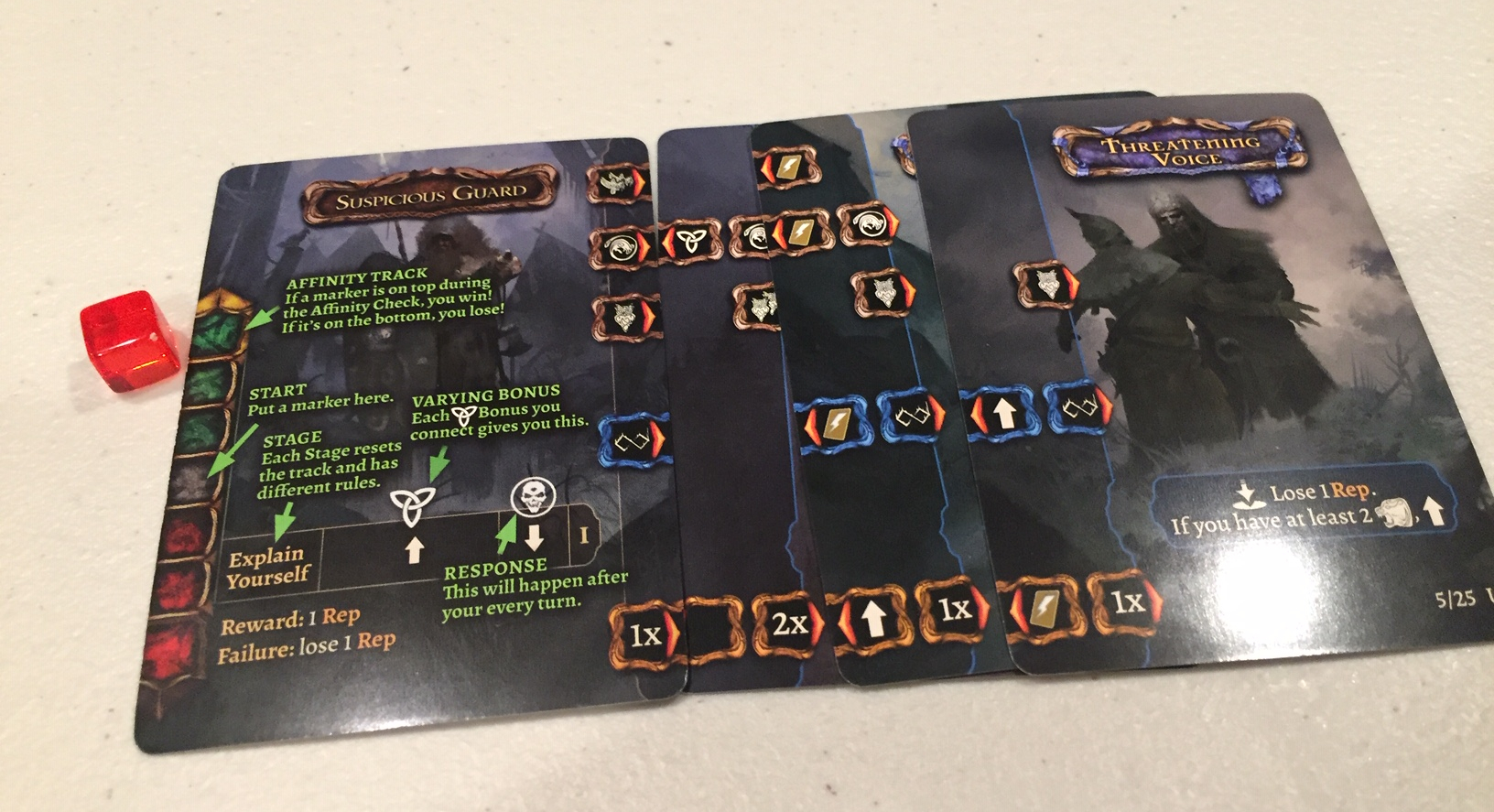
The other type of encounter in the game is Diplomacy. Diplomacy is handled similarly to combat (putting out cards left to right), but in this case it’s a “tug of war” of wills trying to get the red cube to the top of the Affinty Track (see below).

IMG_7655

During all of this play, there are three Summary cards which are absolutely indispensable:

IMG_7653

These cards are two sided and summarize the day phase (when you explore and move) and the Combat or Diplomacy (when you engage as the result of an exploration or other).  These are very useful and I am so happy they exist!

After about an hour, you get to move, explore, read from the Storybook, encounter some Monsters and right (Combat) and try to sway a guard (Diplomacy).   The game really walks you through this first play so nicely!

IMG_7652

See above for most of the FIRST PLAY!

Honestly, this was one of the best first plays I ever had.  It was so easy to set-up and play through! The FIRST PLAY book made it so easy to get a sense of the game.  After my first hour playing Tainted Grail, I felt like I understood the game!  And I hadn’t even gotten to the rulebook yet! 

Rulebook and Unwrapping

IMG_7967

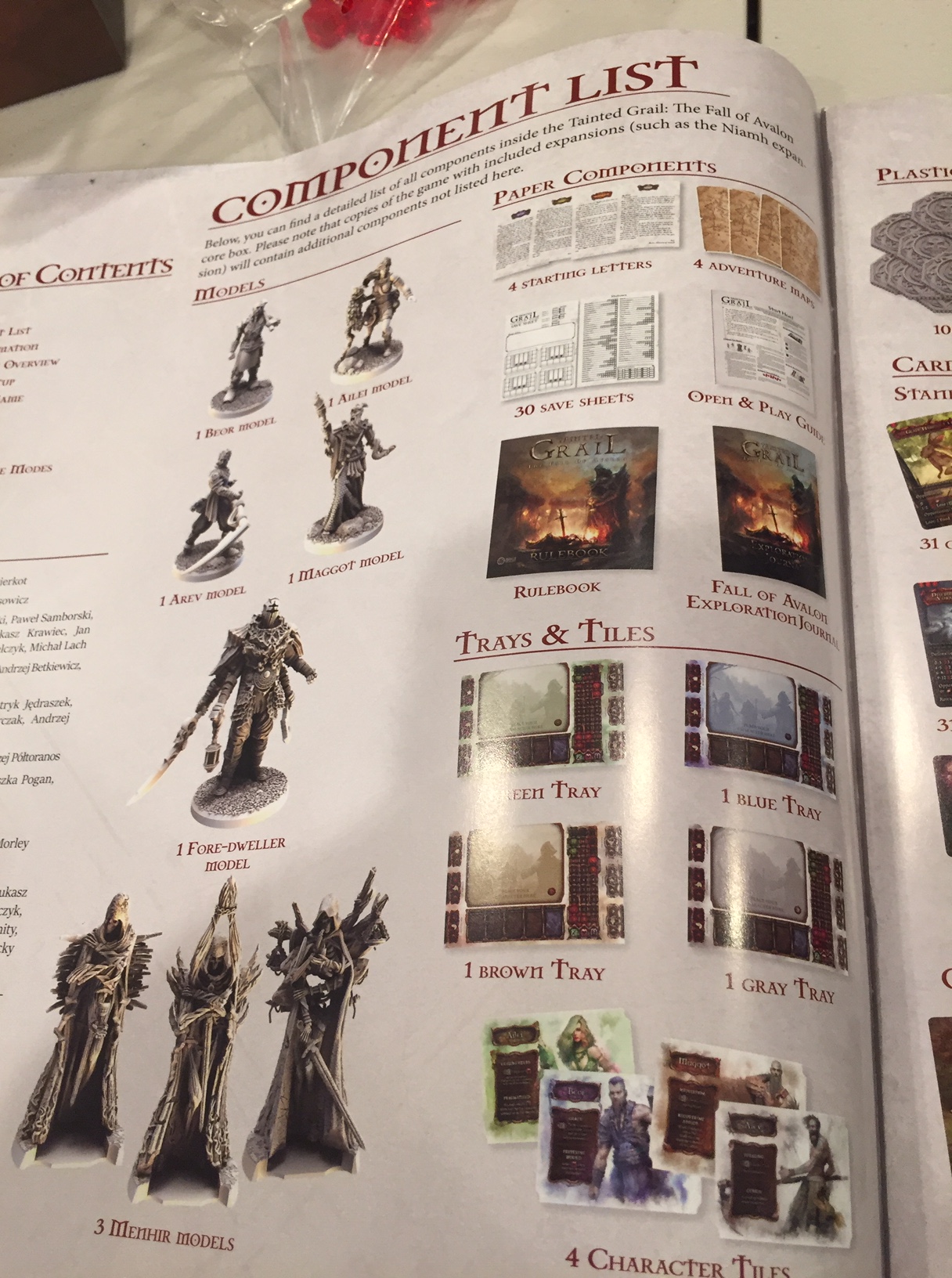
It’s weird to talk about the Rulebook AFTER playing once through already!  (That’s how good that first game is, you don’t have to refer to the rulebook).  The rulebook does most of the things you want a good rulebook to do: A nice intro components page:

IMG_7968

IMG_7970

I have to admit, I spent a LOT of time on this first page as I unwrapped all my cards (I only needed a few for the FIRST PLAY).  So, I feel like I was on this page for almost 1 hour as I unrwapped and correlated cards.

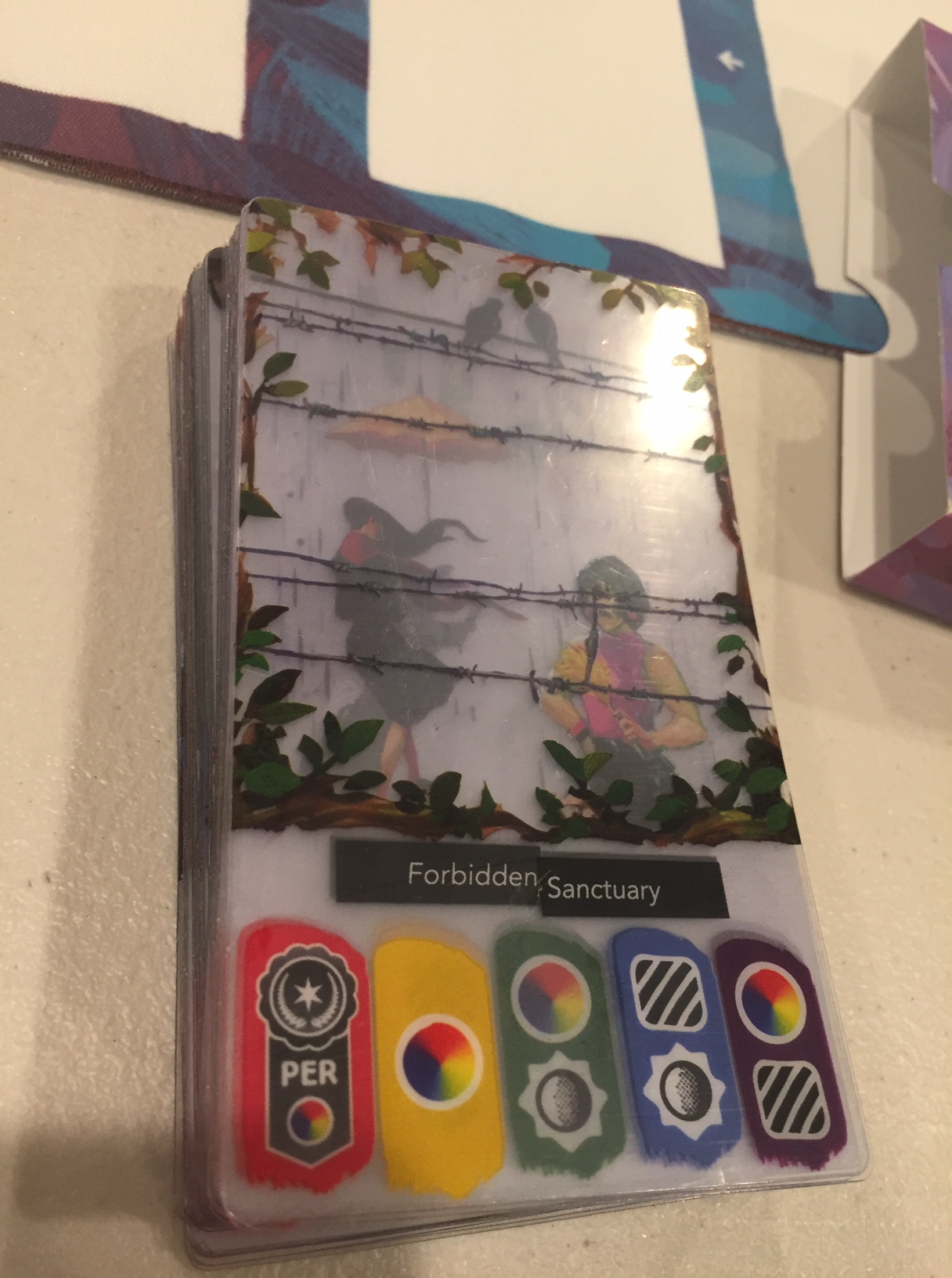
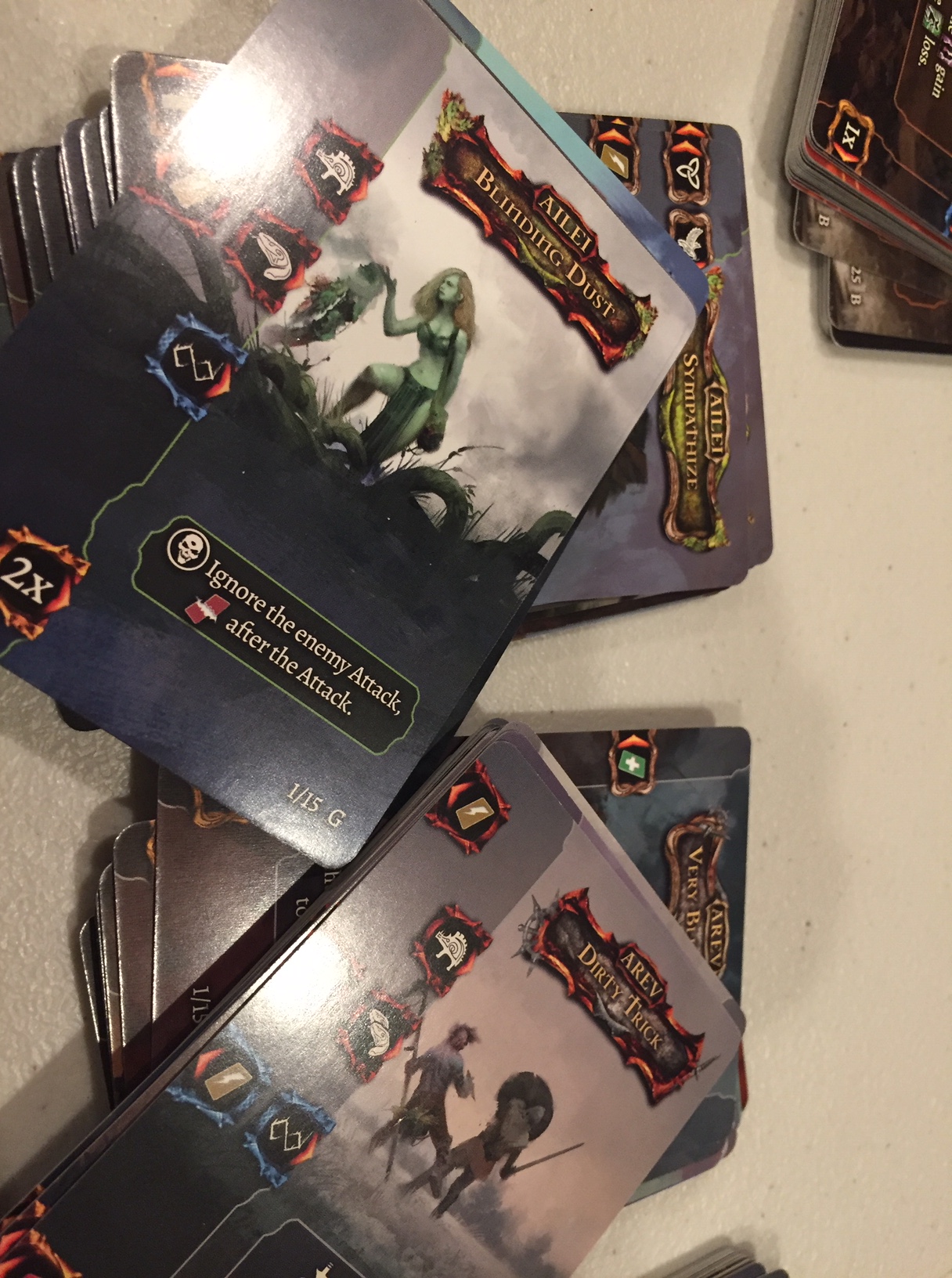
There were a few things I didn’t like: the cards are notated with single letters for G=Green, B=Brown, U=Blue, R=Red, Y=Grey.   Um, these were weird colors to pick, AND the letters they chose were weird, AND the colors on the cards weren’t actually that pronounced.  It was hard to tell the cards apart!    See the card below … that’s Green (ya, I know it looks yellow).

IMG_7975

Once you get the decks separated, it’s not too big of a deal, but it cost me at least 10 minutes as I tried to sort/distinguish the cards. These seemed like some weird choices that weren’t very “distinctive”. See below (with 4 different piles for the 4 different “colors”).

IMG_7999

IMG_7976

Something else that wasn’t apparent: you know that FIRST PLAY deck we had for our first game?  It kind of looks like its separate from the game BUT NO!  You need to fold all those cards into the main game!  A little sentence somewhere would have helped!!  For example, there are 30 purple encounters.  But the components say 31 … wherre’s the other?  OOOooooh, back in the FIRST PLAY deck!  Any kind of notation would have helped: 30 PURPLE ENCOUNTERS + 1 FIRST PLAY or something like that would have gone a long way!

From here, the rulebook is fine. It elaborates on a lot of stuff we saw in the FIRST PLAY. The rules are fairly straight-forward, if a little “boring” because we feel like we have seen all these rules already! One complaint I had was the the Index felt incomplete: I liked that they HAD an index, but the two or three times I tried to use it, my lookup wasn’t in there. (Do you know what a charge is? Neither does the index!)

Overall, the rulebook was good. It could use a better Index and maybe slightly better explanations on the component page, but it worked. I didn’t have any major problems.

A Little Deeper

After playing through the FIRST PLAY, I wanted to get a sense of how the Campaign really worked. There’s a lot more to set-up and handle when you are playing a real game, but the FIRST PLAY really gave me the confidence that “THIS IS EASY!”.

I played Chapter 1 of the Fall of Avalon Adventure. The rules were fairly evident. The storybook was engaging.

The game wasn’t much harder to get into after that FIRST PLAY. As a I played, I marked off some stuff on the save sheet, then had to put my cards back in the box for the next play. The save system was fairly easy.

I just wanted to make sure my FIRST PLAY wasn’t a fluke: nope! Playing the real campaign game isn’t that much harder than your first play.

IMG_8009

Although, it does take up more space as you need to have your notes! You’ll notice I have my Exploration Book off to the side since I ran out of room!

Thoughts On The Experience

IMG_8001

The writing in this game is good.  It feels very evocative!  The storybook just seems to really hit it out the park.  I have heard that they hired “real authors” to write the story, and it shows.  The writing really augments the experience.

I have been enjoying my experience so far.  The game is immersive, as the art and writing and components are just so top-notch.   The save system seems to work very well, so it’s easy to put away and come back.  There’s an ‘experience’ system, so you can make choices on how to upgrade your characters as you play: it seems like you always some kind of interesting choice for upgrades near the end of the chapters.   Like Etherfields, this is also a deck-augmentation game (as you make your Combat and Diplomacy decks better).

The game is a little fiddly as you adjust Health, Experience, Food, etc etc etc, but it’s just the nature of RPG-like games: there’s usually a lot of stats to update.

The Combat and Diplomacy systems are unique.  I don’t know if I love them yet, and I feel like the rulebook doesn’t “quite” explain it well enough, but I have been pushing through.  I like the idea of cards moving left to right, and matching symbols to invoke powers/abilities, but I have had a number of questions.  This system is a little clunky until (I think) you get used to it.

Conclusion

I can see why some reviewers called this their game of the year.  There’s an interesting story that’s unfolding.  The writing is excellent.  The components are first-rate.  The art is thematic and evocative.  All of these elements make a very immersive game.  

There are still a lot of rules to deal with to play this game, but that FIRST PLAY set-up gives you so much confidence that it feels easy to jump into the game!  I wish all games had a FIRST PLAY that worked that well! 

I am curious what I will think of the Diplomacy and Combat systems over time, because they were the only thing I wasn’t 100% sure about. But those systems was different and interesting.  

Overall, I really like this game.  I look forward to playing all the way through The Fall of Avalon and see how it goes!  I may even try to play with my friends!  Solo play works really well in this game, so I don’t need to … 


A Review of The Umbrella Academy Card Game

IMG_7898

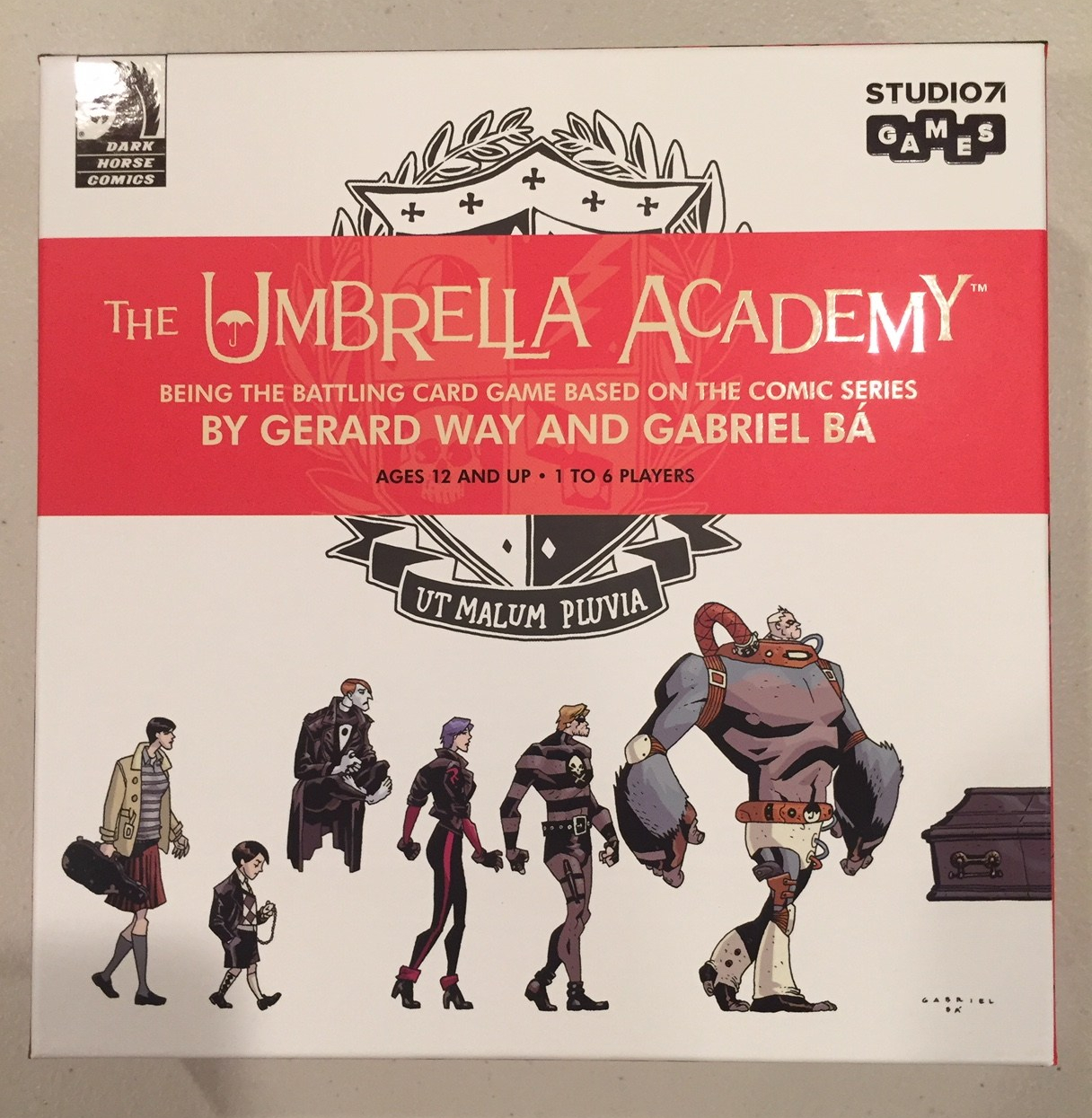
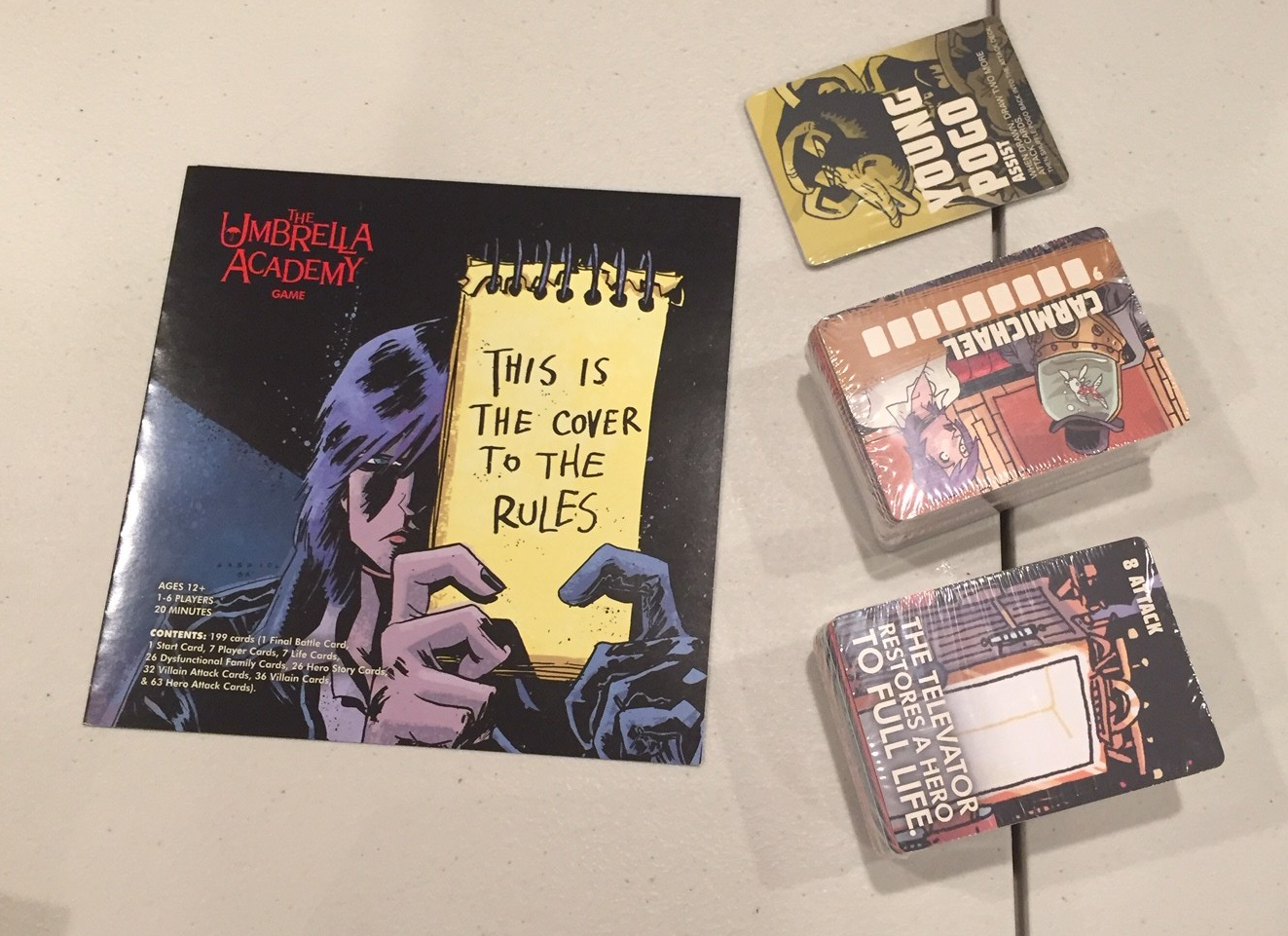
The Umbrella Academy is a Kickstarter that came out in mid 2020.  I typically like SuperHero/comic themed games (see my Top 10 Cooperative Superhero Board and Card Games), so I backed this one. The art looked pretty good.

IMG_7910

I’ll cut to the chase. This game is terrible. Out of the box, the game is unplayable. I played one turn and just lost.  There weren’t any choices and I didn’t draw any decent cards.  Disgusted, I put the game away thinking I did something wrong: maybe I’ll try again.  At that point, the game sat at a 1 or 2 out of 10.

IMG_7905
Out of the box rules: the Umbrella Academy game is UNPLAYABLE

I looked here at the ratings on BoardGameGeek and saw a lot of 1/10 ratings. It wasn’t just me.   But someone did mention that there was an updated rulesheet on the BGG site. So, on BoardGameGeek: here’s the updated rules. See below, accessing the NEW rules on my computer.

IMG_7928

This time, I made it through 2 turns before I died.

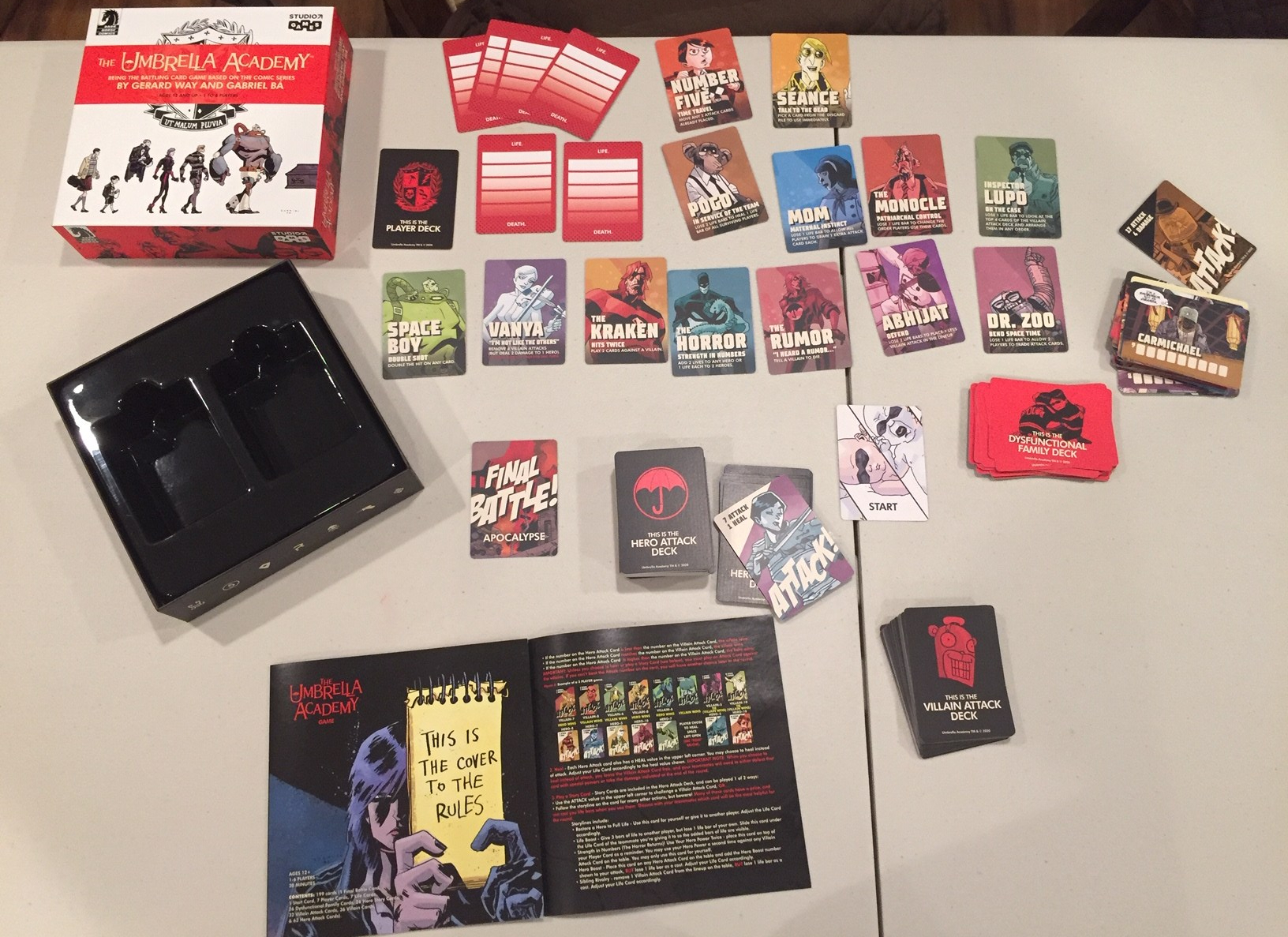
The game looks decent: it evokes the theme of Umbrella Academy pretty well. See some pictures below.

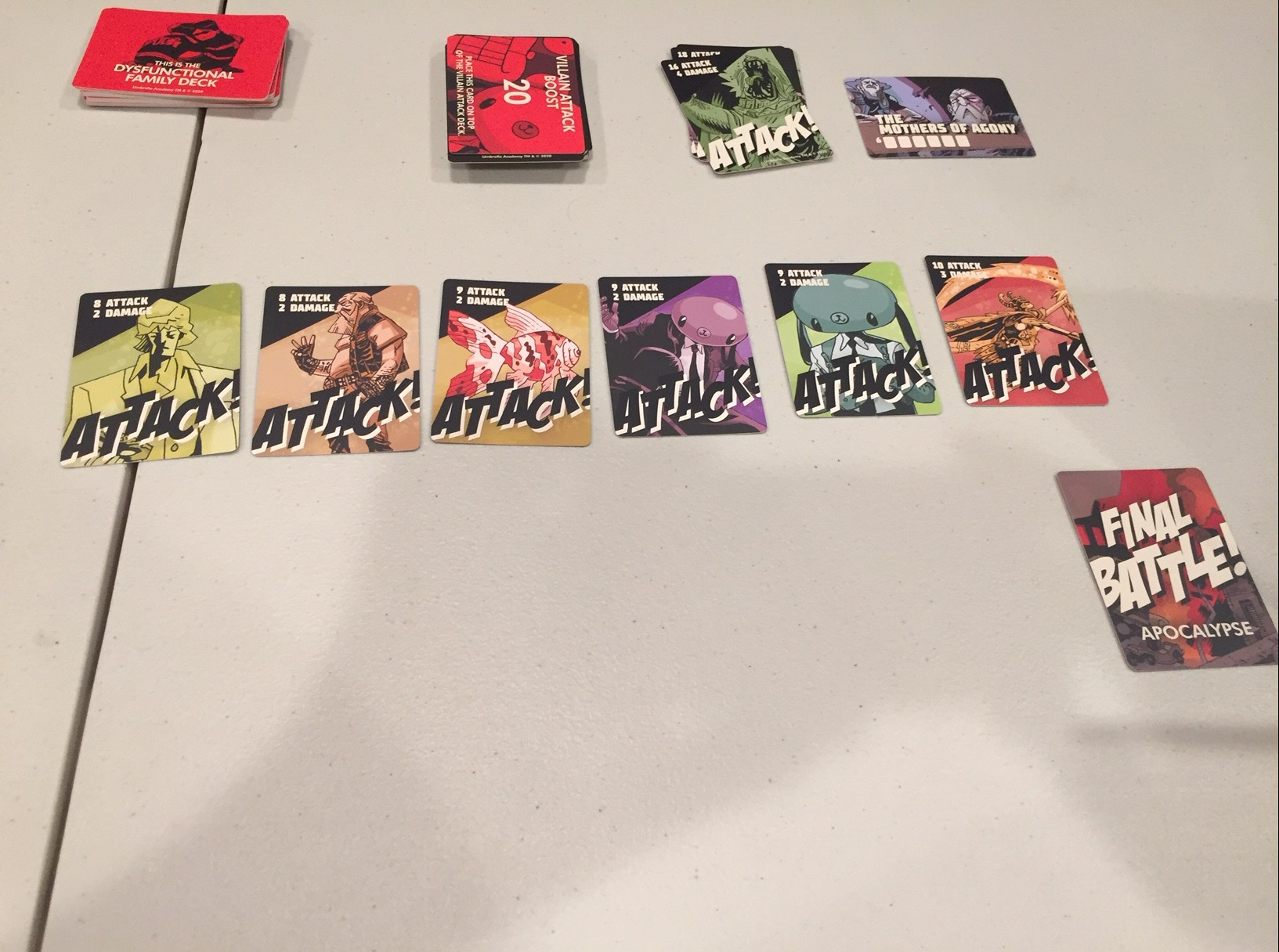
The game is essentially cooperative War:  you just get cards and play them. You have almost no choices: you have to move left to right, you have to play a card, you can’t hold onto cards to try to beat a later foe.

IMG_7921

Like WAR, you either beat the villain or not.  (IF you tie, there looks like a cool tiebreaker, but it’s too little too late at this point).  It has player elimination (always a red flag), and if all players die (by going to hit points), the game is over and the players lose.  

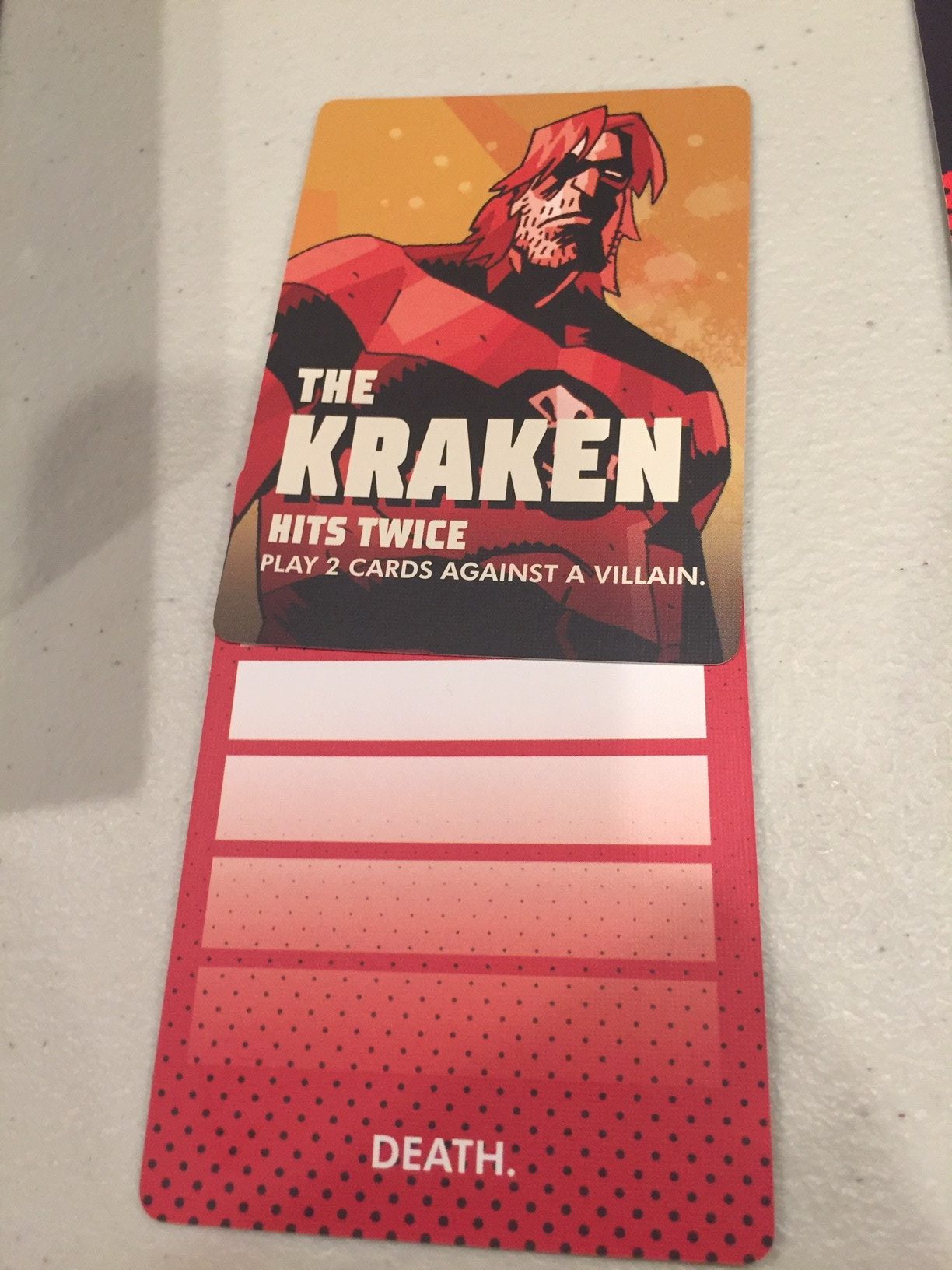
This game feels horribly underdeveloped.  I’ll give an example: you use your Player Card moving up and down on a track to notate your hit points.  A fine mechanic I’ve seen in other games.

IMG_7924(1)

BUT, you are supposed to “rotate” your player card 45 degrees if you use your power … so now, the same card that’s notating your hit points is rotated … which line is it on? It’s not clear now! (See below)

How did no one notice this (above) in playtesting?  This doesn’t work! It’s at best fiddly and at worst confusing!

So, the art (see above) brings the game up at puts it at 2 or 3/10.  It’s unplayable out of the box and almost unplayable with the updated rulesheet. It’s just a bad card game that aspires to be cooperative war (but fails).

IMG_7904

I was hoping The Umbrella Academy might be a nice light weight cooperative game for me and my friends.  If you looking for a lightweight cooperative game, I’d recommend either Heroes of Tenefyr (see here, although some of my friends didn’t like it) or No Nu Kuni (see here): both are lightweight.   Heroes of Tenefyr is kind of like cooperative war in the guise of a dungeon crawler, but it feels like things happen, you have some choices, and it’s very cute.  Ni No Kuni is like a entry level cooperative resource game where the theme might really bring you in.  Both of those games are playable and significantly more fun than Umbrella Academy.

A Review of Dice Throne Adventures (the cooperative expansion for Dice Throne)

Dice Throne Adventures is an expansion for the Dice Throne series of games.  This expansion turns Dice Throne into a cooperative game for 1-4 players.  The original Dice Throne is a competitive, dice-chucking, 1 vs. 1 game, where each player takes the role of a mythical character trying to defeat the other player.  The cooperative expansion has the players explore a world and fight big-bad bosses together!  Essentially, Dice Throne Adventures takes the core Dice Throne game, and throws the players into a party working together to defeat the Mad King and his minions!!

Introduction

So, in March 2018 (quite some time ago), my friend Sam and I played Dice Throne (Season 1) at Dice Tower Con West in Las Vegas. I usually don’t like 1 vs. 1 games, but the game was pretty, and I had heard good things about it. We checked it out from the Dice Tower Con library and gave it a go, and you know what? It was fun! It was pretty to look at, easy to learn, and easy to play. There were fun decisions along the way, and we got to chuck a lot of dice. Sam and I enjoyed it enough that it was one of my favorite memories of that Dice Tower Con West 2018!

Kickstarter

Based on my good impression of the game with Sam, I went full in (“Legendary Collector”) on the Kickstarter for Dice Throne Adventures back in August 2019. The “Legendary Collector” pledge included everything (and I mean everything) for Dice Throne: Season 1 (rerolled), Season 2, expansion packs, stretch goals, a dice bowl, miniatures, cards sleeves, and a play mat. But the real reason I backed it: it added a cooperative expansion to the game called Dice Throne Adventures (this is a cooperative games blog after all). As you can see above, there’s a lot of stuff! It was possibly the biggest box of stuff I have ever ordered!!
The big box arrived a few days ago, and I have spent the entire weekend getting into this!

Continue reading “A Review of Dice Throne Adventures (the cooperative expansion for Dice Throne)”

Sentinels Comics RPG Review

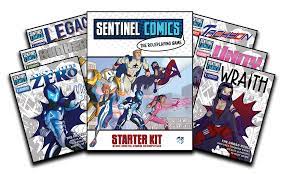
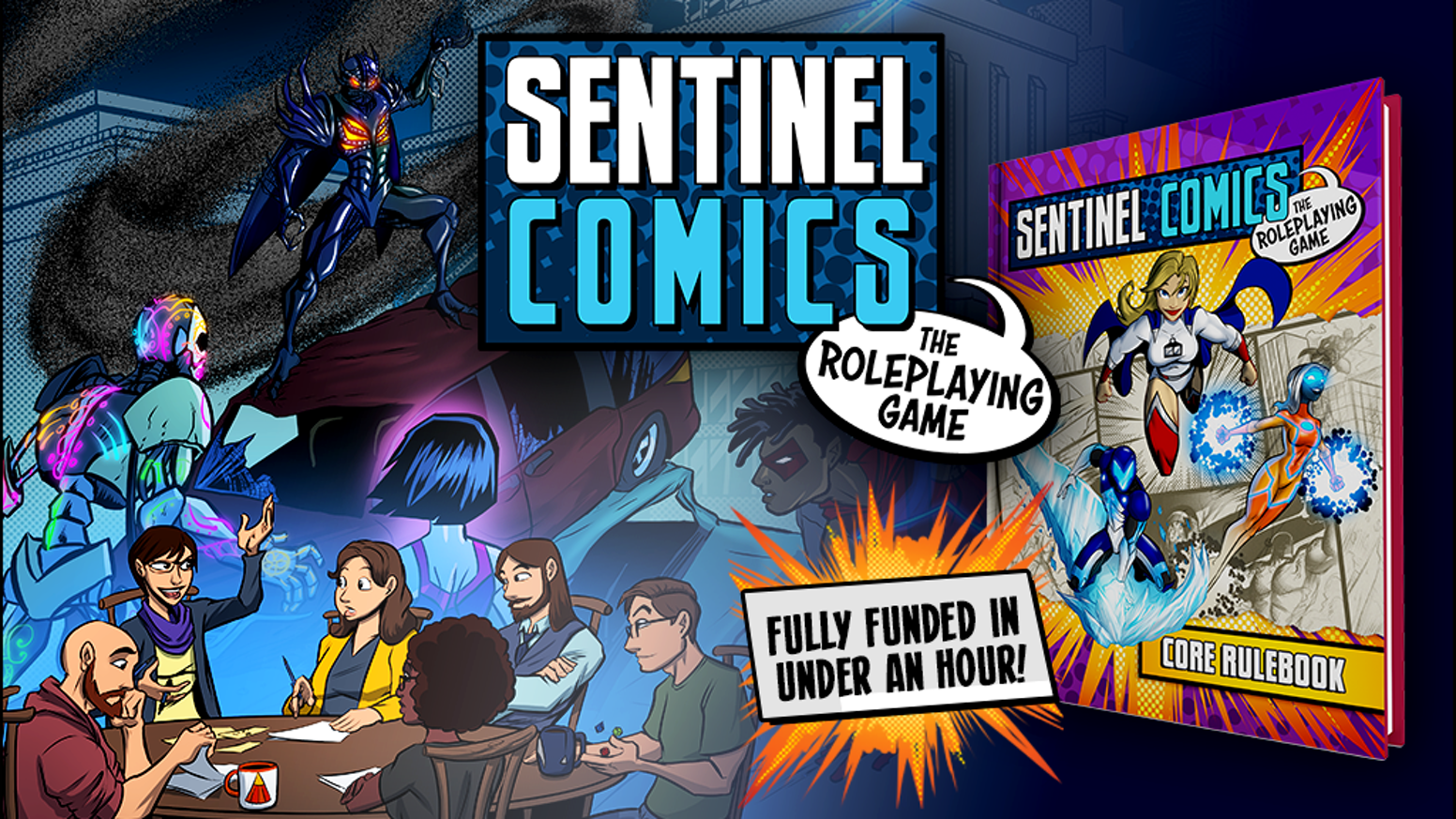
Sentinel Comics: The Roleplaying Game – Starter Kit, Greater Than Games, 2017

So, this is a review of both the Sentinels Comics RPG Starter Kit (see above) and the Sentinels Comics Core Rulebook. I picked up the Sentinels Comics RPG Starter Kit a number of years ago, but it sat unopened! It remained in shrink-wrap because I couldn’t find a group here in Tucson who was interested. So, when the main Sentinels Comics Core Rulebook (see below) went on Kickstarter, I had trouble justifying getting it because I still hadn’t opened the base game!

PastedGraphic-3

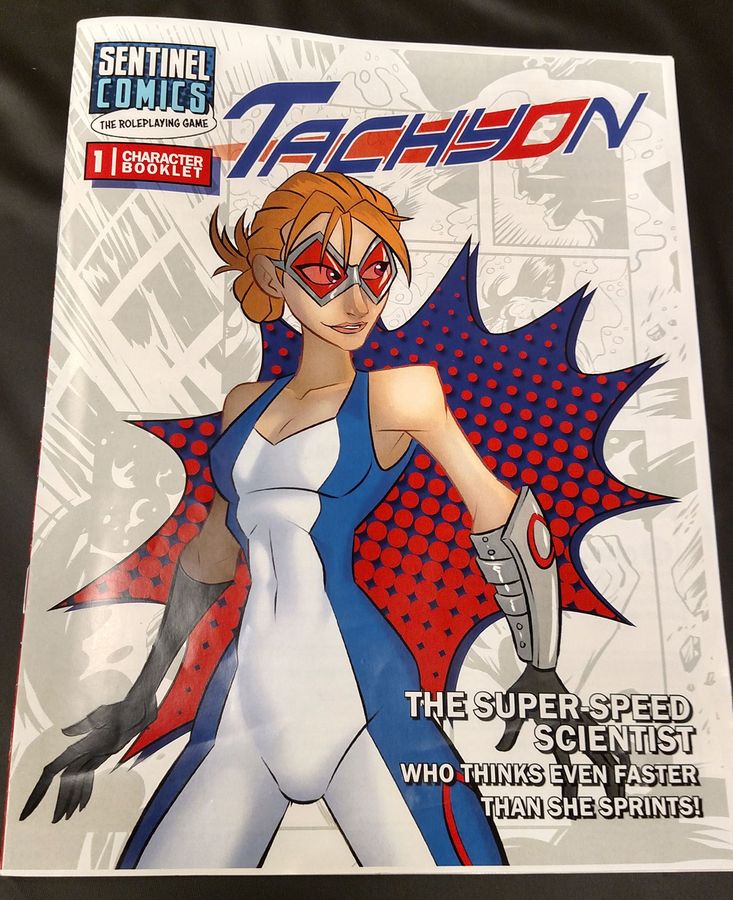
Luckily, I found a group to play!  Right now, we are currently playing the Sentinels Comics RPG on Thursdays (over Discord) and it’s a blast!  It’s a fun and easy RPG to get into.  The Starter kit has premade characters and makes it VERY EASY to get into the base game!  See below for one of the premade characters!

pic3722576

The character books describe in just a few pages how to play. I was impressed at how easy it was to get a character going! If you want to make your OWN characters, that’s what you need the main Core Rulebook for!

mainsen

Sentinels Starter Kit? Easy to get going quickly. My friend CC, who has been GMing the game for us (and has the Core Rulebook) has played and run a lot more games of Sentinels Comics than myself, so I’ll let him take over!

Sentinels Comics Core Rulebook

PastedGraphic-4

The Sentinel Comics RPG Starter Kit came out in 2017.  It showcased the core gameplay of this new superhero RPG system, included SIX adventures, and offered several beloved characters from a popular card game as playable heroes.  Now, three years later, the core rulebook has finally been released.  Has it been worth the wait (and the $60 price tag)?

I can say, unequivocally, YES.

Let’s look at this book from several perspectives:

Art

PastedGraphic-6

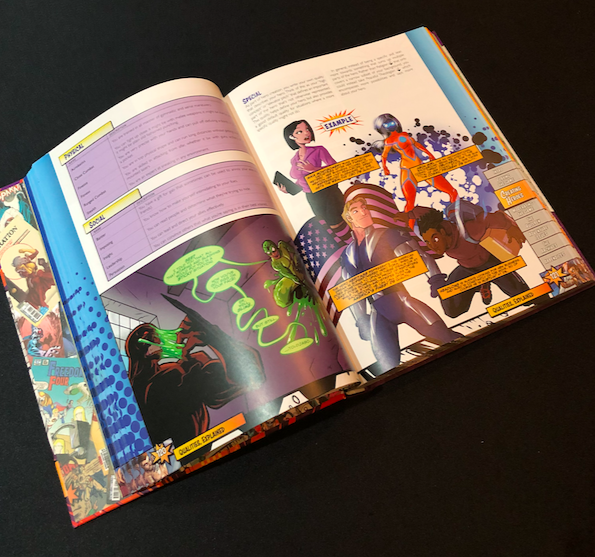
The Sentinel Comics RPG Core Rulebook is easily one of the most beautiful hardbound rulebooks I own, and I’ve owned many over the years.  This book is a thing of beauty.  Full-color superheroic illustrations from many artists, evoking comic panels from many genres, time periods, and art styles fill the book from cover to cover.  Some pieces are better than others, naturally, but rare is the page that doesn’t have an evocative illustration of a hero looking heroic or a villain looking villainous. Greater Than Games did not skimp in this area, and it shows – the book is a pleasure just to flip through.

Graphic Design/Layout

PastedGraphic-5

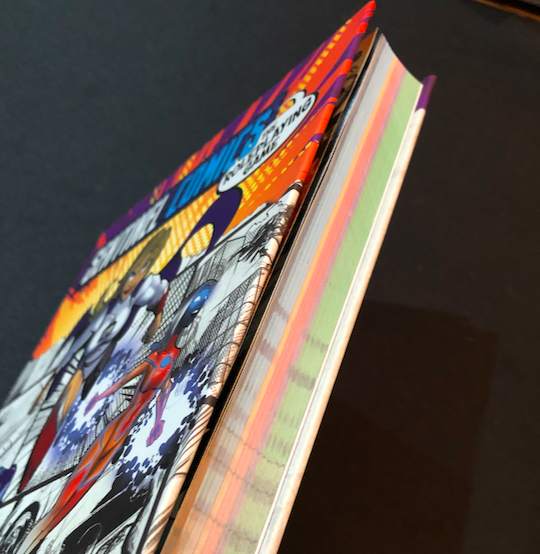
But what about the layout and presentation?  There are a lot of great affordances in the layout of this book. One very clever element is the fact that each chapter is color-coded, and the edges of each page is tinted to the associated color.  Not only does this make it very quick to find your way through the book when flipping through it, but you can also literally see the chapters when looking at the closed book from the side, allowing you to open the book very close to where you need to.
Another innovation I appreciated was in some rules presentations.  Many of examples of game mechanics in action are provided, and not just inline in the text – instead, they are pulled out and illustrated as comic panels, where each player is speaking to each other with speech balloons, expressions, etc.  This makes reading the rules a pleasure, and is very good at driving home the salient points of the rules. Another example of this is the character creation summary, which is, again, presented as a series of comic panels.  The book is absolutely steeped in the theme, which drives excitement and brainstorming. My only gripe with the graphic design is that the body font chosen has a quite thin line weight which makes it slightly harder to read than it might otherwise be, but they chose a large enough font size for it that it’s not really an issue.

Content and Presentation

PastedGraphic-3

There is a LOT of content in this book.  The book consists of six main chapters (plus an introduction, appendices, index, etc.).  The first main chapter is “Playing the Game”, which contains a full summary of all the rules you need to run the game.  The short version of this is that it’s solid, workable, and trim, but for more discussion on this, see Gameplay, below.

The next section is support for creating your own superheroes.  This is almost certainly what a lot of players are looking forward to with this game, and it doesn’t disappoint.  There are three methods presented for creating a character – a “guided” method, a “constructed” method, and a “secret third option”.  The guided method is for players who don’t have an idea of the hero they want to play yet, and it prompts them to roll dice to suggest options. What’s really clever about this is that it doesn’t just assign the hero as you go; instead, it’s more of a rubric for giving players a few options to choose from at each step.  I’ve made some really fun heroes with this method, creating cool concepts on the fly.

For players who have a concept for the character they want, there’s the “constructed” method.  It uses the exact same system that the “guided” method does – the only difference is that instead of rolling to get some options, you just, basically, choose the option you want.  Simple, straightforward, and entirely compatible with the other method.

The third “secret” option is for players who are already familiar with the game, have an idea outside the bounds of what the above two options can do, and want to work with their GM to make the hero they dream of playing.  With that option, they just build the hero directly.  Between these three options, just about any player can arrive at a hero that is suited just for them.

The next section of the book is the “Moderating the Game” section.  This is a large and well-presented chapter with GM-facing rules, advice, and other materials.  This section talks about how to run the minions, lieutenants, villains, scenes, environments, etc., as well as giving advice on how to wring the best action scenes out of the system.  I felt this section hit the “sweet spot” of being detailed enough to convey what it needed to, concise enough to be accessible, and fulsome enough where it needed to be to give insightful advice for improving the play experience. Definitely a good read for both novice and experienced GMs.

The remaining three chapters are adventure content.  The “Archives” chapter contains a lot of pre-made heroes and villains to populate your game world with, and the “Adventure Issues” chapter contains two adventures to challenge your players with. But the star of these chapters is easily “the BullPen” chapter, which offers solid, easy-to-follow, flexible rubrics to help GM’s create action scenes.  I was truly impressed with how well-supported creating adventures is in this game; the algebra of balancing and presenting an action scene makes designing your own adventures a snap, even on the fly!  There are concise, easy-to-follow rules for creating scenes, enemies, villains, doomsday devices, environments, etc., and it’s all accessible and approachable in ways that I haven’t really seen in a lot of RPG’s.  It won’t take much experience with the game before you can quickly create adventures with little trouble and have a good idea of their difficulty and complexity at the table.

Gameplayd4aa8168e0807d22948fb9174a8d95b7_original


So…how does it play at the table, then?

I’ve been very pleased with this system.  I’ve played Champions, Mutants and Masterminds, and many other games, but this is the first system that really managed to capture the feel of comic book style superheroics for me, and it did it with a simple, straightforward, and accessible system that’s both easy to teach to RPG newcomers and crunchy enough for veterans.

The genius of the system is that it doesn’t even try to model the specific effects of each super power.  The problem with games like Champions has always been that superheroes, by definition, break the rules of reality, so trying to effectively simulate a world where heroes naturally breaking the rules of reality becomes very fragile.

Sentinel Comics RPG solves this in a very clever way that eliminates the complexity.  All actions heroes take are classified as one of five things: attacking, defending, boosting, hindering, or overcoming. These actions abstract the in-fiction behavior enough that it gets out of the way while still providing “teeth” to the players’ decisions and tension on the clock as villains enact their plans.

Attacking and defending is about dealing or preventing damage, and are quite straightforward.  Attacking with fire uses the same system as attacking with martial arts or a laser; the differences are handled at the fiction layer.  This allows the player to “skin” those attacks however they like.  If you want to attack that robot by jumping on its back and twisting its head off, you can do that.  If you want to attack that robot by melting it with your fire powers, you can do that.  And because this all happens at the fiction layer, there are no complicated rules about those weird edge cases that will inevitably come up; your GM handles deciding things like whether your fire powers work in a vacuum or underwater, or whether your psychic blasts work on those AI robots.

Boosting and hindering is about making things harder or easier for your allies and enemies.  At first glance, this seems like a minor option, but at the table, it truly shines.  This is the mechanism that turns a group of individuals into a superhero TEAM.  Again, this is a simple system that is “skinned” based on the player powers.  You might hinder that robot by telekinetically wrapping it in chains, or dominating it with your arcane eye, or creating ice under its feet.  All these do is create story-relevant bonuses and penalties, but they are significant ones, often meaning the difference between defeat at the hands of the villain and victory using clever teamwork.

Finally, overcoming is the catch-all problem-solving mechanism for anything else the hero does, such as rescuing innocents from a falling building or disarming the villain’s doomsday device.  Anything that doesn’t fall under the other actions becomes an overcome, and the players can skin their approaches to problems – and even what problems they want to solve – however it makes sense in the fiction. The power of this was driven home for me the first time I ran a session of the game.  A player playing Absolute Zero, a cold-based character, saw the bad guys fling an innocent civilian from high up.  The player said, “I use my cold powers to create a deep snow bank for them to fall into!”  And it just WORKED.  There are no rules for falling damage, catching things, using cold powers to break falls, etc.  It’s just “overcoming a problem” – if the player can imagine a comic panel showing the hero solving that problem, they can go for it!  Creatively using their powers like this is baked into core of the system, and it feels spontaneous and versatile. Once the action has been chosen, there’s a very simple system for rolling for success.  Each hero has a list of powers and qualities, each associated with a die size.  The hero chooses one of each type, and then a third based on their current health, and roll them.  For instance, Absolue Zero above might have chosen his “d12 Cold Powers”, “d8 Creativity Quality”, and “d8 Green Zone for Health”.  The player then rolls those dice, putting them in order. Most effects look at the result of the middle-valued die, but some hero special abilities let you do more, such as attacking with your Max die, or attacking multiple targets with your Min die.

The result determines the outcome.  In the case of attacking and defending, the roll is simply the damage – an attack just causes the result as damage, and defend defends that amount from the next attack.  For boosts and hinders, every four yields another +1 or -1 on a future die roll.  And for overcomes, the value determines whether the overcome is successful or not, and whether or not it creates a “twist”. Knowing when to boost, hinder, attack, or overcome is the core strategy of the game, and it is fiction-first, making it easy for players to reason within.

On the GM side, there are a lot of affordances that make running the game a breeze.  There are three “tiers” of enemies – minions, lieutenants, and villains.  Minions and lieutenants have simple core rules with ways to customize them; each is represented by a die size, like a d6 Ninja or a d12 Tyrannosaurus, along with a few tactics and special ability notes.  These are exceedingly easy to run, allowing you to very quickly model even a large number of enemies fighting the heroes.  Villains, on the other hand, are statted out much like heroes, and are more complicated, but they use the same systems that heroes do, and are straightforward to run as a result.

Overall, the game feels very streamlined and quick, which is perhaps the number one reason it is able to capture the feel of comic-book action: minimal down time.  Turns go quickly, and everything is abstracted to let players imagine their own fictions, which lets the heroics and dreadful reversals come forward with very little to get in the way.  It’s exceedingly slick and easy to run.

But best of all, the fiction-first flexibility allows you to be as superheroic as you want. One of my players had made a character who was a psychic ghost with ties to the Lord of the Dead.  In their first episode, they encountered a horde of robots, which I had ruled were immune to their psychic attacks.  In a regular game, this would shut that hero down, relegating them to being support at best for the fight. Instead, the player asked if that hero could attempt an overcome action pull the entire scene into the Land of the Dead so that her psychic emanations could affect the robots.  I said I’d allow it, and their overcome check succeeded, so I just described the sky turning blackish-green, the temperature plummeting, and everything turning into shadowy mirages of their mortal counterparts.  It was a great moment that evoked those double-page spreads in comic books which give real spotlight moments to a hero.  Mechanically, it was dead simple to run, didn’t skew the balance of the game, and the system didn’t break a sweat to support it, delivering a massively cool moment that felt like true comic book drama!

Downsides
PastedGraphic-4


I have heard a few down sides to the game for players, and I would be remiss not to mention the ones that I think are fair criticisms.

First, there is a concept in some scenes of a “scene tracker”.  This tracker goes from green to yellow to red, and this, combined with the heroes’ personal health zones, determines which special abilities they have access to.  Early on, when they’re healthy, they can only use the “green” abilities, which are generally the weakest.  As the scene progresses and gets more dire, they also gain access to the “yellow” and finally the “red” abilities. One can reasonably object – why can’t my hero just do the red ability first?  Do they not know how to do the thing?  It’s a fair criticism, but I haven’t found it to be much trouble at the table.  Mechanically, it ensures that the stakes ramp up and the action has a better feel.  So many of my Dungeons and Dragons fights feel overwhelming and hard at the start and feel like we’re “just mopping up” at the end, which is exactly opposite to what it should be; action scenes should drive toward climaxes.  This system achieves that, but it’s fair to say that it does it in an artificial way.  Whether this bothers you or not probably depends how much you let it intrude on your collective fiction.

Another criticism I’ve seen leveled at the game is that it doesn’t have much in the way of character advancement.  You’re not going to be “leveling up” and getting exponentially tougher and going on tougher and tougher adventures as you advance.  While there is a sort of “experience” system in place, I can see why this would be a deal-breaker for someone who really likes advancement.  You’re not going to slowly turn into a god.  More like, you become a veteran superhero over time, getting more and more adept at using the powers you have.  (There are also mechanisms for totally re-building your character, for those story arcs where heroes transform drastically, but they’ll be of similar power.)

Again, while this is a fair criticism, I feel like it comes with a major advantage, too: you don’t have to start out as a wimpy superhero – the whole “fight rats in cellars to gain XP” thing.  Right out the gate, you can play America’s Finest Legacy or the Sun God Ra, and be powerful and capable and take on the arch villains, which is kind of how it should be.

Some players unfamiliar with the Sentinel Comics universe may feel hesitant, as it is based on the rather extensive existing lore of the Sentinels of the Multiverse card game and the Sentinel Tactics board game.  There are a lot of heroes with long back stories that appear in the game materials, including the Starter Kit.  This can be understandably intimidating to people new to the franchise.

Luckily, familiarity with the “Sentinel Comics” lore is not required.  Anything you need to know about any given hero or villain in an adventure is minimal and provided in the adventure content, and can almost always be conveyed to players using their analogues in DC or Marvel.  “Legacy? Imagine Captain America with the powers of Superman instead of a shield.”  And the system does not require the Sentinel Comics universe; it would work perfectly fine for a GM to set the adventures in their own universe design.

Finally, I’ve heard some people feeling a little lost in creating some of their more-out-there superhero concepts.  Often, though, this is a case of perhaps taking the powers list too literally.  There’s a lot of freedom in the game to skin your powers, and really, all you need to do is get “close” to the power you want, and it works fine.  It does take playing the game to understand that, though, so I’d recommend playing at least one session with the pre-generated characters in the Starter Kit before trying to make a character – it’s a lot easier to understand the character creation process once you’ve played.

All told though, I struggle to come up with much in the way of criticisms of this game.  None of the three criticisms above have derailed us from playing and having a good time, and even the people who brought up the above criticisms still said they enjoyed the game quite a bit.

Conclusion

PastedGraphic-3


Sentinel Comics RPG advances the art of superhero storytelling in RPG’s.  It’s fun to play and a breeze to GM, with plenty of support material for players wanting to make their own heroes and GM’s wanting to make adventures to challenge them.
In short, yes, the three years were worth the wait.
PROS:
*  Solid, accessible, evocative superhero action.
*  Versatile hero creation for random or envisioned heroes.
*  Quick gameplay with fiction-first flexibility.*  Streamlined affordances make GM’ing a breeze.

CONS:
*  Not much in the way of character advancement.
*  Some artificial throttling of hero power for purposes of tension-building.
*  Pricey at $60 MSRP (PDF may be cheaper, and you can try the Starter Kit for free).

(As of this writing, the core rulebook is not released; my copy was a KickStarter copy, but the book should be available as PDF and hardcover on the Greater Than Games store sometime within the month.  In the mean time, the Starter Kit is free to download to get started, which will easily last you six full gaming sessions.)

A Review of the Ant-Man Expansion for Marvel Champions

Ant-Man, the Marvel Champions expansion, came out very late in 2020.  It adds the Scott Lang Ant-Man to the roster of Marvel Heroes you can play in Marvel Champions.  Although I have been strictly collecting all the Marvel Champions expansions, I have only played the heroes that I really like so far!  Ant-Man is one of my favorite characters and I can say I liked the Scott Lang Ant-man before it was cool!

s-l1600

I picked the original Marvel Premiere #48 (see above) back at my local paperback shop back in March 1979!! (You might ask “Rich, how can you pick up the issue in March when it came out in June?” At the time, Marvel and DC’s “release dates” were about 3 months ahead of time: the explanation I got from someone in a Comic book store is that there was a “race” between Comic vendors to make their comics look “newer”: at some point, the date on the cover drifted to 3 months in advance!)

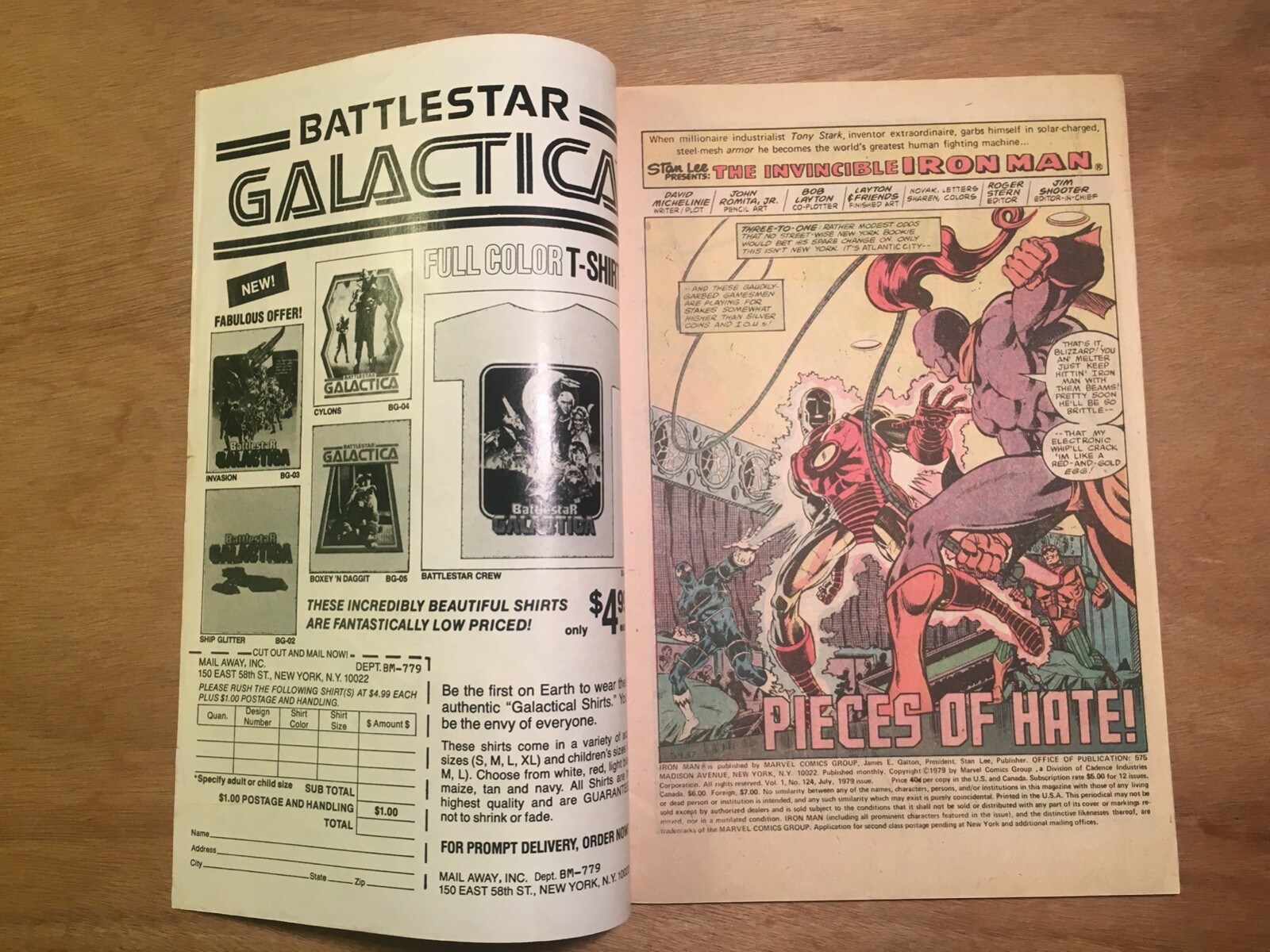
I loved this incarnation of Ant-Man! It was the culmination of John Byrne on Pencils (who was VERY HOT drawing the original X-Men about the time of the Dark Phoenix Saga), Bob Layton on Inks (who was VERY HOT on Iron Man), and Dave Michelienie (who Layton worked with on Iron Man). This was the dream team for me! Bob Layton’s inks were always very clean. In fact, when I first saw this page from the Marvel Champions manual, I thought, “Is that from the Iron Man 123 or so with Layton inking?”

Not quite, but it definitely had that vibe (see below).

Picture 4 of 4

It turns out the first appearance of the Scott Lang Ant-Man was Marvel Premiere #47! I had missed that issue, so I had to go hunt it down at the paperbook shop (ya, there weren’t a lot of specialty shops for comic books back then). In fact, I remember getting a lot of Comic Books at the Menaul Book Exchange back then.

The Scott Lang Ant-Man is very similar to the Ant-Man Marvel Movie, but the Scott Lang Ant-Man of Marvel Premiere is depicted as smarter and less of a comic foible. Don’t get me wrong, I love the Ant-Man movies, but the current direction of Ant-Man was a little more comic than the original.

Oh, but you want me to talk about the expansion, right?

Ant-Man Expansion

Ant-Man: Marvel Champions is a small expansion with just one blister pack.

The coolest thing about Ant-Man is that he has three forms! Scott Lang (alter ego), Ant-Man (tiny) and Giant-Man (giant)! See below for the normal Ant-Man (tuny mode)

And see above for the Giant-Man form! Notice that it’s twice as big as the normal cards. It’s actually a jumbo card folded in half (see below).

Basically, the Ant-Man form is good for foiling schemes, the Giant-Man form is good for doing damage, and the Scott Lang form is good for healing (like most Marvel Champions forms). This “jumbo card” is actually a pretty cool gimmick! My favorite part of this new system (most heroes only have hero and alter ego side) is that switching to one of the new forms causes things to happen as well! It’s very thematic that when Scott becomes giant man that he does a damage AS HE GROWS! Scott defeats some scheme AS HE SHRINKS. I thought this was thematic for the character and his powers. (Pictured below, Ant-Man growing and attacking!)

Ant-Man’s Deck

IMG_7551

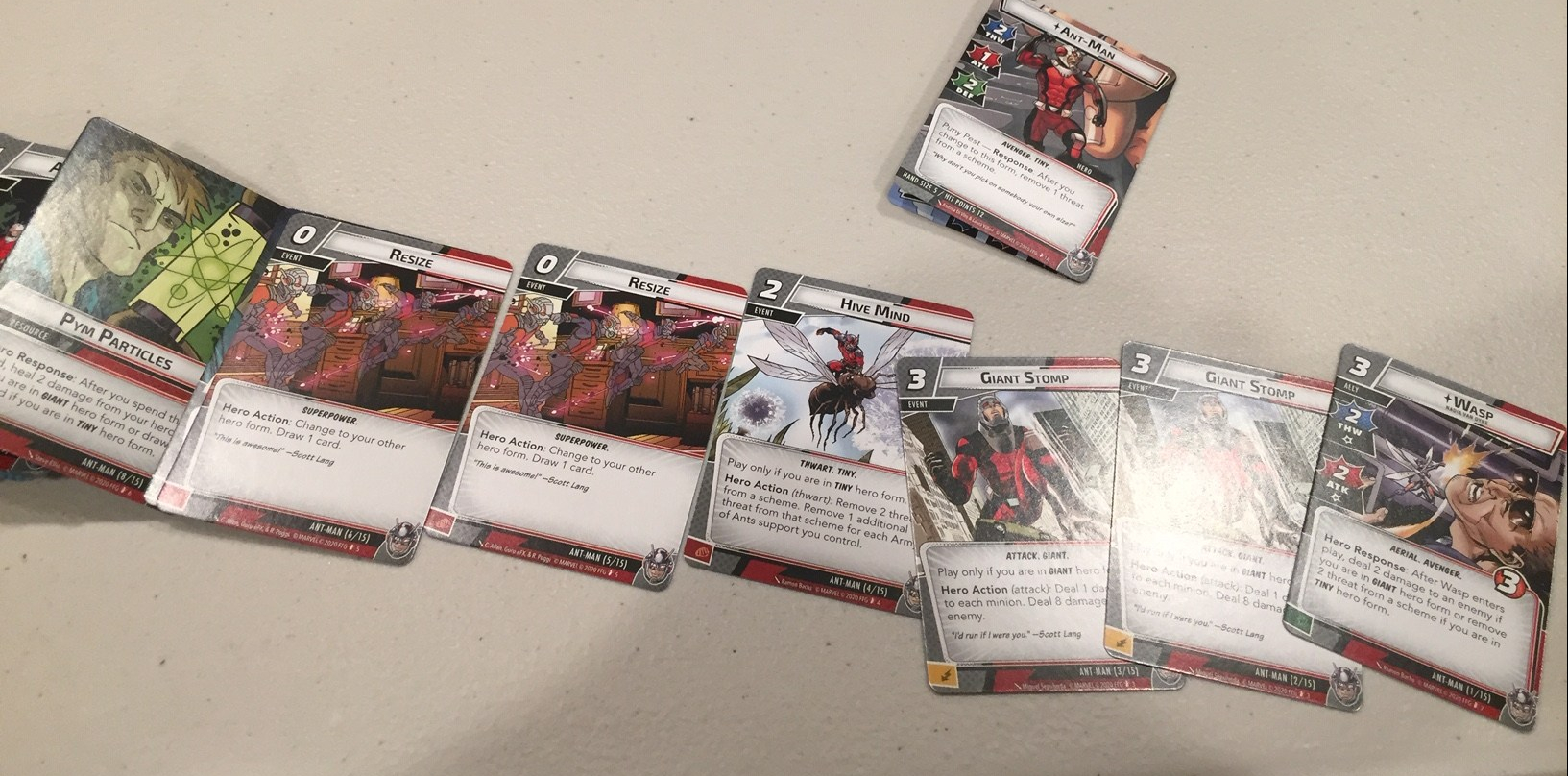
Ant-Man’s deck is pretty typically (Allies like Hank Pym Ant-Man):IMG_7552

.. but he has also some cards that only apply if he’s giant or tiny form!


IMG_7551

For example, Giant Stomp (above) only works if you are in Giant mode and Hive Mind (above) only works if you are in tiny mode. Again, very thematic!

Of course, Ant-Man’s obligation is Cassie-related (Cassie is the reason Lang stole the suit in the beginning):

IMG_7556

And his nemesis that can come out is YellowJacket.

Some Extra Rules

Each of the single hero packs comes with a neat little poster on one side (see above) … and new rules on the back (see below).

The rules tell you how the 3 Modes work (you can switch from any mode to any other mode, but you can only do it once per turn (like normal switching)).  They also introduce a new rule called TEAM-UP! Now I poured through the Ant-Man deck 3 times before I found exactly one card that has the TEAM-UP keyword.

It was weird to me that so much space was devoted to one rule on one card, but I suspect we will be seeing more of this keyword.

Set-up And Gameplay

Set-up is real easy: there’s not too much “new” for Ant-Man: his default deck sets-up like most heroes.

Once the game gets going, Ant-Man plays easily. It’s fun going to Giant size (see above) and causing havoc just by changing size! Throughout the game, I went back and forth between Ant-Man (tiny) and Giant-Man (giant) quite a number of times! A Side Scheme comes out? Go to Ant-Man (tiny) size to get rid of the scheme! Then go back to Giant size to beat things up! And occasionally Scott form to heal.

Ant-Man is a good generalist. He can do a lot of damage in Giant form when needed or reducing the threat of the scheme in tiny form. I really enjoyed that I felt like Ant-Man could take on any situation and still do something. He was fun to play! It was a real joy switching between modes all the time!

Conclusion

img_6591

So, I have been quietly collecting everything for Marvel Champions (and reviewed and looked at The Rise of Red Skull here). Here’s the thing: I haven’t played all the characters! I have really only played the characters I tend to like in the comic books: Captain America, Spider-man, and Ant-Man. I suspect a lot of people will only get Ant-Man if they actually like the character! He’s a minor character (with his own Marvel movie, sure) and probably not super popular.

I enjoyed my plays with Ant-Man! He’s a good generalist with a fun twist with the different modes and size-related cards. He’s easy to play, with not too many surprises, but still fun.

If I had played this a little more before 2020 ended, Ant-Man would have made the Top 10 Cooperative Expansions of 2020.

A Review of Code 3: Part I. Unboxing, Solo Rules, and First Impressions

Code 3 (see above) is a cooperative game for 2-4 Players (but see below for solo rules) that was on Kickstarter back in October 2019. It promised delivery in May 2020, but only delivered here a few days ago (late December at the very end of 2020). In the crazy world of 2020, I am just glad I still got it. I got some expansion with the game (see below) give you more cases to solve and a few more cards.

Looking at the back of the box (see below), you can see what this game is: a cop-romp through the 80s!

Unboxing

Code 3 has some pretty decent components: a couple of grab bags (the red and blue bags) which will be used to serve for evidence and witnesses. They are nice and big and easy to grab from.

The rule book is very obvious!

There’s about 3 pages of cardboard components: these include overtime chits, donuts and coffee (seriously), and evidence and witnesses.

This insert is really nice and holds a lot of cards and tiles and other pieces!

The little cards are readable and decent. They are NOT linen-finished. Most of the little cards are either (a) case-dependent (the red cards) or “incidents” that comes on every player’s turn (crime never stops!)

The giant tarot sized cards are mostly two things: Chief cards or Case cards. Each chief grants his precinct special abilities (see the abilities above right ) based on a special “Chief” die that gets rolled every turn. The case cards control how the game unfolds (above left).

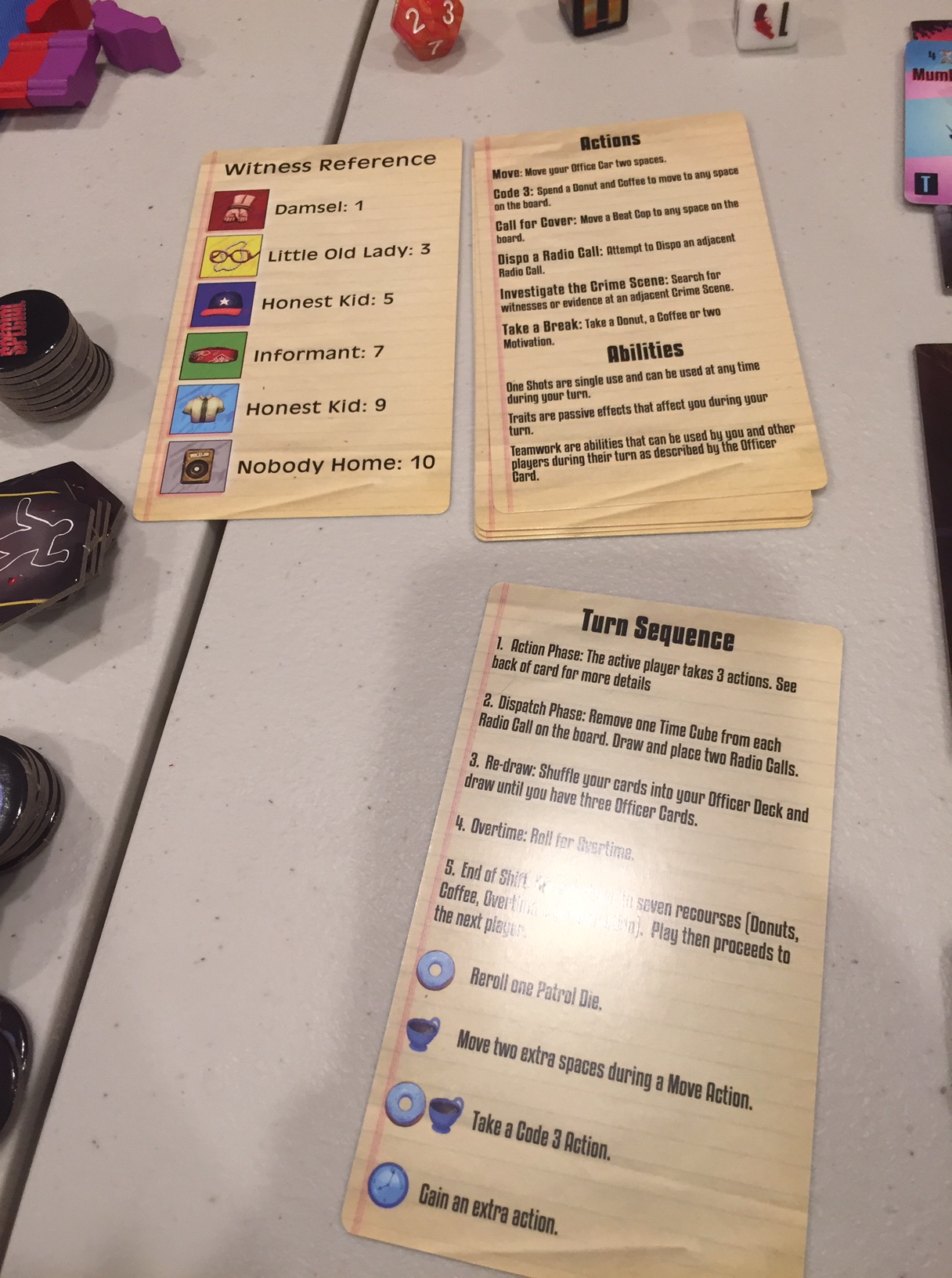
Perhaps the most important cards in the game are the Summary Cards. You think I am kidding, but I am not sure how I would have gotten through the game without those player Summary cards!!

In Code 3, every player gets to play a cop-team of 2 cops. Each Cop has 5 distinct cards, and there are quite a few different cops in the game (see above). You can see a few of the cards above.

There’s also a number of cards that either augment or pollute your deck as you play: Internal Affairs cards pollute your deck and Attaboys augment it. Commendations will stay out and give you one time special abilities.

There’s some dice (this is primarily a dice game), some blue cubes used for time and motivation, and some cars which you use to help you move around the city (the colorful cars are the player cars, and the black cars are support patrol cars).

The dice in this game are probably my favorite component: they are just so nice! They are easy to read and seem very thematic, especially the chief (black) die.

IMG_7499

The cops patrol a 4×4 city of tiles (see above) looking for clues, evidence, witnesses, and crime!

IMG_7509

In general, the components for this game were good.  None of the cards were linen-finished, but they were still decent.  I liked the art in this game in general, but I didn’t love the cover.

Rulebook

So, this rulebook is kind of a mess: it’s a Kickstarter rulebook. It doesn’t start with a list of components or set-up right away, it just starts talking about the rules.

It takes a different tact that almost works: it starts listing the component (see officer card rules above) and going through them one by one.

IMG_7486

And above you see the next discussion of Police Chief cards and other cards: It’s a different way to approach the rules, but I feel like it’s throwing you into the mix without some of a high-level view of all the cards. I think the reason so many game do that is that the high-level view of all cards(before anything else) is that it gives you perspective: jumping into the cards pull you into the minutae too quickly.

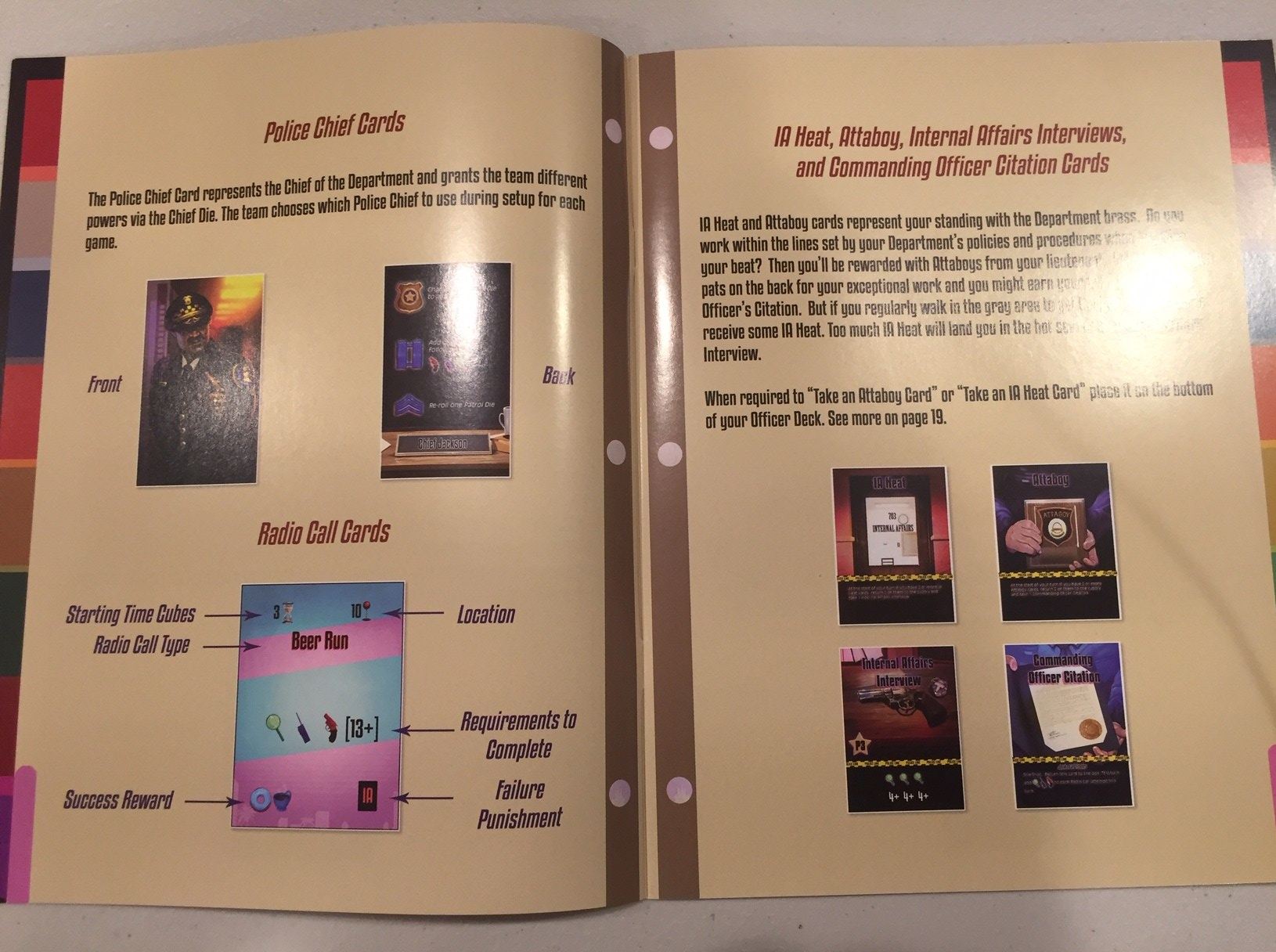
The rulebook just seems … off. For example, when discussing the Chief cards (which are Tarot sized) and the Radio Call cards (the bad news cards, which are tiny), the rulebook shows the perspective wrong! See above.

Look, this works okay. This isn’t a bad rulebook, but it’s a not a good one. I never saw a picture showing how to set the game up! See below as a public service: here is a sample set-up!

This rulebook needed a lot more pictures like the above. There were also a couple of rules that were on CARDS and I had trouble finding them in the rulebook. For example, when you succeed or fail on a Radio Call (the crimes of the city), you get a reward or punishment, represented as a little icon.

The lower left is the success Icon and the lower right is the “recurring” punishment. I never found the icons in the rulebook! I was “expecting” a list of Icons on the back of the rulebook (which is very typical), but it wasn’t until I was packing up my game that I found this two-sided card:

I really expected this to be in the Rulebook!

After all was said and done, I was able to find everything I needed to play the game. I really wanted more high-level overviews and pictures. The rulebook needs a pretty major overhaul and redo BUT ALL THE RULES WERE THERE. I was able to get through the rulebook to get a game going.

Solo Play

So, the game doesn’t really address having solo rules (Saunders’ Law). To play my first game, I just played as a 2-Player game. It worked fine.

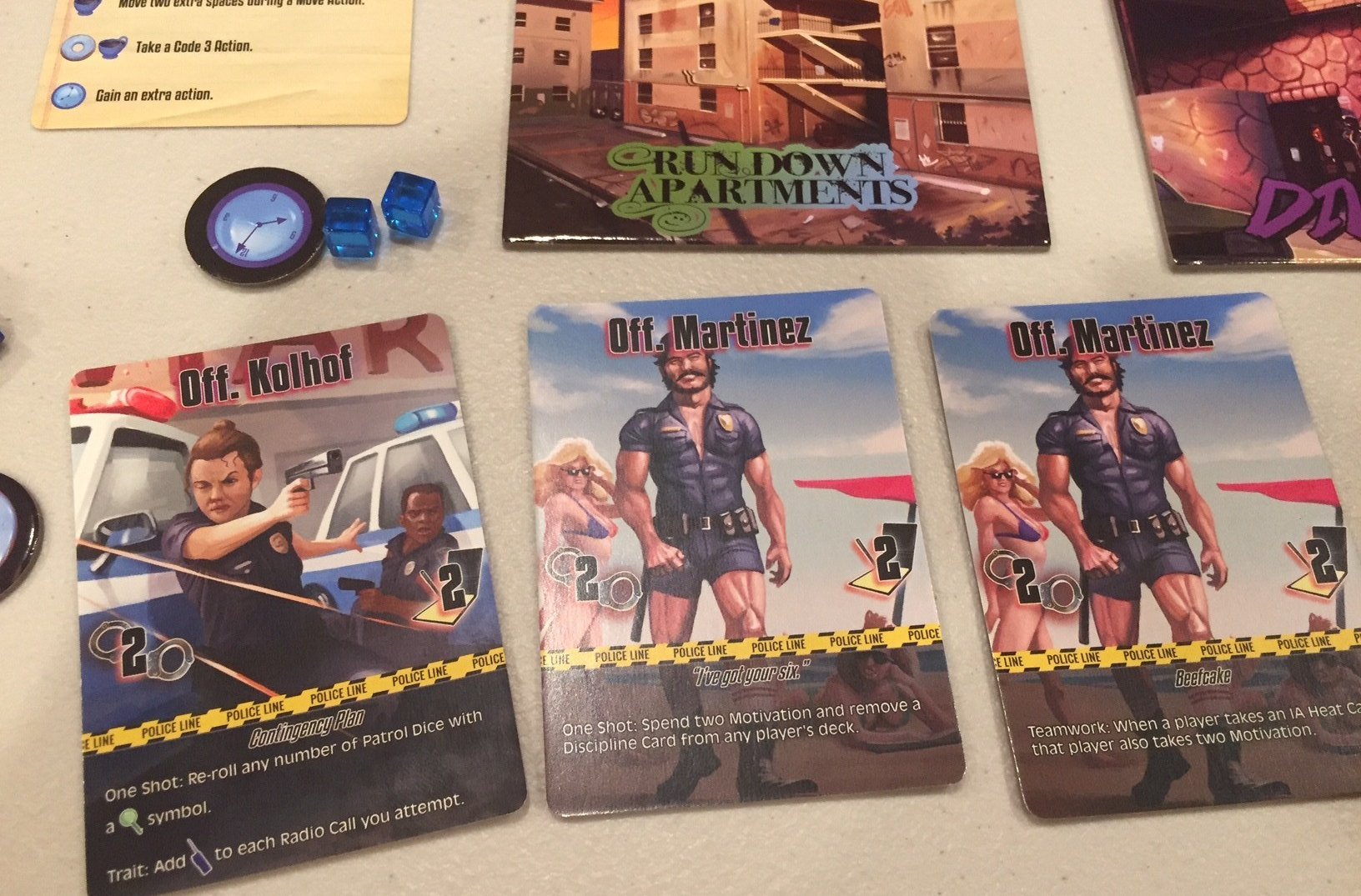
I might get grumpy that there were no 1-Player rules, but the game has a lot of cards with “Teamwork” abilities. These cards require that there be multiple cop-teams to work correctly. So, for balance reasons, I guess it makes more sense to always require at least 2 cop-teams so those cards trigger. See Officer Martinez’s teamwork ability on his rightmost card.

Seriously, a sentence in the rulebook would go a long way and you could say this game supports 1-4 Players. You could even make it thematic:

The Chief requires that every cop-team have backup!!  There’s no lone wolves in his department! You can play Code 3 solo, but you have to play with 2 cop-teams to back each other up!

Anyways, you can play it solo and it works.

Gameplay

Each game starts with the players choosing a case (Major Crime) to pursue.  We were trying to catch the Cat Burglar!

IMG_7520

So, there are limited number of cases, but each one can play very differently because of the chief you choose (black card on the right, above) which gives you special powers, and the cop-team each player chooses.  Even so, there are a number of cases in the box which are all different!

Each player starts the turn drawing cards from their deck until they draw 3 cop cards.  Any IA Heat or Attaboy cards that come out stay out.  If two or more of IA Heat come out,  there are consequences!  If two or more Attaboys come out, you get some extra help.    If you keep petty crime under control throughout the game, you get some Attaboys and other rewards.  If you let crime go, the Internal Affairs cards start polluting your deck and bad things happen (IA audits, losing turns, and so on).  So, you can be a cop who plays by your own rules, but there are consequences …  Or you can be a good cop, but do what’s needed at the end …

IMG_7537

During the game, you will be looking for evidence (see the distribution on evidence above, and notice the misprint of two Honest Kids .. the second should be Average Joe).

IMG_7539

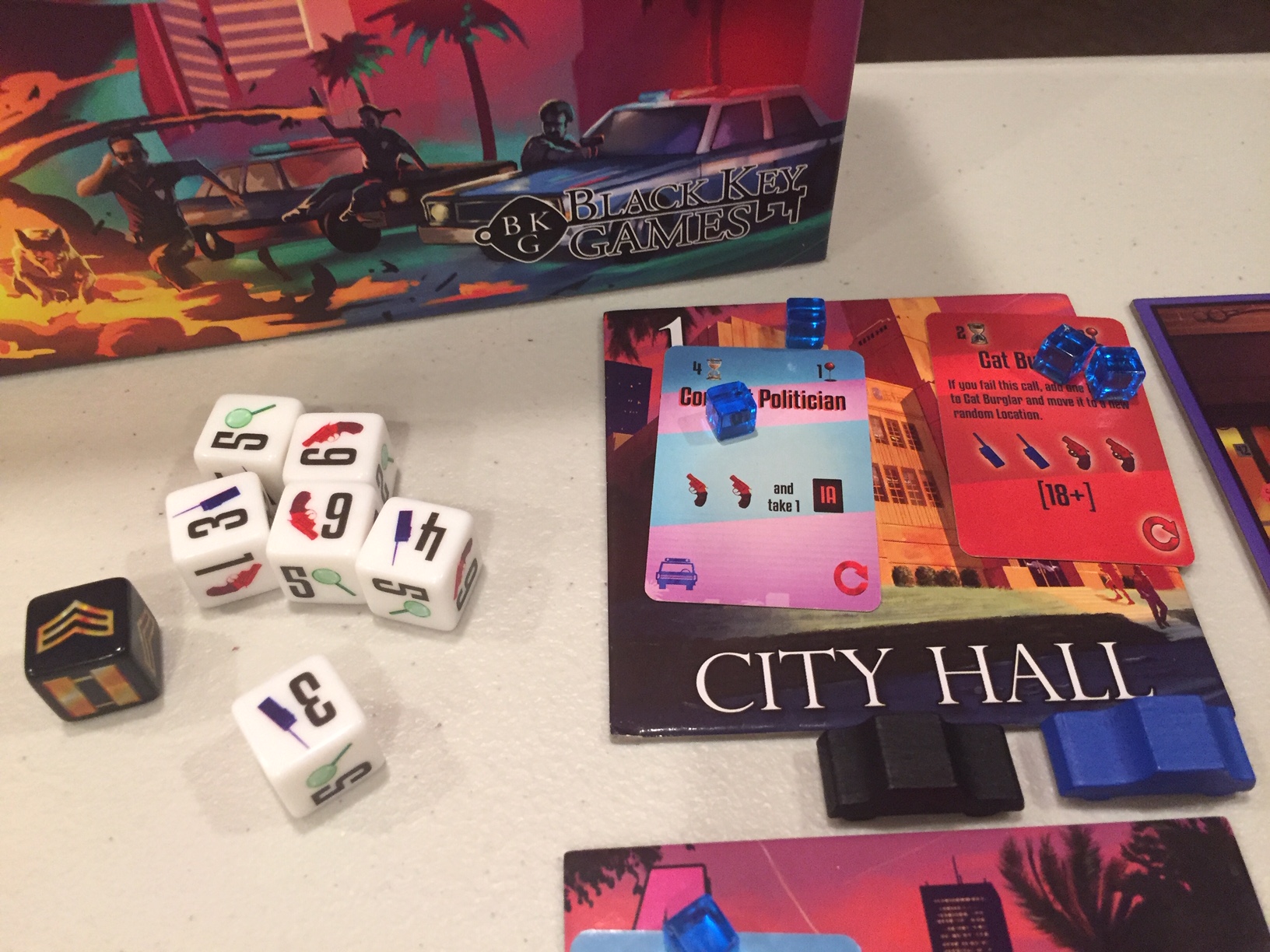
The main mechanism of the game is driving your little cars (notice that there is space between the tiles representing the roads of the city) to crimes and rolling dice to solve them!  In the above picture, the blue player (with the support of an unnamed black patrol car), is rolling dice to take down the Cat Burglar!!! The cards shows that you need 2 walkie-talkies and 2 guns with a total of 18+ to take down the Cat Burglar … and the dice show that ! Success!

The number of dice you get depends on what cards you draw:

IMG_7534

The left-hand side of the card shows hand-cuffs: 2 on each card, so we get 6 dice this turn.  The little pads on the right are how many evidence/witnesses you pull out of bags when you investigate. 

The most important component of the game is the Game Summary cards.  Without these, I am not sure the rulebook has enough information to play the game!! These are ESSENTIAL to gameplay:

IMG_7532

Once you get the game set-up, this card controls the gameflow.

I played my first game in about an hour and took out the Cat Burglar.  I had a good time: but I played “good cop”: I kept the petty crime under control so that I wouldn’t feel the Internal Affairs coming down on me …


Theme and Art

I think the game really nails the theme. The Attaboy cards, the Commendation cards, the Internal Affairs cards, the evidence bag, the witness bag, the exploration of the city are all elements that move the theme forward. I love the art of the game: I think it works for this game.

IMG_7522

When I see the game set-up and the cards out, I think “ya, this nails the 80s cop theme”. BUT I don’t like the cover! If I were in a game store and I saw this box, I don’t think the cover would call to me.

Oh yes, there is also donuts, coffee, and ovetime tokens. They are all essential to winning the game, as you’d expect in an 80’s cop-romp.

Conclusion

IMG_7541

See above for a winning game of Code 3 catching the Cat Burglar!

So, despite all the problems with the rulebook, I liked Code 3. The tension of being a Police Officer really comes through! While trying to solve a Major Crime (The Cat Burglar was our first scenario), the Police still have to keep pretty crime under control! At the end of every player’s turn 2 MORE Radio Calls are always coming out! It feels like crime never sleeps! If you don’t keep the petty crime under control, you start getting Internal Affairs audits (or other bad things) and you can lose the game if too much IA activity hampers you.

There’s a wide variety of cop-teams, giving the game a lot of replayability.

Despite all the rulebook problems and card misprints, this game nails the theme! It’s a decent cooperative game with a number of 80s cop stories to play through. If you find yourself liking the game, there are a number of expansions that can give the game even more life (see below). And they even fit in the box!

Top 10 Cooperative Expansions for 2020

The year of 2020 is winding down! We saw a lot of great new cooperative games come out in 2020 (see our Top 10 Cooperative Board and Card games of 2020 list), but there were some expansions that really ratched-up the experience! These expansions made good games even better!

10. Endangered: The Panda Expansion

Endangered: Giant Panda Scenario | Board Game | BoardGameGeek

We picked up Endangered (a cooperative game for same endangered creatures) at the beginning of the year (see our review of Endangered here).   Although my group didn’t love the game (as we thought it could be too swingy), there’s no denying we had a fun time playing it!  Another problem was that the base game only comes with two critters to save (Tiger and Otter).  Having the Panda expansion extended the life of the game for us!  It got us excited for the game again, and we even ordered the next set of expansions on Kickstarter with Sea Turtles, Jaguars, Taipurs amd Polar Bears!

9.Sherlock Holmes: Consulting Detective – The Baker Street Irregulars

English cover - close up

Don’t confuse this with Sherlock Holmes: Baker Street Irregulars (which made the Top spot of our Top 10 Cooperative Board and Card Games of 2020  and our Top 10 Cooperative Games You Can Play Online)!  The previous game is a cooperative graphic novel game, whereas Sherlock Holmes: Consulting Detective Baker Street Irregulars (see picture above) is a stand-alone expansion  in the Sherlock Holmes: Consulting Detective storybook universe.  My game groups have been actively playing in the Sherlock Holmes: Consulting Detective universe and having a ball!  There’s a reason that the original Sherlock Holmes: Consulting Detective made the top spot of our Top 10 Cooperative Detective Games

This expansion just more cases in the Sherlock Holmes: Consulting Detective world, but it can also be bought and played stand-alone.  There’s a few twists, but in general, if you liked Sherlock Holmes: Consulting Detective, you’ll like this expansion.

8. Thunderstone Quest: New Horizons

Mike Elliott's deckbuilding game of heroic adventure returns with two new Quests and 4th Level Heroes!

Recall that Thunderstone Quest is a deck-builder (see review here) that is made cooperative by the Barricades expansion (see reviews part I and part II). The New Horizons Kickstarter added new content to the Universe (see Kickstarter here) via the Clockwork Destiny and Vengeful Sands expansions, plus a some Kickstarter goodness! This Kickstarter got into a little bit of trouble from poor packing and squished components, but mine was basically fine. This set of expansions just adds more cards to a deck-building game! There’s nothing that really stands out (except the 4th Level heroes maybe), as this is just more content for your Thunderstone Quest (both competitive and cooperative). Beautiful art, good quality.

7. Big Book of Madness: The Vth Element

It’s interesting that Big Book of Madness is just getting an expansion in 2020! We’ve been talking about this game forever! We first reviewed it way back here in 2016 and it made our Top 10 Deck-building Games as well! This game has surprising legs in my groups! The expansion essentially adds two modules you can play with or not to make the game a little different. My group like both expansions and it added some life to a great deck-building game!

6. Spirit Island: Jagged Earth

Spirit Island is a great game! I’m just not sure it needs more content! The base game already comes with so much content! And the first expansion, Branch and Claw adds even more! Jagged Earth is the Second expansion and adds even more. The rules tell you that you really need to have Branch and Claw already and using those rules, so this expansion expands the first expansion! Jagged Earth is hard to get to the table because it expands an expansion, but my friend Junkerman likes to point out that every spirit plays so differently, it’s good to have more options (he hated some spirits).

Jagged Earth adds more Spirits and variety to an already deep game! With this new expansion, you can now officially play Spirit Island (one of our Top 10 Cooperative Games of 2017) forever! There is so much stuff!

5. Venom Assault: Villains and Valor

Cover

Venom Assault is an often overlooked Deck-building game! Although we love it (and put it in our Top 10 Cooperative Games of 2017 and Top 10 Cooperative Deck-building games), most people don’t seem to know it. The Villains and Valor expansion adds more content, including revised solo rules and support cards that made the game more collaborative. My only complaint is that they didn’t use Phil Cho’s art (like the original game), but the artist they got meshes well with the art from the original game.

4. Detective: Smoke and Mirrors

The box cover for the Smoke & Mirrors expansion for Detective: City of Angels.

We reviewed Smoke and Mirrors here just a few weeks ago! Detective is a fantastic detective game (making our Top 10 Cooperative Detective Games) and Storytelling game (making our Top 10 Cooperative Storytelling/StoryBook games)! This expansion takes a game we love and adds more cases: it is NOT standalone! You need the original Detective: City of Angels (which made our Top 10 Cooperative Games of 2019). Great expansion!

3. Aeon’s End: The Outcasts

Box Cover

We reviewed Aeon’s End: The Outcasts here a few months ago.  We were shocked at how much we enjoyed the campaign that this expansion to Aeon’s End put into the game!  This expansion (which can also be enjoyed stand-alone or adding new content to any of the Aeon’s End series) adds a nice story which gives you a framework to explore all the cards in the game.  I’ll be honest: I only backed the Kickstarter because I tend to be a completionist, but this is probably my favorite entry in the Aeon’s End universe.  If you can only pick up one game from Aeon’s End, pick up the Outcasts!

2. Champions: The Rise of Red Skull

Box front (flat)

We reviewed this expansion: Champions: The Rise of Red Skull here. I think strictly speaking, you need the base game Champions before you can play this, but this almost a stand-alone expansion, adding new heroes and villains to the mix.   Rise of Red Skull adds a campaign to Champions, but it really just adds a framework to explore the content of the game.  While I didn’t find the campaign compelling, and the upgrades seemed minimal for a campaign game, I did enjoy playing Champions in this little universe for a time. Obviously, I enjoyed it quite a bit if it made the number 2 spot!

1. Hero Realms: The Lost Village

300

This entry surprised me.  First of all, this was a bear (no pun intended: see the bear up there) to get to the table!  You had to first get the base game Hero Realms, then the character packs, then the first campaign expansion Ruin of Thandar! (This game is only cooperative with the Ruin of Thandar expansion: see our Top 10 Games That Can Be Played Fully Cooperatively) Then you had to keep the cards very well sorted so you knew what cards to keep from the Ruin of Thandar campaign!  Once you had ALL THAT SORTED, then and only then could you play!  Here’s the thing … it flowed so nicely once it was set-up!  Hero Realms is a neat, simple little deck-builder that moves so quickly.  There was actually enough decisions that you really felt like you were upgrading your character!  I had so much fun playing this all the way through, I want to do it again!

A Review of Adventure Tactics: Part I: Unboxing, Solo Rules, and First Impressions

Adventure Tactics: Domianne’s Tower is a cooperative dungeon-crawl/adventuring game for 1-5 Players.

Adventure Tactics was on Kickstarter August 2019 or so and just delivered a few days ago (Dec. 20 2020).  I would have played it earlier, but Adventure Tactics is a big heavy box that looks like it demands some time.  As a Kickstarter backer, I also got an extra adventure book and the first expansion (with a few more characters, see below).

Components

This is a big box full of stuff! A lot of the cardboard is either shrink wrapped or in little plastic bags (see picture above).

One of the first things you find when open the box is the Class Guide: this really gives you a sense of what to expect in the game: the art style and what to expect inside the box. As expected: everyone will take the role of a one class and do some adventuring!

Each player will get their own player board (notice the class is hard-coded into the lower right corner).

Note that the hit point counters are recessed so it’s easier to keep the hit point markers stable. Nice touch!

There’s quite a bit of content here!

Right away, you see the campaign guide: this is a fairly thick campaign guide. It’s very clear this is a campaign adventuring game that will take place over multiple plays!

There’s TONS of little cardboard components (for hit point markers, monsters, and some other tokens). See above!

IMG_7341

There’s also a few cardboard tiles (see above) that are used as a play area.

IMG_7342

Wow!  Still more stuff!  We can see TONS and TONS of cards in shrink wrap, some miniatures for the characters, some initiative tokens, and a bunch of plastic bases, dice, and cubes!  So much stuff!


The miniatures are quite nice (if unpainted) and it’s pretty easily correlate the miniature to their particular character.

The initiative tokens (used to indicate the order of players and monsters during the game) are really nice, heavy poker chips. They kind of remind me of the poker chips from Splendor! They are really nice!

There are a lot of cards. But, they are all very nice, linen-finished, and easily readable.

IMG_7350

In general, there are a lot of very good quality components!


Unboxing

IMG_7353

We are doing the unboxing as a separate section for one reason: it was a lot of work. There’s the general “expected” unboxing work (punching cardboard, taking plastic wrap off), but Adventure Tactics seemed to be a lot harder to unbox than most games for one reason: the cards.

There are a LOT of cards. There’s all the cards in the first section (see avove) and all the cards in the second section (see below) …


IMG_7362

So, it took me several hours to unbox the game. After you do the normal unboxing, you have to take the cards and sort them by type (Basic Moves, etc like the dividers above). The game comes with nice dividers, and a good number of the cards are labelled BUT NOT ALL OF THEM!

The first page of the rulebook (see above) talks about how to sort the cards, but the cards aren’t always clearly labelled. It’s perhaps more frustrating because some of the cards are! I spent an hour and a half pouring through the cards trying to discover where they all went (see picture below). Even after all that, I’m still not convinced I got them all in the right spots. As annoying as that was (I won’t say frustrating, just annoying), it was probably important for me to see/handle/sort all the different cards so I would know all the cards in the game.

Rulebook

IMG_7323

The rulebook is big with big fonts.  The first few pages do what’s expected in modern rulebooks: components first!

Interestingly, set-up is NOT the next section: we start into rules!

So, you should be able to see that the rulebook is big and friendly and warming: there’s a lot of pictures, and the font is actually quite big! (I like bigger fonts in my rulebooks!)

But this rulebook … has some issues. It doesn’t “really” help you get into your first game very well. This game really needs a tutorial/first play set-up.

The game is all about fighting and levelling up you character: that’s very clear from the first few pages of the game. If you enjoy that, this is your game.

In general the rulebook was “good enough”, and I found all the rules I needed (for example: see above for a nice description). I have played a LOT of Dungeons and Dragons and other board games in my life, and I had trouble setting this up and getting going. I think a first-time set-up/tutorial would go a LOOONG way towards making that first play more fun.

Solo Play

IMG_7440

The game always requires that there be 3-5 characters in the game (see above).  This means that the solo gamer will be playing 3 characters right away.   I remember when I was first setting up, I sighed inwardly when I read this rule.  I was barely getting through getting one character set-up and going, and now I was going to have to play 3. 

I don’t think this would be so bad if I didn’t feel like every step of my first play-through and set-up was a fight.  The thought of playing three characters just seems very daunting, especially for the first play-through, which will probably be a solo game for a lot of people.

First Set-Up

My first set-up went poorly.   I had to find all the cards that each player needs and that was more difficult than expected: the rulebook isn’t very good at showing pictures of that first set-up.   For example, the only real picture the rulebook shows is this:

IMG_7328

BUT … the extra slots are only filled after you’ve found all the cards!!!!  It’s not clear (again, this is the first-set-up) that all the cards in the player set-up picture HAVE TO BE EARNED IN THE ADVENTURE.  You start out with practically nothing.   And what cards do you start with?  The CLASS Guide shows one set of cards, and the STARTER card shows a slightly different set! See below!

I made a decision that the starter card is probably the extra cards I start with, but the rules didn’t say anything about it and the cards/CLASS GUIDE were inconsistent.

Once I got through everything (which took sometime as I had to keep correcting things), it looked good.

… or did I?  Oops! See above! the CLASS FEATURE card (which is not marked) goes INTO your deck, and ONLY comes out to the center position when it is played.  Again, not clear.

In the end, it took me just as long to set-up as it did to unbox.   I was moving from annoyed to grumpy, BUT I realize this is a one-time thing!  Once I’ve gotten through the set-up and unboxing once, I don’t think these will be issues in the future.  The game does look nice when it’s all set-up.

IMG_7452

Initiative

IMG_7347

The nicest components of the game were the initiative tokens!  They kind of work like the initiative cards in Aeon’s End: players shuffle the really nice tokens and spread them out.  The monster gets 2 tokens, and the players get “however many characters they are playing”.

Recall that we HATED this initiative system in Aeon’s End! Why?  Because it’s possible the monsters can go 4 turns in a row!  We house ruled this in Aeon’s End (see Seven House Rules in Cooperative Games) so that the monster can never go more than 2 turns in a row, and I suspect you’d want a house-rule like this.   The thing is, there are actually at least two mechanisms to mitigate this in Adventure Tactics:

  1. The Archer can move up or down one in the initiative order with the Passive Skill
  2. The Revive potion can be discard to re-shuffle the initiative order

Since there is SOME mechanism to mitigate this turn order thing, maybe you and your group don’t need the House Rule.  But I suspect the House Rule will the game more fun.

Deck Building vs. Deck Advancement

When I first was playing Adventure Tactics, I was thinking “this is a deck-building game”.  But I don’t think that’s quite accurate.

I reviewed Etherfields here a few weeks ago here, and I called Etherfields a deck-building game at its core.  While I think this is technically correct (as Etherfields calls itself a deck-builder), I think it’s more of a deck-advancement game.   The following question that differentiates the two: How fast can you add new cards into your deck?  If the answer is “during main gameplay” (like Dominion or Aeon’s End or any game from my Top 10 Cooperative Deck-Building Games), then I would call that a deck-builder.  If you tend to make your deck “better” after you play (like adding upgrades for the NEXT game you play), then I would call that a deck-advancement game.   This is, of course, a continuum, as some games have elements of both! 

So, Adventure Tactics  (and Etherfields) is a deck-advancement game, as you level-up your character (much like Dungeons and Dragons) and add better equipment and better attacks after you have completed an encounter.

Campaign

To be clear: this a campaign game.  The campaign book that comes with the game is quite large and it looks there is quite a bit on content.  The Kickstater also comes with a SideQuest book:

IMG_7316

This game is pretty much all about the campaign and levelling up your characters.  If you enjoy the long game and upgrading characters as you go, this is the game for you.

The game even comes with little boxes to keep your upgraded decks in (see above)!

Conclusion

In the end, the Adventure Tactics game feels like lighter cooperative Dungeon-crawl campaign game.  If I had to compare it to something, I’d say Adventure Tactics is a lighter Gloomhaven (recall, we reviewed Gloomhaven: Jaws of the Lion here).  The Adventure Tactics rulebook is sematically lighter (and has a bigger font), the box is physically lighter, and the art seems “lighter and airier” than Gloomhaven‘s dark world.   But in so many other ways, it reminds me directly of Gloomhaven: minis for the characters, standees for the monsters, boards and stuff to set-up like the base Gloomhaven!   If you are looking for something that feels like Gloomhaven, but maybe is lighter and easier to get into, Adventure Tactics might be a good choice for you. 

Be aware that your first play-through will be very rough as there is no tutorial or primer.  I warn you now: the lack of a tutorial may completely repel you, and I’d get it.  But, this is a decent game.  I don’t think I want to play it solo (as you have to play 3 characters), but I could see having a lazy Sunday afternoon with my friends and Adventure Tactics.  Of course, you could also just play Dungeons and Dragons

A Review of the Upkeep Board Game (Cooperative Mode Only)

Upkeep is a cute little board game from Kickstarter. It promised delivery in November 2020, but it arrived two days ago (Dec. 20, 2020). Note: A month late for Kickstarter games is AMAZINGLY GOOD! The designer ran a good Kickstarter, always keeping everyone up to speed. Upkeep is about keeping your yard clean! There’s a cooperative, solo, and competitive mode in the game: we will only be discussing the solo and cooperative modes, as this is a cooperative games blog.

IMG_7373

Upkeep is for 1-4 Players, 30-60 minutes (see above); it looks like a lighter game for ages 8 and up.

Components and Unboxing

Upkeep is a fairly heavy box!  There’s a lot of stuff inside!  There’s a rulebook and an adventure guide (for more directed play once you learn the game). See above.

Each player gets a player board (his/her yard to keep clean): they are bright and cheery and easy to read (see above).

Each player gets 3 recycling bins for particular types of leaves (like the one marked with the leaf above) and one trash can for “leaves you can’t recycle”.  You want to fill the recycle bins because you get sunshine tokens (see below) for those! You still need to fill the trash can to get other unwanted leaves off your board, but you just don’t get any bonuses for those.

The little sunshine tokens (yellow markers above) are the bonuses you get for filling a recycling bin. The other tokens are for marking a “type” of your yard.

There are a tons of tokens in the game, and they are all pretty high quality (see above).  To be fair, I did the deluxe version of the game, so all the tokens were just super nice: real wood for some of them!

The little meeples (above) were just fantastic, and probably my favorite piece in the game.  Each player takes of one of these meepes (except for the purple one: that’s the round marker) and uses that meeple to keep track of the current toolbox on their player board.

IMG_7391

The centerpiece of the game is the leaf bag: it contains a bunch of leaves that blow into your yard(s)!  The bag for holding the leaves is nice and big and the leaf components themselves are easy to read and nice wood tokens.  These are just very high quality.

The cards are cute, easy-to-read, consistent, and linen-finished (see above).  These cards are fantastic.

The boards are all easy to read, the insert holds everything well, and even the score sheet (for the competitive game) is really cute!

This game knocks it out of the park for component quality!  It is so good!  Everything looks good, feels good, and is easy to read! 

Rulebook

IMG_7375

The rulebook, like the rest of the game, looks fantastic.  Tons of pictures and tons of examples.

The components page (above) is ok.  I had a little trouble correlating all the pieces (for example: the round marker is the purple meeple guy we saw above, but that’s not clear at all from this page), but in general it wasn’t too bad.  Unfortunately, this was the beginning of my frustrations with the rulebook.

To be clear: this rulebook looks great! It’s fairly well-organized, and it’s easy to find examples.   Here’s the thing: I really struggled with this rulebook.  For what looks like a kid’s game, this game is more complex than you think.   I had to read the rulebook at least 4 times all the way through, and I was still getting it wrong!  This game looks and feels like it should be a simple game, right?  A kids game with simple rules?  No, there’s a lot of subtlety, and the rules and components miss a lot of stuff.

Example: When the bins get emptied, you get some sunshine (which are used to buy upgrades).

IMG_7430

After playing the game four times, I found this rule summary card (see below), which introduces a rule that the RULEBOOK DOES NOT ADDRESS DIRECTLY (see above).  The rule is that if you empty more than 1 bin at time, you get bonus sunshine!  The rule is IN THE EXAMPLE, NOT ACTUALLY COVERED DIRECTLY!  It’s vaguely alluded to!  I skipped by the example (above) until I realized that the card below had the REAL RULE for this:

IMG_7429

The (above) picture above SHOULD HAVE BEEN IN THE RULEBOOK, not vaguely alluded to (and then sort of discussed in the example).  This rule makes a HUGE difference in play, as your sunshine tokens are key to getting upgrades to have a chance of winning!

There are other problems with the rulebook and components: In order to move leaves from your board into the bins, you have to have three leaves in a tower or stack.  Why don’t the bin cards show something for that?  This is THE MAJOR RULE in the game, and I think I found it in exactly ONE place.  The rulebook talks about a “complete” stack can be moved, but that’s the ONLY place in the rulebook it used the word “complete”.  After grumbling through the rulebook a few times, I “guessed” it meant a stack of 3.  This rule is important enough, so it should have been emphasized it multiple places; the bins should have emphasized it as well (with a label like “Bins can only be filled with a complete stack (3) at a time”).

These are just two examples that represented my frustration with the rulebook.  The rulebook also spent way too much time on “exceptional” activities up front (they list ALL THE BAD NEWS CARDS UP FRONT before the main rules), instead of concentrating on the main gameplay!   The rules puts an up-front cognitive load on the reader which, at best, distracts him, and, at worst, makes the reader skip sections (“Oh, this isn’t important”) which may have rules you need.  Again, the game looks simple, but it’s not.

But that’s only organizational and some labelling issues: I would revisit the rulebook, emphasize WHAT THE PLAYER CAN DO UP FRONT (move the list of BAD NEWS cards to the back), label some cards better and re-emphasize a few points.  Those are forgivable errors that can easily be rectified in a new edition/update.

3-D Issues

IMG_7415

This is a tile-laying game, where the tiles are leaves (and dandelions: see above).  There is a 3-D element to this game: you put tiles on the board and you can move tiles on top of other tiles (stacks) and sometimes when a board fills up with leaves, you have to place leaves on top of others. In fact, it’s essential to put leaves on top of other leaves, as your main goal is to get 3 in a stack so you can put them on your bins.

Here’s the problem: the game DOES NOT address some of the 3-D aspects of the tiles.  For example, when you get 3 tiles in an “L” shape, you can use one move to turn that into a stack.  Does the above (3 maple leafs)  count as an “L”? Do all the elements of the “L” have to be on the same level?  Maybe?  The rules don’t address this.

What about a 3-D “L”?  Two maple leafs on top of each other next to another (that’s a 3-D “L”).  And there’s so many questions about this!  Here’s my list of what I think the rulebook needs to cover.

  1. Can 3-in-a-row cross levels?  Do they all have to be on the same level?  Do the levels have to differ by 0 or 1, but not a combination?  Do you just look at the tops?
  2. Can an “L” be 3-D?  Do we just look at the tops?  Can they cross 3-D levels?
  3. What happens if we have to get a stack of 3 or more? (May happen if you fill the same area too many times)
  4. Are we allowed to move a token OVER a stack of 3? Am I allowed to move through it?
  5. How do I swap in 3-D?  Say I want the middle leaf on top of the stack … there’s no rules to swap IN a stack, only around a stack.  This feels like an oversight.

In every game I have played, I had to make a call, and I don’t know if I made the right call.  There is NO real discussion of 3-D token issues in the rulebook.  I was already getting grumpy when I read the rules, so this lack of rules addressing 3D- issues just put me over the top.

Cooperative and Solo Play

IMG_7413

The rules for solo play and cooperative play are pretty simple.  Clean your yard.  That’s it!  If you have 1 player (solo with one yard) or multiple players, everyone just has to keep their yard clean.  There’s a FEW rules that make the game more cooperative (you can move your garbage bin waste to someone else’s bin: this might help you clean your board sooner), but essentially everyone is playing a solo game to keep their yard clean.

The game is essentially “timed” by the number of rounds until the BAD NEWS deck runs out of cards.  At the end of the BAD NEWS deck, if your yards aren’t clean, everyone loses.  Most of the BAD NEWS cards are calm weather cards, which don’t hurt you, but some of them (depending on the difficulty level) are BAD WEATHER that prevent you from cleaning an area, losing moves, etc.  Here’s the thing: I played on EASY mode (1 or 2 BAD WEATHER cards) expecting to do okay.    I lose miserably every single time I played.  “What am I doing wrong? ” I plowed through the rulebook again and found a rule or two I got wrong (“Ok, my fault”).  I’d play again and lose slightly less miserably.  “Am I still doing something wrong?”  I’d look through the rulebook again.  Maybe another rule I got wrong.  After 4 or 5 times, I feel like I finally got the rules right. And on EASY, I still lost … not even close to clearing my board.

I tried different strategies (getting Professionals quickly), opening up board with more actions, and all sorts of things.  I could not win the game on EASY mode. 

IMG_7403

Part of the issue is that you put on 6-12 leaves PER TURN (see dice above).  The most you can EVER hope to clean up is 12 (maybe more if you have completely unlocked a toolbox AND have extra sunshine), and I don’t thing I ever had all 4 bins full.   And then the ONLY way to get rid of leaves is you HAVE to have stacks of three!  (One of the professionals allowed me to get rid of 1 leaf per turn: he was a godsend)   There’s two elements of randomness against you: HOW many leaves you get and WHICH leaves you get! You can mitigate WHERE the leaves go (which is part of the fun of the game), but you can’t mitigate WHICH leaves you get.  If you get the wrong leaves (“Crap, I don’t have 3 of them”), especially on the last few turns, you can’t dispose of them … and you lose. 

IMG_7398

I am not convinced you can win the solo/cooperative game with the rules written.  (I played on EASY every time and never won).  Maybe I missed a rule, but I don’t think so.   I am so frustrated.

  • There needs to be some way to mitigate WHAT leaves you get (maybe a special power, a special professional, a way to trade leaves between boards during co-op/solo play)
  • There needs to be a remove single/double leaves from the solo/cooperative gameboard (maybe a special power, an incinerator with with no limit) 


Conclusion

Oh, the solo/cooperative mode for this game breaks my heart.  This game looks fantastic! The art is cute, consistent, and fun!  The components are really nice and the production is very very good.  Unfortunately, the cooperative and solo modes don’t really work.  If you are just buying this game for this cooperative/solo mode, then I’d give it a pass … or maybe wait for some rules clarifications/updates (especially for 3-D tiles issues) on BoardGameGeek. 

I suspect that Upkeep COULD BE A GREAT COOPERATIVE/SOLO game with some more tweaking! It’s cute!  The production is fantastic!!! There are a lot of fun decisions in the game, as you decide where leaves go and what things to move!!  There’s too many things that need to be fixed (especially related to 3-D tiling issues) currently.   As it is, I suspect this is actually quite a good little competitive game (modulo the 3-D tiles issues)! In the competitive mode, you don’t care as much about completely clearing your yard as much as getting points (whereas clearing your yard is the only goal in the solo/cooperative mode).

If there’s an update or 2nd Edition that revisits the solo/cooperative rules as well as the 3D tile issues/rules, I will be happy to revisit this game.  I really like the idea of Upkeep and the general execution was great, but it just doesn’t work as a solo/cooperative game as written.  I am more than happy to eat crow and update this review If I got something wrong: I really really wanted to like this game.

Top 10 Cooperative Board and Card Games of 2020

Here’s our Top 10 Cooperative Games of 2020! These are cooperative games that came out in 2020.

Honorable Mention: Alice Is Missing

IMG_7167Alice is Missing is a weird little cooperative game where players play the game mostly on cell phones!   The rules are a little wonky (see review here), which is why it made Honorable Mention instead of the main list. At the end of the day, though, this was a unique experience that I did enjoy.

10. Decktective: The Gaze of the Ghost

Decktective: The Gaze of the Ghost, dV Giochi, 2020 — front cover (image provided by the publisher)

Decktective: The Gaze of the Ghost is a small cooperative game where players solved a mystery set forth in cards.

interior view

This game is so engaging because you set-up up the scene of the crime (see picture above) and work through cards, trying to figure out which cards and useful and which aren’t. This was a fun, light cooperative detective game that made the Top 10 Cooperative Detective Games.

9. Solar Storm

IMG_6115
Solar Storm! Straight out of the Kickstarter bag!

Solar Storm is a small, light cooperative game set-in space where players work together to repair the ship.  The game was easy to play, easy to teach, and easy to set-up, yet there were some interesting decisions in this smaller cooperative game that kept it interesting. 

IMG_6151
A Solo Game (with 2 players) set-up!

Solar Storm fits the bill when you want a lighter cooperative game.  The game is in a small package, but the components are good quality and very readable (see above).  Fun game that doesn’t get enough love.

8. Forgotten Waters

IMG_5644
Forgotten Waters: The New Plaid Hat Crossroads Game

We haven’t gotten this to the table nearly as much as we hoped, but we did really like it!    The production is fantastic (see below)!

Forgotten Waters is a storybook game (making the Top 10 Cooperative Storybook/Storytelling Games) where players do some worker placement in a storybook game.  We tried playing over the Internet, but because there is so much state that has be shared between players, we couldn’t get it to the table unless we have camera on the board with one player maintaining the board (which was too hard to read).  Our initial plays were fun, but once we can actually play together, this game will probably go up!

7. Adventure Games: Volcanic Island

Adventure Games: The Volcanic Island, KOSMOS, 2020 — front cover (image provided by the publisher)

Last year, Adventures Games: The Dungeon made the #2 spot on our Top 10 Cooperative Games of 2019!  It was new and exciting and made us feel like we were playing a point-and-clink adventure game cooperatively!  Part of the reason it made #2 last year was because it was new and unique! The newest entry, The Volcanic Island is still fantastic, it’s just not as “new” this year.  This game makes the list because it’s more of the same!  Another feature of the game is that we can play this remotely over the Internet or in person!  We ended up playing remotely with two copies of the game: my friends correlated/copied my games and we made sure we were in sync.  Originally, we did this because we expected to alternate reading from the storybook, but then we found that Kosmos has an app that will read the text for you!  That made it that much easier to play the game over the Internet!  (See Top Cooperative 10 Games You Can  Play Online)

Fun game, fun story.

6. Wonder Woman

Wonder Woman: Challenge of the Amazons was more “mass-market” game that was/is available at Target.  Players play Amazons from Themyscira (the Island: their home) working together to protect the Island from one of three Big Bads: Ares, Cheetah, or Circe.  Each player has special power, and each Big Bad plays very differently.  I had a blast playing this solo! Unfortunately, because of COVID, I haven’t been able to get this to the table with my friends.  Between Wonder Woman: Challenge of the Amazons, Far Away (a 2-Player co-op), and Shipwreck Arcana, I explored into the Changing Perspectives idea.  This Changing Perspectives idea provides a way to solo in an imperfect information cooperative game: see blog post here.  

I like the components (see above), even though it’s a mass-market game.  It’s a superhero game that I really enjoyed, and if I ever update the Top 10 Cooperative Superhero Board and Card games, Wonder Woman: Challenge of the Amazons would definitely be on that list.

5. Unlock: Epic Adventures

Cover of the game

We reviewed Unlock: Epic Adventures here and really liked the first adventure, hated the second, and loved the third.  The third adventure is worth the price of admission alone!  It’s probably one of the my favorite escape room experiences of all time!  Recall that the Unlock series requires an app to run, and it’s still really doing some interesting things in that state.   This was overall, very fun.

4. Master Word

Master Word is a cooperative party game where players work together to guess the word of the Oracle: we reviewed it here.  What made this game work so well was that it was fun in person (in a group together) or over the Internet (over Discord or Zoom). 

Above, you can see a group playing in person, but see the review for how to play online.  Master Word is a fun cooperative word game best described as Mastermind meets Just One.

3. Escape The Room: The Cursed Dollhouse

IMG_6928

We played this Escape Room game just after Halloween, and it probably should have taken the Top spot of my Top 10 Cooperative Spooky/Creepy Games!  We reviewed the game here and we had a fantastic time!  This creepy escape room game was one of the harder games we’ve ever played, but it worked so well because there were multiple puzzles that we could all work concurrently!  A frequent criticism of Escape Room games is that there’s only one puzzle and an Alpha Player tends to take over the puzzle, but this game did not have that problem!

Beyond the interesting puzzles, the toy factor was very high! When the little dollhouse is all set-up, it looks cool and creepy.  The game was hard and we definitely needed all 4 people to play the game well, but this is one of my favorite Escape Room games/experiences I’d ever had.

2. Marvel United

IMG_6316
Wal-Mart version of Marvel United!

I think it’s a surprise to me that Marvel United ended up so high on my top 10 of 2020 list!  I reviewed the game Part I: here and Part II: here!  I liked it so much, I ended up synthesizing the “Best Heroes Awards/Stats” in Part II of the review!  I love Superheroes and I love cooperative games (see Top 10 Cooperative Superhero Board and Card Games), so this is not a huge surprise.  Marvel United is a gateway cooperative game: It’s easy to teach and learn, and it only takes 20 minutes to play.  Players really do work together using the storyboard system (where you reuse the previous cards symbols, so it takes some cooperative planning to use the symbols effectively).  The miniatures are pretty awesome (see below) for a $30 game you can get at Walmart.

IMG_6325

Marvel United is not a hardcore cooperative game, but everyone I have played liked it.   There’s a lot more content coming, so if you like this game, there will be plenty more in 2021.

1. Sherlock Holmes: Baker Street Irregulars

This is probably a surprising top spot! But, I adore mystery/detective shows and games (see Top 10 Cooperative Detective Games) and this one really hit it out of the park: See my review Part I: here and Part II: here. Players work together to solve 1 of 4 mysteries, following along in 4 distinct graphic novels (each specialized for a specific character: see below).

IMG_6091
All 4 Graphic Adventure Books

Part of the reason this worked so well was that we were able to play this over the Internet VERY WELL: all I had to do was physically pass out a book to each player beforehand, and then we were able to play over the Internet. This game made my Top 10 Games You Can Play Online because it played so well! In the end, playing over Discord was a .. magical experience, especially the third adventure! The experience was engaging and I forgot my friends weren’t even really there! It felt like they were because the game encourages cooperation so well! In a wonky year like 2020, where everyone had to stay home, Sherlock Holmes: Maker Street Irregulars game me a wonderful experience of cooperation and deduction that made me forget how wonky 2020 was. That’s why it is number 1.