Top 6 Cooperative Board Games to Grab Before IDW Games Disappear Forever! (Was Top 5)

Recently, IDW Media Holdings (which owns IDW games) announced that it would exit the board gaming business. See here for official announcement. They were in the middle of fulfilling a few Kickstarters, but they did say they would finish those Kickstarters, so as not to leave their customers high and dry.

Although Vasel’s Law says that “a good game will always be reprinted”, here’s a list of some cooperative games you might want to pick up before IDW Games disappear forever. EDIT: Was Top 5, just added another to make a Top 6.

1.Batman: The Animated Series.  Gotham City Under Siege

batmanPic2

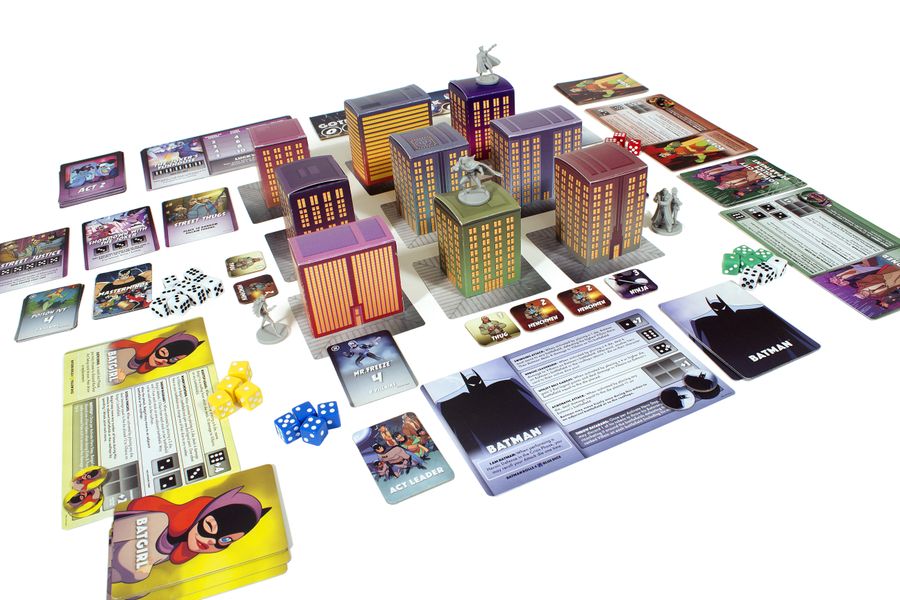
Batman: The Animated Series. Gotham City Under Siege is a cooperative dice game for 1-5 people. It made the 2nd place list on our Top 10 Cooperative Dice Games as well as our Top 10 Cooperative Superhero Games. It’s a dice game by Richard Lanius (of Arkham Horror fame) and Michael Guigliano. It has a real nice table presence with little cardboard buildings (see below) and some mechanics for going from buildings to the city.

batman_pic1

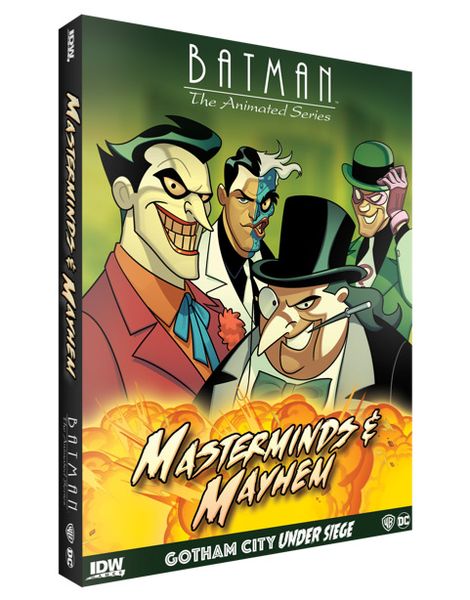
Each player takes the role of some hero in the game (Batman, Robin, Batgirl, Commissioner Gordon), and each character has very different powers involved with the dice. It’s not just adding up dice, but activating special powers each turn to keep the crime under control. The game has been popular enough to spawn some expansions as well: Batman: Gotham City Under Siege – Masterminds and Mayhem Expansion (which adds more missions and a few new mechanics):

bat3


If you only pick up one game from IDW before they disappear, this is the one I would get! It’s thematic and fun! (Oh, pick up the expansion too!) [[ NOTE: There is also another game in this same universe called Rogue’s Gallery, but it’s not cooperative ]]

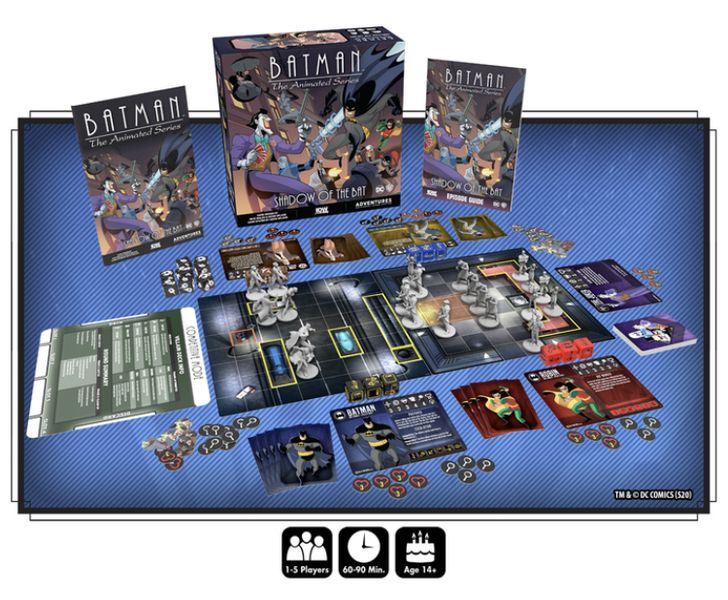
2. Batman: The Animated Series Adventures. Shadow of the Bat

bat4

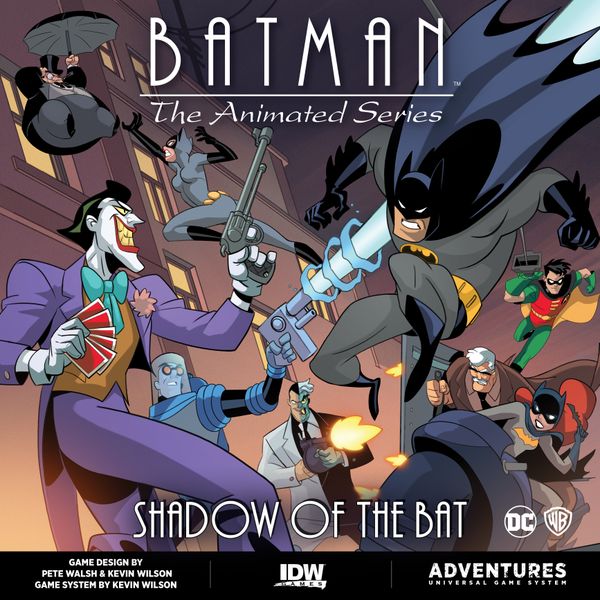
We have to be careful here: Batman: The Animated Series Adventures. Shadow of the Bat (here) is a different game than Gotham City Under Siege (described above). Although they are both cooperative dice games, The Animated Series Adventures puts a little more emphasis on the adventure part of the game, and the game is a little more complex.

batt

The game also comes with 2 modes: a one-vs-many mode (the 3-5 player game) and a fully cooperative mode(for 1-4).

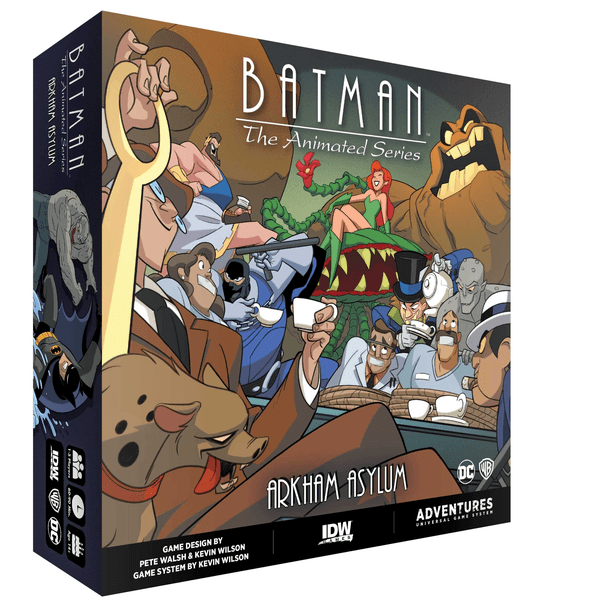
This is one of those games that is still in the middle of Kickstarting! It was supposed to fulfill earlier this year, but as of the time of this writing, it still hasn’t made it to backers yet. Some online places, like Miniatures Market and CoolStuffInc have this available for preorder, so you might still be able to pick them up. You might as well pick up the Arkham Asylum expansion (see below) when you do (it’s going to disappear as well):

ark

There were quite a number of expansions from the Kickstarter, but only the Arkham Asylum expansion seems widely available on major online sites.

Kevin Wilson (one of the designers of Shadow of the Bat) was a co-designer of Arkham Horror with Richard Lanius (one of the designers of Gotham City Under Siege). I guess to work on a cooperative Batman game, you had to work on Arkham Horror too?

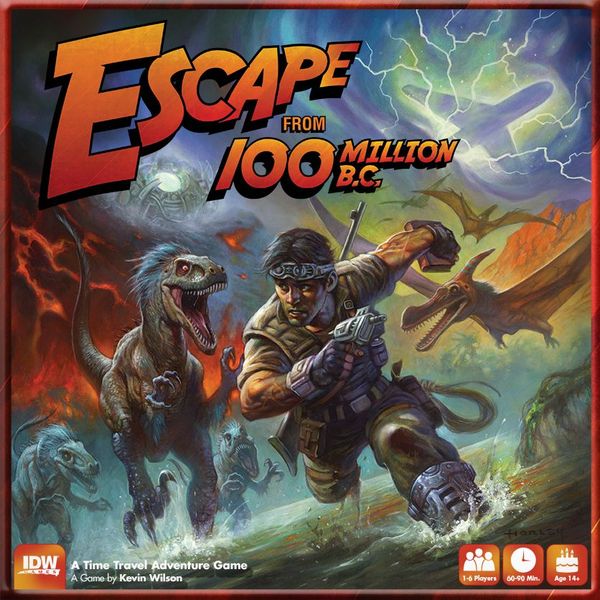
3. Escape From 100 Million BC

bc

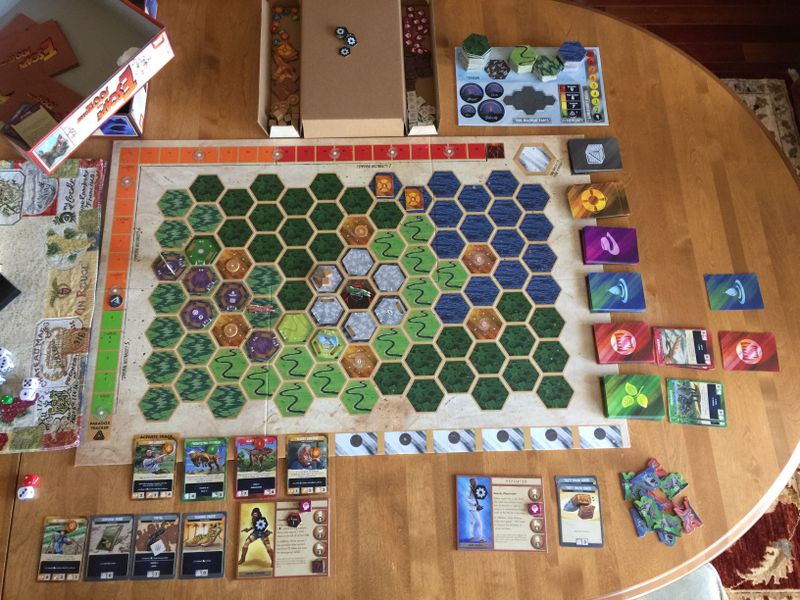
This is a cooperative pick-up and deliver game by Kevin Wilson. It didn’t do that well when it came out, but me and my friends enjoyed our plays of it. It’s a cooperative exploration game in the jungles of the prehistoric age!

b22

There’s some fun exploration mechanics as you run away or fight dinosaurs in this prehistoric world. It doesn’t look great on the table, but don’t let its looks deceive you! It’s pretty fun.

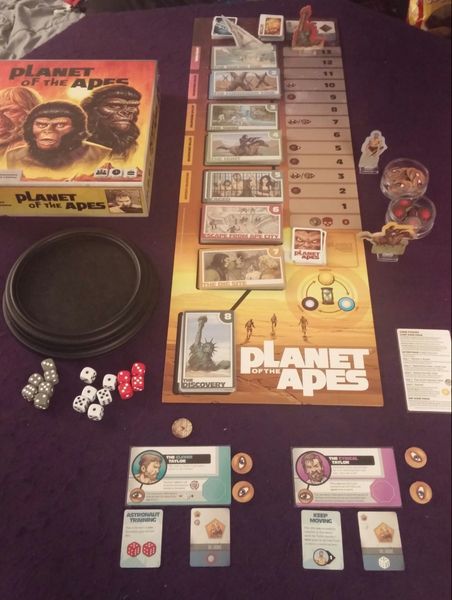
4. Planet of the Apes

planetoftheapes

This is Richard Lanius design (I am noticing a trend here: Richard Lanius or Kevin Wilson). It’s a wonky game (based on the reviews I have seen) and it supposedly tends to be on rails (following the plot of the movie), but there’s some really neat ideas here. Check out the Dice Tower review for more discussion. It’s a weird little game you should check out before it disappears forever.

planet2

Honestly, I just ordered it from Amazon! I have seen the reviews and have been wanting to pick it up for some time! I figure I’d better order it while I still can …

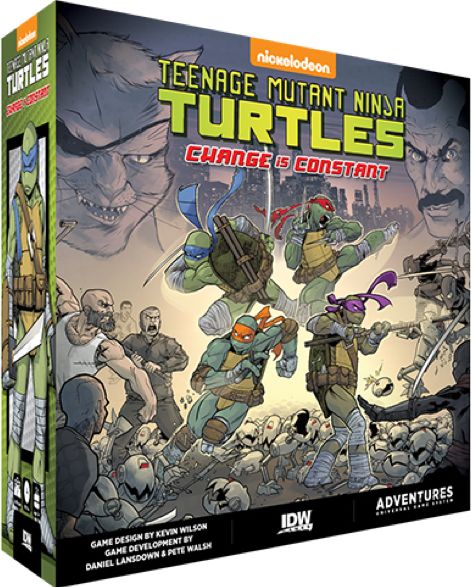
5. Teenage Mutant Ninja Turtles

tmnt

I freely admit I have never played this game and the theme does nothing for me. BUT, people really seem to like this game! Check out the coopboardgames review here! There is a ton of content for this game! There’s a Kickstarter bundle you can find on Amazon as well as “City Fall” (a standalone expansion) as well as tons of other stuff!

This game (also a Kevin Wilson game), is one-vs-many or fully cooperative (like Shadow of the Bat). Be careful not to confuse this game with the Teenage Mutant Ninja Turtles: Shadows of the Past, as Shadows of the Past is NOT a fully cooperative game! (It’s a one-vs-many only).

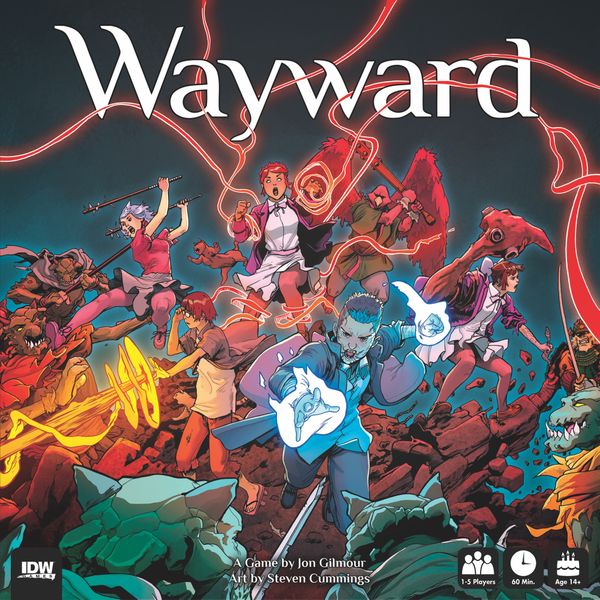
6. Wayward

wayward

This one makes Honorable Mention because I just found out it’s an IDW game!! This cooperative game has always called to me: I love the art, that comic-book feel, and just the way it looks.  I have seen some good reviews on it.  I just never picked it up.  I struggled to find this: I looked at all the main places: CoolStuffInc, MiniaturesMarket, FunAgain, and GameNerdz and no one had it.  I finally got it for a decent price on Amazon and just ordered it about an hour ago.   Don’t wait too long if this one interests you…

A Review of Intrepid: The Cooperative Board Game

IMG_7775

Intrepid is a cooperative dice placement game for 1-4 players from Uproarious games. Players work together to keep the International Space Station running! (Well, it may not be licensed officially from the ISS, but it’s pretty clear that’s the vibe). I kickstarted Intrepid back in July 9th, 2020, and it delivered to me about a week ago as of August 27, 2021. It promised delivery in March 2021, but given the current state of shipping, COVID, and the fact that “it’s a Kickstarter”, 6 months late is really not bad.

IMG_7649

Intrepid impressed me by HOW BIG the game box was! I tried to put a coke can up for reference, but it doesn’t really show how THICK the box is, so see below!

IMG_7798

It’s thick and heavy! I vaguely remember this Kickstarter felt “smaller” when I backed it, but this was a bit of a monster box! I was actually quite excited to get this out! I played as soon as possible, both solo and with my gaming group.

Unboxing

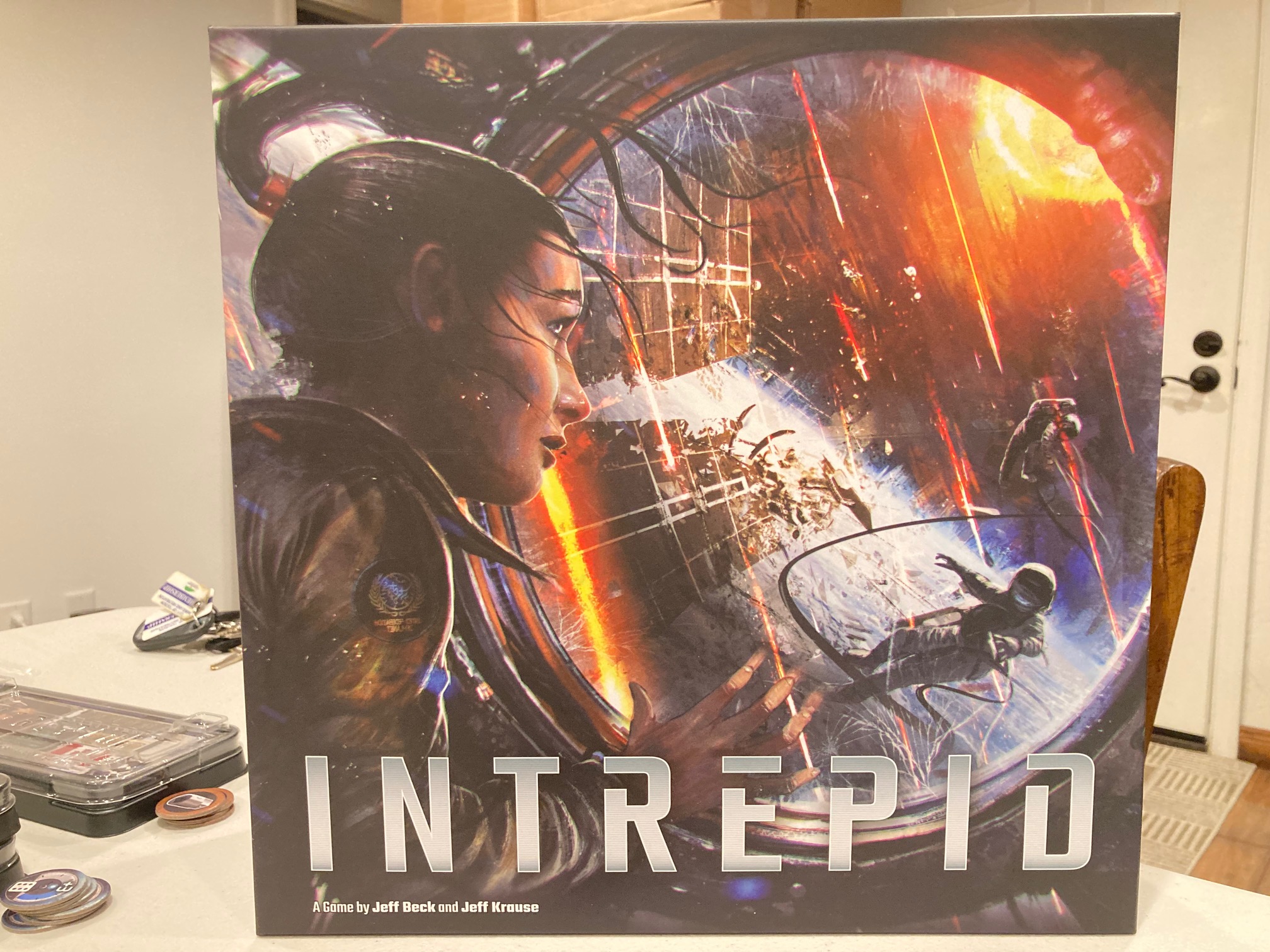
The box art is absolutely beautiful. That cover is haunting. (It also most reminds me of the Comic Book Artist Alan Davis back when we was doing X-Men and Excalibur). And this is a heavy, thick, box.
IMG_7659

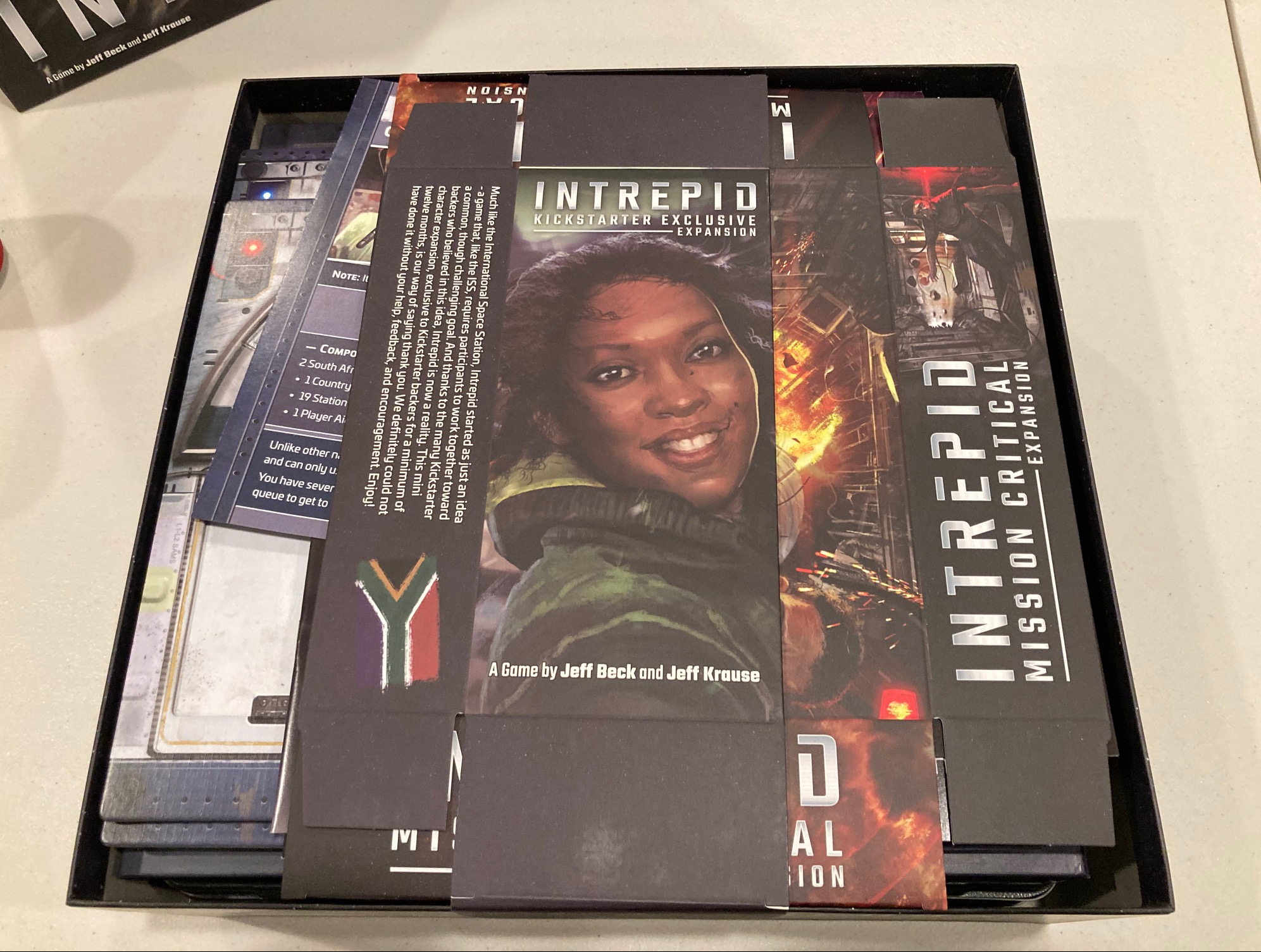
Opening this up, you can see that it’s stacked to the breaking point with stuff! They were very generous in the Kickstarter. There was only one pledge level for $60 and I got two extra expansions (see them squished into the box as flat boxes above). I normally don’t talk about price (partly because it’s embarssing how much I spend, and partly because it doesn’t matter on whether the game is good), but the amount of content I got with this box is phenomenal. Keep unboxing with us…

The first expansion (see above), Mission Critical, and some Kickstarter “extra” expansion is at the top of the box. To be clear, only the flattened BOXES and rulebooks for the expansions are at the top of the box. The different characters and other tokens from the expansions are all packed below this. Uproarious games made a concerted effort to make sure everything could fit in this box: expansions and everything!!! It all fits (barely) in the box!

IMG_7661

You can see the expansion boxes a little closer above.  The expansions are really just more cards and countries.

IMG_7662

The rulebook (see above) is gorgeous: we’ll take a further look at it below.

IMG_7663

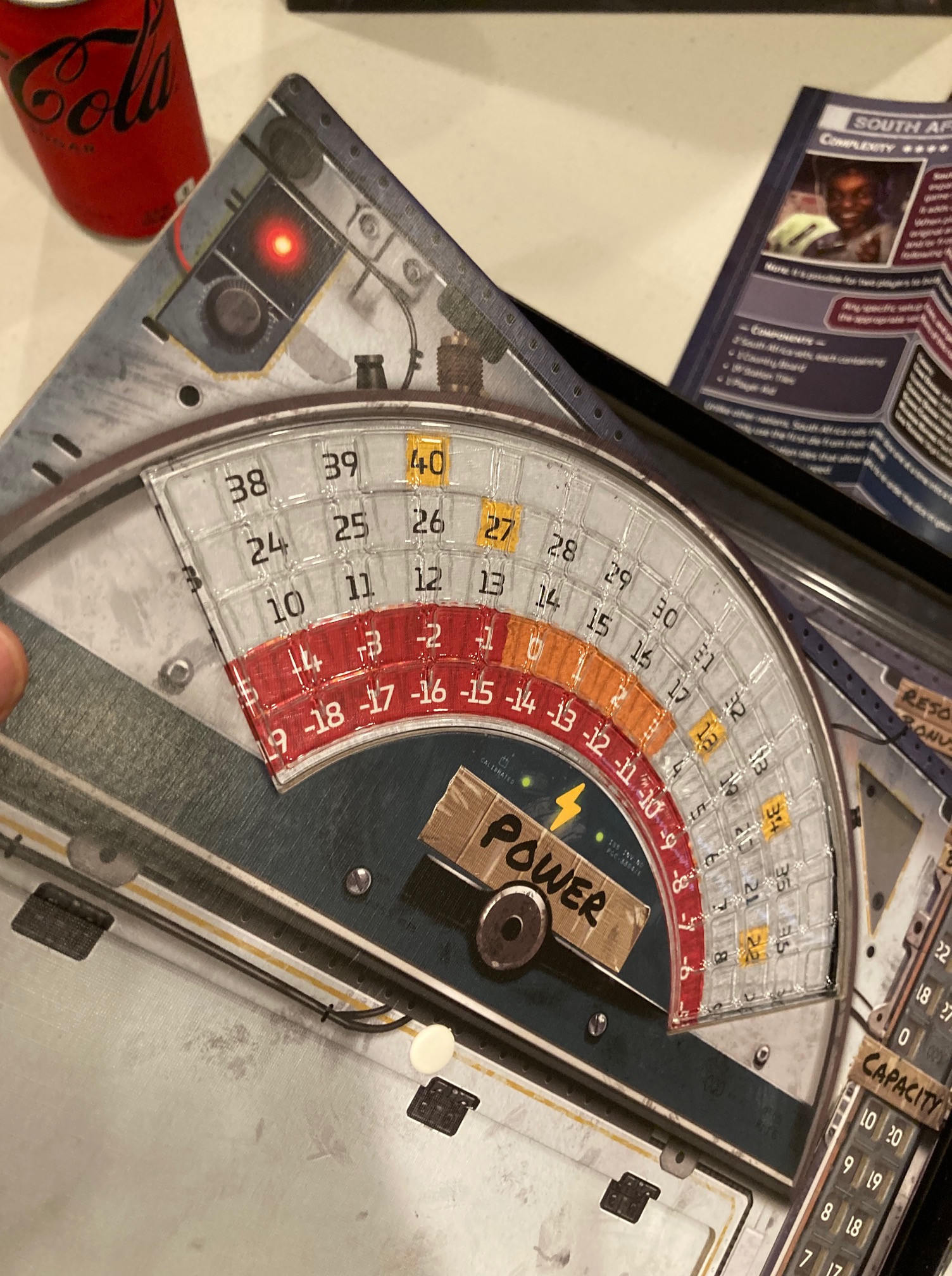
The next thing under the rulebook are the resource boards! There are 4 really nice resource boards with plastic windows and a giant spinner. I was blown away when I saw the quality of these components!
IMG_7665

Check out that board: it’s also dual-layer on the right as well as a cardboard inlay for your country and role (the big empty space): your country and role will slot in there:
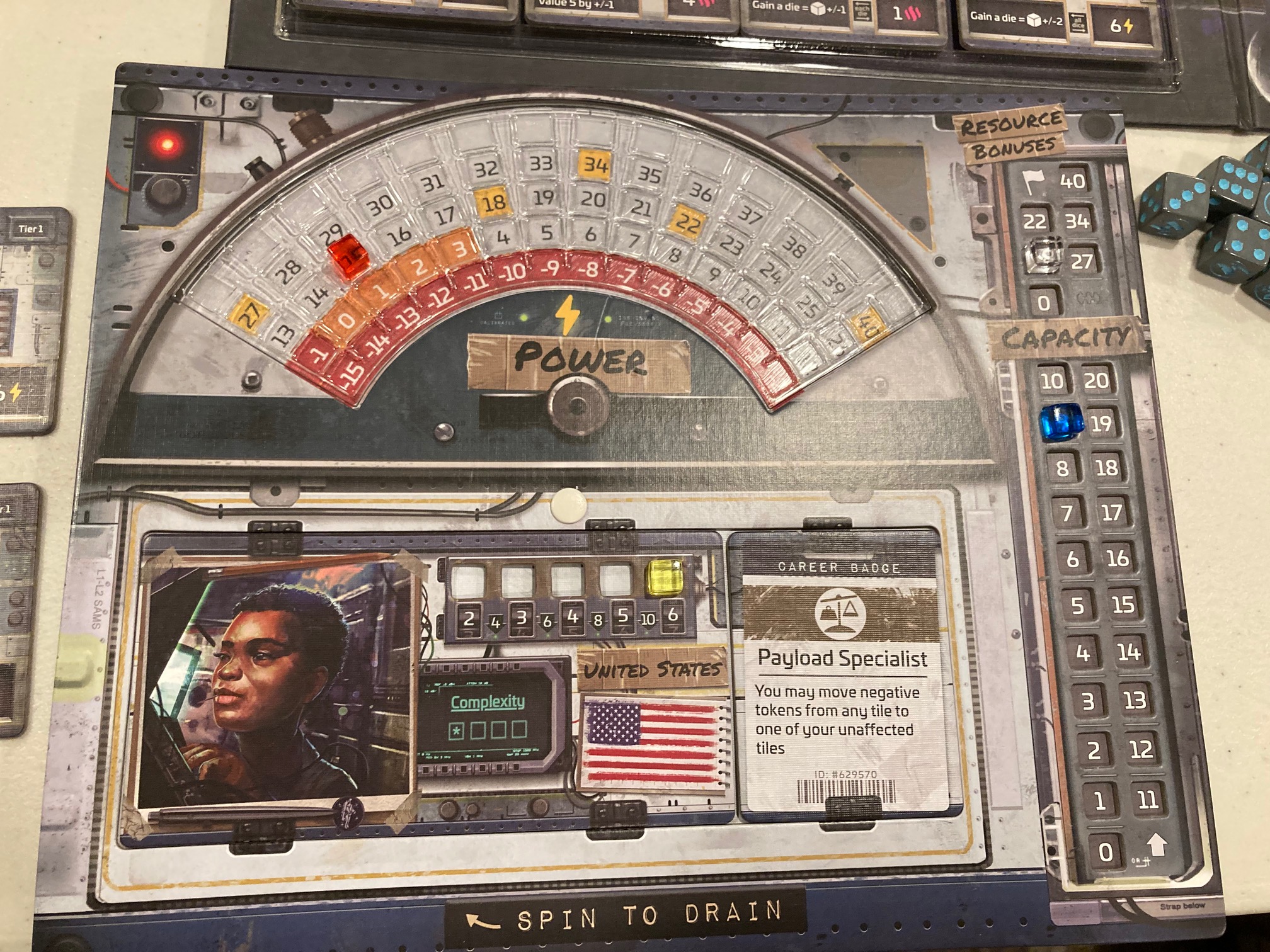
IMG_7788

Just amazing components … and more coming!

IMG_7668

There’s come cardboard tokens: easy to punchout and read.
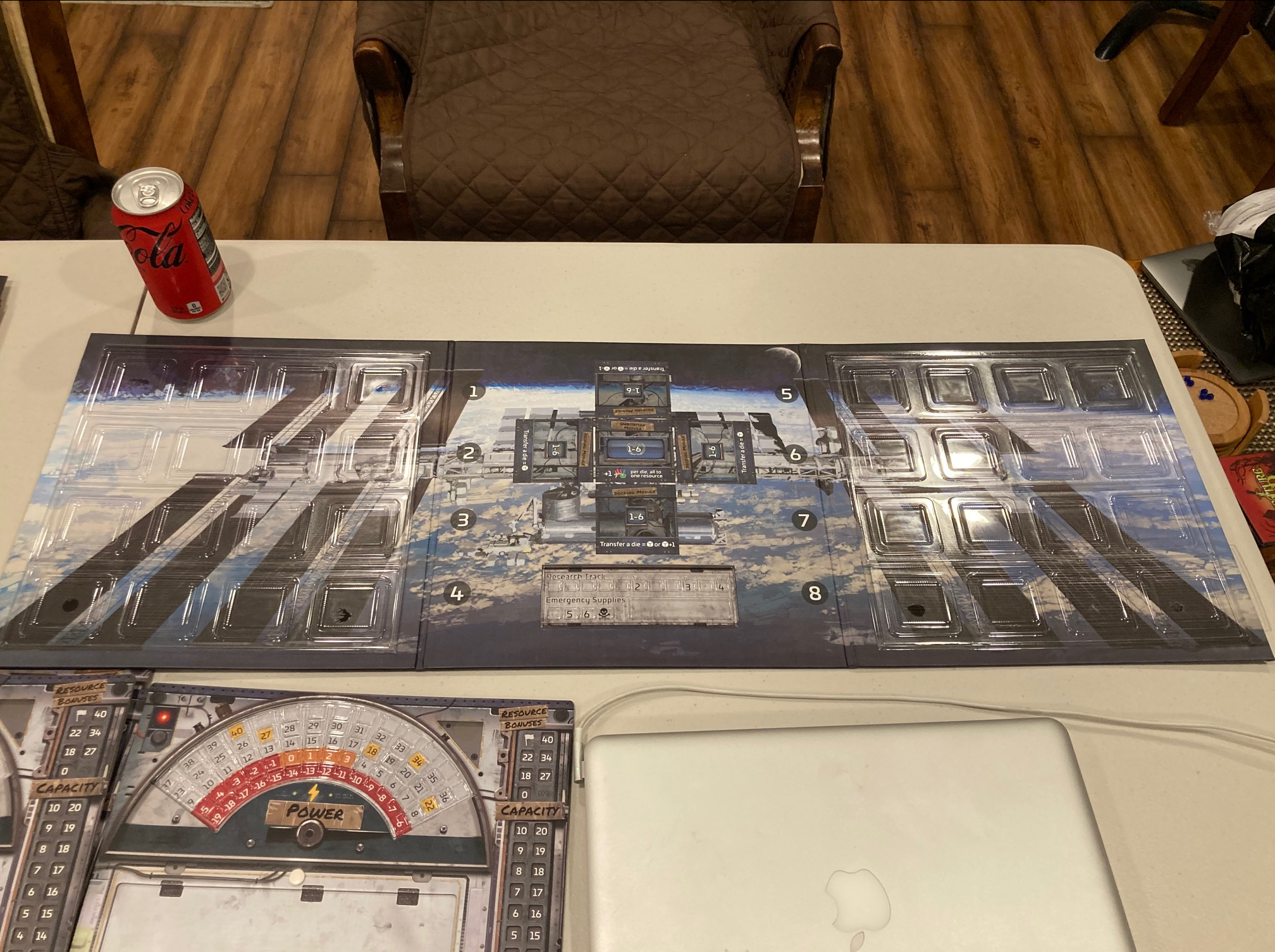
IMG_7671

Next is the board: it’s HUGE! I put the Coke Can and laptop and player board next to it to give a sense of how huge it is! It’s also got plenty of 3D plastic goodness so you can slide tiles in there.

IMG_7672

Below the board are the next big components: the Gametrayz holding each of the 10 different countries! I think the base game comes with 5 and the two expansions move that up to 10 countries total!! Each player takes a country and plays that country throughout the game. What’s in the Gametrayz?
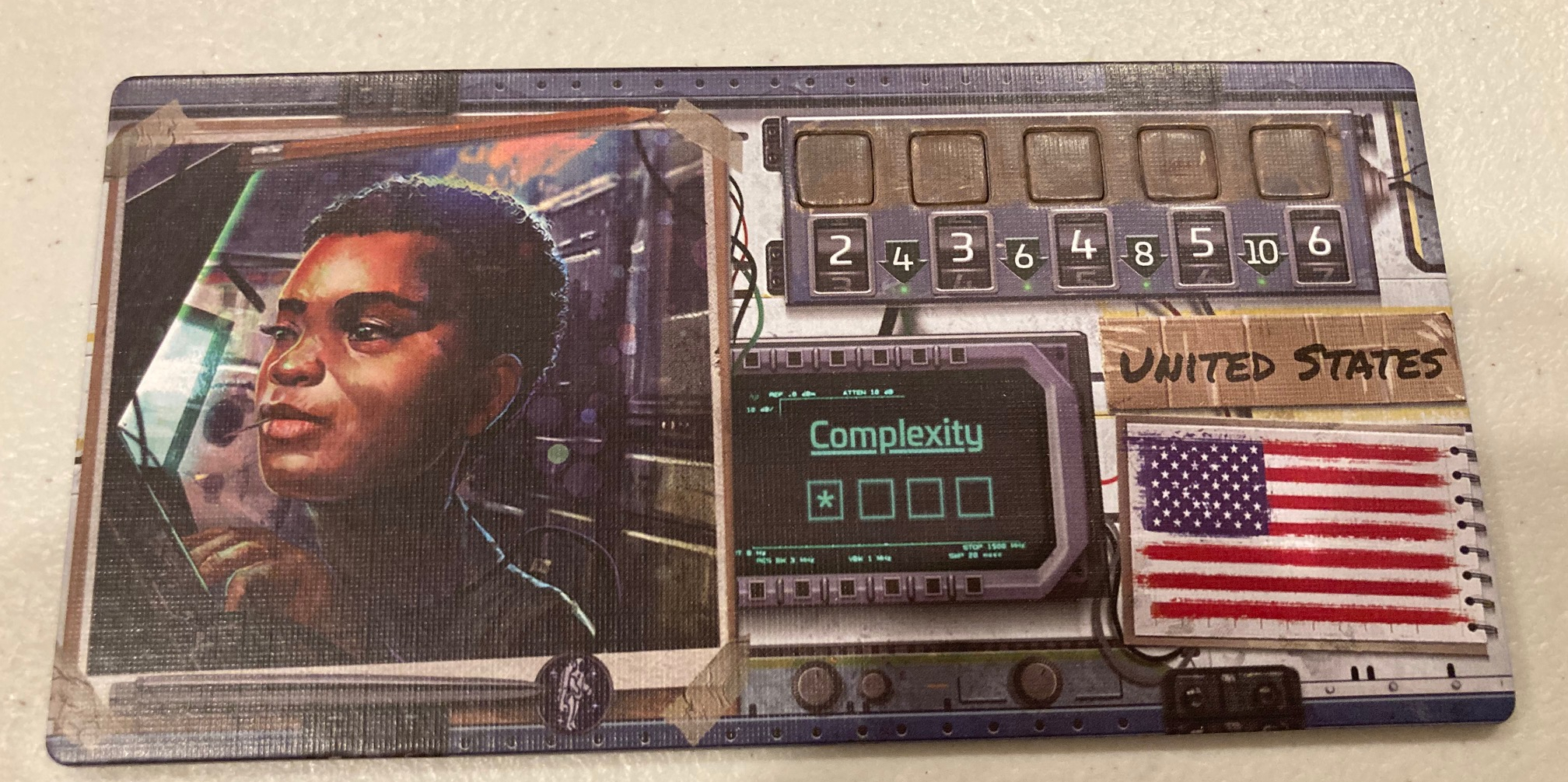
IMG_7728

First you get board to “plug in” (it’s thick cardboard) into a resource tray. You also get a bunch of tiles (19: 3 starters, 4 Tier 1, 4 Tier 2, 4 Tier 3).
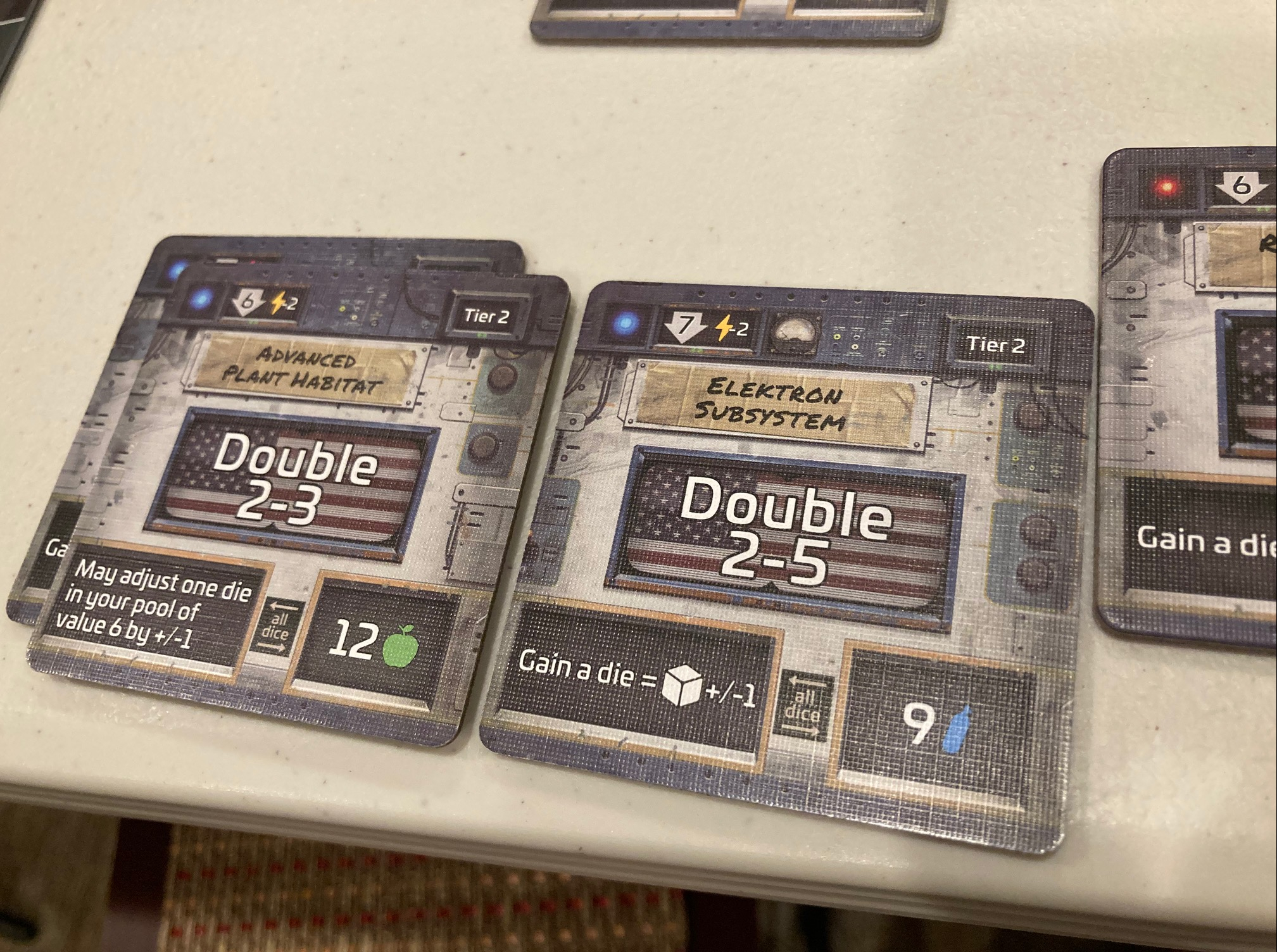
IMG_7740

Notice the font on the tiles is VERY BIG AND READABLE. Thank you for that!! I am so tired of tiny fonts.

IMG_7732

Once you know how the game works (by the end of your first round of your solo game), you’ll also appreciate how easy the iconography and layout facilitate the tiles purpose.

IMG_7765

In the BOOST tile above, you need two dice to activate it. When you activate it, you take the benefit (lower left). If the tile has been activated, you’ll get the resources (lower right) in the “gather resources” phase. That little blue light in the upper left will be important too. You can probably also guess that Tier1, Tier2, etc. are tiles you can buy as the game progresses. And you’d be absolutely right!
IMG_7679

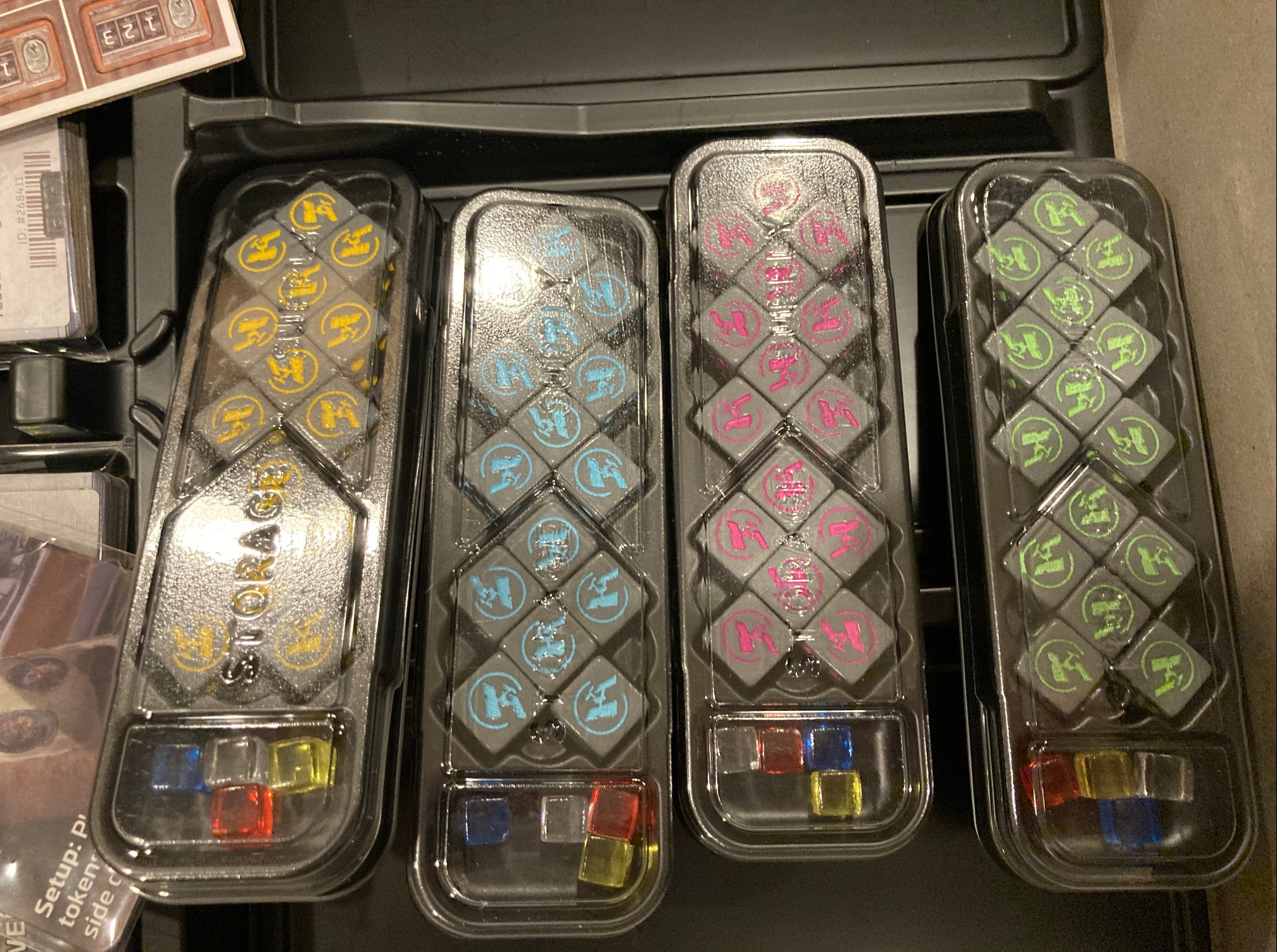
And we’re still looking at components! The dice are very nice 6-sided dice in their own little trays (with some cubes each player needs). It’s a pretty cool storage solution actually.
IMG_7700

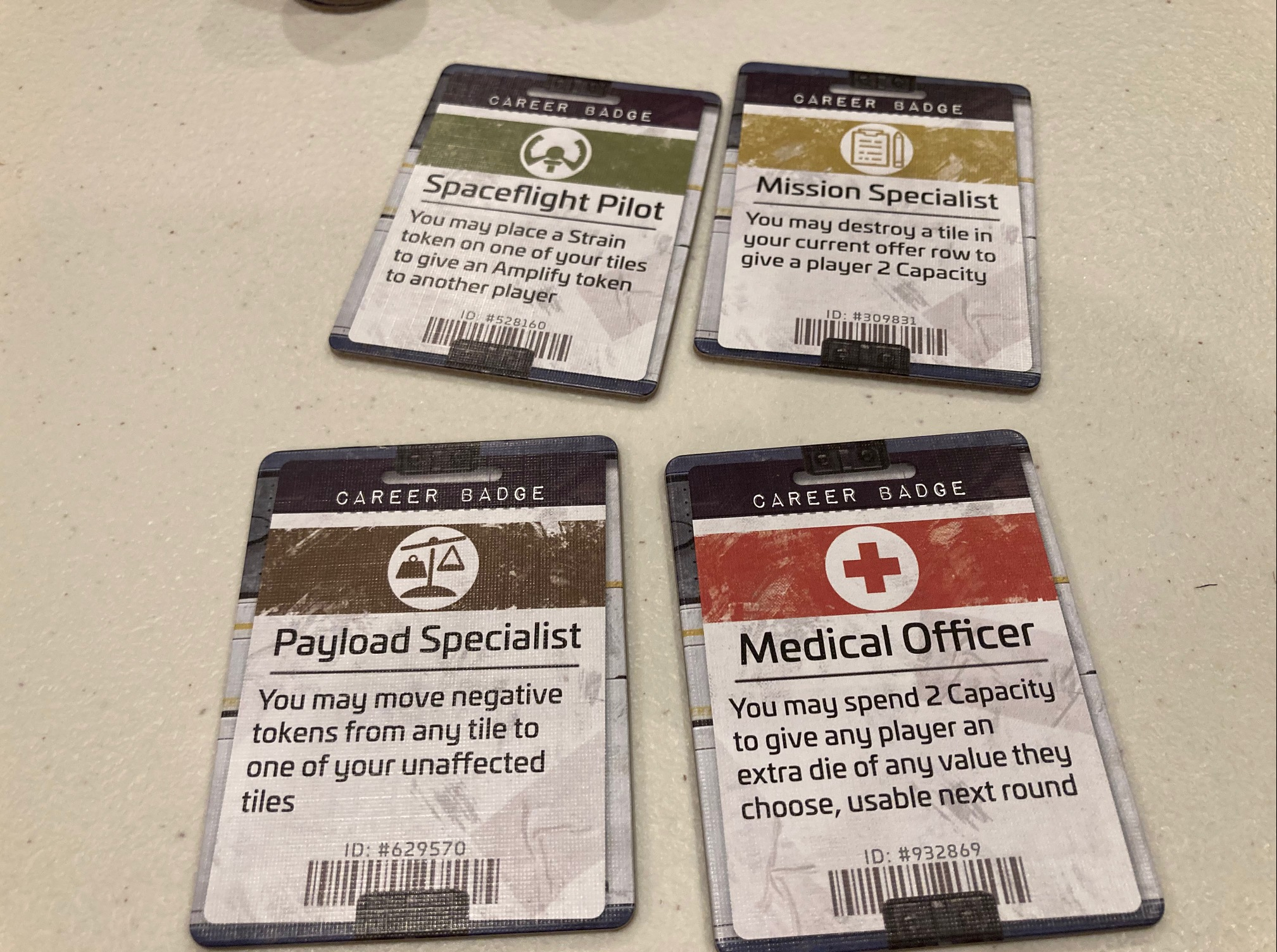
Intrepid has variable player powers: you can choose your “career badge” to place in your resource board (see above).  Another 4 (not shown) are included for some more variety.

Below the dice are all the cards. The above are the Bad News cards (all cooperative games have to have a Bad News deck, right?) Notice how well they are marked for difficulty (green to red) and how beautiful the art is!

IMG_7708

The cards are also linen-finished. The lower right cards are the “mission cards”: you need to complete 3 missions to win the game.

IMG_7713

Overall, the components for this game are FANTASTIC!!! I was so blown away when I was opening this up. I paid $60 for this??? This is an amazing deal! I was in a little honeymoon period after I opened this up: I was just so happy at how pretty it looked and how much stuff I got! Everything is readable and intuitive, and it looks beautiful.

The Rulebook

IMG_7662

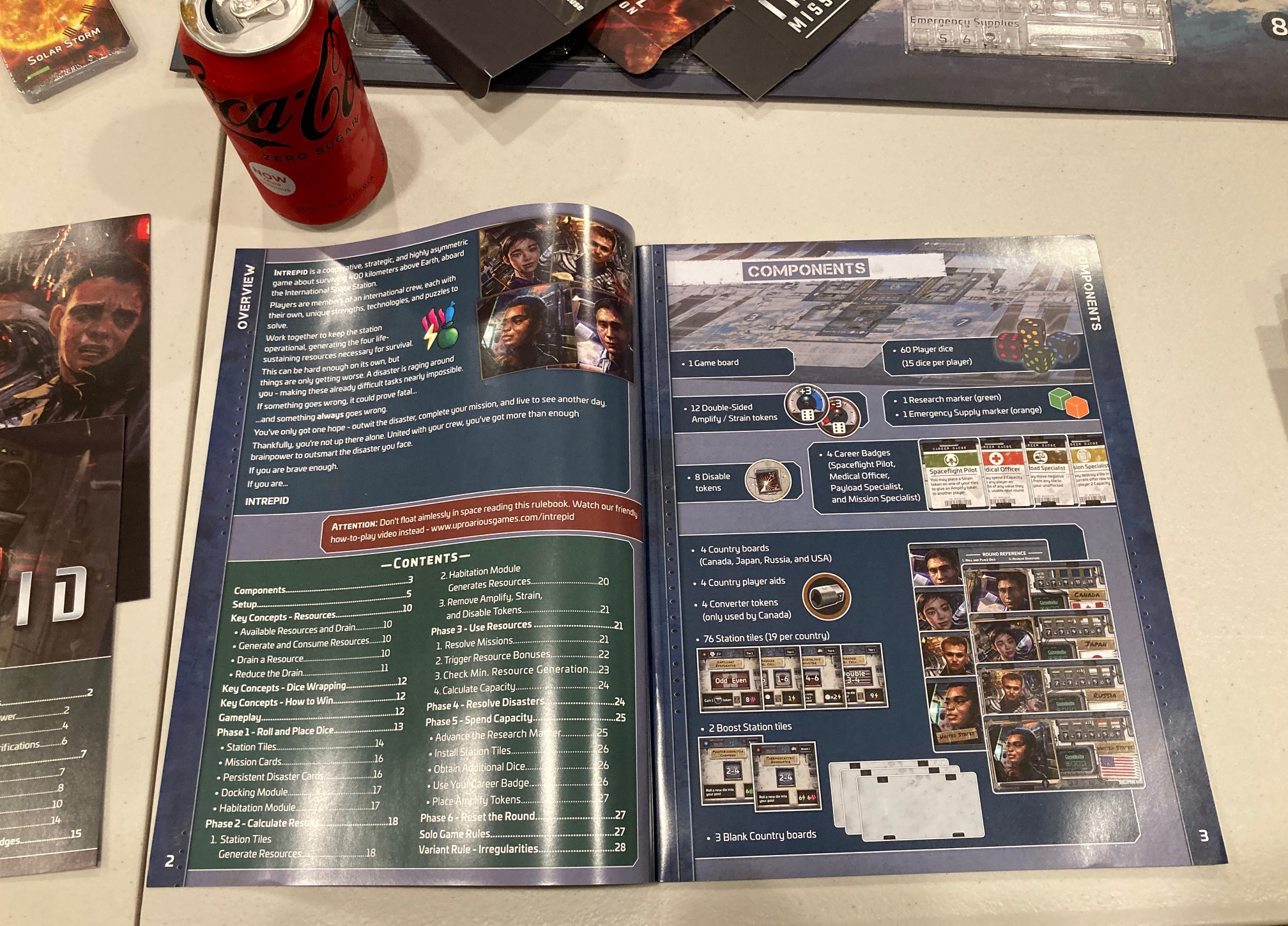
The rulebook is nice and big: see below for a Coke can for scale.
IMG_7683

In general, this rulebook was good.  I had a few problems with it, which we will discuss later, but in general this rulebook was readable and well-organized.  Notice, the rules has a table of contents, then immediately discusses and shows the components.  The components list is over a couple of pages:

IMG_7684

IMG_7685

And like most good rulebooks, the set-up is next.  This set-up is fairly elaborate and covers a lot of pages.  You can see that the set-up is well-labelled and is very easy to read.

IMG_7686

Seriously, there are like 5 pages of set-up.  That’s a lot!  It does a good job of walking you through everything, but it was definitely intimidating.  Whew! After set-up, I was exhausted!

IMG_7691

The rulebook then moves into key concepts and rules discussion (see above).

I know I’ve shown a lot of this rulebook, but I wanted to point out how big and sprawling it is.  It’s actually intimidating, but it’s quite readable.  Just long.  One you know the game, the game moves fairly quickly and you don’t need to look up rules in the rulebook too much.

I do have some issues with the rulebook, mostly with the solo rules.  I will discuss those below in the Solo Play section, but one thing that was irksome: They mixed up the notion of column and row.  Not a big deal, because they show a picture of it BEING A COLUMN, but refer to it as the offer ROW.

IMG_7688

As someone who has been converting Matlab code (column-major matrices) to C++ (row-major matrices), this was a huge annoyance to me, as it makes a big difference!! The game BARELY fits on the table, so when I hear “offer row” and see a picture of the “offer column”, it makes a difference on how you set-up the game.  Real estate is at a premium in this game!  It was a minor thing that really irked me: it probably won’t bother you at all.  (Look, I know, it’s silly.  It just bothered me).

In general, the rulebook was good: it did it’s job of teaching me the game and stepping me through the set-up and gameplay.  There were some annoyances, mostly with the solo rules, but in general, it was one of the better rulebooks I’ve read in a while.

Solo Play

IMG_7657

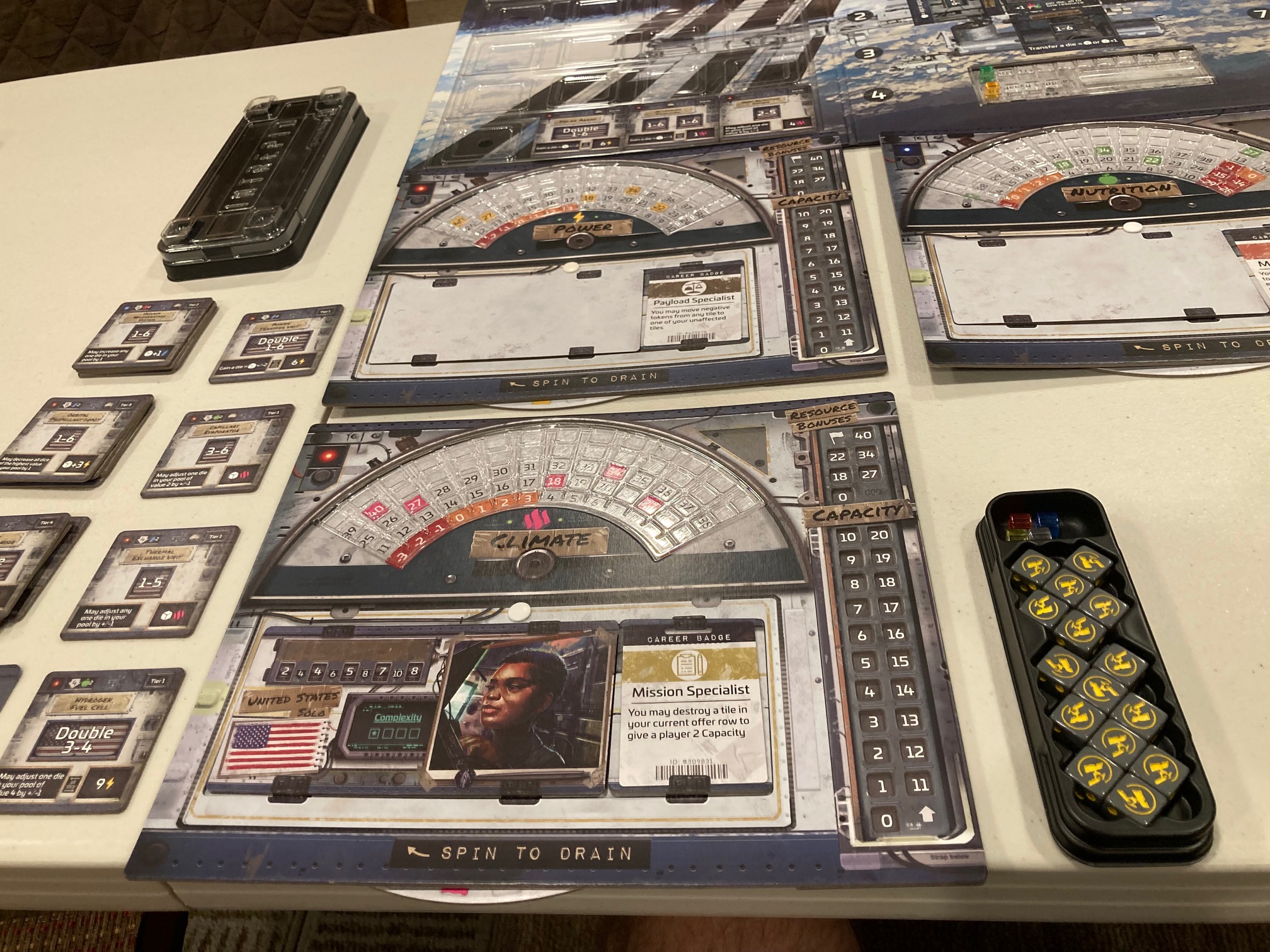
The game comes with solo rules built-in: thank you for following Saunders’ Law! As you read through the rulebook, there are a few places with annotations with “changes for solo play”. Most of these changes are encapsulated on the last two pages of the rulebook: see below.

The game looks really nice set-up, and rules are “okay” at setting up the solo game.  This really the only major place that the game needs a little more clarification.  A set-up showing the solo game (like below) would have gone a lone well towards helping set-up the solo game.

IMG_7756


(Notice my use of the Knee-High tables for displaying the rulebook.  I ran out of space on the table!  Yet another reason the Knee-High side table made my  number 1 spot on the Top 5 Components for the Gameroom!)
IMG_7745

I have had some time to reflect on the solo mode.  It’s not great (see Overall Impressions below), and I struggled with the solo play and the Rulebook to the point that I almost put the game away.  With a little perserverence, I was able to get through and learn the game.  But it took some work.  I think it is worth it so you can play the Multiplayer mode (spoiler, the game shines like a star in multiplayer mode), but I didn’t love the solo mode.  It’s good enough.  

My friend Andrew points out: “How many games even HAVE a solo mode?  You should be happy that Intrepid even has a solo mode! It addresses the solo issue, and it has rules that are good enough!!”  Andrew speaks the truth.  

Gameplay

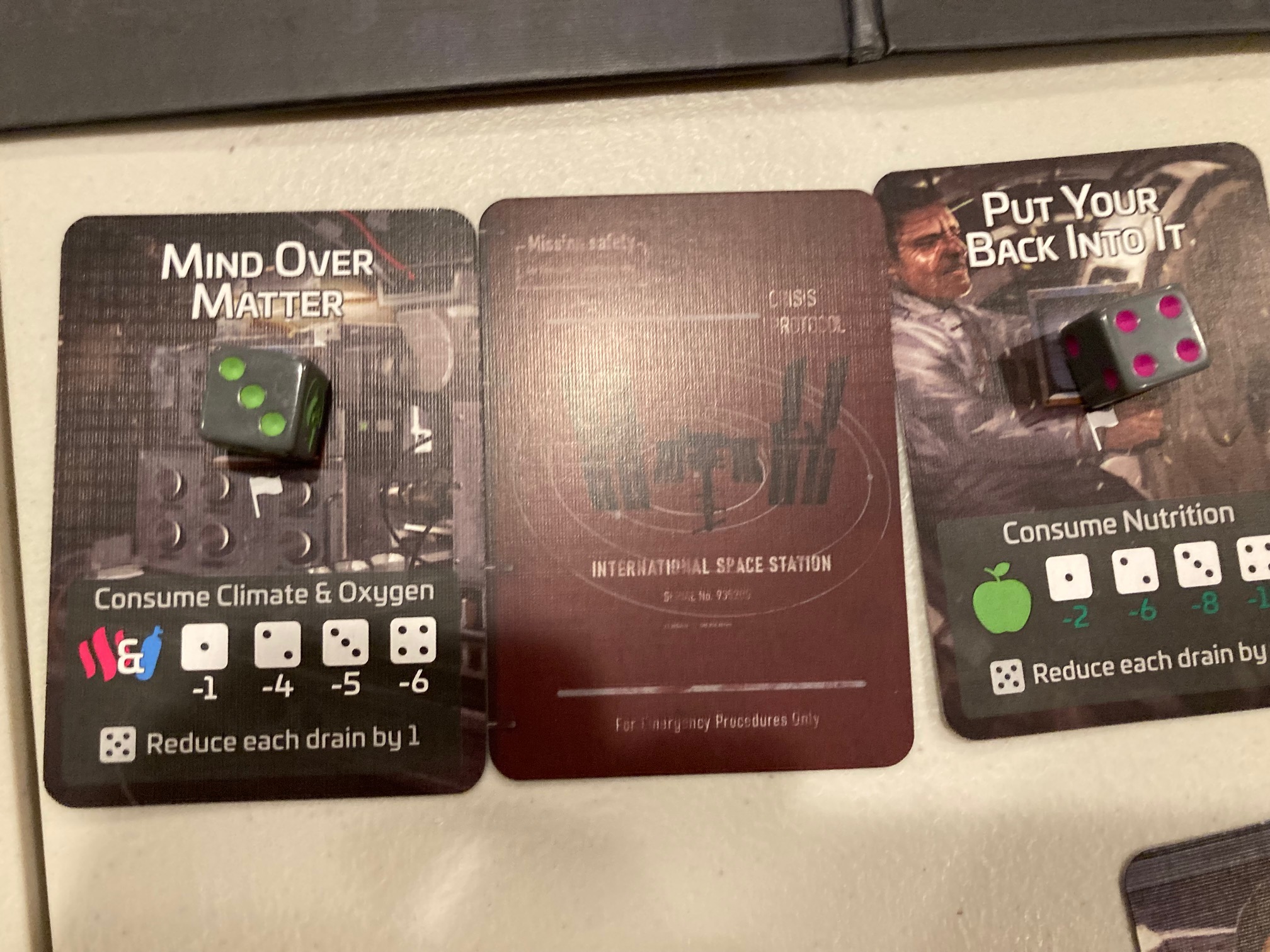
This is a cooperative dice placement game: you roll dice, and place them on the tiles (only yours!) activating an ability which gives you further dice and some resources you need to keep the space station going.  As a group, you have to make sure that the space station “alive” as well as completing some missions.  To win, you must complete 3 missions: 
IMG_7792

To “accomplish” a mission, you need to place a 1 die on a mission.  Once you’ve done that, you’ve set the wheels in motion!  At the end of the round, you will lose some resources, depending on what the die is set to.  The further along the mission is, the more resources you lose!!!  Only if the die makes it to 5 can you say you’ve “completed” the mission.
IMG_7787

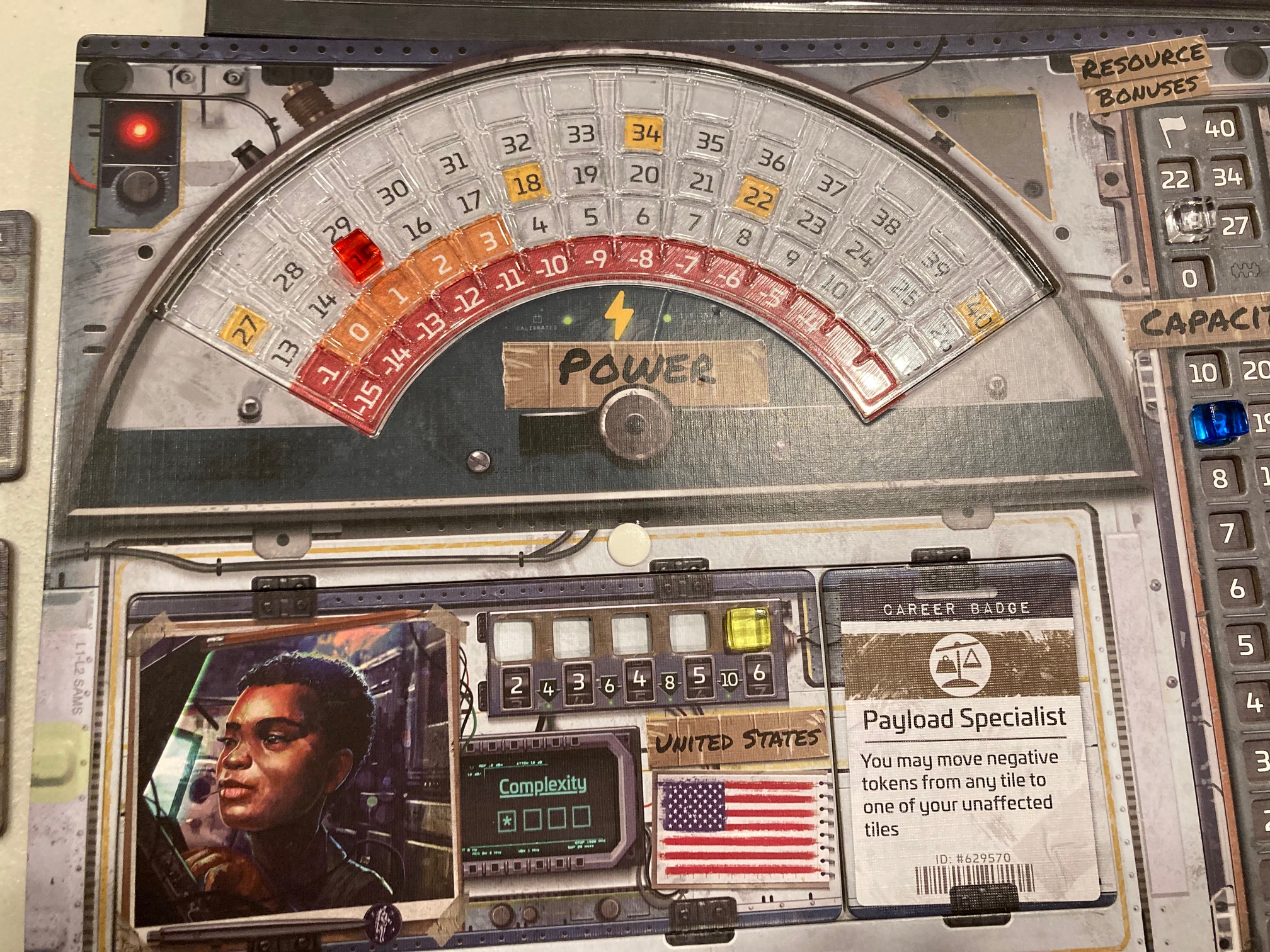
To “stay alive” every turn, each of the 4 resources has to be out the red area.  Above, the power is in the white area, so the power is good on that turn.   Staying Alive is the most important part of the game!

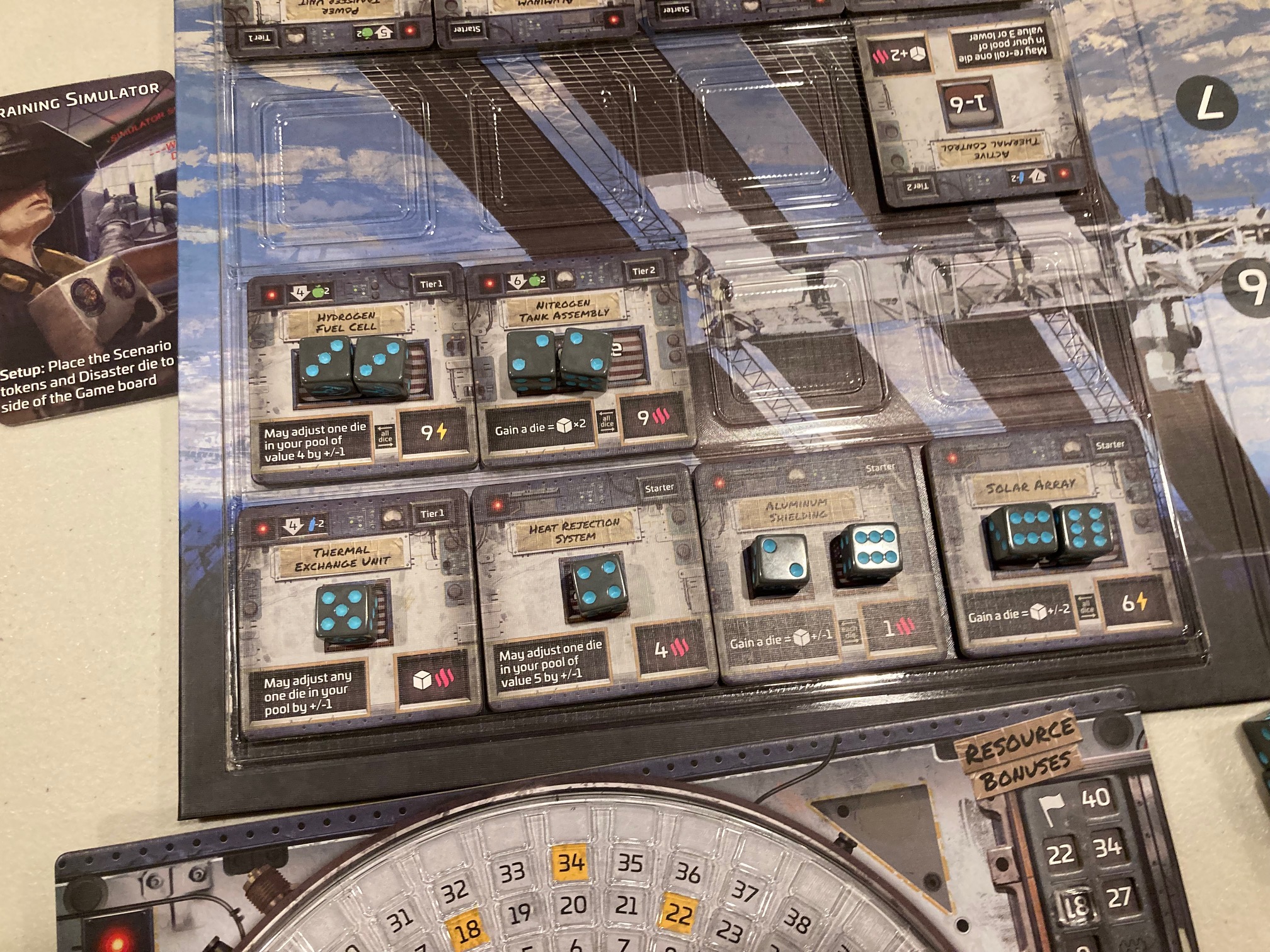
As you play, you place dice on some station tiles:
IMG_7793

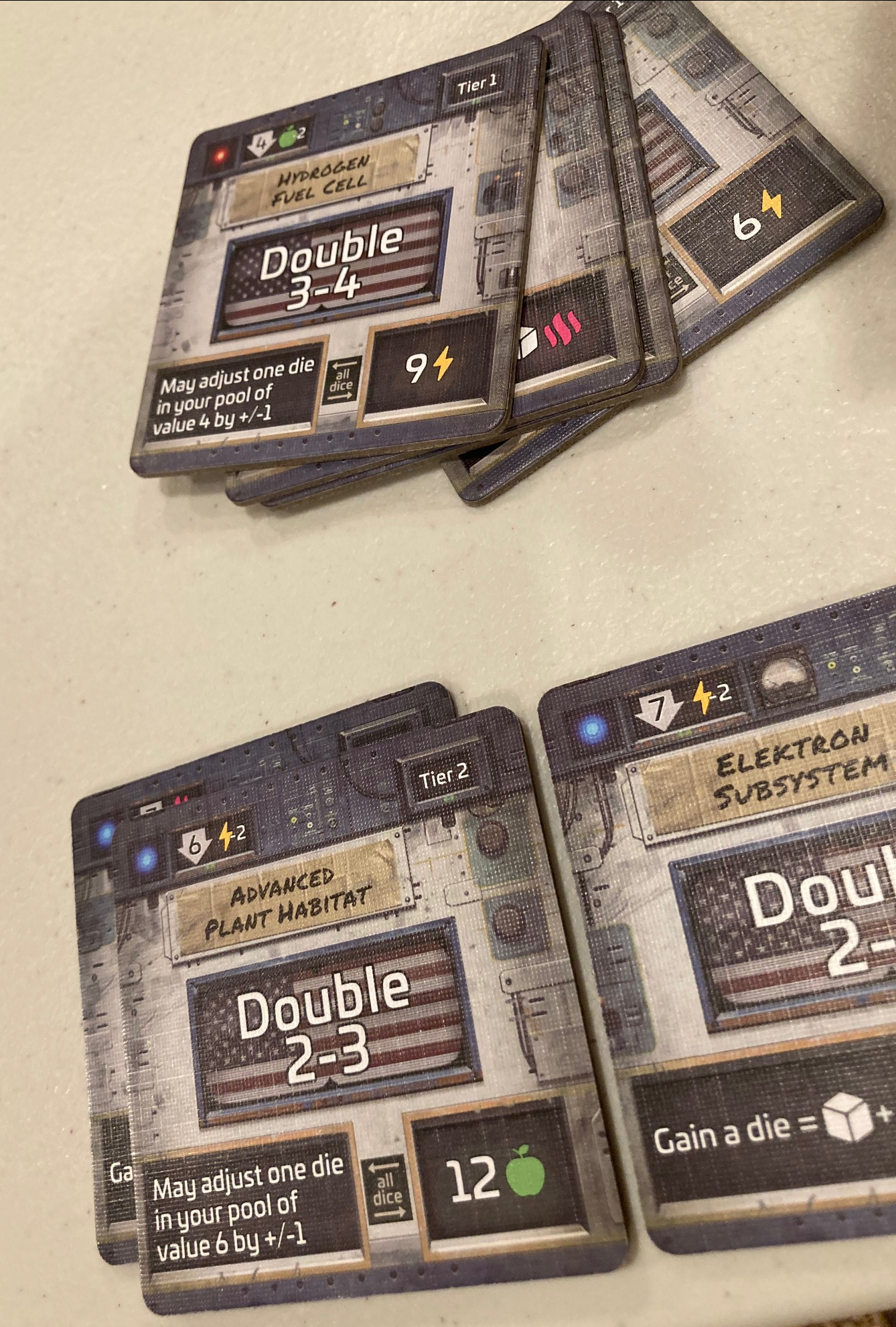
You can only place dice on YOUR tiles (there is no tile crossing between players).  As you play, you can buy other tiles to make your resource production better, but at a cost!  The cost is in the upper left corner: you DRAIN permanently that many resources on the resource board of interest!  And it’s very hard to bring those back up.
IMG_7741

As you play, you have to decide when to upgrade, what to upgrade, when to buy new tiles, when to start missions (because missions can be very expensive from a resource perspective), and when to help out your neighbors because without enough resources, everyone dies!

The game is all about placing those dice and generating resources for survival and missions.  Intrepid almost sounds like a dry Euro (“generate resources”), but the game is definitely a cooperative experience outside of that.

Multiplayer Play
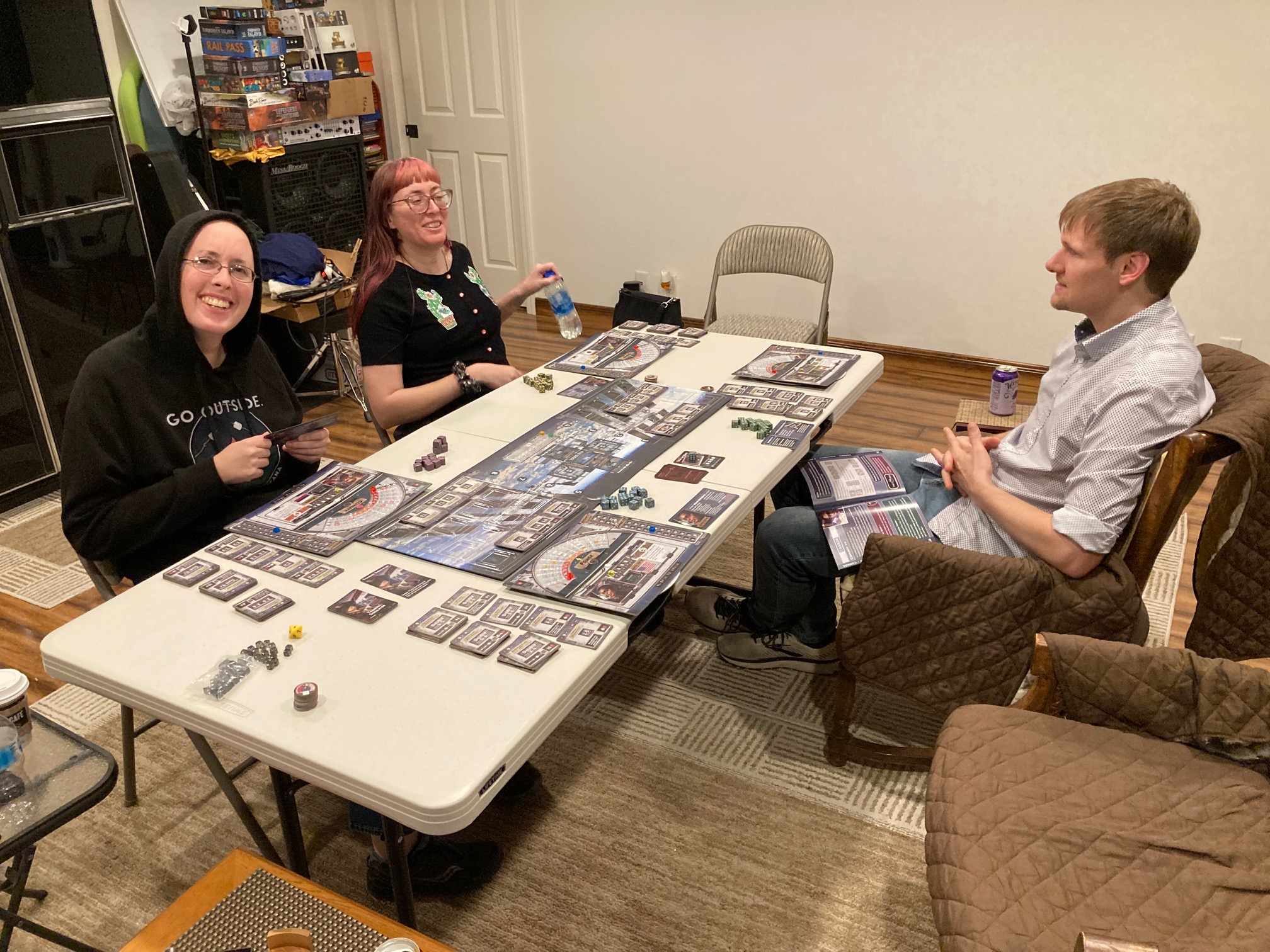
IMG_7780

Once somebody knows this game, it moves pretty quickly.  I (as someone who had learned the game) was able to shepherd my group into playing this game without any issues.  Given how much pain I had with the solo game, I shudder to think how much work Intrepid would have been to learn and set-up as a group! But, once someone has learned Intrepid, there’s not too many problems.

IMG_7789

There’s a lot of portions of the game that play simultaneously (moving the game along). For example, when you are rolling and placing your dice on the board, you are “mostly” playing a solo game simultaneously with your friends.  Having said that, the mechanism for sharing dice with your compatriots worked really well!  While you are placing your dice, you might realize “I need a 5 really bad!”  You announce to your friends, and one of them, maybe who can’t use as many dice, can share it with you.  The middle area of the board (see above) gives you four opportunities to share a die with someone.
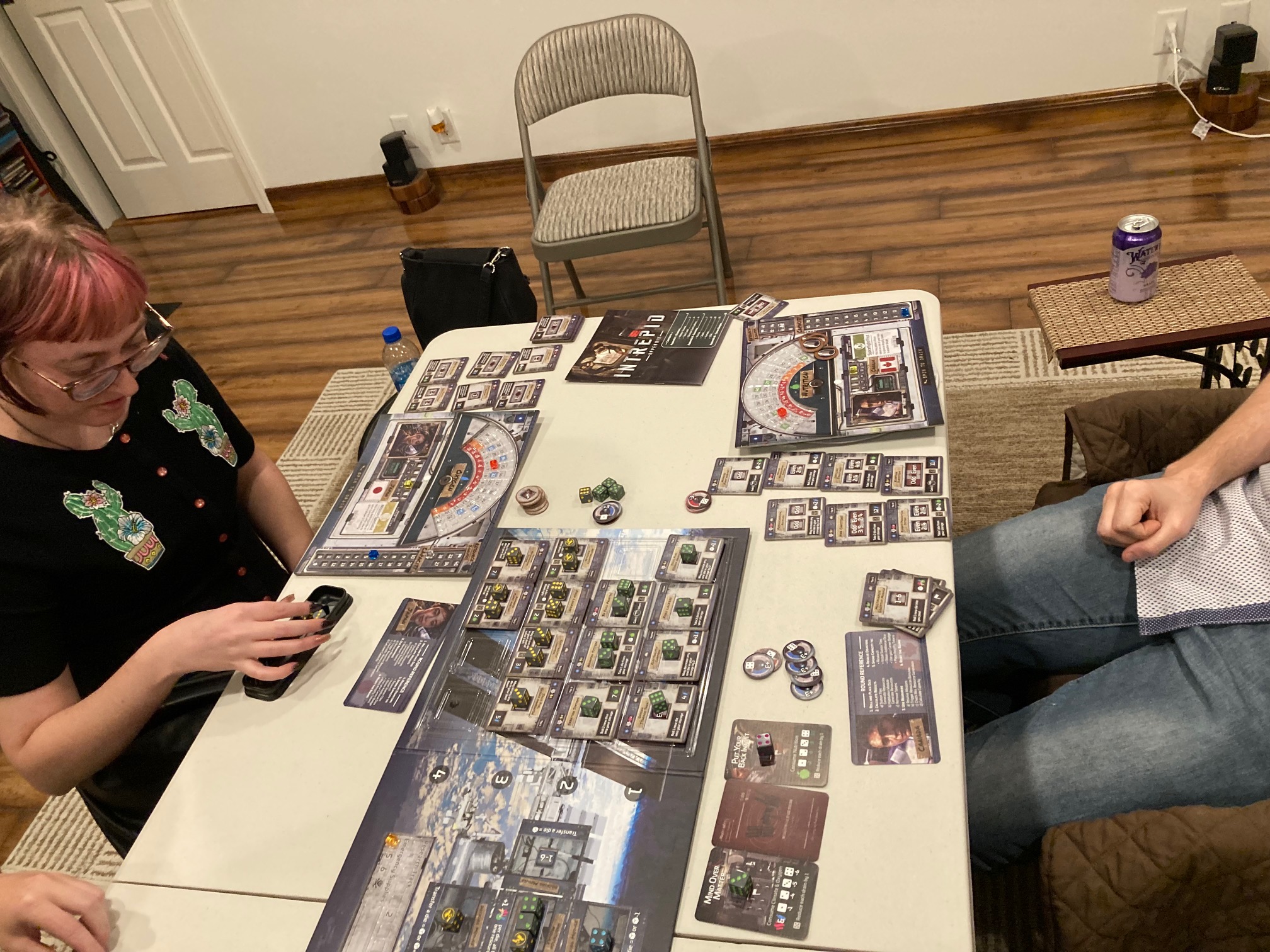
IMG_7795

After you have placed all your dice (see above), you count up how many resources you have produced as a group, and the appropriate player updates their player board appropriately.   You have to make sure you have enough of the four main resources or everyone dies!! I think, thematically, this happens because either we starve (not enough Nutrition), suffocate (not enough Oxygen), freeze (not enough Climate), or just generally shut-down (not enough Power).  Although the theme is apparent in the components, it doesn’t really grab you until you start thinking about it: at first, it just feels like a dry Euro with resources you have to get.  

The offering over on the left lets you think about advancement.  Do you spend your capacity to research, buy a new tile, use your special ability, or buy an augmentation?  There are a lot choices you make as a group, because when you buy a new tile, you DRAIN one of the 4 resources!  You want to buy new tiles to have better capacity, but that eats into the “limited resources” of the Space Station!  If everyone just “buys what they want”, the DRAIN on the capacity will go too low, and some resource will cause each other to die!
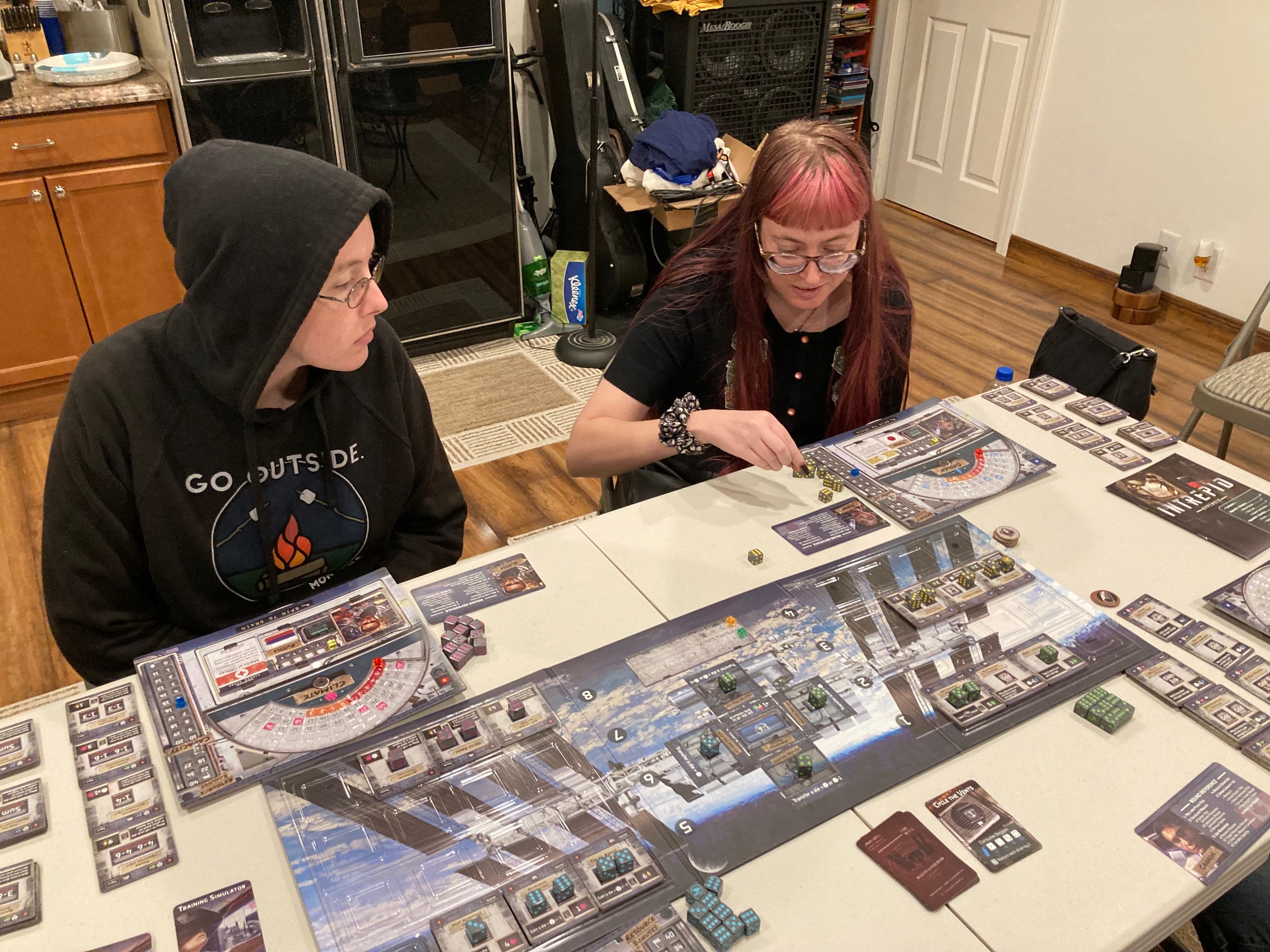
IMG_7783

The cooperative portions of this game worked really well: the dice placement sharing mechanism worked well as a cooperative mechanism, and the discussion that ensues when players have to buy stuff (tiles, etc) is very engaging as a cooperative activity.   Everything you do in the game has a consequence! Players have to work together or they will lose.  At first, Intrepid seems like a “multiplayer solo” game , as players can only roll-and-place dice on their own tiles.  Once players realize how interconnected everything is, the game unfurls as a really nice cooperative experience for multiple people.

Overall Impressions

IMG_7780

Intrepid was a bit of rollercoaster for me!  I wasn’t expecting too much, but I was blown away by the quality of the components when I first opened it! It looks so amazing! And see above for how cool it looks set-up!  I was so happy to get into it!

IMG_7767

But then, I started into my first solo set-up.  The solo rules were okay at first, but the more I tried to learn the solo game, the grumpier I became (see full list of issues down below).  And then I couldn’t find the BOOST tiles and I almost put this game away to never see it again: that’s how grumpy the solo play made me.

IMG_7768

Then I left my game set-up for a few hours while I ate dinner.  When I came back, the resource boards were warped!  Pretty significantly!! See the picture above!  Not just one, but all four.  This really bummed me out.

IMG_7765 (1)

Then I found the BOOST tiles (SPOILER: they were in the JAPAN box) and I started playing.  I was back in the positive mood again.  I was able to get through a full game (I lost) and see how everything worked.

IMG_7786

Finally, I taught this game to my friends and we had a great time as a group!  The cooperative elements were so well done!  I was back in the positive!   

IMG_7756

I don’t think Intrepid has a great solo mode, but it’s good enough to teach the game.  The cooperative experience is where this game really shines.

What Needs Clarification/Fixing

IMG_7767

I took some notes on some issues that need clarification or fixing.  Most of these are for the solo mode.

  1. BOOST 1 and BOOST 2 tiles need further elaboration in the components page: it looks like each country should have 2 BOOST tiles: nope, there’s only 2 boost tiles in the entire game.  That needs to be clearer on the Components page
  2. And where are those 2 BOOST tiles?  In my game, they were in the Japan box.  How did I know that?
  3. BOOST 1 and BOOST 2 tiles are used mostly in the 1, 2 and 3 Player game for some balance.   Maybe some further elaboration on that when they are introduced.
  4. The rulebook says “stash” and the boards say “cache”.  It’s clear they are the same thing, but they need to use the same word for consistency
  5. The resources boards are warped pretty significantly. They are still playable, but barely
  6. During Solo Set-Up, it needs to be clear that you still have to open 4 country gametrays  to get the little cubes out.  Maybe there should be a picture of solo set-up?
  7. In the solo game, does each resource board have capacity or just the main board?  (Probably the main board, but it’s not clear)
  8. The “Offer Row” for the upgrade tiles is a column, not a row.  Either the picture or the name should be fixed.
  9. There are a lot of BAD NEWS cards that say something like “Disable Climate tile”, but they don’t have a picture of the resource:  everyplace the word “climate” is used, they should have the little  pink symbol.  It confused us for just a second.  
  10. Do you drain if you have to consume resources?  If something says “lose -10” (say, from a misson) and the resource cube can’t move 10 spaces left, do you drain until it can?  Or just bottom out?  

While these are all real concerns that need to be clarified/fixed, the game still works fine without them.

Conclusion

Intrepid is a nice surprise.  The components (except for the warping boards) are very good quality, the value for the money (at least the Kickstarter version) is amazing, the rulebook is good, and the gameplay is fun.  The solo rules needs some clean-up and clarification, but it has a decent (if not great) solo mode.  The base multiplayer mode really shines as a cooperative game: players share “info and dice” even as they essentially play their own boards solo.  It’s that sharing of responsibility and dice that makes this game work very well cooperatively.  

Another game in this “cooperative dice placement” space is Endangered (we reviewed Endangered here): I think that Endangered, as a game, is “tighter” with simpler rules, but that game is a bit too random for me and my game group.  Alternatively, Intrepid can be “on rails” sometimes on your turn, as each country tends to play the same to getting that dice-placement engine going.  In a single game, a player won’t tire of his engine, but over a few games, the play style for a particular country can get  repetitive.  Luckily, every country in the game plays very differently, so players can simply alternate countries to get more variety.

Overall, Intrepid is a good cooperative game.   The theme seems a little pasted on at first until you realize what the tiles and resources represent, and then it hits you: you are trying to survive in an International Space Station!

A Review of MicroMacro: Crime City

IMG_7520

MicroMacro: Crime City is a cooperative game from Germany for 1-4 Players that recently won the Spiel Des Jahres Award for 2021! This is a lighter game for 12+. Because of it’s “award winning status”, this game has been impossible to find! I just happened to find it at my local gamestore a few weeks ago (“Oh, we just got that in stock!”), and picked it up.


IMG_7518

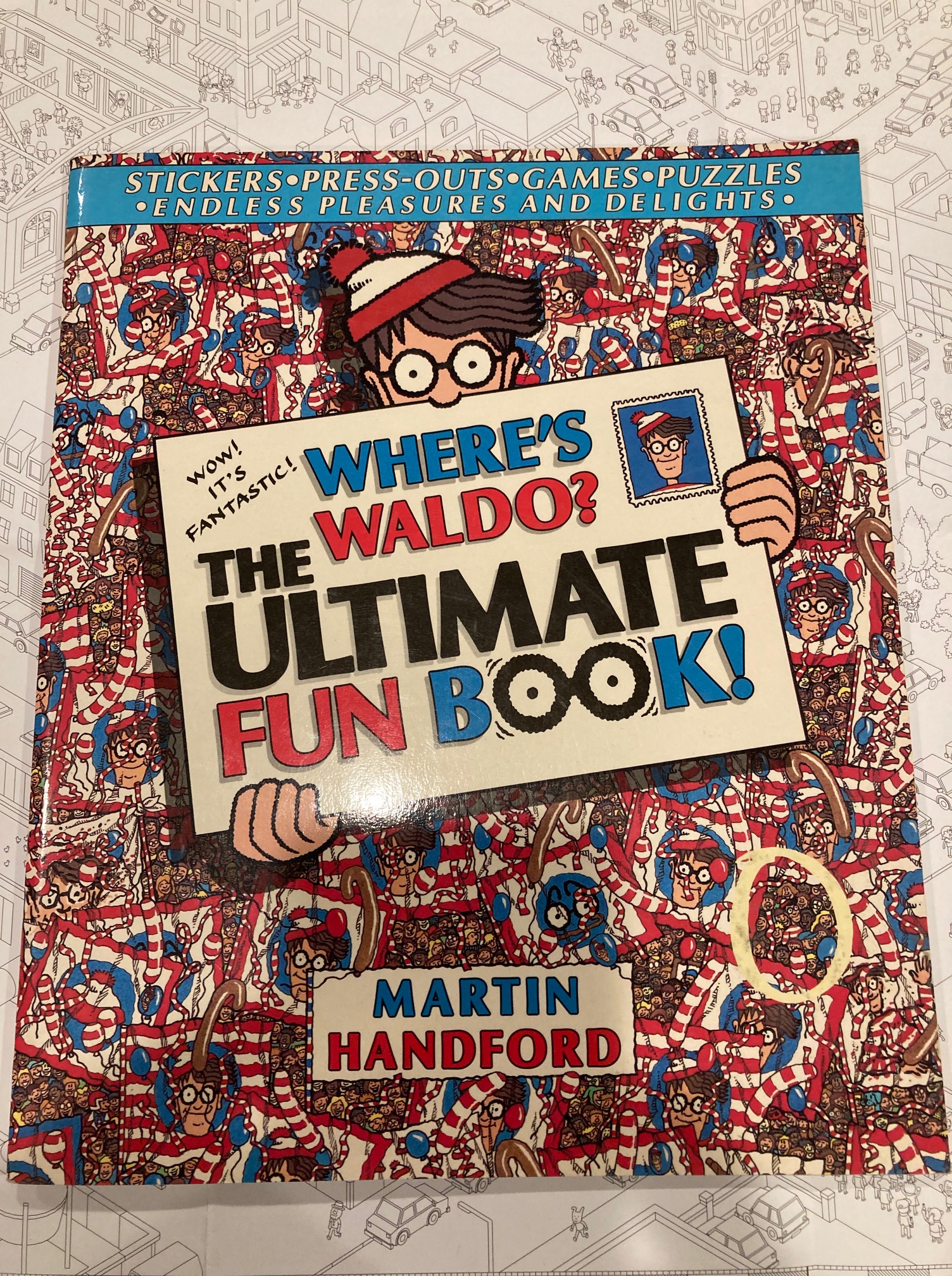
Where’s Waldo?

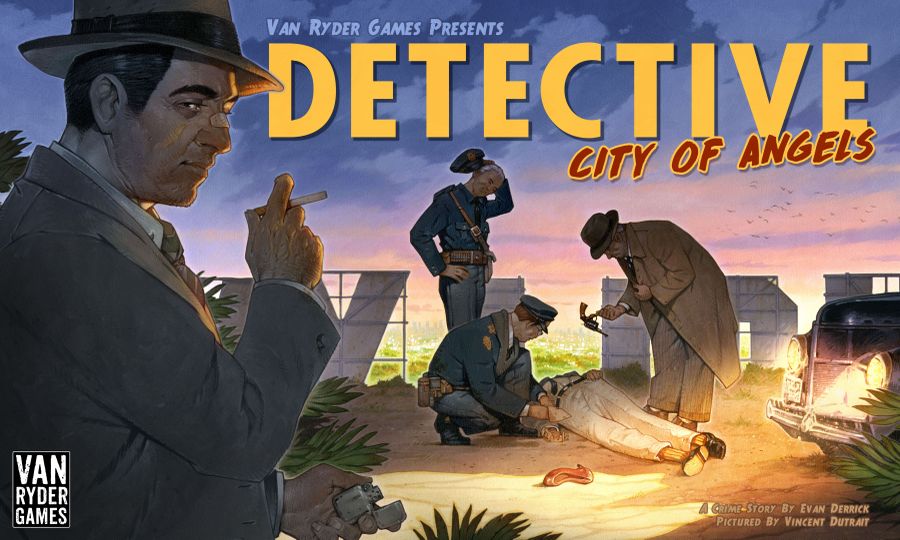
MicroMacro: Crime City is a combination of something like Where’s Waldo (see below) meets Detective: City of Angels.

IMG_7551

If you don’t know what Where’s Waldo is, (I believe it’s called Where’s Wally in the UK), it’s a book of intricate pictures where you are looking to find the character Waldo. See below for an example:

IMG_7552

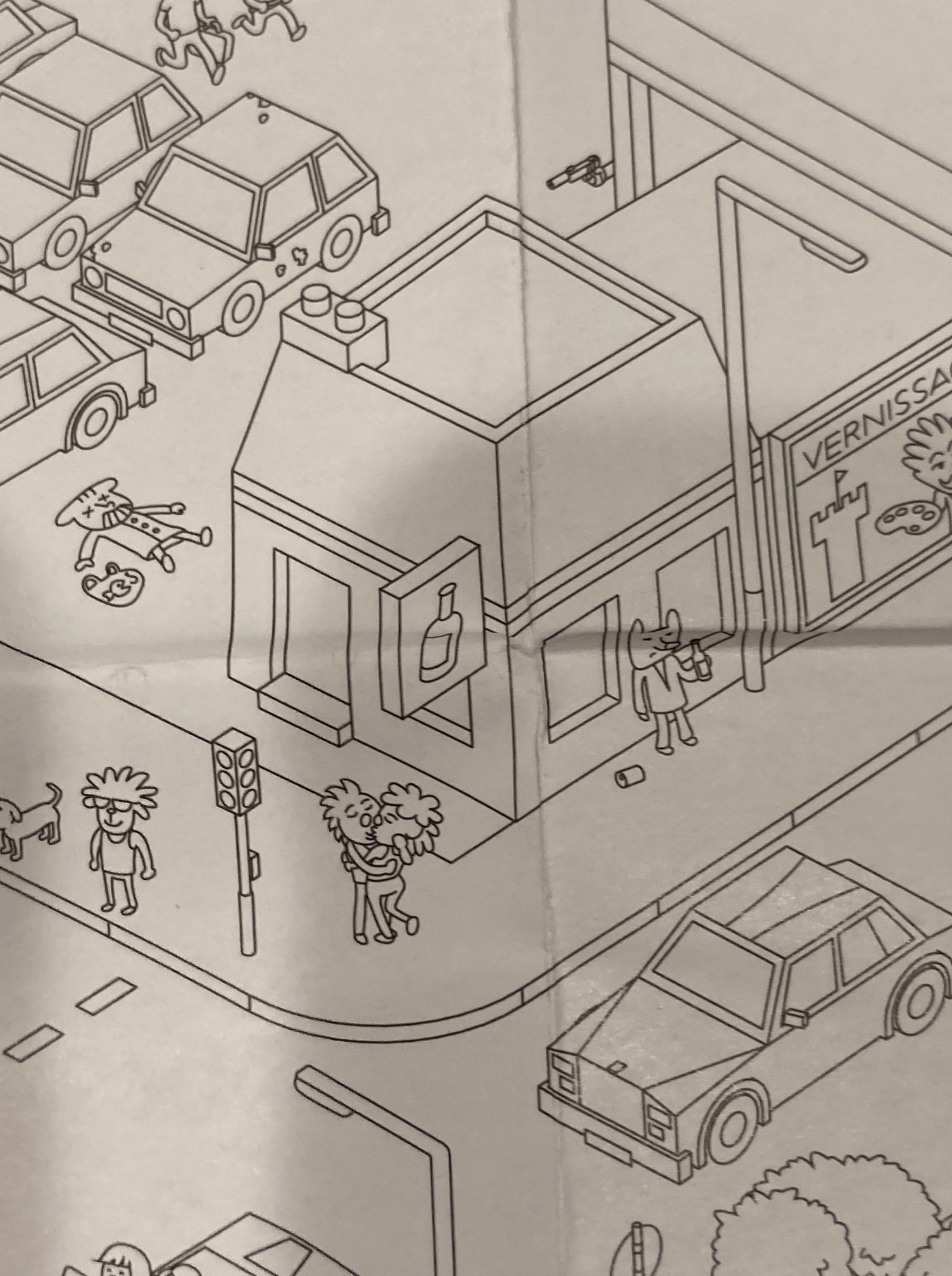
Where’s Waldo is really more of an activity: “look at this picture and see if you can find something”. Luckily, MicroMacro: Crime City is more of a game. It’s s detective type game, where you are trying to notice small things (micro) in the large city (macro).

pic3469246 (1)

This is very much a limited life detective game like Detective: City of Angels (or many detective games, see our Top 10 Cooperative Detective Games). There are a limited number of cases in the game, so once you solve them, you are done with the game. Luckily, expansions have been announced, so if you love this game, there will be further content.

Unboxing

IMG_7521

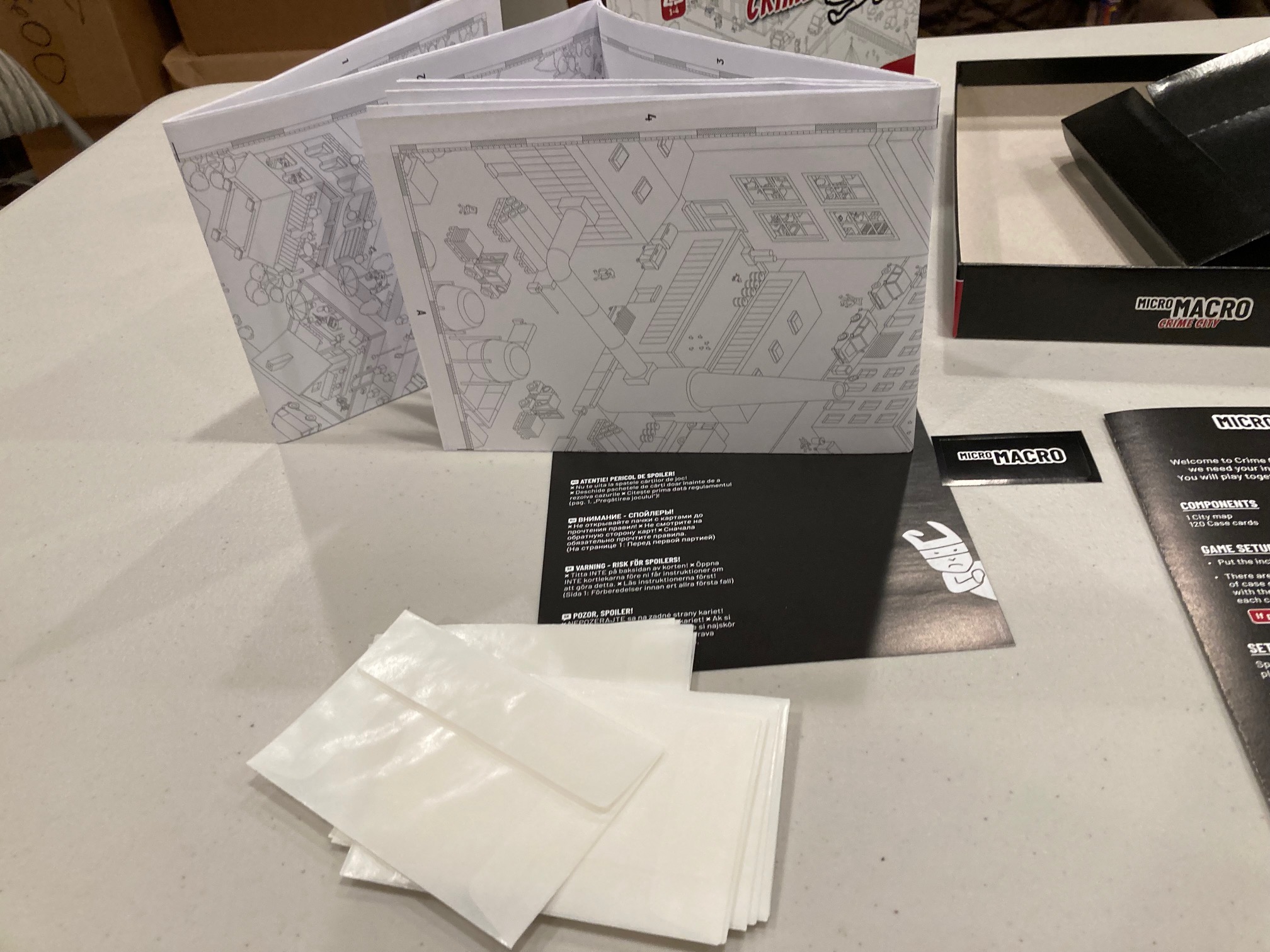
There’s not a lot of components for MicroMacro: Crime City. The first thing you see when you open the box is a leaflet saying “Warning; Spoiler Alert!”. See above. Between the cards and the map itself, you don’t want to look at anything too closely for fear of ruining a later game. Notice all the different languages! The main game map itself is pretty much language independent: the cards will have to be in the language of interest.

IMG_7523

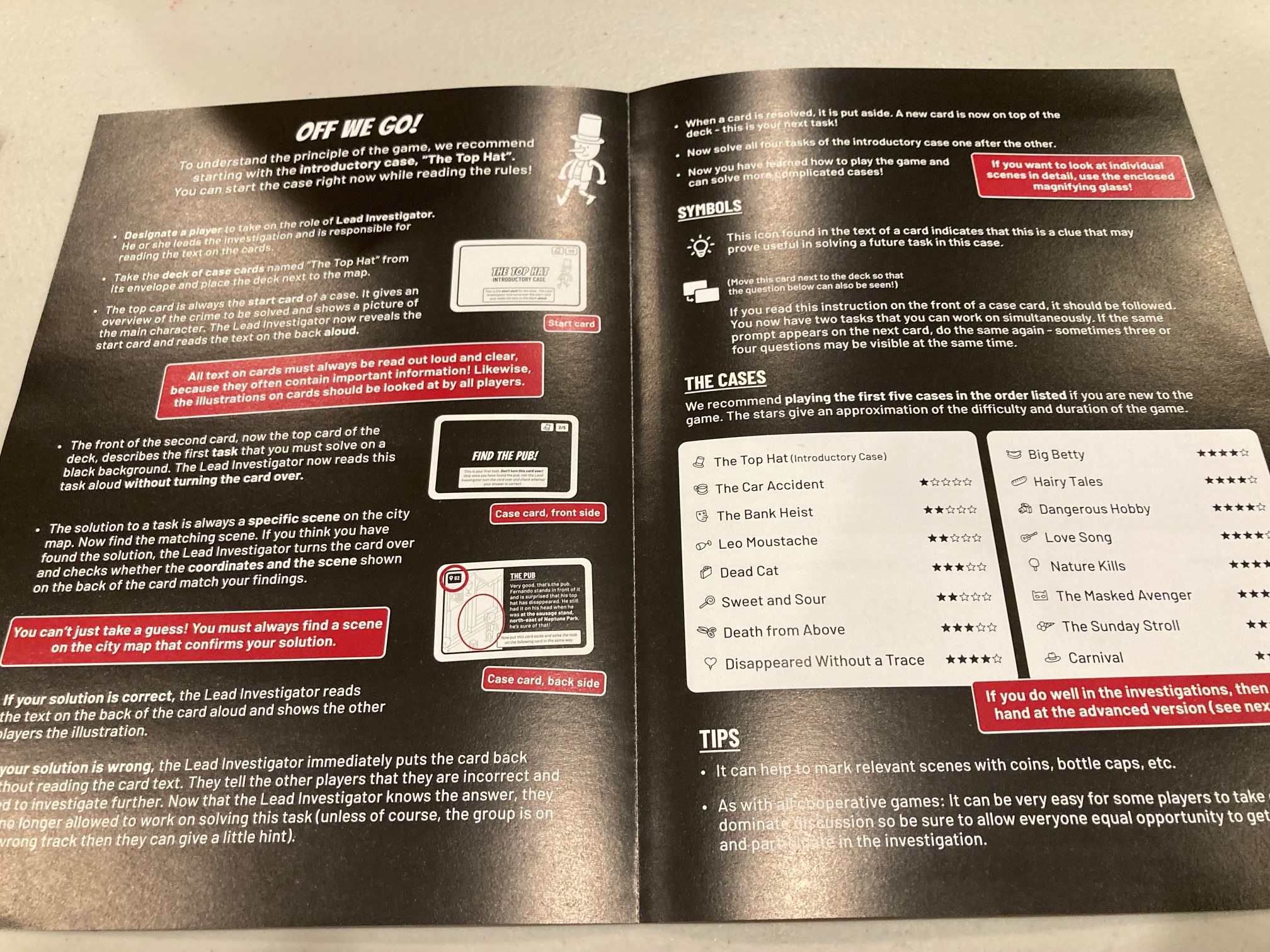
The rulebook is nice. See above.

IMG_7524

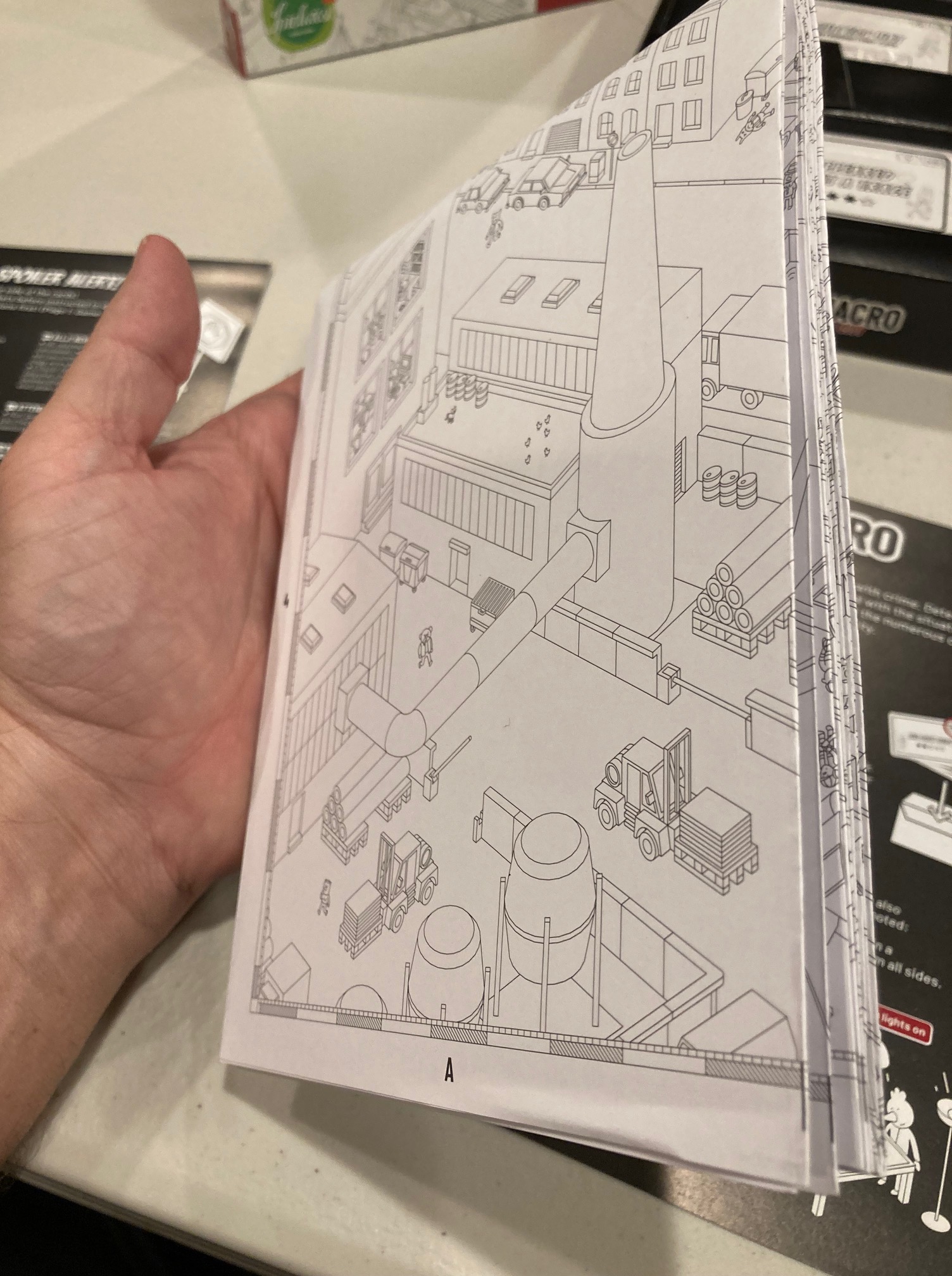
The main piece of the game: the map. It’s huge! We’ll see it folded out below. It really is a old-school map with letters along the bottom and numbers on the edge for cross-referencing locations in the city. It also has the same fold-up problem that most maps have .. “Wait, how does this fold up again?”.

IMG_7537

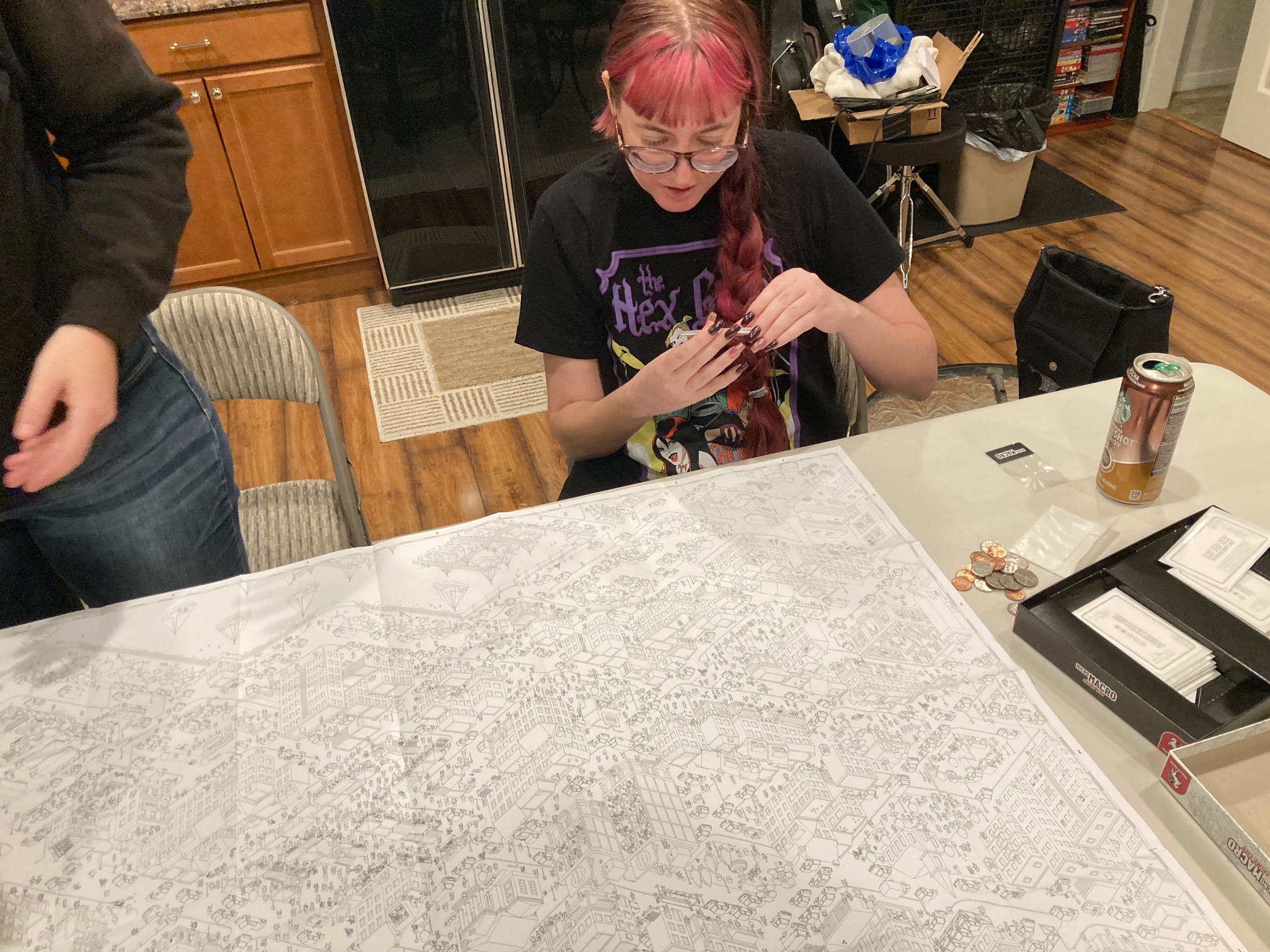
The map looks very cool all unfolded on the table!!! It’s huge!  I included a coke can to the left for a sense of scale.

IMG_7525

The rest of the game is in the cards.   They are all fine quality with black and white art just like the map.   There are a number of cases in the game: each case is made up of a number of cards.  You can see “The Top Hot” case, the introductory case, is 5 cards long and really easy (1 out of 5 stars), whereas the “Without a Trace” case is 10 cards long and pretty hard (4 out of 5 stars).

IMG_7539

The game also comes with a magnifying glass: see above. It’s cheap and plastic but it works. See below.

IMG_7531

IMG_7535

“Hidden” in the game are some envelopes: I say “hidden” because in my game, the envelopes were somehow “inside” the map and I didn’t find them at first! I actually thought they were missing! I had to unfold the map and then the envelopes fell out! It was kinda weird they were stuck in there. Anyways, the idea is that you are supposed to sort the cards and put one case per envelope. “Your first case: find the envelopes!!” (It was an easy case).

IMG_7536

Overall, the components are nice. See above. They aren’t elaborate, but everything is very functional and readable.

Rulebook

IMG_7523

The rulebook is fine. It commits the cardinal sin of white text on a black background, but otherwise it’s a good rulebook. It does a great job of emphasizing key points: For example, see above: “Again: bright light is extremely important!”

IMG_7528

Once you learn the game, you almost never come back to the rulebook except for the list of cases.

Even after all the cases are over, the game has little easter eggs and puzzles hidden (described on the last page of the rulebook).

Good rulebook: you’ll read it once, then the game just flows and you never need it again.

Solo Play

IMG_7517

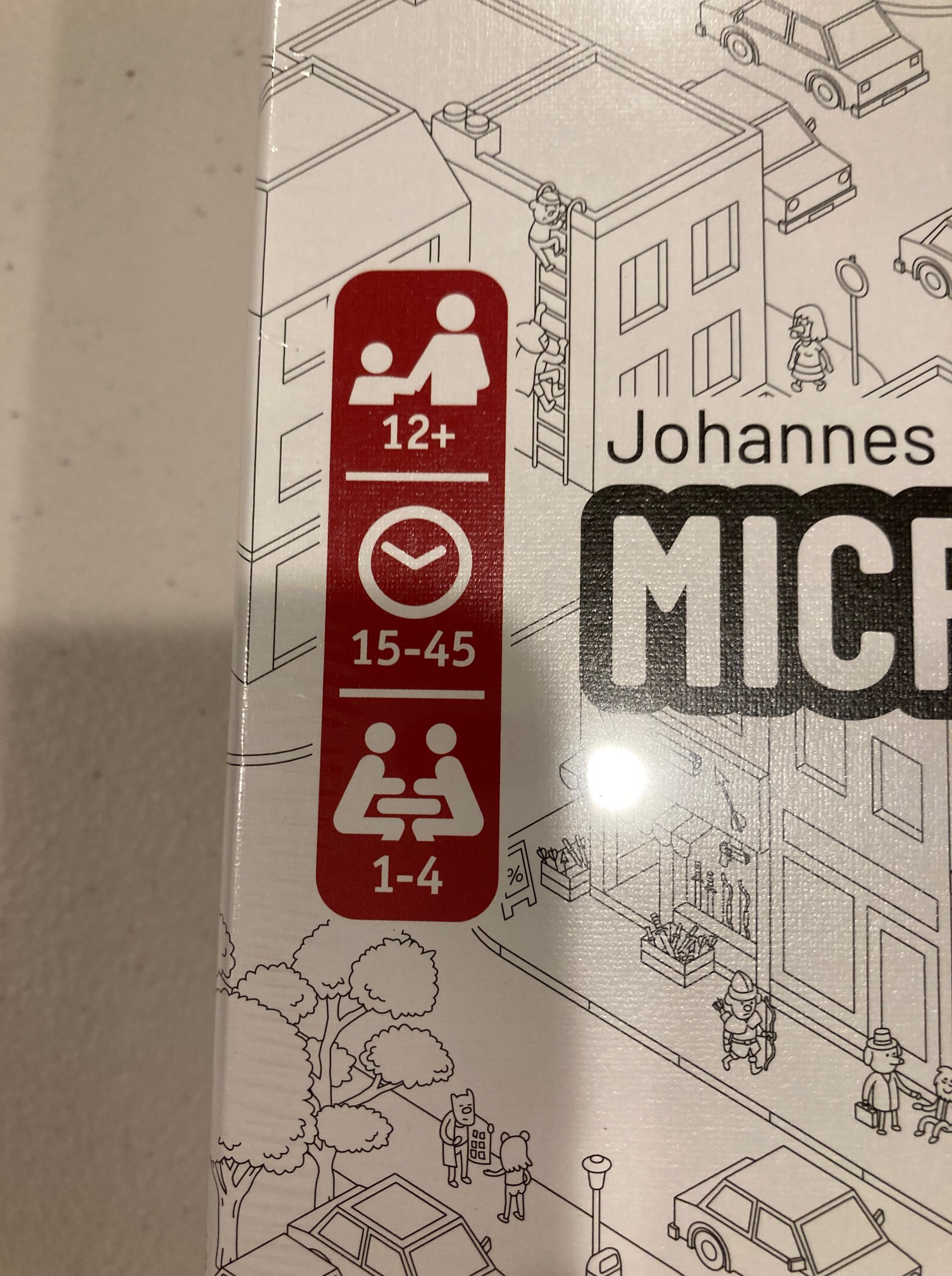
The game works really well solo. It is nice to see a cooperative game just work with one player (thank for you following Saunders’ Law). In fact, when you first pick up the game, it has a “mini-case” on the front of the box!

IMG_7515

You can get a sense of the game when you pick it the box at a game store. Here’s the thing: I don’t think you really capture the magic of this game (spoiler alert! I like it!) until you lay it out the map in front of you on the table and are engaged in the game. So, although the little puzzle on the front of the box is “neat”, it’s not really indicative of whether or not you’ll like the game. You NEED to get that map in front of you!

The solo play works fine for learning the game, but honestly, you don’t need someone to learn the game ahead of time to teach the game (one of the main reasons to learn the game solo)!    The game is really easy to learn when you pull it out.  

IMG_7535

Honestly, I didn’t think I would like this game because:

  1. I usually don’t like games where you have to find hidden pictures (my least favorite part of the Unlock game series: they always have some hidden pictures: See Unlock! Star Wars Review and Unlock Epic Adventures).
  2. I’ve found games like this (like Robit Riddle, Crusoe Crew, and Baker Street Irregulars and games with a story) significantly better with more people. 

I am totally surprised I liked this game solo.  It was fun, it was simple, it was engaging. I played the first three cases in quick succession and had a blast.

Gameplay

IMG_7574

The game is straightforward: you look for elements on the map, while trying to answer questions on the case cards.

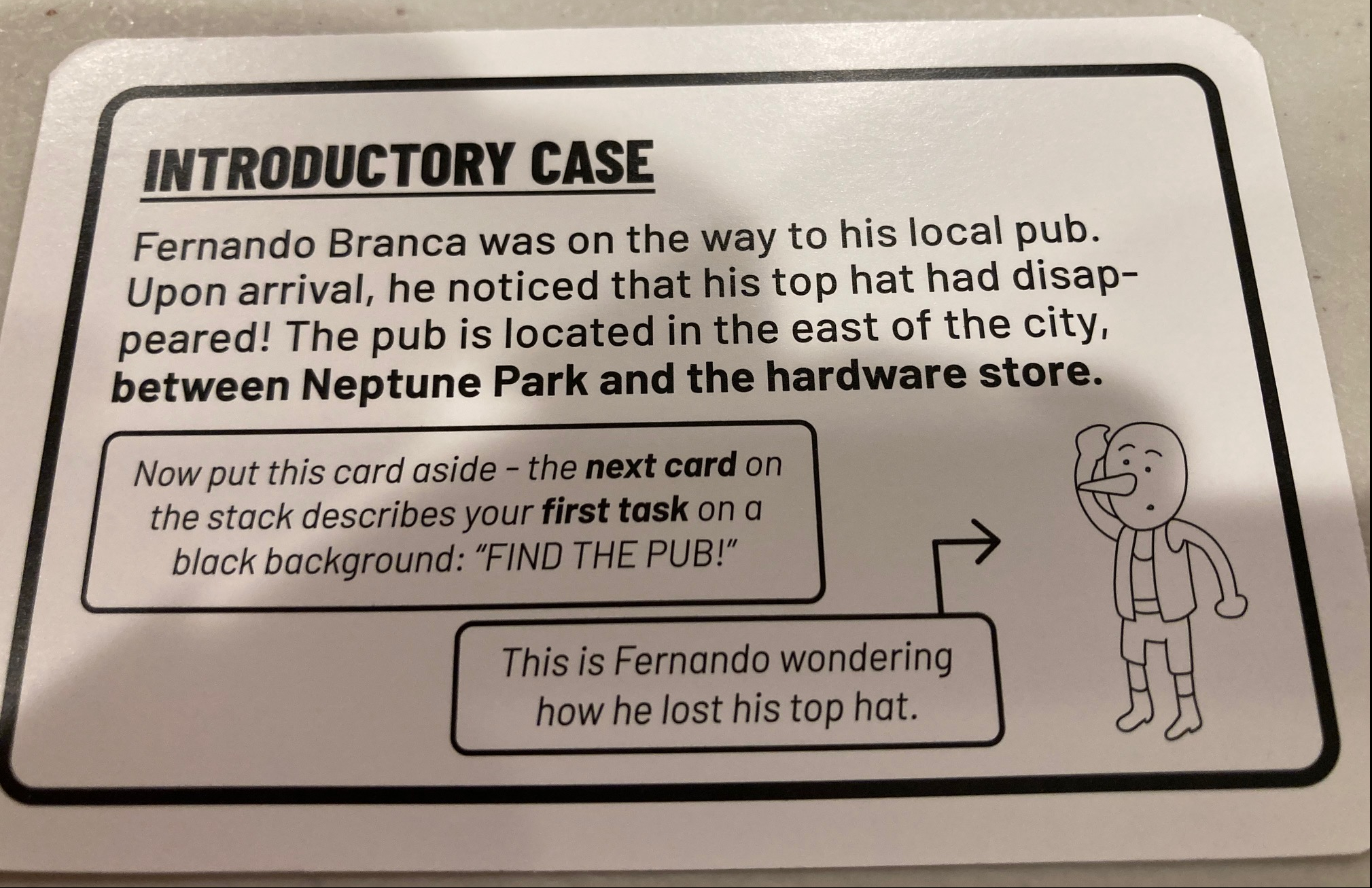
The little guy on the front is the “person of interest” you will be looking for on the map. The game starts when you flip that card and read the case. SPOILER ALERT: skip to the end of the next section if you don’t want to see anything else and want to be completely surprised by the rest the of game. I am just showing a little bit of the first case so you can get a sense of the game.

IMG_7543

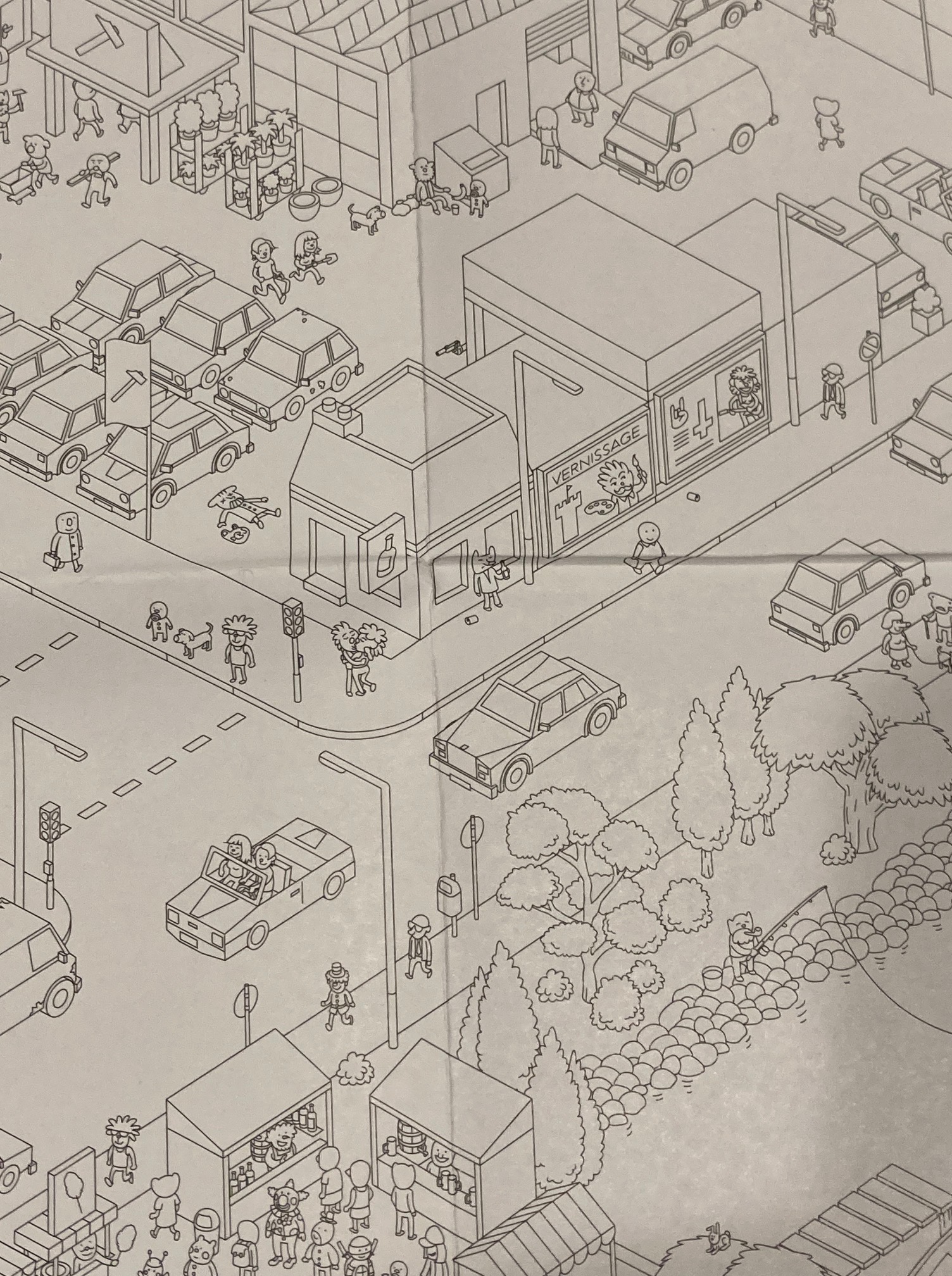
So, you start looking on the map in the east part of the city. Below is “some part” of the city.

IMG_7546

You get a sense of what the city looks like zoomed in.

IMG_7547

As the game gets harder, you will be using coins to make “places of interest”.

In general, the game is about finding the people/places of interest (maybe marking them using coins), using a little bit of deduction, and trying to answer some of the questions on the cards. And that’s it!

It’s Where’s Waldo with a story/mystery!

Player Count

IMG_7516

The game says 1-4 Players. And it works great at all player counts. The reason the game “tops out” at 4 is because you can’t fit around the table at more than 4!

IMG_7577

You can see a 2-Player game “taking over the table”, but it works!

IMG_7583

Above is 3 Players (I am behind the camera so you can’t see me), and you can see we are already starting to get a little cramped!

IMG_7585

We figured that 4 Players is the absolutely maximum that can play: the fun in the game is crowding around the map and looking for stuff. If you can’t fit around the table, you aren’t playing, and you aren’t having fun! 2-3 Players are probably the best player count, but solo works fine as does 4 Players.

There’s only one magnifying glass in the game, which makes it a limited resource. Although it wasn’t a problem for my group having only one magnifying glass, other groups might “fight” over it. Easy solution: you can use your phones.

IMG_7550

Thoughts

IMG_7580

I did not think I’d like this game as much as I did! I mean, we’re just looking at a map, right? The art was cute so it was fun to look at, but more importantly, it was precise. The little expressions on the little people’s faces were easy to see! At first, I though the black and white art was “lame”, but I came to appreciate it was easier to see things. Compare that to the colored art of a Where’s Waldo:

The color, while beautiful in the above picture, is more distracting. The visual clarity of black and white was the right choice for this game.

Even though this game has a limited life, there are quite a few cases:

IMG_7554

So, with 16 cases, this game can last quite a while!

Ages

IMG_7514

Oh, one more thought: the reason this game is 12+ for ages is some of the content is experienced differently. I am from the USA and have a very good friend from Italy. She once remarked “Americans have no problem with violence, but problems with nudity. Europeans have no problem with nudity, but problems with violence”. And I think she was right. One of the first few mysteries in the game has some “cartoon nudity” (very very mild), but it might be something that would cause alarms for some. The violence in this game is also quite mild. But people die. So, I think the 12+ rating is a realization that young kids will really want to play this game, and probably would be able to, but their parents might have trouble with the mild violence or very mild nudity.

The best solution here is simple: play the game before your kids and make sure you are comfortable with it.

Conclusion

IMG_7581

MicroMacro: Crime City was a fantastic cooperative experience. It’s also a great solo experience. I did not expect to like this game as much as I did! The combination of Where’s Waldo with a mystery story detective game was a great combination that works better than it has any right to. Even the limited nature of the game helps you savor your plays! I wished the game worked with more people, but physical limitations make this really a 1-4 player game. And be careful with kids: they will really want to play this cartoony game, but there is some content some people might find questionable for a younger crowd. Caveat Emptor.

My friend Teresa said “I was still thinking about MicroMacro the next day. I want to play again!” That pretty much sums up the experience I had. MicroMacro: Crime City is a great game that deserved to win the Spiel Des Jahres for 2021. Be on the lookout for more expansions!

Top 5 List of Components for the Gameroom!

843f0721120c551aef06a9c4b17a22f7bc279b24_400x280_crop

I’ve been gaming (board games, card games, RPGs) for a quite a while. Once I hit mid-school in 1979, Dungeons and Dragons was a big deal among my friends. I was also introduced to a place called Wargames West on Central in Albuquerque: this was the first Friendly Local Game Store I knew of, and it was the early 1980s! That was a very special and rare thing.

Wargames West was very popular, as every Friday night, the would have open gaming where one side of the store was open for games, and the other side stayed open to sell games. I heard they stopped open gaming at some point because there was too much shoplifting, but I don’t know if that story is true. In those days, Starfleet Battles, Gamma World, and Steve Jackson games were very popular with my friends.

I took some time off in grad school (I lived in the lab and had no time), but I continued gaming most of my life. So, suffice to say, I have SOME experience with components that could be helpful to a gamer.

Number 5.  Plastic Baggies and SharpiesIMG_7492

It’s weird how some games have tons of plastic bags (most of which you don’t use), and some games have no plastic bags (when you need them).  I have accumulated tons of bags from different games and placed them in my drawers.  See below.   I also a supply of sandwich bags and smaller bags from Ziploc on hand.  See above.

At the end of the day, there are some games that really need some plastic bags to help pack them back up.  I refer you to Disney Sidekicks (the cooperative game) from last week where we needed some small plastic bags to hold the tiny tiny tokens.  It’s just always nice to have extra bags.   

IMG_7493

It’s also nice to have Sharpies to write on those bags (see above).  I didn’t include Sharpies as a separate item because I pretty much only use them only with my plastic bags.  My CO2 game (a cooperative game we looked at here)  has so many components in so many plastic bags, it’s nice to have all the bags marked .. with a sharpie.

Number 4. Rubber Bands

IMG_7488

Some people don’t like rubber bands.  I think it’s because they use them wrong!  A lot of people use rubber bands to “bind” the cards together as tight as possible, double wrapping with the rubber bands.  This “tight binding” can ruin the cards (by bending edges or ruining card sleeves).  I put to you that they way to use Rubber Bands is as a “Zen” binding: find the rubber band that holds the cards together, but not bind them.  Usually, you just want the rubber bands to (1) keep like cards together (2) separate from other cards.   There’s no requirement to pack them tightly!!!  If you have LOTS of different kinds of rubber bands (see above), it’s easy to find the rubber bands that are “tight but not too tight”.  I actually am very careful with my games: I try really hard to keep them in good shape, and as long as you use the “Zen touch” with your rubber bands, they work great.

As an aside, I don’t like using plastic bags for cards.  I strongly prefer rubber bands over plastic bags!  Why?  Because larger plastic bags encourage cards to “roam” in the bag, which can lead to bending as cards don’t line up.  Smaller plastic bags are too tight of a fit, and you can tear the cards as you “force” them in. I’ve never had a good experience putting cards in bags.

Number 3. Kallax Shelves

img_3844

We did a full review of putting together some Kallax shelves here.  Suffice to say, Kallax shelves are fairly inexpensive and a very nice way to store your games.  Can you use other shelves?  Sure.  The price point and usefulness of the Kallax shelves makes them a gaming favorite.

Number 2. A Copier/Printer

The printer is, of course, obvious, because you frequently need to print something from online for your games.

“But?” You might be asking?  “A Copier?”  That’s right!  There have a been a number of times when we wanted to copy something for our game groups, and we needed them quickly!  Some examples:

  1. Player Sheets:  Forgotten Waters (see our review here) has some great player sheets (and you can print them out), but sometimes its quicker to just copy what you already have in the game.  And not all games have PDFs of player sheets online.  A copier can save your game night!  “Oh no, my friends will be here soon and I don’t have any extra sheets!”  You do if you have a copier …
  2. Roll-and-Write Sheets: Escape: Roll and Write (the cooperative dice game) (which we’ll review soon we hope) has lots of little sheets. I hope you don’t run out of sheets, or you can’t play anymore!  Or you could copy them.  EDIT: these sheets can be pretty colorful and will drain your color ink, so it’s usually best to save these copies for an emergency
  3. Note Sheets: The game Detective:City of Angels (which we love), has some specialized sheets for taking notes in the game.  You pretty much need these to play.  No reason to use the originals if you can make a copy.  EDIT: these sheets are pretty much black and white and simple enough that you can use copies without having to worry about draining your color/bw ink wells in your printer.
  4. “Different Perspective”:  Sometimes you want to have multiple copies of a card, part of the board, rule, etc to share with multiple people around the table.  We were recently playing The Initiative, and needed to make a copy of the card so we could look at it to solve something on the card (not too many spoilers).  Because of the perspective on the puzzle on the card, it made a lot of sense to copy the card and essentially have two copies of the card.  It made that puzzle much more fun to solve.

I have found that in life, in general, it’s good to have a copier nearby.  You’d be surprised how often you need it.

Number 1. Knee-High Tables for Drinks

Most of the stuff on my list, I am sure you have or have seen on other lists. This one? I have never seen anyone else talk about these, and they are the most important piece in my gameroom! (Well, except the games. And the people).

Over the years, I have collected lots of little tables for my friends to put their drinks on. Knee-high tables are the ultimate game room accessory! Why? You can have a drink, have it close by in a very reachable space, but with no chance of spillage ON THE GAME TABLE! By having the drink tables decoupled from the gaming table, you can avoid any spillage accidents.

If you knock over your drink (and we’ve all done it), at least you do not have the drink spilling anywhere near your game. It’s amazing the peace of mind the little tables can you give you too: “Drink, be Merry my friends, for I have Knee-High Drink Tables!”

I have seen some of these little tables pretty cheap when they on sale ($10?) or they are still pretty cheap at Costco ($20?). Never worry about spilling drinks on the table again: equip your gameroom with knee-high drink tables.

Conclusion

What did I miss any components you depend on? Feel free to comment! 

A Review of Disney Sidekicks (the cooperative board game)

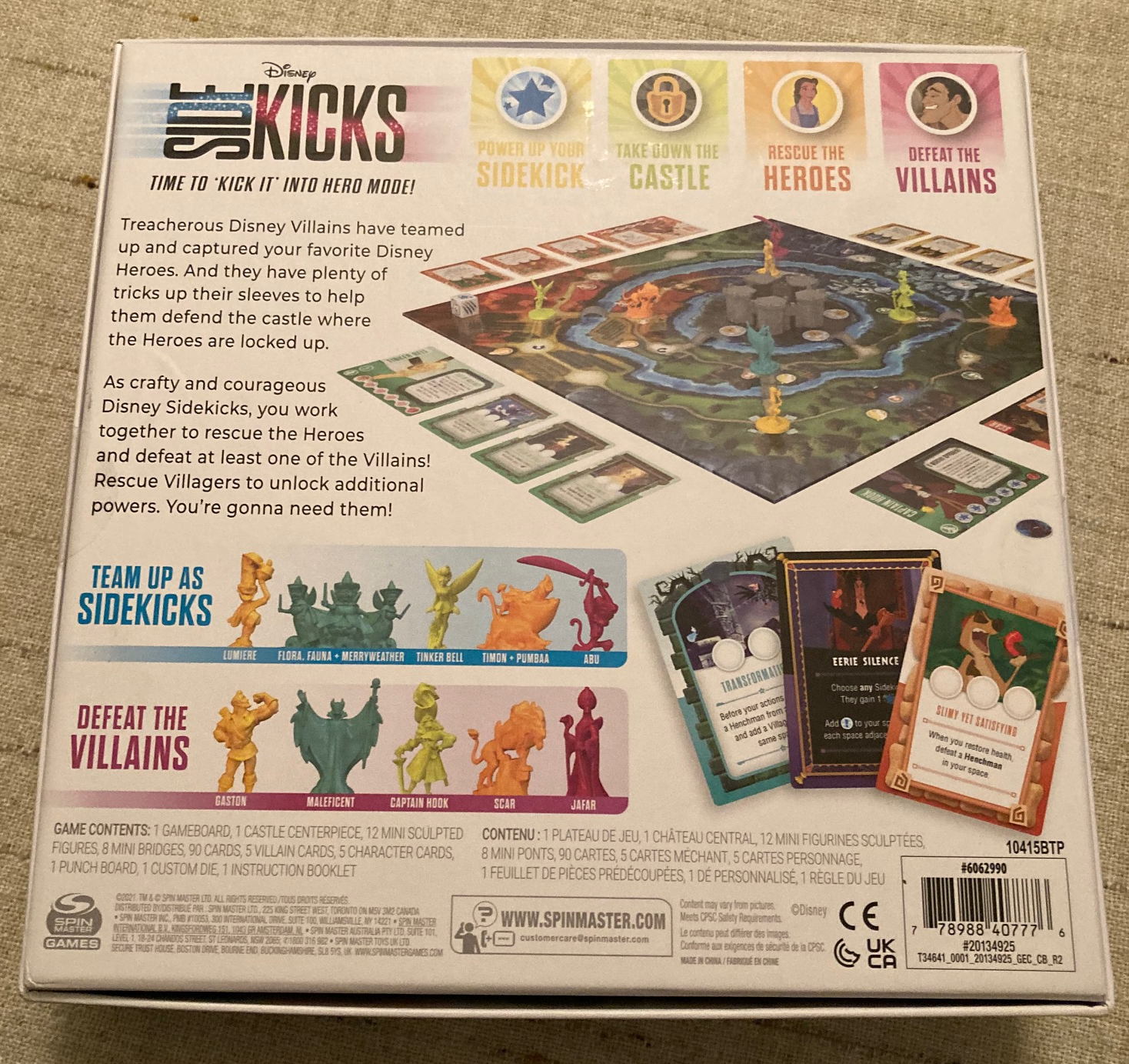
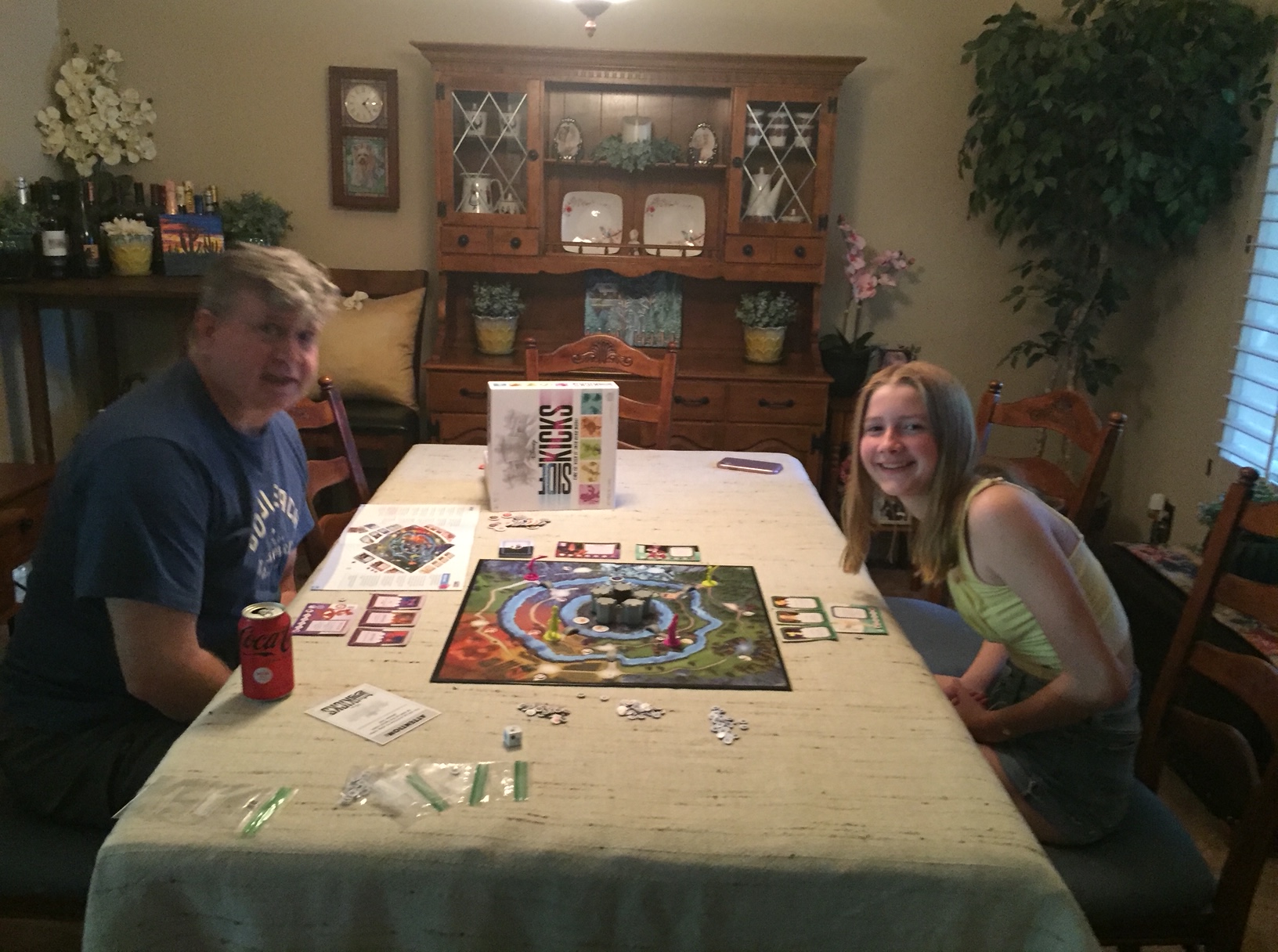
The jabber on the Internet is that Disney Sidekicks was supposed to come out August 1st, 2021 at Target, about the same time as Gargoyles: Awakenings. When I went to Target last week, only Gargoyles: Awakenings was there (see last week’s blog entry). So, I went looking, and I found that I could order Disney Sidekicks online from Amazon and from Target: I chose to pay the extra $2.99 on Amazon to get it delivered quickly because my niece is here this week, and Disney Sidekicks seems like the kind of game we could play together!

Components

IMG_7386

Most of the components in this game are very nice.  The graphic design of the box is very readable and enticing!

IMG_7387

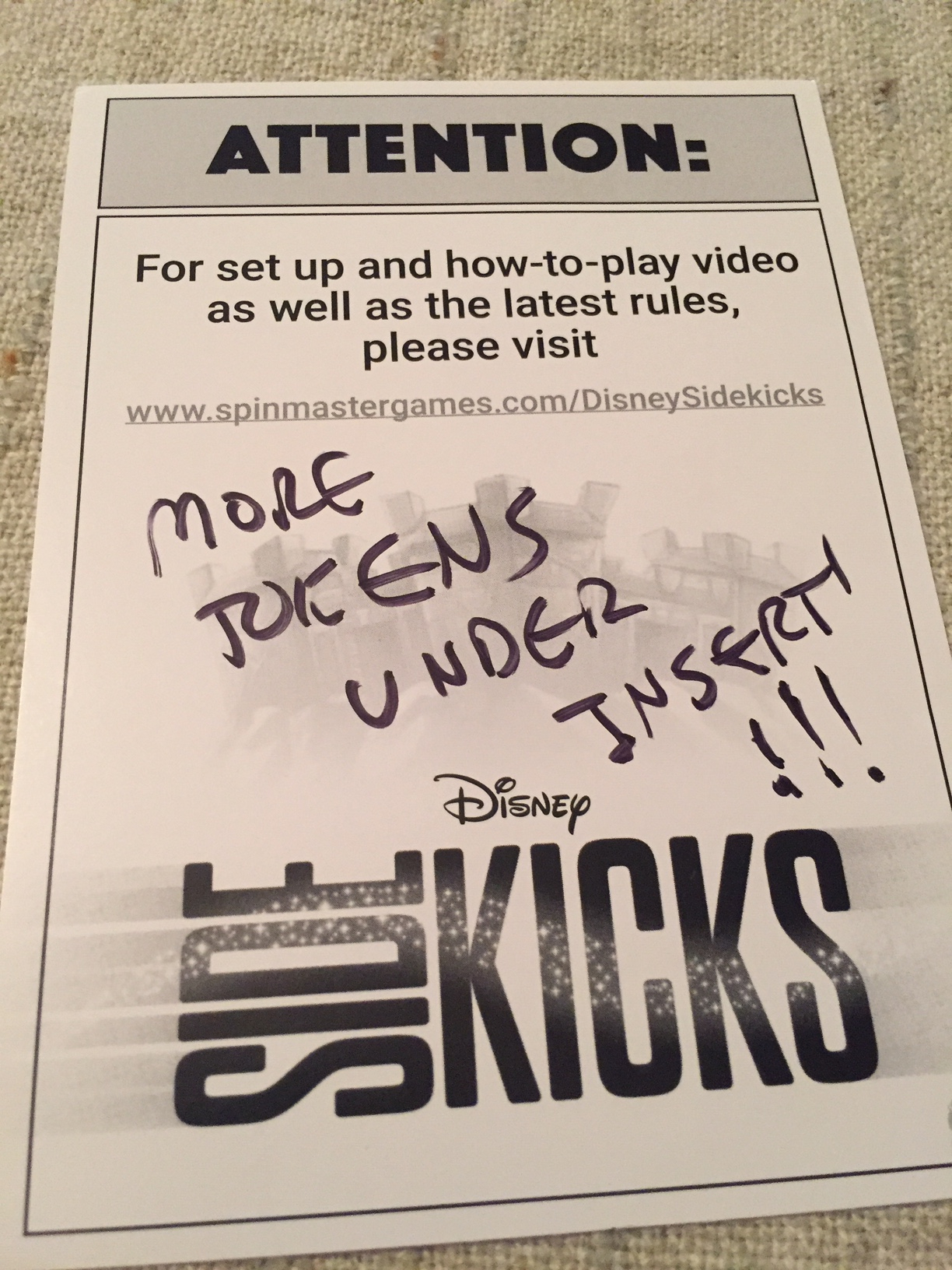
There’s a nice how-to-play video referenced above.  I kept this piece of paper for another reason (see the Tiny Tokens section below).  The board is pretty nice looking! It has two sides: a 2-3 Player side and a 4-Player side.

The 4-Player side has more spaces for the larger player count.

IMG_7402

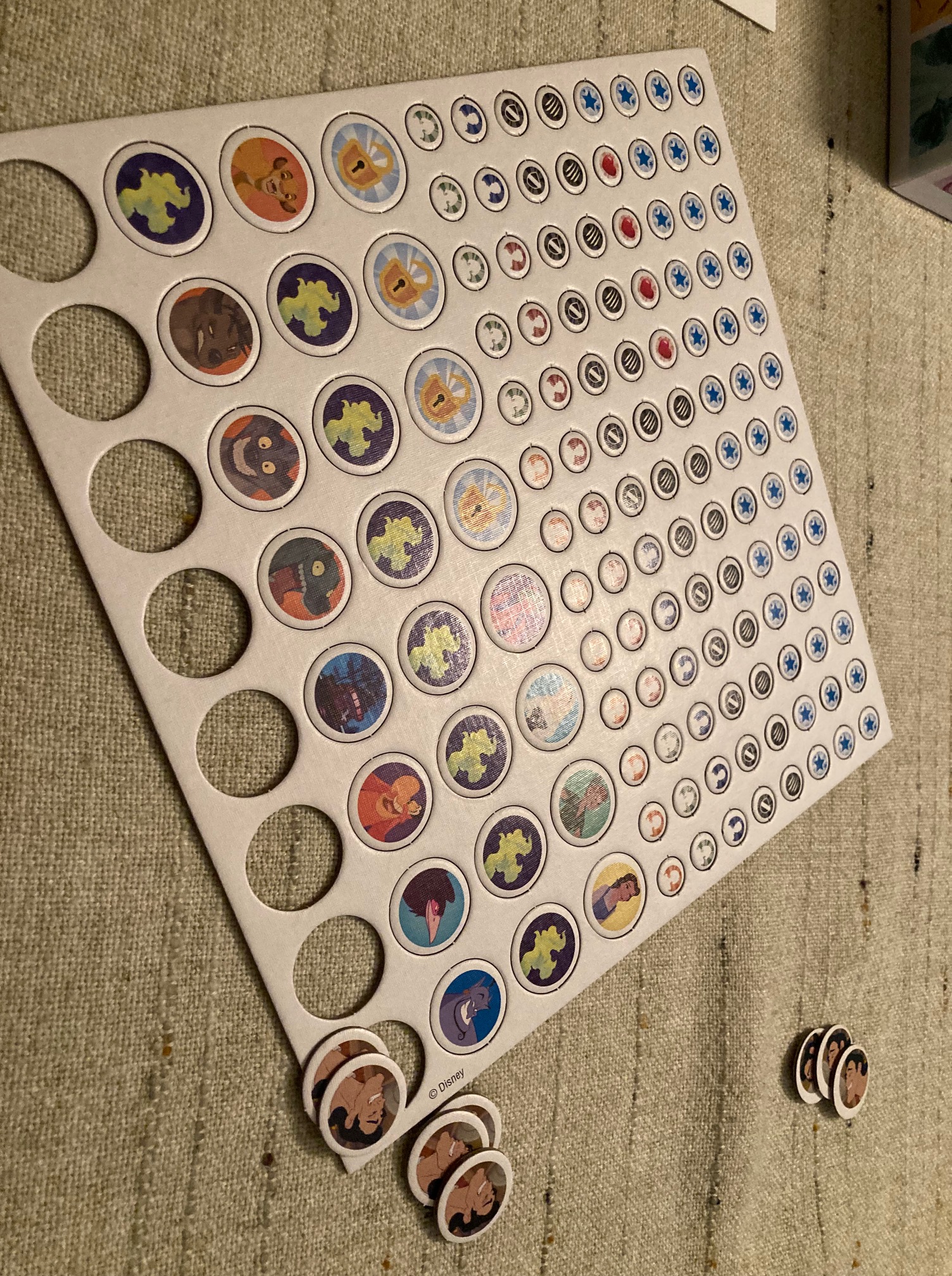
There is exactly one punchout sheet of tokens. Again, like last week, the game comes WITHOUT shrink wrap on the box, but it comes with shrink wrap (well, plastic in this case) on the tokens?  This seems like a new trend in mass market games?

IMG_7404

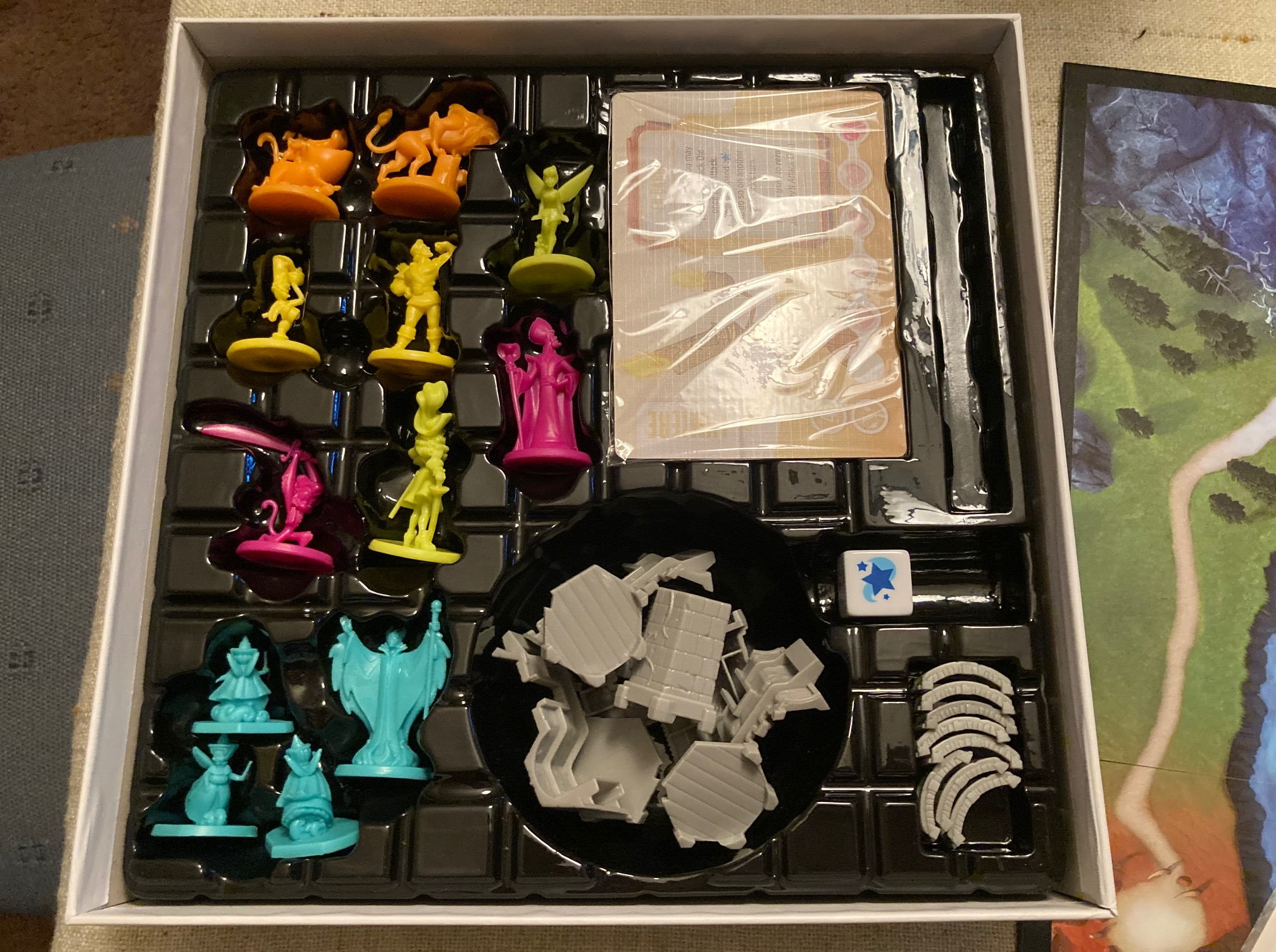
The insert for this thing is quite nice.  It seems everything has a decent place in the insert! And the miniatures are better than average, if not great. See them closer below:

IMG_7405

 I mean, this looks very appealing!  I want to play this game because it looks cool and colorful!  There’s even a little castle to set up! See below.

IMG_7432

It turns out this castle isn’t that useful in the game: it  really just “looks cool” and holds places for 5 guards (a game ender), but it still contributes to the overall vibe of the game.  (The castle also houses the heroes you are trying to rescue).

IMG_9772

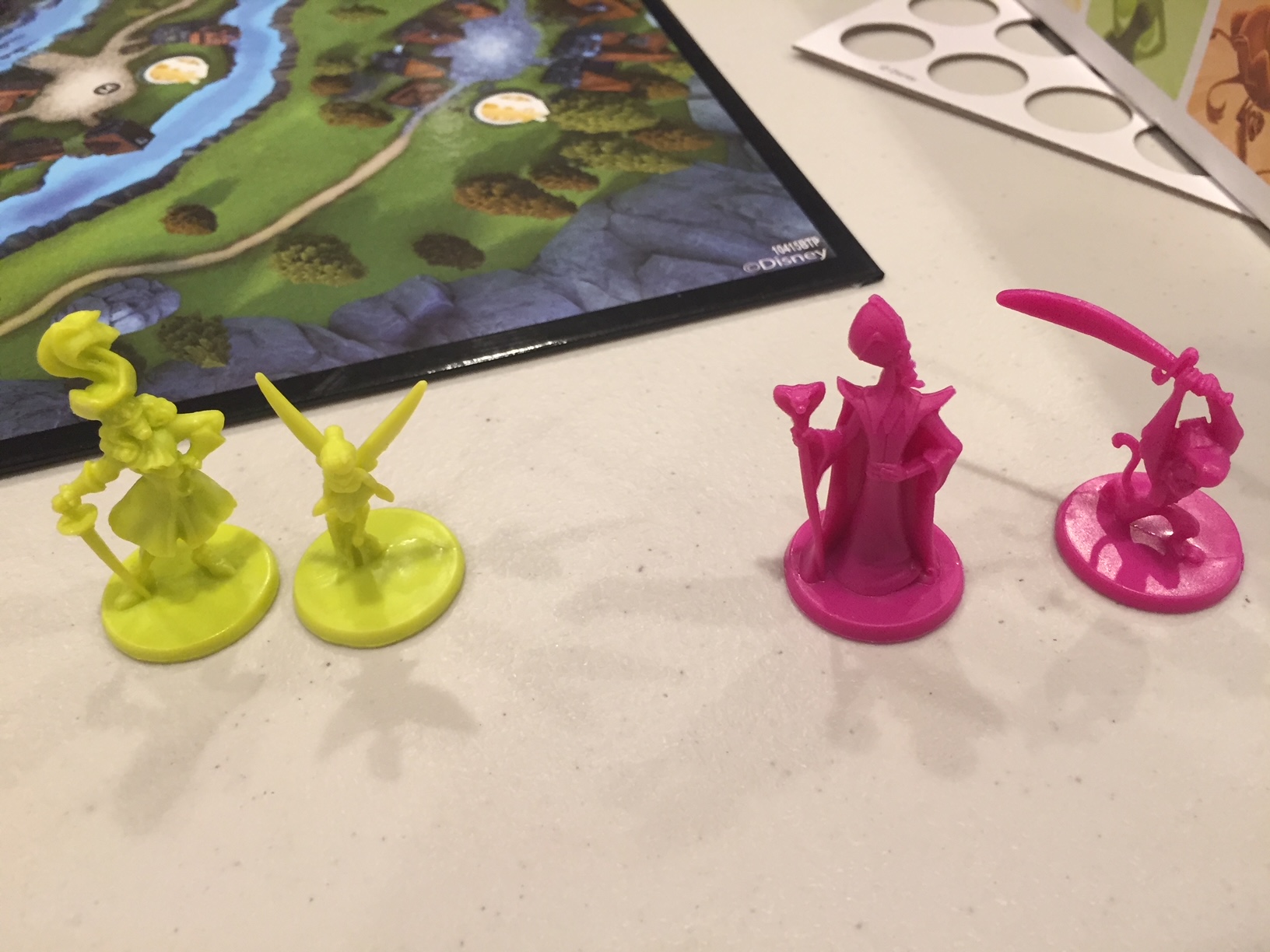
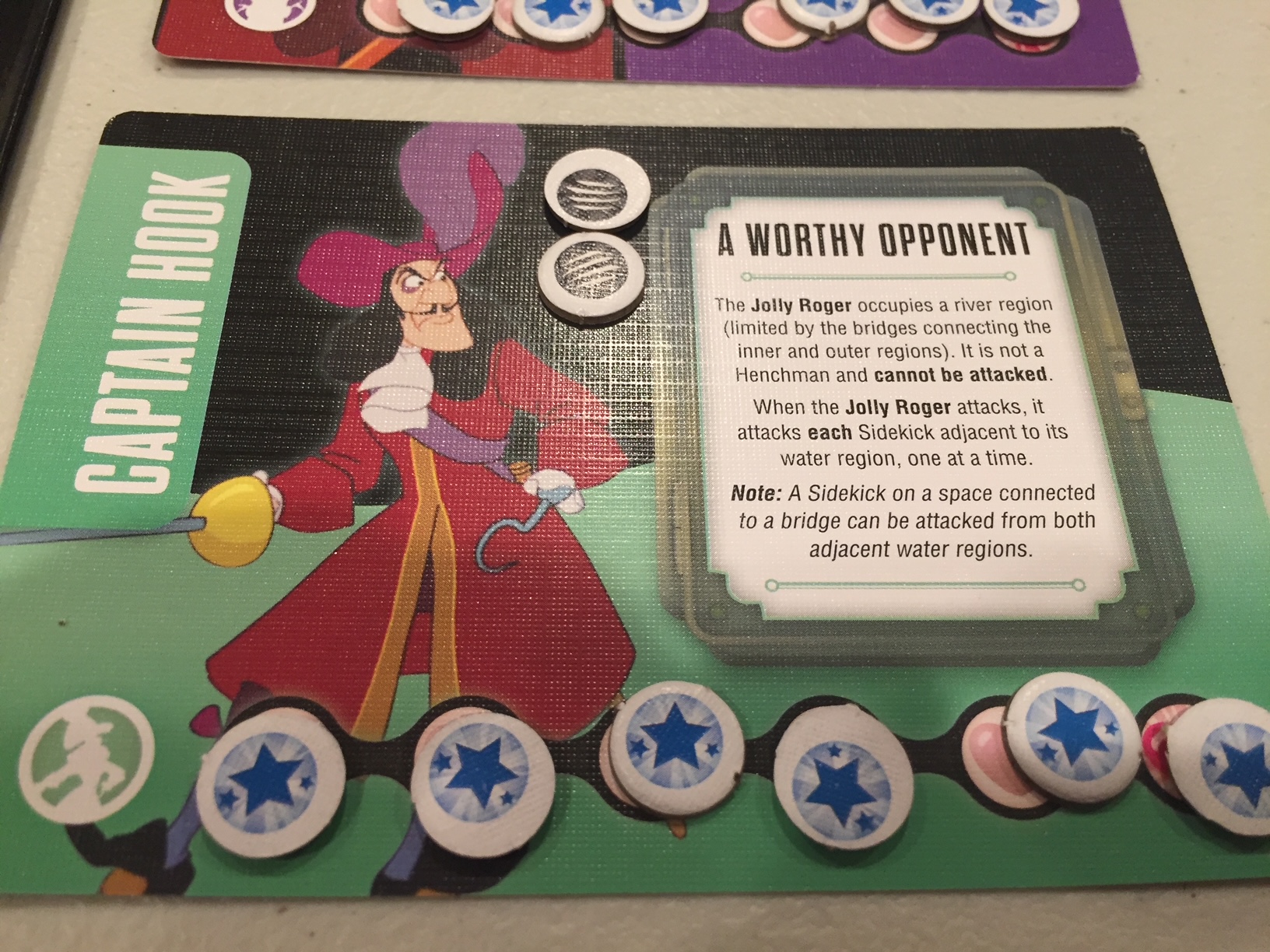
See above for another looks at some of the miniatures: note that both the sidekick and their nemesis are color-coded to couple together!  Tinkerbell and Captain Hook are greeeennyeellow, and Jafar and Abu are piiiiinkkpurrrple.  They aren’t great minis, but I like them.

IMG_7413

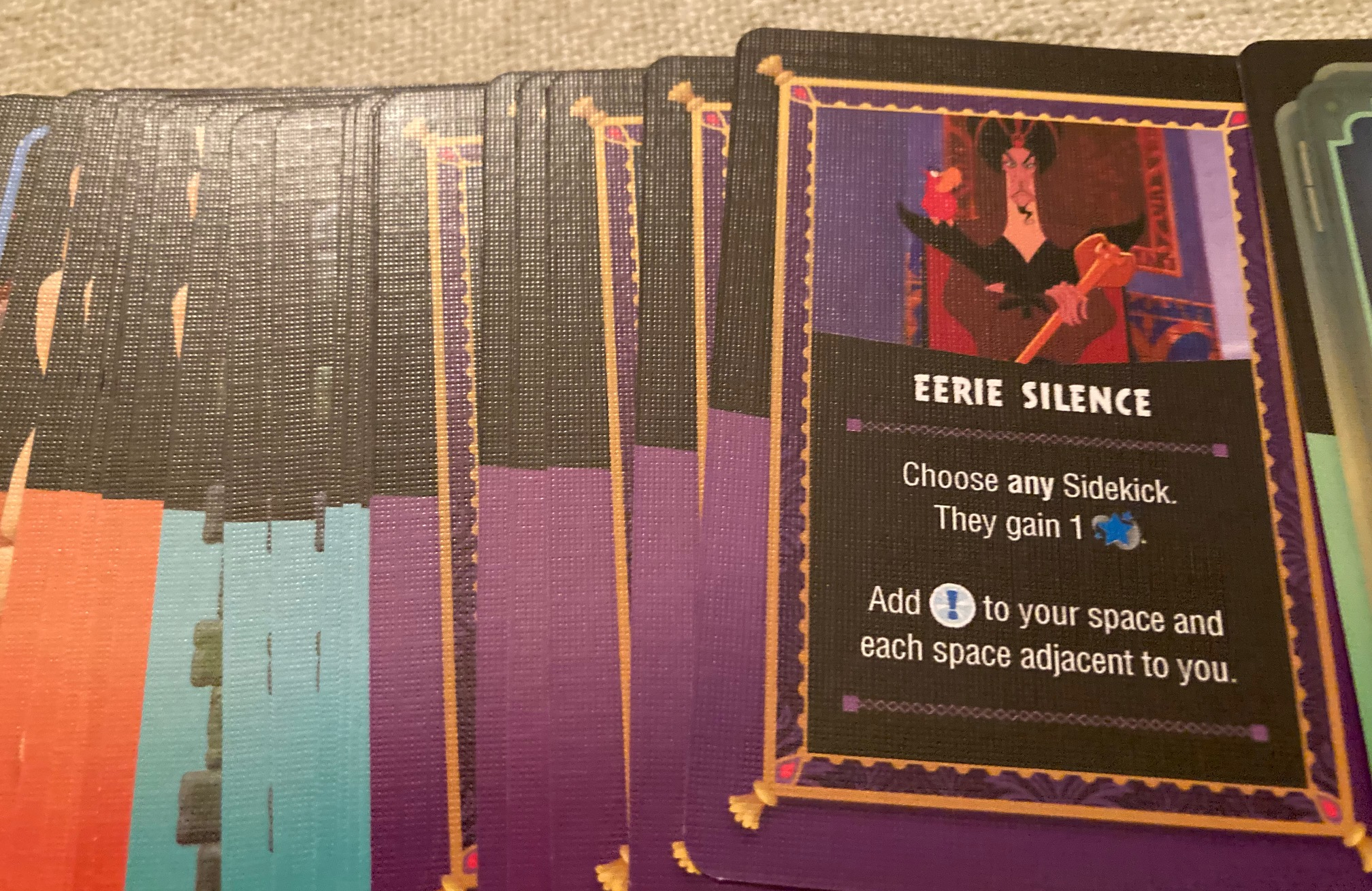
There’s a set of 7 “bad news” cards for every nemesis in the game, and they (usually) have a still from the Disney film on them.  They look nice: see above.  You can also correlate the colors (piiiinkpurple) decently well so you know which cards go to which Villains.   The cards are “generally” readable and are nice enough to be linen-finished.

IMG_7418
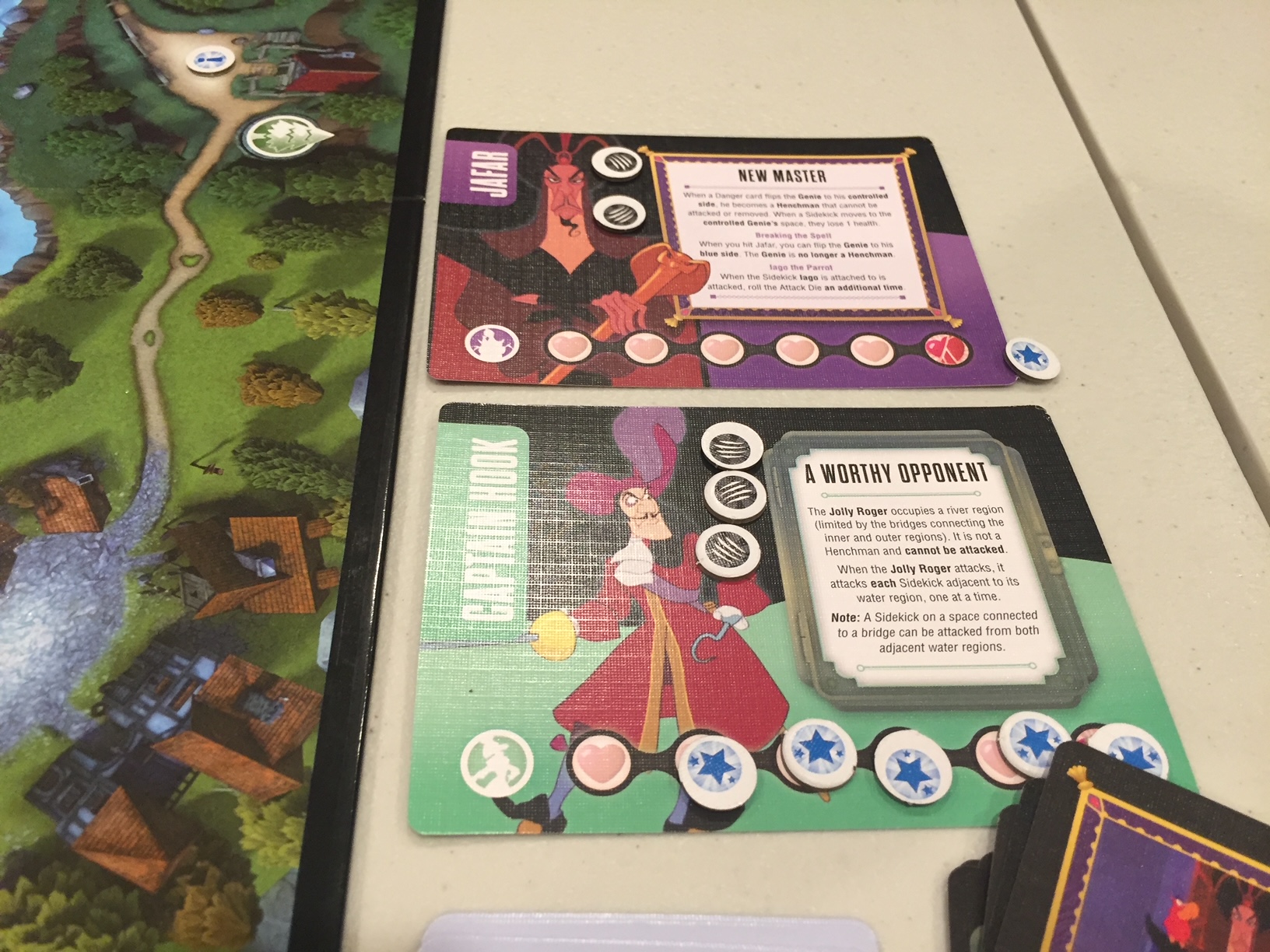
Villain cards for all 5 Villains in the game. Depending on which Sidekicks you choose, you get a different set of Villain cards.

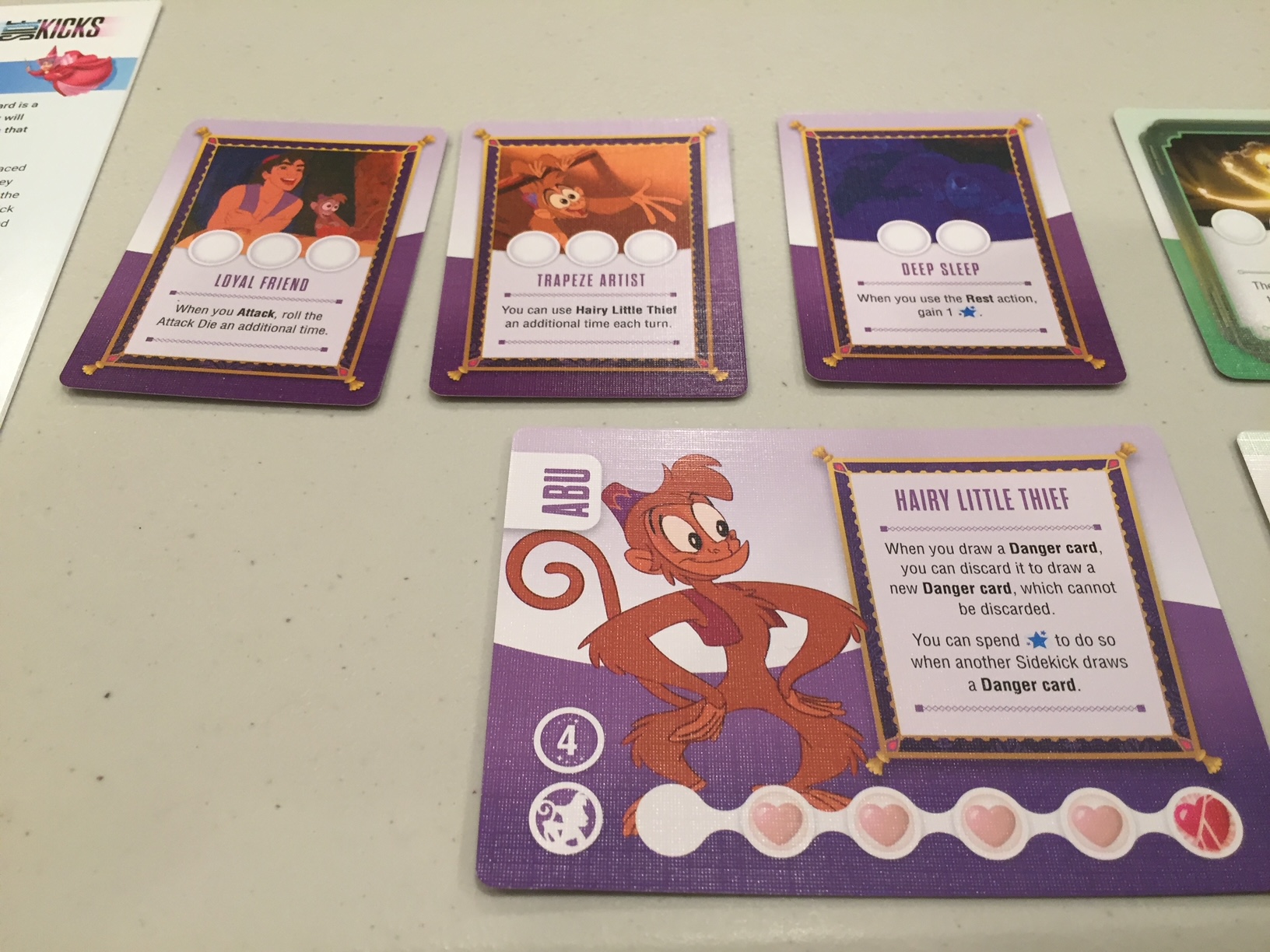
Similarly, the good guys have cards: these are “powers” (notice the spaces: these powers are activated by villagers).  Each player gets a set of 3 random “powers” at the start of the game and the rest go back in the box.

IMG_7422

We will discuss the tokens more, but there are a lot of little tokens needed to play the game: the guards, the “die” tokens, the stars.  Note the villagers are the little white heads: these come out on the board usually every turn, and they “activate” the 3 “power” cards each Sidekick has.

Each player takes one of the Sidekick cards (see above) for the player they chose and for the corresponding nemesis (see below).

IMG_7430

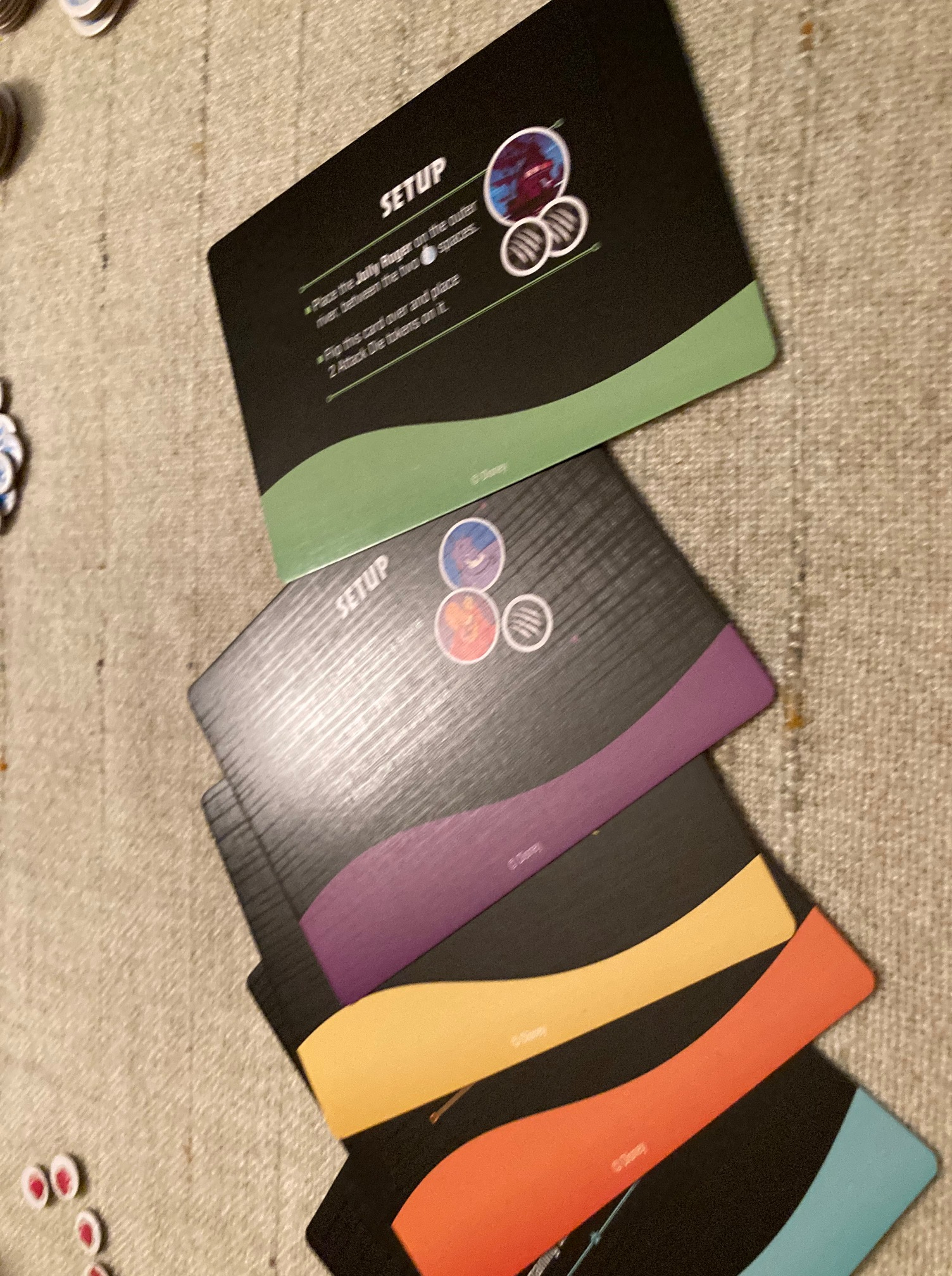
Each player has a special ability, and their nemesis has some special set-ups (on the back of the card) as well as some special abilities of their own.

IMG_7429

There are player helper sheets!  And they are good!

I will say that the player aids HAVE to be good because the die, although it’s a quite nice die (and there’s only 1), needs a little bit of description about what the symbols mean, but the player aids really do work well for that.

IMG_7435

In general, the components are very welcoming and make me want to play the game!

IMG_7436

Rulebook

IMG_7391

On the surface (foreshadowing), this rulebook looks nice.  It has a great graphic design, and the font is easy to read.  See the intro above!

IMG_7392

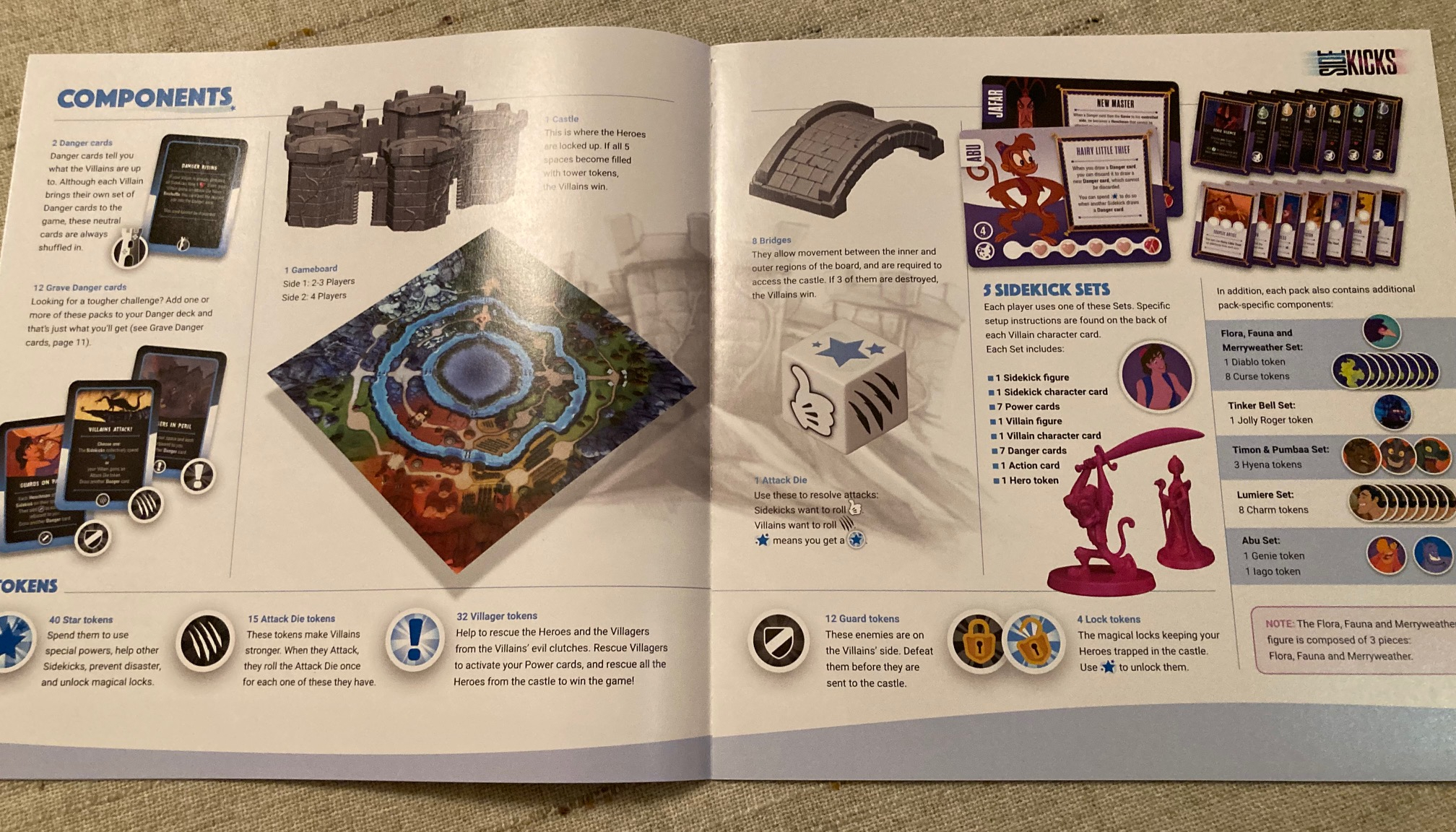
The next page is components! Yay! Lots of pictures, but I am starting to see cracks already in content. What’s the “Action Card” referred to in the “5 Sidekick Sets”?  I have no idea: there’s no picture and no arrow.  And this happens a lot in the rulebook: it’ll just refer to something with any indication of what/where it is.  At the moment, though, I am still happy: the components look great and I know what “most” of them are.

IMG_7393

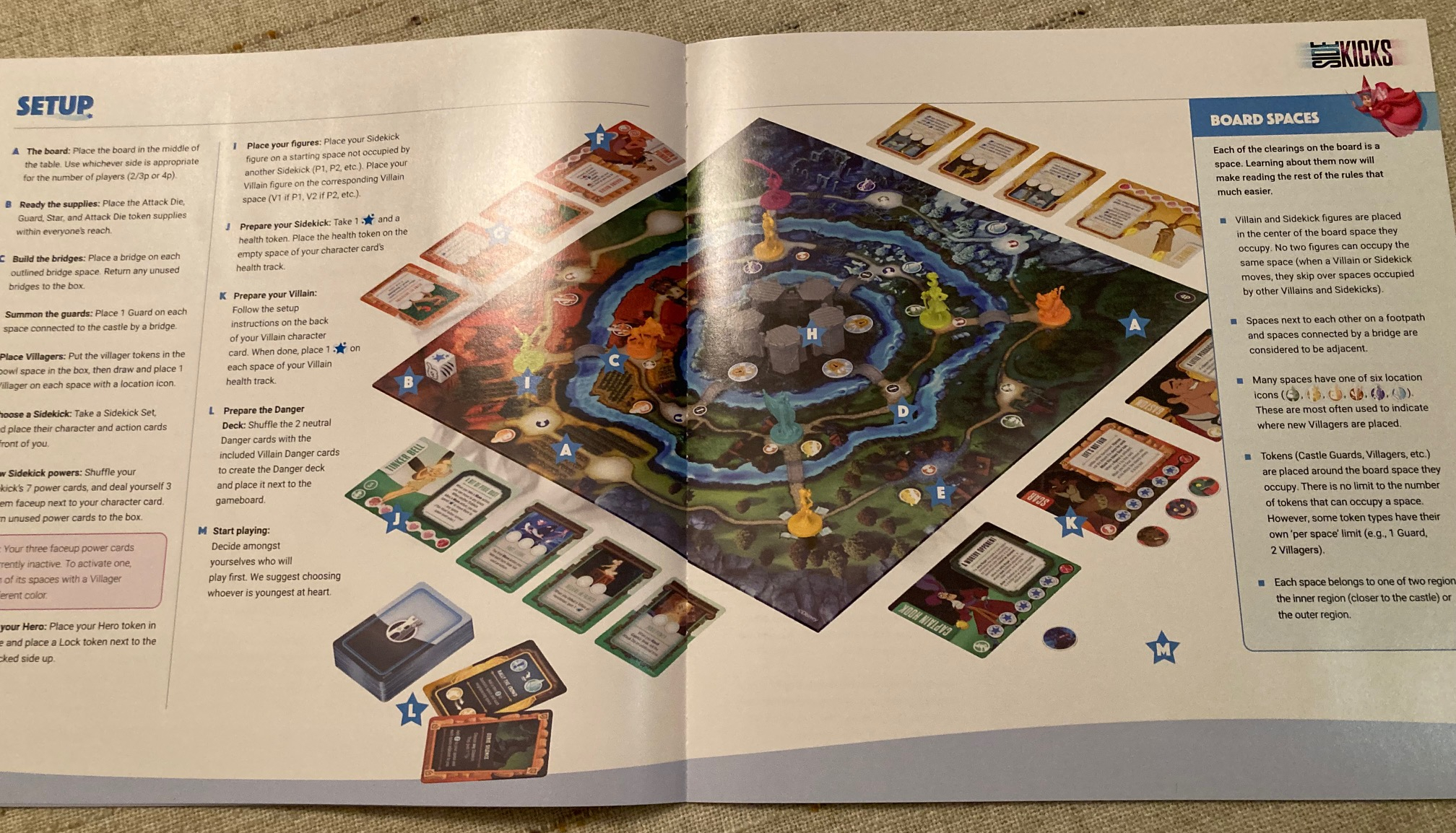
See set-up above: Again, this looks like it is good, but there are questions that come up already: do I turn the villagers face up or face down when I place them?  How many do I place out?  The villager tokens are SO SMALL, it’s hard to tell from the picture where to put them! (I think you put the villagers upside down so you can’t see the color of the villagers until you get there?)   And the only place in the rulebook I found a reference to “region” is the last bullet on the right … and this still didn’t help me decipher the Pirate Ship rules (see later discussion).   

This is a good picture of set-up, but I feel like the rulebook is lacking …  I think my set-up is right?

IMG_7394

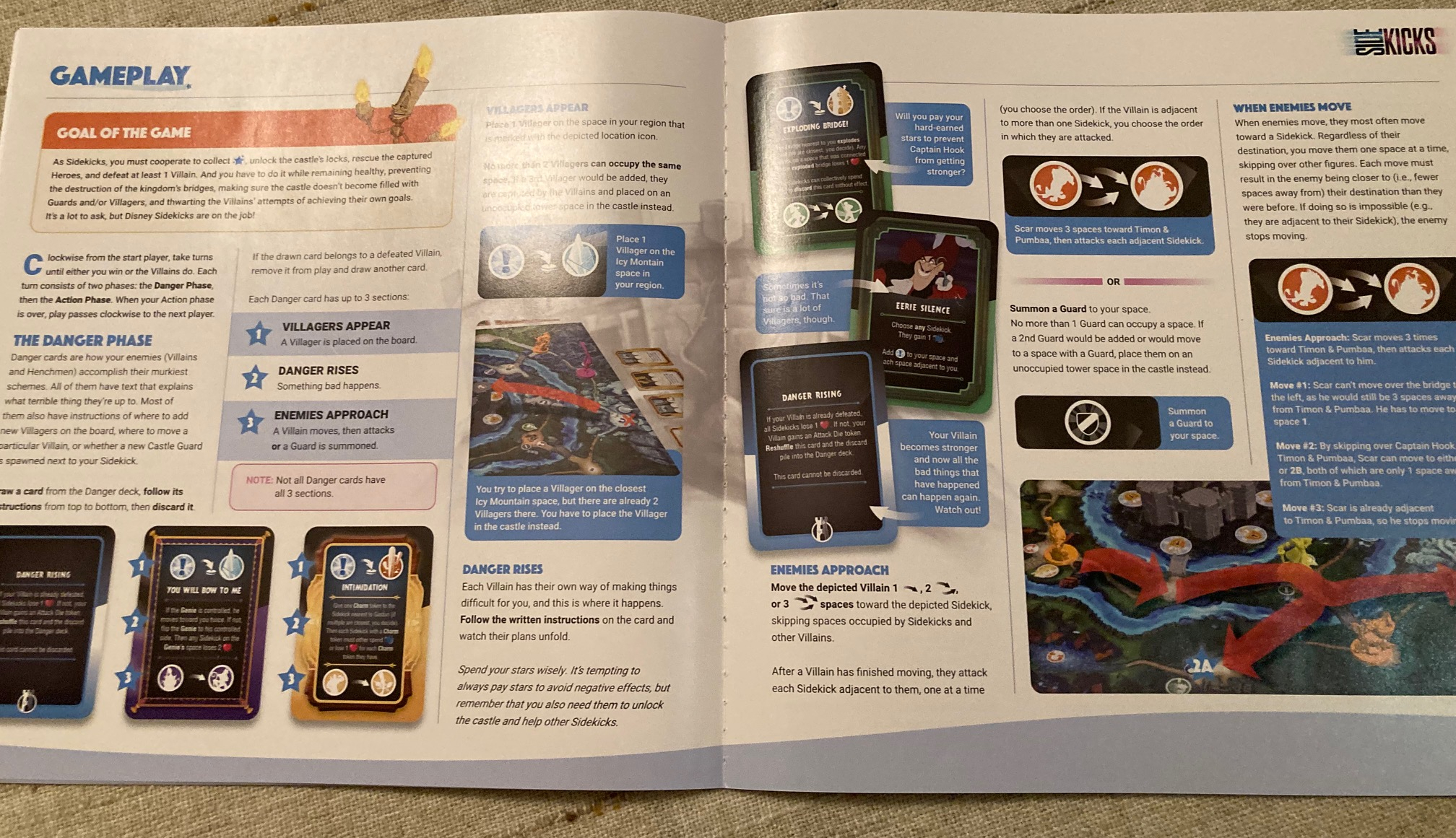
The discussion of gameplay starts in the middle of the rulebook.  Incidentally, I don’t know if ANYONE ELSE will notice this, but the rulebook is held together with STRING and not staples!!!  Is this a new trend??? Why did they do this??  I only noticed this because I have a friend who works in a youth juvenile detention center (using board games to help teach), and they have to remove staples before they can give them some books!  So, that’s kinda cool: Disney Sidekicks can go straight in!  (Well, the plastic minis might still be an issue …)

There are a lot of rules here, and the cards for each villain are NOT consistently made!  The villain cards come out in the Danger phase:  some cards have the “3 sections”, some don’t. This is very confusing when you are first playing the game.  Another thing that I didn’t see until my second or third time playing the game: sometimes the bad guys move more than 1 space … this is denoted by the number of arrows.  BUT IN THE EXPLANATION, THEY ACTUALLY USE NUMBERS WITH THE ARROWS!!  Why not use both?  If I see the number 2, it’s very clear to me “move 2”, but if I see just two arrows, maybe I think it’s just the icon for movement.   This is first of many examples in this game I call Poorly Labelled Components (see section below). 

IMG_7395

See above for some discussion of what the Sidekick can do.  But the mechanics are a little wonky.  In move, you can cause yourself to be attacked by guards!  By how do guards come out?  Where do guards go?  Turns out you lose if 5 guards comes out!  The guard rules are scattered all over the rulebook and are not consistently in one place.  It wasn’t until my second game that i realized guards can come out in the middle if a second guard is to be placed on a location with a guard.  Argh.  I had to search the rules.

IMG_7396

This is a personal thing, but I want to know the “GAME END” conditions right up front!!  This rulebook puts them at the very end!!! (See above) As I read the rulebook, I want to have in mind what I need to do and things that can kill me!  If I leave the “GAME END” conditions to the end, the rules being communicated have less efficacy because I don’t have any usage context.  

IMG_7390

The rulebook ends with a bang, though! It puts a summary on the back!!! Thank you!!!!  

I suspected I would like this rulebook, but I was wrong.  It looks great, and the graphic design feels like it should flow easily, but I found the rulebook to be poorly organized.  Some of the rules in the game were wonky, and hard to look up.   Even after playing a few times, I still felt like I was missing stuff, and it was hard to lookup rules because the organization was unclear.  (Another example: “skipping” spaces … what does that mean?  It was brought up earlier in the rules, but what does it mean?  After reading through the rules and seeing all the places this mentioned, it seems clear you don’t even count an occupied space on the board, so “skipping” over occupied spaces means you move faster! It’s not just “you can’t land there”, you don’t even count the space! This felt VERY unintuitive to me: the topography and movement changes because of occupied spaces?  An example describing this when it first brought up would have helped). 

Solo Play

There are no solo rules (thus violating Saunders’ Law).  Last week in Gargolyes Awakening, we suggested two solo modes: one with the solo player playing just one character, and another with the solo player taking the role of two characters and alternating between them.  This week, I think we HAVE to play two characters!  Why?  Because the maps are geared towards either 2-3P or 4P:

So, we are stuck with the 2-3 Player map, so we have to play two characters.

IMG_9791

The game worked fine for me with two characters. See above for first set-up.  I learned the game, and even won my first game using Abu and Tinkerbell (see below for winning game).

IMG_9811

The game seemed to flow okay, but I found out later I screwed up a lot of rules:

  • How do guards get placed?  
  • I forgot to put out more villagers initially
  • I didn’t move the Villains fast enough (see discussion in Rulebook about Villain movement)
  • I am pretty sure I screwed up the Pirate Ship

    So, I may have cheated, but I learned and had a decent time playing.  I did get mad that I couldn’t find a rule in the rulebook a few times. Grrrr.

The 2-Player solo mode seems fine.  There is an extra amount of intellectual overhead to run two sidekicks because it also means you need to run two villains!  So, maybe that extra intellectual overhead (running 2 villains AND 2 sidekicks) was deemed “too much” for a mass market game?  So maybe that’s why there’s no official solo mode.  It worked fine for me, but I can see it being too much (as a solo game) for a frazzled Mom or Dad trying to learn the game with the kids in the background saying “when are we going to play”?

Gameplay

IMG_7438

Disney Sidekicks looks like it might be a Castle Panic type game, but it’s not really. I’d say it’s more of a cross between Sidekick Saga (a cooperative superhero game) and Disney Villainous (a competitive Disney villains game). The theme (Sidekicks of the the heroes work together to save the heroes) as well as a lot of the cooperative mechanics are reminiscent of Sidekick Saga: each player controls a sidekick that moves around the board collecting good things (the Villagers) to help them defeat the villains in combat. The notion of the player-specific villain comes from Disney Villainous, where each sidekick has their own nemesis who stalks them around the board. The Bad News cards control what the villains do, as well as where Villagers (good things), and Guards (bad things) spawn.

Play is balanced by having “Bad News” happen (which causes one villain or the other to do something bad), and then the current player may do a few things. There are number of similarities to Pandemic here as well! For example, the Bad News cards (below) cause Villagers and Guards to spawn (kind of like in Pandemic for disease cubes).

IMG_9807

IMG_9781

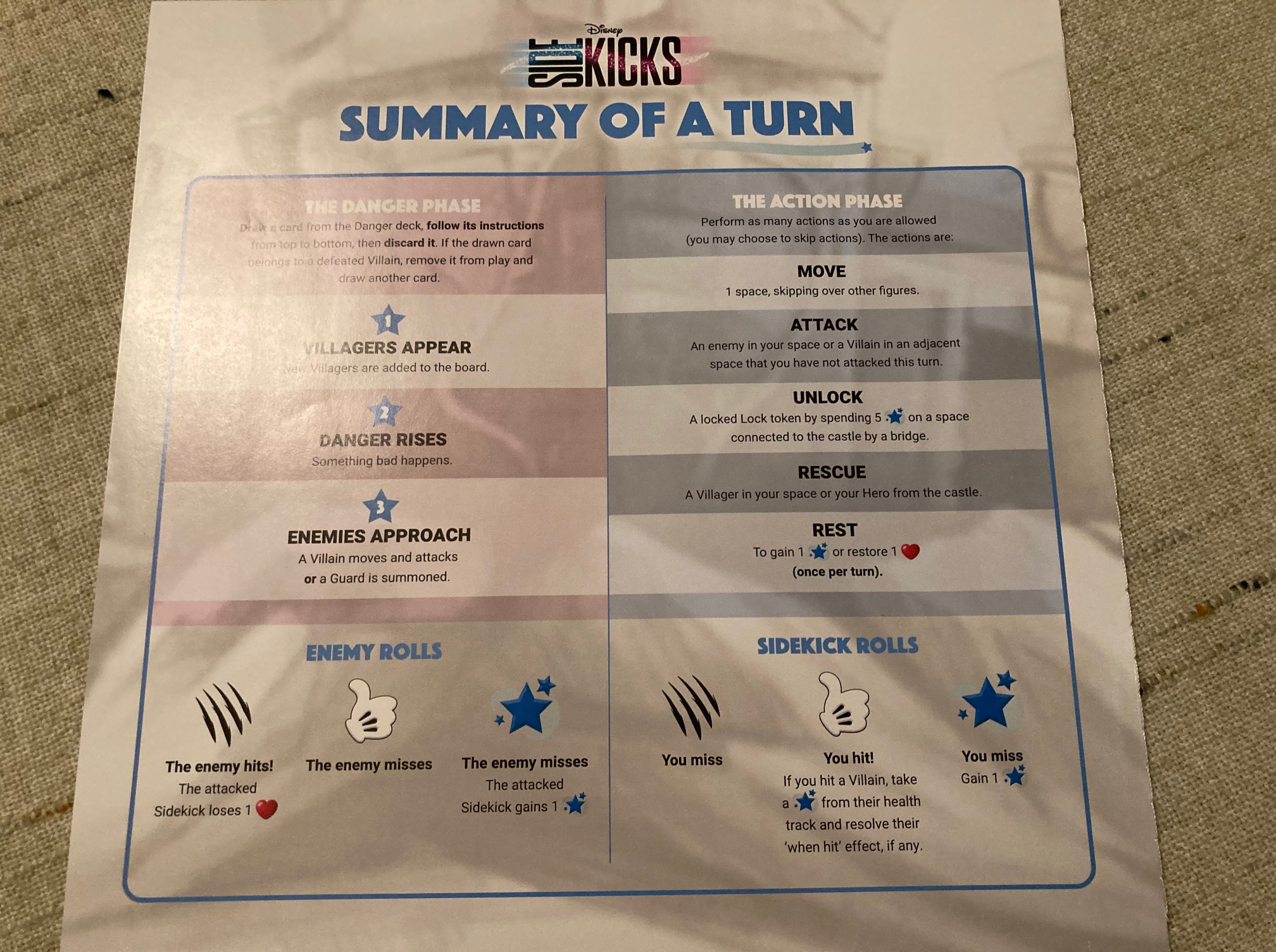
Also like Pandemic: this is an action point game: Abu (above) gets 4 action points on his turn (lower left number of Abu’s card). On his turn, he can do the following (described quite well on the player summary aid) durting the Action Phase.

IMG_7416

During his turn, Abu can move, attack, unlock, rescue, or rest.  Then the next player goes.

IMG_9813

Players move around the board and fight any of the Villains or Henchmen!  Above, Abu is adjacent to Jafar and can attack him if he likes!!  If the heroes trapped in the middle are saved AND at least one villain is killed, players win! See Jafar all down to zero hit points below!

IMG_9812

The game is all about trying to save the heroes (locked in the castle in the middle), retreating when necessary, and fighting the villains!   All combat is done with the combat die!

IMG_7435

And each hit does one point of damage!

Impressions

IMG_7444

The game was too random for me.  In one game, I was mostly healed (only down 1 hit points) and I went down to the castle to save my hero. After a bad draw from the Bad News (Genie trounched me for 2 hit points) and some bad rolls from the Villain attacking me (he hit every time), we just lost!  I couldn’t mitigate the dice rolls either or the Bad News deck draw.  We lost in one move and there was nothing I could do about it.

Lucklily, the game is fast enough (40 minutes seems fairly accurate once you have played a few times) that this may not be a showstopper for you.  

A bigger problem might be complexity versus intended audience.

IMG_9817

My niece and I played a game.  There’s no way she would have muddled through the rules and complexity to play this without me.  She COULD have (she’s a very smart girl), but I’m not sure she’s want to!  This is supposed to be fun for her!!  Because I had learned the game beforehand, I “made the game flow easily”.  So, she enjoyed that. I think this means: someone (Dad, Uncle, Mom) has to learn the game beforehand to make sure the game flows well for the younger or less experienced groups.  If the intended audience is 8+, then I am assuming one of the 2-4 players is an experienced hand who can shepherd the players through.  

I can’t imagine handing this to an 8+ year old kid and saying “Go play!”   This game is much more complex than that.  I think Gargoyles: Awakening last week would be easier to play, and it was rated as ages 10+ !! 

Poorly Labelled Components

IMG_9795

There’s a lot of components that should have been labelled better: either to emphasize mechanics in the game, or just to be more readable.  Consider the card above:  

  1. I can barely read what the icon is in the first sentence.  Spoiler: It’s a star!  That seems weird, because that is a bad news card, so I didn’t expect a star (a star is a good thing).  So, I had to take a picture of the card to zoom in and see it! 
  2. Why are villagers labelled with a “!” (an exclamation point)?  It doesn’t seem thematic, so it’s not really suggestive of what the piece does.  I think it’s supposed to a “!” when it contributes to a power (but THAT doesn’t make sense, because you need to see what the color of the villager is). 

Another example: The term region is used quite a bit in the game, and there is a blurb in the rulebook that talks about “inner and outer” regions, but a lot of the pirate ship text is a little confusing. See below.

IMG_9801

I finally did get it, but it didn’t feel like it was well explained.  And the rulebook had very little on edge cases, and there was no FAQ. 

Tiny Tokens

IMG_9777

The tokens, stars and guards and villagers, ARE TOO SMALL.  See above for a picture of scale!  I can barely pick them up!  They are hard to see across the table!

IMG_7441

Another issue with the tiny tokens is that they are a nightmare to put back in the insert.  You can see in the insert above, that there is space for all the tiny tokens.   They are so tiny and so fiddly, I have no interest in trying to spend the end of my game doing a “dexterity game” trying to fit all the tiny tokens into the insert slot!

IMG_7447

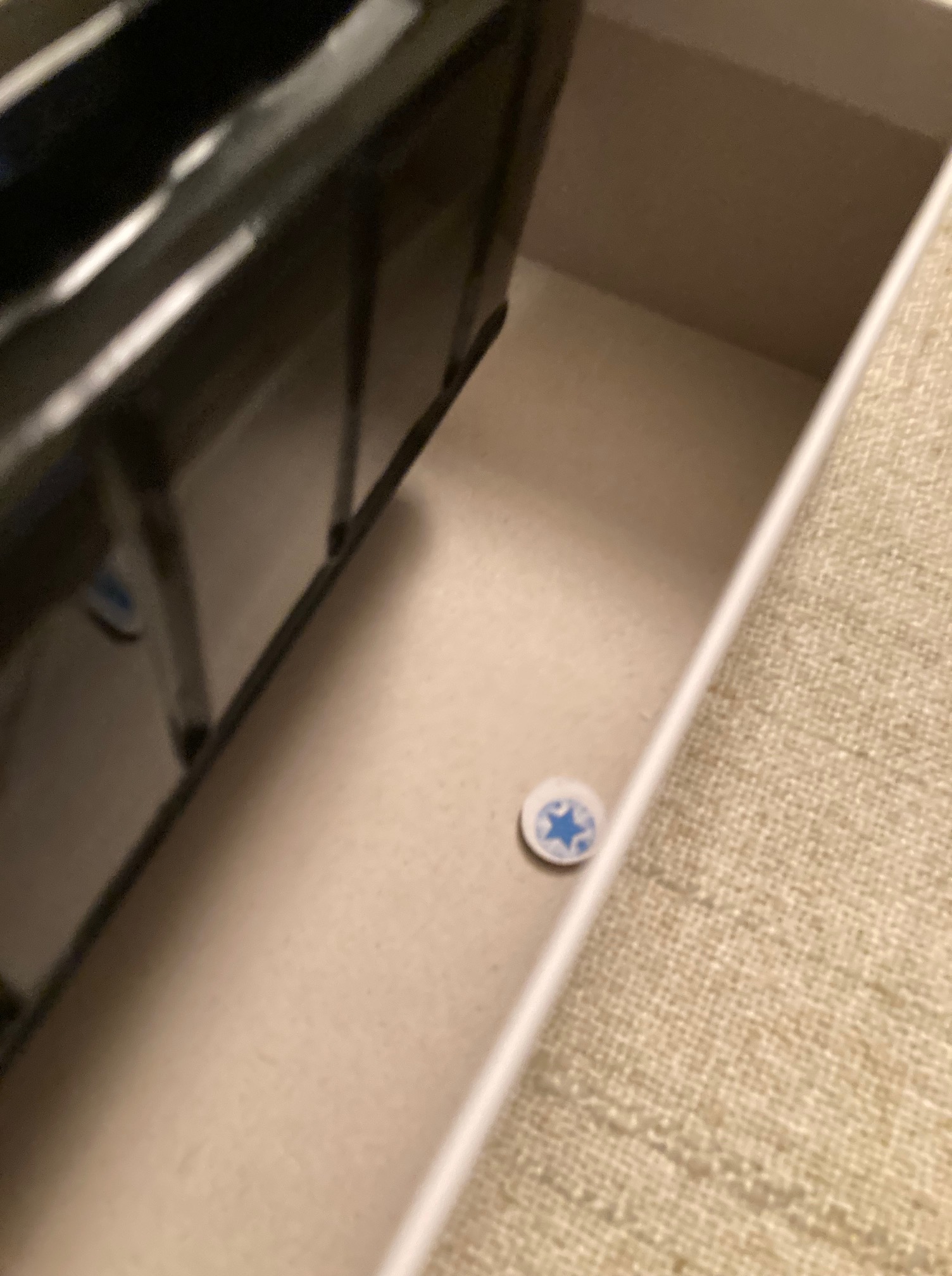
Also, if you try to take the tiny tokens OUT of the insert slot, they fall out below the box! See above.

IMG_7423

Of course, the reason the tokens are so tiny is so that they only need ONE token sheet: see above.  (Which weirdly came in its own plastic bag?  Can we get rid of the plastic bag and add another token sheet with bigger tokens please? See below).

IMG_7402

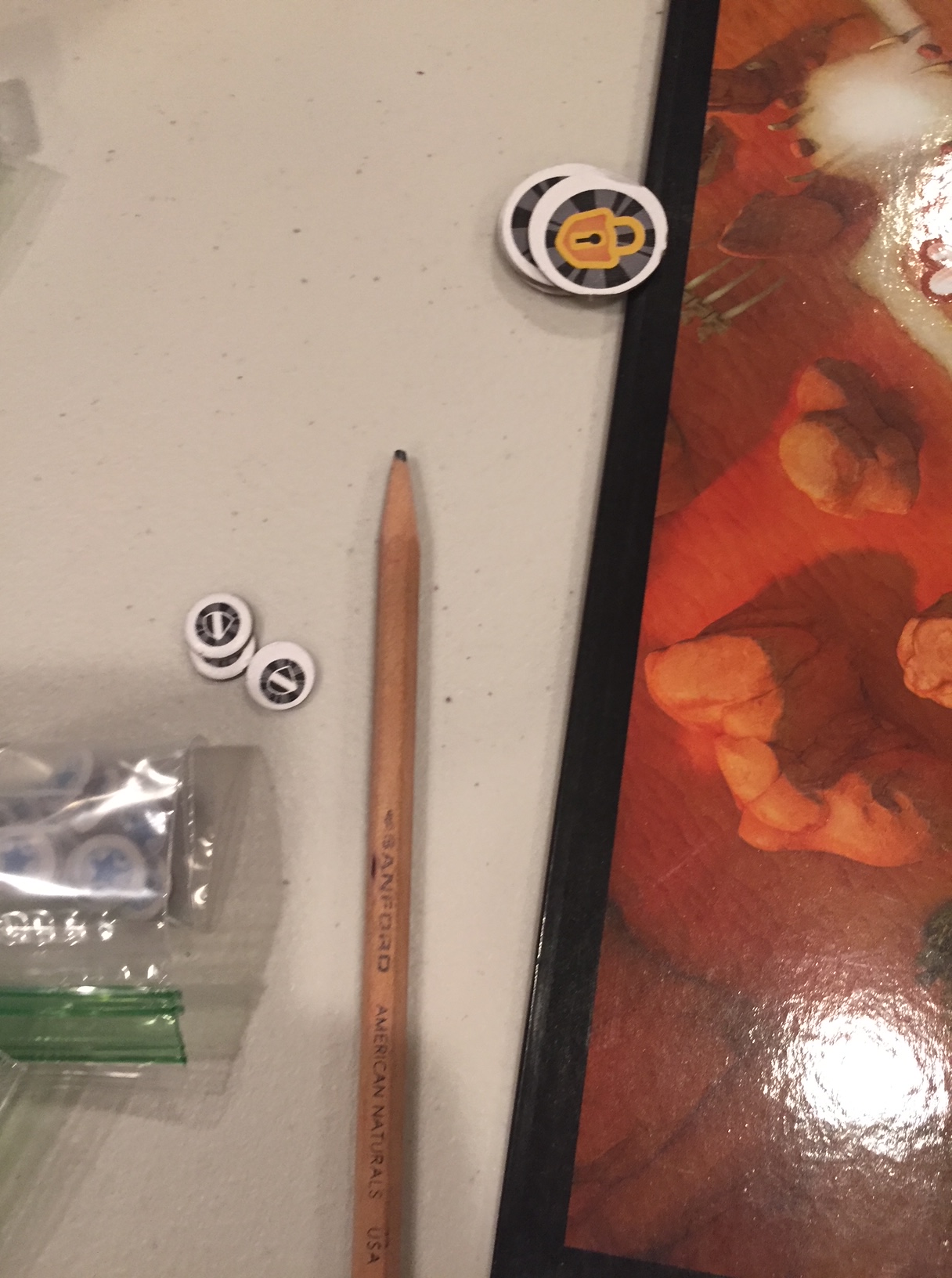
In the end, I got some plastic bags and just put the little tokens UNDER the insert (the insert is good for most of the other components) with a NOTE that there were components underneath!  (The note is for my future self as well as others: you know people might miss that there were tokens underneath).

IMG_9820

I am making a big deal out of these little tokens because they were very hard to play with, very hard to manipulate, very hard to see, and very hard to store.  I would have been much happier if the tokens were twice as big. I think it would have gone a long ways towards making the game more playable.  ( I am considering putting in something else in the game to take the place: cubes?  The problem is, you aren’t supposed to know what the colors are, so you need tokens you can turn over. I think.)

Conclusion

IMG_9811

I really wanted to like this game, but ultimately it was too random for me. The game says ages 8+ on it, but the game is far more complicated than it seems. There are just too many edge cases when playing: the rulebook didn’t do a good job of synthesizing gameplay, and the components weren’t well-labelled to emphasize a lot of the in game mechanics. Ultimately, this game looks really good: the components are nice, the minis are pretty good, the cards are linen-finished, the art on the cards is nice …. and that may be enough for you, as the game does play fairly quickly. If you liked Disney Villanous, but wanted a cooperative game, then this might be a good fit for you. If you wanted a simpler Sidekick Saga, this may still be a good fit: just be aware that the rules aren’t very good and there’s a lot of randomness.

For me, the game was too random to want to pull out very often. My niece thought it was pretty good. I’d play it again with her, but ultimately, there were a lot of other games she’d rather play. This week alone, I introduced her to Disney Sidekicks, Canvas, Century Spice: Golem and Splendor, and she preferred all the other games over Disney Sidekicks.

A Review of Gargolyes: Awakening, Part I. Unboxing, Solo Rules, and First Impressions

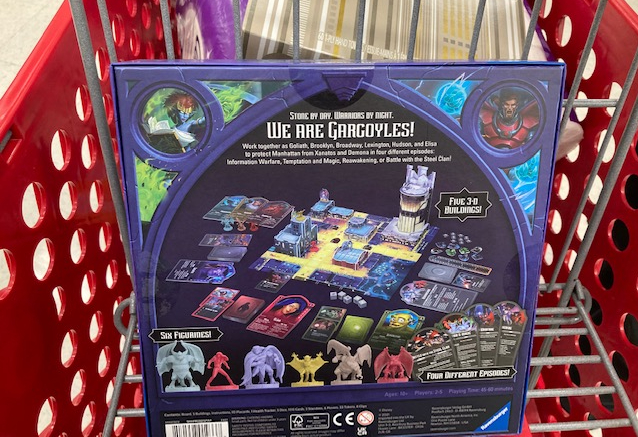
Gargolyes: Awakening is a (mostly) cooperative board game for 2-5 Players. It’s “mostly” cooperative because the game includes 4 scenarios, and 3 of them are fully cooperative and the last one is a 1 vs. all scenario.

IMG_7251

Gargolyes: Awakening just “officially” released today (August 1st, 2021) in Targets across the USA (see picture above). It’s a mass-market cooperative game from Ravensburger using the Gargolyes IP. I had friends who used to love the cartoon and tell me it was one of the best-written cartoons there was. But I personally have never seen the show, so I don’t have any “nostalgia” going into this game. I liked cartoons, I liked the look of the game, but I have no connection to the show.

IMG_7255

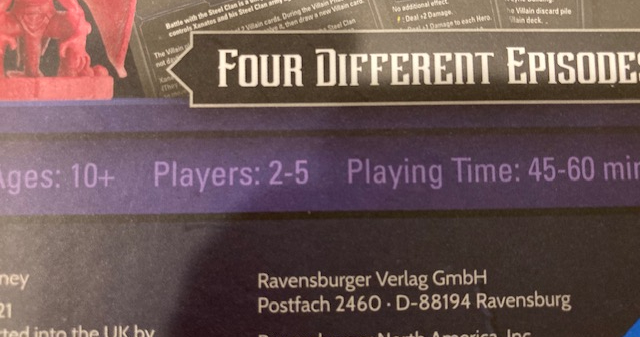
We know it’s mass market by a bunch of things; It’s debutting at Target, the age range is 10+ (see above), the box has no shrink wrap (it uses the stickers), the cards aren’t linen-finished, and there are only 4 scenarios in the box. Hopefully, it will still be good!

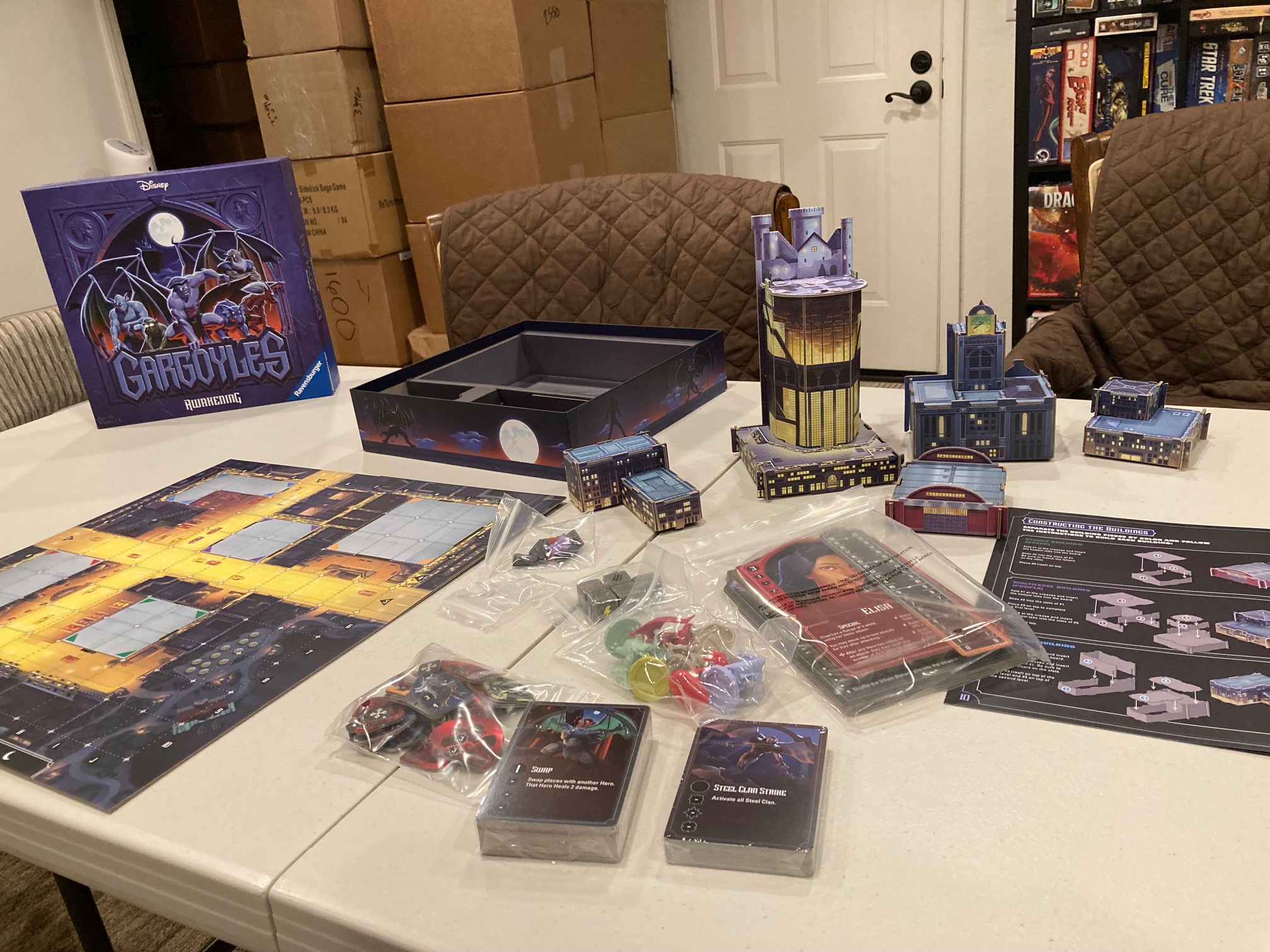
Unboxing

IMG_7257

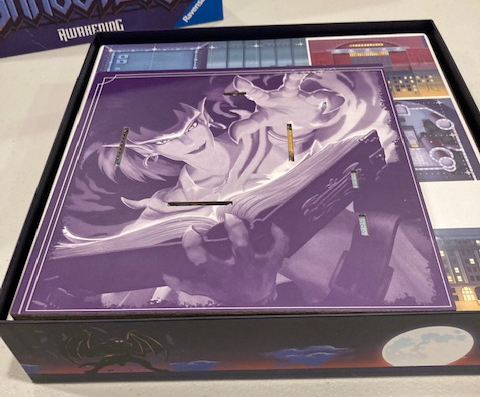
The game box looks really nice: the rulebook is the first thing we see upon opening.

IMG_7265

IMG_7267

The board is next: it’s a single-sided board. The city is on one side (see below) and the main gargoyles are on the other (see above).

Next in the box are SOME of the cardboard: there is a lot of cardboard in this game!

IMG_7269

Is it weird that they will shrink wrap the cardboard (there are 2 large sheets, see below) but not shrink-wrap the box?

Look above and you can see the two sides of the cardboard. These are SOME of the cardboard pieces needed to build the city. The sides with the colored letters are supposed to be “hidden” when the city is built.

IMG_7279

There another plastic bag of cardboard (!) inside that you need to build the all the city models.

IMG_7270

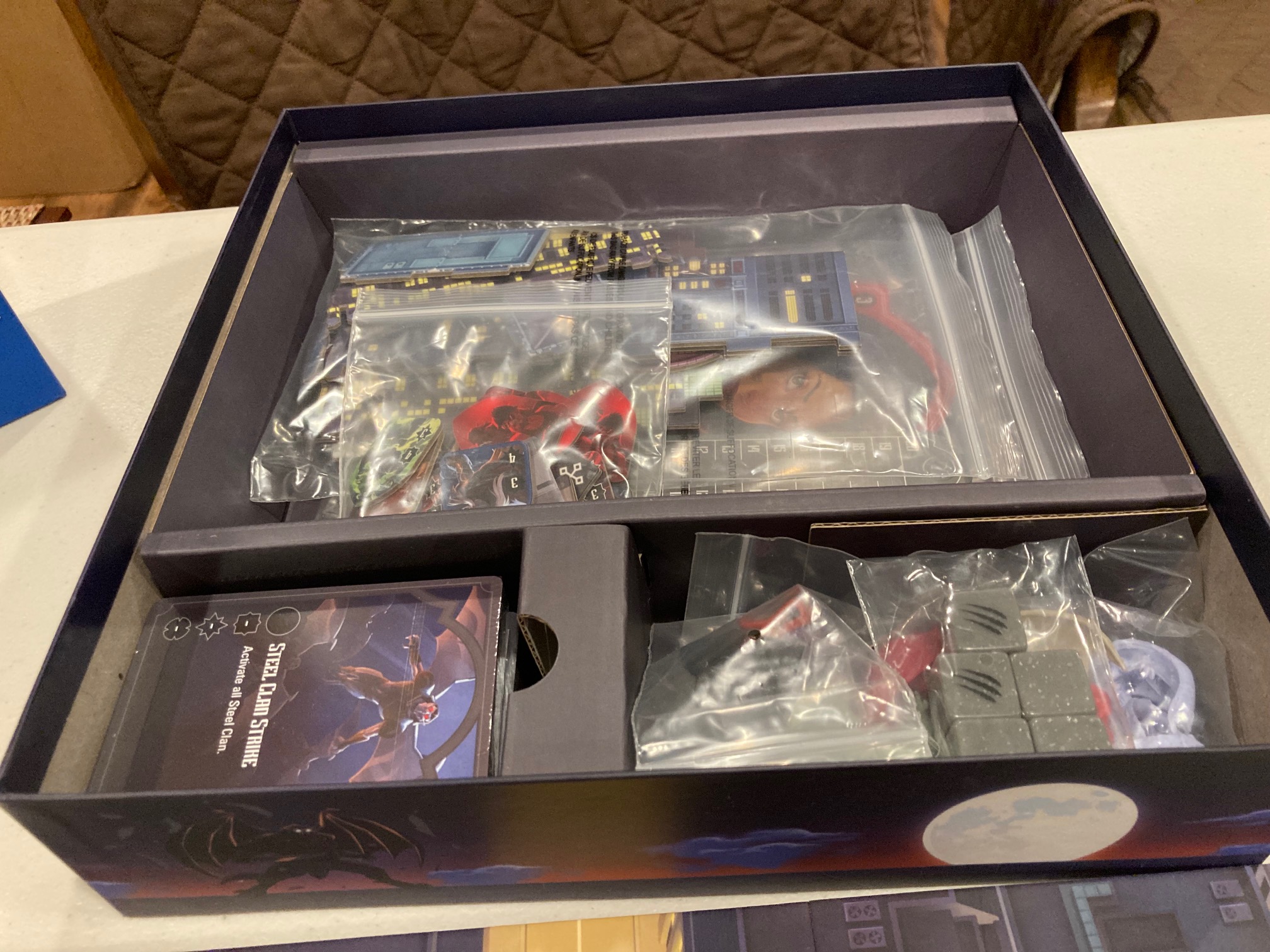
The rest of the box fits the rest of the components: cards, minis, dice, plastic holders, and plastic notaters (see above).

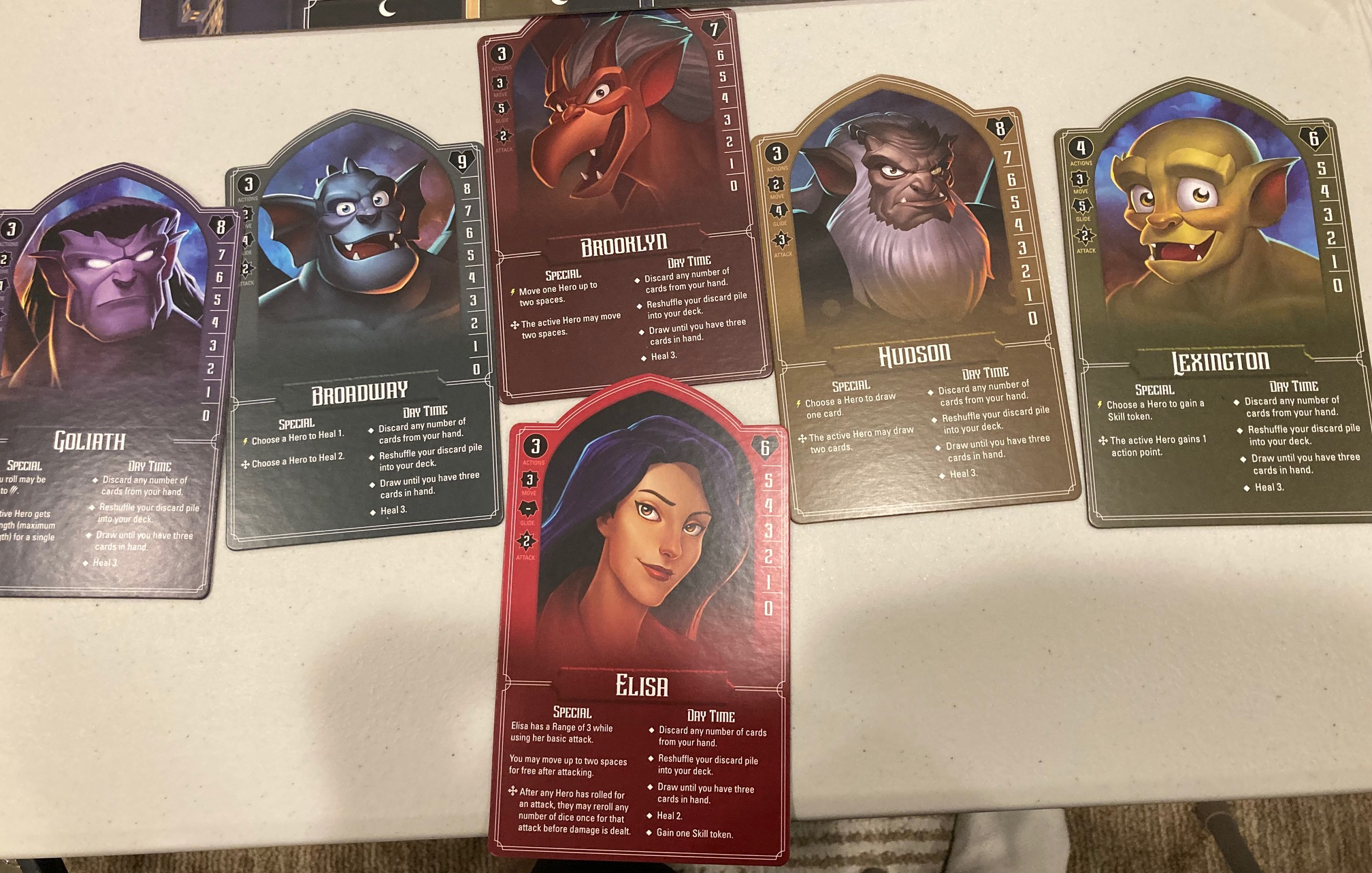
Above are the hero cards: there are 6 heroes, and each hero has 10 unique cards with unique art! That was actually pretty cool seeing that: they really thought about how different each character could be. The only thing that would make this better is if the cards were linen-finished. Each hero has its own color, so it’s easy to pick out which cards belong to which hero just by the color. Seriously, really nice.

The villain cards (grey bordered) look good too.  It’s not clear until you get into the game, but there’s a different pile of villain cards for each scenario: take a look at the backs.


IMG_7334

You’ll notice how the backs correlate to the symbol at the top of the scenarios:

IMG_7327

Each game, you choose one of 4 scenarios: Notice how big and readable the scenarios are!

IMG_7309(1)

Only the Battle With The Steel Clan is competitive: the other 3 are cooperative.

The hero cards and hero minis are really fantastic:

IMG_7312(1)

IMG_7314(1)

IMG_7310(1)

IMG_7311(1)

The Hero cards are easy to read and its very obvious by color and look which mini corresponds to which gargoyle. Seriously, we’ve played some games where that’s not 100% clear: here, you can tell very easily just by looking. And you can see this is a variable player powers game as all gargoyles have a SPECIAL power and special skill (the 4-sided cross).

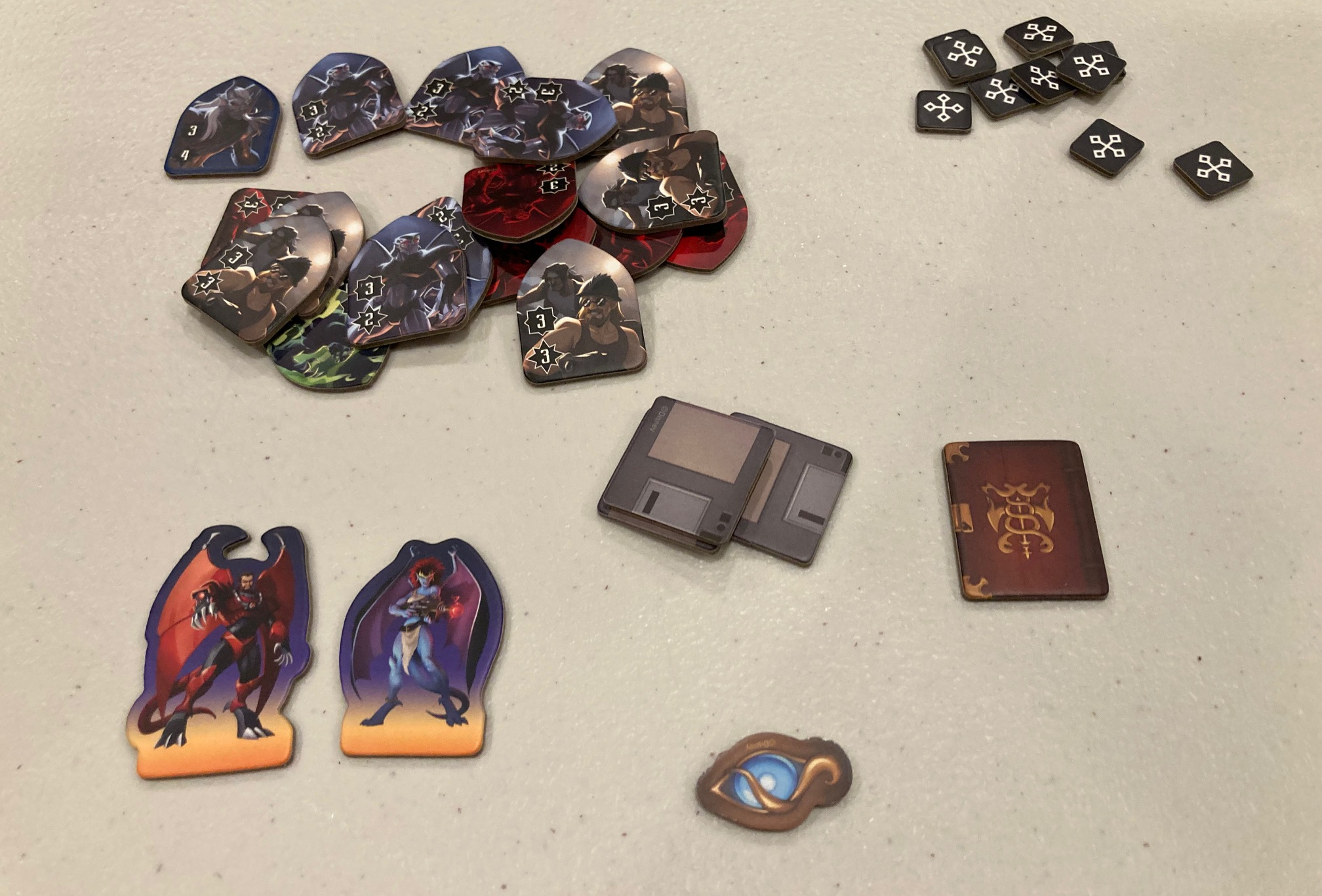
The tokens are pre-punched (which is odd in a mass market game: it must have been done to save money by using less cardboard). The tokens above are minions, objects, and skill tokens (with the little 4-sided crosses). They are nice and readable: see then sorted below.

IMG_7319(1)
Upper left: Minions. Upper right: Skill Tokens. Lower Left: Bad guys. Right, objects for scenarios.

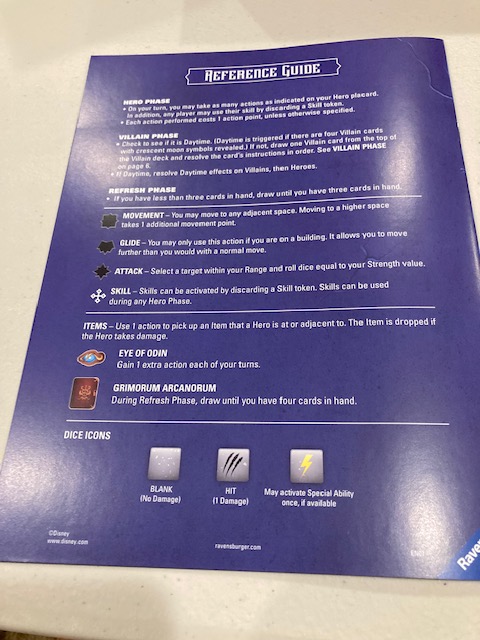
The game runs on dice: attacks are with dice and slashes hit and blanks miss. The little lightning bolts activate special powers.

IMG_7294(1)

Overall, the components look and feel FANTASTIC. They feel very thematic and just look beautiful on the table. BUT, see the next section for a big warning!

Fragile Building Punchboards

IMG_7324(1)

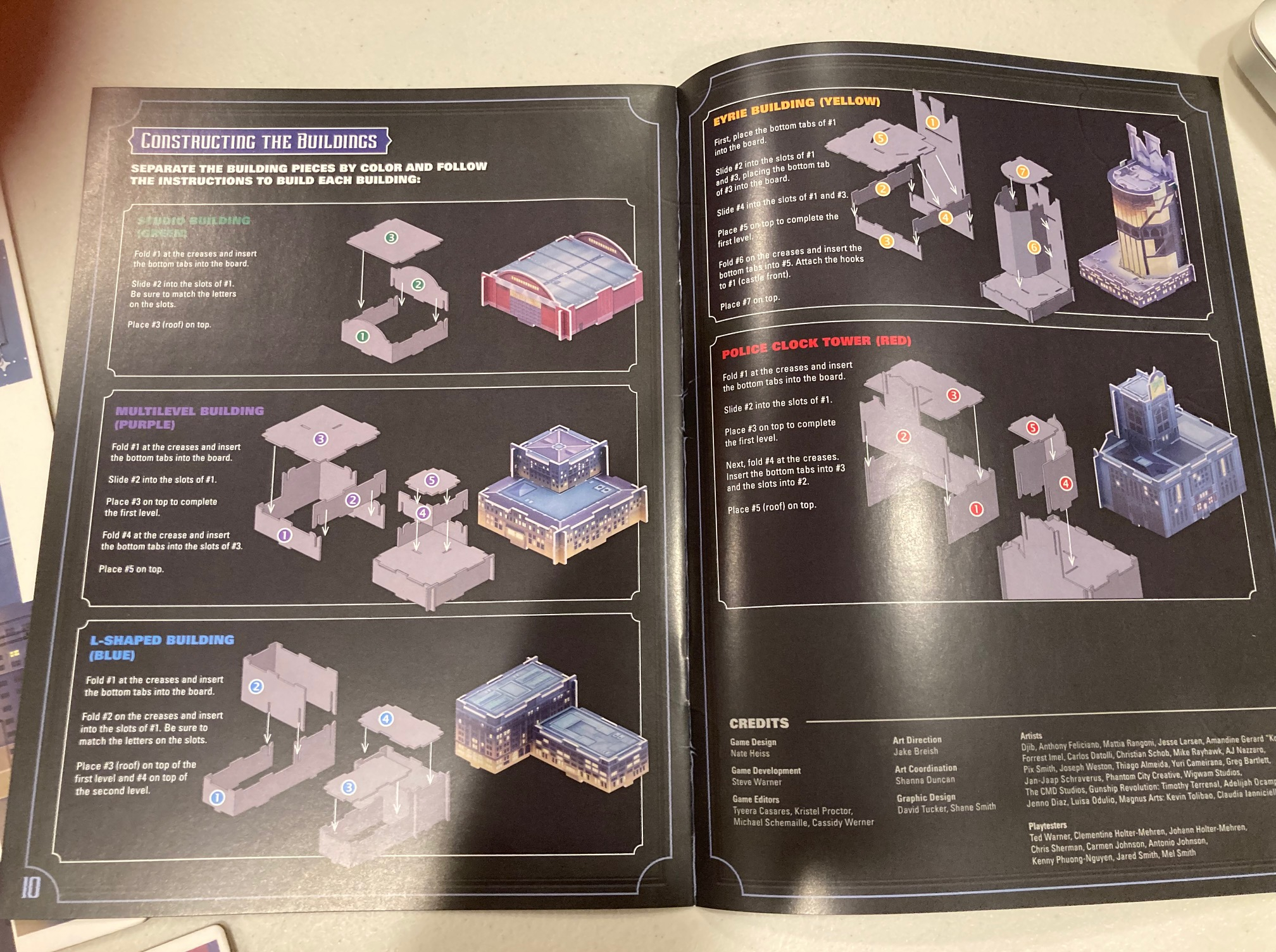
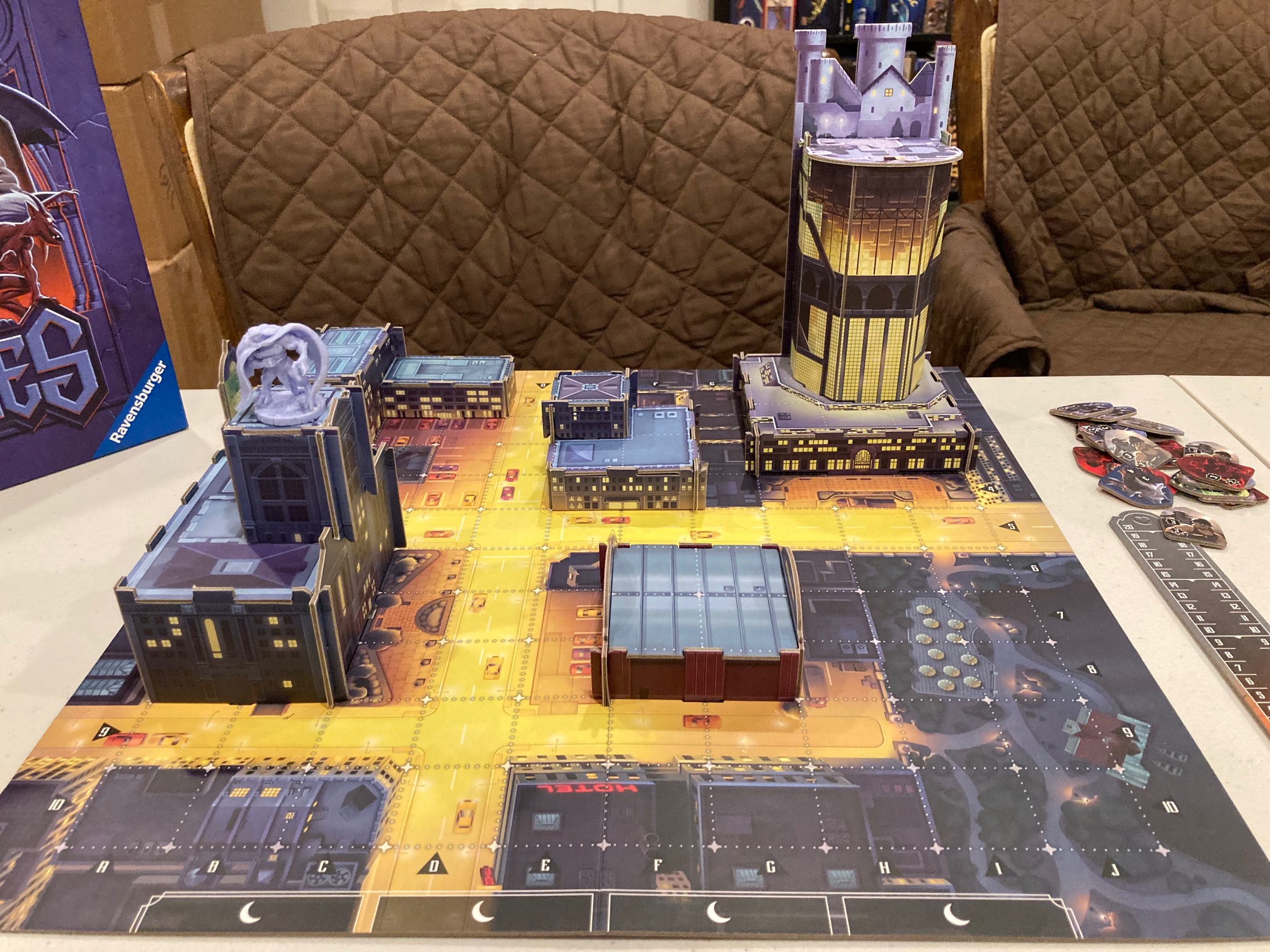
As part of setting up the game, you have to build the buildings: there are 5 buildings (see it built above). And it looks really cool when it’s built! The instructions are in the booklet (near the back, an odd choice).

IMG_7275

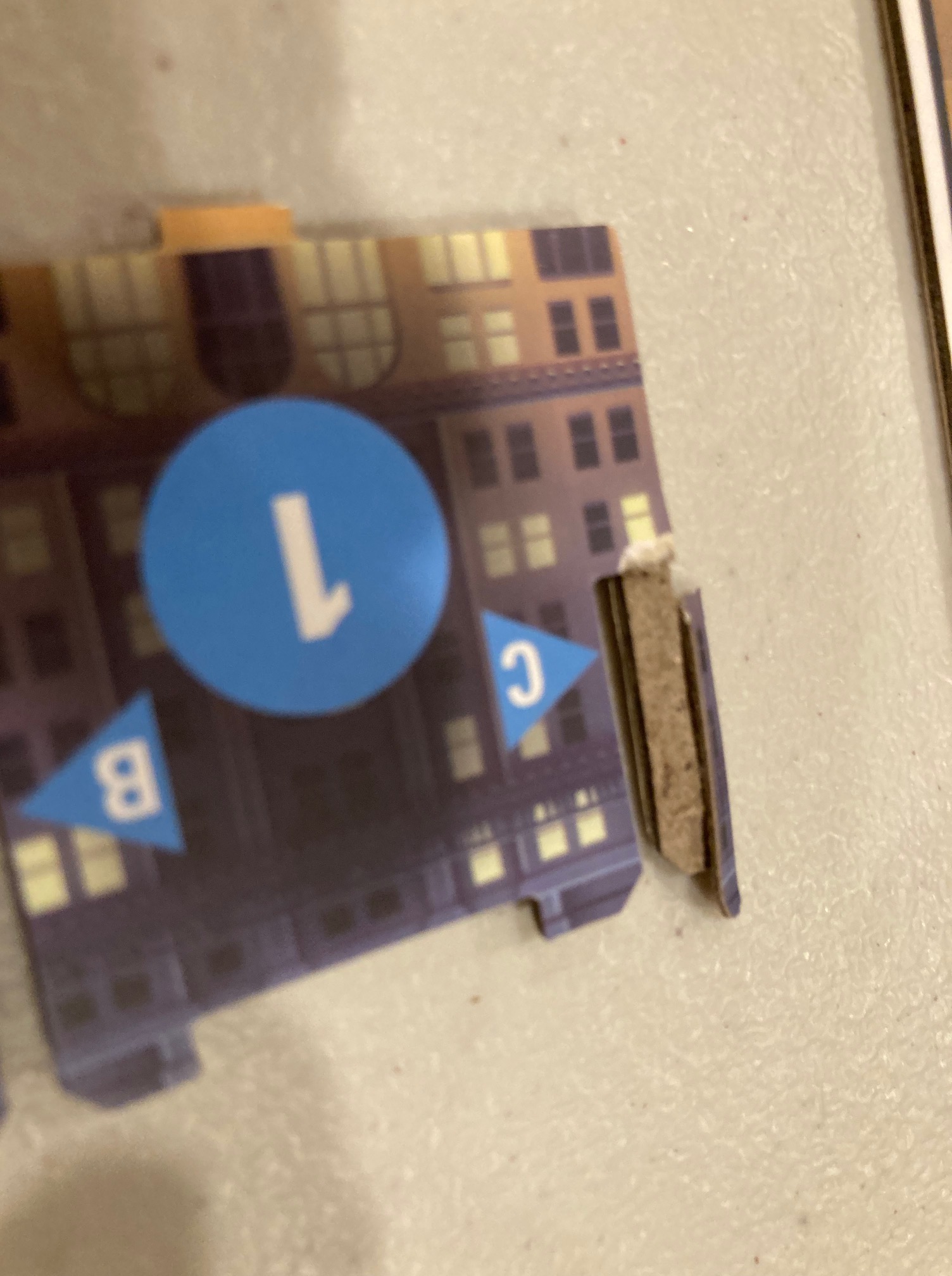
Here’s the problem, you have to be VERY CAREFUL punching out the building pieces! If you get nothing else out of this review, BE CAREFUL WHEN PUNCHING OUT THE BUILDING OR THEY WILL TEAR.

Take a look at some of the pieces:

Notice how tiny some of the junctures are: if you aren’t very careful, they will rip on you! I accidentally ripped one on punching these out.

Notice that I tore the little piece! See above left! Using some tape (above right), I was able to salvage it. “Ok, I’ll just be careful for the rest and it won’t happen again”. WRONG!

IMG_7285

Even KNOWING to be careful, it’s still hard to punch these out!!! See above.

IMG_7286

In the end, I used a knife to carefully hold/cut around the problem edges. That seemed to help.

Overall, I think I tore 3 pieces and almost tore a bunch more.  The punchouts seem EXTREMELY fragile, so learn from my mistakes and be extra extra careful punching out the buildings!  Consider using a knife!

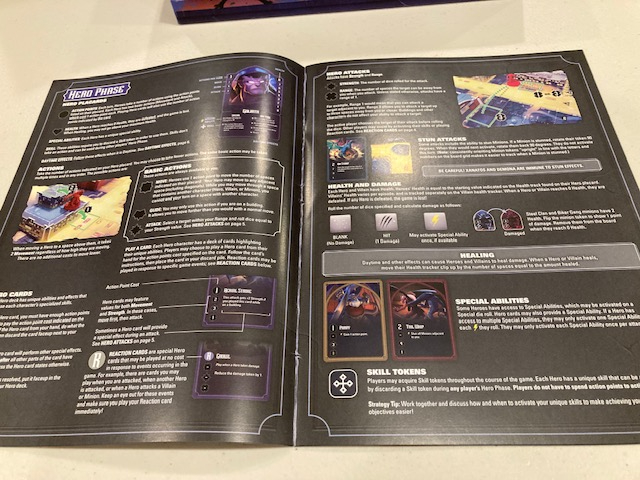
The Rulebook

This rulebook will win no awards from me. It just isn’t great.

IMG_7259

The first two pages do a good job of showing set-up and discussing components, but notice how small the font is? And the color choice not great for readability: I frequently complain about white text on black backgrounds (Hexplore It: The Forests of Admiron and Bethel Woods both had this problem) because it smears easily and tends to be harder to read.

IMG_7260

The rules could be better: they seem to be cramming as much as possible in a few pages. Again, tiny font.

IMG_7261

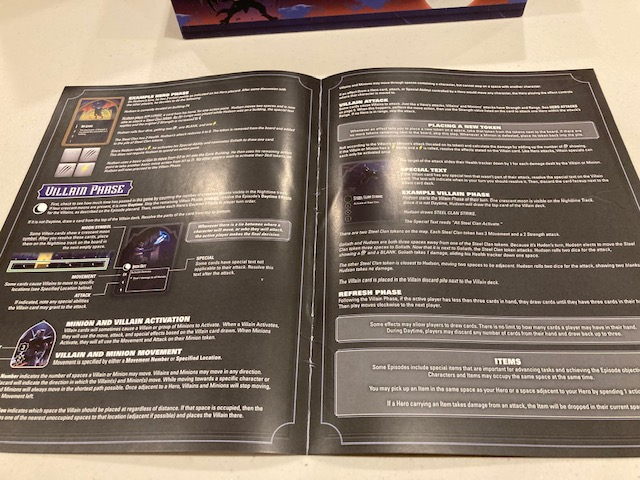
The Villain phase pages are frustrating because the discuss the moon track before they discuss how it comes about: it’s an ordering issue .. how do you discuss something you don’t know about?

IMG_7262

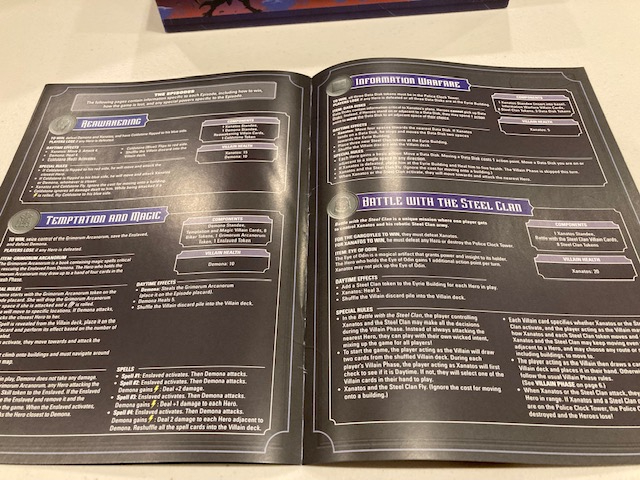
They show all the scenarios over two pages, but you know what? I didn’t need this! All the text is on the scenario cards themselves! This is extraneous! I’d rather reclaim these two pages for the rules, clean them up, add more pictures, and add a bigger font. Take the scenarios OUT of of the rulebook because most of the rules are already on the cards!!!

IMG_7264

They did do something right: they put a summary on the back of the rulebook. Thank you! That was actually very helpful in getting through the game!

This rulebook wasn’t good but it wasn’t bad. It made some poor readability choices (font, color), wasted space (scenarios), and organized some things poorly. I was, however, able to learn the game from the rulebook, and it did discuss some edge cases in the rules. I do think, as a I play more (spoiler alert: I liked the game enough to want to play more), I suspect the rulebook will miss some edge cases. Ah well. It was “good enough”.

Solo Rules

IMG_7255

Unfortunately, there are no solo rules for the game.  At all.  (See Saunders’ Law).  There are usually two choices when trying to play a game solo:

  1. Try playing a single character solo, and see what might need to change for balance
  2. Play Two Characters solo (alternating between them), and adjust balance if there’s any hidden information

The main balancing mechanism in this game for multiple players is that when player has a turn, then the villain has a turn.  So, a player turn will always be balanced by a villain turn, so there’s no need to do anything special.  Similarly, there is no hidden information in the game so all information can be shared.   Either way would probably work for solo rules: I went ahead and chose to play a single character (Goliath).

IMG_7311(1)

And then set-up appropriately:

IMG_7358

And you know what? This seemed to work fine for a solo mode! I later learned there ARE cards that require muitiple players:

But it looks Goliath is a character that can be played solo, as none of his powers or cards require other players. One thing I DO worry about is the number of hit points. Two characters in the game have twice the number of hit points of a single character. It seems like something some play testing might have to bear out. So, here’s what I might say for solo rules Gargoyles: Awakening:

Gargoyles: Awakening can be played solo two ways:

  1. Have the solo player play the single character Goliath, but add 5 Hit Points
    (or)
  2. Have the solo player take the role of any two characters, alternating play between them (essentially playing a two player game)

This game seems like it would have been really easy to add solo rules to.

Gameplay


IMG_7342

This is an action points game(like Pandemic is an action points game): each Gargoyle gets 3 action points per turn. You can do base actions for one point each: move, glide, or attack:

The glide action is interesting: it takes advantage of the cityscape and tall buildings! If you go from higher building to lower buildings, you can “glide” and move further!

IMG_7354

The cards you have are more powerful and allow you to do more, but require more action points:

IMG_7346

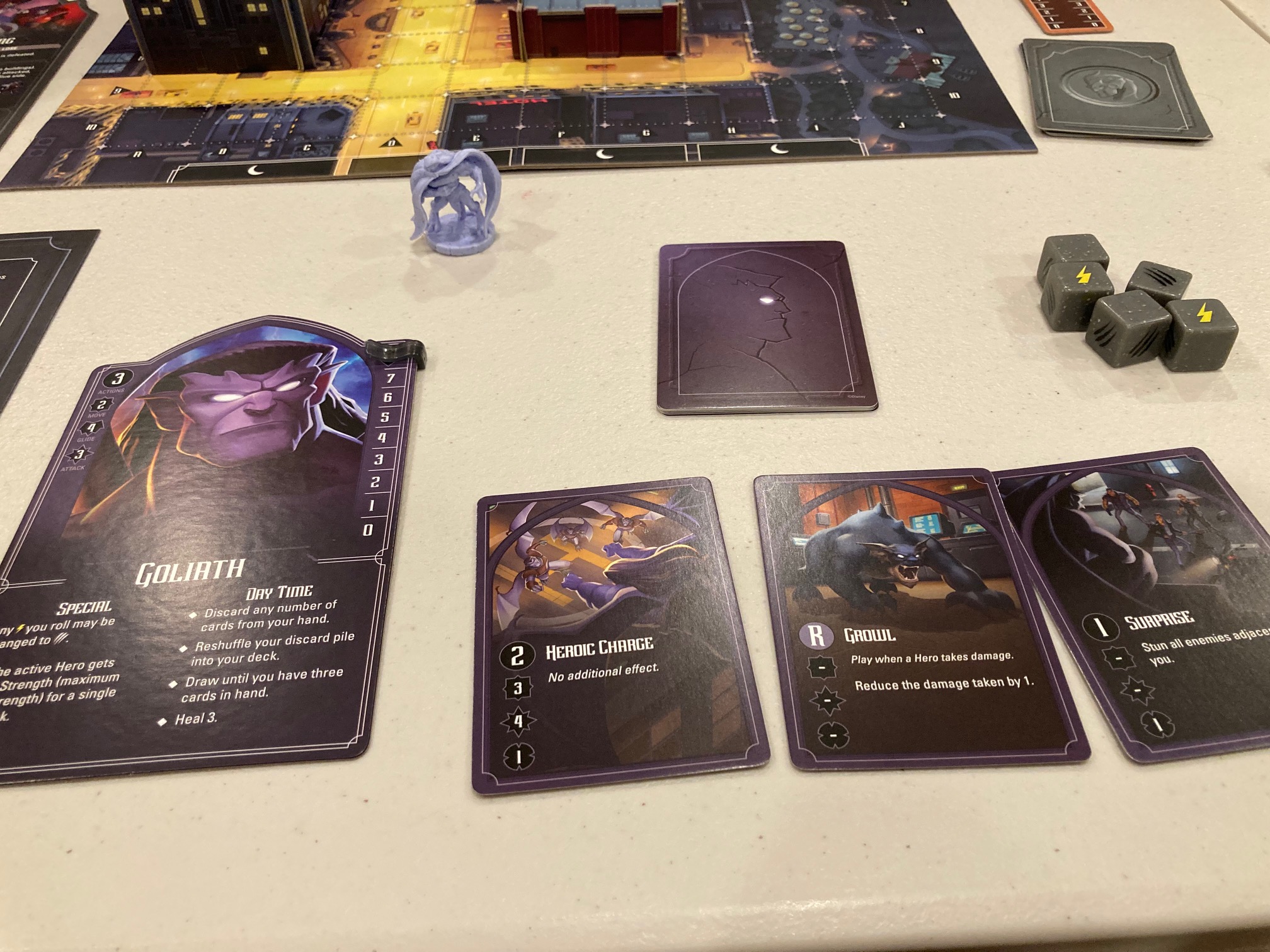
The “Heroic Charge” (see above) requires 2 action points but allows you to move AND attack slightly better! The “Growl” (above) is a REACTION: you can discard it and use it at the appropriate time.

After the Gargoyle plays, then the Villain has a turn, drawing a Bad News card: these usually cause some bad guys to move and attack our heroes:

If you have enough 4 New villain cards with a Moon on it (the above has an empty moon, so doesn’t count), then Day Stuff happens. These are on both the Scenario card and the Hero cards:

And then everything starts over! If you can achieve the scenario’s objective, you win! Note that the win and lose conditions are described very clearly on the Scenario card.

First Impressions

IMG_7360

So, I either wildly won or wildly lost my first game, depending on how you look at it. As Goliath, I moved straight to Demona and took her out in 2 turns. Then, as Xanatos moved to me, I took him out “mostly” over a few turns, with him doing minimal damage to me. I need to turn Coldstone to blue side, so I took two turns and rolled 18 DICE to try to roll just 1 lightning (each die has only 1 lightning symbol). I failed! (Really? 18 dice and not a single lightning????) … and ColdStone “killed” me … if I only had 8 Hit Points … BUT, if I had 13 Hit points (because I am playing solo), then I won after letting him chase me around the board (I was waiting for Day so I could heal).

It was pretty easy. But it was fun. I think this game is meant for families and younger players, so the fun part of the game is moving around the buildings and attacking the Demons and Gargolyes! I mean, the game DOES say 45 minutes, so it is a shorter game.

I may have cheated since I used my “made up” solo rules. But I don’t think so! I had fewer parallel actions and fewer hit points as a solo player, so the solo game was definitely harder than a 2-Player game. And it was still pretty easy. But, it was fun moving around the city, “gliding” from building to building, and beating up demons.

Conclusion

IMG_7360

This is a light co-operative game. It’s pretty easy: there’s not a lot to it. The best part of it is playing in this 3-D city, gliding around and fighting demons. I liked this enough that I want to play it with my game group and see how it goes as a cooperative game (ignoring the one non-cooperative scenario in the game).

The gameplay is a little limited, as there are only 3 (4 if you count the competitive) scenarios, but I suspect you can play them multiple times and just use different scenarios to mix it up.

There are some warnings here: if you get this for your family, probably punch it out by yourself VERY CAREFULLY. Nothing spoils a game night more than torn components! Similarly, Dad or Mom should learn the game by themselves first because the rulebook really isn’t great (and it’s not fun to watch someone try to lookup rules during gameplay). Once Mom or Dad knows the rules, the game can flow pretty quickly. Also, be aware that you will have to rebuild the game everytime you open the box (see below).

For a mass-market game, this looks great on the table and is pretty fun. Just be aware of the potential issues.

Addendum: Putting The Game Away

IMG_7362

How do you put this away? There’s no way all these buildings will fit in the box! Yep, you have to take it apart ALL THE BUILDINGS every time you put it away.

It’s actually kind of a lot of work. But it will all fit back in there.

Just another caveat emptor on this game.

RichieCon 2021 and Top 10 “Interesting” Cooperative Games

RichieCon 2021 has come and gone this last weekend and was a success! We had to suspend RichieCon 2020 (for obvious reasons) but we “remembered” RichieCon 2020 with a C++ post-increment on this year’s RichieCon token (see above). 20++ is 21 … if you look at it after the sequence point.

RichieCon 2021 continued the traditions of RichieCon 2019 and RichieCon 2018 with a record number of people attending from all over the USA! Attendees were from Austin TX, Hays KS, Phoenix AZ, Tucson AZ, Sonoita AZ, Las Cruces NM, Albuquerque NM, Madison WI, and Ft. Collins CO! See some attendees below helping with clean up.

IMG_7186

Day 0: First Game … Kapow!

The first game of RichieCon 2021 was played innocuously in the mancave! I usually can never get 2-Player games to the table, but with Joe (aka Junkerman) here, I was able to play Kapow! Longtime blog readers know I love superhero games (see the Top 10 Cooperative Superhero Card and Board Games here), and even though this one wasn’t cooperative, it was a blast!

In Kapow!, you build dice and buy new “faces” for the dice or just new dice! The mechanics worked really well, it was fun and pretty quick! It’s a 2-Player dice game that looked good, played fast, and had some really neat dice. Great way to start!

Day 0 … Nighttime: Las Cruces House

IMG_7136

One of the bigger groups from Las Cruces rented a “group” house for playing game when we couldn’t get to the Rec Center. We affectionately called this “RichieCon After Dark”. See the Las Cruces contingent playing (to no one’s surprise), 7 Wonders. The first night of RichieCon 2021 was spent playing games there!

IMG_7144

Day 1 … Morning: Rec Center

IMG_7146

Some of the first attendees playing the Reckoners (one of my favorite cooperative Superhero games).

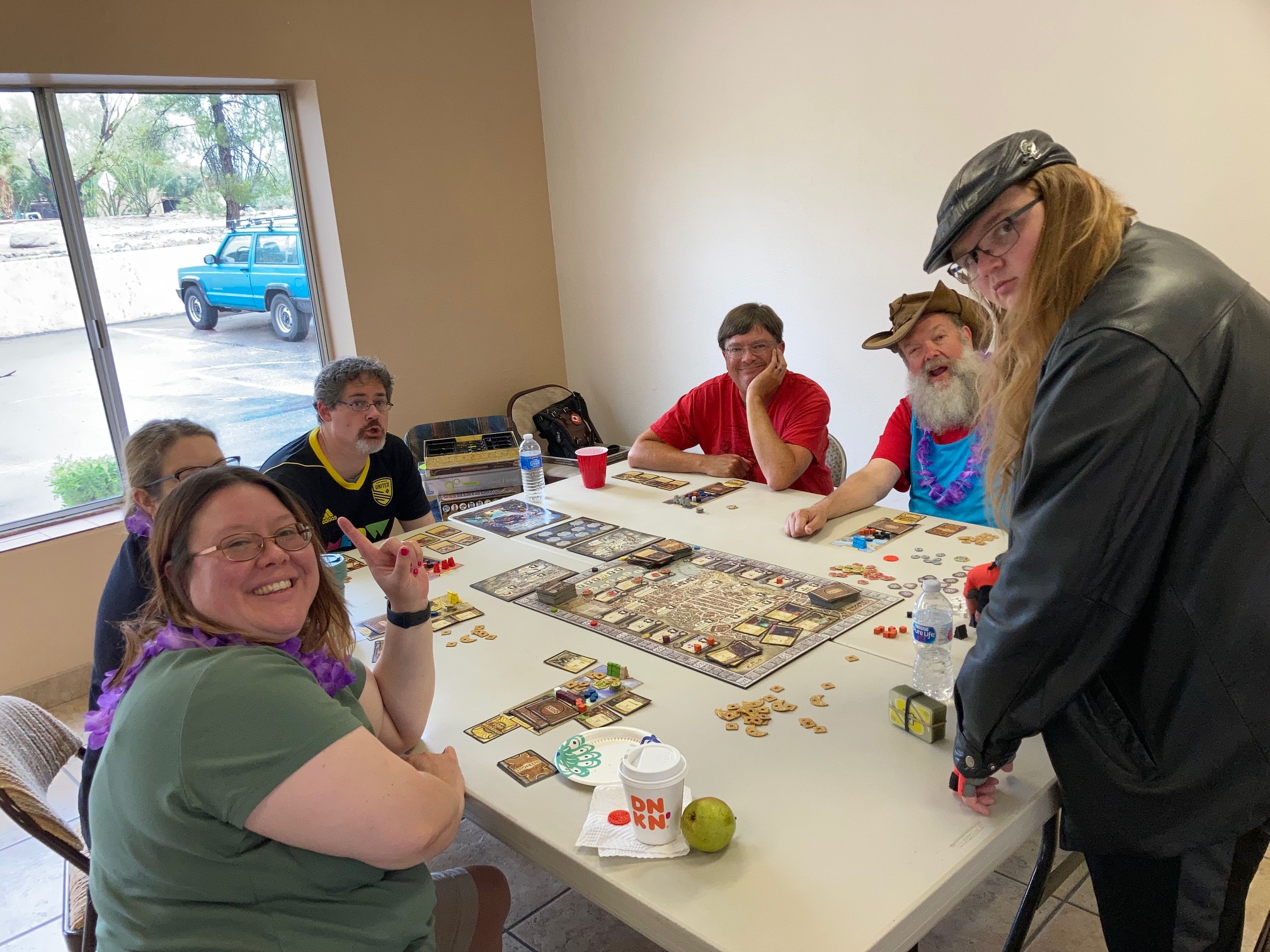
IMG_7149

Lords of WaterDeep, 6 Player game!

IMG_7151

Come back later … still going? That’s a long game!

IMG_7154

Century Spice Road, Golem was a hit! I think I played it 3 times and I saw it played MANY times!

IMG_7155

An Intro game of Dice Throne for a bunch of people!

IMG_7156

Defenders of the Realm! A Richard Lanius game: Pandemic meets D&D!

IMG_7157

Nathan and Caroline and Anders teach CrossTalk: designed by a friend of theirs!

IMG_7159

Rescue Polar Bears! A cute cooperative Pick-up-and-deliver game with little Polar Bears! It’s s deceptively hard co-op!

IMG_7160

Wait, they are STILL playing Lords of Waterdeep?

IMG_7161

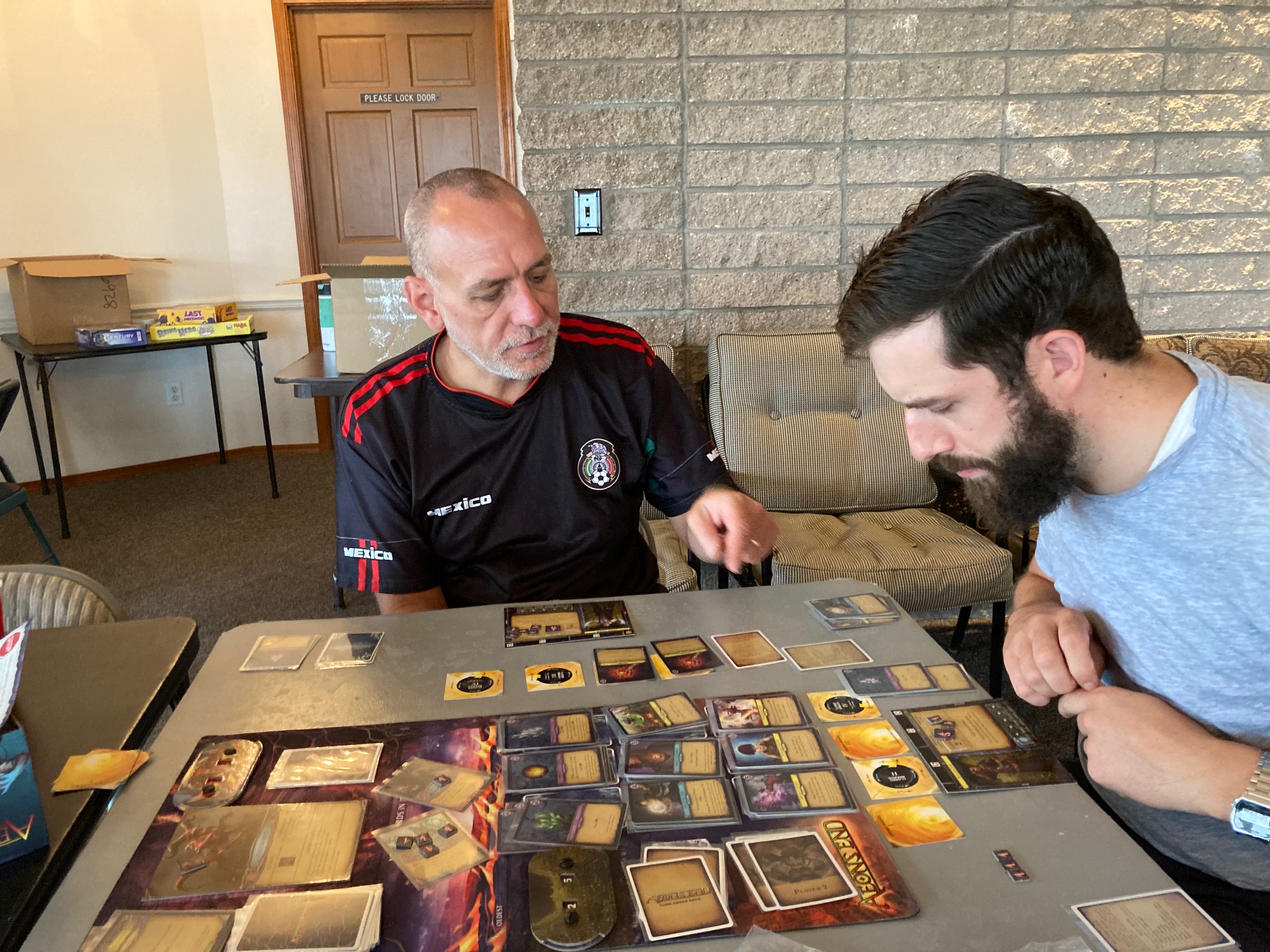
Aeon’s End! The original! With the ORIGINAL art! It made our Top 10 Cooperative Deckbuilding Games!

IMG_7168

More Century Spice: Golem Edition! I had to give up my seat to teach …
IMG_7164

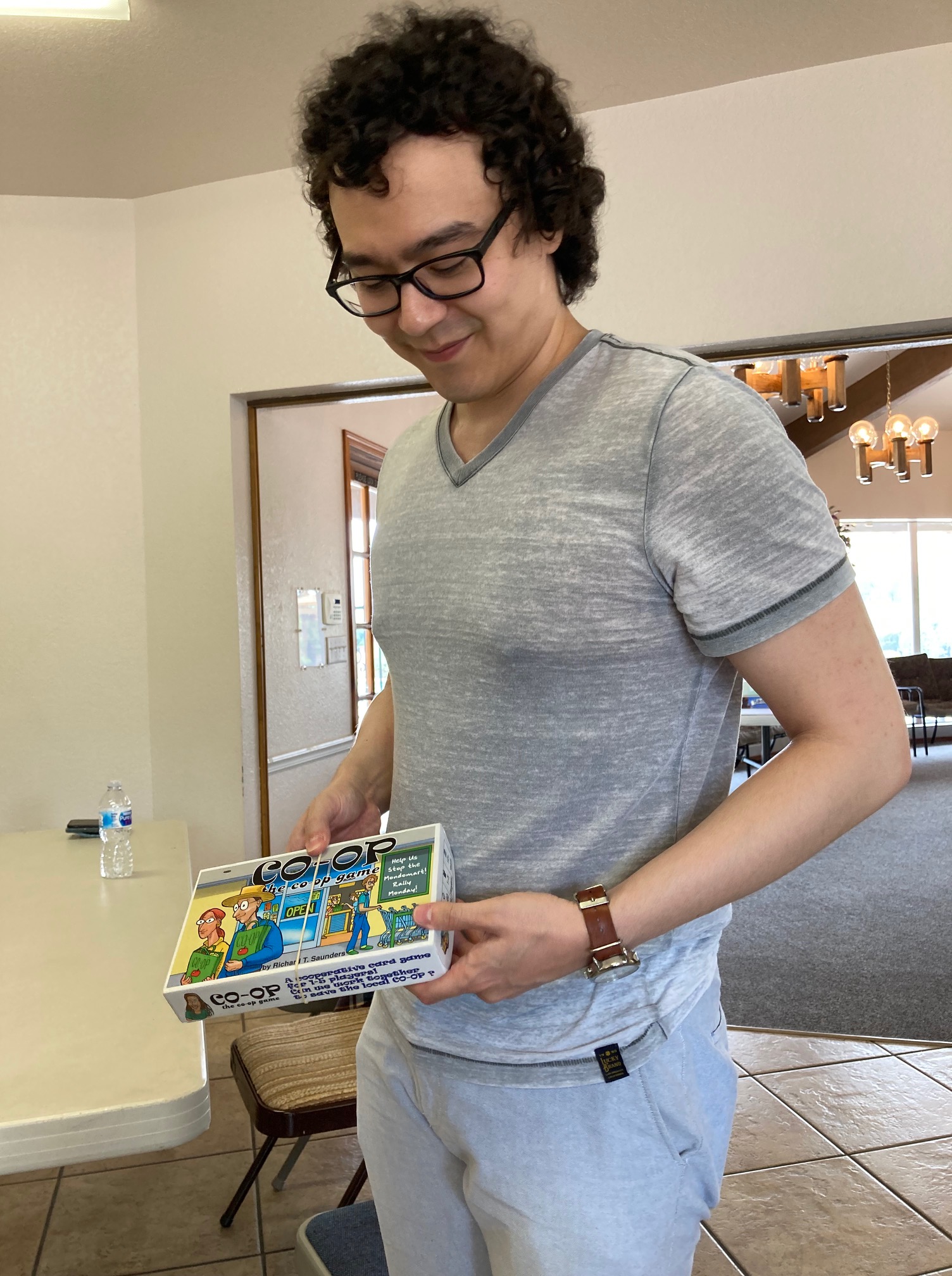
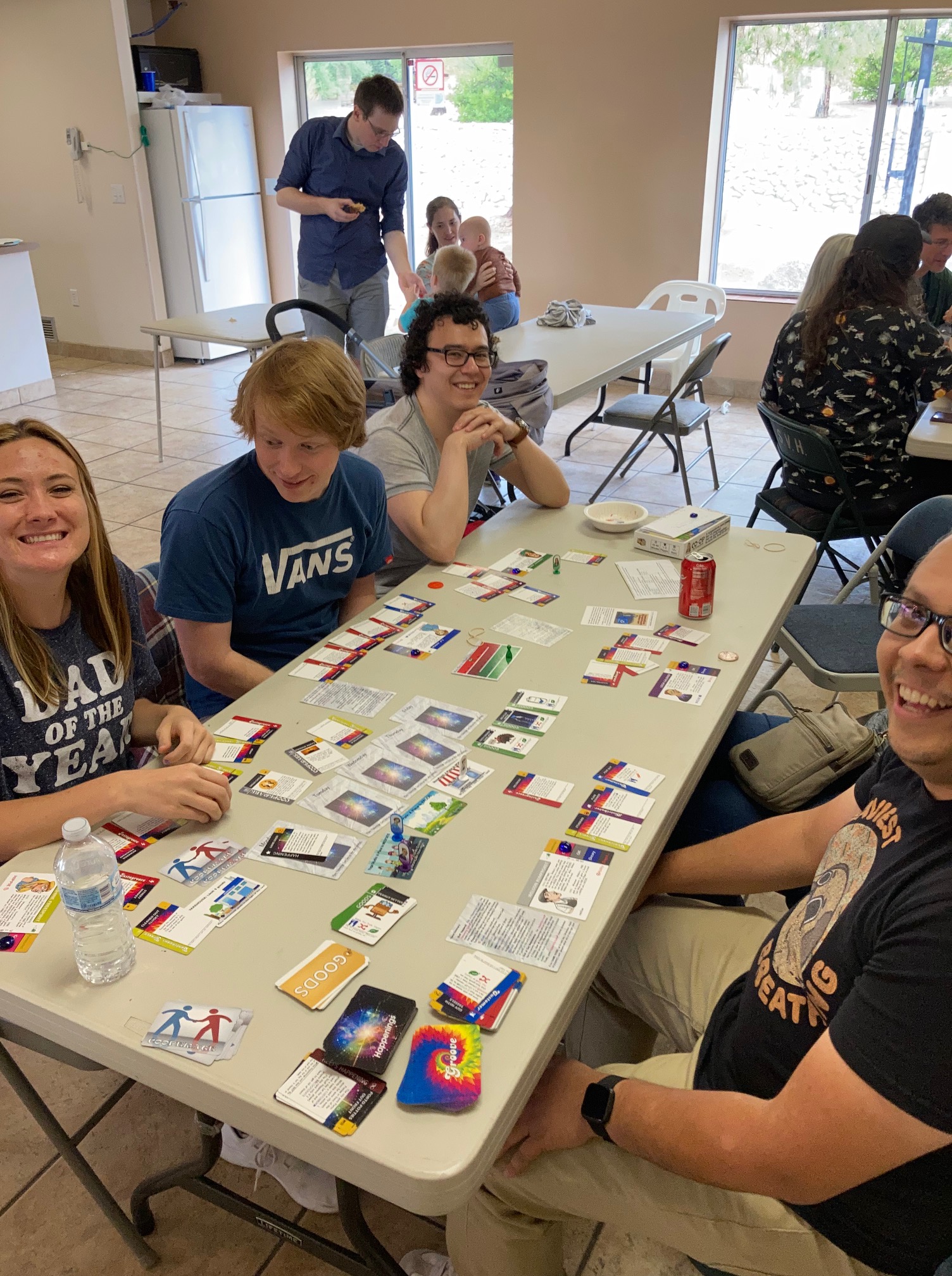
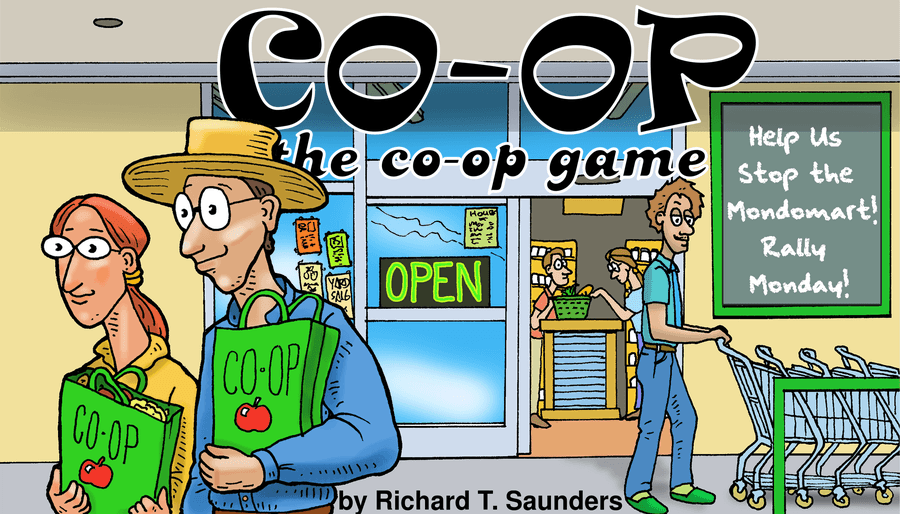
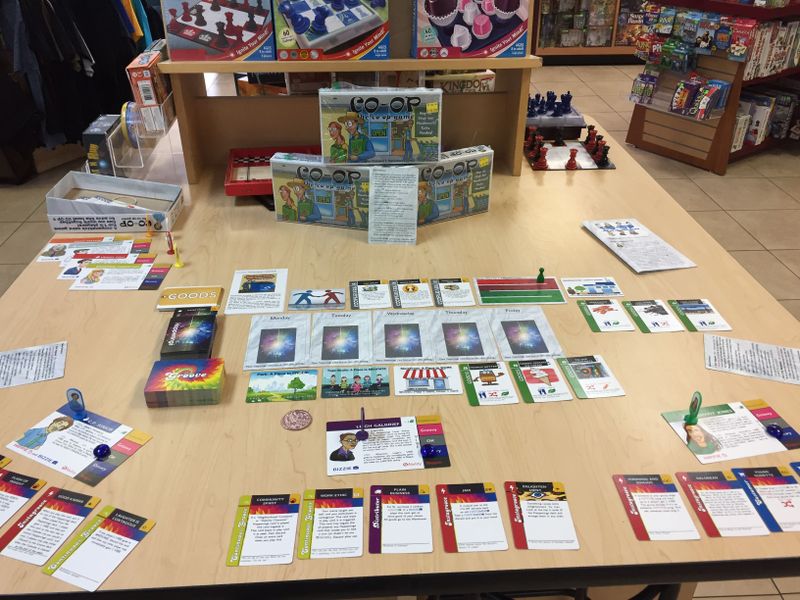
CO-OP: the co-op game! A silly cooperative game that made our Top 10 Cooperative Games With a Sense of Humor!

IMG_7169

Hope, Chris, Will, Cassidy (not pictured) and Max saved the CO-OP from Mondomart!

Day 0 … Dice Throne Tournament

IMG_7163

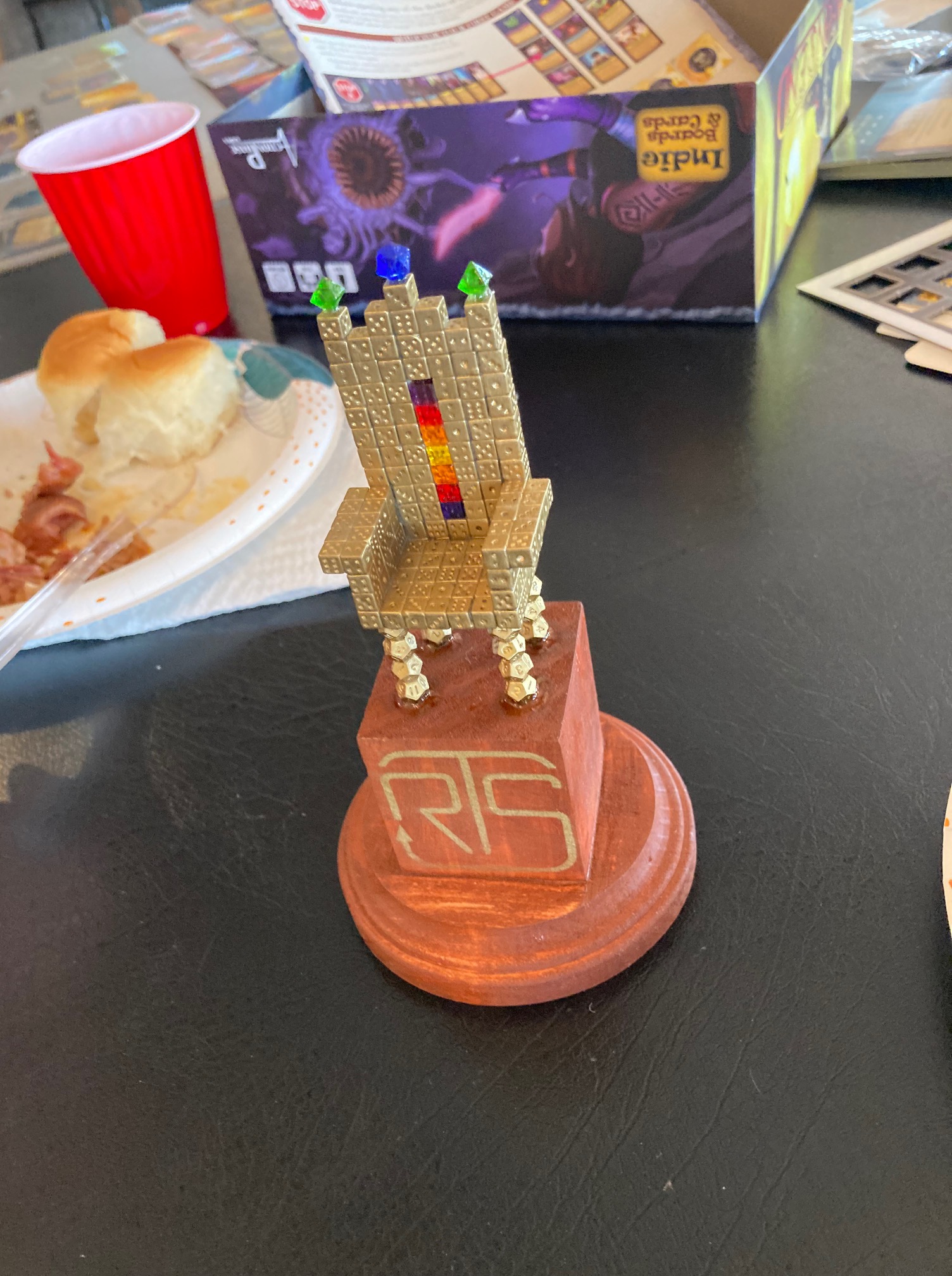
There was a Dice Throne Trophy made by Teresa! Unfortunately, the Dice Throne tournament was one game: Kevin vs. Caroline. Caroline has yet to claim her prize! She must bring it back for RichieCon 2022 to see if she can win again!

Day 0 … Top 10 Interesting Games We Discovered During The Bad Times

Our Top 10 list this year was 10 interesting games that we found during the last two years.  My top 10:

IMG_7899

  • 10.  Umbrella Academy.  Stay away: this is the worst cooperative game I ever backed on Kickstarter!  It was unplayable out of the box, and barely playable with BGG rules updates.  We reviewed it here!

    pic5687013 (1)
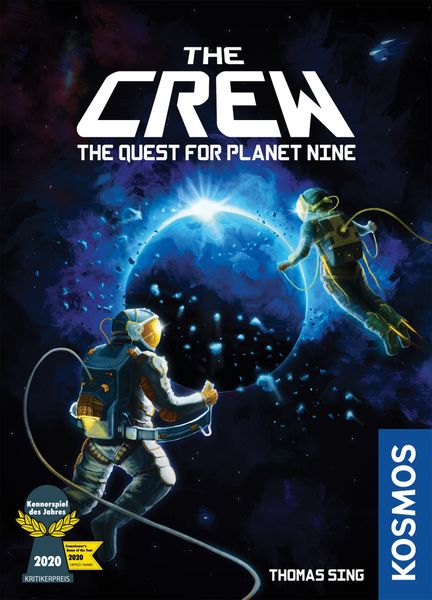
  • 9. The Crew.  I have the physical game, but I think I have played it exactly once with the physical components.  On BoardGameArena, on the other hand, me and my friends have played this multiple times.  It’s a great little cooperative game that made our Top 10 Cooperative Space-Themed games and it should have made our Top 10 Cooperative Games That Can Be Played Online!  This was a great game that we played over discord that kept me and my friend connected.  (It also won the Kinnerspiel Des Jahres for 2020)
    pic4268499
  • 8. Just One.  I have never had this cooperative party game NOT work.  It worked online with Discord, it works in person.  It works with gamers, it works with non-gamers.  See the Top 10 Cooperative Games That Can Be Played Online!
    IMG_8020
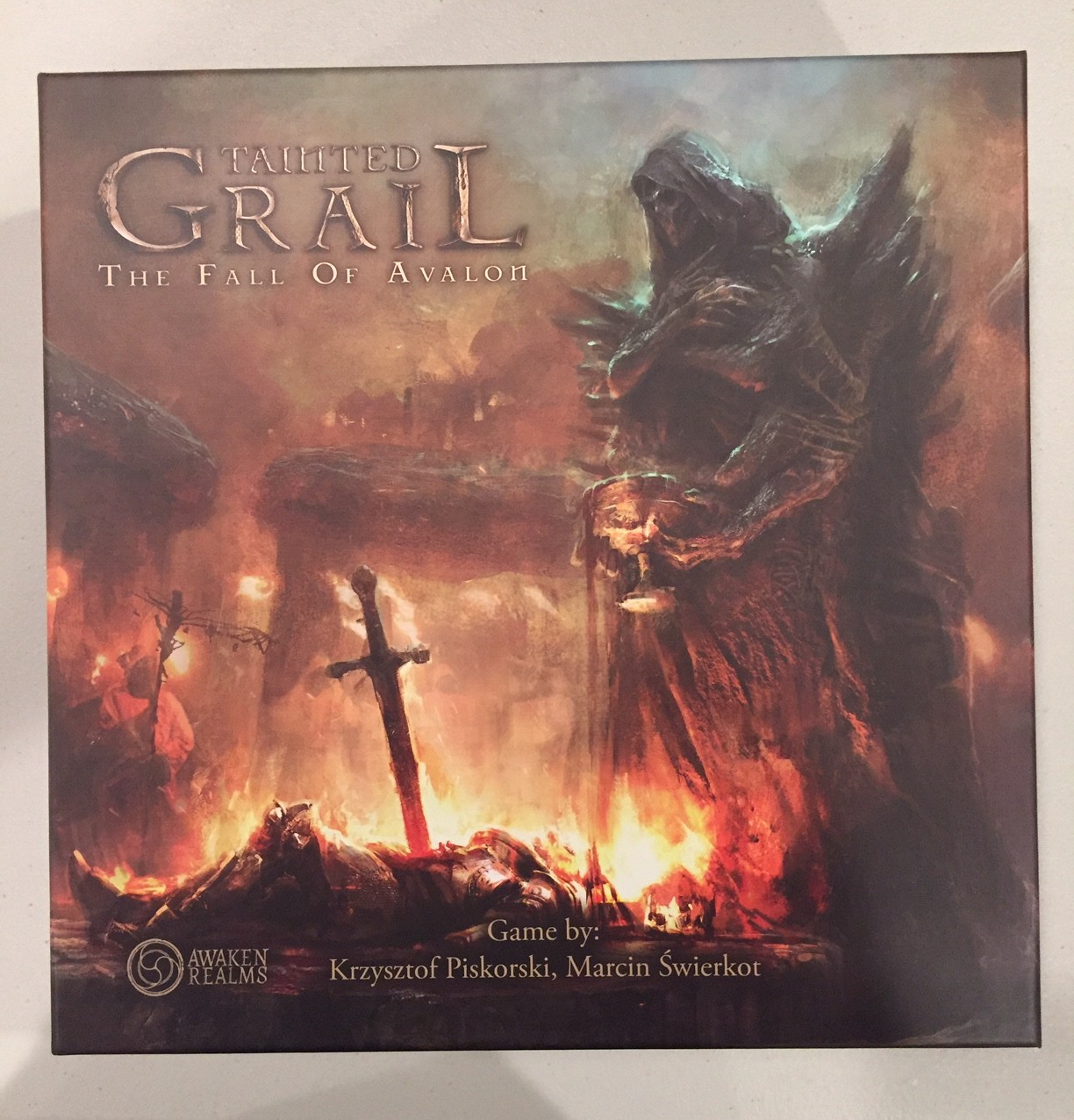
  • 7. Tainted Grail.  We played this beautiful, well-written game over 40 hours!  It has one of the best Intro Play Guides, and some of the best writing I have seen in a storybook game. And we stopped playing because it was too grindy.  Teresa has plans to repurpose it for a D&D campaign.  I had to tell people about it: it’s interesting.  See our saga documented here and here.
    IMG_8940
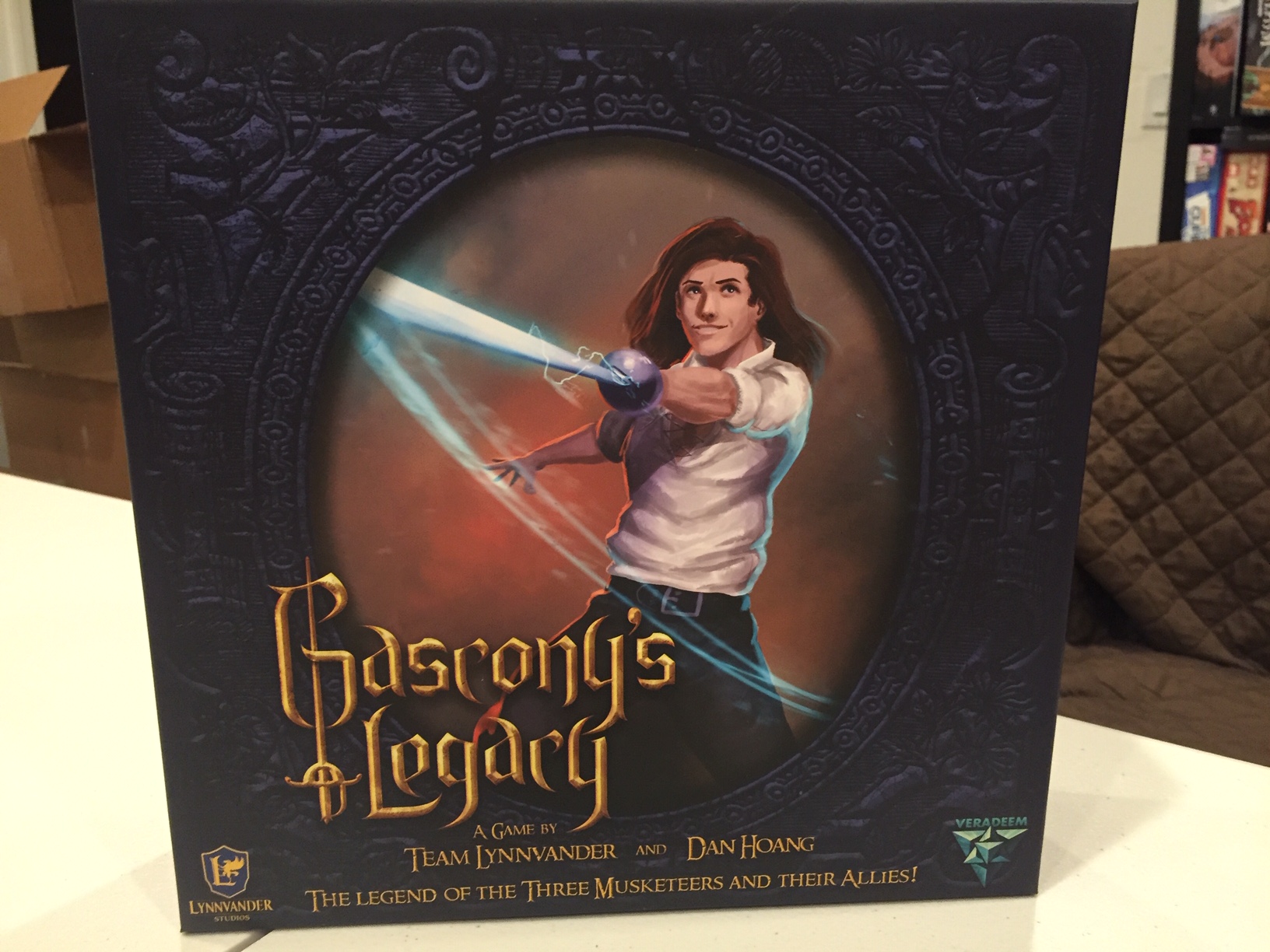
  • 6. Gascony’s Legacy.  This game has gotten no love as far as I could see, but I really enjoyed it!  It’s a cooperative game in the swashbuckling world of the Three Muskeeteers!  See our review here!  It also was so neat, it inspired a Top 10 list: Top 10 Cooperative Swashbuckling Games!
  • 5. Pandemic: Hot Zone — North America.  This is a weird little game: It made our Top 10 “Small” Cooperative Games, but it is interesting for what it is.  I think the original Pandemic is still better, but this might be a good way to introduce people to cooperative games without the “full” overhead of Pandemic.
    pic3469246
  • 4. Detective: City of Angels.  This game has become an evergreen in our group: we love playing it!  It’s interesting because the base game is NOT cooperative, but we ALWAYS play it cooperatively.  It made many, many lists here, including Top 10 Cooperative Detective Games and Top 10 Cooperative Storybook Games.
    pic4092537
  • 3. House of Danger.  This is a game that we have been able to play online with friends and family to keep us connected.  It’s ridiculous and fun.  You can get it at Target, and Junkerman and I played it ONLINE with his niece and sister online for her birthday!  This game has made many top 10 lists, but the reason it was interesting this year was because it made our Top 10 Cooperative Games You Can Play Online.
    pic3514298
  • 2. Sherlock Holmes: Consulting Detective. So, I have played the first 4 cases online (over discord) with my friends.  It was a full-time activity to keep me and my friends connected during COVID.  It’s “interesting” because it’s so hard and Sherlock Holmes is SUCH a jerk in the game.  Some friends still want to continue playing and some don’t, but it has been an interesting ride playing this online.  It made the #1 spot of our Top 10 Cooperative Detective Games. 
    pic5121999
  • 1. Sherlock Holmes: Baker Street Irregulars. This game was so interesting because were able to play this online over discord and it worked just as well as if we had been in person!   Someone buys the game and then shares the books physically (there are 4 distinct book: each player takes one of the books).  Players then play online cooperatively (each with their own book).   Follow our Journey here and here.  It made our Top 10 Cooperative Detective Games, Top 10 Cooperative Games of 2020, and Top 10 Cooperative Games You Can Play Online.


Day 1:  Water Games

IMG_7171

Junkerman went on a crusade this year to make games you can play in the water! Unfortunately, it rained and thundered most of the weekend! Finally, Saturday night, the thunder and rain let up so Junkerman could try out some of his games!

IMG_7175

The water games played at RichieCon 2021:

  1. Walk The Plank (thanks to Sam for this one: copied/laminated cards and wood meeples)
  2. Quarriors (dice and copied/laminated cards).  See Joe drying the dice above!
  3. Martian Dice: just dice and some laminated rules.
  4. Uno (plastic cards)

IMG_7177

Day 2

Day 2 was just more games!

IMG_7181

Chronicles of Crime! Made our Top 10 Cooperative Detective Games! Lexey, Linda, and Greg play the intro with their phone!

IMG_7182

Detective: City of Angels! Played after it made my Top 10 Interesting Cooperative Games!

Conclusion

There were so many games played over 3 days and people had a blast! We’ll do RichieCon again next year! Some lessons learned:

  • Wear Nametags: “Who the heck are you?”
  • Put out some healthy snack options: “That was a LOT of sugar!”
  • Keep Jeremy’s BBQ: The Vegan and Omnivore BBQ went over fabulously!
  • The RichieCon Token is silly, but people still like it!  Thanks to Josh for designing it and Max for printing it!
  • Move the Top 10 Earlier so people have some game recommendations before they start playing!

Thanks to everyone who came and we’ll see you next year!

A Review of Paleo, Part I. Unboxing, Solo Rules, and Initial Impressions

IMG_9570

Paleo is a cooperative game for 2-4 Players: it’s set in a “paleolithic time” (read: era of cavemen or stone age).  It’s currently up for the  Kinnerspiel Des Jarhes (see here) award in 2021.  (EDIT: It won).  Interestingly, especially in our cooperative blog, that all three entries for the Kinnerspiel are cooperative games! Micromacro and Robin Hood (the other two: see here) are also cooperative games!  What a glorious era to love cooperative games!

We’ll take a look at Paleo here!

Unboxing

IMG_9578

Paleo has a really nice minimalist aesthetic with lots of white space: see above.

IMG_9580

The basic resource components are pretty nice (just not Lost Ruins of Arnak nice) with wood components for the wood, food, and stone. The wood dice, however, seem extra cool. See above.

A lot of this game is in the cards, but it’s not a legacy game (usually the STOP! cards are reserved for legacy games). In this case, the game is all in the cards, but you never “destroy forever” cards. During gameplay, you will however discard cards to the graveyard so they out of the deck for the rest of the game. See the graveyard below.

IMG_9678

Paleo is all about combining basic cards and two modules to form a “deck” of cards. These cards are what the players will be “exploring” and turning over.

IMG_9651

See the cards above: the backs of the cards give you “hints” about what the cards will do, and you turn them over to see what you can actually do! Since the game is all in the cards, you want to be careful not to look at too many cards at the start of the game … you don’t want to spoil the surprises on the cards! Note that the cards are very nice linen-finished cards!

IMG_9616

Everything else in the game are cardboard components: See the three main boards above! See the heart, skull, and tool tokens below.

IMG_9617

Overall, the components are nice enough. They are all very easy to read and have the same minimalist look/feel with the white theme.

The workbench, although it looks cool (see below), is one of the most annoying components when it comes to set-up and tear-down!
IMG_9618

Sure, it looks great above, but building it was messier than it should have been. It barely had a 10th of page to describe how to put it together:

You can barely see what it looks like! The next page has a completed picture, but its still not great at showing it:
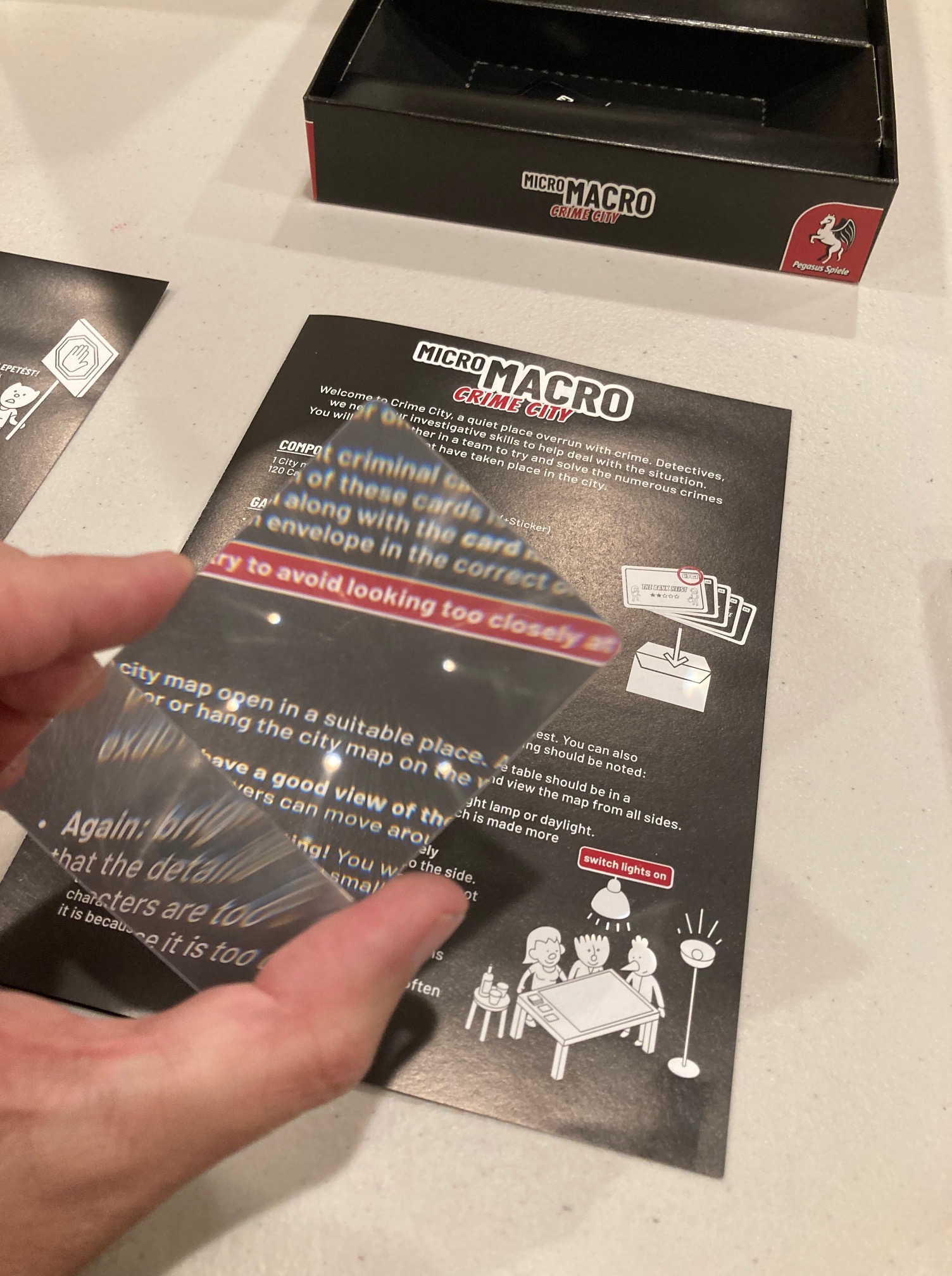
IMG_9621

That’s fine, because once it’s built … it does look cool. But wait! How do you put this away? I am pretty sure they thought about it (because it does fit in a very particular way), but did they document it? Nope! Are you supposed to take it apart to fit in the box????

No, you just have to make sure you put the rules UNDER the insert, and NOTHING else on the right side and it just BARELY clears the lid!

You might think this is a minor thing, but when you are putting it away, it can be very frustrating! So, learn from my experience: pull the bottom part off of the workbench, put the rules and extension rulesheet under the insert, clear the bigger part and make sure the workbench sits JUST SO (see picture above).

IMG_9642

Overall, the game looks good and has a consistent look-and-feel: the cards are linen-finished and easy to read, the tokens are easy to read, and the wooded resource tokens are nice. The workbench looks cool, but is annoying the pack back into the box.

Rulebook

IMG_9575

All the rules are there and the rulebook works fine. But I feel like they skimped in a few places. The components list is just a sliver at the stop of the 1st page:

The set-up is next and works well enough:

IMG_9583

The rest of the rulebook works okay, but again, I feel like they were skimping. This game has a lot of iconography: where do you go to see iconography? Isn’t there usually a summary on the last page with the iconography? Usually on the back page. Nope, somewhere in the middle.

IMG_9601

Look, it’s not a big deal, but I felt like the rulebook has “let’s cram as few pages as possible into the rules so we can save some money”. That’s fine, I understand, but I felt the rulebook could have been better.

Like I said, the rulebook worked and it was fine. This is just a minor nitpick, but since Lost Ruins of Arnak (see here and here) and Ares Expedition (see review here) had such wonderful rulebooks, it’s a little harder to deal with. Especially since The Lost Ruins of Arnak is ALSO up for a Spiel Des Jahres award!

Solo Rules

By default, Paleo DOES NOT follow Saunders’ Law: it has NO Solo Rules!  See the box cover above!  The main reason (I think) for lack of solo rules is that one of the main features of the game is that you can choose to “help” another player on your turn:

In the card above, the player can either choose to hunt the Mammoth (if he has the resources, which is unlikely) OR he can help out one of his neighboring tribe-of-cavemen!  The little “hands-shaking” symbol is the sign for “help your neighbor” in this game.    This is a central mechanism in the game (for balance, for fun, for winning), so you must play with it! 

IMG_9657

All this means for the solo player is that the solo player simply takes the role of two tribes of cavemen!  See above!  Tribe 1 has a Scout and a Guardian.  Tribe 2 has a Hunter and a Scout.  Each tribe plays a card separately, like it would in a 2-Player game (note the second tribe has just played “At Home” to the right).  The only difference is that the solo player must make all the choices himself. 

IMG_9667

It can be  little daunting to play 2 Tribes as a solo player, but you can really feel the need for the cooperation when you play.  (I tried playing a solo game with just 1 tribe … it was miserable and I immediately stopped).  

I really think the rulebook could have included a simple sentence:

A solo game of Paleo plays exactly like a 2-Player game,  where the solo player plays both tribes of cavemen separately

Initial Impressions

IMG_9670

The game looks good on the table.  The game really does feel like you are exploring: you choose a card based on the back of the card (like a hint from the environment) to play every turn.  After all players flip their card, then each player (in Player Selected Turn Order) chooses a card to play.  But there’s so much more to the game:

  • You can get Visions (which help you choose what you will do next)
  • You can get Ideas (for “tech” to build: wood and a rock? A spear of course!)
  • You can avoid Bad Cards!  All hands are “littered” with Bad News, and you have to know when and when NOT to avoid the bad news cards!
  • You can build tools!  Using the ideas you had earlier, you can make them real!  Make a REAL Spear!
  • You need to feed your tribe!

This is a Euro cooperative game.  What do you I mean by that?  The game is all about getting enough resources to get stuff done, but as a group.  Cavemen need to get ideas (one type of resource) to build tools (another type of resource) using wood and stone (yet another type of resource).  Where this game differs from other Euros is that it strongly encourages cooperation through the help mechanic!   Players work together to get resources.

IMG_9674

A “win” is getting the entire cave painting built!  A “lose” is getting 5 skulls (see above).  As the game progresses, there are many opportunities to get cave painting pieces: for example, defeating the Mammoth below gives a piece!

IMG_9678

 The game really does feel like you are exploring.  Since cards go to the Graveyard after you have “defeated them”, there is a clock running!  Thematically: you killed the Bull Mammoth (above), got his meat, and he’s not coming back!  At some point, you will run out of cards to keep the cavemen alive!!!  You must explore to survive, but a some point you must figure WHAT you need to do!! That’s part of the fun of this game: you don’t know exactly “what” you need to do to survive until you have gone through the deck a few times (in a typical game, you go through the deck many times).

You must explore to find out what you need.

Conclusion

IMG_9676

In the end, I liked Paleo as a solo game (even though it doesn’t have solo rules). It sometimes feels like you don’t have a of choices as you explore, as you can only see the backs of the cards and you don’t even know what you need at the start of the game! BUT, this was thematic as an exploration game! The more you get to know the modules you are playing, the more predictive your choices can be! And once you flip the cards over, there are still interesting choices to make! Are you a good neighbor or do you overcome your own challenges? And the game has some replayability, as choosing 2 of 10 modules (A-J) per game gives you (10 choose 2) = 45 combinations.

I see why this game was a Kinnerspiel Des Jahres nominee! It’s pretty fun, looks good, and has some unique mechanisms and ideas I haven’t seen elsewhere. And Paleo really does encourage cooperation with the way the cards are revealed and resolved with Player Selected Turn Order allowing players to choose (as a group) how to play! Paleo really captures the feel of cavemen exploring and trying to survive.

Addendum

We just finished RichieCon this weekend (full report next week), and I was hoping to get Paleo to the table with some groups.  It just didn’t happen, even AFTER I explained “Hey!! Paleo just won the Kinnerspiel!”  I’m not sure: I wonder if the theme was offputting?  Maybe the art on the cover wasn’t appealing?  Just a quick note that maybe you might have trouble getting people to play with this with you, despite the Kinnerspiel award …

Top 10 Cooperative Games With a Sense of Humor!

A lot of cooperative games have very dark and depressing themes: “Work together to save the world! Or everybody dies! AHHH!” (In fact, that’s exactly what we did to make Lost Ruins of Arnak cooperative last week!) We wanted to point all those cooperative games where a “sense of humor” permeates the game. What do we mean by that? Something that makes you laugh! As you read the rulebook, as you play the game, you notice little touches that tickle your funny bone. It may be flavor text, or the way a rule is expressed, or just some picture that make you giggle and not take the game (or life) too seriously.

To be clear, these are all real games (some heavier than others), and not just excuses for jokes!

10. Dungeon Lords

pic569340

So, we are cheating a little bit here:  Dungeon Lords is ONLY cooperative if we play with our rules from our Top 10 Games That Can Be Played Full Cooperatively.  This would probably be further up the list if the cooperative rules were better fleshed out.  (Hint, hint, Rich).   Dungeon Lords has one of the funniest rulebooks we have ever read, the art is silly and evocative, and the games mechanisms and cards reinforce this sense of humor.  The funniest bit in the game: the Dungeon room where, for 2 imps and a food, you can create another imp—we call this “The Romantic Dinner Room”.

pic586642

9. Far Away

pic5085095 (1)

This is further down the list because, although the sense of humor pervades the rulebook and the box and the components, its not quite as prevalent as we start playing: it’s a pretty heavy game.  We reviewed the game here  and it also made our Top 10 Cooperative Space Themed Games.  Overall, the game has an almost dark sense of humor!  My favorite joke: 

img_5511

Overall, this is a heavier game (see below) that uses a sense of humor to keep it from being too much.

pic5061204 (1)

8. CO-OP: the co-op game

pic3302665

CO-OP: the co-op game is a silly game where Hippies of all generations come together to stop Mondo Mart (which is nothing like MegaloMart or Walmart) from taking over the local CO-OP.   The rules encourage you to embrace the hippie vibe of the game and roleplay your characters.   The cards have funny little flavor text at the bottom,  but the best part are the ridiculous things you can buy at the shop such as 103% Dark Chocolate, Chaka Reversers, and the game itself (yes, you can buy CO-OP: the co-op game  in game).  It’s a silly but fun light-hearted co-op.    It also made our Top 10 Cooperative Games of 2017.

pic3423092

7. Unlock: Squeek and Sausage

pic3372429

Squeek and Sausage is an Unlock Escape Room game (we’ve reviewed a few of Unlock games: Unlock Epic Adventures and Unlock: Star Wars).  This particular universe, with a silly professor who has “doomed us all”, has been so popular that he has spawned two more Unlock Escape Room Games: A Noside Story (from Unlock: Secret Adventures set) and Professor Noside’s Animal-O-Matic (from the Unlock: Mythic Adventures Set).  Squeek and Sausage is still my favorite, as it introduced us to this hilarious world.

pic3372430

6. Agents of SMERSH

pic2295348

I was a kickstarter of the very original Agents of SMERSH back in 2016!  (And I am kickstarter on the reboot in 2021 as well: this is a neat game).  This is a storybook game (as it made our Top 10 Cooperative Storybook/Story Telling Games), where players roam around a world map trying to find and take out Dr. Lobo before he can “destroy the world!”.  But, this game is very much a love-letter to the silly 70s tropes of Secret Agents and James Bonds. The text that comes out in the storybooks is very action-packed, but still has decisions and a sense of humor. This game also made our Top 10 Cooperative Games “Off The Beaten Track”.  

pic2348214

5. Spirit of 77

spirit-of-77-rpg-wide-world-of-77

This game almost didn’t make the list, because it’s a Role Playing Game rather than a board game, but the game is cooperative. It is also THE MOST RIDICULOUS GAME I HAVE EVER PLAYED.  In a good way.   We reviewed it here, and tried to explain how the game naturally encourages a sense of humor with playlists, twists, and other mechanisms.  The game is strongly dependent on the group itself having a sense of humor, so you have to make sure your group is in the right frame of mind.   I look forward to further plays with silly thing like Bigfoot jumping over 30 Ford Pintos in a Dodge Pacer.

img_5226

4. Forgotten Waters

pic5253984

We initially reviewed Forgotten Waters here, but the game has just gotten better and better for us!  It’s a silly, pirate themed Adventure game with a great story!  It has some really silly jokes dressed up in an App that makes it that much more thematic!   Forgotten Waters made our Top 10 Cooperative Storybook/Story Telling Games, our Top 10 Cooperative Swashbuckling Games, as well as our Top 10 Cooperative Board and Card Games of 2020.  It’s a real fun game that doesn’t take itself too seriously, but still has a lot of good choices.

pic5253985

3. Scooby Doo: Escape From The Haunted Mansion

pic5239705

Scooby Doo: Escape from the Haunted Mansion is essentially a Scooby Doo themed Escape Room game.  The players, as a group, take the roles of the Scooby gang.  Each character has their own “verb” they apply to objects throughout the Mansion: Fred can investigate, Velma can research, Scooby can smell, and welllll, Shaggy can eat.  That’s right, Shaggy will frequently just pop things he finds around the Mansion into his mouth and try to eat them!   There’s a fun mystery to solve, and the interactions in the game are pretty hilarious.  This game really brings in that sense of humor from the Scooby Doo cartoon.   This game made our Top 10 Cooperative Creepy/Spooky Games as well as our Top 10 Cooperative Detective Board and Card Games!

pic5528230

2. Choose Your Own Adventure: House of Danger

pic4092537

This is probably the lightest cooperative game on this list, but maybe the funniest by itself!  It made the number 2 spot on our Top 10 Cooperative Storybook/Storytelling Games because of how easy it is to play and how ridiculous it is.  You can pick this up at Target for fairly cheap, and also play online fairly easily (see our Top 10 Cooperative Games You Can Play Online).   It’s a pretty simple story game, but the stories it tells are just hilarious and your choices do kinda matter!


pic4093960


1. Cantaloop

img_9161-e1623455483876

Cantaloop may be my game of the year for 2021! We reviewed it more deeply here. This game has the best sense of humor I have ever seen.  Jokes, throw-away and essential, permeate the game.  The art style is silly and works with the game.  And yet, for all the humor and silliness, this is still a fantastic point-and-click adventure game masquerading as a board game!  One of many throw-away jokes: “What’s the best time of day? 6:30 hands down!”  

IMG_9240


A Cooperative Mode For Lost Ruins of Arnak

IMG_9560

In last week’s entry of Co-op Gestalt, we discussed the Lost Ruins of Arnak, a 1-4 Player Worker Placement/Deck-Building game that is a competitive “get-the-most-victory-points” game. Some of my friends have loved this (beautiful production, lots of choices) and some of my friends hated it (too fiddly, bad online implementation, the “disparity of experience” problem). The conclusion of last week’s blog was simple: The Lost Ruins of Arnak needs a cooperative mode to help bring in the detractors.

So, I put my money where my mouth was. I mean, this is a cooperative games blog after all. Included somewhere below is a cooperative mode for Lost Ruins of Arnak. It’s only 18 cards and a page or two of additional rules.

Cooperative Mode

IMG_9544

The cooperative mode adds two new sets of cards:

  1. 14 Shadow Creatures Motivations
  2. 4 Character Cards

The basic premise is that the players must work together to defeat some Aliens threatening the Earth! From the Introduction:

Some strange, shadowy creatures have been spotted in major metropolitan areas across the globe! These strange creatures, dubbed “The Shadow Creatures” have been dealing chaos, havoc, and damage everywhere they appear! What do the Shadow Creatures want? What are their motivations?

With the world in chaos, major governments have shared all their intel on the Shadow Creatures. Synthesizing this collective intel, the world’s top researchers have gleaned that the Shadow Creatures have some connection to the Lost Ruins of Arnak. But what is that connection?

The answer lies nears the site of the Lost Ruins of Arnak! The researchers must travel there to find the answer! Using research, exploration, smarts, and a little luck, the researchers will work together to discover the Shadow Creatures motivations and the appropriate response!

Can the researchers figure out the Shadow Creatures motivations before time runs out and the Earth is destroyed? Can YOU help them?

To win the game, players must together discover and satisfy the Shadow Creature Motivations to save the Earth!

At the start of the game, the players choose two Motivations cards (called Characteristics in the original 3×5 card version) which will set the victory conditions for the game.

IMG_9549

At the end of the 5th round, the players must collectively be able to satisfy BOTH conditions to win the game. The rest of the game essentially stays the same, but all the victory points are unused as the Shadow Creatures Motivations (see above) take over for deciding victory points. No one cares about victory points when saving the Earth.

IMG_9561

There aren’t any rule changes, but a couple of additions:

  1. Players can share resources at the start of round
  2. Players can do “research” to flip the Shadow Creatures Motivations up early.

The Shadow Creatures Motivation cards are face-down at the start of the game: they get flipped face-up at the start of rounds 4 and 5.   It can be too late to do what’s necessary, so there are mechanics for “Researching Motivations” so you can flip the Motivations earlier.   See the picture below for the original rules for how Researching Motivations work.  The full rules are available in the PDF at the end.

IMG_9545

Essentially, players cooperatively have to choose when to use resources to build engines or research motivations.  This is one of the things the players will have to discuss!

Characters

IMG_9553

One of the things the cooperative mode adds is a unique character card for each player.  Why?  Firstly, because variable-player powers in cooperative games tends (for me anyways) to make co-op game more fun!  Do you want to play “MoneyBags” Thad or “Sky-King” Cooper or “Deal-man” Kerns or “Inspirational” Allison?  More fun!  However, more importantly, the addition of variable players powers helps balance the game:  the Research Motivations actions costs extra resources and by giving characters extra resources, we are preserving the original balance from the original game. 

IMG_9547

Solo Mode

IMG_9543 

The cooperative mode essentially adds a couple of new solo modes to the Lost Ruins of Arnak! The cooperative mode scales from 1 to 4 Players, so you can play solo by playing the cooperative mode with one player controlling 1 character. For a harder solo mode, a solo player can control 2 characters in the cooperative mode.

Alpha Version

IMG_7119

So, directly below is the PDF that describes version 1.0.0 of the cooperative rules. This is the Alpha version of the rules: they work, we’ve play-tested them, and we like them, but there are still some rough corners. We are releasing this partly so we can get feedback. Was any Motivations too easy? Too hard? Do certain actions require clarification?

Lost Ruins Of Arnak Cooperative Mode (PDF)  Version 1.0.0 

Please feel free to send us email at returnfromsubroutine@gmail.com.

Conclusion

IMG_9552

I’ve really enjoyed my competitive and cooperative plays of The Lost Ruins of Arnak. Hopefully, the addition of the cooperative mode will bring in some of friends who didn’t like the original game.