Codenames: Critical Role Adventures. A Review From Someone Who Knows Nothing About Critical Role.

Welcome back to cooperative Adventure month! This week, we venture into a fantasy adventure! With words??
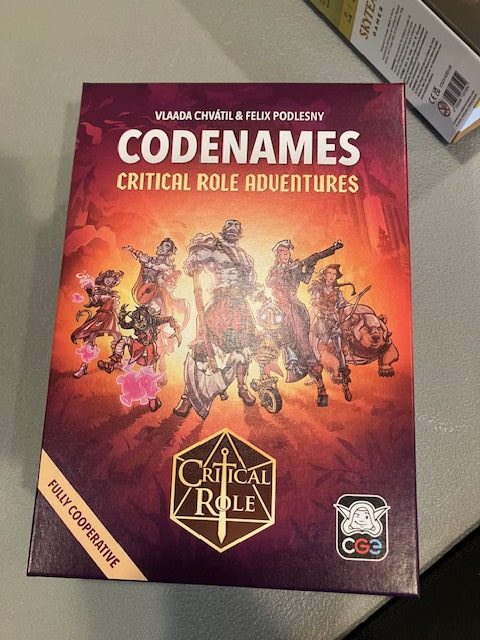
We haven’t talked much about Codenames here at CO-OP Gestalt because most incarnations of Codenames are big, competitive team-based party games: Codenames, Codenames: Pictures, Codenames Disney, Codenames Simpsons, etc. (To be fair, the 2-Player Codenames Duet and Harry Potter ones are co-op). We were reminiscing just recently how BIG Codenames was a few years ago! It was all the rage at the original RichieCon!

Well, now there’s a fully cooperative version! Codenames: Critical Role Adventures! This can play a pretty big group! You need at least 2 people (a clue-giver and a clue-guesser), but we had an amazing time with a 5-Player game!

What do we think of the new Codenames: Critical Role Adventures?

Rules
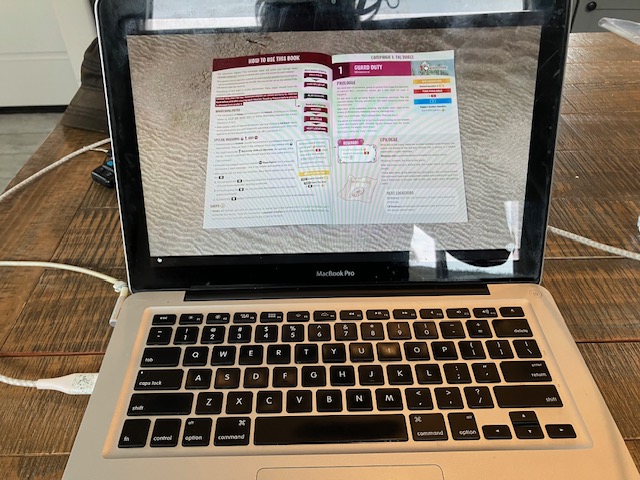
So, this is one time I broke down and just watched a video. The CGE video on how to play works great. It’s an easy watch: I recommend it.
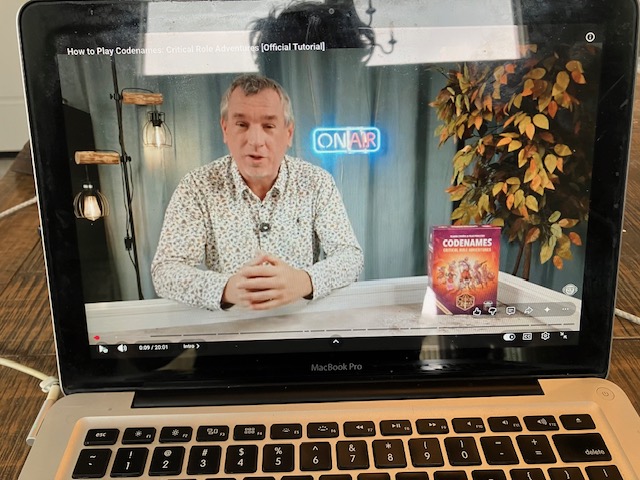
There are also several playthroughs online, but this video was more than sufficient. To be fair, I watched it a few times because I didn’t want to miss any nuances: my friends tend to be rules sticklers, and I didn’t want to miss anything.

There are a more rules in here than in the base Codenames … just enough to be just a touch daunting: so be aware! The new rules add scenarios, leveling-up, deduction, and special powers! So, yes, there are more rules! This isn’t “just” Codenames with a new coat of paint! It’s a lot more!

Critical Role
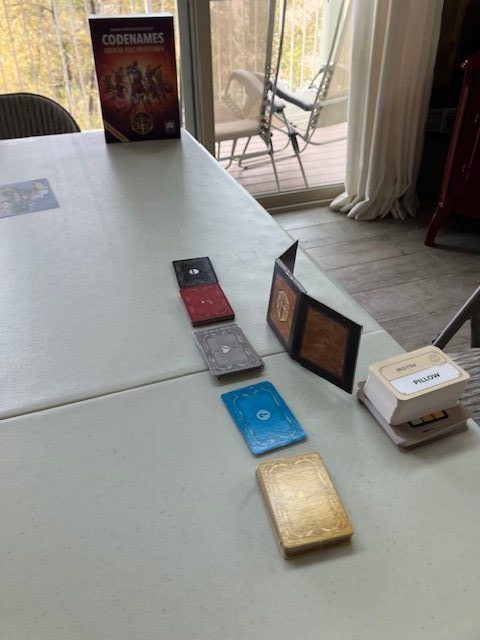
I know next to nothing about Critical Role. My understanding is that a bunch of people play Dungeons and Dragons online and people watch their adventures? I’ve heard great things.

You don’t need to know anything about Critical Role to enjoy this game! There might be characters or special allusions which might help you immerse yourself in the game if you know Critical Role? Not knowing about Critical Role did not detract from the game at all! (for me and my friends: none of us really knew it either) . If you know anything about Dungeons and Dragons at all, that’s probably all you need. In fact, a lot of the words in the game seemed like they came from more standard Dungeons and Dragons lexicons!

I hyped this game to my friends as Codenames with Dungeons and Dragons …and they were so in!

Components and Gameplay
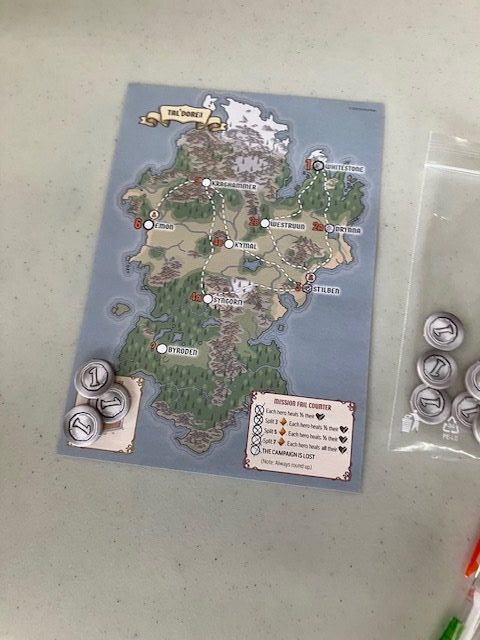
In Codenames: Critical Role Adventures, you and your friends are going on an adventure! There are three Adventures in the base game, with a map for each one! See the first one above! This map helps you note where you are (so you can save the game and come back: you can save games because each full adventure can be pretty long).
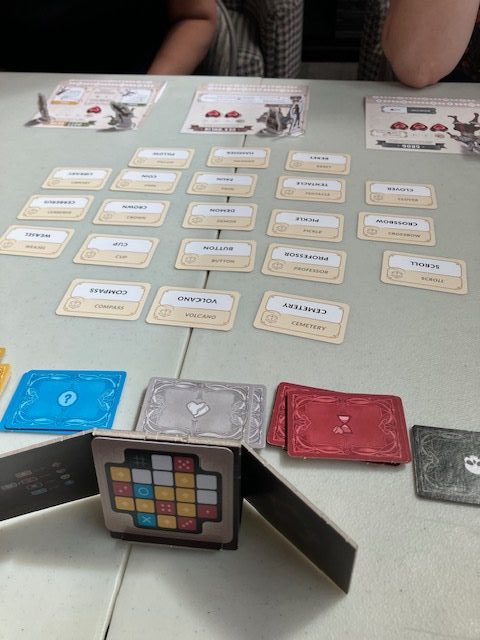
At its core, Codenames: Critical Role Adventures is still Codenames with its main “associate words” mechanism! See above! So, it comes with a little grid and word cards and the clue-giver (now called the Dungeon Master) gives clues to the clue-guessers (now called the party of adventurers!) See above! It looks like Codenames because it still is!
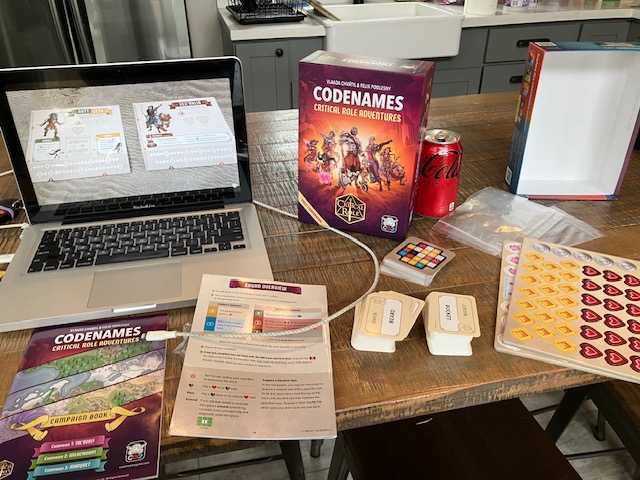
BUT, they’ve actually added quite a bit more stuff above and beyond the base Codenames!
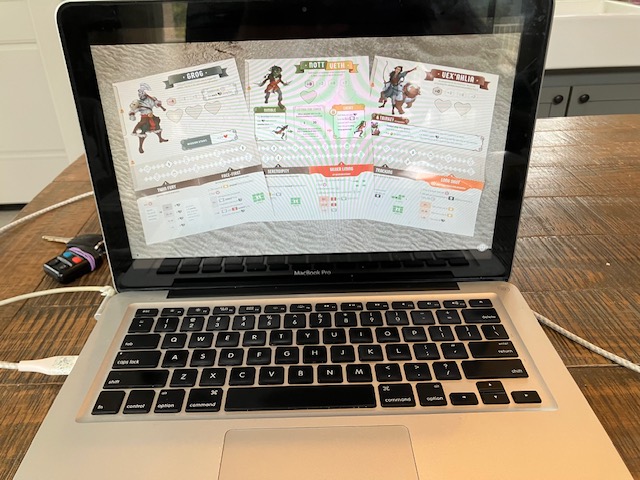
The group plays a party of three adventurers! No matter the number of players, the party is always three characters! The clue-guessers (no matter how many players) operate the three characters as a unit!
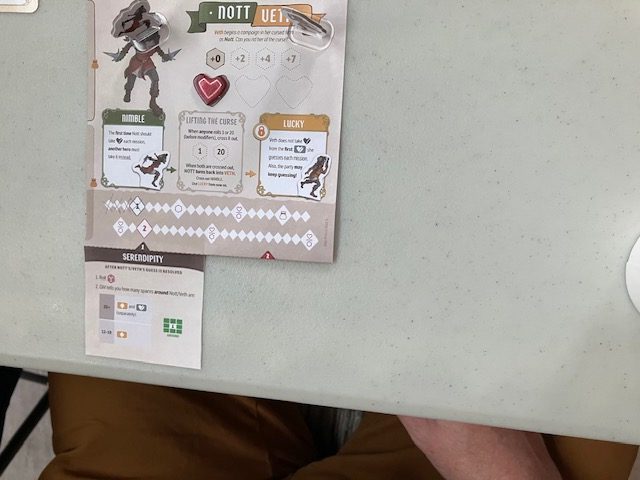
These characters have health! Every time that character guesses “wrong” on Codenames board, that character loses a hit point! See the hearts above on Nott/Veth! If any character ever goes to zero hit points, that mission is lost! (And you can replay it … up to a point).
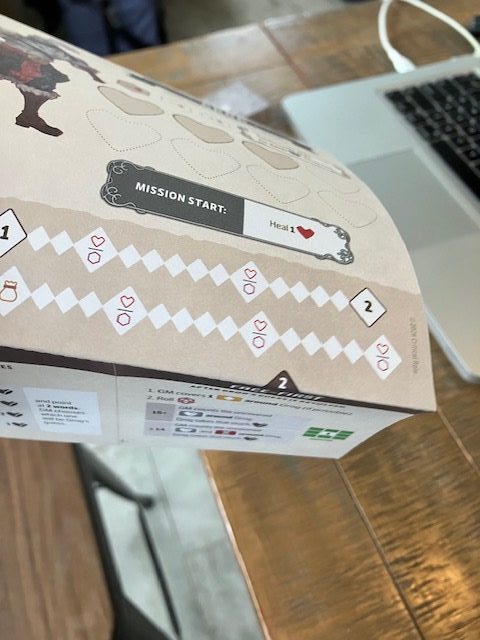
The characters also have experience points! See above! When a character guesses “correctly”, or completes a mission, or many other ways, the characters get experience points! The experience allow them to unlock special powers, upgrade their modifiers, or increase their hit points!
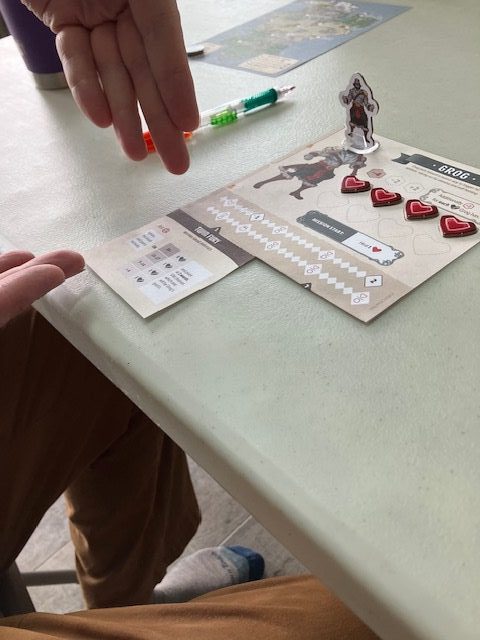
Perhaps the coolest thing in the game is the special powers that get unlocked from experience! The unlocked powers stay under your sheet until unlocked, then you fold them over to activate them!!! See above! That’s kinda cool!

The special powers do some REALLY interesting things! They can help you find cards, count “good” cards around you, avoid death, and all sorts of neat things that base Codenames never did!
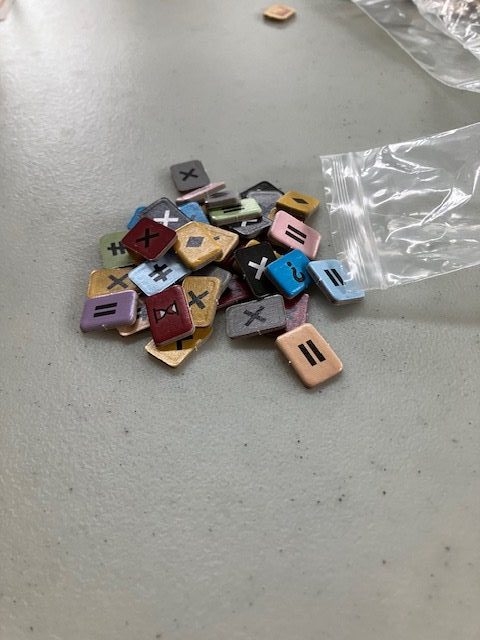
There’s a bunch of new tokens that allow the players to “help note” things on the board! Basically, Codenames: Critical Role Adventurers is now a cooperative deduction game as well! A cooperative word game AND a cooperative deduction game!
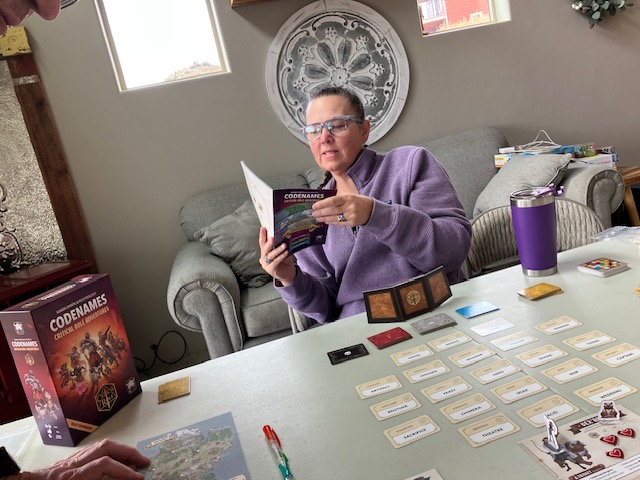
Each single game of Codenames is a mission where the party of adventurers guesses words! And each mission is very different! If you get through all the missions (each a session of Codenames), then you win!
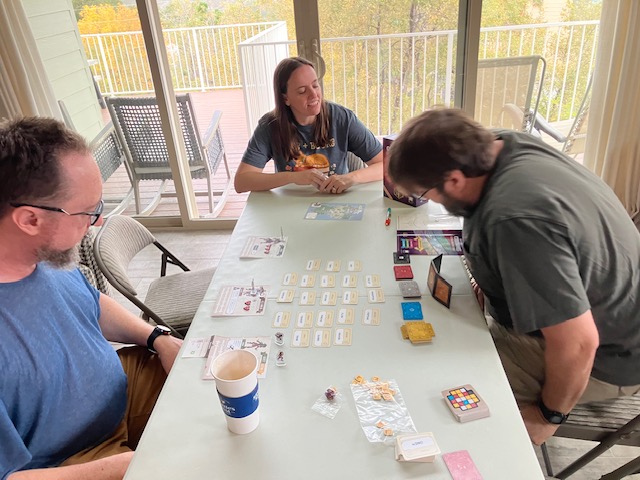
This really is still Codenames at its core, but with all sorts of new elements like special powers, deduction, hit points, experience, stuff to buy, ongoing story, and cooperative wordplay! All the new things “sound” a little daunting, and it will take you a play or two to get it, but it’s pretty straight forward.

If you play Codenames with your grandma on weekends (like my friend Sara), this might be a little too much.

Cooperative Play
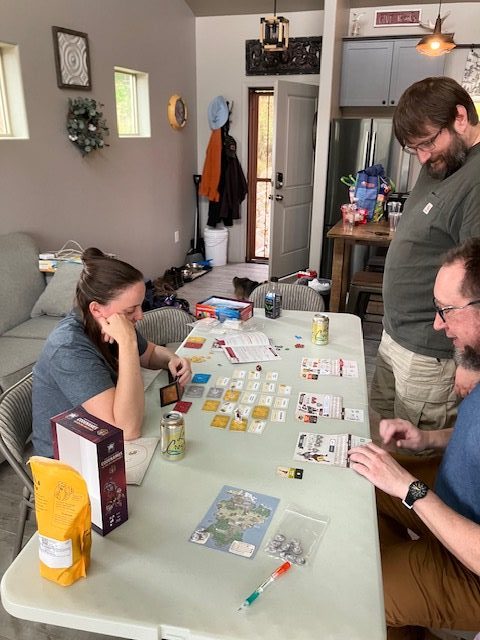
The core Codenames play is still the same. Everybody is on the same team guessing words: there’s always been that flavor of team cooperation in Codenames. But now, there is extra cooperation! Players have to work together to figure out “who do we send to guess”, “who should buy what upgrades”, “how do we spend experience points”, “should we use our powers”, and many other things! There’s a lot more fundamental cooperation as the players all manage the party together!
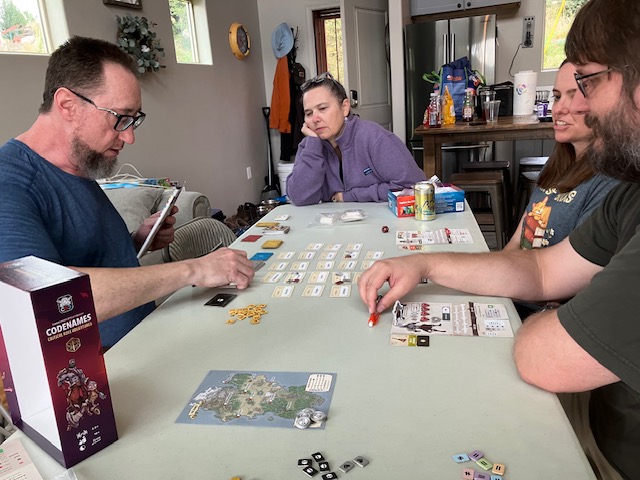
To be clear, the role of clue-giver (Dungeon Master) still rotates! Or at least, you probably should so everyone gets a chance to DM! It’s still cooperative, as the DM still wants everyone to guess the words correctly!

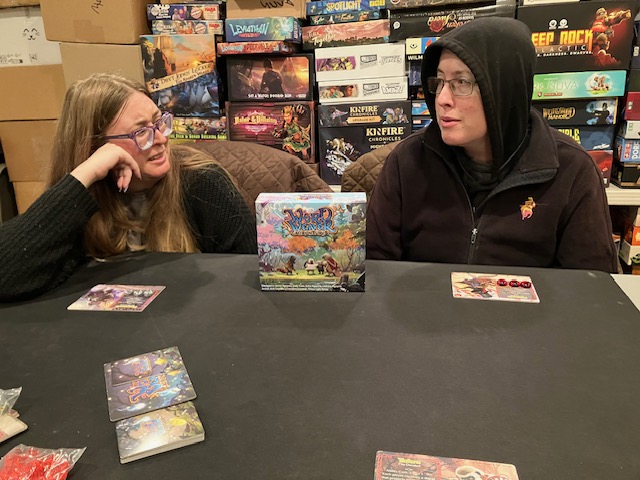
What we did seemed to work really well: we physically rotated around the table one space per mission! This let everyone rotate through every space on the board! The further seats had a little glare, so in all fairness to everyone, everyone got sit in every seat at least a few times!

And this fully cooperative nature keeps EVERYONE involved all the time! One of the problems with base Codenames is that one team is always “not playing” and that always seemed less fun (although some of my friends liked to guess poorly to “help” the other teams). With cooperative Codenames: Critical Role Adventures, everyone is always playing and looking at the board!

Number of Players
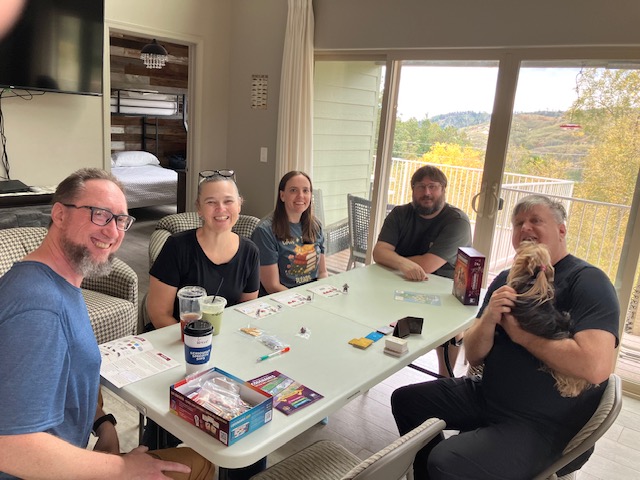
So, you can’t play this solo. Sorry. Someone has to give clues, some people have to guess.

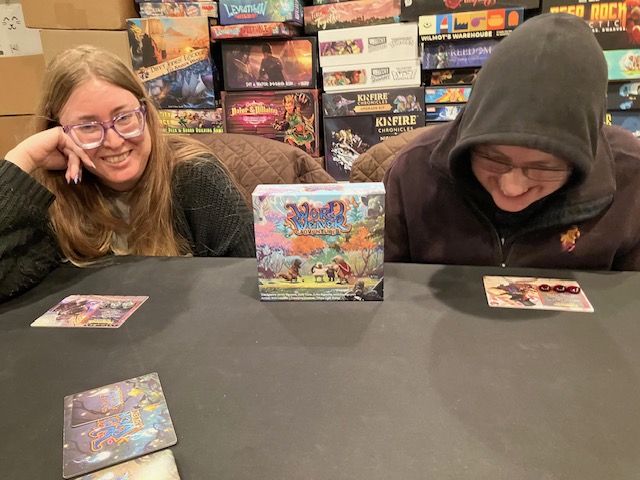
We played with a group of five, and that worked extremely well! I think four or five might be the best count? I think it really depends on the dynamics of your group! I do worry that six or more people “might” be stretching it too much as “too many cooks spoil the pot”? Again, it depends on your group.

Fun
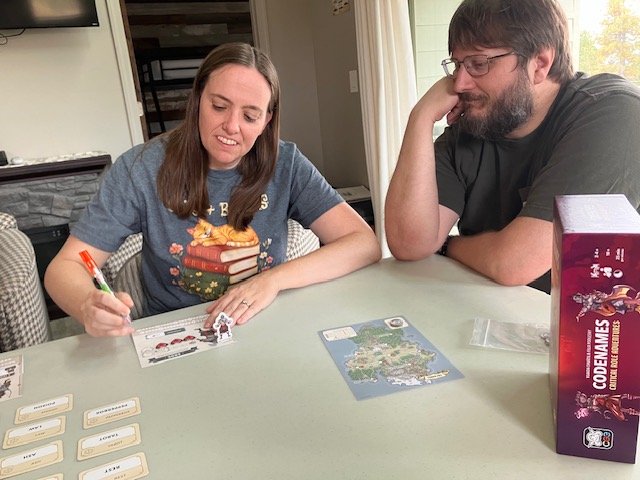
To be clear, we spent 4 hours on a Saturday playing through a full adventure! We lost the entire game after we failed one mission 4 times in a row, but we were so despondent that we “mulliganed” our last game and powered through to the end of the adventure! Sure, there’s an asterisk next to our “win” but we didn’t care! We had SO MUCH FUN! Why else would you play for four hours if you weren’t having fun?

Conclusion
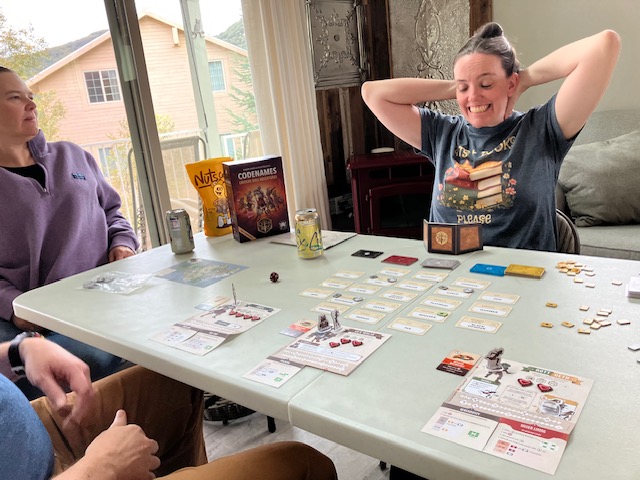
Codenames: Critical Role Adventures was a giant hit with me and my friends! Yes, it adds more rules and more mechanisms into the game, but the cooperative nature, player advancement, cooperative deduction, ongoing adventure, adding powers, just all worked so well together! If you need a reason to play a bunch of Codenames sessions, the adventure gives you that reason!

This Codenames is complicated enough that it’s “probably” not for Sunday night with Grandma (but hey, you know your Grandma better than I do). Be aware of the extra complexity.
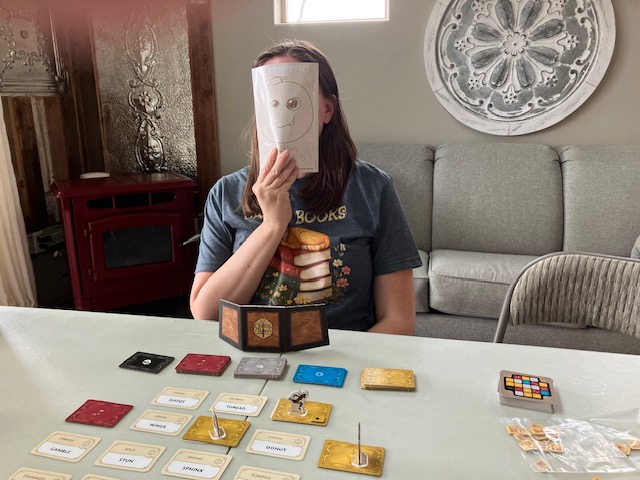
Let’s be clear: at its core this is still Codenames! I have a couple of friends who really don’t like Codenames and I don’t think this new version will change their mind at all !! Despite all the cool new features, this is still Codenames, the word-guessing game. EDIT: Actually, one of my friends who doesn’t love Codenames says this is probably his favorite way to play if we are going to play; so that’s a win?

This is, simply put, my favorite version of Codenames! Codenames: Critical Role Adventures is a 9.5/10 for me and my group! Why else would we have played it for 4 hours straight???

If I were to say what tipped it over the edge to being so great, I would say it was the cooperative deduction aspect as enabled by the special powers!
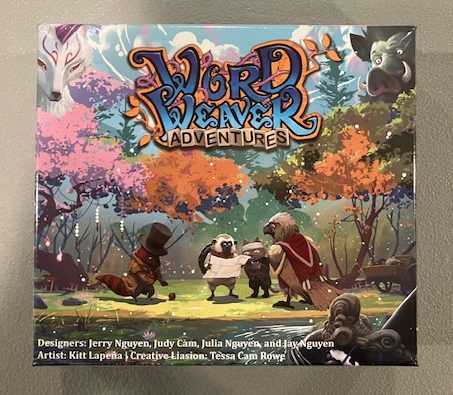
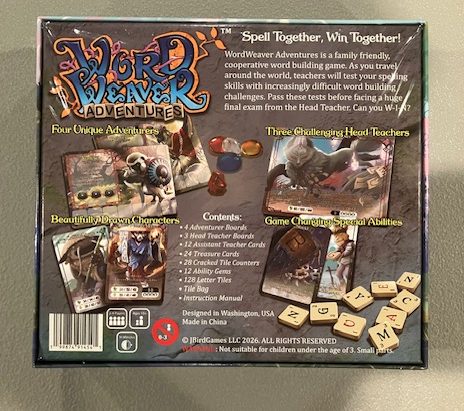
Cooperative Scrabble? A Solo and Cooperative Review of Word Weaver Adventures

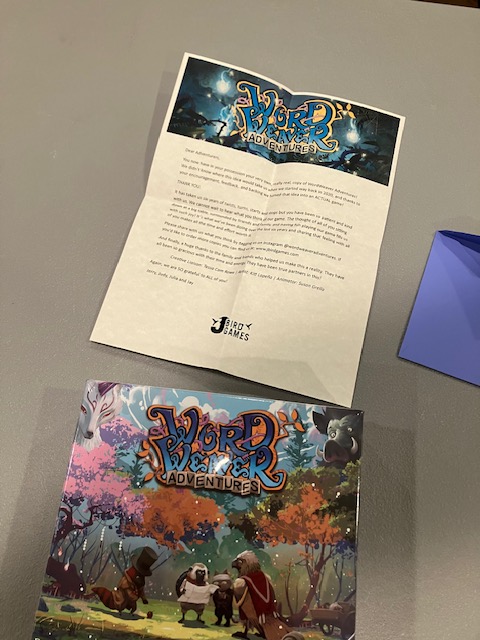
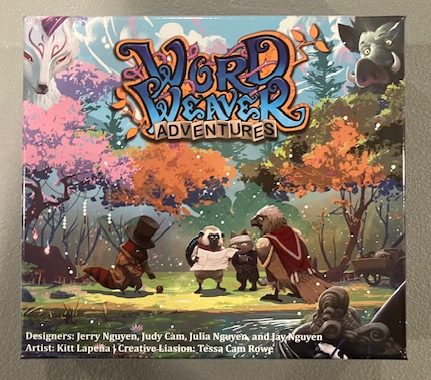
Word Weaver Adventures is a cooperative word and (sorta) boss-battler game from Gamefound back in June 2024. It arrived at my house sometime April 2026. There were delays along the way from tariffs and other issues, but it delivered!

I have to admit, I almost didn’t back this! This wasn’t a well-known company or anything like that, just a bunch of passionate new gamers. They promised a cooperative word game (maybe like a cooperative Scrabble?) .. and the art and the enthusiasm for the project amped me up enough to back the project! It ended up being a smallish Gamefound project at about $13,000 with only 152 backers.

In the end, when the game finally arrived, I enjoyed the personal letter they sent. See above.

Will this be a hidden gem? Let’s check it out!

Unboxing and Gameplay

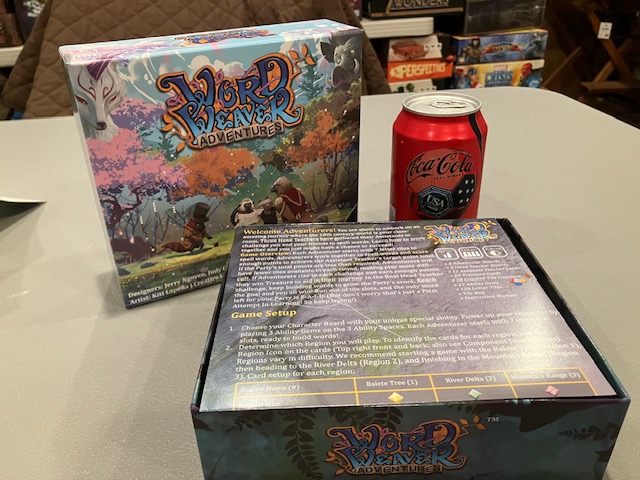
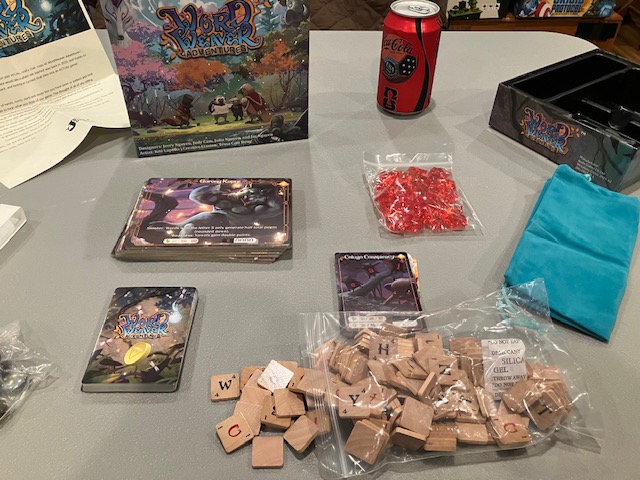
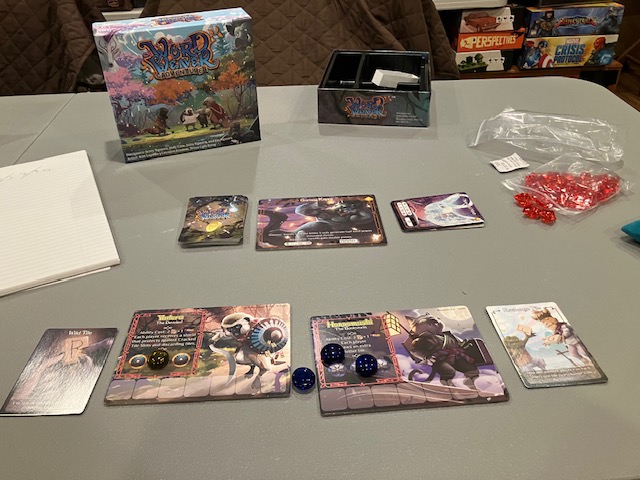
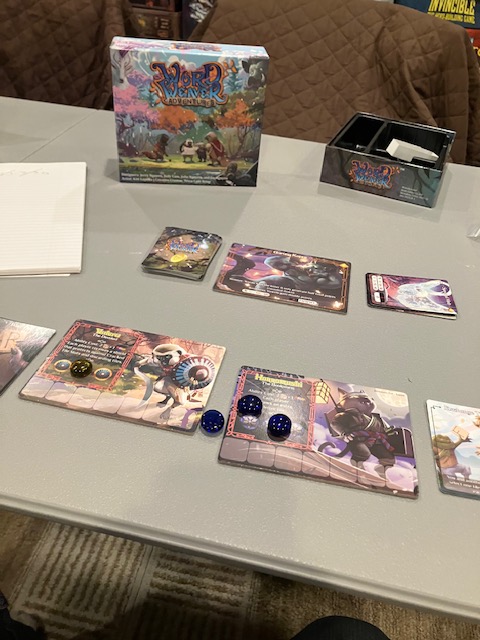
Word Weaver Adventures is a smallish box; see Coke can above for perspective.

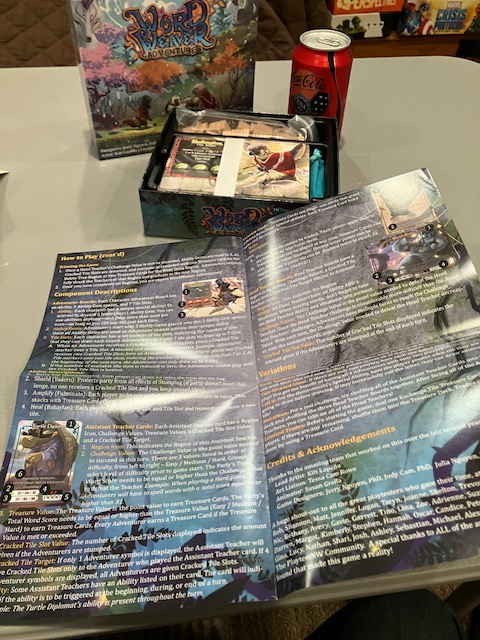
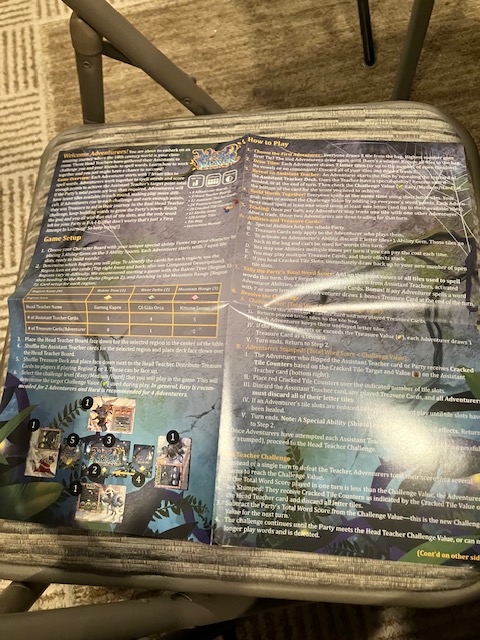
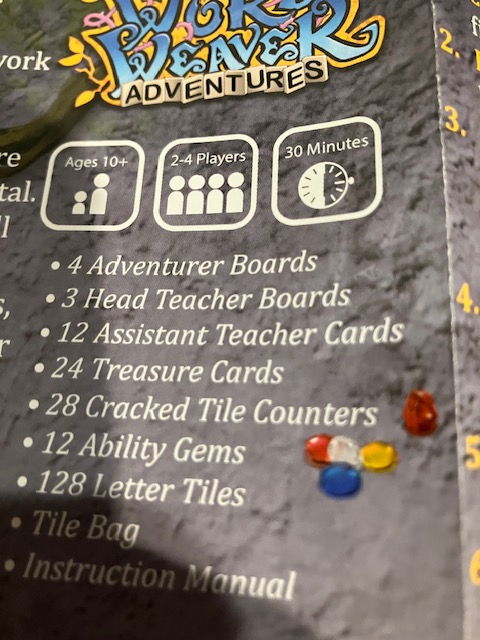
The rulebook is, unfortunately, a folded pamphlet. Sigh. See above.

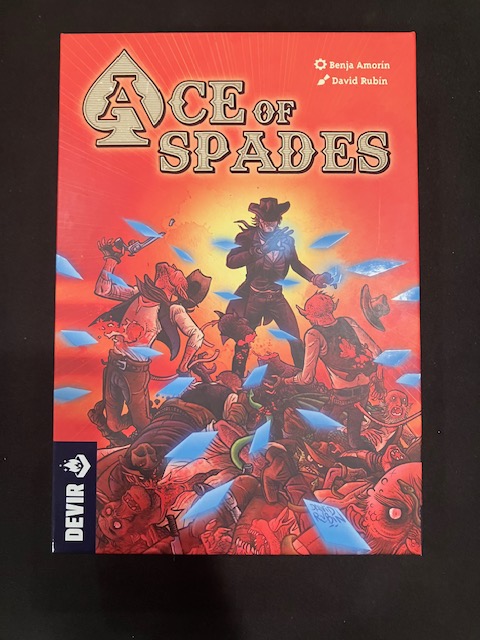
If Ace of Spades (from a few weeks ago) uses poker hands to take out bad guys cooperatively, then Word Weaver Adventures uses words (with point values like Scrabble) to take out bad guys cooperatively! There’s actually a surprising amount of overlap in the ideas!

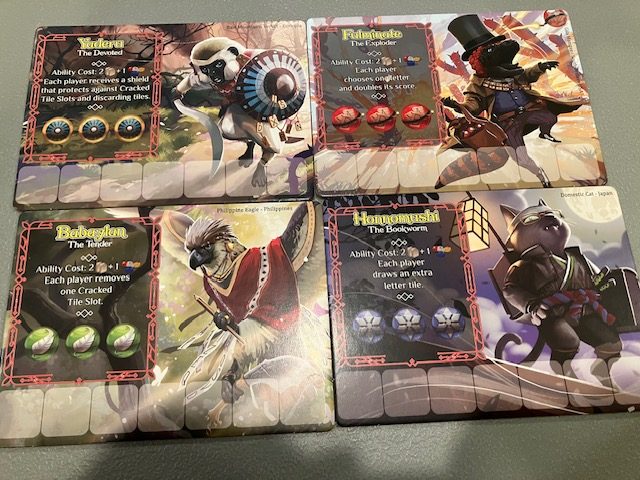
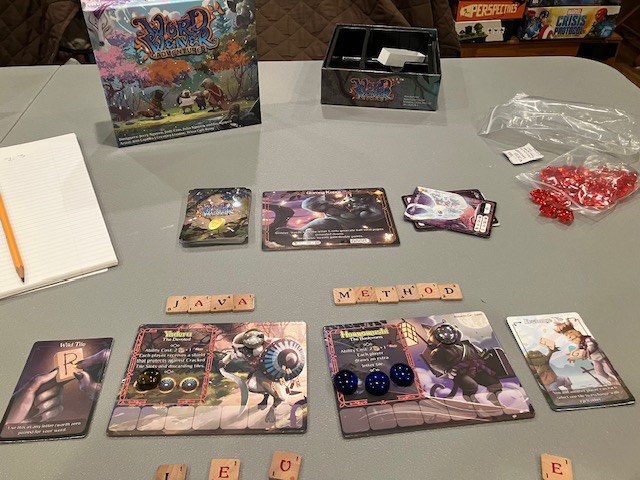
Each player takes the role of one of four characters: see the choices above.

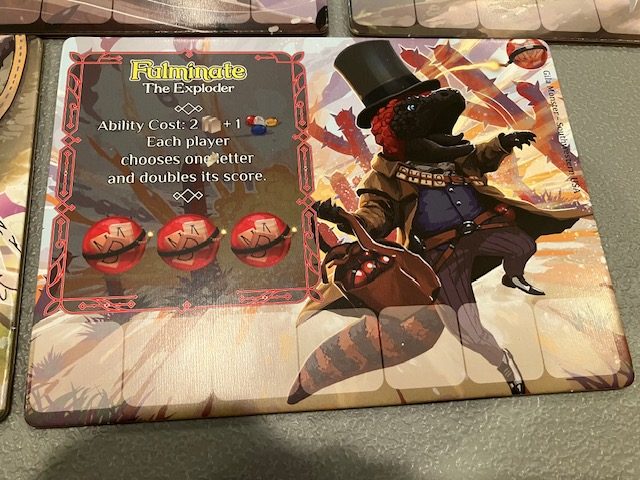
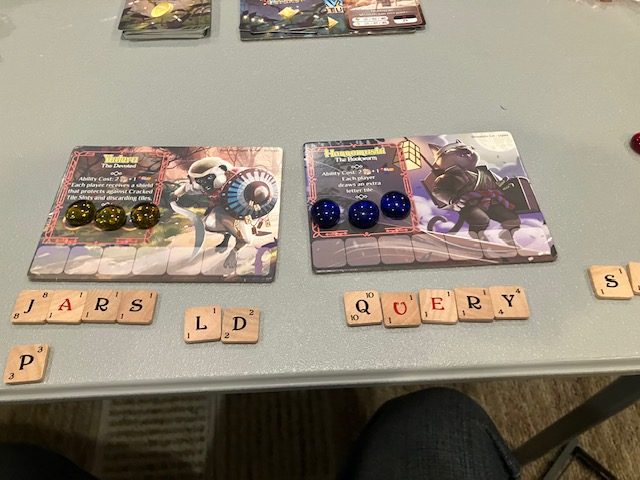
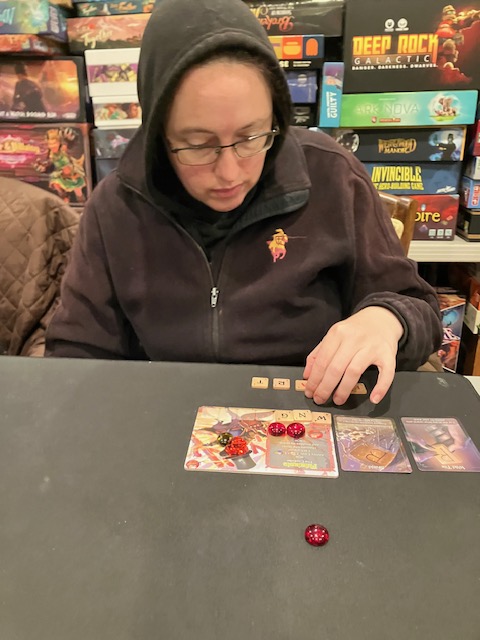
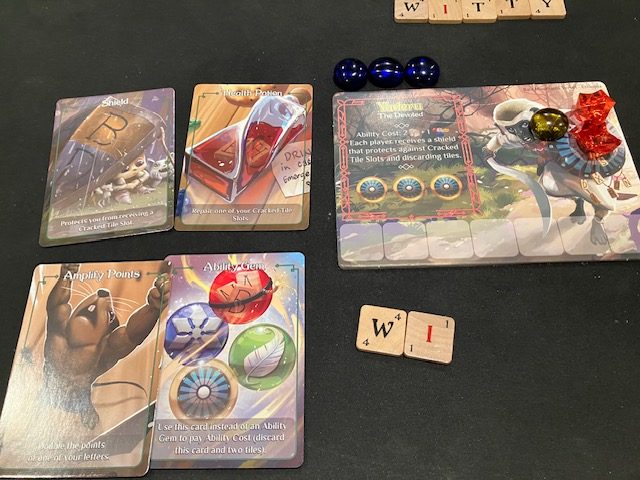
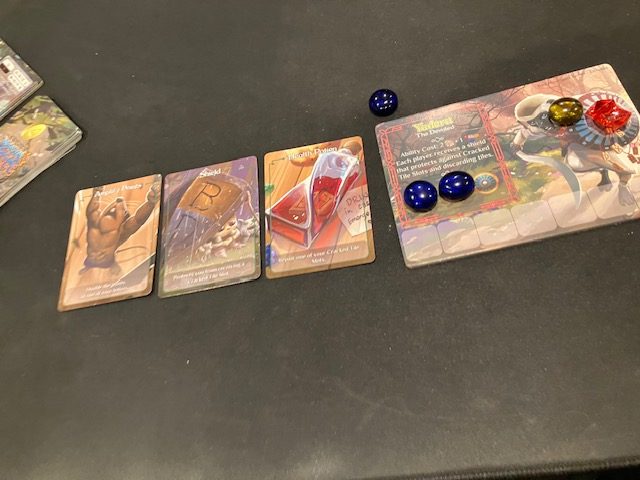
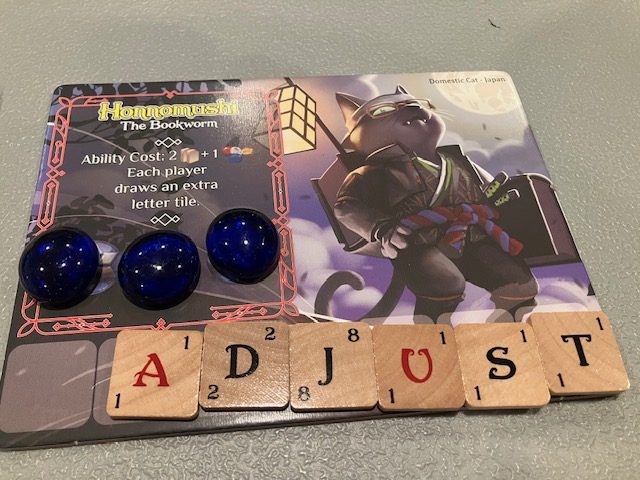
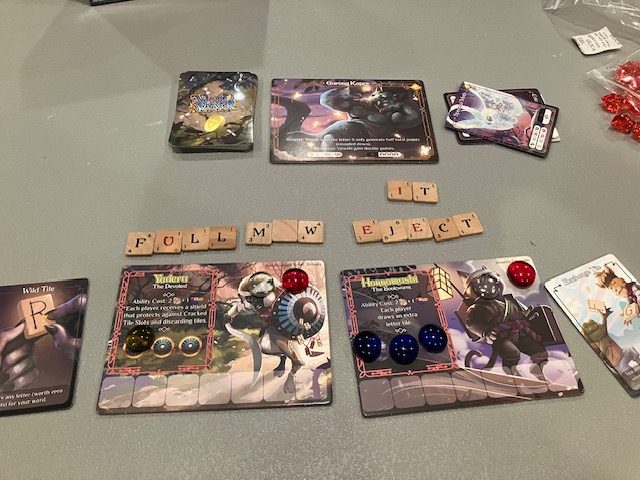
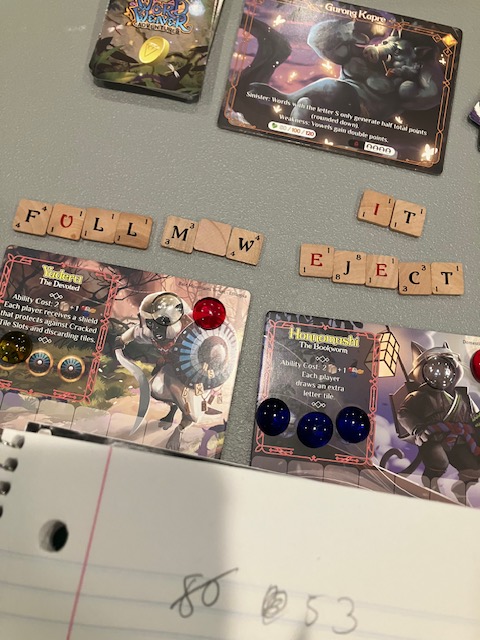
Each character has a special ability, powered by letters and gems. See above as Fulminate : The Exploder can double the value of a letter!

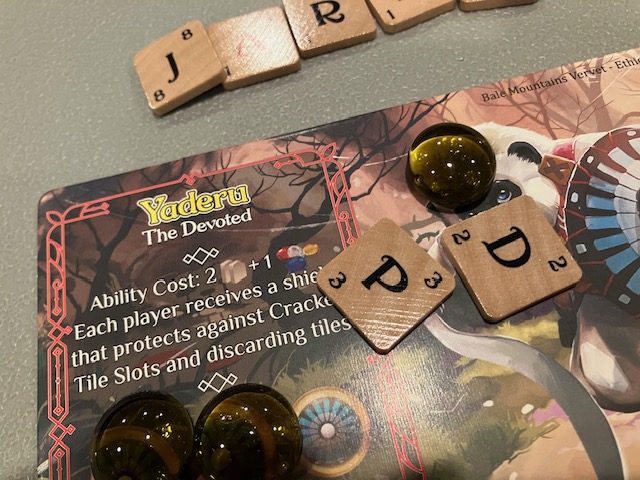
Each use of your power consumes a gem and 2 letters (see above). You only start with 3 gems, which means you only get to use your special ability 3 times during the game! And that use also costs precious letters!
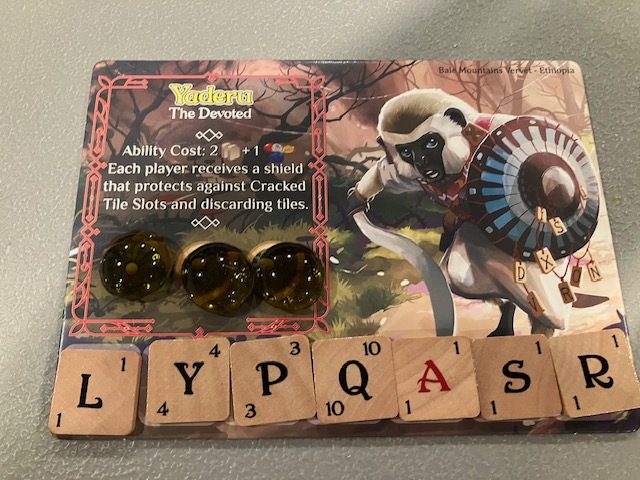
At the start of each turn, each player draws up to 7 letters, and uses them to try to spell things! It has kind of a Scrabble vibe, eh?

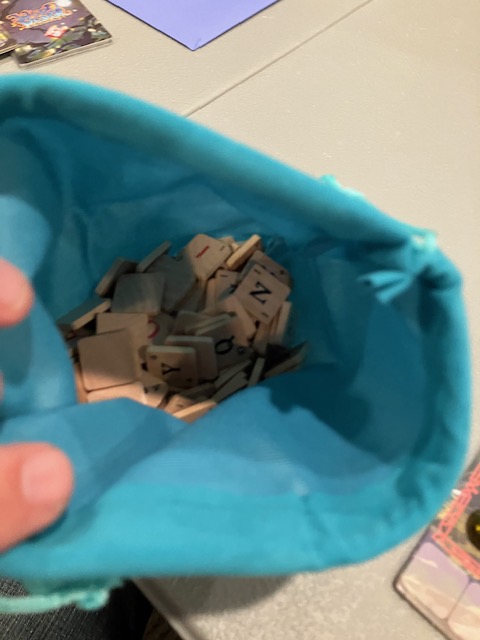
The letters are really nice wooden letters, ala Scrabble. They are in a very nice bag holding them … see above!

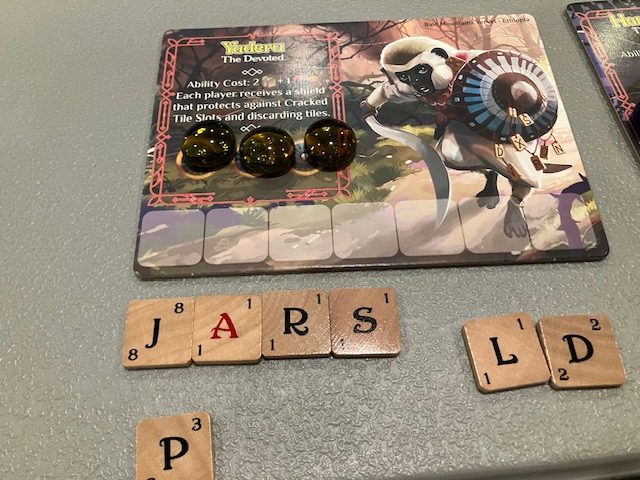
The words you spell do “damage” to bad guys! How much damage? It depends on how much the letters of the words are worth! JARS above (with no modifiers) would be worth 8+1+1+1 = 11 points of damage!

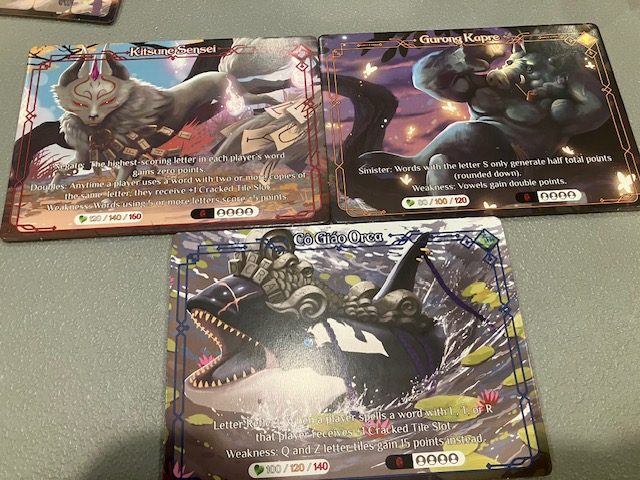
This is a boss-battler game! Sort of! To win, you have to take down one of the big bosses (see above) by doing enough damage! I keep saying this is a boss-battler, but these “bosses” are just challenging you to spell! My first pass through the game, I thought these were bosses you “defeated”! No no no!! The theme is that they are teachers quizzing you, and you have to get enough points to move on to the next teacher! The “damage” you do is just points towards overcoming a “test” or “quiz!”

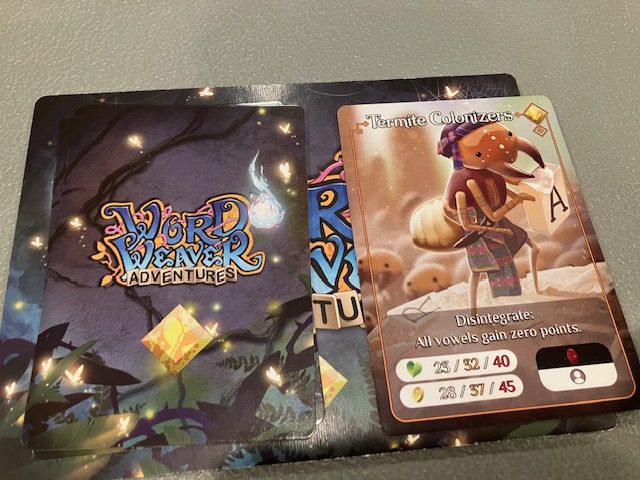
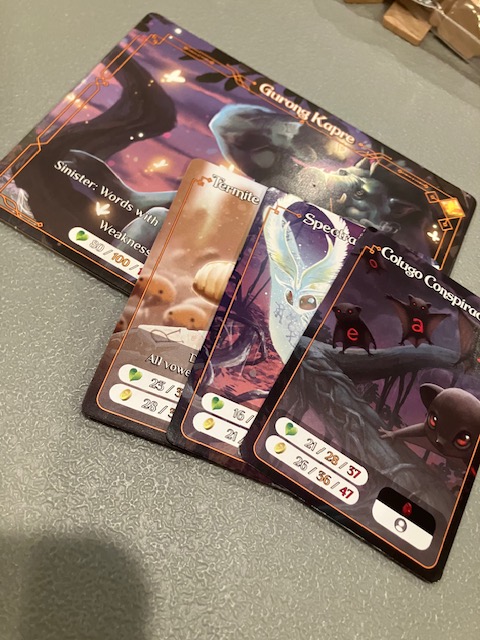
Along the way, you must pass smaller quizzes from Assistant Teachers! See The Termite Colonizers above! He’s an Assistant Teacher who gives you little quizzes! They are just a minor quizzes on the way to the big test at the end! (The bad guys are all grouped; we are spelling for the yellow diamond bad guys! See the little yellow diamond in the upper right corner)
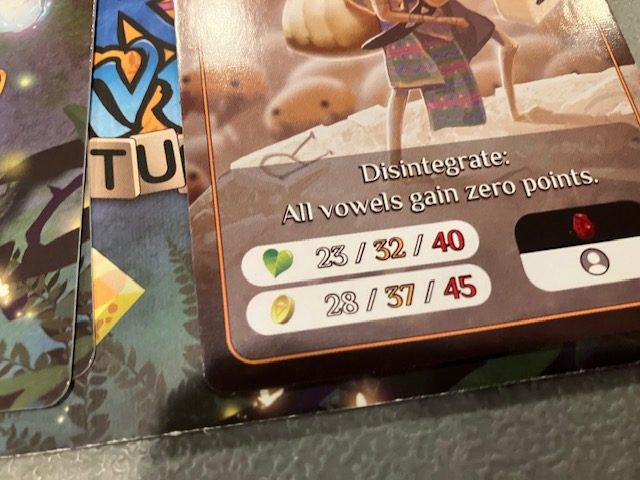
The (left) bottom of the card describes how many points they have, plus (right bottom) how much “damage” they do to the characters if the survive to the next round! Damage to characters is done “cracking” a letter spot so that character(s) get fewer letters next turn!

If the players can survive the big boss (called Head Teacher) test and take out little spelling quizzes along the way (with Assistant Teachers), players win! Basically, if all slots are cracked (meaning players can’t draw any letters), players lose!

Overall, these components are just fantastic!

Rulebook

Yes, the rulebook is a pamphlet. Sigh. I really detest this form factor for rulebooks.

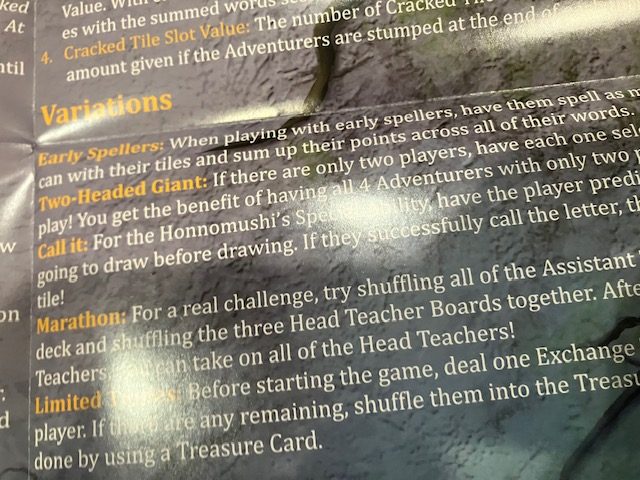
It DOES fit on the chair next to me without drooping, but the text is a little hard to read. They did a good job of not wasting space (there’s almost no wasted space: see above), and there is no droopage, but it’s still a pamphlet that’s kind of hard to read: this gets a C on the Chair Test?

The rules were ok, but a little unclear on a few things. I didn’t realize until I looked at the Variations, that you can generally only spell one word per turn with your tiles! If you play the Early Spellers Variation (above), you can spell multiple words! Whoops! I wish that had been clearer!

I mean, I got the game played from this rulebook. . I would have been so much happier if this had been a little rulebook. But I get it; there were only 152 backers for this campaign. They did such a great job with the cards and characters and the art therein, I guess someplace had to suffer a little. I’d rather have the great art and cards (which you look at all the time) and an ok rulebook (which you only ever look at once or twice). So, I get it. The rulebook mostly taught the game; It was fine.

Solo Play

Strictly speaking, this game DOES NOT support the solo player! Only 2-4! So sad, no support for Saunders’ Law.

It is SO EASY to support solo play! Just play the 2-Player mode (play as two characters) and alternate between them as-if the game were 2-Player! This is perfect example of 2-handed solo working just fine! I found that this solo mode worked! I am a little surprised they didn’t include this simple solo mode.

This is how I learned the game; playing 2-handed solo mode! In the end, I had a fine time playing.

Cooperative Mode

We played a few cooperative games. We liked it enough, after the first game, that we wanted to play again! In fact, we probably should have upped the difficulty in the second game! We crushed it!

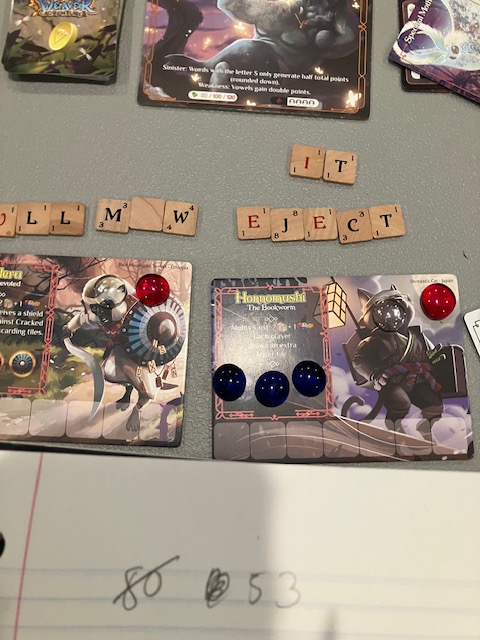
From a mechanism point of view, there isn’t really that much cooperation. Every turn, you can maybe swap one letter each, and each player can only swap once! (Which means in a 3-player game, there is a limit of one swap total per turn). Basically every turn is mostly multiplayer solitaire (see Teresa above looking at her letter) as each player tries to get the best word they can with their letters! So, there’s not that much cooperation, at least at the spelling word level.

Interestingly, even if the “spelling” part of the game had pretty minimal communication and/or sharing, some of the higher-level strategies emerged as we chatted. “You know, if I spell a lesser word, I can use my shield to protect us all from cracking!” “Oh ya! Do we have good letters? I can double the best letter? Is this a good idea now?” As the monkey, I was good at shielding …

The special powers and special cards (treasures) actually became very important part of the strategy of this game. The discussions that revolve around when to use these cards was the main cooperation that emerged.

To be clear, there are NO communication limitations (thank goodness) in this game! Players can talk as much as they want! And even the rules aren’t 100% clear, I am pretty sure you are allowed to show all your tiles to all other players! That encourages the cooperation and helping! You can kinda tell when someone is having trouble with their letters, and you can look across the table and offer suggestions! I did that a few times … and I was offered suggestions a few times as well. It works; each player still make all the decisions with their own letters, but minor help occasionally from your friends does help.

The game is mostly multiplayer solitaire, as players spell their words fairly independently. There’s a minor mechanism for sharing letters, but much of the conversation that flows in the game is high-level strategizing about how to use special powers and treasures. Despite the multiplayer solitaire nature of the spelling part of the game, the rest of the game is fairly interactive and cooperative!

What I Liked

The Art: The art in this game is generally fantastic! I love the vibe that this art exudes! No adjustment needed on the art at all! This art is AWESOME!

Cooperative Scrabble: I like that I can generally describe this as a cooperative Scrabble game! Most people know what Scrabble means, but they wonder how it comes together as a cooperative game! It’s tempting to hear, “Oh, you can play Scrabble cooperatively?”

Easy To Pull Out. In general, this game is easy to pull out and teach.

What I Didn’t Like

No Solo Mode? It’s really weird that there’s no solo mode. Play 2-handed solo; it works fine.

Scaling: The game scales weirdly. It’s supposed to be Easy/Medium/Hard difficulty, but honestly, the game is so much easier with more people! If you have 4 people, you can do so much more “damage” per turn! I was struggling in a 2-Player game at the “easy” level, and I realized I would be destroying the game with 3 or 4 characters playing! So, it sorta feels like the difficulty should be a function of the number of players? It’s not!!! I think that the difficulty level should probably be the number of characters in play: Use easy for 2 characters, medium for 3 characters, and hard for 4 characters. (Note that I say characters because a solo game would be 2 characters!) I guess you can choose to make the game easier or harder by upping or lowering the difficulty.

It felt like a mistake the game had no notion for scaling for the number of characters in play. This is probably the biggest flaw in the game; there needs to be an orthogonal scaling factor for the number of players and the difficulty; they conflated them and I think that’s a mistake (and confusing).

Pamphlet For Rulebook. Yes, I’ve complained about this a lot; I’ll shut up now. I’d much rather have the amazing art and a pamphlet than mediocre art and a real rulebook. I’ll shut-up about this. The pamphlet worked. This is a personal issue.

What’s a Word? There is no discussion really of “what’s a legal word I can use?”. I think they are relying on the Scrabble back-knowledge of most people, assuming people will use standard Scrabble rules for “what’s a legal word”. But there wasn’t really a discussion.

Conclusion

Word Weaver Adventures is a hidden gem of a game! Most people know what Scrabble is, so it should be easy to pull this out and teach this to most people. As long as you know about the scaling issues (and know how to correctly use the difficulty based on the number of players), this game is great! 8/10.

You can play solo; have the solo player operate two characters and alternate between them. It’s surprising this solo mode isn’t in the rules.

I am so glad I have a simple and gorgeous cooperative Scrabble game I can pull out and show anyone.

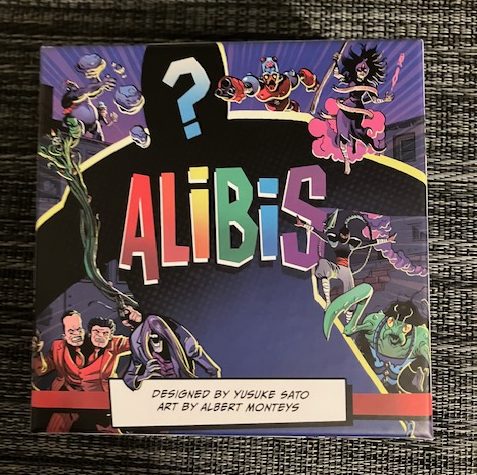
Alibis: A Cooperative Word Game! Does it Get a Pass?

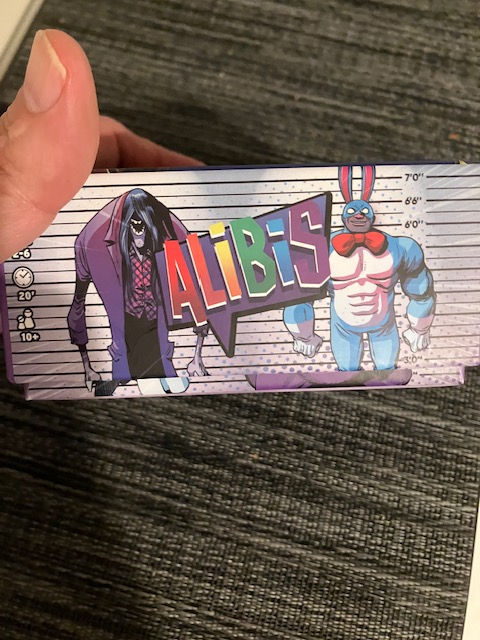
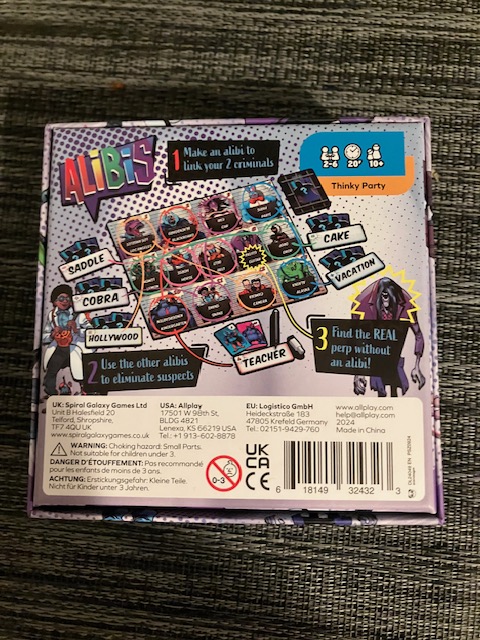
Alibis is a cooperative word game for 1-6 people: think Cooperative Codenames!

This is a game about guessing words cooperatively as a group.

Let’s take a look!

Unboxing/Gameplay

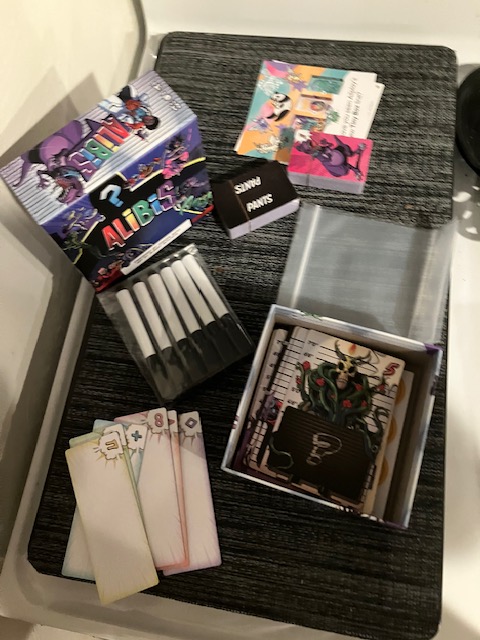
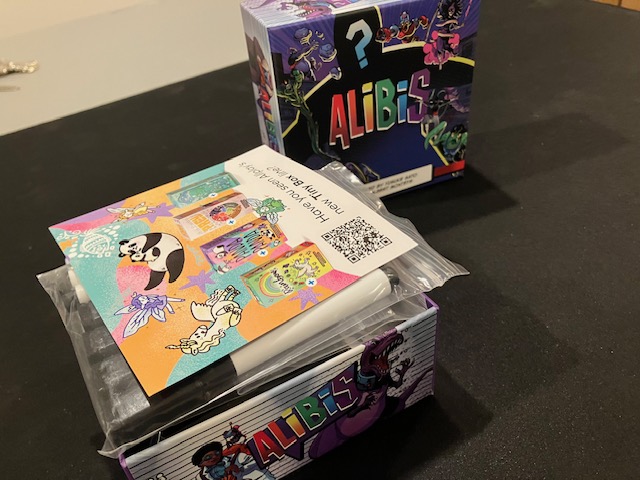
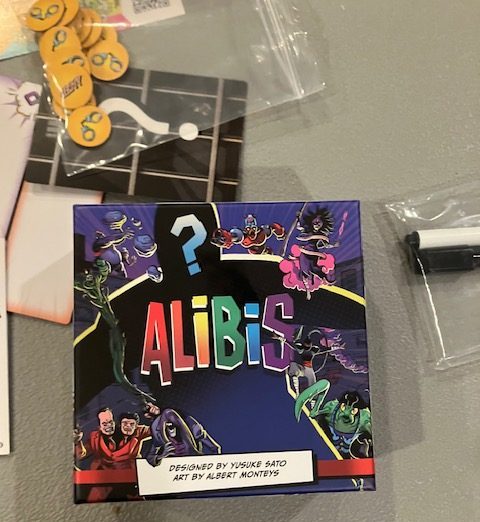
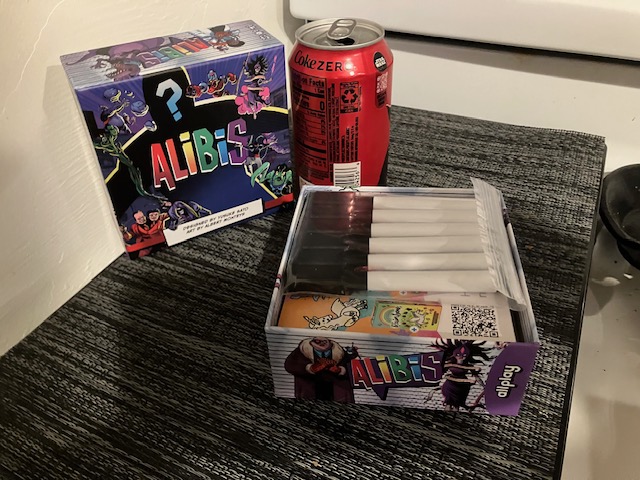
This is a very smallish game: see can of Coke above for scale.

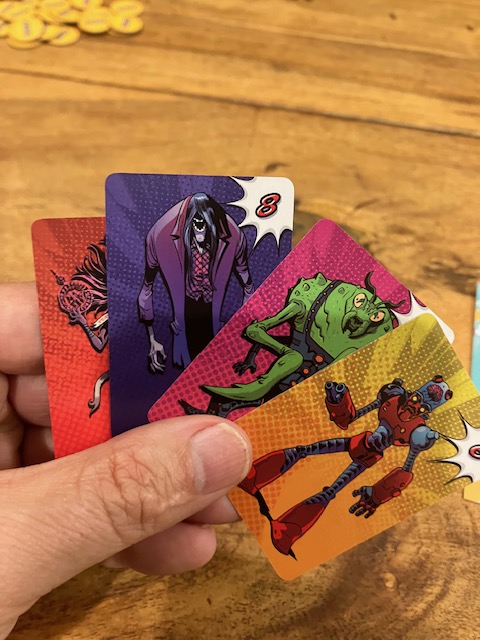
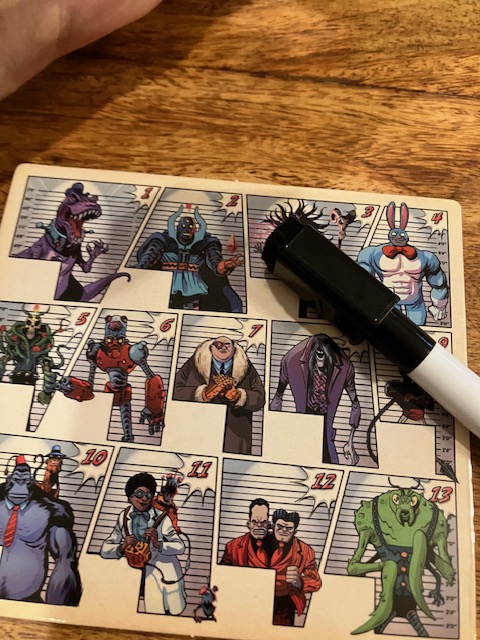
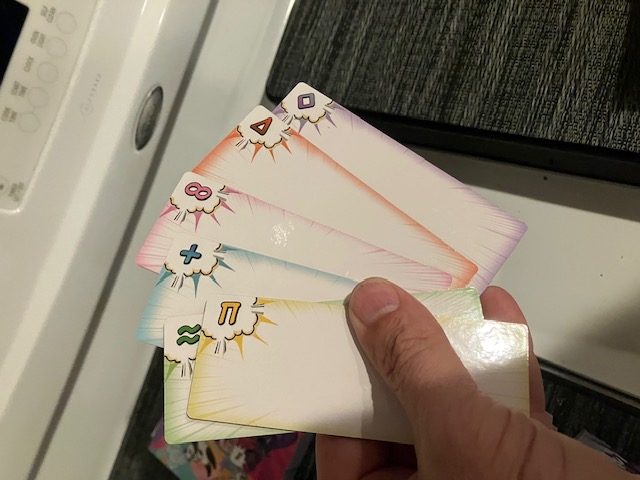
Each player gets a little white-erase board to write a single word on (two of these boards of you play 2 or 3 players).

The white-erase boards are used to write a single word; players are trying to connect two “words” together (much like So Clover, where you try connect two words with one word, or Codenames where you give a word clue to connect some words together).

Each player is given some guys to alibi: in a 2-Player or 3-Player game, you get 4 guys.

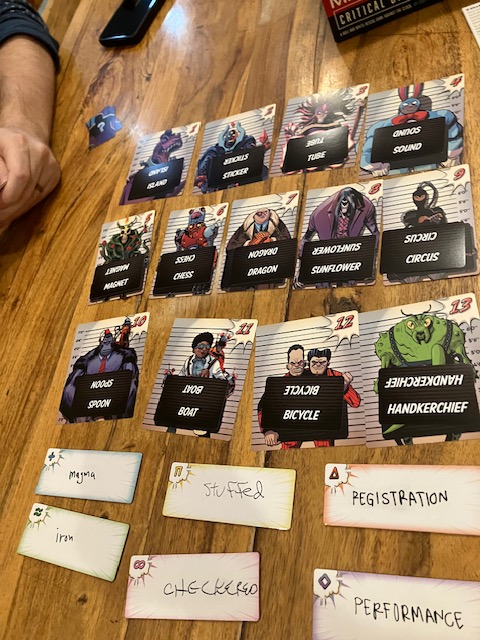
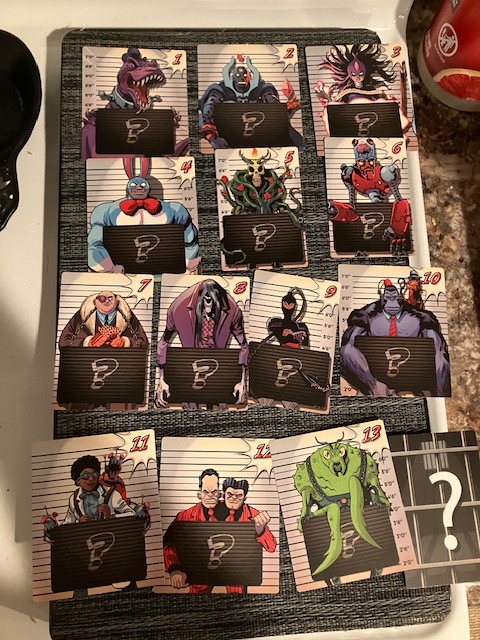
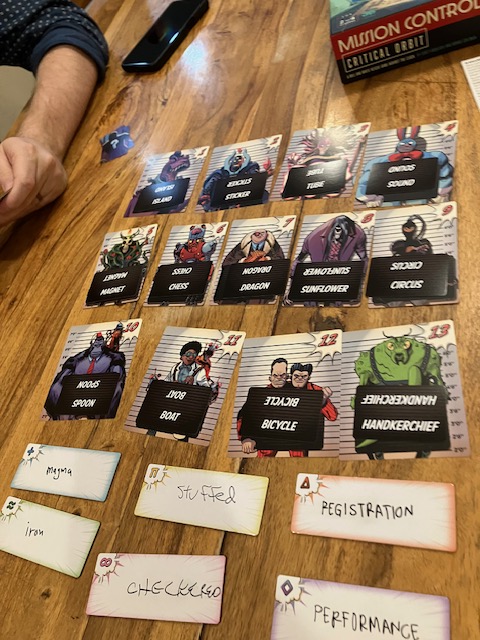
The single words are supposed to provide “alibis” for two of the guys in the line up!  See above!  For example, “magma” (the + board, upper left) is providing alibis for guy 1 (“island”) and guy 7 (“dragon”).

So, you’d mark a + on the guy 1 and guy 7 on your board! You are keeping track of everyone who has an alibi!

Basically, there is always one guy that’s “the perpetrator” and you, as the players, are trying to alibi everyone else!  It’s a word guessing game!  Can you guess the perpetrator by alibiing everyone else????

This game really isn’t very thematic; the line-up with weird villains has nothing to do with the game.  It’s just a cooperative word-guessing game.  To be 100% clear, there is no real communications among players EXCEPT for the words given.  (That part is very much like Codenames, but not So Clover).

No Solo.

There is no solo mode for this; this is nominally a party game for 2-6 players.

Two Players

My 2-Player game with Don went great.  It works well, as you get 4 guys to alibi, so you have to provide 2 words!  You actually get more options in the 2 (and 3-Player game) as you can choose how to group your 4 guys into 2 groups.  There are 9 guys on the board (see above), and you have to alibi 8 of them!

2-Player worked well, it was fun.

Three Players

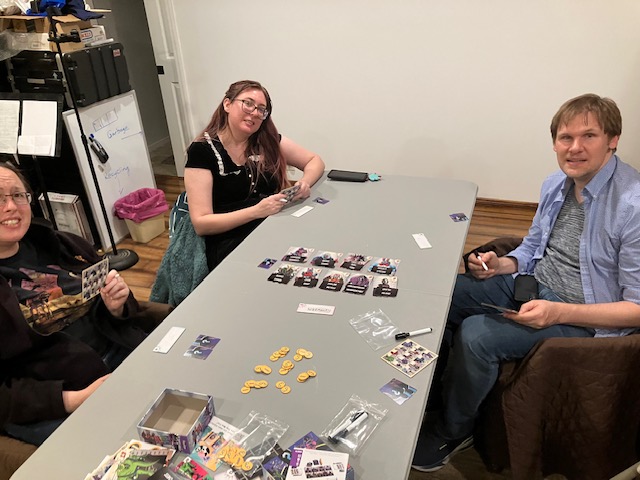
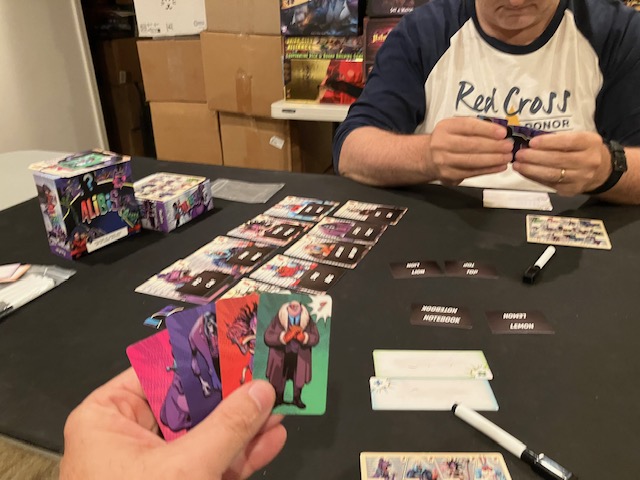
In 3-Player mode, like 2-Player, in 3-Player mode, each player gets 4 guys to alibi. See above as me and Caroline and Nathan play!   The difference is that there are more guys out on the board! There is ALWAYS must be one guy out (who is the perpetrator).  In the 3-player game, the players alibi 12 guys, with the 13th guy being the perpetrator! See above.

The 3-player game worked great.

Four Players

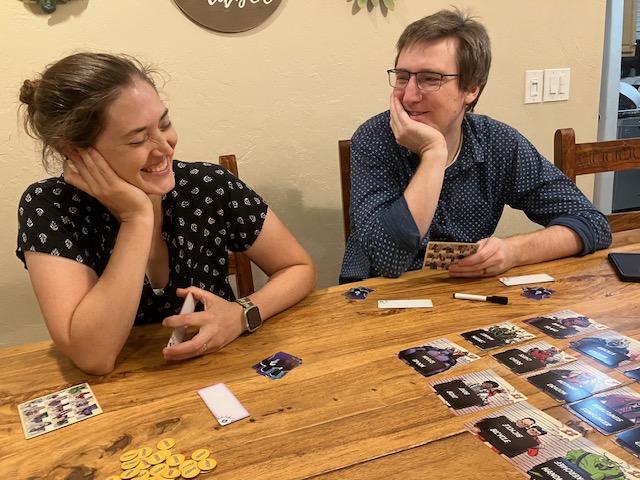
The 4-Player game wasn’t … quite as fun.  See above as me, Sara, Teresa, and Andrew play! It’s the same game but you only get 2 guys to alibi (instead of 4), which means you only get to craft one word!  There are 9 guys out, and the 4-Players alibi 8 of them.  See above.

This means you have to come up with a single word to connect two guys.  What does “stuffed” (above) mean?  I don’t know, and I wrote it!!!  And the two words (guys) you get may suck and have nothing in common.  Sure, this happens in Codenames a lot, but at least you start with many many words to connect! You only get “stuck” with two bad words at the end.  In this scenario, you only have two words!  Hopefully they will be easy to connect!

The 4, 5, and 6 player game all play like this; the players each get 2 guys to alibi which means they only get to write/craft one word.

Scoring

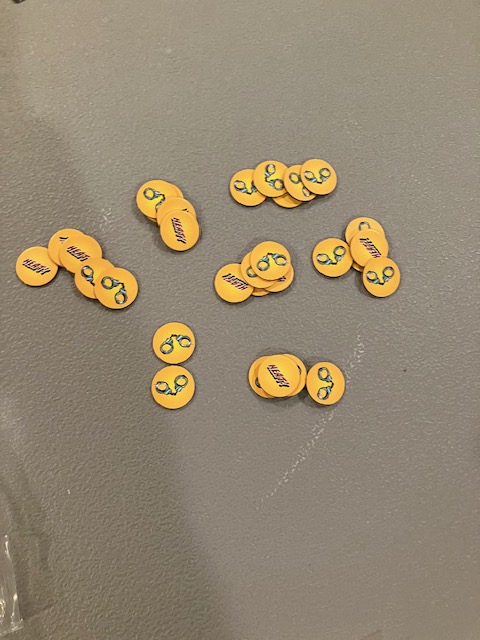
The scoring is a little wonky.  Every time you guess something correctly, you remove “heat” (see heat above) from the game!  The more your remove, the better you do!  At the very end of the game, you get told you how good or how awful you are by how mush “heat” you remove.

Eh, it’s nominally a party game, so the score doesn’t matter too much.

Conclusion

If you love Codenames, you will probably love this! If you hate Codenames (Joe, I am looking at you), you will probably hate this as well.

I think Alibis is better at 2 and 3-players, as the players get choices as how to group their 4 guys, so they can come up with better groups of 2 words.  The 4-Player and higher count game “works”, but it’s just not as fun; It like the worst part of Codenames when you have exactly two words that don’t have anything in common … and you don’t know what to do.

This is a fun game, but I’d recommend So Clover over this. I think So Clover is a stronger party game, partly because you have more words and more opportunities to connect things.  Probably more important is that in So Clover players can talk amongst each other, rather than just be quiet (like in Alibis).  That interaction is so much more fun in a party game.

Still, this is light and easy to get into.  It’s fun to play: I’d give this a 6.5 or 7/10 as a 4, 5, or 6 player game and a 7.5/10 as a 2 or 3-player game.

This would probably make our Top 10 Cooperative Party Games, maybe just not near the top.