The Glasgow Train Robbery is a 2-Player only cooperative game that was on Gamefound back in April 2026. I backed it, and it delivered to me in late June 2026. That’s right, only 3 months from crowdfunding to delivery!

This is the story of the Great Train Robbery of 1963 (see wikipedia entry here)! Yes, this game is modeling a real event! Two players work together to try to pull off that same train heist! This is an asymmetric cooperative game with limited communication for only two people!
Let’s see how well in works!
Unboxing and Gameplay
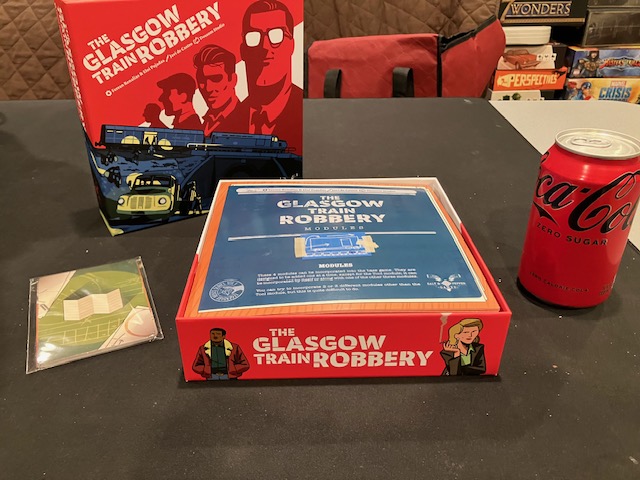
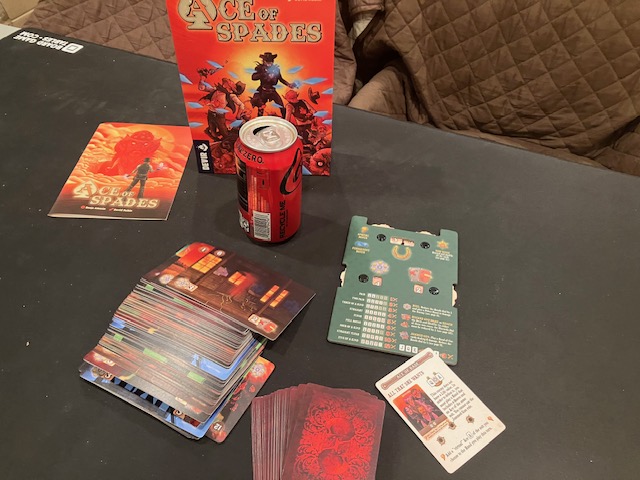
See Coke can above for scale.

This is a dual-language product: Spanish and English. See above for the two rulebooks that come in the game!
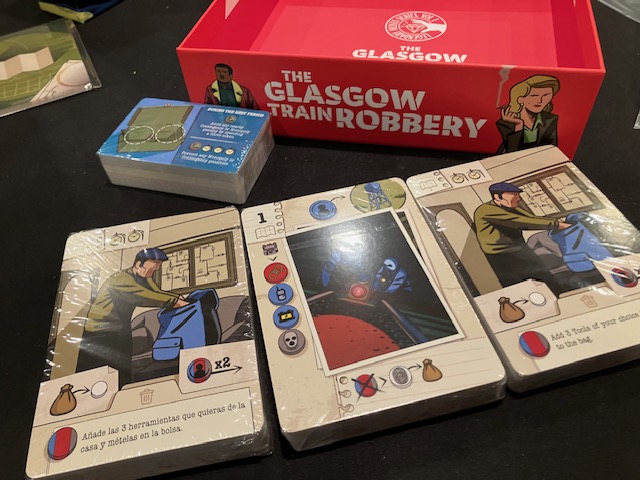
Some cards are language independent (see middle set above) and other cards are definitely tied to a language (the same card in English on the right and Spanish on the left).
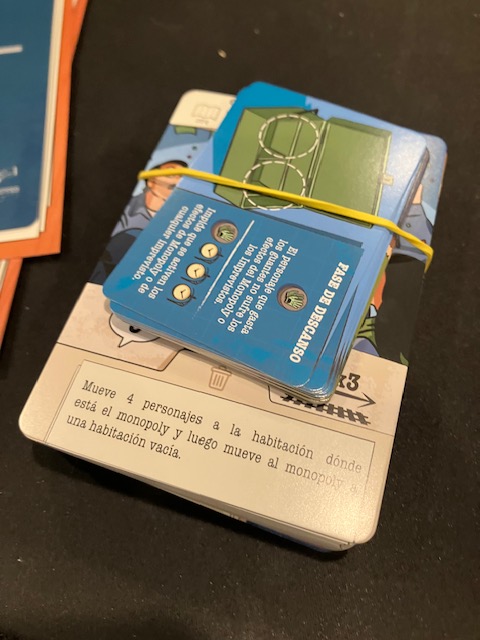
I had to spend a little bit of time separating the two out. In the end, I put all the Spanish cards together with one rubber band and just put it back in the box.
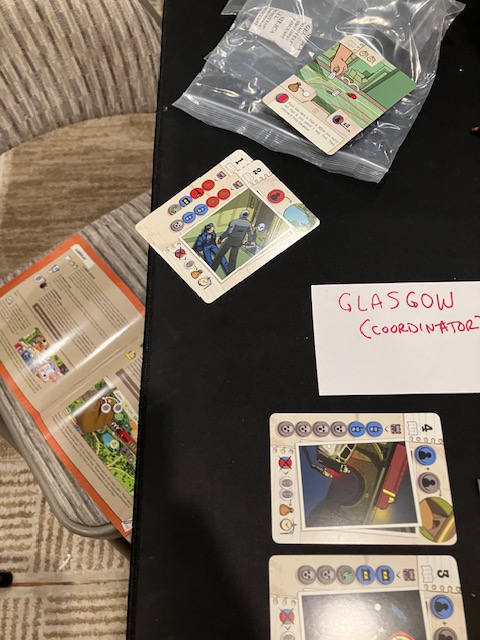
The two players are playing very asymmetric roles in this game. One player plays the Glasgow side, playing the Coordinator. See above. I wish the game had included ome way to mark which side was which, so I made my own little cards!! The Coordinator is all about supplies and handling the first four stages of the Plan for the train robbery! The first four Plans are all about the set-up and execution of the robbery!
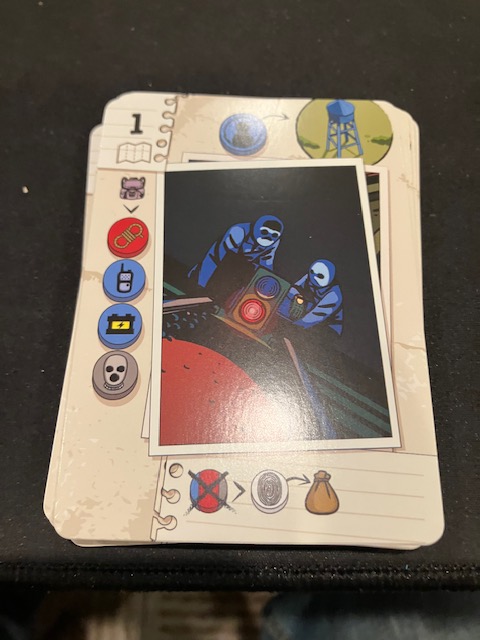
A Plan (level 1 above) is executed by spending the resources (on the left side of the card) when the train is at the location (upper right on card) with appropriate characters (upper left of card) next to it! So, you need resources, minions in the right place, and the train in the right place! Whew! Now, you can resolve a Plan card, even if you don’t have all the resources, but the penalty is listed on the bottom of the card for EACH resource you can’t pay! In this case, you add more fingerprints to the bag.
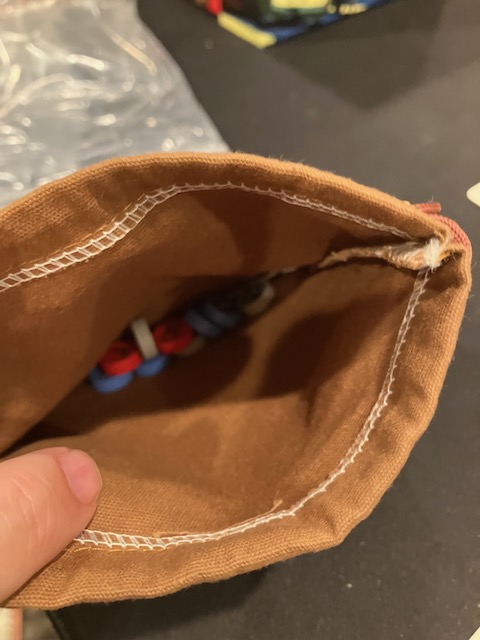
This is also a bag-building game to some extent; the bag is filled (very carefully and specifically) with resources that you may need to complete challenges. The big is filled and emptied (usually only) when players REST for an action.
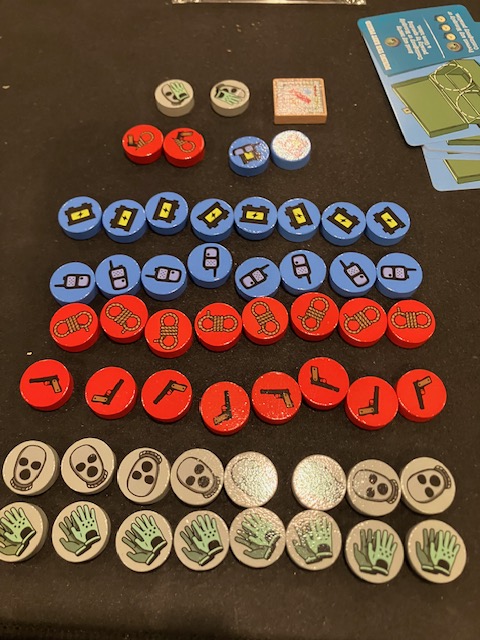
The resources (see above) are all tokens you can collect by either drawing from the bag (at certain points in the game, usually a REST), visiting a hideout, or having a special card! These resources are “criminal” resources: gloves, guns, rope, etc (see above) needed for the heist! These resources are surprisingly sparse; it’s harder to get resources than you think.
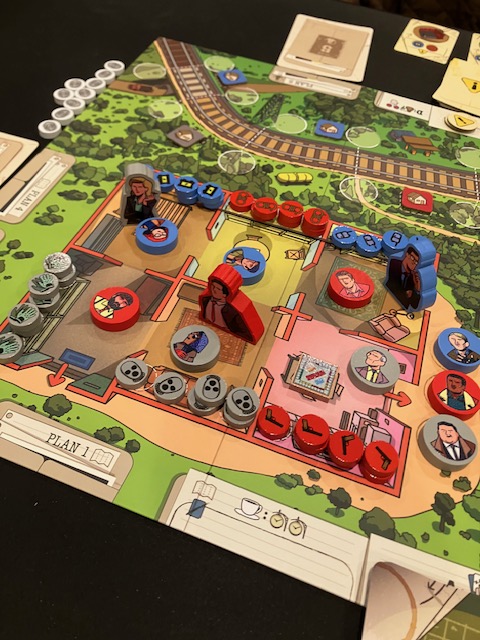
The resources are usually managed by the Coordinator: the Coordinator’s side has a house with all the resources. When it’s time to put resources in the bag (during a REST action), one resource is put in for each person in the room with that resource! The Coordinator moves people around the house (and outside the house to help), so this is a delicious tension! When should the Coordinator use his precious turns to move people in the house (so we can have more rope in the bag at a REST) or when should he move people OUTSIDE the house because the other guy needs more help?
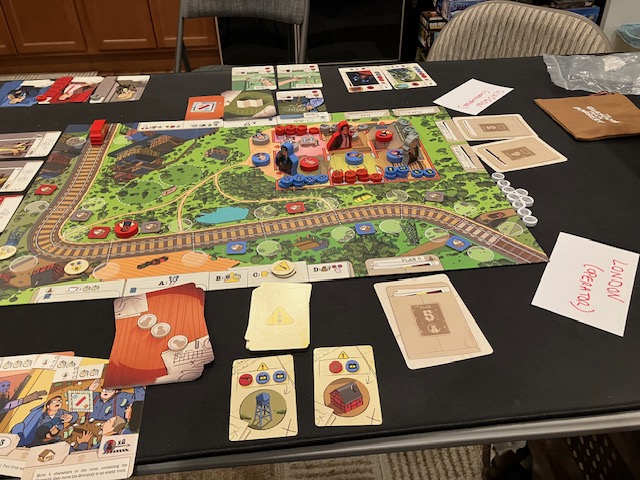
The Operator is the other side (in London). Once the people have left the house, the Coordinator no longer controls them; only the Operator may move them! The Operator’s job is to have people in the right place at the right time! The Operator is also given the unenviable position of dealing with unexpected “issues” that crop up! The game calls these issues Contingencies.

Contigencies are kinda similar to the Plan cards; they are resolved by discarding resources, but you have to have enough characters next to the landmark to resolve the contingency! See above. If you don’t take care of contingencies, they cause time to expire sooner, fingerprints to explode, and make the game end faster.
This is a limited communication game; you can occasionally discard a card to say “3 keywords” and tell the other player what you need. RED-BLUE-TOWER probably means “get a red guy and a blue guy next to the water tower so I can complete phase 1 of the Plan!”
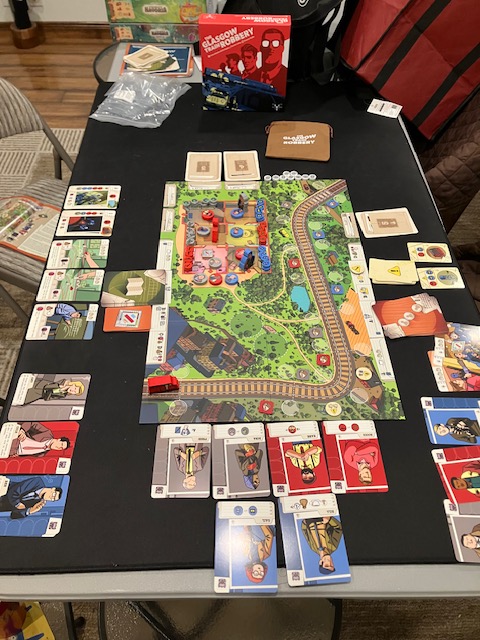
This is very much an asymmetric game; each player has special decks (Coordinator or Operator decks), different ways to operate, and different actions! If you can get solve stages 1-5 of the Plans without leaving too many fingerprints before the Train gets to London, you win! Whew!
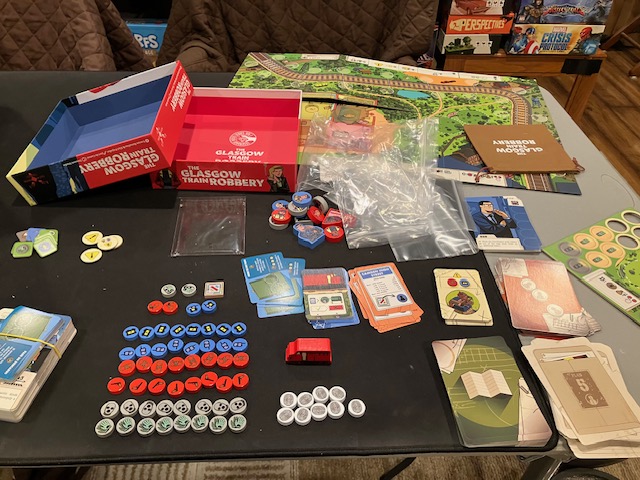
This is a really interesting looking game with its own “style” of art! I think it looks pretty neat.
Clark Kent is Robbing a Train?
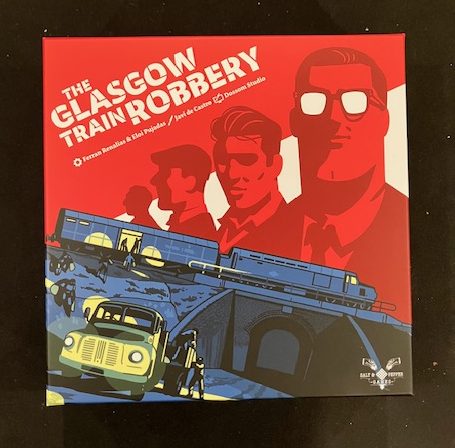
When my friend Teresa first saw the game box, she said “Is Clark Kent robbing a train?” I had to tell her, no, he’s not, but I can see why she said that.

I think the game art is meant to mimic some known pictures of the original heist members, and if you look at the pictures from Wikipedia on The Great Train Robbery … that one guy on the right looks suspiciously like Clark Kent.
Solo Play
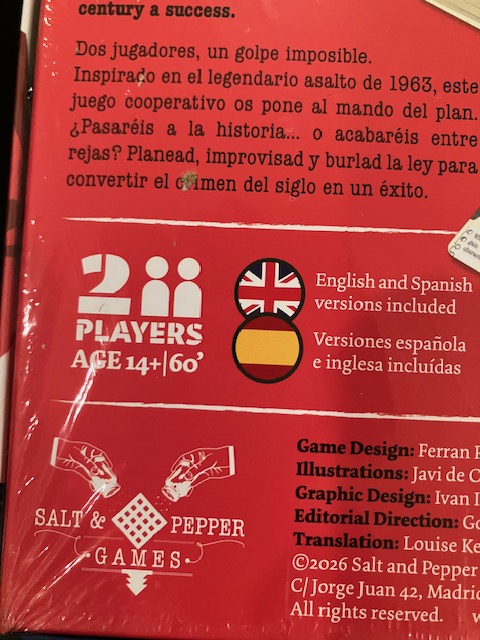
Let’s be 100% clear; this is ONLY a 2-Player game! There is no solo mode at all. None. No Saunders’ Law here!

And yet, solo was the first way I played!!! And I recommend you play solo the first time as well! What do I mean by this? This is applying the Changing Perspectives idea (see link here) where you “pretend” you don’t know what the other player knows, and try to play the game without using the other character’s knowledge. In this case, you alternate between the Operator and the Coordinator characters, but “pretend” you don’t know what Plans/Contingencies they have!
It is a little wonky to play the game solo like this, and it’s also hard! You can only use the information on the board and the keywords communicated to inform your decisions! It’s also very instructive to think: “Ok, if I didn’t know what the Operator’s Plan’s were, and only the keywords they’ve told me, what would I do?” This is a really interesting thought experiment. It’s also a better way to play solo than I thought it would be. It does work, but you just have to have the mental discipline to not “cheat”!
Even if you hate this idea of the Changing Perspectives, it’s a great way to learn the game: you get to play both sides, you get to see what operations are available, you see when it makes sense to communicate, and you see how the game flows. I also recommend physically switching sides when you play one position or the other: you almost have to because of the way the game sets-up! I strongly encourage this physical switching; it really throws you into the appropriate character when you are in their physical shoes!! (I don’t recommend changing shoes every time you switch sides; that’s too much).
Play the game solo once using Changing Perspectives idea, then you can decide if you ever want to play it again solo. I think I do? But, more importantly, I can now teach my friend how to play!
Cooperative Play – Two Players
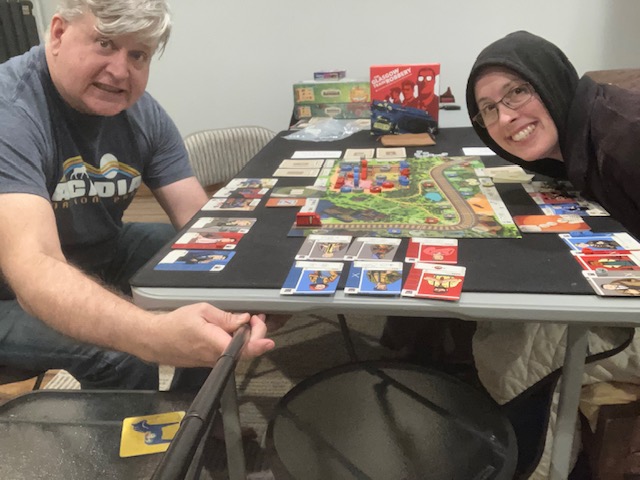
Of course, the real way this is meant to be played is 2-Players! On opposite sides of each other! We can see the guys and gals we have in play and their specials, but we can’t see each other’s Plans or Contingencies.
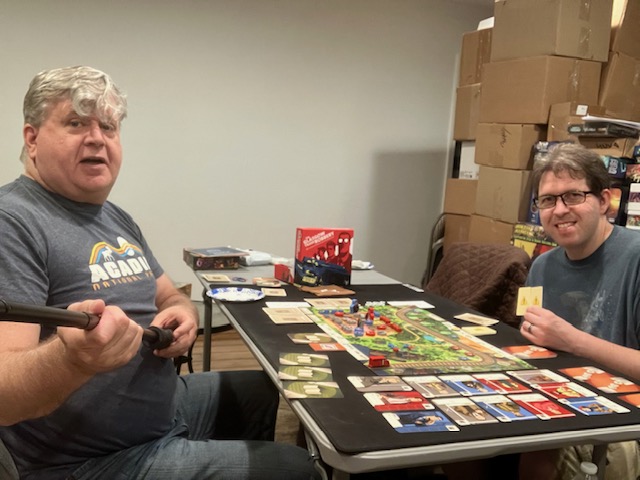
I’ve played a few 2-Players games now (with first Teresa then Sam), and it’s clear that first game is absolutely a teaching game. The Glasgow Train Robbery has a lot of systems and rules, and seeing how all these systems interplay is complex! My first games with both Sam and Teresa were both losses. Because they are learning the game!
After we lost, we talked about “WHY” we lost! “Oh, I need to move the people out quicker so they can have more stuff” “Oh, I need to be communicating sooner”, etc. Let’s be clear; it does feel like we have enough agency to affect the endgame; we just need to know what to do with that agency!
This is an odd game with lots of systems, but it works as a 2-Player game. The Limited Communication takes a little getting used it (you can really only communicate using keywords when you take that action), but it does work. It even seems thematic to a certain degree, because it was a lot harder to communicate back in 1963! No cell phones! Fewer phones!
Those first few games take about 2.5 hours. The box says 60 minutes. This estimate seems really wrong, unless you have mastered the game.
What I Liked
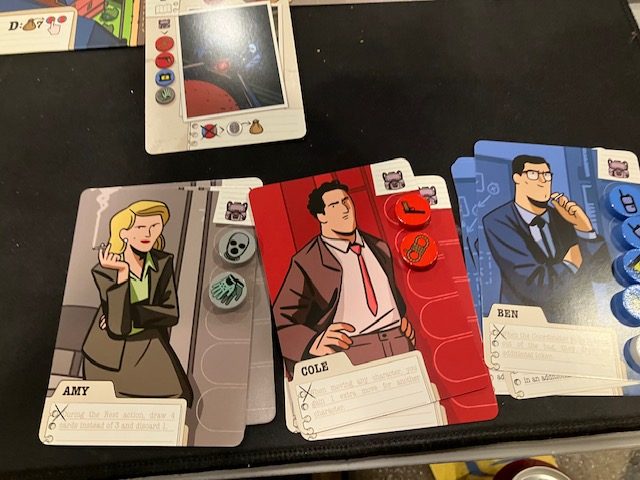
Style: The art style and graphics design is “quirky”, but it works. It is very readable as well.
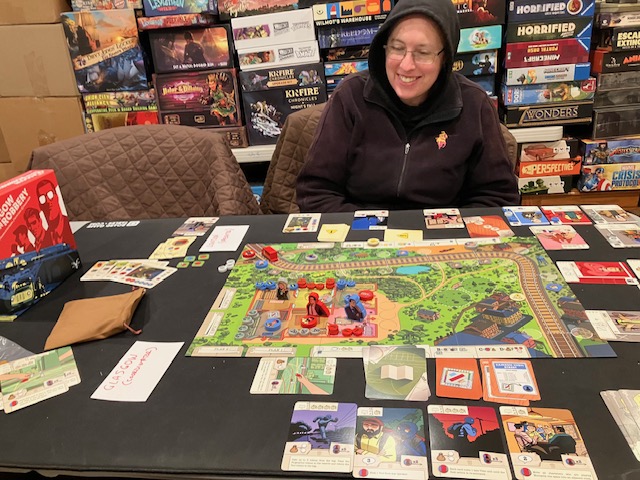
Quirky: Everything about this game is quirky; the art, the gameplay, the actions, the limited communication, the gameplay, the asymmetric sides, it’s all so … quirky. But it works.
Monopoly: In the original real-life heist, they literally caught some of the people by finding their fingerprints on the board! And this game models that mechanism! The more people people in a room with the Monopoly token when you REST (see above), the more fingerprints get thrown in the bag! If you ever run out off fingerprint tokens, you lose! The police caught you!
That’s right, this game penalizes you for playing Monopoly, like it should.
What I Don’t Like

Keywords: When you communicate to the other side, you can “only communicate in keywords” (see rules above). But, it literally never defines what a keyword is! The only two uses of the word “keyword” are on page 17 of the rulebook (above). They give an example of a communication, which gives you a sense of what a keyword might be! But it’s very frustrating they don’t define this! Can you use numbers? Character’s names? Can you use purple to imply red + blue? It seems like you might be able to be smart and come up with a code and get more info out! For a game where limited communication is such an important part of the game, this really needed to be more clearly defined. What you can/can’t communicate is poorly defined, and it will affect your gameplay in some way!
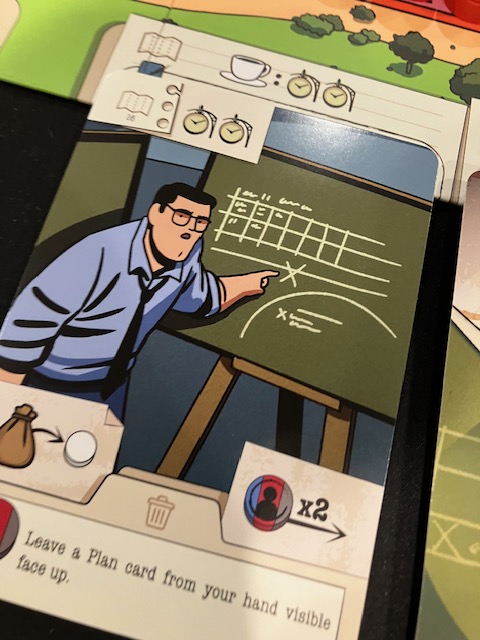
Action Cards and Randomness: There are some great Action cards, and there are some not-so-great Action cards. Some of these Action Cards can mean the difference between winning and losing IF THEY COME OUT EARLY in the game! So, for example, you may get lucky and can activate a character powers early on … and that makes the game viable! But it comes out too late, it sorta screws you. It can be a little frustrating to have such a swinginess to a game with so many systems. It’s frustrating when a complex game like The Glasgow Train Robbery can go south because of too much randomness.
Things I Am Not Sure About
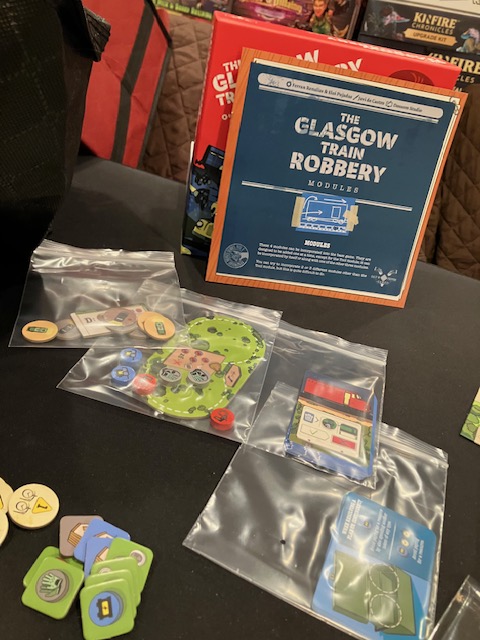
Modules: There are 5 modules you can add to the game to change it up. That’s cool. You can extend the life of the game. I just don’t know if I will ever play any of those modules? This game is hard to get to the table as it is, with its 2-Player only, limited communication, asymmetric play! I don’t know if I can about these modules?
Conclusion
It’s hard to recommend this cooperative game; it’s quirky, complicated, asymmetric, limited communication, 2-player only, and it’s hard to teach. And yet, I do recommend it! Its quirky nature makes it something different and interesting. I would suggest playing this (at least a few times) to get a sense of it before you decide if you like it or not. You have to kind of absorb it because there’s a lot going on; I think the juice is worth the squeeze.
This is 6.5/10 for solo (I know, it doesn’t really have a solo mode, but you can play it solo using the Changing Perspectives idea), and 7.0/10 for cooperative. It’s right on the cusp of a full recommendation, but I do like it and I do recommend it. It’s just so quirky.
I am guessing this game would be great for a couple who could really dive in, try multiple plays, and enjoy the modules.