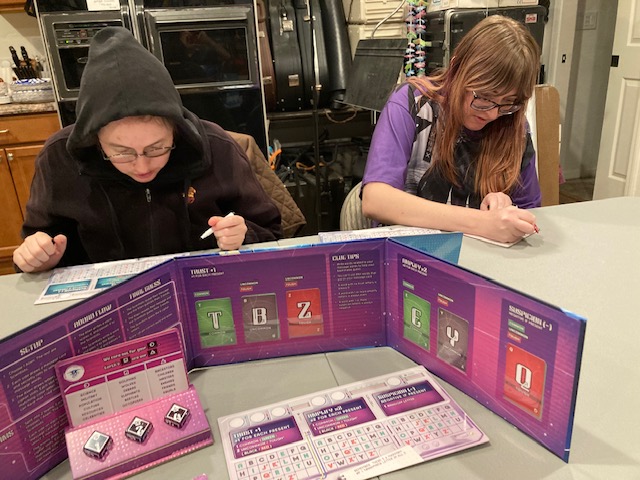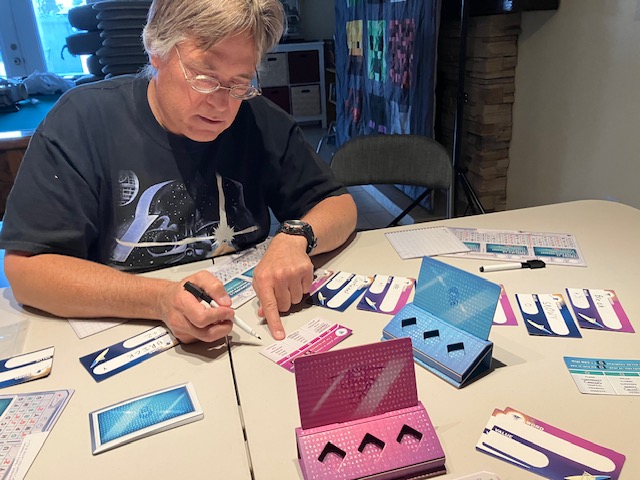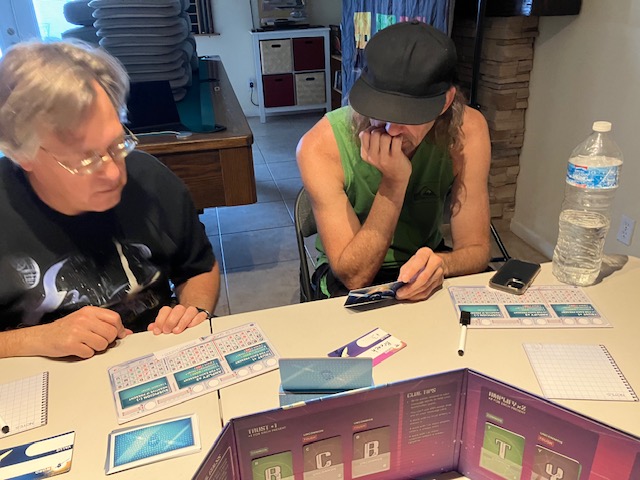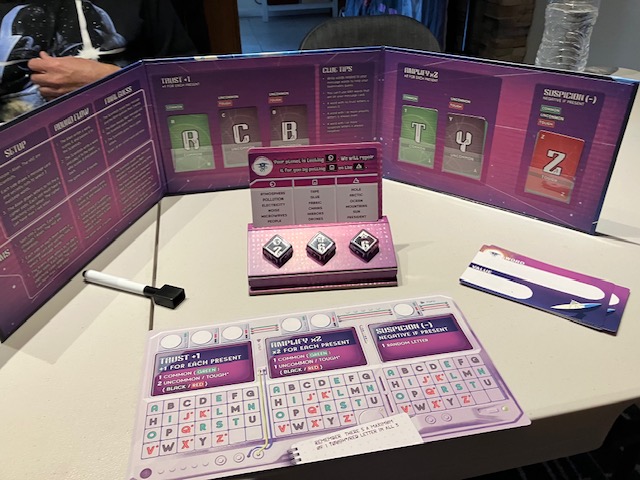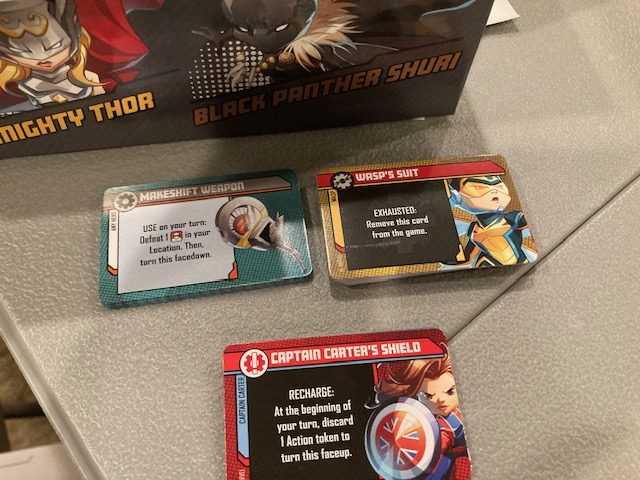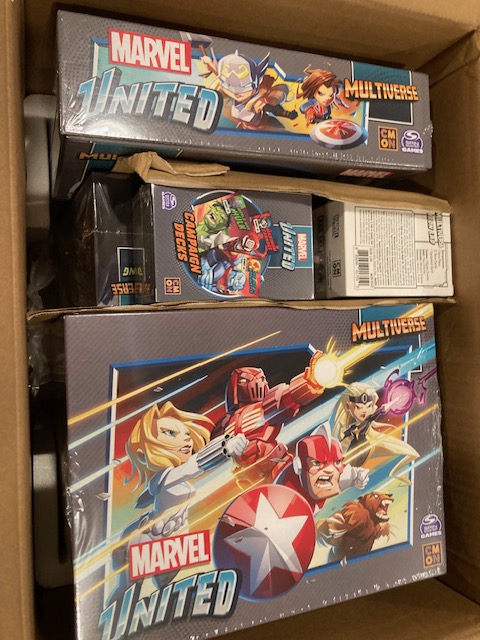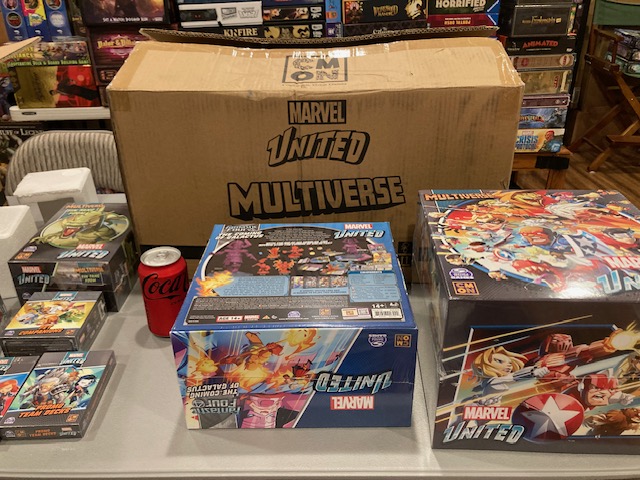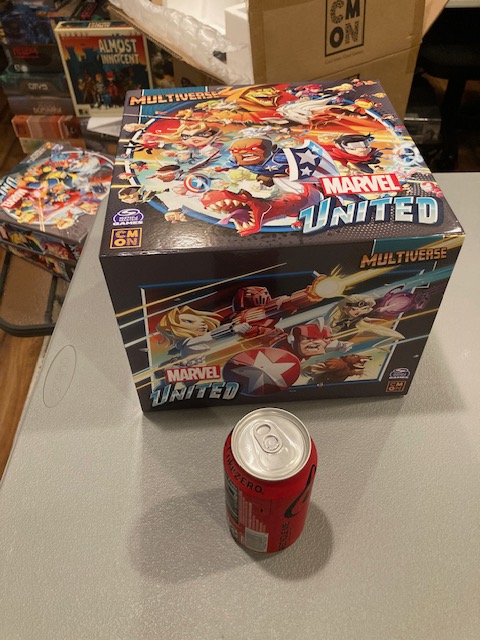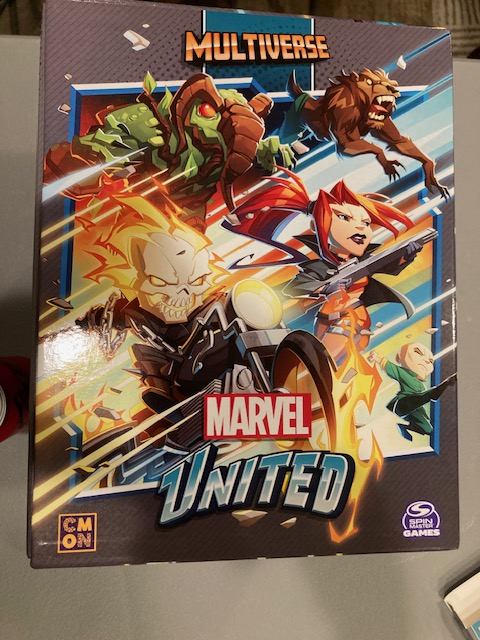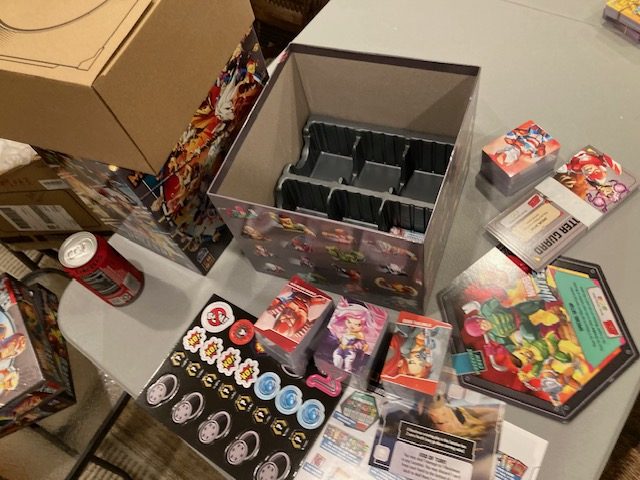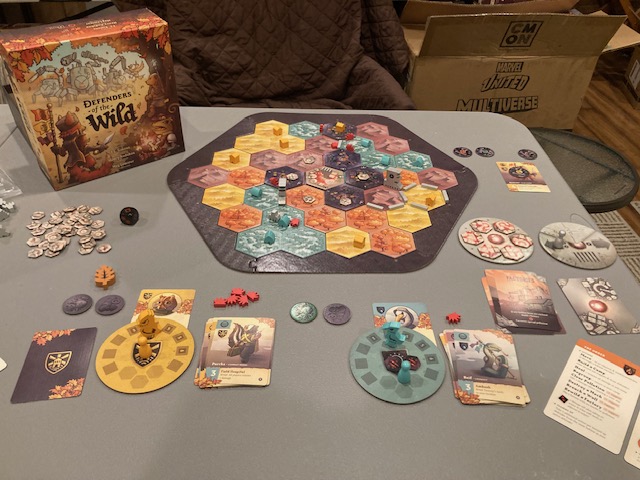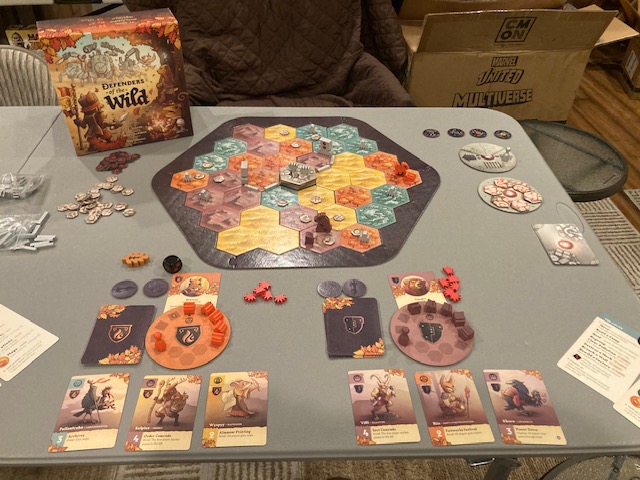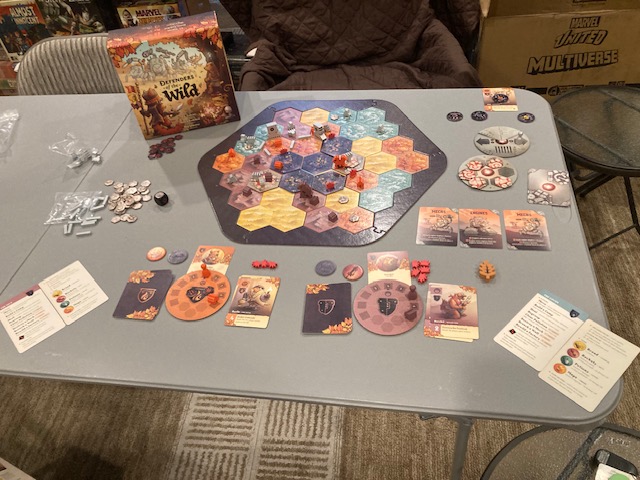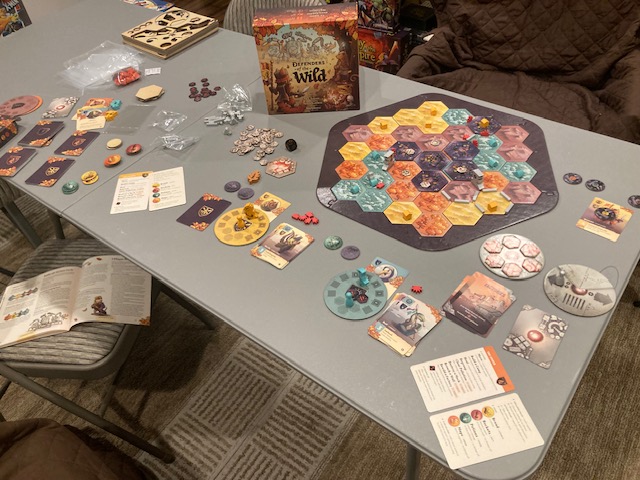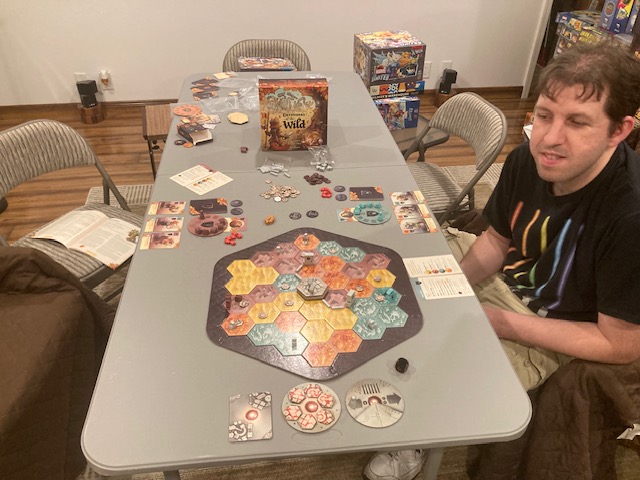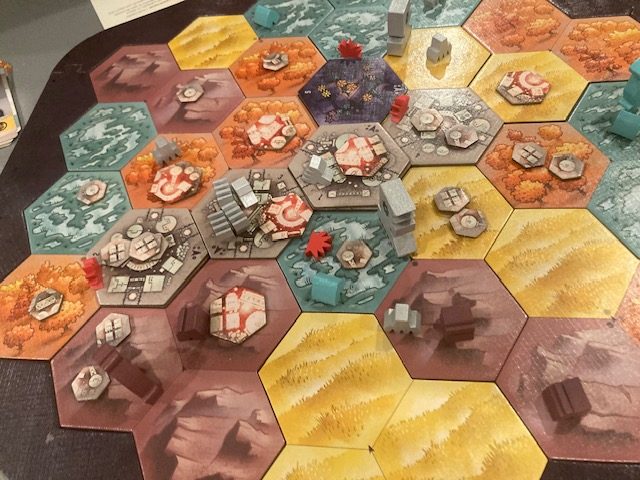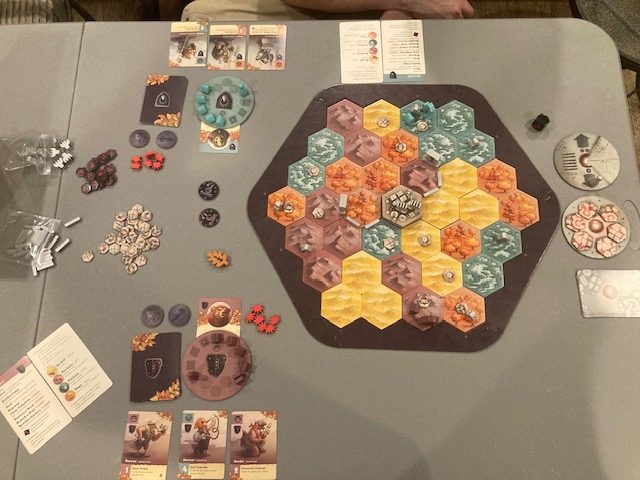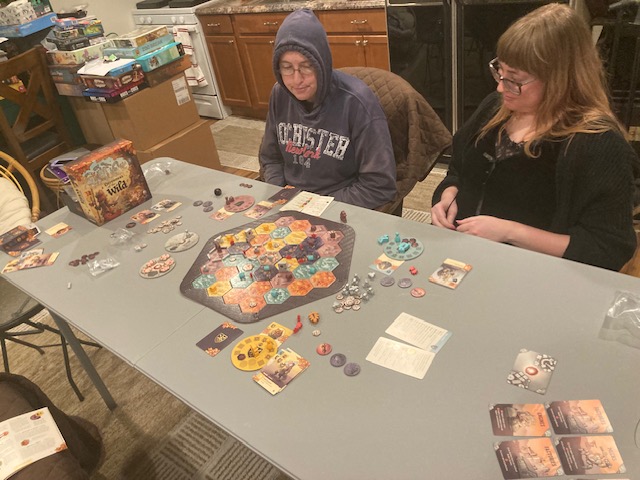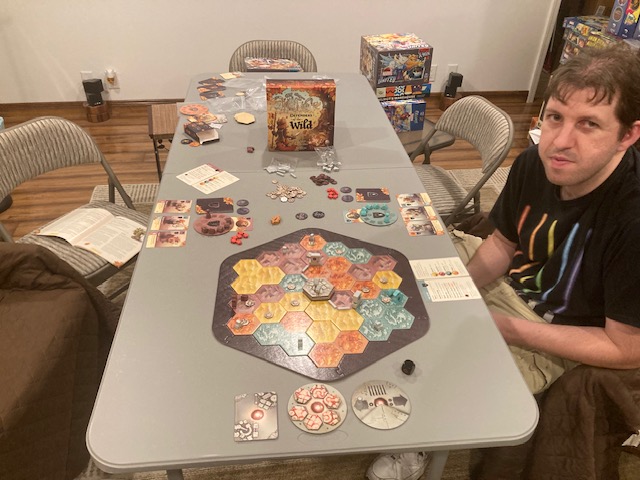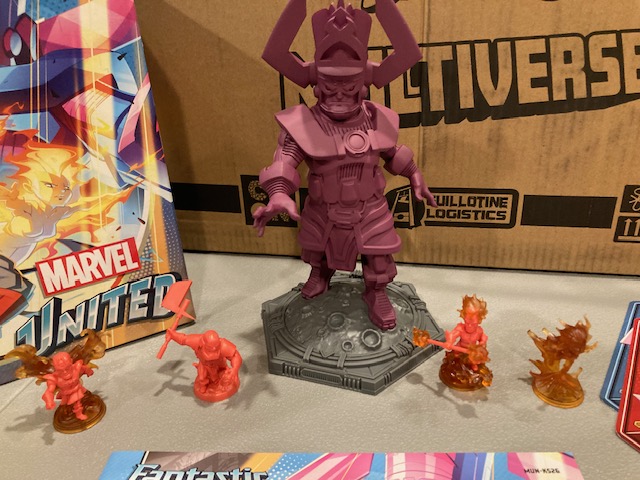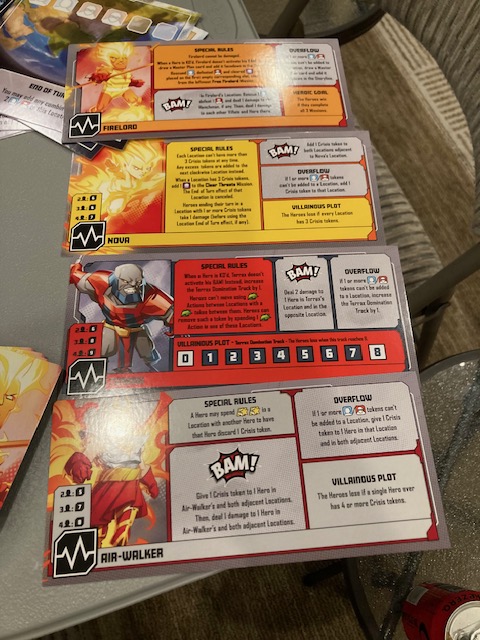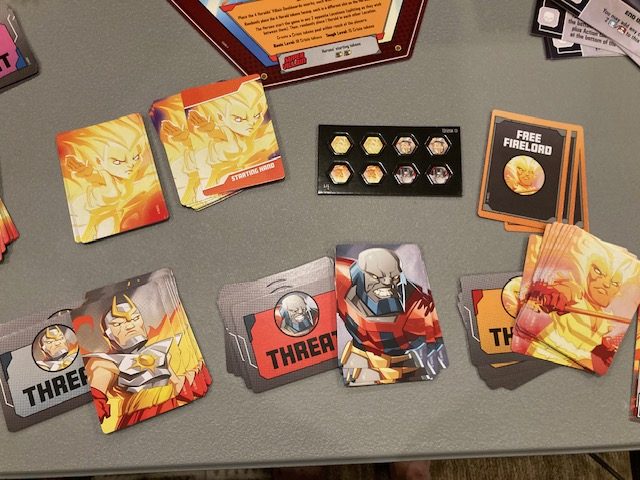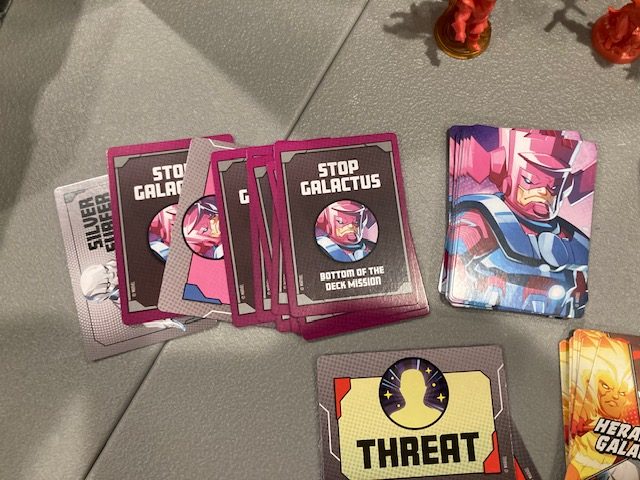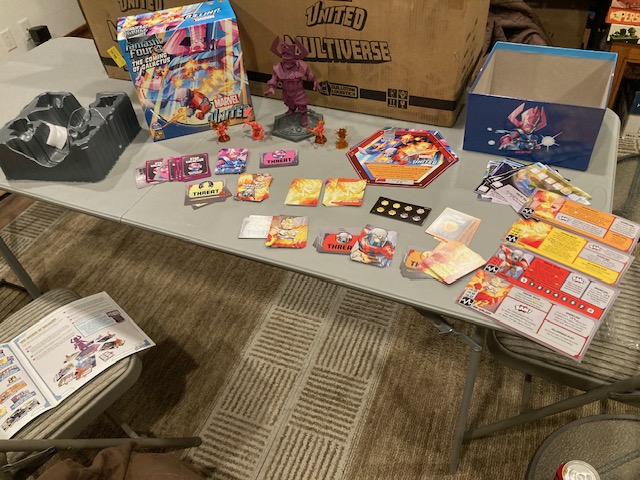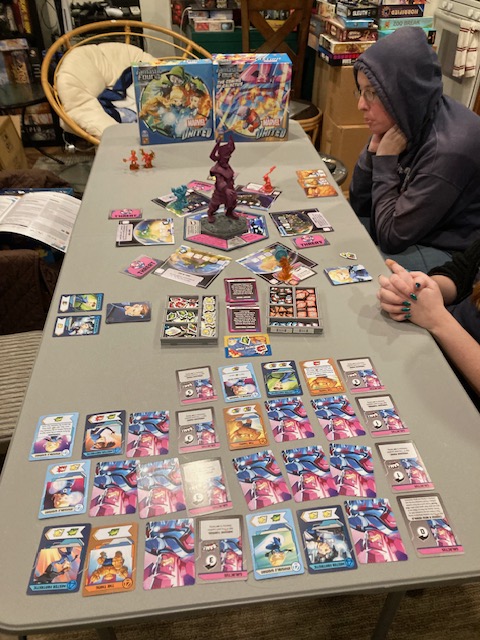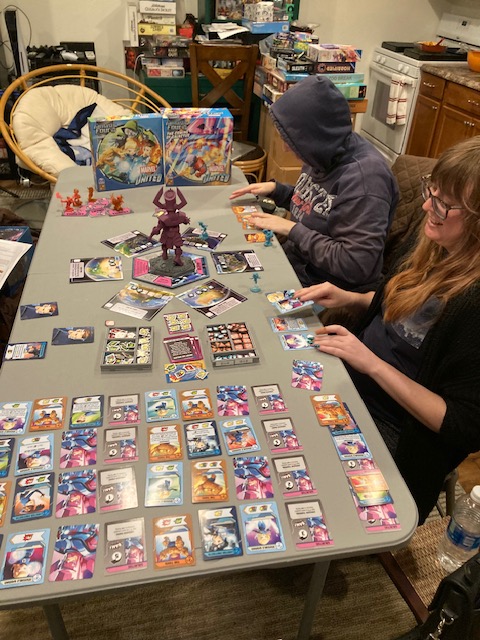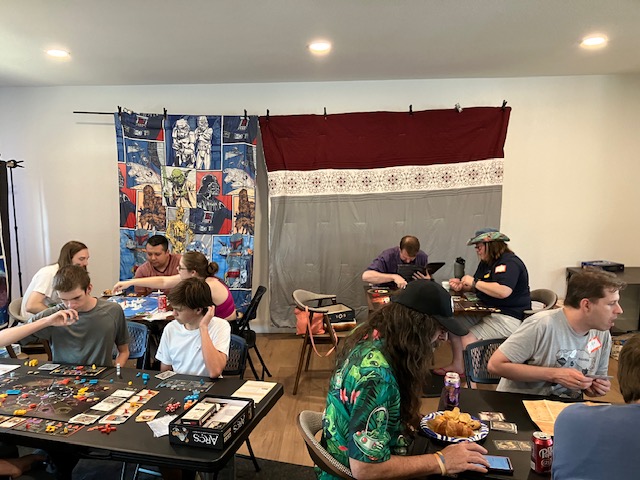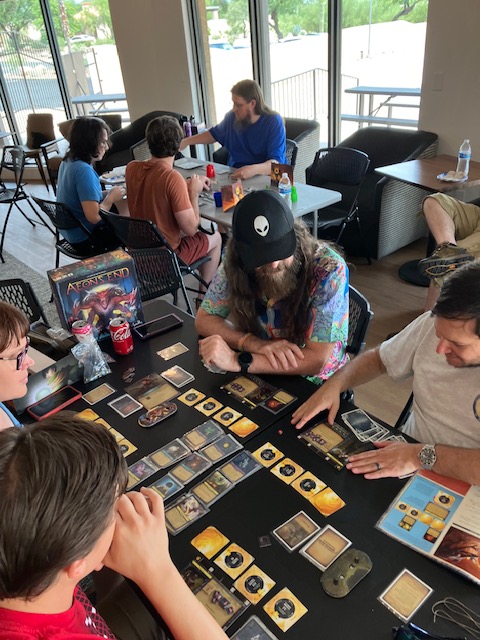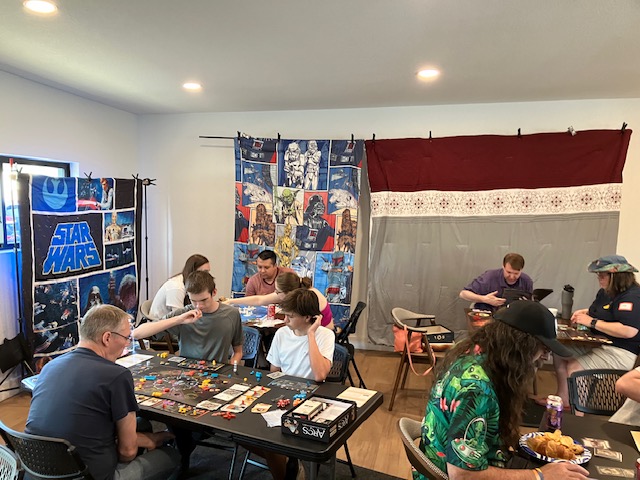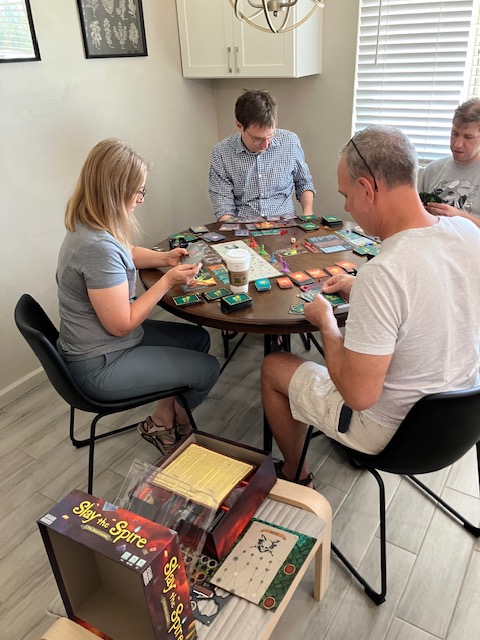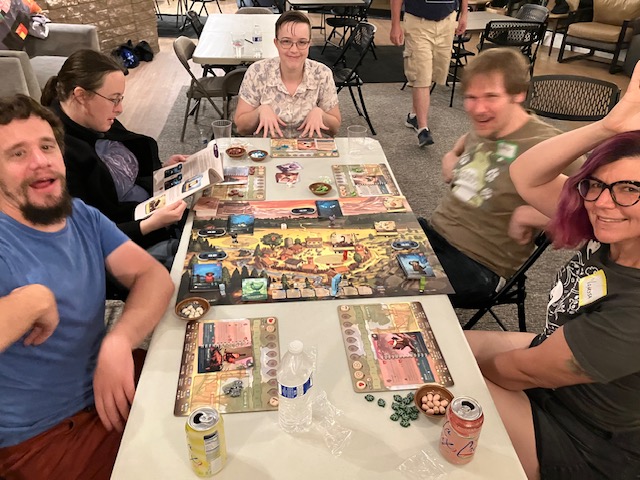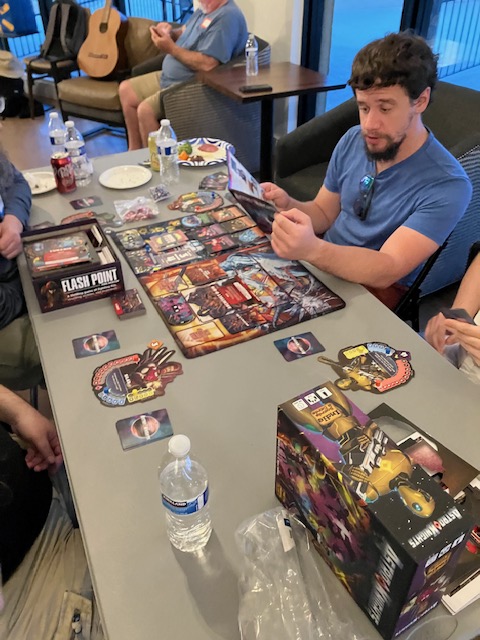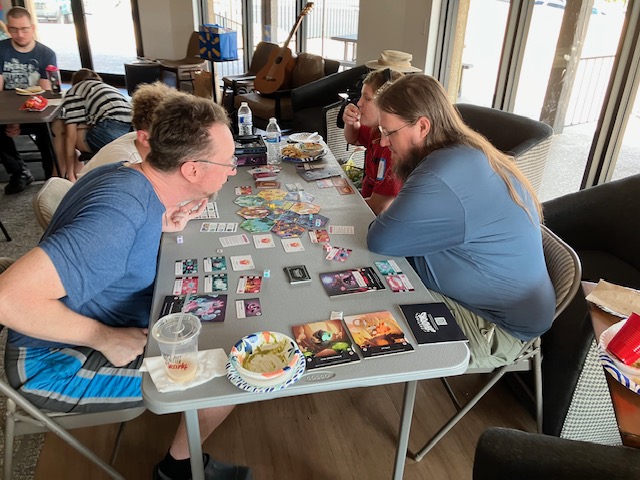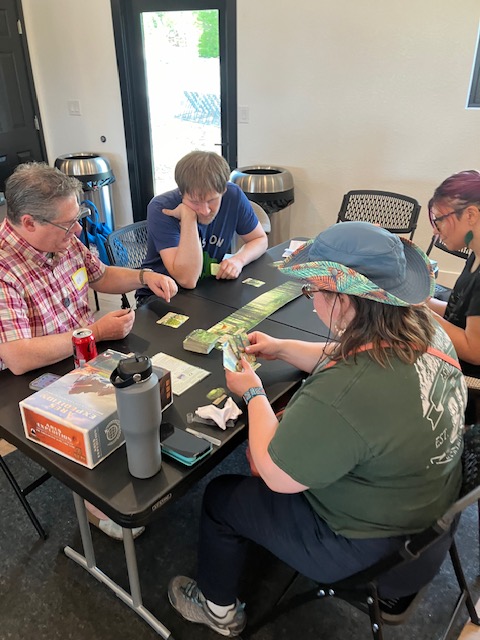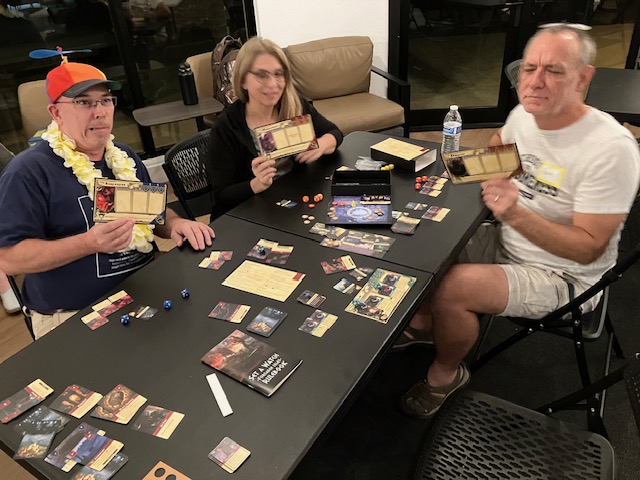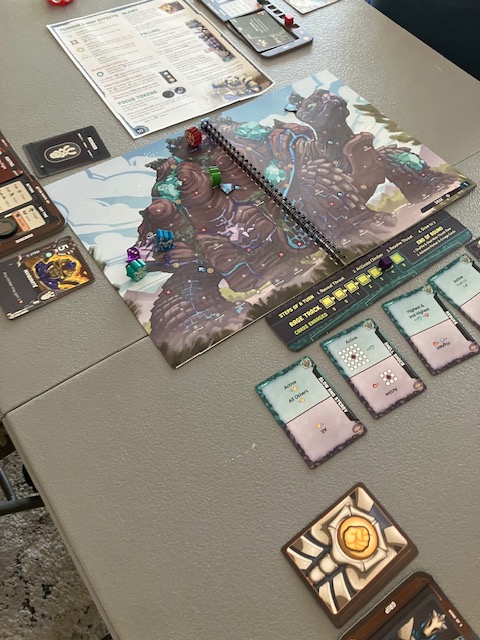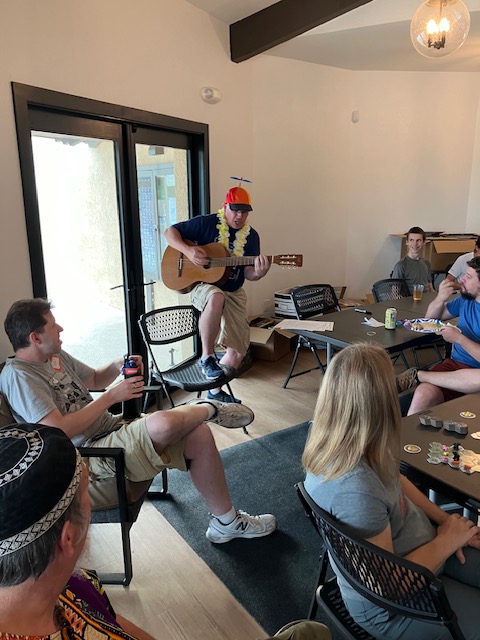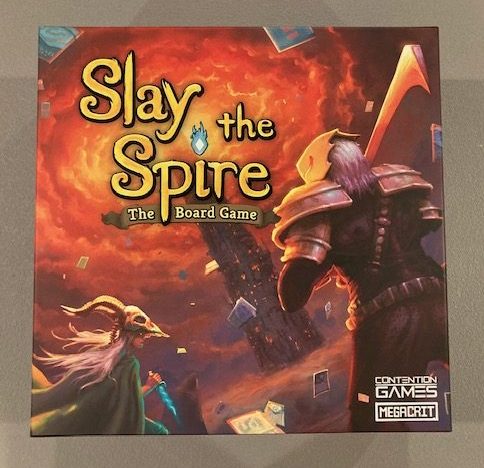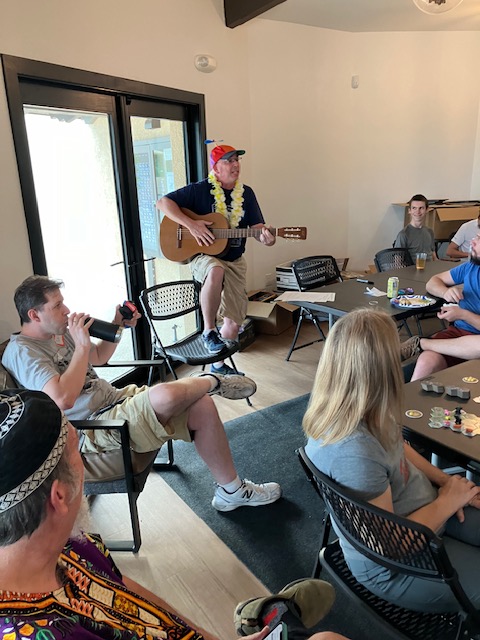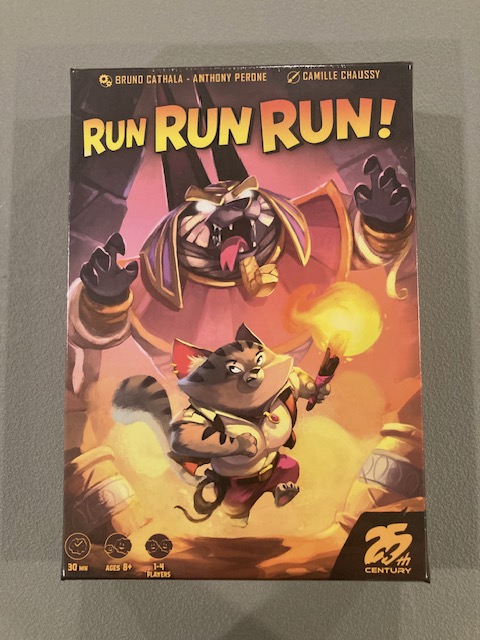
RichieCon 2024 has come and gone! This year there were some twists and turns, but everything worked out in the end! For those of you who don’t know: RichieCon 2024 is the gathering of Richie and his friends … honestly, it’s just an excuse to play games every year! It’s not even really a Con, but we like to put a little pomp into it to make it sound more bombastic. This is actually the 10th year of RichieCon, but only the 9th actual convocation (as we skipped a year for CoVid).
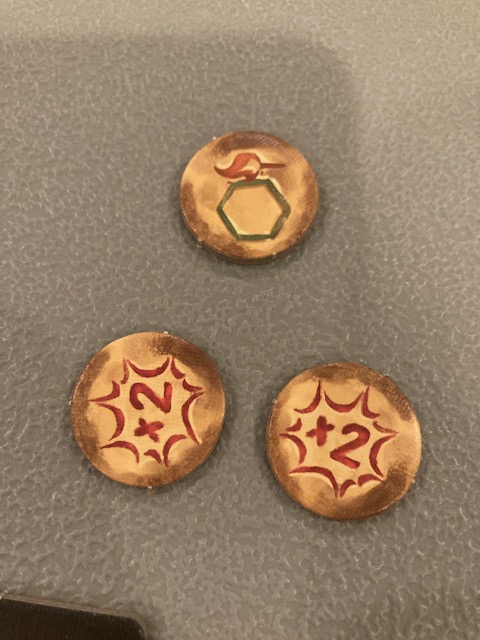
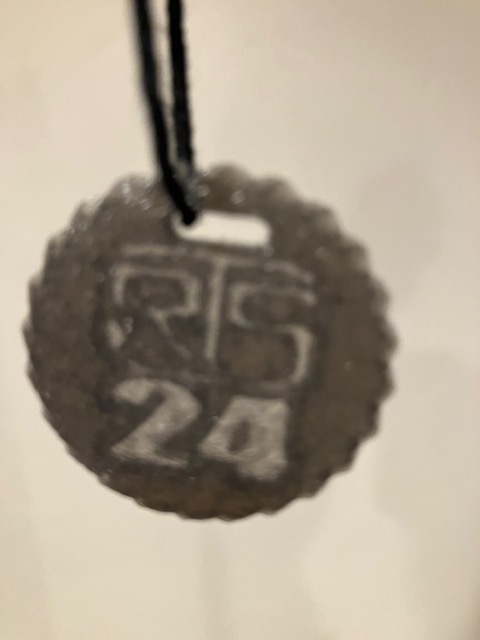
This year’s RichieCon 2024 token is cool: it’s actually hollowed out and you can only see the year and RTS symbol if you hold it up to the light! See above! You need the Token to get into the Con, and it can only be obtained through “secret means!” (Find me or Max in the Hall). Thanks to Josh M. for designing it and Max M. for printing it!
The name RichieCon is a bit of a joke: I asked my friend Kurt many many years ago: “Hey, you wanna go this board game convention that’s far away?”
Kurt said, “Man! That’s like a $1000 plane ticket and then a $1000 hotel bill! Why don’t you host your own convention and call it RichieCon! It’ll be a lot cheaper!”
And thus, RichieCon was born.
PreCon
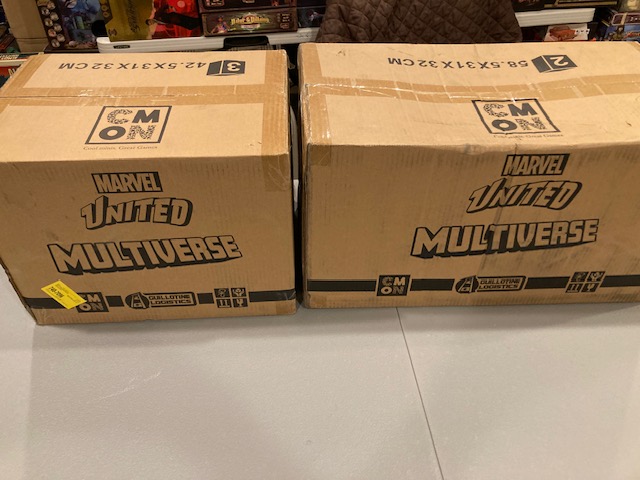
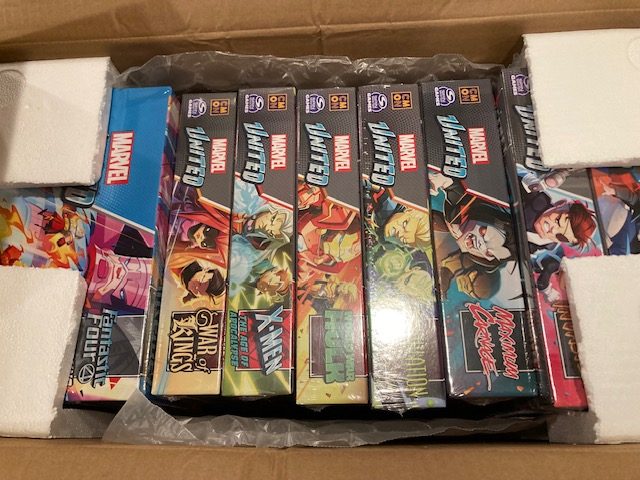
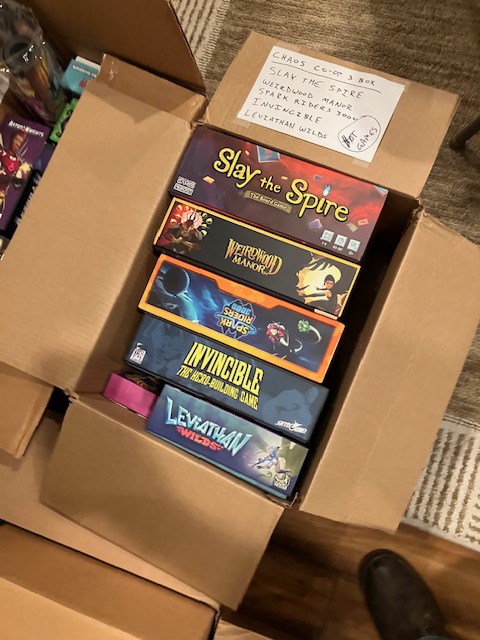
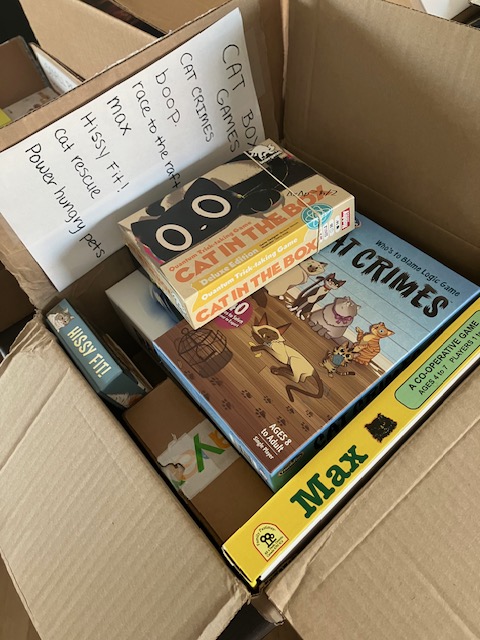
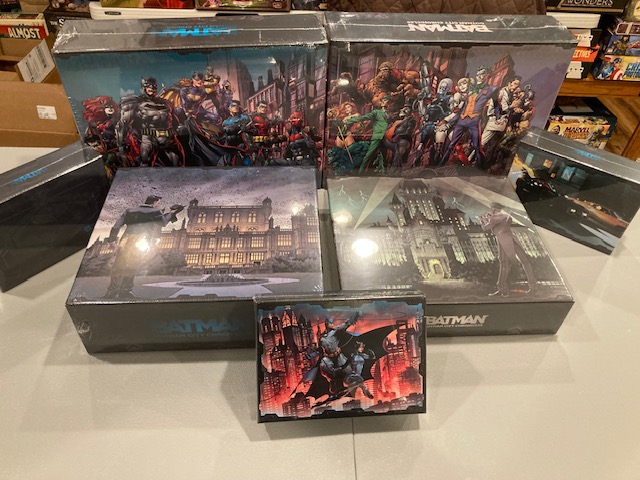
The week before RichieCon is a lot of putting boxes in boxes. To have some semblance of order, I try to put related games in bigger boxes and label what’s in there. See the “hot games” box above!
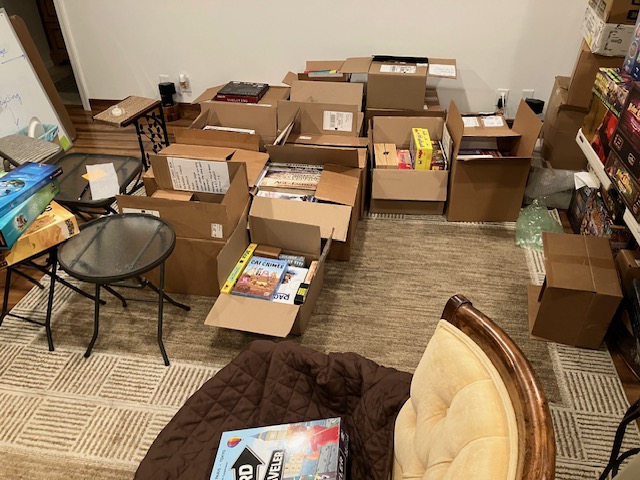
Sam and Teresa and Sara usually come over and help me put everything together. A big thanks to those three for all their help this year! See some of the boxes we put together above!
RichieCon Day 0: Secret RichieCon House
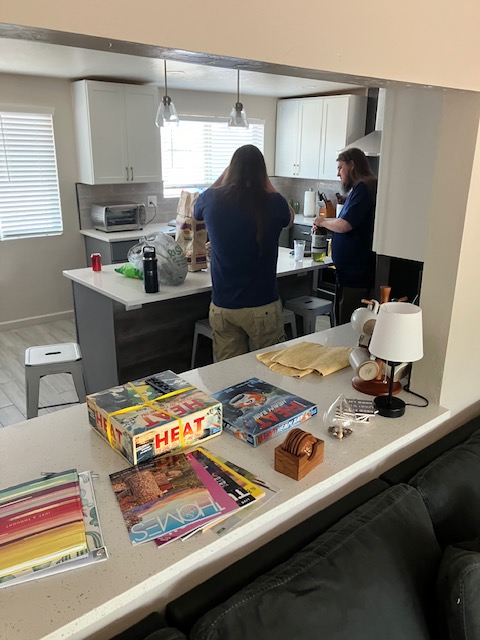
RichieCon has a lot of out of town guests that come into town a day early (Friday) and randomly show up with no place to go. I learned many years ago that it’s nice to have a “secret” RichieCon house for out-of-town guests to hang out on Friday before the Con.
The “secret” RichieCon house is modeled after the out-of-towners dinner you have for out-of-town guests for a wedding. It’s a way to say “thank you” for coming from so far away! This year, we had guests from Portland WA, Austin TX, Denver CO, Phoenix AZ, Las Cruces NM, Albuquerque NM, and from as far away as Madison WI!
RichieCon Day 1: Morning Pivot!
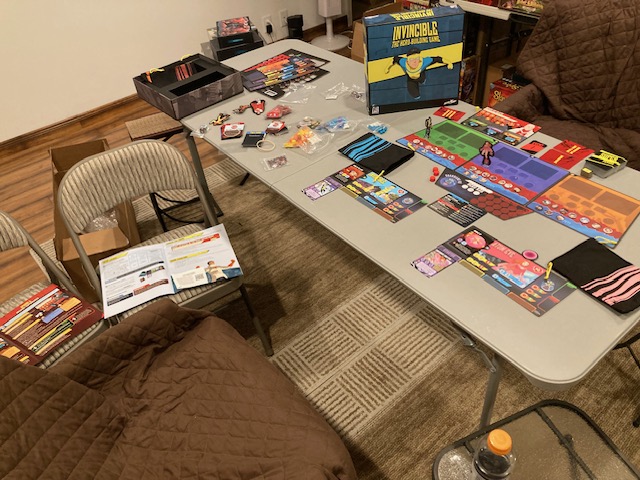
RichieCon Day 1 hit a scheduling SNAFU, so we had to pivot and hold RichieCon Day 1 partly at the “secret” RichieCon house! I guess it’s not so secret anymore!
Thanks to everyone who helped me move boxes and boxes and boxes of games to the “secret” RichieCon house! I couldn’t have done it without Sam, Charlie, Jeremy, Joe, Kurt, and a bunch of other people I didn’t see moving boxes because I was so busy! RichieCon is a community effort!
RichieCon Day 1: Part II! This Time, It’s Personal
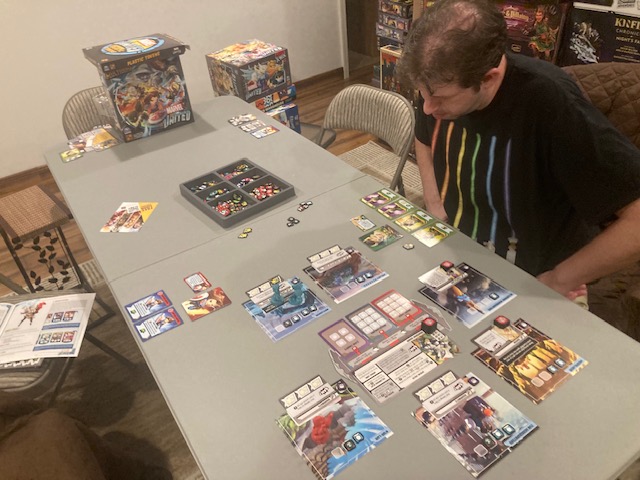
Once we got into the Rec Center for the second half of the day, many games were played!
RichieCon Day 2: More Games!
Sound Mitigation
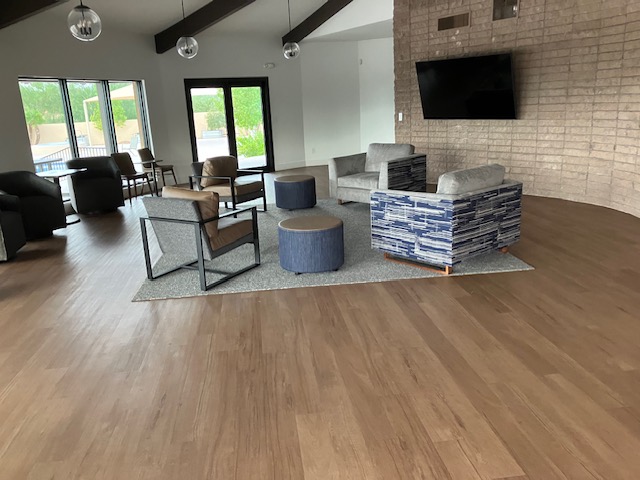
If you have ever been to a board game convention, you know there is a lot of background noise. We had some issues last year with the background noise being too much, so we tried some sound mitigation techniques. Basically, the Rec Center has very hard sonic surfaces, so sound bounces and echoes a little too much. Luckily, the Rec Center bought a fairly large carpet (see above) to help with some of that.
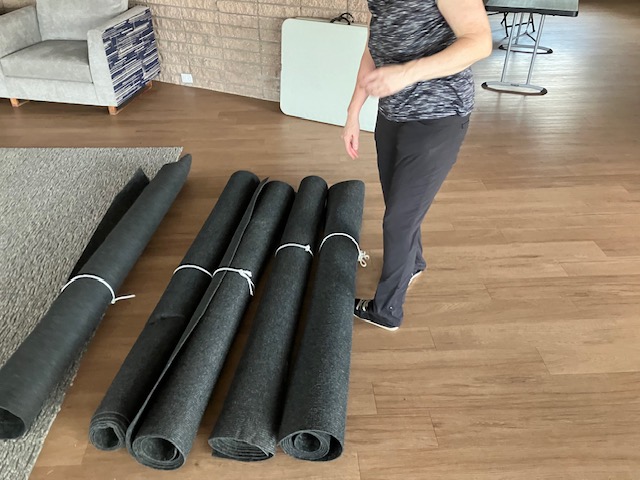
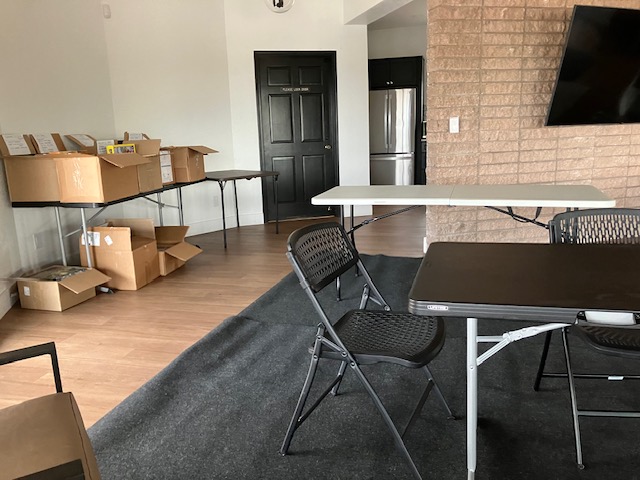
We also bought 5 CostCo rugs (for $18 each) to augment the sound mitigation of the hard sonically bright floors. See above and below.
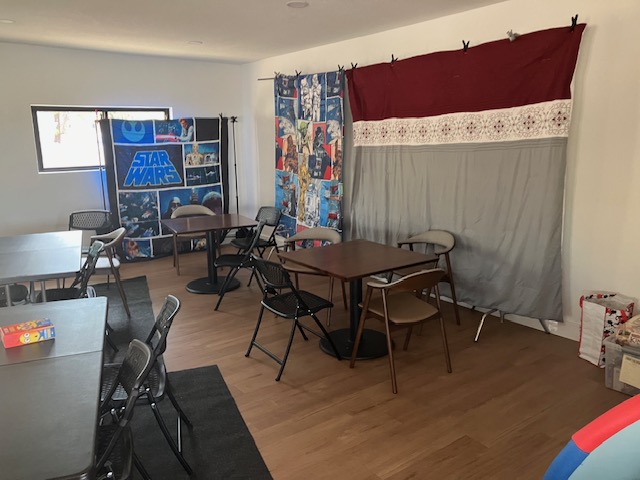
I also have some friends who work in theater and they were able to hang up up some “quilts” on the wall:
These quilts (see above) were hanging and absorbed some of the sound.
The general consensus was that the rugs and quilts all helped, but not quite as much as we hoped. We will probably hang more quilts and get more rugs for next year! Thanks to Becca and Jeff for providing the hanging quilts!
Games of the Con
I think the game of the Con was Slay The Spire! I saw this game played more than any other game! I think I taught it 3 to 4 times over the course of 3 days and it was played more time than that! See above!
Flock Together was pretty popular! I saw this played a bunch of times! See above!
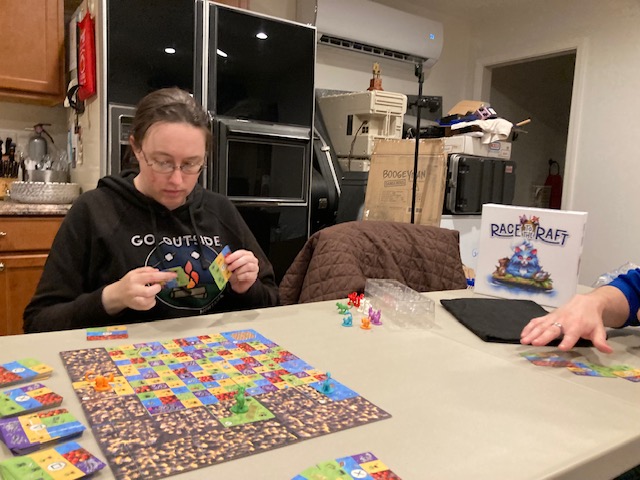
The Cat Box was a running joke: “Play Games from the Cat Box!” But, there were a lot of games played from here! Race To The Raft! Cat In The Box! Hissy Fit! Power Hungry Pets! I saw all of those games played at least once!
The Astro Knight games were popular: I saw both the base game and Astro Knights Eternity being played! I suspect that’s my fault … see below …
Casting Shadows was quite popular! I think that was played at least 3 times!
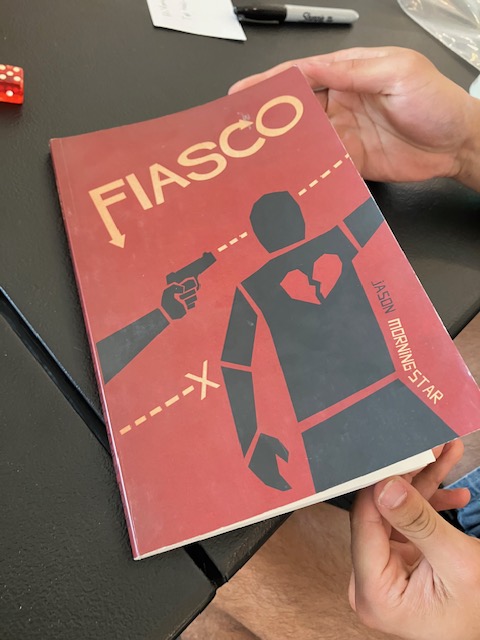
The weirdest game I played was the RPG Fiasco: It reminded me a lot of Spirit of 77! The point is to make each other laugh as you make up crazy stuff!
Forest Shuffle may have the other big game of the Con after Slay The Spire: Kurt taught this game many many times! See above!
SO many great games played! Set A Watch! See above!
Leviathan Wilds was also quite popular! I taught that at least three times, and I saw other people playing it!
Interesting Games
Every year, we stop the Con for a little bit to have a “meeting of the souls” where we all talk about our favorite board games! It’s a chance for everyone to give feedback on games they’ve enjoyed since last we met!! The real point of this is to try to recommend games that people might be interested in. What happens is that we recommend games, and then we end up teaching them the rest of the Con!
#6 What game from the last year surprised you the most? Good or bad surprise?
Rich:
Slay The Spire was a huge surprise to me! I almost didn’t back it on Kickstarter, but wow! My games groups loved it and it was probably the most played game at RichieCon!
Sam:
– Hissy Fit. It’s a light, fast, cute game about getting your cat into the carrier to go to the vet. It is also surprisingly fun to play.
#5 What game in the last year do you disagree with reviewers on?”
Rich:
Two weeks ago, Daybreak won the Spiel Des Jahres. Everybody seems to love this game except for me. I generally love Matt Leacock designs, but this one felt way too random for me.
Sam:
Tom Vasel didn’t like Race to the Raft. However, I really enjoyed the puzzley nature of creating the path and moving the cats to get them all off the island.
#4 What game (that you paid for) did you really dislike? It’s easy to dislike games other people paid for, but what did you pay for that you disliked?
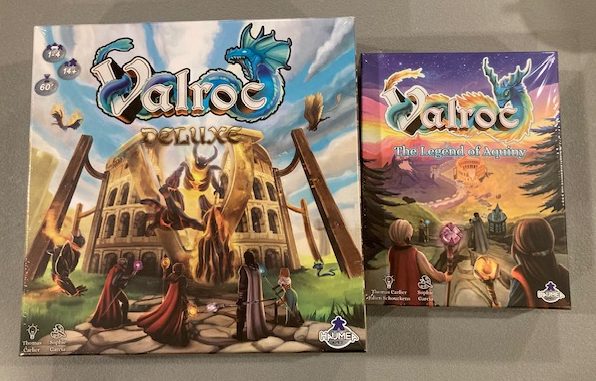
Rich: The cooperative expansion for Valroc: The Legend of Aquiny. The base game of Valroc is a card-drafting, worker placement game that’s pretty good. The cooperative expansion looked cool with campaign envelopes, but the limited communication was too limited and the very very slow upgrade paths made this not fun. I would still recommend people try the base game Valroc.
Sam:
I picked up a copy of Call to Adventure (a story crafting game) and felt kind of meh about my plays of it. I’m hopeful that it may grow on me as I play more and actually get the rules all the way right.
#3 What game that came out in the last year that you liked but other’s didn’t?
Rich:
Gotham City Chronicles: Solo and Co-operative Expansion. This was so much work to get to the point where I could play solo (6 days of reading and printing and setting-up), but in the end I had fun. I don’t think most people like Gotham City Chronicles, especially Shut-Up & Sit-Down, because it’s so much work. But I still like it!
Sam:
Almost Innocent. I really enjoyed the logic puzzle aspect of it. Richie didn’t enjoy it but was also really tired that night and not necessarily sharp enough to do heavy logical deduction.
#2 What was your favorite expansion that came out in the last year?
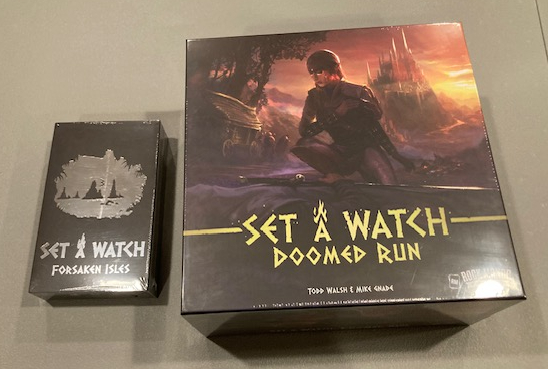
Rich: Set A Watch: the new stand-alone expansion and the Set A Watch: Doomed Run! (Strictly speaking, they came from the same kickstarter)! I love this system because even if you roll badly, you can still place dice on powers to activate them!
Sam:
– +1 on Set a Watch: Doomed Run. I only played one of the missions but it was fun to play the characters that were assigned to me and use their powers and items. The two I had ended up chaining together pretty well.
To be different:: Astro Knights Eternity. It’s a good cooperative deck building game and the story parts surrounding the scenario were really good too.
#1 What was your favorite game that came out in the last year?
Rich:
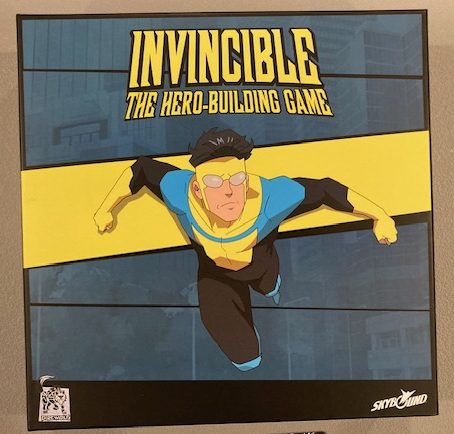
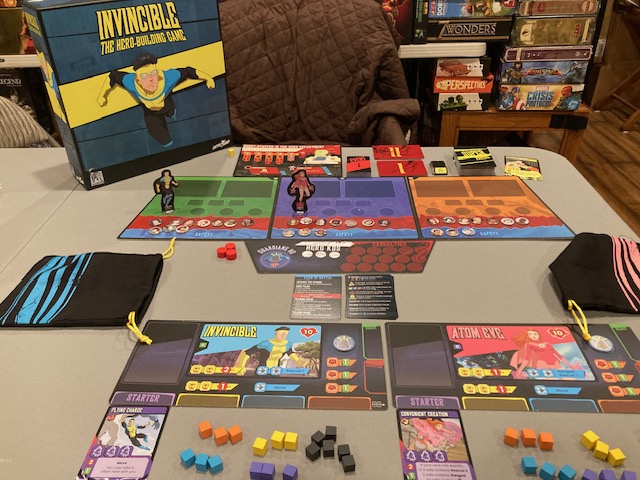
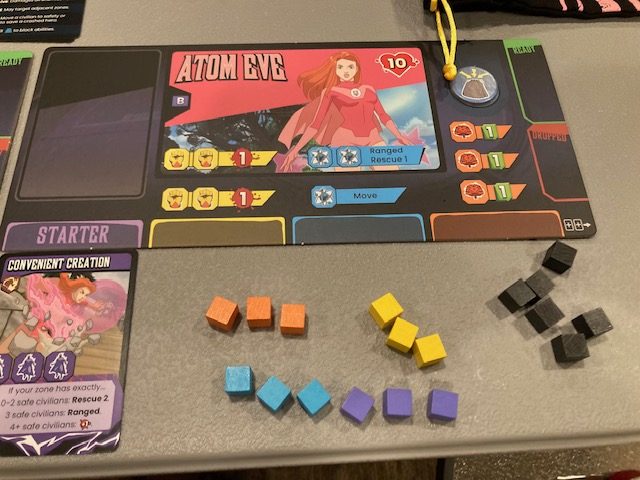
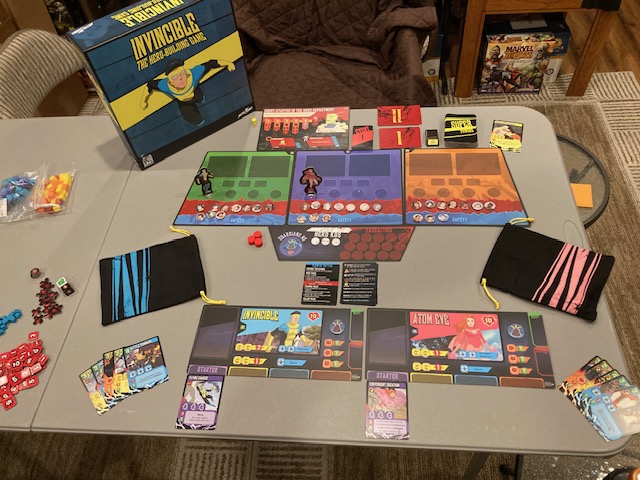
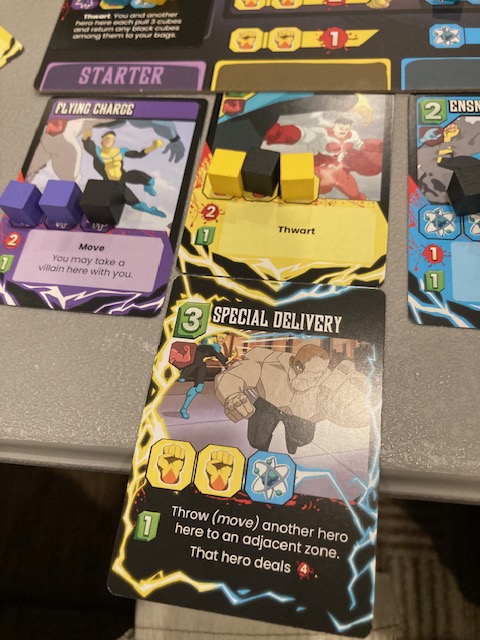
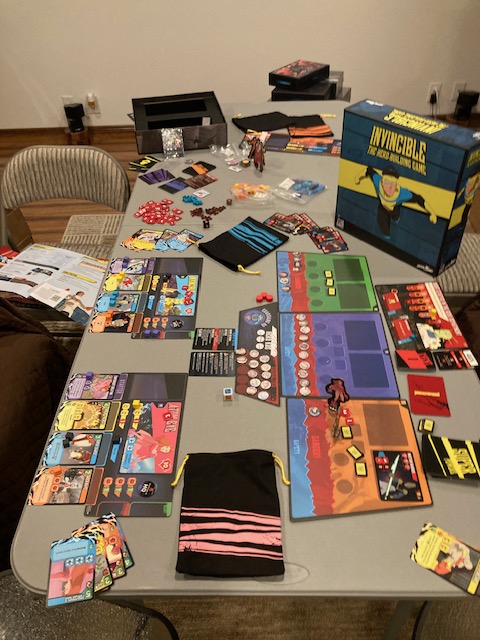
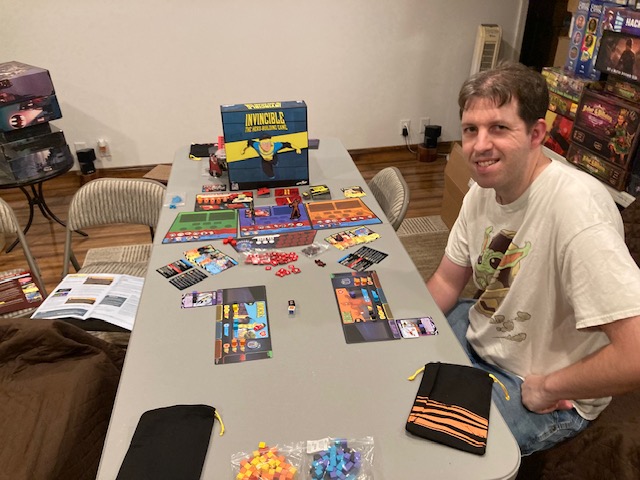
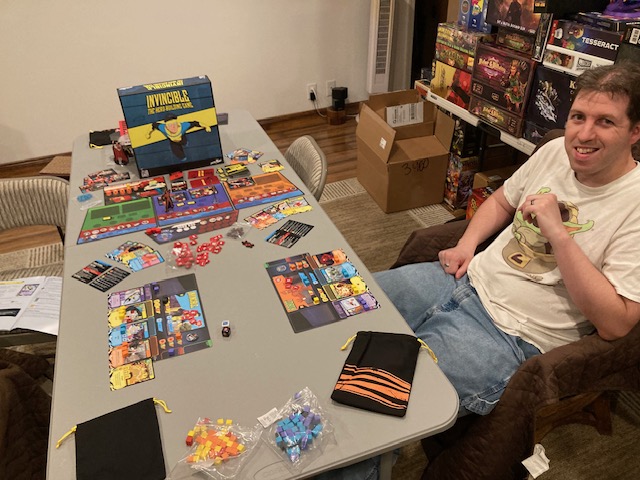
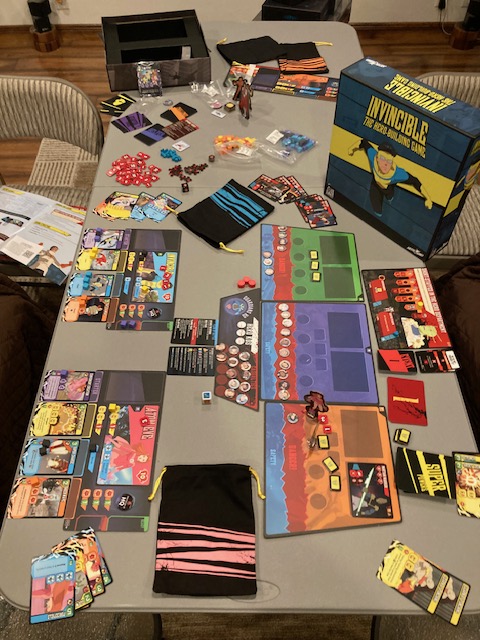
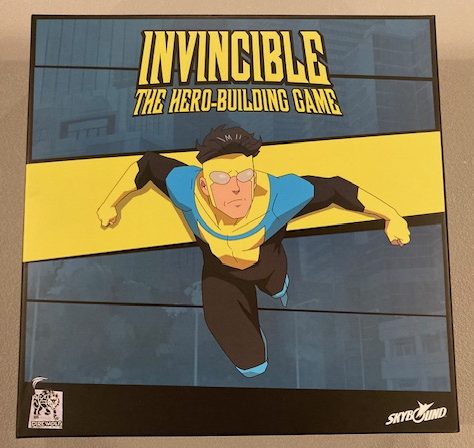
A cooperative bag-building super hero game set in the unique world of Invincicble? Sign me up! This game was so much better than I expected, the upgrade paths makes this game engaging and keep you involved!
Sam:
+1 to Invincible (Richie) and World Wonders (Kurt)
To be different: Age of Civilization. It’s a really tight worker placement game where you draft your unique civilization powers which include number of workers and then use your workers to research technology, get money, build wonders, and go to war to get victory points. Bonus points: it’s a small box, has good solo modes, and takes 45 minutes to an hour.
Theme Song
During the “meeting of souls” and sharing of games, Joe shared with us his version of the theme Song for RichieCon! Sung to the tune of the Suffragette City by David Bowie! And yes, the entire room said said “Hey Man!” at the appropriate places!
RichieCon City: sung to the tune of Suffragette City by David Bowie (new lyrics by Junkerman)
Hey Man, you gotta play in the game Hey Man, custom pieces ain’t no shame! Hey Man, your kickstarter is drear. She said your package should be shipping by the end of the year
Hey Man, you really gotta choose Hey Man, which game you gonna lose Hey Man, you better learn all the rules She said you’re getting killed by Sauron or the Cult of Cthulu
[Chorus] Oh don’t lean on us man cuz you can’t defeat the wizard I’m back in RichieCon City! Well don’t lean on me man cuz you blew up all the kittens You know my RichieCon City! It’s outta sight, it’s alright!
Conclusion
As we bring all the games back to the house …
As we clean the Rec Center and put it back the way it was ..
And we lock the door .. heading home … we wonder …. was it all worth it?
Yes! It was! It so much fun to see everyone, despite the issues! We look forward to seeing everyone next year!
As we head into RichieCon soon, I wanted to highlight some games that I think a lot of people will want to play during RichieCon: Flock Together is one of them. Spoiler Alert! We liked this game! I think a lot of my friends will really enjoy this game!
This is game all about chickens with asymmetric powers! (There’s a sentence you never thought you’d hear!) It’s all about chickens leveling up and working together to fight off the invading predators! My friends and I joke that this is Coop: the co-op game as players cooperatively defend the chicken coop!
Flock Together plays 1-5 players, ages 10+ (but I think younger players could handle this), and lasts about 25 minutes per player. This is what the box says, and that feels fairly accurate.
This was on Kickstarter back in Sept 2023 and it promised deliver in June 2024. It arrived at my house in early July 2024, so it’s a few weeks late. In the grand scheme of Kickstarters, a few weeks late is on time!
Let’s take a look!
Unboxing And Gameplay
This is standard size board game box: see Coke can for perspective above.
The components are first class! There was only one level backing this Kickstarter, so I think everyone will be getting this amazing production when it comes to retail!
Each player plays a chicken! Bock! Each players chooses 1 of 11 chicken books! See two above!
Each chicken has kind of punny name: see General Tso above. My friends and I found these puns funny and not too annoying. It also sets the mood: this is a lightish, fun game.
Each player then takes a player board (see the dual-layered board above) …
I want to point this out because it’s really nice: the spine of the chicken book fits into an indent on the player board! See the indent above!
And that little book fits nicely into the board! See above!
As your chicken plays, she levels up the more she eats!
You start as a chick (level 1: see above) with only the power highlighted at the bottom.
If Annie eats 5 food (the little basket tells you how much food you need to eat), you turn the page to get to level 2: A Pullet! Now, Annie Yokley has two powers and 1 more hit point! See above!
And finally at 11 food, Annie is a Hen! With 6 full hit points and 3 full powers!
Each player takes a colored chicken (see above) to move around the board (see below)!
The board is a beautiful scene with the chicken coop in the middle (“inside”) and the world surrounding it (“outside”)! Chickens move around in this world to do stuff!
The actions that a player take on her turn are all listed at the bottom of the board! See above. Note that there are “outside” actions (little grass symbol) and “inside” actions (with a coop symbol).
The player has two action points on her turn and can do any two of these actions (and can repeat). It makes the game feel a little like worker placement, because you have to move your chicken either “inside” or “outside” to perform certain actions, but I can’t really call this worker placement (as players can share spaces).
Although this doesn’t look like it, this is really a boss-battler game! You have to fight 3 predators, and then you can fight the final boss to win! The predators use the same book system as the players: they can level up just like the players!
Basically, at the end of a “season” (see Spring, Summer, Fall above), the predators level up! Each season has its own set of “bad news” cards.
This is co-op game, so you have to have “bad news” season cards! These don’t come out every turn, they come out between the 1, 3, and 6th turn of the season. It’s fairly well notated on the board: see above. A season ends on the 7th space and a new one starts!
If you go through all 3 seasons without defeating all 4 bosses, you lose!
This is a game about needing resources: food (above) …
…and eggs. The food is used to power most actions in the game (attacking, levelling up), but they are slightly more volatile. The eggs can become food, if you choose to convert during them between rounds. The eggs are more resilient to weather (“bad news”) than the food, but they must be converted to food to be useful.
If the players can defeat the three easy predators (see two above) …
They uncover the big boss who is immediately revealed at level 3! If the players can defeat the big boss before the last season runs out, they win!
Oh, to gain confidence and a few special abilities, players can also fight grubs (yellow cards above) or get a power up card (brown).
Rulebook
This is a great rulebook. And I am not just saying that because it’s linen-finished and feels really nice.
This rulebook gets an A- on the Chair Test: it lays flat, doesn’t flop too much, and has a big readable font. It’s easy to consult on the chair next to me when I need to look up rules. This game has an excellent form factor.
The Components page (above) is well-notated and easy to consult. I always like to correlate components with their names: this components list even spans the same two opposite pages so it’s very easy to consult on the chair next to me.
The set-up has a great picture: it is well-notated, well-labelled, easy to read, and spans two opposite pages easily so you can correlate the picture with the directions! Fantastic! What an easy set-up!
The rest of the rulebook is the same caliber: it’s easy to read and get into. In general, it dos a great job of teaching the game.
It even ends with useful notes on the back.
This is one of the better rulebooks we have seen in a while. And the linen-finish just takes the cake.
There is one complaint, which I will discuss below. Otherwise, this is a fantastic rulebook.
Solo Play
This game has only one real note for how to do solo play: it’s in the set-up for describing solo play! See above! Fantastic! This game follows Saunders’ Law! And it’s a great solo game: all the rules stay the same except for one: you are your own teammate! There’s no long list of rules exceptions: this is such an easy game to get to the table solo.
For balance, the hit points of each of the bosses is a multiplier of the number of players! This is how the game scales the difficulty for the number of players! So, Professor Moltiarity (above) has 2 *1 + 3*1 = 5 hit points for a solo game (and would have 2*2 + 3*2=10 hit points for a 2-Player game, etc).
My first solo game was playing Annie Yokley (see above) and my final boss was Professor Moltiarity!
The game sets-up quickly and easily. See above as I have the rulebook open on the chair next to me and the game set-up (with Annie) on the table! It really pops!
The game is light and plays quickly: you take your two actions per turn, leveling up while you eat, attack grubs, attack predators, and forage for food! You can always go back to the coop to heal if you need to.
My first game ended in about 20 minutes with a win! I don’t feel like I got any rules wrong (I tend to get a few rules wrong in many of my first plays), as the rules are easy and well-described in the rulebook!
At the end of my game, I felt confident I could teach my friends this game; it was fun and breezy. I enjoyed the puns and flavor text on the cards. It was only a 20 minute game and I had fun. I could see Flock Together getting slightly repetitive if the game lasted any longer, but the solo game felt just the right length! And there was always something interesting to do on your turn, even if you only had two actions! The game moved quickly and I had a good time.
I am not sure how often I would get the game out just to play solo though. But the solo game teaches the game well.
Cooperative Play
My first cooperative play went pretty well. My friend Teresa loved this world! She loved the art, the cute game, the flavor text, and she loved the chickens! And of course, we made tons of chicken jokes as we played: we were poultry in motion!
The game doesn’t take itself too seriously and that flavor (chicken flavor) seems to come out as you play! It really kind of elevates our spirits!
Early in the game, turns are a little more “multiplayer solitaire”, and each player needs to level up. Your actions will be just trying to get your chick into something that can fight!
But to win, you will almost certainaly have to cooperate in the end game! See above as Teresa and I fight the Big Bad together.
The amount of cooperation kind of depends on the chickens you choose and the powers (and one-shots) you get: cooperation isn’t baked-in to the main actions (pun not intended … well, maybe it was intended)! You can’t share resources or actions or do anything necessarily cooperative with your base actions: it seemed like most cooperative endeavors were from specials. It worked fine for us, but it’s possible your game won’t be particularly cooperative if you don’t get the cards/powers that enable that cooperation. It’s not a dig against the game: it’s just not quite as cooperative as you might hope, especially early on. We do have a suggestion that would make it more cooperative (see below).
Teresa and I had fun playing cooperatively. Teresa says she really wants to play this with her sister! A good sign!
My second cooperative game wasn’t quite as successful: Sam and I ran out of time and couldn’t defeat the final boss.
Honestly, it was the weather cards that destroyed us: the weather had us doing 1 less damage to a predator. We did look back on the game and realized we made a few strategic mistakes, but the bad news weather cards screwed us more than we cared to admit.
Sam didn’t love Flock Together.
Play Order
The first player token in this game is a gorgeous metal token! See above! It indicates who the first player is!
And the rules specify that the game proceeds clockwise (see above, from page 9).
The first question was: does the play order token move or does the first player always the first player? The rules, as great as they are, do not specify this! Most “modern” board games have the player order token move clockwise so that each player gets a chance to go first. So, do we do that? Or does it always stay at the same player? Not clear?
As we played, we actually got annoyed at this first player marker: we kept passing the player token back and forth, but since none of the rules say anything about when to do this, we forget a few times and lost track of who the first player was!
In the end, we just reverted to Player Selected Turn Order (coarse-grained). We would decide cooperatively, per turn, who would go first (if it made a difference)! Then we’d just take our turns in that order that we chose. In fact, since we didn’t even have turn order, we could take our turns simultaneously sometimes (if we didn’t interfere with each other) … and the game would move along that much quicker!
This is totally a house rule: it’s not in the rulebook. However, I recommend Player Selected Turn Order in your game of Flock Together: it will make the game move faster and the game will be more cooperative. I love that first player marker, but it wasn’t working for us (especially since the rules seems silent on it).
What I Liked
This production is magnificent.
The cards are beautiful and linen-finished with Andrew Bosley art! Just so nice!
Even the rulebook is linen-finished! And it’s a very good rulebook (modulo the First Player issue).
I didn’t mention the Power cards too much in the overview, but if you ever have a turn where you might have a “wasted” action (“I need to move to the coop, but what else can I do?“), you can always use an action to get a Power card: see above. You never feel like you have a wasted action (which you could sometimes get in other games with Action Points, like Pandemic), as you can always take a Power card!
The comedy in this game, although silly, seemed to land for us. See Cleopoultra (oof, what a pun) above!!
What I Didn’t Like
All the eggs (above) and food (below) are different colors … and that difference means nothing.
I thought different colored eggs would have different powers or something! Nope! All eggs are the same! I actually found that distracting and thought “Oh did I miss a rule? Why are they all different?” Maybe an expansion down the road will make that mean something? Sure, it’s pretty, but I actually think it’s distracting.
This one is related to the different colors: how are you supposed to sort the eggs and food? We have 6 (really cool) trays to hold the resources, but because there are 6 kinds of food and 6 different kinds of eggs, which ones do you put in trays? This sounds dumb, but the instructions don’t tell you how to use the trays (well, they sorta do on page 6, bullet 8, but it doesn’t tell you how to distribute them). I mean this sounds like a dumb complaint, especially since the trays are so nice, but it does make you pause during the (otherwise great) set-up instructions.
The Player Turn Order rules don’t work great: this games needs a house rule: use Player Selected Turn Order. It makes the game more cooperative, more fun, and even moves it along quicker!
The Weather cards can be a little random and really mess with the dynamic of the game. It can be frustrating. But since the game is short, it’s not too big a deal.
Although you have all your actions on your player board, a turn summary/outline would have been nice: if we had one of these, we could have addressed the first player issue! It also would have reminded us of our actions at the end of each turn. It seems silly, given that this game is pretty easy, but a little turn order card would have been useful.
Reactions
Teresa gives this a 7 or 8 out of 10. “I want to play this with my sister! It’s on a list of games I want to play at RichieCon again!”
Richie gives it the same? It’s very light (7/10), but it trends up (7.5? 8? /10) because the game is so uplifting with its amazing art, breath-taking components, silly puns, and light gameplay! The only real complaint “might be” that it can get random, but since the game is so short, that really hasn’t been too big of a deal.
Sam didn’t like it quite as much as us: “Flock 6.5/10: I liked the silliness of the theme but felt like we didn’t have enough actions and the turns were too short to keep track of the round upkeep tasks“
Conclusion
Me and (most of) my friends recommend Flock Together! The components and art are just stunning, the game has a silly vibe which puts you in a good mood, and the gameplay moves quickly!
If you find yourself interested in this game, we recommend playing with the house rule of Player Selected Turn Order to make the game feel a little more cooperative and engaging. The game is cooperative, but it may feel less so, depending on the power cards that emerge or characters you choose; The Player Selected Turn Order helps elevate the game’s cooperation factor.
Averaging me and my friends scores, this is probably something like a 7/10 or 7.5/10. The cuteness and simplicity of the game may elevate that score for you.
Come along with me on my journey as I learn (from complete scratch) how to play Batman: Gotham City Chronicles in its newly released solo and cooperative modes! It’s a bit of a rough trip, but that experience has many moments along the way that will help inform whether this expansion is for you!
Batman: Gotham City Chronicles has been on Kickstarter multiple times. Season 1 (see here) and Season 2 (see here) offered a ton of content and a ton of miniatures! The only problem for me was that the base game is a 1 vs. many game … neither cooperative nor solo. Since this blog (CO-OP Gestalt) is all about solo and cooperative games, it didn’t make sense to pick it up! As much as I love Batman and my Superheroes (see our Top 10 Cooperative Superhero Games), I had to pass on these first two Kickstarters…
The Season 3 Kickstarter (see here), however, offered an expansion for the game that makes it both solo and cooperative! See the expansion box above!! (It also offered an RPG, but that wasn’t what I was interested in). I mean, that art also helps me like it! That’s a great cover!
This box (see back of box above) transforms Batman: Gotham City Chronicles from 1 vs. many into solo and cooperative! That’s something I might enjoy playing!
So, this means I have to get quite a bit of stuff: the base game (see below) as well as the expansion!
Wait … is this what I want to do this?
Trepidation
There was definitely some trepidation in getting this, because this meant that I had to get the base game … and it’s not cheap!
I also freely admit that some of my trepidation came from the Shut-Up & Sit-Down review of the original Gotham City Chronicles! (See link above) This is one of my favorite videos from those guys, but they pretty much trashed it. If you haven’t seen the video, there’s a link above! They do a good job of discussing gameplay and ideas … as well as destroying the game!
I love the Shut-up & Sit-Down videos, but over time, I realize that I am anti-correlated to their opinions! They loved Arkham Horror the Card game and hated Marvel Champions! I was completely the other way around! So, maybe I would love Batman: Gotham City Chronicles with the solo and co-operative expansion?
So, with some trepidation, I took the plunge and ordered the base game, some expansions … and the new solo/co-op expansion!
Day 0: Ummm
I got two big boxes from Monolith in late June. Ummm … I don’t have time to deal with this right now! But I know exactly what this is! I just don’t have time!
There’s a lot of stuff here. I knew I’d have to “deal” with it. Not now. It’s very daunting … as excited as I was, I knew this would eat up a few days. I wasn’t wrong.
Day 1: Unboxing
I got a lot of stuff, but the first thing I opened was the solo/co-op box.
Two things stood out about the box: it’s surprisingly small and surprisingly sturdy! It’s a hefty box! See the picture above with a Coke can for perspective.
The solo/co-op box comes with both the English Directions/Cards and the French Directions/Cards. There’s also a few language independent punch outs and a die. Half of what I paid for was the French content, which I would never use. That made me a bit grumpy.
The cards will be used to direct the AI in the solo/co-op games. These are very readable: see above.
Unfortunately, there are production issues. The rulebook contains the solo/co-op changes for the set-ups for the Scenarios from the game. Although most of the English Scenarios are in English, both rule books had the last 10 or so Adventures in French!! See above as I have the English rulebook and French rulebooks next to each other … and they are BOTH in French!!!
If I ever want to play these Scenarios, I will have to use Google Translate to translate them to English. That seems less than ideal. I hope Monolith recognizes the problem and sends out another copy? Or at least some kind of fix? Monolith: please publish these scenarios in English on your web site so I can print them!!
Given how long I have been waiting for this, the solo/co-op box was a little disappointing: there’s not much here, it has a small but thick rulebook, it has some French content I will never use, and some scenarios are in French only.
Still Day 1: Rulebook
The solo/co-op rulebook basically gets an F on the Chair Test.
The binding makes it so it can’t stay open on the chair next to me! And the book is tiny. And the font is tiny (because the book is small), so it’s harder to read. I can’t put this on the chair next to me at all. (There is an okay workaround, see below).
Compare this to the original Rulebook and Scenario Book for the base Batman: Gotham City Chronicles! These two (above) both get about an A- on the Chair Test, as they stay open, are large, and can sit on the seat next to me so I can consult them easily! It’s very frustrating that the solo/co-op book is so hard to consult.
After playing around a little, I realized I could use the solo/co-op expansion box to “hold open” the rulebook! See above as I carefully set the rulebook in the box, and it “kinda” stays open. This is a workaround for The Chair Test: it wasn’t perfect, but it’s a hack that might help you too. At least now I can “kinda” hold the book open and keep it flattish to consult it …
But then came the moment I was dreading, but I was pretty sure I’d have to deal with eventually. In the first paragraph of the solo/co-op rulebook were these words:
“Therefore, you must know how to play the regular multiplayer game before learning the Solo/Coop mode”
At this point, it was time to stop reading here and start learning the base game. That took the wind out of my sails, so I stopped for the day.
Day 2: Base Game and Essential Stuff/Printing
So, it’s day 2: time to learn the base game!
I was hyper-aware that the rulebook for this game was supposedly problematic, so I was very nervous heading into Day 2.
Apparently, I have Rulebook version 2.0: see above!! Have they fixed a lot of stuff up? I think so … this rulebook worked for me.
I was able to (start to) learn the rules straight from the rulebook. I had read a LOT of rulebooks, and this wasn’t that bad. I think Monolith has really fixed it up since the original version. There’s a decent set-up, table of Contents, no Index (booo!), but at least it has a Glossary (yaaay!). It was actually pretty good.
However, I encountered my NEXT roadblock: “Where’s the Skills and Traits Booklet?” The Components page (above) references that, the Map Board References, and Skill Sheets. I did not have any of those????? It turns out, you had to order the Batcomputer Files expansion box (or get it from the Kickstarter). See this link on BoardGameGeek for the discussion. I happened to miss that you needed that when I ordered my stuff.
Hope is not completely lost: you can print many of the things yourself! The Monolith website has most of the content listed so you can print it.
So I couldn’t get the exact Skills and Traits rulebook, but I was able to print the two sheets above! They were good enough.
Unfortunately, much like the Scenarios in the solo/co-op rulebook, some of the content was still in French (even though the downloads were in the English section)! See below.
See above as the content is still in French (even though it’s in the English downloads area).
However, I printed most of what I needed. The most important things seem to be:
The Map Reference Sheets
The Character Sheets
The Skill Sheets (Villain and Hero)
The Map Reference Sheets: The board above above looks super cool and thematic! But you have no idea how to traverse it! What’s on different levels? Where are the walls? Where does Line of Sight work?
The Map Reference Sheets have a much much more useful description of the topography! See above. Honestly, I can’t imagine playing without these! I found it easier to print each map separately on its own sheet of paper (you can save some space by printing double-sided, but my printer isn’t great for double-sided).
The Character Sheets are just as important, as they take the icon-rich sheet like above …
… and condense it down to a readable sheet of abilities! Again, I think having these is critical! For my printer, it made sense to have each one on its own sheet (also, since you never know which heroes you will use, it makes sense to have each character sheet separate).
Finally, you should print the Villain Skills and Traits. I wouldn’t go two-sided: you want both sides up. You can’t play the Villains without this: period. This information is in no rulebook that I have.
So, when I am playing the Heroes: the Hero sheet is right there! See above! So much easier to play!
And the Map Reference Sheet and Villain Traits are right there next to the Villain! So much easier to see and play!
I think Batman: Gotham City Chronicles is probably nigh unplayable without these extras. Make sure you get the Batcomputer Expansion Box (which has these sheets) or print them yourself from the Monolith website. These sheets DO NOT come with the base game.
To be clear: this game is unplayable without these.
Day 3: Set-Up and Reading
After getting everything I needed, the next day was all about reading all the rules and setting-up the game. These actually kind of went hand-in-hand, as I learned rules, I set-up the game and I set-up the game, I learned the rules. See above as I get ready to play!
This rulebook is 60 pages. Yep, it’s longer than Gloomhaven’s rulebook (I remember that the original Gloomhaven rulebook is 56 pages)! And this is just the base game! I methodically went through all the rules to understand the base game. And before you say, “Why didn’t you just watch the video?” (which there is one), I find that videos don’t work for me: I like to be able to go back and look at rules in written form.
And don’t forget, I still have to read and synthesize the solo rules! So this was a full day.
There’s been a lot bad press about how bad the Gotham City Chronicles rulebook is: I didn’t think it was that bad, but I also had version 2.0.
Day 4: Solo and An Icy Welcome
In the Missions Book is a list of all the Scenarios (see above) and how many characters come into play! I chose, for my first solo play, a true solo experience with one hero: “An Icy Welcome!” You can absolutely play solo with multiple characters, but especially after last month’s solo experience with Weirdwood Manor, I prefer true solo to learn the rules for complex games!
I finally got everything set-up to play Batman vs Mr. Freeze!“An Icy Welcome!” See above!! The board is all set-up with cool minis, the Map Reference is next to it, Batman is below with his reference sheet, the co-op scenario changes are to my right, the Villain’s board and set-up are to my leftish, while the rulebook is on a chair next to me, and finally the Villain sheet is on the table … within reading distance if I need it! Whew! It’s a bit much to get everything set-up!
The full Scenario is described in the “Missions Booklet” that comes in the main game (see above).
The changes to the co-op/solo mode Scenario are described in the solo/co-op book. See above.
In this Scenario, Batman has to collapse an abandoned subway line to stop Mr. Freeze from getting access to the Bank! To do this, he has to traverse the map, fight Thugs and Brutes (and maybe Mr. Freeze), and prime 3 bombs to stop the plans of Mr. Freeze!
To prime the explosives, he has to roll 3 successes! See above as Batman primes one of the three bombs with 3 successes!
And then, heartbreakingly, Batman fails to prime the last bomb on the last turn! Batman loses! This is an especially frustrating roll (no successes at all), because you need at least 2 rerolls to fix it! Batman loses in the last turn! Arguably, this was incredibly thematic and tense, but it still kinda sucked to lose.
Here’s the thing: I had fun playing this, but operating the solo/co-op AI is a lot of work. I mean, a lot of work.
The AI is pretty straight forward to operate, (basically the AI does one of three things: attack, protect, or advance), but it still is a lot of work. On Batman’s turn: I do a few things and I am done. On the AI’s turn, I have to activate every mini of interest! For example: the AI above activates the Villain group in position 1 in the river; it happens to be the Thugs: so, we have to activate all three Thugs! Each Thug mini activation requires thought: “Can I actually complete this operation?” Basically, if you can’t “complete” the action (you can’t attack, you can’t move, or you can’t advance), you have to fall through the next action (which is why all three actions are listed on the card). So, for every Thug on the board, you can have to make a determination of what to do! Which is work. And then, they may attack! Or advance! Which means further work … for each mini!
And then you have to do that AGAIN for the next column on the card.
Every AI activation card is a lot of work. You get used to it, but then you still have to consult the Scenario to see what the special rules are for the villain. And remember, these rules for the AI are ON TOP of all the rules in the base game! Remember that 60 pages of rules for the base game?
There’s a lot of work to set-up (it took me a few days to get there, but once you get it, it’s not quite as bad), there’s a lot of work to run the AI, and there’s a lot of work to tear down the game after you win/lose. The solo player has an inordinate amount of work to keep the game going.
And yet, in spite of all the maintenance needed to operate the solo mode, I still had fun. I was Batman, counter-attacking, using Parkour to move around the city, using Martial Arts, throwing Batarangs, and just being Batman! “I’m Batman!”
My biggest complaint was just everything is decided by dice. In the final round I lost, not because of something I did wrong, but because I rolled badly. There are lot of places where rerolls are built-in, and you can always choose to use your action cubes for rerolls, so it’s not pure chance. But it was still frustrating.
Day 5: Solo and Deadly Riddles
With one solo game under my belt, I wanted to try another solo game and see how things went. This time I have to save the civilians (the orange minis)!
This time, I chose “Deadly Riddles”! In this one, Batman has to save 4 Citizens and/or solve riddles that the Riddler has put forth!
With some practice from the previous scenario, operating the AI was a little less work.
I still had to consult the solo/co-op book quite a bit, because each scenario has differences that need explaining! See above!! What I really want is for the solo/co-op book to be two separate books! One for the Scenarios (which I can keep open with a decent binding), and one for the actual rules (which I can consult when I have questions)!
Set-up was better, as I knew what I was doing. See above!!! I moved the Missions Book to a chair next to the Rulebook chair (see my left), I kept the solo/co-op book in the box (see my right), but I moved the Villain Traits and Hero’s Traits to the table so they were easier to consult! In general, the set-up was easier, as I knew where everything was. The set-up doesn’t quite as daunting this time.
The maintenance on the AI turn was still a bit much. I think I fudged it a few times. It almost feels as is the AI needs a flowchart: there are a lot of rules to operating the AI that can get lost in the sea of rules of Batman: Gotham City Chronicles.
The second game actually was a loss as well! On the last turn, Batman failed to roll 3 successes on three dice … just like the first game!
This was heartbreaking, as Batman moved through the Drones to solve the final riddle of the Riddler, spent most of his points, but could NOT roll three successes, even with a reroll! It was very frustrating. Again.
Things went better for the second game: set-up was quicker, the AI was a little easier to run, and tear-down was quicker. Still, the AI was a chore to run.
Cooperative Play: Two Weeks Later
Because of the nature of game groups, it took about 2 weeks (after my solo game plays) to get some cooperative play in.
I did forget some rules and had to look some stuff up in realtime, but my friends were patient with me. Over about 2 hours, we were able to get the game set-up and played!
Now, we did miss a few rules as we played (mostly Villains traits), but the game moved fairly smoothly once we got going.
The solo burden I had setting up the game was now shared: Sara looked for the character sheets and displays, Sara helped set-up the board with Teresa, and I unpacked all the Villain cards. It certainly helped that I set-up the game by myself a few times; I was able to direct my friends in shared set-up. This “set-up burden shared” actually kind of made the game feel more cooperative! That’s a crazy thing to say, but we were all so “invested” in the game because we all spent so much time setting up. I guess you could call that the equivalent of “Stockholm Syndrome” for board games! Nevertheless, we all felt involved in the game because we were all invested in the game because we all set it up!
The game itself seemed to have its own cadence based on the Scenario we chose: Batman was the fighter, Catwoman took out the Bombs (the real goal of the scenario), and Orphan was there to “lure” the Villains away from Catwoman. It’s not quite what we planned, or maybe even wanted, but based on our powers, that’s how we won.
Just like there was the “shared burden” for setting up, there was the “shared burden” of maintenance per turn. Teresa and Sara helped execute the maintenance (moving/attacking/protecting) while I tracked down rules. I became the default rules-guy (since the game is so rules heavy), and Sara and Teresa helped keep the game moving.
One of things that we enjoyed was there was no turn order: players can spend energy however they want, in whatever order they want, to execute their actions! I’ve said it many times: Player Selected Turn Order makes a game feel that much more cooperative! We can decide (as a group) the order in which we want to play, engaging the group in cooperative strategy. “Let me set-up Catwoman so she can get to the bomb: I’ll clear the way! “
So, I liked this cooperatively: me and my friends had a good experience. The girls liked the game, but they just noticed “there are a lot of rules here“! I had to explain to them that our enjoyable two-hour session was the evolution of many days and reading and printing and set-up! I had gotten to the point where I could shepherd the cooperative experience fairly well. And that made a potentially horrendous experience into something fun and palatable. We had fun.
The game was better cooperatively, but I think it’s only better cooperatively if the solo player has gone though all the pain to get through a couple of games. Said another way, this is good cooperatively, but only if there’s a good shepherd. A good shepherd can help guide the players through the rules, help distribute the “shared burden” of set-up, help distribute the per-turn “shared burden” of maintenance, and keep the game flowing. I think this can only happen if the shepherd is experienced enough in the solo game.
This game would have been a disaster if we tried to learn everything “as a group”. My friends would have bailed, and I would have been left with an expensive toy. Learn the game solo: if you like it enough, keep playing a few more games until you become a good shepherd. Only then should you bring this out cooperatively! At that point, the shepherd will run the game smoothly with the “shared burdens” of set-up, maintenance, and tear-down making the game an enjoyable cooperative experience.
Reflections
Now that I have played enough, here’s some things to keep in mind.
Since this is solo/co-op: you can rewind the game if you want. In my second game, I chose to pursue solving an “elaborate riddle”, so I started down that route … but after I got to the room of interest, I forgot about hindrance rules! With the Riddler in the room when I tried to solve the riddle, I realized I needed one more success: WHICH I COULDN’T GET on the dice I had?? So, I backed everything up and took a different tact. In the 1 vs. many game, you could never do that because that’s basically cheating! But, since the alternative is to start over, the solo/co-op mode can just “rewind time” and try again with minimal effort. This “rewind” helps take some of the sting out of the incredibly long set-up and tear-down of the game. In that way, the solo/co-op makes the game better.
I also think this is a lifestyle game: this is a game with so many rules, especially with the new solo/co-op rules, that unless you play this frequently, you are likely to forget the rules. Case in point: See the previous section on Cooperative Play! After only 2 weeks, I started to forget some rules! If this is only a game you pull out from time to time, I think it’s much harder to get back into it.
I have a group of friends who play FrostHaven once a week: they all love Fantasy and don’t mind the complexity of that world. I could see me and a group of friends playing Batman: Gotham City Chronicles once a week … but I don’t have any friends who love the Batman world as much as myself.
Counterpoint To Shut-Up & Sit-Down
I previously mentioned the Shut-up & Sit-Down video where they trashed the game. I want to reflect on a major point they made during their video, now that I have some experience with the game:
0) “We like hitting each other”. One of SU&SD’s complaints is that the game requires players to be judicious about how they use their energy, rather than just beating each other up! I actually like the thinky aspect of the game! It makes it a puzzle! And this thinky-ness is incredibly thematic, especially for a Batman game! Batman is all about being smart: knowing when to rest, knowing when to attack, and knowing when NOT to attack! I think the way this works is quite clever, so I completely disagree with SU&SD‘s point on this.
Conclusion
I don’t think I can, in good conscience, recommend the solo/co-op expansion unless you adore Batman. The solo/co-op mode had so many production issues (French/English issues, rulebook form factor issues, needing separation of Scenarios and Rules issues, small book factor, binding issues), and there is so much maintenance per turn to operate the AI, I can’t objectively give this more than a 5.5/10. The solo/co-op mode works, but there are a lot of issues.
And then the randomness of the game with the dice can also be very frustrating, especially after spending so much time in set-up, AI operations, and tear-down.
Despite all these issues, I subjectively am going to give this expansion a 7.0/10.0. Why? Because I did really feel like Batman moving around, trying to be “smart” about how to use my energy, fighting only when I needed to (like Batman does), and trying to figure out the puzzle of trying to stop the bad guys! I can finally play Batman! I enjoyed the set-up with the minis, I enjoyed putting the board together, I enjoyed the experience, even as much work as it was. But, realize this is a me-rating: if this were a fantasy game, a space game, a Smurfs game, an Aliens game, I would probably hate this game. But the Batman theme makes me like this game: I like living in this world with these Heroes and Villains!
At the end of the day, can I recommend getting Batman: Gotham City Chronicles if you just want the solo/co-op mode? You’ve seen my journey: from knowing nothing, to set-up, to reading rules, to printing augments, to reading expansion rules to finally playing solo and co-op!! It was quite a rough road to get there! But, you know yourself better than me! Maybe all you needed was this solo/co-op expansion to finally dive into Batman: Gotham City Chronicles! Decide for yourself based on everything you’ve seen here!
If you do pick this up and want to play cooperatively, I think it’s imperative that someone plays the game solo to become a shepherd for the game. Without a good shepherd, I think the cooperative game will end in disaster. With a good shepherd, the cooperative game will be a fun experience! But it’s a very thin line!
This is a super light cooperative card game for 1-5 Players, taking 10 minutes to play, for ages 10+.
Unboxing
This … is pretty small. It’s a deck of 48 colorful cards, 5 Player Aids, and a pamphlet (sigh) of instructions. See the box above and below (with a Can of Coke for perspective).
The cards are very colorfully labelled numbers 1-8 in six colors: 6 * 8 = 48 cards. See above.
The pamphlet isn’t great, but it does teach the game. See above and below.
Probably the most important part of the instructions are how to make a match … see the nice graphic on the back of the rule sheet.
This same match information is replicated on the Player Aid cards. Once you have the game down, it moves real quickly, but this Player Aid is quite nice to have.
There’s not much else to it!
Gameplay
Players make a pyramid of cards and try to make matches (on revealed cards) to slowly eat away those cards, until all the cards in the pyramid are gone! If you matched ALL the cards in the pyramid, you win! If you run out of cards (in your hand) on the way, you lose! See above at the starting game!
As the game progresses, you remove cards from the pyramid: you can only match and remove the revealed cards. Once you match a card, you take it away. If you ever take away both cards covering the level above, you flip the new card! Think 7 Wonders Duel! See above as we have uncovered the leftmost card …we can now flip it so it can take part in matches!
To get rid of cards out of the pyramid, you must make matches. You can match in one card: either the color or the number. In the example above, the player hand is at the bottom: the green 6 can either match the Green 2 (color) at the bottom or the red 6 (number)! Sometimes, you need two cards to match: in which case you can do math and add/subtract!
For example, Yellow 7 – Blue 5 is Green 2 … so that’s a match!
It turns out you can also combine colors (additively) to match! So the match above: BLUE + YELLOW = GREEN would also match!
Ultimatch
The reason this game is called Ultimatch: if you match BOTH color AND Number, then you get a special match called The Ultimatch! You strive for The Ultimatches! Why? Because you start the game with a limited number of cards, and the Ultimatch is the ONLY WAY to get more cards! When you make the Ultimatch, you discard both cards (and the card from the pyramid), but you get 2 cards back!
Your life is about to change. All you do is look for is the Ultimatches once you start playing this game.
Solo Play
Kudos to Ultimatch for having a solo mode (and following Saunders’ Law)!
The solo player is given 13 cards (see the bottom) and told to get going! The only new cards the solo player can ever get is from making Ultimatches, so the solo player tries to find all the Ultimatches he can!
I played 5-6 solo games in a row: it was so easy! Ultimatch really is about 10 minutes long per game. But, I made mistakes, I forgot rules, but after about 5 games, I was starting to see some of the strategies: primary colors tend to be more valuable than composite colors because you can combine primaries to make composites, but not the other way around! And it’s better to match with 1 card if possible! And there’s all sorts of little things you learn.
Part of the fun of Ultimatch is playing a bunch of games quickly to discover some of the strategies.
I could easily see playing this solo while waiting for some friends to come over … it’s just so quick!
Cooperative Play
But I think this game shines in cooperative mode. It’s also a little harder:
There’s a trade phase you have to think carefully about
You can’t share information about what’s in your hand
You CAN share the Alta-hand and talk about how you might use the Alta-hand
The Alta-hand is a shared group of 3-5 cards (see photo above, the Alta-Hand is below the pyramid). The players share the cards in the Alta-Hand: they can use those cards (as well as the unshared cards in their hands) to make matches. Managing this resource (Alta-Hand) is key to winning.
We found, after losing quite a bit, that the trade action (action 1, “Trade A Card“: see above) is quite important! It allows people, who may not have an Ultimatch, to offer cards that may help. It does double duty: a trade may give you an Ultimatch, but it may just be sharing information about the cards available.
Just like the solo game, we had to play multiple times to start figuring out a winning strategy. But since the game is SO QUICK, it’s easy to try a bunch of hands and start developing strategies. One strategy that worked for us was trying to get primary colors in the Alta-Hand!
Bandersnatch, Cumberpatch, Smoochy-Pants
The funniest thing happened: my friend, while looking at the scene above asked me:
“What’s the big matchee thingee called again? Ulti-smash?” “Um, it says on the back of the cards. It’s the name of the game.”
From that moment on, the name of the game changed and morphed into Bandersnatch, Cumberpatch, Smoochy-Pants and many other variants!
The game is so light and fluffy that it’s easy to have some conversation going while you are playing! So, the name of the game devolved into the funniest variants of the word Ultimatch we could think of! We joked as we played.
I think this is a real feature of the game: it’s offers a challenge, but it’s still light enough you can have fun conversation going around the table. And it’s cooperative, so you don’t hate each other like you do after a game of Uno.
Reactions
Generally, everyone liked the game! But not everyone.
CC: “It was elegant, simple, easy to learn, challenging but not impossible to win, quick to set up and put away. Solid nine. Only thing missing is a theme or some kind and a way to vary play for some more replayability. I plan to pick it up.”
Joe: “Game 8/10, Name 10/10”
Kurt: “It was cute but not something I’d gravitate to. Maybe a 6? I’d play it but I wasn’t wowed by it.”
Rich: “Good times. Solo game was pretty good: 7/10. The cooperation really shone through in the multiplayer game: 8.5/10”
Conclusion
If you want to replace Uno with a light card game that’s cooperative, Ultimatch might be what you are looking for. It’s easy to learn, easy to teach, and is quick to play. We found ourselves wanting to play over and over to hone our strategies in the game.
Ultimatch is light enough to have fun conversation going on while you play: we ended up trying to come up with funny variations of the name: Bandersnatch, Cumberpatch, Smoochy-Pants! That was suprisingly fun. Ultimatch is fun: you’ll find yourself playing multiple times to try to win!
Weirdwood Manor was #7 on our Anticipated Cooperative Games of 2024! This is a bit of a weird entry into the cooperative games space: it’s a cooperative boss-battler worker placement euro game with elements of Pandemic! Whew!
I backed Weirdwood Manor when it was on Kickstarter in April 2023, and it promised delivery in April 2024. My copy of the game arrived in June 2024, so it’s about 2 months late … which is actually quite good in Kickstarter terms.
This is a cooperative game for 1-5 Players, Ages 13+. I think the 90-120 minutes (as reported by the box above) is too short: It’s been more like 2 hours + 20 minutes per player in my plays. All of my 4-Player games have been 3.5 hours or more!
Let’s take a look!
Unboxing
This is a pretty big boy, but it still seems about standard box sizes: see above with Can of Coke for reference.
This is gorgeous production! See above!
Rulebook
The rulebook is pretty good overall, but has two major flaws.
First problem: Weirdwood Manor makes the fatal mistake of making the rulebook the same width and height as the box! It’s a giant square! It gets like a C+ on The Chair Test, as I can’t really lay it on the chair next to me! It flops over the edges and is harder to read.
The second major problem: there is no index. In many games, that’s not a huge deal, but Weirdwood Manor is a very complicated game with many, many, many, many rules: it is in dire need of an Index!
Other than those two flaws, this rulebook is pretty good.
The Components page is great, even differentiating between the deluxe and retail versions!
The Set-Up was mostly really good.
In general, this rulebook is pretty good: it’s just long! This is a very very very very complicated game with lots of moving parts (both literally and figuratively)! The rulebook does a pretty job of explaining most of the pieces and showing nice pictures/examples! See above!
I always feel like the rulebook is doing something right if the back cover contains a summary of rules/flow/icons, which Weirdwood Manor does. See above.
This rulebook is pretty good, besides the square form factor and lack of index. It taught the game pretty well. Just be aware: it’s a long rulebook because it’s a pretty complicated game.
Good Guys and Bad Guys
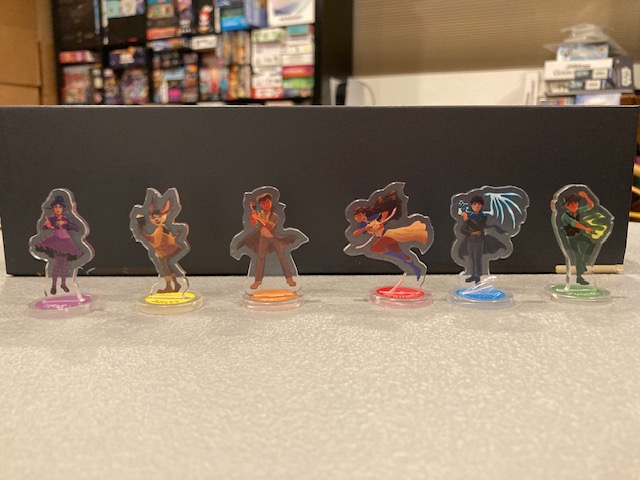
Each player takes the role of one of 6 characters (see above) in the game: these characters are all magically oriented. These are the good guys! They have magic powers and spells! Note how nice those dual-layer boards are!
Each player takes the corresponding standee: I have the deluxe version which has the acrylic standees (they are just cardboard standees in the normal version of the game). See above.
Each player gets their own very specific deck of cards. Every turn, each player must play exactly one of their cards to “do something”! See the decks above!
As a cooperative boss-battler game, players choose one of three bosses (see above) to fight. Each one is very different!
As a cooperative boss battler, there will be a lot of dice rolled when attacks and defenses happen! See above!
The monsters (and Lady Weirdwood, off to the left above) are also acrylic standees!
The good guys characters and the bad guy monsters are all very different! The good guys each have a different deck of cards with different emphases! See some above!
Each character also has a different experience track! When you “do stuff” in the game, you get experience which you can immediately spend to upgrade your character! With experience points, you choose which track to advance, and each character has different annotations (see above) on their three experience tracks!
Other things make the characters asymmetric:
when the character rolls a STAR, a special ability (for that character) only activates
each players has different start resources
each character has VERY different spells they can activate
each character has a different progression to get dice
In general, these characters are VERY different and will play very differently!
The Manor: Worker Placement Rooms!
The core play of the game is in the Manor (mansion) above. It’s a bit of chore to build!
You place tiles in concentric rings: the outer ring (above)…
The middle ring … (see above) …
And the inner ring! See above!
Players place their standees on the entrance to begin: see above.
This game almost has a worker placement feel as well: when you end your turn in a room (see above), you activate the special ability of the room. See above for two rooms! The top one will allow you to get resources and the bottom one will allow you to rewind time! Each room has a very different ability to activate in the game!
When the Manor is all built (see above), it has a very daunting table presence! See above!
Resources
There are a number of different resources in the game you get (usually from activating a room): Power (pink), Scarabs (yellow), flame (blue), or books (green). See above! These resources are spent for many different things in the game: activating spells, buying dice, buying Companions, and many more things!
The small twist here is that the Scarabs, even though they are resources you need (yellow, see above) are also the “Bad News” tokens and they spread “kind of like” the disease cubes of Pandemic!
Scarabs in a room make it so you CANNOT activate the special ability there! You would have to go into the room and specifically fight them to get rid of them … and if you kill all the Scarabs on your room, you may still activate that room at the end of your turn.
Scarabs advance from the inner rings to the outer rings when “The Scarab Phase” happens. It reminds me of Pandemic for two reasons: 1) the Scarabs will “blight” a room if there are ever two or more in them (not unlike losing a city in Pandemic Legacy). This blight causes you to lose the room as a worker placement spot! (Don’t despair, you can always repair a blighted room) 2) The progression as Scarabs are always coming out and spreading … just like the disease cubes in Pandemic are always coming out and spreading!
Generally, flames and books are easy to get from rooms, Scarabs have to be obtained from fighting, but power is harder to get!
There are limited rooms with power tokens, but most power tokens comes from advancing the Power track on your character (the pink track above).
There’s a reason we call this a cooperative boss-battler worker placement euro (with elements of Pandemic)! The worker placement and resource management aspects feel very euro.
Time
Many cooperative games have some flavor of timer on it: you must win in so many turns, you must win before the Bad News deck runs out, and so on. Time is handled very interestingly in this game! In between the concentric circles of the rooms are two rotating rings that tell time! The first ring (above) is like the hour clock: as you play, time advances from sunrise to morning, to afternoon, to night, and back around! See above!
The outer ring is like a day clock: it has numbers from 1-12 on it (see above)! Every time the inner ring advances from night to sunrise, the outer ring spins! If the outer ring ever moves from 12 to 1, players lose! They have run out of time!
How does time advance? In two ways! First, the Monster “bad news” card moves the inner hour circle; see above as the monster card will cause hour time to advance 4 spaces!
The second way is that a player’s card is to be placed in one of the 4 positions above his character sheet: see above. Each position is labelled with a time of day: The Lore Master Meditation card (above, far right) has been played above the Night symbol, which means the player MUST SPIN the inner circle to the next night phase symbol! Every turn, the player MUST play a card to one of the spaces above. Part of the choices are trying to advance time as little as possible.
This time advancement mechanism must be balanced against matching symbols on the top of the card: see above as Prepare Defenses shield matches the Touch the Fae card! (Wild) If these symbols match, the player gets that symbol’s effect (a shield gives one more defense in combat). Sometimes you may choose to waste more time to get a better symbol match!
This is just one of the many choices players make when playing a card: Which card? How does time advance? How do symbols match?
Doors and Connectivity
These spinning concentric circles of time also controls the connectivity between rooms! See above as the characters in the room with the Chaos Ogre can’t get out to the middle rings! There’s NO DOOR between the middle ring and outer ring! When the day counter spins, the doors will spin and an exit will emerge!
These “moving” doors take a few turns for players to get: “Wait, playing my card will move the rings before I move my character?” Most of the time, we would “pretend” to advance the ring to see what connections would open up and then if the connections looked right, … then we would commit. I do admit, this is very daunting the first few times until you get a handle on it.
Spells
Each player has three spells on their character board: see above (Upper right of the board). These spells vary tremendously between characters! Some characters are more help-focused, some are more defense-focused, some are more combat-focused Each character’s spells are very different.
The spells are activated by spending resources … with Power usually being one component. See above! This is why Power is such an important resource in the game component! The spells are incredibly powerful, many times making the difference between a winning and losing combat!
Companions
Players can also recruit Companions to help them! Companions cost resources (of course), but give two main abilities! First, they usually give a nice little power you can use once (before you recharge).
Possibly more important, the Companions give another position to play cards, so you reset time less often! (Every reset causes a Scarab phase!) See above as Oliver has two companions, so he can play two cards without resetting!
Solo Game: True Solo With One Character
The game has rules for a solo variant (congratulations on following Saunders’ Law)! Basically, you can play as many characters as you want! The game recommends playing two characters, to get some synergies between characters going!
You might notice, I spent quite a bit of time describing the components and mechanisms of this game! I don’t know about you, but playing two characters seemed a little much for my first solo game! I ended up choosing to play my first solo game as a true solo game: one character. See above.
The game really needs no changes to play solo with one character: the main balancing mechanism of the game is advancing time for each play, so the total number of plays of the characters remains about the same. Very approximately, a game is “about” 2 * 12 = 24 turns total. Each character moves up the hour wheel by 1 or 2 spaces per turn, but the monster moves the hour wheel by 2-5 spaces per turn. On average, it takes about 2 player turns to advance one day, so at 12 days, the games lasts about 24 turns. So a true solo player will have about 24 turns, a 2-Player game would have each player take 12 turns, and so on.
The point of all that is — Sure! You can play this game true solo without any real rule changes! I always love it when the solo game follows the main rules: it’s usually so much work to apply solo rule exceptions to a game!
After playing a true solo game, let me say three things:
This is a pretty fun game solo.
It is a bit long. I think it took about 2 hours 30 minutes?
I absolutely would suggest your first game be a true solo game! This game has SO MANY RULES! And SO MANY INTERACTIONS! Your first game will struggle with rules, discrepancies, and just getting the game. The last thing you want to do is to context switch between two characters! Remember, every character is very different and plays very differently! Context Switching between two characters (as we’ll see below) is rough.
The true solo game works, and it works pretty well.
Solo Play: Alternating Between Two Characters
So, because the rulebook “suggests” that two character solo is the preferred way to play, I ended up playing a two character game that way by myself. At this point, I had at least one true solo game under my belt, so I at least felt ready with a decent understanding of the rules.
You can see above as the game table became even busier! And I remember this solo mode working, but I felt like I just had to “get through” it. There was so much work context switching between characters that it was overwhelming. I’ve emphasized this point quite a bit: the characters in this game are very distinct and very complicated to play! Each character requires a lot of focus to play it well.
Maybe this is your favorite game of all time! Maybe you want to explore all the characters and how they work together! I remember in Set A Watch (a cooperative dice placement game we reviewed most recently here), the 4-Character solo seemed daunting! Over time, I came to love that 4-Character solo mode after I had totally absorbed the game! Maybe the same thing will happen here?
But, I think focusing on a single character is a lot more fun. The 2-character solo play felt a little like a slog; don’t get me wrong, it worked, but I just felt like I was going through the motions. But, maybe after I absorbed this game some more, maybe I will come back to the 2 character solo mode? Maybe?
Right now, I can only recommend the true solo game, especially if it’s your first game!
Cooperative Play
I was able to get two big cooperative games together: both of 4 players.
These game groups are very different, but two things seemed to remain the same between the groups.
One: This game is very long: both 4-Player games took more than 3.5 hours. Some of this time will go away since it’s a learning game, but all my friends are seasoned gamers and jumped right in (with my help: I taught the games knowing the rules pretty well by this point). It feels like Weirdwood Manor is going to last at least 3 hours no matter what. See above as we all go away to dinner, leaving the game set-up to finish later!!!
Two: All the games I have played had the players “multi-player solo” in the beginning of the game, but engendered cooperation more in the later game. Well, we strictly speaking, didn’t have to cooperate, but we would have lost if we hadn’t! Many times, we had to figure out cooperatively how to engage the boss, but someone would have correct the topology (remember the rotating rings?), or defeat Scarabs protecting the boss, or any other issues … someone had to “blaze a path” for the next player! Or the next player had no chance!
Early in my first 4-Player game, I had to “clean-up”the Scarabs in the middle of the board (to protect Lady Weirdwood), but it meant I had to “take one for the team” to do this! It meant I had to lose a lot of resources and be behind the ball for leveling up my character! But we ABSOLUTELY had to do this, or we would have lost! (If Lady Weirdwood dies, we lose!) So, I took one for the team … enabling my compatriots to continue!
Generally, the game starts out very “multi-player solo” because everyone is in dire need of resources! To get anything going in this game, players have to concentrate on themselves … then, as the game gets further along, it’s clear players HAVE to cooperate, or they will lose!
Some characters had more abilities or spells that enticed cooperation, so the choice of characters also can affect how much cooperation there is!
What I saw in my game groups was that the Alpha Player was kept at bay because (as we saw in the solo section) there’s just too much to keep track for a single character! It’s much much harder to Alpha Player when you are busy concentrating on running your own complex character. The cooperation happened more organically by people asking for help!
“Hey, can you get rid of those Scarabs? I need to attack the boss!”
“Hey can you make sure time doesn’t advance too far? I need to make sure the boss isn’t angry yet!”
In general, there was a decent amount of cooperation, it just happened more in the later game.
Things I Liked
The production is amazing. The game pops on the table!
The Bad News cards (the Monster cards) are labelled on the back with a “hint” of the basic operation of the card! The Monster Card (see above) tells us that the Monster will “move somehow”! You flip the card and find the monster moves! This is a fantastic mechanism! It allows players to try to play cards with some general knowledge of what the bad guy will do! I remember seeing a variant of this mechanism in the cooperative game Paleo (see our review here) where the back of the wilderness cards was labelled with a generic icon as to what was coming! (We think a mechanism like this could have helped my friends like Hacktivity, from a few weeks ago, more).
I adore the acrylic standees. These alone made the Deluxe version worth getting! They are beautiful, well-labelled, and just pop on the table. They even emphasize the color on the bottom!
Playing cards into a slot to control the time advancement is really neat and interesting.
The rotating rings being used for both TIME and TOPOLOGY is very different and interesting! It took a little getting used, but it was cool.
The experience point tracks work really well: you get to make choices and advance your character at the same time! I think this one mechanism engages players more than might have expected: you become attached to your character as you care how he levels up! And your character just gets better and better as the game goes on, so you feel like you are doing something!
What I Didn’t Like
Probably the biggest detriment is the length of the game: several of my friends complained how long the game was. There’s that table (above) left set-up while we went to dinner because the game was so long …
As cool as the rotating rings are, sometimes we struggled to rotate them: this is a physical issue! We had to readjust the board on the table to avoid the crack in the middle! Even when it lay flat on another table, sometimes it didn’t advance great? It usually worked, but it just needs a slight tweak to make it easier to rotate the rings.
Speaking of the rings, why does time advance COUNTER-CLOCKWISE in the game???? When time advances in the game, you spin the rings COUNTER-CLOCKWISE!! In real life, when a clock advances forwards, it’s CLOCKWISE … thus the name CLOCKWISE! The rulebook even used the terms clockwise and counter-clockwise in descriptions! It knows the terms! This seems very counterintuitive to me!! It really seems like time moving forward should have been CLOCKWISE (like clocks). I dealt with it, but this little thing really bothered me!!
Complexity: this is a very complicated game with lots of moving parts and a long rulebook. It will take a while to absorb this, and some people may bounce off of it hard because of the complexity.
Even though this game has a lot of euro elements (worker placement, resource acquisition) and a lot of predictable elements, there’s still enough randomness to that it might just frustrate you. The game is, at its core, a boss-battler with lots of dice! You will be rolling dice and you might roll great and you might roll poorly! My friend CC got completely screwed early in one game, and had trouble recovering: he got completely smashed by the boss, and spent the rest of the game trying to recover … meanwhile watching while the rest of us were doing really well!
That element of randomness … might make one of your friends have a bad game.
Reactions
The reactions to this game from my friends was generally positive, well, except for CC who got trounced. CC’s reaction was probably the most nuanced:
I think I might have liked Weirdwood Manor more if I had gotten to play to the end. Sounds like my character got to be useful later on, which was a feeling the game had lacked for me in the turns I got to play. I liked the theme of that one and some of the mechanics were fun, but I got pretty frustrated when I kept getting shut down while watching other players advance. Nice table presence, though, and it felt like it was telling a story in a cool environment which I liked.
Kurt: He started at a 7.5, but upped his bid to 8 or 8.5/10. He really liked it! Joe: 7.5/10 Teresa: 7/10 Sara: 6-7/10, but want to play it again for more precision Andrew: 6 -7/10, but wants to play it again for more precision Me: Solo (true solo), 7.5/10, Solo (two character) 6.5/10, (Cooperative) 8.5/10
Conclusion
Weirdwood Manor is a beautiful cooperative game with a beautiful production! But you have to know what you are getting into! This is a very long and complicated game with euro worker placement elements. The game always seems to start “multiplayer-solo”, but evolves into more cooperation as the gameplay advances … if you don’t cooperate in the endgame, you will lose!
I could easily see Weirdwood Manor being someone’s favorite game of 2024! It has so many unique and quirky mechanisms, satisfying advancement, and engaging play! Just be aware how complicated this game is! The extra complexity does have the advantage of keeping the Alpha Player at bay!
I recommend staying with true solo (take control of one character) to learn the game, and only tackle solo with multiple characters if you want more challenge.
My groups all like the game, with ratings between 6 and 8.5, with most people giving it at least a 7.
Hopefully this review helps you decide if Weirdwood Manor is for you!
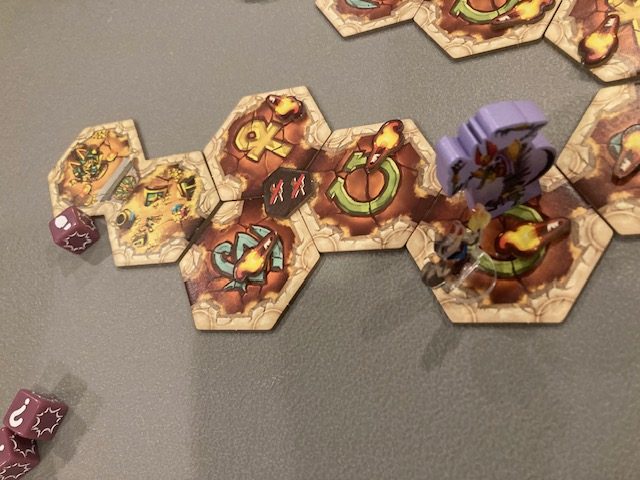
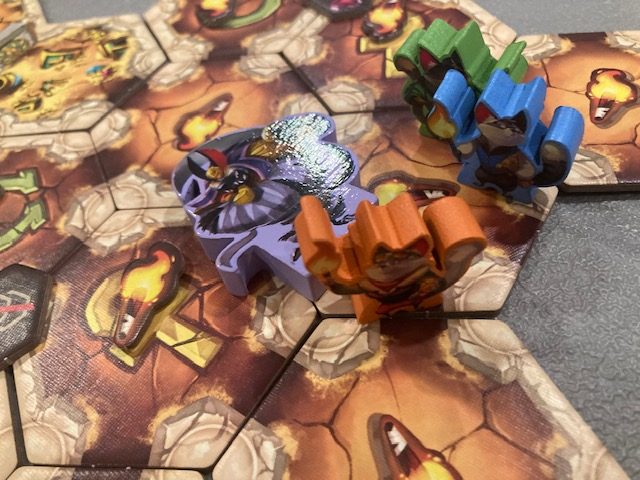
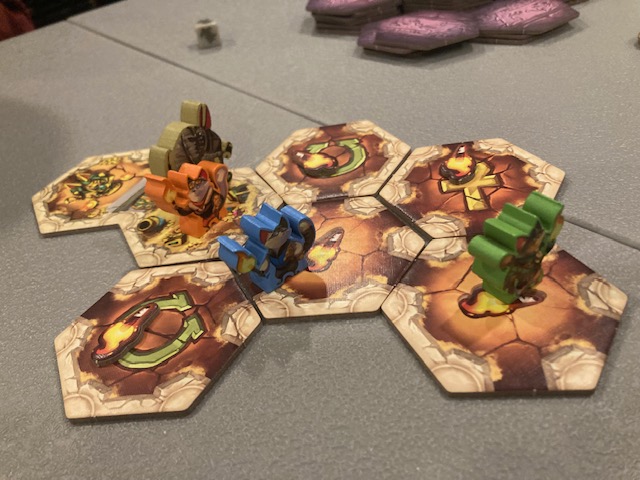
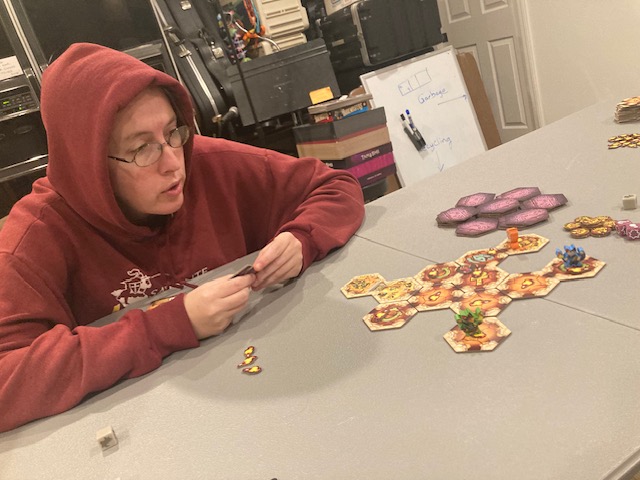
This week we take a look at a cooperative cat dexterity game: Nekojima! It can also be played competitively, but we focus on solo and cooperative play here.
There’s been a trend recently towards more cooperative cat games: just a few months ago, we saw and liked the cooperative cat game Hissy Fit!See our review here.
Will Nekojima fare as well as Hissy Fit and Race To The Raft? Let’s take a look!
Unboxing And Gameplay
We got the deluxe wooden Collector’s Edition: see above (it comes with some extras). We’ll talk about what’s there, but we will focus on what comes in the base game.
This is a cooperative dexterity game where players place poles and cats! See above! If the poles ever fall over, players lose! It’s kind of like cooperative Jenga …
The poles must be placed on the platform above: notice how there are 4 different colored regions!
Each turn, a player will roll two dice (see above), and the dice will indicate where the two regions to place the poles in!
There are three different variety of poles: blue, red, and white. See above.
The pole color you draw each turn is chosen by drawing a cube from a bag! See above as the white cube is drawn, and the two poles have to go between the red and green districts on the platform!
If players draw a black cube (see above), they must also place a cat (see below) to hang from the poles!
The goal of the game is to build your poles as long as you can without toppling them! Like I said, kind of like Jenga! (Well, reverse-Jenga because you add wood blocks here, whereas you takeaway wood blocks in Jenga).
Every cube you draw is placed in a Level score chart: this shows you what your “score” is at the current stage!
If a single pole falls over, it’s game over! Your score is the last level you achieved! Actually, when one pole falls … generally all of them fall! See above!
That’s the basics of Nekojima! See the components above!
Rulebook
The rulebook describes the basic rules pretty well: see above. The set-up and components are described above on page 1 in one fell swoop.
The rules are like 4 pages! You’ll notice (if you look closely above), there are some restrictions on how the poles are placed (you can never touch the wire, you can never wrap the cord, etc).
You’ll also notice how the rulebook commits the cardinal sin as being the same size as the square box: it gets a B- or C+ on The Chair Test as the rulebook flops around and hangs over the edges,
The rulebook is short: the game is easy to describe! The only difference (really) between cooperative and competitive is in the focus: play still keep building poles and adding cats until everything falls down. In the cooperative game, all players worked together to get the best score and win/lose together! In the competitive game, the person who knocked the poles over is the loser … only one loser and everyone else wins! The mode changes the unfolding of the game a little, as the cooperative players will try to set-up their compatriots for easier moves, but the competitive players will try to set-up their foes for harder moves!
Solo Mode
The solo mode is described on the last page of the rulebook: see above. Thank you for following Saunders’ Law and having a solo mode for this cooperative game!
Basically, the solo player just keeps adding blocks and cats as long as possible …
… until the poles fall over. Whatever the highest level is (see above) is the solo player’s score!
Solo mode worked great for learning the game: it was basically the same set of rules as the cooperative game! The solo player does the best he can to set-up the next player (who just happens to be himself) for easier placements!
I mean, from scratch, I learned the game and played the game in 15 minutes. It was very easy to get this to the table.
Cooperative Mode
Cooperative mode works great.
The first game ended quickly in heartbreak as the poles fell over.
Undeterred, my friends wanted to play again to do better! THIS time, we stood up! We stood away from the table so as not to shake it! We did everything we could to prevent any “accidental mishaps!”
We made it much farther in the second playthrough! See above. But alas, the poles will always fall!
The great thing about the cooperative play is that people seemed to want to play again!
Too Many Expansions?
There are waaaaaaay too many ways to play this game! See 4 variants above!
There’s another two variants that comes with the Collector’s Edition as well!
But in the end, my friends and I were happy with just the base game. I am not convinced we will ever play anything beyond the base game. It’s nice that all these expansions are in the box, but the extra expansions seem to “muddy up” the experience.
Abstract or Thematic?
This is a fun cooperative dexterity game, but it’s probably more an abstract game … that just happens to have cats. Nekojima seems to really lean try to lean into the cat theme! See the cat placemat that came with the game! The cat tokens are nice!
But, at the end of the day, this is probably an abstract cooperative game. Just don’t tell the cat lovers.
Some Issues
The Collector’s Edition BARELY fits in the box: in fact, it strains the clasp on the wooden box. And the stuff that came with it?
The extra dice tray is problematic as the dice bounce right out! And the extra game mode with the arches (see above) … ??? I will probably never play that mode, as cool as it looks.
If you find yourself interested in this game, I don’t think it’s worth getting the Collector’s Edition: just pick up the base game. You’ll be happier for it and have saved a little more money.
Conclusion
I got Nekojima delivered from Kickstarter sometime in 2023. Unfortunately, because I get so many games, this one just kinda slipped through the cracks.
Nekojima is a fun, cooperative dexterity game that leans pretty heavily into the cat theme … but it’s still pretty much an abstract game. The cats do make it cuter though.
Nekojima would probably make my Top 10 Cooperative Dexterity Games if I ever redo that list. This is probably a solid 7 out of 10 overall, with the cooperative game being more fun than the solo game.
I suspect Nekojima will be played quite a bit at RichieCon 2024 this year: there are a number of people who love their cat games and this game just looks so great set-up on the table.
Appendix: Furoshiki
One of the things that “seems” to be in the base box is a cat placemat.
I thought it was just a placemat for the game. Nope!
Nope! Apparently, it’s for Furoshiki! See the back of the pamphlet above! It’s about the art of folding and carrying things.
Skytear Horde: Monoliths is a standalone expansion for the Skytear Horde game system: this is the first expansion. This is a tower defense game! This game system is an odd duck for player counts: it is a solo game (1-Player), cooperative (2-Player), or competitive (2 or 3-Player) tower defense game. The game type is closely tied to the player count! We will only be discussing only the solo and cooperative gameplay today.
Skytear Horde: Monolithswas on Gamefound back in May 2023 and delivered to my house in May 2024. They said it would take a year to deliver and they weren’t wrong!
This is a smallish box: see the Coke can above for scale.
The original game (which had the deluxe box) is a little bit bigger.
This is mostly a card game: although there are some punchouts and a rulebook, this is an expansion with 250 new cards.
There are 3 new Alliance Decks: Green, Red, and Blue (see above). Recall that the solo and 2-Player games have each player take an Alliance deck: they are 40 cards of goodness per deck (for 120 cards of Alliance decks).
The good guys are protecting their Castle: they choose one of 6 new Castles at the start of the game (see above).
Of course, there has to be a big bad for the players to fight: the expansion comes with 3 new Epic Monsters! See some above.
There are three new Horde decks (87 cards total): see above. Recall that the Horde decks are the “Bad News” decks that summon bad guys monsters that you have to fight!! The type is notated in the upper right, with the difficulty marked on the very bottom: each deck can be configured to be harder or easier based on the difficulty icon on the bottom.
There are a set of portals that control the summoning rate of the Horde: see above. There are a different set of Portals for solo, co-op, and competitive modes.
There’s some new cards (Roots and Troops) …
Altogether, the new cards are gorgeous with art consistent from the original game.
There are also some tokens, of which you will need some!
I have the original deluxe version of the original game, which comes with the playmat AND some plastic tokens. Even if you have the plastic tokens from the original game, you still want some of the tokens from the expansion to play!
Basically, the temporary tokens (with the white middle) are really necessary to track temporary statuses. I found this out the hard way (during my first game) that you really do need these temporary status tokens.
Overall, the expansion looks good.
Rulebook
This new rulebook is 24 pages. This is important because the original rulebook was only 16 pages: we’ll see why this is important in a second.
There is mention of a video for learning the game on the cover: we prefer learning from the rulebook (so we can lookup things easier later). But, it’s good to know there is an official video.
Skytear Horde: Monoliths gets an A on the The Chair Test: I can see the rulebook on the chair next to me, the rulebook stays open, and the font is pretty readable. Weirdly, there seems to be a lot of white space: I would have preferred a bigger font and less white space? The white space choice bothered me. Otherwise, it does very well on The Chair Test.
The Components page is very good at listing all the cards and pointing out features of each set of cards. See above. I spent a decent amount of time on this page correlating the cards to the Components page: I feel it’s important to touch and see all the components as a step towards understanding the game.
It’s a good Components page. The token discussion was quite nice (on the opposite page) as well.
The set-up is quite good too: See above. Interspersed in the text, there’s even suggestions for monsters and characters and bad guys for your first game! Thanks Skytear Horde: Monoliths! My first game(s) were easy to set-up!
The rest of the rulebook is pretty good too.
I ended up keeping pages 12-16 open and active as I played: it just seemed easier to help me keep track of where I was in the game.
This was a pretty good rulebook, but not great. Recall, from our review of the original Skytear Horde that we felt the rulebook could have been a little better. They have definitely evolved the rulebook: it’s better, more readable (especially for the first-timer or virtual first-timer), but it still doesn’t have lots of examples or FAQs or edge case discriminators.
In both one and two-player game, a bunch of questions came up as we played, and we struggled to find some edge cases (Can we attach an item to a compatriot or only ourselves? If we “kill” a minion, but something heals it, does it reactivate to Pillage? How does a Castle get minions if it can’t engage?). I am sure there is something online (the designer seems very active in the BGG forums), but I wish there had been a little more in the rulebook.
There’s a table of Contents (yay … see above), no Index (boo), but there is a Glossary (yay … see below)!
This was a pretty good rulebook. I want more edge case rulings or a FAQ, and the white space bugs me (but I am pretty sure that is a me thing). In general, the rulebook has evolved for the better and I was able to jump in pretty quickly.
Gameplay
The gameplay of Skytear Horde: Monoliths is pretty much the same as the original game, but with new ideas peppered in (Troops, temporary armor/attack, new Hordes, new Alliances, etc). If you liked the base game and just want more, this is a perfect expansion.
I ended up playing with the plastic tokens and game mat from the original game, but I didn’t need them: they just made the game spiffier. You can play the whole thing by itself without needing the original game.
That’s pretty much what I did: I wanted to see all the new content, so I only played with new stuff!! Monoliths!
The rulebook (by being a very nice guide) has made the gameplay “seem” smoother in the new game, even if it’s just a by-product of my imagination.
Nothing in the expansion is ground-breaking, mind-altering, or life-changing. It fits in the basic flow of the game easily and just adds more stuff.
Solo Mode
So, Skytear Horde: Monliths follows Saunders’ Law and there is a viable solo mode. In fact, I almost feel like this is a solo game first, and then the cooperative and competitive modes are afterthoughts … well-developed afterthoughts, but not the primary way to play.
As proof, the cooperative mode is listed as an afterthought AFTER the solo play is explained ..
… and the competitive mode is listed after the co-op and competitive modes. See pages from the rulebook above.
I really do like that the solo mode is a pure solo mode, where the solo player takes control of just one Alliance deck! Solo is so easy to jump into; I picked the blue Alliance deck (above) and was able to start playing pretty quickly!
My first solo game went really well, but I realized I was cheating a lot! Not on purpose, but I just kept missing a lot of nuances and edge cases (like I said, I wish the rules were a little better on edge cases!)
Once I got a few more games under my belt, the solo game became a much more interesting puzzle! See above as I just barely win with 1 Alliance card (just 1!) after defeating the Epic Bad Guy! I just barely won and it was glorious!
It took me about 3 games to feel like I got all the nuances. The first few learning games were fun, but I think you need a few games under your belt before the game starts firing on all cylinders.
Playing Skytear Horde: Monloiths solo reminds me why Skytear Horde originally made my Top 10 Solo Board and Card Games of 2023! This is a fun puzzle! And Monoliths is more of the same!
Cooperative Game
This time around, I was able to get the 2-Player cooperative mode played … you might recall in our review of the original Skytear Horde, I never was able to get my friends interested in playing! Luckily, I have been doing a lot more 2-Player co-ops lately, so I was able to get both Sam and Teresa interested in playing!
Unfortunately, these games didn’t go quite as smoothly.
Although it seems a natural extension of the solo mode, as each co-op player takes an Alliance deck, the game didn’t seem to play as smoothly.
It seemed like we were playing a little more multi-player solo than really cooperating. Sure, we needed to discuss what monsters to engage, but there didn’t seem to be as much cooperation as I had hoped.
One thing that seemed to really keep us down was that the Mana allocation was lesser (it’s only +3 per round) for two players. It felt like it was harder to get things going in a 2-Player game because of the Mana restriction … and that was more frustrating.
We also had some bad luck, even with the Mulligan in set-up rules.
I feel like it would have been nice to have a few more cooperative mechanisms:
share Mana? The small portions of Mana might have felt less debilitating if we could apportion the Mana? Say “the team” gets 7 Mana per turn to apportion as they wish, instead of 3 each? This can help mitigate bad card draws.
share Attachment? At the time we played, it was unclear whether Attachments could go to the other player. I think, after some hunting through some rules, that Attachments can go to either player. This needs to be stated much more explicitly!
share cards? Not necessarily “pool cards”, but it might have been nice to have a mechanism to share cards better? Maybe each turn players could swap one card?
I wanted more cooperation in my cooperative game. Don’t get me wrong, the cooperative game works, but it felt more like multi-player solo. That maybe a good thing for some people: a lot of people don’t like it when the Alpha Player (see our discussion of Alpha Player Syndrome here) tells them what to do! The cooperative mode definitely avoids some of the Alpha Player pitfalls, but at the cost of some cooperation. Caveat Emptor: this may be the perfect cooperative mode for you and your friend! I just wanted more cooperation.
The cooperative mode just wasn’t quite as smooth as the solo mode.
What I Liked
I like Skytear Horde! The Monoliths expansion gives me more of the same … in a good way!
The card art is pretty phenomenal. Even when we were having a bad cooperative game, my friend Teresa said “I really enjoyed the cards and art“.
Speaking of the cards, they are well-notated, easy to read, and usually very clear.
I really love the solo mode.
What I Didn’t Like
Even with the Mulligans during set-up, sometimes you can get completely screwed by a bad card draw. We had to take a Pillage of 11 cards (like more than 1/4 of our deck) during the first turn because we could get nothing going! I am pretty sure that’s why we had such a bad first cooperative game, but there’s not much you can do to mitigate the randomness of some card draws …
It would be nice, for example, to have a choice of two cards when you draw (when you kill a monster, you get to draw a card). Currently, there is no mitigation of the luck-of-the-draw: you just get the card you get. It might be nice if we got to choose the card we got?
The rulebook needs a FAQ or some more edge cases description.
Conclusion
I like Skytear Horde and I like Skytear Horde: Monoliths. It’s great that Monoliths is a standalone expansion (so I can just play the new stuff) or an addition (so I combine old stuff and new stuff). There’s nothing ground-breaking here: just more of the same, in a good way! If you like Skytear Horde, you’ll like Skytear Horde: Monoliths!
I think I prefer Skytear Hordes: Monoliths as a solo game. The cooperative mode is pretty good, and maybe perfect for you if you want to avoid the Alpha Player in your games (at the cost of some cooperation).
This is a good game with a good production: we recommend it wholeheartedly for the solo player, and a little cautiously to the cooperative players. Hopefully our review will help you figure out if this is something you would like.
When I was an undergrad at college, a lot of my friends played a game called Rogue on the vt100 computer terminals.
It was a little dungeon crawler that my friends spent HOURS and HOURS playing.
“It’s a Dungeon Crawler? Fun! Do you save you characters very often?“ “Uh, … no. You just play until you die. You don’t save characters.” “I’m out!”
And that was pretty much where I learned to dislike Rogue-like games. If I play a dungeon crawler spending hours leveling up my character, I want to save it! Part of the fun, for me at least, is returning to my character that I’ve invested in. I have no desire to play a formless character that just dies.
To be fair, my opinion has not aged well. I have been informed by many people that Rogue-like games have some saving capability. Still, my malformed opinion has persisted through the years.
Slay The Spire
Because of my prejudice against Rogue-like games, I have never played the original Video game Splay The Spire. I must admit, though, that I was intrigued by Slay The Spire (a cooperative deck-building game) when it appeared on Kickstarter back in November 2022. The original Slay The Spire video game was really only a solo game … maybe the transition to cooperative board game would make it something more up my alley?
This arrived at my house in May 2023 (see above); it had promised delivery in Dec 2023, so it’s about 5 months late. In the world of Kickstarter, 5 months late is not bad.
This is a cooperative board game for 1-4 players, Ages 12+, with only 60-90 minutes per Act! I was intrigued! To be fair, a lot of my friends seemed “excited” to play this game, so I freely admit that their enthusiasm was contagious.
Let’s take a look!
Unboxing
This is a pretty tall box (see Coke can above for perspective), but it’s about the same form factor (in length and width) as a Ticket To Ride size box.
The top of the box has the rulebook and Upgrades and Items guide.
Don’t be too impressed by this Upgrades and Items guide: all it does is show all the cards! It has no disambiguating text!
There is a very nice boxing/unboxing guide for putting this together and taking this apart. See above.
Are you like me as one of the few people and didn’t know that Slay The Spire Video Game was a deck-building game? Well, the board game is also a deck-building game! As a deck-building game, this game comes with SO MANY cards! See above and below. And its own sleeves! For more discussion of Cooperative deck-builders like this, check out our Top 10 Cooperative Deck-Building Games!
I have been informed that the cards and art look exactly like the Video Game.
And there are a ton of cards and boards! See above! This game looks really fantastic! See above!
And it looks like the Video Game.
I want to be 100% clear about this: this production is amazing! It’s a deck-building game that comes with sleeves! The tokens come in an easy-to-use tray! The cards can all be stored very easily in the box! The box is easy to repack! They really knocked it out of the park on the production of this game!
Gameplay
Each player chooses one of 4 characters to play: see the characters above. I have been informed by players of the Slay The Spire Video Game that these are straight out of the Video Game!
Each player also takes the corresponding figurine: these will be used to notate which “row” you will be fighting in; we’ll describe that more below.
Each player has their own deck of cards to start with: each deck is a little different and really represents a different play style. Simplifying a little too much: the blue deck is defensive, the red deck is offensive, and the green deck is all about poison.
Players together choose a “path” to take to get to the final Bad Guy (at the top of the board above). These decisions can have you fight a monster, summon the merchant, build a fire (“smith” or heal: I learned the word “smith” from one of the Slay The Spire Video Game friends), fight Epic monsters, or take events. I was informed these choices were very reminiscent of things that happen in the Video Game.
When you fight a monster, each row next to a character gets some monster(s) from the Encounter Deck! See above as “the red guy” fights a Shelled Parasite. (I don’t know “the red guy’s” name because it is not notated on his board). Note that the monster has some hit points (left and right of card), and some icons: those icons tell you what the monster does when it attacks you.
As a card game, you play cards to attack your monster and/or defend yourself!! Shields up your defense (blue icons above), and swords up your attack (red swords above). You only have a limited amount of energy per turn to spend to play a card (usually 3 energy worth), so that limits which cards you can play (the energy cost is in the upper left corner).
You draw up to 5 cards every turn, and discard all when you are done. That feels very much like a deck-builder.
Typically after you win a battle with a monster, you can add an upgraded card to your deck: you deal 3 and choose 1 (apparently, just like the Video Game). See an example draw above.
See above as some of my cards have a GREEN text for the title? This means that I was able upgrade the card BY FLIPPING IT OVER! Each card has two sides, a normal side and an upgraded side: you can “Smith” to turn the card over and therefore improve it!! This is a really neat mechanic in a deck-building … and rare! I can’t think of another deck-builder that does this!
You can also occasionally get new additions from a rare deck (see yellow outline): these are much better cards!
To be clear, each character has their OWN upgrade deck to draw from and their OWN rares deck to draw from! See above: the red guy has a starter cards (grey outline), upgrade deck (black outline), and rares deck (yellow outline). This makes each character very distinct as they are built to upgrade a specific way. Like we said earlier, the red guy’s decks concentrate on attacks, blue guy’s deck concentrate on defense, and green guy’s decks concentrate on poison.
You occasionally can buy stuff from the passing merchant, including potions or treasures and even random cards. This even includes a way to cull cards: we call this The Andrew rule:A deck-building game MUST have a fairly systematic way to cull cards. Luckily, Andrew would (and does) like this game because he can cull cards.
Along the way, there are all sorts of other cards that come out: Events, Monsters, Potions, Treasures, Epic Treasures, and deck-cloggers (Daze and fire). I have been told this is just like the video game!
But of course, the purpose of all this is to take down the Big Bad Monster at the top! See above as I fight the Big Bad Bronze Automaton and a Bronze Orb!
Like many cooperative games, all players win together when they defeat the Big Bad, or they lose if any of them dies! So, it’s in everyone’s best interest to cooperate and keep each other alive!
The Rulebook
I need to talk about the rulebook. It’s okay, but not great. It really should have been better given how great the production of the rest of this game.
It does well on The Chair Test: it only droops over the edges a little, the font is big and readable, and the book stays open on the chair next to me so I can see the rules without taking up precious table space. This rulebook gets an A- on The Chair Test!!
The game starts off great with a Table of Contents, a link for a Companion App, a link for a How to Play video, and a list of all components (most) with correlating pictures!! Very very nice! I felt very happy to see this! My only fix might be that I had wished they had labelled the tokens better … there are a lot of tokens and I didn’t know what any of them were!!
The set-up is pretty good, but this where the cracks start to develop. This is my first example of this rulebook being too minimal: I accidentally shuffled the Summon deck, but it doesn’t say WHY you shouldn’t it! I didn’t know how to recover?!?!??! It turns out the Summon deck should “probably” just be alphabetically sorted so you can find cards easily … that’s the only reason to not shuffle it, you just make your life harder when you have to find a card. Really, I could have used a sentence:
“Don’t shuffle the Summon Deck because you will be searching for cards (alphabetically) in it later in the game. Just sort the deck alphabetically if you accidentally shuffle it!
But other than that, the set-up went fairly well.
This rulebook is pretty well annotated with lots of pictures and examples. See above. In general, the rules are fairly clearly set out. But the real problem with this rulebook is that it seems to assume that you have played the video game. There are a lot of places where a rulebook for a normal game would be chastised. I can’t tell you how many times I played with Jon and Keala (who have played the Video Game A LOT), and when I went to lookup a rule, they told me “it’s just like that in the video game! So it probably means that!” So many times, they clarified a rule by saying “it’s like that in the video game!” … which is not good for those of us who haven’t played the video game or other Rogue-Lites.
My canonical example of this was the Regret curse. I actually got two curses one one turn, Regret and Injury (see above)! My reading of these was that Injury was a worse curse because it keeps clogging my deck as I draw it and shuffle it back in. I though Regret was a better curse because you just got once and it was out of your deck. Nope! It clogs your hand so you draw fewer cards! You draw up to 5 cards, so if Regret is in your hand, you can only draw 4 cards. I didn’t think the rule was well-specified in the rulebook, but when I asked Keala and Jon they said “Oh it’s just like the Video Game, you can only draw 4 cards!”. I really wish the rules had made this clearer! This is just one of SO MANY examples where Jon and Keala said “Oh it’s like that in the video game!”. This rulebook should have been vetted by someone who has NOT played the video game so as to clarify a lot of finer points.
Even though this game doesn’t have an Index (and it really should), the back of the rulebook had an invaluable list of Abilities and Keywords.
Don’t get me wrong, there’s a lot of good stuff in the rulebook, but it was too minimal in a few places (For example: a few more sentences about the Retain keyword or why Summon deck shouldn’t be shuffled). I was able to learn the game and playthrough solo … and I had fun. I was able to play cooperatively with a bunch of friends (who hadn’t played the Video Game) … and we all had fun. It wasn’t until I played with seasoned Video Gamers that knew the game that I realized this rulebook needed some more clarifications: it depended a little too much of knowledge of the video game.
Solo Game
Like the Video Game, you can play this solo (thank you for following Saunders’ Law)! See above as I set-up the red guy for a solo game. There’s not really a lot of special rules or exceptions for the solo game, you just play! The main balancing mechanisms are really in combat:
In plain combat, a monster comes out per row (i.e. per player). Thus, the solo player will be fighting just one row of monster(s).
In Big Bad combat, the number of hit points is scaled to the number of players.
So, in general, you can just jump in and play the solo game without any real special rules! Thank you Slay The Spire! It was SO EASY to jump in solo!
I had so much fun playing solo that I played through the first three Acts of the game! I had a blast! There are so many places where you upgrade or get new cards, that you always feel like you are making progress! You always feel like you are getting better!
Really, solo was fun. I had a blast. I played wrong on a few points (one to discuss below), but even without knowing the Video Game, I had a good time.
Cooperative Play with Players Who DO NOT Know the Video Game
I ended up playing a full 4-Player game of Slay The Spire with three of my friends who have never played the Video Game! We ended up playing through Act I in one night in about 90 minutes (with a little extra time for set-up and tear-down). So, I just had to teach the game as-is … no one (including myself) had ever played Slay The Spire the Video Game!
The biggest conceptually difference, of course, is that this is a fully cooperative game! Slay The Spire is always thought of as a solo game! But the board game is fully cooperative!
The biggest change is that every character gets his/her own row of monsters to fight! See above! While you nominally tend to fight the monster in your row (it sort of becomes “your responsibility” as it does damage to you only), you can target any monster in any row! So, if a monster has a particularly bad effect for everyone (certain monsters can attack everyone), or if a comrade just needs a little help, players may choose to work together to take out particularly vexing monsters!
My favorite rule in this game is that it allows fine-grained Player Selected Turn Order (see more discussion of PSTO here). The rulebook calls this out on page 12:
“Players can play cards, use potions, and activate abilities in any order they choose.”
What this means, is that we (as players) can intersperse our actions to accomplish things! If we need Sara to play a Potion, then Andrew attacks to add a Vulnerable, to which then Sara can play another card and attack (for double damage), we can do that! Players can work together to find the best combination of their interspersed actions to take down the baddies!
In fact, in some ways, Slay The Spire gets the best of both worlds! Since you “generally” need to fight the monster in your row, players can do Simultaneous Actions to fight their own monster, but defer to fine-grained Player Selected Turn Order if they really need to! The Simultaneous Actions helps keep everyone involved … rather than waiting for “your turn”, you can all fight the monsters at once … this means there is much less downtime.
I think this is where Slay The Spire shines the brightest as a cooperative game: the players can choose the best way to play to either help each other (with fine-grained Player Selected Turn Order) or move the game along quickly (with an easy way to Simultaneous Actions fighting your monsters!) It’s the player’s choice, and I noticed we shifted between these modes pretty seamlessly when we played! It was something I didn’t notice until I looked back on our plays.
The cooperative game worked fantastically, probably better than the solo game because I got to talk and strategize and have fun with my friends!
Cooperative Play With People WHO HAVE PLAYED The Video Game
So, I wanted to make sure I played this game cooperatively with some friends who have played the video game: I wanted to see what they thought. Jon and Keala (above) are both fans and have played (and like) Slay The Spire the video game.
What happened sort of surprised me: we fell into a rhythm fairly quickly. Every time there was any rules question, Jon or Keala spoke up and said “Well, it’s like this in the video game”, so we didn’t spend very much time pouring over the rulebook. The Video Game became the reference implementation of the game! This was both cool and annoying. It was cool that the game seemed to fall inline with the Video Game, but it was annoying that the rulebook didn’t do better at explaining a lot of things.
We had so much fun playing, we ended up playing Act I and Act II in one night! The game just seemed fun to everyone.
Jon saved our bacon a number of times: he had the ability to shield other players (as the blue guy), which worked out very well! I would be able to attack something (as the red guy) and Jon (as the blue guy) would shield me or Keala (the green guy) so that we wouldn’t die! This cooperation seemed seamless! It just happened that way!
The game really clicked for everyone that night: I feel like I know the game better (with all my friends’ comments on how the Video Game works), and I was able to bring my friends into the card game quickly from reading the rules. We had a great time and plan to play again!
A While
It’s taken a while for me to get to this point. I initially had some misgivings about the game.
At first, I was grumpy at the rulebook for how minimal is was: it really needs a lot more elaborations on the rules. There was one rule in particular I was enchanted with, until I realized I was playing wrong. The “Draw 5 Cards: there is no maximum hand size” (p. 12) lead me to believe that maybe I had more choice of which cards I could discard. Maybe I could keep cards between hands? Why else would you emphasize this rule of no maximum hand size? Jon and Keala had to tell me this, but you always discard all your cards!! All of them! … just like in the video game. (to be fair, it is in the rulebook but it is one sentence). I think that rule is there to show that during your turn you can draw as many cards as you want.
Another thing that threw me off for a while was the art. I had just gotten a new deck-building expansion for Thunderstone Quest (see art above), and the art and graphic design for Thunderstone Quest (above) is significantly better than the art for Slay The Spire (below).
Comparatively, the art for Slay The Spire is a little anemic after looking at Thunderstone Quest. But I seem to be the only one who doesn’t love the art. I will admit, the art for Slay The Spire has grown on me a little: it’s very simple and not too busy. It’s also very readable. But since I have never played the original video game, I was not as “enchanted” with this art as others.
Flaws
This is a funny flaw in the game: you can’t (easily) have multiple games going on! You can save your game fairly easily (putting the appropriate cards in the appropriate slots), so you know you can come back and do another session. The problem is, if you want to play another game, you can to reset ALL THE CARDS for each deck!! We worked around it by taking pictures of our decks: if worse comes to worse, we can always use the picture of all our cards (see above) to recreate our save game. I suspect many people will want to try this game, and we won’t be able to easily have many games going on. In some ways, this is a product of its own success: it’s so much fun, people want to try it! But, be aware that a single game is easy to save, multiple games will require taking pictures of all your cards. And also the Unlocks sheet (see below) .. which presents more issues.
Another problem with this game is it’s really unclear how you move on once you play through Acts I, II, and III. The Ascension decks (see above) add some variety and keep the game interesting, but it’s kind of unclear how this fits in. Do you start a new game at Act I with the changes? Do you start a new deck? To play Act IV, you have to unlock it, but are you playing Act III again and again and again? Like everything I have seen in this rulebook, I wanted more elaboration! This rulebook frustrates me! Give me an example, give me a few more sentences, give me a page! I have played a solo game all the way through Act III. What do I do now? Add Ascension cards? Start over at Act I? This is very unclear!!! This is probably my biggest ding against the game: I don’t know exactly how to move forward. Sure, I suspect I will post to BoardGameGeek and someone will respond, and I will be able to move forward. But this rulebook does not make it clear how to move forward after Act III. UPDATE: I had lunch with my friend who has played the Video Game. He told me that in the Video Game, you just reset everything (including you deck) back to ACT I, but make a few cards (like the uncoloreds) available. I really DID NOT get that sense from the rulebook … another instant where knowledge of the Video Game helped and the rulebook didn’t.
Conclusion
Honestly, this Slay The Spire board and card game has really grown on me: I have played it solo numerous times, and I have shown it to many diverse game groups. The more I play it, the more I seem to like it! The upgrade paths makes this game great: there are so many opportunities to augment and upgrade your deck as you are playing! The fact that each players is so distinct in both powers and upgrades really contributes to how great this game is!
The production is fantastic, and the art is … thematic to the game. I have grown to appreciate the simple art and graphic design, but I still think the art and graphic design is a little anemic.
The solo game is great: it’s about an 8.5/10. It’s easy to play, and there’s really no exceptional rule changes needed to get the solo game to the table.
The cooperative game is about a 9/10: the base game is all there, with all the upgrade and augment paths, but the cooperation really shines brightly! Players can choose so many ways to help each other with fine-grained Player Selected Turn Order, with Simultaneous Play keeping everyone engaged at all times! And even though these play modes seem mutually exclusive, players seem to weave in and out of Simultaneous Play and PSTO without even noticing!
Players who know Slay The Spire the video game might find this to be a 10/10 for them: the game is great and also evokes so much atmosphere from the Video Game!
Over the course of many play sessions (both solo and cooperative), I ended up liking the game more and more. There are some issues with the rulebook, as it seems to assume players know Slay The Spire Video Game pretty well! Other than my issues with the rulebook, the game is great. Putting everything together, this feels like a 9.5/10 as an overall production! This game surprised me how much I liked, especially given my anti-Rogue-lite tendencies.
Hacktivity was a game on Kickstarter back in June 2022: see link here. This is a cooperative hand management game for 1-4 players. It originally promised delivery in February 2023, but didn’t deliver to my house until late April 2024: this makes it over a year late!
I was originally a little concerned about this game because at some point there was a Kickstarter update saying they lost their manufacturer! I was worried that this meant we might never see the game, but the Hacktivity people persevered and did deliver final copy! I was actually quite impressed with their positive attitude and communication during the Kickstarter! I’ve had a number of Kickstarters recently with poor communication and it was nice to see someone owning every step of the process!
Let’s take a look!
Unboxing and Gameplay
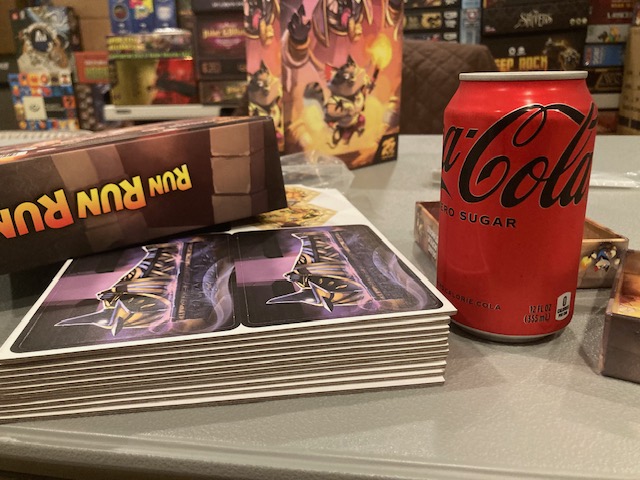
This is a fairly standard sized box (“about” the size of a Ticket to Ride sized box): see Coke can above for perspective.
In this game, each player takes on the role of a special hacker. See the four decks above.
Each hacker has their own board as well: see the boards above.
Each hacker’s deck is different and has a different emphasis or/and special powers. See two such decks above.
The players are interacting with a board (see above) with three separate regions. Notice how nice the plastic components of each region are!
This is a game about managing cards. The purple cards are the virus cards that have bad effects … we’ll dub these the “bad news” cards. The blue cards are the player cards that keep the bad news (the viruses) under control. We’ll call the blue cards the “good news” cards. See above.
The leftmost board (yellow) keeps track of activity: you move the leftmost yellow cube up as a “bad news” as the games plays. If all yellow cubes make it to the top (see above), players lose!
The middle board (blue) is a place where you can “isolate” viruses that come out. This isolation defers their effects and makes you deal with them later.
The right-most red board keeps track of “the strange bug”: this is usually what you are trying to keep under control. In the first game, you need to keep the “strange bug” in the white area to win.
In order to win, players (usually) need to make it through all of the bad news cards (purple cards) and all of their own cards (blue) without losing! See above, a winning game! All bad news (purple cards) are in the discard! And “the strange bug” was kept under control in the white zone!
What’s interesting about this game is that every turn presents a lot of choices! The first choice: how many bad news (purple) cards do you take and how many good news (your character cards) do you take? See above as we choose two good news (ArTeMis) and one bad news (A1). You have to work your way all the way through both decks eventually, so you can’t always take more good than bad! You have to balance that out!
Once everyone chooses their cards, everybody flips and has to deal with their cards!
Every card offers one of two choices. For the bad news card above, you can choose the top or bottom: either isolate the virus on the blue board (notice the blue circle on the TOP CHOICE) with hope to destroy it later OR you can destroy it immediately, but pay the full cost on the bottom of the card.
But it’s a choice.
The good news cards (your player cards) are also a choice: the top choice is usually a lesser choice, but with no side effects. The bottom choice is usually more powerful, but with a bad side effect! On the card above, the upper choice is an attack of 2 on an isolated virus … but no side effect. The bottom choice is a more powerful attack of 3, but having the side effect of raising the activity (the yellow board).
Players continue to play until they meet the winning conditions! Usually, this means playing though all decks (bad news and good news decks) and keeping “the strange bug” under control!
Given that the Kickstarter had to switch manufacturers halfway through, the game has really nice components! My only major complaint is that I wish the cards were linen-finished: you do handle the cards a lot as you play. But I liked the art and three-part board works well.
Rulebook
The rulebook is two-sided: one part is in French and the other in English! It’s much less daunting when you know it’s only 12 pages (with the other 12 pages being the French rules).
The game does pretty well on The Chair Test: The rulebook fits on the chair next to me pretty well. The rulebook is a little bigger than I wanted, but it still stays open. The font is a little thin and a little small, so it’s a little harder to read than it should, but it still works: this is about a B+ on The Chair Test.
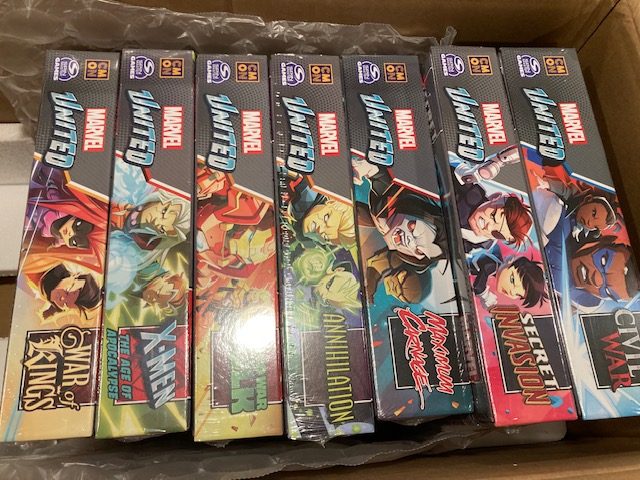
The components are well-labelled. See above.
The Set-up (above) is pretty well documented: this set-up spans two opposite pages, so it’s easy to set-up by just leaving the rulebook open.
The rules are generally pretty good and well notated.
The biggest flaw is that there is no index (boo), but the last page of the book has a nice list of symbols.
I was happy with this rulebook. This rulebook was obviously a translation, but there were only a few places where that was readily apparent.
Solo Play
So, the game does have a nice solo mode (thanks for following Saunders’ Law)!
The solo game is NOT playing two characters: basically, you combine the decks of two characters (see above as I play BLASSST!!! and ArTeMis!) and just play that one deck (setting up the rest of the game as if it were a 2-Player game). I was worried about this solo mode at first … “Is this really different from the cooperative mode?” And it’s really not. You just have more cards to play through. I am surprised I like this solo mode: I usually prefer playing two separate characters with two positions (see Leviathan Wilds from a few weeks ago), but this combined-deck solo-mode worked for me.
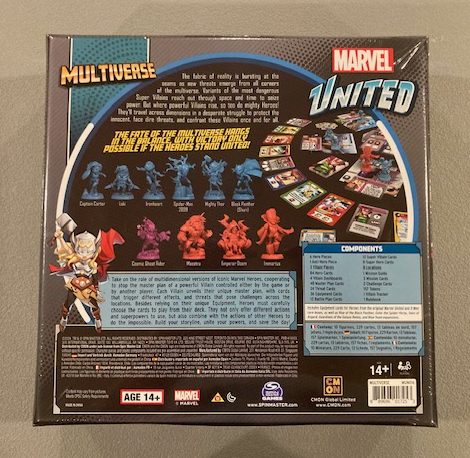
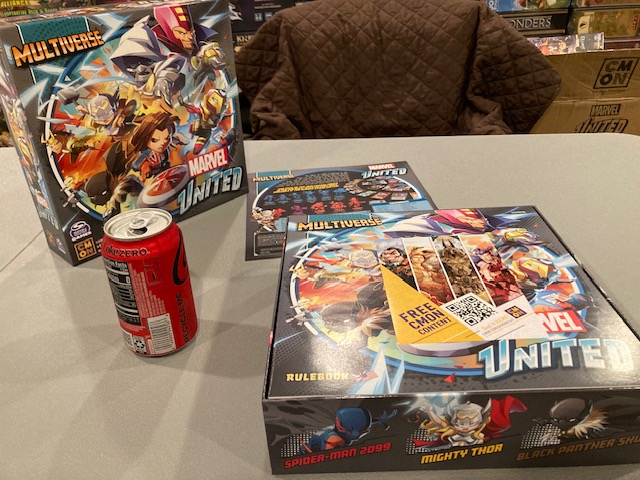
So, the solo game combines two decks and has the solo player become a “cyborg” of those characters (I am taking artistic license here). See above.
Interestingly, I played my first solo game when I got the game a while ago, but it took a while to interest my friends! So I had to remind myself how to play with a few more solo games right before I taught them how to play. I am happy to say that I enjoyed the solo mode more the more I played it. It’s only a 40-60 minute game! It moves quickly! And it was easy to remember how to set-up and play.
I liked Hacktivity solo and I liked the solo mode that came with it.
Cooperative Mode
The cooperative mode was easy to teach. The basic flow of the game is pretty simple once you get the idea.
I think the least favorite aspect of the cooperative game were the limits on communication. Strictly speaking, you can’t say much about your hand: you can sort of hint about how much damage you can inflict, and you can hint at stuff. As we played, we kind of ended-up slowly moving around this restriction … because it wasn’t fun! We play cooperative game because we want to talk and interact with our friends: we usually dislike cooperative games with limits on communication.
There are a lot of little icons in this game as well: that took a little to get our heads around, and the rulebook had to be passed around a little (see above). After a while, the icons took hold and we could just play: it didn’t take too long (and the little player aid cards helped a lot).
In general, the cooperative game went pretty well, but not great. The real issue was the limit on communication. And we get it: sometimes you need that restriction to keep the Alpha Player in check … but we ended up just going around the communication restrictions.
What I Liked
The color-coding scheme worked very well. The blue section of the board … gets affected by the blue markers. The yellow part of the board … is affected by the yellow icons. This was very clear and very well done. This color coordination really helped move the game forwards, as it appealed to your intuition (“this color goes here”).
The order in which you resolve your good news and bad news cards is players’ choice: You can even intersperse your card resolutions between players! You can do good news first, then bad news, or all at once! It’s players’ choice!! This is fine-grained Player Selected Turn Order at its finest!! This is where the cooperation shined (shone?) most in this game! As a group, we had to figure out the order to resolve cards, and we felt clever when we could avoid certain bad news effects by playing these certain orders! I really really liked how they used Player Selected Turn Order in Hacktivity! It really made the game feel that much more cooperative.
Every card is a choice! This is great! Every single cards has to be resolved, and you have a choice of whether to take the top or bottom option!
The game is easy to teach and play quickly. And it’s a pretty quick game at 40-60 minutes.
We didn’t get into it too much, but there is a campaign here if you want to pursue it.
What I Didn’t Like
This is more of a missed opportunity than a dislke: the backs of the bad news card don’t mean anything (unless it’s a yellow activity card, which happens just a few times). See the A1 and A2 above? They mean nothing useful for gameplay: they only denote which player count decks you are using. Paleo did the wonderful thing (see our review here) of having the back of the cards be a “hint” as to what’s on the front of the card. The A1 and A2 on the backs of the cards above …. don’t really mean anything. They SHOULD give you a hint to “how hard” the bad news is, but they really don’t.
Since you are drawing bad news cards without knowing anything, it makes the game feel a little more random. How many Bad News cards should I draw? I don’t know … I don’t hav a sense of how hard each one is!!! I think a “hint” of some kind would make the game feel less random.
The limited communication rules felt too constraining; they hampered our enjoyment of the game. The best combinations we played in the game where when we could keep the bad news cards from having any effect … and we could only do this if we were more sharing. This game needs an Open Hand rule:
“If you and your friends are comfortable with Open Hand, go ahead and play with all cards showing. Realize that Open Handed may make the game easier, invite analysis paralysis, and/or cause Alpha Players to take over the game.”
Really, this communication limit drop probably dropped by friend’s rating of the game: see below.
Conclusion
I liked Hacktivity! I enjoyed all the choices in the game: choosing how many good news/bad news cards to choose, the order to resolve the cards (fine-grained Player Selected Turn Order), and the choices per card! All of this really made me feel like I was making choices that mattered as I played.
I was be remiss if I didn’t include my friend’s opinions: I liked this more than them. I would give this a 7/10, and suggest we play Open Hand. My friend Teresa liked it ok (no rating), but Sara said “I would give it a 4/10: I liked it okay, but there’s a lot better games to play!” I don’t necessarily agree with her, but you may feel as she does. The main issues for Sara were the lack of Hints on the back of the bad new cards and the stifling of cooperation. The limited communication can be counteracted by playing Open Hand, but the lack of hints can make the bad news feel too random and I am not sure what we can do about that.
I would be happy to teach this to you: I think Hacktivity is a quick and easy game to teach/learn and it promotes a lot of choice. The solo game was fun and the cooperative game was fun once we added Open Hand.
As we look back at 2023, we’ve played quite a number of solo and cooperative games and expansions! There were a number of surprises in this list: some of the surprises were bad, some were good, and some were mixed! I want to highlight some of the games that we played that we might not discussed elsewhere: these are all different games than our Top 10 Solo Games of 2023, Top 10 Cooperative Expansions of 2023 and our Top 10 Cooperative Games of 2023! These are ordered in how much of a surprise it was!
10. The Stuff of Legend
This is at the bottom of the list because it’s the least surprising in one way, but still very surprising in another! The Stuff of Legend is by famed designed Kevin Wilson (of Arkham Horror 2nd Edition fame), so that makes it likely for me to enjoy it (no surprise there)! What’s surprising is that I like I liked it despite it being a hidden traitor game: I usually hate hidden traitor games, but this one has some surprising mechanics that make it it fun!
This was a surprise because it was better than I expected! It’s seems a dubious proposition: “Let’s mix Dungeons and Dragons with an Escape Room Mystery!” … um … this feels a little like a cash grab, just cashing in on the Dungeons and Dragons name.
The game is very simple, (with an element of randomness that I thought would be too much), and the mystery is pretty simple. But, I had a great time playing through all 3 Acts with my friends Charlie and Allison! It’s better than you think! If you are expecting a deep hard-core mystery with lots of hard-core Dungeons and Dragons elements, you should look elsewhere. If you like Dungeons and Dragons and escape rooms, go in with an open mind: this might surprise you. See our review of Bedlam in Neverwinter to see if this is something you might enjoy!
8. Express Route
So, I picked this up for my friend Robert so we could play a cooperative map game when he came to town. It’s a cooperative game about delivering packages.
The production is better than I expected, and the cooperative gameplay was very pronounced! We had to cooperate well to win! Even though the theme for this game does absolutely nothing for me, I was surprised at how engaging this was for a cooperative game. See our review here to see if Express Route might be a game you like!
7. 14 Frantic Minutes!
This was a cooperative real-time game that kinda came out of nowhere: It was from a very small Kickstarter. And yet, I liked it! It presented a very unique and interesting cooperative puzzle for 1-4 players!
Kimberly from Tabletop Tolson is one of the few people I know who liked it as much as I did! See her Top 10 Cooperative Games of 2023! After all is said and done, I think I prefer this is a solo puzzle game, but this is a really unique game: it’s surprising how much I liked it, given that I usually eschew real-time games!
Okay, what? They’ve made a new mystery solving game in the Clue universe? The surprise is how much fun it actually was!
This is a lighter Escape Room game that I got at Target (so it’s fairly easily available), and it was surprisingly good! It’s a play-once mystery, but it’s fairly inexpensive, and the mystery was very interesting! We were shocked at how good this was, considering how inexpensive and “Hasbro” it was. See our review of Clue: Treachery at Tudor Manor here!
5. The Big Pig Game
What a light and silly game this is! And yet, it enchanted my game groups! It made the RichieCon 2023 discussions because it was just so fun and surprisingly good! The Big Pig Game is a great gateway game or end-of-the-night game when you want a light and simple, but surprisingly engaging, cooperative game!
I love the production of Awaken Realms games, but I have bounced pretty hard off most of their games after I got into them. The surprise here is that Tamashii is probably my favorite Awaken Realms (technically, Awaken Realms Light) game! We still talk about how much we disliked the grind in Tainted Grail to this very day … (see Part I and Part II of our Tainted Grail review here).
Tamashii didn’t quite make any of my Top 10 lists of 2023 (Top 10 Cooperative Games of 2023, Top 10 Solo Games of 2023), but it almost did. The programming mechanism is very interesting and unique: I liked it! The only thing that holds this game back for me is that the trace rolls are just a little too random and game-changing. I still like it, I will keep it, and I suspect I will play it solo more than cooperatively. See our review of Tamashii: Chronicle of The Ascend here to see if this is something you might like!
3. Lord of the Rings: Adventure to Mount Doom
What a bizarre combination: roll-and-move in a cooperative game … in the world of Lord of the Rings! I had trouble getting my group to play it because of that weird combination, but it was pretty good. It played quickly, it was easy to learn, easy to teach, and still a decent little cooperative game.
The surprise here was that it was much better than I expected. Although I probably won’t play it very much, I am still keeping it as a decent gateway cooperative game, especially for new gamers who love Lord of the Rings! See our review here to see if this is something you might like!
2. Daybreak
I love the games of Matt Leacock: he’s one of my favorite designers. Pandemic (and all its ilk) and the Forbidden series (Forbidden Desert, Forbidden Island, etc) are some of my favorite cooperative games of all time! And yet, Daybreak didn’t work for me. The surprise was how much I disliked Daybreak.
The game was on the Kickstarter (pardon me, BackerKit) and Daybreak even made our Top 10 Anticipated Games of 2023! Yet, when I got it, I found it just waaaay too random. There are four independent sources of randomness (dice, card draws from different decks), and hidden “bad news” you simply can’t mitigate because you don’t know what’s coming! I gave it a number of plays and I just bounced off it hard! Everyone else seems to like it, so this is obviously just me. I found Daybreak to be way too random to be fun. (To be clear: I don’t have a problem with the theme! It’s an exploration into making energy more sustainable … very interesting! Some people who have spoken out against this game are because of the theme … that’s not me).
I love Matt Leacock: this is a huge surprise how much I bounced off Daybreak, especially when everyone else seems to like it.
1. Artisans of Spendant Vale
I am surprised this game hasn’t done better! I haven’t seen it on any Top 10 lists for 2023, and I haven’t really heard anyone talk about it! It’s basically a cross of Jaws of The Lion (with the storybook and combat) and Crusoe Crew (with its shared books) and some Forgotten Waters (with its upgrade system)! It’s a gorgeous game with amazing production! See our review here to see if this might be something you enjoy.
I personally had a problem with the dice mechanism because the dice kind of tell you what to do: I’ve never liked that mechanism … (see our review of Batman: Shadow of The Bat for more discussion), but otherwise I should have loved this game. I think the reason we haven’t heard more about this game was that its theme can be very divisive: it’s all about playing characters who are gay or non-binary … that may have turned off some people.
It’s a big surprise to me that this didn’t do better: there’s a lot to like here.