A Review of Slay The Spire (The Board Game) From Someone Who Doesn’t Like Rogue-like Games And Has Never Played The Video Game!

IMG_4652

Rogue

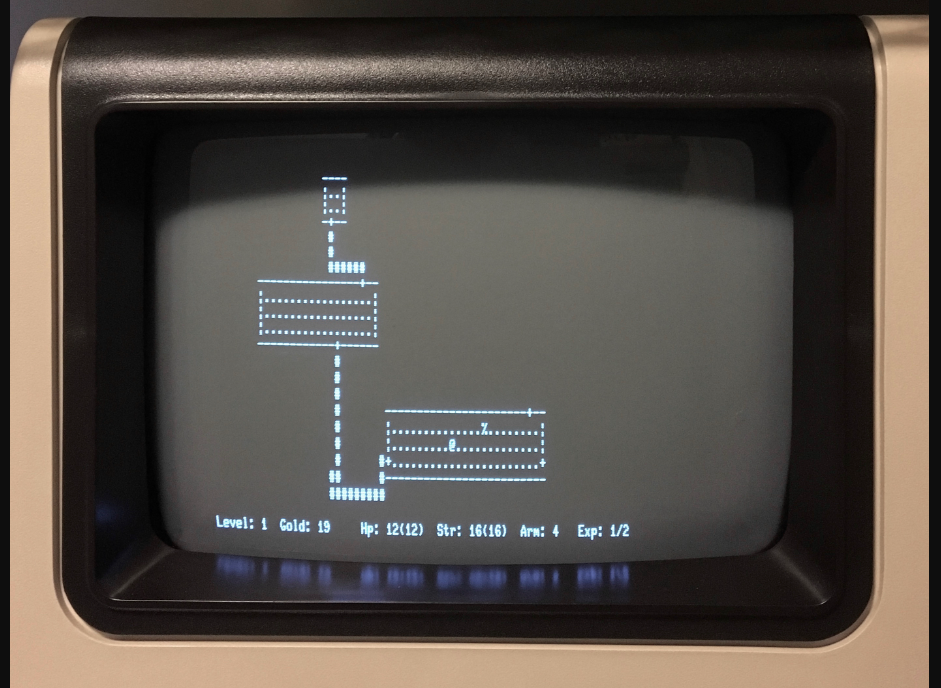
When I was an undergrad at college, a lot of my friends played a game called Rogue on the vt100 computer terminals.
vt100rogue

It was a little dungeon crawler that my friends spent HOURS and HOURS playing.

It’s a Dungeon Crawler? Fun!  Do you save you characters very often?
“Uh, … no.  You just play until you die.  You don’t save characters.”
I’m out!”

And that was pretty much where I learned to dislike Rogue-like games.  If I play a dungeon crawler spending hours leveling up my character, I want to save it!  Part of the fun, for me at least, is returning to my character that I’ve invested in.  I have no desire to play a formless character that just dies.

To be fair, my opinion has not aged well.  I have been informed by many people that Rogue-like games have some saving capability.  Still, my malformed opinion has persisted through the years.

Slay The Spire
IMG_4653

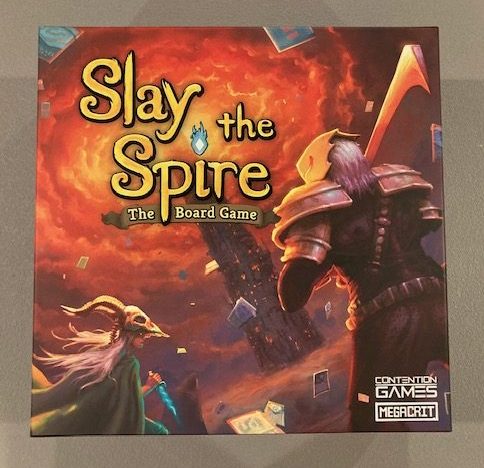
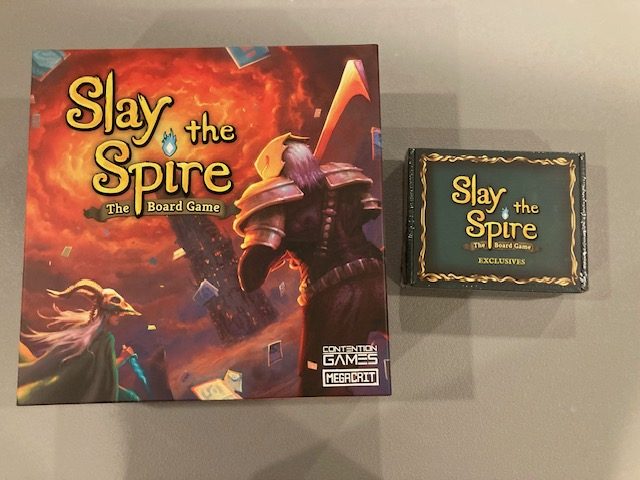
Because of my prejudice against Rogue-like games, I have never played the original Video game Splay The Spire.  I must admit, though, that I was intrigued by Slay The Spire (a cooperative deck-building game) when it appeared on Kickstarter back in November 2022.   The original Slay The Spire video game was really only a solo game … maybe the transition to cooperative board game would make it something more up my alley?
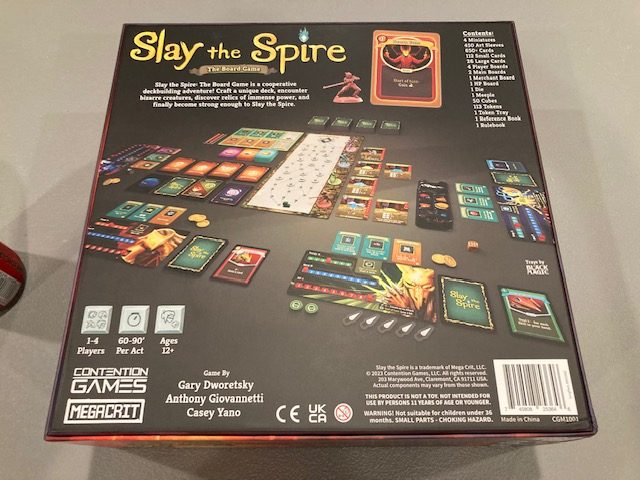
IMG_4657

This arrived at my house in May 2023 (see above); it had promised delivery in Dec 2023, so it’s about 5 months late.  In the world of Kickstarter, 5 months late is not bad.
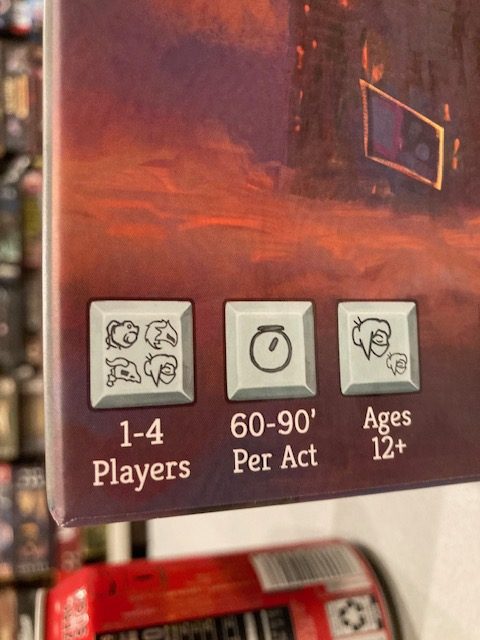
IMG_4656

This is a cooperative board game for 1-4 players, Ages 12+, with only 60-90 minutes per Act!  I was intrigued!  To be fair, a lot of my friends seemed “excited” to play this game, so I freely admit that their enthusiasm was contagious.  

Let’s take a look!

Unboxing
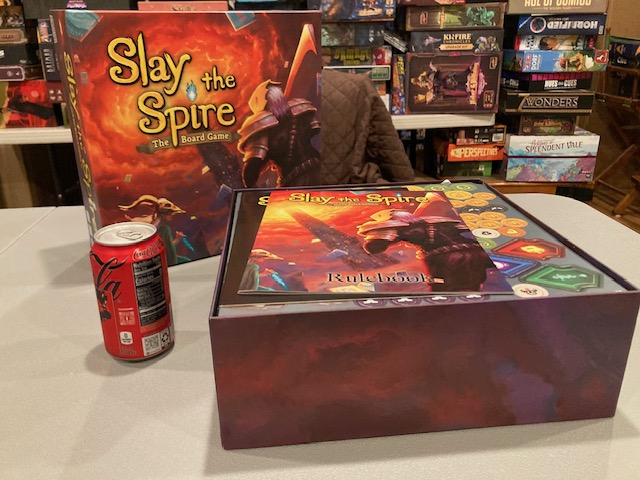
IMG_4659

This is a pretty tall box (see Coke can above for perspective), but  it’s about the same form factor (in length and width) as a Ticket To Ride size box.
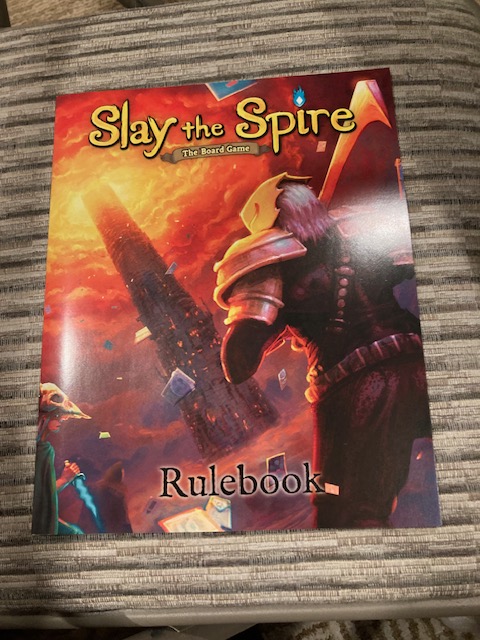
IMG_4661

The top of the box has the rulebook and Upgrades and Items guide.

IMG_4665

Don’t be too impressed by this Upgrades and Items guide: all it does is show all the cards!  It has no disambiguating text!
IMG_4668

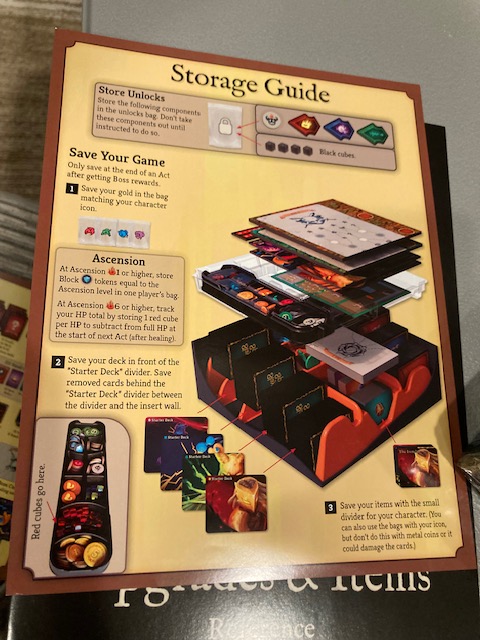
There is a very nice boxing/unboxing guide for putting this together and taking this apart. See above.
IMG_4680

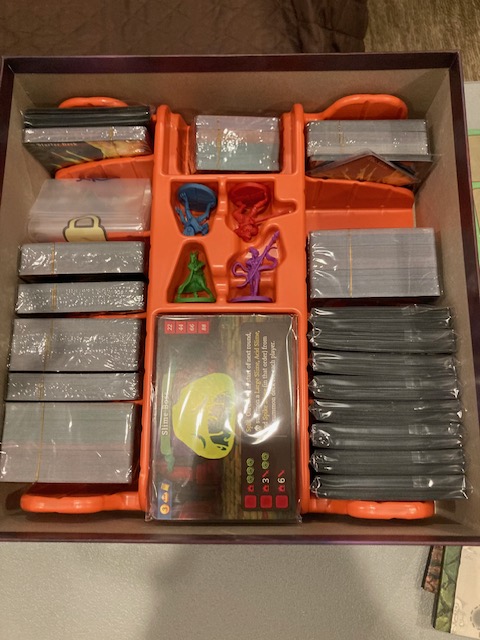
Are you like me as one of the few people and didn’t know that Slay The Spire Video Game was a deck-building game? Well, the board game is also a deck-building game!  As a deck-building game, this game comes with SO MANY cards!  See above and below. And its own sleeves!  For more discussion of Cooperative deck-builders like this, check out our Top 10 Cooperative Deck-Building Games!
IMG_4721

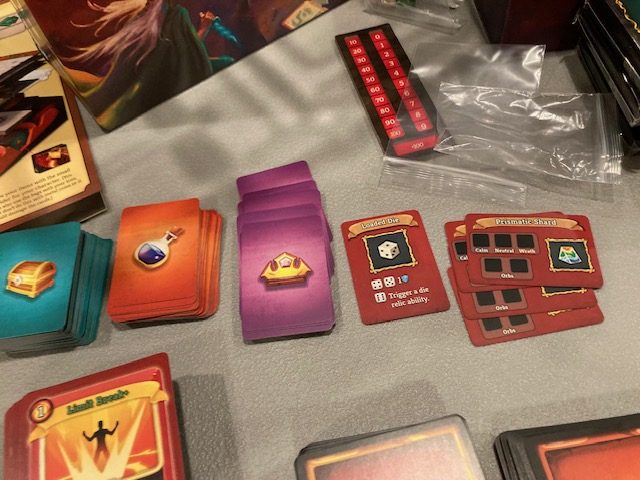
I have been informed that the cards and art look exactly like the Video Game.
IMG_4687

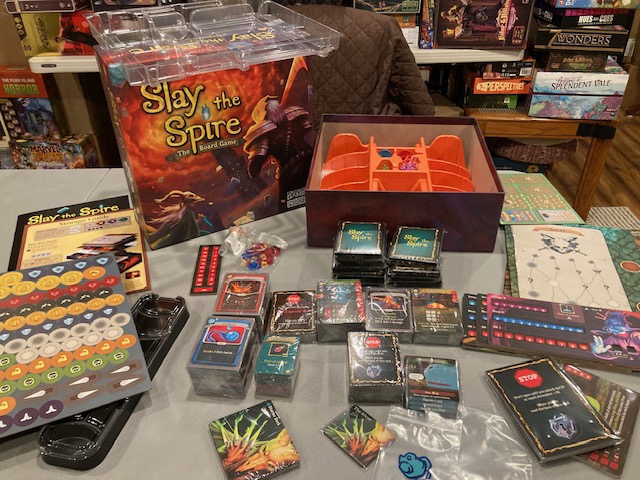
And there are a ton of cards and boards!  See above!  This game looks really fantastic! See above!

And it looks like the Video Game.
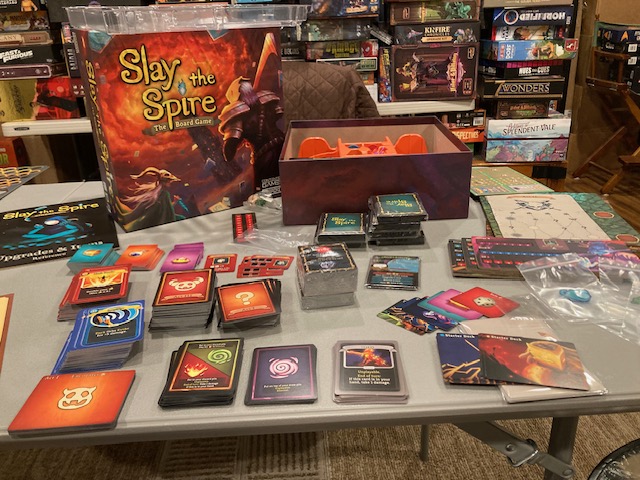
IMG_4731

I want to be 100% clear about this: this production is amazing!  It’s a deck-building game that comes with sleeves!  The tokens come in an easy-to-use tray! The cards can all be stored very easily in the box!   The box is easy to repack!   They really knocked it out of the park on the production of this game!

Gameplay
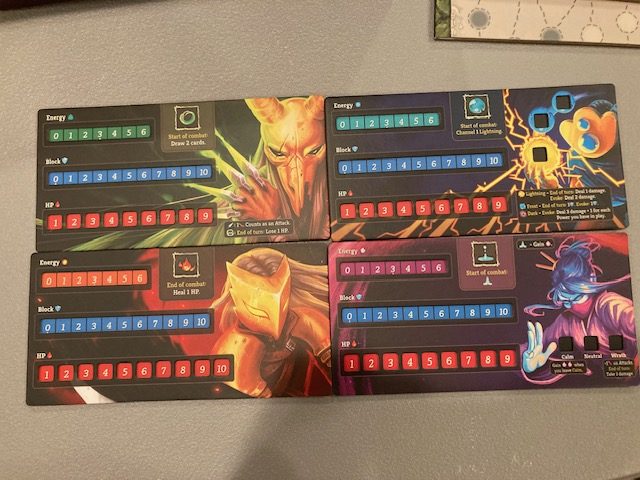
IMG_4673

Each player chooses one of 4 characters to play: see the characters above. I have been informed by players of the Slay The Spire Video Game that these are straight out of the Video Game!

IMG_4688

Each player also takes the corresponding figurine: these will be used to notate which “row” you will be fighting in; we’ll describe that more below.
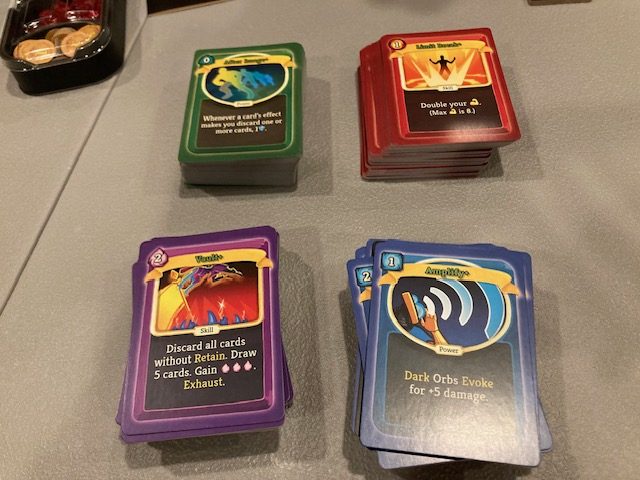
IMG_4708

Each player has their own deck of cards to start with: each deck is a little different and really represents a different play style.  Simplifying a little too much: the blue deck is defensive, the red deck is offensive, and the green deck is all about poison.  
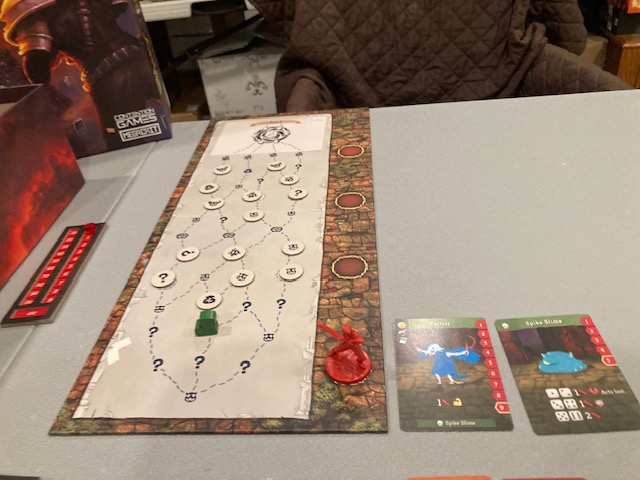
IMG_4774

Players together choose a “path” to take to get to the final Bad Guy (at the top of the board above). These decisions can have you fight a monster, summon the merchant, build a fire (“smith” or heal: I learned the word “smith” from one of the Slay The Spire Video Game friends), fight Epic monsters, or take events. I was informed these choices were very reminiscent of things that happen in the Video Game.
IMG_4814

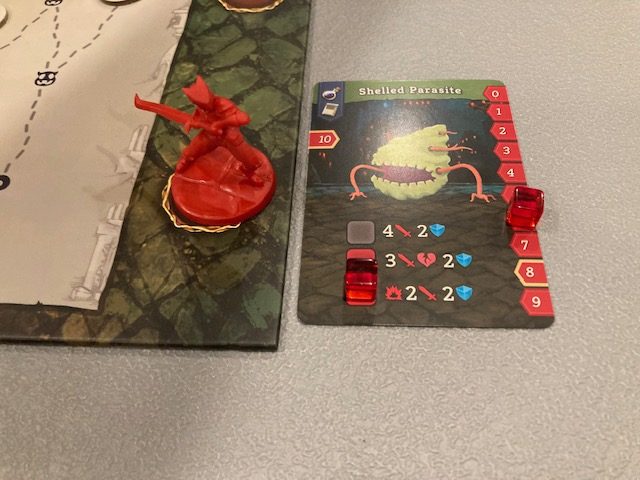
When you fight a monster, each row next to a character gets some monster(s) from the Encounter Deck! See above as “the red guy” fights a Shelled Parasite. (I don’t know “the red guy’s” name because it is not notated on his board). Note that the monster has some hit points (left and right of card), and some icons: those icons tell you what the monster does when it attacks you.
IMG_4759

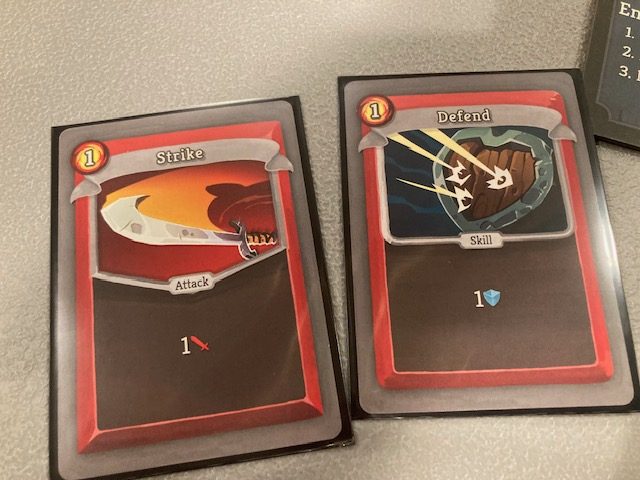
As a card game, you play cards to attack your monster and/or defend yourself!! Shields up your defense (blue icons above), and swords up your attack (red swords above). You only have a limited amount of energy per turn to spend to play a card (usually 3 energy worth), so that limits which cards you can play (the energy cost is in the upper left corner).

You draw up to 5 cards every turn, and discard all when you are done. That feels very much like a deck-builder.
IMG_4772

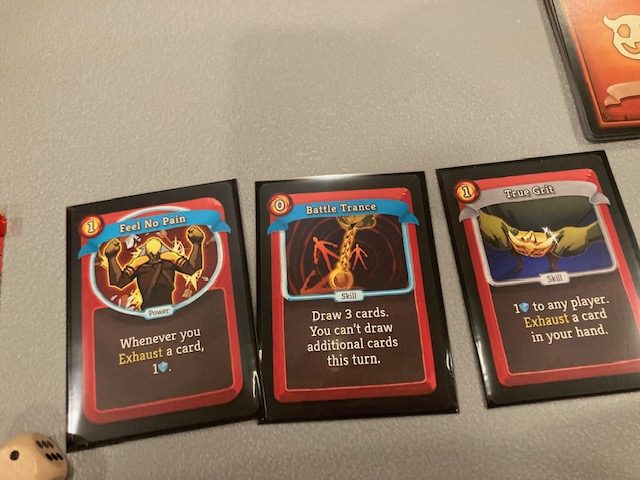
Typically after you win a battle with a monster, you can add an upgraded card to your deck: you deal 3 and choose 1 (apparently, just like the Video Game). See an example draw above.

IMG_4844

See above as some of my cards have a GREEN text for the title?  This means that I was able upgrade the card BY FLIPPING IT OVER!  Each card has two sides, a normal side and an upgraded side: you can “Smith” to turn the card over and therefore improve it!!  This is a really neat mechanic in a deck-building … and rare! I can’t think of another deck-builder that does this!
IMG_4795

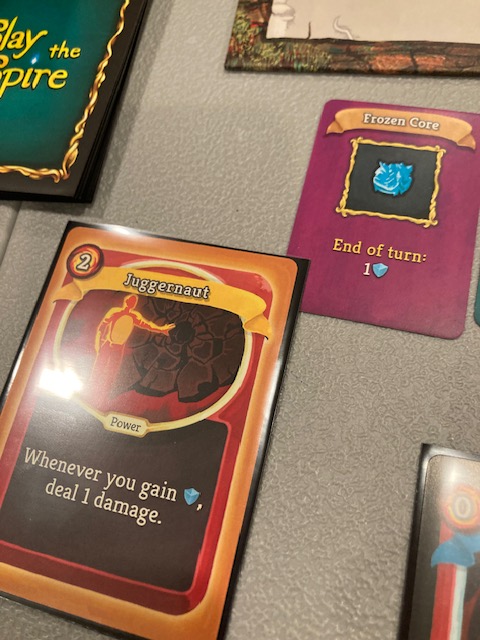
You can also occasionally get new additions from a rare deck (see yellow outline): these are much better cards!
IMG_4752

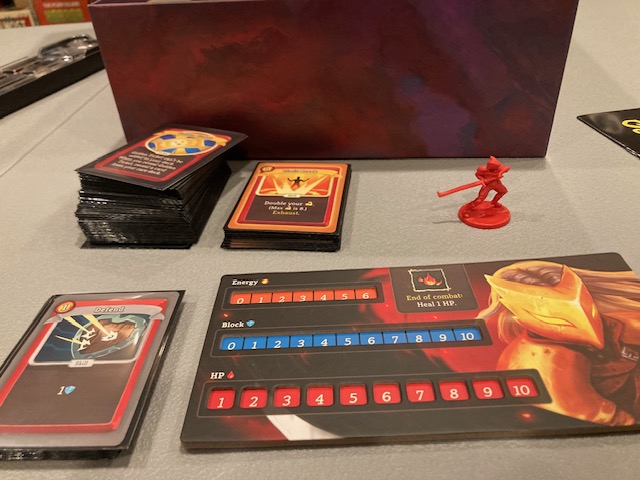
To be clear, each character has their OWN upgrade deck to draw from and their OWN rares deck to draw from!  See above: the red guy has a starter cards (grey outline), upgrade deck (black outline), and rares deck (yellow outline).  This makes each character very distinct as they are built to upgrade a specific way.  Like we said earlier, the red guy’s decks concentrate on attacks, blue guy’s deck concentrate on defense, and green guy’s decks concentrate on poison.  
IMG_4776

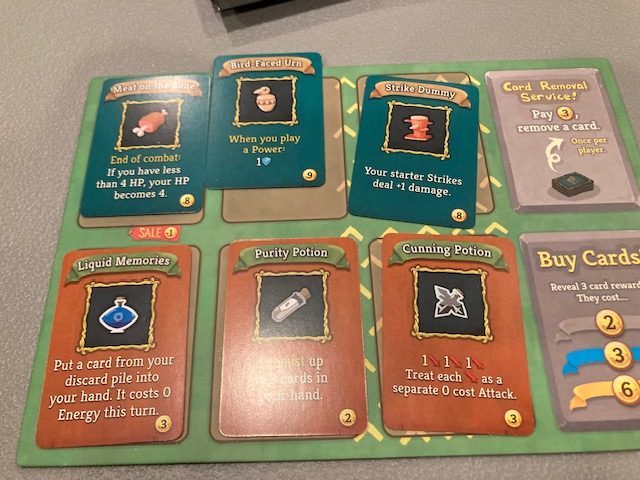
You occasionally can buy stuff from the passing merchant, including potions or treasures and even random cards. This even includes a way to cull cards: we call this The Andrew rule: A deck-building game MUST have a fairly systematic way to cull cards. Luckily, Andrew would (and does) like this game because he can cull cards.
IMG_4807

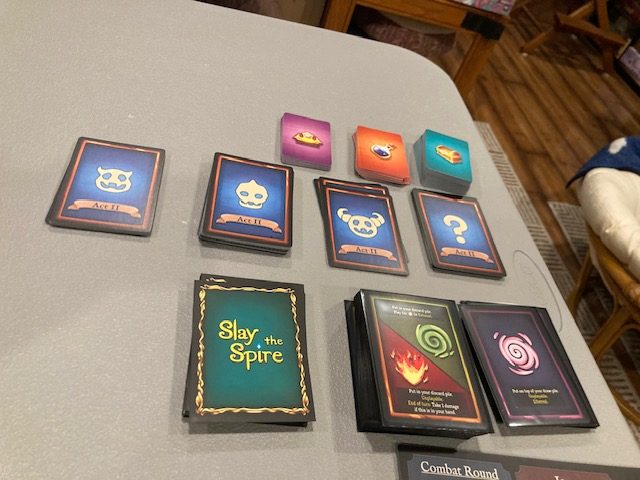
Along the way, there are all sorts of other cards that come out: Events, Monsters, Potions, Treasures, Epic Treasures, and deck-cloggers (Daze and fire).  I have been told this is just like the video game!

IMG_4819

But of course, the purpose of all this is to take down the Big Bad Monster at the top!  See above as I fight the Big Bad Bronze Automaton and a Bronze Orb! 

Like many cooperative games, all players win together when they defeat the Big Bad, or they lose if any of them dies! So, it’s in everyone’s best interest to cooperate and keep each other alive!

The Rulebook

IMG_4661

 I need to talk about the rulebook.  It’s okay, but not great. It really should have been better given how great the production of the rest of this game.

IMG_4689 (1)

It does well on The Chair Test: it only droops over  the edges a little, the font is big and readable, and the book stays open on the chair next to me so I can see the rules without taking up precious table space.  This rulebook gets an A- on The Chair Test!!
IMG_4690

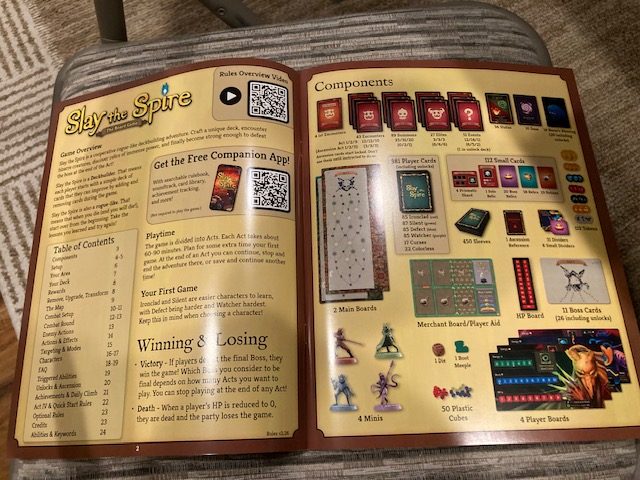
The game starts off great with a Table of Contents, a link for a Companion App, a link for a How to Play video, and a list of all components (most) with correlating pictures!!  Very very nice! I felt very happy to see this!  My only fix might be that I had wished they had labelled the tokens better … there are a lot of tokens and I didn’t know what any of them were!! 

IMG_4691

The set-up is pretty good, but this where the cracks start to develop.  This is my first example of this rulebook being too minimal: I accidentally shuffled the Summon deck, but it doesn’t say WHY you shouldn’t it!  I didn’t know how to recover?!?!??!  It turns out the Summon deck should “probably” just be alphabetically sorted so you can find cards easily … that’s the only reason to not shuffle it, you just make your life harder when you have to find a card.  Really, I could have used a sentence:

  “Don’t shuffle the Summon Deck because you will be searching for cards (alphabetically) in it later in the game.  Just sort the deck alphabetically if you accidentally shuffle it!

But other than that, the set-up went fairly well.  
IMG_4692

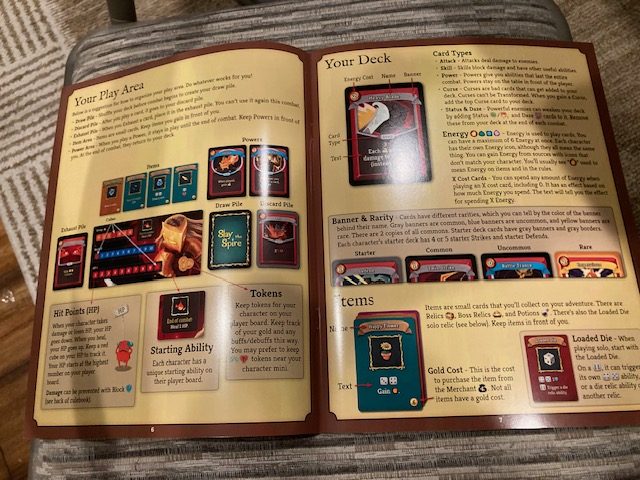
This rulebook is pretty well annotated with lots of pictures and examples.   See above.  In general, the rules are fairly clearly set out.  But the real problem with this rulebook is that it seems to assume that you have played the video game.  There are a lot of places where a rulebook for a normal game would be chastised.  I can’t tell you how many times I played with Jon and Keala (who have played the Video Game A LOT), and when I went to lookup a rule, they told me “it’s just like that in the video game!  So it probably means that!” So many times, they clarified a rule by saying “it’s like that in the video game!”  … which is not good for those of us who haven’t played the video game or other Rogue-Lites.
IMG_5328

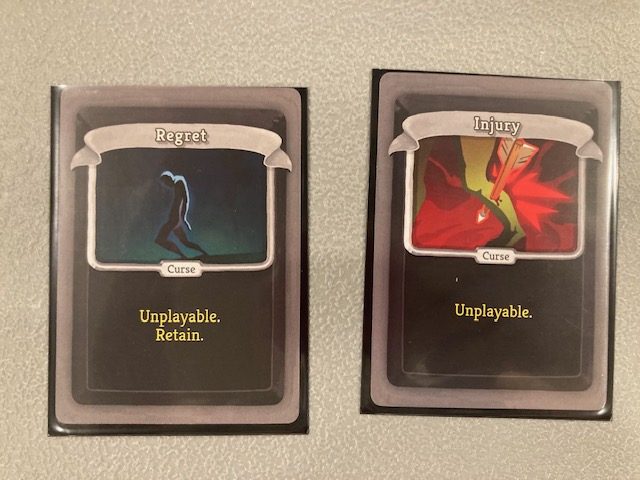
My canonical example of this was the Regret curse.  I actually got two curses one one turn, Regret and Injury (see above)!  My reading of these was that Injury was a worse curse because it keeps clogging my deck as I draw it and shuffle it back in.  I though Regret was a better curse because you just got once and it was out of your deck.   Nope! It clogs your hand so you draw fewer cards!   You draw up to 5 cards, so if Regret is in your hand, you can only draw 4 cards.  I didn’t think the rule was well-specified in the rulebook, but when I asked Keala and Jon they said “Oh it’s just like the Video Game, you can only draw 4 cards!”.  I really wish the rules had made this clearer!  This is just one of SO MANY examples where Jon and Keala said “Oh it’s like that in the video game!”.  This rulebook should have been vetted by someone who has NOT played the video game so as to clarify a lot of finer points.
IMG_4701

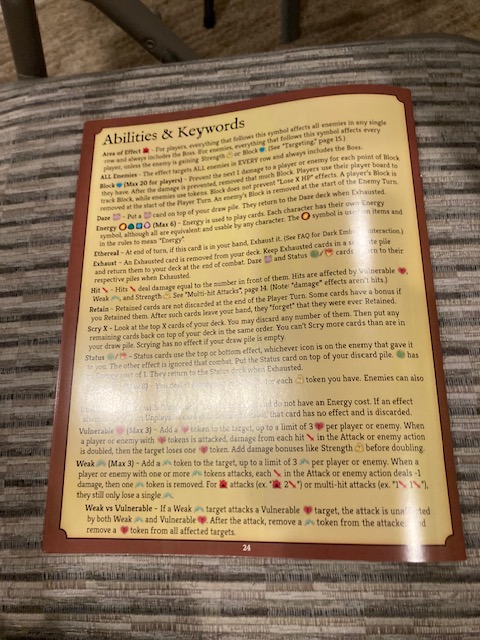
Even though this game doesn’t have an Index (and it really should), the back of the rulebook had an invaluable list of Abilities and Keywords.

Don’t get me wrong, there’s a lot of good stuff in the rulebook, but it was too minimal in a few places (For example: a few more sentences about the Retain keyword or why Summon deck shouldn’t be shuffled).  I was able to learn the game and playthrough solo … and I had fun. I was able to play cooperatively with a bunch of friends (who hadn’t played the Video Game) … and we all had fun.  It wasn’t until I played with seasoned Video Gamers that knew the game that I realized this rulebook needed some more clarifications: it depended a little too much of knowledge of the video game.

Solo Game
IMG_4788

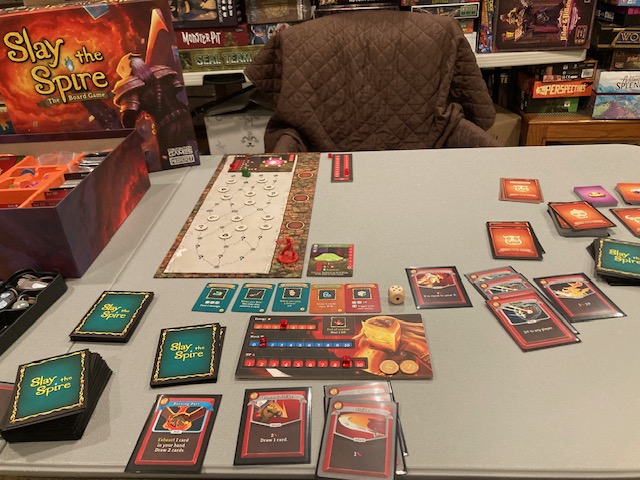
Like the Video Game, you can play this solo (thank you for following Saunders’ Law)! See above as I set-up the red guy for a solo game. There’s not really a lot of special rules or exceptions for the solo game, you just play! The main balancing mechanisms are really in combat:

  1. In plain combat, a monster comes out per row (i.e. per player). Thus, the solo player will be fighting just one row of monster(s).
  2. In Big Bad combat, the number of hit points is scaled to the number of players.

So, in general, you can just jump in and play the solo game without any real special rules! Thank you Slay The Spire! It was SO EASY to jump in solo!

IMG_4846

I had so much fun playing solo that I played through the first three Acts of the game! I had a blast!  There are so many places where you upgrade or get new cards, that you always feel like you are making progress!  You always feel like you are getting better!

Really, solo was fun.  I had a blast. I played wrong on a few points (one to discuss below), but even without knowing the Video Game, I had a good time.

Cooperative Play with Players Who DO NOT Know the Video Game
IMG_4895

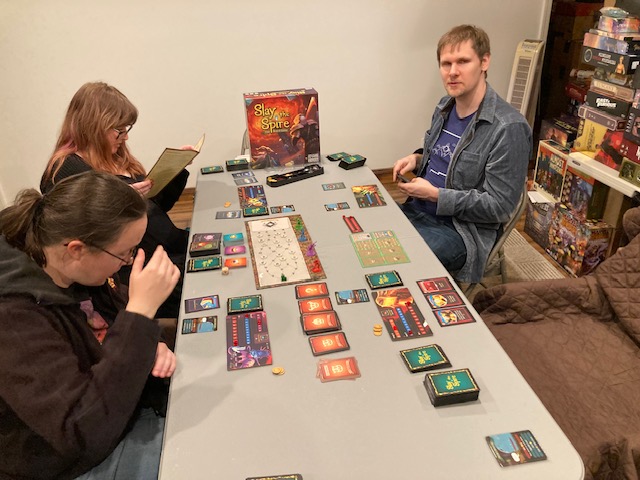
I ended up playing a full 4-Player game of Slay The Spire with three of my friends who have never played the Video Game!  We ended up playing through Act I in one night in about 90 minutes (with a little extra time for set-up and tear-down).   So, I just had to teach the game as-is … no one (including myself) had ever played Slay The Spire the Video Game!

IMG_4896

The biggest conceptually difference, of course, is that this is a fully cooperative game! Slay The Spire is always thought of as a solo game! But the board game is fully cooperative!

IMG_4898

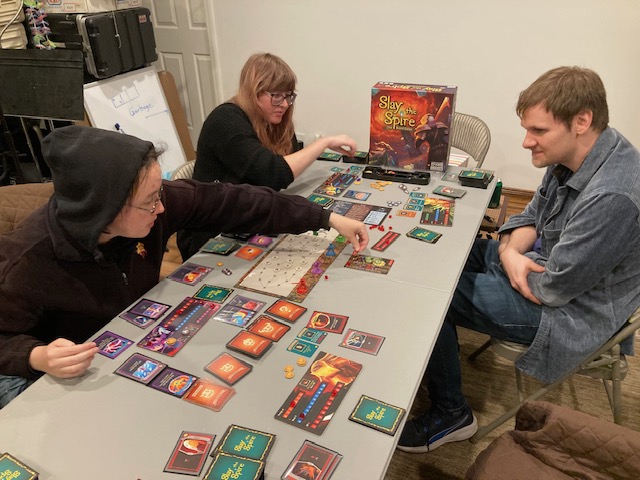
The biggest change is that every character gets his/her own row of monsters to fight!  See above!  While you nominally tend to fight the monster in your row (it sort of becomes “your responsibility” as it does damage to you only), you can target any monster in any row!  So, if a monster has a particularly bad effect for everyone (certain monsters can attack everyone), or if a comrade just needs a little help, players may choose to work together to take out particularly vexing monsters! 
IMG_4903 

My favorite rule in this game is that it allows fine-grained Player Selected Turn Order (see more discussion of PSTO here).  The rulebook calls this out on page 12:

“Players can play cards, use potions, and activate abilities in any order they choose.”

What this means, is that we (as players) can intersperse our actions to accomplish things! If we need Sara to play a Potion, then Andrew attacks to add a Vulnerable, to which then Sara can play another card and attack (for double damage), we can do that! Players can work together to find the best combination of their interspersed actions to take down the baddies!
IMG_4897

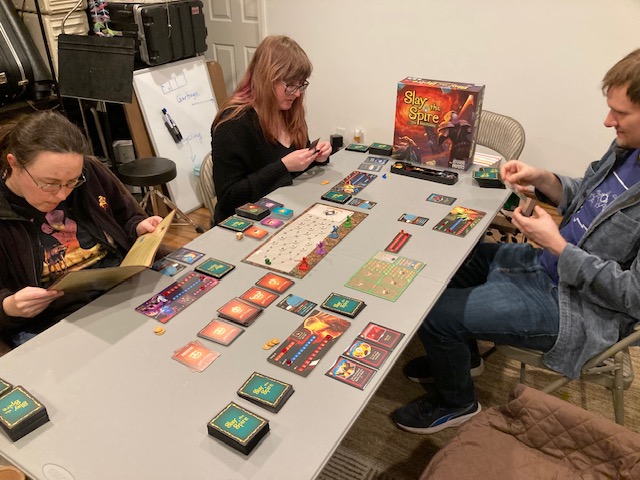
In fact, in some ways, Slay The Spire gets the best of both worlds! Since you “generally” need to fight the monster in your row, players can do Simultaneous Actions to fight their own monster, but defer to fine-grained Player Selected Turn Order if they really need to! The Simultaneous Actions helps keep everyone involved … rather than waiting for “your turn”, you can all fight the monsters at once … this means there is much less downtime.

I think this is where Slay The Spire shines the brightest as a cooperative game: the players can choose the best way to play to either help each other (with fine-grained Player Selected Turn Order) or move the game along quickly (with an easy way to Simultaneous Actions fighting your monsters!) It’s the player’s choice, and I noticed we shifted between these modes pretty seamlessly when we played! It was something I didn’t notice until I looked back on our plays.
IMG_4901

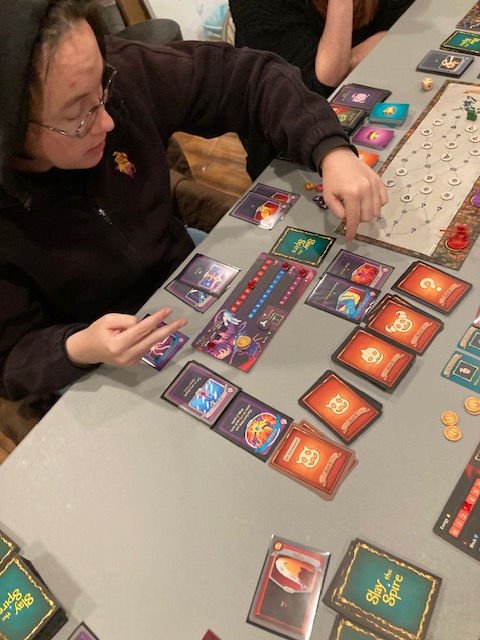
The cooperative game worked fantastically, probably better than the solo game because I got to talk and strategize and have fun with my friends!

Cooperative Play With People WHO HAVE PLAYED The Video Game
IMG_5308

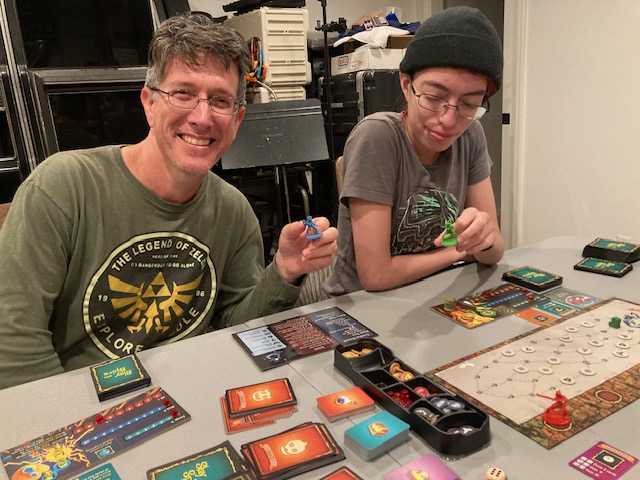
So, I wanted to make sure I played this game cooperatively with some friends who have played the video game: I wanted to see what they thought.   Jon and Keala (above) are both fans and have played (and like) Slay The Spire the video game.
IMG_5312

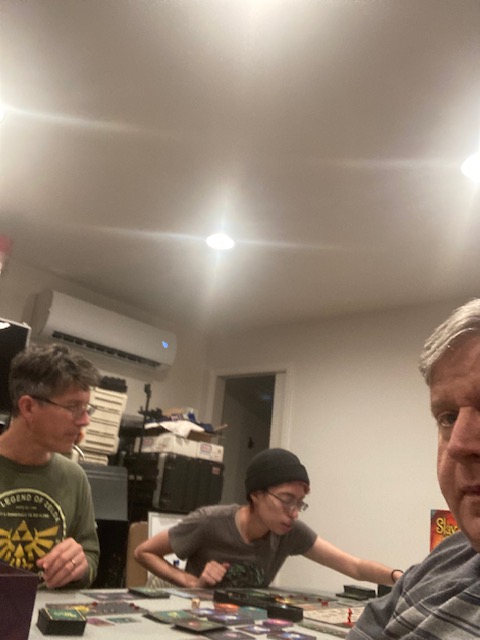
What happened sort of surprised me: we fell into a rhythm fairly quickly.  Every time there was any rules question, Jon or Keala spoke up and said “Well, it’s like this in the video game”, so we didn’t spend very much time pouring over the rulebook.  The Video Game became the reference implementation of the game!  This was both cool and annoying.  It was cool that the game seemed to fall inline with the Video Game, but it was annoying that the rulebook didn’t do better at explaining a lot of things.

IMG_5310

We had so much fun playing, we ended up playing Act I and Act II in one night!   The game just seemed fun to everyone.

IMG_5304

Jon saved our bacon a number of times: he had the ability to shield other players (as the blue guy), which worked out very well!  I would be able to attack something (as the red guy) and Jon (as the blue guy) would shield me or Keala (the green guy) so that we wouldn’t die!   This cooperation seemed seamless!  It just happened that way!   
IMG_5311

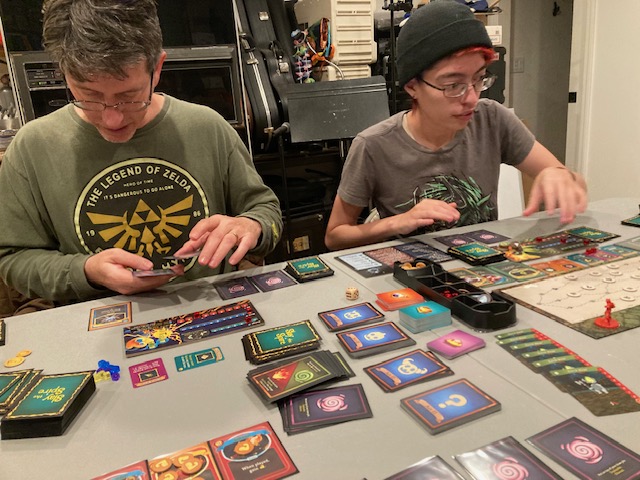
The game really clicked for everyone that night: I feel like I know the game better (with all my friends’ comments on how the Video Game works), and I was able to bring my friends into the card game quickly from reading the rules.  We had a great time and plan to play again!

A While

IMG_5313

It’s taken a while for me to get to this point.  I initially had some misgivings about the game.

At first, I was grumpy at the rulebook for how minimal is was: it really needs a lot more elaborations on the rules.  There was one rule in particular I was enchanted with, until I realized I was playing wrong. The “Draw 5 Cards: there is no maximum hand size” (p. 12) lead me to believe that maybe I had more choice of which cards I could discard.  Maybe I could keep cards between hands?   Why else would you emphasize this rule of no maximum hand size?  Jon and Keala had to tell me this, but you always discard all your cards!! All of them! … just like in the video game.   (to be fair, it is in the rulebook but it is one sentence).  I think that rule is there to show that during your turn you can draw as many cards as you want.  
IMG_5074

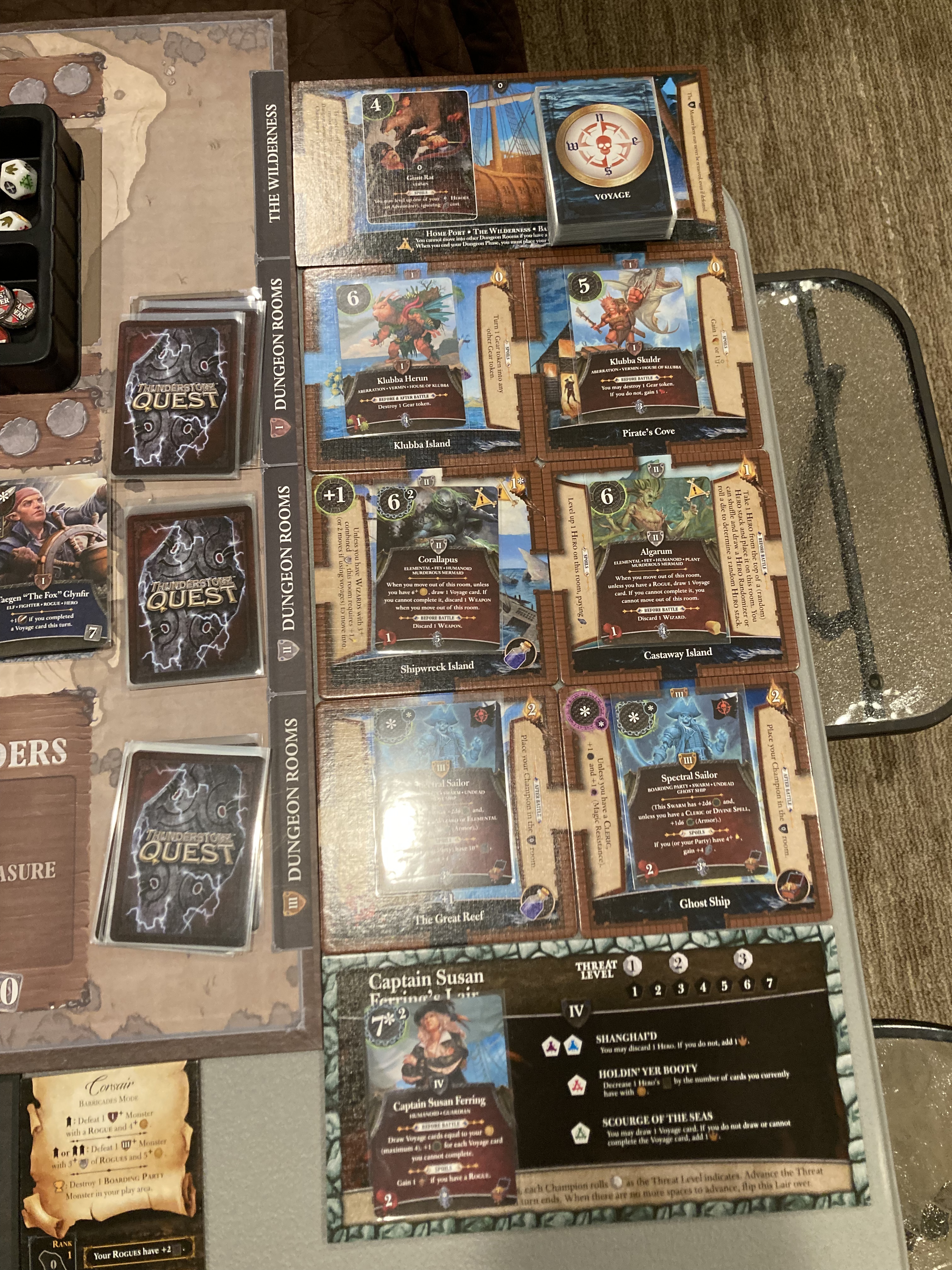
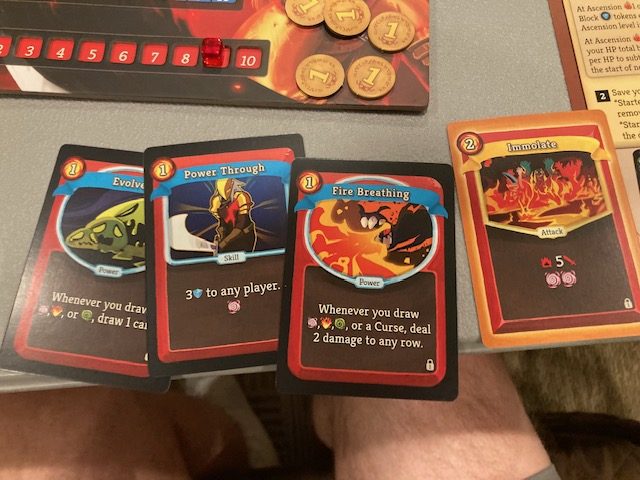
Another thing that threw me off for a while was the art. I had just gotten a new deck-building expansion for Thunderstone Quest (see art above), and the art and graphic design for Thunderstone Quest (above) is significantly better than the art for Slay The Spire (below).
IMG_4805

Comparatively, the art for Slay The Spire is a little anemic after looking at Thunderstone Quest. But I seem to be the only one who doesn’t love the art.  I will admit, the art for Slay The Spire has grown on me a little: it’s very simple and not too busy.  It’s also very readable.  But since I have never played the original video game, I was not as “enchanted” with this art as others.

Flaws
IMG_5314

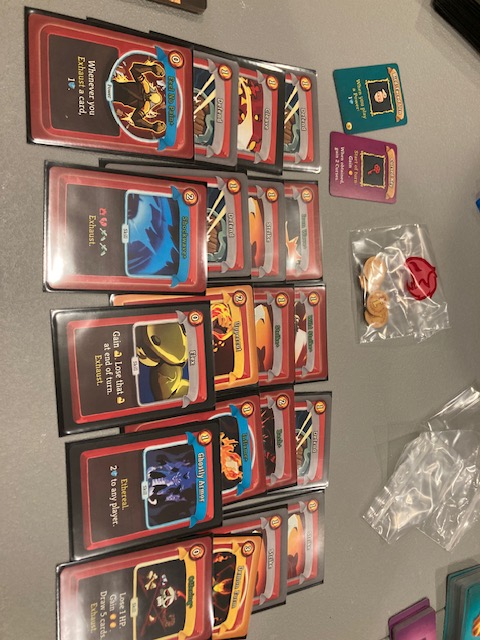
This is a funny flaw in the game: you can’t (easily) have multiple games going on!  You can save your game fairly easily (putting the appropriate cards in the appropriate slots), so you know you can come back and do another session.  The problem is, if you want to play another game, you can to reset ALL THE CARDS for each deck!!  We worked around it by taking pictures of our decks: if worse comes to worse, we can always use the picture of all our cards (see above) to recreate our save game.   I suspect many people will want to try this game, and we won’t be able to easily have many games going on.  In some ways, this is a product of its own success: it’s so much fun, people want to try it!  But, be aware that a single game is easy to save, multiple games will require taking pictures of all your cards. And also the Unlocks sheet (see below) .. which presents more issues.
IMG_4799

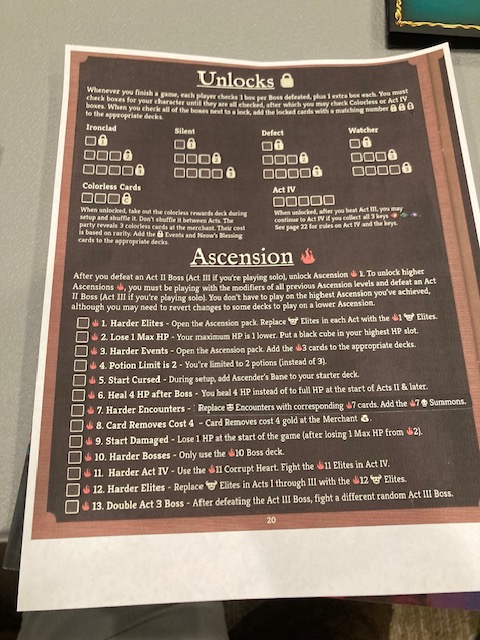
Another problem with this game is it’s really unclear how you move on once you play through Acts I, II, and III.  The Ascension decks (see above) add some variety and keep the game interesting, but it’s kind of unclear how this fits in.  Do you start a new game at Act I with the changes?  Do you start a new deck?  To play Act IV, you have to unlock it, but are you playing Act III again and again and again?  Like everything I have seen in this rulebook, I wanted more elaboration!  This rulebook frustrates me!  Give me an example, give me a few more sentences, give me a page!  I have played a solo game all the way through Act III.  What do I do now?  Add Ascension cards? Start over at Act I?  This is very unclear!!!   This is probably my biggest ding against the game: I don’t know exactly how to move forward.  Sure, I suspect I will post to BoardGameGeek and someone will respond, and I will be able to move forward.  But this rulebook does not make it clear how to move forward after Act III. UPDATE: I had lunch with my friend who has played the Video Game.  He told me that in the Video Game, you just reset everything (including you deck) back to ACT I, but make a few cards (like the uncoloreds) available.  I really DID NOT get that sense from the rulebook … another instant where knowledge of the Video Game helped and the rulebook didn’t. 

Conclusion
IMG_5300

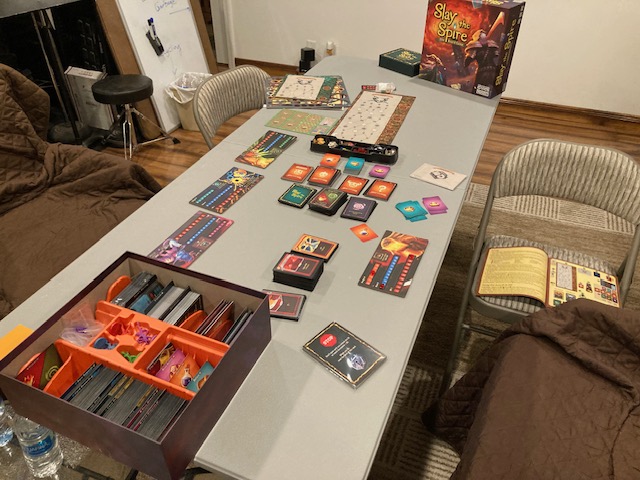
Honestly, this Slay The Spire board and card game has really grown on me: I have played it solo numerous times, and I have shown it to many diverse game groups. The more I play it, the more I seem to like it!  The upgrade paths makes this game great: there are so many opportunities to augment and upgrade your deck as you are playing!  The fact that each players is so distinct in both powers and upgrades really contributes to how great this game is!

IMG_5302

The production is fantastic, and the art is … thematic to the game.  I have grown to appreciate the simple art and graphic design, but I still think the art and graphic design is a little anemic.  
IMG_4758

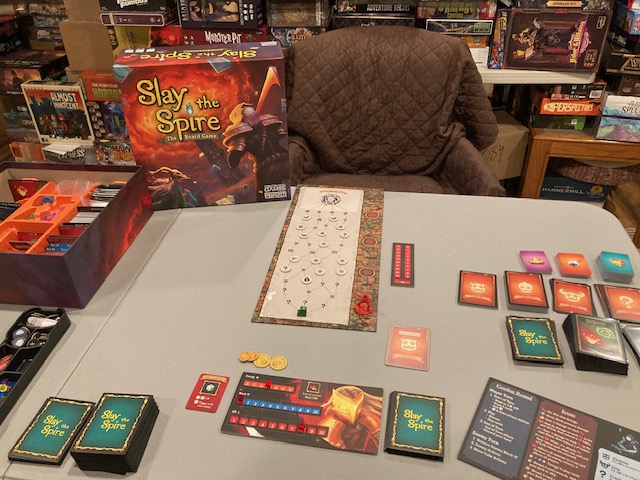
The solo game is great: it’s about an 8.5/10.  It’s easy to play, and there’s really no exceptional rule changes needed to get the solo game to the table.   
IMG_4902

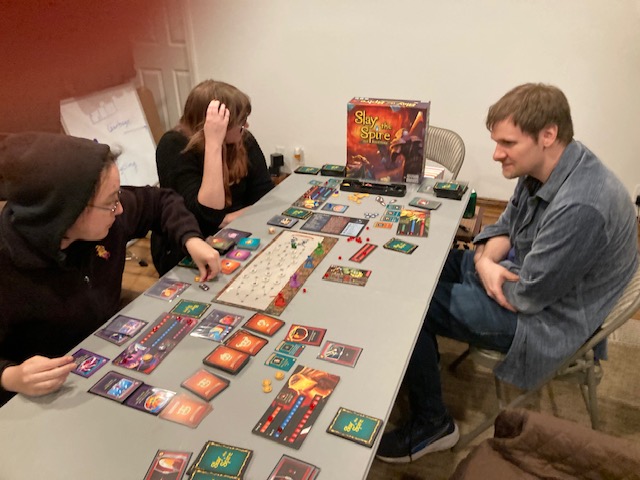
The cooperative game is about a 9/10: the base game is all there, with all the upgrade and augment paths, but the cooperation really shines brightly! Players can choose so many ways to help each other with fine-grained Player Selected Turn Order, with Simultaneous Play keeping everyone engaged at all times! And even though these play modes seem mutually exclusive, players seem to weave in and out of Simultaneous Play and PSTO without even noticing! 

IMG_5301

Players who know Slay The Spire the video game might find this to be a 10/10 for them: the game is great and also evokes so much atmosphere from the Video Game!  

Over the course of many  play sessions (both solo and cooperative), I ended up liking the game more and more.  There are some issues with the rulebook, as it seems to assume players know Slay The Spire Video Game pretty well! Other than my issues with the rulebook, the game is great.  Putting everything together, this feels like a 9.5/10 as an overall production!  This game surprised me how much I liked, especially given my anti-Rogue-lite tendencies.

Point-And-Click Adventure for Families! A Review of Eppi: An Interactive Adventure Book

IMG_2581

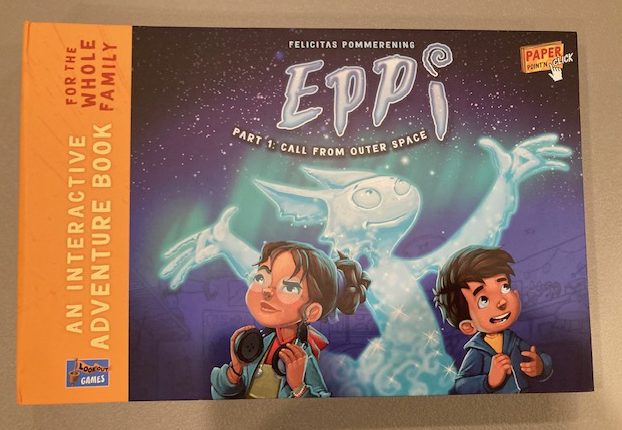
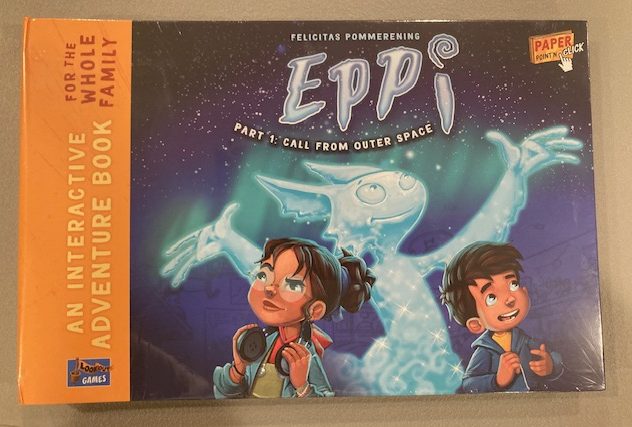
Eppi is the second series of games in the Paper Point-and-Click line of games from Lookout Games.

img_9161-e1623455483876

The first game in this series was Cantaloop by Friedemann Findeisen: see our review here! We loved Cantaloop so much that it made the #1 spot on our Top 10 Cooperative Games of 2021! This was a series of three games: we liked all three of them! See here, here, and here!

IMG_2587

What makes these games so interesting is that they are the paper book equivalent of the old “point-and-click” video games! 

IMG_7336

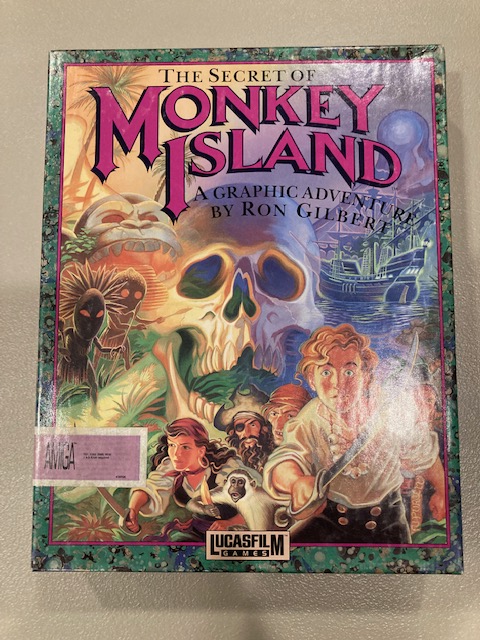
Think of the Secret of Monkey Island, King’s Quest, or the more recent Thimbleweed Park. Players “point-and-click” at objects in their world (on the computer screen), combining objects to solve puzzles! Players also move around, exploring the world they play in!

underwater

These games are all about combining objects and exploring the world, trying to solve the puzzles in the story you uncover along the way.

IMG_2634

However, instead of a computer screen, these Paper point-and-click games have book and cards! You combine cards, solve puzzles, and flip through the book exploring the story therein!

IMG_2583

Let’s take a look at Eppi!

Unbooking

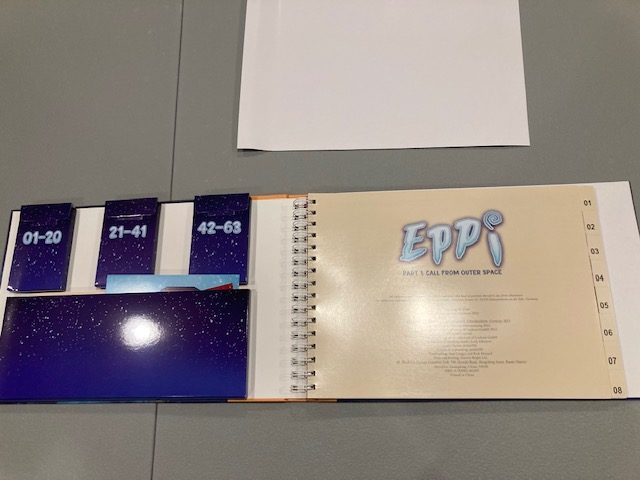
We can’t have an unboxing, as this is mostly a book. So this is an unbooking.

IMG_2589

Eppi is a book first and foremost: everything else is contained in the front pouches at the front of the book.

IMG_2590

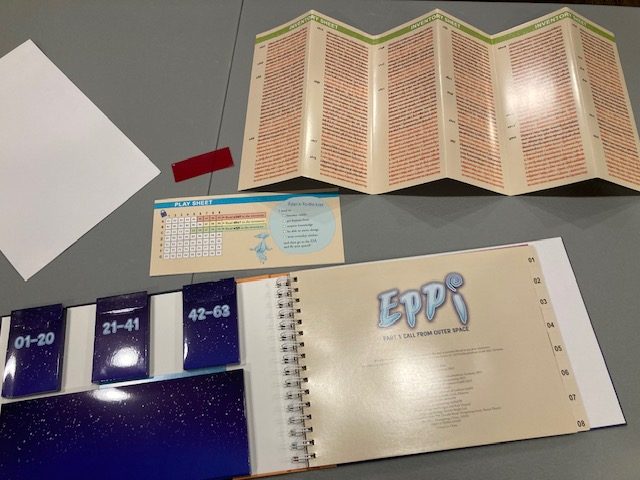
The big bottom pouch contains the inventory page, the play sheet, a postcard map, but most importantly … the red decoder!

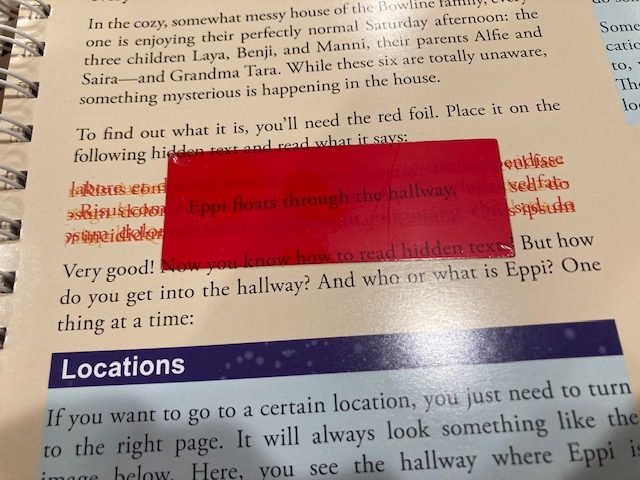
IMG_2596

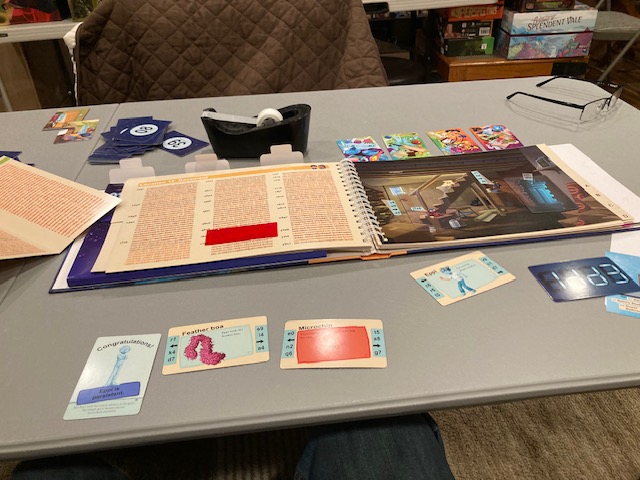
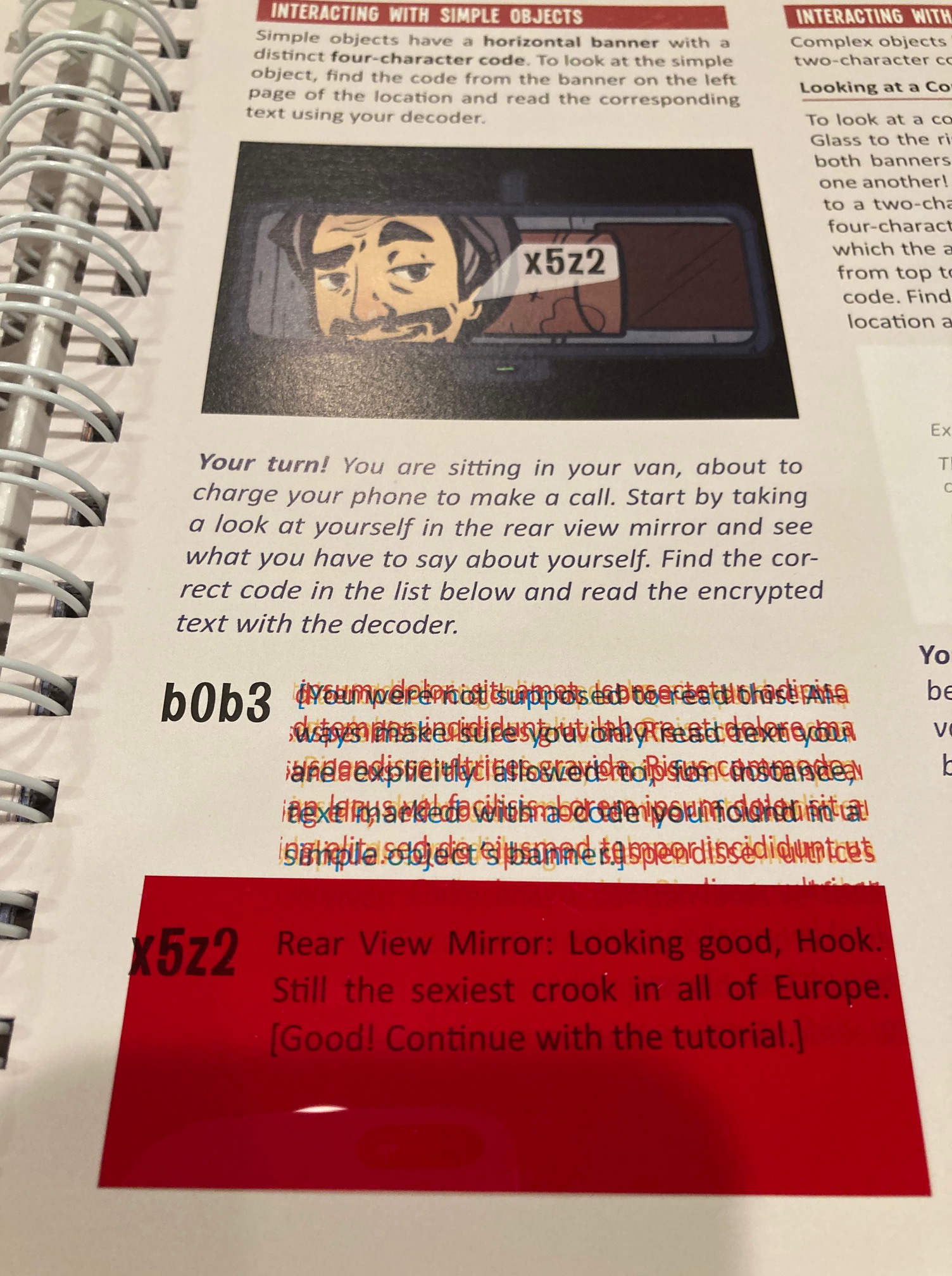
This little red decoder is the main gimmick of the game! Hidden text in the book waits for you to unearth via the red decoder! The red decoder reveals important text in the adventure! See above as you encounter Eppi for the first time in the hall! 

IMG_2599

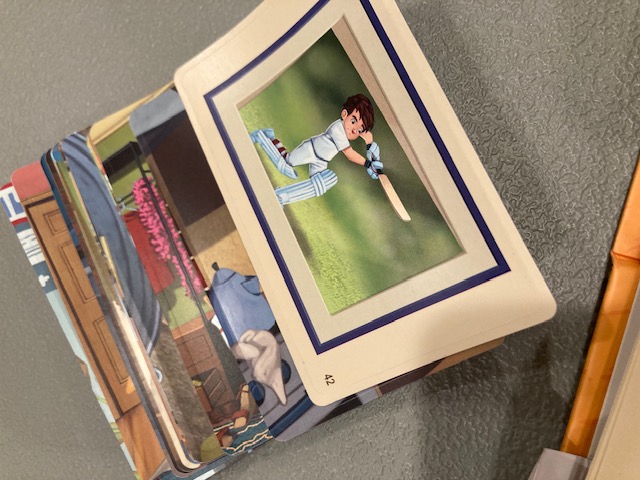
Most of the “objects” you will interact with come from the three card pockets. As you reveal text in the game, you will uncover more cards which you can combine!

IMG_2620

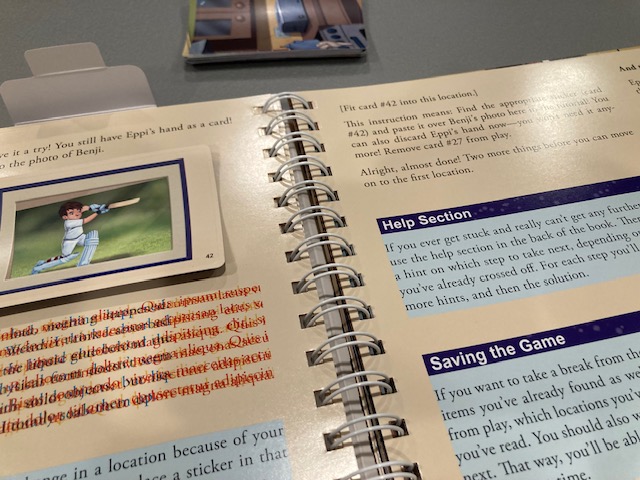
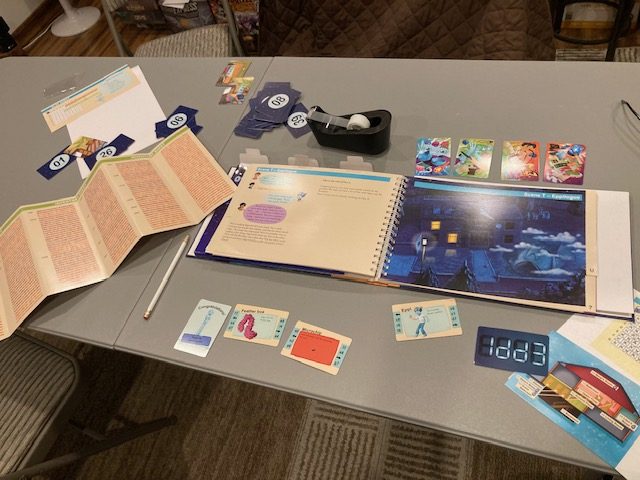
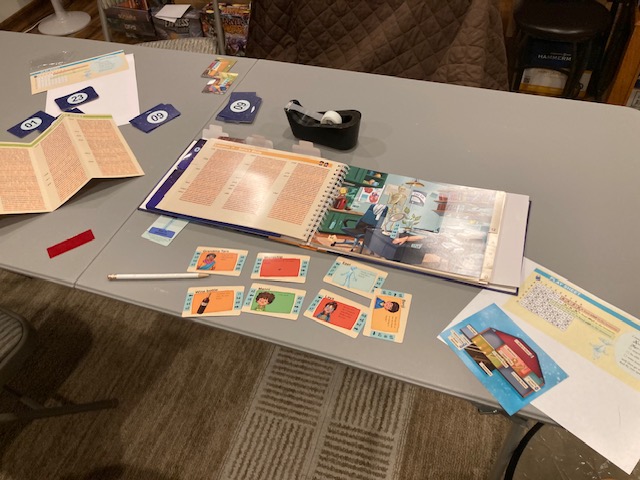
One thing that’s differentiates Eppi from the original Cantaloop series is that about a third of the cards are stickers rather than cards: see above That’s right, this is a legacy game (but see below)! As you explore, you will put stickers on locations to reveal new options or hide old options that are no longer relevant!

IMG_2607

The map tells you where you can go in the house, and the corresponding pages of the book. Note that you can’t get into certain rooms until there are unlocked via triggers! (You can’t get to Saira’s Study until you hit trigger D4!)

IMG_2616

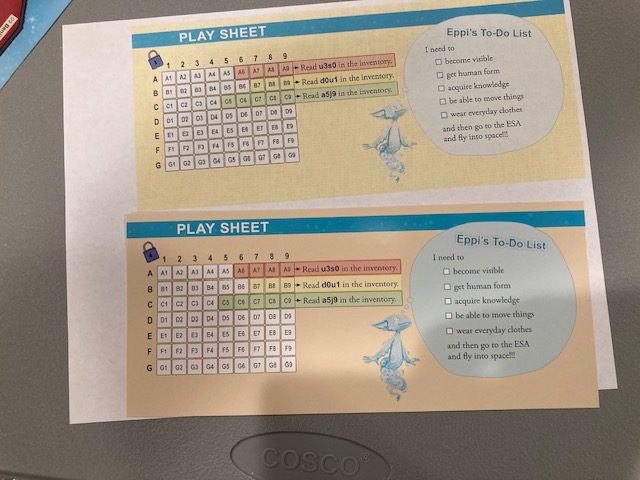
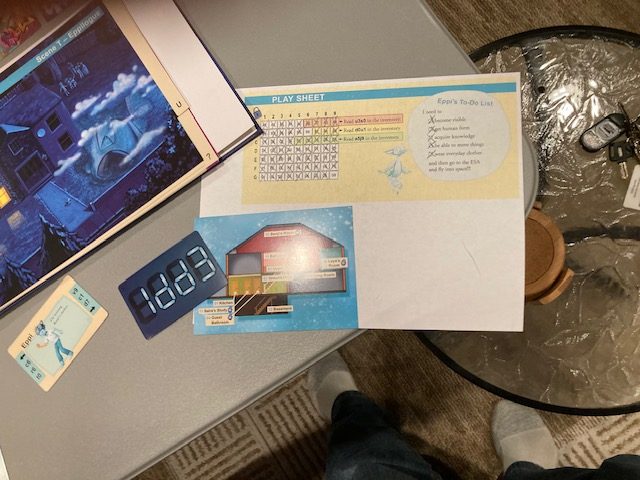
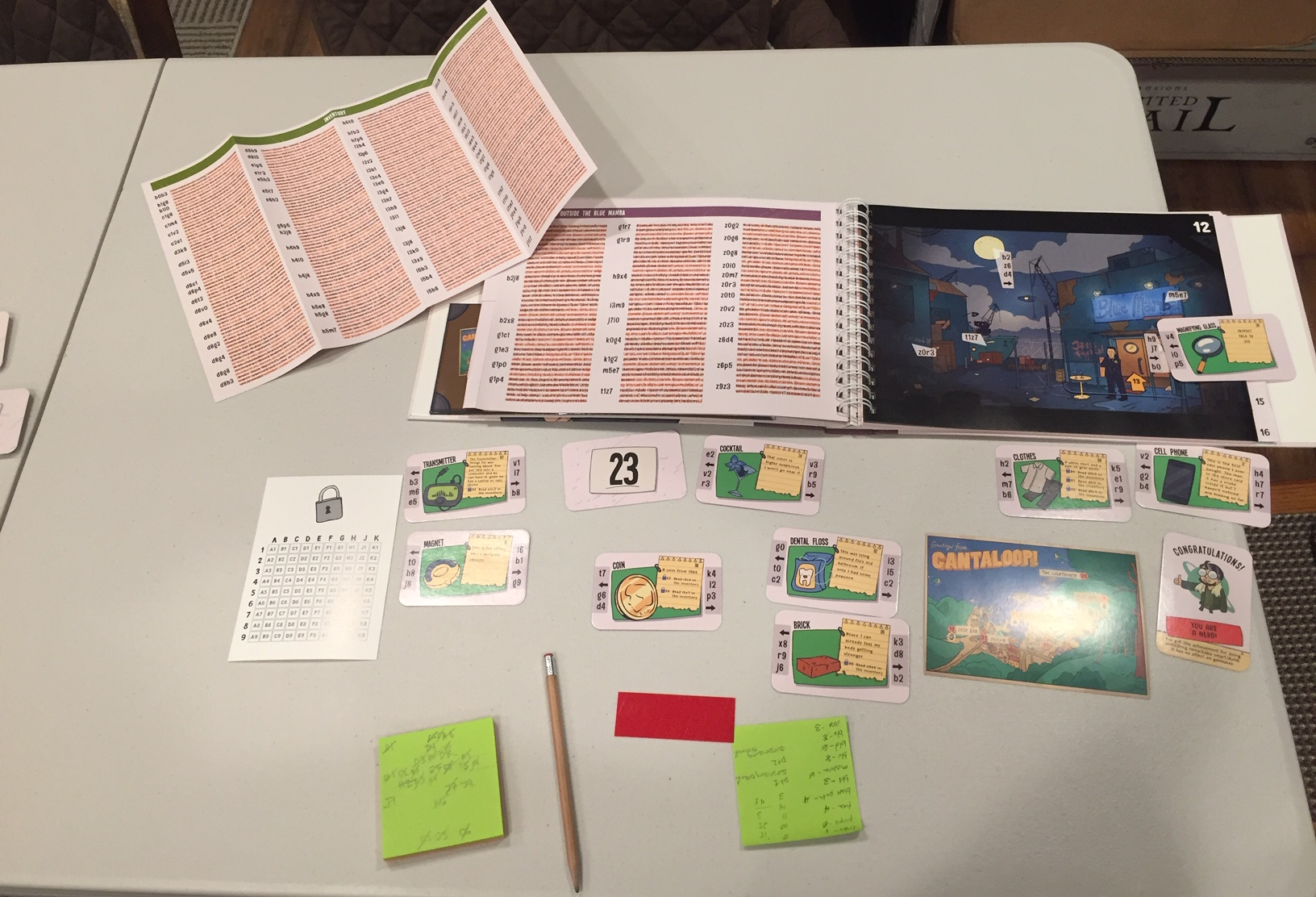
The play sheet comes with a little matrix of “triggers”: as you explore and combine objects, you will mark triggers on the sheet to show you’ve “accomplished certain things”. 

IMG_2612

This same Play Sheet also has your “TODO” list: in order to win the game you have to accomplish 5 goals! See above. (Why are there two Play Sheets above? Keep reading!!).

IMG_2621

The rest of this game is the book! 

  • The introduction and tutorial is fabulous and tells you how to explore and combine objects!
  • The next section has the 12 Locations (2 pages each) in the game
  • The next section are Cut-Scenes (further expansion of the plot as you move forward)
  • Finally, the last section is a Help Section

IMG_2614

This game looks great! It has a very family-friendly and welcoming vibe to its art. It’s very clear this is aimed at younger kinds and families! I mean, it says that on the cover, but the art choices reinforce that.

Legacy or Campaign Game?

IMG_2634

Since you are supposed to put down stickers as you play, this is pretty much a legacy game! You won’t be able to replay it again … or will you? You really can’t remove the stickers (they are very sticky), and you also mark up the Play Sheet with the triggers. So, this is a legacy game (but see below)! And honestly, what kid doesn’t like putting on stickers? For some families, the stickers may the best part of the game.

IMG_2627

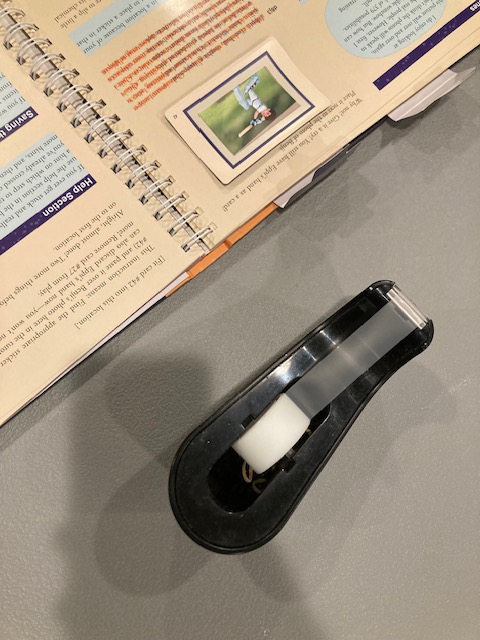
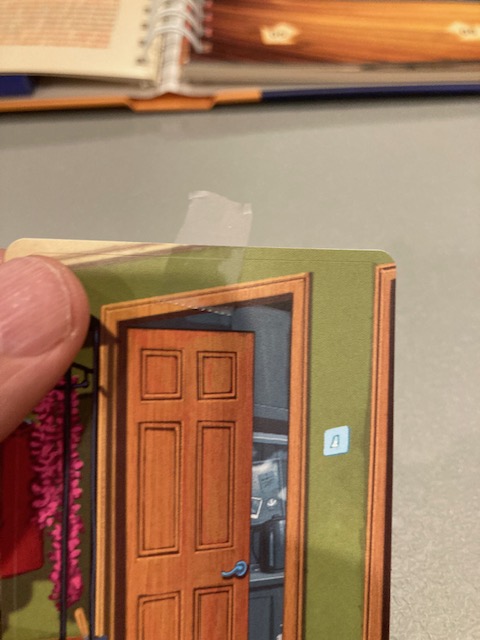
Having said that … If you are very careful, you can reset the game: you can use little pieces of tape to “tape” the stickers in the book rather than stick them.

IMG_2664

I was able to play the entire game all the way through, using just little bits of tape on the edges to hold the stickers down (see above). After I was all done, I was able to reset the entire game by just carefully pulling off the tape! If you use small, little pieces of tape, you can keep the stickers down without too much work to remove it later. The bigger the piece of tape, the harder it will be to remove!

IMG_2612

The only thing other thing you need to do to reset it: make a copy of the trigger sheet! That’s why I have two copies of the Play Sheet above: one is a copy!

IMG_2644

So, with those two “tricks” (tape and a copy of Play Sheet), I was able to reset the back to pristine condition after full playthrough (it did take a little bit of time to undo the tape).

IMG_2631

It’s a little fiddly to keep making little pieces of tape, but I suppose no more fiddly than trying to stick the sticker on and aligning it just so. However, I suspect the best way to play is to just put the stickers in: the best part of being a kid is playing with stickers!

IMG_2586

The only reason you may not want to put stickers in your game is that this is a 3-Part series (I think): this is Part I after all.  The next Eppi book is “probably” a year away, so you may want to replay this game again just before the next one comes?

In general, it’s probably more fun to put the stickers in (it’s a legacy game)! If you are just a little careful, you can get by and make it resettable (making it a campaign game). It’s up to you!

The World

IMG_2597

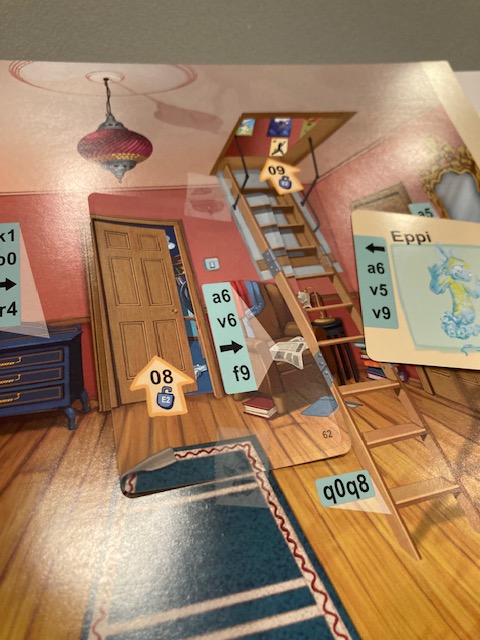
Most locations in this world look like the above: the left side of the page has a lot of hidden text (to decode with the red acetate) and the right side of the page is a picture of the room you are currently in (with objects you can combine with). As you explore the room, you will combine objects and read some of the text on the left!

IMG_2608

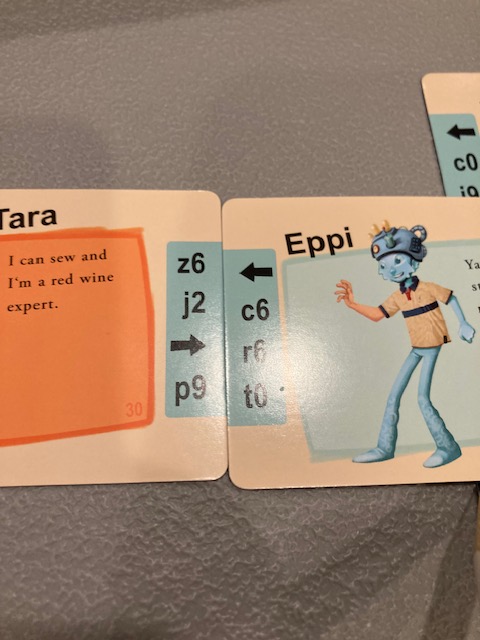
The typical way to combine objects is to align the left side of a card with either a location or the right side of another card. If the two letter code (u6w6 from the picture above) corresponding to the arrows shows up on the appropriate sheet, you can read it with the red decoder! Otherwise, if there’s no such code, nothing happens! (It’s like trying to combine a bowling ball and a feather, it doesn’t make sense, so nothing happens).

IMG_2635

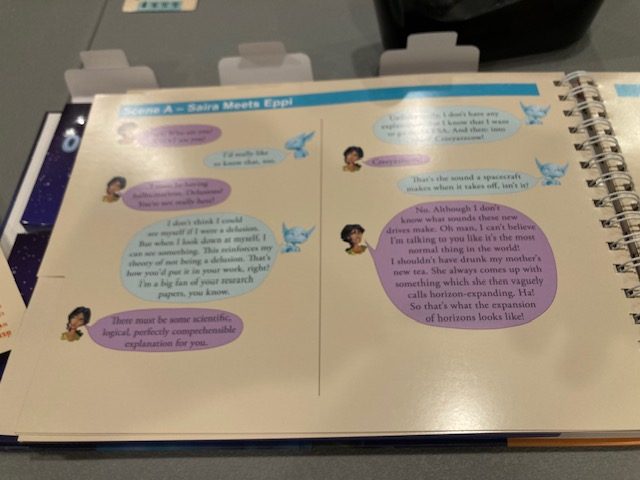
Sometimes, the little red decoder will tell you to read a cut-scene: it looks like the above, where characters talk to each and further push the plot and character development.

IMG_2655

This game is all about “trying” things in this world: Do these objects combine? Do this object combine with this location? Nothing here? Let’s look around at a new Location! You try stuff, go to new Locations, and just keep exploring this world.

Flow

IMG_2654

This is an adventure game: you will start off making tons of progress, then slowly and slowly start making less and less progress until you hit a wall. Eppi has the same ebb and flow as most adventure games: sometimes, when you are stuck, you just have to go around and just “try stuff”! Arguably, the least exciting thing about adventure games is the brute force approach is sometimes needed: it can be boring and soul-crushing to just try stuff that makes no sense. Even worse, it’s harder in this game because you physically have to do a lot more work to just “try stuff” (turn pages, combine items, look up text, see if it decodes: Lather, rinse, repeat). But once you break through that wall, it’s so exciting! The story picks up again, and things make sense again!

565435-the-secret-of-monkey-island-special-edition-playstation-3

Eppi is an adventure game! Every point-and-click adventure game I have ever played has this same flow: lots of cool stuff then some frustration, then excitement, some more frustration, then more excitement!

Help

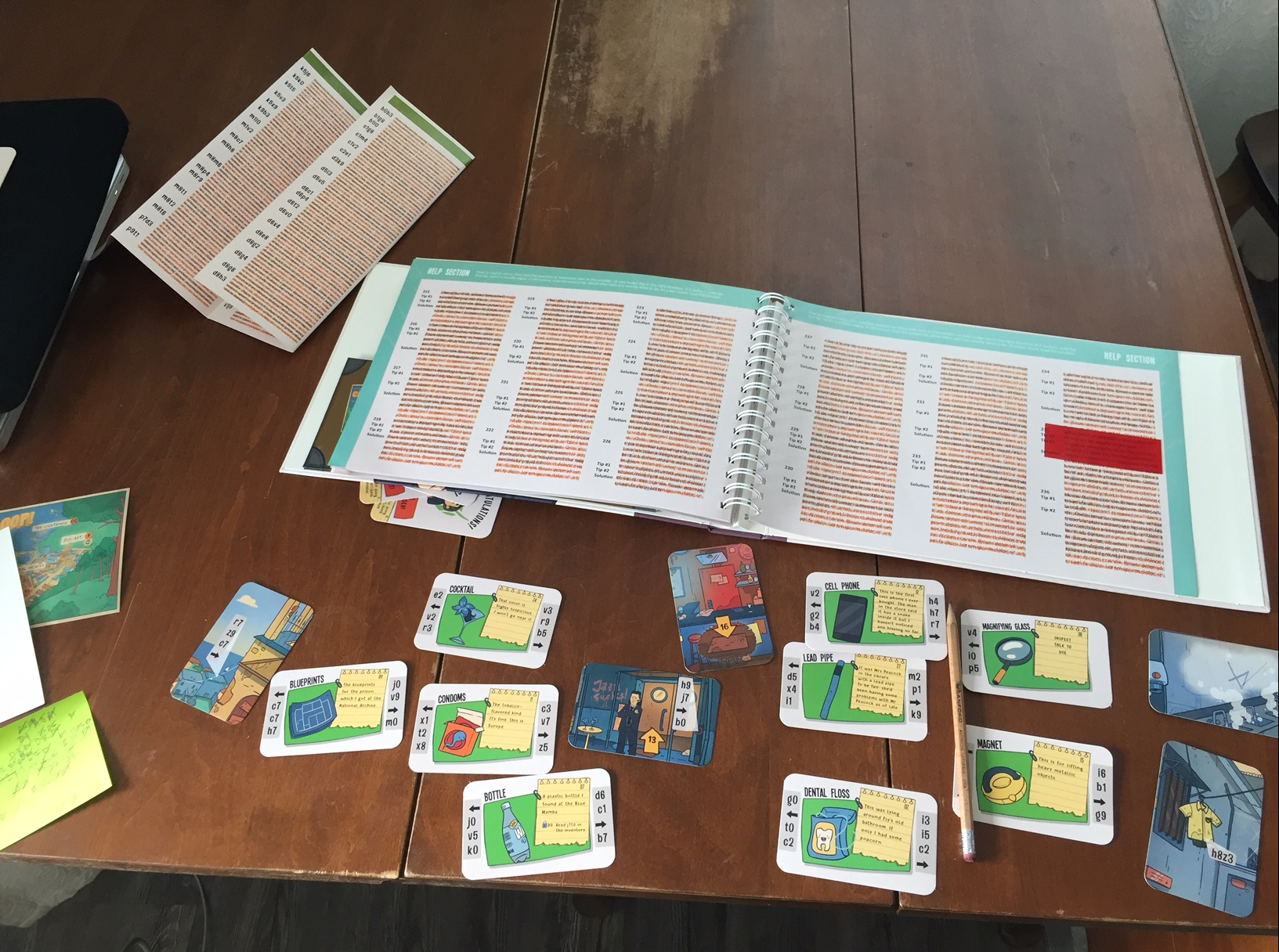
IMG_2640

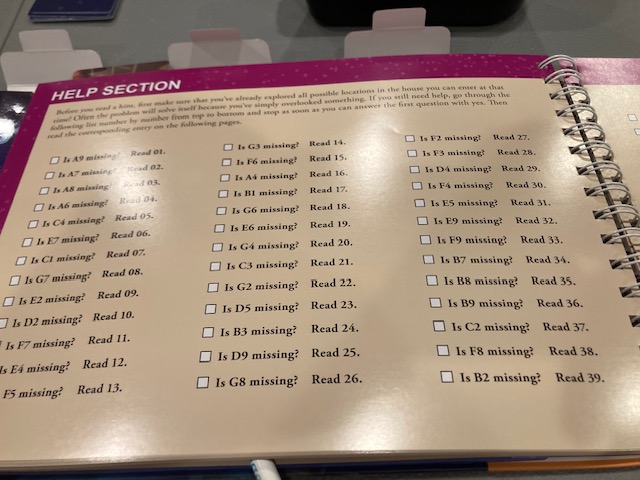
If you do get stuck, there is a Help Section in the back of the book (see above). In this case, you lookup help sections by seeing what trigger conditions you are missing! You correlate your Play Sheet and find the lowest trigger you are missing! This is usually where the problem is! 

IMG_2639

A few times, I had to look up some help, but I had to look at more than one trigger to find what I needed. But it was there! It’s a little confusing the first few times you try to use the help. One of my biggest problems was that I sometimes forgot to mark off a trigger, so that prevented me from moving forward!

This isn’t the best Help system, but it seemed to work for me once I kept at it.

Story: Solo vs Cooperative

IMG_2586

So, Eppi is a family friendly story! In fact, the main characters of the game are a family! Mom and Dad and some kids of all ages!  As you explore this game, a story moves forward.   But, why read a story when you can play it?  

IMG_2657

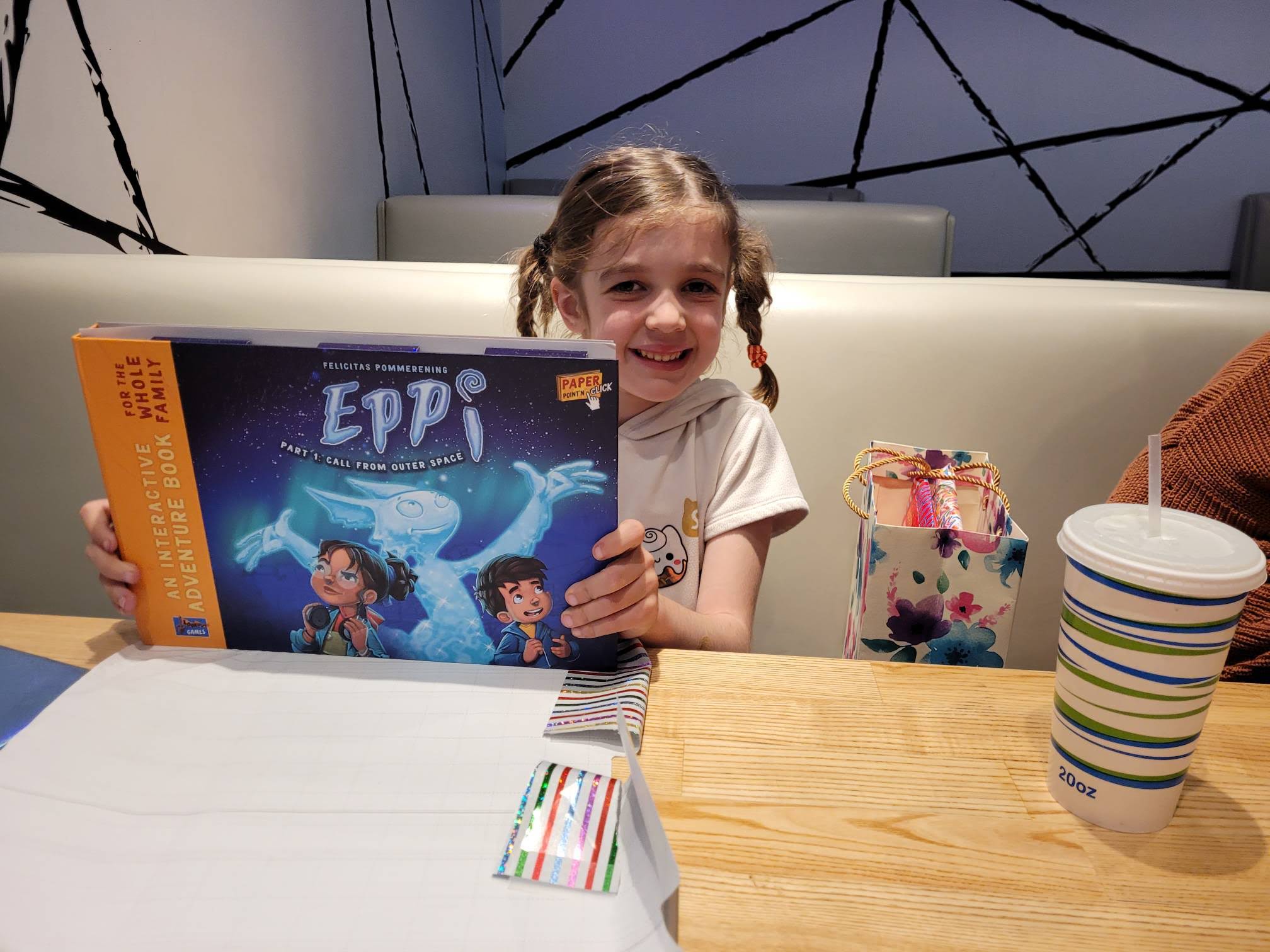
The two main ways to play Eppi are solo or cooperative.  Cantaloop (the first of this kind of games) definitely felt like more of a solo game, although arguably you could play it cooperatively.  Eppi feels like it is better at being both solo and cooperative: it absolutely works solo (that’s the way I played it), and then it absolutely works in a family environment (a 7-year old girl and her family gave us some feedback).

Solo

IMG_2584

I ended up playing the entire game solo one Sunday: it took about 5 hours (the box says 5-8 hours, so that’s accurate). 

IMG_2643

I definitely stopped and took a break at some points when I was getting frustrated, so wall-clock time was probably more like 7 hours, with 5 hours of play and 2 hours of taking a break.

IMG_2631

This would be easy to reset if you needed to: you just take a picture of the cards you have, and put everything away. If possible, it’s probably just a little easier to keep everything set-up between sessions, but you may not have that luxury.

IMG_2654

The solo game worked pretty well. I got stuck a few times and had to consult the Help. In general, it was pretty fun.

Cooperative Family Mode

123_1 (4)

What I Liked

IMG_2621

Turning pages to explore and move through Locations worked great: the binding is good for that, and the pages are high quality: they definitely learned from the Cantaloop experience! The very first Cantaloop game had lesser quality paper, and it actually made a difference, as you were much more careful turning pages (afraid to tear them)! With the higher quality paper and binding, it’s easy to make your way through the book.

IMG_2623

The stickers are cool. In Cantaloop, they “new scenes” were on cards, and if you turned the page, you would have to reset the scenes. By putting the “new scenes” on stickers, you can work through the book quicker, as you don’t have to worry about “new scenes” flopping around! Besides, stickers are cool … especially for kids! (And, like we said, if you are careful you can get the equivalent experience with taping the cards, but you should use the stickers!!!)

IMG_2586

By making the Eppi game more “family-friendly” (to be clear, Cantaloop was NOT family-friendly), it opens the door to cooperative play more than the original Cantaloop: the story and art is very inviting in Eppi! It’s just something the whole family can be immersed in. This definitely feels the cooperative mode is much more accessible. I loved Cantaloop, but it really is best as a solo game. I think this might Eppi might be more fun as a cooperative game.

IMG_2587

I adore this genre: the Point-And-Click Adventure game is fairly rare! I am so glad Cantaloop did well enough to spawn further games in this genre. I love this genre so much! More games like this please!

IMG_2598

The tutorial was very good: it showed what you can and can’t do when you combine objects.

What I Didn’t Like

IMG_2645

In the original Cantaloop, when you combined cards, the lowest number card ALWAYS had to be on the right: this reduced the number of ways you could try to “combine” two objects. Why didn’t Eppi adopt this rule?  You effective may double the amount of work you have to do to combine objects, as you may have to combine the cards twice! 

IMG_2636

I liked the story here, I did.  But, the wit of the original Cantaloop isn’t in here … which makes the game seem like a little more work.  Even if you got a puzzle wrong in Cantaloop, frequently there were funny jokes or amusing turns-of-phrase!  So, every time you worked for clue, you got rewarded by either advancing the plot or some joke!  I didn’t realize until I played Eppi that the jokes in Cantaloop distracted me from all the physical work you have to do to move the story forward!  Let’s be clear: there is a lot of physical activity of moving cards, combining objects, reading red text, turning pages, marking triggers, turning to cut scenes!  Whew!  All physical activities!  

I think some of this will go away if you play cooperatively, as the game is more about the cooperative experience with your family.  But I think the “work” to move the game forward is a little more prevalent in Eppi if you solo it.

IMG_2661

The final puzzle was pretty hard.  I feel like it was almost out-of-scope/too hard for a family game: I suspect you will have to use the Help System to finish the game.  That last puzzle seemed a little too much, even with a whole family looking at it.

Conclusion

IMG_2659

I am so happy there are more Interactive Adventures like Cantaloop! Eppi is a fun game solo or cooperatively, but I think the best place for it is the cooperative game with the family …

IMG_2582

… and that’s what the cover says! It doesn’t lie!

I like Cantaloop better overall, partly because of the non-stop humor, but I had a lot of fun with Eppi. This is a solid 7.5 solo, maybe 8 cooperatively with your family.

Top 10 Cooperative Point-And-Click Adventure Board and Card Games

Welcome back to Cooperative Adventure Game Month! We have talked a lot about cooperative adventure games this month, from the silly Starlings Box One to the grimy noir Saints and Sinners.We end this month with a discussion of a Top 10 of one of our favorite kinds of cooperative adventure games: the point-and-click adventure!

Make sure you re-read that! Yes, this is a list of Board and Card Games (not Video games) that work like the original LucasFilm point-and-click adventure games such as The Secret of Monkey Island, The Day of the Tentacle, or the more recent Thimblewood Park! Granted, a board or card game doesn’t have a mouse pointer to move and click, but there’s certain elements that make a game feel like a point-and-click video adventure game!

IMG_3164

What makes a board game a point-and-click adventure game? For us, it breaks down into three fundamental elements:

  1. You explore a world!  The game is about exploration and discovery, as you “move” from location to location.  In the point-and-click video games, you could “point-and-click” to move around a map!
  2. You solve puzzles by combining objects!  You need to find objects and combine them in unique ways to solve puzzles. In the point-and-click video games, you would “point-and-click” on items/verbs to combine them!
  3. You move along in a story!  You are part of a story: this is interactive fiction!

So, if a board or card game has these fundamental elements, we call it a point-and-click adventure game! If it moves from location to location like a duck, combines items like a duck, and is part of a story like a duck, it’s a duck!

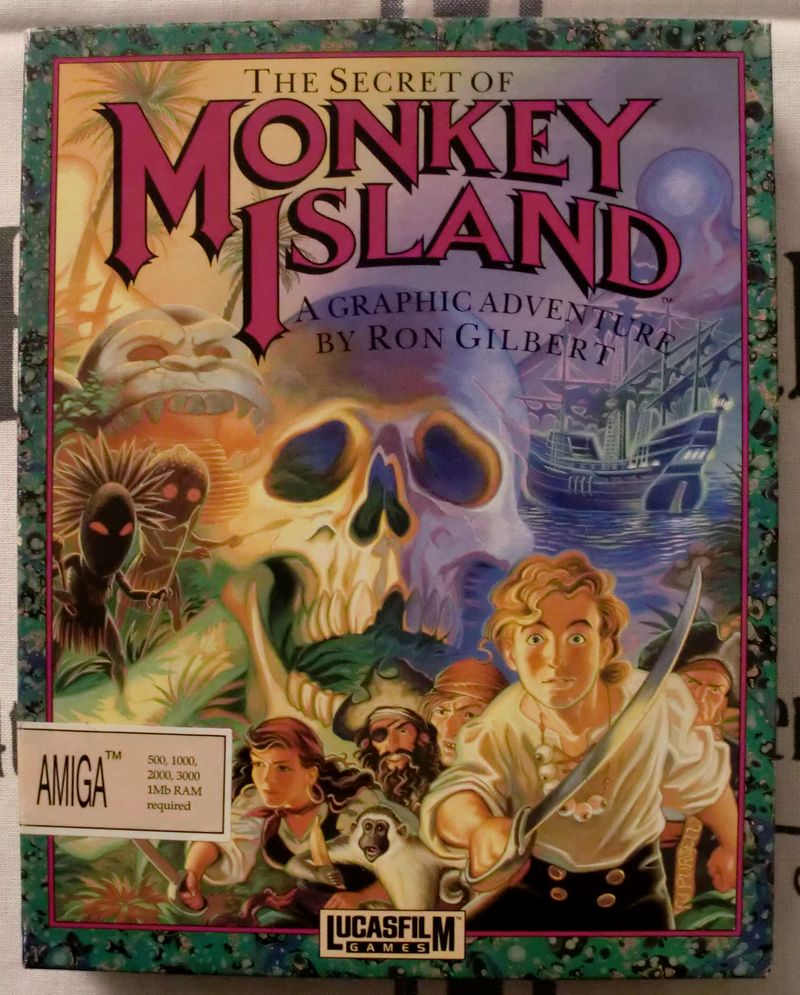
the-secret-of-monkey-island-commodore-amiga

Take a look at our review and discussion of the newest  Monkey Island game for more thoughts on what we like about these type of games! 

To be clear, all the games on this list are “play-once” because you reveal the plot and main elements!  You can play it again, but you probably want to wait a few years until you forgotten everything!

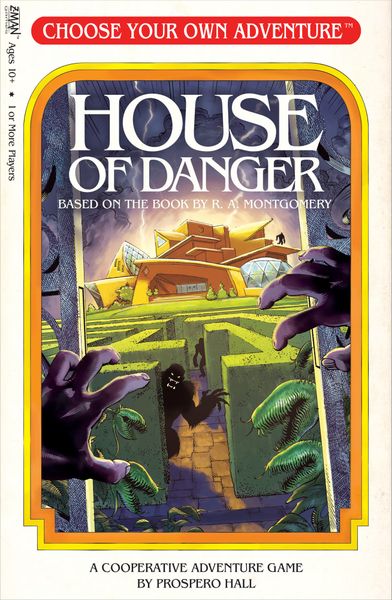
Honorable Mention. Choose Your Own Adventure: House of Danger

pic4092537
Ages: 10+
Play Solo? Yes, but best with a group
Number of Players: 1 or more Players
Time: 60 minutes per chapter (5 chapters)

This isn’t quite a pure point-and-click adventure game, but it’s so close we have to mention it!  You explore a very silly world, find objects, and use them for both dice mitigation and helping you with puzzles.

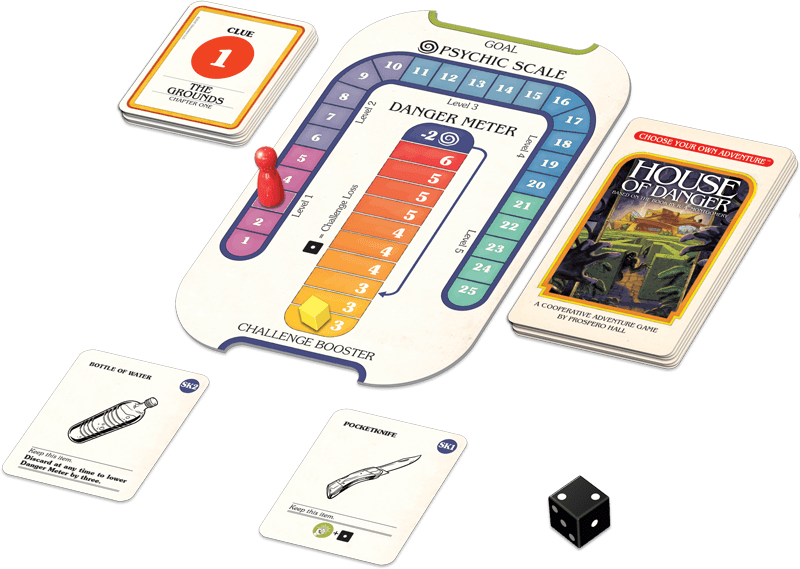
pic4093960

But this feels so much like a point-and-click adventure!  We make choices in the game and we explore the world, but it so silly! The dice are the only reason House of Danger is down at an Honorable Mention: the dice take the pure puzzle aspect out and poke just a little bit of randomness here.

There is another game in the Choose Your Own Adventure series, but House of Danger was the funnest!

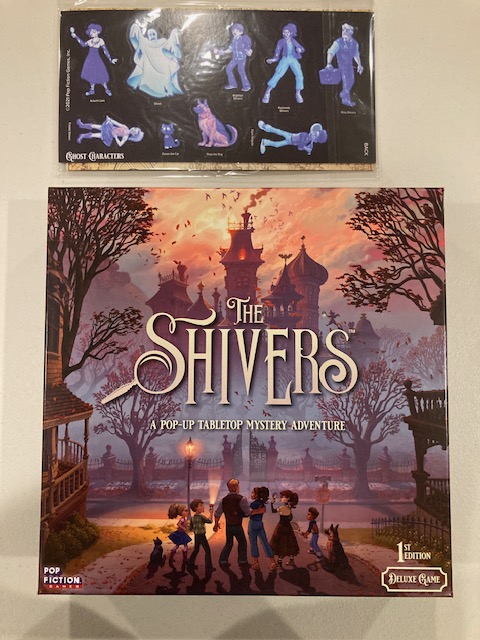
10. The Shivers

IMG_4573

Ages: 10+
Play Solo? No, there has to be a GM: best with a group
Number of Players: 2 or more Players
Time: 60 minutes per chapter (5 chapters)

The Shivers is almost more of an Role Playing Game (RPG), as you have to have to have one player “run” the game, so you can’t really play it solo.  That’s really the only reason this is #10 on this list ….

IMG_4623

Otherwise, this is a beautiful game with Pop-Up Components!  The physical nature of this game makes it feel more like point-and-click than many of our games on this list!  But the RPG nature and lack of solo drop it just a little. 

IMG_4628

This game is a fun little cooperative point-and-click type adventure game with a sense of humor and beautiful components!  Take a look at our review of The Shivers to see if this is something you might like.

EDITOR: We recently got a comment on our blog about the Shivers from William T Tiller:

Its funny you should compare it to Monkey Island because I did the Shivers art. I am Bill Tiller, and I worked at Lucas Arts as a lead artist on the adventure games The Dig, and Curse of Monkey Island, and A Vampyre Story. In fact there are a few refences and easter eggs that refer to Monkey Island in The Shivers. Larry Ahren, a writer, designer, and animator on Day of the Tentacle, Full Throttle and director of Curse of Monkey Island also wrote one of the scenarios in the game. Those may be the Shivers game feels a lot like a point and click adventure game.

9. Coded Chronicles: Scooby Doo! Escape From The Haunted Mansion

pic5239705
Ages: 12+
Play Solo? Yes, but best with a group
Number of Players: 1 or more Players
Time: varies (there are a number of interconnected scenarios)

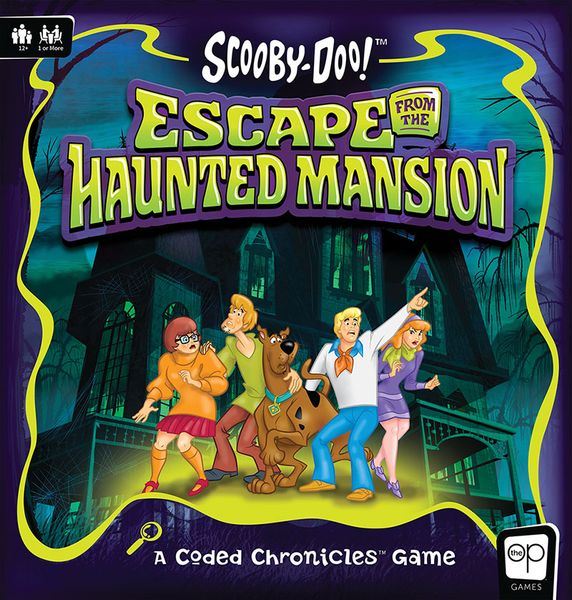
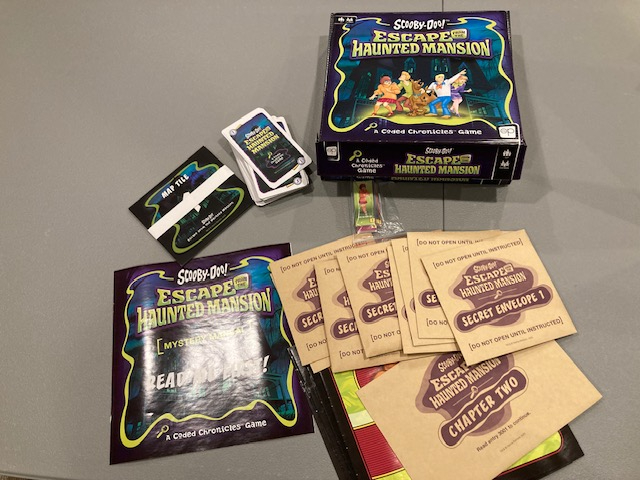
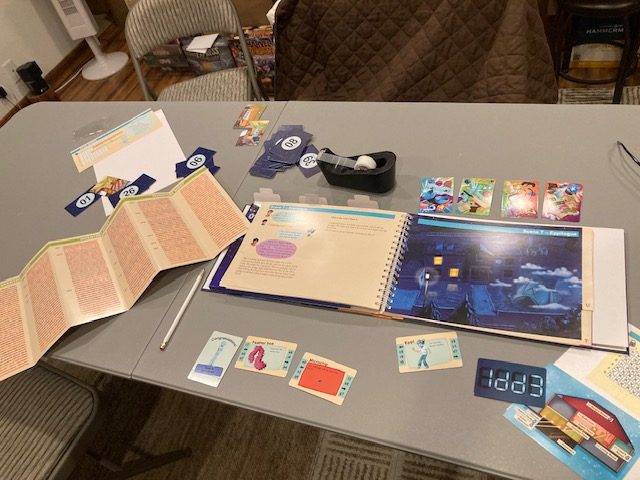
Players take the role of their favorite Scooby Doo characters and explore the Haunted Mansion, solving puzzles to pursue the mystery in this box! The object interaction is very simple (using the first number of the character combined with the number of an object), but it’s a pretty simple and elegant way to combine objects! 

IMG_2670

This is one of the simpler point-and-click adventure games on this list (with House of Danger being the simplest), but it’s a really fun mystery! And it totally feels like a point-and-click adventure as you explore the house, combine objects, and work towards solving the final mystery!

There are other games in the Coded Chronicles series as well if you like this style of adventure game!

8. Paper Point N Click: Eppi
IMG_2581

Ages: 8+
Play Solo? Yes, but best with a group. The solo mode is still quite good!
Number of Players: 1-4 Players
Time: 5-8 Hours for the whole adventure

Eppi is the next adventure book game series in the Paper Point-and-click line of games.

IMG_2656

This game is an exemplar of the great things a board game can do in the  point-and-click genre!  This particular game is aimed more towards families and is probably best in a cooperative group, but it still works very well solo.  The exploration, story, and puzzles that come out of this game are just outstanding!  This feels like a real point-and-click adventure game.  This is aimed at a younger or family-friendly audience, which may be outside your wheelhouse (which is why it’s only #7).

Unlock Epic Adventures: Mission #07

IMG_0205

Ages: 10+
Play Solo? Yes, but probably best with a group
Number of Players: 1-6 Players
Time: 60 minutes

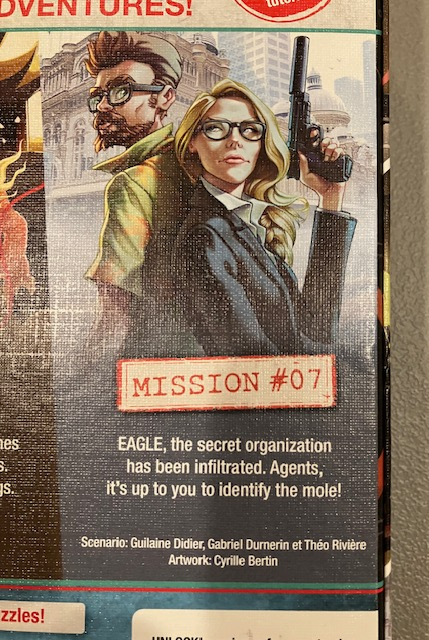
The Unlock! games are nominally called Escape Room games, but they share quite-a-bit of DNA with point-and-click adventures!  The Unlock! games, which use cards and an app on a phone to direct the action, are a perfect example of point-and-click adventure games!  A story unfolds as you unlock new locations and items, and you to explore and combine items to push forward!

IMG_0206

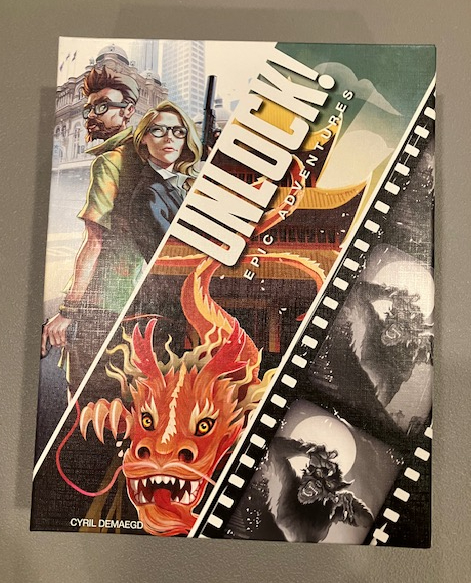
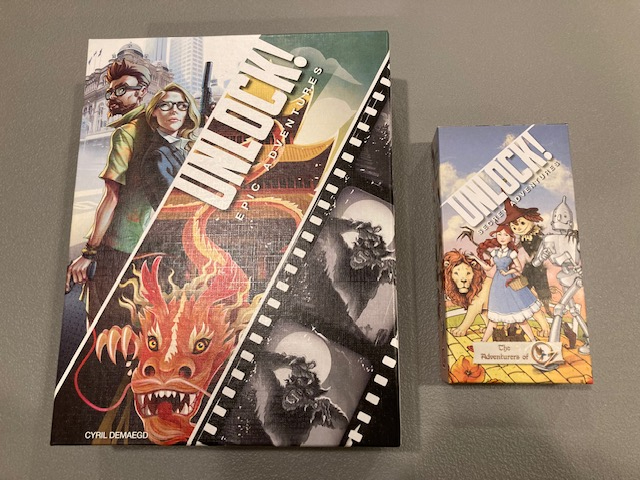
This particular box has three adventures in it (See Unlock!  Epic Adventures, which we reviewed here), all of which are great point-and-click adventure games!

IMG_0207

But it was Mission #7 (the last of the adventures) that really captivated us!  This story was fun and interesting and tried a few new things we haven’t seen in Escape Rooms before!

6. Unlock! The Adventures of Oz

IMG_2690 (1)

Ages: 10+
Play Solo? Yes, but probably best with a group
Number of Players: 1-6 Players
Time: 60 minutes

The original Unlock! games came 1 game to a pack: later on, they started packaging them up up three at a time.

IMG_2692 (1)

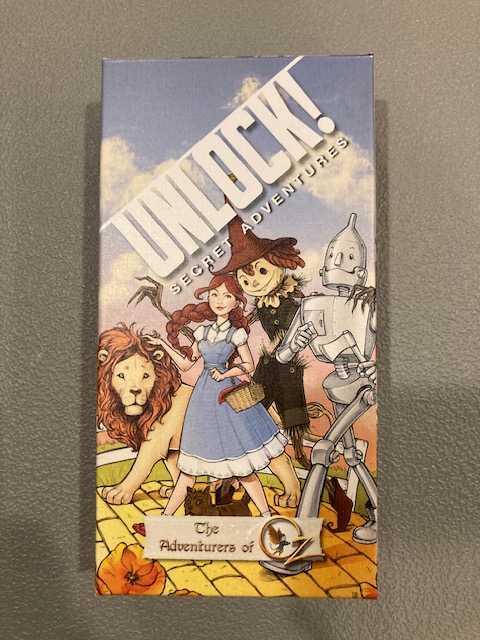
Before we got Mission #07 in the Epic Adventures box, The Adventures of Oz was available and one of our favorite Unlock games!

IMG_2691 (1)

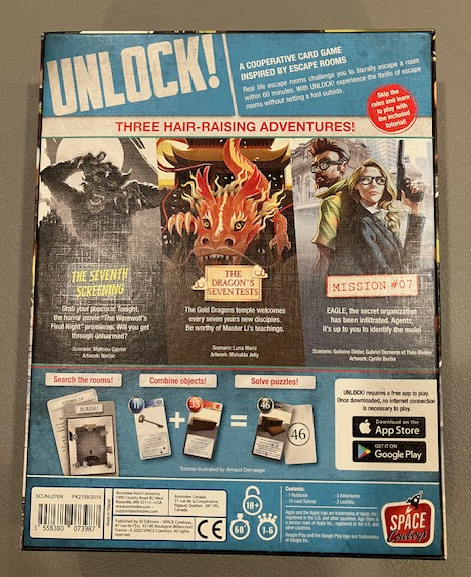
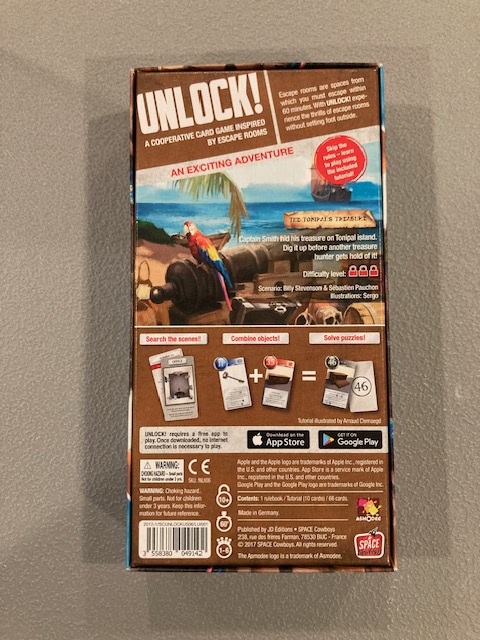
My favorite explanation that this is a Point-and-Click adventure is the back of the box: Search the scenes!  Combine Objects!  Solve Puzzles!  The Adventures of Oz was a really fun adventure that I was mesmerized back at an early RichieCon in 2018: it tried some really interesting things and was such a great adventure!

5. Chronicles of Crime

Final Box Art

Ages: 12+
Play Solo? Yes, but probably best with a group
Number of Players: 1-4 Players
Time: 60-90 minutes

Chronicles of Crime is very much an app-driven game!  It made the #2 spot in Top 10 Cooperative Games 0f 2018! To quote:

If I had to characterize this game, I’d say it’s an old text-style adventure game!  What?  In the old adventure games, you could only “manipulate” the items on screen on in your inventory.  “Get light”, “Drop light”, “talk man”, “ask guard about skull” and so on.  In this game, all your items are on cards in front of you!  When you want to interact with the items, you use your smart phone to scan a code on some cards!  So, if you want to “ask guard about skull”, you’d scan the code on the Guard card, then scan the code on Skull card!  And the phone would tell you what he said!
 
This interaction is great!  Except, you are trying to solve a crime by interacting with the world in front of you!  Really, really fun!   You move around from location to location, physically LOOKING at animations at locations (really!), and then scan cards.  (“I think there’s a shovel here at this location … Um … Oh! There’s a ‘gardening tools’ card!  Scan that!”)
 
Surprisingly fun, amazing graphics (you HAVE to have a smart phone to play), but a lot of content!  It’s also easy to play!  A GREAT game!

There are multiple versions of this game: 2400, 1400, 1900, all of them very interesting iterations on the base game! I’d recommend any of them! In fact, 2400 made our Top 10 Cooperative Expansions of 2021!

4. Unlock! The Treasure of Tonipal

IMG_2693

Ages: 10+
Play Solo? Yes, but probably best with a group
Number of Players: 1-6 Players
Time: 60 minutes

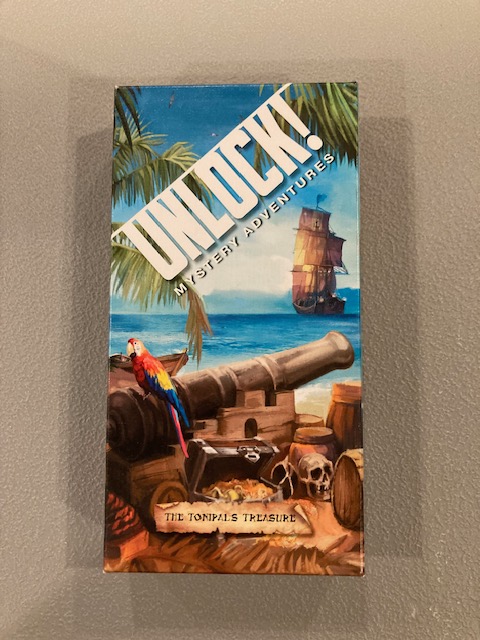
So, this is one of the more difficult of the Unlock! series!  The pirate theme and puzzles really kind of make of you feel like you are reliving some of your Secret of Monkey Island days!  

IMG_2694

Without giving away too much, this point-and-clock adventure had one of the funnest stories and the best “last puzzle” I’ve ever played.  I want to replay this again it was so much fun!

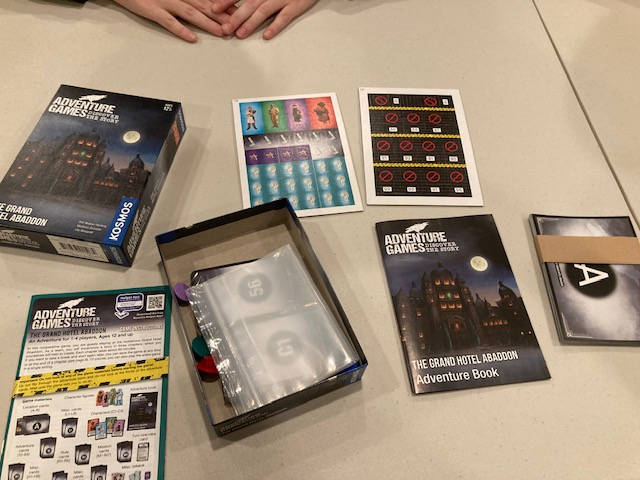
3. Adventure Series: The Grand Hotel Abaddon

IMG_2495

Ages: 12+
Play Solo? Yes, but probably best with a group
Number of Players: 1-4 Players
Time: 90 minutes per chapter (3 chapters)

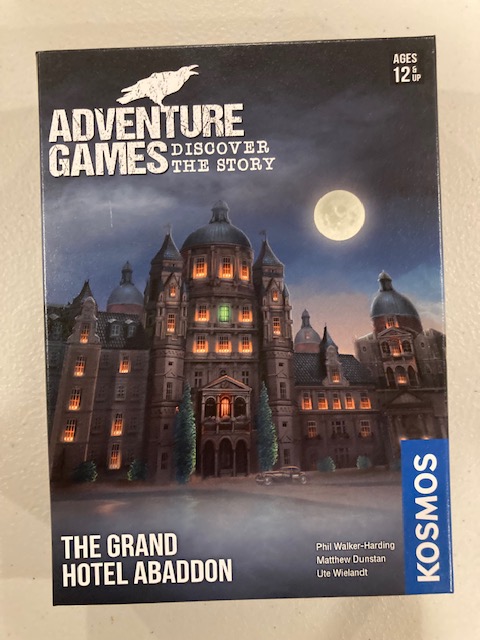
This is a very different kind of point-and-click adventure game: it’s quite text heavy, but it uses cards to denote objects and locations.  

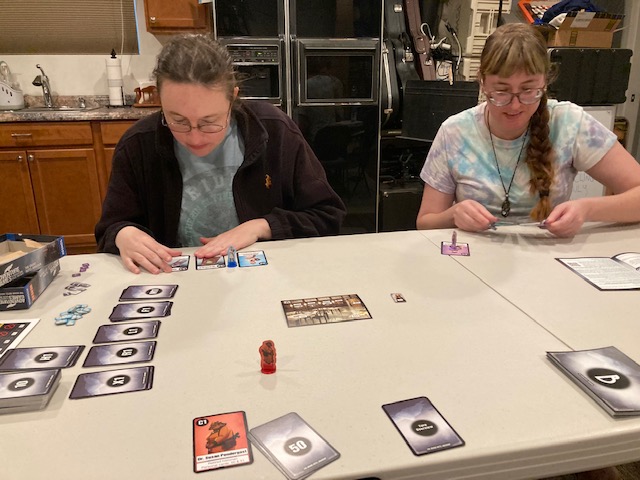
IMG_2497

The Location cards are oversized cards, and the objects in the game are plain cards marked with numbers.  

IMG_2499

Every player assumes the role of a character, with little standees moving around this world.  The story centers on a hotel as “strange things” happen.  It’s quite an interesting story that unfurls over 3 sessions!  This is the 4th game in the Adventure Series line: it made our Top 10 Cooperative Expansions of 2022! We really loved this game!

2. Adventure Series: The Dungeon

Ages: 12+
Play Solo? Yes, but probably best with a group
Number of Players: 1-4 Players
Time: 90 minutes per chapter (3 chapters)

The Dungeon is in the same series of games as our last entry: The Adventure Series.  This game series burst onto the scene in 2019, and it was so fun it made it all the way to out #2 spot on the Top 10 Cooperative Games of 2019!

This was probably the first board and card game that really felt a point-and-click adventure game!  You explored a dungeon!  Combined items!  Solved puzzles! You ventured through a story together!   There was nothing else like this, and this series totally captured my game group!

1. Paper Point N Click: Cantaloop

img_9161-e1623455483876

Ages: 16+
Play Solo? Yes, probably best solo
Number of Players: 1+
Time: 5-8 Hours

Cantaloop nails the point-and-click adventure book game better than any game I have ever played!  When this came out in 2021, it was ground-breaking!  Using the book format with red acetate decoder to move through an adventure game was new and original.

IMG_9240

The way players moved through Locations, combined objects, and solved puzzles was very innovative! Even the help system was innovative!

IMG_9195

What made this so good was the writing! Jokes were strewn everywhere, and everything seemed well-thought out! Remember when Monkey Island would tell you a joke when you tried to combine two weird things? The same happens in Cantaloop! Cantaloop rocketed to the #1 Spot on my Top 10 Cooperative Games of 2021 !

IMG_6808

This series is an ongoing story over three books, told in 3 standalone books: Breaking Into Prison, A Hack of a Plan, and Against All Odds. See our reviews of all three games here, here, and here.

IMG_1055

The only thing to be careful of is that the games are slightly raunchy (see above) and some adult material slips in (which is why the game is 16+ for ages), but it’s always done to be funny and doesn’t detract from the game.