Horror on the Orient Express! An Initial Review After My First 15 Hours of Solo and Cooperative Horror! Cooperative Clue with Cultists, Cthulhoids, Clues, and Choo-Choos!

Welcome to Cooperative Cthulhu Month! This month, we take a look at a bunch of cooperative Cthulhu board and card games! We start the month with a very brand new game called Horror on the Orient Express which just delivered to Kickstarter backers!!
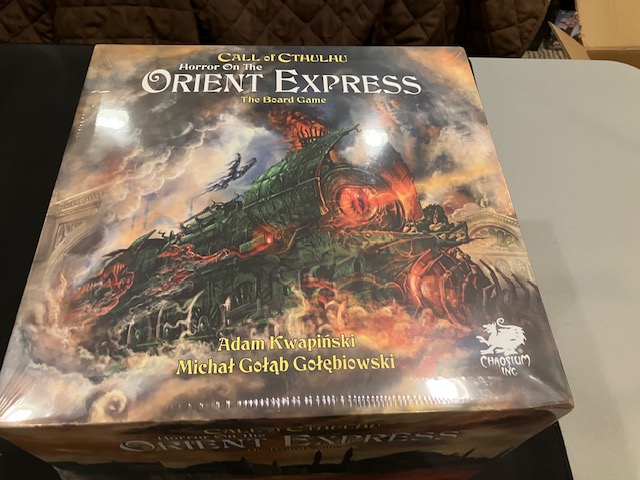
Horror of the Orient Express answers the age-old question: What would it be like if Agatha Christie’s Poirot had to solve a mystery on the Orient Express with Chtulu-like creatures chasing him? Philosophers have pondered this question for years, and now Horror on the Orient Express gives the definitive answer!
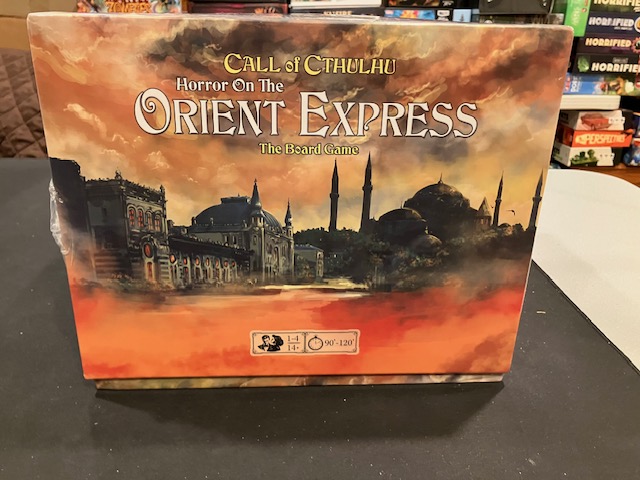
The game arrive at my house Saturday August 22nd. I was very excited by this; it is was on my Top 10 Anticipated Cooperative Games of 2025!

Over the next week, I would spend so much of my precious time with this game system. I have spent 15+ hours going though this so far! How does that time break down? Let’s take a look!

Day 0. Unboxing and Reboxing (and some discussion of gameplay): 4 Hours
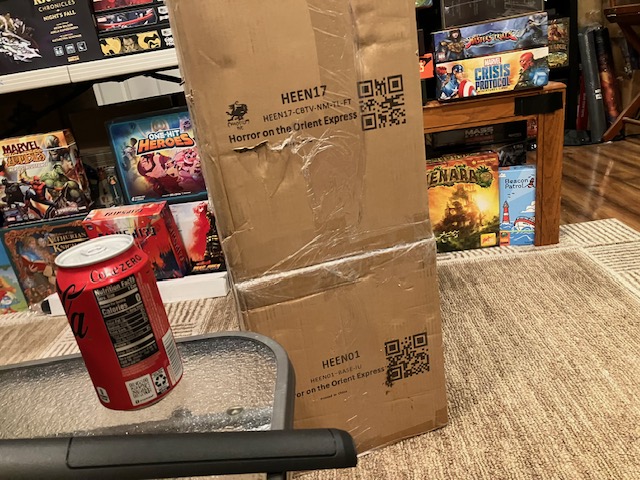
You heard me right; this took 4 hours to unbox. And that was just the base game and some deluxe components! Part of the story here is just how much content arrived! There were two boxes that were actually tapes together when delivered to my house! See above!
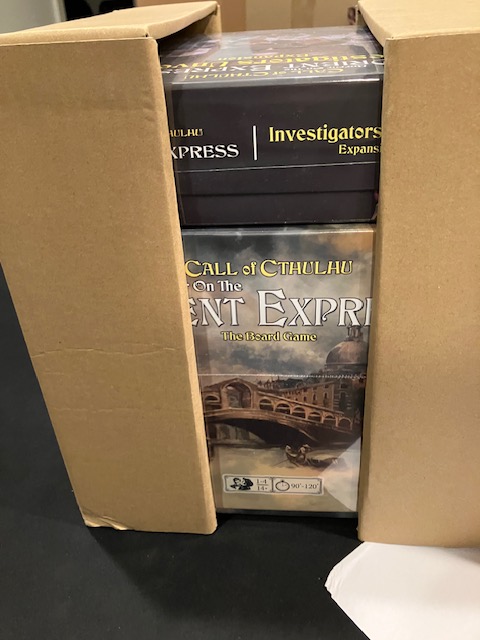
The smaller of the two boxes came with the base game and an investigators expansion (giving more investigators and suspects).
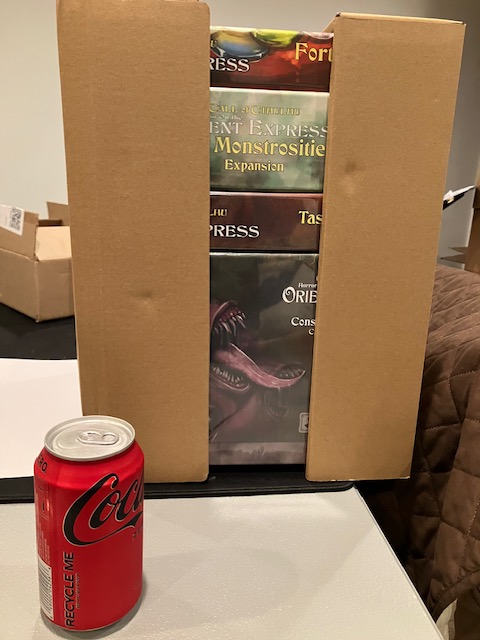
The bigger box came with the campaign expansion (bottom box), more monsters (green middlebox) and some deluxe components (the other two). See Coke can above for some perspective on this!
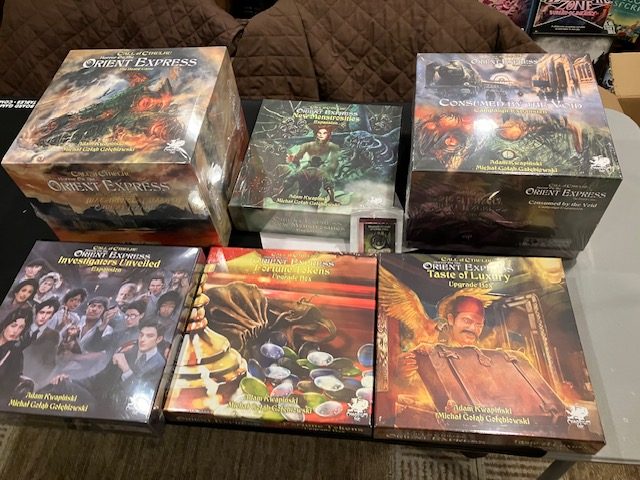
This is probably the biggest Kickstarter I have ordered in some time! And remember, here at CO-OP Gestalt, we pay for everything with our own money! See all the boxes (and a correction card) above!
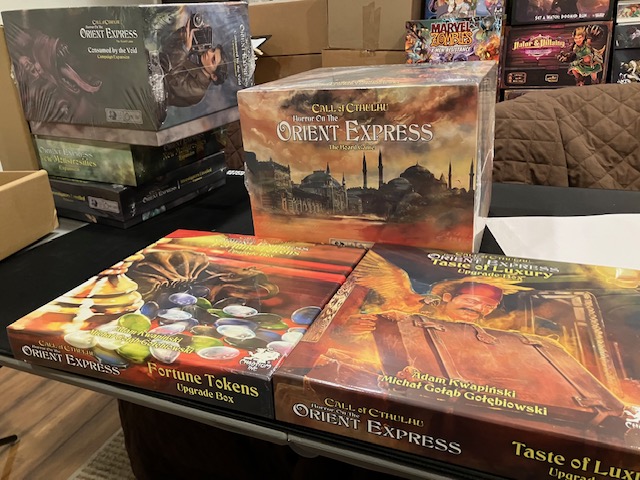
In the end, I chose to only unbox the base game and deluxe components (see boxes above). I’ll come back to the others later! That seems like a sane decision, right? Just limit myself to unpunching and assembling the base box with a few extra acrylic tokens? It still took 4 hours!!!
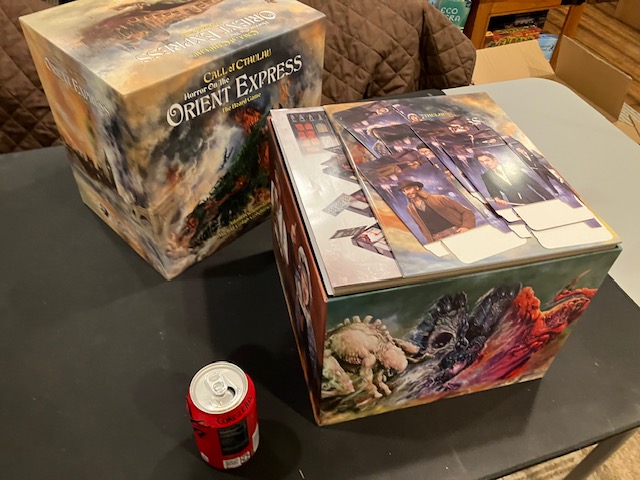
This is a monster of a game! See coke can above for scale!
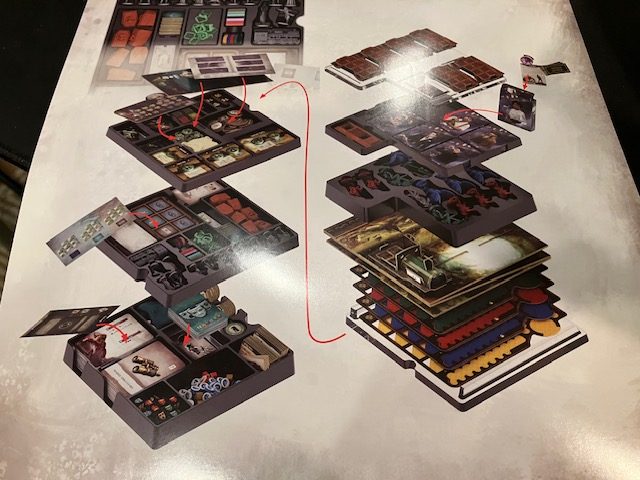
To get a sense of how much stuff is in here, the game includes a really nice boxing/unboxing guide. See above.
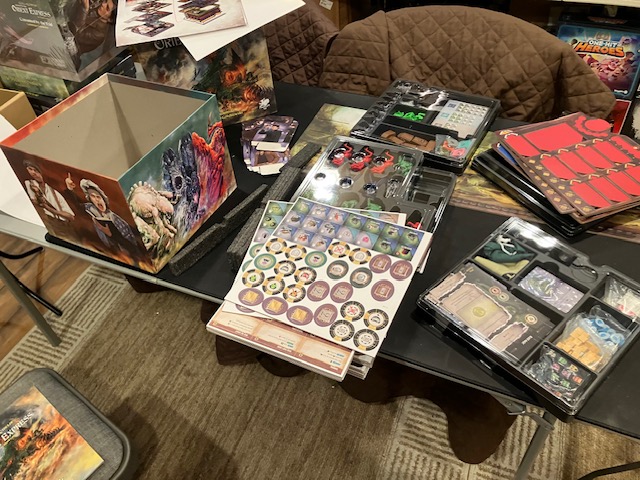
So much stuff!!
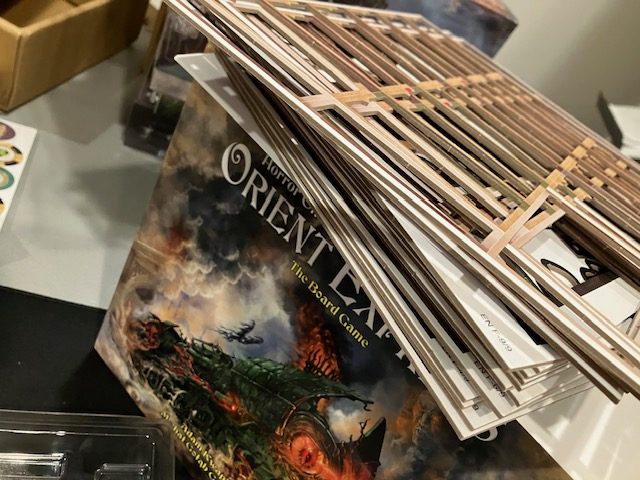
There were SO MANY things to punch out! See all the cardboard skeletons above!! SO MANY PUNCHOUTS! And no, I don’t think I can keep these punchout Skeletons … even if I wanted to.
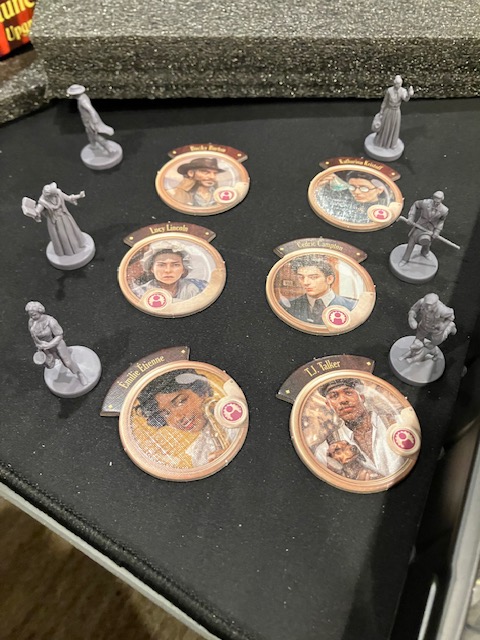
Players each the role of an investigator! See the choices above.
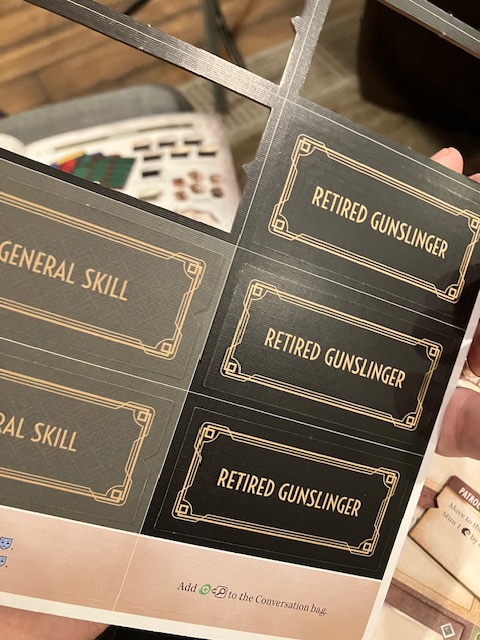
Each investigator has their own set of “main action” cardboard punchouts. See above and below.
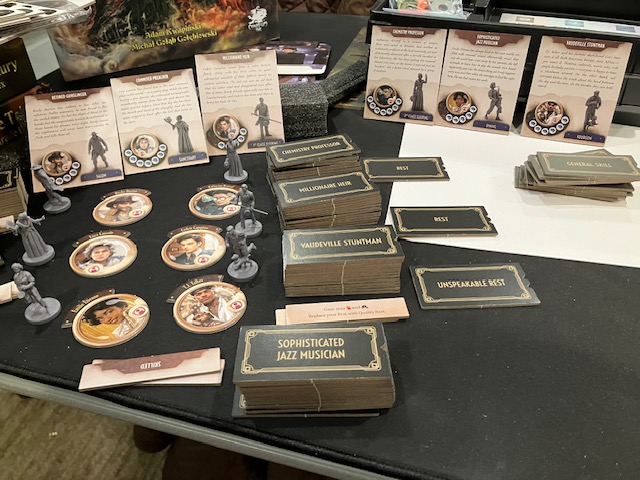
Each investigator is actually fairly unique: their main action cards define the flavor of the character! There’s no special power per se, but each investigator has a different pool of actions that are quite thematic!
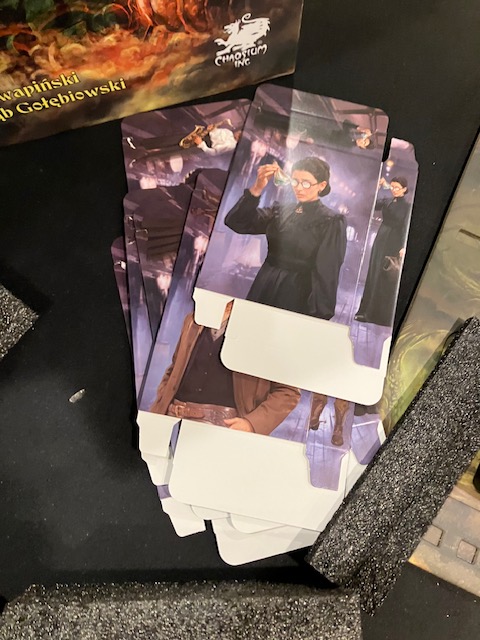
All these cards go back into little tuck boxes (it actually makes it a lot easier to start the game).
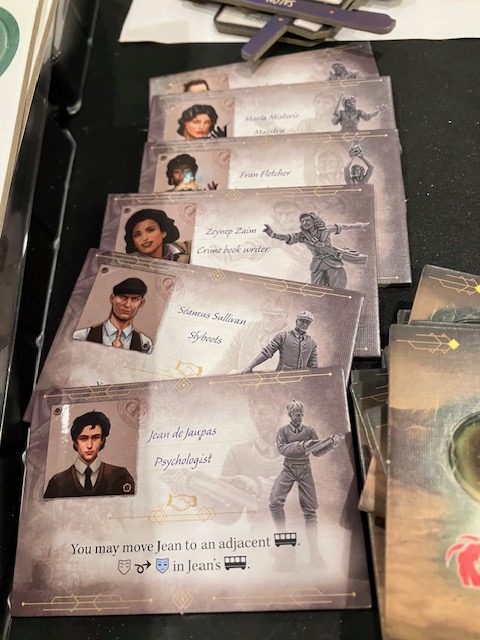
So what are you investigating? As a group, the players cooperatively are trying to figure out which of the suspects (see the 6 suspects above) is a Cultist and which is NOT a cultist! This is cooperative Clue with Cultists and Cthulhu!
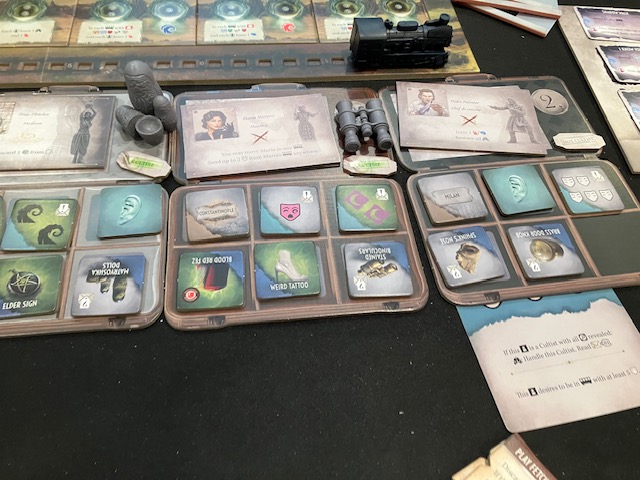
Each suspect has some “luggage” with Clues on them. The nature of the stuff in their luggage tells you whether or not they are cultsists! Do they have a blood red Fez??? They must be a cultist! Are they going to Constantinople? Their stuff is an indicator that they are cultists or not! There is actually a precise definition (based on their stuff) of what makes someone a cultist!
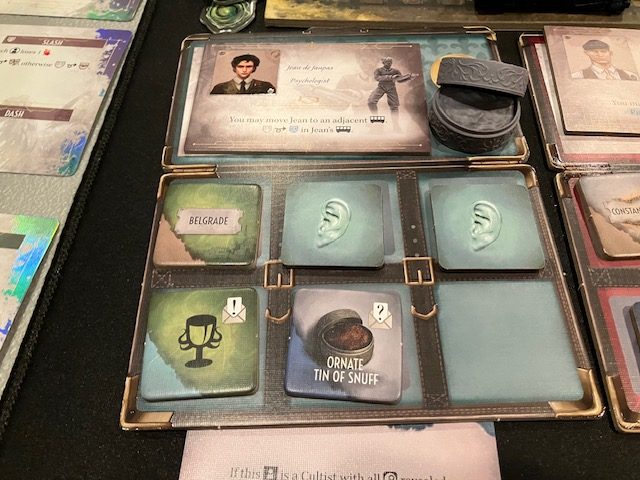
At the start of the game, all suspects have their clues turned face down, and throughout the course of the game, there are many ways to uncover the items and see exactly which suspects ARE Cultists and which ones are NOT! You have to get them all identities correct or you lose the game! This is the primary goal of the game: discover the loyalties of all suspects!

To be clear, all the PLAYERS are in the clear automatically; there is no hidden traitor or anything like that! Players work together to find out who are the cultists!
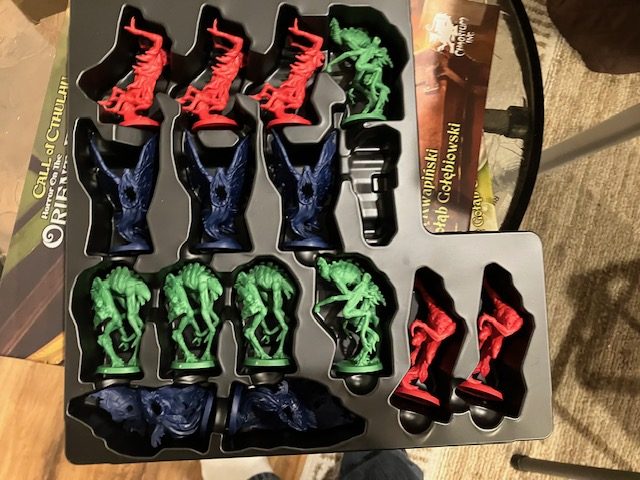
But of course, everyone got stuck on a train that’s driving in the Dreamlands, and we have to survive the Cthulhoid creatures that are chasing the train! See the creatures above and below! They are much less fearsome inside their box!
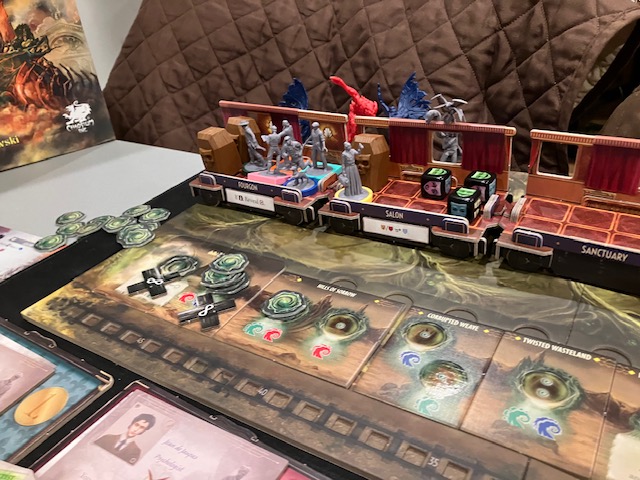
The Cthulhoid creatures race alongside the train and reach in to do damage to passengers and suspects!
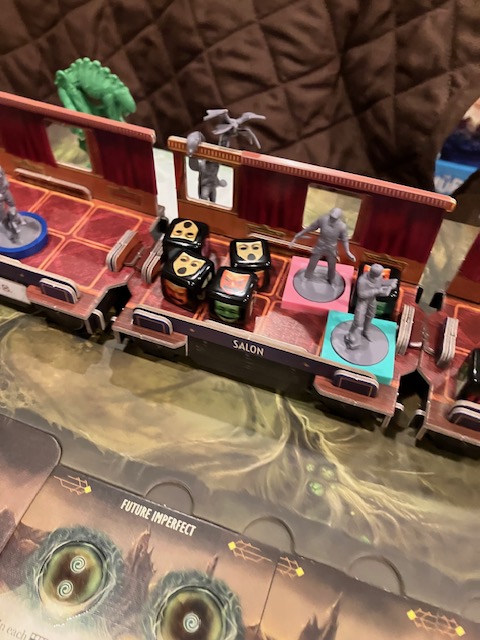
The train is where everything takes place! The investigators, the suspects, the monsters, the passengers, and even a vampire!
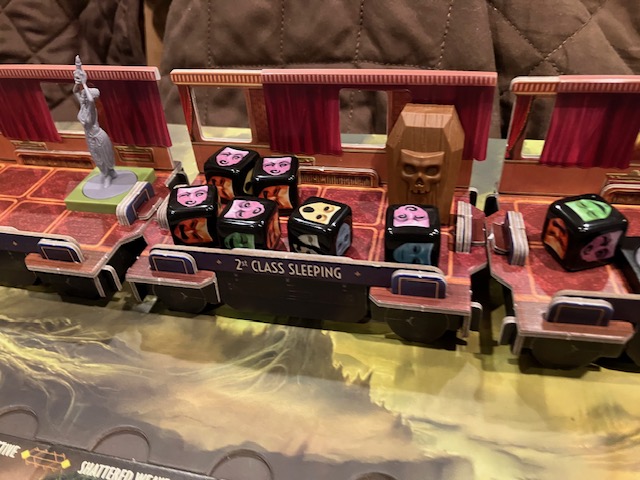
The “other passengers” (not suspects) are represented by die which show a face showing that they are happy, worried, neutral, crazy, mad, or injured! See above! You have to be careful to protect as many passengers as you can! It’s hard to talk to passengers that are mad or crazy! And you need to talk to passengers to find out about the suspects! Remember, you are an investigator!
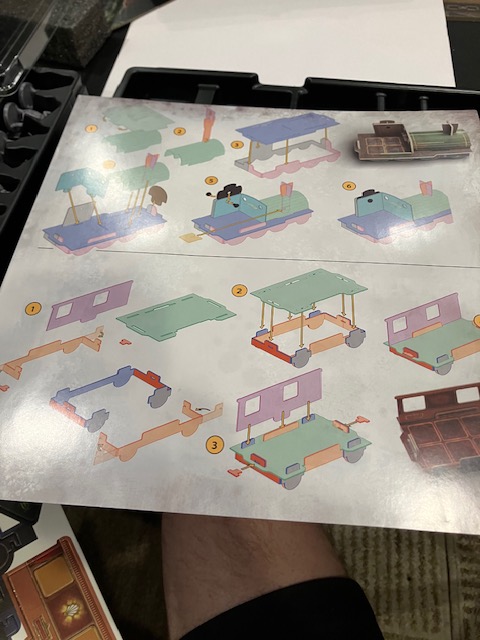
Putting this train together (which is really cool) was actually a surprising amount of time from the 4 hour unboxing time! The instructions are “ok”, but let me give you a little hint now: BUILD FROM THE BOTTOM! See below!! The instructions (see above) show building the train cars from the top, and that just doesn’t work very well.
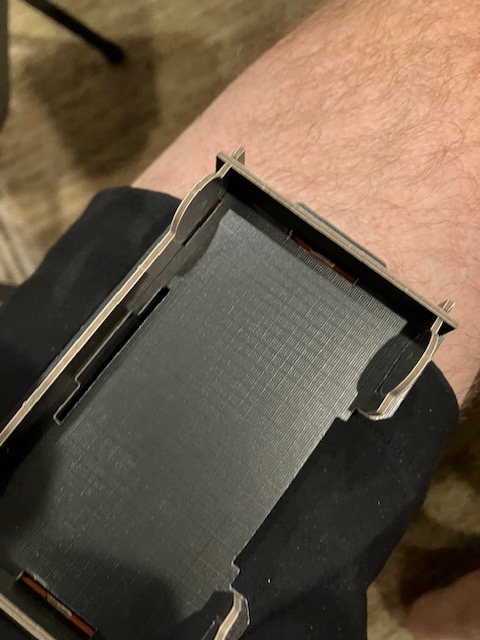
Build from the bottom like I did: See above.
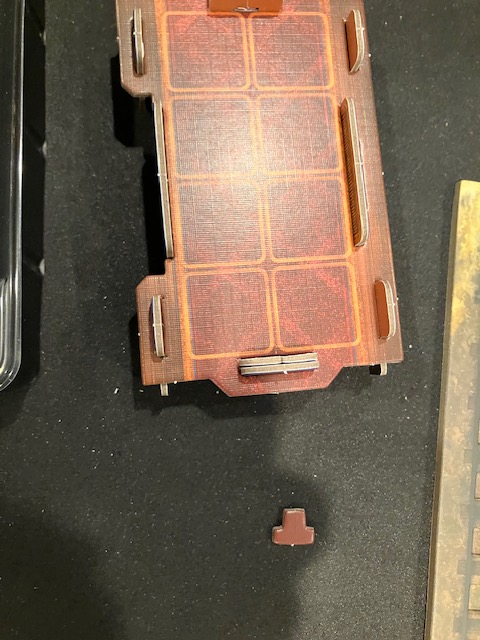
Also, I recommend gluing the final crossbar piece (see above). They kept coming out on me!
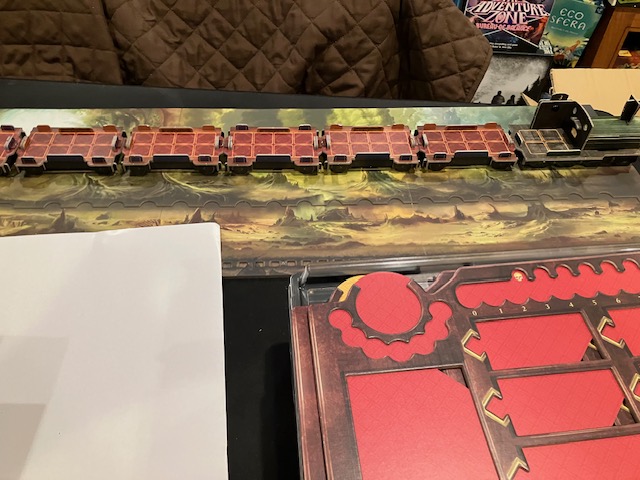
By the time you are done building six train cars and the locomotive, you get a little exhausted. I ended up taking some time to do other stuff before I finally came back to finish my unboxing and reboxing everything back in! (And no, I don’t count that time off in the 4 hours … this really took 4 hours!!)
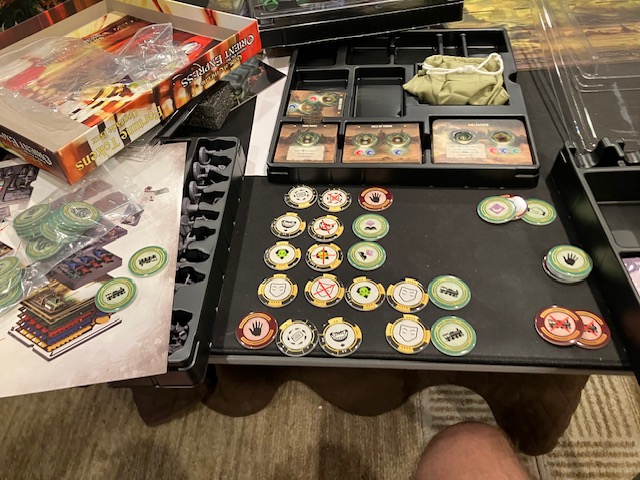
Oh yes, I need to comment on some of the deluxe components. The acrylic conversation tokens and event tokens from the upgrade box are really cool!!! See above!
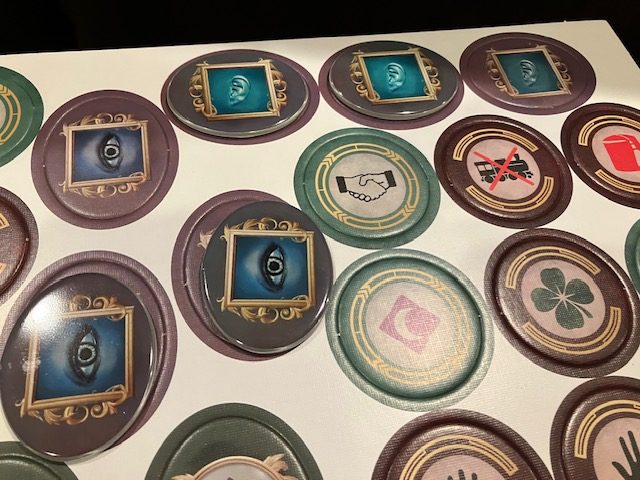
… but they are not well-labelled! In fact, the expansion box has acrylic tokens for EVERYTHING (including other expansions), so you don’t really need ALL the acrylic tokens for the base game! And in fact, they don’t all fit if you try to use all of them!!! I ended using the unpunched cardboard tokens (see above) as a guide to which tokens to keep! This was extremely frustrating that I DID NOT know which tokens to use for the base game and which tokens to use for the campaign and other pieces! They reallllllly needed to have some better labeling.

As you put things back in the box, you will both love and hate the sheet above! Why? Because it shows everything (I love that) but it’s so hard to see detail! (I hated that!)
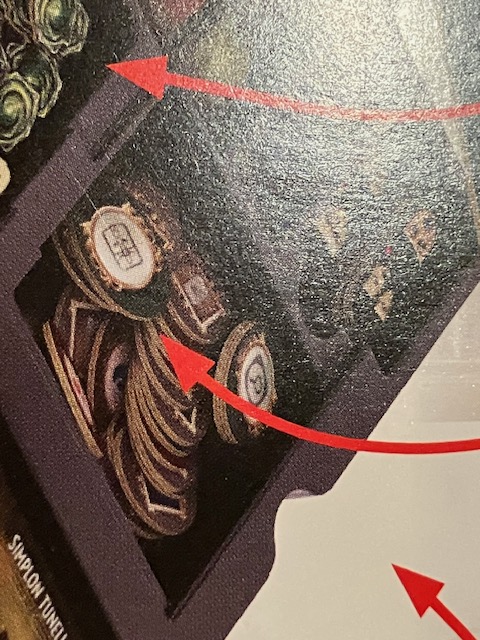
See above as I had to use my phone to zoom in so I could see the detail!!!
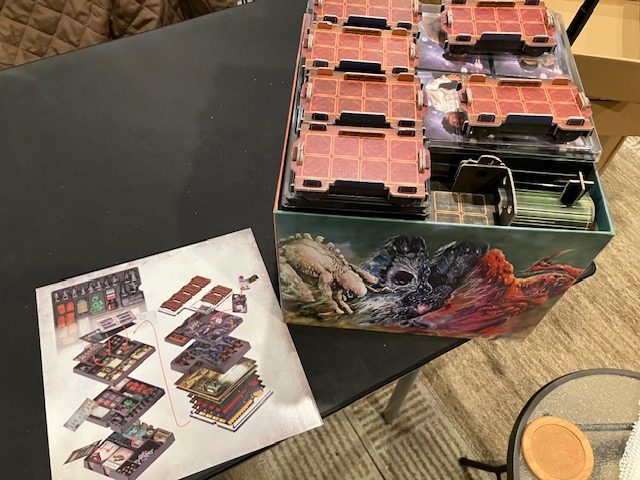
Putting everything back into the box in its proper place (after punching everything out) was a chore. But it did work.
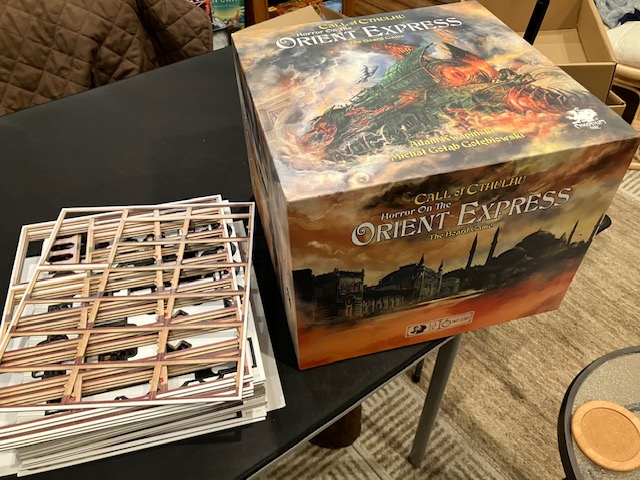
Yep. It took me 4 hours to unbox everything, punch out so many things (see cardboard skeletons above), dig through deluxe tokens (and realize there’s no way I can put them all in the base box), assemble the train, then finally rebox!!

Whew!

Day 1. Set-Up: 2 Hours
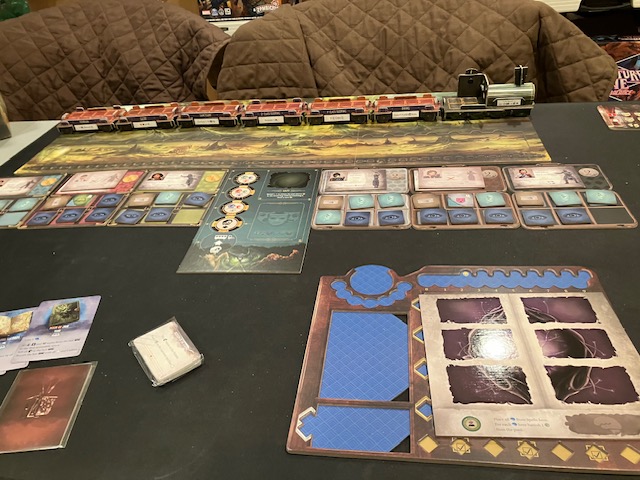
You might ask “why did you put everything back in the box if you knew you just needed to get it all out again?” I asked myself that same question! Seriously though, there is some value in handling all the components again; there’s a kinesthetic boon to seeing/touching all the components in the game again.
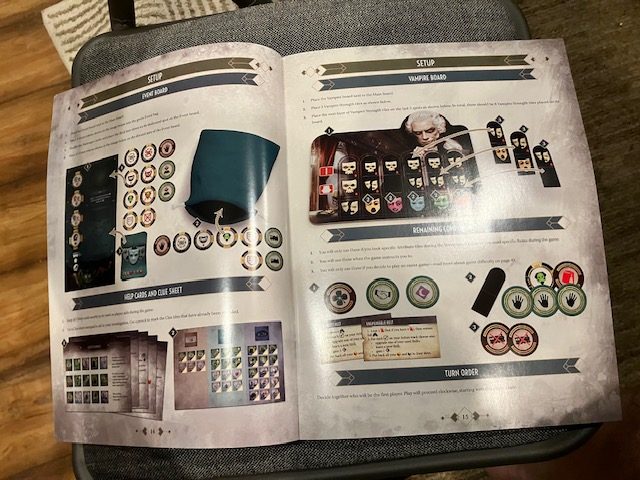
If you think that 2 hours is ridiculous to set-up the game, I point you at the rulebook: setup takes about 10 pages! That’s right, about 10 pages of the 48 page rulebook is just to set-up the game.

Uh-oh. This is gonna be hard.

Day 2a. Reading Of The Rules. 2 Hours.
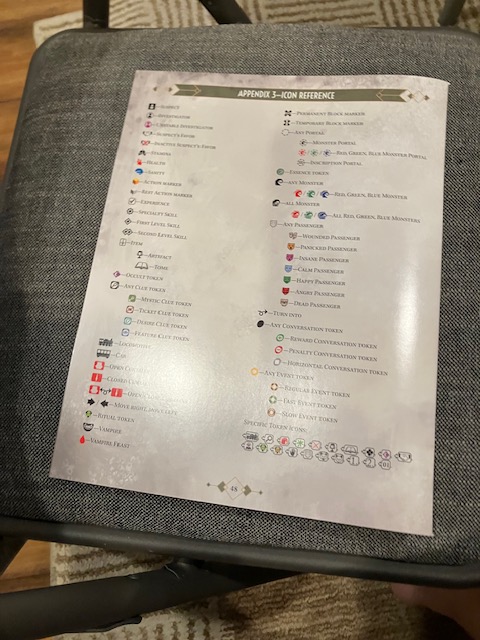
If you think this is a big complicated game with lots of rules … you would be correct. The rulebook is 48 pages long.
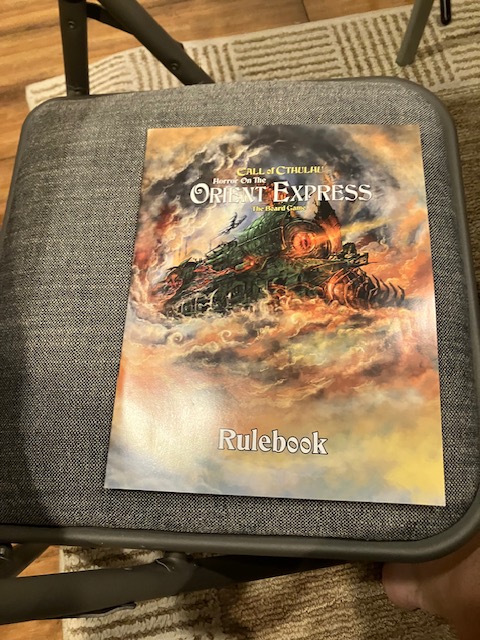
The rulebook is good, but there are a LOT of rules … a lot of rules that you will have to lookup again and again.
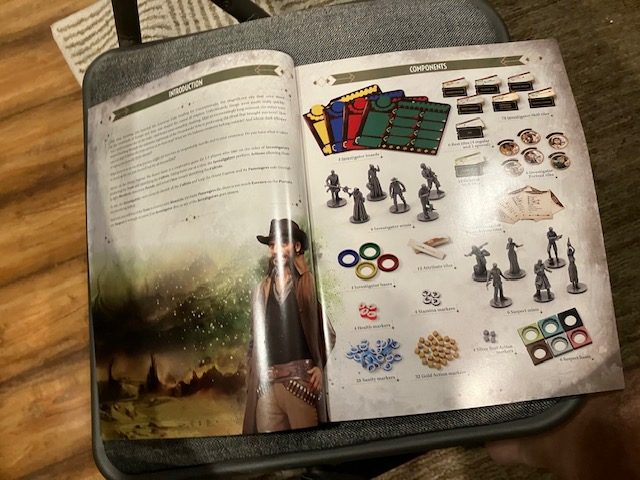
The rulebook does fit well on the chair next to me: it stays open and is easy to read, but there is just a little bit of drooping of the pages. I’ll give this rulebook a B+ or A- on The Chair Test; It has a good form factor.
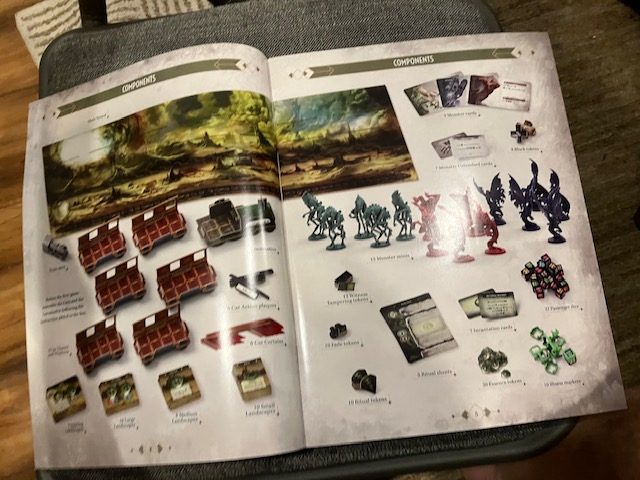
The components pages are nice, but they span multiple pages. The actual Set-Up also spans multiple pages!
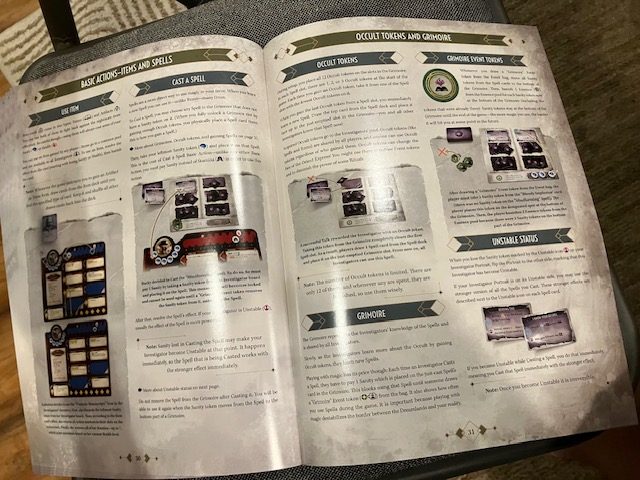
In the end, you just have to get through this rulebook. I sat with the game set-up in front of me, and read the rulebook while constantly referencing the set-up game. This rulebook kind of feels like a legal document because there are so many rules and descriptions. It’s not too bad, but it took me 2 hours to get all the way through the rulebook so that I had an idea of what was going on.

I didn’t really feel like I could jump into the game until I read just all the rules. There’s too much going on to say “let’s just try it!” Nope, that’s a recipe for disaster! You absolutely need someone to read the rules ahead of time, or you will end up reading 2 hours of rules with your friends and annoying them.
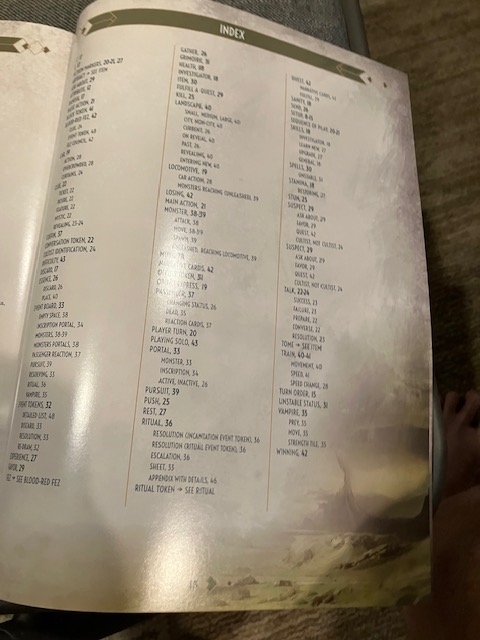
I was very pleased that the rulebook included an Index. It wasn’t perfect, but it was good enough to help when I needed to look up something.

This was a good, if long and legalese rulebook. You will refer to it a LOT as you play.

Day 2b. Solo Game: 3 Hours
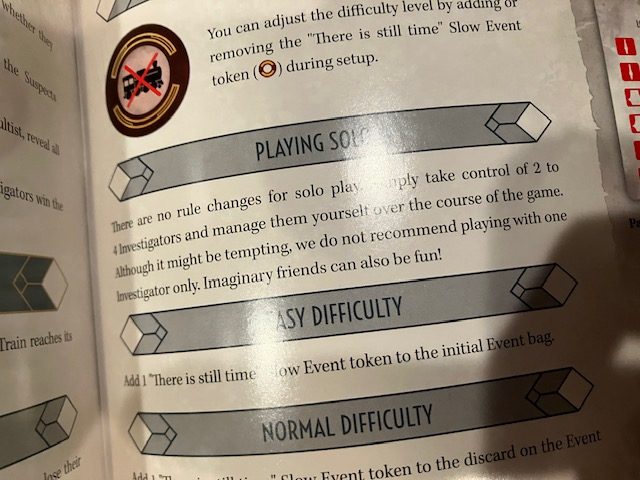
There is a solo mode (huzzah on following Saunders’ Law!)! See rulebook above. Basically, you are supposed to play 2-Handed solo, alternating between two characters.
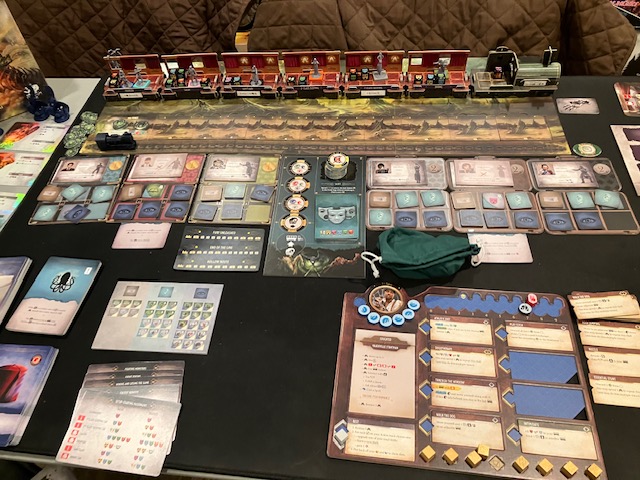
Now, I think I misread this the first time I set-up, as I just went ahead and played true solo: I operated a single character. See set-up above. After playing with a single character, I am glad I made that mistake! There are SO MANY rules in this game, that alternating between two characters just seemed like too much work.
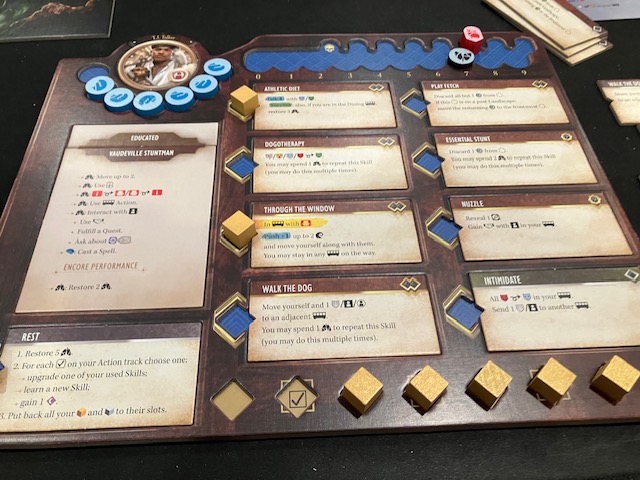
See above as my character advanced pretty quickly.

After accidentally playing true solo, boy, I am really glad I did! I think I would have hated alternating between two characters as I I was learning the game. There are a LOT of rules in this game, and each character has a LOT of options and main powers … I think I would have been completely overwhelmed on first game had I played 2-handed solo.
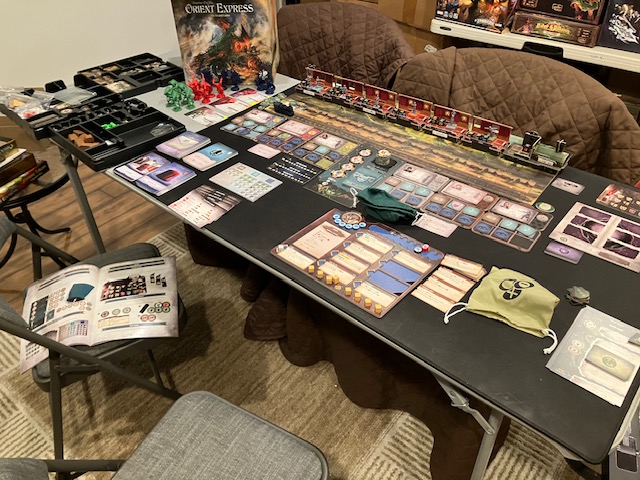
I think what I am saying is … this was a happy mistake! Maybe your first game should be a true solo game so you can get a sense of everything in the game. I know I cheated a few times in my solo game, on accident and maybe once on purpose (just to get to the later game), but I think … this might be the best way to learn?

I can’t comment too much on the balance of a solo game (because I was just playing true solo to learn the game), but I think I would prefer if the game had a true solo mode? This is hard for me to say because I frequently prefer 2-handed solo mode because they typically don’t have rules exceptions! I think this is case where a minor rules change (or two) for true solo might be worth it; it might be as simple as you start the game with a couple of items already in your inventory (one of them a healing item).
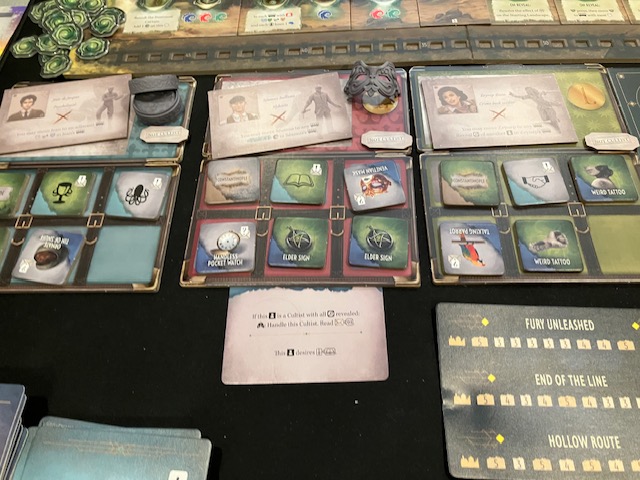
In the end, the true solo player was able to keep the Cthulhoid monsters under control and accurately guess the identity of all the cultists! And it only took 3 hours!

This was a learning game, so I expected it to be longer than normal games. But it was 3 hours to play EVEN after setting everything up ahead of time! And I didn’t even tear-down, because I left it “mostly” set-up for cooperative play!

Day 3a. Cooperative Game: 3.5 Hours.
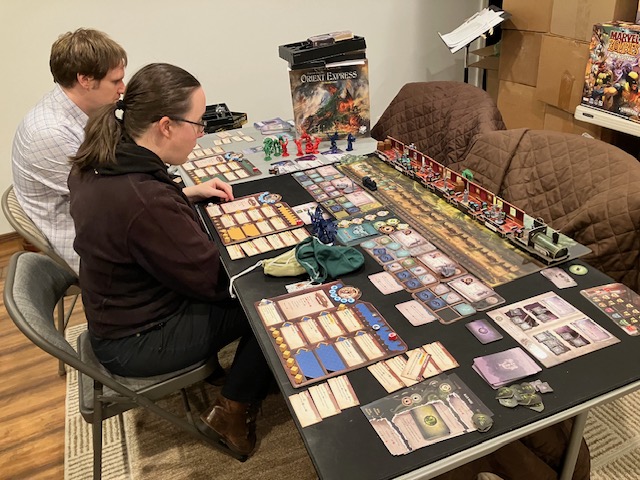
Interestingly, the game suggests that a cooperative game all sits on one side of the board. This would work fine for a 1,2 or 3 player game, but I worry that a 4 player game just wouldn’t fit? We only played a 3-Player game (above), and we just barely fit. Maybe you just need a bigger table if you play 4 players?
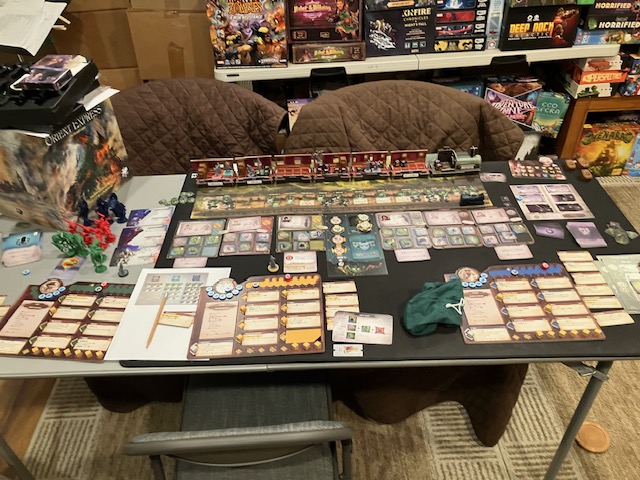
I am SO HAPPY that I set-up, read the rulebook, and played a preliminary game before my friends came over. We ended up playing 3.5 hours of just pure playing time! Let’s be clear: my friends and tried-and-true gamers who have played many complex games: we did not get “stuck” on anything!! The game moved along as it should with some rule lookups, but it still took 3.5 hours to play!
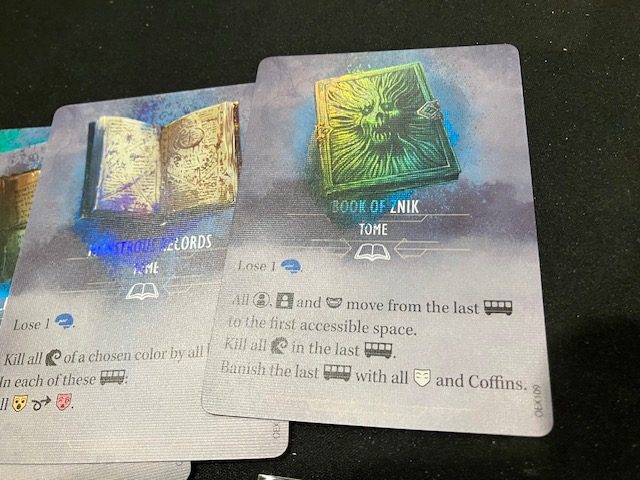
The game has some interesting ways to promote cooperation: for one, all spells and items are shared! That means there’s no need to worry about explicit “share” actions or anything like that! On your turn, if you want to cast a spell or use an item, you just use the shared pool and do it! There’s no “I have to move to you to give you the Book of Znik so you can use it!” You could argue it’s not thematic (how do you share items if you aren’t even in the same train car??), but it does get around all the problems of sharing and wasting actions to get stuff to each other. The fully shared paradigm does help the cooperation.
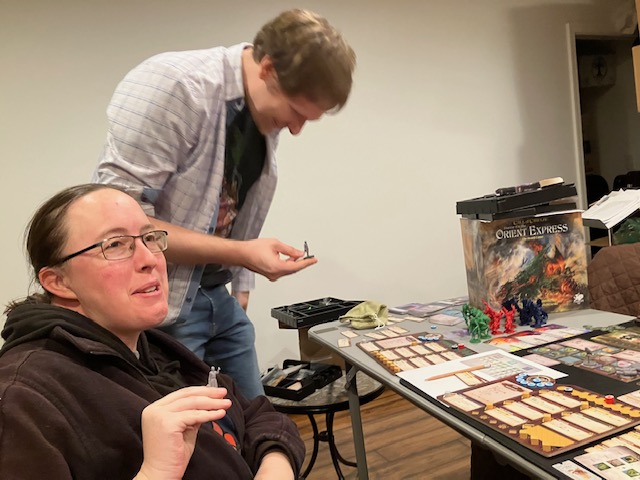
At the start of the game, most turns tend to be fairly multiplayer solitaire. Don’t get me wrong, there are mechanisms that affect other players (For example: TJ could walk his dog and have another player move with him), but players did their own thing. What I saw happen was the people kind of took their own turn and did what they wanted at the start of the game. I think this was good; it helped players become familiar with their powers, the rules, and the interactions.
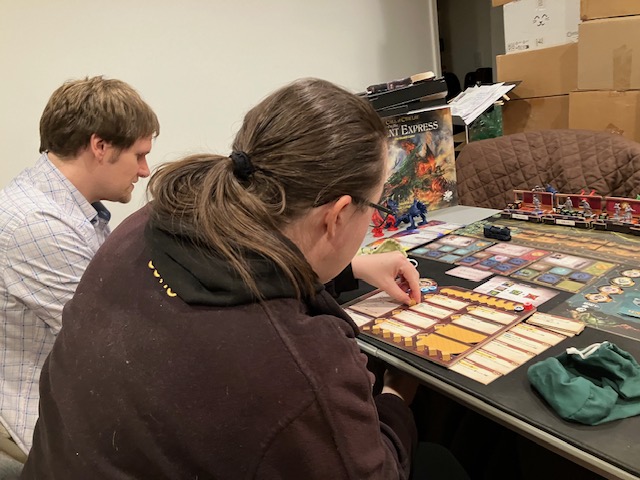
What I saw happen was that as things became more dire, we started setting each other up and helping each other directly more and more.

“We really need to find out if he’s a cultist before the train reaches the end!!”
“Ya, but I have 3 cthulhoids coming up behind me! I need to deal with those!”

So, in the end game, we started working together more and more. To be fair, we pretty much had to cooperate or we would have lost the game!

From this point of view, I think the game is a good cooperative game! Players have agency to learn their characters at the start of the game, but learn to cooperate as the situation gets more dire!

To be fair, it still took 3.5 hours to play a single game. Even though it was a learning game, I did everything right to make the game introduction as simple as possible (set-up, read rulebook, played solo) and it still took 3.5 hours to play!

Day 3b. Tear-down: .5 hours
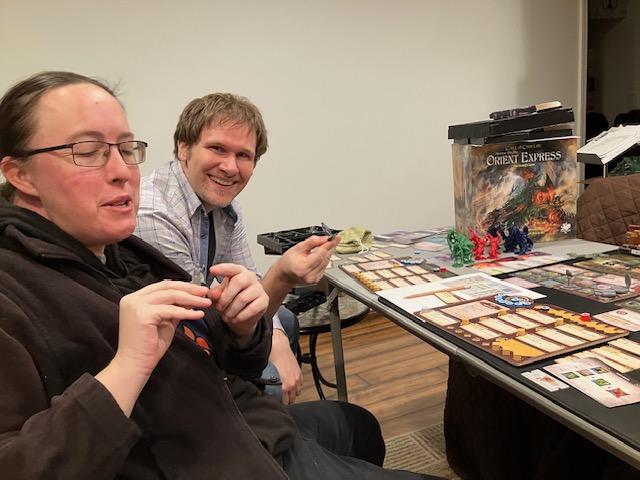
After winning our 3.5 hour game, my friends helped me tear this down.
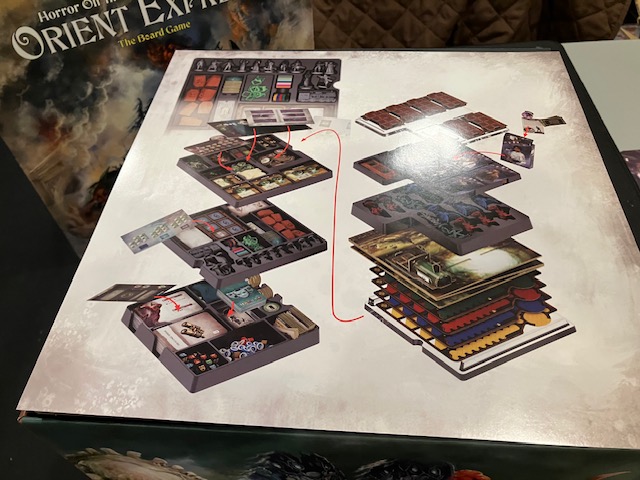
This unboxing sheet (see above) made all the difference in the world! Tearing down the game was a cooperative experience worth its own game! I saw massive parallelism as my friends and I would each take “some pieces” from the game and consolidate them into the box! Seriously, I felt like the tear-down was its own cooperative game.

Hm, I kind of wonder if how well you tear-down a game together is a measure of how well your group cooperates together? I can say with pride that my core game group works well together! Someone was always doing something and working on putting this back together!

It still took a while to put this back together.

What I Liked

Table Presence: The game looks sooo cool on the table! The train cars, the cthulhoid creatures chasing the train, the vampire hanging on the windows, the amazing landscape, the characters, … everything! This just looks so epic!

Component Quality: In general, the component quality was good.

The Arc: The arc of the cooperative game was interesting and a very good development to encourage cooperation. The game starts fairly multiplayer solitaire, then converges to being much more cooperative as the game unfolds.

What I Didn’t Like
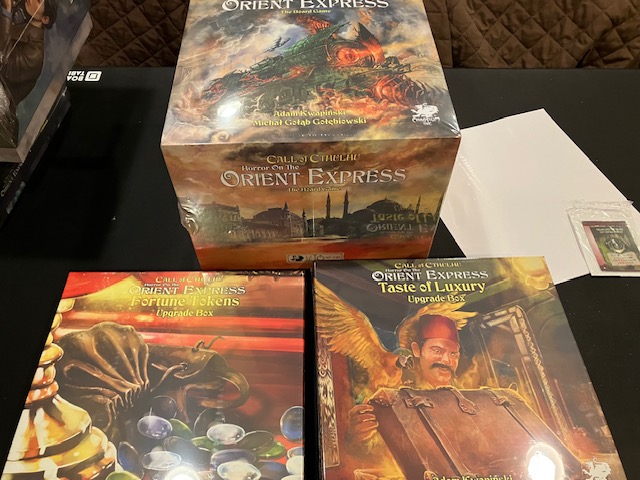
Deluxe Component Issues: I love the deluxe components, but there’s two major problems. One, there’s no discussions (especially in the fortune tokens) about which tokens you need for which box! Second, there’s no way the deluxe components can all fit in the core box. If you were hoping to have all the deluxe components fit into the base box, think again! If you wanted to throw away your deluxe component boxes … well, you may have to hold onto them longer than you expected.
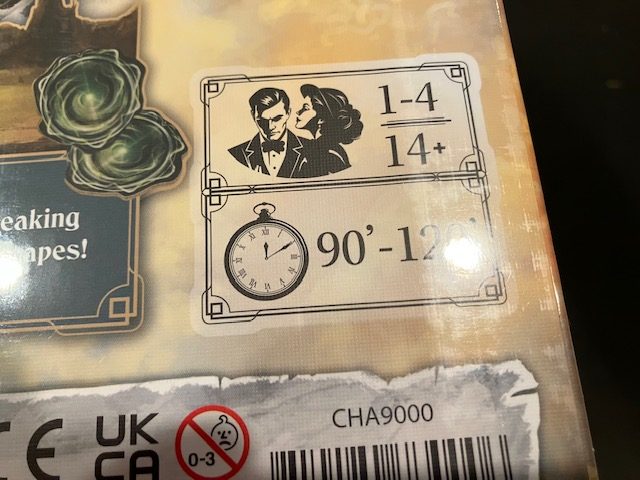
The Length: I find it very very hard to believe that this game plays in 90-120 minutes. Even if you cut-off the set-up and tear-down times, the game length still feels waaaaaaay off. There are so many rules.
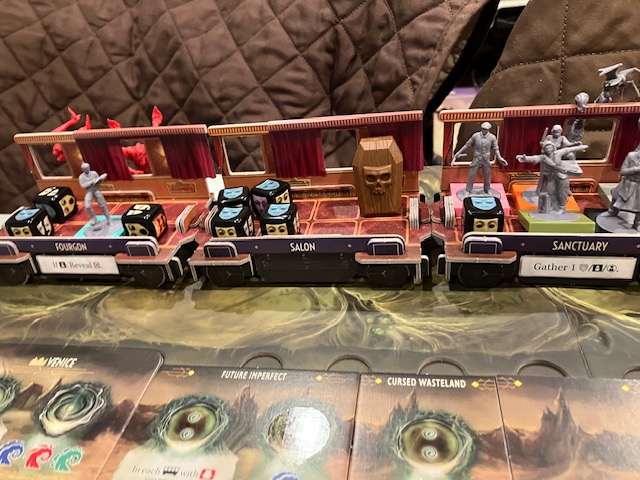

Colors are a little wonky: The suspects each had a colored base that helped you identify them, but they really didn’t match the suitcase colors very well. At all. The brown suitcase we think uses the orange colored base?

Cthulhu Game?
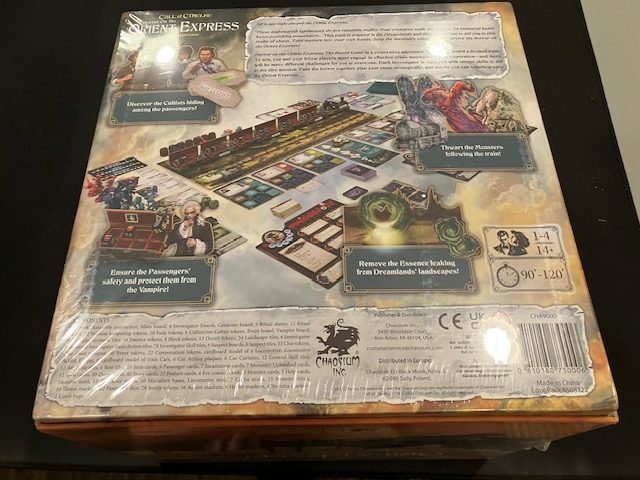
Is this a hu game? Well, if your definition is “Cthulhu must appear”, then no, this is not a Cthulhu game. Maybe the better question to ask “Is this game set in Cthulhu Mythos?” Strictly speaking, the answer might still be no! The only real allusion is that the “train is driving through the Dreamlands”. But the vibe, the feel, the plot, everything feels like this is a Cthulhu game! Then I think the answer is yes! The train has sailed into the Dreamlands, Cultists are summoning and conspiring, portals are opening …

I mean, Chaosium does Cthulhu games. I am calling this a Cthulhu Mythos game.

*I was going to search the rulebook for the word Cthulhu and Cultists, but the PDF rulebook in the BGG files section IS NOT SEARCHABLE. They need to fix that.

Reactions

Andrew thought it was fun, but was worried that the time-investment vs. fun wasn’t good enough. His point was that there are a lot of rules and the game is really long. We had fun playing for 3.5 hours, but there’s many games we could play that are half that time but arguably more fun.

Teresa liked it and would play again. This would make one of her top Cthulhu games.

Conclusion
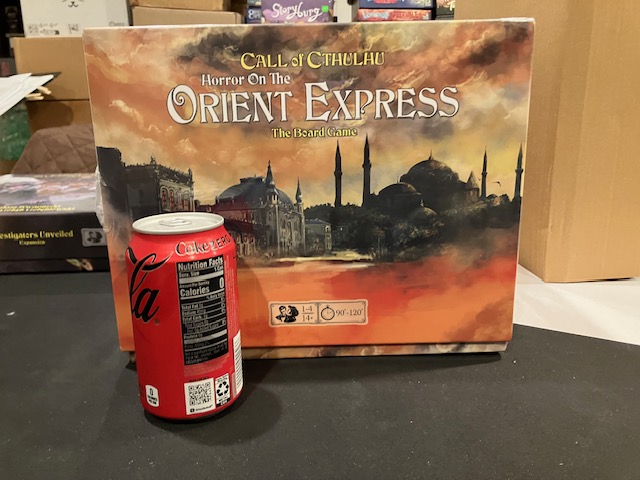
Horror on the Orient Express is a monster of a game … in every conceivable notion! It’s a monster of a box, with big monsters, a monster 48-page rulebook, a monster set-up and tear-down time, and a monster playtime of at least 3 hours. You have to decide if the monster aspects might be too much for you!

I would call this Cooperative Cthulhu Clue, as it’s a deduction game where you flip clues, but that would lure you into thinking this is a simple replacement for Clue! Absolutely not! Horror on the Orient Express is a deduction game where you worry about investigating while also fighting monsters and fighting vampires and saving passengers and basically keeping spinning plates going! There’s a lot going on! If you have always wanted something more complex than Clue set in a cooperative environment and fighting monsters, then maybe this is right for you! But don’t be lulled into a simple “Oh this is just Cooperative Cthulhu Clue!” No! It’s so much more! And that’s good or bad, depending on whether you you like this world.

If you like living in a Cthulhu-esque world of monsters and cultsists, then Horror on the Orient Express nails the theme! If you live that theme, you will love this world. If you just like the theme, you need to decide if the overwhelming nature of the rulebook, the game, the box, the length may be too much for you.

I look forward to playing this with some friends in Las Cruces, as they love Cooperative Cthulhu Mythos games! I know a few will blanche at the length and complexity, while others will embrace this monster of a game! Hopefully this review will help you decide if this is for you or not.
Detective-Heists and Heartbreak. A Solo and Cooperative Review of a new Expansion for Detective: City of Angels

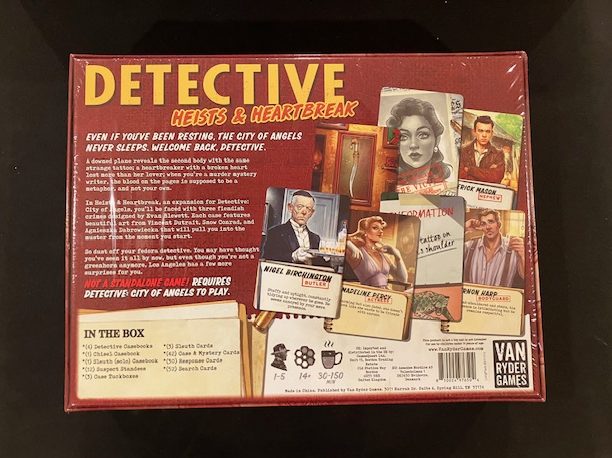
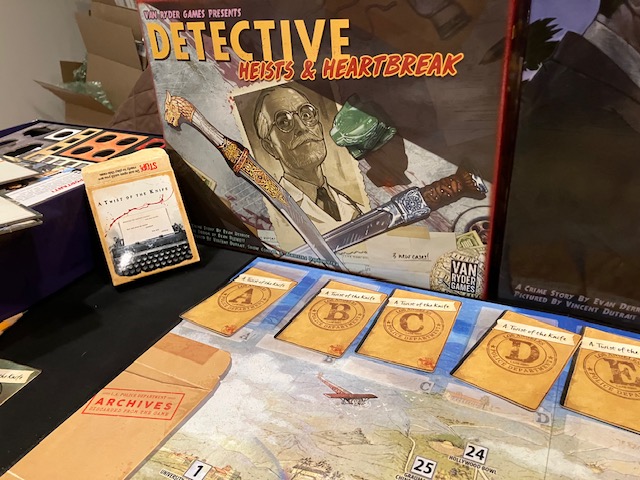
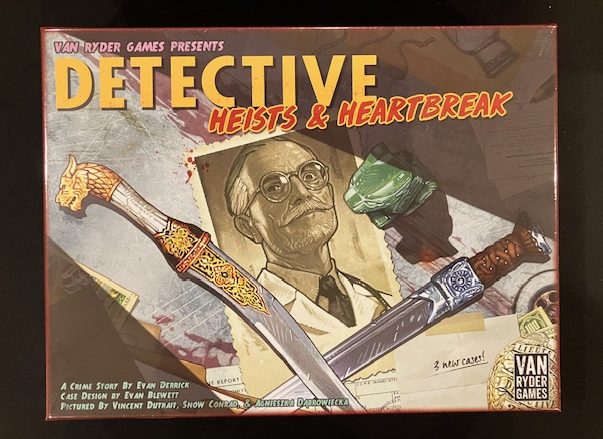
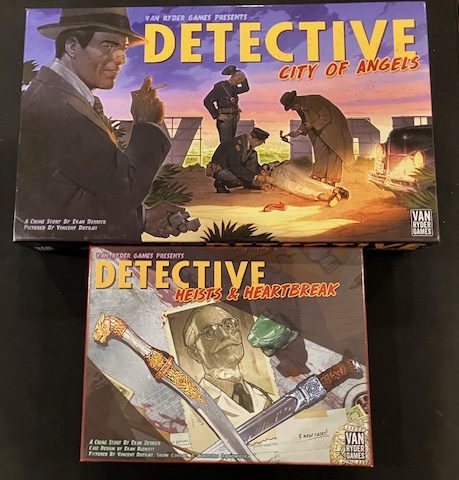
Detective: Heists & Heartbreak is an expansion for the mystery board game Detective: City of Angels. This expansion was originally up on Gamefound as a pre-order December 2025. It pretty much delivered on time in early 2026.

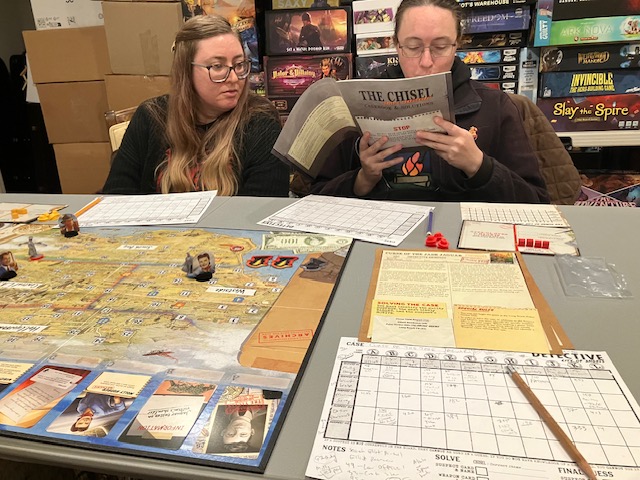
Although the primary way to play Detective: City of Angels is as a 1-vs-many game (the chisel vs the detectives), that’s not the way we choose to play! The base game comes with a cooperative mode (built-in) where the detectives work together to solve the mystery of the week; we always play this cooperatively! And it works great!

There are three mysteries in this box that augment the original game!

Let’s take a look!

Unboxing

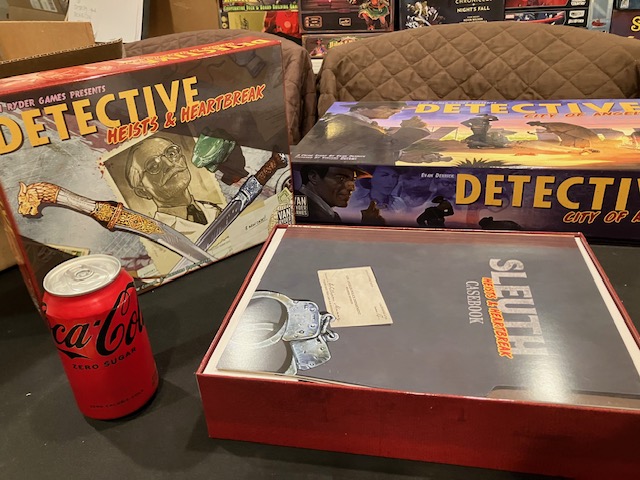
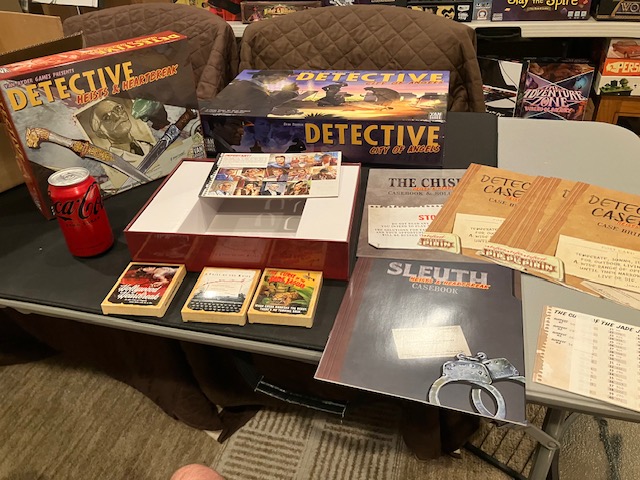
The box is probably bigger than it needs to be; see Coke can above for scale.

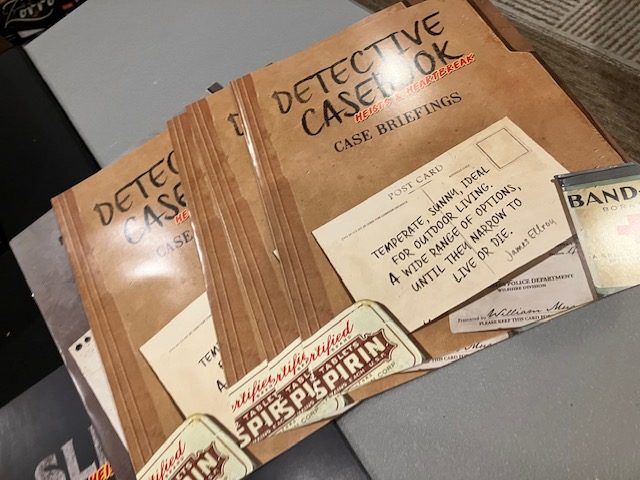
There’s four case books (one for each player, up to 4 players cooperatively) which include the three new cases.

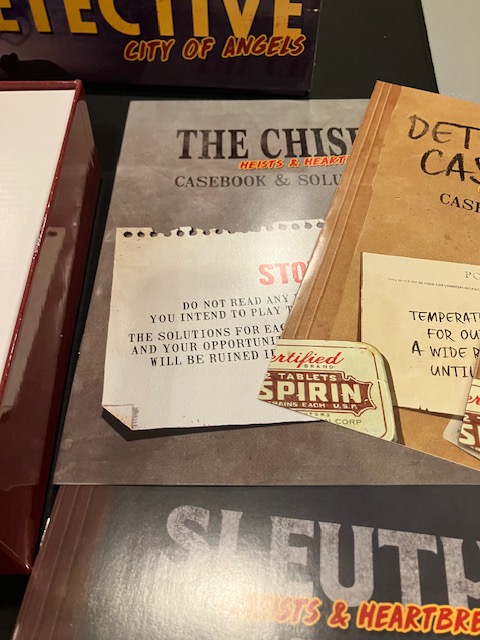
The Chisel book is included for the new cases … fun fact, you still need the Chisel book for the “final mystery summary” even if you are playing fully cooperatively! It replays the case and all the clues in a final “wrap-up”, kind of like what you expect in your favorite mystery shows like Death in Paradise, Midsomer Murders and other murder mystery shows.

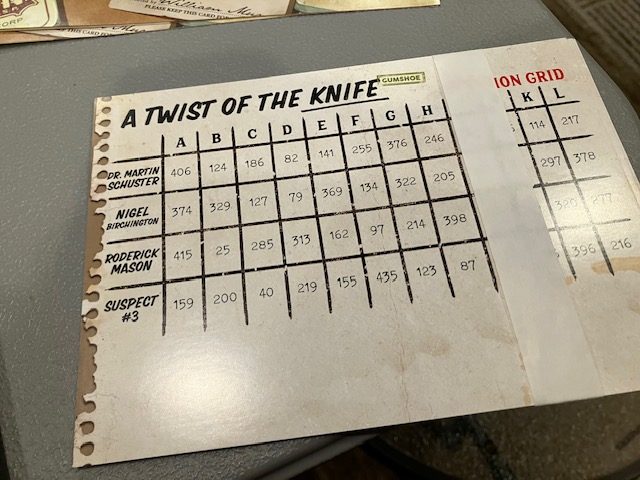
For the cooperative game, there’s a sheet you use to indicate a passage to read … you are basically questioning suspects and witnesses about the murders and getting responses!

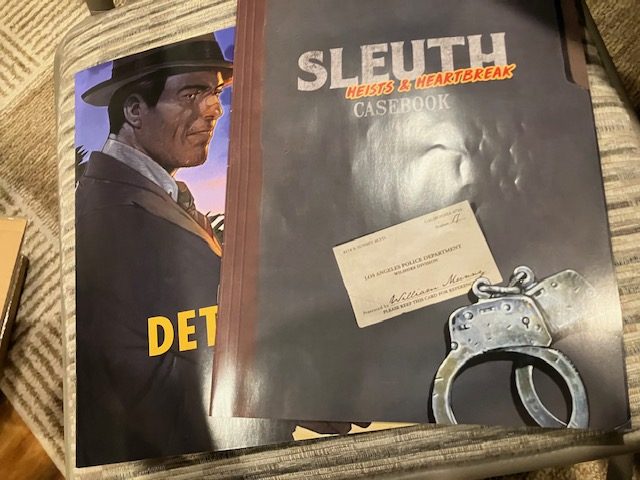
The Sleuth Casebook has all the entries for the grid: this is a storybook AND deduction AND mystery game! If you truly want a mystery like Death in Paradise, with all the interactions of witnesses and suspects, this is what you are looking for!

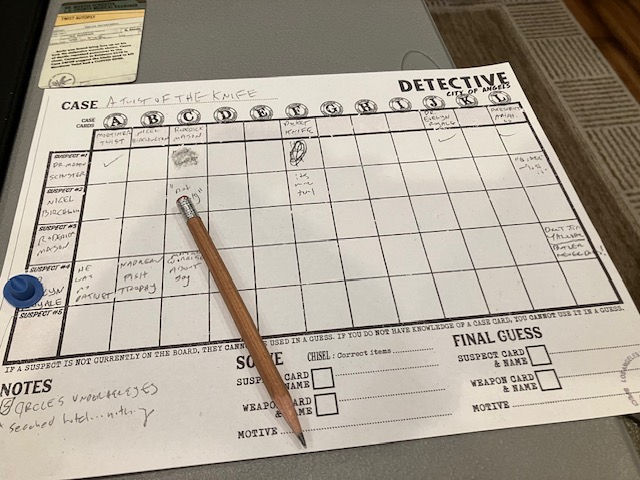
Using sheets from the original game, you make notes to yourself about what you saw and have to solve the mystery!

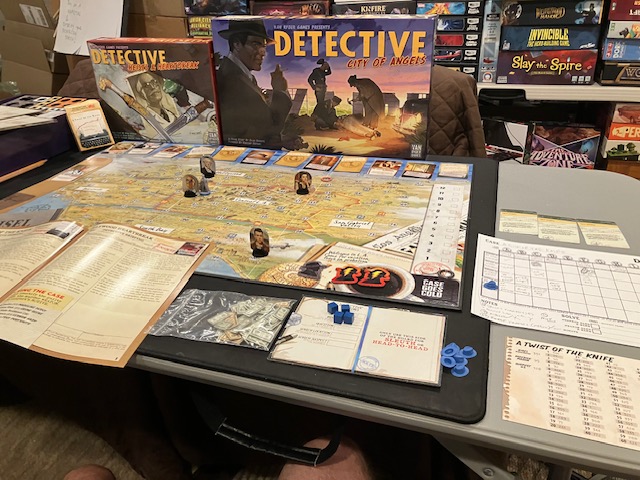
This expansion fits right in with the original vibe: it looks great! See above.

Case 1: A Twist of the Knife (Solo Play)

So, Detective: City of Angels has both a solo mode and cooperative built-in! Thank you for following Saunders’ Law!

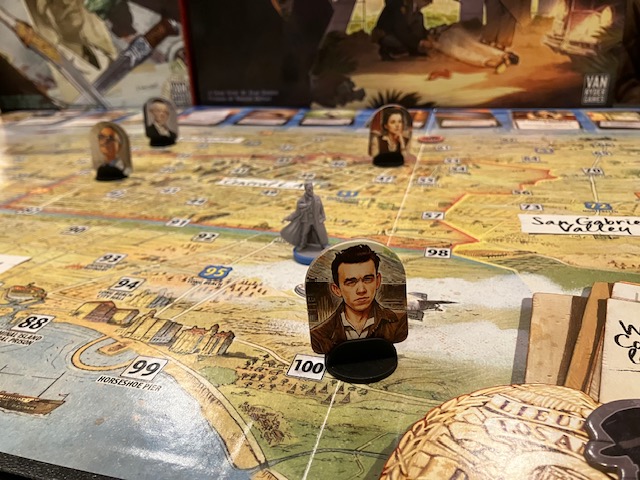
The solo mode for the game is a true solo mode: one player plays one detective, wandering around LA and questioning suspects, searching locations, and searching suspects!

The game balances itself by having 12 “days” to discover the solution, where each “day” is one player taking 4 actions. The solo player has it a little harder, because he has to travel all over the map by himself, but this is how the game balances for multiple players: the players (whether one or many) always gets 12 days with 4 actions per day, no matter how many players. The solo player gets all the actions, but the cooperative players have to divvy those actions between themselves.

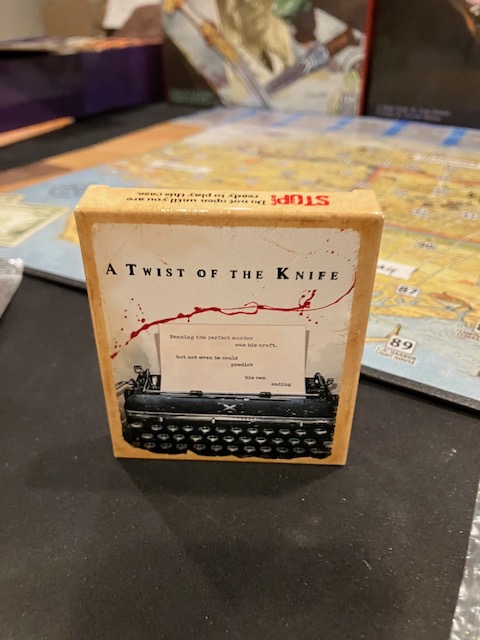
I played the first mystery, A Twist of the Knife solo partly to remind myself how to play, and partly just because I love solving mysteries! I watch and read a LOT of mysteries, and I am always try to figure them out! And yes, I figured out the first mystery, but only after a second chance … if you fail to get the Motive, Weapon, and Reason within 12 days, you get a second chance … 3 more days …

The solo player is hamstrung a little on travel, because he’s only one detective having to wander all of LA to find things! That is balanced because the solo detective has the clarity of a single vision to push himself forward. It’s also a little harder on the solo player because he has to look up everything by himself! Look at the grid to find the entry, then find the entry in the Sleuth book, then read to himself! It’s not a terrible amount of work, but the game is more work for the solo gamer.

A Twist of the Knife worked great a solo game, and it reminded me why I love this system so much: I feel like a real detective solving a real mystery; I have to find the clues, do the hard work of questioning, follow my instincts, and make suppositions!

I will absolutely play Detective: City of Angels solo in any form. This new expansion fits right in.

Case 2: Hollywood Heartbreak (Cooperative)

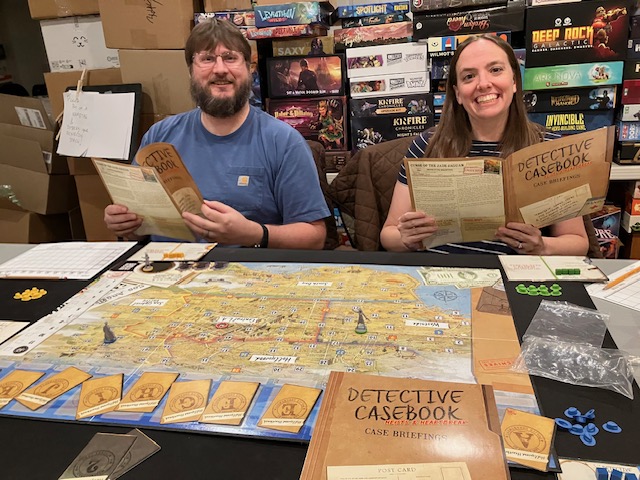
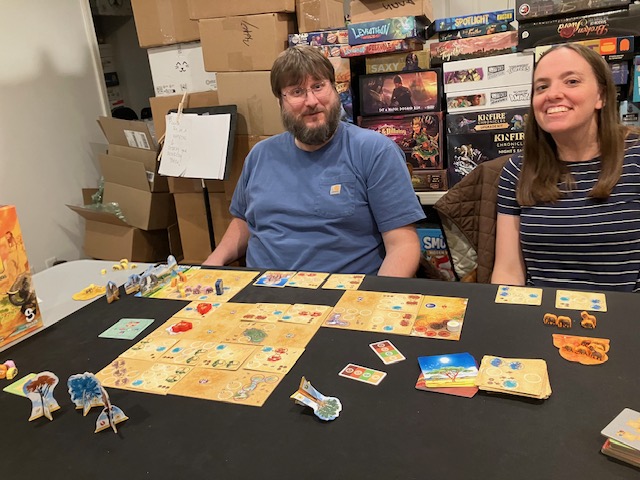
Part of the reason I played the first case solo was to remind myself how to play so I could “re-teach” the game to my friends! I think Charlie and Allison like mystery games almost as much as I do! They are my Escape Room/Mystery buddies!

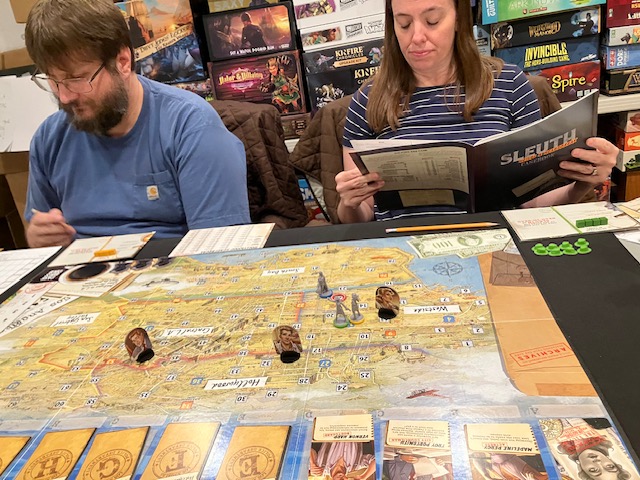
The best part of the cooperative experience is that we share the load! The active player takes their turn, one other player consults the grid when necessary, and a different player reads the entry from the Sleuth book! This really keeps everyone involved as we play, as everyone is active during a player turn!

Not only are we sharing the physical load of consulting and reading, we are sharing the cognitive load! Frequently, puzzle games like this can be better with multiple players because one player may notice something others did not! We come up with, as a group, the shared story of what we think is happening! This cooperative experience of sharing the physical and cognitive load really just works so well.

It’s apropos that this case is called Hollywood Heartbreak because it broke our hearts that we didn’t solve this! We even took a second chance and still couldn’t break it. Granted, this case is a Veteran level mystery, but we think we missed something along the way; we “somehow” missed a clue. We think it was in the cluebook, and maybe we were SUPPOSED to see it, but we missed it? That one clue made all the difference.
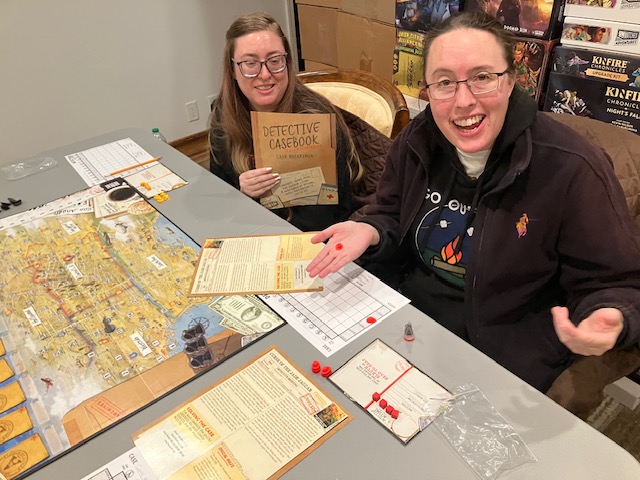
Still, even when we lost, the experience was still great. My friends and I were solving (well, trying) to solve a mystery together!
Case 3: Curse of the Jade Jaguar (Cooperative)

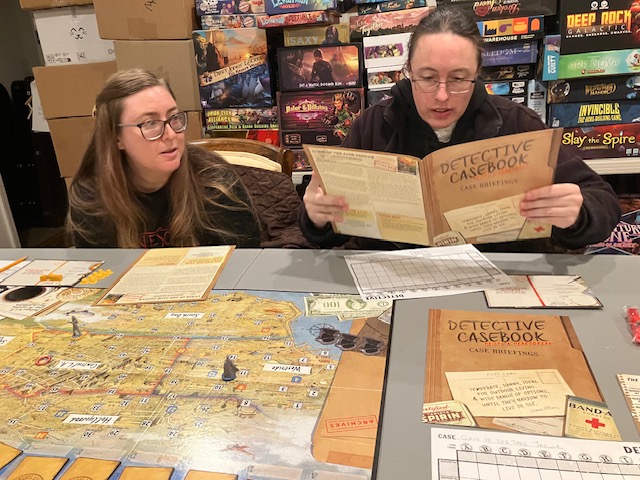
The final case unfolded very similarly to Case 2. The one thing I noticed more explicitly is that three detectives were able to cover a lot more ground than the single detective! By splitting up and covering different parts of LA, we were able to get a lot of suspects questioned quickly! Of course, there is a little less clarity of vision with three detectives trying to come to consensus, so it balances out a little.

I have to say, this mystery was one of my favorite of all time! All the suppositions that flew around the room that were proved and disproven were so interesting! We literally figured the mystery out on the VERY LAST ACTION! I took a chance on my last question, and that proved to be the vital piece of the puzzle! It felt very tension-filled and thematic as we figured it at the last minute!

Then we read the final summary and it felt like such a satisfying conclusion! This mystery was also a Veteran mystery, but we got it!

Conclusion

Why watch a mystery show on TV tonight when you can play one? Detective: Heists & Heartbreaks is the best kind of expansion: more content! You also DO NOT have to get it unless you have completed all the cases from the original game and other expansions! This is like a new season of your favorite detective show! You can watch it after you have watched the previous seasons! (To be fair, the mysteries do not have to played in any order; they don’t depend upon each other).

Detective: City of Angels is truly one of my favorite detective games of all time: It’s #2 on my Top 10 Cooperative Detective Games, but maybe it should be #1! I always come back to this game because it’s so much fun and I really do feel like I am solving a mystery. I might have to move Detective: City of Angels to a 10/10 because I will ALWAYS play it and there is so much content for it!

A few weeks ago, my friends and I really enjoyed LA-1 (see review here); it’s a storybook game with all the trappings of a detective game, but it’s not a detective game … you don’t solve mysteries in LA-1, you explore the city and advance the plot with exploration reading from story cards. But it’s not really a mystery. It’s a great game, but you don’t solve mysteries using your brain.

Detective: City of Angels is a real mystery game with mysteries coming to life with story and clues and intuition. Detective: Heists & Heartbreak is just a new season your favorite detective show and it’s just as good as the first few seasons. It’s still very very very good.

Crime Unfolds: How Do You Express That?

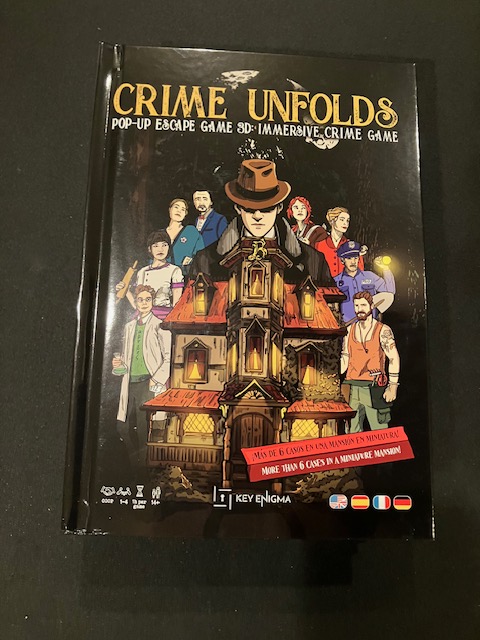
Welcome back to Detective Month!  Last week, we looked at the storybook cyber-noir detective game of LA-1!  This week, we take a look at the Escape Room game of Crime Unfolds!  A Pop-Up Escape Game 3D: Immersive Crime Game!

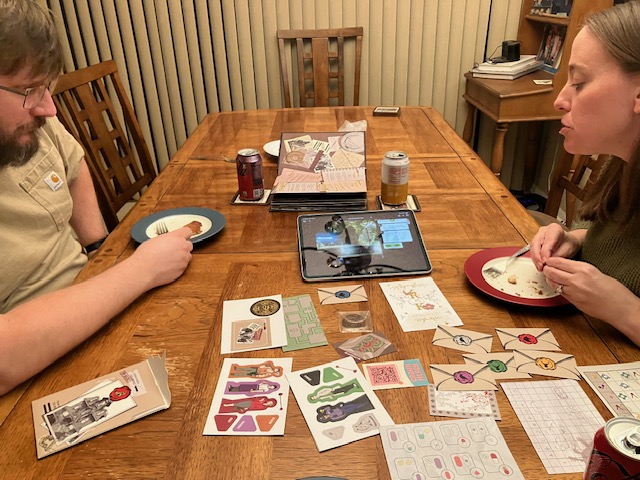
Every few months, my friends Charlie and Allison and I get together to play games … usually Escape Room games! They are my Escape Room buddies! This month, we are trying out the Crime Unfolds cooperative Escape Room game! Nominally, we are detectives solving a crime!

We’ll discuss our first impressions and thoughts on the Crime Unfolds system. It also brings up a few questions to ask yourself about Escape Room games. Why do you like them? Or maybe … Why do you dislike them?

Requires an App

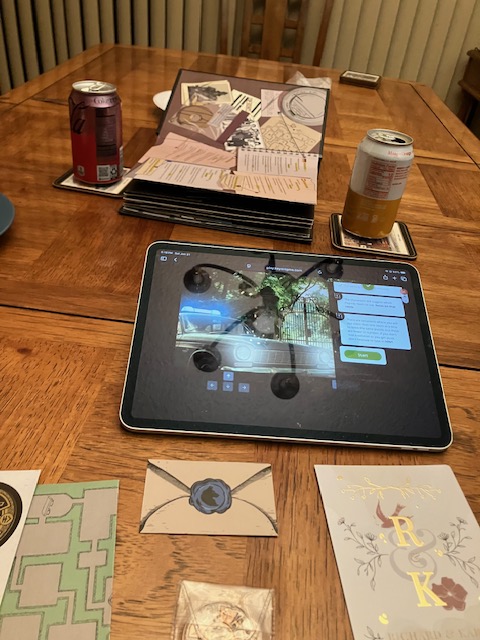
Crime Unfolds requires an app!   That is maybe the first thing you should know.  Some people love Apps with their Escape Room games, and some people don’t.  It’s really not clear by looking at the book that this requires an App.  It’s not a big deal, as Charlie went and got one real quick.

There are 6 cases interspersed in this game.  We started with case 1.  We also, like many escape room games, started with lots of “random stuff we know will be useful later”.


Solve The Puzzle vs. Express the Answer

Over the course of one night. Charlie and Allison and Richie embarked on the first case!  It’s supposed to take an hour … it took us more than two hours.  And we are experienced Escape Roomers?? What Gives?

The problem we had over and over was not “how we do we solve the puzzle” but “how do you express the solution”?  We easily solved a bunch of the puzzles, but inputting into the app was the main hurtle!

For example: At one point, we had “shifted” away from a screen that had the arrows for directionality, so we thought we had to express NSEW via UP/DOWN or North/South/East/West using letters on the command line?  We lost at least 15 minutes … when we realized the App had those arrows in another screen.  It was very frustrating!  We had solved the puzzle, but the app had made is less than intuitive to enter.

We were pretty frustrated after this game, but after thinking about it overnight, I have come to realize that most puzzle games are like this!  You have to do two things:

  1. Solve the puzzle
  2. Express The Solution

Solving the puzzle is usually the funner part, and some games make it very easy to express the solution.  We loved Doomensions (see our review here), as expressing the solution was easy; it always took the same form as a 3 or 4 digit code.    Here in Crime Unfolds, the solution expressed itself in so many different ways! Sometimes it was interacting with some widgets on the app!  Sometimes it was saying the right thing at the command line interface!  Sometimes it pressing the right buttons!  

Our frustration with Crime Unfolds was how to express the solution!  Many times during the game, we felt like we solved the puzzle, but couldn’t move forward because the solution wasn’t expressed in the way we expected it!

After cogitating on this some more, I realized this expressing the solution can be just as interesting as solving the puzzle!  To express your solution, you have to change your perspective!! What’s the best way to express this solution?  What’s the most thematic way to express this solution?  What’s the perspective of the player in the game?  All of these contribute to different ways to express the solution.   To be fair, sometimes the expression of the solution is poorly done, and that’s just a frustration of this genre.  I think if you reset your thinking that expressing the solution is part of the puzzle, then it can less frustrating. I realize how hard it can be to do in the heat of the moment, so it’s easy to say this. 

To enjoy Crime Unfolds, you will absolutely have to enjoy thinking about new ways to express a solution to a puzzle.


Pop-Up Cool!  But You Need A Magnifying Glass!

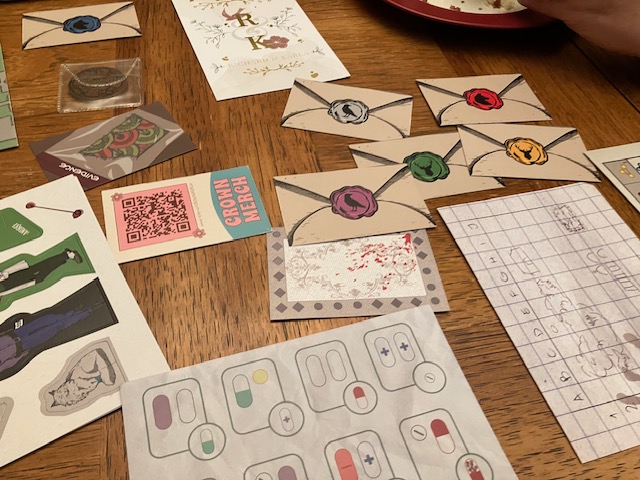
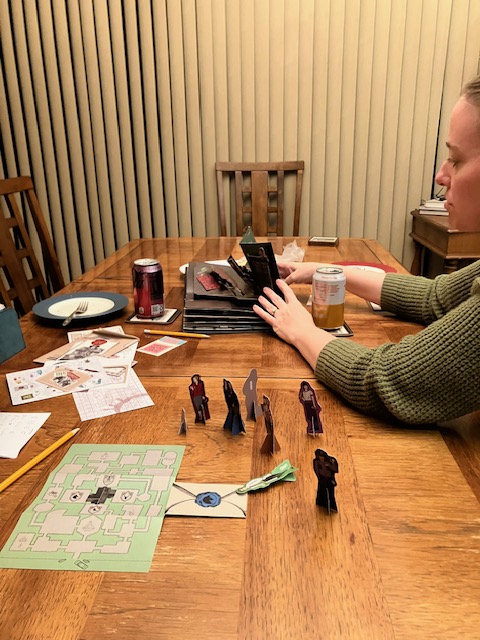
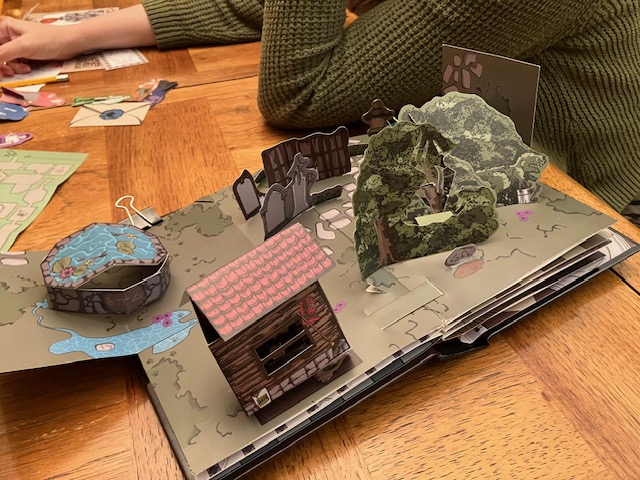
One of things that was very cool about Crime Unfolds was the pop-up scenes that came out of the book!  It turns out 6 rooms in the book, and you take a turns visiting some of these rooms in each case.  They look really cool!  See above!

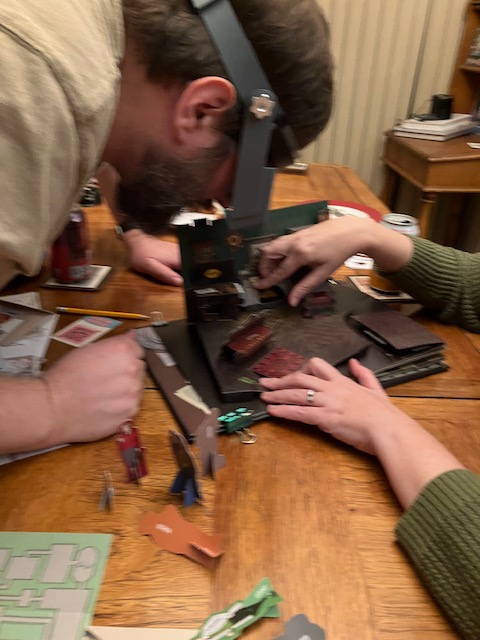
Unfortunately, some of the text/symbols on the board are hard to read!  At one point, Charlie went and got his “fine work” magnifying glasses/helmet!  We also used our phones to zoom in so we could see things!  

The pop-up stuff works well, but be aware that you may have to really zoom on the board.  There is just a little bit of “Where’s Waldo” and “I can barely see that” in this game.


Conclusion

Did we like Crime Unfolds?  Yes and no.  We only played one case, but we think it is fairly representative of what this game is.  The pop-up system works and has a very “toy” and “fun” factor to it; that was something we definitely liked.   We liked solving the puzzles but found expressing the solutions frustrating.  I think, upon further reflection, that if you go into the game knowing expression the solutions is PART of the puzzle, that might help make that more enjoyable.   

I hope I can talk Charlie and Allison into playing more cases from this book; I think there’s some fun puzzles here, but I hope we can just get over the frustrations when expressing the puzzle solutions.


Magic And Murder Mysteries! A Review of Murders at Karlov Manor: The Case of the Three Blade Knife

IMG_7366

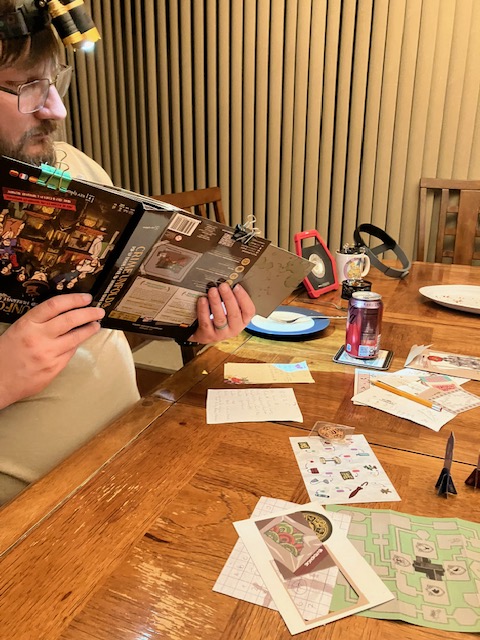
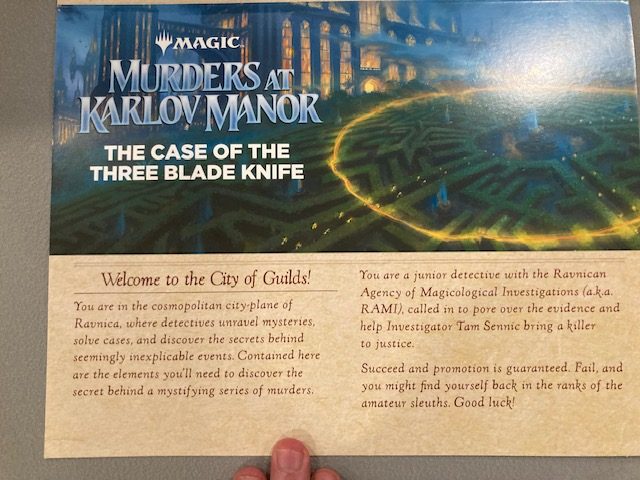
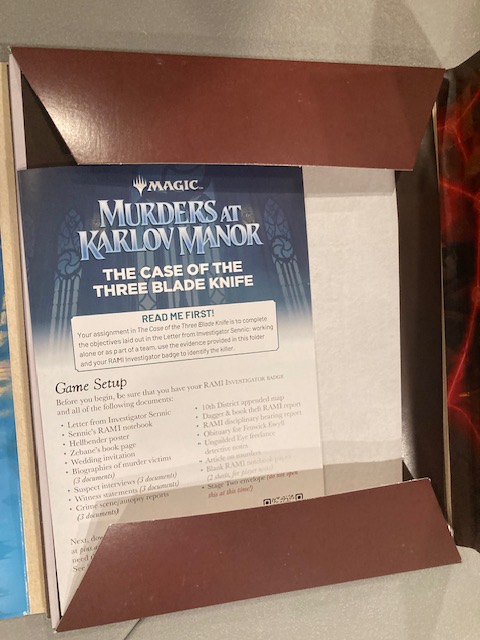
So, this is a murder mystery in the world of Magic: The Gathering?  Yup, that’s what this is!  Although its official title is Murders At Karlov Manor: The Case of the Three Blade Knife! See the BoardGameGeek listing here.

IMG_7365

My friends and I really enjoy our murder mysteries (see our Top 10 Cooperative Detective Games), so we were excited to try this out!

Let’s Take a Look!

Unboxing

IMG_7323

Part of the problem with reviewing Murder Mysteries is that part of the fun of the game is exploring the system!  What’s new in the box?  How do things work?  How does this do stuff differently?  

To that end, we’ll give some very generic thoughts up front which shouldn’t reveal too much of the mystery.   Feel free to stop reading after that if you want to just try it yourself!  After that, we’ll have some minor spoilers, followed by possibly some major spoilers.  Read as far as you want!

High-Level Thoughts: No Spoilers!

IMG_7327

This was a mystery set in the world of Magic: The Gathering.  I know nothing of this world, and my friends know just a little.  Not knowing the world didn’t affect whether or not we could play the murder mystery.  I am sure there there were plenty of “A-HA!” moments for Magic: The Gathering players, but it didn’t stop us from enjoying the game.

IMG_7344

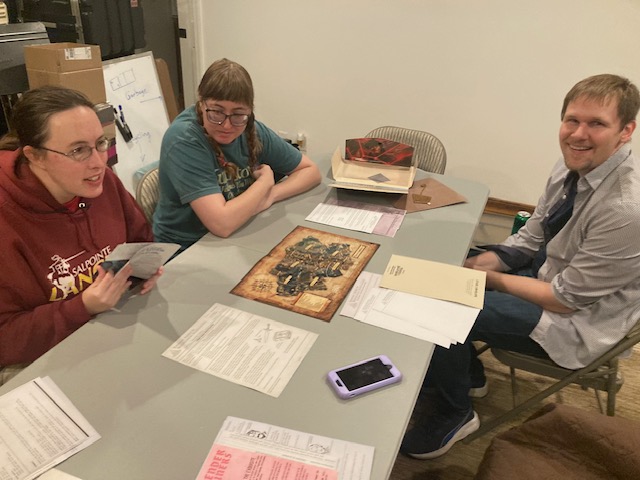
There are a LOT of materials to get through: our game took place in one night for 2.5 hours.  We were able to get to the end of the crime and solve it in one night.  This is a little bit of a slog to get through: there are a lot of materials to read out loud and share!

IMG_7324

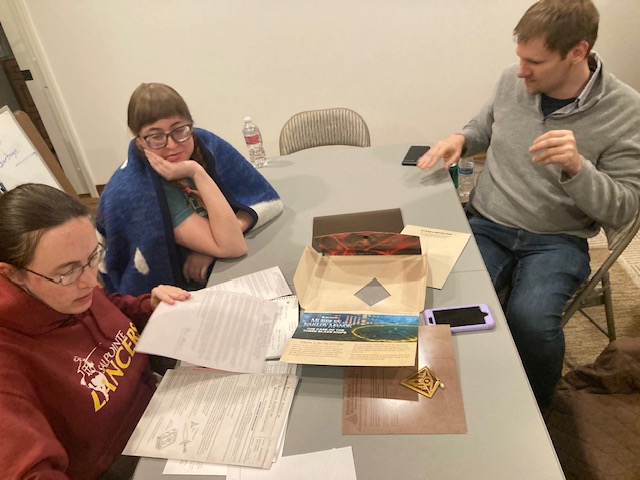
In the end, we didn’t love this. 

Rich: Has specific complaints, which he will address in the spoilers section below.
Teresa: Liked it the best, as she got to “perform” and she really enjoys reading stuff out loud. 
Andrew: thought it was a little bit of a slog, as there was so much paperwork to get through!  He still thought it was better than Detective (the Portal Games).  It kinda felt like work.
Sara: It was pretty good.

The general consensus was that it was okay.  Rich liked it the least (probably with a 4/10) and Teresa liked it the most (with a 7/10).   The biggest complaint from everybody was that, even though this was set on the world of magic, specifically Magic: The Gathering, it felt like it could have been in any world: Noir, Cthulu, Voodoo Pirate, something else?   We still dusted for fingerprints, but it felt like someone searched and replaced “dusted for fingerprints” with “used fingerprint ooze“.   Sara pointed out (I think correctly) that this would have been a better mystery set in the 1920s world of Cthulu.

Overall, it was ok.  There were some nice highlights in the experience, but it was a lot of paperwork to slog through, and the mystery itself had its issues.   The 4/10 from Rich was because he really disagreed with how the mystery was handled, Andrew was probably a 5/10, Sara a 6/10, and Teresa a 7/10. 

Maybe you just like living in this world, and just like doing the paperwork of a mystery, and reading the materials: then you, like Teresa may really enjoy this.   The story presented overall was interesting.

If you want to read more specific complaints, read on. 

…. space left intentionally blank …

… space left intentionally blank …

Minor Spoilers: Some Issues

IMG_7328

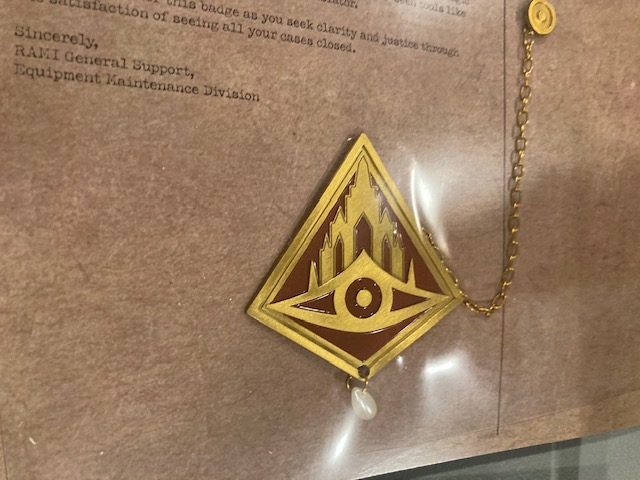
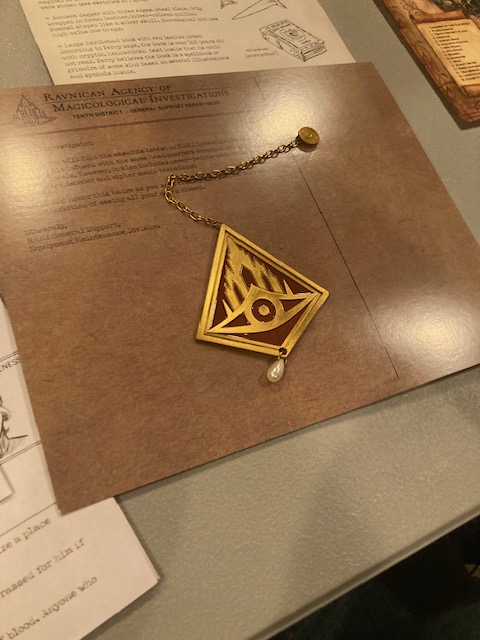
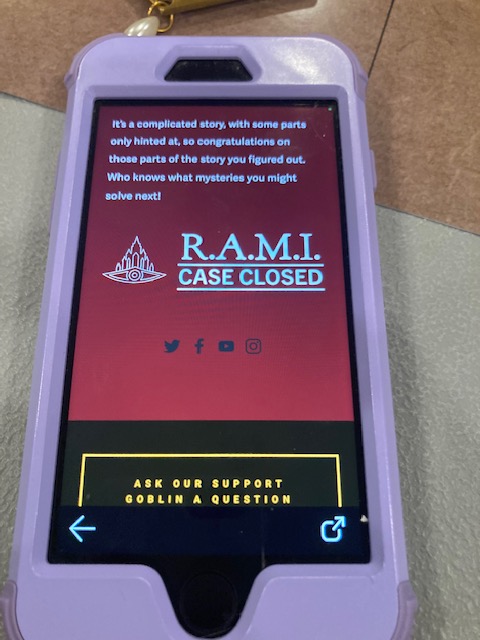
The game comes with a very cool metal pendant!  It serves as your RAMI badge for the game!

IMG_7335

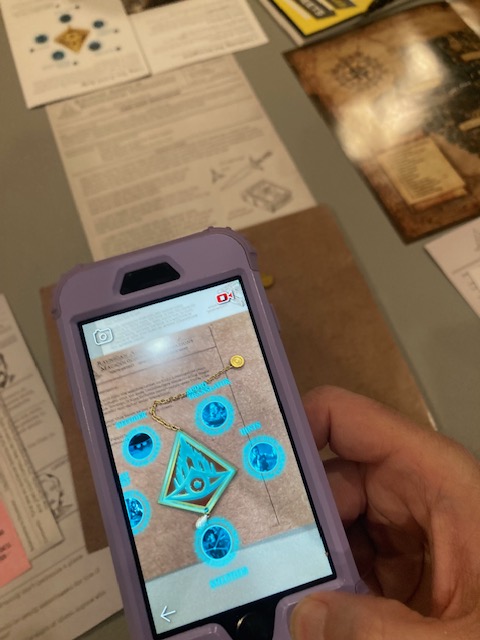
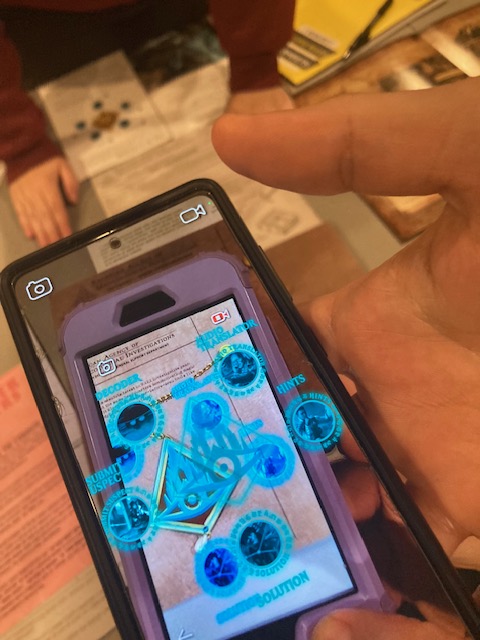
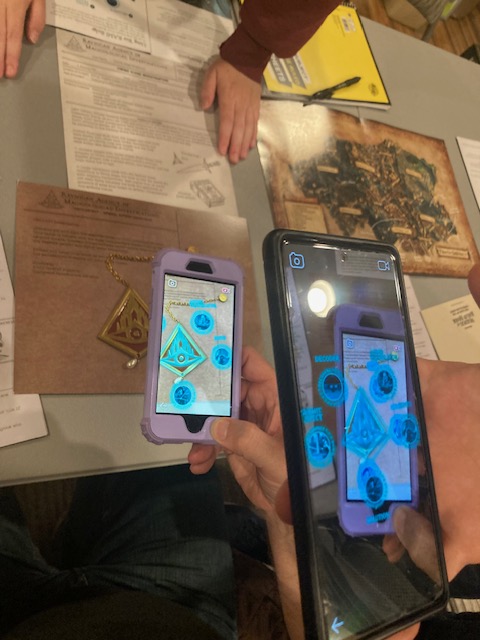
You download an app, and put your phone above it to get “some augmented reality options!”  See above!

IMG_7338

One complaint is that The Case of the Three Blade Knife looked like it would be a cool immersive augmented reality adventure! Look at the cool app above!  But it really wasn’t!!

IMG_8499

We loved The Arkham Asylum Files: Panic in Gotham City (see review here) and it even made the #1 spot on our Top 10 Cooperative Games of 2023!  We were blown away by the augmented reality here!

IMG_7337

This wasn’t really much of an augmented reality experience. We used the phone just a few times? We could have replaced the phone with a piece of red acetate for some of it.  The best part of the phone app was in the finale, where THE GAME WAS ON RAILS!  At the end of the game, the phone was cool in that it presented the finale really well (cool voice acting), but during the adventure when it mattered, we used it like once.

IMG_7336

How much money was spent on the metal RAMI badge?  How much money was spent on making the app?  If we used the phone more during the adventure, this would have been cooler.  But we didn’t.  The ending was cool, but by that point, the adventure was over and this was just a “presentation”, not an interactive murder mystery with cool augmented reality.

I am not sure it was worth the extra money for the metal RAMI badge and the money to make the app.

I will say that the finale was very cool.

… space intentionally left blank …

…. space intentionally left blank …

… space intentionally left blank …

Major Spoilers: Mystery Progression

IMG_7341

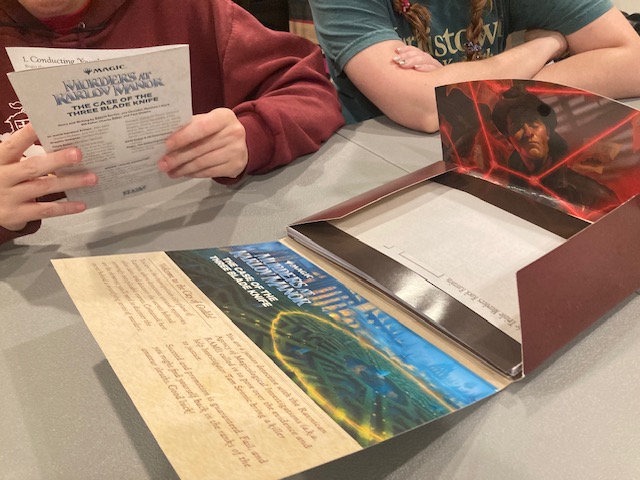
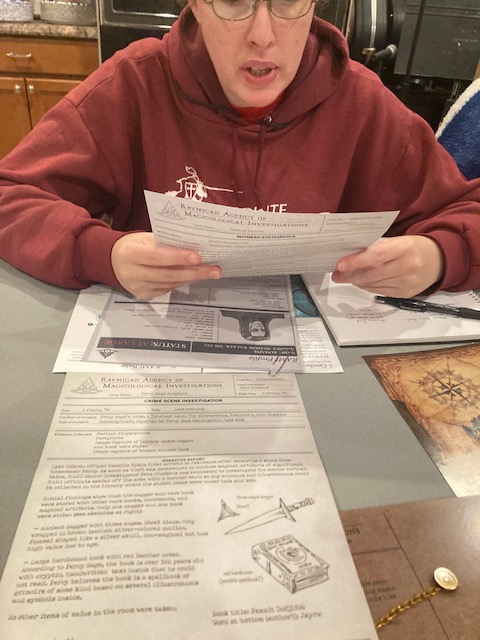
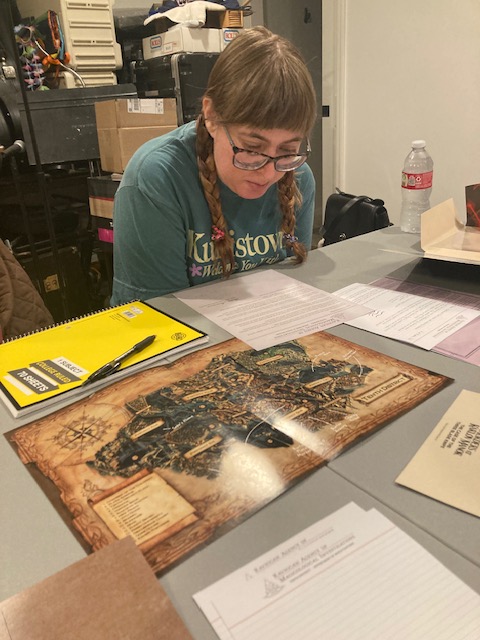
There was a lot of reading: This was work. The materials were well-organized, but getting through them was almost like homework. Still, the materials were very cool: see some above and below.

IMG_7334

There were two major problems with the mystery: 

1) Ignore motive.  The game literally said something like “don’t worry about the motive, just choose someone“.  So, we are looking for means and opportunity only?

2) What are The rules of Magic?  We live in a world of magic, literally Magic: The Gathering!!  What the rules of magic?   Magic can make means and opportunity that much more opaque (teleportation, scrying, Bigby’s giant hands!).   We have NO IDEA what the rules of magic are going into this adventure, so that completely obscures means and opportunity.

I feel like, unless the rules of Magic are somehow explained in some way, it makes it too easy to make a murder mystery unsolvable.  “The murder weapon could have been handled remotely, the murdered could have teleported in and away, the murdered could stop time to leave no trace, etc.., etc., etc., etc.”. 

So, hints, evidence, don’t seem to matter as much.  Because magic can do anything.  This really soured some of us on the mystery after it was revealed:  we had spent 2.5 hours combing through evidence only to have a Deus Ex Machina explanation. I hated it.

.

… the space left intentionally blank …

… this space left intentionally blank …

Giant Spoiler!! Read At Your Own Peril!!

IMG_7343

In the end, the only major use of magic was to possess someone and frame them for the murders.  We had no clue this was happening, we had no books to read, we had no idea.  We just “guessed” the murderer based on location, and then went to the endgame.  By the time you are in endgame, the game is on rails and it’s easy to solve.

This game pissed me off because it didn’t feel like a mystery.  You just guessed at someone based on  location, but all the while “magic” (whose rules were unexplained) was the driving cause.  

This was more of a “explore this world, make some guesses, and enjoy the story”.  If I had known that going in, I may have enjoyed it more.  But I was so busy trying to put a good solid well-crafted mystery story on top, I was pissed off when I learned what actually happened.

My friends, who enjoyed the story for what it was, had more fun that I did. 

… this space intentionally left blank …

… this space intentionally left blank …

Conclusion

IMG_7340

If you look at Murder At Karlov Manor: The Case of the Three Bladed Knife as a story that unwraps, then maybe you’ll enjoy it for what it us.  Given how much work there is to go through all the paperwork, I was very frustrated with the lack of clues,  lack of evidence, lack of explanations of rules of Magic, and the Deux Ex Machina final solution.

But I was definitely the outlier here: my friends enjoyed the story and had fun.  I didn’t.

The Dark Quarter: Into the Muck

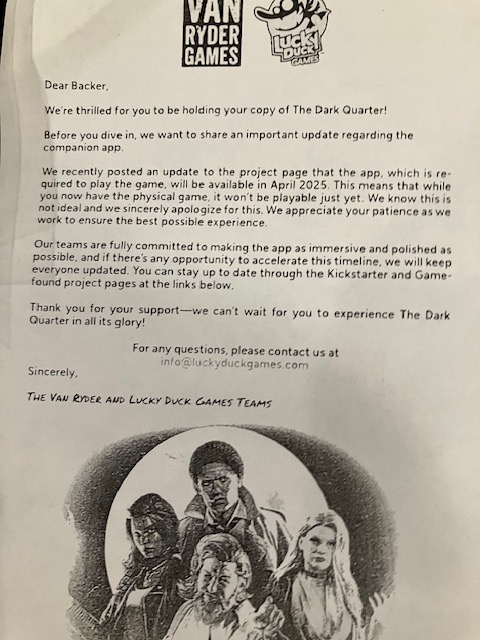
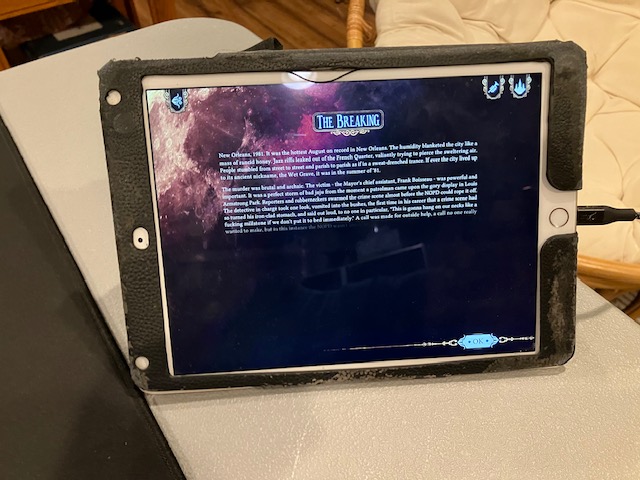
It arrived!  No, not the physical copy of The Dark Quarter!  That arrived like early 2025!  

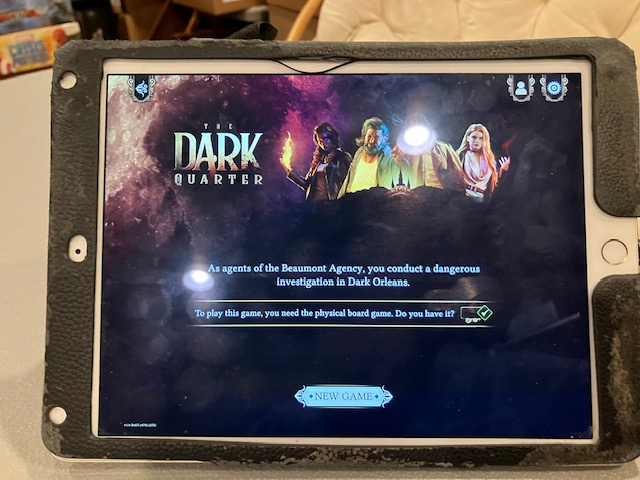
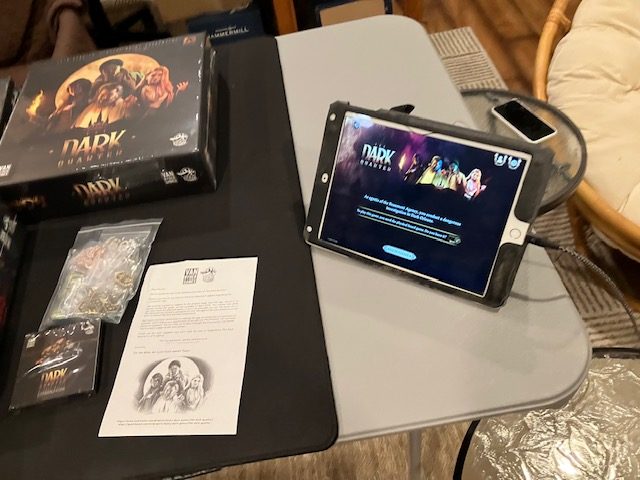
But the APP finally arrived at the iOS store!  See above! Late May 2025!  This game is completely unplayable without the app, so my physical copy of The Dark Quarter sat silently in the corner for months, waiting for the APP to be available!  And it finally arrived!  I think I downloaded it May 25, 2025.  I have been really looking forward to this, as it was my #4 on my Top 10 Anticipated Cooperative Games of 2023 … it’s years late at this point!

So, in any other year, this might be considered weird to get the physical game before the APP is ready, but with the Tariff situation changing daily, I think Lucky Duck/Van Ryder games did the right thing getting to us ASAP!  

Let’s take a look!

Unboxing

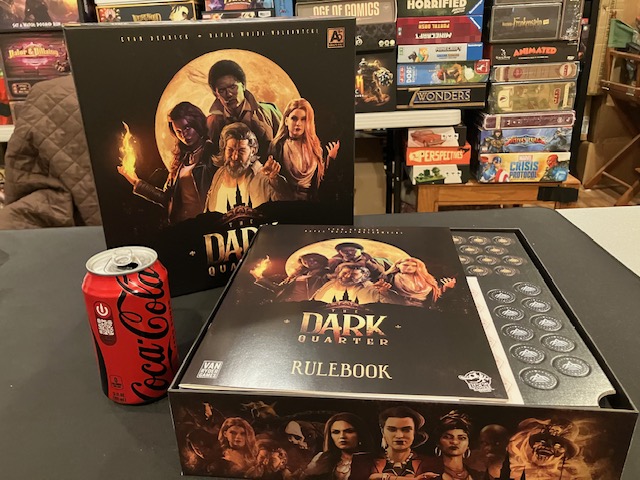
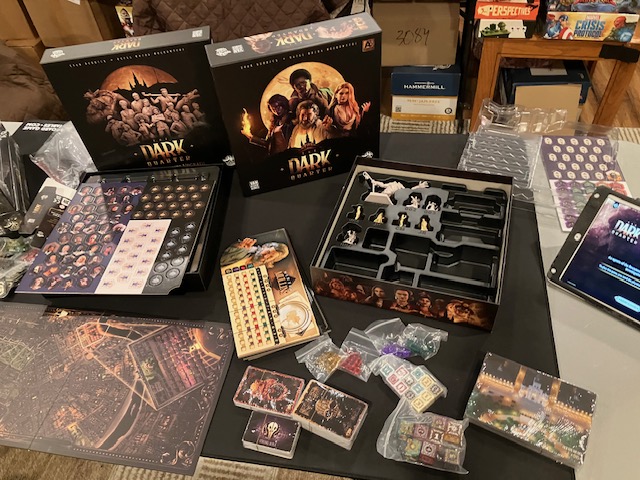
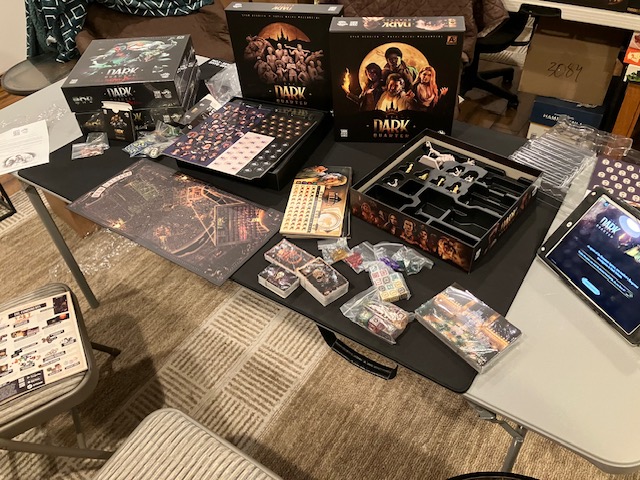
This is a pretty standard sized box; see Coke can above for persepective.

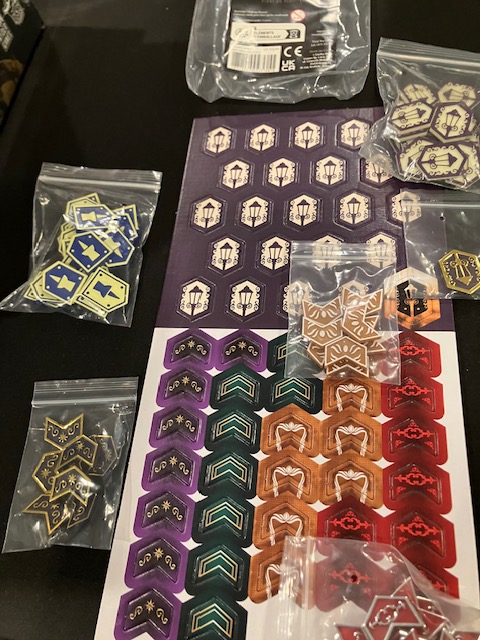
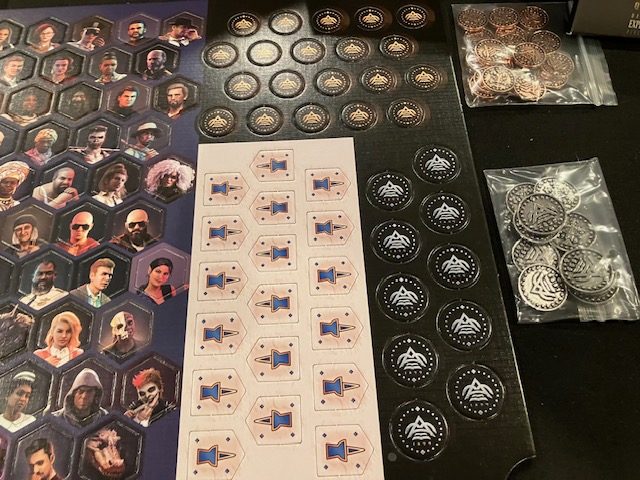
The game comes with a lot of cardboard tokens (see above),  but I had gone all-in on the Kickstarter and got the nice plastic tokens as well.

I also got the metal coins (see above).

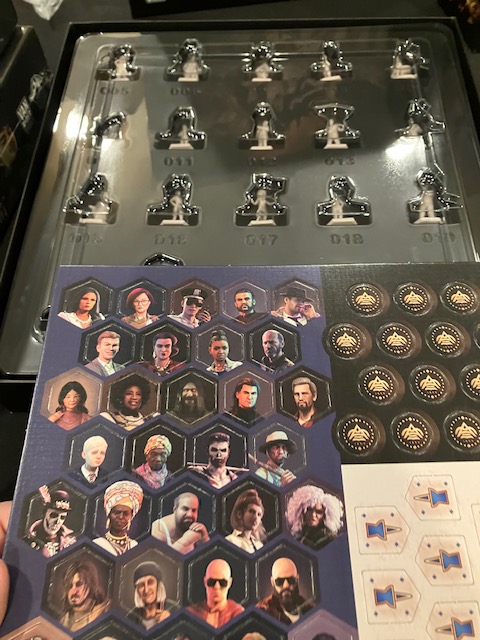
Even though I got the miniatures expansion as well, you will still need some of the little hexes with people on them.

You could play this game just fine with the cardboard, but the upgraded components make you feel…. like you’ve spent more money. 🙂  No, they are nice.

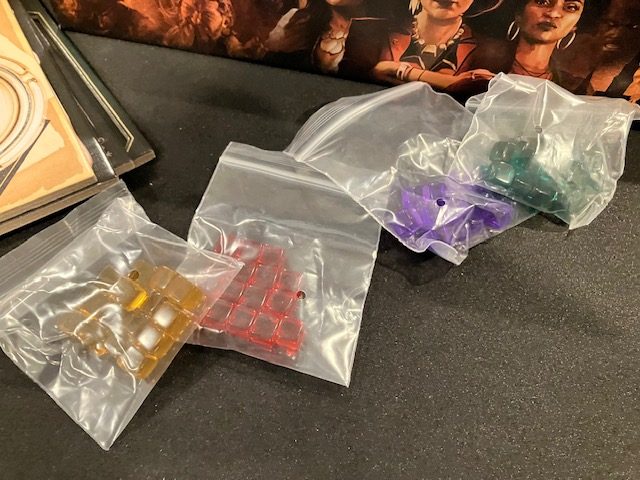
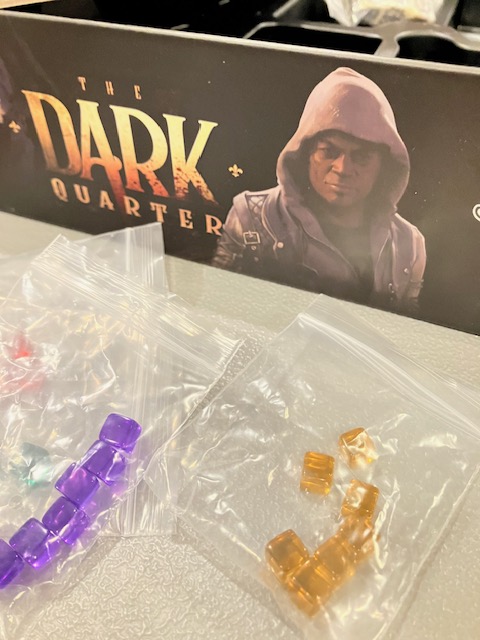
The little plastic cubes denote your ability scores.

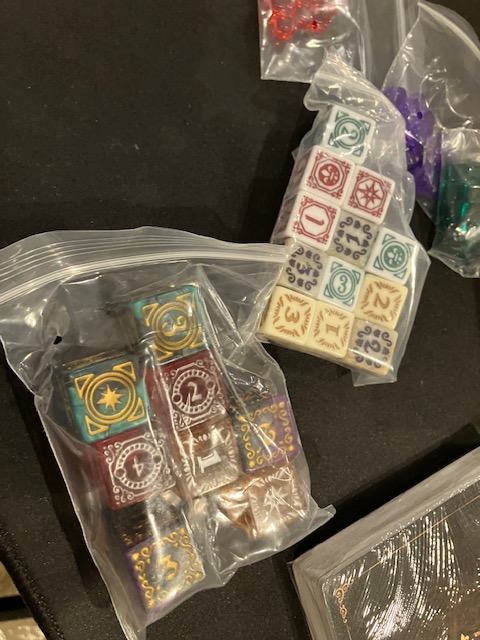
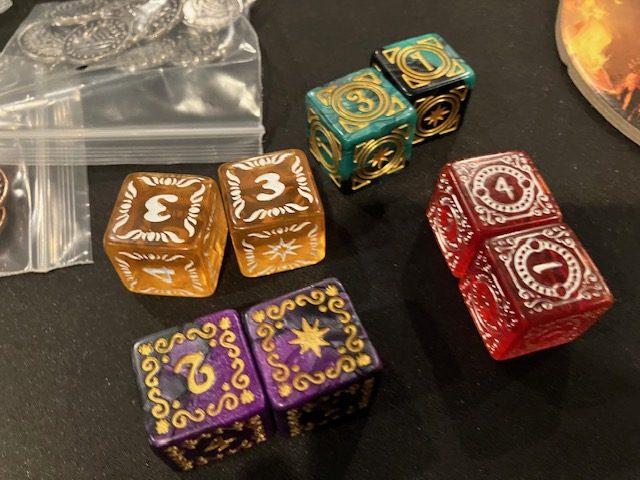
And each player will get their own dice (see above, as the dice as color-coded for the 4 players).

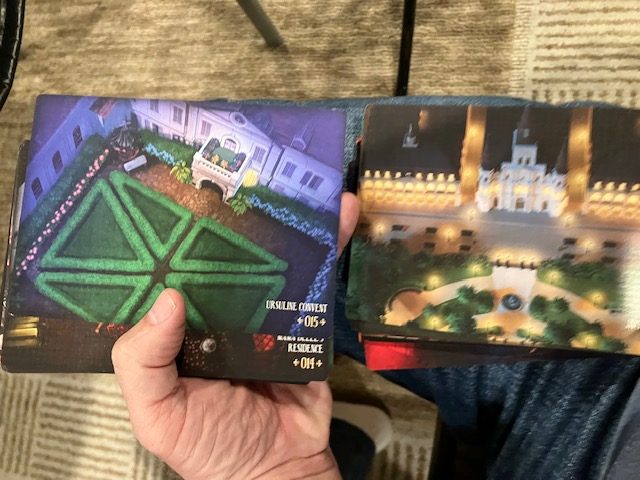
There’s some nice Location  cards that will come out (see above) as you explore.

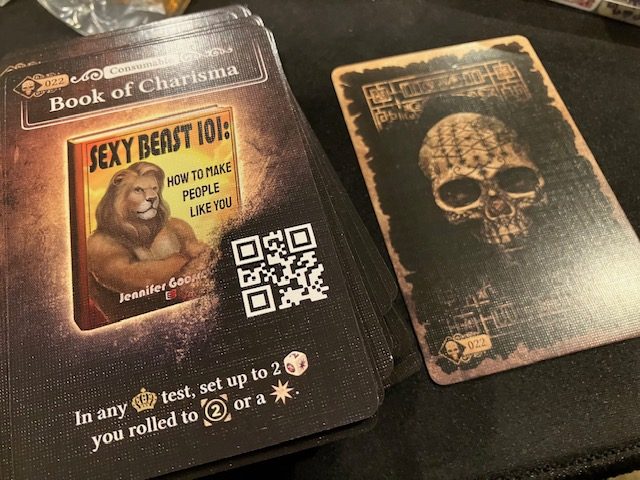
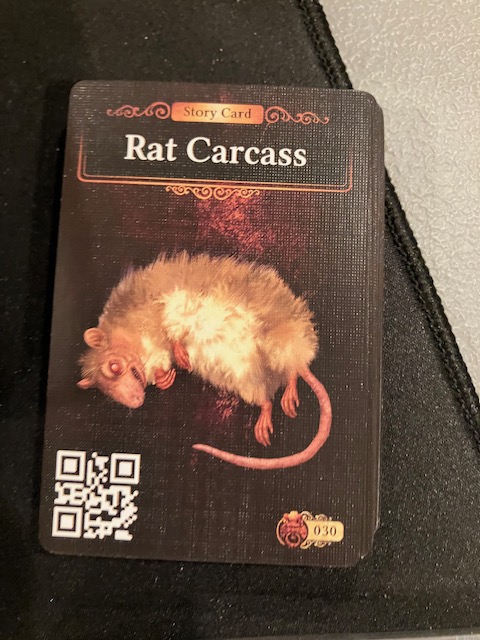
And there’s both objects (see above) and story cards (see below).

What’s that?  Yes!  A QR code!  These cards will be scanned when you play!

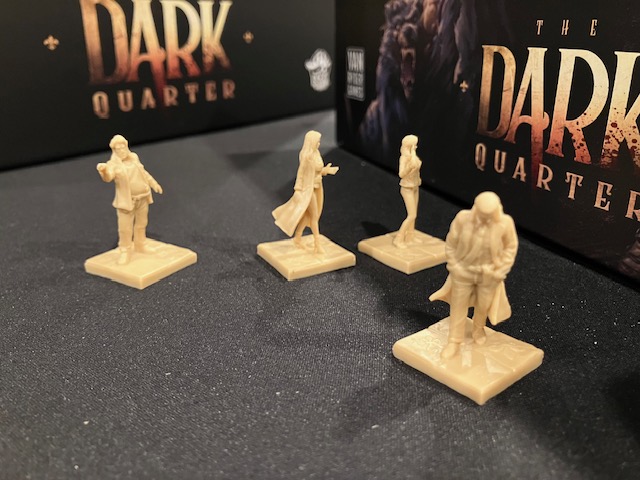
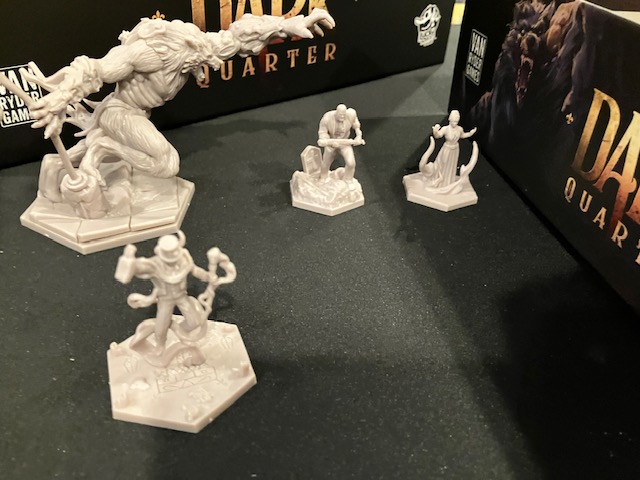
The minis are pretty good, but not great.

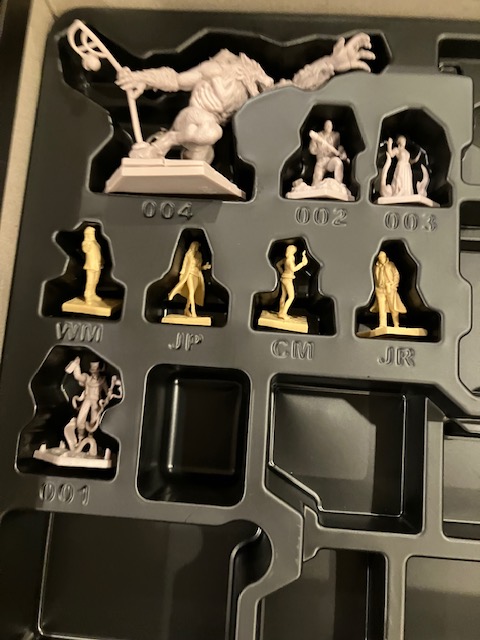
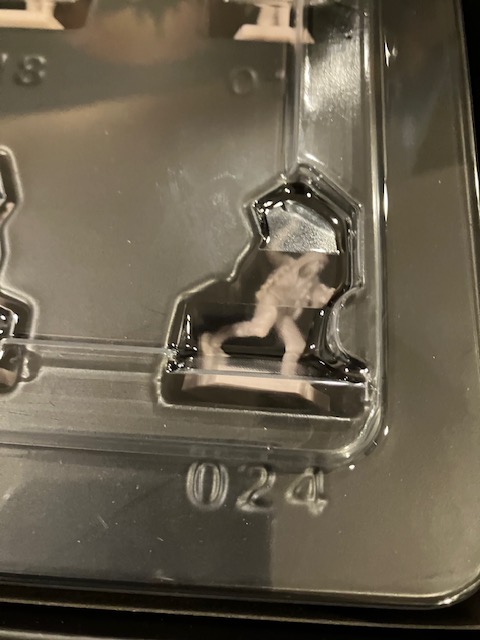
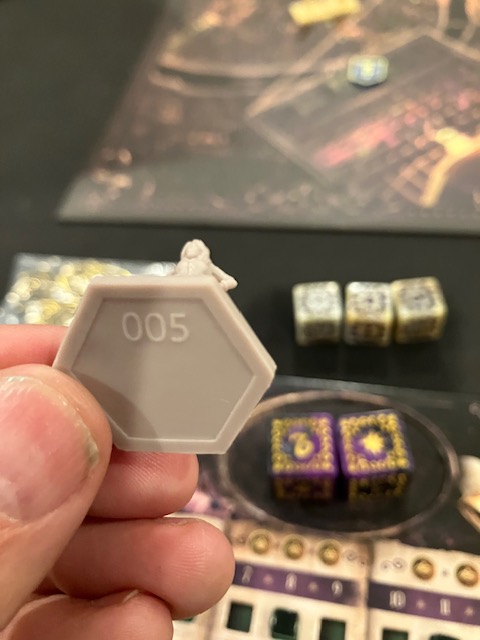
But the minis are notated with a number on the bottom so you can put them back where they belong (see above and below).

I mean, this game looks pretty good, ya? 

Rulebook

The rulebook is fine.

It fits pretty well on the chair next to me open flat, and the font is pretty big.  This is venturing into A territory (although it maybe could have used a few more pictures) for The Chair Test.

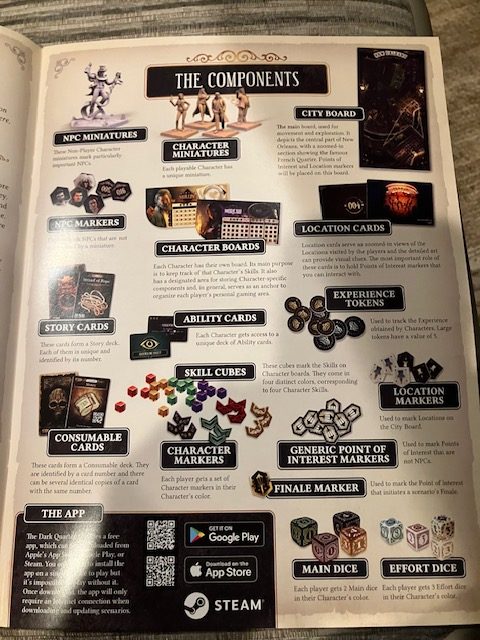
The Components page is well-labelled.

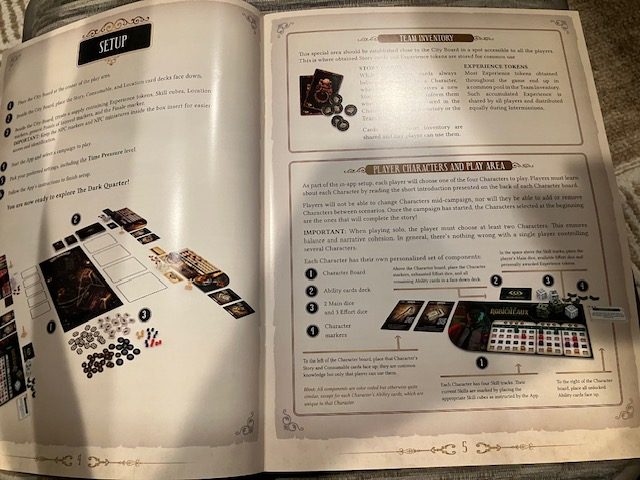
The set-up is pretty good, although there is always confusion in an APP based game: usually the APP sets you up, so do you need this?  You kind of need both the rulebook and the APP for set-up.

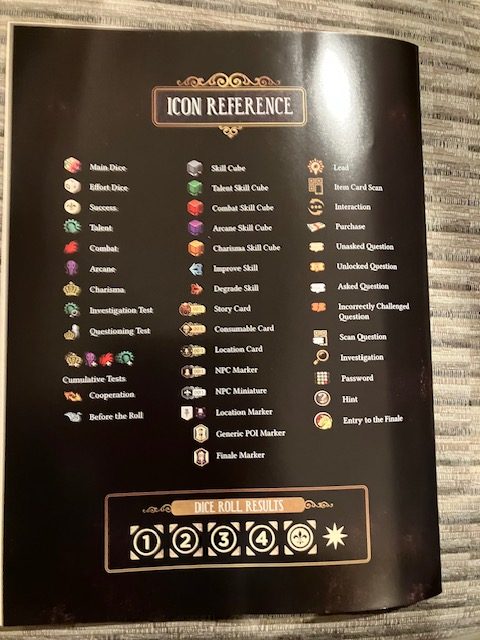
The last page has an ICON summary, which is great! … but I don’t think I ever used it once in all my solo or cooperative gameplays.

The rulebook is pretty good, but you don’t spend a lot of time there; you are always in the APP.

Warning! 18+!

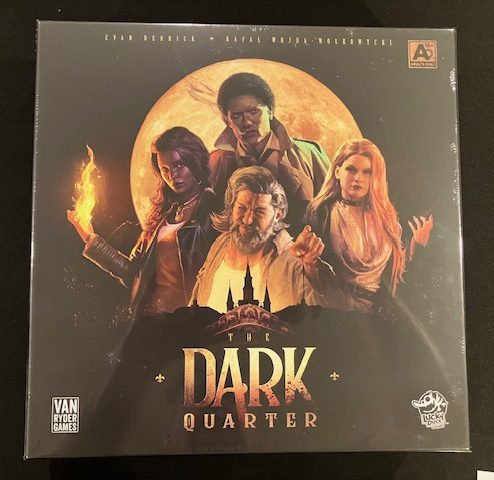
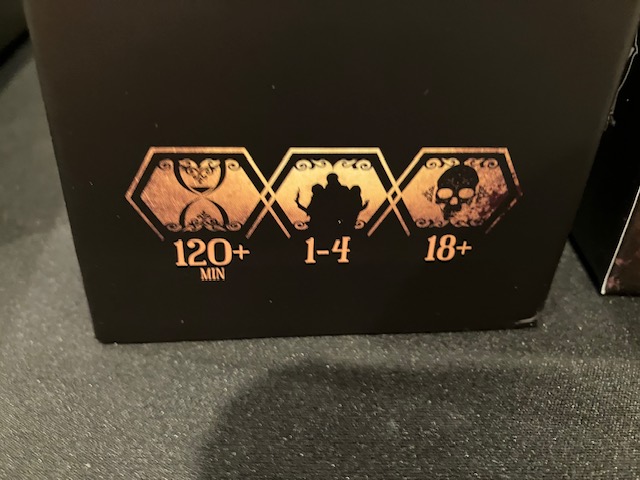
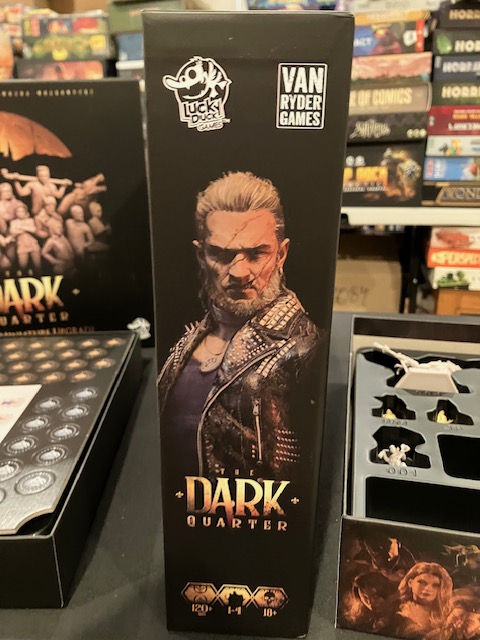
You may miss it, even though it is clearly on the box (see above) but this is clearly an 18+ game!  Between language, grisly murders, some sexual references, and just dark imagery, you probably don’t want to play this unless you are ready for a dark, grimy, and morally ambiguous world.

Teresa, who started out censoring the bad language from the APP, was swearing like a sailor by the time we finished our first session!  She really embraced this world! Be aware, this game will corrupt … something?

Gamplay

Each player takes the role of an “investigator/consultant” for the Beaumont Detective Agency.  Each character is flawed in some way, but they are generally seeking redemption (but that’s your choice to make).  

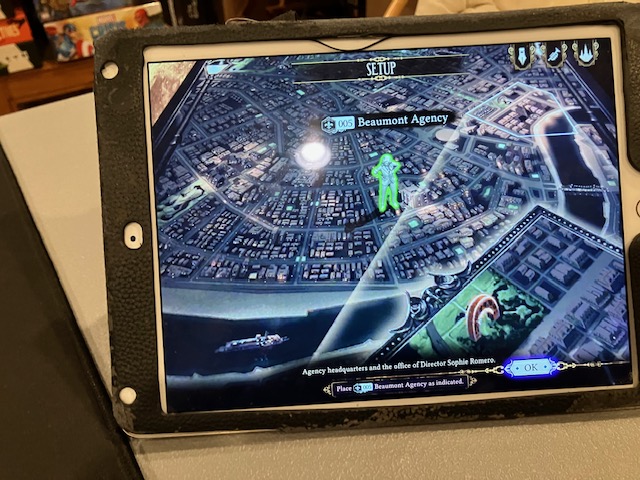
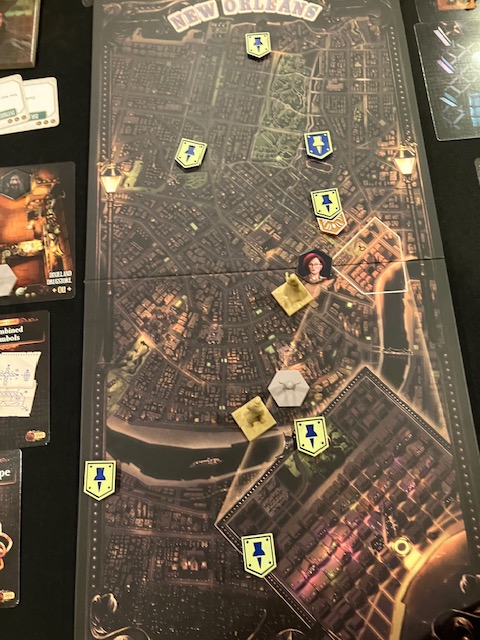
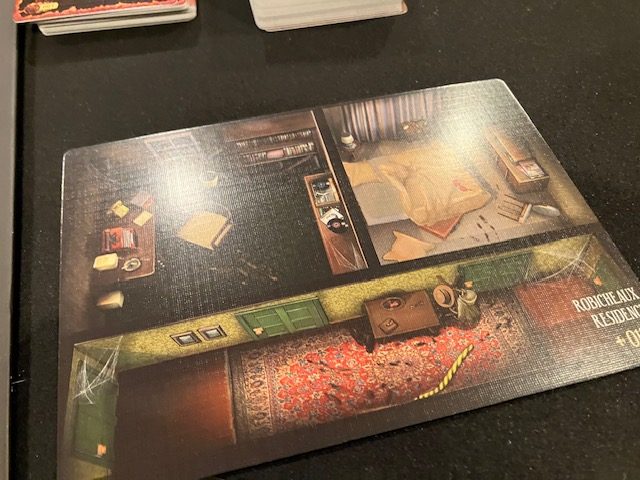
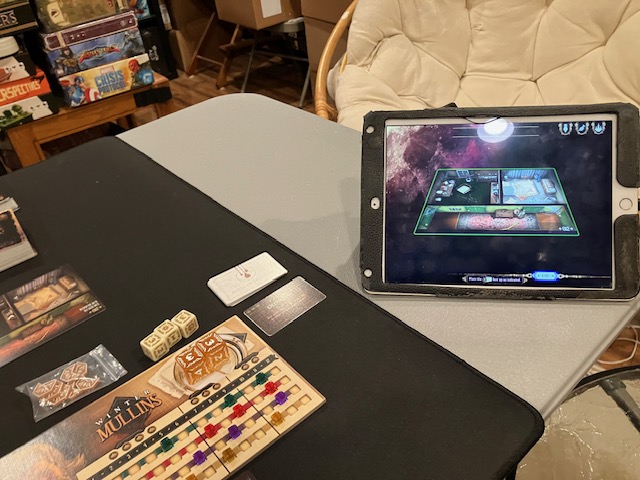
Players use the APP to guide the game.  The APP shows how to set up places of interest (see above):

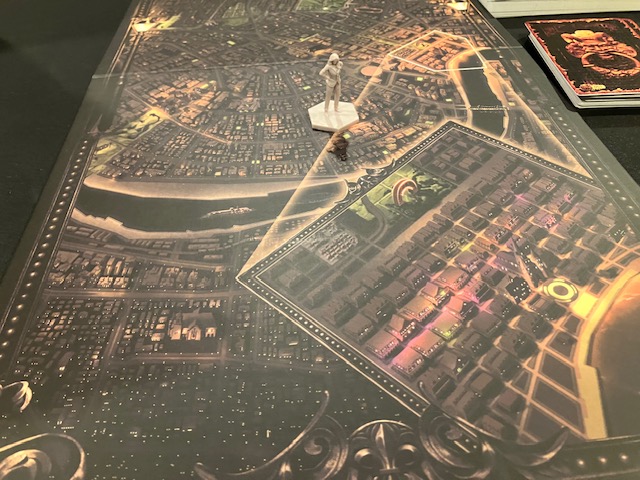
And you reflect that on your game board.

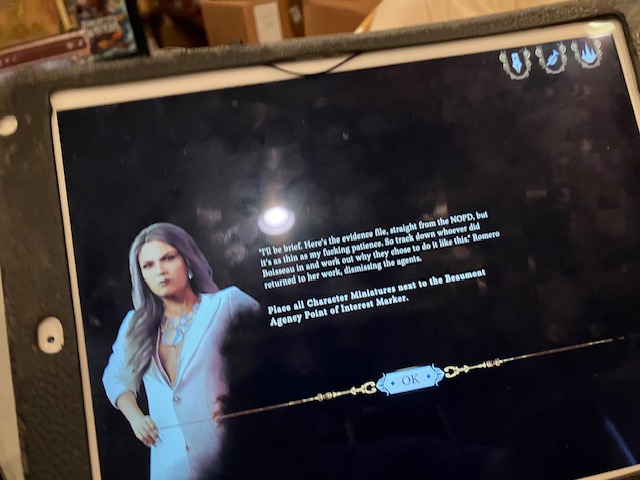
The boss lady tells you what to do in the APP, and you explore a 1980s New Orleans investigating a murder!

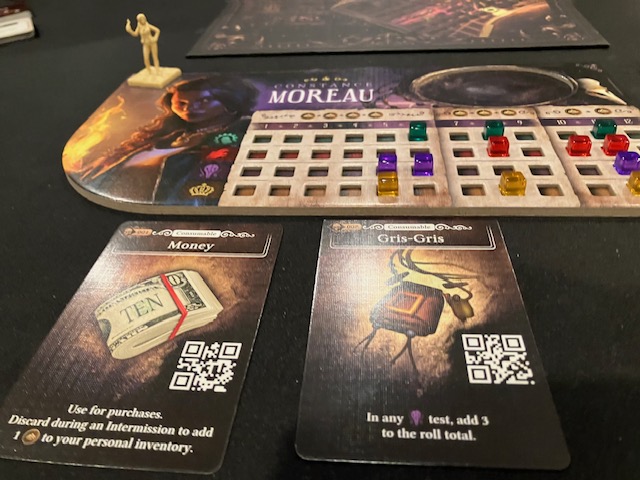
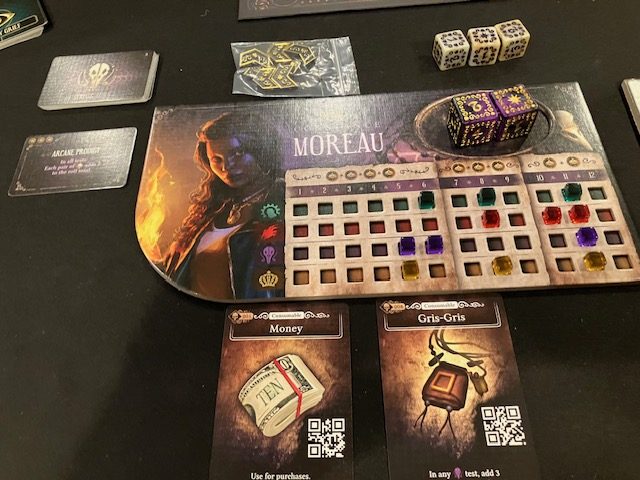
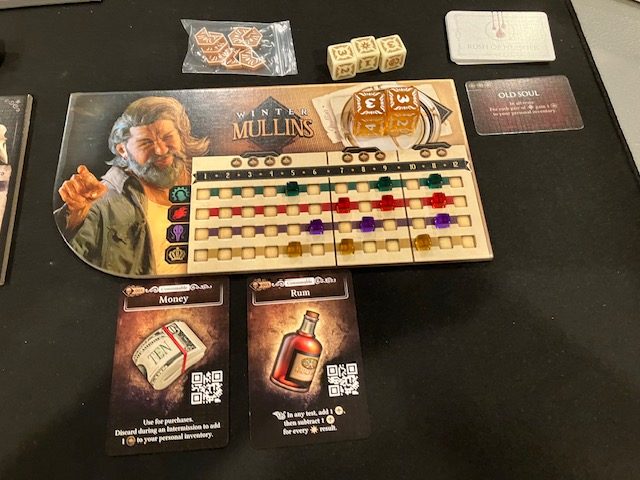
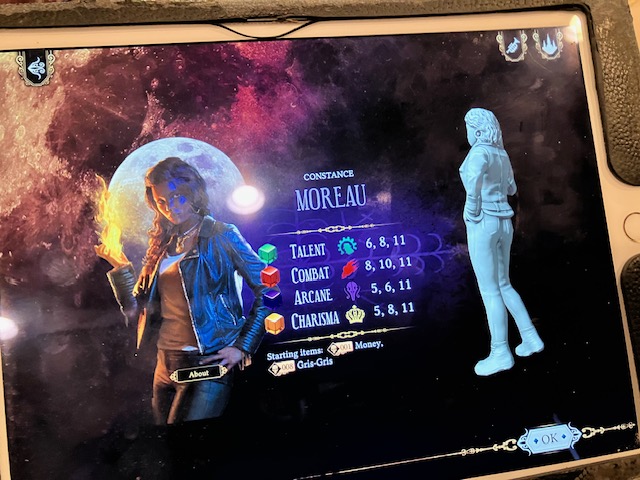
Each characters gets some items they can use, and has some level in 4 different skills/abilities (see above).  These abilities are rolled against, and however many you surpass is how many successes you get.

This is absolutely a dice game!  Almost every turn, you will roll the dice to do “some skill check”.  You always get your two base dice (color coded for the characters: see above), and some extra effort dice.

These effort dice are enabled as you play.  You always get one effort die at the start of your turn, but sometimes you will get more through other actions.

Players explore the city, trying to investigate a murder!  The APP controls the narrative, with the players making choices, and the dice determining success or failure.

You’ll notice a lot of items have a QR code (see above): you will be scanning your items to interact with them.  This may remind you of Chronicles of Crime (that made our Top 10 Cooperative Detective Games), and it should!  Lucky Duck (who teamed up with Van Ryder Games to make The Dark Quarter) also made Chronicles of Crime!

Honestly, playing this game reminds me of playing out a Detective series on HBO or Apple+ mini-series.  Story happens, characters develop (or regress!), and a lot of swearing and adult situations occur.   

Solo Play

So, you can play solo (thank you for following Saunders’ Law).  

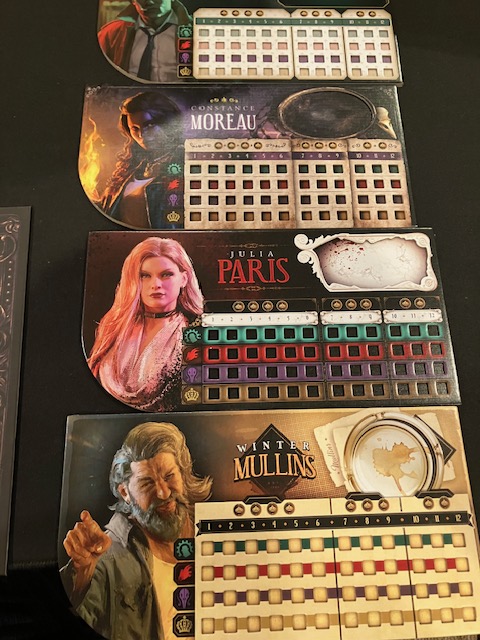
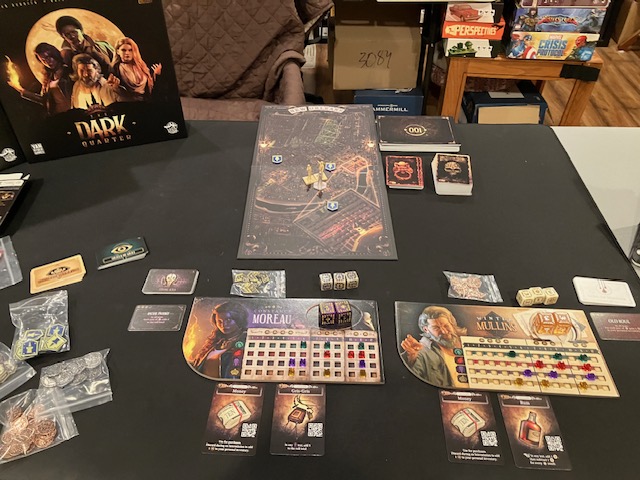
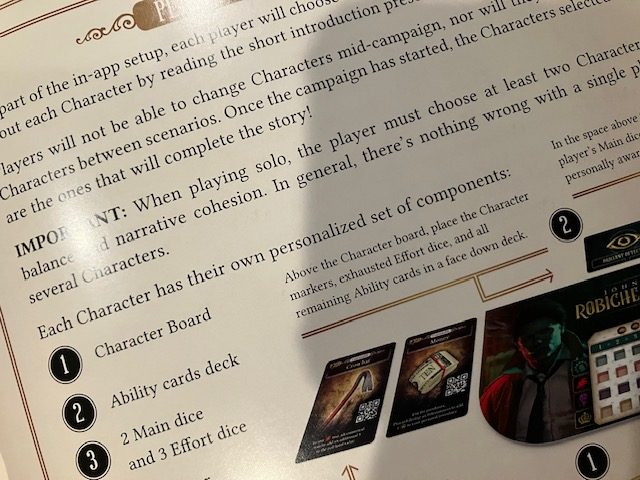
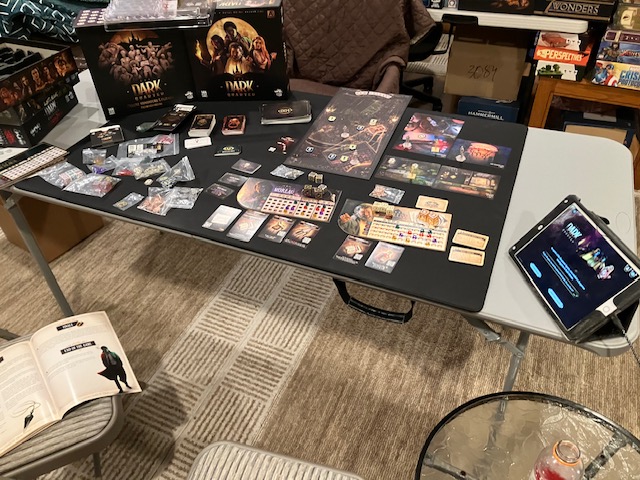
However, solo play has you take control of two characters: there is no true solo play. See above as I chose to operate both Constance Moreau and Winter Mullins.  

The rules do cover the case where the solo player has to play two characters (see above), and justifies needing at least two characters as “the stories are intertwined; you need at least two characters to get the best out of this!”  And that makes sense; these characters destinies are all tightly coupled!

So, I started a game.  And went back and forth between the two characters.  And I didn’t enjoy it.

The back and forth between the two characters as a solo gamer just didn’t work for me.  It felt like I couldn’t get any thing done, as just as I did one thing at a Location, I’d have to immediately go to the next character.  I remember loving Detective: City of Angels (A Van Ryder game also in our Top 10 Cooperative Detective Games) because you had four precious actions on your turn and how you spent those actions mattered! It felt like you could concentrate on a Location and get stuff done!  In The Dark Quarter, I frequently felt like I got to do just “one” thing, and then it was the next character’s turn.  

I played out the first two sessions as a solo player, but … I kinda stopped caring.  I felt like I couldn’t get anything done as a solo player, I was so busy “advancing the story”, I felt like I wasn’t playing the characters or solving the mystery.  I felt like the game was playing me.  

The story was interesting, but I felt like I couldn’t focus.  Some of that  lack of focus was the context switching between two characters, and some of that was going back and forth between the game and the APP, some of that was all the dice-rolling, and part of it was just how “little” I felt like I could do on my turn.  I just had to swap between too many things, and it took me out of the game.

I hoped a lot of these issues would go away when I played cooperatively.  I was expecting to love and adore this game straight out of the box.   I didn’t, and my solo experience wasn’t great.

Cooperative Play

Whew. Luckily, the cooperative experience was much better!  The fact that the focus moves around quickly between characters is actually good in the cooperative game, as most people feel like they get their chance to play; quickly and regularly.

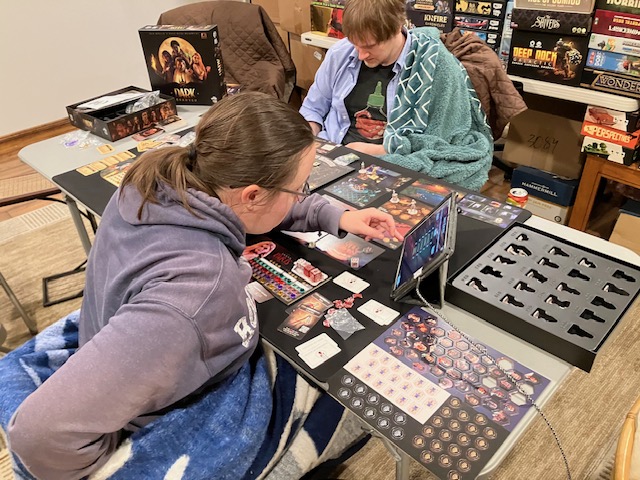
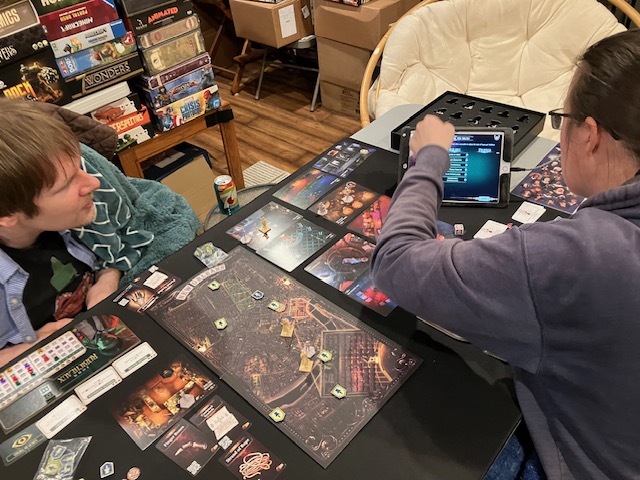
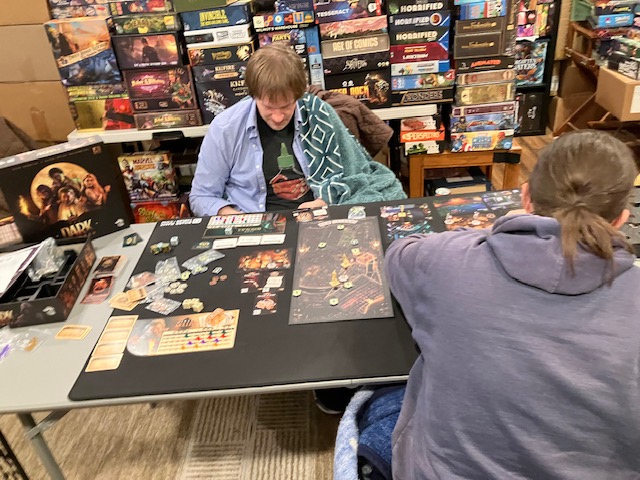
You can see as the board and locations expand out!  The world definitely envelops you as you play!

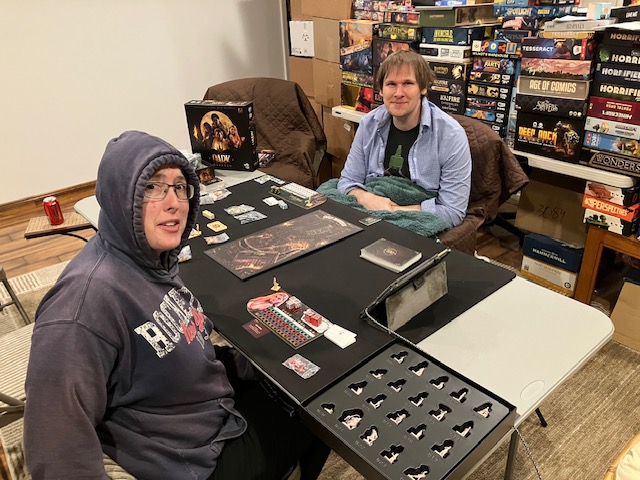
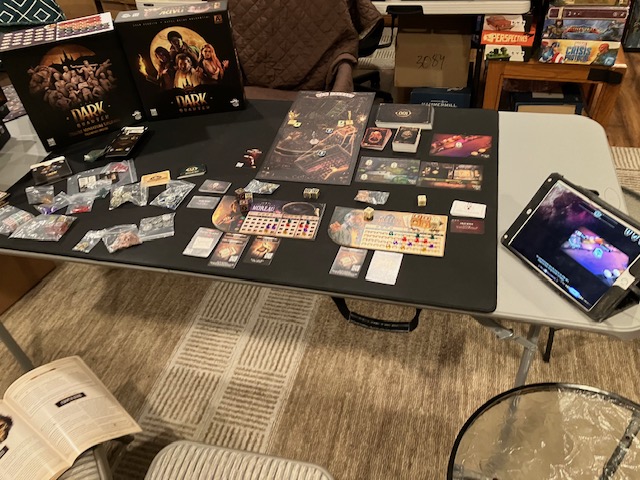
This game feels “tuned” to work best as a cooperative experience.  The 3-Player game we played was fun!  We ended up playing about 3 hours and still didn’t finish the first play!  But, we still wanted to play more, so we kept playing …

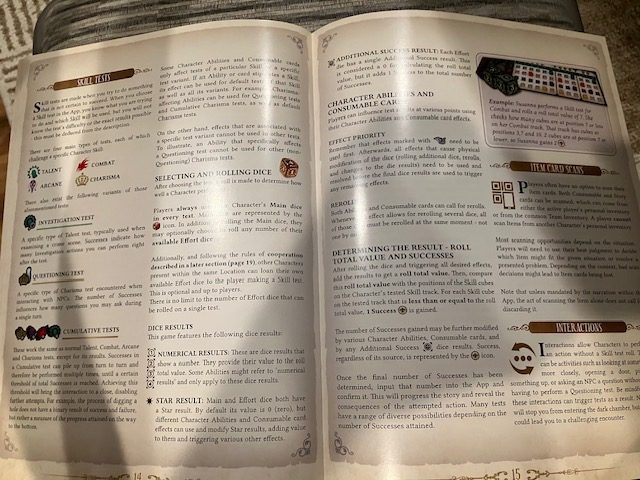
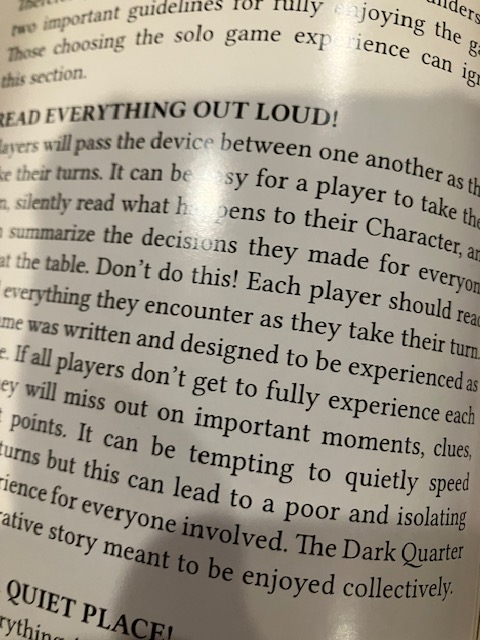
The game, in the rulebook, does a really good job of emphasizing “READ EVERYTHING OUT LOUD!”  See excerpt above.  This really encourages everyone to stay involved with the story and all the decisions in the game.  Even if some decisions are only character-based, everyone stays involved.  I am glad to see that emphasis in the rulebook (see above), and I think that is the best way to play the game.

Good times.  The cooperative play has been a success.  Currently, we have played two weeks in a row, having invested about 6 hours into the game … and wanting to play more!

Solo Vs. Cooperative

It’s really interesting to me that the solo experience fell flat for me, and the cooperative experience worked so well!  It makes sense; the game seems “tuned” to keep stories and plot points coming out, as to keep the players all involved! 

Like a car “tuned” for Sports mode instead Eco mode, The Dark Quarter seems “tuned” to cooperative mode.  The solo mode will work, but the game operates (in my opinion) at a lesser gait.  At least, that was my experience.   (And you have to understand, I love mystery games!)

Length of Game

The game is long. Longer than you might expect.  We played for three hours straight the first session! And three hours the second session!  And we still had a lot to see!  And we still have more to go!

Luckily, the APP can help you save the game between sessions.  There are several points where you can save the game; these intermissions happen about every 45 minutes or so.  So, if you really wanted to, you could just take up about 45 minutes. But given how much set-up and tear-down there is, you probably want to play at least two sessions.  We ended up playing three on our first playthrough.

The App

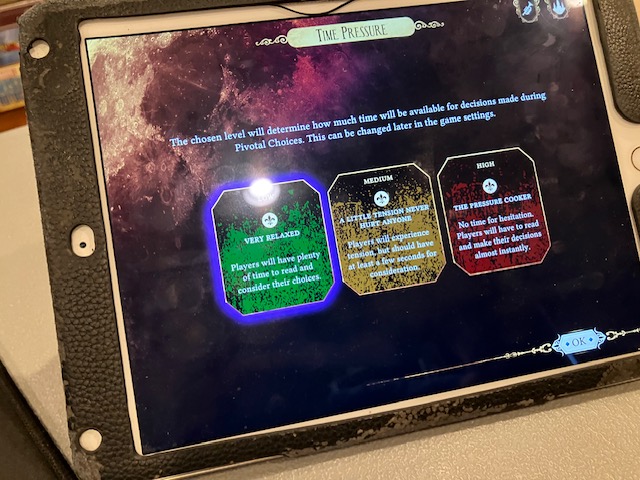
The APP is pretty good.  We didn’t encounter any real glitches or problems in solo or cooperative play.  Although it took them a while, the publishers did get the APP out and stable.

One problem: the font is probably too small.  We had trouble reading all that text (to be clear; the players read the text out, not the APP), and we wished we had a control to resize the font.  

Another gripe about the APP; there was no UNDO!  This is one of my biggest pet peeves in cooperative APPS; the lack of UNDO makes me me grumpy!  If this were a completely physical board game, UNDOs are easy:  “Oops!  I meant to go to the Graveyard!  Back me up!”.  Nope.  There is no UNDO in this app.   I think this actually slows down gameplay a little: “Are you SURE you want to do that?  We can’t back up!”

In general, the APP seemed to work fine for us in both solo or cooperative play.  It was pretty good.  Be aware, the players still have to read all the text out loud!! The APP does NOT read the text for you!

Dice and Murder

I said this earlier, almost everything in this game is a skill check with dice.  The game seems pretty balanced.   For instance, if you fail, the game typically gives you an “extra” effort die for your next die roll (which I appreciated).

But in the end, The Dark Quarter is still kind of a dice game.  Which I don’t love!  I feel like a detective game should be about following the evidence, making best use of your resources, and generally trying to be smart/clever.

Detective: City of Angels, Sherlock Holmes: Consulting Detective, are detective games where you have to be smart.    Although The Dark Quarter is a nominally a detective game, it has more drama in it than I expected.   The dice contribute to that drama, because they make the game more random and unexpected!

When I play Detective: City of Angels or Sherlock Holmes: Consulting Detective, I feel like I am playing a detective show like Death in Paradise, or Midsomer Murders where the mystery is front and center.  When I play The Dark Quarter, I feel more like I am playing a police drama where the mystery is less pronounced.  It’s not bad, it’s just not quite what I was expecting.  

If you want to jump into a police drama in New Orleans in the 1980s with lots of magic and character development and story, this is the right game for you!  If you want more of a mystery, well this isn’t quite that.  But there’s still more than enough mystery to keep you going!

Conclusion

The Dark Quarter is a really interesting game, but you have to know where it fits best.  I don’t think it works great solo, it’s more random than most mystery games, it’s very dependent on the APP, and the 18+ age requirements are pretty stringent.

But, if you find a group that wants to jump in to a 1980’s drama/mystery with lots of adult twists and turns, The Dark Quarter is the game for you!  It’s got great story, interesting interactions, and plenty of character development/regression!   Instead of watching an adult mystery/drama on HBO or Apple+ tonight, consider playing The Dark Quarter instead!

Solo play: 6/10. Cooperative Play: 8/10.  I think most people would probably give this a 9/10, but I think I wanted just a little more mystery and a little less dice-rolling. It’s still really good though.