Welcome back to cooperative Adventure month! This week, we venture into a fantasy adventure! With words??
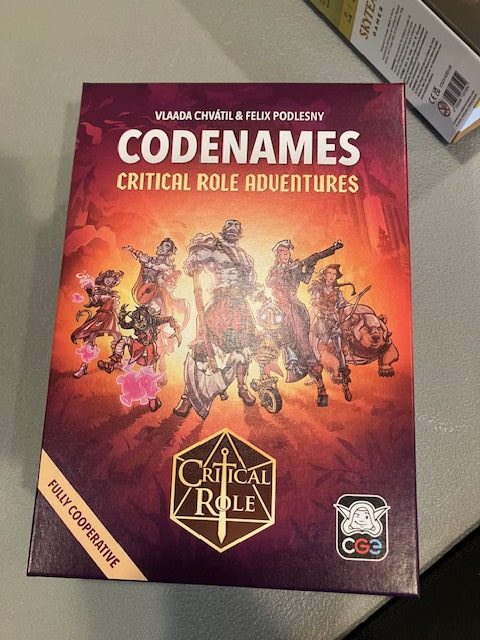
We haven’t talked much about Codenames here at CO-OP Gestalt because most incarnations of Codenames are big, competitive team-based party games: Codenames, Codenames: Pictures, Codenames Disney, Codenames Simpsons, etc. (To be fair, the 2-Player Codenames Duet and Harry Potter ones are co-op). We were reminiscing just recently how BIG Codenames was a few years ago! It was all the rage at the original RichieCon!
Well, now there’s a fully cooperative version! Codenames: Critical Role Adventures! This can play a pretty big group! You need at least 2 people (a clue-giver and a clue-guesser), but we had an amazing time with a 5-Player game!
What do we think of the new Codenames: Critical Role Adventures?
Rules
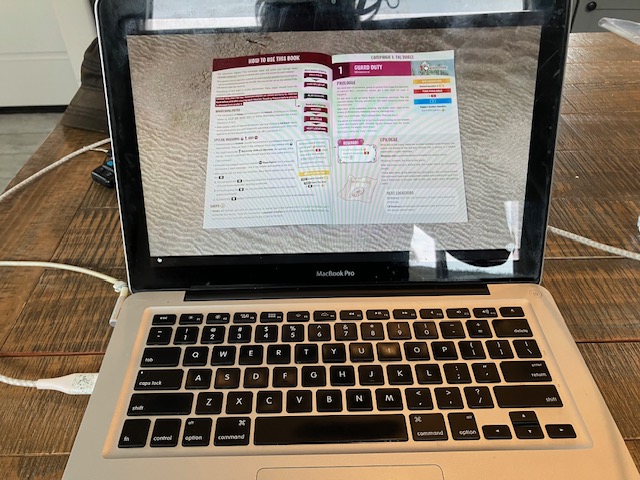
So, this is one time I broke down and just watched a video. The CGE video on how to play works great. It’s an easy watch: I recommend it.
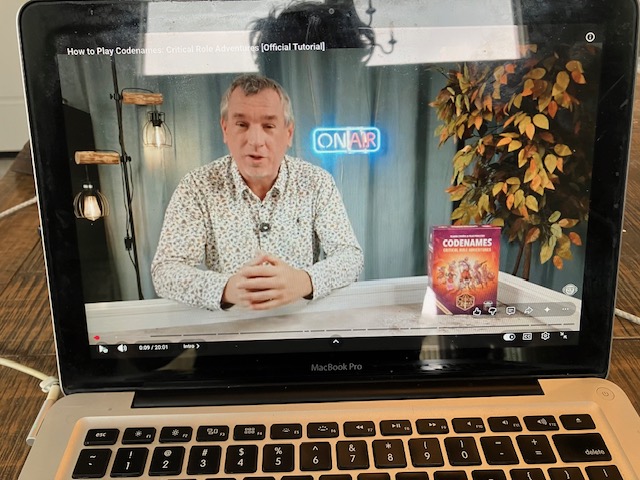
There are also several playthroughs online, but this video was more than sufficient. To be fair, I watched it a few times because I didn’t want to miss any nuances: my friends tend to be rules sticklers, and I didn’t want to miss anything.
There are a more rules in here than in the base Codenames … just enough to be just a touch daunting: so be aware! The new rules add scenarios, leveling-up, deduction, and special powers! So, yes, there are more rules! This isn’t “just” Codenames with a new coat of paint! It’s a lot more!
Critical Role
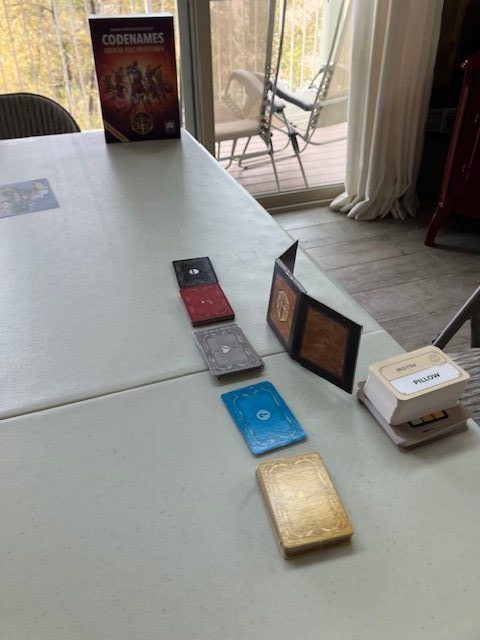
I know next to nothing about Critical Role. My understanding is that a bunch of people play Dungeons and Dragons online and people watch their adventures? I’ve heard great things.
You don’t need to know anything about Critical Role to enjoy this game! There might be characters or special allusions which might help you immerse yourself in the game if you know Critical Role? Not knowing about Critical Role did not detract from the game at all! (for me and my friends: none of us really knew it either) . If you know anything about Dungeons and Dragons at all, that’s probably all you need. In fact, a lot of the words in the game seemed like they came from more standard Dungeons and Dragons lexicons!
I hyped this game to my friends as Codenames with Dungeons and Dragons …and they were so in!
Components and Gameplay
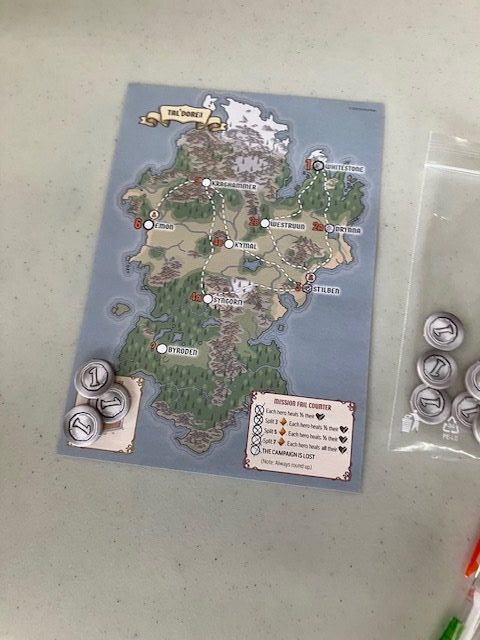
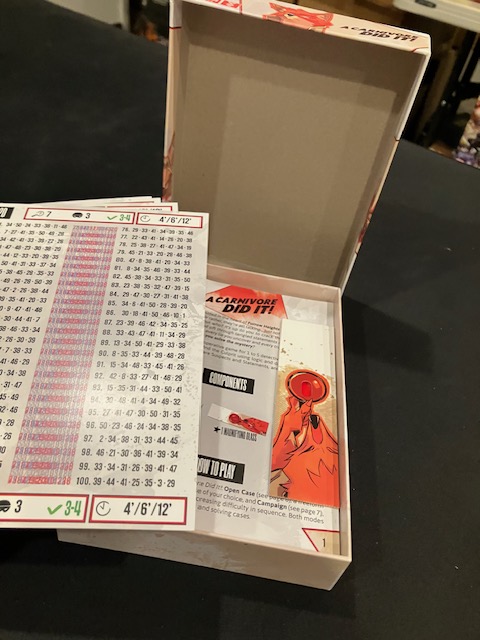
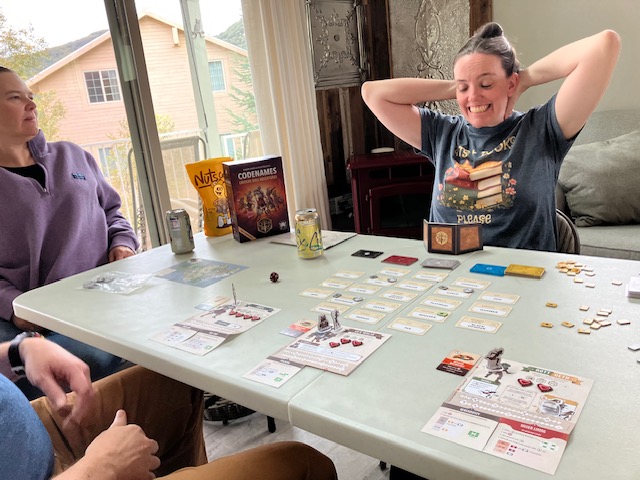
In Codenames: Critical Role Adventures, you and your friends are going on an adventure! There are three Adventures in the base game, with a map for each one! See the first one above! This map helps you note where you are (so you can save the game and come back: you can save games because each full adventure can be pretty long).
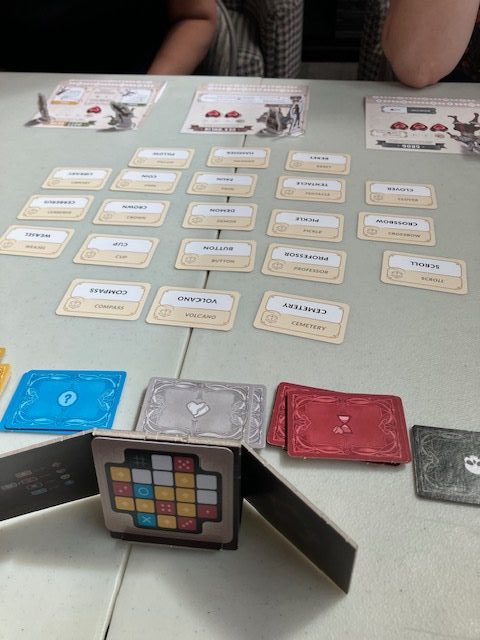
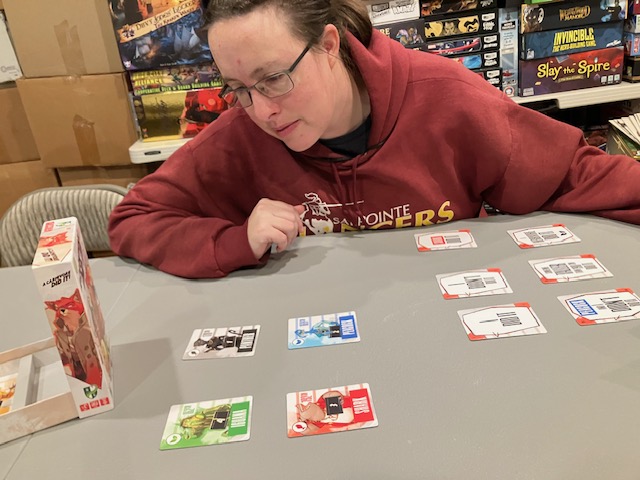
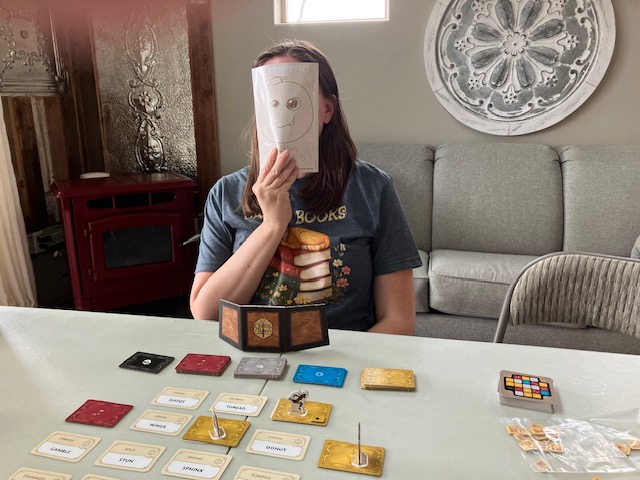
At its core, Codenames: Critical Role Adventures is still Codenames with its main “associate words” mechanism! See above! So, it comes with a little grid and word cards and the clue-giver (now called the Dungeon Master) gives clues to the clue-guessers (now called the party of adventurers!) See above! It looks like Codenames because it still is!
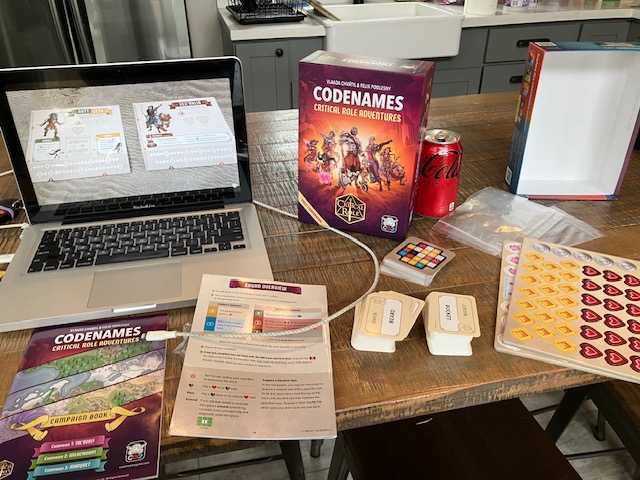
BUT, they’ve actually added quite a bit more stuff above and beyond the base Codenames!
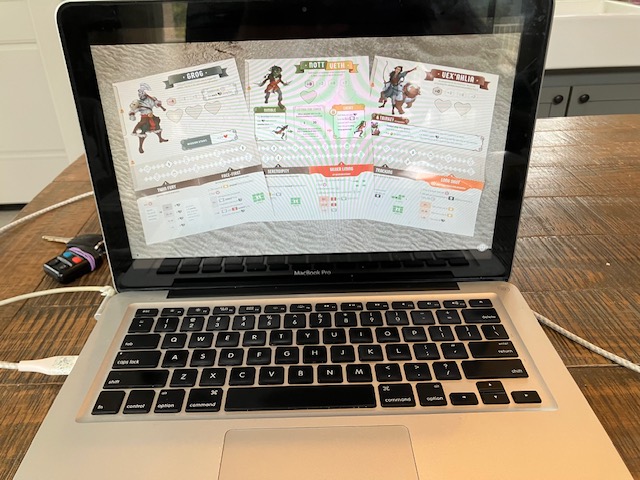
The group plays a party of three adventurers! No matter the number of players, the party is always three characters! The clue-guessers (no matter how many players) operate the three characters as a unit!
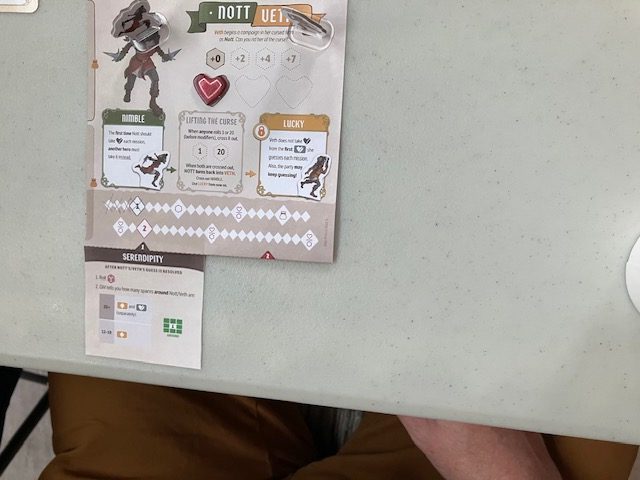
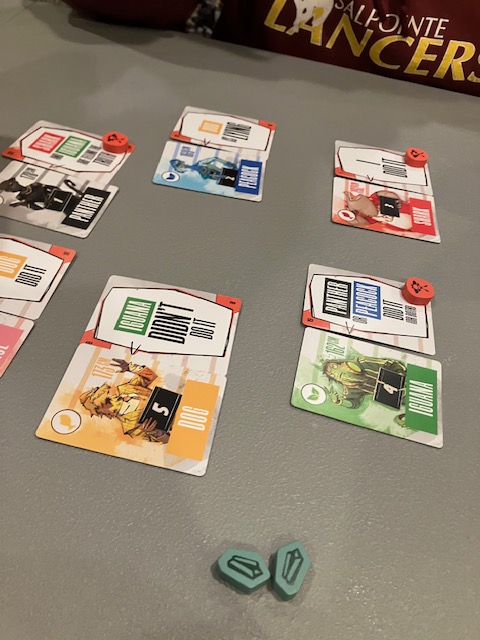
These characters have health! Every time that character guesses “wrong” on Codenames board, that character loses a hit point! See the hearts above on Nott/Veth! If any character ever goes to zero hit points, that mission is lost! (And you can replay it … up to a point).
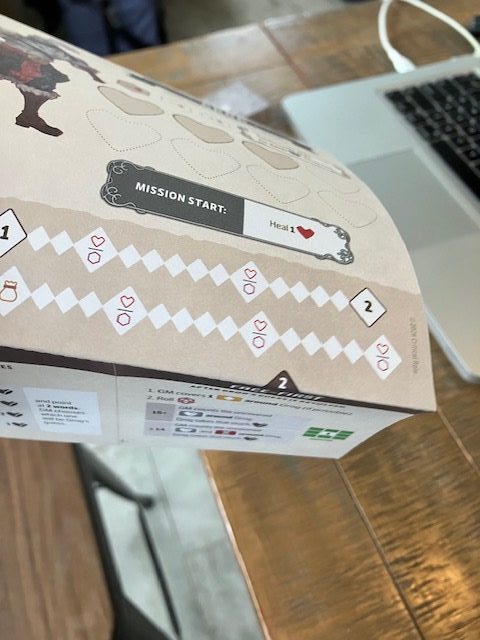
The characters also have experience points! See above! When a character guesses “correctly”, or completes a mission, or many other ways, the characters get experience points! The experience allow them to unlock special powers, upgrade their modifiers, or increase their hit points!
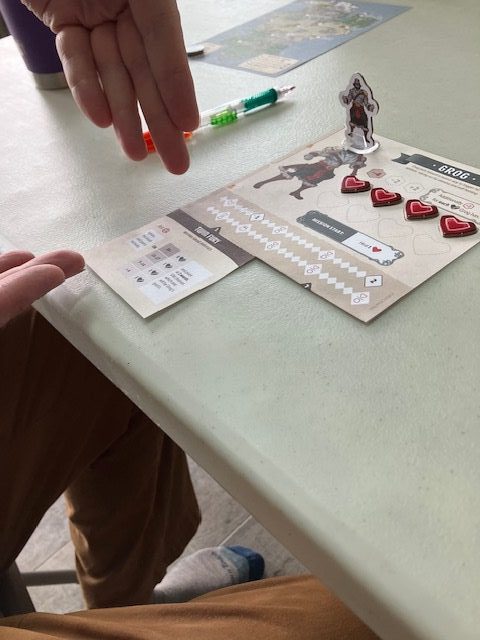
Perhaps the coolest thing in the game is the special powers that get unlocked from experience! The unlocked powers stay under your sheet until unlocked, then you fold them over to activate them!!! See above! That’s kinda cool!
The special powers do some REALLY interesting things! They can help you find cards, count “good” cards around you, avoid death, and all sorts of neat things that base Codenames never did!
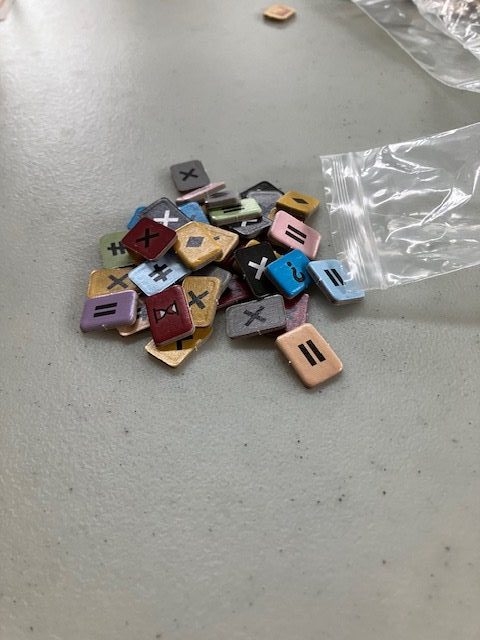
There’s a bunch of new tokens that allow the players to “help note” things on the board! Basically, Codenames: Critical Role Adventurers is now a cooperative deduction game as well! A cooperative word game AND a cooperative deduction game!
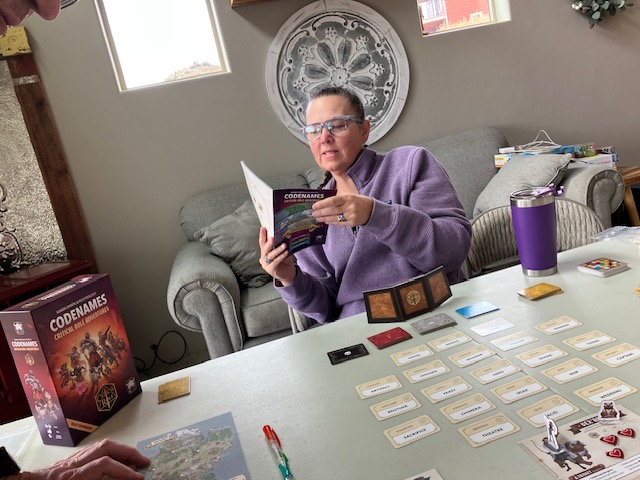
Each single game of Codenames is a mission where the party of adventurers guesses words! And each mission is very different! If you get through all the missions (each a session of Codenames), then you win!
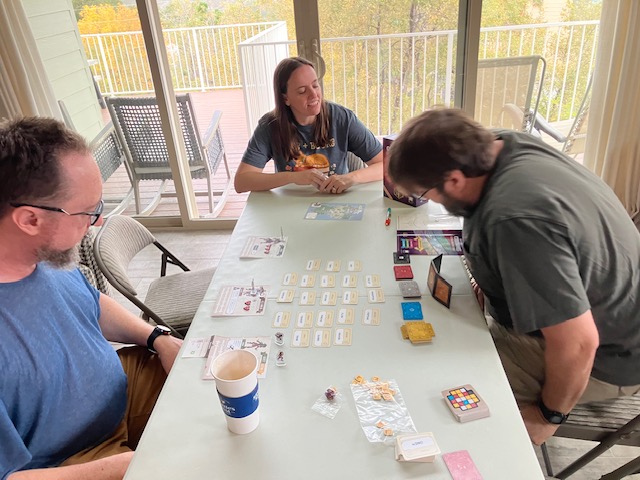
This really is still Codenames at its core, but with all sorts of new elements like special powers, deduction, hit points, experience, stuff to buy, ongoing story, and cooperative wordplay! All the new things “sound” a little daunting, and it will take you a play or two to get it, but it’s pretty straight forward.
If you play Codenames with your grandma on weekends (like my friend Sara), this might be a little too much.
Cooperative Play
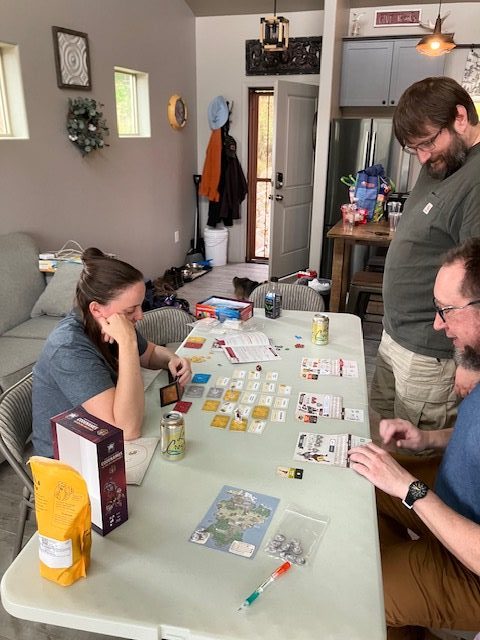
The core Codenames play is still the same. Everybody is on the same team guessing words: there’s always been that flavor of team cooperation in Codenames. But now, there is extra cooperation! Players have to work together to figure out “who do we send to guess”, “who should buy what upgrades”, “how do we spend experience points”, “should we use our powers”, and many other things! There’s a lot more fundamental cooperation as the players all manage the party together!
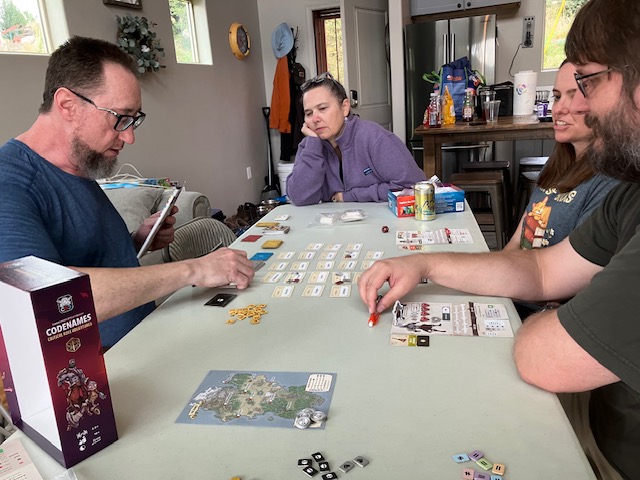
To be clear, the role of clue-giver (Dungeon Master) still rotates! Or at least, you probably should so everyone gets a chance to DM! It’s still cooperative, as the DM still wants everyone to guess the words correctly!
What we did seemed to work really well: we physically rotated around the table one space per mission! This let everyone rotate through every space on the board! The further seats had a little glare, so in all fairness to everyone, everyone got sit in every seat at least a few times!
And this fully cooperative nature keeps EVERYONE involved all the time! One of the problems with base Codenames is that one team is always “not playing” and that always seemed less fun (although some of my friends liked to guess poorly to “help” the other teams). With cooperative Codenames: Critical Role Adventures, everyone is always playing and looking at the board!
Number of Players
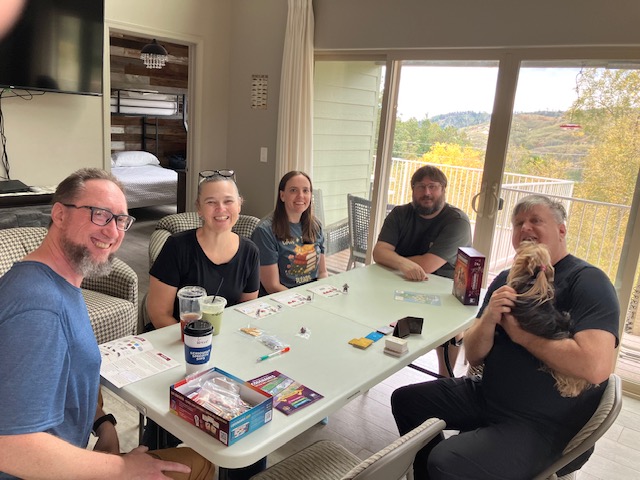
So, you can’t play this solo. Sorry. Someone has to give clues, some people have to guess.
We played with a group of five, and that worked extremely well! I think four or five might be the best count? I think it really depends on the dynamics of your group! I do worry that six or more people “might” be stretching it too much as “too many cooks spoil the pot”? Again, it depends on your group.
Fun
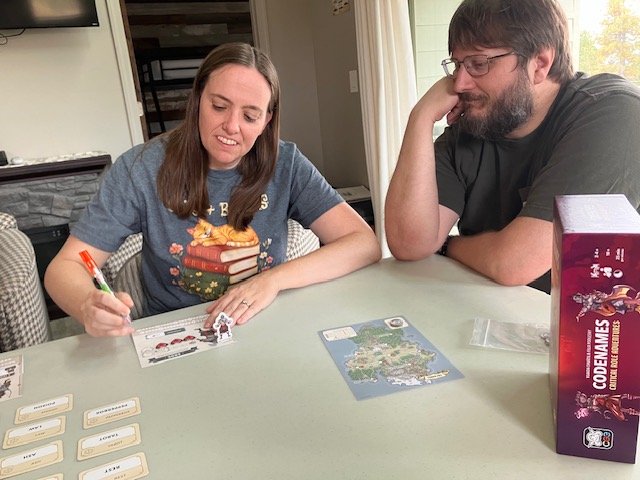
To be clear, we spent 4 hours on a Saturday playing through a full adventure! We lost the entire game after we failed one mission 4 times in a row, but we were so despondent that we “mulliganed” our last game and powered through to the end of the adventure! Sure, there’s an asterisk next to our “win” but we didn’t care! We had SO MUCH FUN! Why else would you play for four hours if you weren’t having fun?
Conclusion
Codenames: Critical Role Adventures was a giant hit with me and my friends! Yes, it adds more rules and more mechanisms into the game, but the cooperative nature, player advancement, cooperative deduction, ongoing adventure, adding powers, just all worked so well together! If you need a reason to play a bunch of Codenames sessions, the adventure gives you that reason!
This Codenames is complicated enough that it’s “probably” not for Sunday night with Grandma (but hey, you know your Grandma better than I do). Be aware of the extra complexity.
Let’s be clear: at its core this is still Codenames! I have a couple of friends who really don’t like Codenames and I don’t think this new version will change their mind at all !! Despite all the cool new features, this is still Codenames, the word-guessing game. EDIT: Actually, one of my friends who doesn’t love Codenames says this is probably his favorite way to play if we are going to play; so that’s a win?
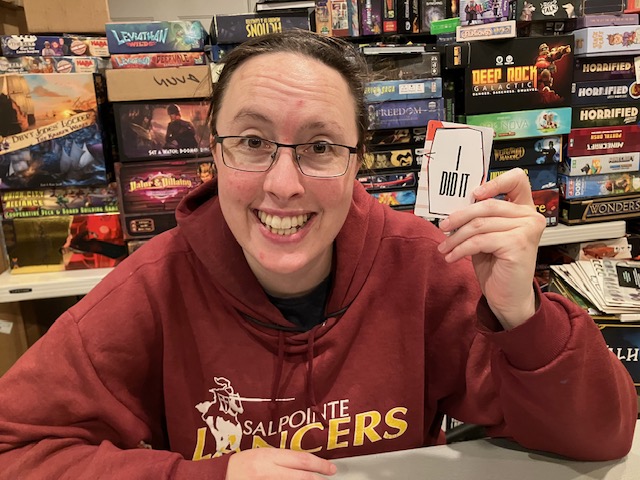
This is, simply put, my favorite version of Codenames! Codenames: Critical Role Adventures is a 9.5/10 for me and my group! Why else would we have played it for 4 hours straight???
If I were to say what tipped it over the edge to being so great, I would say it was the cooperative deduction aspect as enabled by the special powers!