
Welcome back to Cooperative Adventure Month! We’ve seen some interesting games this month with a sense of adventuring! This week’s entry actually has the word Adventure in the title! Let’s take a look a Long Dark Sea: Adventure Card Game!
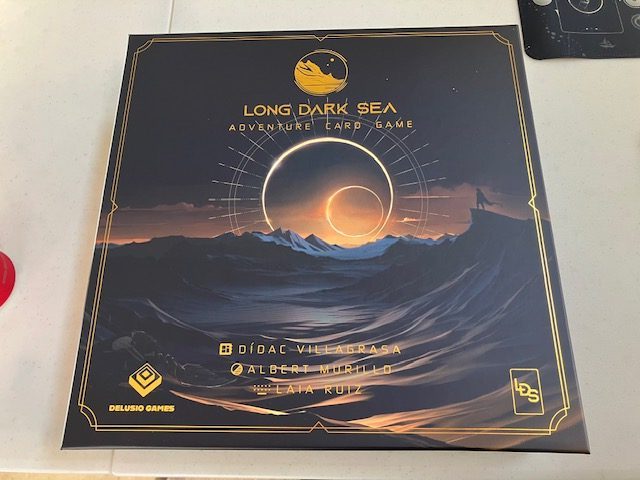
Long Dark Sea: Adventure Card Game is a cooperative deck-building* game with adventure/exploration/boss-battling in a game from Gamefound! This was on Gamefound back in May 2025! We backed it at the Limited Edition pledge (with some upgrades) and it finally arrived late in October 2026.
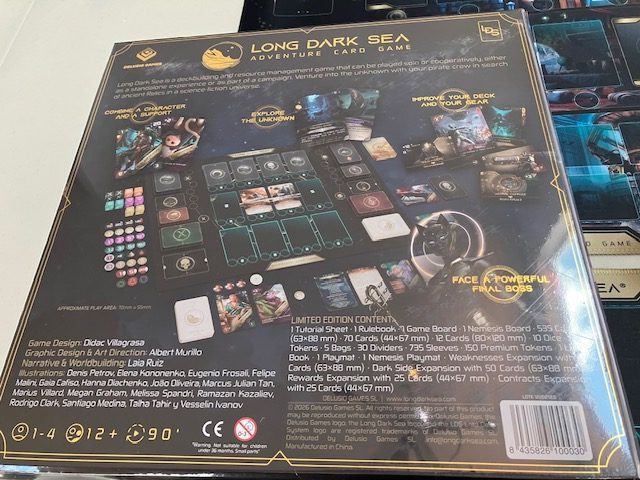
What is this? This is mainly a cooperative deck-builder* with space/Dune theme (but it’s not Dune per se). It plays 1-4 players. Don’t go believing that 90 minute playtime on the back of the box: I haven’t had a single game anywhere NEAR 90 minutes! Each of my games has been 2, 3 … 4 hours?
Let’s take a closer look!
Unboxing and Gameplay
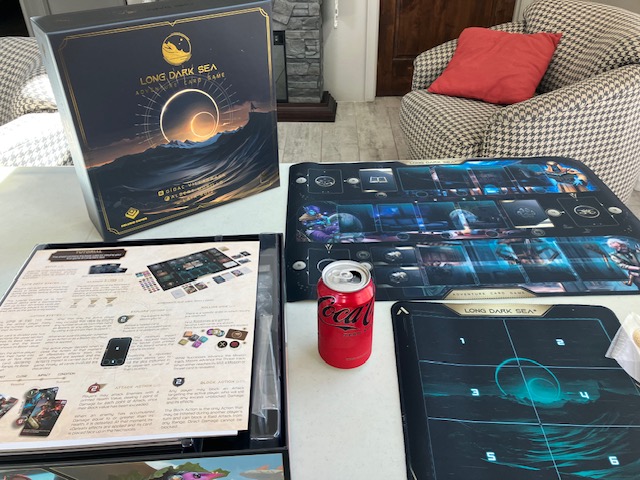
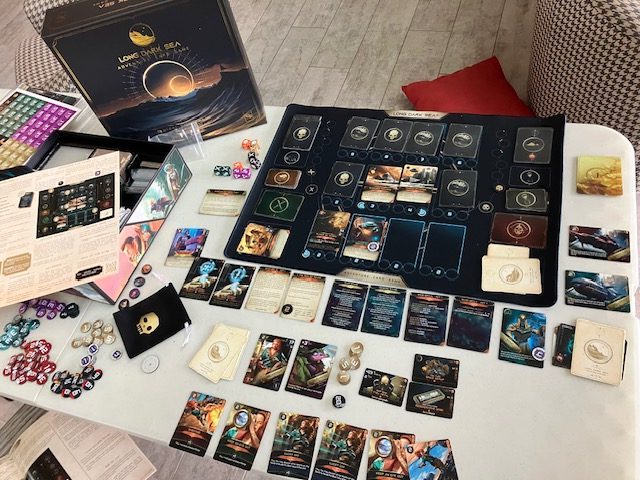
This particular version of the game came with some neoprene mats. You don’t need them (as you have normal boards in the box), but some people may prefer mats. See can of Coke for scale above.
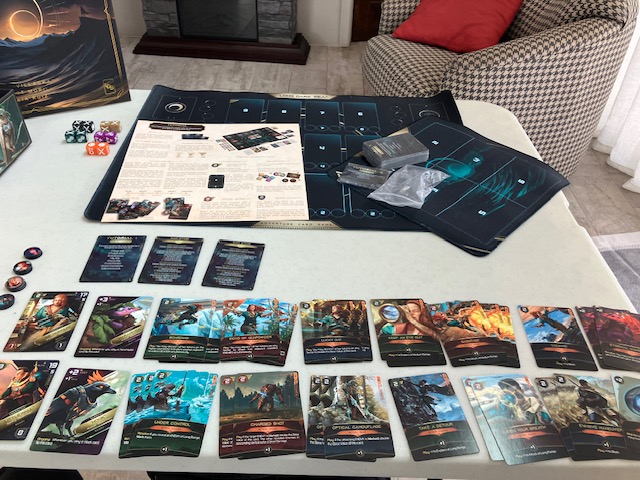
This is a deck-building* game with elements of exploration, combat, and boss-battling! Each player takes the role of one of four pirates! And each pirate has their own “support” character! (Think parrots: pirates ALWAYS have parrots!) Each characters generally starts with their own “flavor” of deck (cards specific to that character), so each character has … some distinct character!
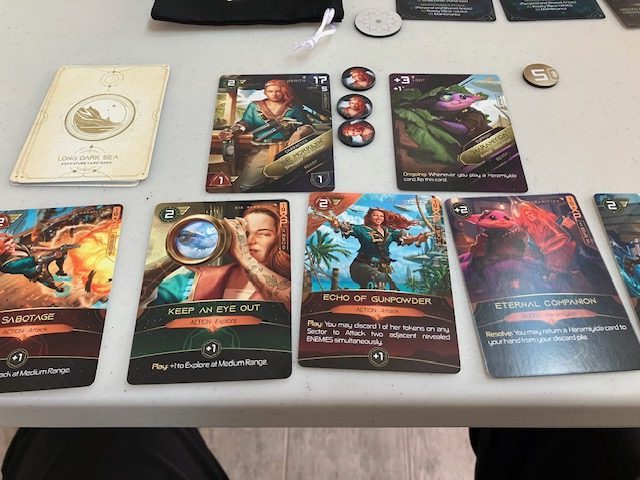
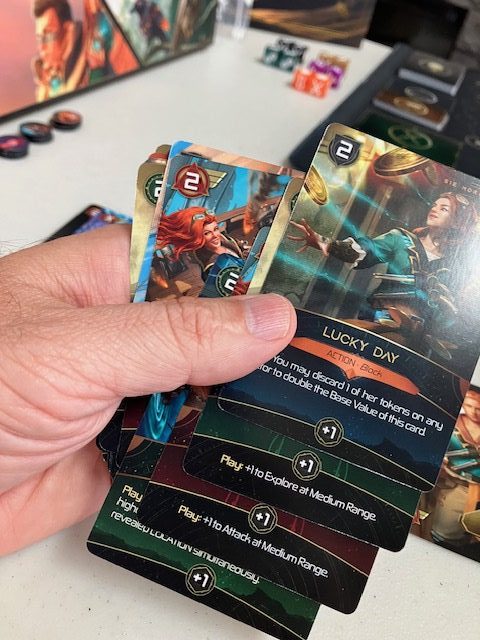
For example, one of the characters from the Tutorial is Sie Morrilyn! See above! This is the character I played the most! She’s a lively pirate with Haramiyida (the cute little thing) for her Support. There are also 3 other characters (and Support) of different flavor … we’ll see them later in the cooperative game.
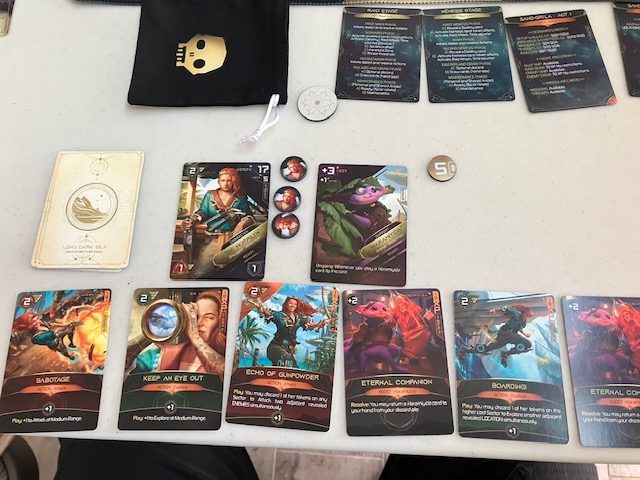
This is a deck-builder*, but I reluctant to say this is a “standard deck-builder”*, because it’s really not! You do some standard things, like commit cards to play and redraw at the end of your turn.
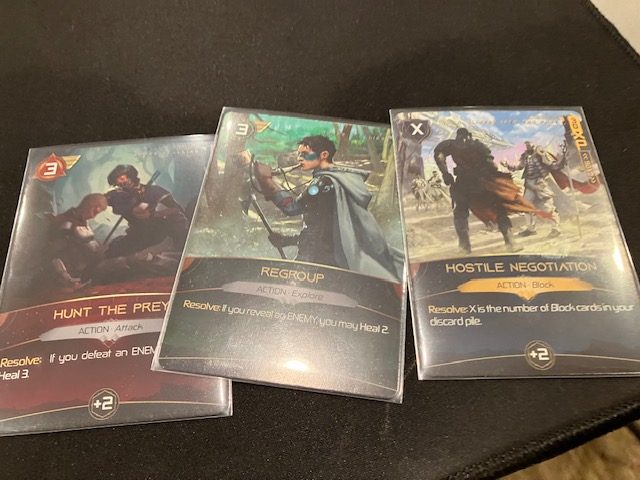
You are required to “start” an action with a card: the symbol on the upper left of the card is the type of action you want to initiate: ATTACK (red triangle, far left), EXPLORE (green circle, middle), BLOCK (blue shield, far right).
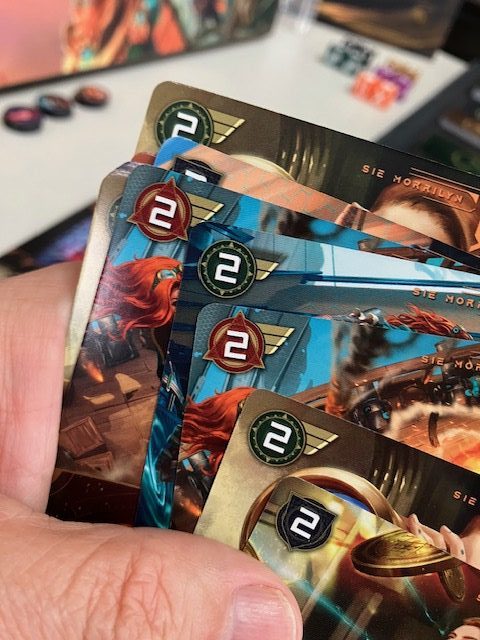
Here’s a little better view of the symbols (see above).
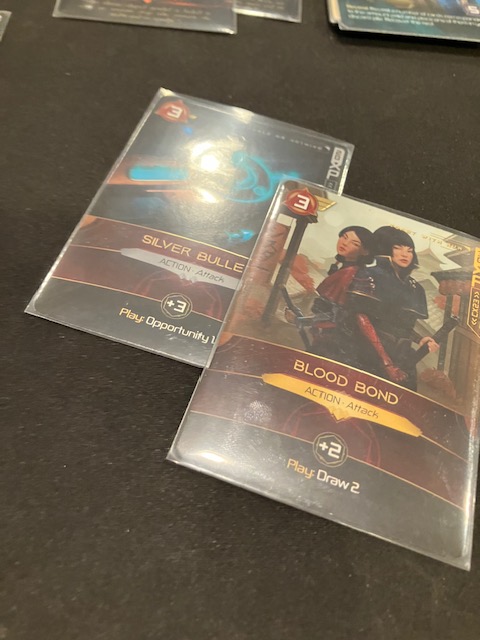
After you initiate the action, you can choose to BOOST the action’s power by committing more cards! When you BOOST, you use the bottom value of the card to BOOST the power of the action! It doesn’t matter what the original card’s action was, the BOOST can BOOST the power/juice of any action!
So, you can choose how much power your actions take! Do you want an all-out offensive with one ATTACK using all your cards to BOOST? Or do you want to EXPLORE a little and then save some cards to BLOCK attacks that might come to you later? It’s all about figuring out what to do with the cards in your hand!
Every card has a range that defines “how far” the action can reach: Short, Medium, or Long Ranged! It’s the gold bars next to the action symbol! See above : Both ATTACKS above can reach all three ranges, but the upper EXPLORE can only reach short and medium ranges! (BLOCK works anywhere).
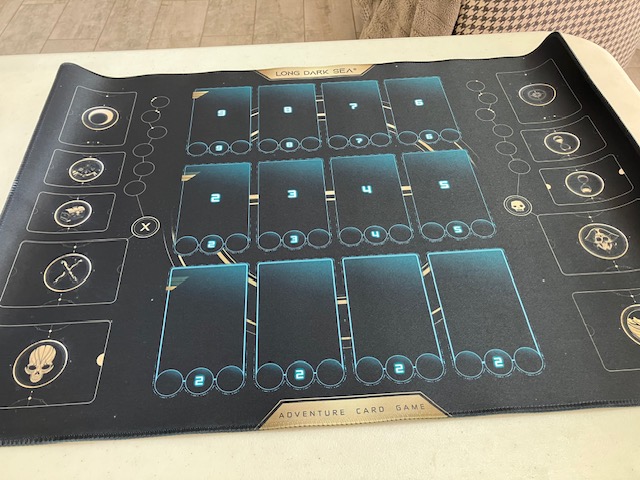
What are the ranges? The four sections in the last row are long-range (9-6), the four in the middle are medium range (2-5), and the four up front are short range.
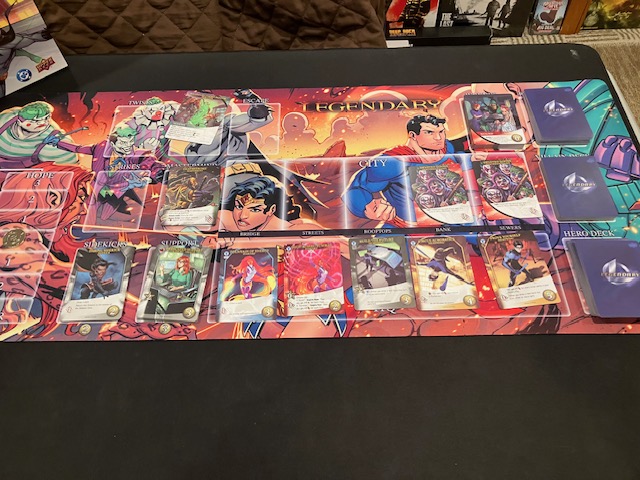
Much like DC Legendary (see review here), the bad news cards appear at the edges and move down, pushing other other cards around. See above. In DC Legendary, a newly drawn bad new card starts on the right of the city and pushes its way left, possibly leaving (usually with a penalty).
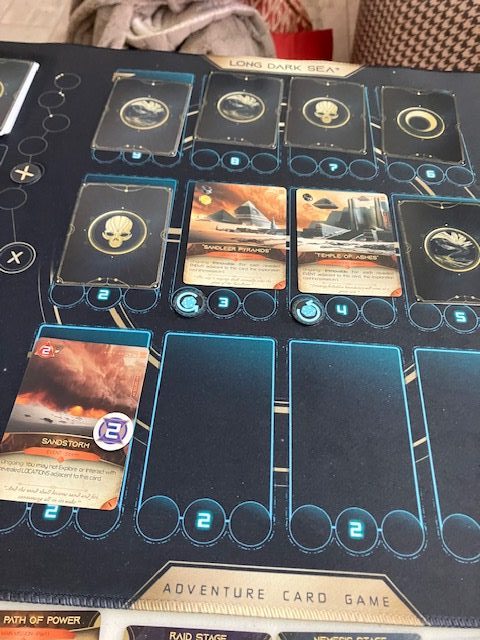
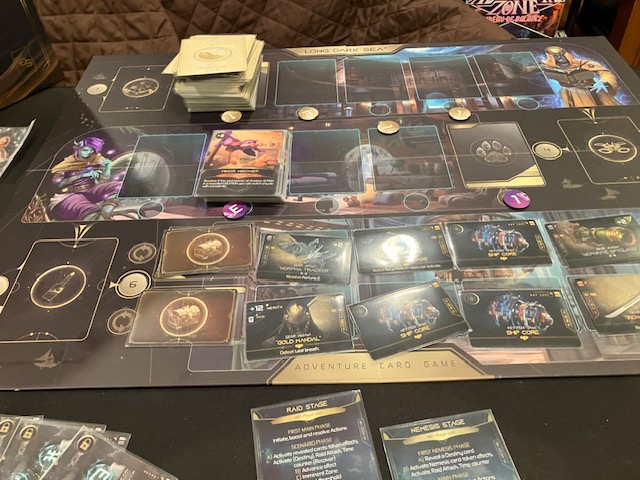
Here in Long Dark Sea, the cards start at the top left, and push cards around the map like a number 2 until they reach the short range! Also, the cards remain unrevealed until they reach short range! If you haven’t explored the card earlier, it will reveal in the first short range space (where the Sandstorm is at the bottom: see above). If that card gets pushed off the right edge, you may take a penalty! It’s VERY much like DC Legendary (or any of the Legendary games) as cards come out. The difference is that you have to choose if you want to reveal these bad news cards early or not … exploration has its benefits, but it also has its costs! Reveal it sooner, and a bad news may expire early (some cards have timers, like the SandStorm) before it can reach you! (Oh yes, the bad guys cards have ranges too!). Reveal it too soon, and it may attack you before you are ready to deal with it! What will you do? What WILL you do?
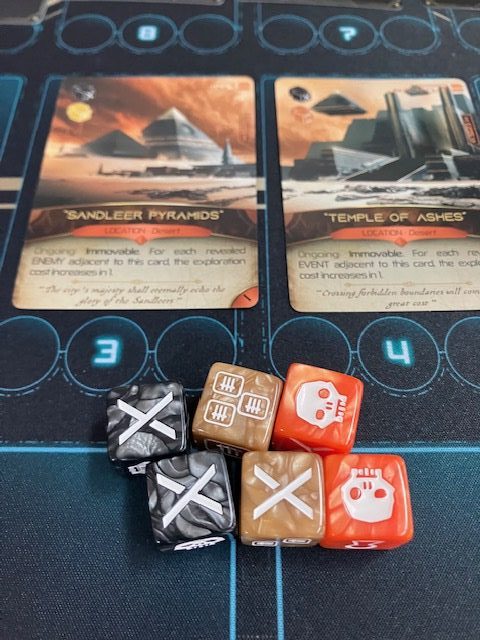
Typically, though, you want to use EXPLORE actions to look for things of interest in the game! When you explore, your EXPLORE action has to be able to reach the desired range AND you also to have enough “juice” to reach the sector! Above, you need a combined power of 3 or 4 to EXPLORE the Pyramid or Temple (respectively). The initial EXPLORE action gives the base power, and the BOOSTs give you enough juice to reach farther sectors!
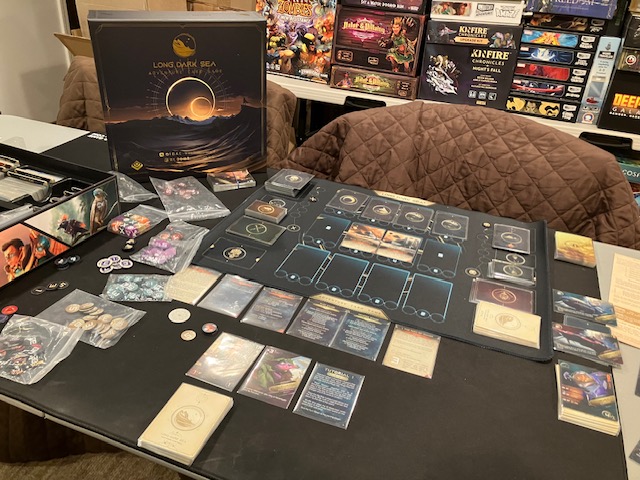
Now, there’s a LOT more to this game … and I mean, a LOT more, but that’s the basic flavor. You EXPLORE the universe to find things, ATTACK baddies to win the day, and BLOCK occasionally. If I had to describe it simply: this is a deck-builder* that reminds me a lot of DC Legendary, but with a more space/Dune vibe. With a kinda piratey theme?
Rulebook
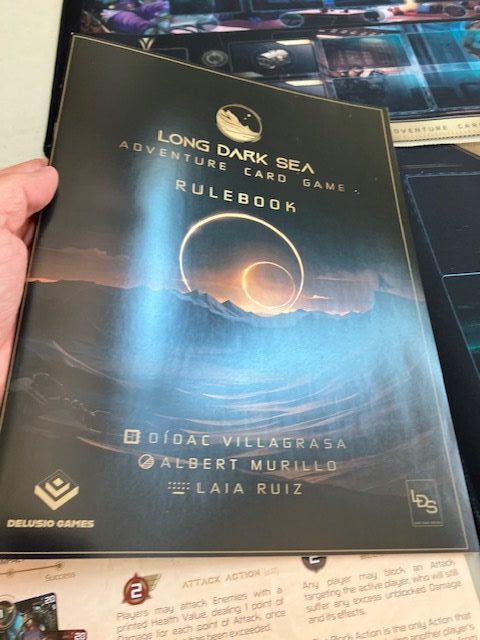
We need to talk about this rulebook. This game lives or dies on this rulebook, and I hate to say this: it may die for you.
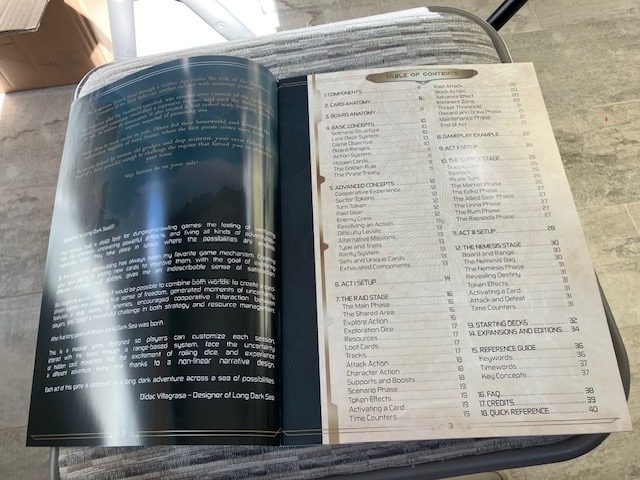
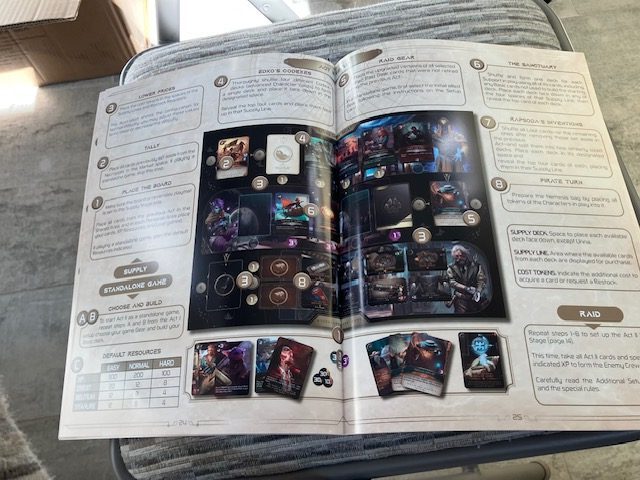
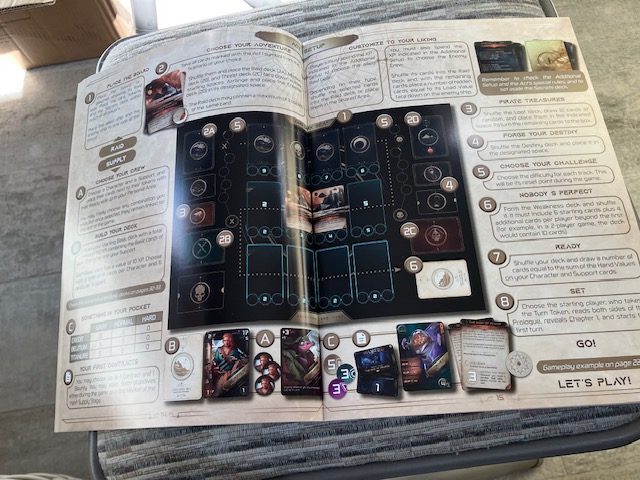
The rulebook starts great, with a nice very personal intro and a very good Table of Contents. Also note that it stays wide open on the chair next to me, has a big font, and ONLY that first page has white text on black page. This rulebook, from a form factor and usability perspective gets an A- on the Chair Test: it works really well on the chair next to me with minimal floppage of pages.
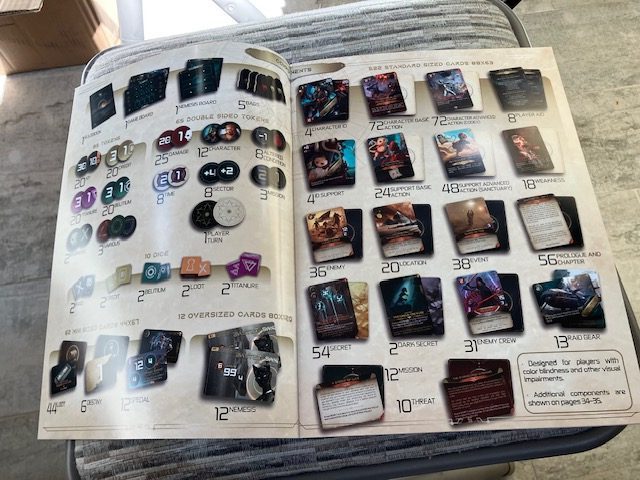
The Components pages are fantastic. See above.
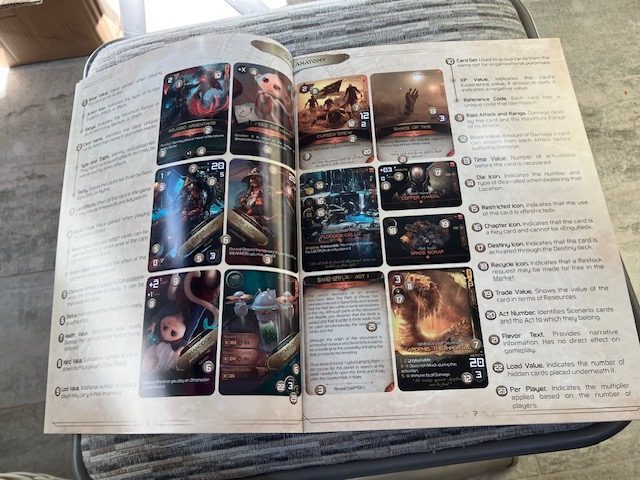
The Overview of cards is very useful. Big fonts, lots of annotations, even if you don’t understand everything at first.
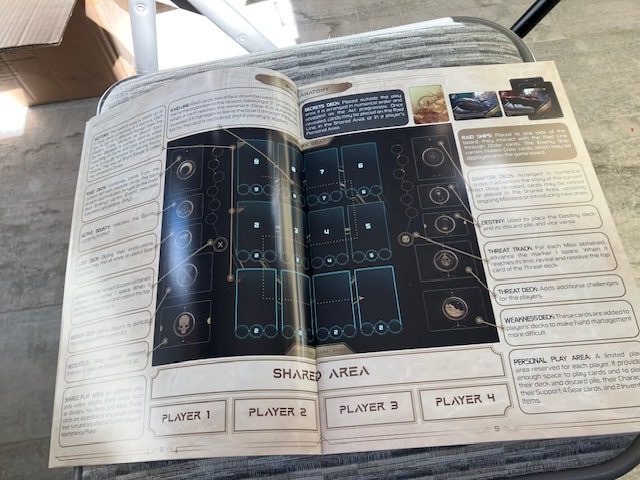
A picture of the set-up(s) is really well annotated too!
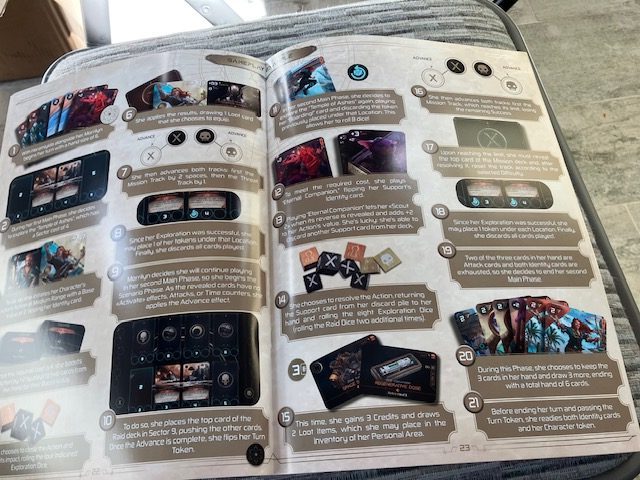
Arguably, the SINGLE MOST important two pages are pages 22 and 23 of the rulebook! They give an example of a turn, and show everything that happens. THIS, THIS was key to my getting up and going. Without this, I think I would have struggled and possibly stopped investing. Between these 2 pages and the tutorial, I think you can get into the game.
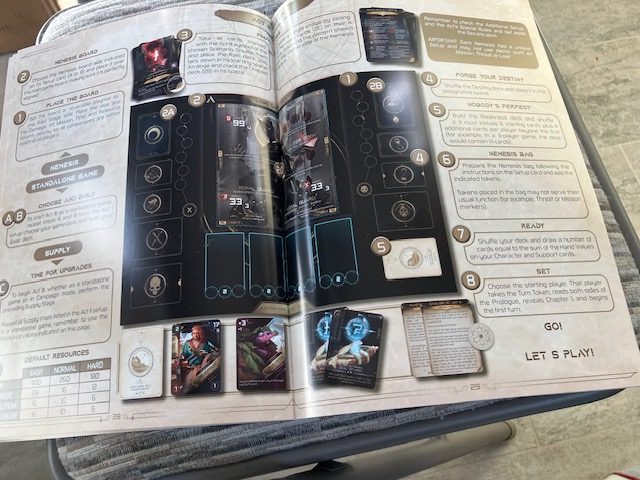
The game, or Campaign, has three Acts: the first two are similar (much like DC Legendary), but the final act is a boss-battler (see later in the rulebook). I hate to say this, but the further I got into the campaign, the less precise the rulebook seemed to be.
This rulebook leaves a lot to be desired. It looks like it might be SO GOOD (it has a great keywords sections, a great table of contents, great pictures, great fonts, great examples), but there just seem to be a lot of rules missing? Or underspecified? The final boss-battler seems to worst: it felt like there were a number of rules missing.
After playing through a full campaign, I think I know the questions I can ask now to help me understand the game, but I think you will have to press on and just make lots of assumptions before you can even know what questions to ask. I struggled mightily with this rulebook, despite loving it at first. There are a lot of good things about this rulebook, A LOT, but it doesn’t seem to have some fundamental rules (esp. the Boss Battle) specified.
It also was a struggle to figure out how to do an uncardening; the rulebook had no mention how to uncard the game.
Uncardening
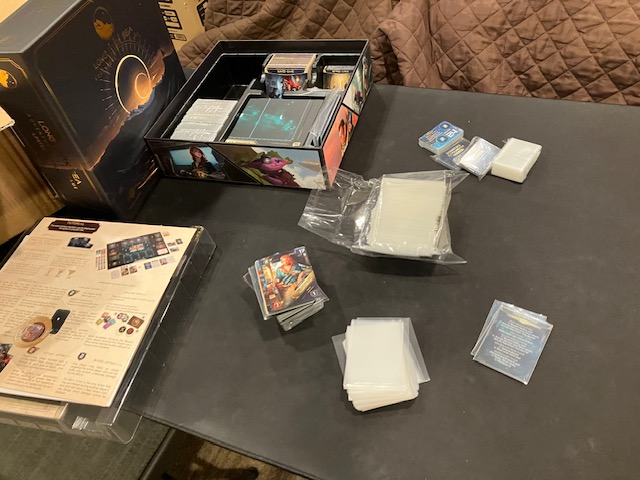
This game comes with a LOT of cards: it’s a deck-builder*! And, if you have no experience with a deck-builders*, you can easily become overwhelmed with ALL the cards in this game. How do you sort all the cards? This experience, which we have dubbed uncardening! This is yet another reference to out DC Legendary review, where we discuss the same experience with cards!
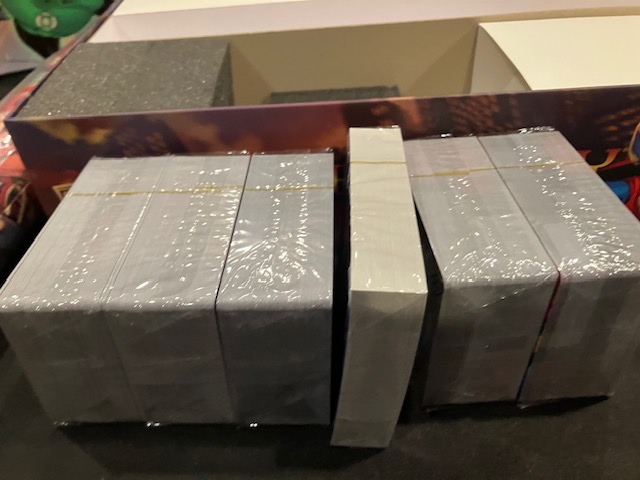
When you have THIS many cards, how do you organize them? What’s the right way? How do you uncard (uncard: take cards out and sort them into proper piles) ? Long Dark Sea has a little better answer than DC Legendary: do the Tutorial first, then at least then you have a sense of the game.
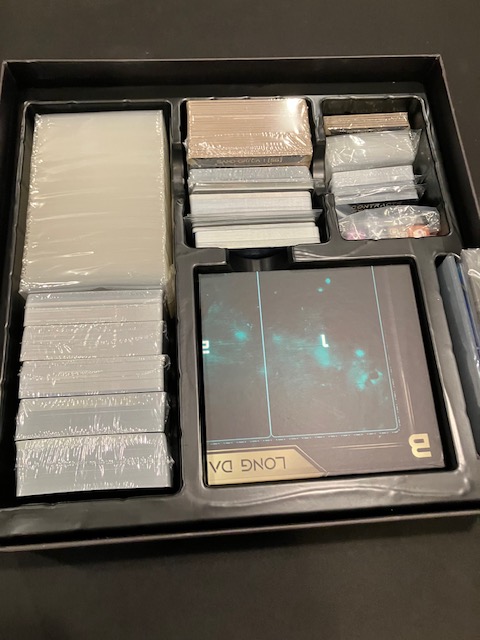
Long Dark Sea still needs an uncardening section in its rulebook. See all those cards??? But it’s a little better because of the tutorial.
Tutorial
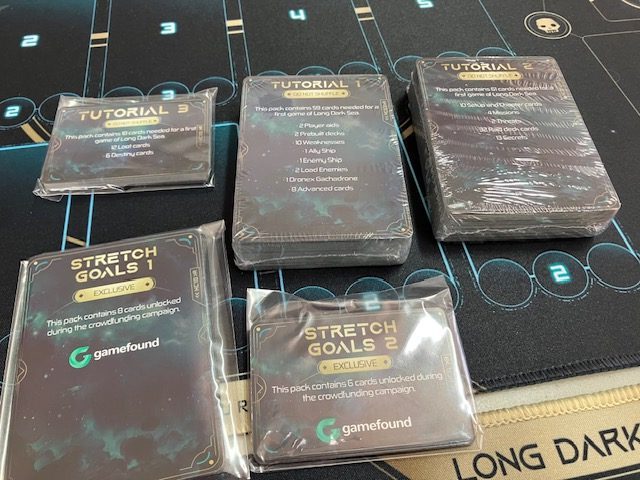
The Tutorial is quite good! I was able to get first game played using JUST the cards above (not the stretch goals).
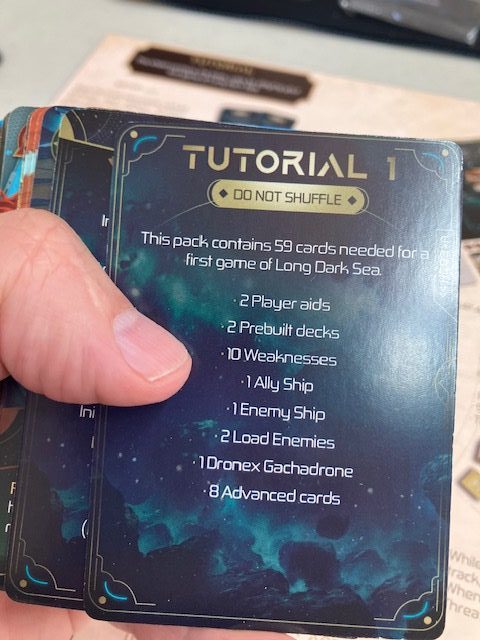
The Tutorial does a pretty good explaining most things you need. It tells you the cards you use, the cards in the deck, where to put them, etc. You have to couple this with using the rulebook, but it works.
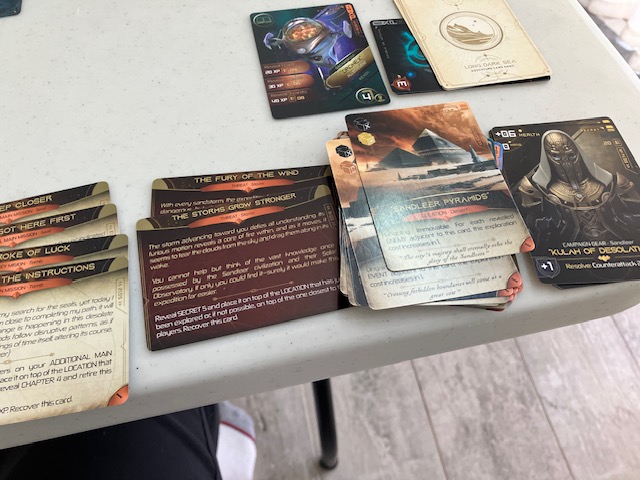
The tutorial helps you set up a bunch of cards for ACT I of the Sand-Gri’la campaign. See some more cards above.
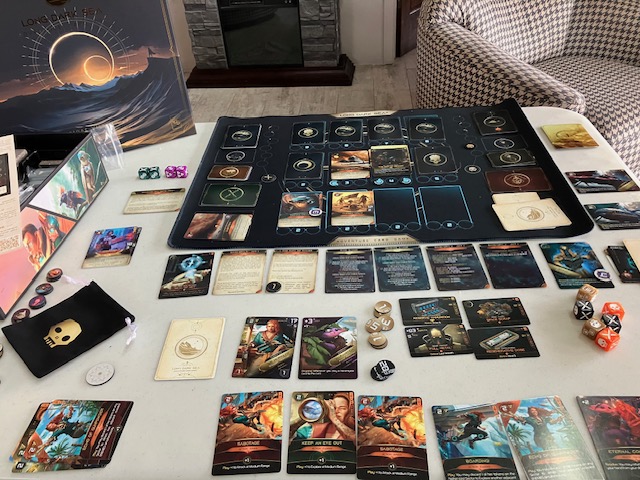
Once the Tutorial gets going, it flows reasonably well. I sorta looked at this game as a “more complex” DC Legendary. I got a lot of rules wrong (especially with Support and Ships), but I got many rules right. I think the first game is just to get a sense of the game. For this first Act, the rulebook was good.
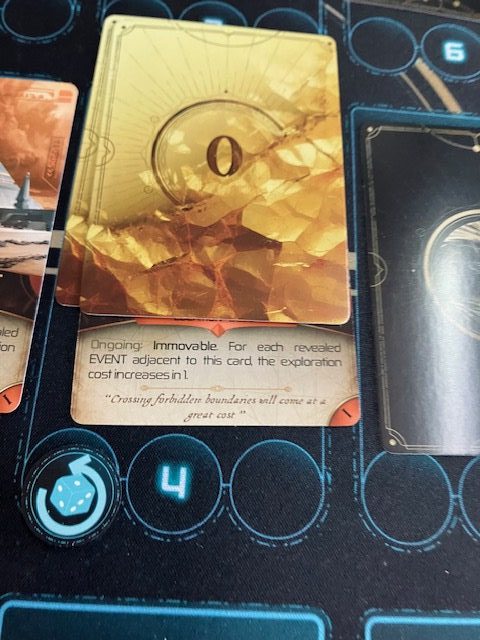
I had fun in my first game! This is a pretty unique deck-builder* with amazing art, very thematic ideas, and an interesting story that unfolds! There are SECRETS to uncover! A Story to read! This is a VERY THEMATIC deck-builder*! It’s an adventure!
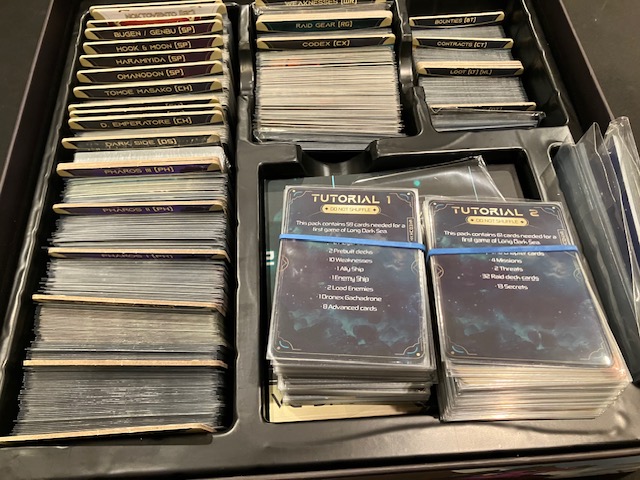
I have a strong recommendation for you: PUT THE TUTORIAL BACK THE WAY YOU FOUND IT! It was clear to me that I still needed to take another run at the game before I even thought about teaching other people. You “might” be tempted to start sorting the decks, but I recommend always keeping the Tutorial ready. You may come back to this game in five years, having completely forgotten everything! The Tutorial is the way to jog your memory.
Sleevening Event
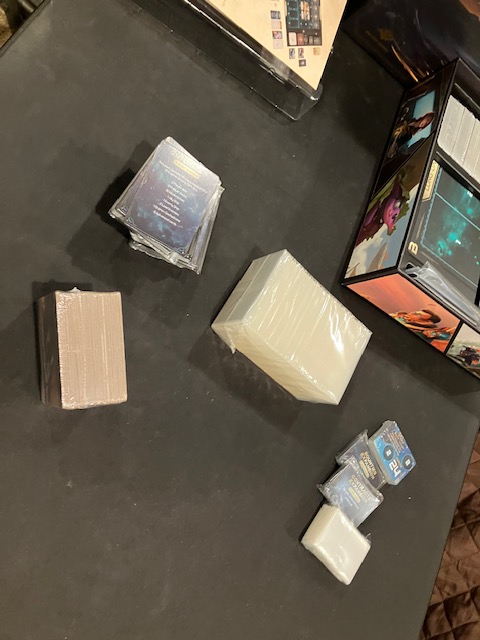
We had two separate sleevening events: there are a LOT of cards in this game: the rules say 522 cards! So, my friend Teresa helped me sleeve some one day, then we came back another day and did some more.
This is a deck-builder*: you should probably sleeve the game. I’ve played enough that I am glad I did sleeve the game: you handle these cards ALL THE TIME!! The only game I played where I didn’t have everything sleeved was the original Tutorial.
The Campaign
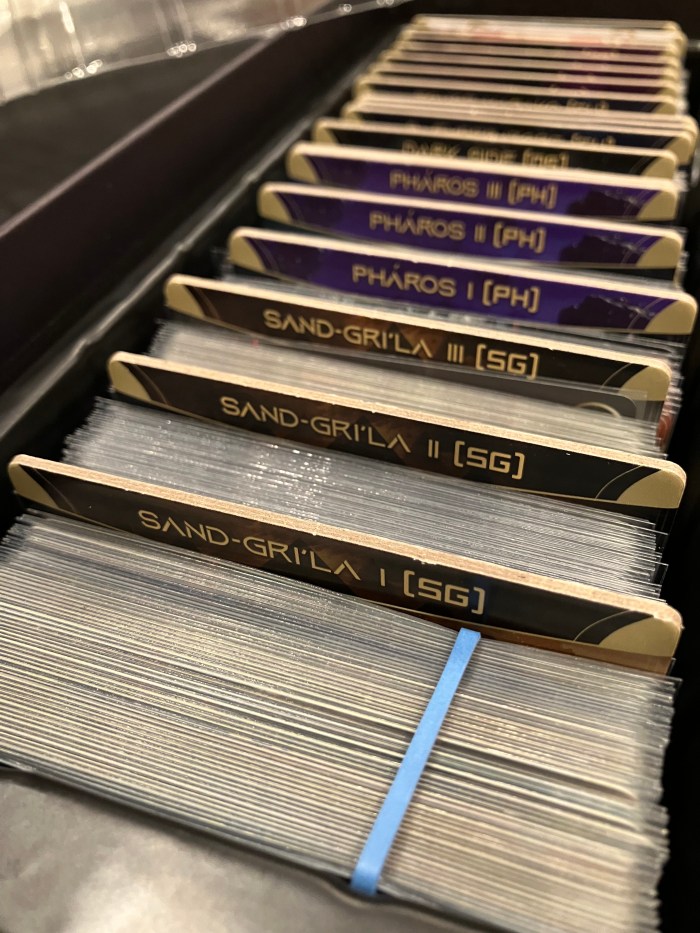
There are two major campaigns that come with the game: Sand-Gi’la and Pharos (see the sections above). And yes, they get points for the funny joke!
Each campaign game has three Acts and “sort of” 5 games total. What do I mean by that?
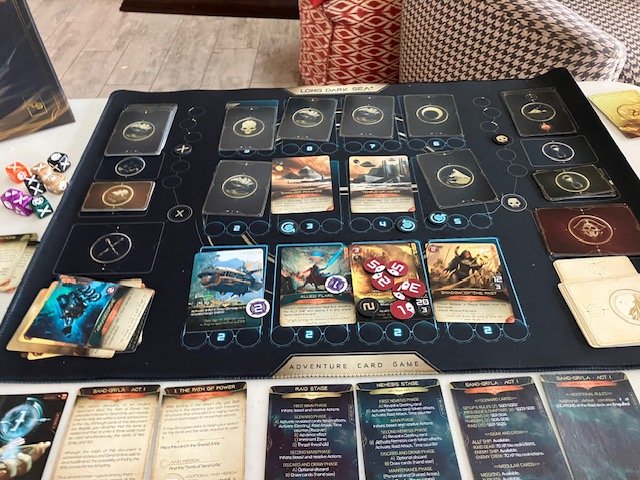
Well, Act I and Act II are very similar: you deck-build*, explore, and fight the bad news cards as they descend down the board: see a very full board of bad news cards above! This part of the game is most like DC Legendary.
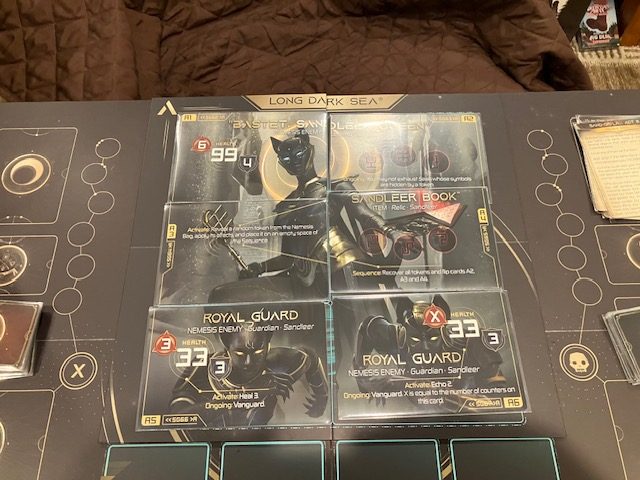
Act III a big boss-battler! It plays VERY differently than Acts I and II! You don’t get as many actions, you have to attack portions, and there’s bag-building portion! It’s very different! It looks so cool too!
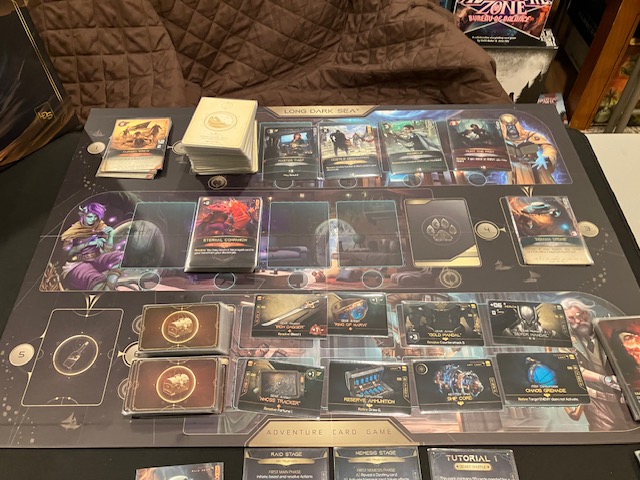
“Wait, you said like 5 Acts? That’s only 3!” In between the Acts, you do a Supply Stage where you can buy new gear, new cards, new Support cards, and upgrade raid gear! You spend experience, and three other types of money to buy different things! That’s right! The game has different notions of money for different things!
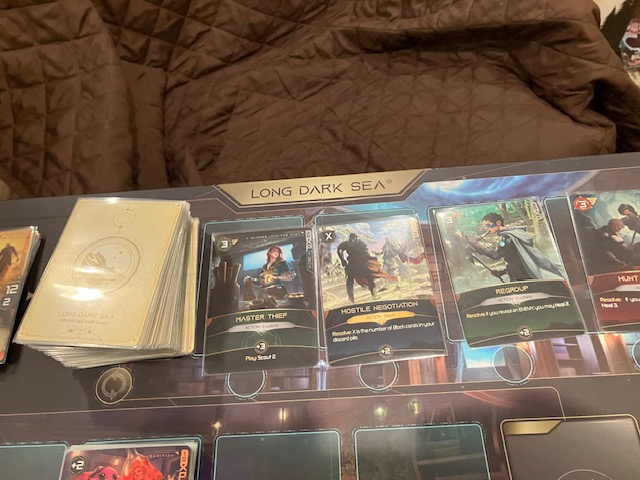
For example, the Codex cards (better versions of your base cards) take money and experience to buy! And there’s a weird Pirate Trading rule … which sort of forces the players to bid in a certain order using a bag-building idea. I think the purpose is to make sure everyone gets a fair shot at buying the cards you want to upgrade your deck. Here’s the thing; it’s optional. If you just want to “be friends” and “cooperate” and just buy the cards you want, you don’t have this Pirate Trading thing. That’s what we did. If you have a contentious group and need to do this, why are you playing a co-op?
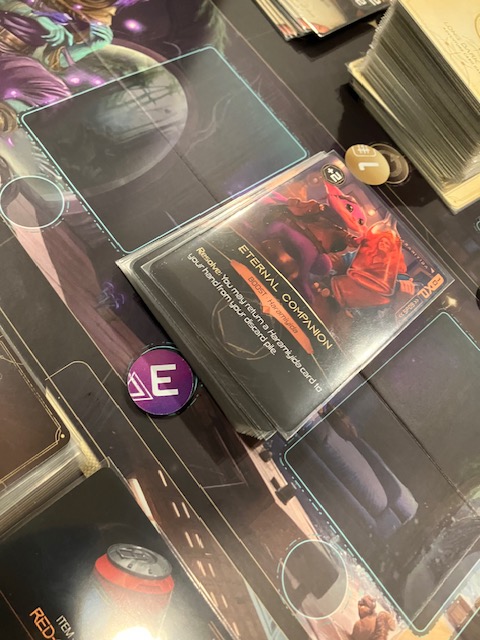
You can also choose to upgrade your Support cards … if you have the purple money. We did not. It almost seems weird, as NONE of us had purple money. The proper place to explore just didn’t come out I suppose?
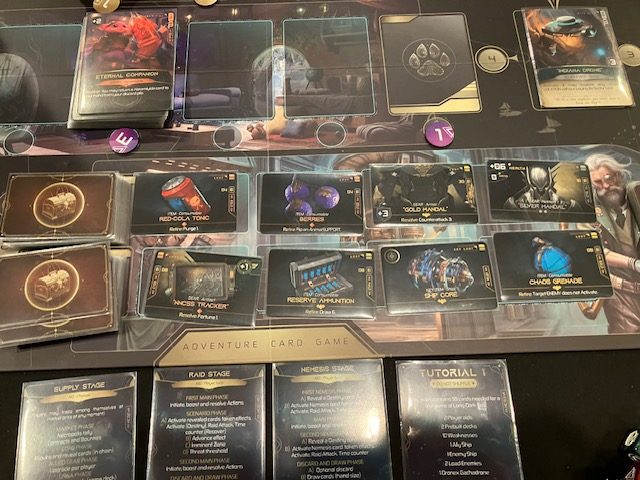
You can also buy new gear and loot. BE CAREFUL: you need blue money and gold money! And it’s VERY UNCLEAR on the gear card that you need BLUE money. Look closely below …
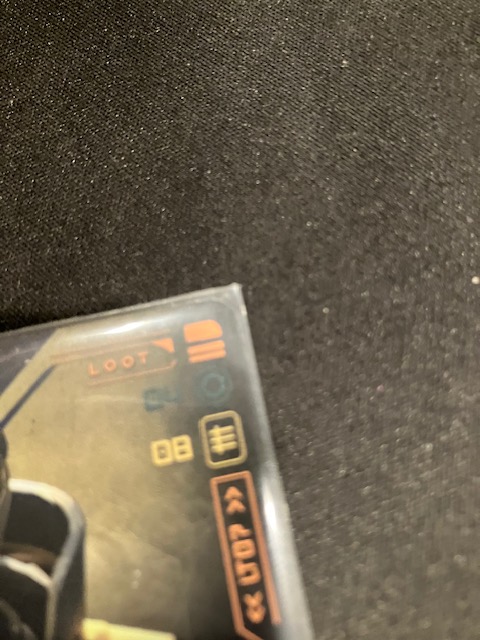
Do you see that? Look closely above! I had played 6 games before I ever noticed that! The LOOT above also requires BLUE money!!! This is terrible iconongraphy! And terrible colors for fonts!!!
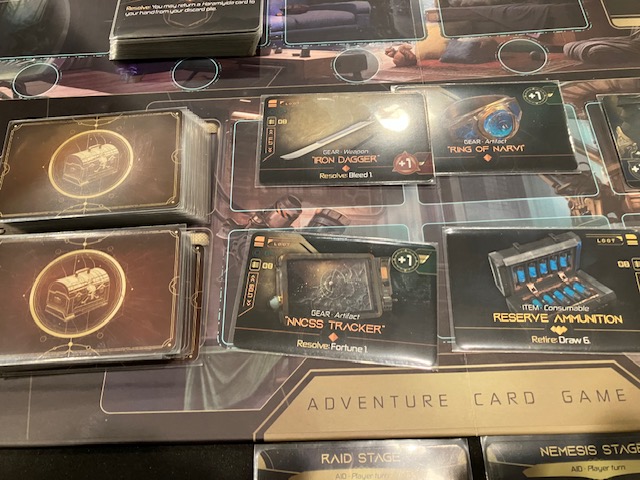
You can also cull cards and upgrade gear in this phase.
The basic flow of the campaign is Act I, Supply Stage, Act II, Supply Stage, Act III (boss-battler). There are rules if you choose to start at Act II or III.
Deck-Building or Deck-Advancement?
I’ve stated many times that this is a deck-building* game, but you might have noticed that * next to it. That’s because this is more of a deck-advancement game! Recall that we have used this term in the past from Small-Time Heroes (see review here) and Adventure Tactics (see review here). Deck-advancement means that your deck stays static during the game and you ONLY add/subtract cards between games. In other words, you don’t buy new cards while you are playing!
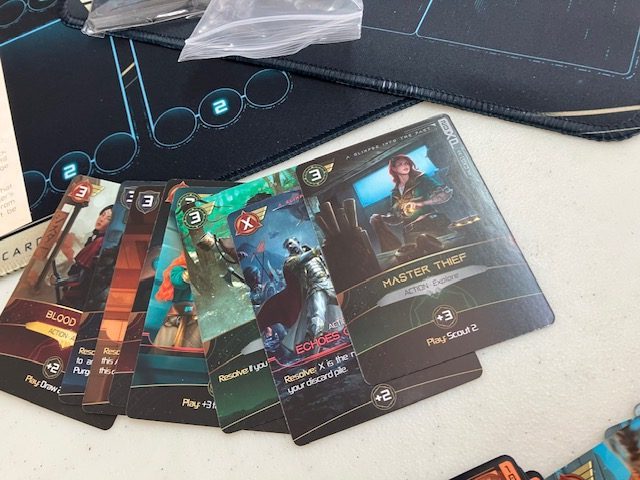
Now, strictly speaking, there is a limited mechanism for upgrading cards while you are playing. There’s a pile of 8 advanced cards (depending on # of players) that you can buy from if you have enough XP and money.
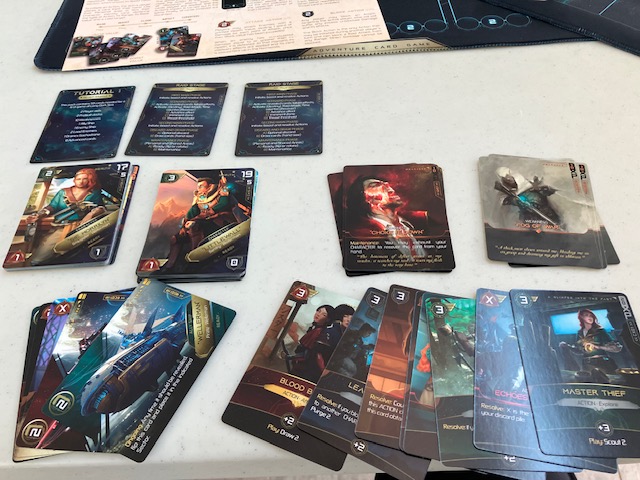
It’s a little weird because you need to spend a lot of money and XP to even get a single card, and unless you spend enough money, you won’t even get a choice! Secondly, once that pile is flipped, no one else can buy for at least 4 timer countdowns, so it’s unlikely more than just a few cards will be bought in any game. Strictly speaking, Long Dark Sea “is” a deck-builder because of that one very limited mechanism, but I would be more likely to call this a deck-advancement game.
Despite being more of a deck-advancement game, it’s flow feels very much like the DC Legendary deck-builder.
Cooperative Game
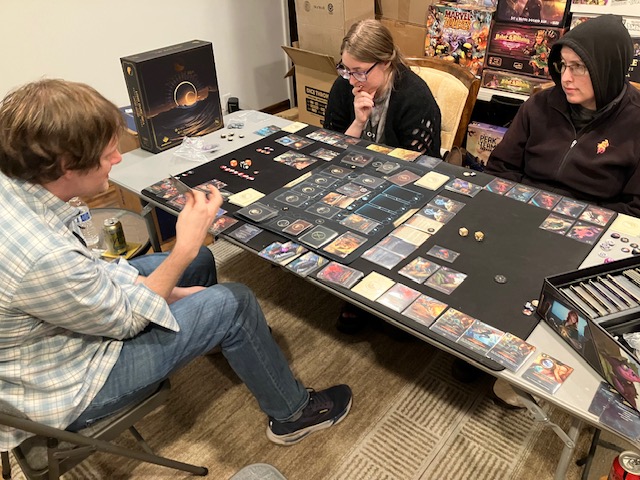
We decided to try a 4-Player cooperative game: this uses all four of the characters that come with the box.
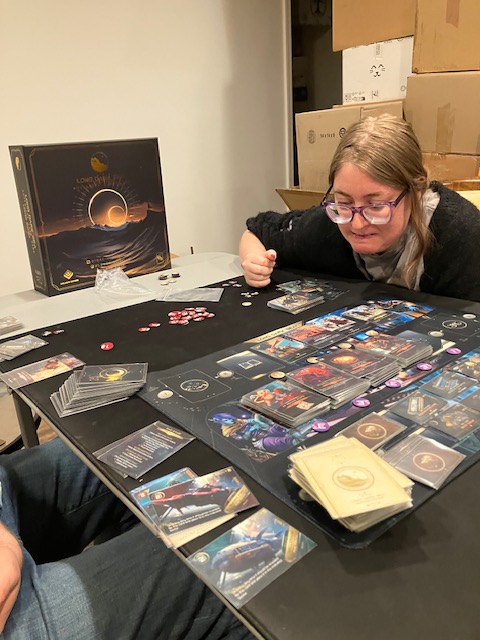
The game is fairly multiplayer solitaire, as players take their turn without too much interference from others. Much like DC Legendary. But, I saw that a little too early …
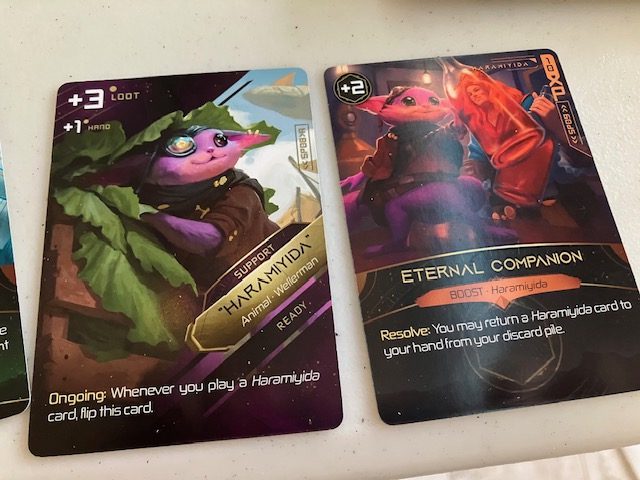
BUT: the rules are very good about saying you can use a support card on someone else’s turn! That’s right! The Supports (which typically boost an actions, see Haramiyida above) can be made to BOOST another players turn! The cost is that you can’t play the Support on your turn! But if that extra +2 might make a difference between killing or dying, it might be worth it!
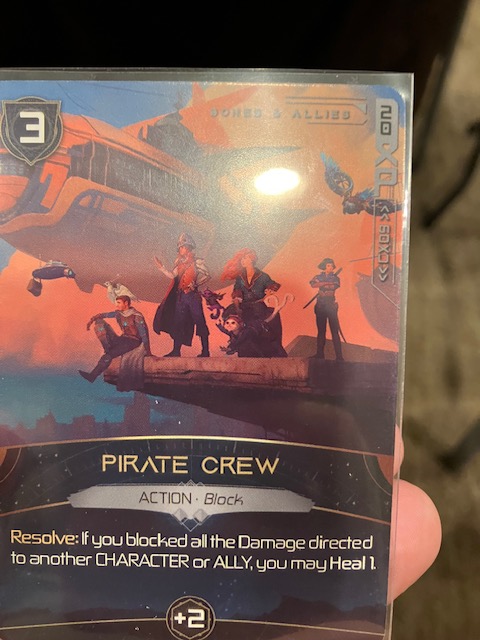
Secondly, the wording on the Pirate Crew card (see above) suggests that you CAN block for other people! We all assumed that you could only BLOCK for yourself? I am pretty sure I didn’t see these rules in the rulebook (but maybe I missed it: I don’t think I did). So, that’s critical as well! We didn’t see this card until after we finished our first cooperative game, but the wording (see Pirate Crew above) is very suggestive that you can BLOCK for others!
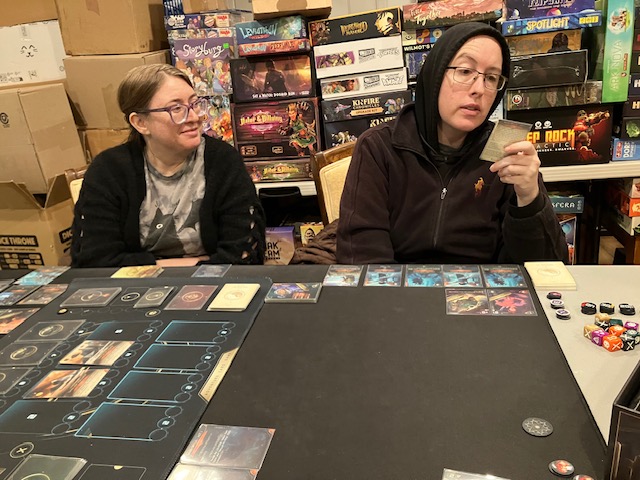
Arguably, this makes the game a little more cooperative than DC Legendary: You can BLOCK for other or play a Support card outside your turn. Of course, there is a cost to this cooperation: you’ve made your turn less powerful.
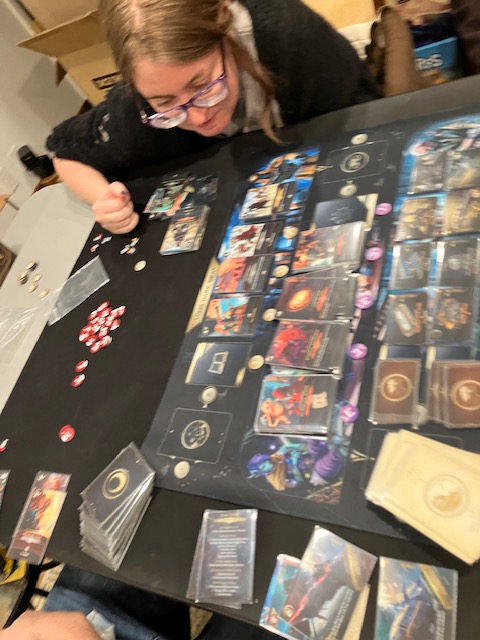
Over the course of 2.5 to 3 hours, we played Act I and got through it. It was tight; we felt like we were going to die at the end! But we made it ! Did we want to play again?
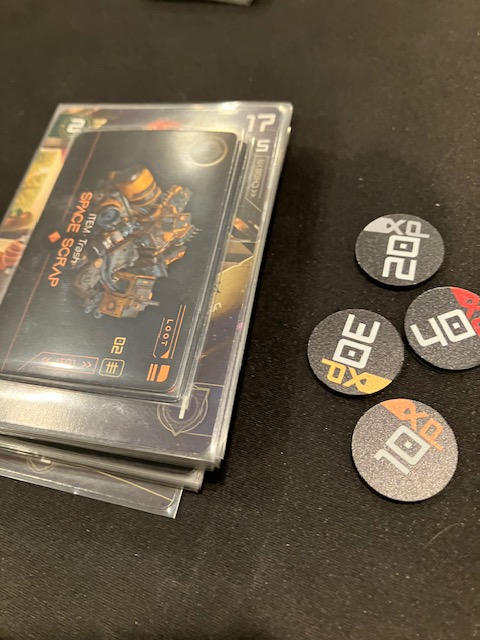
Yes! We all saved our decks and XP and gear and put it back in the box. (We did one Supply Stage after where Andrew culled his deck to almost nothing). We’ll be playing Act II next time! We liked it enough to play again!
We played Act II: it took 4 hours!
Things I Liked
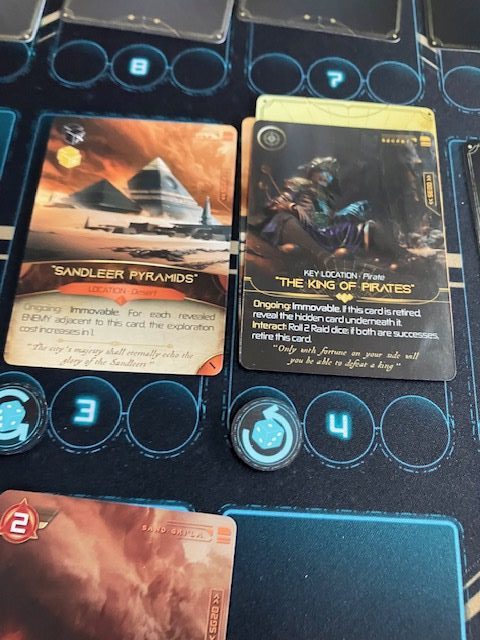
Art: I really dig the art in this game. Sara and I looked at the art for a while; we are pretty sure it’s not AI! The art in this game is just top-notch.
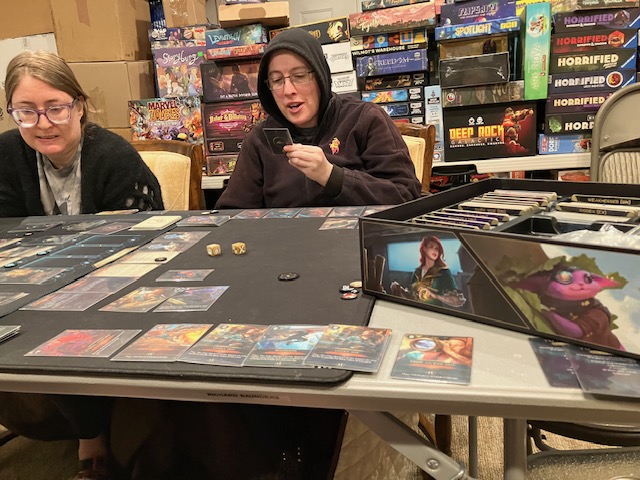
Theme and Story: There’s a lot of theme and story in here.
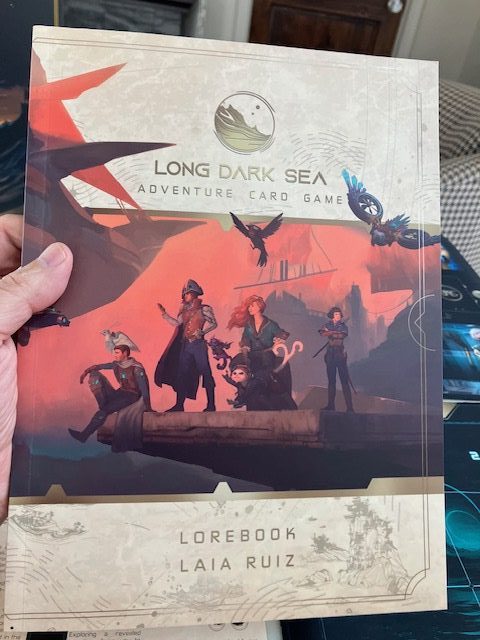
World-Building: A lot of effort has been put into building this world. And it shows. It’s something to be proud of. I liked playing in this world.
Neat Ideas: There’s a lot of neat ideas in here that make this unique. The range of the actions, the cost to get to a space on the board, the three BLOCK, ATTACK, EXPLORE actions, Even though it’s not a deck-builder per se, there are just enough mechanisms to make your deck upgradable. This game has a slightly different feel. And it works.
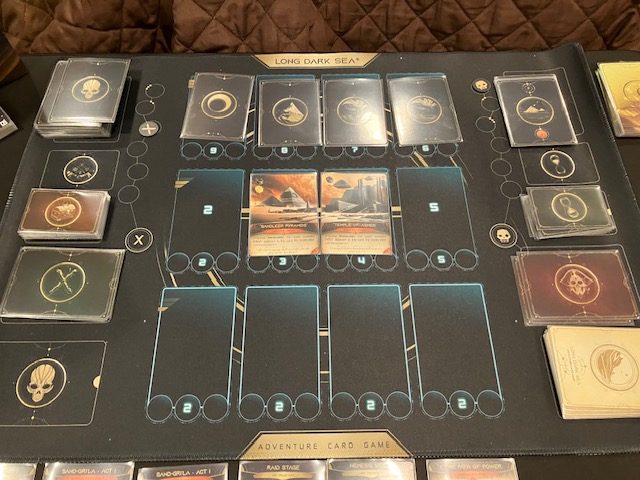
A Sense of What’s Coming: We’ve actually seen this mechanism recently in Small-Time Heroes! The back of the Bad News cards (see above) is either a Location, an Eclipse, or a Skull (see top row above). That actually gives you a sense of what’s coming and you can make choices! If we need to EXPLORE, maybe we go after the Location! If we want to get the monster flipped before it can attack, maybe we EXPLORE a far-away monster (Skull) card! This is a really neat mechanism, and it’s at least gives you a sense of what you will get when you EXPLORE unflipped cards.
Things I Didn’t Like
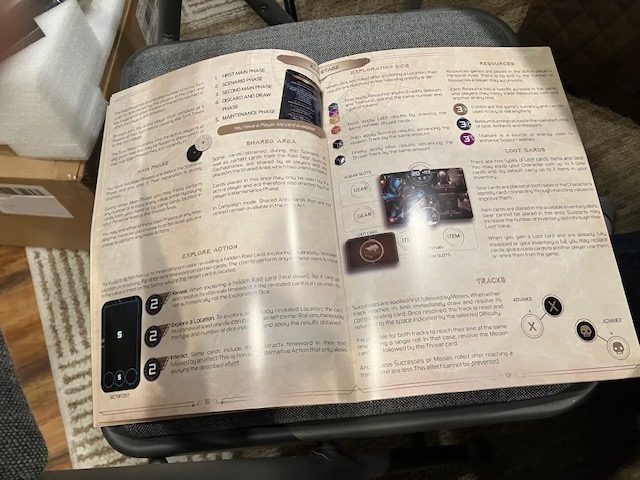
The Rulebook. The rulebook got SO MUCH right in the first game, but it just seemed to get less and less precise. By the time I got to the boss-battle, there were too many rules missing. There was also no uncardening section. There was a keywords summary (which was very helpful), but an Index would have been SO helpful. I applaud its attitude, but there’s just too much missing.
Money: This game has three different types of coin. That’s very frustrating if you don’t get the right exploration done, so maybe you can’t advance your Support or your Gear or your Deck! Each thing you can advance in the Supply Phase uses different money! So, we found that it felt stinky that we couldn’t advance certain parts of our deck. I would have just stayed with two or even one money type, or had a way to convert? It felt like you couldn’t advance … and advancement in this game is key to winning and FUN! Not being able to advance wasn’t fun.
Blue Money: I played 6(?) games before I realized that the LOOT has a BLUE MONEY cost! Can you see it? Every single card is like this! It’s listed in blue and almost IMPOSSIBLE to see! Can you see it? Even after pointing it out, you can barely see it! Somebody messed up: this is terrible color design.
Conclusion
Long Dark Sea: The Adventure Card Game could be your game of the year! There is so much flavorful atmosphere, dripping theme, and original ideology! The world built by this game is fantastic!
Long Dark Sea: The Adventure Card Game could also be your least favorite game of the year: you may not be able to trudge through this rulebook. I had to play through an entire campaign to even know what questions to ask, which means I just had to move forward a few times without a clear vision of some of the rules. You have to decide if it’s worth your time to get through this rulebook: you may lose patience with it and just be done with the game.
If you have the tenacity, I think you can really enjoy this game. I am keeping this for my collection because I love the unique adventure and world that Long Dark Sea presents. I could see some people giving this a 9/10 because they love the world so much! I could see some people giving this a 4/10 because the rulebook is so frustrating and imprecise. A bunch of people will start to learn this game, then put it aside in disgust. Some of my friends also got frustrated at the length of the game! I personally like the game, but the frustration with the rulebook and “extra long” games brought it down to a 7/10. I’ll play it again, I like it, I am keeping it, but I will only recommend it to you if I know you can survive the rulebook and this very long game.
Also be aware that’s it not really a deck-building game; it’s really more of a deck-advancement game.

