A Review of Sub Terra II: Inferno’s Edge

IMG_4927

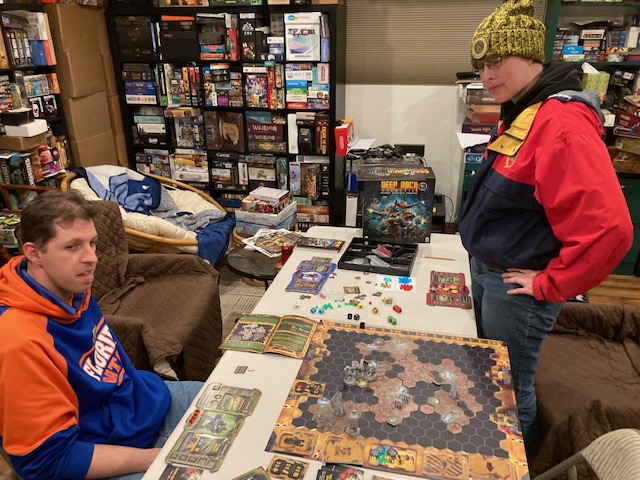
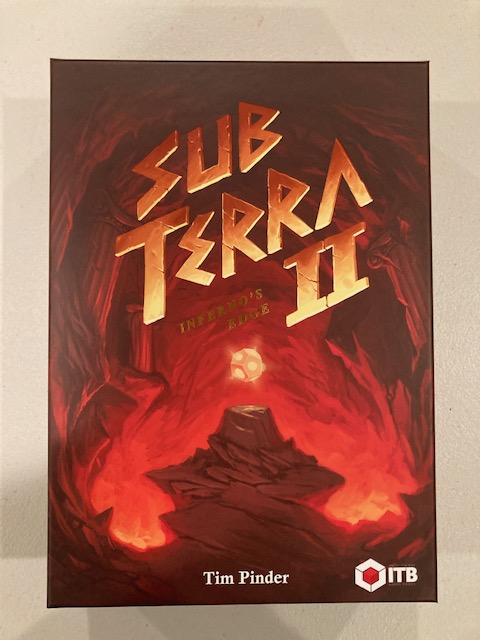
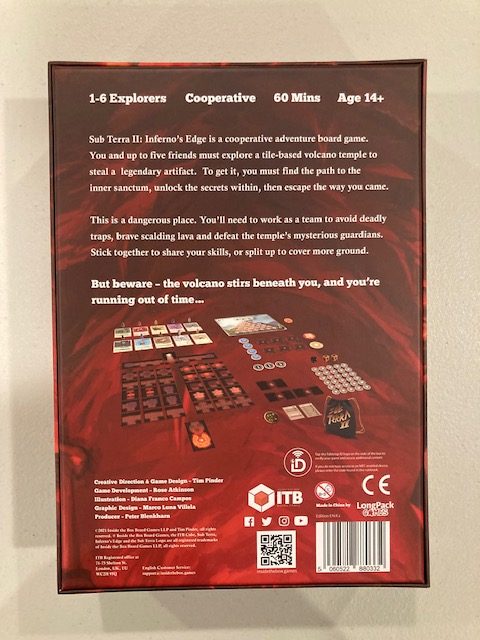
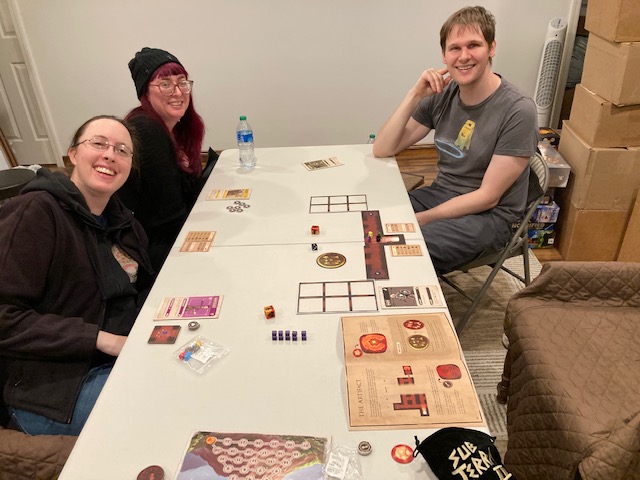
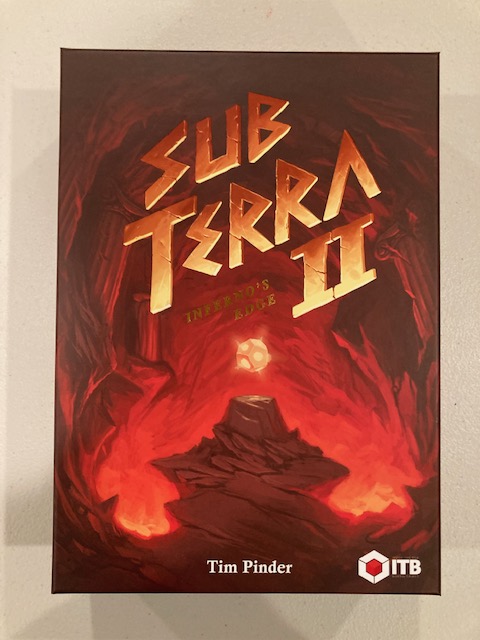
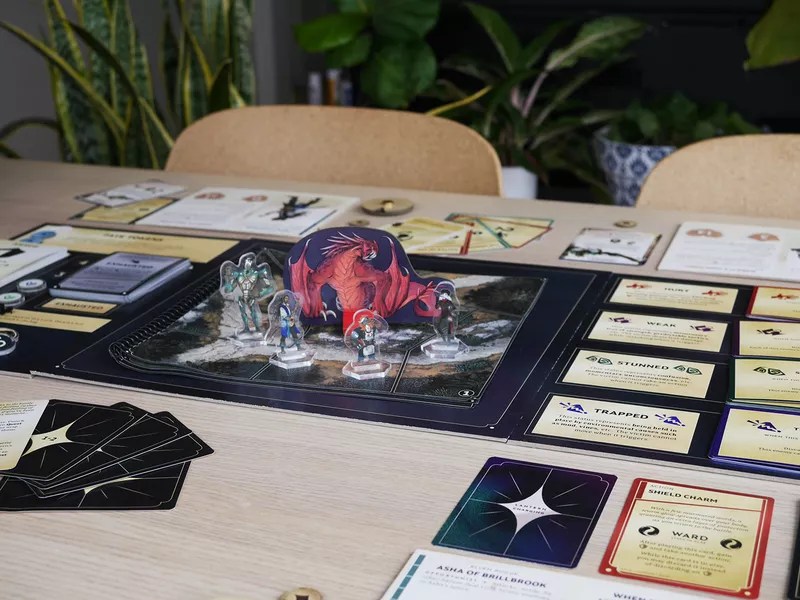
Sub Terra II: Inferno’s Edge is a cooperative tile-laying game (with push-your-luck elements) for 1-6 players. It’s a stand-alone game in the Sub Terra universe. The II might imply you need the original to play, but you don’t: this is a stand-alone sequel. This game was on Kickstarter back in November 2019. But I didn’t back it.

IMG_4930

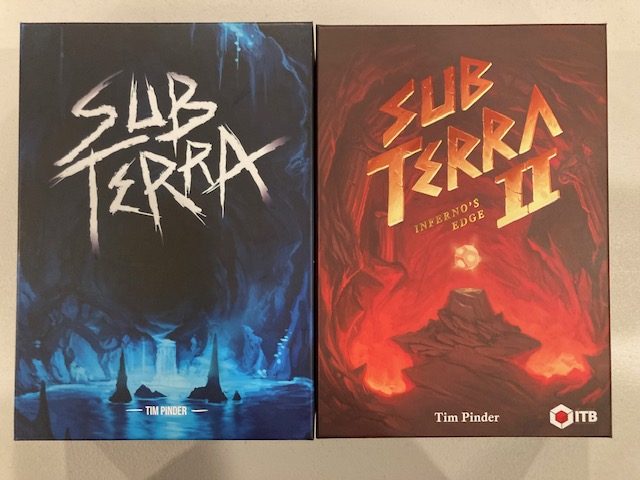
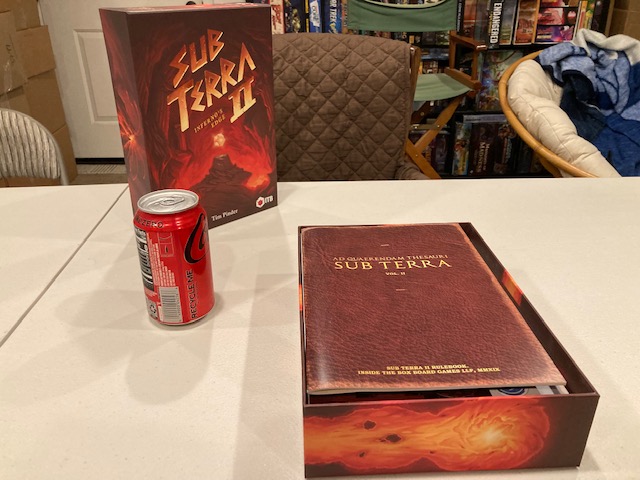
Part of the reason I didn’t back Sub Terra II was because I already have Sub Terra (the original): See above. I like the original, and it came out quite a bit in my game groups for a while, but it had fallen off the radar: the original Sub Terra was a just a teensy too random for some of my groups. I think I was worried Sub Terra II would simply be more of the same. Would it be worth buying it for “almost” the same game? In the end, I needed $40 or so to make a GameNerdz order get free shipping, so I added Sub Terra II in to my order. I am interested in the base game, I am just not interested in the $100s in expansions for the game. (The Kickstarter all-in was more than I wanted for a tile-laying game).

IMG_4929

This just arrived a few weeks ago! (Late Dec. 2022,/Jan 2023) Let’s take a look!

Components and Gameplay

IMG_4931

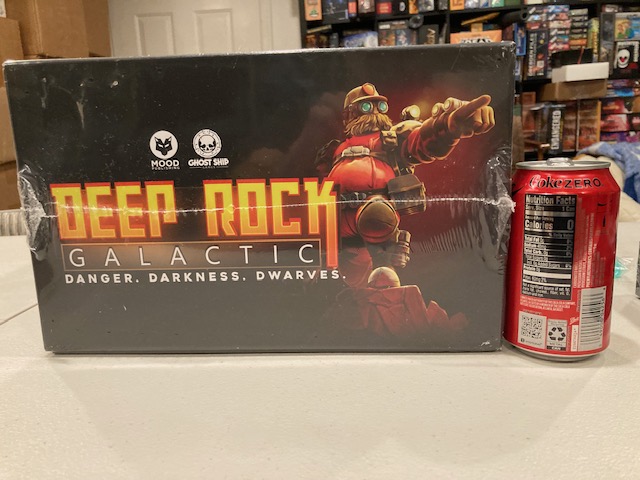
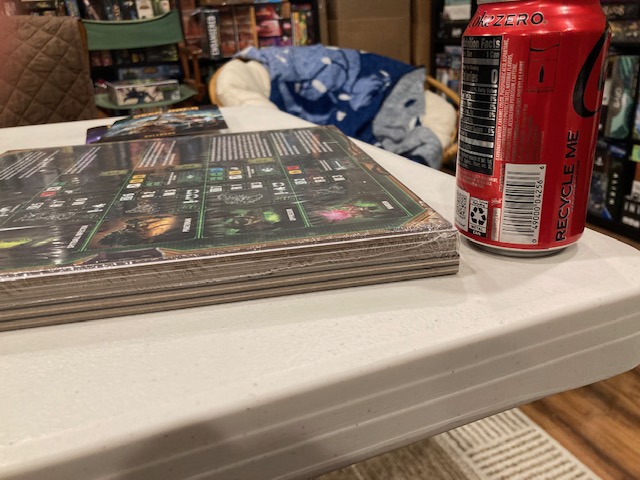
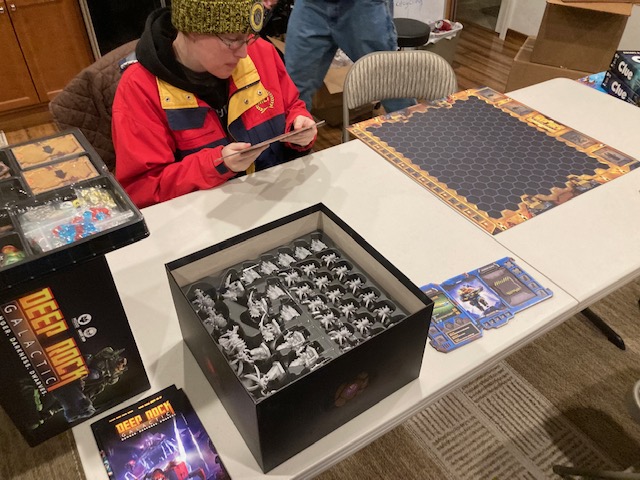
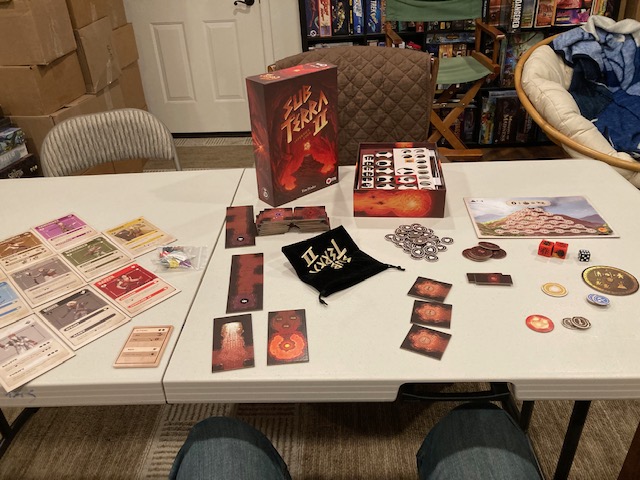
See the box with a Coke Can for scale. It’s a deepish box, but not too tall or wide: it’s about the size of a piece of paper.

IMG_4955

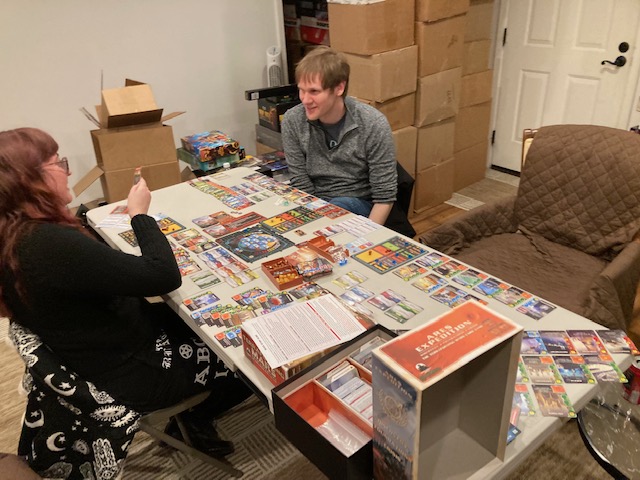
In the game, each player takes on the role of one or more explorers: ideally, each player gets their own explorer, but there must always be at least 3 explorers in play, so a solo game will get 3 explorers, and a 2-player game will probably have 4 explorers (2 per player).

IMG_4956

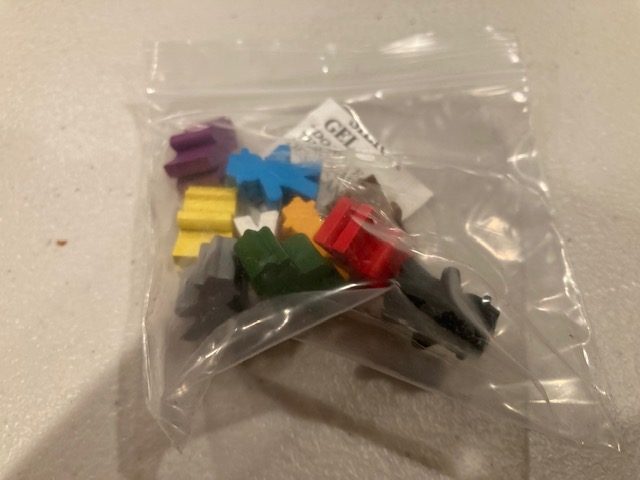
Each explorer has their own corresponding meeple to mark where they are on the board.

IMG_4973

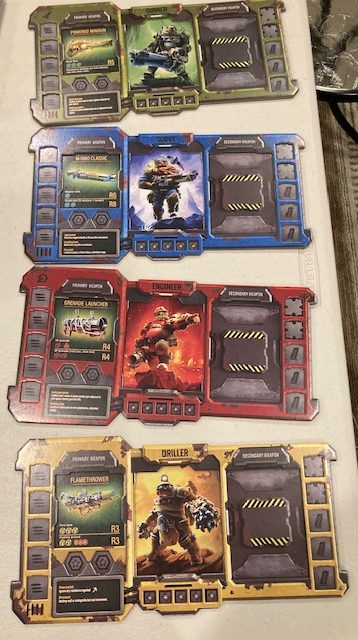
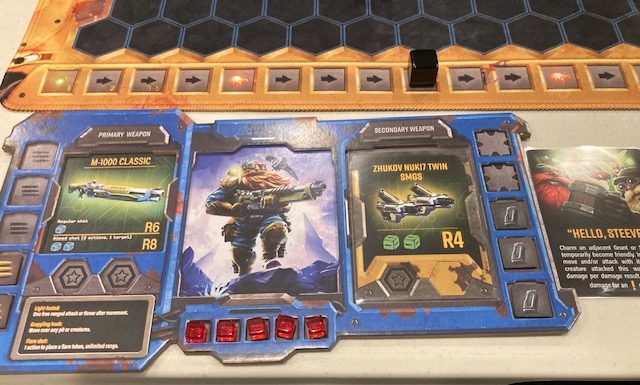
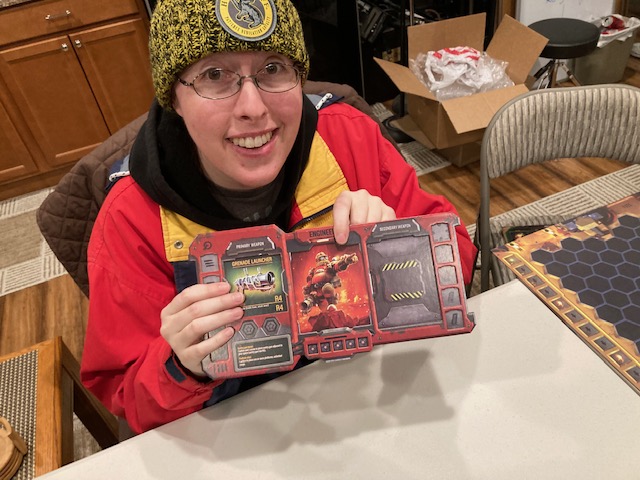
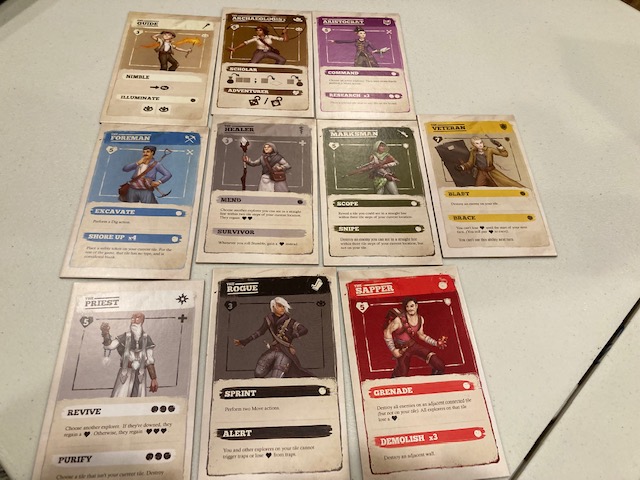
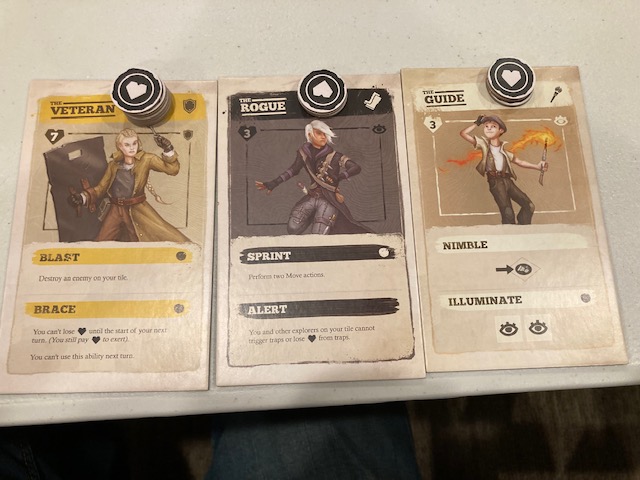
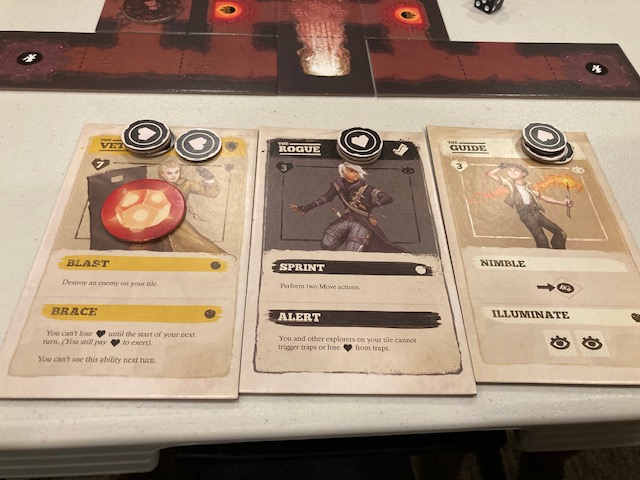
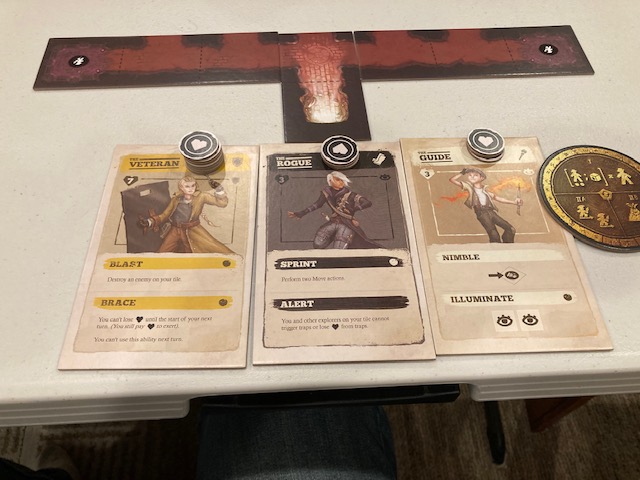
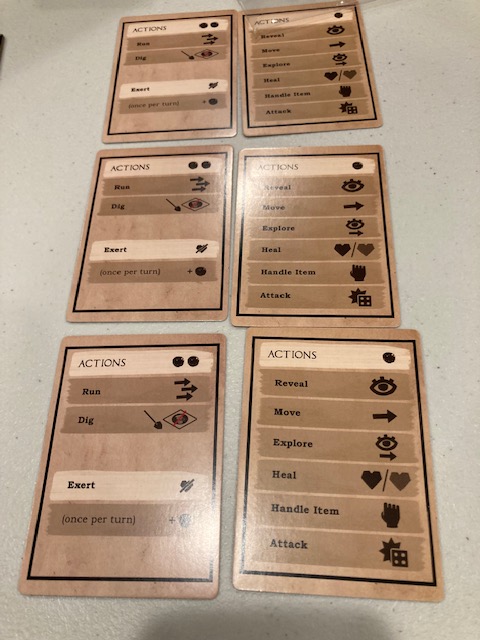
Each explorer also has their own unique powers: see some examples above.

IMG_4964

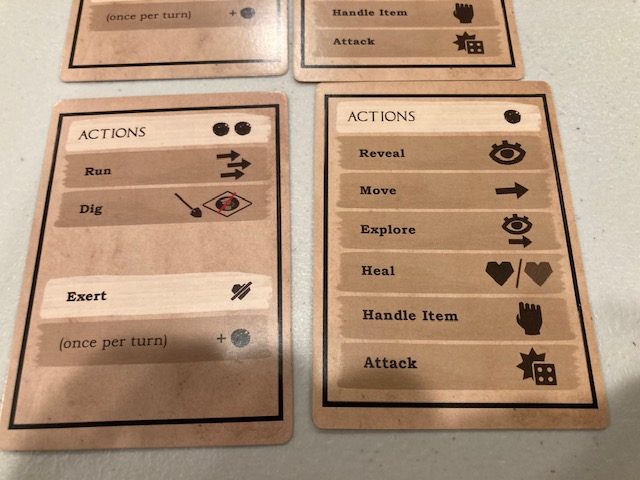
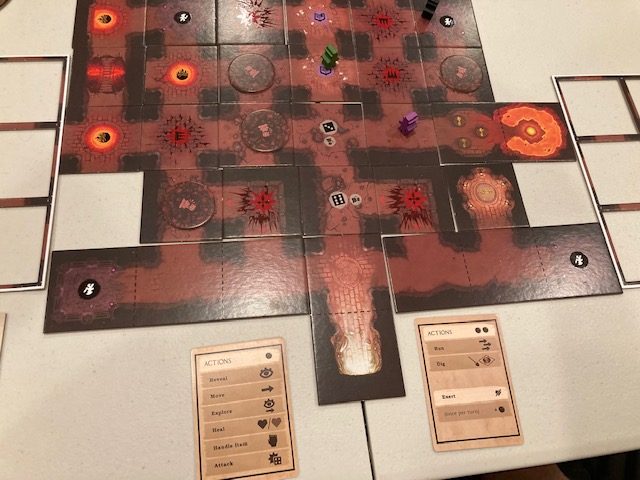
Each player has two action points: on their turn, they can typically do 2 actions (some actions cost 2 action points). They can do any of the things above, which are pretty much what you expect (move, reveal a hidden tile, run, etc). Interestingly, players can also choose to exert themselves for one damage to get an extra action.

IMG_4957

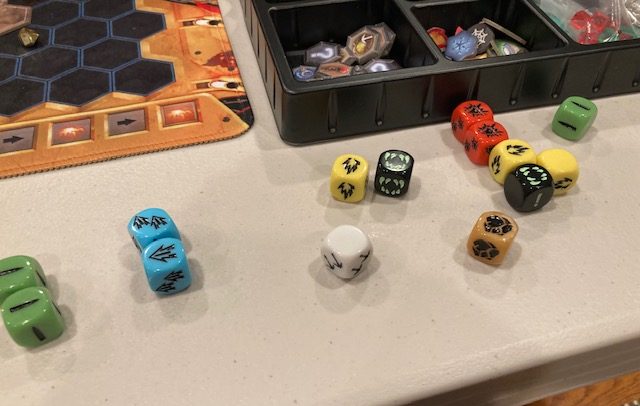
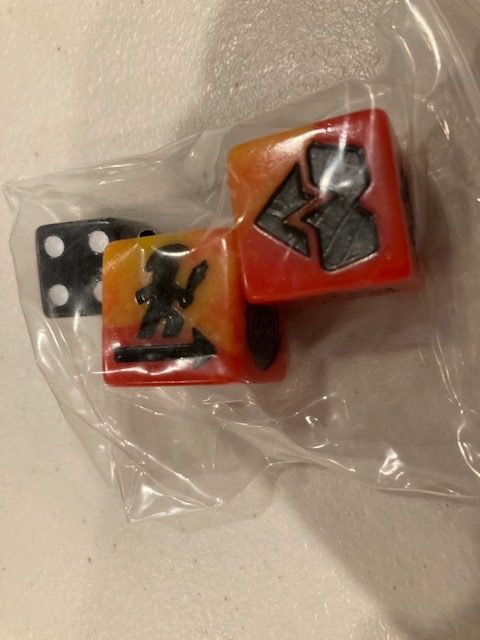
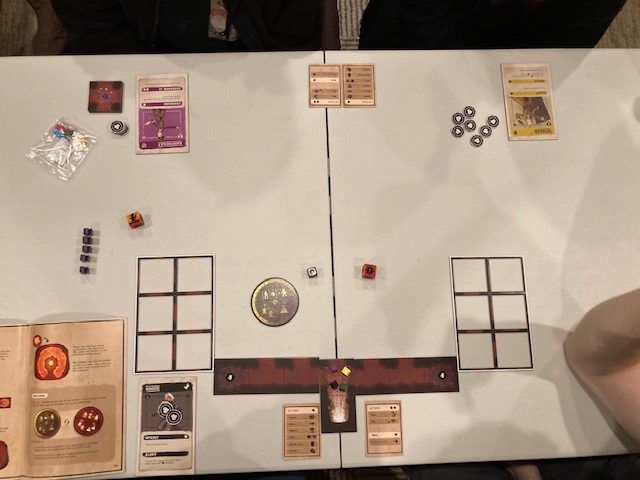
At the end of each player’s turn, some “bad news” happens! The player, after using two action points, gets some Bad News from one of the bad news dice! See the orange dice above.

IMG_4952

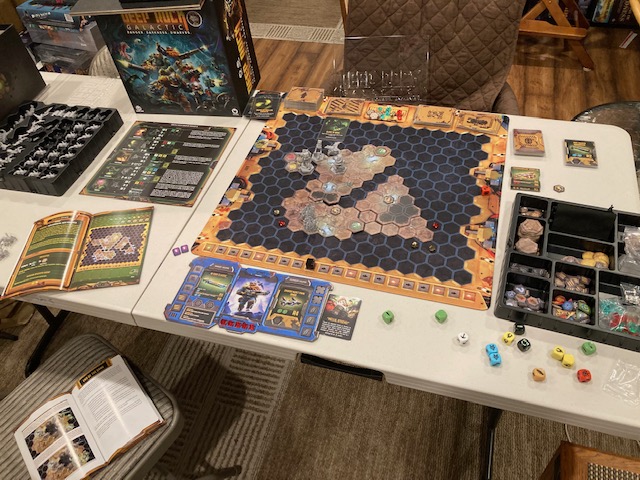
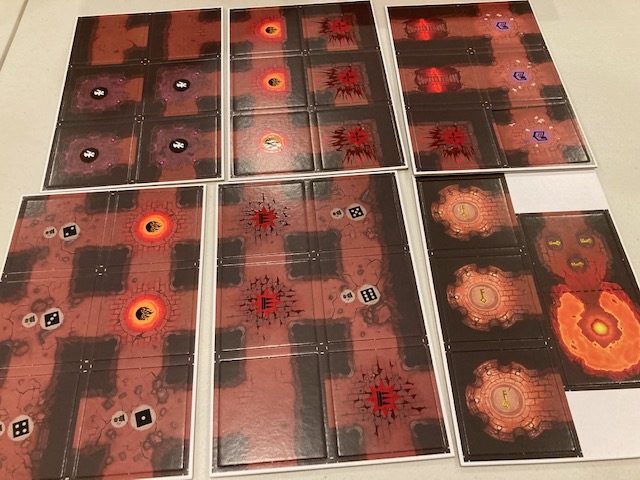
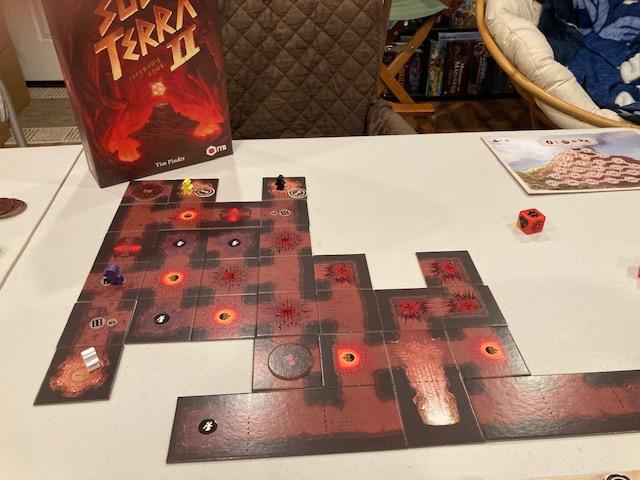
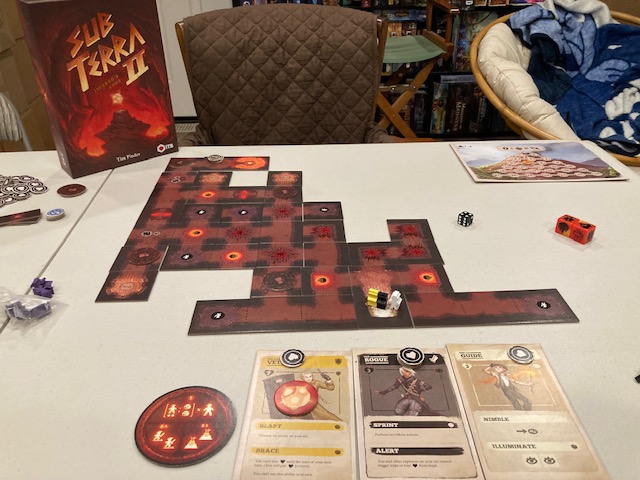
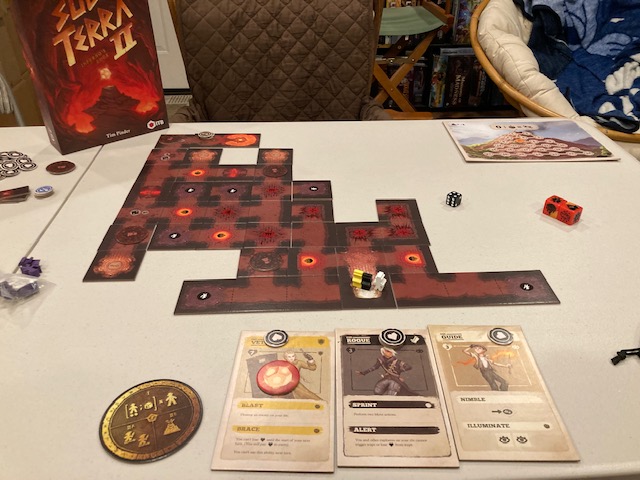
This is a tile-laying game: the explorers need to explore the temple (laying tiles to “explore”), find 3 keys, retrieve the artifact, then finally escape with their lives! This is cooperative, and it’s best if all players survive, but if some players don’t make it out alive, everyone else still wins … to be clear: there is no incentive to subvert other players! The game is fully cooperative!!! It’s just that, sometimes, circumstances dictate that not everyone can survive, even if players try really hard, so the game recognizes this reality and allows for most people to survive. It’s really not a semi-co-op. (Except Joe might play it that way. Joe.)

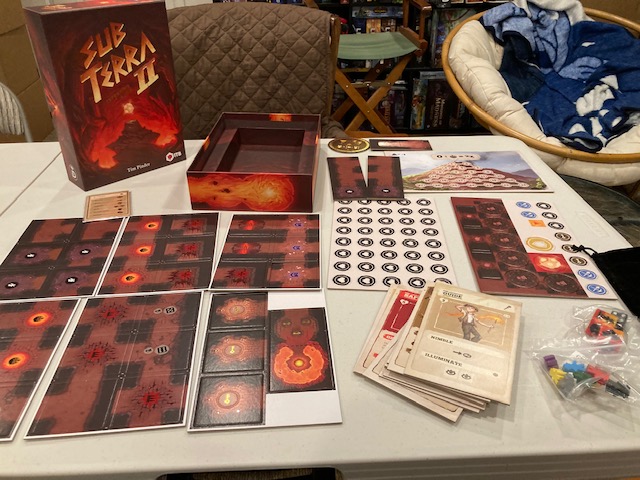
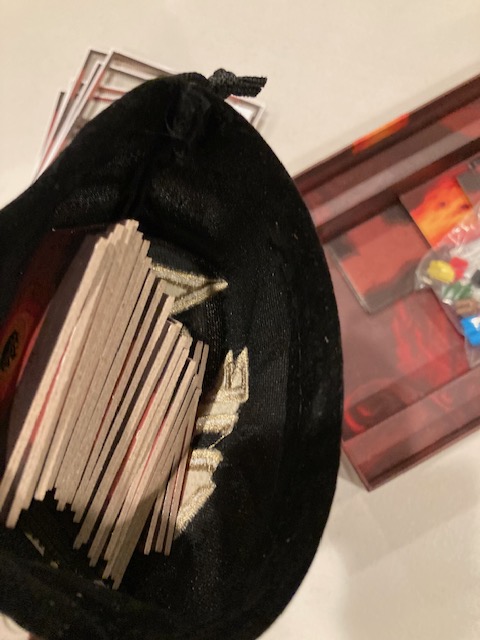
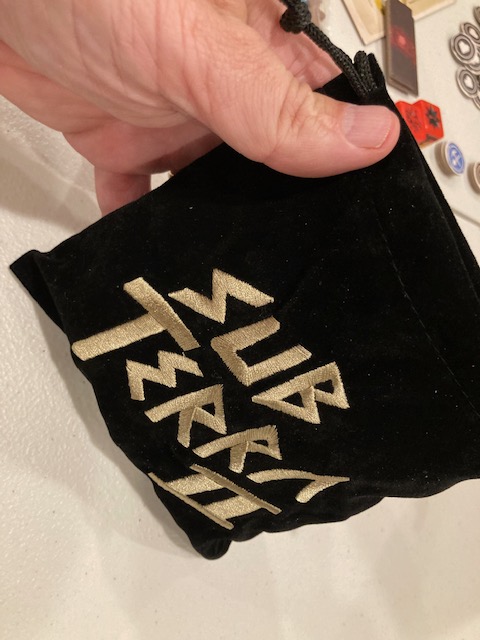
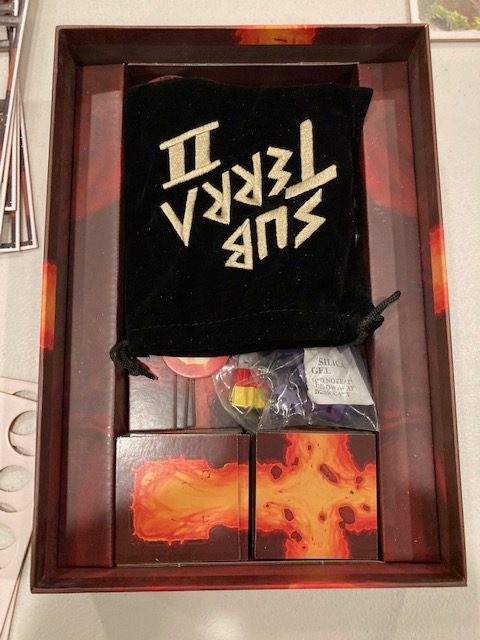
The tiles (after being punched out), end up in the bag above. This bag was “okay”: I think it might have been a little small. When players “explore”, they draw a tile and put it on the board:

IMG_4981

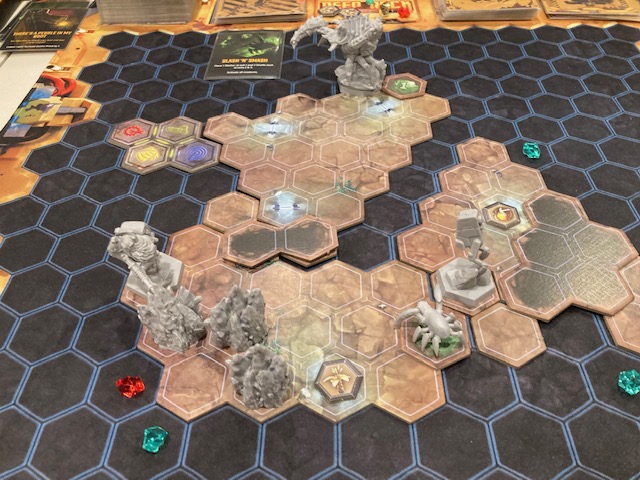
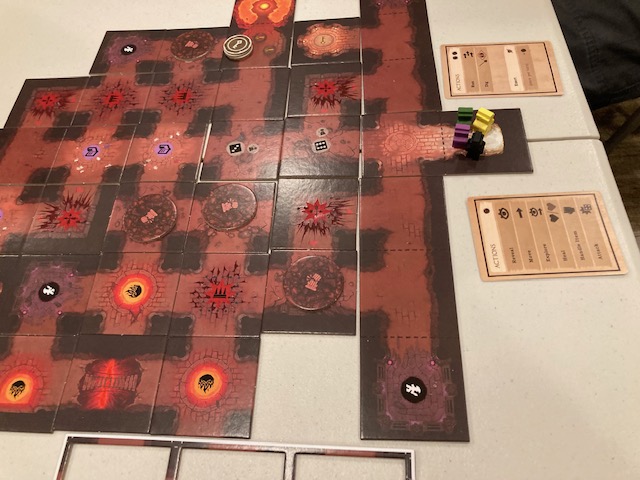
As the game unfolds, the template starts to take shape … (my example above is off because I took the left boundary too far .. mea culpa!).

IMG_4979

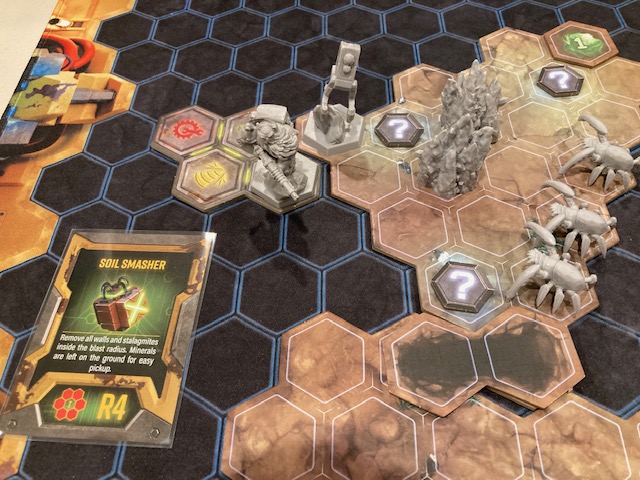
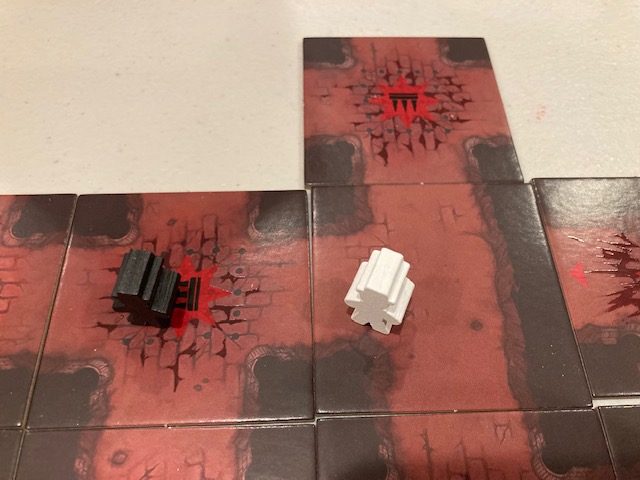
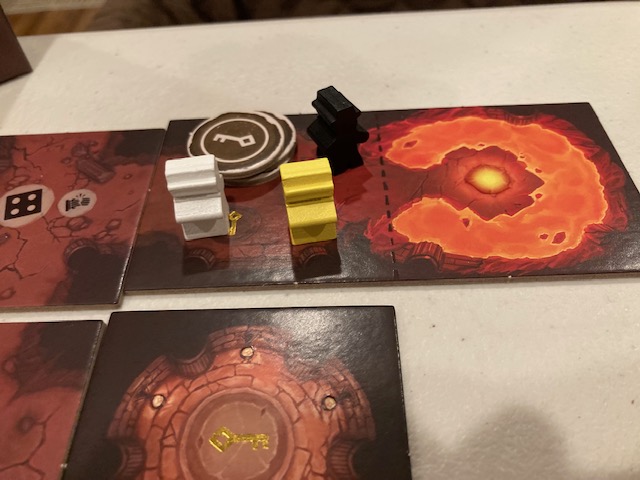
This game has push-your-luck elements because you have to choose between revealing and/or moving as you play. If you just reveal a title, you won’t suffer the ill effects of the revealed tiles (the white Guide just REVEALED the trap tile above, so he doesn’t suffer the effects), but now he has to spend an extra action to MOVE to it. The push-your-luck comes in if you decide to MOVE and REVEAL in one move (called EXPLORE)! You get more done, but you may move to a room that hurts you! If you play too conservatively, you may never get the temple explored in time! If you play too aggressively, you may die quickly from ill effects! It’s a push-your-luck game.

IMG_4975

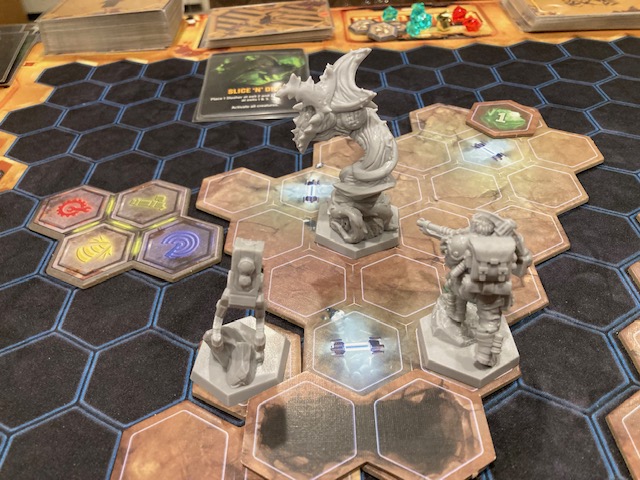
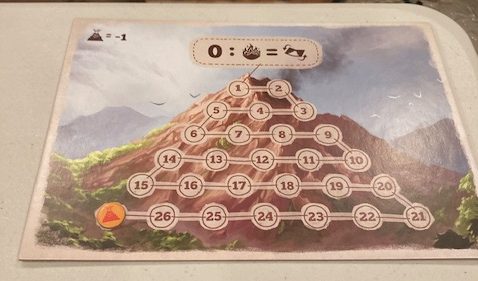
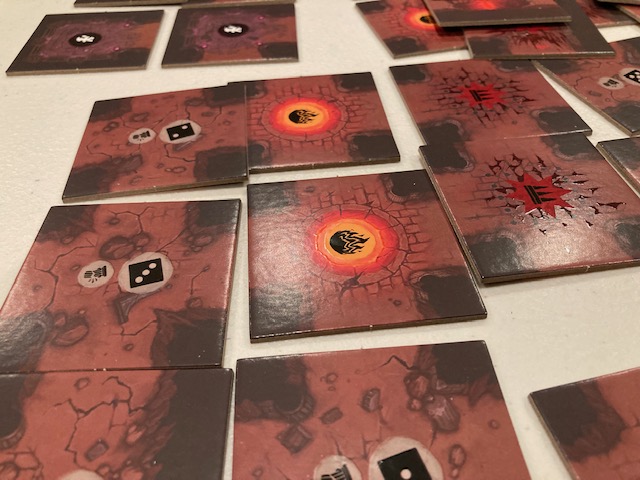
The volcano tile (above) is your timer: at the end of every round, the volcano tracker moves up one (for a beginner game, you can see the tracker start on place 27). If the volcano erupts before the players have found the Artifact, they lose!

IMG_4992

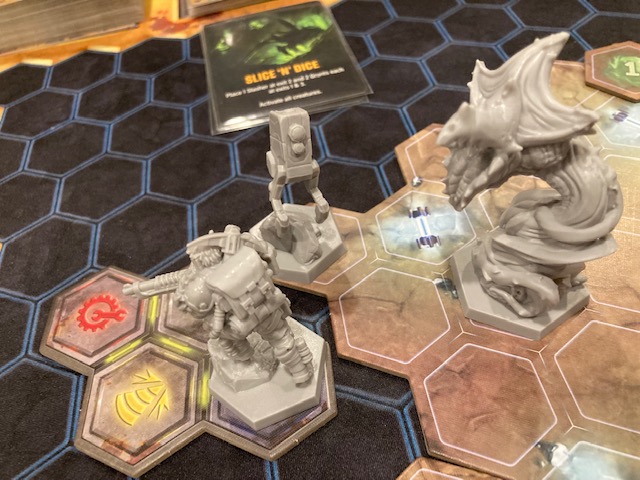
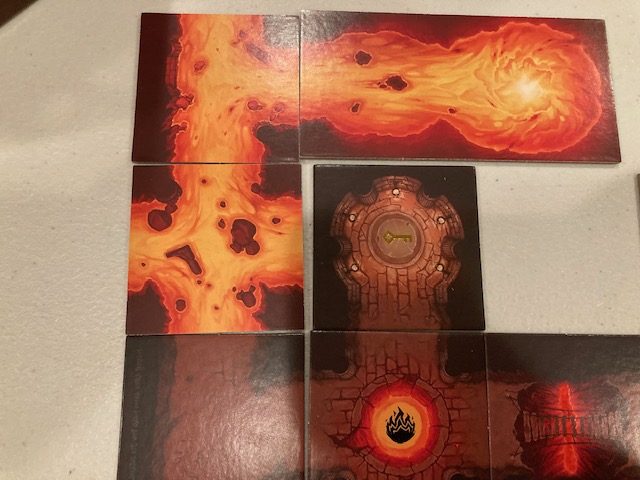
Once the volcano erupt and you have the Artifact, you can still escape … you are just racing for your life against the lava flow! Tiles starts turning to lava and follow you Get out! Get out! See above!

IMG_4986

Luckily, the Veteran above was able to get the Artifact!

IMG_4988

And they all made it back to the entrance! Note, that the game gets significantly harder after Artifact is obtained: you’ll be rolling two bad news dice per turn!

IMG_4954

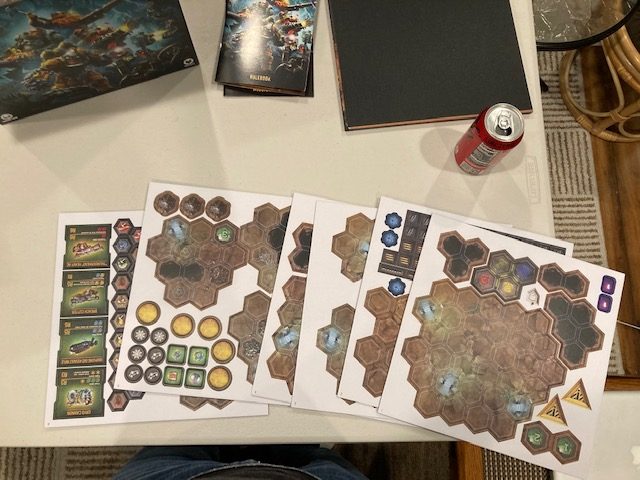
The components look really nice, are very readable, and fairly thematic. I suppose I would have preferred some cooler tokens other wooden meeples, but they were fine. (I suspect the Kickstarter had some really great component upgrades).

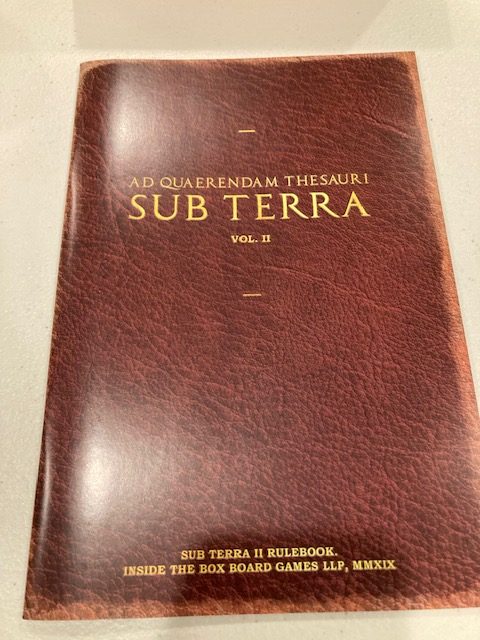
Rulebook

IMG_4932

The rulebook was good.

IMG_4933

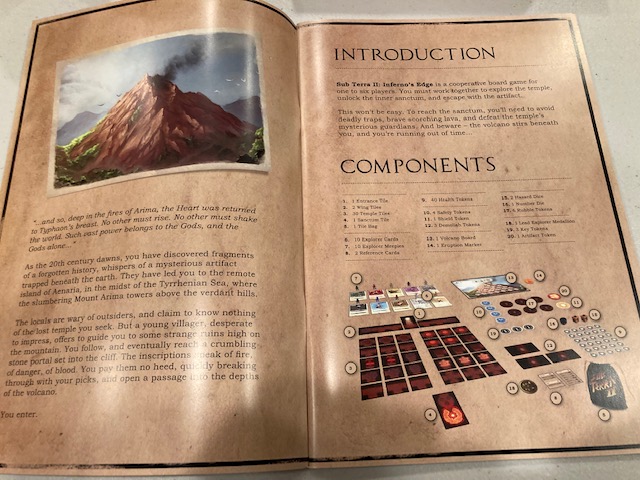
The first few pages contained nice annotated Components list and Introduction: they worked fine.

IMG_4934

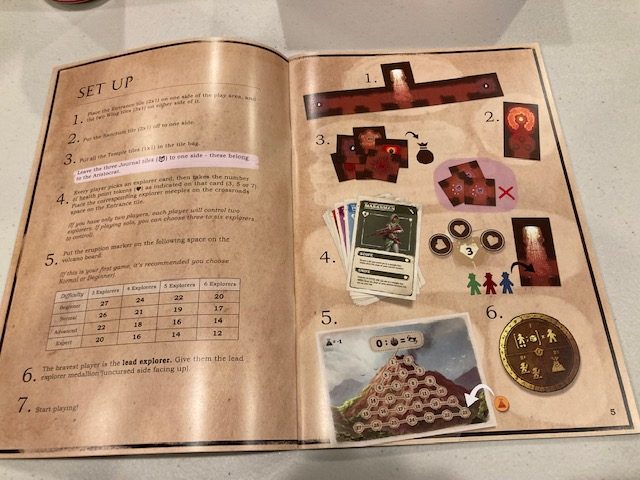
The Set-up was easy to use and well annotated. See above.

IMG_4935

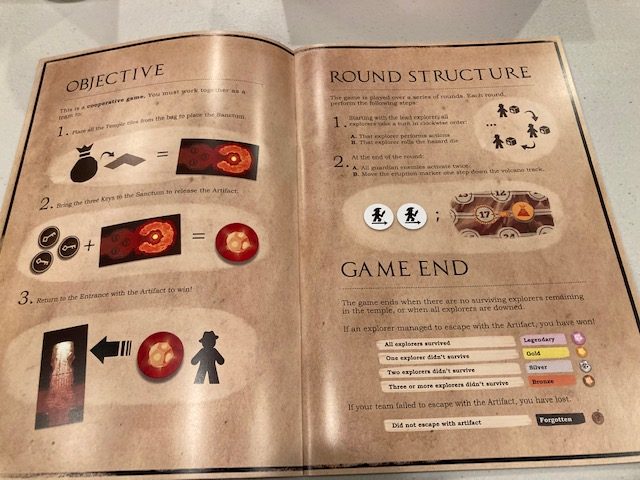
The main game ideas are discussed quickly and easily after your set-up. See above.

The rulebook had great pictures and a nice easy-to-read font. Overall, a very good rulebook.

IMG_4950

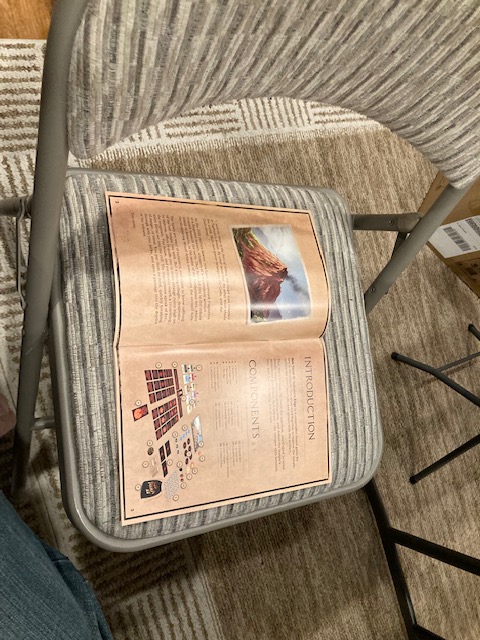
The rulebook passed the Chair Test with flying colors: an A+! It fits perfectly on the chair next to me, so I can keep it open and easily available.

This was a good rulebook, but I do have a few very minor complaints.

IMG_4948

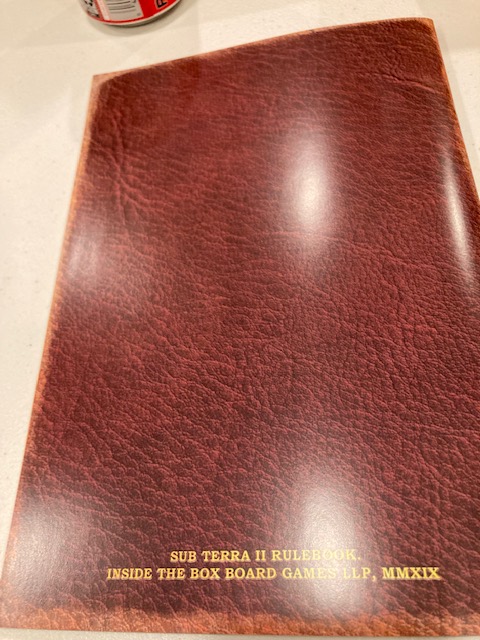
First, they didn’t use the back cover to convey any game info. This is a wasted opportunity in my eyes, but it’s definitely personal opinion: it’s not a flaw.

IMG_4949

Second, the rulebook was 32 pages. I love the big font, but maybe it was a touch TOO big? I felt like there could have been a slight adjustment of whitespace, margins, and font size to make the rulebook just a smidge smaller. But I shouldn’t complain, because I’d MUCH rather rulebooks err on the size of “font too big” than the other way around! It’s just that a 32-page rulebook looks a little daunting, but it’s quite good: It’s easy to read and has lots of pictures.

Solo Play

IMG_4929

The back of the box proclaims 1-6 explorers (see above), but the solo rules are a little hard to find.

IMG_4934

The solo rules are in a parenthetical expression on page 4 of the set-up: I actually missed them the first few times through the rulebook. It’s just one sentence: If playing solo, you can choose three to six explorers to control.

The difficulty chart chart shows a minimum of three Explorers (and a max of six), so if you miss that single solo sentence, you might deduce “OHHHH!!! A Solo game has the solo player taking the role of three explorers!” It’s not real emphatic: part of the reason I knew this was because the original Sub Terra worked the same way!! So, you must always have at least 3 explorers for any game, and a max of 6 explorers. This game does follow Saunders’ Law.

IMG_4972

So, the solo player must rotate through three players as he plays. The variable powers are fairly straight-forward, so there’s not too much context-switching as the solo player rotates through explorers. That’s always the question when you play multiple positions, right? “How much context-switching is there?” There’s not too much context-switching here: It’s very manageable.

IMG_4987

In general, I liked the solo game. I would play it again. Most importantly, it gave me the chance to learn it so I could teach my friends.

Cooperative Play

IMG_5079

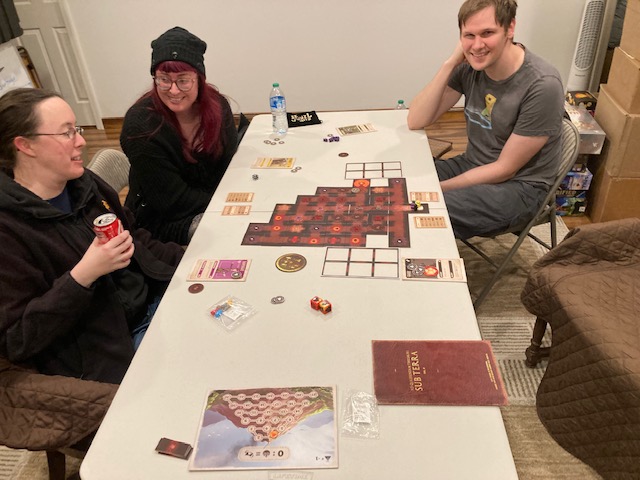
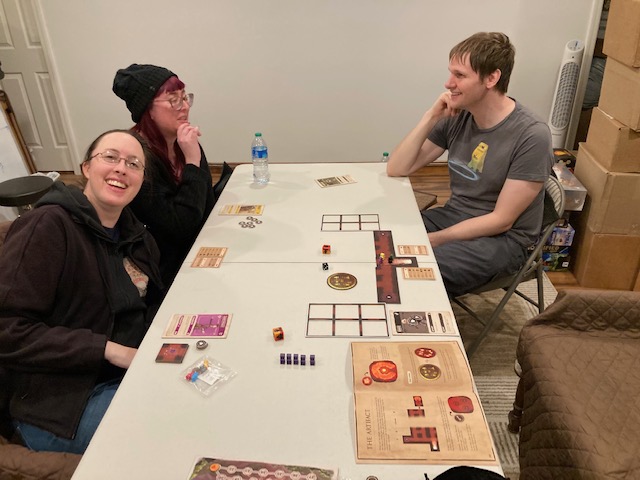
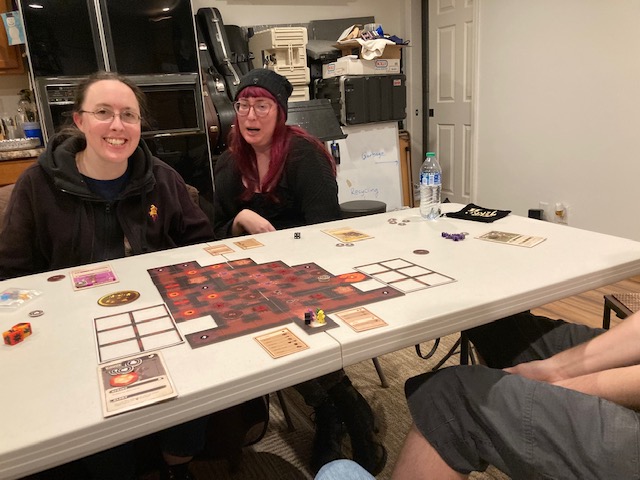
My group had a good time playing this!  We liked that the powers were very different and felt “powerful!”  When we used our powers, a lot happened!  My rogue was fantastic at avoiding the traps (I enjoyed pointing out this was a Mark IV trap: don’t step here), the Marksmen kept the guardians under control, the Aristocrat kept the ruins under control (by placing her Journal tiles exactly where we needed to avoid Ruins problems), and the Veteran kept us going!  They were all arguably critical to getting the game done, and we really enjoyed that!

IMG_5085

The game also seemed to elicit a fair amount of talk: we cooperated, but we still had our own turns and a lot of agency.  There were a few turns (especially for the Veteran) that weren’t fun because she got stuck (see Randomness and PTSO  sections down below), but in general we had a good time.

IMG_5086

We had a winning game, and it was dramatic and fun.

Rating: In general, the group seemed to think 7s to 7.5s all around. Everyone had a good time (modulo a few issues we’ll discuss).

It’s always a good sign when the group says “I’d love to see how this game played out if we used very different characters”.  They want to play again!

Things I Liked

IMG_4973

I liked that there was a decent amount of agency in the game: For example, I can choose to “exert” myself to get an extra action point. That allows the players some latitude to “try real hard” when its really needed! That’s very thematic that every so often I can “exert” and get myself out of an obvious bind! I am not always stuck at just 2 actions points: extra agency.

IMG_4966

The components are pretty darn fantastic.

IMG_4962

I like that the tiles are very easy to read, have some cool spot art on them, and the iconography is pretty easy to read.

IMG_4984

I like that the game is simple, easy to teach, quick to set-up, quick to tear-down. The 60-minute gameplay is pretty accurate (unless you are prone to analysis paralysis). Sub Terra II has a nice “simplicity” permeating it.

IMG_4992

I want to give a major shoutout for the new idea of “running out of the temple while the lava follows you!” That is so cool of a mechanism (lava following you), and it is just flipping over the tiles as you run out. It looks great and is very thematic. It’s so simple to do, but it’s such a nice touch.

IMG_5078

The explorers powers were cool and very interesting: those powers seemed more useful/powerful than the original Sub Terra.

IMG_4963

It’s a pretty nifty game.

Minor Complaints

IMG_4993

I wish the bag to hold the tiles was just a little bigger. It felt cramped and a little small.

IMG_4983

I wish a few more rules having to do with “knockdown” had been specified. Is the explorer above allowed to move away? He’s at 0 health, so all he can do is move, but the guardians do damage when you move away? How do you rectify that? Also, do the powers of the guide still work when he’s knocked-down? Probably? These are minor questions, but I can’t be the only one who had these questions. A FAQ might have been helpful.

IMG_4981

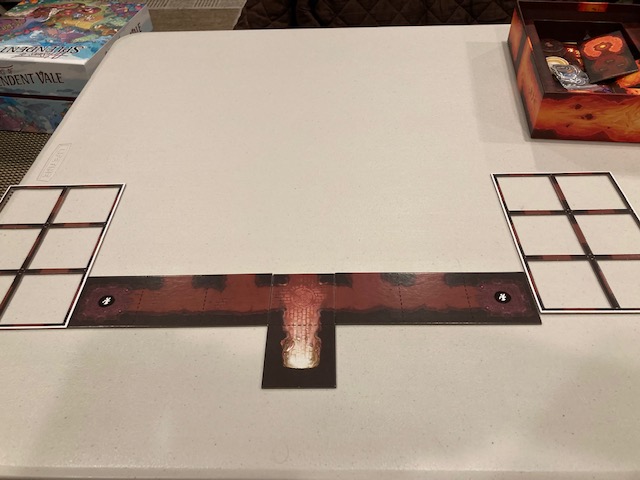
You’ll notice that I messed up and went “too far to the left” with my temple: you are supposed to only go as far left and right as the leftmost and right most edges of the bottom piece. Whoops! It’s in the rulebook, but I think a simple component (a piece of paper? A cardboard edge?) would have helped me to not make this mistake. It’s really minor, but it could have been fixed.

IMG_5077

Actually, though, I do have a solution that comes with the game!! In the future, I will use the punchout skeletons to enforce the edges! See below. (Hey, this is another reason to keep Punchout Skeletons!)

IMG_5012

Major Complaint: Lack of PSTO

IMG_4979

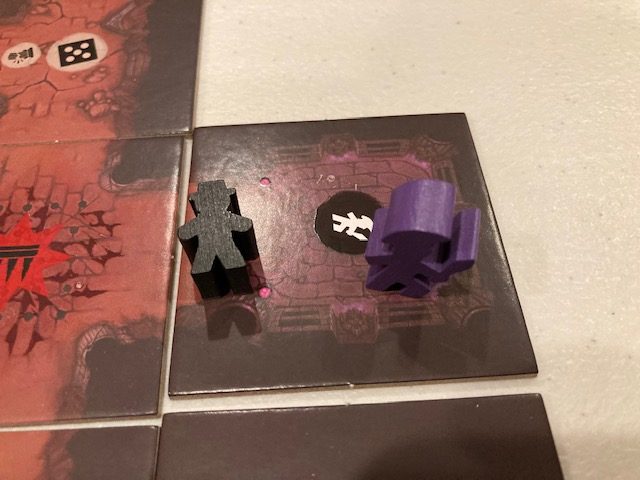
But my biggest complaint, without a doubt, is the lack of Player Selected Turn Order (PSTO). I can’t tell you how many times I had one of the explorers “do nothing” on their turn because they had to wait for someone else to do something out of sequence! Consider the case above: I’d really like the Guide to venture into the room above and do two looks around him (his special ability). But he can’t, because the room has a pit trap and he’ll likely die! Luckily, the Rogue is with us! As long as he Rogue is with us, we can avoid traps! Huzzah!

IMG_4978

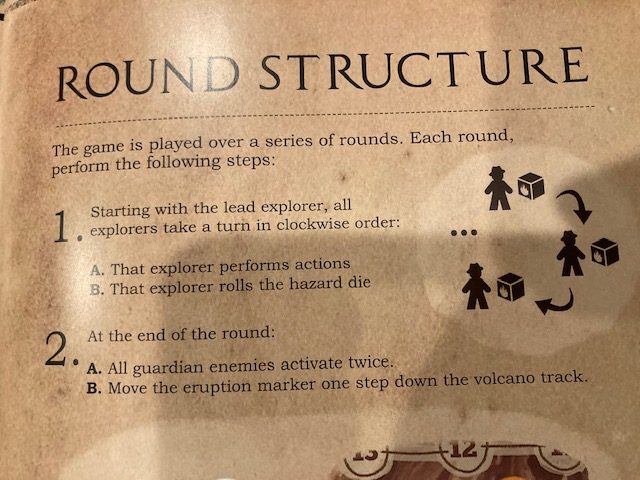
But …. because the Guide goes before the Rogue in turn order (and turn order is very specific: see above), the Guide would have to wait for an entire round to go up! So, the Guide does nothing for a turn. Not fun.

IMG_4987

It seems very thematic to say “Rogue! Why don’t you go in that room first and I’ll follow!” It’s very thematic, and probably what we’d do in real life!! I feel like this game would be a lot more fun with Player Selected Turn Order: allow the players (per round) to choose the order of their turns! More importantly, it allows players to avoids turns where you don’t do anything.

I understand that Player Selected Turn Order (PSTO) makes a game harder to learn/deal with (see a long discussion of PSTO here), but I think it would easy to notate each taken turn with a simple token (just flip it when your turn is over).

For some reason, the lack of Player Selected Turn Order dates this game for me: it feels like more and more modern cooperative games are embracing this mechanism (The Reckoners, Marvel Zombies: Heroes Resistance (which we’ll see soon), CO-OP: the co-op game, to name a few) because PSTO makes the game feel more cooperative! We all decide, as a group, the best way to proceed through the temple, and can change as circumstances change! It gives us choice! Agency!

IMG_4985

I can see it being harder to teach newer gamers PSTO: it’s not what most newer gamers are used to! So, maybe some chart like this in the book would help:

  • Newer Players: Use the tradition round structure: clockwise order
  • Advanced Players: use coarse-grained Player Selected Turn Order! Players choose per round the order that each explorer acts: For example:  Player 1, then Player 3, Then Player 2. 
    If you use use coarse-grained PTSO: increase the volcano tracker by 5
  • Very Advanced Players: use fine-grained Player Selected Turn Order! Players choose the order of actions and may intersperse actions: For example: player 1 takes action 1, player 2 takes action 1, player 2 takes action 2, then player 1 takes action 2. 
    If you use use fine-grained PTSO: increase the volcano tracker by 10

Of course, PSTO makes the game “easier to win”, so you probably want some adjustment of the difficulty: luckily, Sub Terra II makes that easy by just adjusting the timer on the volcano.

Is It Still Too Random?

IMG_4968

In a word, yes, but I like some of the new stuff the game does. I think the randomness of Sub Terra II is consistent with the amount of randomness in the original Sub Terra, if maybe a touch less random.

I understand that randomness can breath life into a by-the-numbers game, and I do think the amount of randomness of Sub Terra II is apropos to the game. That cave-in at “just the wrong time” is both infuriating and exciting! It’s such a thin line: too much randomness can feel crippling, too little randomness can feel predictable. This game can feel too random at times, but it generally straddles the line between too much randomness and too little randomness fairly well. Again, some of my gaming groups thought it was a shade too random.

IMG_5082

For example: in one cooperative game, all the collapsing caverns came out right next to each other (see above). It was very scary trying to figure out how to deal with that: it was exciting and fun, but at the same time, had the randomness gone slightly awry, we would have had no chance whatsoever.

That swingy randomness is a double-edged blade: it cuts both ways! Exciting and tense but possibly unwinnable. And Sarah echoed the thoughts of my game groups from years ago, “It was fun but it feels like it could be too random“.

Needs a FAQ

Every time we play, I feel like a question comes up that we can’t answer.  For example: In one play, the final Sanctum tile could only go two places, but there two were competing concerns: put it as far as possible but keep within the boundaries.  As a two-tile final tile, you could argue it couldn’t go to the furthest away (upper right) because the artifact would actually extend over the boundaries!  We argued “maybe that was thematic” because that’s why the artifact is so hard to get to! But, if we have to keep within the boundaries, it must go in the other spot.  But what if the other spot had the same problem?  It was very close to being right on the edge too … what would we done had that happened?  (Probably just chose the furthest and moved forward, but it felt like it was underspecified).

IMG_5084

Every game I have played, some question has come up that the rulebook didn’t quite answer. Most of them were simple, and we could always move forward with a reasonable guess, but I feel like this game needs a FAQ! Little questions seemed to crop up a lot. Minor ones, to be sure, and not enough to hold up the game, but enough that it was annoying.

Conclusion

IMG_4994

Sub Terra II is a minor improvement over Sub Terra: the theme might be more interesting, but some of the new ideas are quite invigorating! The most interesting new idea, both mechanically and thematically, is the lava chasing you out at the end of the game! It really adds to the excitement of the end game!

IMG_4930

Do you need both Sub Terra and Sub Terra II? Probably not: they are similar enough that you could do with just one or the other. I suppose it really just depends on which theme speaks to you more: trying to escape a cave (Sub Terra) or hunting for treasure in a temple (Sub Terra II).

IMG_4928

I think that, for a variety of reasons, Sub Terra II (and Sub Terra) should be embracing Player Selected Turn Order (PSTO). The lack of PTSO is sometimes very glaring in the game: sometimes players can’t do anything because of the constrained player order!! I feel the lack of PSTO makes the game feel a little dated. Without PTSO, I’d probably give this is a 7.0/10. If we add PSTO into the mix, I think that jumps it up to a 7.5/10 or more! This game just feels like it needs a little more agency to counteract some of the randomness and empty turns.

We had fun. We’d play again.

A Review of Artisans of Splendent Vale … a story in progress…

IMG_4863

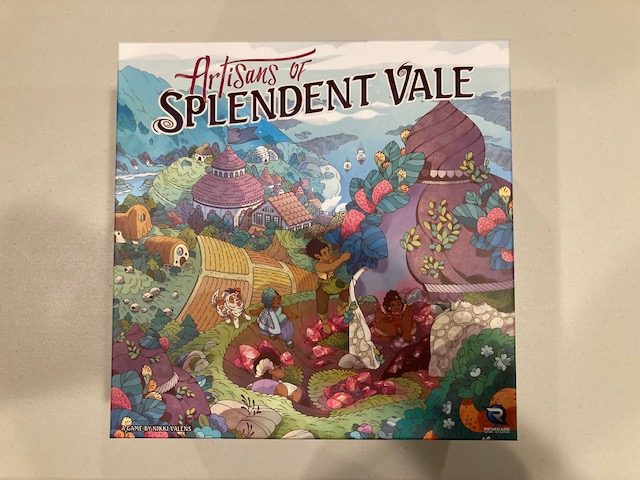
Artisans of Splendant Vale was on Kickstarter back in October 2021, and just delivered last week Dec 31 2022. It had originally promised delivery in August 2022, so it was about 5 months late.

IMG_4854

I think we’ll still count this is a 2023 release even though it got here Dec 31 2022.

IMG_4860

Artisans of Splendent Vale is a cooperative adventure legacy game for 2-4 players. I was very interested in this game, because it was by designer Nikki Valens who had done The Initiative, one of my favorite games of 2021! The Initiative made the #2 spot on the Top 10 Cooperative Games of 2021see review here, so I was very interested in seeing what this game was.

The Elephant in the Room

IMG_4996

Before you get any further, there are a few things you should know. If you have trouble with non-binary characters, non-traditional pronouns, gay, lesbian, or transgender characters, you probably should probably stop reading now. This game embraces those worlds fully: the four main characters are very steeped in their gender/sexuality: one character is gay, one is transgender and so on. The theme is not just pasted on: as the stories in the game progress, events further these characters in those areas.

It’s probably best to stop reading now and avoid Artsians of Splendent Dale if you have issues with any of that. This game embraces the stories and lifestyles of these characters.

Unboxing and Components

IMG_4853

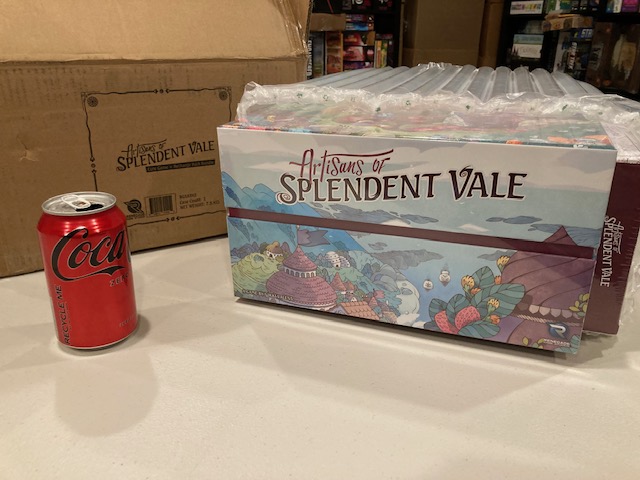
This box is surprisingly large!

IMG_4856

But the art is very nice … it almost reminds me of a kid’s storybook.

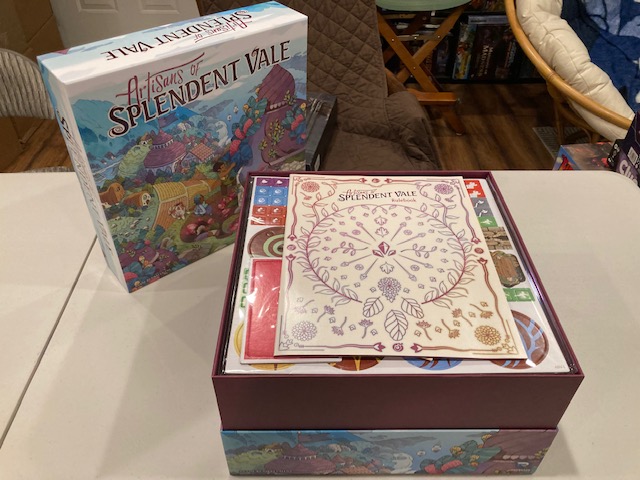
To be clear: this is a campaign legacy game! You will put stickers on forms, write forever notes on characters, and generally mark up sheets. My version came with one recharge pack (with new sets of sheets to reset the game): see above.

IMG_4864

IMG_4865

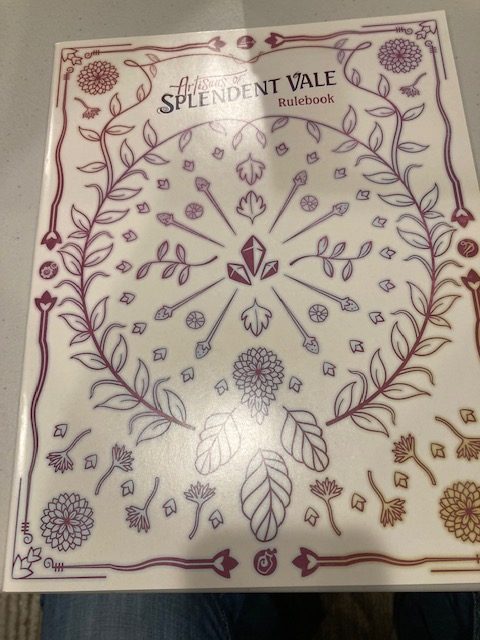
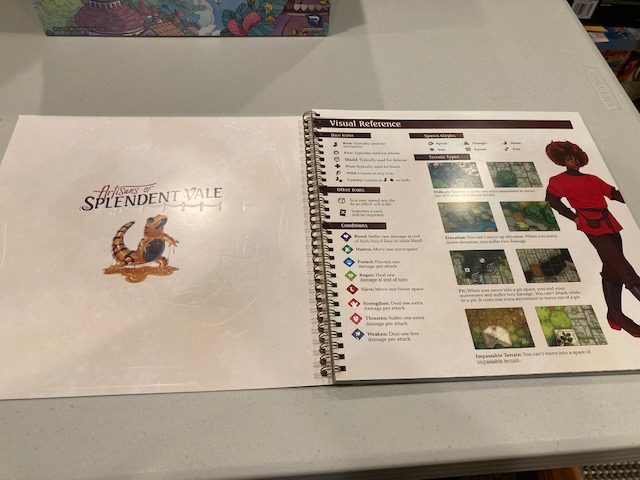
The rulebook is very fanciful. We’ll discuss its contents below.

IMG_4891

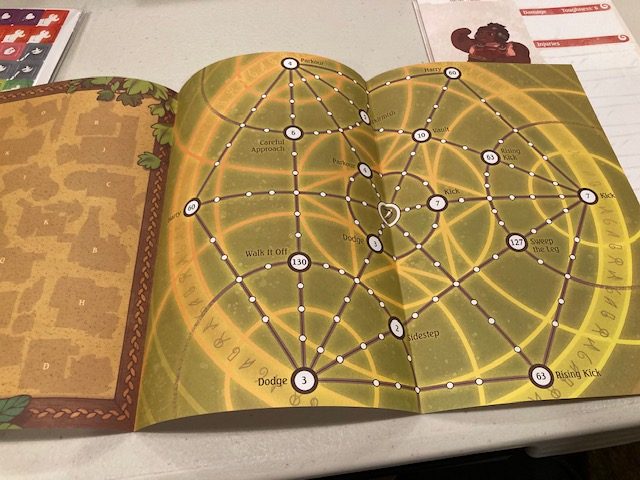
The game comes with an folded map: this is the land we will explore! See above and below.

IMG_4892

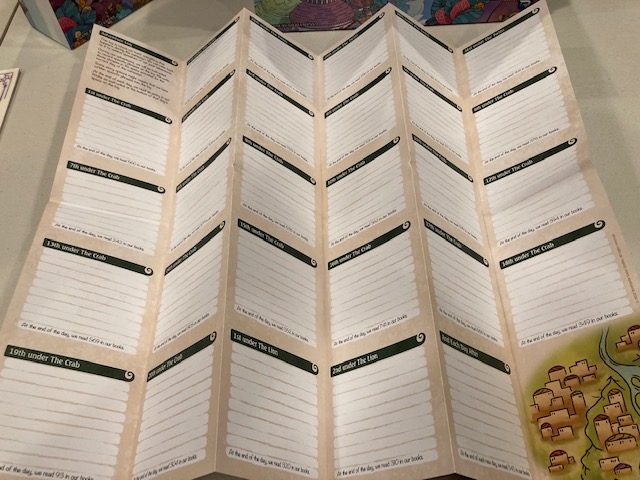
The front of the map is the lands you will explore. On the back side of the map is the ledger of your adventure (this is one of the legacy components that will be marked up: see below).

IMG_4893

As you explore, this map is marked up further and further, on both the front and the back.

IMG_4894

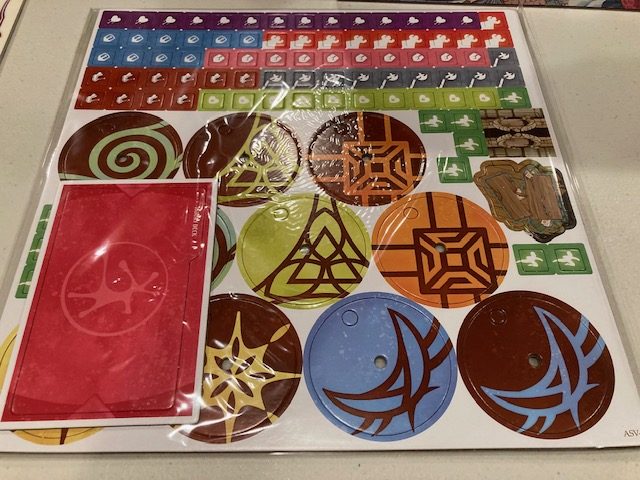
There’s a bunch of punchouts: most of them are status/condition tokens (sick, slowed, etc) and some dials for health.

IMG_4895

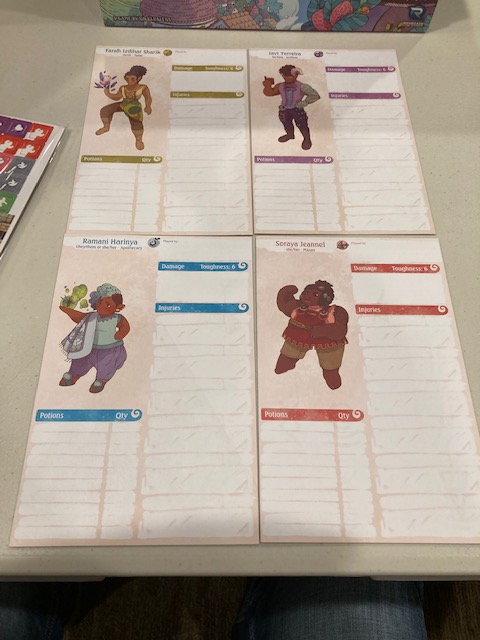
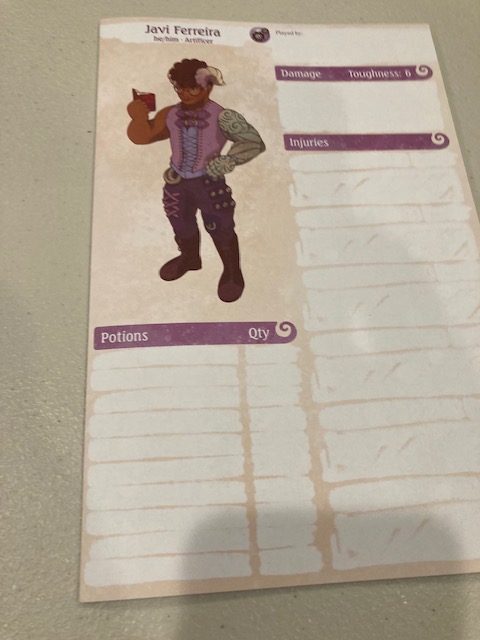
Next come the character sheets: these will be written on and change as you play through the campaign.

There are exactly four characters in the game, and they are all very different! They have different level-up/tech trees, different backstories and the like. So, the character sheets are all distinct and very different from each other.

IMG_4906

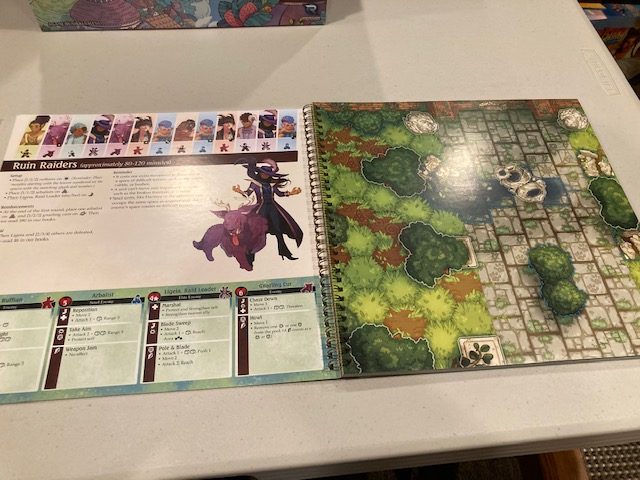
Up next is the Action Scene Book (called storybook in other games). It’s really nice! See above and below.

IMG_4907

IMG_4908

The Action Scene Book is essentially a map of where you fight bad guys (like the storybook from Jaws of the Lion: see our review here). We’ll take a closer look at the map later.

Under all those components are the main character books and tuck boxes.

IMG_4912

These character books are fantastic! I feel like I just went to the book store and got a new collection of books! There look like a series like Chronicles of Narnia or something!

IMG_4913

These books are really nice: see below.

The rest of the tokens are in the box:

IMG_4917

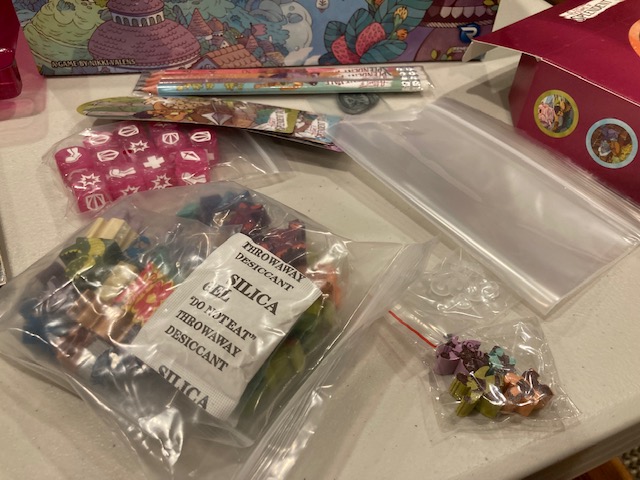
Most of these tokens in the box are the monsters meeples you’ll be fighting: see above.

IMG_4919

The four main characters in the story (see above) have markers that almost feel like erasers … I made the joke that they were erasers because we might lose a limb! I realized that after I said it, because this is a legacy game, I might be right! Oops, I hope that’s not a spoiler.

As the story progresses, a lot of items and stickers (like I said, this is a legacy game) come from the card repository: see above. 

IMG_4922

As a legacy/campaign game, you will have to save state between games, so there are little tuck boxes to store your cards and such.

IMG_4925

In the end, this is a beautiful, colorful production with great components. See above.

Rulebook

IMG_4865

I didn’t love this rulebook. I felt like it should have had a better vector into getting us into our first game (a First Play book like Tainted Grail would have been nice). The rules were all there, but a little scattered throughout.

As we played, I was the one who had to look up the rules, and many times I kind of struggled to find stuff. I generally found everything, but I didn’t love the organization.

It seemed almost like there was too much white space? I’d rather related things be clumped closer?

In the end, we were able to play the game using the rulebook, but it just seemed like the rulebook could have been better: maybe a First Play, less white space/better layout, slightly different organization?

We learned the game from the rulebook. I guess it did its job.

Solo Play

IMG_4861

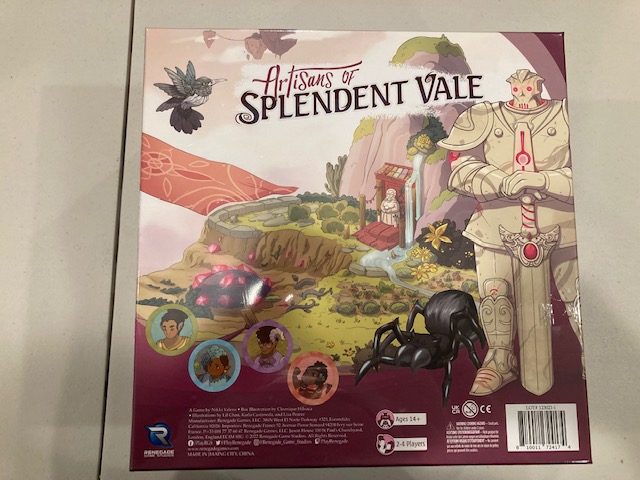
This game does NOT follow Saunders’ Law: there are no solo rules for this game! This game is strictly 2-4 players.

IMG_4923

After opening everything up, I thought “I can just play two characters and alternate between them.” Nope! Each character has to operate their own book, backstory, relationships with other characters, … and I think it just looked like too much work to try to play multiple characters at once for the solo mode.

Is there a way to play a single character? Maybe you could read through the storybook as a single character, but when you get to combat, that won’t work: the combat part of the game has been balanced for 2-4 characters, so you need at least 2 characters there.

I think if this were my favorite game of all time, or I were on a desert island with the game, I think I could handle playing multiple positions.

In the end, however, this is a social game: the characters tell the story together, they work together, and they read their books together. The lack of a solo mode is disappointing (I couldn’t learn this for my group), but it is understandable. This is a complex game that is quite social and cooperative.

What is This Game?

IMG_4924

This game surprised me because I was expecting a simple storybook game, but I got a pretty complex beast! it seems to be an amalgam of three major games:

  1. Crusoe Crew or Sherlock Holmes: Baker Street Irregulars 
  2. Gloomhaven: Jaws of the Lion 
  3. Forgotten Waters

What do we mean by that?

Shared Script Game: Like Crusoe Crew and Sherlock Holmes: Baker Street Irregulars

IMG_4259(1)

Crusoe Crew was a collaborative storybook or script book game from a few years ago (see our review here and here): players together read from their books at the same time (see above). These books are like scripts from a movie … everyone is following along with their own copy. These books are Choose Your Own Adventure type scripts: players would read along together and occasionally come to a decision point. At the decision point, players decide as a group where to go next! What’s interesting is that occasionally the books will slightly diverge for one character! For example, one character may be very tall, so he’ll read a slightly different entry because he can see something up on the shelf!! But the stories always converge back to the main plot. Players read cooperatively from their books. Both Crusoe Crew and Sherlock Holmes: Baker Street Irregulars (see review here and here) were fantastic experiences in this shared script game.

IMG_6087

Artisans of Splendent Dale absolutely follows this model! Players read out out of their books together, with occasional diverging text (that always converges back), with special entries for each character.

IMG_4915

You can see what a book looks like above: entries are labelled with numbers so you know where to go.

IMG_5005

These storybooks are mostly text, with a few pictures (as opposed to more cartoons and maps), but it serves a shared script that everyone is reading. I love this format, and this was the main reason I got this game! See above as Andrew and Sara read together from the shared books. I loved both Crusoe Crew and Sherlock Holmes: Baker Street Irregulars, with the latter making the #1 spot on our Top 10 Cooperative Games of 2020! So, I loved the shared scripts (character books) here!

But this game is much more than just a shared script game.

Fighting Game: Like Gloomhaven: Jaws of the Lion

IMG_5006

This game flits between “reading the shared script together” and “fighting stuff”.

When you fight stuff, Artisans of Splendent Dale feels like a simplified Gloomhaven: Jaws of the Lion.  When you are ready to fight, you open up the storybook and fight some bad guys! 

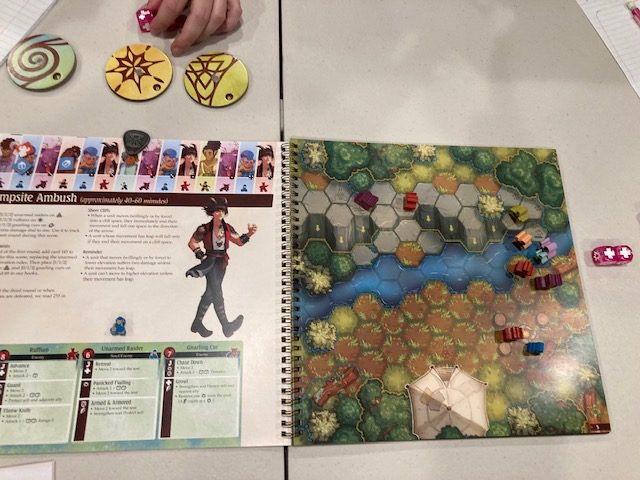
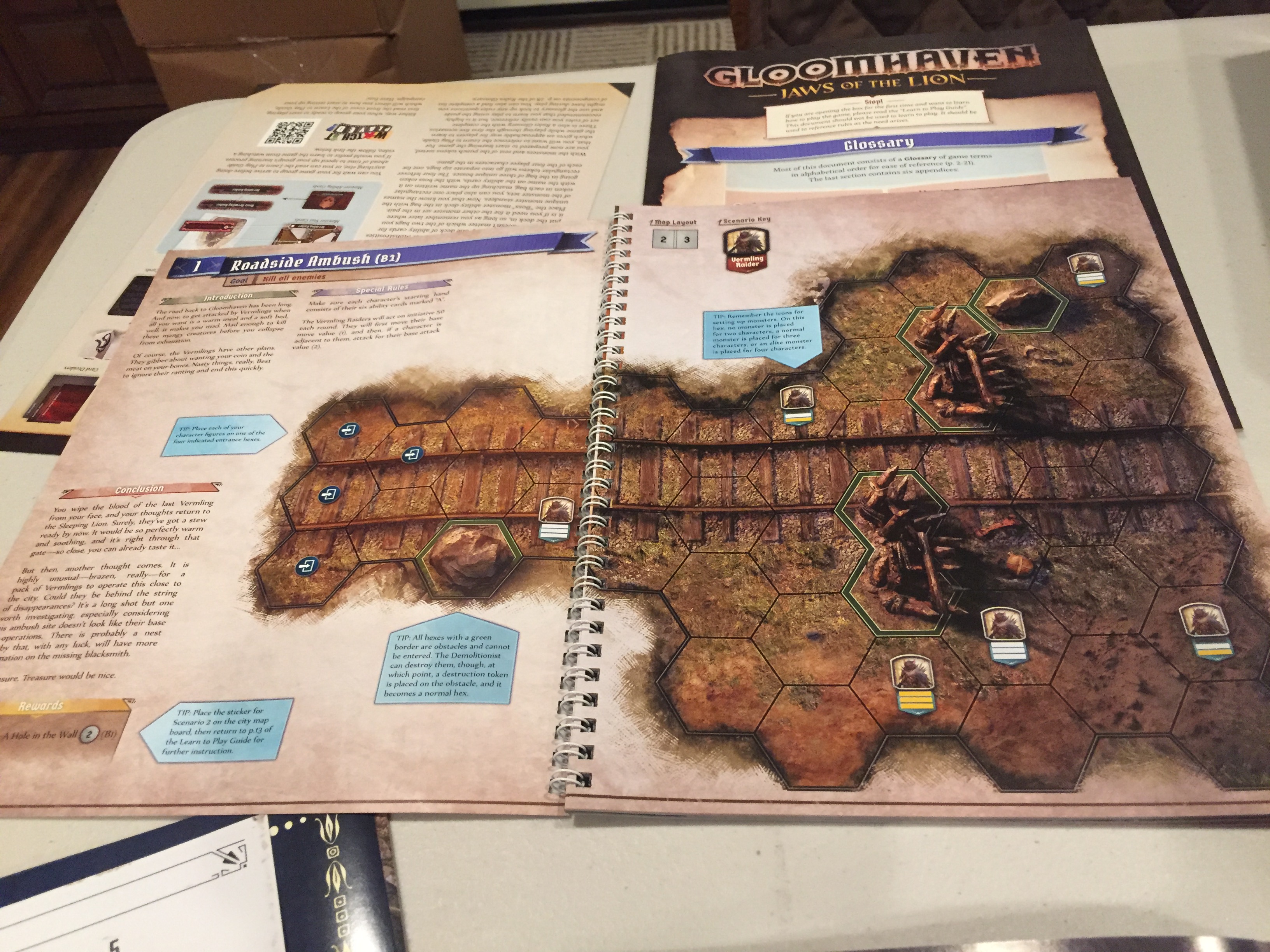
The storybook in Jaws of the Lion was the major advancement in Gloomhaven system: it was so easy to get set-up! Just open the book (instead of hunting for tons of cardboard in the original Gloomhaven).  See our review here.  See the Jaws of the Lion storybook below.

IMG_6063
The storybook is the play area! Set-up is easy! Just turn to that page! Artisans uses this same model, but they call it in the Action Scene Book rather than the storybook.

IMG_5008

The fighting  for Artisans, though, is simplified in many ways: the bad guys are just little wooden meeples (see above)  [instead of tons of punchouts], and the initiative order is already set-up (below) [instead of being determined by lowest card]  …

IMG_5003

In general, the set-up is very quick: just open the book and set-up some meeples!

IMG_5001

This system worked well!

I was surprised how much combat there was in the game: I had expected more of the shared script game. About a half of the game is combat, and the other half is reading and advancing your characters.

Advancement: Like Forgotten Waters

IMG_4897

I expected this to be a game with character advancement … it is a legacy campaign game after all! What surprised me is how much that advancement lifts from Forgotten Waters it was! See our review here.

IMG_5680

In Forgotten Waters, you fill in little dots in a “constellation” as you advance.  When you get to major points on your grid (the ! above), stuff happens. This is the only game I’ve seen this with  this “constellation system”.

IMG_4902

… until I got to Artisans of Splendent Dale! As you get more more experience points, you fill in the dots in your “constellations” and fill in towards certain items/abilities you want … very much like Forgotten Waters. Except every character is very very different. Maybe that’s why they chose the “constellation” system: it works well for disparate characters.

IMG_4904

Dice For Actions

IMG_5009

Artisans of Splendent Dale uses the “roll dice to get actions” mechanism. One your turn, you roll a number of dice, and add them to the pool. On the storybook pages, you get two actions per turn, using the dice for attack, movement, boosting, “wild”, and defending (depending on what’s showing). Once you use a dice for its action, it leaves the pool.

Generally, I don’t like this mechanism: we discussed this heavily in our Batman: Shadow of the Bat review as well as our King of Monster Island review. It always feel like you have do what the dice tell you to do, not what you want to do.

This mechanism didn’t seem too bad when we played Artisans: it seemed like we were generally able to do what we needed. I still don’t love this mechanism: Batman: Shadow of the Bat should have been in my Top 10 Cooperative Games of 2022, but it didn’t make the list solely because of this mechanism.

Overall, Artisans of Splendent Dale worked okay with the “roll dice to get actions” mechanism. I still just don’t love that mechanism.

Cooperative Play

IMG_4995

The cooperative play worked well in this game! The game suggests you have “one reader”, but we chose to rotate the reader (from the script books) so that everyone had a chance to read frequently. I would have probably made that the default rule: “rotate the reader every turn”: this promotes more involvement from everyone.

IMG_5008

Also, even though I didn’t love the dice combat (“role for your actions”) with the shared pool, the shared pool did seem to elicit more cooperation: “You need to leave me an attack symbol so I can take out that guy!” Just having the shared pool seemed to encourage a little more togetherness.

Generally, the game did elicit a lot of cooperation: it really worked well on that front.

What I Didn’t Like

IMG_4999

I didn’t like the “roll dice for actions” mechanism, but it wasn’t terrible. It worked.

IMG_4886

One thing that I really didn’t like was the enemy actions weren’t well specified. The rulebook (see page 19 above) literally says “Instead, just go with the most obvious best choices you can see”. We spent an entire blog entry talking about how we didn’t like this in the Resolving Ambiguity in Cooperative Games. We made it work, it wasn’t a big deal to the group, but it did rub me the wrong way. If we compare the enemy actions rule to something like Gloomhaven, where they are incredible well-specified, Artisans looks very poor. However, that specificity in Gloomhaven has a cost: much more complex rules. I know why Artisans of Splendent Vale chose to let the characters run the bad guys in a more free-form way: in a word, simplicity. But it still rubs me the wrong way: it always feel like a cop out.

But the game worked: my group as a whole didn’t have a problem with the free-form enemy rules.

What I Liked

IMG_4925

The components are pretty darn amazing.

IMG_4912

The script books are fantastic: easy to read, well-written, and nicely laid-out. They work well.

IMG_5006

The combat story book (Action Scene books) works well.

The Characters

IMG_4896

The game can be played with fewer than 4 characters, but to get the most of out of the story, you should probably play with the full character count: each character seems to have an interesting story that unfolds and helps reveal plot points.  We saw early on that we would have missed certain entries in the character books if we didn’t have all the characters.

IMG_4903

Also, the characters in the story are well-defined: they seem to all have very strong personalities which will influence how you play them!  When you play Javi, you will tend to be more stoic.  When you play Ramani, you will need to be very inquisitive and ask lots of questions, almost to the point of annoying (if you believe Soraya’s POV).  You will have to play that character’s personality to get the most out of the game.  If you were hoping to just lightly engage, the characters don’t really allow that: that that for what you will.

Conclusion: The Story Progresses

IMG_5010

There is a lot here! The script books are pretty huge, and the overall story looks like a fairly long campaign. And the components are phenomenal.

My group really liked this game: they want to keep playing! The general feeling was that Artisans of Splendent Vale feels a lot like a simplified Gloomhaven with a cuter theme, but with a much better story (as guided by the script books like Crusoe Crew).

But be careful: that theme is a little misleading: it is still very cute, but the game still has mature elements. One of the things that came up was “my sex life”: it wasn’t explicit or anything, but apparently we will see discussions of our sex lives in the game? That makes me think some people might have problems with the 14+ age range? I guess it depends on what you think is an appropriate age to discuss your sex life (of your character). Be aware if it might be an issue for you or your group?

Interestingly, none of my game group is transgender, gay, or lesbian, so we weren’t necessarily the target audience (or arguably, we were). We just enjoyed this for the game it was: it was a good game. I suspect the theme will be what entices many people to the game, but luckily the game is good. Just be aware that this game is much more complex than it looks: this isn’t a game for newer players without much experience in the world of modern games. (Seriously, it felt a lot like Gloomhaven is lots of ways).

Overall, my group liked this game better than I did: they have entreated me to keep playing! My problem is mostly I don’t love the “roll dice for actions” mechanism, but I do love the script books, streamlined combat, and the quality components. I think my group would give this a 7.5/10.0 and I’d probably give it a 7/10. I suspect some people will adore this game and give it an 8 or better! Hopefully this review will help you decide if you would like this game.

Appendix

IMG_4894

The joke was that I didn’t like the game as much as the group because I was the one who had to handle the condition tokens! Our second combat had so many conditions to keep track of! Oof! This is another way that Artisans is like Gloomhaven: there are lots of conditions in the game that change up combat. Tip: Maybe consider sharing the responsibility of the conditions when you play so one person doesn’t get stuck with all the tiny condition tokens …

Top 10 Anticipated Cooperative Board and Card Games of 2023!

As we close down 2022, we saw some great cooperative games and expansions: see our Top 10 Cooperative Games of 2022 and Top 10 Cooperative Expansions of 2023! But what’s coming next year?

From last year’s list (Top 10 Anticipated Board and Cards Games of 2022), many didn’t even arrive for us to examine. Of the 10 (+1 Honorable Mention) we anticipated last year, six of them still haven’t arrived (The Stuff of Legend, Valor and Villainy: Lludwick’s Labyrinth, Earthborne Rangers, Arydia: The Paths We Dare Tread, Rat Queens: To The Slaughter, and Union City Alliance). Here are the ones that did arrive and we have been looking at:

Below are our Top 10 Anticipated Cooperative Games of 2023!  Like years before, we will provide a link the the project (either Kickstarter, Gamefound, or BacketKit), the promised delivery date, and a quick summary from BoardGameGeek!

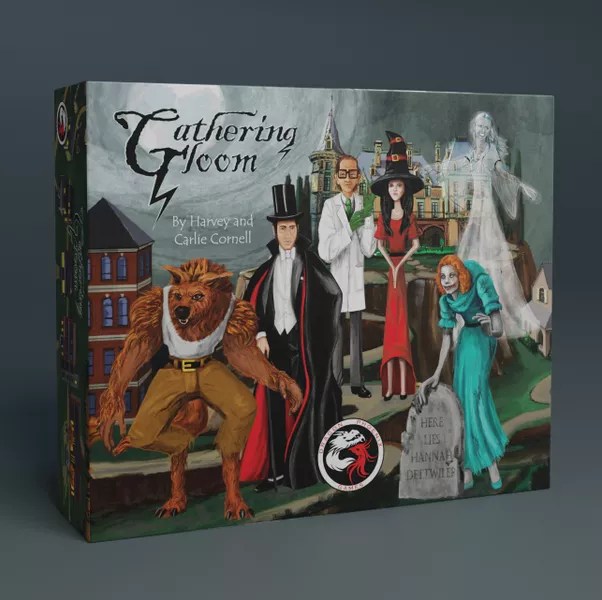
10. Gathering Gloom: A Killer Co-op Game for 1 to 5 monsters

gathg1

Platform: Kickstarter Gathering Gloom: A Killer Co-op Game for 1 to 5 monsters
Promised Delivery: September 2023
Summary: The Charming family is an eclectic family that lives in a manor on top of the hill in the town of Banebridge somewhere in New England circa 1932. They own the local mortuary as well as a mining company. All they want to do is live in peace, take care of their ancestral home, run their businesses, and get along with the townsfolk. The villagers of Banebridge, however, see it differently. Many of them are firm of the opinion that at least some if not all of the “Charming” family are up to nefarious deeds and are, in fact, “monsters” of various sorts. To that end, they are constantly turning up evidence that implicates members of the family in foul play. Some villagers even start stalking individual members. Sometimes (well, a lot of the time really), the family members are forced to take action to deal with especially difficult villagers or incriminating evidence. Actions include Murder, Terrify, Beguile, Deceive, Extort, Bribe, Coerce, and many more. Of course, the family would NEVER take such actions if the villagers weren’t constantly interfering.

gathg2

We literally backed this on Kickstarter 3 times: it failed to fund the first two times, but their tenacity paid off and they finally funded!  This game looks really interesting … although the art may be divisive … but I am really looking forward to this “Adams Family” co-op game!

9. Tamashii: Chronicle of Ascend

tam1

Platform: Gamefound https://gamefound.com/projects/awaken-realms-lite/tamashii-chronicle-of-ascend
Promised Delivery: 2023???? 
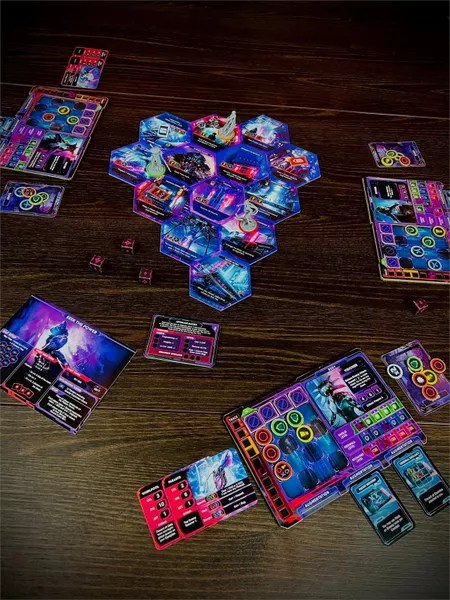
Summary:  Tamashii is a cyberpunk adventure board game with a post-apocalyptic vibe. Players will struggle to survive and pursue their agendas in two worlds at the same time – the physical one, filled with deadly machines and merciless human survivors, and the virtual one, prowled by tracking software and vicious viruses.

Players will try to achieve their goals on a modular city map. They will find new locations, fight against strong enemies and search for important information and files needed to win the game.

The second part of the game takes action on a virtual map. Here you will try to hack your opponents, unlock special bonuses or get one-time bonuses for completing the sequences.

The game may be played in different scenarios. You might have to cooperate with other players, play against them or even make an alliances with your enemies. But watch every step you take; every conflict, cooperation or alliance might be a double-edged sword.

tam2

Another cyberpunk inspired game on this list!  We know that Awaken Realms make gorgeous and high-quality games, so hopefully this will be a great game as well!  We don’t really know a delivery date, but we hope it delivers in 2023.

8. Kinfire Chronicles: Night’s Fall

pic6914114

Platform: Kickstarter Kinfire Chronicles: Night’s Fall
Promised Delivery: August 2023
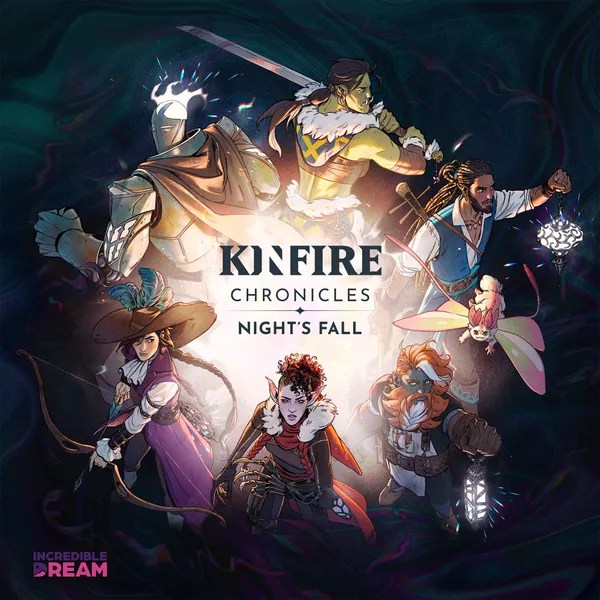
Summary: In Kinfire Chronicles: Night’s Fall, a 1-4 player co-operative, quest-based RPG board game, players take on the role of seekers, adventurers who are fighting to push back the darkness threatening to change and destroy the world of Atios. The game plays as a campaign of 15+ quests, and each quest takes an average of 45-60 minutes to complete. Within each quest, players can expect to make choices related to adventures, battles, NPCs to speak to, and more. These choices create a branching story in the game, allowing the entire campaign to be replayable.

pic6909450

What makes this very interesting for us is that Kevin Wilson is on the team of designers: we love most everything he does!  The acrylic standees look great, and this looks like a lighter fun dungeon crawl campaign!

7. Daybreak 

pic7068528

Platform: BackerKit https://www.backerkit.com/c/alex-hague/daybreak
Promised Delivery: May 2023
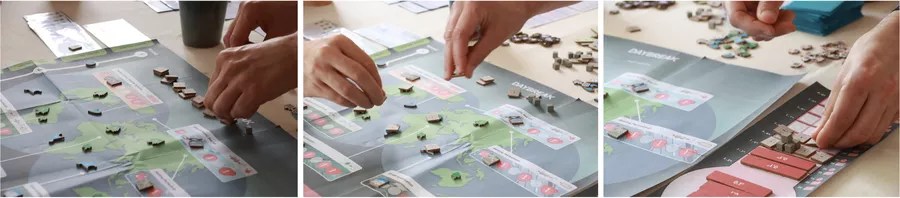
Summary: Daybreak is a co-operative game about climate action. Each player controls a world power, deploying policies and technologies to both dismantle the engine of global heating and to build resilient societies that protect people from life-threatening crises.  If the global temperature gets too high, or if too many people from any world power are in crisis, everyone loses. But if you work together to draw down global emissions to net-zero, you all win!

pic7110894

Daybreak is a new cooperative game by Matt Leacock, the designer of Pandemic!  That fact itself is exciting, but the game looks really interesting romp like CO2, but perhaps a little easier!

6. Doomensions: Pop-Up Mystery Manor

pic7013300

Platform: Kickstarter https://www.kickstarter.com/projects/curiouscorres/doomensions-pop-up-mystery-manor
Promised Delivery: February 2023
SummaryInvestigators wanted they said… Safety guaranteed they said…

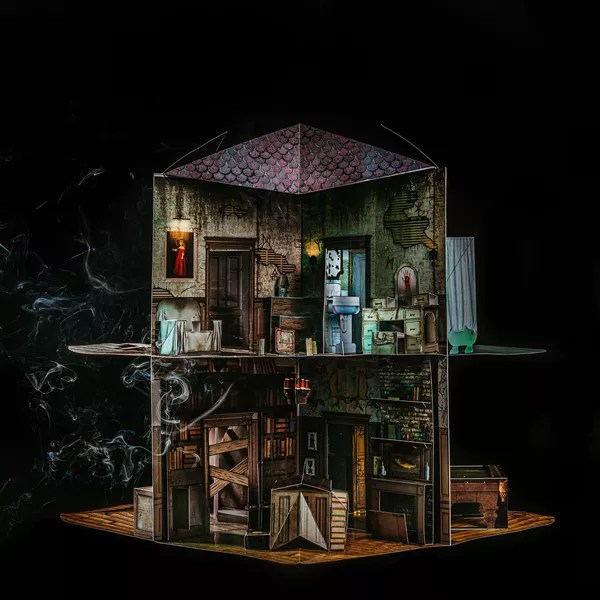
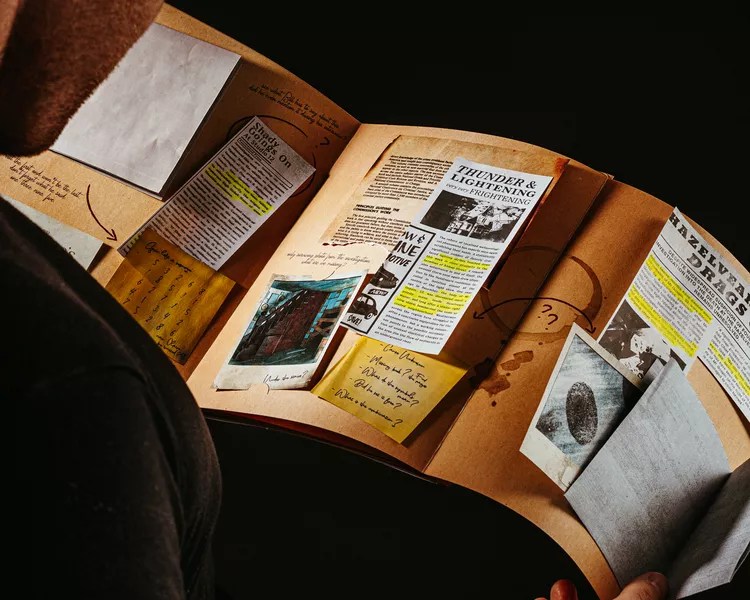
As a newly commissioned paranormal investigator gather your thick scrapbook of evidence and pay a visit to the fully assembled, 8 room, 3D popup Mystery Manor — no assembly required! Secrets lie hidden in every dark corner, behind every closed door. Making repeated exploration of the manor crucial to your investigation.

Packed with clippings, foldouts, and other curious ephemera, your case file will guide you through your time at the Manor. At key investigative milestones, your answer wheel will allow you to confirm your deductions before you return to the manor for more clues.

pic7013303

When did Pop-Up adventures become a thing?  We saw The Shivers deliver at the end of 2022: it’s an RPG lite adventure with pop-up rooms!  See our review here!  Now, we see a more “serious” mystery in Doomensions with more pop-up pieces!  This kind of reminds of The Cursed Dollhouse game … that’s great! We loved that game  See our review of thre Cursed Dollhouse here!

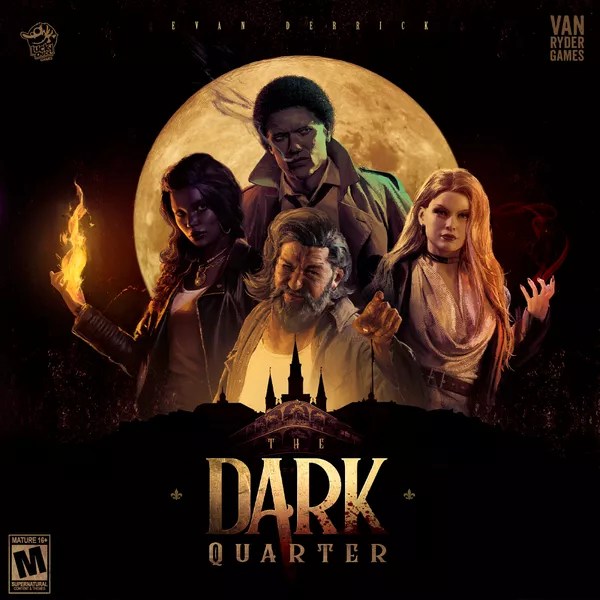
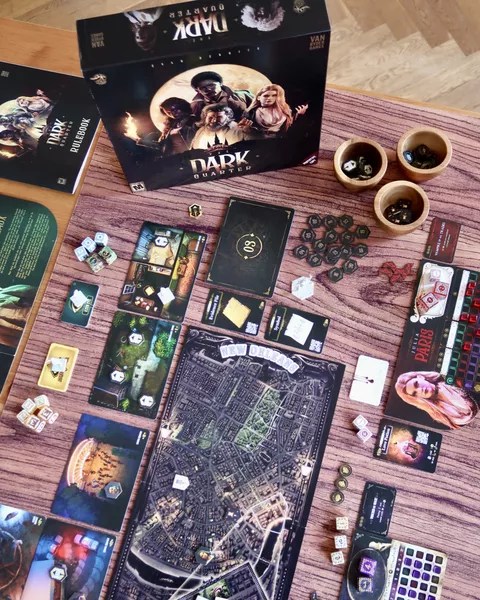
5. The Dark Quarter

dq1

Platform: Kickstarter The Dark Quarter
Promised Delivery: October 2023
Summary: In The Dark Quarter, a co-operative app-driven adventure game set in a dark, fantastical vision of 1980s New Orleans, players each take control of a Beaumont agent and work alongside one another to solve the worst crimes that New Orleans has to offer. It’s a world full of magic, where hexing curses are sold on every street, where voodoo priestesses and creatures of the night are lurking around every corner, and where even the most mundane crimes have a tinge of the supernatural to them.

dq2

Lucky Duck has done some pretty amazing app-driven games; They’ve also done a great job on mystery games like
Chronicles of Crime!  This looks like a more thematic supernatural Mystery deep in the lore of New Orleans!  We love our Mystery Games here at Co-op Gestalt, and we we are looking forward to this!  See our Top 10 Cooperative Mystery Games!

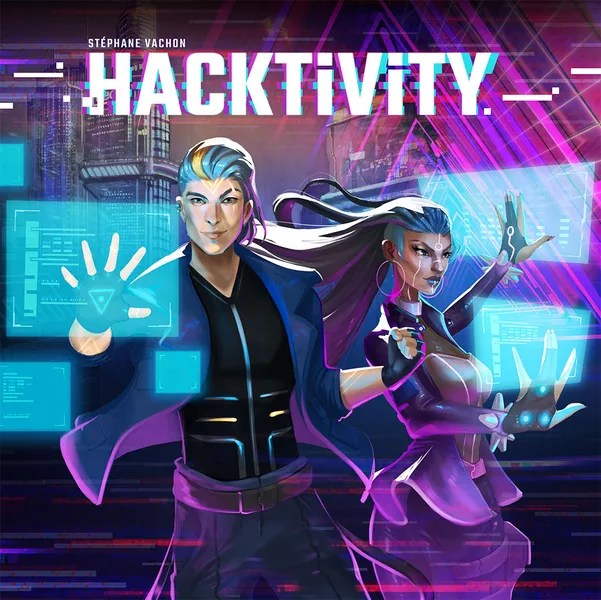
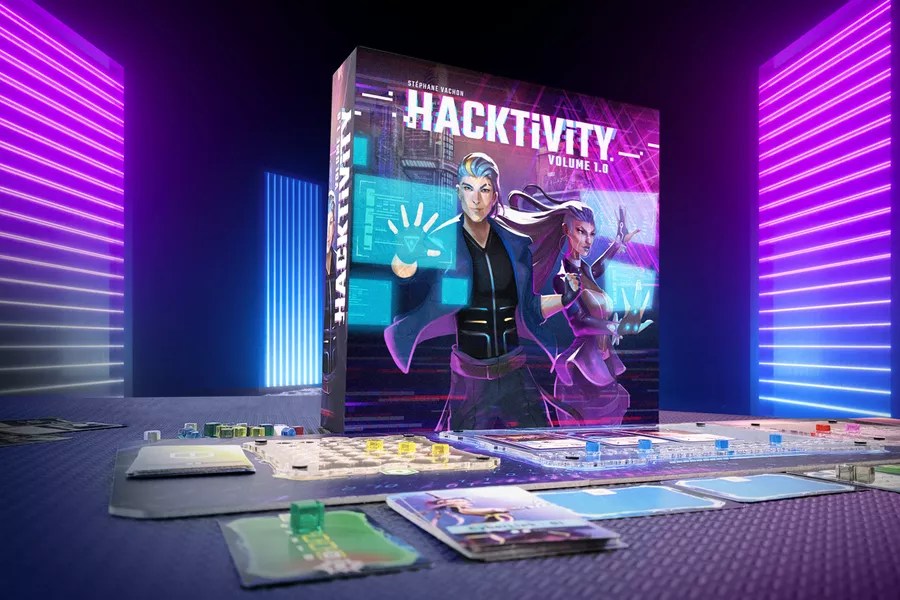
4. HACKTIVITY – A Highly Interactive Cooperative Board Game

hack1

Platform: Kickstarter link  HACKTIVITY – A Highly Interactive Cooperative Board Game
Promised Delivery: February 2023
Summary: A new virus has been detected in cyberspace. According to your investigation, the virus’ origin is linked to the activation of quantum generators, a new source of infinite energy. You and your team will dive into the depths of cyberspace and attempt to break through the generators’ defenses to short-circuit them once and for all. 
Hacktivity is a cooperative story-driven campaign card game for 1 to 4 players. Immerse yourself as one of the four unique characters.

hack2

There’s a lot of cyberpunk activity on the list this year!   This is another hacking game that looks cool as players play unique characters working together.  The component looks pretty cool too.

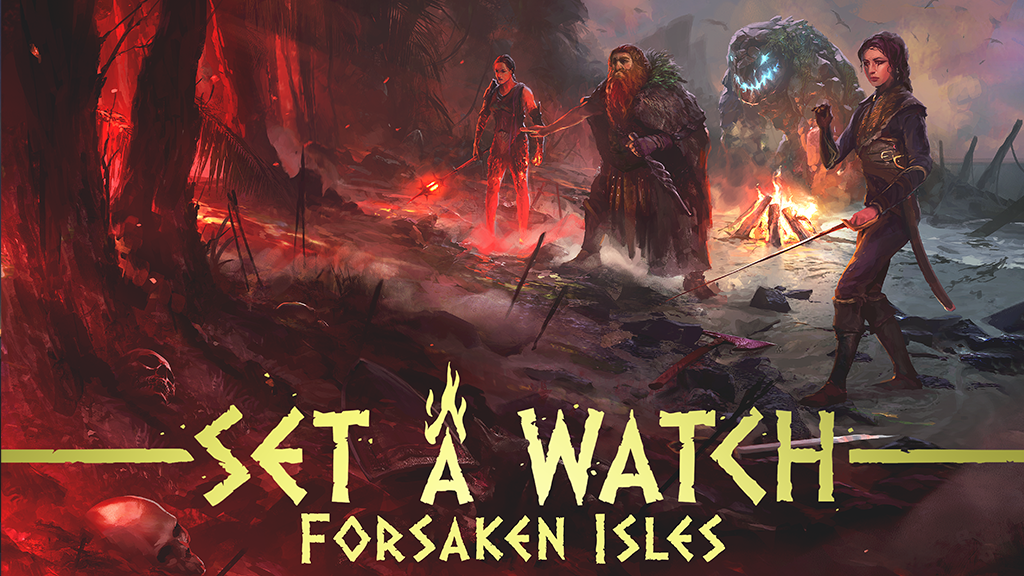
3. Set A Watch: Forsaken Isles + Doomed Run

setwatch1

Platform: Kickstarter (not up yet, here’s a link to the manufacturer’s site).  This should be up on Kickstarter in Feb 2022.
Promised Delivery: ???
SummaryA continuation of the Set A Watch series, Forsaken Isles features a new band of adventurers sailing to islands and other tropical locations to face new monsters and challenges.

Defend your campfire from a horde of creatures and unhallowed bosses using each hero’s unique abilities to survive the night. One hero stays in camp to rest and maintain the fire while the others battle. Each round, you draw a new location to setup camp in. Survive all 8 nights (rounds) to win the game.

sw2

This sounds very interesting, not only because they are adding more content to the Set A Watch system (which we love: we’ve reviewed it here and here, and it’s made our Top 10 Cooperative Dice Games as well as Top 10 Cooperative Expansions of 2021  as well as Top 10 Cooperative Games of 2019), but it’s also adding a campaign called Doomed Run! We are really looking forward to this! Hopefully we get it this year!

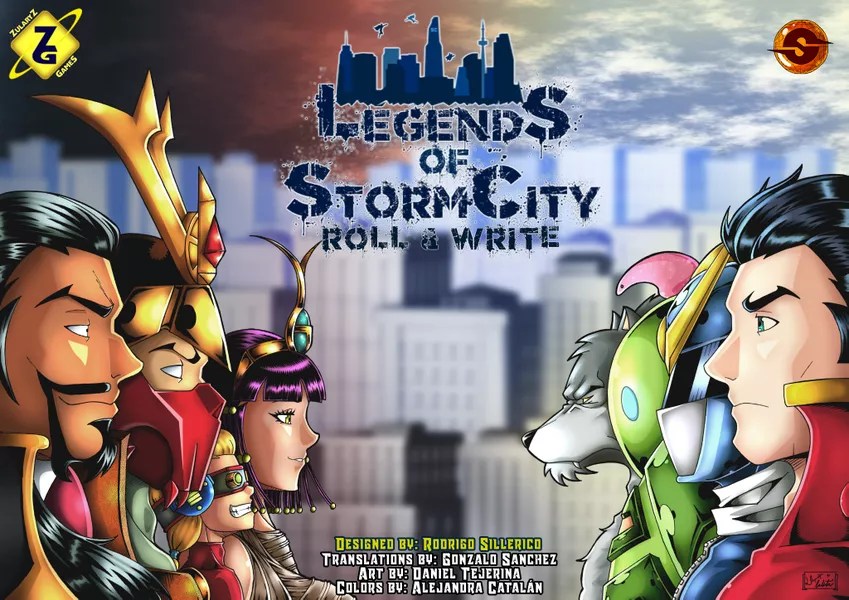
2. Legends of StormCity

lsc1

Platform: Kickstarter https://www.kickstarter.com/projects/printandfun/legends-of-stormcity
Promised Delivery: January 2023
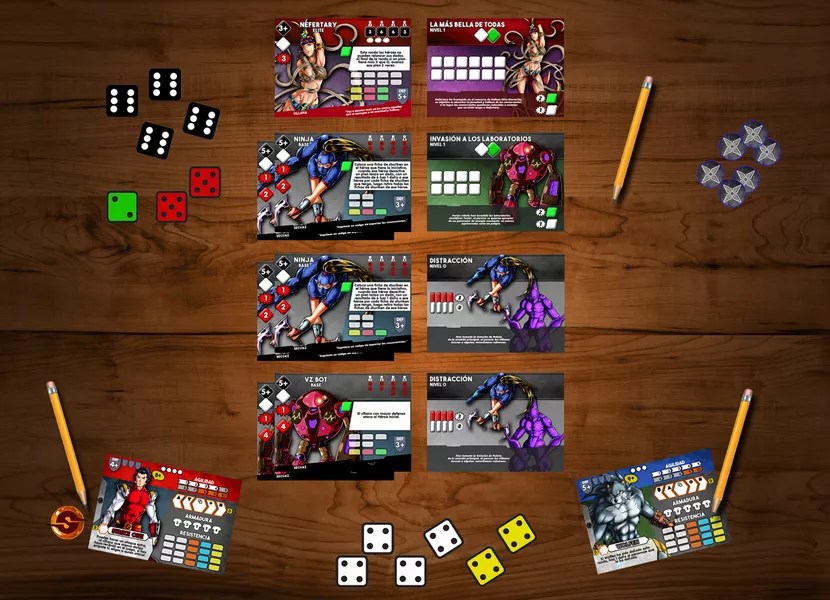
Summary: Legends of StormCity is a roll & write game, in which each player takes the role of one of the heroes of StormCity who will fight against villainous leaders and their henchmen who intend to carry out their evil plans to conquer the city.

Each player will control a hero sheet in which they will write down the damage they receive and the powers they can use. Villains and minions have their own game sheets.

losc2

Given the ubiquity of Roll and Write games, it’s surprising how few cooperative Roll and Write games there are!  (One was the Escape Roll and Write which we reviewed here).  Legends of Storm City has the distinction of being a cooperative Superhero Roll and Write and a Print and Play from Kickstarter!  This looks really neat and we will probably review this ASAP!

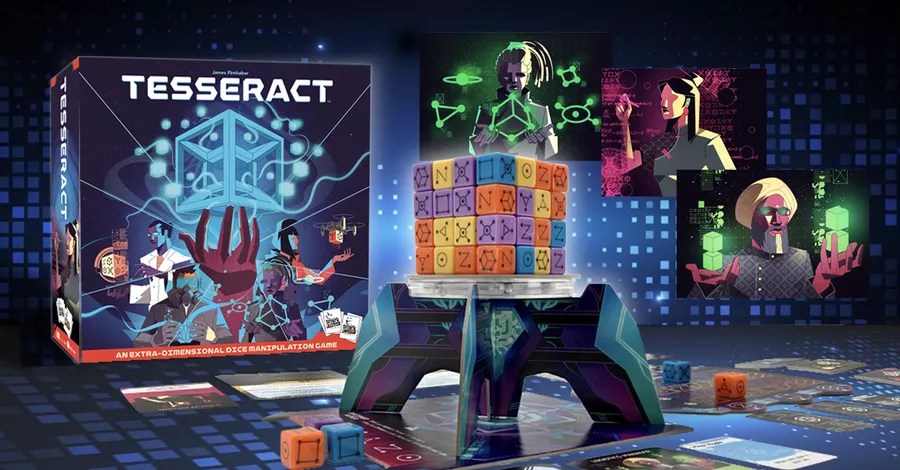
1. Tesseract – A Cooperative Dice Manipulation Game

tesseract

Platform: Kickstarter https://www.kickstarter.com/projects/smirkanddagger/tesseract-a-cooperative-dice-manipulation-game/
Promised Delivery: July 2023
Summary: Tesseract is a compelling, cooperative dice-manipulation game for 1 to 4 players. The focal point of the game is a block of 64 dice, the Tesseract, which sits at the center of the board on a raised platform. Players will remove cubes to place in their individual labs, transfer them as needed to others, adjust the cube’s values and, importantly, isolate the cubes into the containment matrix, neutralizing them

tess2
Although the metal dice gives this Kickstarter some “wow factor”, the game also looks interesting: cooperative play rolling dice from the cube looks really interesting and different.  But, it’s probably #1 because of the metal dice.

Top 10 Cooperative Board and Card Games of 2022!

What a great year 2022 has been for cooperative board and cards games! We have reviewed about 50 cooperative games and expansions here at Co-op Gestalt over the course of 2022! Wow! And we still missed a bunch of games we want to play! Weirdly, I don’t think we saw many of the games that we like on other people’s top 10 list! Apparently, our taste is unique! So, let’s take a look at our favorite cooperative games of 2022!

Honorable Mention. Sentinels of The Multiverse: Definitive Edition

IMG_9702

Plays Solo:  Yes (but you have to play 3 heroes)
Player Count: 1 to 5 (best at 3)
Ages: 14+
Length: 30-60 mins

We have to give a shout-out to one of our favorite games of all time: Sentinels of the Multiverse. This year, Greater Than Games released the newest version, called the Definitive Version! This new version replaces and obsoletes the Second Edition (which has been around for some time). See the new version below!

IMG_9768

The art and components are better, the gameplay has been smoothed out, and it’s a great evolution of a great game!

IMG_9841

This game gets a 10/10 for us. So why is it an Honorable Mention? The problem: I have already invested pretty heavily in the Second Edition of the game! I know the original cards so well (the heroes, the villains, the environments) that I don’t want to “throw away” that knowledge and start over in the new universe! See my investment below!

IMG_9942

So, if you are starting fresh, I would highly recommend the Sentinels of the Multiverse: The Definitive Edition! But, if you are like me and my friends, who have invested pretty heavily in Second edition and want to stay there (For example:we played tons Sentinels of The Multiverse Second Edition at RichieCon 2022!), we can only give this an Honorable Mention. See our review here for much more discussion of the game and which version you may want. There is a reason this is #1 on our Top 10 Cooperative Superhero Games!

10. Batman: The Dark Knight Returns 
IMG_0481

Plays Solo:  Yes 
Player Count: 1 to ?? (it really a solo game, but multiple people can make decisions together as a solo unit)
Ages: 14+
Length: 90 mins per session (there are exactly 4 sessions)

Strictly speaking, this is a solo game, but you can play it multiplayer either as a  1 vs. 1 game, or “solo with many people”.  The solo player (or multiple players) takes the role of the Dark Knight from the Frank Miller masterpiece The Dark Knight Returns and plays out each of the four issues as Batman.  Your goal is simple: to survive all 4 issues!

IMG_0561

This game caused a lot of existential crises for us: The Dark Knight Returns forced us to think about how to Resolve Ambiguity in Cooperative Games!  It also forced us to confront the idea that just surviving is okay for a cooperative game.  

IMG_0565

Strictly speaking, this is a solo game. With some handwaving, you can play this with multiple players, but it is best solo, which is why it is only at number 10 for 2022.  See our review here. 2022 was a very good year for Superhero games … keep reading!

9. Eila and Something Shiny

IMG_9943

Plays Solo:  Yes
Player Count: 1-3 (it’s really multiplayer solo, with everyone making decisions together)
Ages: 8+
Length: 30-45 mins per session (the game is a campaign over many sessions)

If you are surprised about this one, so are we!  Eila and Something Shiny just enchanted us! It also surprised the heck of us with its interesting ideas and straight-forward gameplay.  It is also a campaign game! My game group wanted to bribe me (with doughnuts) to keep playing this because it was so cute and so fun!  The little comics/stories that came with the game were surprisingly emotional, and they even caused us to feel real human emotions. 

IMG_0013 (1)Even though this is obviously aimed at a younger audience, Eila and Something Shiny took our game group by storm.  If you’d like to find out more abut this game, check out our review here.

IMG_9992

Eila and Something Shiny  is a fun game that the whole family can enjoy.

8. Legends of Sleepy Hollow

boxlosh-2

Plays Solo:  Yes (but you have to play all 4 characters! It’s very difficult to play solo!)
Player Count: 1-4 
Ages: 14+
Length: 30-120 (depends on the scenario you play)

This game was #2 on our Top 10 Anticipated Games of 2022!  There have been some production problems (which Greater Than Games have addressed) and some rules problems, but this campaign adventure game is so thematic, it’s easy to forgive some of the flaws.

IMG_0101

This game is a campaign, exploring the world of Sleepy Hollow and the Headless Horseman.  The components and art and unique and creepy, the story is really thematic, and the game is just a unique romp.  Each player plays a character in this world and upgrades in unique and different ways as the story progresses.

IMG_0134

Despite some of the production flaws (some boards were hard to read), the theme and story just oozes out out this game. See our review here to see if you would like to enter the world in Legends of Sleepy Hollow!

7. Minecraft: Portal Dash

IMG_3541

Plays Solo:  Yes (no real changes to play single solo: works well)
Player Count: 1-4 
Ages: 10+
Length: 60 mins

Minecraft: Portal Dash is a huge surprise of the this year!  I didn’t expect to like this game as much as I did: It’s a solid cooperative game and plays in about 60 minutes.  Although some of the graphic design won’t win any awards, it does look like Minecraft, which will probably appeal to a lot of people!

IMG_3636

What really sold us on this game was the cube structure: they way the cubes interacted with the rest of the game was so interesting!

IMG_3582

I know, it sounds weird that we liked this game so much, but take a look at our review here to see if you might like it too!

6. Agents of SMERSH: Epic Edition

IMG_3658

Plays Solo:  Yes (as a single character, no multiple characters needed)
Player Count: 1-4 
Ages: 14+
Length: 90 mins

Agents of SMERSH: Epic Edition is the Second Edition, a major reworking and simplification of the original Agents of SMERSH game.   Agents of SMERSH: Epic Edition is a storybook game, where players roam the map doing “secret agent” type things.  It’s got a sense of humor, but if you want a silly storybook game with lots of reading and some fun dice-rolling, this is a great game. 

IMG_3678 

The components for this are amazing!  

IMG_3736

The original Agents of SMERSH was in our Top 10  Cooperative Storybook/Story Telling Games, and the new version has replaced it for us!  The new edition is streamlined, has better components, looks better, and concentrates on the funner parts: reading and rolling. See our review here to see if you would be interested in this!

5. Star Wars: The Clone Wars (A Pandemic System Game)

IMG_3393

Plays Solo:  Yes (alternate between 2 characters)
Player Count: 1-5
Ages: 14+
Length: 60 mins

Although Star Wars: The Clone Wars is a Pandemic game, it has really evolved the rules so that the game melds with the Star Wars theme quite well!  There are a lot of new innovations to the Pandemic system that make this quite fun and unique!  It’s not just “Yet Another Pandemic Game“, but a unique entry into the Pandemic lexicon!

IMG_3421

Each player takes a character from the Star Wars mythos and operates them, moving around the board, and working together to take down one of the evil bad guys from Star Wars!

IMG_3473

We were worried this would be “nothing new”, but Star Wars: The Clone Wars was an interesting and fun evolution.  If you like Star Wars or Pandemic, this is a great cooperative game.  See out review here!

4. Suspects

IMG_1210

Plays Solo:  Yes
Player Count: 1-6 (probably best at about 3 or 4)
Ages: 10+
Length: The box says 90 minutes per mystery (there are 3 mysteries in the box). This is about right, but it depends on how much your group thinks (it’s not a timed game)

We love cooperative Detective games here at Co-op Gestalt, and Suspects gave us a fresh perspective on the cooperative Detective game. Suspects is mostly a card game, where the mystery is revealed from the cards as more and more if them are revealed. There are exactly three Detective Mysteries in the box, and once you’ve solved them, the game is done!  (You can still reset it and give it someone else)

IMG_1241

Suspects played well solo, and it played well in groups of 3 or 4.  It was such a hoot going through the adventures!  After I finished all three mysteries, I passed it onto Charlie and Allison who proceeded to finish it quickly as well!  We all loved it!

IMG_1354

This game would easily make our Top 10 Cooperative Detective Games!  Check out our review here of Suspects to see if this is something you would enjoy!

3. Paperback Adventures

IMG_4004

Plays Solo:  Yes (primarily a solo game actually)
Player Count: 1-2 (the cooperative game works really well at two)
Ages: 14+
Length: The box says 90 minutes, we it seemed more 2+ hours

I must say, any of the next 3 games could have been my top game of 2022.  I really liked Paperback Adventures a lot more than I expected!  This is primarily a word game where you battle monsters using your words!  This is a deck-building game as well, as you buy letters on cards to build better words!

IMG_4080
A solo game set-up!

The components were absolutely outstanding (these were some of the best sleeves I have ever seen), except for the plastic trays didn’t quite work.  Overall, I had fun battling the monsters by making words!

IMG_4172

I was also surprised how well the cooperative game worked for Paperback Adventures!!  Sara and I had an amazing time playing this two player cooperatively.  See our full review here to see why we liked this so much! I think the only reason it didn’t make the number 1 spot for this year is that the cooperative mode is limited to only 2 players: if it played a few more people, it might have made our #1 spot for 2022!

2. Hour of Need

IMG_1543

Plays Solo:  Yes (and plays well with just a single character)
Player Count: 1-4 
Ages: 14+
Length: 30-120 (really depends on the adventure you choose)

So, this could have easily been my #1 game of the year for 2022: I spent so much time playing it! I even some time pimping it out with bases for the miniatures: see here!  I love how this is the next evolution of the Sentinels of The Multiverse system, which is a game I adore! (remember our Honorable Mention)  (Some people know this as the Modular Deck System).

IMG_1736

This game has s lot of depth and fun!  The pieces are outstanding!  The game has theme and story everywhere! There are so many good choices everywhere in the game! I feel like a superhero when I play this game.

IMG_2299

As much as I love this game, I think its complexity can turn off some players, which is why I put it at #2.  But I love this game: see my review here to see if you will too.  Hour of Need could easily be in out Top 10 Cooperative Superhero Games! 2022 was a very good year for Superhero games!

1. Tokyo Sidekick

IMG_0749

Plays Solo:  Yes (but you have to play two superhero/sidekick teams: it also needs a house rule)
Player Count: 1-4 
Ages: 12+
Length: 45-60

I love Tokyo Sidekick!  The game is so great for so many reasons! The art and standees are amazing! The rulebook is one of the best rulebooks I have seen! The gameplay has so many cool elements! The cooperation is very pronounced! The game has so many choices!  The amount of upgrading you do as you play makes the game that much more fun! The game just looks so cool on the table!

IMG_0736 (1)

I think the Acrylic standees (which were an optional buy) have made me think that miniatures are outdated!

IMG_0770

The game is unfortunately a little flawed at 1 or 2 players: it’s a too hard.  We discuss a very simple house rule to make the solo/two-player game much more fun: see our review of Tokyo Sidekick here!  Despite this minor flaw, I can’t think of any game I’d rather get off the shelf and play: this is the one I keep wanting to play!  That’s what makes it our number 1 of 2022! 

IMG_0793

2022 was a very good year for Superhero games. Tokyo Sidekick would easily would make our Top 10 Cooperative Superhero games!

What a wonderful year 2022 was for games! Thanks for reading our Top 10 list!

A Review of The Shivers

IMG_4573

The Shivers is a cooperative, storytelling/adventure game that was on Kickstarter back in August 2020: it just delivered about a week ago (Dec. 13, 2022). Honestly, it should have made our Top 10 Anticipated Cooperative Games of 2022, because we have been really craving for this to get here! Now, it promised delivery in July 2021, so it’s about a year and a half late … this one you might forgive for being so late because of the unique components: pop-up rooms! Yes, that’s what I said … pop-up rooms!

IMG_4666

This is a unique game! Let’s take a look inside!

Unboxing

IMG_4574

The Shivers box that we bought was the 1st Edition Deluxe Game: see above. It’s about the size of a standard Ticket To Ride sized box. See the Coke can and pencil for scale.

IMG_4575

The little advert at the top of the box comes with a quick description of the game: A Pop-Up Mystery Adventure! (With more expansions available).

IMG_4576

The game comes with a Quick-Start Tutorial Guide! See above!

IMG_4577

Next comes a bunch of punch-outs. The little black pieces are for holding open the pop-ups: most everything else is a standee for a character or monster that will come up in the game.

IMG_4578

Under all that are some more standees! You can make your own characters (that’s cool) or you can use the Kickstarter exclusive cat and dogs! See above and below.

IMG_4579

IMG_4580

There are three books that come with the game: the History of Fogmoor book (left) will come into play as you get more into the game (there are at least 2 campaigns in the box). The Storyteller’s Companion (middle) offers advice on how to spice up the story in the game. The Full Instructions (right) are for after you have read the Tutorial.

There’s a lot more stuff in the box: mostly new adventures! But there’s also some great magnifying glasses and dry-erase character boards!

IMG_4592

The components looks pretty cool … but we still haven’t seen the pop-ups yet …

Tutorial Set-Up

IMG_4610

The Tutorial for this game is really good. It sets up a vey simple scenario to start the game: it’s only 3 cards (in the tutorial bag) and uses 3 standard rooms in the game (the game comes with a number of pop-up rooms).

IMG_4609

The three cards that come with the Tutorial fit into the rooms:

IMG_4632

What’s going on: the backdrop of each room changes per mystery!

IMG_4615

The empty spaces of the room (see above) are filled in by the card!

IMG_4616

The Peculiar Parlor is typically the starting room of the game: see above. The Spooky Study is another room from the supply (see above and below).

IMG_4634

The final room is the Laboratory: see below for set-up! You basically set-up by “opening the pack”:

IMG_4620

In order to hold the pop-ups open, you need the little black wedges from the punchouts: see below.

When the Tutorial is all set-up, it looks like the following:

IMG_4623

IMG_4624

A Coke can is included above for perspective.

IMG_4626

You might notice the flashlight … what’s that for?

IMG_4627

The flashlight does NOT come with the game, but the game recommends having one!

IMG_4617

If you really want to play ambiently, you can turn off the lights and use the flashlight to go through the house. We used it more to help illuminate some of the pop-up rooms. Some of the room have some smaller items that re easier to see with the flashlight.

Tutorial Reading

IMG_4628

Once the pop-ups are set-up, the Tutorial sheet unfolds into a large sheet! See above and below.

IMG_4629

The sheet describes the game, what players are doing, the goals, and the basic structure! There’s a lot there!

IMG_4630

Once you’ve read the top,  you turn the sheet over for a more directed “guide” on how to step players through.IMG_4635

There’s even a little marker to note where you are!

IMG_4638

IMG_4637

You are almost ready to play!

What Is This Game?

IMG_4625

What is this game? It’s basically a cross between a Role Playing Game (RPG) and a Storybook Game! It’s an RPG because there is a Storyteller: the Storyteller is very much like a Dungeon Master from Dungeons and Dragons (or Gamemaster from other RPGS)! The Storyteller has to read through the entire adventure to get ready to run it for the other players! Once the Storyteller is ready, he starts shepherding a group of players through the Adventure as defined by the pop-up rooms! That’s where the Storybook comes in! There is definitely a defined start, middle, and end to the story, and the game defines the ways to advance the story.

565435-the-secret-of-monkey-island-special-edition-playstation-3

Those of you who read Co-op Gestalt frequently know that we love the Monkey Island games! See here and here. The Monkey Island games are the point-and-click adventure video games where players explore the world, interact with objects, and solve some puzzles! And that’s kind of what The Shivers is! Instead of interacting with the video game though, players interact with the pop-up rooms! They explore the rooms, looking for items, and solving the puzzles!

IMG_4636

The main difference between this and other games like our Top 10 Cooperative Storytelling/Story Games is that The Shivers has a Storyteller! Most of the games on the Top 10 list can be played completely cooperatively … in The Shivers, one player has to sit-out and run the game!

IMG_3161

If I were to describe The Shivers to someone, I might describe it as a point-and-click adventure game meets an RPG in board game form! With cool pop-ups!

Solo Play

IMG_4594

This game does not follow Saunders’ Law: there is no solo mode! The Shivers is a game for 2-5 players, where one person has to run the game! And everyone else plays a character in the game! See some characters below.

IMG_4587

IMG_4628

Having said that, one person has to be the Storyteller to run the game, so they kind of have to “mock play” through the adventure by themself so they know the story. In other words, solo play is basically preparation for running the game! To be clear: the Storyteller has to prepare to run the game, or the cooperative play will go very poorly. This is all about prep.

Solo play is prep.

Cooperative Play

IMG_4655

When I ran my game of The Shivers, I felt like I was running an RPG with a very directed script .. like a point-and-click adventure game. For example, before the characters can look in cabinets (in the room), they say “I am going to look in the cabinet” and I tell them “the cabinet is locked, it doesn’t open” or “it opens”. I almost feel like I am quoting standard lines from video games! Many times in video games, players will try something crazy and the game will respond “You can’t do that”. I responded that way a number of times.

IMG_4648

To be clear, the adventures in The Shivers do have a “back story” about what’s happening: in fact, the first adventure in the Tutorial is sorta the first part of a campaign!  So, as the Storyteller, I know the overall direction as well as the specifics to my current adventure. So, if the characters try to do something “weird”, I can redirect that sometimes to reflect the campaign.

IMG_4619

One of the things that helps “remind the Storyteller” is that the back of room shows all the things they can do: all the white text (above) is what the players can see, and the yellow text is hidden until the players “do something right”. So, preparation of the Storyteller can be minimized a little because each room has reminders on the back of the rooms.

IMG_4638

And of course, the adventure has tools (like the current step: see above) to keep the adventure on task.

IMG_4653

Players play through the adventure, alternating turns, as they try to “solve” the mystery/puzzle!

IMG_4652

I’d say the cooperation is good in this game: players talk about what to do, where to explore, what to combine, and the Storyteller is just a shepherd trying to help the players through the story.

Tone

IMG_4620

The tone of The Shivers is fairly light. You are exploring a haunted house and going to haunted rooms, exploring crazy labs, being haunted by ghosts, but it’s all pretty light hearted.

IMG_4577

The standees (above) give the biggest clue about the tone of the game: players are role-playing kids exploring some haunted mansions! It’s light and fun, but still has a serious story … if you consider stories about swapping brains with a chicken serious…

RPG Lite?

IMG_4653

If you generally like RPGS, I think there is a good chance you will like the Shivers. The stories seem interesting, the puzzles have a very definite solution, and there’s still just a little bit of room for improvization. And the exploration is fun!

It really depends on what you want in an RPG: if you like to make up stuff as you go, have the world spin around in unexpected ways, and have crazy narrative … The Shivers is probably not for you. The puzzles in The Shivers are very definite and have a specific solution: the game is a little on rails, as you have a definite script to keep to … not unlike a point-and-click adventure game.

The nice thing about The Shivers is that it’s an RPG-Lite: the story is all set for you. With minimal prep (you still have to prep), you can get an RPG going quickly. Let’s be clear: The Shivers still has a lot of storytelling for the Storyteller! Even though the way through the adventure is prescribed, there’s still a lot of room to be creative in how the players and Storyteller interact … there’s still imagination and story!

Do you want an RPG adventure that’s all prepared for you? Then The Shivers is perfect for you! Do you want an open-ended adventure that’s definitely not on rails? Then The Shivers may not be for you. Honestly, even if you are a hardcore RPGer, you can have The Shivers as a backup for when you want a light adventure … or some cool pop-up rooms ..

Pop-Up Rooms

IMG_4625

In case we haven’t said it: these pop-up rooms are awesome! Amazing! See above! And the fact that they can be reused in many different adventures in the game (by putting in a different card in the back) is so very clever!

IMG_4632

One musing I had: I can see using these rooms for set pieces for an RPG! Even if you don’t like the The Shivers as an RPG-Lite, you can still use the pop-up rooms for an adventure of your own making even if it’s not in The Shivers system! I mean, these pop-up rooms are pretty amazing.

IMG_4642

One of the cooler late discoveries: after we’d been playing a while … we discovered the pop-rooms are magnetic! See above as they click together from some magnets in the bases! Whaaaaaaaaa??

Conclusion

IMG_4654

I think The Shivers is great! The Tutorial is fantastic and brings you into the game quickly! I wish more games had a tutorial like this: you get a sense of the game very quickly and jump right in.

The Shivers includes some amazing components: pop-up rooms, magnifying class, dry-erase character boards, great punchouts! All in all, the game looks amazing on the table. If you want an RPG-Lite game, where the game is a little on rails but still interesting, you will probably love The Shivers! If you are looking for a more open-world, deep-end RPG, The Shivers is probably not for you.

Regardless of whether you might like the game system, the pop-up rooms of The Shivers are phenomenal! You might find the pop-up rooms useful for deeper RPGs as extra components…

Appendix: Make Your Own

IMG_4668

The Shivers does actually come with create your own characters (in the box)! See above

IMG_4667

You can also create your own card back (if you get the Kickstarter) using the StoryCrafter’s Pack.

A Review of Fun Facts (A Cooperative Party Game)

IMG_4536

Fun Facts is a cooperative card game for 4-8 players. It takes 30 minutes … or it can be as long or as short as you want, as it’s a cooperative party game.

IMG_4298

The components are pretty minimal: 8 plastic chevrons, 8 pens, a bunch of cards, a rulebook and a “first player” scoring star. See components below.

Gameplay

Each player takes a plastic colored chevron and the appropriate pen.

IMG_4531

You know who’s who from either the color (I have a pink pen, so I am the pink chevron) or the name on the back of the chevron (see above). Half the time we wrote our name, the other half we didn’t (the pen color was enough to tell who was who).


IMG_4291

Gameplay is dirt simple: the first player (with the plastic star) reads one of the cards aloud and everyone writes a number (secretly) on the back of their chevron. All questions have a numeric answer!! See a sample question above.

IMG_4295

See Teresa writing her answer above.

IMG_4297

Once you have your answer, players put their chevron face-down “somewhere” in the line of chevrons. If I am blue and I think my number is highest, I put my chevron (face-down) at the top. Basically, you are trying to figure out “Is my number less than or greater than my compatriots?”

IMG_4530

Play proceeds around in order starting with the first player. When the play gets back to the first player, the first player has a chance to rearrange her chevron one last time: see Allison above (she’s the first player currently because she has the star) trying to decide if she wants to move her blue chevron!

IMG_4534

You flip the tiles over (starting from the bottom), and for every one in order, you get a point! Above, we’d get 3 points since all three were in monotonically increasing order! Something that helped most people is that you think of the chevrons as “greater than” signs!

IMG_4535

If, on the other hand, some were out out order, they get tossed to the side and not counted.  For exampple: above,  the 13 gets tossed, but we still get 2 points for the 21 and 36.

After 8 questions, players correlate their score to the score grid to see how they did! This is a cooperative game, so players are scoring together as a group.

Thoughts

We played this with three very different game groups: family gamers, casual gamers, and some hard-core gamers. We also played with 3 and 4 players mostly: even though the game says “4-8 players”, we had no problem playing with just 3 players.

IMG_4538

The only problem playing with only three players was that the score sheet doesn’t cover that (so we used the 4 player level and just upgraded one level with our score for 3 players).

IMG_4522

In general, the game went over pretty well in all three groups. Nobody loved the game, but everyone had fun playing (well, almost everyone). The game was easy to learn, easy to play, and was simple enough to play as long as desired. The first game tends to be the dictated 8 rounds to get a score, but after a while, you just keep playing and don’t keep score. I think that’s the sign of a good party game: you just keep playing because it’s fun!

One caveat is that one person didn’t like the game: they tend to have social anxiety, and even though this is a party game, it still put them “on the spot” with some questions that could be personal. For example, we found out that one friend had moved recently (“How many years have you lived in your home?”)!! So, some people who are very shy may not like this game.

Conclusion

IMG_4294

So, Fun Facts comes from the same company that did our top cooperative party games: Just One and So Clover! I think Fun Facts would make our Top 10 Cooperative Party Games, but I don’t think it would make the Top 5. Generally, we all liked playing the game, and we’d play it again. It also worked in most groups (family, casual, hard-core) pretty well. Just One and So Clover! are better choices, but Fun Facts is a good cooperative party game that will get played again.

A Review of King of Monster Island

IMG_4182

I have been highly anticipating King of Monster Island! It’s a cooperative dice game in the world of King of Tokyo (a competitive dice game). Everyone else seems to be getting advance copies: I had to order mine directly from Game Nerdz. I was so excited to get it, I even ordered without free shipping to get it shipped ASAP! So, it arrived about a week or so ago (late November 2022) and I have been playing it solo and cooperatively.

IMG_4183

Let’s take a look!

Rulebook

IMG_4186

Ha, This game has a sense of humor.  I love how the rulebook cover starts with a “Breaking News…” and looks silly!IMG_4187

Oh, and look how beautiful the rulebook is!   Stunning art and annotations abound!

IMG_4188

This rulebook is good: it starts with a list of components! Even better, it annotates all the components with a little description.  So, you learn the components AND the rules at the same time! Nice!  See above and below.

IMG_4189

IMG_4190

The set-up is phenomenal: it’s all described with a great picture over two pages  It’s very easy to get set-up and going!

The rest of the rulebook is pretty good.  I had a few troubles finding rules a few times (maybe there should be an index or glossary?), but it general the rulebook was easy to read and grok.  Although they did commit the cardinal sin of not using the back cover for anything useful for game play.

IMG_4198

New Guideline for Rulebooks: The Chair Test!

IMG_4186

I did like the rulebook for King of Monster Island, but it did fail in one major way.  In fact, it caused me to create a new category of rulebook criteria!

Frequently, I will keep rulebooks on the chair next to me when learning a game.  It keeps the rulebook out of the main game flow, but in a place where I can glance/reach/read easily.  I call this The Chair Test: Can I put a rulebook fully open on a chair next to me for easy reading?

IMG_3702

Most games have no problem with The Chair Test: see the rulebook for Agents Of SMERSH: Epic Edition on the chair above. (We reviewed this game a few weeks ago).  It’s easy to read, it sits open on the chair, and it allows me to just glance at it without any effort.

IMG_4241 (1)

King of Monster Island fails The Chair Test!  It droops over the side of the chair, and it’s way too big to see everything! It’s a pain to look stuff up: I can’t usually just glance at it!

IMG_4279 (1)

In the end, you’ll notice I ended up playing with the rulebook up on the table (see above) taking up tons of space!

As good as the King of Monster Island rulebook was, it failed The Chair Test.  Caveat Emptor!

Unboxing

IMG_4179

King of Monster Island has a weird-sized box: see above with a Coke Can for scale (this weird shape may be why it fails The Chair Test?)

IMG_4184

You can see the rulebook above fitting in the weird sized box.

IMG_4200

There are lot of punch outs: minions (left), crystals (upper right) , and Support tiles (lower right).

IMG_4202

There’s a fantastic board!

IMG_4207

There’s a cool volcano in the box that you build: it serves as a dice tower for the Boss (the Bad Guy) dice!

IMG_4205

You build the volcano and put in on the board; it looks fantastic!

IMG_4244 (1)

IMG_4203

There are a bunch of dials to note health and fame for the good guys and the bad guys (upper left), some Power cards (lower left) and volcano (right).

IMG_4204

The black dice are player dice, and the red dice are the Boss (Bad Guy) dice.

IMG_4208

The cards with the energy symbol on the upper left are player cards (Power cards): they can be bought with energy.

IMG_4214

The event cards are interspersed in the Power cards and offer some random events to keep the game “interesting”.

IMG_4215

IMG_4217

There’s a bunch of Ally cards (to help players) and Bosses (Bad guys).

IMG_4238 (1)

The components are exceptionally well produced!  We really loved how this game looked!

IMG_4245 (1)

Gameplay

IMG_4243 (1)

At its core: King of Monster Island is a dice game with a Yahtzee re-roll mechanic. You roll once, keep what you want, then re-roll again keeping what you want, then one final re-roll.  Just like King of Tokyo.  Or Yahtzee.  Or many other games with dice.  It’s what the dice do that is interesting!

  • Heart: Gain 1 Health
  • Star: gain 1 fame (fame powers special powers)
  • Tool: gain 3 or 4 tools to buy and Support Tiles
  • Foot: either move or do 1 damage to minion or  move 1 space
  • Hand: do 2 damage to a minion or boss
  • Energy: gain 1 energy cube.  With energy, you can buy some Power cards

Already, you can see it’s much more complicated than King of Tokyo!

IMG_4213

Each player takes the role of a Monster: see the choices above.  Interestingly, the Monsters have no special powers: it’s the Ally you choose that has the special powers!!  (This kinda reminded us of Minecraft : Heroes of the Village from a few weeks ago when the pets had the special abilities, not the villagers … is this a new trend?)

IMG_4258

In a game with X players, you put out X+1 Ally cards: for my solo game, I (randomly) picked up the Ape-Monsters and the MedBots.  As soon as you get 1 fame during the game, you choose your Ally! As a player gains fame, he can power more and more abilities of his Ally!  

IMG_4273

To win, the players must cooperatively take out the main Boss: see above for the Boss powers and the Boss Hit Points/Fame Counter.

IMG_4271 (1)

You’ll notice the Boss has more powers that he gains as his fame increases!

IMG_4204

While the players share the pool of 10 black dice (rolling 6 dice and occasionally locking some), the Boss has his own red bad dice:

IMG_4246 (1)

The red Boss dice get thrown in the volcano (above) and scatter around the island (below):

IMG_4248 (1)

These red dice activate the “bad news” parts of the game: they summon minions, give the Boss fame, and build crystals. 

Players set-up their Monsters and the Boss to fight!

IMG_4245 (1)

Like most cooperative games, the game alternates between “some bad stuff happens” (from the Minions and Boss dice) and “some good stuff happens” (from the player dice,  Power cards, and Support tokens).  There is a notion of movement, as players can usually only do things if they are the zone with the thing of interest.

IMG_4199

Minions get placed on the board to do bad things: they come from a bag of minions!

IMG_4240 (1)

IMG_4280 (1)

Gameplay alternates Boss/Player/Boss/Player, etc goes until the Monsters beat the Boss (cooperatively), the Boss defeats any Monster, 3 pylons are built, or there are no Minions in the bag!

Solo Play

IMG_4245 (1)

I am not sure why, but it took me three times to play this game to get the rules right.  The first time I played solo, I thought that all Minions did their thing on the Boss’s turn: Nope!  Just the Minion IN THE ZONE with the Boss!  It even says that at the start of step 4 (see below).  
IMG_4268 (1)

So, my first game was pretty bad: I lost horribly as every single Minion activated!!  I realized I played wrong, so then I tried again: this time, I got the rule wrong that you only activate dice in the Boss’ Zone and THEN YOU TAKE THEM OFF AND REROLL them at the start of the next turn!

IMG_4275

The rules even highlighted the “remove them from the board” in the rules (see above).

IMG_4278 (1)

So finally, on my third time through, I got the rules right and played through a game.  Please take my mistakes to heart when you play the game!  Only activate minions in the Boss Zone and Always remove Boss dice after activating them (so they can be re-rolled!)

IMG_4265

I’m not sure why I had so many problem my first few plays: it’s not like I haven’t played lots of co-ops or read tons of rulebooks!  I think I just expected a much simpler game?  I expected  a simple “co-op King of Tokyo” and got a much more complicated game!

IMG_4264 (1)

Once I got through a real game of King of Monster Island, I liked it!  It was fun, there were a lot of interesting decisions, but there were some frustrations when the dice didn’t behave.  But in general, I liked it solo and would play it solo again.  It’s not quite as complicated a co-op dice game as, say, the Reckoners (which we reviewed here and here), but it’s close.  We will mention the Reckoners again later on …

Cooperative Play

IMG_4280 (1)

Cooperative play went well for us.  One thing we noticed is that there wasn’t that much cooperation!  When it was your turn, you focused on rolling your dice, trying to roll the best results you can!  You tuned out everyone else on your turn!  Others could offer suggestions, but generally turns were pretty solitary and intense.  And that’s a good thing!  Each player has agency on their turn!  Each player feels like they are doing something!  It’s just … the cooperation was less pronounced than many other co-op games.  We were cooperating in the sense that we had the same goal of “take out the boss”, but we didn’t seem to consult each other nearly as much as other games (like say, The Reckoners…)

 I would maybe call this a Cartman Cooperative game: “I do what I want!” … but all players share the same goal.

King of Tokyo 

kingoftokyo

King of Monster Island squarely lives in the King of Tokyo universe.  The production, the dice, the graphic design, the characters, all make that clear.  See King of Tokyo above and below.  They are NOT compatible … just so you know.

kt2

I am one of the few people who doesn’t actually like King of Tokyo.  The original game is just a lightweight dice game using a Yahtzee re-roll mechanism to “beat the crap out of each other” …  and that’s all it is.  That is great for end-of-the-night games.  Ultimately, I found King of Tokyo not fun as it tended to be too random, with too much time between turns.  This was highlighted by a 6-Player game of King of Tokyo that I played where my friend John got eliminated quickly and had to watch the rest of us play. In the meantime, I’d have to wait for 4-5 people to play through their turn and you never knew what your rolls what be.  The game is just “roll and use your dice the best you can”: there’s not a lot of strategy (we’ll discuss this below more in the Dice For Actions section).

IMG_4184

However, in spite of not liking King of Tokyo, I did like King of Monster Island. I liked it partly because it’s a co-op (there is some cooperation), there’s much more strategy than King of Tokyo, and the production is great. But be careful: King of Monster Island is a step-up in complexity from King of Tokyo.  In fact, Andrew was thinking it’s more than just a step-up, it’s maybe 1.5 to 2 steps up!  So, if you liked the silly simplicity of dice rolling in King of Tokyo, be aware that there is a lot more going on here!  King of Monster Island is NOT just a “co-op King of Tokyo“: it’s a much more complicated co-op in the world of King of Tokyo.  

IMG_4283 (1)

The game looks great, but there are so many more rules than King of Tokyo: King of Monster Island has dice locking, crystal growing, buying Support tiles, buying Power cards, cube tower rolling, activating bad guy dice, activating minions, moving the bad guy, handling the bad guys powers, handling the bad guy upgrades, worrying about moving yourself, upgrading powers, getting minions from the bag, keeping track of powers, taking extra game occasionally from a zone … need I go on?

King of Monster Island is NOT just a “co-op King of Tokyo“: it’s much more.  Be aware.

Player Count

IMG_4181

Although King of Monster Island can play 1-5 players, I can’t imagine playing this with 4 or 5 players.  The game seemed to be great solo, and flowed pretty well at 2, and slightly less better at 3.  The problem was that there’s not a lot of to do when it’s not your turn!  At 4 and 5 players: the downtime between turns is much more pronounced and not fun.  Granted, players can talk and offer a little bit of advice (since it’s a co-op), but generally each player is very focused on the dice and ignoring everything else.

Basically, the problem with too many players boiled down to two things:

  1. Each player’s turn seems fairly solitary.  There really wasn’t a lot of cooperation.  Each player would really get into their turn and making their decisions (which is good!), but would tend to focus on the dice rolls to the exclusion of others.  There was a little talk, but not much.  This doesn’t have to be a bad thing (some people like having their own turn and agency), but could with item #2 below, this was really a detractor.
  2. We have to wait a long time for each other’s turns.  Although each player seems to really get into their own turn (having their own thoughts and re-rolls without consulting the others too much), the others are waiting for their turn without really participating too much. It’s one of the problems I had with King of Tokyo: you just have to wait  too long for your turn. 

King of Monster Island seems best at 1-3 players.  At 4- 5 players, the game has way too much downtime between turns.   I would say the game would work better at higher player counts if the cooperation were more pronounced, but the cooperation seems pretty limited. That’s not a bad thing per se: players do have a lot of agency on their turn—It’s just that turns feel very solitary, so you don’t want too many players waiting for you.

Dice for Actions

IMG_4243 (1)

I generally don’t like games where the dice tell you what actions you can do.  I famously sold my Alien Uprising game for $1 back in 2017.  I should have loved Alien Uprising: cooperative, cool space theme, cool Aliens theme, and a Richard Lanius game!  Nope, it turns out I generally don’t games where you roll your dice to get your actions: I feel like it takes away player choice and forces you to do “what the dice tell you to do” rather than make your own decisions.

IMG_4281 (1)

King of Monster Island has enough dice mitigation (basically because you get many re-rolls and you can lock dice you don’t use for future use) that this wasn’t a problem for me.  But I did struggle a few times with the dice during my plays: I still don’t love this mechanism.

IMG_2038

Those of you paying attention might remember that we should have loved Shadow of the Bat (see review here) because of the Batman theme, but the “roll dice for actions” really took it down a notch so that we just liked the game.  

IMG_4458

In fact, the only game that I have loved that has “roll dice for actions” is the Reckoners.  We discuss why we love The Reckoners, (in spite of the “roll dice for actions” mechanic)  in our review of Batman: The Animated Dice Game to a much greater extent.  Take a look here for more discussion.  Or keep reading.

Conclusion

IMG_4244

I liked King of Monster Island and my friends liked it. We’d probably give it a 7/10 overall. The production is pretty great, the gameplay is pretty fun, and it flows fairly well. It works best at 1-3 players.

I did like King of Monster Island, but I think The Reckoners is a much better cooperative dice game! For a cooperative dice game, The Reckoners is much more cooperative (as you roll together and play your turns together), and the dice are less strangulating (because you can almost always do something good with your dice or help out compatriot with your dice). The Player Selected Turn Order of The Reckoners really makes it a better game. The major problem of King of Monster Island is that you may have to wait too long for your turn, which is why the game is much worse in 4-5 player games.

I will say that King of Monster Island can bring in people who may be “wary” of cooperative games: even though the Reckoners elicits more cooperation, the amount of focus and agency each player gets on their turn (in King of Monster Island) may keep “wary” cooperative players involved: maybe even opening them up to more cooperative games.

In the end, the production of King of Monster Island is great, the game looks good, and it is fun overall. If you like the world of King of Tokyo, you may very well like King of Monster Island! Just be aware that this is NOT just a “co-op King of Tokyo“: it’s a lot more complicated than you might first expect. That’s not bad, just be aware King of Monster Island isn’t the simple game that King of Tokyo is.
Appendix

IMG_4238 (1)

The Support tiles surprised us. See one above. Did they surprise anyone else? See more below.

IMG_4201

How Do You Detect an Alpha Player?

Previously, we have discussed the notion of the Alpha Player in this article on The Alpha Player “Problem”:

Have you ever played a co-operative game in which one player takes over, telling everyone else what to do? That player makes other people feel unimportant as he co-opts (pun intended) the game. This is the Alpha Player Problem: someone who simply takes over the co-operative game and makes it less fun for everyone.

Today we look at the idea of the Alpha Player from a more objective point of view: How do we know we have an Alpha Player in our midst? 

As we discuss Alpha Players, we also need nomenclature to refer to the other players playing with the Alpha Player: Beta Player(s) seems be the natural term.  

We’ll take a little tour through some video game literature first.

What Makes a Toxic Environment?

What makes an online video game into a toxic environment? There is an article this year in IEEE Spectrum (see link here) heralding a result published this year in the IEEE Transactions on Games called “Bad Vibrations”: Sensing Toxicity From In-Game Audio Features. See a link to the paper here. There are a number of related papers cited in the Bibliography for more information.

The Idea

The idea of the article is interesting: by monitoring online chat forums of video games (Overwatch in particular) in real-time, the researchers hope to spot “toxic” interactions. The idea of “toxic” is, of course, open to interpretation, but there is a more formal definition comes from the this paper:

N. A. Beres, J. Frommel, E. Reid, R. L. Mandryk, and M. Klarkowski,
“Don’t you know that you’re toxic: Normalization of toxicity in online
gaming,” in Proceedings of CHI ’21. ACM, 2021.

Generally, “toxic” means negative social interactions tending to alienate. To research the topic, the researchers apply a variety of AI, statistical, and machine learning techniques to data they collected. Interestingly, the very notion of what makes an interaction toxic is very subjective. According to Frommel:

“Differentiating what individuals perceive as toxic or not is a big challenge in this context when players accept such toxic language as the norm in their communities or use language that others may consider as toxic without malice within their friend group. Furthermore, these norms differ among various gaming communities”.

The paper discusses some of the criteria they used, both negatively and positively correlating toxicity.

Image 11-25-22 at 8.19 AM

The paper notes highest metrics of toxicity (see table above) are negate and differ categories, which as summarized from the paper:

Words within the differ and negate categories had some of the strongest positive associations with toxicity. This could be because words of differentiation and negations are used more frequently in argumentative contexts or confrontations.

In the other direction:

Similarly, toxicity had a negative association with the tentative words (tentat category), which might be used in more careful and considerate communication that avoids confrontation, and less in toxic communications

The paper talks about approaches, tentative conclusions, and further directions for research in this area.  It’s quite interesting. 

Toxicity and the Alpha Player

The “Bad Vibrations” paper got us thinking more about the Alpha Player in board games. There are a number of questions that the toxicity discussion brings up with respect to the Alpha Player Syndrome:

  1. Can we Identify the Alpha Player from Externals only?
  2. Is Alpha Player Syndrome a type of toxicity? Or is it something else?
  3. Can we apply some of the techniques of the “Bad Vibrations” paper to find Alpha Player Syndrome?
  4. How do the in-person Alpha Players relate to the online Alpha Players?

Audio Externals

The first question that came to mind when I was reading the “Bad Vibrations” paper: Can we detect an Alpha Player using only “external” information?  If we are involved in a game with an Alpha Player, we typically know it because of how the game flows: our agency is taken away from us by the Alpha Player.  (In this situation, we are looking mostly at in-person games).

But, could someone looking in on a game externally notice the presence of an Alpha Player?  “Externals” in this context means simple objective criteria that can be understand without having to understand the conversation(s).  For example, some audio externals might be: word choice, the timings, periods of silence, the tone, the volume of the conversations.  Some visual externals might be mouth twitching, shaking, eyebrow movement.  If we look only at the externals, can we detect the presence of an Alpha Player?

What are some audio externals that might indicate the presence of an Alpha Player?

  1. Short, curt, word choice.  My experience has been that a game with Alpha Player(s), other players typically keep responses short and curt so as to not engage the Alpha Player.

    Some counterexamples might be: (a) teaching or (b) quiet players.  For (a) one player may be teaching trying to get a lot information across, thus most responses would be short.   However, a good teacher would tend to engage and encourage questions.  Perhaps short, curt word choice would simply be the example of a bad teacher.  For (b) a group of people may simply be contemplative: they  are quiet and thinking and prefer short, curt interactions.

  2. Disparate Time Talk. If one player talks quite a bit and the others don’t, does that indicate the Alpha Player?

    Again, the teaching scenario might be the counterexample to this.   Also, some cooperative games have the notion of first player or captain, and the captain tends to talk.  If we can note that the person talking tends to rotate as the game plays, that would suggest there’s no Alpha Player.  If  however, the same person talked through the whole game, that might be an Alpha Player.  Or just someone who likes to talk.

  3. Volume.  How loud are conversations?  If you can isolate all the verbal responses of the players, does the volume tell a story about the Alpha Player?
  4. The word OKAY.  How does someone say OKAY?  An engaged player might use a happy O-K.  A frustrated player might have a O-K like Eeyore (minor third between O and K).  A very short K might be indicative of frustration.  A thinking OKAY might be an elongated  OKAAAAY.  The same grumpy OKAY would be OKAAAAY (but with grumbling underpinning the AAAAY).   Again, a short curt OK might also be to try to disengage from the Alpha Player.
    It would be interesting to see how the word OKAY is spoken correlates to the presence of an Alpha Player.  I suspect a strong correlation.
  5. Word choice: much like the negate and differ categories from the “Bad Vibrations” paper, certain types of words or phrases, might  indicate the Alpha Player presence. 
    On the Beta Players side, I suspect phrase like “Can I go please?” would indicate someone’s frustration.  “I got  it” or “whatever” might indicate someone is trying to assert their own independence, but it might depend on how it’s said.
    On the Alpha Players side, “If you do this…” might be a phrase coming from the Alpha Player, or “we’re going to lose unless…” or “just do this…”.   I suspect assertions of the game state or suggestions all coming from one player might suggest an Alpha Player.
  6. Tone: Can we detect a condescending tone from an Alpha Player? Can we detect frustration in Beta Players?

There are certainly many other criteria we might discover.  What have we missed? None of these by themselves would indicate the presence of an Alpha Player.  For example, many of our examples detect frustration. Perhaps a game is just hard and everyone is just struggling to learn the rules: they are frustrated with the game in general.  But if a singular player tends to stand out in our external detections as different, perhaps there is concern they are the Alpha Player?


Subversive Toxicity and The Alpha Player

Does the  Alpha Player produce a type of toxicity or is it something different?  Taken the extreme, I think an overbearing Alpha Player is absolutely toxic and would show all the signs of toxicity.   My experience with Alpha Players is much more subtle though:  many games with an Alpha Player just feel bad without showing all the signs of toxicity.  I think a better term might be subversive toxicity.  

Consider the bad experiences of a game with an Alpha Player: they cause issues that tend to subvert the cooperative game genre:

  1. Cooperative Game Detachment. Many people don’t like cooperative games because they have only played cooperative games with an Alpha Player: they think all cooperative games have the Alpha Player Problem and refuse to play them. “I hate cooperative games! They always have some jerk who wants to run everything!”
  2. Specific Game Detachment: A particular game may be marred because of an Alpha Player.  “I love Pandemic, but I can’t play Clone Wars Pandemic because I had such a bad play!”
  3. Specific Person Detachment.  A person you may like, but who tends to Alpha Player, may cause you to never want to play games with the person. “I don’t ever want to play with them again!”

This is subversive toxicity because the cooperative game with an Alpha Player breaks people apart rather than bringing them together.  Arguably, the entire purpose of cooperative games is to bring people together.  If an Alpha Player causes future negative repercussions for others, that subverts the entire purpose of cooperative games.  

Techniques

My own inclination is to look into this Alpha Player Syndrome with in-person games.  Online games are a different creatures (see next section). I think some of the ideas of the “Bad Vibrations” paper are applicable here, but they are much harder to measure with significant data without recording gaming sessions and doing complicated post analysis.  The online games are easier to measure because all the data is in the chat and available to download from online: it’s easy to analyze that.  
An ideal experiment would be to set-up recordings (with everyone’s permission of course) at a Convention: record cooperative game sessions, and ask people (both the participants and people watching) in a questionnaire if they thought there was an Alpha Player in the game.  I think to “mask” the objective, this question might be hidden in longer questionnaire (so as not to bias the findings: “Hey! They are looking for the Alpha Player!”).

Once we had the recordings of the gaming sessions, we could transcribe and get the audio externals.  There might be some visual externals as well, depending on how it was recorded.  With the transcriptions, we might be able to apply some of the techniques of the “Bad Vibrations” paper.

In-Person vs Online Alpha Players

There are a lot of places online to play cooperative games: Board Game Arena, Tabletop Simulator, and Tabletopia to name a few.  It would interesting to try these same experiments online. It has been my experience that we don’t use the online chat with those systems, but rather play over Discord or Zoom.  Depending on how you look at it, I would expect either dramatically more or dramatically fewer instances of Alpha Players.

  1. Play with Friends.  If I am going out of my way to organize an online game, I won’t tend to invite people who I don’t want to play with.  I won’t invite Alpha Players: I suspect far fewer Alpha Players.
  2. Playing with Strangers: The computer interaction tends to dehumanize people, so it’s easier to tend towards an Alpha Player.  I expect far more Alpha Players.

Of course, online sessions would be much easier to record and transcribe.

Conclusion

What makes an Alpha Player different from a Beta Player?  And why do we dislike the Alpha Player?  Fundamentally, the Alpha Player takes away our agency in a  cooperative game.  Detecting loss of agency is quite difficult from an experimental point of view, but we presented  some thoughts on some external ways to detect the Alpha Player.  Did we miss anything?

Although the immediate frustrations of a game with an Alpha Player are annoying, the subversive toxicity is much worse: it can turn people people away from a specific game, from cooperative games altogether, or (worse) from other people. In a future article here at Co-op Gestalt, we hope to come up with ways to curb, mitigate or even cure (?) Alpha Player Syndrome: this is much harder topic than just measuring the presence of an Alpha Player.


A Review of Paperback Adventures: A Solo and Cooperative Word Game

IMG_4004

Paperback Adventures is a solo and cooperative deck-building word game. It was on Kickstarter a while ago, and I just received my copy recently (early November 2022). The campaign promised delivery in Feb 2022, so it was about 9 months late.

IMG_4005

This game is weird in that if you get the core game, YOU STILL CAN’T PLAY IT! There’s a disclaimer on the back of the core box (see below), but I worry it’s still not prevalent enough!!

IMG_4008

In order to play the game, you need the core box AND a character box: see above and below.

IMG_4002

So, for the kickstarter, I went full in and got the core game, all 3 character boxes (Damsel, Plothook, and Ex Machina), and the playmat. It’s good to get all 3 boxes because at least one of the cooperative modes requires all three character boxes.

Let’s take a look and see what this is!

Unboxing The Core Box

IMG_4053

Paperback Adventures is mostly a card game, with a few extra trinkets: see picture above with Coke can for scale.

IMG_4049

It has a very nice but simple plastic insert that holds all the cards: see above.

IMG_4034

The rulebook is decent (we’ll discuss that more below).

IMG_4050

In the game, you will be fighting Lackeys and Bosses: this is a game about doing damage to bad guys. The lackeys/bosses are on larger cards like above and below.

IMG_4051

IMG_4054

When you defeat a Lackey or Boss, you get a Reward: see the Rewards cards above (even better, you get to choose which side of the Reward card you get!)!

IMG_4098

A nice little plastic insert is included for holding the Lackey/Boss card. The outer edge for tracking 4 things: hit points (orange marker), hexes (purple marker), boons (yellow), and “current bad guy action” (blue). The little metal tokens for tracking look very nice.

IMG_4059

This is a deck-building game, where your hand is made up solely of letters. In the game, you will spell words with the letters in your hand to make things happen. The core game comes with only two types of letters: Boss/Lackey vulnerability cards (the yellow cards above) and Penalty cards (red cards above). each Boss/Lackey has a vulnerability which is always a vowel: basically, you always get a free vowel from the vulnerability. The Penalty cards are letter cards that can clog your deck (every deck-builder has the idea of wounds or bad cards that clog your deck). The main letter cards will come from the character box.

IMG_4057

The core game includes McGuffin cards which help the players. McGuffin is a literary term … If you don’t know what a McGuffin is:

Mc·Guf·fin
/məˈɡəfin/
 
noun
  1. an object or device in a movie or a book that serves merely as a trigger for the plot.
    “the McGuffin in this intriguing comedy is an unpublished novel by a young writer killed in the war”

The idea is that you can earn McGuffins as you advance in the game. Each McGuffin has very special “powers” that help you. The purple or Boss McGuffins are better than the plain ones, as you have to defeat a Boss to get one.

IMG_4061

The red McGuffins are ones you can buy (those are double-sided and you can choose which side) or get in other places.

IMG_4063

One thing that’s kind of cool is that the game comes with sleeves! Most deck-builder games probably should be sleeved (since you handle the cards so much), and this one just comes with them. The letter cards get the really nice blue typewriter sleeves, and the other cards in the game get clear ones: see above.

One thing that struck me as weird initially is that the cards are linen-finished even though the game comes with a complete set of sleeves. I was originally not sure why they made this decision, but I think it’s because the way cards upgrade: When you upgrade a card in your hand, you take the card out of the sleeve and flip it around, so you still handle the cards! I suspect that’s why the cards are still linen-finished even though the game comes with sleeves.

IMG_4062

Let me be clear: these letter sleeves are some of the nicest sleeves I have ever seen included with a game. That are very nice, fit well, feel nice (they aren’t too slippery) and really are classy. See above.

IMG_4055

There are some other cards (like Items, which you can buy to help you) and Plot Twists (purple cards to help you).

IMG_4065

The game has really nice components (modulo one one issue, which we’ll talk about later)!

IMG_4066

The game even comes with some upgrades! After you defeat a Book 3, you can open the envelope above! (Note, the game even includes enough sleeves for the secret cards that get upgraded!)

Rulebook

IMG_4035

This rulebook was pretty good, not great. The text-to-picture ratio is large (all that text is a little daunting when you page through the rulebook), but the pictures that are there are good. I feel like this was a better rulebook than the Burgle Bros 2 rulebook, so Tim Fowers rulebooks are getting better!

IMG_4036

One minor complaint is the component list has no correlating picture: see above. Sigh: this slowed down my learning of the game. I would have love a full-page spread putting names and pictures of components together. However, the rulebook does have some notion of first play (“first journey”) and even highlights that “first journey” changes in a cyan color (see upper right on page above). This “first journey”does help ease you into your first game.

IMG_4037

The game does set-up right: it shows a picture and annotates the picture with each step. This was great …

IMG_4038 (1)

… and even though the set-up spanned multiple pages, the NEXT page had the updated picture! See above. That was great! The rulebook was constrained to being smaller, so this was a great compromise to set-up spanning multiple pages! You can also see the “first journey” cyan-colored text block (right) above.

IMG_4039

The anatomy of some of the components had a nice annotations: see above. It reminded me of “hovering” over a web page and getting further elaborations (“bubble text”).

The rest of the rulebook was pretty text-heavy (see pages above), but in general it was pretty good.

One major complaint is that I had to open the character box in the middle of opening the core box when following the set-up instructions: I would have preferred some better way to to do this: “Open the Character Box and let’s look inside before we begin!” … or something like that.

I had some other complaints: I had to hold the rulebook open (it didn’t really stay open by itself), the components list didn’t have a correlating picture, and there was a lot of text later in the rules. But the game had pictures when it counted, examples when needed, and even referrals to web pages with FAQ for edge-case rules.

fowers.games/adventures

The rulebook was fine.

Character Box Unboxing

IMG_4070

That’s right, I have to do a second unboxing because I need to have a character box to play with the core box! I chose to play my first game with “Plothook“: See above.

IMG_4069

Most of the cards for your deck are in this box.  All the stuff in the Core box are “some cards” you play with.  The majority of the cards you use (at least for your hand: remember, this is a deck-building game) are the 60 Library cards come from this character box.  You can see a component list on the back side of the box (above).

IMG_4071

Your character is on the big card (“Plothook“) and describes some of the special powers.

IMG_4073

You can see more of the high-quality sleeves for the letter cards.

IMG_4075

Honestly, I can’t rave enough how great these sleeves were.

IMG_4076

The character box also comes with some more McGuffins and Items (for more variety) plus a character plastic holder for the character card (with more metal tokens). Oh yes! And some more “Top Secret” cards to open if you beat Book3 Boss!! See below.

IMG_4074

The components look really neat for the character, and very consistent with the core box.  I like how the character box and associated items are color coded to make sure the character insert is a different color (purple) than the main bad guy color (orange).

Some Component Complaints

IMG_4084

There are two problems with the components: one major and one minor. The major one is that the cool metal markers don’t work well in the plastic slots! See above, as the marker doesn’t fit! Sometimes it fits, and sometimes it doesn’t! Sometimes it stays, sometimes you have to work to fit it in! Sometimes it won’t even stay in!

IMG_4100

I ended up just “lightly settling” the metal marker in the slots: see above. This works, but the metal markers are very precariously just set in the slot. This workaround unfortunately makes the game more susceptible to “knocks” to the game table. I think if the metal markers fit consistently into the slots, this would be a cool system! I love the metal markers and think they pop on the table. But they don’t work very well.

IMG_4108

I was able to make the markers work and play through some games, but they didn’t work well: it was very deflating given how cool they look.

IMG_4130

Another more minor issue is that some of the cards aren’t marked for which box they came from! For example, you can see the “Plothook” icon on the Cursed Ring card (above), so you know that item belongs in that box. But the other Items from the same box were NOT marked in anyways! The same was true for the McGuffins … you didn’t know which box they came from! There was no marker!!!

It’s weird because some cards and marked and some aren’t. I understand it’s “cool” that the Items and McGuffins are interchangeable in the game, but if I want to reset back a character to his own box so I can try another character in isolation, I have to be careful with my cards, or find a list of cards online to help me reset them. This was a minor complaint.

Word Game

Don’t be fooled by all the cool looking cards and components: at its core, Paperback Adventures is a word game like Jumble or Scrabble. In Jumble, you spell words with the given letters. In Paperback Adventures, you spell words with cards from your hand: the length of the word and character of those letters causes things to happen in the game! Words Have Power!

IMG_4086

At the start of your turn, you get 4 cards to form a word with: there are lots of other places letters come from (The Enemy Vowel Card, a Wild, A Letter You Want), but your essential cards come from your hand. Above, I spelled “TEAR” … and you’ll notice all the little swords and energy symbols to the right of the card. This word TEAR does 5 damage and renews 1 energy! The top card of the hand might also activate: in this case, “Barrage (6)” (which means if I have a word of 6 cards, I activate the Barrage effect: since the word is only 4 letters, I do not activate it).

IMG_4085

But the way you splay the word changes what it does! If I splay the same word to the right, I get different symbols and effects! In this case, I get 3 shields (which block damage) and 2 Energy! The top card also activates, so I gain 2 swords and give the Bad Guy a Hex!!

It was my experience that splaying right was defensive (blocking damage) and splaying left was offensive (causing damage). And the special ability on the top of the card was sometimes very helpful in still doing something useful even if you were just defending.

IMG_4101

The top card (which had the special ability) gets put in a fatigue pile, which means it can’t be used until your next fight. As you fight, your deck gets smaller and smaller …

IMG_4088

Each character you choose has special abilities: the definition of Barrage is on your character card above.

IMG_4100

In the game, you must fight and defeat 6 Bad Guys to win! There is one Lackey, then one Boss per book! Over 3 books total, you will be fighting 6 Bad Guys one at a time. If you take all Bad Guys to 0 HP, you win! If you are reduced to 0 HP yourself, you lose! The orange marker tracks the Hit Points (HP): Above, you can see The Muscle has only 2 HP left after starting with 14!!

IMG_4093

Each character starts with some special Items to help: the items are powered by Energy. The Cutlass requires 1 Energy to use (upper right on card) and the Parrot requires 0 Energy (upper right). Energy (as we saw earlier) is generated from the words you spell.

After you defeat Bad Guys, you get a two-sided cards which lets you choose upgrades!

IMG_4102

After defeating the Muscle, I chose the side listed above! You get all the upgrades listed! Notice that the top upgrade allows you to add cards to your deck: this is the deck-building portion of the game we’ve been alluding to for some time. If you defeat a Boss, you get to add a card to your hand. If you defeat a Lackey, you only get to replace a card in your hand.

IMG_4116

Where do the upgrades come from? In the upper right part of the bard is a 3×3 grid of cards: This is the Shop! there are letter card upgrades, item upgrades, and McGuffins you can “buy” (at the cost of Boons) for your hand!

As you play, you get more cards, more McGuffins, more Items, and just more stuff to help you build better words.

But, at the end of the day, you spell words to get stuff done: all the other stuff just helps you.

IMG_4112

I spelled TODDLER above, using 2 wild cards, the Enemy Weakness Vowel (E), and my 4 base cards to spell a 7 letter word. Because the word was 7 letters, I still activate the Barrage: it needs 6 or more letters! But TODDLE is a word (just drop the final R), so with that, I can activate Barrage and get 10 swords of damage! Words Have Power!

Solo Game

Most games we look at here at Co-op Gestalt are cooperative games first and solo games second. Paperback Adventures is a solo game first with cooperative two-player variants second.

IMG_4033 (1)

This is clearly a solo game first: the flow of the game just feels like a 1-Player game.  And I loved it.  The great thing about solo game is that you can have as much AP (Analysis Paralysis) as you like! If I want to take a while to play the game, that’s on me: I don’t hurt anyone else or waste anyone else’s time.  I freely admit that I prefer to take my time in Word Games, so I liked that this was a solo game first.  

Cooperative Game

IMG_4123

Now, there are two variants for cooperative games: one that requires only one character box (called “Two-Headed Giant Mode”) and one that requires all three character boxes (called “2×2 mode”)!  See above: that is the second-to-last page of the rulebook describing the two solo variants.

IMG_4172

The best way to start is the “Two-Headed Giant Mode”: you can teach the game while you are both playing.  You basically play one character with two people splitting the resources (this the “Two-Headed Giant Mode” designation).  Essentially, the players sit next to each and alternate turns using the same character deck: the real difference is that the items and McGuffins are split between the two players.   Since Items and McGuffins are split between the characters, the game is a little harder since each player has fewer abilities.  The game overcomes this by allowing each player to get an Item or McGuffin when the Rewards would give just one: each player gets one.

IMG_4171

One concern I had was the at the “Two-Headed Giant” mode would be longer, and strictly speaking it is.  But, we found it to be fun and very interactive!!  It was surprisingly cooperative! We’d look at each others cards and make suggestions: I would see words my partner wouldn’t and vice-versa.  We’d remind each other to use the items.  We’d remind each other of the rules (each Bad Guys has its own distinct rules).   The “Two-Headed Giant” mode was longer than the solo game, but not by too much.  The extra time swapping players was made up for by having two brains concentrating on the game and the words.  Honestly, it was really very fun.

IMG_4177

 The “2v2” cooperative game is much better once you both know the game, especially since both players can play simultaneously. There’s not much interaction between the two players in “2v2”, except for characters can buy letters from each other: generally, the “2v2” mode is more “two players playing the same game at the same time and very occasionally helping each other out”.

If you want more cooperation, discussion, and interaction: play the “Two-Headed Giant” mode, but it is a slower game.  If you want just to hang with your friends and have much more limited interaction, play the “2v2” mode: the nice thing is that it is a much quicker game than the “Two-Headed Giant” mode, at the cost of some cooperation and interaction.

Unboxing Damsel

Unboxing Ex Machina

Will I Like This Game?

If you like word games, I think you will love this game!  Paperback Adventures is the game I wish I had growing up.  I have a confession: I am a very competitive Scrabble player .. and I become a jerk when I play.  I have AP, I take too long, I take places so others won’t  … I am not nice.  And I get grumpy.   I don’t like myself when I play Scrabble, so I simply don’t play it. But a cooperative or solo game where I have some AP and NOT be a jerk?? Sign me up!

IMG_4028

Right before my Mom died, we played a lot of Word Games together. We’d do the Jumble in the morning together. We’d play light Scrabble, but not for points: we just spelled words on the table.  This was some of the last memories I had of my Mom: playing Word Games with her.  I wish I had Paperback Adventures around before she died: we could have played cooperatively together and enjoyed our time that much more together.  I like Word Games.  My Mom liked Word Games.  This is a great game for me.

IMG_4092

If the idea of spelling AUSTERE (see above) in a game sounds fun, then Paperback Adventures is the game for you! If spelling baroque words sounds like a miserable experience, then this is NOT the game for you. You have to like Word Games to like this game.

What I Liked: So Many Places With Choices!

IMG_4120

I liked that there were a lot of places where you had choices on upgrades to get.  For example: The Rewards cards (see above) you get after defeating a Bad Guy has two sides with slightly different upgrades: you get to choose which side!

IMG_4109

The McGuffins also have two sides: when you take a McGuffin, you get to choose which side you want (you have to stick with that side though).

IMG_4116

You also have plenty of choices for upgrading at the end of a battle: You go to the Shop and and spend your boon points!

You choose which way to splay your cards for different symbols! More choices!

IMG_4095

I like that every Library cards has an ability on it: If I really want to use that, I have to come up with a word that starts or ends with that letter! My only limitation is my own vocabulary!

IMG_4108

I also liked that every Bad Guy gives you a Vowel that you can always have (See above: the Sea Serpent always lets you have at least one E: the yellow card below). The Enemy Vowel fixes a MAJOR problem with Scrabble that we all know: “I have no vowels!” You are always guaranteed to have at least one vowel. And I really like the way this extra card is themed as the Bad Guy’s weakness! (A funny joke was that the Cthulu type card HAD no vowels, and that was his power!)

IMG_4125

In general, I think the game gives you so many choices and so many ways to move forward! Even though this is still a word game at its core, the rules don’t straight-jacket your choices: there is a always some choice or way forward!

What I Don’t Like

IMG_4131

What don’t I like? The game is really long! The box says 90 minutes, and I say no way! It took me more than 2.5 hours to get through my first game, and it flowed very well. This could be my own Analysis Paralysis, but the game feels … maybe 30 minutes too long. The cooperative game took about 3 hours. That 90 minutes seems like a straight-up lie.

IMG_4084

I’ve already complained about the metal tokens not working in the plastic insert, but it bears repeating: it is probably the biggest problem with the game. I love this game, and I was really annoyed with the tokens not fitting. Someone else who might like the game could get turned off immediately from the way the metal tokens DO NOT work. I ask you to persevere and get through this problem: Paperback Adventures is a good game (if you like Word Games).

IMG_4001

I am also okay with the wacky way this game requires both the core box AND a character box, but I can easily see this causing someone to turn away from the game. “I need two boxes? What? That’s dumb”. Again, I ask you to persevere.

Conclusion

IMG_4111

If you don’t like Word Games, run away now: Paperback Adventures is not for you. Although there’s a lot of great components, cool modern mechanisms, and upgrade paths in this game, the core game is a Word Game. You must like that core word game to like this game.

If you like Word Games and are looking for a great solo Word Game or a very good cooperative Word Game, Paperback Adventures is a fantastic choice. I really like this game because it appeals not only to my word affinity, but also to my hard-core gamer. There’s a myriad of choices, there’s a plethora of upgrades, there’s a gamut of strategies! All the while, the base word game is fun and works well. I would give this an 9/10. I love Word Games.

My friend Sara didn’t like Paperback Adventures as much as I did, but she’d still give it a 7/10 and would be happy to play it cooperatively again.

IMG_4105

I wish I had this solo/cooperative Word Game growing up: I think I would have played Paperback Adventures a lot with my Mom. It’s unfortunate that I never got to play this with her.

Appendix

IMG_4149

One of my complaints was that the cards are unmarked (for the most part) as to where they came from.  In the Unboxing sections, I shows pictures of all the cards, items, and McGuffins for each character box.  Hopefully this will be useful for future generations to sort their cards.

IMG_4161


A Review of Minecraft: Heroes of the Village (a Cooperative Family Game)

IMG_3935

I was super-excited for Minecraft: Heroes of the Village (A Minecraft Family Game) after having such good luck with Minecraft: Portal Dash a few weeks ago: Portal Dash was a surprisingly good game! See our review of Portal Dash here. Heroes of the Village is another cooperative game from Target (I know, enough with the Target already). This is pretty new and I believe it just came out. (I picked it up Nov 4th, 2022). Let’s check it out.
IMG_3936

First and foremost: you need to know this is a lighter cooperative game for families: take a look at the age requirements: 7+ 

IMG_3938

This is a game set in the Minecraft universe.  This is also a family game: that’s very clear.

Unboxing and Gameplay

IMG_3939

Heroes of the Village is a cooperative game about building a village in Minecraft: It’s for 2-4 players.

IMG_3963

Each player chooses an avatar, and takes the appropriate avatar blue/green puzzle piece (left)  and corresponding white piece (bottom): see above.

IMG_3965

Each player also gets a pet: each pet has special abilities.  It’s funny, the character itself doesn’t have any special powers: it’s the choice of pet that gives each player a special power! See list of special powers from the rulebook below.

IMG_3974

Once each player chooses an avatar and a pet, they pick a color and piece together their player board and plastic base. See below.

IMG_3977

Above, you see player 1 with the blue board and panda as his pet.  Player 2 has the red board and the fox as her pet.
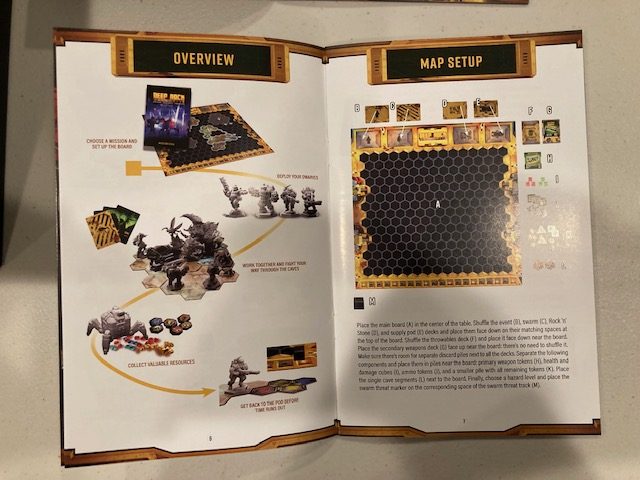
Then, you place the appropriate player/pet combo avatar on the home space on the board: see below.  Note, it’s kind of clever how the little marker has space for both the player avatar AND the pet avatar!!!

IMG_3978

This is where the game starts.  The object of the game is to build three village structures before time runs out! See the village structures below:
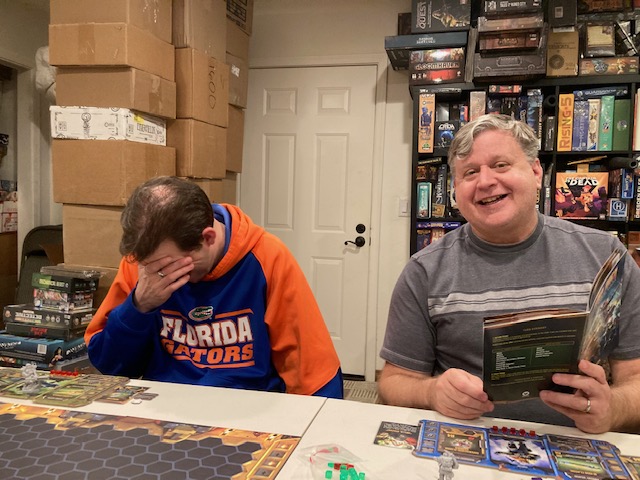
IMG_3979

Each village structure show you what blocks it needs to be built: these are blocks you’ll be “mining” by pulling from a bag.

IMG_3968

You only have a limited time to build the Village structures; the Illagers (see red avatar above) move closer and closer to you every turn.  if they reach space 1, all players lose!! If, however, players build all three village structures before that happens, players together win!

IMG_3962

The Illagers don’t automatically move at the end of each player’s turn: the current player will roll the white die: if the white die shows an Illager, the Illagers move one space! Otherwise they don’t.  Basically, you have a 50% chance they will move forward every turn.

IMG_3978

Each player gets two actions per turn: they can do any of these actions.

  1. Explore: uncover a new tile, which adds new cubes to the draw bag
  2. Collect Blocks: Go to a space with the mining action and draw cubes from the bag.  You get to keep all cubes matching the space you moved to.
  3. Fight a MOB.  If you ever accidentally collect a black cube, you have to put a MOB (bad guys) out on your location.  You can’t mine (collect blocks) from that space until you kill the MOB. Roll the black die up to 3 times to kill a MOB.
  4. Build.  Head back to the village space, and place some of your cubes out and build partly or completely a village structure!

This game is all abut getting cubes from the grab bag:

IMG_3940

At the start of the game, the bag is pretty empty.

IMG_3942

Every time you explore a new tile, you can put new blocks into the bag.

IMG_3957

For example, if you explore the tile on the right (above), you get to throw a white block into the bag.

IMG_3985

Above, the red player explores and gets a brown and white block to throw into the bag.

IMG_3983

When you mine, you draw blocks from the bag: above, the blue player mined, but he can only keep the grey block because he was on a grey mining space … unfortunately, he also summons a MOB because he drew a black cube!!

IMG_3984

The blue player can then keep up to 4 blocks on his player sheet.  There is also one space for redstone: redstone is “wild” when you draw it.  You can keep up to one redstone if you draw it from the bag.

IMG_3986

Since the blue player draws a black block, then a MOB (little weird piece above) goes on the board and blocks all future minings until someone fights it with the black die.

IMG_3987

If you get enough blocks, go back to the village and and build!  Above, the red player has built the first structure!  

IMG_3989

Basically players explore, mine, and build trying to get the three structures built before the Illagers arrive!

The components are decent.  The game was $29.99 from Target: decide for yourself whether you think they are worth it: see above and below.

IMG_3991

By the time you are done with a game, the board looks nice and colorful … kinda like Minecraft.

Rulebook

IMG_3944

So this rulebook is 44 pages. 

IMG_3943

BUT it’s 44 pages because there are rules for 7 different languages!! (See the back of the box).  

IMG_3936

The English rules are only about 6 pages.  (7 Languages at 6 rule pages each, plus 1 cover and 1 back = 7*6+1+1=44 pages total)

IMG_3945

These rules are so-so.  They do show a components page with correlating text and pictures, but the text and pictures are small and unclear:  see above.  I think some of the components aren’t particularly well-labelled.  As I was unpacking the game, I had to go through the component list about three times to make sure I understood what all the components were.

IMG_3946

The set-up page is good enough: see above (but it still felt under-labelled).

IMG_3947

The rules are pretty good, if not great.  (For example, I never got a good explanation for if there was a “village” tile: I assume it’s the middle home tile).

IMG_3948

IMG_3949

It wasn’t the best rulebook in the world.  It was good enough to learn the game.

IMG_3975

The last page (unfortunately) has no icon summaries.

Solo Play

IMG_3982

This game has NO rules for solo play.  (Boo for not following Saunders’ Law).  For my first solo game, I played two characters: the blue guy with the panda, and the red gal with the fox.  See first set-up above.
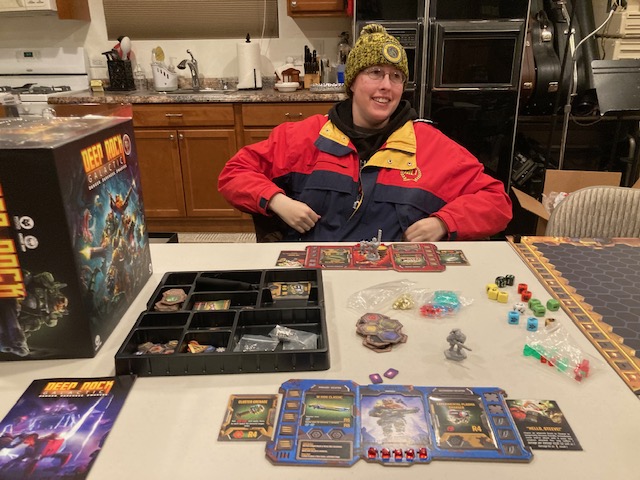
IMG_3976

I thought, because village structure 1 needs 5 blocks (above), and each character can carry only 4 blocks, I thought I had to play two characters (so that they would build it at once).   Nope!  You can build part of a building and then go out in the world again.  So, you can simplify your game by playing a single player solo.  Two characters worked fine though: the game is pretty simple so the context switching isn’t a real problem.

IMG_3988

The game was very simple and quick. I played in about 20-25 minutes and won: see above. 
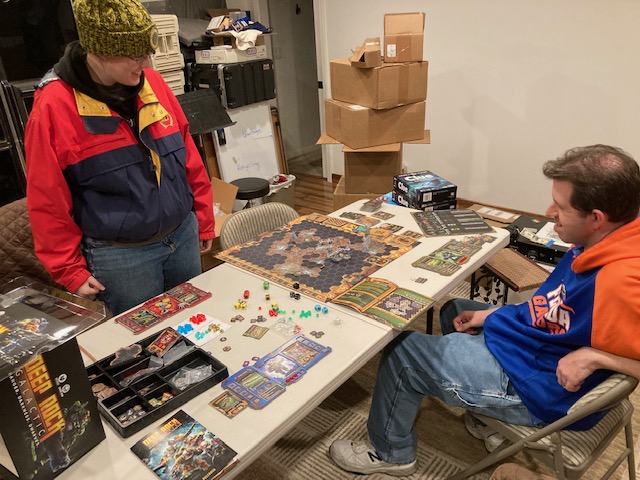
IMG_3989

I got pretty lucky in my first game: the Illagers never came anywhere close to the Village. I rolled “no advance” every time!
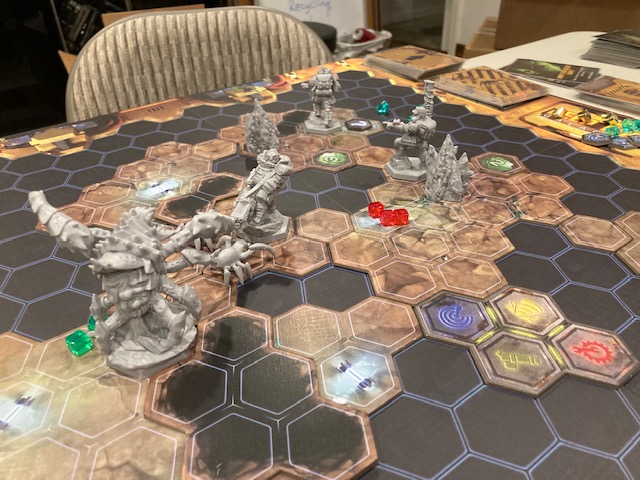
IMG_3990

It was ok.  I had some fun, but it wasn’t a great solo experience.  The randomness of the Illager die and the MOB fighting (see discussion below) kind of brought down the gameplay.

Cooperative Play

IMG_4011

Cooperative play seemed to go decently well.  There was a little more strategy in the game, as we used the different pets to better plan our actions.  For example, Ivan took the Panda (which allows him to ignore some bad pips on the fight die), so we tended to defer fighting to Ivan if it made sense.

IMG_4014

The board was a little messy with 4 players, and a little hard to manipulate in the middle of the table, but it wasn’t a big deal.  It might be better for future plays if we all played on one side of the table.

IMG_4013

Interestingly, we were able to play 5 players in one game, even though the box says 1-4: I sat out “teaching” the game and essentially managing the bag and the board:  It made the other 4 players turns go a little faster.  This is one of the reasons we like cooperative games here at Co-op Gestalt is because we can do things like this: see our 5th Wheel Becomes the 6th Man blog entry for more discussion.

We did win our cooperative game with some cooperative thinking.  But it was close.

IMG_4017

The group was very divided over this game: Kurt straight up called this trash and wouldn’t play it again.  CC (with his family goggles on) said he thought it was a decent family game and would play it again with kids, but probably not outside of that context.  Junkerman and Ivan thought this would be a good game for the RichieCon library for when families with kids come!

The Blocks

IMG_3942

The best part of this game are the blocks.  By being a bag-building game, as you play, you can introduce your kids to the world of probability! 

“What’s in the bag?  What’s our best bet to get some brown blocks?  Seed the the bag or do a pull now?” 

You can’ t look at bag while you are drawing from it, but you are allowed to look in at any other time.  The funnest cooperative part of the game is trying to figure out when to put cubes into the bags (“explore”) and when to draw to try to get some blocks (“mine”).  As a group, you decide when it makes sense to fill the bag and draw from the bag. 

In some ways, this game feels like a much lighter Ygdrassil (a bag-building game that made our Top 10 Cooperative Games Off The Beaten Path)

yg


Randomness Thoughts and Fixes

IMG_3962

Hardcore gamers will hate this game.  This game is just really random, as there’s no real mitigation of dice, and combat is just “lucky”: you roll the the die thee times and hope you beat the MOBs!  You have no upgrading weapons, and there is no path for any upgrades. 

IMG_3937

We need to reiterate that this game is for families and younger kids:  the mechanisms can’t be too complex.  Recall that Disney Sidekicks (see our review here) made the fatal mistake of being too hard for its age range.  For Minecraft: Heroes of the Village‘s age range of 7+, I think the dice are appropriate.  But just barely. I am very worried there is a very small window where kids will find this fun and not too simple.

So there are two main problems I had with the game, regardless of the age range. Both of them based on the dice (see below).

IMG_3962

First: The “Advance the Illagers” (white) die has a 50%chance every turn of advancing the Illagers.  Over time, that “about” doubles the length of the track (half of the time, the Illagers won’t advance).

IMG_3969

So, if the Illagers start on space 11 (see above), it will take “on average” 22 turns for the game to be over. While I get that it’s “kind of fun” to have the kids roll every turn and “maybe the Illagers will advance, maybe they won’t”, randomness completely takes this over.  In my first game, the Illagers NEVER advanced via the white die.  I think a better mechanism would be to have a die with 5 “advance the Illagers” side and 1 without, so then make the game have 18 or 19 spaces until the Illagers win: “on average”, the Illagers won’t move 3 times, so the randomness would be much more contained.   I don’t hate the white die, but I just think it’s a little too random.  But I get it: it’s fun for the kids to roll every turn.

IMG_3961

A much bigger problem is the black die used for fighting.  There are a bunch of problems with this, as the die has so many random effects:

  • You can push the Illagers back (with an arrow face)
  • You can bring the Illagers forward (with a Illagers face)
  • You can completely fail to kill a MOB you need to during combat and be very frustrated
  • There is no upgrade or mitigation

Whether or not you kill a MOB on your space (who is currently blocking you from mining) is completely random.  You get to roll 3 times, and during that time you may bring the endgame even closer (twice!) to end if you roll poorly.  This was just … so random.  First of all, I would completely get rid of the of “Illagers move forward/backward” part of the die roll: it’s not thematic, and it doesn’t belong, and it just sows more randomness into the game.  I would simply replace those faces with rerolls.   

IMG_3986

To help mitigate bad combat dice rolls (“I need a 6, but all I can roll is a 4!!”), I would add a cooperative mechanism to the game!! If you can’t kill a MOB on your turn, have a rule that states “for every character on a space when fighting a MOB, you get to add and extra roll and sum the rolls together!”  In other words, if we absolutely have to kill a MOB to win, let’s cooperatively take out a MOB!!!  This seems like an easy rule to add: it’s simple, it makes the game more cooperative, and it allows some mitigation of bad dice.

These aren’t official rules of course, but I think both adjustments would make this game more fun.

Conclusion

IMG_3992

Minecraft: Heroes of the Village was okay, but it has a very small window of applicability.  I think a 7 or 8-year old kid would enjoy this a few times, but might grow too old for it very quickly.  If I want to show a younger kid the world of cooperative games, this is not a bad starting choice!  I’d be happy to play this once or twice with a younger kid.  But just once or twice … the problem is, I personally would tire of it very quickly: it’s just a little too random.  And I think most adults and hard core gamers would tire of it quickly, even playing it with their kids.  There are many games where both the child and adults can enjoy the experience: I can see Flamecraft as a cooperative game being a fun game for all (see our review here and discussion of the cooperative version).  Elia and Something Shiny be a fantastic cooperative game for both kids and adults: see our review here.

IMG_3991

I should be happy that Target has a decent cooperative game for families.  And I am.  Minecraft: Heroes of the Village is not bad if you get it, and your kid may love it, especially because the Minecraft theme!!!  And choosing the pets will engage the youngsters too!  There are a few things you can do to make the game a little funner (see our fixes above). But watch the age range, because I believe this will have a short shelf-life.

IMG_3941

I am going to keep this for the RichieCon collection: we typically have a lot of kids with families coming to RichieCon, and I could see introducing some younger kids to the world of cooperative games with Minecraft: Heores of the Village.  It also looks good on the table.