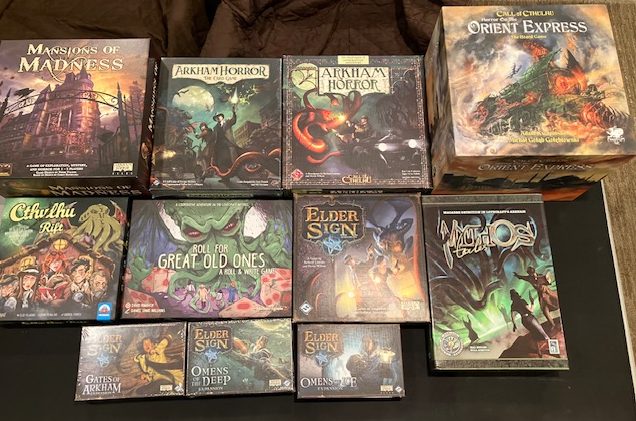
Welcome to the end … of Cooperative Cthulhu month! We’ve seen three brand new cooperative Cthulhu games in the last month! How do these stack up against old favorites? It seems fitting to end Cooperative Cthulhu month with a Top 10!
This list is a composite of about 20 different people’s opinions! It was compiled over the last month to try and capture what a community of board gamers think of cooperative Cthulhu games! The data wasn’t clear in some cases, so I made the best judgment I could based on all the ratings I saw! In the end, my preferences tended to shape the final list!
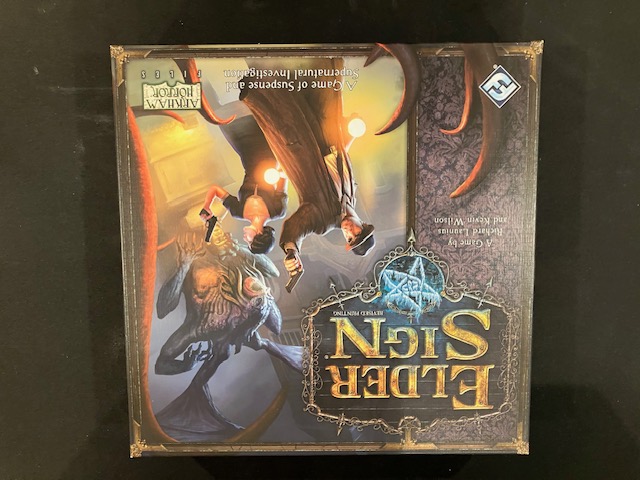
10. Elder Sign
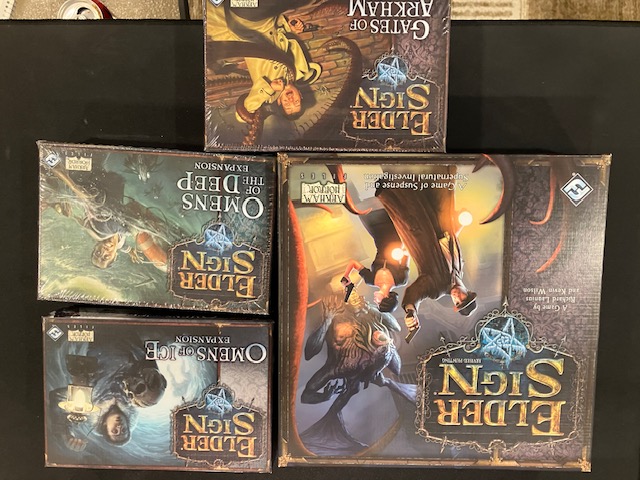
At its core, Elder Sign is really just a dice game, kinda like Yahtzee. But it’s the expansions that keep Elder Sign alive and thematic! Players explore someplace creepy, a museum, an ice flow, the oceans, … and uses dice to help resolve things!
This one may have made the list for nostalgic reasons, but there are so many expansions that keep this game fresh and alive through the years!
A lot of people put this on their list, even if it wasn’t their favorite Cthulhu-esque game! This is a favorite that still comes out from time to time!
9. Cthulhu Rift
I was surprised how much my friends who have played Cthulhu Rift liked it! Not many have played this, but those who had liked it and its roll-and-write simplicity!
Like any good Cthulhu game, players must fight cultists, navigate Arkham, find clues, and plug portals! It’s surprising how well this works in a roll-and-write (kind of) games.
Roll For Great Old Ones was one of our favorite cooperative roll-and-write games from the Top 10 Cooperative Roll-And-Write Games! It’s actually quite thematic for a roll-and-write game in this universe!
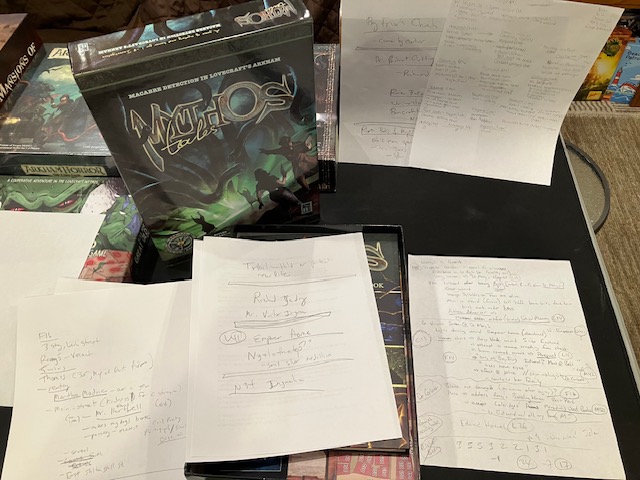
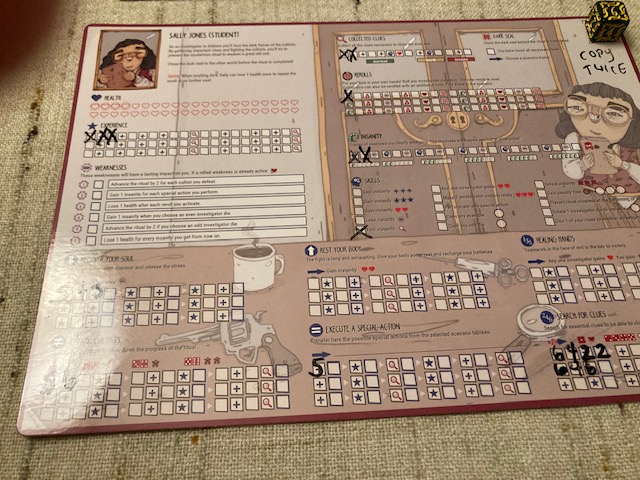
Every turn, players roll the dice and “COPY TWICE” and mark things off their sheet! Summon creatures! Perform rituals! This is a fairly complicated roll-and-write with lots of stuff going on. See one of the the great laminated sheets above! Everyone has their own sheet as well with different powers!
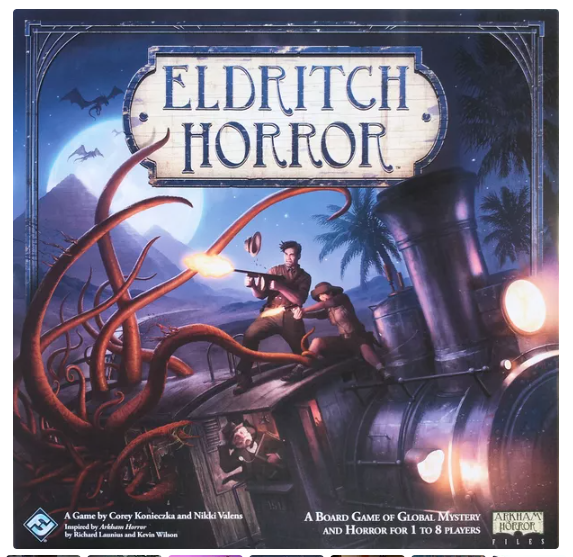
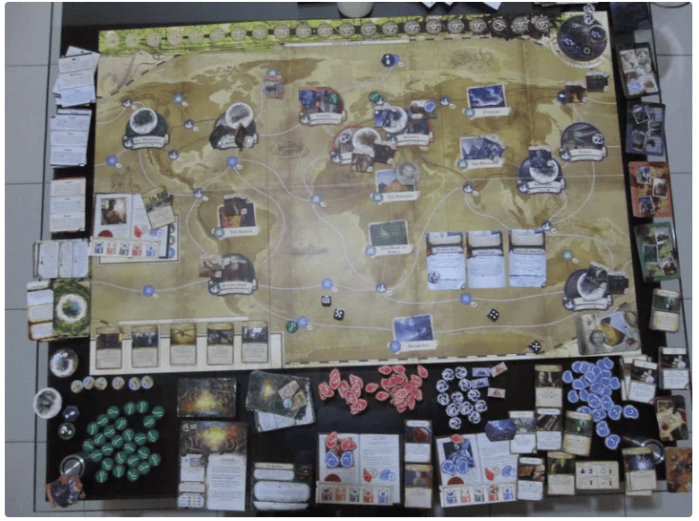
Although I have never played Eldritch Horror, a lot of my friends spoke up and gave Eldritch Horror a nod! For some of them, it replaces Arkham Horror 2nd Edition! It’s nominally a little shorter and less dense!
It’s also a little different theme! Rather than wandering the streets of Arkham looking for Cthulhoid type creatures, you are more like Indiana Jones wandering the earth! This is an adventure game in the Cthulhu-esque universe with epic combats and thematic treks across the globe!
Some people still prefer Arkham Horror 2nd edition, arguing that Eldritch Horror is not THAT much shorter or THAT much simpler. But, some people prefer Eldritch Horror for that epic sprawling adventure! Either way, it deserved a space!
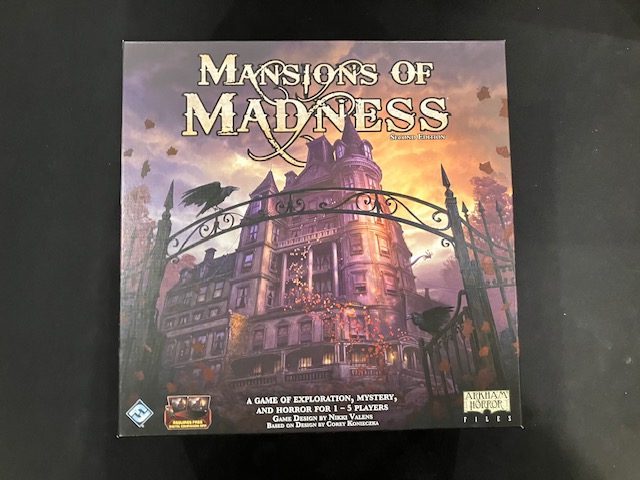
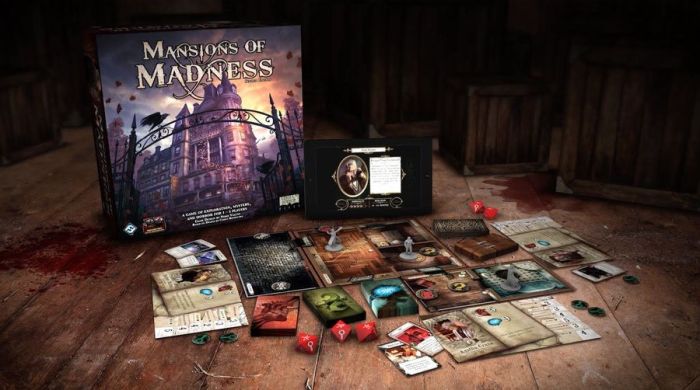
6. Mansions of Madness: 2nd Edition
I have a complicated relationship with Mansion of Madness. The first time I played the 1st edition of Mansions of Madness, I absolutely hated it! The 1st edition is a one-vs-many game as one player runs the mansion, and the other players play against him! This antagonistic atmosphere really put me off the game.
I did pick up the 2nd Edition of Mansions of Madness on a whim, and I am glad I did! In the 2nd Edition, an app plays the role of the Mansion and the players all work together fully cooperatively to survive! Some people may not love the idea of an app running the bad guys, but I it does work.
Over the years, I have played some fun games of Mansions of Madness, usually on Halloween! The game is creepy and thematic as the app boths runs the game and plays creepy music! There’s a ton of content for the game and I have come to have some really good creepy times playing in this creepy Mansion! Also, a lot of my friends also gave the same props to Mansions of Madness, 2nd Edition.
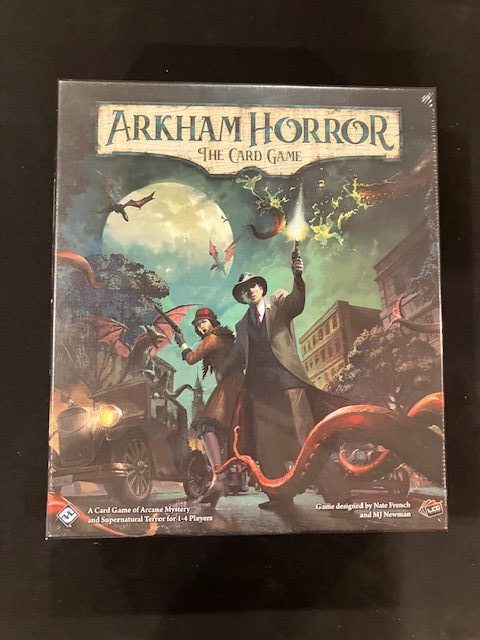
5. Arkham Horror: The Card Game
Arkham Horror: The Card Game is probably the most divisive game on this list, which is why it is only #5! Some people loved it, and claimed it as their #1 game, and some people said how much they didn’t like it, and other people said that Marvel Champions has completely replaced The Arkham Horror Card Game for them! It’s very similar to Marvel Champions in terms of gameplay, but arguably the Arkham game has a lot more story!?
Still, a small group of my friends in Las Cruces get together and play this regularly! They LOVE it! There’s a ton of story! There is SO MUCH content with new adventures for this game! If you find yourself drawn to this, you will have plenty of content to choose from! Just be careful, as there is a 1st edition and 2nd edition (and newer one which is still compatible with 2nd).
4. Horror on the Orient Express
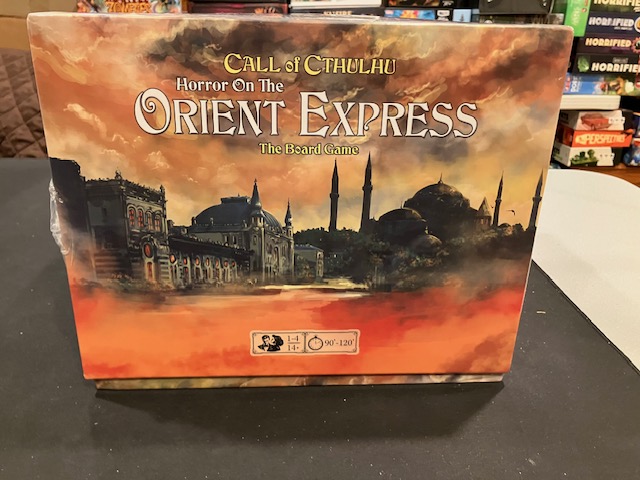
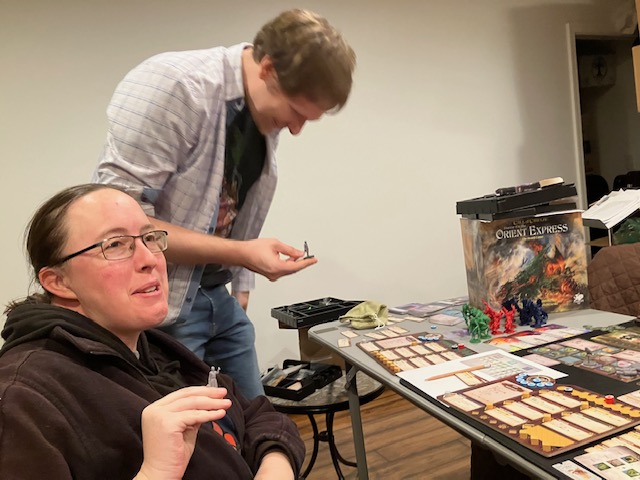
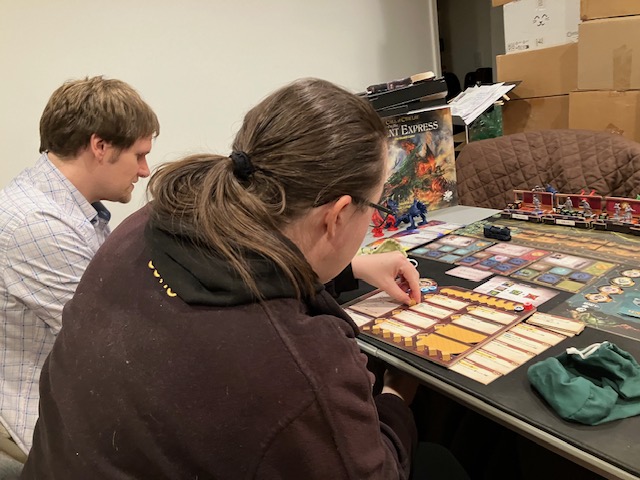
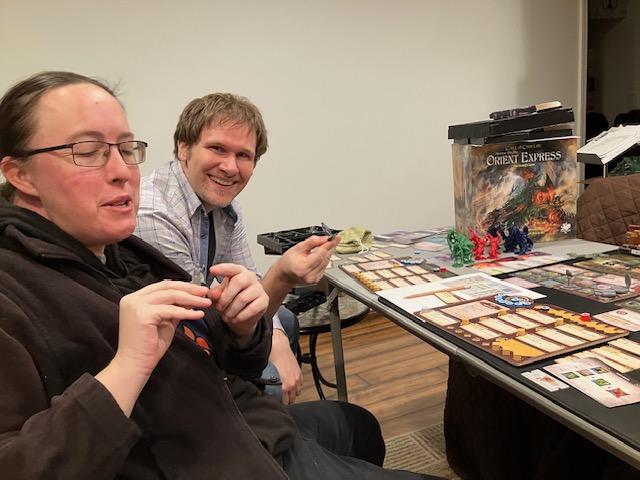
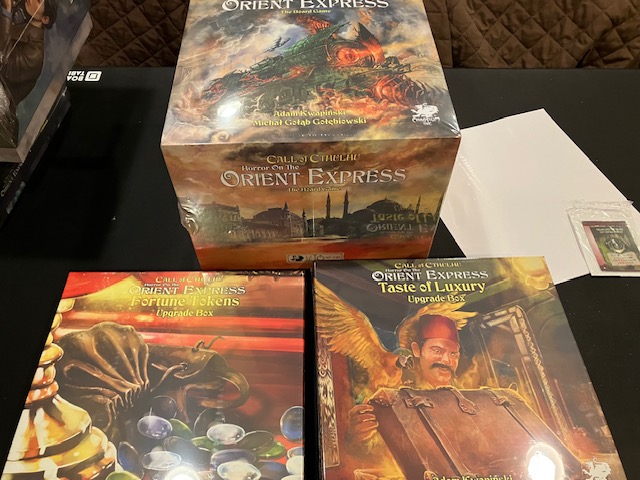
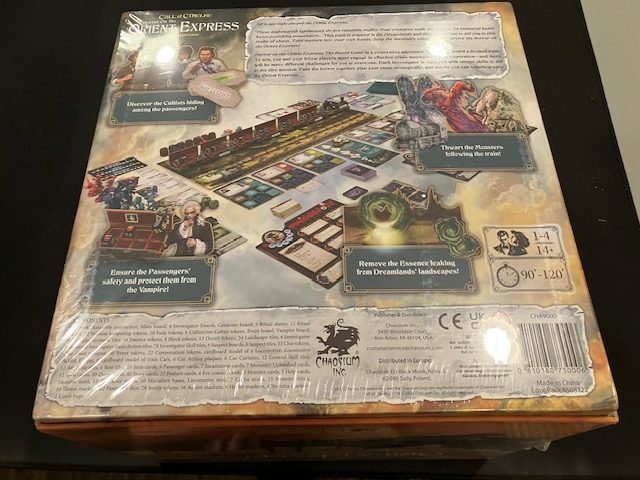
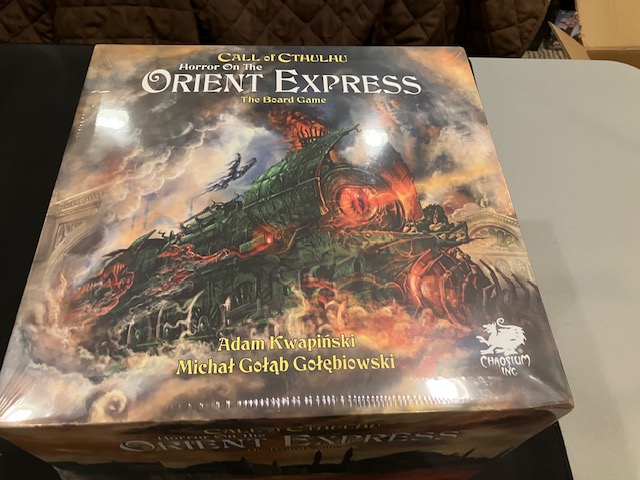
For a newer game, Horror on the Orient Express went over quite well with my groups! This is basically Cooperative Cthulhu Clue as players work together to solve a mystery while traveling on the Orient Express!
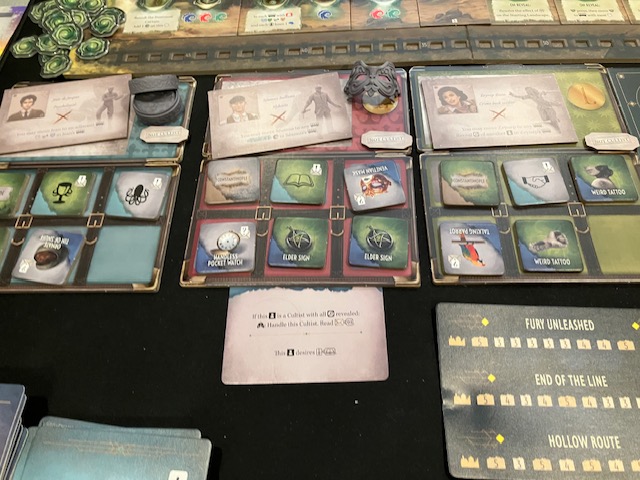
Players have to uncover facts to find out who are the Cultists in your group, with a kind of Clue-like vibe!
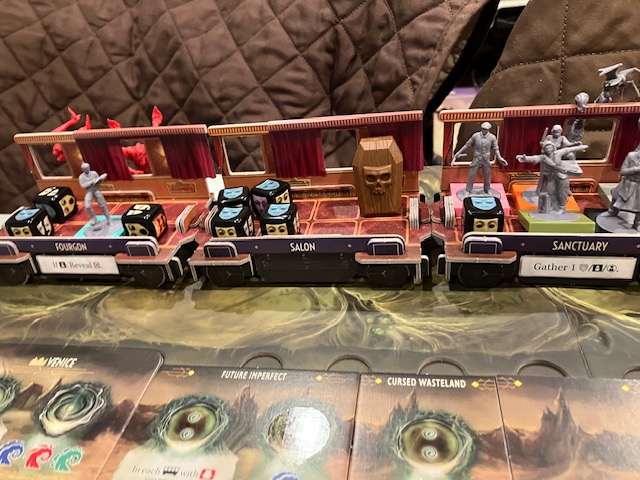
At the same time, players must fight Cthulhoid type creatures racing along with the train in the Dreamlands! It doesn’t matter if you solve the mystery if you can’t keep the train and its passengers safe!
There’s an awful lot to this game: it will require a substantial time investment. And there’s a ton of content and expansions! But, like some of us, if you love the idea of an Agatha Christie mystery novel taking place in a Cthulhu-esque world, this is a perfect game for you! See our review here of Horror on the Orient Express to see if this might be a game for you and your group!
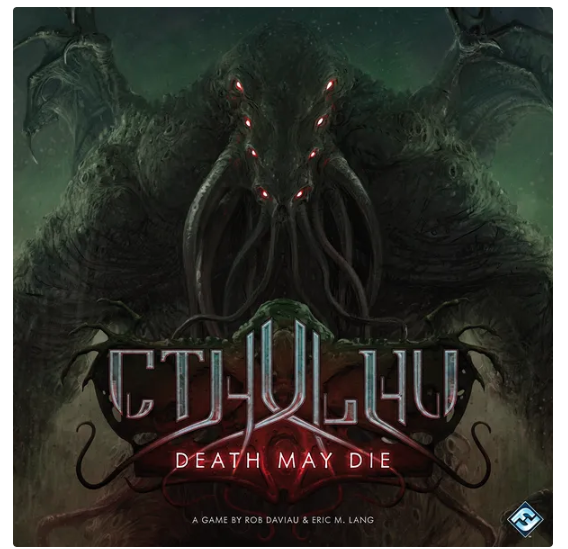
3. Death May Die
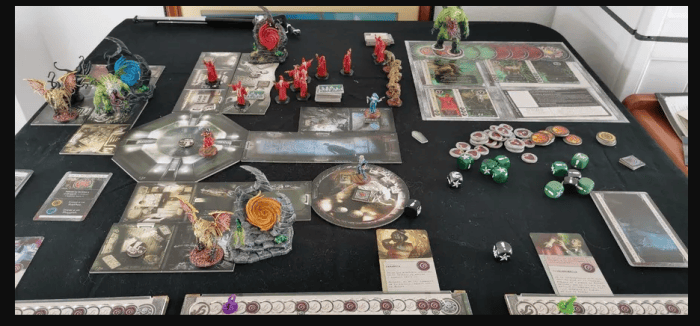
Death May Die is not the most popular game in my gaming circles, but the people who love it, love it! This was far and away the favorite Cthulhu game of a number of people, which is why it’s so far up the list!
This was far and away Adrian’s favorite game! And I am pretty sure it is one of Mike Heller’s favorite Cthulhu games too!
2. Mythos Tales
This one might surprise you … some of you have probably never even heard of this! Mythos Tales is basically Sherlock Homes: Consulting Detective themed with Cthulhu Mythos! Of course, there’s a very good chance you’ll go insane solving the mystery, but that’s par for the course for most Cthulhu games!
Part of the reason this game ranks so highly is that it hit some of us so hard … in a good way! My friend Joe, at his job as a teacher, was able to engage at-risk readers with this game! The idea of reading stories, looking at maps, and investigating this world was so much fun! It turns out, if you gives someone a reason to read (investigating horror), then they want to read!
This is, unfortunately, long out-of-print, but it’s pretty easy to get a used copy. If you like the idea of being a detective in the Cthulhu world, using Sherlock Holmes: Consulting Detective mechanics, this is the perfect game for you! (Make sure you get the 2nd edition if you can; if not, make sure you get the errata).
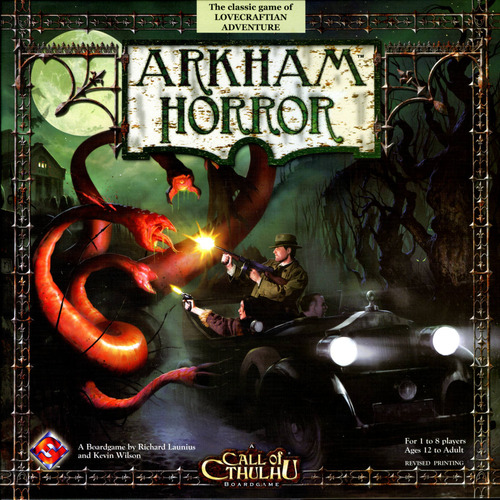
1. Arkham Horror: 2nd Edition
Arkham Horror: 2nd edition has a special place among me and my friends! That’s why it’s #1! It was arguably the first cooperative board game many of us have played, and we embraced all the content for it! I think I personally have all the expansions for it! You’ll notice Arkham Horror: 3rd Edition is nowhere on this list … frankly, most of us saw no reason for investing in the 3rd edition since we still had and loved the 2nd edition!
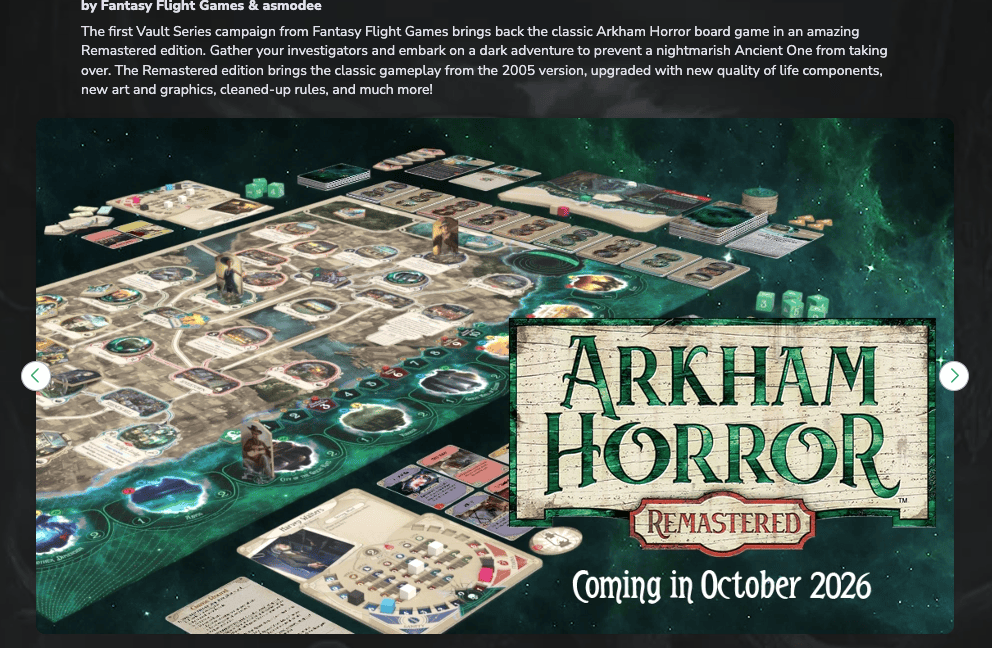
At the time of this writing, a newer revised 2nd edition called Arkham Horror: Remastered will be coming to Gamefound. It will curious to see how well this does in our hearts and minds!
At the end of the day, Arkham Horror: 2nd edition is one of me and my friends favorite games of all time. Sure, it’s long. Sure, it’s overly thematic. Sure, it’s complex. But me and my friends have had so many fun hours playing Arkham Horror: 2nd edition, it had to be in the #1 spot!
Welcome back to Cooperative Cthulhu Month! We’ve seen some new games in the past few weeks: Horror on the Orient Express (cooperative Cthulhu Clue) and Cthulhu Rift (a simple roll-and-write). This week, we head to the opposite end of the spectrum and take a look at a big, massive game in an H.P. Lovecraft-esque Universe called Abyss Echo: The Forbidden Rite!
Abyss Echo is a cooperative Escape Room type game …. well, maybe it’s more of a Choose-Your-Own-Adventure Game. Or something else? Well, it was on Kickstarter back in July 2025. It promised delivery in April 2026 and it was basically on time (it might have been a month or two late).
The reason it took me so long to get to this game: I had the hardest time getting a group of people together! This is a BIG game! And it requires a bit of commitment!
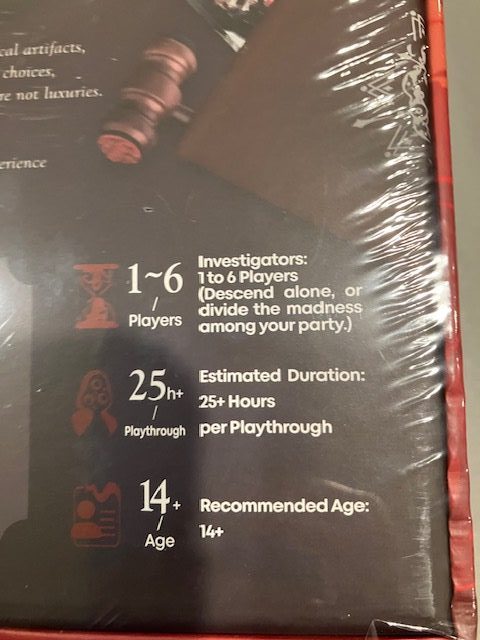
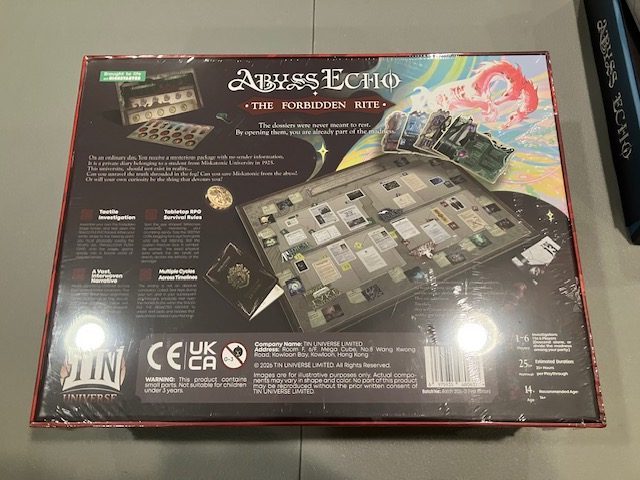
From the box (above): you can see an estimated 25h+ playthrough! Zoinks! I wanted to try to get a dedicated group together to play this so we could commit to the game (if we liked it).
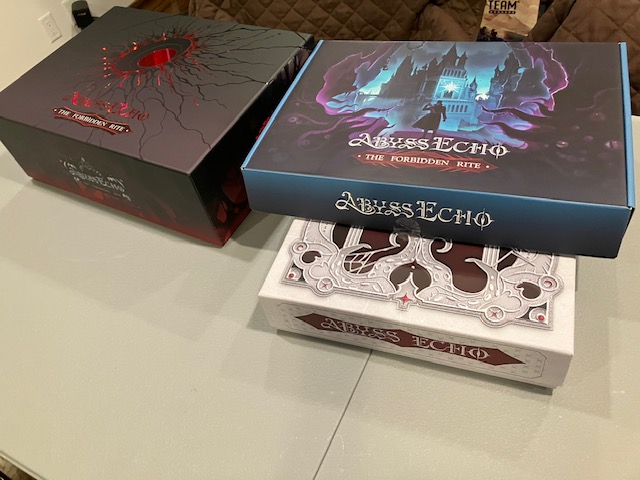
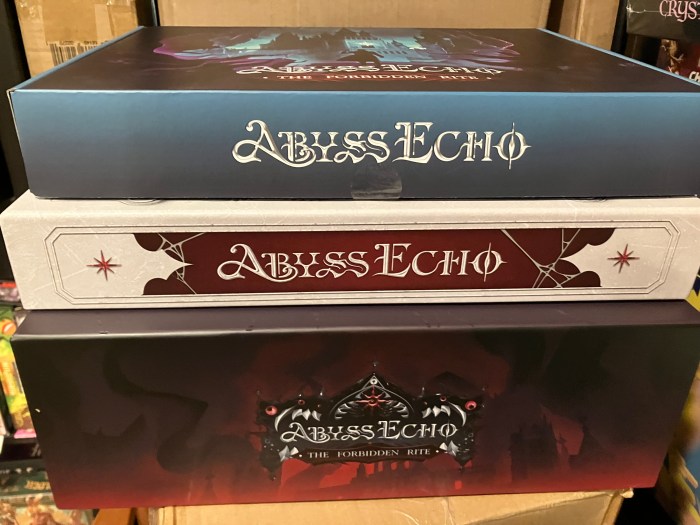
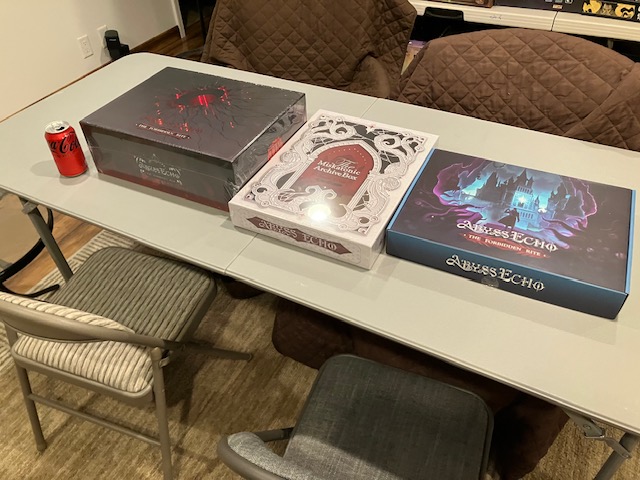
I went ahead and backed at the ALL-IN level, which game me three boxes of stuff!
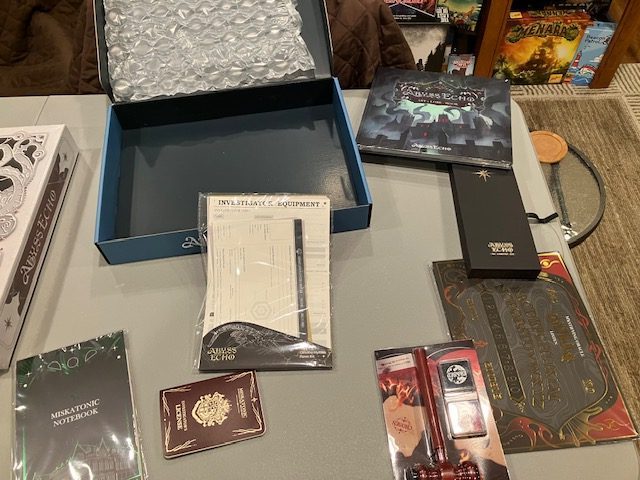
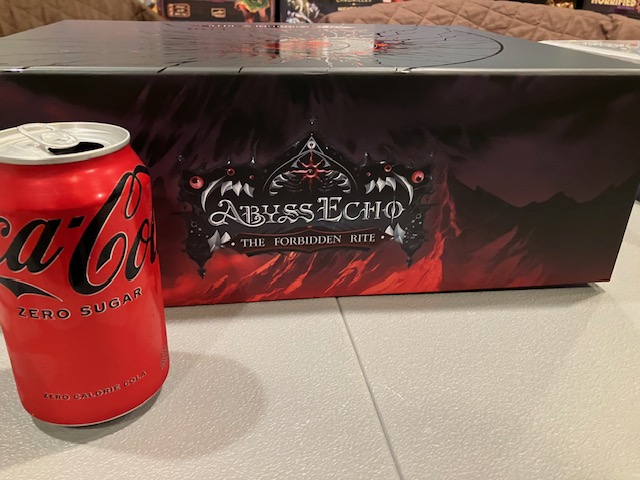
The Stretch Goals box (see above) was pretty much just “extraneous”.
It was mostly just “thematic” stuff which added to the vibe of the universe, but really did nothing for gameplay. If I had to do it over again, I would NOT have gotten all this. This box in particular really wasn’t useful. It looked cool.
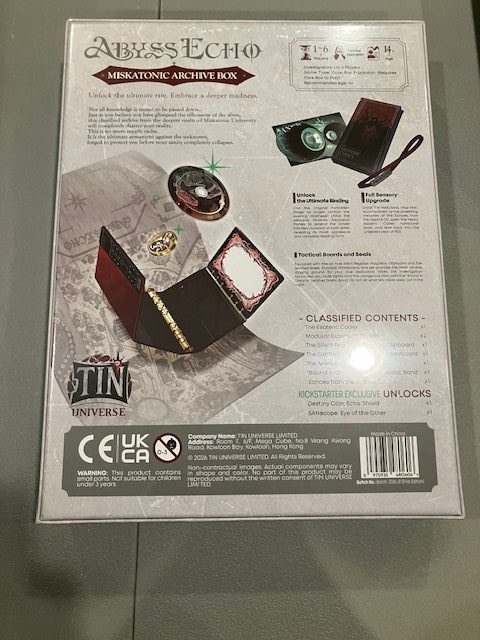
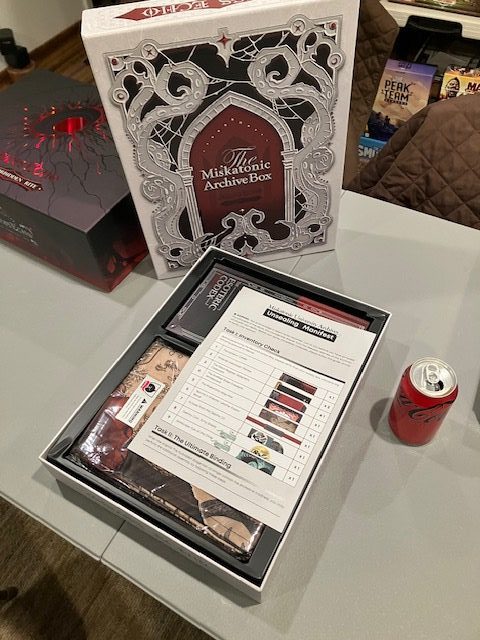
The second box was a “Miskatonic Archive Box”: see above. It was a little more useful, but I’m still not sure I would have picked it up either.
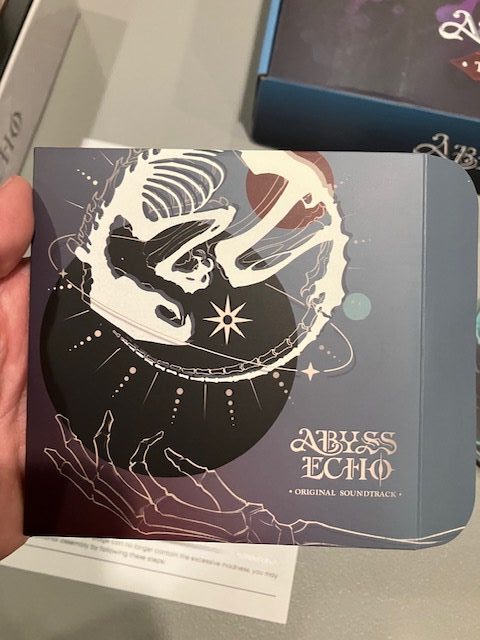
The most useful thing was a notebook extender. But even that wasn’t that useful. The thing we LIKED the most was the thematic CD of music!
I don’t know; if you can get this box for a reasonable price, it might be worth getting.
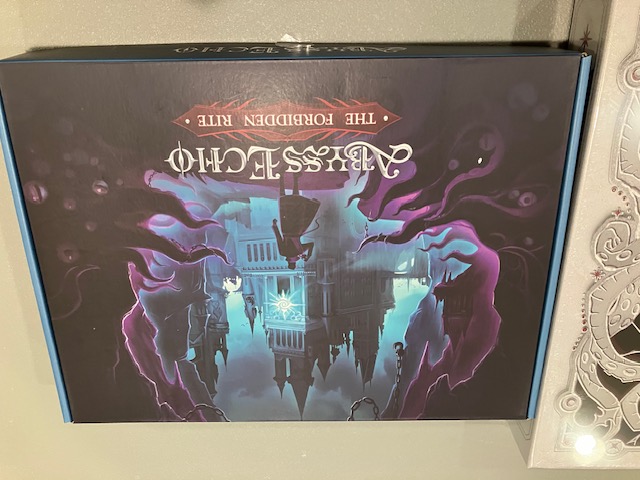
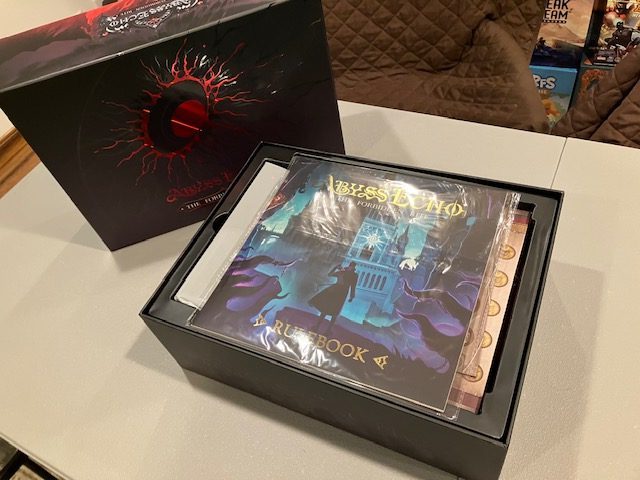
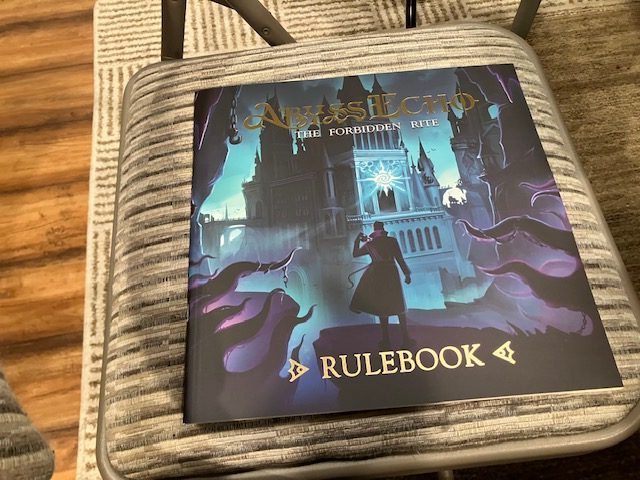
The main box was the Abyss Echo: The Forbidden Rite box! See above!
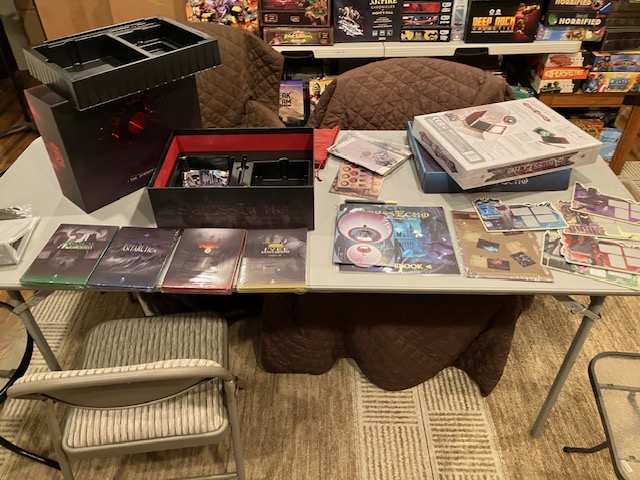
This is a pretty big box of stuff.
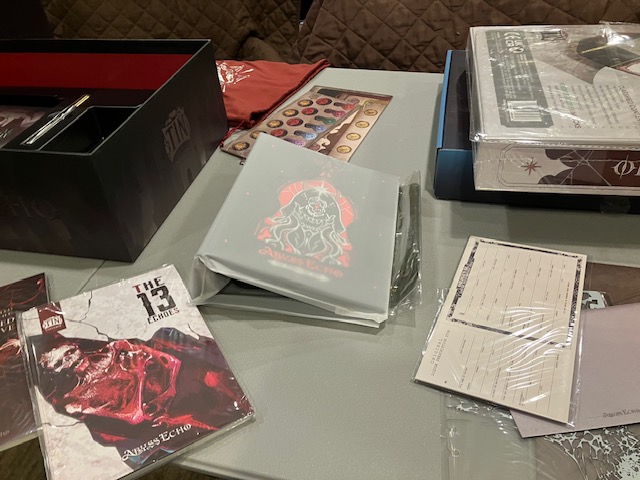
There is a lot in here but it’s all really nice! A lot of it STILL seems extraneous!
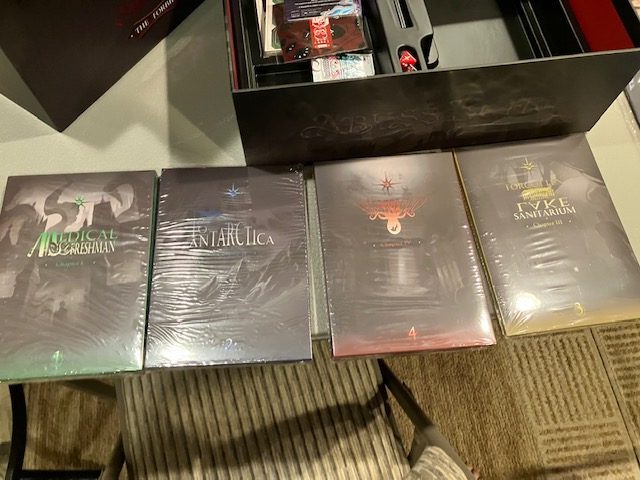
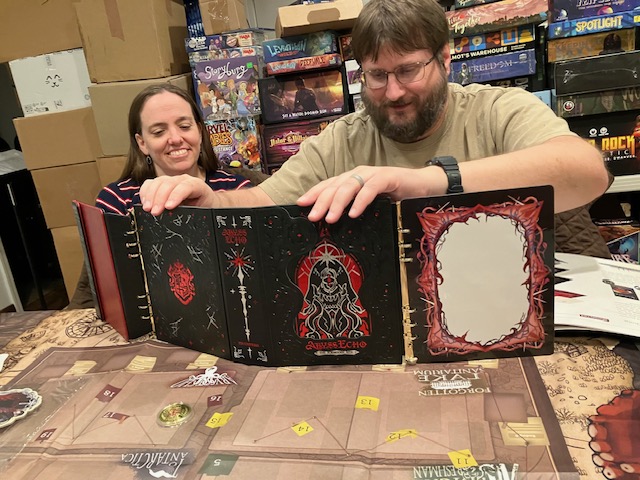
The most important part of the game are the 4 parts of a story: see above.
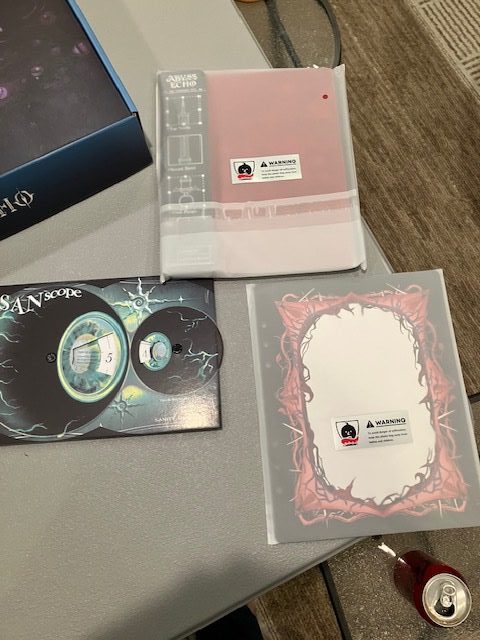
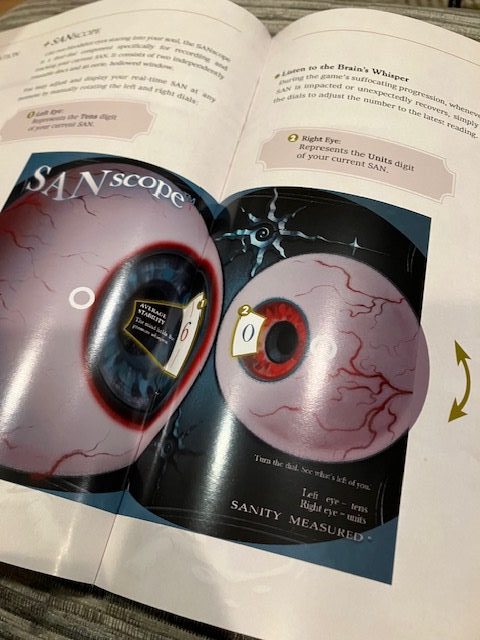
Because this is a Cthulhu game, you must track you Sanity! See the San Tracker!
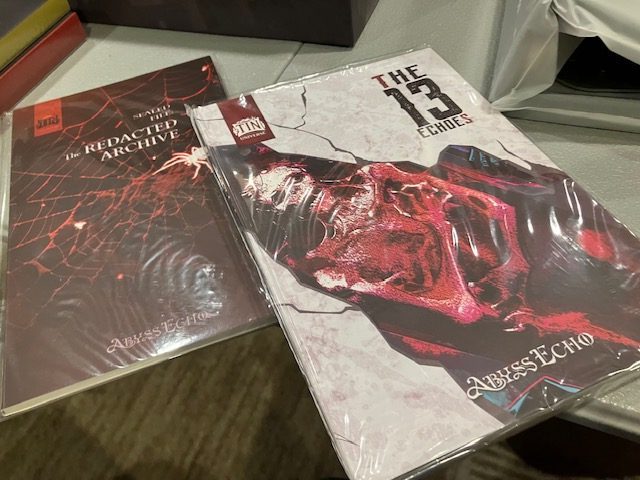
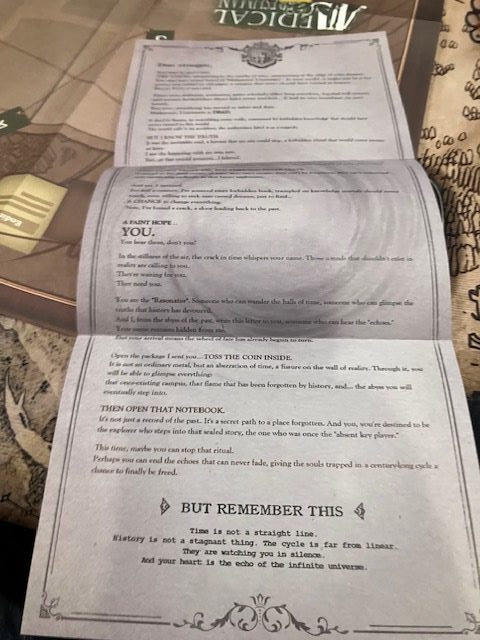
As you unlock things in the game, you will read from the Redacted Archive. When you “finish” the game, you will read from the 13 Echos … there are 13 endings, depending on where you get and your SANITY!!! If you ever die early, because you know, NO SANITY, you reading ending 0!
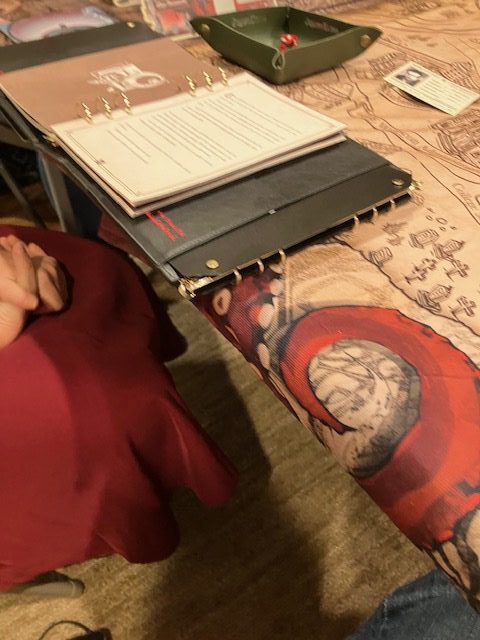
There’s also a little notebook that you will hold all your papers as you investigate: It is the centerpiece of the game.
Gameplay
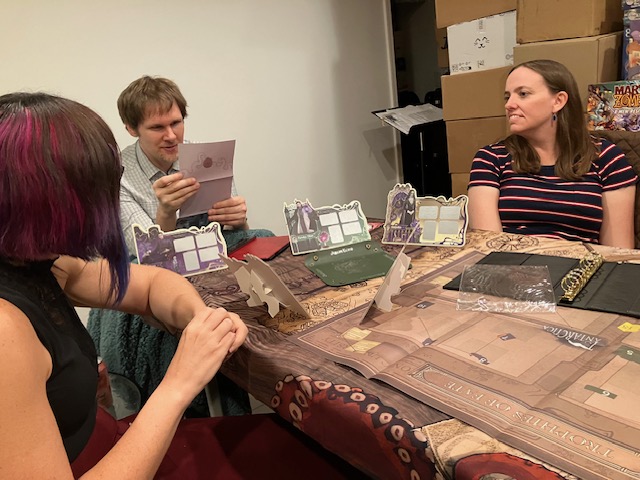
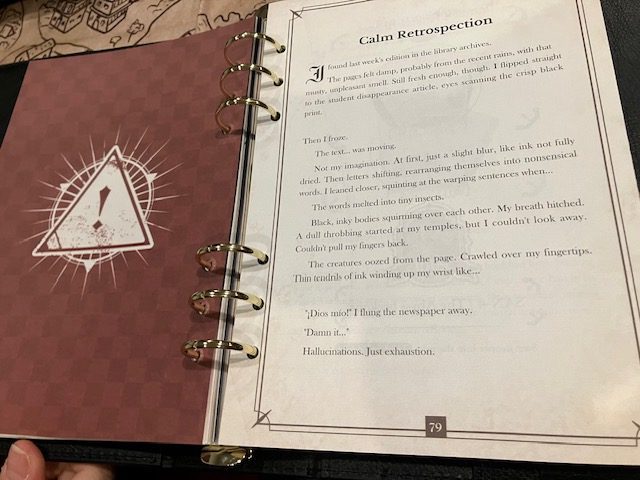
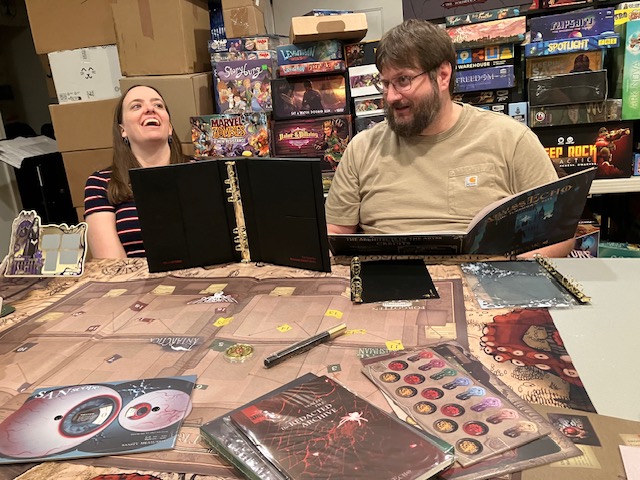
I hesitate to call this a game: it has a few “Choose-Your-Own-Adventure” moments, and a few dice rolls, and some combat. But the majority of the game is reading text out loud for everyone. This feels like you are in a Lovecraft-based book club, where everyone takes turns reading from the book!
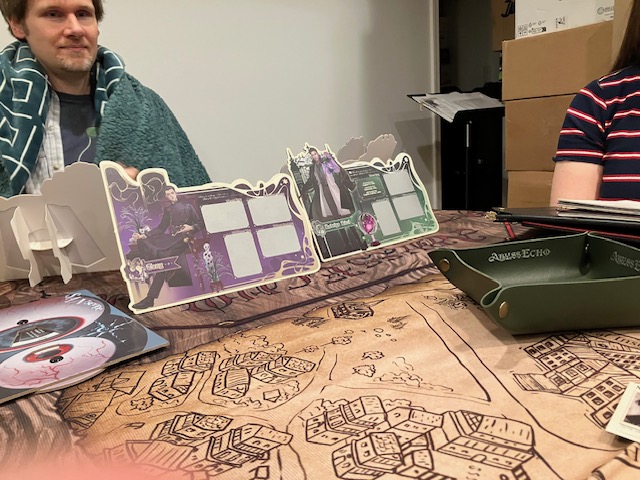
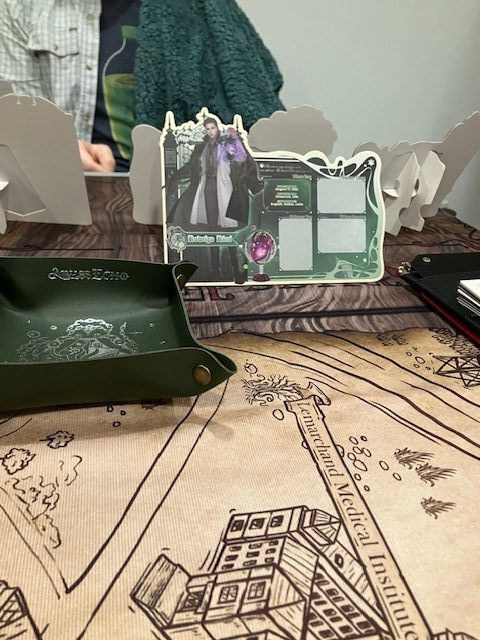
As you read, characters will be introduced. See above. It’s cool! The characters have story and depth and they are interesting: the little pop-ups help you see them in your mind’s eye!
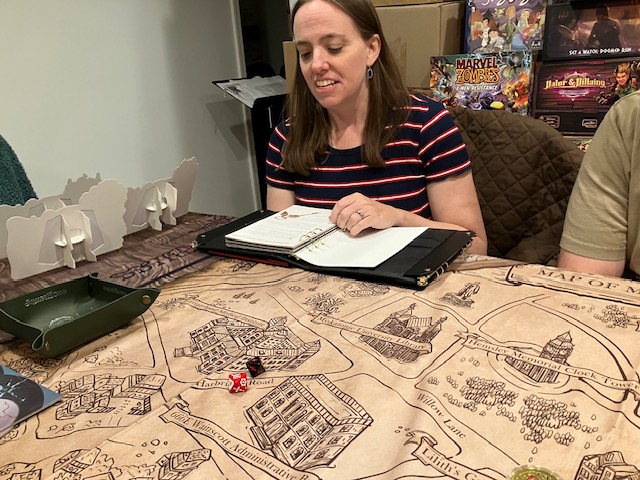
The book is the most important part of this game: it’s the story. You start off in Chapter One. Based on what we’ve seen so far, it looks like each Chapter will take “about 6 hours”, so in a 3-hour game session will finish half a chapter. This does jive with the expected playtime: 25 hours+ of content! (8 sessions of 3 hours each?)
Over the course of the night, you pass the book around and people read from it and tell the very thematic story of students at Miskatonic University. It’s VERY thematic; it feels like the style of H.P. Lovecraft, but maybe the text flows a little more easily.
Let’s be clear: we read the story for a 3 hours and made a few dice rolls and a few Choose-Your-Own Adventure decisions. And that was 3 hours! It feels more like a “shared narrative” and less like a game.
Reactions
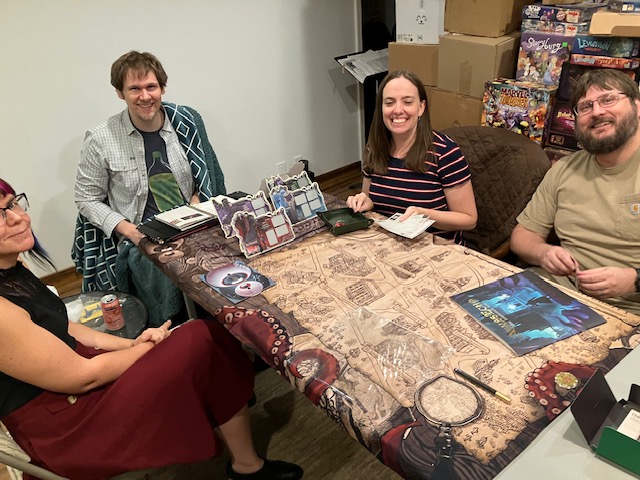
A group of me and 4 friends took one crazy evening to take this for a test run; our first session was abut 3.5 hours (.5 hours setting up, 3 hours playing). We made it about halfway through Chapter 1 (we think).
We have decided we will continue to the end of Chapter 1 and see if we want to continue from there. We liked it enough to continue moving forward for now.
I bought Abyss Echo as an expectation of an Escape Room game with elements of a Mystery in a Cthulhu universe … and I was completely wrong what this was. I was right about the theme, but the “game” is much much much more about reading. Much much more about reading!
Worries or Thematic Elements?
We did encounter some inconsistencies in the game as we read. Olga’s hair was first described as blonde then very black? And she drank Vodka but then it was Bourbon? We hope this is the game messing with us and not a translation issue (the game came from Hong Kong). After all, as our grip on reality loosens, you could see the game “thematically” being inconsistent so as to screw with you …
We just hope it’s not translation errors, but thematic immersion. We hope?
Legacy?
Is this a legacy game? There are stickers you put on a map. There are things to open. There are actually spaces to scratch-off (see Rodrigo has one space scratched).
So far, it sounds like it is will be a Legacy game, with the stickers and scratch-off, but it feels (from what we’ve seen) that it could be reset with just a little effort? Not sure. I think “nominally” this a is a Legacy game for the moment, but it’s not clear it has to be. I need to see more.
Conclusion
Abyss Echo was not at all what I expected. I thought it was going to be an Escape Room with Mystery/Detective elements; it’s really not. Abyss Echo is really an interactive novel with just a few points of “game” interactions (roll dice, make decisions, fight monsters), but generally you spend the vast majority of your time reading the text aloud to become part of a story set in the Miskatonic University.
Stepping back away from the disappointment of initial expectation, this was a wonderfully thematic group novel. My friends and I had fun reading aloud the text and immersing ourselves in an H.P. Lovecraft-esque world of Misakatonic University. The text was pretty good (it was thematic) and the characters were pretty interesting. And it was creepy … just like you expect in this world.
Be aware: H.P. Lovecraft has a stye that can be a little wordy/turgid and it really turns some people off. This H.P. Lovecraft writing style influences the text in Abyss Echo, but it is a little more modern. Still, if you hate H.P. Lovecraft’s writing style, this style and text might really turn you off.
We still have plenty of material to get through, and so far, my friends seem willing to continue playing. Will we make all the way through all 25 hours? Or will we stop after Chapter 1?
If you find yourself interested in this, just be aware of what it is and isn’t. There’s a lot of reading! And I think I recommend ONLY getting the base game: all the other boxes were almost useless.
Be on the lookout for Part II for our final summary. It may be a while if we play through the entire thing, or it may be over quickly if we decide this isn’t for us! Only time will tell!
Welcome to Cooperative Cthulhu Month! This month, we take a look at a bunch of cooperative Cthulhu board and card games! We start the month with a very brand new game called Horror on the Orient Express which just delivered to Kickstarter backers!!
Horror of the Orient Express answers the age-old question: What would it be like if Agatha Christie’s Poirot had to solve a mystery on the Orient Express with Chtulu-like creatures chasing him? Philosophers have pondered this question for years, and now Horror on the Orient Express gives the definitive answer!
Over the next week, I would spend so much of my precious time with this game system. I have spent 15+ hours going though this so far! How does that time break down? Let’s take a look!
Day 0. Unboxing and Reboxing (and some discussion of gameplay): 4 Hours
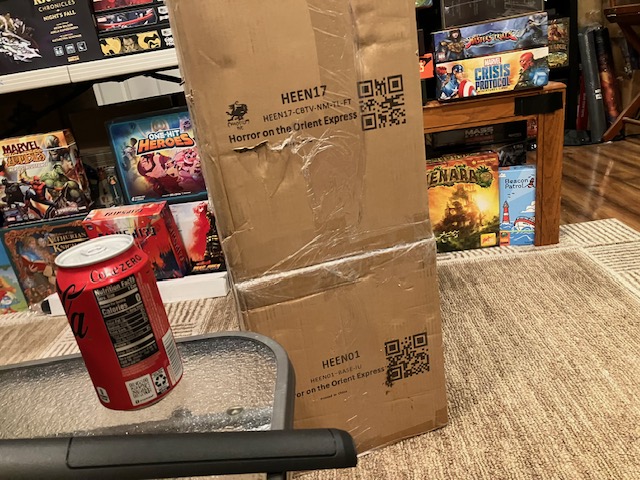
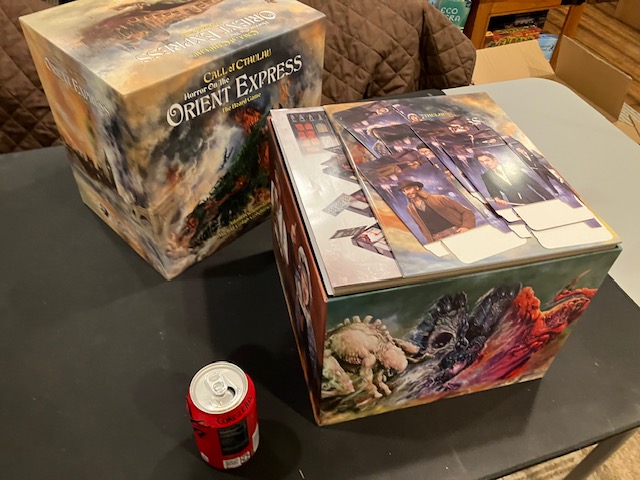
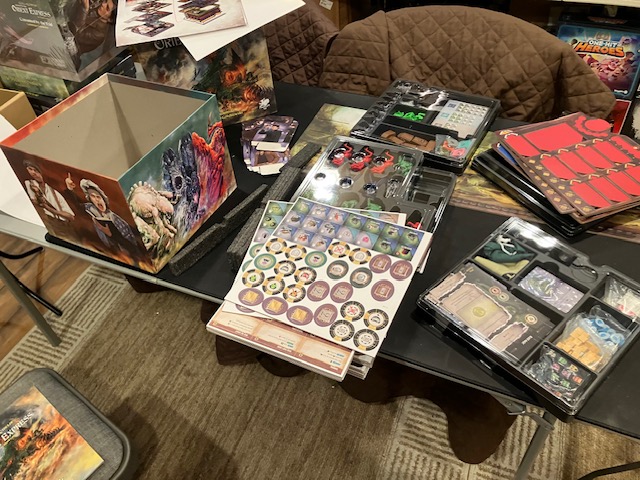
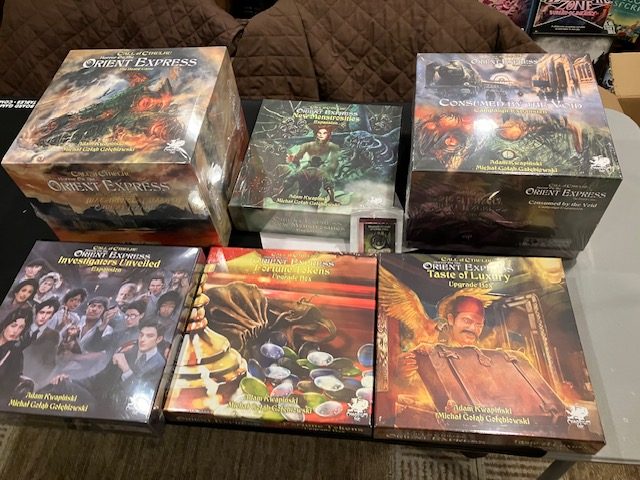
You heard me right; this took 4 hours to unbox. And that was just the base game and some deluxe components! Part of the story here is just how much content arrived! There were two boxes that were actually tapes together when delivered to my house! See above!
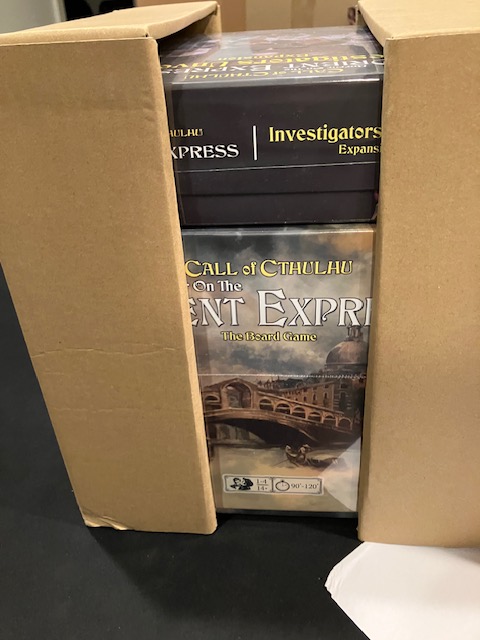
The smaller of the two boxes came with the base game and an investigators expansion (giving more investigators and suspects).
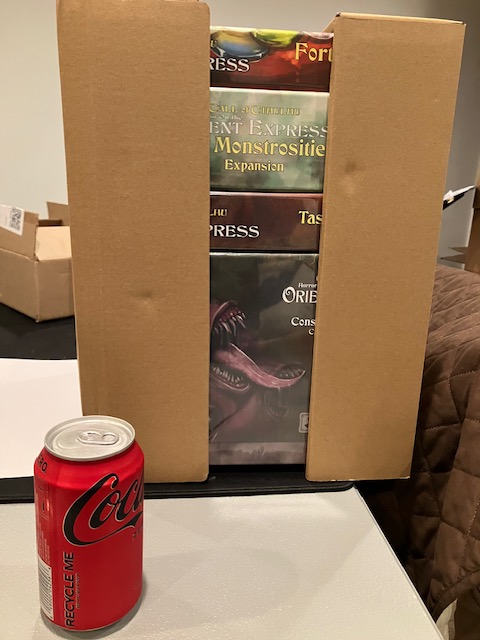
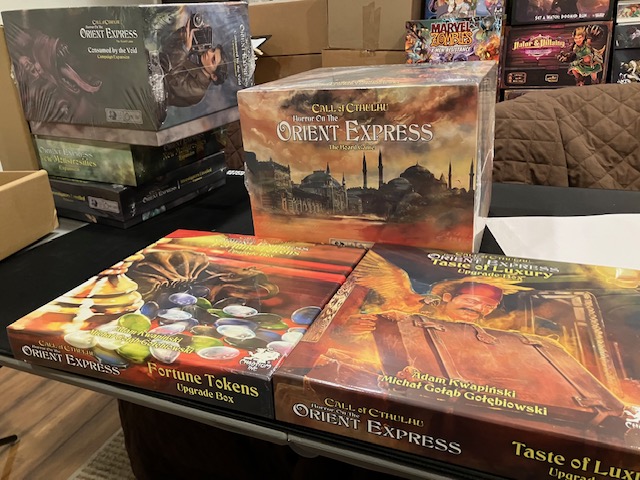
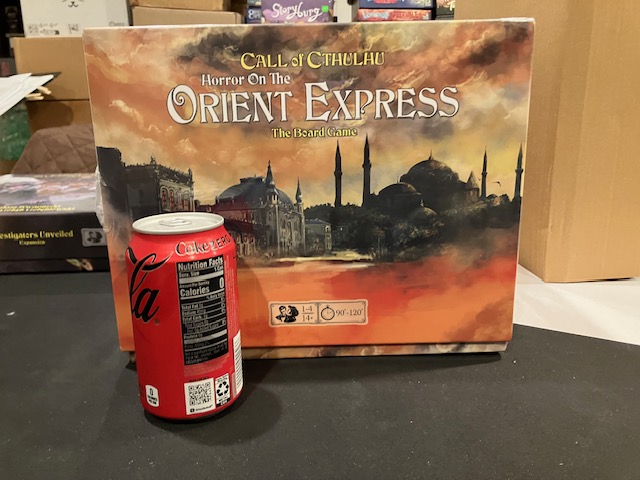
The bigger box came with the campaign expansion (bottom box), more monsters (green middlebox) and some deluxe components (the other two). See Coke can above for some perspective on this!
This is probably the biggest Kickstarter I have ordered in some time! And remember, here at CO-OP Gestalt, we pay for everything with our own money! See all the boxes (and a correction card) above!
In the end, I chose to only unbox the base game and deluxe components (see boxes above). I’ll come back to the others later! That seems like a sane decision, right? Just limit myself to unpunching and assembling the base box with a few extra acrylic tokens? It still took 4 hours!!!
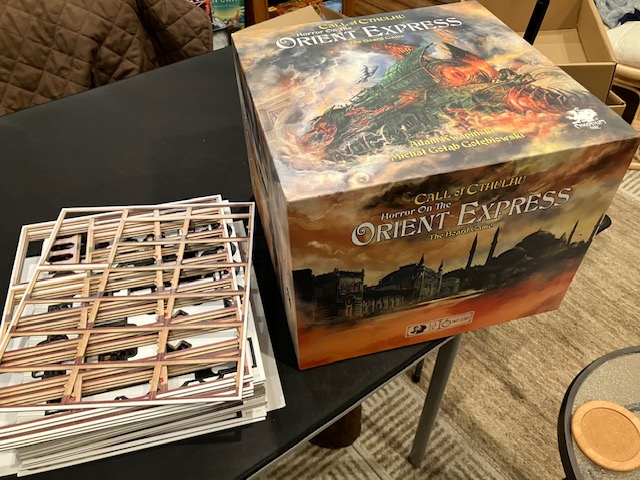
This is a monster of a game! See coke can above for scale!
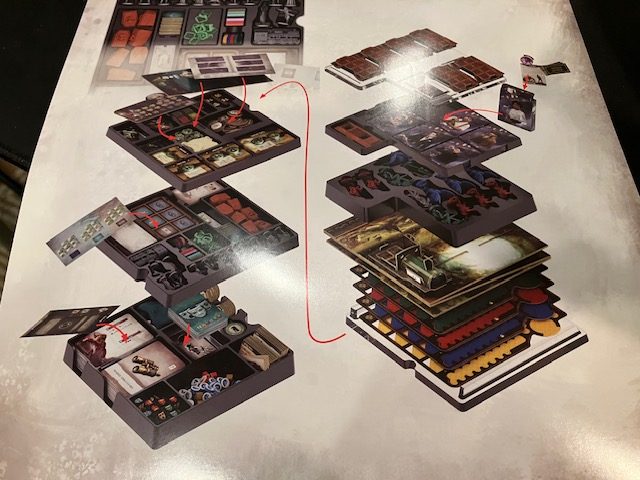
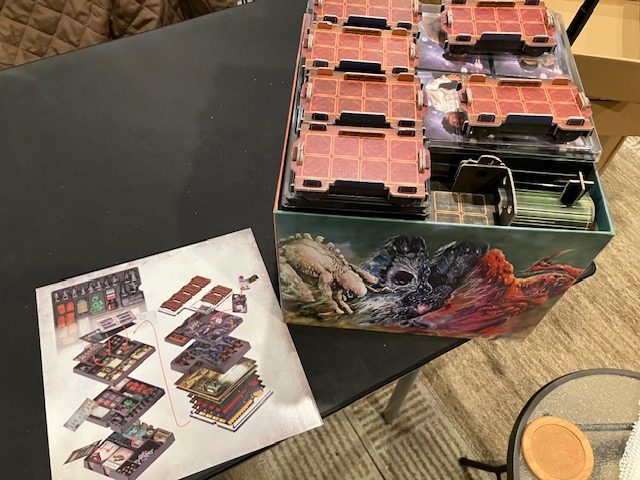
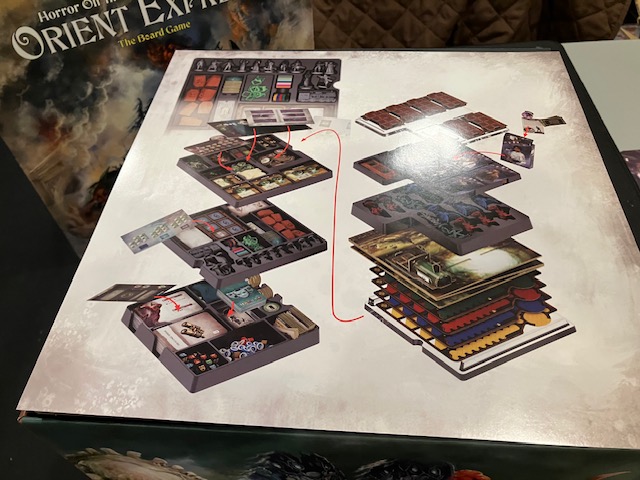
To get a sense of how much stuff is in here, the game includes a really nice boxing/unboxing guide. See above.
So much stuff!!
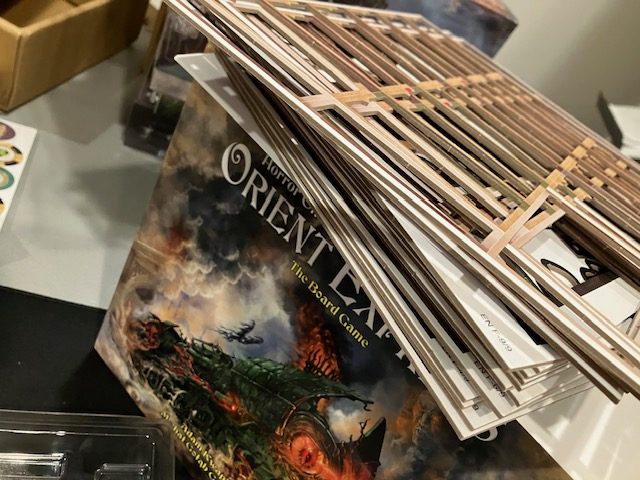
There were SO MANY things to punch out! See all the cardboard skeletons above!! SO MANY PUNCHOUTS! And no, I don’t think I can keep these punchout Skeletons … even if I wanted to.
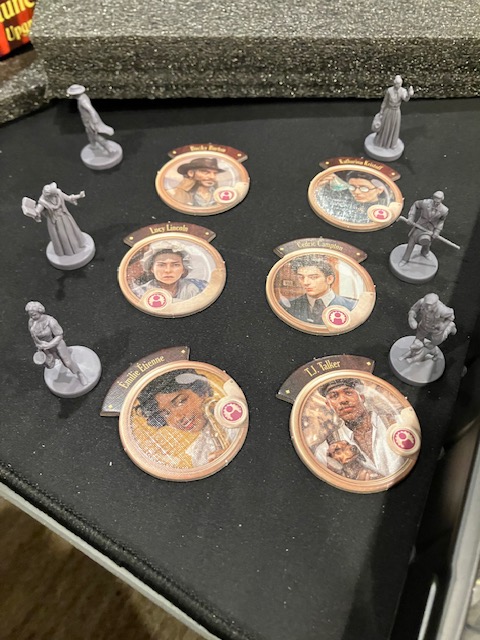
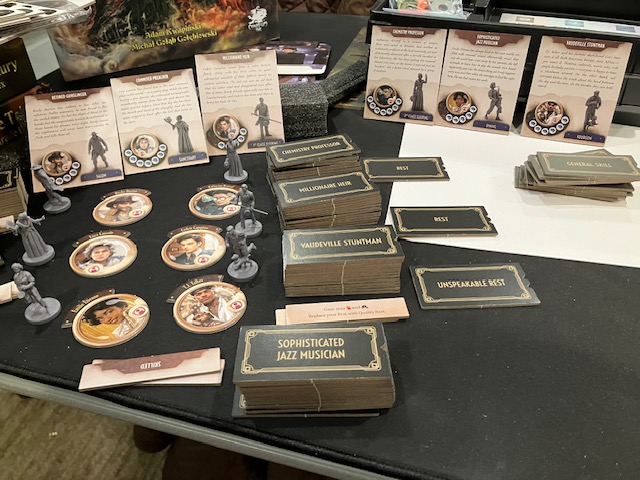
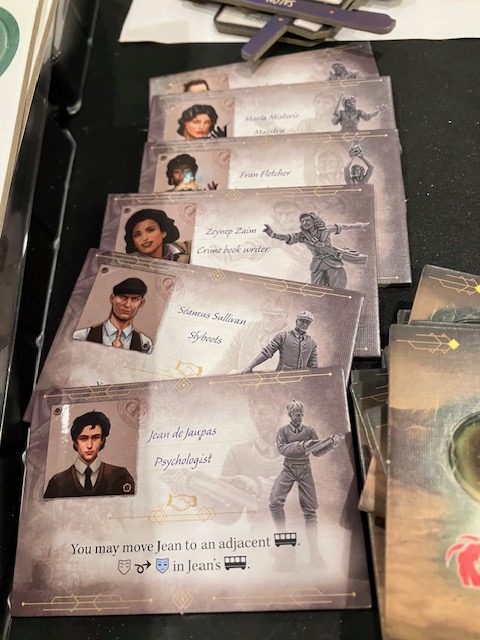
Players each the role of an investigator! See the choices above.
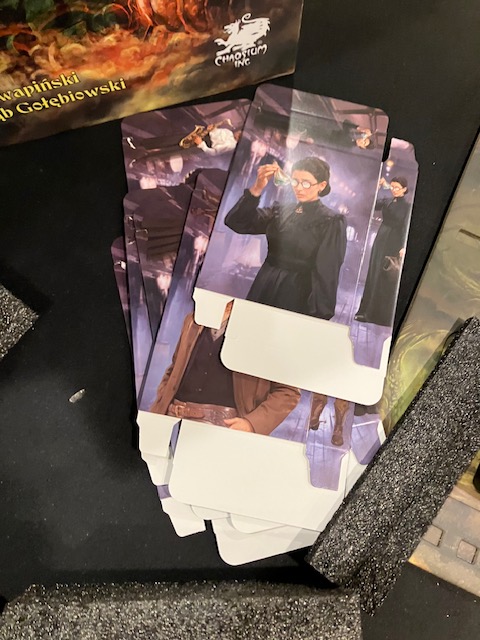
Each investigator has their own set of “main action” cardboard punchouts. See above and below.
Each investigator is actually fairly unique: their main action cards define the flavor of the character! There’s no special power per se, but each investigator has a different pool of actions that are quite thematic!
All these cards go back into little tuck boxes (it actually makes it a lot easier to start the game).
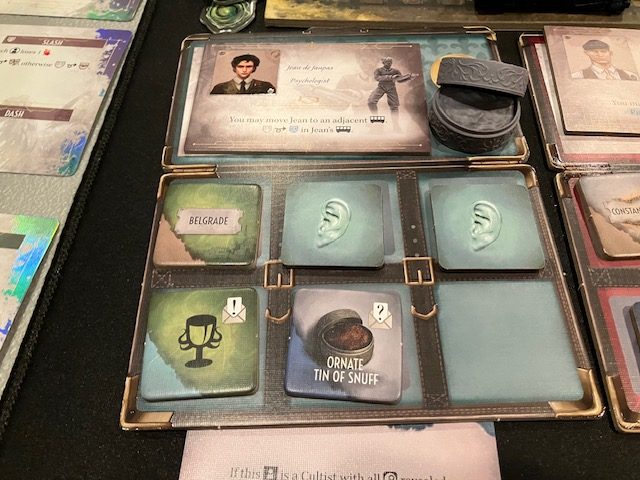
So what are you investigating? As a group, the players cooperatively are trying to figure out which of the suspects (see the 6 suspects above) is a Cultist and which is NOT a cultist! This is cooperative Clue with Cultists and Cthulhu!
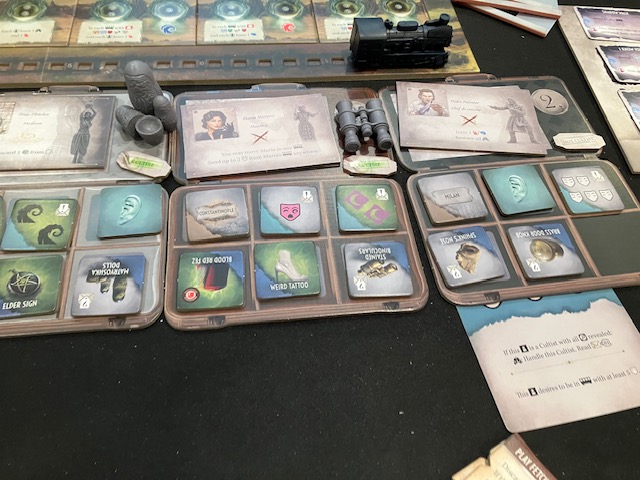
Each suspect has some “luggage” with Clues on them. The nature of the stuff in their luggage tells you whether or not they are cultsists! Do they have a blood red Fez??? They must be a cultist! Are they going to Constantinople? Their stuff is an indicator that they are cultists or not! There is actually a precise definition (based on their stuff) of what makes someone a cultist!
At the start of the game, all suspects have their clues turned face down, and throughout the course of the game, there are many ways to uncover the items and see exactly which suspects ARE Cultists and which ones are NOT! You have to get them all identities correct or you lose the game! This is the primary goal of the game: discover the loyalties of all suspects!
To be clear, all the PLAYERS are in the clear automatically; there is no hidden traitor or anything like that! Players work together to find out who are the cultists!
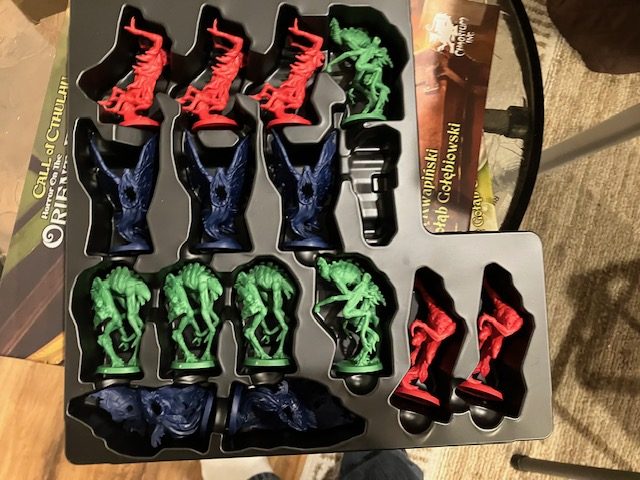
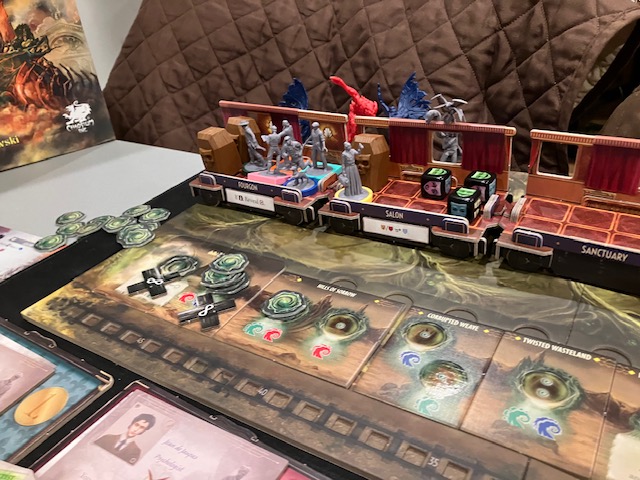
But of course, everyone got stuck on a train that’s driving in the Dreamlands, and we have to survive the Cthulhoid creatures that are chasing the train! See the creatures above and below! They are much less fearsome inside their box!
The Cthulhoid creatures race alongside the train and reach in to do damage to passengers and suspects!
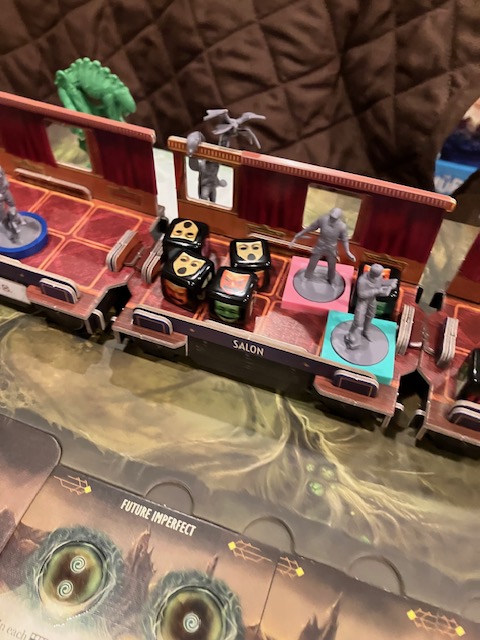
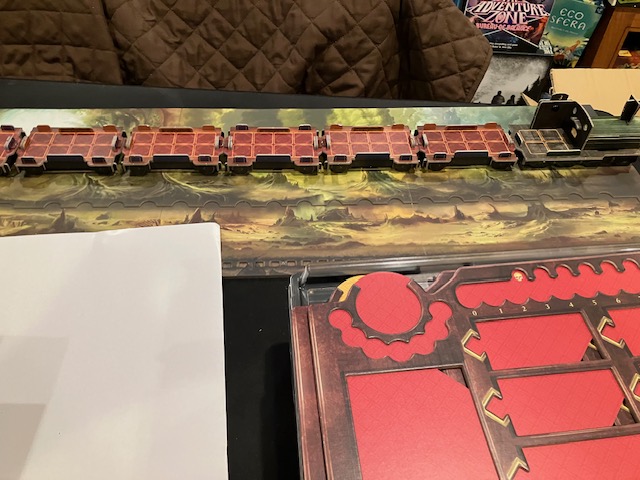
The train is where everything takes place! The investigators, the suspects, the monsters, the passengers, and even a vampire!
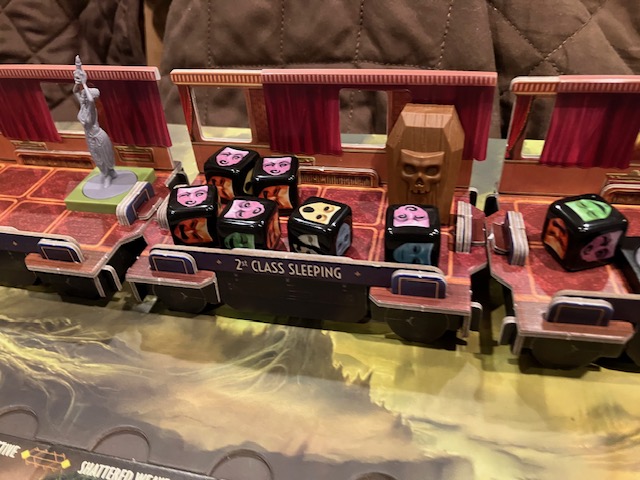
The “other passengers” (not suspects) are represented by die which show a face showing that they are happy, worried, neutral, crazy, mad, or injured! See above! You have to be careful to protect as many passengers as you can! It’s hard to talk to passengers that are mad or crazy! And you need to talk to passengers to find out about the suspects! Remember, you are an investigator!
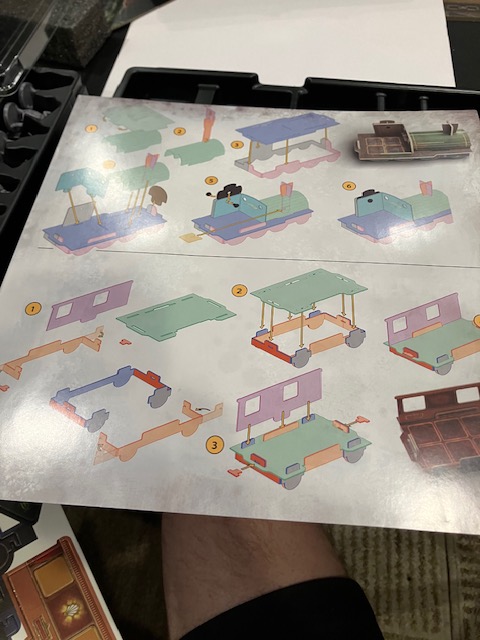
Putting this train together (which is really cool) was actually a surprising amount of time from the 4 hour unboxing time! The instructions are “ok”, but let me give you a little hint now: BUILD FROM THE BOTTOM! See below!! The instructions (see above) show building the train cars from the top, and that just doesn’t work very well.
Build from the bottom like I did: See above.
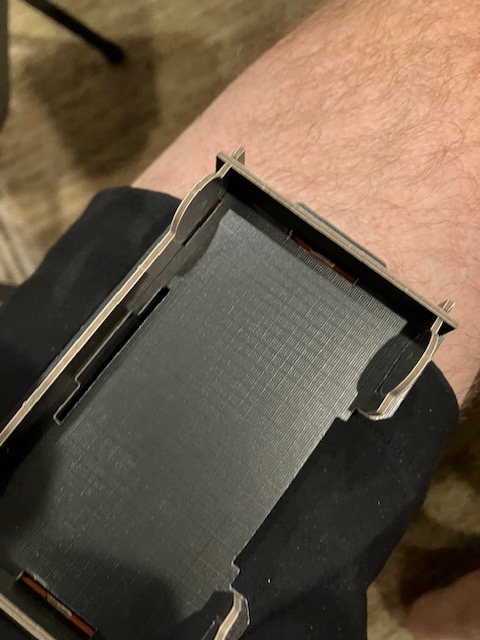
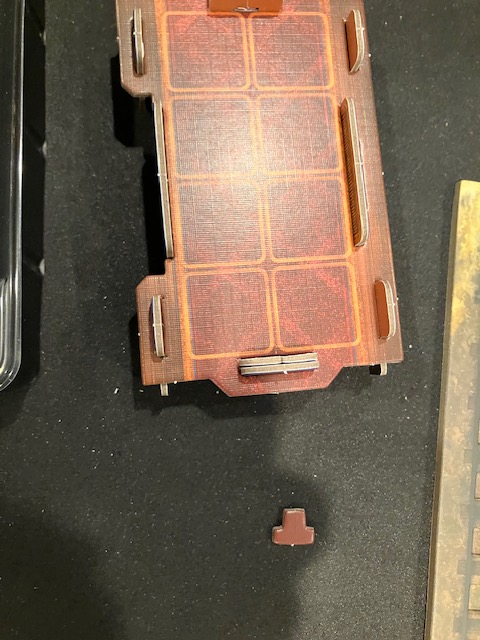
Also, I recommend gluing the final crossbar piece (see above). They kept coming out on me!
By the time you are done building six train cars and the locomotive, you get a little exhausted. I ended up taking some time to do other stuff before I finally came back to finish my unboxing and reboxing everything back in! (And no, I don’t count that time off in the 4 hours … this really took 4 hours!!)
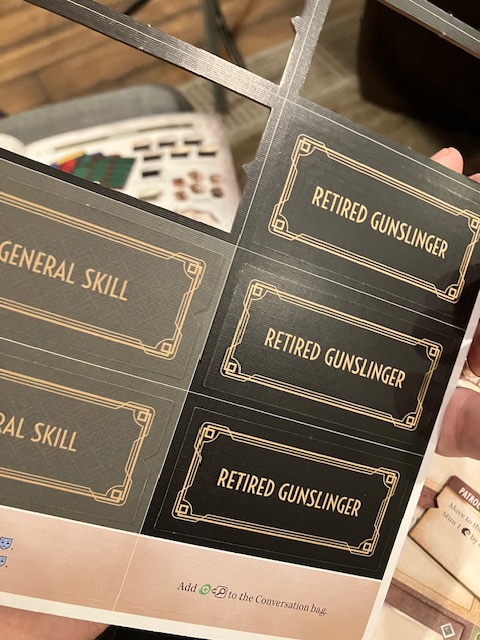
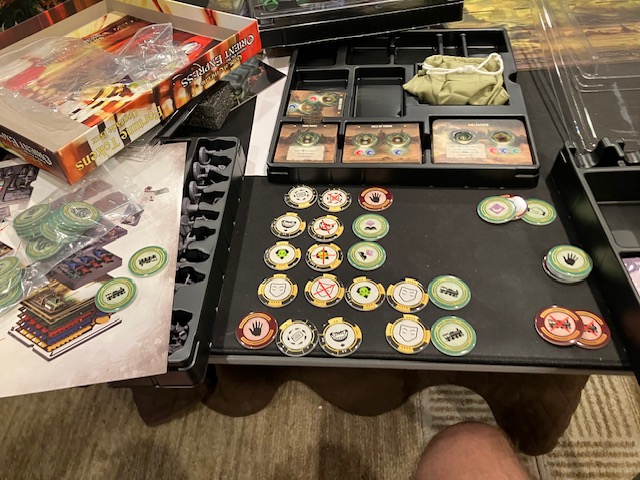
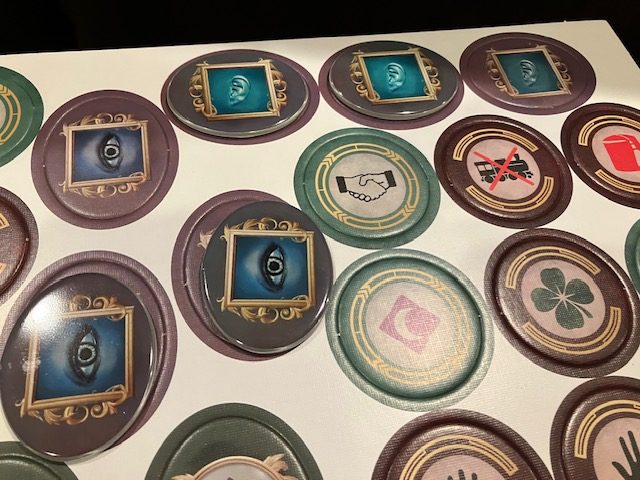
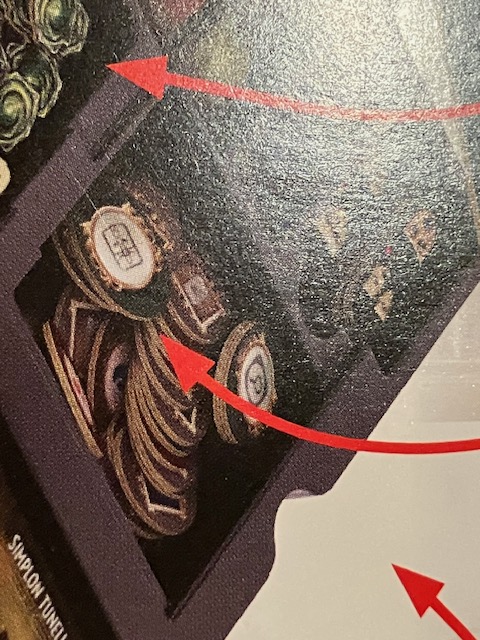
Oh yes, I need to comment on some of the deluxe components. The acrylic conversation tokens and event tokens from the upgrade box are really cool!!! See above!
… but they are not well-labelled! In fact, the expansion box has acrylic tokens for EVERYTHING (including other expansions), so you don’t really need ALL the acrylic tokens for the base game! And in fact, they don’t all fit if you try to use all of them!!! I ended using the unpunched cardboard tokens (see above) as a guide to which tokens to keep! This was extremely frustrating that I DID NOT know which tokens to use for the base game and which tokens to use for the campaign and other pieces! They reallllllly needed to have some better labeling.
As you put things back in the box, you will both love and hate the sheet above! Why? Because it shows everything (I love that) but it’s so hard to see detail! (I hated that!)
See above as I had to use my phone to zoom in so I could see the detail!!!
Putting everything back into the box in its proper place (after punching everything out) was a chore. But it did work.
Yep. It took me 4 hours to unbox everything, punch out so many things (see cardboard skeletons above), dig through deluxe tokens (and realize there’s no way I can put them all in the base box), assemble the train, then finally rebox!!
Whew!
Day 1. Set-Up: 2 Hours
You might ask “why did you put everything back in the box if you knew you just needed to get it all out again?” I asked myself that same question! Seriously though, there is some value in handling all the components again; there’s a kinesthetic boon to seeing/touching all the components in the game again.
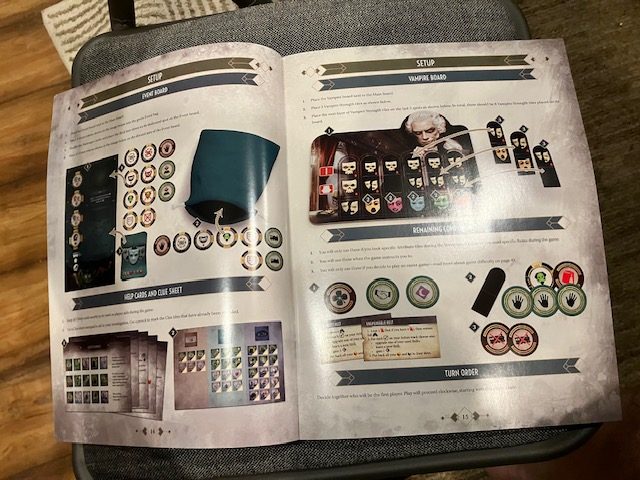
If you think that 2 hours is ridiculous to set-up the game, I point you at the rulebook: setup takes about 10 pages! That’s right, about 10 pages of the 48 page rulebook is just to set-up the game.
Uh-oh. This is gonna be hard.
Day 2a. Reading Of The Rules. 2 Hours.
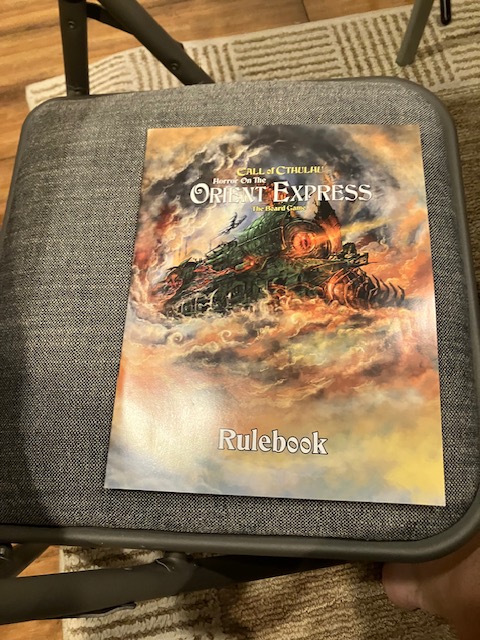
If you think this is a big complicated game with lots of rules … you would be correct. The rulebook is 48 pages long.
The rulebook is good, but there are a LOT of rules … a lot of rules that you will have to lookup again and again.
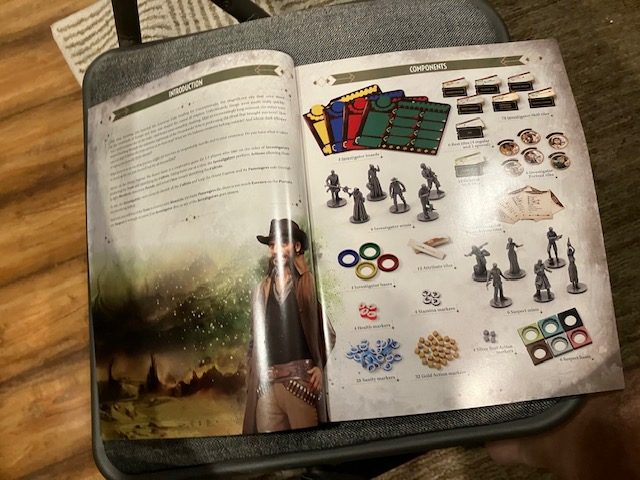
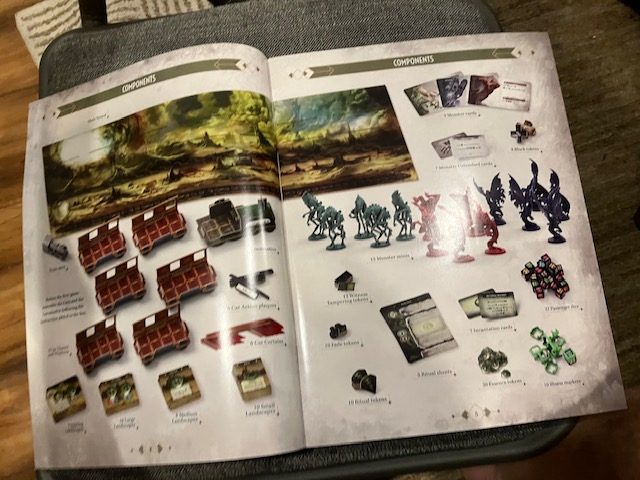
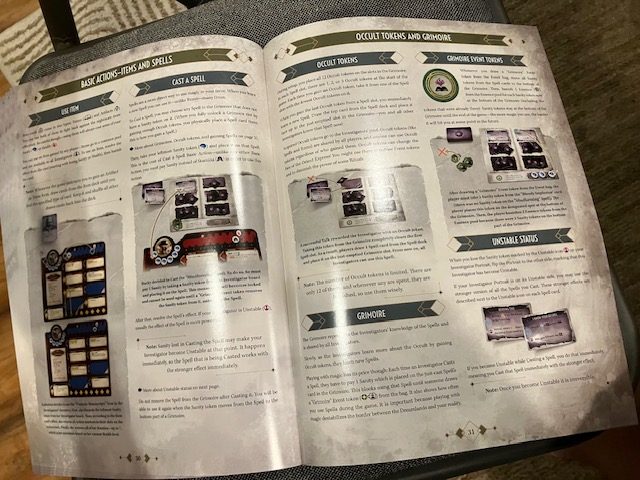
The rulebook does fit well on the chair next to me: it stays open and is easy to read, but there is just a little bit of drooping of the pages. I’ll give this rulebook a B+ or A- on The Chair Test; It has a good form factor.
The components pages are nice, but they span multiple pages. The actual Set-Up also spans multiple pages!
In the end, you just have to get through this rulebook. I sat with the game set-up in front of me, and read the rulebook while constantly referencing the set-up game. This rulebook kind of feels like a legal document because there are so many rules and descriptions. It’s not too bad, but it took me 2 hours to get all the way through the rulebook so that I had an idea of what was going on.
I didn’t really feel like I could jump into the game until I read just all the rules. There’s too much going on to say “let’s just try it!” Nope, that’s a recipe for disaster! You absolutely need someone to read the rules ahead of time, or you will end up reading 2 hours of rules with your friends and annoying them.
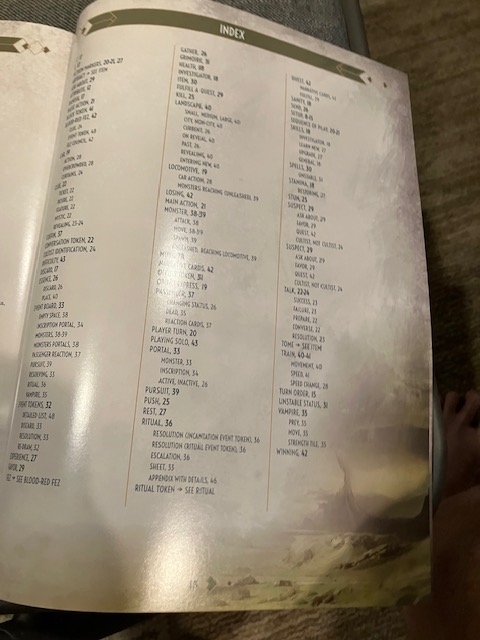
I was very pleased that the rulebook included an Index. It wasn’t perfect, but it was good enough to help when I needed to look up something.
This was a good, if long and legalese rulebook. You will refer to it a LOT as you play.
Day 2b. Solo Game: 3 Hours
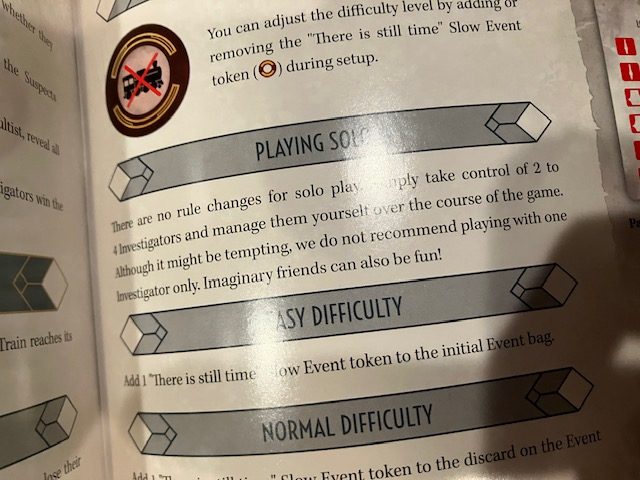
There is a solo mode (huzzah on following Saunders’ Law!)! See rulebook above. Basically, you are supposed to play 2-Handed solo, alternating between two characters.
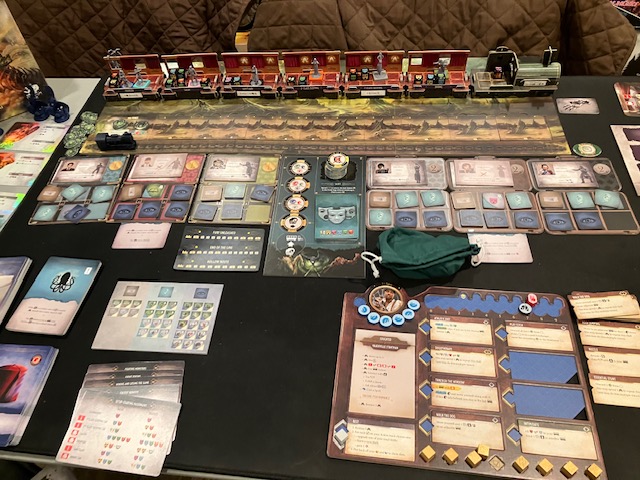
Now, I think I misread this the first time I set-up, as I just went ahead and played true solo: I operated a single character. See set-up above. After playing with a single character, I am glad I made that mistake! There are SO MANY rules in this game, that alternating between two characters just seemed like too much work.
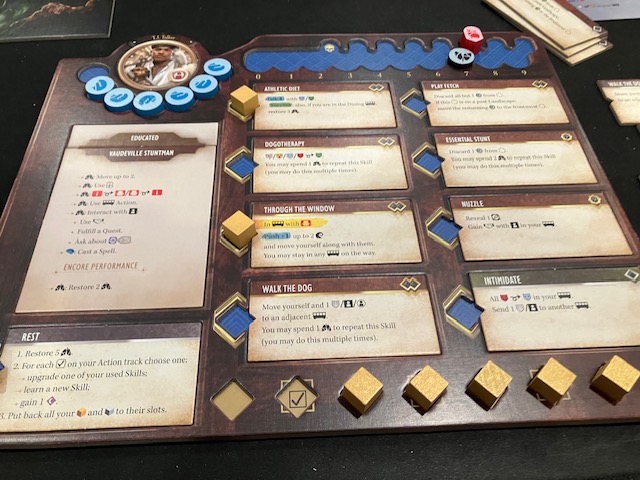
See above as my character advanced pretty quickly.
After accidentally playing true solo, boy, I am really glad I did! I think I would have hated alternating between two characters as I I was learning the game. There are a LOT of rules in this game, and each character has a LOT of options and main powers … I think I would have been completely overwhelmed on first game had I played 2-handed solo.
I think what I am saying is … this was a happy mistake! Maybe your first game should be a true solo game so you can get a sense of everything in the game. I know I cheated a few times in my solo game, on accident and maybe once on purpose (just to get to the later game), but I think … this might be the best way to learn?
I can’t comment too much on the balance of a solo game (because I was just playing true solo to learn the game), but I think I would prefer if the game had a true solo mode? This is hard for me to say because I frequently prefer 2-handed solo mode because they typically don’t have rules exceptions! I think this is case where a minor rules change (or two) for true solo might be worth it; it might be as simple as you start the game with a couple of items already in your inventory (one of them a healing item).
In the end, the true solo player was able to keep the Cthulhoid monsters under control and accurately guess the identity of all the cultists! And it only took 3 hours!
This was a learning game, so I expected it to be longer than normal games. But it was 3 hours to play EVEN after setting everything up ahead of time! And I didn’t even tear-down, because I left it “mostly” set-up for cooperative play!
Day 3a. Cooperative Game: 3.5 Hours.
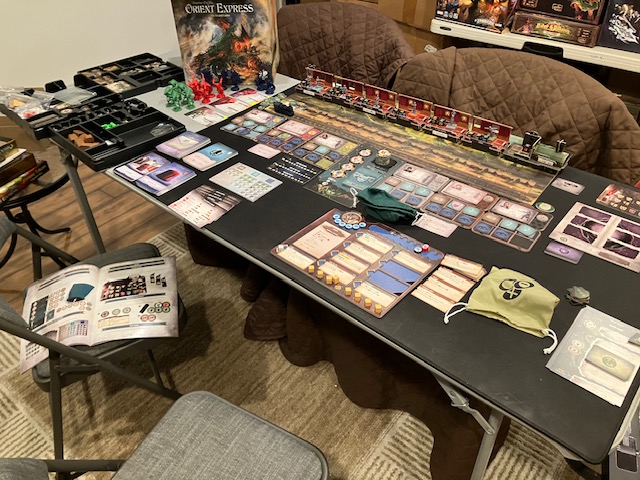
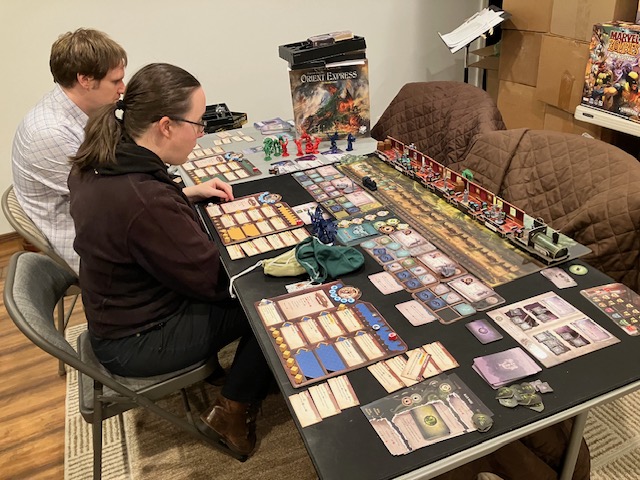
Interestingly, the game suggests that a cooperative game all sits on one side of the board. This would work fine for a 1,2 or 3 player game, but I worry that a 4 player game just wouldn’t fit? We only played a 3-Player game (above), and we just barely fit. Maybe you just need a bigger table if you play 4 players?
I am SO HAPPY that I set-up, read the rulebook, and played a preliminary game before my friends came over. We ended up playing 3.5 hours of just pure playing time! Let’s be clear: my friends and tried-and-true gamers who have played many complex games: we did not get “stuck” on anything!! The game moved along as it should with some rule lookups, but it still took 3.5 hours to play!
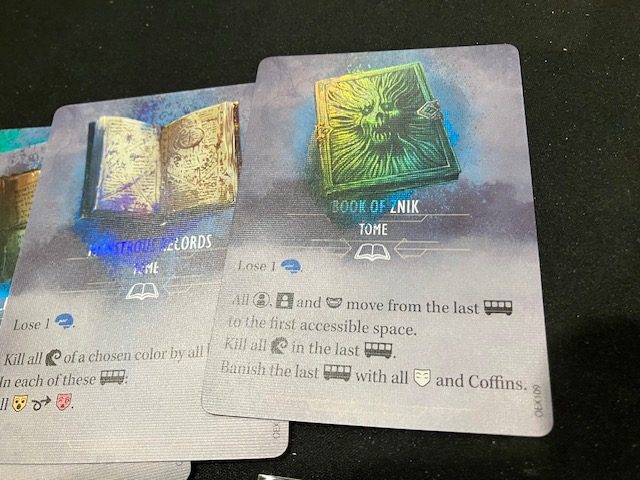
The game has some interesting ways to promote cooperation: for one, all spells and items are shared! That means there’s no need to worry about explicit “share” actions or anything like that! On your turn, if you want to cast a spell or use an item, you just use the shared pool and do it! There’s no “I have to move to you to give you the Book of Znik so you can use it!” You could argue it’s not thematic (how do you share items if you aren’t even in the same train car??), but it does get around all the problems of sharing and wasting actions to get stuff to each other. The fully shared paradigm does help the cooperation.
At the start of the game, most turns tend to be fairly multiplayer solitaire. Don’t get me wrong, there are mechanisms that affect other players (For example: TJ could walk his dog and have another player move with him), but players did their own thing. What I saw happen was the people kind of took their own turn and did what they wanted at the start of the game. I think this was good; it helped players become familiar with their powers, the rules, and the interactions.
What I saw happen was that as things became more dire, we started setting each other up and helping each other directly more and more.
“We really need to find out if he’s a cultist before the train reaches the end!!” “Ya, but I have 3 cthulhoids coming up behind me! I need to deal with those!”
So, in the end game, we started working together more and more. To be fair, we pretty much had to cooperate or we would have lost the game!
From this point of view, I think the game is a good cooperative game! Players have agency to learn their characters at the start of the game, but learn to cooperate as the situation gets more dire!
To be fair, it still took 3.5 hours to play a single game. Even though it was a learning game, I did everything right to make the game introduction as simple as possible (set-up, read rulebook, played solo) and it still took 3.5 hours to play!
Day 3b. Tear-down: .5 hours
After winning our 3.5 hour game, my friends helped me tear this down.
This unboxing sheet (see above) made all the difference in the world! Tearing down the game was a cooperative experience worth its own game! I saw massive parallelism as my friends and I would each take “some pieces” from the game and consolidate them into the box! Seriously, I felt like the tear-down was its own cooperative game.
Hm, I kind of wonder if how well you tear-down a game together is a measure of how well your group cooperates together? I can say with pride that my core game group works well together! Someone was always doing something and working on putting this back together!
It still took a while to put this back together.
What I Liked
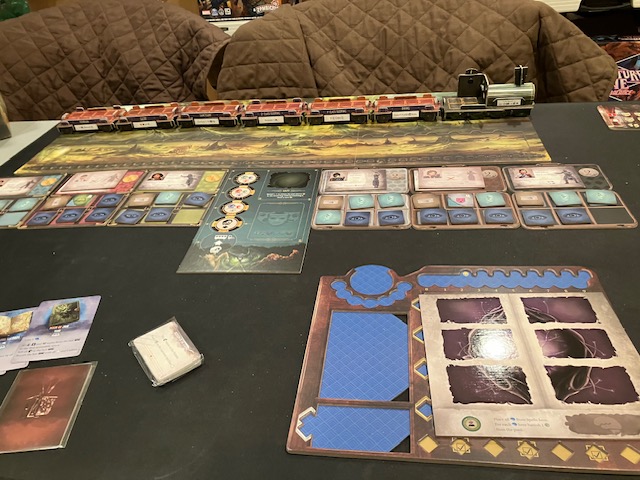
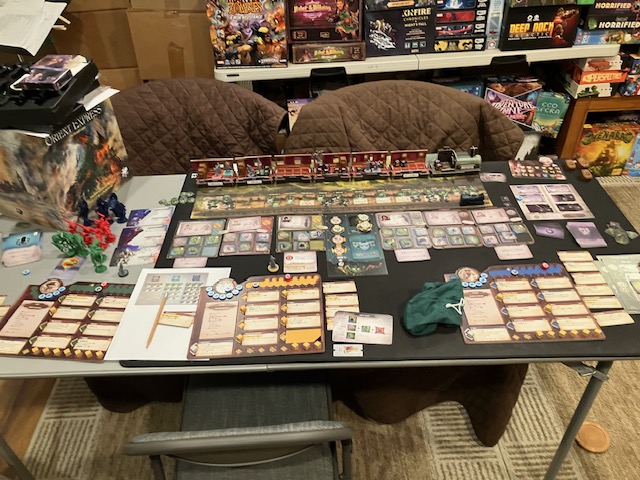
Table Presence: The game looks sooo cool on the table! The train cars, the cthulhoid creatures chasing the train, the vampire hanging on the windows, the amazing landscape, the characters, … everything! This just looks so epic!
Component Quality: In general, the component quality was good.
The Arc: The arc of the cooperative game was interesting and a very good development to encourage cooperation. The game starts fairly multiplayer solitaire, then converges to being much more cooperative as the game unfolds.
What I Didn’t Like
Deluxe Component Issues: I love the deluxe components, but there’s two major problems. One, there’s no discussions (especially in the fortune tokens) about which tokens you need for which box! Second, there’s no way the deluxe components can all fit in the core box. If you were hoping to have all the deluxe components fit into the base box, think again! If you wanted to throw away your deluxe component boxes … well, you may have to hold onto them longer than you expected.
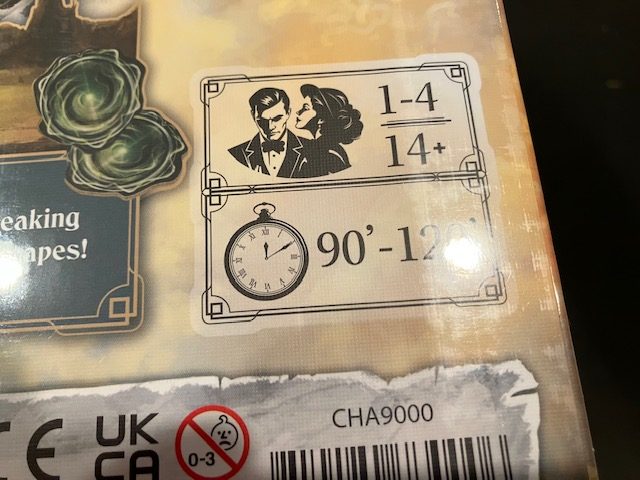
The Length: I find it very very hard to believe that this game plays in 90-120 minutes. Even if you cut-off the set-up and tear-down times, the game length still feels waaaaaaay off. There are so many rules.
Colors are a little wonky: The suspects each had a colored base that helped you identify them, but they really didn’t match the suitcase colors very well. At all. The brown suitcase we think uses the orange colored base?
Cthulhu Game?
Is this a hu game? Well, if your definition is “Cthulhu must appear”, then no, this is not a Cthulhu game. Maybe the better question to ask “Is this game set in Cthulhu Mythos?” Strictly speaking, the answer might still be no! The only real allusion is that the “train is driving through the Dreamlands”. But the vibe, the feel, the plot, everything feels like this is a Cthulhu game! Then I think the answer is yes! The train has sailed into the Dreamlands, Cultists are summoning and conspiring, portals are opening …
I mean, Chaosium does Cthulhu games. I am calling this a Cthulhu Mythos game.
*I was going to search the rulebook for the word Cthulhu and Cultists, but the PDF rulebook in the BGG files section IS NOT SEARCHABLE. They need to fix that.
Reactions
Andrew thought it was fun, but was worried that the time-investment vs. fun wasn’t good enough. His point was that there are a lot of rules and the game is really long. We had fun playing for 3.5 hours, but there’s many games we could play that are half that time but arguably more fun.
Teresa liked it and would play again. This would make one of her top Cthulhu games.
Conclusion
Horror on the Orient Express is a monster of a game … in every conceivable notion! It’s a monster of a box, with big monsters, a monster 48-page rulebook, a monster set-up and tear-down time, and a monster playtime of at least 3 hours. You have to decide if the monster aspects might be too much for you!
I would call this Cooperative Cthulhu Clue, as it’s a deduction game where you flip clues, but that would lure you into thinking this is a simple replacement for Clue! Absolutely not! Horror on the Orient Express is a deduction game where you worry about investigating while also fighting monsters and fighting vampires and saving passengers and basically keeping spinning plates going! There’s a lot going on! If you have always wanted something more complex than Clue set in a cooperative environment and fighting monsters, then maybe this is right for you! But don’t be lulled into a simple “Oh this is just Cooperative Cthulhu Clue!” No! It’s so much more! And that’s good or bad, depending on whether you you like this world.
If you like living in a Cthulhu-esque world of monsters and cultsists, then Horror on the Orient Express nails the theme! If you live that theme, you will love this world. If you just like the theme, you need to decide if the overwhelming nature of the rulebook, the game, the box, the length may be too much for you.
I look forward to playing this with some friends in Las Cruces, as they love Cooperative Cthulhu Mythos games! I know a few will blanche at the length and complexity, while others will embrace this monster of a game! Hopefully this review will help you decide if this is for you or not.
Stupid Fun. That’s all you need to know about Camp Grizzly: Second Edition.
What? You want to know more? Ok, we’ll talk a little more about this.
Stupid, Random, but very Thematic Fun! There! Is that better?
No? That’s still not enough? All right, all right …. we’ll look a look closer at this cooperative (yes, it is cooperative, that’s why we are here) horror game.
Unboxing
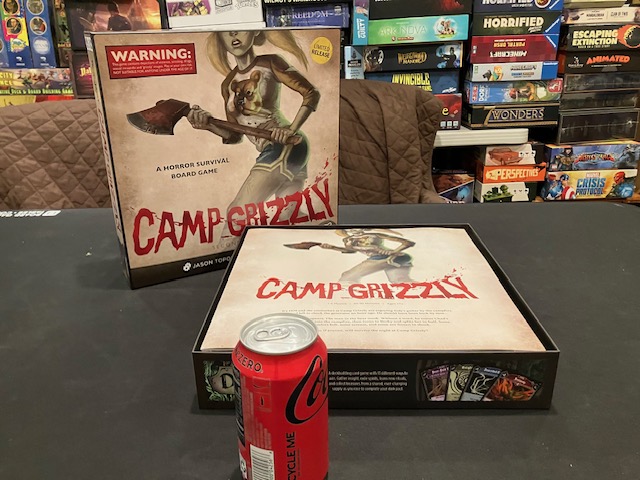
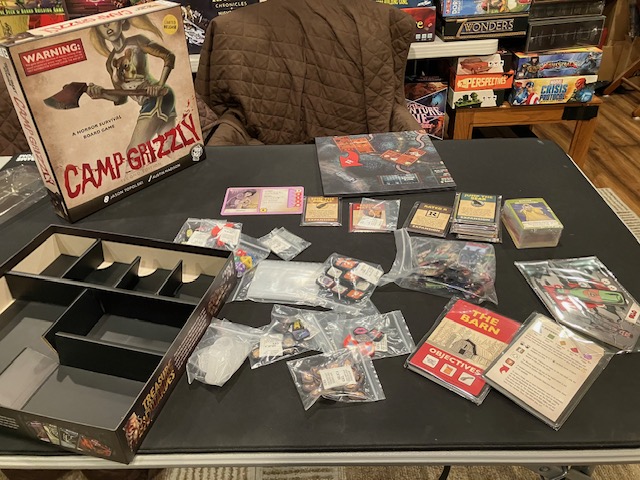
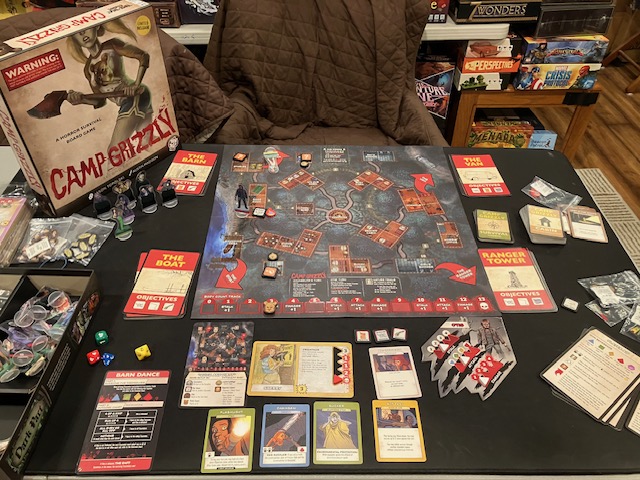
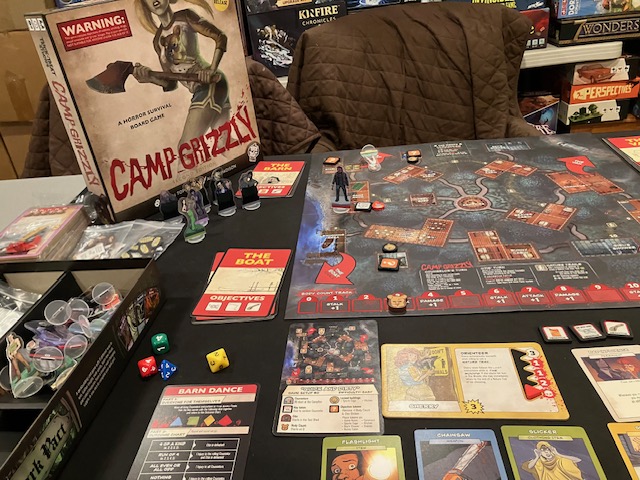
This is the second edition of the silly cooperative game called Camp Grizzly. See Coke can and box above for scale.
I backed Camp Grizzly:Second Edition from Kickstarter back in August 2025, and it arrived at my house in early July 2026. It arrived early! It was originally slated to arrive August 2026!! What? An Early Kickstarter??? That never happens! I was on the fence for backing this, but it was Mike Heller who convinced me this was a good choice! The game I backed was the Limited Release version with lots of acrylic tokens and standees.
Acrylic Standees
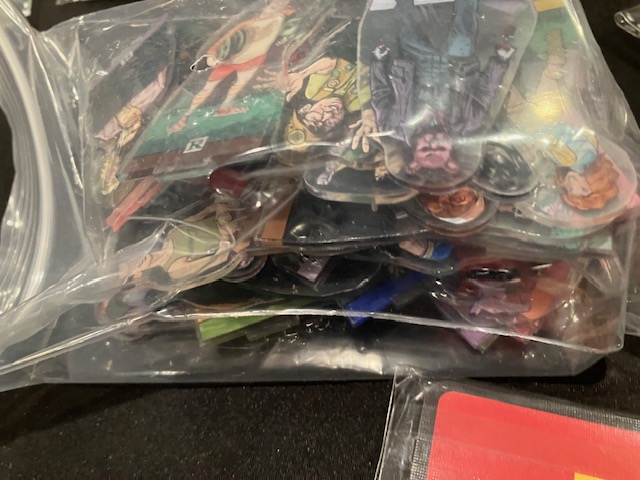
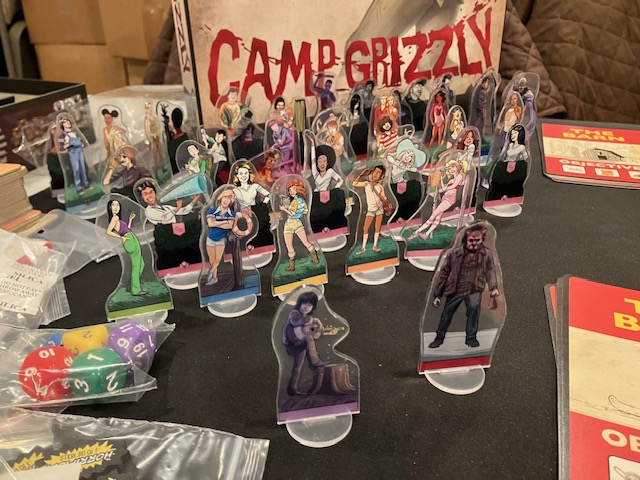
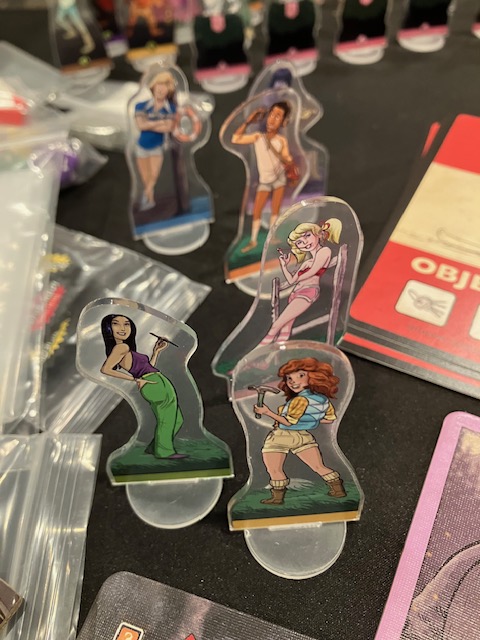
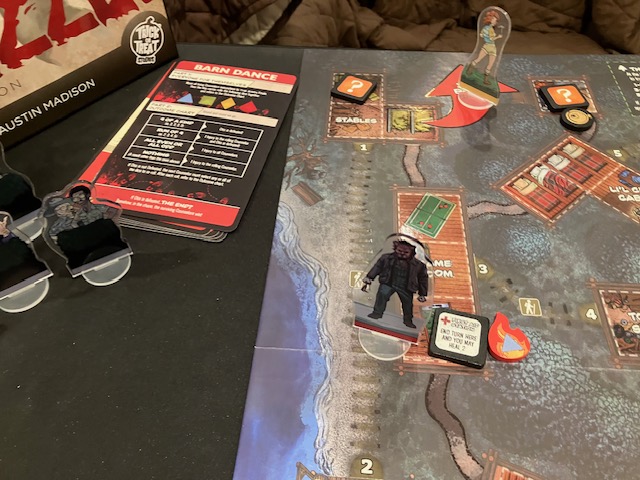
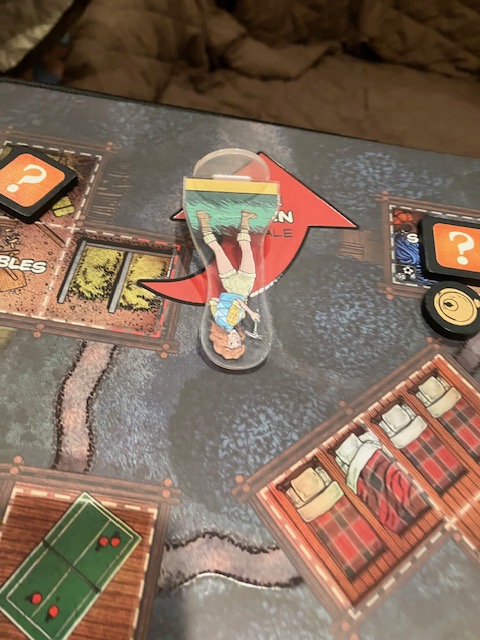
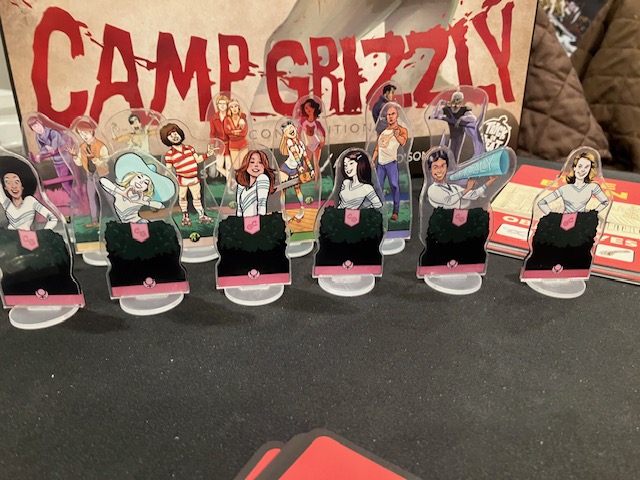
I am embarrassed to say that one of the reasons I was so excited for this game was the Acrylic Standees! The version I got (Limited Release) comes with Acrylic Standees that are so funny and goofy and thematic! See the full bag above of them!
The Acrylic Standees work SO WELL for this game! The art style is very “comic booky”, and I find that style works really well with Acrylic Standees: The colors are more vibrant and just pop!
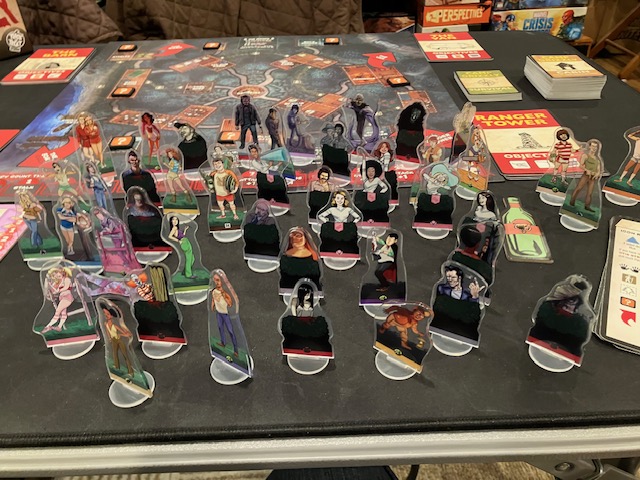
There’s a LOT of them too! See above!! Why so many? Because this particular version comes with 8 expansions, and some of these standees are just for the expansions that come in the box!
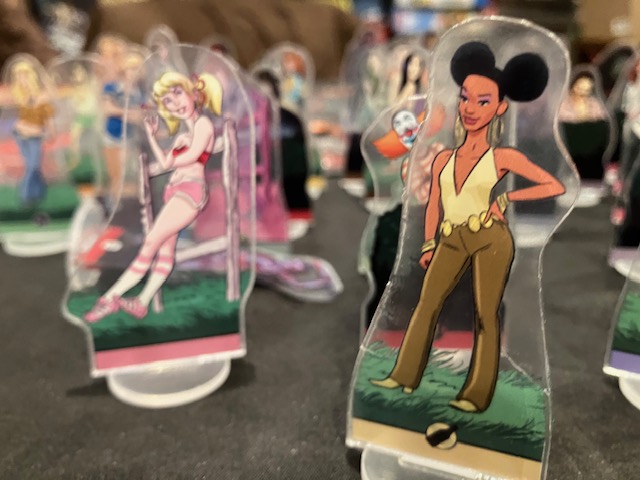
Note the two above; the lady on the left has no “symbol” on the bottom of her standee, so she’s a base game character. The lady on the right has a bottle-looking symbol: she’s from the Spin The Bottle expansion!
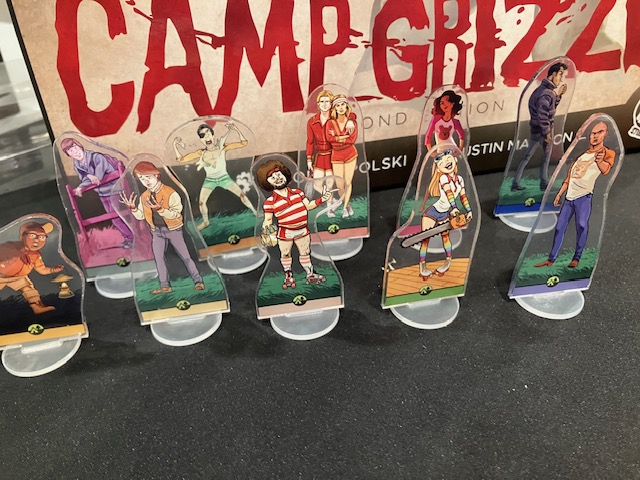
Some of the expansions have a TON of standees! See all the Mountain characters above!
I adore the Acrylic Standees; they work so well! If you have a chance to buy and/or play Camp Grizzly: Second Edition, try to get the version with the Acrylic Standees! I think they are that great!
Gameplay
The premise of this game is simple; have some Counselors survive Otis and make it to the Finale! If all Counselors die, everyone loses! If some counselors survive, everyone wins! Let’s be 100% clear; some of the Counselors will die!! And possibly you might die!! But don’t take it personally.
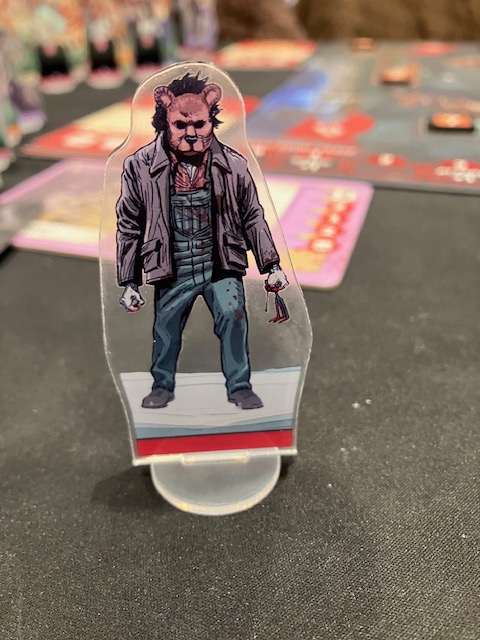
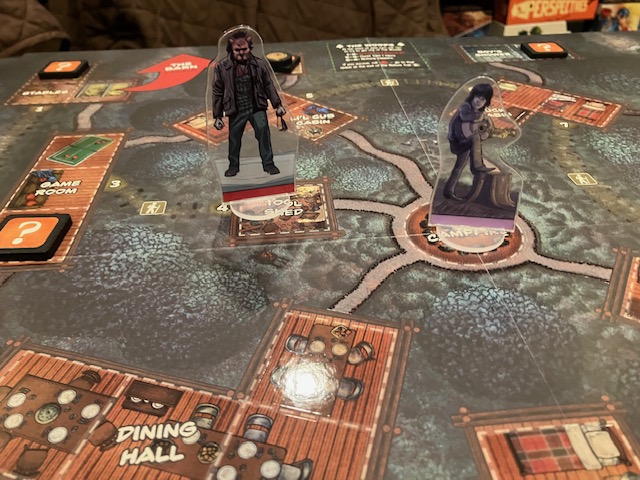
Otis (see above) is at Camp Grizzly and he is the BIG BAD HORROR monster chasing the Counselors! Otis is the amalgam of Jason, Freddy Krueger, Micheal Meyers, Leprechaun (blah) and all your “favorite” horror movie baddies! Just to be clear: no player is operating Otis and hunting the Counselors: the game plays Otis via some rules.
There are several modes of play in the game: Modern Murder Mode and Classic Action Mode.
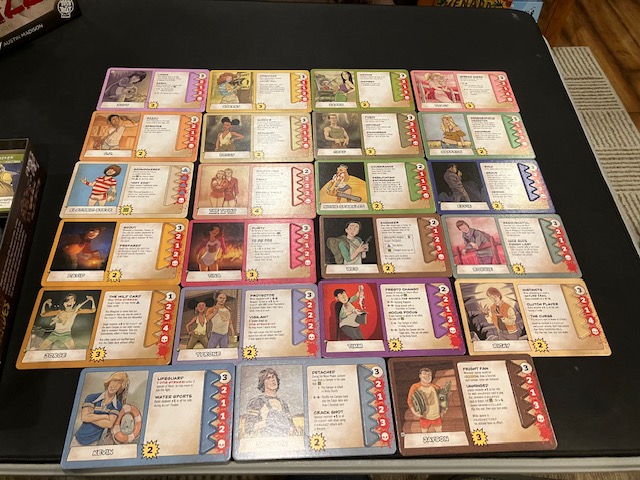
In Classic Action Mode, the players choose 6 Counselors (see all Counselors above; some are from expansions) and the players as a group operate the 6 Counselors: there are always 6 Counselors (well, until they get killed … and they probably will …).
In Modern Murder Mode, each player takes the role a single Counselor: one character per player. If your Counselor dies, you get another one.
And just a reminder, in case I haven’t mentioned it yet, counselors will die.
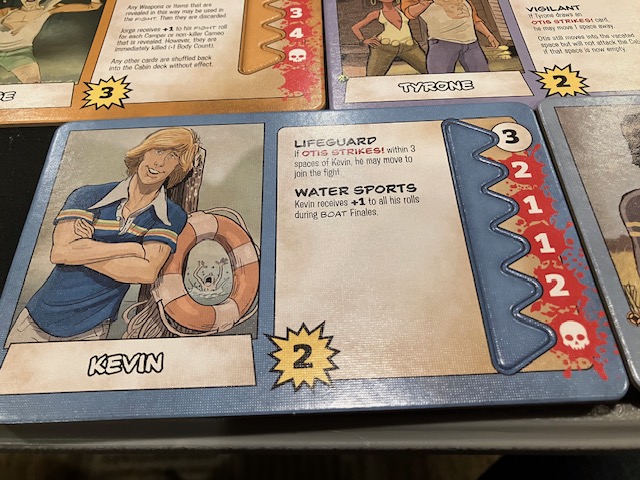
Counselors each have a Special ability to help them! Kevin (see above), for example, may move to a fight and gets +1 during BOAT finales! Kevin only has 5 hit points (note, it’s NOT the number next to you: that’s your movement). Notice that the healthier you are are, the faster you move! At full health, Kevin moves 3 spaces per turn, but as he gets wounded, his movement degrades to 2 then 1 (and then with a second wind back to 2)! If Kevin ever PANICS (yellow bam), he can run up to 2 away.
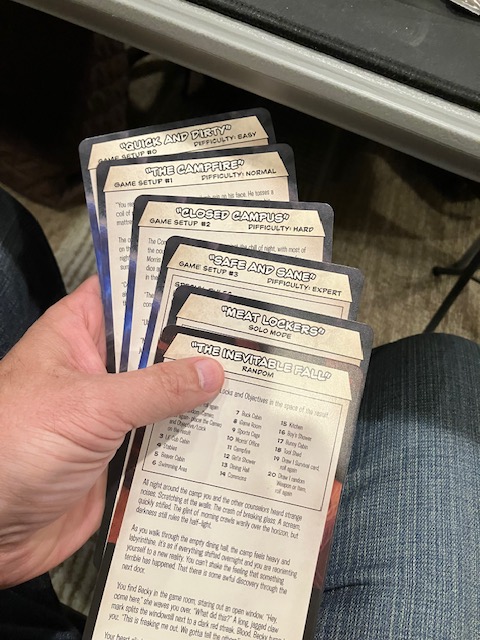
The players choose a Scenario (as specified by a number of cards) and set it up!
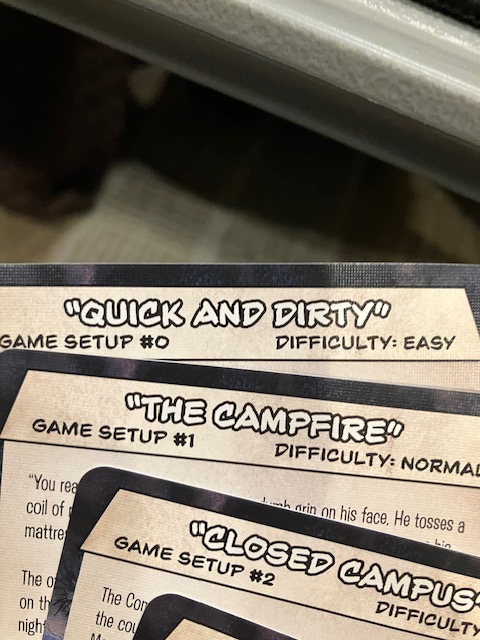
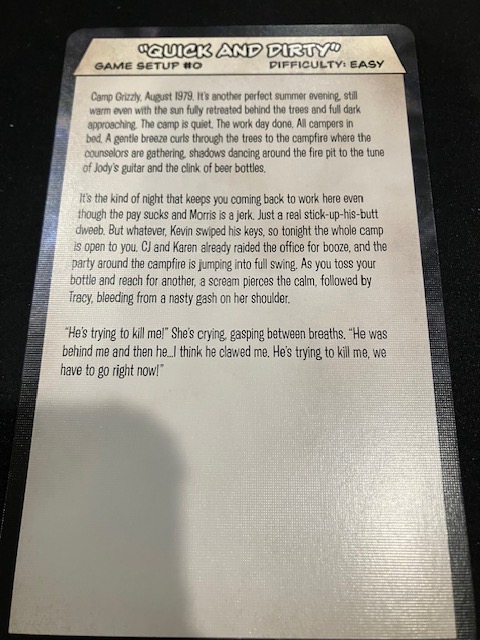
There are a number of set-ups of different difficulties. The game recommends starting with “Quick and Dirty”: see above.
After reading the flavor test (whosoever is the most dramatic and over-the-top reader should read this), the other side gives the set-up for the game!
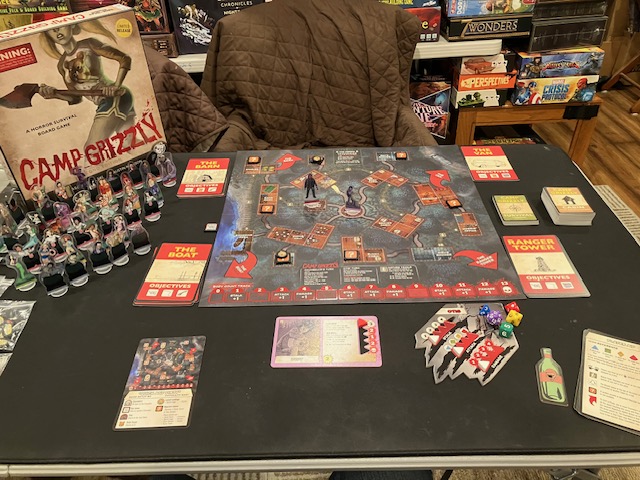
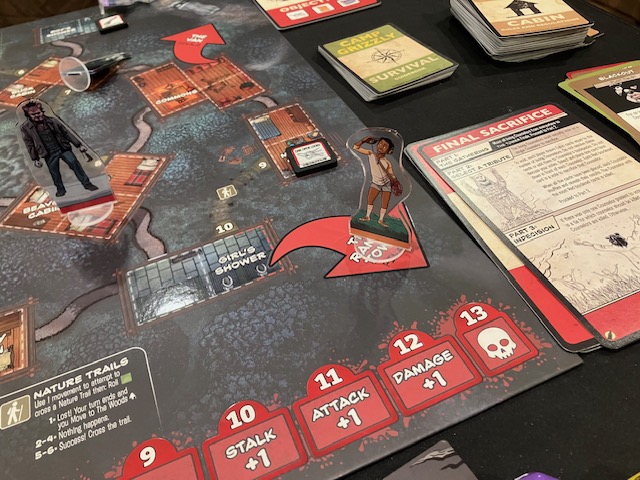
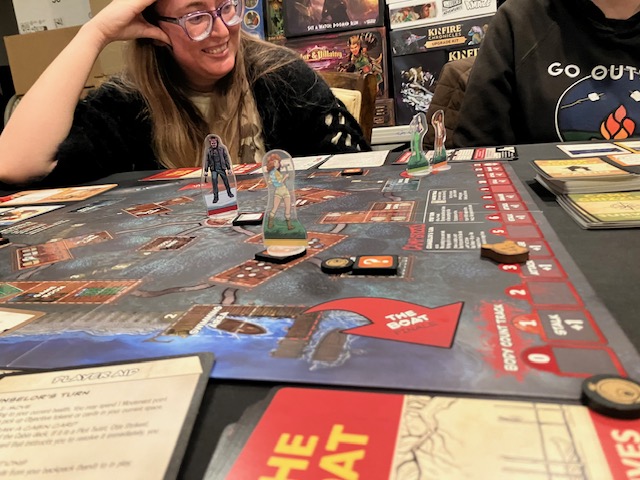
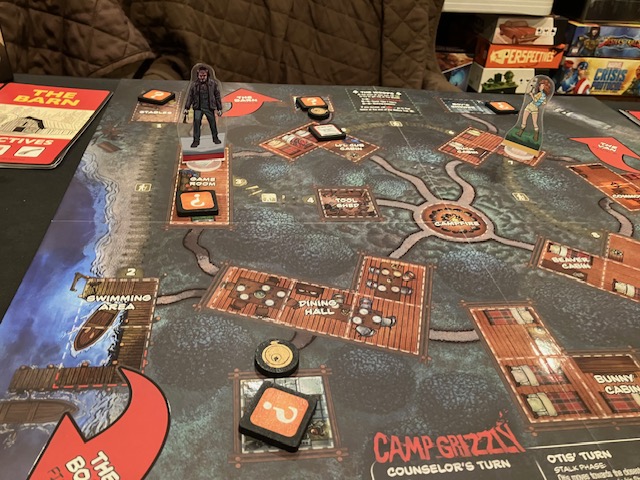
The set-up puts the characters, Otis, and some Objective Tokens on the board.
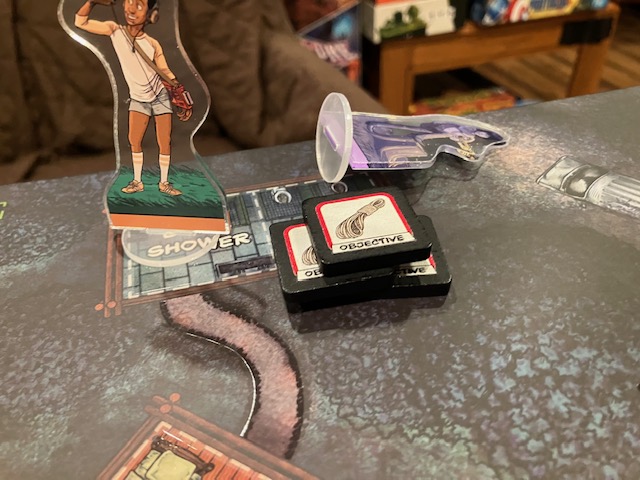
The Objective Tokens have various things on them (First Aid Kit, gas, rope, … other things). The players are trying to the objective tokens so as to trigger one of the end Finales!
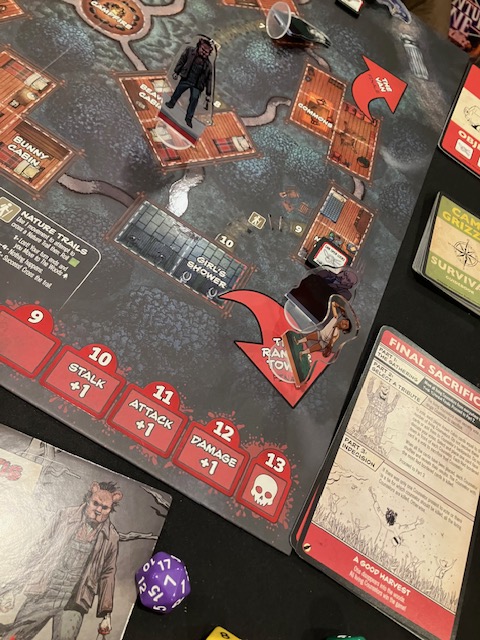
There are 4 possible finale-triggers at the 4 corners of the board; the BARN, the BOAT, the VAN, the RANGER tower: see above.
If you can get the three Objective tokens (keys, crowbar, battery), you can move to the Ranger Tower and initiate the Finale!
Depending on which tokens you get (they are all hidden at the start of the game), you may have to run to the VAN or the BOAT instead! Each finale needs different resources! (To be clear, there are a lot of finales; it looks like 24 for my version of the game).
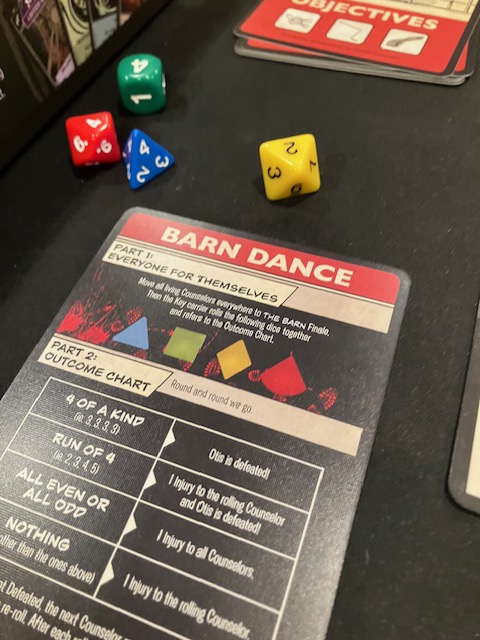
The finale can be SO VERY different! One of them is a Barn Dance, where you have to roll dice and try to get a certain match! In another, I had to sacrifice one of the Counselors! … and each one is really different.
As the game goes on, Otis gets more and more terrifying! He starts to move faster, attack for more!
Basically, as the Body Count goes up (yes, there’s a body count track), Otis slowly get more powerful! Funny, even if the Counselors don’t die, there are extras that die all over the place: Cameos and other NPC campers.
If players can’t trigger a finale, and the Body Track gets too high, there will be a final fight instead!
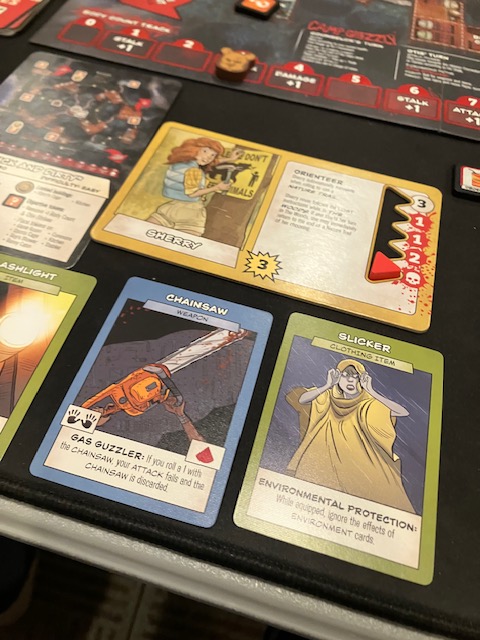
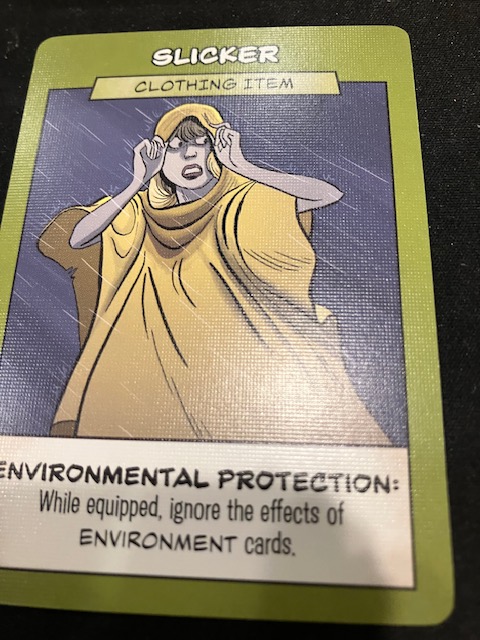
Along the way, you’d better hope you find some stuff to help you! Sherry was lucky enough to find the Chainsaw and Slicker! See above!
There’s a Cabin deck that players will draw from every turn, and a Survival Deck you can get lucky and draw from occasionally. What’s in the Cabin deck? So much random stuff!
You might get good stuff … like the Slicker …
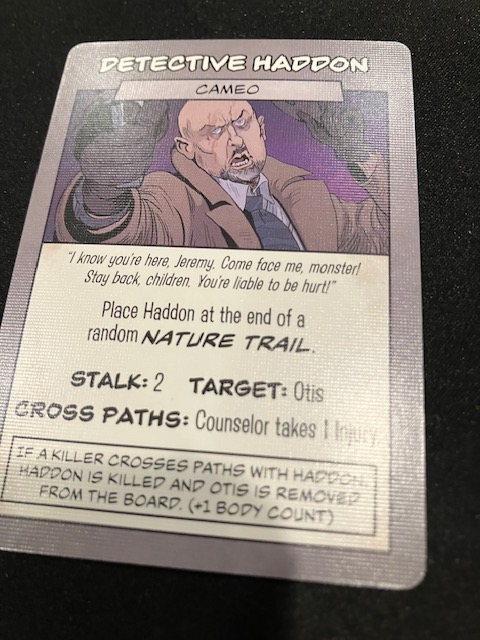
You might get a Cameo by a famous actor (who will probably die very quickly) …
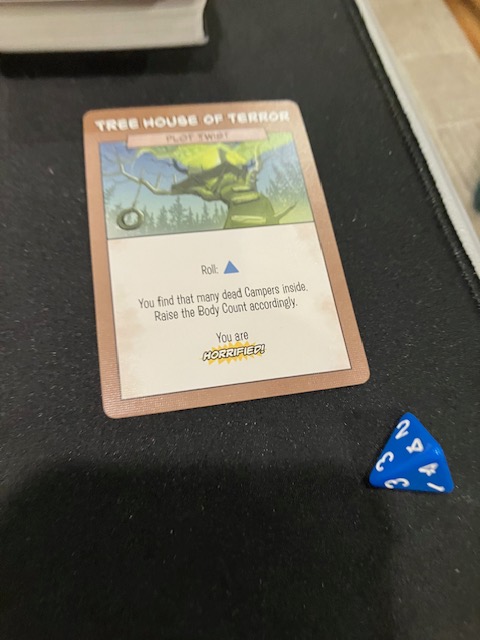
You might get a Plot Twist, which screws you!
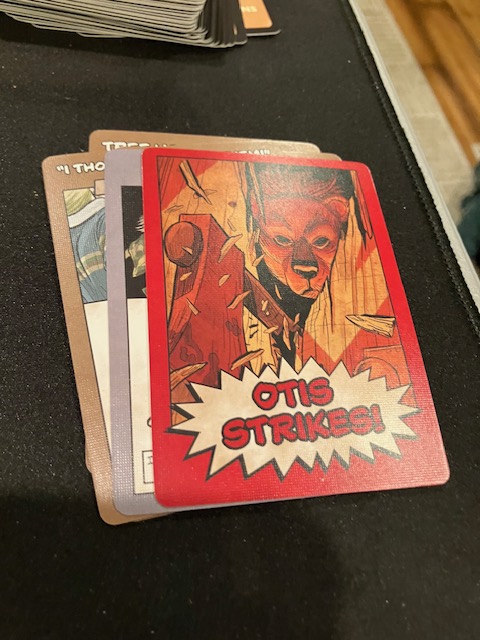
… or you might get Otis Strikes!
You can fight Otis (a little), but generally he overwhelms you and you take damage. If your Counselor runs out of hit points, you either just die (Classic Mode) or respawn a new character (Modern Murder Mode).
Survive the Finale or the Final Fight and you win!
Rulebook
The rulebook is generally pretty good.
It gets a D- or an F on the Chair Test, as the rulebook is the same size as the box, and hopelessly droops over the edges. You might be able to use it on the chair next to you, but maybe not. It’s too bad, because the rulebook is pretty good otherwise.
I wish the rulebook had an Index; there are a few too many concepts and/or keywords, so I wanted to look stuff up quickly via an Index.
Solo Game
So, Camp Grizzly: Second Edition works as a solo game! (Thanks for following Saunders’ Law!) Interestingly, because there are two modes to the game (Classic and Modern), you can choose to either play 6 Counselors at once as the solo player in the Classic mode, or you can play true solo in the Modern mode, and play just one Counselor!
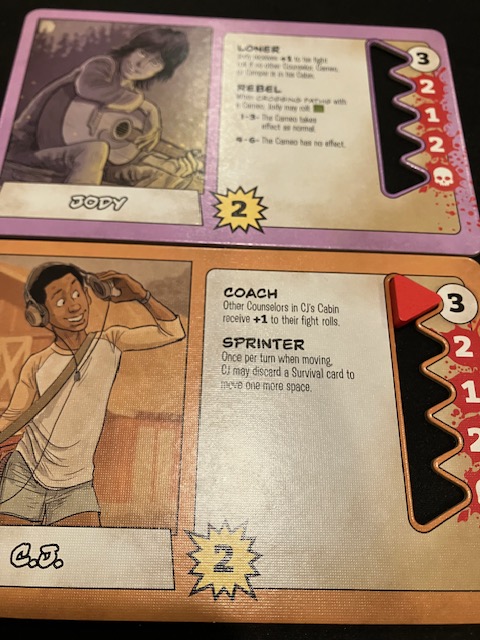
I opted for the true solo game with one Counselor. See above as Jody decides it’s a good idea to stay at camp alone at night! Wait … maybe that’s NOT a good idea …
Jody died pretty quickly, but C.J. stepped up (“spawned”) after Otis killed Jody! The great thing is that C.J. was that he was able to pick up all the stuff Jody dropped when he died! See above! This is really thematic that you can loot the dead bodies!
Now, C.J. made it to a Finale at the Ranger Tower! And what happened?? Because there was only ONE Counselor alive, C.J. had to be sacrificed! If there had been TWO Counselors, we could have won, as one of us had to die … but as long as at least one Counselor survives, we win! I COULDN’T WIN! No matter how I played the true solo mode, I couldn’t have won .. at least with this Finale.
Huh. I wasn’t frustrated. I thought it was kind of funny! Are all scenarios this poopy for the solo player?
I set-up the same intro scenario and had Sherry run this one by herself!
Sherry did MUCH better than C.J. or Jody! She made it all the way to the BARN Finale with no wounds and a CHAINSAW!!
The BARN DANCE was a very different Finale! Sherry had to roll some dice to survive … and she did not survive.
Sherry died. So I lost again. But I could have won … I am beginning to think I actually would have had a better chance with at least one more Counselor. I am beginning to think 2-handed solo (2 Counselors in Modern mode) is probably the best way to play solo?
Again, you might think I was frustrated that I lost. Nah. It was goofy fun. You have to realize .. these games were very quick! Once you get into the groove of this game, I think my second solo game took 45 minutes? This game moves quickly. And you really can’t take it too seriously.
Cooperative Mode
So, when I first looked at Camp Grizzly: Second Edition on Kickstarter, the game is billed as “semi-cooperative”; see above!! I actually didn’t back it at first when I saw that!
I don’t think that’s quite accurate. I think a strict playing might be “only the players that survive” are the winners. But the thing is, it’s almost always in your best interest to keep many Counselors alive! I have seen a number of Finales now, and it always behooves you to have more Counselors! The more Counselors you have, the better chances you have of surviving and winning!
Even the rulebook points out: “look, if anyone survives, y’all win”. It’s cooperative! Mostly; even when you have to screw other players (like when we had to sacrifice a Counselor), it’s still in the name of common good! As long as one Counselor makes it out alive, you all win!
The basic cooperative game was pretty easy to explain and jump into. I didn’t have too many problems teaching the game.
The Finale was actually a little harder to explain and how it worked.
This game reminds me a lot of Betrayal at House On The Hill! The Finale was “wonky” and we had to try and figure out what the card meant! I have to admit, I had this problem a little in the solo game too! Each Finale you trigger is very different, but it means the rules aren’t quite as well defined because they are different every time! Luckily, this is a cooperative game (unlike Betrayal At House On The Hill), so you players can discuss “What does this mean?” One of the problems with Betrayal At House On The Hill is that the environment is so tense and antagonistic because you can’t ask questions… because that might give something away! At least here in Camp Grizzly, the wacky Finales can be discussed as a group.
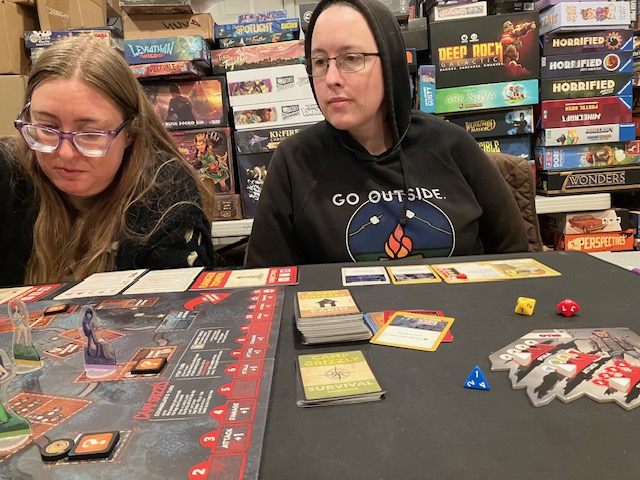
And we definitely saw what “could” be semi-co-op nature of this game!!! We had to leave poor Teresa behind because her movement had dropped to 1! There was no way she could make it to the Finale in time! So, we had to trigger the Finale and “leave her behind”. If this had been a true semi-co-op, Teresa would have just lost. But, like a Horror movie, even if your favorite character dies, you still hope the Counselors will survive! The flavor of this game was cooperative; we aren’t gonna win if we have to wait for Teresa, so we all made the decision to leave her behind! And she was cool … she was just hoping one of us would survive!
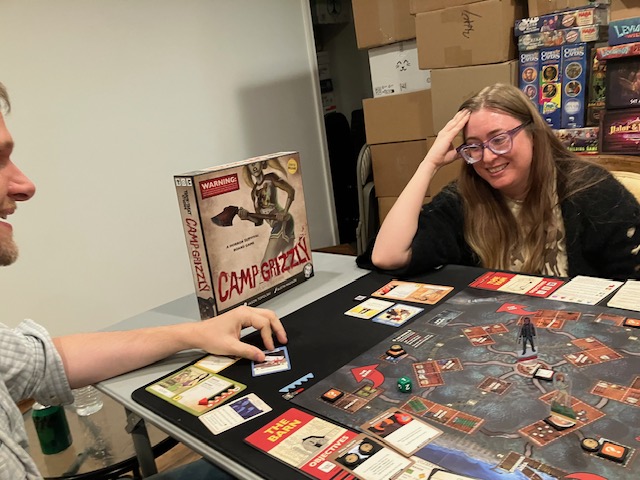
In the end, Sara just barely survived the Finale: both Andrew and I died in the Finale, but since Sara survived, we all won! Hurrah! It was a bummer to die, but we “knew” we won!
So, our game was over in about an hour. The game moved quickly, and was “generally” easy to teach! I did have to look up some rules in the rulebook as we played, but it wasn’t too bad.
I think this game is simple enough that a group could learn this “cold” at a Convention without too much trouble. This probably could have made our Top 10 Cooperative Games To Play at Conventions! It is very simple to learn.
Thematic
Growing up in the 80s, I was forced to watch a ton of Horror Movies with my friends. CC and Sloppy loved the horror genre, and I didn’t. But they outvoted me many times! So, I watched a lot more Horror than I expected to as a teenager. In fact, I was once made to watch ALL 7 Leprechaun Horror movies! (Yes!! There are 7 Leprechaun movies!! I think there are more now)!! It was to settle a bet: Which Leprechaun was the best one? CC liked Leprechaun 1 the best, but Sloppy liked Leprechaun 2 the best! But, of course we had to watch them all! (I liked a different one: Leprechaun in Space the best).
All of this is to say, I was exposed to a lot of Horror tropes! And Camp Grizzly nails the theme! Cheerleaders! Chainsaws! Cameos! The big three Cs! And this game does NOT take itself seriously.
But it nails the Horror theme and tropes perfectly.
Randomness
Jody died very quickly in my first because he had bad luck. C.J. did great and made it to the Finale, but lost because of bad luck. There is a LOT of randomness and luck in this game! You absolutely cannot take it seriously! You may die right away. You may win easily. You may get screwed by Otis or a die roll or a bad card draw or ….
There’s a lot of luck in this game. A lot.
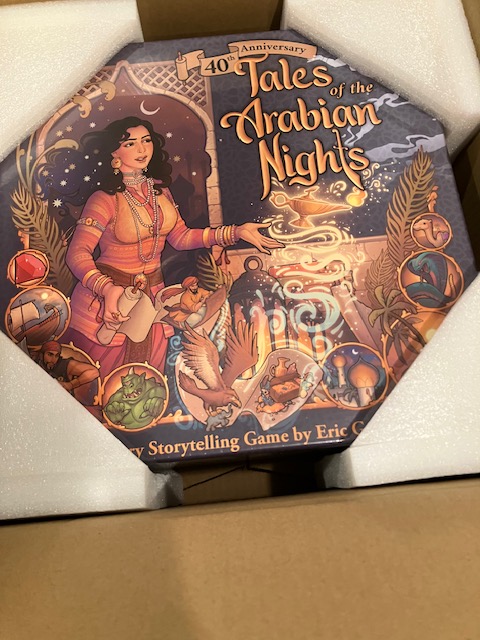
Camp Grizzly reminds me a lot of Tales of Arabian Knights: see our review here. The advice we give when we play Tales of Arabian Nights: Don’t take it seriously; play and have fun! I think I like Camp Grizzly better than Tales of Arabian Nights for one major reason: it’s shorter! A Tales of Arabian Nights game can take 2-3 hours! Camp Grizzly? Dead in 45-60 minutes!
As long as you know this game will random and silly, I think you will enjoy it! Just don’t go in expecting a big thinky thing.
Reactions
Not everyone loved this.
Sara said it was “Fine”. That’s a 6/10 for her. Teresa liked it. That’s a 7/10 for her. Andrew said it was fine, but he’d prefer Tales Of Arabian Nights over this. He’s probably a 6.5/10. Rich liked it the best. Maybe a 9/10?
Conclusion
Camp Grizzly is just stupid fun. It’s random, it’s goofy, it’s unfair, but it nails the horror movie theme and tropes! And it’s only 60 minutes!
If you think you would enjoy the Horror theme and like the idea of a stupid fun game, this game is for you. If you don’t like the Horror theme, Tales of Arabian Nights (see review here) or Tales of the Arthurian Nights (see review here) might be better choices for you: they are both silly story games like Camp Grizzly, but with different themes.
The problem with being stupid fun is that some people will just think this is just stupid … without the fun. My friends were more middling on this than I was: they gave it between 6 and 7. I gave Tales of Arabian Nights a 9/10, so I think I have to give Camp Grizzly something similar: 9/10. Tales of Arabian Nights has more “story”, but Camp Grizzly is over so much faster! Both are pretty darn random.
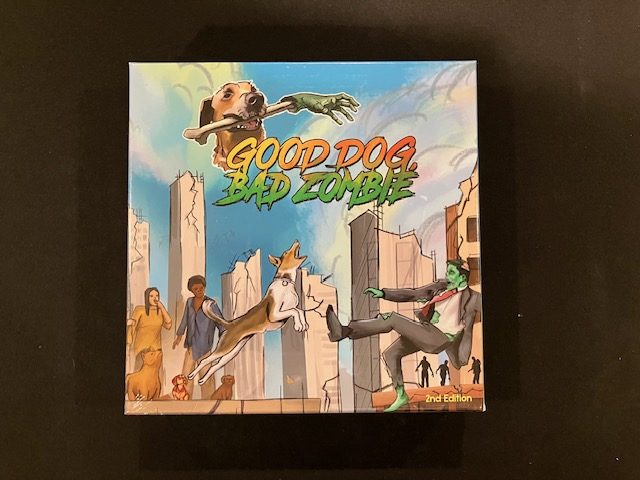
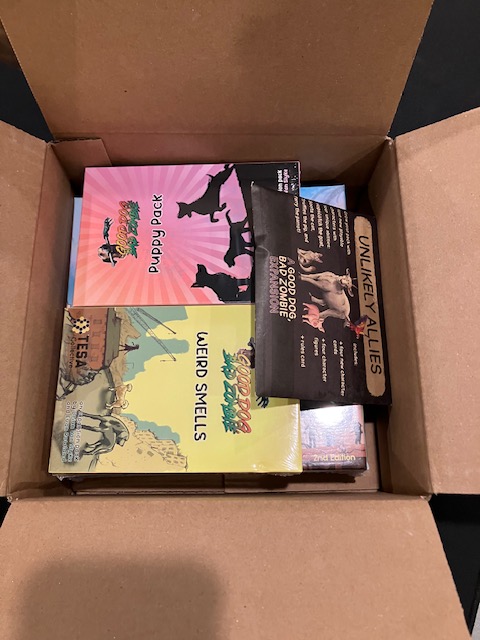
Welcome back to 2026! This is the last of the games on the cusp of 2025/2026! We received Good Dog, Bad Zombie in late December 2025, but we couldn’t get it to the table until January 2026! So, we are considering this a 2026 release for our internal lists!
I have a friend CC who once conjectured that “Adding Zombies to anything makes it better!” He has since recanted this absolute, but it does bring up the question: does adding zombies to a game with cute dogs work?
Good Dog, Bad Zombie (Second Edition) is a cooperative pick-up and deliver game that was on Kickstarter back in May 2024. It promised delivery in March 2025; it was about 9 months late. I had backed this because it looked fun, but I didn’t know anything about the first edition of the game.
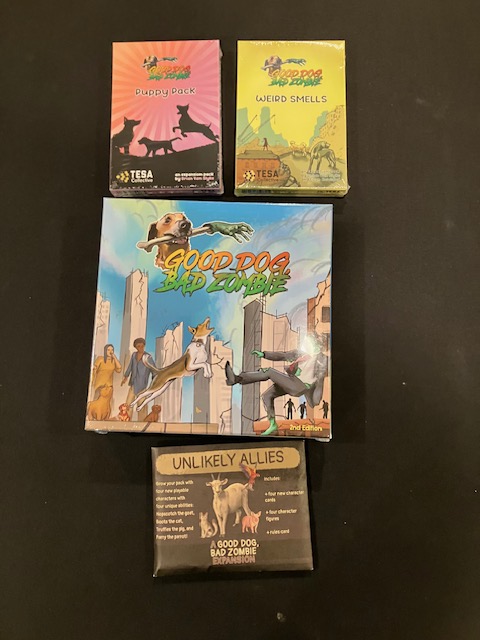
My copy (with some expansions) arrived in late December, but I couldn’t get it to the table until January 2026.
Let’s take a look! We’ll only look at the base game.
Components and Gameplay
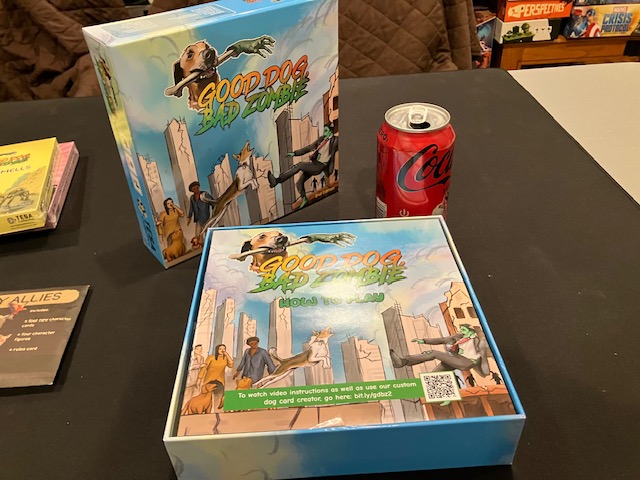
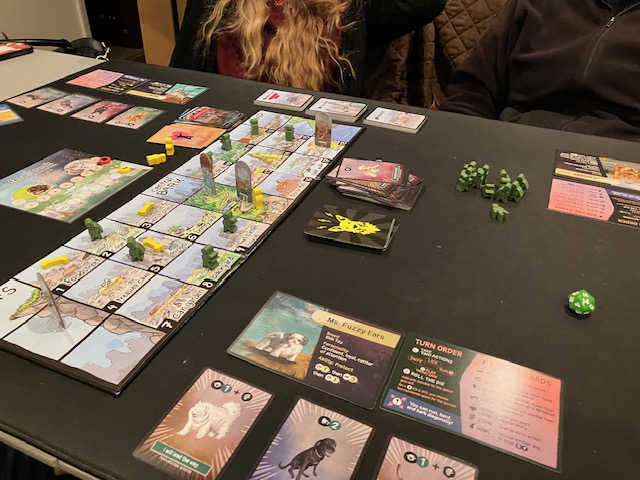
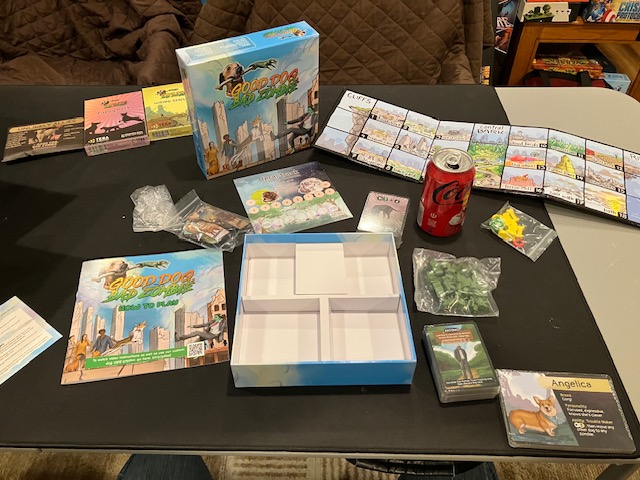
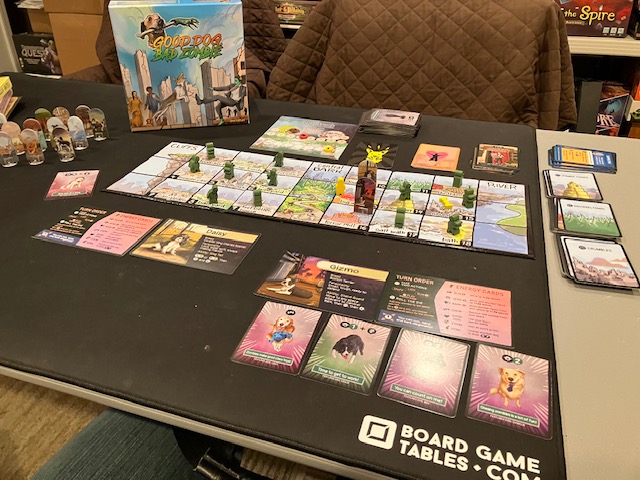
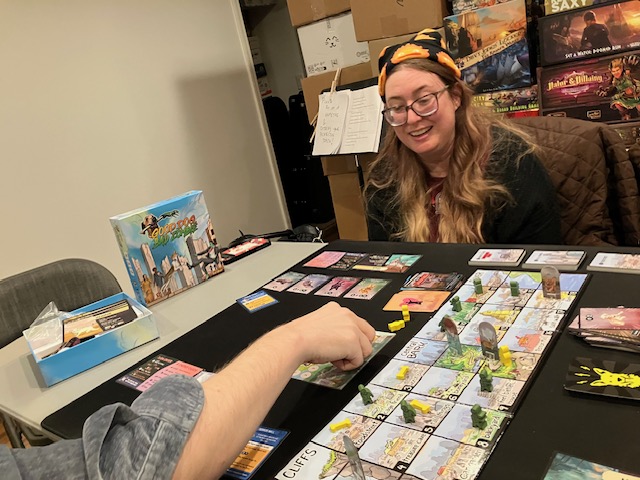
Good Dog, Bad Zombie comes in a smallish box: see Coke can above for scale.
Each player takes the role of one dog saving the humans!
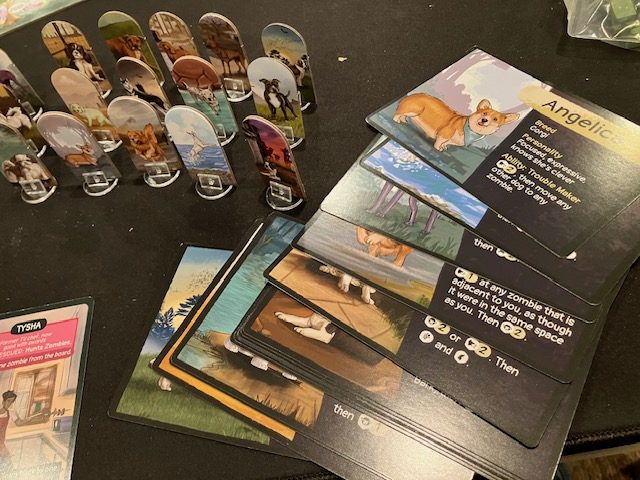
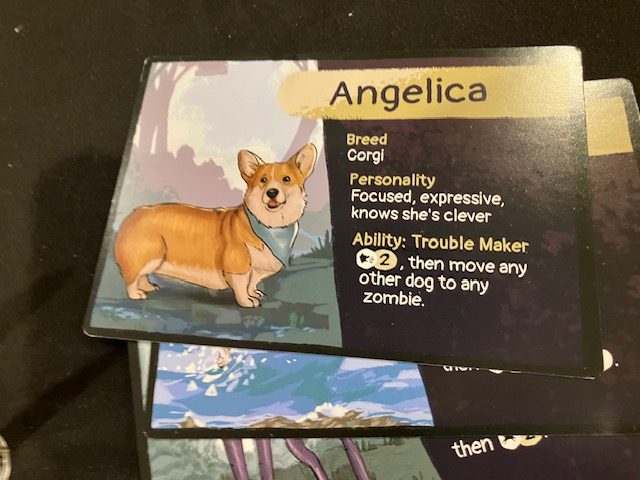
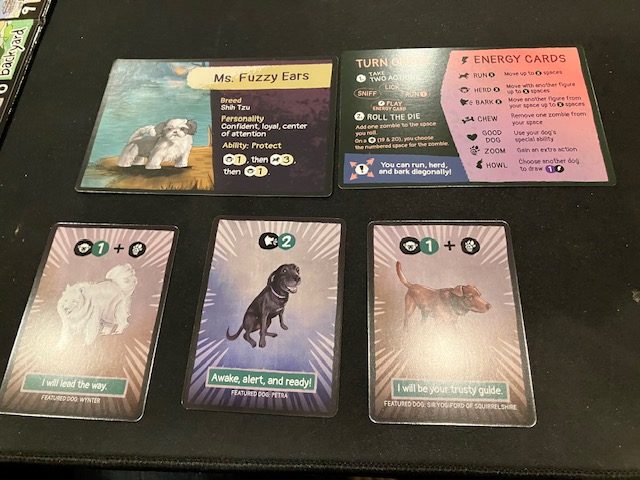
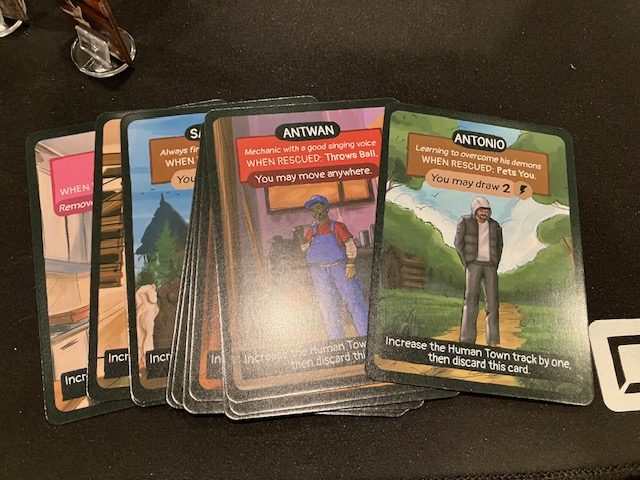
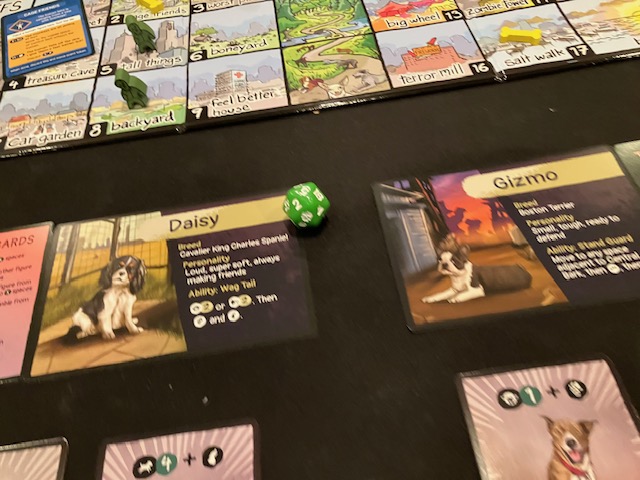
Each dog has its own personality and special powers which make it unique. Interestingly, this special power can only be activated by a certain instant card in the game.
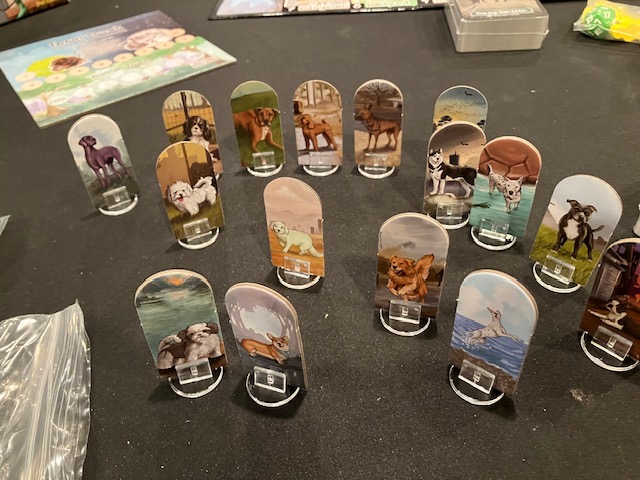
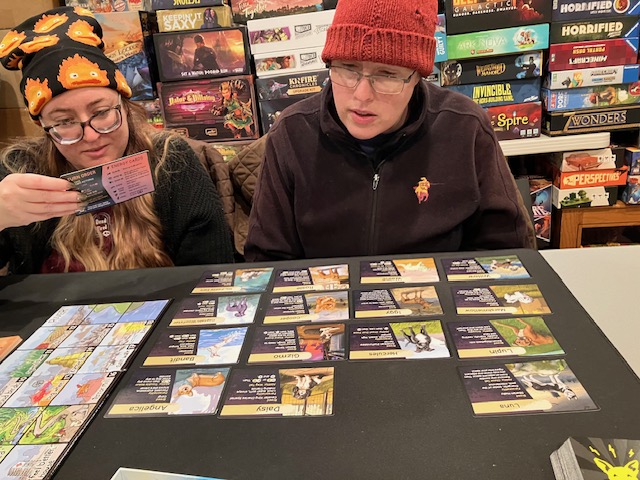
Note that there are a lot of dogs to choose from! Each player gets a dog standee and a sheet.
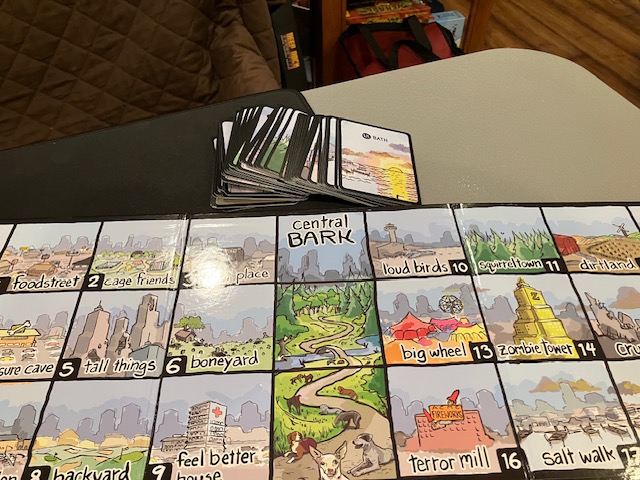
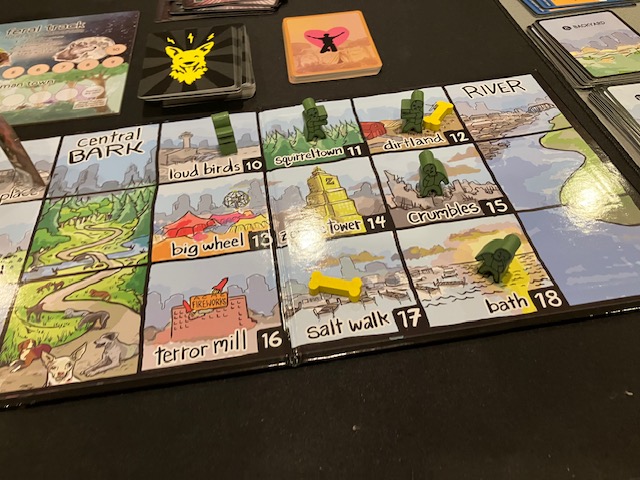
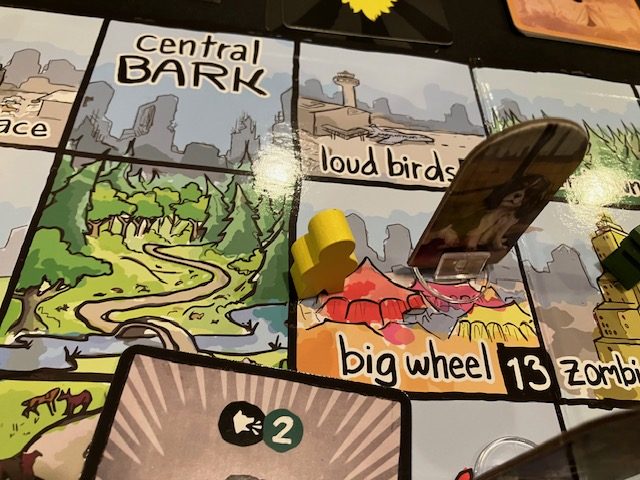
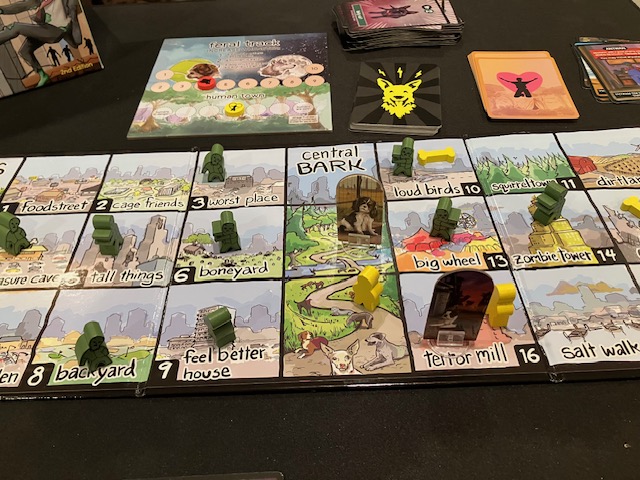
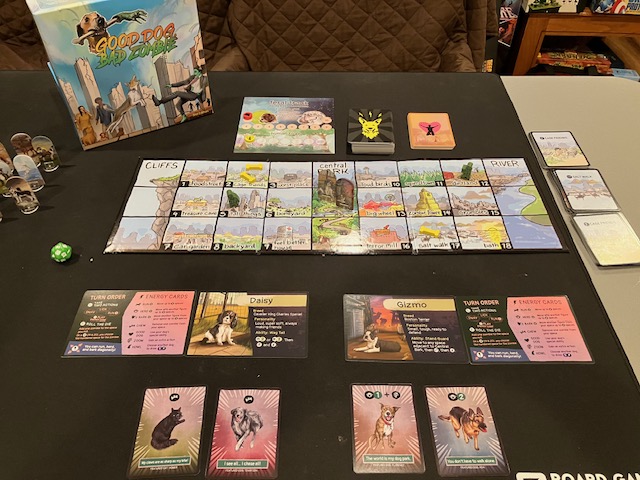
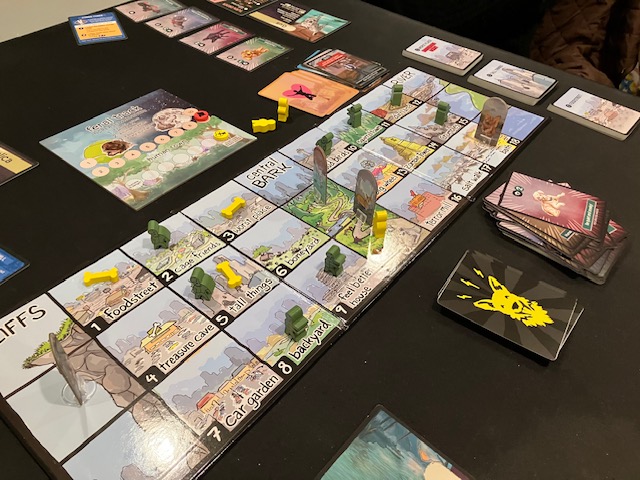
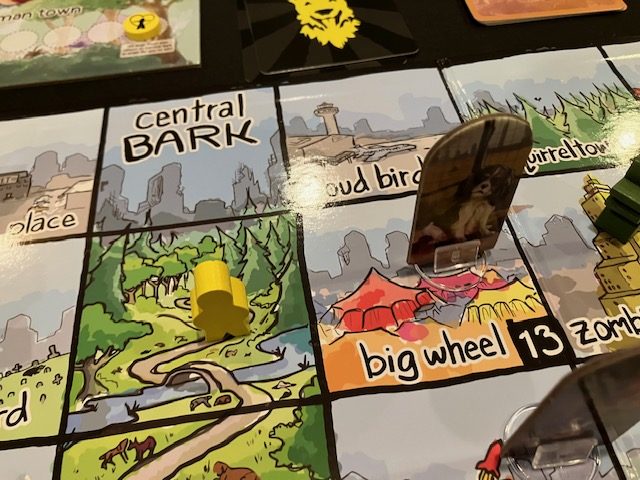
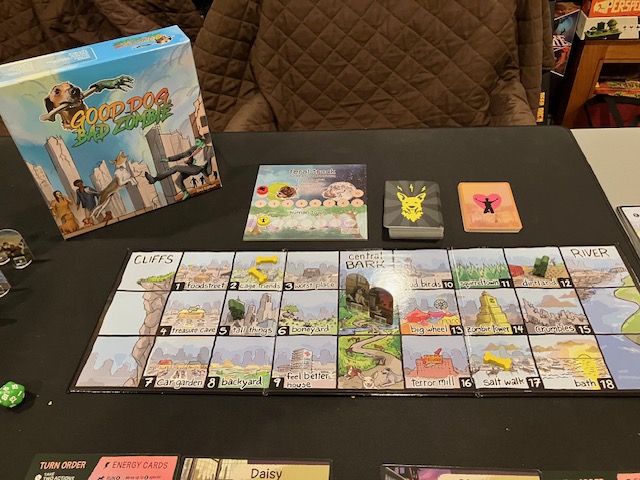
This is a pick-up-and-deliver game where dogs have to find the humans and guide them back to Central Bark (yes, you heard me, Central Bark). See the board above.
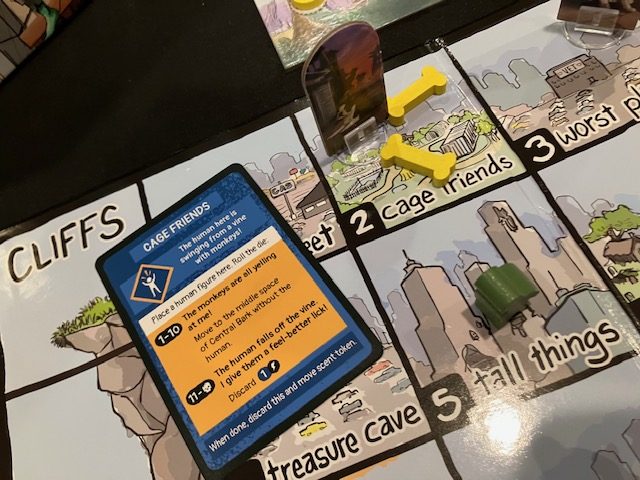
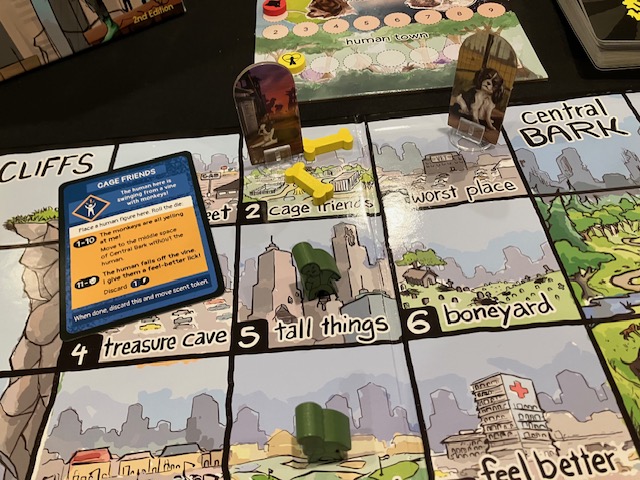
The bones on the map indicate clues about where the humans are! The dogs have to traverse this post-apocalyptic city full of zombies and SNIFF at the locations with bones to find a human!
Once a dog SNIFFS at a Location, “something happens!” The player reads the card apropos to the location and either makes a choice or has to roll a 20-sided die!
Most of the time, the human appears right where the dog was SNIFFING and then the dogs can guide that human back to Central Bark!! See above as the dog and human (yellow) are just one space away! Just make sure to keep Humans away from Zombies!
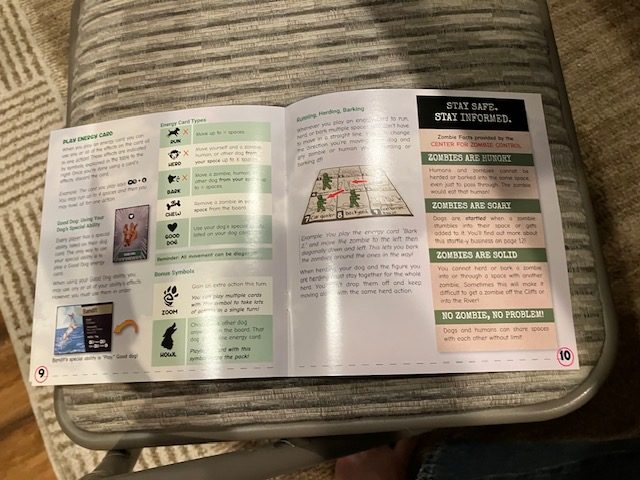
There’s a couple of ways to get the stupid humans to safety at Central Bark! The dog can BARK at them to move (see the BARK card middle above) or HERD them and move with them (see the HERD cards left and right). The iconography is very clear … and kinda funny. The HERD action has a sheep icon and the BARK action has a dog barking; they are very clearly notated.
To get stuff done, each dog has two action per turn. They can RUN (to move one space), LICK (to get two more cards), SNIFF (to look for a human at a bone) or play a card (which allows them HERD, CHEW, BARK, RUN far, and a few other things).
This is a pick-and-deliver game as dogs have to “pick-up” humans and deliver them to Central Bark! It’s kinda funny that you can either HERD humans or BARK at humans to move them … which is a little different than most pick-up-and-deliver games!
If a dog DOES deliver a human to Central Bark, the dog gets a thank-you bonus from the humans: see some above.
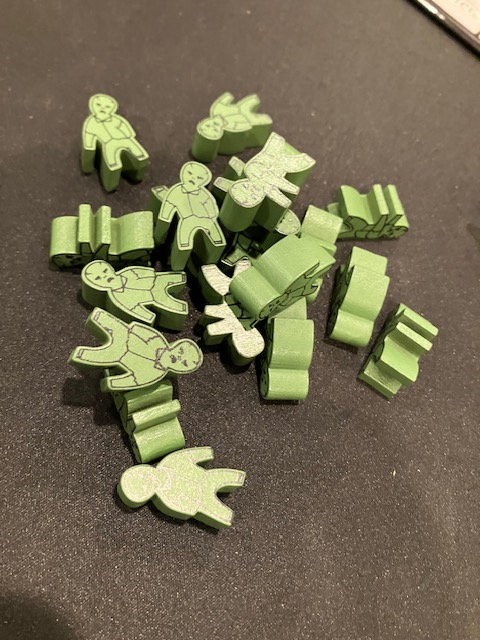
Of course, there are zombies to slow you down. The dogs can, thematically CHEW on the zombies to get rid of them, BARK at the zombies to move them away, or HERD them off the cliffs or rivers to get rid of them!
Unfortunately, every turn brings a new Zombie into town … the players roll the 20-sided die and that’s where a a new Zombie appears! See the numbered locations above!
The zombies really start piling up later in the game (see above). Whenever a new zombie appears on a Location with a zombie, that line of zombies all move over one space towards Central Bark … which may cause a Zombie to move into Central Bark! Now, of course the dogs can deal with the Zombie on their home turf, but every time that happens … the dogs to become more feral!
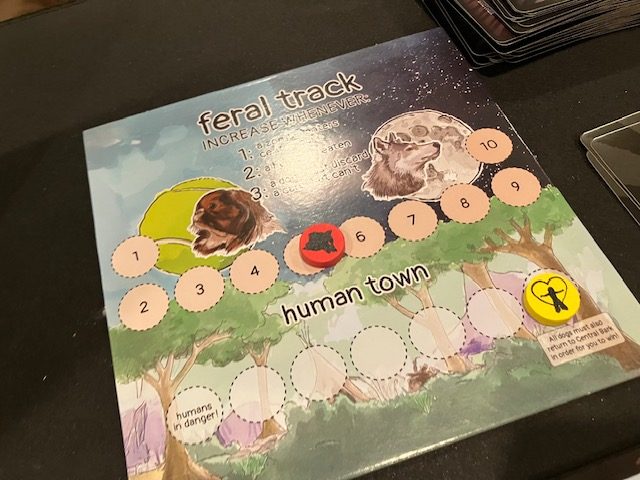
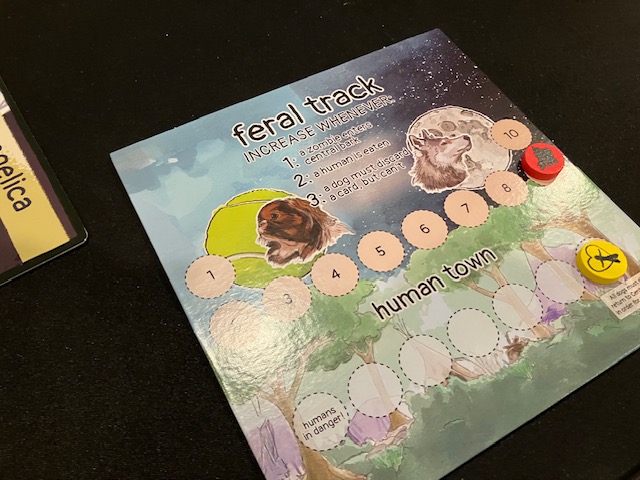
To win Good Dog, Bad Zombie, the doggies need to save 6 humans before the dog pack turns feral! (See Human track above). The Feral Track (also above) increases every time a zombie invades Central Bark or startles a dog (appears on a dog)! Basically, the dogs stop caring about humans if they become feral!
The components are cute and everything is well-notated. Some people may not like the art, but I think the dogs in particular are pretty cute and thematic. The art fits the vibe of the game, which is kinda cute and not-too-horrific zombies.
Rulebook
The rulebook is good.
The rulebook gets an A on The Chair Test: It opens up and stays open on the chair next to me, the fonts are big and readable, and the pages don’t droop over. It’s very easy to consult this rulebook on the chair next to me.
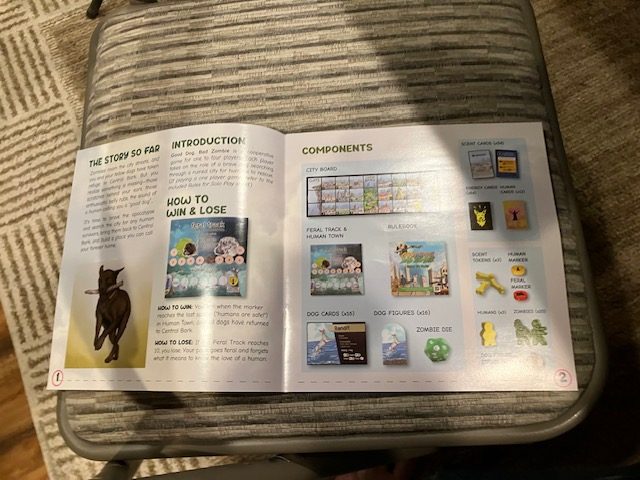
The Introduction and Components are well-labelled; there are pictures with annotating text for all the components.
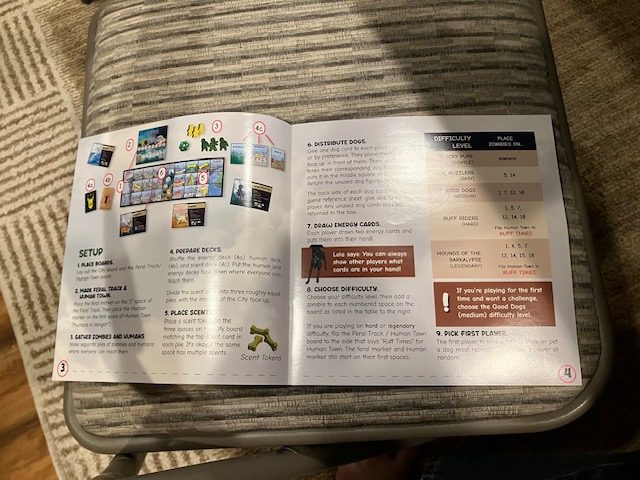
The set-up is well-done: it’s across two adjacent pages, so it’s easy to leave the rulebook open while you set this up.
Everything is well-labelled in the book (even using alternating colors in a table when describing the actions: see above).
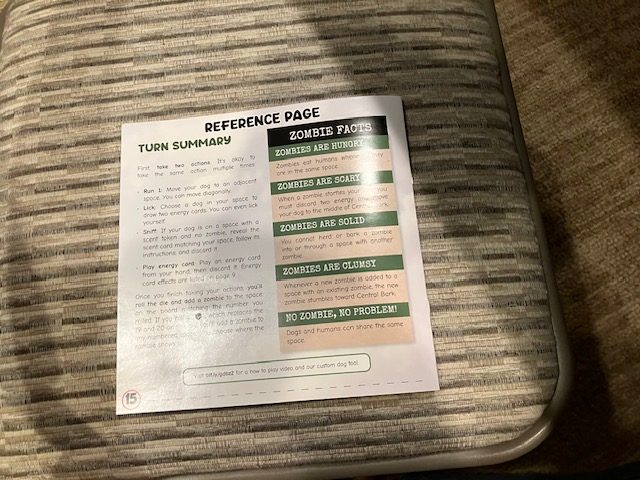
And the rulebook ends with a nice Reference page.
I had no problems with this rulebook. There’s no Index, but this game is simple enough to not need one.
Solo Play
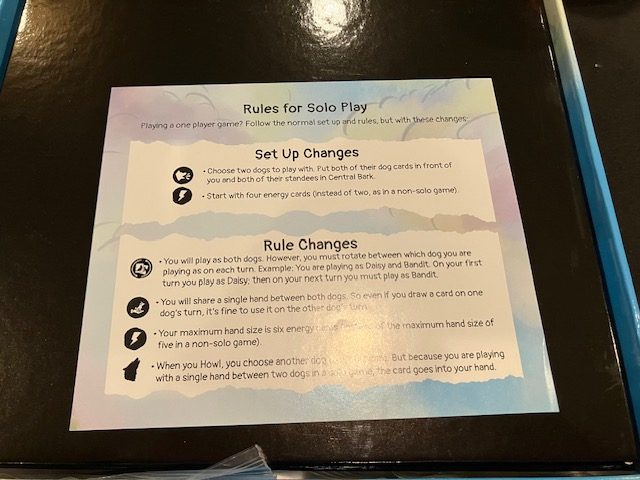
So Good Dog, Bad Zombie does have a solo mode: see above! Congratulations for following Saunders’ Law! See above for a list of exceptional rules for the solo mode.
Unfortunately, it’s not the way I choose to play this solo. First of all, it’s not a true solo mode: you would have to have two dogs in play but then they share a hand. There are a few more exceptions; it’s not a big deal, but I would rather just play this two-handed solo, like a 2-Player game.
One of the purposes of solo play for me is to learn the game game so I can teach the game to my friends. The more exceptions and changing rules there are for the solo game, the less useful the solo mode is for me. In this case, it’s probably easy enough to use their solo mode, but as it is, it’s just easier for me to play solo as two-handed solo: play two 2 dogs, and alternate between them as if I were playing a 2-Player game.
I had a fine time playing this solo. The dogs are cute, the dog cards are cute, and the actions seem very thematic (LICK, SNIFF, RUN, BARK, HERD, CHEW). I learned the game quickly. I didn’t need need more than one game to learn this solo … it’s pretty easy to learn.
I don’t know how often I’ll come back to the solo game; it’s pretty random. That 20-sided that gets rolled at the end of every turn can be brutal and harsh, or just lucky. A few bad rolls and the game can be over very quickly. It might be too light for me for a solo game that I revisit.
I could see maybe, maybe, while I am waiting for some friends, playing a quick game of this solo. It is quick: The box says 45-60 minutes; it seems more like 30 minutes in a solo game.
Cooperative Play
My friends jumped right into this game: they loved the cute dogs. We played a 3-Player and 4-Player game.
The luck turned on us quickly; we started with a simple game, but still just barely won! That 20-sided die just turned against us! If we started even a little harder, we probably would have lost. Again, this is just because we rolled badly when we spawned zombies.
The thing is; we had fun. It’s such a light and simple game and it’s very cute: it’s easy to pull out and teach.
Each player’s turn is fairly quick and there’s not a lot of Alpha Playering. The cooperation comes mostly from talking about what the dogs should do (high-level cooperation), as this is mostly a multi-player solitaire game: each player does their own thing. But there is a HOWL mechanism that allows you to generate cards for other players! This can be critical for saving those dumb humans! “I don’t have a HERD or BARK to save my human! Can someone please HOWL so I can maybe get one???” It’s not a major mechanism, but it does help encourage a little more cooperation.
We all had fun saving the humans.
Things You May Like
Ease of everything!: The game is quick, it’s easy to set-up, it’s easy to teach, it’s easy to play. It’s simple enough to get into quickly, but there is some cooperation in either high-level discussions or HOWLs.
Cute. The dogs components are super cute, especially if you like dogs.
Adding/Subtracting Players: At one point, we just “added” Andrew into our game halfway into it because we just can! The game is self-balancing (as each player always does some good stuff, then always adds a zombie), so you just add a new player and start playing! This is a phenomenal attribute for a game! This means you can play this at a convention, and not worry about adding/subtracting players!
Things That You May Dislike
Some art: Some people may not like the art of the board and think it looks like a 10-year old made it. I liked it and thought it was thematic and fun, but it may really turn some people off.
Randomness: The game has a high-degree of randomness depending on what that 20-sided rolls every turn. You may get unlucky and have zombies marching into Central Bark every turn, or you may get lucky and have the zombies always appear pretty far away. It really depends on how you roll?
Conclusion
I liked Good Dog, Bad Zombie and so did my friends. It’s easy to set-up, teach, play, and tear-down. Even though the game can be a little random, it’s a quick game … so even if you get screwed, it won’t take up your entire night. And it’s still fun.
The two best scenarios for playing this game are probably: 1) An end-of-the-night or “I-am-brain-fried” game. You just want a simple game to play with your friends, and even if you are a little tired, this is a great simple game to get out. It’s cute and fun.
2) Convention Game. You are playing in a situation where people may come and go quickly. It’s very easy to add/subtract people from the game.
Overall, we had fun and would play this again. We’d probably give it a 6.5/10 for solo play, (it’s not as much fun solo) but maybe 7.5/10 for cooperative play.
If you love love love dogs, this probably drifts to an 8 or 8.5/10; the dogs are pretty darn cute.
In this case, adding Zombies to the game with cute dogs DID work.
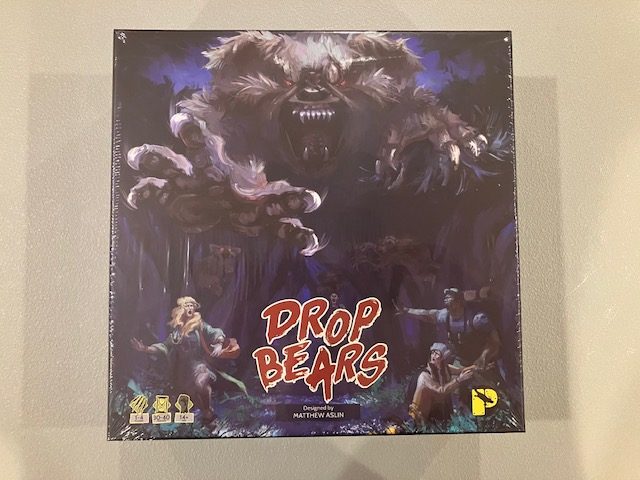
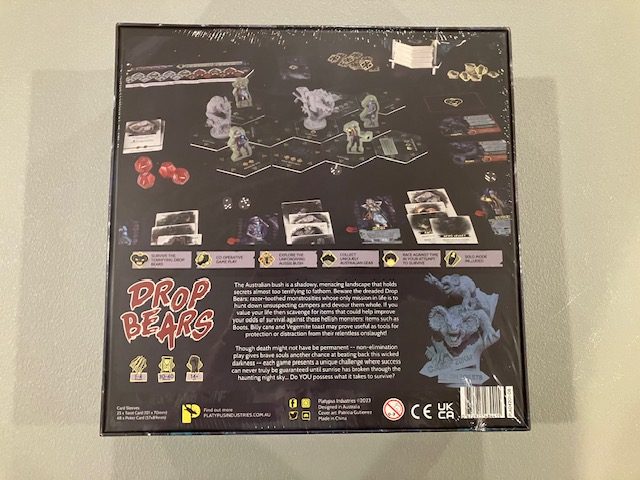
Drops Bears is a cooperative survival (horror) game that was on Kickstarter back in July 2022: see here. This promised delivery in April 2023, and it just arrived ay my house a few weeks ago in late August 2025. That’s right, it’s over 2.5 years late! Ooof. Even for Kickstarter games, that’s not great. But they did deliver! So, kudos for that!
This game is sort of an odd duck; it calls itself a survival game. I’d call it more of a horror game where survival is a big component!
Was this worth the wait? Let’s take a look!
Unboxing and Gameplay
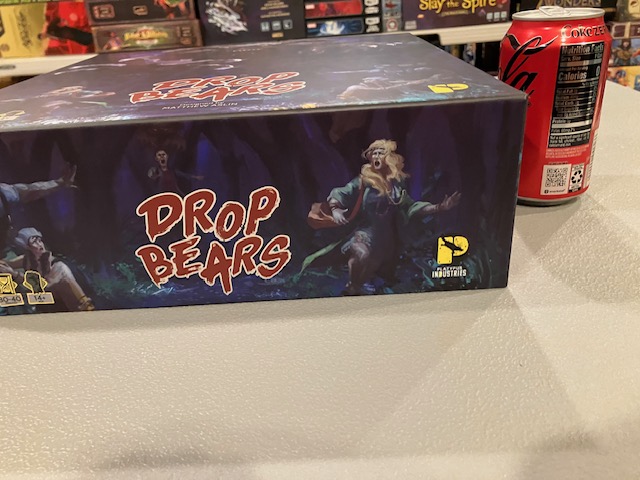
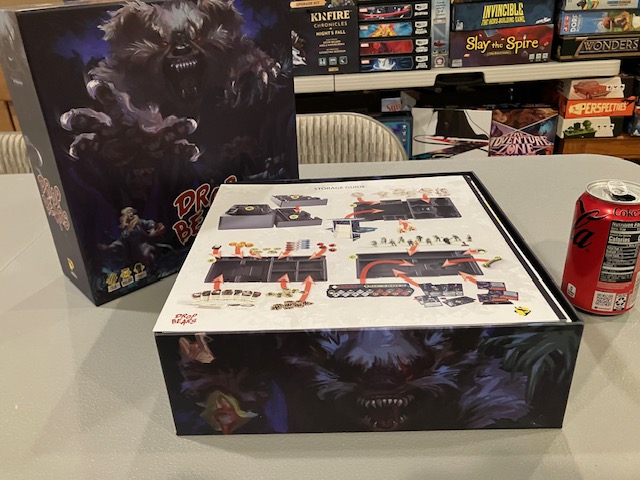
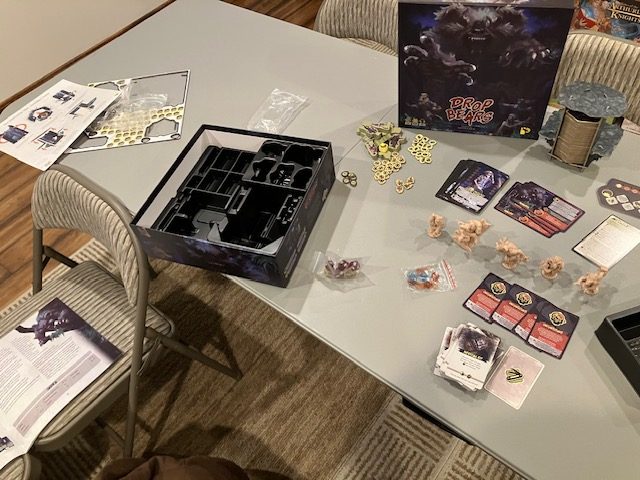
This is a pretty thick game, but it has the Ticket To Ride box profile. See above for scale.
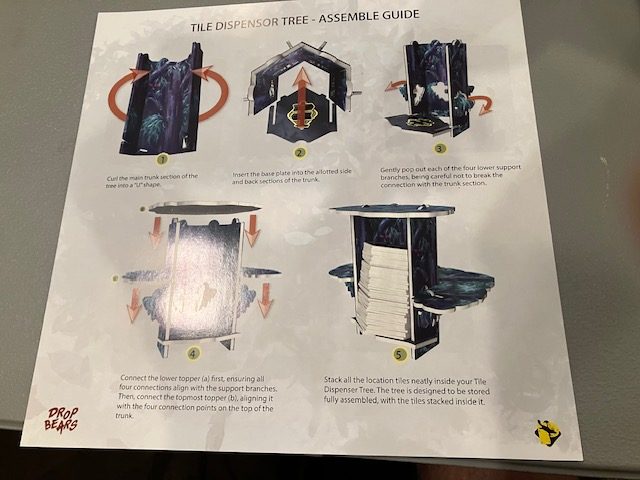
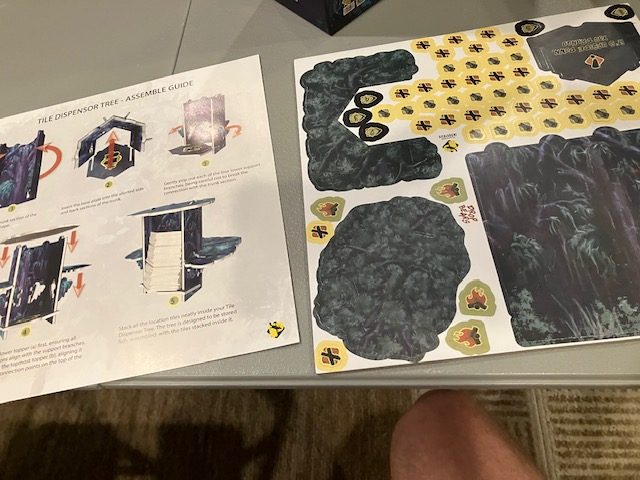
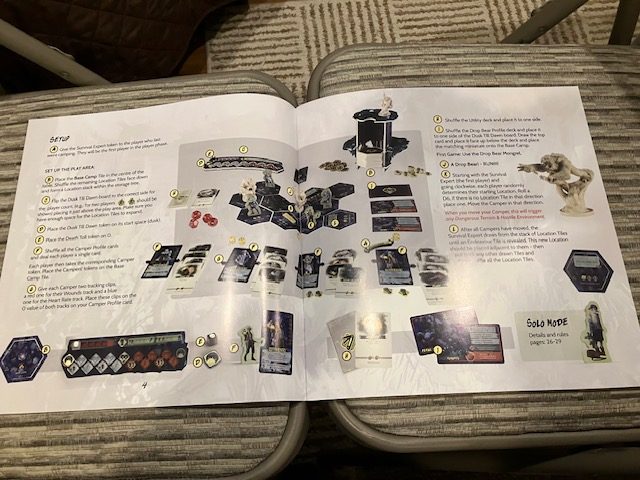
The first thing you are met with is the “put the box back” and “build sheet”.
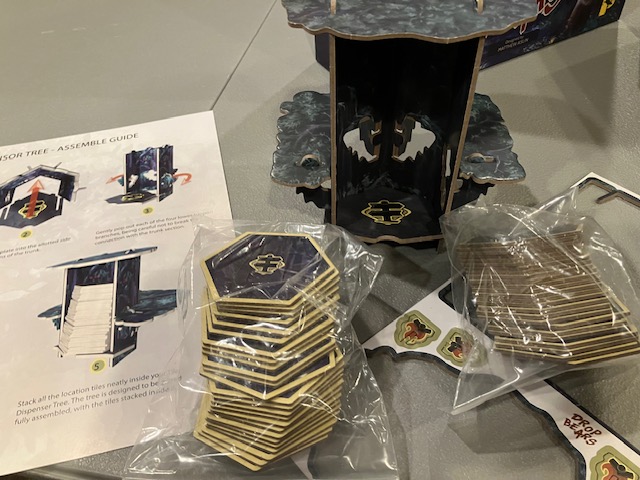
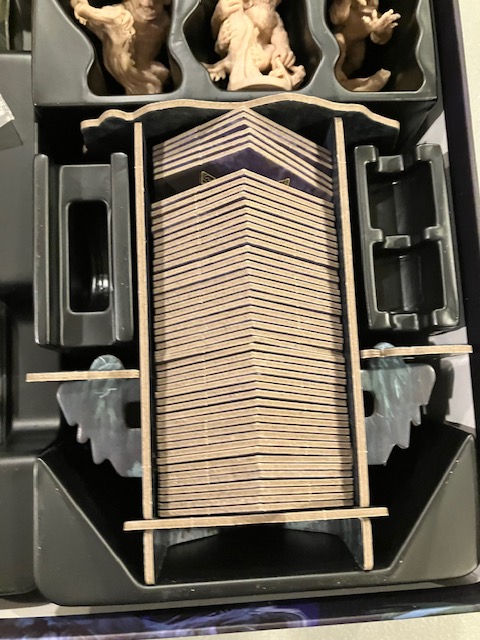
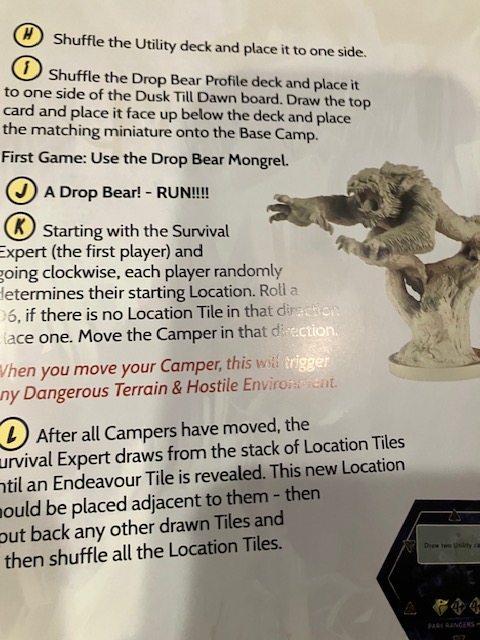
Why is there a “build sheet”? You have to build the little tower that holds the tiles. Oh yes, this is definitely a tile-laying game. Sort of (see below).
Building the tower wasn’t too bad; it wasn’t nearly as hard as building Sauron’s Dice Tower from Lord of the Rings: Fate of the Fellowshipfrom a few weeks ago!
It fits pretty well back into the box (but see below).
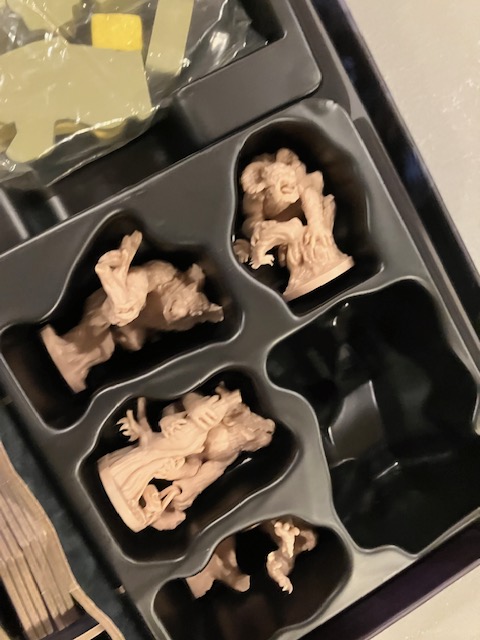
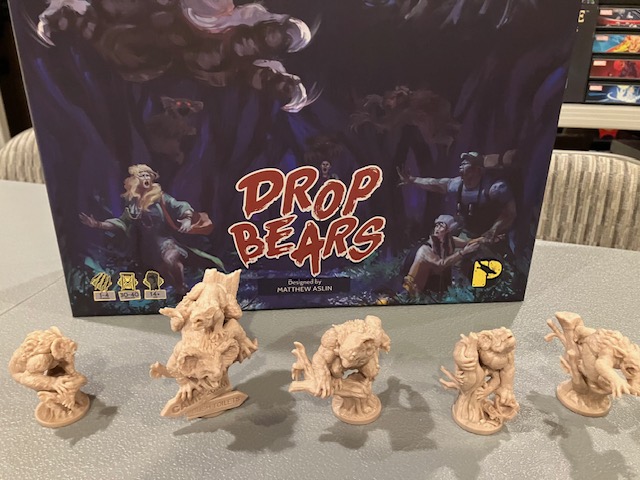
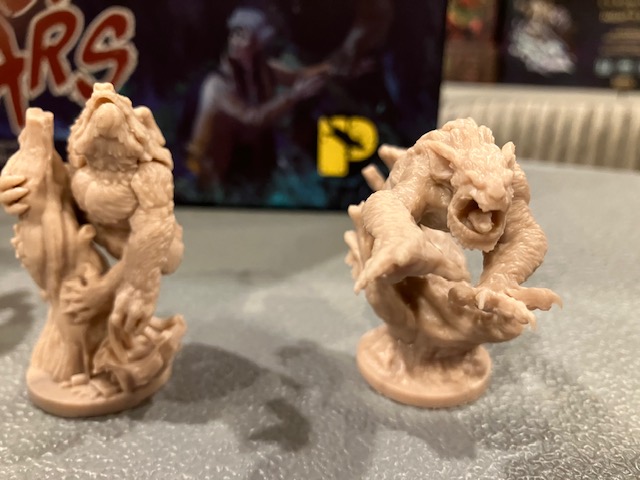
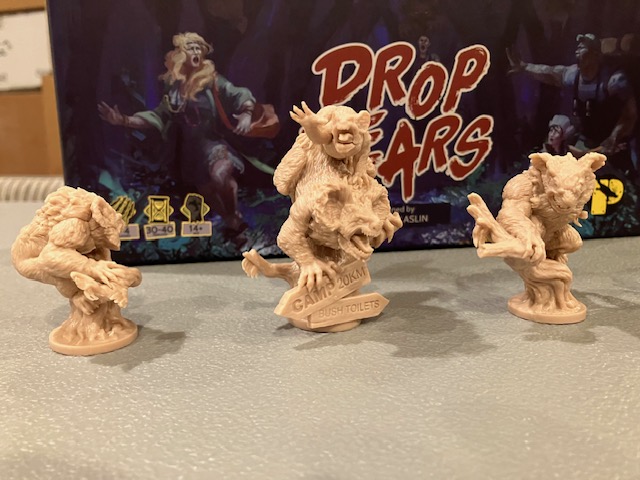
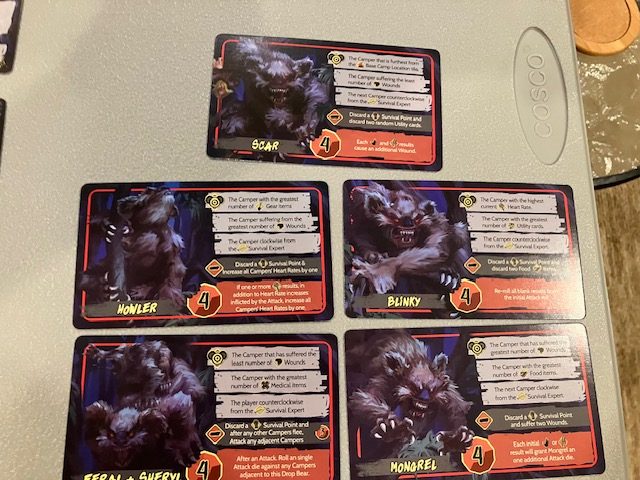
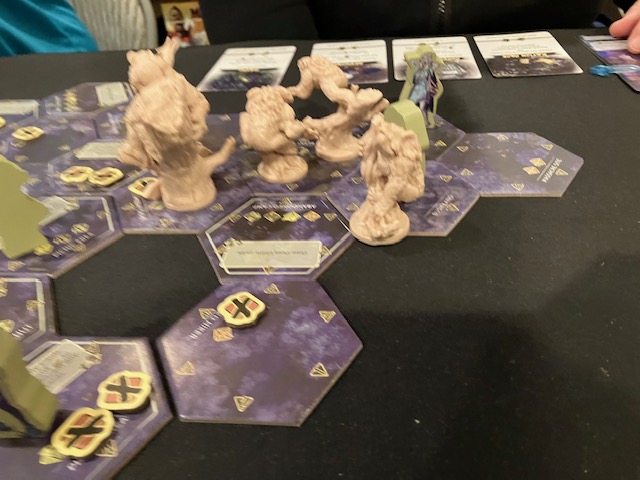
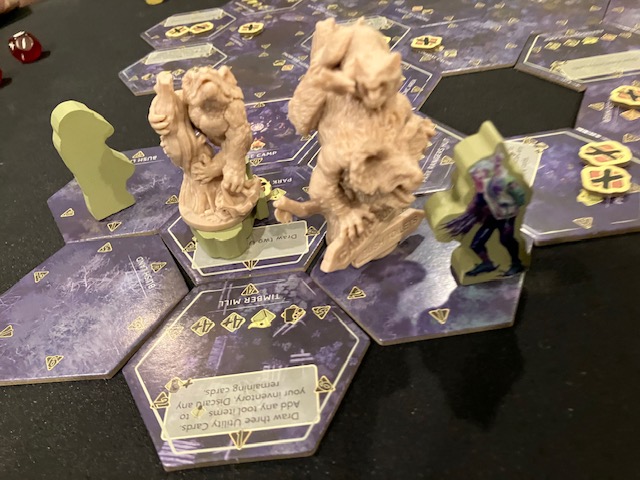
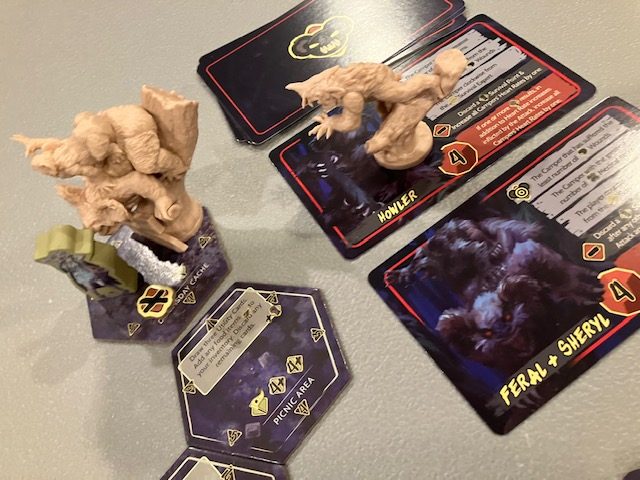
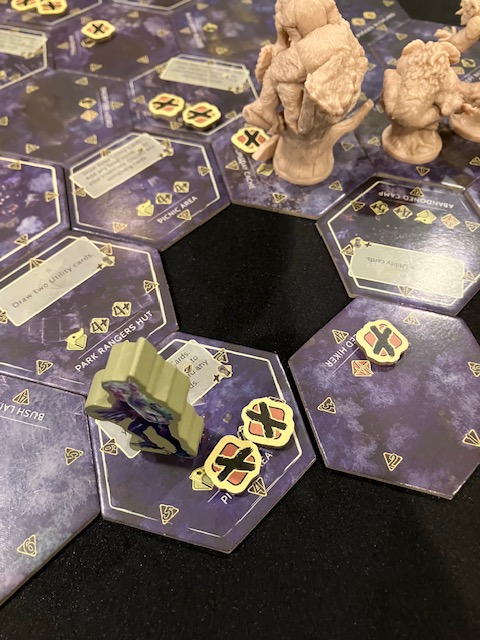
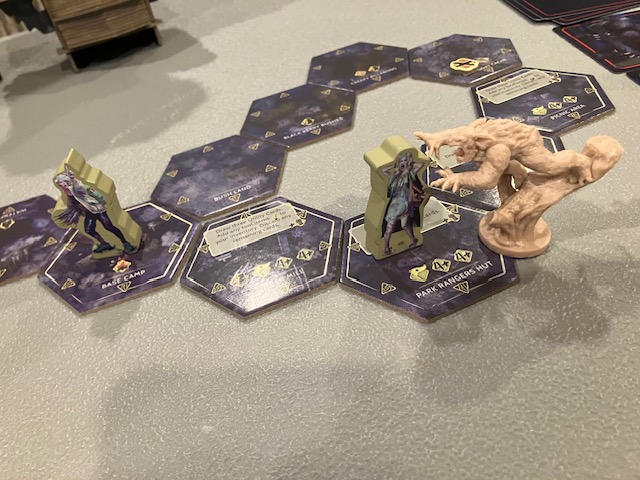
The Drop Bears are the horrific creatures you are fleeing from in this game!
These miniatures are utterly fantastic. I love them so much!
The miniatures are by far the coolest thing in the box. I don’t even feel like you have to paint them; they are pretty terrifying as they are!
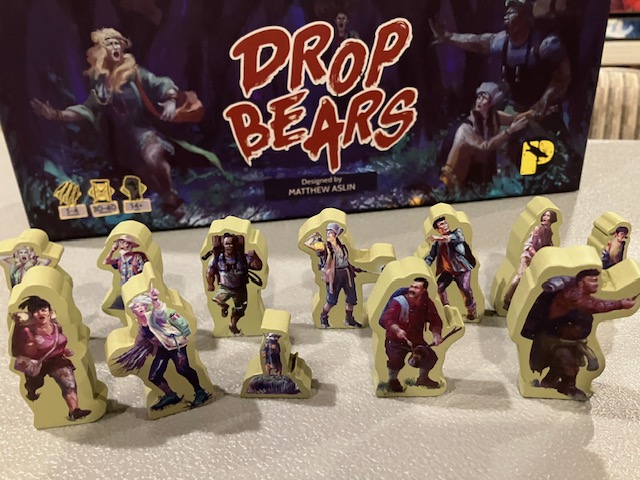
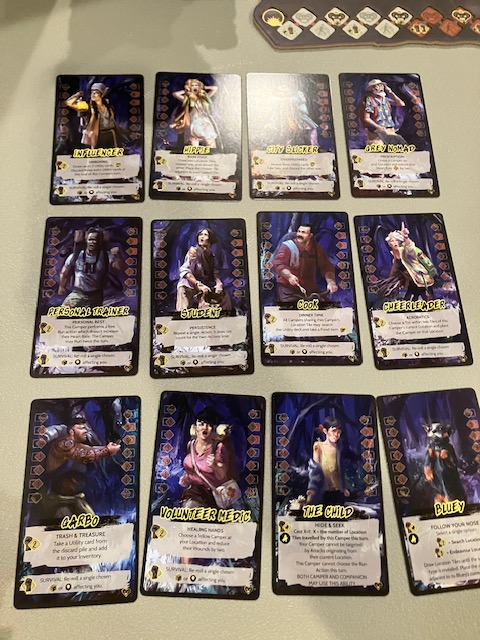
The players each take control some camper: see above and below.
There’s 10 total; 2 of them are for solo play (the companions).
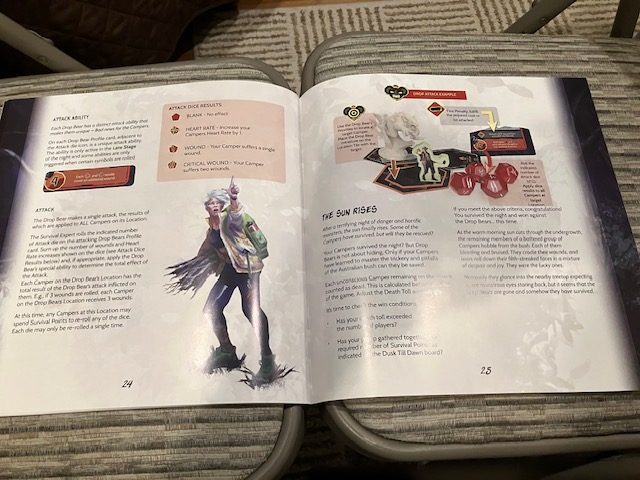
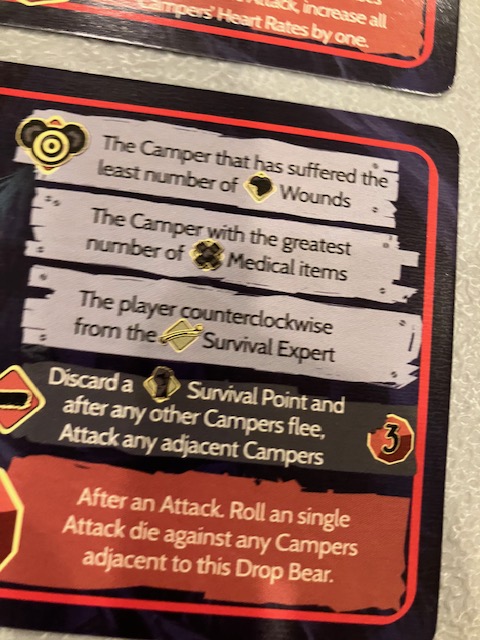
Players run away from the Drop Bears; each bear has its own flavor/character. And by flavor/character, I mean ways it eats you up!
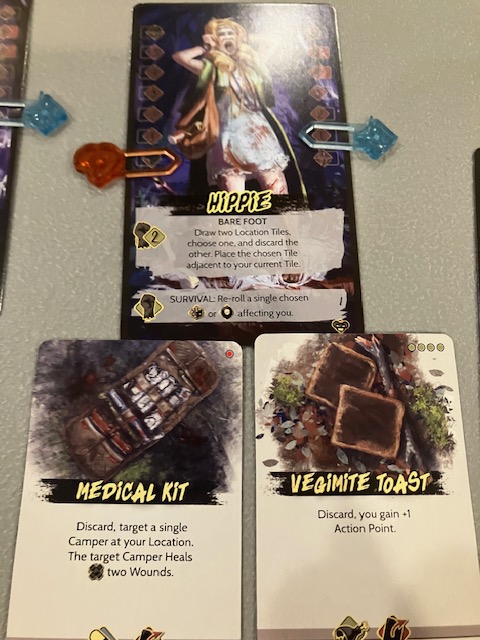
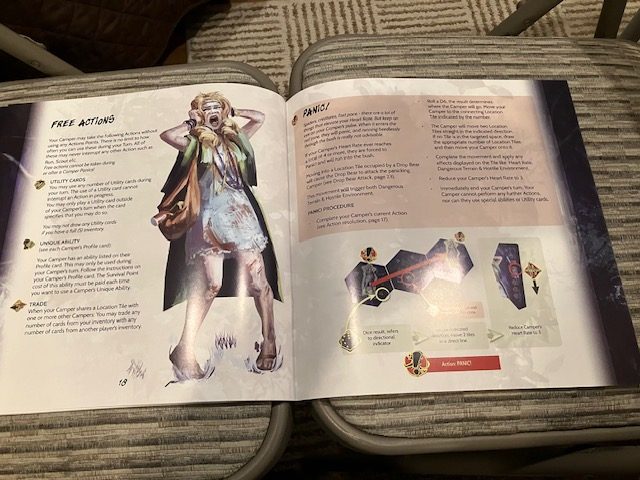
Players have to keep track of health and heart-rate; lose too much health and you die! Have your heart-rate go too high, and you panic/run away! Luckily, you have equipment (like the very Australian Vegimite Toast) to help the players.
Players explore the tiles and have to survive the Drop Bears until Dawn.
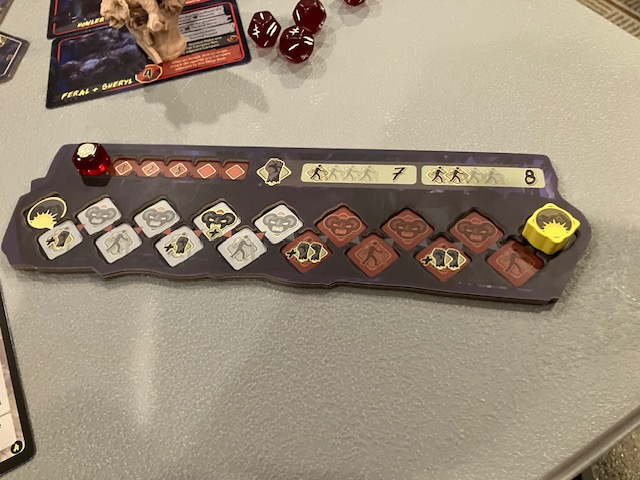
There’s a little counter showing the progression of the game: see above! Campers act, bears act, campers act, bears act, etc etc … until Dawn (the end of the track). If the players don’t die “too much” and they have enough survival points (to survive the Australian bush in the day), they win! Otherwise, they lose!
It’s an interesting looking game! See above!
Rulebook
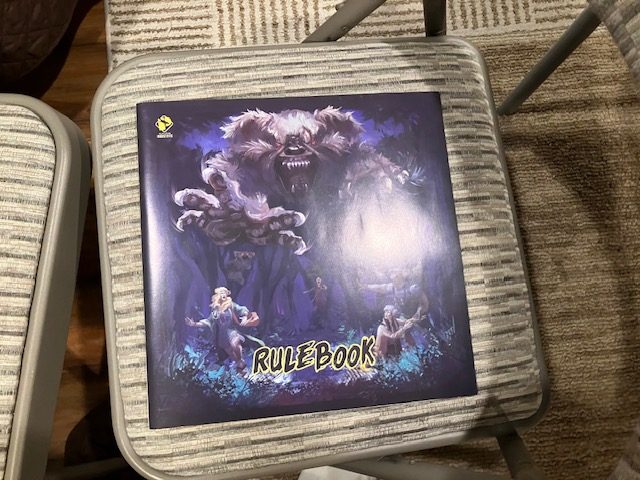
This rulebook straight-up fails the Chair Test! It’s waaaaay too big and droops over the edges! There’s no way I can easily look stuff up on the chair next to me!
However, you can always use the “two chair” workaround; at least then it’s usable.
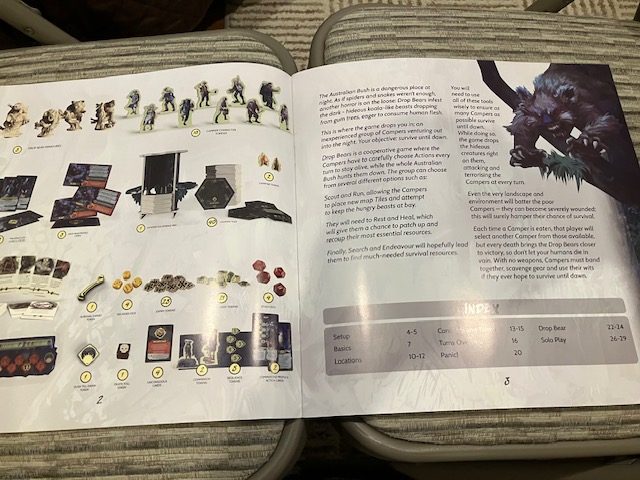
The Components page is very nice and shows all the components (except for the arm?)
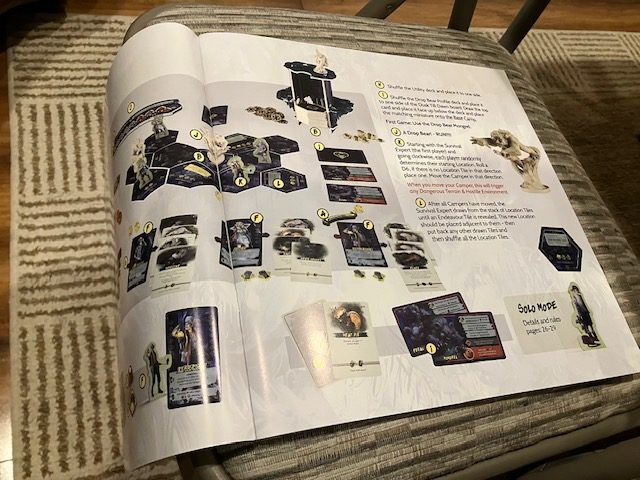
The Set-Up page works well; it’s on two pages exactly, so I can set-up the game without having to turn the pages! Good job!
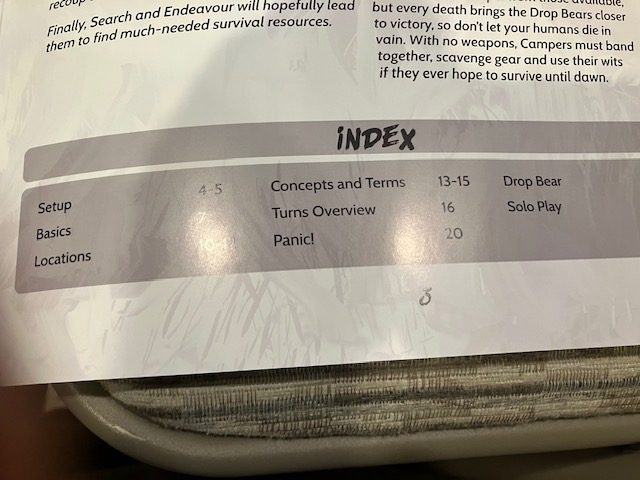
The “Index” on page 3 is NOT an Index; it’s a Table of Contents. (An index is sorted alphabetically by keywords with references/page-numbers/hyperlinks to appropriate pages. A Table of Contents is sorted by page numbers, listing the sections of the rulebook in order). This mistake put a bad taste in my mouth, but it’s probably just me.
This rulebook was okay; it had big fonts and lots of pictures with some examples. My biggest complaint about the rulebook was that it was too big; too many rules and the form factor was too big.
It does feel like like all the rules are here.
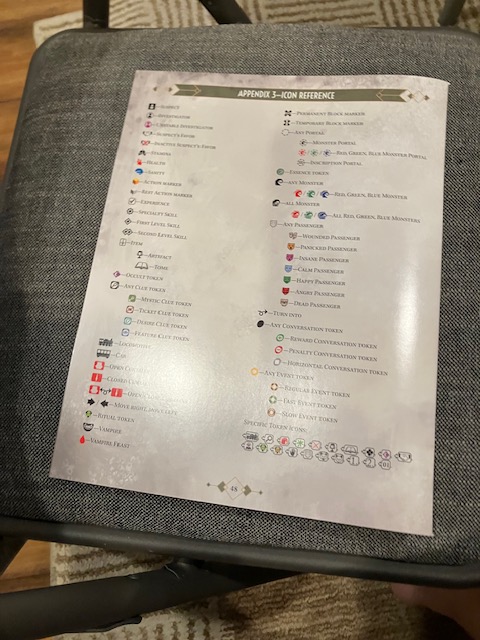
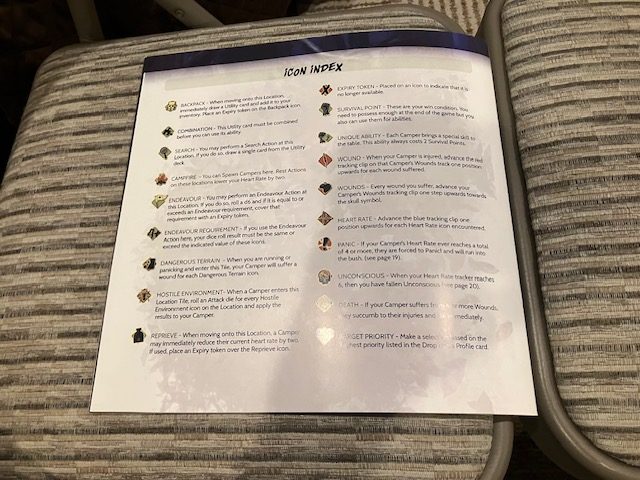
The rulebook also ends with a list of Icons! Thank you!
There’s some good stuff to like in this rulebook; big font, good components and set-up, icons on the back, but the form factor and just general size of the rulebook was too big.
I learned the rules from the rulebook. It seemed to work, but it is long and daunting.
Solo Mode
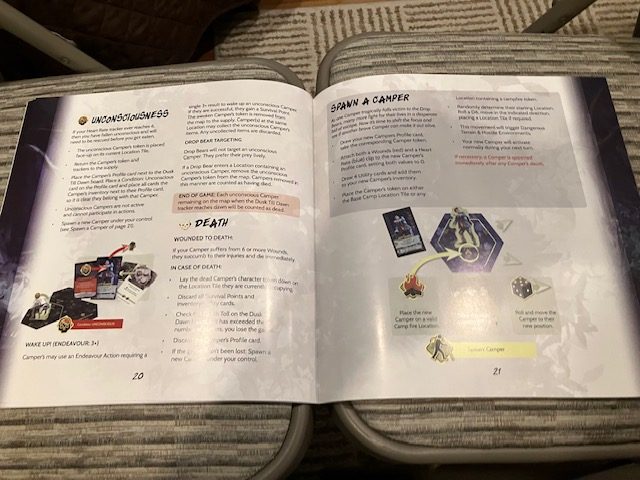
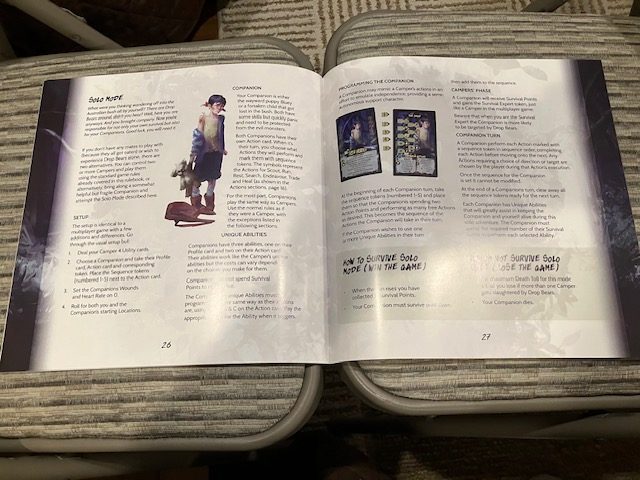
So, there is a solo mode (thank you for following Saunders’ Law)! In fact, there’s multiple solo modes! Huzzah! The solo rules are presented on pages 26 and 27.
You can either play 2-handed solo (control two campers and just play the game as normal), or have one camper and a companion. I am am gun shy about using “alternate” solo rules, (especially after Lord of the Rings: Fate of the Fellowshipsolo rules infuriated me), so I went ahead and played 2-handed solo. Since my next activity is to teach the cooperative game, I prefer to learn the game WITHOUT too many exceptions! Learning it 2-handed is the best way to learn how the game is meant to be played cooperatively.
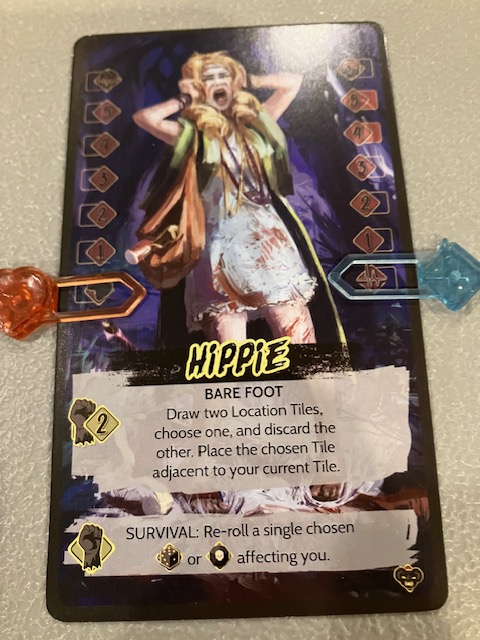
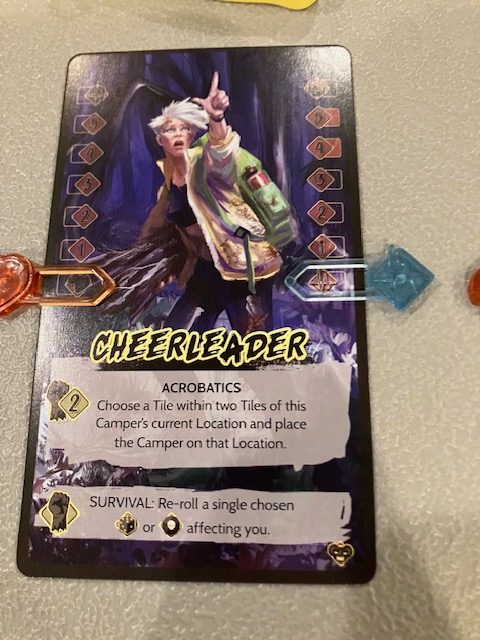
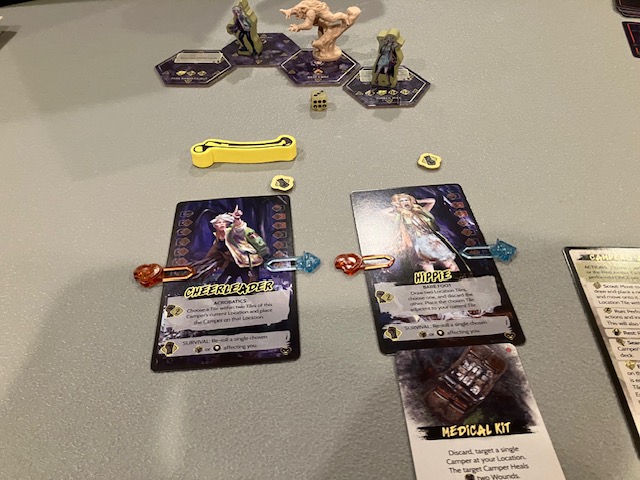
I ended up playing the Hippie and the Cheerleader.
It was fine. It taught the game. I survived the bears. And it was quick.
Cooperative
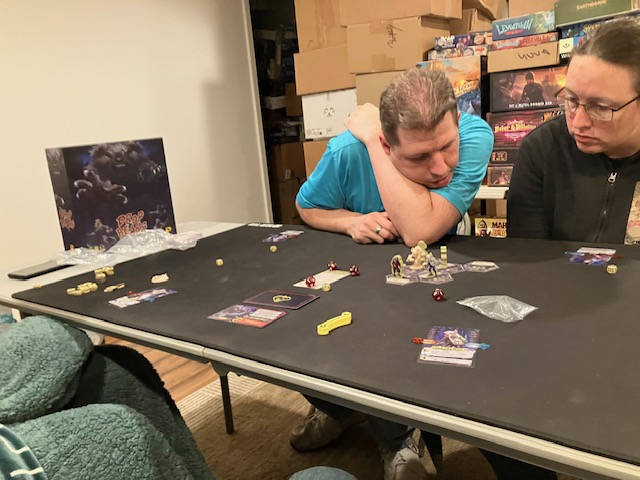
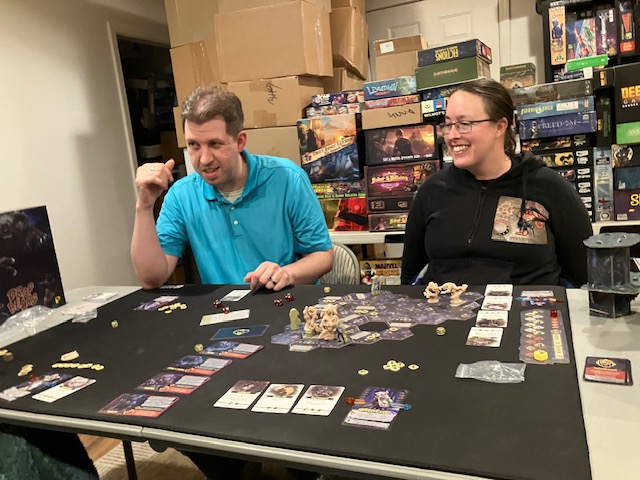
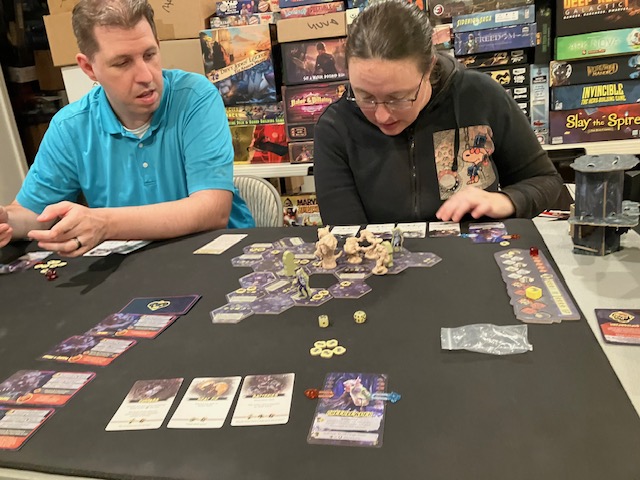
We played a 4-Player game.
It moved pretty quickly.
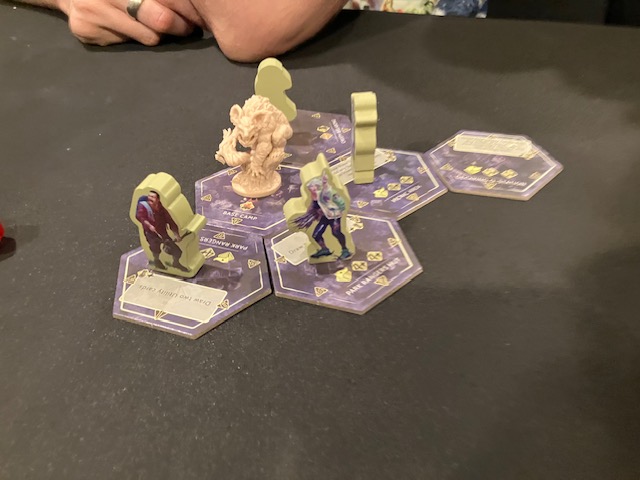
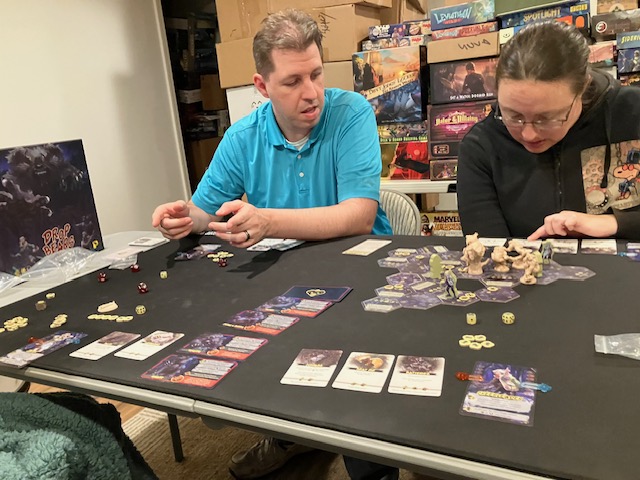
At the end of the day, it didn’t feel very cooperative. A few times, we cooperated so that we’d end up on a search space so we all benefited, but generally, each player wants to be as far as possible from the others! Multiple players on a single space will ALL get attacked, so it’s really in everyone’s best interest to be separated! Many cooperative activities (sharing, swapping stuff) have to be on the same space … and it’s hard to stay close. So, we can’t cooperate very much. We kind of just did our own thing and stayed away from the others.
The game moved quickly though; we enjoyed how quickly the game does move.
Vibe
This is a horror movie. It’s a horror movie with tile-laying and panic-ing! But, everyone will get eaten by bears. Seriously, you will get attacked by a bear almost every round or every other round. You have to deal with it! It feels like a horror movie!!! No matter what you do, YOU WILL GET ATTACKED. And at least one person WILL PROBABLY DIE. But’s that okay! This is a horror movie! And that’s what happens in horror movies.
So, you can’t play defensively and just run away. The Drop Bears will drop on you and will attack you many many times.
This game really nails that horror movie vibe.
Randomness
There is a lot of randomness in this game.
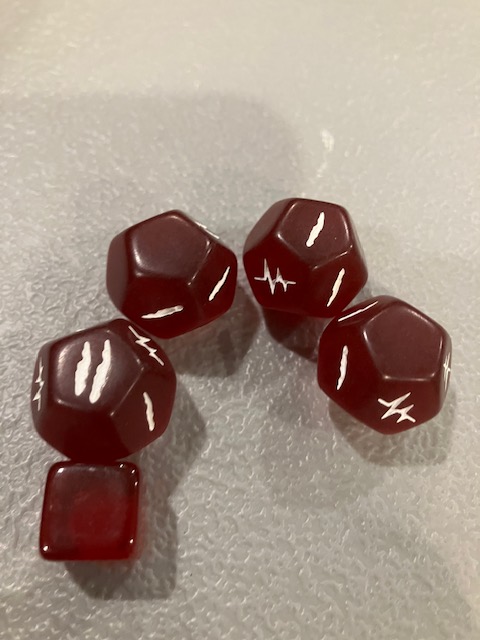
Axis 1: Attack dice … when the bears attack you, you typically have to take 4 dice of rolling. You may get light damage, or even nothing, or you may get ravaged! You can reroll dice with survival points, but it’s just a reroll, not a guarantee. And you need survival points to win!
Axis 2: Search dice! When you go looking for items at locations, you have no idea how long it will take to find something! Maybe only two turns if you roll well! Or never if you roll poorly! Let’s be clear, these items can make a huge difference in surviving.
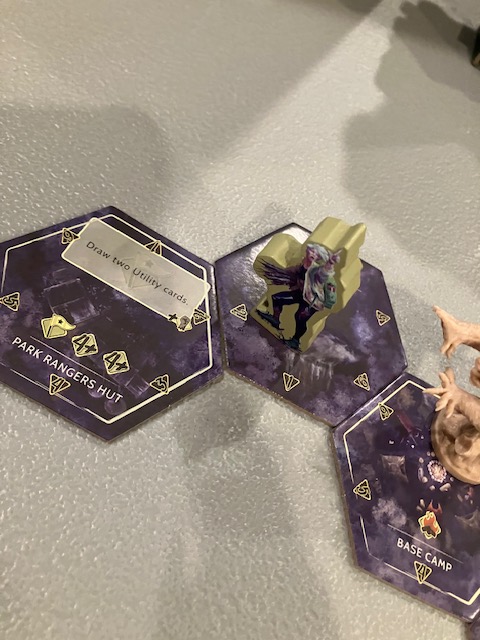
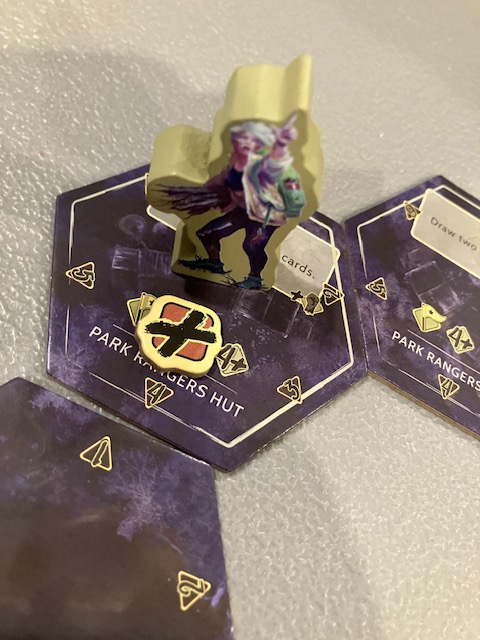
Axis 3: The tiles you when you “Scout”. If you go a direction with no tile, you randomly pull a tile and get a random tile! You could get a Park Ranger’s Hut or something bad! There is no “look” option without moving! If you want to expand the map, you must just move to a random tile and hope it’s good!
There’s only 3-axes of randomness (we saw arguably 5 axes in Lord of the Rings: Fate of the Fellowship), but the game just feels a little too random. Maybe that’s okay because the game is short and it is very horror movie vibey!
What I Liked
The miniatures: The minis for the bears in this game are SO COOL.
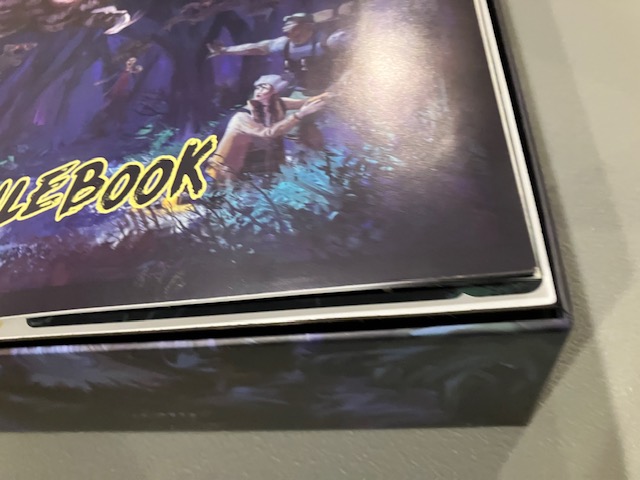
Art Vibe: I don’t necessarily love this art, but I think it fits the vibe of the game. That cover (see rulebook above) think presents an accurate “feel” for the game: This is a horror game!
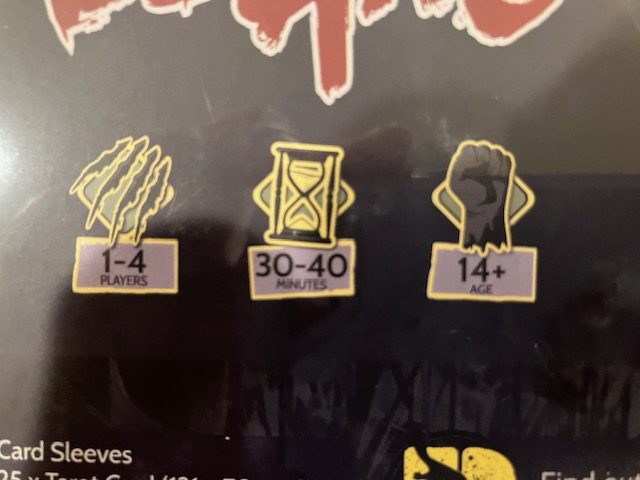
Quick: Once you know the game, it’s pretty quick. That 30-40 Minutes is pretty accurate. And it doesn’t take “too long” to get the sense of the game.
Disambiguation: The cards for each bear do an EXCEPTIONAL job of indicating who they will attack when they drop. Me and my friends all liked that the rules were very clear on WHO got attacked!
Death: It’s sorta funny that “even if you die”, you can just re-spawn and keep playing. The game “expects” death, and that’s sorta funny. I mean, it’s a horror movie, right?
What I Didn’t Like
Set-Up: the set-up is a little clunky, especially at step J/K! I had to kind of figure out what that meant, which meant kind of paging through the rulebook. It felt like this could have been simplified.
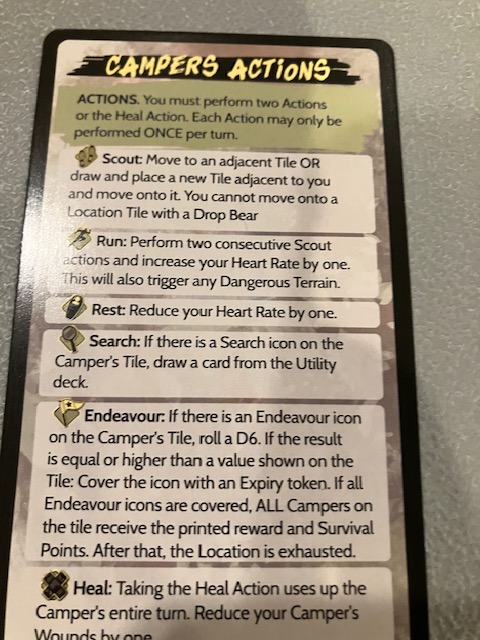
Can’t Repeat Actions! Eh? You only have two actions per turn, and you can’t do the same one again? YOU WILL FORGET THIS RULE because it doesn’t seem very thematic!!! Why can’t I search twice? Why can’t I run twice? Whaaaat? This rule seemed … dumb and athematic. Yet, I don’t think I can offer a house rule because I really do think this game was play-tested with this “no repeat” rule, so I feel like ignoring this might break the game.
Only 1 Actions Card??? WHY is there only one Camper’s Action card??? In a 4-Player game, this was very annoying. The best thing I’ll say is that the Camper’s Action card became our first player token because we passed it around on players turns!! It seems dumb there weren’t more of these.
Why Can’t You “not do anything”? The rules are very clear; you MUST do two actions. You can’t just “do nothing” on your turn. And why the heck not? That seems SO ATHEMATIC!!! How many horror movies have you seen where the chased just stops to let the bad guy run by? Or tries to hide? We just worked around this by allowing a “Heal” or “Rest”, even when you were all full up. (This exception seems dumb).
The Tree doesn’t QUITE fit: The tile-tree doesn’t QUITE git back in the box; see above. The edges of the hexes push up just a little and cause the top to jut out just a little.
Too many rules: This, fundamentally, is a simple game about running from Drop Bears and getting beaten up. Yet, the rules are 32 pages! In a big rulebook! There seem to be too many rules for what is essentially a very random game.
No Look? This is a cooperative tile-laying game, but there is no notion of just “looking” ahead; you just get what you get! I don’t love that; it doesn’t seem like it would be too hard to add a “look” action to the game so you can be a little more discreet when you move. This, I would argue, SHOULD be a house rule.
Reactions
Sam: 5.5/10 using the BoardGameGeek system.
Andrew: 6/10
Teresa: 5.5/10 or 6/10
Rich: 5.5/10 or 6/10
Basically, me and my friends had fun playing Drop Bears, and even though the game was a little random and messy, at least it was quick. None of us hated the game, but none of us loved it. The general sense overall was that it was ok, but maybe it needs someone who really likes horror games … it does have a good vibe for a horror movie! That’s just not our thing.
Conclusion
If you like Horror Movies and are looking for a game that really captures that vibe of a horror movie, I think you’ll really like this game. Drop Bears really nails the horror movie vibe! The game is quick and thematic with amazing miniatures, and that may be enough for you to just love this game!
It really felt like there was a need for refinement of rules (can’t repeat actions, no empty action, can’t look) to make the game just a little more simple and streamlined. There just felt like too many rules for what is fundamentally a pretty random game. But, at least the game is quick.
I think Drop Bears really nails the vibe of the Horror Movie, but it just didn’t land for me and my group, but it might for yours. We’d probably give it 5.5 or 6/10, but the horror movie vibe, quick play, and AMAZING miniatures may take this to a 7 or 8 for your group.



:strip_icc()/pic3955344.png)
:strip_icc()/pic3263742.jpg)