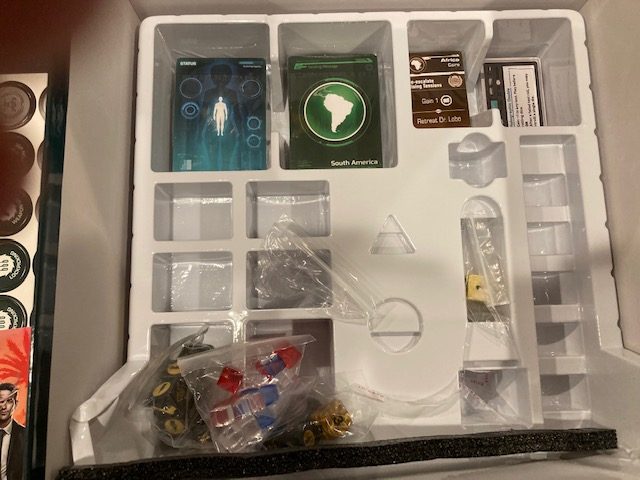
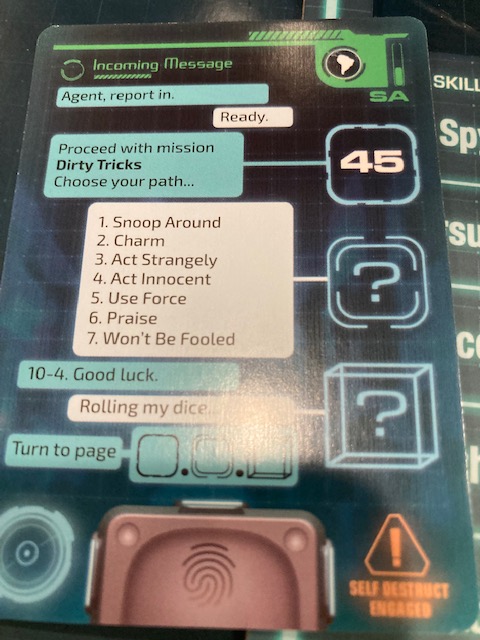
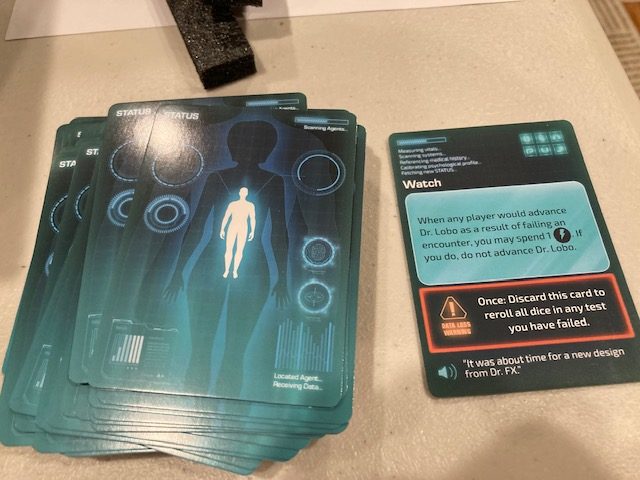
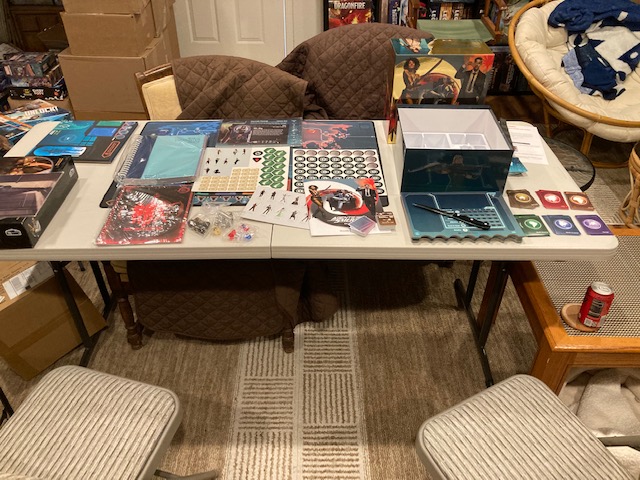
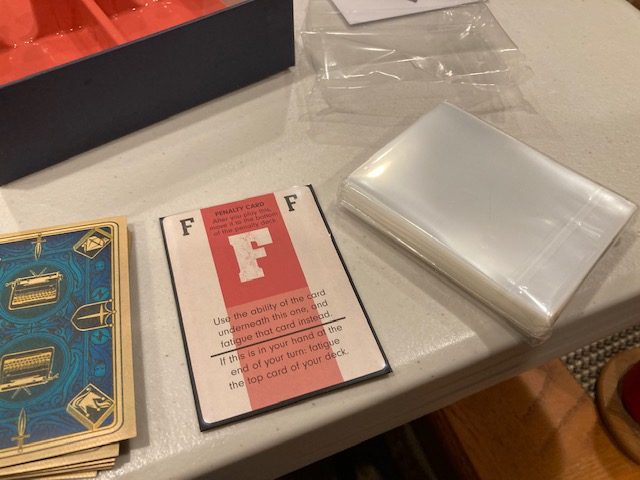
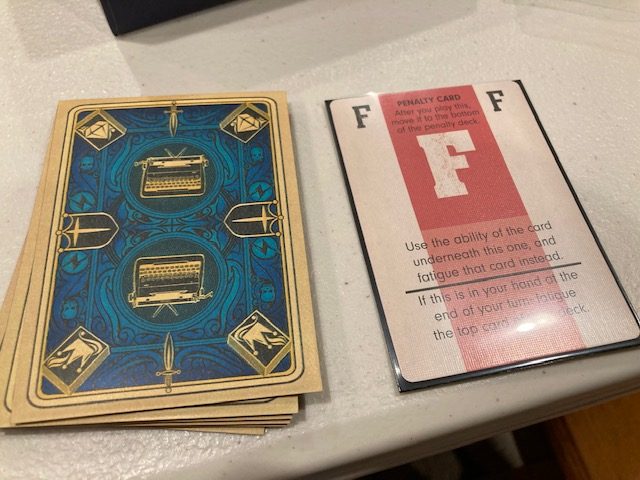
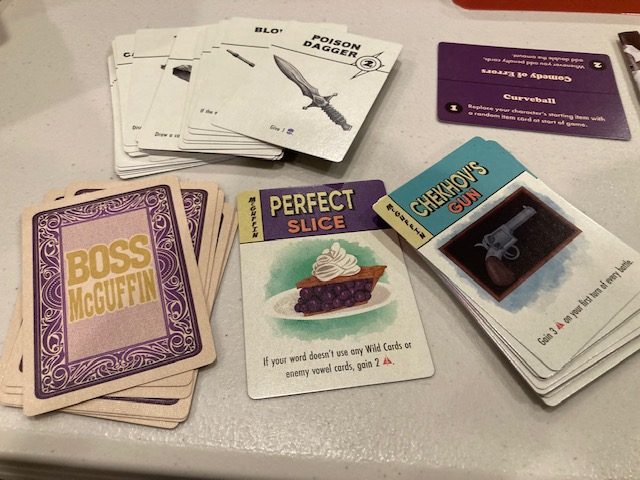
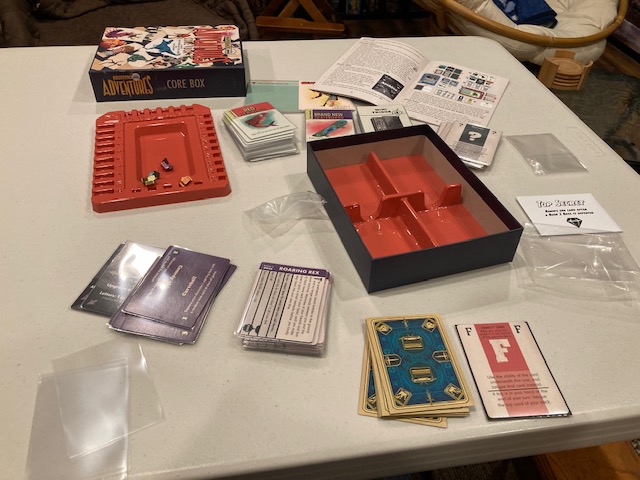
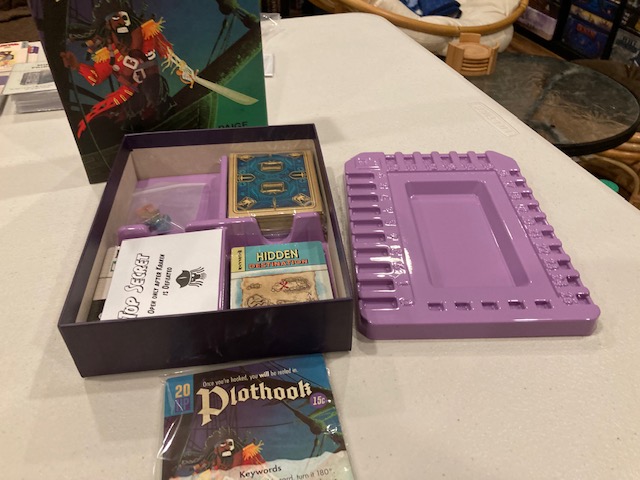
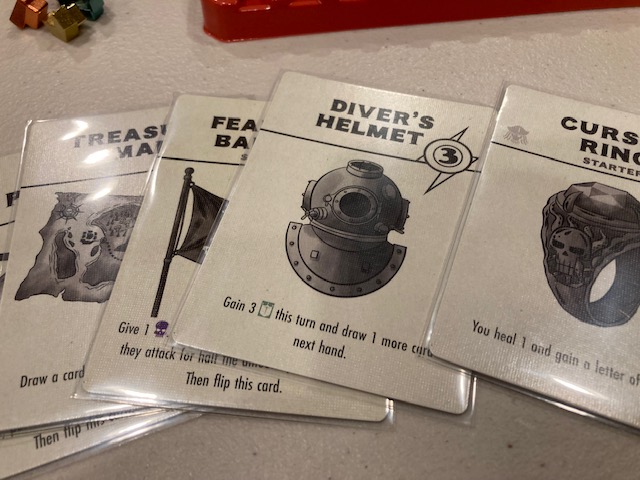
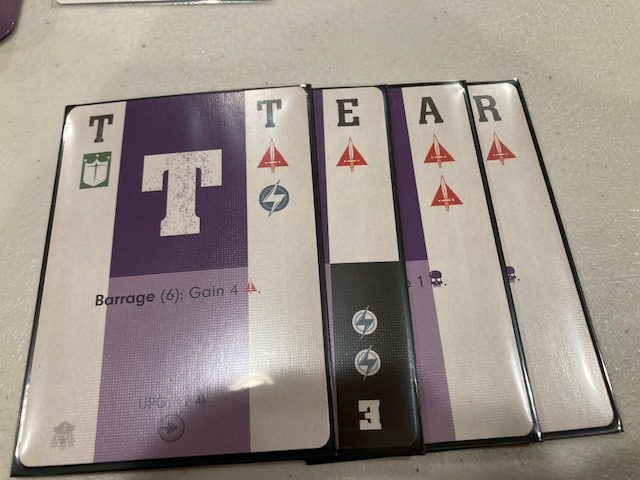
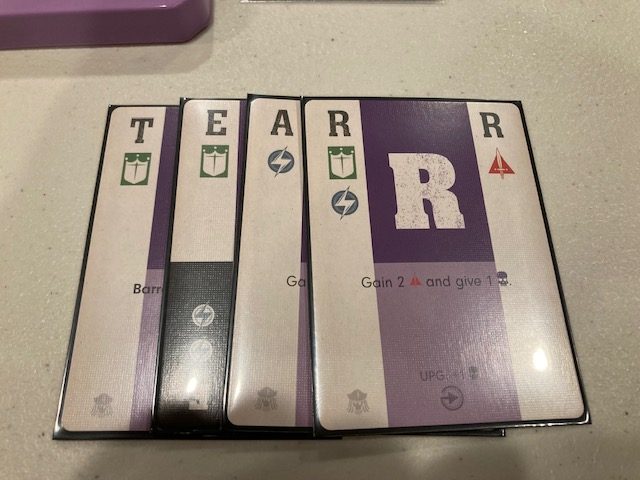
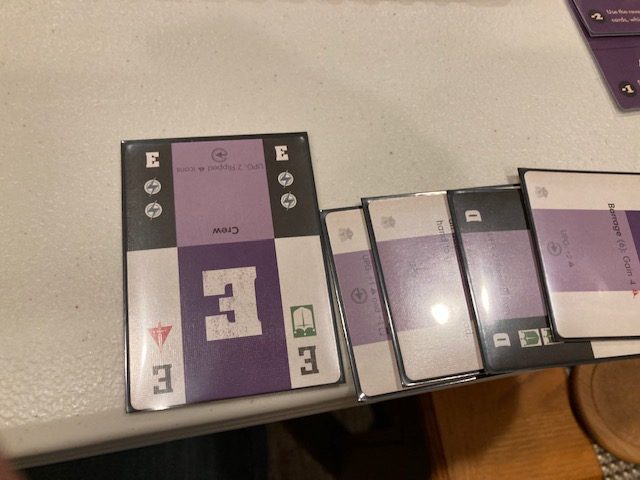
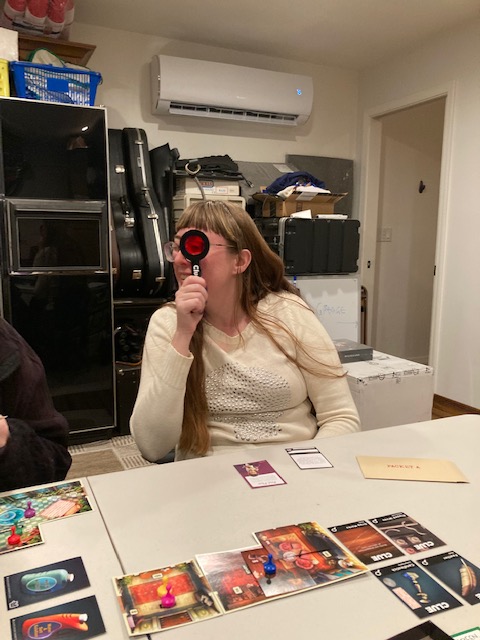
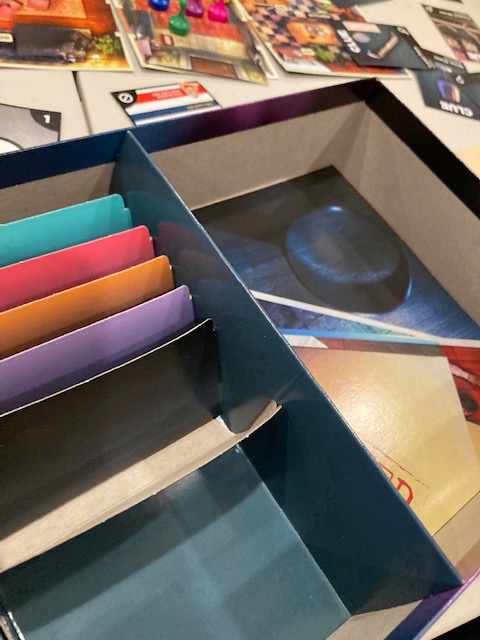
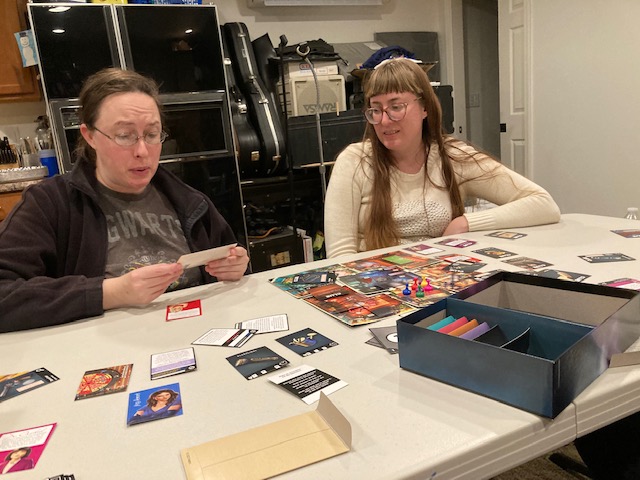
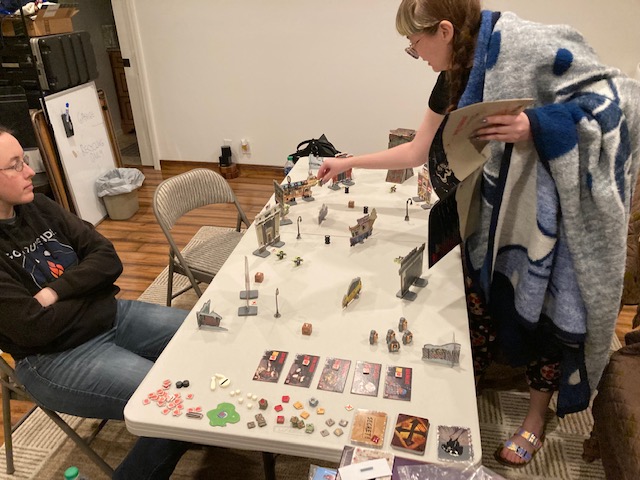
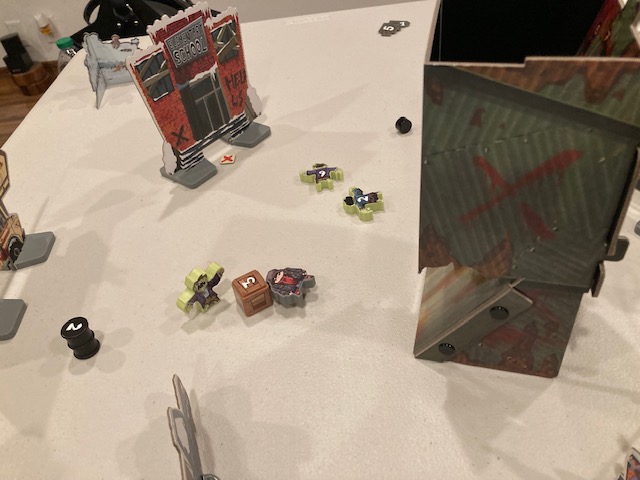
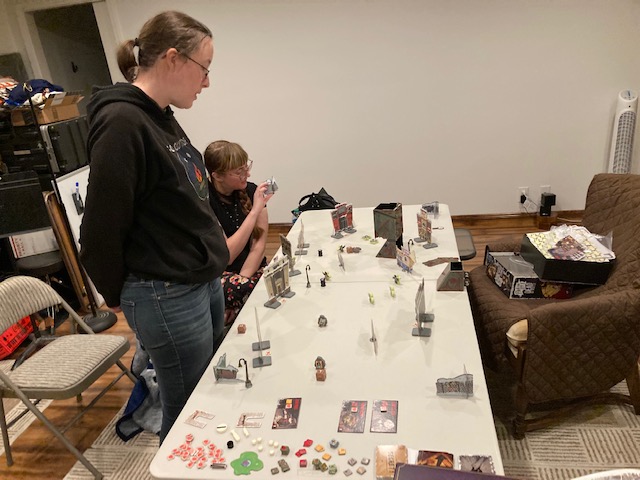
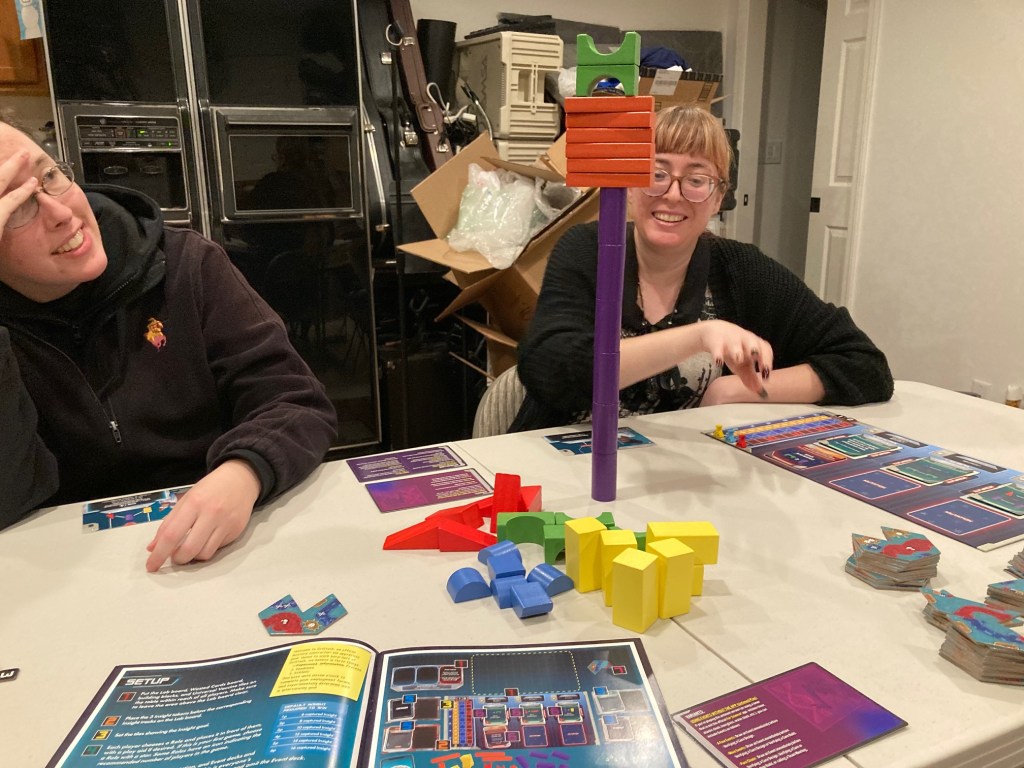
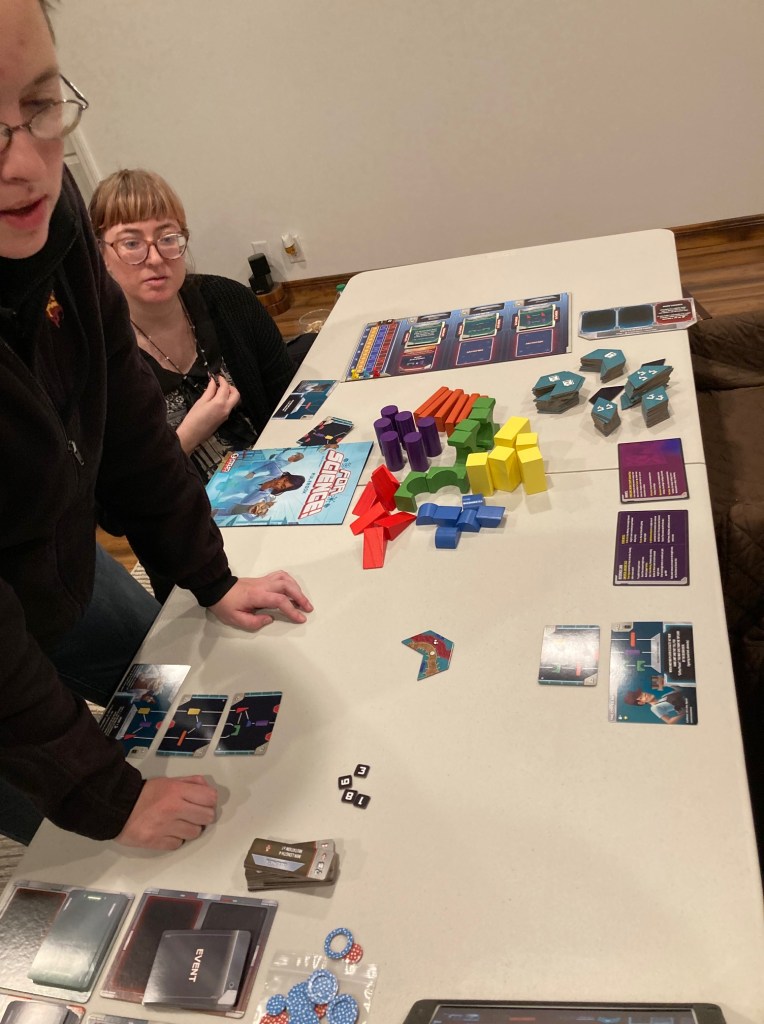
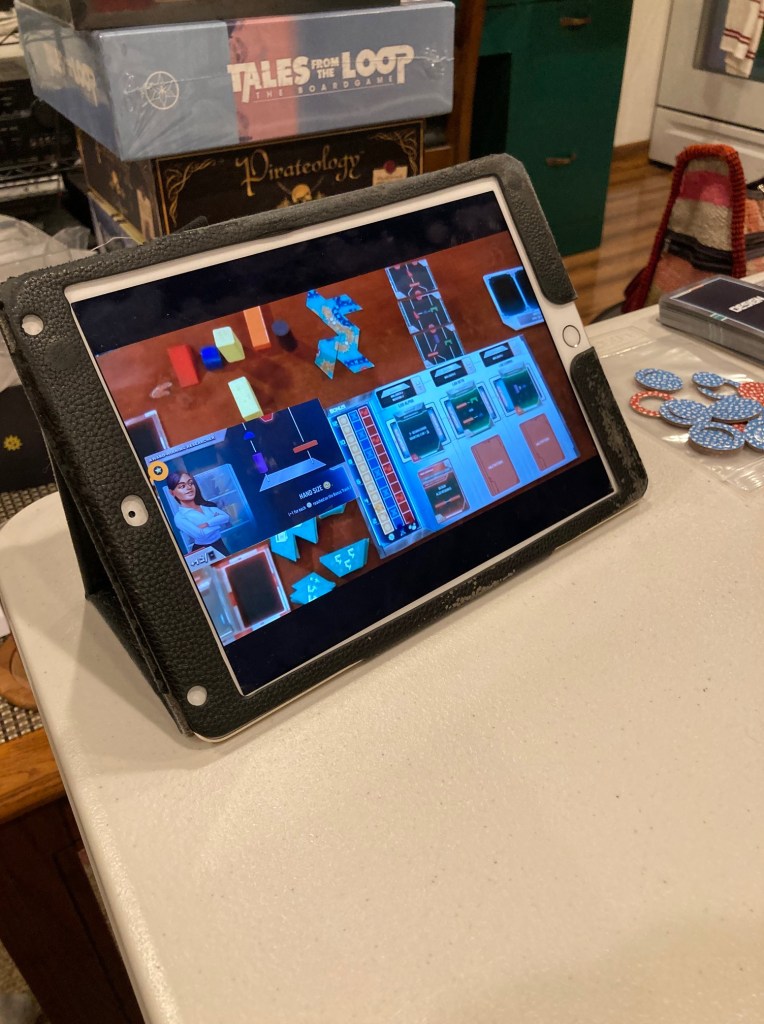
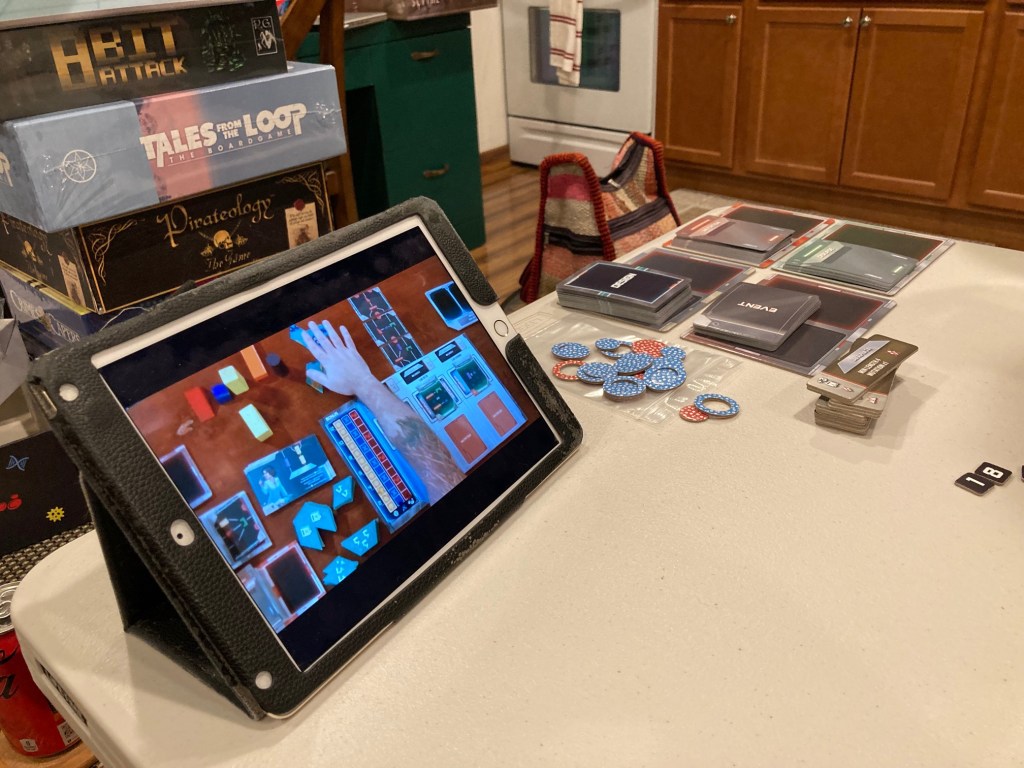
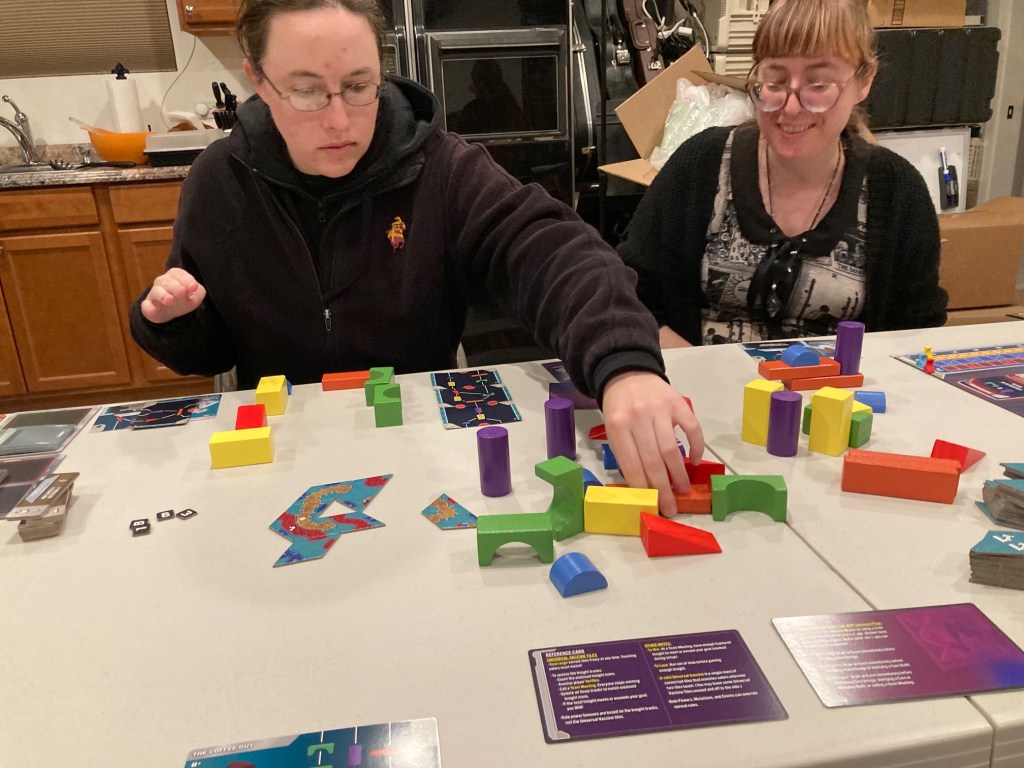
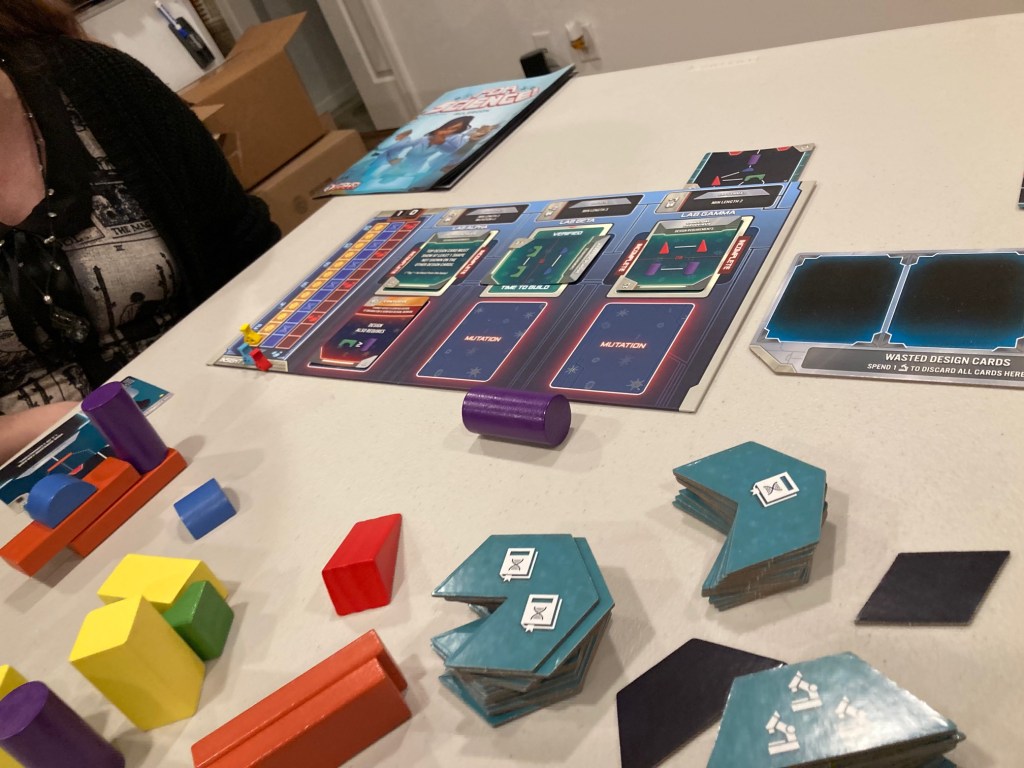
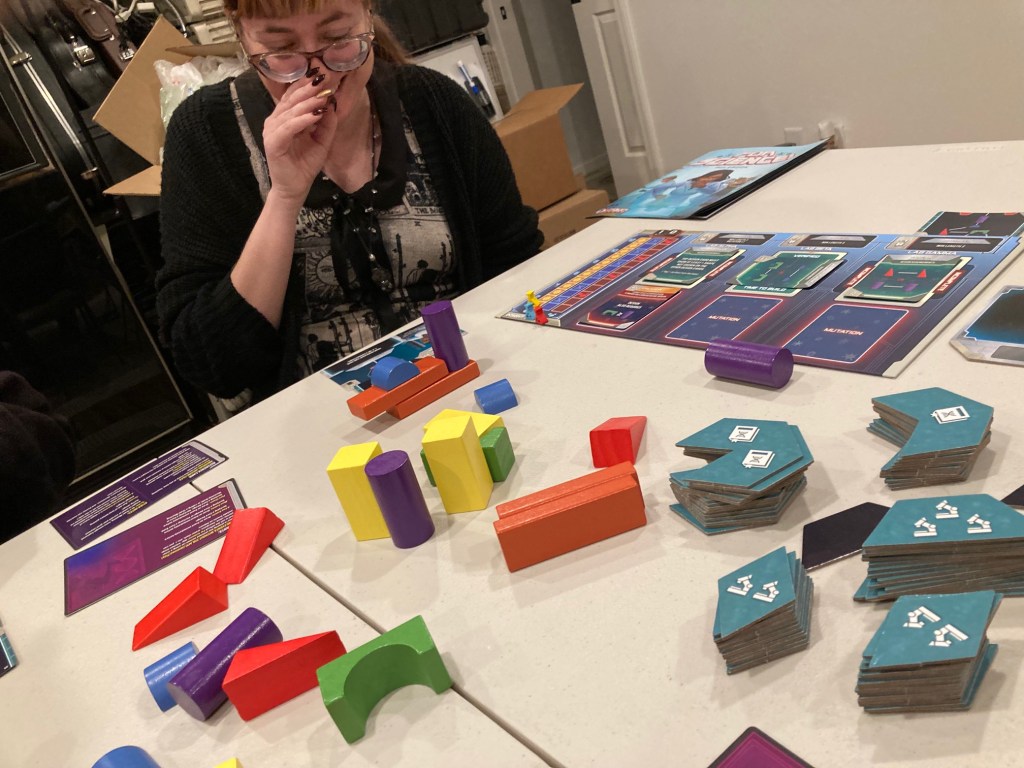
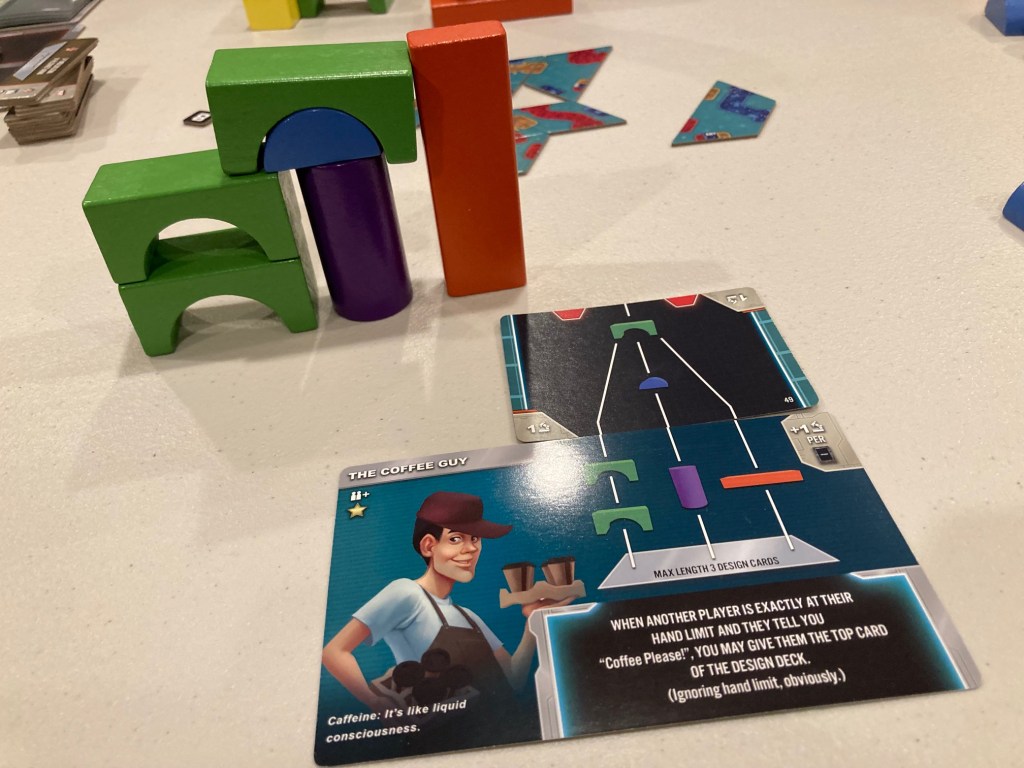
Sync or Swim is a lightweight, cooperative, realtime, card game from Bezier Games. I ordered this on Kickstarter back in February 2022 and it just arrived at my door this last week (July 23rd, 2022 or so): that’s a pretty quick turn around for a Kickstarter!
You might be wondering why I have two copies of this game! The theme: Synchronized Swimming. Yes, that’s what I said … Synchronized Swimming!! It turns out Synchronized Swimming is a very popular high school sport in Minnesota (seriously, I am not making this up). Surprisingly popular! Both of my nieces have both done quite well in the sport. To celebrate them, I picked up one copy for myself and one copy for the girls!
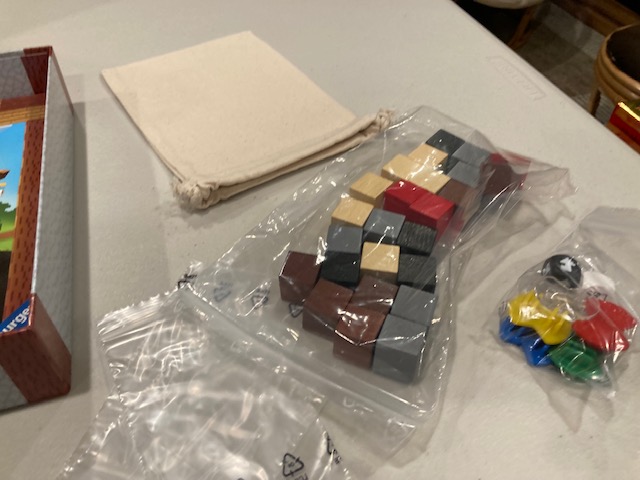
Unboxing
This is a fairly small box, larger than (say) UNO but smaller than (say) Codenames. I used those games on purpose as comparison … we’ll see why later …
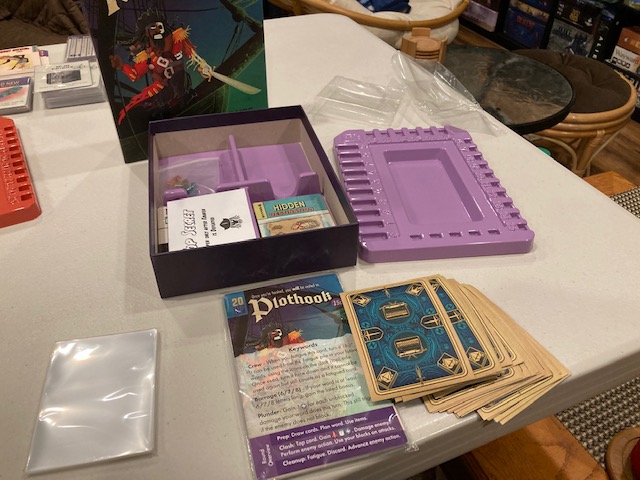
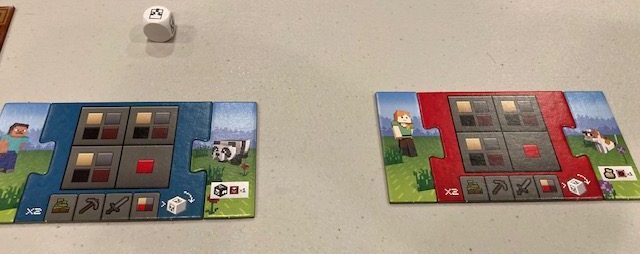
Each player (3-6 players) will get a cardboard platform (see above) to “swim” on: see above. The theme here is that each player is a swimmer on the Synchronized Swimming team.
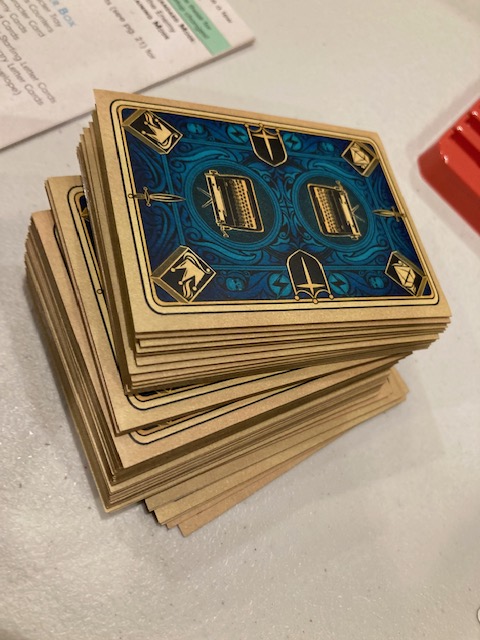
At its core, this is a card game. There are quite a number of cards in the box.
The analogy to UNO is even more apt, as there are a bunch of colored cards numbered from 1-10. You’ll also notice that the cards have hands and feet on them .. these will come into play later … (see above and below). These cards are called SYNC cards: players play them from their hand to their platform.
Finally, there are some ELEMENT cards: these set the challenging moves the swimmers will be performing:
That’s kind of it!
The game is professional produced and looks good enough. It’s not especially thematic or pretty, but it’s very usable.
Rulebook
The rulebook has big text and is fairly easy to read and inviting.
… but the first few pages say it all: GET THE FREE APP. This is a game controlled by the APP, so you absolutely have to have the APP to play.
The APP does a really good job of shepherding you through the rules and scenarios.
Solo Game
In no way does this game support a solo mode! This is a big group game like Codenames! It’s for a Synchronized Swimming team trying to perform together!! I don’t really blame Sync or Swim for not having a solo mode. It doesn’t make sense thematically or from a gameplay perspective.
Nevertheless, I tried to play the game solo to learn the rules: See above and below.
I played as if it were a 3-Player game: see above. Each player gets a platform and 2 SYNC cards to start (more cards come out as the routines get harder). Swimmers can only look at their cards at the start of the timer. That’s right: this is a timed game!
During the timed phase, players can look at their cards, talk openly about what they have, and pass cards back-and-forth face down. The game is also a hidden info game: you aren’t allowed to show your cards, but you can talk openly about everything you have. This might seem a silly distinction, but in the heat of the moment of a real-time game, this is a big deal! You may not have time to tell everyone everything you have!
Each “level” will have a Swim Objective. The example above requires all swimmers to put the same number of their platform, but different colors. And this is the flavor of most trials in the game: all players must place cards face-up on their platform matching some performance criteria. (Matching colors, matching hands, feet, numbers, mismatching, etc).
You can see my solo game above with the first two platforms filled!
The game gets harder and harder as you have to fill the first platform, then 2, then 3, then 4, then finally all 5! It’s chaotic as player pass cards back and forth trying to meet all the criteria!
Ya. This doesn’t work at all as a solo game. But that’s okay. I learned it that way!
Cooperative Play
But of course, the real way to play this is cooperative. My niece (above) won state last year at Synchronized Swimming, so the game has to pass muster with her!
This is a silly, chaotic, cooperative game. When players “finish” their goals, they put their hands over their heads like they are diving. Very serious game…
The cooperative game gets harder and harder until you perform 5 of the ELEMENTS: see use with a winning game above!
Cooperatively, this was pretty fun. And silly. We passed cards, yelled, and had a good time.
Was it like Synchronized Swimming? Surprisingly yes! According to the expert in our group, the coach talks about the routines before they even get in the water, the routines are learned piecemeal (a little bit at a time), and when we messed up playing (because you will), it’s just like practice in real life! “Oh, I didn’t get that the first time. Okay, let’s do it again!”
You end up doing the synchronized swimming routines at least a few times until you get it. It was a light silly game, about 20-25 minutes long. We had fun.
The APP
So, this game requires an APP. That may be a turn off for some of you, but I found that it did a very good job of walking us through the game. You could easily click on things in the APP for further elaboration. And it was colorful! And it applauded for us after our routines! It really did enhance the game!
I asked my niece: “Could you teach this game your friends?” And she said yes: I think partly because the APP made is pretty easy.
Conclusion
Sync or Swim is a lightweight cooperative party card game. It’s somewhere around UNO and Escape: Curse of the Hidden Temple in complexity, but it’s still fairly straightforward. The lightweight card play reminds me of UNO (especially with the colored, numbered cards), but the sharing and chaos reminds me a little of Escape: Curse of the Hidden Temple (from our Top 10 Cooperative Dice Games).
The game requires an APP on your phone, which may be a turn-off for some people, but the APP does a great job shepherding players through the game. It’s also a realtime game, which may also turn some people off. Sync or Swim doesn’t evoke that much theme at first: it’s a colored card game, but it does get some points for embracing the theme (mostly because of the APP) as much as it can for a colored/numbered cards game.
It doesn’t sound like I love this game, and I don’t. But I like it: I’d much rather play the cooperative game of Sync or Swim than UNO. The next time someone pulls out UNO, maybe Ill pull this out in instead and see if it works better. It was silly fun for me and my groups.
The Spill is a cooperative game for 1-4 Players from Smirk and Dagger. This game was on Kickstarter in September 2021. It promised delivery in April 2022 and just delivered to me a few days ago (Aug 7th, 2022 or so). You know, 4 months late for a Kickstarter is pretty good! No grumpiness here!
This is a game about cleaning up an oil spill and saving animals in the ocean/gulf. The main feature of the game is the giant orange dice tower: this is the toy inside that will sell the game! See below.
Let’s take a look and see if it’s any good!
Unboxing and Gameplay
The Spill is all about throwing black dice (“the oil”) into the big orange dice tower (“the Oil Rig”): thematically, the oil is spewing out of the oil rig into water. See above.
You can see the tons of black dice on the right (above) and the Oil Rig in its deconstructed state. Spoiler Alert! You will have to assemble the Oil Rig at the start of every game and disassemble it to put it back in the box. I worry a little about this because the little plastic posts that hold up the tower seem “slightly” fragile.
The Spill is a cooperative game with asymmetric player powers: each player takes the role of a Specialist with different powers. There are 8 total roles to choose from (see above). Each role has a different ability to help make the game a little easier.
Before the start of the game, players choose (randomly) one of the WIN Condition cards (see above). The more little gold dots at the top left, the harder the game. But, you just choose one of these WIN Condition cards, and that sets the three things you need to do to win. Usually, you have to save so many sea creatures, clean up so much oil, and clean up contaminated wildlife. Each card is a little different, so the game can change between plays!
The Situation Board (above) shows a bunch of information (animals saved, Oil removed, icon reminders, borrowed actions), but most important: the oil drop at the top shows you how many dice you will drop in the oil rig next turn!! Every time there is a spill, that little oil drop advances, and later in the game you will be getting more and more dice per turn!
The dice drop into one of 4 quadrants: each quadrant has spaces for the dice 1-6: see above. You can see as the dice come out, they start to fill up a sector! In a kind of pandemic like way, if there are ever three dice on one sector, you have a SPILL OUT!
/
In our game above, we have 4 SPILL OUTS! (See the orange banners marking the sectors were there are three dice in one sector). If there are ever 6 SPILL OUTS on the board at the end of a turn, players lose!
You clean dice as you go and remove SPILL OUTS, but a SPILL OUT can always come back!
The other ways to lose are: (1) if you get 3 or more of the same contaminated creatures in the Sick Bay (see above where any dolphin, octopus, or manta ray will cause us to lose!). Or (2) if one creature of each type comes to the sick bay. Creatures come to the Sick Bay if they are still contaminated at the end of the turn.
To summarize: you lose if there are too many SPILL OUTS, or if there are too many contaminated creatures in the Sickbay!!
You win (typically) if you if you clean up enough oil and save enough creatures. See a winning board below (with 10 oil removed, 3 sets of marine life saved, and 4 contaminated marine life saved).
How do you save creatures and remove oil? With Action Points of course! Each player gets 4 Action Points (abbreviated AP throughout the game). Each Specialist card has a summary at the bottom:
It’s pretty expensive to remove Oil (3AP), but pushing a plain oil cube is only 1 AP: movement is 1 AP, and rescuing a healthy marine animal is 1 AP, but rescuing a contaminated one is 2 AP.
Every player must drop oil into the oil rig, then use their 4AP to do what they need to. There is a cool mechanism for borrowing AP which we’ll discuss below.
Overall, the game looks really nice and has nice quality components.
Rulebook
The rulebook is quite good. It was easy to read, it gave great directions and pictures for set-up, and it was easy to reference for questions. I think there’s only one question we had (“What if the spill out marker goes past the end?”) that we couldn’t answer.
Seriously, this was a very good rulebook. The components were well-labelled and marked in the first pages, and it had easy directions for assembling the dice tower.
Set-up was easy:
The rulebook had a nice big set-up section with pictures and easy-to-read fonts.
The rest of the rulebook was easy to read. The rulebook ends with a bang with a nice summary on the back.
Seriously, this was a really good rulebook.
Solo Play
Congratulations to the Spill for following Saunders’ Law: this cooperative game has a solo mode! It’s easy and well-specified. It’s easy to follow because basically all games (no matter how many players) always must have 4 specialists! The solo player simply plays all 4 Specialists like a 4-Player game. See my solo game with 4 Specialists above. At first, I was concerned that this would be too much (we’ve complained at Legends of Sleepy Hollow for this sin) because 4 Specialists will have a lot of context switching between characters! See How To Play A Cooperative Game Solohere for more discussion of this.
It turns out, it’s not that big a deal to play 4 characters in the Spill because they each have very simple powers. This is both boon and bane because the powers are simple enough to context switch between, but it also means the Specialists aren’t “that different” from each other. (One thing you can say about the characters in Legends of Sleepy Hollow: the characters are all very different and interesting but context switching between them is difficult). For The Spill, I think this simplicity was okay: this game feels like entry game (more discussion below).
I was able to win my first game of The Spill, but it was challenging. I got a few rules wrong (which we discovered after we played it cooperatively), but that’s my own fault. I’d say the only “slightly confusing” thing in this game were the weather dice.
Occasionally, you will draw one of 4 blue weather dice from the bag, and it will cause something in in the game to be harder: see above as saving marine life now costs one AP more. The weather die affects everyone, but you can reset the effect ON JUST YOUR SPECIALIST at the end of your turn.
Playing solo was straightforward and I had fun. I was “concerned” that the game might have too much randomness. We’ll revisit that below.
Cooperative Play
Our first cooperative play was 4-Players, which was the perfect size (because you must always play 4 Specialists anyways).
I taught my friends the game very quickly and they picked it up quickly. We made choices on out turn and.
One interesting thing that happened (which I didn’t reflect upon until later) was that this game tends to prevent Alpha Players! (See our discussion ofAlpha Player Syndrome here). I think the reason was that each player “typically” only can operate in their own quadrant of the board because movement is expensive. Players have to be spread out over the quadrants to “cover” each quadrant, or they will lose! So, even if there’s a cube you want to get on your turn, it’s too expensive to move across the board. And the Oil Rig dice tower kind of “blocks” other sides of board: you can only see your quadrant and your neighbors. So, you can’t ALpha Play because (a) you can’t see everyone’s state without serious looking around (b) movement is too expensive to be traipsing around the board. This means that each player tends to concentrate on their own quadrant and shut-out/down the Alpha Player.
That doesn’t mean we didn’t communicate: we’d discuss ways to use the Resource Cards, what we needed to get, things to concentrate on. We had the high-level discussions and each player would tend to concentrate on the low-level activities of their own sector.
This game went over like gang-busters! Everyone seemed to really like it!
The Oil Rig
It feels stupid to say this, but dropping dice into the Oil Rig was really fun! It’s silly, but the kinesthetic experience of dropping the dice and watching them disperse was quite enjoyable. Even if you don’t like co-ops, this dexterity element was fun. And everyone got to drop dice on their turn, so it was a shared experience: everyone got a turn!
Seriously, the Oil Rig made the game more fun.
EDIT: We just finished watching the Dice Tower do a playthrough of The Spill, and they had trouble with dice spilling out (no pun intended) outside the little container. It looked very frustrating! We didn’t have this problem when we played. We tended to throw the dice in all at once, and it didn’t seem to be a problem for us. Not sure what the difference is between our set-up and the Dice Tower set-up, but it was definitely an issue for them. It wasn’t for us. Caveat Emptor.
Resource Cards
This would be a pretty “by-the-numbers” co-op if the game were just what we described. But two things really elevated the experience: first was the Resource Cards. See above.
At the start of the game, each Specialist chooses 1 of 2 Resource Cards to go out (4 will be out at the start of the game). Whenever you get 3 oil removed or gain a set of three animals, you get an orange marker to put on one of the Resource cards! These resource cards are GOOD THINGS to can choose to do (they reminded me of the resource cards in Pandemic that you can play at any time) during your turn, if you have enough orange markers on it.
If you look at the Situation board, you can see the little orange cubes on the board, clearly demarking when you get on! It was great to have these Resource Cards, as you could choose to do some out-of-the-box turns to get something done! Resource Cards promoted some more strategic thinking, as we had some “helpful” mechanism near the endgame.
You could argue these are just like the Pandemic “anytime” cards, and you’d be right. But it was cool that you got to select them at the start of the game and that anyone could activate them: they took the Pandemic idea and gave it an upgraded twist!
Extra Actions
I think what really made the game special was the “Extra Actions”: see the “Extra Action Pool” on the right side of the board.
Basically, it allows you (if you want) to add 1 or 2 more Action Points to your turn, at the cost of adding an extra oil dice for the next turn!! I can’t tell you how many co-ops I have played where I said “OH!! I wish I had just one more action to get something done!” With this mechanism, you can!
Basically, you can choose when you need a few more APs, but you know the cost. This mechanism feels like you have more agency on your turn.
I loved this mechanism and the it really elevated the gameplay for me!
Discussion
My major worries with this game was that “it was too random” and “it was too much like Pandemic“. Let’s look at both of these in turn.
After playing a few times, I think the randomness can still be an issue, but there are several reasons why this wasn’t an ongoing concern. Firstly, The Spill is a fast game! It’s about 45 minutes, so it’s easy to get back and play again. I can think of games of Pandemic where the randomness wrecked us: it’s just the nature of the beast for some co-ops. Sometime you get the bear, and sometimes the bear gets you. Secondly, there are enough mechanisms (between Resource Cards and Extra Action Points and Special Powers) to mitigate a lot of this randomness. Randomness is debilitating when players feel they don’t have any agency to counteract it, but I think The Spill contains enough mechanisms to give players that agency. Said another way, the randomness didn’t seem to get to us.
As for the “it was too much like Pandemic” argument, my friends really thought this felt different from Pandemic. Granted, there are a lot of similarities, but there’s enough differences for this to be its own game. Between the dice throwing and Extra Actions and Resource Cards, gameplay was different enough to enjoy this outside of Pandemic.
In the end, my friends and I think this is entry cooperative game. It’s slightly more complicated than Forbidden Island (the prototypical entry co-op), but less complicated than Pandemic. But we still liked it and would love to play it again. It’s just not a super heavy game, but that’s not a ding! I could see this on the shelf at Target!
Theme
Some people might have a problem with the theme, but after playing the game, the theme wasn’t a concern.
Most of my game group did NOT like Endangered (see our review here) because the creatures you were trying to save actually got killed!! I was worried my friends would have the same problems here! Nope, the creature aren’t killed … they go to “SickBay“:
Our joke was “Is SickBay like the farm my dog Rover went to when he was sick?” The Spill got around the issue by just calling it SickBay (good job guys!).
In general, the theme wasn’t too gross or debilitating. Honestly, the Oil Rig dice tower is so fun it kind of “suppresses” the kinda dismal theme. (I mean, the theme is a broken oil rig polluting the oceans and killing animals!) But, we are working to fix it! So, we are doing a positive thing and the theme didn’t seem to get to anyone. It might for you: Caveat Emptor.
Conclusion
I liked The Spill a lot more than I expected to! It’s an entry level cooperative game, but it was fun! It was fun to throw dice in the Oil Rig, it was fun to discuss concerns at a high-level, it was fun to try to solve the puzzle here. Although this game has some randomness in it, the mechanisms to mitigate said randomness worked really well: I think the Extra Action Points mechanism was just brilliant and really elevated the game from a “by the numbers co-op” to something more interesting.
I’d recommend this game as a good entry game (assuming the theme doesn’t get to you: it didn’t cause us any consternation) or for players who want a light but fun co-op.
What does it mean if RichieCon weren’t a success? An unsuccessful RichieCon would mean:
People would be unhappy (but everyone had a great time)
Weather would bad (but it was fairly mild for Tucson, and it rained just enough to keep it cool but not enough to cause problems)
Games were not played (but a ton of games were played!)
So, RichieCon 2022 was a success!
Day 0: Preparations
Before RichieCon 2022 could start, games had to be boxed from the RichieCon Collection so they could easily be taken to the Rec Center; most of this happened the week before!
Day 1: Thursday, July 28th
A small cadre of people showed up at (what we dubbed) “The Las Cruces house” or “RichieCon After Dark”. Basically, all the Las Cruces people (and a few others) stayed at one big house for RichieCon.
Some games were played (and a lot of Sentinels of the Multiverse)! People said Hi, and got ready for the big event!
Day 2: Friday, July 29th
A food run was critical: RichieCon provides for lunch on Saturday, so a quick trip to CostCo was necessary for foodstuff.
Preparations were made at the Rec Center! Most importantly, drinks had to be put in the fridge so they’d be cold for Saturday!
Days 3 & 4: Saturday, July 30th, Sunday July 31st: RichieCon 2022 begins!
Games of the Con
The game I saw played most at RichieCon 2022 was Canvas! I saw it played SO MANY times! This is a light, beautiful game that everyone seems to enjoy! And it’s not even a co-op!
Train games were a surprising hit! I saw a bunch of people playing the older Railways of the World (well, the older version called RailroadTycoon) and the newer and hotter cooperative Switch and Signal!
Ark Nova seemed to always be out, but only because it takes 4 hours to play! I saw it played once on Saturday and and once on Sunday! Some people liked it, some people thought it was okay, and some people did not like Ark Nova!
Century Spice Road: Golem Edition and Splendor (original and Marvel) made a splash last year, and again this year: I saw everyone playing both of these!
My Father’s Work was one of the longer games played, and I was able to be in it! Fun but very involved games! This is a huge worker placement game!
Ivan brought his Return to Dark Tower (a bog sprawling co-op with a cool tower) and it got played twice as well! Two big, long games!
Heroes of Terrinoth, an older co-op by the Sadler Brothers got played at least twice. It also got pimped out! See below.
Pimp My Board Game
We tried something different this year: Junkerman set-up a “Pimp By Board Game” table. While he worked on my copy of Heroes of Terrinoth to pimp out, he would chat with people about ways to help your board games!
If you wanted a “relaxing” time after playing a longer game (like Ark Nova or My Father’s Work), we had the perfect activity: Pimp My Board Game! Below, Linda helps Joe.
Top 6 List: Games of Interest from 2021/2022
This year’s Top 6 (was a Top 10 last year, changed to a Top 6 to make it shorter) was all about games we’ve played since we last met! The idea was that pose questions and try to get people involved!
#6 What game from the last year surprised you the most? Good or bad surprise?
Steelslayer: The Reckoners Expansion. I had to play the original Reckoners game again to remind myself of the rules, and I forgot how good the Reckoners game is!! The surprise was that I forget how great the original game was! See our review here.
#5 What game in the last year did you think Tom Vasel (from the Dice Tower) is wrong on his rating?
Sentinels of The Multiverse. This year, Tom said he dropped his rating from a 7 to a 6. He is so wrong on this!! Sentinels of the Multiverse was also a major game of RichieCon: it was played at least 10 times overs the course of RichieCon! At least 3 or 4 or us have it as it as one of our favorite games: I give it a 10. Tom is wrong. See my review here.
#4 What game (that you paid for) did you really dislike? It’s easy to dislike games other people paid for, but what did you pay for that you disliked?
#3 What game that came out in the last year that you liked but other’s didn’t?
Hour of Need by the Sadler Brothers. I really enjoyed this game, but it takes a long time to internalize the rules. Along the way, I lost Sara. She didn’t like it, but I really came to enjoy it. See our review here.
#2 What was your favorite expansion that came out in the last year?
X-Men: Marvel United and Days of Future Past. I got a whole bunch of content for Marvel United: see our Expansion Absorption entry here. If it weren’t an expansion, I’d say Days of Future Past would be my game of the year! See our review here.
#1 What was your favorite game that came out in the last year?
Tokyo Sidekick. Despite needing some house rules for rebalance, I enjoyed this game quite a bit: This is a cooperative superhero game where each player controls a hero and sidekick team fighting to save Tokyo! So very thematic with lots of ways to advance your character as you play! See our review here.
More Pictures
Conclusion
Another year has come and gone: we saw new friends and old friends! We played, chatted, laughed, and partied. We look forward to seeing you next year!
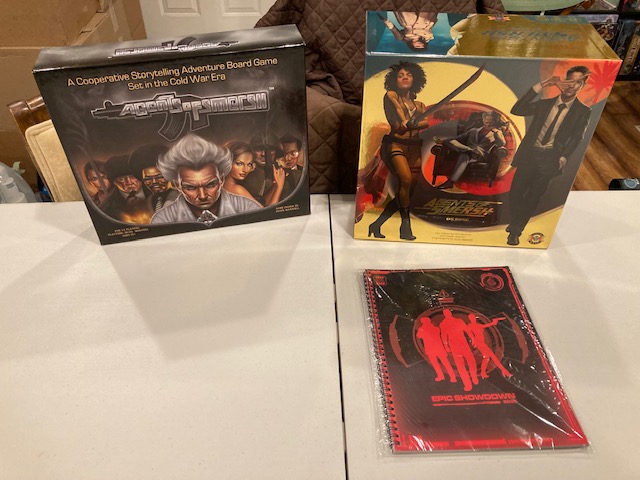
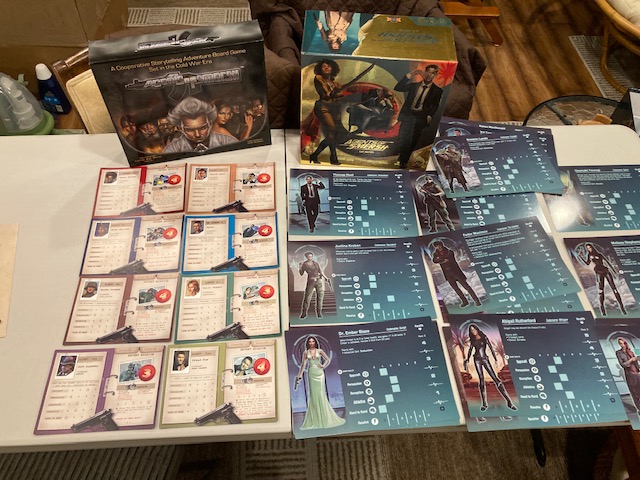
The Adventure Zone: Bureau of Balance is a very light cooperative story-telling game. Players each create a character and take them through a very light adventure to find some “relic” or Object D’Interest. All players quest together as a team. See below.
Characters
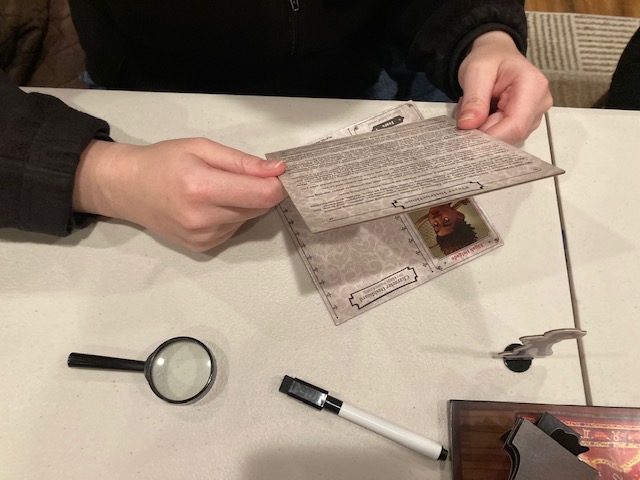
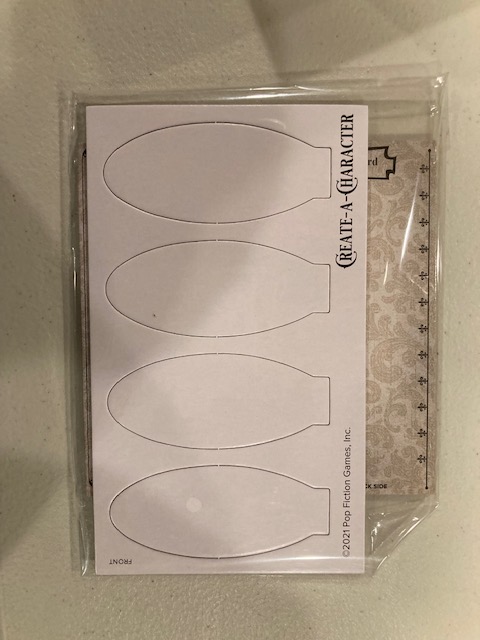
Pads for each template character type
This is a light dungeon-crawler game: each character will create a character using one of the 5 prototypes in the game: Priest, Wizard, Warrior, Bard, or Rogue. See picture above.
The act of creating your character is fairly quick: you answer 3 simple questions about the “nature” of your character and use that to help guide your character through the game. In general, you want to stay “true” to your characters (but if you don’t, there are no real consequences).
A close-up of the Wizard sheet
Take a closer look at the Wizard sheet (above) for a sense of the questions you’ll be asked to set-up our character. Again, this is a story-telling game, so you are just “goofing” and creating a backstory out of your imagination.
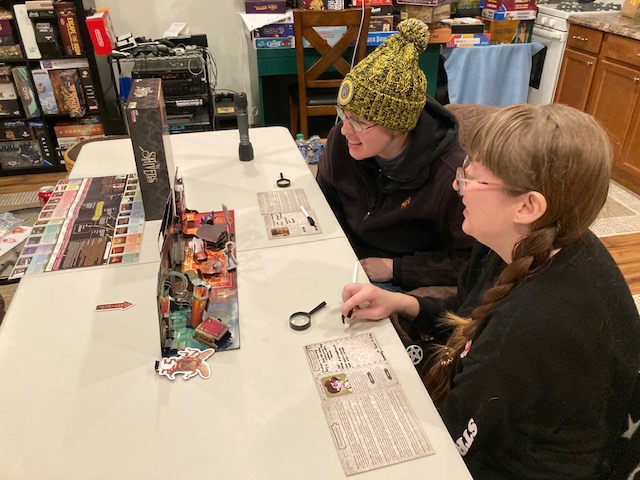
You can see our group took this VERY seriously: we went with an Italian food motif with Lil’ Meatball (the warrior), Noodle (the Wizard), Sauce (the Bard), and Parmesan (The Priest). See below.
This character-creating process should be an immediate indicator of whether you will love or hate this game: the game does seem to lean towards silliness.
Components
This is mostly a card game: the cards will specify events and monster to overcome: you will tell stories of how you overcame said events and monsters.
This is not a “pure” storytelling game: you will be rolling the dice (above) to see if you pass events/defeat monsters. Generally, with the dice and your “extra plusses”, you will have to roll OVER the amount on the card. The mechanism is dirt-simple.
For example, to get through “The Great Gate” above (green card on right), the current player will have to roll-play, tell a story, and get a 6 or above to get through the gate. Some events will get extra plusses if you incorporate extra story elements.
As you play, you can turn in completed events/monster for treasure. See some treasure above.
Rules
We chose to watch the video by Becca Scott to see how to play. I would recommend watching this video to learn: it was reasonable and she is very upbeat.
After we basically got set-up, we’d occasionally look at the video to get clarifications.
We had to look at the rulebook “a little”, but in general, the video was good enough.
Gameplay
Gameplay is pretty simple: everyone gets a turn trying to defeat a monster/event on the board. Once you go all around, you get to “reset” you character (each player has a help token they can use once per round).
One other player can offer to help, but it uses their “help” token. If you defeat the event/monster, you keep the defeated card … with enough of them, you can turn them in for treasure.
You have no choice on which treasure you get: you just get the top card of the Treasure deck. LIke the Haunted Doll … not sure we would have chosen that as treasure!
You can lose if the “party health” goes to zero (top of the board). Each failure in the game will cause some damage to the “party health”, depending on the event/monster.
And that’s it! Players keep going until they get through 2 piles on the board, and they lose f the party health goes to 0! Very simple.
Solo Mode vs Cooperative Mode
There is no given solo mode: this is a game for 2-5 players. This is a light, cooperative story-telling game. There’s no reason you couldn’t play two characters (you definitely need at least 2 characters so they can help each other) to play solo, but it seems like it would be not fun.
This is a cooperative story-telling game where you feed off of each others stories and silliness. It really should be played as a group.
Thoughts
This is a very light game: I know, I’ve said that a lot. It’s a little random, as you have no control over what treasures you get, but I guess that’s the nature of treasure, isn’t it? The game presents a framework for storytelling and gives you places to tell little stories. It forces you to roll some dice so you do fail sometimes (sometimes failure is funnier than succeeding) and make the game interesting. There is an interesting notion of cooperation, as each player can use offer help or accept help from a few characters, but at the cost of not being to help others.
Each player gets a token to help others: see the +2 for the Wizard above. Once it’s spent, it can’t used until the round (each player gets one go) ends.
There was a little bit of strategy in the endgame as we had to make sure we could defeat the final puzzle by spending our help tokens properly. In general, though, this was just a light game where we told stories and had fun.
Conclusion
You’ll probably know if you’d like the game after getting here: if you want a light, cooperative, story-telling game, this is fun. The Adventure Zone: Bureau of Balance presents a nice framework for a silly storytelling game. The combat/events mechanisms are dirt simple and keep the prospect of failure in the game so as to make the game at least somewhat interesting (it’s boring to win all the time).
Interestingly, I think my friends like this game a little more than I did: they like RPGs and play them quite a bit, so the notion of creating a story and populating that world was appealing. I didn’t like it quite as much, probably because it felt just a little too random. But, this game was still fun: I got to hang out with my friends one evening and tell silly stories.
Oh yes, this game encourages silliness: For example, see above: Steven The Goldfish is treasure? Take a look at our Top 10 Cooperative Games With a Sense of Humor for other games with a silly view.
Those of you paying attention might be saying “Wait a Minute! Ark Nova is an engine building game that’s completely competitive! You can’t play it cooperatively!”
Or can you?
Well, this would be a pretty short blog entry if you couldn’t.
An Idea From Solo Mode
To win the solo mode, you need to get at least zero victory points! Scoring is a little different in Ark Nova: it is a victory point game, but the number of victory points you get is (nominally) the difference between your Appeal value and your Conservation track (modulo some rules for snapping to an edge).
See the picture above: My victory points for a solo game were 80 – 67 = 13 victory points (the conservation track uses the smallest number in the range on the green track). Don’t expect huge scores in this game: if you can get a positive score, that’s a big deal! (Note, if this were the other around, I would have -13 victory points! A loss!)
Engine Building in a Zoo
Ark Nova game reminds me a little of Terraforming Mars meets Endangered: it’s an engine builder (with lots of cards: see above) with a zoo/conservation theme where you build your own zoo: see below.
Building a Zoo!
Ark Nova is also about as long as Terraforming Mars: It’s quite long, and the more people play, the longer it is.
Take That!
At first blush, this seem like is that there really isn’t any “take-that” in this game. By “take that”, we mean mechanisms were you intentionally do something bad to another player to help yourself. In our first solo game, we didn’t see any cards that would “screw” other players. That gave us hope that maybe turning this into cooperative would work! Generally, you are just worried about building the best engine you can and doing the best on your turn! There is player interaction in the sense that you might take an animal someone else wants, or start the break early, but these are much more passive interactions. Generally, you aren’t out to get people: you just want to build build build.
Unfortunately, after playing again and looking closer at the rules, there are quite a number of “take-that” mechanisms in the game: stealing cards or money, putting poison, hypnosis, constriction. See images form the Icon sheet below. All the yellow/red tokens are “take-that” to some extent.
This might be a sign that a cooperative mode is a bad idea. To make this work, we’d have to either (a) completely eliminate these cards or (b) rewrite the text so the effects are different. The deck is MUCH too large (212 cards) to go through it apriori and eliminate the “take-that” cards before game, so we’ll have to eliminate them as they come up.
Cooperative Play
Once we get rid of the “take-that” cards in the game, it’s very simple to add a cooperative mode. Ready?
In the cooperative mode of Ark Nova, players work together to build their engines with the intent that no player gets negative victory points. Players win together if all players have zero or more victory points!
And that’s it! Well, that’s the idea at least: we use the idea from the solo mode that negative victory points are bad, so that all players must work together to make sure none of their fellow compatriots are lagging. We like this idea because it keeps the entire flow of the game, but still gives somewhat of a notion of cooperation in the endgame.
DungeonLords
Those of you with good memories might think “Hey, didn’t you propose something like this for DungeonLords?” Good memory! Recall from this Top 10 Games That Can Be Played Fully Cooperatively, we added some rules to make DungeonLords cooperative! The idea was very similar:
In the cooperative mode for DungeonLords, players win as a group if they can keep all Dungeons “pristine” and unexplored by the hero parties.
We dubbed this stay-out-each-other’s-way cooperative, and that’s very similar to what we propose here: players will mostly just try to stay out of each other’s way as they play.
What Really Happened
We started Ark Nova with the best intentions to play it cooperatively. “How hard can it be? Play normally and get rid of the take-that cards as you play!” Harder than you think.
First of all, there’s a lot of cards with a lot of text in the game that come out (in the display or in your hand). Culling the “take-that” cards dynamically is actually a lot of work because we have to read a lot of cards as they came out: this really ground the game to a halt. In the end, we just let the “take that” cards come out because they weren’t that bad. But, it seemed like an inauspicious start.
Also, what really happened: we all got too invested in our boards!! We played for 3.5 hours (4-player game). After so much investment in time and momentum (individually) in our zoos, we just kinda “forgot” about playing this cooperatively. After 3.5 hours, we were also tired and kinda just wanted the game to end. My players essentially said that “there was too much thinking: trying to embrace a cooperative mode at the endgame just seemed out of reach”. It was too much.
Conclusion
Is it a good idea to turn Ark Nova into a cooperative game? I don’t know, but our first experiment/session in this endeavour was a complete flop. Players (individually) got too invested in their own zoos and it was too hard to break out of that mold. It almost feels like we just ran a psychology experiment: “What happens if you try to add cooperation to a world-view that has already embraced competition?” In our case, the cooperation failed.
That doesn’t mean we might not still pursue this cooperative idea, but preliminary results show that this is perhaps a bad idea for Ark Nova.
Sometimes, we receive games that we only play once or a couple of times. That’s not enough information for a full review, but it’s usually very telling if no one wants to play the game again. Sometimes we really just don’t like a game, or sometimes a game just doesn’t hit for us, or sometimes a game just doesn’t stand out for more plays. Here’s a look at three games we’ve played in the last few months that we didn’t love. We’ll start with our least favorite and end with our favorite.
Quick Review: Tiny Epic Dungeons
This game was infuriating. The components are pretty amazing, with screen printed wood minis and linen cards…
…but the rulebook was horrible.
I rage-quit my first solo game because the rules were so bad.
I asked my friends to play a game with me and see what I did wrong: “Surely I was doing something wrong!” After playing through again, they had the same reaction: this rulebook isn’t very good and it seems to be missing information.
Andrew found a 14-page supplement (that’s right 14 pages!!) online to to understand the iconology of the game: this supplement was critical to understanding the game. Even with that, the game just wasn’t that easy to play, and it wasn’t fun.
Nobody in my group liked it: We’d probably give it a 3.5/10. It only gets a 3.5 instead of a 3 because the components were so nice.
We could be completely wrong on this one: The rating on BoardGameGeek was like 7.8/10.0 at the time of this quick review, but no one in my group liked this game. At all. I will probably never play this again.
Quick Review: Tales From the Loop
I played this one solo first to get a sense of the rules: the rulebook was “ok”, not great: it needs a better organization, but all the rules were mostly there.
Then, we played a 4-player game. The basic mood of the room was “Eh, it was okay”. We like the kid stuff the best (“do your chores sometime during the week”), but the game didn’t really hit us. I had seen the show, but my friends hadn’t: I had described the TV show Tales From The Loop as a “Twilight Zone meets spartan Scandinavian sensibilities”.
This game didn’t really convey that sense. I didn’t get the feel from the game, and my friends didn’t get that feel either. The game was ok. It felt like it would be a bit samey after a while. It was also pretty complicated too.
No one really hated the game, but no one necessarily would suggest it again. I think we’d give it a 5/10 as a group. If someone wanted to play, we’d play again.
Quick Review: Mortum Medieval Detective
So, this was a weird one. I was super excited to play this: me and my friends had played Suspects (the murder mystery game) over a few weeks (see review here) and this seemed to promise that same mystery (with three cases, just like Suspects), but in a Medieval setting.
Sounds cool! But the game wasn’t at all what we expected. It didn’t feel like a mystery at all! There were some things you had to figure out, but it was more like “explore until you find things”: I never felt we had a chance to uncover and follow the mystery, we either just got lucky or we didn’t.
We guessed at the solution and did really well, but it all felt too random: we don’t felt like we deserved the score we got: we felt like we just got lucky.
After playing, we realized that if we reset our expectations to this being a “story in which we explore in a Medieval setting”, then the game is much more fun! But with the word Detective in the title, we expected much more of a mystery like in our Top 10 Cooperative Detective Games. Of all the games here, we might play this one again: we were interested in trying it again after we reset our expectations: We’d probably give this a 6/10 currently. This one may still go up in ratings: we just don’t know what we think. It was a weird one.
A number of weeks ago, we reviewed Hour of Need (see review here). One of our complaints was that the game looks like a “sea of grey” on the board: see above. The lack of miniature bases for a game with a fair number of miniatures (especially with the Kickstarter Bystander and Minion upgrade pack), is a bit discouraging. So, we did a little bit of research and found 3 (well, 4 but you’ll see) different solutions for miniature bases. Let’s take a look at what we found!
Note: If you are good and painting and have already painted your minis, hush. This is a solution for those of us who are “painting challenged”.
What To Look For
What I need is about 30 or so more rings like the ones behind Guerilla above. The rings above are for the Lackeys, and since the Lackey’s cards are already color-coded for those colors, we can’t use Red/Green/Blue/Yellow for anything else in the game! So, we want “something” like this:
4 for the Heroes (preferably a different color for each one, but not necessarily)
10 for the Minions: probably something grey or greyish
8 for the Bystanders: probably white or silver or something lighter, like their innocent hearts!
1-4 for the Villains: probably something black, like their hearts of evil! There’s usually only one in play at a time, so we probably only need 1 color
My first choice was to try and find a bunch of the silicon/rubber rings like those that come with the game: (like the rings behind Guerilla above). I was surprised that I could not find them! At least not for 25mm bases. So I had to try to find something else!
Solution 1: Metal Rings
This wasn’t the first solution I first thought of (in fact, it was the last thing I ordered), but it was the first one to arrive from Amazon.
15 rings of 4 different colors
For $12.99 from Amazon (see link here), I got 60 metal rings. They are 4 colors that come with this were silver, gold, black, and gunmetal (brass).
The official title from the Amazon page:
Rustark 60 Pcs Assorted Multi-Purpose Metal O Ring 1 inch /25mm 4 Colors Thick Webbing Metal Buckle Loop Ring for Hardware Bags Ring Hand DIY Accessories (Silver, Gold,Black, Gunmetal)
I freely admit these metal rings were a little bit of a Hail Mary: “This will never work”. BUT! Holy cow! They actually worked really well! See below.
The Minions (above) have “black” base and look fantastic with the metal!
You can even pick them up and the rings stay on! See picture above. They also have a nice “heft” to them when you lift and move them around (the metal is heavier).
Now, the rings are a little bit fragile: if you move them around too much, they dislocate a little so they aren’t flush against the base. See Micro Man below:
But, sometimes the easiest thing to do is just find another ring in the pouch or “push the ring down”.
Check out some more pictures below: I chose to put the Silver ones on the Bystanders, Grey on the Minions, Bright Gold on the Heroes, and Brass on the Villain.
Finally, you see what they look like when we put them on the board!
They seem to work pretty well: I can tell the difference between the Bystanders, the Lackeys, the Minions, and the Heroes!
I decided, for the moment, to store the rings in the Bystander/Minion Upgrade pack. It worked pretty well! See above.
You can pick up the minis and move them around, and the rings still stay on the minis
Overall, this solution was a surprise that it worked as well as it did. Had I ordered it first, I may not have looked into the other solutions! (It was my last order from Amazon).
Price: $12.99 + tax (shipping was part of price) Arrived: Quickly. It took 1-2 days from Amazon. Looks: Great and classy (I mean, metal!) Feels: Nice heft Disadvantages: Rings don’t quite stay on/fit perfectly, but they still work well. Sometimes the colors aren’t as distinguishable because they are metal and the shine sometimes can obscure the color.
This solution gets an 8.0/10. Very good, not perfect. The metal really makes it look very cool and the rings generally stay on the bases.
Solution 2: Rings of Power
The Rings of Power are plastic bases intended for Dungeons and Dragons type miniatures to show “status”: invisible, hindered, and stuff like that. Most of the status tokens like this I found were already labelled with actual words (like “Invisible”, “Hindered”, etc) so those were non-starters. TheRings of Power were the first ones I found that DID NOT have any visible words … which would be perfect for distinguishing my Hour of Need minis!
The Rings of Power were $9.99 on Amazon (see link here). Note: from the Amazon description, and almost every place I found these, they have the numbers mislabelled! Its say 18 of the 25mm bases, and 54 of the 50mm, but it’s actually the other way around! There are ACTUALLY 54 of the 25mm bases, and 18 of the 50mm bases! I think the official title of these is:
Rings of Power – Tabletop Condition Markers – RPG Board Game Accessories – Colorful Ring Set for HP, Effects, Damage, Spells, & Stats – for DND & More Strategy Games – 72 Pieces, Standard & Mini Size
Mine came from Amazon after about 3 days: it got a little squished in shipping. See above and below.
The rings are just in a plastic bag inside:
I think I was most excited of all the three products to get these, because I love the way they look! They seem to fit the characters:
But unfortunately, the rings are a little too big. The figures just rest inside the ring and don’t bind to the miniature at all. If you lift the mini, the ring just stays on the table.
If you put jut a smidge of scotch tape on the bottom, you can get them to stay.
Overall, I chose a different color for each Hero: Orange for Majesty’s hair, Red for Stride’s color, Cyan for Micro Man’s color, and Green for Guerilla’s color. See below.
I chose to use the light pink for the Bystanders (lightest color): See below.
I chose purple for the minions: it was the “darkest” color: Note we are missing one because there are only 9 rings for each color (and 10 bystanders).
Overall, they look like this:
Rings of Power solution for Hour of Need
On the board, they look pretty good and are very easy to distinguish: See below.
If you want to use these rings without some tape, you have to just slide the miniatures around the board or deal with them coming off all the time. But they look nice!
Price: $9.99 + tax (shipping part of price) Arrived: Quickly. It took 3-4 days from Amazon. Looks: Cool with those little waves Feels: Fine Disadvantages: The rings are too large and the minis will pull right out of the rings.
This solution gets an 6.9/10. I didn’t love that the minis just slid right in and out: I could fix it with a piece of scotch tape, but that felt tacky. I wish there were 10 of each color (there’s only 9), but this is a minor gripe. This was the cheapest and easiest solution to use out of the box.
Solution 3: Plastic Bases from ETSY
These color rings from ETSY were the first thing rings that I ordered because they had all the colors I wanted! See link here!
I could ask for 10 whites, 10 greys, and 10 other colors etc. and get exactly what I wanted. The price was probably too much: I ended up paying about $40 for 30 rings. Let’s see how they look!
There were several mis-starts (my first order got lost, and a few colors were missing, and I had to get a signature from the Post Office), but I finally got these!
Take a look at a Bystander: they do fit underneath.
Unfortunately, they do NOT stay tight to the bottom of the minis! Oh no!
Luckily, you can put them OVER the mini and they stay on!
Putting them over the mini for the Bystanders seemed to work really well:
Similarly, the grey bases worked really well for the the Lackeys:
Unfortunately, the other colors don’t work over the Hero minis: they can’t fit around their costumes!
So you could still use them underneath of course, but then they slide off.
The Villains half-work: Dowager works but Curtain does not (over the mini that is):
Overall, these work great for ones that can go OVER the minis, and they still work “ok” for everything else.
On the board; they look like:
Overall, these worked really well for the Bystanders and Lackeys! You can use the bases for all the minis in the game, but unless you can slide it over the mini, you will need some tape to keep the bases in place.
Price: Total $40.64 = $27.54 (price for 30) + $1.68 (tax) + $11.42 (shipping) Arrived: It took a while: it came from Spain. It took 6-8 weeks? Looks: Good and consistent with the original Bases that came with the game Feels: Fine Disadvantages: Not flexible rubber/silicone like the base game
These are probably a 7/10 because they worked pretty well, but they lost points for a few reasons: they work great when used “over” the mini, but they slide around if place under (like The Rings of Power). They also lost points because they were so expensive compared to the other solutions! But, they were most consistent with the original game and looked like they “came” with the game.
The Best Solution?
The best solution would be if the game came with 40 of the silicon bases like the 8 above that came with the game. They all fit and stay on the minis. But I searched and searched and could NOT find these! (I may have found an Ebay site with a few). I admit being a little blown away that these were not really findable/viable.
EDIT: Well, it turns out they are available… sort of, not really. When I kickstarted Hour of Need, I could have added 12 more silicon rings to my pledge! See here. There weren’t any new colors, but at least they could have helped. The problem: at the time of this writing, you currently can’t order any new stuff from the Gamefound. It mocks me: “Oh, you want 12 new rings? Just like the base game? Sorry! You can’t order at this time!” Sigh.
Conclusion
Which solution works best for you depends on what you want: they all work, but each has advantages and disadvantages.
Metal Rings solution for the Hour of Need minis
The metal rings (above) gives the game some class and heft but are still cheap and stay attached to the minis pretty well.
Rings of Power solution for Hour of Need
The Rings of Power (above) are the cheapest and easiest solution. But the rings don’t stay attached to the minis without some help (either a piece of tape or just siding the minis around the board). They are loose enough to be annoying.
The ETSY bases (above) are by far the most expensive, but they are the most consistent with the bases that came with the game. If you can place the bases over the mini, then they stay attached so much better! Otherwise, you have the same problem as the Rings of Power (with bases sliding around).
Since I bought all of these products, I might opt for an amalgam solution which uses all three at the same time!! I am thinking Rings Of Power for the Heroes (they are VERY distinguishable with the wavy shapes, and the colors match them better: I’ll have to tape them to keep them in their rings, but it’s only 4 minis to tape), The ETSY white bases for the Bystanders, and the Metal Rings for all the Bad Guys!
Or maybe use the translucent colors from the Rings of Power (for the Heroes) since they are more distinctive?
Which do you like better?
Overall, Hour of Need looks so much better with distinctive minis. See the board below!
Appendix: Batman The Animated Series, Shadow of the Bat, BardSung, and Marvel United
For comparison’s sake (and to see how well these solutions scale outside of Hour of Need), how do these solutions work with the minis from the Batman The Animated Series, Shadow of the Bat game?
The metal rings just about work
The metal rings just abut work, but they don’t quite fit on the bases, so when you move the minis around, they kind of slide off:
Worse, the Metal rings don’t work with some minis at all: Batman looks like he’s hula-hooping because the rings don’t fit!
The metal rings probably aren’t a good solution here: the bases seem just a touch larger than the bases for Hour of Need.
What about the Rings of Power? These work a little better, as all the minis just fit in the bases:
But they have the same problem as they do in Hour of Need: they are a little too big and fall off when you pick up the mins:
Just like Hour of Need, at least the Rings of Power work, and you can avoid the slide-off problem with either some tape or just slide the minis without moving them.
The ETSY solution works well with Batman, but not ManBat.
For BardSung, we have all the same problems as Hour of Need: if the rings can’t fit OVER the minis, they will slide around (and the metal ones seem to work pretty well).
Marvel United minis are too big for any of these solutions, in case you wanted to know.
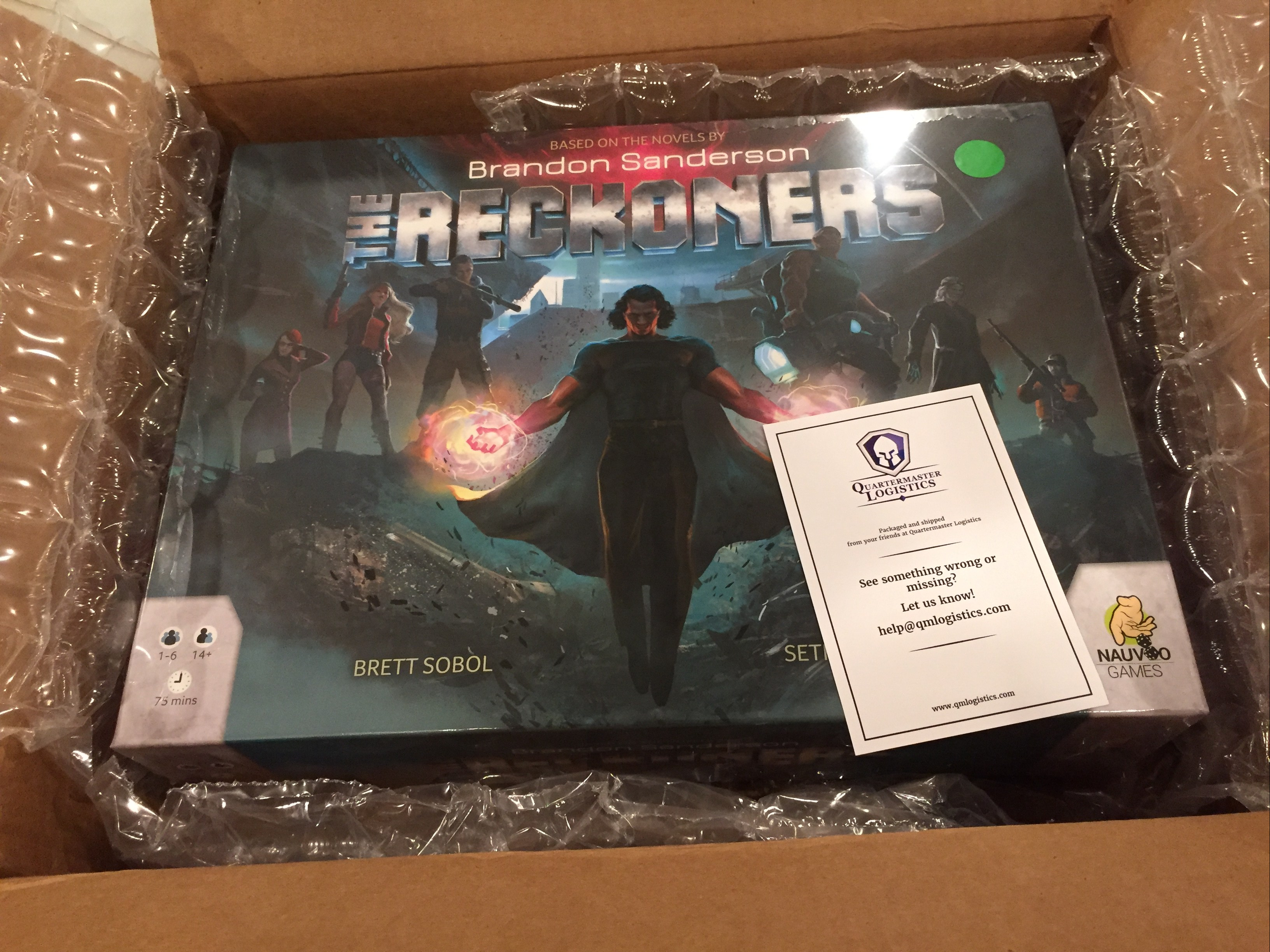
This expansion delivered to us in the last month (early June 2022): Steelslayer was on Kickstarter some time ago. Although I got both The Reckoners and The Steelslayer expansion on Kickstarter, I have seen this game in a lot of online stores, so it’s fairly widely available.
To be clear, the Steelslayer expansion requires the base game of The Reckoners to play. You can play a game with almost everything new using this expansion, but you still need a lot of trays and tokens from the original box. The original Reckoners is a game that plays 1-6 players in abut 75 minutes, and this expansion continues that tradition (The game is typically longer, but that estimate is accurate enough).
Unboxing
The Steelslayer box is about the third of the size of the original box, see above. This is probably because the expansion doesn’t need all the trays and tokens from the base game (recall there were a LOT of GameTrayz from the original game).
The expansion is pretty densely packed in this box: there’s no way you are going to be able to combine the boxes into one!
The rulebook seems to be the same high-quality as the original rulebook (both of these are high-quality rulebooks). The first pages make it really easy to jump in with list of components (and their pictures) plus a quick discussion of replacements.
The game comes with a campaign sheet (two-sided, see above). If you want to play a campaign. I’ll be honest, I love this game, and I’m not convinced I would ever play the campaign mode: there’s no “story” there, just “a bunch of games”. Some people might like this as a framework to play a lot of content.
So much stuff crammed in here!
There’s a lot of great stuff in here! It looks like the original game!
This is a modular expansion (which means you only have to add in what you want), so let’s unpack it modularly.
Module 1: New Reckoners
The first module adds four new characters to the game: Val, Mizzy, Exel. and Sam: see above and below.
To support 4 new characters, the expansion includes 4 new boards (see above: you have to reuse the Game Trayz from the original game), new power cards (see above), and 4 new minis (see below).
All the minis come in a nice little case: see below.
The new characters have new dice allocations, so in order to support the new characters working with the older characters, new dice were included with the game. See below: notice they are just MORE of the same dice, except for the 8-sided die, which we’ll discuss later…
I’ve played all the characters in the new expansion, and they all feel a little different from the base game (if not revolutionary), but they do mix-it-up if you want. Of all the modules to add in, this is probably the easiest: just add new characters. I think Mizzy (below) is my favorite: she blows up stuff.
This module is incredibly easy to add in: just use one of the new characters!
Module 2: New Equipment
New equipment
The new equipment is an interesting module because it can either completely replace the old equipment cards or just augment them! If you just want all new stuff, you can just use the new equipment cards: there are enough new equipment cards to do that! (There are a few equipment cards that use some new rules from the expansion, (ok, maybe it’s just the Kidnap equipment card) but even then they are still generic enough to be used with just the base game or just the expansion). You can also choose to just add these to your equipment deck for more variety.
Because of game balance, the expansion chose to replace some equipment cards (Med Kit and Fuel Cells) with more expensive versions.
This expansion is very easy to add in or replace the old equipment.
Module 3: New Epics
The designers chose to make an interesting decision here: with this module, you can completely replace all the old Epics (bad guys who aren’t the main villain) from the original game! This is a “use one or use the other” expansion: you can only use ALL the new Epics or ALL the old Epics (some enterprising players may try to find ways to mix them, but I wouldn’t). See new Epics below.
With these new Epics are a bunch of new rules and tokens:
This expansion includes a bunch of new tokens for these new rules and activations: strictly speaking, they all make the game harder!! The red shield must be removed before Enforcements can be removed, the blue shield must be removed before Epic sliders can be lessened, and the copy epic action (? tokens) repeats some of the Epic Actions. (The orange tokens are special rules for the main Villains).
The dreaded 8-sided die
The most feared of the new rules is the 8-sided die: some actions in the game require you to roll the dice and “do the bad stuff” on the dice. It’s all bad. And it’s random. Mostly, the new Epics use this, but there are other places in the game that use the dreaded 8-sided die as well.
This expansion is a little harder to add in because there are a lot of new rules with the new Epics. It also makes the game harder.
Module 4: New Boss Epics & Cities
New Boss Epics & Cities!
This is by far the most complicated modular expansion, but arguably the most interesting. This adds two new Boss Epics to the game: Regalia and Limelight! See below.
If you choose to fight either of these Boss Epics (instead of Steelheart), you are upping the complexity of the game quite a bit. Both of these Boss Epics change the game pretty significantly!
For one, each new Boss has it’s own set of City Tiles: Regalia uses the Babilar cities and Limelight uses the Ildithia City Tiles! See below for a sample Babilar city tile: notice the special research track on the right hand side not in the original city tiles!!
Limelight even has his own book!
A bunch of content is exclusive to Regalia:
And a bunch of content is exclusive to Limelight:
It’s really cool that the game changes so much from Boss Epic to Boss Epic, but be aware: there’s new rules and complexity added for each new Boss Epic. Even though none of us likes extra complexity, arguably that’s the best way to give this game some new “oomph” as the game really does change.
This particular module is very hard to add in (so many new rules and complexity), but the most rewarding for new game play.
Reminder
Before I played the expansion, I replayed a solo game with the original base Reckoners: I just wanted to make sure I remembered all the base rules! I wanted to jump into the expansion without feeling too confused. This was a reminder in two ways: I reminded myself of gameplay and rules, but secondly, I reminded myself how much I love this game! If I never played the expansion, but it just encouraged me to replay the base game, then it has done its job. This game is great.
Solo Play
I jumped on feet first into this expansion, using as much new stuff as possible! I am using all four expansion modules: two new Reckoners (Val and Sam), only new equipment, all new Epics, and a new Boss Epic. See set-up above.
Val and Sam (above) played well together: Val’s ability to move Sam or remove a barricade was perhaps underwhelming at first, but it was critical to winning my game. Sam’s weird re-roll ability makes sense once you realize Sam has all colored dice, which means there’s exactly one double symbol on each one! So Sam wants to try to roll as many doubles as you can, so Sam ends up rolling and re-rolling a little bit more because he really wants those doubles!
Regalia is interesting because her research track is essentially distributed all over the city. Each new Location has its own research track on the right (see Central Park above). When you kill an Epic, you (typically) cause that research track to go down. Only once ALL cities have the research track at zero can you try to kill Regalia!
Regalia also has a bad news decks and a good news deck to balance things out. When Regalia moves, she moves to a location with the new characters and “does a bad news card” (purple cards above) on them. The green deck (fortune cookie) gives the good guys some extra symbols to spend later.
Overall, the solo games work great: play two characters! Thank you the Reckoners and Steelslayer for following Saunders’ Law so well! And the new expansion seems to continue that tradition: the solo game works great, with the expansion providing all sorts of new content.
My only complaint is that I had to have two rulebooks open all the time: the original Reckoners rulebook (on the table on the left) and the new Steelslayer expansion rulebook (on the chair on the right). There are just a lot of things to follow, but luckily it’s easy to find things in both rulebooks.
Cooperative Play
So, I don’t know a lot about Brandon Sanderson (this game is based on his Reckoners books), but I think this game is a just a fantastic cooperative dice-driven superhero game. My friends, who are all huge Brandon Sanderson fans, wanted to play the game (and expansion) because of the tie-in to the universe of the Reckoners! My cooperative games went over really well with Brandon Sanderson (and the Reckoners) fans. They all thought the game was very thematic and consistent with the books!
From a game play perspective, we tended to pair up when needed: Jared and I tended to team-up early in the game (see above). But as the game moved forward, we tended to pair-up when needed: “I can take out this Epic by myself, go help Charlie!” The amount of communication and cooperative in this was just fantastic! You still feel like you can do things on your turn, but working together seemed so seamless in this game! I think a lot of this is due to the Player Selected Turn Order (PTSO): players can take their turns in any order they want! But the PTSO is even more fine-grained here, as we can intersperse our turns and intersperse when we play dice! “Hey, I’ll hang back and see if anyone needs anything: Oh! Allison needs one more research! I’ll move to her, Allison takes her turn, then I’ll move to Jared!”
All the players loved this game: I suspect the Brandon Sanderson theme helped them into the game, but once they got into the game + expansion, I think they all really liked it.
One possibly caveat: I had done my darndest to make sure I had all the rules internalized so the teach would go quickly. I facilitated the game, but to be fair, everyone caught on pretty quickly. The only game stoppages were to look up the new icons from the new expansion. Frankly, there are a lot of new icons and they aren’t always that intuitive!
Conclusion
Steelslayer is the best kind of expansion: it reminds us how great the original game is! With the Steelslayer expansion, our rating of the Reckoners has gone from an 8.5 to a 9.0/10.0 or maybe even 9.5/10.0!! As a modular expansion, we can add what you want to to base game to make it better: new characters and/or new equipment and/or new Epics and/or new Boss Epics (and cities)! Or we can choose to go all-in and get a completely new experience in the Reckoners with everything all new!
About the only negative thing about this expansion is that it can make the game more complicated, but only if we play with the new Boss Epics. But, again, since the expansion is modular, we don’t have to play the new complicated villains, we can just play with the new characters or equipment to augment the base game.
Overall, The Reckoners: Steelslayer is a fantastic expansion that we highly recommend: it gives more content to a fantastic game, thus giving it more replayability and a longer life.
As an aside, the Marvel United: X-Men expansions (see discussions here, here, and here) were an “obvious” choice for Expansion of The Year for 2022, but Steelslayer was so good, it may well supplant it. We’ll have to see how the year goes…
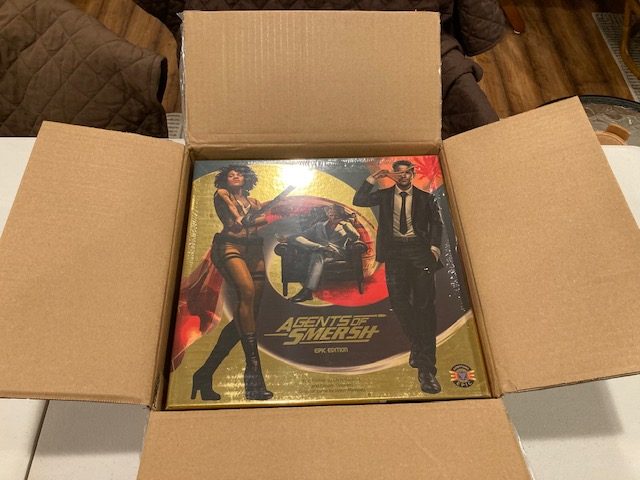
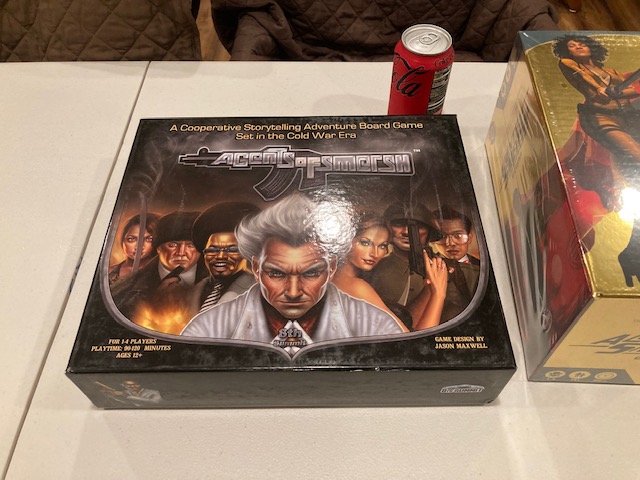
Let’s be clear here: there are at least two cooperative Batman The Animated Series games: Gotham Under Siege and Shadow of the Bat. This week, we are focusing on the Pete Walsh and Kevin Wilson design called Shadow of the Bat (see picture above). Gotham under Siege (see picture below) is a fantastic Batman game that made our Top 10 Cooperative Dice Games and Top 10 Cooperative Superhero Games. Gotham Under Siege is a different dice game that we will discuss again later: these two games will have some unexpected crossover!! What does that mean? Keep reading fearless reader!
Kickstarter
Batman The Animated Series: Shadow of the Bat (sometime called Batman: The Animated Series Adventures) is a cooperative and competitive Batman game (yes, it’s both, but we are only looking at the cooperative mode) that was on Kickstarter back in March 2020, with promised delivery in December 2020. They did not make this date: I believe they delivered in early 2022: I only know this because I picked up the game online after it delivered. The original Kickstarter price was just too much money for me to be all in, so I chose to wait until it was cheaper online! I wanted to see what the game was like before I threw $300 (!) at it.
This Kickstarter is of historical significance in many ways: IDW decided to stop making games altogether recently, and this will probably be the last Kickstarter game IDW ever does! Those of you paying attention might remember a list we had up in late 2021: Top 6 Cooperative Games To Grab Before IDW Games Disappear Forever!! Number 2 on this list was Shadow of the Bat! To be fair, we expectedShadow of the Bat to be a good game (it’s a Kevin Wilson design, one of our favorite designers), but we hadn’t actually played it yet. Let’s take a closer look.
We are going to do this a little differently than normal, only because it took us a while to get into the game: we are going to divide this into days (really, one session per day) over which we explored the game.
Day 1: Unboxing
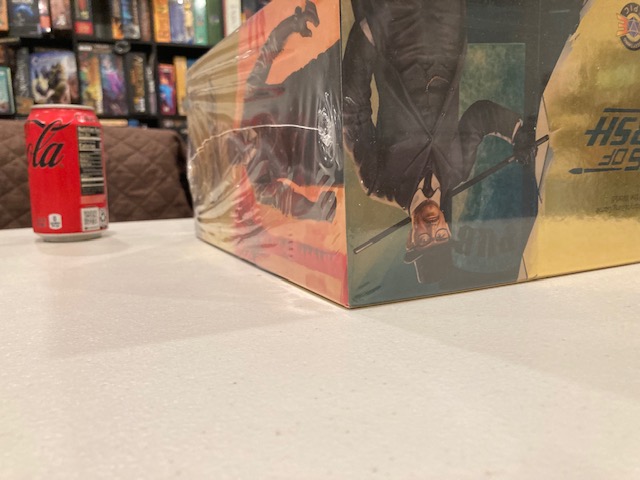
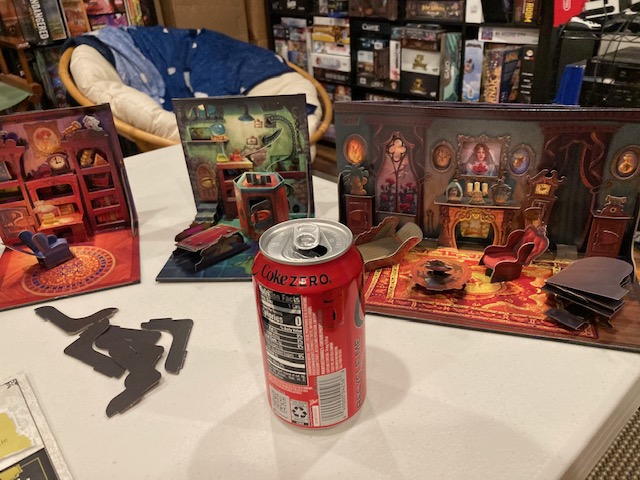
On a recent trip to Denver, I brought Shadow of the Bat with me, hoping to play it with my friends. For many reasons, it never came out. One reason was how big and ominous this game is! It’s bigger than a normal box (see Coke can above for scale) and it has quite a number of components.
It’s got quite an array of tokens: I mean a LOT of tokens! It’s the first thing in the box!
Look at how thick that is! There are SO MANY TOKENS to punch out. Foreshadowing: we will have to spend an entire session/day to JUST punch out and organize the tokens.
One of the coolest things in the box are the miniatures! There’s quite a number of them! See above.
There are also a quite a number of terrain boards. If you think this is starting to look like a skirmish miniature game, you wouldn’t be wrong.
Underneath all the minis and terrain boards and punchouts are the cards and dice. Oh yes, this is a dice game! Each player will have a set of 3 dice and the remaining dice are “battle dice”.
The rulebook is quite thick (we’ll take a closer look later) and the game also comes with two whole scenario books for 12 issues of set-up. The rest of the game is in the cards! See below.
Competitive Mode cards
Closer look at some competitive mode cards
The cards look very consistent with art from Batman The Animated Series.
After unboxing the game to try and play it, I chose to wait until I got home to finish unpunching the tokens. There were SO MANY TOKENS, I knew they would just all clunk around in my luggage if I punched them out in Denver. So, Day 1 was just getting acclimated to the components.
Day 2: The Unpunching
There are a LOT of tokens. I thought my next session would be a solo playthrough. I was wrong! I spent the entire session unpunching. See all the tokens above and below.
In the end, I chose to punch tokens out in clumps: the rulebook describes all the tokens on one page of the rulebook, so I tried to punch out tokens in the groups specified: See below.
You will also happen to notice there were NO CORRELATING PICTURES for the tokens. I had to kind of guess what was what. I was very grumpy at this (we had similar problems in Deep Space D6), but I did find some token descriptions in the back pages of the rulebook: See below.
So, before you go absolutely crazy, make sure you poke your head in the back of the rulebook as you punch out tokens: quite a few of them have correlating pictures.
In the end, I chose to store the tokens in bags in the same groupings they were described in the rulebook: I used a sharpie to write on the bags (see above) to notate what was inside. (For the record, I had to do that thing we hate: I had to count the number of tokens to make sure I had the right kinds … there still weren’t quite enough descriptions).
This bears emphasizing: there were a lot of tokens.
After spending a few hours putting all the tokens together, I was done. Gameplay would have to wait for another day.
There are so many tokens, they almost don’t fit in the box! See above.
Day 3 Interlude: The Miniatures
I took a brief Interlude day to just play with the miniatures. I tried a couple of stands to see how they worked:
In the end, the minis are fairly distinct and I could use the little yellow stands that came with the game.
The minis are pretty good.
The lighter plastic makes them easier to distinguish than the Hour of Need minis (from a few weeks ago).
I like the minis. They work pretty well and look pretty good on the board.
Day 4: First Solo Play
I finally got the game set-up! I even played through it. And I got so many rules wrong. But, it was good to try to get through the first game to get a sense of everything, at least of the main flow. I won, but it was a huge cheat: I missed so many rules.
Day 5: Second Solo Play, First Correct Solo Game
Okay, after an unboxing, getting familiar with the components, unpunching the tokens, playing with the miniatures, reading the rulebook, and getting a bad play under my belt, I finally played a proper solo game! And you know what, it was fun. It just took a long time to get there.
Rulebook
This rulebook is pretty okay, but it feels really long (well, because it is). I almost felt like I was reading a rulebook for an RPG!
There’s a nice chapter listing right up front, but there is no Index: seriously? Did we not learn anything from Hour of Need ‘s lack of an index last week? Indices are critical for complex games like this. But at least this rulebook has many glossaries (se below)! So they do get points for that.
The game is both competitive and cooperative: the rules for both are interspersed among each other, which made it a little more difficult to deal at times.
The next few pages have components. They do commit the cardinal sin of not having pictures immediately with the list of tokens, but they make up for it by having a lot of those pictures in the glossaries and the next few pages.
There are a LOT of components in this game.
This rulebook is pretty okay. It’s long, the competitive/cooperative sections are well-labelled, but sometimes annoying that the two sections are interspersed with each other.
The rulebook’s only real sin is not having an index. The rest of it is … okay. The rulebook tends to label things and have decent examples. This is just a big game with lots of rules, so it’s easy to get lost in the rules sometimes.
Seriously, I felt like I was reading rules for an RPG (“Rules for crouching? Smoke? Doors?”).
Solo Play
Yes, Shadow of the Bat game has a special set of rules for solo play (congratulations on following Saunders’ Law). I admit I was a little worried at first, because the scenarios I looked at always seem to a need 4 characters!! Was I going to have to play 4 characters all the time? Thankfully no.
Actually, the real problem is that the solo mode is not called the solo mode: it’s called The Dark Knight Mode!!! Once you realize that The Dark Knight Mode is the solo mode, you are happy that it’s only two pages of extra text with few extra rules. Basically, the solo player plays the lone character Batman (only one hero). The extra rules: Batman gets to act three times during a full turn (normally, each hero character only gets to act once), gets a few bonuses on abilities, always gets an extra wild symbol, and has one extra ability card (which allows him to heal focus: see below).
I’m always very nervous when solo modes are outside of the main flow (Marvel United has such a contorted solo mode), but the extra rules for The Dark Knight Mode were easy to understand. Better yet, these extra rules were readily notated with the extra card (see above) and and cardboard augment (see below): these two extra physical components remind the players of most of the extra rules!! And these new rules were straight-forward to assimilate into gameplay. Honestly, I was very pleased with how well the solo play was described and notated.
Solo mode gets a cardboard helper to remind the solo player
As I said earlier, my first play was pretty much a disaster, but I don’t blame the solo mode: Shadow of the Bat simply has a lot of rules.
My second solo play went a lot better once I had a better feel for the components and rulebooks and basic game flow.
I will say this: I had to have the rulebook open the entire time: my nose was pretty much buried in the rulebook as a I played.
I liked the solo play.
Dice Game
Despite all the minis and rules, Shadow of the Bat is (at its core) a dice game.
Each player assumes the role of a character (Batman, Robin, etc) and each character gets their own three Action Dice. These dice dictate what actions the character can do that turn: Move, Melee Attack, Ranged Attack, Defend, sometimes both, and a Special. If you don’t like what you roll, you can spend a Focus token to re-roll dice you don’t like, but you can only do that once. These Action Dice dicate what you do on your turn: you “spend” each die to something on your turn.
If you do decide to attack something, then you roll the Attack Dice (black dice below): These decide how many hits you get.
You get 1 hit, 2 hits, or a Defend. Like the Action Dice, you can re-roll Attack Dice by discarding a Focus.
Dice decide most things in this game.
Cooperative Play
One of the more interesting things of the cooperative mode are the way dice work: you share one of your dice with your left neighbor and another dice with your right neighbor. It kind of reminds us of Marvel United meets Second Wonders where you “share” your Actions with your neighbors.
Tokens show what was shared with your two neighbors
To do that, you roll your three dice and choose 1 for each neighbor: Having decided which dice face to give to each neighbor, you then give a little token (Dice Placement Token) to your neighbors to notate what “extra” actions they get. See below.
Dice Placement Tokens: used to notate what dice you gave your neighbors
What this means in reality is that you get 5 actions per turn (3 from your dice and 2 from your neighbors).
This really reminded me a lot of a cooperative Seven Wonders or Marvel United, where you are sharing your symbols with you neighbors. This did encourage cooperation among me and my neighbors, but not as much as I expected: as a player, you are trying very hard to get your own symbols, so you are trying to decide to re-roll at the same time as your neighbors. In practice, you tend to roll in isolation and then share a symbol if you neighbor wants it! Still, it worked reasonably well.
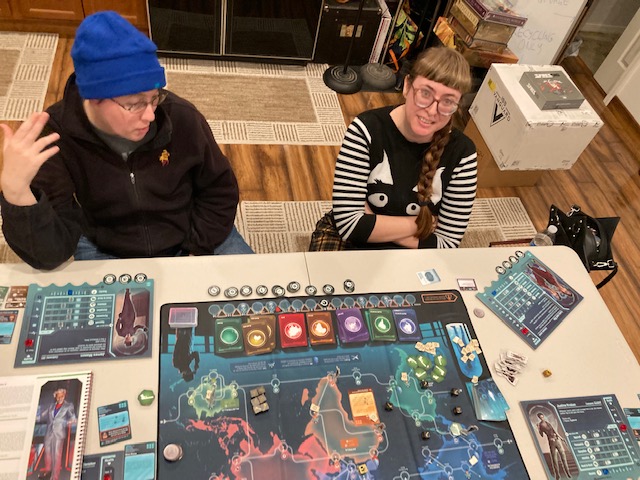
Scaling and Player Counts
One of our least favorite parts of this game was the player scaling for 3 players. While the solo game works great (with the player playing Batman and getting 3 initiative cards), the multiplayer game always requires 4 characters to be in play! For a 4-player game, this is perfect (as each player takes control of one character). In a 2-player game, each player takes control of two characters each: this can be daunting for beginners but at least it’s balanced. But, as we saw in the 3-Player game (above), we didn’t love the flow of one player controlling two characters while everyone else only controlling one. It felt like you had to wait longer for your turn, and the flow just seemed “off”.
If you DO play 3 players, make sure that the player taking control of Commissioner Gordon does NOT get the extra fourth character! Gordon already has to deal with putting his beat cops out!! See above. The rules already recommend the 4 characters to play: maybe they should recommend how to divvy the characters in a 2 or 3 player game?
We have seen some games (like Legends of Sleepy Hollow,see our review here) that always require 4 characters, and that didn’t always quite work. Luckily, Shadow of the Bat has a great solo mode that avoids some of the issues Legends of Sleepy Hollow had. So: 1, 2, and 4 players works well enough: 3-Player can work, but it was by far our least favorite player count.
Miniatures Game
Looking at the set-up above, you might guess this is a tactical and strategic miniatures game with RPG elements. And you would be right! There are so many rules surrounding the miniatures and the map that this game reminds me of a miniatures game more than a strict board game. The game is all about moving the minis and the actions on the map. There are some items to help and some abilities, but Shadow of the Bat is really all about moving around the board tactically to beat up bad guys.
Compare this to Hour of Need a few weeks ago (which we reviewed here): Hour of Need (see above) is very similar to Shadow of the Bat in many ways. Each player takes the role of a Superhero, the game has a tactical map, players roll dice to hit, and heroes move around beating up bad guys. This is all very similar to Shadow of the Bat! The main difference is that card play is the central mechanism in Hour of Need! There are so many ways to use/interact with the cards of the game, and you absolutely have to use the cards as much as possible if you want a chance of winning!
Shadow of the Bat is much more about moving the minis in tactical and strategic ways … almost like a war game. Sometimes you move to be defensive, sometimes you attack, sometimes you lure other people away. There are so many rules and tokens for dealing with things on the miniatures map: crouching, smoke, doors, bombs, etc etc etc.
Shadow of the Bat is a miniatures game set in a world of Superheroes, with lots of thematic elements. Hour of Need is a very thematic Superhero game with card play, which just happens to have miniatures and a map. If you see the difference.
Choice vs Randomness
To be clear, I like this game. I think I like it more solo than cooperative, but in general I am keeping this game.
However, here’s my main problem with the game: you roll dice to decide your actions. You don’t get to choose: the dice determine what you get to do. For a game with so many rules and so much set-up, you don’t get a lot of choice because you have to take what you get when you roll. Now, this can be mitigated by a re-roll (but only one re-roll and at the cost of the a Focus token), and you can get actions from your neighbors (but only in cooperative mode). But, at the end of the day, you may not get to do what you want. And that’s frustrating.
For some reason, I don’t have as much an issue with this same dice system in the Reckoners: Just like Shadow of the Bat, TheReckoners only allows you to do what you roll. But there’s several differences: In TheReckoners, you get to re-roll up to three turns for free! AND you can roll in any order you want (Player Selected Turn Order) as you re-roll! AND you can always do something with your dice! AND one dice face is a future wildcard!! The dice mitigation is much much higher in the Reckoners: you can usually do something interesting. And The Reckoners is much simpler than Shadow of the Bat: it’s just a dice game that won’t last all night. Shadow of the Bat is supposed to be a much deeper game, but I feel like this dice action mechanism holds it back a little.
Just last week, I was lamenting that a lot of cooperative games use “let the players decide” when ambiguity shows up. Shadow of the Bat uses “let the players decide” in a number of places. For one, there is no order of how the Bad Guys attack.
Consider the map above: When the dudes with Machine Guns(above) come up in initiative order, in what order to they attack? How do they move? There’s notions of both, but especially when they are this clustered, the players will have to make a lot of edge case calls about how they move. It’s not a big deal (you get used to it and it worked pretty well honestly), but some people may really not like this.
I admit I was excited when I saw that each Bad Guy had a “preference” of who they attack! See the bottom of the cards above: the up-arrow heart means those Bad Guys prefer to attack players with the most hit points! The down-arrow heart means those Bad Guys prefer to attack lowest hit-point heroes. But just like most cooperative games, whenever there was an ambiguity, Players Choose. I got all excited because I thought, for a moment, there was a more ambitious ambiguity resolution mechanism.
One other issue: how do we keep track of how many Hit Points each Bad Guy has? I ended up choosing to put the hit points “under” each Bad Guy, but I wish there were a better mechanism. (My friends also thought that was a major flaw).
The Arkham Horror Connection
Both Batman games from IDW are by the two co-designers of Arkham Horror Second Edition: Kevin Wilson designed Shadow of the Bat and Richard Lanius designed Gotham Under Siege. They are both Batman games, both cooperative games, both fundamentally dice games, and both in the Animated Series universe. Which is better? I think Gotham Under Siege is lighter and easier than Shadow of the Bat, and frankly it’s easier to get to table: I think I like Gotham Under Siege better (even though it’s fundamentally a random dice game): it’s just quick and easy and doesn’t outstay it welcome. I do like Shadow of the Bat, but it’s a much longer and heavier game. Sometimes the randomness of the dice in such a heavy game is a little out of place.
Conclusion
I like Shadow of the Bat, but I suspect a lot of people won’t. This feels like a big tactical miniatures game with tons of interesting rules, but the limited dice mitigation and random player order feels out of place in a game with so many rules. The randomness can just beat you down. I think Hour of Need is the better overall Superhero game: there are so many choices and upgrade paths in that game that players always feel like you can do cool superhero stuff. In Shadow of the Bat, player actions are limited by what they roll on the Action Dice. Having said that, Shadow of the Bat can be very cool as a puzzle game, where limited actions form the constraints of the puzzle (players do the best you can). Like I said, I really enjoyed this game solo.
Shadow of the Bat is a cool miniatures game that dwells on the map and tends to be less about being a Superhero game and more about being a cooperative/solo tactical minis game. I like it: it will come out when that’s what I want. Your mileage may vary.
Echoes: The Microchip is the latest in the Echoes series of games. These games use sounds and sonic clues to help guide you through a mystery and/or story. These games are “one-and-done”: once you have solved them, you probably won’t play them again since you know the solution. Luckily, you can pass these onto a friend when you are done, as you don’t destroy anything as you play.
These games definitely require an app for either iOS or Android: the apps present the sounds and sonic clues to you as you play. The phones are also used (at least in this version) to scan cards.
echoes requires an app
Unboxing
The echoes games are very small: both in price and stature. Take a look at the scale compared to the Coke can! And I think I paid $10.99 for my echoes game.
The instruction book is a fold out. Ugh. I usually hate fold outs, but this worked “okay”.
There are two sets of cards in the game: The larger, heavier cardboard cards (see above) that represent major story points. The lighter ones are cards that fill in the story between the story points. The heavier ones have the white outline.
Overall, the components are fine: the game looks a little abstract as you look at the pictures, and you realize: there’s not too much here…
App
The game requires an app. I downloaded it to my iOS device and COULD NOT get it to work! So, then Andrew downloaded his Android version, and it seemed to work fine. After a while, I realized that mine didn’t work BECAUSE I HAD THE RINGER ON SILENT!!! Since this is a game about hearing things, I thought it made sense to put my ringer on silent. Nope, that essentially made the app silent as well! Caveat Emptor! The app works fine for both iOS and Andrioid, but don’t forget to take your phone off of silent ringer!
echoes requires an app
Once you have the app working, you scan cards and it tells little stories or plays little snippets for each card.
Gameplay
This game kind of reminds me of Timeline: you have to put cards out “in order”. You listen to little snippets of sound/story on each card and then have to put some of them in order. Once you have them all in order, you have figured out the story! As you play, you put “triples” of cards together with major story point Cards and scan them—if you have the correct cards in the correct order for the major story point, you have solved part of the puzzle!
See Sara and Teresa trying to find some triples: 3 minor cards to go with 1 major card.
If you can put all the cards in order, based on the sonic clues, you win! And you figured out what happened in “the story!” Interestingly, as you play, more and more of the story gets revealed, as you hear more and more sounds from a section you have completed. Once you complete a major story point, it plays through the whole story for that piece!
Player Count
The game says it plays solo, and I am sure it works fine. But this game seems a lot more fun with a group as you listen to clues, have discussions, and work together to put the clues together to form the story.
Conclusion
Echoes: The Microchip was fun. It was about an hour. It was light. We enjoyed ourselves, but it wasn’t deep by any means. The best analogy I would use that it was a “sonic jigsaw puzzle”: it kept us entertained for a short period, and it was fun, but it wasn’t anything super memorable. The idea of using sound clips was novel enough that it gave us a fresh new experience.
I’d play another. So would my friends. It wasn’t great. But it was entertaining.
I’d say “play this at a convention” if you could, since it’s a “one-and-done” game, but this game really needs a room with quiet so you can hear all the sonic clues: Conventions never have quiet room!