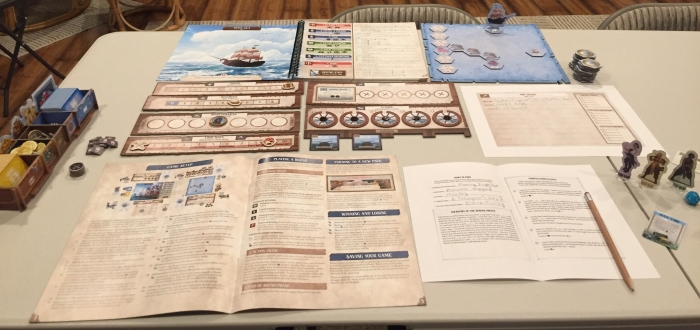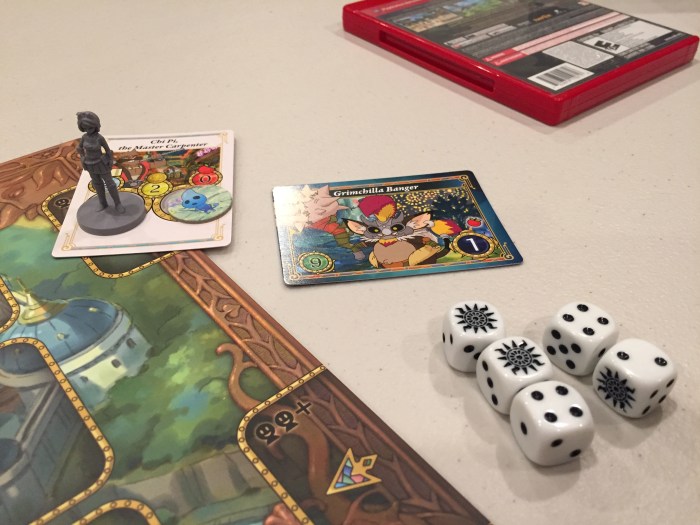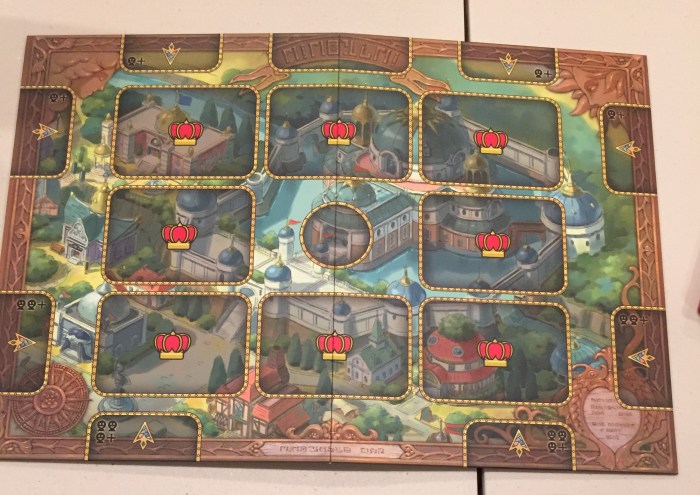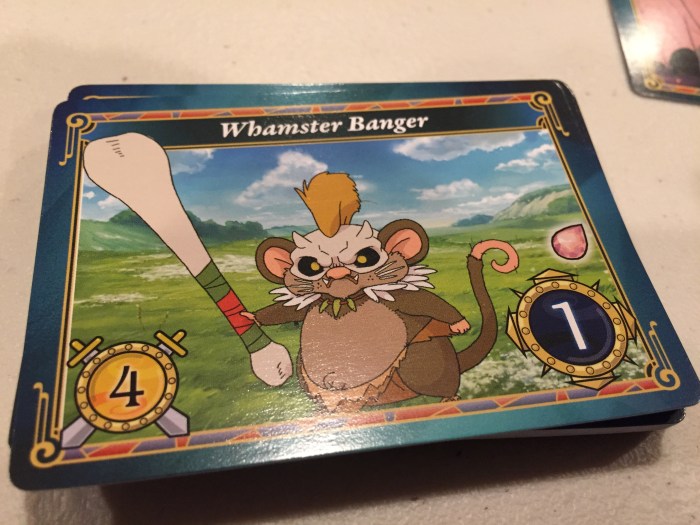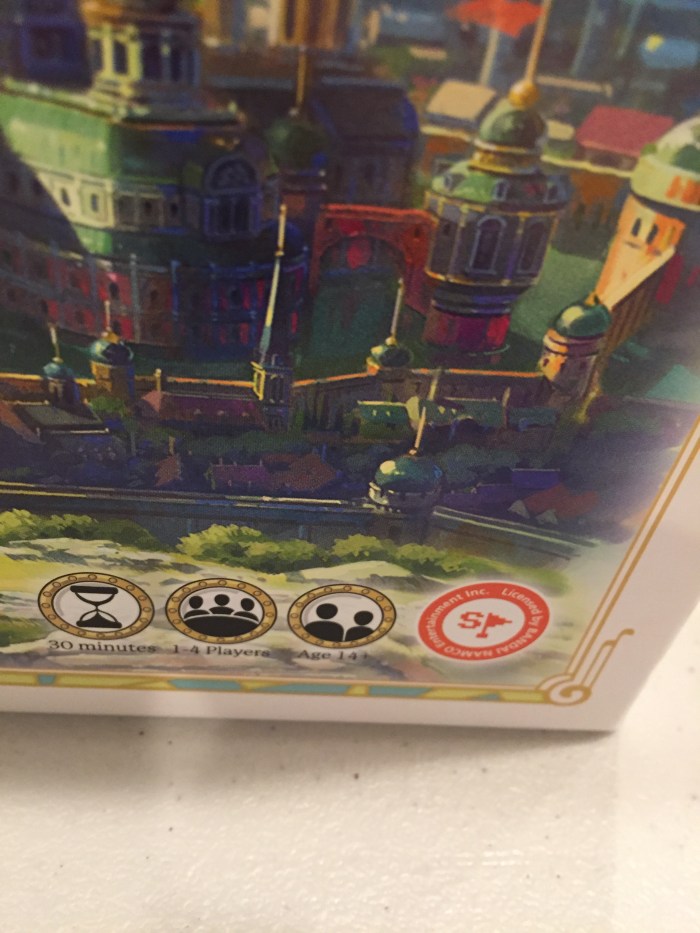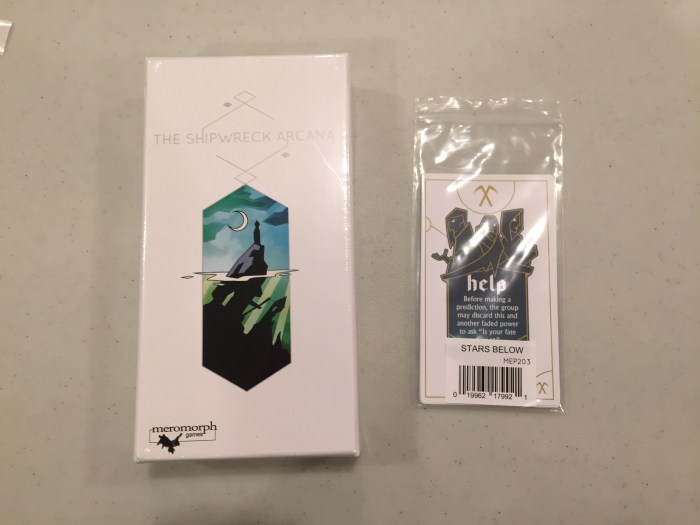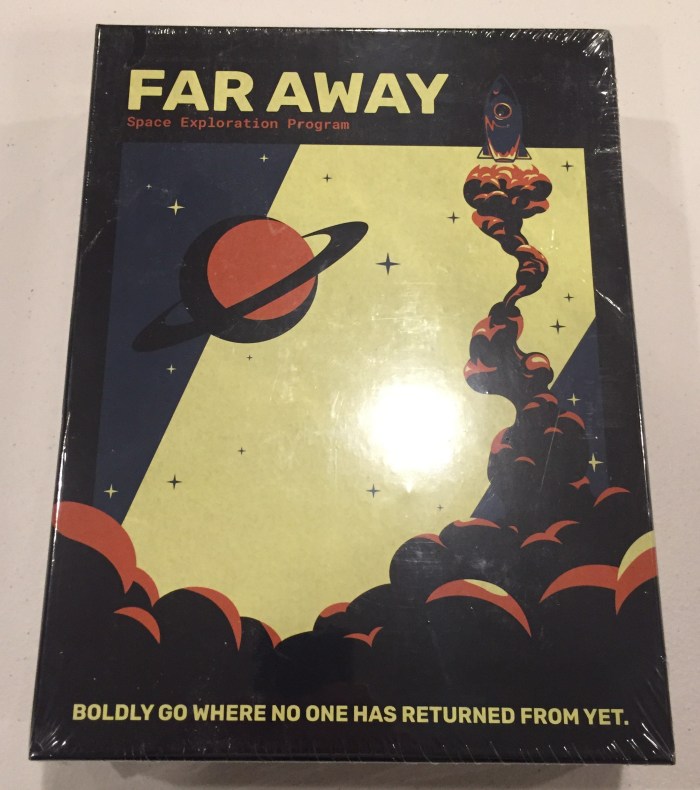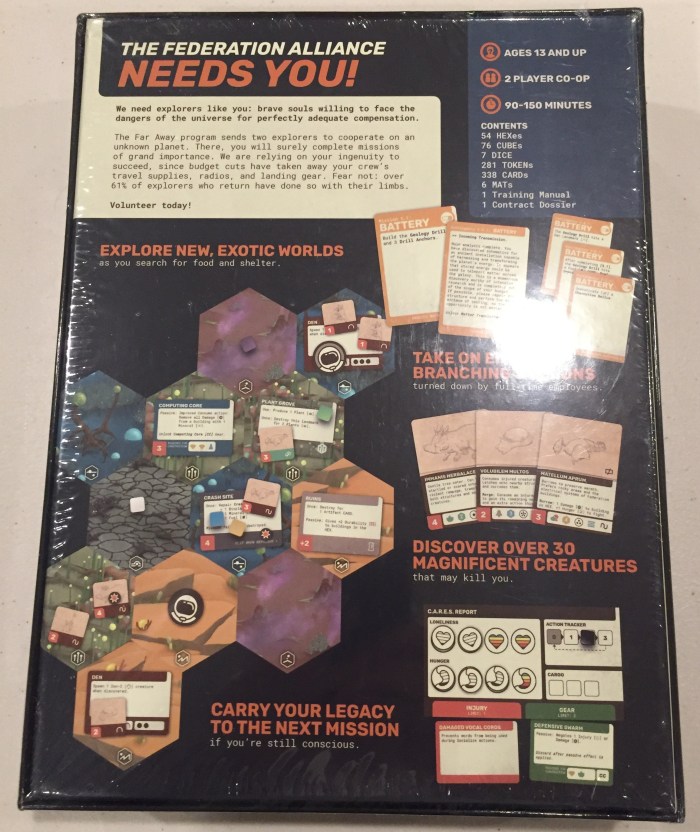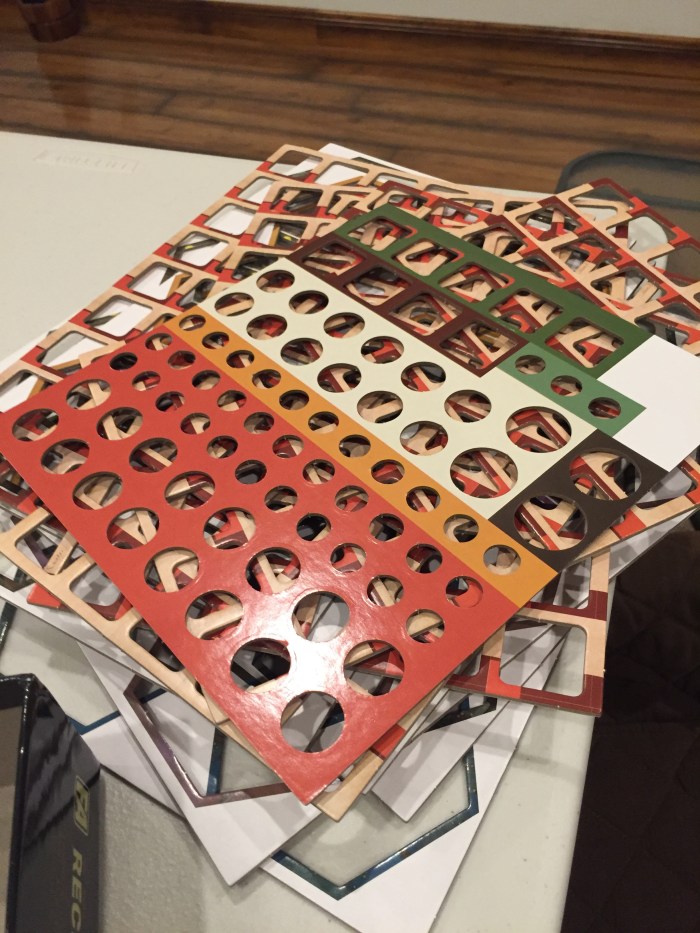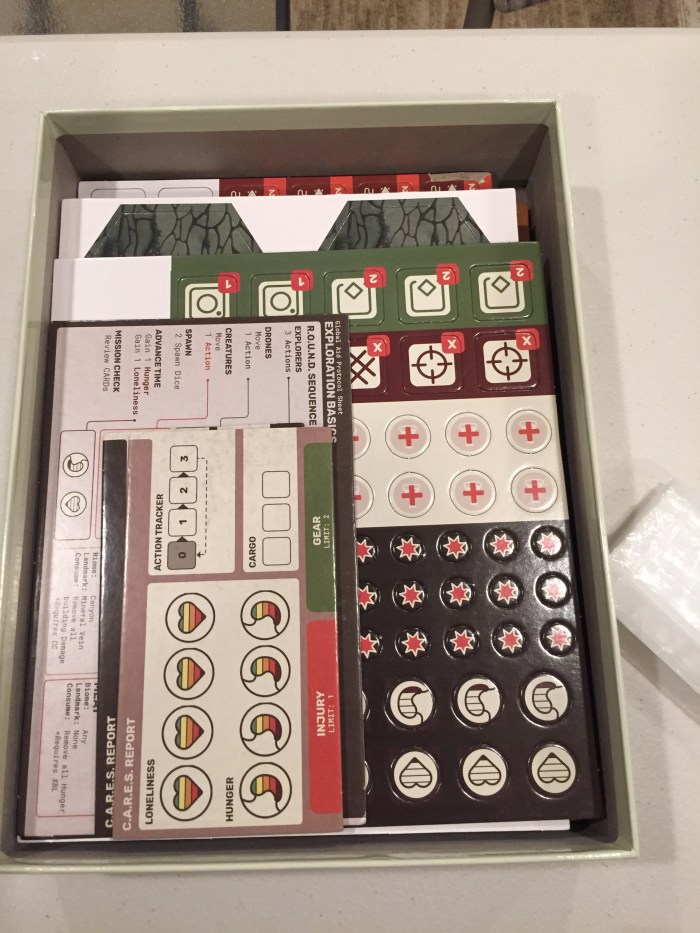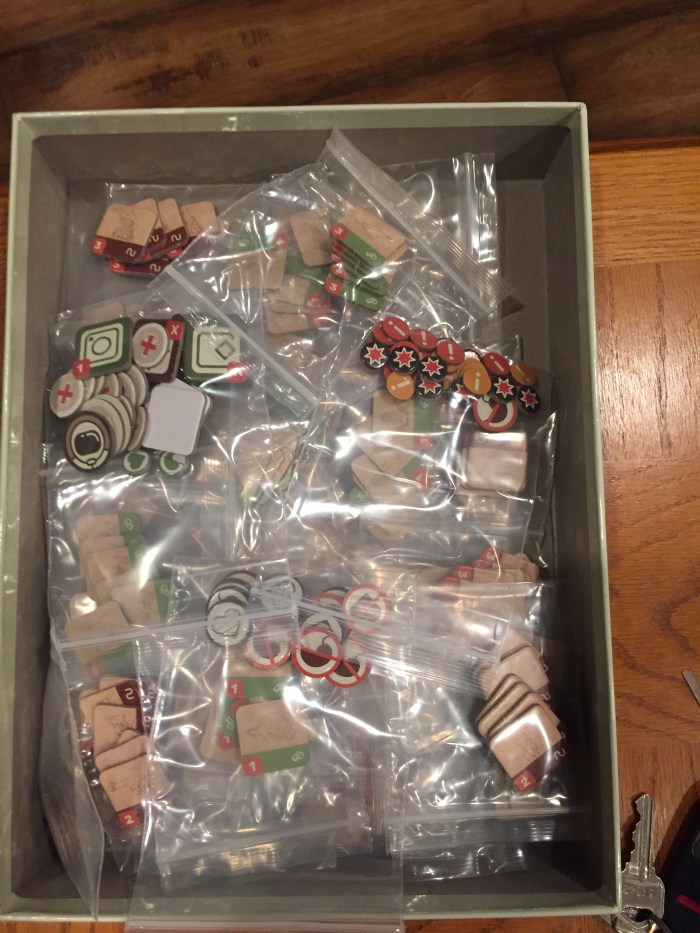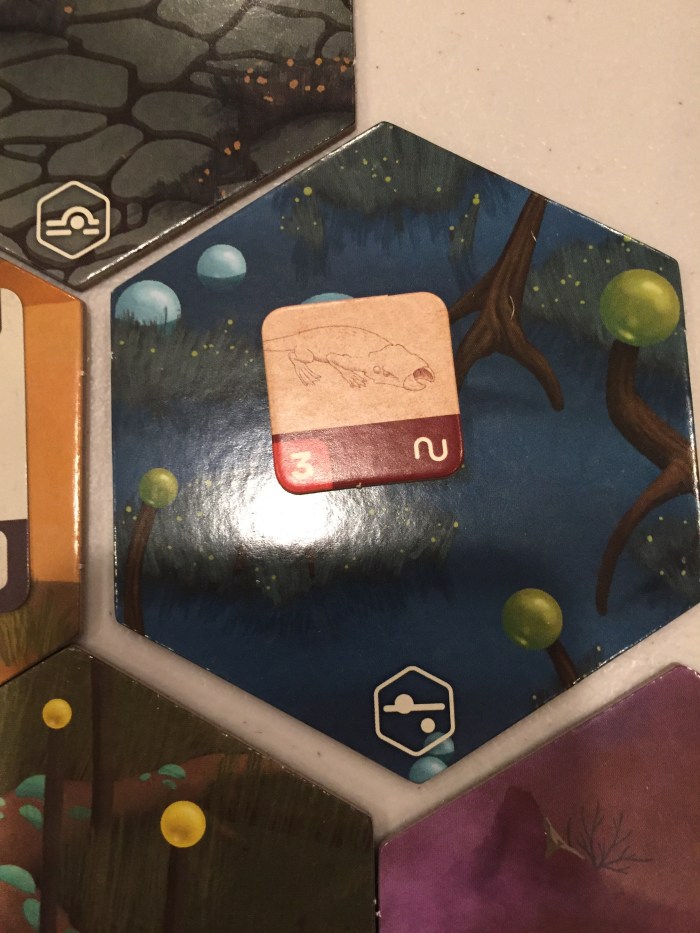
A Review of Orleans Invasion: Part I. Unboxing, Solo Rules, Cooperative Rules, and First Impressions

IMG_5760
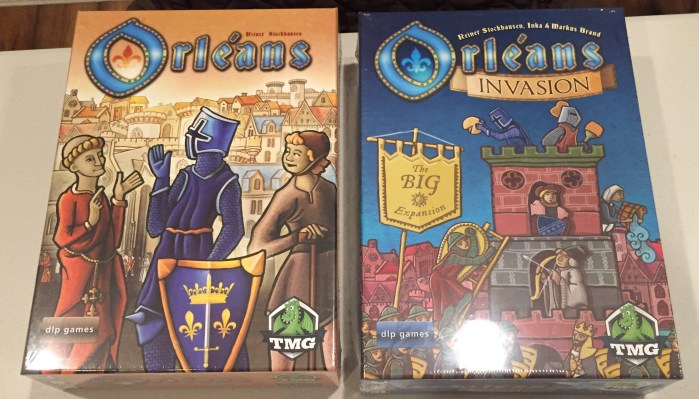
Orleans and its cooperative expansion, Orleans: Invasion

So, this is a cooperative games blog.  Why are we talking about Orleans, a competitive, bag-building Euro game?

Orleans is a  game that came to my attention because it could have fit on two of my recent Top 10 lists: Top 10 Cooperative Deckbuilding Games (bag-building is a dual of deck-building) and Top 10 Games That Can Be Played Fully Cooperatively.  There is a big box expansion called Orleans: Invasion that imbues this competitive, victory-point-scoring  Euro with cooperative and solo rules (and some campaign rules for a competitive game, but we won’t delve into that)!

I’m not sure why I picked this up: Was I curious how to make a Euro cooperative?  Yes!  Had I heard good things about the cooperative mode?  Yes!  Was it on sale!  Yes!  Oh, that’s why I picked it up!

Unboxing The Base Game

IMG_5765
Orleans: the base game!

Well, the expansion looks great .. but I can’t really get to it until I get into the base game!  I just want to say, there’s a lot in here.  A lot of cardboard, a lot of boards, a lot of tokens, a lot of rules (but not as many as expected).

IMG_5766
An ad for the expansion … all right No need to keep shilling!! I already bought it!
IMG_5767
Ah yes! This looks like the rulebook of a dry, soulless Euro!

This is a bag-building game.  Each player will have their own bag, and slowly build their own bad by adding tokens (soooooo maaaaany tokens ….)
IMG_5772
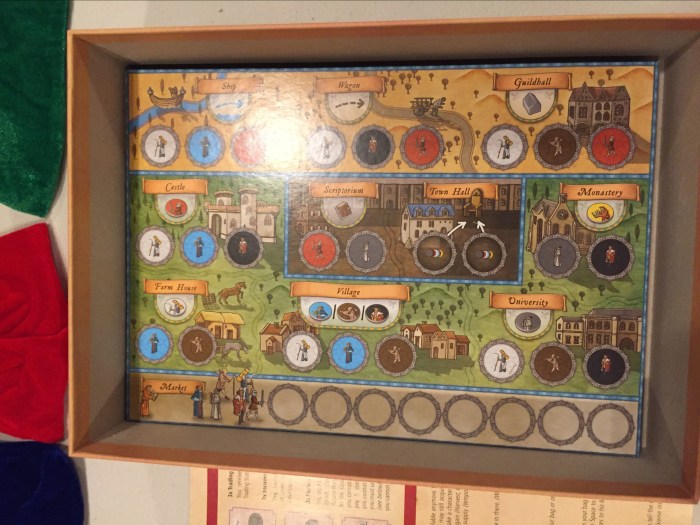
Blue Player board

Each player also has their own “action selection board” where they can play their tokens (see Blue Player board above).  The color is a little muted, but you can see that is the blue player’s board.
IMG_5773
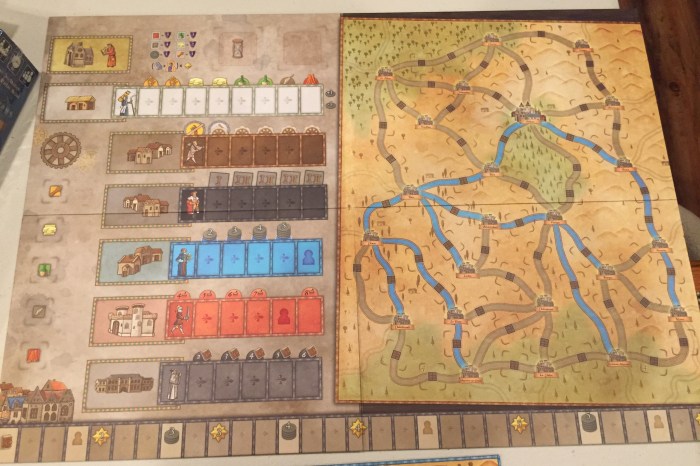
Main Board with a map to travel around and a bunch of spaces …

There is a main board (see above) with a map (you travel around: this mechanic surprised me a little) and some spaces to do stuff.  And places to hold resources  on the left (wheat, wine, etc.) … I told you this was a soulless Euro!)
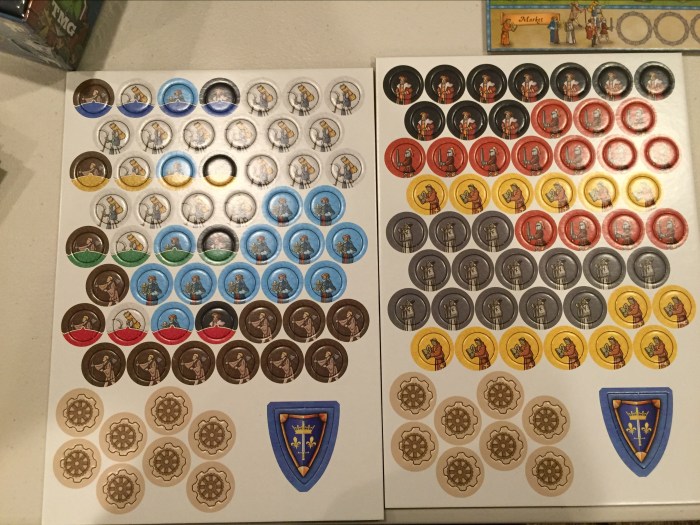
IMG_5775
…sooo maaany tokens…

There’s also an auxiliary board to do “side quests” as you play.
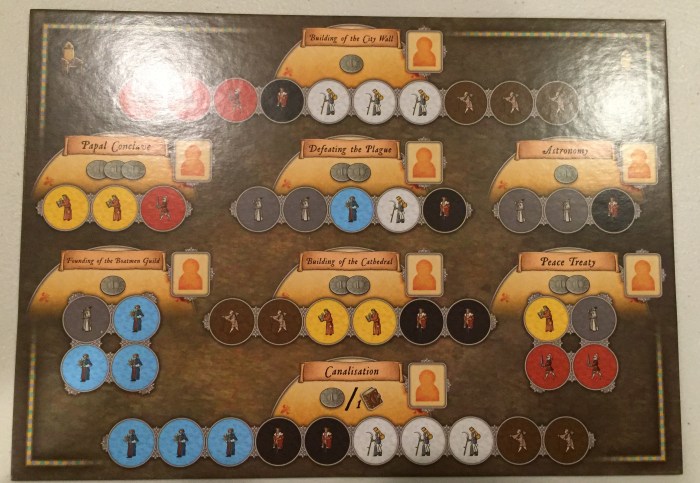
IMG_5778
Action spaces (on a global side quest board) that all players can activate

If you had any doubt, this is a Euro!!  How are they going to make this solo and cooperative?  Stay tuned … we are almost there …

IMG_5787
Resources! This is a Euro!

Main Rulebook

So, because the Solo and Cooperative modes are “add-ons” from another completely different expansion, you will have to go through the main rulebook to get the feel of the game.

IMG_5780

I’m not a huge fan of when games just “list” components and don’t actually show them (see page 1 above)!  I like the kinesthetic experience of matching the components from the rulebook with the components of the box; it helps me absorb the game.  A plain “list” mapping listed components to real components becomes that much harder. If I had one major complaint about this rulebook, I’d say it was the lack of component pictures.

IMG_5781
The first pages show the Set-Up

But, on the second page is a picture of set-up.  Ah!  With this, I was to at least have a better idea of what was going on just by setting up the game.  This was a good set-up, showing little boxes and arrows and what the game looks like set-up.  I will “forgive” the list of components on the previous page because this set-up page makes up for it!
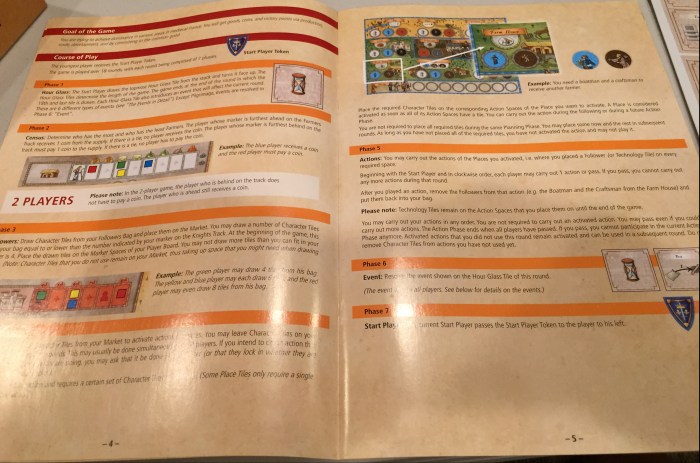
IMG_5782
The phases of the game

The rest of the rulebook is good.  I was able to read through the rules and get a good sense of the game quickly.  There are a 7 major phases of the game (see pages above) and the main structure of the game comes across as pretty straight forward.

The rest of the rulebook elaborates on the main rules, main cards, etc. It was a good rulebook in general: lots of pictures, good explanations/elaborations.

What Do I Do Next?

Okay.  I’ve read through the main rulebook, and I have set-up a game of plain Orleans (or at least put tokens on the board).  What do I now?  Do I play the base game first?  Can I play Solo first? (That sounds hard! I don’t know the rules!!!!)

So, here’s what I did: In hopes that the solo mode was simple enough (this was a Hail Mary to be sure), I opened Orleans: Invasion expansion and started looking at the Solo Mode … gulp … here goes …
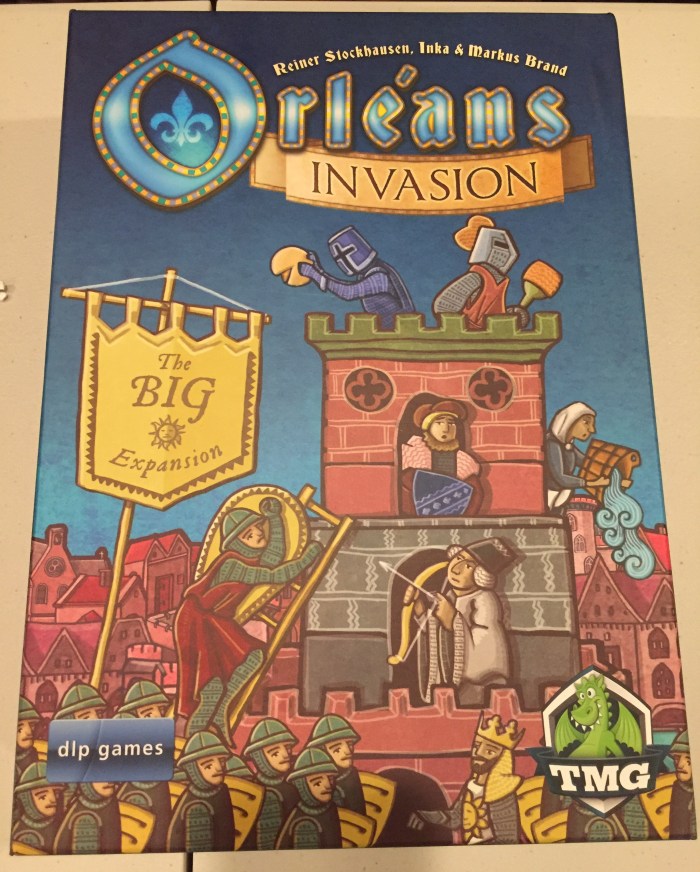
IMG_5785
Orleans: Invasion

Which Solo Mode?

IMG_5762
Back of the Orleans: Invasion box. Three solo modes and a cooperative mode!

So, interestingly, the game has not 1, not 2, but 3 solo modes!  The first two are simpler and the last one is more complex.  Which one to start with? The first one!

First Solo Mode

IMG_5790

If I were to repackage this game, I would put the first solo mode (The Dignitary) in the base game!  This seemed like the best way to learn the game!  It lets you learn most of the mechanics at your own pace and it’s quite fun!  (This solo mode also eliminates the resources as well, making the game easier to set-up and play).

IMG_5798
All you need are 3 things from the Orleans Invasion box! A token, the set events board, and the Stage Coach!


You only need three things from the expansion to play the Dignitary solo mode: a white token, the Stage Coach and the “set events” board (see above)!!! This isn’t too bad!

IMG_5791

The rule changes/elaboration are described in two pages. Basically, you make this game cooperative by collecting “Dignity” (the little dudes) before you run out of time (ie., the events play out).

IMG_5793
Collect “Dignity” (the little dudes) from the map and actions

You still play the base game fairly normally: build your bag, move your token around the map, and try to collect enough “Dignity” before times runs out.

This DOES mean you will have to have two rulebooks open  (the main Orleans and the Orleans: Invasion rulebooks) when you play solo or cooperatively: not a deal-breaker by any means, but not ideal.  BUT: the changes are minimal for this first solo mode.

IMG_5797
A Winning solo game!

In the end, I would recommend going through the first solo mode (The Dignitary) for your first play.   The changes from the base game were minimal … and most importantly, the changes weren’t daunting.

This is the way to learn the game! Your first play should be a solo game of The Dignitary.

Cooperative Mode

IMG_5809
All the stuff needed for the cooperative mode!

The cooperative mode is MUCH more complicated to learn and it has a lot more components needed (see above).  I strongly recommend playing the base game or the solo game before playing the cooperative game: there’s “too many rules” to just jump into this.

IMG_5812
A Two-Player Cooperative Game Set-Up!

How does the cooperative mode work?

The Story: The city is being invaded, and players have to work together to collectively “shore up” the city so the invaders can’t get through!  Like the solo mode, the game is over when the event deck runs-out … so we’d better get cracking on shoring up the city!

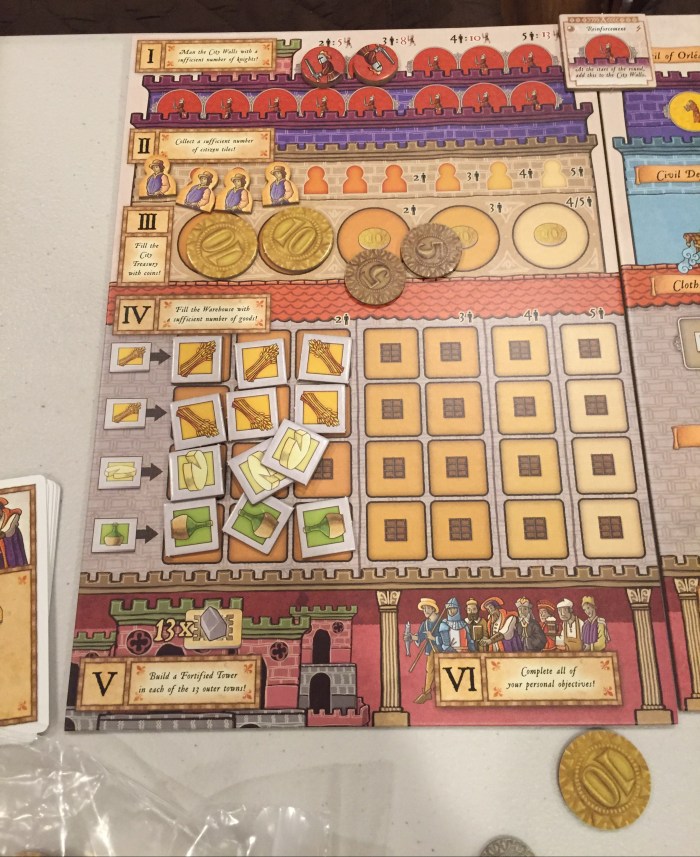
Players have to work together to fill up the Main city board (see below) with the proper type of workers, coin, and resources to defend the city!
IMG_5816
Left part of the city: required to man all stations!!

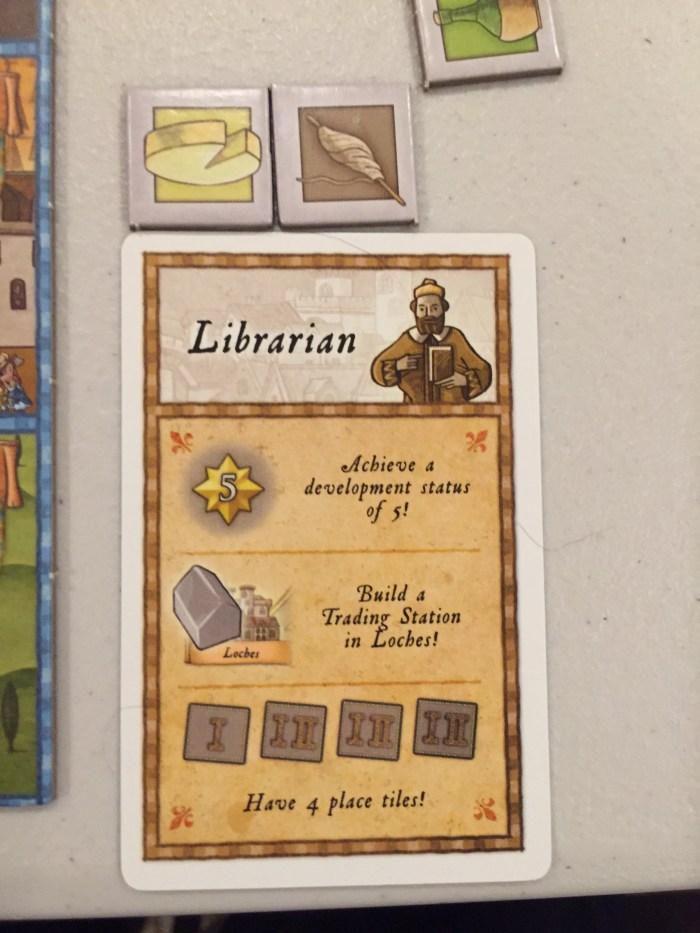
Each player also plays a unique character with a unique sub-goal:  All sub-goals MUST be completed to win!
IMG_5818

IMG_5819
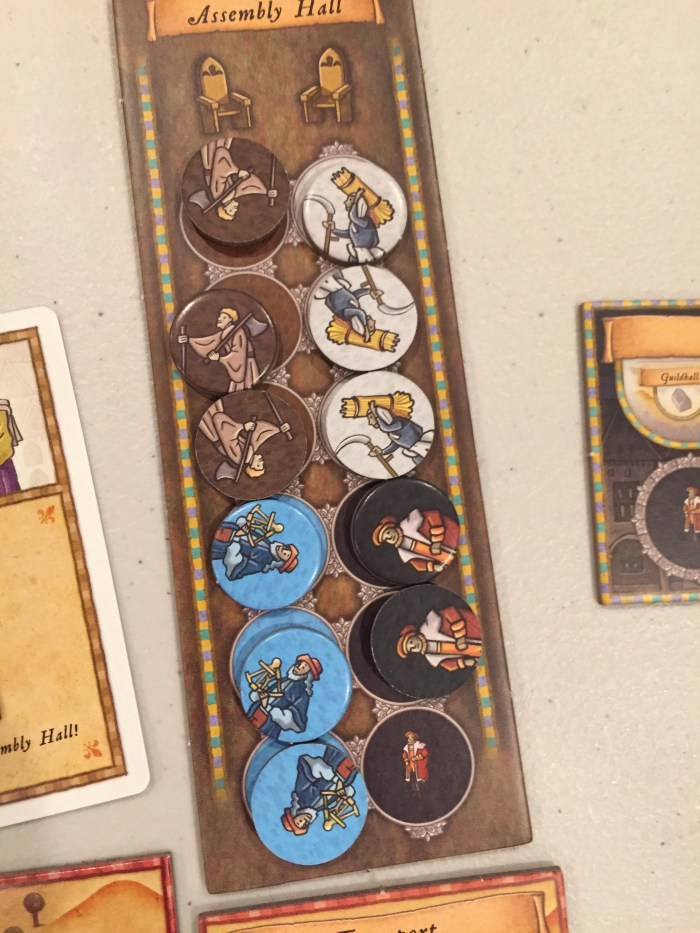
The Councilman  “subgoal”, fill up the Assembly Hall!

So, the cooperative game proceeds very similarly to base game: players build their bag with workers, sometimes having to sacrifice those workers to the City (to protect it) or their sub-goal (to fulfull their protection goals).  Although it seems “weird” to HAVE to complete subgoals to win the game, I’d like to think the sub-goals are important to complete because they represent the city being organized enough to fend off the invaders!  Ya, it’s my own rationalization.

IMG_5817

Finally, the players must fortify all the establishments around the map: this are an important cog in the defense of Orleans!  (Recall The Dignitary does not use resources, but the cooperative mode absolutely does! See the map above).

So, in summary, to make Orleans cooperative:

  1. Add sub-goals (where you lose workers from your bag)
  2. Adds a city board to be “manned”: Players fill up City Protection Positions (losing more workers from your bag)
  3. Move around the map collecting resources to fill the necessary stores in the City
  4. Other minor change (change the event deck, adding cards for each player)

In general, it works.  BUT:  It’s hard and it adds a lot of rules!
IMG_5820
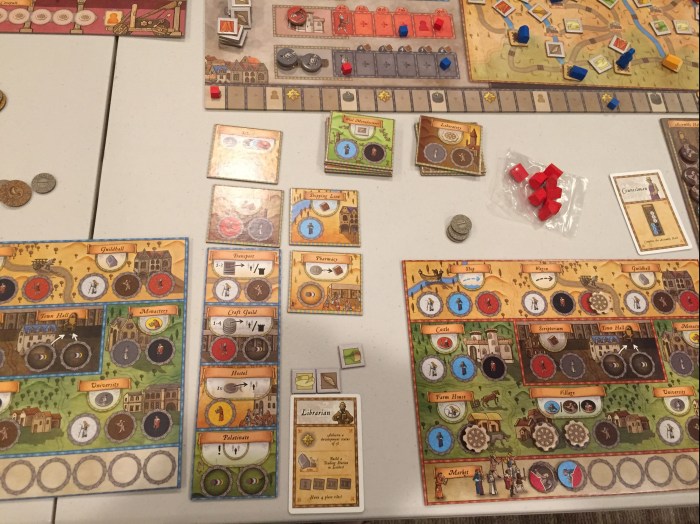
A losing cooperative game!

My first cooperative game: We lost, and we lost badly.  Here’s the thing: I kept thinking about it about I lost!!  “How could I have done better?  Should I have done that?”  That’s always a sign that you are really invested in the game!  And I do want to play it again.

Just remember, don’t play the cooperative version until you’ve played the solo or base game: there’s just too much (rules, components) to play cooperatively the first time.

Conclusion

IMG_5821
A wider view of the losing cooperative game!

If I had played this before I did my Top 10 Games That Can Be Played Fully Cooperatively or my Top 10 Cooperative Deckbuilders, I think this would have made both lists.  The expansion is ABSOLUTELY worth getting!   The solo mode(s) are interesting, and good ways to learn the game, and the cooperative really steps up the game!  Even beyond the solo and cooperative mode, Orleans: Invasion adds scenarios and just tons of content.

In the end, Orleans and Orleans: Invasion really surprised me! I didn’t think it was possible to make good solo/cooperative modes for soulless Euro games, but you know what?  They did!   Is it worth getting Orleans and Orleans: Invasion JUST for the cooperative and solo modes?  I think so.  Hopefully this review will help you get a feel if it’s a good cooperative game for you.


Top 10 Games That Can Be Played Fully Cooperatively

The real title of this top 10 list should be “The Top 10 Board and Card Games that aren’t really fully cooperative games, but can be played that way with a few modifications”, but that doesn’t really roll off the tongue, does it?   Over the years, I’ve collected a number games that aren’t TRULY fully cooperative, but I’ve found there that was some way to play them fully cooperatively.   How? It might be as simple as ignoring some simple rule or as complex as adding a full-blown expansion whose sole purpose is to make the game cooperative!

Introduction

A few definitions before we begin: fully cooperative (or I might just say cooperative without the fully qualifier as we get into this) are games where all players in the game are invested in helping each other and working together as one team to win the game.   Other games types like team-vs-team or one-versus-many or semi-co-op or traitor games I do NOT consider fully cooperative!  There are elements of cooperation in those, but at the end of the day, at least one player is still “against” other players.
For each game, I give an overview of the changes needed to play the game fully cooperatively, as well as answer the burning question: can you play it solo with the newly formed fully cooperative rules? (I.e.,Saunders’ Law?)

These are the ones I have enjoyed the most.  If there is a game I’ve missed, please add it to the comments.

Honorable Mention: Runebound (3rd Edition)

How To Play Fully Cooperatively?  You need the Unbreakable Bonds expansion.
Can You Play Solo with fully cooperative play?  Yes: the Unbreakable Bonds expansion adds solo play as well.

The base Runebound (3rd edition) is competitive.  You need the Unbreakable Bonds expansion to play cooperatively.

The reason this is Honorable Mention is that I haven’t played it enough yet! But I do know a lot of people who really like this  high-fantasy game.  It’s easy to get Runebound,  but it’s really hard to get a hold of Unbreakable Bonds at this point, so the lack of availability also slips this into the Honorable Mention.

10. Mage Knight

IMG_5269

How To Play Fully Cooperatively?  Ignore the victory points.  Play Cartman Cooperative.
Can You Play Solo with fully cooperative play?  Yes.  The rulebook has rules for solo play, but I’ve found you can just play the game with one Mage Knight and there’s less maintenance and more fun.

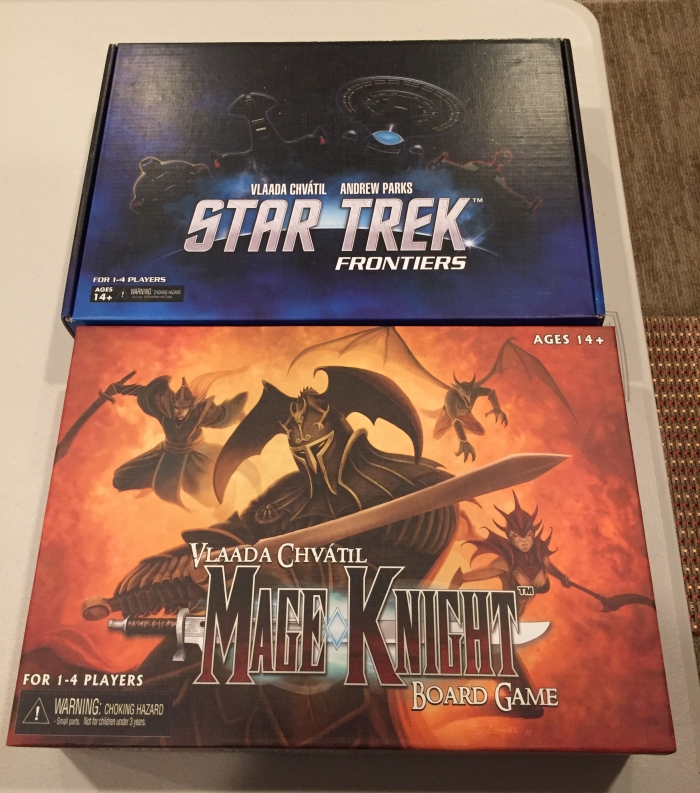
I find that I enjoy the Star Trek: Frontiers version of Mage Knight better, but it’s still just about the same game.  See my review of Star Trek: Frontiers here.  There is more content for Mage Knight proper (a few more expansions and a Big Box version of the game), but there is a Khan expansion for Star Trek: Frontiers.

At the end of the day, this game is almost fully cooperative.  It’s a scenario based game where you either beat the scenario or not, so the players must work together partly to accomplish that. There’s a notion of victory points at the end, so each player tends to step on each other (especially near endgame) to try and get “more victory points to win!”.

Just ignore the victory points, play it as a fully cooperative game! At the end, revel in your shared win or commiserate in your shared loss.

The only reason this game is so far down the list is that it’s hard to get to the table: it’s a big sprawling, long game.

9. Shadows Over Camelot

How To Play Fully Cooperatively?  Don’t play with the traitor. And see below.
Can You Play Solo with fully cooperative play?  Maybe?  You can play two characters, but then you have to worry about accidentally sharing card info, and you’d have to use the Changing Perspectives idea.

Shadows Over Camelot is a hidden traitor game with hidden information.  In the set-up for the game, some cards are handed out dictating if you are a traitor or not.  It is very possible that no one is a traitor.  So, rather than rely on that, we simply eliminate the traitor completely.  Since none of the players are allowed to see the other player’s cards, you can still play the game normally. The hidden information still allows the game to be interesting (and you still have to work together with imperfect information).

Now, getting rid of the traitor makes the game significantly easier.  We’ve found we had to change the win condition to make it harder.

  1. Players have to place the last sword white.  Even if they have a (overwhelming) majority, the last sword must be white or the players lose.
  2. Players need a overwhelming majority of swords  to win:  (an extra 2 or 3 white swords over simple majority, depending on how hard you want the game).

This game is lower on the list only because it’s older and doesn’t come out to the table as much.

8. Dungeon Lords

How To Play Fully Cooperatively?  Umm, this one’s pretty complicated.  See rule changes below.
Can You Play Solo with fully cooperative play?  Yes.  There some solo rules on BoardGameGeek here.

This is a favorite game of my friend Junkerman and myself.  Strictly speaking, this is a competitive victory point game with agonizing worker placement decisions.  Each player runs their own dungeon and is trying to get the most victory points by keeping those pesky dungeon adventurers out.  At its core, players are competing hard for resources in the worker placement phase, because you need those resources!

As we’ve played over the years, we’ve realized the real goal is to keep the adventurers from infiltrating ANY of your dungeon.   As a cooperative game, if all players (we’ve really only played two players in this mode) can keep their dungeons pristine, we call this a cooperative win!  And we ignore victory points.

Unfortunately, making this cooperative is a lot harder than most games.

  1. The worker placement phase is very tight, and it too easy to mess each other up. There’s just not enough resources to really make this work.
  2. There needs to be some form of communication, but too much communications just makes the game “not fun” as you end up in analysis paralysis.

So what do we do?  We basically add two new rules.  One of them requires a new deck of cards and the other is a new ruleset.

  1. Add the DungeonLords Improvements deck and rules to the game.  See here for details.  The basic idea: when you would go to a place that’s blocked, you may play one of your SPECIAL cards instead.  Basically, you can still do something interesting, even when you get blocked in the worker placement phase.
  2. Added limited negotiation in a few places.  This one was tricky, because we didn’t completely open it up to “we can negotiate everything”, but just in a few places:
    a. You can do one negotiation/information at the start of the worker placement: “I really need that Monster, so just do you know”.  It was more like, I am telling you what I need and maybe saying what the alternatives are.  That’s it, just a little extra information.
    b. Offer places where our workers WON’T Go. Similarly, when we put away our workers, we kind of tell each other “.. these are the kind of places my workers WON’T GO today, would any of those help you?”

In the end, the game is still tight as both players have agonizing decisions to make.  On some level, this fully cooperative version is more of a stay-out-of-each-other’s way cooperative.  But, it’s a cooperative form of a game that has no right to be cooperative in any way!

7. Conquest of Planet Earth

How To Play Fully Cooperatively?  It comes with the game: it’s an alternate way to play the game.
Can You Play Solo with fully cooperative play?  Yes.  There are solo rules in the box.

This game has the players take on the role of aliens invading earth!  It’s a fun theme.  The base game is competitive, but the rulebook has a cooperative variant built-in.  The cooperative variant is easily the best way to play this game.

This game is a little harder to get a hold of these days.

6. CO2/CO2 Second Chance

How To Play Fully Cooperatively?  It comes with the game: Depending on the version of the game you get, it’s either the base game or  an alternate way to play the game.
Can You Play Solo with fully cooperative play?  Yes.  There are solo rules in the box.

This may be a cheat to put on the list, as the newest version of CO2: Second Chance has it’s base game as cooperative (with a competitive variant built-in as well).  The original version of C02 was a competitive game but there just happened to be some variant for cooperative play.    If you do pick up the original box, you can still play cooperatively.  If you have a choice, pick up the CO2: Second Chance instead.  This is a heavy resource management game where everyone is working to save the planet together by eliminating our dependence on carbon.  (Honestly, the theme cries out for a fully cooperative game).

5. Legendary

How To Play Fully Cooperatively?  Ignore the victory points.
Can You Play Solo with fully cooperative play?  There are a lot of ways to play solo on BGG.

We’ve talked about Legendary quite a bit on this blog (See “Top 10 Cooperative Superhero Games”): it’s a fun, superhero based deck-building game.  Players “buy teams” of heroes to build their decks up, in hopes these decks will help them to take out some Bad Guys.   All players lose together if they don’t defeat the Bad Guy (and his scheme), but the player with the most victory points (cards he’s collected throughout the game) wins.

We ignore the victory points completely when we play.  We just rejoice in the shared win or commiserate in the brutal loss.

4. Near and Far

How To Play Fully Cooperatively?  You have to buy an expansion: The Amber Mines
Can You Play Solo with fully cooperative play?  No, there aren’t solo rules, but see below.

Near and Far is a competitive worker placement, storybook game.  In order to play cooperatively, you need the Amber Mines expansion.

The Amber Mines has a bunch of modules you can add to the game: one of them is the cooperative module.  Basically, it adds as timer to the game: a new board is added to the game which “moves up a track by 1” after the 1st player goes.  If this track makes it to the last space (skull), the players lose.  Otherwise, the players are trying to get victory points: when the game is over (when the 14th tent comes out), players add up their victory points.  If that sum is greater than the “track number x number of players”, the players win!  It’s a little esoteric win condition,  but you still get to play the full goodness of Near and Far in a cooperative venue (Oh ya, you still need to kill some bosses to win too).

I am surprised they don’t have solo player rules!  The win condition has to do with “track number x number of players”, so obviously the winning condition can scale to a single player.  To learn the cooperative version of the game, I simply played one character in the cooperative mode and got as many victory points as I could.  If nothing else, this solo mode seems like a perfectly cromulent way to learn the cooperative game.

3. Mousquetaires Du Rey

boxFront

How To Play Fully Cooperatively?  At the very end of the rulebook, there are co-op rules.
Can You Play Solo with fully cooperative play?  Yes. The players takes the role of 2 chartacters in the co-op variant.

Mousquetaires du Roy is based on the novel “The Three Musketeers” by Alexandre Dumas.  The base game is a one-versus-many game where one player plays Milady against the rest of the players playing the Three Musketeers.  At the very end of the rulebook are some rules for playing the game fully cooperatively.  Basically, in the cooperative version, all players play one of the Three Musketeers.  There’s an AI that controls Milady’s actions as she conspires against the players.

This game really surprised me!  When I played it cooperatively, I really had fun!  It’s too bad it didn’t too better: I never see it mentioned.  It even made my More Cooperative Games “Off The Beaten” Path List (see here).

2. Thunderstone Quest

How To Play Fully Cooperatively?  You have to buy an expansion: Barricades Mode
Can You Play Solo with fully cooperative play?  Yes.

Thunderstone Quest is a competitive deck-building, dungeon-delving, killing-monsters game.  See my review of the base competitive game here.  In order to play cooperatively, you need the Barricades Mode expansion.

Thunderstone Quest makes the players work together to keep the town safe.  The base deck-building game is still there: at it’s core: this is a deck-building game where players can build themselves up in town (buying equipment or stuff to build their deck) or can head to the dungeon to fight monsters.  The Barricades Mode makes the game a lot more complicated, adding dice and experience boards and other stuff (see my review here).

Even with all this complexity added by the Barricades Mode, cooperative play was really fun!  There’s a lot of decisions to make, a lot of beautiful art, and a lot of monsters to fight!  Players work together to save the town from being overrun with monsters. There is also a ton of content from 3 (maybe more at this point) kickstarters.


1. Detective: City of Angels

Cover for Detective: City of Angels. Art by Vincent Dutrait.

How To Play Fully Cooperatively?  At the very end of the rulebook, there are co-op rules.
Can You Play Solo with fully cooperative play?  Yes, there are solo rules built-in and they are quite good.

Detective: City of Angels is a storybook game where players solve a mystery. The base game is  one-versus-many as one player plays as the Chisel and “runs” the mystery, sort of like a DungeonMaster running the game.  The Chisel “runs” the game, knows the solution to the mystery, but still wants the players to “fail”.

Luckily, Detective: City of Angels has a great cooperative mode built in.  The rules for it are in the second half of the rulebook (belying that it’s a variant of the game and not the default way to play), but the rulebook does a great job of showing set-up and describing the full cooperative mode.  It’s really fun and the co-op mode made my favorite cooperative game of 2019 (see here).  You can also see my full review of the game here.


Player Elimination in Cooperative Games

Player Elimination

Many competitive games have abandoned Player Elimination as a mechanic for one simple reason: it’s not fun.  I was reminded of this when we played a 6-Player version of King of New York and I was eliminated fairly quickly in the game.  After being eliminated, I just sat there and watched the game.  Whee … that was fun.  I was reminded of all the fighting game like Risk or Diplomacy or Monopoly where you win by eliminating all other players. And I remember I hated being the eliminated player … watching and not playing.

Cooperative Games

Defenders of the Realm cover

Here’s the thing: one of the reasons I was drawn to cooperative games is that they almost never have the Player Elimination mechanic.  I am thinking of games like Defenders of the Realm, Pandemic, Codenames Duet, and many many more (!) where there’s not even any way to be eliminated.   And it doesn’t seem like the mechanic is even missing: I am  fighting monsters, but I don’t worry about dying!! I don’t miss it at all.

Hit Points or Limited Resources

I’m actually lying a little bit: these games have Player Elimination, it’s just that ALL players are eliminated at once and lose the game!!!   Consider the losing rules for Defenders of the Realm:

Screenshot from 2020-04-20 20-33-16
How to Win or Lose Defenders of the Realm!

If you look at Pandemic or Defenders of the Realm, you’ll notice there’s a losing condition if you “run out a global resource”  (cards or disease cubes in Pandemic or minions or crystals in Defenders of the Realm).  If you squint, it’s almost like they are “shared hit points” among all players: if all those “shared hit points” are gone, the players lose.  Said another way, all players are eliminated at the same time!!

Screenshot from 2020-04-20 21-00-28
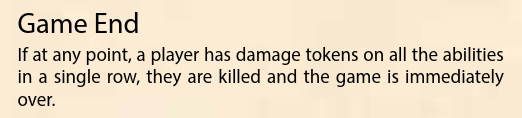
Losing condition: the game is over immediately if ANY SINGLE character “dies” (tokens on all abilities on a single row)

There are games (like The Master’s Trial: Wrath of Magmaroth, see above) where all cooperating players lose if just one of you dies!  So, players have to make sure to keep everyone alive as during play!  If just one of you dies, game over and you lose!   Really, this is another way of preventing the grumpiness of Player Elimination:  If any player is eliminated, the game is over so that the eliminated player doesn’t have to “suffer” through a continuing game where he is not playing.

This seems like a good thing: I disliked the Player Elimination mechanic and I was glad to see it was rarely an issue in cooperative games.

So why did I add it to Sidekick Saga?

Take It For the Team

Sidekick Saga is a cooperative superhero game for 1-4 players.  As long as at least one Sidekick  is still alive, the game continues.   Any Sidekick who dies is:

  1. eliminated (in Dark Legacy mode) or 
  2. continues in reduced utility (normal Legacy mode).

And the game still continues.  Either way, the Sidekick who dies suffers the same problems seen in Player Elimination in Competitive Games!!  Why on earth, after arguing earlier for hating this mechanic, would I add this back in?

Dark Phoenix's ending is a far cry from the original X-Men comic ...
Jean Grey dies: her death is soul-wrenching and meaningful

In a phrase, because death has meaning!  If, as a superhero, I choose to “take it for the team” in the late game so that we can win, my death has meaning!!

The only way we could win was for Blackbird to run into the Ice-a-cane!  His sacrifice made it so we could take down the Villain in the last turn!  Without his sacrifice, we would have lost!

It is VERY thematic for a group of superheroes to continue after their compatriot has chosen to die to save the team: it’s what superheroes do!! They make the ultimate sacrifice!!

And there’s also the choice factor in the game: by removing the ability for the player to “take it for the team”, the game has fewer choices.   By adding the ability to choose Player Elimination, players can choose to make the painful, tortured choice if they think they have no more options.

It’s a very human thing to do the right thing, to make the ultimate sacrifice for your group.

Other Games

Screenshot from 2020-04-20 20-36-45

Set A Watch is another game where play continues even if another player is “eliminated” (in this case, all players are exhausted).  Players are given a choice of who will “exhaust an ability” card, and players may realize the only way to win is for Fred to completely exhaust himself so that the team’s remaining abilities can take out the bad guys.  Like Sidekick Saga, it’s the choice that matters.

Screenshot from 2020-04-20 20-55-01

Marvel Champions is another game where players can continue even of their compatriots are eliminated.  Very thematic for a superhero game!

Screenshot from 2020-04-20 20-48-16

Gloomhaven is another game where play continues even if other players are exhausted. Again, it’s the choice that matters.

Conclusion

In the last turn, Delphi appeared and made the ultimate sacrifice, taking all the damage from the Bad Guys.  This left Epsilon Wave open to open the portal and banish the evil villain at the last minute …  Delphi’s death was not in vain: only her sacrifice allowed Epsilon Wave to do what was needed.

At the end of the day, Player Elimination in a cooperative game can be useful and interesting  as long as it is a choice and it has meaning.  It’s when the elimination feels arbitrary (preventing you from playing after you are booted from the game) that  Player Elimination is a undesirable mechanic.

Of course, you have to make sure you aren’t being bullied by an Alpha Player to make the ultimate sacrifice, but that’s a different issue …

Part I: A Review of Forgotten Waters. Unboxing, Solo Rules, and First Impressions

IMG_5644
Forgotten Waters: The New Plaid Hat Crossroads Game

Let not mince words: I picked this game up because Tom Vasel raved about it on the Dice Tower (and gave it a 9.5/10).   It’s a cooperative storytelling game, set in a Pirate universe.  It seems to be “fun” pirates (corsairs? like Julio Soundrel in Order of the Stick) instead of dirty, grumpy, filthy pirates.   Recall that The Secret of Monkey Island is my favorite game of all time,  so this was an instant buy!  It came out in the beginning of April and I picked it up (ordered it online) immediately from the manufacturer. EDIT: At the time of writing this review, it’s already sold out!

IMG_5645
Special Swag by ordering directly from the manufacturer!

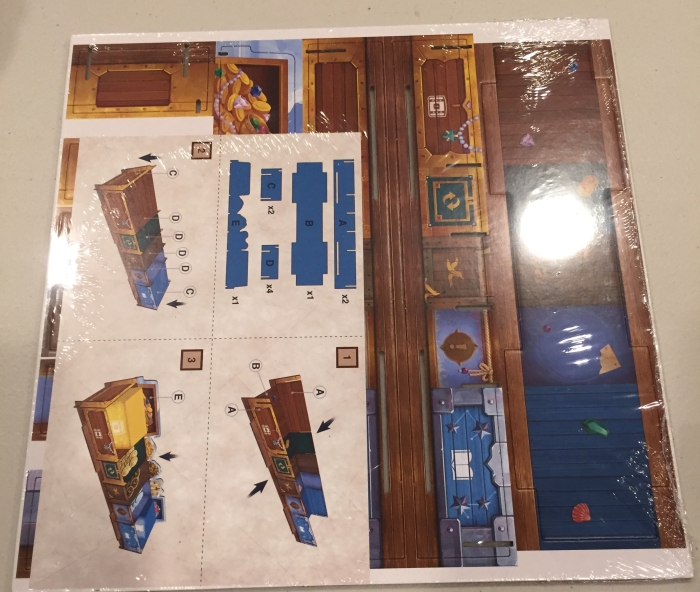
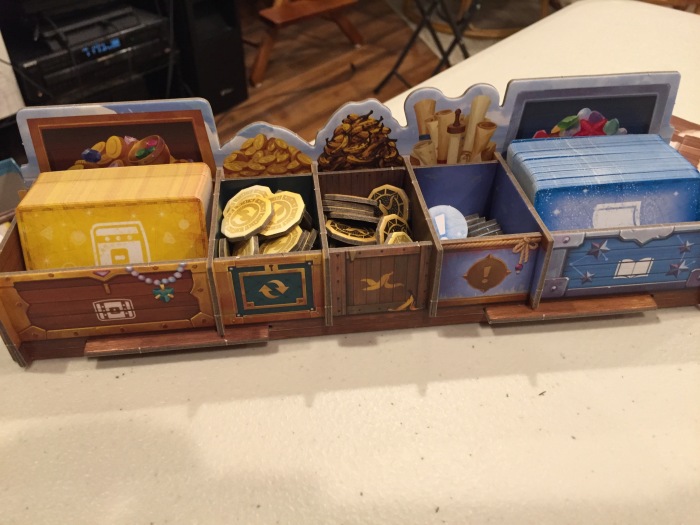
I also got some “Special Swag” (basically a card and token holder, see below) by ordering directly from them.

IMG_5675
Special Swag: ARH! It Holds the cards and tokens!

Components

The game looks fantastic.

IMG_5648
Rulebook and stuff
IMG_5658
The Core Adventure Book

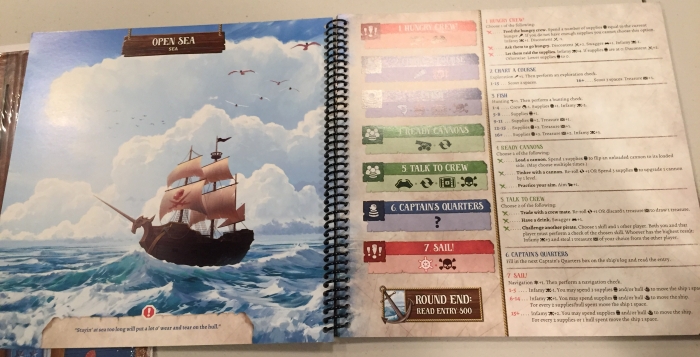
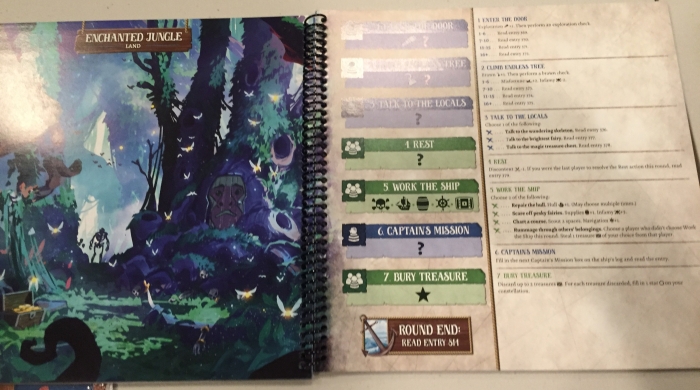
The core of the game is an Adventure book: each pair of pages has a beautiful and thematic picture on the left and “some actions” on the right when playing.

IMG_5659
More pages from the Adventure Book
IMG_5660
Cardboard!

IMG_5668

IMG_5669

IMG_5670

There’s quite a bit of cardboard … (see above) …

IMG_5661

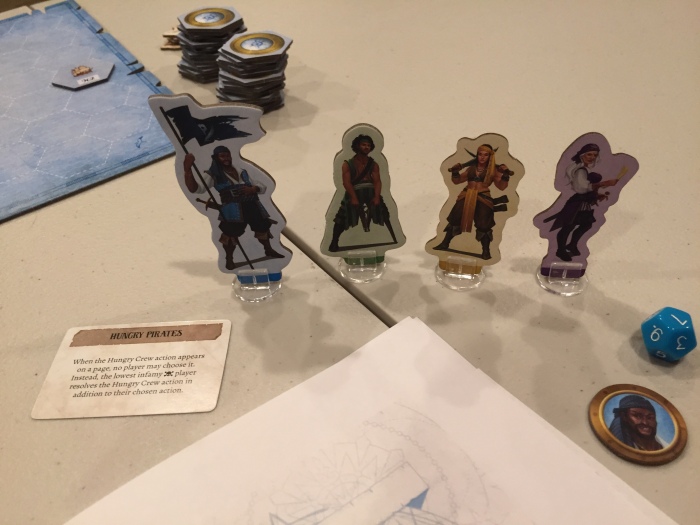
There’s some dice and cards (1 12-Sided for each player and some standees) and not too many mini cards.

IMG_5653
Player Sheets

There’s some player sheets: WARNING!  You only get so many, so it usually makes sense to print characters sheets from the web site rather than use the pristine ones (or copy the pristine character sheets).  There is EXACTLY one character sheet for each different type of pirate, so you might not want to use these out of the box…

IMG_5654
Logs

And some logs for how far along you get.

IMG_5678
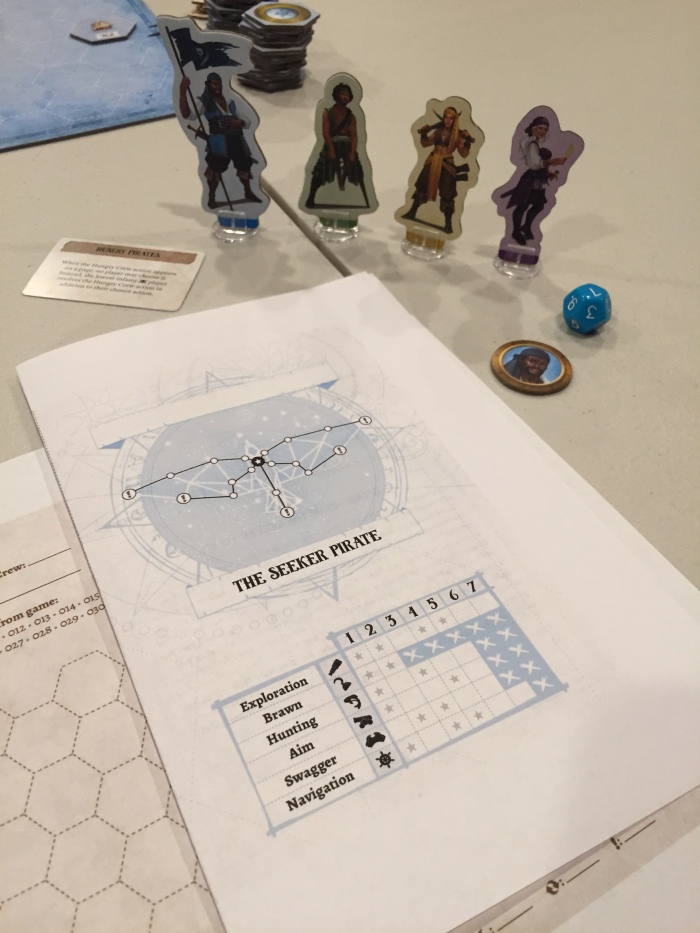
My crew for the 1-Player game!

Overall, the game components look really nice.

The Rulebook

IMG_5650

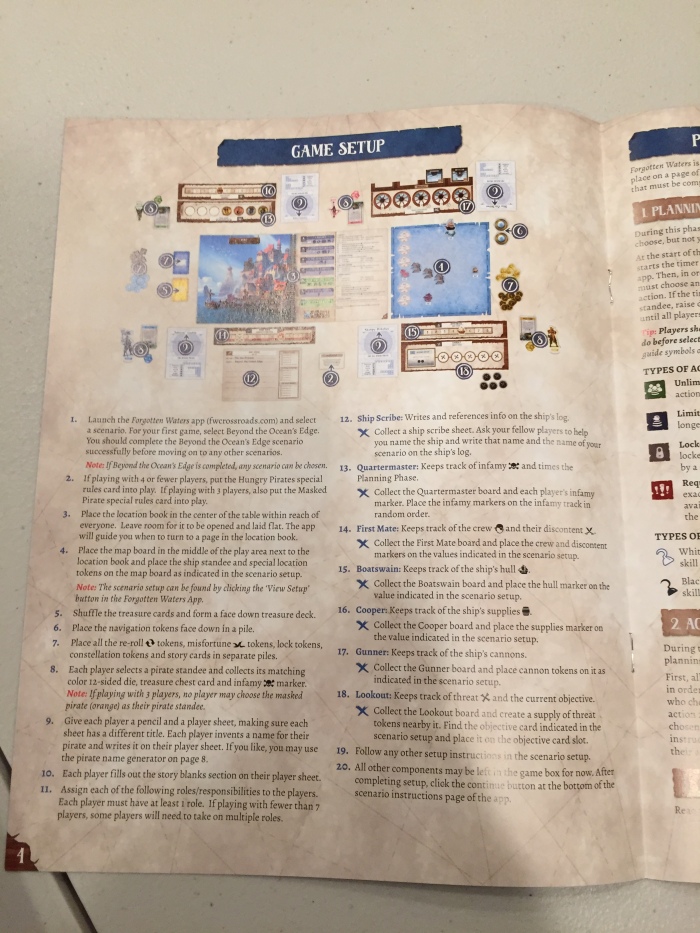
I think  that manufacturers are learning: the last few games I have looked at have had excellent rulebooks.  This one is no exception.    The first page(s) have lists of components, so you can know the names of components as you set-up the game.

IMG_5651

IMG_5652

The Set-Up is pretty good, although it is a bit complicated by the fact that there are no solo rules in the rulebook (but see below).

In general, the rulebook is excellent overall.  My only complaint is that it is a bit spartan: it barely fits in 8 pages and a few times I needed some rules clarifications.  But, you get through it.

You Need An App To Play The Game

App Home Page

This may be a sticking point for some people: you need an app to play the game.  Well, it’s not even an app: it’s a website.   So, just point your phone or your pad to it.  The app (sorry, website) is decent.   The coolest thing is that the first scenario has “acting”, “sound effects”, and lots of great content.   At the time of this writing, they only have these little touches for the first scenario.  After that, one of your players will have to read a lot of text from the screen: it’s a storytelling game after all.

So, I found the app (sorry website) to be a bit clunky.  You can’t “go back” in the browser, you have to go back in the app (website) itself: there’s a button at the top. Many times, I wasn’t sure what to do next from the app.   At one point, I pressed the wrong button and went “somewhere”, but I couldn’t back arrow to get back to where I was!

Here’s the thing: there’s not THAT much state stored in the app (website), so you can usually just reset the whole thing and start over if you ever get to a weird spot.  So, I was able to get around and use it, and when I was really into it: the voices and sound effects were totally on point!  Every so often (more often than I care to admit), I’d just press the wrong thing, or forget something on the previous page … and couldn’t go back. So, I’d just start over.  And it was ok.  A little clumsier than I expected.

Solo Rules?  Sorta?

IMG_5683
Solo game set-up

The game, when you buy it, says 3-7 players on the box.  If I had seen that, I wouldn’t have bought it!! I only got it because Tom Vasel raved about it so much.  But, here’s the thing: When you open the app (sorry, website), you get both solo and 2-Player rules!  And these are rules provided by Plaid Hat, so they are “official” rules.    I think Plaid Hat is doing themselves a disservice by putting 3-7 on the box, because, like I said, I probably wouldn’t have bought it if I just saw the box.  They totally could have put 1-7 on the box.

The solo game worked well.  I wish they had a way to PRINT out the solo rules!  They are ONLY IN THE APP!  So, whenever I had solo rules questions, I had to “break” my flow and find it in the app (sorry, website).  I probably should have just opened two tabs in my browser, keeping on the solo rules in one tab and the app (website) in another.  Listen, the solo rules are good, but they are more complex than you might expect.  I think I ended up writing down the major rule changes ON A PIECE OF PAPER so I could have that in front of me as I played.

The solo rules work pretty well, especially as a way to learn the game.

Gameplay and Expectations

IMG_5685
A losing solo game …

I lost my first solo game.  I had fun, but I was kind of annoyed.  And that’s MY FAULT that I was annoyed: I didn’t set my expectations properly.

So, here’s the thing: the game is JUST A STORY TELLING game!  At some point, you’ll make choices that seem fine and something dumb will happen.  Or you’ll just die.  BUT THAT’S THE WAY STORYTELLING GAMES GO.

I really liked the Tales of Arabian Nights Game (another storytelling game), but only after I set my expectations.  It’s just an experience (not a game) where stupid stuff  happens to you and you don’t really have a choice (you “choose” things in the game, but the choices never correlate with the results).  Our three main complaints with Tales of Arabian Nights:

  1. It was too random (your choices don’t really matter)
  2. It was too long (we always set it up to be half the length)
  3. The gamebook was full of so much reading, should have been an app

Forgotten Waters fixes (most) of these!

  1. You have choices that boost your stats, and the choices matter much more.
  2. The game has scenarios which you can save halfway through and come back if they are too long (save it by keeping track in the log book)
  3. There is an app for the text, and even better, it adds effects and reads it for you!

So, I am very happy that Forgotten Waters fixes a lot of these problems.  But …

Choices vs. Fiddliness

IMG_5681
A Monkey Island flavored character

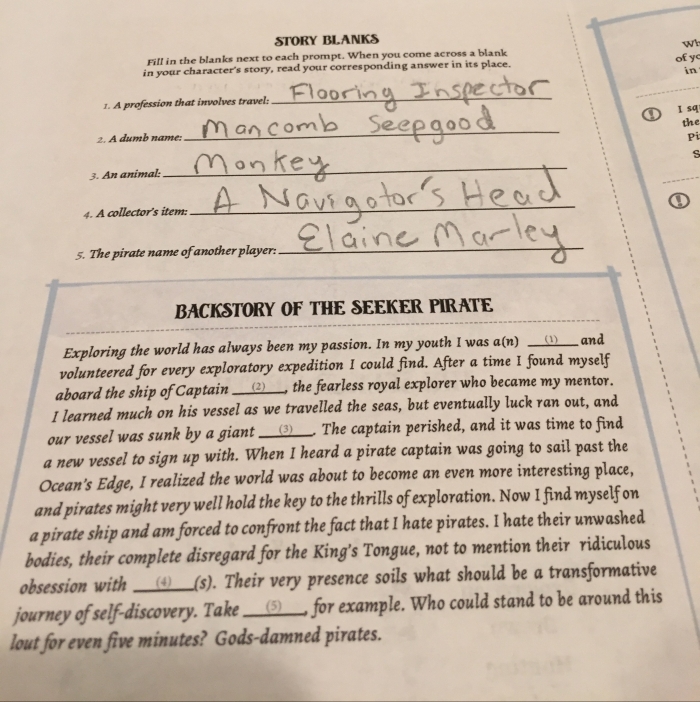
The game has Mad Libs section at the start of the game: this really makes the game silly and invests you in the game.  I, of course, went with Monkey Island references.

IMG_5680

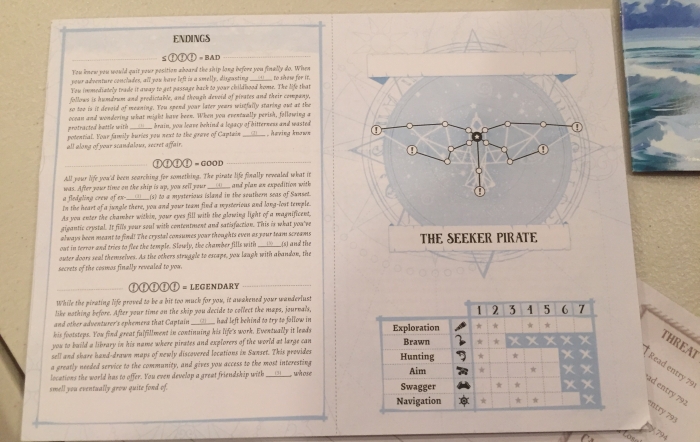
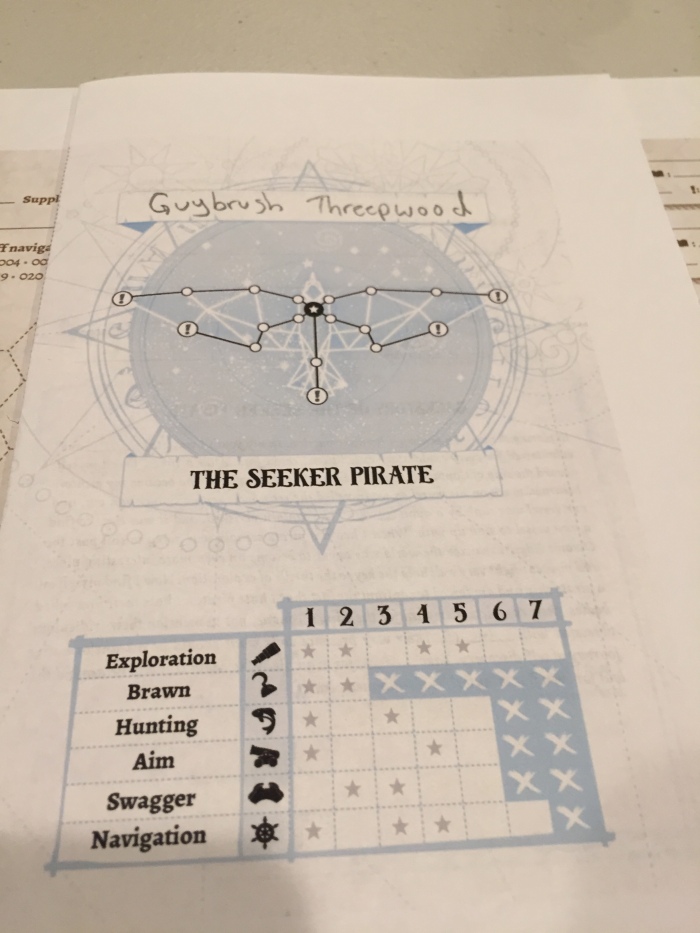
As you play through the game, you get to make  choices to “up your stats”: Exploration, Brawn, etc (see above).  At certain points in the game, you also get to fill in your constellation (the star cluster above) and when you get to a !, something happens which is very peculiar to your character! Very cool!  The actions you make in the game help you choose “which stats” you up.

IMG_5659
More pages from the Adventure Book

The main way you up your stats is when you take actions: on the right page of the adventure book are 6 actions you can take, and each one has its own effect: some advance the plot, some advance your stats, some clean up the ship, some add hull, some add crew … there’s a lot of things you can do!

IMG_5679

Here’s the thing that I had trouble with.  The game has a lot of fiddliness.  Look at all the things you have to maintain!

IMG_5684

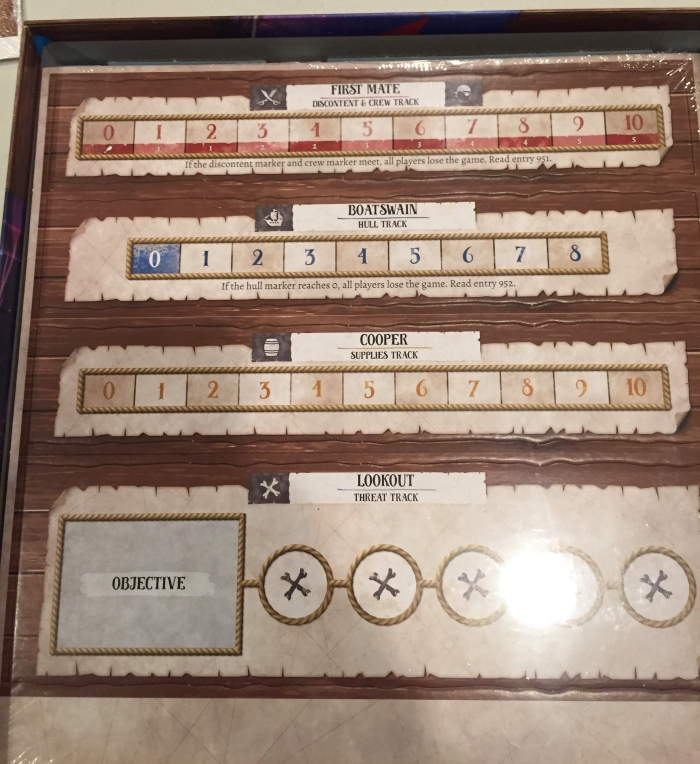
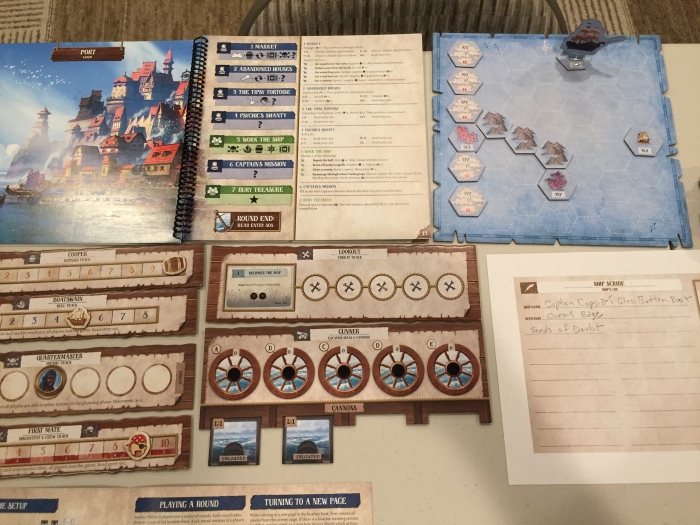
There are boards for each position: see above: Cooper, First Mate, etc.  There’s 6 roles, i.e., 6 pieces of maintenance per turn.  Then there’s the choices of actions (where to put the 4 pirates in the rulebook), where to sail, which hexes to put out, etc…

So, putting all this together, it feels like you all your choices should be making your way towards a final game!  And there’s a lot of choices!  But, at the end of the day, YOU ARE SIMPLY BEHOLDEN to some random events.  That may kill you.  Or something worse.

I was annoyed because I was making “choices” throughout the game, doing lots of maintenance and upkeep as I played, and then I died because I turned over the wrong card.  The End.

IF you put your brain into the mindset “THIS IS A STORYTELLING GAME”, then this will be real fun: the movement, the stories, the app (website), the flavor text, the mad lib games ALL make the game full of flavor!

The choices you make still help the game flow, but at the end of the day, you can just die and totally destroy your game.   If you think you can out-think the game, nah, then you are playing the wrong game.   This is a Storytelling game.

Conclusion

IMG_5683
Solo game set-up

At the end of the day, this is a fun game.  It fixes a lot of the problems with a lot of Storytelling games (like Tales of Arabian Nights), and the game has a fun sense of humor.  Although I had problems with the app (I mean website) and the basic “fiddliness” of the game, I really did like it.  I think this game will work best with a group who can laugh with each other/at themselves while they play.  The solo experience was good enough to learn the game, but I think the game will really shine when played together as a group.

Appendix: Choose Your Own Adventure

My game group really enjoyed the first Choose Your Own Adventure: House of Danger game because it was stupid fun.  When I played, I set my expectations: we made choices as a group and read through a dumb adventure.  We died a few times, but we didn’t care because it was so easy to reset and continue.  Forgotten Waters is like that, but the set-up and maintenance is a bit heavier, but you are rewarded with a more customized game with prettier graphics and effects.  If you are looking for a game with a storytelling where your choices distinctly matter, then you should look at Detective: City of Angels:  It’s a murder mystery with limited replayability because once you have played through it, you know the answer!  Some other games with story books (that have a real game underneath) are Agents of SMERSH and Near and Far.

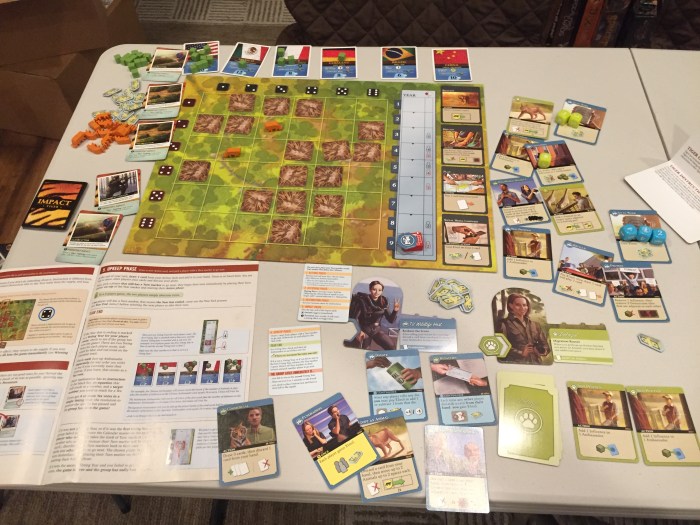
Endangered: Part I. Unboxing, Solo Play, and Initial Impressions

IMG_5588

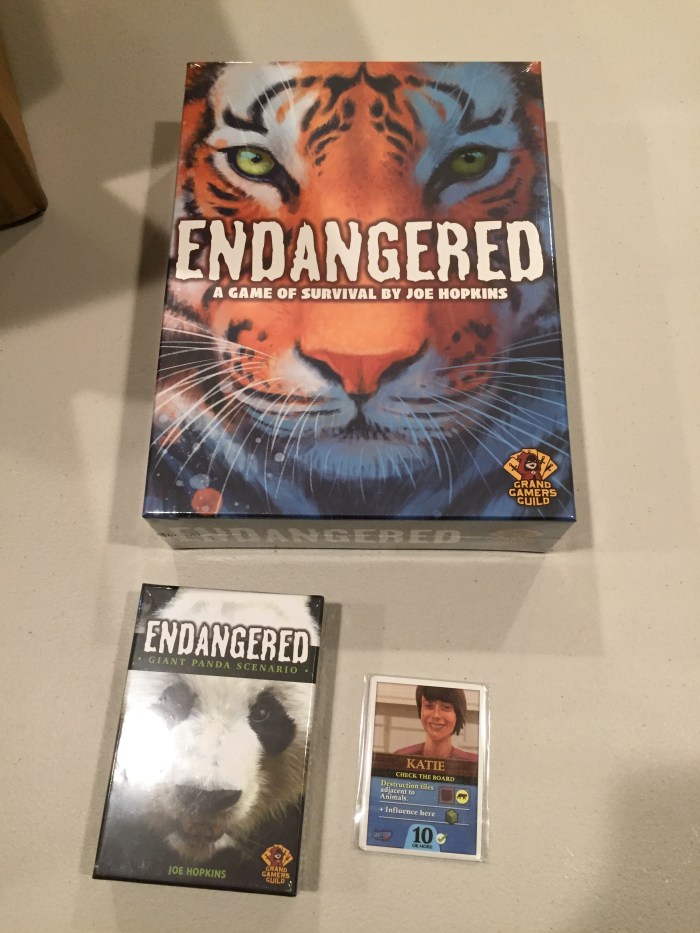
Endangered is a cooperative board game about endangered animals: You all work together on a “global scale” to help save (in a conservation sense) some endangered animals.  This game was on Kickstarter in April 2019 and successfully funded.  It delivered to me about a week ago (April 7, 2020).  It promised delivery in March 2020: given the current state of the corona virus, a month late is actually pretty good.

I won’t be doing a full review until I can get this played with multiple people!  Multiple people playing is really difficult right now with Social Distancing.  So, you may be waiting a while to see Part II of this review.   I can tell you my initial thoughts from my first solo play.

Components

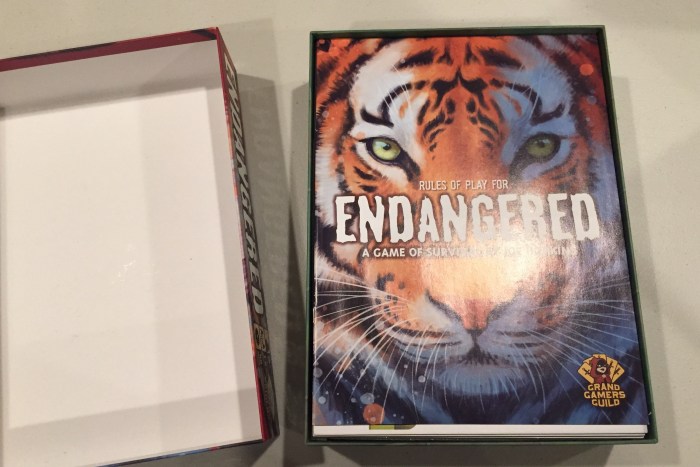
IMG_5589

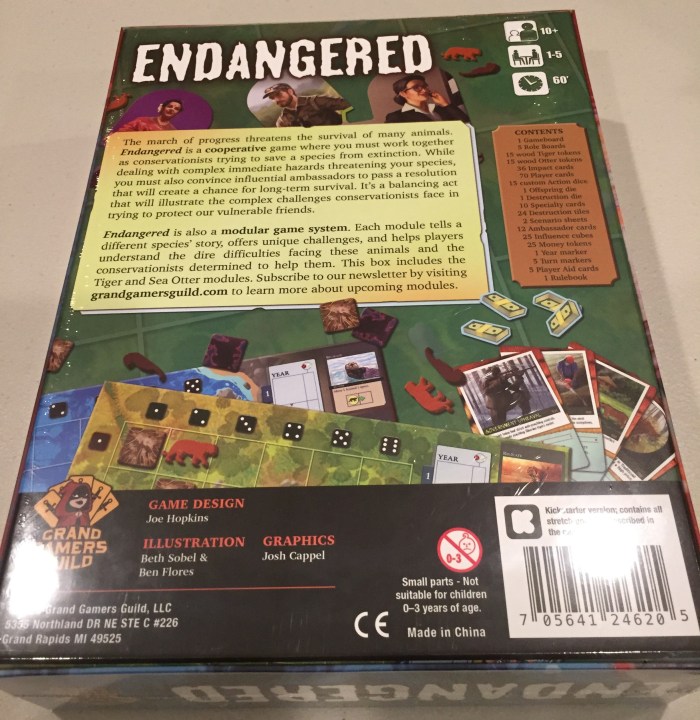
The game looks real nice: the back of the box shows some of the components and does a good job describing the game.

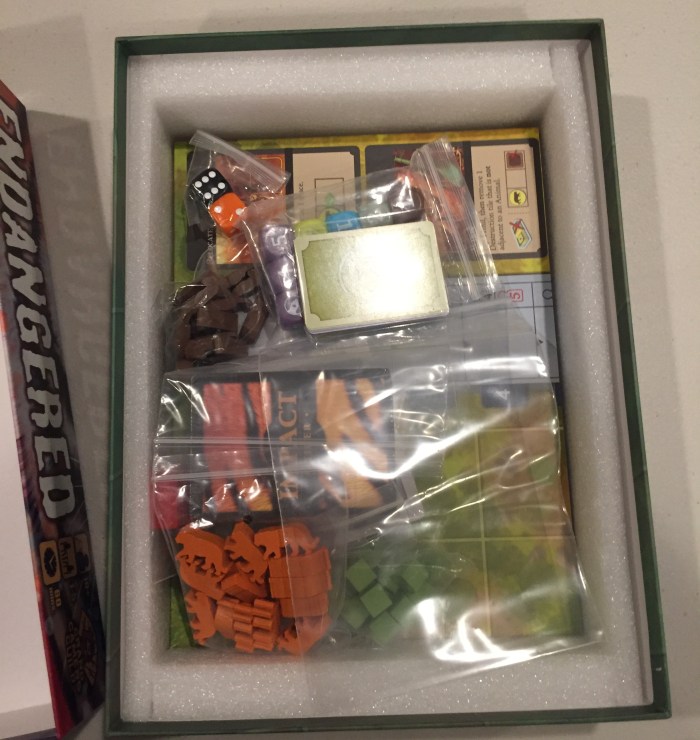
Upon opening the box, you see lots of cardboard (well, not too much) and lots of little wooden bits.

IMG_5594
Foam to hold board firmly in place

The board is packed interestingly: notice the foam around the edge!  The foam holds the board firmly in place.

The little bits in the game are good quality: the orange wooden tigers pieces are especially nice, as are the brown otter pieces.  The dice are interesting …

IMG_5605
The main board

The main board is two sided: one side is for the Tigers (pictured above) and one side is for the otters (not pictured).

IMG_5613
The main cards

The cards are all linen coated.  For some reason, the iconography and pictures remind me of Pandemic …

IMG_5615
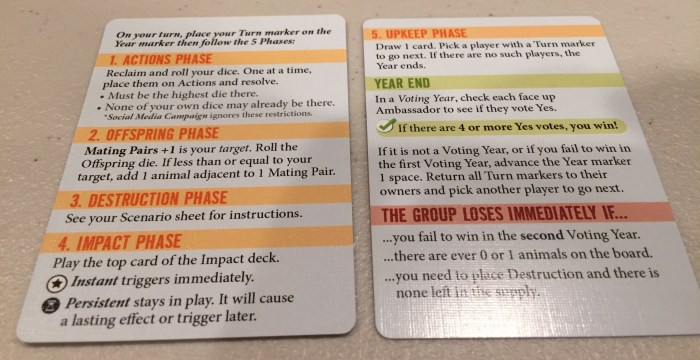
Summary Cards!

I am always so happy when the game has summary cards!  One for each player (2-sided, both sides shown above).

The components, overall are very nice.

The Rulebook

IMG_5606
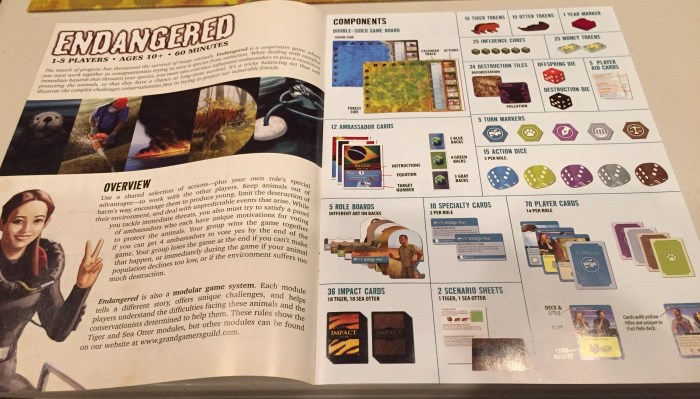
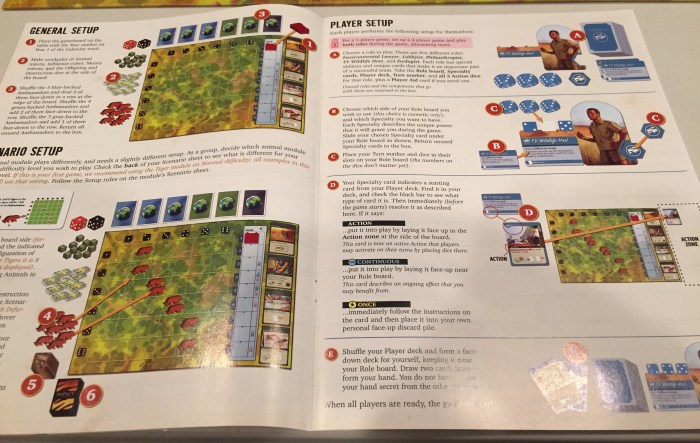
The first few pages of the rulebook: It shows all components

This is one of the better rulebooks I’ve read in a while.  First of all, it starts with the components VERY CLEARLY labelled, so you can go through the game and find everything (see picture above).

IMG_5608
Set-up

The set-up is right there on the next page, describing general set-up and player set-up.  There’s very nice pictures showing everything.  This was a really good start!  I had no trouble diving into the game.

Overall, the rulebook was excellent!  The rules were described well, the pictures showed what was needed, the art was very nice, and the book had big fonts (I don’t like rulebooks with small fonts).  In general, I wish all rulebooks were this good.

Again, for some reason, this rulebook reminded me on Pandemic: it had a vibe like Pandemic.

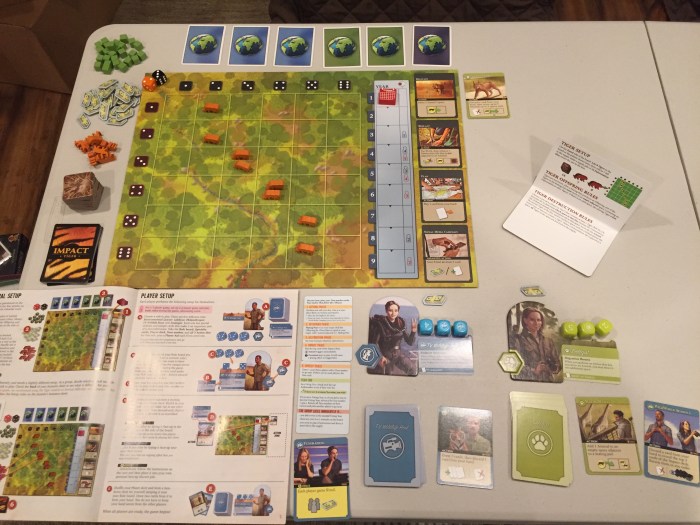
Set-Up For First Game

IMG_5619

The game set-up pretty quickly: see picture above.  It looks nice on the tabletop.  I was able to keep the rulebook open while I played the game (lower left).  I did need the rulebook open much of the game, even though the summary cards are good.

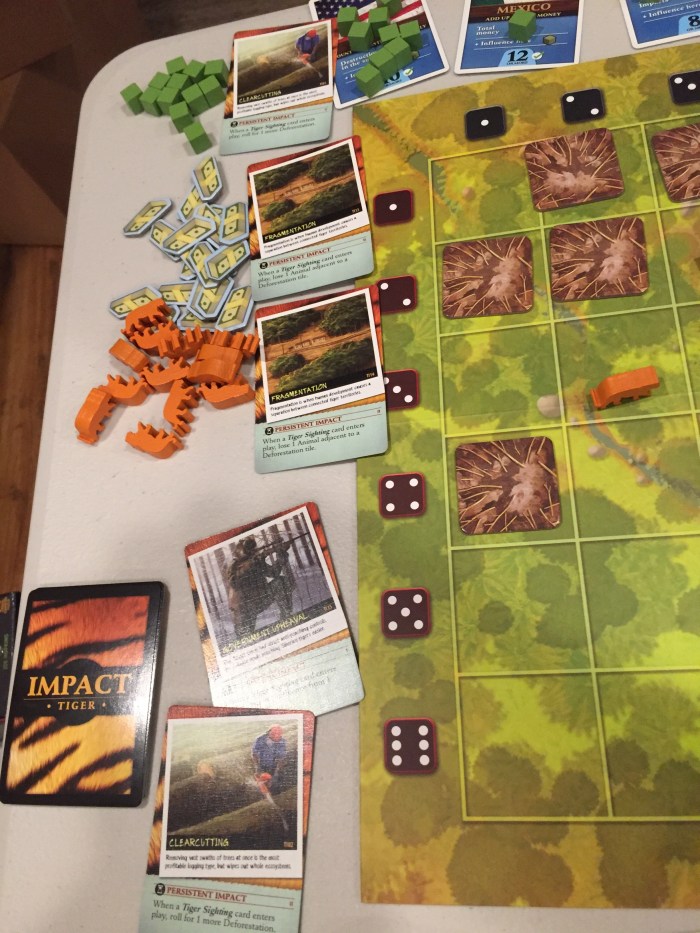
The first major decision during set-up: do you save the Otters or Tigers (or, if you have the expansion, the Pandas)?    I chose “Tiger” because that’s what the Rulebook defaults to for the first game.  By choosing “Tiger”, I choose side A of the board (green jungle in the middle), a certain deck of Bad News cards (called IMPACT cards, on the left side), some “Tiger” minis  (in the jungle board) and the “Tiger” dossier, which describes how the “Tiger” game is different from the main game.

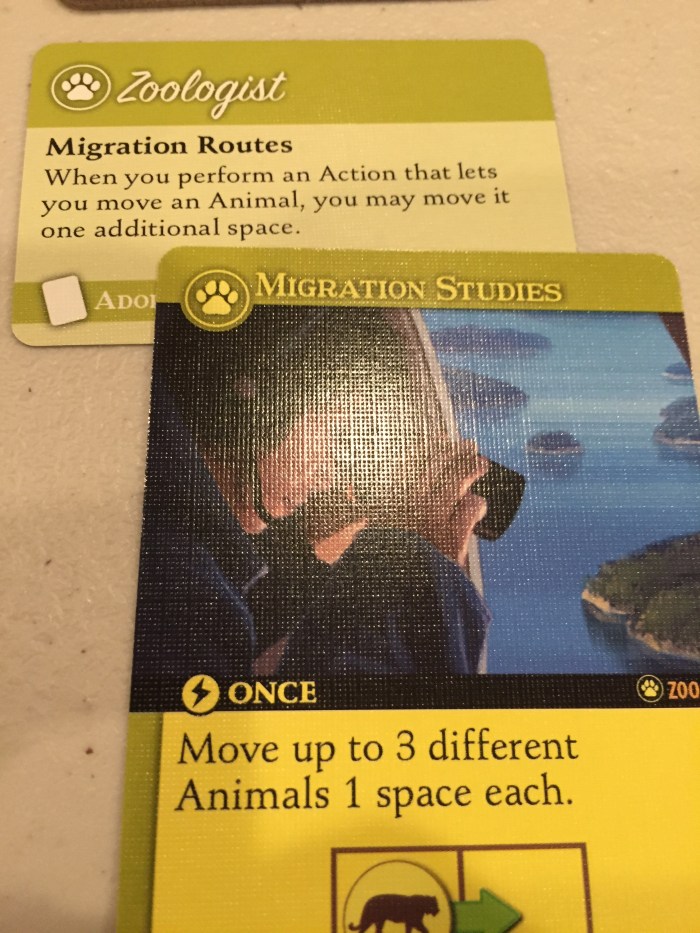
IMG_5616

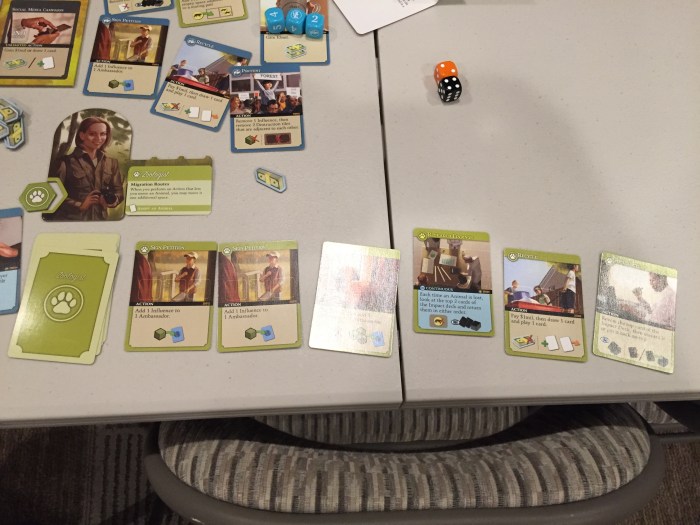
Each player then chooses a role: each role has special abilities.  The Zoologist above has a special ability for Migration Paths.  Each role has a different special ability.

Solo Play

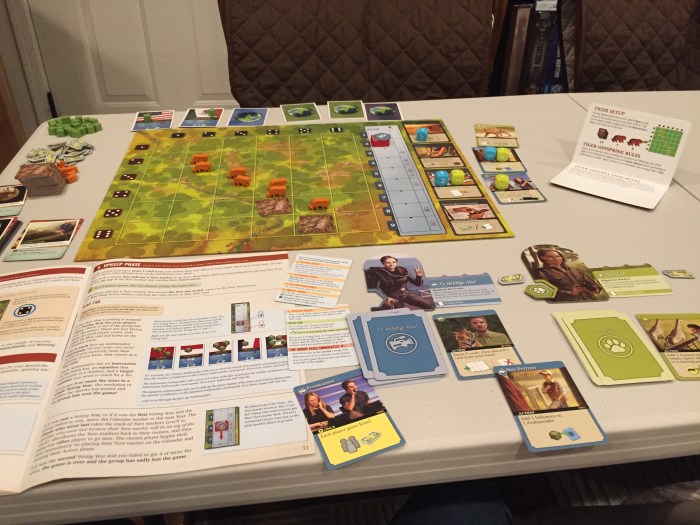
IMG_5620
Solo game: Mid-game

So, this cooperative game has dedicated solo rules (Huzzah! They follow Saunders’ Law).  It’s a very straight-forward solo game: the solo player takes the role of two roles who alternate play.   It seemed to work pretty well, although there was a lot to learn on your first play.  I am always a big fan of solo rules that only make you use one character, but there’s a reason you have to have two characters: this game is (among other things) a dice-placement game, and you need the tension of having some of the dice locations unavailable when your character plays.  That seems to be a core mechanic in the game, and taking this away this tension for a one player/one character solo play would immensely change the game.

First Play

IMG_5622
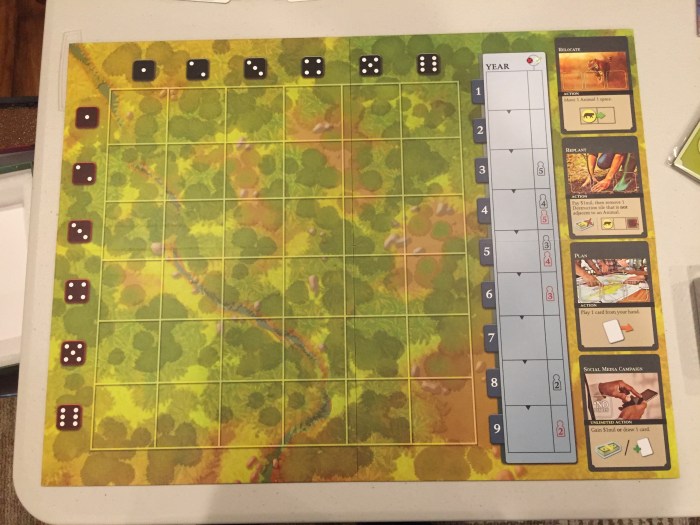
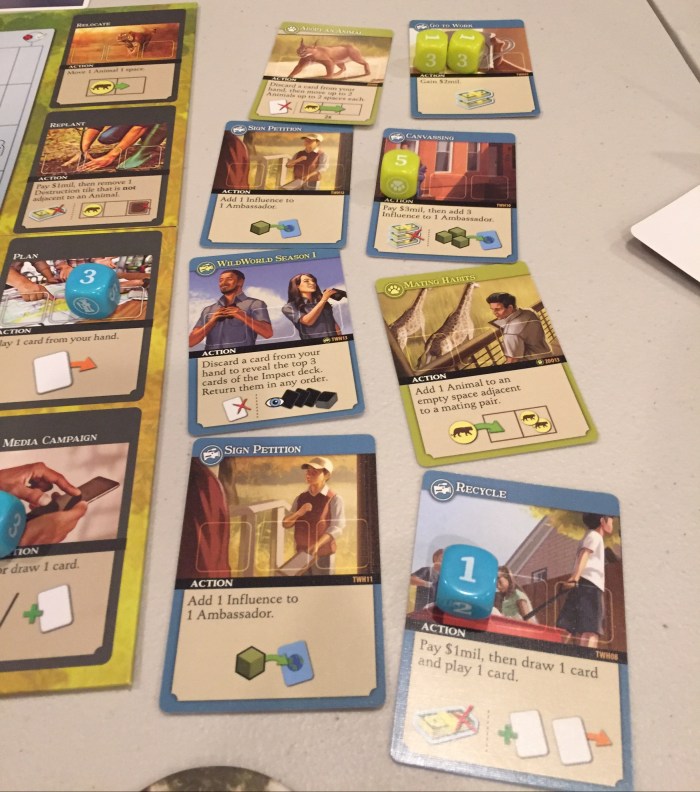
A bunch of actions available

The object of the game: You are trying to convince a certain number of nations to enact laws to save the Tiger, and each nation has a different “victory” condition (usually, you just need more influence)!  You win if you can convince enough nations to save the Tiger!  To accomplish this, you perform actions.  You perform actions by playing dice.

The game, at its core, is a dice-placement game.   The game starts with a few Locations in play, but as you play, you can add more action cards.  The game is interesting, because each role has a different set of action cards!  On your turn, you have to make the hard decisions!  You have three dice, and each die is placed on a card to perform an action.  NOTE: you can only place a die on a card if it is GREATER THAN all other dice already on the card!

IMG_5630
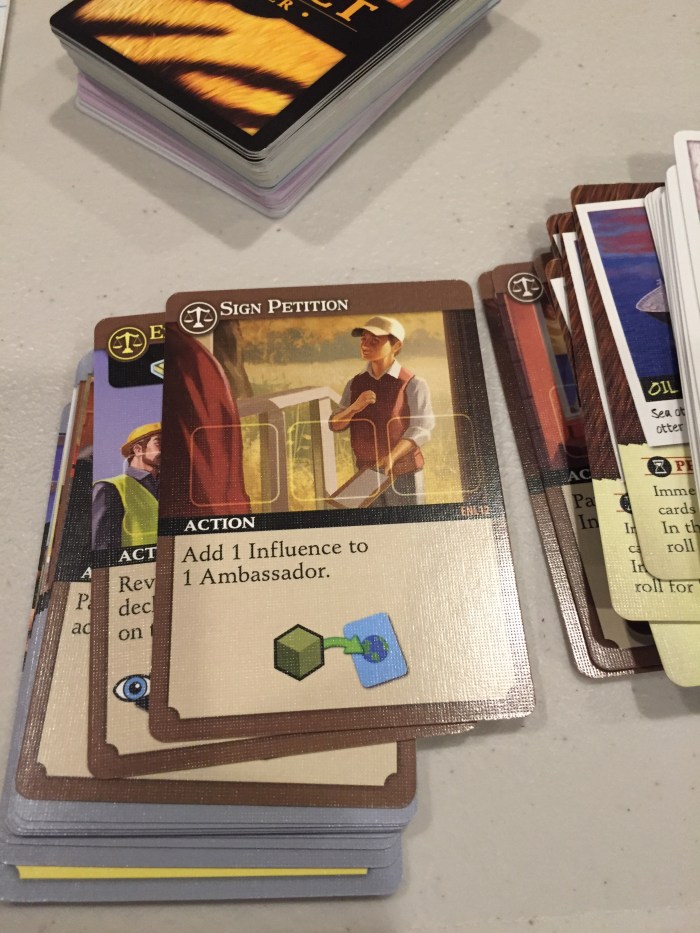
All the actions cards the zoologist COULD play, but hasn’t yet!

The game is replete with conflicting decisions:

  1. Do you spend an action to help the Tigers (in the jungle) mate so their numbers soar?
  2. Do you get spend an action to get money?  (Money is important for so many things)
  3. Do you spend an action to gain influence?  (Influence is spent on some ambassador/nation to try to get them enact protection laws)
  4. Do you spend an action to put out an action card?   (At the start of the game, there’s only a few actions out, so you have to spend actions to put out more actions)
  5. Do you spend an action to stop the encroachment of society into the jungle?  (This is represented by tiles in the jungle, blocking places where the tigers can go or mate)
IMG_5631
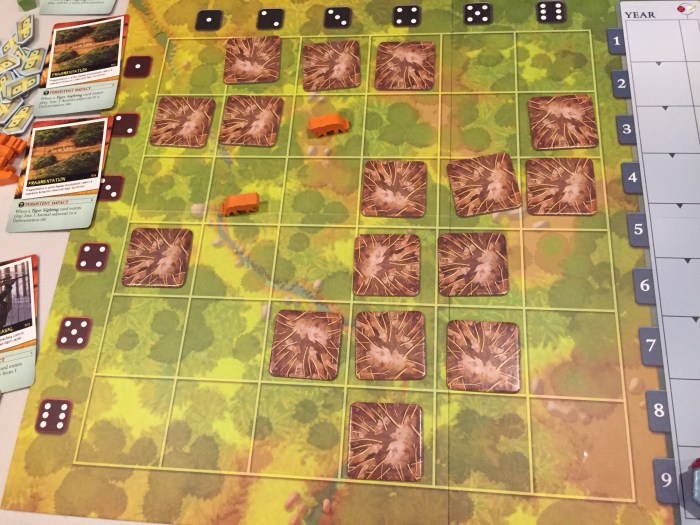
In the end game: only two tigers alive and the encroachment has taken over most of the map!

Every action is precious.    In the early game, you tend to try to put out actions to try to get better actions out.  In the late game, you are doing everything you can to keep the Tigers alive!

Bad News/Impact Cards

IMG_5632
Bad News/Impact cards

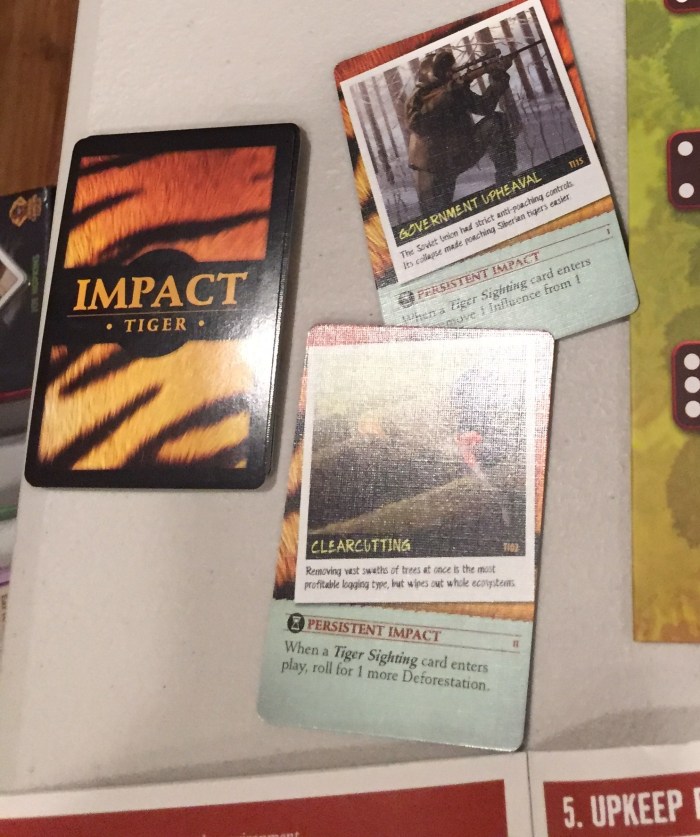
Like many cooperative games, there are Bad News cards which make the world worse for the tigers.  In this game, they are called IMPACT cards (see above).  Each animal type has its own IMPACT deck (above is the Tiger).  Some of the IMPACT cards are persistent, (which means they stay out the whole game (unless you do something)) and some are one-shots (one and done).  After each character plays a turn, an IMPACT card comes out.

End of First Game

IMG_5626
A losing first game!

In my first game, I lost.   There is only one way to win the game: Get 4 or more Yes votes from the Ambassadors in either of your two Voting Years.

There are three ways to lose the game:

  1. If the Animal population on the board is ever reduced to 1 or 0 Animals, the group immediately loses the game.
  2. If the group is ever required to place a Destruction tile on the board and there are none left in the supply to place, the group immediately loses the game.
  3. If the group fails to get 4 or more Yes votes from the Ambassadors in the second Voting Year, the game is over and the group loses the game

I lost because I ran out of time: I didn’t have enough Yes votes from the ambassadors.  It was a rough game.

Sources of Randomness

IMG_5633
Five persistent IMPACTS!!

I was frustrated in my first game because I lost so hard.  At the end of the game, there were so many persistent (5!) IMPACT cards, it was a bit of a slog dealing with the Bad news every turn!!!  I was thinking about why I was frustrated: there were a number of sources of randomness and I had trouble mitigating those.

  1. IMPACT cards.  The persistent IMPACT cards didn’t seem to have a way to mitigate them.  After I finished, I realized that SOME of the IMPACT cards allow you to spend money to get rid of a persistent card, but those didn’t show up for me in my first game until after ALLL the persistent cards came out.
  2. Tigers Mate.  To see if the tigers mate, you roll a 6-sided die.  The more tiger-pairs that there are, the better your chances  (Basically, you have to roll under 1+n, where n is the number of tiger-pairs).  You can mitigate this by keeping the Tiger numbers up.
  3. Action cards.  At the start of the game, you only have two of your action cards from you deck available. After every turn, you get to draw another one, but the action cards from the decks tend to come out very slowly.  (Some of the decks have actions which allow you to draw 3 action cards instead of one as a mitigation technique).
  4. Destruction tiles.  Each turn, you have to place a destruction tile.  You choose a row (or column) and you roll a die.  If the destruction covers a tiger, oh well!  (You lost that tiger).  The mitigation technique is basically you get to choose a row/column (that has a tiger).  But you still have to roll.

Although there were ways to mitigate the randomness, I felt like I didn’t have a lot of control over that.   Now that I know the game, I think the most important thing is to get some better actions out quickly.  I realize that I had bad luck: my action cards weren’t great in the beginning, I rolled terribly in the “Tigers Mate” and the “Destruction”,  and I drew all the persistent cards without the mitigators.   So, I was frustrated.  I suspect my second play will go better … it has to!  I am a little  worried about there being too much randomness, but now that I know the game better, I’m hoping the next game will go better…

Conclusion

IMG_5591

In the end, this game reminded me a lot of Pandemic with perhaps a little more randomness.  The rulebook was excellent, the game looked great, and there were lots of interesting decisions.  In general, I had fun.   My only worry is the amount of randomness in the game might be frustrating: we’ll have to see with future plays.

In general, this a good game: I am glad I kickstarted it, and I look forward to playing this with my game group(s) to see how it goes.

Concurrency in Cooperative Board and Card Games

arkhamhorror

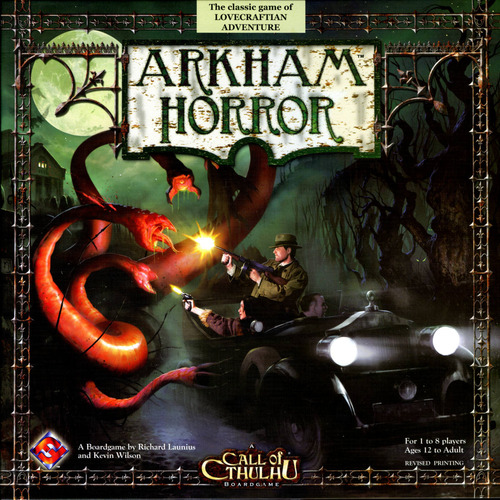
One of my top 3 games of all time is Arkham Horror, 2nd Edition.   My friends and I played the heck out of it when it first came out, and we still play at least once a year for Halloween (I have at two copies for two groups)!  It seems to be a real crowd pleaser in my game group(s), but it’s not for everyone: it has a lot of rules to absorb and a lot of components to manipulate.  My game group(s) have absorbed it and know the game quite well.

Screenshot from 2020-04-07 20-52-26
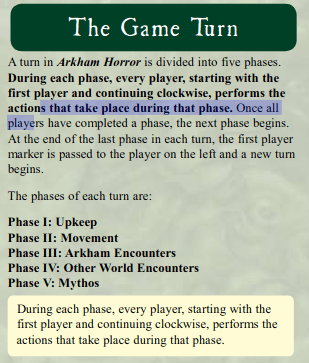
The Game Turn Overview from Arkham Horror: 2nd Edition

Something happened as we played Arkham Horror more and more:  we started to “streamline” the play.   The rules (above) dictate that play proceeds from the first Player (clockwise), and each player must finish their phase COMPLETELY before moving on to the next player.

To quote the rules (see complete rules here, page 5):

During each phase, every player, starting with the first player and continuing clockwise, performs the actions that take place during that phase

When we are playing strictly by the rules, our game play is sequential: every player action has to finish before the next player action completed.

We noticed this was taking waaaaaay too long!!! So what did we do??? We all started taking our turns at the same time!  Basically, everyone gets tired of waiting for “their turn to come”, but since this is a cooperative game (and we are all working together), we can all go at the same time!  We all perform UPKEEP at the same time.  After that’s done, we perform MOVEMENT at the same time, and so on.

In this mode, we are play each phase concurrently: players all act at the same time!

Visualization of Sequential and Concurrent Play

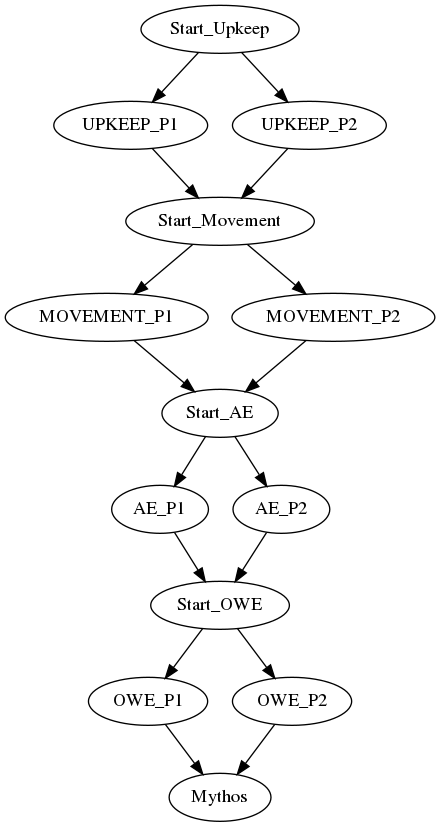
One way to think of the sequential play is to visualize it as a line of actions: Player 1 performs UPKEEP, player 2 performs UPKEEP, (UPKEEP complete), player 1 performs MOVEMENT, player 2 performs MOVEMENT, (MOVEMENT complete) and so on.

seq

In concurrent play, you can think of each phase as a giant bubble of activity: all players perform UPKEEP concurrently (waiting for each other to finish).  Then all players perform MOVEMENT concurrently (waiting for all other players to finish), and so on. See below.

con

This particular concurrent method SIGNIFICANTLY speeds up gameplay, as there is much less waiting!  In fact, this very idea is used in Computer Science to make computer programs go faster!!! You take a computer program and parallelize it, causing a bunch of work be done!  In Computer Science circles, this idea is expressed in many ways: the Scatter-Gather, Work Crew, or Map-Reduce. (See here for reference)

Parallelism - Multithreading - Scatter Gather — GATK-Forum

If you can do this, this is an easy way to parallelize, or make gameplay faster!

Sequential Consistency

Game night. Frsutation, despair, anguish. A normal night in Arkham.
Playing Arkham Horror 2nd Edition

The problem with all of us acting at the same time was that were times  when two (or more) players collided in their actions!!  For example; What if we both drew from the same deck?    Since this is a friendly, cooperative game, the order we might draw from the deck doesn’t matter: we just both draw and one of us just happens to go first.  If we were feeling pedantic, we would draw in player-turn order, but most of the time we didn’t care: it was better to be moving quicker through the game than care about “who-got-which-cards”.

If we were pedantic in our play, we were ensuring that the game was playing EXACTLY the same way as if we had played WITHOUT the concurrency.  In other words, if everything happens in the exact same order as the game had played WITH THE SEQUENTIAL RULES.  If we can do this with our concurrent play, we are ensuring sequential consistency.

In other words, as long as we are pedantic in our concurrency, we are ensuring that the game plays out in exactly the same way: it is sequentially consistent.

Relaxed Sequential Consistency

Recto des cartes FR
Some of the many decks of cards from Arkham Horror, 2nd Edition

In Arkham Horror, the decks (see above) we draw from are meant to be a source of randomness: the card we draw is meant to be “a random card”.

If that’s the case, does it matter if we are pedantic in the order we draw cards?  We just want a random card!  If that’s the goal, the order shouldn’t matter as long as we are (nominally) getting a random card!

If there are things that really don’t really matter the order that they occur (i.e., , two players drawing from a deck at the same time like above), then we have relaxed consistency.

In the end, this was how we played Arkham Horror 2nd Edition: Concurrent turns with relaxed consistency.   This model helped the game move much faster!

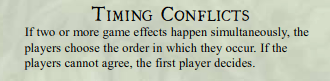
(In fact, the game even says that’s okay …)

Screenshot from 2020-04-07 21-17-21

Seven Wonders and Simultaneous Action Selection

English first edition box cover

It’s funny: 7 Wonders has weird place in my game groups: people love it or hate it! (It turns out, it’s just my game groups, see here).  But one thing everybody seems to like is the Simultaneous Action Selection!! This is very similar to what we ended up with in Arkham Horror (concurrent play with relaxed consistency), but the concurrent play  in 7 Wonders is much smoother.  Frankly, there’s only two main phases (passing cards concurrently and then playing cards/effects concurrently, see below)! 7 Wonders has been designed to avoid the consistency traps we saw in Arkham Horror!  Arguably, that’s Simultaneous Action Selection’s greatest feature: simple concurrency with no need to ensure a consistency model: that’s just the way it works.

If you squint, you can visualize the two concurrency phases in the main play:

  1. All players select 1 card and then pass the rest (ALL HAPPENING CONCURRENTLY)
  2. All players reveal and “act” on their card (buying it, putting it under wonder, etc) (ALL HAPPENING CONCURRENTLY)

That’s why 7 Wonders works so well with a large group: large amounts of concurrency!

Sidekick Saga and Concurrency

The goal of Sidekick Saga was to achieve the amount of concurrency in 7 Wonders, but in a world that must be explored (like Arkham Horror).  Sidekick Saga was designed to be a Simultaneous Action Selection game …  but, it turns out, concurrency is hard.

Originally, the Sidekick Phase (see above) was meant to be purely Simultaneous Action Selection: players strategize together at the start of the phase, then each perform their entire Sidekick Phase completely concurrently!  But several things got in the way:

  1. There was the matter of the Lead cards: they are obtained at the end of the turn and can’t be shared that turn (thematically, you spend your whole turn running down a Lead so you can’t share it just yet).  Can I pass newly minted Leads when I get them?  (Answer: no)
  2. When you can pass cards?  Can I pass a card I got this turn? (Answer: yes, but only if it wasn’t passed to you this turn! Only if you picked it up!)
  3. What happens when two players draw from the same deck?  (Similar to Arkham Horror, but now order can matter if you have the X-Ray Specs)

Addressing each of these is simply a matter of making sure you ensure sequential consistency, but there’s just enough edge cases/rules that it can be confusing, especially as players are learning the game.

So I backed off Simultaneous Action Selection to a Concurrent with sequential consistency model  … like Arkham Horror.  At least players would getting SOME parallelism.  Recall, however, that model was achieved ONLY BY EXPERTS AT Arkham Horror!!  Playtesters, even with experienced players, got confused by the model.  So, I had to introduce a purely sequential mode: Novice!

Screenshot from 2020-04-07 21-49-13

In an ideal world, there would be three modes of Sidekick Saga:

  1. Novice (as players become familiar with the actions): sequential play
  2. Normal (once players are comfortable with the actions): concurrent play with sequential consistency
  3. Advanced (players know the interactions very well): concurrent play with relaxed consistency, approaching Simultaneous Action Selection.  (For this to work, we have to be sure to have rules to deal with of the few edge cases we identified above).

The problem is that Novice was a bad word to use (and what Rahdo picked up on his “Final Thoughts” video).  Novice implies someone who is perhaps not used to modern board games: that’s not at all what I meant!  I meant someone who is new to THIS GAME!!  So, that’s my fault.  What I should have used:

  1. Normal (sequential)
  2. Advanced (concurrent play with sequential consistency)
  3. Expert (concurrent play with relaxed consistency)

The Second Edition of the game will fix this (and there will probably be an updated rulebook on BoardGameGeek).

Conclusion

Concurrency is hard to think about.   In Computer Science curriculum, concurrency is so hard, it’s typically an upper-level college or graduate level course (When I took it, it was a graduate level class). SOme of the lessons I have learned here:

  1. Don’t introduce concurrency unless it’s very simple concurrency (like 7 Wonders and Simultaneous Action Selection)
  2. Realize that concurrency can be hard (and name modes that use it appropriately)
  3. If you are going to introduce concurrency, make sure your rules explain it well and have lots of pretty pictures


A Review of Ni No Kuni II: The Board Game

IMG_5363
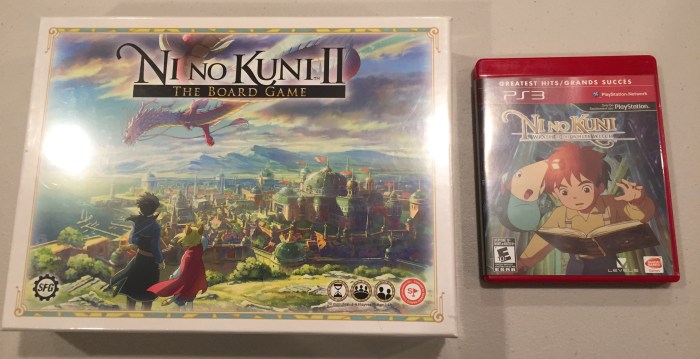
Ni No Kuni II: The Board Game and Ni No Kuni: The Wrath of the White Witch for PS3

This is a review for Ni No Kuni II: The Board Game: this is a cooperative board game for 1-4 players, ages 14+.  But of course, we have to discuss the video game first!

The Video Game

Ni no Kuni: Wrath of the White Witch - GameSpot

Ni No Kuni: The Wrath of the White Witch was originally a video game I played for my PlayStation 3 back in 2013.  I had picked it up because it had gotten good reviews as a solo adventure game (and it was by Studio Ghibli, which has a stellar reputation).  It was surprisingly addictive, and I ended up playing through the whole thing.!  My intense like of this game was a surprise on multiple levels! Why? Because (a) I am not in Anime (b) the game’s theme is slightly “cutesy” (c) the first few plays was fairly basic.   The game was quite addictive and really evolved as you played.  In the end, Ni No Kuni was one of my favorite PS3 games!

IMG_5364
Solo Games for PS3

The Board Game

IMG_5365
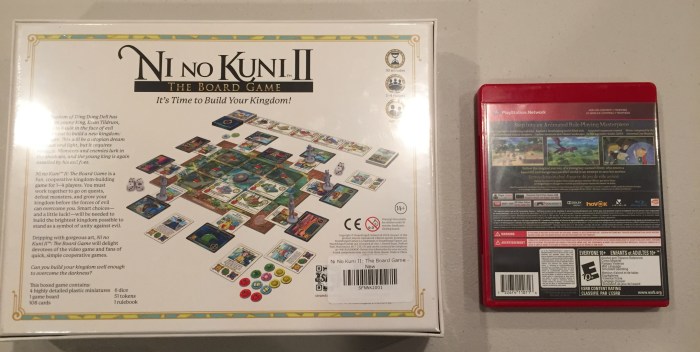
Back of the board game and back of the PS3 game

When I saw an announcement for Ni No Kuno II: The Board Game, I have to admit, I was very excited!  The PS3 game really captured my imagination.  Would the board game?

Components

The components are very nice and evocative of the original Video Game.

IMG_5374
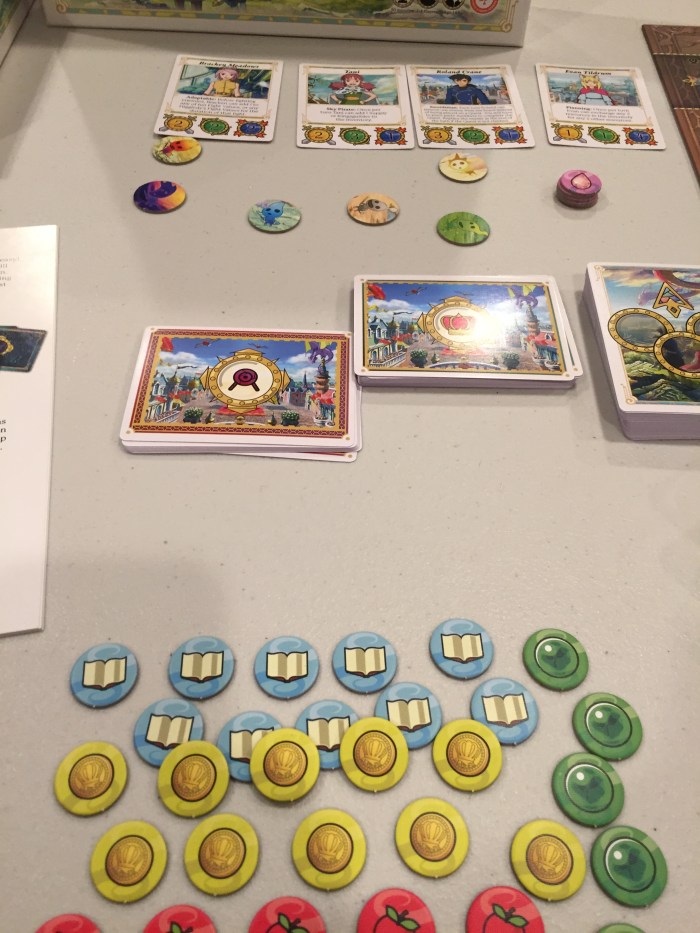
Nice components
IMG_5377
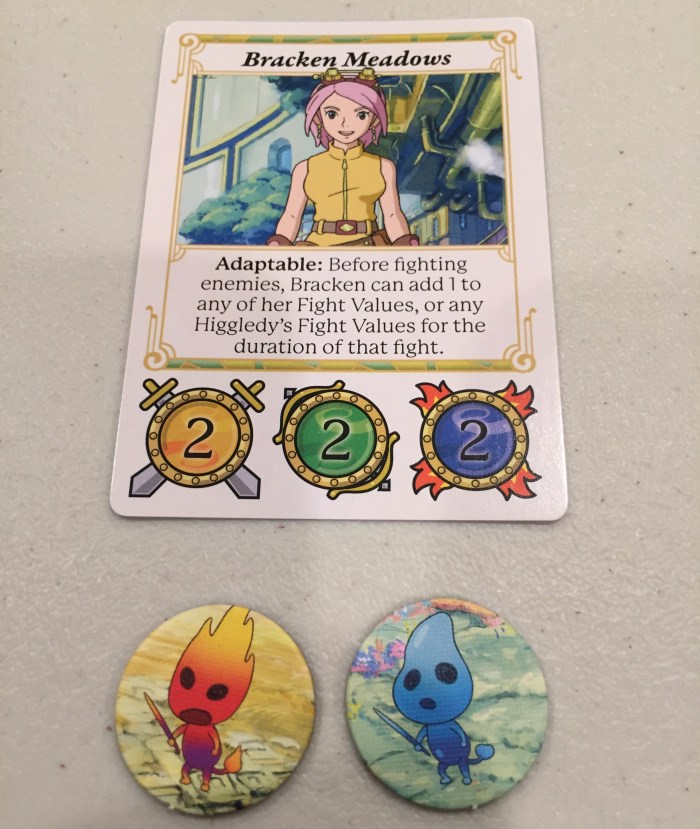
Character Card for Bracken and her Higgledies!

Each player in the game takes the role of one of the characters: Bracken, Tani, Roland, Etc.  Each character has a different special power and their own miniature.

IMG_5384
Player miniature with her Higgledy, going on a Quest against the Grimchilla! Note that there are 2 Space, so you need two Good Guys!

Each player also gets help on the form of the “Higgledies”: little pets/sidekicks who help you in the game.

IMG_5367
The Board

The Board is nice and has nice art.

IMG_5378

The monsters are far too cute, and very evocative of the original game.

IMG_5386
A quest! And it’s rewards! 0 Exp, 2 gold (guildercoin) and 0 supplies (tomatoes)

In general, the components are very evocative of the original game.

Rulebook

IMG_5370
The Rulebook

The rulebook is very good.  It’s fairly short, gets to the point, and it has some nice examples and art.

IMG_5371
Contents

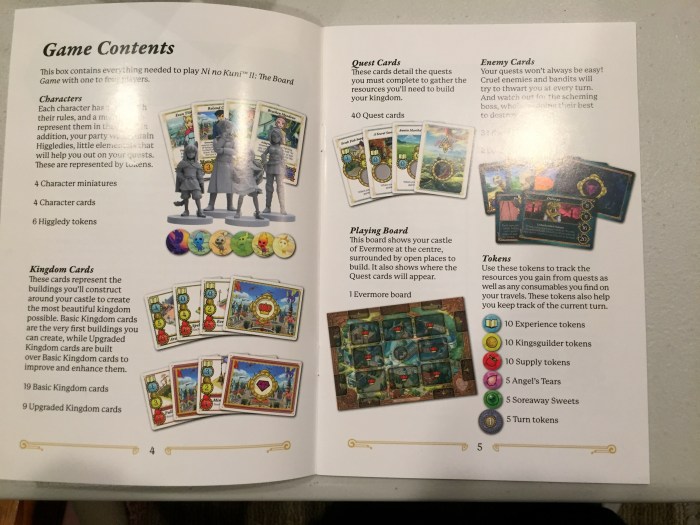
I am always very happy when the game describes what comes in the box.  NNK does a great job of this, showing actual pictures of components with some descriptive text as well!  Very nice.

IMG_5373
Shows set-up

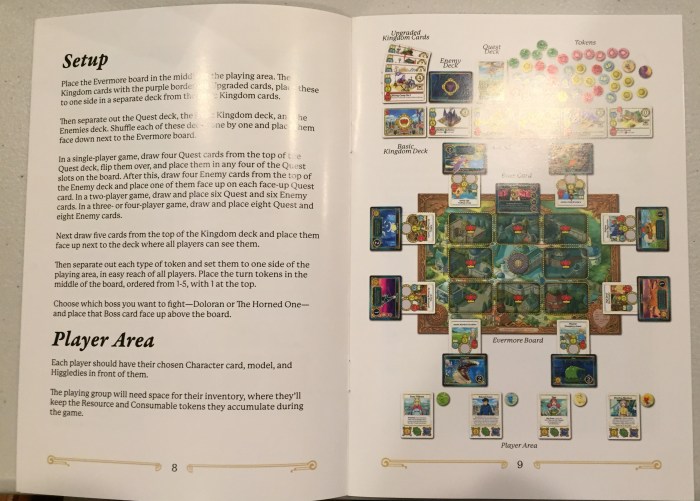
A good rulebook shows a nice picture of the set-up as well (see above).  I wish they had some labels and a little more “step-by-step” set-up, but honestly, this was good enough.  You get a sense very quickly what the game looks like when set-up and how to play.

I was up and playing fairly quickly because the rulebook made it easy.

Gameplay Overview

IMG_5382
A solo game set-up

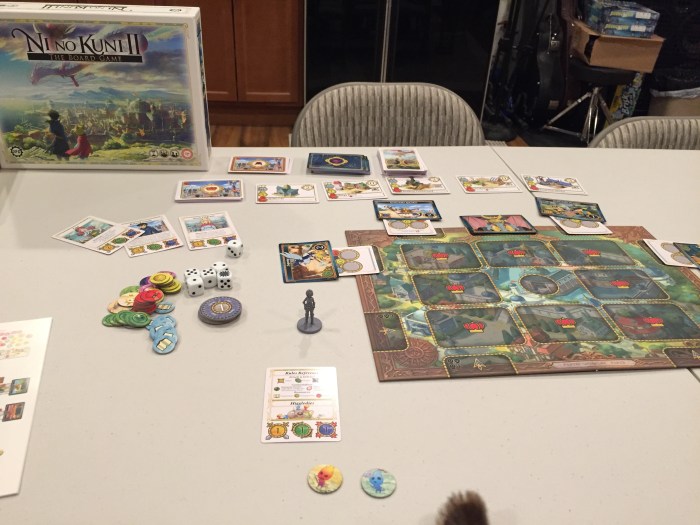
The gameplay is fairly straight-forward: you take your character (and possibly some Higgledies with you) on some quest(s) (you can send multiple characters/Higgledies on quests simulaneously).   Quests involve rolling dice, depending on how many characters and Higgledies you send on the quests.

IMG_5379
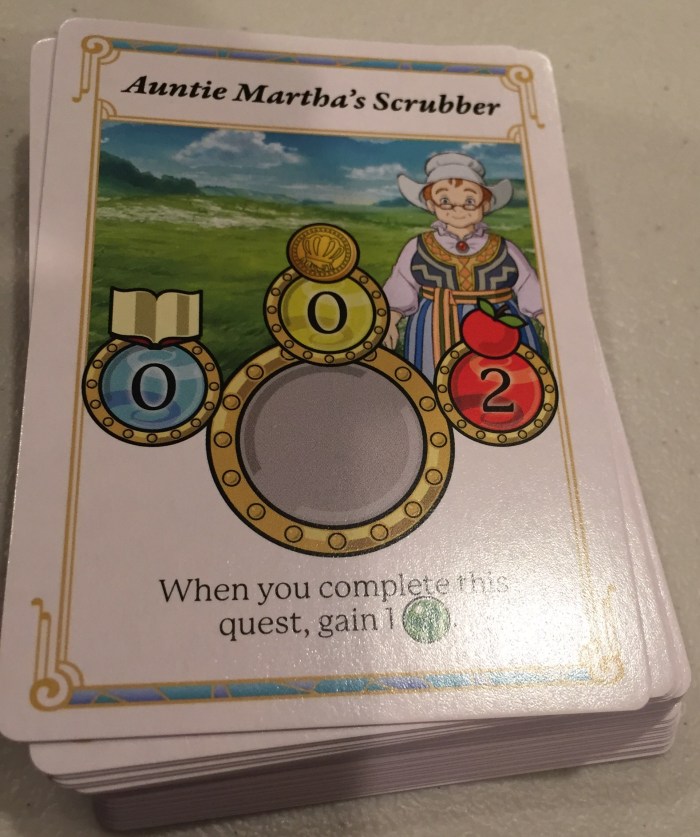
A Quest! You need at least one character or Higgledie to go on this quest!

Each quest has a monster associated with it: if you defeat the monster, you get the resources (coin, experience, supplies, and possibly 2 special resources).

IMG_5378
You need to roll at 4 or more on some dice to defeat the banger!

After all quests are complete (a failure means you simply don’t get the resource), you can use your resources to buy buildings for the map:

IMG_5380
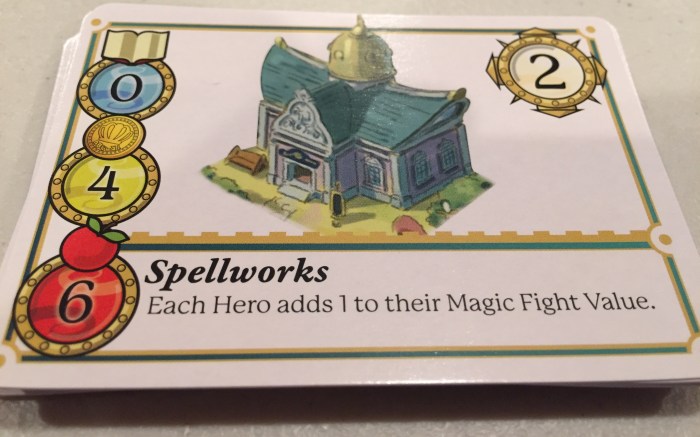
This building costs 0 exp, 4 coin, 6 supplies, and gives 2 for the final battle!

Every building has a cost, but you need buildings!!  To defeat the final bad guy, you need the Kingdom Influence (upper right corner) of your all your buildings to be MORE than the Influence of the final Boss!

IMG_5390
Only a total of 6 Kingdom Influence for the final battle, but tons of special abilities for the character

By the end game (the game only lasts 5 rounds), you need enough power of your buildings to beat the final Boss!

That’s the basic idea.

Gameplay Discussion

IMG_5389
A losing solo game!

The game moves pretty quickly: sually it’s over in about 20 minutes.  The decisions are fairly simple.

  1. Which Quests do I want? (Can I defeat the monsters ON those quests? What resources are on that Quest?)
  2. How many Good Guys (characters, Higgledies) do I send on a Quest?
  3. If I win, which buildings do I buy?

To solve each Quest, you roll some dice (based on your combat stat: combat, ranged, or magic) to see if you defeat the monster.  So, the number of Good Guys you send on a Quest informs how many dice you get.

IMG_5383

In the end, the game is .. a little bit of a math problem.  (Don’t say this too loud or you’ll scare some people away).  What are the odds I will win this Quest based on the number of Good Guys I send?  Can I get enough resources to buy a good building?  Do the sum of the buildings beat the (Big Bad) Boss at the end?  The trappings of the game are very cute and thematic, but at the end of the day, this feels kind of like an abstract counting/math game.  That’s not a bad thing, but once you see it, you can’t unsee it (so don’t tell your fellow gamers).

Solo Rules

IMG_5385
A solo game that will lose …

The good news is that this game has solo rules (ya, Saunders’ Law), and these rules are easy to understand.   Unfortunately, the game doesn’t work too well (as given) as a solo game!  As you are playing, you don’t have enough resources to make a lot of decisions: you only have your character and 2 Higgledies. EVERY time I played, I just went on one quest, because I didn’t have enough Good Guys to even try multiple Quests!  And I got unlucky, each quest has a “mininum” number of Good Guys you place, and I NEVER had a Quest that could take just one guy.  Honestly, as a solo game, I never felt like I had a lot of choices: there was an “obvious” quest I had to go on, and that was all I could do … all  I got to do is roll dice.  For a while, I  was pretty down on this game because of the solo game!

BUT, if you take the role of 2 characters, and pretend the game is a 2-Player game, your decision space opens up!  Then, you feel like you can make more decisions, and it’s a lot more fun!

So, I will say this: play the solo game (from the rulebook) to learn the basic rules of the game.  From then on, play the solo game as two characters in a 2-Player game.  The game is much more interesting.

Big Bad Boss Special Powers

One mistake we made almost every time (in the first few plays) was NOT looking at the Boss  The endgame Boss you choose really changes how the game plays and honestly changes up the game quite a bit.  I would almost recommend IGNORING the Boss special powers the first time ANYWAYS (because the Boss’ special power makes the game more random).  Honestly, since you aren’t supposed to turn over the Boss until the last turn, you forget the Boss even HAS special powers.

Just ignore the Boss special powers for your first few games.  You will (on accident) anyways.

Conclusion

IMG_5392

At the end of the day, this is a very light cooperative game.  Actually, it might be too light for some heavier gamers.  The theme and the gameplay itself are both pretty light. It works much better as a multiplayer game than a solo game (unless you use the special 2-Player solo rule presented above).

We found that this game works (for my game group) as a “I’m waiting 20 minutes for Andrew to arrive”  game or an “End of the Night: Our brains are fried” game.   It’s a light co-op with enough decisions to be interesting, but not a lot of huge decisions.

The 14+ age rating seems weird to me: I think that younger kids (with the guidance of an older parent/adult) would really like this game. (It’s probably because testing games for 14 and under is expensive, and it’s usually just cheaper for the manufacturer to put 14+ on the box).    I can see this being a gateway game for younger kids to learn about some more modern concepts (gathering resources, buying buildings, computing the number of warriors to commit) in board games.

At the end of the day,  this is a pretty simple game (with some luck) and some nice components.   I don’t think this game for everyone.  If you like the theme, I suspect you will enjoy playing in this universe.  If you want to play a simple co-op game with your young niece, I suspect you and your niece would enjoy this.  If you want a very light co-op (end-of-night game, waiting for someone game), this is a good time filler.  If you want a heavier game, this is probably not for you.


Changing Perspective: Playing Solo in Cooperative Board Games With Limited Communication

At Dice Tower Con West 2020, Tom Vasel (Dice Tower) and Richard Ham (Rahdo) gave their Top 10 Most Important Games of the Decade.

Top 10 Most Important Games of the Decade 

At the 12:25 mark in the Video, Rahdo comments on how important Hanabi is:

[Hanabi] is an important milestone in the evolution of board game design because it is cooperative game where you have imperfect communication between players …

There are other games previously that had imperfect communication (for example: Shadows Over Camelot, Battlestar Galactica), but Rahdo’s point was that Hanabi (by being Spiel des Jahres winner) made imperfect communication a common mechanic in cooperative games.  Rahdo goes on further to say how imperfect communication was important because it allowed cooperative games to have “zest” and “surprise”.

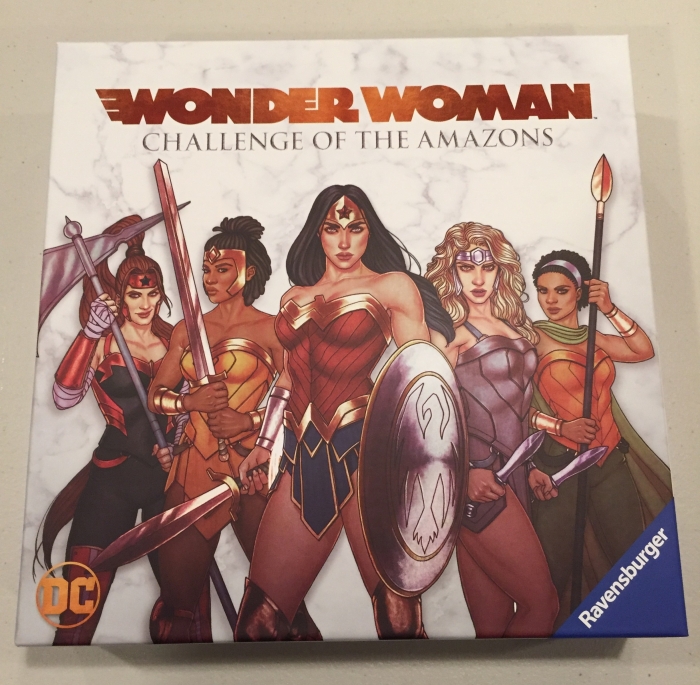
Whether you agree with Rahdo or not, (Rahdo says he can show you  data on BoardGameGeek to back up his opinion), cooperative games with imperfect communication are very common and here to stay (Hanabi, Mysterium, Muse, Wonder Woman: Challenge of the Amazons, Shipwreck Arcana, Far Away to name a few).

But what does that mean for the solo gamer?

Solo Rules for Many Cooperative Games: Usually Just Play 2 Roles

Over the past few years, I’ve had to come up with some solo rules for many games to learn them. As I’ve said many times, game teachings go a lot faster when someone knows how to play, so it behooves a board game to have a solo mode so someone can sit down and learn the game by themselves.   Most of my solo rules have been for games without imperfect communication: Sentinels of the Multiverse, The Captain is Dead, and Unicornus Knights to name a few.  In those games, it’s usually easy to just expand and make the solo player play multiple roles (like 3 in Sentinels or Unicornus Knights).   Those games work because the solo player is simply taking over other players’ position(s) (as well as his own) and playing the game normally.   No information is hidden, and the solo player can strategize with himself just like he would strategize with his compatriot. Out in the open.

But how can you play multiple characters/roles if information is supposed to be hidden?

Navigating the Abstraction Hierarchy

Let’s take a pointed detour.

In my job, I am a computer programmer (Computer Science).  Much of my time is spent trying to figure out why a computer program is not working.  It can be as simple as the input wrong, or something as complicated as subtle logic errors across many programs.  The thing is, you almost never know what’s wrong until you dig into the program.  To find the problem, you have to start at the top (intro) of the program and work your way down.  As you go down, you are traversing different levels of abstraction:

  • Is this a high-level problem?  (Program run incorrectly by user, files missing, etc)
  • Is this a medium-level problem? (Logic error by programmer, modules not communicating correctly)
  • If this a low-level problem? (Memory not initialized correctly, array bounds error)

This is a gross generalization, because there are usually MANY MORE levels of abstraction in a real running system.  This simple example, however, conveys the main idea of problem solving when finding errors:

As you traverse the different levels of abstraction, you have to refocus your attention to the level of abstraction you are on.  This means gathering new information about the level you are on, and just as important, forgetting some of the details of the previous level.

In a real world program, there are too many details to keep in your head all at once.  It’s absolutely important to focus your mind correctly and “forget” the unimportant details as well as concentrating on the new details.

Any programmer can tell you how important it is to be able to navigate through different abstractions to get your job done.

Changing Perspective

Another way to phrase “navigating abstractions layers” is to call it changing perspective.   We have to be careful with that phrase, because it means different things to different people.   For an ambassador or a judge trying to settle a dispute, he has to be able to see both sides: he has to be able to change perspective.  Anyone trying to get along with new people has to be able to see where they are coming from: they have to be able to change perspective to the new people.

What’s usually forgotten when you talk about “seeing something from another perspective” is that you have to be able to forget: Forget your own preconceptions, forget your own situation, forget your upbringing.    Forgetting is just as important as focusing when you change perspective.

Of course, changing perspective is hard.  How do you know what to focus on?  How do you know what to forget?  What are the important features to remember?  What are the important features to forget?   With practice, it becomes a lot easier.

Solo Rules for Cooperative, Imperfect Communication, Board Games

We took that detour to point out that being able to remember certain details and forget other details can be an important ability.  It is also the key to making solo rules in cooperative, imperfect communication board games.

The broad idea is simple: when you have to change roles in a cooperative game, you have to learn to “forget” the hidden information of your previous role.

How does this work?  Let’s take a look at an example.

Shipwreck Arcana

IMG_4428
Shipwreck Arcana

The Shipwreck Arcana is an abstract, logic puzzle game for 2-5 people.  Each player has a hidden number, and gives abstract clues to help the other players guess his number.  The information about the hidden number is very precise and exacting: they are just tokens (“clues” if you would) placed on cards to help discover the number.

It seems like there is “no way” you could make a solo game out of this, right?   I mean,  if I know the number, how can I “change roles” and forget the number I am trying to get myself to guess?   In other words, how can I forget?

The idea is simple: you are either the clue-giver or the number-guesser.  Imagine yourself trying to help someone guess the number (that someone is you, but let’s move forward).

  • clue-giver: When you are the clue-giver, you try to think about “What’s the best clue I can give to help this other person?”
  • number-guesser: When you are the number guesser, you can ONLY use the information the clue-giver has given!   It’s almost like being a detective: looking solely at the evidence, can you deduce what the number is?  It works because ONLY the state of the boards represents all the clues!!!

When you play solo, you alternate between these two roles, “forgetting” the information of your previous role.  This works because you can look at the state of the board as “the only information you know”.  None of the information in your brain can be used when you play, just what’s on the board itself.

The complete solo rules for Shipwreck Arcana can be found here.

Conclusion

Quite a number of cooperative, imperfect information board games have solo rules that can work using this changing perspectives idea.

  1. Wonder Woman: Challenge of the Amazons (with solo rules): Play two Amazon Warriors who must “forget” what the other has done when choosing actions
  2. Far Away (with solo rules):  Play two teammates who must “forget” what the other has done when choosing actions.
  3. Shipwreck Arcana (with solo rules): See above!

It can be hard to wrap your mind around this at first.  If you want to try this idea out, I’d recommend playing Shipwreck Arcana first with this idea—the state of the board very precisely characterizes what the solo player knows, so it’s easier to “forget” the previous role (as you just concentrate on the board itself).   Another idea that worked in Far Away was to to write down (with pencil and paper) “what is the shared information” between two characters—you can only act on shared information that is written down when you are in either role.

Changing Perspective is all about focusing on the important and forgetting the unimportant.

Review of Far Away. Part I: Unboxing, Solo Rules, and First Impressions

IMG_5484
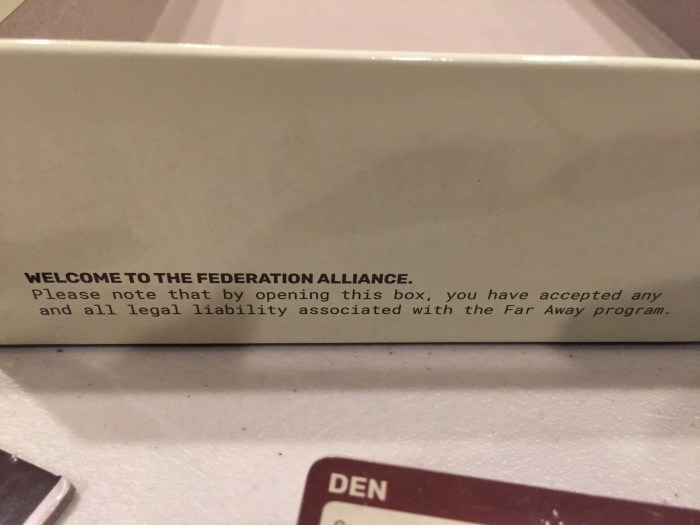
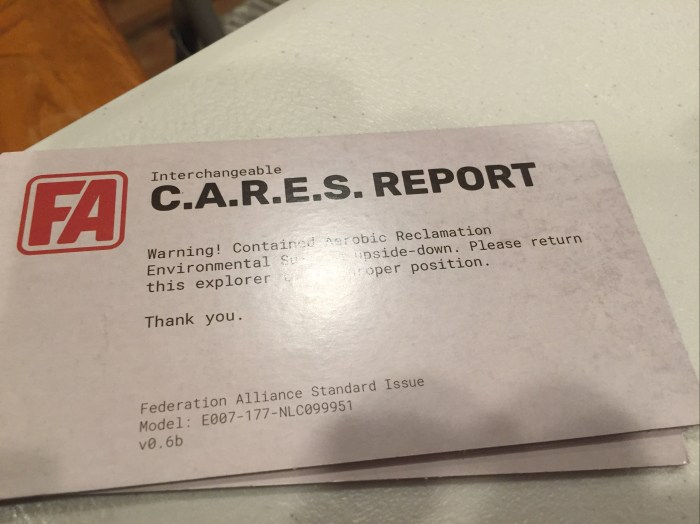
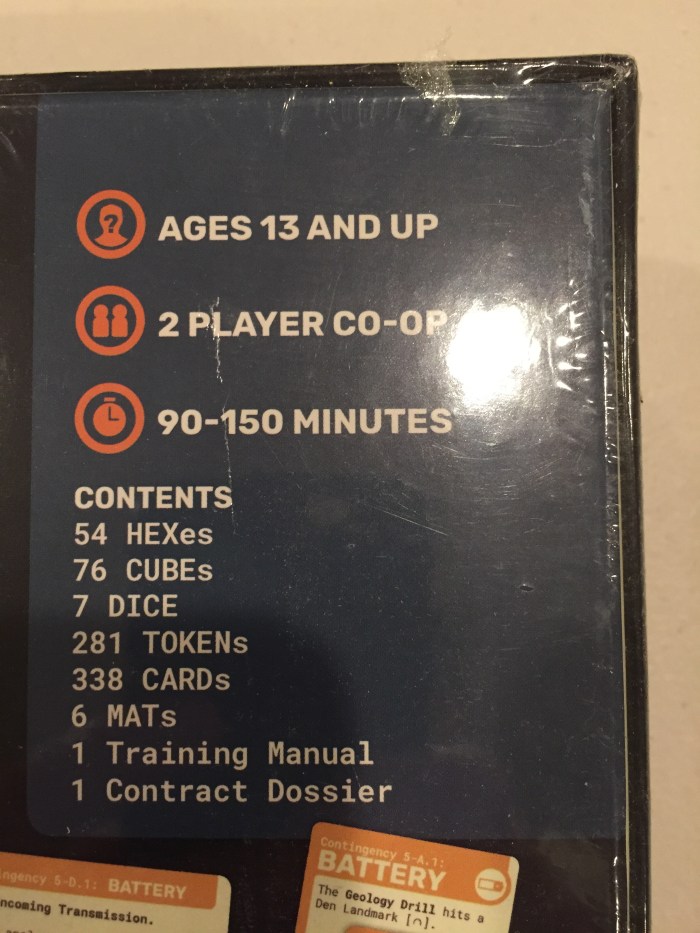
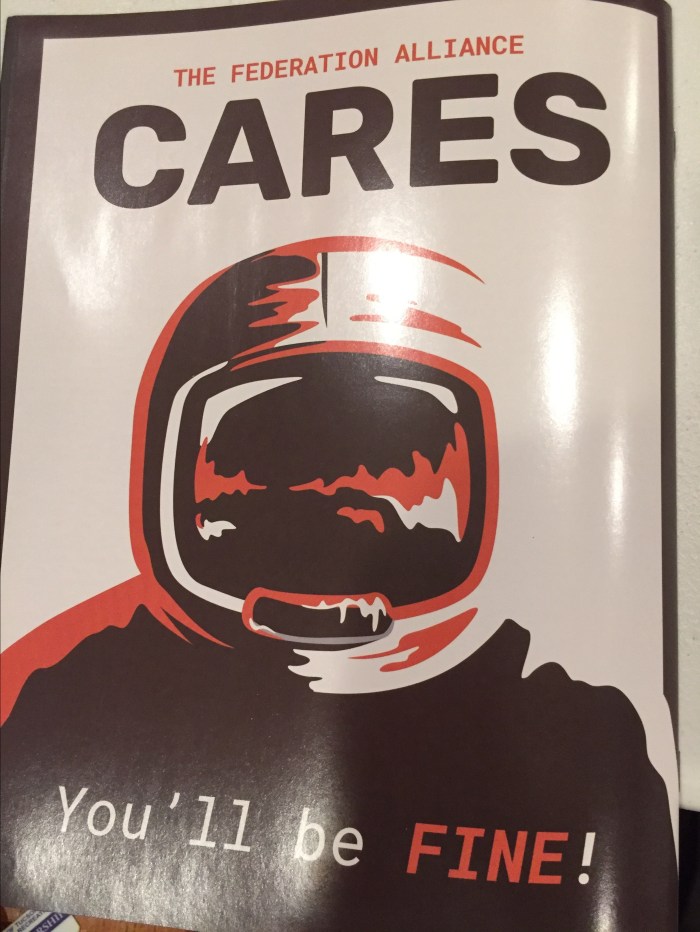
Far Away: A Cooperative 2-Player Game

Far Away is a cooperative 2-player game that was on Kickstarter back from November 2018.  It promised delivery in October 2019, and it just delivered a few days ago to me March 14th, 2020.   It is a space-themed game, with a Star Trek Federation “tip of the hat”.  But, the Federation is much more … brutally profit minded in this game.

First Day!

IMG_5485
Back of the Box

So, when I first got this box, I was excited!  I set aside some time to punch it out and play my first game.  After two hours of punching out cardboard, I decided I would wait until the next day to play my first game.  There is a LOT of cardboard to punchout!

IMG_5523
So … much .. cardboard.  The leftover punchout Skeletons …

I normally keep all the punchout skeletons (see here), but there is NO WAY I can keep them in this game (at least, not inside the box).  There is just SO MUCH CARDBOARD!

Hexes make up the world: there are quite a few of them (a lot of them are repeated).

IMG_5498

There are a number of hearts (for representing lonliness) and stomachs (for representing hunger) and a variety of generic tokens (see above).

Without a doubt, most of the cardboard taking up the box are the monsters.  There are “about 6” tokens for every monster in the game.  There are a LOT of monsters!  They have thought ahead and given us baggies for the monsters … a baggie for every six monsters!

IMG_5528

So, it’s very cool that they have a plastic baggie for every type of Creature, it is OVERWHELMING.  The game barely fits together when you put everything back in the box.

IMG_5534
So many plastic baggies for the creatures!

If you are exhausted just looking at the pictures, imagine having to punch it all out!

Art and Graphic Design

The art in this game feels like a throw back to a different time.  For some reason, this game “feels” like Nemo’s War and games from a bygone era.

The art is definitely not super hi quality art … it feels like “dated” art.  But you know what?  It works in this game.  This game feels like it’s a “kit” for exploring space back in the 70s.  What little art in the game is mostly on the monster tokens and the hexes.

IMG_5558
Most of the art is either on the Creatures or Hexes

EVERYTHING ELSE in the game is written with a “dated” typewriter type font, with a few colors here and there.

IMG_5494

The game has completely embraced the dated theme, and, you know what?  It works for it.  This game will not win any awards for best art or graphic design, but it’s very functional and it works for this game.

The Rulebook

IMG_5493

The Rulebook is decent.  But it’s long, because this is a fairly complicated game.  The rulebook is over 28 pages, and describes a lot of rules, particularly for describing the monsters’ behaviours in the game.  Be aware that it will take some time to get through the rulebook.

IMG_5502(1)

The game does talk about the components, but this game shows no pictures.  It only sorta describes the components. This was kind of frustrating (“Why are there 24 + 16 Anomaly cards?  What does the +16 mean?”), but I was able to sort of puzzle most everything out.  Usually, the +XXX meant that there were extra cards of that type for a particular mission.

Set-Up

The Set-up doesn’t show a picture of how the game looks, but it does show abstract representations of how the game should look. There are plusses and minuses to this method (Plus: easier to describe the cards and show more info, Minus: You can’t see what everything should look like EXACTLY on the table).  It worked ok.

IMG_5549
The first set-up!

I would have loved a picture (like the one above) showing set-up of my first game, but now that I have done it, it’s not too hard.

Tone

IMG_5511

So, this game has a sense of humor.  You can first see that when you open the box!  (See above!)

IMG_5503
Wrong Side! Humor!

All through out the game, there are little funny puns, dry humor, and little digs here and there.  This dry sense of humor accents the old dated feel, and again makes the game a little more.  The Rulebook was a little hard to get through, but the little touches of humor (nothing distracting) helped make it a little bit easier to read.

Only Two-Player Rules?

IMG_5486

This game has only rules for TWO PLAYERS.  That’s it.  This is a 2-Player game.

Normally, I would rant a little here (“Why can’t you have solo rules?  Please follow Saunders’ Law!“), but I will step back for a second before I present some solo rules.

The is 2-Player and doesn’t allow communication unless both players are on the same space.  Period.   I believe you are allowed to see what the other player is doing, but you are not allowed any communication (“No head scratching, no poignant coughs”) until both players are on the same hex space.  Thematically,  you have to be together to talk (and some silly thematic explanation like “The Corporation can’t afford comms, sorry!”).

Mechanically, the game MAKES you come together every so often or you get too lonely and die!  Seriously!  At the end of every turn, both players take “One Loneliness”, and if you ever have 5 Loneliness Tokens, you die of Loneliness!!  So, you are forced, by the mechanics of the game,  to get together every few turns.  In the meantime, though, YOU CAN’T TALK!

It’s hard to have solo rules when the game enforces “Loneliness”.

Solo Rules

IMG_5553
Can we even have solo rules?

So, I understand why it’s hard to have solo rules.   How do you turn off your brain and just run each character separately?  Well, you can!  Two simpler example of this are the solo rules for Shipwreck Arcana and Wonder Woman: Challenge of the Amazons!

In the solo rules for both of those games, you have to switch roles and “ignore” the information from a previous rule.  You can do that here as well!

To enforce this, I have a pencil and paper and “write down” what our goals are while both players are together.  When the two players are together, they can talk and broadly strategize.  I physically write down what we say to make it clear what we “know” together!  Once both characters separate, you play each character independently.  Each player is still allowed to see what the other player is doing and act on that  (based on actions what the other player is doing, as you are allowed to “see” what the other player is doing and what resources they have).  But you just can’t have them talk.

It takes some practice to play each character separately, but this can work as a solo mode.  Many times during solo play, you ask yourself “Do I know what the other guy is doing?”  If not, then you have to move forward using only the information you have (written down) or can see (from the actions/resources) of the other player.

First Game

IMG_5552
All Set-Up to Play!

My first game was a solo game using Mission 0 from the Mission book.  (Oh! Did I forget to mention that this game has Missions that changes up the game?  Sorry!)   Mission 0 has you build 3 Scout Towers.  In doing so, you get to do something simple while still exploring, gather resources, exploring, fighting, and doing the majority of things you do in a main game!

You’ll notice in the picture above that I have the Rulebook open.  You will have your nose in this rulebook THE ENTIRE TIME.  There are just so many rules.

IMG_5551
Game Summary Card (only 1?)

Luckily, the game has a ROUND summary card which really helps the flow of the game. Even though the Rulebook was always open, this little card helped moved the game along.

IMG_5554

My first game took about 1.5 hours, although a lot of that time was resolving rules.  The game itself was probably 30 minutes.  I explored and built hexes.   That part sort of reminded me of me of Robinson Crusoe as you explore the island (or planet in this case).  Each hex you explore has “something” revealed: you role a die to figure that out!

  1. Resource: a cube endemic to that Biome type
  2. Monster: Gulp!
  3. Anomaly:  Something random from the Anomaly deck?
  4. Resource Track: More resources, like a mineral vein

I think the Exploration was my favorite part of the game!

Creatures

IMG_5558

In my first game, I only had one creatures.  I got VERY LUCKY in my exploration die roles.

IMG_5532

Each creature that comes out has SO MANY RULES.  Size, Habitat, Threat Radios, Pack Size, preferred Biome, type, diet, behaviors …  (see above).

Here’s the thing:  the Creatures are sooo complicated, the game says you can have a 3-Player game if the third player runs the monsters!  After playing just one creature, I am not sure I played him correctly!  It was aggressive, but he preferred a particular Biome.  So, when I left his Threat Radius, does it still move?  Maybe back to it’s preferred Biome?  Or does it try to move towards the last time it could detect me?  Both seemed reasonable, but the rules weren’t 100% clear when it came to Creature movement.

IMG_5545
Looking through every bag for the creature I want …

Oh yes, it’s very hard to find the Creature you want, as you have to search linearly through every bag!  I think to get a sharpie, put the name on each bag and put the in alphabetical order so I can find each creature much faster (log time)!  I just haven’t done that yet.

Conclusion

IMG_5555
A Winning game for Mission 0!

Back in the early 80s, I used to go to Wargames West every Friday night.   I played all sorts of different games at the store.  This feels like one of those games I used to play.

I liked this game, it felt like a throwback!  It sorta reminded me of Robinson Crusoe  (from its exploration and building) meets Nemo’s War (from it’s style, presentation and rulebook).  I think you REALLY NEED TO PLAY THIS SOLO before you try to teach it to someone else.  And you absolutely need to punch it out and organize it before you even show anybody this!  There is SO MUCH WORK to punch this out.

It’s going to be hard for me to play this with only 2 people, because it seems like I never have just two players: it’s either solo or 3 (or more).  I CAN see playing it solo and I CAN see playing it 3 players (with the third player running the monsters).  Playing solo (with the solo rules I have) is a bit tough:  it’s too easy to “cheat” and tell yourself what you are doing, but I kind of like that exercise.

Hopefully, you can get a sense of whether this is for you based on my description of the gameplay and art and tone.  At the end of the day, I liked it despite the perceived complexity.


Review of Wonder Woman: Challenge of the Amazons. Part I: Unboxing and First Impressions and some Solo Rules

Wonder Woman: Challenge of the Amazons, Ravensburger, 2020 — front cover (image provided by the publisher)

I had seen that Wonder Woman: Challenge of the Amazons was available from Amazon for March 2nd.  I went ahead and pre-ordered it, expecting it to arrive this week.  For “some reason” (probably money), it was delayed and Amazon asked me if I wanted to still get it … one month later.  Nope.

I went to Target: I saw that it was available on their website …was it in the store?  Ah rats. I didn’t see it.  Was it up front because it was new?  I looked around and didn’t find it.  I was about to give up when an employee asked me:

“Can I help you?”

“Do you have the new Wonder Woman board game?”  (Employee searches on his phone).

“You mean this one?  It’s in the back … we haven’t put it out yet”

Viola!  He brought it to me … and I went home and immediately played it.

IMG_5393
Wonder Woman from Target!

Unboxing

The box is nice, although something about the box art strikes me as  … off.  I like the art, but the proportions of the ladies (?) seem off a little bit?  Honestly, it’s very minor.

IMG_5395

The game looks good when you open it up:

The board itself has almost a “piece of art” on the back.  That’s pretty cool.  I would have perhaps enjoyed a different map for gameplay, but the art was pretty cool.

IMG_5398
The back of part of the board …
IMG_5400
The entire back of the board! Wow!

There are .. little cubes.   They are fine.

IMG_5421
Little cubes …

The cards aren’t linen-finished and they seem a bit rough, but I really like the art on them.   They are easy to read and easy to understand.

IMG_5423
Hero Cards
IMG_5406
Villain Cards
IMG_5418
Relic Cards (go into Hero deck)

Components

The board looks great.

IMG_5402
Main board: looks great!

There are minis!! The minis are much nicer than I expected!  They look really nice!

IMG_5411
Minis! In a nice plastic insert too!

The bad guys just get standees from the punchboard (hah hah).

IMG_5407

The resource cubes remind me of the cubes in Lords of Waterdeep: the cubes in Lords of Waterdeep are supposed to be Clerics, Fighters, etc.  I always thought that was a very weak corrrelation and kind of cheap.  I have the same problem here: the orange cubes are “Ares troops”, the purple cubes are “corrupted Amazons” and the white cubes are “Warriors”.  Really?   I feel like those are poor choices.  Shouldn’t black cubes be Ares troops?  (All the bad guys cards are black!)  And maybe blood red cubes or grey cubes should  be corrupted Amazons.  It’s fine, it just seemed … athematic/cheap. EDIT: maybe it’s for color-blind people ?  If so, I withdraw my objection to the colors chosen.

IMG_5421
Little cubes …

Solo Game

IMG_5425
Intro game: Playing Solo!

Gah!  No solo game! (Hello?  Saunders’ Law?) The box says “2-5 Players”.  So, I did a standard “trick” for solo play: I played two characters.  This worked pretty well, but there is some subtlety here.  In the game, you aren’t allowed to talk once you’ve seen your face down cards.  You have two cards up you can all see, but everyone also has 3 face down cards.  I think, thematically, you are strategizing, then once you get into the field, you can no longer communicate as much.

For solo play, this can still work:

  1. Strategize with yourself what each character will do “in broad terms”.  I.e., “Wonder Woman (character 1) will go after Ares and Artemis (character 2) will go after Ares troops on the other side of the board.  I plan to use one of my face up cards in action spot 3 because it will double the effect!  Meet up with me on the same space if you can!!”
  2. Turn over the 3 face down cards for character 1 and plan out her turn! Assign 3 of the 5 action cards to the 3 action spaces FACE DOWN.
  3. Move on to the character 2.  Without looking/remembering what you did for character 1, go ahead and plan out character 2.  This can be a little tricky, but try not to remember what cards you played  for character 1 when you plan character 2’s turn.  Assign 3 of the 5 action cards to the 3 action spaces FACE DOWN.
  4. Turn over each player’s action 1 spot simultaneously.  Decide what to do (which action on the card).  You can perform these in any order!  (Player-Selected Turn Order).   Then do the same for the action 2 spot, then the action 3 spot.  Basically, just like a 2-Player game, except you are playing two characters.

I was able to get through a full solo game with these rules.  Honestly, it worked pretty well.   (It felt “sorta” like the solo rules for The Shipwreck Arcana: you have to “forget” what you did as one role when you do the next.)

Rulebook

The rulebook is, in general, fantastic.  It’s easy to read and follow along with.

IMG_5399
Rulebook is quite good

The first pages show all the components.

IMG_5408
Components!

The next pages show how to set-up the game.

IMG_5409

The rulebook teaches the main rules, then shows exceptions.

This rulebook made it very easy to get going very quickly.  This is one of the better rulebooks I’ve read in a while!  My only complaint, I think, is there was no section for FAQs or typical questions; I had a few questions when playing that I am sure others have had too …

“Can I pick up a Relic if I land there?  Do I have to wait to the end of all actions or just one action?  It says at the end of the action, which implies I can pick it up immediately, but I don’t know”

Game Summary

IMG_5431

There’s even player summary cards!

The game flowed pretty quickly: Ares acts and moves, then “does something bad” (adds more troops, the corrupted Amazons move towards the palace, something like that …).

The good guys (pardon me, good gals) then do good stuff.  Generally, each player gets 3 actions, chosen from one of 4 emblems (symbols) on a card that they have chosen to play.

More concretely:

  1. Each character gets 2 face up action cards each.
  2. Players look at their face up cards and “broadly strategize” (honestly, not a pun).  Players talk about what they are going to do and maybe even decide to use one of their face up cards.
  3. Each player then gets 3 face down cards.  No more talking.  Each player now assigns 3 of their 5 cards to their 3 slots. FACE DOWN.
  4. All players now simultaneously show the action card in slot 1.  In Player-Selected Turn Order, the players cooperatively decide who should play what action from their card.  Once they are done, repeat for slot 2 and slot 3.

IMG_5433

The good stuff the characters can do: FIGHT, SUMMON WARRIORS, WISDOM, MOVE.

  • FIGHT (sword): do damage to Ares’ troops (2 swords) or Ares himself (4 swords).
  • SUMMON WARRIORS (star): If you are on a “starred” Location, summon Warriors (white cubes) which you can use to give extra pluses if they are on your Location.
  • WISDOM (book): Turn corrupted Amazons back to good (well, send them back for therapy: they don’t come back on the board)
  • MOVE (footprints): Either move or use 3 move to take out a barricade between Locations.

Once all the Good Gals have gone, your Defense goes down for every Ares’ troop on the board or corrupted Amazon in the Palace (by 2).  If you reach 0 defense, you lose!  If you take Ares down to 0 Hit Points you win!

First Game

IMG_5424

The first game was easy to set-up and get going.

IMG_5417

I played conservatively, and I think it took about 2 hours.  Which is surprising, because the box says 45-60 minutes!   I went through the Hero deck about 2.5 times, and I just barely beat Ares when his last card came out.  Turns out, I didn’t need to beat him then: I could reshuffle his deck and the game keeps going …  I probably could have played another 15 minutes, but I went for the final shot at Ares!

IMG_5430

I had fun, but it felt a little repetitive after a while.  I think it’s because my play style was to always eliminate all threats (Ares’ troops, corrupted Amazons) when possible and do damage to Ares if I could.  Basically, I kept the Bad Guys under tight control, and they were never much of a threat.

I never used the SUMMON WARRIOR action.  Ever.  There’s only a few places on the board where you CAN summon warriors, so first it’s hard to do.  And frankly, warriors seem like a liability.  Why?  Because so many of Ares’ actions are “Corrupt Amazon warriors” (turning them into corrupted Amazons).  So, I spend the resources to summon them, only to have to have turn into something I have to deal with?  No thanks.  It never made sense in my game.   I don’t know if other games will go like this, but I am very concerned that this will be an issue.

Conclusion

IMG_5435
A Winning Game!

So, I like this game.  I had fun.  Some components, like the mins and the board are great, the cards are decent (the art is good, but the card quality is just okay), and the cubes are probably the weakest components.  I am concerned that the game might be repetitive, and that the SUMMON WARRIORS doesn’t ever get used.  Luckily, there’s still 2 more Big Bad Villains to fight (Circe and Cheetah), so the game may take on a whole different dimension.

I plan to play some more solo games and some more multi-player games.  Stay Tuned.