
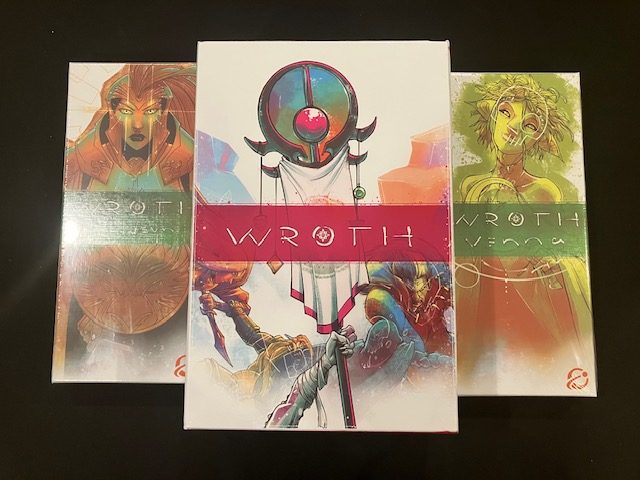
Wroth first attracted my attention because of the gorgeous art! Manny Trembley, the same fellow who did all the wonderful Dice Throne stuff (see here, here, and here) is the artist and designer for Wroth!
The next thing that attracted my attention was that this is an Area Control game (think of games like Risk), but it had a both a solo and cooperative mode? That’s very interesting! You never see Cooperative Area Control games!
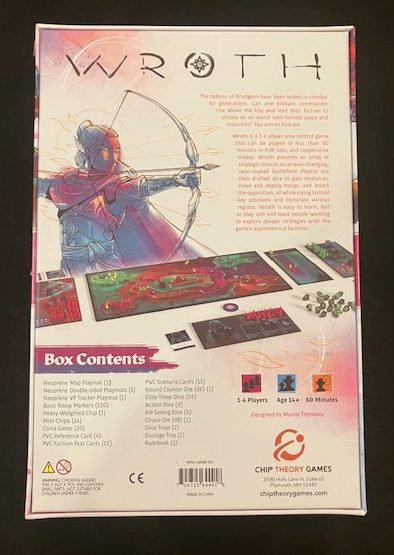
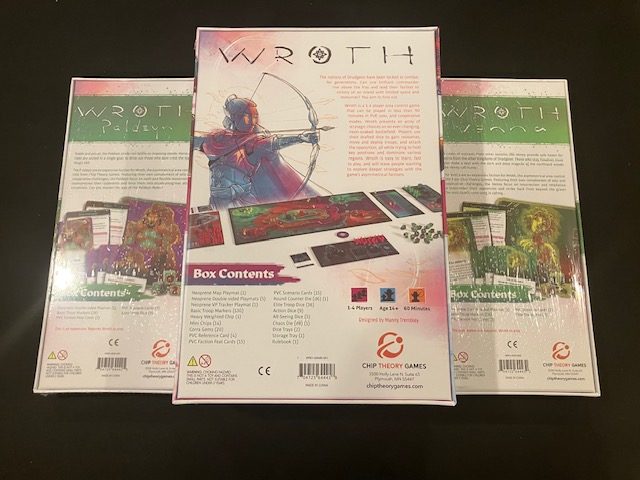
So, when Wroth was up on Gamefound (a Kickstarter-like site) back in March 2024, I went ahead and backed it! There were plenty of pledge levels, but I chose to stay with the lesser pledge of the All Gameplay Bundle (with two faction expansions: see below). I’ve become more jaded over the years and don’t go all-in like I used to: I just wanted to see if the game even worked! What’s the point of getting everything if you maybe don’t even like the game?
Did I like this? That turns out to be a real interesting question, and I went on a little bit of a journey as I played Wroth! Let’s take a look!
Unboxing/Gameplay
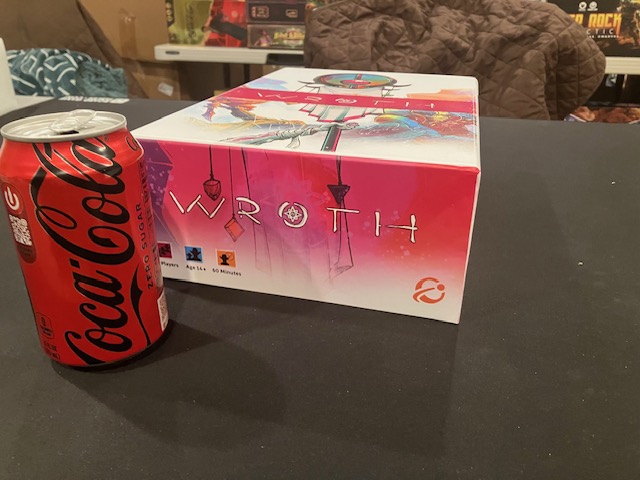
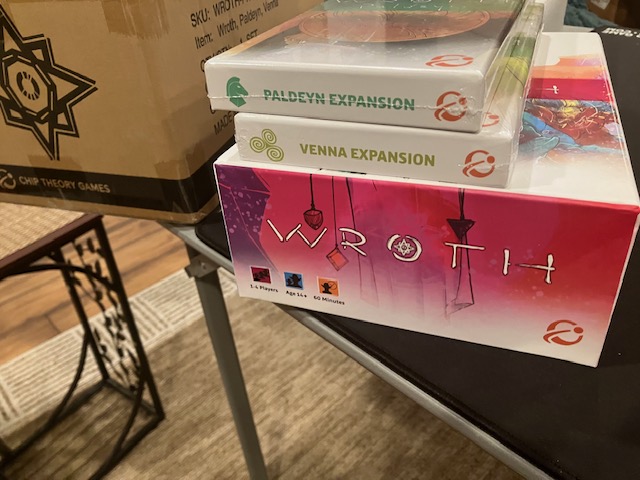
Wroth has a strange form factor; see above with a can of Coke for scale.
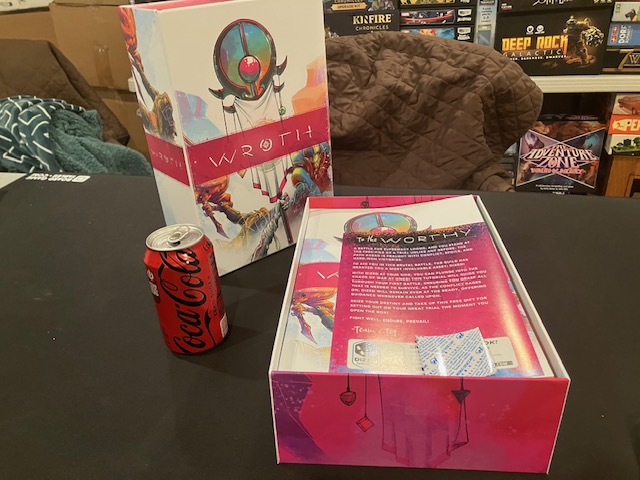
I will say that I think the cover for this game may be my favorite cover of the year. I love this colorful yet minimalistic art of Manny Trembley.
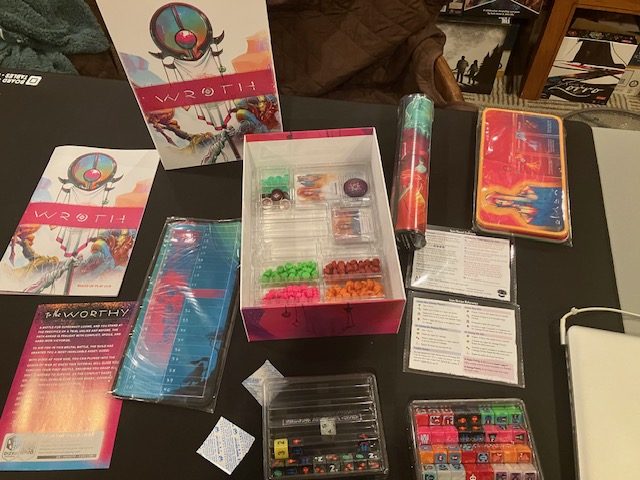
I think this a weird sized boxed mostly so the area mat fits in there when rolled up: see above as it’s rolled up and below as it’s opened up.
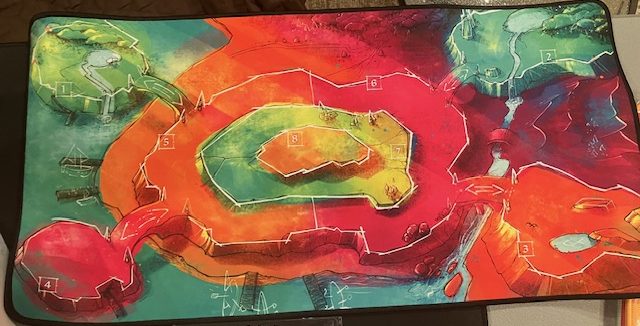
This is an area control/area majority game where players get victory points for controlling one of the eight areas on the map above.
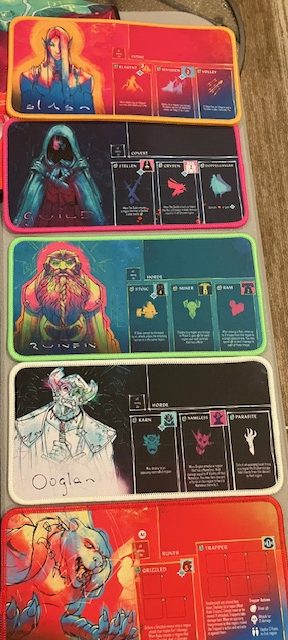
Each player takes control of one of 5 factions (see above), each with special powers and special dice (elite troops, we’ll see below)
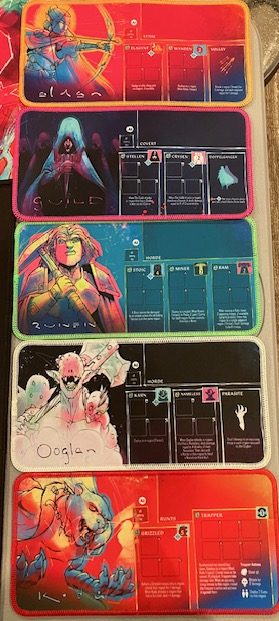
Be careful! There are actually two sides to each character!
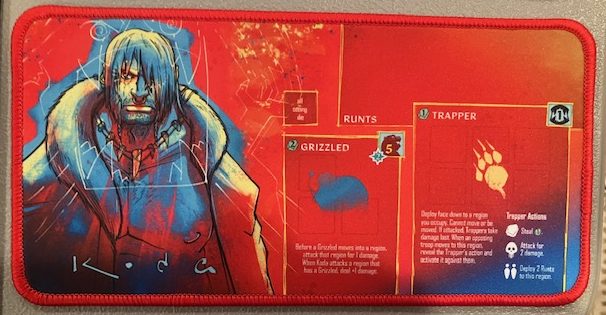
One side is the player side (see above): this is the side used by player characters.
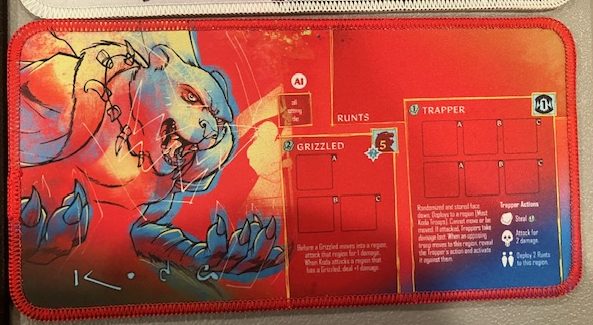
The other side is the AI side (see above) that gets used when you play co-op or solo. If you play co-op or solo, one of these factions will be the bad guy the player(s) fight against. How do you tell the difference between the two sides? It’s a little hard to tell until someone tells you “look for the AI marker above the All-Seeing Dice space”. It’s white, and a little hard to see. See above.
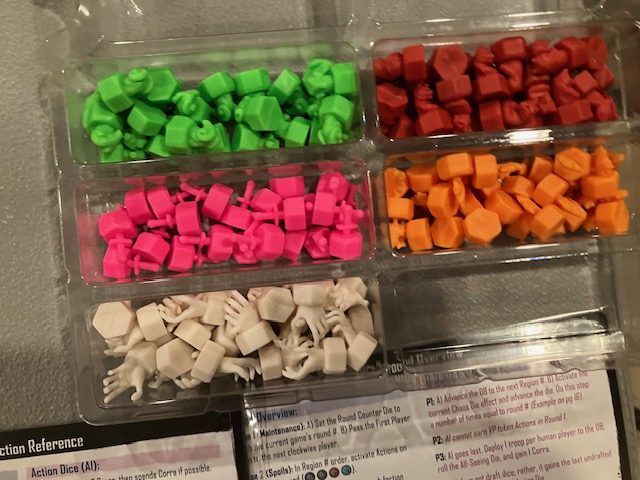
Each faction has their own basic troops, color-coded to the faction of interest. The basic troops form the foundation of the armies that go out on the mat; these are used for combat and to show area majority.
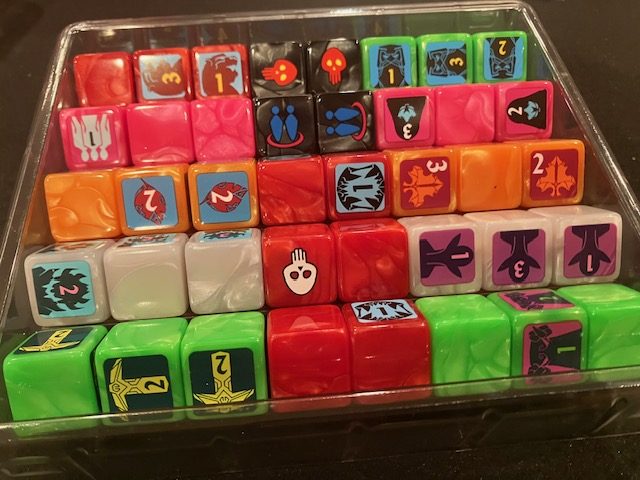
There’s a bunch of dice in the game, but THEY DON’T ALL GET ROLLED! Many of them are used to mark elite troops for each faction. The number on the die is how strong they are! Again, all the elite troops are color-coded per faction.
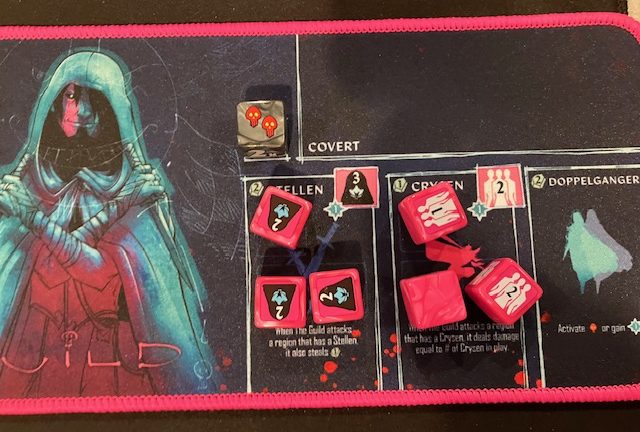
See above as the Guild faction gets his six elite troops: 3 Stellen and 3 Cryen. You’ll note each elite troop type has some special powers notated on the player mat.
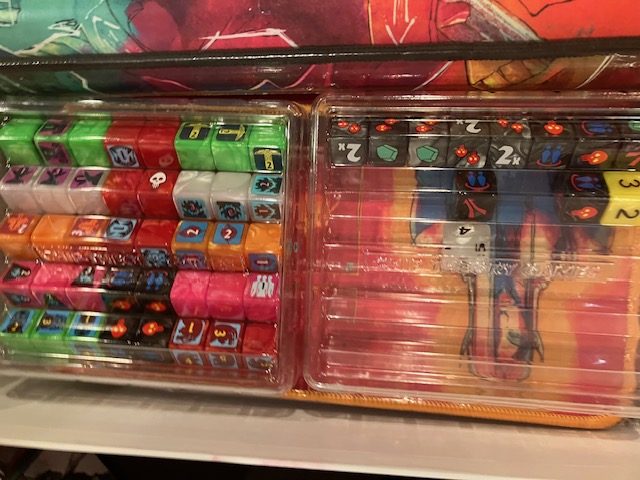
There are some dice that actually get rolled!
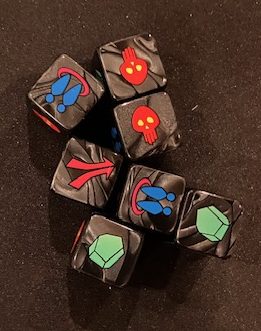
The action dice are rolled at the start of the turn, and each player will draft one action die in turn (multiple times). This is a dice-drafting game. After the dice are drafted, players will take turns “executing” the dice, depending on what’s on the face. Move troops, disperse troops, do damage, or gain Corra (money) are the main actions.
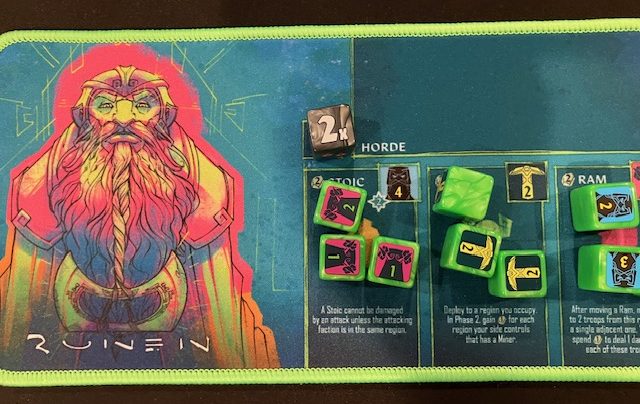
The All-Seeing Dice (next to the Horde) is a special die that’s rolled at the start of the turn: all players have a single All-Seeing Die. It’s a more powerful die that can be used anytime on your turn; it can augment your rolls, or give you more damage, or other things. Every turn, you must play an Action die that you drafted, but the All-Seeing Die can be used (on your turn) when you want to, so you can choose when to use it.
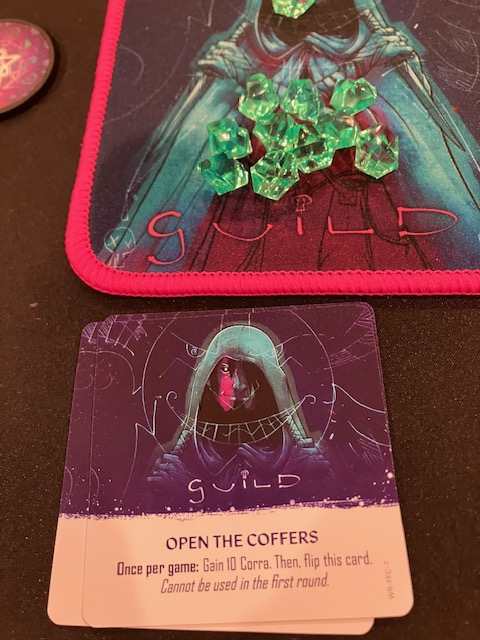
Each player has special abilities on the Faction Feat cards: see the three for The Guild above. Players get to choose one Feat for the game.
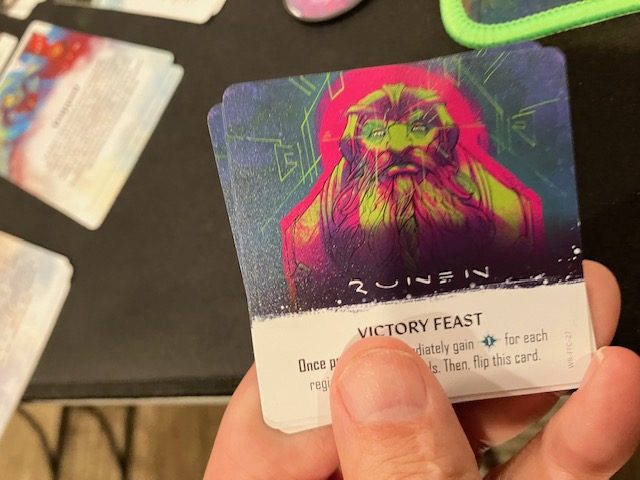
See three of the Ruinein feat cards above. Each player gets to choose the power that matches their play style best!
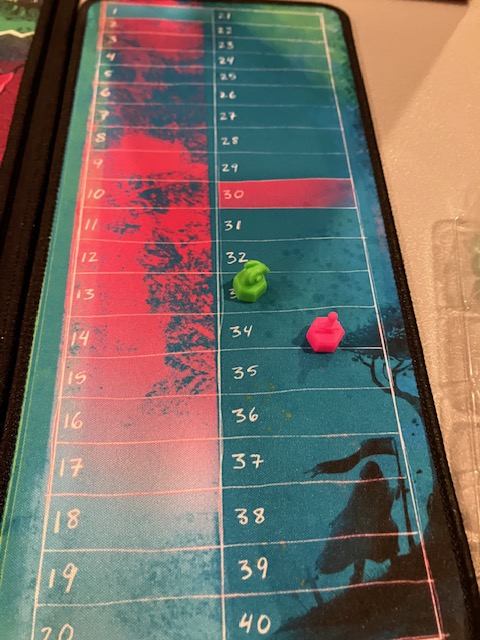
We’ve said that this is a victory point game, so there is a victory point mat for tracking said VPs! In all the modes, the victory usually has something to do with having the most victory points! A common winning condition is the player who gets to 30 VP first wins.
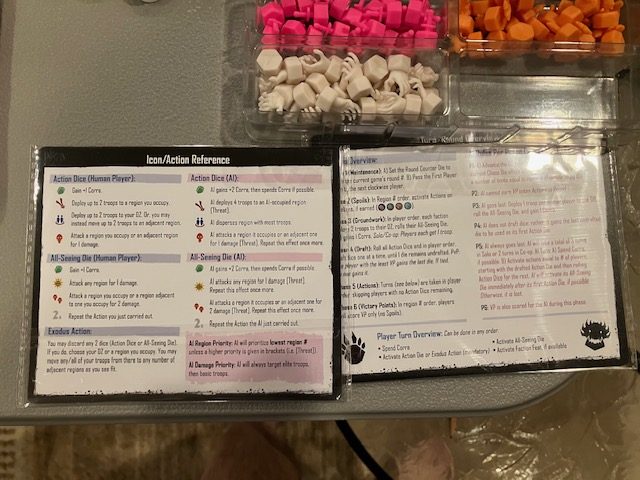
There are some player reference cards; 4 total. Enough for everyone, but we shared two per side of the table (since the front and back are different).
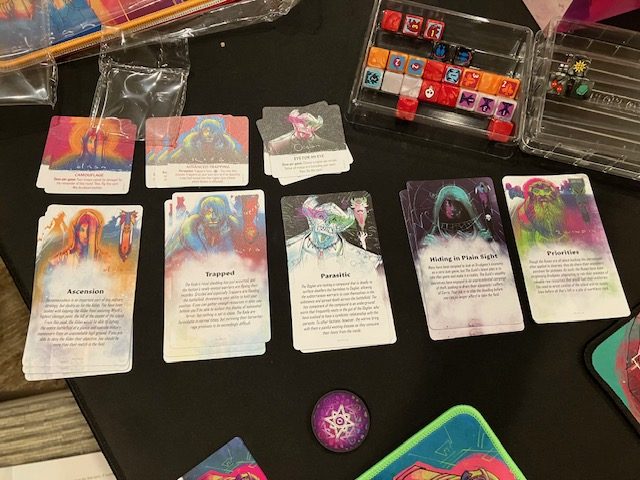
Finally, there are Solo/Cooperative scenario cards, 3 for each faction (see above). As the name suggests, you only use them in the solo and co-op modes.
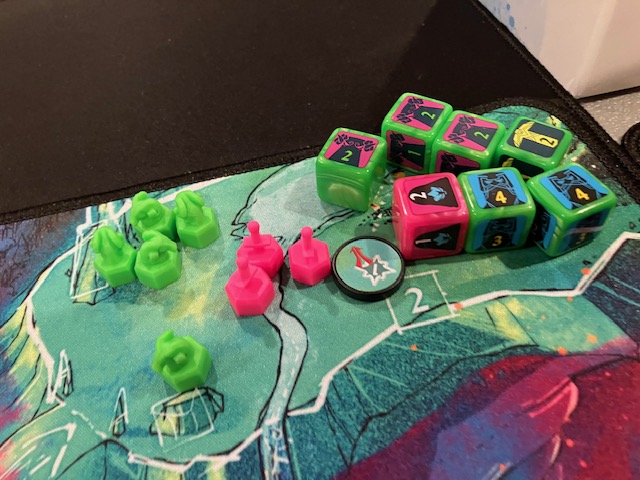
This is a game about getting troops (elite or basic) on the map and dominating regions! If you dominate the region during the Victory Point round, you score the Victory Points for that region! See above as green (Ruinen faction will dominate and get 1 VP for region 2.
This is an absolutely gorgeous game with beautiful components, graphic design, and art! This is a game from Chip Theory games, which means that all of the components are water-proof! The mats are all neoprene, the cards are all plastic, and the dice are plastic. Of course, the box and rulebook are still cardboard/paper.
Rulebook
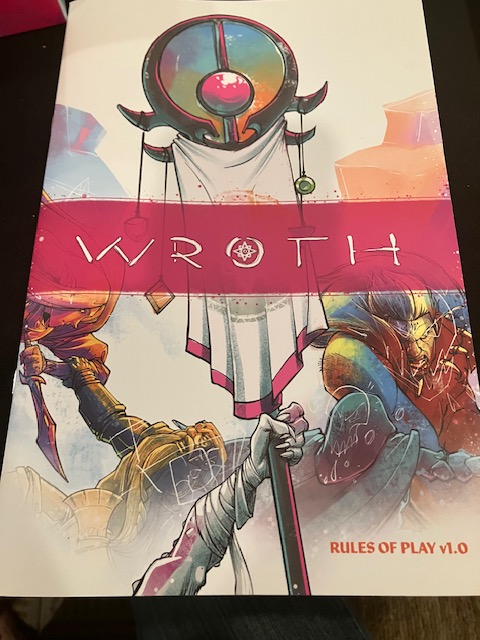
The rulebook is pretty good, but has some issues.
First of all, this gets an A on the Chair Test!
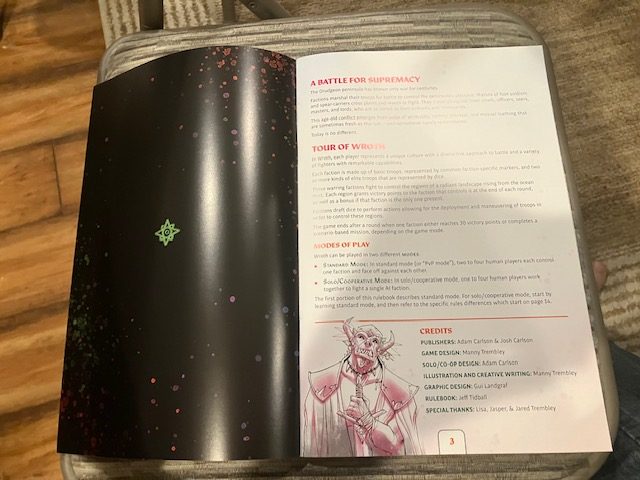
When opened on the chair next to me, the rulebook stays open flat, it has a nice big font, and doesn’t flop around over the edges. It’s easy to consult this rulebook on the chair next to me!
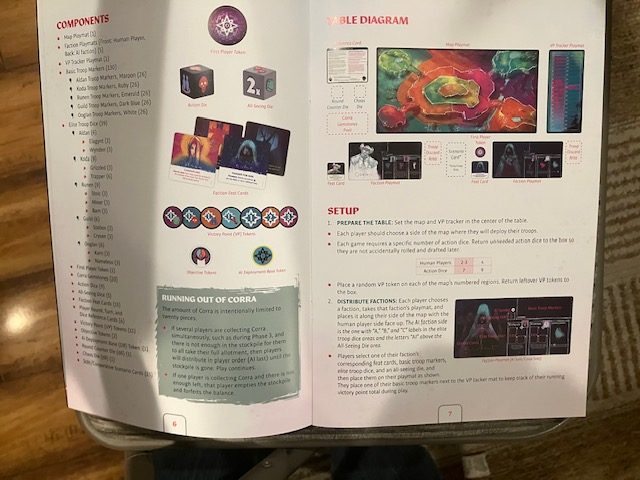
The Component page was a little frustrating; they list all the components, but don’t correlate them well with pictures. See above: there are a few pictures, but given how much white space on that page, they could have easily made a better components page.
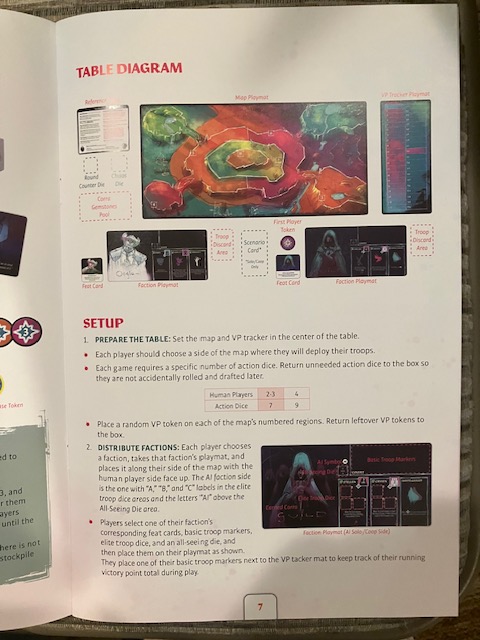
The set-up is ok; it actually spans two pages (7 and a little bit of 8) and the set-up crosses a physical page boundary (i.e., you have to turn the page): Boo!!! The best set-ups are when all of the set-up is across two pages across from each other. They also didn’t define some terms during the set-up (what is a “side“?) that made it harder to set-up. The set-up was just ok. It really should have been better.
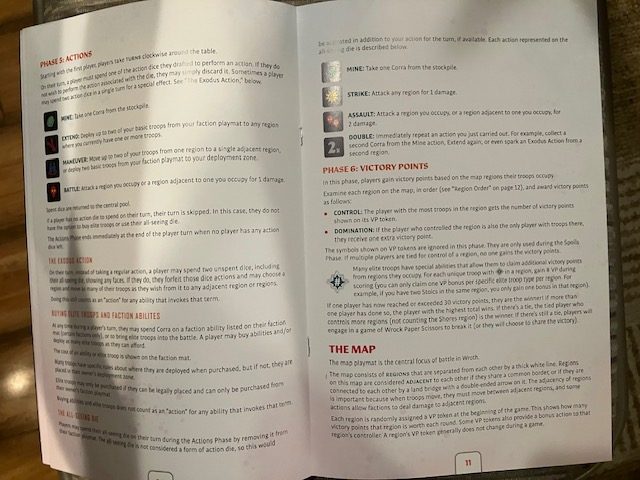
In general the rulebook was pretty good. There was a lot of text! There are were a number of pages where I think a bulleted list would have helped (esp. in the AI section for solo/co-o mode).
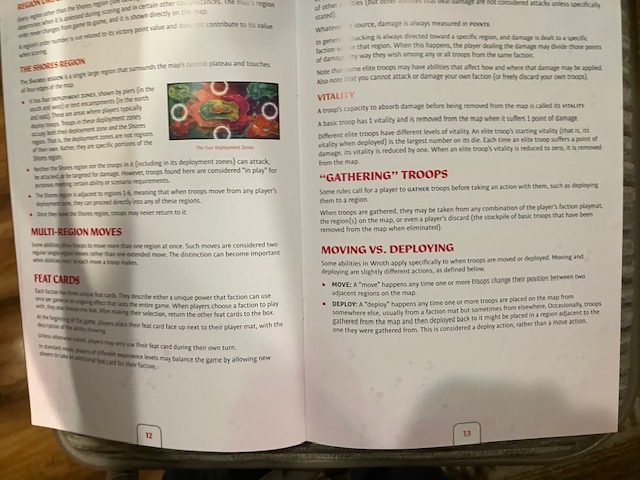
We’ll discuss more about the rulebook in the “When Is a House Rule Not a House Rule” section below, but basically there are a LOT of edge cases that aren’t well-specified. In fact, there’s one rule for which the interpretation may make the difference between you liking and disliking the game!
But, I was able to learn the game and teach the game using the rulebook. I also really liked the font and layout; it was easy to read physically the book.
A Strange Journey
I was very excited for this when it arrived! A solo and cooperative area control game! So cool!
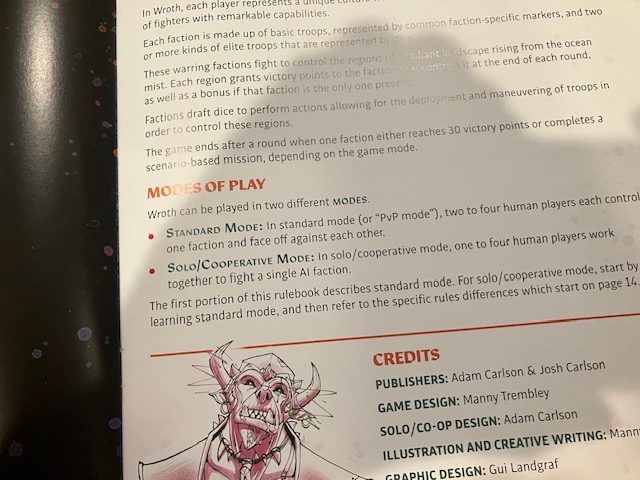
However, my bubble was burst a little when I read the Modes of Play (page 3 of the rulebook, see above). In order to play the solo game, you MUST understand the Standard Mode! In other words, you must play the competitive mode in order to push on to the solo mode! That seems like a missed opportunity, because many people’s first play would probably WANT to be solo (so they can learn the basics) and then teach. Nope. You gotta learn competitive mode first!
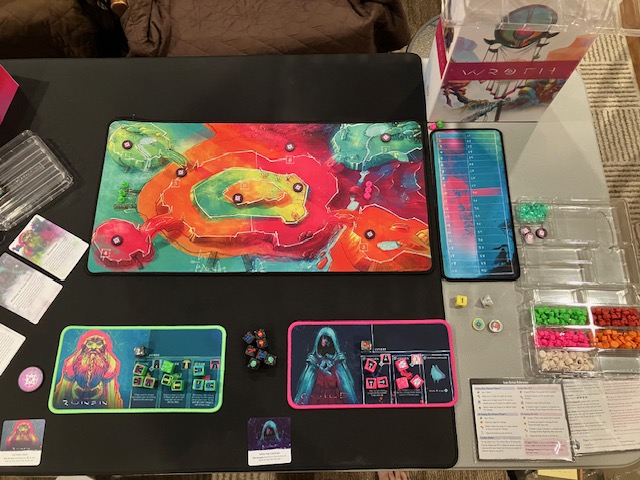
So, my first game was a Me vs. Me competitive game (Ruinein vs The Guild) in the Standard Mode! I really wish the solo game had been the first game to play! I guess, strictly speaking, Me vs. Me is a solo mode (as I play both factions myself), but it’s not normally how we define “solo play”.
Over the next few weeks, I ended up playing four different ways!!
(1) Me vs. Me Standard Mode (competitive)
(2) 3-Player Standard Mode (competitive)
(3) Solo Mode (cooperative)
(4) 2, 3-Player Cooperative Mode
Me vs. Me
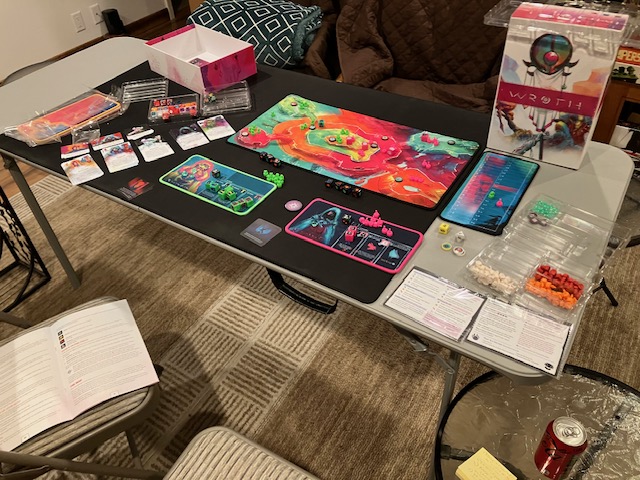
The Me. vs Me solo game (competitive) actually worked very well to teach the game. I had to get over a bunch of rulebook issues (and I did), but I came to appreciate the competitive game! Look, this is a solo and cooperative games blog, but the competitive mode is quite elegant! It’s very simple to learn, it moves quickly, and it is very punchy! My Me vs. Me game only lasted 45 minutes, and it never felt like it bogged down! The turns were quick, the mechanisms were easy to get a handle on (mostly), and it was very punchy! (Pun intended!)
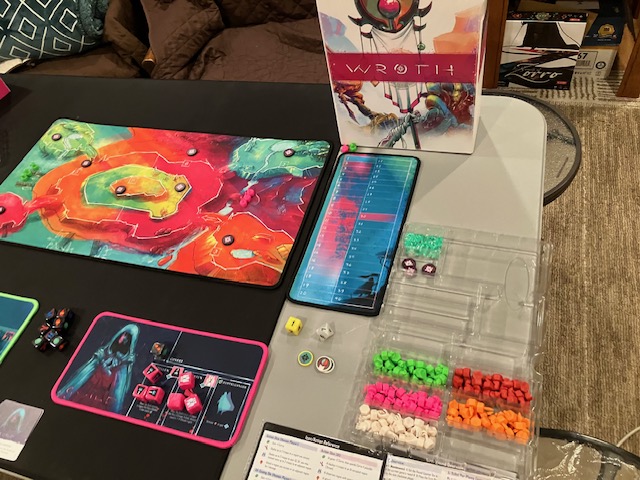
I was kind of shocked how much I liked the competitive game in the Me vs. Me mode; after all, this is a solo and cooperative blog! I can’t like the competitive mode, can I?
Solo Mode (first game)
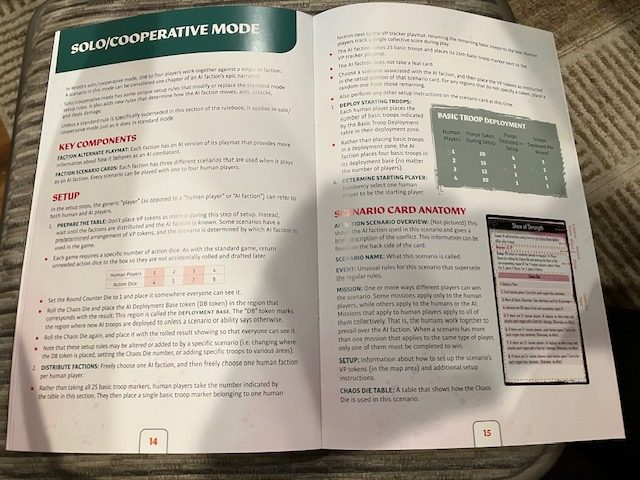
Remember, you can’t play the solo game until you learned the Standard Mode! So, after the Me vs Me game, I played solo mode. (Thank you Wroth for following Saunders’ Law!). These rules are described in six pages at the end of the rulebook. Yes, that’s right, the solo/cooperative modes need six pages to describe the rules!!! This is NOT an easy extension of the base rules!
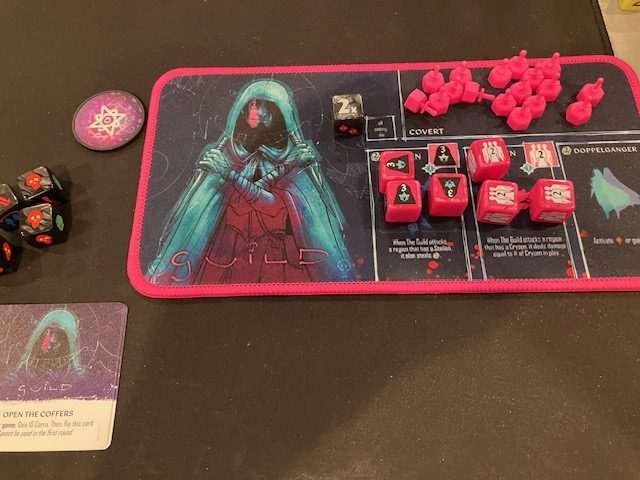
This solo mode is true solo mode, as you take control of one faction and then fight another AI-controlled faction. I stayed with The Guild (see above), since I felt comfortable with that faction from my Me Vs Me game. Set-up was the same for my character in solo mode (modulo how many basic troops I get).
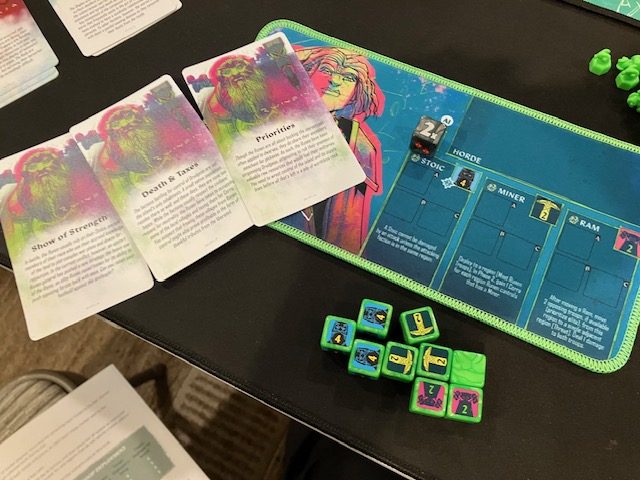
For the solo game, you fight one opponent; another faction! To do that, you flip to the AI side (see above) and choose one of the three Scenario cards for that faction! See above, I chose Priorities.
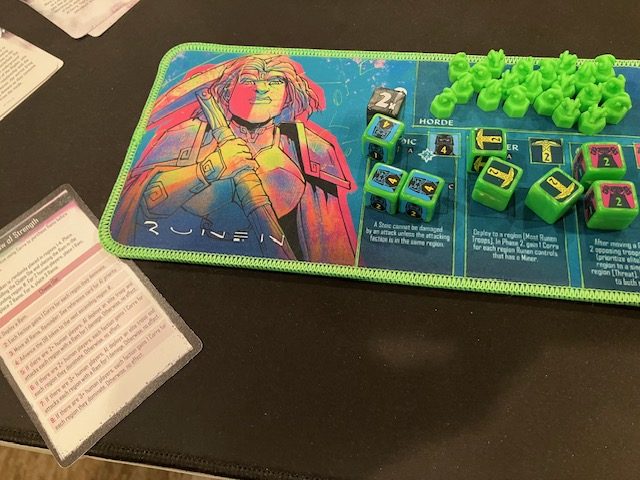
In the solo game, the opponent uses the flip side of the Scenario card; it gives bad news, depending on the turn number!
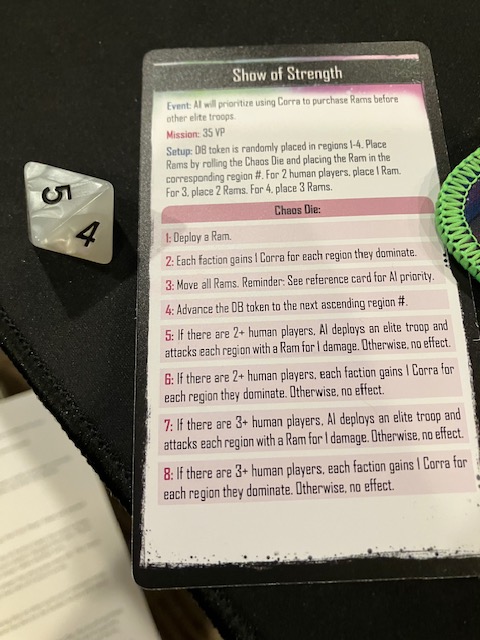
You always know what the bad news will be, as the Chaos Dice (8-sided die above) indicates which bad news will erupt! It’s even worse, as more bad news happens as the game proceeds! On turn 2, you will have 2 bad news events (in order from the card), 3 bad news events on turn 3 and so on! The only good news here is that you know EXACTLY what the bad news will be, (as it just increments by 1 per turn) so you can plan for it.
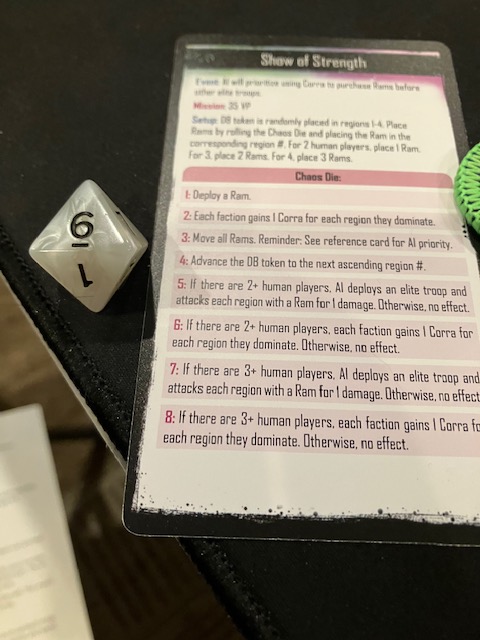
The set-up is also described on the card (see above).
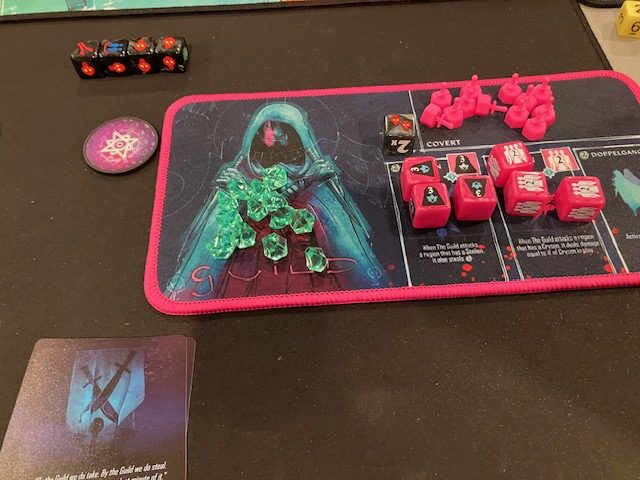
It’s still a dice drafting game, as you choose dice and the opponent gets the left over die. You know what your three actions will be, and you know the opponent’s first action.
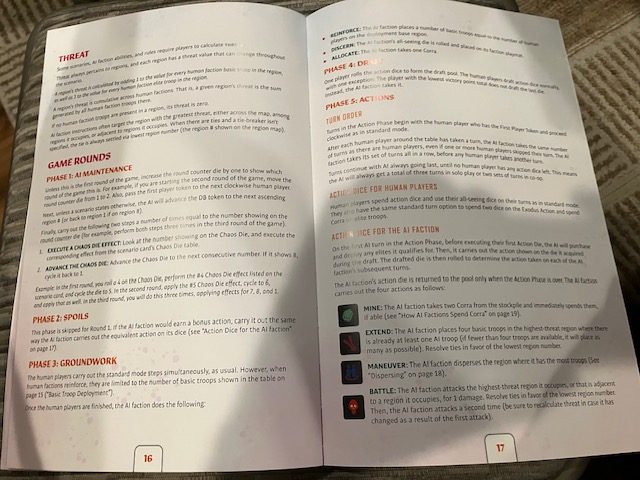
In the solo/co-op mode, however, the dice mean something different! In general, the AI actions for the dice are about 2x as powerful!
(1) the Mine action gives the AI twice the Corra
(2) the Extend action moves 4 troops to the mat (instead of just 2 for human players)
(3) the Maneuver action really allows the AI to spread out faster than a plain move
(4) The Battle action does twice the damage as a human battle
See (page 17) the descriptions of the dice for the AI faction above. I think the idea is that, because the solo plauyer can see what’s coming (since the solo player drafts the action die for the AI), the action dice are “twice as powerful” for balance. The solo player gets to choose the action dice (at least the first one), and so he has an advantage. On later turns, the AI simply rolls the die, so it’s not clear what’s coming. So, for balance purposes, I think the action dice are more powerful for the AI.
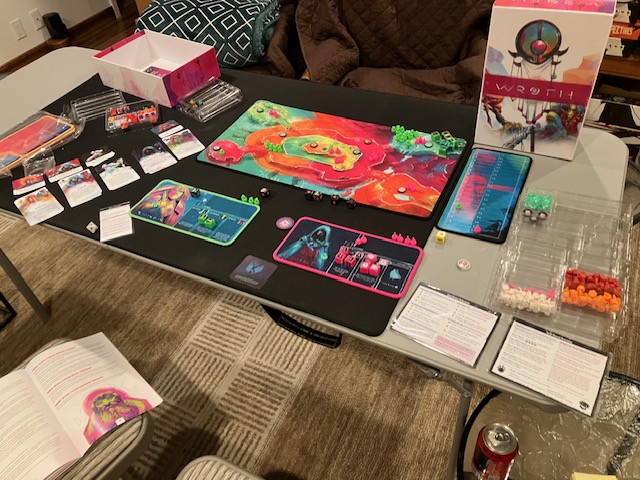
My first game ended in a win, as I beat the AI like 40 VPs to 16 VPs, but I look back now and realize that I played a lot of rules wrong. Was it too easy? Before I make any pronouncements on the solo game, I need to play solo a few more times. But, playing the first solo game gave me to confidence to teach the cooperative game.
Competitive Mode (3-Player)
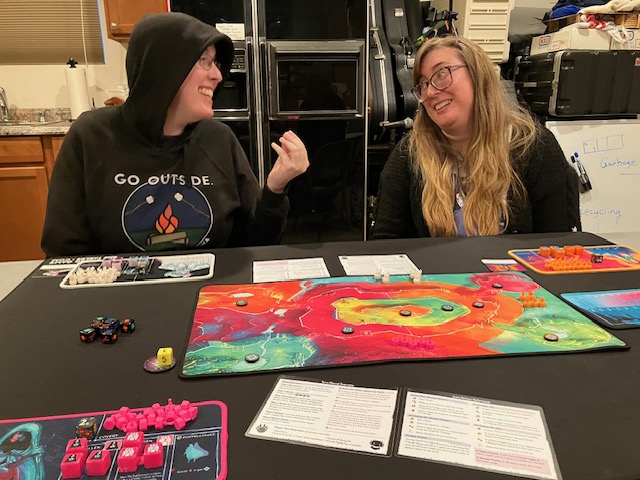
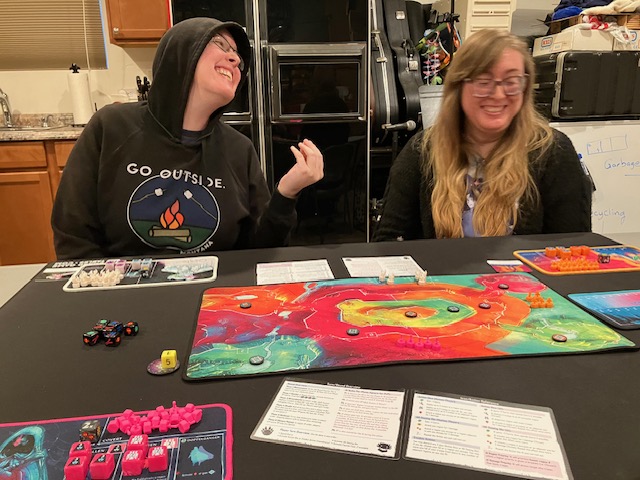
In order to teach my friends the cooperative game, they first had to learn the competitive game. See us setting up above.
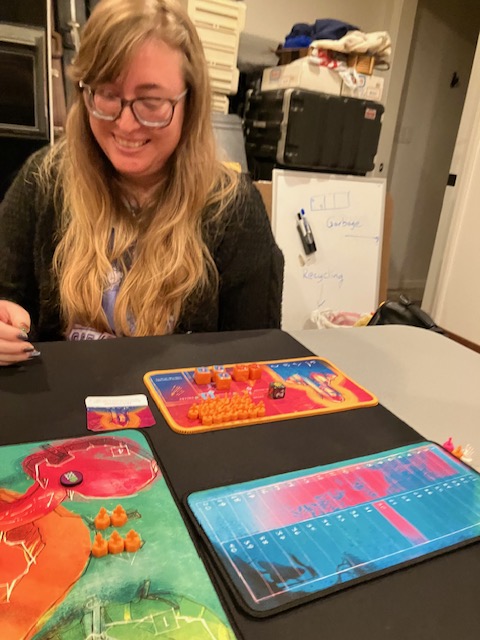
Just like the Me vs Me solo game, the competitive game was easy to teach! Easy to learn! And it was punchy! It was over in about an hour (just like the box says)! I recommend teaching the competitive game first in just about all situations!
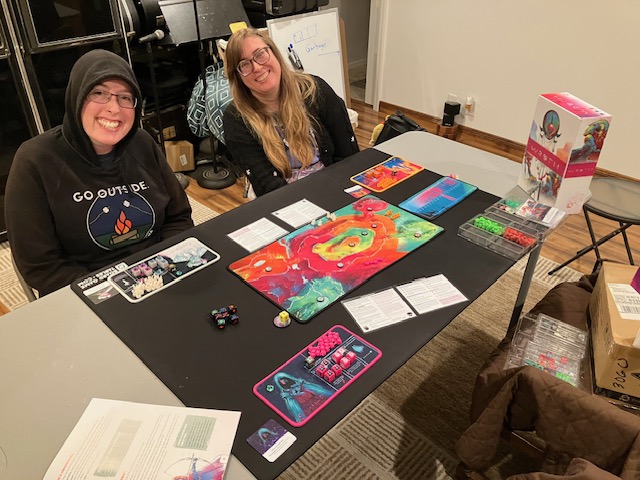
Sara absorbed the rules quickly and actually beat my one Victory point! It was so easy to get the competitive game to the table!
After my Me vs Me game and my 3-Player competitive game, I can honestly say I am very impressed with the competitive game of Wroth! I don’t like competitive games that much, and I really liked Wroth! The best word I can use to describe it (with pun intended as well) is punchy!
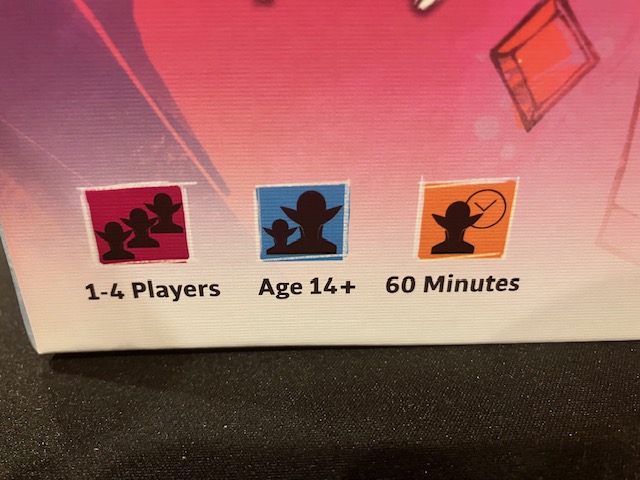
It just moves quickly and is easy to to get into! It really does take 60 minutes as the box says! If someone ever wants to play a competitive Risk or some other competitive Area Control/Area Majority game, I’ll say “Can we play Wroth instead?“
Cooperative Mode
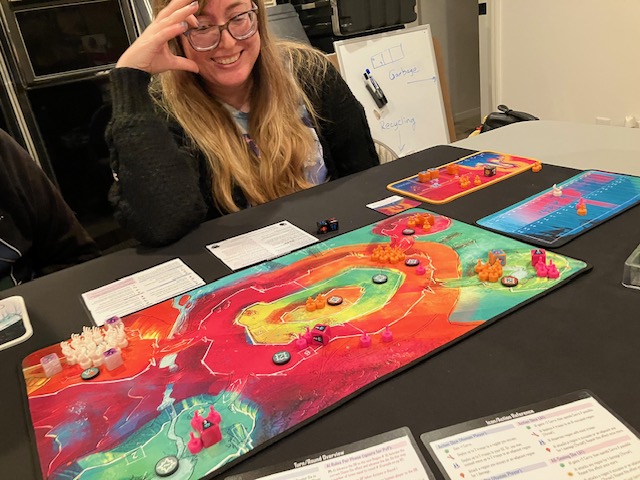
If you thought this was going to be a rave review of Wroth, well, you’d be wrong. After having a nice time playing the 3-Player competitive game of Wroth, we headed into a 3-Player cooperative version … and got decimated.
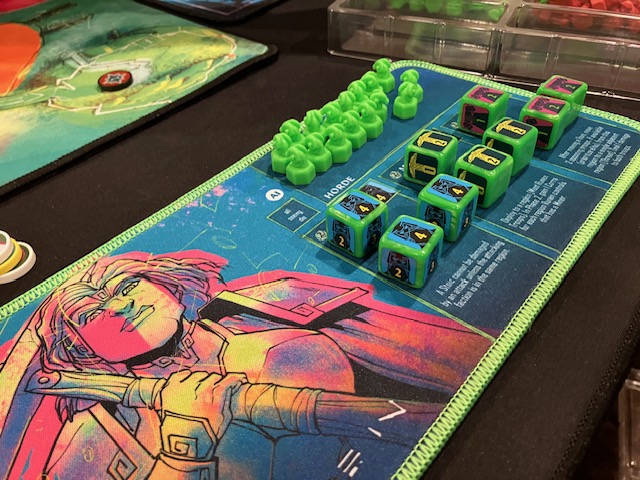
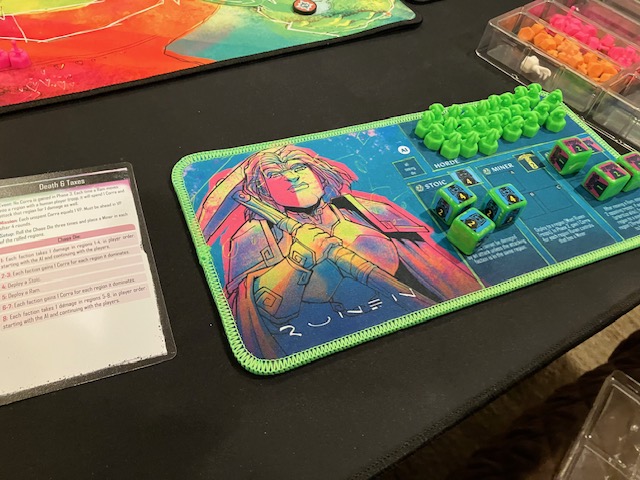
In the cooperative game, the players fight one AI faction, just like in the solo game. Just like the solo game, the players choose a Scenario card “Death and Taxes” (see below) … We played against Ruinein (see above).
For balance, the AI player gets the same number of turns as the human players, but only after the human players have gone. Thus, after each human player activates on action die, the AI player gets that many unanswered turns in a row! This is for balance; in a 3-Player game, the players do three things, then the AI gets three turns to answer!
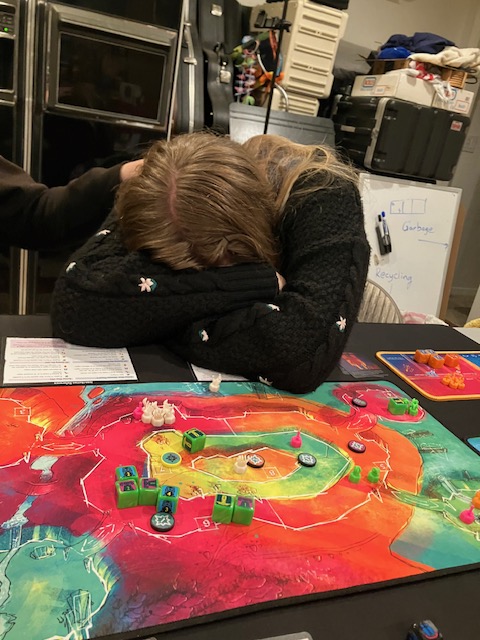
We lost our game like 3 to 43. Yes, you read that right. We had no good turns, and the AI kept us off the board so we couldn’t score any Victory Points. It was literally the worst cooperative game I played in some time. It felt so random and unbalanced as the AI opponent turns were twice as powerful! And we couldn’t see what the AI would do because in his turn, he just rolled the dice, so we had no way of knowing!
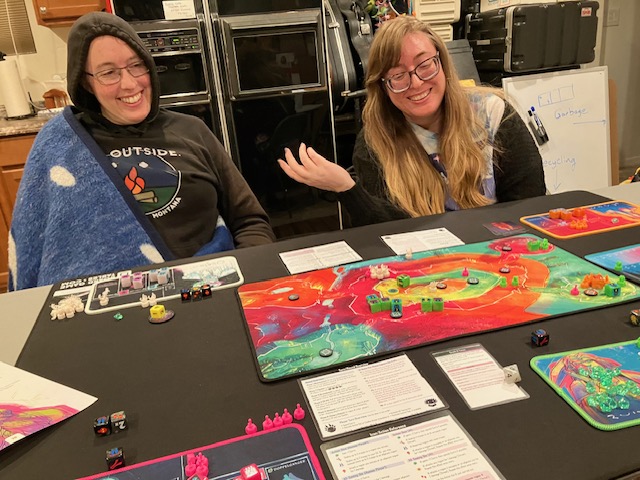
After this cooperative game, I put my game of Wroth on BoardGameGeek to sell it. I hated this play so much! I am pretty sure we played it right, but there was so much randomness in the game, it wasn’t fun.
Randomness
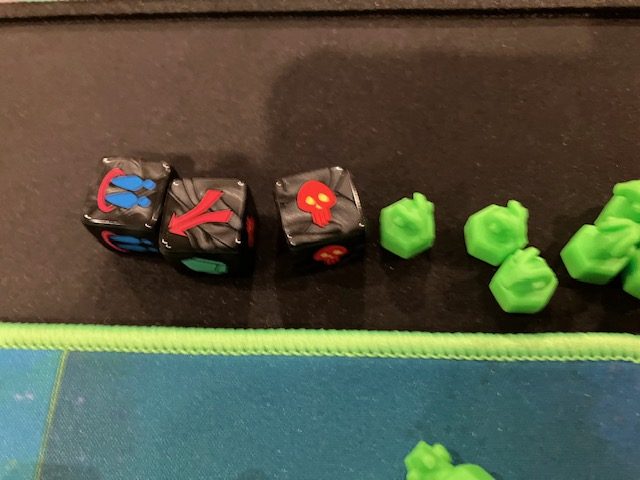
First, you don’t get to choose what you do on your turn, you can only draft the dice that get rolled into the pool. I have phrased this: “You have to do what the dice say”. In the competitive mode, this doesn’t feel like a big deal, because all players are equally stuck with this decision and you can see what everyone will be doing … so, you can feel more prepared. In the cooperative mode, you have very little idea what the AI will do because he gets to roll the dice! And you may not know what it is! (In the solo mode there is much less ambiguity). And it’s even worse if there are more people playing!
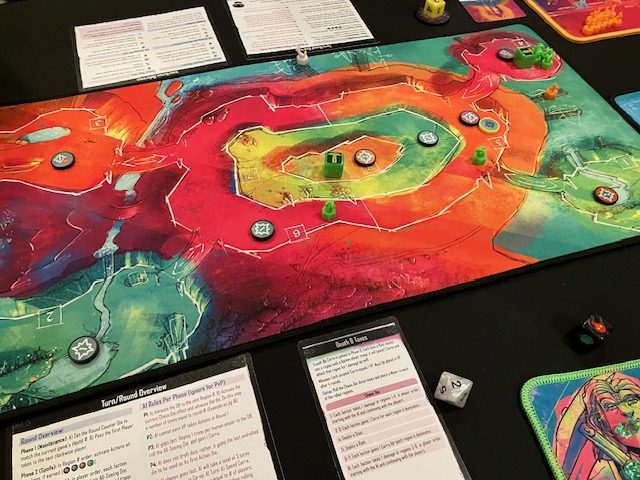
Second, in the cooperative game, where the AI starts can have big difference! You have to roll! If the AI starts in section 5 or 6, they are adjacent to SO MANY more regions, and can keep you off the map because they can attack you more! In our first game, the AI started on section 5 (see above), and because of that one position, the AI was able to decimate our troops off the map because he could reach almost all of us quickly! Remember when I said the AI’s action are about “twice as powerful”? If the AI fights you in the first few rounds, he can easily knock you off the board.
The solo game mitigates this randomness because you can see what the AI is going to do on his turn. In the cooperative mode, the AI will roll dice and you have no idea what will happen! It’s even worse for more players!
I think the idea of the AI’s actions being “twice as powerful” is for balance; probably half of the time, the AI may roll an action which DOES NOTHING, so when the AI does roll something useful, it needs to compensate by making the useful actions twice as powerful! The idea is that the AI gets, on average, as much efficacy as the human players (as the “do nothing” rolls get averaged out with useful rolls).
The only problem with this is that, if the AI rolls well for a good number of its rolls, it will simply decimate you. And that’s what we saw in our first cooperative game. A post-analysis of the game had us thinking we lost in round 1 as the AI rolled exactly what it needed to get us off the map, and we couldn’t get a foothold after that.
Solo Game Revisited
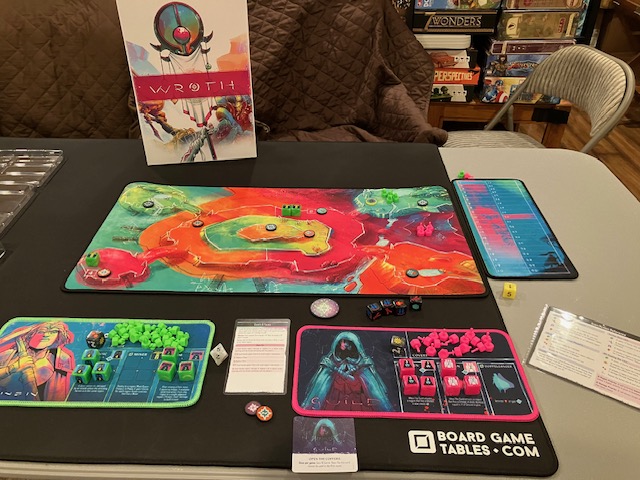
After such a horrible cooperative experience, I wanted to played the same horrible scenario solo. Was this a fluke? Was it something else?
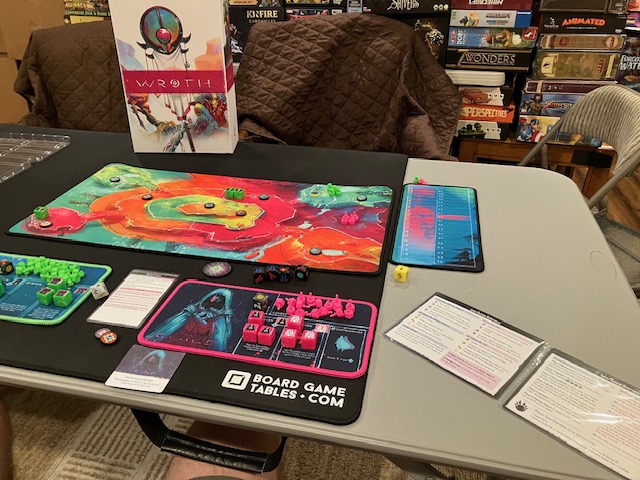
I ended up playing a very balanced game and was able to beat the same Scenario that crushed us in the 3-Player cooperative game. Part of the reason was because I could see more what the AI was going to do, so I could try to be smart and work around it. The randomness wasn’t nearly as pronounced because I could see what what the AI would do most and plan for it (but see below). It’s only in the cooperative game that the randomness can run away, because the AI starts getting random, unanswered turns (in the 3-Player game, the AI gets three unanswered turns in a row).
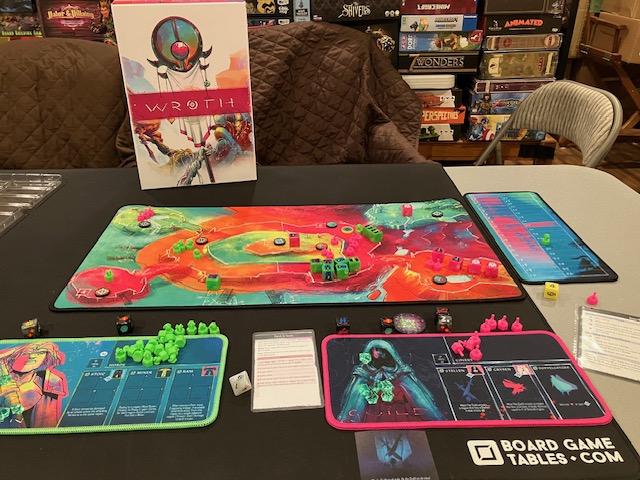
I really liked my solo game. Now that I knew all the rules better, I could be smart. I could outthink the AI. The solo game is a puzzle. And I love that!
I had put my copy of Wroth up for sale on BGG after such a horrible cooperative game. I would be okay if it didn’t sell, because I had like the competitive game so much. I wasn’t sure about the solo game until I got a few more under my belt. I like the solo game; it’s a puzzle. I took my copy of Wroth down from BGG and have decided to keep it.
And after a few more solo games, I realized I made the right choice to keep Wroth. This is a neat solo game.
When Is a House Rule Not a House Rule?
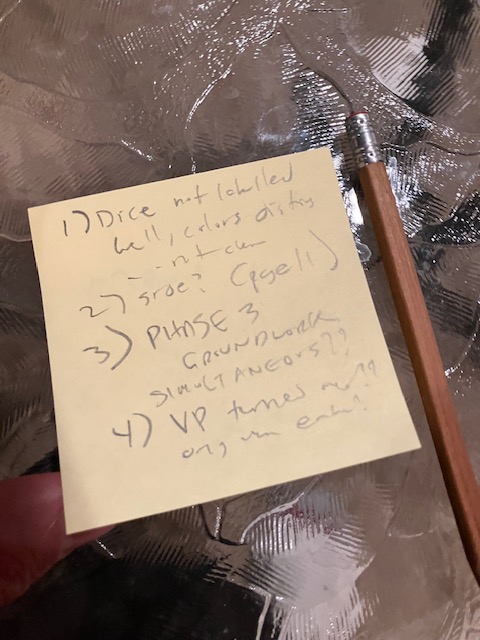
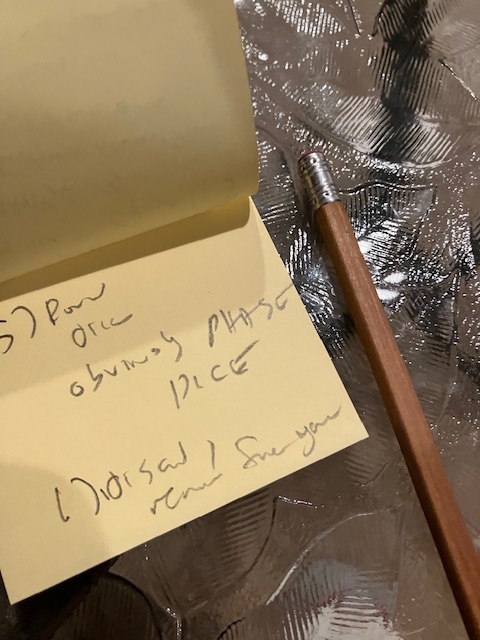
I have at least three or pages of questions about edge rule cases after playing numerous times: see my little stickies above. Although the rulebook is pretty good, it really doesn’t address a lot of edge cases.
In particular, the Solo/Co-OP Scenario cards have limited real estate (they are just cards), and all the rules have to be on the back! There are no FAQs (yet: see this thread here on BGG), and each Scenario is very different and will need questions answered. I love the plastic cards that Chip Theory uses, but this is a case where I think having a separate Scenario book would have been a better choice. There are much fewer real estate issues (a page will have much more space than a single card) and further elaborations/FAQs could be placed in there.
When is a House Rule not a House rule? When we have to make a determination based only the information you have! If the rules aren’t clear, we have to interpret the rules so we can move forward! Maybe we interpreted it wrong, maybe we didn’t. But we can’t call it a House Rule because a House Rule is usually when you choose a different direction when knowing the rules.
Most of the rules made sense after I have played about 5 or 6 times. There is one rule that’s very important, and may determine how much I like this. I don’t consider this a House Rule because the text is unclear.
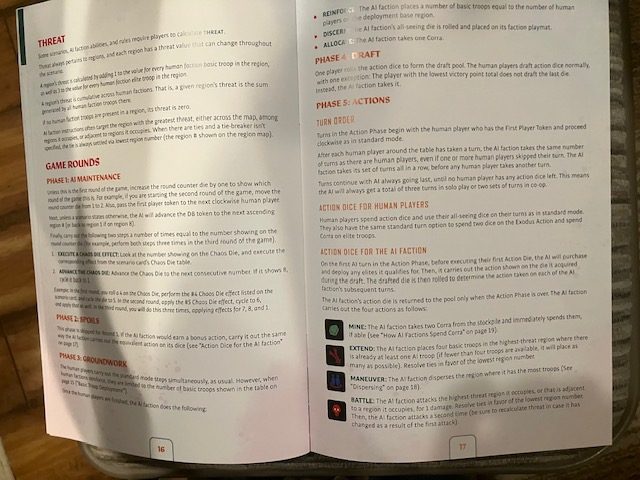
When the AI rolls an action die after he takes a turn, when does that roll happen? On page 17, the text says: “The drafted die is then rolled to determine the action taken by the AI faction’s subsequent turns”. When is it rolled? If it’s rolled at the START of the AI’s turn, then you don’t know what the AI will do! If it’s rolled AFTER the AI has taken his action, then the players will know what the AI will do! I think, by the phrasing above, that the AI die is rolled AFTER the the AI has taken his action. This minor difference might be the difference between me liking the solo game or not! If I can be smart and see what the AI is up to, then I can plan ahead! Even if the AI turns are twice as powerful, I can still plan around them.
It’s not a House Rule if the interpretation is unclear. I am going with the interpretation that makes me like the game more; AFTER.
Cooperative Play (revisited)
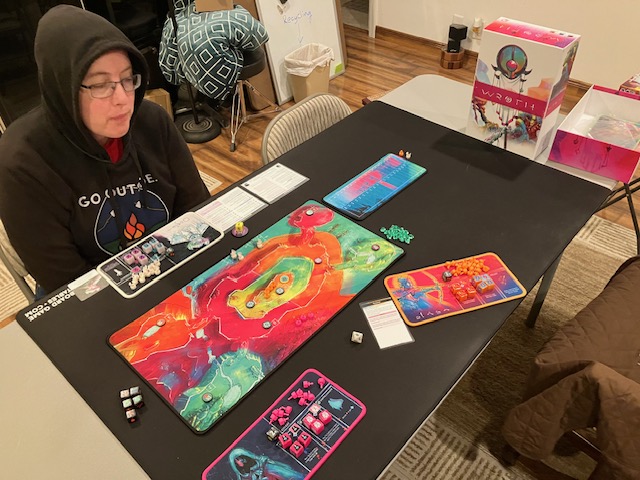
All right, I SOMEHOW convinced my friends to try to play cooperatively again. Well, at least one of them.
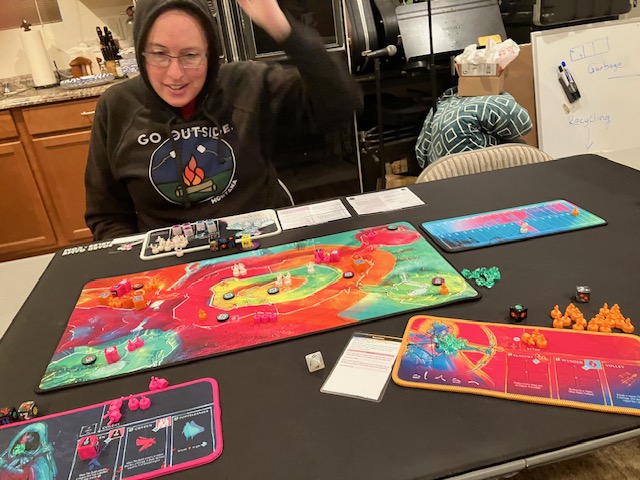
This time, we played a 2-Player game. And it went a little better.
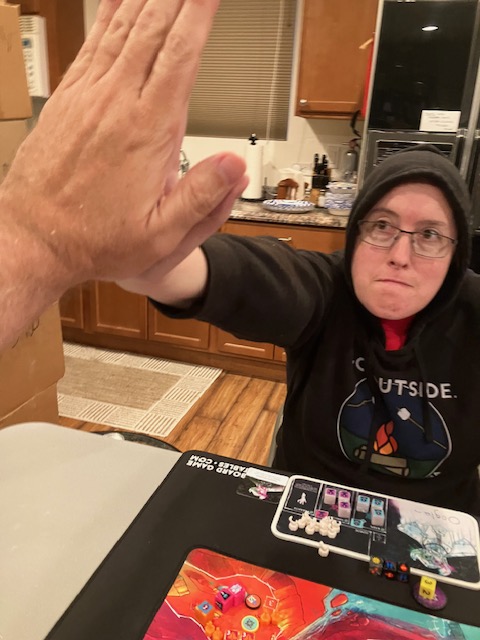
I think that when the opponent faction gets too many “unanswered turns” in a row, the game spiral out of control. In our 2-Player game, there’s fewer of those unanswered turns (only 1 per). I think we found that the 2-Player game is barely in the cusp of spinning out of control.
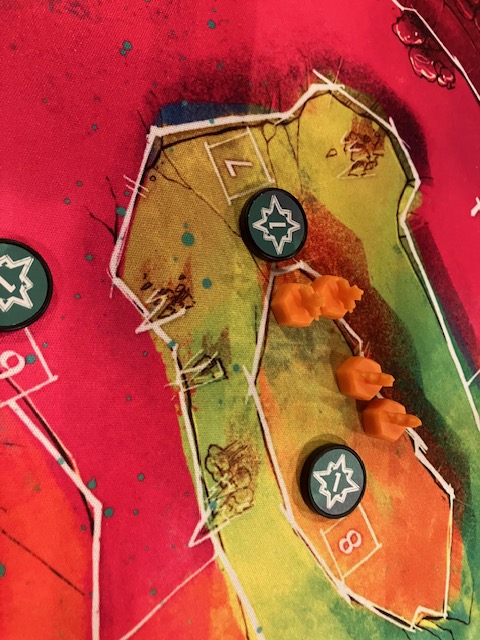
For the AI faction we played, we have to keep the opponent from CONTROL of the middle, and guess where the opponent “randomly” started? We pretty much lost the game instantly, as we realized we couldn’t do enough movement to get us to the middle! So, basically, we re-rolled the intro dice until we had a combo that we could “not lose” right away.
This is the kind of randomness that kills us.
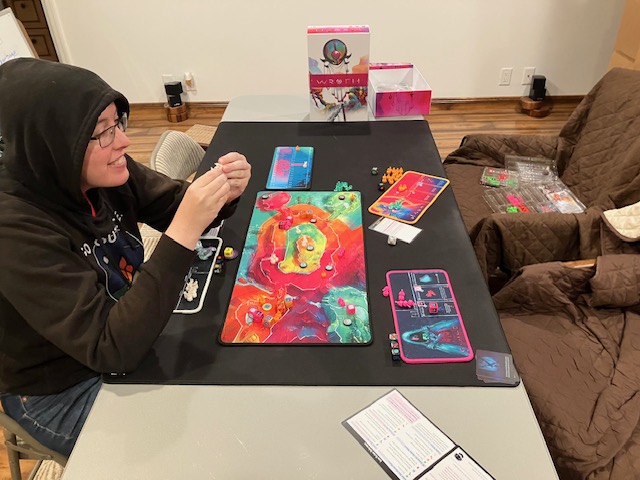
I think 2-Player cooperatively can work (barely); it feels like it’s just about to spin out of control so many times.
One of the reasons I think I hate the “unanswered turns” is that it reminds me of the problems with Variable Turn Order where the nemesis can get 3 to 4 unanswered turns in a row: see our post here on that. I think watching the nemesis do something without being able to do something makes me feel impotent. I think the 3-Player and 4-Player cooperative game has this problem. If you have a friend you can really work together well with, the 2-Player cooperative game might be okay for you. Even at that count, the randomness can still trash your game.
Conclusion
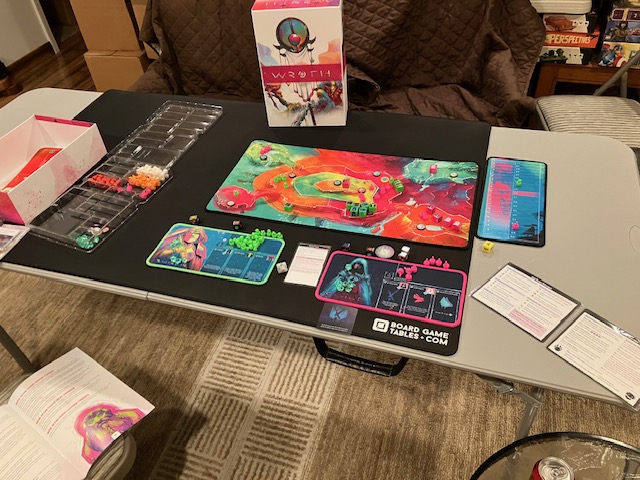
In a crazy turn of fate, I am going to recommend Wroth as a competitive game but not as a cooperative game! I know! That’s so weird for a solo/cooperative blog!
The competitive mode is punchy and quick! It’s easy to teach! And it’s over quickly! You feel powerful and smart on your turn! Objectively, the competitive game is probably like an 8.5/10. Subjectively, since I don’t tend to like competitive games, I’d probably give it a 7/10. I’d still play it! I think I might give it a higher score if it didn’t have “the dice tell you what to do” mechanism. I’ve never loved that.
Unfortunately, we found the cooperative mode too random. We even gave it several chances, but it wasn’t fun. There was too much unanswered randomness as the AI player slaughters you with actions that are twice as powerful. I don’t want to play this again cooperatively: 4/10. Maybe, maybe, the 2-Player co-op would work for you, but definitely not 3 or 4-Player cooperatively.
But the solo game was fun! I liked the puzzle it presented! The untethered randomness we saw in the cooperative mode wasn’t there because the AI never got those unanswered random rolls. I had a great time; maybe 8 or 8.5/10 for the solo game? Again, this might be higher if it didn’t have the “the dice tell you what to do” mechanism.
It’s weird, I almost sold my copy of Wroth (it was up on BGG for 3 days) because I had one of the worst cooperative plays ever: I can’t recommend Wroth as a cooperative game. But the solo and competitive games were both really good and saved the game for me; it’s staying in my collection.
 coopgestalt
I wonder if you could use the solo rules and play method in co-op? Maybe scale up the damage, but keeping the dice-mitigation?
LikeLike
We had discussed maybe alternating turns with the nemesis player instead of him taking all his turns at once. That might help?
LikeLike
Thank you so much. The game will be localised to my language so i’ve tried to found some information about it and your review is exactly what i want to read. Also i appreciate your blog as solo/coop player to. Thank you for your work one more time!
LikeLike