
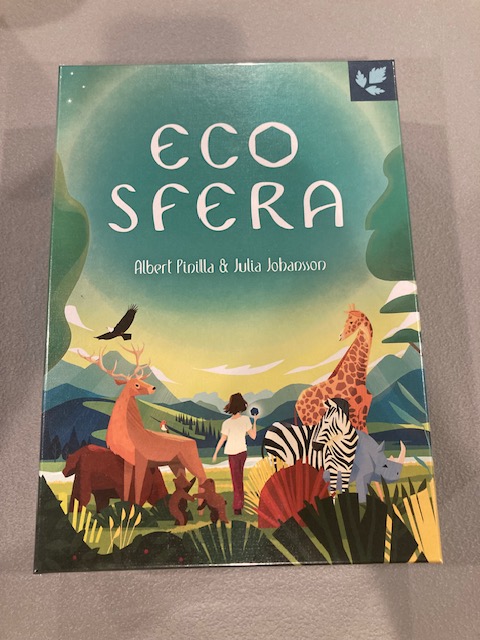
Ecosfera (Eco sfera as implied by the cover) was a game on Kickstarter in April 2023: See here.
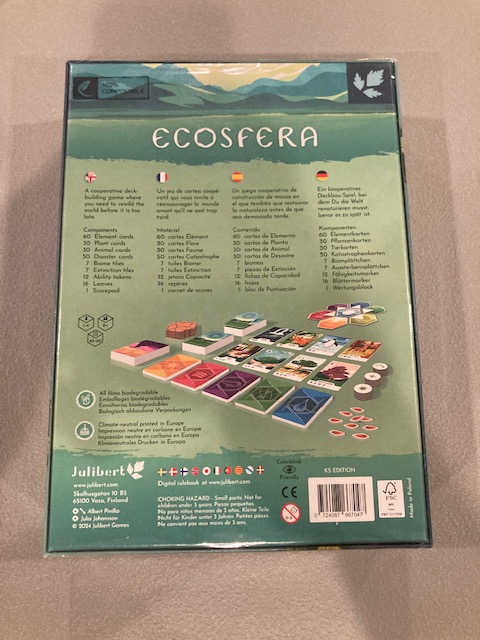
This is a cooperative deck-builder with a few push-your-luck elements. This is also a nature themed game! Nature is a very hot theme for games right right, so I call this Yet Another Nature Game (YANG). Many nature games are competitive, so this stands out as a cooperative YANG.
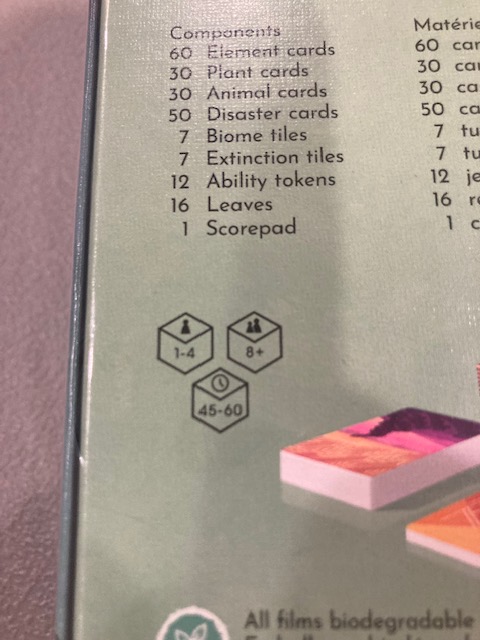
This is a game intended for 1-4 players, ages 8+. The intended time is 45-60 minutes, which is about right, but see more discussion below.
Let’s take a look!
Unboxing and Gameplay
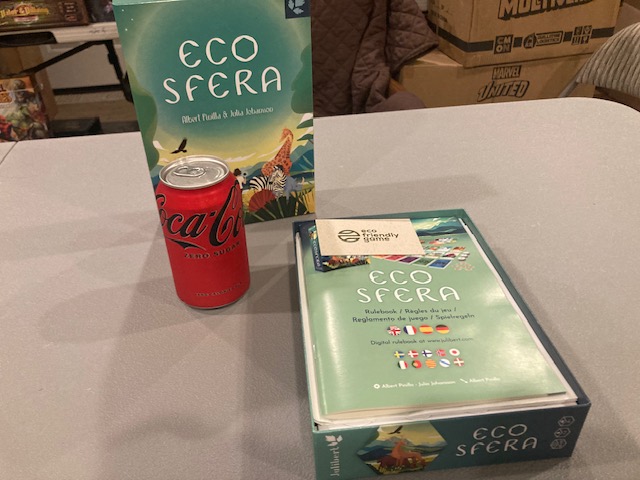
Ecosfera is a smaller box game: see Coke Can above for scale.
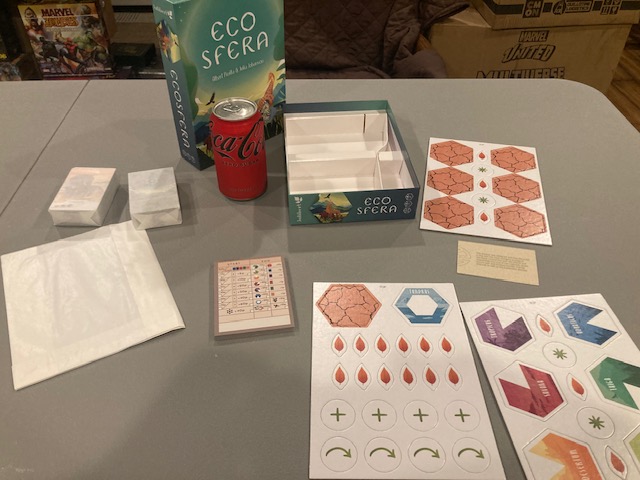
Ecosfera is mostly a card game, but it also has a lot of punch out tokens: see above.
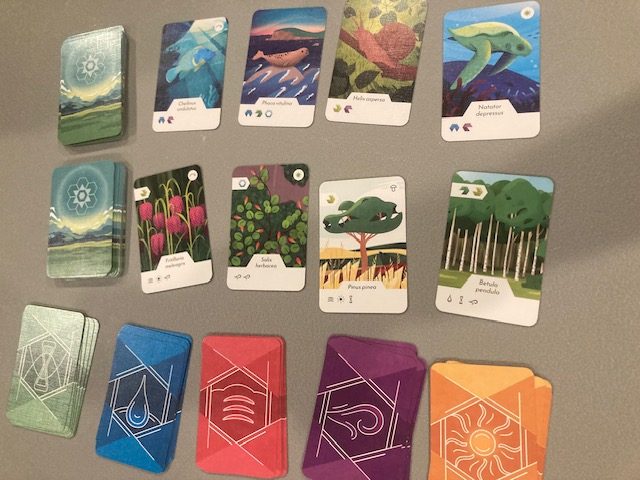
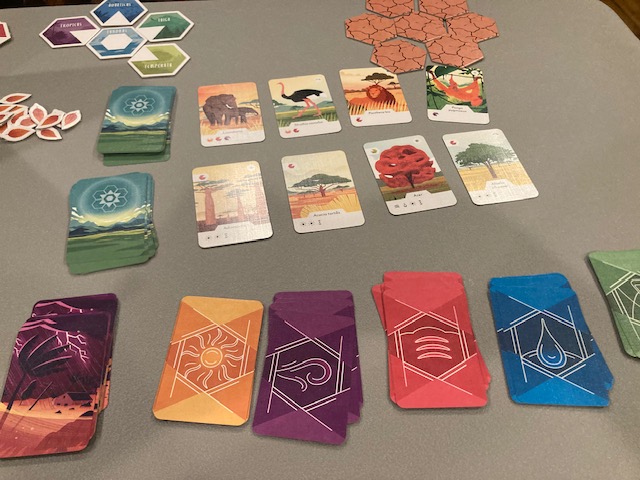
This is a deck-builder with three different “currencies” of buying. Elements buy plants, plants buy animals, and animals buy biomes. See the offering of elements, plants, and animals above!
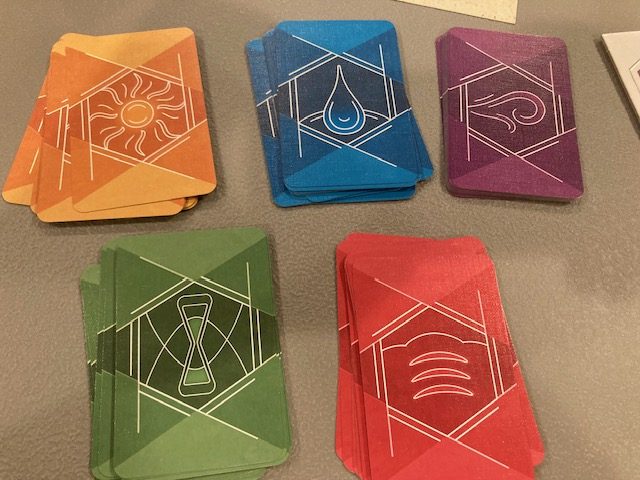
The base currency is the elements: the multi-colored cards above are also multi-labelled cards to avoid color-blind issues. These elements can only buy plants.
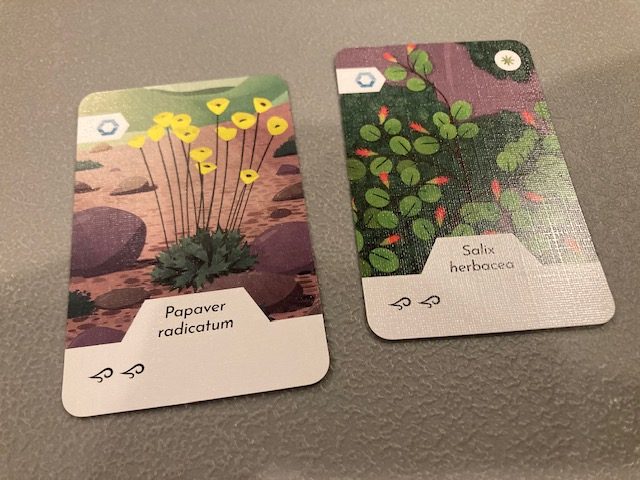
See two plants above: notice the element symbols on the BOTTOM of the cards. You can only buy a plant if you have the elements (we need two winds to buy the Papever radictum). You can be missing one element and still buy a plant … if so, you get that extra missing element for free into your hand. You’ll also notice the symbols at the TOP of the cards: these are the currency for buying the next level: animals.
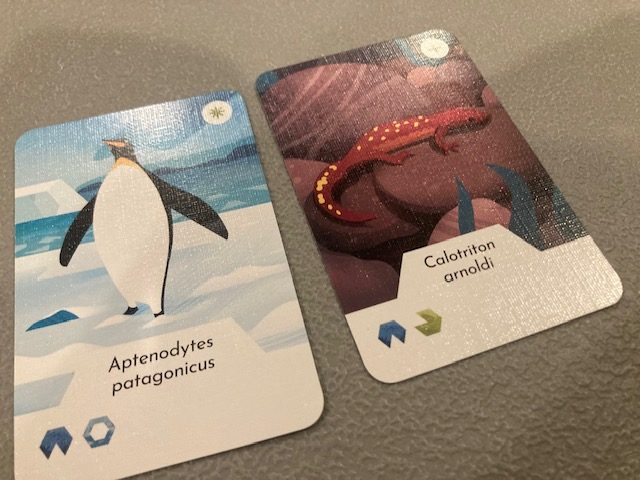
Animals can ONLY be bought if you have two plants with matching symbols on that animal! Again, the cost to buy animals is on the BOTTOM of the card. Using the two plants from above, we can buy a Penguin, because we have two of the Tundrus symbol!
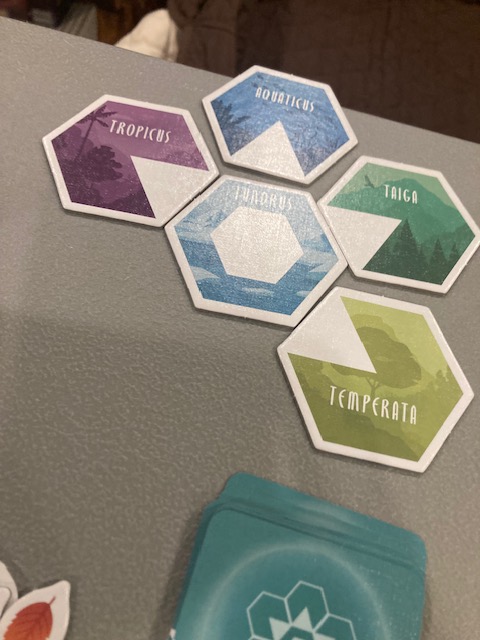
Finally, the animals buy biomes. If you have two animals sharing some biomes, you can immediately spend them to buy the overlapping biomes! Using the penguin and the lizard above, we can acquire the Aquaticus biome since the animals share that!
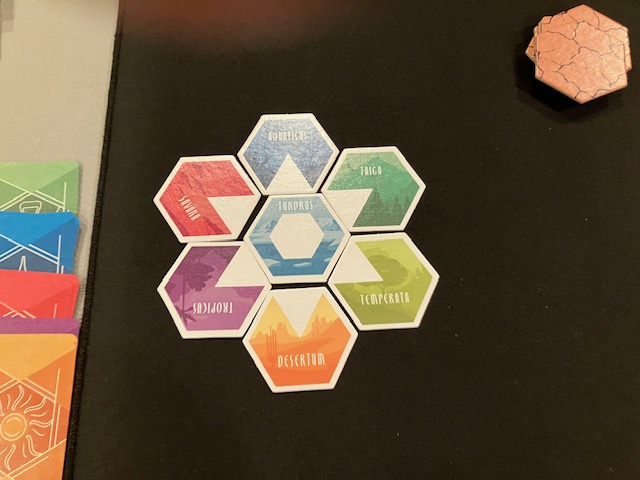
If you make all biomes, you win!
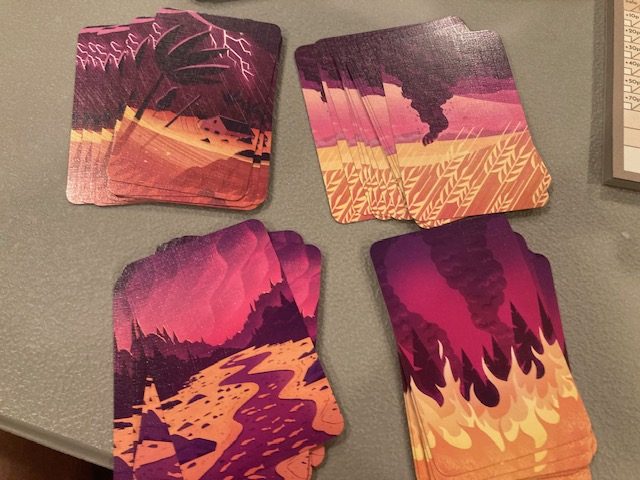
Along the way, many things can go wrong: you can get the Disaster cards (see above: the different symbols mean nothing)! These cards clog your deck, preventing you from buying things along the way!
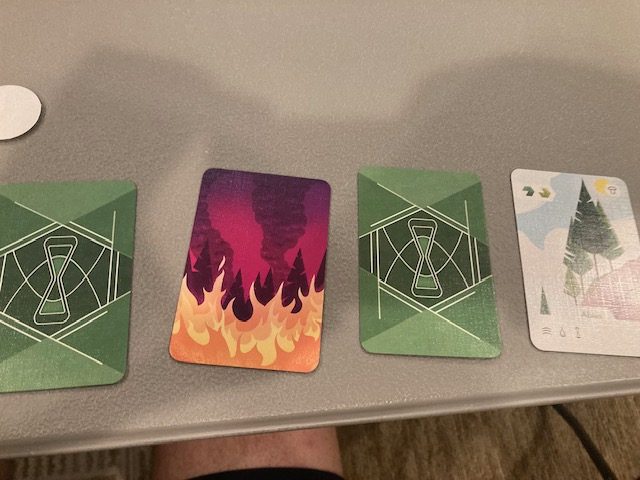
If you can’t buy anything on your turn (either a plant or animal or biome), you get a Disaster card in your deck. By itself, the Disaster card doesn’t do anything: it clogs your deck mostly.
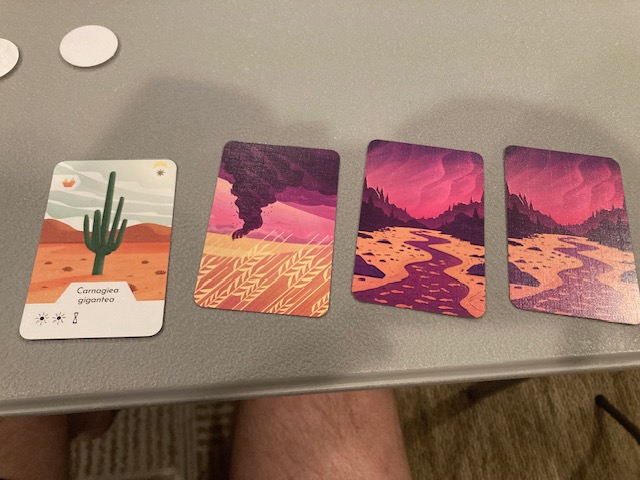
But, if you ever get 3 Disasters in your hand (see above) …
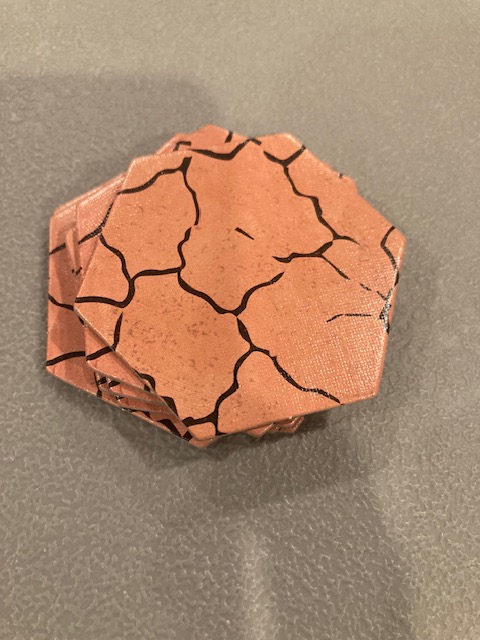
… your turn immediately ends and you get an Extinction Tile! (If you get 4 Disasters, you immediately get 3 Extinction Tiles!)
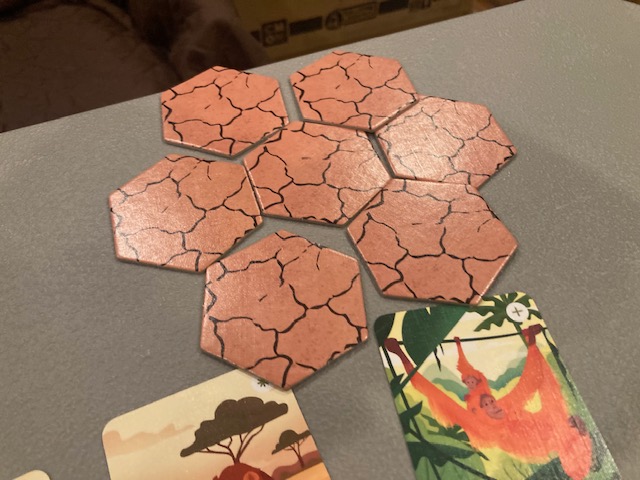
If you ever get 7 Extinction Tiles, you lose!
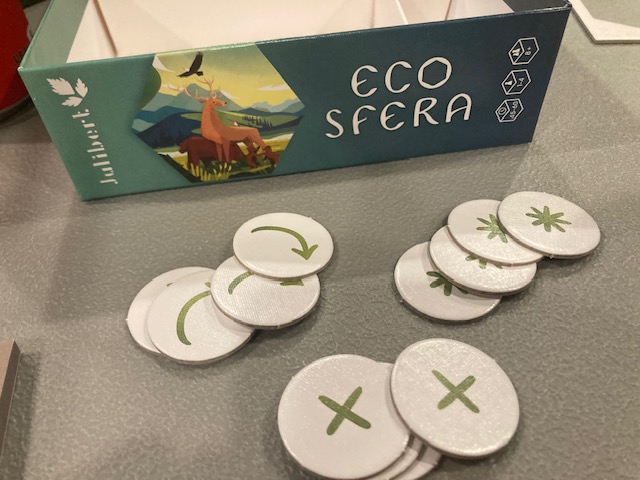
Along the way, each Player gets some tokens to help them. The Plus (+) can be spent to pull an extra card, the Star (*) can be spent to refresh a line of cards (to get better buy options), and the Arrow is the most important symbol in the entire game: you can use it to move cards to other players OR to cull cards (ya, but you can’t EVER cull Disaster card).
These are one-time usage, however, you do refresh them every time you have an animal pair that matches a biome in your hand. (So even if you can’t buy a new biome, you can still refresh your tokens).
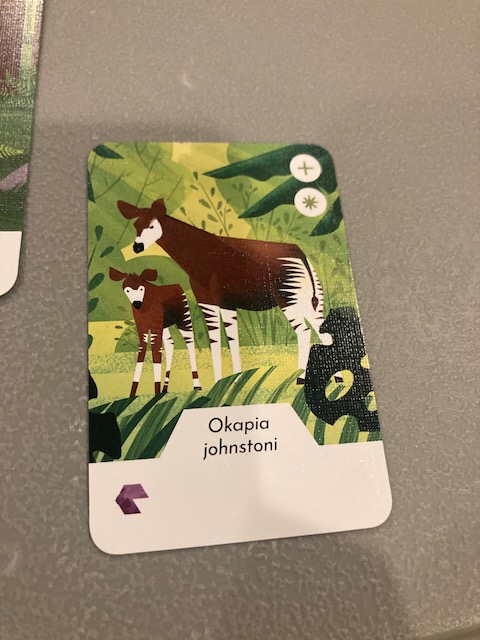
You’ll notice that some of the cards ALSO have these symbols: you can choose to use these symbols from your hand as well! (Only one OR the other)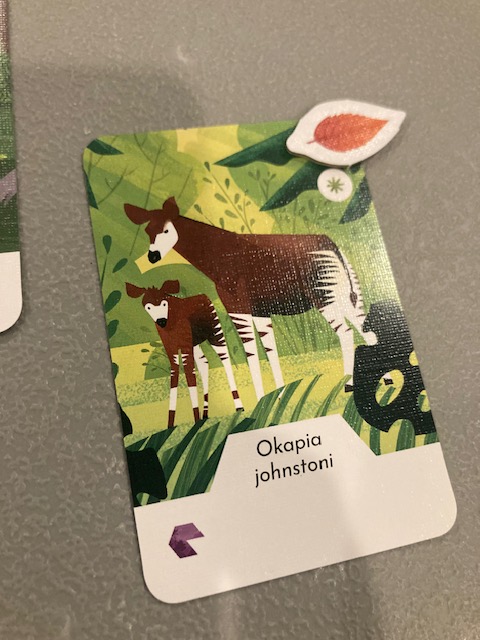
To help remind you which cards have been used, the game provides some leaf reminders: see above as we use to remind ourselves that we used the + and can’t use that card again.
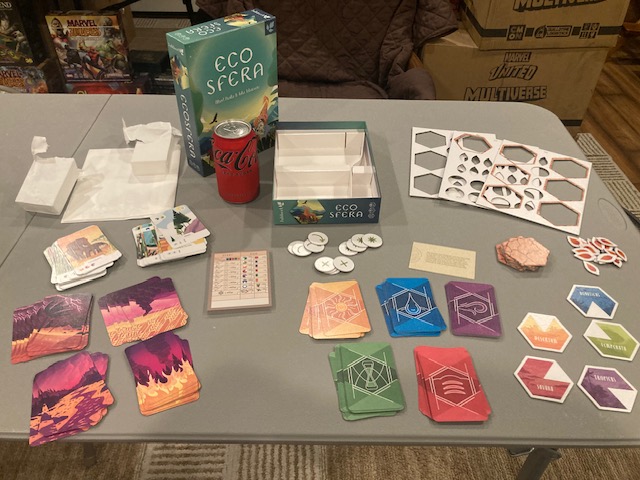
This game is quite lovely to look at: the art and tokens are easy to read, and cards are a very nice linen-finish. In all my game groups and plays, the players commented on how nice the art on the cards is. This is a beautiful production.
Rulebook
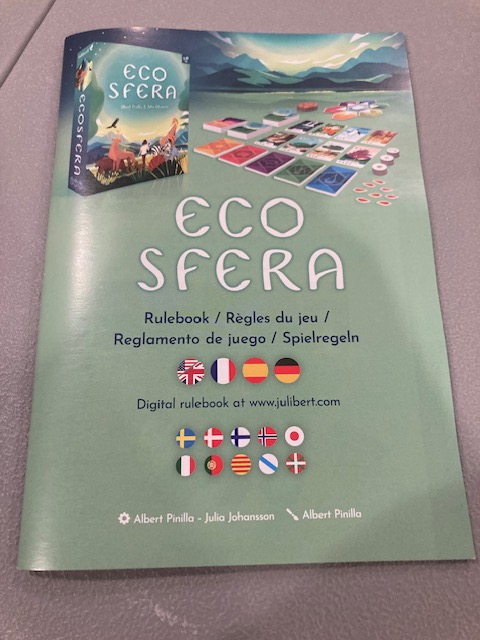
The rulebook was okay. It looks a bit daunting because it’s very thick, but it also have 4 translations in it. It only take about 9 pages to get the rules across.
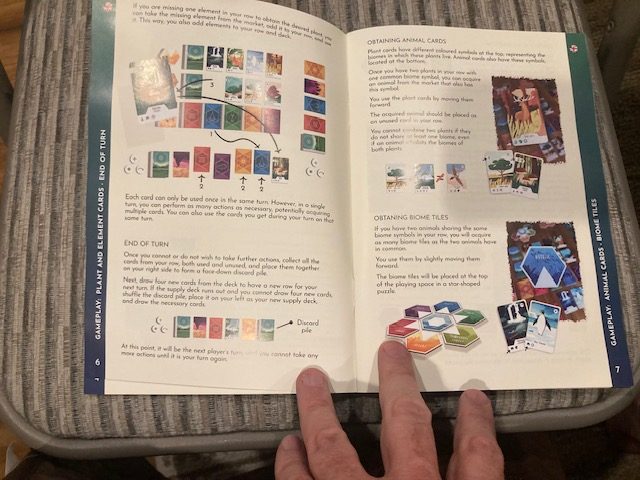
Although the rulebook works fairly well on the chair next to me, and the font is a decent sized, I was slightly annoyed that I had to hold the rulebook open many times! I want my rulebook to lay open on the chair next to: this ventures into C territory for The Chair Test, but since I can “break the spine” to get the rulebook to stay open, I’ll give this a B- on The Chair Test.
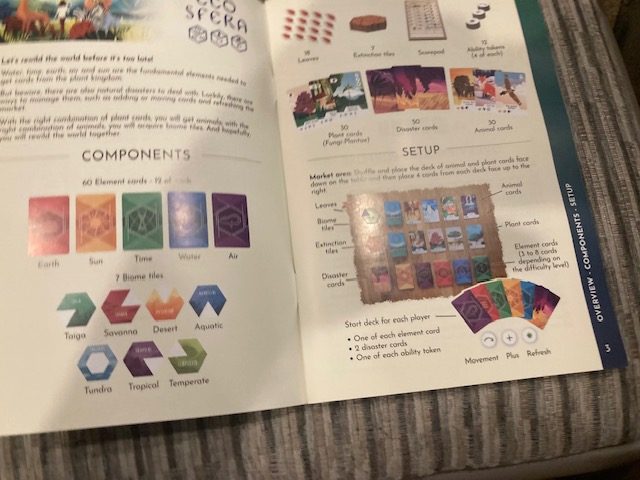
The set-up and components were fairly well-notated on the first two pages. This allowed me to jump in fairly quickly, which was nice.
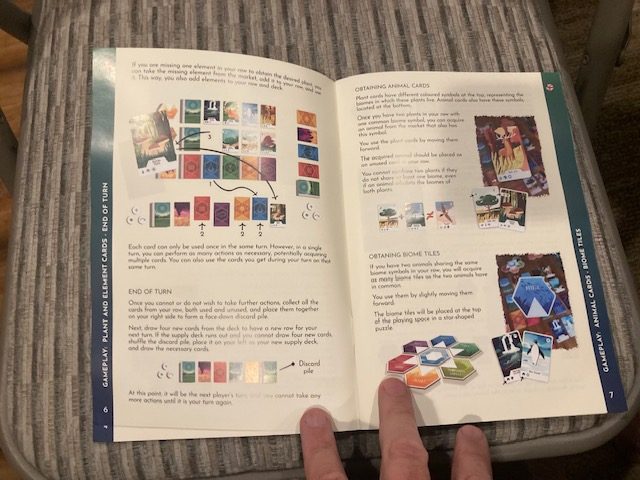
The rules had some nice pictures showing how the game flows and plays (see above).
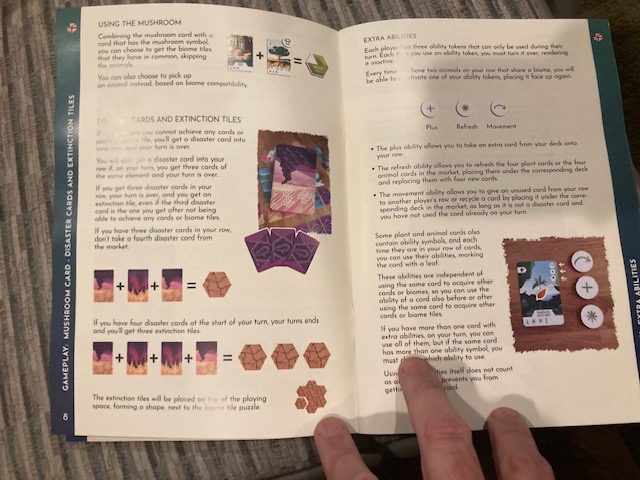
I felt like some of the organization was a little off: they spent precious space showing simple rules, but then failed to elaborate more complex rules in a few places.
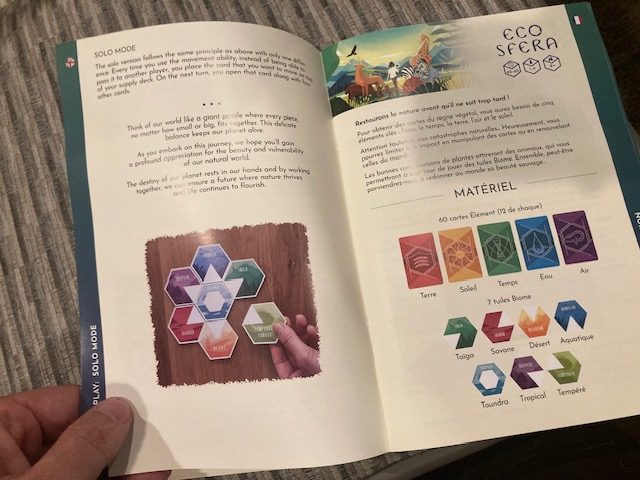
The rulebook was fine: it taught the game, but sometimes you will have to go hunting for a rule.
I won’t ding this for the lack of an index because it is a pretty simple game overall; it doesn’t need one.
Player Count
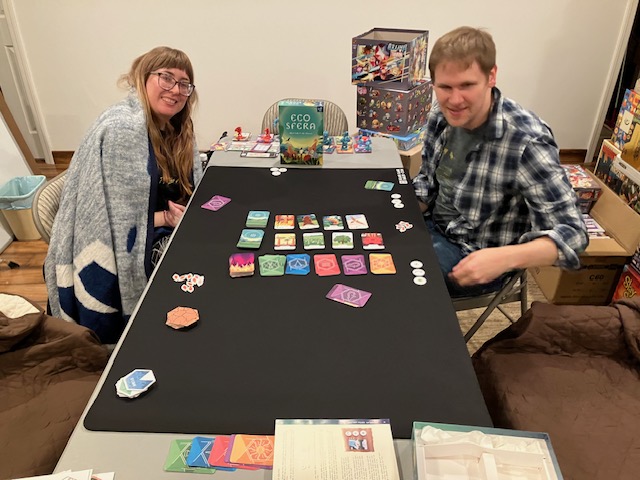
More than any other game I have played in some time, the Player Count matters for this game. It’s either a slog of playing of cards that play themselves, or a dynamic event!
Solo Game
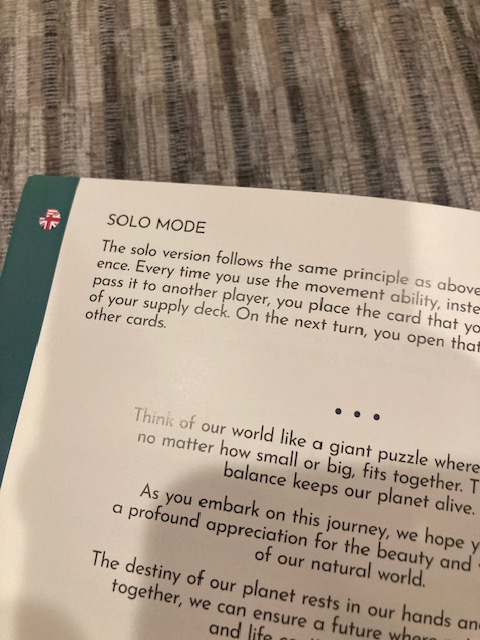
This game does support solo play (see top of page 10): Thank you for following Saunders’ Law and giving us a solo mode. The only real difference is that the Arrow symbol means that you can’t share cards with anyone else (you can still cull), you can only share with yourself and give yourself an extra card.
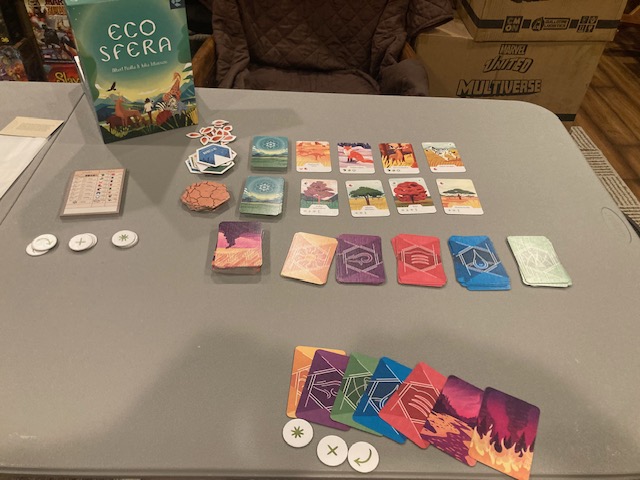
See above as I have a solo game set-up! The solo mode does allow you to learn the game: I have played this game quite a bit solo.
My first solo game was a slog and I hated the game. What am I missing? I found this thread on BoardGameGeek where someone else had the same experience: What Am I Missing? Armed with that information, I tried again and did a little better.
The most important thing you learn from a few games is that the Arrow symbol is critical.
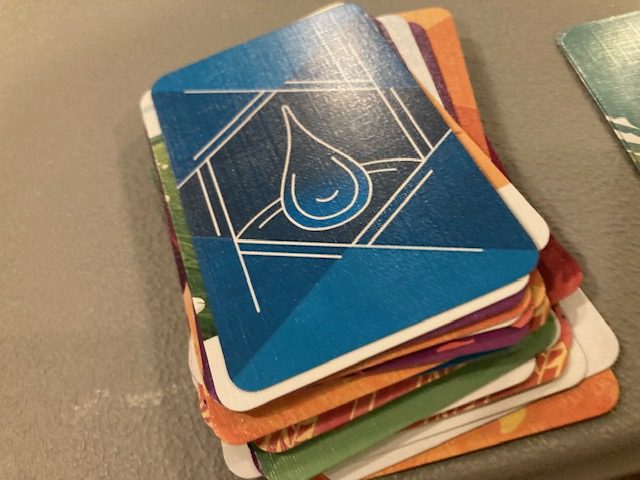
The major problem with solo mode is that your deck just builds and builds (see how huge my solo deck is) and many times you feel you have no agency! You just draw cards and hope you get the cards you need. You can either do something or not. That’s it. The game feels like it plays itself!!! If you have used all your tokens, well, it’s even less fun. Right now, the solo game hovers at a 4/10 for me. (I will revisit this below)
I had enough information to teach my friends AND emphasize the Arrow. Maybe the game works better with more people?
Two Player
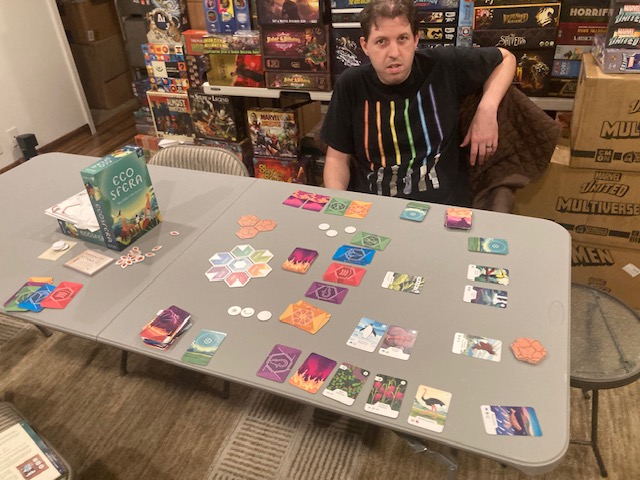
Sam came over and we gave it a a try: I made sure to emphasize the Arrow symbol and that we needed to talk.
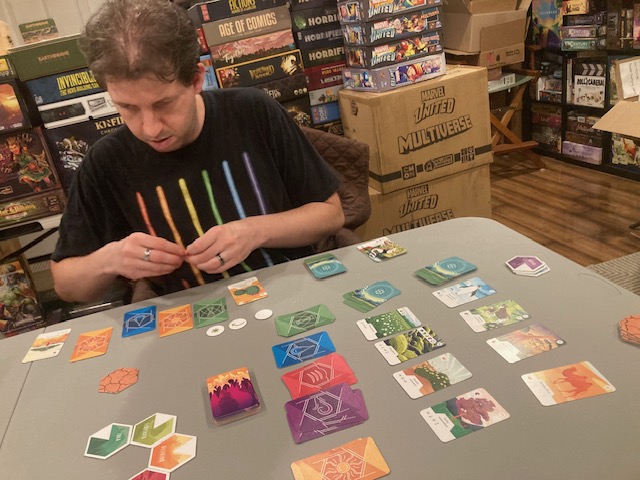
The game went a little better as we tried to be intelligent about the use our symbols. Again, the most important feature is to use Arrow to share cards at the right times.
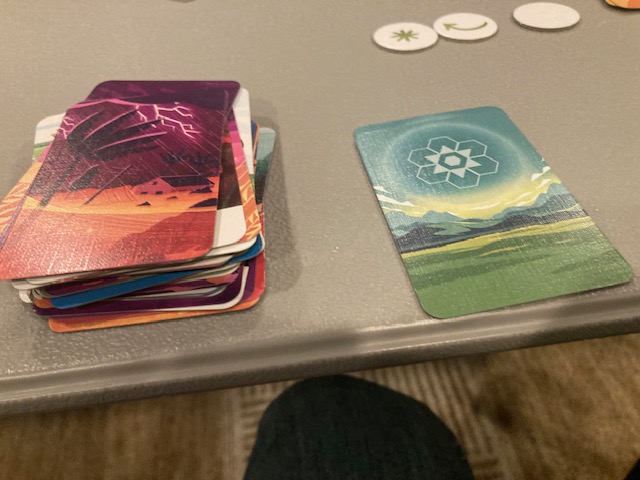
The decks still got pretty big (see above), and many turns had nothing happen as we acquired Disaster after Disaster. See below.
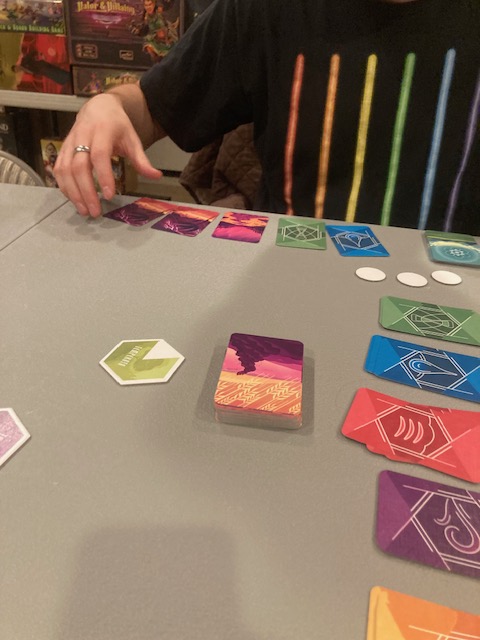
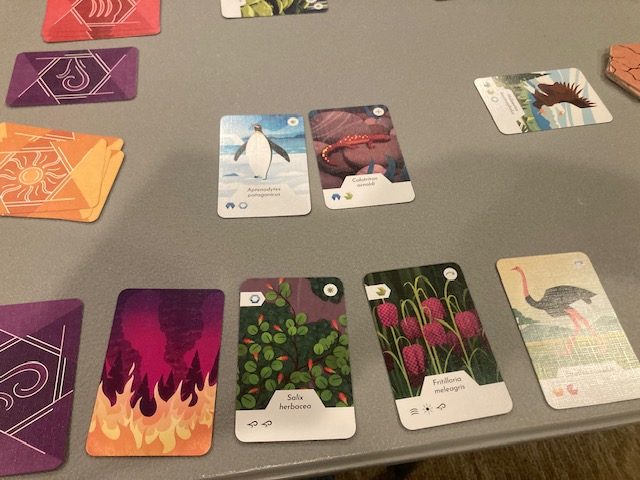
We started to see a little more strategy: maybe it made sense to move a card to my compatriot, maybe it made sense to cull this card. There was more sharing as we tried to help each other.
In the end, we won, and there was some sharing. And there was some discussion. And there was some strategizing. But there were a whole lot of turns where nothing happened and we just acquired a Disaster. During those turns, it just felts like the game was playing itself.
In the end, Sam gave the 2-Player game about a 6/10. I was a little more down on the game after my solo play and I gave it a 5.5/10. The decks got huge, and there were still a lot of turns where nothing happened, but we saw a glimmer of the sharing and strategy.
3- Player and 4-Player
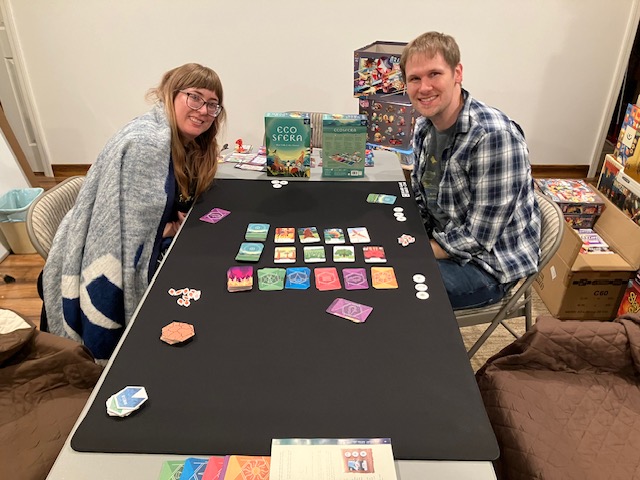
We saw, in the first 3-Player game that this game CAN be fun! As long as you use all the symbols on the cards, and try to use the Arrows to move and cull cards, and communicate and cooperate, the game feels like you have agency!
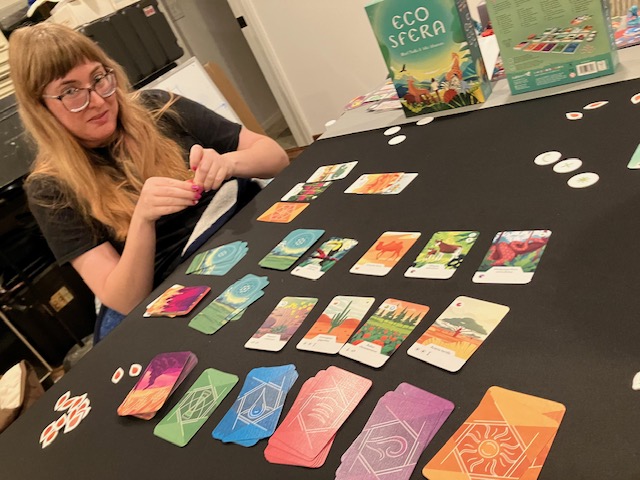
The difference between a solo/duo game and a 3 to 4-Player game is the number of opportunities! More players means more opportunities to share resources smartly!
“I can share this card, but Sara doesn’t have any animals. AH! But Andrew does! I’ll share this with him so we can get the last biome!”
All of a sudden, people are looking around the table for opportunities to share! People are talking, people are communicating, people are cooperating!
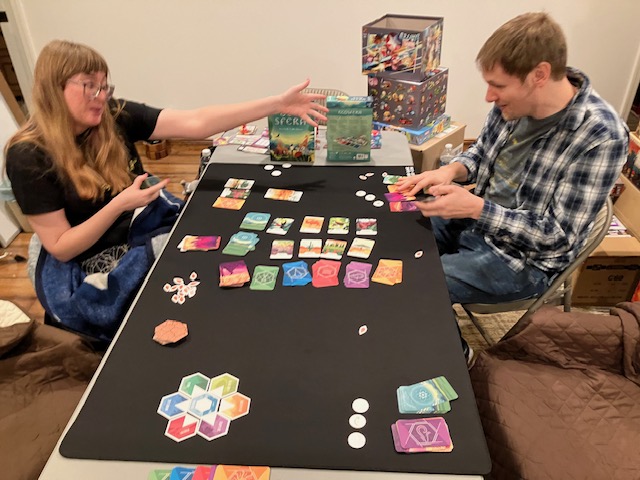
The 3 and 4-Player game is fun! As long as you exploit the shared opportunities, this game can be quite fun! My friends all had fun and wanted to play again.
I mentioned the problems with solo and duo play, and my friends said “There’s just more opportunities to be smart with more players!”
Be aware, if you are looking for a game that is good as a multiplayer solo game, this isn’t the game for you! If you play Ecosfera like multiplayer solitaire (no one really works together and everyone just plays by themselves), Ecosfera will have all the problems of the solo game … and it won’t be fun. In order to truly enjoy this game, you need 3 or 4 players with a group that will engage with each other!
You need to have opportunities to share. You also need to strategize to use those opportunities well. There’s a lot more of this in the 3 and 4-player game.
Conclusion
If you are looking for a solo game, I can’t recommend this game: although the solo game is good enough to teach the game, it leaves a bad taste in the mouth that this game plays itself. It’s about 4.5/10 at a solo play because it just barely works.
Even a 2-Player game isn’t quite right: there’s not enough quite opportunities for intelligent sharing; the game still feels like it’s playing itself too much of the time. It’s better at 2-Player than solo (maybe a 5.5 or 6/10), but I still can’t recommend it.
It’s not until you get to 3 or 4 players together that this game opens up and becomes fun! There are so many more opportunities to work together and strategize together as a group when you have 3 or 4 players!!! In that configuration, I can recommend this game, as can my friends: they have suggested we play again! This is a 6.5 or 7.0/10 for 3 to 4 players. Just make sure you play with a dynamic group!
I don’t think we’ve ever had a game that is so player count dependent! If you want a solo game or something to play with your partner, I can’t recommend this game. If you want a game that plays multiplayer solitaire with little interaction, again, I can’t recommend this game. I think this game only works with 3 to 4 players with a dynamic group … and then it’s fun.
The Nature theme is fairly thematic, the art is pretty, and the game is gorgeous …. but that will only get you so far: Be aware of when this game works and when it doesn’t before you pick it up.
 coopgestalt
looks interesting but also rather abstract. I would try it, but go into it with fairly low expectations.
LikeLike
I’ll bring it next time I come down!
LikeLike