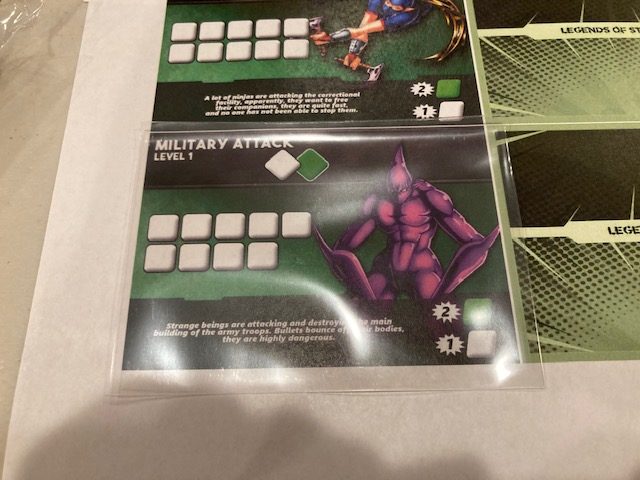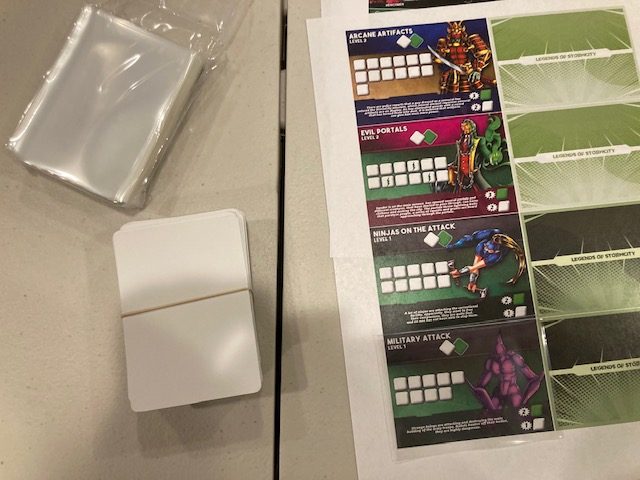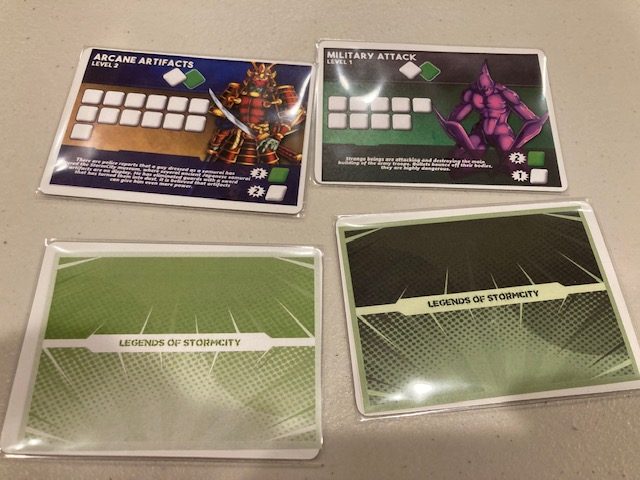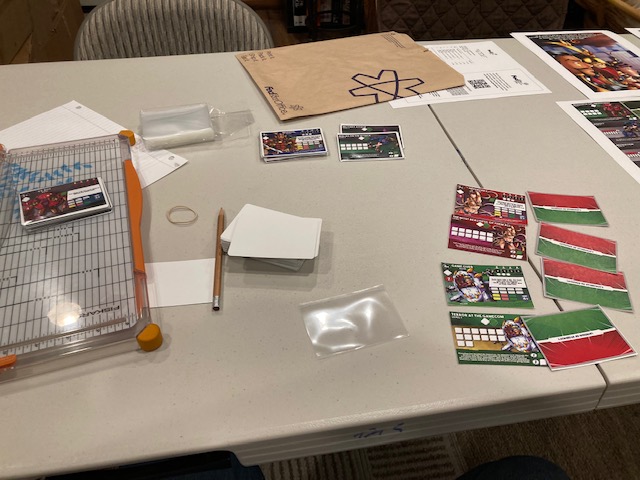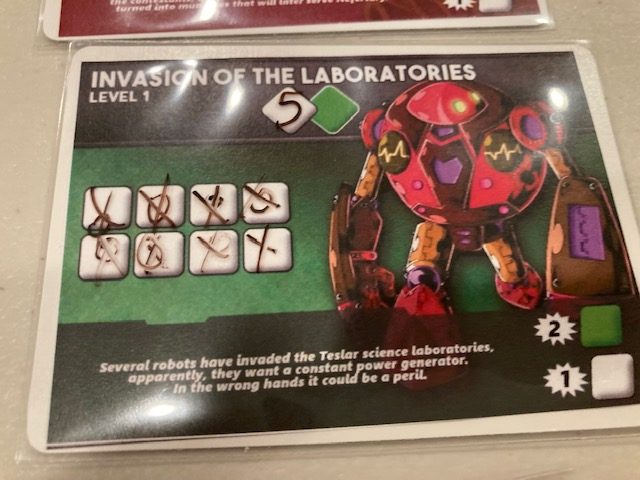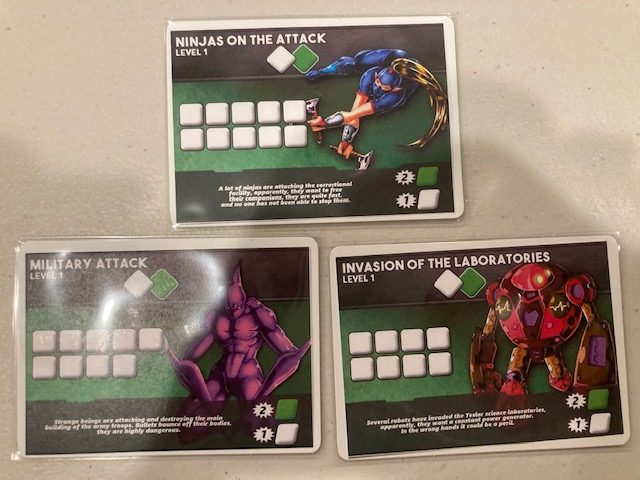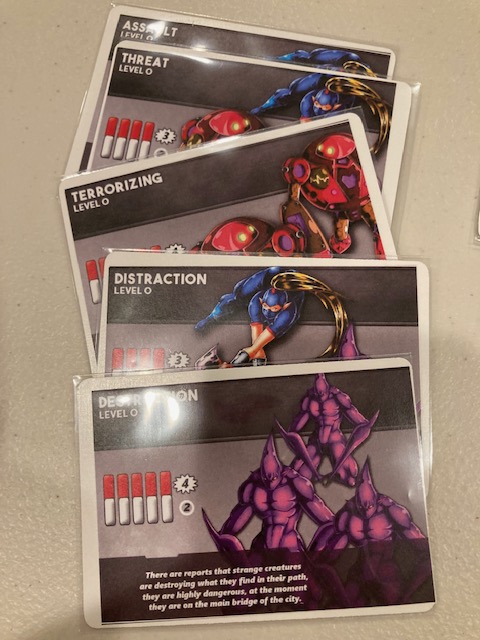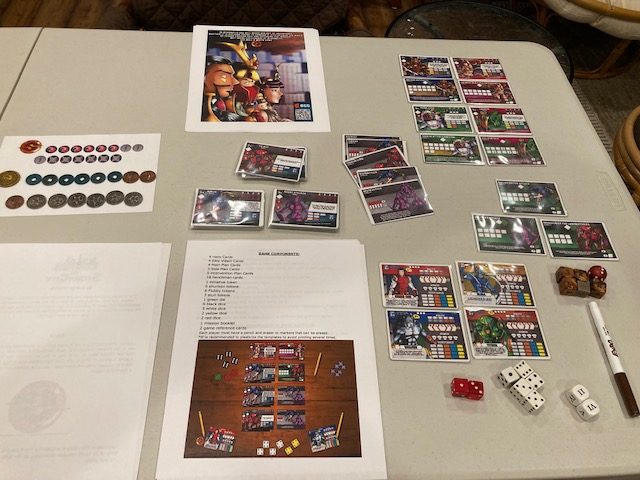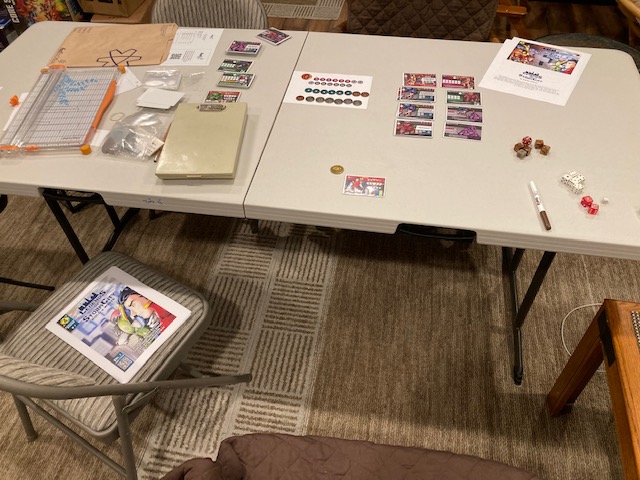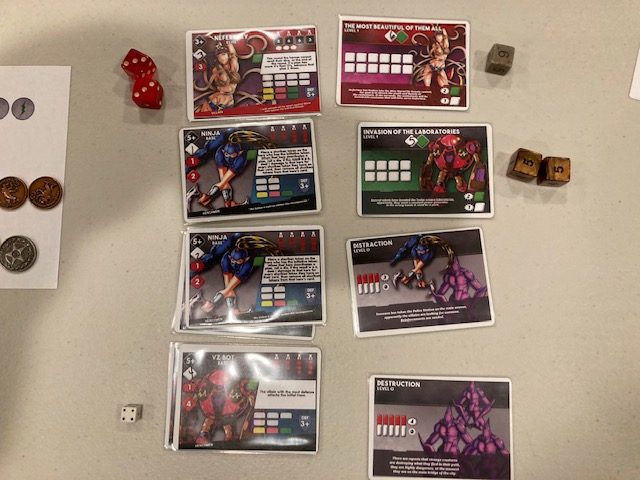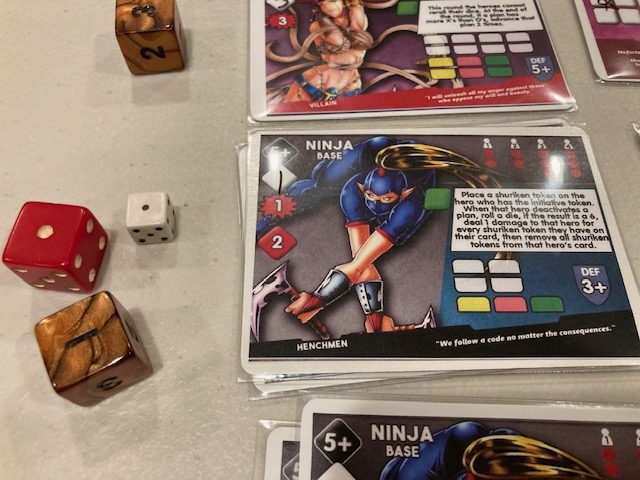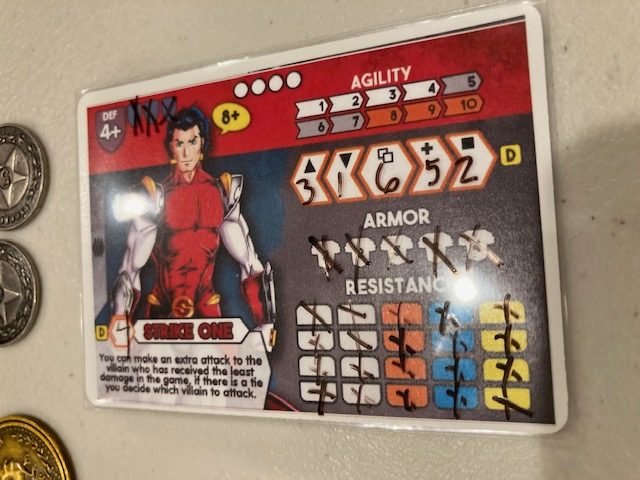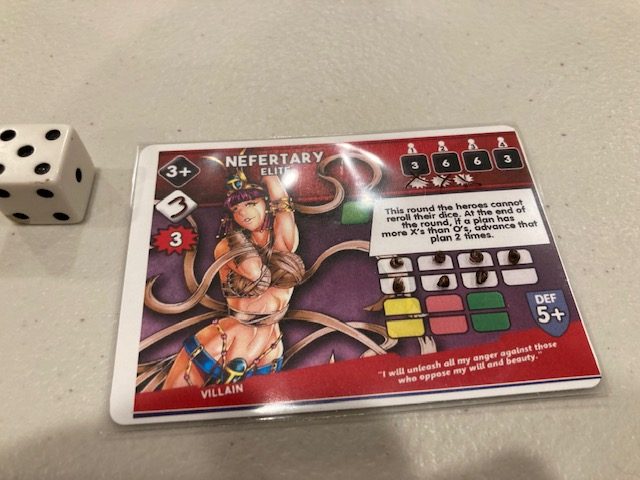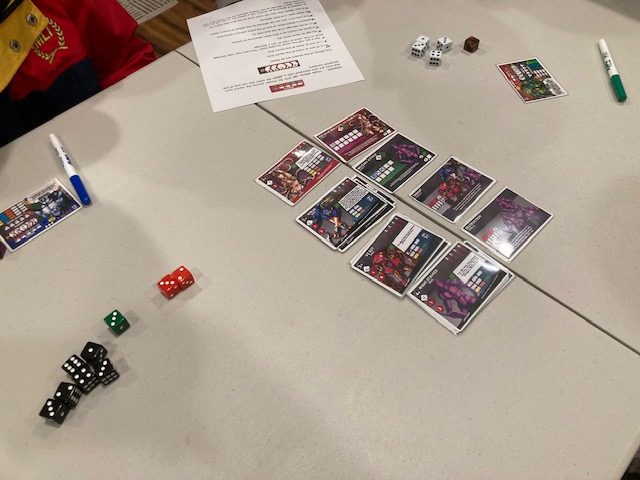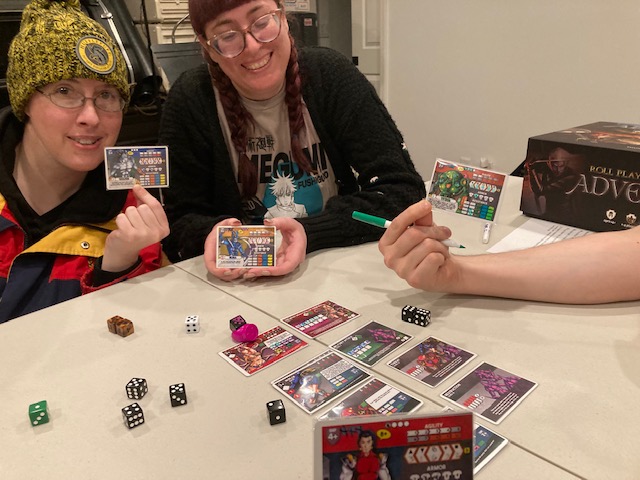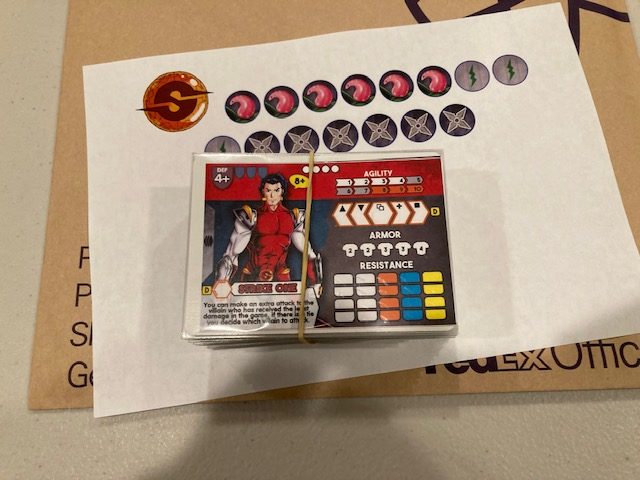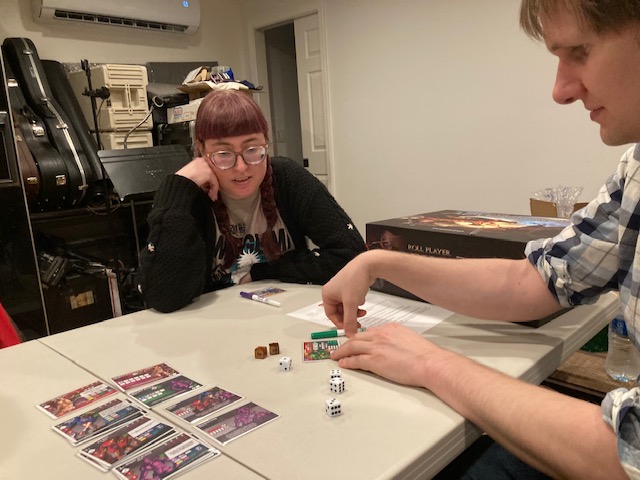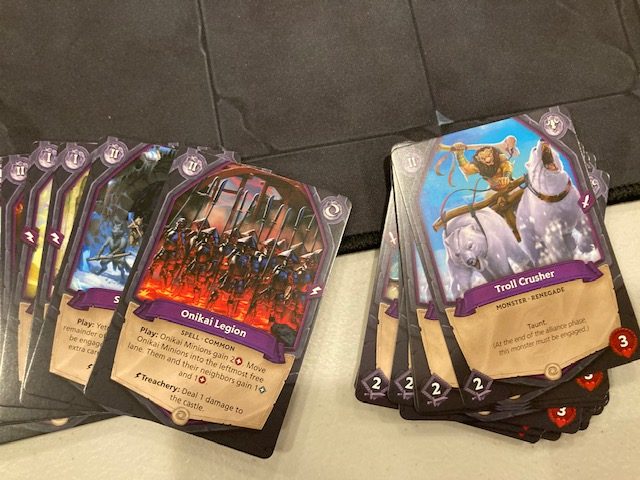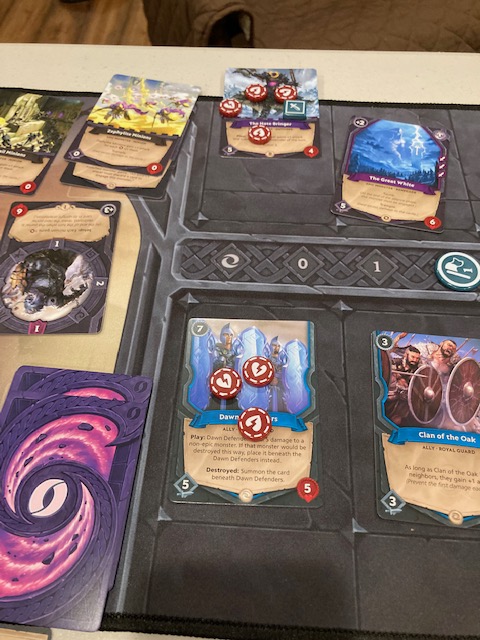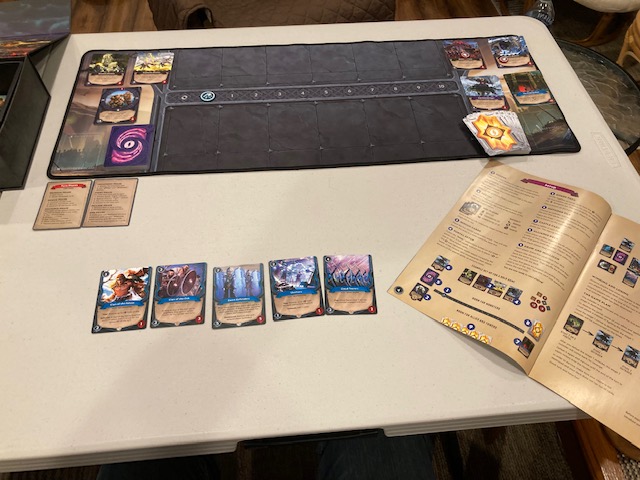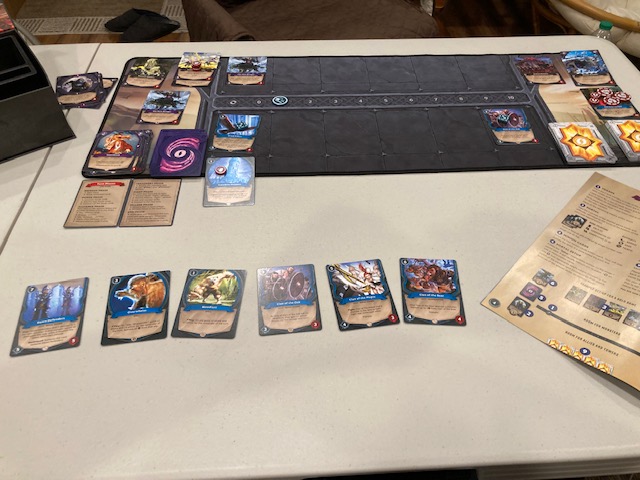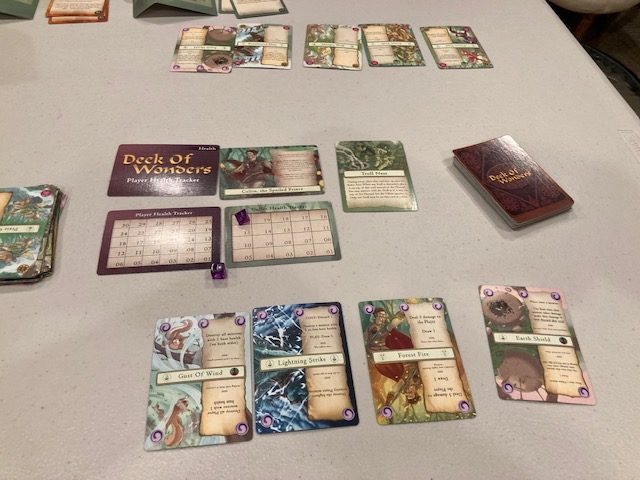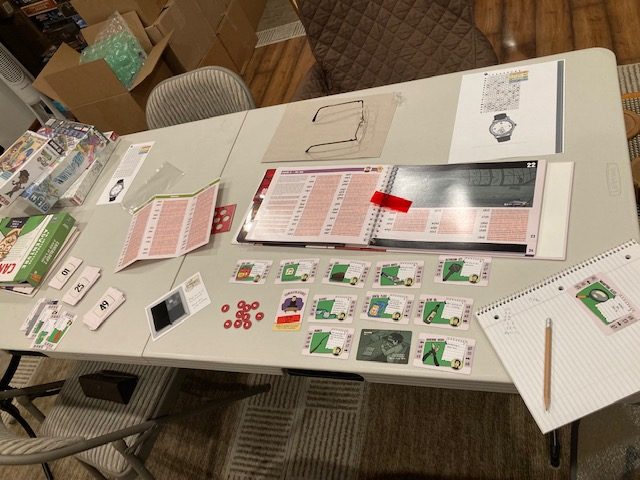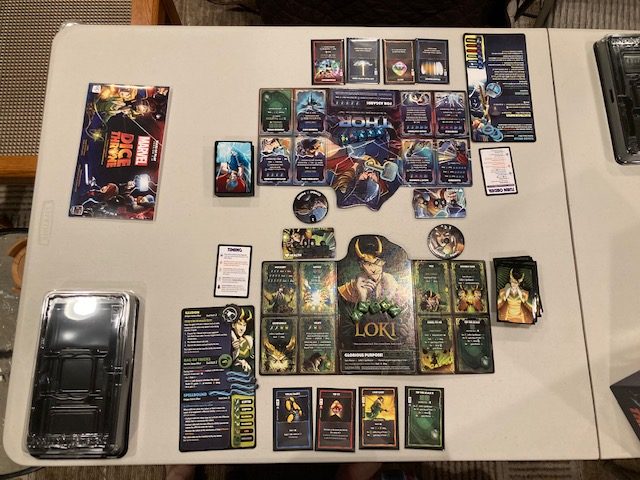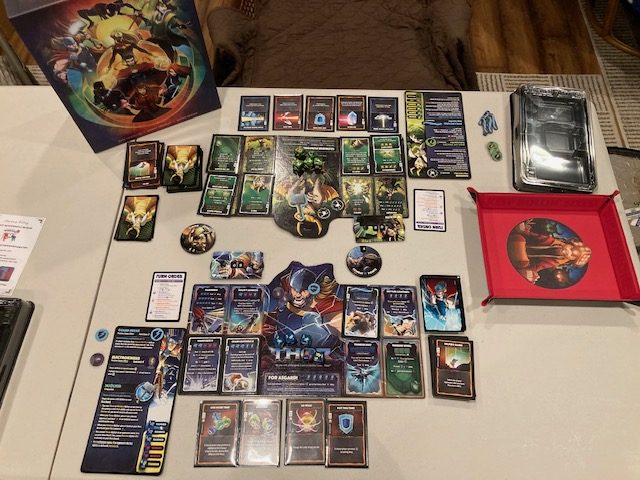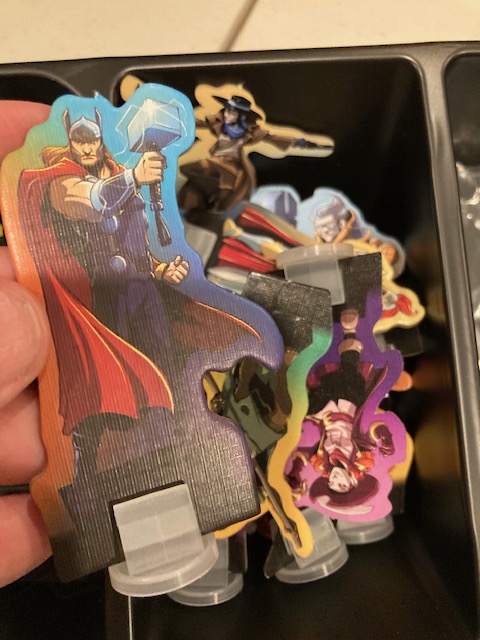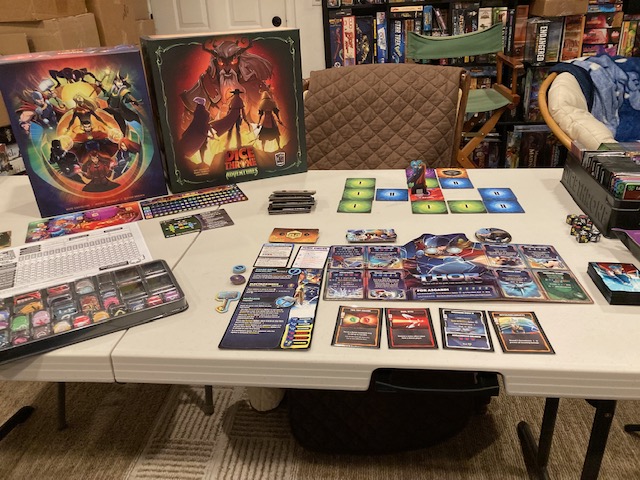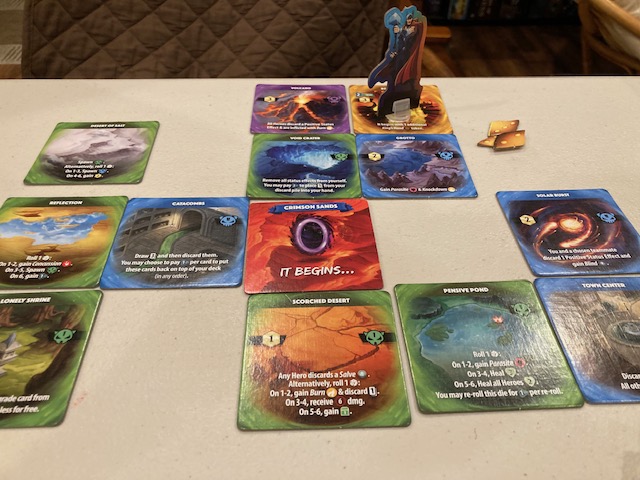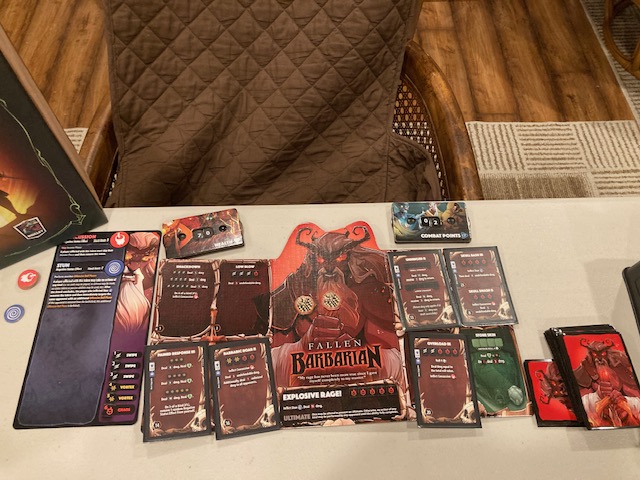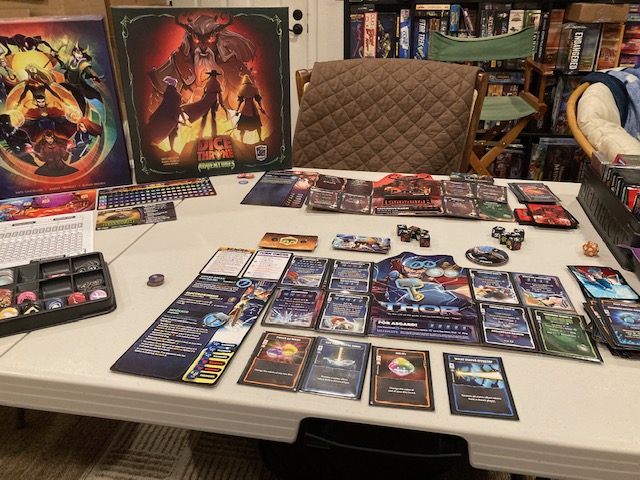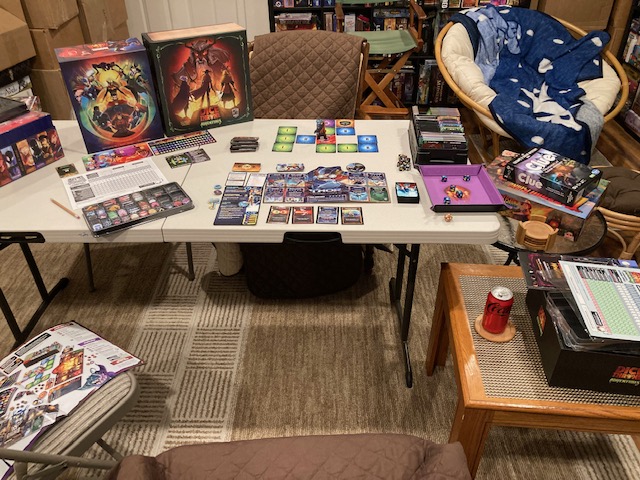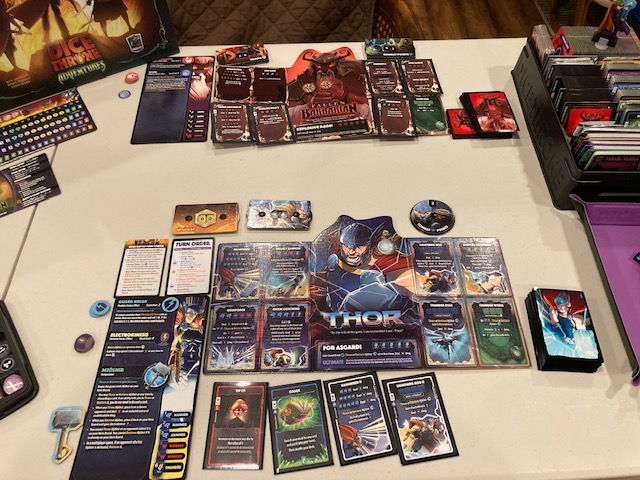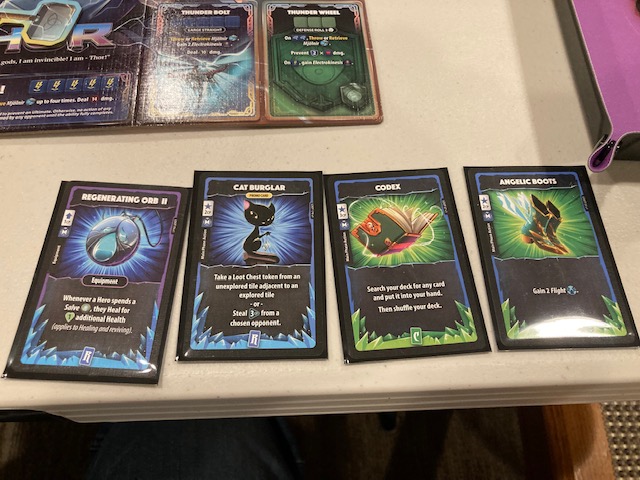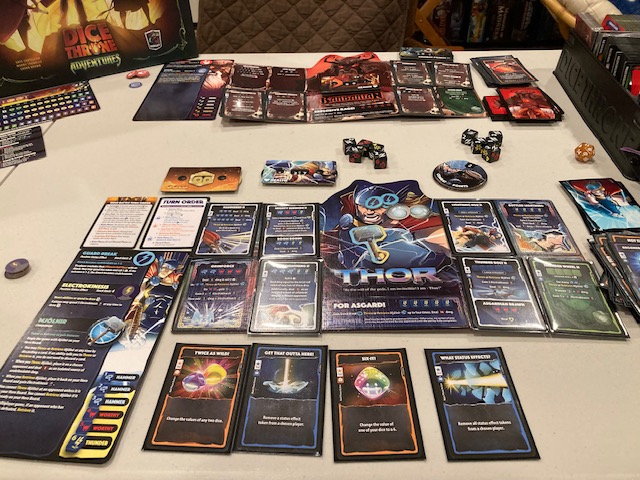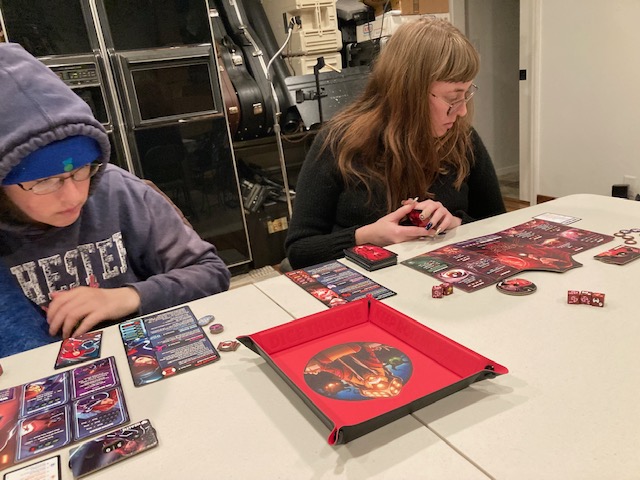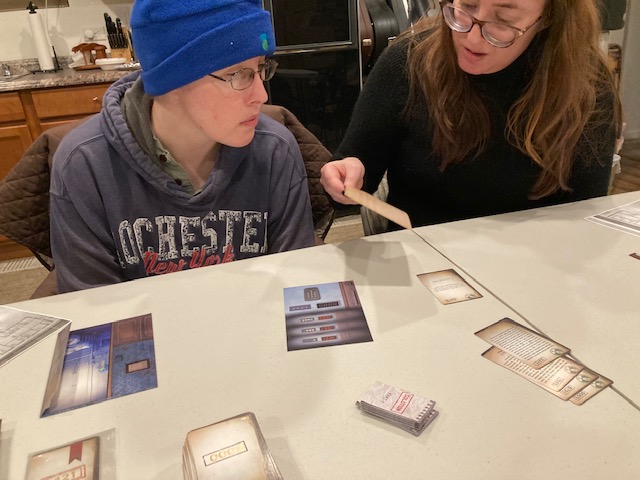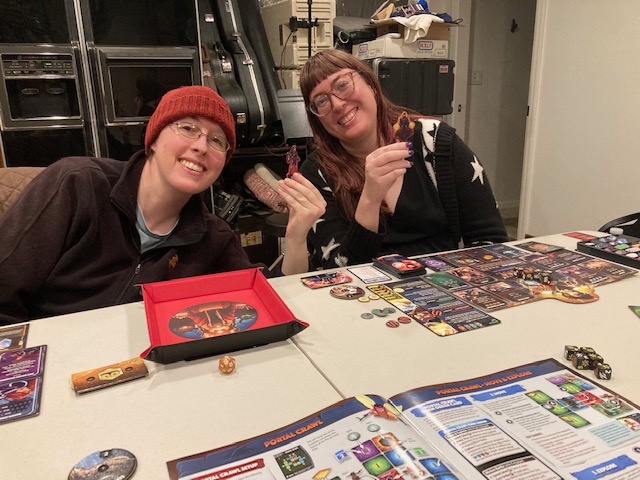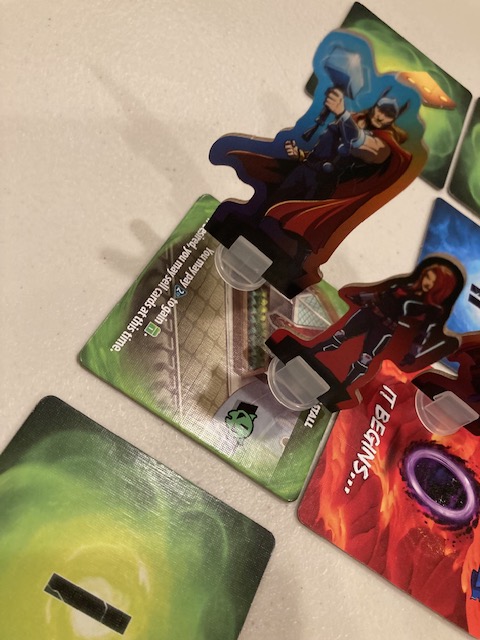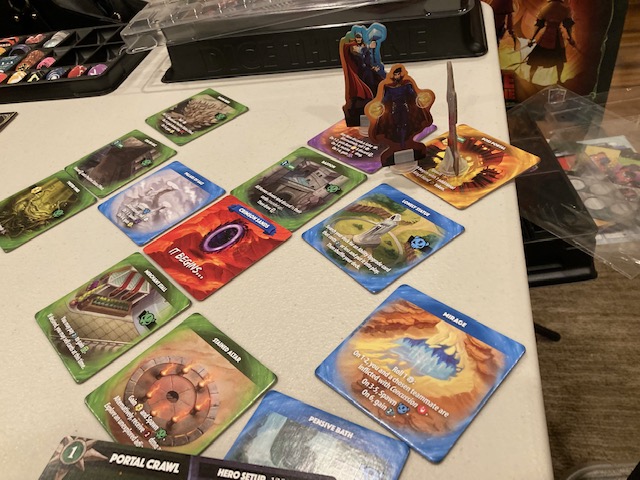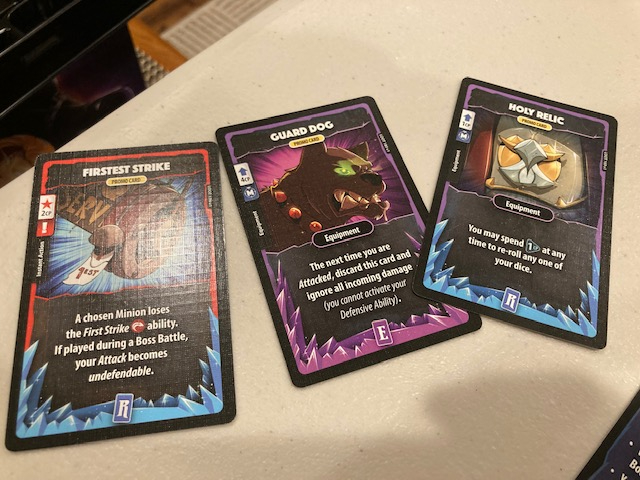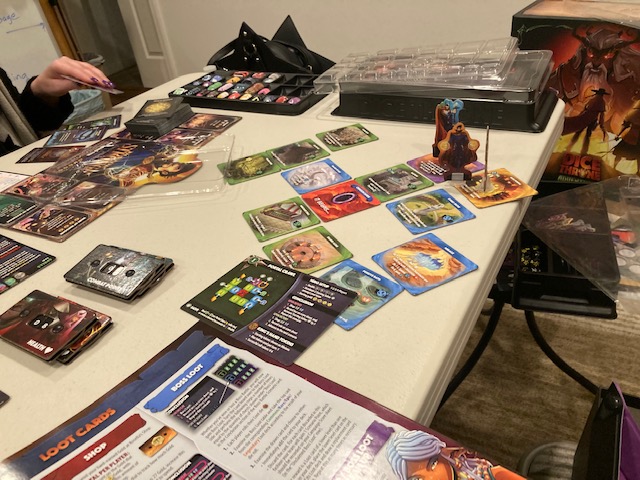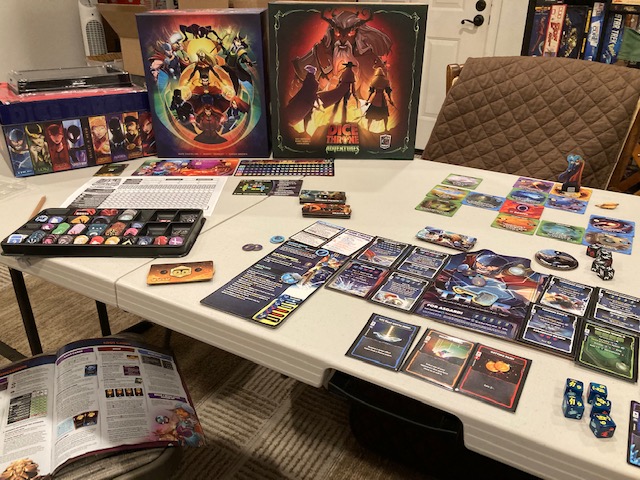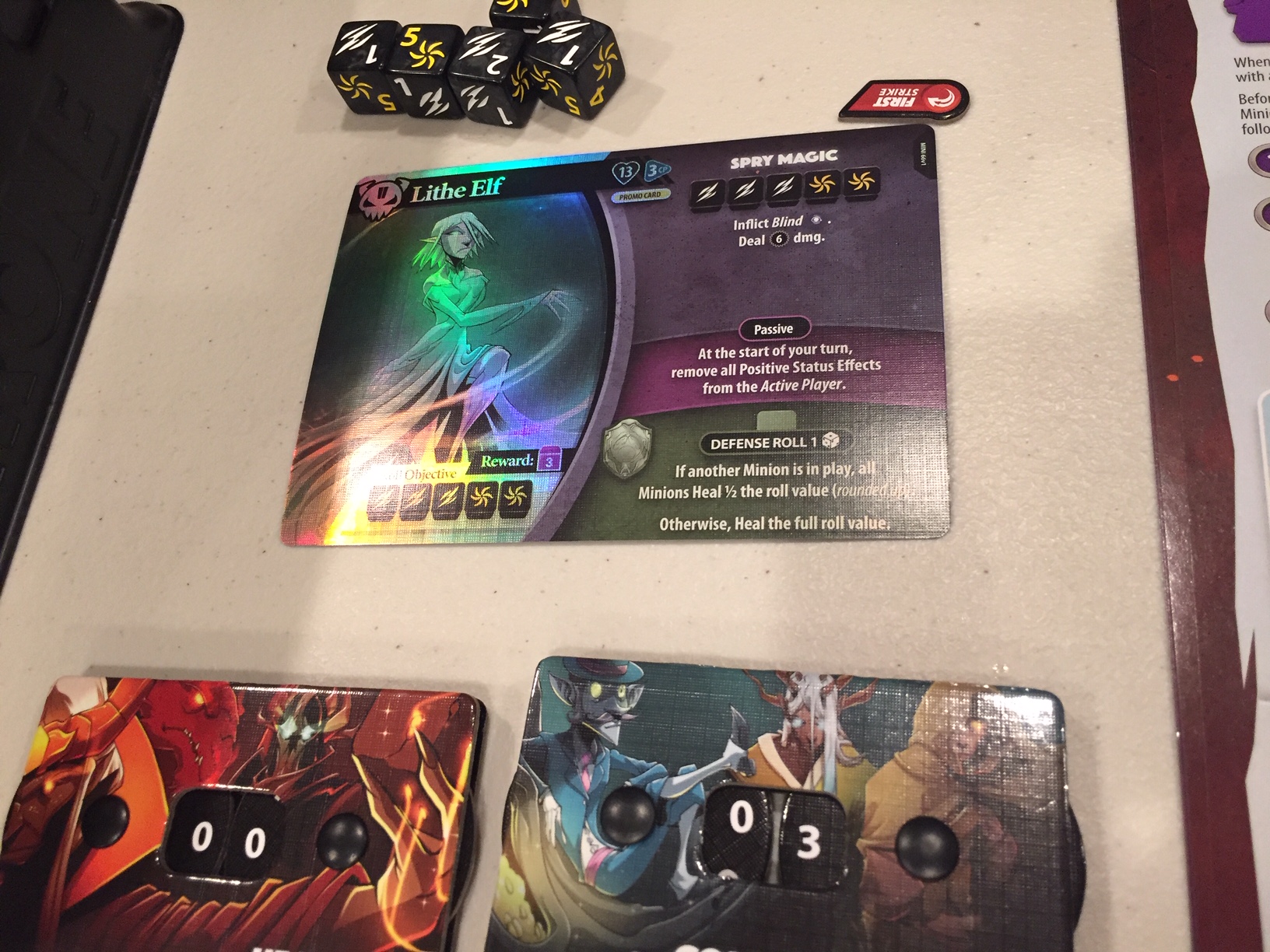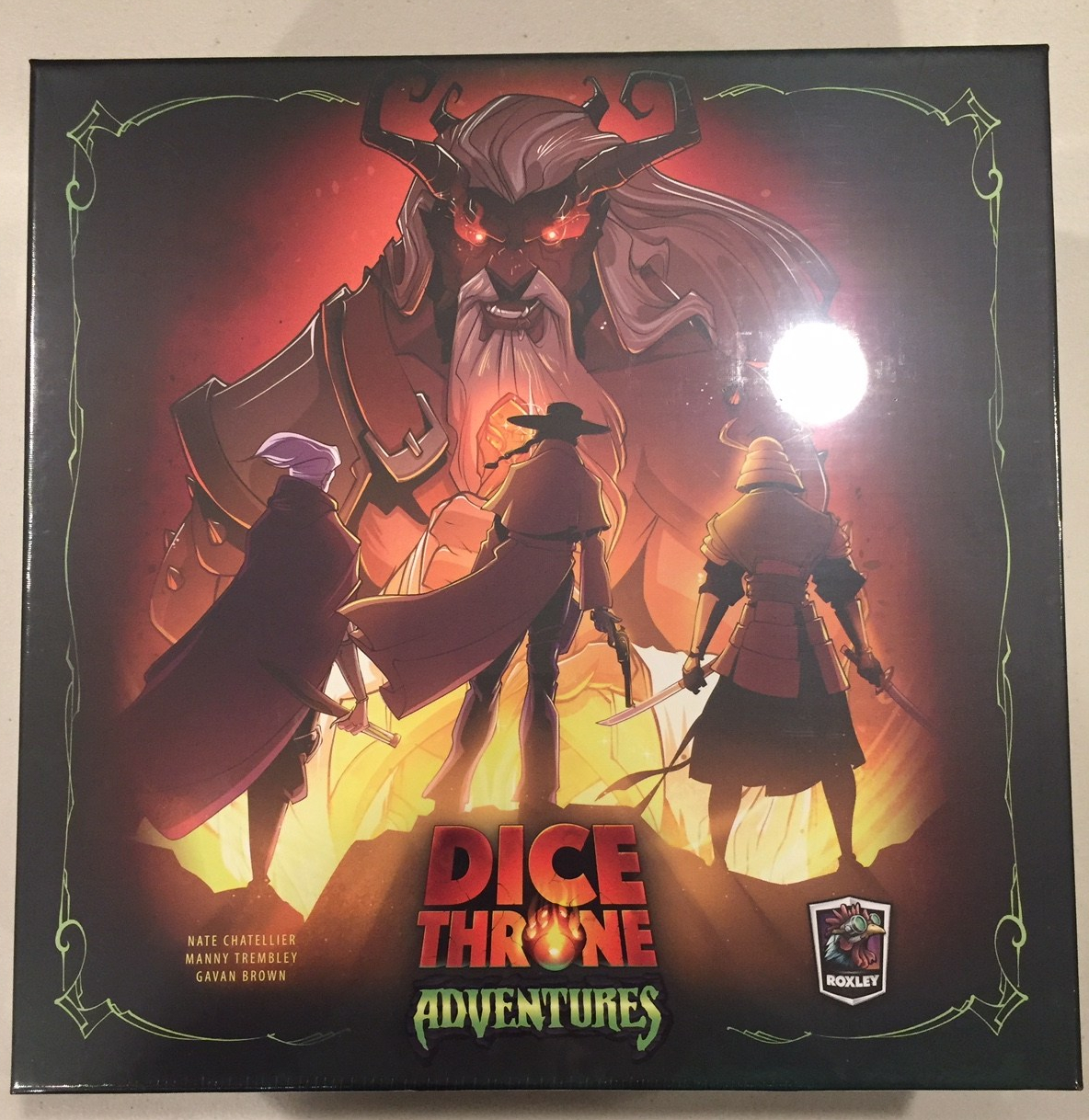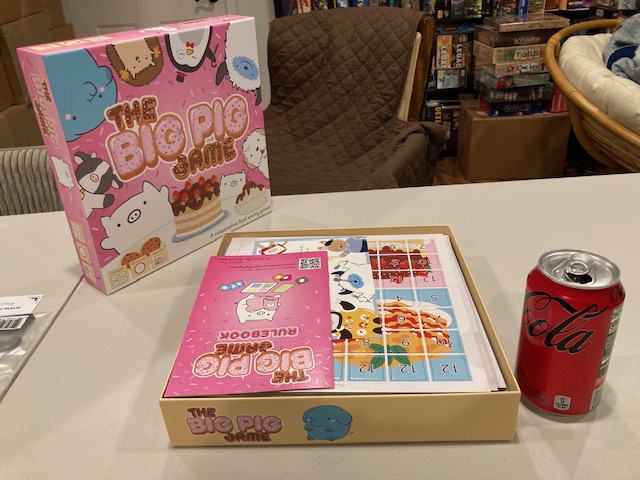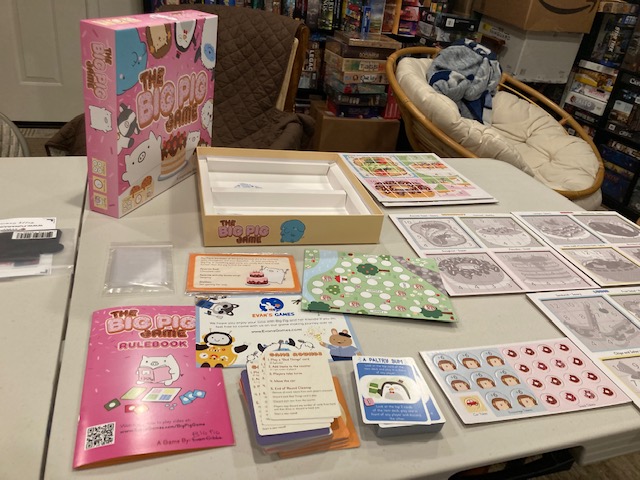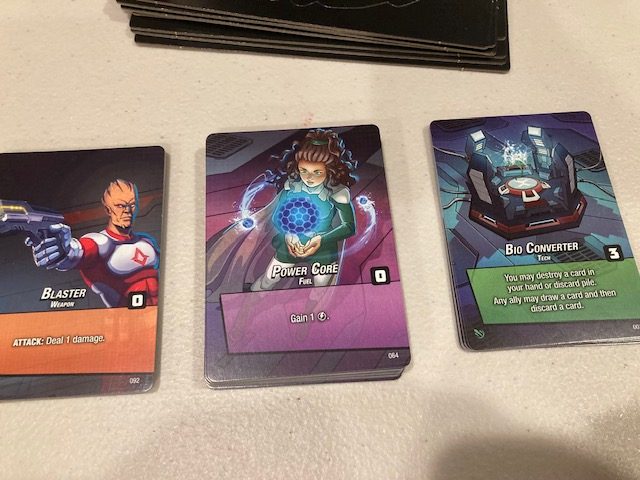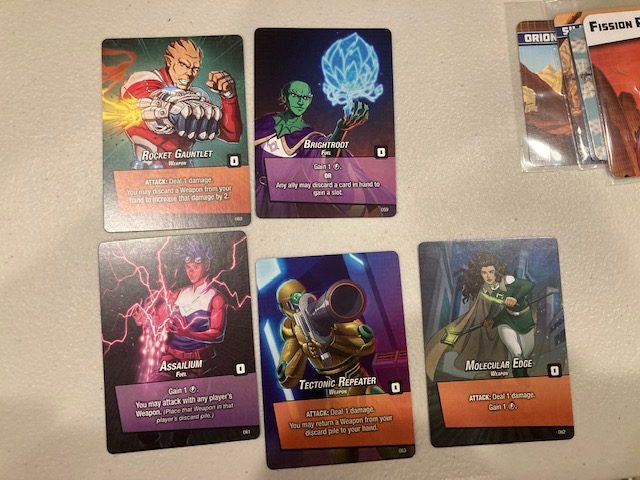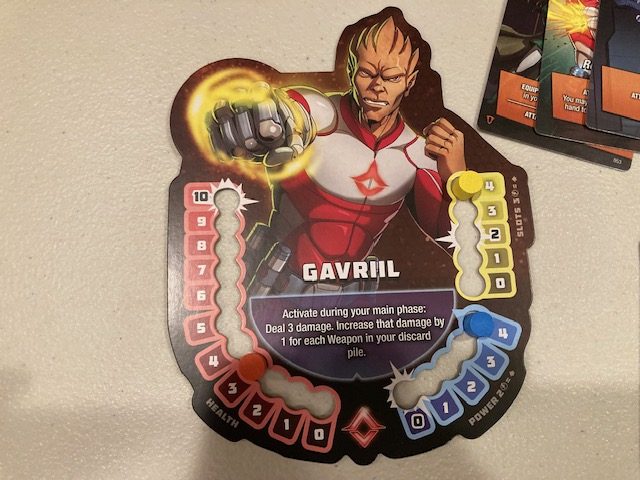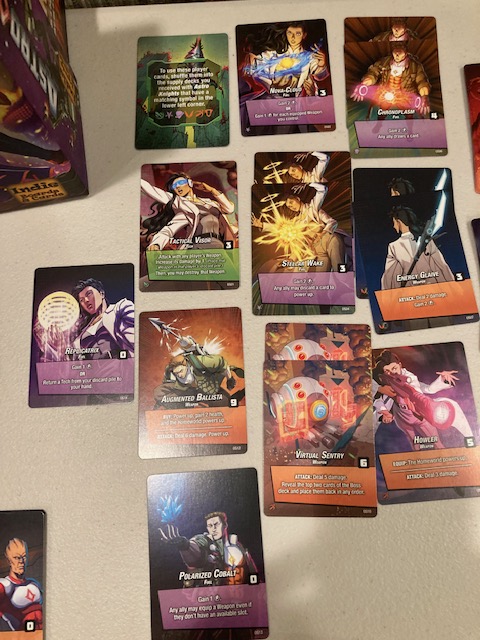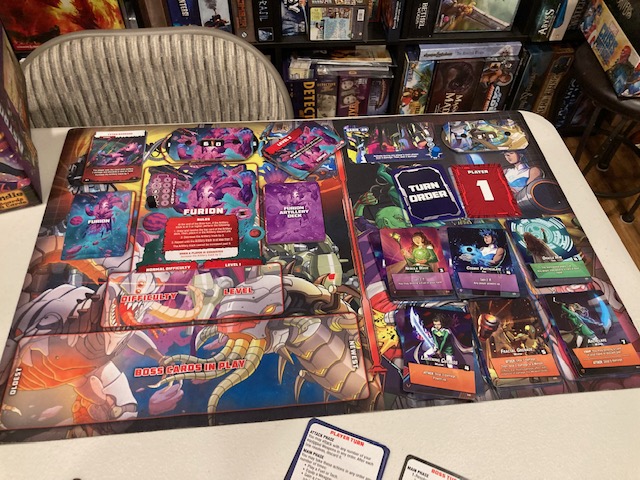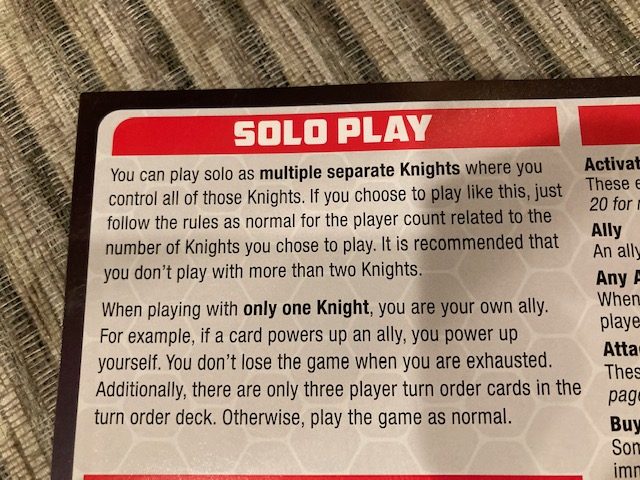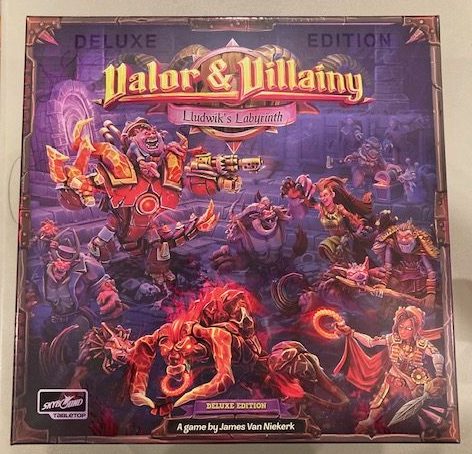
A Review of Valor And Villainy: Lludwick’s Labyrinth. Our Next Campaign? Part I: Unboxing, Solo Play, and First Impressions

IMG_7519

I Kickstarted Valor and Villainy: Ludwick’s Labyrinth sometime ago: back in July 2021. This promised delivery back in September 2022 … it didn’t quite make it. My Kickstarter copy delivered to my house about May 7th, 2023. I have been looking forward to this game: it made the #10 position of my Top 10 Anticipated Cooperative Games of 2022!

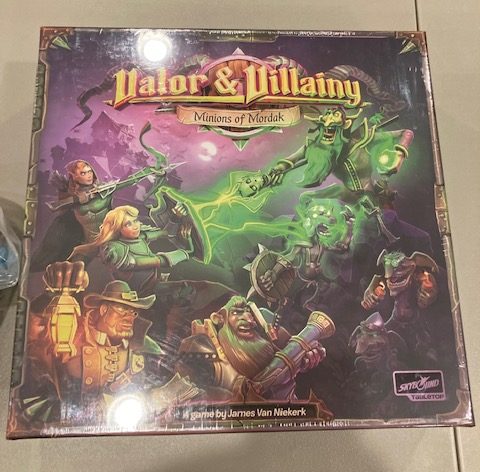
Strictly speaking, Valor and Villainy: Lludwick’s Labyrinth is a standalone expansion to the original game Valor and Villainy: Minions of Mordock. See below.
IMG_7507

The original of Valor and Villainy: Minions of Mordork was a one-vs-many game, where one player took the role of the Villain and the rest of team fought against him.  This new expansion Valor and Villainy: Lludwick’s Labyrinth is fully cooperative and offers a campaign where all the players work together to fight the villainous bosses controlled by the game!  Although this expansion is completely standalone, you can do some combining of it with the original game.  

IMG_7521

The Lludwick’s Labyrinth plays 1-6 plays, Ages 14+, and takes about 25 Min/Player. If you believe the box. Let’s take a look below.

Shipping Box Unboxing

IMG_7504

This is the Kickstarter Deluxe Edition that came in a box … with a box within a box!

IMG_7505

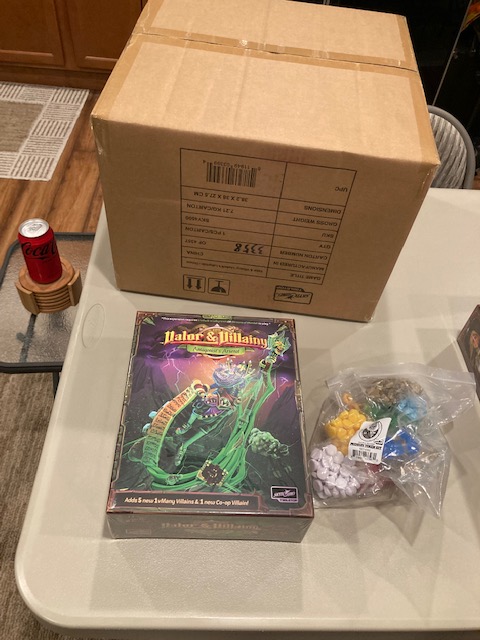
Note that I also got the expansion: Valor and Villainy: Antagonist’s Arsenal, which can make the original game of Minions of Mordok solo and cooperative, as well as the deluxe token token set! See below.
IMG_7510

I am very curious about this Antogonist’s Arsenal expansion, because I can turn the original game into a co-op! That will probably have to wait until another day before we get through today’s game: Lludwick’s Labyrinth!

IMG_7506

Today’s game is Valor and Villainy: Lludwick’s Labyrinth (are you following all these games in the Valor and Villainy universe?): It’s a cooperative boss battler game, with an underlying campaign. It’s a big boy.
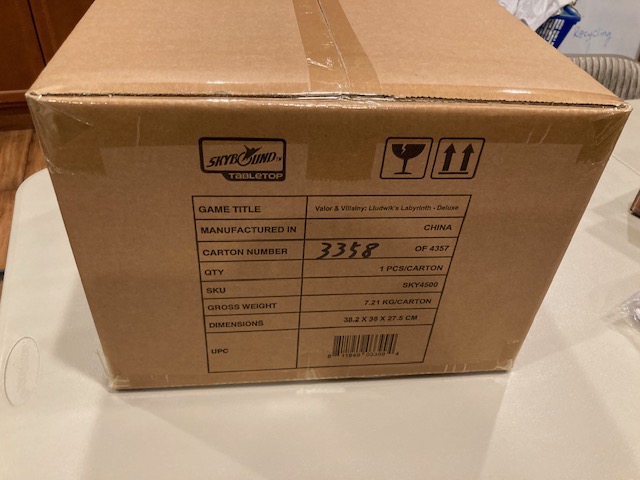
IMG_7512

This isn’t quite as big as The Isofarian Guard from a few weeks ago, but it’s close!
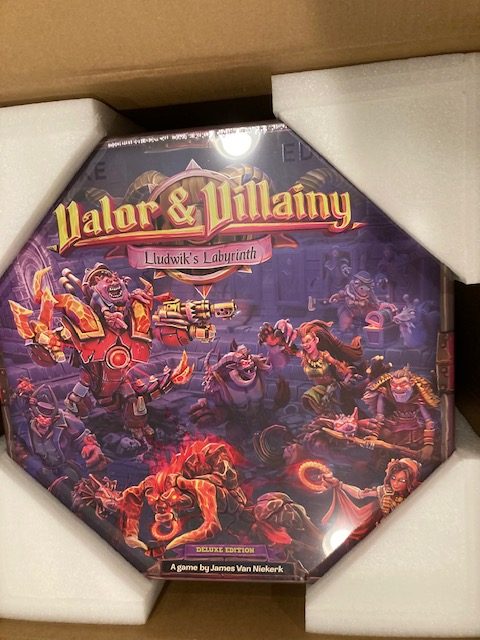
IMG_7513

This big mama-jama takes up the entire box!
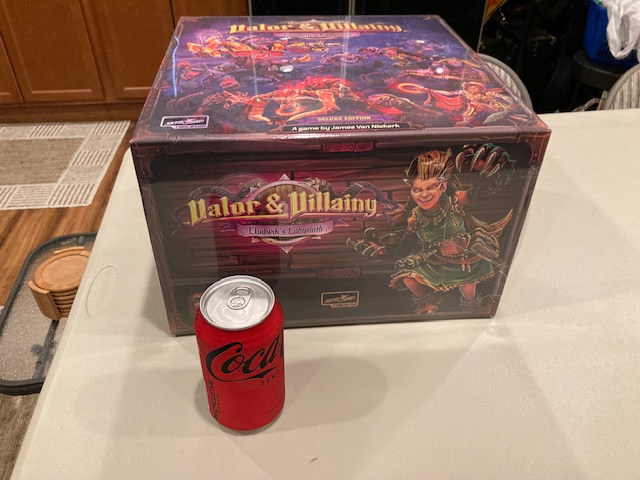
IMG_7516

See the poor Coke can tremble in fear at the size of this box!

Game Unboxing

IMG_7522

Upon opening the box, you see … a pizza?

IMG_7523

Ah! On the other side is a discussion of this deluxe edition of the game! This is great! It discusses how the deluxe edition of the game works with minis, cardboard tokens, and how the upgrades work.

IMG_7525

My favorite moment in this unboxing is reading the last sentence of the second paragraph: “Once you have read this sheet, you can -DESTROY IT!” This tips me off that the game has a sense of humor and has really thought about how to explain how the Deluxe Edition fits in. I think I knew I was hooked when I read that!

IMG_7526 (1)

The rulebook is next: it’s a good size and very readable.
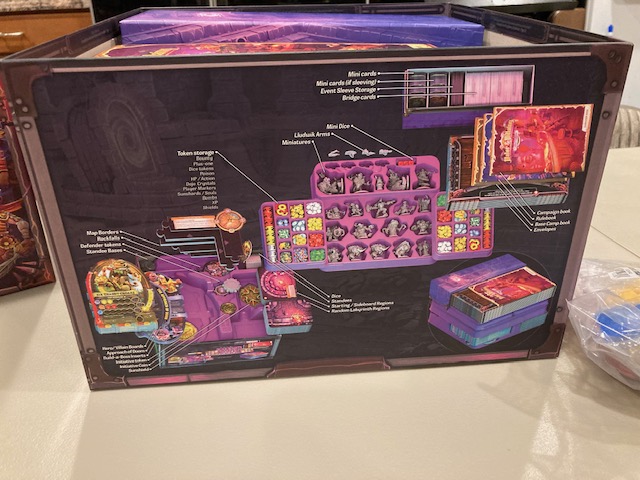
IMG_7541

Note that the side of the box shows you how to put this back together! That’s awesome!

IMG_7543

The next two books are the Campaign Book at the reference sheet. Note how thick the Campaign Book is! I also am worried about this binding … I don’t like it when books won’t just stay open on their own! we will deal with this by GASP folding the rulebook … I didn’t like it, but we had to do it!!!

IMG_7545

See above as it doesn’t stay open without some help. 

IMG_7544

There’s a real nice reference sheet too!

IMG_7549

Under all these books are … envelopes!

IMG_7550

I said this was a campaign game: the campaign unfolds from the envelopes (you can reset the game: there are no legacy elements according to the rulebook). There are 8 chapters.

Underneath the campaign envelopes are the GameTrayz for the tokens.  Note that there are two of them: one for each side of the table!  This makes it really easy to unbox the game: just pull out the trayz!

IMG_7553

Under the trayz are miniatures! Oooh! Pretty spiffy!
IMG_7554

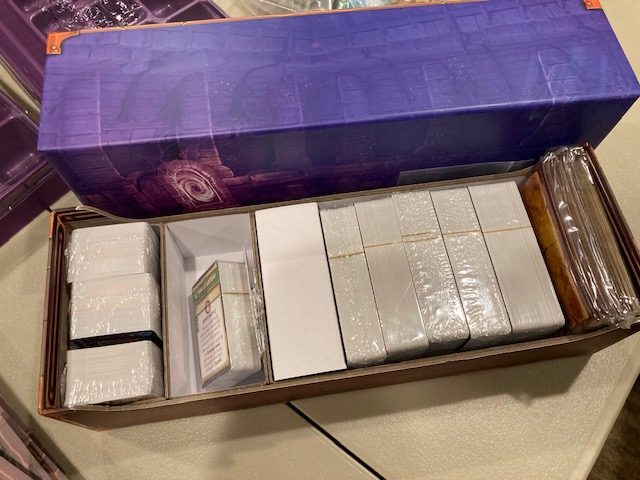
The little cardboard holder holds all the cards of the game.  Be careful not to necessarily unpack all your cards right away! The order of these cards is very important: these cards will guide your campaign and need to come out in a very specific order!
IMG_7555

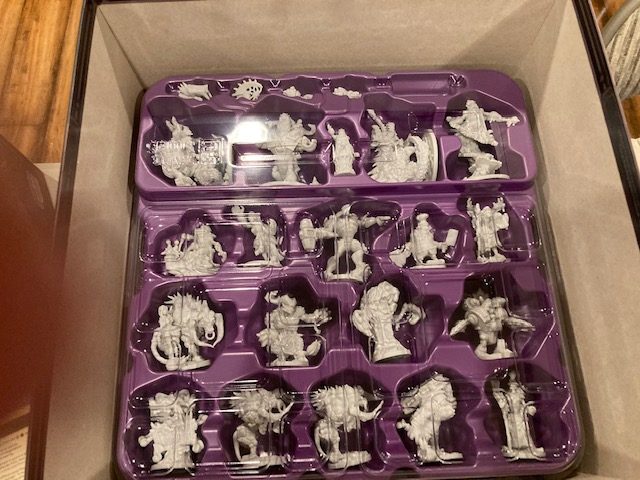
Ah! There’s all of the miniatures!

IMG_7575

IMG_7556

Under the minis are the dice and boards for the heroes (and a few other odds and ends).

IMG_7560

You may THINK we are done, but no! Under the tray with the boards are a BUNCH of punch out boards Seriously! They are kinda “secretly hidden” under the last insert! I didn’t realize they were there until I went looking for the Board of Doom!

IMG_7562

If you get the the upgrade tokens, you won’t need to punch out everything, so hold off on unpunching these too.
IMG_7558

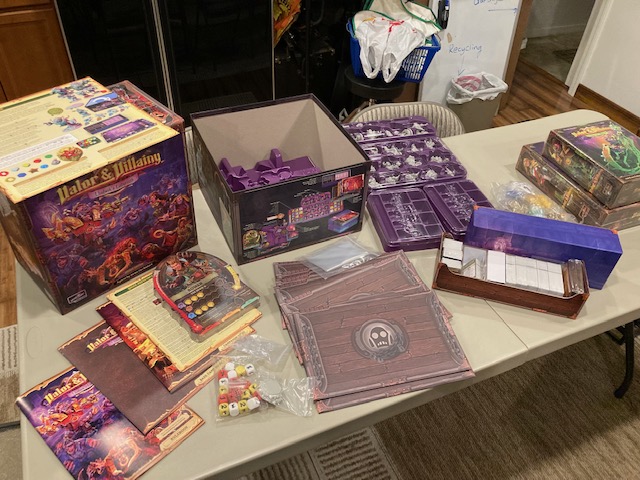
What a fantastic looking game! I love how this looks! I was so excited to moving forward!

Unwrappening and Unpunchening
IMG_7557

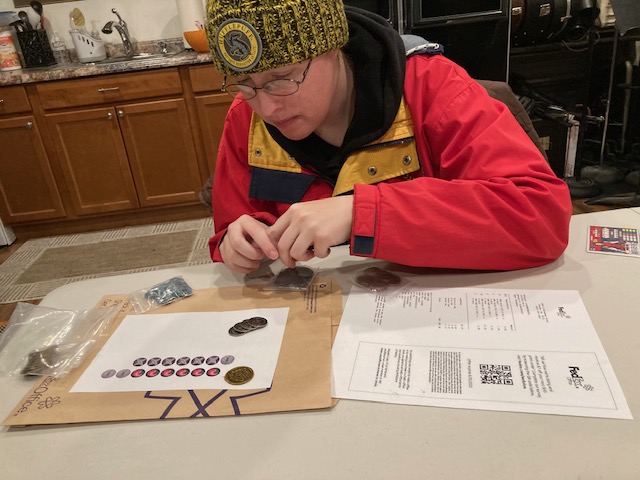
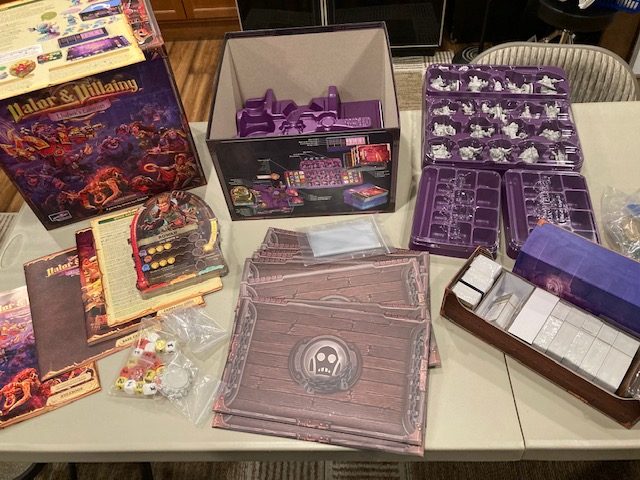
Before I could move forward and actually PLAY, I did have to devote some cycles to unwrapping, unpunching, and filling the GameTrayz.  This was a little more chaotic than it should have been. 

IMG_7563

First of all, the Deluxe Tokens have to go into the GameTrayz! The game box side shows a picture, but they aren’t notated very well. I had to kinda go by picture and guess.

IMG_7567

This was not as easy as it seems. First, it’s not 100% clear which deluxe tokens replace which cardboard tokens. And it turns out, you still need SOME of the cardboard tokens!

IMG_7570

See above as I punch out the shields but NOT a lot of of other tokens? Because not all tokens have replacements, but most do!

IMG_7528

I spent a lot of time trying to sort the tokens: probably too much. It was good, in the sense that I had a better sense of all the tokens in the game, but annoying because the deluxe tokens aren’t labelled. They are kinda labelled in the pizza sheet on top.

IMG_7561

And this just made me laugh: you are REQUIRED to keep the cardboard skeletons! They are needed to prop up up the inserts after you punch out what you need!! I was laughing my head off at this! I am the only person I know that keeps Cardboard Skeletons!! (I did a whole article on them here) So, it was funny to see a game require them! See below as the punchboard skeletons go back in the bottom of the box …

IMG_7583

A lot of the other punchouts are either (a) tiles to explore or (b) backings for cards.

IMG_7578

IMG_7576

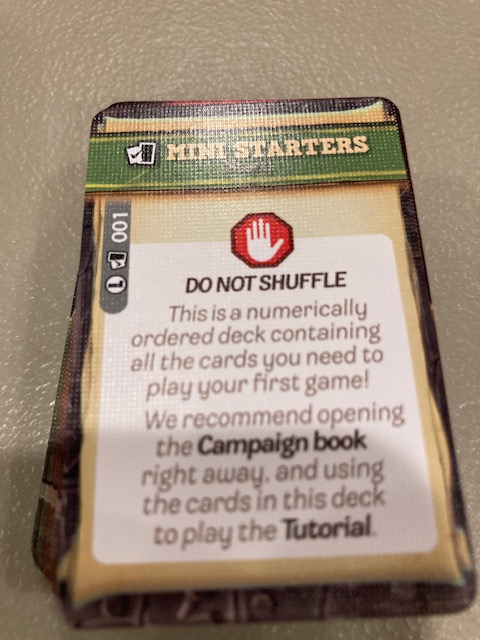
You have to be careful with the cards: I initially unwrapped all the cards, but the order of the cards matters!  A lot of these cards are revealed as you play!
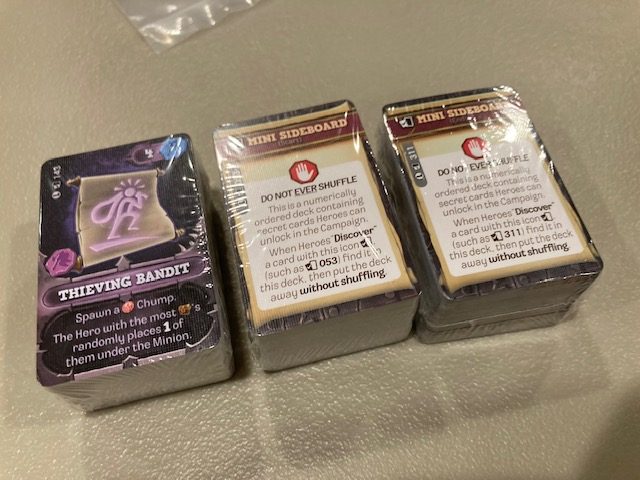
IMG_7577

Notice the DO NOT EVER SHUFFLE!

IMG_7579

It’s also a little chaotic because you are uncardening and it tells you GOTO THE CAMPAIGN BOOK!! But but but … I am not ready!! Nope, get over to the campaign book now!

And that leads to the first play.

Rulebook(s)

IMG_7526

The base rulebook is quite nice.

IMG_7527

The rulebook gets an A- on the chair test: it sits on the chair right next to me very well (very little droopage). I used the rulebook a little, but the tutorial was so good, I didn’t really need to…

Tutorial
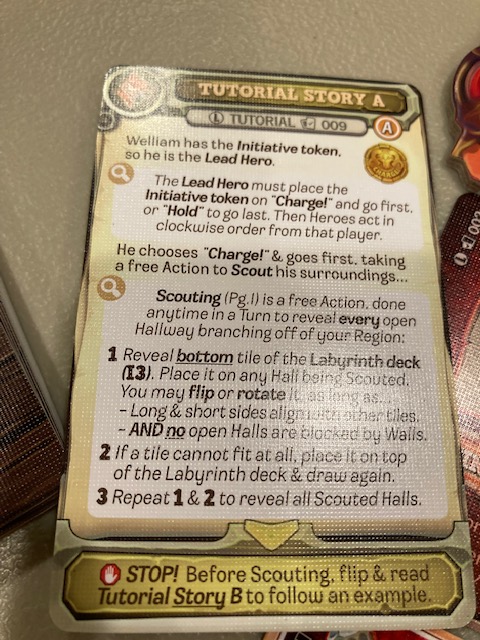
IMG_7596

This is probably one of the best, if not the best, tutorials I have done! This really felt like I was doing an in-game Video Game Tutorial that taught all the basic rules! Two decks (Story deck and Event deck) guide you through an entire game!!! The decks showed WHAT to do, what NOT to do, explained what your choices were, how the game unraveled, how you explored, how to set-up the dungeon, how to fight, how to upgrade, how to get loot. Seriously, this was the most fantastic tutorial I have ever seen. Take a look at how intricate and well-spoken the tutorial card above is.

IMG_7597

You can see the tutorial decks above: the Event deck and Story deck. These were so good at laying out the game. I feel like I haven’t seen a tutorial this good since Tainted Grail (see our review Part I and Part II here) And you know what? If I had a tutorial this good for The Isofarian Guard, I may not have sold that game.

IMG_7611

This Tutorial filled me with confidence: I still see a large rulebook full of rules, but I feel like I understand a lot of the game from this tutorial. That really helps take the edge off how daunting this game looks.

Bright and A Sense of Humor

IMG_7522

In case it’s not clear from the art and some the monsters … and the pizza on top of the game as you open it … this game has a sense of humor. I think that’s why I gave this a chance on Kickstarter: the game doesn’t take itself too seriously! I love the art! This game doesn’t feel like every other depressing fantasy game (speaking of Tainted Grail) out there! The art is bright and crisp! The game looks silly but still professional and fun!

It is still a boss battler with a lot of rules (which the tutorial really helps with), but you are chasing demons who stole the pizza making guy. Seriously! Or should say, … not so seriously. Grin.

This game would be a contender for my Top 10 Cooperative Games With a Sense of Humor.

Solo Play

IMG_7606

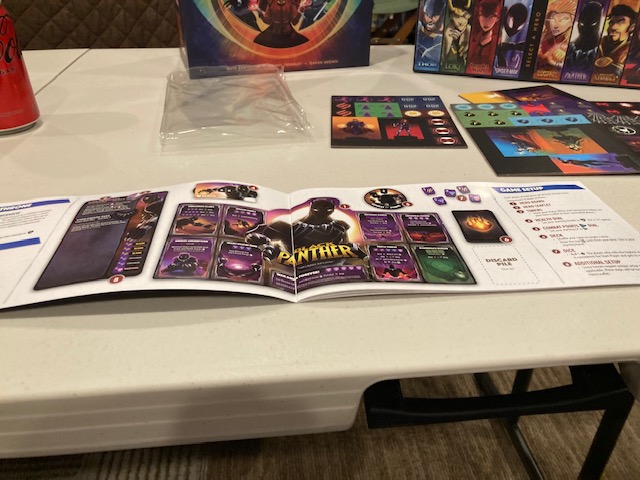
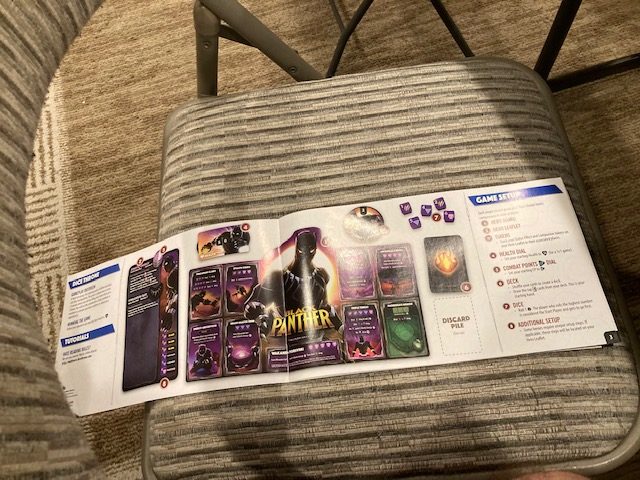
The tutorial took me through my first play. See the Game set-up above (and we had to fold the Campaign book to keep it open! Nooo!)
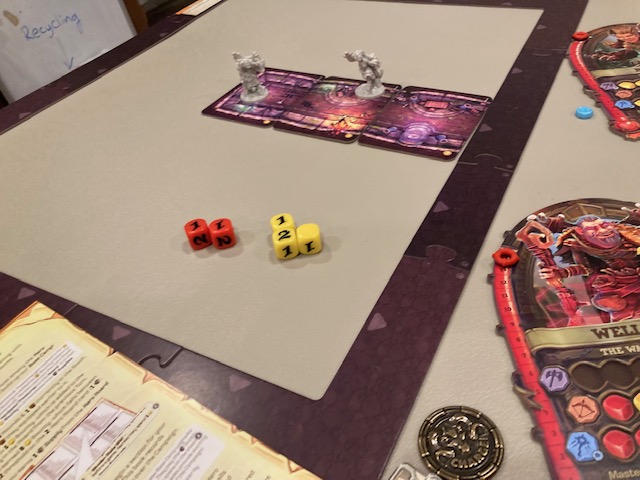
IMG_7603

Something that is a little weird is the border: it’s easy to set-up (surprisingly so: just follow the marks), but it constrains the dungeon to be no more than 5×5.
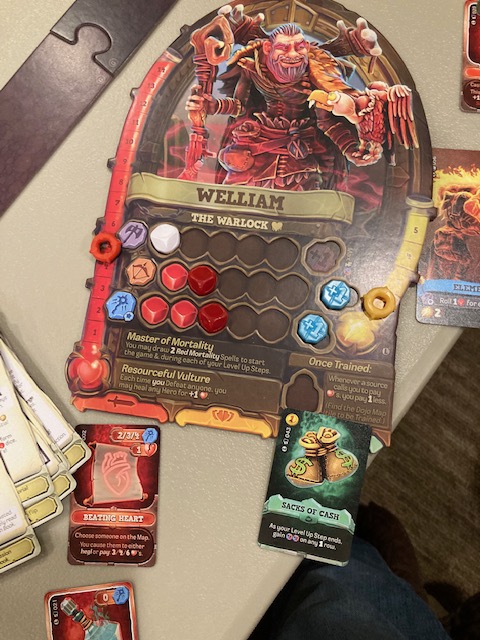
IMG_7615

The first play has you play two characters: Welliam …

IMG_7617

… and Rowan.

IMG_7598

You use their miniatures on the map, and the Tutorial guides you through movement, combat, exploration, treasure. It tells you places you could make different choices, as well as things you CANNOT do. Like I said, a fabulous tutorial.

I had a great time. The nice thing about this tutorial is that it scales for 1-6 players: each player just alternates reading the cards, and all players just play the two characters out. Once you start getting into the game, you get to play your own character.

Cooperative Play

IMG_7709

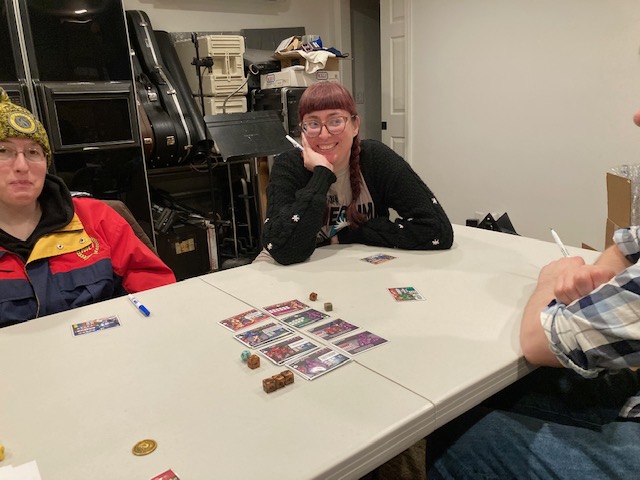
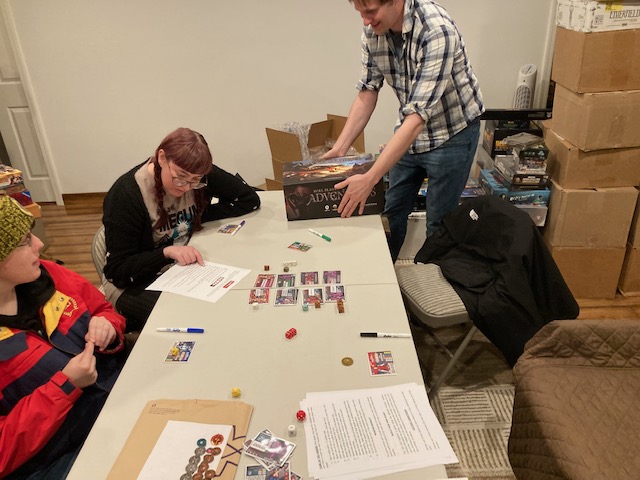
We used the same tutorial to play through with 4 players. It worked great.

IMG_7705

I promised my group that if we tried this game, we’d watch the intro video on the big screen! See above, with the silly animation showing the kidnapping of Guiseppe, the pizza-making guy!
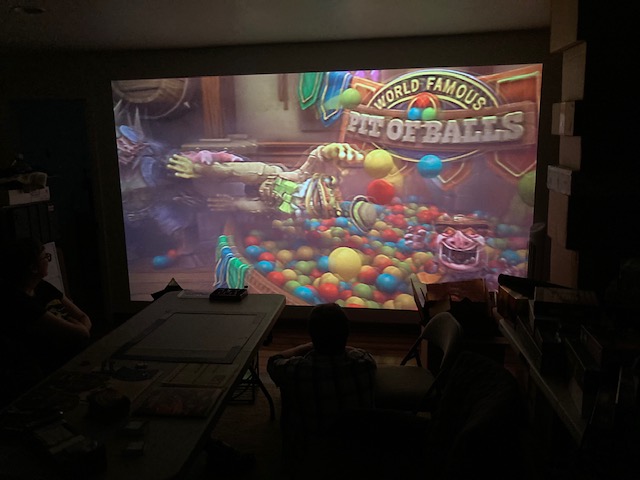
IMG_7706

The video was silly but it gave a nice backstory and sense of what’s to come. It also doesn’t take itself too seriously: I get so tired of depressing fantasy.

IMG_7712

As a group, we played through the same tutorial I played as a solo player. At the end, I asked the group “Do you want to continue playing?” The answer was: yes! We’ll be starting the full campaign next week. The real question is: will this be like Tainted Grail where we played for a while and stopped because were sick of it? Or will this be like Roll Player Adventures where we played all the way through and loved it? Only time will tell!

Conclusion

IMG_7708

So, Valor and Villainy: Lludwick’s Labyrinth is a silly boss battler with amazing components and just about the best tutorial system we have ever seen. This tutorial gives both me and my group a lot of confidence to move forward and try the full campaign. We’ll be running through the campaign over the next few months!

My game group has finished Roll Player Adventures and are looking for a new campaign (Spoiler Alert: We loved Roll Player Adventures! It made the #3 spot our Top 10 Cooperative Games of 2021). At the moment, we are intrigued by Valor and Villainy: Lludwick’s Labyrinth: a funny, well-produced, brilliantly presented, cooperative boss battler. Check back in a while: we’ll let you know how it’s going. I suspect this will end up in my Top 10 Cooperative Games of 2023! (Or will that be Top 10 Cooperative Expansions of 2023? Strictly speaking, this is an cooperative standalone expansion for the original Valor and Villany!)
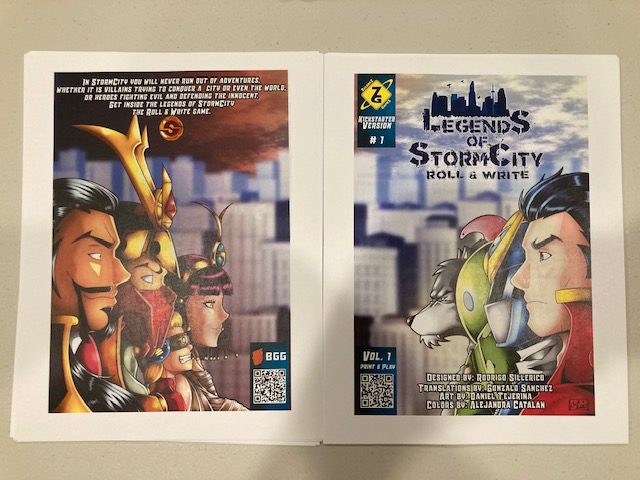
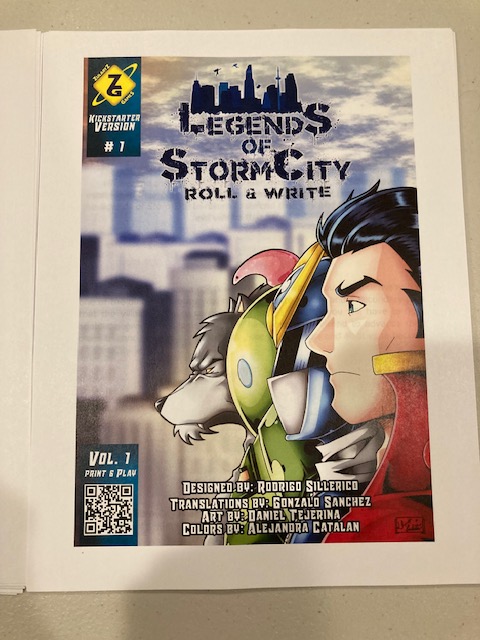
A Review of The Legends of Storm City: A Cooperative, Superhero, Print & Play, Roll-and-Write Game

IMG_5018

So, we are going to do something a little different this week: this week’s game is a Print & Play game that was #2 on our Top 10 Anticipated Cooperative Games of 2022! I think the reason we were so interested in it was because they haven’t been too many cooperative roll-and-write games! We’ve seen Escape: The Cooperative Roll and Write (see our review here), and there are a few more coming out this year … and that’s about it! We are also super interested (no pun intended) because we really like cooperative Superhero games here at Co-op Gestalt! See our Top 10 Cooperative Superhero games here!

IMG_5019

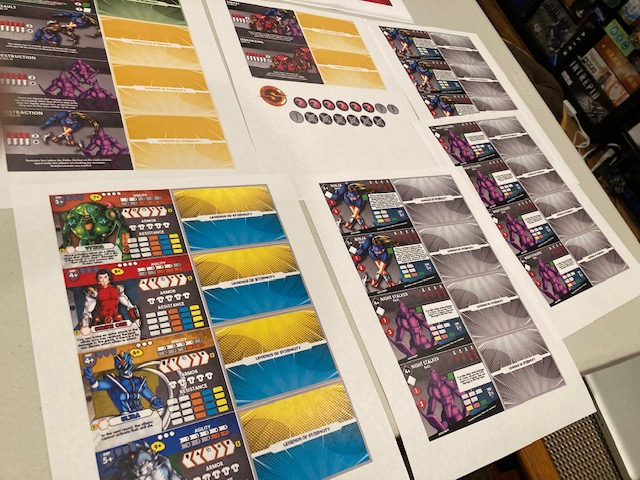
However, this is a new experience for us! This is a Print & Play from Kickstarter (see the Legends of Storm City Kickstarter here). It was released this January 2023! And when we say released … we mean that we got a bunch of PDFs in a google drive that we have to print ourselves.

Print: Headed to the Print Shop

IMG_4989

My printer at home isn’t great for Print & Play (and the ink costs are ridiculous), so I though I’d head to my local FedEx store and print it there, using their super high-quality color printers.

IMG_5014

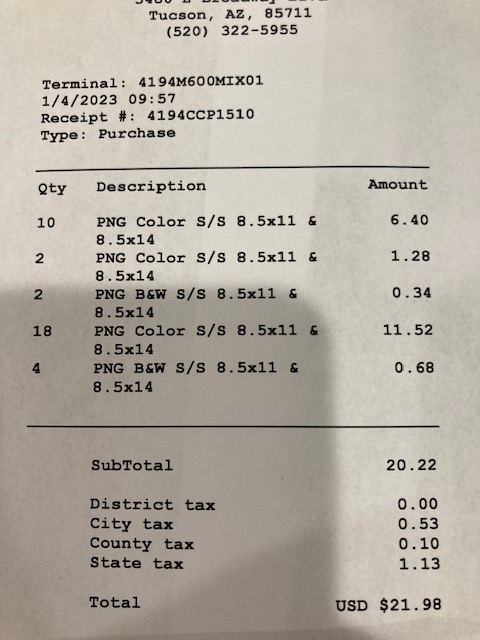
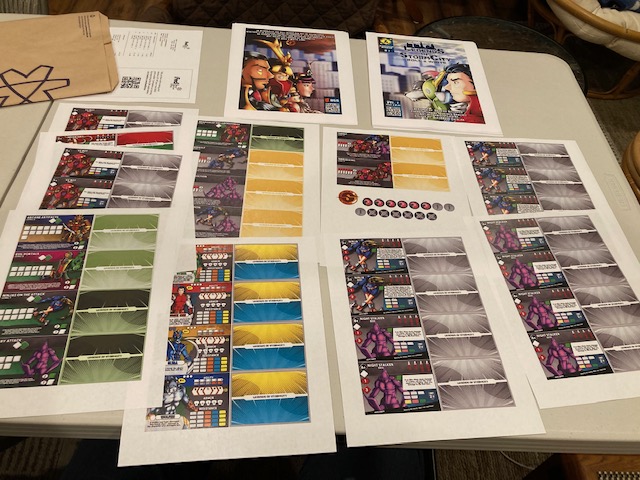
It all fit in a paper bag (which will end up being the final home for it once we pack it away). What was the cost? And what did we get?

IMG_5015

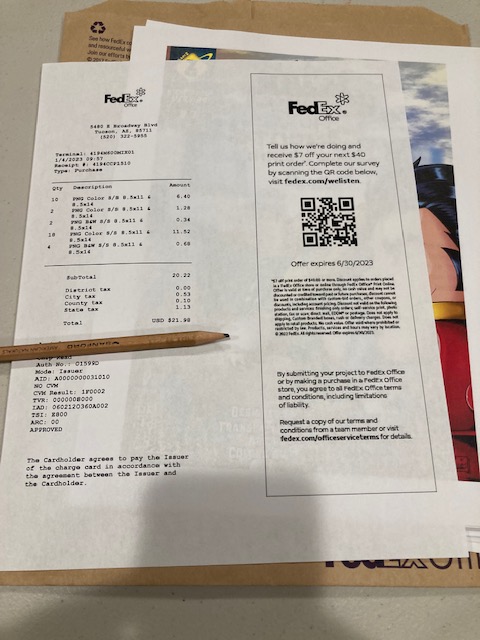
You can see out costs above and below:

IMG_5016

So, 36 pages cost $20.33 + tax = $21.98. The printer was even smart enough to realize that some of the pages were black and white, so I only got charged 17 cents per page instead of 64 cents for the color pages.

IMG_5020

Overall, they printed very well and look nice.

Cut: They forget a step!

IMG_5024

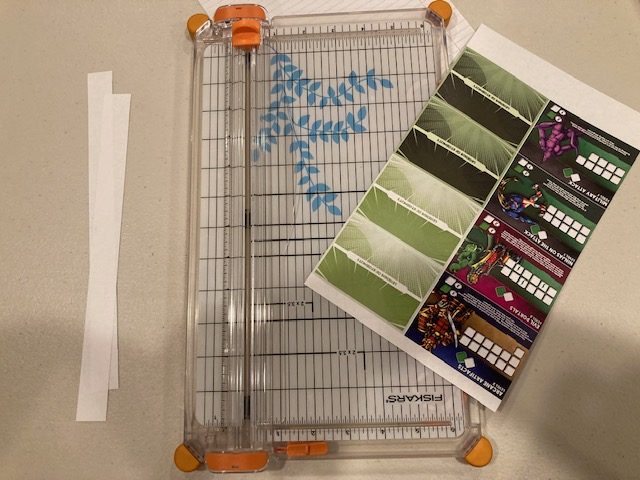
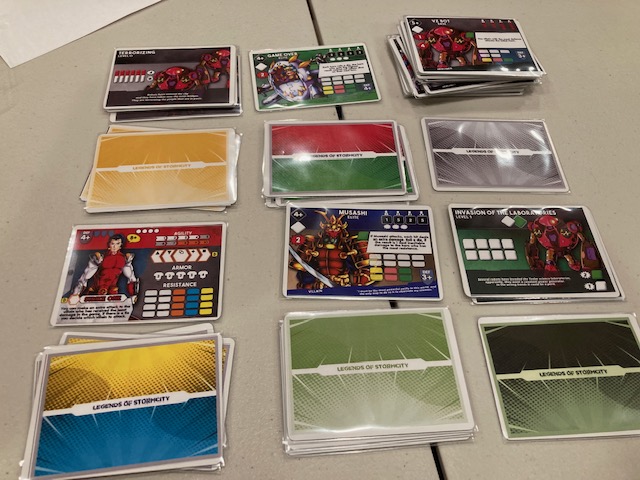
I think they forgot a step when they named these games: They call these games Print & Play, but I think a better name is Print & Cut & Play! You still have to go through a lot of work to cut everything up before you can play!!!

IMG_5021

Since this is a roll-and-write, you write on the sheets(s) and then throw away the sheets when you are done: think of a Yahtzee pad that you fill in and then throw away when done. That’s what a roll-and-write typically does.

What are our options?

  • Print multiple copies of the game sheets like Yahtzee!  Mark up the sheets as I play, and then throw the sheets away when the game done.  Expensive, as you saw the prices from the Print step
  • Do some erasing to reuse the sheets, but eventually throw them away.  Okay for the short term, but as saw from the printing prices, I don’t want to print more than I have to!  And erasing always makes the sheets look yucky
  • Laminate the Cards and use dry-erase markers.  Great idea, but the margins are quite thin on sheets, and laminating only works when you have lots of plastic on all the edges.

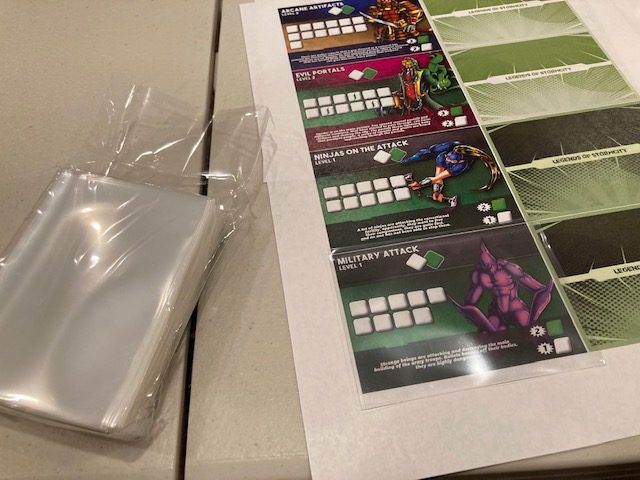
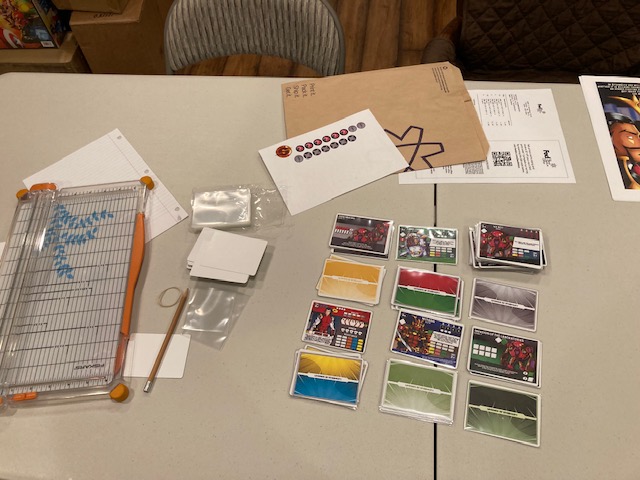
None of these are great choices for this game. However, in this case, all the cards are basically “standard” card size: If I use card sleeves, then I can cut the cards out and place them in sleeves! Then, I can write on the card sleeves!

IMG_5022

The card sleeves fit perfectly! See above. The only problem is that paper I printed on was pretty weak, so I chose to reinforce the card sleeves with real cards.

IMG_5023

I have a bunch of empty cards from GamesCrafter, so I chose to use those, but I could easily see using cards from a plain deck of cards as well for reinforcement.

IMG_5024

Cutting this out was … not fun. I even have a very nice little cutting helper, and it still took me 1.5 hours to cut everything out and sleeve it.

IMG_5025

You can see above that I got decent results. If you are OCD, you probably don’t like that the papers don’t fit flush against the card stock: basically the white outline of the cards needs to be centered. Depending on how OCD you are, you can spend the time to center the pieces of paper … I didn’t spend that much time on that.

IMG_5031

I spent 1.5 hours cutting and fitting.

IMG_5030

A little tip: keep the PDFs nearby, or take a picture of your full sheets (like I did above). As you cut up the cards, you forget which backs go with which cards because the backs aren’t labelled. (They probably should be).

IMG_5033

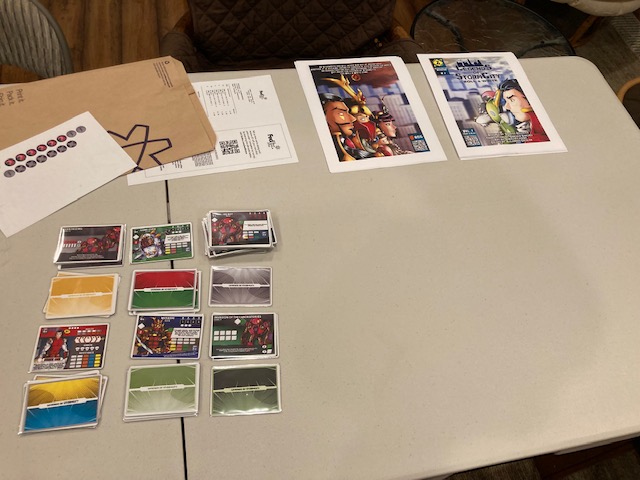
There are 6 cards types and 6 backs. See above.

IMG_5034

By the time I was all done, I was pretty tired: this was a lot of work. I kind of wished I could have spent $30 to have the game printed and shipped to me. I paid $5 for the kickstarter PDF files, $21.98 for printing for $26.98. Them I spent 1.5 hours of my life cutting and fitting sleeves (not to mention the .5 hour at the FedEx store) .

I would have preferred a $25 kickstarter with $5 shipping. I don’t think I realized how much work a Print&Cut&Play was until now.

One final note: I want to say that the Legends of Storm City people did a phenomenal job making all the PDFs aligned! It was easy to just cut many sheets at once because everything was precisely aligned on the page. That probably cut (no pun intended) an extra hour of the cutting process. Thank you! It could have been a lot worse!

Read: Oops, Another Step

IMG_5035

Before we play, we have to read the rules.  I think that turns this into a Print&Cut&Read&Play!

IMG_5047

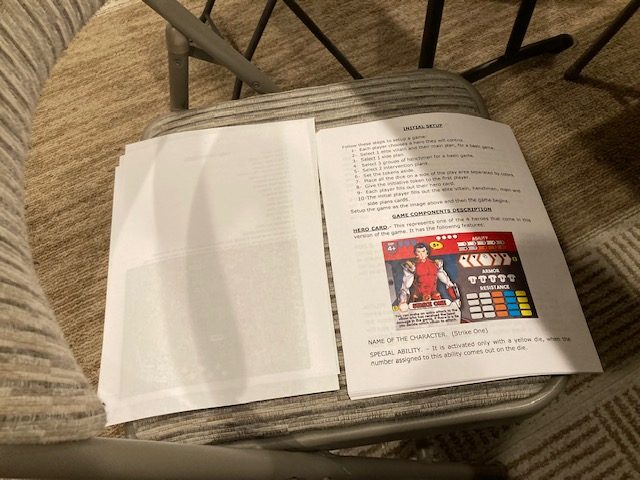
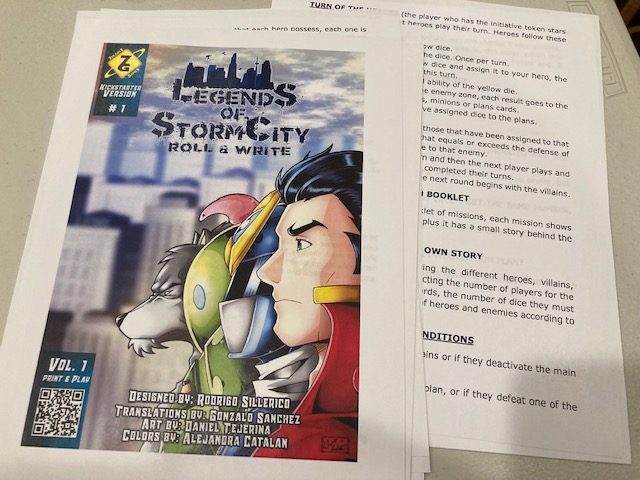
The rules are on standard pieces of paper … because that’s how I printed them. Strictly speaking, I did NOT have to print the rules or the scenario book (which would have dropped the printing price quite a bit): I could have looked at the rules on my phone or padd. In the end, I prefer to get away from my technology when I play games, so I went ahead and printed all the pages.

IMG_5049

The joke here is that I only get a B on the Chair Test: the pages tend to flop over the edges of the chair a little! This is funny because I printed the rulebook, so it’s my fault the form factor isn’t a little better! It was nice, however, to have the rules easily flippable on the chair next to me as I played.

IMG_5017

I will say, these rules aren’t great. I’ve had to read through them several times to get what’s going on. Some of the word choice and tense choice suggests this is a translation, so that explains parts of it. There were a bunch of places where I just had to “move on” as I read in hopes the rules would be clearer later.

I’ve played through now a few times, and the game does start to make sense. The rules are mostly there. I think the rulebook needs some better elaborations and organizational rethinks. Look, I only paid $5, so I can’t complain too much, right? Still, it was a frustrating read. But I did finally understand most of the game.

Go And Get Your Own Components!  This is a Print&Play After All

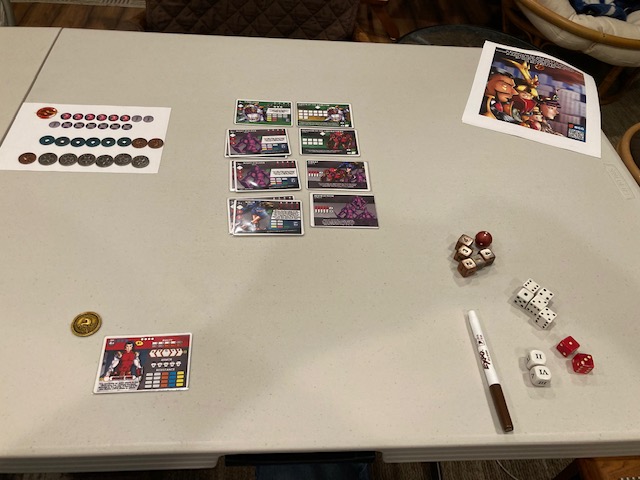
This seems like another step: Go And Get Your Own Components or GAGYOC.  Since this is a Print&Cut&Read&GAGYOC&Play game, we need to bring our own components (besides the sheets) to the table. The only components we’ve had up until now are the sheets we printed.  But, we need more!

IMG_5028

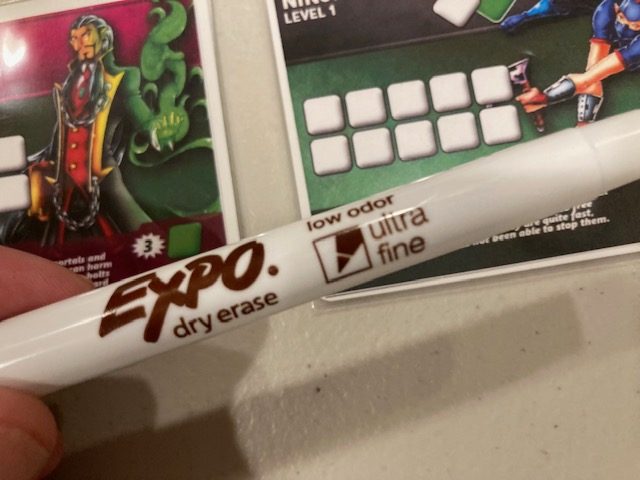
The most important thing for us is the Ultra Fine dry erase marker!!  Because we want to be able to reuse all the cards, we have sleeved them: we will be using a dry erase marker to mark up the cards.  It is VERY IMPORTANT to get the ultra-fine for this system: the little boxes on the cards are pretty tiny, and any bigger marker will be completely illegible.  Even the Ultra Fine isn’t perfect (see below), but it works.  (We saw how important Ultra Fine Markers were when we reviewed another game with dry-erase boards: The Forests of Adrimon.  See our review here and how much we complained for NOT having ultra-fine markers).

IMG_5063

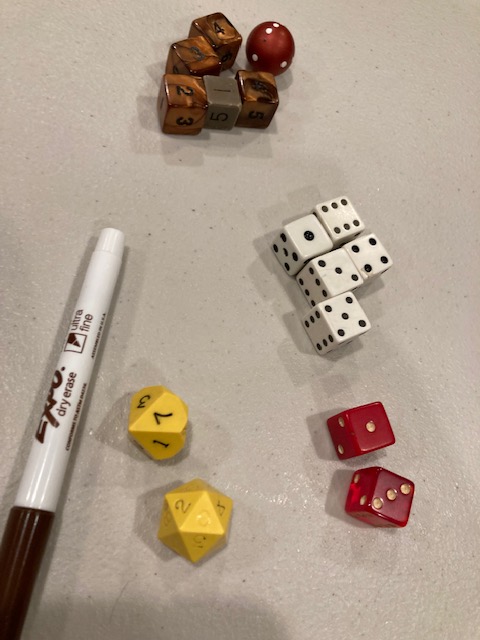
We also need a bunch of 6-sided dice:

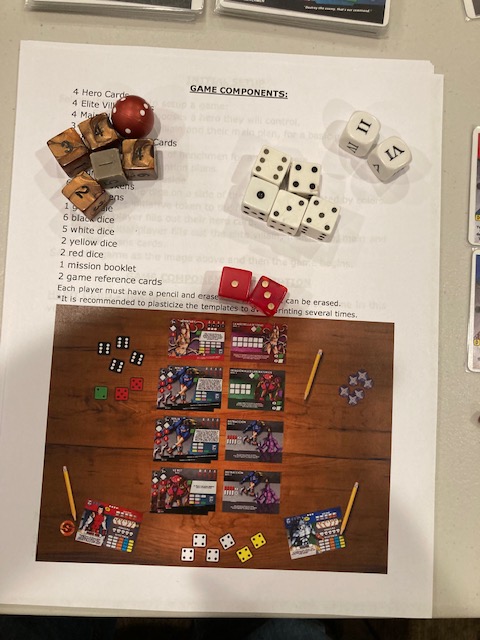
IMG_5053

6 black dice (brown) for the bad guys,  6 white Dice for the good guys, 2 red dice for bad guy threats, 2 yellow Dice for good guy abilities, and one green dice for bad guy abilities (not shown).  Since I didn’t have any yellow 6-sided dice, I chose to use a 10 and 20-sided and re-roll when I don’t get a 1-6.   Hey, I am scraping by to get all the dice I need, all right?

IMG_5036

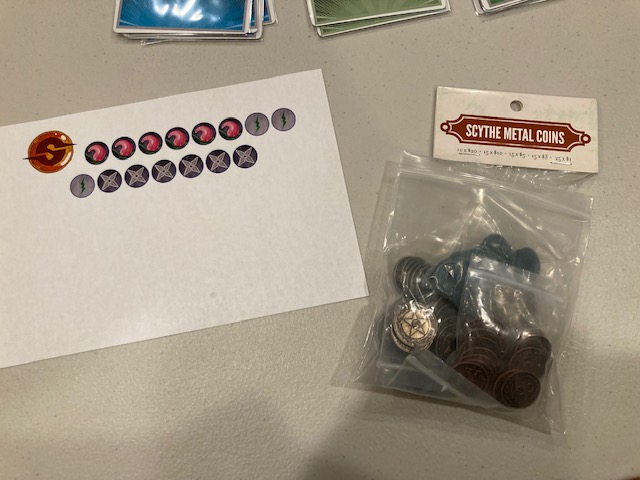
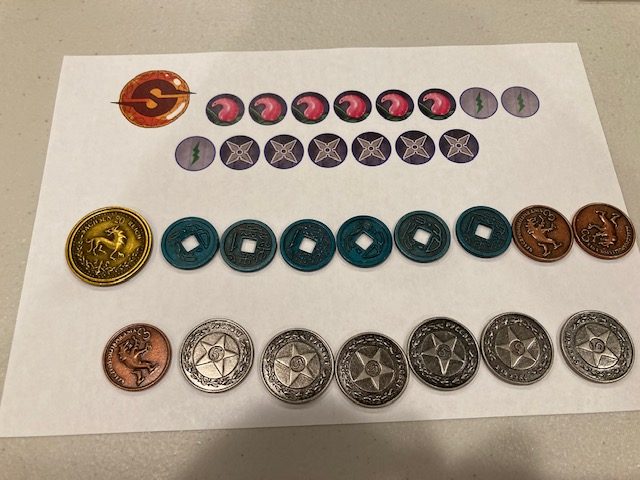
The final step to GAGYOC is to gather some tokens. Now, the tokens come on a sheet you can cut-up (left above), but I think the Scythe metal coins work as perfect replacements! I don’t have to cut anything else!

IMG_5037

The Scythe metal coins worked surprising well: it was pretty obvious what coins should be what tokens. See above.

IMG_5051

So, that’s kinda all your components!

Set-Up: Are We Ready to Play yet?

Nope! One more step!  Gotta set everything up!  Let’s got through the cards and choose the appropriate cards to use:

IMG_5043

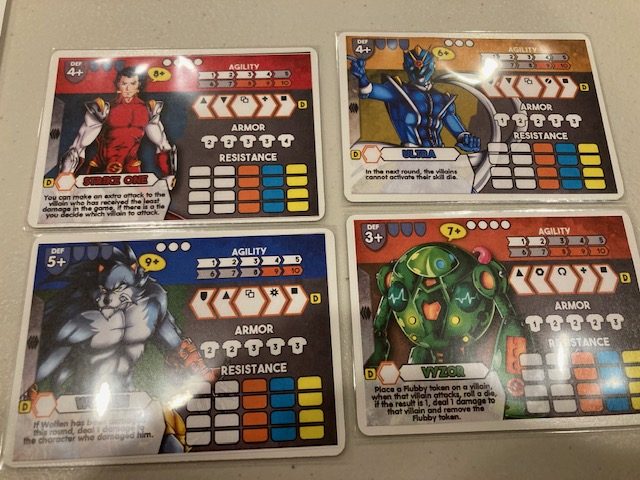
Above are the 4 Hero Cards: each player takes a card to take the role of one of these heroes.  The game can play 1-4 Heroes.

IMG_5044

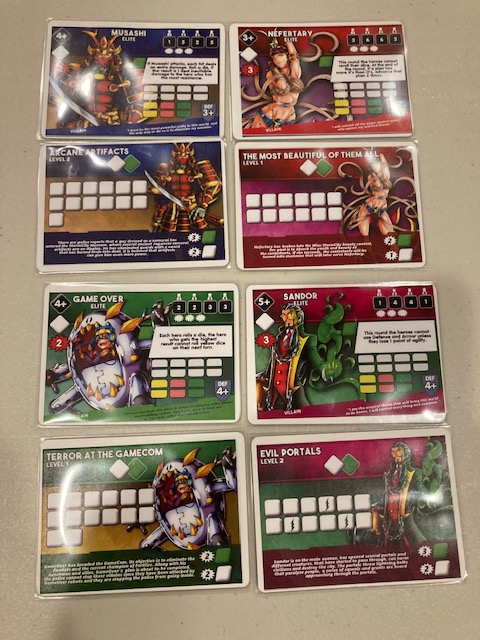
The goal of of the game is to take out the Elite Villain before his/her Main Plan come to fruition.  Choose one Villain to fight (above, right) and take his/her Main Plan (above left).

IMG_5042

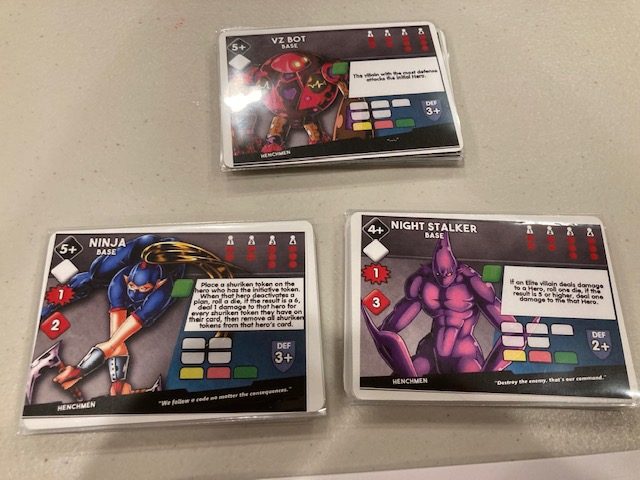
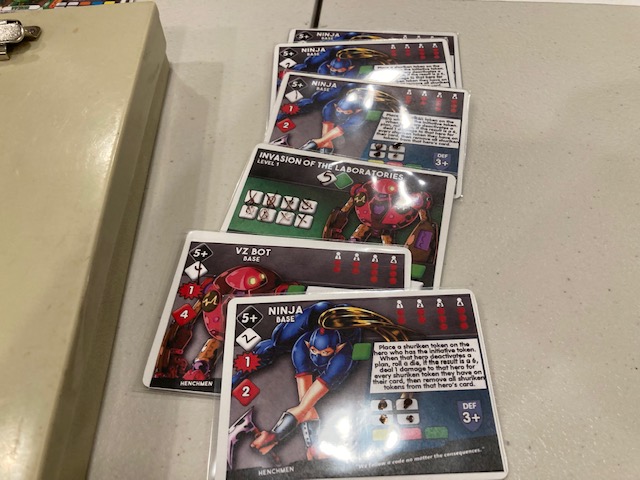
Each Elite Villain also has some Henchmen: See above.  These are the Henchmen cards: you’ll choose three sets of these when you play, maybe all different, maybe some if the game.  These Henchmen work for the main villain!  (The Scenario book will help you choose these).

IMG_5045

There are also Side Plans which cause problems for the Heroes: players must choose 1 Side Plan as well.

IMG_5046

Finally, there are Intervention Plans (see above). Players will choose two of these.

IMG_5048

The Set-Up from the book will show you how to set-up: see above.

IMG_5051

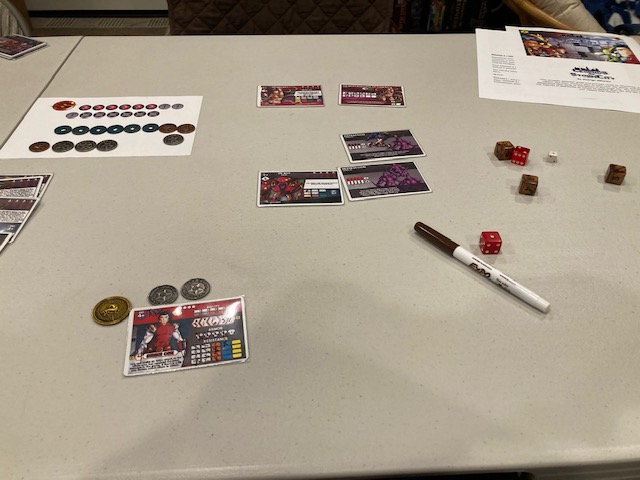
In the end, your board should look something like this!

Play: We Made It!

IMG_5054

So, we made it to the Play step of the increasingly misnamed Print&Play! I think, in the future, we will call these Print&Cut&Read&GAGYOC&Set&Play games. I mean, it was a lot of work to get here! The name should reflect that!

IMG_5056

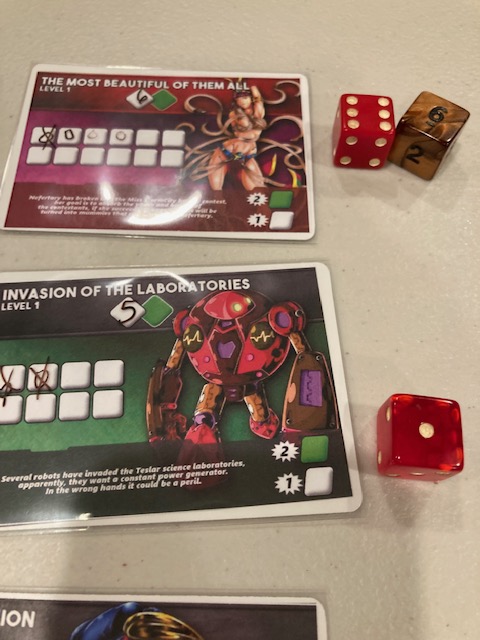
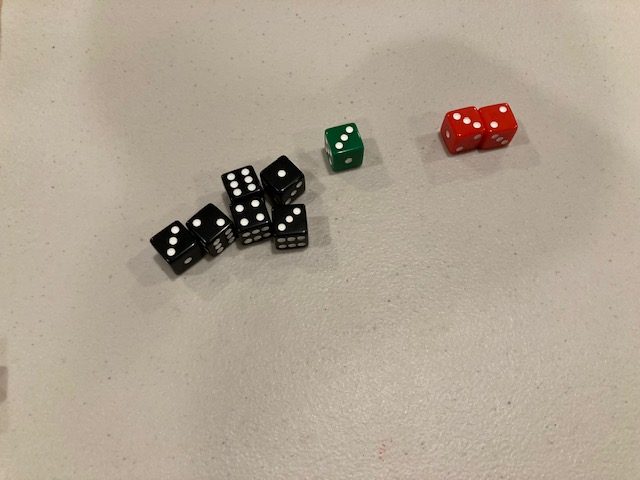
The main mechanic of the game is to roll dice and assign them to something. The Elite Villain, 3 Henchmen, and 2 Plans are all marked with a “random” but unique number from 1 to 6 (and marked on the card at the start of the game). On the Villain turn, when we roll the Brown dice and roll that number, we activate the appropriate card! The red dice activate threats in a similar way. Above, you see the Main Plan activated once (with a 5), the Side Plan activated twice (two 6s), and the little tiny die (supposed to be green) activates the special ability on the Henchmen (henchman 4).

IMG_5057

It’s a little easier to see up close: See above as the Ninja is activated on 1s (1 in the white diamond tells us which card).

The bad guys do damage to use trying to take us out. Villains win if they activate the main plan, or if they defeat one of the heroes.

In fact, the Heroes lost their first game as Strike One lost all health (white, orange, blue, and yellow blobs).

IMG_5072

The Heroes win if they defeat al Elite Villains or deactivate the main plan. Nefertary was only one point away from being defeated!

IMG_5070

IMG_5068

Actually … maybe we did win, since we took out the Main Plan before Nefertary killed us!! Heroes deactivate spaces (marked with Xs), Villains activate spaces with Os. Villains roll a 6 on the black dice to activate, Heroes roll 6s on white dice to deactivate.

IMG_5060

The Hero turn is similar, except they roll and assign White Dice! (And you get one reroll). White dice on Henchmen or Villains means you need to roll again to attack, White dice on Plains deactivates them one space.

IMG_5061

There are much more specific rules to the Villains and Heroes, but that’s the crux of the game: alternate between Villain and Hero turns until someone wins!

Solo Play

IMG_5065

This game supports Saunders’ Law and allows solo play. And thank goodness! Since the rules aren’t very good, the solo player really needs time to go over the rulebook a few times and get a few games under his belt before he teaches the game!

IMG_5067

Once the solo play gets going, it has a nice flow of rolling black dice, figuring out bad guy effects, then rolling white dice for good guys effects (with a possible reroll). I generally had fun once the game started moving, but it was pretty hard to get to that point. The rules made this hard to learn.

Cooperative Play

IMG_5814

This was one of the more “interesting” plays we’ve had in a while.  Unfortunately, not in a good way.

IMG_5813

Since I hadn’t played solo in a while, there was quite a bit of downtime upfront rereading the rules. And I was reminded how many rules there were!

IMG_5816

We were using the crappy dice I had, when Andrew remembered I had Roll Player Adventure! With real properly colored dice!

IMG_5819

From then on, he dice were SO MUCH better! That helped a lot!

IMG_5820

This 4-Player game took about 1.5 hours.

IMG_5821

And my friends did not like this.

IMG_5830

In the end, we won, but we completely smashed it. It wasn’t really that hard.

Conclusion

IMG_5075

This was my first real experience with Print&Play, and I think it really needs to be renamed to Print&Cut&Read&GAGYOC&Set&Play to represent all the work it takes to get to the final play!  I guess I don’t honestly think they’ll change the name, but I didn’t expect there to be so much work.

If you have a printer with cheap ink, then I think printing at home is probably good for you. Unfortunately,  the printing costs for me seemed to suggest I print someplace more professional, but I did pay for it!  With a $5 cost for the Kickstarter and $21.98 cost for the printing, and then several hours of work to assemble everything, I think I would have paid a little extra, like $30 for the game to be professionally printed and boxed and shipped.

IMG_5823

In the end, I liked the game, but friends really didn’t.  Their scores were quite low: 3/10 from both Sara and Andrew, and 5/10 from Teresa. Essentially, they never felt involved, there were too many rules for a small roll-and-write, there weren’t a lot of choices, and they never connected with their hero.

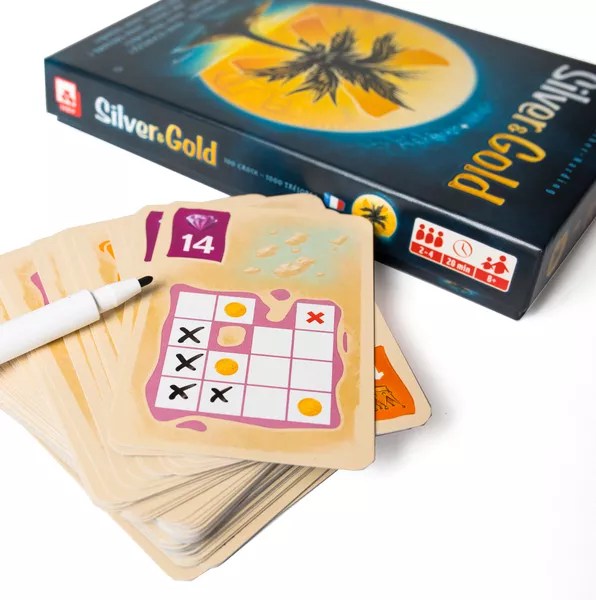
What I would really love to happen is to see a bigger company pick this up: there’s a good game in here, but it’s a diamond in the rough.  The rules need to be really tightened and cleaned up.  And the assembly is so much work.  The best thing, I think, is if the game got a professional printing and you could write on the cards!  Silver and Gold is a great game where you can write on the cards with dry-erase markers: that’s just what this game needs! I suspect this game could even fit in the same sized box as Silver and Gold!  (Just make sure you get an ultra-fine dry erase marker)

pic4883502

I like The Legends of Storm City, especially once you get into the swing of things. But it needs some work: I’d give it a 5/10. I like it and I’d play it again, but I just worry about forgetting the rules because the rulebook isn’t great. As a counterpoint, remember that my friends didn’t really like this at all.

That said, I’ll bet I would bump this to 6 or even more if they tightened the rules and professionally printed Legends of Storm City like Silver and Gold.

Did You Know That There Is a Game Design Boy Scout Merit Badge?

IMG_6995

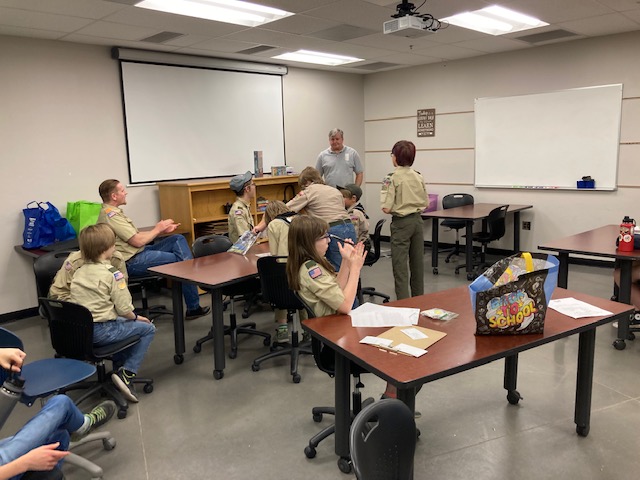
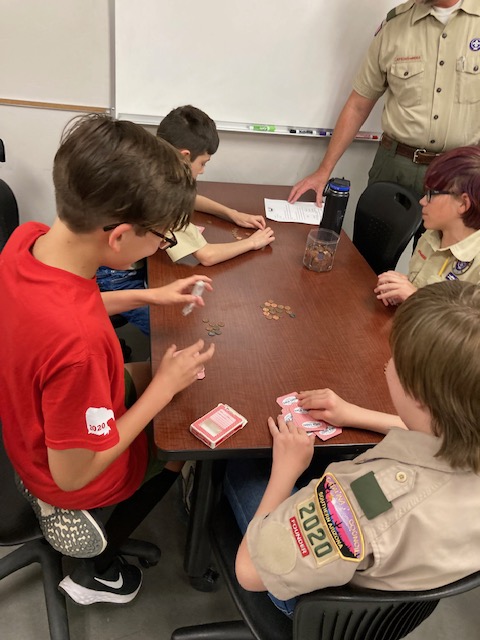
Recently, my friends Mike and Dustin, the Scoutmasters for a local Boy Scouts troop, invited me to discuss some board games I had designed. I learned, upon arriving, that this talk was to satisfy one of the requirements of a Game Design merit badge for the Scouts! I did even not know such a merit badge existed!

gamedesignbadge

It turns out there is an 8-step list of requirements you need to meet.  The full list and discussion is here but here’s a quick rundown of the requirements for a Game Design merit badge:

  1. Analyze previous art
  2. Discuss possible directions with a counselor
  3. Discover what Intellectual Property is
  4. Take an existing game and vary some of its rules as an exercise
  5. Design a New Game
  6. Create a Prototype and Test your New Game
  7. Blind test your New Game
  8. Meet with a professional to discuss game design

IMG_6994

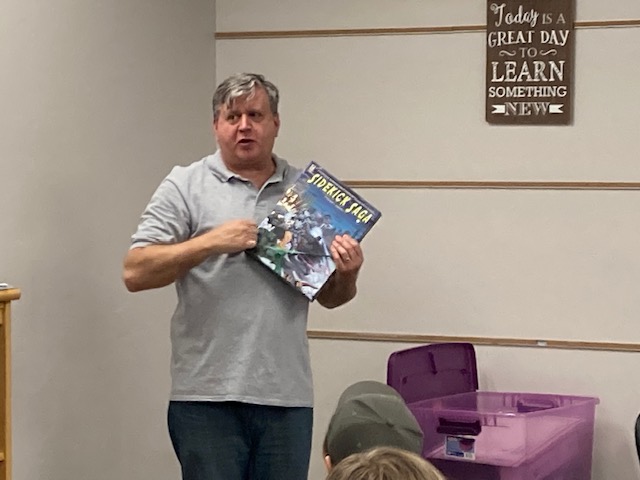
So, my meeting with the group satisfies item 8 from the list. Strictly speaking, I am a professional, as I made money from my board game designs of Co-op: The co-op game and Sidekick Saga. Even though I didn’t make a lot of money, strictly speaking, I do qualify as a professional!

IMG_7007

Over about 20 minutes, I brought out various prototypes of my games (from 3×5 index cards to in-between prototypes to full professional printing), talked about the importance of keeping a journal, discussed the importance of testing, and implored the group to be receptive to feedback. Even as an adult, it’s hard to hear criticism of something you have put a lot of time and effort into: I wanted younger kids to be aware that feedback/criticism can be essential to learning and improving!

IMG_7004

We also discussed the differences between Game Design and Game Publishing: Designing a game is very different than trying to Kickstart and sell your games!

IMG_7008

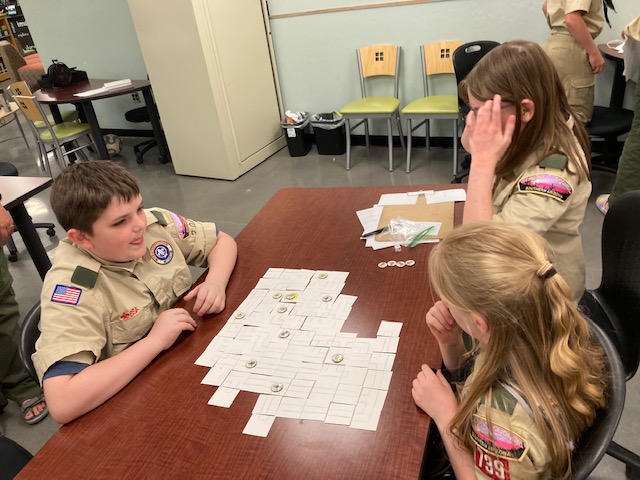
In the end, I ended up hanging out for a little bit and talking about game design and watching the kids and their games in various states.

IMG_7009

Thanks to Mike and Dustin and the troop 2020! It was great talking to you guys!

IMG_7010

A Review of Skytear Horde: A Cooperative Tower Defense Card Game

IMG_5834

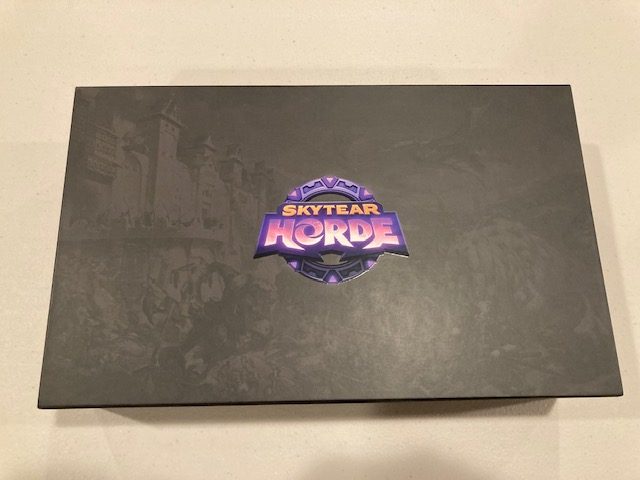
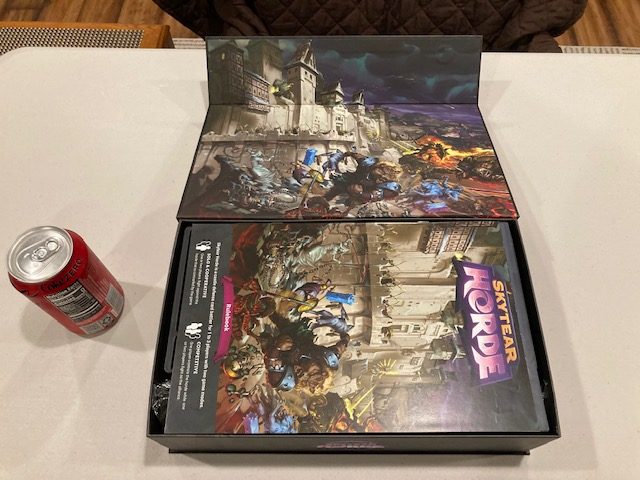
Skytear Horde is a cooperative tower defense card game that was on Kickstarter back in January 2022. It promised delivery in October 2022, but was about 5 months late as it just delivered to me in early February 2023.

IMG_5836

The game plays 1-3 players, but it’s only cooperative at two players (the third player plays the Horde). As a solo or 2-Player cooperative game, players assume the role of the the good guys (“The Alliance”) , keeping the bad guys (“The Horde“) from destroying our tower.

IMG_5837

Let’s take a look!

Unboxing

IMG_5838

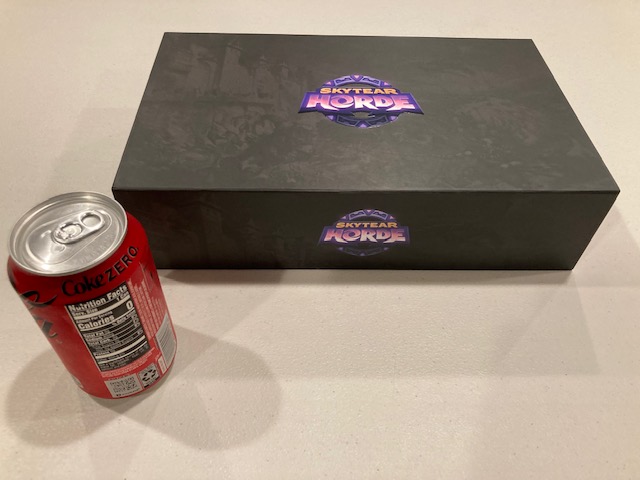
This is a tower defense game and it’s mostly cards, so the box isn’t really that big: see the Coke Can above.

IMG_5839

The Kickstarter version I have has the magnetic sealing box. It also has some pretty great art o the inner cover.

IMG_5848

IMG_5841

There are some cardboard punchouts (which we won’t need, see below):

IMG_5840

And the rulebook, which we’ll discuss more below.

IMG_5842

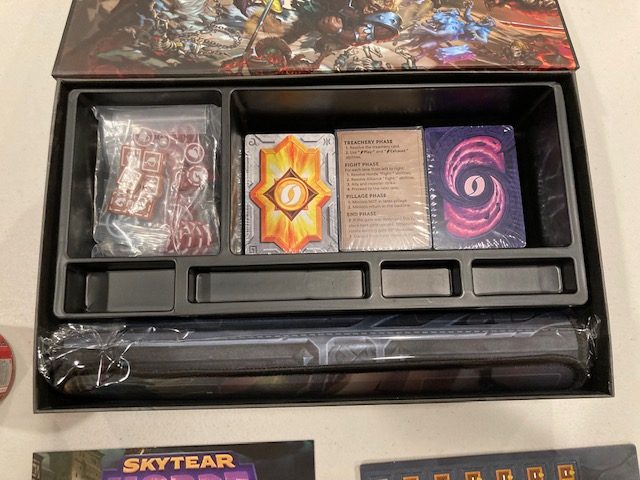
This is mostly a card game: see cards above.

IMG_5843

What’s this thing? A really awesome game mat … that only comes with the Kickstarter version (but it looks like you can buy it here).

IMG_5849

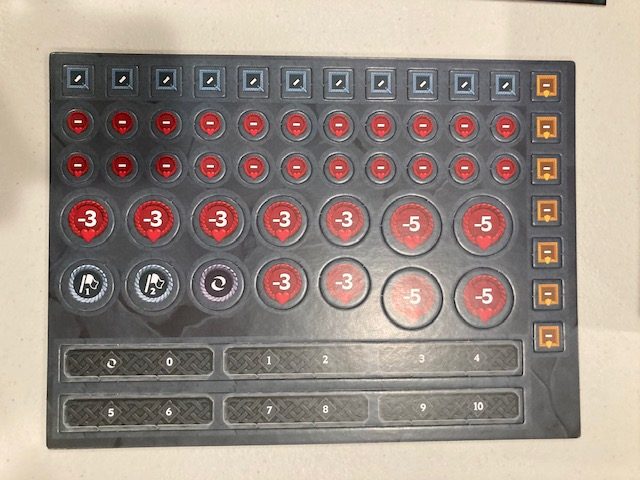
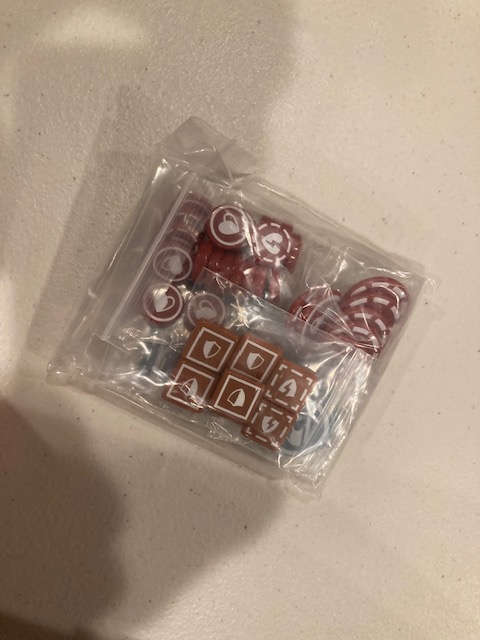
The Kickstarter version comes with a bunch of plastic tokens; these replace the cardboard versions (it looks like you can also get these here).

IMG_5846

IMG_5845

The game looks great!  It is definitely a card game mostly!

Rulebook

IMG_5840

This rulebook was very concise: it’s only 16 pages, but I generally liked it.

IMG_5850

It has a nice little Table of Contents. Notice how readable the font and the layout are!

IMG_5851

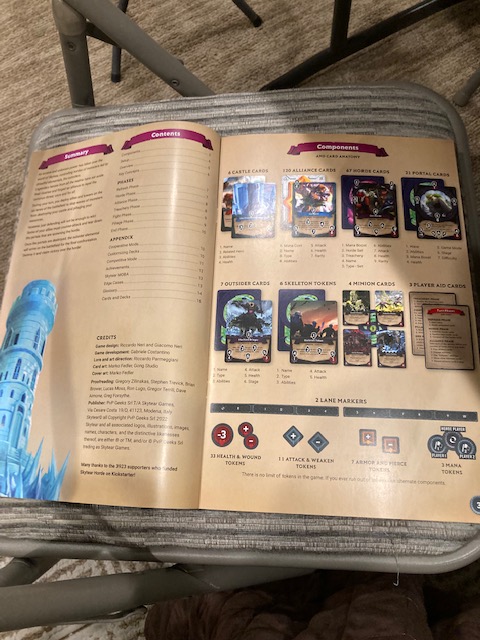
This rulebook does something I haven’t seen before: it puts the “card breakdown” with the Components list. What a nice way to save space in the rulebook! We list all the components as well as the breakdowns! This is just one of many example where the rulebook is the model of concision.

IMG_5852

One small issue I have is that set-up without the playmat is different from the set-up with the playmat! I would have strived to make the set-up work the same regardless. Note that the Minion cards are above the play area without the playmat (see above) …

IMG_5890

… whereas the minions are off the left and right with the playmat. It’s not a big deal: at least the playmat labels the spaces so you know where everything goes.

IMG_5853

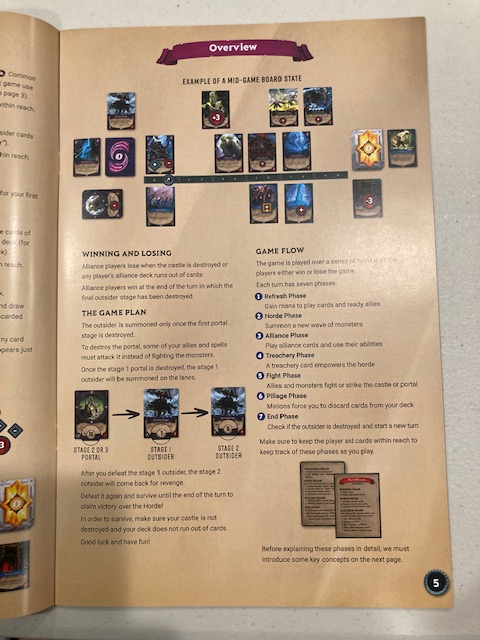
The overview is nice (except for one major flaw, which will discuss later below after we understand the game better).

The next pages describe the seven stages of the game (very well I might add). There are pictures, the font is big and readable, the prose is concise and to the point.

It’s not quite a FAQ, but there’s both a “Edge Cases” section and a Glossary, and a Cards and Decks section on the last page of the rulebook. Taken all together, these three sections tends to answer most of my questions as I played the game.

This sounds dumb, but I liked the paper of the rulebook as well (it’s not as nice as Canvas’ linen paper, but it still felt nice).

The fact that the rulebook was only 16 pages made the game seem that much less daunting to play. The font and layout were easy to read: things were easy to find, and elaborations were generally somewhere in the rulebook (the Glossary and Card and Decks section were particularly helpful). Sometimes concision comes at a cost: there weren’t a lot of examples in the rulebook, but I don’t think I needed them.

IMG_5901

Oh, and the rulebook fares very well on the Chair Test: A! On the chair next to me, the rulebook is very readable, it has very big fonts and simple layouts, and it fits perfectly on the chair.

IMG_5864

And the back cover is used for something useful: Cards and Decks list. Fantastic!

NOTE: the rulebook also did a good job of suggesting cards and decks to play for your first game. It wasn’t a flashy first play guide, but enough to get you going.

Components and Gameplay

IMG_5887

This is a Tower Defense Game.  There are two sides: the Alliance and the Horde.  In the solo and cooperative games, the players play as the Alliance.  In the PVP game, one players take on the role of Horde, and the others(s) take the role(s) of the Alliance.  Since we are only discussing the solo and cooperative modes here, we will always be playing the Alliance.

The Alliance must choose a Castle to defend (since this is a Tower Defense game): see above. The first playthrough recommends Gaping Maw.

IMG_5866

Each Alliance player gets a deck of 40 cards:

IMG_5899

There are four very different factions for the solo (or 2 players) player to choose from: see above. They are nicely color coded so you know which deck is which.

IMG_5867

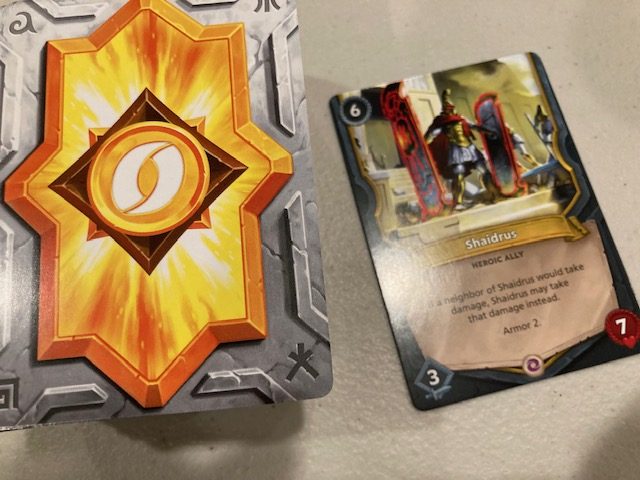
Most Alliance cards are Allies (see above); The allies will fight for the alliance! The allies will go into the Lanes on the playmat to fight the Monsters of the Horde. For example, The Shaidrus (above) will do 3 damage when fighting (lower left), has 7 hit points (lower right), and costs 6 Mana (upper left) to buy.

IMG_5875

To win, the Alliance must defeat the Outsider! Players choose an Outsider to fight at the beginning of the game. See The Dreaming Matriarch Outsider above: you will have to do 8 damage to him to defeat him!

IMG_5892 (1)

The Outsiders don’t start in play: you have to destroy a series of Portals to get the Outsider!!! Most Portals are damaged like the Monsters (via Hit points, bottom right). Example: the Portal above has 6 hit points. The portals can be varied for different difficulties and modes: there are many different Portal cards.

IMG_5869

IMG_5872

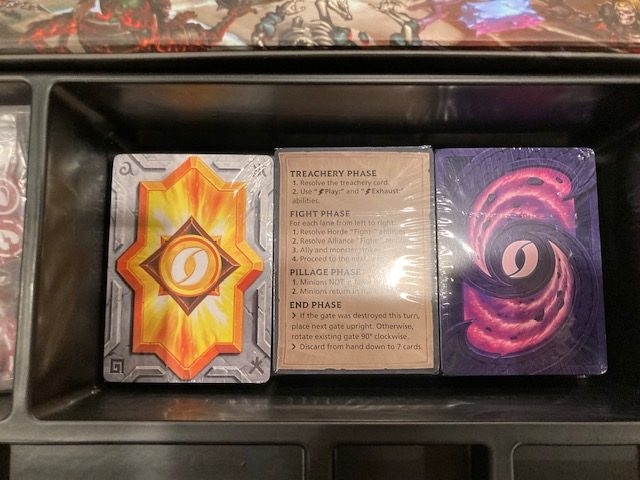
Along the way, the Outsiders will be summoning Monsters from the Horde deck: see above. At the start of the game, you typically choose one set of Monsters to fight: the upper right corner has a symbol which indicates the monster set.

Basically, to build the monster deck, you take the Common Monsters (upper right) and a Monster faction of your choice (upper left) and shuffle them together. This is the Horde to fight against!

IMG_5884

The purple cards are the bad guys: the Horde.

IMG_5874

Oh, and just to annoy you … there are the Minions. They can’t really be killed, but they keep coming back. Every time you defeat them, you essentially reset them back to nothing. You need to keep the Minions under wraps though, because they keep getting stronger and stronger as the game proceeds! And the stronger they are, the more cards you have to discard at the end of the turn! (The Minions “pillage” cards from you if you don’t engage them)

IMG_5891

The game follows the standard cooperative tropes: bad guys go, good guys go, some other stuff happens, things fight! There are seven phases to the game: see above, but it’s essentially about the Alliance fighting the Hoarde.

IMG_5898

The lanes on the playmat are where combat happens: there are some rules about how the Horde always slides to the left. Battle take place in those lanes: upper card vs lower card. (If there’s no monster to fight, your Ally damages the Portal. If there’s no Ally to battle the monster, your Castle takes damage)

IMG_5893

The Alliance gets some Mana at the start of the every turn (as specified on the Portal card). This is how the Alliance buys new cards from their hand!

IMG_5894

The only way to draw new Alliance cards is to defeat a Horde or Minion card! So you are constantly fighting as much as possible to keep your hand full.

IMG_5914

Basically, the game ends when Alliance’s tower is destroyed:

IMG_5910

OR the Outsider is defeated and the Alliance wins!

IMG_5913

Solo Game

IMG_5904

Like I alluded to earlier, the rulebook was inspiring enough that I felt like I could jump right in!  See a solo game all set-up above!  I chose the Blue Alliance cards with the Gaping Maw Castle to defend.  The suggested Outsider to defeat is The Hatred Bringer (who is mislabelled as such in the rulebook)!

IMG_5898

Interestingly, my first play went very quickly … because I played it very wrong.  The problem is the Portal rules are poorly specified (see discussion below). My second game went a lot better and it lasted a good hour and a half.  I think I still got a few rules wrong, but generally the game seems to flow pretty well.  You have to make interesting choices: which Allies do you summon?  How much Mana do you use this turn?  Do you save Mana  up?  Do you exhaust characters to get something special?  Do you send Allies in to die to keep the Minions under wraps?  Do you go after the Portal?

IMG_5911

There were a lot of interesting decisions. The game also felt fairly balanced: I felt I could have lost, but I also always felt like I had a chance.

It took me three games to get the solo game right, but I enjoyed the solo game quite a bit.

Cooperative Play

I couldn’t seem to get my group interested in this game for some reason.  Granted, Skytear Horde feels like mostly a solo game anyways, but I was a bit surprised I could never interest my group to try it out. Caveat emptor!  

Portal Rules

IMG_5903

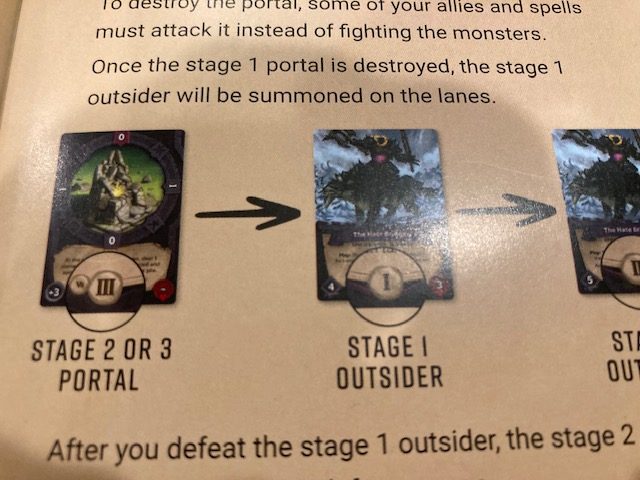
Unfortunately, as much as I like the rulebook, the Portal rules are very poorly specified/inconsistent/wrong! And this is a major part of the game: how many portals do you have to destroy before you can start fighting different phases of the Outsider? The text says “Once the stage 1 portal is destroyed, the stage 1 outside will be summoned.” But the picture shows the Stage 1 Outsider being summoned after Stage 2 or Stage 3 portal!!! What’s going on? Even worse, the text afterwards says “After you defeat the stage 1 Outside, the stage 2 Outsider is summoned”.

This is why my first play went so quickly: I destroyed the first Portal, summoned the Outsider (phase I), killed him, summoned Stage 2 and was done! After playing a few times, I think you must keep destroying Portals to summon the next Phase of the Outsider. I think? The rules are really unclear here, and it really tarnished my view of the first few plays of the game.

Conclusion

IMG_5906

I like Skytear Horde: it’s about a 7/10. There’s a lot of interesting decisions, the cards look nice, the rulebook is good and concise, and the game feels like there’s a challenge. There’s always a chance you could lose, but if feels like (if you play smartly), you can pull off a win.  It’s also easy to vary the game difficulty by using different Portals or Outsiders. There’s also a lot of variety in the game with all the different Alliance forces and the different Horde forces.  Generally, this was fun and it didn’t feel too random.

IMG_5740

I’ll wax philosophical for a second and wish Skytear Horde had more story: you just choose decks, Portal cards, Alliance forces, and  Horde decks without any background informing you.  Sure, it’s cool and easy to just throw some decks together and play, but it’s not particularly compelling.  Compare Skytear Horde to a few weeks ago Tower Defense Game called Deck of Many Things which had a real great progressive story!  I want the story from Deck of Many Things! But I want the gameplay from Skytear Horde!  It’s interesting how we got two cooperative (but mostly solo) Tower Defense games almost back-to-back!  I want the best of both worlds: the story of Deck of Many Games but with the smoother and more balanced  Skytear Horde mechanisms.

A Review of Cantaloop 3: Against All Odds

IMG_6803

I was SO EXCITED when this came in the mail from GameNerdz: It was just released about a week ago (late March 2023), and I had been waiting for this! Cantaloop 3: Against All Odds is the third game in a trilogy of point-and-click adventure games, in book form. Honestly, this game should have made my Top 10 Anticipated Cooperative Games of 2023, but I wasn’t sure when it would be released when I made that list!

IMG_6808

The original game of Cantaloop was so great it made the #1 spot on my Top 10 Cooperative Games of 2021! The follow-up game (Cantaloop 2) had it issues, but I liked it enough that it made my Top 10 Cooperative Expansions for 2022! Where will the third chapter of the Cantaloop series fall?

IMG_6805

Unboxing

IMG_6811

Just like books 1 and 2, Cantaloop 3: Against All Odds is a spiral bound book. See Coke Can above for scale.

IMG_6814

There’s a bunch of cards in the three pockets at the front, a trigger sheet, a combine form, and some extra bits.

IMG_6819

Like the original two books, this game is all about reading clues via the red acetate (see above) when necessary.

IMG_6821

Although the red acetate is still the main “gimmick” of the game, there are two new “gimmicks”. The first are the clear acetate screens: see above. When you put them together, they reveal exactly one number on a postcard … which tells you which clue to read: see below. This “gimmick” is used in a number of puzzles in the game.

IMG_6849

The other new “gimmick” is the little tokens you flip: this is used in about in about 10 puzzles in the game.

IMG_6847

The components from this are very much like the original two books.

IMG_6822

Point-And-Click Exploring!

IMG_6823

The Cantaloop books are the closest you will ever get to a point-and-click adventure computer game!  If you like the Monkey Island computer games (which you know we do: see here and here and here),  then this will appeal to you.  Like the first two books, this keeps the sense of humor flowing!  Cantaloop 3 is that more fun as little jokes appear as you explore.

IMG_6870

The exploration of computer point-and-click adventure games is definitely here: you turn pages to get from scene to scene, exploring as you go!  It really did feel like I was exploring when I was playing.

Game Arc

IMG_6852

The game proceeded in very much like an Adventure game! In the beginning, the exploration is fun and new as you discover new areas and look around! You find new objects, combine objects, and solve some simple puzzles and have a blast. The mid-game arc is about solving some of the more complex puzzles: there’s still some exploration and fun puzzles. Unfortunately, the game seemed to fall down a bit in the last part of the game—the puzzles were a bit too baroque and non-sensical. I found myself in the help section quite a bit near the end game.

IMG_6824

Now, there is an “easy mode” which can mitigate some of this, but the issue I had was that some puzzles were just too fiddly. I had to do something with a can (without giving away too many spoilers), but wasn’t allowed to unless I emptied it in exactly one place? The game felt cumbersome at the end. I was just reading through the help to try to get to the end story.

IMG_6873

Let’s be clear: the end story was fantastic! I really enjoyed the final ending! It felt satisfying after going through all three books.

I found the beginning and middle story arcs to be great, the ending arc to be tedious, and the final resolution to be very satisfying.

Save Game

IMG_6856

I ended up playing Cantaloop 3: Against All Odds over three nights, about 3 hours per night. The last night was about 4 hours, so overall I got about 10 hours of gameplay out of this.

IMG_6868

I had to put away the game at one point (for my game group): I just put all the components in a little plastic bag (see above) and put it away. It was pretty easy to come back to it the next night.

Mature Audiences and A Sense of Humor

IMG_6825

So, this game absolutely has a sense of humor! It would easily make the Top 10 Cooperative Games With a Sense of Humor! There are jokes all over the place (just like books 1 and 2: in throwaway gags, overarching themes, and the cards have many little jokes on them.

IMG_6850

So, I loved the sense of humor, but be careful: there’s a lot of swearing in the game, maybe at a PG-13 level. That may or may not bug you. There is one particular puzzle (you’ll know it when you come to it) that will cause some people some consternation. Even though there is a harmless and juvenile sense of humor in the game, there is still some what we would call NSFW moments.

This may just be a difference between German and American sensibilities (as the designer Friedemann Findeisen is German). I didn’t personally have a problem with it, but be aware.

Learning from the Past

IMG_6844

One of the things I liked is that they learned from the past. Cantaloop 2 strongly needed a FAQ for some of the puzzles (see our review here to see why), and it looks like Cantaloop 3 has one! See above.

IMG_6810

Another complaint from the first book was that the pages were flimsy and prone to tear (especially with all the page turning). Both the second and third versions fixed that! The pages are a sturdy paper that stands up to the all the page turning (and you do a A LOT of page turning as you play).

So, good job to Cantaloop 3 for learning from the past issues.

What I Liked

IMG_6875

This game has a great story. I felt like I just finished binging Season 3 of the Netflix classic Cantaloop, but the difference is, I was part of it the whole time! The overall story and final resolution were worth waiting for.

565435-the-secret-of-monkey-island-special-edition-playstation-3

The designer is obviously a Ron Gilbert and Monkey Island fan (as are we): we loved that. There were more than a few allusions to Monkey Island, and one particular puzzle from Monkey Island 2 almost stolen as-is! You’ll know it as soon as you see it!

thimbleweed_park

One of Ron Gilbert’s later games was Thimbleweed Park. There was a newish mechanism where the two characters had to “split” and you ran each of them separately. Cantaloop 3 did this well by having Alice, Hook, and Fly have separate (but connected) adventures within.

IMG_6854

Notice how certain items only belong to Alice and Hook (see above). This separation was interesting, and explored the puzzle of how separate characters can communicate with each other. That was interesting.

IMG_6867

I had fun playing through this, even when I was very stuck and needed the help system.

Help System

IMG_6843

There is a help system, and it really helped me move along when I got stuck (especially at the end). I can’t underscore how important it is to have this help system! In a video game point-and-click, the system keeps perfect track of the state of the game. In this game, you have to be marking off points … and you may forget to mark one off! So, the help system will help you recover if you ever get stuck.

IMG_6842

The help system was just … okay. There was one particular puzzle that I got stuck on for 20 minutes and the help system didn’t help at all. I only knew I missed solving a puzzle: the help system just affirmed I was in the right area of the game to solve it.

Still, I would have thrown this game in the bin if I didn’t have the help system. Some of the puzzles were baroque and unintuitive: I would have never finished without the help system.

Part of me feels like that’s a failing on my part: “I’m not smart enough to solve all the puzzles”, but at the end of the day, if I am not having fun looking around, the help system helps kick you in the right direction and puts you back to the fun parts of the game.

What I Didn’t Like

IMG_6871

I am not a cheater: I solved a musically based puzzle with some musical knowledge, which means I bypassed a clue which I didn’t need. I guess it’s kind of funny, but it bugged me that I got this card because I solved a musical puzzle without needing extra help. This kinda made my grumpy.

IMG_6849

Some of the puzzles were too hard or too baroque or just plain unintuitive. Many times, I felt like I solved a few puzzles, but some strange precondition means it wasn’t really solved. In video games, it’s sometime “fun” to revisit old locations and look around on a journey to solve harder puzzles, but it is a little too much work in this paper-based adventure game with the red acetate: sometimes extra exploring in this physical world with red acetate is exhausting. The harder puzzles in a video game are less exhausting because it’s more fun to explore. The harder puzzles here in Cantaloop 3 were frustrating because it was so much physical work (turning pages) and eye-strain (red acetate).

Solo vs Cooperative

IMG_6855

At the end of the day, this is really a solo game. You can play multiple players, but they will all just be helping through. It’s good to have multiple brains to solve puzzles, but the way the game interacts and reads, it’s probably best as a solo experience. But, I could see this being fun playing with maybe one more person, if they had the right attitude.

Recommendations

IMG_6827

If you do play this, make a copy of the time trigger sheet (see above)—that way the game is completely replayable. I look forward to playing it again in a few years when I have forgotten all the puzzles.

IMG_6806

Although you can play this without playing the previous two books (no state carries over from the previous books), why would you? The story that unravels over all three books is fantastic, and you want to be part of the whole trip!

If you have already played the original books a few years ago, do you need to replay them now? Not really. I didn’t! I just had a vague sense of where they left, and that’s all I needed! You can just jump in and pick up where you left off!

Conclusion

IMG_6832

I loved Cantaloop 1: Breaking Into Prison so much it made the #1 spot of my 2020 games! I liked Cantaloop 2: A Hack of a Plan well enough, but I had some reservations. The third book Cantaloop 3: Against All Odds fits somewhere in the middle. Book 1 gets a 9/10, Book 2 gets a 7.5/10 (if you ignore the last 2 puzzles), and Book 3 gets an 8/10.

Cantaloop 3: Against All Odds is more of the same: a sense of humor, a fun point-and-click adventure game, and a fascinating story. It really only loses a point because some of the ending puzzles are baroque and unintuitive, but not enough to take away too much from all the great times I had playing the rest of the game.

I look forward to playing through the adventure again in a few years when I have forgotten all the puzzles! And I look forward to Cantaloop being a Netflix series.

What a ride! Thanks to Friedemann Findeisen to making this game. I had a blast playing all the way through!

Review: Marvel Dice Throne and Dice Throne Adventures. Together Again For The First Time!

IMG_4809

Those of your following along know closely here at Co-op Gestalt know that we reviewed Dice Throne Seasons 1 and 2, plus Dice Throne Adventures a while ago: see our discussions here. We liked how Dice Throne Adventures turned a 1-vs-1 dice battler into a cooperative adventure game!

IMG_4689

When Marvel Dice Throne went on Kickstarter November 2021 … we weren’t that interested. Sure, we loved Dice Throne and Dice Throne Adventures, but interest in Dice Throne seemed to be waning in my gaming circles.

IMG_7163

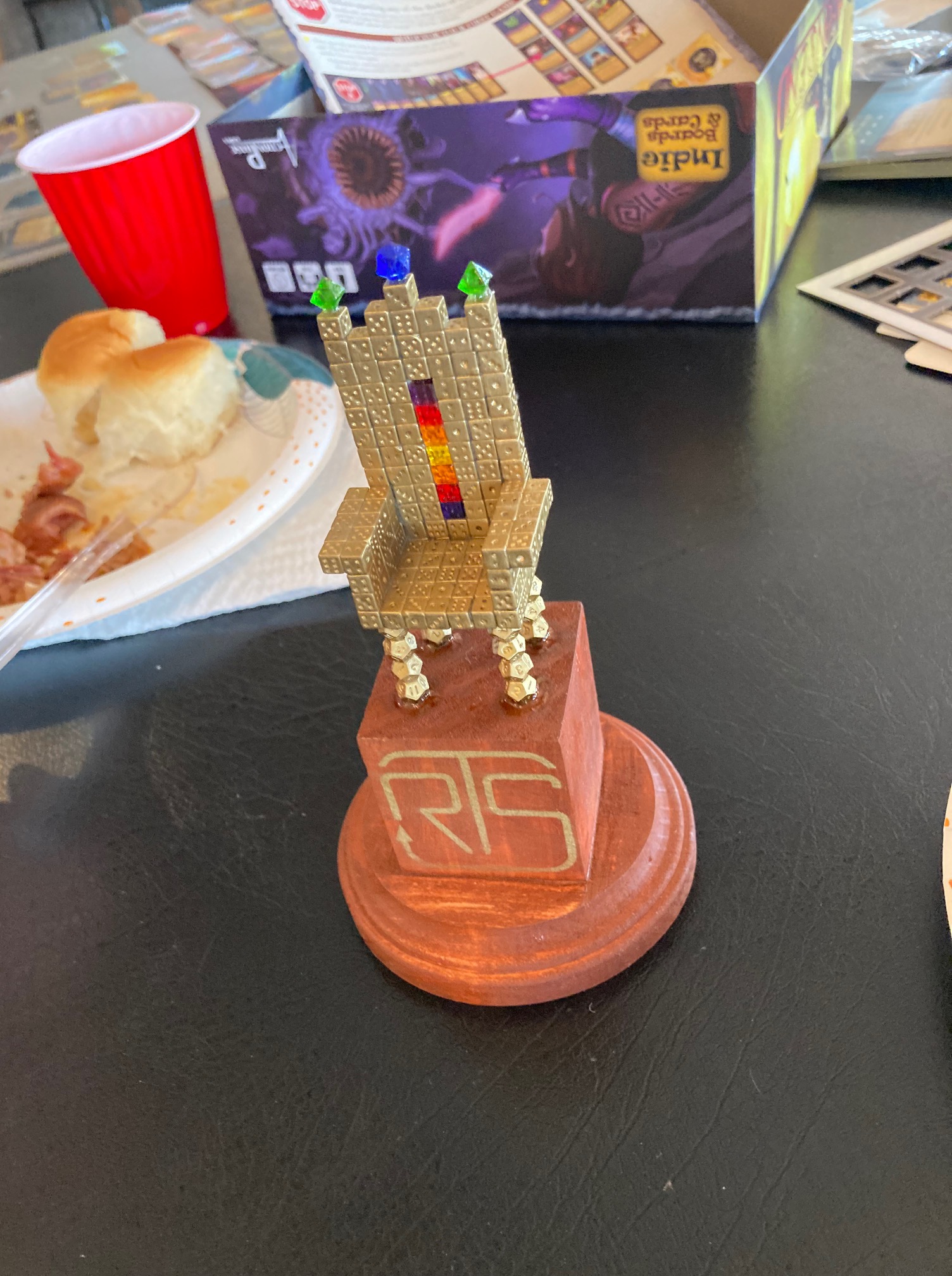
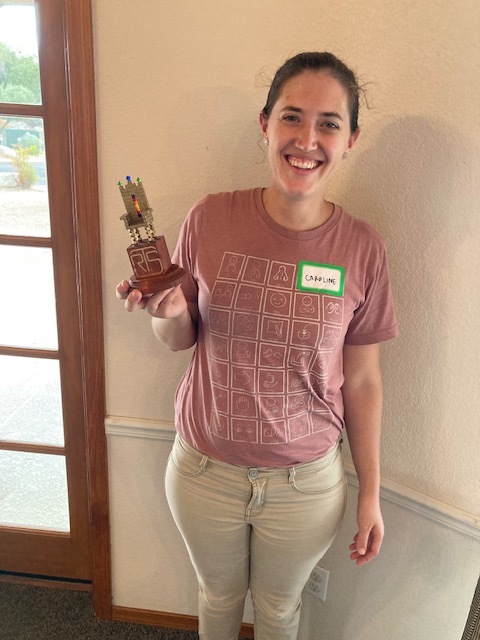
We played a small Dice Throne tournament at RichieCon 2021(see trophy above, made by our own Teresa F.), but there was no real interest the next year at RichieCon 2022. The trophy stayed home with Caroline, the original winner. See below.

IMG_2691

As the interest in Dice Throne seemed to have waned in my groups, I wasn’t sure if I should back the Marvel Dice Throne battle chest on Kickstarter: it did work with Dice Throne Adventures (according to the FAQ), but it was pretty expensive. In the end, I chose not to back it.

Marvel-Dice-Throne-2-Hero-CM-BP-3DBT-Web__30410

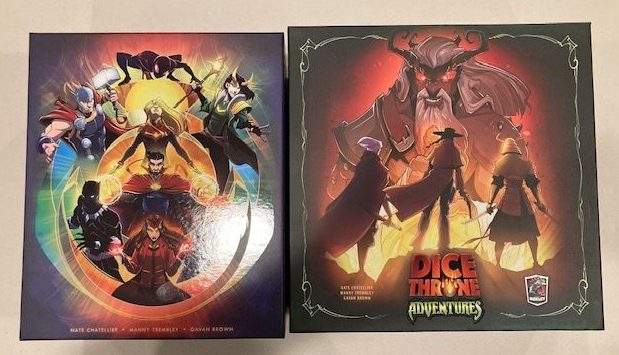
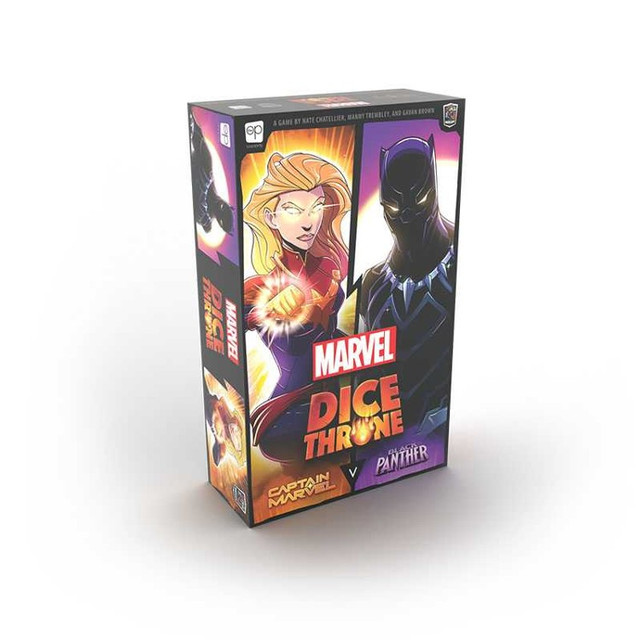
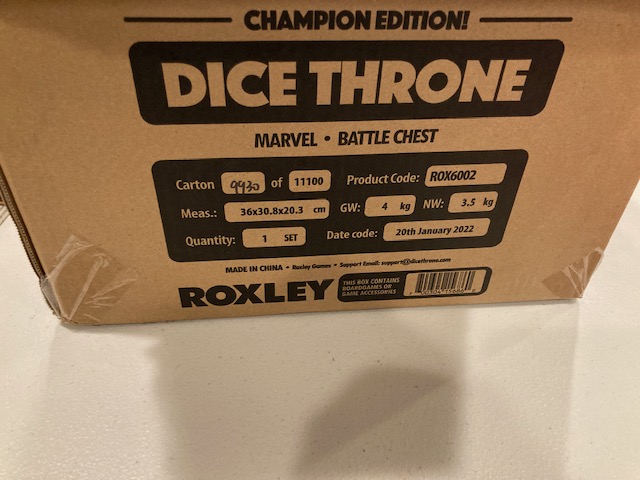
Fast forward more than a year: I find myself seeing the smaller Marvel Dice Throne kits at Target and other places: see above for the Captain Marvel and Black Panther pack. I have heard plenty of reviews that seem to really like the Marvel Dice Throne packs! The Dice Tower in particular seemed to like it! I do love my superheroes (see my Top 10 Cooperative Games of 2022 and My Top 10 Cooperative Expansions of 2022 as well as my Top 10 Cooperative Superhero Games), so I thought it might be worth reconsidering. In the end, what put me over the top was the Marvel Dice Throne works with Dice Throne Adventures: the thought of brothers Thor and Loki adventuring together in the lands of Dice Throne Adventures just sounded so fun. It turns out you can still get the Marvel Dice Throne Battle Chest (with all 8 characters from the Kickstarter, and some Kickstarter extras) from shop.dicethrone.com: see here.

IMG_4691

Components: Battle Chest

IMG_4748

A big old box came in the mail in mid December 2022. See above.

IMG_4693

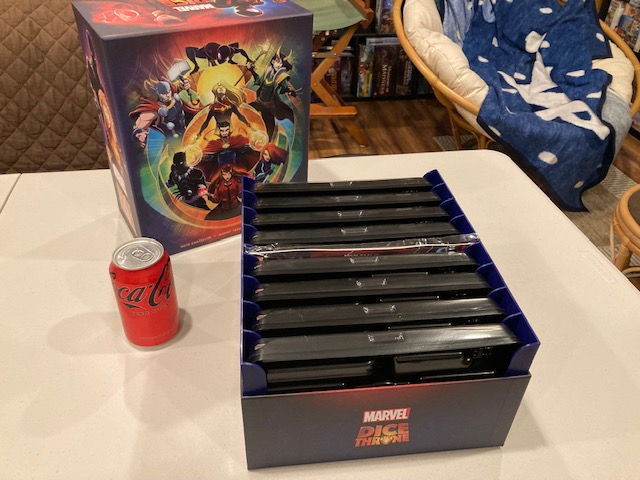
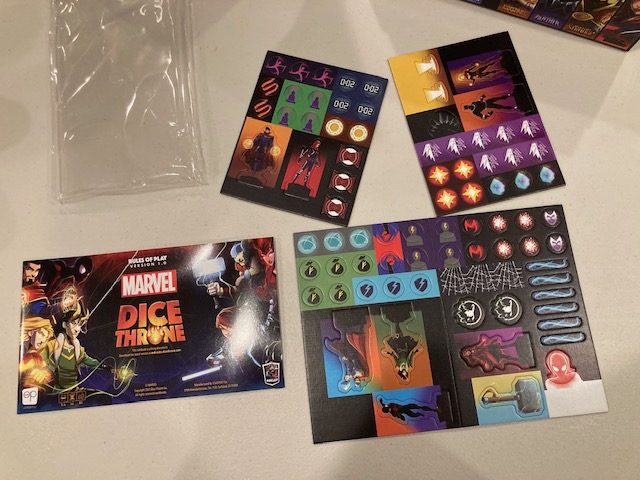
Like the Season 1 and Season 2 Dice Thrones (see here), the Marvel Dice Throne Battle Chest (see above) comes with 8 characters to play: all of them are Marvel Heroes!

IMG_4694

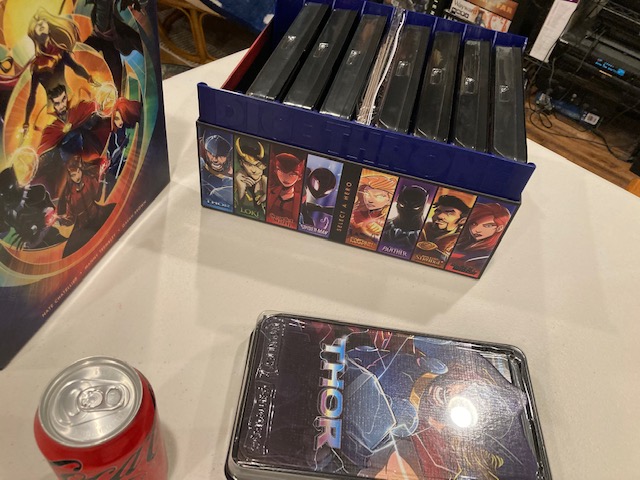
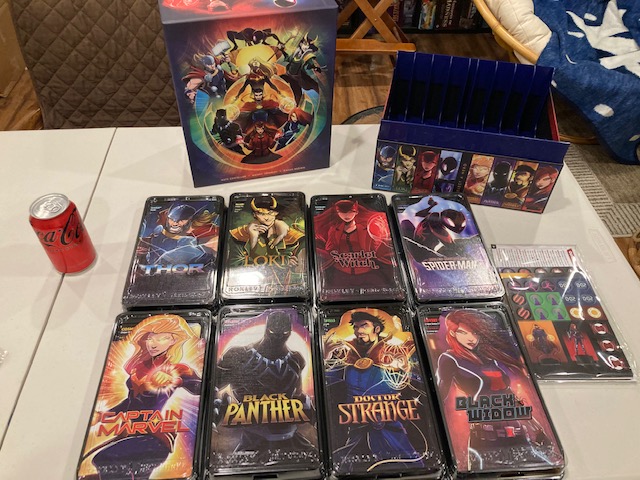
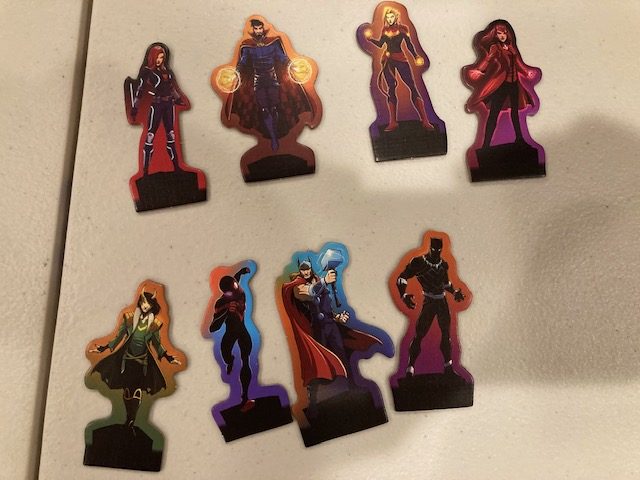
Each hero comes in its own tray, so it’s almost trivial to pack or unpack each hero. You can see all 8 characters on the side of the box (and where they go): Thor, Loki, Scarlet Witch, Spider-Man, Captain Marvel, Black Panther, Doctor Strange, and Black Widow.

IMG_4697

See all the character packs in their trays above.

IMG_4695

IMG_4699

Stored in the middle of the box is the rulebook and some tokens. Each hero has its own set of tokens that you must put into the appropriate tray.

IMG_4726

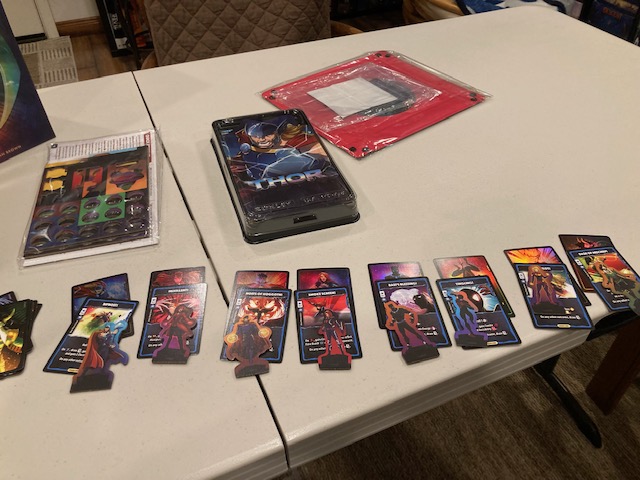
There are also a bunch of standees for each hero … Why? Because you need those for Dice Throne Adventures!

Heroes

A picture is worth a thousand words: here’s all the heroes unpacked!

IMG_4697

Extras

IMG_4719

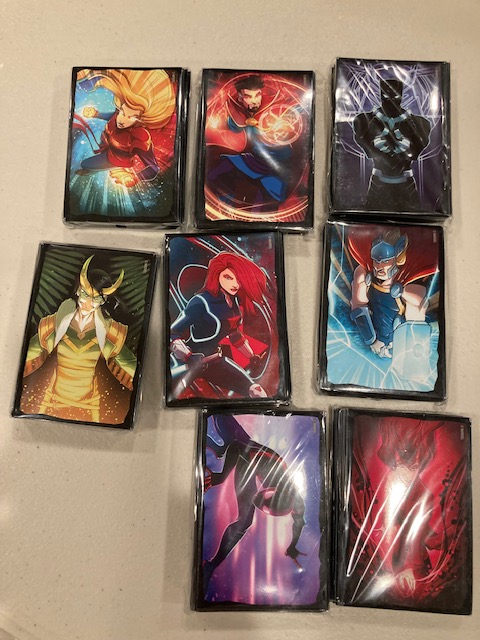
The sleeves didn’t come with the Battle Chest, but after such a great experience with the original Season 1 and 2 sleeves, I went ahead and forked out the extra bucks for the sleeves. See above. I found them almost essential: you touch the cards a lot, and these help protect your cards.

IMG_4744

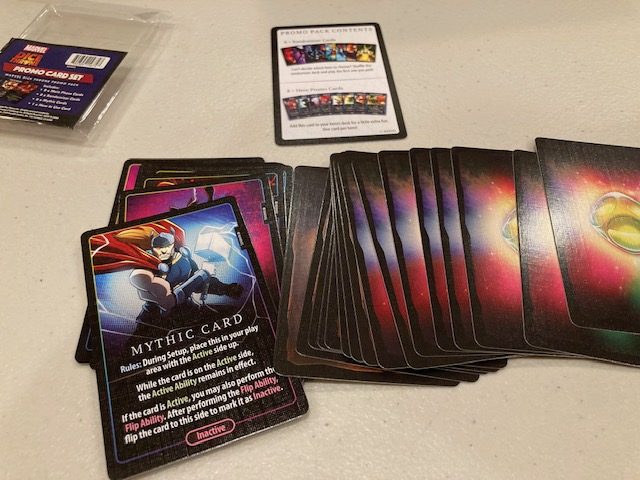
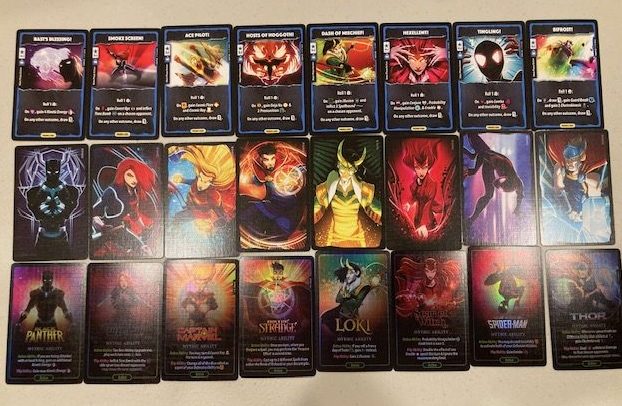
I also forked out a few extra bucks for the Promos: see above. These probably weren’t essential: you just get one promo card per hero, a Mythic card per hero, and a randomizer card per hero.

IMG_4746

See all the promo cards above. The Mythic cards are cool and foiled: they give each hero a one time ability. Again, not strictly necessary.

IMG_4832

I went ahead and got all these extras (sleeves, the promos, and a dice tray (see red tray above)) to get free shipping with the core Marvel Dice Throne Battlechest. Do what you will.

Rulebook

IMG_4700

They’ve had many iterations to get this the rulebook right: the rulebook is good.

IMG_4749

On the Chair Test (see above), it gets about a B- or C+: it kinda works. I wish the rulebook were thinner and taller so it would fit on the chair better.

IMG_4713

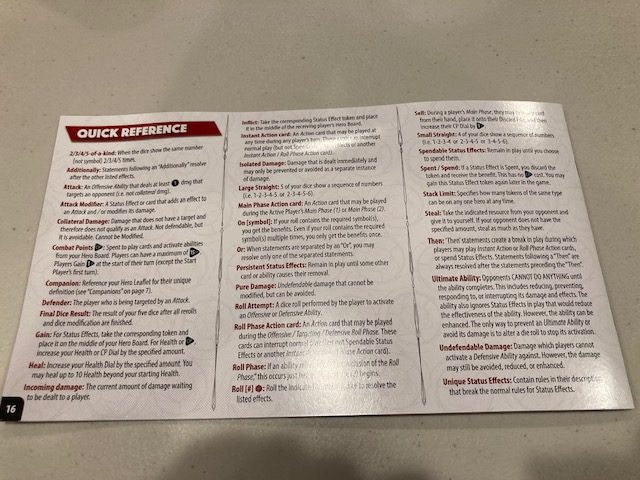
Not too much to say: good set-up, good annotations, good explanations, well organized … and it uses the last page for useful game information. (see quick reference above).  Good rulebook, despite the lower score on the Chair Test.

Me vs. Me

IMG_4753

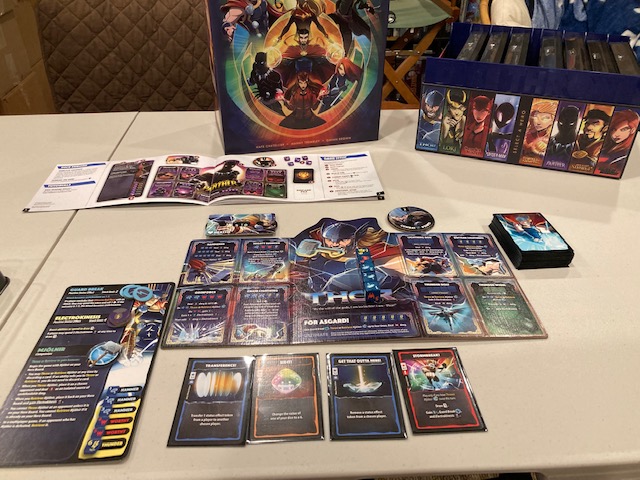
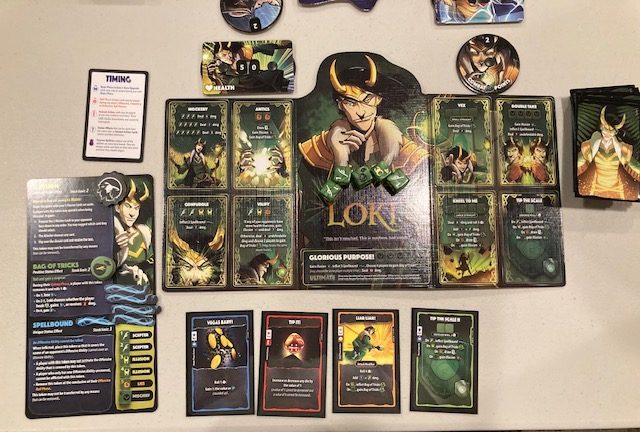
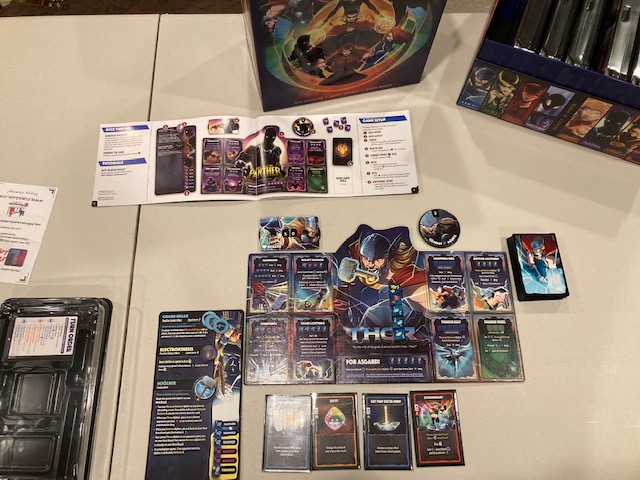
Before jumping straight into the Dice Throne Adventures with the new heroes, I wanted a chance to run some of the Marvel heroes through their paces. I will bet many people’s first game will be Thor vs Loki. At least, that’s what I did. I played a “Me-Vs.-Me” solo game, where I just jumped back forth between the two heroes.

IMG_4755

Both heroes played so differently! Loki was what you’d expect: a trickster with illusions as a key defense!

IMG_4754

Thor was the powerhouse with his hammer having some incredibly interesting mechanisms! It really felt like Thor flinging his hammer!

IMG_4756

Physically moving between the two sides of the table seemed to work really well for a “Me-vs-Me” game. Partly, it would “reset my context” as I switched from side to side, and partly it made it easier to see all the relevant hero information (since it was geared towards a different seat at the table). I really like this idea of switching perspectives to learn the two heroes: we’ve talked about the Changing Perspectives Idea many times here at Co-op Gestalt.

In the end, Thor defeated Loki, but it was a close match. I found myself role-playing both sides a lot more than I expected “Thanks, dear brother, for the hammer!” “By Odin, Loki! Yield!” I found myself muttering these things under my breath! No one else was around! These characters are so well-known and beloved, it was hard not to!

IMG_4766

And maybe that’s why Marvel Dice Throne has more appeal than Dice Throne Season 1 and Season 2Marvel characters are well-known and beloved characters that you want to inhabit.

I recommend a “Me-vs-Me” game to learn some of the new characters, especially before you play Dice Throne Adventures: It’s a fun way to learn the strengths and weakness of the characters.

Dice Throne Adventures

IMG_4726

The only real acknowledgement in the Marvel Dice Throne game that this works with Dice Throne Adventures is that a punch-out figure of each hero is included for the Dice Throne Adventures.

IMG_4811

Unfortunately, I had to steal a base from one of the characters standees in the base Dice Throne Adventures box to give Thor a base: “You shant be needing this for now”.

IMG_4812

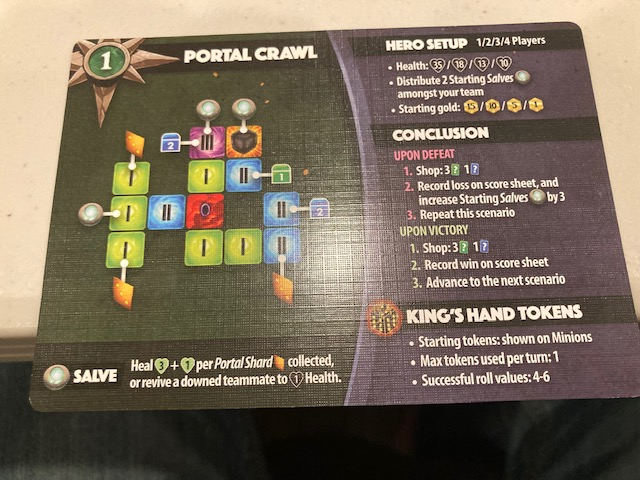
Recall that Dice Throne Adventures alternates between two major types of games: the Portal Crawl: Minion Battle and The Boss Battle. Each major game takes about 2 hours, so usually you only do one per gaming session. The idea of the Portal Crawl is that you and your group are looking to unlock the portal so you can get the big bad boss! There are lots of little minions battles along the way, and once you collect all all the portal shards, you can fight your way to portal!

IMG_4819

See Thor above as he arrives at the final portal!

IMG_4825

Once the portal has been reached, you can fight the Boss! Above, we see The Fallen Barbarian! Fighting the Boss is very similar to the “Me-vs-Me” game, with a few rule changes to automate the battle a little bit more.

IMG_4827
Thor battling the Barbarian in session 2 of Dice Throne Adventures!

Once you defeat the Boss, you then go searching for the next boss with a Portal Crawl followed by another Boss Battle .. until you get to the final Boss!

IMG_7841

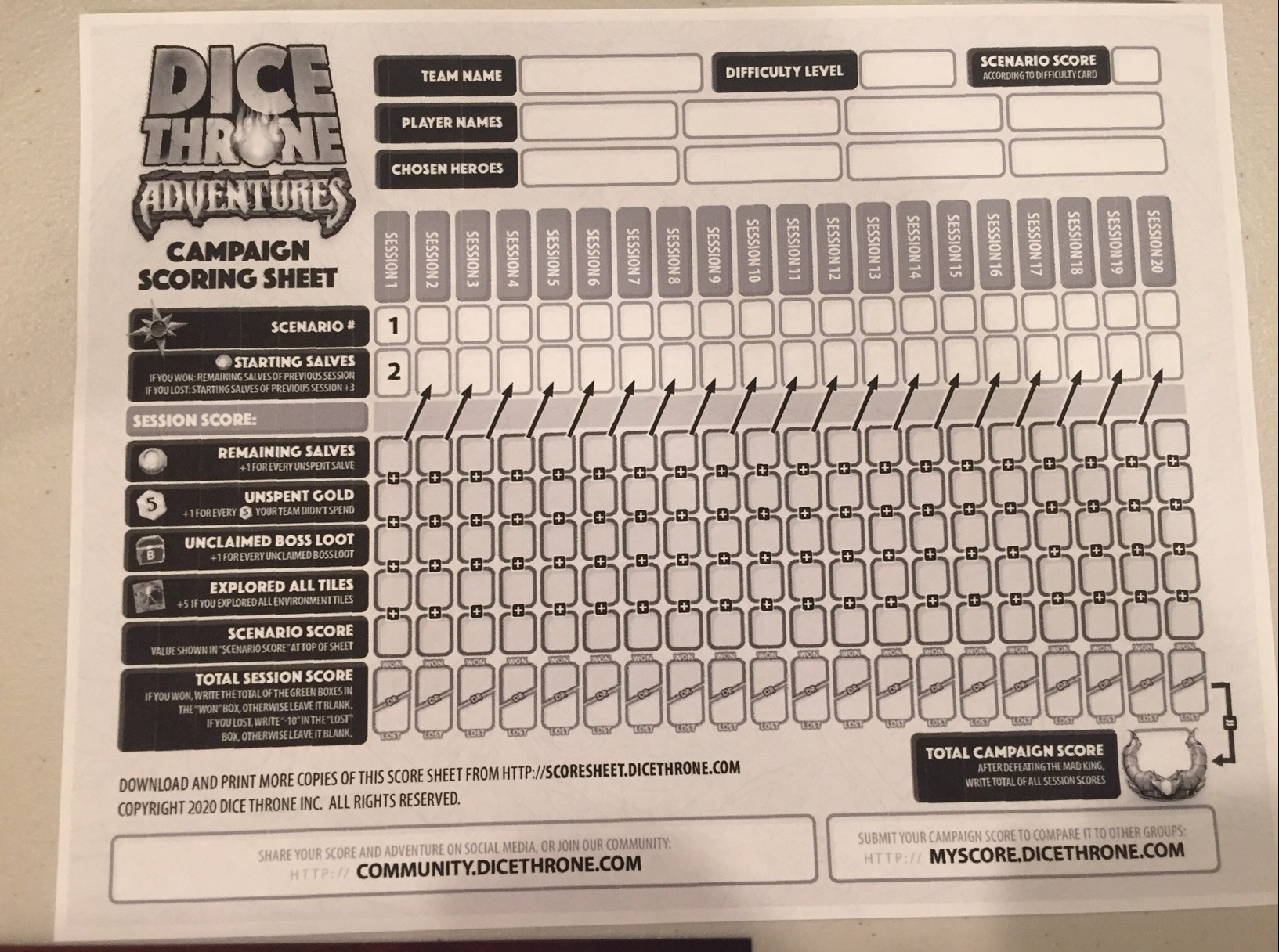
To be clear, Dice Throne Adventures is a campaign game! You are looking to take out the Mad King, and you alternate between Portal Crawls and Boss Battles as you fight your way to the final confrontation! See the campaign scoring sheet above.

Solo Play

IMG_4814

Dice Throne Adventures played out solo the same way as it did before, except that it seemed more fun with Thor! I’d do silly Thor-like quotes as I played … “Taste Mjolnir evil lady!” “Come to me, Mjolnir!” I felt more connected to this beloved character, and I role-played him: I seemed to really care how well he did! The Portal Crawl felt like a scene in a Marvel movie where Thor has to scour the country-side looking for a portal … “Where in Odin is this portal?

IMG_4824

Then, there was an epic battle as Thor arrived to take out the Fallen Barbarian! “You are worthy of battle with me Fallen Barbarian! Come at me!” Again, as I played, I would inhabit Thor and have fun with it!

IMG_4821

Of course, one of the best parts of the Dice Throne Adventures game are the upgrades for your deck: see some of the Rare and Common items I was able to find/buy after my battles. The upgrading helps keep you from having “too much dice rolling” … there is a lot of dice rolling.

IMG_4828

The solo game was a blast. Playing a known hero (like Thor) really added a lot more fun than I expected.

Picking Heroes and Training

IMG_4850

You can’t quite jump into cooperative play without getting to know the characters and mechanics first: remember, the rulebook from Dice Throne Adventures explicitly says “You need to know how to play Dice Throne first!”.  Sara and Teresa took the roles of Scarlet Witch and Black Window (see above).  We joked that this first play was like a session in the Danger Room, learning how your powers work!

IMG_4848

Be careful when you let newer players pick Heroes just for the sake of being a hero!  All heroes have a difficulty rating between 1 and 6, and that difficulty can influence a player’s enjoyment.  Scarlet Witch is rated as a difficulty of 4 out of 6, and Sara found that playing Scarlet Witch frustrated her. She chose to play a different character for our later adventures.

Cooperative Play

IMG_6471

Cooperative play went pretty well.  There weren’t quite as much Marvel quotes as when I played solo, but some!

IMG_6473

One of the things I liked was the we could help each other in combats: the solo mode always had Thor going it alone, but if one of us was struggling with a combat, one of our compatriots could come over and help us! 

IMG_6474

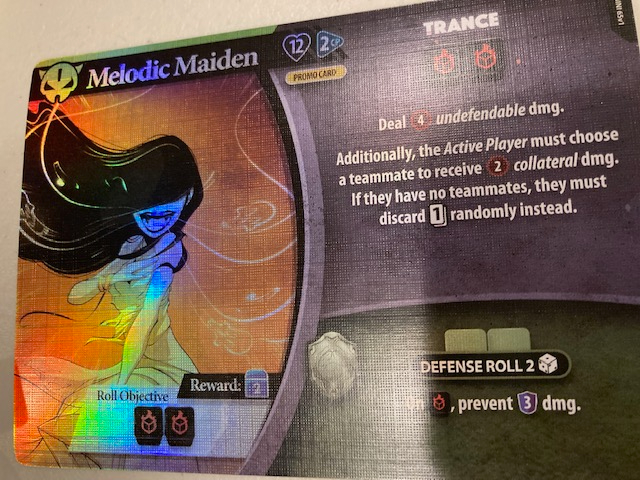
The Melodic Maiden caused quite a bit of consternation for Black Widow, so Thor had to come over to make sure she didn’t die early on!

IMG_6472

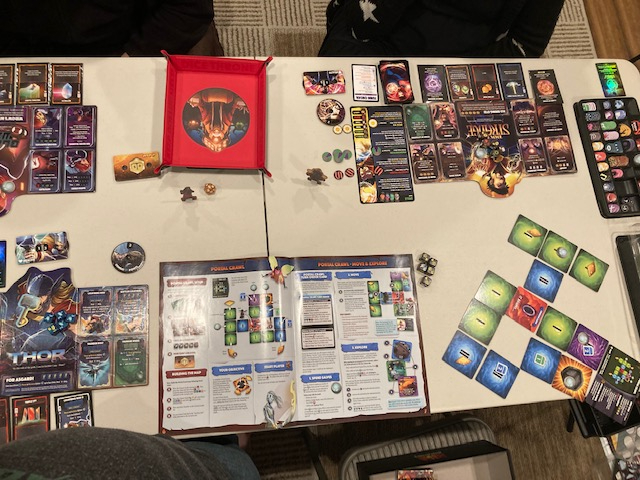
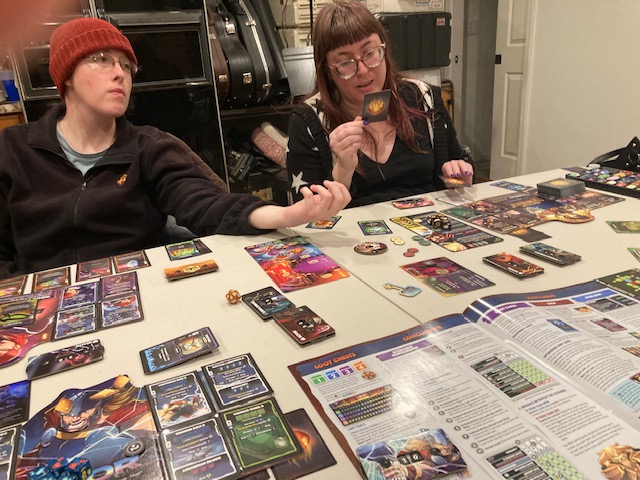
We ended up playing three player, and it was probably for the best!  The game barely fit on the table with 3 players and the Adventure board!  One more character, and I would have had to get another table!  I think that means I recommend the game for 1-3 but not four?  See above as we take over the entire table!

IMG_6475

Generally, the cooperative game lasts longer than the solo game: just from going back and forth, but it should still be “about 2 hours”.  

IMG_6479

In fact, the set-up shows you how to scale the game based on the number of players (starting health, starting gold, King’s Hand, treasure) which was real nice!  The game did feel decently balanced: there were a couple of times when we thought we might die, so that’s good!  This balancing for different numbers of players seemed to work.

IMG_6476

We ended up winning!

IMG_6477

In fact, I realized that I had been playing the treasure wrong: when you get loot, EVERYONE gets to roll the loot dice!  And it feels like you will always get “about 3-4” cards as upgrades to your deck.   I originally didn’t see the rule where you always get dealt some extra cards: even if you didn’t get any during play, you will still have SOME to choose from.

IMG_6478

My group is continuing to play: the nice thing is that, even though this is a “campaign”, we can come back to the game easily: there’s not much story, just your cards and a little bit of state.  If we wait a year to come back and play, it’s still easy to just drop into … “Oh ya!  We gotta fight the BLAHBLAH bad guy to win!

Conclusion

IMG_4766

We were surprised how much more we enjoyed using Marvel Dice Throne heroes! The heroes abilities were very thematic for the heroes! For example: Thor yields his hammer with devastation! Loki fools with illusions and bag of tricks, avoiding damage whenever possible! Scarlet Witch has reality altering powers (altering dice)! Black Widow can jump out of the way!

IMG_4820
Thor fighting though portals in session 1 of Dice Throne Adventures to get to the Boss monster!

And taking these Marvel heroes through Dice Throne Adventures was that much more fun! We found ourselves role-playing the heroes: we’d inhabit the heroes, make silly quotes (from the movies and comic books), and generally care for the heroes (probably more than we’d care to admit) since these figures are so well-known to us.

IMG_7858

My only real complaint is that there is no Marvel specific stuff for Dice Throne Adventures: all the minions and bosses you fight are generic fantasy villains. It’d be cool if Thanos or Kang were the villains to fight the Boss Battle! Or if the minions were some lesser Marvel villains (like the bifrost giants or Toad or some lesser mutants). It worked okay, but I think an expansion which updated Dice Throne Adventures with Marvel bad guys would go a long way towards making Dice Throne Adventures more fun.

IMG_7680

If you were on the fence for buying Dice Throne Adventures, (see our original review here), using Dice Throne Adventures with Marvel Dice Throne might just put your over the top.

A Review of The Big Pig Game (A Cooperative Eating Board Game)

IMG_6491

I feel like I had to add the qualifier “board” to the title when I describe this board game this because “The Big Pig: A Cooperative Eating Game” sounds like something very different! The Big Pig Game is a lightweight cooperative board game for 1-4 players, Ages 10+, taking 40-45 minutes. It’s all about eating food cooperatively (yes, I know, that’s a weird sentence).

IMG_6486

The Big Pig Game was on Kickstarter back in April 2022 and promised deliver in January 2023. It’s mid March 2023 (I got mine about March 10th, 2023 in the mail). So, the Kickstarter is about 3 months late: that’s not so bad in the grand scheme of things.

IMG_6492

This is a very cute game: I got it because it had the same vibe as the Kim Joy’s Magic Bakery game which did very well in my cooperative gaming circles (see our review here): Kim Joy’s Magic Bakery even made our Top 10 Cooperative Games of 2021!

IMG_8269

Let’s take a look at The Big Pig Game and see what we think!

Unboxing

IMG_6494

The Big Pig Game is slightly smaller than the standard Ticket To Ride box size: it’s about the same size as The Lord of the Rings Adventure Book Game from a couple of weeks ago.

IMG_6496

You can probably guess that this game leans into the “cute” aspect pretty heavily. The characters are cute little animals eating food together: if you don’t like the cuteness, you might want to stop reading now. This game is jut a lightweight, cute game. It’s not deep. And it embraces cute. Caveat Emptor.

We liked the components quite a bit because of the cuteness (except for one major issue, see later below).

IMG_6518

Rulebook

IMG_6506

The rulebook is good enough.

IMG_6497

The components are well-labelled on the first page.

IMG_6498

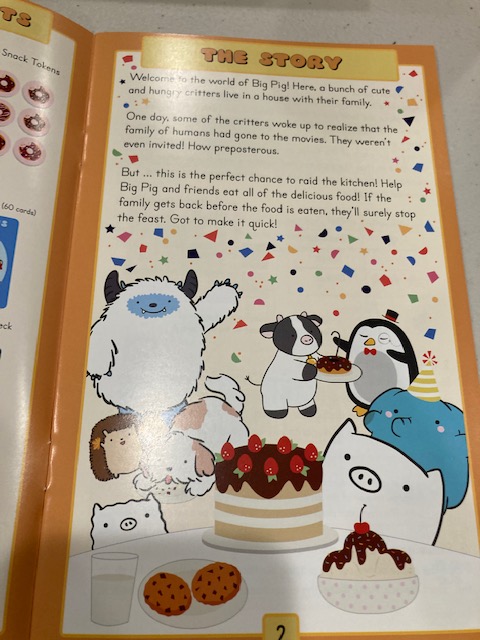
And the “theme” is explained on the next page. It’s a silly theme about raiding the kitchen while the humans are gone: it’s very silly and cut! Like I said, this game embraces that cute factor.

IMG_6499

The set-up follows and consumes the next two pages. It’s good set-up and description: note that it has a set-up section.

The game then explains the basic structure pretty well.

IMG_6535

The rulebook does pretty well on The Chair Test: it stays open and is readable on the chair next to me.  The font is a little thin and small, but it’s still quite readable.  Probably a B or B+ on The Chair Test.

IMG_6505

The back cover made me laugh: it’s a fake ad for chili!! I’ll forgive that they don’t use the back cover for something game related.

Overall, pretty good rulebook.

Components and Gameplay

IMG_6584

Each players chooses one of the cute little animals to play: there are 10 in all. See above.

IMG_6585

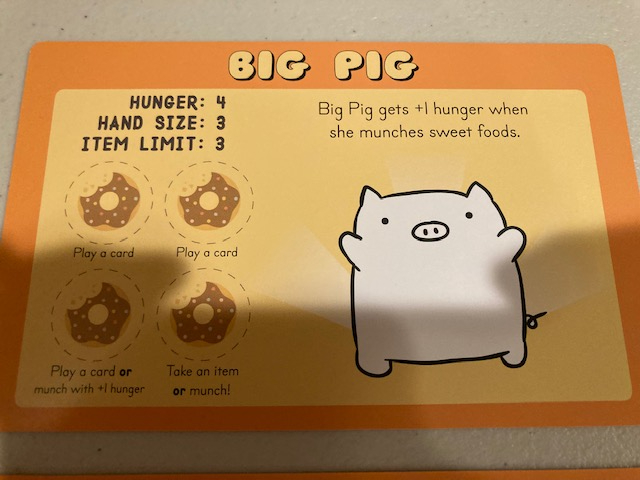
Each character has varying Hingers, Hand Sizes, Item Limits. Each player has 4 action spaces (the donut slots), but these actions do vary among the characters.

IMG_6541

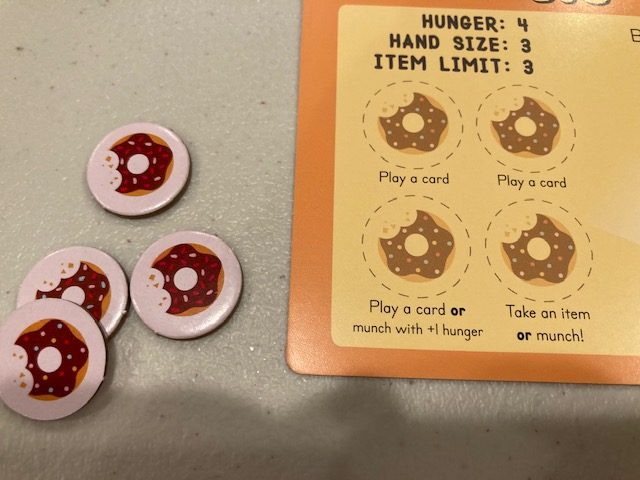
If you look closer, you can see what each action space does: again they vary by character.

IMG_6513

To win the game, the players must eat all the food before the human family returns: the board above has a different track depending on the number of players. Basically, as soon as the humans reach the house, the cute animals get caught red-handed and lose!

IMG_6544

To win, the cute animals must collectively eat ALL the food on the 4 boards before the humans gets home! Above, you can see the tiles on the four different foods. Every time the cute animals “eat”, they take some of the tiles, depending on their hunger. The cute animals can eat from any food they like, but they have have bonuses or penalties depending on many things.

IMG_6525

One Bad Things card comes out at the start of every turn, causing bad things to happen.

IMG_6526

If you are playing the more difficult game, you use Very Bad Things instead: see above.

IMG_6523

Each player has a hand of cards (Actions) that do Good Things for you and the other players: this is a cooperative game!

IMG_6524

There are also Items you can buy on your turn that generally give you some bonuses.

IMG_6527

If you eat ALL of one food, you get a Bonus! See the sample Sweet, Savory, and Healthy Bonuses above.

IMG_6528

There is a player aid to help you, but it is not great: it doesn’t really help with all the player actions.

IMG_6540

The most important question in the game: How do you eat? Either one of your cards or one of your 4 actions allows you to MUNCH or RAVENOUS MUNCH.

When you MUNCH, you use you base Hunger (it’s 4 for Big Pig above), plus bonuses (Big Pig gets +1 for Sweet Foods, +1 for the action), plus any Penalties (usually from Bad Things, none here). So, a simple MUNCH of Sweets for Pig Big would give him a MUNCH of 4+1+1 = 6.

IMG_6529

From one of the Sweet foods, Big Pig could take two 3s or one 6 to be efficient. Big Pig could still take a 4 or 5, but it would be wasteful and not use his full hunger.

IMG_6574

When you MUNCH, you keep the piece and can use it to power the BOOST action on the bottom of the Action Cards (“Look What I found” above requires two BOOST pieces, “Hyper” requires three). RAVENOUS MUNCH usually is a bigger hunger, but you don’t keep the pieces for boosting: the immediately go to the side of the food.

IMG_6576

Players win together when they have eaten all the food (see above for 4 empty plates) before the Humans get home!

IMG_6521

Along the way, players can ENCOURAGE each other (notated with the little cheerleader tokens above) for an extra +4 or +6 hunger on the next MUNCH/RAVENOUS MUNCH. This is a cooperative game! Sometimes its better to help your friends eat!

IMG_6545

So, this game is about cooperatively using your hunger to MUNCH and eat all the food!

Solo Play

IMG_6493

The game supports Solo Play (thank you for following Saunders’ Law)!

IMG_6512

The only real change to the rules is that game board uses a different track, depending on the number of players: the solo track is much longer since the the solo player only plays one character and will have many fewer actions.

IMG_6533

See above with a set-up for a solo game.

IMG_6549

The solo game works fine, but it has the Roll Player/Ares Expedition Crisis mode solo problem to a certain extent: with fewer players, fewer cards come out, fewer Items can be in play, and fewer opportunities for collaboration come out (See our discussion in Roll Player Adventures and Ares Expedition: Crisis mode). Don’t get me wrong, the solo mode works, it’s fun, but one solo character simply doesn’t have quite as many cards come out at the same time.

IMG_6552

I liked my solo play okay: I was mostly grumpy with the components (see Issues discussion below), but I was able to get through the game and learn it so I could teach my friends.

Cooperative Play

IMG_6568

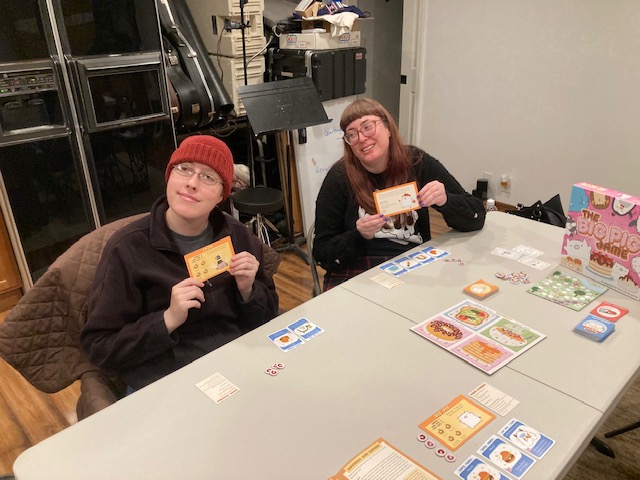
This game shines in cooperative mode.

IMG_6573

Players happily take some of the cute characters and inhabit them.

IMG_6577

The cooperative game really felt cooperative! The little encouragement tokens, as silly as they are with little Cheerleaders, really encouraged that cooperative vibe!

IMG_6514

And each player’s action were different enough! For this really light game, we found ourselves talking amongst ourselves: “I’ll eat sweet things if you let me have the sugar packets” and silly things like that. There were a surprising number of collaborative moments for such a simple and silly game.

IMG_6575

The cooperative game was chill and relaxing. Cecil the duck stole everyone’s heart.

Issues

IMG_6530

There is one major issue with the game: the tiles don’t really fit in the middle! This is the main gimmick of the game, and I found that I could either “force” all the tiles to fit, or have them hang off the side: neither solution was great. The “forced” tiles were very hard to get out of the board. The “relaxed” tiles looked messy and moved too easily.

IMG_6569

You CAN get them to fit (see above), but it actually interfered with the playing of the game. I feel like just a slight tweak to the tiles or the board could have fixed this issue!! The tiles don’t need to be packed in there so tight!!! They should really be just a little looser.

I am grumpy about this because this is the main gimmick of the game: the food pieces/tiles fit into the dual-layered boards and it looks cool … but the tiles are too tight.

Conclusion

IMG_6578

So, if you can get over that the tiles are too tight, this is a fun, relaxing, end-of-the night for multiple players. The solo game is okay (maybe a 6.5/10), but it does teach the game. The cooperative game is much better: it is just a great way to hang out with your friends and have a chill time! The Big Pig Game gets a 7.5/10 or maybe even an 8/10. When I want a relaxing game, this is a fun, light, and surprisingly interactive experience while still being an interesting game.

My friends like this better than Kim Joy’s Magic Bakery, and I think I agree. I had a such a chill time playing this. This would be great for families or a group wanting a light game.

I know lost the hard-core gamers a long time ago: I think they saw Big Pig and bailed. But you know what? They might actually appreciate the simplicity of this game.

UPDATE: the manufacturer is reprinting the cardboard pieces that don’t fit! See the Kickstarter Update here!

Appendix

I sent an encouragement token to my friends (via text) this morning. See below. I could see this becoming a thing with us: those cute little tokens really are a cheer-up.

Using Overlapping Turns To Mitigate Delay: A Discussion of Pipeline Parallelism in Cooperative Games

IMG_6172

Last week, we reviewed Astro Knights: it’s a cooperative deck-builder (see our review here). The main hook of Astro Knights is that you don’t have to shuffle your cards when your deck runs out, you just flip the discard pile over! That’s great! No shuffling! One of the other hooks, related to this, is that you have some choice over the order the cards go into the discard pile at the end of your turn. It’s really cool that you have some agency over the order cards might go into your discard, but it’s actually fairy limited. When you buy a new card, it immediately goes to the discard. When weapon cards go off, they immediately go into the discard. The only choice you generally have is over some of your Power cards. In playing, that choice didn’t make “that much of a difference” because the only cards you could could re-order were very limited. We loved this idea of reordering, but it didn’t seem that efficacious in practice.

Potential House Rule for Astro Knights and Aeon’s End

IMG_6210

We were going to propose a house rule for Astro Knights about the reordering last week, but it lead us down quite a twisted path: we need to discuss it before we formally propose it.

The proposed House Rule is called Full Reordering:

In Astro Knights or Aeon’s End, any card that would go into the discard pile this turn can be re-ordered in any way the players want at the end of their turn. Those re-ordered cards then go to the top of discard.

Thus, any card that was bought, played, or discarded (weapons in particular) on that turn can be re-ordered as desired into the top of the discard.  So, if you buy a card, it doesn’t immediately go into your discard: it only goes at the end of the turn after you have re-ordered all your cards for that turn!

For ease of maintenance, the player can keep a separate pool of cards discarded/played/bought for that turn (representing cards to be discarded that turn) and re-order them at the very end of their turn.  When they are done re-ordering all the pooled discards, the pooled discards will go into the main discard.

It seems like Full Reordering should have been the rule all along in both Astro Knights and Aeon’s End.  Why wasn’t it? Let’s look into this a little.

Analysis Paralysis 

IMG_6211

The main reason the proposed House Rule of Full Reordering is problematic is probably time: if you give the players a chance to re-order 5, 6 ,7 or more cards, then amount of re-orders the user will consider grows quickly … by a factorial!  Thus, with 5 cards to re-order, there are 5! = 60 permutations, 6 cards has 6! = 360 permutations, 7 cards has 7! = 5040 permutations, and factorial grows very fast (approximately exponentially if you believe Stirling’s Approximation)!   And, unfortunately, many players will take all the time they can to find the optimal solution, this increasing the amount of time a player takes on their turn (slowing down the game substantially).

If you “just allow” re-ordering of just a few cards (as per the current ruleset), there are typically only 1 to 4 cards to re-order, which are much are much smaller numbers: 1! = 1, 2! = 2, 3! = 6, 4! = 24.  I suspect the real reason the re-order rule by default is so limited is to avoid analysis paralysis: there are simply too may permutations of the discards if the player is allowed to consider all possible permutations. 

Potential Savior

con

There is still a potential way that the proposed House Rule of Full Reordering could work: What if we allow the next player to start his turn while the previous player simultaneously re-orders their discards?  This would mean the “re-order discard” step and “start of next turn” would be happening simultaneously!  Simultaneous play is something we are seeing a lot of current modern games: Ares Expedition, Sidekick Saga, Seven Wonders, Race for the Galaxy are just a few modern games where the game has embraced simultaneous play to move play forward.  One of the reasons that Terraforming Mars has fallen off the radar in my group is that Ares Expedition does everything that Terraforming Mars does, but in one quarter the time!  Most of this time reduction is because players are playing/building simultaneously instead of waiting for full completion of the previous player turn.  See our reviews of Ares Expedition and Ares Expedition: Crisis for more discussion.

I would argue that many people already play Astro Knights simultaneously: 

Player 1: “Hey, you done yet re-ordering your cards?” 

Player 2: “Almost, why don’t you just start your turn?” 

As you become more and more familiar with a game, it becomes second nature to exploit the opportunities for simultaneous execution.  Take a look at our blog entry about Arkham Horror and concurrency in our post of Concurrency in Board Games. In Arkham Horror, we start taking advantage of the turn structure to introduce some simultaneous play (concurrency) to move the game along.

Pipeline Parallelism

Let’s take a brief detour into the world of computer architecture: we’ll see a useful metaphor which will inform our discussion of simultaneous play.

hp

Probably the most used textbook in Computer Organization is Hennessy and Patterson’s Computer Organization and Design.  A major topic of this textbook is pipelining: this is a technique modern CPUs use to achieve major performance gains.

The idea of pipelining is simple: break up a task into multiple stages, and execute as many stages in parallel (simultaneously) as you can.  Another similar analogy to the pipeline is the assembly line.

pipeline

Above is the simplified stage breakup of the MIPS 5-stage pipeline.  Let’s say it takes 5 cycles to execute a single CPU instruction: 1 cycle per stage.  Like the assembly line, there is one worker per stage doing just one job: the first worker can only do Instruction Fetch (IF), the second worker can only do Instruction Decode (ID) and so on.  To finish a task, all 5 stages must be completed in order.

By overlapping the execution of the stages, we can achieve some parallelism and speed up the execution.  See above as it takes 9 cycles to execute 5 tasks (instructions)!  Without the overlapping, it would take 5*5 = 25 cycles to execute the same 5 tasks!

To take that idea further: Without pipelining, 100 instructions would take 500 cycles to execute, as each instruction takes 5 cycles. With pipelining, 100 instructions take 104 cycles to execute, as we can execute the 5 pipeline stages simultaneously, overlapping some of the stages! That’s basically a 5x speedup!

In real life, there are issues as you can’t always necessarily overlap stages.  As long as the stages can be executed independently, (like finishing a turn and starting a next turn), this pipeline parallelism works great!

The problem are the hazards.

Hazards

overlapping

Without getting too much into complexities, hazards happen when things interfere with simultaneous execution.  The entire discussion of hazards can be quite deep (Read-After-Write Hazards, Write-After-Write Hazards, timing issues, etc).  For our purposes, the hazards just “get in the way” of simultaneous play.  You’ll notice in the branch chart above that pure overlapping is not happening due to hazards/issues!  That’s the real world!

If you are interested in the idea of simultaneous actions or pipeline parallelism, the ideas found in the Hennessy and Patterson book can be informative: What are the type of hazards that can prevent simultaneous actions?  What are some of the workarounds? The discussion is very technical and focused on modern CPUs, but the ideas it presents are very relevant in other forms of pipeline parallelism.

Back Of The Envelope Timings

In our case for Astro Knights: it takes too long to re-order a large number of cards!  Even if we overlap “the end of a turn” and “the start of a turn“, the player re-ordering may still be re-ordering even AFTER the next player has played!  At some point, the re-ordering will interfere (become a hazard) with a player’s turn! “Uh, I can’t start my turn until I finished re-ordering…”

Let’s say it takes 3 minutes to play a full turn in Astro Knights. And it takes 1 second to consider each permutation.  For 5 cards, that’s 5! = 120 permutations or 2 minutes: that’s not a problem! The re-ordering will finish before the next player’s turn finishes. What about 6 cards?  That’s 6! = 720 or 7 minutes!   What about 7 cards?  That 7! or 5040 seconds or 84 minutes or 1.4 hours!!! 

This overlapping turns mechanism can only work for us if we can somehow keep the re-ordering step short enough.

Opportunity Cost

IMG_6239

But Rich“, I can hear you saying, “My friends and I don’t has that much Analysis Paralysis!  We could re-order our cards in under 3 minutes! No problem!”  

Even if that were true, there is another cost: interaction!  When re-ordering your cards, the player’s head is down, focused on the re-order task, which means they are NOT engaged with their fellow players!  In other words, all the cooperation we like in Aeon’s End and Astro Knights is thrown out the window because each player is spending too much time on re-ordering their cards.

There is an opportunity cost: we lose the the opportunity to cooperate and interact when re-ordering.

Conclusion

IMG_6248

So, is our proposed House Rule (Full Reordering) even viable?  The number of permutations of cards to re-order is the first real big problem!  The overlapping turns can solve some of that problem, but even then, the simultaneous play is only a partial solution, as you lose some of the interaction/cooperation we like in Astro Knights and Aeon’s End.

Decide for yourself: if you think your group can overlap turns, quickly re-order their discards, and still interact effectively, then maybe Full Reordering is a viable House Rule.  I personally think Full Reordering is probably too fragile a house rule because the effects of any slight analysis paralysis will be devastating.

So maybe that’s why the re-ordering the discard in Astro Knights and Aeon’s End is so limited!


A Review of Astro Knights: A Cooperative Deckbuilder

IMG_6121

Astro Knights is a cooperative deckbuilder for 1-4 Players, Ages 14+, at about 60 minutes. This was originally on Kickstarter back in February 2022, and it promised delivery in October 22, 2022. I got it mid Febraury, so it’s about 5 months late.

IMG_5924

Somebody (Stronghold? The Fulfillment company?) chose to pack my Astro Knights Kickstarter with my Ares Expedition Kickstarter: so, I may have gotten Ares Expedition early (and we reviewed it last week here), but I think I got Astro Knights late!? It’s not THAT late, because I am seeing people on the Astro Knights Kickstarter saying they are just getting their copies.

IMG_6122

Let’s take a look at this! Will it shift into our Top 10 Cooperative Deckbuilders?

Unboxing

IMG_6117

I backed at the Kickstarter level that includes the supplement and the Game Mat.

IMG_6123

The Game Mat is a little busy, but I found it very useful for helping set-up the game: everything is well-labelled! (Contrast this to the Game Mat for Deep Rock Galactic which added little value). You don’t need the Game Mat for Astro Knights, but it does help.

IMG_6118

The game is a little smaller than most game boxes: see the Coke Can above and below for scale.

IMG_6126

The rulebook come with the top of the box.

IMG_6127

And below the rulebook are a bunch of “bad guy” boards.

The components are all nice.

Rulebook

IMG_6126

The rulebook was great. It immediately tells you the object of the game, and then jumps into a nice annotated list of components (with an immediate discussion of what the components are and do).

IMG_6129

IMG_6128

It’s always an interesting discussion: do you discuss the “anatomy of a component” before or after set-up?  There are arguments both ways (“Why discuss something you haven’t touched yet” vs “Why set-up something you don’t know what is first?), but it seems to work for Astro Knights to do discussion before set-up.

IMG_6131

IMG_6132

So, it’s not until after 8 pages we get to set-up! See below!

IMG_6134

Generally, I was very pleased with this rulebook. The sections were well-labelled/colored for distinction and there were enough pictures.

They even used the last page for something useful:

IMG_6140

Oh yes, Astro Knights gets a A on The Chair Test: the rulebook sets open very well on the chair next to me, being easy to consult.

Gameplay

IMG_6119

Astro Knights is a cooperative deckbuilder in the same family as Aeon’s End. We really like Aeon’s End: we’ve reviewed it here and here, and it also made the #1 spot on our Top 10 Cooperative Deckbuilding Games.

IMG_6143

In Astro Knights, the players are galactic warriors working together to take out some big bad guys! See the 5 that come with the base game above (well, 4: Fission Parasite is an expansion but came with the Kickstarter version). To win the game, that big bad needs to be reduced to 0 hit points!

IMG_6144

Each player takes the role of an Astro Knight. Each Astro Knight is slightly different, mostly in the main power on their board.

IMG_6181

For example, Gavril (above) has his main (Blue) Power (if it has enough energy) to Deal 3 damage and some extra effects: each power is different per player.

IMG_6175

The main tool of the Astro Knight is their deck of cards. There are three type of cards: Weapons (orange), Power (purple) and Tech (green). The Weapons must be equipped before they can be used, and then they go off next turn. The Power cards are used for currency to buy upgrades and new cards (this is the deck-building part). The Tech cards just give some cool abilities when you play.

IMG_6173

What cards are available to buy? The supply has 6 different types of decks: Tech, cheap/expensive Power, cheap/medium, and expensive Weapons. You can only buy the card on the top of the deck.

IMG_6170

The main hook of Astro Knights (and indeed, Aeon’s End) is that you DO NOT HAVE TO SHUFFLE YOUR DECK! You have some choice as you discard cards and can form (some) of the order as you put cards in the discard. When your deck runs out, you just flip the discard over! No shuffling! I freely admit that the shuffling of many deck-builders has turned me off a little—I always liked this innovation in the deck-building world.

IMG_6197

Like many cooperative deck-builders, you are defending a home base! If the bad guy causes the home base to drop to 0 hit points, the good guys lose! (The base’s Hit Points are in the upper left corner). Each home base also has a special power that allows it to defend itself.

The game alternates between good guy and then bad guy playing: it’s self-balancing (for the most part) since the bad guy and the good guys always get the same number of turns.

Gameplay is very much like Aeon’s End.

Astro Knights vs Aeon’s End

Astro Knights is very derivative of Aeon’s End: if it were a different company making it, you might think it was copying! Essentially, Astro Knights is a simplification/streamlining of Aeon’s End.

What’s changed?

IMG_6169

Prepping Spells vs Equipping Weapons: These are essentially the same ides: the spells/weapons are the “big guns” and interesting things you use to do damage the bad guy(s). The more expensive the spell/weapon, the more it does! And you still have to set it up so it goes off next turn. It’s the same idea, it’s just called something different. But…

IMG_6214

Breaches: However, Aeon’s End had a notion of “opening your breaches”: you couldn’t cast spells out of some breaches until you had opened them completely. As a simplification, the idea of opening breaches is just gone from Astro Knights! Instead, you only need to spend 3 energy to increase your number of weapons slots (see Gavril above with 4 (yellow) weapons slots). The whole notion of breaches is gone, in favor of the simpler slots ideas.

The Supply: The Supply that you buy cards from has a very different nature. In Aeon’s End, you have 9 decks, each with the same cards per deck (above left)—when you buy, you choose one of these to buy from, and you you know exactly what you get. In Astro Knights, (above right) you only have 6 decks in the supply, and most of the cards in each deck are completely different. Each deck has a “theme”: cheap power, expensive power, cheap weapons, etc. But once you buy a card, you reveal something new from that deck which could be very different.

IMG_6154

Cards and Startup Choices: When you set-up either Aeon’s End or Astro Knights, you get to choose which good guys and bad guys you use. But, in Astro Knights, when you just set-up the supply, there’s no choice. In Aeon’s End, you have to choose the start-up cards. This is a big deal! Astro Knights sets up so much quicker, but it has lesser variability. Aeon’s End takes longer to set-up, but it has much more choice/variability. What keeps Astro Knights fresh is that each deck has a variable cards.

Basically, in set-up and play, there have been some simplifications. For Astro Knights, the set-up is faster, the game is generally a little easier to play, and the games are a little bit shorter. The cost of these simplifications is some extra variability.

Art and Graphic Design

IMG_6188

I adore the art in this game.  The art and color choices remind me of a comic book! All choices made in graphic design and art just embrace the comic book vibe wholeheartedly.  

IMG_6205

I do agree that the Game Mat can appear busy, but when you are playing the game, that “busyness” (is that a word?) doesn’t get in the way too much. (It could be less busy: I do think the Aeon’s End Game Mat is better).

IMG_6160

Of course, art is a very subjective thing: decide what’s best for you. I personally really like the look-and-feel of Astro Knights much more than Aeon’s End: I love the bright colors and comic book vibe here!

Solo Play: Single Knight

IMG_6142

Solo Play is very well defined! Thank you for following Saunders’ Law and giving us multiple ways to this solo!

IMG_6202

The simplest way to get into the game and learn it is to play it solo with one single Knight! See the solo game/single Knight set-up above. The rule changes for a single Astro Knight are very simple: you are your own ally, you don’t lose when exhausted, and you only use three player Turn Order cards in the deck. Other than that, you can jump right in!

IMG_6215

I think I missed a few rules in my first play, but my second play, I think I had the game down. It was really easy to get a single Knight to the table and play.

Solo Play: Multiple Knights

IMG_6233

From a perspective of fewest rule changes, the easiest way to play solo is to take the role of two Astro Knights and play as if a 2-Player game (alternating between them).

IMG_6239

It’s when playing two-handed solo that the “no shuffling” mechanism really stands out a great thing!  My two-handed solo game could have easily bogged down if I had to shuffle, as  I became acutely aware how many times my discard deck became my main deck! I kept thinking every time I turned the discard over: “I am so glad I don’t have to reshuffle my deck!”

IMG_6241

I had a nice time batting back and forth between the two knights as I played.  There wasn’t too much of a context switch cost, and the knights are generally simple enough: like I said earlier, the main distinguishing thing is that each Knight has a different power.  That’s both boon and bane: simpler characters means easy context switching, but less interesting characters.

In general, operating two Knights worked well. Some of the cards you play help your allies instead of you directly, so it sets-up some interesting combos helping out your allies.

I think I prefer the single Knight solo, but I miss the interesting combos/interplay between the characters when playing multiple Knights.

Cooperative Play

IMG_6255

Cooperative play … didn’t go that well.  We had a perfectly fine time, but for some reason, my group just didn’t resonate with this game. Andrew felt he could never get a “groove” going like he could in other deck-building games: he tends to be a frequent culler of cards, and it was much harder to cull in Astro Knights.  Basically, you could only cull cards if you find the right Power on top when it’s your turn.  I think Andrew would have preferred more ways to cull cards.

IMG_6256

The turns didn’t seem that cooperative either?  For some reason, our turns felt more solitary than other games, even with the abilities that help our allies.

IMG_6257

Not sure what happened: everyone said they’d be willing to give it another try, but Astro Knights didn’t seem to go over as well as I had hoped.  The general consensus was that the simplified supply deck (with only 6 decks) was too random, so it was harder to strategize to get a good deck going (as you were at the mercy of what cards were on top when you bought).  

The final result was positive in the sense that everyone liked it decently, but only half of us liked the game: the other half thought it was just okay.

Issue with the Turn Order Deck

IMG_6221

There are two main issues you should aware of with the Turn Order Deck!  First, make sure you sleeve all the cards in the Turn Order Deck!  Arguably, you should probably sleeve all cards in your deck-builder, but you should absolutely sleeve the Turn Order deck.  Why?  You touch these cards many more times than any other cards in the game!  Your Turn Order deck will start to get grody if you don’t (believe me, I know from one of my Aeon’s End games where I didn’t sleeve them).  Just some advice!

IMG_6161

The second issue is more personal preference: I have a house rule that states “If the Bad Guy ever gets to act three times in a row, instead reshuffle the third time card and let the players go.”  I have seen far too many Aeon’s End games end in horror as the natural randomness of the Turn Order Deck gives the the Bag Guy 3 turns in a row!!! In late game, you can’t come back from that! You just watch in horror as the bad guy wins without you being able to do anything.

We discussed this house rule (which we call “Curb Excessive Randomness“) in greater detail in the Top 7 House Rules For Cooperative Games! It’s the #1 rule!  That’s how passionate we feel about this house rule! We also use this same house rule in Adventure Tactics (see review here).

Conclusion

IMG_6226

Astro Knights is a streamlining of Aeon’s End that works really well (well for some of us). The set-up is quicker, the gameplay is simpler, and the game length is a shorter. Despite having fewer cards and simplified rules, Astro Knights really retains the feel of Aeon’s End while making a simpler game.

IMG_3702

Unfortunately, although I liked Astro Knights (both solo and cooperatively), my game group did not like it as much. Here’s our scores:

  • Rich: 7/10 for both solo and cooperative
  • Teresa: 7/10 for cooperative
  • Sara: 5.5/10, but could be persuaded to try it again and give it another try
  • Andrew: 5 or 5.5/10, would try again, but couldn’t get a groove going.

My group did seem to like Aeon’s End better (as we’ve had some fantastic plays) than Astro Knights, but I personally appreciate both.  I feel like I could teach Astro Knights to newer players easier than Aeon’s End.  Astro Knights is also better when I just want a lighter cooperative game. 

Astro Knights is lighter than Aeon’s End in most senses.

A Review of Marvel Zombies: Heroes’ Resistance

mz

Marvel Zombies was originally a cooperative game on a Kickstarter here in 2022: in that game, the players play as the zombies. That is NOT the game we are reviewing here.

I have to admit, I don’t like zombies. At all. So, I had no interest in playing as a zombie, even if it were a cooperative game.

resist

Note that there was also a Marvel Zombies: X-Men Heroes’ Resistance game in that Kickstarter as well, where you play the last remaining heroes fighting the zombies! Now that sounds like fun for me!! That’s the game I wanted! Unfortunately, in order to get the Marvel Zombies: X-Men Heroes Resistance game, you had to plunk down $240 to get the Resistance pledge and get the core Marvel Zombies game (where you play as zombies) as well (see above). What?!?!?! That’s crazy! I can’t just get Heroes’ Resistance? Nope!! Don’t believe me? Take a look at the Kickstarter!! I just wanted the Heroes’ Resistance!

IMG_4305

Fast-forward about 8 months, and I was able to find Marvel Zombies: Heroes Resistance in early December at Barnes and Noble for $34.99! This is the game I want: play as heroes fighting the zombies! Sure, there are some zombified heroes to fight along the way, but the core premise is that the players are playing Marvel Heroes (Hulk, Black Panther, Spiderman, Wasp, Winter Soldier, or Vision), saving bystanders, and taking out zombies! Now that sounds like fun to me! So, I picked it up!

IMG_4306

It was a little hard to find this game! I had heard it existed outside of the Kickstarter, so I sought it out! Strangely, when I was looking, the only place I could find it was locally at my Barnes and Noble! I could not find it online! Now, of course, as a I write this review, it’s available on Amazon and a few other places.

Let’s take a look!

Unboxing and Gameplay

IMG_4309

See Coke Can for perspective above as we open the box!

IMG_4310

There are quite a number of punchouts … see above and below!

The insert is pretty nice (at first … see below).  It houses all the minis and cards and some dice.

IMG_4339

IMG_4340

In this game, each player takes the role of a hero and plays that hero:

IMG_4352

You can play Vision, Wasp, Winter Solider, Hulk, Spiderman, or Black Panther.  See the minis above.  Now each character has some unique special powers, as described on their player cards (below).

IMG_4344

Below is a close-up of the Winter Soldier’s card: Notice he has two plastic markers.  The top marker denotes how many hit points the hero has: if any hero ever goes to zero hit points, all players lose.  Note: this is not immediate!  Interestingly, this check is made at the very end of the turn, so if the heroes happen to achieve the mission results before the end of the turn and everyone dies, they still win!

IMG_4370

The left marker denotes “power”: many abilities in the game are powered by power.  For example,  Winter Solider can spend 1 power for his Combat Reflexes (see above).

IMG_4365

If there’s ever any doubt that this is a zombie game, seeing all the zombie standees set-up will relieve all doubt!  The zombies are also very intimidating!  See the picture above!  In this game, zombies do what zombies do: move towards the heroes and try to eat them!  There are plain zombies, fast zombies and tough zombies!! 

IMG_4350

Of course, some Marvel heroes have been zombified already, and act as very scary zombies!! See Doctor Strange, Scarlet Witch, Iron Man, and Captain America on the cards above. Once the Zombie heroes get on the board, the game becomes a lot harder!  They are much more difficult to defeat! See their awesome little minis below.

IMG_4351

In the game, the heroes will have to rescue bystanders from zombies.  Each bystander, once you rescue it, will give you some special powers: see their cards below.

IMG_4349

There are bunch of different scenarios in the rulebook, each  describing the set-up and objectives.  In general, the objectives are to survive, rescue bystanders, and escape! See the tutorial mission below.

IMG_4331

Using the cardboard tiles to set-up the city, you’ll see the set-up for scenario 1 like below:

IMG_4372

Players move around the city and fight zombies, trying to save bystanders!  Each player has 3 action points to spend on movement, opening doors, fighting zombies, rescuing bystanders, and a few other things (some special per player).

IMG_4360

Opening doors is a big deal: once you do, you reveal zombies within buildings!

IMG_4345

Combat is dice-based: each character has its own notion of “what’s a success” and “how many dice to roll”.  

IMG_4370

For example, Winter Soldier gets 2 dice on a melee attack (see COMBAT BLADE) , and hits on 3+ on the dice. (You can also spend power points to add more dice: 1 per power points).

IMG_4359

Every zombie you kill gives you experience: the more experience you get, the more powers you unlock! Winter Solider starts with only the power in the blue zone (Assassinate) because his experience is 0 at the start of the game, but as he gains experience for killing zombies, he gains more powers!  At orange, he gets an extra action! At red, he can invoke Combat Reflexes! And dark red, he becomes a Hand-To-Hand Expert!

IMG_4370

IMG_4348

… but, the more experience you get, the more effective and numerous the zombies are!  When you look at an event card, you activate all colors matching your experience level (strictly, matching the highest experience level of any character)!  So, you get better as the game goes, but so do the Zombies!

IMG_4347

You can also spend some of your action points to get a Heroic Trait!  Heroic Traits are cards you can discard to do cool stuff, but unfortunately, you can only ever have two. See some examples above.

IMG_4394

Like most co-ops, play alternates between the good guys and the bad guys until someone wins! The zombies can win in a number of ways, but essentially killing a hero does it.  The heroes victory condition changes per scenario (but typically you have to save some bystanders and escape). 

The components are pretty great, if a little tiny: the cards and minis all feel one size too small, but they still work fine.  In general, I was happy with the components!

Rulebook

IMG_4312

This rulebook was ok.  In general, everything was there.

IMG_4354

The rulebook gets about a B on The Chair Test:  See above.  Some of the rulebook edges are flopping over the side of the chair: you can still read it, but it could be better.

IMG_4313

The rulebook looks long (32 pages), but don’t despair! The last half of the rulebook contains scenarios.

IMG_4314

The rulebook starts great with a Table of Contents and labelled look at all components! 

IMG_4318

The next page helps you through some set-up: putting some things together.

IMG_4319

This set-up picture was nice to have, but it would have been better to be the introductory set-up scenario shown in the picture.  The steps were also unlabelled: bummer.

IMG_4320

In fact, the set-up spans two disjoint pages, making it that much harder to set-up.  Honestly, that was kind of a misstep in this rulebook.  But the game overview is good.

IMG_4321

But, the rulebooks shows lots of pictures, and describes a lot of examples! It tends to lean a little bit too much on the pictures (which are very good at showing  lot of rules) at the expense of slightly better explanations.  

Each scenario is described on its own pages:

The rules end with an index (which I did use):

IMG_4333

… and the last page includes some useful game info.

IMG_4335

In general, this rulebook was decent to pretty good. I was able to learn the game solo and then teach my friends (looking up some rules while playing).

Solo Play

IMG_4383

The game plays 1-4 players, so it does follow Saunders’ Law.  But, no matter how many players you have, there must always be 4 heroes in play!  That means the solo player must operate all 4 heroes by himself!  Luckily, the heroes special  powers aren’t that complicated (at first), so you can get into it.  Unfortunately, as the game ramps up, each hero has more and more powers to activate, so that makes each character harder and harder to play: the context switch between characters becomes longer and longer.

IMG_4394

I was able to win my first play solo in the tutorial mode.  And I liked it.  But I worry …  as the scenarios themselves  get longer and more complex (the intro was pretty short), each hero will be that much harder to operate! The heroes will have more powers to keep track of, thus making the context switches between heroes that much harder.

But, I was able to learn the game solo, allowing me to teach my friends cooperatively.

Cooperative Play

IMG_4520

Cooperative play is best at 4 players: each player takes the role of just one hero: that’s what we did! See above.

IMG_4521

Something that seemed to emerge from cooperative play was some roleplaying!  Andrew, who played Hulk, really got into it …  and he was joking about carrying doors and J. Jonah Jameson around!  And I made web sounds for Spiderman, Sara made Wasp buzz, and Teresa made Winter Solder … get depressed … like he should!  Knowing the Marvel characters really helped up inhabit these characters!  It  naturally encouraged us to roleplay, making the game more fun.

IMG_4516

Cooperation was bountiful: the Player Selected Turn Order really enhanced the cooperation.

What I Liked

IMG_4519

Marvel Zombies: Heroes Resistance does have Player Selected Turn Order,  so that the heroes can decide per round in what order to play.  I’ve always really enjoyed this mechanism, as it helps encourage cooperation!  “What Order do we go in this time to make the best choices?”  I love that Marvel Zombies: Heroes’ Resistance has embraced this mechanism: it makes me like the game even more.  It gives us more choices!  (To be clear, this is coarse-grained PSTO, as players can choose the order to play, but each player has to take their full turn before the next player.  Other cooperative games, like The Reckoners have fine-grained PSTO where players can spread out all their actions across players!)
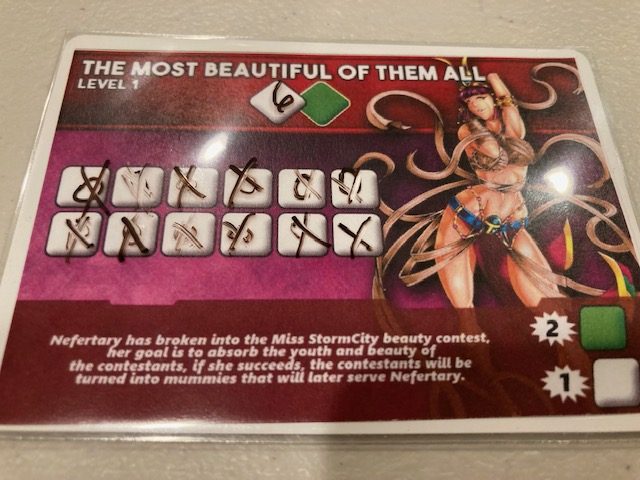
IMG_4515

The game also looked really great on the board and everything was every easy to distinguish! See above!  The colored rings on the heroes really helped!  It’s why I spent so much time looking for rings in Hour of Need: the colored rings really help distinguish the heroes from each other.   The zombies, as orange standees, are clearly zombies!  The Zombie Heroes, as green minis, are clearly Zombie Heroes! The Bystanders, as blue standees, are clearly bystanders!  This, coupled with the city tiles really makes the game standout on the board.

IMG_4364

I also liked that the zombies came out fast and really pretty terrifying! It really helped the game ambiance! If there were ever a game I didn’t want to come to life, it’s this one!  The zombie hoard was a bit terrifying as you saw more and more and more come out …

What I Didn’t Like

IMG_4379

By far my biggest complaint in the game was the Target Priority: see the rules above.  Basically, when you are engaging in combat, players are forced to fight certain enemies before other enemies!  If there are 11 Walker zombies about to tear you to shreds, but a Brute and Zombie Hero is on the same space you must fight the Zombie Hero first, then the Brute, the Walkers!  This makes no sense to me: I should be able to target the zombies however I want! If the Winter Soldier wants to kill the Walkers so that Hulk can take out The Zombie Hero, you can’t do that! You MUST fight the zombies in Target Priority!! I hate this rule! It takes away player choice for no reason.  What’s even weirder is that Marvel Zombies: Heroes’ Resistance has Player Selected Turn Order, a mechanism that furthers player choice, but then removes some of  that choice with Target Priority!  Very strange.  I may never play with the Target Priority rule:  I really despise it! I feel like the game is playing me rather than me playing the game.

IMG_4514

Another thing that seemed weird: the “1” on the dice is a “jaw with teeth”, but it kinda looks like a 6: see above.  “Did I roll 3 sixes?  Oh no, whoops! That’s a 1!”  I know the dice were doing that to be thematic, but the jaw choice looks a little too much like a 6.  It’s not a big deal, but it did trip us up a few times, really!

IMG_4373

I also didn’t love that you always must have 4 heroes in play.  That’s great in a 4-Player game, seems manageable in a 2 or 3-Player game, but I think it has major maintenance consequences and context switch problems in solo mode.  

Another thing I don’t like: once you punch out the zombies out and try to pack everything up, the game doesn’t really fit in the box very well.  This was surprising, given how good the insert is.  The box just doesn’t close all the way …

IMG_4400 (1)
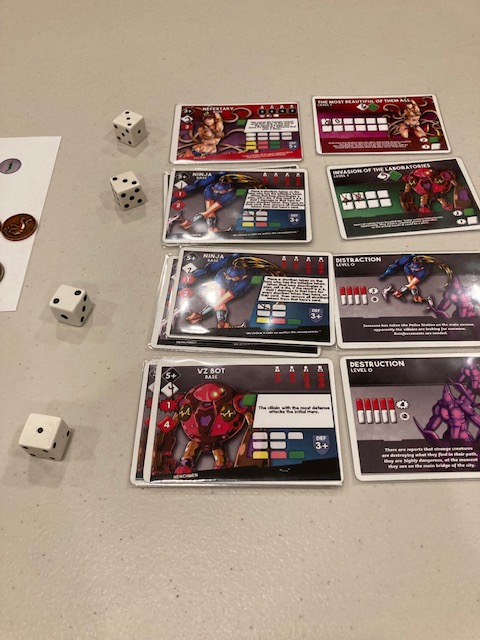
Conclusion

IMG_4392

I was surprised how much I liked Marvel Zombies: Heroes’ Resistance, especially since I don’t like zombie games!! It was fun, the rules weren’t too complex, the game looks great on the board, each player feels unique, there are a lot of interesting choices, and even a little but of roleplaying seems to emerge when you play! Despite its zombie theme, me and my friends really enjoyed this. I think part of the enjoyment is that the Zombicide rules (that this game is based on) have gone through a lot of evolution to become the streamlined ruleset we see here.
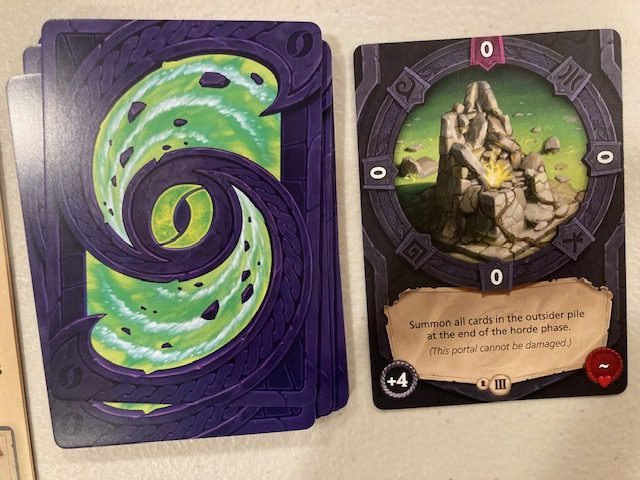
Honestly, Marvel Zombies: Heroes’ Resistance might have made my Top 10 Cooperative Board and Cards Games of 2022 if it weren’t for the Target Priority rule! That one rule just sticks in my craw because it takes away from all the other great choices you can make in the game! Of course you can ignore that rule easily, and I honestly suspect a lot of people will accidentally ignore it (because it’s not thematic and easy to forget). My advice: ignore the rule and enjoy the game for what it is: 7.5 or 8/10 without the Target Priority rule. This is maybe a 6.5/10 with the rule: I really hate that rule.