A Retro Review of Pandemic Iberia

IMG_5647

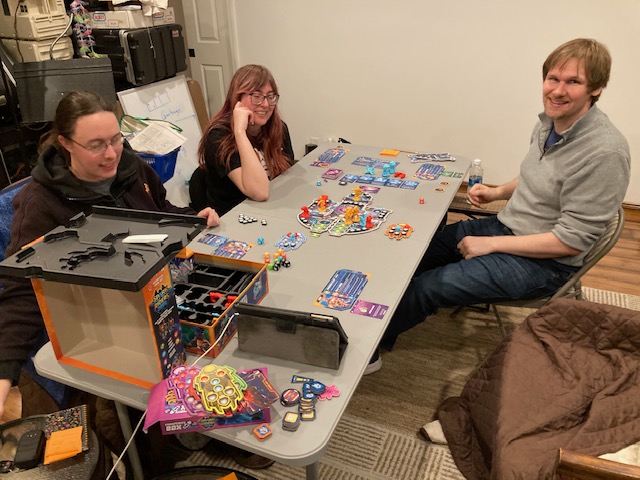
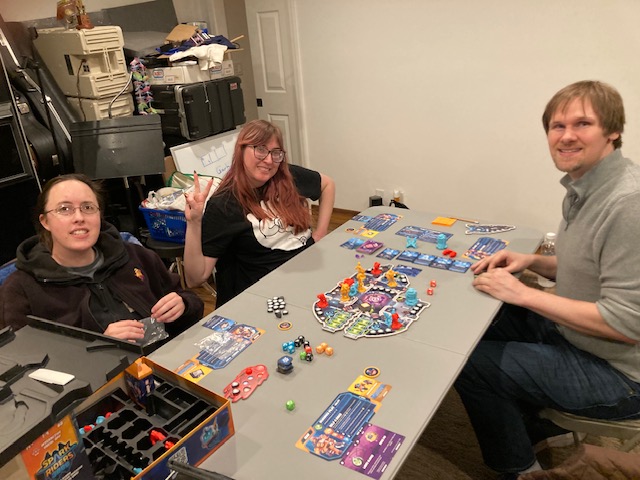
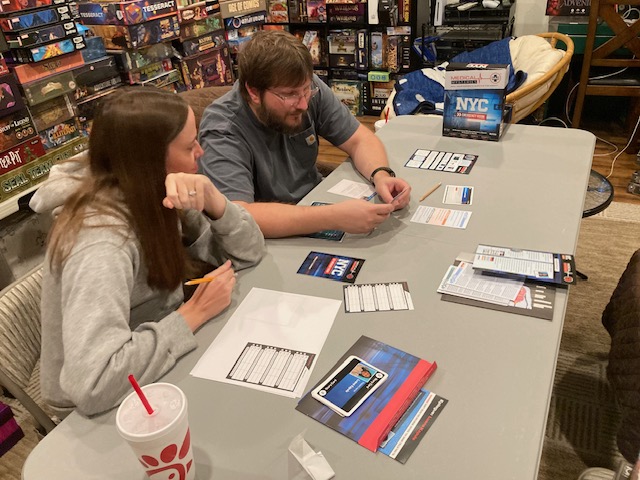
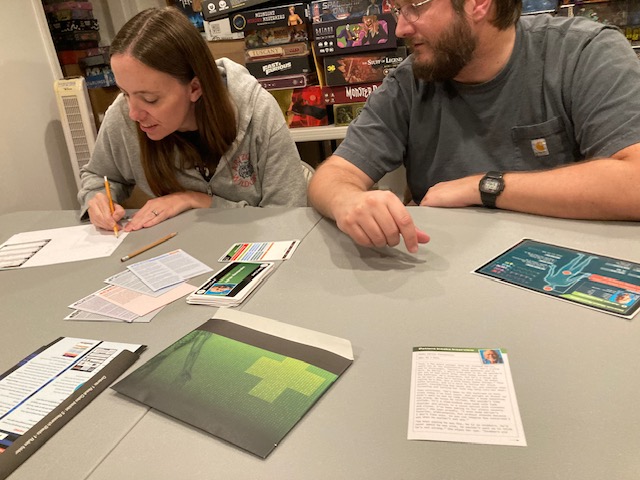
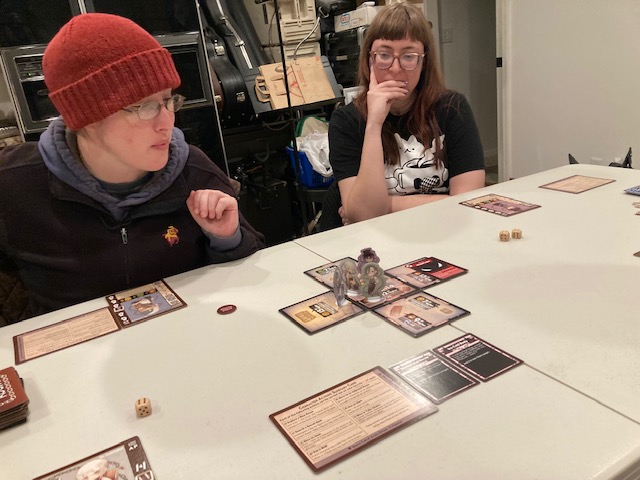
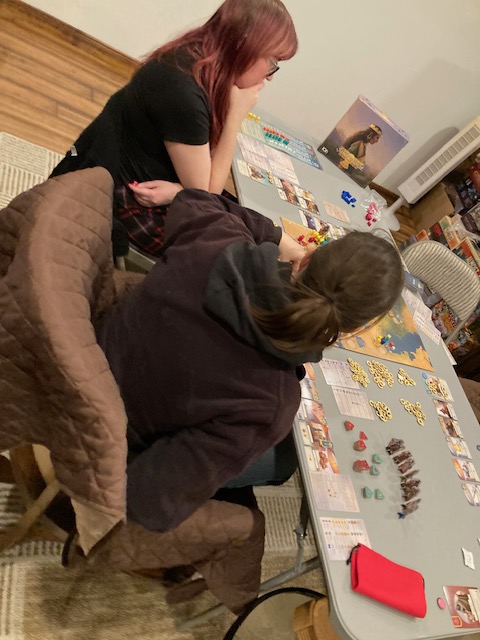
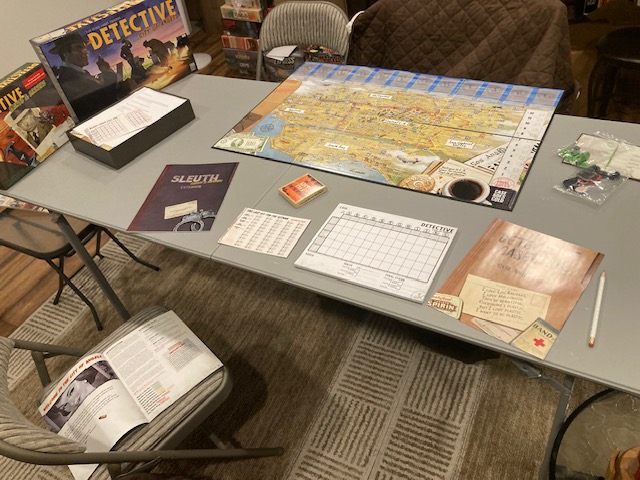
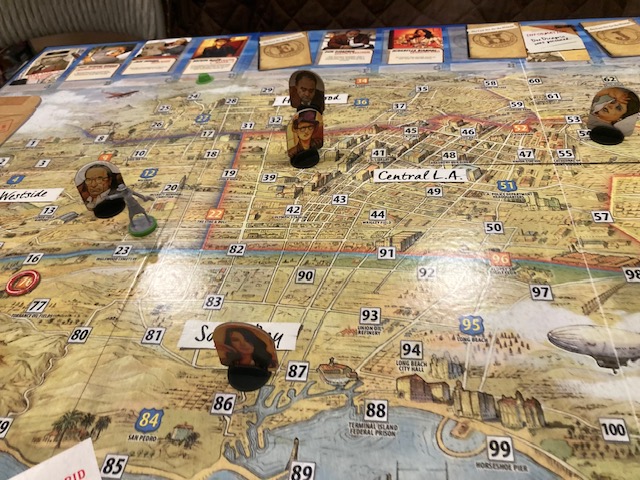
Pandemic Iberia is a cooperative “secret train” game: This is all the description I needed to entice my friend Robert in! He’s a huge fan of maps and trains! He’s also a huge fan of Pandemic (probably because of the map on the board). So, I was surprised that he had never encountered Pandemic Iberia! It has all of his favorite things: maps, trains, and Pandemic!

IMG_5631

Even though Pandemic Iberia was released in 2016 (some 6 years ago), it’s still a great game! That’s why we occasionally do these Retro Reviews: to shine a light on some really great older games. Our last Retro Review was Now Boarding! See that review here.

And this review is also for Greg: Greg told me he likes train games, so I wanted him to see what Pandemic Iberia looked like.

Play Twice (Back-to-Back)

IMG_5645

 When I used to play more with my friend Jeremy, he had instituted the rule that “we must play every new game twice: back-to-back!”  The rationale is that the first game is a learning game (where everyone is learning the rules, the mechanisms, and the flow of the game), but it’s the second game is when it all comes together.  While the game is still fresh in everyone’s mind, we can dive into the second play!

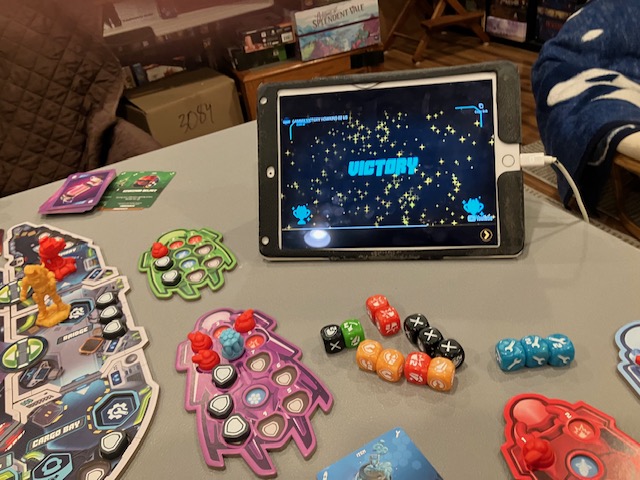
And that’s what we did for Pandemic Iberia!  Although we had all played Pandemic before, Pandemic Iberia is just different enough that it took a little more thought to get into it.  So, the first game was a learning game (and we lost horribly).  The second game was much more focused and directed, because we learned from our mistakes in the first game!

So many Pandemics…

IMG_5641

Pandemic Iberia was the “first” Pandemic variant! Since then, we have seen so many different variants: Wrath of the Lich King (A World of Warcraft Pandemic), Star Wars: Clone Wars, Pandemic Legacy Seasons 0, 1, 2, Fall of Rome, The Dice Game, and I am sure there are some that I am forgetting!  (Becca would argue that Flashpoint: Fire Rescue is her favorite Pandemic game, even though it’s not even in the Pandemic universe!  Its gameplay is just similar to Pandemic, but with a firefighting theme).

IMG_5633

Unlike the later games like Star Wars: Clone Wars (which we reviwed here) and Wrath of the Lich King (which we reviewed here), Pandemic Iberia is still very much Pandemic! You are still curing diseases, you are still roaming a map, you are still dealing with outbreaks! It still feels like Pandemic.

IMG_3476

Don’t get me wrong! I loved the Star Wars: Clone Wars (A Pandemic system) game: It made my Top 10 Cooperative Games of 2022, but you had to really squint to the see the Pandemic underneath. Pandemic Iberia is much closer to the source material.

What’s Different?

IMG_5629

In Pandemic Iberia, you still move around the map trying to quell the diseases. You still have to discard 5 cards of the same color at a Hospital (rather than a research station, but it’s the same thing) to research a disease. You still have to research 4 diseases to win. You still have to worry about outbreaks infecting adjacent cities, You still have to be leery of cities with 3 disease cubes!

IMG_5649

One very interesting new idea in Pandemic Iberia is the “region” idea. Regions are areas on the board enclosed by brown lines: see the region above surrounded by Ourense, Leon, Gijon, A Corona, and Santiago De Compostela. There are a number of places in the game that utilize this new idea. The most obvious is the “Purify Water” action, which is a new type of action. At the cost of an action and a card, you can “Purify Water” and place some Purification Tokens (the water drop above) in a region! Each purification token prevents the addition of one disease cube into a city adjacent to the region that contains it (the token is discarded after it prevents a disease).

This is really interesting, because it allows players a mechanism to prevent future infections without having to be in the region! Some of the characters (like the Nurse) also have special abilities based on regions.

IMG_5634

One other major change is how big movement is handled. Gone are the ideas of direct flights: you must either take the train, or travel from port city to port city.
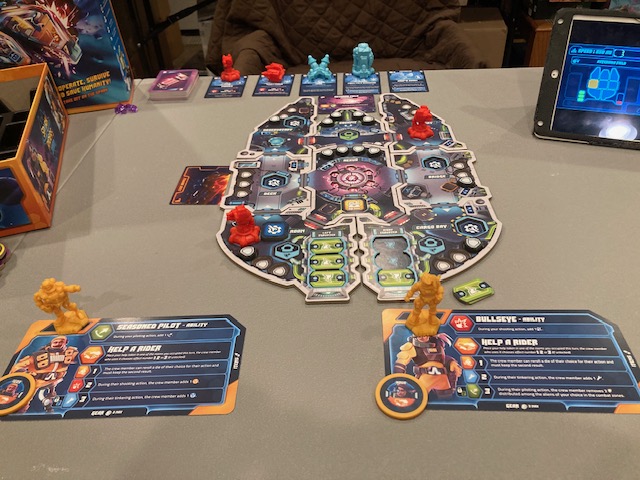
The “secret train” idea is that you can build a network of train tracks on the board. When the game starts, there are no tracks! You must build out the infrastructure! See above as we have quite a nice train infrastructure on the board. So, when you take the train, you can move to any city in the connected network for just one action! But, that means someone else had to help build the train network on previous turns!
Of course Robert chose the special power that makes it so he can build two train tracks for one action: that’s partly how we got our network up so quickly!

IMG_5640

The port city to port city travel requires you to discard a card, but then you can move from a port city to any port city (with the color of the card you discarded). All port cities are marked with Anchors (see above).

IMG_5633

You still have to deal with Epidemics like in Pandemic. Unfortunately, once you research a disease you don’t “cure it” or “eradicate it” like you did in base Pandemic. This is a thematic twist: this is a game set in 1848, so you don’t quite have the technology to cure! All you can do is research. You still need to research all 4 disease to win!

What We Liked

IMG_5647

We really liked the theme! With the real-world pandemic making us weary of the world-wide Pandemic, there was something charming about casting back to a previous era (1848) on the Iberian peninsula. The map of Iberia, the art on the backs of cards, the style of the game really transported us to a simpler time. Somehow, harkening back to an older era with a smaller map made this “whole Pandemic thing” feel more palatable, and dare I say, fun?

IMG_5630

We really liked how the new ideas: the regions, the railroads, the ports, the purify waters! The railroads in particular were such a nice touch: they make the game feel even more strategic. A lot of Pandemic is keeping the diseases under control, but spending actions early in the game to set-up a train network (with the topology of our choosing) made the game feel harder, but more interesting! We had to figure out when it made sense to spend actions for building tracks!

And the purify waters action/region ideas was just a new and really cool way to “prevent” outbreaks even if you weren’t there! Again, it made the game that much more strategic.

IMG_5639

The game is absolutely harder. We lost our first game. But it made us want to try again! By pulling together and playing better as a group, the game absolutely encouraged that much more cooperation. It was clear: we had to cooperate well or we die.

IMG_5646

A minor thing, but a thing nonetheless: I enjoyed that there was always something interesting you could do with all of your actions! Even if you had an action left over, you could choose to either “purify water” in a adjacent region, or build a train track. I have had games of Pandemic where I threw away actions (to end up in the right space to trade), so it was nice to feel like you could always do something!

Intensity

IMG_5628

Strictly speaking, Pandemic Iberia is harder than Pandemic.  It requires a lot of thought, planning, and cooperation to win.  Pandemic Iberia is a very intense game: you may love that, or you may hate that.  Jeff and Becca like the original Pandemic better  because it has a little more laid-back feel: they feel like you can sit back and enjoy your turns a little more in Pandemic.  They still enjoyed Pandemic Iberia, but thought it was much more manic that base Pandemic.

Robert adores the trains and strategy and I believe Pandemic Iberia is now his favorite Pandemic.  I think I am with Robert: I love the new systems and the strategy they introduce. 

Conclusion

IMG_5634

Pandemic Iberia was a hit with my group! It’s like a 9/10! It’s a very hard, very strategic version of Pandemic. If you are looking for the next step-up in strategy from Pandemic, consider checking out the very first variant: Pandemic Iberia. It’s charming setting but manic gameplay might be just what you are looking for in a difficult, but strategic cooperative game.

Greg, I really do think you’d like Pandemic Iberia.

A Review of the Cooperative Lord of The Rings: Adventure to Mount Doom Board Game (Solo review only, we’ll see why…)

IMG_9654

Lord of the Rings: Adventure to Mount Doom is a game I got from a recent GameNerdz order. I believe it just came out in the USA (as of Sept. 1st, 2023): this is a Kosmos game, which typically has more of a European presence. This is a cooperative game in the Lord of the Rings universe. It’s a little surprising, given that we saw the Lord of The Rings Adventure Book Game just a few months ago! We loved that game: see our review of it here!

IMG_9655

Even though the Lord of the Rings Adventure Book Game was a lighter cooperative game, this one seems even lighter!

IMG_9656

This Adventure to Mount Doom has only 50 minutes play time, with 10+ ages … the same age group, but this game promises a “full” Lord of the Rings Experience in 50 minutes!

Components

IMG_9659

This is a pretty standard sized box.

IMG_9660

The rulebook is very readable, if the font is a little small. It does a nice job showing and labelling all components and getting a good picture of set-up. The rulebook is only 8 pages! But it does a good job.

IMG_9662

The box is probably too big for all its components.  Just some cards, standees, and dice.

IMG_9663

The components are nice, despite the cards not being linen-finished. Everything is very readable.

Gameplay

IMG_9667

This a cooperative game. Um, this is roll-and-move. Wait, wait, wait! Don’t run away just wait! It’s more interesting than you think.

IMG_9783

Players do NOT play any individual Lord of the Rings character, they play the fellowship, trying to move the fellowship (piecemeal) from Rivendell to Mount Doom! See above as the fellowship starts with 5 groups on Rivendell!

IMG_9683

Note that there is a die for each group (Frodo&Sam, Merry&Pippin, Aragorn, Legolas, and Gimli). Each turn, the current player will be rolling some dice and moving forward some members of the fellowship! Incidentally, the game does a great job, in both the rulebook and components, of making it clear which color applies to which group!

IMG_9791

If you can get the ring-bearer (Frodo&Sam) to Mount Doom at the board, the players win!

IMG_9706

On the left side of the track is a courage track for the Ring-Bearer: if it ever goes to the bottom, players lose!

IMG_9717

Or, if all the Nazgul make it onto the board players lose!

IMG_9690

Here’s the roll-and-move part … every turn, the current player rolls 4 dice: 2 colored (which allow the corresponding fellowship to move) and 2 black encounter dice (usually bad news). They choose one colored die for fellowship movement, then one black die for an encounter.

IMG_9694

There are 6 encounter spaces at the bottom of the board: some are good (3 is green: Arwen is a friend makes it so you can avoid one bad space on the move) and some are bad (2 is Saruman: he amasses the Uruk-hai) and some are unknown until you flip them (1 and 6).

IMG_9702

IMG_9701

If the encounter card leaves the board, the symbol underneath is “usually” good: above, you can choose to move Gimli up to 2 spaces (after we take Arwen).

IMG_9692

After you roll for the first choice, then you still roll the black dice and two more colored dice: you have no option on the second black die: you must take it.

At point, you execute your turn: Have the black encounter, move the fellowship character, have the second black encounter, then move the second fellowship character.

IMG_9710

Every time the ring-bearer enters a new area, you have to clear the encounter cards and get the encounter cards for the next section of the board. As you expect, the encounters get less and less friendly as you get closer to Mount Doom.

IMG_9684

There are other rules (how you can heal, how you fight, how you can get Gandalf cards, how you accidentally get Nazguls, etc), but at it’s core: this is a roll-and-move game: Per turn, you basically get to roll 7 dice total and get to choose 3 of them (1 black and 2 colored) and get stuck with 2 of them (1 black and 1 colored) (2 go unchosen or re-rolled). Note that you do get to choose which of the colored dice you roll, so that helps.

IMG_9790

Once the ring-bearer gets to Mount Doom, the game changes a little: only the ring-bearer moves, and only 1 black die gets rolled: you just have to suffer the consequences and hope you get to Mount Doom!

IMG_9788

Roll and Move

IMG_9708

Are you still reading? Yes, this is a roll-and-move game. But there is some choice. You still get stuck with 1 completely random encounter each time (the second one), but at least you can choose the first. And you get to roll at least 4 colored dice and choose two of them. So, this isn’t quite like a roll-and-move like Life or Monopoly: you do get some choice..

IMG_9787

And sometimes you will roll bad: see above as I barely get my fellowship moving with 1 and 2!

IMG_9704

And sometimes you will cruise! See above with a 5 and 6!

IMG_9703

There are reasons to choose lesser numbers sometimes: see above! If any of the three land on the space 2 spaces away, you lose courage! So, maybe you’ll take a 1 over a 2 to avoid the courage loss! There are choices along the way.
Solo Game

IMG_9688

Congratulations on following Saunders’ Law and having a viable solo mode!  In this case, since no one plays any particular character (you just move parts of the fellowship depending on your dice rolls), it doesn’t really matter how many people: the Gandalf and friend cards can be used by anyone.  
IMG_9717

In my first game, I lost horribly near Mount Doom as too many Nazgul came out: When all 7 come out, I immediately lost! It was frustrating, as my Nazgul came out because I rolled poorly on my second encounter rolls! I had no way to mitigate that! So, I just lost.

IMG_9713

I had actually lost earlier, but I kept playing because I wanted to see the endgame. It turns out the Sauron’s Eye (see above) totally screwed me out of my courage, and my courage fell below 0 way before I lost to the Nazgul.

IMG_9721

My first game was a learning game. Lessons: keep the courage up and stay away from the Nazguls!

IMG_9785

My second game went a lot better: I almost lost, but Faramir made all the difference in the end game:

IMG_9789

I used Faramir to move the last 4 spaces of Mount Doom: this avoided all the bad stuff along the way! I am pretty sure I would have lost had I not played this card at the end!

IMG_9791

Both solo games were (correctly notated) at about 50 minutes. I lost my first game and won my second game.

Randomness

IMG_9711

I had to have to have a long think about this game after playing it. Yes, it is perhaps a little too random. The second encounter roll can almost never be mitigated, and if you roll poorly, the Nazgul will eat your lunch and you will just lose.

IMG_9696

But, you have some choices along the way. So, is this too random?

IMG_6418

I am reminded of Ranier Knizia’s original cooperative Lord of the Rings game. We joke that it should be called “Getting Killed by Sauron” because it’s so hard … but you know why it’s so hard? It’s so random! The randomness there comes from the event tiles. You have no idea what event tiles you will get as you play, and so few ways to mitigate those event tile flips! Yet, we still seem to like the original Lord of the Rings game. Honestly, there is some nostalgia there, as the original Lord of the Rings game was one of the first cooperative games out there!

IMG_9705

So, Adventure To Mount Doom maybe has a little more “bad news” mitigation or maybe the same? But it’s only 50 minutes! So, maybe my brain thinks “Lord of the Rings needs to be an Epic game, so 50 minutes is too short!” … but maybe it isn’t. I think the amount of randomness here is probably less than the original Lord of the Rings game by Knizia. So, am I a hypocrite if I like the Ranier Knizia game but not this one?

Cooperative Play

I couldn’t get my group to play this cooperatively. 

“Wait, this is roll-and-move?”

“Well, yes. “

“Is it kind of random?”

“Well, yes. But it’s better than you think!”

“You aren’t really selling it.”

So, they heard roll-and-move,  they figured it was too random, and they were done.  I think this prejudice might be widespread.

Conclusion

IMG_9684

So, this game was better than I expected, but it’s still a roll-and-move. The solo game was okay, but I don’t see myself playing it again solo. And I couldn’t get my game group to play it.

But I encourage you to look into your soul and remember how random the Ranier Knizia’s Lord of the Rings game was and ask yourself to reconsider randomness. Adventure to Mount Doom is only 50 minutes, and there are interesting decisions along the way, even if it is maybe too random. At least it’s short!

In the end, I am keeping the game because I think this can be a good introductory cooperative game for people who have only seen older roll-and-move games like Life and Monopoly. I can see someone new to the hobby enjoying the Lord of the Rings theme and still getting into Adventure to Mount Doom. I also can see families with kids (at the bottom end of the age range: 10-11) enjoying this.

Hard-core gamers will probably hate this, or at least they think they will. It’s better than they think.

A Review of Midnight Murder Mysteries: Cooperative and Solo Modes Only

IMG_7053

Midnight Murder Mysteries is a cooperative detective/deduction game that was on Kickstarter back in June 2022. Ir promised delivery in January 2023, but it only arrived at my house sometime in April 2023 … a few months late for a Kickstarter isn’t bad.

IMG_7052

This is the 2nd Edition of the original game. I have no knowledge of the original edition, but I do love mystery/detective games: See our Top 10 Cooperative Detective Games! That’s why I backed this game. Let’s take a look! (There is also a competitive mode, but we don’t review that here).

What Is This?

IMG_7054

This is a detective/mystery game. Players work solo or cooperatively to uncover a murder! (There is also a competitive mode, but we don’t review that here).  There are about 9*3 or 27 cases here in 3 case books (the Kickstarter version has an extra casebook bringing it to 36 cases).  

IMG_7092

Each case in the case book is described on two pages: the premise (left above) and the paths (right above).  As you investigate, you can investigate a location or talk to a suspect (if you are in the same space as that entity).  You can ask each suspect about their alibi, what they may have witnessed, and possible motives: each of those questions is a separate action.  Each investigate has a number next to it which leads you to an entry in the same book.

IMG_7075

Each entry (see above) gives some information which you can mark off on your clue sheet (see below).

IMG_7093

You can only get the information from a suspect if you are in the same location, so you will be having to walk around a ship to find them!

IMG_7089

There is a built-in timer: you must solve the murder before the ship gets back to port!

IMG_7088

The timer (above) gives you “about” 10 turns to solve the murder!

IMG_7106

Once you are forced to (or choose to) solve the murder, you flip over your clue sheet and fill in CULPRIT, MOTIVE, and MODUS OPERANDI … and a backup, just in case you are wrong. You read the solution and score your investigation with a 100 being perfect and 0 being, well, terrible.

This game is all about trying to optimize your actions to get the most info before you run out of time!

Components

IMG_7060

The components are pretty good. The case books are readable (if a little small). The board is well-labelled and easy to navigate.

One major complaint about the components is that the bases DO NOT fit well into the standees.

IMG_7078

The stands are way too tight. I ripped the first Suspect standee. See above and below.

See the tear at the bottom? After that, I used a plastic knife to hold the base open so none of the other standees would rip. See above. I do wish they had included a few more bases because I am never taking these out again!

IMG_7083

However, assembly is a one-time thing. Just be very careful putting your standees together.

IMG_7058

I think the most impressive component is the HUGE clue pad: there are so many clue sheets! See above.

Solo Game

IMG_7073

There is a solo mode (see rules above): You are trying to solve the murder before Simon the Purser. Simon is running around the ship (as are you), and you are both trying to solve the mystery before the other.

IMG_7103

The solo mode is okay: it kind of gives you a sense of how the game works. If Simon is in an area with you, you can’t investigate unless you use an action point to move him away. His movement is controlled by the event deck, but he can essentially teleport to any location on the ship. This is frustrating since movement is so much more expensive for the solo player.

IMG_7101

There is also a notion of publicly and privately investigating, but it really is just a counting exercise: public investigating is only one action point, but Simon gets to cross off a path. When Simon has 30 PATHS crossed off, you trigger the end of game! … and you see if you have solved it, getting some points based on where Simon was.

IMG_7093

The solo mode was okay: I found it to just be “optimizing actions” to avoid Simon getting to 30, so it didn’t really feel like he was investigating. My own investigations were fun enough, but there was a lot of Simon upkeep.

IMG_7108

Solo mode taught the basics of the game. It was good enough for that, but I wasn’t compelled to play it solo again.

Cooperative Play

IMG_7340

Cooperative play was good…ish. It’s weird that players don’t share information (mostly) until the very end of the game. Each player conducts their own investigation, but there is no real sharing of information as the game plays! Each player is conducting their own private investigation, reading from the book independently. As they play, the can share whether a location is “good, bad, or meh” information AND THAT’S all the information can be shared!! So that game proceeds in a lot of silence as players read (silently to themselves) from the case book.

IMG_7343

But, the end of the game was explosive! People could barely contain themselves when they could finally talk to each other. “Do you know what I found?? I couldn’t tell anyone! Oh my gosh!!” No one could communicate (much) for most of the game and it was like a dam burst at the endgame!! It was like everyone just exploded!! It was exciting and furious, as information about the murder flew around the table. The end of the game was absolutely the best part of the game, as players shared and postulated together, trying to come up with the murderer, means, and motive. It was boisterous and exciting.

Strategy

IMG_7105

There is strategy to the game, even though the Suspects come out very randomly. Movement is precious in this game, so players have to come up with some strategy to get the fewest moves and most investigations. There’s some rules that seems “throwaway” when you first see them: At the end of your turn, you can move a SUSPECT up to two zones. Okay? Turns out it’s critical to use this to move the SUSPECTS to you rather than wasting your own actions. So, there will be a lot of discussion about who to move to help the others. My first game, I didn’t get why that was important, until I saw how much moving wasted my actions. There is some strategy to optimizing your investigations.

The Alpha Player Lurks

IMG_7079

One of the things we don’t touch on a lot here in Co-op Gestalt is the threat of the Alpha Player (see our discussion here for more elaboration of the Alpha Player Problem). A lot of people have had cooperative experiences ruined by an Alpha Player, including myself. I, generally, have been fairly lucky that my game groups get along well and cooperate well: the Alpha Player is (almost) never a problem for my groups. However, it’s important to remember that the shadow of the Alpha Player is always lurking nearby, waiting to ruin a cooperative game … so, it’s good when games feel like they have explicit mechanisms to safeguard against the Alpha Player.

IMG_4182

Recall from our review of King of Monster Island that we liked the game, but the turns felt pretty independent without much interaction. Although this generated a negative reaction at first, we realized that this might actually be a positive: this game guards against the Alpha Player! If you are in a situation where you might be playing with an Alpha Player (your brother, you-know-the-guy-in-your-game-group, maybe even yourself), this would be a good entry: the fiercely independent dice rolls keep the Alpha Player at bay as each player enjoys their own turn!

IMG_7344

And Midnight Murder Mysteries also seems to keep the Alpha Player at bay! Each player fills out their suspect sheet independently , makes their way around the board independently, and pursues their own investigation … independently! The only time the players really cooperate is at the very end when they share all the info they have. So, as the players play, there really is no chance for the Alpha Player to tell you what to do!

IMG_7345

There is a cost, though for warding off the Alpha Player: there’s really no interaction as you play. I tended to role-play an annoying kid, and we all sort of did stuff to be silly just to engage a little. So, again, that could be a positive or a negative: you can use the time to talk as friends about whatever you want, but you aren’t engaging in the game proper.

Downtime: The Main Problem and a Potential Fix

IMG_7339

The main problem with Midnight Murder Mysteries is that there is a lot of downtime while you wait for the other players to “read silently” their chosen path from the casebook. Now, there are a few places when investigators can share, but we found that the bulk of the time was just waiting for the previous player to finish reading silently. This downtime kind of took a toll on us as we played.

IMG_7050

But the downtime can be alleviated! Although I got two copies of the game for gifting (one for myself, one for a friend), I think that was a happy accident! We think the way to play best cooperatively is play simultaneously! Each player reads of out their own independent casebook and pursues their own independent path each turn from their own independent book! Players will need to figure out who to move before the round begins, but during the round, the “reading of the book” can take place simultaneously. This can pretty much remove all downtime and the game can go much faster.

IMG_7049

The only way this can work is if you have multiple copies of the case book. It turns out that some of the cases are online in the Print and Play. So, if you have multiple devices, you can access the case books online so that each player will have their own case book! Or if you have multiple copies of the game (like me), you can physically share multiple physical copies.

IMG_7103

Granted, there are some issues that need to be resolved: how do you handle things that are supposed to happen in order? Generally, the only things that seemed to matter were either the sharing of information or the moving of suspects. If the players decide, as as group, which suspects should be moving before the turn begins (rather than piecemeal), then that can work. It might take some tweaking, but since this is a cooperative game, the players can decide together how to deal with this!

In general, this simultaneous play house rule takes this cooperative game from something we liked okay to something that is fun and quick to play we liked a lot more! With simultaneous investigations, that 75 minute play reduces substantially (depending on how many case books you have)! Some of the casebooks are online for the Print and Play version: that’s probably your best bet to have multiple copies of the case books.

Conclusion

IMG_7060

Midnight Murder Mysteries is a curious beast. The solo game isn’t great, but it’s good enough to teach the game. The cooperative mode isn’t very interactive until the very end, but this can be both boon and bane. The Alpha Player will never take over this game because each player in the cooperative mode will have their own investigation which won’t be influenced by the Alpha Player, but this comes at the cost of some interaction. Luckily, the endgame is explosive and highly interactive and really makes up for the earlier lack of interaction.

IMG_7345

The worst part of the cooperative game is the downtime between turns, as you wait for each player to read silently from the case book. With a simple house rule, by just using multiple copies of the case book and investigating simultaneously, you can get rid of a lot of waiting and make the game that much more punchier! Without the house rule, the game is probably a 5.5/10 or 6/10. With the house rule, the game really speeds up and becomes a 7/10 or 7.5/10.

IMG_7339

But, it depends on how you want to play! Do you want to play a game where you and your friends can hang out just shoot the breeze while you play? Then play Midnight Murder Mysteries cooperatively as-is: no Alpha Player will come and ruin your game. If you want your game punchier and more intense, consider playing simultaneously with multiple case books. The thing is, you can choose what’s best for your group!

A Review of Bedlam in Neverwinter: A Dungeons & Dragons Escape Room in Three Acts

Prelude

IMG_8135

Bedlam in Neverwinter is an Escape Room room game in the Dungeons and Dragons universe of Icewind Dale. This is a game is three Acts: Each Act lasts 90 minutes as players work together to solve puzzles and try to solve an ever growing mystery. Act I, Act II, and Act III are all connected: the story all culminates to a final solution in Act III after playing through each act.

IMG_8139

After each Act, you can save your game for another session (which is what we did), or continue straight to the next act. We played the three Acts over three sessions in June and July of 2023.

IMG_8140

The time on the box seemed apropos: each act was about 90 minutes. The box also says 2-6 players. We ended up playing with three people. If you were stranded on a desert island with this box, you probably could play solo as two characters and still enjoy it, but like all Escape Room games, usually more brains are better to progress the game.

IMG_8138

This Escape Room style will very familiar to those of you who played the Clue: Treachery at Tudor Mansion game from earlier this year: see our review here. There are differences, though, which we’ll see below.

IMG_8142

As the prelude closes, we get ready to play.  You’ll notice we can’t do anything at all until the players arrive! As soon as you open the box, it tells you to STOP!

IMG_8143

Act I: Mystery at Ten Towns

IMG_8145

Charlie and Allison are my Escape Room buddies: we’ve played quite a number over the years (including many Murder Mysteries: they were part of Red Carpet in Ruins from a weeks ago). This seemed the ideal game for us: we have played many sessions of Dungeons and Dragons together as well as many Escape Room board games! This game was made for us!

Continue reading “A Review of Bedlam in Neverwinter: A Dungeons & Dragons Escape Room in Three Acts”

A Review of Davy Jones’ Locker: The Kraken Wakes (It’s a Crackin’ game!)

IMG_9237

Davy Jones’ Locker: The Kraken Waves is a cooperative pirate-themed game that was on Kickstarter back in August 2022: It promised delivery in July 2023, and I received my backer copy in Early August 2023. That’s maybe just a few weeks late, which is great by Kickstarter standards! Seriously, the last five Kickstarters we have received have been either early or on-time! Let’s hope this trend continues!

Davy Jones’ Locker: The Kraken Wakes is a cooperative pirate game (if you couldn’t figure that out from the name or pictures).

IMG_9240

This is a game for 1-5 Players, Ages 14+. The game box (above) says 30 minutes per player, but that is not at all what we experienced! It felt much longer! A solo game took about 2.5 hours, a 2 Player games took about 3 hours. A better metric might be: 2 hours + 30 minutes/player?

IMG_9236

Interestingly, the game “base rules” all seem to apply to games of 2-4 players. The solo rules and the 5-Player rules are exceptions. This bothered my friend Sam so much that he chose to back-out of a 5-player game we had planned because he was worried about the time/extra rules overhead. Be aware: the game does seem tuned for 2-4 players, but just happens to have rules for solo and 5 players.

IMG_9305

Let’s take a look at this cool pirate game!  Will this make  our Top 10 Cooperative Swashbuckling Games?     If ye wants to be a mutinous pirate and see, jump to ahrrrrrrr Conclusion!

Unboxing

IMG_9232

This is fairly normal sized box: see the Coke Can above and below for scale.

IMG_9233

Note that the game seems to not all quite fit in the box: this is a very tightly packed box! Unfortunately, it’s still a little overpacked after you rebox it as well. It’s not a big deal, but it was a bit noticeable.

IMG_9241

See above as we unbox!

IMG_9243

The rulebook has a great cover, and fits to the shape of the box.

IMG_9275

This game (other than sightly overpacking) has really thought about how to fit just about everything in the box! It has great directions for putting cards and tokens into the bottom of the box: see the insert above. And on the other side of the insert…

IMG_9276

There are also GameTrayz (sp?) for ease of storing many pieces. You do have to unbox a lot of things to get them in there, but it really does make set-up and tear-down easier. See above and below.

IMG_9306

The dice all fit into one of the GameTrayz pretty well: the 4-sided (used for marking Tentacle Hit Points) and 8-sided dice (used for notating hull and direction) felt like they fit, but sorta weirdly. It worked well enough. The 6-sided wood dice were fantastic and very thematic, with little pirate symbols on them! The gold coins were real metal and very cool as well.

IMG_9308

The tentacles and ships fit nicely in the other GameTrayz.

Underneath all the GameTrayz are a bunch of stuff ..

IMG_9279

As you pull everything out of the box, you get a little worried … “Is this all going to fit?”  

There were a ton of punchouts (see above) which all seemed to fit nicely into the insert at the bottom of the box.

IMG_9310

And you know what, it does fit all nicely in the box (modulo being just a touch too tall): see above.

IMG_9287

Oh yes, and the player boards and nice and dual-layered: see above.

IMG_9297

The cards are all linen-finished and look very piratey. The art is nice, if weirdly a little inconsistent: some card backs have really nice, almost painting-quality art, but some have more pencily art, and some art looks like just old prints. Despite the inconsistency in style, the art still works in this pirate game.

IMG_9300

Overall, the components are very nicely done and the game looks like a cool pirate game.

Rulebook

IMG_9245

I struggled with this rulebook. It’s not a bad rulebook, but it could been better. I mean, I do love that cover!

IMG_9246

Part of my struggle may have just been the length: this rulebook is LONG: it’s 36 pages!  Sometimes that extra length is used for flavor or scenario text. Nope: Not here!  This rulebook is pretty much all rules!  It’s a heavier game than I expected.

IMG_9301

The game gets a B- or C+ on the Chair Test: It has a big font which you can read (good), it stays open when you place it down (good), but it kinda flops down on the edges when you put it on the chair next to you (bad). I think it worked just well enough to use the chair next to me.

IMG_9248

I think I was a little grumpy with the rulebook right away because it started with a Table of Contents (listing the major headings in order) … but called it an Index instead.  I’ve seen this in other games and it’s a pet peeve: A Table of Contents lists major sections in order, and an Index notates important keywords and where to find them in the text.   This is a pet peeve because it belies not understanding standard book nomenclature … and it has me worried they’ll get other stuff wrong.

IMG_9250

The Game Components were well-labelled across two pages.

I appreciate the extra space they took to list and label all the components. Sometimes, when the rules refer to a component, it’s nice to be able to look stuff up.

IMG_9253

There’s a nice overview of the map as we start into the rules. See above and below.

IMG_9254

It did have me wonder if maybe the board should have been LABELLED with the annotations rather than having to look them up? That’s a tough one, because the board does look nice, and adding annotations would make it busier and less thematic. I think they made the right choice from a theme perspective, but I always think that it’s better when the components and spaces are well-labelled so you don’t HAVE to look up stuff in the rulebook.

IMG_9255

The set-up pages were pretty well done.

IMG_9256

It’s just .. I started out with a solo game (which I strongly suspect most people will) because I wanted to learn the game before I taught my friends, and the solo rule were an “exceptional” case relegated to the back of the book. Look closely at the set-up:

IMG_9348

The set-up ONLY discuss 2, 3, and 4 Player set-ups! If you want solo play, you have to go out of your way to find those rules in the back of the book. Again, I suspect many people will play this solo first so they can teach their friends, and the rulebook doesn’t make that flow easily. Gameplay is optimized for 2, 3, and 4 players. Solo and 5-Player games are the exceptional cases.

There’s a lot of text in the rulebook, and there could be more figures. And even so, there still were times when I thought the game was underspecified (Example: when a whirlpool moves you, how do you move? Along the current? When you get pushed out by the whirlpool, is that an extra move? Where do you get moved to? Frequently there are multiple choices…)

IMG_9247

Look, this game has a lot of rules, and occasionally under-specifies a few of these rules. BUT, the rulebook is very readable, and it has a big font., and even though there are problems with the rulebook, it makes a good faith effort of putting forth a good pirate game and mostly succeeds. Let’s just move on: I was able to learn the game from the rules, so that’s a win.

Gameplay: Overview

This game proceeds over two Acts. In Act I, players work together to try to upgrade their ships to make them “sea-worthy” : players are exploring and doing all they can to get their ship shipshape. In Act II, players use their upgraded ships to fight the Kraken: if they can take out the Kraken, they win! You’ll note that the player board (above) has two sides: Side I is the map where players explore and upgrade (Act I) and Side 2 is the whirlpool where player fight the Kraken (Act II)!

IMG_9286

At the start of the game, each player selects one of 5 ships to man.

IMG_9320

Each ship has 5 main stats notated on 4 different tracks and 1 8-sided die.

  • sail (green) is how many movement points you have.  Normal sea costs 1 movement point, other “rougher” seas cost more 
  • cannons (brown) are how many dice you get to roll when you attack.  
  • hull (purple) are how many dice you roll when you defend
  • repair (red) is how many spaces you can repair other attributes (including repair) if they get lowered. 
  • integrity (8-sided die) is your “hit points” for the ship: how much damage your ship can take until it sinks

You can’t repair your ships attributes above the default unless you get a special card that ups that stat … the slots underneath the ship are for those special upgrade cards.

IMG_9321

Every ship has a special ability, or rather a choice (one of two): See above: You get to to choose one. That ability changes in the second Act: it flips to the other side (so pay attention to both sides).

IMG_9340

During the Act, players will be upgrading their ship (upgrading stats and getting upgrade cards) and getting gold: gold in Act I is how you buy upgrades, but gold will be used for re-rolls in Act II. See above for an upgraded ship!

Get the best upgrades you can in Act I to fight the Kraken in Act II!

Gameplay: Act I

Act I is all about the upgrades.  Pirates do “piratey” things (plunder, explore, fight) to get gold so they can buy upgrades to their ships!

IMG_9427

In Act I, players deal with an Event every turn, then get three Actions each.  See above for the very good player summary cards! (Seriously, these were very helpful).

IMG_9335

Events (see above) in Act I are generally good things: they set the stage for some “piratey” things to happen, which nudge the players in certain directions.  For example, the Exotic Goods card puts the Merchant Ships into play, encouraging platers to “pirate” them to get good stuff. The Events can also be bad, but generally are helpful.

IMG_9327

Once the Event is resolved, each player get three actions.  The most common actions (at least among me and my friends) were the Explore, Plunder, or Visit Market actions: These are generally the most reliable way to get upgrades.  These actions must  happen at a port.

The four corners of the board have different ports with different types of upgrades. The color of each port is significant: note that the colors correspond to the four attributes of each ship! For example, Siren’s Grotto (the green port) is all about sailing upgrades (green attribute).

IMG_9345

There are lots of ways to upgrade your ship: You can also Hunt or Explore A Shipwreck, which you almost only want to do with someone else: failure at those actions can really damage your ship.

IMG_9372

Gold is very important in Act I: you can usually get some really great upgrades at the Markets if you have enough gold. Unfortunately, you don’t have a lot of gold to start of the game, so a lot of the actions in the game have you “take a chance” to try and get some gold.

IMG_9428

Most of the actions in Act I have you rolling the Fortune Dice (the wooden dice, see above) to attempt things: you have to get a certain number of successes to succeed: each Skull is a success. (The Combat also uses these dice). Note the distribution: 2 empties (failures), 2 single successes, and 2 double-successes.

IMG_9406

For example, when Teresa and I went after the Silver Sun (A Treasure Galleon from a Hunt action), we had to roll  8+ successes in a combined Sail and Repair roll (where the stat indicates how many dice you get to roll).  A failure was not good, but a success would get us some good booty!

IMG_9413

Most of the time, the result of success is Gold or a minor stat boost, but you can also get Treasure! Treasures in the game can be amazing and really help you in the final combat. The Chain Shot Treasure (above) was critical to one of our wins!

IMG_9346

As you explore and plunder and go to different ports, you will have to sail out on the Open Seas: that has its own risks and rewards! You have to draw an Open Seas card everytime you are out at sea:

IMG_9324

Generally, the Open Seas cards are challenges for the pirates (which may result in some gold), but as the game progresses, you may accidentally draw a Kraken Advances card from the Open Seas deck:

IMG_9347

If you ever draw 3 Kraken Advances cards from the Open Sea deck, you immediately begin Act II! Most of the time, though, Act II starts after all 6 Events have come out.

IMG_9344

Either way, you hope you and your fellow pirates have upgraded your ships enough! Act II is starting!

Act II Set-Up

Before you can get to Act II, you actually have quite a bit of set-up:

IMG_9351

Before Act II officially starts, players have to turn over the Black Spot cards (see above) and discover how many Kraken Modifiers are used to augment the Kraken!

IMG_9352

Each card will potentially up the Kraken’s starting hit points or add a new Kraken Modifier.  Basically, these cards are a balancing factor: if you did really well in Act I, well, the Kraken gets that much harder!

IMG_9354

In my first solo game, I did “ok” in the upgrade phase, and got 5 Kraken Modifiers and a few extra hit points.

IMG_9396

The Kraken has a number of tentacles and hit point based on the number of players.  See the board above: a solo game has 4 tentacles, and my starting hit points were 24!  Note that they did a great job of notating a lot of things on the board: the tentacles attack, defense, range, and move!  The 4-sided dice notate the tentacle hit points (0-3).

Gameplay: Act II

IMG_9362

Act II is all about trying to take down the Kraken and his tentacles!

IMG_9383

A Whirlpool starts the turn: this pushes the ships around the whirlpool and has some “bad stuff” happen.

IMG_9370

Next, the tentacles move and attack! You’ll notice each tentacle is numbered (and distinct).

IMG_9367

After the tentacles move and attack, the Kraken’s head attacks (now there’s a sentence you don’t hear every day)!

IMG_9356

There’s no dice rolling for the Kraken attack: the Kraken just attacks every ship on the board at once and does either 5, 6, 7, or 9 damaage, depending on how close you are to the head! See the octant board above. (You still get to roll hull for defense)

IMG_9418

After all that, if the players still survived, they get 3 actions to move and attack the tentacles and the head! To win, players must take out the head with a direct attack! Killing tentacles is useful too, as each killed tentacle does 1 damage to the Kraken and the Kraken head defense is the number of tentacles in play + 2.

IMG_9359

If this sounds too easy, it’s not. Tentacles regenerate once the Kraken gets lower and lower on hit points. Note the 18 and 26 above: they little tentacles on them! Teresa equated this to a video game: as you kill more and more tentacles, they respawn!

IMG_9374

If , at any point, your ship sinks, you are not out of the game! The other player can still rescue your deckhands and you can hep augment the remaining ships! Players win if they take out the Kraken or lose if ships are sunk!

Solo Play

IMG_9270

So, there are solo rules: (congratulations on Saunders’ Law). Unfortunately, they are relegated to their own page after you have “absorbed” the rest of the rules. I think this is disservice to the game: given how many rules there are in the game, I think it would behoove the rulebook to have a better face for the solo gamer. I am absolutely glad I learned the game before I brought it out to my friends, so I was very glad for a solo mode. I can’t imagine crunching through this game, learning as you go in a 4-Player game!

IMG_9346

Act I moved pretty well: I had fun exploring and looking around the board. It wasn’t too much work. I will say that the special rules for Hunting and Shipwrecks slowed the game to a crawl because those rules have to change more substantially for the solo player: I had to apply the changes for the solo rules (which are not trivial) to the original rules (which are not trivial): this was quite a bit of work.

IMG_9373

Act II feels like video game fight!  Take out the Kraken!  It was a little bit of a slog, until I realized I missed one very important rule: gold can be used for re-rolls! That’s very helpful!  But even with that, I was very worried (and I still am, a little), that there is too much randomness in this game.

IMG_9372

In Act I, gold is used to buy stuff. In Act II, your remaining gold is used for re-rolls: And this was absolutely essentially to realize! Without this one rule, this game is a completely random slog and I don’t want to play it again. BUT, with the gold letting you re-roll when you want, it really feels a lot better. I was about ready to chuck the game in the garbage during Act II, until I realized I had some choice when to re-roll! Gold is gooood! Ahhhhrrrrr!

IMG_9395

The solo game is long: if you believe the box, it’s only 30 minutes. Nope, nope, nope: more like 2.5 hours. Granted, I put some of set-up and tear-down in there (there is a lot of stuff), but you have to: getting ready from Act I to Act II is quite a bit of work just right there! You’ll notice I had to write a section called Set-Up: Act II to cover it!

IMG_9334

I liked the solo game, but boy was it a lot of work! There is a lot of set-up and tear-down at the start and End of Acts! Once you are playing, it’s not too much work, and it’s pretty fun but boy does it take a lot of work to get there. It’s a good solo game, I just wish it weren’t so much work between exceptional solo rules application, set-up for Act I and Act II, and teardown at the end of Act I and Act II.

Cooperative Play

IMG_9411

I think this is better as a cooperative game than a solo game. The work that I alluded to in the solo section can be shared between players and that relieves some of that burden, and frankly makes it more fun.

IMG_9488

The game is a lot longer at 4-Player vs. 2-Player.  The standard that we seem to see is that there is a 2 hour base, and 30 minutes per player.  So, yes, it took about 4 hours for a 4-player game!  In the 4-Player game, there’s not quite as much to do on your turn as you are waiting for your compatriots to play, although occasionally you do get to join them on (cooperative) Treasure Hunts!  

IMG_9419

My friend Teresa and I had a grand time playing! We were barely able to take-down the Kraken, but we did win. There was a lot more cooperation in Act II, as we had to strategize about who/when to attack. Act I was more like two solo players buffing their ships at the same time, but I will say the Treasure Hunts were “encouraged” by Event cards, and both Treasure Hunts and Shipwrecks felt more cooperative, so even then there was some cooperation.

IMG_9501

The 4-Player game didn’t go nearly as well: partly because there was a lot of downtime between turns, and partly because the randomness overwhelmed some of us: see more details below.

Too Many Rules

IMG_9410

Let me say firstly: I like this game! But there are too many rules. Between the two Acts, and all the execeptions for solo mode and 5-player mode, and the deckhands and sunk ship rules, it felt very overwhelming. Some of that will go away as you play more, but I think if any nontrivial amount of time passes between plays, you will have to relearn a lot of stuff.

IMG_9427

Having said that, in general the game did a pretty good job of helping out with Player Summaries (these were quite good, see above) and having rules on the boards (especially the Kraken board).

IMG_9381

The Deckhand rules are probably the most work in the game: I understand why the game has these rules, as it’s too easy for a player to just die at the hands (or tentacles) of the Kraken and remove him from the game (not fun!)

IMG_9374

I like the idea of the Rescued Deckhands, but it adds so many rules to a game already swimming (no pun intended) in rules. I didn’t even need them in the first few games I played, but I find myself dreading when I have to apply them. I will say, when all of us except Andrew sank in a 4-Player game, having the Deckhand rules still kinda kept us involved. It was frustrating having yet another set of rules, but it kept us involved. So, maybe it was a wash?

IMG_9246

I like this game, but be very aware that there are a lot of rules (36 pages) and you will have to spend some time to get through them.

Theme

IMG_9420

The theme really does drip from this game.  The encounters in Act I feel very piratey, the art leans into the pirate theme, the cards seem to have just enough text to make the game feel piratey (but not too much text to be distracting), and the Kraken fight feels like the end of a pirate movie!  If you want a thematic pirate game, this delivers.

House Rules

IMG_9372

My main problem with the game is that there might be too much randomness to the game. If you do poorly in Act I, even with the balancing of the Block Spot cards, it just feels like you are going in with significantly reduced chances. A very simple way to help with that: make it so Gold can be spent for re-rolls in Act I! That way, if you feel like Act I is too random, it can be mitigated. This also makes the game more consistent: “You may spend one Gold to re-roll one die at any time”.

IMG_9398

The inconsistencies between Act I and Act II were a little frustrating sometimes. (“Wait, can I spend a stat to not sink in Act II? Or was that just Act I?” ) Making gold always useful as a re-roll seems to make sense.

IMG_9374

Also, consider the Rescued Deckhands rules: The entire purpose of the Rescued Deckhands is to keep players involved if their Ship sinks in Act II: And this will happen! It happened to all of us except 1 in a 4-Player game! The game can really feel random sometimes and one player gets all the Tentacles! I love the idea of the Rescued Deckhands, but it is SO MANY Rules after learning the Act II rules! A simple way around them: Give the players a “Witch Brew”. If any player ever sinks, the players can use the “Witch Brew” to immediately resurrect anywhere at full health. I love the idea of the Rescued Deckhands, but it is so much more work in a game that already has a lot of work!!

IMG_9415

These are just suggestions. Feel free to ignore. I do think the using gold for a re-rolls should permeate the game: it gives the players choice when they need it, it simplifies/consistentifies the rules , and it makes more juicy choices: “Do I save Gold to buy cool upgrades, or do I use gold to re-roll to pass this encounter?”

Conclusion: A Tale of Two Pirates

IMG_9490

Sara played this game and had a miserable time: her Act I succumbed to bad rolls, and she was never as able to get anything going.  Sara had to watch everyone else do well in Act I, then she immediately died at the start of Act II.  She disengaged the whole time.  In the words of Sara, “There were too many rules, the games was far too random, and it was way too long.  I hated this game”.

IMG_9488

Teresa has played this game multiple times (including with Sara), and Teresa is interested in playing again.  She loved the theme and the dice-rolling: she liked living in this world.  “Can we play again when it’s just the two of us?”

IMG_9502

At the very start of this review, we asked: Would Davy Jones’ Locker: The Kraken Wakes make our Top 10 Cooperative Swashbuckling Games? It would, but just just barely. Teresa liked it better than Dead Men Tell No Tales, and Andrew and Rich were generally positive about it, So, that would put Davy Jones’ Locker: The Kraken Wakes in the very bottom of our Top 10 Cooperative Swashbuckling Games (probably supplanting Pirate Republic)!

IMG_9402

This game has amazing components and feels very piratey! The theme is all throughout the game!

IMG_9496

If you think you can handle the randomness and swingy nature of this game (almost everything is a dice roll), and if you enjoy living in this vey thematic pirate universe (the games are long), then this can be a game for you. Be aware of what this is! Sara hated the game because of the randomness, but Teresa liked living in this world! Andrew and I are somewhere in the middle.

  • Sara: Hated it. 3/10
  • Andrew: Enjoyed it, positive feelings but noticed how random it can be. 5.5-6/10
  • Rich: Both hated it and liked it over many games.  There is too much randomness for such a long game, but there were some great moments and theme in here. Somewhere between 5 and 7/10! (quite a range)
  • Teresa: Liked it. 6.5/10 maybe a 7/10, would recommend it and want to play it again as a 2-Player game

IMG_9327

We’ll finish by saying that the solo game may be a little too much work to play a lot, the game can be too long and too random, and the rules could use a few rejiggers (both having too many rules and needing a minor rethink), but this could be a game for you because it really does evoke a very piratey theme: there’s still a lot to like in the box.

A Review of 2070: The Cooperative (sorta) Graphic Novel Book Game

IMG_9124

2070 arrived at my doorstep in early August 2023: This is a cooperative (sorta) Graphic Novel book game from GNA. 2070 was on Kickstarter in back in October 2022 and it promised delivery in July 2023. I think it missed July 2023 by days, but I will count this as on time! Good job GNA!

IMG_9122

This is a semi-cooperative game (wait, wait, we’ll come back to that) game where 1 to 4 people sit around the table reading simultaneously from 4 separate Graphic Novels, playing the game together. See the picture on the back of the box, and see us reading below.

IMG_9145

What Is This?

IMG_9125

This is the third in the Graphic Novel series of games from GNA.  It’s been a while since we’ve seen one of these: the original Crusoe Crew we reviewed in  2019 (see Part I here and Part II here), and the Sherlock Homes Baker Street Irregulars we reviewed back in 2020 (see Part I  here and Part II here).  So, it’s been about 2 to 3 years since we’ve seen a follow up from them!

IMG_6087

The best description I have for these games is that they are like a table read: each character is reading from their own copy of a “movie script”, except each of the scripts are each different! The scripts are generally the same, except occasionally, one character may occasionally see/experience different things as players play. There are also really nice graphics in the book! This is a Graphic Novel game mixed with Choose Your Own Adventure: players cooperatively (sorta) make choices about what scene to go to next!

IMG_9135

These really are Graphic Novels, except each one is tailored to an individual character.

IMG_9133

In 2070, each player takes the role of one of four characters: Itaka, Suaoran, Dama 2D, and Yzaline (see pictures above).  Each character has a very different personality, and your job is to inhabit that character for the adventure.

IMG_9142

Each character is described on the back of their individual books: See Ittaka (the alien) below.

IMG_9229

This game is set in the world of Anime/Future Tech. The object of the game, without giving away too much, is to catch “the bad guy”.

IMG_9134

Components

IMG_9132

The components are very similar to Crusoe Crew and Sherlock Homes: Baker Street Irregulars: there are four Graphic Novel books (one for each character), a map, and some tokens. The box has a really nice magnetic clasp and a fantastic ribbon for making it easy to pull all the books out. The ribbon is both necessary and a really nice touch: without it, the books would be very hard to get out.

IMG_9136

The map describes the city you are exploring (but we didn’t really use it very much).

IMG_9137

The instructions were on the back of the map, and they weren’t great. They are just a little too terse and the teeny font made it harder to read. For example, there’s all sorts of symbols in the book that aren’t explained… you know what those are? They are to “double-check” that you went to the right panel!

IMG_9230

See the winged circle in the upper left? If you solve the puzzle on the panel correctly (I elided most of it to avoid spoilers), the panel you are taken to should have that same symbol! We figured it out because we have played all three books! But the rules DO NOT explain this!! They sorta allude to it..

IMG_9128

There are also a number of punchouts that will be used in the game: as the characters find things, these items will help “augment” their character. This is a little different than the first two books: almost everything was in the books. Now, there are some physical tokens you can collect! And you also have hit points! Essentially 4 hit points: you may take damage as you play … there are consequences if one of you “dies”…

IMG_9143

The components are good, but the real determining factor for most people will be: “Do you like the art in the Graphic Novels?” I think the art is great, and so did my gaming group.

IMG_9134

Semi-Cooperative?  Naaaaahh

IMG_9122

If you look very closely at the back of the box, you can see that this is a semi-cooperative Graphic Novel Game. Whaaaaaaaat? The original two Graphic Novel games were cooperative, but this one is semi-cooperative?

IMG_9139

The rules basically say that players work together to play through the adventure, but each player is collecting Success Points throughout the game as they play: whoever scores the most Success Points wins!

IMG_9138

There’s a scoring table on the rulesheet so you can score yourselves at the end of the game.

IMG_9231

At the start of the game, each player also has a Secret Objective (hidden from other players) which is a secret way of scoring extra Success Points. See the Secret Objective cards above.

IMG_9141

Players still have a play as a group “cooperatively” to win, but the final score determines the winner.

We think that the purpose of the Success Points was an attempt to keep players more engaged as they play: each player can be concentrating on their own Secret Objective, which helps guide them and focus on their character.

IMG_9145

Here’s the thing: we accidentally ignored the Secret Objective. It almost seemed to get in the way more than it engaged us. As we played, the Success Points and Secret Objective were more like an odd rule that we had to keep track of while playing, rather than something engaging. The STORY was engaging! The world of 2070 is engaging! The reading to each other is engaging! The Success Points and Secret Objectives were NOT engaging … they actually took us OUT of the game as we played. It seemed liked any dealing with Success Points would interrupt the flow as we were trying to to get through the game. For Example: “Oh, wait, stop the game, I have to get 3 Success Points for no reason .. hold on ..”

In the end, we just ignored the Success Points and Secret Objective and just played completely cooperatively. This might remind some of you of Marvel Legendary: it’s a semi-cooperative deck-builder game with points, but everyone I know just ignores the points and plays cooperatively. I suspect most people will prefer 2070 purely cooperatively and it enjoy it that much more .. but maybe I’m wrong. My group enjoyed it much more cooperatively.

Thoughts

IMG_9147

Of the three Graphic Novel games, 2070 was our least favorite. Now you have to understand that’s a high bar: Sherlock Holmes Baker Street Irregulars made the #1 spot on Top 10 Cooperative Games of 2020 and Crusoe Crew made the Top 10 Cooperatives Games of 2019! We still liked 2070, but it was everyone’s least favorite. Part of the problem of 2070 was the “distraction” of the Success Points and Secret Objectives. Even if you play fully cooperatively, the game is more of a chase than an exploration. You are basically chasing the bad guy throughout the game. Now this “chase” was novel (no pun intended) at first, but it felt like we were speeding through the game, and maybe not enjoying the art and story as much as we should. One of the reasons we liked Sherlock Holmes: Baker Street Irregulars so much was the exploration. Maybe you would enjoy the chase idea more?

IMG_9146

I was also surprised that my friends enjoyed this one the least: they love anime (having been in an anime club in high school), and I thought the theme would would draw them in … nope! The exploration and mystery in the Sherlock Holmes Baker Street Irregulars Graphic Novel is what they enjoyed the most.

Player Count

IMG_9144

You can play this solo, but it’s sort of lonely to do that. You can also play at two and three players, but four is absolutely ideal. Everyone stays involved as you play, and I think you get the most out of the story. You can play at other counts, but it’s not ideal.

Replayability

IMG_9140

Replayability is an odd duck for this: we ended up playing through the adventure about 3 times in one night (for total of about 3 hours) until we finally caught the bad guy, so we call it a “win”. There is a timed element to the game (you start with 8 clocks and lose one every time you hit a panel with a clock), so sometimes you time-out when you play, and you can just start over. There are also points in the game, after you reach major milestones, where your time is reset.

Our understanding is that we just found “one path” through the book to win: there are multiple endings. So, even though we “finished” one path, there are still more to explore … so there is replayability.

Conclusion

IMG_9121

We liked 2070 but didn’t love it like we did the previous two, much to my surprise since my friends are big anime fans! I thought the theme would influence their choice more! It turns out, 2070 is more of a chase game than an exploration game: it’s the exploration that my group enjoyed.

The choice to make 2070 semi-cooperative seems a way to try to engage the players more, but we found it to be distracting and ended up just playing cooperatively: your mileage may vary, depending on your group.

Looking back and refining our scores through the lens of time, The Sherlock Holmes Baker Street Irregulars game would get an 8.5/10, Crusoe Crew would probably get a 7.5/10., and 2070 would probably get a 7/10 (but only if played cooperatively: if played semi-cooperatively, it’s probably a 6.5/10.0).

A Review of Chaos In Copperforge: An Expansion for the Cooperative Deck-Builder Battle For Greyport

Battle for Greyport is like an old friend I haven’t chatted with in a while. I loved Battle for Greyport when it came out: it’s a cooperative deck-builder with quirky comic book art and fun gameplay. I did a review almost six years back in 2017! See that review here. Battle of Greyport was quite popular in our circles at the time: it made the #4 spot on our Top 10 Cooperative Deckbuilding Games, and its expansion Pirates! made the #4 spot of our Top 10 Cooperative Swashbuckling Games back in 2019. But, it’s been some time since we chatted with Battle for Greyport.

IMG_9155

Chaos in Copperforge is a new expansion for Battle of Greyport that was on Kicstarter back in September 2022. This was an insta-back for me, as I love Battle for Greyport! This just arrived at my door about August 1st, 2023. It promised delivery September 2023. Seriously! It was two months early!! What’s going on here?? Recently, both Kickstarters Kinfire Chronicles and Race To The Raft both delivered early!!! It’s great to have Kickstarters actually deliver on time!

IMG_9157

Let’s take a look at this expansion!

Unboxing Some Stuff

IMG_9152

Speaking of trends on Kickstarters, when did Kickstarters start bundling my very different orders to save money?

IMG_9153

I got both the cooperative game Where’s My Ride? and Chaos in Copperforge in the same box! I mean, they are both from Slugfest Games, and they both are from Kickstarter. It’s okay that they want to save some money, but I wonder if I got my boxes later because they had to bundle them. Should I be grumpy over this? I don’t think so?

IMG_5924

Recall that I also got Astro Knights (see our review here) and Ares Expeditions Expansions: Discovery, Foundations, and Crisis (see our review here) in one bundle as well! Weird: I guess this is a new thing. Or maybe I back too many Kickstarters … maybe that’s the real issue …

IMG_9159

So, this is true expansion in most senses: it just adds new content with a few new rules and clarifications.

IMG_9160

I don’t love that the rulesheet is a tri-fold pamphlet.

IMG_9161

Whatever: it’s still consistent with the original rulebook in font and look. It’s fine.

IMG_9162

It’s an all cards expansion: it all fits in a decent sized box.

IMG_9167

One thing you get in here are ten new characters: they are nine starting cards for each (see above).

IMG_9168

For each of the ten new characters, you also get 3 oversized cards: see Wizgille above.

You also get 10 new Locations, 10 New Bosses, and 1 Boo Buggy.

IMG_9181

There are plenty of new Locations and Scenarios to try out! There’s even a little checklist in the back of the rulebook for you to keep track of your plays of the new content.

IMG_9165

See Gromitt The Foul, probably the first new bad guy you’ll fight!

IMG_9184

You can see the Mech-Suit Mayhem and new Locations (above) for the set-up to battle Gromitt! It’s all in line with the original game.

New Mechanisms

IMG_9172

There are two new monster decks (20 cards each): Constructs (above right) and Advanced Constructs (above left). The symbol in the lower right differentiates them. Many of these new monsters have a new mechanism called Contraptions: when you see the the little metal gear in red (like on Gizmoblin), that means a contraption comes out with him!

IMG_9174

Contraptions augment whomever owns it! The contraptions come out with a bad guy, but if you kill the bad guy, the contraption turns into a card Item characters can use! See above as the Stabby Stick is +1 damage when wielded by a bad guy, but +2 AND Snipe when wielded by the character!

IMG_9194

See the Robogre with the Flux Calculator! He gets +1 attack from his contraption when he attacks! And I sighed at the Flux Calculator joke …

IMG_9226

When you play a contraption with a bad guy, you are supposed to slide it underneath the card to make it clear how it augments the bad guy: see above. It’s also good to do that so it takes up less table space. 

IMG_9175

Another new mechanism is the Grey-Border items: they may equipped by any hero – physical or magical! The Mace of Korash (above) is one such item!

Another new mechanism is that some monsters are immune to certain colored die (recall there are 3 types of dice with different distributions of values).

An Old Friend

IMG_9204

Sometimes when you reconnect with an old friend, you forget things and find out new things about your friend!

IMG_9189

I had forgotten that Battle for Greyport was an early game that embraced the “Choose Open or Closed Hand“! We discussed this rule in our Seven House Rules for Cooperative Games in the Allow Sharing, If It Makes Sense section: it’s nice to see a game that’s open enough to embrace this choice in play style! Open-Handed is more interactive, but can suffer from Alpha Player Syndrome; Close-Handed can be less fun and less interactive as a group, but can feel like you have more agency over your own choices: allows you to choose the play style you like!

IMG_9192

I had also forgot that Battle for Greyport uses Player Selected Turn Order: they don’t call it that, but again, it’s an early game that embraces the idea that coooperatively players can decide player order!

IMG_9193

And I may have been playing the game wrong in a few places: a new look at the game forced me to re-read some rules: “Oh, I don’t remember that about you!” It doesn’t change any opinions, but it does open my eyes!

Solo Play

IMG_9188

One of my major complaints about the original Battle for Greyport game is that it does NOT have a solo mode!   This is one of the games that I use as an exampler as why need Saunders’ Law: here is a great cooperative game that DOES NOT have a solo mode!

IMG_9195

Yet, it is so easy to play Battle for Greyport solo: simply play two-handed (two characters) and alternate between them like you were playing a two-player game. See above.

IMG_9197

You’ll be happy to know that it’s still easy to play this solo: there’s no new rules or anything in the new content that prevent the two-handed solo mode.

IMG_9190

I should qualify that “easy” a little: playing solo is easy, but the game itself can be challenging (so the difficulty of the game is not easy). I lost my first solo game pretty bad! And that was on an easy scenario! And I lost my second game as well! This expansion does make the game harder …

However, it turns out that one of the new “clarifications/adjustments” in the new Chaos For Copperforge is the establishment of a house rule called Rest Healing that’s been around for a while. That house rule (now official rule) says: 

At the beginning of the game, you now choose a number of hit points to heal between encounters (when you level up).  In general, we recommend 2 … if you liked the game it was before, you can simply choose a Rest Healing of 0 (now called “Hardcore mode”).

I would have done significantly better on my first solo game if I had just chose some non-zero Rest Healing … but I still had a great time.

IMG_9185

Two-handed solo mode still works great with Chaos in Copperforge, even if it isn’t an official solo mode. Given that they embraced Restful Healing house rule, I am surprised they didn’t just embrace the two-handed solo mode house rule.

New Content

IMG_9220

How much of the game can you play with ONLY new content from the Chaos in Copperforge expansion?  Pretty much all meaningful content can be new except for the recruit cards: Items and Heroes … those two decks still have to come from the base Battle For Greyport. Everything else can be new content!!! There’s new player Heroes, new Monsters, new Scenarios, new Locations, and of course the Contraptions (which count as an item if you get it).   See above as a game with as much new as possible!

Of course, you still need the base game for the dice, the tokens (hit point, coins, etc), the Taunt token, and especially the rulebook (needed for describing lots of the keywords).   (There are a few new Heroes you can put in the recruitment pile, but it’s not nearly enough to supplant the base Heroes piles.)

Conclusion

IMG_9202

The best kind of expansion is the kind that makes you remember why you love the original game! And that’s what Chaos in Copperforge is: a reminder of how great the original Battle For Greyport is! I felt like I was reconnecting with an old friend, reminding myself why I love Battle for Greyport and just enjoying the new content. Basically, Chaos in Copperforge gave me an excuse to reconnect with my old friend.

IMG_9164

Chaos in Copperforge isn’t a flashy expansion: it just adds some new characters, new scenarios, new bad guys, and a few new mechanisms. But, sometimes, you just need an excuse to reconnect with your old friends, and this gave me a great excuse to revisit my old friend Battle for Greyport. 9/10. Despite its simplicity, this could be my favorite expansion of the year: I was just so happy to be in this universe again.

First Impressions of Kinfire Chronicles (A Solo/Cooperative Dungeon Crawler)

IMG_9118

Kinfire Chronicles was a game on Kickstarter back in September 2022. My copy arrived at my house in late July 2023, being early by one week! The Kickstarter originally promised delivery in August 2023, and it actually arrived early! Is this the start of a new trend? My Race To The Raft (from a few weeks ago) arrived early from its Kickstarter!

IMG_8944

Kinfire Chronicles is cooperative dungeon crawling type game for 1-4 players.

IMG_8942

The game box says 45-60 minutes, but I suspect that really varies, as there are quite a number of scenarios in the box! It probably really depends on the scenario. The Age 14+ seems appropriate, but the art makes me think younger players will be attracted to the game …

IMG_8938

The game has almost a comic book vibe and art style, which might be appealing to younger players, but I think the game is complex enough to require older (14+) players.

Unboxing

IMG_8932

The Kickstarter delivery box was pretty big: see the Coke can for scale.

IMG_8933

IMG_8935

So I backed the Kickatarter game at The Premium Collection Level, which means I get an extra box called the Upgrade Kit … which has some cool upgrades we’ll see later.

IMG_8937

The base box and the Upgrade Kit are both pretty big boys!

IMG_8946

I am spending a lot of time on the unboxing because this is a weird beast. First of all, notice the pull tab? That’s so you can pull out the board. But, you might not notice at first: the top and left and right of the box IS A GAME BOARD!

IMG_8947

IMG_8948

IMG_8950

Weird, huh? The pull tab pulls out the Welcome box (see above). Word of Warning!! don’t pull too hard on the pull tab! I accidentally tore my box a little:

IMG_8951

The Welcome Box includes the Map Atlas:

IMG_8953

This Map Atlas makes me think this is going to be something like Artisans of Splendent Vale, with combat taking place on the map (and it does: see above): it also has an Artisans of Splendent Vale vibe from the art too (see below)?

IMG_8954

Below the Map Atlas are the rest of the intro components.

IMG_8955

There are some hit point wheels to make your characters, tokens, and the instruction manual.

IMG_8958

IMG_8971

IMG_8984

The cards and nice and Linen-finished. The wheels (for notating hit points) were just “okay”, they kind of slipped and slided in the plastic knobs. They worked, and the instructions for putting them together were good, but they felt cheap.

IMG_8969

Below the Welcome Box are a bunch of other boxes! These boxes look like “Adventure Boxes” (and indeed, the joke was that this looked like a DVD collection).

Other boxes are character boxes: the game comes with six characters you can play: see above.

IMG_8970

Finally, the big box above the DVD collection is a box full of “unlocks”. You aren’t supposed to open it, but I peeked inside real quick: it looks like a bunch of cards that will get unlocked as you play.

IMG_9015

The components are really nice, the art style is comic-booky and consistent, and the boxes all forbode that a lot of adventure coming! The cards are linen-finished and very nice. Overall, the components (those that I have seen: I suspect a lot more will be unlocked as we play) were very nice.

We’ll unbox the the Upgrade Kit in the Appendix if you want to see that.

Forteller

IMG_8956

Before I got too far, I made sure I got the Forteller App and the Kinfire Chronicles content.  I used Forteller in the Isofarian Guard Review (if you are wondering where that review is, I deleted the review after not liking the game but realizing I may have misplayed some of it), and I had kind of the same experience.  Using the Forteller app was suboptimal.

The app was not a good experience. It’s not a clear menu system, it’s not clear how to use the code (I got a free code with the Upgrade box), it’s not clear that you are currently downloading it.  After cursing at Forteller a few times, I finally got the content on my phone.

IMG_0069

And after all that … I forgot to use it in my first adventure!  After I finished my first playthrough, I went ahead and listened to what was in the app.  I think the app will augment the experience.  but I was annoyed that my user experience with the app was suboptimal.

Rulebook

IMG_8957

This game takes a different tact for teaching the rules: it teaches them “a little bit at a time”. The first rulebook, called Getting Started (from the Welcome Box) tells you how to set-up and get going.

IMG_8959

But it’s just a slice of the rules. This first rulebook is just about getting set-up:

It’s clear that more rules will come out when you open later of the DVD boxes.

IMG_9040

The rulebook gets a B+ on The Chair Test: it folds open well, is easy to read, and looks nice but the font is a little small for the rulebook.

This piecemeal approach for the rulebook seems to work for the game: rather than being inundated by tons of rules (I am looking at YOU Gloomhaven with a 56 page rulebook), this game does the Jaws of the Lion: Gloomhaven thing (see our review here) and slowly brings you into the game. I find this approach is a breath of fresh air, and not stressful! Sometimes knowing you will slowly be brought into a game takes some of the stress away: “we’ll learn it as we go”.

I wonder if that approach will make this game standout: I am already excited to play it again!

Character Set-Up

IMG_8967

This is a cooperative dungeon crawler game set in a fantasy universe. Each player takes the role of one of six pre-generated characters: see three of them above. Each character is a prototypical fantasy character: see the Bard, Archer, and Rogue above.

IMG_8974

Each player gets a box with their components.

IMG_8975

The back of the box describes some backstory as well as each character’s special power.

IMG_8976

Each box has a player mat (specific to that character), a deck of 18 cards, and a little acrylic standee.

IMG_9004

You end up having to assemble your character standee and the little hit points wheel. NOTE! Not all wheels are the same! Make sure you find the one for your character! (I got the wrong one for my characters at first).

IMG_9050

The hit point wheels are specific to the characters, as each character has different starting hit points to balance their powers (like the Magic User in AD&D had a 4-sided die for hit point dice and the Rogue had a 6-sided die for hit points).

IMG_8979

Don’t forget to take the plastic off the standees! They look much nicer!

IMG_8983

Notice how each mat describes the special abilities AND what you can do in a turn! Very nice!

IMG_8977

The cards are also nice linen-finished cards. They are very easy to read, even if they won’t win any awards for design: they are very functional.

IMG_9006

For my first game, I played with Roland and Valora.

Gameplay

IMG_8992

You might find this hard to believe, but this is a bag-pulling game. I can’t say YET if it’s a bag-building game just yet, as I don’t know if later boxes will have more tokens … but I strongly suspect this will be a bag-building game. Let’s just call it a bag-pulling game for now.

IMG_8993

There are a bunch of tokens that go in the bag: see above for all KNOWN tokens (seriously, I will bet you $10 that later Adventure boxes will have more tokens). But you don’t put all of them in the bag at the beginning:

IMG_9011

Each character has their own tokens: you only put (some of) your characters tokens in the bag. These tokens, when drawn, let you know its your turn!

IMG_8995

The rulebook has some nice pictures of what goes in the bag. The 1-12 will be events “probably bound” to the bad guy: so when those are drawn, the bad guy will act.

IMG_9106

In the first adventure, you see the Wyvern set-up: see above. If the token drawn matches the numbers, then the Wyvern goes, invoking the ability next to it (the Wyvern has three actions it can perform).

IMG_9092

The board really does document all the tokens fairly well: see the Combat Flow text above, marking all the tokens, what they do, and the remains going in the overflow.

IMG_9091

The only two bag tokens we didn’t discuss were the heart and the curse token: they cause time to advance. If the time advances 4 times, everything goes back into the bag and it resets!

IMG_9077

During combat, if you are really worried about losing, you can discard a Fate Tokens to draw 4 tokens from the bag and choose just the one you want. This one little mechanism seems a very thoughtful way to help you out of a jam.

IMG_9069

So, the tokens really control when players and monsters acts! When a Valora token is drawn, then Valora can act and can play an action card: see above. (Note: there are rules for always making sure you have at least one action card).

IMG_9086

An action card is labelled clearly with the word ACTION at the top: see above.

IMG_8988

Note that there are 3 types of action cards, color-coded as to the type of action: red, green, and blue.

IMG_9082

After you play your card, your compatriots can all play a single BOOST card to try and help you (this is a cooperative game after all). Each other player can play a single BOOST: note that you can NOT BOOST yourself I like this mechanism, as it clearly is designed to keep everyone involved as you play! Even though it’s “my action”, all my compatriots can BOOST my action!

The color is important, as you can only BOOST the same color. I suspect there are more complicated rules for BOOST coming as we play further…

First Adventure

IMG_9042

As I said before, the rules for the game come out piecemeal, so the intro to combat came in the first Adventure Box: The Road To Vinna.

IMG_9049

Oh, the intro to the first adventure was under the flap for the first box! I almost missed it because I am not used to important text being on the box itself!

Inside the box proper was a rulebook, some cardboard (with the Wyvern cardboard), and some cards.

IMG_9081 (1)

The little deck of cards in the Adventure Box controls the story. They tell you how to set-up the Bad Guy, the story, and what happens. See above for the set-up card.

IMG_9103

See above for some of the story: a little spoiler, so don’t read too close. I am just pointing out that the story unfolds from the cards.

IMG_9066

So, we set-up on map:

IMG_9106

Set-up the Wyvern:

IMG_9091

Set-up our two characters and our bag, and we’re off! Fighting the Wyvern! The cards from the Adventure Box control the story, and the Bag controls the combat.

IMG_9058

Incidentally, the acrylic standees from my pictures come from the Upgrade box: the base box has a cardboard standee.

IMG_9112

So, after several rounds of pretty quick combat, we defeated the Wyvern! Pretty easy and pretty quickly! I’d say the combat rules were pretty intuitive. I had a few questions over the combat, but I always seemed to find a clarification either on the board or in the rulebook in a few minutes. (Can I have multiple conditions on a Wyvern’s ability? Yes. How does Armor work? Do I have to discard all of them? No. Etc)

Solo Play

IMG_9110

So, thanks to Kinfire Chronicles to having solo play! (Yay for following Saunders’ Law): The rules do say it’s probably better to play Kinfire Chronicles with multiple people, but the solo player can take the role of two characters to proceed. And that’s what I did.

IMG_9071

It’s a little harder to play two characters, because there is a lot of info for each character: the action cards, the Lantern ability (which flips active when you have to redraw cards), and the Boost cards. So, when you draw a character token, you have to play one of their action cards THEN consult the other character to see what BOOST card to play (if any).

IMG_9114

It’s interesting that the main rule that makes this game really standout as a cooperative game (the BOOST cards played outside a player’s turn) actually detract a little from the solo game. It’s still a good mechanism, but it’s just a little more maintenance and context switching for the solo player.

IMG_9111

The game is a little of a table hog: see above as I set-up two characters to play a solo game.

IMG_9113

I will say that there the game flowed decently well, but that first play was rocky is just a few places. There could have slightly better directions on set-up, there could have been some better pictures of set-up, and a few tokens could have been labelled better. But I figured it out.

Cooperative Play

IMG_9079

I set out Kinfire Chronicles for my group: they seemed really excited to play. “We love the art! The game looks cool! Oh wait, it’s a campaign? Let’s finish our other campaigns first! We need to finish the Valor and Villany cooperative campaign first!!!” (We started the Valor and Villainy cooperative campaign a few months ago: recall that we talked about that here).

IMG_9014

That’s right, it’s a campaign over 21 adventures. There are so many campign games out there right now, that I wonder if that will be a detriment to this game? I liked this game cooperatively, and even tried to sell it to my group, but they made it clear they want to finish our current campaign!

What I Liked

IMG_9118

I really like the art: it has a comic-book vibe.

IMG_9010

I love the Acryclic Standees!! They look so cool! I think I like Acrylic Standees better than cardboard standees and plastic miniatures! Recall how great the acrylic standees looked in Tokyo Sidekick!

IMG_9025

IMG_9058

I like the fact that you CAN buy the acrylic standees for all the monsters in the UPGRADE box!

IMG_9056

I like they the rules come out piecemeal: you don’t feel like you have to learn everything at once! You can just take in what you have so far. I think this really reduces the stress of learning the game.

IMG_9046

I really like the compnents: they all seem pretty high quality.

IMG_0069

I like that you can use forteller with this (even if the app could be better).

What I Didn’t Like

IMG_8969

I both like and don’t like that it’s a campaign game: this means this will require an investment by my players … which I currently don’t have! I am excited to play through the game, and I can’t until I get my group through Lludwick’s Labyrinth!

IMG_9043

Some of the boxes tore a little too easily. I think the Tab on outside of the box might be too much.

IMG_8947

Although it’s a cool engineering feat that the main board is the outside-the-box protector, but is that a good idea? I’d much rather have my box be a normal box (with the board inside) and not have to worry that I might damage the board if I stack it wrong.

My biggest concern is the token/bag system. I didn’t love it in Isofarian Guard. I think my main concern is that teh bag system feels like the order system in Aeon’s End, Adventure Tactics, and Astro Knights: the players have a possibility of being completely shutout for a number of turns in a row if you just draw many monster tokens in a row! And that’s not fun. We discussed this in detail in my blog entry for Seven House Rules for Cooperative Games. This bag system is my biggest concern. (And yes, I am aware there are the FATE tokens to help mitigate that: that does ease my concern a little). Will it be too random?

Conclusion

IMG_9111

I am cautiously optimistic that me and my group will like Kinfire Chronicles. My solo experience was good, but it’s interesting to me that the solo experience is actually a little tarnished by the BOOST system which I think will work great for cooperative play! I think this game will be more fun as a group, but it still works as a solo game pretty well.

IMG_9091

Even though there are a lot of campaign games out there, and Kinfire Chronicles is fighting to be a voice in that space, I think its piecemeal approach to doling out the rules slowly makes this very appealing as a campaign game: there’s no stress about learning 56 pages of rules! You just learn as you play: that maybe Kinfire Chronicles greatest strength!

IMG_9016

I really like what I’ve seen so far, I love the acrylic standees, I love the art, and everything looks great. If you have are interested in the game, I would recommend getting the UPGRADE Kit if you can: it really does make the game shine a little more. See our unboxing of that in the Appendix below.

IMG_9012

My only real concern is that the bag-pulling part will make the game too random for me. Luckily, there is the mitigation method with the FATE tokens, but that is still a limited resource. I am going to have to see how the game plays out once I have convinced my friends to embrace Kinfire Chronicles. I don’t think it will be a problem getting them to play: it’s just that there are too many campaign games and we have to finish those first!

Appendix: Unboxing The Upgrade Kit

The UPGRADEKit came with the Premium Collection Kickstarter pledge.

IMG_9017

You get 6 nice little mats for the 6 different characters:

IMG_9019

Each character has their own mat! The mats are nice because they tell you where to put the cards.

IMG_9031

IMG_9018

What else is in here?

IMG_9022

See the beautiful sleeves for the cards! Seriously! These are great! On the order of the sleeves for Dice Throne!

IMG_9030

The only issue with he sleeves is that it feels like you shouldn’t sleeve your Lantern card (because it has a different back than your other cards.

IMG_9024

I get the forteller code!

IMG_9025

The best part of the UPGRADE box is the amazing number of acrylic standees you get for the monsters!

IMG_9029

YOu also get metal coins …

IMG_9026

A make-your-own Adventure and Monster Box .. (pretty cool)

IMG_9027

And a few other alternative art cards for the characters and a “secret” sealed envelope!!!

I am so glad I backed to get the UPGRADE Box. It’s worth it for Acrylic Standees, sleeves, and character mats. The other bits are just gravy.

RichieCon 2023 and Interesting Games Since Last Summer

IMG_8692

RichieCon 2023 was just this last weekend of July!  RichieCon is the gathering of friends of Richie in Tucson every year to play games! 

IMG_8851

The last few years were quite nice because the monsoons kept the temperature down.  Unfortunately, the monsoons weren’t quite as prevalent this year, and we had some 111 degree temperatures.  Luckily, we were all inside playing games!

IMG_8849

A few brave souls did enjoy the pool at RichieCon (there’s a kiddie pool and bigger pool)!

IMG_8510

We’ve done 6 RichieCons over the last 7 years (missing only one year due to CoVID).  See here for 2022 report and here for a 2021 report and here for a 2019 report and here for a 2018 report  (we didn’t do reports for the earliest years).

This year’s 2023 token glowed in the dark!  Did you know that 3D printing to flourescent material can wreck your print head?  I had to pay Max an extra $20 for a new print head!  Thanks for Josh for designing this year’s token and Max for printing it!

IMG_8761

You must have a RichieCon token to participate.

Prep

IMG_8503

Prep is a lot of work as we have to get the sodas, waters, and utensils! Thank goodness for CostCo!

IMG_8753

The other part of prep is getting games in boxes for people! Thank goodness for Sam and Teresa!

Preplay

IMG_8779

A lot of people come from out of town, so I try to go out of my way to special things with my out-of-town friends! See above as Lon (from Pittsburgh, PA), Kurt (from Las Cruces, NM), and Lexey (from Hayes, KS) play AquaGarden. Kurt is a big fan of this game .. And of Mike Delisio from the Dice Tower who introduced this game to him. I saw Kurt teaching this at least a few times over the next few days. People (except for me) seem to like it.

RichieCon House

IMG_8372

The Rec Center (where RichieCon proper happens) is only available for Saturday and Sunday, so this year we got a house as a venue for the out-of-towners to play games. And Ivan, Joe, and Jeremy (from Las Cruces, Las Cruces, and Denver resp.) all crashed there! This was a great decision, as it gave people and place to play games which was “lower stress” than RichieCon proper.

The house was quite nice, and the owners were very friendly. They even anticipated some of our needs!

Little plastic holders that allow you to eat Cheetos without touching them and the cards! Neat!

Set-Up At RichieCon Proper

IMG_8800

Recently, the Rec Center was renovated and the carpet was replaced with vinyl floor! WHile it looks great, we knew noise would be an issue (it had been in the past when it carpet, now it would only be worse!).

IMG_8802

To this end, we bought a some mats from CostCo (about $18 each) in hopes they would damped the noise. They did … a little. Currently, the Rec Center knows about the noise problem (we emailed them) and they will be working with an interior decorator to address the problem (curtains? Area rug? panels?). So, hopefully next RichieCon will be better!

But of course, the games were the most important! This was a selection from my collection of what “I thought people would like”. People also brought their own games.

IMG_8819

IMG_8829

In general, the Rec Center looks nicer this year!

Games Of The Con

IMG_8866

There were some surprising and not-so-surprising games played!

IMG_8824

The first “official” game of the Con was Arkham Horror 2nd Edition! This game is a favorite in my game groups, and it makes my (admittedly outdated) Top 5 Cooperative Games of All Time!

IMG_8826

IMG_8910

Indiana Jones and The Sand of Adventure was played! We reviewed that just a few weeks ago .. it seems ideal as a convention game!

IMG_8907

Ares Expedition was a pretty big hit (we reviewed it here)! I saw it played numerous times, using the 5 and 6 player expansion!

IMG_8918

Mystic Paths was a surprising hit! It was played many times!

IMG_8898

Earth was quite big! Kurt taught this many times and people seemed to love it!

IMG_8914

Fiesta De Los Muertos was also a surprising hit! This huge cooperative party game made this group laugh so many times! It also made out Top 10 Cooperative Party Games!

IMG_8873

We won a game of Pandemic: Hot Zone, a smaller game version of Pandemic from our Top 10 “Small” Cooperative Games.

I was the champion for Marvel United and both me and Jeremy and Alex played it, as well as me and Jon G! We love Marvel United here at Co-op Gestalt and have talked it about here and here and here and here.

IMG_8904

We got Return To Dark Tower played! This was a “What in the world is That?” Game as many many people stopped (asking that question) by as we played! It’s a cooperative game which won the BoardGameGeek 2022 award for best cooperative game and is a redo of the old Dark Tower game from 30-40 years ago!

IMG_8869

Flamecraft was also very popular! See our review of it here!

IMG_8865

A staple of every RichieCon has been Canvas (see above: we reviewed it here). I have seen this played at least three times every year for the past few years!

IMG_8846

Race To The Raft was quite popular! We literally just got this in (and reviewed it last week) and it was one of the more popular games of the Con!

IMG_8833

Summer Camp was a big hit: a light deck-building game with a cute theme seemed to get played a lot.

IMG_8835

Oh yes, many Dwarf games got played! The cooperative Renier Knizia Dwarf game Siege of Runedar was Sara’s most anticipated game for her brothers! (And we saw it reviewed here). We also saw Deep Rock Galactic (not pictured) played at least three times! It was quite the hit! See our review of that here!

IMG_8848

Another surprising game (which is a huge favorite of mine) was The Captain Is Dead! We love this game so much, it made our Top 10 Cooperative Space Games!

IMG_8885

Some people really got into Dune: Imperium!

IMG_8880

Oh ya, and we already mentioned Ares Expedition!

A few other games that seemed to get played a lot: Planted, Golem Edition Century Spice Road, and Illusion. These lighter games got played quite a bit!

Interesting Games Since Last Summer

IMG_8881

We used to do a Top 10 List at other RichieCons, but we decided to make something more “interactive” so the crowd could participate: we started this last year and continued that tradition this year.  This year, we asked 6 question about Board and Card Games we’ve played since the last year: this was “just an excuse” for us (as a group) to talk about Board Games!  So, me and Sam led a panel and posed the question to the crowds (with our own answers of course).

#6 What game from the last year surprised you the most?  Good or bad surprise?
IMG_8690
 
Richie: Race To The Raft: “I picked it up a fluke and just happened to adore this cooperative tile-placement game much more than I expected.  Race To The Raft is a good game!!  See out review here!!  I also got Isofarian Guard: I put 20 hours of gameplay into and just could not get into it.  I did a review which was tainted by misplay (so I took down the review) and I just ended up selling it.  I really thought I’d like Isofarian Guard and I just didn’t.”
 
Sam: Tie between Lost Ruins of Arnak and Co-Op: The Co-op game.
I was surprised (in a good way) by remembering how much fun they were when I played them
——————————————————————————————————————————————————
 
#5 What game in the last year did you think the Dice Tower) is wrong on their rating?
IMG_6262
Richie: Lord of the Rings Adventure Book Game (see our review here). “I was surprised how low they gave this (6 and 7).  Me and all my game groups love this game and would give it an 8!  The complaints seemed frivolous.” My second pick was Sam’s pick (below).
 
Sam: Big Pig (see our review here)
“The Dice Tower rated it as a 6 (kind of meh) but I thought it was really fun. I’ll agree with their comments about the food pieces not really fitting on the board as something that could have been done better in the initial printing but it was still a really cute and fun cooperative game.” (And my game group agrees with Sam!)
 
Kurt: Sleeping Gods.  “The Dice Tower folk give it 9s and 10s and that has not been our experience: It was just a grind and I didn’t enjoy it.”   I tend to agree: see my review here.
——————————————————————————————————————————————————
 
#4 What game (that you paid for) did you really dislike?  It’s easy to dislike games other people paid for, but what did you pay for that you disliked?
IMG_6889
 
Richie: Monster Pit (see our review here).  “Absolutely gorgeous components, stunning player aids, but the game is too random for how many rules it has.” 
 
Sam: Harry Potter: Death Eaters Rising
“Perhaps we were playing it wrong (not the first time we’ve done that) but I just found the dependence on the dice frustrating and it felt like I couldn’t roll well enough to actually do anything.”
 
 
#3 What game that came out in the last year that you liked but other’s didn’t?
Cover of the game (received as Kickstarter reward)
 
Richie: ApeQuest.  “Apequest has humor all over it, and I laughed while playing it.  It has a terrible rulebook and it is objectively probably not a good game.  But I still kinda liked it.”
 
Sam:  Welcome To…
I really enjoyed it and also liked the solo mode as an airplane activity. Others thought it was ok.
 
#2 What was your favorite expansion that came out in the last year?
IMG_6803
 
Richie: Cantaloop 3 (see our review here).  “I loved the point-and-click nature of this ridiculously funny series.  Cantaloop 1 was fantastic and 2 was pretty good, but Cantaloop 3 brought it home. It was funny and challenging!  It’s probably my favorite solo game of all time?”

Sam: Terraforming Mars: Ares Expedition: Crisis (see our review here)
“I really enjoyed how it made Ares Expedition cooperative. I liked coordinating as a group for which phases we would do and how we would go about mitigating the crisis. I enjoyed the cooperative corporation powers where we could help each other specialize some. I also liked that the crisis helped focus what to do or play out of all the great options I felt like I had and wanted to use but couldn’t do everything.
Also, the Dice Tower were wrong about this one too.”

Kurt: Terraforming Mars: Ares Expedition: Discovery and Foundations. “My group didn’t like Crisis, but we adored adding 5 and 6 players and the new tracks and all the new upgraded cards”
 
 
#1 What was your favorite game that came out in the last year?
IMG_8411
Richie: The Arkham Asylum Files: Panic in Gotham City.  See our review here. “I adored this Escape Room game with the augmented reality: it was fun and exhausting in a good way! The excitement was amazing … I kept saying ‘this is so cool! This is so cool’!”
 
Sam:  Valor & Villainy (with Lludwick’s Labyrinth co-op expansion:see our review here)
“I liked the rouge like dungeon crawling aspects of exploring, fighting monsters, finding treasure, having some story events. I also really liked how all the characters felt unique and different. I enjoyed the leveling up process and that we all collectively got more powerful every round but could choose how we individually wanted to do it.
 
Sam: A Close second: Race to the Raft:
“The puzzle-y nature of it and cooperation with player selected turn order really worked – if you had some really good cards that worked well together you could play multiple in a row and if you had cards that didn’t help with the path you could wait until the end and move a cat.”
 
Honorable mentions: Mists Over Carcassonne, Star Wars: the Clone Wars (a pandemic system game)”
 
Kurt: Earth? AquaGarden?
 

The Quintessential RichieCon Experince

IMG_8922

Rich Campbell wanted the quintessential RichieCon experience: play a game with Richie at RichieCon while playing a game Richie designed!  See above as Rich Campbell (not Richie), Mike, Lexey, Jake and myself play CO-OP: the co-op game.

It was unfortunate that we were not able to save the CO-OP: we were all groovy, but we were off by $1 at the very end! Ah well! It’s not a fun co-op if you win all the time!

Pictures

Conclusion

IMG_8799

Another year of RichieCon has come and gone. Thanks to everyone who came from out of town! Thanks to everyone who made it! Thanks for Josh and Max for making the RichieCon 2023 token! Thanks to Will F. who made the chocolate chip cookies!

I look forward to seeing everyone next year!

A Review of Race for the Raft: A Cooperative Tile-Laying Game … with Cats!

IMG_8571

Race To The Raft arrived at my door Monday, July 17th 2023: I know this date exactly because my friend Kurt reached out to me to ask: “Did you back this?” the day it arrived! I absolutely did back it! It was Kickstarter back in November 2022: see here. This arrival is fantastic because the Kickstarter promised delivery in September 2023, and here it is 2 months early! High five to Frank West!

IMG_8569

Race To The Raft is a cooperative tile-placement game for 1-4 players taking 40-60 minutes. Honestly, that time can be either way short or way too long: there are so many variables that will affect the length of the game, that length should be taken with a grain of salt.

Components and Gameplay

IMG_8772

Players work together to try to save the cats! Note that no one is playing a particular cat, you are just working together to save the group of cats! (Did you know a group of cats is called a clowder of cats?) So, save the clowder of cats!

IMG_8746

There is a giant fire on the island that the cats live on, so the players must move all the cats to the raft before the island fire consumes them! See above. All cats must be saved (collectively) to win the game!

IMG_8664

This is a tile-placement game: generally players play a tile (square cards, also called pathway tiles, see above) on their turn to try to make a path some some cats(s).

IMG_8632

On your turn, you will get three cards (six in a solo game), but you get to choose any three from the four piles. Note that each pile notates the “frequency” of path type! The amount of color on the back of the card denotes the distribution of color! For example, the circle deck (above) is likely (33%) to have a lot of red path, likely (33%) to have a lot of ocean path, less likely to have some desert and grass path (17%). The back of the card gives you the odds that your tiles will have certain path types! The circle deck has NO purple, so you know you wouldn’t want cards from this deck when you are trying to construct purple paths!

IMG_8698

The path colors are important because a cat can only traverse a path of its color: see above as the purple cat can take the purple path all the way to the raft!

If you do play a pathway tile on your turn, you must play a fire polyomino at the end of your turn! The cost of your setting a path is to spread the fire further! See the polyomino tile above.

IMG_8747

The bag you draw the fire tiles is surprisingly big! (Which is great: the Sub Terra II bag was a little too small for its tiles).

IMG_8614 (1)

This is also a limited communication game: you can only speak at certain times (basically when someone is NOT playing), but you can use certain tokens to “speak up” if needed:

IMG_8650

Playing the cat token (above) allows to say “Meow” at any time. More useful, playing the “green girl” token allows you to speak up even when you can’t normally talk. The “Meow” token is pretty funny, because usually you play it to indicate you are worried about a placement (either pathway tile or file polyomino) so you sound like a mad cat!

IMG_8746

The other action a player can do on their turn is to “move a cat” by discarding a card: see above as we moved the red cat to the raft.

IMG_8697

When you move a cat, you exhaust it it so it can’t move that turn (until everyone has played all their cards … if you really need to, you can move it again if you discard two cards). When you move a cat, you don’t immediately pull a fire polyomino: only after you have moved four cats …. so you can defer, at least for a few turns, the drawing of a fire polyomino by just moving a cat. Of course, you can’t win the game until all cats have moved to the raft!

IMG_8778

If, at any point, you can’t legally play a pathway card, you lose, or if you can’t play a fire tile legally to the map (because there’s no space), you lose.

IMG_8777

If all cats make it to the raft, you and your group win!

The components to this game are first rate: the cardboard is thick, the cards are linen-finished, the boards are colorful, the cats are cute! The components don’t quite fit back into the box very well: the huge bag of fire polynominos, while great for play, make it harder to close the lid!

IMG_8690

Rulebook

IMG_8582

So, I have the Kickstarter version which has three books. The rulebook, the campaign book, and the kickstarter pack book!

IMG_8606

The Kickstarter book just tells you what’s different from the base game: this is really great that they did this: this keeps the retail version clean, but gives the kickstarter backers a clear indication what’s special!

Basically, the plastic cats minis, the wooden tokens, and some special island boards are the special pieces for only the Kickstarter version. The special boards are used in campaigns found “only in” the Kickstarter book.

There is a campaign book: this describes many, many different layouts of the island and cats to save!

Wait, wait, this is a campaign game?” Not really? Campaign implies you have some state saved from a previous session/game. Strictly speaking, I guess your scoreifrom the previous game is the shared state, but even that’s a stretch. This is more of a scenario-based game: the campaign book (probably should be called Scenario Book ) shows configurations of the island, fire, and cats where you have to save the cats. It’s just the set-up for a “save the cats puzzle”. It’s pretty cool, as there are a lot of scenarios that get increasingly difficult.

IMG_8585

The rulebook proper is good, if not great. We’ll get to why it’s not great, but we’ll concentrate on why it is good first.

It has a nice intro up front: everything is a big and colorful and easy to read.  Right away, you kow what this game is.


IMG_8587

The components page describes and names the components well: see above.

The set-up is well described and presented:  It spans two pages in an easy-to-lay out book.  So easy to get going!

IMG_8589

I liked the rulebook, but I wish there were summary card. The limited communication rules, although reasonably well specified, have lots of weird starts and stops that really should have summarized on a summary card. See he cooperative mode below for more discussion of that.

Solo Play

IMG_8744

This game has a fantastic solo mode: Thank you for following Saunders’ Law!  The real difference is that the solo player gets six pathway cards (see above) at the start of their turn (rather than 3), but three they can see and three in standby (see below).

IMG_8664

After the solo plays a pathway card (moving a cat or placing a pathway tile on the board), they take one of the cards from standby.  Basically, the solo player will play six cards total in a round, with access to (at most) three at a time.

IMG_8674

I love this game solo! It presents a great little puzzle for the solo player. I am really glad I played it solo a bunch of times before I taught it to my friends, because I realized all the little spaces where I messed up the rules.

  • I am embarrassed how many games I played before I realized you have to draw fire polyomino every turn you place a pathway card!  “Gee, this game is easy!”  Ya, if you don’t draw fire!
  • Fire polyominos must be placed next to some other fire space
  • Pathway tiles can be placed ANYWHERE, as long it doesn’t cover fire, a cat, or overhang the main board.  That ANYWHERE qualifier reminds you to play more strategically and build paths backwards, and forwards (not just starting where a cat starts).

It’s not that this game is hard to learn/teach: on the contrary, the basics are very easy! The issue is that the rulebook needs just a few tweaks.

Choices

IMG_8768

What makes this game great (yes, I used the G word) is that you have so many choices! The player really feels like he/she has a lot of agency! There’s agency in so many places:

  • Playing Pathway cards: when you play the card, you can play it in any orientation and anywhere on the board (except for covering file,cats, or hanging).  This means you can choose to work on the path backwards or forwards or even in the middle!  And whatever orientation you want!  There’s so many places you can play!
  • Choosing Pathway cards: When you choose three cards for your hand, you can use information on the backs to inform your choices!  While we loved Mists Over Carcassonne, you could only take “some random tile” when it was your turn: by giving the player some frequency information (encoded in color strips), players have some choice/some agency!
  • Placing Fire Polyominos: When you place a fire polyomino, you block some moves on he map for your and your future comrades.   You get the choose, to a certain extent, what paths gets blocked!  
  • Moving Cats: Many times, you may move a cat to clear a section of the board for fire polyominos, sometime you move a cat because you have bad pathway cards, and you are trying to mitigate the fires, sometimes you need to move the cat twice … and you can!

IMG_8747

There is a delicious back and forth between trying to keep paths opens by where you play pathway tiles and where you DON’T play fire polyominos!  This tension makes you feel like everything you do matters.  And it does, it really does!  The third game, I realized I had hosed myself by placing a fire polyomino in such a way that it precluded any more pathway cards at the location!

The amount of choice in this game makes this game great. 

Cooperative Mode

IMG_8774

Cooperative mode worked well, and we had fun, but there were some issues.

IMG_8766

For one, there are “no communication” rules that seem a little draconian. Basically, players can talk all they want at certain times and can’t communicate at all during other times. The rules for “no communication“, although fairly well-specified in the rulebook, seem to have to starts and stops that really need to be denoted much better. I wish that there were a summary card which showed this is some graphical detail, or summarized when you can talk/can’t. We found ourselves “accidentally” cheatting because the “no communication” rules seem chaotically specified. I think there just needs to be a simplified overall rule that describes when you can talk.

IMG_8769

I think the “no communication” rules can be summarized more succinctly. Here’s my attempt:

Once any transaction has started (drawing cards, playing a tile, playing fire, moving a cat), all communication ceases until the transaction has ended. Players are allowed to communicate as much as they want outside those transactions.

I really think a summary card per player describing the “no communication” rules could help tremendously.

IMG_8768

Let’s be clear: the “no communication” rules keep the game moving so each player feels like they have agency on their turn to play their cards. Said another way, the “no communication” rules keep the Alpha Player at bay (much like King of Monster Island rules help keep the Alpha Player in check). My groups don’t tend to have that problem, but I do get why this rule is here.

IMG_8771

One other problem that came up during play is that you want to “try” your tiles on the board. However, the game does NOT allow you to fully share your pathway card info with other players: You are only allowed to share your card info fairly obliquely. “I have a lot of green” is fine, but “I have a straight-across green” is too much. So, imagine, it’s your turn: you can’t communicate, and you aren’t allowed to show what cards are in your hand. But, the best way to proceed sometimes it try rotating a few of your tiles and see how they actually fit on the board … in front of everybody … which means strictly speaking you are giving away info about your tiles to the other players! You really can’t do that, strictly speaking, but we did and I suspect most people will! It’s natural to want to try some tiles out!

I think this easy to get around: “If someone is trying tiles on the board, please look away so you don’t cheat and get extra information.” And I think this needs to be stated! I think everyone will want to try tiles. … I think if players feel like they can’t “try tiles on the board manually” (because a strict interpretation of the rules will preclude it), that will take away from their enjoyment of the game. This is easy to get around: just look away.

IMG_8766

One final thought, this is cooperative game. If you feel like the limited communication rules are stifling your cooperation, consider backing off. I am worried some people will hear the limited communication rules and say “No Thanks”, but I think they can still enjoy the game! I think the intent of the limited communication rules are to give each player agency and to avoid the Alpha Player. (I know the Communication tokens help this, but maybe that’s still too much for some people). I think as long as you obey the spirit of the limited communication, I think it’s okay to help each other out occasionally.

The entire purpose of a cooperative game is to play with your friends and have fun: if you need to relax the limited communication rules slightly, I think the game will still work great.

So Much Stuff

We haven’t really gotten into it, but there is even more stuff in the box! There is an advanced mode (which has Bad News cards), there are new rules for Rescuing Friends, Close to, Oshax, Symbol Objectives, and even more! If you think you might get tired of the base game, do not worry! There are tons of new things to add the game! It almost feels like teh base game comes with a bunch of expansions already baked it. Now, I haven’t played them yet, but knowing there are future refinement really make me think “I am not going to get tired of this game!”

Conclusion

IMG_8617

Race To The Raft is a great game! I think it might take the #1 spot on my Top 10 Cooperative Tile Placement Games! There are so many delicious choices ! Each player has so much agency in laying their tiles, fire polyominos, and cat movements that they feel engaged and relevant the entire game!

IMG_8776

When you win, it feels great! You saved the cats!

IMG_8752

I think the solo game absolutely fantastic and would give it a 9.0 or 9.5 out of 10. It was a fun puzzle, and there were so many levels of difficulty,I know it will have tons of replayability in the future as I get better and better. There is so much choice, I enjoyed every precious decision!

IMG_8767

The cooperative mode is good, but the limited communication rules might need some slight adjustments. A player summary card describing theses limited communication rules would go such a long way towards clearing some of that confusion. And there needs to be something said about physically trying tiles in front of everyone: “Just look away” seems the easiest response to keep the rules lawyers happy. Race To The Raft is still good cooperatively, but you might need to slightly adjust the limited communication rules to work well with your group: I am very worried strict interpretations of limited comms will make some people (who would really enjoy the game otherwise) turn away. I would give this 8/10 for cooperative mode.

IMG_8735

This is a great game. I loved it and it will absolutely make my Top 10 Cooperative Games of 2023. My only real complaint is that the game is in dire need of player summary cards with the gameflow, limited communications rules, and placement summaries. Maybe by the time you read this, there will be such a beast on Board Game Geek in the files section.