A Review of Alice Is Missing

Alice is Missing is a cooperative role-playing game that was on Kickstarter earlier in 2020.  The game delivered to backers in two forms: (a) either as an electronic PDF or  (b) a box with components/cards/rules.  The PDF delivered earlier in the year (about October 2020?), but my physical copy delivered right at the end of November 2020.  It took a while to get people together to play this, as it requires 3-5 players (there’s no notion of solo rules to learn the game).

Premise

What makes this game interesting is that it plays over cell phones! In the year 2020, when we are supposed to be physically distancing, my friend Kurt and I were both intrigued by this game that can be played completely remotely. This idea of playing just over cell phones is unique and interesting! The premise of the game is that Alice’s friends are all concerned because Alice is Missing! (Thus the name of the game). The 3-5 players each play as one of Alice’s friends or relatives. The friends are all working together OVER CELL PHONES ONLY to find Alice and figure out what happened to her! Once the game is in swing, players sit somewhere quietly and only contact each other over cell phones. The game comes with a timer and a playlist (on a you-tube video: see here), so as the players text each other, a vaguely haunting collection of music plays. By the end of the game, the friends discover what happened to Alice.

Components

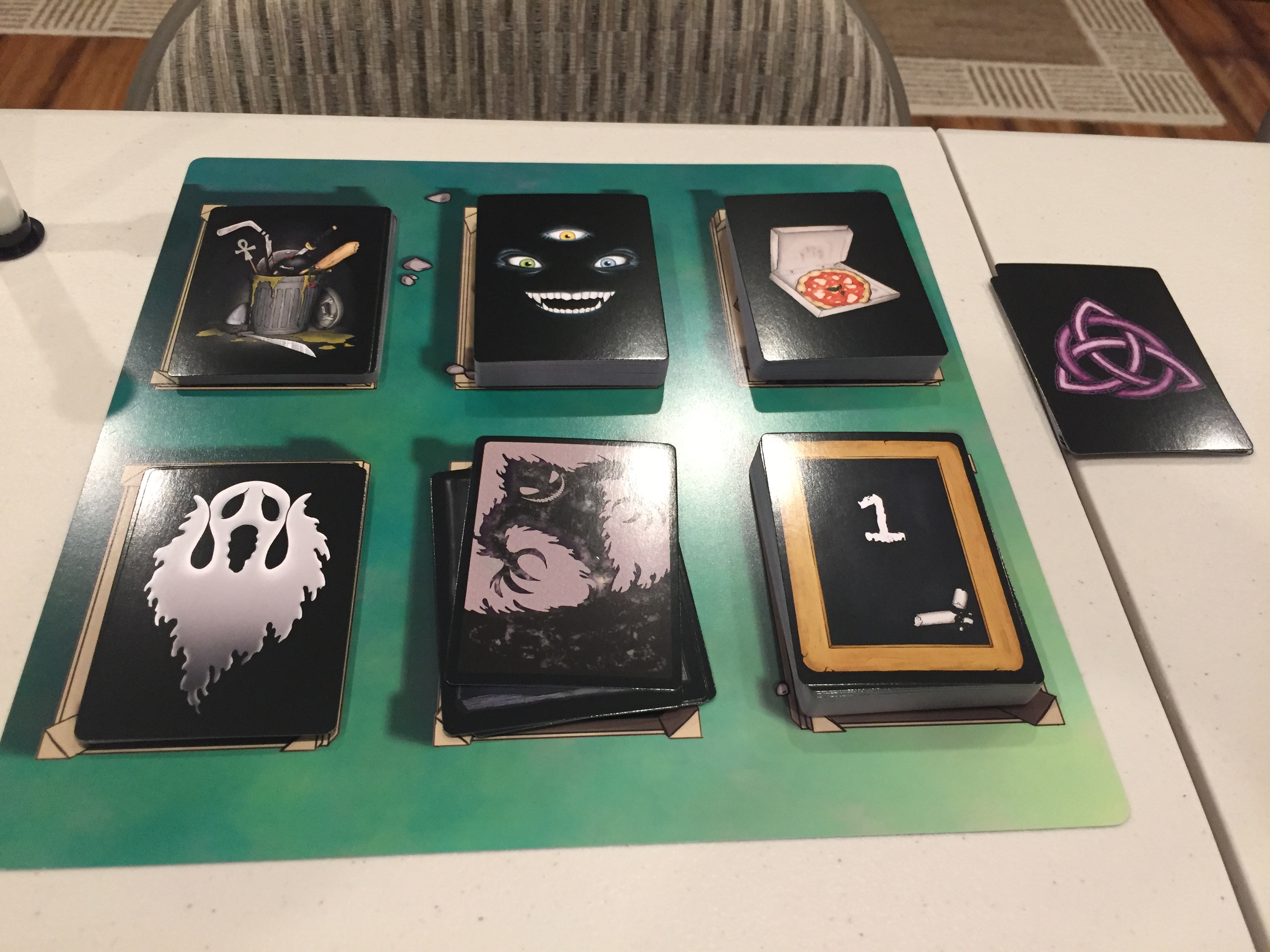
There’s really not a lot to the components tothe game (which is why a PDF delivery of the game is even feasible). The box, 72 cards, and the rulebook. The cards are nice.

IMG_7173

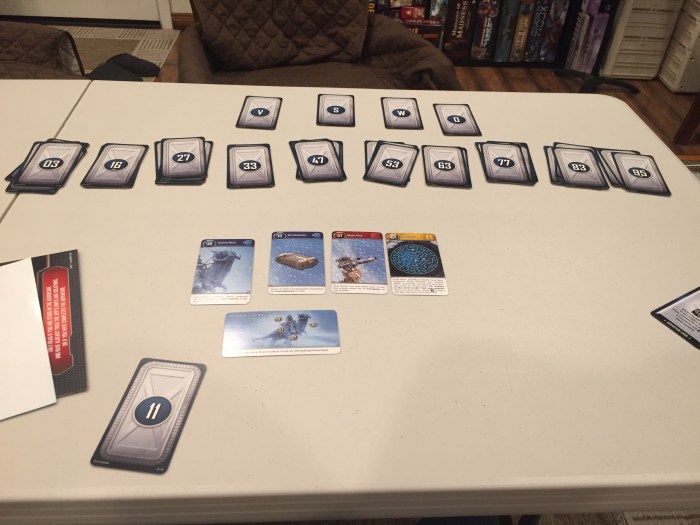
One complaint with the components are the cards: the only place they cards are labelled is on page 5 of the rulebook. I really would have appreciated each type of card being labelled: The art is cool and thematic, but the art is general enough that the correlation between (say) suspect cards and their name wasn’t 100% clear. I know everyone is on a kick to make things “iconic” and “language-independent”, but that makes it harder to distinguish components. Look, we figured out what all the cards were (see picture above), but it would have helped the first play through to have cards labelled!

The other thing that was slightly annoying is that we still had to print out some components! The Character Records (which I had each player print out separately), the Wanted Posters (which have different incarnations of Alice), and the Game Guide (summary) all had to be printed even after buying the physical box! I can forgive the Character Records (because we mark them up and are done with them), but the Wanted Posters and Game Guide seem like they cheaped out. And as a foreshadowing of sorts, the Character Sheets (as referred to in the rulebook page above) actually print out as Character Records (not sheets), so they couldn’t even get their terminology consistent.

Rulebook

Oh, so this rulebook wasn’t very good. I was chatting with my friend Kurt, getting ready for one of our games, and I told him I have read it all the way through twice and still didn’t quite get it. He commented “You are a better man than I! I haven’t been able to get through the rulebook once!” Frankly, this rulebook was poorly written. By the time I had set-up for our first play, I had to read through the rulebook six times to make sure I got everything! What makes it poorly written? I think the rulebook is so busy focusing on a bunch of low-level details (which you don’t know why you care about yet), that it misses a high-level overview. There’s a number of high-level overviews it misses:

  1. What’s the purpose of the game?   There’s no clearly stated purpose up front.  We are trying to find Alice, but what does that mean?  Are we solving a mystery (like in our Top 10 Cooperative Detective Board and Card Games)?  Do we have a quest?  Are we trying to avenge her death?  Alice is Missing … so what are we supposed to do?  We just text each other?  Are we possible suspects in the game? 
  2. What are we as characters trying to do?  As stated, we text each other in the game.  Do we suspect each other and that’s why we are texting each other?  What else can we do besides text?  Are we texting to try to meet up?  Do we do something else?
  3. What’s the overall structure of the game?  How do all the pieces fit together for gameplay?

It’s only after going through the rulebook multiple times that the purpose, structure, and player activities reveals itself.  This game seriously needs a rulebook rewrite and a summary card.  (Side 1 of the Summary card would describe Character Creation in high-level bullets, Side 2 of the Summary Card would describe game structure in high-level bullets).  The Game Guide attempts to do some of the summary, but it tends to focus on tips for playing the game NOT how the game works.

Expectations


So, what is this game? It is NOT a Detective/Solve-A-Mystery game. It really is more of a collective story-telling game. A collaborative story is developed over time: the players works together creating the story and reacting to story points. These main story points come up in cards that are revealed every 10 minutes or so:

The story point cards (the blue cards above) come out at the indicated time on the 90 minute timer. These cards are distributed over the players evenly so that each player gets (approximately) the same number of story points. When the timer hits that point, the player will read his/her story card and perform the actions. Story point cards cause a few things to happen: First, a Suspect or Location card is revealed (which becomes a potential final Suspect/Location). Second, the card indicates a story point and the player needs to reveal organically in the cell phone chat. Here’s a sample story point: “The (Revealed Suspect) just posted something creepy on Social Media! What was this?” You have to be creative, and then somehow reveal this new information in the cell phone chat. The story points are the main device to move the story forward.

By the end of the game, the players will discover what happened to Alice. But what it really means is that the players have crafted a story around these story points.

Set-Up: Local Play vs. Remote Play

Besides the unique “play over cell phones” angle, the other reason I picked this game was that it offered a chance to play over the Internet.  The base game describes rules to play locally (Locally: all players in the same room around the shared table), and then alludes to changes to make the game work remotely.  The game’s solution is to use the Roll-20 Guides/On-line platform.  Although my groups are fairly savvy with technology and role-playing games, none of us have used this platform.  The Roll-20 solution was a non-started in many ways: some people were new to role playing altogether, and even the RPGers among us didn’t use the online Roll-20 platform at all.  So we had to improvise!  

Basically, the faciliator had to “text” story points cards to characters at the appropriate times.  Normally, the players would just take cards from the table and do that themselves, but since only the owner of the game has access to all the cards, he had to be the facilitator.     This basically made the facilitator’s job a little more difficult, but it did work remotely.

The Facilitator

If you want to get the game, be aware that the person running the game (the facilitator) will have to work hard!!!  The facilitator will have to know the game, set-up the game, and run the game. The rulebook states that Alice Is Missing does not need a DM (DungeonMaster) to run the game, but this isn’t really true: The facilitator needs to work hard to run the game! It’s still fun as the facilitator does play a character in the game, but he’s more like an NPC (Non-Player Character) than a full participant. 

The Facilitator is especially important if you play remotely, as he/she has to text pictures of cards to the players as the game unfolds. 

Conclusion

So far, this review has been pretty negative: rulebook issue, structure issues, component issues, set-up issues. BUT, in the end, we all enjoyed this game, as it was a unique experience. We played for 3 hours on a Friday night, most of us in different cities around the USA. There was tension as a story evolved! Being alone with your cell phone as creepy things happened was evocative! We inhabited these characters and this world on our cell phones!

My group all enjoyed Alice Is Mission, but we recognized the flaws. This game is fragile. Everyone in my group was open to the experience, but noted it was too easy for the game to go “off the rails” because there’s no “purpose” other than creating a shared experience. The game is incredibly group dependent.

One player noted that the game was fun once: she wasn’t sure we would/wanted-to play again, even though the story points do change every time. I think that’s a fair observation: part of the fun of the game is the uncertainty on what’s happening. Once the game unfolds once, it’s not as interesting the next time. I suspect we will be able get 2 to 3 more plays out of the game. Once all my game groups have played once, then we’ll probably be done with the game. But, that’s not a bad thing! Escape room games (like Unlock: Epic Adventures and Star Wars Unlock) can only be played once. Between Escape room games, Detective games, and legacy games, there’s plenty of room for one-shot experiences like this.

Be aware of what this is before you play/purchase: It is NOT a detective game where you solve Alice’s mystery!!! Alice Is Missing is a unique storytelling experience you and your friends play on your cell phones. It’s potentially a lot of work to get going (especially for the facilitator), but if this sounds interesting to you, it’s probably worth a try.

EDIT: One of my players contacted me and wanted to point out the following:

  It’s a good overview, but your review sure felt more negative than my own impression of the game.  I really liked it.  Perhaps it’s because I didn’t have to deal with any of the “down sides” of having to get through the rule book, figuring out the game, fiddling with the cards, etc., but the game seemed pretty straightforward, friendly, immersive, and accessible.  (Thanks for facilitating the game, by the way – it sounds like it was pretty frustrating for you, but it was certainly a success from my perspective.)

  By the way, apparently there’s a reason this game reminded me of “Kids on Bikes” – it’s the same publisher!  I checked out the site and their Twitter feed, and apparently they’re working on an “Alice is Missing” mobile app which will facilitate play, dropping the cards automatically and stuff.  Sounds like a great way to play the game, frankly, since the setup we had was a bit fiddly for you.

Top 10 Cooperative Detective Board and Card Games

Some of my favorite games have been when we solved a mystery together!  There are quite a number of cooperative detective games now available.  These automatically include a deduction element, but they all have slightly different flavors of deduction.  In the end, most, if not all, of these games are “play once, and you’ve solved the mystery”, so they are very much “one and done” games—which almost gives them more tension, as you want to do the best you can because you know you can only play it once! 

Here’s our Top 10  Cooperative Detective Board and Card Games. We also rate how well each game follows Saunders’ Law: “Does this cooperative game have a viable solo mode?”, as well as expansions, complexity, and number of cases per game.

Number 10: Unlock! Sherlock Holmes-The Scarlet Thread of Murder

Unlock! Heroic Adventures, Space Cowboys, 2018 — front cover

Solo Mode? Yes, you can play this solo
Expansions? N/A
Complexity? Easyish
Cases Per Box?  1 (the other 2 aren’t strictly detective games)

This detective story is one of the Unlock! games from the Heroic Adventures box (3 games in one box).  Strictly speaking, this is more of an Escape Room game with puzzles in a Sherlock Holmes universe than a straight-up detective story, but it did a pretty good job of capturing the atmosphere of a detective story.   There’s no dilly-dallying, because Unlock! games are timed, and usually you find yourself reaching for Hints to move the game along.  (The Hint system is quite good and will help you if you get stuck).  If you prefer your detective games to be ponderous, the Unlock! Sherlock Holmes is probably not for you. It also requires an app.

Number 9: The Sherlock Files

The Sherlock Files: Elementary Entries, Indie Boards & Cards, 2019 — front cover (image provided by the publisher)
Solo Mode? Yes
Expansions?  Volume II- Curious Capers, Volume III- Puzzling Plots
Complexity? Easyish
Cases Per Box? 3

The Sherlock Files is a detective game in cards.  The first installment comes with 3 cases (Last Call, Tomb of the Idol, and Death of the Fourth of July).  If you can get past the fact that we are Sherlock Holmes in modern times (with jets flying around), then this is a nice little mystery.  Cards come out, the games are pretty quick (about an hour), but you can take as long as you wish to explore the cards that come out.  It’s not super deep, but it is fun.

Number 8: Exit: Dead Man on the Orient Express
EXIT: The Game – Dead Man on the Orient Express, KOSMOS, 2018 — front cover (image provided by the publisher)

Solo Mode? Yes (probably better with more)
Expansions? No
Complexity: Medium to Hard
Cases Per Box? 1

This is an EXIT-style escape room game in an 1940s Agatha Christie Poirot-esque universe: It’s a murder mystery on a train!  The game is quite difficult and has many elements of exploration and deduction, but it sometimes feels a little too much like an Escape Room game (with wonky puzzles). Sometimes, these puzzles take you out of the detective parts of the game. The art is great, the game is challenging, and there’s no “timer” (so you can be an ponderous as you need).  I had fun playing this solo, but I think more brains would have helped because this one was quite hard.  Luckily, there is a good hint system to help you if you get stuck.

Number 7: Decktective: The Gaze of the Ghost
Decktective: The Gaze of the Ghost, dV Giochi, 2020 — front cover (image provided by the publisher)

Solo Mode? Yes
Expansion?  No. But there are more games in the series (Bloody Red Roses and Nightmare in the Mirror)
Complexity? Medium
Cases Per Box? 1

So, this is a tiny little card game of 60-80 cards.  It’s just a card game.  What makes it unique is that you actually set-up cards to show the “scene”: cards stand erect in the box (by being propped up by the edges of the box) and form a “crime scene” for you to investigate.  As the game progresses, you will replace cards in the scene with “newer” cards as the scene unfolds.  The game is weird and unique as you try to guess what cards are important and what cards aren’t: you have to throw away cards to play for other cards: this unique mechanism represents your time and you bypassing things that may or may not be relevant.  It’s not a pure deduction game per se, but you definitely feel like a detective trying to figure out what happened. 


Number 6: Decktective: Bloody Red Roses

Decktective - Bloody-red roses Second Edition

Solo Mode? Yes
Expansion?  No. But there are more games in the series (The Gaze of the Ghost and Nightmare in the Mirror)
Complexity? Medium
Cases Per Box? 1

Like Number 7 on our list (The Gaze of the Ghost), this is yet another game in the Decktective series.  This was the first game in the series and opened the door to this unique but very small way to play detective games.   They are so easy to play: you buy a small deck of cards (not too much investment), but there’s literally a scene of the crime and a interesting story underneath.

Number 5: Scooby-Doo: Escape From the Haunted Mansion
Scooby-Doo: Escape from the Haunted Mansion – A Coded Chronicles Game, The OP, 2020 — front cover (image provided by the publisher)

Solo Mode? Yes
Expansions? Not at this time (but the Shining will be another game in the Coded Chronicles series)
Complexity? Easyish
Cases Per Box? 1

This maybe the easiest detective game on this list: it is more of a mass market game, and it is marketed towards families.  It’s also has the feel of an Escape Room style game.  But you know what?  This game stands uniqely as a silly (Shaggy “eats” things to interact with them), fun, but still thinky detective game where Scooby and the gang explore a haunted mansion to solve a mystery! 

Number 4: Chronicles of Crime
Final Box Art

Solo Mode? Yes
Expansions?  Yes.  Quite a few, Noir adds a Noir version of the game, you can buy some expansions in the app, and Welcome To Redview adds an “Archie Comics” module.  Currently, there’s 3 new expansions that just came off Kickstarter called The Millenium Series.
Complexity?  Easy to Hard, depends on the case!
Cases Per Box? 1 Tutorial, 5 Scenarios (and you can actually buy more on the app!)

Chronicles of Crime made my Top 10 Cooperative Games of 2018!  This game requires an app on your phone: you scan cards in the game, and things change as time goes by.  You may visit a location and see nothing, and come back later to find a pivotal clue!  All your interactions are done by scanning cards and locations (and people/helpers) as you try to solve a mystery!

There’s a quite a bit on content: it’s only major flaws is that this requires a phone and app and sometimes just one player can “hog” the phone (Of course, this is just Alpha Player Syndrome) .  Great game, great detective stories await!


Number 3: Sherlock Holmes, Baker Street Irregulars
IMG_6090

Solo Mode? Yes to start, but requires multiple people for Adventure 2.  Really should be played with 4 players
Expansions?  No
Complexity? Easy to Medium
Cases Per Box? 4

I am surprised how much I liked this game!  See Part I and Part II of my review!  Players each take a graphic novel for one of 4 characters (one of the 4 Baker Street Irregulars), and players read their books simultaneously, playing through one of four adventures in the game.   The game is a little light-weight, but my friends and I particularly enjoyed it.   It fostered cooperation more than most detective games, and it played very well over the Internet (see my Top 10 Cooperative Games You Can Play Online).  This may be my favorite game experience of 2020!

Number 2: Detective: City of Angels
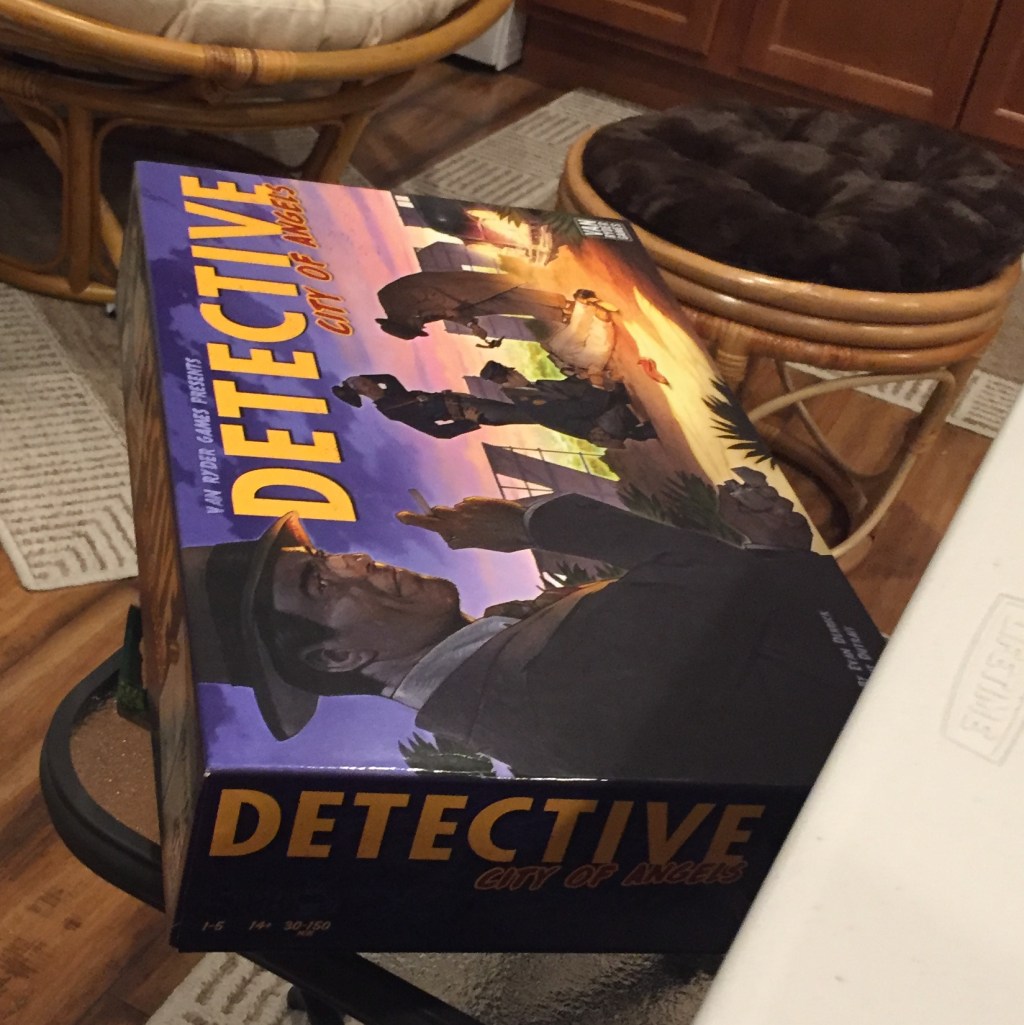
Cover for Detective: City of Angels. Art by Vincent Dutrait.

Solo Mode? Yes
Expansions?  Yes. Smoke and Mirrors and Bullets Over Hollywood.
Complexity?  Medium
Cases Per Box?  8

The game went over on my gaming circles like gang busters! It took the top spot in the Top 10 Cooperative Game of 2019,  it made the Top 10 Games You Can Play Fully Cooperatively, and the Top 10 Storytelling/Storybook games!  Players play as hard-boiled detectives in the Noir era of detectives.  Players can “shake things up” when they question people to get more info, with the risk of alienating them in the future!  Although the game isn’t cooperative by default, it’s the way me and my friends prefer to play this.  There’s plenty of game in the first box (8 or 9) and too more expansions which add about 5 more cases each.  There’s enough of a rules framework to make it easy to get around and try stuff, but there’s still a mystery that needs to be solved!   This is a longer, ponderous, game (usually 2-3 hours), but we enjoy the heck out of it.  Even though we can take the time to “think” as much as we want, it’s still not too heavy; yet the cases are still interesting and challenging.


Number 1: Sherlock Holmes, Consulting Detective

Sherlock Holmes Consulting Detective: The Thames Murders and Other Cases, Space Cowboys, 2017 — front cover (image provided by the publisher)

Solo Mode? Yes.  You can solve the mystery by yourself! No changes
Expansions? Yes, there is Sherlock Holmes: Jack The Ripper and West End Adventures, Sherlock Holmes: Carlton House and Queen’s Park, and Sherlock Holmes: The Baker Street Irregulars
Complexity? Hard
Cases Per Box? 10

Sherlock Holmes, Consulting Detective is the grand-daddy of all the cooperative detective games.  What makes it great is that the world is fairly open-ended: you can explore the world at your own discretion and frankly there’s not “a lot of rules” behind the game.  Players work together to try to solve the mystery presented to them (with Sherlock Holmes himself having the insufferable perfect solution you compare against), exploring the city as they wish and reading entries from the storybook.  The storybook presents the characters and locations, and you simply explore this world trying to solve this mystery.  The mystery is definitely NOT spoon fed to you!!!  For example, the game comes with 10 newspapers, and each newspaper has 20-50 articles that may or may nor be relevant!  Even worse (?), you may may to look at earlier newspapers to find information you need!!!  It’s very much like an interactive mystery, with text of the storybook and the newspapers being your primary mechanism to discover the world.  (There’s also a map and address book).

Some of my friend HATE that Holmes is so smug with “the perfect solution”! They hate him so much they hate the game!    If you ignore Holmes and just concentrate on the mystery itself (using Holmes solution as simply a metric), then there’s nothing closer to a real interactive detective story!  This is probably the hardest of all the Detective games on this list, but if you invest the effort, you will be rewarded with a deep, interactive mystery.   

Although I think I like the framework that Detective: City of Angels sets-up to make the mystery easier to grapple with, there’s something about the open world of Consulting Detective that’s just a pure detective story … and that’s why it’s number 1 on this list.

A Review of Unlock! Star Wars

Unlock! Star Wars in the newest entry in the Unlock! line of escape room games: it just came out fairly recently as of November 2020. Recall that we really liked (mostly) the previous Unlock! Epic Adventures: see review here. How does this newest entry fare?

A Quick Look InsideIMG_7178

Like more recent Unlock! games, this comes with 3 adventures/escape rooms and a small simple tutorial game.

English edition - Back of the box

  1. Escape from Hoth
  2. An Unforseen Delay
  3. Secret Mission on Jedha

In the first two adventures, you play “good guys” from the Star Wars universe. In the first adventure, you play members of the Rebellion on planet Hoth trying to escape!  In the second Adventure, you play smugglers (ala Han Solo) trying to escape from an Imperial Star Destroyer.  Weirdly, in the third one, you play “bad guys” from the Star Wars universe!  You play Imperial undercover agents trying to recover some crystals.

Tutorial

Like all other Unlock! games, this comes with a tutorial: this is for first time players to discover how Unlock! style escape room games works.  Surprisingly, this tutorial is different from every other tutorial!  If you’ve played ANY Unlock! games, you always see the same little tutorial.  The designers took and “rethemed” that tutorial for the Star Wars Universe.  Kudos for keeping the tutorial thematic!

Differences

Surprisingly, there are a few mods to the Unlock! system. 

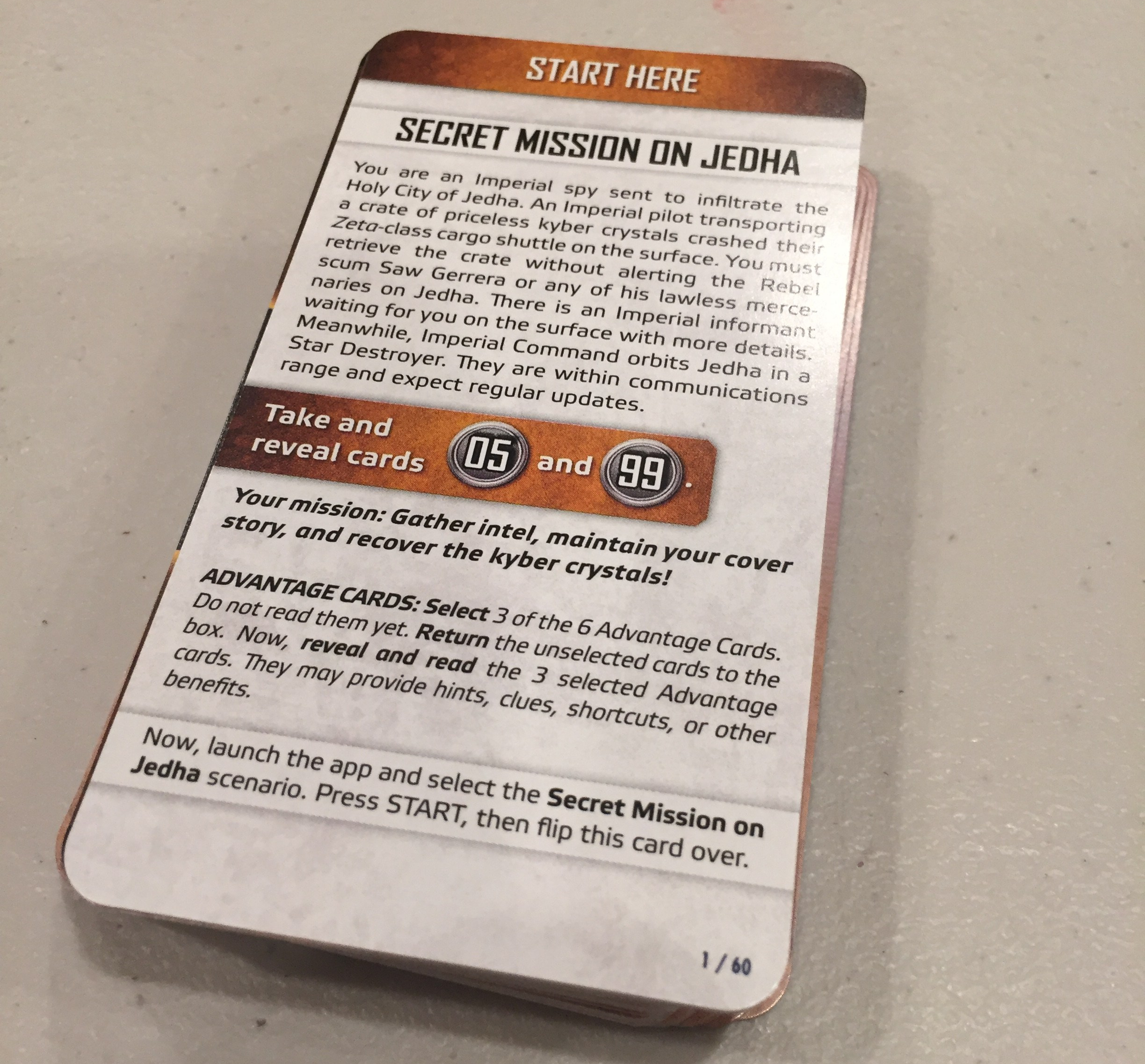
In every adventure here, you get to choose 3 out of 6 “helper” cards that will give you hints/extra abilities later in the game.  You don’t know what you are choosing at the start of the adventure, but it helps you stay engaged a little more since you get to “choose” some of your special abilities (above, I chose Inside Intel, Expert Pilot, Droid Specialist).    You don’t strictly HAVE to have any of these to win the game, but it makes the game a little easier.

IMG_7177

Another mod was that the game  included a COMPLETE SOLUTION MANUAL TO ALL 3 ADVENTURE GAMES (see above)!  I have never seen this in an Unlock! game before!  I think it’s because the designers are expecting people “newer” to Escape Room game to try this out (Star Wars has a pretty broad appeal after all): I think they wanted to make sure people understood  how these worked by seeing a COMPLETE SOLUTION.  I think this is an acknowledgement that sometimes escape room games (not just Unlock!, but Exit and Deckscape) have some wonky puzzles.

Overall

The first adventure (Escape from Hoth) is probably the easiest and most reminiscent of the Star Wars universe. Basically, you feel like Luke on the Ice Planet Hoth in the first part of the Empire Strikes Back! I don’t like Hidden Number puzzles, and this one starts with a doozy that flustered me for a little. In the end, there were some cool puzzles, and some cool interactions with the app (literally). And a few canonical Star Wars characters make an appearance! I liked it ok, I didn’t love it. They rated this an easy puzzle, and I would agree.

The second adventure (An Unforseen Delay) was probably my favorite (except for one moment when they split the party). It felt like we were smugglers like Han Solo trying to escape from a cell in a Star Destroyer. Except for the amazing art and bad guys (Stormtroopers, Tie Fighters), this almost could had been smugglers in any Sci-Fi universe. It was fun. They rated this an easy puzzle, and I would agree.

The third adventure (Secret Mission on Jehda) was … tense. I didn’t like the idea that I was playing as bad guy (imperial spy). Weirdly, this worked in its favor, as it ratcheted up the tension as I was playing in the first 15 minutes! It really felt like I was “nervous” being on a planet trying to find some crystals! After I got into it, there were some really good puzzles, especially with the map. This was also the game whereI got the most frustrated. There were a couple of puzzles that were really wonky (“Really? That’s what I had to do?”) that really took me out of the game. In general, this was pretty good. They rate this moderate, I’d say it’s maybe a smidge tougher.

Conclusion

IMG_7179

Recall that Unlock! games require a app on your smart phone/pad to run.  This one is no different: in fact, you have to download a brand new Star Wars Unlock! app rather than use the plain Unlock! app.   The designers have some new tricks up their sleeve: requiring an app gives them some flexibility and originality that they are still exploiting: I am happy to say  there were some new, fun ideas in here from the app!!

That said, this Unlock was not one of my favorites.  I felt like some of the puzzles were a little too mechanical and devoid of theme.  I went to the hint system far more than I expected to. Don’t get me wrong, this is still a good set of Unlock! Adventures: the puzzles are interesting, the art is good, and the hint system helps move you along at a good clip even when you get stuck.   I am glad I bought this, but I’d recommend probably recommend a different Unlock! set first to most people.

Having said that, if you like Star Wars at all, this is a good set of adventures to get. Also, if you are new to Unlock! and escape room games, this might be a good jumping off point: the adventures were fairly easy, and this also comes with the COMPLETE SOLUTION BOOK.  This COMPLETE SOLUTION can really help new players when the hint system fails (the hint system did fail for me once in the third adventure).  

This is not my favorite Unlock! and it’s not my least favorite Unlock!  The quality is still good and would probably appeal mostly to beginners or Star Wars fans (escape room beginners who like Star Wars were probably their target audience). 

P.S. I expected the Star Wars Unlock! app to play John Williams’ Star Wars music. Nope, it played Holst’s The Planets. I am guessing that John Williams wanted a lot of money and The Planets was free to use, so they used that!

A Review of Tales of Evil, Part I. Unboxing, Solo Rules, and First Impressions

IMG_7094

Tales of Evil is cooperative adventure game for 1-6 players. It was originally on Kickstarter back in December 2018. It’s been out for some time for the Kickstarter backers, but it just came out into retail: I picked it up from Miniatures Market and I know it was just released (mid November 2020) because the order was in hold until that came out.

ThemeIMG_7096

The theme of this cooperative adventure game is a bunch of kids (pre-teens-teens) running around and exploring supernatural phenomena (reminiscent of Stranger Things). The kids are in a club together called The Pizza and Investigation Club (which reminded me of somewhat of The Three Investigators, if anyone remembers that series of pre-teen books).

The Kickstarter bills the game as “The 80’s Horror Board Game Experience”. I’d say it’s more of an adventure/exploration game than a Horror game, but there are definitely more horror moments in what I’ve seen. If I were to try to summarize this game, I’d say Tales of Evil is a cross of the Arkham Horror, 2nd. edition Board Game (for mechanisms and gameplay) with the Stranger Things TV Show (for theme and setting) and the Tales of Arabian Nights Board Game (for the storybook elements). (If you don’t know what a storybook game is, see my Top 10 Cooperative Storytelling/Storybook Games for some really cool ones!).

IMG_7097

Unboxing

The game is chock-fun of content!IMG_7099

There are a number of books: An Event Book, a Rulebook, a Storybook for the main game (The Mystery of the Demon Puppet Mistress) and an expansion (see below).

IMG_7101

IMG_7107

There’s a bunch of cardboard (tokens see above) and boards (see below).

IMG_7156

There are little miniatures plus some redundant standees (I am guessing the miniatures were a Stretch Goal in the Kickstarter). They are nice enough.

There are bunch of cards (over 200) in many different categories. (Grumble, see Rulebook discussion below).

IMG_7141

There is also a 90 second sand-timer for a few activities in the game. This isn’t a real-time game per se, but there are a few places where it is real-time.

IMG_7121

For a really good look at most of the components, take a look at the main Kickstarter page here.

Like Arkham Horror, 2nd Edition, there are a lot of skill tests where you use the specialized dice above to roll. These dice may be my favorite component in the game! The glow in the dark!

Oh, and the game really leans into the Horror theme: you get a “Horror Movie Poster” for the game! See below!

IMG_7103

The Rulebook

IMG_7129

So, the rulebook looks like it’s pretty good. But you’ll notice the “Content” section only LISTS the components without any pictures or marking!!! Arggh!! This was VERY FRUSTRATING as none of the backs of the cards in the game are marked and a lot of the icons are unclear at first. So, let me help you out: the cards are presented … near the back of the book!!!

My advice to you is look at the contents list while correlating the cards with the list later in the book (see above two pages). I feel like this section should have been further up front!!! I was very frustrated until I found this.

So, I will give this game some props: it tries something different with the rules. Since the game is Storybook based, Tales of Evil tries very hard to make the rules come out when they are needed IN THE STORYBOOK. The designer makes this note (see above) in the very first pages of the rulebook. The rest of the rulebook is more of a reference guide which you can reference later in the game.

IMG_7131

And it almost works. I still had to read about the dice and how the dice checks work (see above from the Rulebook). I still had to read how combat works. I think it’s really hard to put the rules in JUST the storybook, but this deferring of rules almost worked. It worked well enough.

This definitely feels like a Kickstarter rulebook. It just needed a little more love. But it was enough and I was able to get into my first game.

Gameplay

IMG_7133

In Tales of Evil, each player takes the role of  one of the kids above.  Each kid has different powers and starting equipment and a different backstory. 

IMG_7131

The main mechanism in the game is rolling dice and trying to get a number of “successes” on the dice.   The Bullseye on the dice represent successes.

IMG_7154

Like Arkham Horror, 2nd Edition, there are two successes per die.  (There are some extra rules, see above, but that’s the essential mechanism)  There are mechanisms for mitigating dice roles, based on your character and equipment (like AH).  Each character gets a number of dice for different kind of skill checks: combat, defense, etc. again based on character and equipment.   There’s a lot in the main skill checks, character abilities, and equipment that will remind you of Arkham Horror.

IMG_7146Like Arkham Horror, you explore some boards (actually, that’s probably more like Mansions of Madness, but the exploration elements are in both): see above.  As you explore, you read entries out of the Storybook and make decisions (like most Storybook games), reminiscent of Choose Your own Adventure games.

You and your fellow players explore!  Each game, the ‘goal’ of the game is different, depending on where you are in the story.  Players explore, read storybook entries, perform skill checks/combat, and generally try to solve some mystery in the game!

First Game and Solo Rules

That first game took a while to set-up.  I suggest you set aside some time to punch everything out and try to absorb the rulebook (like I said, it’s a Kickstarter rulebook so it needs some love).  I needed one night to get everything unpunched and set-up before I started my first the next day. 

Does this game follow Saunders’ Law?  Yes! I played my first game as Peter Spencer (the founder of the Pizza and Investigation Club).  Although the game prefers multiple people, the storybook seems to always keep in mind solo play.  For example, at one point, I was being attacked by something and “all other players” were supposed to help me, but since I was the only character, there was a special rule for the solo player.

I played through my first game in about an hour.  I saw a lot of the mechanics, and I believe I can teach this game now.

Fusion

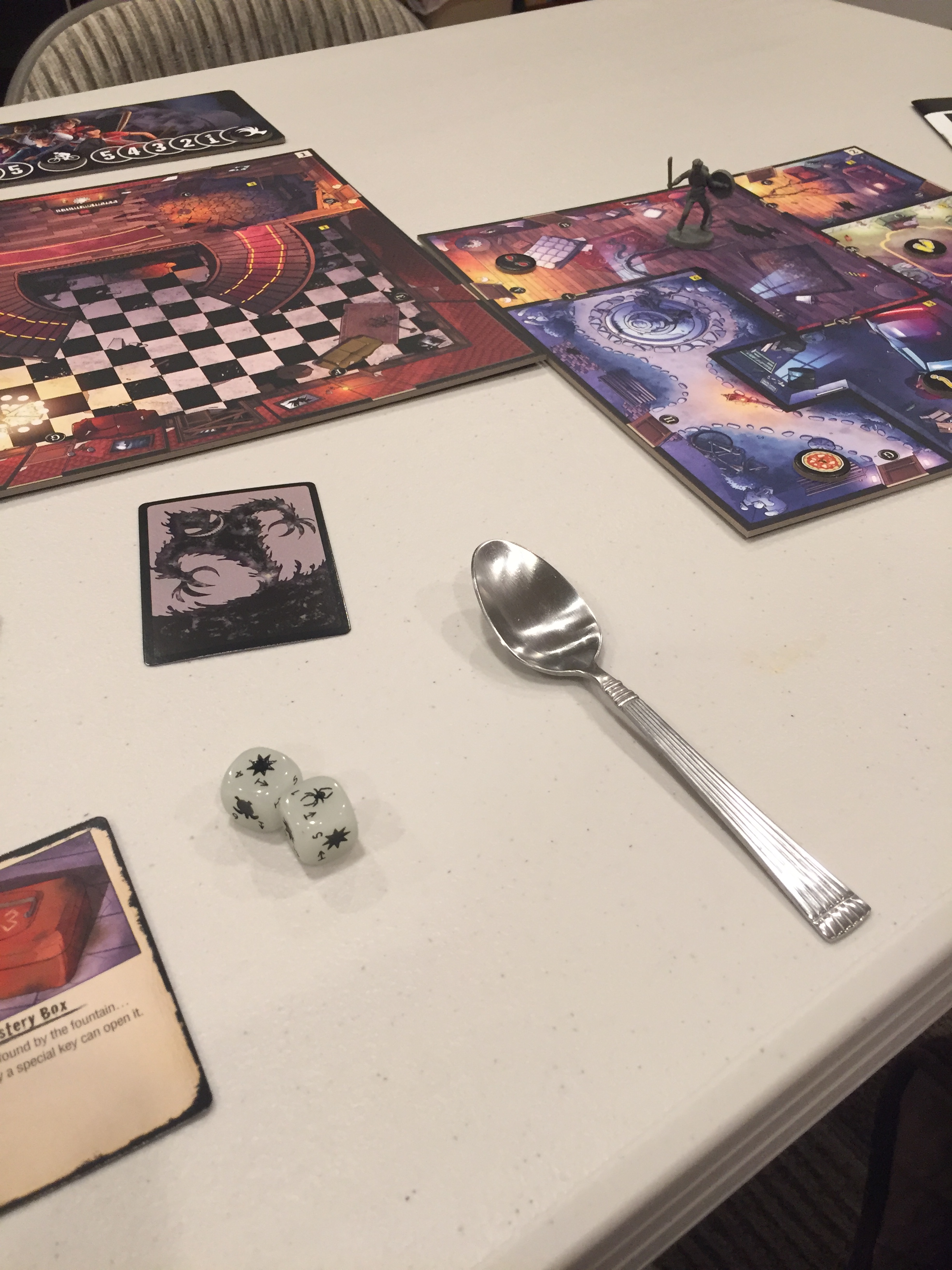
So, remember earlier when I said this game was weird? There’s this thing called Fusion in the game that’s … weird. It will probably either entice or disenchant you immediately. When the word Fusion comes up in the Storybook, you immediately start the timer and have to do something IN THE REAL WORLD IN REAL TIME. For example, to get a box out of a fountain, I had to take off my shoes and socks IN THE REAL WORLD AT MY GAME TABLE. If I failed this activity, I would lose some health or something like that.

IMG_7159

Why is there a spoon in the picture above? Because the Fusion system demanded I go get one (corresponding to a challenge in the game).

Thematically, the Fusion system is described as “Your current life affecting your teen life in the 80s! It’s a feedback loop!” This game is definitely marketed towards people who grew up in the 80s, so it’s definitely hitting that market. Mechanically, this Fusion system is both engaging and disengaging at the same time: You are literally engaged doing something weird at Fusion events (like getting a spoon or taking off your shoes), but it also “takes you out of the game” as you were concentrating on these 80s kids, and all of a sudden you are doing something weird!


When I was explaining this game to my friend, he was very excited!

  • It’s like Arkham Horror, 2nd Edition?  Check!
  • It like Stranger Things?  Check!
  • It’s a Storybook game?  Check!
  • It has weird skill checks like Qelf or the Mad Magazine Game?  Wait … what?

As soon as I explained the Fusion system, my friend CC got a funny look on his face, “Wait, what?” This Fusion thing may completely disenchant a lot of people. I am keeping an open mind for further plays, as I think it may have the potential to do some really neat things in the game! The rulebook alludes to taking you to some cool web sites, or exploring some history on the web (ala Detective by Portal Games), but it’s really unclear how this will play out. So far, it’s been … underwhelming. But I am keeping an open mind.

Interesting Ideas In Cooperative Games

There several other things that Tales of Evil did to try to make the game explore different cooperative mechanics.  I am not sure what I think of these, but they are original ideas.

  1. Matches:  If someone has to be picked to do something, the game forces you to use “Who Drew the shortest Match?” game from when you were a kid. IMG_7147
    You literally put all the matches in someone’s hand (so they look like they are the same height) and everyone draws a match.  Whoever draws the shortest match has to “do the yucky thing”. 
  2. Group Decisions: Rather than doing “big long discussions” when there are options in the game, the game requires that the players all say their choice at the same time and you simply immediately use the majority (with the current player breaking ties).  I think the reason for this is to keep game play moving and avoid “analysis paralysis” when players disagree.

I don’t know if I like these mechanisms, but they definitely feel like the kind of things kids would do. 

Conclusion

IMG_7101

So, this game is a wild ride. I think you might know right away if you’ll hate it or love it. The components are great and the theme is very well-executed. The Fusion system (with real-time real-world events) is weird. The choosing matches idea is interesting and thematic, but I worry it will take away from cooperation in the game. The quick choice mechanism promises quicker game play, but it may trivialize some choices.

I don’t know what my pronouncement of this game is yet. I am keeping an open mind, but I really need to play it with more people. Like most storybook games, I think this game will be MUCH better with more people participating.

There’s some really interesting ideas in here! I am hopeful this go over well with my group. Be on the lookout for Part II of this review …

A Review of Master Word: A Cooperative Party Word Game

Master Word is a cooperative party word game that just got released here in the USA about Mid-November 2020 (I know this because this game was holding up my order).

This is guessing game in the vein of Master Mind (an abstract deduction game) but using words instead. I described it to my friends as Master Mind meets Just One meets Codenames. It has the cooperative nature of Just One, with deduction elements of Master Mind, and word connotations like Codenames. To be clear, this is a cooperative party game: you need 3-6 people to play.

Unboxing

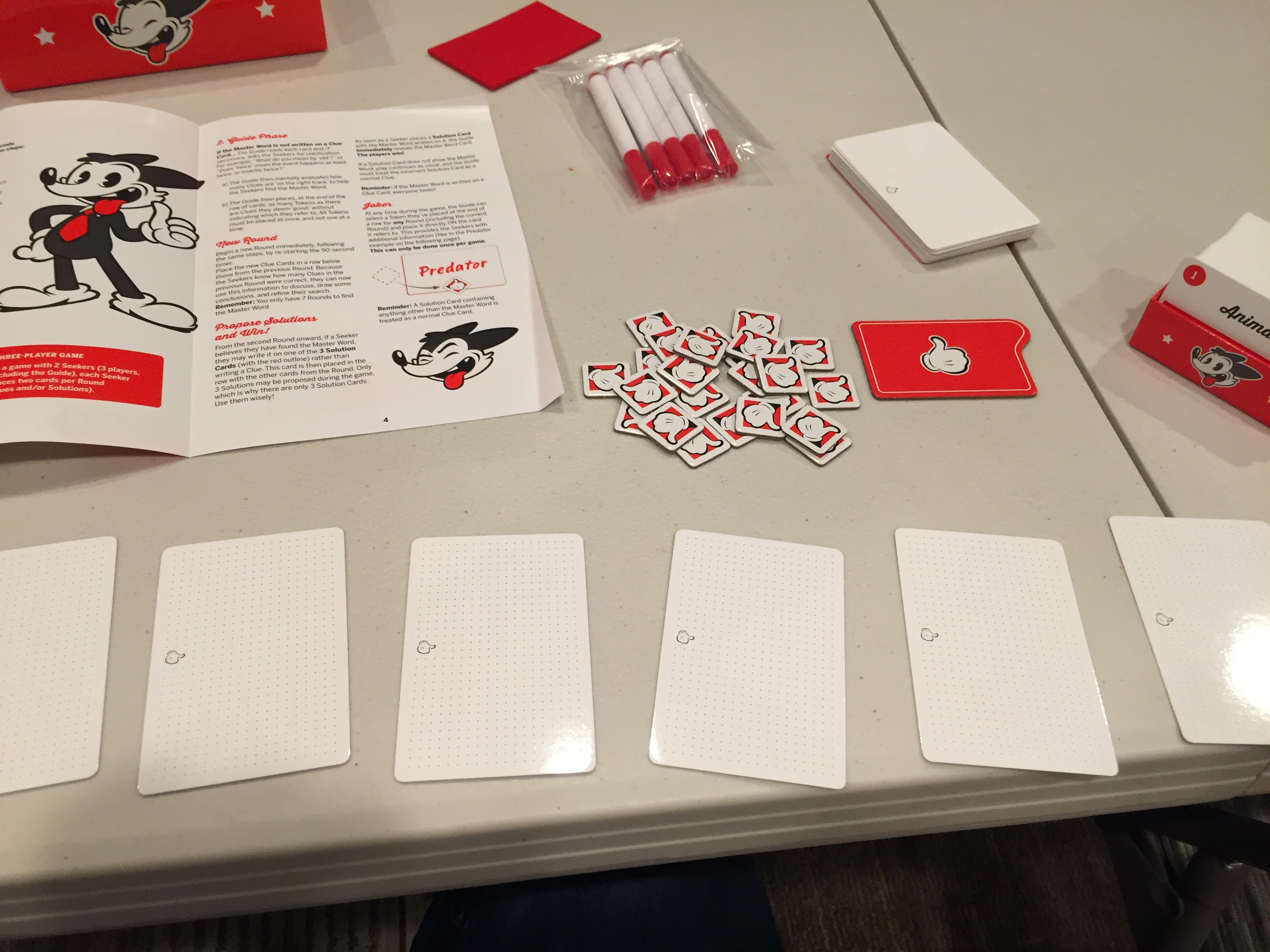
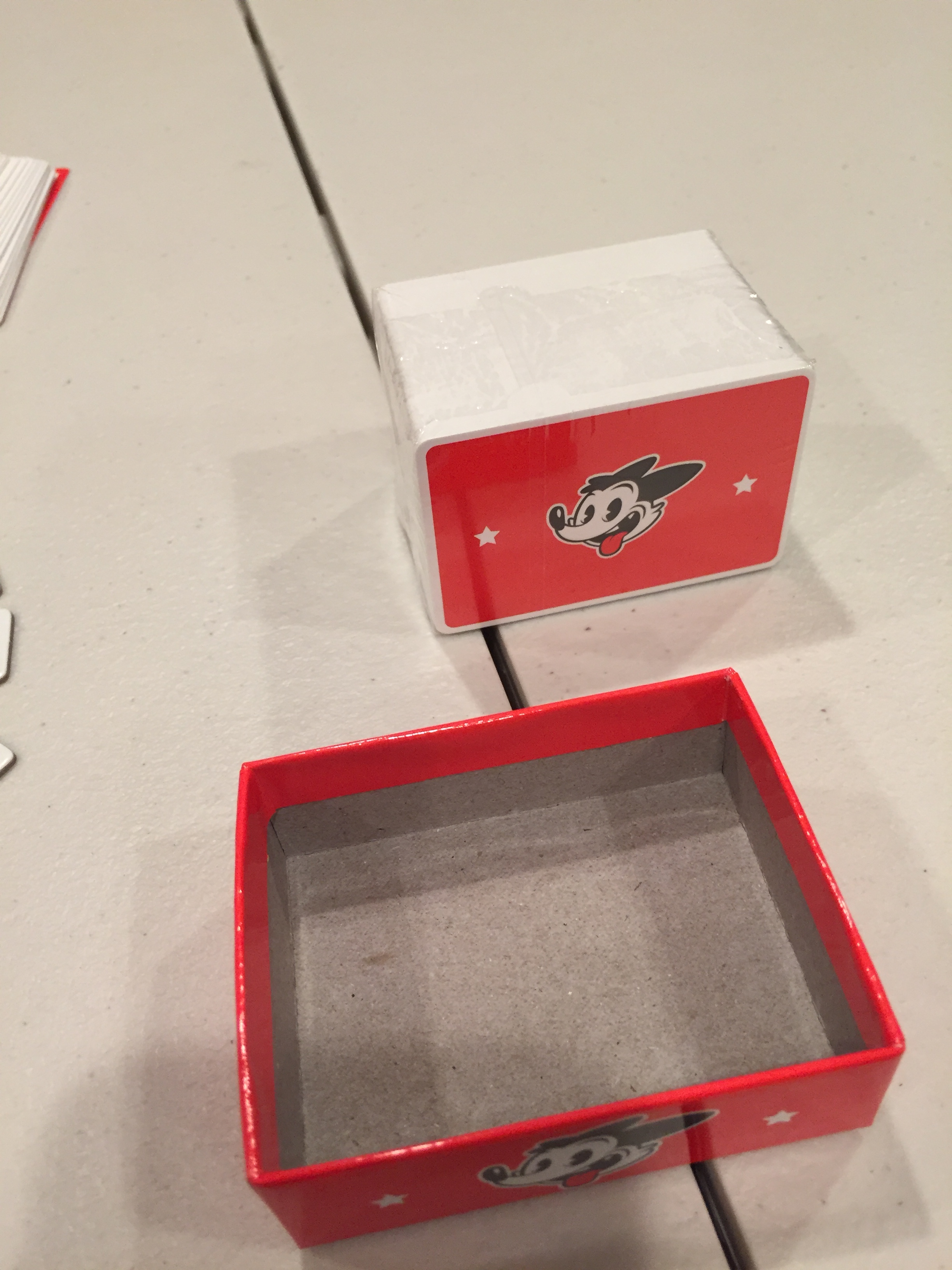
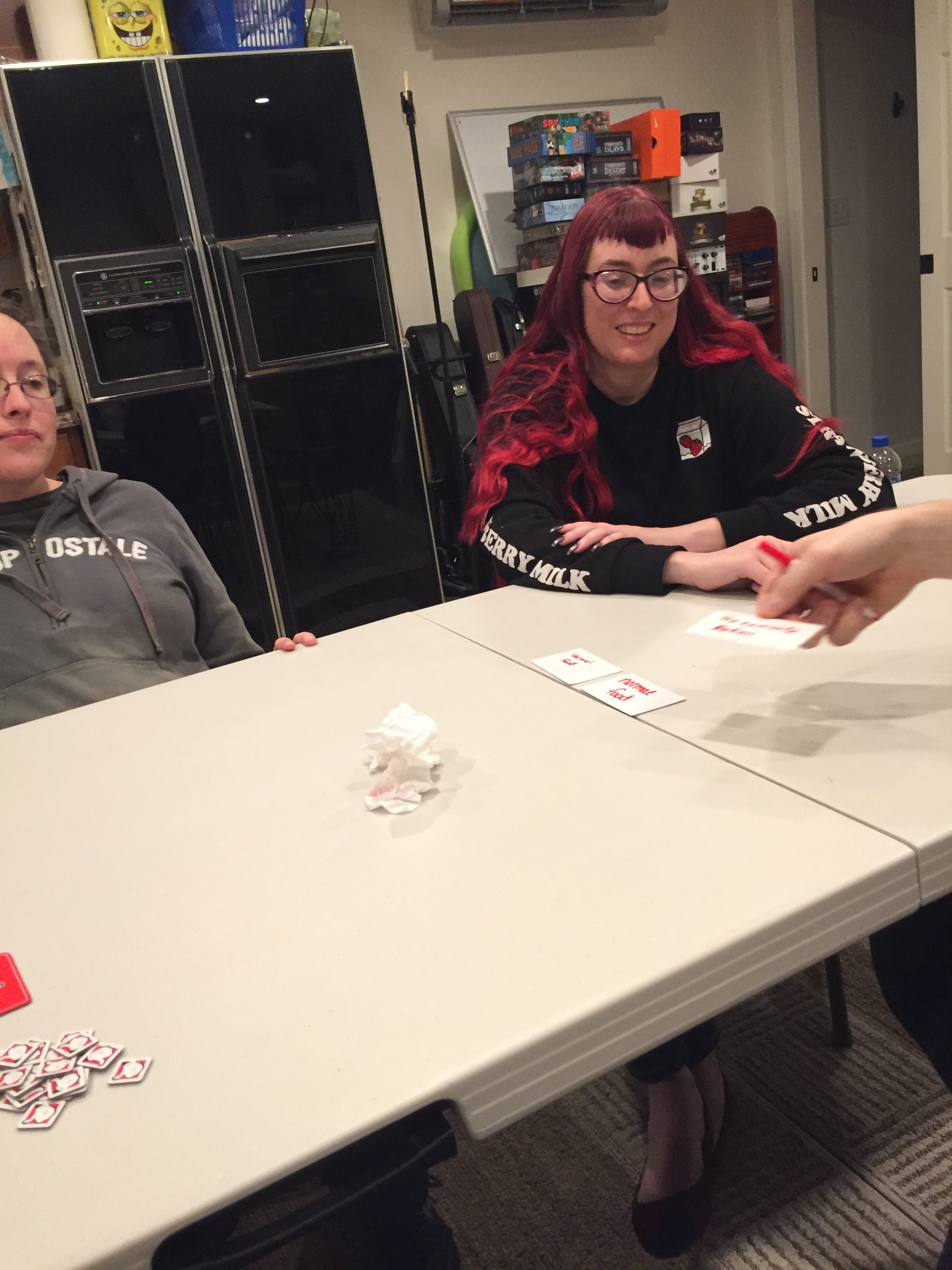
Master Word doesn’t have too many components. It has a rulebook, a bunch of “thumbs up” token, some cards YOU CAN WRITE ON, some dry-erase pens and 300 Play cards.

This is a word game: during a turn, each player (except the Guide) will write a word/idea on one of the cards. Master Word even includes a weird felt eraser so can erase your cards without needing Kleenex! But seriously, you need Kleenex to clean the cards. The felt works fine, but I worry about it getting “full”.

IMG_7076

You can see most of the components above. But the main action happens on the little clue cards (far right box).

Rulebook

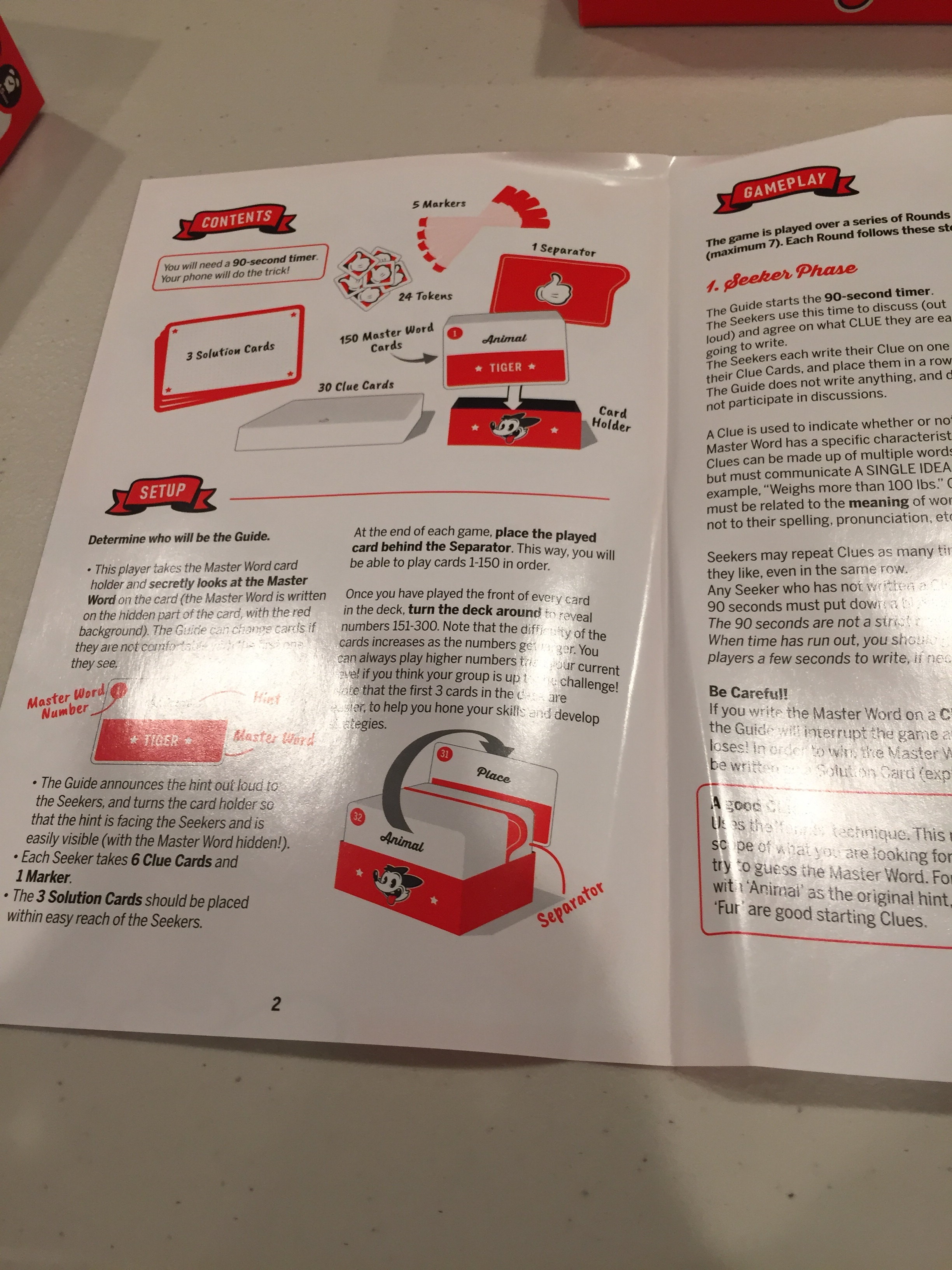
IMG_7065

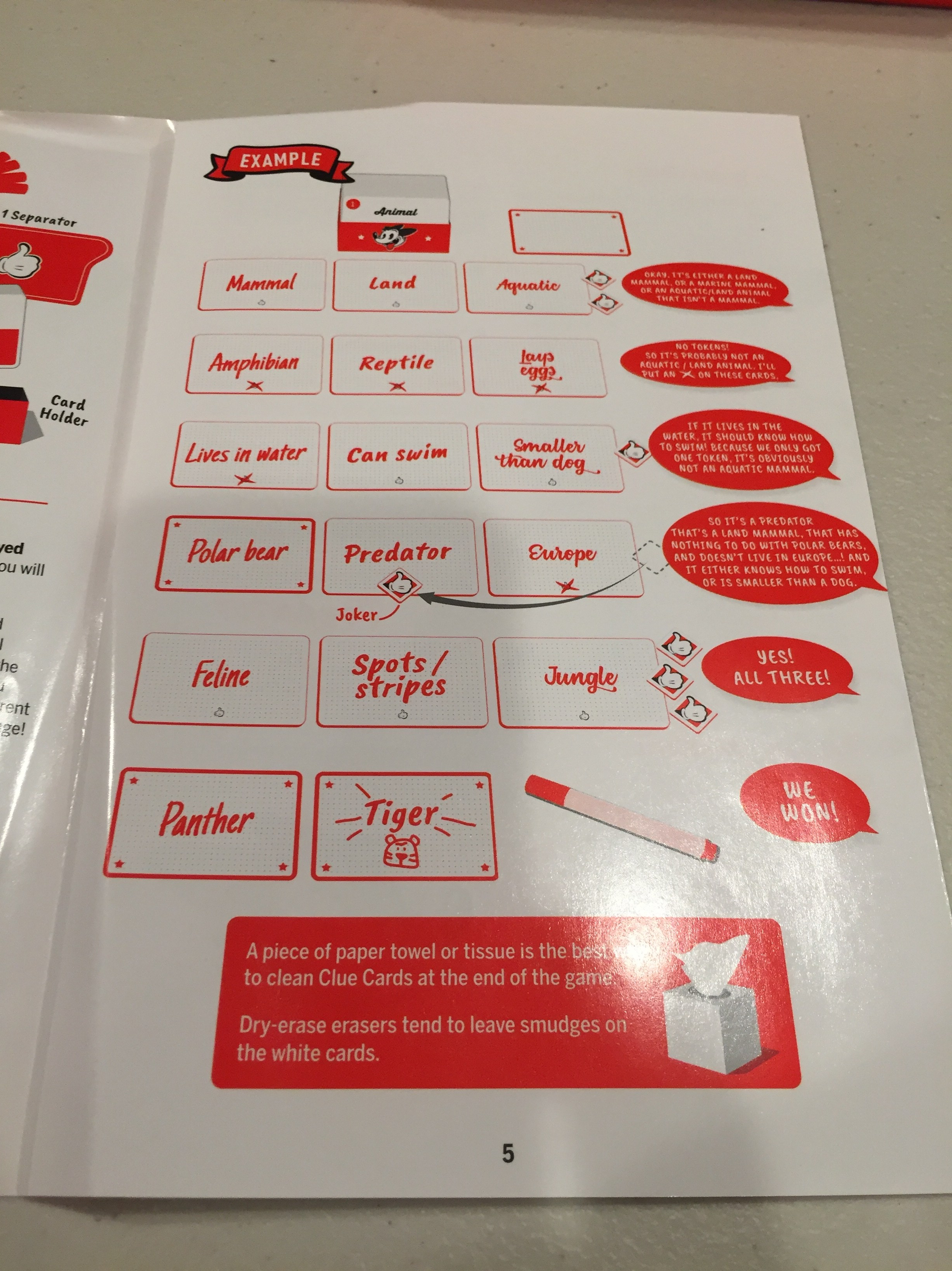
The rulebook is more like a three-folded pamphlet. To be fair, there aren’t a lot of rules to the game.

Not much to say: the rulebook is readable, has some good examples, and presents the game pretty well. It’s pretty good if not great.

Gameplay

IMG_7075

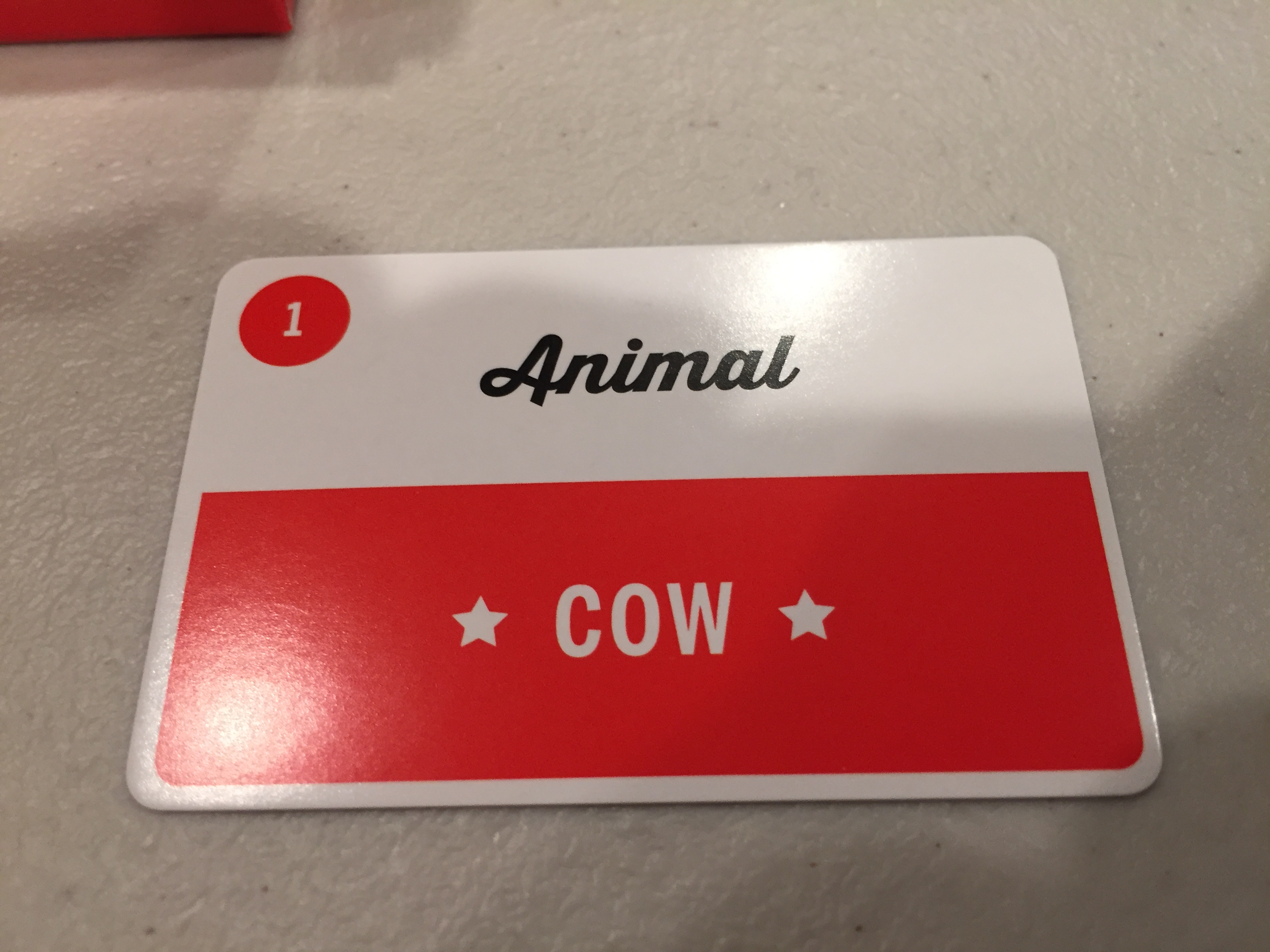
This game is all about getting everybody to work together to guess a word: it’s a fully cooperative game!!! One player is trying to help everybody else guess the word. The game starts with the group choosing one player to be the “Guide” (or Clue-giver): The Guide takes a word card (from the box of 300) and shows everyone THE CLUE only: In the example above, the CLUE is Animal, and the Word is COW: he keeps COW hidden.

IMG_7083

The rest of the players (called Seekers) talk and cooperate trying to come up with words to help “narrow” the clue. Each Seeker then each write a word (or an idea, like “greater than 100”) on a card across a row. In the first round above, you see a 4-Player game (1 Guide, 3 seekers), so you see three guesses.

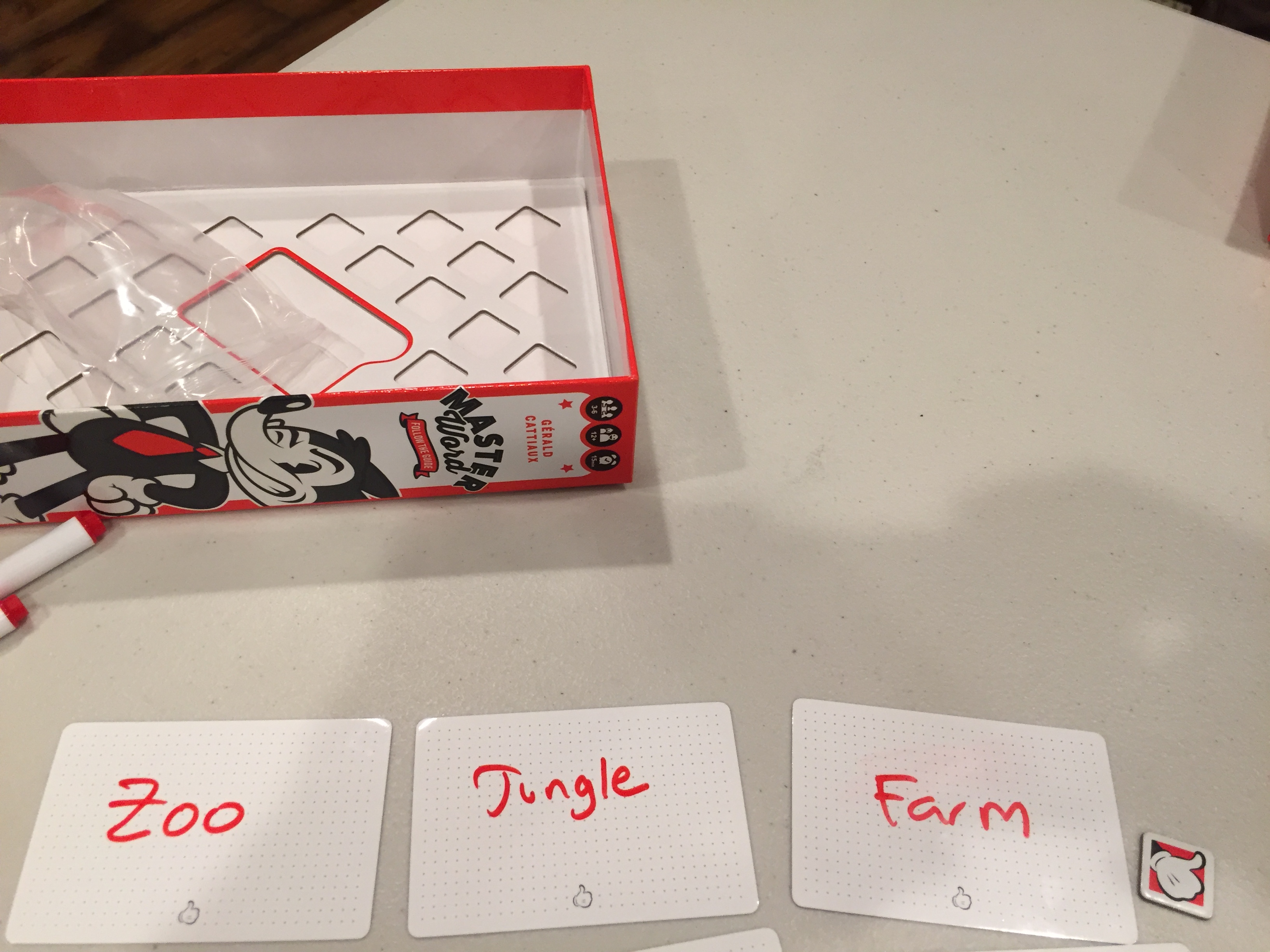
Once the Seekers have written their words, the Guide is allowed to give a thumbs-up for every seeker. If the written word “implies” or “narrows” to the final word, they get a thumbs-up! In the example, the players get one thumb-up, because a Cow is “obviously” found on a Farm! Note some of the imprecision here: A lot of Zoos have cows, but some people think of cows only being on a Farm. It’s up to the Guide to make the call to help his fellow players: The Guide’s job is to do the best he can to help his fellow players! Even if Zoo might get a thumb-up, the Guide thinks this will confuse his group in this instance! (Note that The Guide can hear all the deliberations of the group, so he has a sense of what they are thinking)

Note that the players DO NOT KNOW which card the thumbs-up applies to!!! (I made this mistake the first time I played). That’s why the thumbs are placed to the right of the row instead of on any of the cards. You just know one card got a thumbs-up, not which card.

IMG_7084

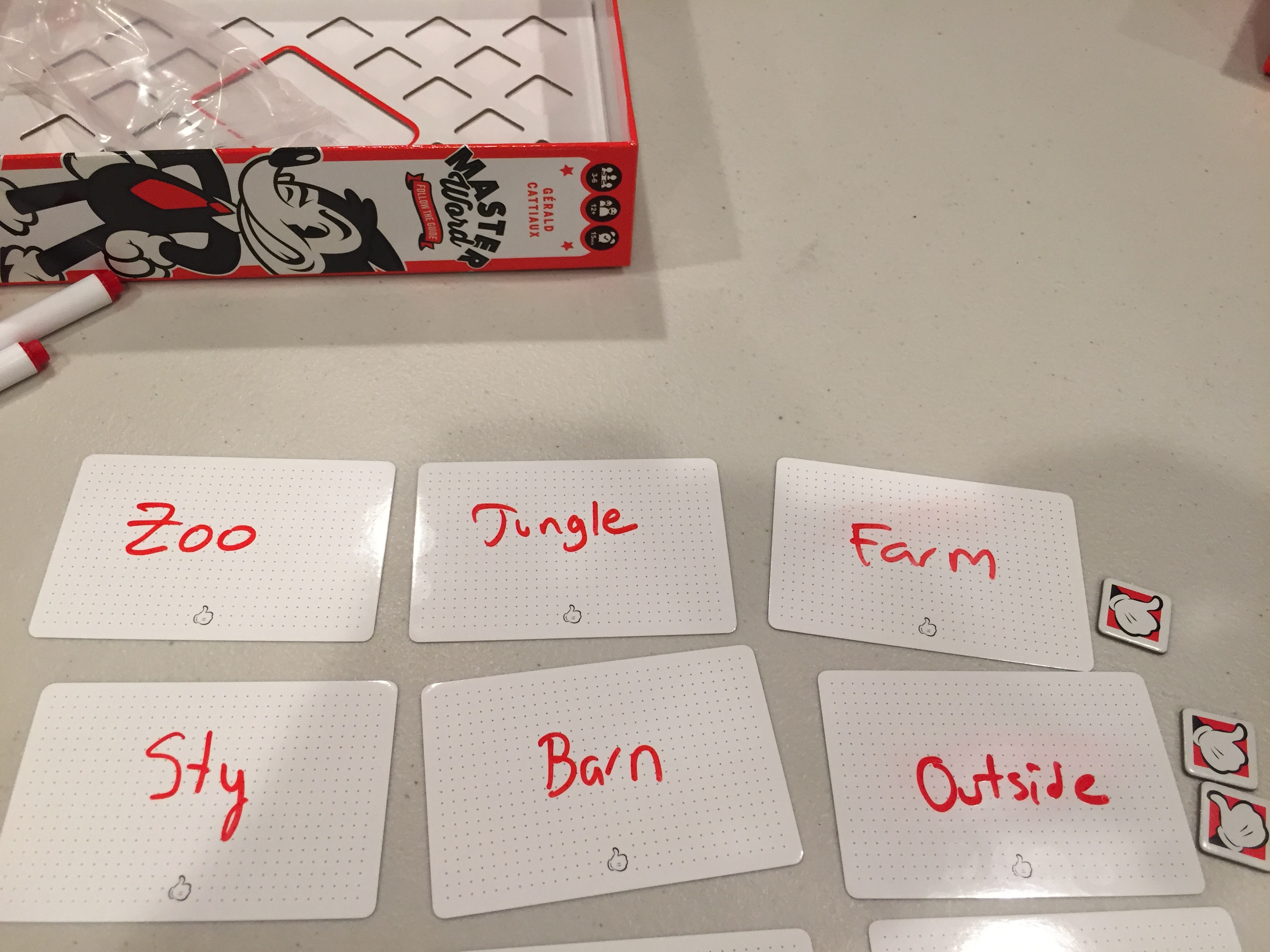
In the second round, players get two thumbs-Up, because a Cow is in a Barn and is typically outside. Again, the players still don’t know exactly which cards the thumbs-up refer to.

IMG_7086

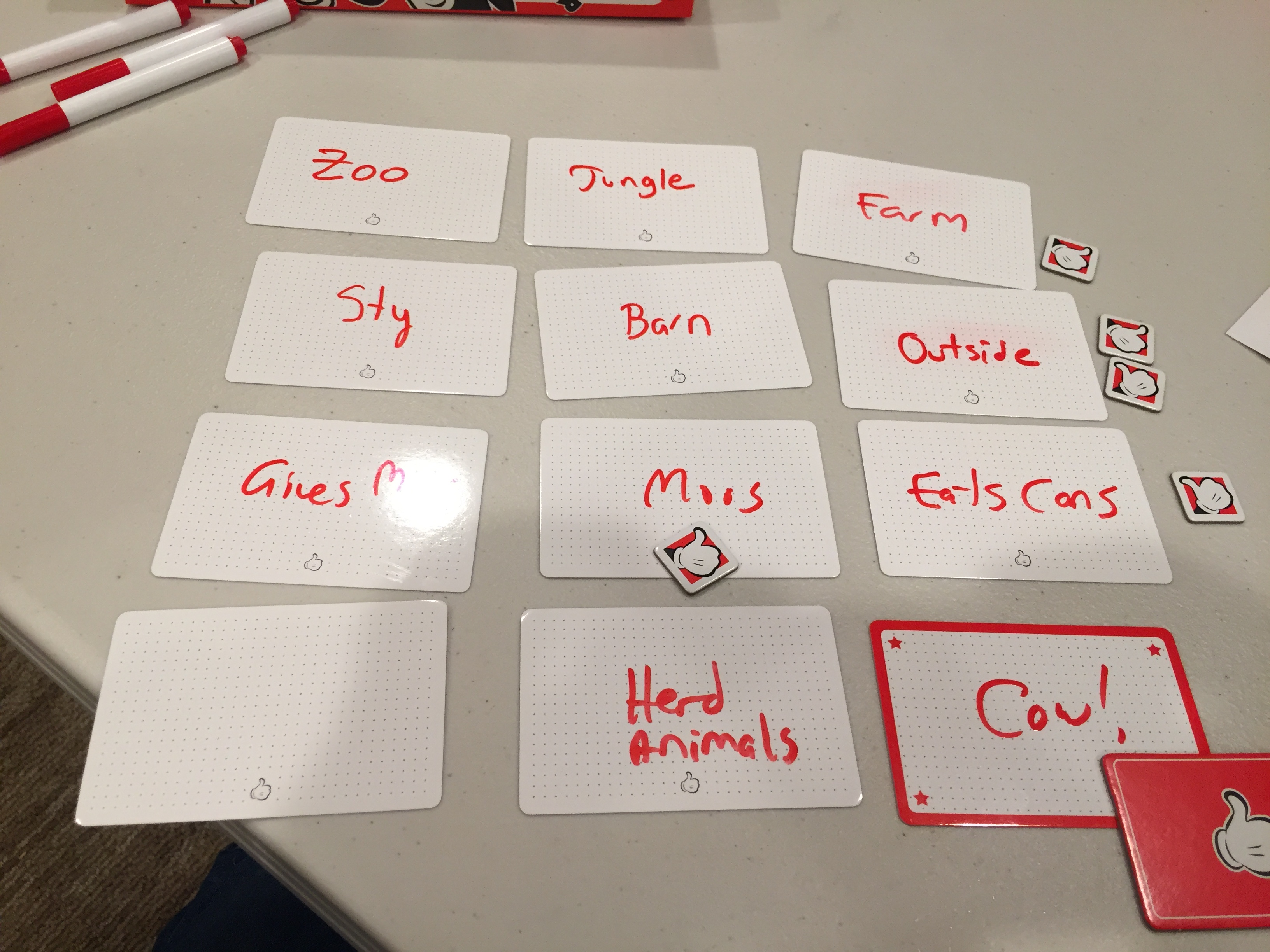
Above is a final game. The Seekers have successfully guessed COW and gotten the BIG THUMBS-UP!!! There’s two other things to note here:

(1) First, you’ll notice that a thumbs-up in ON the MOOS card. The Guide has a special power: exactly one time during the game, the Guide can move one of the thumbs-up to a specific card to emphasize a clue. In this case, the Seeker emphasizes MOOS to try to give the Seekers a big hint.
(2) Secondly, once Seekers are ready to guess the final word, the guess HAS to go on a RED CARD. If the Seekers had written COW on a white card THEY IMMEDIATELY LOSE!!!! This forces the be orderly in their search.

Player CountIMG_7072

Um, there are no solo rules. Even trying to apply the Changing Perspectives idea, you can’t really play this game alone. For 4-6 players, the game is simple: one player is the Guide and the rest are Seekers (each Seeker getting one card per round). Officially, for a 3-Player game, the Seekers get two cards per round (so 4 guesses per round). There’s no official 2-Player rules, but this same idea could work: One player plays the Guide and the other player plays a Seeker with three guesses per round.

The official player count is 3-6. I think this is accurate. We played a 7-Player game and it almost worked. The problem with too many Seekers is that there are too many people talking at the same time trying to discuss words, and they start stepping on each other. You could get away with a 2-Player or a 7-Player game, but the game works best with 3 to 6 players.

ThoughtsIMG_7090

So, this game works great. I have probably played 10 games of this over the last week since I got it! There’s only one thing we “changed” to make the game more fun. By default, the Seekers only have 90 seconds to make theirs guesses!!! We hated this, so we just got rid of this rule. We just took all the time we wanted. Getting rid of the time limit made the game longer (it’s supposed to be 15 minutes, but our games tended to be 25 minutes), but who cares? It made the game more fun!

And here’s the thing: Master Word works great in person (see above for a 4-Player game) or online over the Internet!!! In fact, 8 of the 10 games I played were over the Internet over Discord. This game would easily make our Top 10 Cooperative Games You Can Play Online! How do you play online?

  1. Get Online using something with Audio, a Camera and a Chat l(ike Discord or Zoom)
  2. The owner of the game takes a CLUE/FINAL WORD out of the box and (without looking) shows it on the screen.  While everyone else closes their eyes, the Guide looks at the CLUE and FINAL WORD.  The Guide then says the CLUE out loud.
  3. Players discuss online over Audio. They come up with their guesses (like normal)
  4. In the chat, one Seeker writes all the guesses: (Farm, Jungle, Zoo)
  5. In the chat, the Guide puts out the thumbs-up (either the Icon or a number indicating how many thumbs-up): (1)
  6. Play continues for 7 rounds!  If the Seeker players need to emphasize a word is a guess, they can put a * next to it: *COW
  7. At any point, the Guide can write in the chat to use his one time power to emphasize a guess. (“Hey Guys, MOO”)

Online, this has been a hit!  It’s become our go-to online game after Just One!

Issues

IMG_7077

Although we really like this game, you sometimes have to go through contortions to make sure the thumbs-up clues make sense.  For example, we ended up in 3-Seeker game always giving exactly three words with one always repeated!  For example, if we give (FARM, FARM, JUNGLE) then the number of thumbs-up is telling.

  • 0 Thumbs-up: it’s not FARM or JUNGLE
  • 1 Thumbs-up: It has to be JUNGLE
  • 2 Thumbs-up: It has to be FARM
  • 3 Thumbs-up: It’s both FARM and JUNGLE

So, we had to “be clever” when we came up with our guesses, sometimes giving mutually exclusive guesses on different axes (MALE, MALE, FARM):

  • 0 Thumbs-up: Female, not a farm
  • 1 Thumbs-up: Female, a farm
  • 2 Thumbs-up: Male, not a farm
  • 3 Thumbs-up: Male, a farm

So, we end up with some interesting conversations trying to come up with the right way to form our clues to get the most information.  This was clever, but sometimes excluded other people from the conversation.

The game sometimes feels a little convoluted, when maybe something simpler could have worked: 

  • Like a FAMILY MODE: Perhaps you always get 3 guesses (regardless of player count) and you put thumbs-up ON the proper card instead of not knowing which card.  This method would eliminate the need to worry about set-theory and mutual exclusion.

Normal mode allows you opportunities to be clever, which we loved. Something like FAMILY MODE would make this game more accessible to everyone.


Conclusion

IMG_7080

Overall, this is a good cooperative party game: gameplay fosters interactive discussions and working together. The Seekers do most of the work, and sometimes you feel like you don’t get to do much as the Guide. But, sometimes it’s nice to be in the mellow position of being the Guide (compared to Codenames where the Clue-Giver position can be very frustrating).

The fact that this game works so well online is a major point in its favor!! Although my online groups prefer the simplicity of Just One online, Master Word has become a new online favorite to play on Discord.

This is a good cooperative party word game in person, but exceptional in that you can play online very easily.

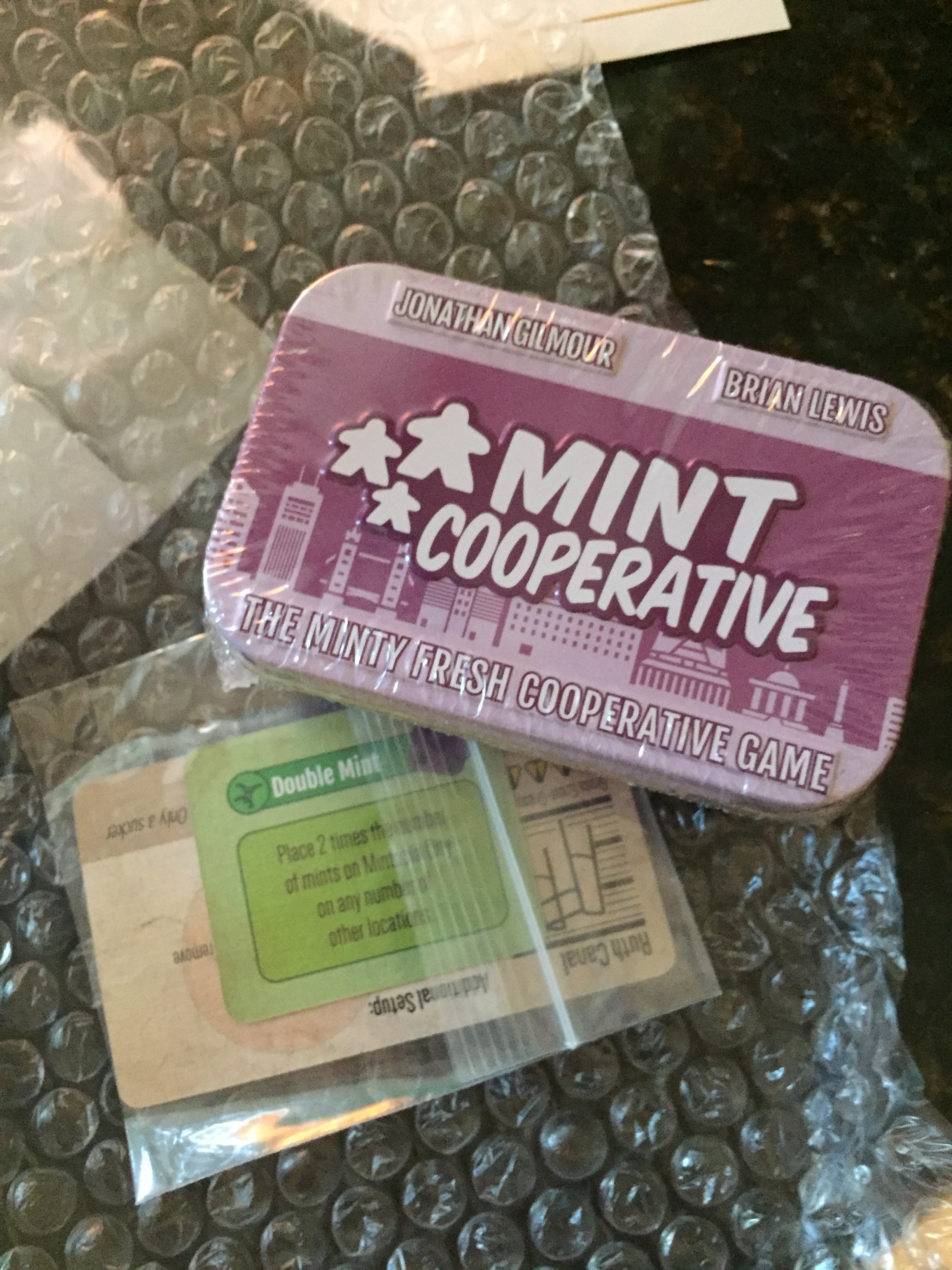
A Review of Mint Cooperative: Part I. Unboxing, Solo Rules, and First Impressions

IMG_6978

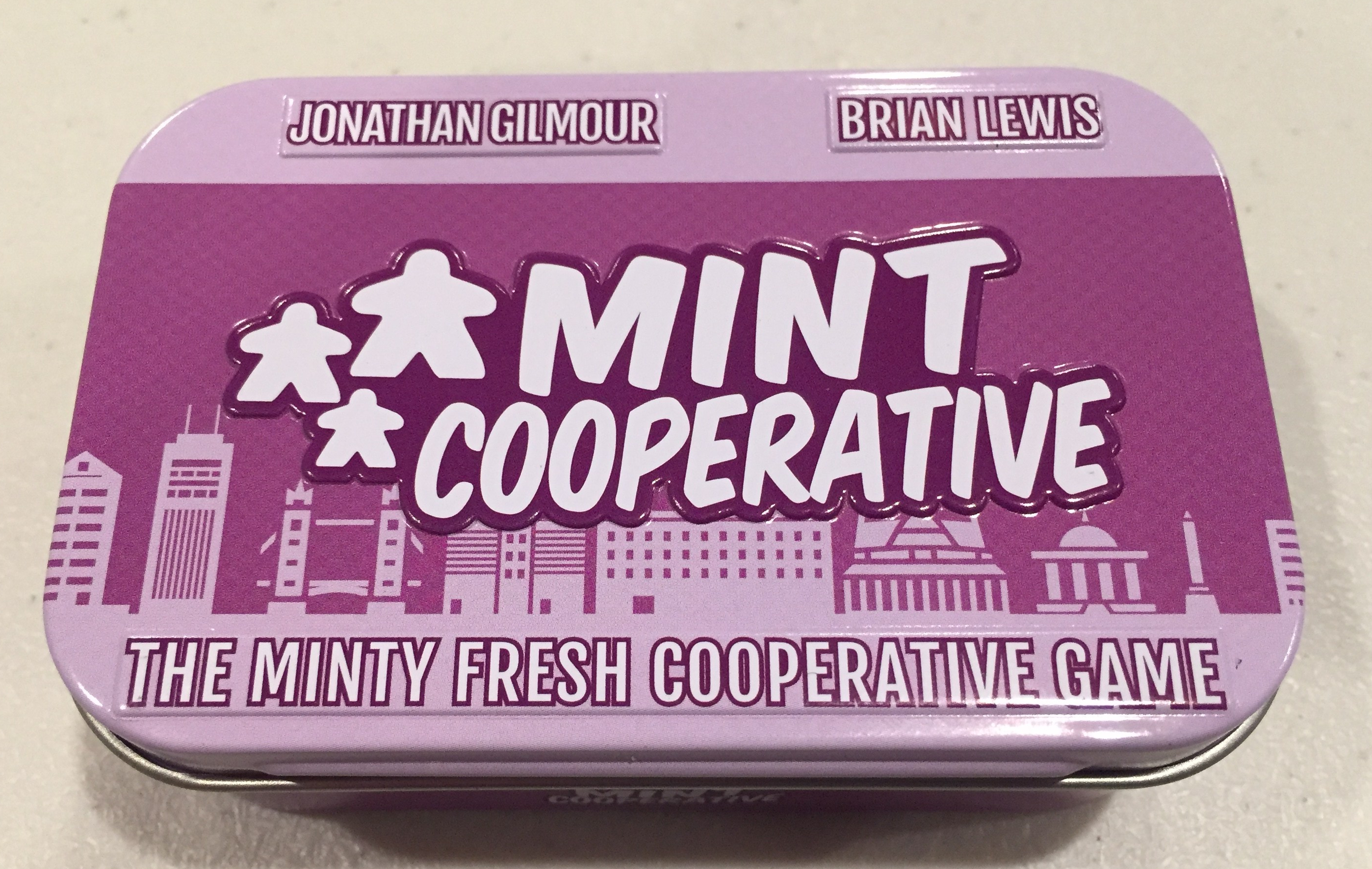
Mint Cooperative is a tiny little cooperative game that was on Kickstarter in about Sept. 2019 (about a year ago at the time of this posting). My friend Sam had backed both Mint Works (a tiny worker placement game) and Mint Delivery (a tiny pickup and deliver game) and both had been decent. Mint Cooperative is in the same line of little mint boxes containing little games. The cooperative superhero theme also appealed to me (as long time readers of my blog know, per my Top 10 Cooperative Superhero Board and Card Games). So, I went ahead and backed it. $10! Plus 5$ shipping!
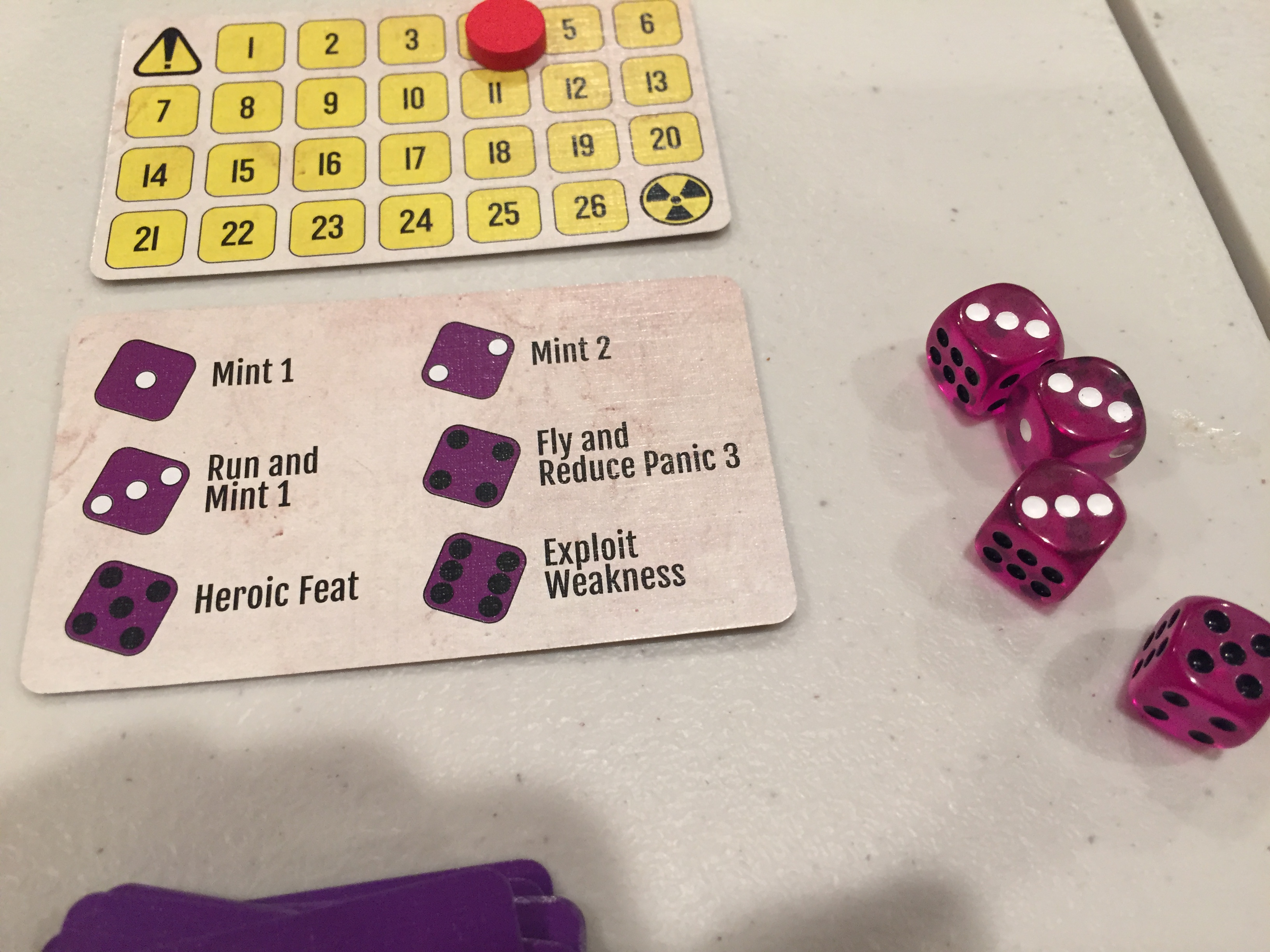
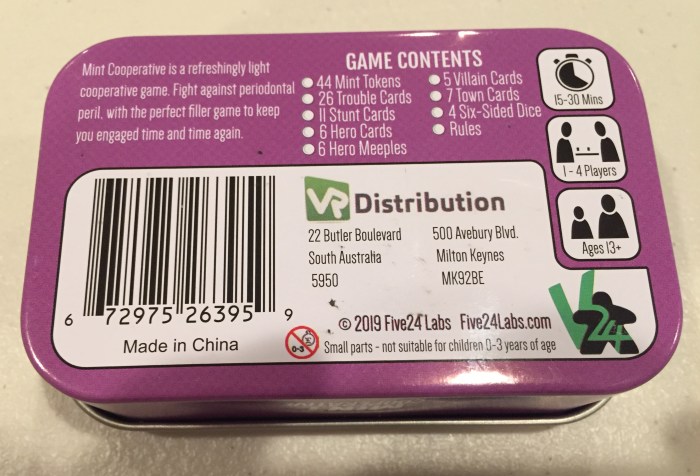
The back of the tin shows what this game is: a light (15-30 minutes) cooperative game for 1-4 players with a superhero/cavity fighting theme.

ArrivalIMG_6971

Mint Cooperative is the size of a larger mint tin: it arrived in a little plastic wrapper with a little Kickstarter extra (2 cards: additional Villain and Stunt).

Unboxing

IMG_6983

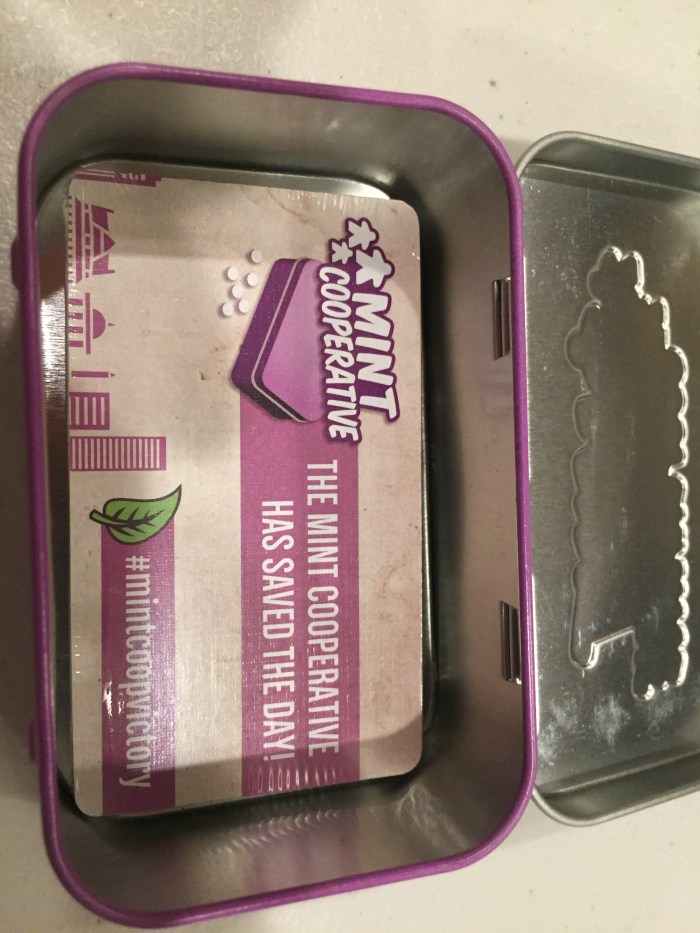
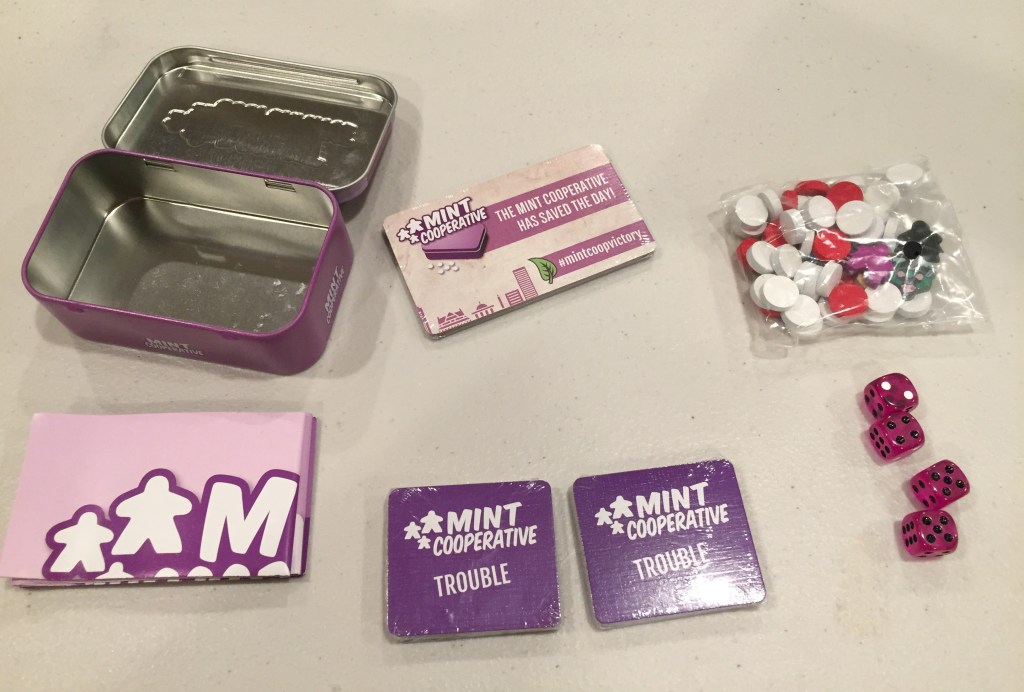
This game packs quite a lot of stuff into this little tin. Some dice, a bunch of small cards, a bunch of bigger cards, a bunch of tokens, and SOMEHOW they put a rulebook in.

IMG_6991

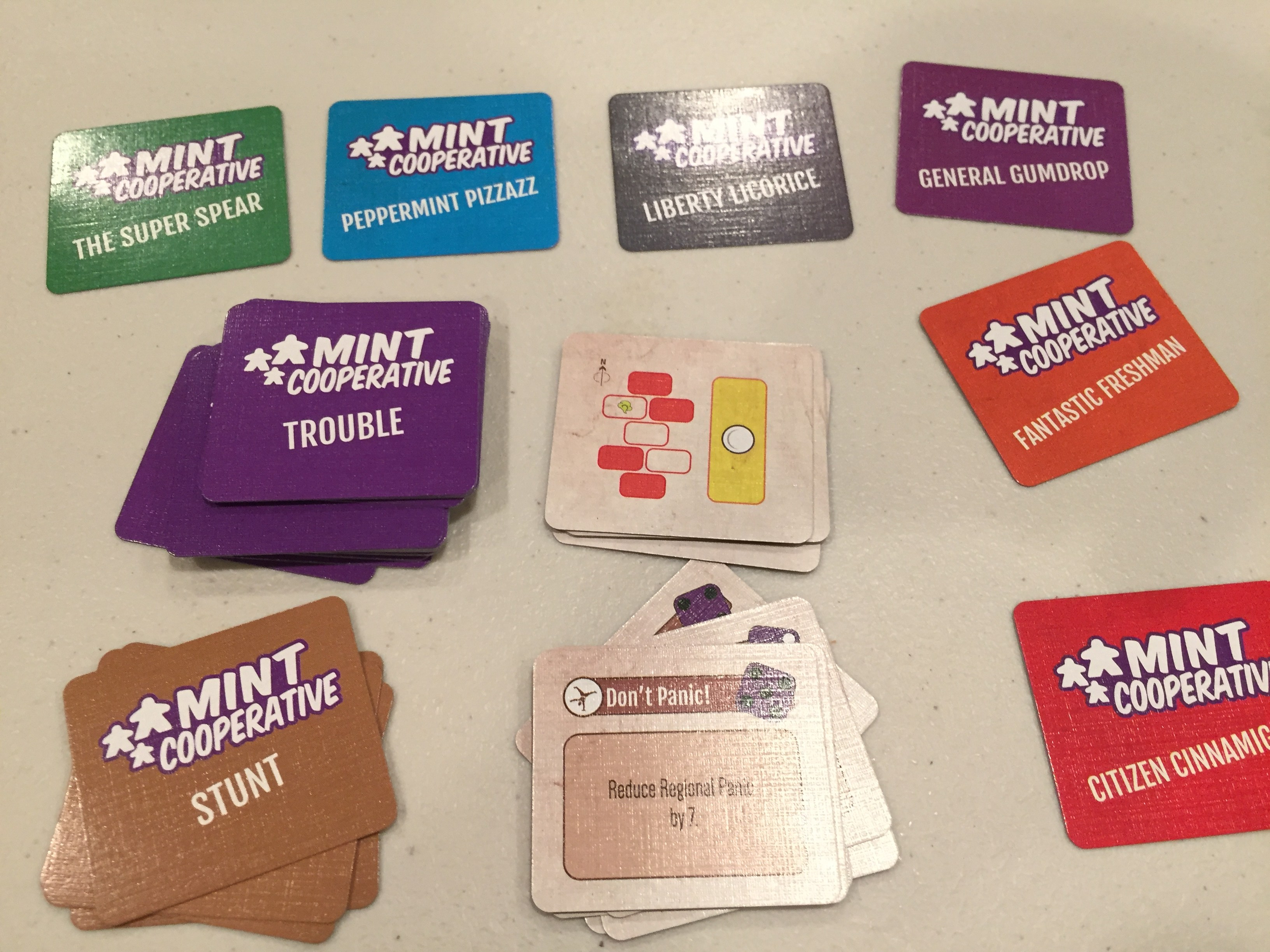
The cards are of decent quality (they appear linen-finished) and you can read them pretty well. I have to admit, I was surprised by this: I thought I’d have to get my glasses, but in general, I didn’t need them. Above are all the little cards:

  • The Hero Cards: Each player takes the role of a Superhero and gets a special ability (variable player powers)
  • The Trouble Cards: These are the “Bad News” or “Event” cards you see in a lot of cooperative games that cause bad stuff to happen to the heroes.
  • The Stunt Cards: Each player gets a one-shot stunt that can do something good for the players

IMG_6987

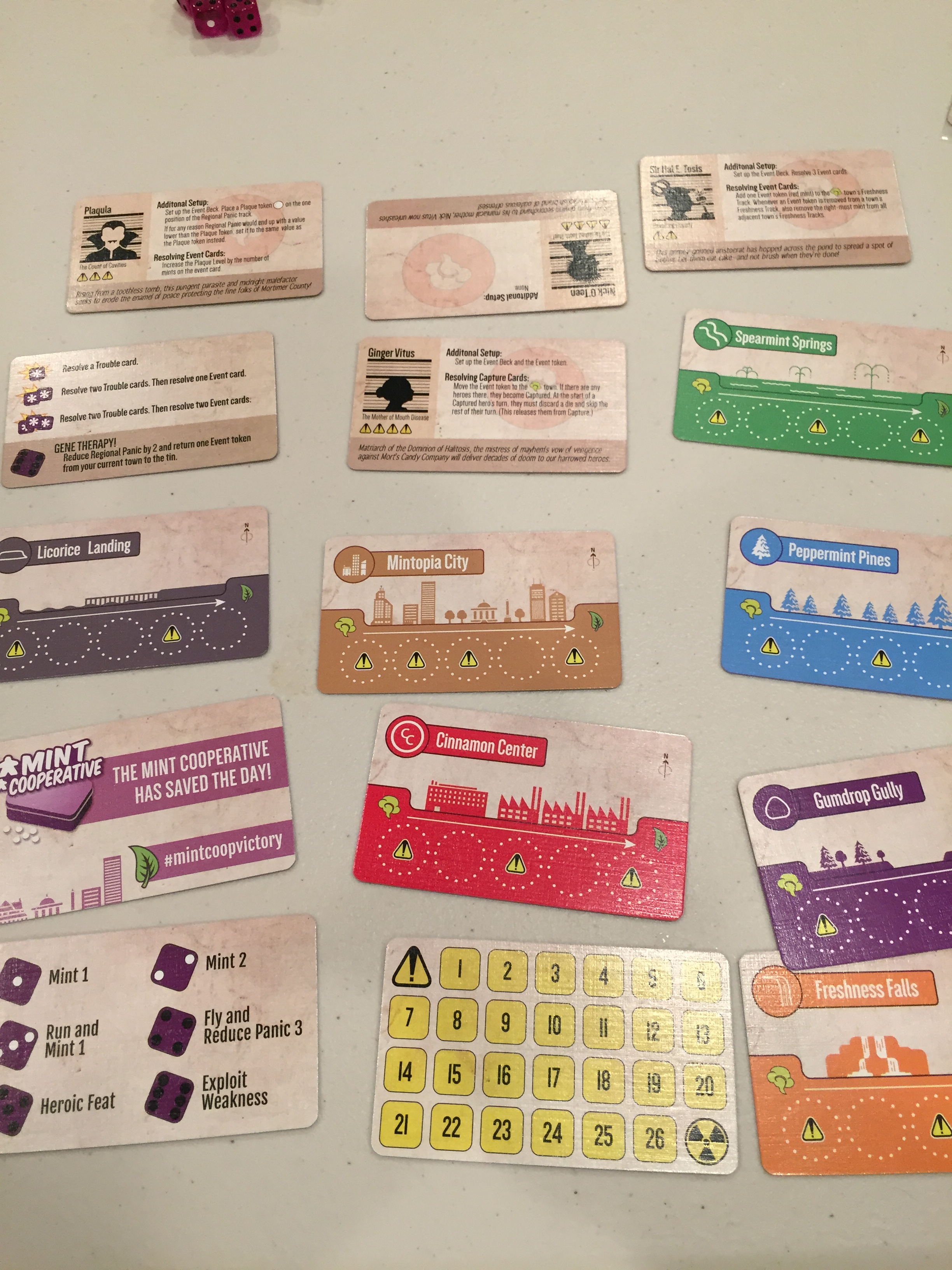
The rest of the cards are larger (about the size of two smaller cards) and are:

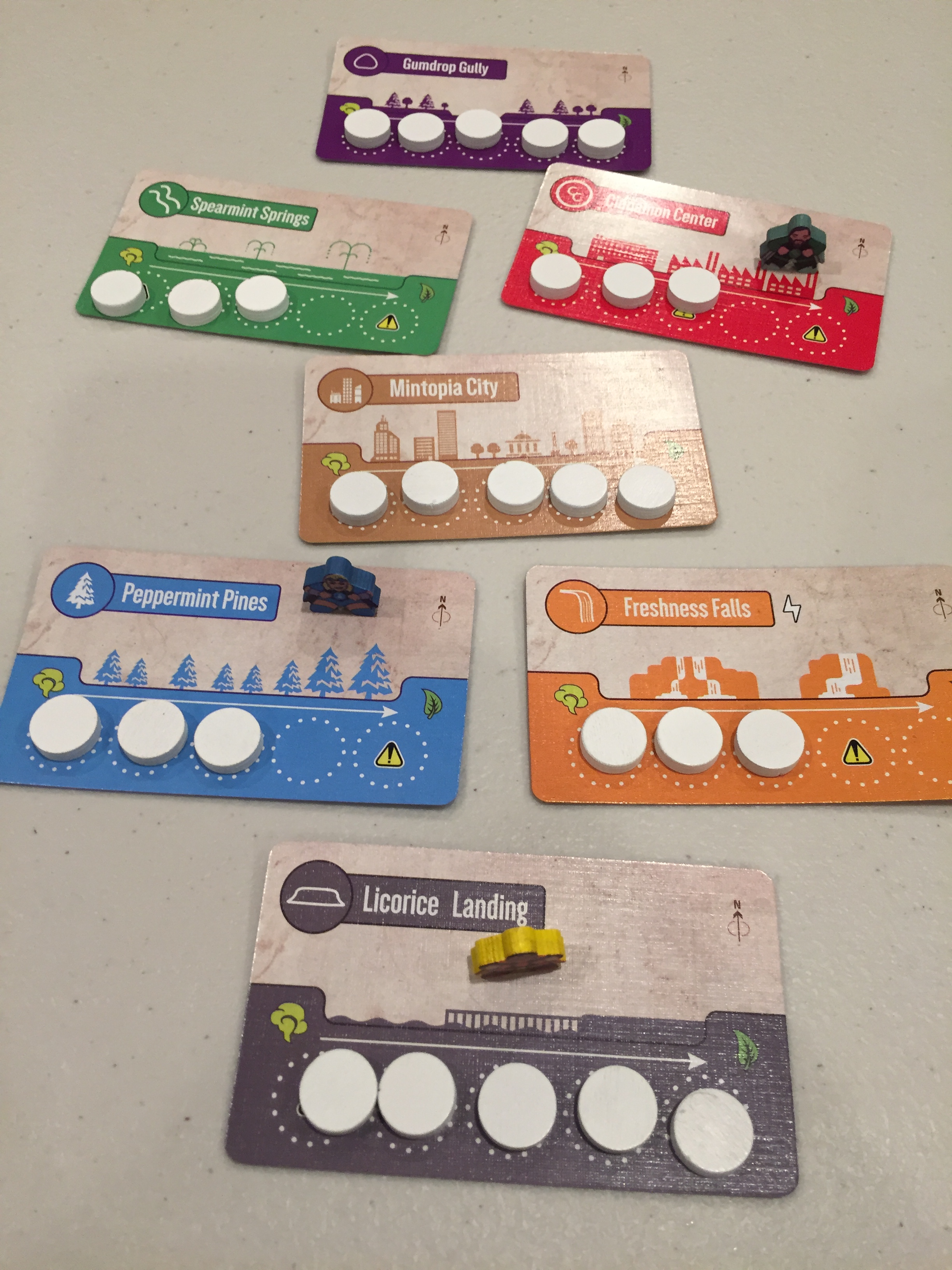
  • City Locations: The colored cards (red, blue, purple, brown, orange, grey, green) that correspond to city locations to protect. 
  • Villain Cards: The brownish cards are the Super Villain the Heroes fight
  • Extra:  A “terror” track (called the Regional Panic card, see below), reminder card (see below), “we won/we lost” card (for posting on Social Media)

IMG_7028

We also get 4 tiny dice which are surprisingly readable (see above next to the reminder card).

And of course, Mints! Well, wooden disks that looks a loooooot like Red and White Mints. But don’t eat them!

IMG_7004

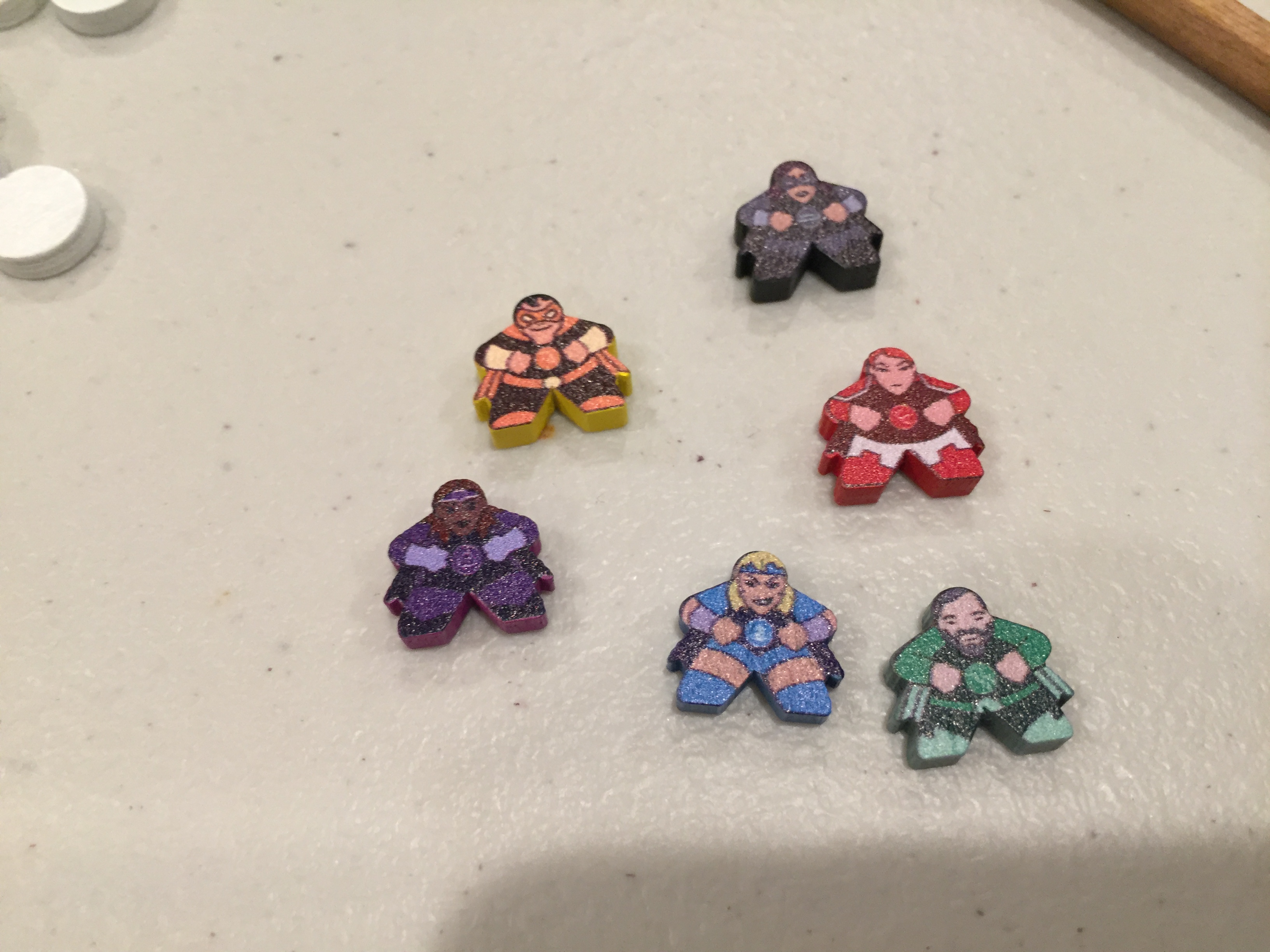
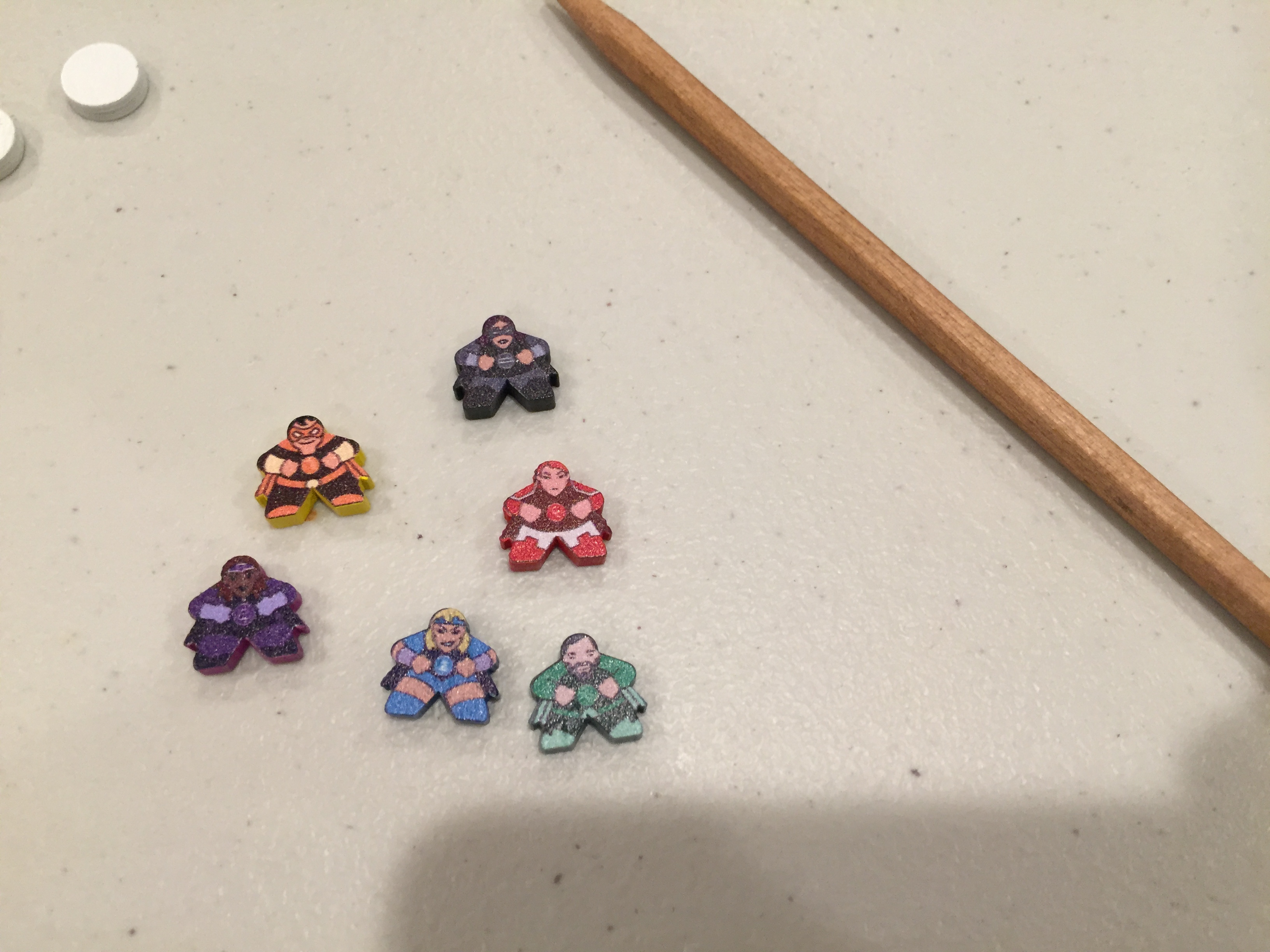
But the coolest pieces in the game: the little hero meeples. These are LITTLE meeples! I put a #2 pencil next to them to try to show scale, but considering how small these little meeples are, there is a surprising amount of detail on them! They are probably my favorite component in the game. If nothing else in the game says “This is a Superhero game”, these little meeples do!

Rulebook

IMG_6993

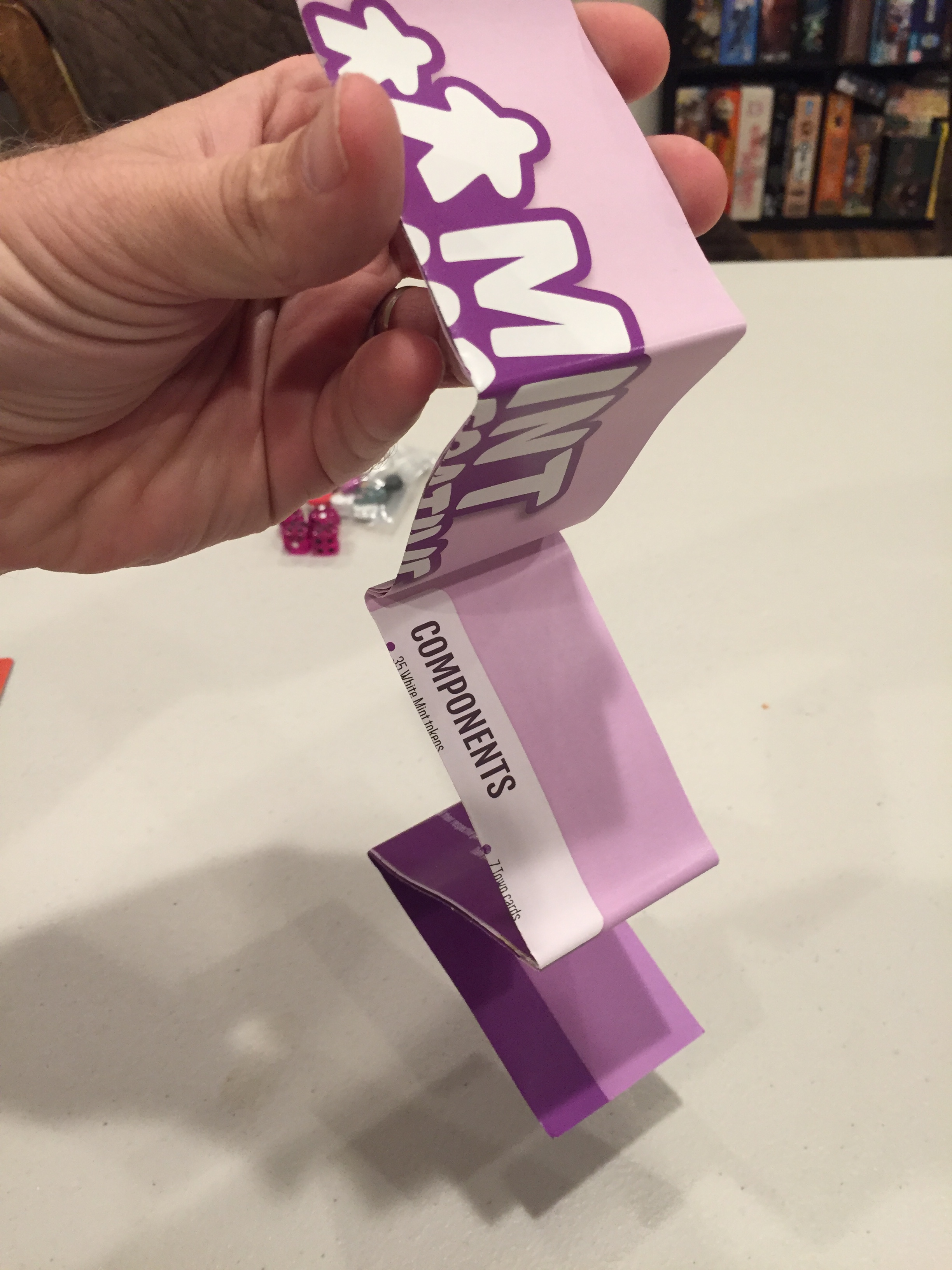
The rulebook …. fits in the tin. Barely. So that it fits, it’s a pamphlet that’s been folded many times. See above how it comes out of the tin!

It doesn’t quite flatten out very well, but it is pretty readable. The text doesn’t seem too small.

IMG_6997

There’s a components section: this REALLY needs some icons or pictures here! It would just help a little.

IMG_6998

The set-up chart is good and readable, but they really needed a numbered legend for each step: the actual set-up rules are numbered, but what do they correspond to on the picture?

In general, the rulebook is … ok. I read it and was able to learn the game. I was pleasantly surprised that I could read the text! I was expecting tiny, tiny, text, but it was readable without glasses or magnifying glasses. So kudos to that!

.. but, there were a number of things missing from the rulebook that I think should have been there. For example: Where is Weakness on the Villain Card? (Turns out the Villain cards are double-sided, and I think it’s on the back bottom). I do prefer the text based systems (like Mint Cooperative uses) instead of Icons most of the time, but there were a bunch of cards that weren’t labelled: What is Regional Panic? (It was labelled in the set-up, but it really should have been ON THE CARD) What are the Heroic Actions? After playing the game, you figure it out, but it kinda makes you grumpy. An Icon or a Label would have gone a looong way. Again, if the set-up picture had been NUMBERED, I could have correlated the pieces in the set-up a little easier.

The rulebook was good enough, but I feel like it reallllly needed another pass to help correlate pieces in the game. Eh, I learned it.

Gameplay

So, this is actually kind of a cooperative dice placement game. The players roll the 4 six sided dice and choose which three they will want to play. You either play a dice on a Stunt (one-time, see below) or the activity listed on the reminder card.

The little reminder sheet next to the sheet reminds players what the dice can do. You can use the dice for what’s listed, or potential use a stunt:

So, the players talk and decide who wants to use which dice. When the third die is used (the fourth goes unused), the dice get rolled again, unused stunts are discarded (stunts reset every turn), and play continues.

Basically the actions are:

  • Mint: place a mint on a city (to “freshen it up”)
  • Fly: Move to any city Location
  • Move: Move to an adjacent city
  • Heroic Action: use the player’s special action
  • Reduce Panic: Reduce the panic on the Regional Panic chart
  • Invoke Villain’s Weakness: Invoke weakness (I think on the back of the villain card).

IMG_7048

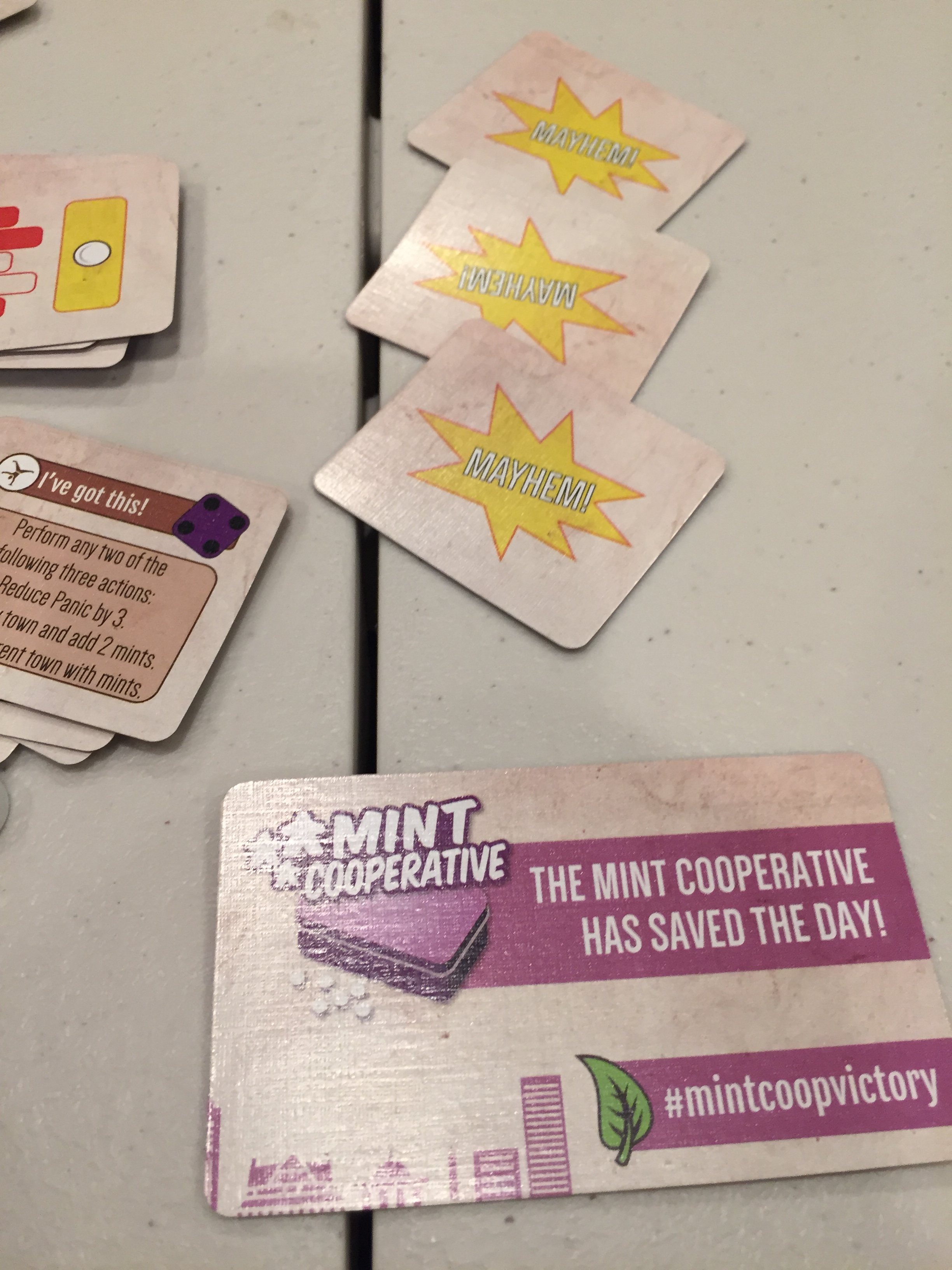
To win the game, you need to survive until the three Mayhem cards (see above) have been revealed (from the Trouble deck) and you have survived.   You lose if Regional Panic makes it all the way to the top!! So, on your turn, you fly around the city and keep the city “fresh” (by putting mints on City Locations) to keep the city’s “terror?” “cavity?” markers covered. See below:

IMG_7036

The Regional Panic will go up based on the number of yield signs showing.

The Trouble cards are what cause the city to become less “fresh”:

The Trouble card above tells you to take 2 mints off of each city Location listed to the left. (If there are no mints, take as many as you can). For each city, if doing this reveals any yield signs (“terror?” “cavity?”), then the Regional Panic goes up by that amount. (For the record, I hate the term Regional Panic: it sounds each region or city Location has its own panic level!!! That chart should have just been called “Panic Level” or “Terror Level” or more thematically, “Halitosis Level” or “Bad Breath Level”!)

Trouble

IMG_7017

The mechanism for placing Trouble cards is different and interesting. At the start of the turn, when you roll the dice, the number of doubles/triples rolled determines how many Trouble cards you draw! This is mitigated by some rules, but in general, you can draw 0, 1 or 2 Trouble cards. In my games, I saw almost 2 cards every time. This is a Catch-22: you DO NOT want Trouble, as it causes Regional Panic to go up … BUT the Mayhem cards are sprinkled in the Trouble deck (a la Pandemic) so you want the Trouble cards to come out to get to the Mayhem cards! You can only win if you get through all three Mayhem cards!

This mechanism is interesting because it’s self-balancing. You always roll 4 dice, do Trouble, take 3 actions (no matter the number of players), then start over. It’s simple, balancing, and easy to explain (although some of the double rules are weird).

Solo Play

IMG_7025

See above for a solo set-up!

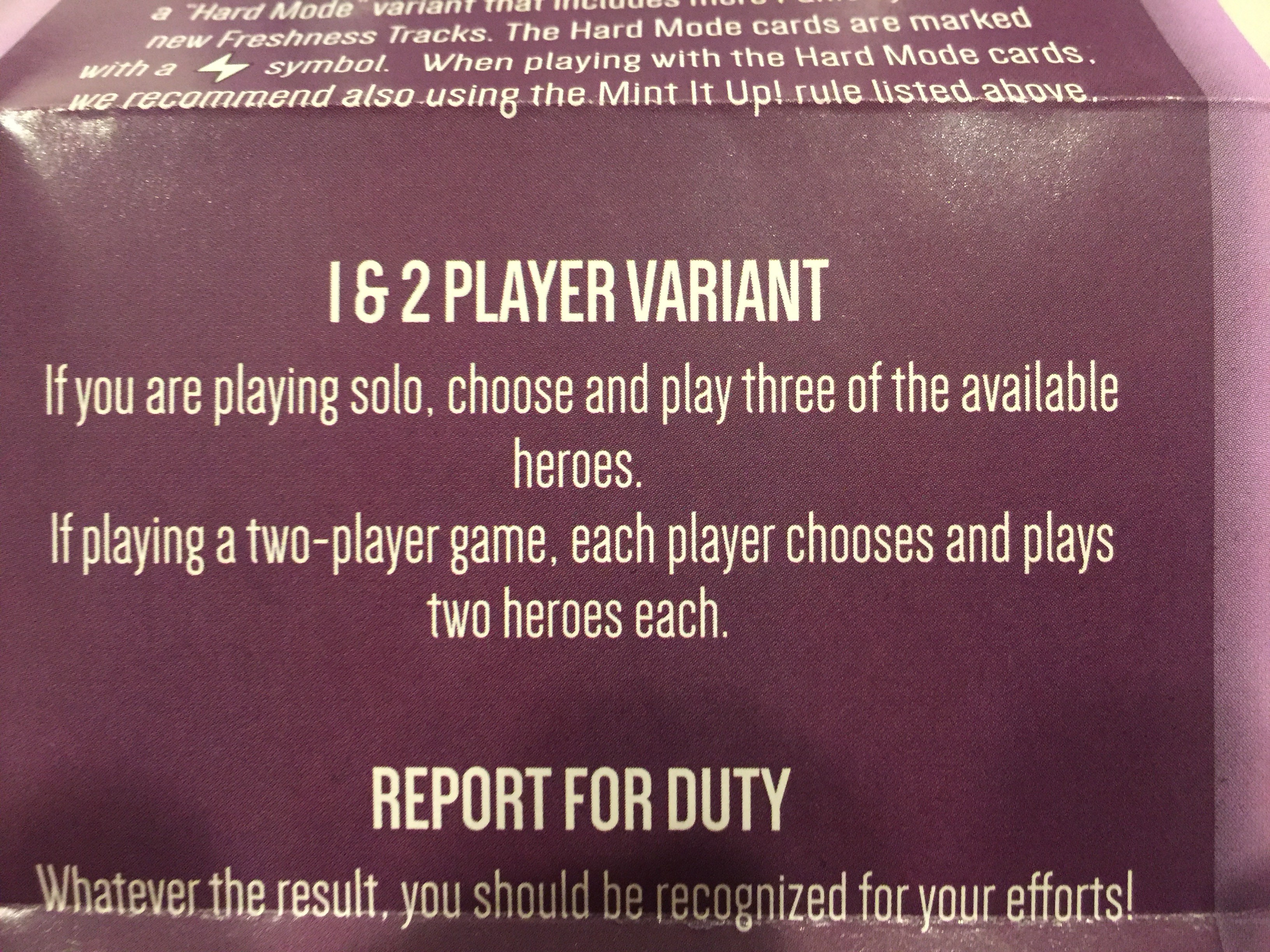
The game works fine solo. There are special (but simple) rules for playing Solo: basically, you play as three characters in the game.

IMG_7023

IMG_7040

The game flows decently well solo, but you do have to keep track of 3 different powers for three different characters. It took about 40 minutes for my first play: I could see it taking 15-30 minutes on subsequent plays.

This solo mode is a good way to learn the game, so thank you Mint Cooperative for adhering to Saunders’ Law and having a viable solo mode!

Value

IMG_7052

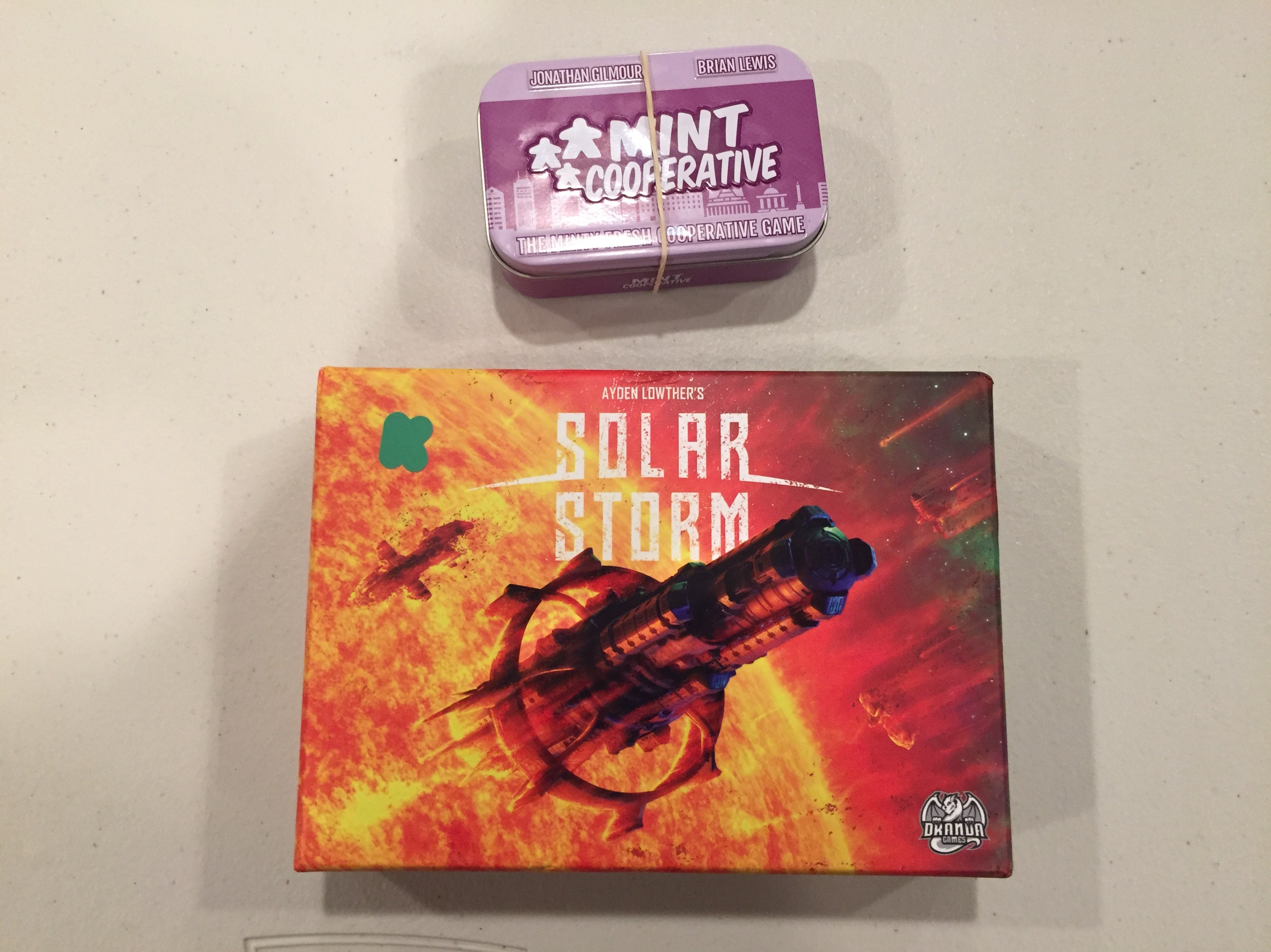
So, this game reminded meet (in terms of scale) to Solar Storm.  We reviewed Solar Storm back here, and we liked Solar Storm as a light cooperative game.  These two games are kind of the same ilk: small, quick cooperative games. 
  • Solar Storm: $18.99 at Miniature Market
  • Mint Cooperative: $10 (Kickstarter, +$5 shipping)

From a price perspective, they are similar. Solar Storm is about 3x bigger and maybe 1.5x more expensive.  Mint Cooperative is small and can fit in your pocket: Solar Storm can’t.   Unfortunately, in order to fit in my pocket, I needed a rubber band: the mint package was falling open.

Conclusion

Like Mint Works and Mint Delivery, Mint Cooperative was decent. I liked it okay, but I didn’t love it. I didn’t think the theme really came out (so I very much doubt it would make my Top 10 Cooperative Superhero Board and Card Games), so that was a little bit of a disappointment. Honestly, the most thematic part of the games was the little superhero meeples: I Loved those!

IMG_7005

If you asked me to play this game with you, I’d happily play it with you. It was fun enough. If you asked me to recommend a light cooperative game, I’d probably recommend Solar Storm first: I think Solar Storm is a more thematic and fun light cooperative game.

Having said that, if this looks even a little interesting to you, pick it up! It’s only $10! The game was good enough and you’ll have some fun playing it. For $10, I can plop it into my pocket and play it with you. And we’ll have a good time, if not amazing.

P.S. It is a small game, but it does take up some space on the table! I wouldn’t recommend it in too small of a space … a airplane tray table is probably too small …

Review of the Detective: Smoke and Mirrors (Cooperative Mode Only)

IMG_6910

Detective: City of Angels is a cooperative crime-solving game in a Noir setting. We have previously reviewed it here and it made the top spot on both of our Top 10 Storybook/Storytelling Games and Top 10 Cooperative Games of 2019! It’s safe to say that me and my group have really enjoyed the Detective: City of Angels universe!

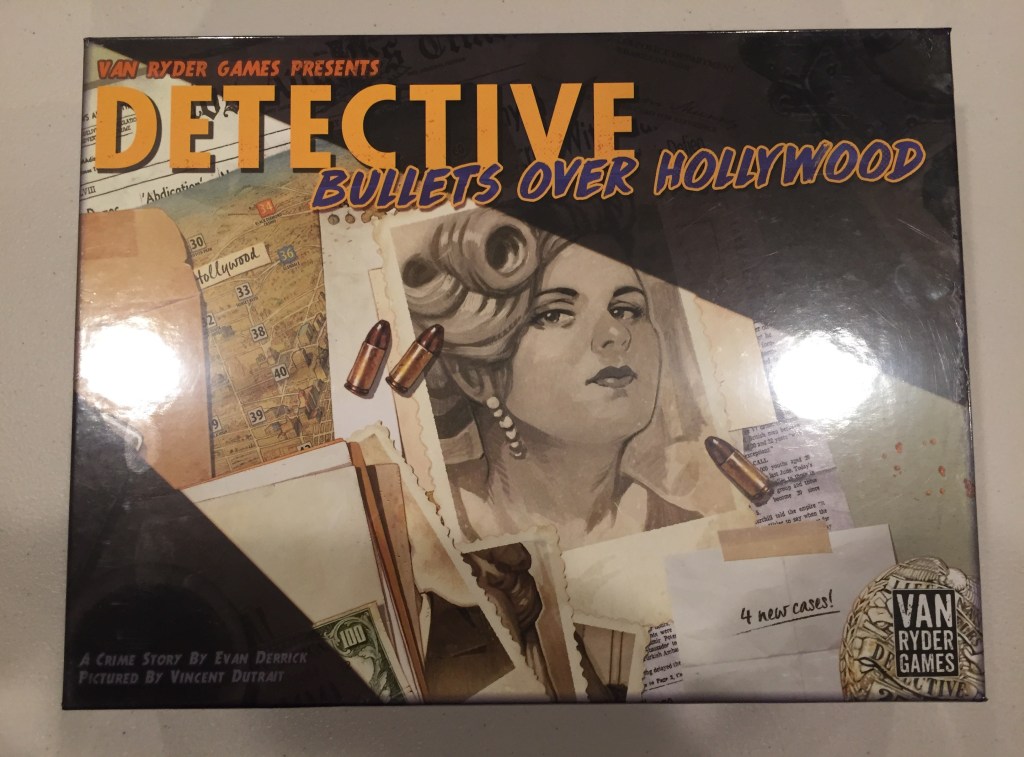
We need to be clear on the game we are discussing here: Detective: City of Angels is a very different game from Detective and Detective: Season One. Those games are from Portal games and involve extensive use of the internet. THESE ARE NOT THE GAMES WE ARE REFERRING TO. Detective: City of Angels, and its expansions Bullets over Hollywood and Smoke and Mirrors (which we are discussing here) are self-contained games from Van Ryder. (The other Detective series is from Portal).

My group played the Portal games Detective and thought it was interesting, but it felt too much like work (as we were constantly going to the internet). The Van Ryder Detective: City of Angels game, on the other hand, was fun and self-contained noir detective stories that we had a blast playing. So, how is this new expansion?

ExpansionIMG_6908

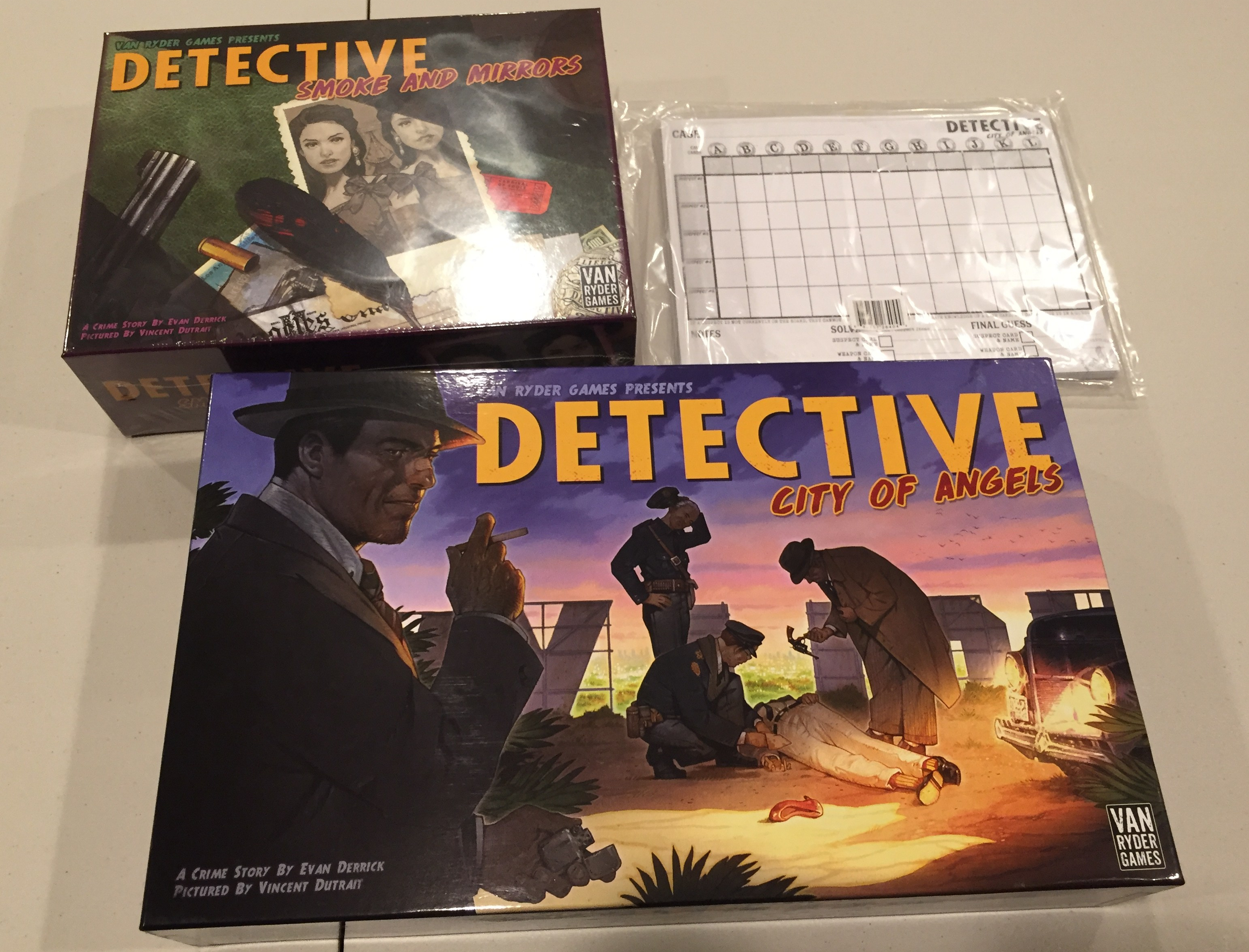
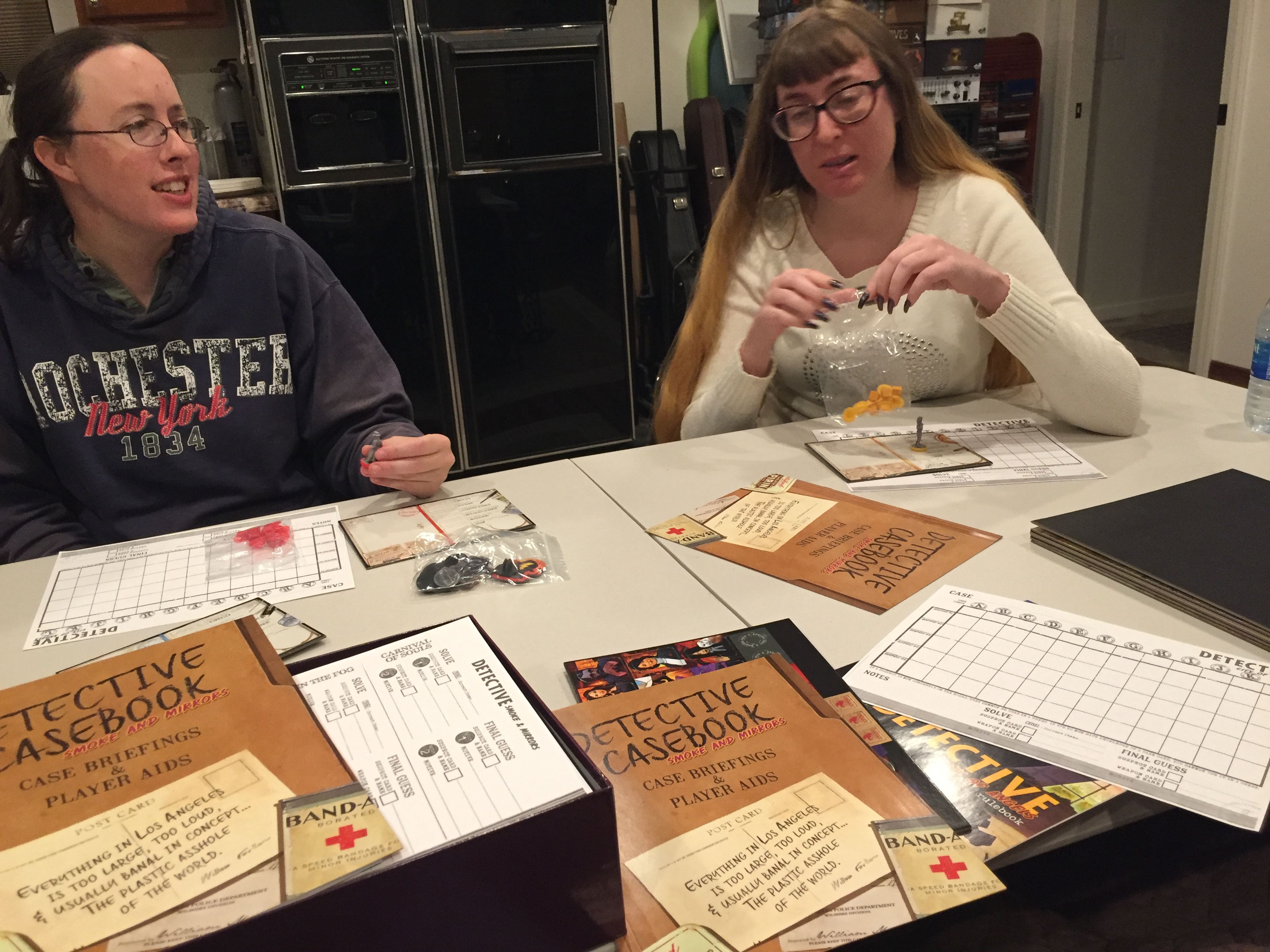
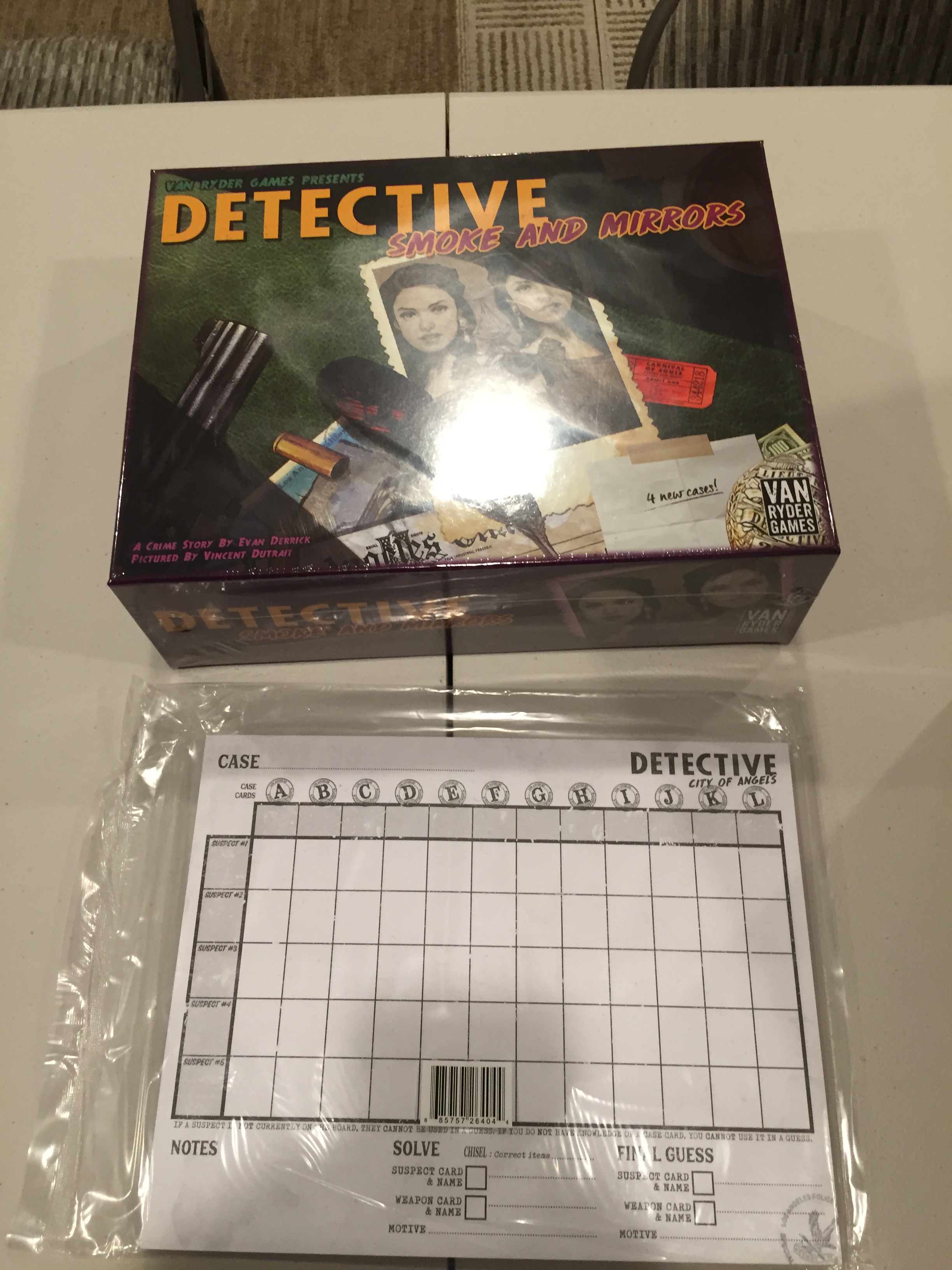
To be clear, in order to play the expansion Detective: Smoke and Mirrors, you need the base game (see picture above).  My copy arrived a few weeks ago (November 2020). I had Kickstarted the original game and loved it, so it was a no-brainer to Kickstart the expansion Detective: Smoke and Mirrors.  Note that I also get a new set of notepads with the expansion (they are dedicated notepads to writing down clues in the game).

Unboxing and ComponentsIMG_6916

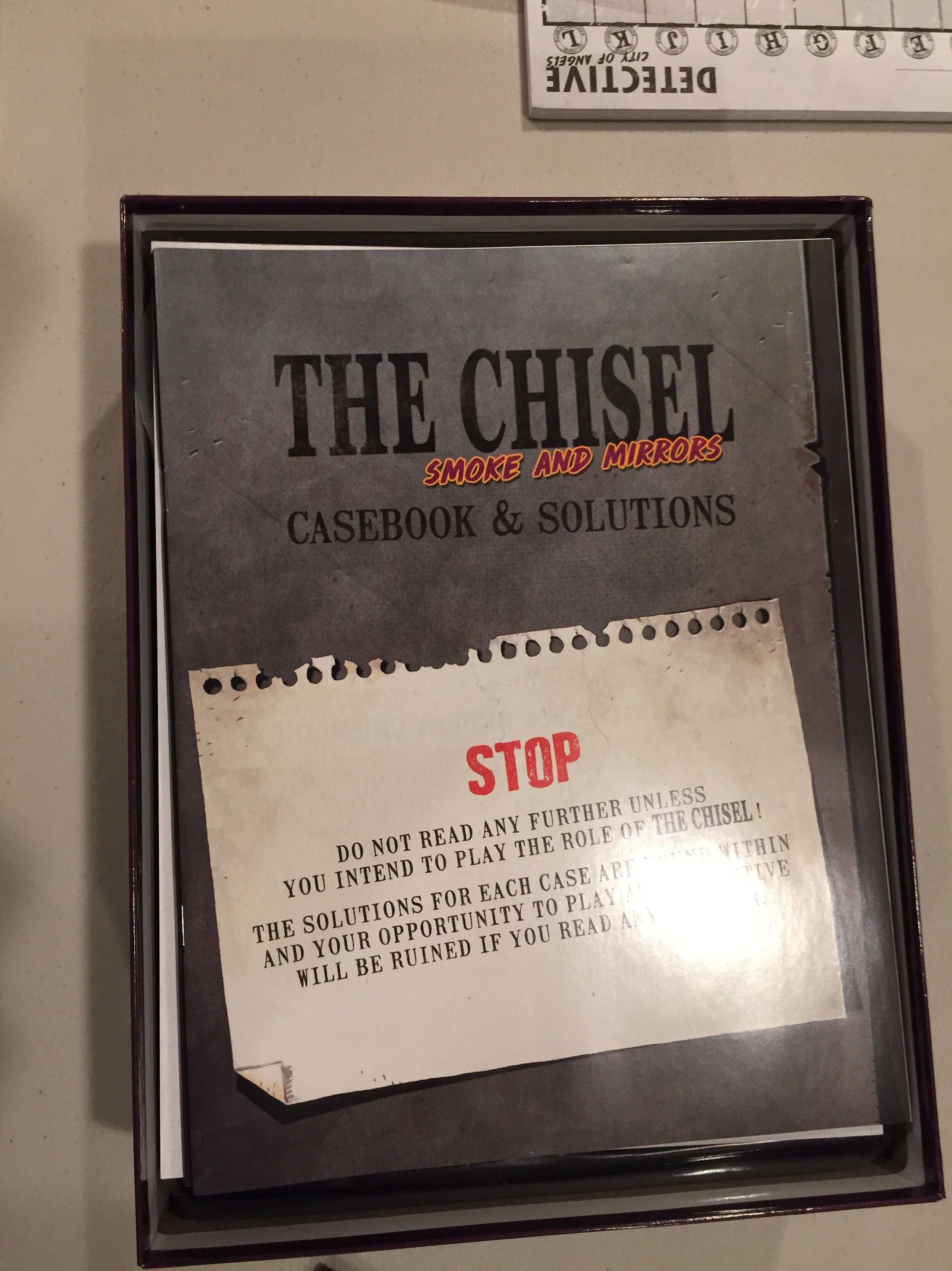
The expansion includes 4 new cases for you and your friends to solve. So, the expansion replaces the casebooks and Chisel book from the original game with new books!

The gamebox also contains the 4 boxes with the new cases.

IMG_6968

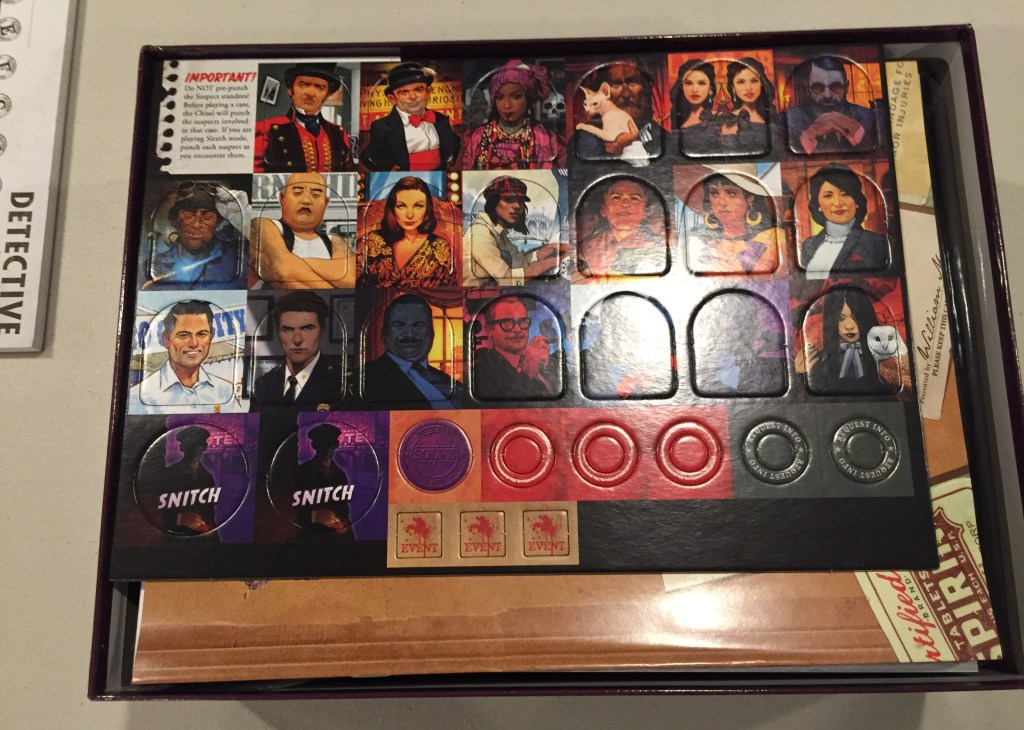
There’s a ton of space on the left hand side of the box to put other expansions that may come out in the future. The way the other cards were packaged in the box was a little weird. They didn’t quite fit (see picture above) as they protruded a little. I think the idea is that you will fold them into the base box, but considering how much space is wasted for the expansion, this seemed like this could have gone wrong and folded the cards. Luckily there were ok, but I wonder if other people will have problems with the way some of the cards are packed.

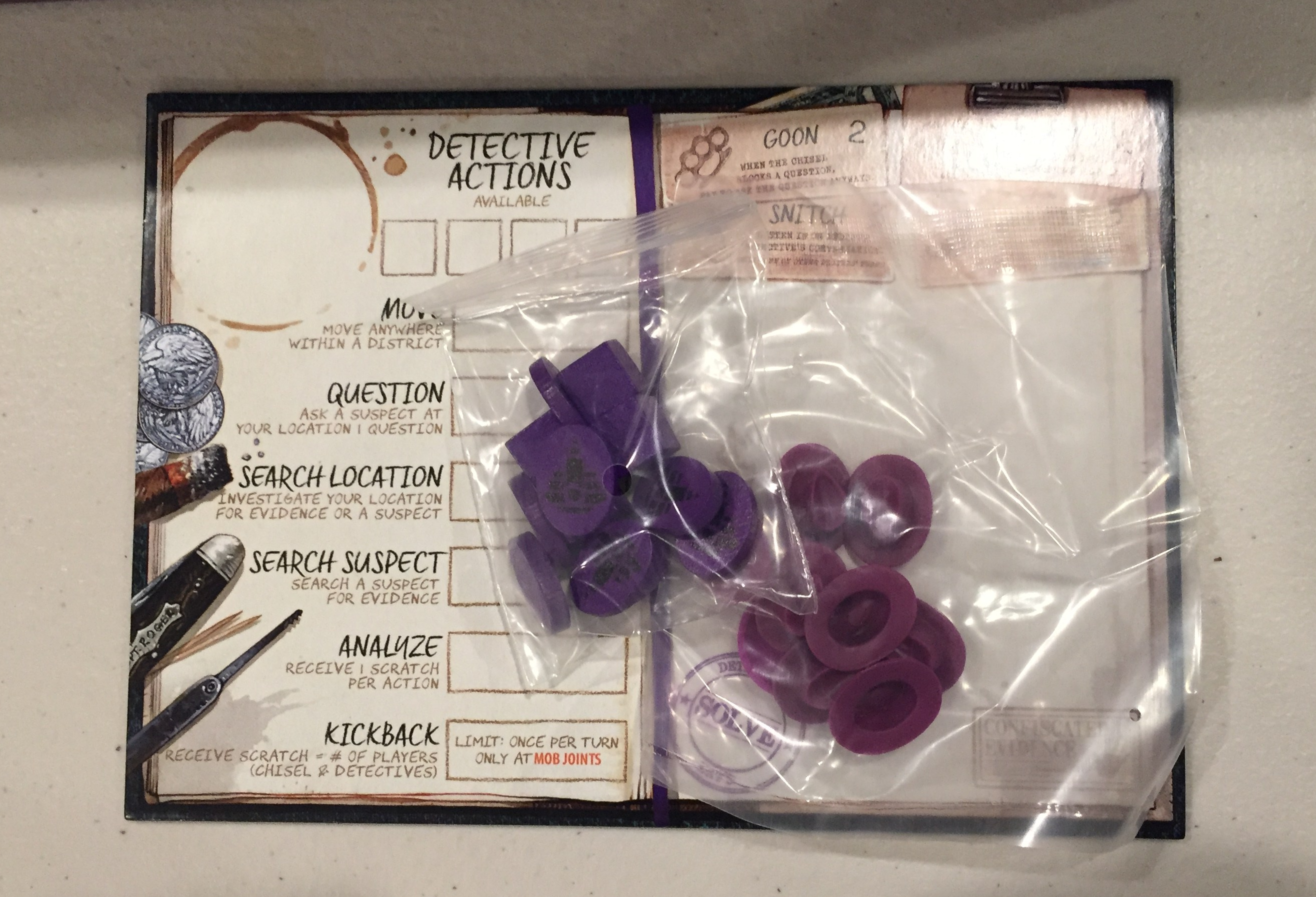
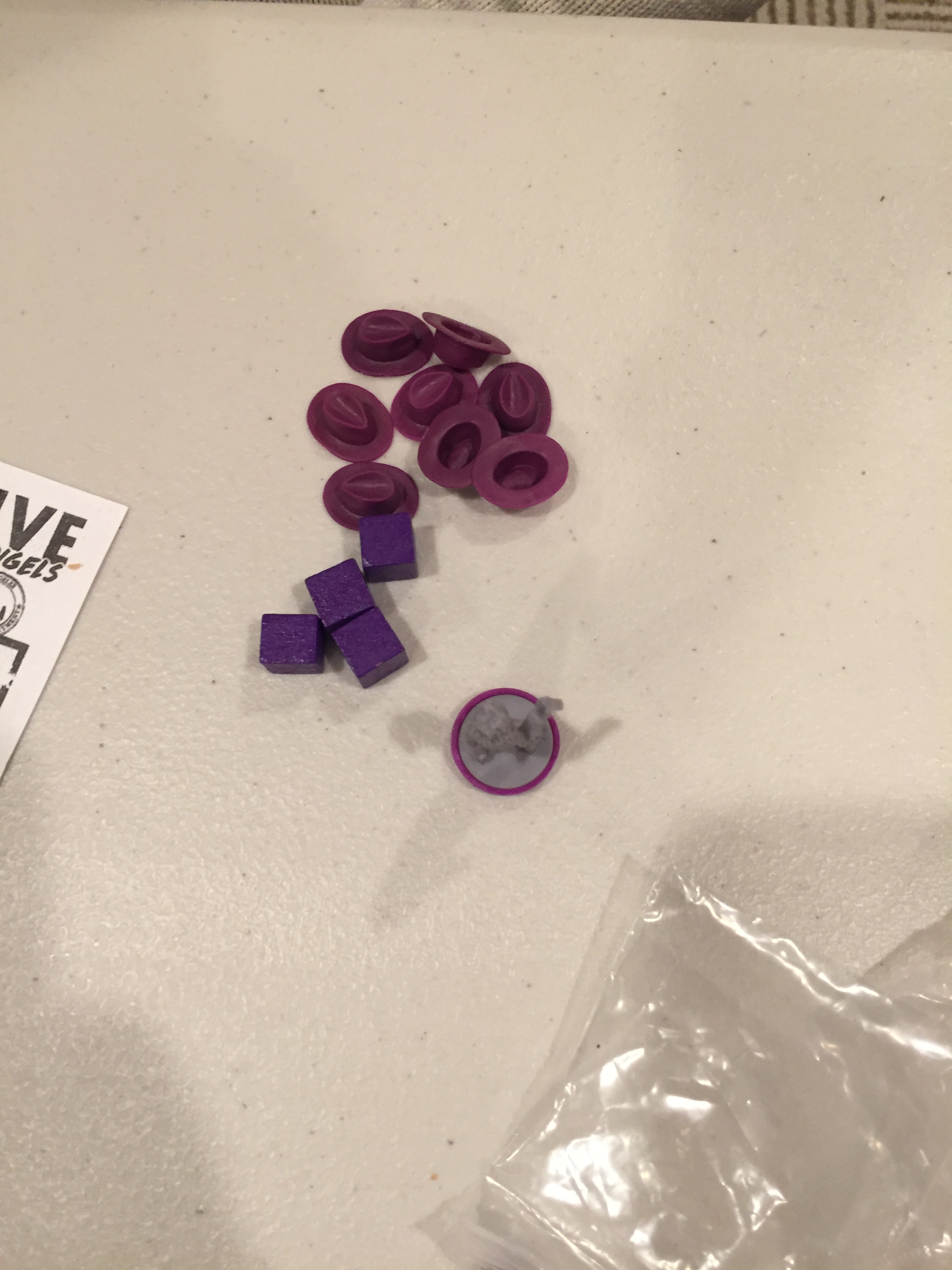
Another weird decision: they added a purple character. This is NOT a 5-player expansion, this is just in case you want a different color! Even then, the purple components didn’t quite match each other (see picture above) . It was a very unnecessary cosmetic piece to the expansion, BUT Sara really wanted the purple player so I guess it worked.

The Vincent Dutraite art is fantastic (see above) and consistent with the original game. Both the art and graphic design continues the tradition of the original game: It looks great.

Rulebook

There’s not really a new rulebook, just a pamphlet to expand on the ideas in the game. Really, the only change in the game is that some of the mysteries have different solve condition. In the original game, you always had to find weapon, motive, and suspect. In the new game, there are other twists (multiple murders, etc)!! Honestly, this is an expansion in the truest sense: Smoke and Mirrors really just adds NEW CONTENT: 4 New Cases to expand the original game.

Set-Up

IMG_6960

Set-up isn’t too bad.  You need just a few things from the original game: the board, the detectives, the notepads, and that’s about it.  Almost everything else comes from the expansion, so it’s pretty easy to set-up and play this expansion.  Although I loved the expansion Hero Realms: The Lost Village (the cooperative expansion for Hero Realms which I reviewed here), The Lost Village was very painful to set-up and get going.  Luckily, Detective: Smoke and Mirrors, did not have this problem.  Were were up and going pretty quickly, and it was easy to keep the base game and expansion content separate.

Cooperative Play

IMG_6967

To be clear: we are ONLY reviewing the cooperative play mode of the expansion. Recall that the default way to play Detective: City of Angels is one vs. many, which my playgroup typically does NOT enjoy: Cooperative mode is simply another (included) way to play. We prefer the idea of working together to solve the mystery rather than having one of our friends be an adversary. BUT, if you enjoy that adversarial mode, this expansion still has the Chisel book for that play style.

IMG_6917

Recall that you still want to Chisel book at the end of the cooperative mystery, as it gives a nice narrative of how the crime happened.

PlayIMG_6962

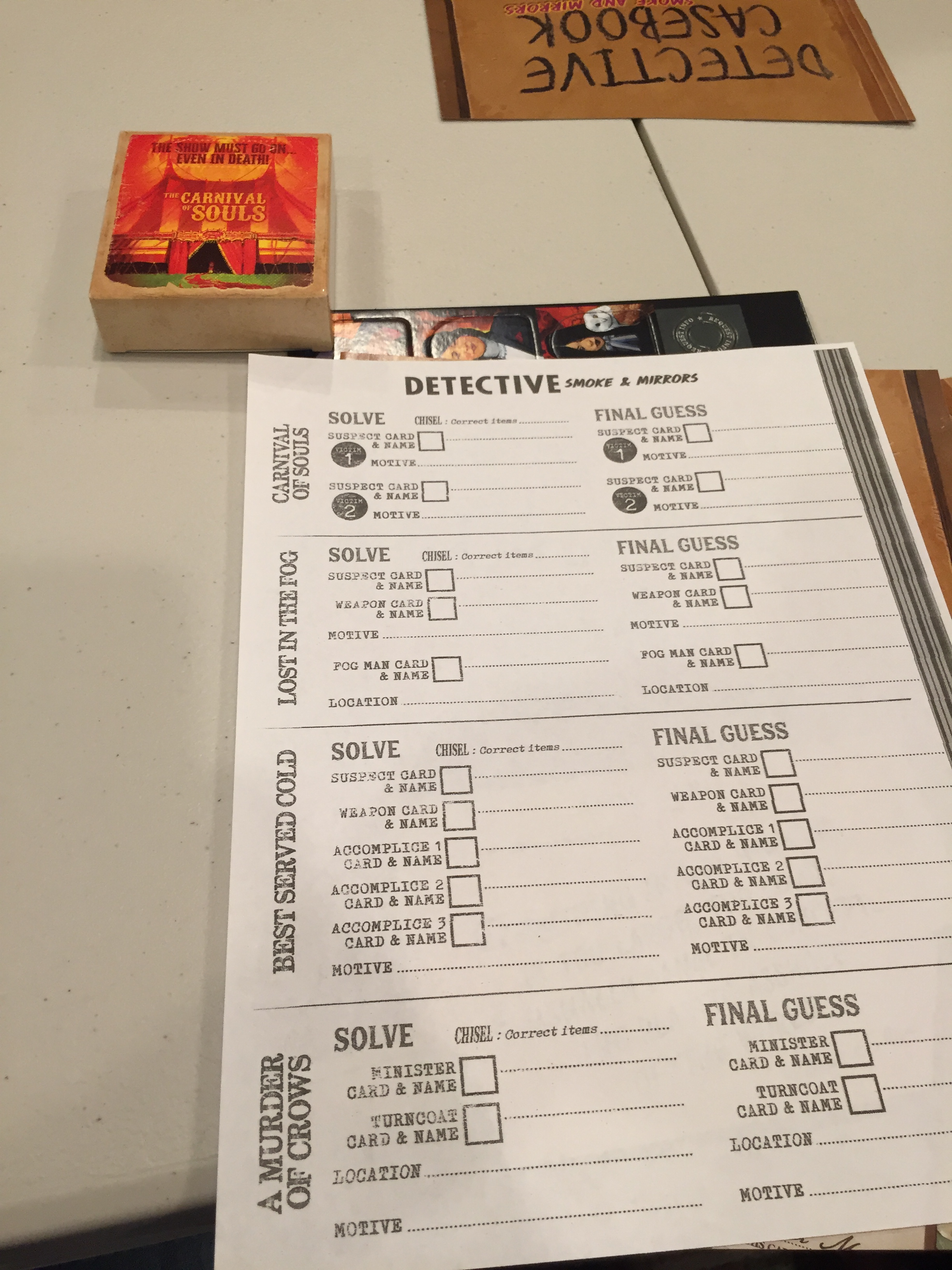
So, how does the game play? It’s really more of the same IN A GOOD WAY. It’s like a new season of your favorite detective show: just more cases. There are some new wrinkles to keep it fresh: we ended up have new expanded locations we could explore in a more interesting way: No spoilers, but one new location was a 2×2 grid you could move around and search. There was also new “crimes” and new things you had to figure out. take a look at the picture above! These are new crime note sheets that augment the original note sheets. Each mystery has a “different” set of things you have to figure out.

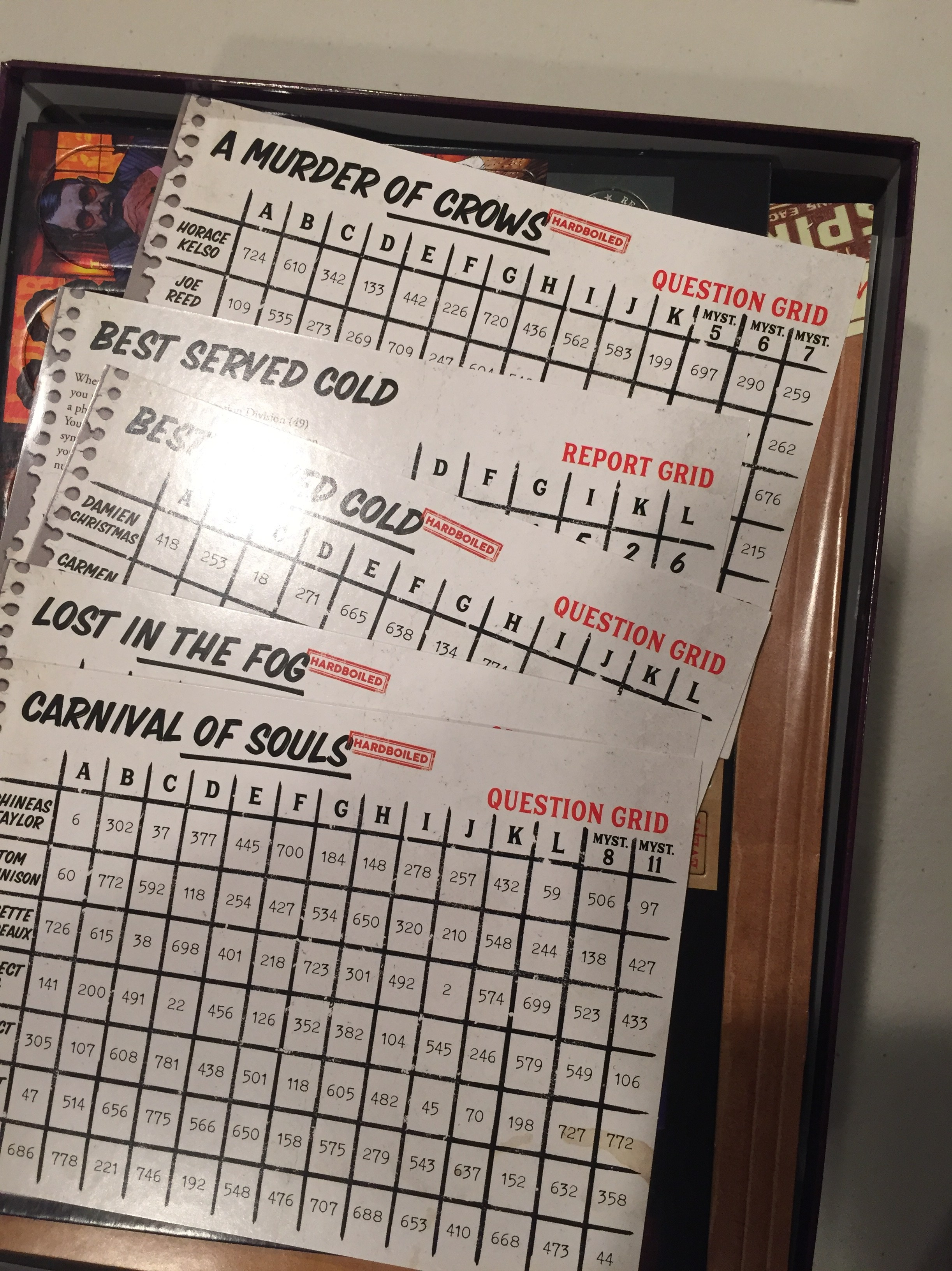
There were a few missteps that threw us: we added new cards across the top row THAT REPLACED OLD ONES, which meant you had to be aware when they changed so you could do a DIFFERENT lookup.

IMG_6913

See the lookup grid for Myst 8 and Myst 11 for Carnival of Souls? Those Myst. 8 and 11 cards REPLACE other cards in the A-L row, so if you aren’t paying attention you might accidentally go to the wrong space on the grid after those cards come out! The directions said NOTHING about this. If I hadn’t noticed it, I think we would have lost our first game and been very annoyed.

BUT that was the only thing that really got in the way.

Solo Play

IMG_6964

This game follow Saunders’ Law: there is a viable solo mode. To play solo,  you just have one detective on the board.  It works fine (and that’s the way I played some cases of the original game), but I do think it works better with multiple people: ideas get thrown around quicker, and yhhhou have a better chance of solving the case.   It’s also better to explore the board with multiple people, as it’s easier to have one detective concentrate on the city, and other detectives concentrate on some of the new expanded locations.   But, you shouldn’t have any problem playing solo: It still works fine just like the original game.

ConclusionIMG_6906

In general, we loved Detective: Smoke and Mirrors as much as the original game. It’s a true expansion: it just gives you more content (4 new cases) with some very minor tweaking. It was easy to set-up and play the new cases from the expansion: sometimes expansions require quite a bit of work, juggling to get content from the original game and the expansion to work together, but that was not the case here.

There were some minor weird things (some new cards were packed oddly, some new content was easy to misuse, and added a purple player for little reason), but in general this is a great expansion. If you love Detective: City of Angels and you want more cases, this is right up your alley.

A Review of Escape The Room: The Cursed Dollhouse

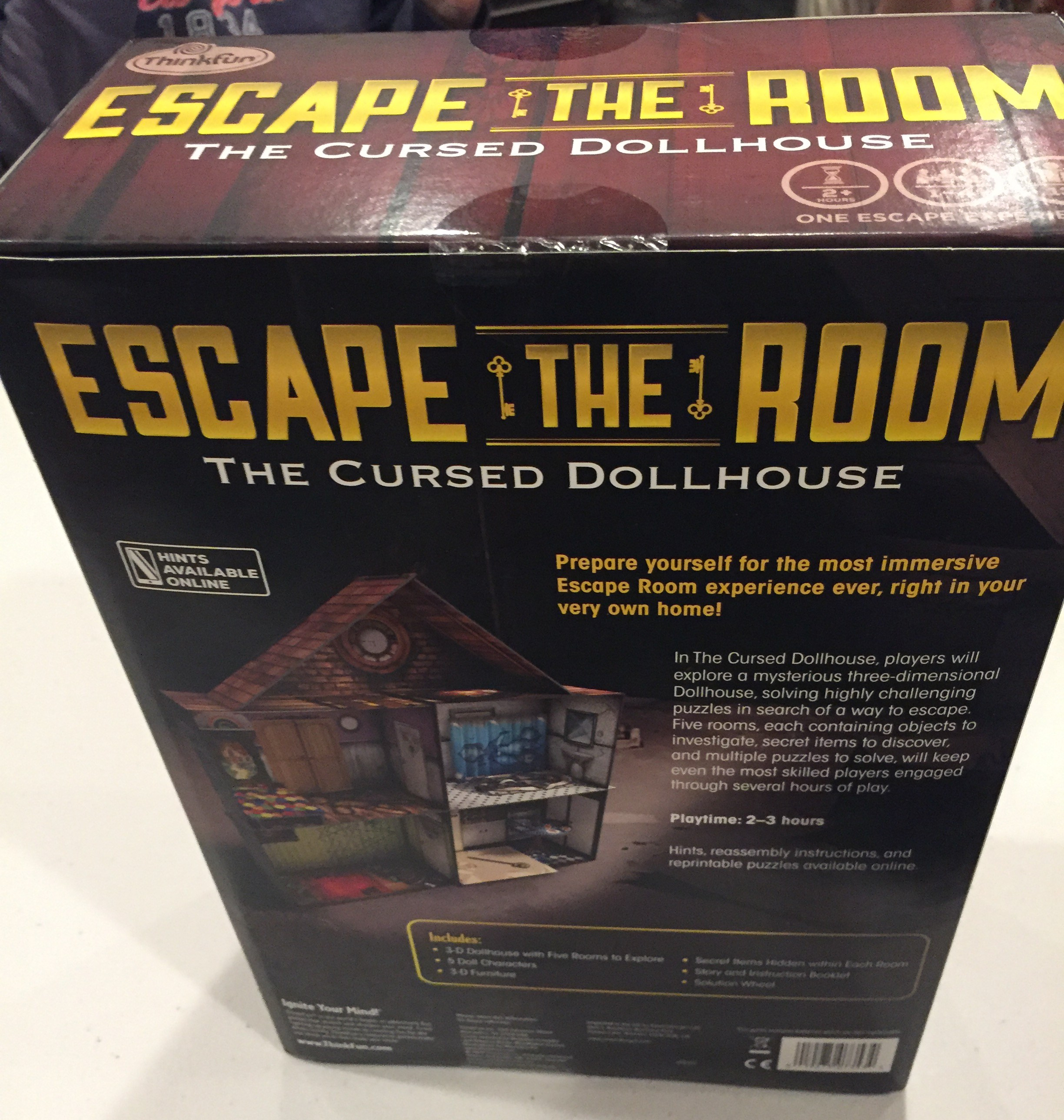
Last week (right at Halloween), we came out with our Top 10 Creepy/Spooky Cooperative Games! We put Escape The Room: The Cursed Dollhouse in there as an Honorable Mention because we haven’t gotten through it. Well, today, we’re going to take a full look at this Escape Room game. Escape The Room: The Cursed Dollhouse is a cooperative escape room type game for 1-4 players (more could play, but 4 seemed liked a good limit). It takes 2-3 hours to play all the way through (we took 3 hours). You can stop at about 3 or 4 points in the game (so as to resume later) but we played all the way through in one night.

CreepyIMG_6929

So, we should have waited a week before we came out with our Top 10 Creepy/Spooky Cooperative Games list! (I guess we didn’t have a choice: it was Halloween!) This game was AMAZING! I was worried (from some reviews I’ve read) that this game wasn’t going to be very good: Tom Vasel gave it a lukewarm review, and Eric Summerer gave it a slightly better review. Historically, I tend to agree with them, but they weren’t right on this. This game was fun, thematic, cool, interactive, and one of the best Escape Rooms board games I’ve ever played!!! This might have made the #1 spot on last week’s list!

The Dollhouse

IMG_6947

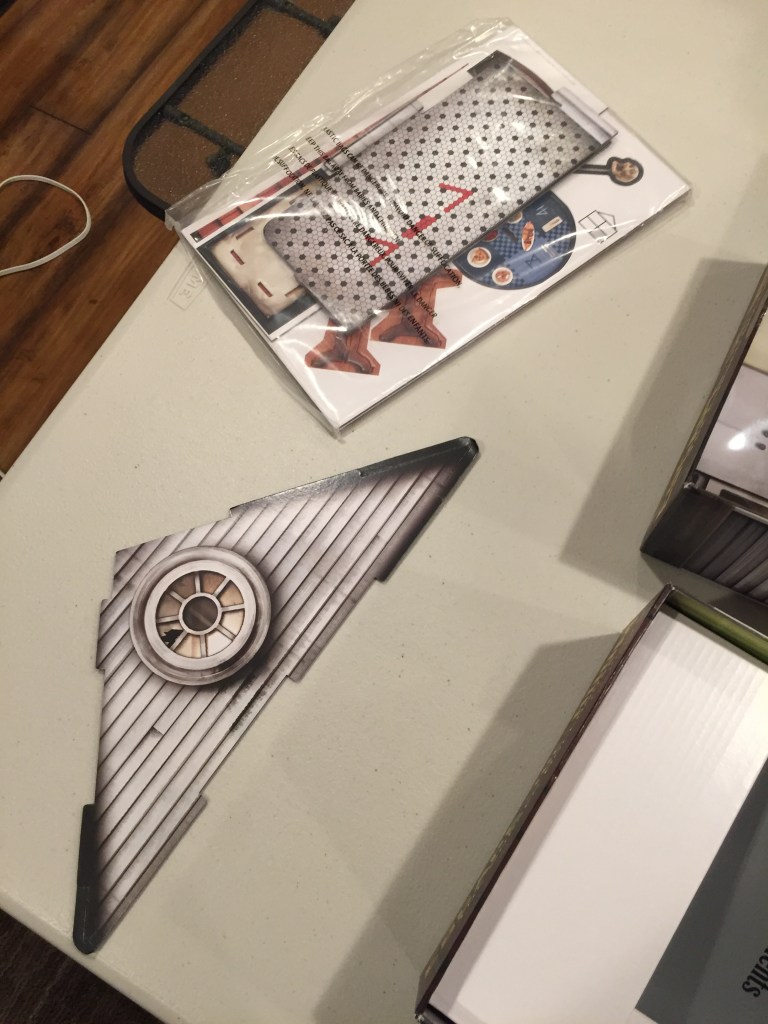
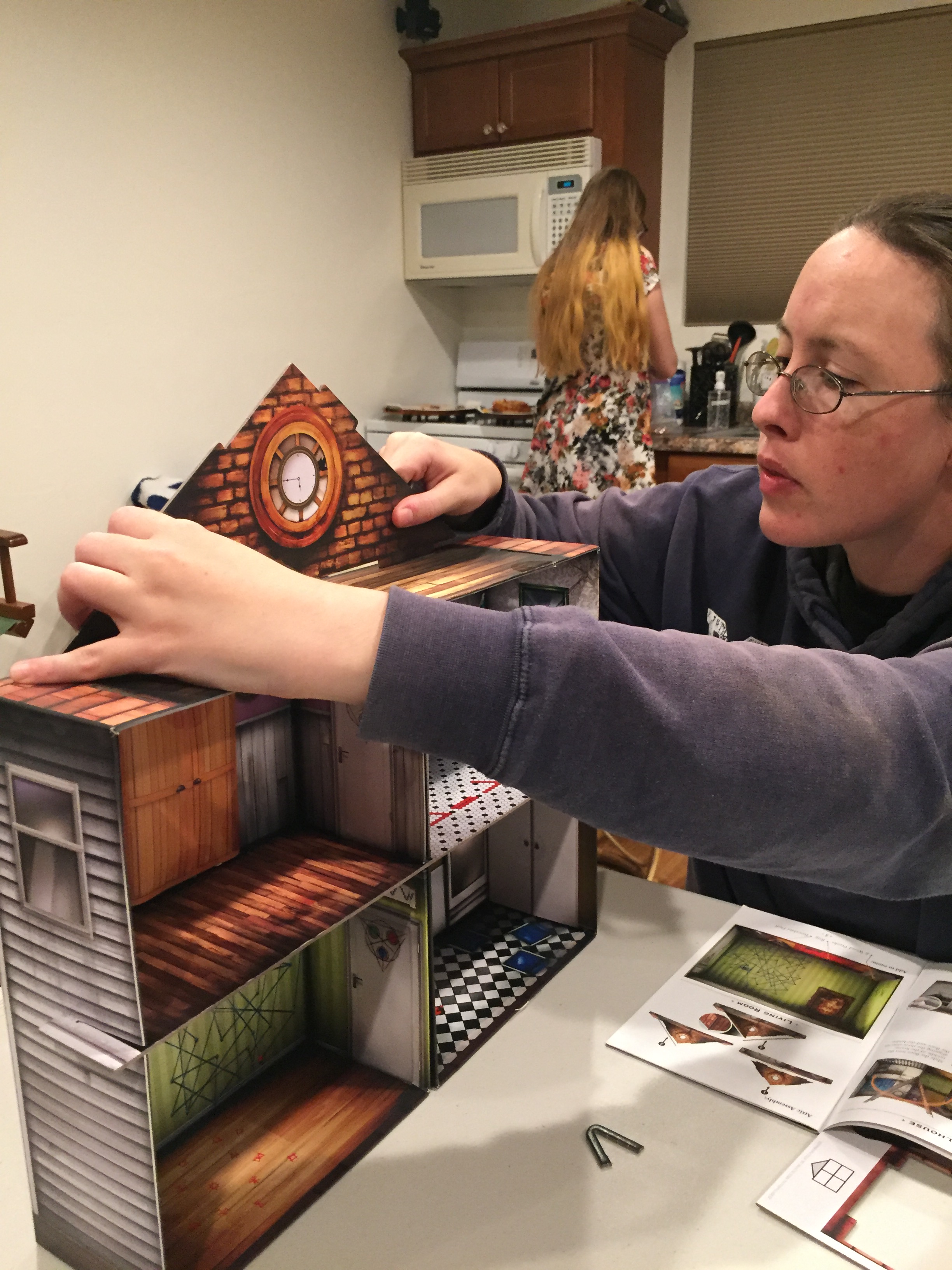
So, let’s start with the Dollhouse! This is one of the coolest components I’ve ever seen in a boardgame. It takes a little bit to get set-up (see above), but once it’s set-up, it just screams theme. Don’t look toooo long at the above dollhouse. Partly because it’ll give away some puzzles, and partly because it’s creepy!!

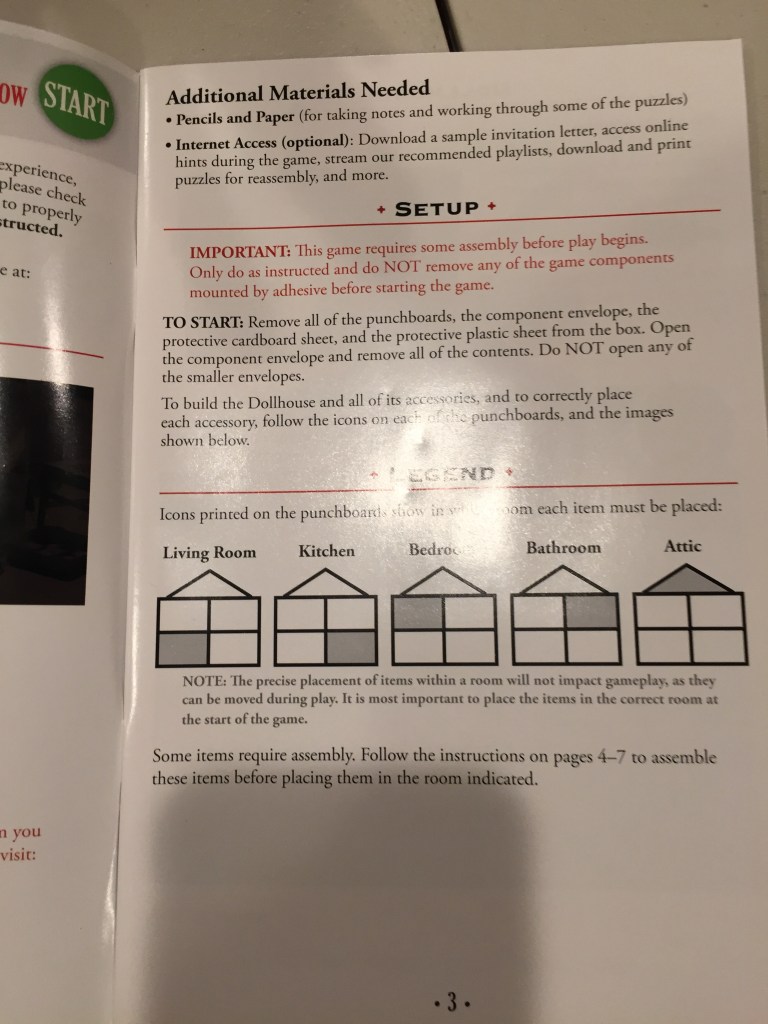
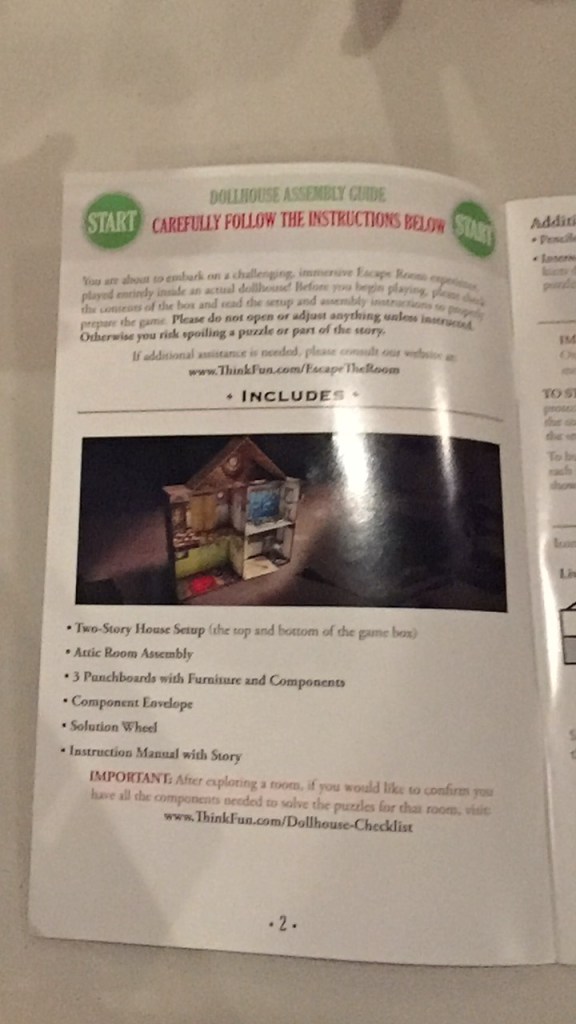
The set-up is fairly straight-forward (see instruction from above): I want to say it took us about 20 minutes to set-up.

IMG_6931

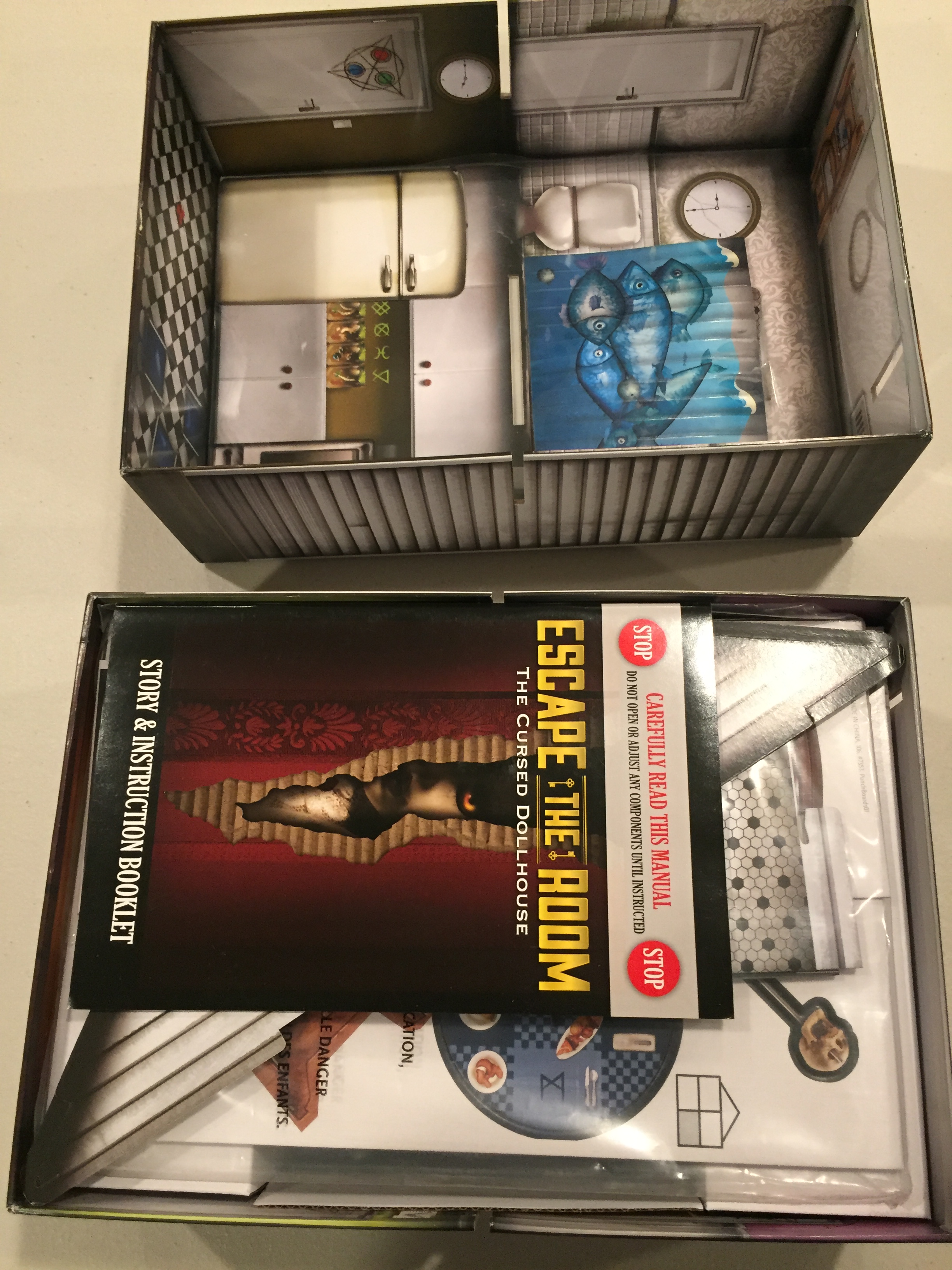
Opening the box, you can see all sorts of stuff.

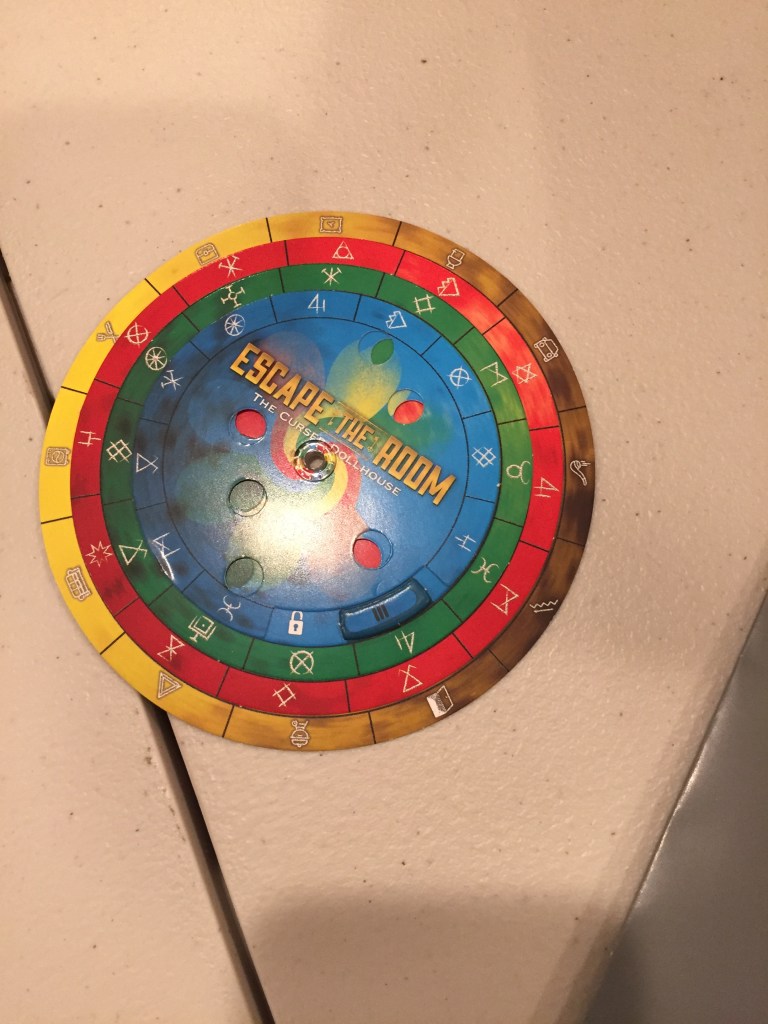
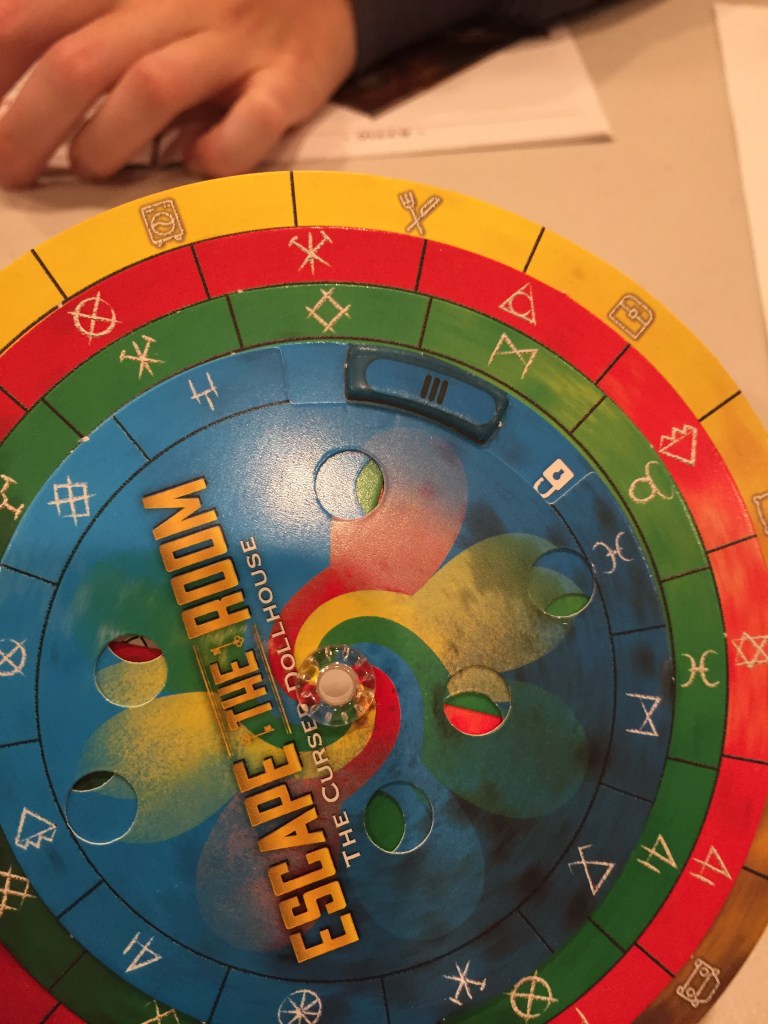
The heart of the game is a code wheel, which we have seen in a lot of EXIT Escape room games.
Even more clever, they put a “lock” on the wheel, so you can’t accidentally see too much as you are rotating the dials.

The Rulebook

IMG_6932

The rulebook is good and we got going quickly (after building the dollhouse).

The rulebook also doubles as the storybook: as you are solving “rooms”, you get more of the story. This is NOT just flavor text!!! Well, some of it is, but there are also hints to puzzles buried in the story as well. You HAVE TO LISTEN TO THE STORY, or you might miss some important clues! I loved the story in Aeon’s End: The Outcasts (and was kind of reminded of that here, only in terms of presentation), but that story didn’t have anything Aeon’s End needed to really play the game. Not so here! You absolutely need to pay attention … and that’s why this game sings. In this case, it talks creepily as dolls …

The Story

IMG_6945

The story .. without giving away too much: you are stuck in a dollhouse and have to get out! The story is interesting and creepy. As you read from the storybook, you speak in creepy voices. Or at least we did. I suspect you will too! We went through the entire game in one night: it took 3 hours to play through the entire story! We never wanted to stop … this story was interesting and immersive!

Cooperation

IMG_6953

One of the reasons The Cursed Dollhouse worked so well: it encouraged cooperation on many levels (pun intended).  For one, every “room” of the dollhouse you are in has 3-4 puzzles people can work on concurrently.   People tend to gravitate towards some puzzles, and sometimes two or three people are working on one puzzle while another person worked (independently) on a different puzzle.  During the entire game, we probably formed all 4 combinations of people working together!  Sometimes, you’d run out of ideas and throw it to another group, sometimes you’d stubbornly sit on the puzzle until you solved it, sometimes you’d ask for help. 

My friend Junkerman tends to dislike Escape Room games because “the single puzzle” gets sized by one subgroup and the other subgroups have nothing to do.  That didn’t happen to us in The Cursed Dollhouse! 90% of the time, everyone was working on SOMETHING, either by themselves or with another person(s). Having 3-4 puzzles per room really helped foster the cooperation. 

I am sure this would work fine as a solo game, but my group experience makes me think that this would be SO MUCH MORE enjoyable with a group (as different ideas flow much more easily between people).

Small Dollhouse

IMG_6954

One of Tom’s complaints from his review was that “no more than 2 people could look at the Dollhouse at a time”.  This is fair, to a certain extent. All the action is at the Dollhouse, and everyone wants to crowd around.  I mentioned this to my group before we started our play, but we simply worked around it: it was never a problem for us.  This is probably because we knew it MIGHT be a problem, so we simply worked together (cooperated) to fix it!  In the end, we did two things to mitigate this problem:

  1. We moved around a lot.  We would frequently swap chairs with people, partly so some of us could examine the Dollhouse, partly so we could move around in groups and solve puzzles.
  2. We used our phones to take pictures.  Most people (at least in my group) have a smartphone, and we’d occasionally take a picture of the room we were in, so we could ZOOOM in it with our phones/camera apps.  This allowed us to “look” at the Dollhouse (and ZOOM which was important a few times) without having to crowd.

Forewarned is forearmed: As long as you know that crowding in front of the Dollhouse MIGHT be an issue, you can work together to alleviate said issue.  So, just be aware it might be a problem!

Puzzles and Solutions

IMG_6956

Like all Escape Rooms (both board games and real Escape Rooms), there are puzzles to solve.  You will need pen and paper (see above).  Now,  we got every problem in the game without any hints!  (I think we brute forced one).  BUT part of this was because the Hint System is on a web site instead of cards/booklets in the game!!! I actually think this separation actually encouraged us to work harder at the puzzles.   The EXIT games have a great hint system in cards, but these hint cards are sitting next to you … so easy to pick up if you are having a problem … “Come, pick up the hint, don’t get stuck …” (said in a creepy doll voice).   So, we worked diligently on all the puzzles, and solved them all!    But, be aware, these puzzles are NOT SIMPLE : This is a fairly hard Escape Room game!    As much as I enjoyed it, I would definitely only recommend playing this after you have played a number of other Escape Room games.
Oh ya, the hint web site only worked on Android and not IOS for us.  It was probably because my IOS phone is so old, but it was weird that the web site was so tricky it only worked on Android.  Caveat Emptor. 

Resetting

Once you have played through the game, you have seen everything.  You are done with it (unless you want to wait a few years and replay it after you have forgotten everything).  So, you may want to pass it on to some friends.  Now, the game CAN be reset, but it is a little bit of a pain.  The web site (the same place where the hint system is) gives you directions how to do put everything back together.  It wasn’t HARD to reset it: it took us about 15-20 minutes to put it back together.  To be fair, once you’ve played the pristine originally version, the “hey-we-reset-the-game” version isn’t quite as nice: we used tape in a lot of places to hold things together, where the original game used some sticky stuff that worked a much better.

You can reset the game, it doesn’t take too long, but it won’t be quite as nice as the very first play.  It’ll be good enough.

Conclusion

IMG_6955

By the time we were done, we loved this Escape Room. The highest praise was echoed by a number of players: “This game feels more like a real Escape Room more than any other Escape Room board game I have played!” High praise Indeed! This was a great experience.

To be clear, the puzzles in the game were hard. I think part of the reason we enjoyed the game so much was we solved every puzzle without hints! There was a sense of satisfaction in knowing our group was able to overcome these harder puzzles. That may be why enjoyed the game so much! A sense of satisfaction! This also means we can only recommend it to seasoned players of Escape Room games.

The Cursed Dollhouse was unfortunately the most expensive Escape Room in a box we’ve played as well: we bought it on Amazon for like $45. So, after resetting it (after playing through), you may consider passing it onto a friend to get more value from it.

For player count, I definitely recommend it with more people! Solo would probably work okay, but the puzzles are hard, so the more brains the better! With a higher player count, it’s a little cramped to see the entire dollhouse with 4 people, but you can use your phone and take a few pictures, thus alleviating some of the cramping.

If you like the idea of The Cursed Dollhouse, and you want a creepy Escape Room game, and you feel like you can handle more complex puzzles, this is the one to get!!! This is one of the best experiences we’ve had with an Escape Room game. We loved the story, we loved the immersion, we loved the dollhouse, we loved the way the puzzles were presented, we loved how we could all work together concurrently on different puzzles, we loved that the puzzles challenged us: 9/10

Top 10 Creepy/Spooky Cooperative Games

Happy Halloween Everybody! In honor of this creepy and spooky holiday, we thought we’d emphasize the Top 10 cooperative games that are creepy and/or spooky. Now, some cooperative games are very thematic and spooky, but but necessarily creepy! And being a creepy game doesn’t necessarily mean a game is thematic! So, our metric for rating the games is an amalgam of “thematic”, “creepy”, “spooky” scores, as well as how much I like it. For instance, the game I like to play the most is not the number 1 game on the list because it’s not quite as creepy as other games on here! The number 1 games was the one I enjoyed the most and probably the creepiest!

Honorable Mention

Escape The Room: The Cursed Dollhouse

Escape the Room: The Cursed Dollhouse, ThinkFun, 2020 — front cover (image provided by the publisher)

We haven’t gotten through this yet, but it looks so cool!  The game transforms into a 3D dollhouse and looks really cool!  Early reviews are that it’s hard and doesn’t accommodate more than 2 players very well, but it just looks so cool.  We’ll probably be reviewing this on the site soon!

10. Horrified

The front cover of Horrified: Universal Monsters.

A lot of people really like this cooperative, mass-market game (I got my copy at Target). The players work together to defeat the Universal movies “old-style” monsters (The Mummy, Dracula, see the cover above!) as you go on in game quests (with a little pick-up-and-deliver). It’s not particularly creepy or spooky but it is very thematic, and works well with families and younger players.

Game Setup

9. Ghost Stories

Cover Front (Publisher's Press Image)

This is a very hard cooperative “puzzle” game for 1-4 players.   Players cooperatively are defending a small village from being decimated by ghosts (with a big bad that comes out at the end).  The art of the ghosts is quite creepy and really evokes a scary ethic.

Ghost

This is a really hard cooperative game, and maybe very hard to find (I think it’s out of print). It has been been replaced by The Last Bastion (a retheming of the game to fantasy setting). If you can find the original, pick that up instead.

Game components (Publisher's Press Image)

8. Ghost Fightin’ Treasure Hunters

Ghost Fightin' Treasure Hunters, Mattel, 2016 — front cover (image provided by the publisher)

This is a light cooperative game set in a haunted house: it’s mostly aimed at a younger audience, so it’s not too scary.   It’s like a lighter “pandemic” style cooperative game as players race around the board defeating ghosts and picking up loot.  The components are pretty fantastic (the plastic ghosts are fun to play with by themselves) and the game is very thematic and fun ! It has just a hint of creepiness/spookiness…

Playing Geister with my iOS/Android app to draw cards, roll die and set time limit.

7. Mysterium

Mysterium, Libellud, 2015 (image provided by the publisher)

Mysterium is a an odd fully cooperative game where one player plays a ghost, trying to get all the other players to discover how he was killed!  The ghost can only communicate in dreams (little scenes that he give to each player). 

The mediums have identified the proper suspect @ Spiel in Essen 2015

The backdrop for the game is a creepy haunted mansion, and the dream cards (see above) are always creepy and weird.   The game can be a tad frustrating if the players don’t “get” the ghost is trying to say, but the game is definitely evocative, thematic and very creepy!

2 player game in progress

6. Scooby Doo: Escape From The Haunted Mansion

Scooby-Doo: Escape from the Haunted Mansion – A Coded Chronicles Game, The OP, 2020 — front cover (image provided by the publisher)

This is a one-shot escape room game, where the players cooperatively control the Scooby Gang, trying to solve a mystery!  This one makes it very high on the list because it was so much fun to play!   It’s definitely an escape room game that families can play (unlike others we might see later), as it’s fairly light, but it still has an interesting mystery to solve.  If you loved the Scooby Doo cartoon show, and the “creepy” vibe of that, you’ll love Scooby Doo: Escape from the Haunted Mansion.  (Again, this one makes it so high because the gameplay was so fun, even if isn’t as creepy as other games on the list).

components

5. Mythos Tales

Second Printing Box Cover

This game creates a incredibly rich, creepy story in an Cthulu-esque universe.   There are 8 episodes in the box, and once you’ve played through an episode, you are done (in more ways than one as the horrors and madness overtakes you!)  This game is all text-based, and you explore the city of Salem trying to discover the dark mysteries underneath.  If you have played Sherlock Holmes: Consulting Detective, this is the same kind of game, set in a horror universe.  Very creepy and very evocative.

Stepping into Arkham for the first time...

4. Arkham Horror (Second Edition)

Arkham Horror, Fantasy Flight edition, revised printing (high quality box cover scan)

This is my favorite game to play, but it’s not the creepiest or most thematic of games.  The game is a deep, heavy, cooperative romp around the city of Arkham, as players work together to fight monsters and shut gates to stop the impending arrival of a Cthulu-esque old one.   I think my gaming group liked this so much because it was very akin to a role-playing game (with attributes, spells, items) without all the messy overhead of an RPG.  So, it’s a bit heavy for most people, but the thematic art and text permeates the game and creates a nice, creepy experience.
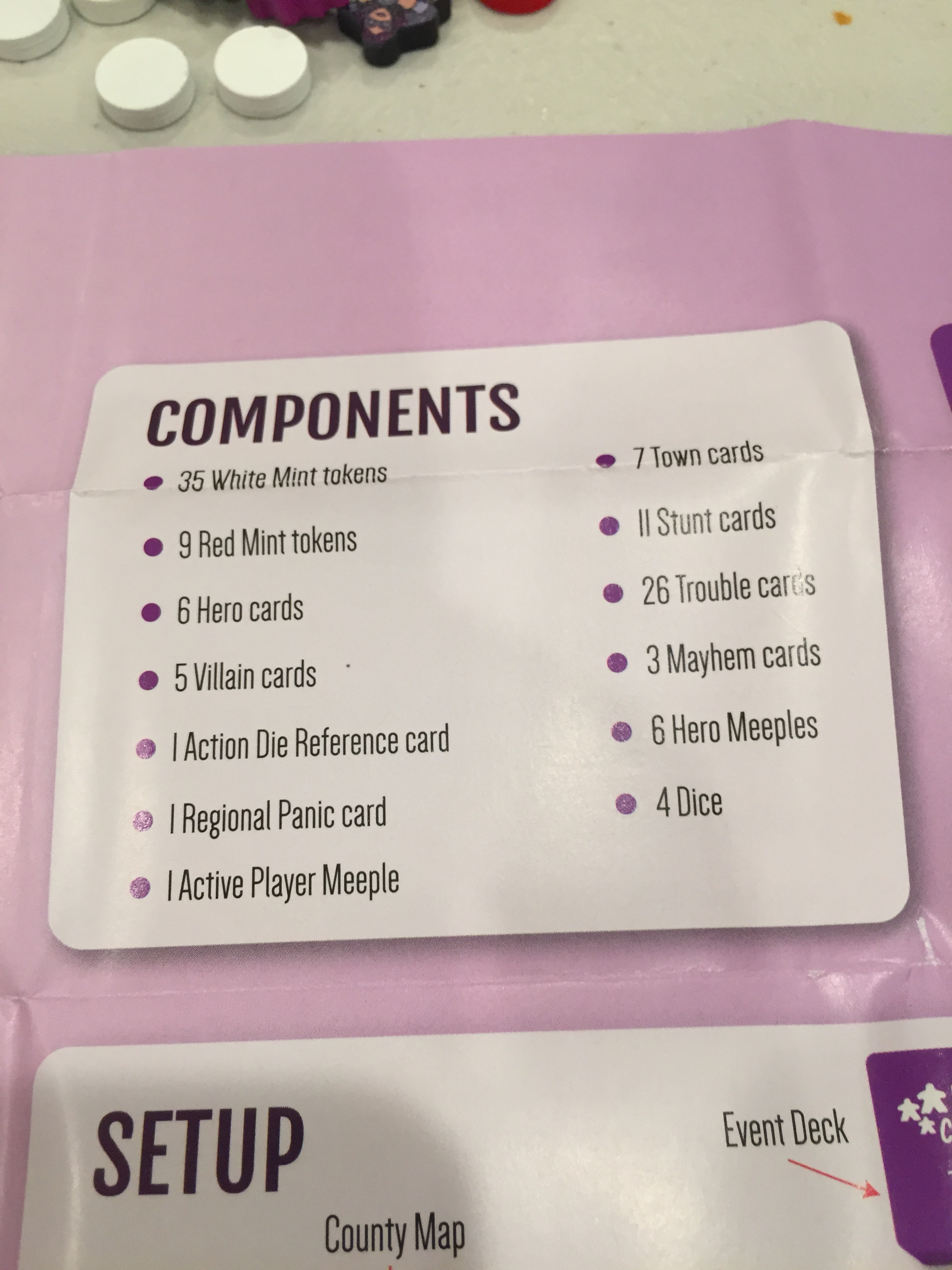
Arkham Horror with all its expansions

3. Mansion of Madness (Second Edition)

Mansions of Madness: Second Edition, Fantasy Flight Games, 2016 — front cover (image provided by the publisher)

To be clear, I hate the First Edition of the game (where one player plays against all the other players): you want the Second Edition which is fully cooperative.  The Second Edition uses an app to “run” the game and it turns the Mansions of Madness against you!  This is a big sprawling game set in a Cthulu-esque universe.  It’s interesting because you don’t actually know what your objective is at the start of the game, you sort of have to discover what you and your teammates have to do as you.  It’s incredibly thematic, very creepy, and very long…. it may take you a half hour to set-up, 2 hours to play, and another half hour to tear-down, but it creates a very satisfying creepy experience.

General look


2. Exit: The Haunted Rollercoaster

Exit: The Game – The Haunted Roller Coaster, KOSMOS, 2019 — front cover (image provided by the publisher)

This one surprised me a little: it was one of the funnest escape rooms I’ve ever played! It was creepy, and it had (without any spoilers) one of the scariest moments I’ve ever seen in a game. It’s a lighter cooperative escape room (rated Novice), but all of my group liked it! It is an EXIT game, so it can only be played once (as you tear up cards, and rip things), but it really is worthwhile as a creepy, cooperative game. (I don’t want to show too much more of the game! I don’t want to reveal any surprises!

1. Exit: The Catacombs of Horror

Exit: The Game – The Catacombs of Horror, KOSMOS, 2019 — front cover (image provided by the publisher)

This one surprised me. I really thought Exit: The Haunted Rollercoaster would make the number 1 position! Even though me and my group enjoyed playing the Haunted Rollercoaster more than The Catacombs of Horror, the overall experience of The Catacombs of Horror was just more creepy and thematic and cool! The Catacombs of Horror (expert level) was a lot harder than the Haunted Rollercoaster, and we got frustrated a number of times. Luckily, the hint system of the Exit games is quite good and we were able to continue in this creepy world.

Box front & back - German Edition

If you look closely at the warnings on the back of the box, it talks being careful with a candle. That’s right, there’s a candle in the box and you can have some downright creepy and thematic playing! Again, this one takes the number 1 spot because it was the creepiest game we’ve played!

A Review of The Princess Bride Adventure Book Game: Part I: Unboxing, Solo Rules, and First Impressions

One of my favorite movie moments of all time is watching The Princess Bride at a midnight showing of the movie. The movie had been out for some time and had achieved “cult” status, so The Princess Bride made the midnight showings at many alternative theaters. My favorite moment? The entire audience (who has been quoting the movie all night) screaming at the top of their lungs, screaming The Cliffs Of Insanity!!!

Cooperative Board Game

IMG_6896

There have been a number of Princess Bride board games over the years, but I haven’t picked any of them up: partly because none of the have been cooperative, but also because none of them have been particularly good.  This newest one just came out fairly recently: today’s date is Oct 26th, 2020! The Princess Bride Adventure Book Game, to the best of my knowledge is only available at Target (I had to order it online after visiting 2 Targets looking for it).  It’ll probably be available at other outlets soon enough.

The game is for 1-4 adventurers, for ages 10+.  Keep an eye on that age, because that will influence how complex this game is (foreshadowing: it’s not particularly complex).

Unboxing

IMG_6861

The cover is gorgeous, with the game gilded with golden highlights.  I love the art: it isn’t cheesy, yet still captures the imagery from the movie without using stills!

IMG_6862

Opening up the box, you are presented with the rulebook and the Adventure Game book.

The Adventure book is a THICK cardboard book, but it’s hard to see from the picture above. See below for a picture from the side!

IMG_6871

Opening it up, you see scenes from The Princess Bride movie.

IMG_6870

The rulebook is fairly small, only 8 pages!

IMG_6866

We’ll take a further look inside the rulebook in a section below. In the meantime, we’ll look at the cards:

The cards are easy to read, and the art is nice, using the same stylized art from the box cover. The only problem is that the cards aren’t linen-finished. I guess that’s pretty standard for a mass-market game that you get at Target.

IMG_6877

The tokens that come are easy to read, and they come prepunched!! (I.e., no sheet to punch out). I wonder if this is a new direction in gaming?

The reference cards are nice (and I am very happy they have these):

But the best component we’ll save for last: The miniatures!

IMG_6865

I’m usually not a miniatures guy, but I liked these! (You know, if I say that many more times, I think maybe I am a miniatures guy. In the meantime, I will live in denial). The miniatures look like the characters, but the different colors really distinguish the characters.

Rulebook

IMG_6867

The rulebook is short and to the point. It’s only 8 pages!! The first page does it right and shows all the components.

The second page shows the (general) set-up: It turns out every scenario will have a slightly different set-up, but they all have the same general. It’s easy to read and easy to get going. I was up and going very quickly.

IMG_6869

The rules are explained pretty well. There is a fine point that the rules don’t explain well, but we’ll discuss that in the playthru.

In general, the rulebook was great. Concise (perhaps too concise) and nice graphic design.

Solo Play

IMG_6879

The game is fully cooperative. Interestingly, there are no exceptions for solo play. You might think that each player plays a character from the game, but you would be wrong! The players collectively play/move all the characters on the board. On a player’s turn, a player simply moves around one (or more) of the Princess Bride characters on the board—they go around the board using their cards to solve challenges.

IMG_6884(1)

The challenges require characters to be on specific spaces and specific cards needed to be discarded. Note the colored symbols on the right of the challenges: they correspond to the cards the players obtain during the game.

IMG_6880

For example, the courage card (orange card at the top, and orange symbol) is one of the three cards needed for “Seek Fortune” challenge.

IMG_6883

The solo play doesn’t need any special rules because the players turns are fairly indistinct as there are no special player powers. We’ll talk more about this below. But, it works well. I had fun playing through the first scene of the movie. And it was about 15-20 minutes.

Set-Up

IMG_6887

Each Chapter in the game corresponds to a major scene from the movie. This is a campaign game (it’s not legacy: no stickers or torn-up cards). The set-up changes depending on which chapter you are on.  I have played a lot of campaign games (especially over the last few months), and this is one of the simpler ones: it was easy to set-up, even though each chapter is different.IMG_6885

Like most cooperative games, there is a “Bad News” deck (called the Plot deck) and the results of the plot deck are interpreted via the text on the left side of the board.  In the first Chapter, 1-15 puts chores on the board, and 16-20 moves Buttercup around.  Each Chapter will have a different effect from the Plot deck.

Issue

IMG_6889

So, one of the issues I had is something you will confront right away. The rules are “unclear” that you can solve multiple challenges per turn. After getting a few turns into the first Chapter, I realized it was absolutely necessary! The game is unsolvable unless you can solve multiple challenges on a turn!!! I wish that was clearer from the rules. A smart gaming group will figure that out quickly, but I am worried that a family group will simply think the game is unwinnable and poorly designed. So, as a public service, I offer this clarification: Players may solve multiple challenges per turn.

Audience

IMG_6890

So, remember the recommended ages we discussed earlier? 10+? This is a simpler co-op game. This is partly demonstrated because there are no special player powers: each player’s turn feels similar to the previous player’s turn: this makes it easy for kids and parents to just jump in. The game’s smaller rulebook (only 8 pages), the simpler set-up, the simple rules, all outline that this game is intended to be a simpler co-op. I think the intended audiences are families.

Having said that, I think older folks who enjoyed The Princess Bride will also enjoy the game: the components and art really evoke the ethos of the game. They just need to realize that this is a simpler co-op.

Conclusion

IMG_6895

I had fun playing this game, but I am one of the people who used to quote dialog of the movie at the midnight movie showing!! I think families are the intended audience: they will really enjoy the game. Each Chapter is only 15-20 minutes long, and the game is easy to set-up, teach, and play! Families could keep playing as long as the kids were interested (1 play at 15 minutes, 2 plays at 30 minutes, “time-for-bed, we’ll play tomorrow night?”).

I think that if you don’t know the movie, and if you aren’t really playing with a family or younger kids, this might be a pass for you. The turns of the players are very simple and very similar, but that means there’s not a lot to distinguish turns. This makes it easy for kids and easy to add a solo mode, but it also means it’s not a hard co-op.

In the end: I liked The Princess Bride Adventure Book Game, but I don’t love it. It’s a nice, simple co-op. I love the art and the ethos it evoked. The Adventure Book was gorgeous and maybe part of the reason I like this so much.

One last note: this is a campaign. Once you’ve played all 7 Chapters, you’ve seen everything. I can see playing all the way through a few times, but then getting sick of it. I would almost consider this to be like an Unlock or Exit Escape Room or any “play-once game”. Buy it (it’s only $30), play it all-the-way-through, then pass it on to your friends.