
Welcome to the Detective Month here at CO-OP Gestalt! This month, we take a look at several new games in the cooperative detective genre! We begin the month with a Richard Launius design!
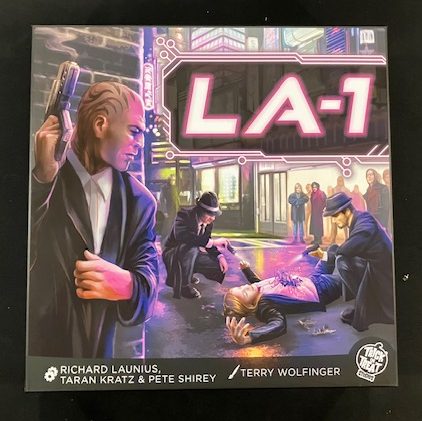
LA-1 is cooperative cyber adventure and exploration game in a post-apocalyptic future with hints of the detective noir genre. This was #2 on our Top 10 Anticipated Cooperative Games of 2025! We were really looking forward to it!
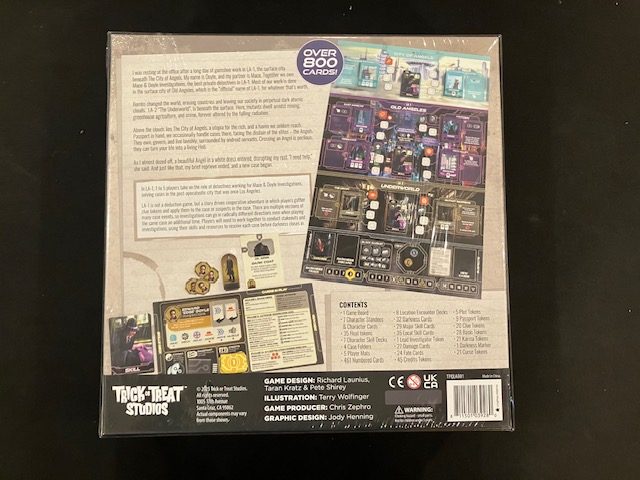
This was originally on Kickstarter back in Oct/Sep 2024, promising delivery in August 2025. My Kickstarter copy arrived in January 2026, so about 6 months late.
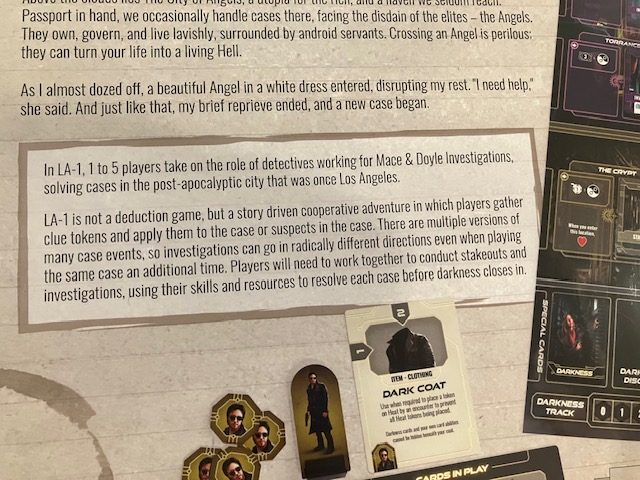
So, this is not a detective game per se; see the back of the box as the game fully admits “LA-1 is not a deduction game, but a story-driven cooperative adventure …” There’s a lot of thematic detective things like clues, stakeouts, and police, but this is not a deduction game but rather a story game! That means this would NOT end up on our Top 10 Cooperative Detective Games or Top 10 Cooperative Light Deduction Games, but it might end up on our Top 10 Cooperative Storybook Games!
Let’s take a look!
Unboxing/Gameplay
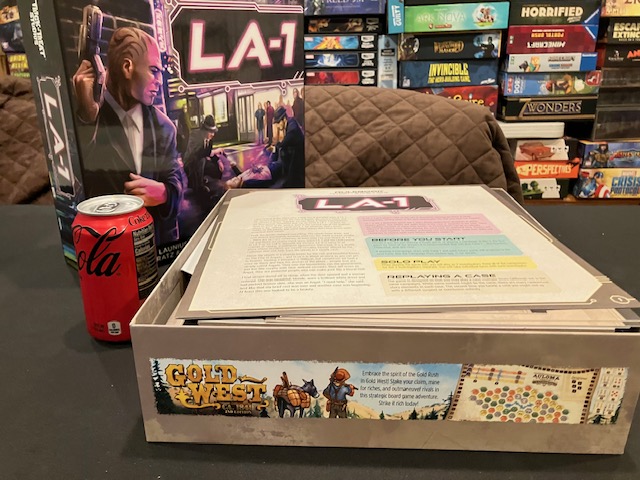
This is a pretty normal sized box: see Coke can above for scale.
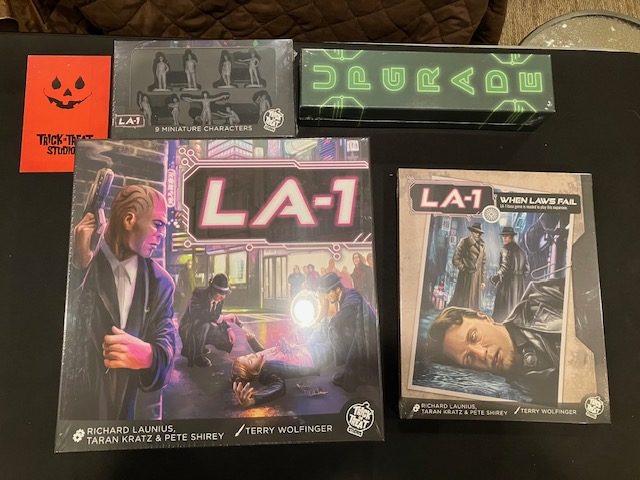
I ordered the Kickstarter version of this, which includes upgraded pieces, some minis, and a new case.
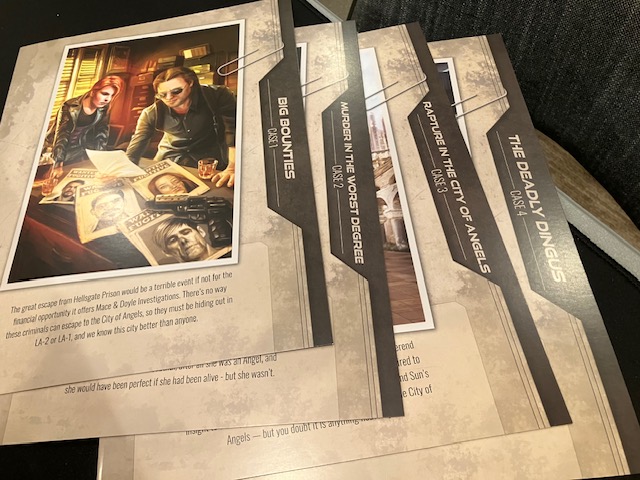
The base game itself comes with 4 case files for 4 cases: see above. These case files give the flavor text, set-up, winning and losing conditions for each case.
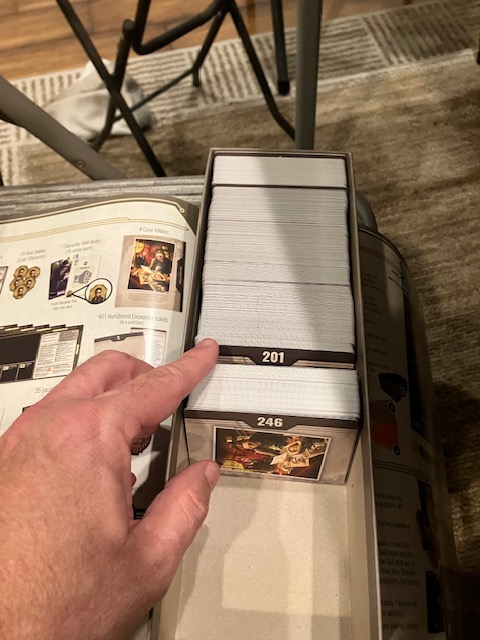
The cases are on cards! See above! The game comes with over 800 cards in this box! I want to emphasize this is where the story is in the game, on these cards.
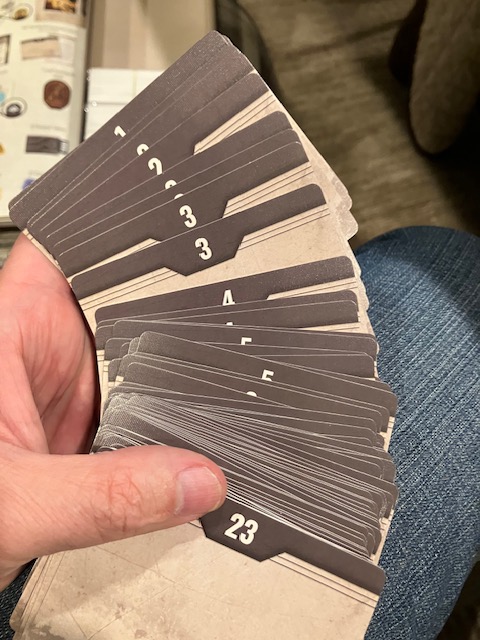
For some reason, the cards were packed in reverse order that you might expect (1 is the very last card instead of the first?). It’s not big deal, but a little confusing on first unpacking.
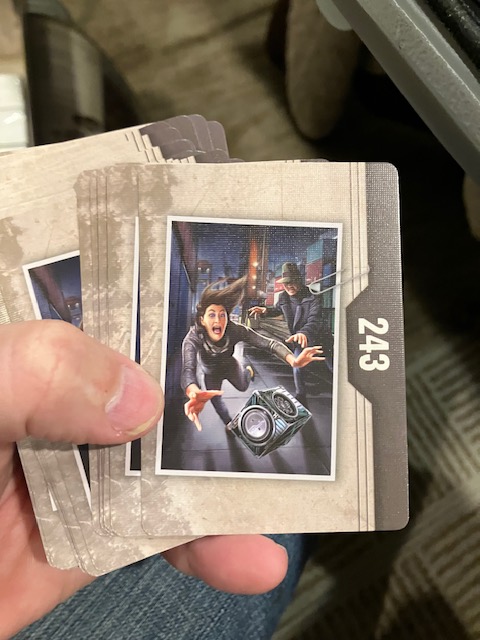
Some cards are specific to cases (and marked by the case graphic: see above) and some are more generic.
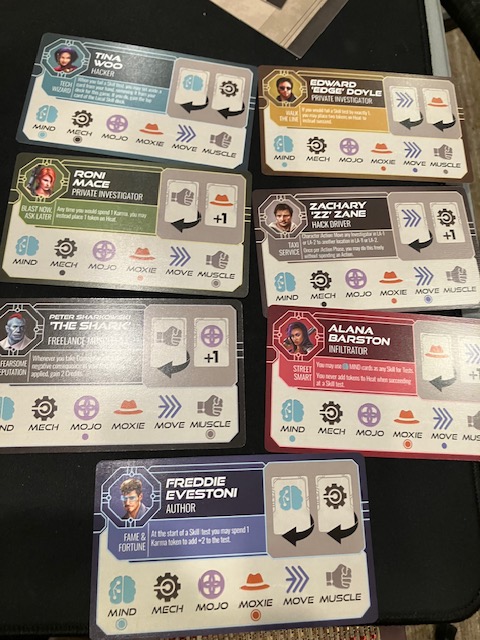
Each player takes the role of one of the several cyber/noir roles in the game.
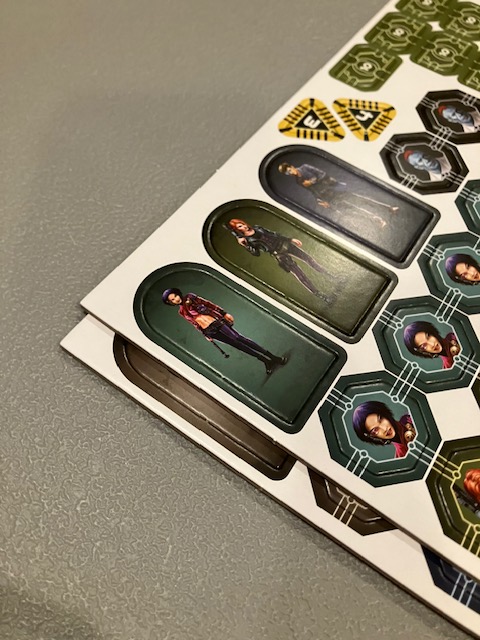
The base game comes with standees and cardboard pieces for each character.
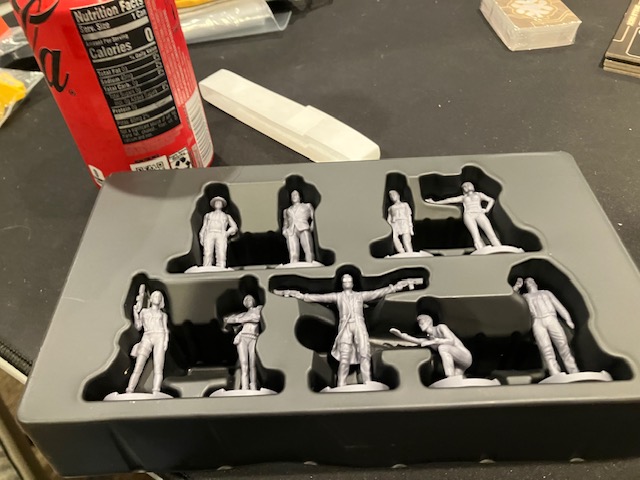
The deluxe version came with some plastic minis. Eh, they are ok. What they really needed was colored bases; I think the standees might be better for distinguishing the characters on the board because their colors are so distinct! I am not sure you need the deluxe minis.
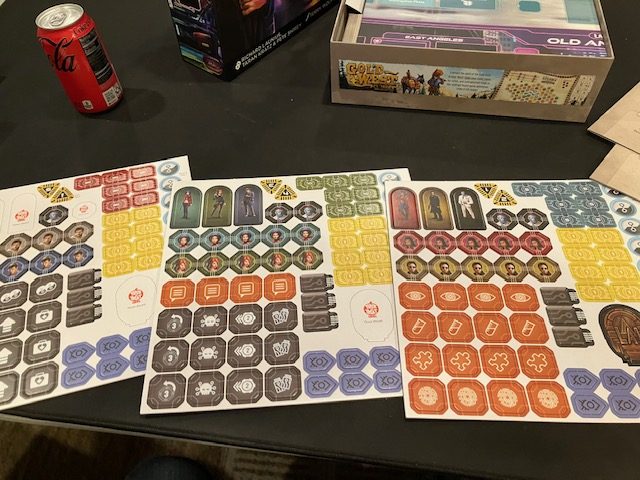
It is probably worth getting the Upgrade of the other components though! Most of the base components (clue tokens, basic tokens, heat, etc) are all cardboard punchouts: see above.
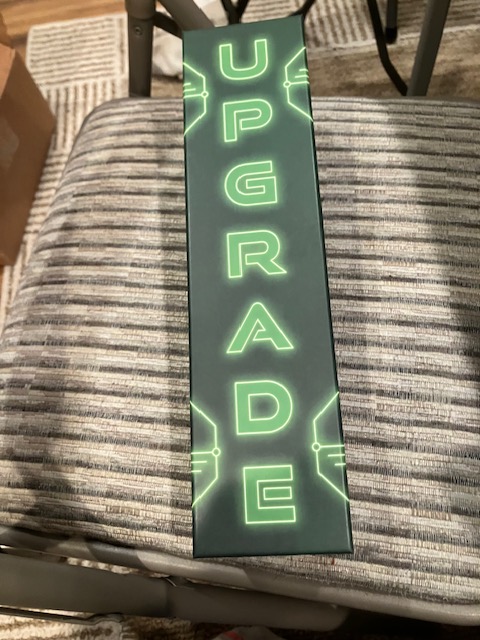
The upgrade pack (which came with the kickstarter, and I think you can get separately) is probably worth getting! These are some really nice wooden components!
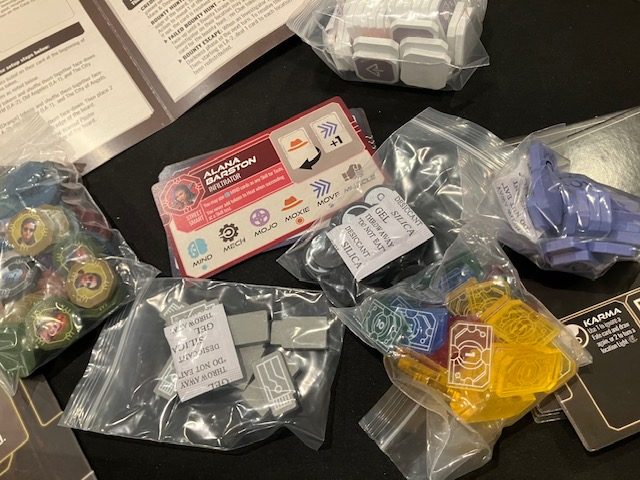
There are wooden heat tokens, plastic money, wooden Karma, … just really nice. And you don’t have to punch them out!
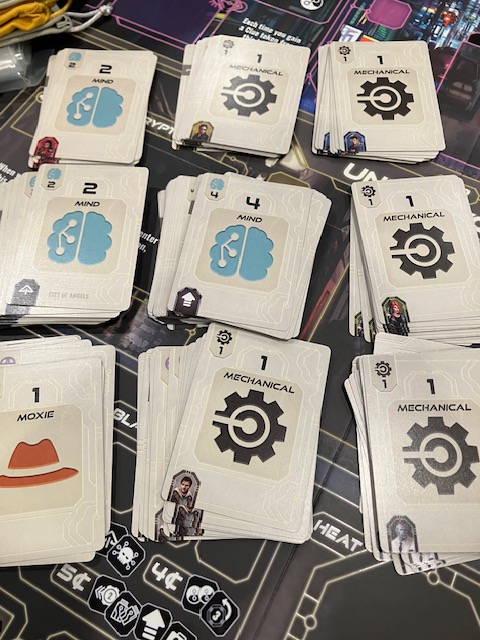
Each character has their own deck: you can tell by the little icon in the lower left whose deck is whose. As you can see above, there are different types of Skills in the game; and this game is all about the skill check! Some characters are better at Mechanical checks, others better at Mind Checks, other better at Moxie … ! Each deck gives the character a different flavor.
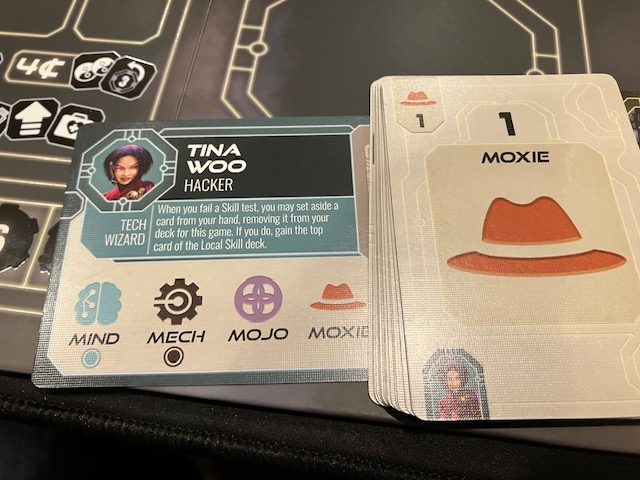
See above as Tina Woo (Hacker) has her own deck!
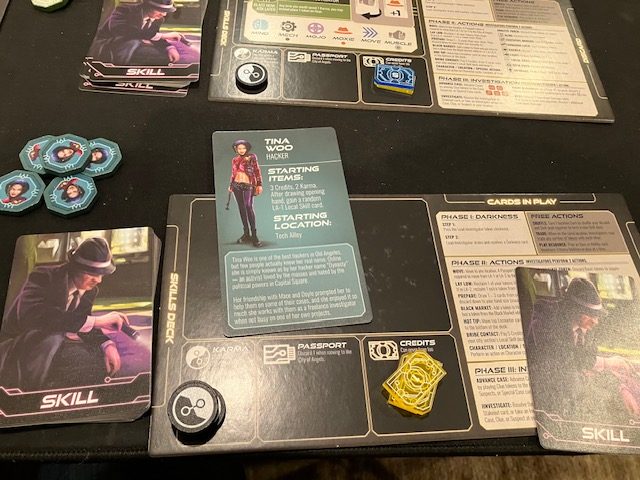
Each character gets their own little board to keep track of resources; karma (karma is a resource!), money, passports (to get to the nice parts of LA), and heat tokens. The back of each characters deck tells them what they start with.
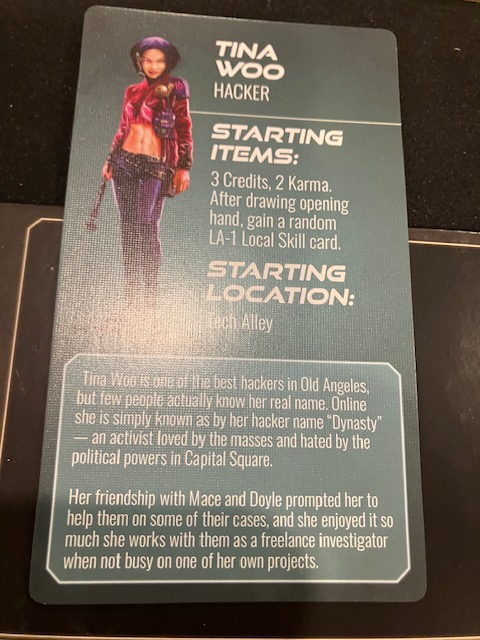
There’s also a little flavor with each character (see bottom).
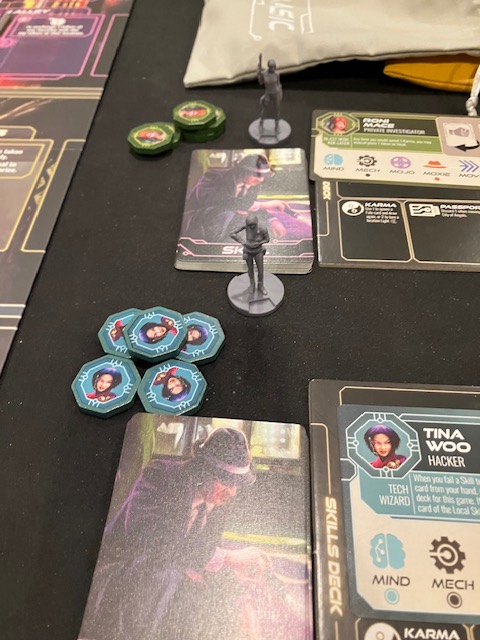
Each character also gets something called “Heat”: see the 5 tokens above. Basically, it’s something you can trade in the game to get stuff done, but at a cost of bringing more interest upon yourself! Play it safe, and you take no heat, but then it’s harder to get stuff done. Take too much heat, and the cops rough you up! You decide what’s the “right amount” of heat!
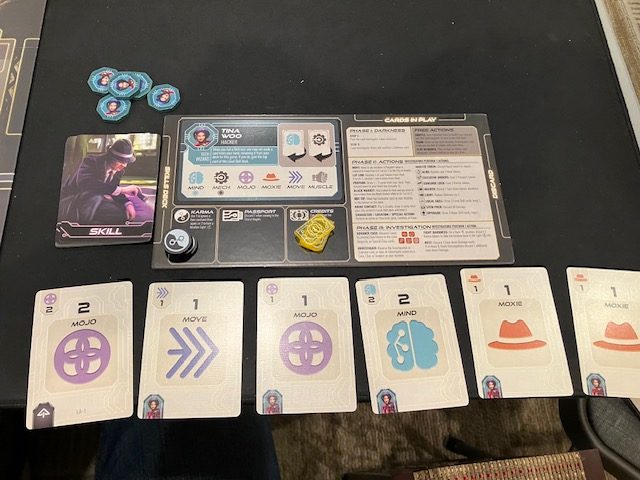
When a player is all set-up, you can see all the resources. See above! This is Tina Woo, and she’s a hacker!
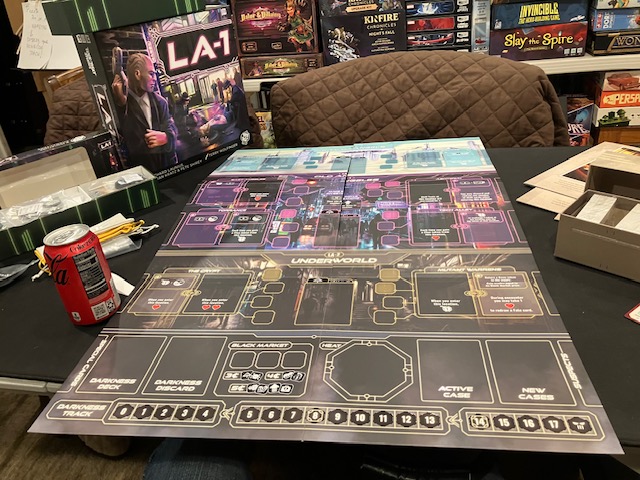
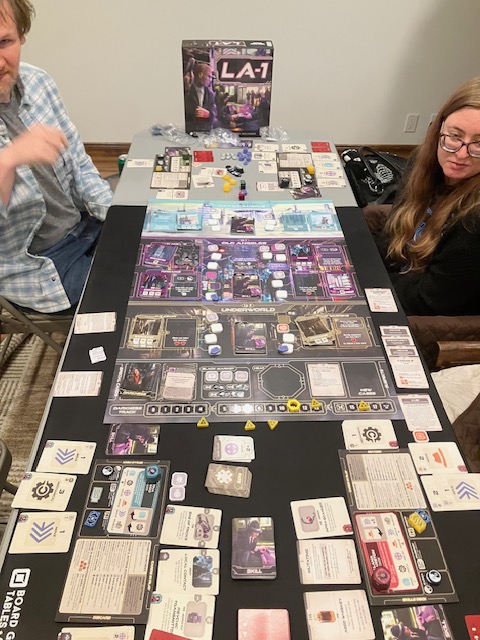
Players explore the cyber-noir city of LA-1! This is a huge 8-fold board that does NOT fit on my table very well! See above with Coke Can for perspective!
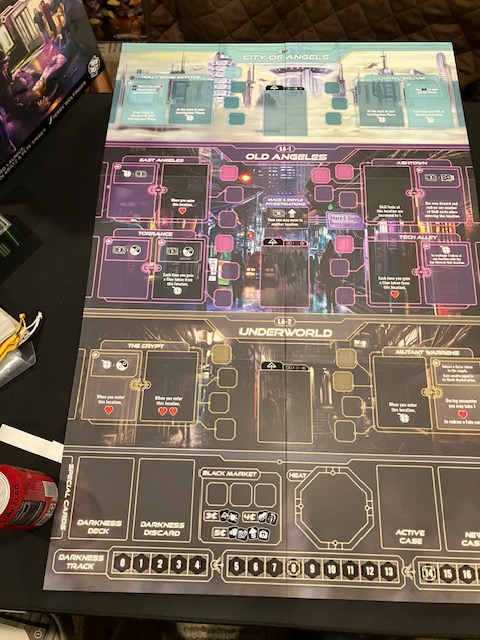
There’s three parts of LA: LA-1 (Old Angeles), LA-2 (Underworld), and City of Angels! City of Angels is so exclusive, you have to get a passport to travel around there!
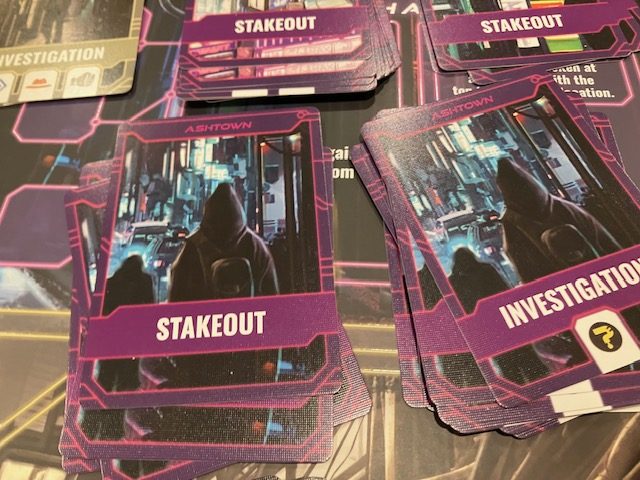
As players traverse the city trying to find out whodunnit, they will explore different locations in each part of the city. See Ashtown (jn Old Angeles) above.
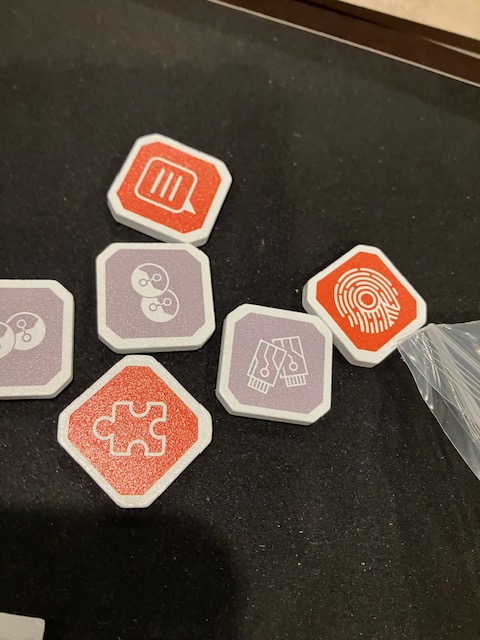
This wouldn’t be a detective game of any flavor without clues! There are CLUES (orange) which help you solve the mysteries, and basic tokens (which give you useful resources). You need CLUES to solve the mysteries, but you need the BASIC tokens to keep your resources up!
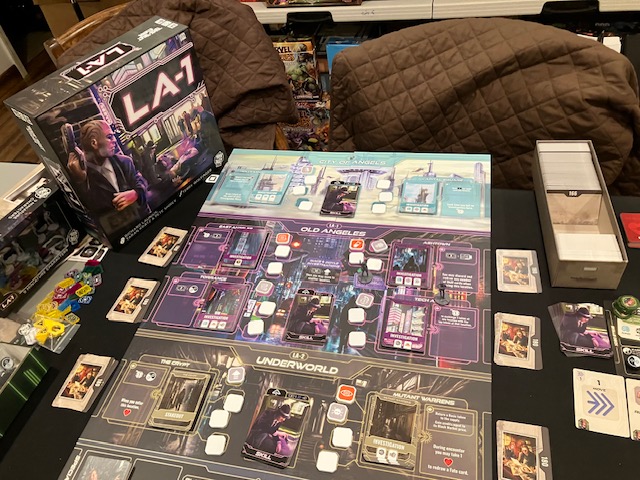
The clues are distributed all over the city! See above as each Location in the city has “about” 4 tokens next to it! Some are CLUES, some are basic tokens, and some are hidden so you don’t know what they are!
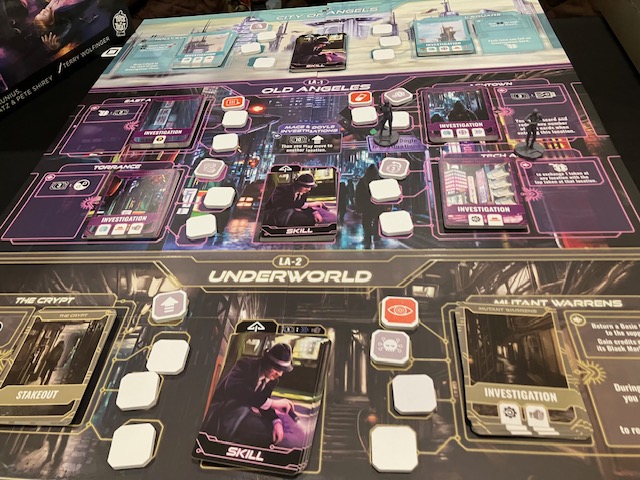
It’s not clear until you’ve played a little, but successful encounters at Locations allow you to (usually) take the top token at a Location! If we have a successful encounter at the Mutant Warrens in Underworld (above), there’s a good chance we can take the CLUE (orange eye) at the top!
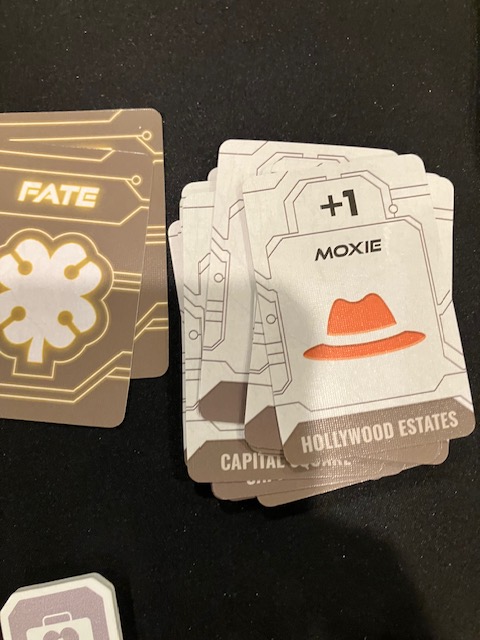
Skill checks are resolved using the Fate deck and the player’s decks; we’ll talk more about those later.
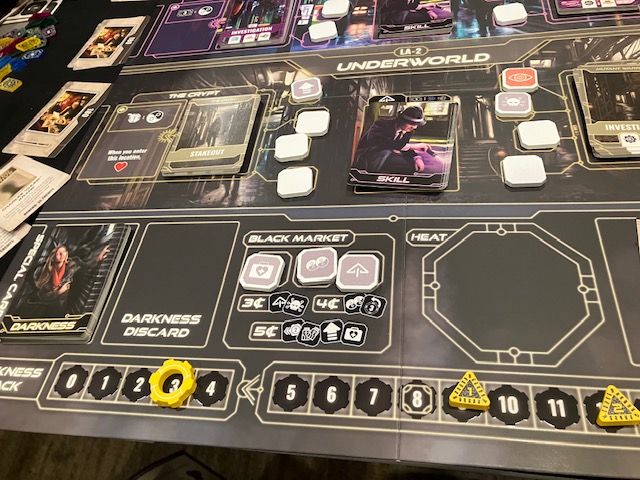
The game is somewhat on a timer; see the Darkness track above. If the darkness marker ever gets all the way to the right; game over and you lose!
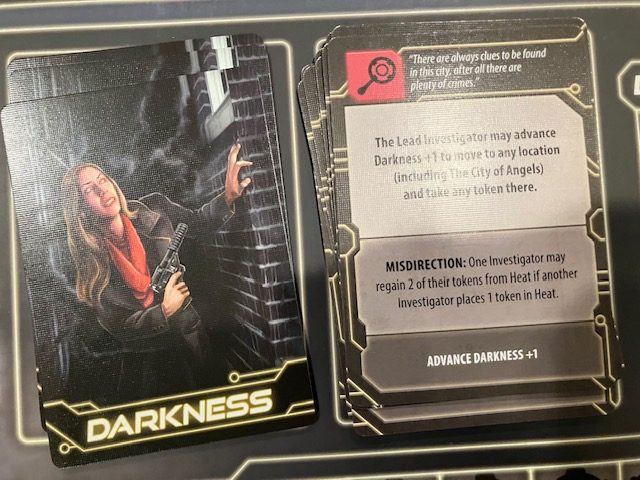
The Darkness track typically advances every other turn or so; it really depends on what comes up in the Darkness deck! Many time, the Darkness just advances. See above. But you also get to make choices, maybe you want darkness to advance in exchange for a clue you really need! Most Darkness cards come with choices!!! See above as you can choose to move to any Location and grab the top token (which could give you a CLUE you desparately need), but it costs extra darkness!
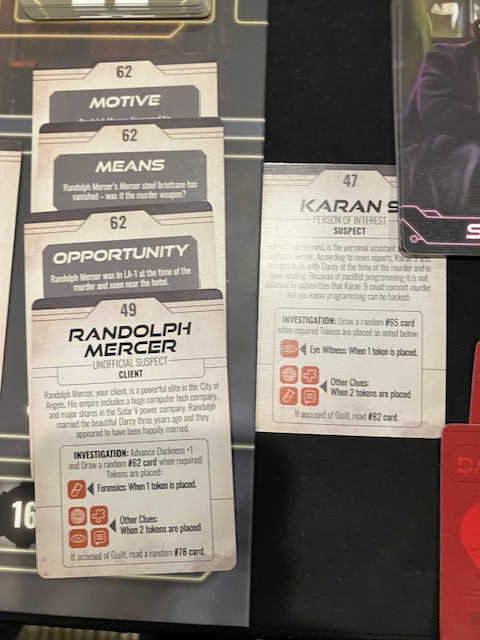
Every case is very different, but typically you do Detective-like thing like show Motive, Means, and Opportunity!
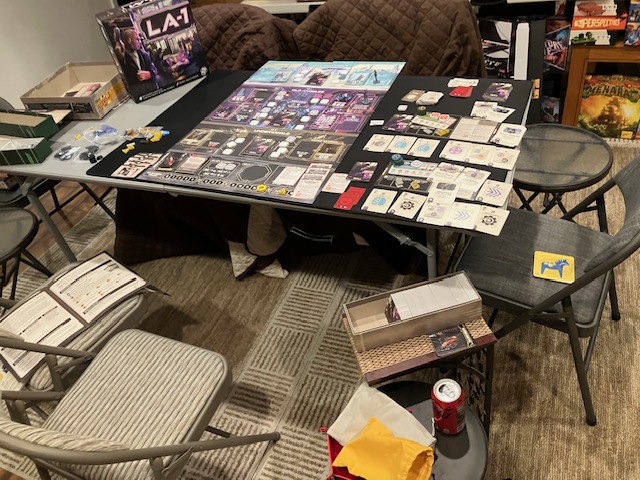
If you can solve the case before time runs out, you win! There are usually several other ways to lose as well …
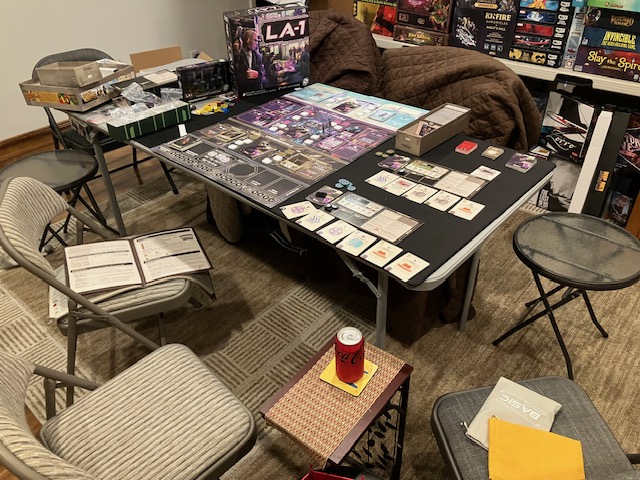
The game has a great production, especially if you get the token upgrades. See above. To be clear; you will need a LOT of table space for this!!
Rulebook
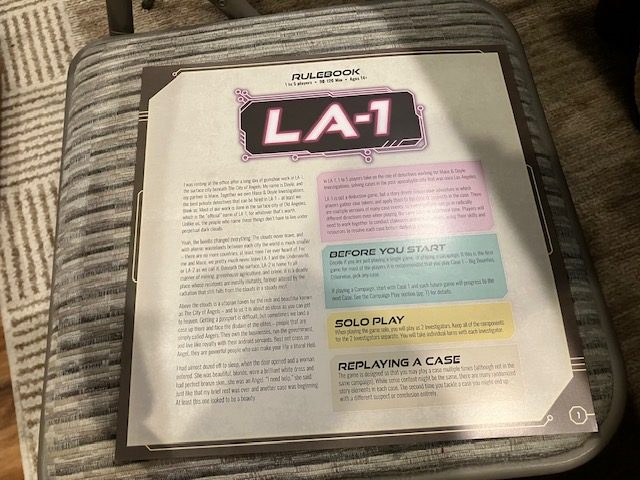
The rulebook is generally ok.
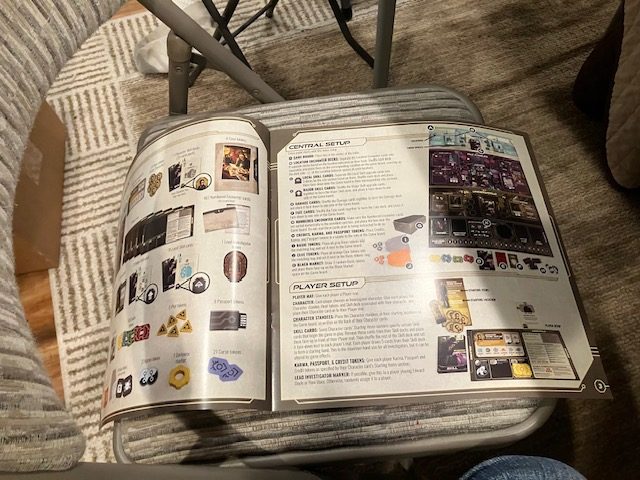
My main complaint with the rulebook is the form factor; it gets D- on the Chair Test! It droops over the edges, being almost unusable on the chair next to me. It barely works, which is why it doesn’t fail completely, but the “rulebook as large as the game box” needs to go the way of the Dodo Bird. Please publishers, make rules reasonable sized so we can open them without needing a giant table!
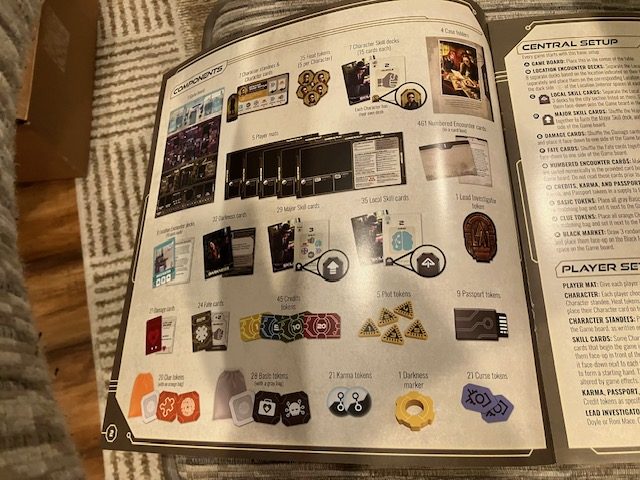
The Components page was good enough: see above as it shows components and some correlating text so you know what’s what.
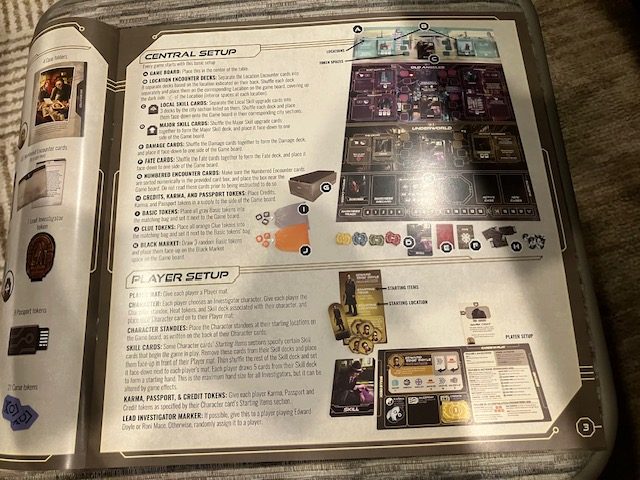
The set-up seemed a little squished onto one-page; see above. It works, and steps are notated, so it’s good enough.
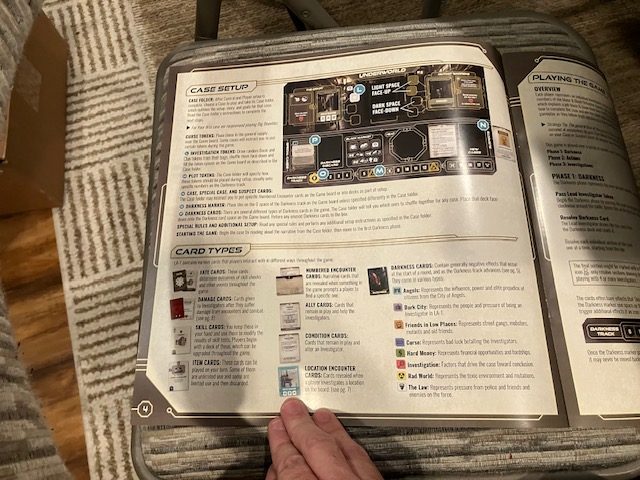
The set-up drifts into the next page, and that doesn’t work as well. Each case defines its own Set-Up and this was a little more unclear. I would have the first “recommended” case have more info … maybe a first play guide like we’ve seen in many games.
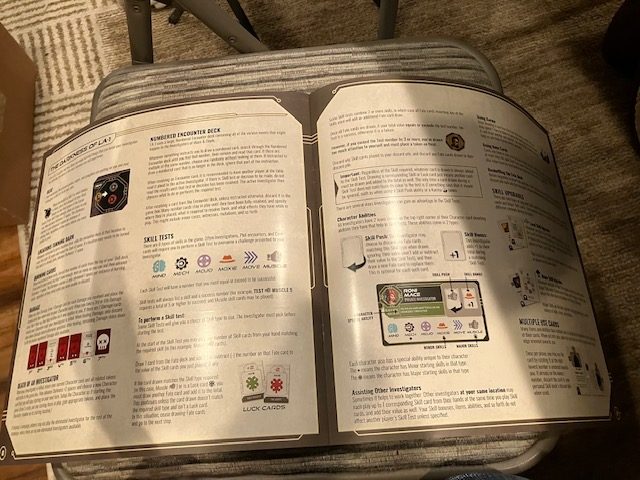
The rulebook packs a lot of stuff in just a few pages. There are pictures but I wish there were a few more.
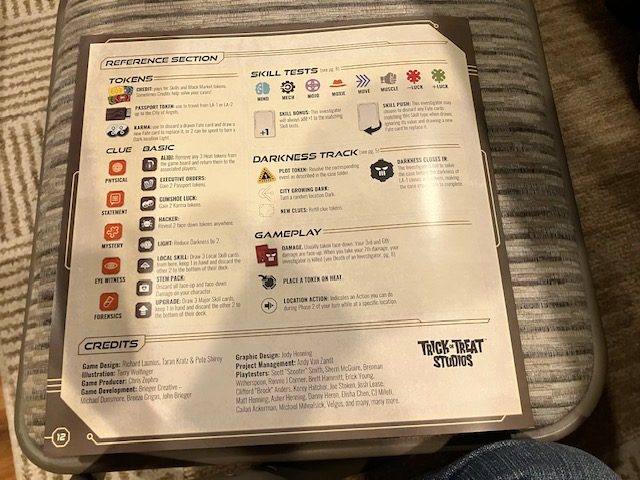
There is a nice summary on the back … which I used maybe once in the solo game and never in the cooperative games.
The rulebook is ok. It teaches the game. I feel like this rulebook probably should have had an index: there are a lot of subsystems within the game, and an Index would have made it a little easier to navigate.
One-Shot Game?
What I mean by asking this? Most Detective games are “one-shot” games! Once you have played the game, you know the solution so you can’t really play it again! The solution is indelible imprinted on your brain (that’s the legacy part), so you can’t play it again! Is LA-1 one of these games?
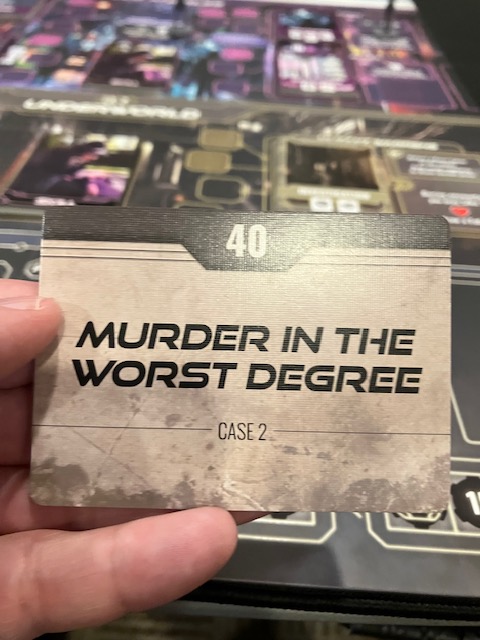
So, should I be worried that I am giving spoilers by showing some of the case cards from the game? Yes and no!
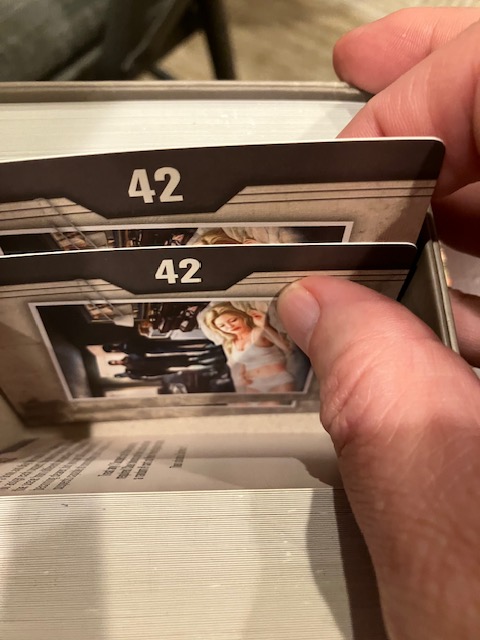
Each case will have a basic outline which is nominally the same, but it will change when you play it. How? The cases are in the cards, and there are multiple versions of some cards! See above as there are two 42 cards! Sometime during the game, you will be given the instructions “take a Random 42 card”, and the card you take will cause a different path! So the game will NOT be the same every time! Sure, you can choose the exact same cards next time, but it’s unlikely. It felt like there were about 12-15 points where the game could take a different path (by taking a different card).
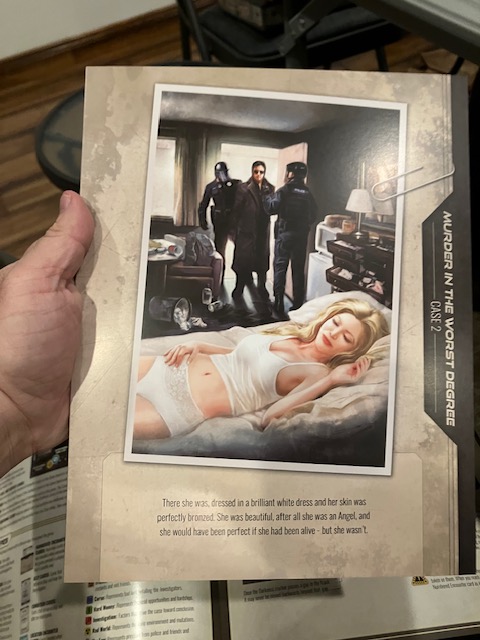
So, there is a case, it has an outline, and it even has multiple outcomes. But it’s not a detective game. You aren’t trying to use your deductive reasoning like Sherlock Holmes: Consulting Detective (“Hmm. There’s ice on the floor. Clearly the murder weapon!”). You aren’t being smart like Poirot or Sherlock or Father Brown or any of your favorite detectives to solve cases. You are more “exploring” this world and this case, and trying to do well on Skill Checks! Successful Skill Checks reward you with “progress” on the case.
The text that comes out during the game is very thematic, as there is an outline to this case! It does have a bit of a solution. But, it’s exploration and skill checks that keep this game moving forward, not “Sherlock smarts”.
An analogy that will come up again and again: this game reminds me SO MUCH of Arkham Horror: 2nd Edition. In Arkham Horror, you explore the city so you can kill monsters and close gates. In LA-1, you explore the city so you can find things to solve cases.
LA-1 is an exploration game with a detective theme, but it’s not a detective/deduction game.
Solo Play
So, LA-1 does support solo play! Congratulations on following Saunders’ Law!
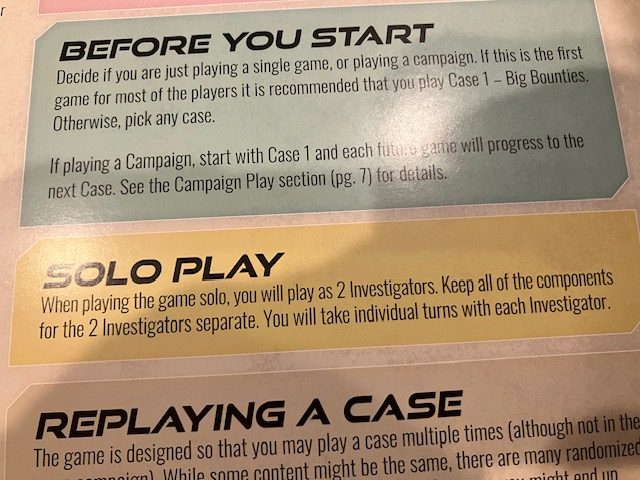
It’s not true solo play, as you must play two characters and alterate between them: see rules above. It’s very clear what the solo rules are and I applaud LA-1 for being so clear on this!
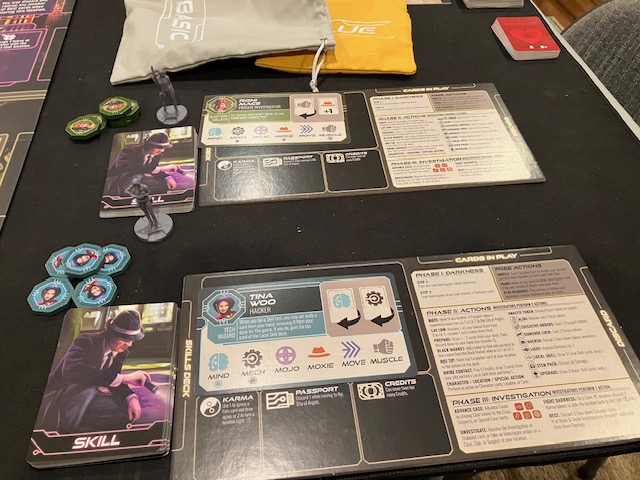
My first solo game was playing Tina Woo (hacker) and Roni Mace (investigator). Usually, I put my characters side to side, but I ran out of room! That 8-fold board of the city is SO HUGE it took up too much room!
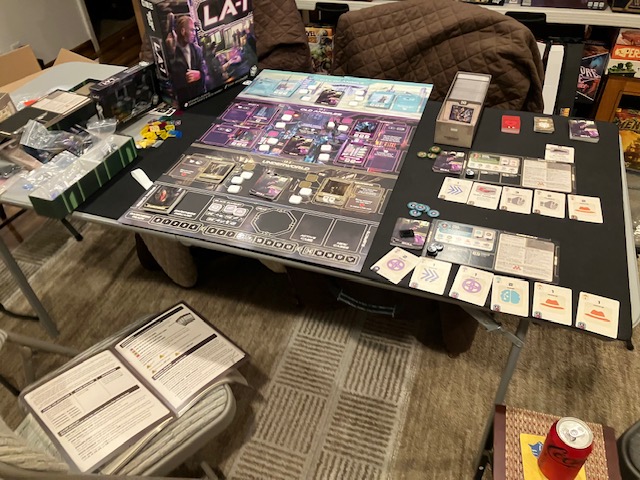
This was a bit of an ordeal, trying to operative two characters in my space! See above!
I got a lot of rules wrong as I figured it out. The rulebook is ok.
I was able to get a couple of solo games together before teaching my friends. There is quite a bit of maintenance as you play; it’s a little much to play 2 characters, but that load feels less and less heavy the more you play. To be clear, there is a lot of flavor text on the cards, and a lot of directions on the cards, and a lot of systems in this game (CLUE bag, BASIC bag, damage system, fate resolution, Location actions, darkening Locations, advancing darkness, dealing with heat, karma, money, passports, etc etc). It’s probably gonna take about 2 to 3 plays to really get the game down. My first two solo games were about 2 to 3 hours each. Granted, they were learning games, but LA-1 feels more like a 2 to 3 hour for the solo game than a 90-120 minute game. Especially if you are trying to read all the flavor text and immerse yourself into the game.
Did I have fun as a solo player? Yes. Will I come back to it and play it solo again. Maybe?
Cooperative Play
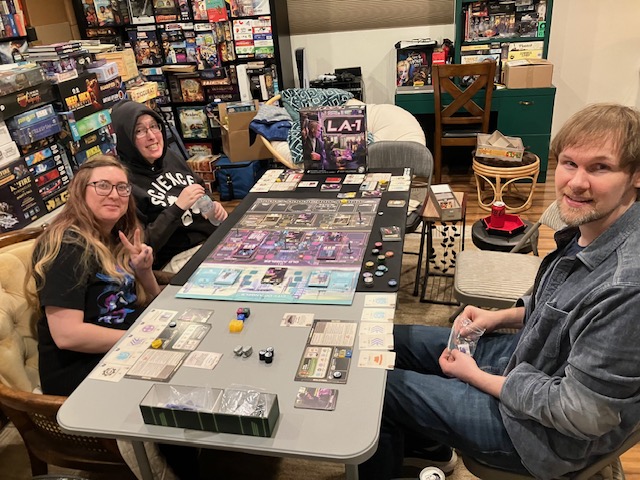
I think LA-1 is a better cooperative game than solo game! For me at least, the game feels a little more immersive as I play just one character and interact with my friends. The solo game makes you play two characters, but it’s usually a lot more fun when you can inhabit ONE character and become that character for a game!
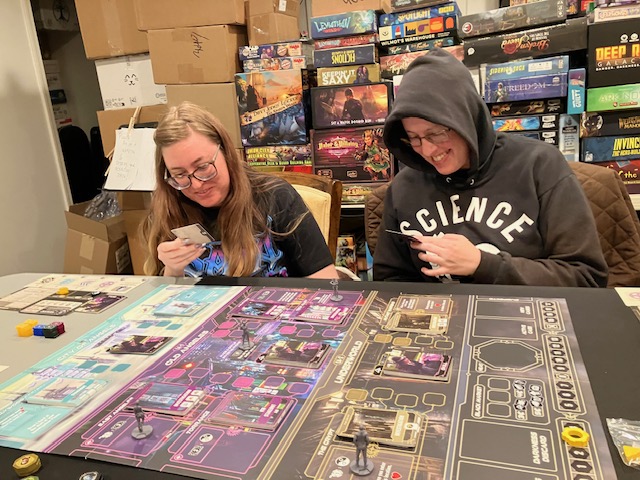
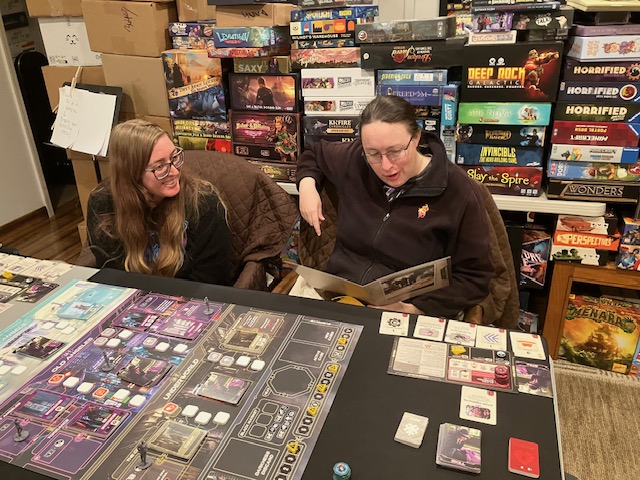
See my friends smiling and laughing as we play! We typically (as a group) really like storybook games, and this game really tickled our fancy.
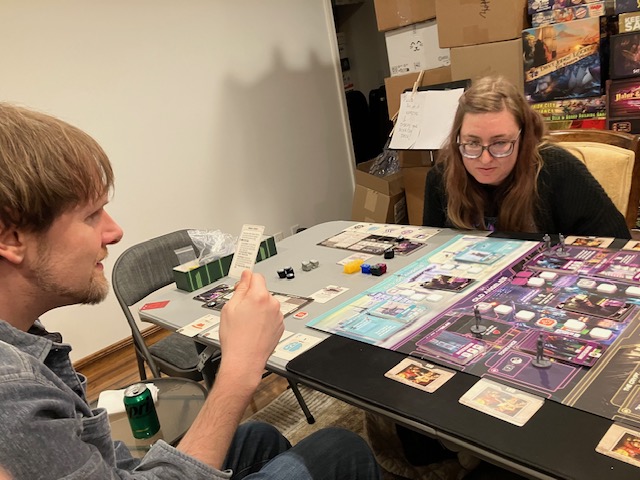
If the solo game were harder to play because there’s more maintenance per turn, then the cooperative game shares the maintenance load and makes it easier to play! See above as Andrew reads Sara’s storycard!
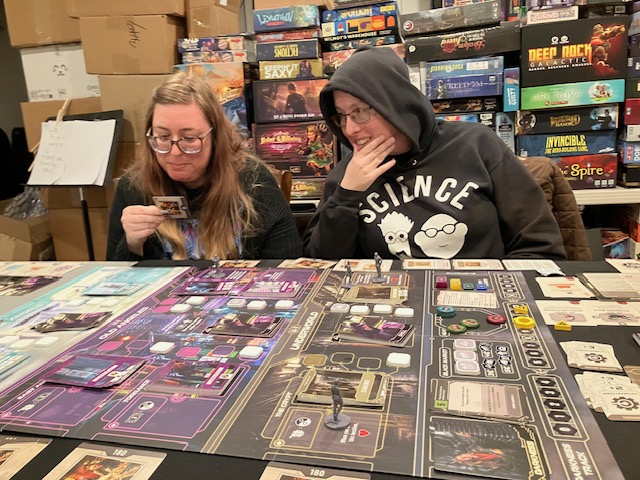
As a group, we enjoyed this. I mentioned that there’s a campaign (you can play the 4 cases of the box in a full campaign), and my group seemed very interested in continuing our adventure!
The game was very interactive as we all shared the story, the reading duties, and the load for set-up and tear-down.
This was a fun cooperative game. The only real downside is that this game has a lot of systems and subsystems to maintain (Fate deck, karma, money, Locations, Skill deck, etc), so it might be harder to teach this game to less experienced gamers. Still, if you know what you are doing (play the solo game first), you can teach this fairly easily.
The Arkham Horror Comparison
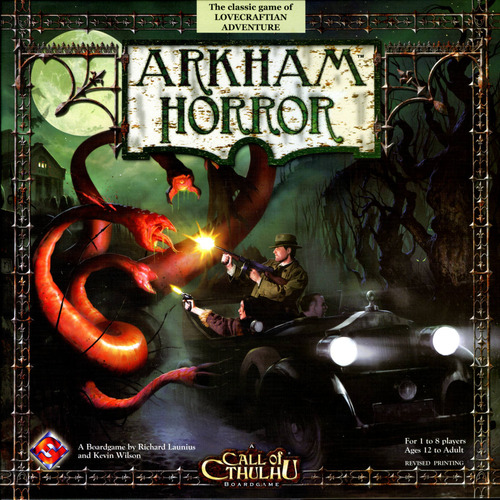
This game feels so much like Arkham Horror: Second Edition! And it should, as Richard Launius (one of my favorite designers) is also the main designer of the original Arkham Horror! I don’t love everything he does (see our review of Freedom Five), but I generally like his designs (see our list of Top 10 Cooperative Superhero games with Batman: The Animated Series game and Top 5 Cooperative Games Of All Time!)
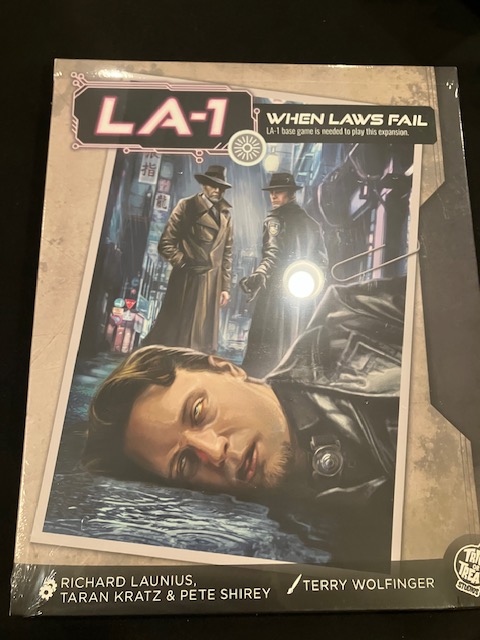
Let’s be clear; the theme is very different! LA-1 has you hanging out in a cyber-world in a post-apocalyptic future world as a noir detective! And Arkham Horror: Second Edition has you hanging out in a 1920s world, fighting horrors from the Cthulu mythos! And yet, the core gameplay feels the same.
- Move around a world and search for stuff to help you: In AH, you visit places in Arkham, In LA-1, you visit places in LA.
- Perform Skill Checks: dice based in AH, Fate deck based in LA-1
- Take Damage: hit points in AH, Damage cards in LA-1
- Read Thematic Text off Cards: In AH and LA-1, when you visit a Location, you read a card with thematic text (scary Cthulu stuff in AH, creepy cyber stuff in LA-1)
- Perform a macro-level Task to win: In AH, everything you do is in support of closing gates. In LA-1, everything you do is in support of solving the case
- It’s a big game! Both in board space, time, components, rules, both AH and LA-1 are big games!
This isn’t meant to be a ding against LA-1, not at all! Arkham Horror: Second Edition is one of my favorite games of all time! See discussion here of my Top 5 games of all time, and a discussion of what I want in Cooperative games!
Some people don’t like Arkham Horror: Second Edition because it is a little dated. Does LA-1 fix these problems? I think LA-1 does fix a lot of problems modern gamers might have with Arkham Horror: Second Edition. Let’s take a look!
A Sense of What’s Coming
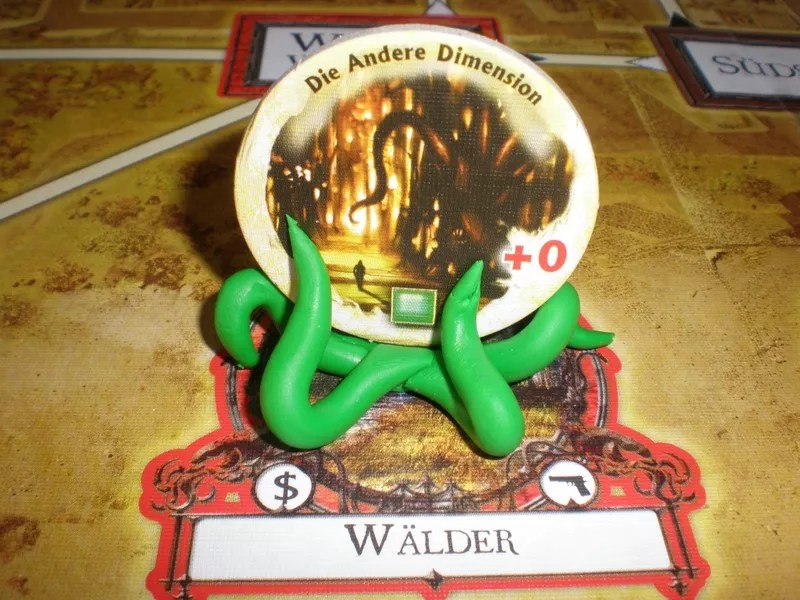
One of my favorite things that Arkham Horror: Second Edition does is that it gives you a “hint” of what kind of reward you might get at a Location! See above at Walder, as you might get money ($) or an Item (gun). If you are looking for money because you need to buy an Elder sign, or need a plain weapon to fight Horrors in the street, maybe you’ll choose to go to Walder?
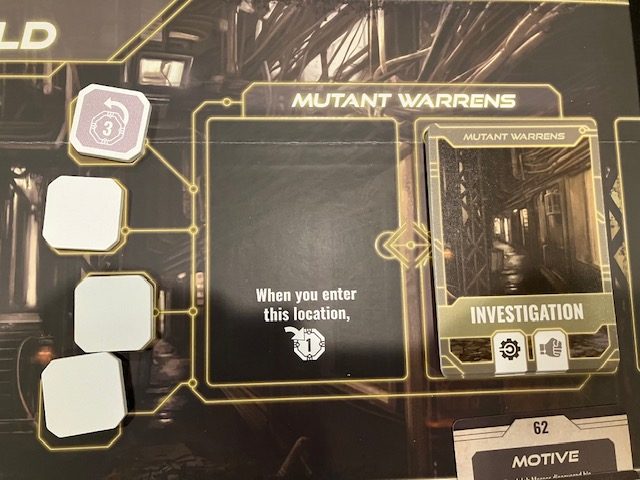
In LA-1, when you go to a Location, the card gives you a “hint” of what Skill check you might have to do there! See above as the Mutant Warrens indicate you’ll “probably” need some mechanical skill or some punchees! Tina Woo isn’t very punchee, so maybe she’ll suggest Mace goes there! You can make decisions on what Locations to visit to go based on what Skill you might need! What you might get at the Location is “generally” the top token (but not always).
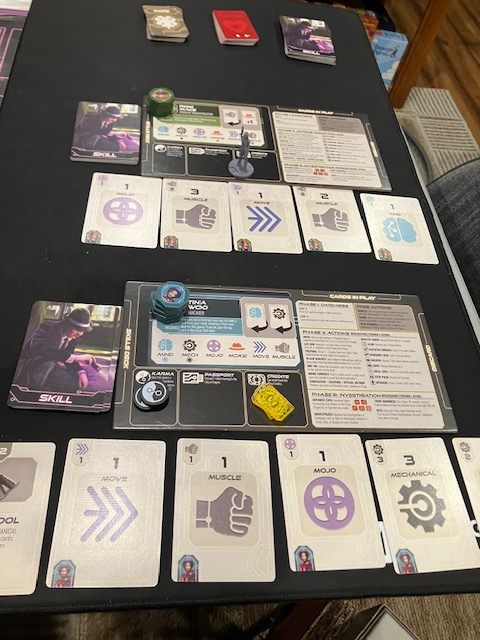
So, when you visit the board, you have a better sense of whether or not you’ll succeed because you know what Skill cards you have ready!
You can make a much more informed choice of places to visit based on what skills you have in hand, and what the Locations offer! And this feels very thematic; “I knew, going to the Mutant Warrens, I might have to get into a fight to get any information … but I was ready for it.”
In some ways, this is an improvement over AH because you have a better sense of whether or not you might succeed, based on your cards and hints on the Location! You will “probably” get the top token, so you also have a sense of what you’ll get! There are also lots of places in LA-1 where you can “flip” or “swap” tokens to have a better sense of what you get!
“Sometimes you spend your time just trying to find out what information you need to even find a clue. It’s just the life of an investigator. It’s just the way of life for us.”
It doesn’t feel like just random exploration: you have hints of what you will get, and that makes it feel like your choices matter.
Fate Deck vs Dice
One of my least favorite things about Arkham Horror was how all skill checks depended on a roll of the dice. There were clues to help mitigate that, but in the end, you just rolled dice. I remember one game of Arkham Horror extending to 6 hours because of 1 bad roll … and everyone just sort of died inside. What should have been a 3-hour game (which is still quite long) became a 6 hour game. Oi!
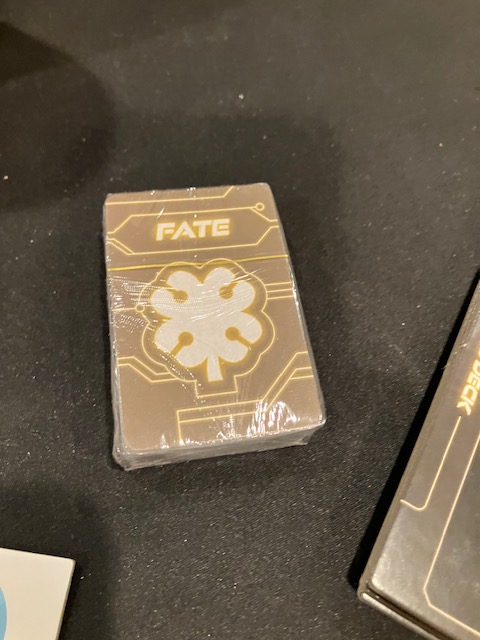
But Skill checks in LA-1 feel much less debilitating and random via using the Fate deck now. It’s just a little deck of cards, and it’s basically some randomness (plus or minus) to a skill check.
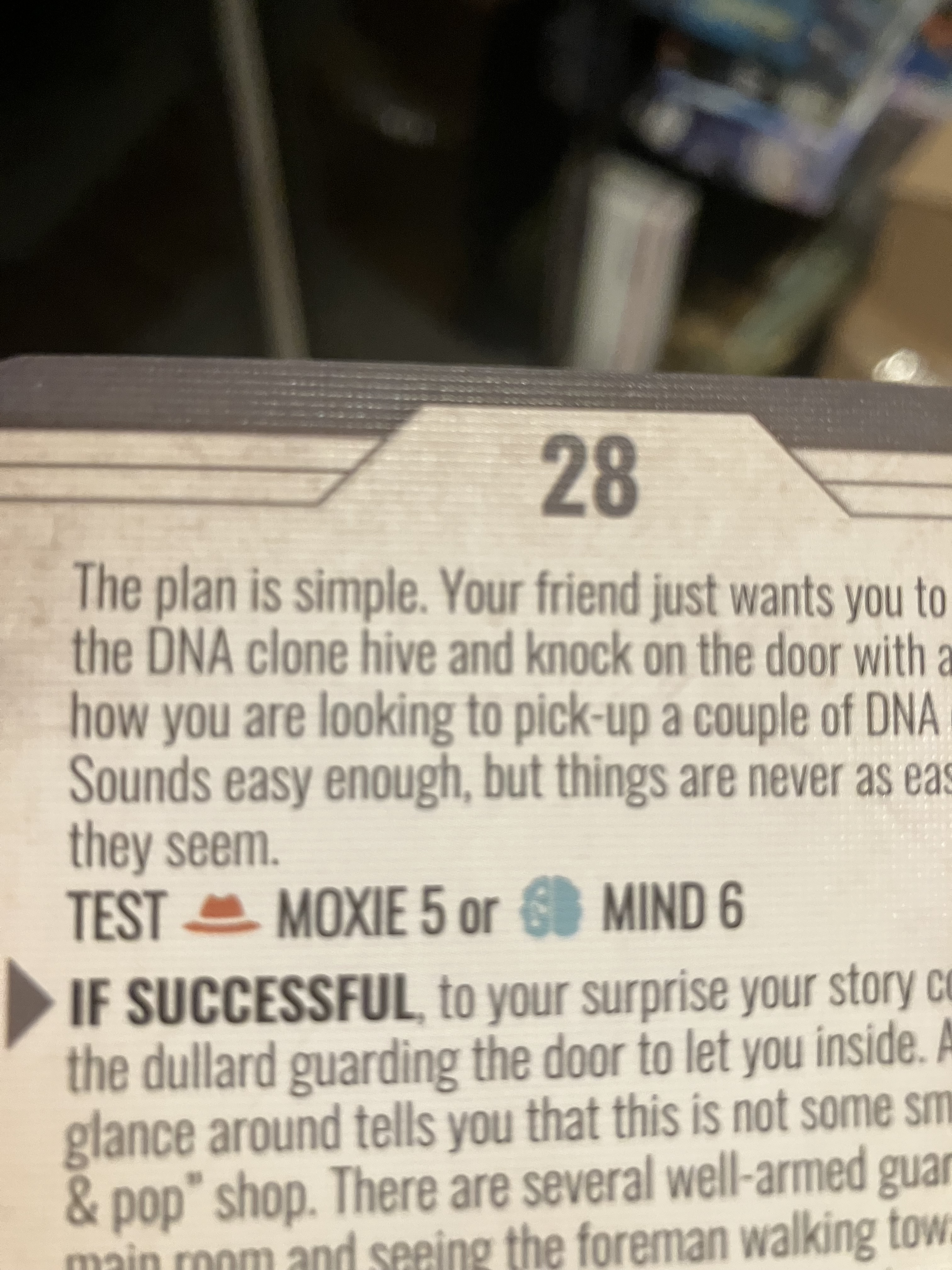
A Skill Check usually comes form an encounter. See above as I can choose to do a Mind (6) or Moxie (5) test.
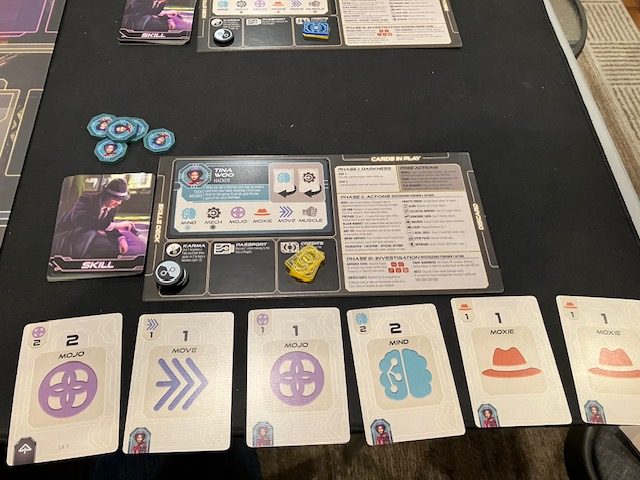
Looking at my hand of cards, I think I have a better chance with Moxie rather than Mind, so I discard two Moxie (1) cards to give me a base of 2.
I draw from the fate deck; I always keep the first card (see above as I add another +1), but since the card matches the test (Moxie), I can keep drawing!
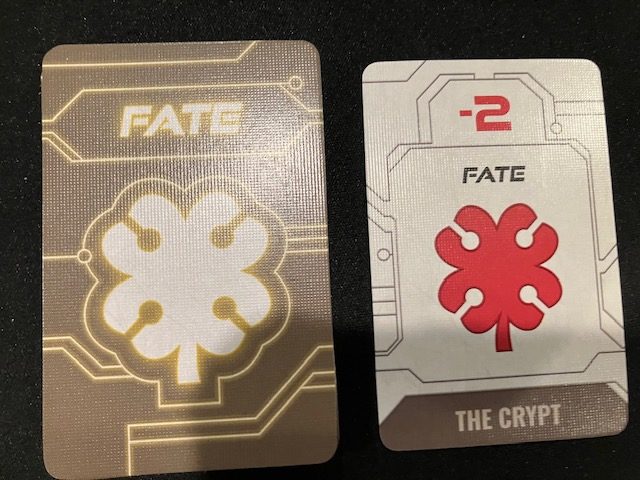
I draw until I don’t match anymore … oooooh, bad luck … -2 Fate. So, my test fails. 1 + 1 (two cards) + 1 (Moxie fate card) + -2 (Fate -2 card_= +1. I fail
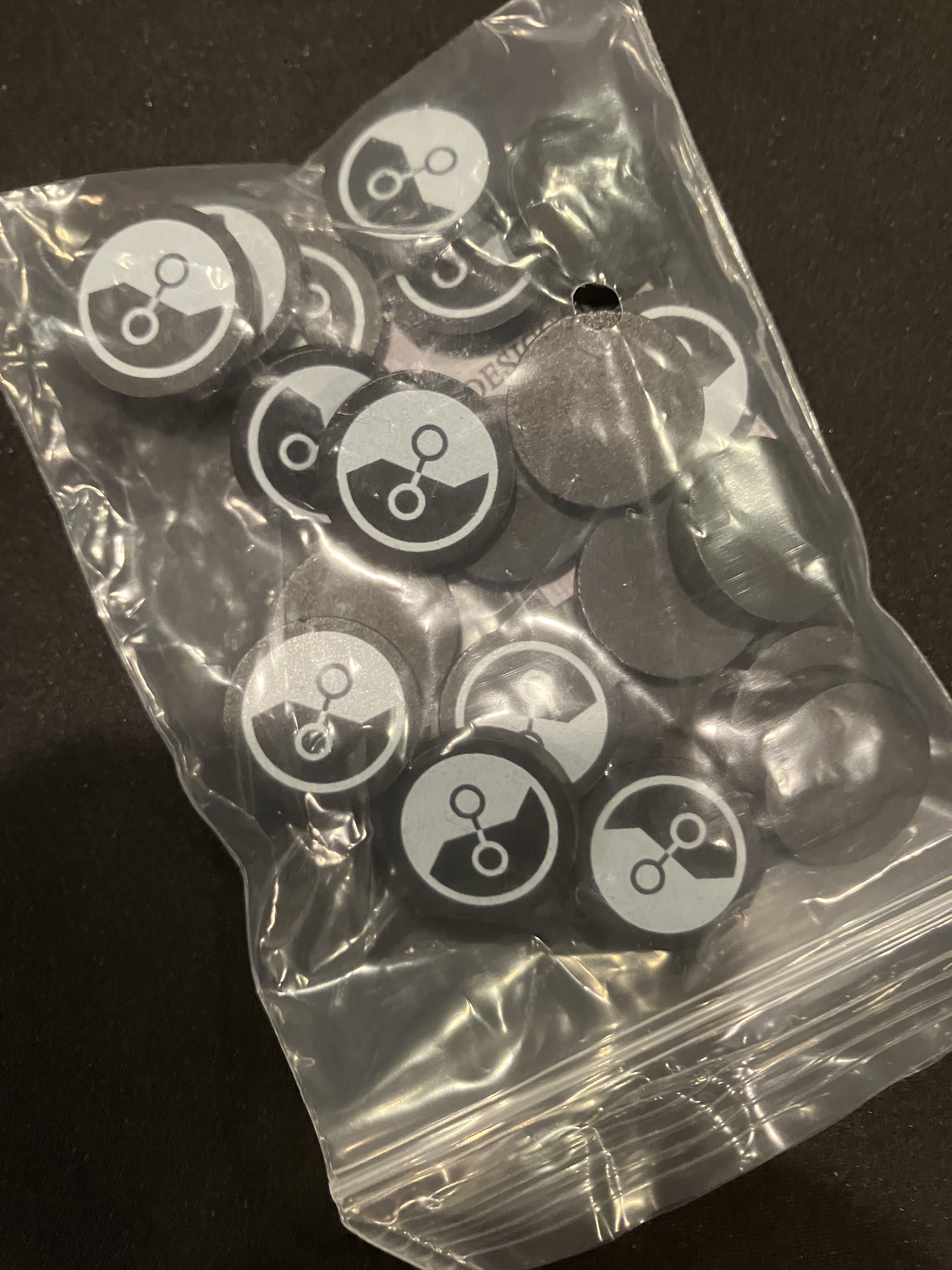
If you have Karma tokens … you can discard one to keep drawing and ignore that last -2 Fate cards! Karma tokens from LA-1 remind me of Clue tokens from Arkham Horror: you can discard them after the checks have been made to keep going!
What I like about this system is that you have choices along the way: if it’s clear you CAN’T make the Skill check, you can try to mitigate the resource cost and not invest any Skill Cards or Karma tokens: you just take it. But, if you really really need that test to succeed, you can use Karma and special abilities, and others can help you (of in the same Location or maybe even same CIty Block). But of course, if you went to a Location that needed Brain and you had NONE, that’s your choice!
This Fate Card system is a little more complex than rolling dice (and it takes a few tries to explain it and get it right: “Wait, I keep drawing because I matched the test?”), but this system gives you choices and decisions (rather than just rolling dice and spending clue tokens from Arkham Horror). I feel like this is a major improvement for resolving Skills checks in the world of gaming.
Storybook Game
The card below is a little bit of a spoiler, but out of context, it’s not too bad. I show it below to show you how much story is on the cards in this game.
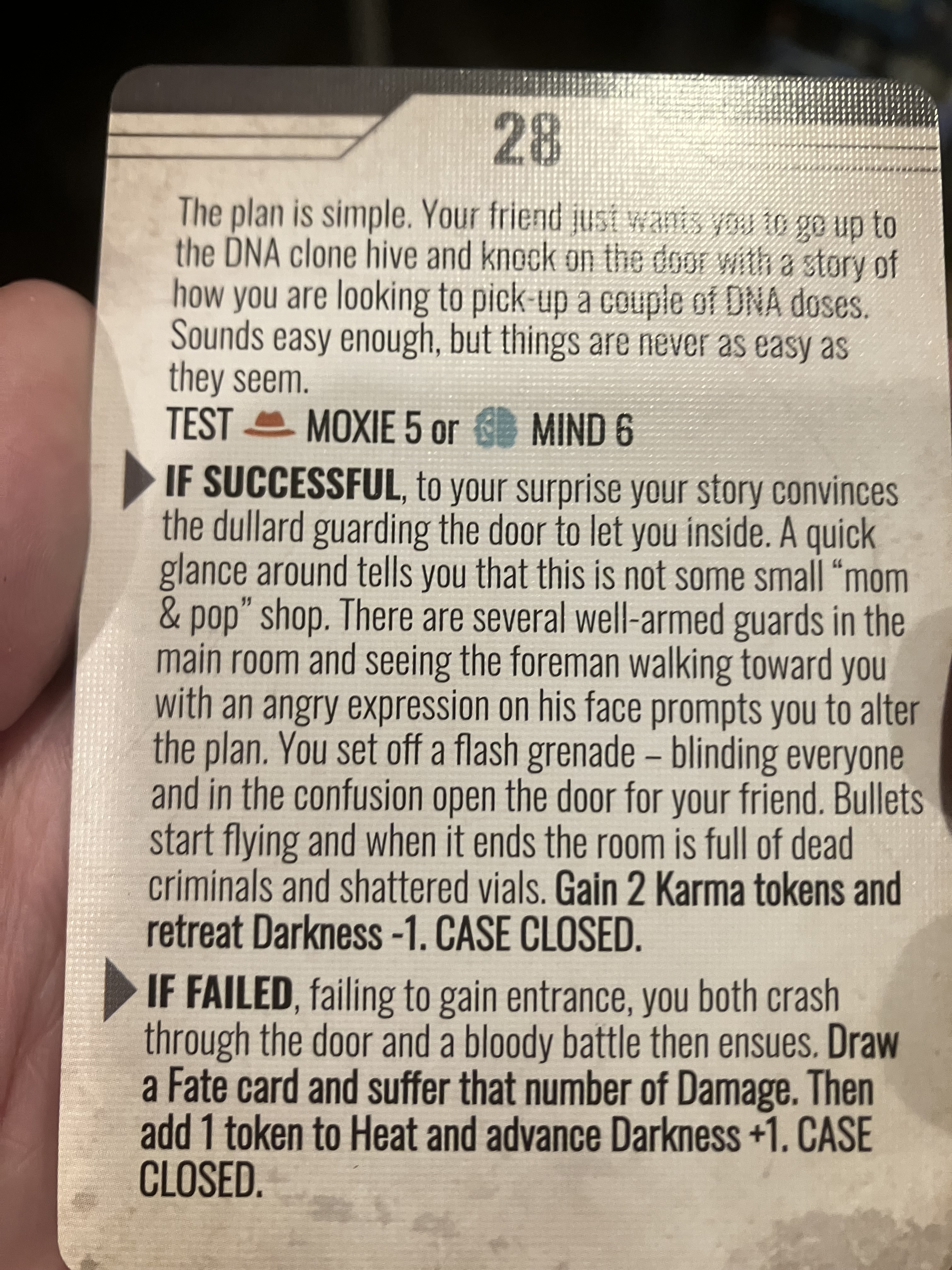
This is absolutely a Storybook game like Vantage from last year (see our review here) or any of the games in our Top 10 Cooperative Storybook games!
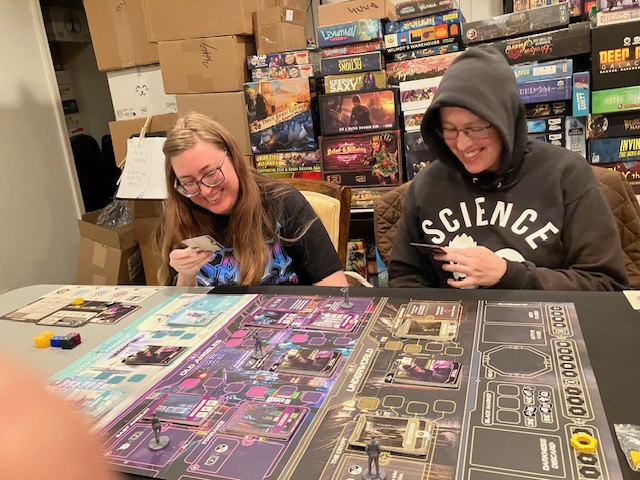
Players read cards to each other as they choose what kinds of skill checks to make and advance to story!
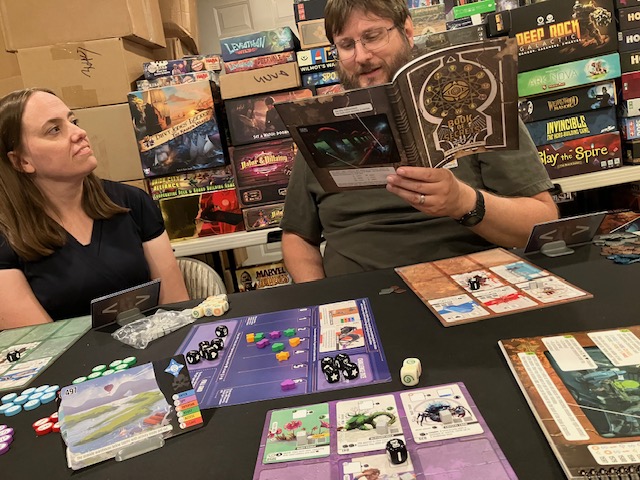
One of our favorite things about Storybook games (and what we loved about Vantage) was reading story to each other! See above! This keeps everyone involved as one person reads one person has to make choices, and everyone else hears the story unfold!
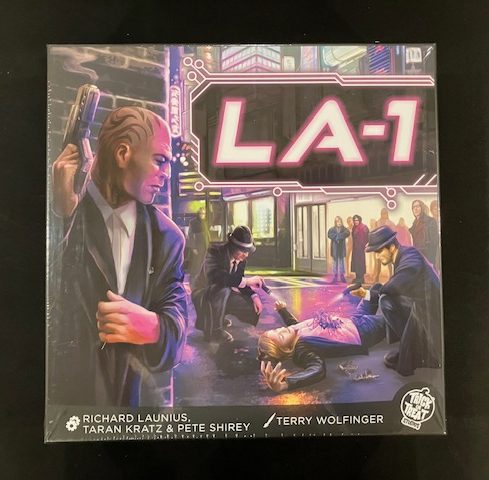
I think if you saw that cover, you would NOT think that this is a storybook game! “Oh, it’s s detective game!” Nope, nope, nope, nope, nope. This is definitely a storybook game with lots of text to be read! You can choose to read your own encounters, but’s it a lot more fun and interactive if everyone reads aloud! The story becomes shared as we team of investigators try to figure out what’s going on and share this adventure together!
Replayability
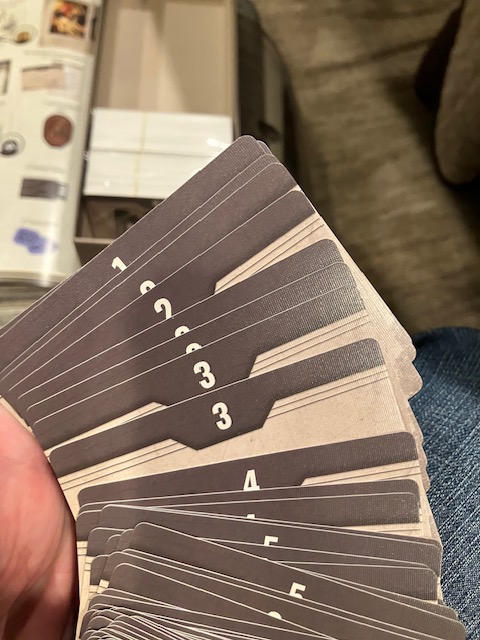
This is a little more replayable than most story games because the story cards can come out randomly. See above as there are multiple #3 and #5 cards! The story you experience depends on which #3 and #5 card you draw!
Heat
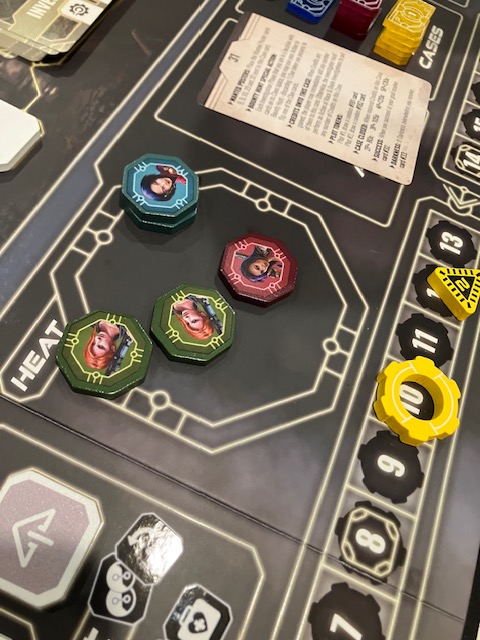
One last thing I want to mention is the Heat system. This worked so well! Players can CHOOSE to take Heat to move the game forward faster (“Hey, if I take some Heat we can get a CLUE sooner”), but taking Heat will likely have some repercussions later in the game! Taking Heat is just adding tokens to the Heat space (see above).
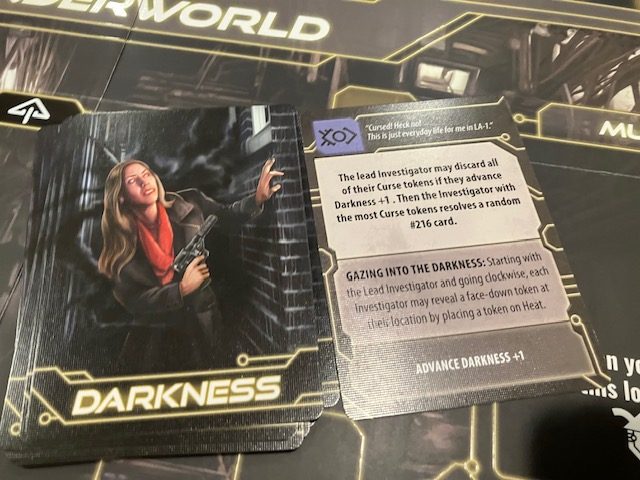
Many Bad News (Darkness) cards will target players with too much heat, making the Bad News even worse! But, you can “lay low” for a turn to reduce your Heat.
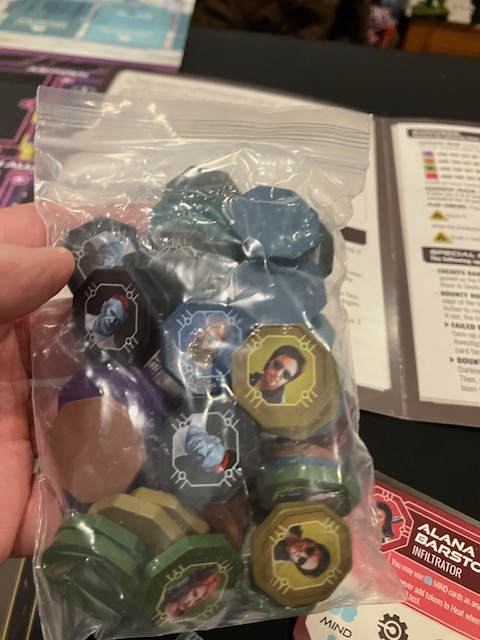
Each player starts the game with 5 Heat (see Heat tokens above), but taking Heat is almost always a choice. And you can always “lay low” for a turn (so thematic in a Detective Noir game!) to lose Heat.
Heat is a really neat mechanism that is thematic, adds tension to the game, but it is still a choice; you have to deal with the consequences of taking too much Heat … but maybe you have to take Heat to get the case solved!
Campaign Game
So, there is nominally a campaign here: you can play the games in order and keep a few of the cards between games.
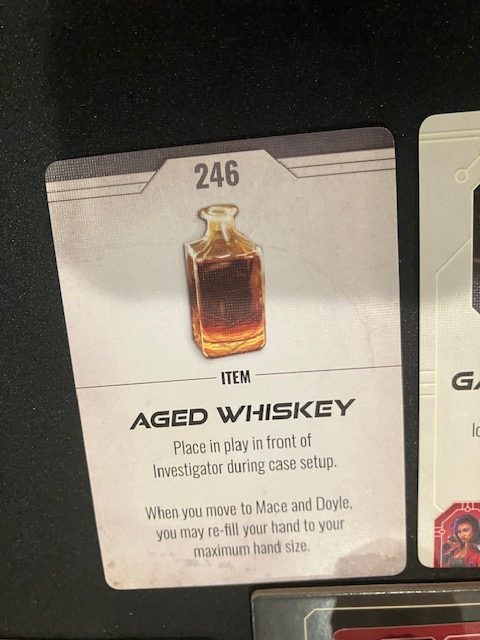
And you gt a few extras too.
But honestly, it’s not really much of a campaign with lots of “continuing story”. It’s more of an excuse to continue play all the cases in the box. I have to tell you, I am surprised how much my friends wanted to continue playing this (kinda lame) campaign. When you are enjoying the experience, I guess any excuse to keep playing will keep you going! So, the campaign, while not “too campaigny” (in terms of story or holdovers), it was an excuse to keep playing.
Conclusion
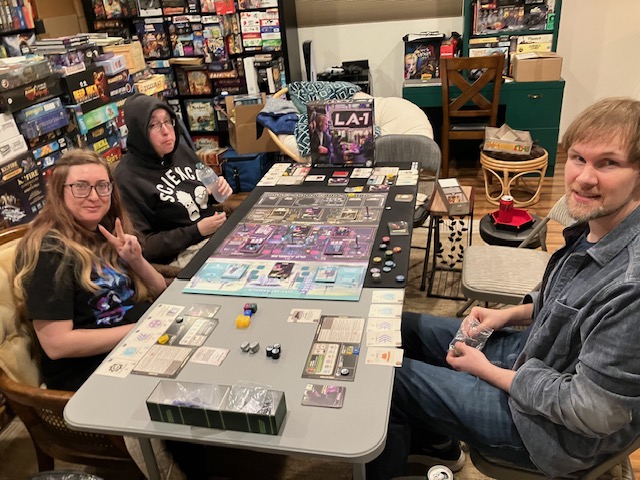
I think LA-1 might be a Hidden Gem! Unfortunately, it’s Kickstarter only had 597 backers, and it only made $68,000 … which is not a lot of money in board game Kickstarters. But if you like the theme and like Storybook games, this is a fantastic game! There’s plenty of choice and hints in the game that the exploration of this Cyber-Noir world feels directed and fateful, and not just random. And the mechanisms of the game (Heat, Fate deck) make the Skill checks seem like that have much more agency than a random die roll! You still have choice, even if sometimes things go against you!
Be aware that this is NOT a Detective game (like Sherlock Holmes: Consulting Detective), but more of an exploration and Storybook game! I admit I was a little disappointed that this wasn’t a detective game … it’s more of a detective-themed story book game. Just be aware of what this is before you jump in.
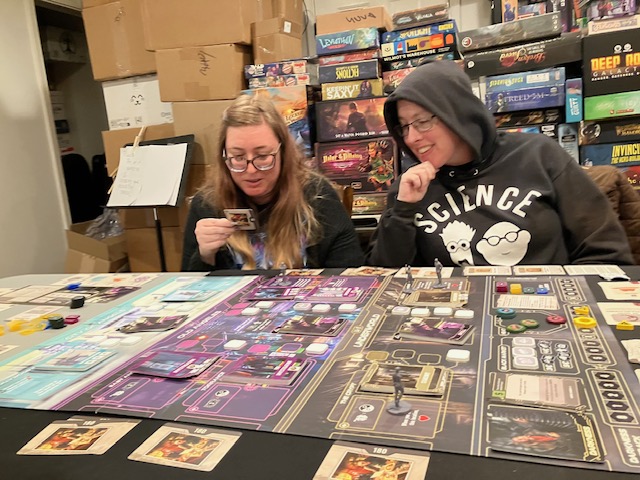
As a cooperative game, me and my friends really enjoyed LA-1; enough to engage in the Campaign game over 4 Cases! The choice, the story, the gameplay, makes this a 8.5/10. I like the solo game, but this is much more fun to play with my friends reading and sharing, so I’d give the solo game 7/10; it still works, but the shared story among friends is what makes this great. UPDATE: this might even drift to a 9/10 for the cooperative game!
If you know what Arkham Horror: Second Edition is and loved it, I think you will really enjoy LA-1 as well! LA-1 has the same feel as AH in many ways, even if the theme is completely different. If you didn’t like Arkham Horror: Second Edition because it was too random or too long, you might still like LA-1; it takes a lot of the mechanisms that lengthened/randomized games of Arkham Horror … and fixes them.
Appendix: Remembering Arkham Horror: Second Edition
For many people, Catan was the modern game that brought them into the hobby. For me and my friends, it was Arkham Horror: Second Edition. It was complex, overwrought, way too thematic, but we adored it! It was a cooperative game before cooperative games were popular. Many people say it was Pandemic who introduced them to cooperative games; for us, it was Arkham Horror: Second Edition. And Arkham Horror: Second Edition came out BEFORE Pandemic!
There are some things that Arkham Horror: Second Edition still does a little better than LA-1. For one, the city feels like a city! When you need to get it healed, it’s clear you need to go the Hospital! When you need sanity, it’s clear you go to the Sanitorium! When you shop you go to the General Store! It was intuitively clear, based on the board, where to go. LA-1 doesn’t quite have that intuition; it almost feels like a Worker Placement game (partly because you can do actions on spaces) than a city.
The thematic immersion in Arkham Horror was also a little more complete; the monsters wandering the streets, the other world encounters, the spells, the closing of gates, it just felt … a little more immersive. And these characters felt a little more real; I can still tell you the name of my favorite character: Mandy Thompson. Something about this game was magic for us.
I think LA-1 is a better modern game than Arkham Horror: Second Edition; it’s less random, more streamlined, cleaner systems, and modern sensibilities. Yet, there’s something magic in Arkham Horror: Second Edition that anything has yet to capture.
 coopgestalt