
This review has been sitting in my hopper for over a year now; not sure why I didn’t get it out earlier!
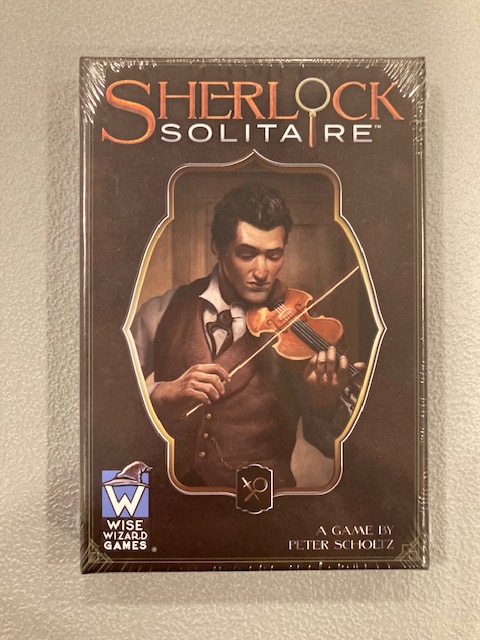
Sherlock Solitaire is a very small cooperative card game for 1-2 players. This released early in 2024: I had heard about it from my friend Sam and so I quickly ordered it from Wise Wizard website about a month ago (early March 2024). It delivered pretty quickly! I got it to the table solo, but I didn’t want to finish my review until I tried it two-player cooperative .. Sam really wanted to play, but he was busy most of March.
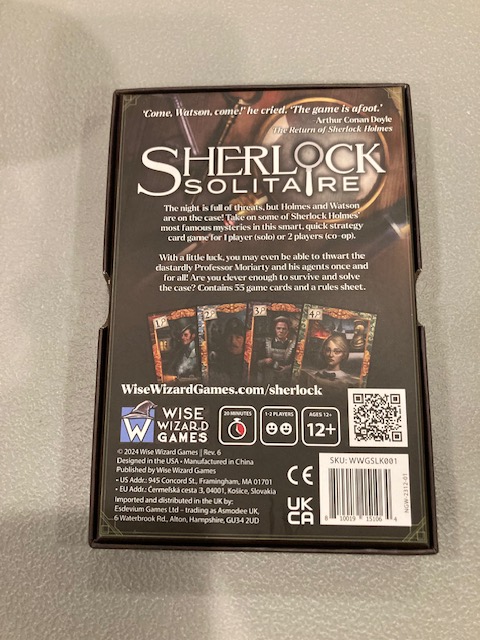
This is a very small and thin package. It plays 1-2 players, is about 20 minutes, and plays ages 12+.
Let’s take a look!
Unboxing
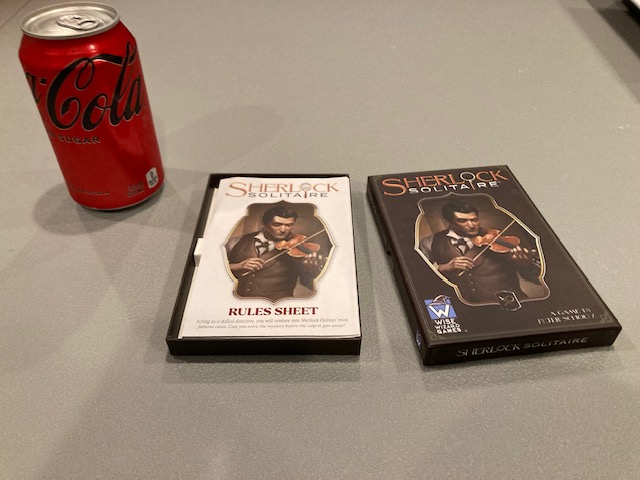
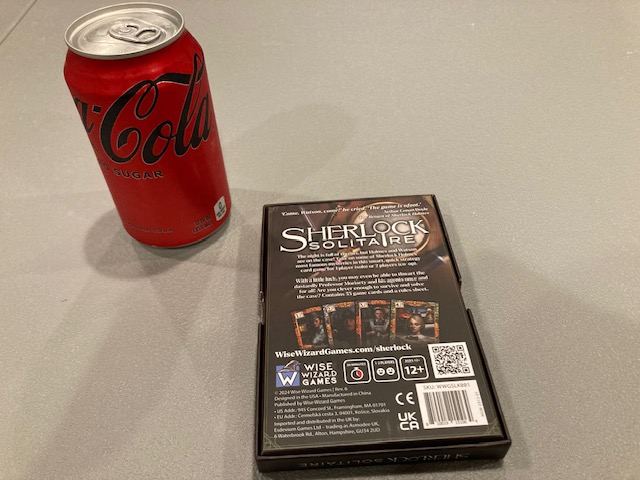
Sherlock Solitaire is a teeny tiny box and very thin: see the Coke can above for perspective.
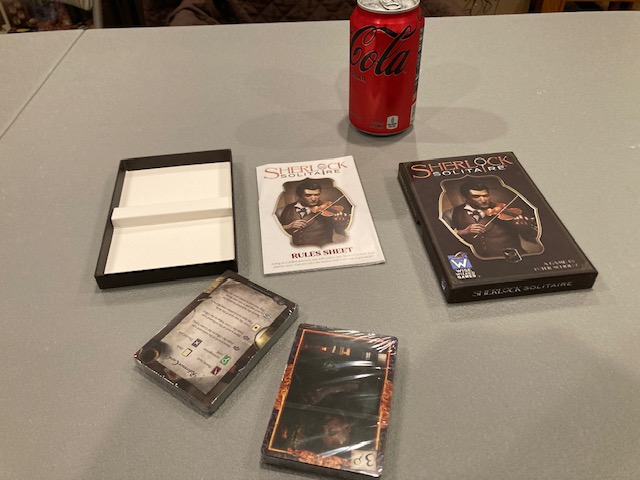
Except for the instruction pamphlet, it’s all cards .. just 55 cards.
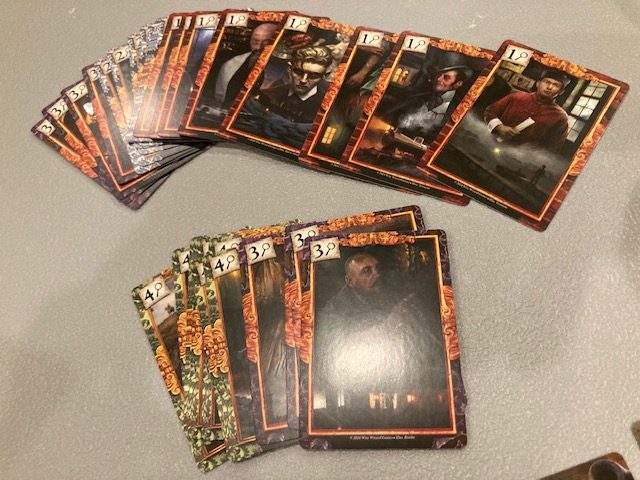
The cards are pretty gorgeous.
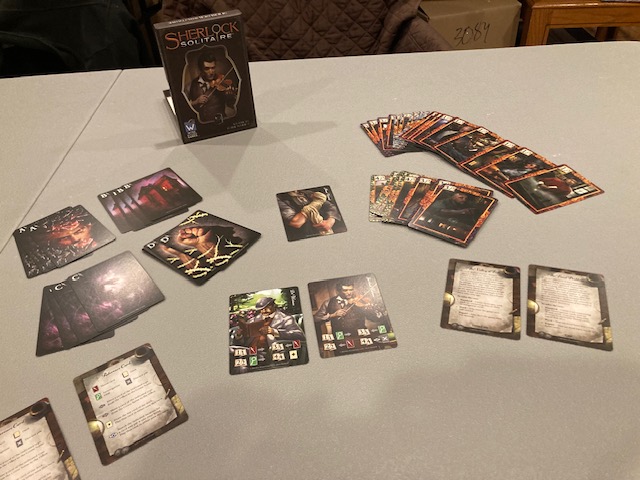
The game is very pretty on the table: see above.
Rulesheet Not a Rulebook
The rulebook is not a rulebook but a rulesheet: see above. Sigh. It’s a pamphlet.
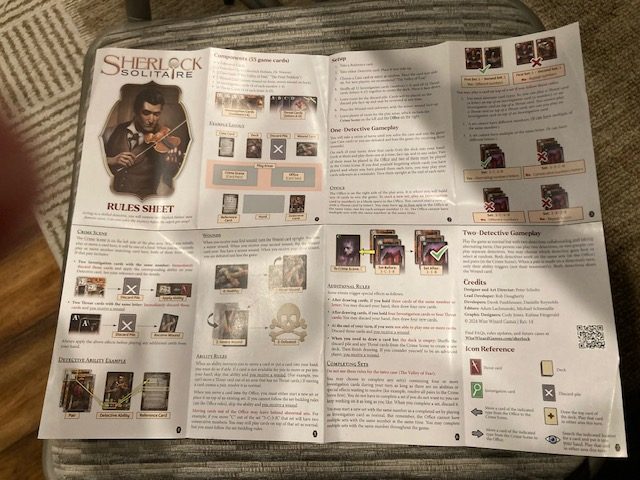
Considering it’s a pamphlet, it actually does ok on the Chair Test! It fits on the chair next to me and I can read it! The font is a little small (because it’s a folded pamphlet), but it worked on the chair next to me, as I consulted it during gameplay.
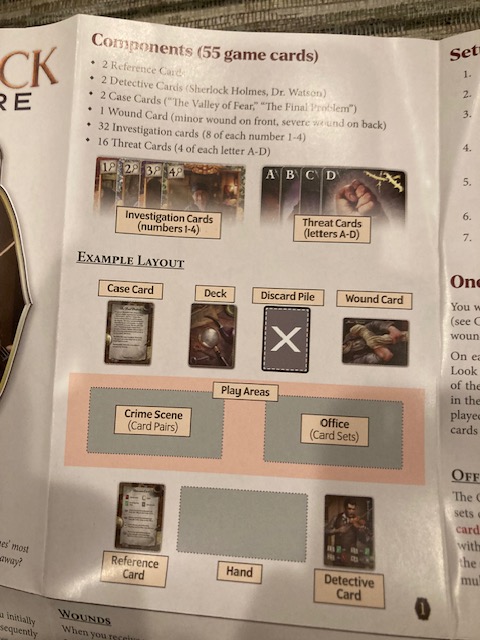
The set-up was pretty good: see the picture above.
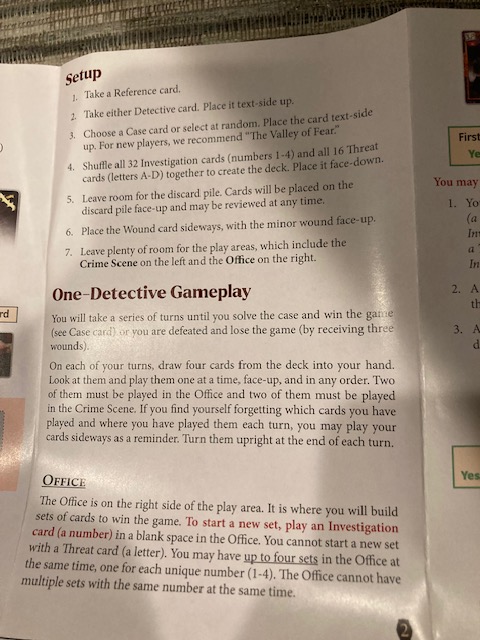
The rules are a little sparse, but they does work.
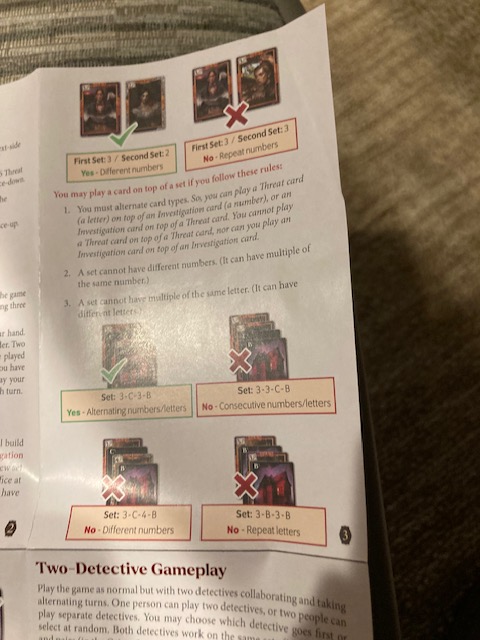
It even does a decent job at showing examples and counter-examples of “what is a set”! I appreciated that set of pictures!
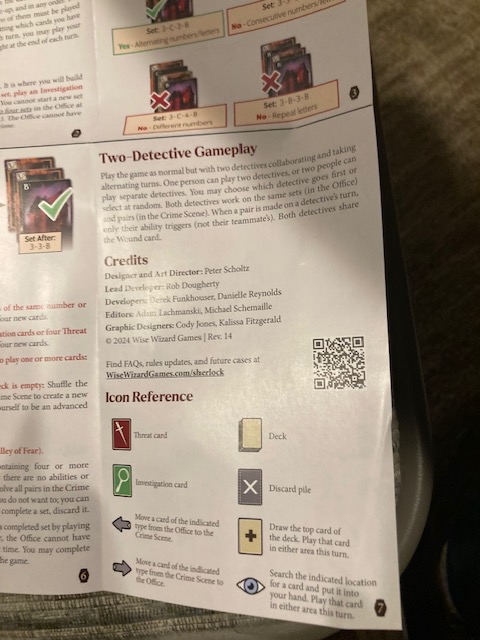
Given the constraints of a pamphlet, this rulesheet worked pretty well. The pictures were all informative. There were a number of places where some clarifications could have been provided, but the ruleset was simple enough and consistent enough that we were able to extrapolate rules when needed.
This was a decent to pretty good rulesheet.
Gameplay
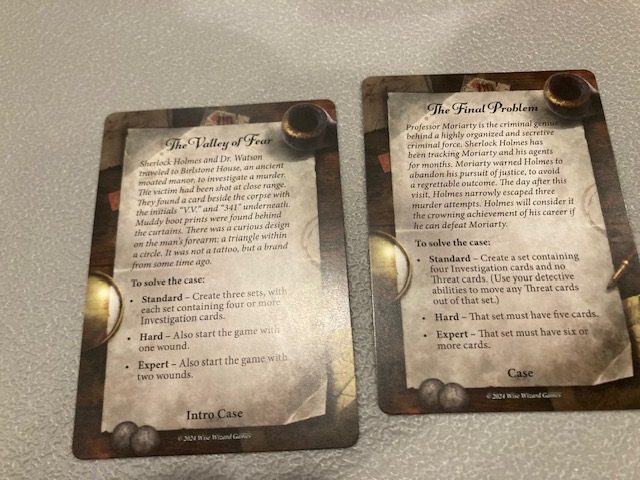
Choose a starting scenario: The Intro Case (The Valley of Fear) is just to get you into the game, so it has simpler win conditions. The Final Problem has a much harder win condition.
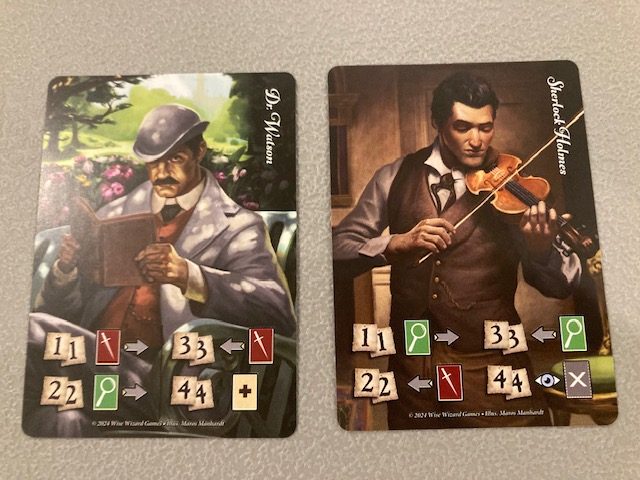
Each player (works for 1-2 players) takes either the Watson card or the Sherlock Holmes card. See above. The bottom of the card shows the special abilities of each player!
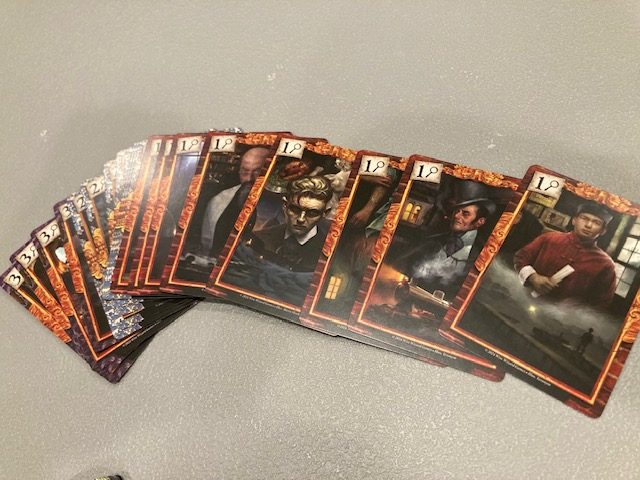
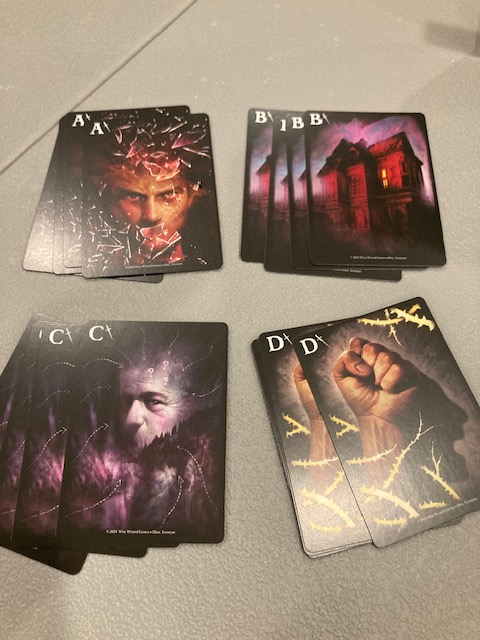
Basically, each character gets 4 cards on their turn to play to one of two areas: the Crime Scene or the Office. There are two types of cards: Investigator cards (labelled 1-4: see above) and Threat Cards (labelled A-D, see below).
Over the course of the game, the player(s) must play two cards to the Crime Scene and two cards to the Office each turn.
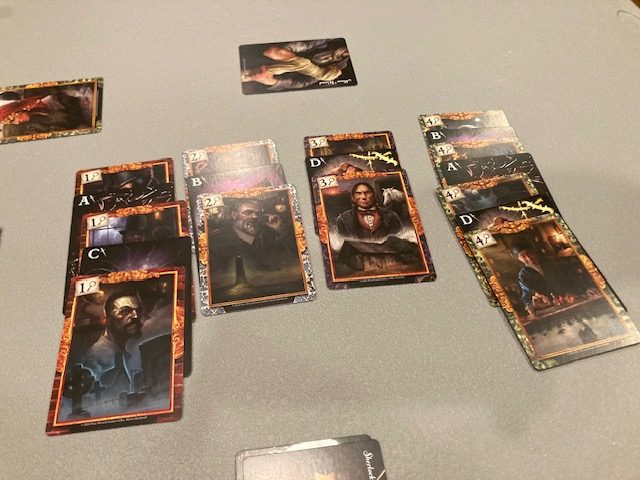
In the Office, you are trying to make sets of cards: you have to alternate investigator and threat cards (numbers and letters … see above). All investigators (numbers) must be in the same column, and all letters must be distinct in a column: these are the “sets” the players are making. If you get 3 full sets (4 investigators), you win!
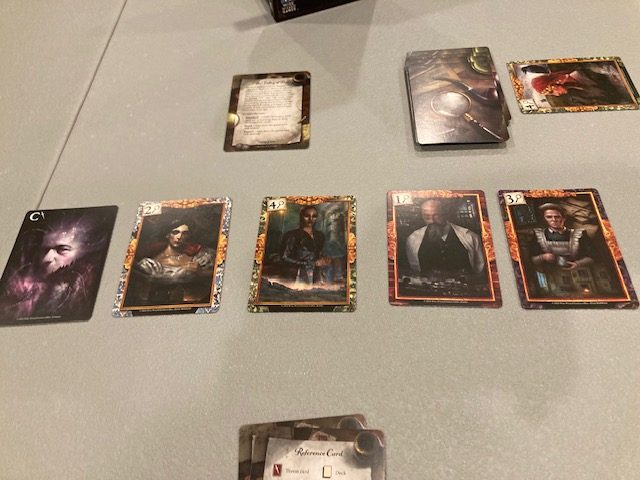
However, you still have to play two cards to the Crime Scene as well: see above. If you ever get 2 of any type of card, you immediately discard those two cards and “do something!”
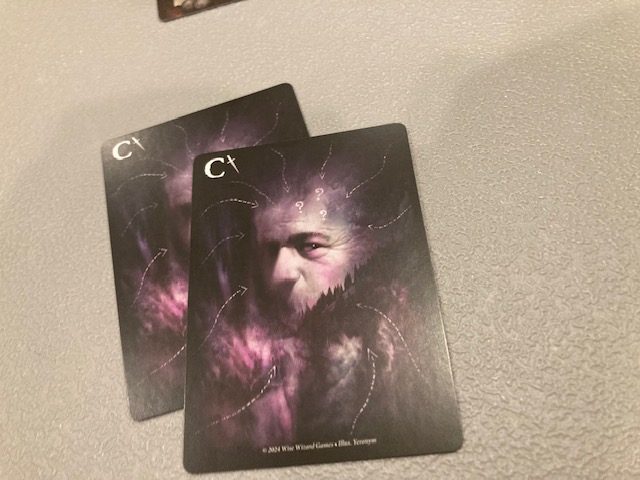
Two threat cards? You take a wound! See two threats above …


The wound card is a “timer” of sorts: if you ever get 3 wounds, you lose!
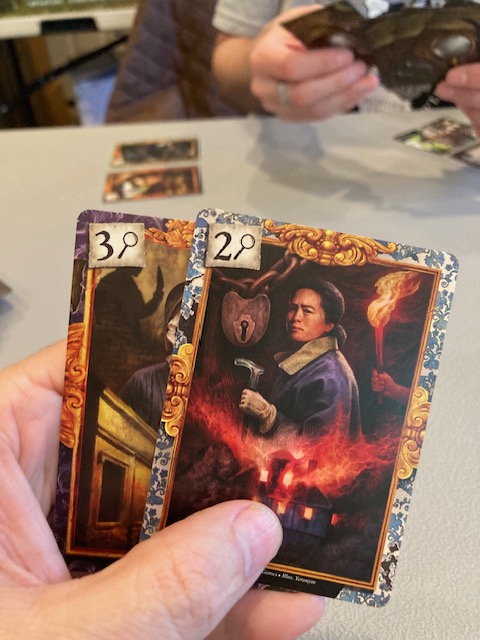
If you get two investigators on the Crime Scene, you invoke your special powers!
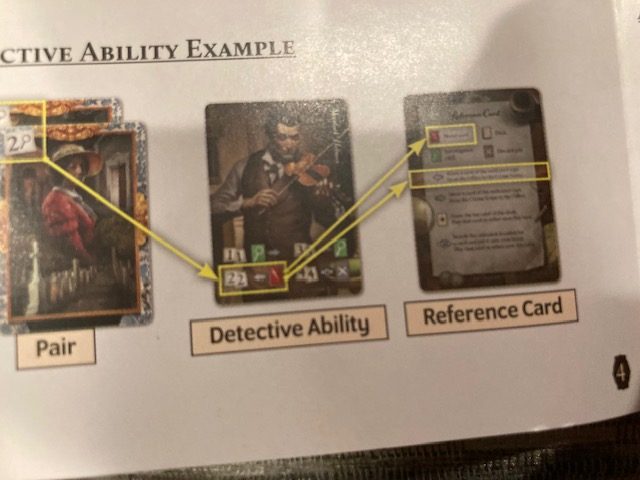
The rulesheet does a nice job of summarizing of how to use your special powers … see above.
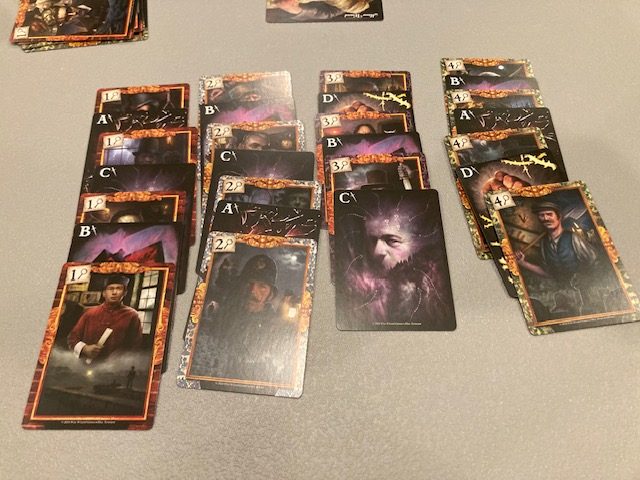
If you get enough sets, you win! If you get 3 wounds, you lose! It all happens in about 20 minutes.
Solo Play
A game called Sherlock Solitaire had better have a solo mode! It does (thank you for following Saunders’ Law): it’s the main way to play!
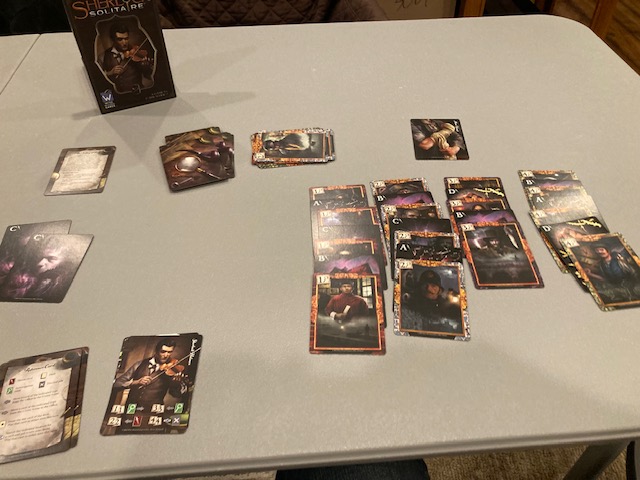
Once I got past my first few games (after I had to decipher the rulesheet), the game moved pretty quickly.
The best part of the game was when I could be clever and play my special abilities in a clever way to move cards to/from the Crime Scene/Office. The worst part was when I just played cards and didn’t feel like I had a lot of choice. The game was a fairly engaging way to spend 20 minutes. It really did feel like a game of Solitaire as I moved cards around.
More Solitaire Than Sherlock
With a name like Sherlock Solitaire, you might be expecting something more like a mystery. No, this is a lot more Solitaire than Sherlock: you are just playing cards like a game of Solitaire.
Don’t get me wrong: I love the art! The art that comes with this game is gorgeous and very evocative of the Sherlock Holmes stories!
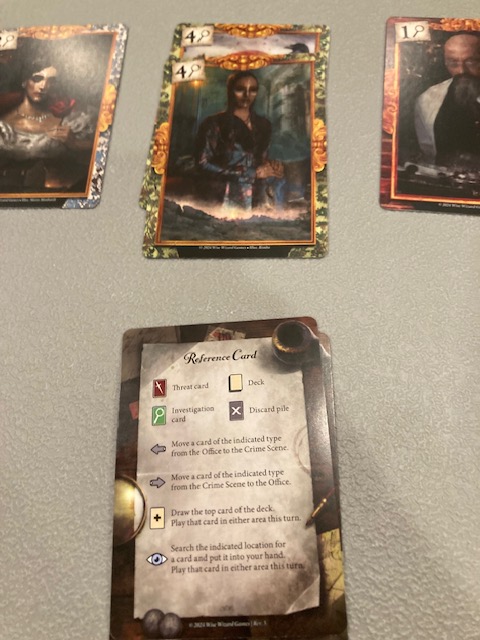
In the end, though, there is no mystery to solve. There isn’t really a lot of theme: this could have been a Cthulu game, a Zombie game, or a Smurf game. Or anything. Nothing about the gameplay really has to be in a Victorian Sherlock Universe.
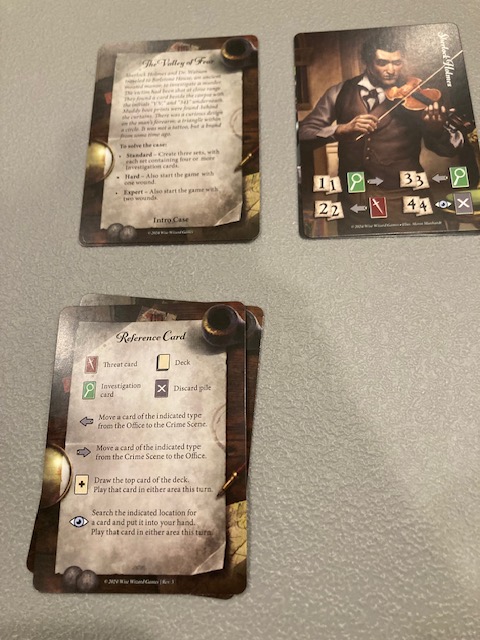
The art is really the only thing that makes you think of Sherlock Holmes: and it is phenomenal art!
Two Player Game
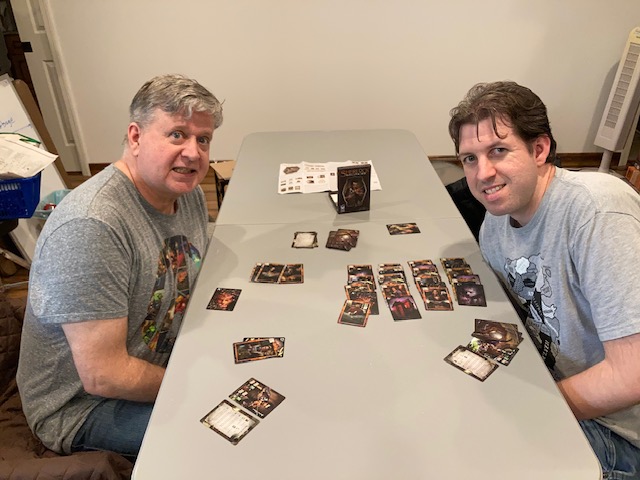
I had to wait almost a whole month to play with Sam!! He was interested in the game, but was busy with family and work all March.
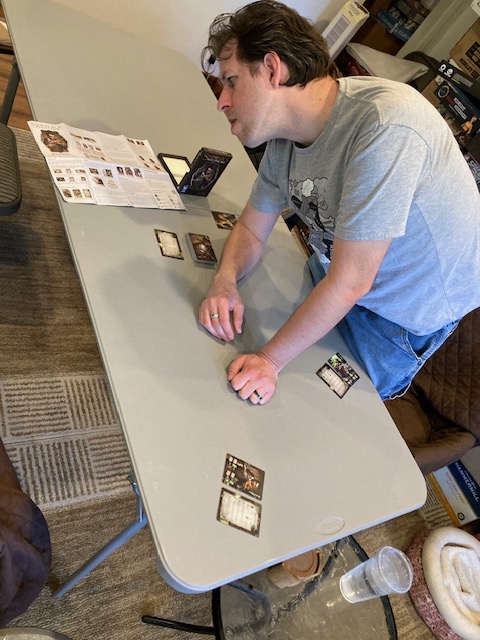
There are two ways to play Sherlock Solitaire 2-Player:
- Play as the solo game, but both players together make all the decisions
- Each player takes Sherlock and Watson, and alternates turns
We chose to alternate turns. The solo game with 2 players making all the decisions seemed less fun … and at that point, it’s just the solo game anyways.
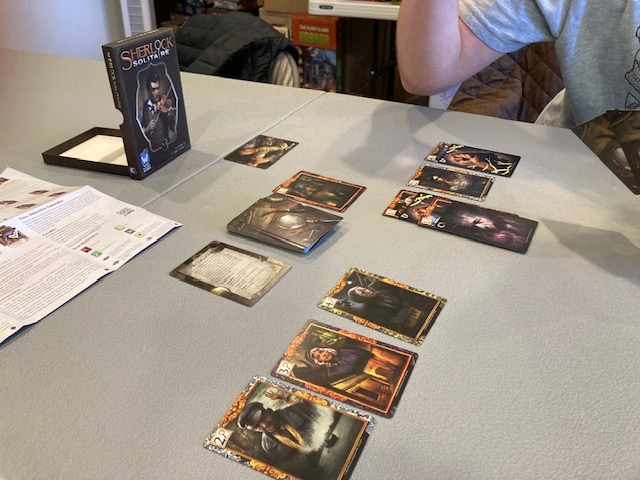
What we found was that … the second player got a little bored. There is no strategy in a 2-Player game, as you have no idea what cards you get until your turn. What that means is that if you are waiting for you turn, you can do nothing useful!! You just sit there waiting for your turn.
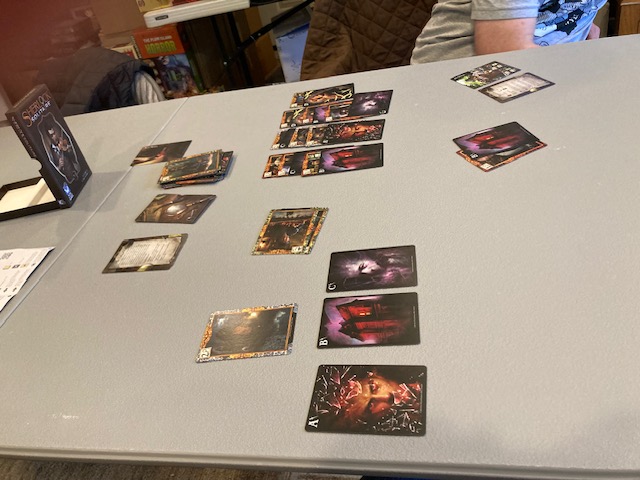
The two-player game was much less interesting, as someone was always “waiting” with nothing to do.
… until we tried a little house rule.
House Rule for Two Players
When it’s not your turn, draw some cards! Instead of sitting there “doing nothing” during your friend’s turn, you can then “be thinking” about what you want to do when it’s your turn! To keep this from being too overpowering (from the game balance perspective), we choose to just draw two cards at the end of the turn and two at the beginning of the turn.
That way, we were still playing four cards per turn, but had a hint of what we could on our turn.
Weirdly, me and Sam didn’t feel like this changed the game balance too much, and in fact didn’t change our turn too much, but it felt like it mattered! With this simple rule, we both felt more engaged, even if it didn’t change the game too much! We felt like we mattered more, even if it was just a small amount! And that made a big difference.
Conclusion
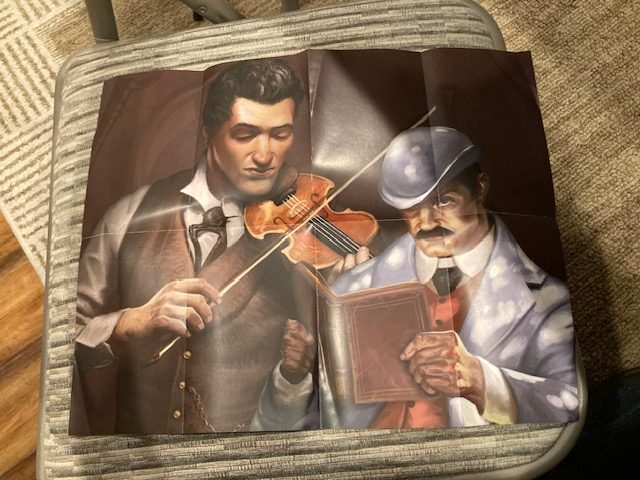
If you were expecting something with a mystery of some sort, then Sherlock Solitaire may be a big disappointment. There’s a lot more Solitaire than Sherlock in this game: it’s basically just a card game about making sets and moving cards.
The special powers of the Sherlock and Watson characters make the game interesting, as you can make many moves in the game that make you feel clever.
And despite the lack of theme to this all card game, the art is still very nice and evocative.
As a solo game, I’d probably give a 5.5 or 6/10. I might play it again: it’s pretty straight forward and quick … and there are moments where I feel clever. I freely admit that the art brings it up the score a little bit: the fantastic look makes this game stand out on the table.
As a two-player game, I would give the unaltered game a 5/10: there was just too much downtime between turns. If, however, we played with our house rule (always having two cards in your hand), then I would bump this up to a 6.5/10! We felt much more engaged even if it was just our preception! My favorite way of playing Sherlock Solitaire was 2-Player with our house rule: that’s probably how I’d play it again.
 coopgestalt