
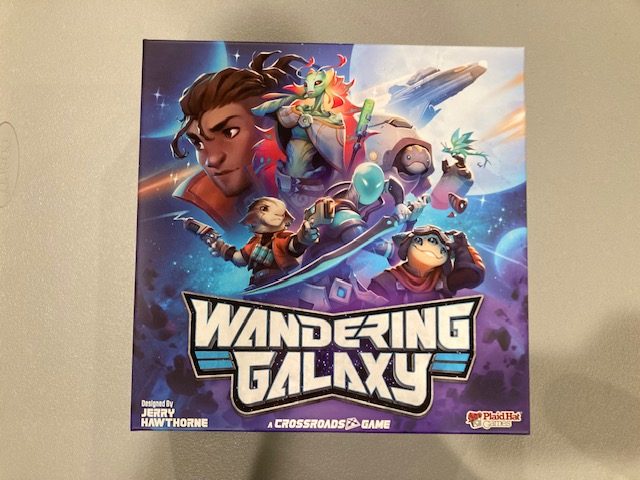
To be clear: you are wandering the Galaxy, but it turns out the Galaxy itself is wandering (if you believe the intro text)! Wandering Galaxy is a cooperative adventure game for 1-6+ players and it is set in spaaaaaaaaaace! This is a silly cooperative game that kind of feels like Firefly if it were a comedy (with just a little bit of Star Trek thrown in). (I mean, Firefly is already kind-of a comedy, but I digress). (But this may be too many parenthesis).
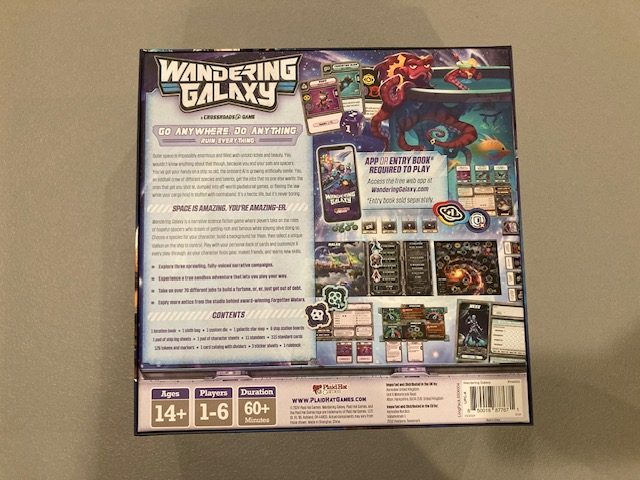
Wandering Galaxy was on Kickstarter back in July 2024, and promised delivery in December 2024. And you know what? They made it! My copy arrived about December 20th, 2024! With some qualifiers … see below …
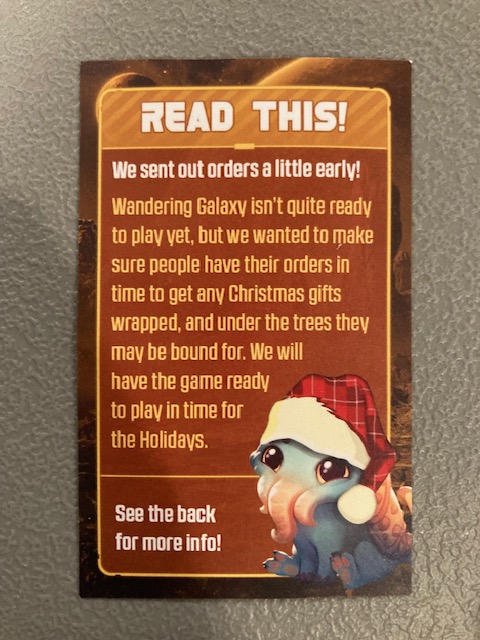
See above: So, the game wasn’t QUITE done, but the only thing left unfinished was the App. My physical copy arrived but the app still needed some work. To be fair, I was able to play some of the game before the end of December, so it’s enough to say “Eh, close enough”. I’ll call it on time.
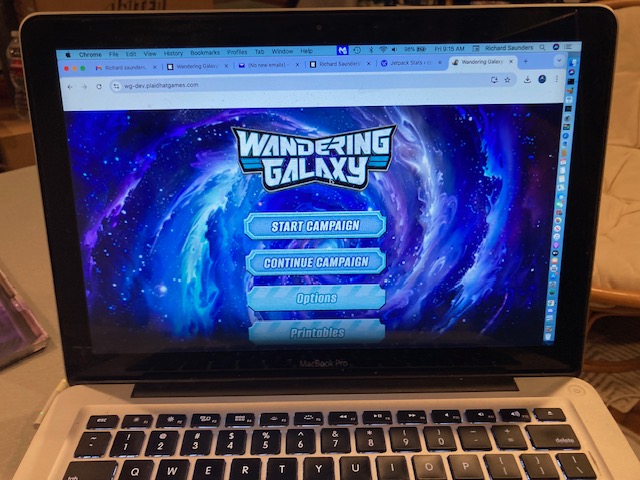
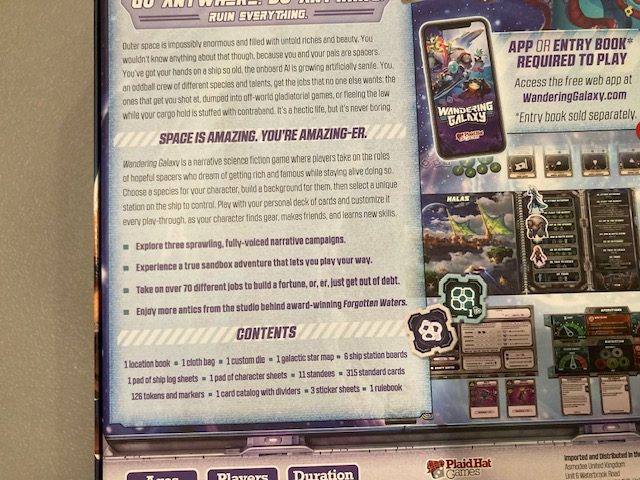
Let’s be clear! Wandering Galaxy requires an App (or the Entry Book … more discussion later if you are violently opposed to an App).
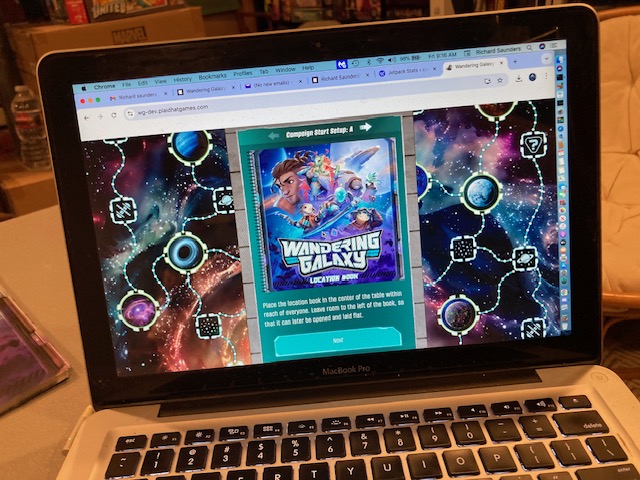
They say “App”, but it’s really more of a web portal situation: point your web browser at WanderingGalaxy.com and go! It reads the text to you!!
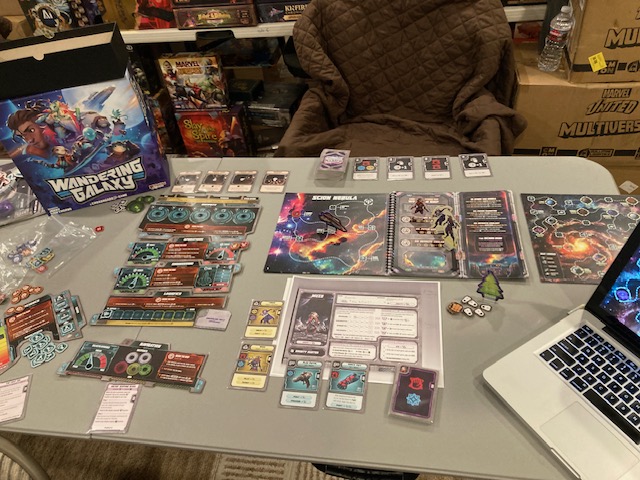
So, what is this? Wandering Galaxy is a cooperative campaign game with many different mechanisms: story-telling, worker placement, bag-building, deck-building, pickup-and-deliver, and even a little bit of a real-time! It is both paradoxically a lighter game and a heavier game! The gameplay is light and fluffy and moves along quickly, but there’s a lot of stuff underneath the hood that keeps this from being “just” a dumb little game!
What do I mean by this? Let’s take a look below!
Unboxing
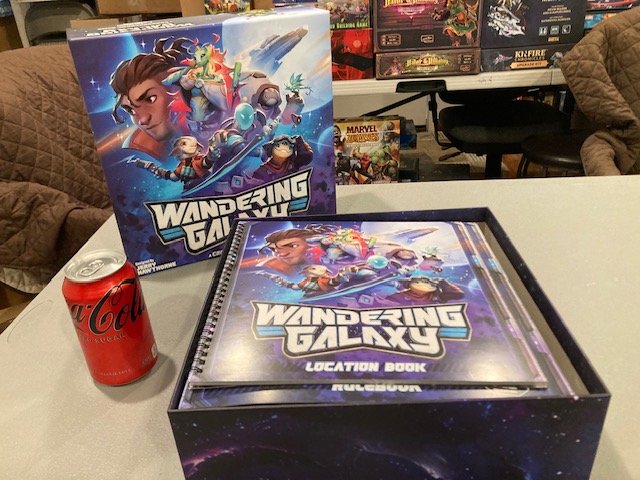
So, this is a pretty standard sized game box, about Ticket To Ride sized. See above with Coke can for perspective.
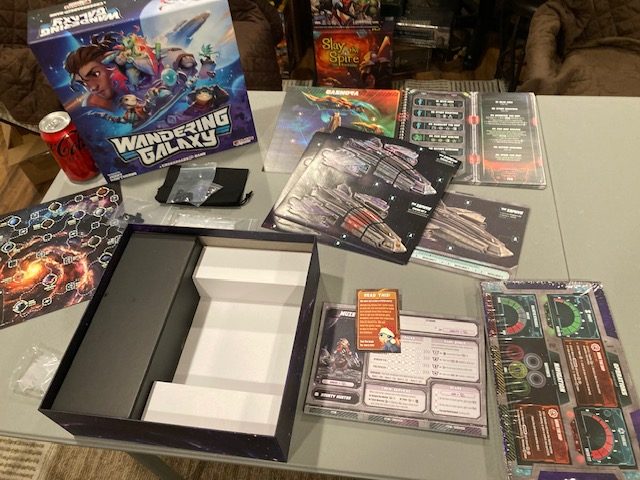
There’s a decent amount of stuff in here! See above! Lots to punch out!
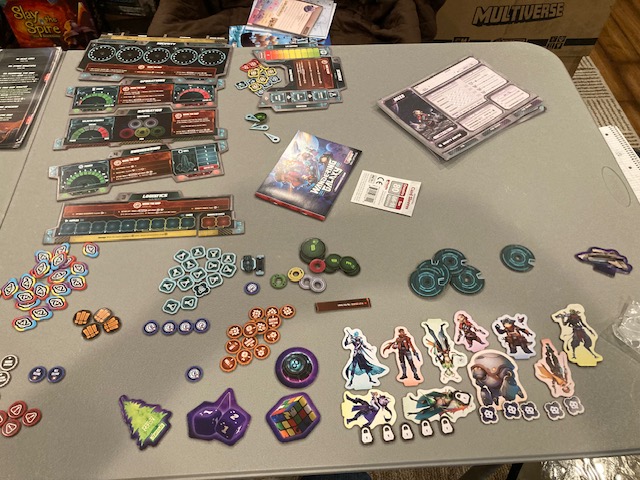
There’s a lot of tokens to punch out! Whew! Luckily the game includes some bags!
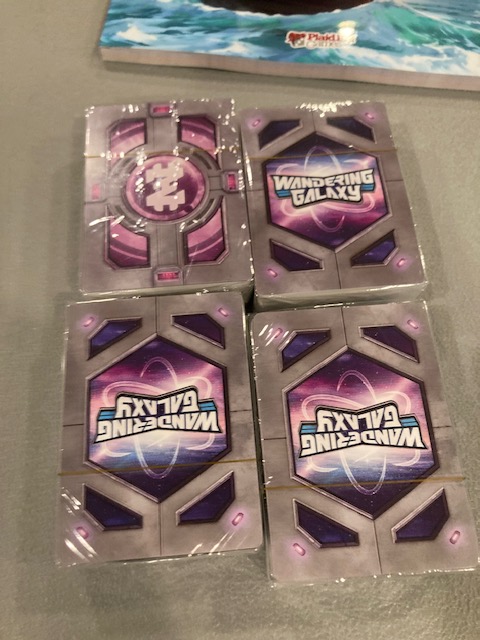
There’s also a fair number of cards in the game: remember how I said this was a deck-building game? There are the cards for your decks!
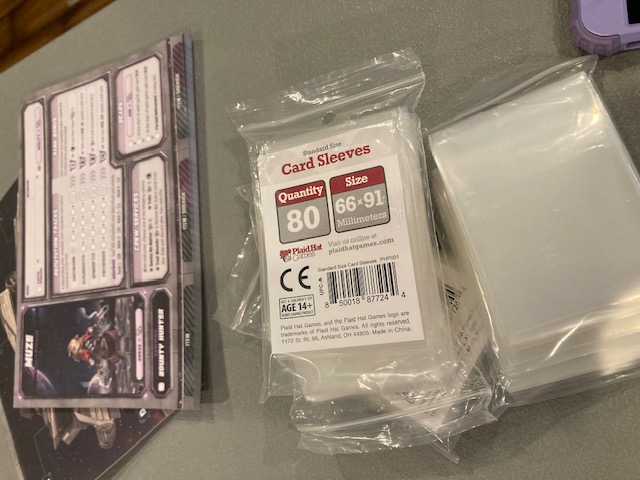
I got the sleeves for this: 9 times out of 10, if a game says it’s a deck-building game, you should probably sleeve it. (This might be the 10th game).
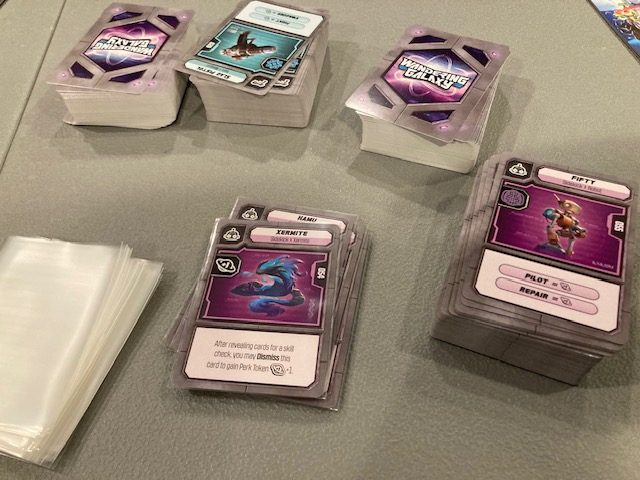
I spent WAY TOO Much time sleeving all the cards. See above!!! This card-sleeving was one of the first things I did when I got the game. I will say, after a few plays, I am not entirely convinced that this game needs sleeves. If you didn’t get the sleeves, meh, don’t stress: I don’t think you needed them. (I am addressing this to my friend Kurt who didn’t get the sleeves).
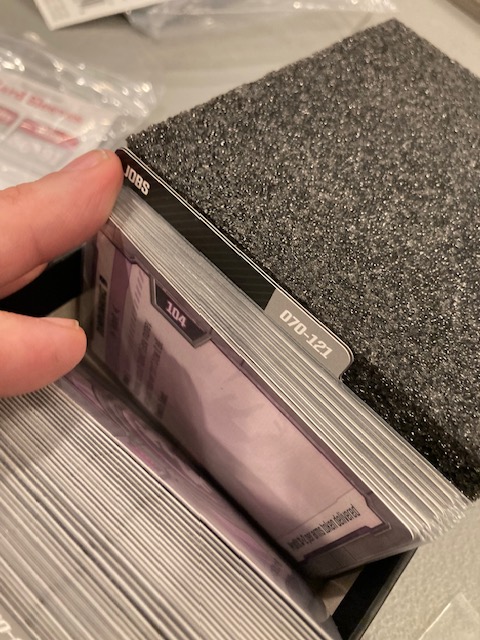
But there is a nice box for holding all the cards, with little dividers that clearly mark sections. And it looks like it would fit WITH or WITHOUT sleeves just fine. Little tip: it may look like some cards are missing (because of missing numbers), but probably not! Some are missing for “future expansion”: Check this BoardGameGeek thread for more details: Anyone missing cards?
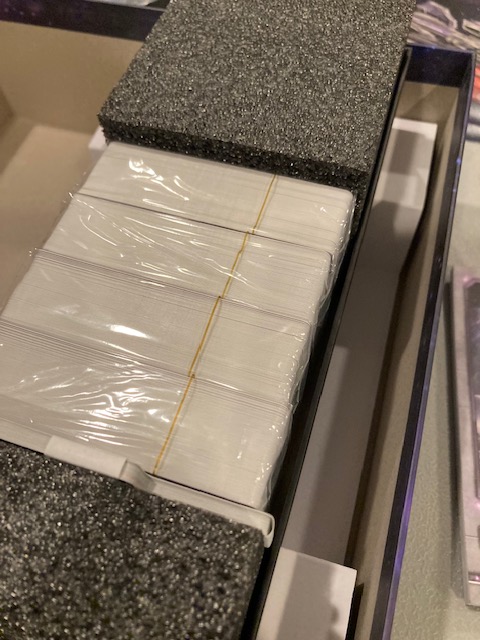
There’s a lot of other punch outs for the stations … see below.
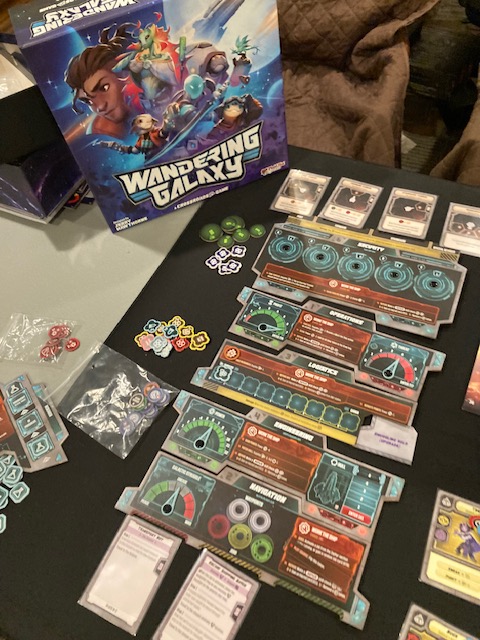
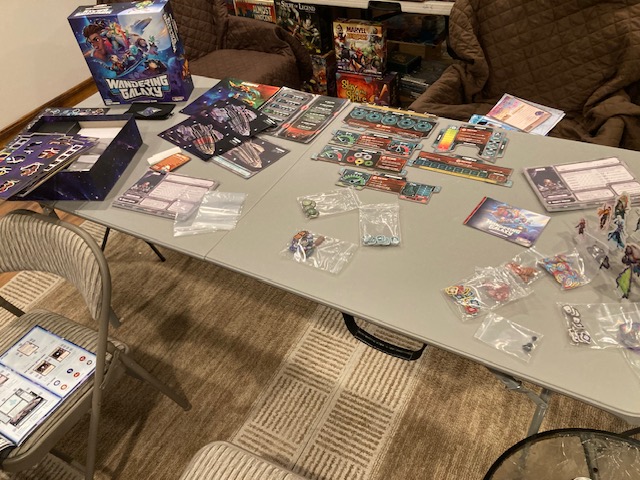
There’s a lot here, but it is very cool looking!
Rulebook
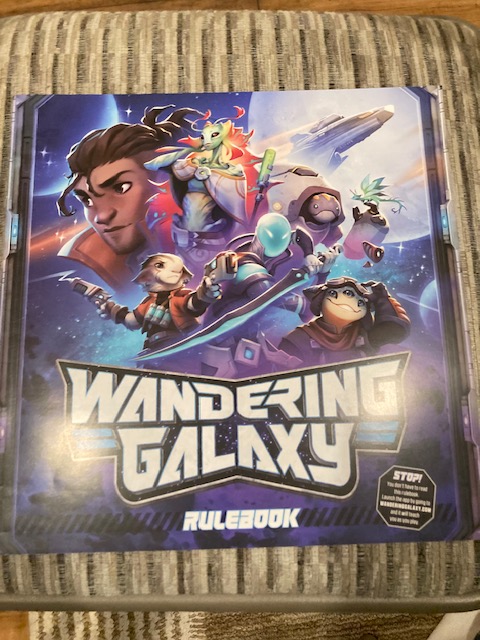
This rulebook … isn’t great.
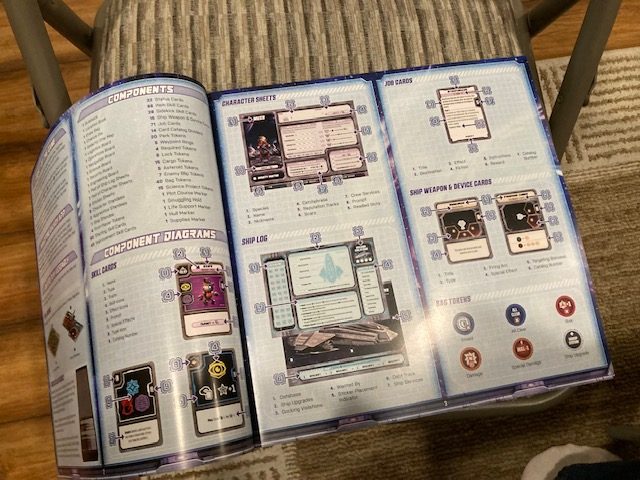
It flops over on the edges, probably get it a D on the Chair Test.
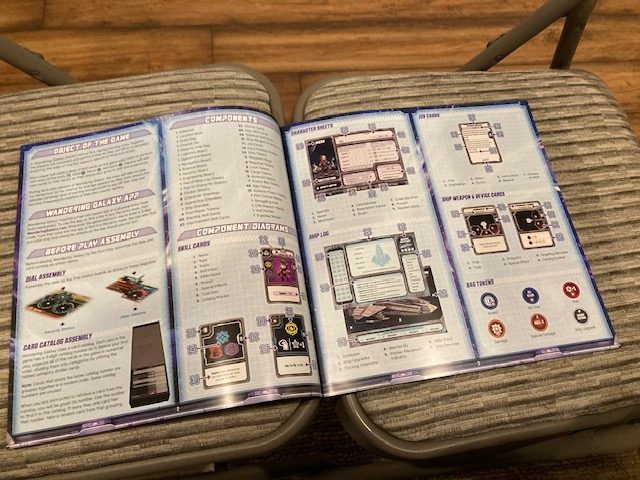
In the end, I had to use the standard workaround of putting out two chairs with the spine in the middle.
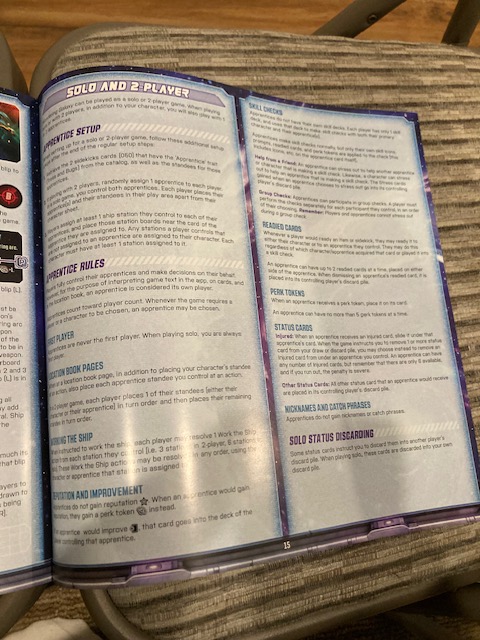
There’s a lot of stuff in here, but I also found there was a lot of stuff missing. For example: The travel section discussions were unclear: Do you spend 3 power on each section? Do you have to stop in each section on your way to your destination? The answer to both questions, according to this BoardGameGeek thread, is yes!!! I think you will find yourself on BoardGameGeek a lot when you have questions! Apparently the designer is very responsive on BoardGameGeek if you have questions, he answers quickly … so that’s good. There is also a Discord channel (mentioned when you bring up the app).
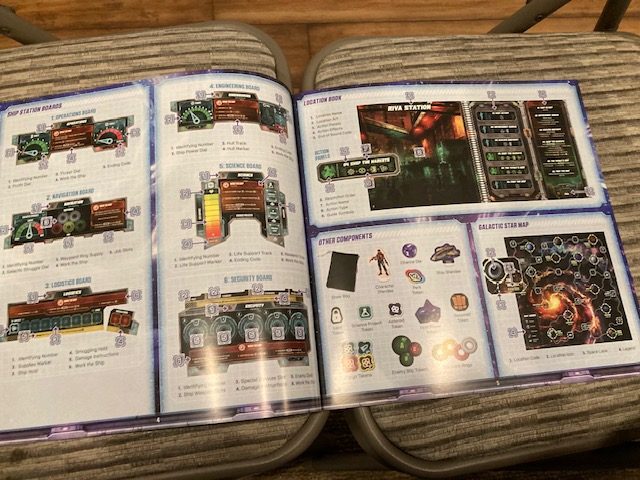
What I found is that the App is very good at helping you set everything up! I tended to use the App for all my set-ups and only use the rulebook to look up a few rules. In general, the App taught “most” stuff. A lot of things were in the rulebook (and there’s even an index)! But there was still a lot of stuff missing that you will have to look at BoardGameGeek for … Another example: What does a damage token do? It’s unclear unless you read this BoardGameGeek thread!!
So, quick summary: use the App when you can, use the rulebook with the index if you have to, then use BoardGameGeek if things are still unclear. You might go to BoardGameGeek more than you like.
Story-Telling
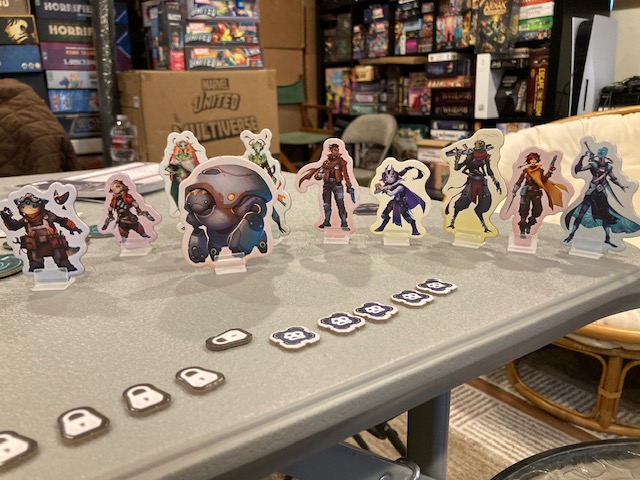
Everyone gets to play a different character in this game! The art and style of the minis sets the tone for the game: see above!! It’s very nice art, but with just a hint of silliness.
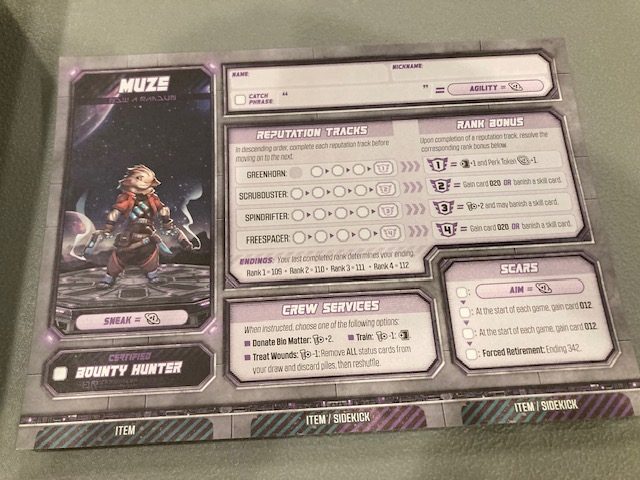
Each player chooses a character to play: there are quite a number of characters, and they each have their own special sheet. See Muze above … that was my first character!!! I ended up making a copy of the character sheets (using my crappy home copier; it was good enough) so I didn’t mess up the original sheets that came with the game. (There are a number of these sheets included with the game, but you can either print them yourself or just order more sheets from the web site if you don’t want to sully the sheets).
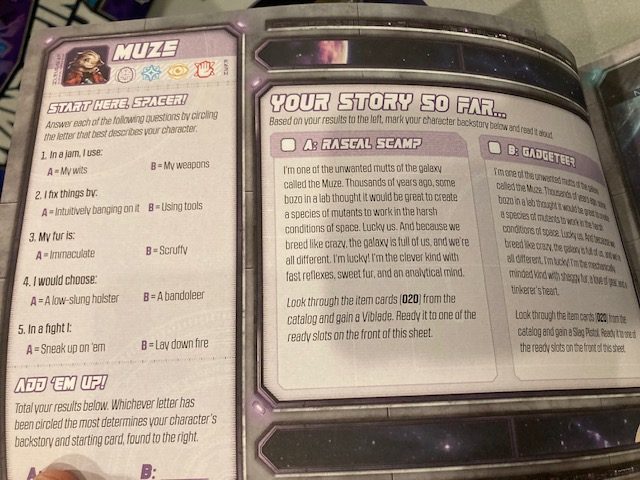
These character sheets are two-sided; the back has your “back-story” (no pun intended). You fill out the little questionnaire on the left, and that informs your Story So Far… (on right side of the sheet). This gives you some items and sets the tone for your hero! This is part of the Story Telling aspect of the game.
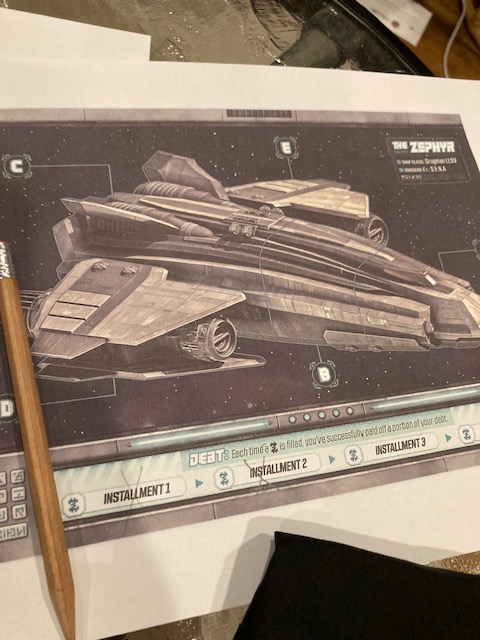
There’s also a sheet for the spaceship (I also made a copy as to not mess that up either).
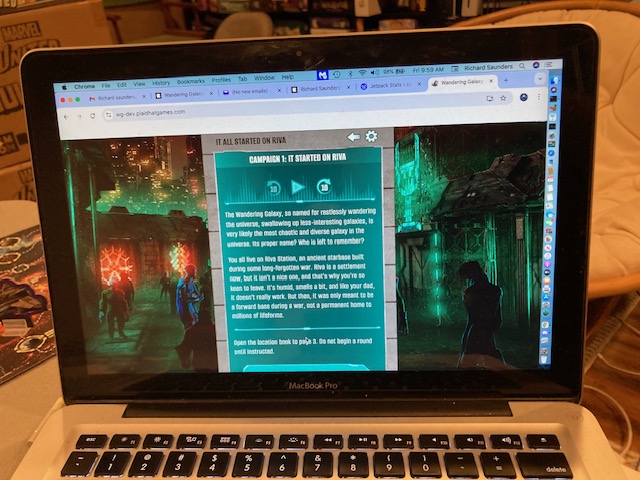
Of course, the App itself has most of the story! It’s pretty cool; it’s narrated with different voices and is pretty funny.
I would say, first and foremost, this is a Story-Telling game. All the other mechanisms in the game support that central tenet. You are all characters being swept up in this space opera!
Worker Placement
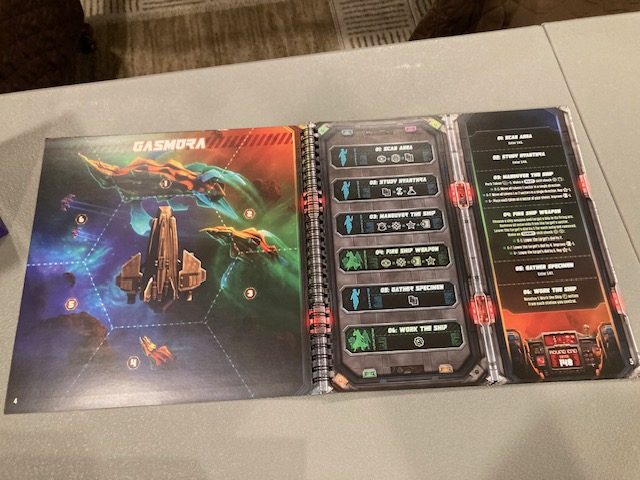
I’d say the next mechanism that you feel is the Worker Placement part of the game. The Location book (above) has the location on the left and the Worker Placement spots on the right.
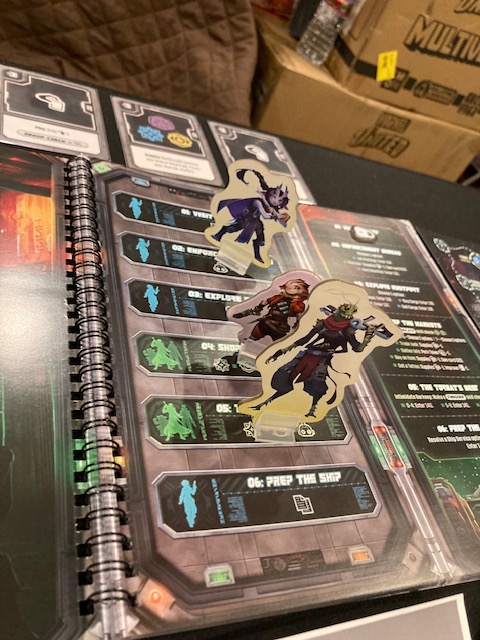
Players look closely at the Icons on the worker placements places and place their dudes there. This is cooperative worker placement, as you are all trying to work together to get certain things done. To avoid too much “analysis paralysis” or “Alpha Playering” here, the players have 45 seconds to place their dudes! (That’s the extent of the “real-time” part of this game. if you were worried about me saying real-time, relax! You can almost even ignore the real-time part … it’s really just to keep people from taking TOO LONG to play their dudes …)
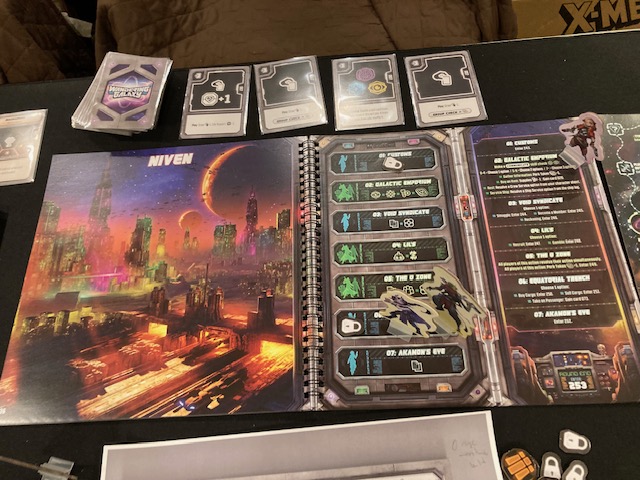
Once the dudes are placed, the right hand side of the page shows in detail what each action does.
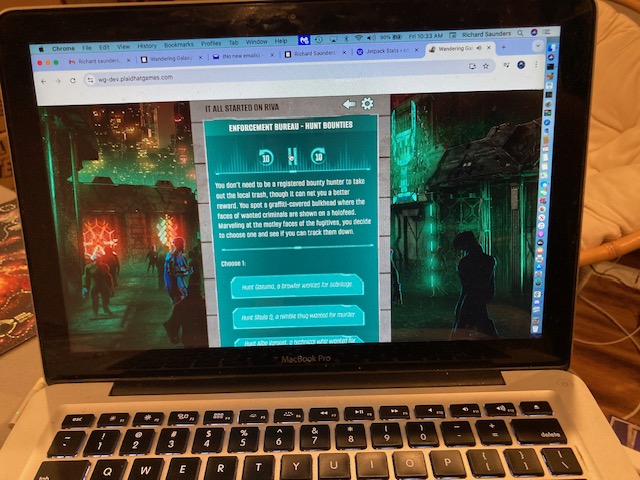
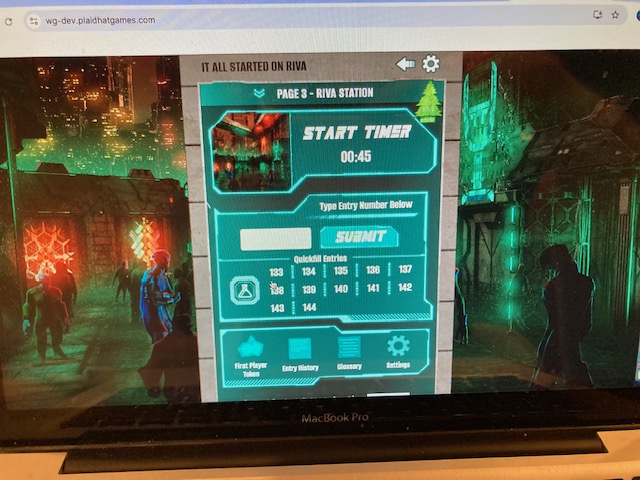
Sometimes your action triggers some text in the App; it gives a number (like 133, see below) and you lookup that entry in the App!
You spend a decent amount of time here on the Worker Placement pages. It wasn’t until my third game that I realized that the Combat also happens using the Worker Placement system …. what? Yep! You head to a special page where you are in “Combat!” Your actions move the ship (so enemies are in view), fire guns (port, starboard, ahead), or even work the ship to repair damage!
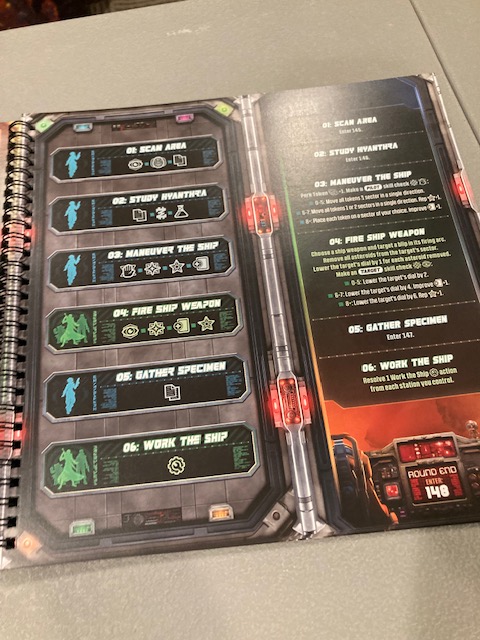
This Worker Placement system seemed to work pretty well, and it’s cooperative.
Deck-Building
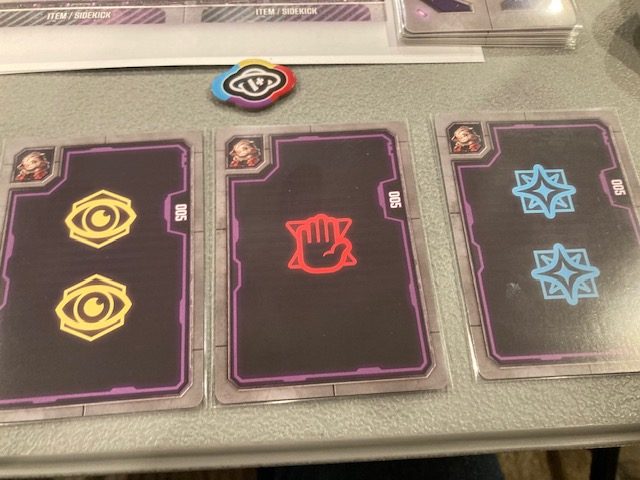
A lot of the game revolves around Skill checks … using your deck! (I told you there was deck-building in here!) When you need to make a Skill check (say Muze needs to SNEAK), you draw cards and add up the symbols that match that check! SNEAK needs blue stars and red hands, so Muse has 3 above. To be clear, the more symbols, the better! (You can also use PERK tokens, the little Saturn token, for extra plusses, but you do have to discard those)
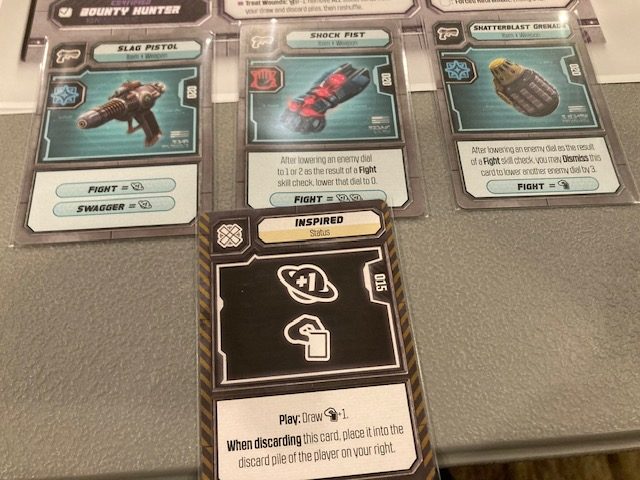
There’s also Items you can “hold” between hands, which you can choose to “help” in your Skill check. That’s kind of a neat gizmo in the deck-building mechanism.
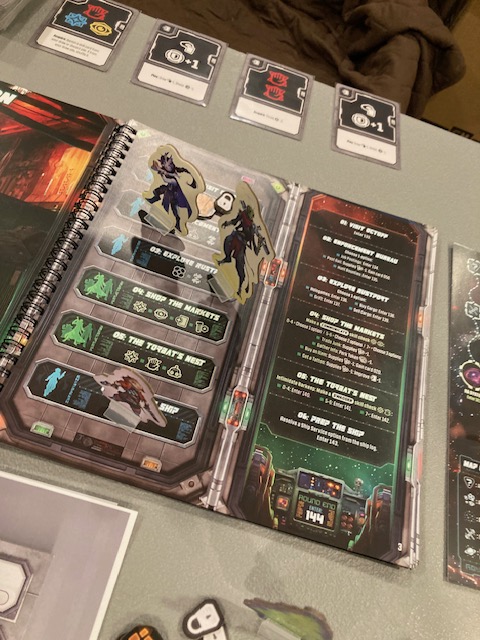
At certain times during the game, you have a chance to add cards (or cull) you deck based on the actions you take! There’s a nice set of 4 improvement card (above the the book, see above and below) that you can choose from! I mean, it’s deck-building: you have to be able to improve your deck!
Campaign
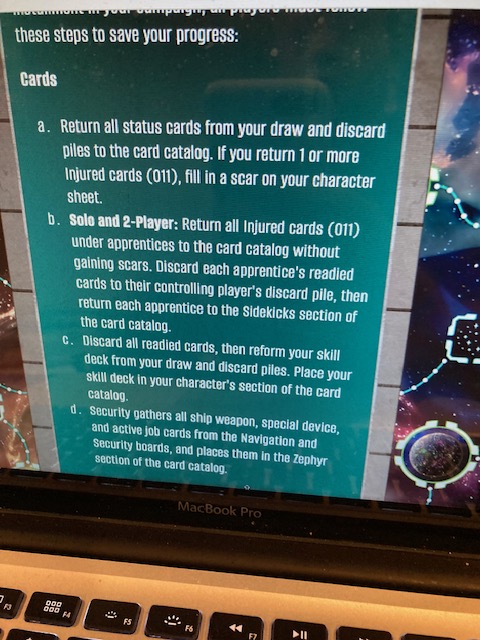
This is a campaign that can last … as long as you want it to! There is also deck-advancement, as your deck build survives between games of the campaign (luckily, you lose things like Injuries that can clog your deck).
So, when you finish your current game, you can just be done, or save off the game to play again later! Nominally, your first full adventure (spanning many games) will be paying off the loan for your ship!
Bag-Building
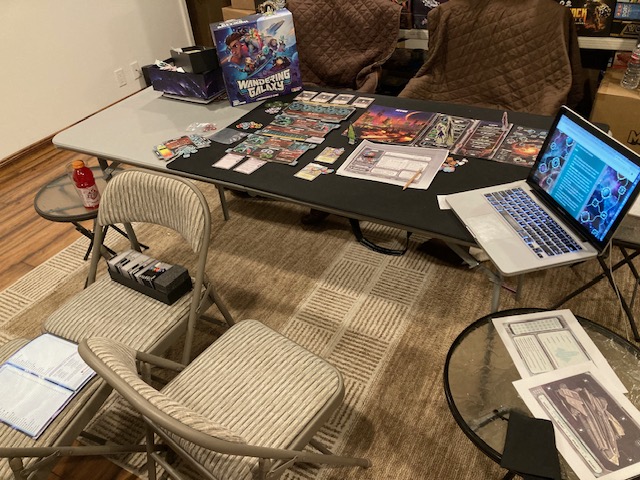
Even though there is deck-building in here (a deck for each character), there is also a bag-building portion! See the bag in the bottom right corner above!
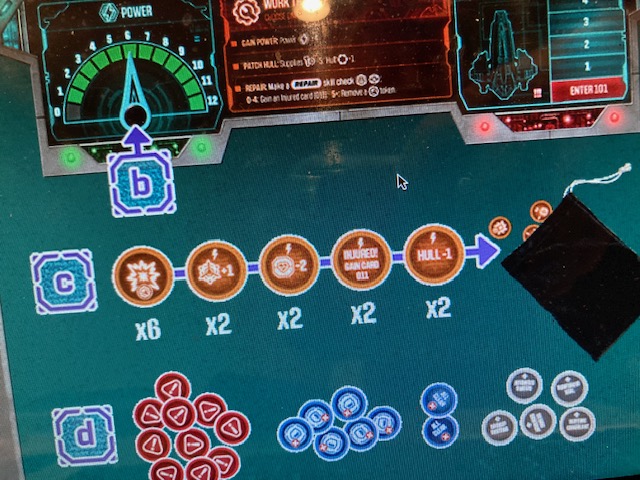
When you travel through space, you typically pull tokens from the bag to see “what happened” as you travel through space!!! (See the tokens you can pull above). Generally, travelling through space is tough on your ship as you take little bits of damage as you travel.
You can take time at Space Ports and other places to “Work the Ship” to help fix it back up (putting tokens back in the bag). It’s not a huge mechanism in the game, but it is important to be aware of what’s in the “travel bag” and try to keep it cleanish so that you don’t take too much damage as you travel. The bag also controls threat, which is how the game can end … poorly.
Star Trek
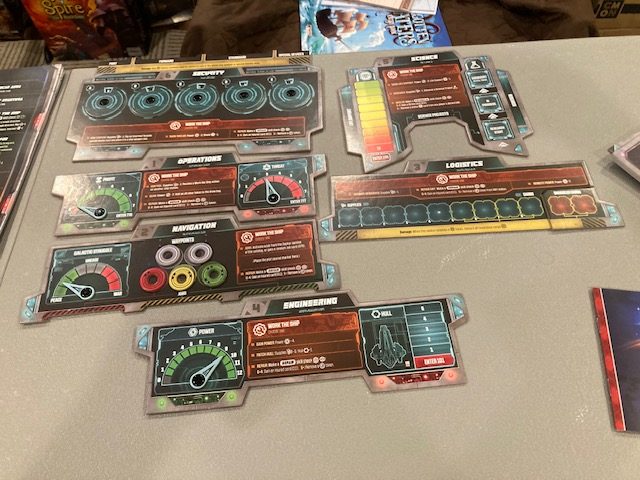
I said there was some Star Trek vibe in here as well … there is! There are 6 “positions” of the ship that must be manned by the characters! One player is the Engineer, one player handle Logistics, … Operations, Science, Navigation and Security! In a game with fewer players, some players will have to man multiple stations!
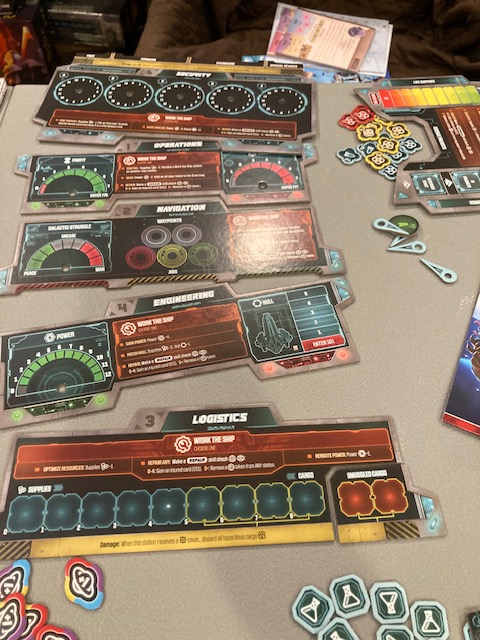
This reminds me of the characters sitting around the bridge of the Enterprise, with Spock manning the Science station, Worf manning the Security station, and Paris manning the Navigation station! (Look, I didn’t say WHICH Star Trek …)
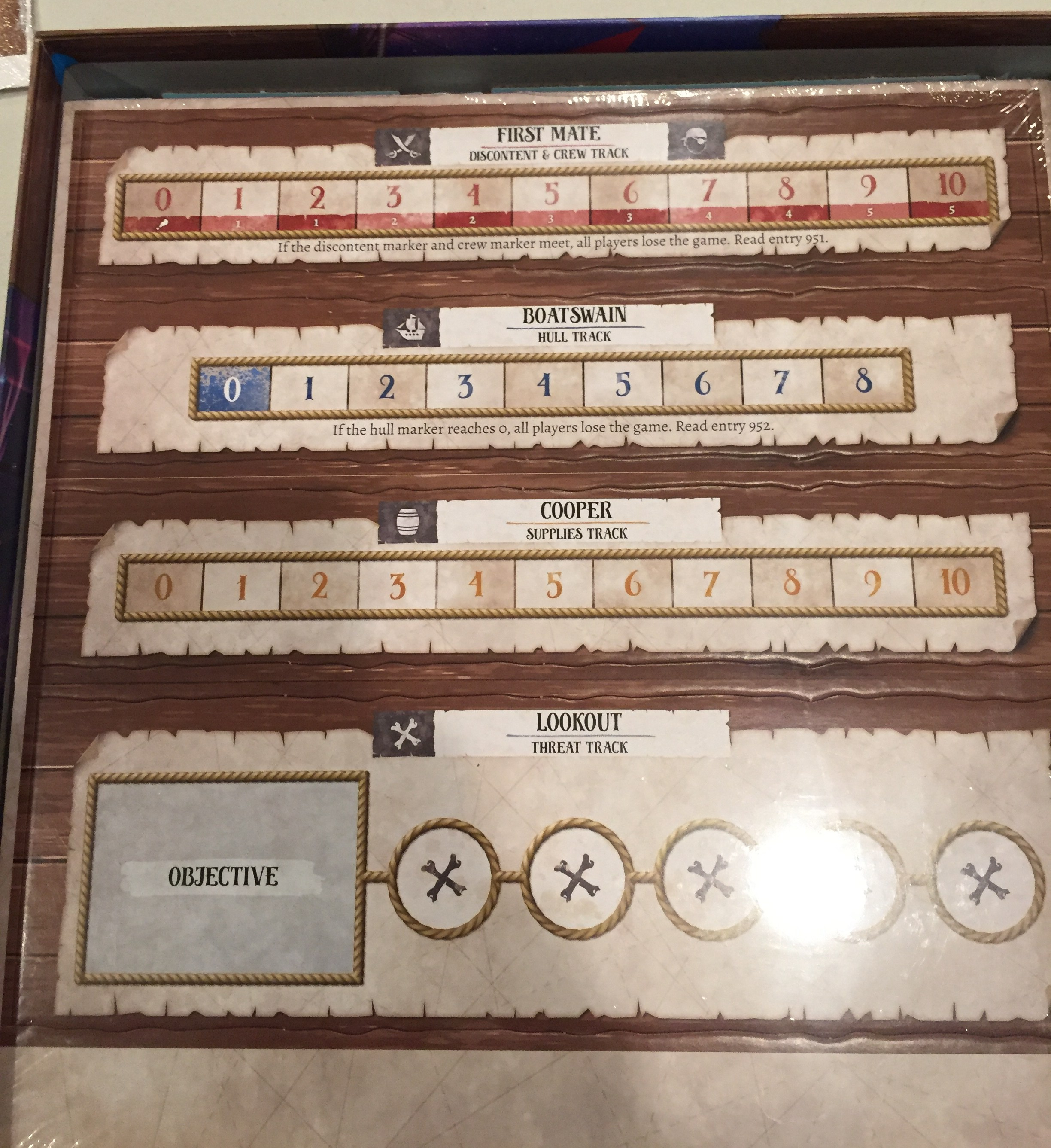
We’ve already seen this “station” idea in Forgotten Waters (see our review here) and Freelancers (see our review here)! Thematically, it worked great in Forgotten Waters (as pirates worked together to man the “stations” of a ship), and less so in Freelancers.
Thematically, it works really well here too. Basically, the stations help keep everyone involved in running the ship and contribute to the theme: we are flying a space ship together!
Pickup And Deliver
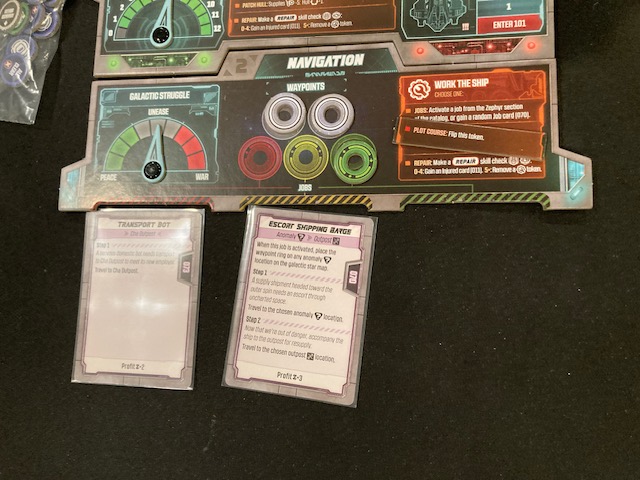
One of the main activities in this game is pickup-and-deliver: you are a space-faring crew wandering the stars, looking for adventure, but usually you are delivering stuff to make ends meet!
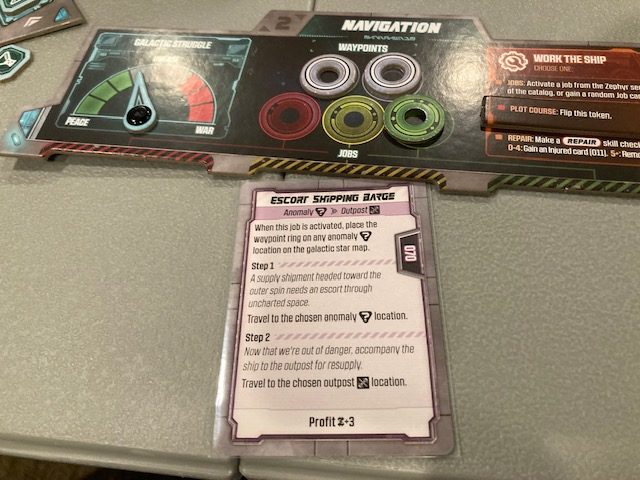
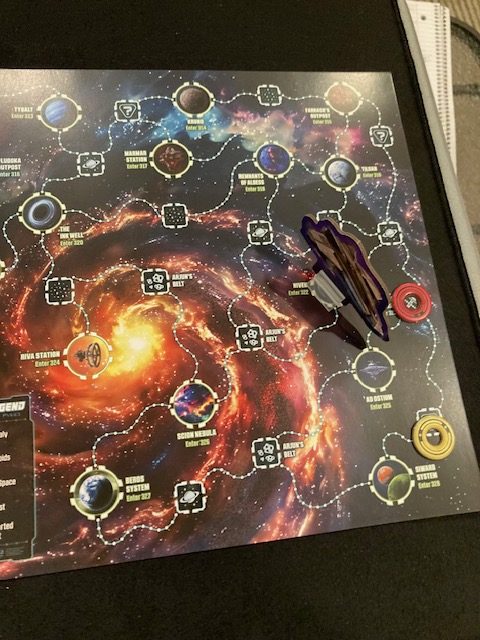
The Jobs you get (above) inform where you go on the star map (see below) by marking them with little waypoint markers.
The yellow waypoint marker is the yellow job (Escort Shipping Barge). This pickup-and-deliver mechanism sort of guides were you go in the game. If you don’t like pickup-and-deliver, you might still like this game, as there are so many other mechanisms in the game. If you do like pickup-and-deliver, then you will be happy.
Solo Play
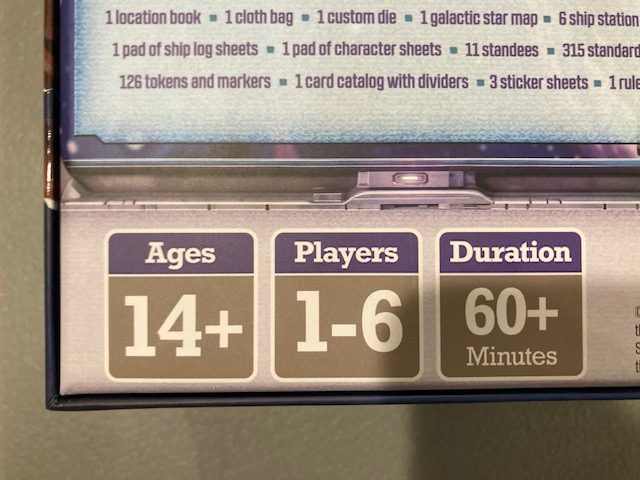
So, Wandering Galaxy embraces the solo player! (Congratulations on following Saunders’ Law!). I am surprised a little because the previous games in this series (Forgotten Waters and Freelancers) supported solo mode, but they were bastard step-children solo modes that were only supported by consulting the some arcane rules on the web site! Okay, maybe I am exaggerating a little when I say that, but Wandering Galaxy really does embrace solo play.
The rules and the App support solo play as a first-class mechanism! The app asks you how many people are playing and helps you set-up the solo game in the normal flow!
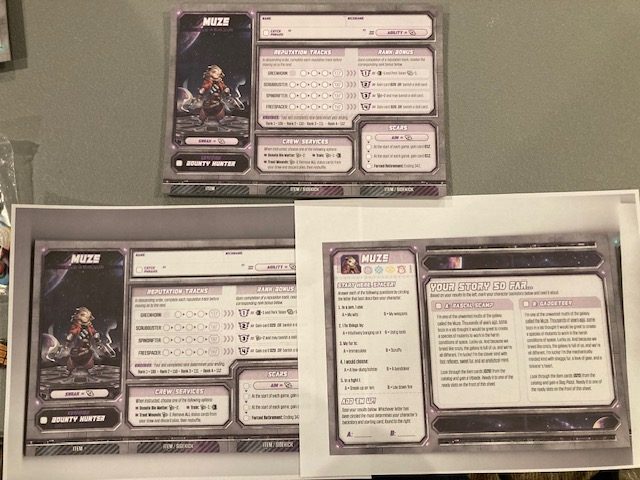
The solo player still operates one the main characters: see above as I operate Muze … (notice I made a copy of the sheet…)
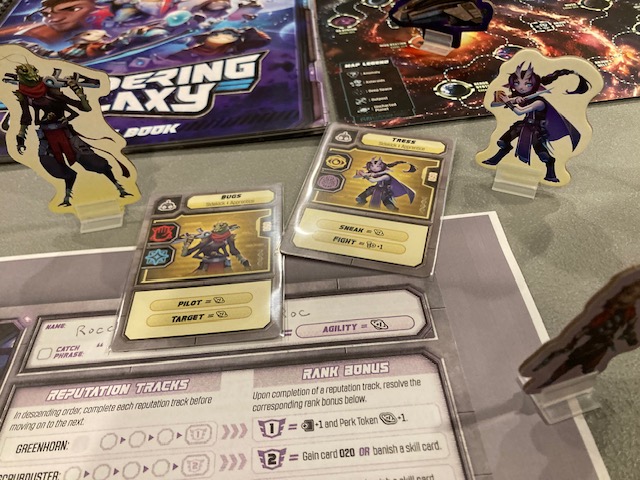
…. but the solo player gets to control two Sidekicks (see Bugs and Tress above). These Sidekicks aren’t “full characters”, but they are much much easier to operate. Normally, I don’t like solo rules that go too much outside the normal flow (I usually prefer to play multi-handed solo), but the app was so helpful in setting this up and getting to solo play that I didn’t mind!
So, when the solo players does Worker Placement actions, the solo player plays his player, and the two Sidekicks as well.
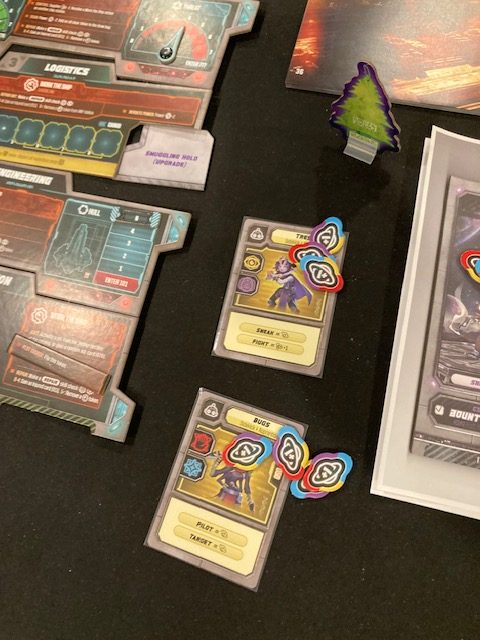
This means the solo player is also controlling all six stations! Interestingly, you still have to assign one station for each of Bugs and Tress. See above as Bugs and Tress each have a station (to their left).
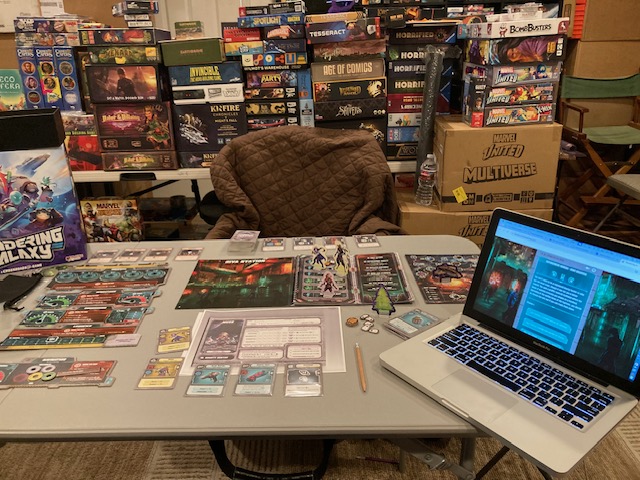
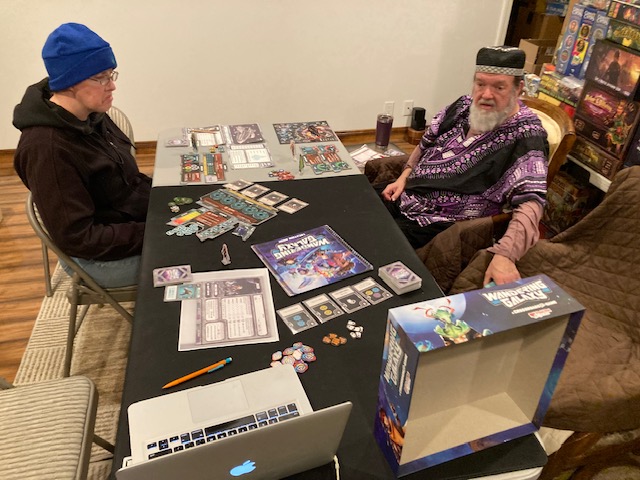
See above as I have the 6 stations, my character Muze, Bugs and Tress, the Worker Placement book, the map of the Galaxy and the App open! Whew!
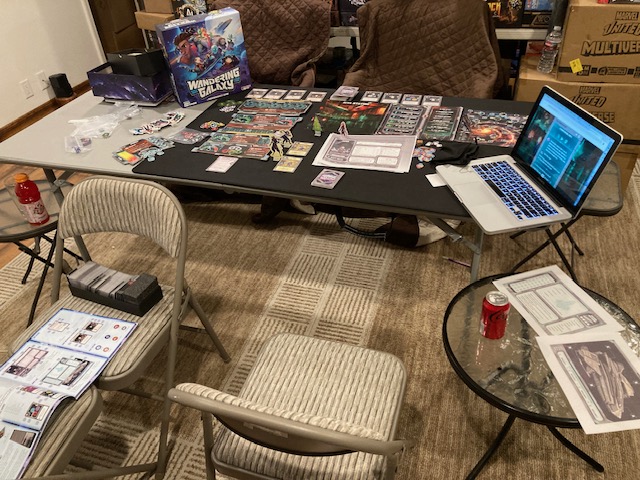
And then the solo player still has to manage the cards (see chair on the left with the card box) and the ship (see the table on the right with the ship)! And, occasionally the solo player must still consult the rulebook! See as the Rulebook sprawls across two chairs …Whew!
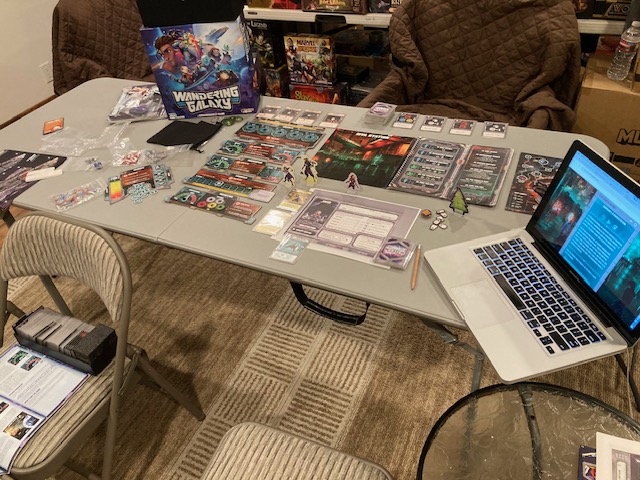
… and it’s actually not that bad. Sure, there’s a lot of stuff to manage, but the App takes you through the game pretty darn well. I played my first few games solo, and I had a good time. I never felt like the ongoing maintenance (to keep the game moving forward) was too much work.
Setting up is a bit of work, as is tearing down (see above), but again, the App helps guide you through it. I’ll be honest, the Rulebook for this game looks daunting (with set-up and rules), but let the App guide you and just use the rulebook when you “have to”!
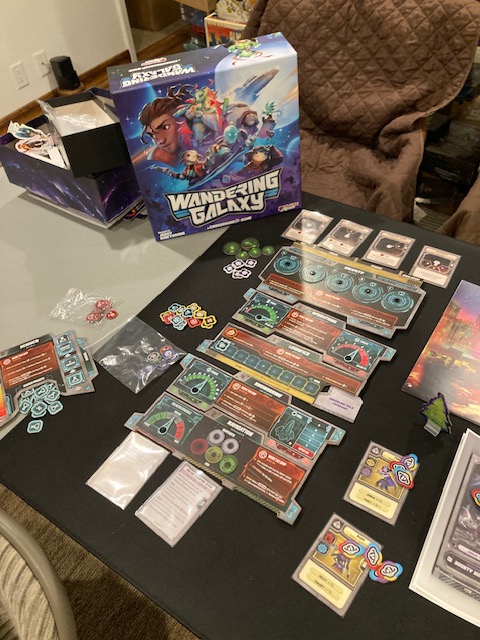
I thought the solo game worked well, even better than Forgottten Waters or Freelancers. I jumped right on and had a grand time. I would definitely play this again solo. I honestly think the App made the solo play that much better.
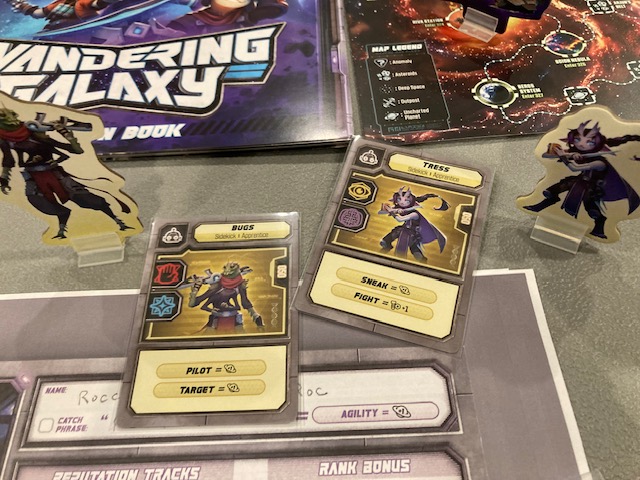
What about the Sidekicks Bugs and Tress in the solo game? They really are easy to operate: you just use your deck but get slightly different bonuses (depending on which character: Bugs is good at Piloting for example). They kind of remind me of characters on Star Trek you see in the background all the time, but don’t get much development. They aren’t full “main” characters who get their own story arcs … like “unnamed Corporal 2”. For example, when Bugs or Tress would get REPUTATION (a fun way to move a character story forward), they just get a PERK token instead. Poor Bugs and Tress. Maybe they’ll get higher billing in the next Star Trek show. (We only have 13 shows, we need a 14th Star Trek show starring Bugs and Tress!!!) (And yes, I added extra exclamation points there, because that’s how strongly I feel about poor undeveloped Bugs and Tress!!!!)
Cooperative Game
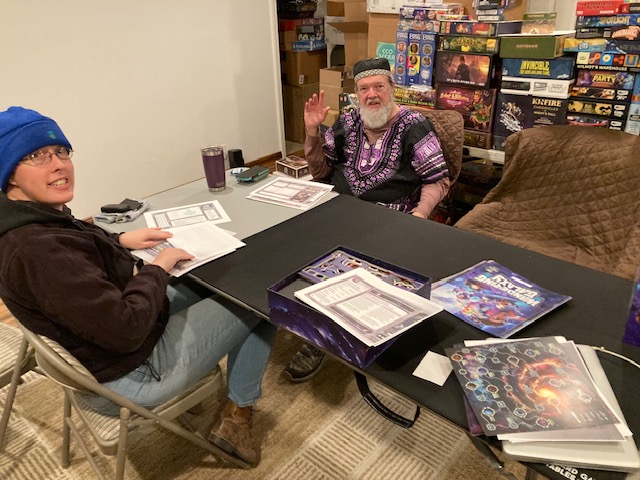
My crew showed up, ready to take the Galaxy by storm! The crew was originally supposed to be a full complement of six, but space sickness and space madness and space baby-sitting caused us to winnow down to just three. But what a great crew they were!! Too bad the spaceship exploded on the pad. But I digress …
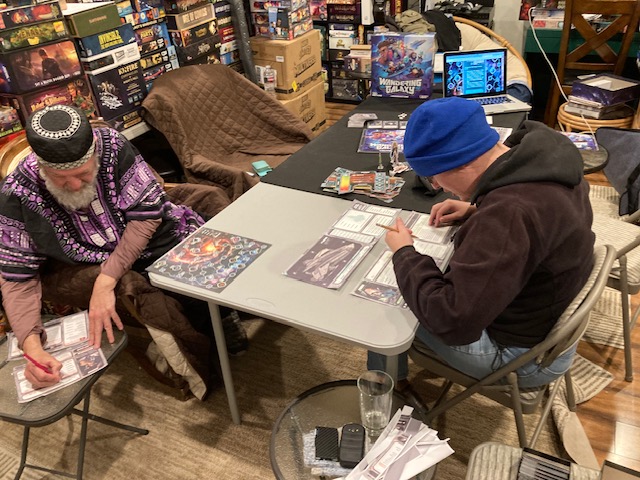
Cooperative play worked really well. Luckily, I had played the game solo enough to smooth out some of the rules (even still, there were ambiguities as we played which were frustrating). Part of why this game works very well for a cooperative game is that each player owns their own station, which keeps them in involved as they play! And each player has their own character with their own worker placement token! So, players are always involved (via the station and worker placement) as well as connecting (as they “bond”) with their character, and making shared decisions about the fate of the ship and crew!!! (More exclamation mark for you!!!)
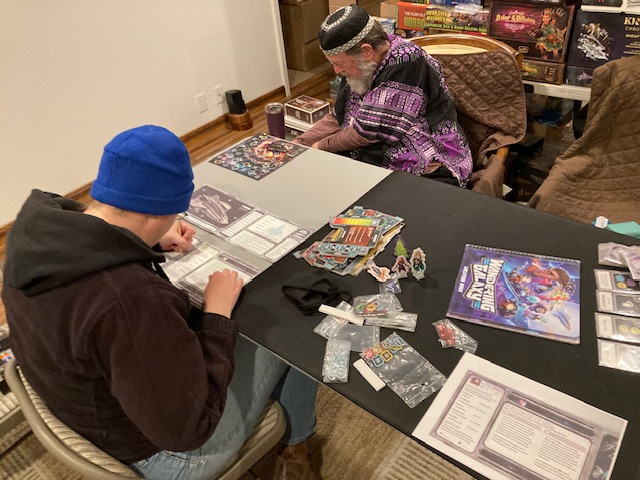
My friend Teresa liked her character so much that she took it home as a souvenir!
We ended up playing a one-off, but once my group regroups, I suspect we will settle in for a fuller campaign. It is nice that you can play this as a full campaign or just a one off.
Sense Of Humor
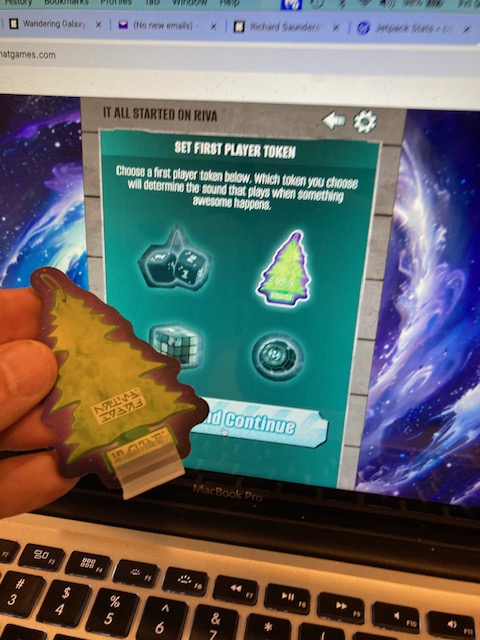
Just so you know: this game is kind of silly. The story is silly, the voices are kind of silly, and even the first player token (I chose the Christmas Tree) is silly. If you were looking for a grim-dark Star Trek game, that’s not this.
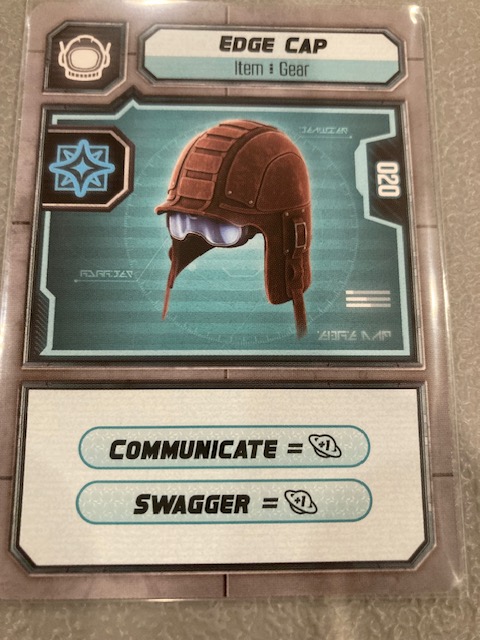
The game has a sense of humor, but it’s not just ALL silliness. You still have to build your deck, make smart decisions, deal with damage on your ship, pickup and deliver stuff, place workers, and generally make a lot of decisions. But the undercurrents of the game … are a little silly.
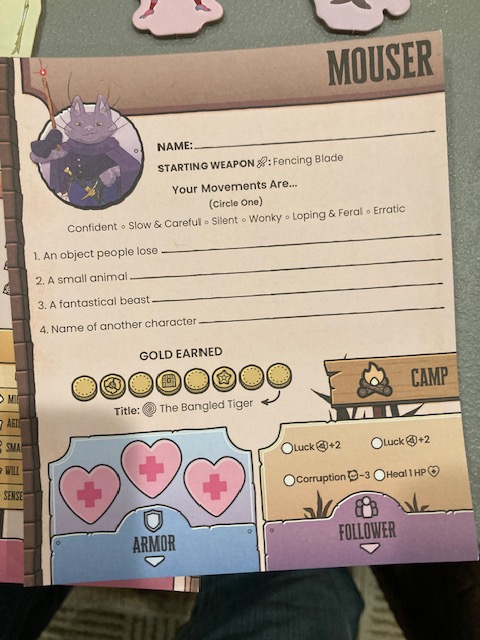
Even though Wandering Galaxy is silly, it’s still not quite as silly as Freelancers or Forgotten Waters: those games just seem to have sillier stories and sillier resolutions. So, if you were just slightly annoyed by the silliness of Freelancers or Forgotten Waters, maybe Wandering Galaxy is a better choice for you … but it’s still silly. Just not as silly.
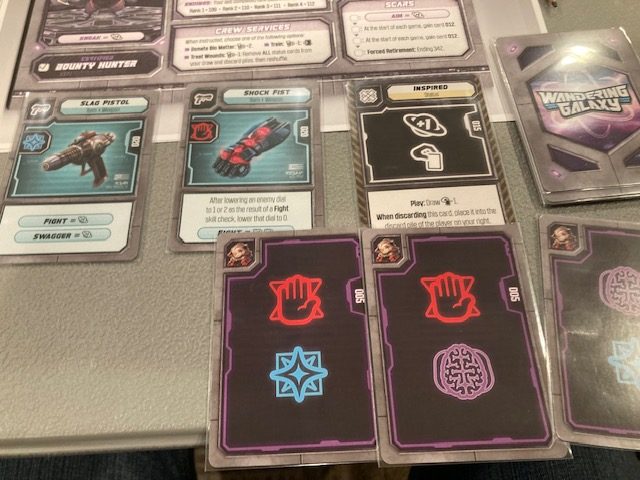
You know a game is silly when it brings out the silliness in you! When we performed the Skill checks, we started singing the Lucky Charms cereal theme songs! “Blue Stars, Yellow Eyes, Purple Brains! Frosted Lucky Charms, they are magically delicious!”
Entry Book
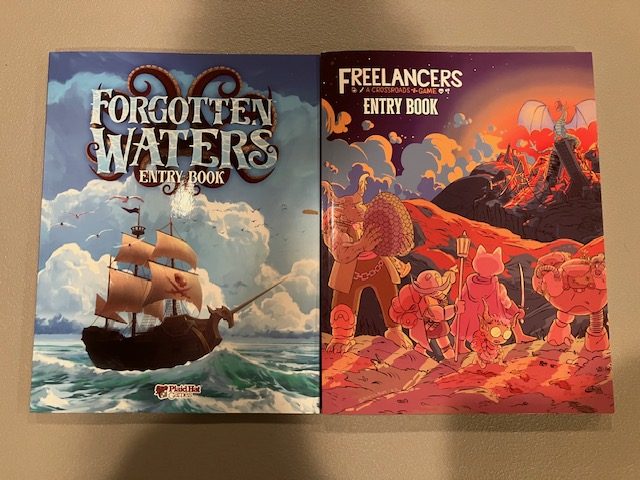
Some of you might have been very non-plussed by the necessity of the App in this game. Well, if you like reading text from books, there are Entry Books available! The Entry Book isn’t QUITE done at the time I received my copy, but it will be. In the meantime, I did pickup the the Forgotten Waters and Freelancers Entry Books (those were part of the Kickstarter).
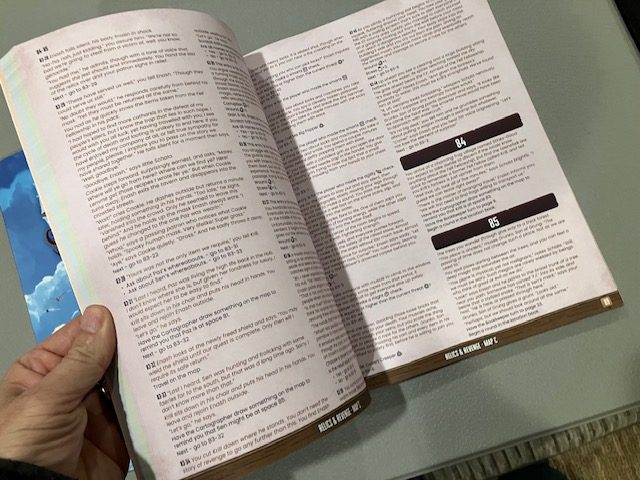
Basically, all the reading and entries that the App does is encapsulated in the Entry Book. There’s something kind of nice about having a “backup” for this: I have had some games where the App goes dark (Rising 5, I am looking at you); with this Entry book, you can always still play the game if the App goes dark.
My friend Joe actually prefers the Entry Books: he uses these games for his English classes, as it encourages reading out loud!
What I Liked
Supports Multiple Players Well: the game really works well with many player counts. The station system helps keep everyone involved, even at higher player counts. I am glad to see the Solo mode as a first class object.
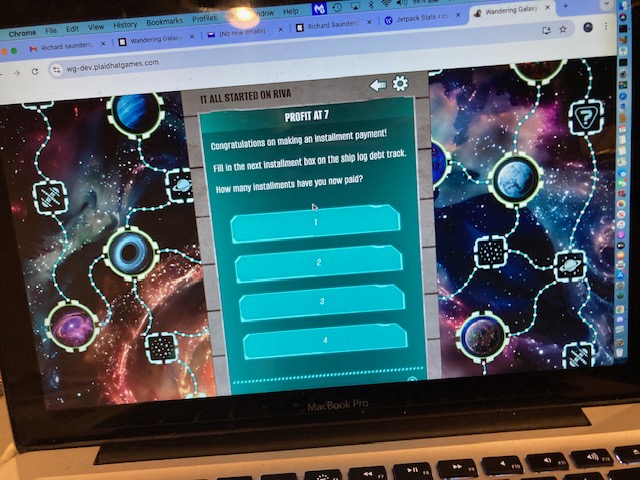
Story: Really, this game is all about the story. How do you want your adventure in space to proceed? Life is what happens when you are making plans, especially in space! Every player is involved as they explore, but generally the story just unfolds and everyone is along for the ride. If you want to play a space opera rather than watch one, this is a good choice.
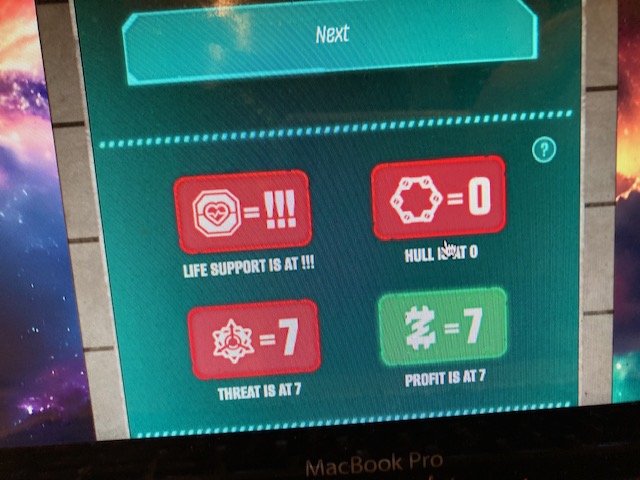
The App: Despite the app not being quite done (some of entries didn’t have full voice acting, and some entries were incomplete), the App worked quite well. I think it’s really evolved and easy to use, especially for set-up and first play! (I mean, they have had 2 iterations to get this right). It’s also good to know there is a backup Entry book in case the App ever goes dark …
Sense of Humor: I really like the silliness in this game. It’s not quite as funny as Freelancers (which was much sillier) or Forgotten Waters, but it was funny. Caveat Emptor: you may not like the silliness.
What I Didn’t Like
Ambiguity: By far the biggest complaint is the ambiguity in the Rulebook. There’s just too many places where things are NOT well specified. We’ve mentioned at least three things in this article alone where we had to go to BoardGameGeek to find the resolution! The game still works, but it’s very unsettling to have just a few too many places where the rules are poorly specified. Some of this is because maybe the game came out early; the App still needs some work, and maybe they will fix-up the ambiguity in the App. Unfortunately, the Rulebook can’t be amended (unless they put up a version 2.0). Just prepare yourself to look stuff up on BoardGameGeek.
Conclusion
I liked Wandering Galaxy and so did my friends! It’s the next great game in the Crossroads games series (after Forgotten Waters and Freelancers). It’s probably the most complicated of the three games, but it’s possibly the most thematic of the three. Be aware that that there are a lot of mechanisms: deck-building, campaign, bag-building, pickup-and-deliver! … but the game feels paradoxically both heavy and light! The game glides along as you enjoy the story, with some heavier mechanisms behind the scenes.
An App is required to play … unless you have the Entry book (at the time of this writing, the Entry Book for Wandering Galaxy is not out, but should be soon (the Forgotten Waters and Freelancers books are already out). Despite the App not “quite” done at the time of this writing, it did a marvelous job bringing us into this world. It even embraced the solo player well!
This is a great light-hearted cooperative adventure for you and your friends! It’s not “quite” as silly as Forgotten Waters and Freelancers, but it’s still pretty silly.
This is probably an 8/10. The only real problem with the game was the ambiguities that kept coming up: If you are pick-up in this game, I suspect you will be looking up a lot of stuff on BoardGameGeek. But, since the App is a dynamic entity, hopefully they can address a lot of those issues within the App itself. Hopefully, by the time you read this, the App will have fixed all those problems and this will rise to a 8.5/10. It’s a really fun game.
 coopgestalt
3 thoughts on “Wandering Galaxy Review: Who’s Wandering Here?”