
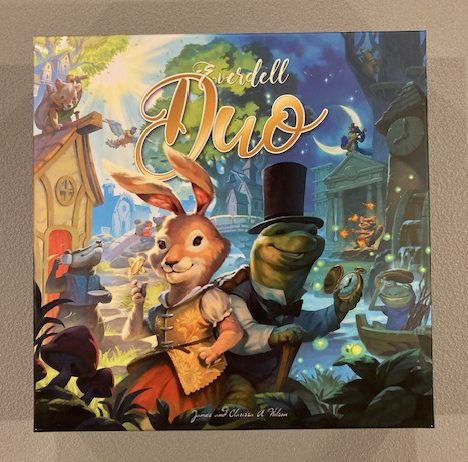
Everdell: Duo is a competitive or cooperative worker placement game for 1-2 players. It was up on Kickstarter in Aug/Sept. 2024. It promised delivery in March 2025, but it delivered to me on November 25th, 2024! Yes, almost 4 months early!
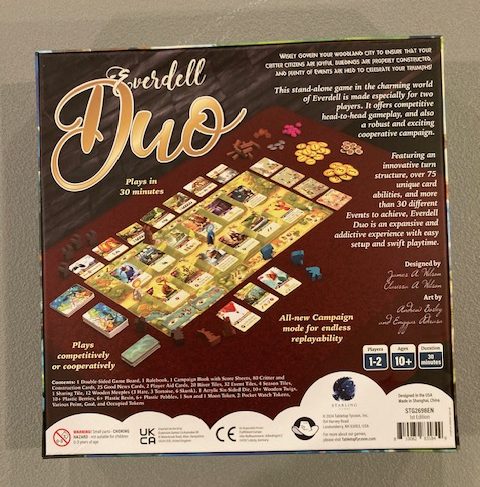
This is a worker placement game in the Everdell universe. Strictly speaking, I have never played any of the Everdell games, but I was excited about the cooperative mode of this worker placement game! It plays both solo and cooperatively with 2-Players! We saw another cooperative worker placement game that went over quite well this year with Endeavour: Deep Sea. Will Everdell: Duo find that same success?
Unboxing
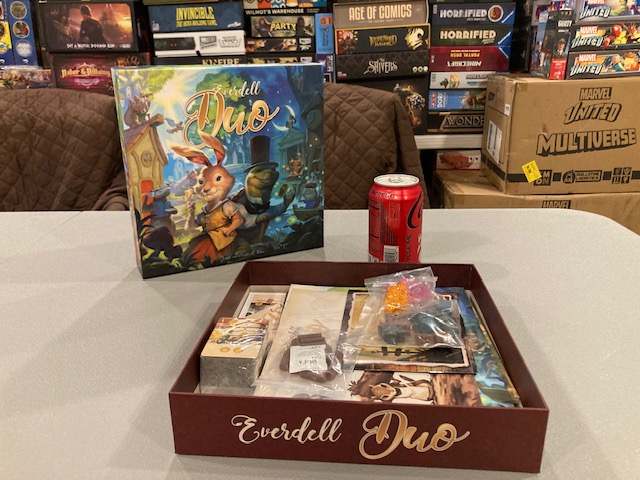
This is a smaller box: see Coke Can above for perspective.
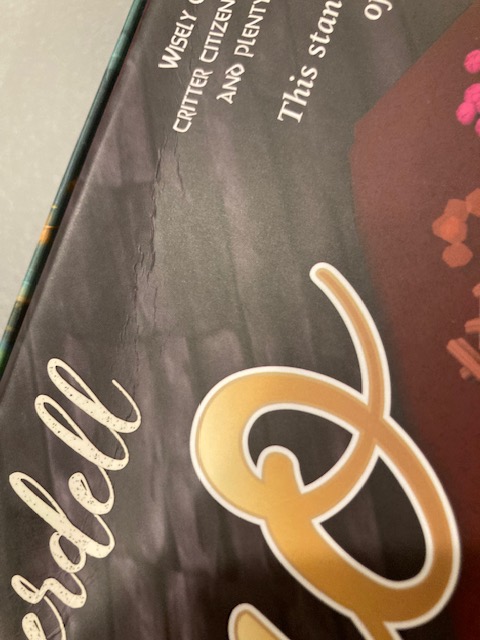
I was slightly grumpy at the Kickstarter because they shipped it in a padded envelope, and my box got a little banged up! See above. There are some dents, and the top is squished a little, so it feels like I got a Ding-And-Dent day special for this. So, I was already a little feisty when I opened this.
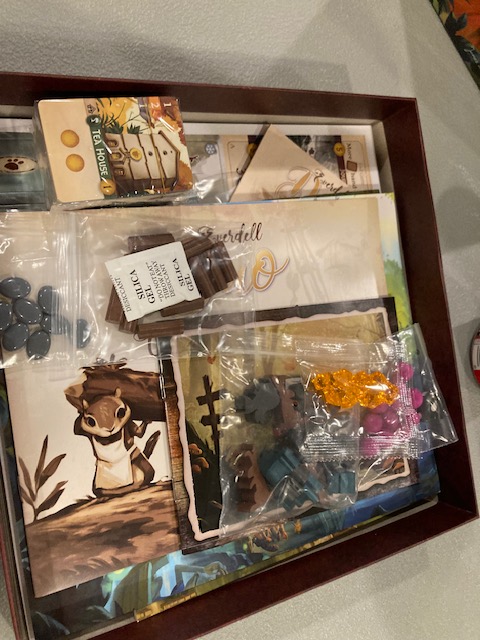
And there is really no insert to speak of. Everything just flops around all willy-nilly in the box!
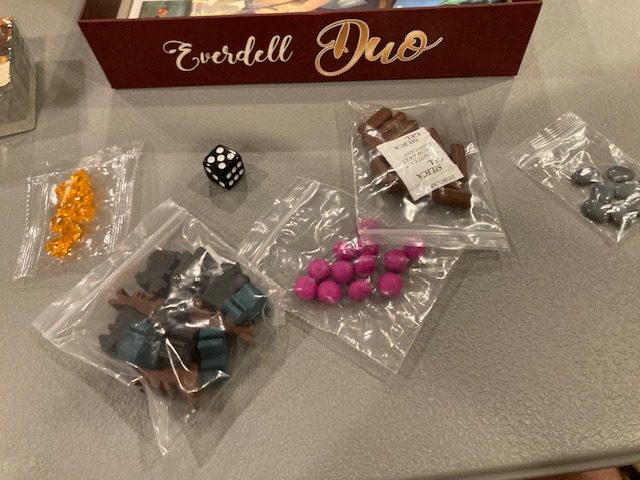
Luckily, they did include a lot of plastic bags (see above and below) so you organize it.
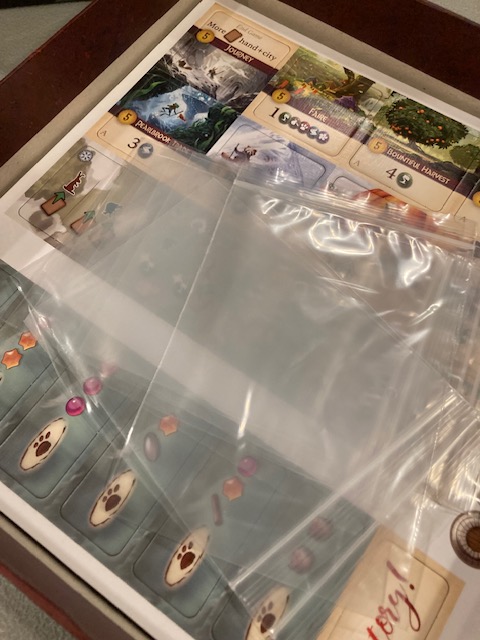
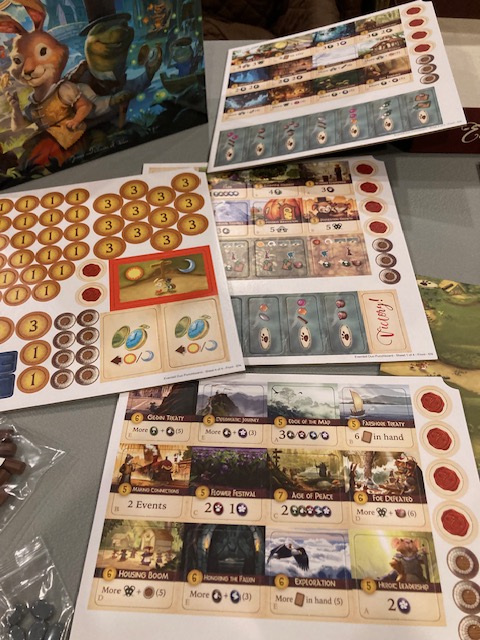
There’s 4 punchout sheets and the art is pretty groovy on them (see above and below).
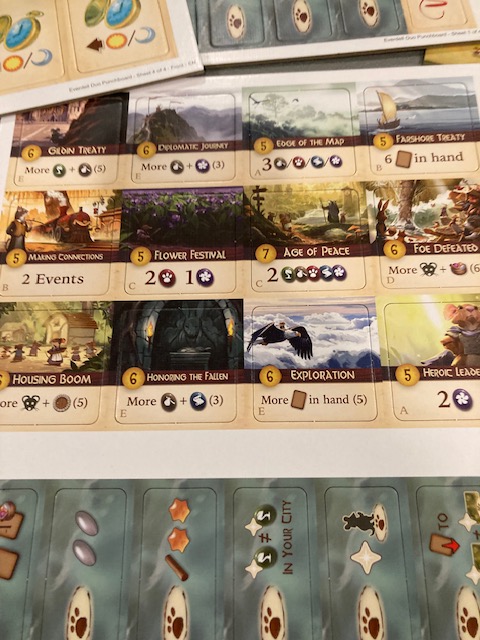
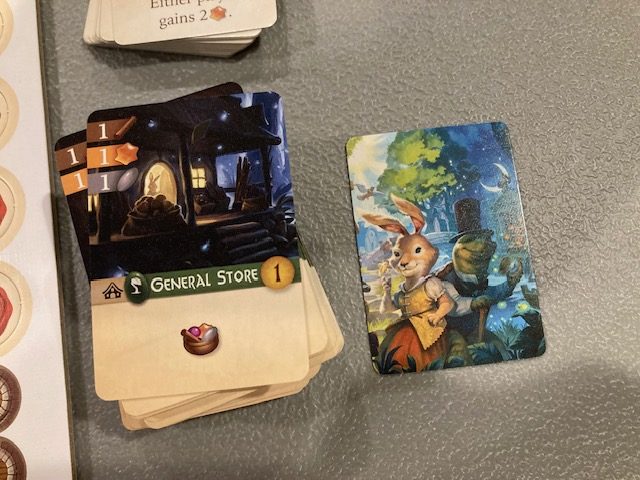
Most of the game is on the cards; there’s quite a number of them.
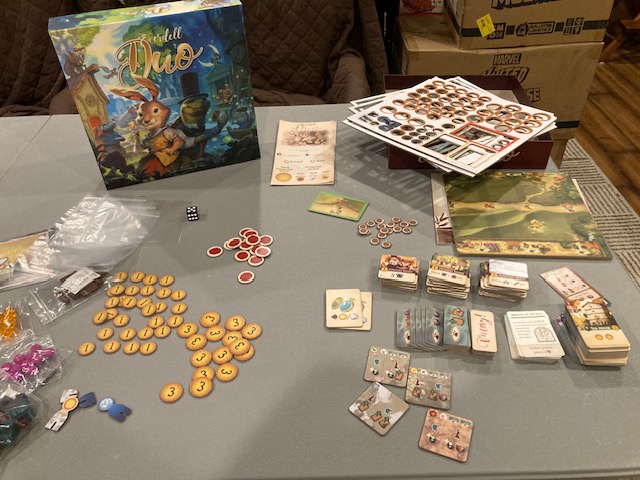
The game looks good: I love that Andrew Bosley art. See above.
Rulebook
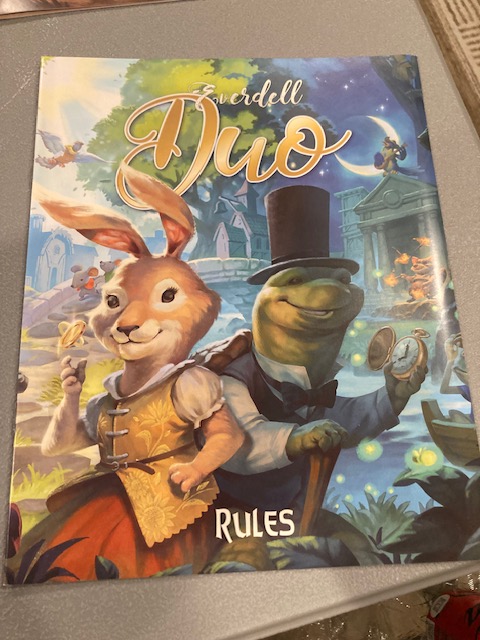
This rulebook is a mixed bag.
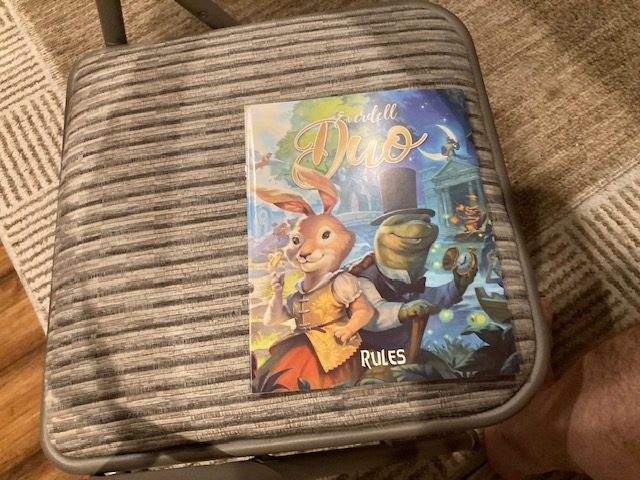
It passes the Chair Test with flying colors! It’s an A! It’s just the right size so that it can fold over perfectly!
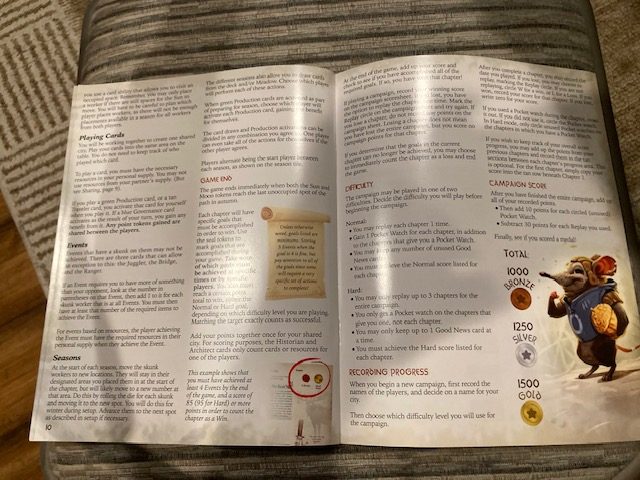
See above as the rulebook lays flat and fits perfectly; it’s so easy to read!
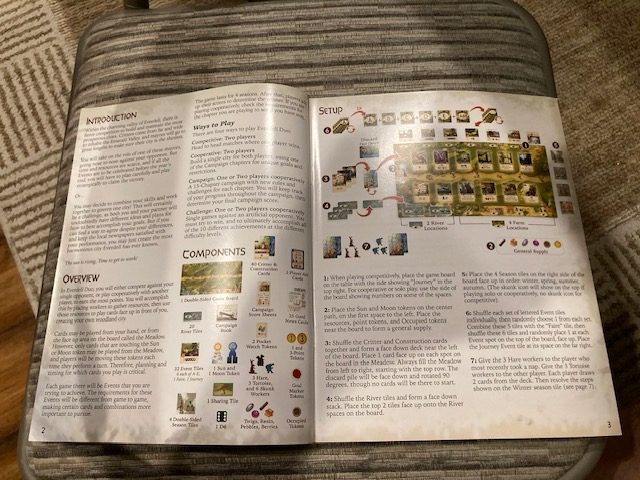
The Components list is pretty minimal (lower right of 2nd page, see above), but it works well enough. The set-up takes up all of page 3, works, pretty well, and is decently notated. So, things are starting off on a good note.
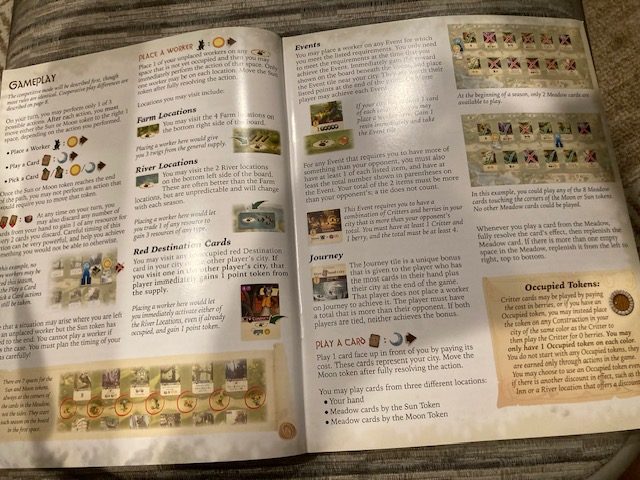
The Gameplay concentrates on the competitive mode, so the cooperative (and solo) mode take second fiddle a little bit. For example, the rulebook fully lists/describes the Season card effects for competitive mode, but the cooperative mode Season effects (which are different enough to warrant some text) doesn’t get any explanation. The game mechanisms are “generally” the same in either competitive or cooperative mode, but of course, the players have to approach the game differently depending on the mode.
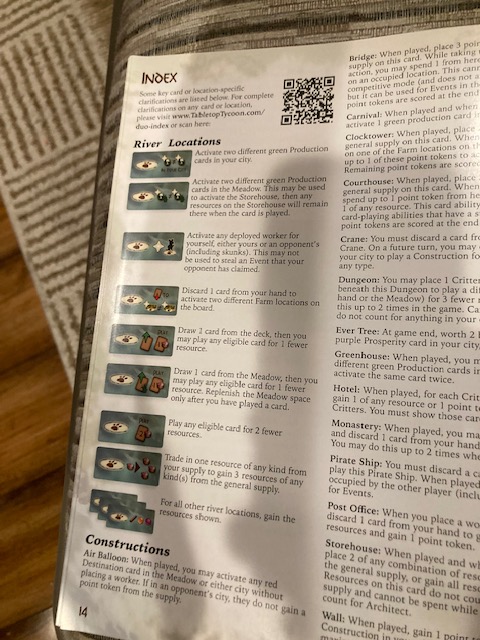
This also irked me: they mislabelled the “Card Summary” as an Index! See above!! An Index is a list of sorted “important” words, with page numbers following in a list: this is NOT an index! This is a Summary! Even worse, as a Summary, it’s incomplete! You MUST print out the special sheet from the website to get all the rules. I remember looking for the the Inn in the rulebook … it’s not there?
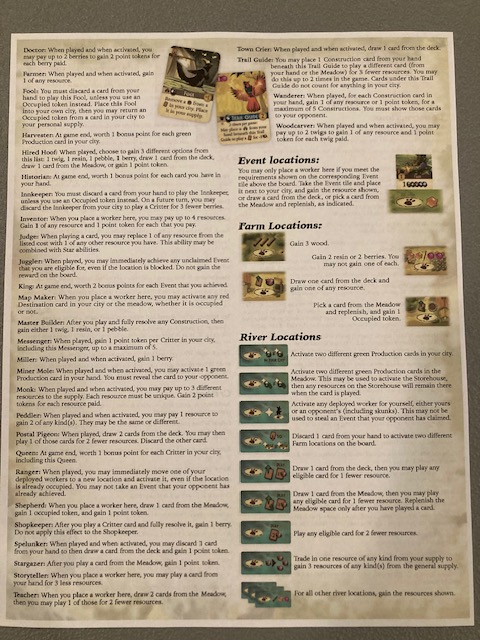
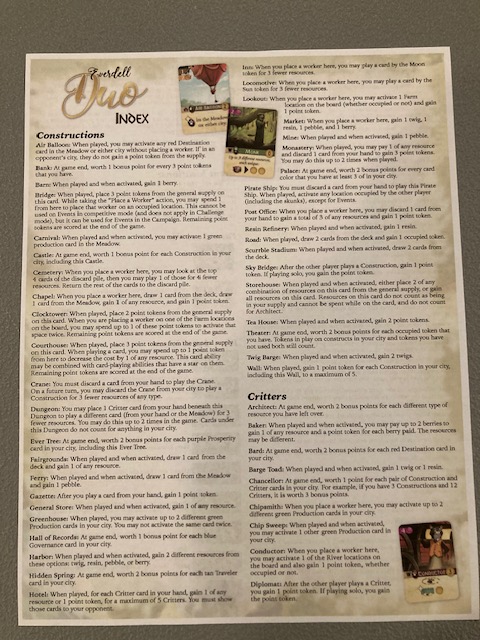
Ah, there it is … at the top of the page! (NOT an Index). Do yourself a favor, makes sure you print out a full copy of the (what they call) the Everdell Duo Index! You need that to play or you will not be very unhappy.
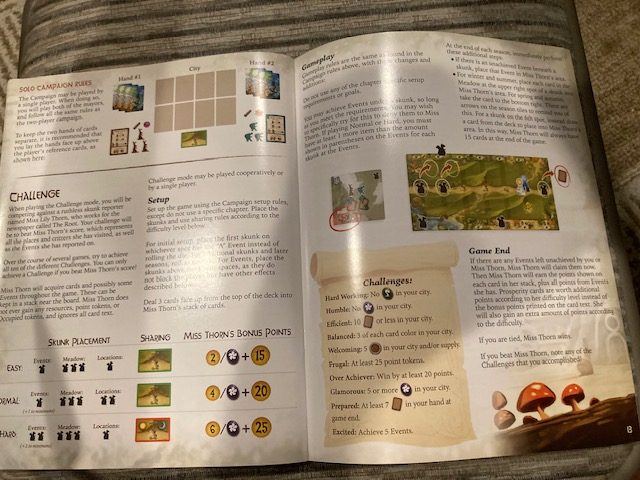
The rulebook taught the game, but I was constantly looking up stuff. Also, there’s no real picture or great explanation of “town” or tableau. I think you have to have played enough of these types of games to get that your “town” was the set of cards in front of you. Again, this could have been clearer.
The rulebook taught the game. Let’s just leave it at that. Make sure you print out (what they call) the Everdell Duo Index, or you will be missing some important card descriptions!
Gameplay
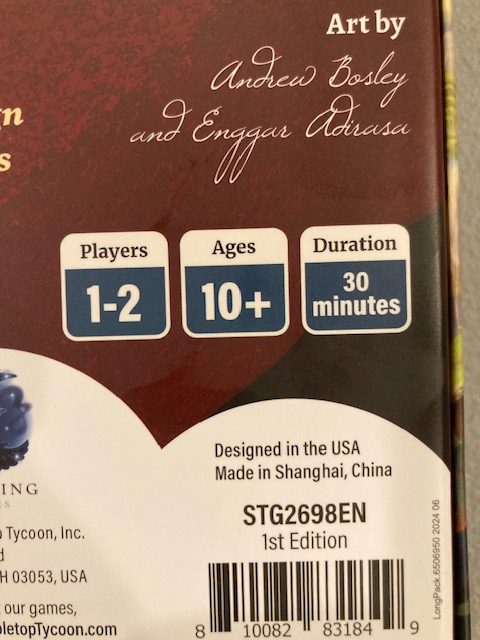
This is a worker placement game for 1-2 players. You can play competitively or cooperatively (the solo mode is just the cooperative mode with one player operating both characters).
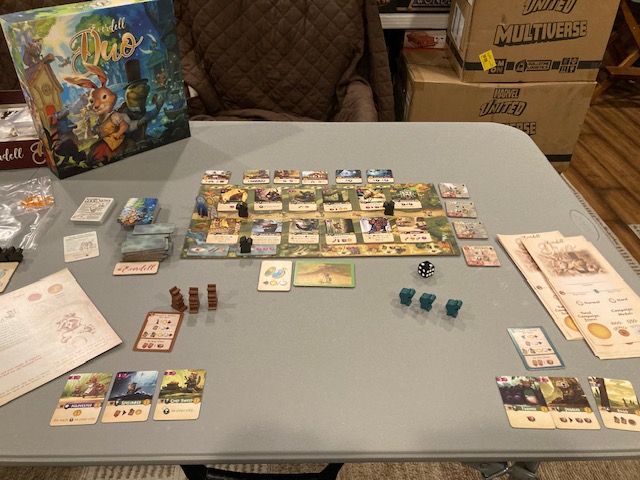
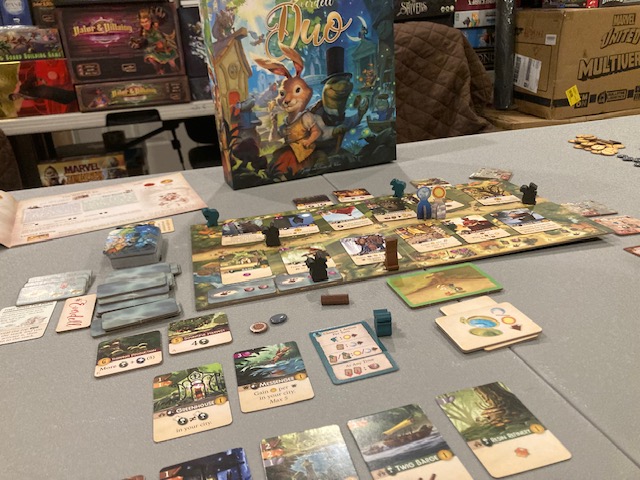
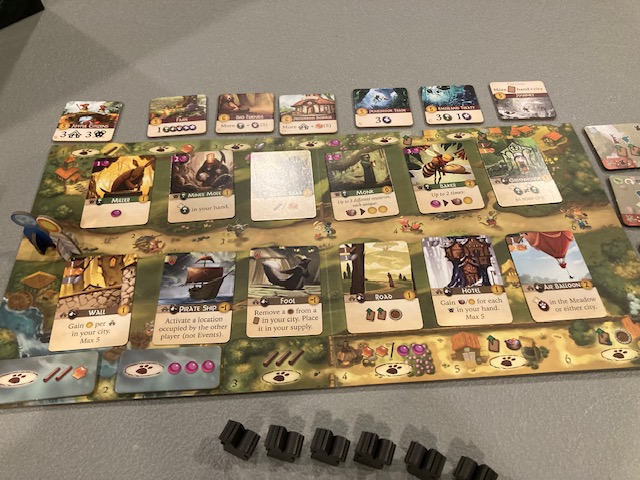
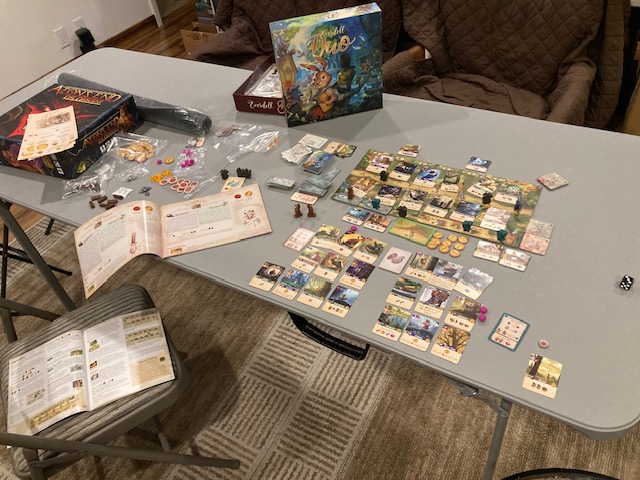
There are always two characters in play: the Hare and the Tortoise. See above as the Hare is on the left hand side, and the Tortoise on the right.
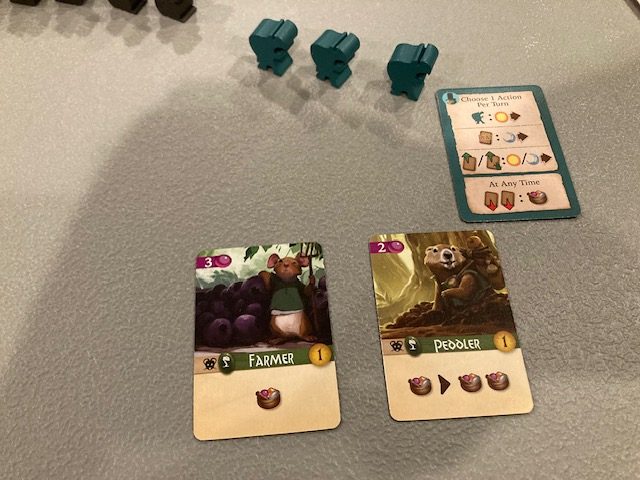
During the game players “usually” do one of two things on their turn; (1) place a worker placement token (see the 3 Tortoise tokens above) or (2) play a card from their hand into their “town” or tableau (see Farmer and Peddler as cards in their hand).
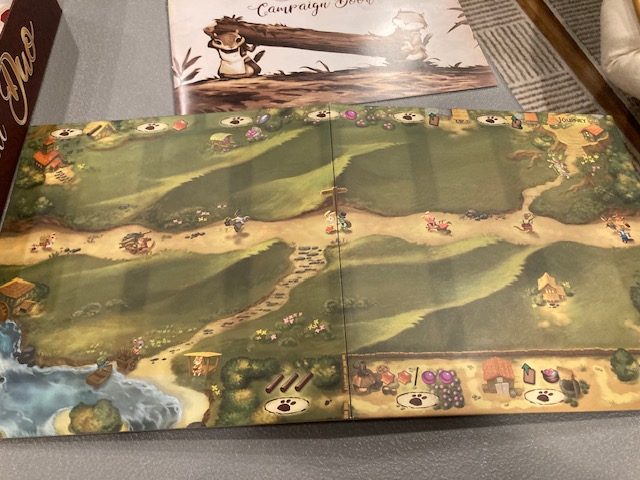
The top and bottom of the board is the worker placement zones.

The bottom part of the board are spaces that basically give resources (wood, berries, resin, or stone) to a player. See above.
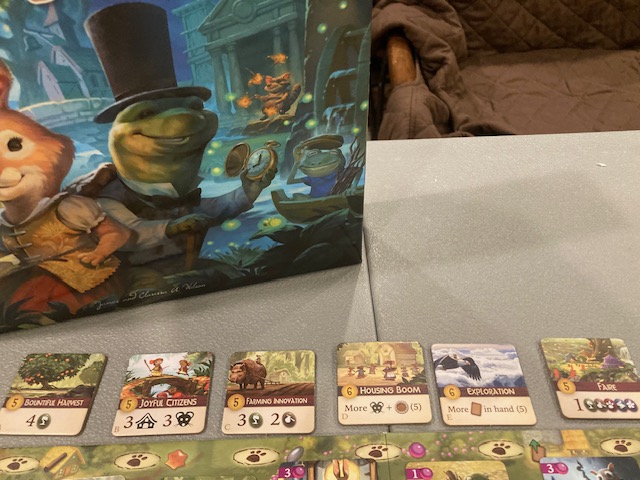
At the top of the board (accented by the big tiles) are the big rewards, but they have significant prerequisites. The Bountiful Harvest (to the left) requires 4 green Production cards, but gives a whopping 5 victory points.
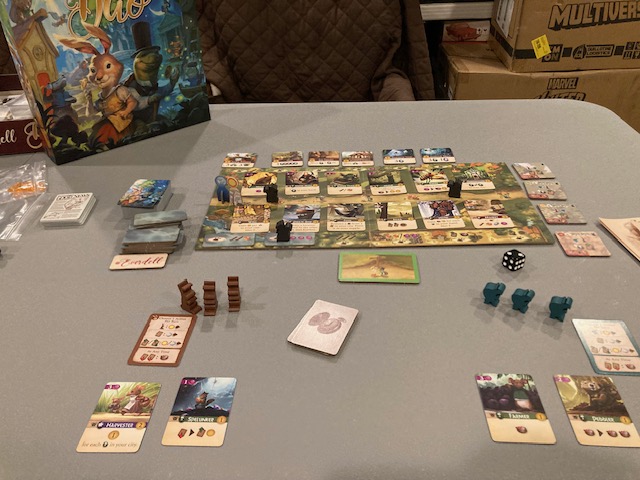
This is generally a victory point game, even in the cooperative mode (but see more discussion below). For the competitive games, players are competing to get the most victory points. For the cooperative mode, players (at first at least) need a certain number of victory points as a group to win.
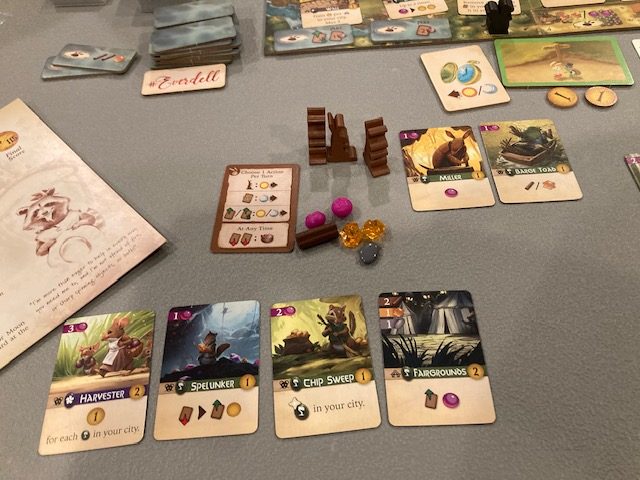
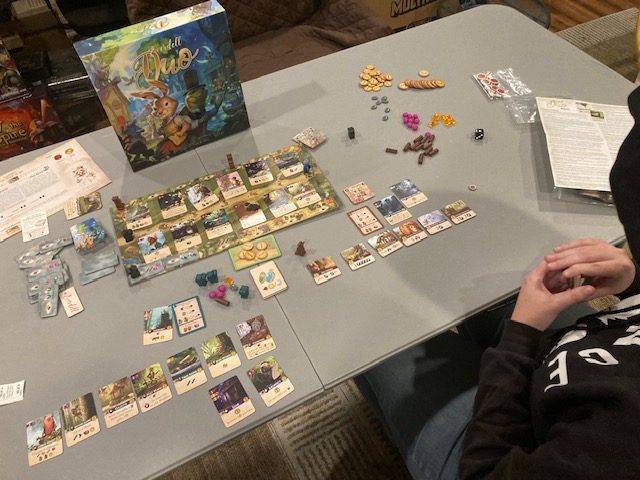
The second most common action is playing cards from your hand (or board) to your “town” or tableau. It’s not clear from the instructions, but each character has a HAND of cards they can play on the board, and cards they HAVE played into their “town”. See above as the Harvester, Spelunker, Chip Sweep, and Fairgrounds are in the Hare’s town (with Miller and Barge Toad in hand; they haven’t come out yet).
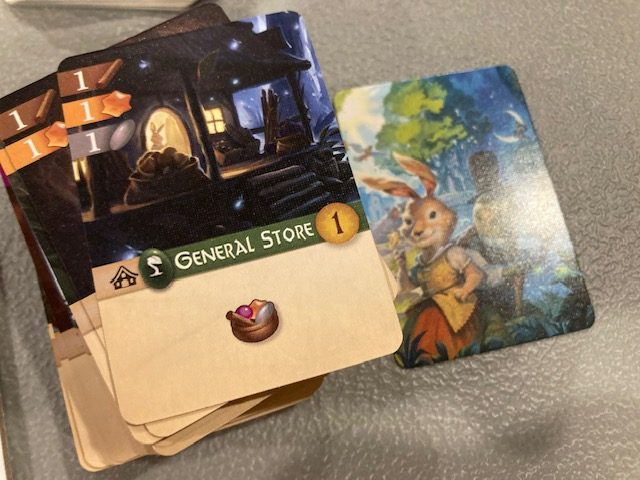
In order to play a card into your “town” or tableau, the player must pay the resources on the upper left of the card. For the General Store (above), it’s one Wood, one Resin, and one Stone. If you don’t have the resources, you can’t play the card.
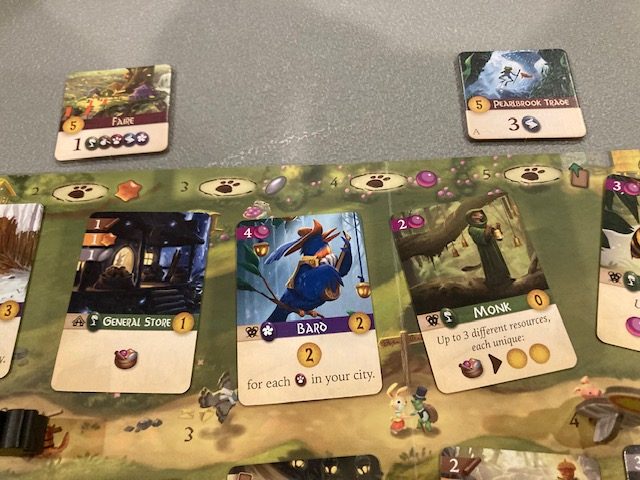
Interestingly, you can also play cards from the board (the Meadow) into your “town”! It really depends on where the Sun and the Moon are!!
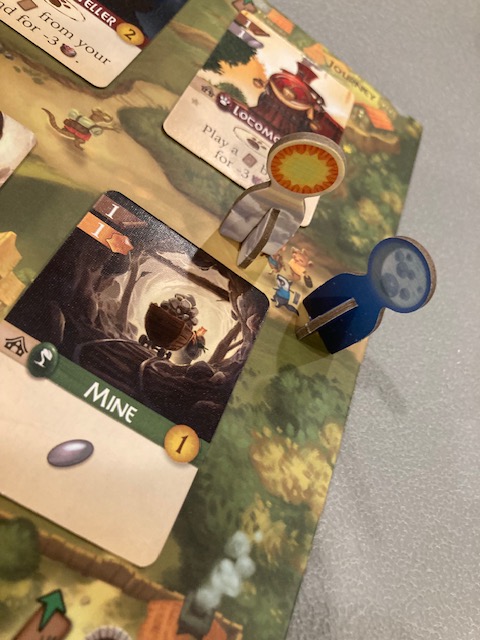
The Sun and Moon are tokens that move left to right on the board. See above. Once they have both reached the last space, that season is over! There are 4 Seasons total: Winter, Spring, Summer, Autumn. Once all seasons are done, the game is over! Add up point to see who won!
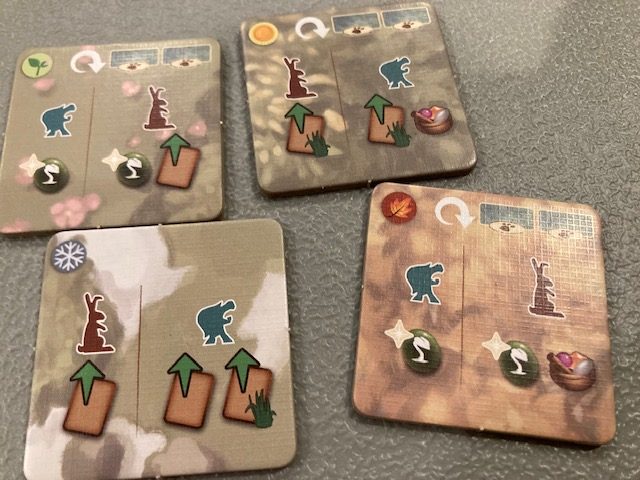
At the end of the season, each characters gets some special effects (draw a card from the meadow (the board), create resources from Green cards, get resources, etc). The Season tiles above also specify who goes first!
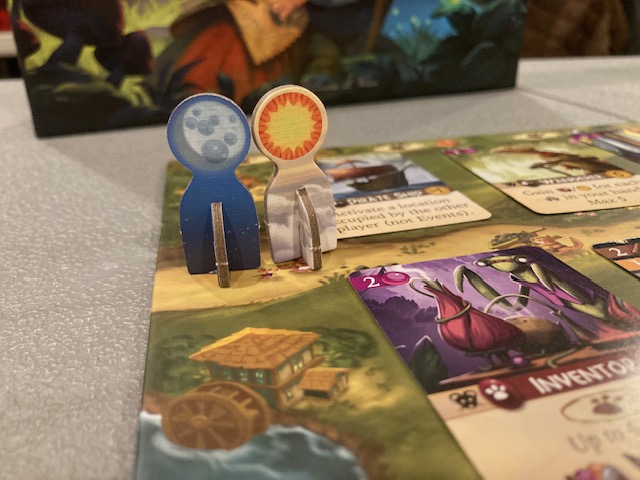
The Sun and Moon tokens add an unusual twist in the game. The Sun token advances whenever any player plays a worker. There are only 5-7 or so spaces for the sun (depending on the mode, campaign, etc), so that means that maybe a limited number of worker placement actions total; someone may likely get screwed out of a worker placement action!
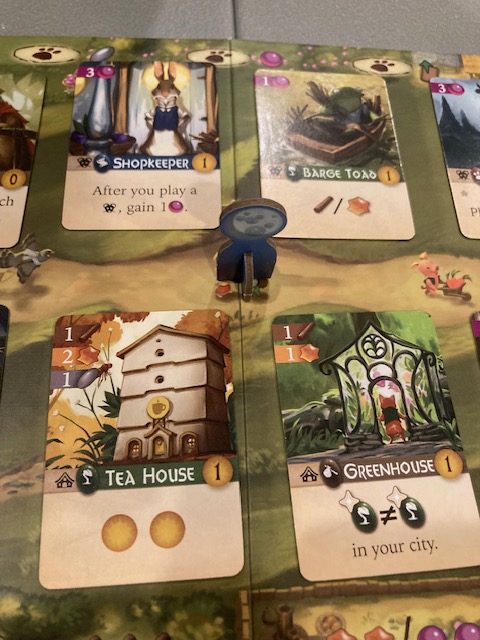
The Moon token advances whenever anyone buys a card from the board or their hand. See above; if a character buys, they can instead buy any of the 4 adjacent cards to the moon! That’s kind of different and interesting!
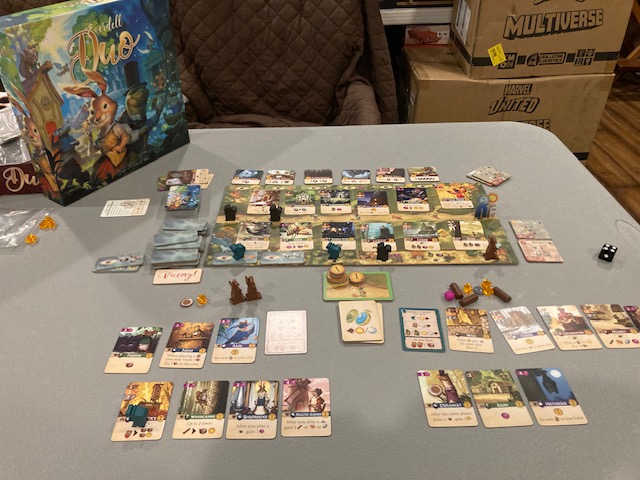
The game is all about trying to get the right resources to get the right cards to get the right combos to get the most victory points!
Solo Play
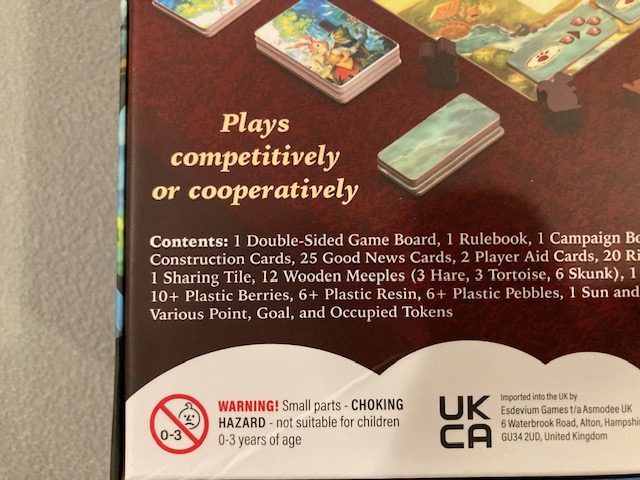
There are two solo modes (Congratulations on following Saunders’ Law)! One of two solo mode for this game is playing the cooperative mode (2-Player only), except that the solo player plays both the Hare and the Tortoise; this is the Campaign solo mode. For 4 seasons, the solo player alternates between the Hare and Tortoise until the Sun and Moon reach the end of the track … then head to the next season!
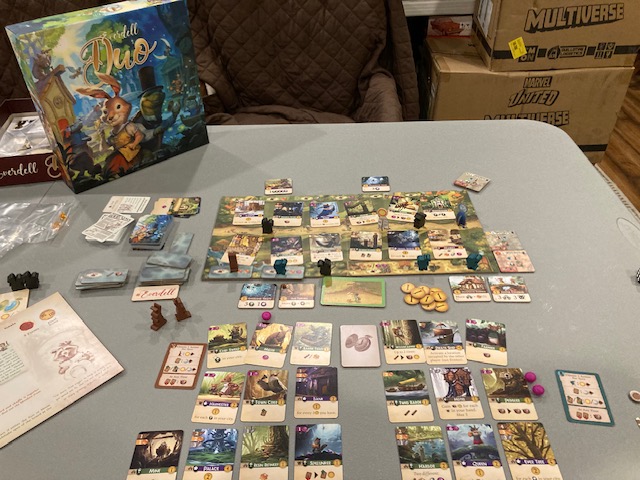
The solo mode (really, the two-handed cooperative mode) is, at least in the beginning, a victory point game. The sum of the victory points of the Hare and the Tortoise need to exceed some threshold!
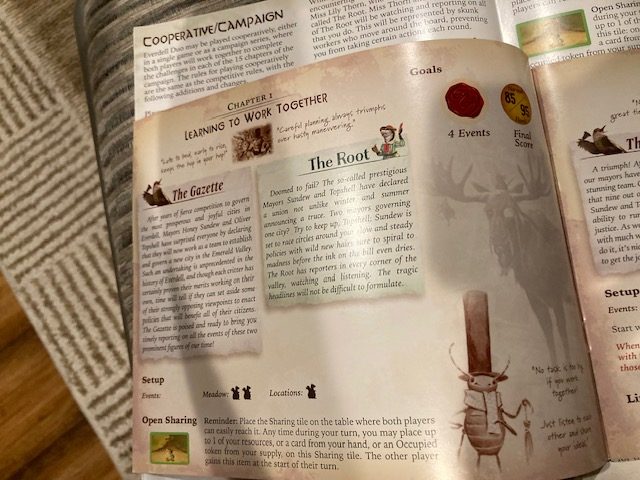
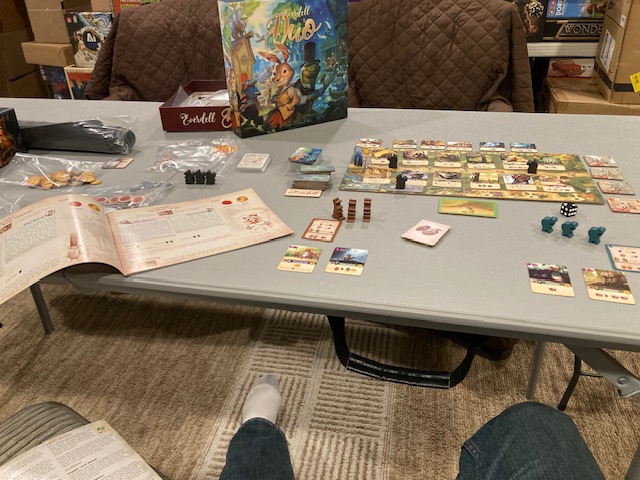
The cooperative mode is really is actually a campaign (sort of) of 15 ever harder chapters! The first game of the campaign (see above) is a simple start: get at least 85 Victory Points collectively and also get at least 4 Events (the big rewards)! Luckily, you can play any campaign chapter you want as a one-shot: this is both Boon and Bane! It’s Boon because you can play any of the 15 chapters of the campaign at any time, but it’s Bane because there’s really NO levelling up in this game. It’s not really a campaign in the sense “your character gets better”; it’s just 15 scenarios that get harder.
What’s different about the Campaign solo/co-op mode is that there are SKUNKS blocking certain locations on the board! See above as two SKUNKS blocks two spots on the Sun/Moon path (thus reducing the number of actions) and one SKUNK on the Worker Placement part of the bottom (this blocking one action). This is how the game “simulates” blocking; every turn the players roll the die and move the SKUNKS to block spaces.
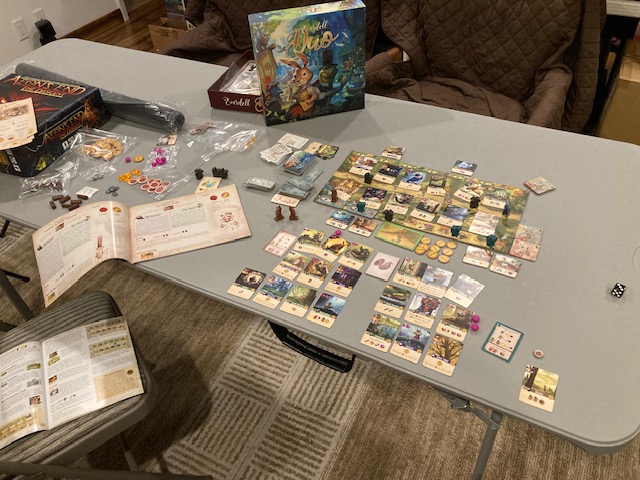
I have to admit I struggled a little with the randomness of this game at first. The cards in your hand or meadow are ENTIRELY random every game, and where the SKUNKS end up is ENTIRELY random. I was very afraid I wouldn’t like the game because of this. But, I think after getting through a bunch of games and getting the flow of the game, there always seemed to be ways to mitigate that randomness. You can always top-deck a new card, you can usually play a card out of your hand if you can’t play from the Meadow, you can always choose to draw any card from the meadow, and you can always find SOME worker placement action to help you, even if it wasn’t exactly what you wanted. Basically, you have to be able to pivot. The game is more tactical than strategic, as you react to the current set-up of the game.
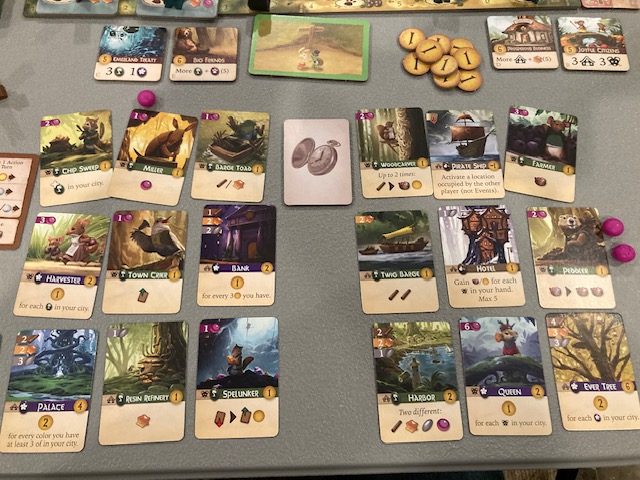
But, this Campaign solo/co-op mode is much more strategic; since you can work together (with yourself as the Tortoise and Hare) and plan together, your actions be more far-reaching!
Note there is a Challenge solo/co-op mode in the game where you play against an AI opponent. I feel like, with the rules as they are, the Challenge mode is a much more tactical game. I strongly prefer the Campaign solo/co-op mode, as it feels like you can mitigate the randomness of the game much more by having the Tortoise and Hare collaborate.
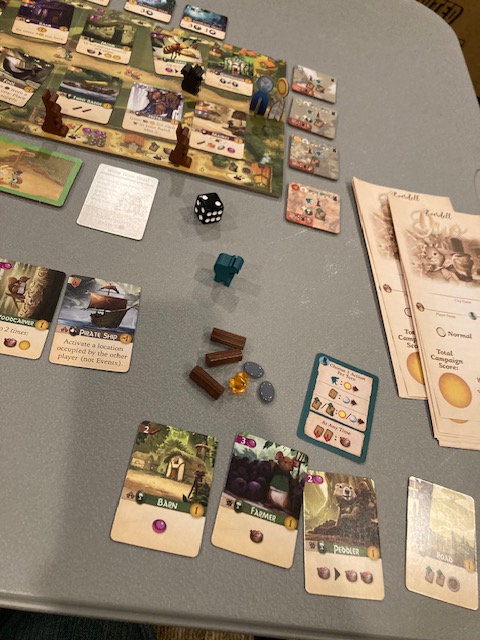
There are two related issues I want to discuss more below. But for now, let me say that I do like the solo 2-handed Campaign mode as it’s more strategic. The Challenge mode was less to to my liking, as it felt more tactical.
And for solo mode, I completely ignored the Limited Communication rules; It makes sense to ignore this in the solo mode (of course you can communicate with yourself). More discussion below.
Cooperative Play
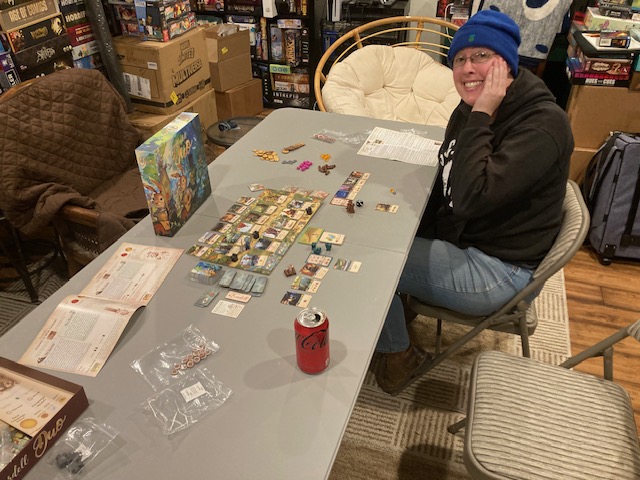
Even after three solo games, I was still getting a few rules wrong. As Teresa and I headed into a cooperative game (the campaign mode, not Challenge mode), she was the Hare and I was the Tortoise playing Chapter 1 of the Campaign.
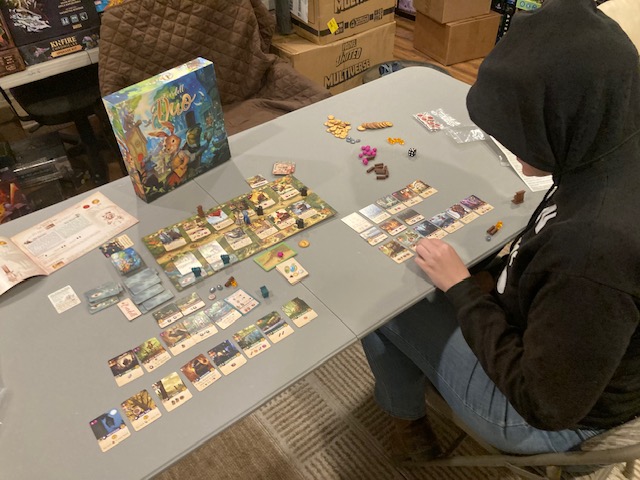
There are rules for Communications Restrictions … which we completely ignored. There are some restrictions on what you can communicate: “You may not tell your partner which cards you have in your hand, but you may tell them what color and types (Critter or Construction) you have, and what resources you want”. We generally adhered to these rules, but that’s because we respect each others space. Sometimes we would share a little more, but that made the game more engaging: “Ugh! I am struggling! I can’t do anything, how can I help you?” I understand why cooperative games like this have Communications Restrictions: they don’t want the game ruined by The Alpha Player (a player who tells everyone what to do!). If you are playing Everdell: Duo with a person you trust and respect, these rules are insulting and take away from the enjoyment of the game. I prefer to encourage working with my friends rather than hamstringing them with arbitrary Communications Limitations.
That got more preachy than I wanted, but the game still seems to work even in you ignore the Communications Limitations. And it’s more fun.
Over one night, Teresa and I played and lost our first game. Then, Teresa liked the game so much, she wanted to play again!!
And we lost the second game too. But we had fun playing!
Sharing
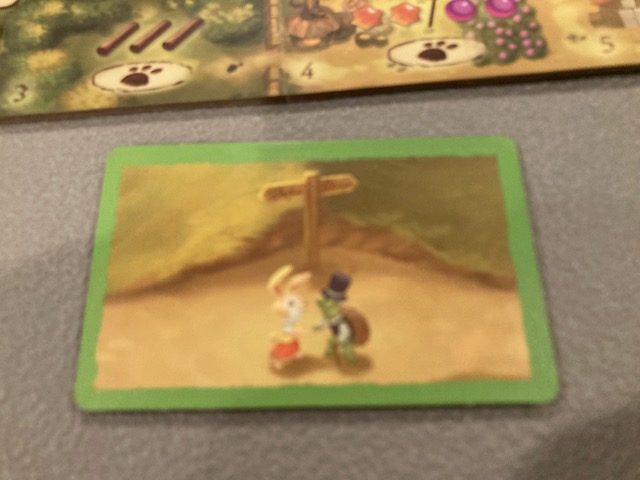
With the gameplay description I have given above, this game sounds very much multiplayer solitaire. And it mostly is, except for two things. First of all, there is a “share” space! At the end of every turn, each character can decide to share a single thing and put it on the tile above! That thing can be a card, a resource, or an Occupied token.
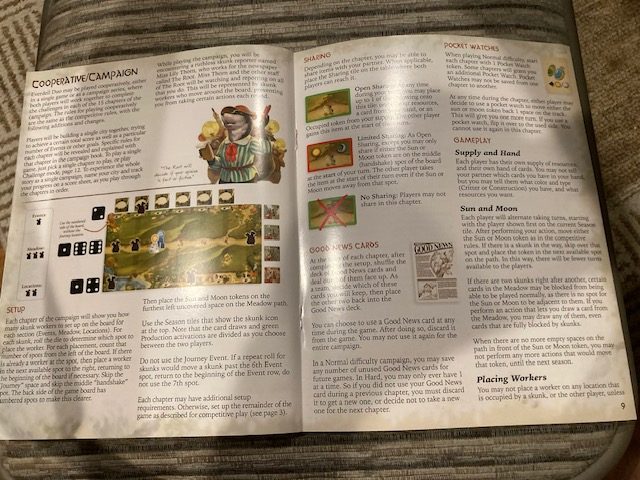
Interestingly, different Chapters of the Campaign turn on/off this sharing space, or reduce its scope (so you can only use it in the middle). I noticed that I didn’t win a solo game until I actively started using the Sharing space. It’s there for a reason, as it does encourage cooperation and strategy!
It might seem, other than the Sharing space, this game is just multiplayer solitaire. After all, each player just tries to do they best they can on their turn, right? I think, after several plays, I would say that is not true! Because of the Sun/Moon move mechanism, each Season is restricted by how many worker placement and card buys characters can do—in order to get a full robust turn, the players must discuss the best play to enact a plan to make best use of the Season! And that makes the game very cooperative!
What I Liked
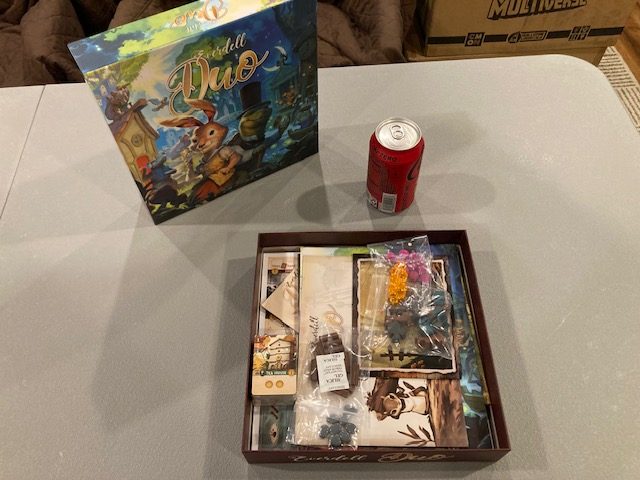
The Components and Art: The art of Andrew Bosley permeates this game, and it’s very striking. The game is gorgeous and cute, and it looks nice on the table.
Cooperative Worker Placement: The cooperative worker placement works very well in this game. Everdell: Duo uses the SKUNKS to help block spaces, and with the characters collaborating, this works far better than I expected it to!
Duo: I really like playing this as a cooperative 2-Player game (in Campaign mode). It seemed to work really well. Of course, the solo mode was great too … because it is the same mode!
What I Didn’t Like
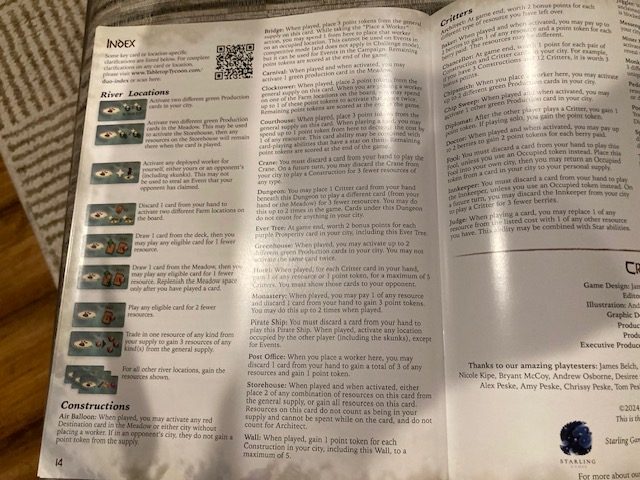
The Rulebook: There were some great things about the rulebook, and some not so great things. I think this rulebook needs one more pass by an editor. In the end, I was able to learn the game from it, but it seemed harder than it should have …maybe it’s because I never played the original Everdell? Maybe they expected me to know more about the game?
Randomness: I was worried about the randomness of the game; between the SKUNKS positions being decided by die rolls and the pure randomness of the Meadow, I was very worried the game might feel like too much. I will say, after playing a whole bunch of games solo and cooperatively, I haven’t seen this be a problem. I still worry about it.
Conclusion
Everdell: Duo worked for me as a solo game and for my friend as a 2-Player cooperative game. The Campaign mode (misnamed, because no state changes between games) offers lots of replayability for the future. Although there is a Challenge solo/co-op mode, I feel like the Campaign is the better mode, as it allows the players to be more strategic in a game that is fairly tactical overall.
The games are fairly short, but they offer a lot of interesting choices. We found that, even if we lost, we wanted play again! This was a testament to how much fun the game was.
If I were to suggest one major revision, I would eliminate the Communication Restrictions. Just let me and my friend have fun and play how we want; I play games with my friend because I want to work with them and cooperate. Restricting the Communication takes too much away from the cooperation, to the point of being less fun.
Overall, this is probably a 7.5 from both me and Teresa. It’s easy to pull out and play either solo or cooperatively, it’s gorgeous on the table, and it’s very cute.
 coopgestalt
Good review – thanks! Thought this was going to end quite a bit lower based on the way it began…lol.
Agree 100% with the annoyance at communication restrictions in general. Most of the time, they feel like a concession to a game’s inability to otherwise deal with the whole alpha thing.
I might have missed it, but how much longer was the coop game vs solitaire? It sounds like required planning made co-op truly co-op for y’all.
BTW, type at the beginning, FWIW. I think you meant March 2025 instead of 2024 (unless it was an extremely aggressive kickstarter!)
Thanks for the great reviews!
LikeLike
The co-op and solo game were about the same length, maybe the co-op is slightly longer (but not much). Oh, and thanks! I need to fix the 2025 thing 🙂
LikeLike