
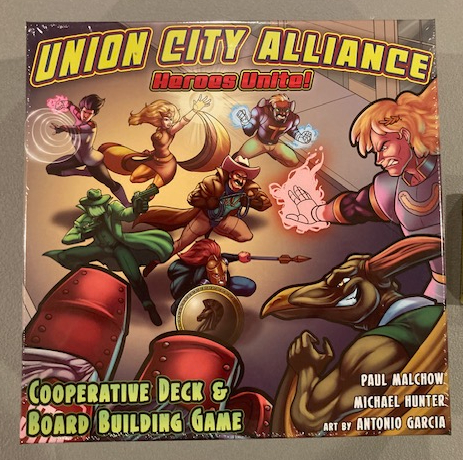
Union City Alliance is a cooperative super-hero deck-building games that was originally on Kickstarter back in March 2021. The game looked great and promised delivery in October 2021! I was so excited for this game that Union City Alliance made the #1 spot on my Top 10 Anticipated Cooperative Games of 2022!
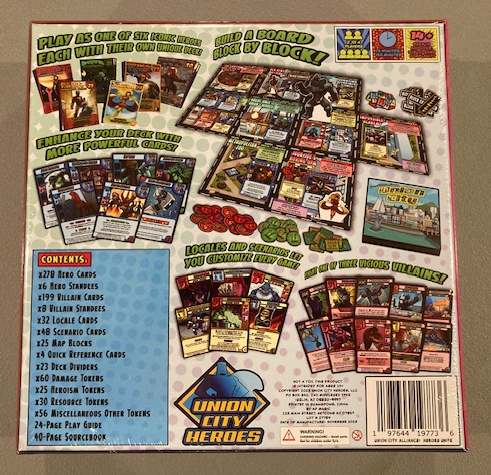
Unfortunately, the game is about 2.5 years late: The game arrived at my house April 30th, 2024! It’s basically been 3 long years since I backed the Kickstarter.
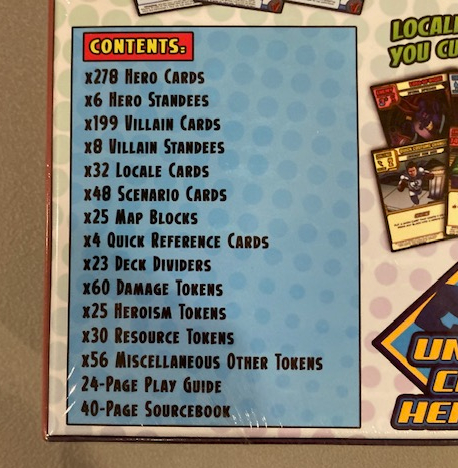
Interestingly enough, I was never worried that this wouldn’t finally arrive. The designer would do a pretty decent job of keeping us updated (with Kickstarter updates): he would offer full timelines of delivery and discussions of progress. I was grumpy that Union City Alliance was 2.5 years late, but at the end of the day, the Kickstarter was well-run … and they delivered!
Let’s see what we got!
Unboxing

The base game is about the size of a Ticket to Ride sized box: see above with a Coke can for perspective.
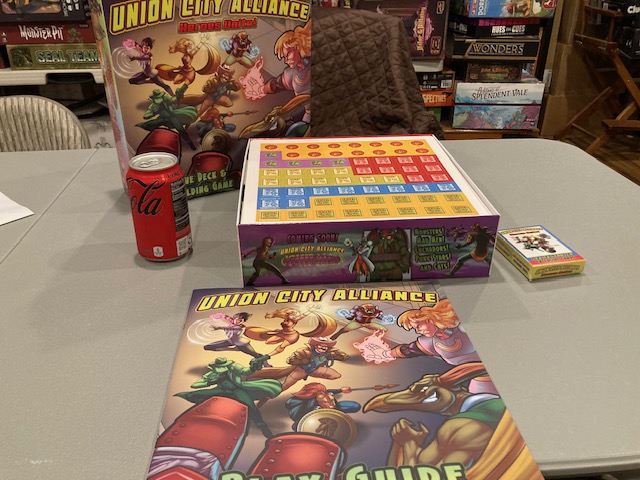
The rulebook is the full-size of the box on top!

There’s a lot of punchouts; these are just handy tokens to keep track of Heroism and other resources (Valor, Speed, Might). Interestingly, the Heroism and Damage tokens, which persist between rounds, are circular tokens. The Valor, Speed, and Might tokens, which evaporate between rounds, are square tokens. Even though the game never calls this out, that subtle consistency (persistent vs. ephemeral) was a nice touch.
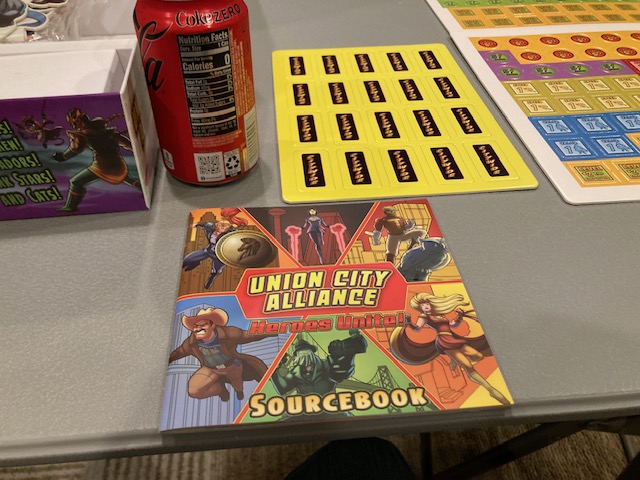
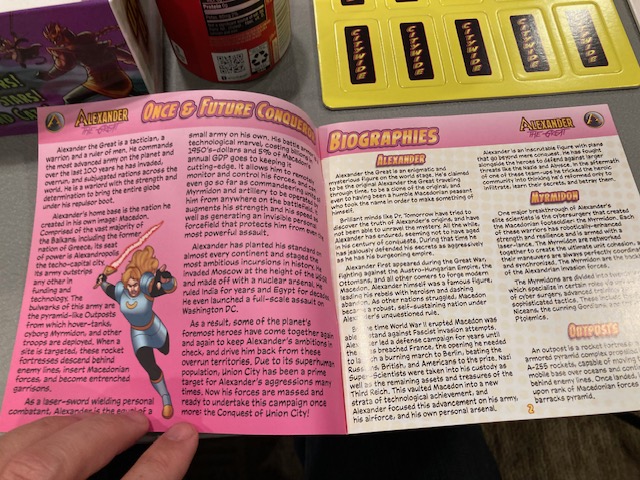
Also included is a source book; It has both set-up for various scenarios and tons of flavor text and back story for the heroes and villains: see below.
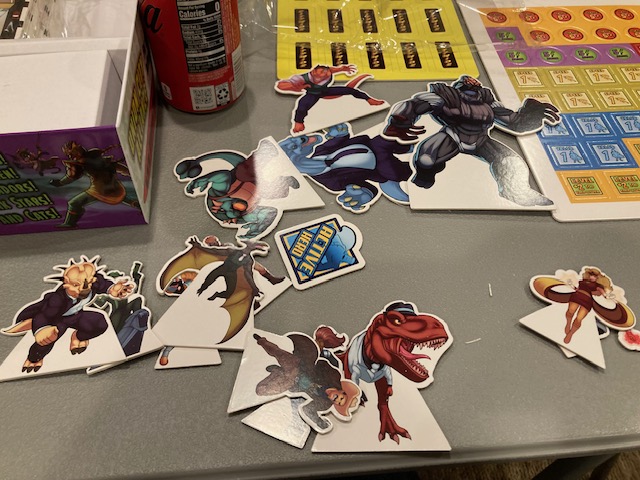
There are a TON of pre-punched standees that are both the Villain and Hero markers. See above.
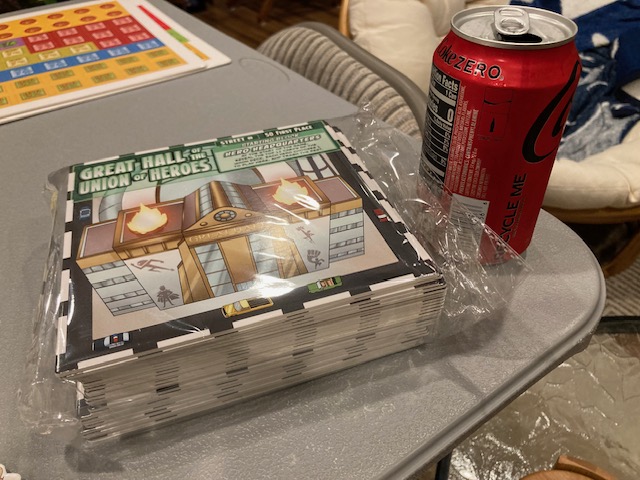
There’s also a GIANT (see can of Coke per perspective above) pile of Locations! These Locations come out slowly as the Heroes explore the city!
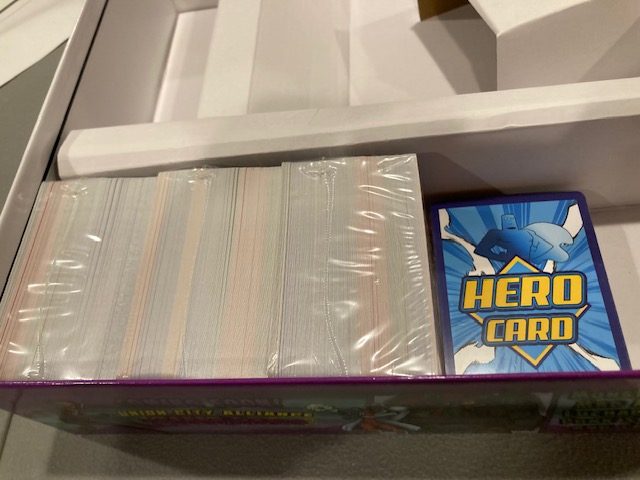
But, this is cooperative deck-building game. So, at its core, this game is all about the cards. When you first open the box, it’s a little daunting to see so many cards!
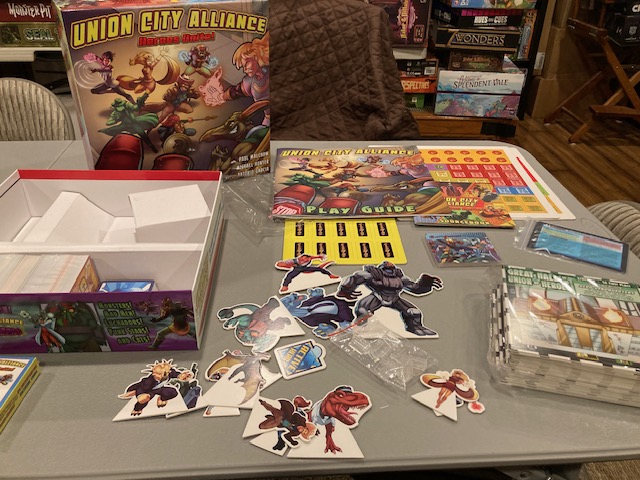
From an initial Unboxing perspective, this game looks great!
Uncardening
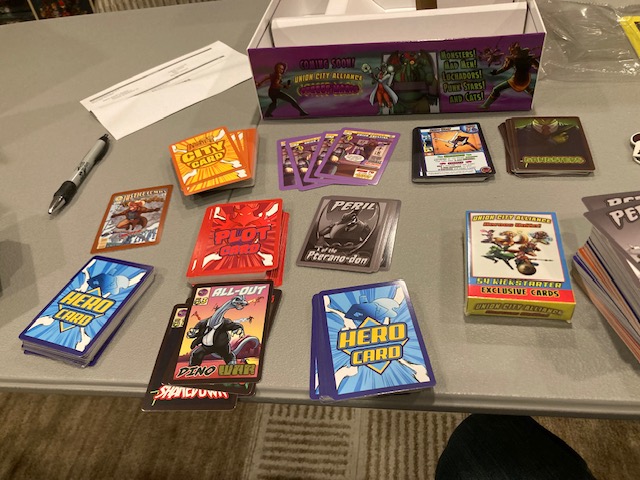
I feel like this needs to be a new phrase: uncardening. It’s the event when you have take a lot of cards out of a new game box and sort them appropriately. But it’s not just sorting: it’s about collecting together “like” cards, figuring out where the cards go in the box, and making sure they are ready to go for play!

Basically, we had to do the same thing in Earthborne Rangers: go through the cards, sort them, put like cards together (for some notion of “like”), and figure out where they go in the box. See above. Earthborne Rangers had a fairly grumpy uncardening (see our review of Earthborne Rangers here): the components page was misleading, and we spent far too much time trying to uncard the game.
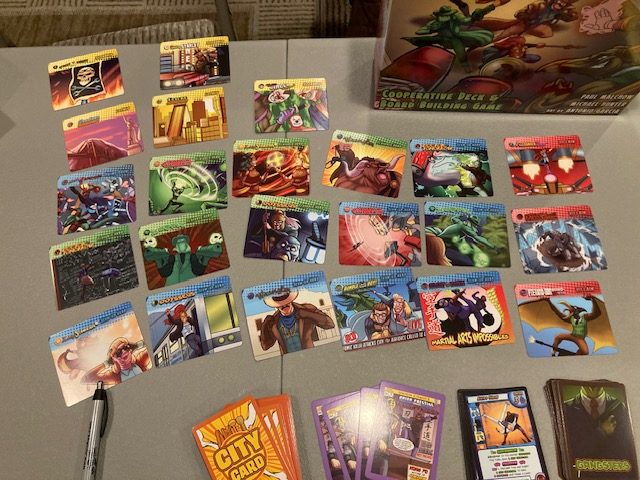
I almost think that the word uncardening (which is a word we coined for Earthborne Rangers) has a negative connotation: it implies you have to spend an extraordinary amount of time putting cards in order.
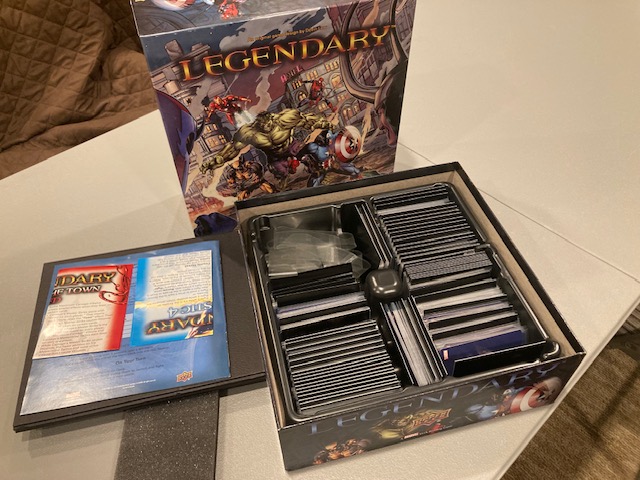
I remember when I first got Legendary: A Marvel Deck-Building game some 10 or so years ago. It has the worst box opening experience I have ever had! I just have tons of cards and no idea how to put cards together! The rulebook is completely silent on how to sort! As a gaming nubie at the time, I asked my friend John N. to help me (because he had Legendary), and with his help, I was able to put things together. The phrase uncardening applied to Legendary, it applied to Earthborne Rangers, and unfortunately, it now applies now to Union City Alliance.
If you think all deck-building games need a negative uncardening, I suggest you look at the Aeon’s End series of games! They do an amazing job of making the uncardening (in a good sense) easy. See our review of Aeon’s End and Aeon’s End: War Eternal here, and Aeons’ End: Outcasts here!
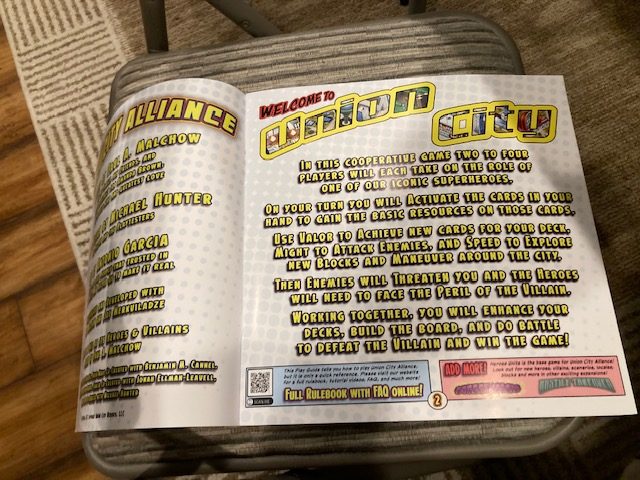
The first two pages of the rulebook … DO NOT address how to take the cards apart, sort them, put like cards together, and fit them back into the box. I am actually annoyed by this: The Union City Alliance rulebook wasted two very large pages (see above) with huge fonts for credits and an introduction. I am all for getting credit, but I was very annoyed at these designers because it was so hard to uncard their game! They SHOULD HAVE used those two pages for something useful: how to uncard the game!
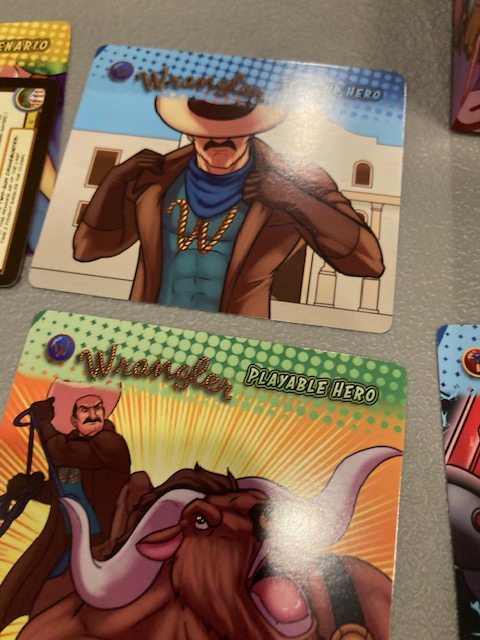
A simple question: why is there a Playable Hero and a Team-up Hero for Wrangler? See above. Which cards for Wrangler go where? This is an easy concept (once you know it) that should have been presented on those first two pages.
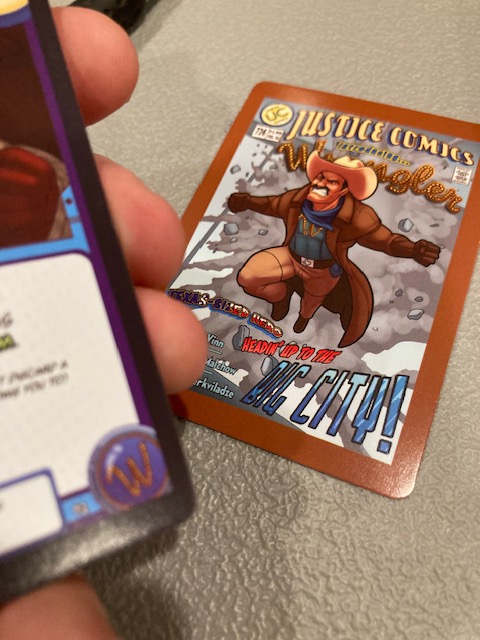
And it takes some knowledge of board games (and perception) to know to look in the lower right corner of the card: the Wrangler cards are the W! See above!

Once you start looking around some more, you’ll notice there is a manifest on the back of the dividers! Yay! They list both the number and the card title (good job!).
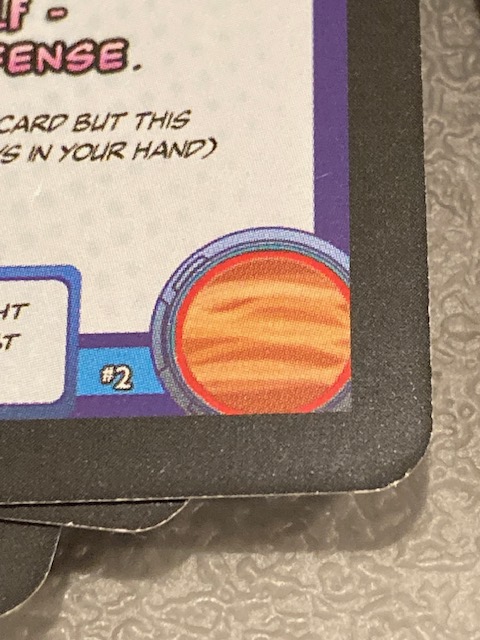
I am SO GLAD they have both the title and the card number on the manifest! The card number on the cards are SO SMALL as to be almost unreadable!! I had to zoom in pretty heavily with my phone in the picture above to see the #2 Captain Jupiter card! But having the titles on the manifests helped.
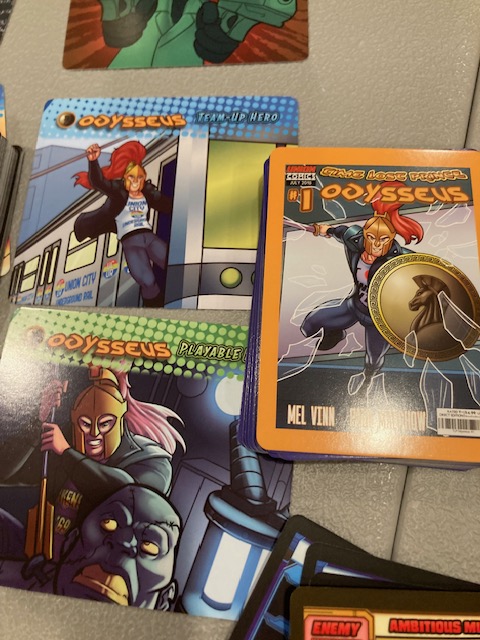
There’s just a lot of cards. I probably spent about an hour and half, maybe two hours uncardening this game. It really shouldn’t have been this much work, and it really shouldn’t have been so cumbersome. The cards are well-labelled, but throwing someone at the game without any directions is a misstep. I am an experienced gamer (now), so I was able to get through this, but I worry a newbie will just give up in disgust trying to uncard this.
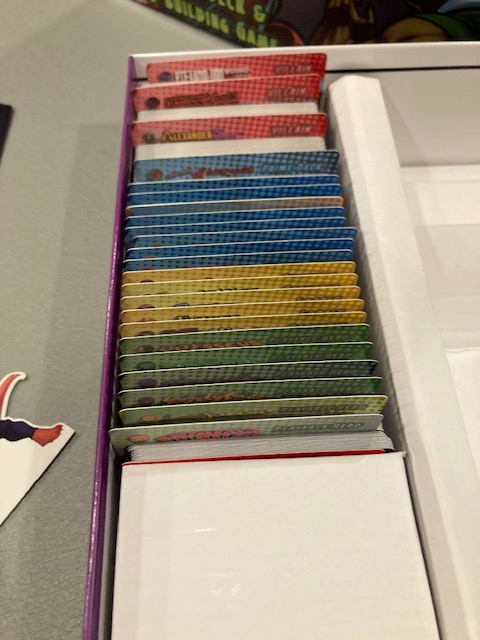
But, everything is labelled (once you know where to look: bottom right, and the divider manifests) so you can get there. And once everything is back in the box, it’s very satisfying. See above. This lack of uncardening direction may be the biggest misstep in the entire game: the uncardening just needed a little bit of discussion in the manual.
Rulebook, Er, Play Guide
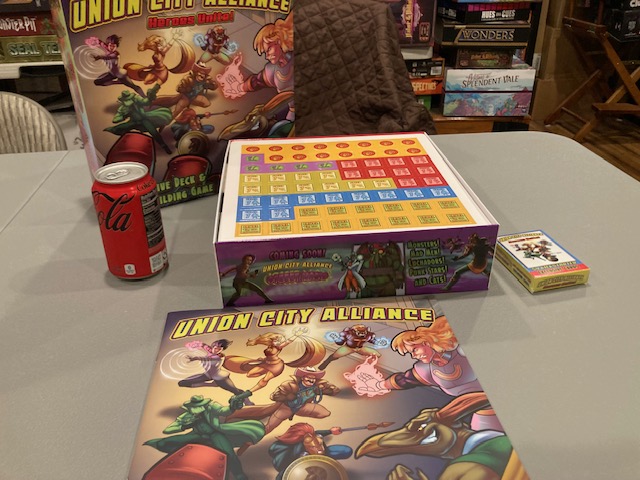
This rulebook is gigantic, being the same size as the box.
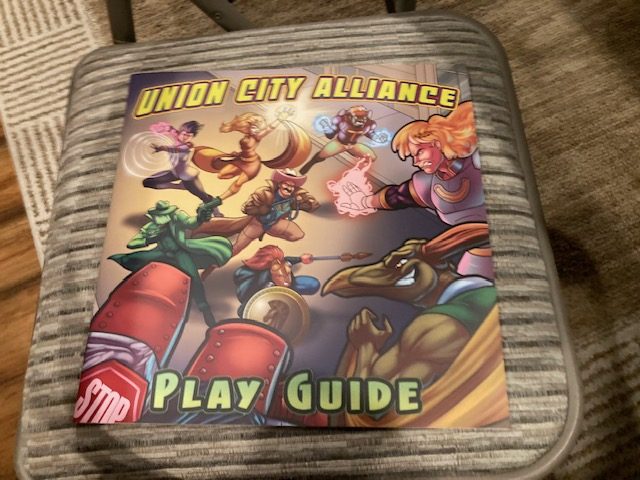
How does this rulebook do on The Chair Test? Unfortunately, it gets a D on the Chair Test.
It is almost impossible to have this on the chair next to you spread open because it was so big! It does have lots of good pictures and good font, but it was almost unusable on the chair next to me.
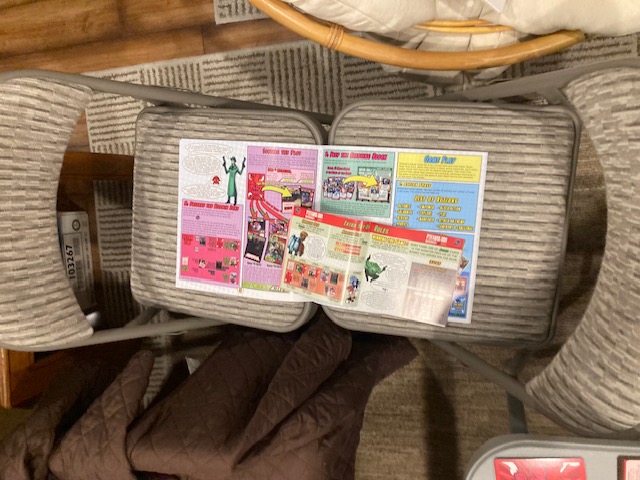
However, this game has spawned a new test: The Two-Chair Test. If you put two chairs together (see picture above), you can have the rulebook open and readable without taking up valuable table space! So, the rulebook gets a A in the Two-Chair Test (a second tier test) So, the rulebook lays flat, the fonts are big and readable, and I can read it easily from my chair. In the end, The Chair Tests are all about keeping the rulebook(s) off to the side so I can look stuff easily and not take up valuable table space!
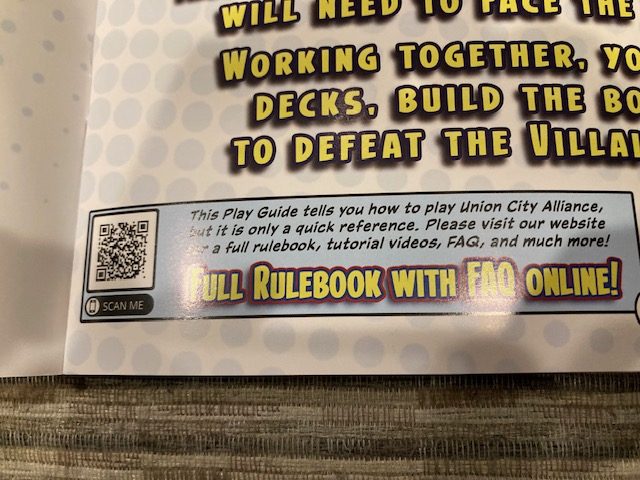
I have to admit, I was a little non-plussed to learn that this wasn’t the full rulebook! It was only the Play Guide! See above: “… but it is only a quick reference...”. You have to go to the website for a full rulebook. It’s cool they have all this on the website (FAQ, full rulebook, etc), but at the time I went there, the web site wasn’t up yet! See below.
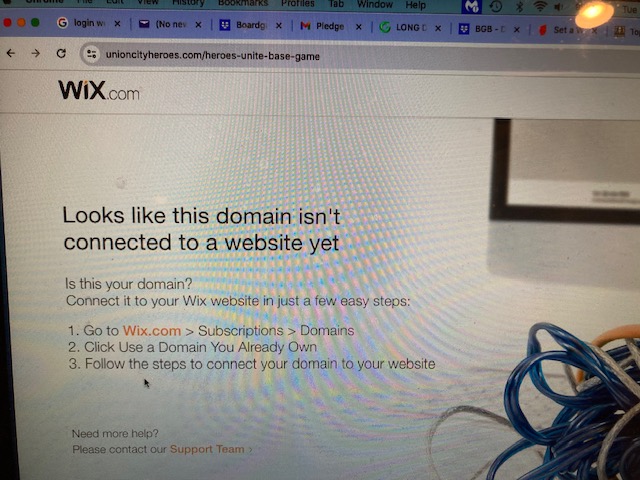
At the time of this writing, however, the web site is up. But, I had to play using only the Play Guide!
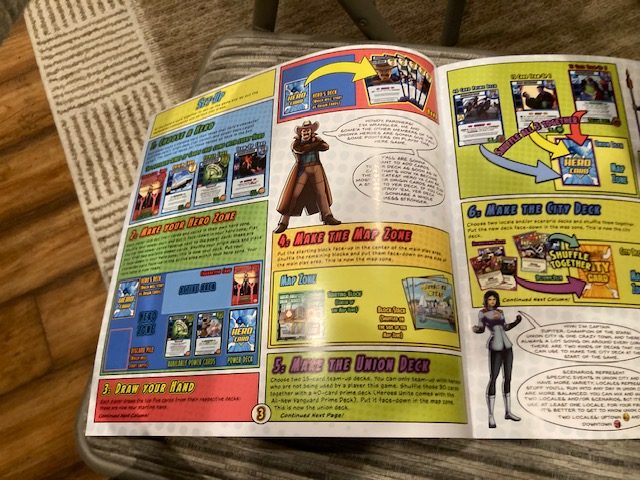
Once you get past how HUGE this rulebook, pardon me … Play Guide … is, it’s pretty good at getting you into the game. I don’t usually like thematic fonts for rules (see our review of Hour of Need here and Obliveaon here), but it works here. I think I like it because it’s a very big font, and it’s peppered with a lot of supporting pictures and colors: see above.
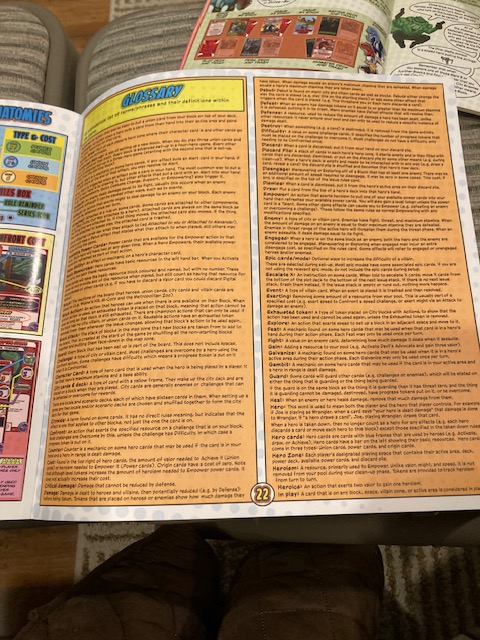
There’s no Index to the Play Guide (boo), but there is a Glossary (yay)! See above, In fact, the Glossary seems very complete; it covered just about everything that came up when I played.
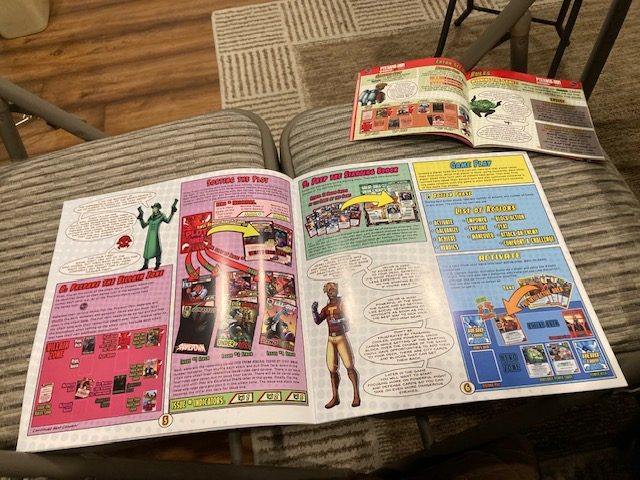
Once we got going with the two chairs and through the uncardening, the Play Guide was pretty good at getting me set-up: there were lots of pictures, lots of flavorful text, lots of helpful annotations.
I am still annoyed I didn’t get the full rulebook. I look at computers all day; the last thing I want to do is look online for full rulebook for a board game. The Play Guide has been “good enough”, so I have been just pushing forward with that. I haven’t needed the web site … yet.
Gameplay
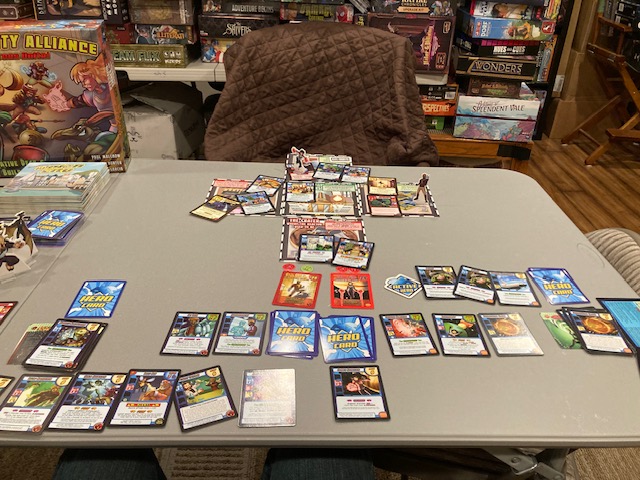
Union City Alliance is a cooperative super-hero deck-building game. That tells you a lot about this game already! See our Top 10 Cooperative Deck-Building Games for more discussion of deck-building games!
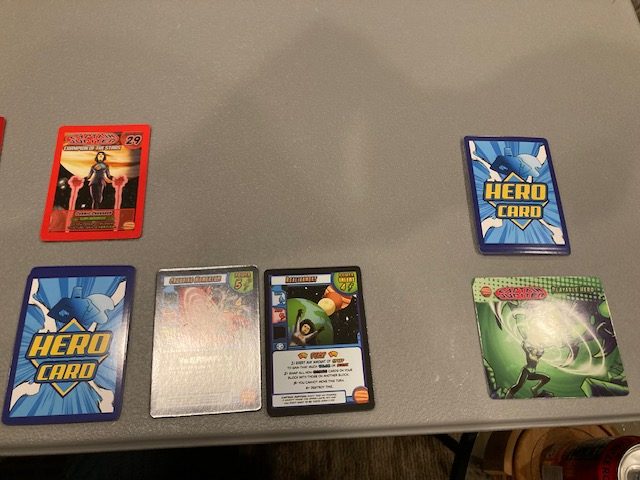
Each player chooses a hero to operate: that player gets the Playable Hero deck for that character: see above as Player One chooses Captain Jupiter.
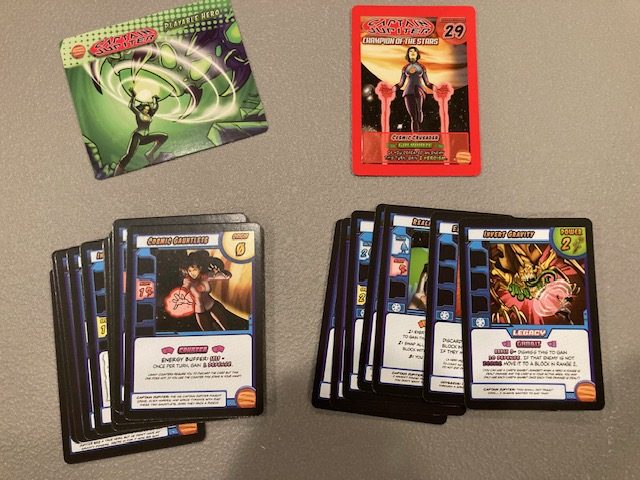
An interesting thing that Union City Alliance does is the cards are divided into two groups: your initial deck (with the 0 in the upper right corner) and the Power deck (with the green in the upper right corner). See above. Power cards are separated out, and only that player can buy those Power cards later in the game, using the (green) resource Heroism. It’s a real neat way of keeping each character very distinct, as each character has their own set of Power cards!
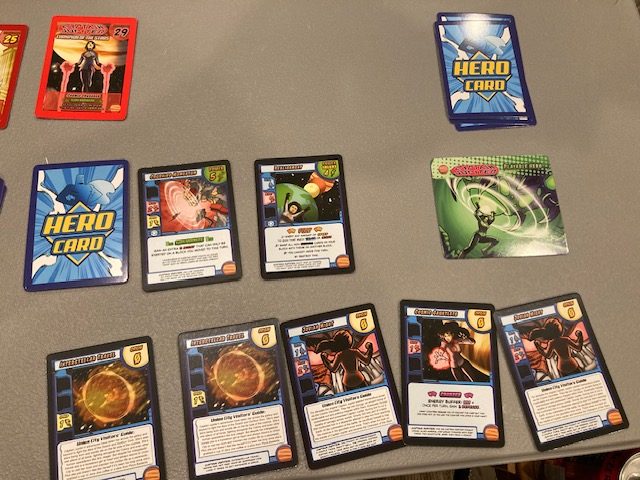
So, when you set up, you have your normal intro deck and your Power deck “tempting” you with some cards you can buy! See above as Captain Jupiter sets-up with two Power Cards available to buy, with her initial 5 card hand at the bottom.
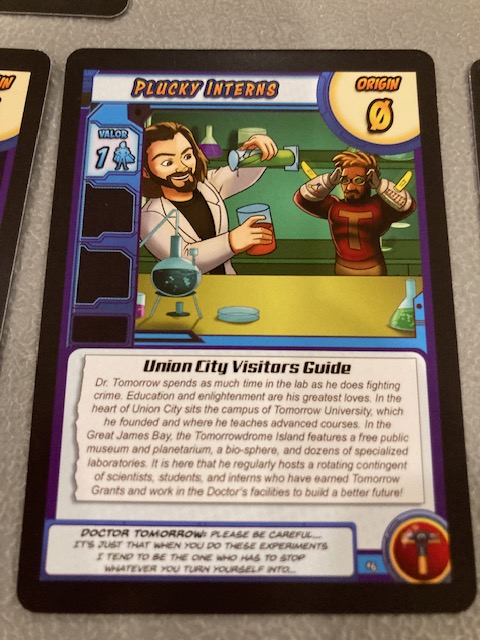
Each card can be played for Resources! The three main resources are Valor (blue), Speed (yellow) and Might (red). See the Plucky Interns above giving 1 Valor! Valor is generally the resource used for buying Hero Upgrade cards!
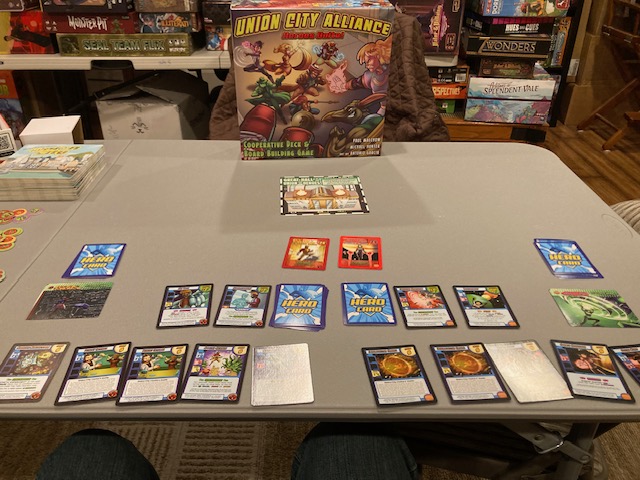
You need at 2-4 characters to play: see above as Doctor Tomorrow and Captain Jupiter are set-up!

One of the curious things this does as a deck-builder: you don’t usually get upgrade cards you can buy unless you go exploring! As you explore the city, more Hero cards come out that you can buy! This is different from other deck-building games like Legendary and Dominion and Aeon’s End where there’s just “9 types of cards to buy!”. See an example from Aeon’s End below.
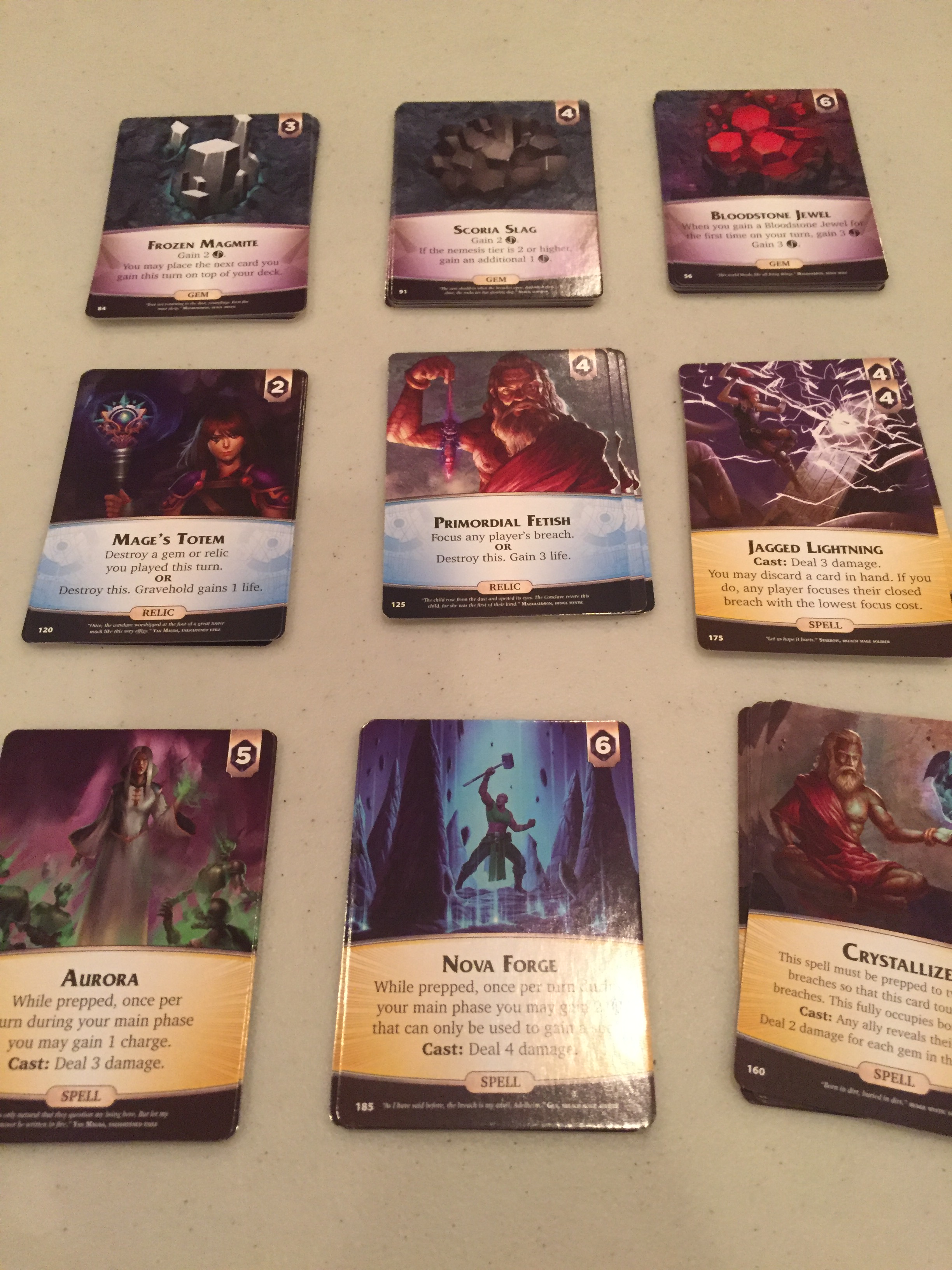
As you explore Union City, new cards come out: see below.
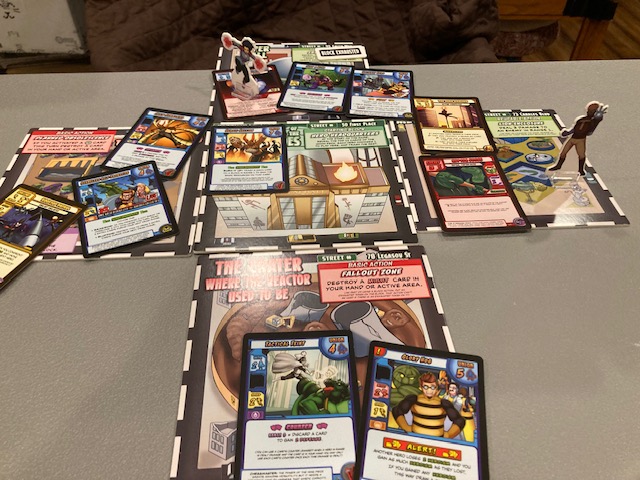
Every time you explore a new Location, two new Hero cards come out! (And a City Card, which is typically Bad Newsish).
This is interesting, as it forces the player to explore and look around to get upgrades. There’s no “set set” of upgrades: you get what you get as you explore! And you can only buy (generally) Hero Cards from the Location you are on! This is a nice and thematic twist on the deck-building genre.
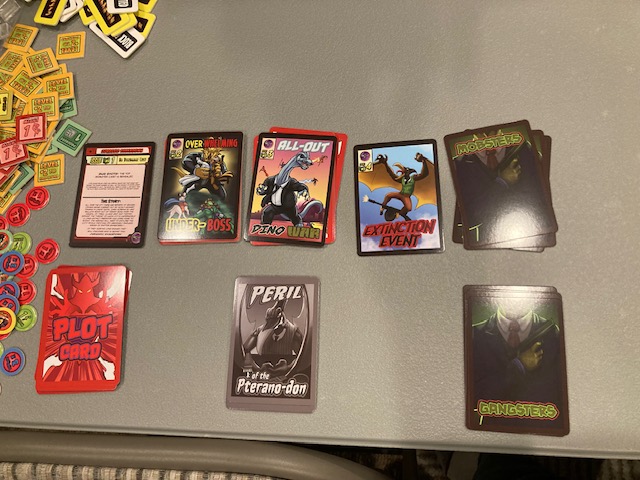
To win, players must take out the baddies! See above which represents “the bad guys!’ The bad guys in Union City Alliance are pretty complicated to run: there’s a Peril deck, a Plot deck, issues #1-4 of the Plot Deck, and specialized baddies (Mobsters and Gangsters in this case). To win with Pterano-Don and the Dino-Mafia, players must defeat all the Mobsters!
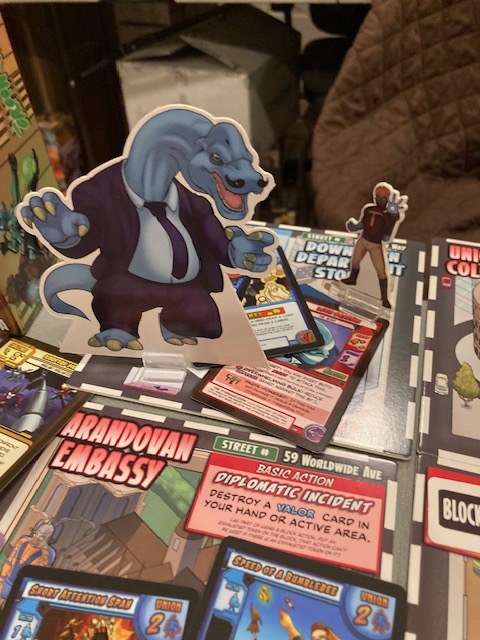
It’s quite hard to take out the Mobsters!
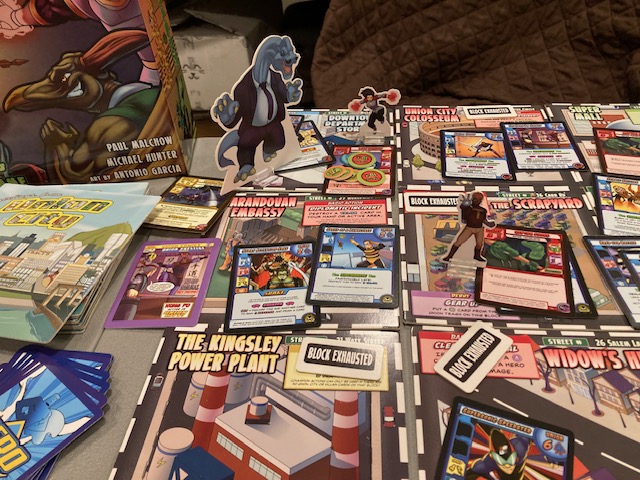
The city has to be big enough for the Mobsters to come out (a rule requires that), so that also forces the exploration aspect! See above as the city is pretty huge with one of the Mobsters looming!
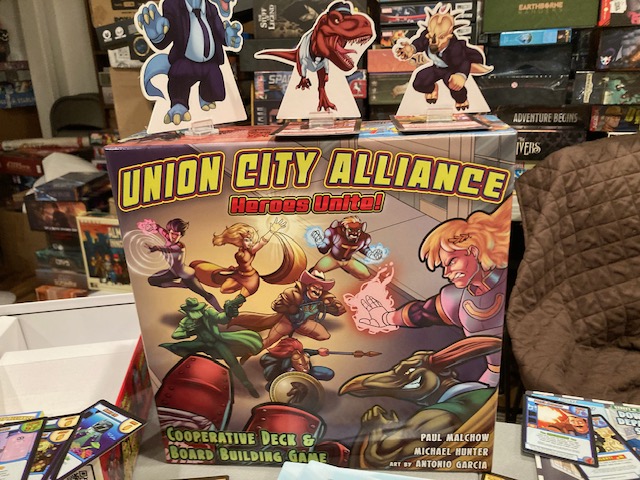
To win, take out all the Mobsters! As I took them out, I put them in “jail” on top of the box! See above!
Solo Play
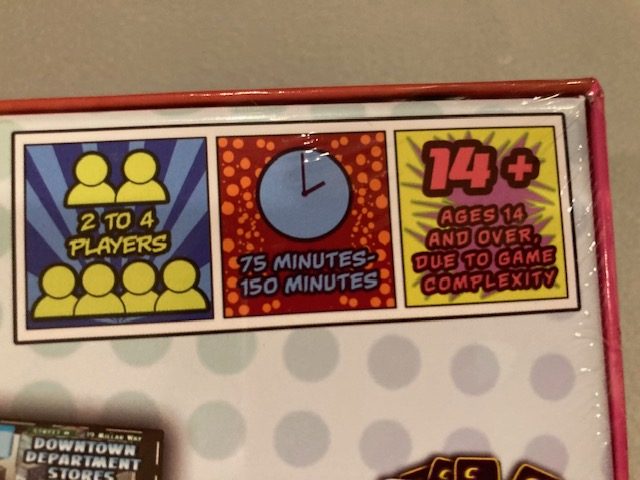
Unfortunately, there is no provided solo mode in the game! See above, as the game is only listed for 2-4 Players.
It’s very discouraging that they didn’t follow Saunders’ Law here: no solo mode! So, I went ahead and played my first game two-handed solo. That’s right, I operated Doctor Tomorrow and Captain Jupiter and just played this as if it were a 2 Player game, alternating between the two.

I think I know why they didn’t include the two-handed solo mode in the game: it’s pretty complicated. I ended up playing my first game (granted, a learning game) in about three hours. Each character in the game is very distinct with a very different play-style! There is a lot of context switching between the characters, as each character has their own specific cards and Power deck that players need to be thinking about! And the game can get pretty overwhelming as you play: see the picture above near the end of my solo game! There are a lot of distinct Hero cards and distinct challenges and distinct Locations!
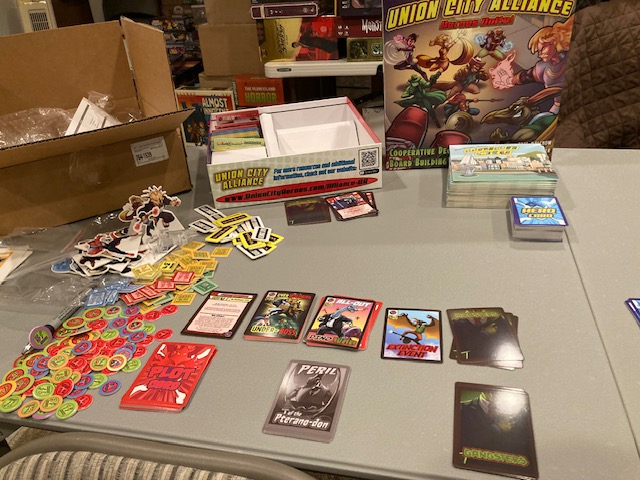
And the Villains are complicated to play too! Plot card, Peril Cards, issues, distinct baddies! So, the solo player has to run two characters AND the Villain deck!
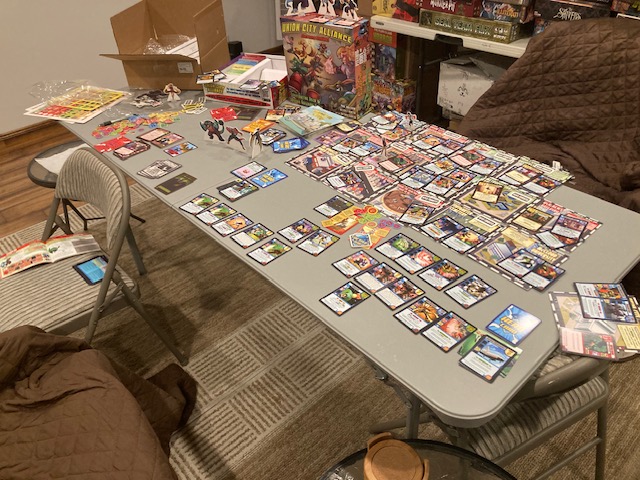
See above at the end of my first solo game! The board is a bit of a mess between two characters, the villains, the Locations, and all the cards!
I can see why the Union City Alliance people chose to avoid the two-handed solo mode: this game is very overwhelming in solo mode! My first solo game took about three hours to play! It probably wasn’t the best way to learn the game, but I believe in trial-by-fire for learning games: the only way to learn is to jump in! So, I think, if you are determined, the two-handed solo mode will work. And once you learn the game, the basic flow is pretty straight-forward.
Cooperative Mode

My second game was a two-player, two character game! I learned quite a bit in my solo game: things to do and NOT to do!
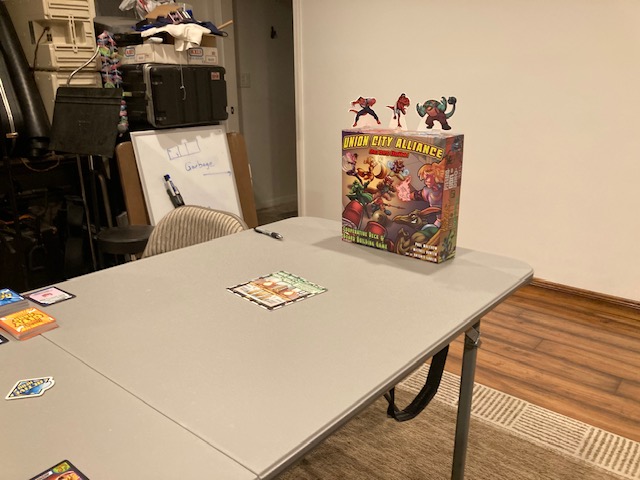
First, I learned to allocate signficantly more space for the Locations! See above as I leave half the table for that!
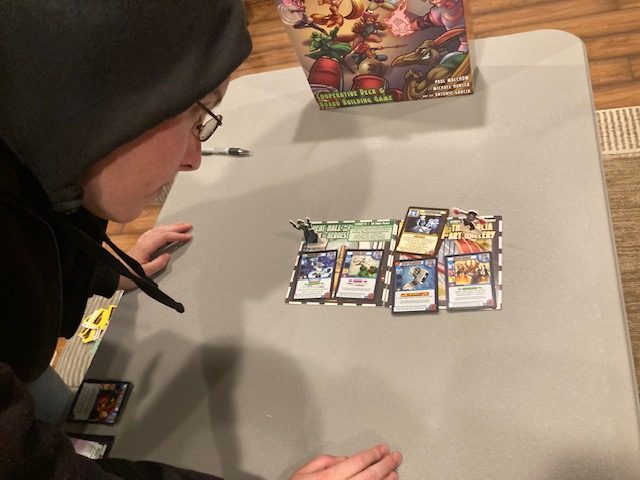
I also learned to be more methodical when placing Locations: each Location (when explored) adds Two Hero cards and one City Deck card. Since space is at a premium, we tried to make sure the two City Cards are on the bottom half, and the City Card (whether a challange or a Bad guy) is on the top of the Location. Since each Location also has a unique ability, we made sure that text was readable! So, there are four things you need to see on a Location: let’s make sure they are consistent and readable as we place! That makes the game … less messy … as the city gets explored!
See above as the city is a little less daunting as we have more space and the layout is a little more consistent.
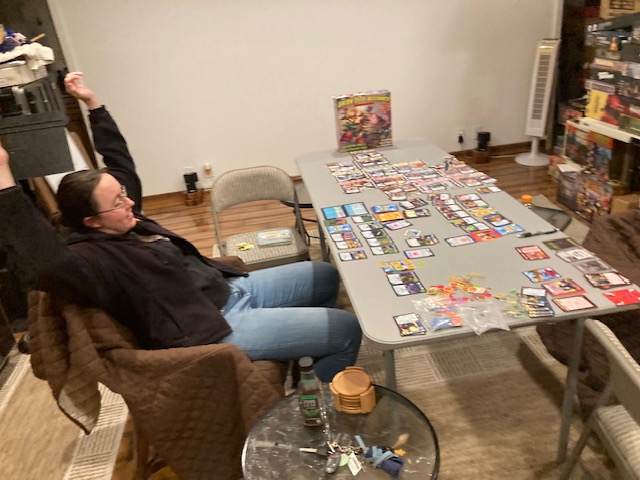
Even though each player runs their own character, which tends to make the players more isolated turns, Union City Alliance still encourages cooperation. Players have to work together figure out how to take out certain monsters and challenges to clear the way to take out the Mobsters! The game ramps up in difficult pretty quickly, and some coordination between the heroes is necessary to keep the badness under control.
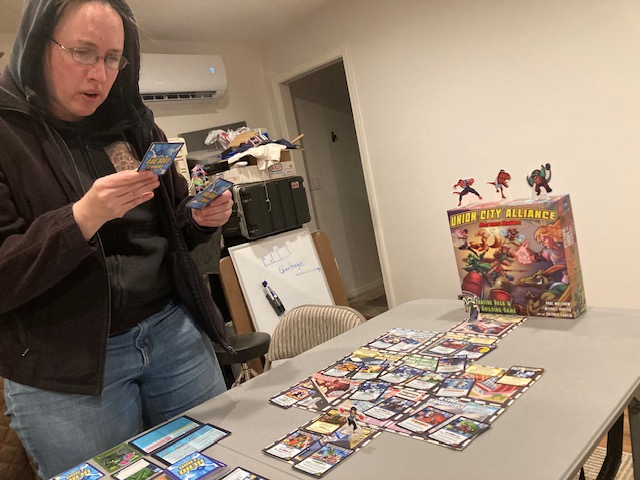
I liked the solo game, but the game is better at two or more: there’s more people to share the responsibility! Union City Alliance can be very overwhelming (there’s quite a bit of maintenance per round) as solo gamer, but the sharing of responsibilities made this much easier to get through. Teresa was in charge of The Green Death (that was here hero) and the Locations, and I was responsible for Captain Jupiter (that was my hero) and the Villain decks. Off-loading some of the maintenance to other players made the game much more fun! I could play without worrying about keeping the game up!
Solo was fun, but the game is just more fun with more players. I see why they chose NOT to put 1-4 Players on the box.
Theme

This game is dripping with theme!
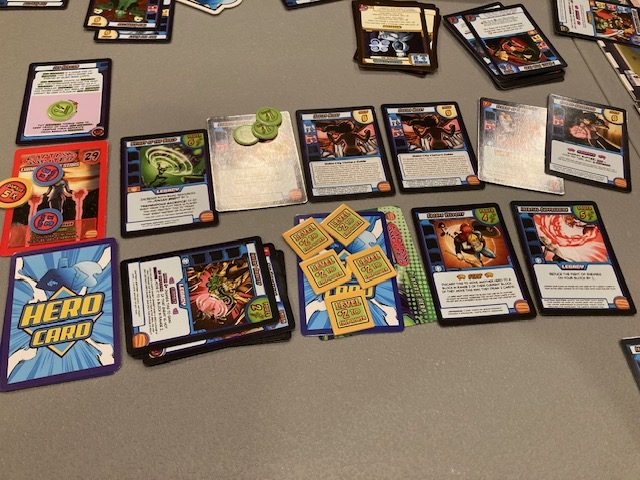
Each hero is very distinct and plays very differently, representing the sum of their powers!
There’s a ton of flavor text on the cards, which you can ignore if you like, but it really does draw you into your character.
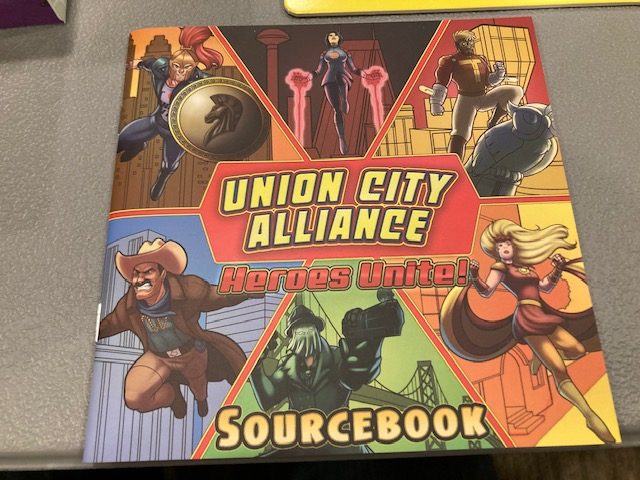
The Source Book just digs even deeper into each character! You want back story? You got it!

The Power Decks, which are unique to each character, also contribute to making each character just feel so different and flavorful!
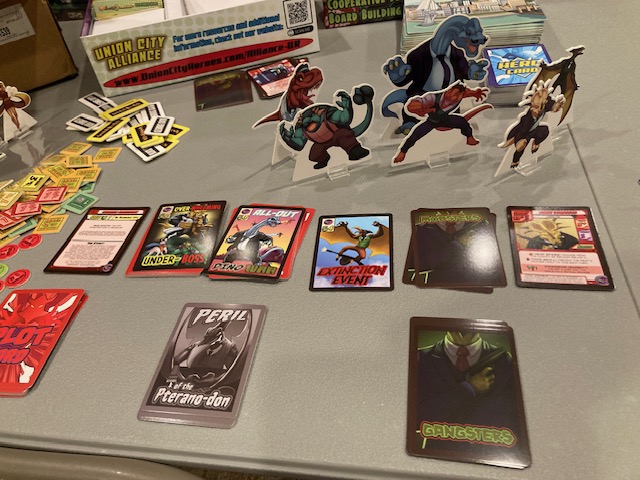
The Villain deck is quite complicated to run, but is very thematic! The “harder” cards come out in later issues of the game! There’s quite a it happening per round with the Villain deck, but it is all unique to the Villain .. again contributing to the theme.
The larger than normal standees (especially for the dino-mob) makes the game feel thematic! They are so cool looking!
If you haven’t noticed, just about every card has unique art on it! It’s all the consistent from the same artist and just draws you into the game!
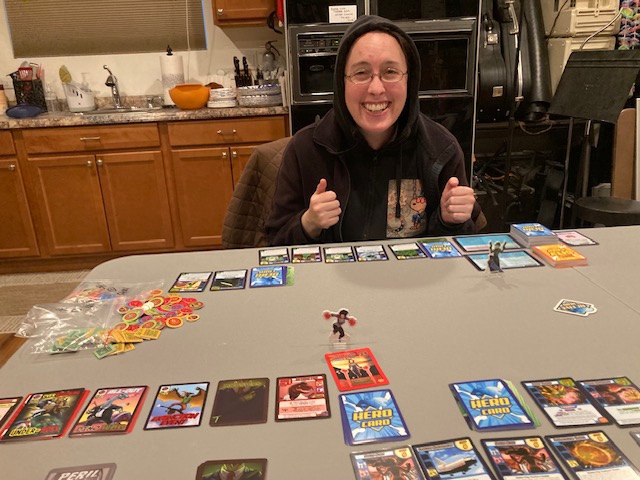
This game has so much theme to it: I’d give it a 10/10 for theme. The events, the characters, the Locations, the heroes, the art, the standees, the vibe of the game: 10/10.
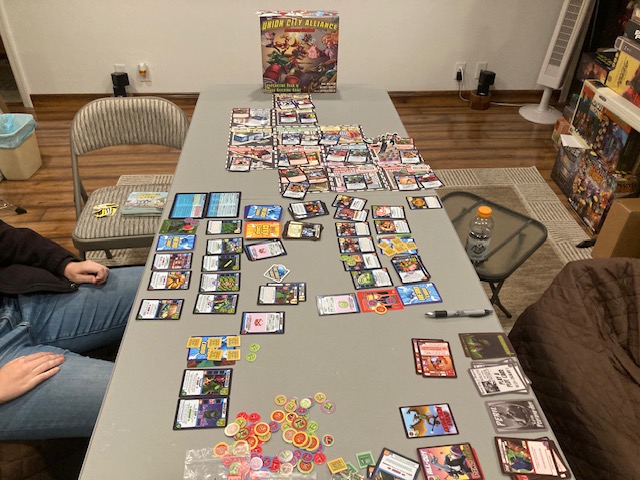
You do pay a price for this theme, though: from minor costs like flavor text (“Oh man, there’s flavor text on the card I should read“), to annoying costs (“set up the next city Location“), intrinsic costs like understanding you Power cards, to major costs (like running the very distinct Villain decks). My games of Union City Alliance have run about 2.5 to 3 hours. Some of that time is just the sheer maintenance of immersing yourself into this universe.
The Art
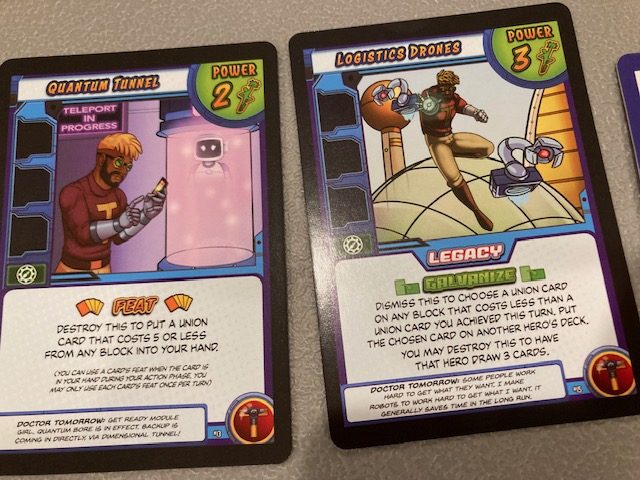
I love the art in this game. It’s pretty clear the art is mostly the product of one artist (Antonio Garica), and I think he just knocked it out of the park! The art feels very comic-booky and super-heroey. It’s so thematic and so good.
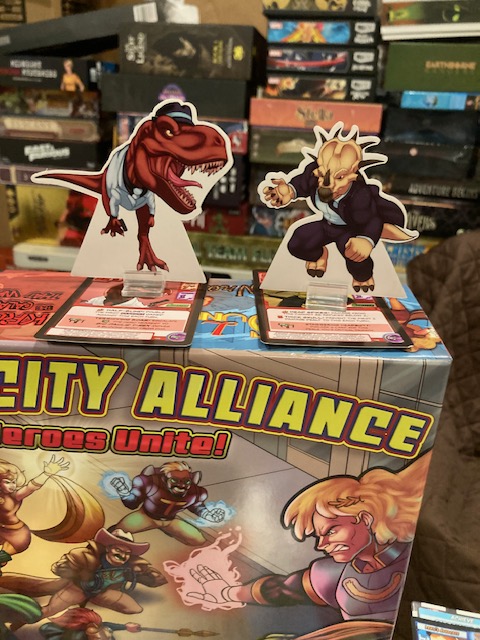
My only complaint, and this is not even really a complaint … is that his style might be thought of as too cartoony! I don’t have any problem with that, but if you saw the game cover in a store, you might this this is a game for younger audiences. While Union City Alliance is generally family friendly, this is a deep complex game that might be too much for younger audiences.
The age limits of 14+ should absolutely be adhered to (see back of the box), as I think someone who’s just starting in games might think “Oh that game looks cartoony and kinda cute! Let’s get it!” Union City Alliance is much heavier than the art belies. Caveat Emptor.
Conclusion
If you want theme, you have to pay for it! If you want a lighter super-hero deck-building game, you should bring out Marvel Legendary: It has your Marvel heroes and is pretty straight-forward to teach. But honestly, I always thought the theme was lacking in Marvel Legendary: “Wait, you are buying a team of heroes? What?”

Union City Alliance is a deck-building super-hero game that has the theme I always wanted in Marvel Legendary. In Union City Alliance, characters have unique powers, Villains are distinct, exploration/upgrading is both natural and encouraged, upgrades are tailored to your hero, and the art is very consistent and thematic.
If you want theme, you have to pay for it: Union City Alliance takes longer than many games (2.5-3 hours), has more upkeep per turn, and has more complicated set-up and interactions. You pay for this incredibly thematic game by having a game that’s more complex.
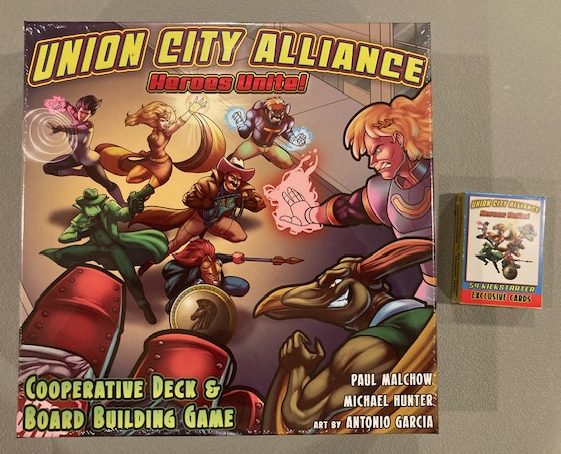
I want that theme! Union City Alliance would easily make my Top 10 Cooperative SuperHero Games with a 9/10 and it will probably be near the top spot of my Top 10 Cooperative Games of 2024. It took about 3 years to get Union City Alliance, but I was totally right to make this my #1 on my Top 10 Anticipated Cooperative Games of 2022!
 coopgestalt
One thought on “Union City Alliance: Heroes Unite! Like Marvel Legendary, but Now With More Theme! A Review”