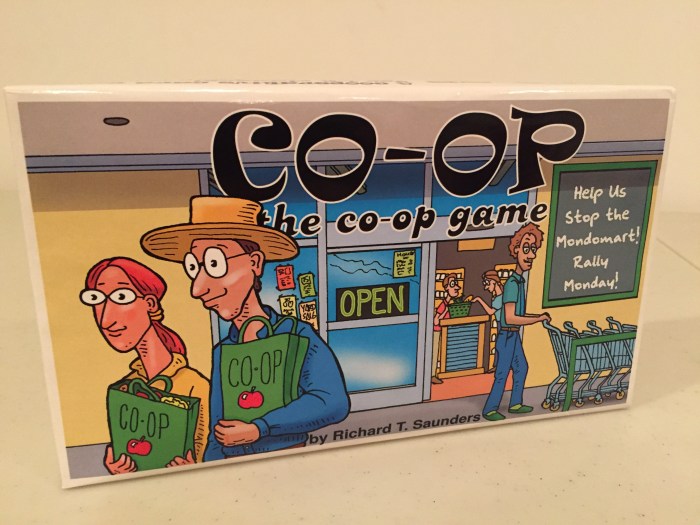
Getting Ready To Kickstart! CO-OP: the co-op game!

After months of design and development and test, we are ready to Kickstart CO-OP: the co-op game!  We’ve had many blog entries here in coopgestalt where we discussed decisions, playtesting, rules, and general development of the game.  We’ve had a few false starts, but we’re just about ready!

The official date we go live is November 15th.

Thanks to Bob Diven for the great art he’s given us!  Final Totals:

  • 200 cards (63 Happenings, 99 Groove cards, 27 Goods cards,7 COOPERATE cards, 4 Locations)
  • 18 Jumbo Cards (7 characters, 5 days of the week, 3 Game/Icon Summary, 2 Scenario cards, 1 Money Chart): all double-sided with content on both sides!
  • 15 Markers (7 standees, 6 VIBE gems, 1 Money marker, 1 Happening Dude marker)
  • 1 Rulebook (16 pages, 4.5″ by 8″)
  • 1 Box (big enough to hold everything, small enough to fit in the USPS small flat rate box) about 5″ by 8.5″!

Special thanks to everyone who helped out!  It’s a long list, and I’m sure we’ve forgotten someone (not on purpose)!

Thanks to playtesters and helpers Anya and Robert, Chris M., Alan C., Kevin D. and family, Byron & Jenn H., Drew, J on S., Cynthia, Junkerman, Kurt D., John M., Mike H., Bob A., Sam K. and family, Lon F., Charlie C., Alison C., Clint J., Cary J., Audrie T., Stephan T., Leif T., Teresa F., Sara B., Ben P., Jon G., Robert C. and wife (Alison), Mark S., Nancy S., Madeline M., Adam N., Jeremy W., Dustin and wife, Robert S., Jeff H., Jeff Barr, Random, Jacob, Kylie, Scott S., Jeff, David H., Erin, and Robin. From UNPUB: Olivia, Max, Geoff, Sun, Katie, Rob, Ben, and Milo. Thanks to Bob Diven for the great art! Special thanks for Jenny J., Chris C., Josh M., Don W., Martha C., and Andrew A. for their extra support and help! A shout-out to “Isle of Games” for their support!

UNPUB Tucson at Rincon 2016!

One of the better gaming events in Tucson is the Rincon Board Game Convention.  If you’ve never been, they have board games, RPGS, miniatures, card games, new prototypes, games for kids … almost any game you would want!

This year, we were able to get some playtesting in for CO-OP at the UNPUB mini event:

Thanks to all who attended and for some great playtesting!

And yes, they kinda looks like some of the characters from CO-OP …

… but I promise you, it wasn’t on purpose!

Seriously, all feedback was great!  Most, if not all problems, were because people came late to the event.  One remark was:

If I had set-up the game myself, I think a lot of my confusion would have gone away.

Another comment was:

I didn’t know when to play a card, but I realize that was because I was late and missed some of the rules.  The Game Summary card was really helpful!  Too bad I didn’t see it until after the game!

Everyone who filled out an UNPUB form said they’d play again and that they’d buy the game.  Unfortunately, I don’t know what the people who didn’t fill out forms think …

Mythos Tales Unboxing


Mythos Tales was a very successful kickstarter, doing 5x it’s initial asking!
https://www.kickstarter.com/projects/8thsummit/mythos-tales

I am excited for it because it combines detective work with co-operative play in the genre/world of Arkham Horror (a perennial favorite at our games table, especially on Halloween).  It was described to me as Sherlock Holmes: Consulting Detective meets Arkham Horror.

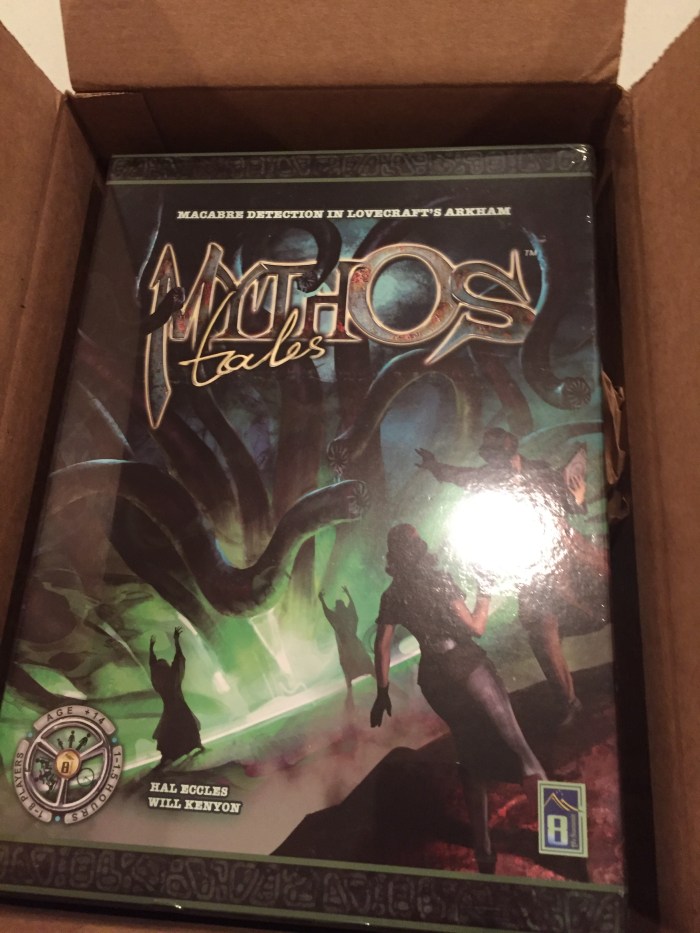
My copy of Mythos Tales arrived just today. Super cool!   But my unboxing left me a very pleasant surprise! What’s that you may ask???  … wait and see!

First, the box opens up with a nice “Thank You” flyer (+errata). Very classy.

img_2419
The game box has very nice artwork and is very high quality.

img_2420
But what’s this underneath the gamebox?

img_2421
I got candy! I think that is the coolest thing ever! Thank you 8th Summit games!  It’s amazing how such a little thing made me so happy. (I love Smarties).

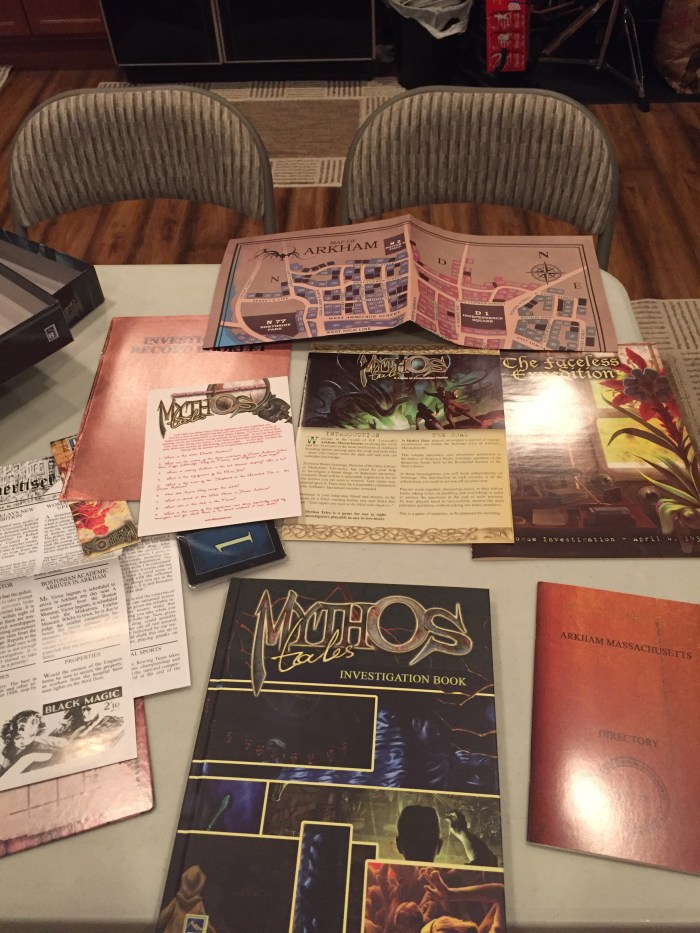
I opened the actual gamebox and looked inside .. holy cow! So much stuff! I think this will be a deep, deep game that will last me years.

img_2425
I like to savor stuff like this, so I am excited to play.

Watch for a review in this space after a deep play!


Top 10 Co-operative Board Games “Off the Beaten Path”

There are a lot of top 10 lists for co-operative board and card games, but I have noticed that they tend to rehash the same games over and over.

To that end, here is a list of my top ten “off the beaten track” co-operative board and card games.

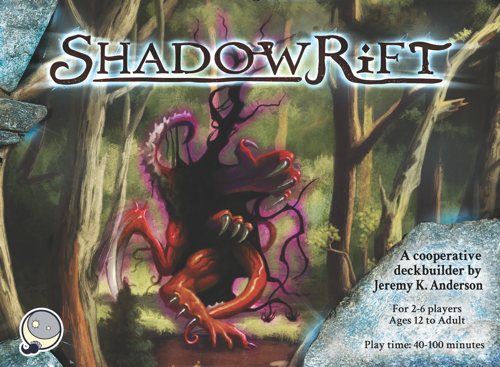
10. Shadowrift:
https://boardgamegeek.com/boardgame/112092/shadowrift

shadowrift
I believe it was originally a Kickstarter, but I picked it up at my local  game store (the original edition).   This (at the time) was unique, as it was a co-operative deck-building game. The theme was simple: keep Haven Town from being overrun.

Shadowrift is hard to set-up, but once you get into it, it’s pretty fun. (I strongly recommend finding a youtube video for set-up: we liked this one).

Currently, there’s a second edition, but I only have the first. My friends and I always enjoyed it when we played it, so I have new reason to buy the new one. The newer edition has better components, but again, I was happy with the first.

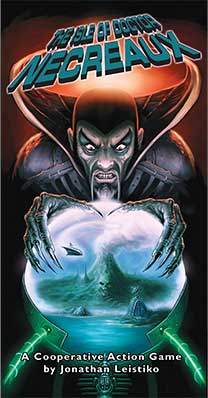
9. The Isle of Dr. Necreaux:
https://boardgamegeek.com/boardgame/42892/isle-doctor-necreaux

iseofdrn


An interesting co-op card game, where splitting the party is a mechanic!

I don’t even think this game is in print anymore. I just adored this game: it has some interesting game play ideas: every turn, you decide how many “challenges” (cards) to flip. Too many and you get overwhelmed and “die”, too few and you won’t save the scientists/get off the island in time!

The FAQ is bigger than the rulebook, and there are some ambiguities. If you like rules very cut-and-dried, you won’t like this game. Fairly often in the game, you have to make a rules interpretation to move on; this can be fairly disconcerting to some gamers. But, for me, it was kind of thematic! “I’m on this weird island! How do I deal with this weird stuff?” You just deal with the weird stuff and move on.

I adored this game (I know I said that), but I can see why others might not like it. It’s worth checking out just to “split the party”; the fact that they have a mechanic for that is worth at least a few plays.

8. Agents of S.M.E.R.S.H:
https://boardgamegeek.com/boardgame/111105/agents-smersh

smersh
A fun co-op game with lots of immersive reading, originally a kickstarter.

Thematically, you are secret agents from the 70s. (Think Bond in the era of James Bond with Sean Connery, but much sillier).

This game was originally a kickstarter. I introduced it to a lot of my friends: they liked it so much they bought it themselves!  (I had the first edition, there is currently an updated 2nd edition).  It’s best described as Tales of Arabian Nights meets Pandemic and Arkham Horror. There’s lots of reading that can be very immersive: every turn, someone reads some text from a VERY big book about a secret agent challenge, and you either succeed or fail in the challenge. You move around a map, trying to squash Dr. Lobo and his minions before they destroy/take over the world!

One complaint I have heard about Tales of Arabian Nights is that it’s too random (and it really is!). If you like the idea of Tales of Arabian Nights, but want something with strategy, SMERSH is for you!
My friend Joe bought the game because the reading aspect is very helpful in his classroom: it seems to encourage kids to to read more.

My friends Charlie and Alison bought it because they loved the co-op nature and the flavor text is very immersive.

This is a fun game. It also has a sense of humor. (There’s at least 2 expansions, one is named “Swagman’s Hope”.)

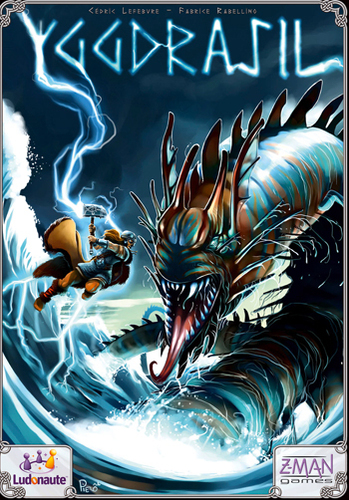
7. Ygdrassil:
https://boardgamegeek.com/boardgame/71671/yggdrasil

yg


A fun co-op set in Norse Mythos. Very hard, but very fun.  This game comes out a lot onto our table.  It seems to be a real crowd pleaser.

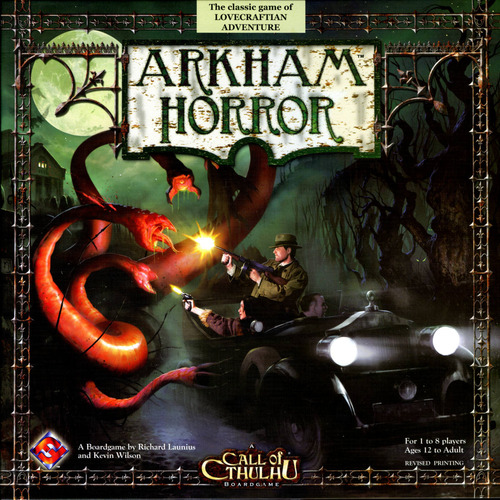
6. Arkham Horror:
https://boardgamegeek.com/boardgame/15987/arkham-horror

arkhamhorror

A very big, very thematic Cthulu Mythos board game squarely set in town Arkham. It’s almost a role playing game, in that you play a character with abilities and equipment and stats, but it is  still “limited” to a board game (to keep some of the complexity down).

So, you might wonder, “How is this off the Beaten Path? Arkham Horror is an mainstream game!” Well, I was “shocked” how little presence Arkham Horror had at the Fantasy Flights board game center in Roseville MN (I got to visit when my wife and I visited her family). There was just a few copies of the game and the expansions. It didn’t seem like they were pushing it very much. It seems like the new generation of Fantasy Flight games is getting the love: Mansions of Madness, Eldritch Horror and Elder Sign.

I suspect that Arkham Horror has gone as far as it can, and Fantasy Flight is hoping to next generation of Cthulu Games will take hold.

My friend CC even thinks the newer games (esp. Eldritch Horror) are more modern and have slighly better mechanics (and he introduced me to Arkham Horror!).

But I’ll play Arkham Horror just about anytime. It has a special place in my heart: for my Bachelor Party, we played Arkham Horror and 6(!) expansions at the same time. EVERY SINGLE EXPANSION AT ONCE. To keep track of the different boards and rules, every player was responsible for one expansion.

I still think it’s a great game. If you like Role Playing Games, but just don’t have a DM or time to make up an adventure, Arkham Horror feels very much like an RPG while still being bounded. It’s a great game, if a little complicated.

To my mind, it’s the first real co-operative board game.

(And, I also loved it so much, I tried to get my Software Engineering course to implement it.)

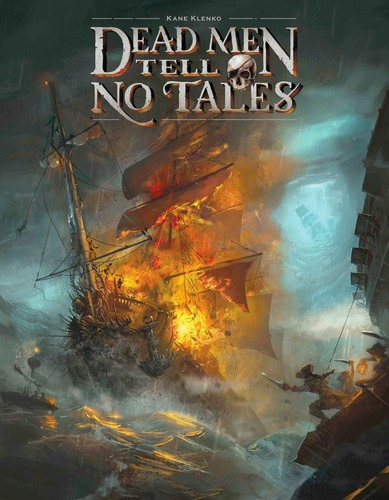
5. Dead Men Tell No Tales:
https://boardgamegeek.com/boardgame/141423/dead-men-tell-no-tales


deadmen

This was originally a kickstarter .

I am a sucker for co-op games, so I picked this one up. I also picked up a second copy for my friend CC (as a birthday present) because I knew his kids love pirates (and CC is the only person I know who likes co-ops as much as me).

CC, a bit of a connoisseur of games (and quite the designer), was really taken with the game. He thought the dice mechanic was interesting and original. I also noticed that the game was pulled out many times at one of my Las Cruces gaming groups. “Did you bring Dead Men Tell No Tales?”

It was a good gift and it is a good game.

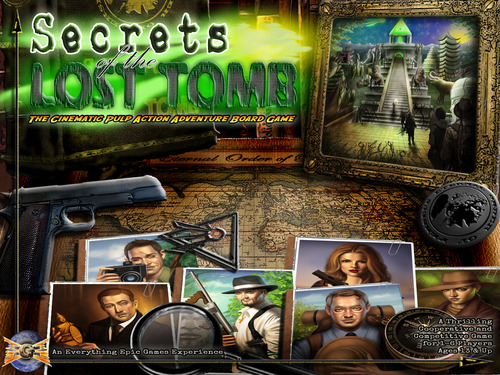
4. Secrets of the Lost Tomb:
https://boardgamegeek.com/boardgame/150484/secrets-lost-tomb

secretsofthelosttomb

This was originally a kickstarter.

For gameplay, it can be best described as Arkham Horror meets Betrayal at House on the Hill (but fully co-operative for the entire game). The theme is very Indiana Jones/Johnny Quest with exploration of crypts and tombs and defeating all sorts of evil creatures. In some ways, I like this better than Arkham Horror because each time you play, the scenarios are very different (with different win conditions,  set-up, etc) a la “Betrayal at House on the Hill”. The only problem with scenarios is that there are a finite number of them which may limit your replayabilty a little.
There’s a lot of pieces, but it’s lots of fun. There are TONS of expansions, but I still only have the base game, as I haven’t played through all the base scenarios yet.

A long game, but lots of fun if you like a lot of role-playing aspects in
a board game.

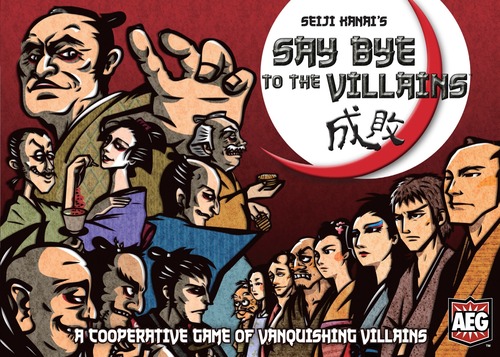
3. Say Bye to the Villains:
https://boardgamegeek.com/boardgame/140795/say-bye-villains

saybyetothevillains

My friend Jeremy brought this over some time ago. I was skeptical: it’s a co-op that plays 3-8 players. 3-8?  We ended up playing a game with 7 people. And it was FUN! There are very few games that work well with 7 or 8 people, especially a co-op, and this one pulled it off. I am sad to say we haven’t played this as much as we should, but it was really fun.

I bought it the next day.  Part of the reason this one gets such high marks is because of the 3-8 players for a co-op.  So few have that now.

2. Big Book of Madness
https://boardgamegeek.com/boardgame/171233/big-book-madness

bbom

This game is fairly new, and has hit our table quite a few times.  I suspect many of my friends may go and buy it they like it so much (CC already has!).  Check out our review and discussion of the game here.

I wonder … this game has quite a bit of “Parry Hotter” in it (I don’t want to get sued …), so I am curious how well the Harry Potter Deckbuilding game (out very soon) stacks up (no pun intended) against this.  Will the one that was developed with the IP work better?  Or will the “offshoot” be a better game?  Time will tell …

1. CO-OP: the co-op game
http://www.picklingtools.com/coop61.pdf

coopgame1

Hopefully, a kickstarter in the future.

This is a my own creation, which I have working on for about 9 months now. I still like playing this game! I like co-op games that are very puzzly, especially ones you can play by yourself or with others; that describes CO-OP to a T. I also like games with a sense of humour (The Secret of Monkey Island, Chez Geek, Munchkin, Agents of SMERSH, etc.) and I tried to instill humor into a game without sacrificing gameplay. I also find that some things are missing from a lot of co-operative board games, mainly “Why can’t you play in any order?”. If players control the order, they can make some neat combinations that can really move the game along (See this blog posting for what I call “The Fastball Special”).

So, I am hoping to take CO-OP to a kickstarter maybe at the start of next year. Be on the lookout!

Fastball Special

fastball

80’s X-Men

I grew up in the 80’s with the X-Men of Claremont/Byrne/Austin:  this particular incarnation of the X-Men is the basis for many of the current X-Men movies (Dark Phoenix, Days of Future Past) and spinoffs. The great stories and art really carried me into another world! What I would have given to be training in the Danger Room with Cyclops and Wolverine and the rest of the team!

One of the lessons of Charles Xavier’s school was co-operation. If you couldn’t work together in the Danger Room, you’d fail the exercise. If the team failed to work together in the field, they’d die!

The epitome of this co-operation is the Fastball Special.

The Fastball Special is where Wolverine climbs onto Colossus, Colossus throws Wolverine, and Wolverine attacks. It’s a very co-ordinatinated long distance attack. And it doesn’t work unless Wolverine and Colossus work together in a very particular order.

Superhero Games


It surprised me how long it took for there to be a co-operative Super Hero board/card games. With the popularity of super hero teams working together: the Avengers (“Avenger Assemble!”), Teen Titans (“Titans Together!”) and the X-Men (“To me, my X men!”),  it seemed only natural to me that a co-operative Super Hero game would be in the works.

Sentinels of the Multiverse was the first to get there (Gen Con 2011),  with Marvel’s Legendary (November 12, 2012) and DC’s Super Hero deckbuilding game  (11/30/2012) following. There are others, and we’ll do a round up in  later blog post, but these are the most popular at the time of this writing.

Turn Order


The interesting thing to me is that it’s hard to do anything like a Fastball Special in any co-operative game!

Most co-operative games require players to play in clockwise, counter clockwise, or some very specific order. If Colossus plays before Wolverine, they couldn’t set-up the Fastball Special!

Sentinels, for example, requires players to play in clockwise order. Thus, if I want Legacy to help Wraith with something, but Wraith plays before Legacy, I am out of luck! So, at my gaming table, we actually  have a “house rule” for Sentinels that players can play in any order  they want so they can pull  off something like a Fastball Special if they need to.

So my question is, “Why, in a co-operative game, can’t you play in any order you want?”

CO-OP: The co-op card game

One of the mantras of “CO-OP: the co-op card game”  is that I wanted a co-operative game that I wanted to play. To this end, I made sure (during the design phase) that players could play in any order they wanted! (Also called “player-selected turn order”).

Here’s the thing: it can make things a little tricky. During one fairly recent playtest, I got the following comment:

“It’s a little hard to keep track of who’s played if we go in any order we want. If we just went in clockwise order, we don’t have to worry about that”.

And that’s one major reason why I think a lot of co-op games  don’t embrace “player-selected turn order”; It adds complexity. Also, people aren’t used to it! They expect to go in one order because that’s what they’ve always done in so many other board games.

But there are a couple of simple solutions.

Solution 1: Don’t Worry About It

Okay, this is not the “ostrich head in the sand” solution, but sometimes simply noting (smetimes) it just may not be a problem. For example, in CO-OP, we noticed that in 1 and 2 player games (1 player game plays two characters),  no one ever really complained about “Ugh, who has played?”  There’s only 2 characters, so people don’t get lost. It’s no big  deal, so no special mechanism is needed to deal with it. It really depends on how much information has to be “remembered”: a small amount doesn’t require anything special (because in the case of of CO-OP, keeping track of  2-players is easy).

Solution 2: Use a Marker

Use a marker.

Okay, this is a obvious solution, but there are many ways to skin this cat:

  1. Turn something (card) sideways (“tap it”) to show you’ve gone
  2.  Knock a marker over (one that stands) over to show you’ve gone
  3. Move a marker off a “home” space to another space to show you’ve gone
  4. Every player has a marker and they give that marker to a special player
    after they’ve gone.

After all the markers are consumed (to show everyone has gone), then the
markers are returned to their natural state to get ready for the next turn.

For CO-OP, we went with a variant of solution 3: every player has a stand-up marker (with a picture of the character) that they “move” from their character sheet to the StoreFront, Warehouse, Yoga Studio or Park to show what action they’ve taken. Why solution 3?

  1.  There’s no natural card to turn sideways. All cards have other things on them, and turning something sideways will “goose” other markers.
  2.  Thematic reasons. CO-OP is all about going to the Store to work and the Warehouse to meet distributors, so it’s very thematic to move your marker from place to place to show when you’ve gone.
  3.  Kids like it. We are targeting the age group about 10 and up. Kids really seem to like moving markers around!
  4.  ALL players can easily see if your marker is on your home or elsewhere. There’s no need to ask “Have you gone?” if you easily see the marker has moved.

A small complaint I’ve heard is that the marker idea is “fiddly”, but once  people see why you do it, they don’t seem to mind it as much. For example: At an UNPUB event in San Diego, I was playing a 2-player game of  CO-OP with a fellow game designer. A few turns into the game, another fellow joined us and we went to a three player game. After the game was over, the other designer noted:

“I thought for the two-player game, the marker you have is fiddly.
But once the third player joined, it felt like it was imperative that
we have this marker! I totally understand why you want the marker now.”
Otherwise, you lose track of who has played.”

Conclusion

Was it worth all the work to allow players to play in any order? Absolutely! I’ve noticed in my playtests that people seem to plan more and work together (one of the goals of CO-OP), because they KNOW they can go in any order to help each other out.

  1.  One character can pass off a “problem” CUSTOMER to Billy Crisp so
    Billy (on his turn) can sell him anything
  2. One character can pass of a DISTRIBUTOR to a BIZZIE that turn so the BIZZIE can get more goods to the Warehouse.
  3.  A player can play first and play a card that gives everyone else more cards (so all other players have a better selection that turn)
  4. words words words  (lots of other ways, but let’s not spoil them!)

There are a lot of ways players can use turn order to decide what’s the best cards to play. I think it adds a new dimension to co-op games, as it makes the turn order strategic.

I’d like to see more co-operative game embrace player decided turn order so more “Fastball Specials” can happen!

Cartman Co-operative

We just coined a new phrase today: Cartman Co-operative.
My friend Josh and I were discussing the new Star Trek: Frontiers game; it’s a re-theming of Mage Knight into the Star Trek universe. We are both fans of Star Trek, so we were looking forward to playing it. (I am excited: it just shipped yesterday).

“I wonder how much it’ll be like Mage Knight. I mean, it’s co-operative, but we all seem to do what we want. I want to attack that monster, but so do you, so whoever gets there first gets the monster.”

“It’s Cartman co-operative: I do what I want.”

Cartman

If you’ve ever watched South Park, the character Cartman is the epitomy of selfishness, as exemplified by his catch-phrase (one of his many):

“I do what I want”.

cartman

This seemed to be the vibe every time we played Mage Knight. In general, we were helping each other, but if there came a chance for glory, we tended to take that chance (regardless if it would have been better if someone else did it). I am not saying everyone plays like this, but for some reason, the games we played seemed always to  go this way.

Games that are Cartman Co-operative

If the nature of a co-operative game encourages more “free will” and  selfishness, we will call it a Cartman co-operative game.

Examples:

  • Mage Knight: (The canonical Cartman co-operative game)
  • Legendary

Why Legendary? Since there is a lot of emphasis on victory points (and some of the heroes you choose concentrate more on points rather than winning), the game is co-operative unless someone can “do what they want” to get more points at the end.

I think any co-operative board game that tends to concentrate on points will tend to be Cartman co-operative. Can you think of others?


When Should Players Discard Cards?

cpu_cache_die

And yes this picture is relevant.  Keep reading.

In the gaming world, there are many mechanics which can mean the  difference between Life and Death! Fun and Boring! Exciting and Dreary!

When to discard cards (down to the hand limit) isn’t one of them.

Or is it?

Concrete Example: CO-OP

In the current version of my game CO-OP: the co-op game, the question of when  to discard cards has moved through four (count ’em, four!) different  iterations of “When do players discard down to the hand limit?”

You might wonder: “Um what? Are there even that many places in the game you can discard?”  In the order that we play-tested and tried it out:

1) Each player discards at the end of his turn.
2) All players discard only after everyone has played, at the end of the Players Turn phase.
3) Players never discard.
4) All players discard only at the start of End of Day Maintenance phase.

Stage One:The Original

In the original version, each player discards down to the hand limit at the end of his turn. This means: Player 1 plays, then discards. Player 2 plays, then discards. And so on.

This led to some “questioning” of what happens if someone plays a card that give you more cards after you discard. For example, a player can play a card that allows everyone to draw another card. This led to players asking: “Do you have to discard again?” The answer: no: you only discard only at the end of the your turn, so you can potentially have a larger hand size.  It was definitely to the players’s advantage.

To try to “clear-up” the question above, there was a clarification in the rulebook to this effect.

Stage Two: Simpler Rule

One playtest noted that this rule would be a lot simpler to state if you just make everyone discard after everyone has played. That way, you don’t need any disambiguating FAQ in the rulebook for the nuance listed above.  Everyone just discards at the end of the turn after EVERYONE has played: no weird “over hand limit” rules. Everyone will ALWAYS be under the hand limit because everyone discards at the same time.

This seemed simpler to explain and avoided a corner case: so I changed it, simplified the rulebook (didn’t need the clarifying text anymore) and moved on.

Stage Three: No Hand Limit

One way to avoid the discard rule is simply to have NO HAND LIMIT: You don’t have to discard!

That’s as simple as can be. And, ideally that makes sense in a co-operative game: there’s no notion of balancing players. The game has a cap on how many turns are played, so you can’t play all your cards anyways. So even if you get a bunch of cards, it won’t throw the game off.

Boy, were we wrong.

A playtest just got rid of the hand limit and it was a disaster. Too much choice, too much maintenance, too much reading (as players had to read all their new cards), too much decision when it came time to play (as decisions opened up when you could have more cards).

At least for CO-OP: having a hand limit is important to keep the game tractable and (more important) fun. There was just too much choice with too many cards (see my blog post on this from earlier).

Stage Four: Discarding is Maintenance

So, CO-OP reverted to Stage Two mechanics: everyone discards after everyone has played.

A later playetest (with Stage Two in effect) noted that discarding is a maintenance rule. And they were right. The next phase after the players play is called End of Day Maintenance, so why not move the action to the start of the next phase?

Honestly, it makes perfect sense! Whether you all discard at the end of the player’s turns or the start of the next (maintenance) phase, it is operationally the same.

And conceptually, it’s easy to explain: discarding is a maintenance activity, so it should happen in a maintenance phase.

Annoying

Later on, I was doing a bunch of playtests by myself (exploring how  to make certain powers a little better). And, I kept getting forgetting to discard. It was annoying. Why?

I’d play my turn. My natural inclinatation was to discard at the end of my turn. But, I’d have to tell myself: “No, discard in the maintenance phase”. So, after everyone played, I’d have to go through and “refresh” my brain as to what my cards were were. Wasn’t I just looking at my cards when I played?

Caching

There’s a fundamental principle in Computer Science/Architecture for speeding up computation: it’s called “caching”. Caching is when you compute something computationally complex and  store in very fast (but very small) memory so it’s easy to recall again. If you use the same value again very soon, you can simply retrieve it quickly without having to recompute it; the result is a speedup.  For example: a Fast Fourier Transform (FFT) uses something called a “Twiddle Table” to store sin/cos of certain values.
Both sin/cos are fairly expensive things to compute (they are based on infinite series which is usually computed with a table lookup and an interpolation. Seriously, fairly expensive), but if you compute the same size FFT over and over again, you can “cache” these commonly used values so you don’t have to recompute them.
The problem with caching is that if you don’t use the  value you “cached” soon, it “flushes” and is no longer available for fast retrieval. Sometimes you don’t have enough space to “cache” everything you want, and the value you wanted gets flushed.  For FFTs, if your twiddle table gets too  large (for megapoint FFTs), your cached values can get flushed and you don’t get the speedup you hoped for.

Caching and Cards

What do FFTs and caches have to do with “When do I discard?” It’s all about what’s in the player’s brain (I.e., what has the player thought about recently so it’s in his “cache?”)

When I discard at the end of my turn, I have just played, so I am thinking about what cards are in my hand. The cards are “cached” in my brain.  It’s easy to think about.

When I discard AFTER everyone has played, I have flushed my cache. I have helped someone else, I have been looking at some rules, I  have been looking at somebody else’s cards. So, to discard,  I have to go look at all my cards AGAIN and decide what to discard.

The conclusion:  It’s more natural for a player to discard at the end of his turn when he is  thinking about his cards.

Full Circle

After all that, we came back full circle to the original rule! Each player discards at the end of his turn!

What about the “possible confusion” where players can have more than the hand limit? Well, it turns out it doesn’t happen that often. It’s not a corner case that comes up all the time. It’s actually fairly rare! If it does come up, a sophisticated group will realize that it’s a good thing, as someone can hold an extra card! A less sophisticated group might force down to the hand limit regardless, but it’s not a big deal. If it makes their life simpler, great. The group decides, which is the fundamental rule of CO-OP anyways: if there’s every a discrepancy, the group decides.

A strict rules lawyer will note that the the hand limit is ONLY enforced at the end of a player’s turn. This is a nuance that enables a few more opportunities in the game.

After all this, we can say with conviction this is the right thing: Each player discards at the end of his turn. It’s simple and natural, and tends to move play along faster (as the
card selection tends to be cached at that point). This rule has a small nuance to it, but once the players really understand this nuance, they will realize it’s good for them.


A Night of Magic

bbom

The other night, my friends and I got a chance to play not just 1, but 2 magic-themed games!  Trickerion and Big Book of Madness. Trickerion is a worker placement game with magicians performing for the most glory. Big Book of Madness is a co-op game (which could easily have been lifted from the Harry Potter universe) about students in a Hogwarts-esque setting.  They “accidentally” open the wrong book and let loose some evil! The student have to work together to close the book or  … bad things happen.

My friends Joe “Junkerman” and CC both really liked Big Book of Madness, so I asked them to write a review for me. So, below is a review of “Big Book of Madness” by Iello games. Joe takes lead, and CC follows up with some interesting comments.

Junkerman’s Review

Let’s start this off right:

Brief:
I was pretty confused when reading the rules, but it came together pretty well. In game, we were a little clueless and probably made some mistakes at the start, but we hit a stride by the third page, and were able to figure out a little cooperative strategy to win. We kept discovering new “magic tricks” for solving problems throughout. Fun game!

Theme: 7
Gameplay: 8
Instructions: 4 (man, very few games score above 5 here)
Cooperative Play: 8 (some coop games don’t involve a lot of real cooperation)

Background:
We’ve all played several cooperative games of varying complexity: Ghost Stories, Pandemic, Arkham Horror, etc…

Theme:
So, we all liked the book layout for bad stuff coming at us turn-by-turn –it looked great, easy to manipulate, easy to track, totally thematic, original, fun! Huge bonus there. I’m sure if Donald Trump invented this game, there would be no end to his gleeful gestures, squinting, and superlatives. 😉 Loved the production, the art, and the layout was relatively streamlined. One idiosyncratic problem I had was that the character cards have no names on them. I guess I’m a bit of a ham, as I want to respond to the character when I’m playing. I always remember Felicia Day playing Lords of Waterdeep on TableTop, singing the name of her guild every turn, “~Silver~ ~Stars~” to the merriment of the group. I want to announce, “Dr Doorstop jumps out the window,” or in this case, “Frida Frostpickle telepathically summons Ernesto Econowand to support her with three fire!”

Confusion:
Most of our confusion centered on our actions. What is that for? Why would we want to do that? Why don’t I just focus on one thing? What’s the priority resource at any given moment? On the board we had a few problems with figuring out the setup, starting resources, which cards were which. Once we got started it was a little confusing where things start and where they end. We had issues mid-game with what happens when we “Destroy” madness cards. We ended up figuring that when they get “destroyed,” they get discarded away from the source stack –which pushes us closer to losing. We also had a few mid-game issues with some of the spell abilities, how much they can accomplish, and where they are limited.

Gameplay:
We started a little on our heels. We were unable to prevent several curses from happening, and didn’t kill the first monster. I think we killed the second and successive monsters, but were unable to stop all of the curses happening, especially on early turns. By the end of the game, we had built up a little planning into our actions, getting ready for the next page, and we did pretty well. It was nice to feel like you can get it together as a team, put together a tentative plan, and make it mostly work.

Cooperative Play:
I was surprised how much we used telepathy. Those were the first group of spells we all upgraded. Likewise, I was totally surprised how super-powerful the blue spell was –that lets you take cards from the discard pile into support. Wow. That was awesome! At the start it seemed silly, then -bam- we started figuring out how cool support was. I’d say 50% of our plays were to assist other players, and it felt awesome to make some uber-support action by putting all triple resource cards into support or something, “Okay, I’ll just do this, this and –THIS! Uh-huh! How do you all like me now?”

Overall:
I think if the rules had benefited from some decent tech-writing skill, this game would be a double fist-pumper. Writing rules is tricky. It’s not quite like a book, where if the reader has to go back, it means you didn’t write it very well. They need to be put into an accessible form for easy reference. Every section needs a little general “this thing is for this, which you’ll need on that turn.” That helps a ton. If you’ve never ventured beyond the boundaries of Monopoly, this game could be more than mildly confusing. If you’ve been devoured by Cthulu in more than one game, this should be a fun romp!

-rockin’ review by Junkerman

CC’s Afterthoughts

Joe’s review is spot-on. Agree on all points.

About all I’d add is a little bit about the production quality. I was really happy with the art and component design. Joe mentioned the stand-out design on the book, but the art, character portraits, and other elements were really appealing, too. The theme really shone through the mechanics thanks to the evocative visual design of everything.

I did think the track seemed a little confusing, how it looped to a little two-part thing up at the top, instead of truly going left-to-right. It wasn’t clear if that two-part thing was actually two steps or one step, and the odd sequence design left room for some confusion. I suspect it was a compromise based on the limitation of the board space; they needed enough room to place cards on all five slots, and there wasn’t room for a sixth. But I think the nature of that space on the board could have been better communicated.

(It just occurred to me that maybe that was because it wasn’t a space, and you don’t actually get a “sixth turn” as a breather between pages – that the first curse comes out on the first turn, and when you finish page five, you go immediately to page one, and those symbols are just to remind you what you are supposed to do when you “loop around”. Were we cheating?)

Overall, though, solid and enjoyable. I liked it enough to pick up a copy myself.

CC

A Day at UNPUB Mini San Diego

Some of you were wondering how UNPUB Mini in SAN DIEGO went. The notion of UNPUB is that game designers with a  bunch of unpublished games come together and have new players playtest their games.  (In this case, we all came to Pair A Dice games in San Diego). This event was run by Galvanized Studios, and they put on a great event.

For me, this event was to playtest CO-OP: the co-op game. How did it go? Very well!IMG_2315_90

1) I got about 6 playtests from 6 very different groups. I had only signed up for one slot (because I signed up so late), but the people who ran it were very nice and very professional and let me have 2 more gaming sessions (also because a few people didn’t show).

2) I ended up with about 12 UNPUB forms. An UNPUB form is “what did you think of the game after playing it”, but in written form.

In general, all were positive. 9 out of 12 said they’d buy the game. 9 out of 12!

I was thinking that, “well, maybe only the positive people wrote something up”, but as Chris D. says, “Have you seen the Internet? People aren’t shy about expressing bad opinions”. So, if Chris is right, yay!

3) One form looked like a ringer, but it wasn’t!  (See picture above). All 5 out of 5! And left an email address in case I Kickstart! (Deleted from picture to preserve their privacy).

4) I saw “The Perfect Playtest”.

This family of 4 walked up and asked to play. I was nervous, because there were some young kids (5, 9, and 11). The 5-year old sat on Dad’s lap and just watched. The other kids looked young … were they too young?

The other kids were GREAT! I just watched them play: they laughed, they read all the cards, they were bummed when their VIBE went down, they worked together, and they just barely won. AND THEY HAD FUN!  I had fun just watching them!

And yes, the Dad signed up and gave me his email.

They didn’t really have a lot of negative feedback (they found a few issues here and there).  It was clear those kids play a lot of games, so I think if something really stood out as bad, they would have said something.  It does tell me the game is almost done.  There are really no big balance issues, there are no real obvious deficiencies, and most important: it was fun!

I have been nervous about putting ages 10 and up in my rulebook.  But every single time I’ve had younger kids play, they seem to really enjoy it.  This playtest clinched it: I think ages 10 and up is appropriate.

5) Found some other places to go for cards.

I have been going to the Games Crafter (somewhere in Madison, WI) for my cards. They are kind of expensive, but they do a great job.

One other game designer (I’ll call him B. to preserve his privacy) pointed me to two new places: qualityplayingcards and printerstudio

Apparently, B. said he can get 200 cards printed, with tuck box and shrink wrap, delivered to his door, for $7 a box. Now, the minimum order is 1000, but if I can get games for $7 a box, I might be able  to sell it! It seems like $19.99 is the magic price point: anything more, and people are less likely to buy. Anything less, and it seems like something is wrong with it. I might be able to go to $30 for a Kickstarter with shipping. (And this price came from qualityplaycards).  I imagine $7 for production, (amortized cost) $7-13 for artist, $10 shipping will put me at $30 if I kickstart. If I can lower to $25, then I think I stand a better chance for a kickstart.

The interesting thing is how expensive shipping can be.

6) Artists.

More great advice from B.: make a standard contract with Artist’s or you’ll get burned: 50% up front, and a penalty for missing the deadline (10%). Ben told me he paid an artist 100% up front, and he never saw anything. They have no incentive to do anything after they have the money.

7) Met some great game designers.

If nothing else, there are at least 3-4 game designers I will try to stay in touch with. They had some good feedback and good ideas, and good places to go for future playtests.

In general, a favorable response. My inner grump was “worried” that since I signed up for just 1 session, I’d go, have 1 playtest and that’d be it. Nope, it worked out SO WELL.


The Alpha Player “Problem”

Incredibles_hair

Have you ever played a co-operative game in which one player takes over, telling everyone else what to do? That player makes other people feel unimportant as he co-opts (pun intended) the game. This is the Alpha Player Problem: someone who simply takes over the co-operative game and makes it less fun for everyone.

“Boy, what a jerk! I don’t want to play him anymore!”
“Ya! No more co-ops with him!”

I have a confession: I have been the Alpha Player before. It’s true! I hate to admit it, but I can think of a few Arkham Horror or Pandemic games where I knew the right thing to do to win, and I let it be known to everyone. I admit I try very hard not to be that guy, but every so often, in the heat of the game, my Alpha Player comes out. And my friends, whom I adore, have also been the Alpha Player. We have all been that guy at one point.

I want it to be clear, in general, Alpha Players aren’t necessarily jerks. I have to argue that, or I am calling myself a jerk.  Sometimes, a new player is really in need of a very guided tour of a game—In that case, the Alpha Player is acting as a guide/teacher. But, it’s a very thin line: too much Alpha Player and the guide becomes insufferable.

Alpha Player Syndrome

Rather than call it the Alpha Player problem, I’d prefer to call it the Alpha Player Syndrome. The Syndrome lurks within all of us (some of us more than others), so it’s not a problem per se, rather something that simply exists. If we know it exists, then we can work with it! If, on the other hand we deny it’s existence, then it will come out at the worst time and ruin a game.

Knowing that it exists, there are things to do to mitigate that effect.

  1.  Don’t play with jerks. There are players who are jerks and will always be jerks. Don’t play with them.
  2. Don’t be a jerk. Recognize that you have that tendency and simply watch yourself. (Are you an Engineer? You might have a higher tendency towards Alpha Player. And yes, I am of that ilk.) You want to keep your friends and play board games with them more often, so just keep the Alpha Player in check.

There are some people who claim that some games “cause” Alpha Player Syndrome (Pandemic, Arkham Horror are two canonical examples). I disagree whole-heartedly with this sentiment! How can an inanimate board game cause players to be Alpha Players? That’s like blaming Moby Dick for Captain Ahab’s obsession! One of the major themes of Moby Dick was that the whale had no inherent evil: it simply existed and Captain Ahab ascribed the evil/lifelike qualities to it. I think the same can be said of board games: players bring their own conceptions to an inanimate game when they play. Having said that: A game, by its nature, can tend to attract a certain type of player. But that’s very different than saying some game causes “Alpha Player Syndrome”.

I bring this point up because I bristle when I hear: “That game has the Alpha Player Problem!” No, some people playing it may have Alpha Player Syndrome. I don’t believe we should blame an inanimate board game for something that comes from within ourselves.

Mechanics That Can Mitigate Alpha Player Syndrome

But, there can be mechanics that help “curb” Alpha Player Syndrome. I’ve played co-operative games for some time, and I’ve noticed the things below tend to mitigate the syndrome.

1) Keep the play moving.

As long as each player can player quickly and do something interesting on their turn, the Alpha Players tend to lie dormant. I’ve noticed that the Alpha Player tends to come out when there’s indecision or a slowdown in a game. They tend to “fill in” the slowdown to keep the game moving.

If your game moves along quickly for all players, there is less chance of the Alpha Player.

EXAMPLES: Space Panic!, Bomb Squad (anything with a timer), Sentinels Of The Multiverse (it plays quickly)

2) Each player has information that an Alpha Player can’t “absorb” quickly.

This could be something as simple as having secret information that the Alpha Player can’t know. Or, there could be just too many cards/pieces for the Alpha Player to read and figure out.

If someone can’t absorb what other players know/have/do, then they can’t make an informed opinion and the innate Alpha Player tends to remain quiet (rather than look stupid).

EXAMPLES: Shadows Over Camelot (some cards are hidden), Arkham Horror (each player just has a lot of stuff and it’s sometimes too hard to keep track of everything), Sentinels of the Multiverse (each player has a lot of cards with a lot of text)

3) Gameplay that recognizes the discrepancy between Expert and Novice players IN THE SAME GAME.

If a novice has to try to play at the same level as an expert, both the expert and the novice quickly become frustrated (and the Alpha Player quickly takes over). There are many games where the “simplest” character is given to the novice, and the “harder” characters are given to the experts. The novice can come up to speed and understand their character quickly, while the expert has to “read” and takes longer to come up to speed.

Although Pandemic doesn’t strictly do this, I’ve found that first time players should always play the Medic! It’s the easiest to play and understand and feel useful. Experts can have more complex characters which tends to engage them more so they are less likely to Alpha Player. The novice can come up to speed quickly and keep play moving (see 1 above) and the expert can become engrossed in his more complex character.
EXAMPLES: CO-OP (the rules encourage first-time players towards certain characters), Secrets of the Lost Tomb (directions encourage certain characters for certain games), Pandemic (see above)

4) Rotating Primary Player

Every turn, someone new is “in charge”, and it rotates through all players.

In TIME STORIES, a different character is Captain at the start of every “turn”. In CO-OP, the Karma Chameleon changes every day. In Arkham Horror, the first player rotates (a lesser notion of in charge, but a notion nonetheless).

Thus, that person that is in charge IS the Alpha Player for that turn! This is a great example of recognizing that the Alpha Player Syndrome exists in all of us! And then embracing it! We can let loose with our Alpha Player for a turn, then go back to a good citizen next turn. Let the beast out for a day, then put it away!

Seriously, if makes it easier to tolerate some Alpha Player Syndrome if you know your turn (to be Alpha Player) is coming up.


Conclusion

Some of the examples above won’t necessarily work together: You can’t put a timer on every game, some games don’t have simple characters, simplicity in design that makes an awesome game will not have the complexity that tends to fend off Alpha Players. But, they can help.

Alpha Player Syndrome does exist. We’ve seen it in others, and (some of us) have seen it in ourselves. Sometimes, it just comes out naturally because of the combination of people, experience levels, personalities, and ability. That doesn’t mean we should let it ruin our games. If we watch for it, knowing it can appear, we can keep it under control. As Jefferson said “Eternal vigilance is the price we pay for liberty”. Or perhaps, more apropos to a gaming blog, Jean-Luc Picard once said: “Vigilance, Mister Worf – that is the price we have to continually pay” (with obvious allusions to Jefferson). In this case, we must be vigilant of Alpha Player Syndrome, lest it overtake us.