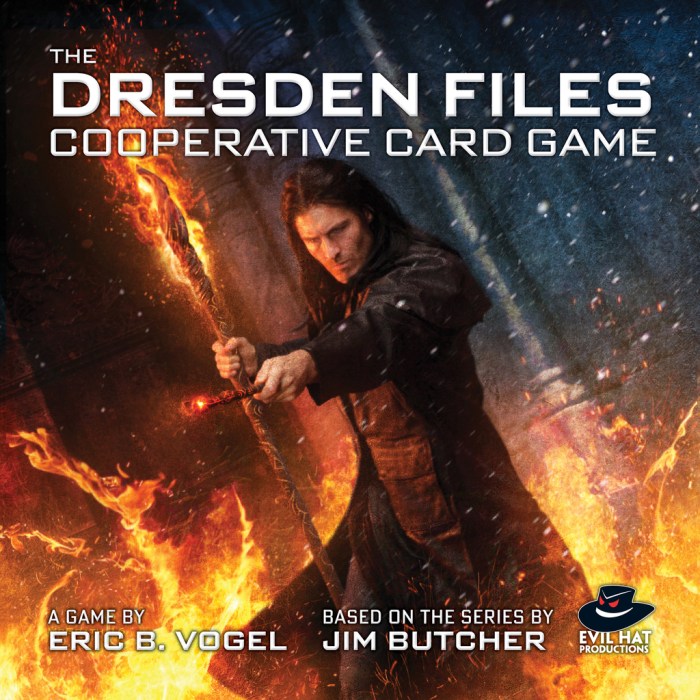
Review of The Dresden Files: Cooperative Card Game — Part I. The Unboxing and First Impressions

the_dresden_filesThe Dresden Files is a series of books about Harry Dresden: A Wizard who is a Private Investigator in Chicago.  The series has a Magic meets Noir vibe.  I picked up the the first two books sometime ago after hearing a recommendation from the Pulp Gamer PodCast: they really liked the Dresden Series RPG.   So, I started reading (well, listening to books on tapes) the first two: Storm Front and Fool Moon.  Annnnnnnd … they were okay.  Harry was kind of a whiny character in those first two books.  I almost stopped reading.  But then I picked up a bunch of later books and they were so much better!  Seriously, the series really ramped up in later books.   It’s more fun, it has better writing, and you really get invested in the characters.   I am very glad I kept up with the books because this really has become one of my favorite book series.

The Dresden Files Cooperative Card Game

dres

Fast-forward to April 2016:  There was an announcement that the Dresden Files: Cooperative Card Game was on Kickstarter!  I love cooperative games!  I love Harry Dresden and all the characters.  So, this was a natural “buy”.   The game includes playable characters for many, many characters in the Book!  Harry, Micheal, Thomas, … anyone you could think of!

IMG_3316

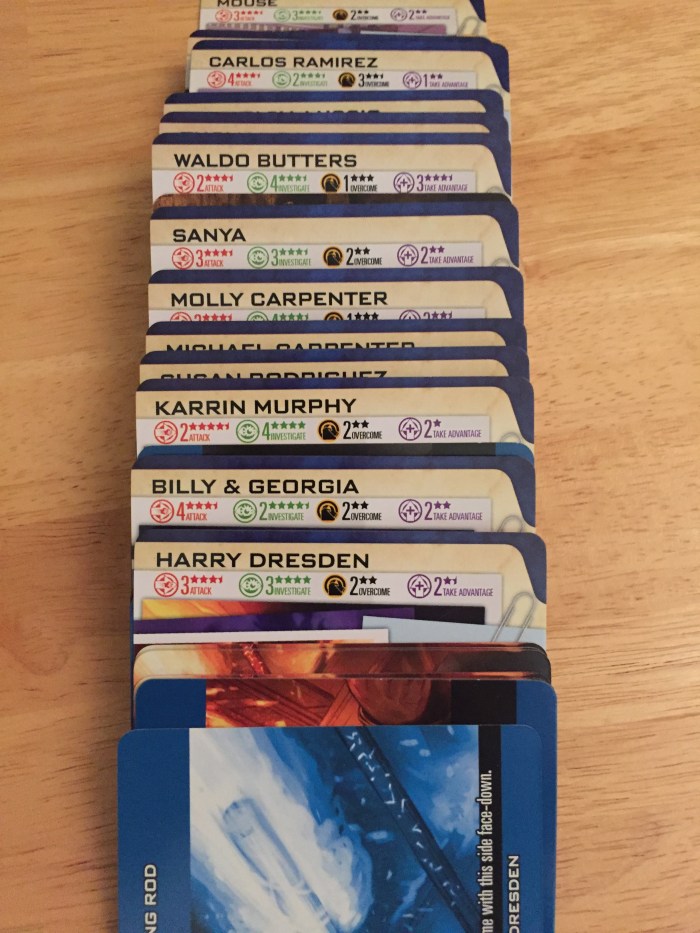
The Kickstarter had some interesting things going for it: the shipping price got cheaper and cheaper the more people backed it.  I also ended up with a few specials:  A Mouse character deck, a Hank Walker/Ra (A crossover from Sentinels of the Multiverse!), and a few variant cards. This forum posting on BoardGameGeek covers everything special the Kickstarter got, and points out that people who didn’t kickstart the game can still get the extra content.  But, my favorite extra is the Mouse character deck.  Who doesn’t love Mouse?

mouse

The Art

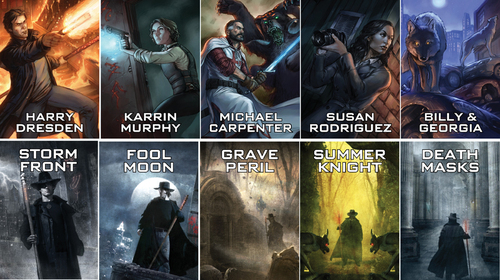
As you can see from the picture of Mouse, the art in the game is very comic-booky (Tyler Walpole I think did the art).  I like it!  But, I love comic books (pre-2012) so I liked this.  There is an interesting mix of art: the backs of the story cards are the covers of the all the Dresden files books.  The game is a weird mix of the two art styles: I think it works, but it is a bit jarring.  The art on the cover and the back of the story cards is very different than the comic-booky art.

pic3028281_md

pic3028282_md

It’s by no means a deal breaker, and, for people who have read the Series and are VERY familiar with the book covers, I think it’s cool to see the book covers as the back of the story cards.  It’s just an interesting mix of of art that people would complain about in other games, but I think it worked here.  I think the character art is snappy and bright.  And the book covers are very evocative of the theme.

Rulebook

The rulebook is pretty good.  It explains things pretty well, it’s not too long, it has some sample plays.  Three things, thought, came out that worried me:

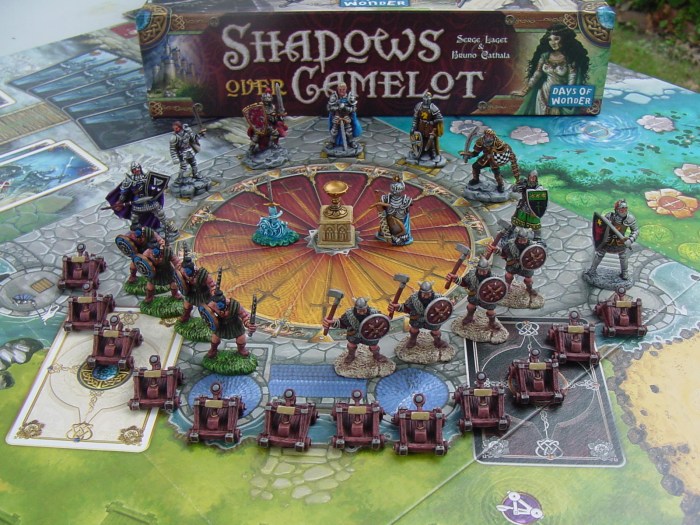
  1.  You can’t say exactly what  a card does!  If I have an Investigate Card of 5 clues that cost 5 Fate, I can’t say that, I can only say “I have a high cost, but good Investigate card!”   I thought we all agreed we’d stop doing this back in Shadows Over Camelot!  I suspect they wanted to avoid Alpha Player Syndrome,  and indeed, the rules say they do this to keep the game going so it doesn’t bog down.  I feel like we will just ignore this rule, like we do in Shadows Over Camelot.  Maybe I’m wrong (that’s why this is a first impression).
  2. The solo player rules are complicated for a first-time play! The solo player game makes you play three characters.  I understand, once you play the game a few times, that this is a very good solo mode (and it is fun), but I feel like there should be a solo mode with only 1 or 2 characters.  It’s very daunting, as a first-time player, to keep track of 18 cards to try to figure out what to do.  I’d really like a solo mode with 1 or 2 characters (similar to my discussions on a solo mode with Sentinels of The Multiverse here and The Captain is Dead here).   I’ll bet that the same ideas I propose for Sentinels could work here.  This is by no means a dealbreaker, but it just made the first playthrough more daunting.  It might scare other people away.
  3. Passing using Stunts.  There is a LOT of discussion about how you can’t use your stunt (a “one-time” action for each character) to just pass a turn.  After playing a bunch, you absolutely don’t want to waste your stunt!  It’s very valuable!  And using it to pass a turn is a huge waste!  But the rules  go out of their way to say “You can’t use your stunt if it’s not useful.”  This  seems … not thematic.  I can totally see Harry trying to blast a creature to no effect (with his stunt) as a DISTRACTION so the next character can do what he needs to.  And it’s not consistent: For example, Thomas Raith randomly pulls a card for his stunt: if he can’t use the card, he just discards it and wastes his turn.  So, I don’t think it’s consistent or thematic.  Honestly, it’s such a minor minor corner case, and the rules go on and on and on about how you can’t just use your stunt to pass.  I just think it takes away a player choice (more choices means more fun, usually).

So, I was kind of grumpy from those three items when I started the game.  But, I got over it.  I was able to learn the game from the rulebook.  And, there are multiple online resources to help you play the game too.

Components and Getting Started

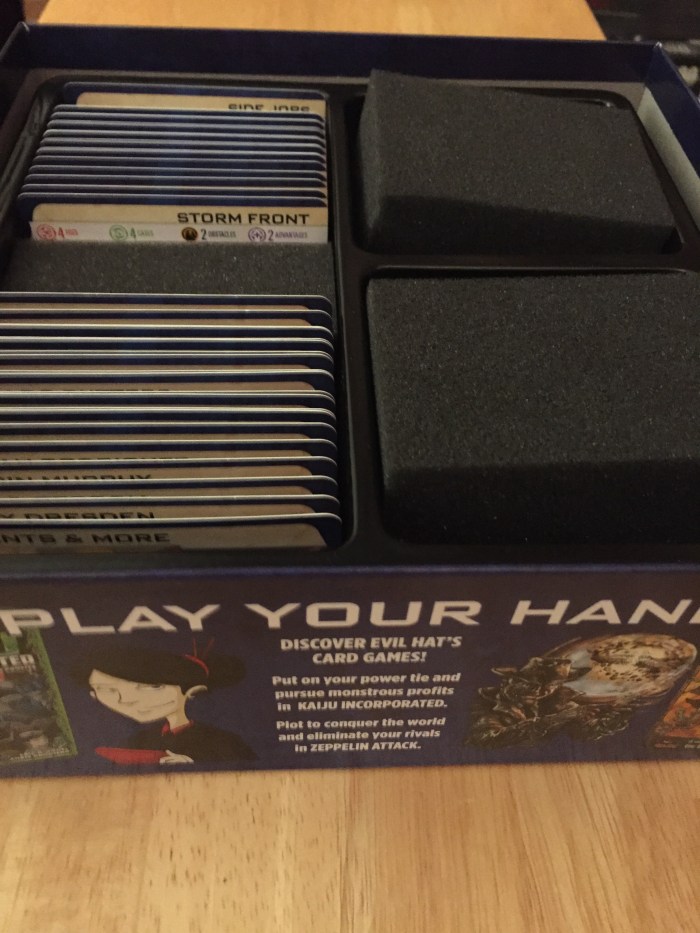
Solely from the box, the game looks like a deck-builder (It’s not).  It’s well designed to hold just the base game (using the foam inserts to block out space for cards that aren’t there).  I have all the expansions (as of this date), and it holds the whole game easily.  I am glad they thought ahead for space for expansions.

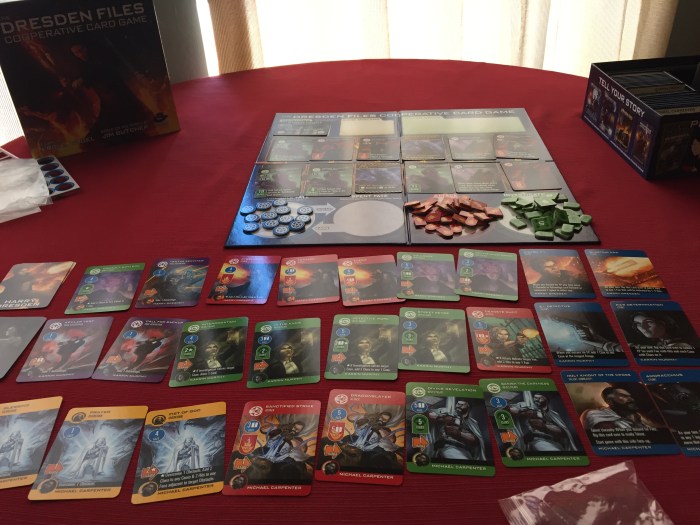
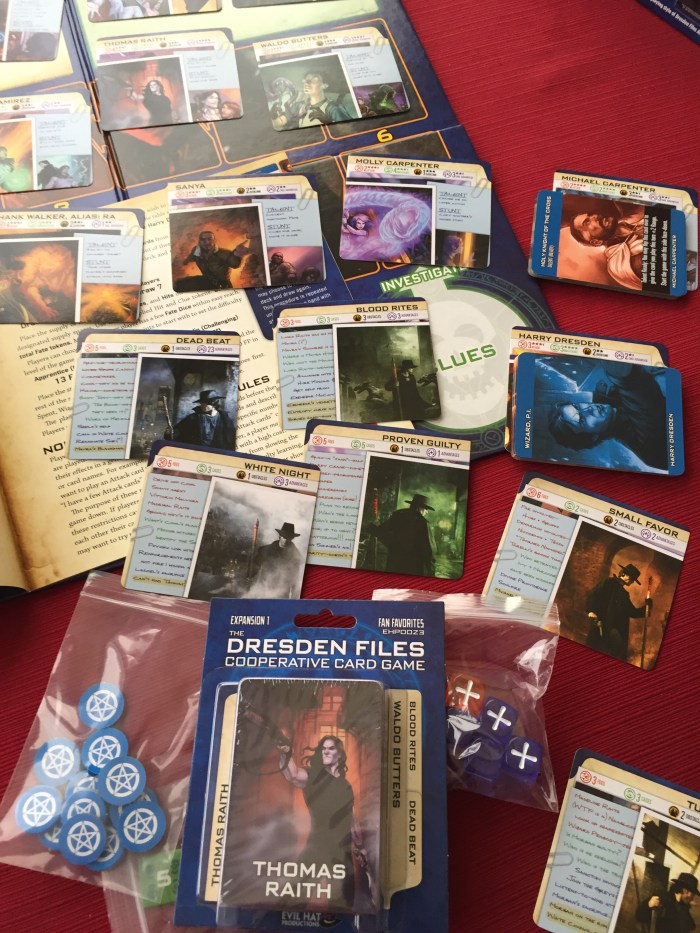
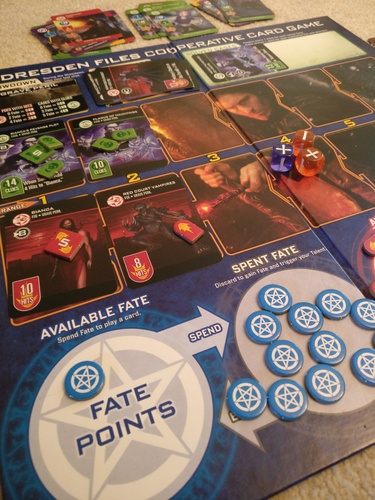
IMG_3317This game board is big and nice, and it’s very clear where to put everything.  It seemed like I got two copies of some of the separator cards?  For example, for Thomas Raith, there was one in the main game and one in the expansion itself.

One of the things I like about this game is how easy it was to get going and set-up.  It was very clear where everything fit on the board, the tokens were easy to distinguish, and the cards were easy to set-up.  (The Arkham Horror devotee would have preferred that the clues be little magnifying glasses, but at least they are still green).

IMG_3312_rev

IMG_3315

And the game was ready to go!

Some Playthroughs and Plans

I opened the game about 3 days ago, even though it came from the Kickstarter a few weeks (months?) ago.  I would have opened it sooner, but work and health problems with my mom stopped me from trying this right away.

As of right now, I have played over 15 times.  Maybe 20?  I love cooperative games.  I love the Dresden Files theme.  So, I have been playing the heck out of this in solo mode.  My plan is to get this to RICHIE CON this weekend and get a bunch of multiplayer plays of this (and also Nemo’s War).  For those of you who don’t know, RICHIE CON stands for “Really, I Can’t Heft myself to dIcE tower CON” (because Dice Tower Con is far away and expensive).  It’s really just an excuse to play games with friends here in Tucson.  It’s also called RICHIE CON because you can only go if you are friends with RICHIE.

Initial Runthrough

My initial thoughts from my solo plays:  It’s a good, puzzly game.  It has lots of content (especially with the expansion) because each book is a different scenario, and they are all different.  I have played 15-20 times through the first 3 books.  And the scenarios are all different enough to make this interesting.  So, I think there’s a lot of replayability here.

Figuring out when to OVERCOME Obstacles, when to TAKE ADVANTAGES, when to ATTACK, when to INVESTIGATE is really fun.  You also have limited action points (Fate points), and occasionally you have to discard cards to get Fate points BACK.  It’s a nice system.  You have to figure out when to act (INVESTIGATE, ATTACK, TAKE ADVANTAGE, OVERCOME OBSTACLE) and when to Discard for Fate.  To act, your card will cost Fate points.  Sometimes you can’t act (because there are no Fate points left) so you have to discard).  Sometimes you discard so you can give enough Fate points to the next player (it’s a co-op after all).  Very puzzly.  Which I really like!

pic2869458_md

So, to win, you have to have solve more cases (like Who is the ShadowMan? above)  than foes (like Bianca above) leftover at the end of the game.  You solve cases by INVESTIGATING: an INVESTIGATE gives you a number of clues you can put on a case.  You kill foes by ATTACKING: an ATTACK card (like Murphy’s P90 PDW card above) puts a number of hits on a foe.  OBSTACLES are nasty ongoing “Bad News” cards (like Three-Eye Drug War above) which you can only get rid of with OVERCOME cards (like Harry’s Hexus! above).  Finally, You can help yourself out in the game by using TAKE ADVANTAGE to get Advantage cards (like Beer at Mac’s).

All of this happens at different ranges: you can only do an act if the card is in range.  All the Foes, Cases, Obstacles, and Advantages are arranged in a 2 by 6 grid on the board.  Any card can be used on any line, as long as it is in range. Below we see all 12 book cards on the game board in a 2×6 arrangement.

IMG_3315

Below, we see a mid-game with 2 cases on the top line and 2 foes on the bottom line.

pic3429206_md

So, part of the puzzle is figuring out when/how to move cards towards, when you can even use certain cards.  For example: Bianca is at Range 1 above and a Vampire is at Range 2.  You can only use an ATTACK on the Vampire if the attack range if 2 or greater. Murphy’s ATTACK (above) has range 3, so she could ATTTACK either foe on the second line.

Showdown

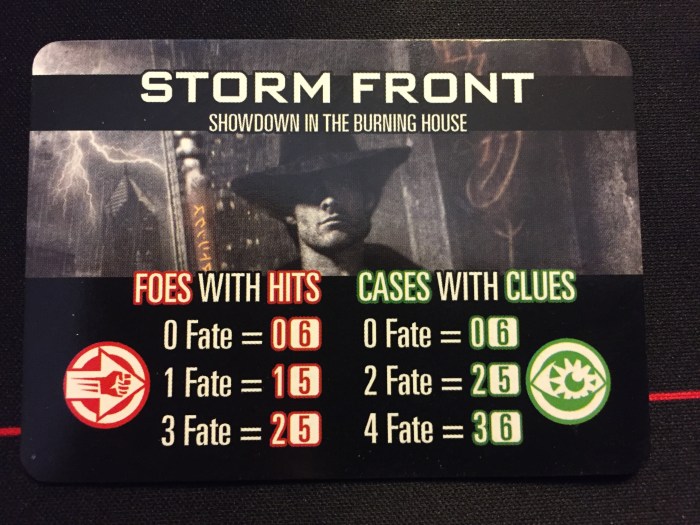
After you have “done what you can” to solve the puzzle, you have a Showdown.  A typical showdown card looks like this:

IMG_3319_90

Basically, you are trying (at much lesser odds) to solve the cases you didn’t finish investigating and the attacking foes you didn’t defeat, WITH A FINAL DICE ROLL.  For example: If I spend 2 fate, I get 2 clues + 5 fate dice rolls).  If you aren’t familiar with Fate Dice, they are 6-sided dice with basically 2 +1s, 2 0s, and 2 -1s.

pic3484593_md

So, with your final leftover Fate points, you roll and see how many foes and cases you can finish.  WITH A DICE ROLL.

How do we score? However many foes are left, that’s the game’s score.  However many cases are solved is the player’s score.  If the players have solved more cases than foes left, the players win.  Otherwise, the game wins.  In the case of ties, the game wins.  Because Harry really can’t catch a break.

Final Thoughts

I love the first 90% of the game, and I hate the last 10%.  Here’s why: in my first 15-20 plays, the game always goes the same.  The first 90% of the game, I am playing cards to investigate, discarding to refill fate, really having fun.  Then, the last 10% involves rolling some dice during the Showdown to see if I have won.  I have established here that I am cursed by the Sea Hag of the Scottish Moors, so when it comes to dice rolls, I always lose.

For every solo game I played (except maybe 1), I had to roll to see if I won the game or not.   I always needed to solve one more case or kill one more foe in the final Showdown.  If I roll right, I get the case/foe and squeak a win.  Otherwise I lose.  So, because of the curse of the Sea Hag, I always lose.

As a designer, I admire this.  The game is so well-balanced that the game is decided in the Showdown almost every time!  That’s very cool!  It’s very thematic too!  Harry always just barely scrapes out a win at the last minute.  So, at one last dice roll, you win or lose!

Here’s the problem: It’s not fun.  I worked very hard to get to the Showdown: I solved the puzzle as best I could.  And, at the very end, a dice roll decides the game.  After all my hard work, it doesn’t matter.  It’s debilitating. I just roll some dice and they determine if I win or lose.   I might as well just skip the game and roll some dice.  “Hey! I rolled +1! I win!”

But I don’t want to skip the game: the first 90% really is fun.  I just want a different end-game.

One thing I tried: To mitigate this randomness for a solo game, I used 7 cards per player during solo player set-up (the default is 6).  All of a sudden, I had a lot more fun.  I just assumed I would roll badly in the Showdown, so I gave myself a chance to win by giving each character more cards.  Basically, I downplayed the Showdown (and the randomness therein) by giving myself more resources.  Then, if I lose, it’s my fault.  The Showdown then becomes more of a denoument then a climax.  This made the Showdown much more fun—knowing it might matter, but it wasn’t required.

Conclusion

The Dresden File book series had trouble getting off the ground, but once it did, it was great.  The Dresden Files cooperative game has the opposite problem: It starts great, but I hate the ending.

Despite the randomness at the end of the game, I really do like this game.  It’s got a good well-designed box with plenty of content and space for future content.  It’s thematic (for the most part).  The cards are great. The rulebook is good and the game is easy to set-up.  The game is, for the most part, very fun.

I am very curious what my opinion will be after I have played multiplayer with a bunch of people.  Will we keep the “No Table Talk” rule?  Or will we banish that rule to the Shadows of Camelot


Review of Nemo’s War — Part I. The Unboxing and First Impressions

IMG_3298

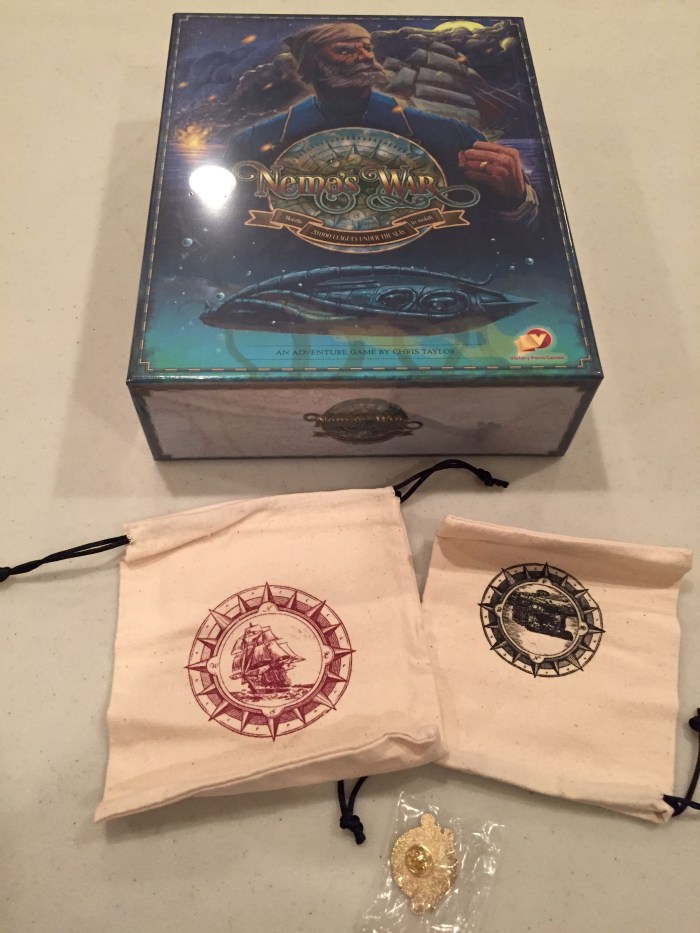
Nemo’s War (Second Edition) was a Kickstarter back in about January of 2016.  The purpose was to reprint Nemo’s War in a second edition.  It was promised in November of 2016, but just delivered to me yesterday (Friday, June 23rd, 2017).    So, it’s about 7 months late.  Typical for a Kickstarter, but still slightly annoying.

You’ll notice (from my unboxing above) that I got some cool swag: a canvas bag for the ships and a canvas bag for the treasures (polus a neato little Nemo’s War pin).  The bags are Kickstarter exclusive content (I think the button is too?)

Solo Game and Cooperative Game

So, this game is a solo game.  Out of the box, all the rules refer to a solo game that you set-up and play.  I loved Friday by Friedemann Friese, so this solo game looked fun and enticing.  What sold me to back this Kickstarter: At the $63K funding mark, they added a cooperative variant for 2-4 players.  I was intrigued: I like solo games, I like the underwater Jules Verne: 20,000 Leagues Under The Sea theme, and I love cooperative games.  So,  I backed it.  (There is a semi-cooperative variant, but I suspect I will never play it).

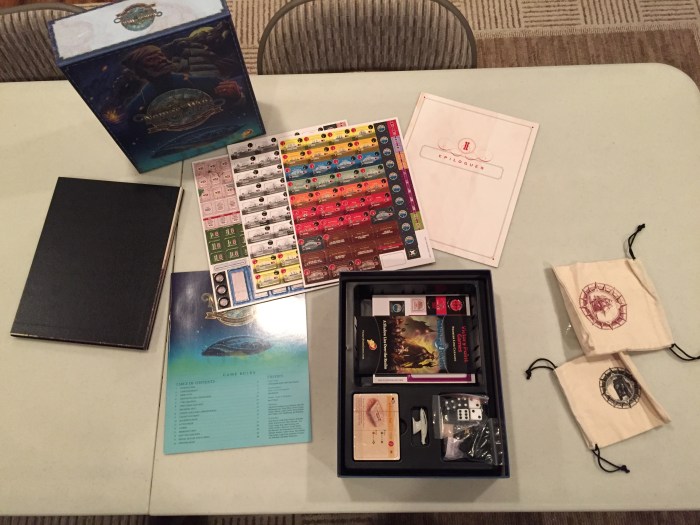
What’s Inside

IMG_3300

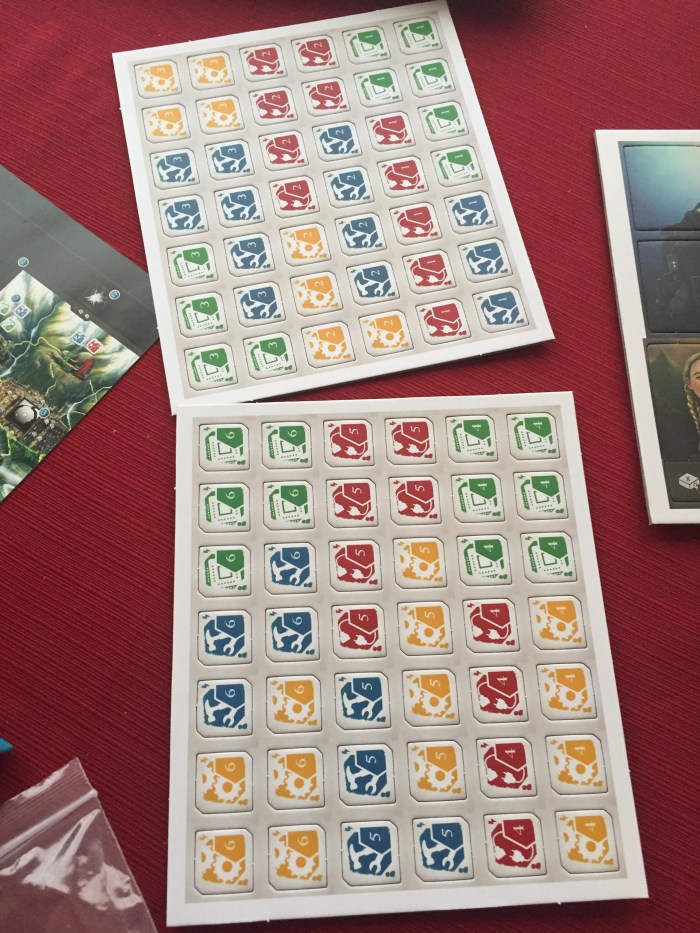
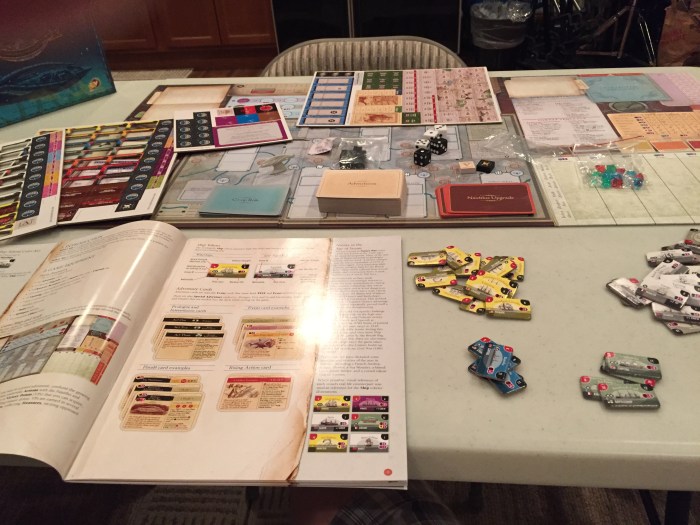
Here’s what’s inside: lots and lots of token to undo: (220 or so, according to the rulebook), some dice, some cards, and a really nice 6-panel fold-out board.

IMG_3301

The components are very nice.  Most of the token are (fairly think stock) cardboard.  The cards seem to be linen-finished.  The rulebook is shiny and on nice paper.  Overall, the components are good.  The art is good (not great, but I do really like the picture on the box).  In general, good stuff.  Nothing great.

The Rulebook

I am very happy with this rulebook overall.  My only gripe was that there was no glossary at the end (for terms you didn’t know).  A lot of the nomenclature is introduced in the first few pages, so I think that “counts” as the glossary.  Still, it would have been nice to have.

Having said that, this was a rulebook better than most!  As the rulebook explained some rules in each section, there were sidebars which showed examples and pictures of the rules under description.  The text was fairly clear.  I can’t remember being confused at any point, especially after looking at the sidebar examples.  This rulebook was a little on the long side, but it did a good job of explaining all the concepts.

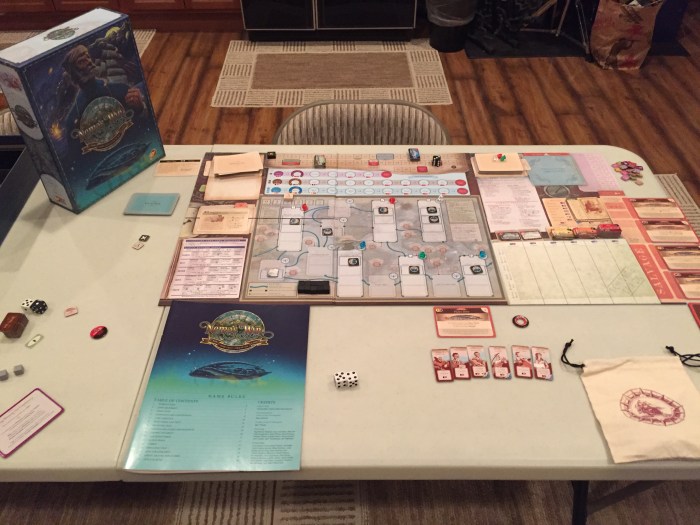
Set-Up

The set-up took a long time.  After I got the game on Friday, I tried to learn it Friday night.  Nope, I had to start into it and leave it halfway for the next day.  Be warned: it’s going to take some time to get through the rulebook and set-up the game the very first time.   Two to three hours?  Now, mind you, I am one of those people who wants to understand what each piece is as I set it up.  As one of my bosses at work (Bob Weyker) says:

“If you don’t know what something is now, it will come back to bite you later!”

The point is that I make sure I understand each piece as I play it.  So, someone who just wants to jump in will probably be able to set it up much faster.  But I claim that’s a false savings: the time saved setting up the game will be spent when you have to look up rules when you are playing.

Anyways, I got it all set-up.  Whew!

IMG_3302

First Play

My first play took about 2 hours.  That’s in line with the playing time (60-120 minutes from BoardGameGeek).

There was a lot of maintenance per turn placing ships and following the “placing ship” algorithm: as the game gets in later stages, there are more and more ships placed, which cause the algorithm to get more and more complicated.  Well, it’s not that bad, but it was starting to get annoying.

I am concerned about the randomness a little.  The number of actions you get per turn is based on the difference of two dice. So, some turns you get 0 actions (17% of the time), 1 action (28% of the time), 2 actions (22% of the time), 3 actions (17% of the time), 4 actions (11% of the time) and finally 5 actions (5% of the time).  They actually have the percentages on the board, which I really like.  But, I am reminded of a recent Top 10 list from the Dice Tower:  Top 10 Things Designers Need to Stop Doing!   One of Sam’s gripes:  (At Number 1!) : “Stop Rolling for Actions/Movement”.   And that’s exactly what this game does.

Sam’s point: sometimes you have 0 actions, sometimes you have 5 actions!  A turn with 5 movement is sooo much funner than a turn where you do nothing.  And what if you get 3 to 4 turns in a row where do nothing?  It’s so frustrating.

There are mechanisms to mitigate this random number of actions.  For example,  there are one-time-use characters which grant “extra actions” (and I think there are some events).  Over time. “statistically”, you will get 2-3 actions per turn over the course of the game.  But those particular turns where you get 0 or 1 action are just not fun.  And it’s hard to be strategic: you tend to react (based on the number of actions) rather than plan (knowing you can execute a plan).

Impressions and Next Steps

The components are great.  The rulebook is very very good.  The theme seems to come through pretty well. I am concerned, however, about two problems: the maintenance and the randomness.

The amount of work per turn to “keep the game going” is a bit much, but I believe this will be okay once I know the game a little better.  I think this will get better in future plays, but we’ll have to see.

I am more concerned about the randomness.  I lost spectacularly on my first play: which I expect!  I’ve never played before, so of course I did horribly.  I just hope I can do better and “take into account” the randomness on my next play.  That’s my main question: Can I leverage the randomness to come up with a strategy, or am I just going to be reacting every turn?  We’ll see with future plays.

This sounds more negative than I want: That’s not my purpose.  I am excited to play this in the cooperative mode.   And, I will give this a number of plays to get a feel of what the strategy is.

Nemo’s War is a fairly complicated solo game with good components.  I was pretty overwhelmed on my first play (and lost horribly).  I look forward to future plays to see what the longevity of this game is.


More Cooperative Games “Off The Beaten Path”

I was surprised how much traffic I got from this original Top 10 Cooperative Board and Card Games “Off the Beaten Path”.   Here are a few more: most of these are ones I’ve reviewed over the past year.   But I haven’t really seen a lot of buzz about any of these games.

1. Mousquetaires du Roy (2010) pic1286586_md

This game is, by default, an “All vs One” cooperative game.  I have never played it that way!  There are rules for a solo and fully cooperative play included, so I learned those first.  Unfortunately, the solo/cooperative rules aren’t expressed very well—I guess that makes sense, since it’s not the normal way they want you to play.  I was able to play solo a number of times to figure out the game, and I really enjoyed it.  I brought it to some friends and we played and it worked well as a coop.

The game is all about getting through four “adventures” (and a final confrontation) straight from the  book. Oh Yes!  This is The Three Muskeeteers board game! (Strictly speaking, it translates to “The Royal Musketeers” in case you didn’t speak French). It’s a card game mostly, with the board serving as a holding area.

This game was really fun and I would recommend it.


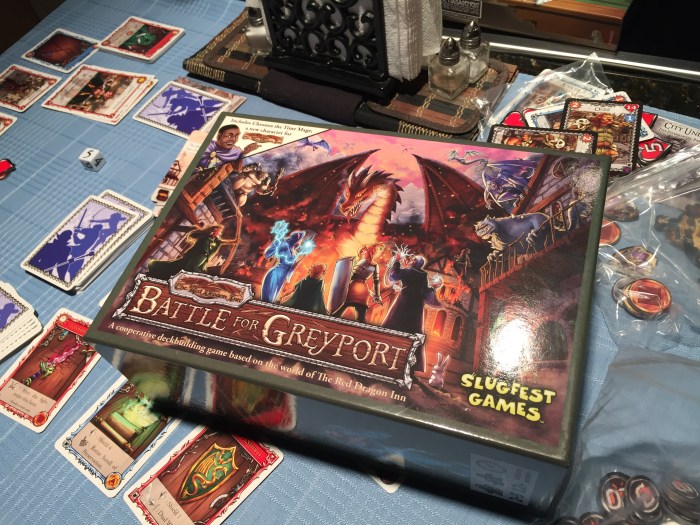
2. The Red Dragon Inn: Battle for Greyport (2016)

img_2696

A fun cooperative deckbuilder in the universe of the Red Dragon Inn where each player plays a fantasy character helping to protect the town.  Great art, great fun.  See the full review here!

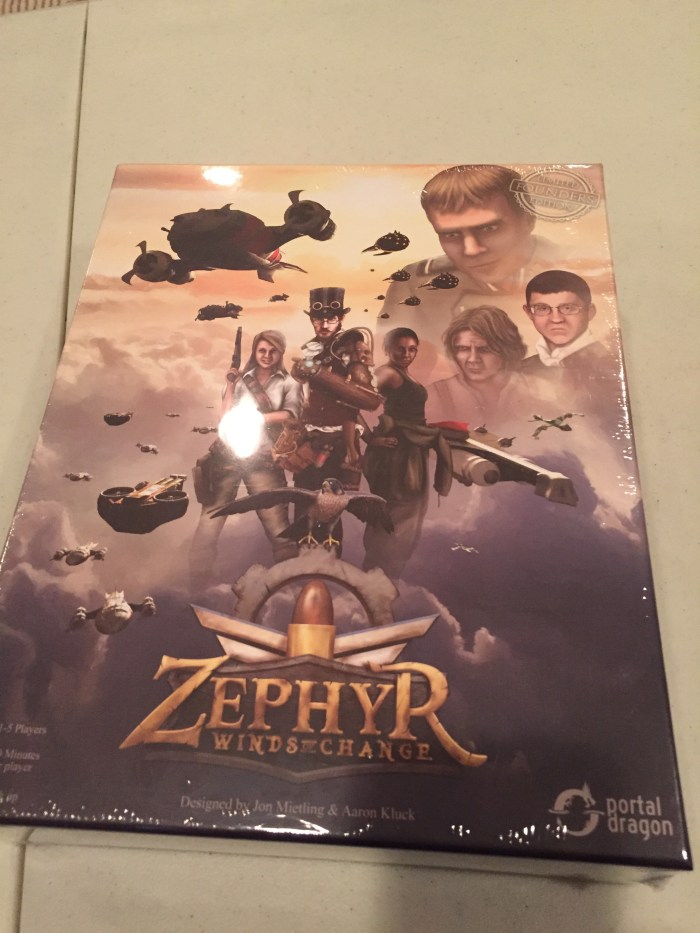
3. Zephyr: Winds of Change (2017)

IMG_3072

This game is all about building a flying airship in a steampunk universe.  It has a lot of dice-chucking, but it was fun!  See the full review here (Part I) and here (Part II).

IMG_3174(1)

This is my favorite game of 2017!  (The AEG version came out this year, the original kickstarter came out in 2014).  It’s now my goto cooperative game for 5 players!  Every single time I’ve played this alone or in a group, it’s gone so well.  I love this game!  See my review here (Part I), here (Part II), and here (Part II).


I haven’t seen much buzz about any of these games, but they are all fun!  Check them out!


Review of The Captain Is Dead—Part III: Final Thoughts

IMG_3170

This game is really fun.  I’ve played it solo mode many times and had a ball.  Just this last Sunday, I had an amazing game where I just barely stopped a Red Alert then was able to Warp out for a out an win.  So satisfying!  I have also played with a group and everyone had the same reaction:  That was fun and I’d play it again.

A Few Negatives

There’s just a few very minor negatives.  First,  I’m already a little worried about the cards: I’ve been playing a lot and they are showing just a touch of wear and tear.  My friend Charlie says “That’s a Great Problem to Have!   You play some much the game starts to show!”  True enough, but if the cards were linen-coated, I think the game would last longer.

In general, the game has tremendous replayability: there’s 18? different roles, and every role does something very different.  The cards come out differently, which means you have to decide what to handle and what to attack based on what cards you have and what Alerts have come out.  So, there seems to be a great deal of replayability there.  My only complaint is that there seem to be two things I do every game, and I have to because they make all the difference!  Get the torch and put out the upgrade that reduces shield damage by 10%.  Every single game, it’s been clear that I had to do both of those things or I would have lost.  The other tools aren’t quite as useful, and the same with the other upgrades.  So, that cuts into replayability a little.

Sometimes the blocky art on the standees is hard to distinguish, especially in a game with more players.  I like the art of the aliens, but they also seem to blend together.  I wish the characters were easier to distinguish on the board.  But you know, the clear standees is very thematic and cool.  I do like it overall.

Final Thoughts

In spite of the few negatives, this is probably my favorite game of the year.  I like the theme (Yes, we all know it’s Star Trek), it’s a fun co-op with a good amount of replayability, the game is good solo (esp. if you use my rules from Part II), and everyone I have played with likes it as a group game (it even played well as a 5-player co-op!).  The components are pretty good: I do like the look of the aliens and the standees feel very thematic.  I wish the cards were linen-coated.

And there is a lot of strategy here.  You don’t always do the same thing on your turn.  You have to decide as a group how to proceed.

A game that plays well solo and a co-op, especially 5 players is a win.  This game gets an 8/10 for me on BoardGameGeek.  It may still go higher!  I really like this game.

After thought: Expansions

There are some expansions available for the GamesCrafter version of the game, but they are not yet available for the AEG version.  Just be careful, if you get an expansion (there are 3? for the GamesCrafter version, none yet for the AEG version) to get the right one.


Review of The Captain Is Dead—Part II. Solo Rules

In Part I of my review of The Captain is Dead, I was frustrated with the solo player rules that came with the game.  As you recall, the rules that come with the game ask the solo player to operate 3-4 characters in the game.  I am sure, once you know this game, this might be a fine solo mode, but first time players or novices will be intimidated by that.

I have been playing the game pretty much non-stop since I got it (yes, it’s fun), but playing with my own variant of the solo rules.  I think I have a fairly robust set of rules for a solo player operating only 1 character.

IMG_3173

The Janitor Fights Alone!

Solo Player Rules For Operating One Character: Choose a Character

First, you probably want to limit which characters you play.  Six characters don’t give ANY advantage to play, as their skills involve other players (or rules which you ignore):

Telepath, Science Officer , Diplomat, Cyborg, Ensign, Hologram: Don’t Play These in a SOLO Game!

The Cyborg looks great, but he can get stuck too easily.  All of the other characters special powers involve working with other characters.


These characters are okay, but not real great: playing them doesn’t give a lot of advantages:

Counselor, Medical Officer, Crewman:  Probably don’t want to play any of these characters, but you can if you want a challenge.


The four characters are pretty good to play: they do just enough to allow you to do a few interesting things, but aren’t great:

Weapons Officer, Tactical Officer, Soldier, Teleporter Chief: Pretty Good to Play, Not Great


Finally, these 5 characters work really well solo:

First Officer, Chief Engineer, Admiral, Janitor, Scholar: Great for Solo play!

I strongly recommend playing one of the last 5: they are fun to play, you use their abilities all the time, and they each offer a different “way” to play.  If this is your first time playing, play the Janitor: he can make up for cards he doesn’t have by spending an action.

Solo Player Rules For Operating One Character: Set-Up

  1. Up your hand limit by 2.   You won’t be able to get anything done otherwise.
  2. Instead of each character adding a Skill card to the Cargo Bay, just randomly choose 3 skill cards from the main deck and put them there.  Thus, your single character starts with 5 skills.
  3. Do set-up normal otherwise.

Solo Player Rules For Operating One Character: Play

The game plays normally, except: Whenever you draw Anomalies, follow the rules as if it were a 2-Player game.

And that’s it!

Summary

It really is easy: Pick one of the proper characters, up your hand-limit by 2, fill the cargo bay with 3 random skills, and follow the 2-player rules for anomalies. That’s it!

I have been playing this way for the past few days and really enjoying the game.  It’s not hard to play this game with a single character.  I hope this set of rules improves your experience with the game!  It certainly has mine: I have had a lot of fun playing as a solo player.

I have a bunch of people coming over tomorrow night to play in full cooperative mode with lots of players.  We’ll see how the game goes!

Review of The Captain is Dead — Part I. The Unboxing and First Impressions

IMG_3174

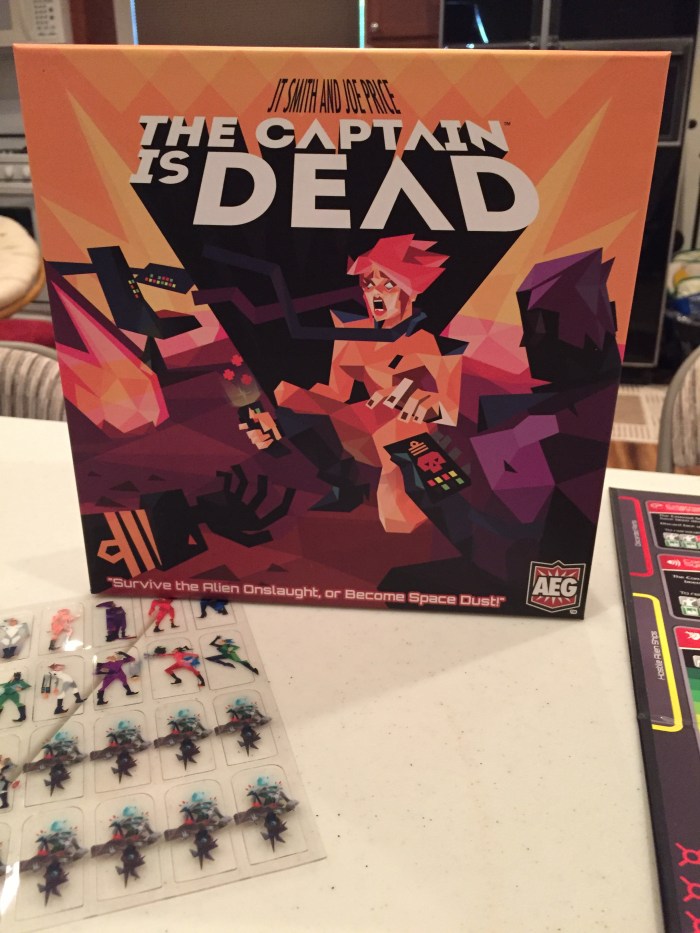
I remember when The Captain is Dead was on Kickstarter back in 2014! It was a cooperative board game in a space setting.  It was also a game that used the Games Crafter for fulfillment! Most Kickstarter games use China for fulfillment (as it’s soooo much cheaper), but here was a Kickstarter that was successful using a much lower threshold printing service! It looked cool! I wanted to pick it up! ………. and it was $50. Ooph. Don’t get me wrong: it looked cool, but $50 seemed a bit much for a game I didn’t know much about. I kept thinking I wanted a copy of this game … maybe I’d ask for it for Christmas …

Well, time came and went and I forgot about this game. In the meantime, apparently AEG picked up the game and had it printed! I picked it up fairly recently  for $39 from FunAgain! And it had with a much better aesthetic and much better pieces than the original!

Components

The components are pretty good.

The cards look good, but they aren’t linen-coated.  The rulebook is fairly picture-heavy and looks good (but we’ll talk about the actual contents below).  The board looks really nice: a lot of the locations are shiny:

IMG_3168

It’s kind of hard to see from the picture, but certain spots look “shiny”, almost like they are stickers on the board.  I was worried that would be too distracting when I was playing, but it wasn’t.  It just looks shiny.

IMG_3171

The markers are kind of interesting: they remind me of Shrinky-Dinks from when I was a kid! (Does anyone remember Shrinky Dinks?  They were clear plastic sheets you’d draw on.  The sheets would “cook” in the stove (seriously) and shrink and harden significantly!  But I digress…).

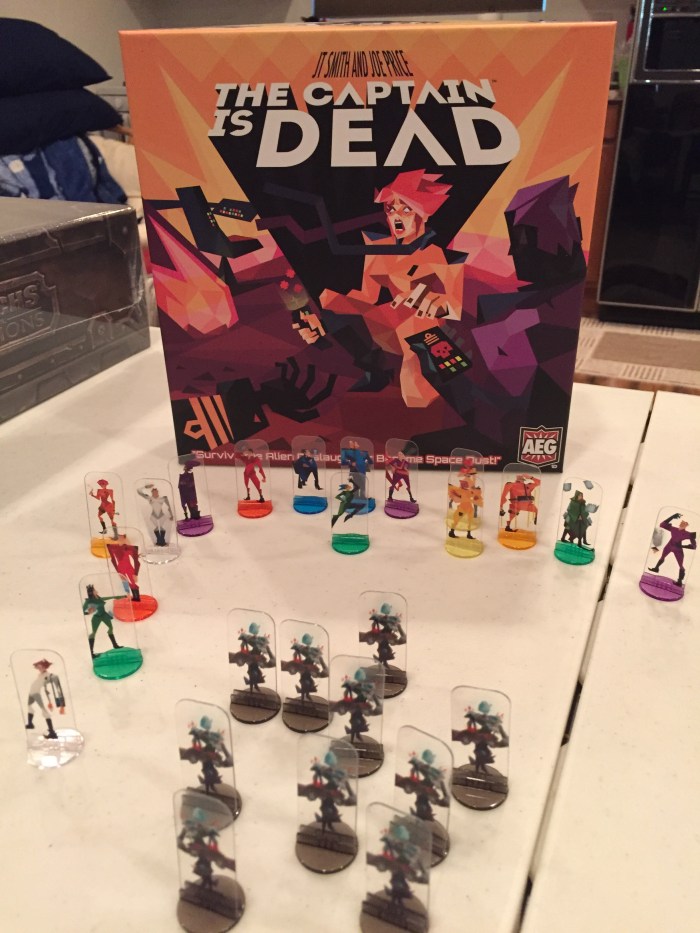
The components look really cool, but it’s a little hard to distinguish some of the characters.  All the aliens (the bottom 12 from the picture above) are easy to distinguish, but the characters that players use are somewhat hard to distinguish.  Part of it is the art style: it’s kinda cool, blocky style, but sometimes gets in the way.

I was slightly annoyed that I had to figure out which marker went with which base:

IMG_3172

There are no directions in the box for how to put together the markers!  You just have to intuit this out!  It wasn’t hard, but it was kind of annoying.  Who on earth would make markers so hard to put together?

IMG_3176

Oh.  Right. I did the same thing for CO-OP.  Curse you, irony!  Moving on …

Once I got all the pieces together, I have to say, they look pretty cool!

IMG_3174(1)

They look very spacey and very thematic.  After being annoyed at punching everything out, I have to say, I like how this looks.

Star Trek: Let’s Not Get Sued!

The Captain is Dead is NOTHING like Star Trek, except for the billions and billions of similarities.  Seriously, one of the reasons I wanted to get this game is because it looks like you could kind of play the crew of the Enterprise: it’s a cooperative game in a Star Trek universe.  And it is Star Trek: you know it, I know it, we all know it. Shields? Transporters?  C’mon.

One gripe I have it with the color scheme.  In the game, you have different colored cards representing COMMAND (blue) and SCIENCE (green)and ENGINEERING (orange) and some other types (TACTICAL (red).)

IMG_3173

Does anyone else think there might have been some better colors to choose?  Ahem.

all3

Seriously, I feel like this is a major missed opportunity.  When I think of command, I think of Kirk’s gold uniform!  When I think of Engineering, I think of Scottie’s red uniform and Science/Spock in blue.  I know it’s a minor quibble, but it really could have evoked the theme a little bit more.  Of course, if you like Star Trek: The Next Generation, the colors are a little better:

sttng

This is a little closer: gold is ENGINEERING (good match), the bridge and TACTICAL is red (but COMMAND is still blue) and MEDICAL is green.

So, I guess the maker’s of The Captain Is Dead were ST:TNG fans more than the original series.

How Many Players?

IMG_3177

Um, how many players?  Can I play 1 player?  I looked on the box and in the front of the rulebook and had trouble finding any indication of player count.  It’s not obvious on the box.  But you gotta look hard:

IMG_3178

On the back of the box in little, teeny letters is the player count.   I think this is the ONLY place in the entire game where it lists the player count.   I think this really should have gone in the Rulebook, and  we start our battle with the rulebook.

Oh, the Rulebook!

The rules are inconsistent and have some extraneous sentences.  It tries to be funny (and I laughed), but I’d rather they were a little bit more coherent.   The way it explains “pick a character card and marker” is convoluted.  For a while, I thought they meant “choose one at random and then take more”.  The rules ramble for a paragraph when one sentence would do: pick a character card and take it’s appropriate standee.  That’s all they had to say.

They also list a lot of special abilities of location, but they don’t really give any more information than is on the card for that location.  I can understand being terse on the text of a card (where space is limited), but if there are any intricate details, the rulebook is the place to explain that away and it doesn’t.  For example: The Internal Sensors.  Um, how do the cards at the Internal Sensors refresh?  Am I allowed to take any card there?  Or just the last? Can I spend an action to refresh?  Do I have to wait until the last one is chosen and then they get automatically refreshed?  So many questions AND THIS IS IMPORTANT!  Getting these cards is critical to winning the game!  So, I just made a choice and moved forward.   I plan to consult the FAQ (I assume there is one somewhere) tonight.

The rulebook was enough to get me going.  I was able to get a game underway.  But I’ll be honest, I expected a much better rulebook.  This game has gone from Kickstarter to being picked up by AEG!  It’s had plenty of evolve and get better.  I still felt like I was reading the Kickstarter rules.

Solo Rules: What SHOULD I Do?

There is a section in the back that talks about how to play solo. (So, shouldn’t the player count on the back of the box been 1-7 instead of 2-7? But, I digress)  The rules say that you should play 3-4 characters as a solo player.  3-4?????!?!?!?!  I have never played this game before!  Each character has special powers, and I already have a lot of reading for all the locations in the game.  There is too much context switching (at least for a novice and first-time player) to run 3-4 characters effectively.

I’ll be honest, this SOLO mode feels really tacked on. So, I kind of made up my own rules just to get through a game.  I played one character, that’s right kids, one.  All I had to do to get this to work was (a) up the hand limit  (b) don’t do the first 5 “bad news” cards.   I basically made the game easier.  That’s it!  And I was able to get through a game and learn the rules.  Why couldn’t they have done this?  I feel like the SOLO mode was tacked on, and I really don’t think it would have taken much to make it so one player could play. I get “later on”, when you know the game playing 3-4 characters.  But, as an intro player, they needed some rules for a solo player working one character.  At this point, I need to issue a mandatory reminder of Saunders’ Law.

So, can my Janitor saved the ship?

IMG_3173

I thought it would be funny to have the Janitor play solo. Can the Janitor save the ship? It turns out, he’s a good character to play by himself.

Thoughts on Gameplay

My lone Janitor saved the ship! He repaired the Warp Code (pardon me), the Jump Core with Windex and was able to save the ship!

IMG_3175(1)

I was very worried after the missteps (with the component punchout, the poor rulebook, and the poorly-done solo mode) that I had gone too far down the well.   I was a little cranky when I started the game.

But, you know what?  I had fun!  My Janitor cruised around the ship killing aliens, launching torpedoes, fixing the Jump Core, doing research to get the Epinephrine Ventilation, and getting some Battle Plans.  I tried to do a little bit of everything to get a sense of the game.

In the end, it was fun.  My first playthrough was a success and I had fun.  I think others will enjoy this.  Other people will have a much more positive experience than I did because they won’t have to suffer through the rulebook!  I will teach them!  (That’s a different torture). I really expected the game to be a little more refined and polished, especially after AEG picked it up, but it’s still fun.

We’ll see what happens in Season 2: The Wrath of Continuing!  Watch the skies for Part II of this review!


Part II: Review of Zephyr

IMG_3126


If you recall, I did a preliminary review of the cooperative steampunk game Zephy:Winds of Change about a month ago.   Since then, I’ve had a chance to play Zephyr a lot more, both with friends and by myself.  What do I think?

Building The Deck Of Your Ship!

So,  this is kind of a deckbuilding game!  You are building your ship by buying new systems with scrap (the currency of the game) and slowing adding these systems to your ship throughout the game.  But what that means is that you are adding new cards to your deck of actions.  On your turn, you draw cards and can perform some of those actions.  The more cards you have, the more options you have.  (A lame joke here is that you add cards to build the deck of your ship, so it’s a deckbuilding game!)

IMG_3131

This game has a neat mechanic (no pun intended, as a lot of the characters in the game are mechanics) where the number of cards you can actually play is based on the number of crew you have (+1 for the implicit captain).  So, in the picture above, I can play three action cards: One for the imperial, one for the rogue, and one for the captain (implicit position).

This is further complicated by some constraints.  The first: you can only draw “a certain number of cards per turn”.  This depends on the ship you have (and usually, the number of upgraded systems you have).  Early in the game, you can only draw 2 or 3 cards.  Later, hopefully, you can draw a lot more.

The reason you want a lot of cards per turn is that each crew can only do certain things.  In the example above, the rogue can only do “evade” type actions, and the imperial can only do “attack” type actions. The captain, who know his ship, can do any type of action.

So,  that’s a twist on deckbuilding: only certain cards can be played by certain player types.  That’s new and interesting!

But, there is NO CULLING mechanism to get rid of weaker cards.  All you can really do is augment (add to) your action deck by buying new systems!  It appears that the only way to get rid of an action is to lose a battle, and (maybe) lose an action  card.  But it’s random!  So you have NO control over this.   After playing a few times, it’s not the end of the world that there is no culling mechanism.  But it feels like it should be there.

IMG_3127

Thoughts

In general, do I like this game?  Yes.  Is it a good game?  Yes.  Is it a very good game?  The components are very good and push it that direction.  Is it a great game? Probably not.

At the end of the day, it is a little too random to be a great game.  I roll for scrap, I roll for systems from a commander, I roll for rewards rolls, I roll for attack, I roll for critical hits.   So, I could be limping along because of bad rolls and my friend soars completely upgraded.   It’s mitigated by the fact that this is a cooperative game, but it’s still hard to sit back and watch your friends smear the enemies while you can barely do anything. I don’t feel like I can do a lot of planning because I just get what the dice give me.

I was also hoping for a little more exploration: the first few times just felt like attack-slogs, where every single turn was combat combat combat.   We started doing a lot more salvage runs, and that gave the game a lot more variety (the salvage runs draw cards from a deck).   It reminded me of the encounters in Arkham Horror a little: some great flavor text and some interesting and thematic situation.  Really!  The salvage deck kind of salvaged (yuk yuk yuk) the game for me by making it feel just a little bit more of an exploration game.

Don’t get me wrong, this is a fun game!  But it really is a lot about attacking and defending airships, while building an action deck.

I wish there was more exploring; I wish there was more planning for building your ship.  I think building your ship is the FUNNEST part of the game, and it feels just a little too random.

If you just want a fun “fly around a shoot bad guys together” game with amazing components, this really is a very good game.   The randomness may turn you off,  but if you accept that, this game can be a lot of fun.  (To be fair, this is MUCH LESS random than “Tales of Arabian Nights”)

I give it a 6.9 out of 10.   It would get a 7 if it were just a little less random.


Saunders’ Law: All Cooperative Games Should Have a Solo Mode

I have too many board games. Cough. If I see a board game that is cooperative, more times than not, I will just pick it up. My collection has ballooned because of this! And I was reminded (recently) how ridiculous I have become … a friend bought another friend over for games night at my house. He was so overwhelmed by all my games (some not even opened), he ended up filming a video panning over all my games. Okay, okay, I need to get some of them played.

So, recently, I have been on a quest to get more games played! And because my favorite type of game is cooperative, 9 times out ten, the game is a co-op. The best way to get my games played is to learn it first, then teach it to my friends! But I am BLOWN AWAY by how many cooperative games do NOT have a solo player mode for me to learn with! Really! Off the top of my head:

  • Sentinels of The Multiverse: Only play 3-5. What the Hey? I had to make my own solo rules. See end of article.
  • Battle for GreyPort: See previous review.
  • Time Stories

I don’t understand this! It should be easy to have a solo mode in a cooperative game! If NOTHING else, the solo rules should be “take 2 positions in the game and have the solo player play both positions” (or 3 or whatever). It’s not the best way: sometimes it will work (CO-OP solo mode explicitly has the solo player play 2 characters in the game), and sometimes it won’t (Sentinels of the Multiverse needs 3 characters for balance—there is so much going on, it’s too overwhelming to play 3 characters).

So, to all game designers of cooperative games, I henceforth issue this challenge:

Saunders’ Law: All cooperative board games should have a solo mode!

Why?

  1.  For Teaching Purposes! The best way to learn a game is to have someone teach it to you. If someone can’t teach it to you, then you may have to learn it from the rulebook (by yourself).  Game teachings almost always goes better when someone learns the game (by themselves),  then teaches everyone.Example: Recently, I taught my game group “Zephyr: Winds of Change” (as I pursue Part II of my review). The game has great solo rules, and I was able to learn the game enough first, then teach it to my group.With a solo mode, it is so much easier to learn the game. Then we can teach others.
  2.  For Replayability! Sometimes I can’t play with other people. Or sometimes I don’t want to play with other people. I am always on the lookout for games that work well in solo mode so I can play it. Most cooperative games can easily add a solo mode in and make the game that more attractive to consumers.I can’t tell you how many times I have played Atlantis Rising as a single player because it was really fun. Or Arkham Horror. Or Sentinels. Or CO-OP. Or Secrets of the Lost Tomb.
  3. It’s Usually Easy! This really only applies to truly cooperative games. Games where there are traitors, or semi-co-oops, this doesn’t make sense. But when a cooperative game is fully cooperative (where the players win or lose as a group), then there already is an engine for pitting “bad effects” against the players. Typically, it’s not much harder to add a solo mode, even if the solo player just plays those multiple positions by himself.
  4.  More people Will Buy it! This goes hand-in-hand with replayability. A game with a bigger player counts brings in more customers. As an example from my own world: Recently, Mansions of Madness 2nd Edition came out. I only picked it up because it had a solo mode (1-6 players). The original First Edition of the game DID NOT have a solo mode (2-5 players), which is one of the many reasons I didn’t buy the first edition.

To drive this home, I will note an experience we had with Time Stories  about 6 months ago. Time Stories is for 2-4 players: there is no solo mode.  Because the game is a “play-once story” with lots of plot that can be spoiled, you can’t just try it first.  So, we tried, as a group, to learn this game with 4 players.  We got bogged down in some of the rules because no one knew how to play.  We did get through it, but it would have gone much better if just one person had been able to play  it first.  My friend Josh and I were talking: we think Time Stories would really benefit from a tiny  deck (5? 8? cards) that demos most of the mechanics for a solo player.   Then, that one person can learn the mechanics, without spoiling the rest of the game, and teach others.  A solo mode is Time Stories would have gone a long way for our group.  Honestly, that game group’s opinion of Time Stories was sullied because of our “group-learn” experience.

I hope game designers will heed Saunders’ Law: I think it will make the hobby a better place.

Addendum: Solo Rules for Sentinels of The Multiverse (abbreviated)

Solo variant 1): Go play the iOS/Andriod App. I am not being flippant here: it really is a great way to play solo mode. The app takes care a lot of the fiddliness for you, so that playing 3 SuperHero characters (the minimum you can play with) isn’t too overwhelming.

Solo Variant 2): Take 2 characters to play with: the solo player operates two SuperHeroes. When the characters play, they each play twice: hero 1, hero 2, hero 1, hero 2. This “simulates” playing a 4-player game (with is fairly balanced), but with much less overhead–there’s only two characters to operate.

Solo Variant 3): Play 3 characters. This will work, and it’s pretty fun once you know the game, but it is still an awful lot of maintenance for 1 solo player. I like the game enough that I will play this way sometimes.

More and More Mutants on Kickstarter Lately!

Recently, there have been a slew of Kickstarters for cooperative board games that I (and hopefully you!) may interested in.  Weirdly, the ones I have been interested in are “mutations” of many games I have referred to in my blog over the last year …

1. Sentinels of Earth-Prime

https://www.kickstarter.com/projects/1780208966/sentinels-of-earth-prime?ref=user_menu

If you look at my blog about my top 5 games of all time, you’ll note Sentinels of The Multiverse occupies the number 2 spot!  Well, Green Ronin (responsible for the Super Hero RPG Mutants and Masterminds) has teamed up with Greater Than Games to make Sentinels of Earth-Prime, a bunch of new heroes and villains using the Sentinels of the Multiverse system.  It’s a mutant!  It JUST came online, and it has already hit its funding mark. Check it out here!

2. Island Of Doctor Necreux, Second Edition

https://www.kickstarter.com/projects/977252844/the-island-of-doctor-necreaux-second-edition?ref=user_menu

pic2862472_lg

I was very excited when I saw this was up for a second edition.  I JUST wrote a blog entry here!  But here again, it is a mutant, as it is the 2nd edition of the game I really liked!  Check it out here!

3. Shadowrift Expansions

https://www.kickstarter.com/projects/shadowrift/shadowrift-skittering-darkness

ff75b21a4c08b02e96f666e4c2167df8_original

I wrote up a top 10 favorite cooperative games Off The Beaten Path, and Shadowrift (the first edition) was on it!  Right now, more expansions (and you can get the second edition at the same time) are available here!  It has definitely evolved and mutated since I got the first edition …

4. Gloomhaven, Second Edition

https://www.kickstarter.com/projects/1350948450/gloomhaven-second-printing?ref=user_menu

Where’s Gloomhaven on my blog you might wonder?  You may even search for it and say “Darnnit Rich, I don’t see Gloomhaven anywhere on your blog!”  And strictly speaking, you’d be right.

I see Gloomhaven as the spritiual successor to Dungeons and Dragons/Pathfinder: it’s the RPG mutated to Card form.  Recall that D&D/Pathfinder is my favorite game of all time.

5. Thunderstone Quest

https://www.kickstarter.com/projects/alderac/thunderstone-quest-from-aeg

d322a01c3d7986204a59b381270a43c1_original

An adventuring deck-building game.  Kind of a mutant of Shadowrift and Gloomhaven! All right, I may be reaching for that last one, but it looks really cool.


So, those are 5 cooperative games appearing on Kickstarter now or very recently.  I am looking forward to all of these!


Island of Dr. Necreaux: Second Edition is on Kickstarter!

A while ago, I listed my favorite cooperative games Off The Beaten Path.  It seems like all top 10 cooperative games list the same games over and over, so this was my attempt to give some love to some other overlooked co-op games.  One of my favorite little games on this list was The Island Of Dr. Necreaux.  I had played the original first edition and really enjoyed it.

iseofdrn

One common complaint about the game was that the FAQ was bigger than the rules!  Well, a second edition is now on Kickstarter !!!  It has more colorful art, and (hopefully) will fix a lot of the discrepancies from the first edition.

pic2862472_lg.jpg

I have to admit, I really enjoyed the “Flash Gordon”-esque art from the first edition, but I am excited to see how they’ve updated the rules.  And new colorful art!

As I type this, the Kickstarter ends in five days and they are not quite there yet.  Get out there and pick this game up!  It really is a great game, and I am telling you, this is a really unique cooperative game that’s quick, thematic, and very fun.

I already have the first edition (and really like it!), but I really want this game to succeed so I just backed it myself a few minutes ago.