Recently, a friend of mine sent an email to several of us saying “Sentinels of the Multiverse is on sale for Android”. Cool. I was going to forward to some other friends, but then realized … they don’t like Sentinels. And in fact, all of my friends who don’t like Sentinels seem to like Seven Wonders.
In fact, it seems, in my game groups, Sentinels and Seven Wonders are anti-correlated: If you like Sentinels, you don’t like Seven Wonders. If you like Seven Wonders, you don’t like Sentinels.
Is this true in general? Or is it just a blip in our game group?
BoardGameGeek Data
If we could just tap into BoardGameGeek, find everyone that rated both games and compare them, maybe we could see if this were a real trend! But, alas, we can’t do that. Or can we?
My friend Josh pointed out that BoardGameGeek allows an interface to download just such data:
With this interface, Josh downloaded what we needed (he used a curl script to gobble the data and parsed the data with a Python script) and generated some stats and graphs. It was easy: he did it in about an hour.
Findings
So what did we find? In general, people who like Sentinels tend to like Seven Wonders, and people who like Seven Wonders tend to like Sentinels. There DID NOT seem to be the anti-correlation that we thought! Apparently, my little game group is its own little microcosm.
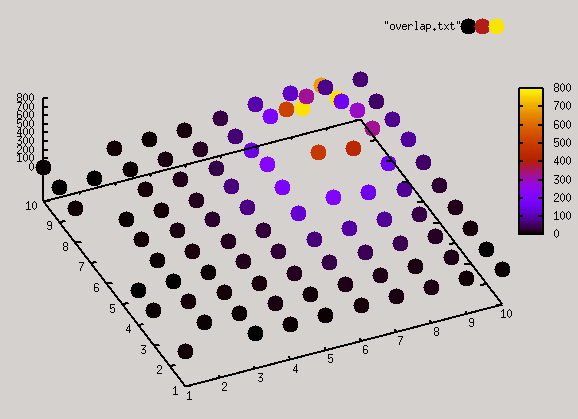
Here’s the data graphed:
On the left axis are the ratings (from 1-10) for Sentinels, on the right axis are the ratings (from 1-10) for Seven Wonders. The height of the 3D graph shows how many BGG users rated the game (on BGG’s scale of 1 to 10, where 10 is the best). You can see that the data seems pretty consistently rising on both sides. People who like Sentinels tend to like Seven Wonders and vice-versa.
Other interesting data from the time of the comparison:
Seven Wonders had 61037 reviews
Sentinels of the Multiverse had 12425 reviews
There were 7880 overlapping reviews (i.e., users who reviewed both)
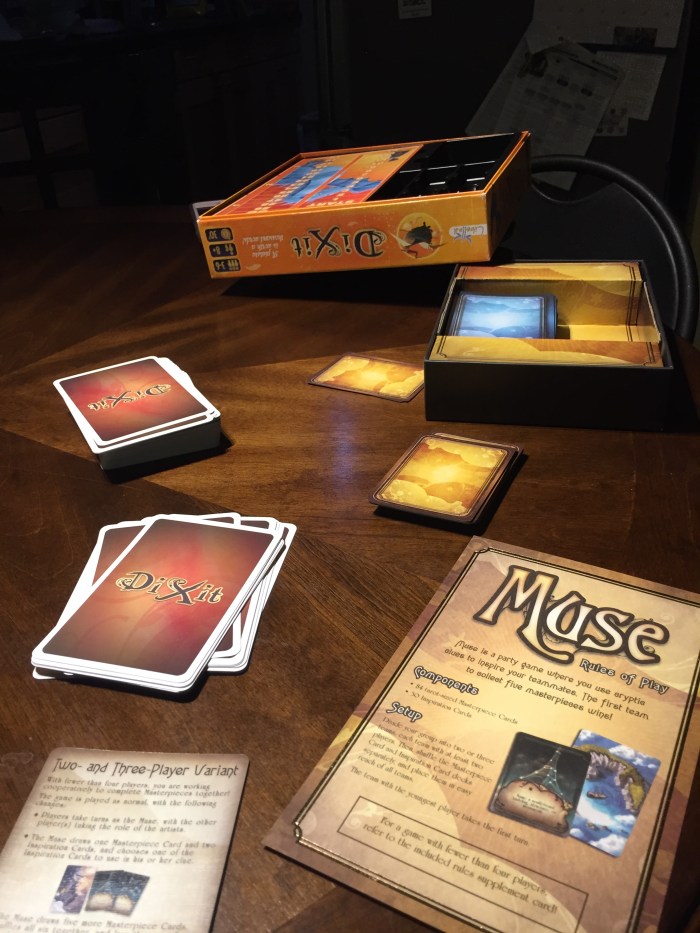
This last weekend, I went down to Las Cruces for many reasons, but really wanted to playtest The Island of Dr. Necreaux: Second Edition. (And we will get around to comparing the First Edition and the Second Edition later in this blog). But, we played lots of games that weekend, and one of them really surprised me: Muse.
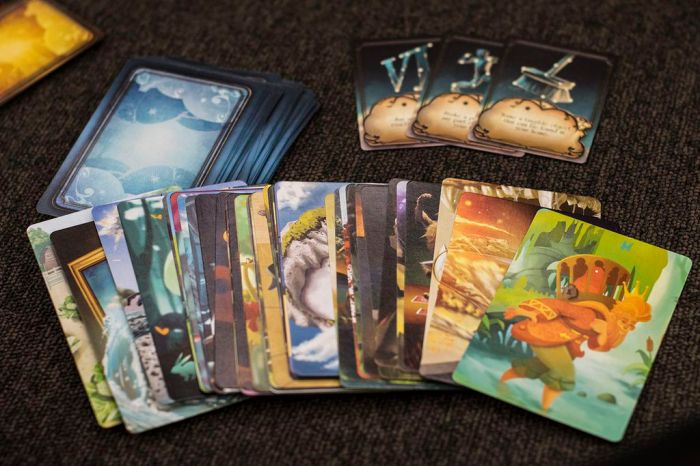
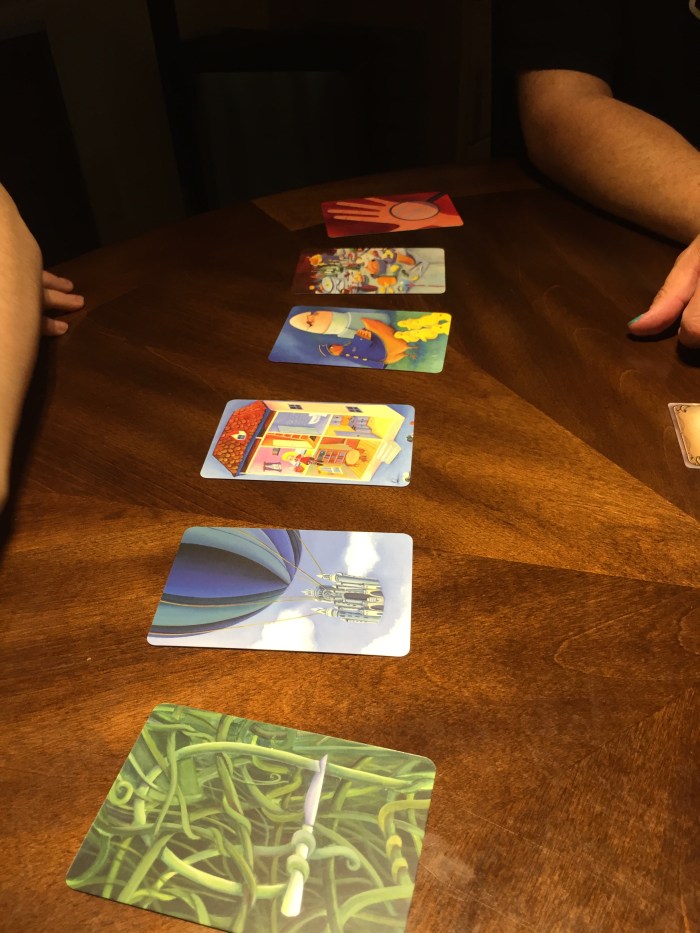
Muse is basically a party game where you try to get your teammates to guess one of six pictures.
The art in this game is pretty amazing!
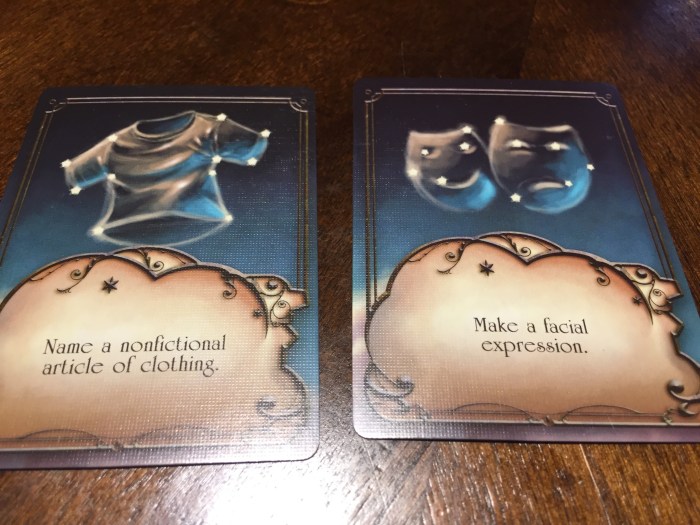
You give hints based one of the “inspiration” cards:
Inspiration Cards: Choose one of 30 Inspiration Cards to give a hint
Whenever your team guesses a Masterpiece (pretty picture of art) correctly, your team gets that card as a point (like Apples to Apples). When your team has 5 points, you win!
The rules are a little more complicated than that, but not much. It’s a real fun party game. We played a bunch of times early in the night and everyone had fun.
COOPERATIVE MODE!
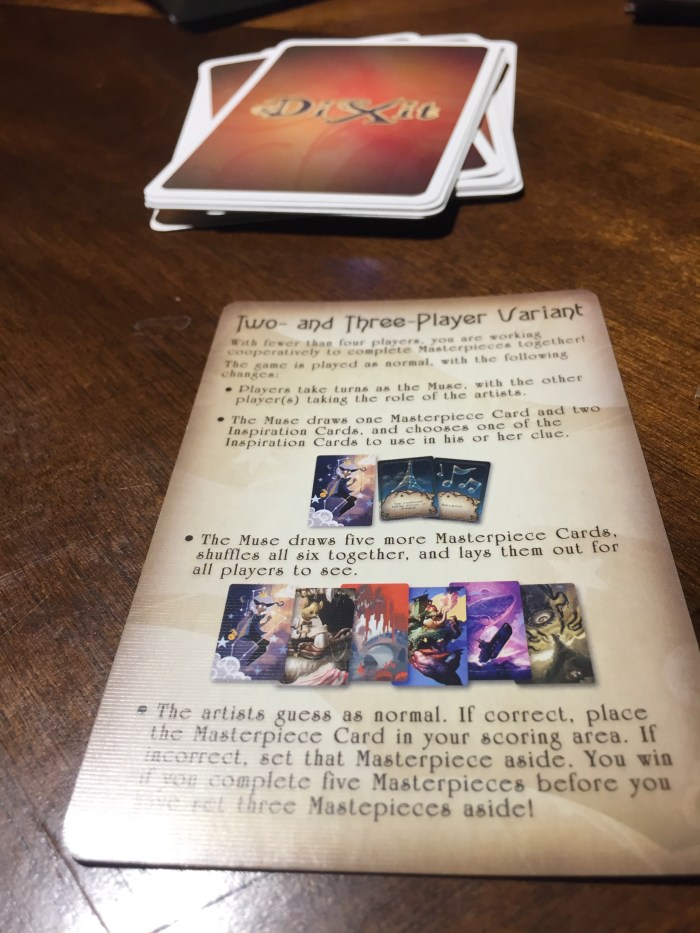
Cooperative Rules for 2-3 Player Game
Surprisingly, this game contains a cooperative mode! In a 2 or 3 player version, the game becomes cooperative! See the rules above, but basically you have to guess 5 cards before you fail 5 times.
This was a fun, low-key cooperative game. It was late at night, and 3 of us just sat around playing this while another group finished up the Star Trek RPG. Not a lot of thought, just fun.
Dixit
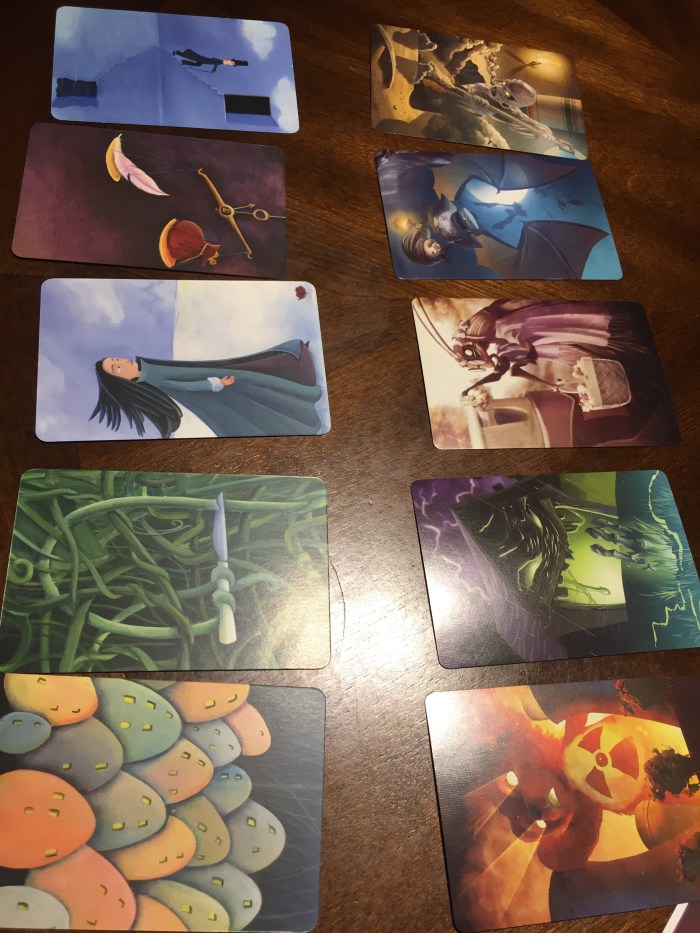
Dixit Cards and Muse cards are basically interchangable
The only real problem with the game is that there are only 84 Masterpieces. After a little bit, the cards started to repeat. 84 cards / 6 cards per play = about 14 plays before repeats.
After we played for a while, we started seeing the same “Masterpieces” again. So, Kurt pulled out his Dixit cards and we used those for a while. It worked fine! We didn’t get to play with Mysterium cards, but we are pretty sure those would work fine as well.
Dixit Cards used for Muse
After playing cooperatively for almost an hour with both Muse and Dixit cards, I declare this game a success. Everyone who played wanted to get a copy.
Conclusion
Muse is pretty cheap ($18 on CoolStuffInc) and pretty fun. It has some limited replayability, but both Dixit and Mysterium can easily be used for expansion cards.
Can you tell the difference between the Dixit cards and the Muse cards?
This was a huge surprise as a cooperative game. It was a light, fun, cheap cooperative game (for 2-3 people) that also happens to be a good party game for larger player counts.
The first K is silent. Today’s blogpost is brought to you by the letter K.
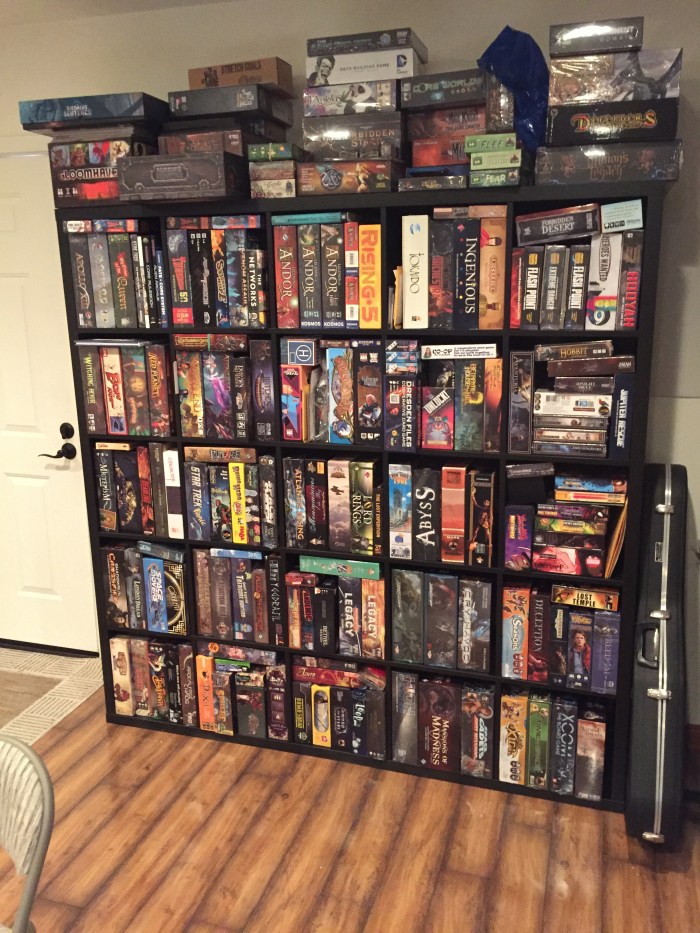
Kallax, Kallax, Kallax
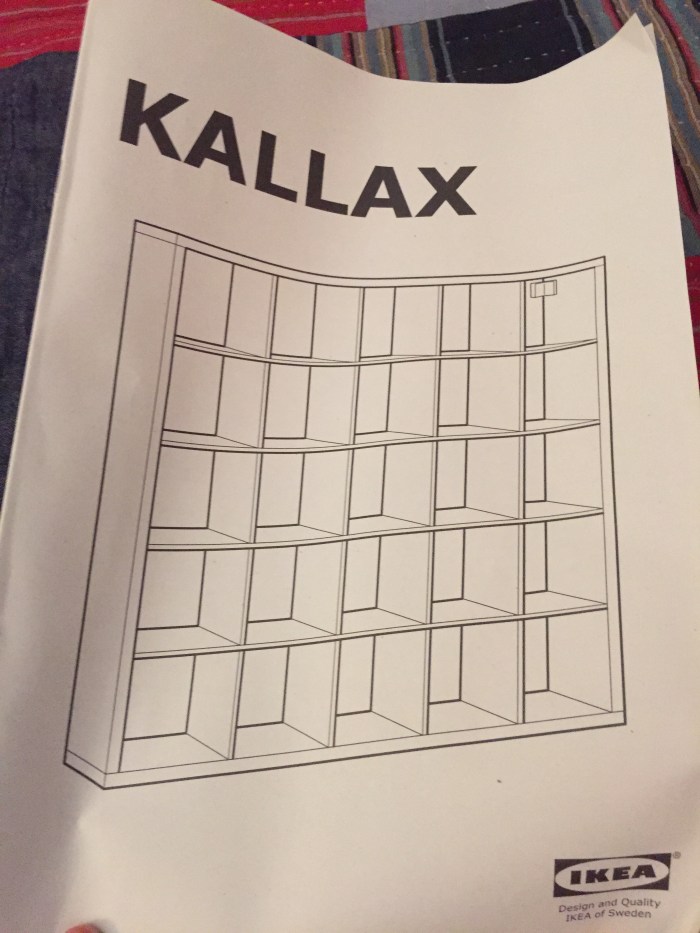
Kallax shelves assembly manual
The Dice Tower people mention the Kallax shelves all the time for their games. Zee Garcia even mentioned them in a “Top 10 Gaming Accessories” video. So, it’s become almost cliche’ for a gamer to order Kallax shelves. To paraphrase Yoda:
Kallax gonna come, poke me in the Kokonut. And they did. And they did.
I live in Tucson, and Ikea lives in Phoenix. I was going to make a trip to Phoenix to pick them up, but they would deliver to to Tucson. For an extra $79. Well, given the time outlay (2 hours up, 2 hours back) and the money outlay (a full tank of gas), I chose the delivery. All in: $199 + $79 + tax, so about $290.
They delivered the shelves straight to my house. Even put them in the right place for me. They were great.
Saunders’ Law in the Real World
So, I opened the instruction book and saw the “pictures only” instructions for assembly.
Directions from the Kallax shelves assembly
Hilarious! The instructions say “Don’t assemble them by yourself.” The assembly is (drum roll), a cooperative activity! I think this is one of the best pictures I’ve seen to show “cooperation”. Although I really like this one too:
Back of the COOPERATE Action cards in CO-OP: the co-op game
The funny thing is, I invoked Saunders’ Law on the Shelves! I made it into a solo activity! Basically, my wife was visiting her Mom, and I was by myself. So, I made assembling the shelves into a “solo game”.
Honestly, it wasn’t too bad assembling the shelves by myself. I went slowly, made sure I read all the rules (I mean instructions) in advance and tried things out slowly. It really almost felt like I was learning a board game by myself. I will say this: the assembly instructions are quite good.
The final result?
I am pleased with how they came out.
Psuedo-Kallax Kshelves?
Shortly after I was proudly showing off my Kallax Kshelves, my friend Josh found an alternative shelf that looks almost exactly like the Kallax ones. For almost half the price. And free shipping!
I got some of the 4×2 shelves and liked them. They are similar (I think) to the thicker old-style Kallax shelves.
I think, at the time of this writing, those alternative 5×5 shelves are $158. With free shipping.
Sigh. So, I overpaid. I offer up the shelves (above) as a public service announcement to the gaming community. You can get basically the same shelves as the Kallax Kshelves, but you don’t have to pay extra money for the extra Ks.
Kontainers
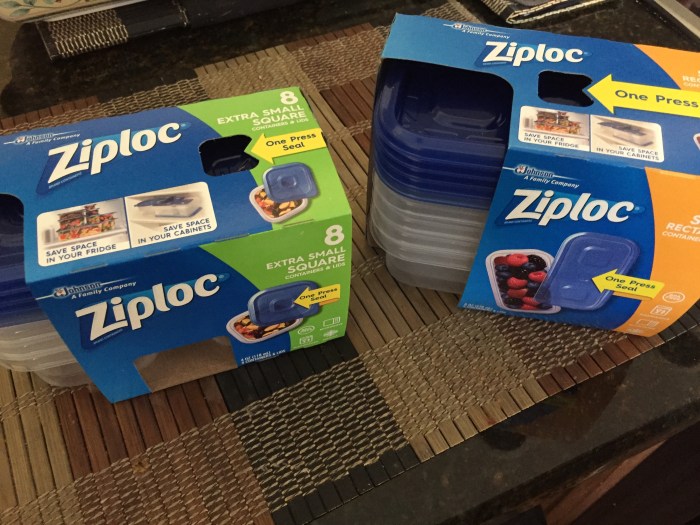
Recently, I was helping my wife out at Target, and found these:
The 8 extra small Ziploc Kontainers are only $2.72 (plus tax, but -5% if you have a Target cards). Each Ziploc Kontainer ends up being about 35 cents. What a deal!
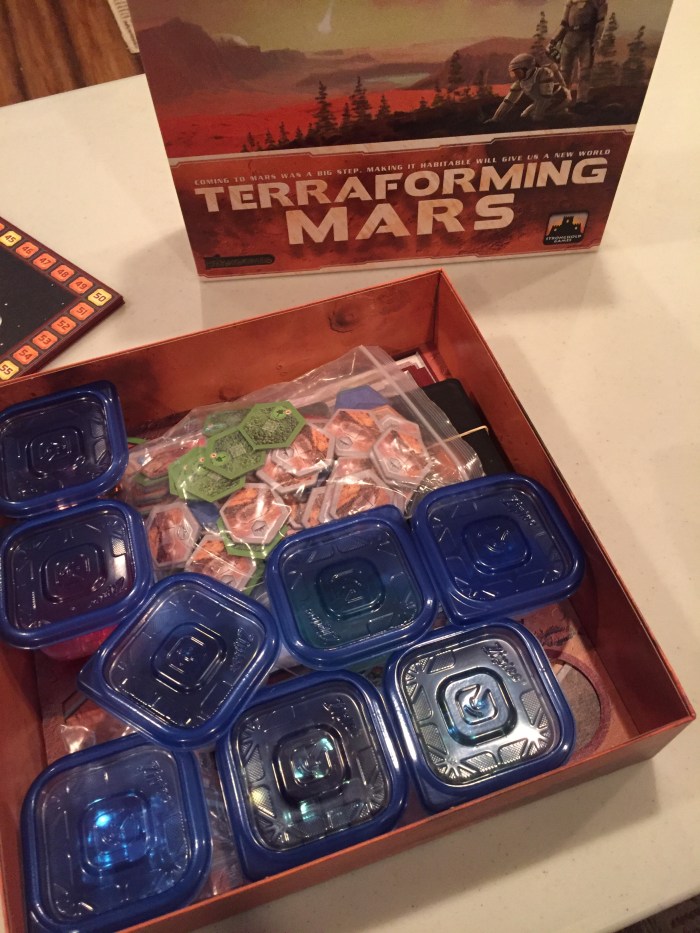
These containers are perfect containers for some games. Case in Point: Ron gave me Terraforming Mars for Christmas, Fun game! But there are sooo many little components. The bags work fine, but they add set-up and tear-down time as you pull all the little cubes out.
But, with these little Kontainers, set-up is trivial: pull the Kontainer out! During gameplay, it’s easy to pass these little Kontainers around for everyone.
And they all fit well into the box. So, for a little under $3, I was able to get some nice Kontainers! I will probably get some more: they work really well in some of the standard sized game boxes.
One more thing: I found these Ziploc thingees on-line at Target, but you have to order $25 worth for free shipping. So, it might be worth it to get 9 packages of 8 for 72 Kontainers? And don’t go to Amazon! They were like $6.99 for a package of 8! More than twice as much. If you have a Target in your area, just it up on your next visit. (I assume other stores have them too…)
(Apologies for the overuse of the letter K; that was a stipulation for his support of today’s blog entry. K feels he is overshadowed by his controlling, older brother C …)
So, about a week ago, one of my “Pandemic Legacy” friends had to cancel because he was sick. Bogus! My other two friends were still coming over, but what would we play? It turns out my copy of Thunderstone Quest arrived early that afternoon! So, I scrambled home early, unboxed, and started reading the rules so we could play that night.
Wow, That’s a Big Game!
Lots of stuff!
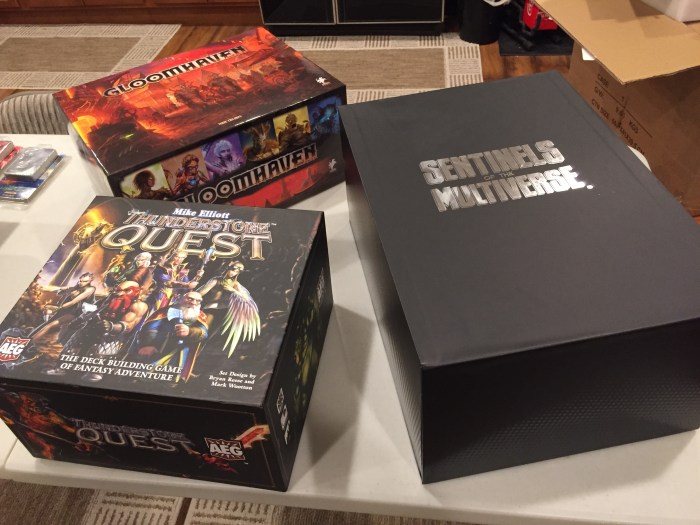
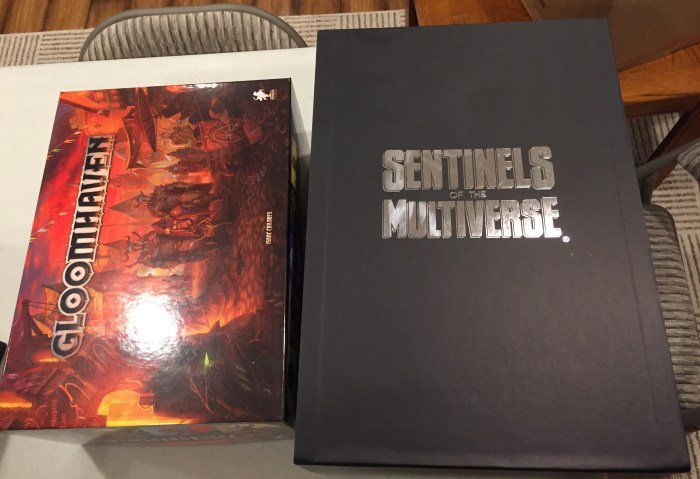
Okay. So, that’s a big box. It’s not quite as big as Gloomhaven, but it’s pretty big.
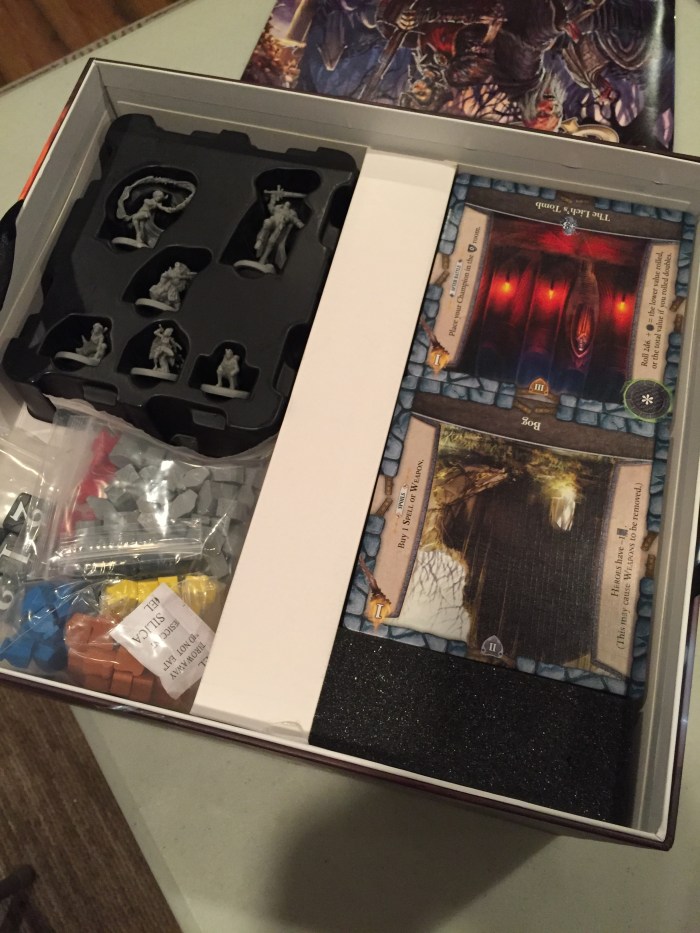
It has two levels! See how tall it is above! The top level has a little drawer with handles is for non-card things …
See the nice handles? The non-cards are all in a tray …
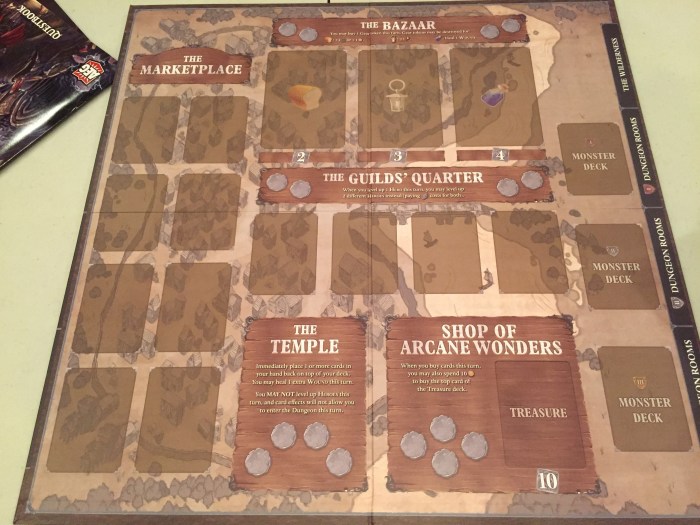
The main board and player boards are in the top tray …
… And then everything else under the boards!
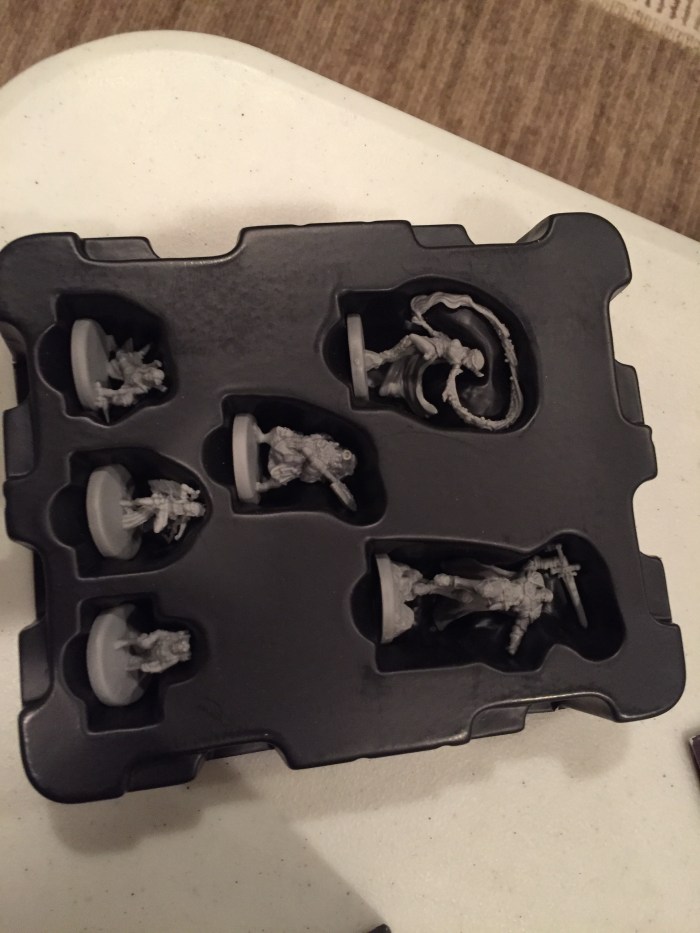
The left of the tray has some little miniatures (they are nice), and some nice wood components. The right side of the tray has a bunch of thick cardboard dungeon locations. Really nice quality components.
Oh, and by the way, even though I took all these photos with my thought of doing a review, I am REALLY GLAD I did! I wasn’t sure how everything fit back in the box! In fact, I now always take some pictures of my games when I unbox for just this reason!
What’s Under The Tray?
What’s under the tray?Cards! Glorious cards!
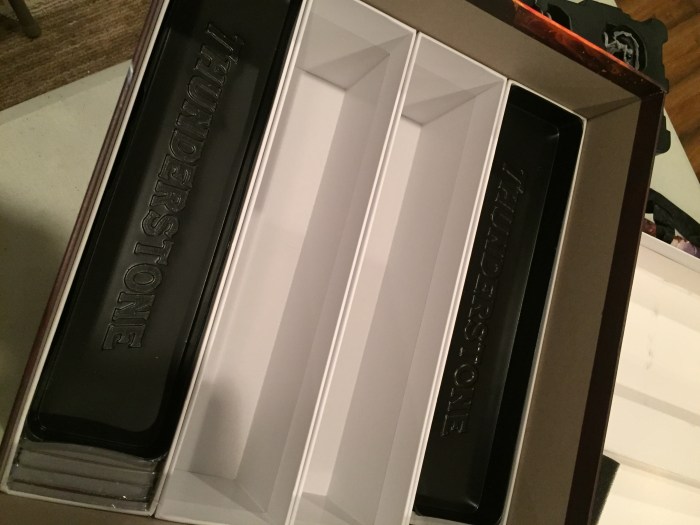
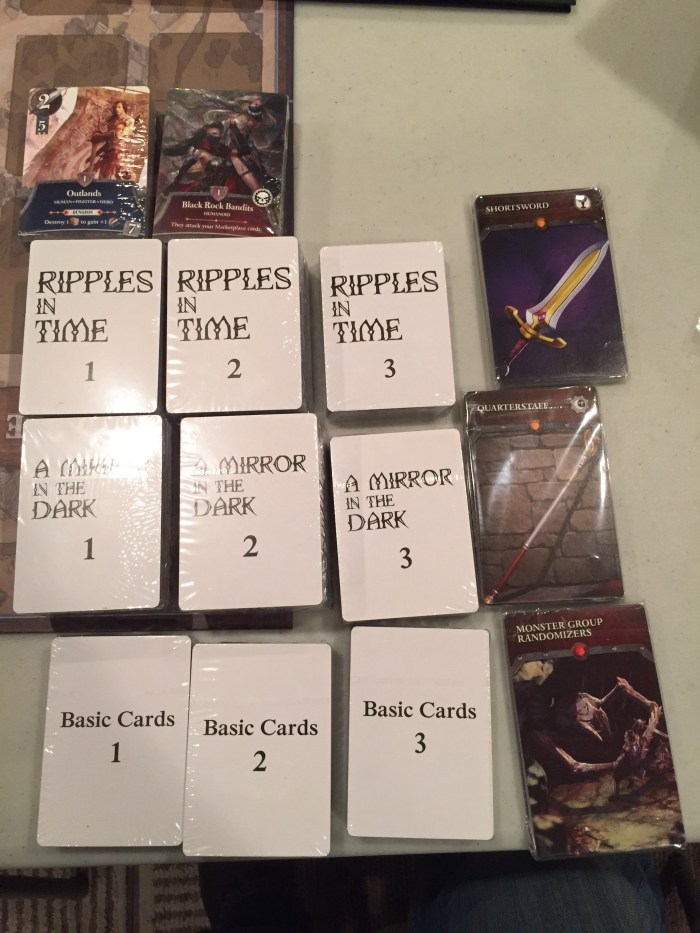
So, there are a LOT of cards. Like, a LOT. I think I counted 30? decks of shrink-wrapped cards! But, you’ll notice the middle two sections are empty. Why? C’mon! You deckbuilders know! So the cards will all fit EVEN WHEN IN CARD PROTECTORS. And for expansions.
The Rulebook
Rulebook for Thunderstone Quest
The rulebook is good. I have never played any of the original Thunderstone variants, so this game is brand new to me. There are a lot of cards, and I wasn’t sure where to start, but the rulebook guides you pretty well. Within an hour, I was set-up for a two player game.
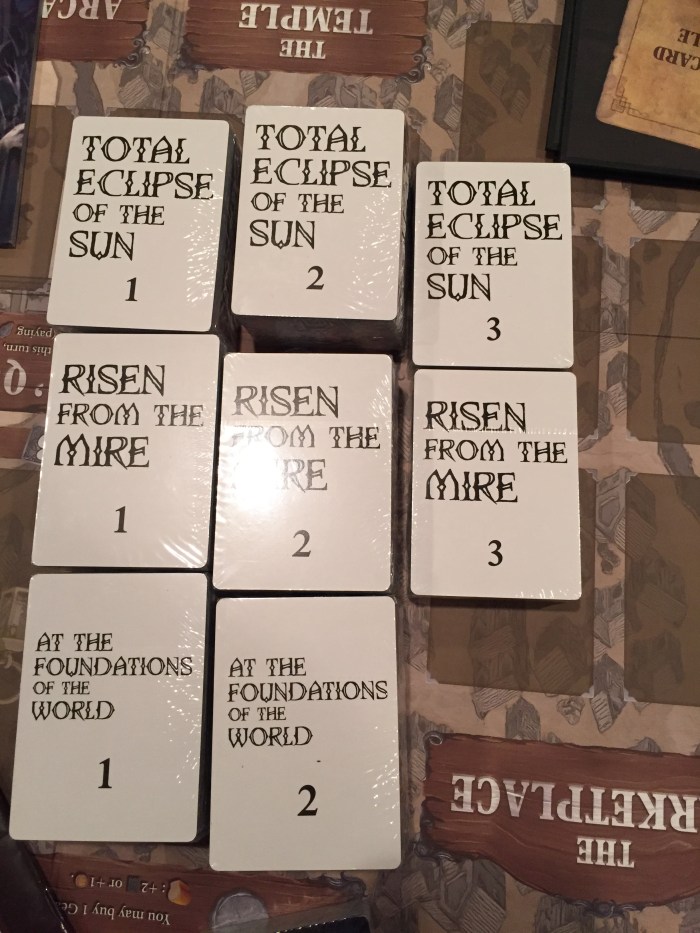
I wish there had been some pictures so I knew which component was which … but I was able to figure it outAre the numbers so you know the order to unwrap them? NO! It just says how many deck there are to unwrap!
My main frustration was not knowing if I should ONLY unwrap deck 1, and then unwrap deck 2 later? You see, I had an EXCELLENT experience unwrapping Aeon’s End:
Aeon’s End tells you EXACTLY how to unwrap all your decks, and in which order, and when
So, after festering a little, I came to realize: YOU OPEN ALL THREE AT ONCE. AND SORT THEM ALL AT ONCE. The reason for three decks was more of a manufacturing reason. I just wish the rules were a little clearer. They also messed up in the first game: they tell you what cards to play, but one of the Adventurers is the wrong name! So, I had to figure that out …
Ashley, Drew and Adam.
This is a minor pet peeve, but it bothered me: the players were Ashley, Drew and Adam. In cryptography examples, they always use Alice, Bob, and Charlie. Why? Because all the names start with different letters (ABC) so you can tell which player at a glance is which. Ashley and Adam are poor examples because they start with the same letter.
Yes, it is a pet peeve. The rulebook does a good job or going through some sample turns, but occasionally you have to reread a section and ask “Wait, was the Ashley or Adam”? It just makes things harder to learn than they should have been.
Components
The components are pretty darn nice. The cards are great looking.
Cards are high-quality and look great
The board is easy to read and easy to get around. It has rules labeled on it to help you remember things.
The player boards are incredibly high-quality! They can FOLD! They are of the same quality as the board! The also have summaries of rules on there. I applaud that! Rather than having a separate card for the rules, the player board has just about everything you need to get through a turn. These player boards were really phenomenal!
High Quality Player Boards!
My only gripe about the boards is that each player has EXACTLY the same one. There are no special player powers in the game, but each player does gets his own mini. It would have been nice to have a picture of the mini on the board … (but then they would be stuck with only 4 minis, and you can see that they give us 6 …)
The minis are pretty nice.
So, each player can choose which mini they want. But honestly, since there are no special powers, it doesn’t matter for gameplay. It just looks nice.
The tokens are all wood. Very nice, and you get plenty. The dice were great! But I couldn’t find ANY MENTION of using the dice in the rules? Why were the dice included? It turns out, after you deck build, some of the later cards require dice. But, ya, you may not use the dice in your first few games.
First Game
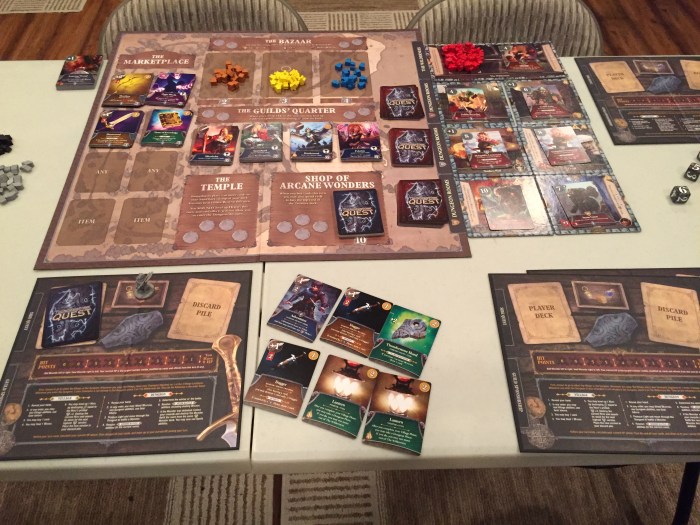
So, my first game is all set-up and ready to go. Looks good set-up, doesn’t it? You’ll notice I have two players set-up. Why? THERE ARE NO COOPERATIVE OR SOLO RULES.
“But Rich! This is a Cooperative Games blog? Why are you reviewing a game that doesn’t have a cooperative mode?”
That’s a real good question. Let’s take a look at the Kickstarter:
We have had a lot of questions about co-op or solo play rules. Our developers have great ideas for these modes of play but they won’t start working on them until after work is finalized on the regular competitive rules. We don’t have an ETA on when we will have co-op or solo play rules ready but we’ll make them available as soon as they’re ready.
In more detail, from the FAQ (on the Kickstarter page)
We have plans to write co-op and solo play rules for the game but we won’t begin work on them until after we’ve finished the rules for normal competitive play.
Last updated:
And finally, from Update 31 from the Kickstarter:
AEG Developer Bryan Reese is actively at work on Solo & Co-Op Rules for the game. He recruited a small group of playtesters to help and once they’ve progressed towards a more final ruleset we’ll be sharing those rules with you as well. This project has blossomed into something much more comprehensive than just a rules addenda and our plan now is to bundle the Solo and Co-Op Rules into a future Quest release. Our plan now includes special cards and other materials to facilitate Solo and Co-Op play.
In other words, no CO-OP or solo play comes with this game.
Granted, they never promised it would come with the game, but I guess I felt like they were implying (maybe I was just inferring) that a CO-OP mode would come with the game … just as soon as they finished with the competitive game. And, it sounds like it will be another product I have to buy. Sigh. I am disappointed and feel like a little bait-and-switch happened. But, yes, they didn’t promise it … but I really felt like I was lead down the garden path a little ..
Anyways, Part II of this review will come out AFTER they publish the solo and co-op rules.
Play
Set-up for myself to learn the game, playing two positions
How does the game play? I played a single player version with 2 players (just a few rounds to get the sense of it), then my friends Sara and Teresa came over and we played a three player game.
A Three player game underway! (I’m taking a picture …)
So, the game was fun. It was a deck-building game with lots of little twists on that.
Exploring. On your turn, you can either go to town to buy something, or go exploring in the Dungeon and fight something!
Wounds. Every player take wounds when you fight. You can heal those in town with cards or by going to special locations.
Treasure. You can get some amazing cards for your deck either by fighting a monster or buying it in town.
Light. You can’t go too far into the dungeon unless you have enough light
Big Bad. There’s a big bad YOU ALL FIGHT at the end of the game
Tokens. You can buy tokens with your money in case you don’t have enough for something big. (Light, Healing, or Iron Rations). In other words, you always have something you can buy, even if you don’t have much. The Iron Rations are nice because you can buy a ration for 2 gold, and use it for 1 gold on your next turn—it’s a way to “preserve” some of your gold for a later turn.
At the end of the day, it felt a little like Legendary (the super-hero version). You pick adventurers (like superheroes in Legendary) to go into your deck, and you have to buy things to go into your deck. And you fight a big bad. And whomever has the most Victory Points at the end of the game wins! At a high level, very much like Legendary.
Thoughts on Gameplay
After playing through, we had fun. We want to play again. Players don’t really get in each other’s Kool-Aid too much. Someone may fight a monster you wanted, or buy a resource you wanted, but that’s about it. Again, very much like Legendary.
One thing we DO with Legendary is just ignore the Victory Points at the end of the game and just play like it was a CO-OP. Can you do that with Thunderstone Quest? Kind of? In this game, the Big Bad comes out at the end, and no one really defeats it, you just all fight it. If you fight it and win, it doesn’t die. It just gives you victory points. And then the next player can fight it. And get victory points. And that’s the end of the game. So, you could play that way. I guess? It just doesn’t feel very satisfying or thematic in this configuration because the Big Bad doesn’t die.
One way to play solo would be to just take one player and get the most Victory points you can, and try to beat that score next time. It’s not a bad way to play solo.
Conclusions
At the end of the day, I liked this game. But, I think I like Aeon’s End better. Aeon’s End is an amazing solo and cooperative co-op game: it was built from the ground up as a co-op. This is a good competitive deck -builder that’s pretty fun to play. And I don’t regret getting it (although I am annoyed how the co-op and solo modes fell off the radar). When the co-op expansion comes out, we’ll see how well it fares. Watch this space for Part II of my review … which may be a while … because they don’t even have it yet …
But, as a competitive game, it was good. The components are amazing, there’s a lot of variety in all the decks, and the game just wows you with the components. It was fun. I’ll play again and my friends want to play again. And my other friends want to try it out.
It was fun. But be clear: THERE ARE NO COOPERATIVE OR SOLO MODES INCLUDED. You must wait for some expansion you have to buy.
Sometime ago, I wrote a blog post called “Fastball Special” about Player Selected Turn Order in cooperative games. The idea is simple: why can’t players select the order they get to act in a cooperative game? It’s another place players can work together to get optimal results. I have been buying lots of cooperative board games over the last year. It’s been almost 2 years since I wrote the “Fastball Special” entry! And I have only found 3 (well … 2 and half …) games with Player Selected Turn Order! And none of them are well known games! Here’s the ones I know of.
The Daedalus Sentence
I kickstarted this game quite some time ago and gave a review here. This is the first game out “in the wild” I found where players could actively choose the order to use their action points. Every player gets 4 action points, but you can use them (among the players) anyway you want! You could even intersperse your actions among the actions of other players. It was very cool! But, in my plays of the game, we didn’t seem to take advantage of this. Or rather, we didn’t seem to NEED to take advantage of this. So, it was cool, but it wasn’t clear it was necessary to win.
Sharknado: The Board Game
Yes, you read that right. There was a Sharknado: the board game. But … this was a Kickstarter that didn’t fund. So, I count it as “half” a game. According to the web site, they still plan to release this! But I haven’t seen anything about it. Anyway, here’s why it caught my eye at the time:
No specific turn order – The game plays in two phases: the Player phase and the Sharknado phase. During the Player phase, you and your team can take actions in whatever order works best for your strategy.
How cool! But … I never saw how well it worked. Because, at the time of this writing, it still hasn’t come out.
CO-OP: the co-op game
Yeah, the game I made. It one of the central mechanisms of the game: players go in any order they can in the Player’s Turn phase:
On the Players’ Turn, they can choose to go in any order they want. For example:
Players decide they really need goods in the Warehouse. If CP goes before Henry, CP can give Henry the card he needs! CP Junior goes first and gives Henry Hall a Distributor card. Then, Henry Hall plays the Distributor, using his special power to get one more good to the Warehouse.
Sometimes, you don’t need this extra flexibility, but sometimes you do! Take a look at this review from kh-km.com for further look and discussion of this.
Player Selected Turn Order Necessary?
I feel like Player Selected Turn Order is a “natural mechanic” for cooperative games. For example, I house rule Sentinels of the Multiverse and allow Player Selected Turn Order when I play. It makes it more “fun” (at least to me) as I have more choices.
But there are reasons not to like it:
It can make complicated games “more complicated” as you add yet “another choice” /”set of choices” to a myriad of choices a player already has.
It’s harder to notate. In most cooperative games, players go clockwise, following the first player marker. As soon as you make the players select, it gets harder to notate. “Who’s played this turn? Did I play? Did you play? Wait, how can I tell?” During my play testing of CO-OP, I went through a lot of different ways to notate it until I arrived at something that seemed to work well enough.
Players aren’t used to it. If there are only three (well, 2.5) games with this mechanic, players really aren’t used to it. So, it may tend to confuse people more.
Are there other cooperative games I have missed (heck, I’ll even take semi-cooperative) with this mechanic?
Recently, The Games Crafter discontinued their purple coin game piece. See picture below. In other words, you can’t get games with the purple coin (at least, made by the Games Crafter) any more.
Those of you familiar with CO-OP: the co-op game may know the purple coin as something slightly different: The Happening Dude token! It’s very similar in function to a First Player Token but not quite the same: The Happening Dude doesn’t go first, he just reads the Happenings for that day, and then the marker rotates to the next player.
What Do I Want in First Player (or Happening Dude) Marker?
What characteristics do you want in a First Player (Happening Dude) marker?
The reasons I chose the purple coin as The Happening Dude:
Cost. It was cheap. Don’t discount this. I printed 120 games and had to pay for every single piece!
Heft. It had some heft. Among the tokens in the Games Crafter menagerie, it was one of the larger ones. You want to have something large enough to “pick up and pass around” the table. Admittedly, the purple coin is smaller than I liked, but I didn’t have a lot of options.
Visually Distinct. When passing the token around the table, you want something visually distinct that you can pick out from across the table. “Who’s the first player? Oh, you!” I remember the first player token from Arkham Horror getting lost in the shuffle sometimes because it tended to blend with a lot of the other components.
Thematic. You want it to fit with the game. The purple coin was fairly generic and had a happy guy on it: The Happening Dude! But yes, I admit, it wasn’t particularly thematic for CO-OP: the co-op game.
In a perfect world, I would have had something “fun and unique”. We talked about a hat, a talking stick, a bead (seriously!), and a headband (Hippies like headbands). In the end, the purple coin was “good enough” for the price. Recall that CO-OP wasn’t as cheap as I hoped: my cost was about $34 per game. The purple coin was only 10-12 cents If I recall correctly.
The “obvious” Happening Dude token would have been a ‘peace sign’ on a poker chip or a large cardboard cutout. A poker chip would be cheap, but the way stickers work in the Games Crafter made it complicated (and more expensive) to make that work. Similarly for a card board token. (If you buy a sheet of stickers or cardboard, you have to buy the entire sheet, regardless of how much you use it. And that’s PER GAME. The Games Crafter charges you PER GAME for one sheet, even if you only use a little bit of the sheet. And you can’t split the sheet across games, unless you (the buyer) do it manually off-line in a separate order. Like I said, complicated.)
In the end, I made a tradeoff. The cost was probably the main reason I didn’t choose a “funner” piece.
RIP Purple Coin
Oh what great times we had Purple Coin! I’ll miss you! Your friend looks like he’s a pretty Happening Dude. Do you think he can do your job? He’ll never replace you, but he can have fun with us.
What do you think? He’s a pretty cool Happening Dude (or Dudette)… I mean, I can see right through him!
2017 was a pretty great year for cooperative games! I personally have bought over 30 cooperative board and card games this year! Some were bad, some were okay, some were good, and some were great! This list captures the best 10 (well, maybe 11 or 12) cooperative board and card games of the year.
One thing that was reinforced heavily this year was that cooperative games need a solo mode (aka Saunders’ Law). Recently, my friends and I, as a group, tried to learn Sword and Sorcery (a cooperative dungeon crawler). It failed. Miserably. It was just too much to learn as a group. (It might be a perfectly good game, but the group learning and rulebook were so frustrating, I haven’t been able to get it back to the table). This reinforced (to my group anyways) that someone needs to learn the game first, then teach it to their friends.
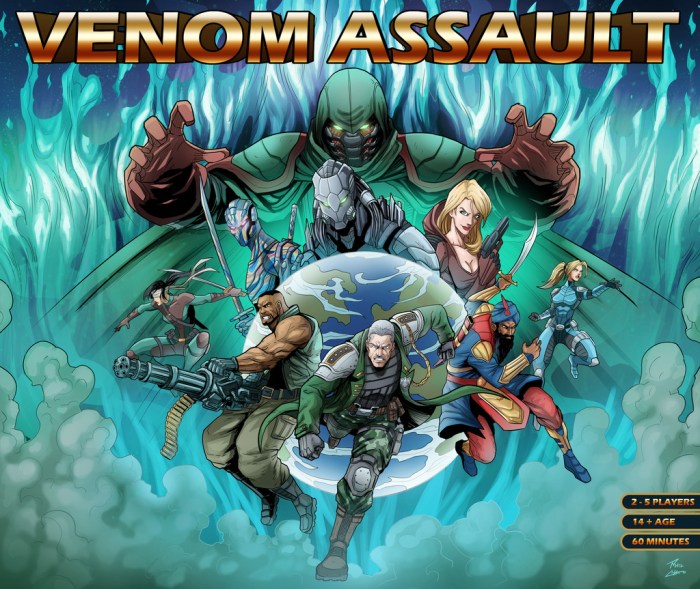
Venom Assault (2016): Strictly speaking this came out in 2016. I received my Kickstarter copy (yes, there will be a lot of Kickstarters on this list!) in December 2016, and I don’t think it hit distribution until 2017. So, you could argue that most people didn’t get this until 2017. But technically, this can’t qualify for 2017, but I think it deserves a mention.
Venom Assault is a cooperative deck-builder set in the world of … something very similar to, but legally distinct from, … G.I. Joe. You play together as a group fending off the hordes of VENOM (the bad guys) as they threaten locations around the world/board. I love the art in this game: the art on the cover (above) belies the art on the cards. Every card looks like a panel from a well-illustrated G.I. Joe comic. The game is interesting too! It’s a deck-builder, but it adds a combat mechanism with dice that works pretty well. I haven’t gotten this to the table as much as I like, but I think this is a really good game.
Playable Solo? No, but it is easy to play 2 characters.
Battle for Greyport
Battle for Greyport (2016) is a cooperative deckbuilding game set in the world of The Red Dragon Inn. I did a full review of the game here. It is a pretty game, has lots of content, and was a lot of fun (although I wish it had solo player rules). Again, like Venom Assault, this came out officially in 2016, but Kickstarters didn’t get it until December 2016 and most people probably didn’t get it until the 2017. Fun game!
Playable Solo? No, and it is difficult to play solo.
Okay, let’s head to our top 10!
Number 10: Dresden Files Cooperative Card Game
Playable Solo? Yes, but needs some slight tweaking. See this post.
After all is said and done, I seem to like this game more as a solo game. It did okay with my game groups, but not great. I really liked it, though, and I thought it was very thematic. The art was great and the gameplay is short (30 minutes). It’s really easy to learn (the rulebook is good) and it has some interesting card mechanics I haven’t seen elsewhere. It’s not the best game in the world, but if you liked the Dresden Files book series, you will enjoy this.
It’s at number 10 because I liked it a lot more than my game groups. See Part I and Part II of my full review here to see if you will like it.
Number 9: Rising 5
Playable Solo? Yes! And good rules for solo mode in the rulebook!
Given that this game is basically just cooperative Mastermind (a pattern guessing game), it went over very well both solo and with my game group. The game is basically two parts: playing so you are allowed to earn a guess, and then guessing the pattern. The art in the game was beautiful and the game is simple enough to get into quickly, but the pattern matching makes the game very thinky.
The main board, with two side boards/expansions (along the left edge and top edge)
The art is amazing and really helps keeps you engaged. Simple, beautiful cooperative Mastermind.
See my full review here to see if you might be interested in the game.
Number 8: Witches of the Revolution
Playable Solo? Yes! And it has good rules in the rulebook!
This is a cooperative deckbuilding game. Yes, there are a lot of those around now, but this one is different in a number of ways. First, the theme is interesting! You are all witches working together to help the colonists win the American Revolution! (It’s a neat theme, but it’s not necessarily pervasive). As a deckbuilder, it has an interesting new mechanic: when you buy new cards, you destroy the cards you buy with! In other words, you cull your deck when you buy new cards. As you play, your deck tends to get smaller when you buy! Culling and buying are coupled into one mechanism.
The game has a pretty good rulebook. The game itself isn’t terribly complicated. The art isn’t great, but it’s good enough and thematic enough. See below. The cards and the components are good.
The board itself (above) notates a lot of the rules on the board itself, which was very helpful.
Overall, my game group liked it and I liked playing it solo.
This game definitely cries out for an expansion: I feel like this might move it up my list with a little more content.
Number 7: Tie!! Aventuria the Card Game and Gloomhaven
Playable Solo? Yes.
Some of you might be saying, WHAT? “How is Gloomhaven so low on your list and tied with a minor Adventure game?” Calm down, let me explain. Both of these games satisfy my “I want a dungeon crawl adventure game” itch. Sometimes I want a long crawl, taking all day. And Gloomhaven scratches that itch. But sometimes, I want a quick crawl, taking an hour. And Aventuria scratches that itch.
Warhammer Quest was a simple RPG-lite card game that cried out for more content, but unfortunately Fantasy Flight Games broke up with Games Workshop! And we never saw any more content (well, we saw 2 new characters but no new adventures). Aventuria fills the gap that WQ left: it already has 3 new adventures/expansions (which I already picked up)!
Gloomhaven, of course, has 100s? 1000s? of hours of content! It’s an amazing game! The gameplay is fun! The game is huge and the components are amazing! It’s an amazing RPG adventure!! Really!!! It’s Tom Vasel’s favorite game of all time! Only, I have a few problems with it (which is why it didn’t make it up further on my list).
Playing Lawyerball. The rulebook is 52 dense pages. It is a very good rulebook! Let me make that clear! But, as I played, I felt like I was a lawyer reading Tort Law (“Section 3.2 refers to subsection 12.3 about the Stun rule”). I am sure that once I know the game, it flows faster, but there are a lot of rules.
Set-Up. It takes a long time to set-up a scenario digging through all the cards and scenarios and markers. It can take a while and it will take it out of you if you aren’t in the mood. Again the components are AMAZING! But, sometimes I am not in the mood for 30-60 minutes of set-up.
The Loot rule. I have played Dungeons and Dragon in MANY different incarnations (original edition, first edition, advanced, second edition, third edition, 3.5, Pathfinder). And, in 99% of those games, you kill the monster THEN you get the treasure. In Gloomhaven, you have to go out of your way DURING COMBAT to get your loot!! Which means, as soon as you kill the last Archer, you CANNOT get the treasure chest that was 20 feet away from the Archer because you didn’t LOOT during combat??? What??? This seems very athematic and it doesn’t make sense to me. This one rule really took me out of the game and frustrated me. I will get used to it, but it’s a rule that maybe belongs in a simple card game NOT a full-fledged adventure almost RPG!
Both Gloomhaven and Aventuria are RPG-like games I want to play. They belong together at number 7.
Number 6: The Aeon’s End Suite (Aeon’s End and War Eternal)
Kickstarter Edition of Aeon’s End and Aeon’s End: War Eternal (with update since I was an original Kickstarter)
Playable Solo? Yes. And good solo rules in the rulebook.
Aeon’s End was a very pleasant surprise! I didn’t get to it right away, but once I did, wow! I loved it as a solo game and my game group loved this game. One of my friends even went out and bought it right away!
Aeon’s End (and War Eternal) are cooperative deckbuilding games. (War Eternal is a standalone game or can be combined with the original Aeon’s End). I know, there’s a lot of these on my list! But, Aeon’s End puts a real nice spin on the deckbuilding mechanic: you don’t have to shuffle your discard! Thus, when you discard cards to your discard pile, you can discard in any order you want so that you can build combos. When you are ready for more cards, you simply flip the discard deck over! No shuffling!
The players take the role of mages cooperatively fighting a big bad monster. You buy spells, relics, and gems (much like a Dominion style marketplace with cards and coin). But there’s so much more here! Spells, breaches, cooperation, major spells to be recharged …
When you first get the game, it does a VERY GOOD JOB of teaching you the first game! The decks are labeled and tells you what cards to put out first!
At the end of the day, we loved this game! It was fun, it was a good cooperative game for a group or solo play!
Playable Solo? Sure, but then they are used up! These Escape Room games make more sense to play with a group!
Wait, do I see a list within a list? Do I see a GASP … sublist? Yes. There are 4 main sets of “Escape Room in a Box”. Unlock, Exit, Escape Room in a Box, and Deckscape. And those I played were a blast! Here’s my top 3!
3. The Unlock series. The House on the Hill went over great with all my game groups. Since this game is reusable, I was able to play it again (or rather, watch it be played) with multiple game groups! I wasn’t sure about the app integration at first, but it worked well enough.
2. The Deckscape Series. Deckscape: Time Test was a pleasant surprise. It was easy, fun, and we got through it in an hour. And its reusable! It was probably the simplest of the Escape room games, but it was really enjoyable.
Honestly, I thought this would be my number 1 Escape game. But then, one of them surprised me!
1. Unlock: Tonipal’s Treasure.
This is the closest thing to the Monkey Island video game I’ve ever played in a board game. As some of you know, I love Monkey Island! And this really reminded me of an Adventure Game. The time ran out at 1 hour, but we kept playing for another hour because we loved it so much! (Yes, it’s very hard). I liked this Unlock game so much I WILL PLAY IT AGAIN!! Yes, that’s right, a one-shot game was so much fun, I will play it again! So much fun!
Honestly, all the Escape Games I’ve played I have enjoyed. The Exit games are pretty amazing, but you can only play them once. At least the others can be played again by some of your friends.
Number 4: Unicornus Knights
Unicornus Knights Rulebook
Playable Solo? The rulebook does not specify a solo mode, but the game plays great if the solo player controls three characters in the game.
This game I truly like. I want to play it again and again. There’s some really interesting mechanics and art. It’s a cooperative game where the players work together to help the Princess retake her kingdom from the baddies. The only hitch, she’s very, shall we say “Spirited” and wants to just walk right in and take it back (and that’s a suicide mission). The players, as her trusted advisors, clear the way for the Princess so she won’t die before she gets to the big baddie. You go along her path and befriend or neutralize other characters who may try to stop her.
This game has so many things going for it. Great art, great new mechanics (the Fate mechanic deserves it’s own mention!), a great cooperative experience. It should a truly great game. (See my review HERE)
But the rulebook is terrible. The way combat is described seems easy until you go to play. There are so many unspecified combinations and ideas. This game might be higher on my list if the rules were better. A second edition of this game would go a long way towards generating interest in what I think, is a truly great game.
I still love it as a solo game, and my friends seem to like it as a cooperative game.
Number 3: Spirit Island
Playable Solo? Absolutely! Great rules!
Spirit Island is probably (except for Gloomhaven) the most complex game on my list. It has a lot of mechanics and rules, and is probably best described as a euro-cooperative game. Players work together as spirits on an island to beat back some settlers who are trying to colonize their island! It is the inverse of Settlers of Catan! But it is great. I loved it as a solo game, and all my friends loved it as a cooperative game.
The rules were complex, but I found the rulebook very readable. When I taught the game to my friends, I sat out and helped shepherd the game along:
As of this writing, the game is kind of hard to get a hold of. I originally got the Kickstarter, but CoolStuffInc keeps getting in stock and it sells out quickly. If you find the game, I strongly recommend picking it up. It’s great fun!
This entry might surprise some of you. First of all, the original Captain is Dead came out quite a while ago (2014) as a Kickstarter using the GamesCrafter. The game did so well that AEG picked it up and reprinted it and the reprint came out in 2017. So, the AEG version is eligible for the 2017.
This game is awesome! It’s basically a cooperative Star Trek game! The captain of the Enterprise (or whatever the legally distinct name of the ship is) has died from the first salvo of an alien attack! The rest of the crew has to work together to get the ship out of there before the aliens take over/destroy the ship. Players play very recognizable characters (Transporter Chief, Engineer, Admiral, etc) and have variable player powers. (My favorite is the Janitor. It makes me think that would have made a great Star Trek character. But I digress …)
I love the theme, and I’ll play it anytime anyone wants to. My friends all liked it (except for the 7 player game) and I love love love playing the game solo. Such a fun and thematic game!
This game Kickstarted at the end of 2016, but the game wasn’t delivered until February 2017. This is kind of a cheat to put this on the list, because I designed it. But here’s the thing, I still like playing it! I have played CO-OP probably more than any of the other games on my list … combined! It has a lot of things I want in a cooperative game:
Player Selected Turn Order: I get so frustrated when I can’t control the order of turns in cooperative games! If we are supposed to be working together, why can’t we go in any order we want? So few games have that, but CO-OP: the co-op does and it an ESSENTIAL part of the game
Short Game/Small Footprint/Easy Set-up: It usually takes 30-45 minutes to play a game, and it’s a small box. The set-up … well, it is easy once you’ve done it a few times. I recently added a QuickStart Guide on BGG to help newbies set-up. Overall, it’s a game you can get going quickly.
A Sense Of Humor: I love games like Spirit Island and GloomHaven, but they are all so serious! It seems like most cooperative games are SO SERIOUS! “Work together or we all die!!! Ahhh!!!” I learned gaming from the well of Monkey Island, which is NOT a serious game. It has a sense of humor, but still manages (in my mind) to be a great puzzle and a great game without sacrificing gameplay.
Variable Player Powers: All the people at the CO-OP can do something different! Every time you play, you can play someone very different.
Lots of “Bad News” Events: The “bad news” cards (Happenings) have enough variety to keep the game very different for a long time.
Works Great Solo.
There are some shortcomings to the game (the lack of art/graphic design is probably the biggest shortfall), but at the day, it’s my favorite game of 2017 and I will play it anytime you want to. Or, I will play it solo anytime.
Rising 5: Runes of Asteros, the Kickstarter “Collector’s Edition”
About a week or so ago, my copy of Rising 5: Runes of Asteros arrived. Rising 5: Runes of Asteros is a cooperative deduction game for 1-5 players. I had backed the Collector’s Edition (see over-sized box above) and have been looking forward to it for some time! I had seen the Dice Tower folks play/review it months ago and they really liked it. But, that was months ago! I have to admit to being mildly annoyed that the Dice Tower reviewers got their copy well-before the people (like me) who kickstarted it. But, I understand! The publisher wants to generate interest in the game and sending pre-copies to reviewers is a way to do that.
So what came in the box?
Unboxing!
The box is chock full!After pulling out all the boards and rulebooks, we have the figures and cards!
The game box is surprisingly chock full! Because I got the Collector’s Edition from Kickstarter, I also got the art book. I almost never get the art books, but I really wanted all the coolness of the Collector’s Edition. The book came in the box! It wasn’t separate!
Art book from the Collector’s Edition
The game comes with really nice minis. Surprisingly nice. The different colors make it very very easier to distinguish the figures across the board. I think if the figures had all been gray, this would have made it a little harder to distinguish (even though they are all very different).
Very distinct and very nice Minis. Unfortunately, the minis only come from the Collector’s Edition
The boards and side boards are gorgeous!
The main board, with two side boards/expansions (along the left edge and top edge)
The top side board is for an expansion (the game comes with quite a number of expansion/variants) and the side board (mostly) is just to help keep track of the cards. I don’t think the left side comes with the normal edition, but the top board does.
Top board (expansion/variant). This expansion is used to keep track of when a character fails a combatSide board. Keeps track of one expansion and some cards.
As you can tell, this game is beautiful! The art of Vincent Dutrait is pretty fantastic.
Rulebook and Directions
The game comes with two rulebooks (1 in English, 1 in French) and 2 double-sided sheets describing a plethora of expansions. Seriously, there seem to be a lot of variants and ways to change up the main game!
This expansion adds more powers to the charactersAnother expansion: he gives you little side questsYet another expansion and the Marker for the current sun condition
The rulebook is pretty good. In my first play, I was able to get up and playing pretty quickly. So, this is a case where the rulebook was a relief … it wasn’t hard to read! Whew!
Solo Rules
A Solo Game set-up and ready to go! Even though I am using all boards, I am just playing the basic game. The boards are too pretty to put back in the box!
The rulebook has well-described solo rules. They actually followed Saunders’ Law! And the rules for the solo play were good as well. I was able to learn the game quickly and directly from the rulebook. The solo rules change the base game very mildly; you play normally, but have another hand that is used just to “support” the main hand.
I was able to learn the game from the rulebook, play it solo that same night, and teach it to my friends the next night. I had no trouble getting through this. In fact, the great art and design made me want to get through this.
Core Mechanic
The game is a cooperative deduction game. In it, all players are working together to find the pattern to keep the gate sealed. At its core, Rising 5 is all about finding the right pattern on hexes in the middle of the board.
Find the right hexes and the right pattern to win the game!
The players must find the right 4 hexes to put in the middle (there are a total of 7 differently colored hexes) and put them in the right place (each hex must go to an exact place). That’s made a little easier because there are always 4 hexes in a grid (like above).
And that’s the fundamental puzzle of the game. (There are symbols on the hexes, but it’s the color that matters). As you play, you get hints as to the symbols are set-up (see how to get hints below). To some of you, this might remind some of you of a game called Mastermind from the 1970s.
That’s where the similarity ends. This game had a lot more going on around this core puzzle. First of all, there is a level of indirection on the hints. Rather than tell you which hex colors are proper (and in the right place), the hints are given in the form of some spirit animals. Yes, that’s what I said.
There are seven spirit animals, and seven hexes. At the start of the game, hexes and spirit animals are randomly assigned, so exactly one hex maps to exactly one spirit animal. And all seven are mapped. At the start of the game, YOU DO NOT KNOW HOW THE HEXES MAP TO THE SPIRIT ANIMALS. That’s one of the things you have to deduce in the game.
So, when the game gives you a hint, you get something like this:
The “hint” is in the form of the spirits, but how do those correspond to the hexes you need?
This hint tells you about the current configuration of spirits, not the hexes!
The single BRIGHT spirit tells you that one of your hexes is the right color and in the right place. The semi-bright spirits (two) tell you two of the hexes are the right color but in the wrong place. Finally, the dark create (the spider) tells you that one of the hexes is simply the wrong color.
This hint tells you that 3 of the 4 hexes are the correct color, but one of them needs to go. But unless you know the correspondence between hex colors and spirit creatures, that doesn’t help!
So, as you play, things happen which help you deduce the correspondence between the hex colors and the Spirit Animals.
Getting Hints
To get hints on the current configuration (no configuration shown here), you need to get 4 cubes on the altars, and then you can ask for a hint!
To get a hint, you have to work for it. You need to put 4 Silk Cubes on the 4 altars on the middle of the board to get a hint. You can to get these Silk Cubes (little green cubes) in a number of ways!
Visit a Location and defeat a Monster. Every monster you kill gives you some number (usually 1 or 2) Silk Cubes.
A Monster! When you kill this guy (by rolling 1 or more on a die), you get a single Silk Cube (green cube) to put on the altars.
Visit a location and get help from a “friend”.
When you visit a location with this guy, he’ll either give you a Silk Cube OR move the Eclipse Marker back.
Use special artifacts or (sometimes spelled artefact in the rules) Relics which simply give you Silk Cubes when you use them.
Some Relics give you Silk Cubes and some Artifacts give you Silk Cubes
You can usually get an artifact by visiting a location. Relics are much harder to get: you have to kill a big bad monster!
A Big Bad monster! Takes 5 to kill on the die! (But the die only goes to 4 …). If you kill him, you get a clue about Spirit Animals and also a Relic!
Once you get 4 Silk Cubes, any character can spend a turn to get a Hint.
Characters
There are 5 characters and they are all have very different, but essential, assymetric powers. You might think you are each player assumes the role of a single character throughout the game … and you would be wrong. On your turn, you activate one of the characters with your cards and have them move, encounter, or get a hint.
Each character has 11 character cards. Players are dealt 5-6 random character cards
At the start of the game, each player is randomly dealt 5 or 6 (depending on the number of players) random character cards. On your turn, you choose which character (if any) to activate to move across the world, explore locations, fight monsters, or consult at the altar to gain a hint.
This is part of the cooperative nature of this game. Each player decides which character to activate on their turn to make further progress on the puzzle.
Bad News Everyone!
What’s that red moon?
Like any cooperative game, there are many ways to lose, but only one way to win.
You win if you solve the puzzle (all 4 correct colored hexes in the proper 4 locations)
You lose if the Eclipse Track goes to the bottom (causing a terrible Eclipse!)
You lose if go through all player cards.
Red Moons come out which will advance the Eclipse track: if it ever gets to the bottom, the planet is melted and players lose!
The Eclipse track is on the far right. If it ever reaches the bottom red mark, Game Over! Players lose!
Every so often, some Red Moon comes out of the character deck and “helps” to advance the Eclipse Track. It’s clever because the Eclipse Track will advance downwards by the number of Red Moons out on the board (on the monster cards). The Red Moon don’t move the Eclipse Track right away: after a Red Moon card is revealed (when a player ends his turn and draws character cards), the effect doesn’t take place until the end of the next player’s turn. This means the next player has a chance to mitigate the effect of the drawn Red Moon card.
A Monster! When you kill him (by rolling 1 or more on a die), you get 1 Silk Cube (green cube) to put on the altars.
Notice the Monster card above has a single Red Moon (above the giant 1) on it! Every monster has at least 1 Red Moon. At the end of the turn, all Red Moons on Monsters are summed up, and that’s how far the Eclipse Marker moves down. Let’s hope it doesn’t get to the bottom … or else!
How Do You Win?
Solve the puzzle. But, important note, the ONLY way to move hexes around is with the ORAKL character. His special ability is to swap two hexes (either on the map, or from the side).
So, the only way to make progress in the puzzle is to activate ORAKL. Most of the other characters have special powers which help you in the game (better combat, better movement, better Eclipse position). These special powers give you advantages to keep the game going. At some point, you have enough Silk Cubes so you can use a hint and see the result of ORAKL’s hex movements. (One nice feature: HAL can copy ORAKL’s special power if he’s on the same location and also swap hexes).
This game is about swapping hexes with ORAKL’s power, fighting to get 4 Silk Cubes, analyzing the hints, and finally deducing what the final puzzle is.
The Lady or the Tiger
An App on your phone helps run the game
At this point, I should mention that this game is “usually” app-driven. Usually, you take a picture of the board with the app (when you have collected enough Silk Cubes) and the app gives you the hint! It also shows the history of hints to help the players deduce the final puzzle.
A few of things about the app:
I was surprised it was NOT on the iPad app store, but it WAS on the iPhone app store. Not sure why, no big deal, but it seemed weird.
My first (solo) game went fine using the camera to take pictures. I think my second game (in a different locale) had weird problems—we couldn’t get it to focus and give us a hint! We were frustrated for a few minutes.
Luckily, there is a way to enter “manually” the configuration of the board to get the hint
All in all, the Rising 5 app worked well enough. If, however, you don’t have smart phone, there is a way to have one player “pretend” to be the app. That player has to sit out and just give hints. So, it’s not the funnest way to play, but if you don’t have the app, you can still play this game.
One player can set-up the puzzle (behind the box) and give hints when the players want them!
Living In This World
Quite some time ago, a friend of mine strongly recommended Cryptonomicon by Neal Stephenson. Cryptography and Turing? Sounds great! Only … I didn’t like it. At all. To me, it was long and wandering and didn’t get to the point. After discussions with my friend Derek (who looooooves Neal Stephenson and got his Kindle autographed by him), we came to this conclusion: Derek agreed that Stephenson was long-winded, but he liked going along for the ride—he liked the universe. Being part of the Cryptonomicon universe was fun, even if the story is perhaps overwrought.
What does this have to do with Rising 5: Runes of Asteros?
At the end of the day, this game is just basically Mastermind, an old game where two players played against other. One player created a pattern, and the other player tried to guess it. At it’s core, Rising 5 is Mastermind.
But, while Mastermind is abstract game with no theme …
Rising 5: Runes of Asteros has theme in buckets!
The main board, with two side boards/expansions (along the left edge and top edge)
Each character has 11 character cards
The sun track is on the far right. If it ever reaches the bottom red mark, Game Over! Players lose!
Art book from the Collector’s Edition
If you like the world the game lives in, then you are okay with all the flourishes to Mastermind! At it’s core, this game is just Mastermind. But all the stuff around it, I think, was fun! It added a lot of color, theme, art to the core idea. But, if you are a reductionist, you may not like this game! If you can only see the Mastermind game at the core, you may be annoyed by all the flouishes. Much like I was annoyed by all flourishes of Cryptonomicon.
Conclusion
What a great World to Play in!
At the end of the day, I loved the flourishes on top of cooperative Mastermind. The idea of having to work for your hints, forming strategy to when activate the characters, fighting monsters, finding relics and artifacts .. it all worked for me. I liked it as a solo game.
My friends and I played as well (at 4 players) and we all loved it. Everyone wants to play again! We all joked that this game is WAAAY overproduced for what it is, but world is so colorful and bright, it’s more like joking that we got too much candy for Halloween. No one was really complaining about the amazing art and theme …
I think a lot of people will really like Rising 5. I think some reductionists may be annoyed by all the flavor and claim “It’s just Mastermind all prettied up”. Yup, and how pretty it is.
Original First Edition Kickstarter Edition of Aeon’s End
So, about a year ago (November 2016), I received the Kickstarter edition of Aeon’s End. And it sat the unopened. For almost a year. *Cough*
Kickstarter Edition of Aeon’s End: War Eternal
In Mark 2017, the sequel/follow on to Aeon’s End came up on Kickstarter: Aeon’s End: War Eternal. I went ahead and backed that as well. I am a bit of a completionist, so I figured I get this as well. Even though I haven’t played the original. *Cough*
Kickstarter Edition of Aeon’s End and Aeon’s End: War Eternal (with update since I was an original Kickstarter)
Since I was a Kickstarter on the original game, I received an Update Pack for the original game. What’s in it? I didn’t know. I hadn’t been following too closely, but I will reveal its contents below!
Well, not directly below. We’ll reveal its contents below HERE …
Aeon’s End
The inside of Aeon’s End (Original Kickstarter Edition) Box
I finally, just a few weeks ago, busted out Aeon’s End (first) and played it (by myself and with some friends). And you know what? It was good! I like it as a solo game, and my friends really enjoyed it as a cooperative game.
Why did I wait so long to pull this out?
Aeon’s End: War Eternal
Inside the Kickstarter’s Edition of Aeon’s End: War Eternal
So, after enjoying the original game, I broke out the second game (War Eternal). Better everything. Wow!
Intro Games
Intro Game Sheet for Aeon’s End
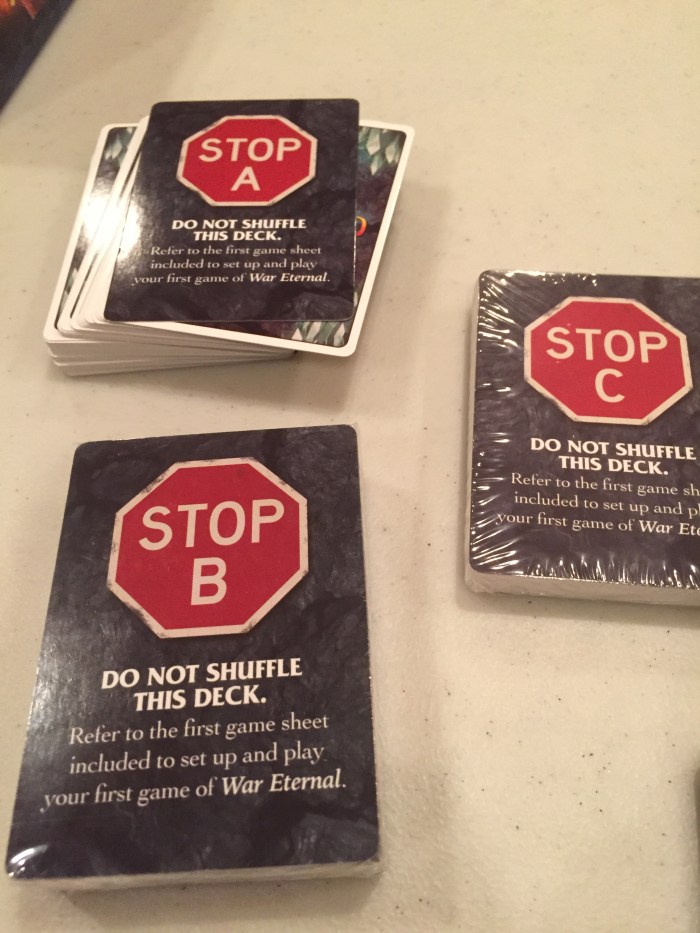
One of the things both games get right is the very first game you play. There is a sheet that shows you how to play your introductory game! The cards are even all divided up into A, B, and C piles.
First game: All the packs are set-up for you
The game is all prepared for you and very easy to set-up for the first game. Given how many cards there are in this box (see pictures above and below), this is a very good step. In fact, I will stand up and applaud this! I was up and playing within 30 minutes.
I picked this character for a solo game (War Eternal) because she could heal herselfThe initial resource set-up from the first game of War Eternal
Deckbuilding
This is a deckbuilder: Every Character has a hand of cards (below Gex) and a draw deck (left of Gex) and a place to discard (to the right of the Gex). The place to buy new things is just above (not all resources pictured).
Aeon’s End and War Eternal are cooperative deckbuilding games. All players in the game are mages working together (casting spells, using relics and gems) to defeat a big bad. It is definitely a deck-builder: it feels a lot like Dominion (the granddad of all deckbuilders) in a lot of ways: you buy gems (money) to get more to buy better spells (houses). So, if you’ve played Dominion before, you will get this game quickly. My group of friends (fairly experienced gamers) jumped right in quickly.
But the hook here: NO SHUFFLING! When you discard cards into your discard, you can (within a small set of rules) discard the cards in any order you want. So, when your main deck runs out of cards, you simply move your discard deck to the deck AND DON’T SHUFFLE! I have to admit, this was probably one of the best things about this game! I liked Dominion, but the constant shuffling really detracted from liking the game: I remember waiting and waiting for other players because they had to shuffle on their turn to get their cards (especially once you got an engine going). In Aeon’s End/War Eternal, you just flip your deck and keep drawing! Much less slowdown! And you can “choose the order” of your discard (mostly) at the end of your turn so usually you can do that at the end of your turn and not hold up the next player. It really felt like much less slowdown!
Components
The components for Aeon’s End: War Eternal are first rate. There is a counter for the bad guys, the boards for the bad guy and the player characters are very readable and usable. Everything really pops.
The interesting thing is that the components for the original Aeon’s End aren’t as good! That’s what’s in the Update Pack: better cards.
Update Pack: What’s in the Box?
Update Box to update the cards from the original Aeon’s End to better cards!
When I got the War Eternal in the mail, I also got the update box. It basically updates all the cards from the original game. I guess some people complained about the original art design from Aeon’s End, and the manufacturer responded and updated the art.
Left: Card from the original edition of Aeon’s End. Right: Card from the Update Pack.
You can see above the changes. They seem all in the name of making the cards easier to read and use in the game. The original cards are physically “darker” than the new update cards. The font on the update cards is bigger (except for the theme text on the bottom is MUCH smaller, but that doesn’t effect normal gameplay: it just adds theme if you want to read the cards). And the picture is bigger because they got rid of the black borders.
I thought the original cards were fine (in fact, we played with them a few times). But, I do admit: the new update cards look nicer and are easier to play with.
Learn From Mistakes
They really did up their game for the components in War Eternal. It really looks like the manufacturer listened to their customers and fixed up a lot of things in the game. They learned from their mistakes.
First: the inside of the box (see above). In the original game (left), the player board and monster boards didn’t fit very well in the box: they sit sideways kinda fitting in the box. In the new game (right), they made a section for the boards (upper right corner of the box). Everything feels like it fits in the box better.
Top: character card from Aeon’s End. Bottom: character card from War Eternal.
Second: the boards aren’t shiny! The character boards and the monsters were shiny in the original edition, and it made them harder to read. The newer version also seems a lot easier to read: the graphic design just feels better. I feel like I can read Indira’s card (bottom: War Eternal) better than Malastar (top: Aeon’s End).
Left: Bad Guy from Original Edition of Aeon’s End. Right: Bad guy from War Eternal.
Similarly, the character boards for the bad guy monsters. Rageborn is shiny and a little harder to read.
Turn Order Cards from War Eternal
Third: the Turn Order cards are significantly improved!
All cards were updated from the update pack!
Fourth: And probably the most important, *ALL* the cards were updated. A lot of cards!
There are a lot of cards in the update pack!
In general, the War Eternal seems to have better components and cards. At the time of this writing, a second edition of Aeon’s End is coming, which is supposed to update the quality of the game to the same level as War Eternal.
Solo Game
Solo Player Set-up
The solo play game works well. You can play with just one character and learn the game. My only complaint was that the solo rules were relegated to the back page (both the Aeon’s End and War Eternal rulebooks). Since my first play of most games is almost always a solo play, I wish those would be addressed up front. But it’s a minor quibble.
The game works really well as a solo game: I had fun and only had to play one character. There is a lot going on, and I imagine playing with multiple characters would have made my first playthrough much less enjoyable.
A finished solo game, I won!
Theme and Cooperation
Theme and COOPERATION
This game is a great cooperative game. It moves quickly, and everyone was helping each other out. In the beginning of the game, most people built their decks separately without consulting each other too much (and in fact, we ran out of diamonds because too many people tried to get that Gem). But, but the middle of the game, we were making decisions together!
“Do I kill the minion first or take out the power?”
“Can I use my special spell?”
“Can you help charge me for my special spell?”
“Can you heal me?”
“Who should take the damage from the event?”
And in the end game, the game slowed quite a bit as every decision became important to winning the game. But not in a bad way! We were all so invested in the game, we talked! We discussed! It kind of reminded me of a basketball game … stay with me here … the last minutes of a basketball game takes forever, but it’s the most exciting part of the game! The same can be said of Aeon’s End/War Eternal! That last few turns because very exciting as we make choices.
Everyone I played with enjoyed the game. They all want to play a game. This is probably the biggest hit at the game table in some time.
Deckbuilder But Not a Deckbuilder!
So, if you’ve played Dominion, you’ll get the basics of this quickly. But there is a lot more to the game. There’s a notion spells, a notion of breaches to be focused so you can cast multiple spells, each character has a special power that has to be charged up, and there’s a big bad that has events and does bad stuff to everyone! It’s a cooperative deck builder, but it’s much more than that. And yet, it didn’t feel too overwhelming.
The one thing that was very overwhelming was building the big bad’s event deck at the start of the game. It’s quite involved with three levels of danger (1,2,3) and you to mix and match basic cards with specialty cards. It’s the one part of the game that seemed to drag: everyone had to wait for me to build the bad guy’s deck. Other than that, the game flowed well.
Conclusion
I shouldn’t have waited so long to open and play these games! They were fun! I even ordered an expansion (The Depths) on CoolStuffInc before I realized I already had it in the original edition of the Kickstarter! (It was hidden in the box … that I didn’t open for a year). Luckily, CoolStuffInc let me cancel that particular piece.
In the original Kickstarter Edition, I ordered the expansions! They came stuffed inside the box
Aeon’s End was a great game, and so was War Eternal. They are both stand-alone games, but can be combined into one. If you find yourself interested in the game, either version will do to give you the full experience. I liked it as a solo game and my friends liked it as a cooperative deckbuilding game.
In the end, I think this is probably an 8/10 on BoardGameGeek.
Recently, we played through London Dread. Pretty good rulebook, decent game. One thing struck me when I was reading the rulebook in the Gaining Resources section on page 11:
Whenever you gain resources, they must be distributed as evenly as possible among the Characters present in the location responsible for the gain. For example: … It’s not legal to give all 3 items to one of the characters …
This is a very minor point in the game, but it really bothered me. What if my character has been rolling bad and needed for all 3 items for the endgame? The other characters may be doing fine, but I may need all the items so I can go further! It’s clear, that in order to win the game, all characters need to do well in the final challenges! Or we will lose. So, why was the game micromanaging such a small decision?
It bothers me because the rule doesn’t seem in-line with the overall structure of the game: this is a cooperative game where we are making decisions together to decide our fate, and this rule micromanages how we can share. I suspect the rule is there to mitigate Alpha Player Syndrome. But, I don’t think it will: if you have an Alpha Player at the table, this little rule won’t do much. Or maybe it’s there for balance?
All it does it make me mad (not real mad, but irate). Why take away a decision in the game? If we lose because of this rule, I will be more than mad. I will be … a lot more mad.
Rules That Micromanage the Cooperative Experience
I have seen rules like this in other games:
Arkham Horror: You can only buy 1 item at the store when you go shopping. Um .. what? You already get a “random selection” of items anyways. And it seems very unthematic that the store wouldn’t let you buy as much as you want!
Dresden Files Cooperative Card Game: You can’t pass using stunts. In my review of the Dresden files, I was surprised how much space in the rulebook was spent on this minor clarification. Usually you never want to waste a stunt, but if it means the difference between a winning strategy or not, why limit us? It seems arbitrary and limits choice.
London Dread: You are forced to share your items as fairly as possible.
Uno: This isn’t a co-op, but this rule always struck me as the prototypical micromanaging rule: You have to play Draw 4 if you can’t play another card. Really? We have always house ruled that you can play the Draw 4 whenever you want (I don’t really play Uno anymore, but it’s one of those strict rules that always seemed stupid. You have so little choice in the game anyways, why restrict choice even more?)
Can you think of any other games with micromanaging rules like this?
House Rules
In our games, we house rule these. You can buy as much at the store as you want, you can pass using your stunt, you can share your items as you which. And you can play Draw 4 whenever you want.
I don’t feel like we are cheating. I feel like we are overcoming a micromanaging rule. We get more choice, and the game becomes more fun.
Or, a better way (for the manufacturers to look at this), is that we want to play their game more! So, let’s not make rules that micromanage!