A Review of Elia and Something Shiny

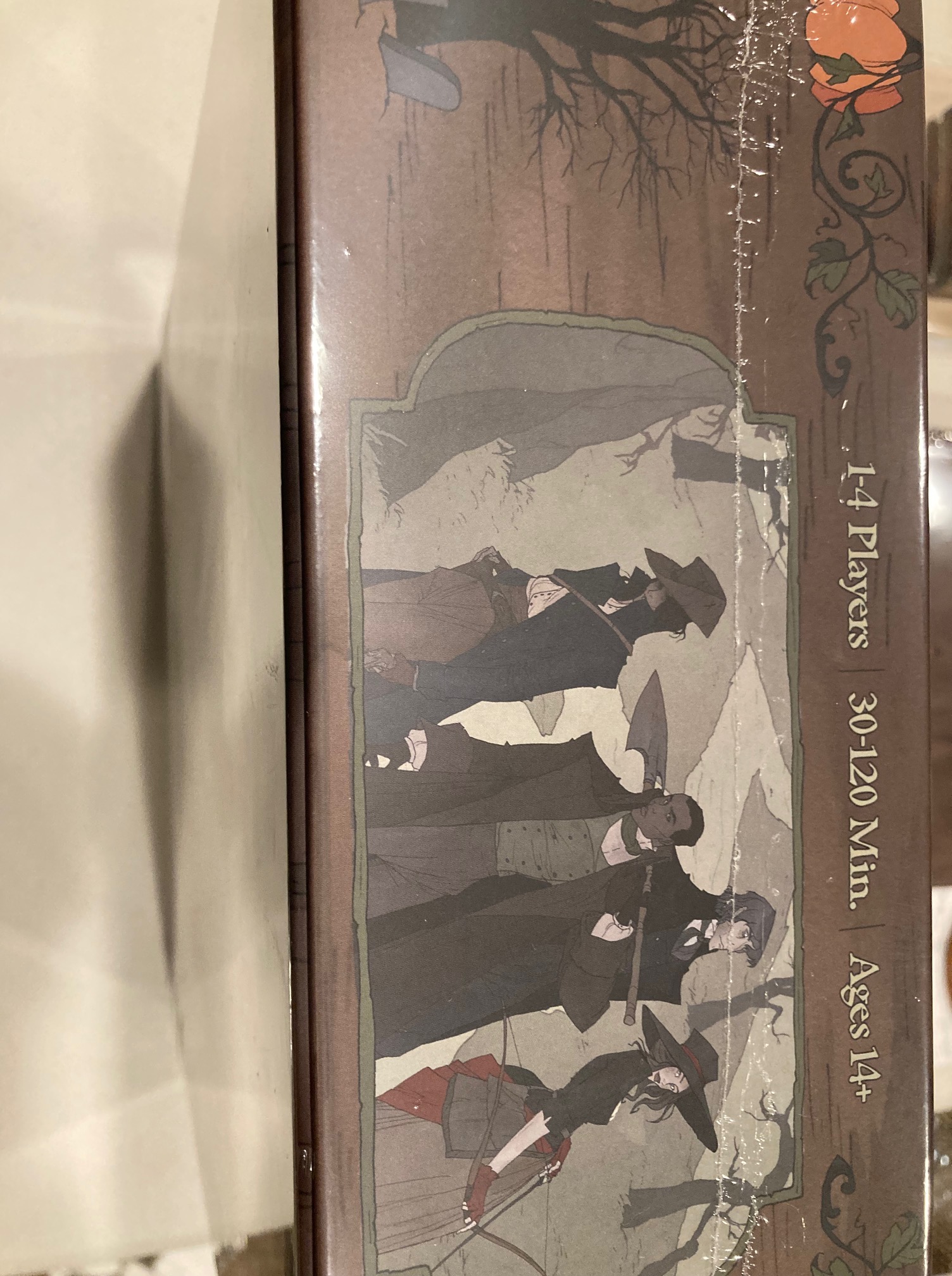
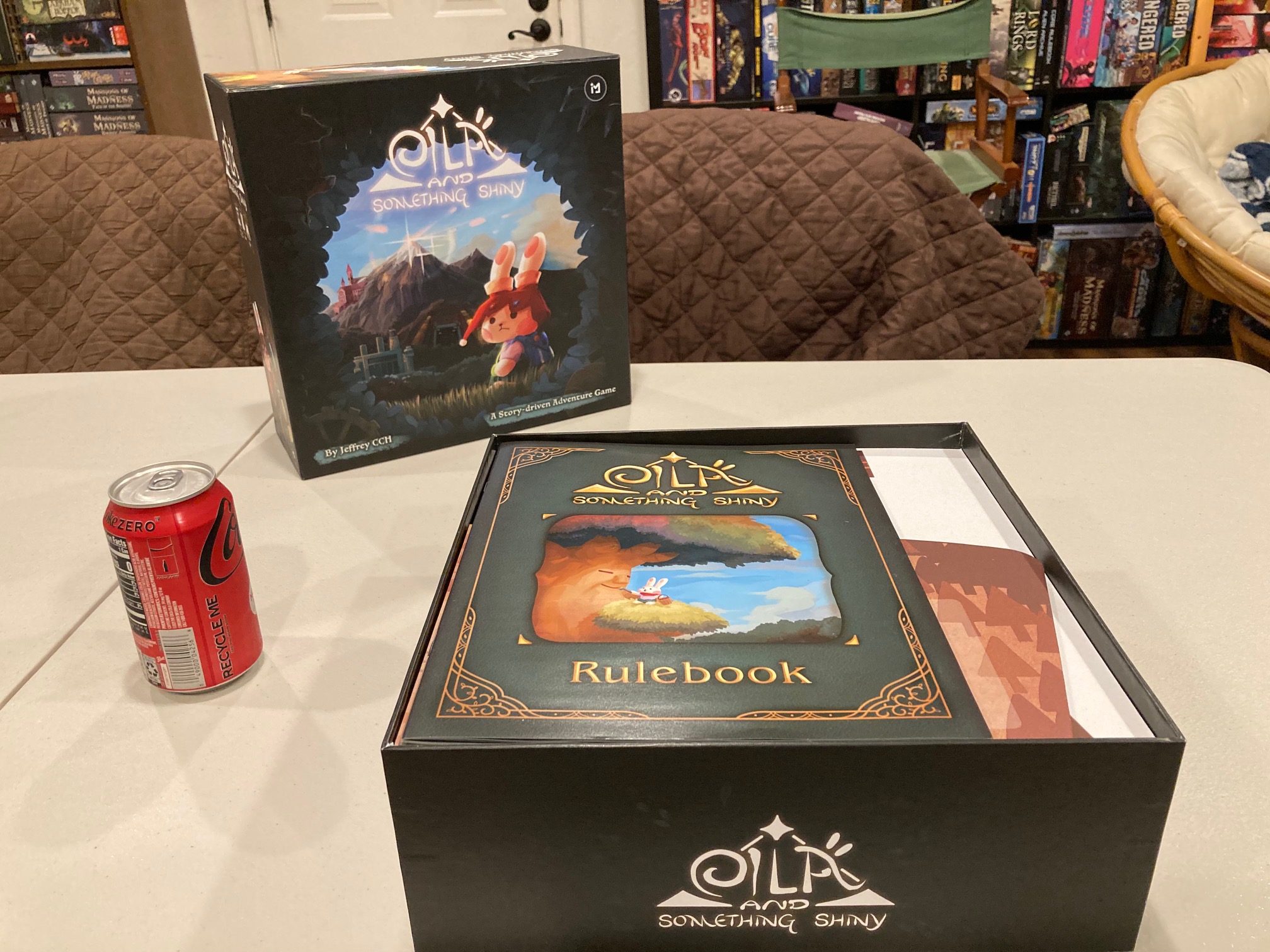
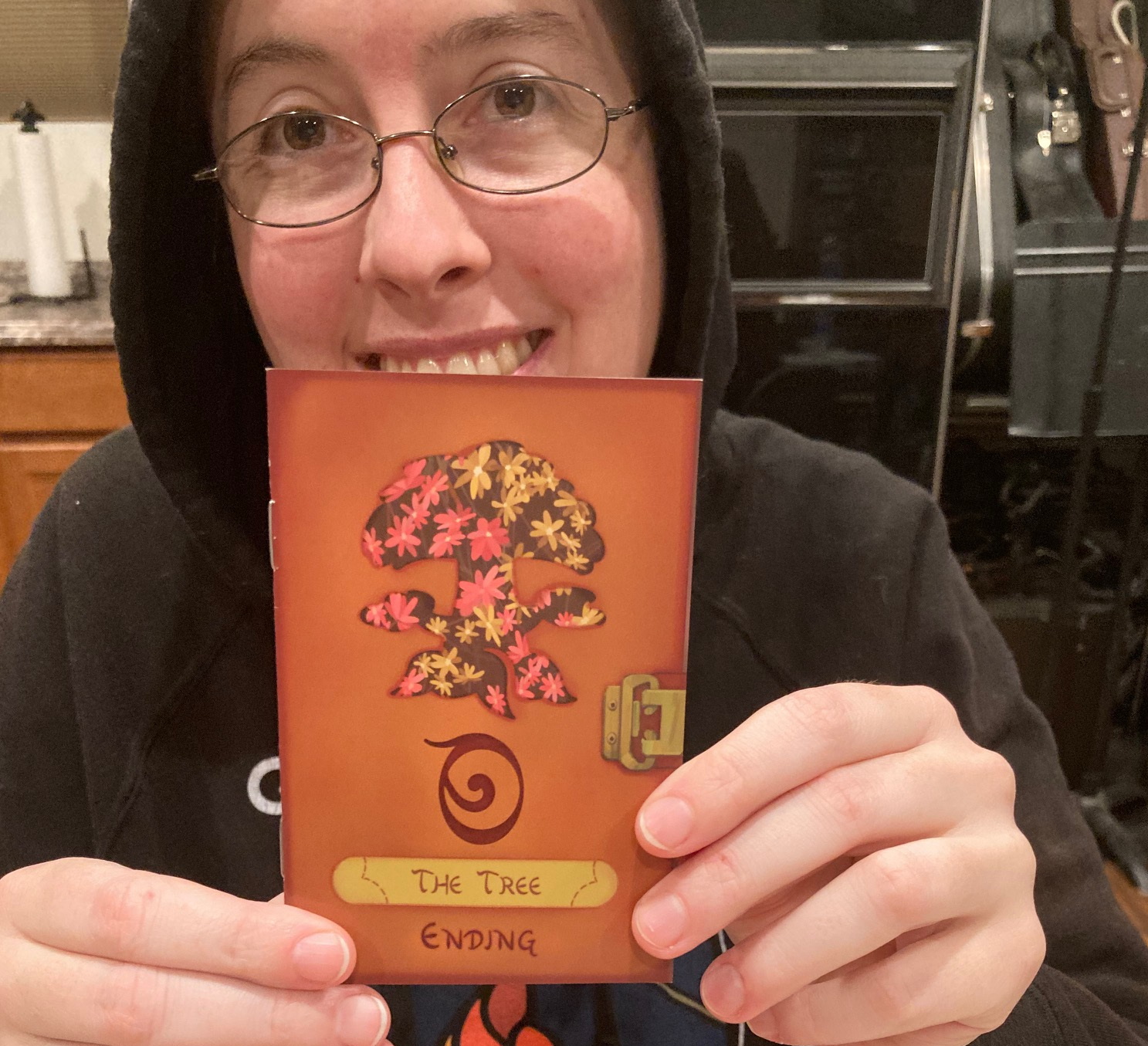
Eila and Something Shiny (yes, that’s an E not an O on the cover) was a cooperative game that was on Kickstarter back in July 2020. It promised delivery in April 2021, but my copy just arrived at my house in the USA recently (about Jan. 31, 2021). This is a surprisingly different game: it’s a cooperative “Choose Your Own Adventure” campaign game for kids.

IMG_9945

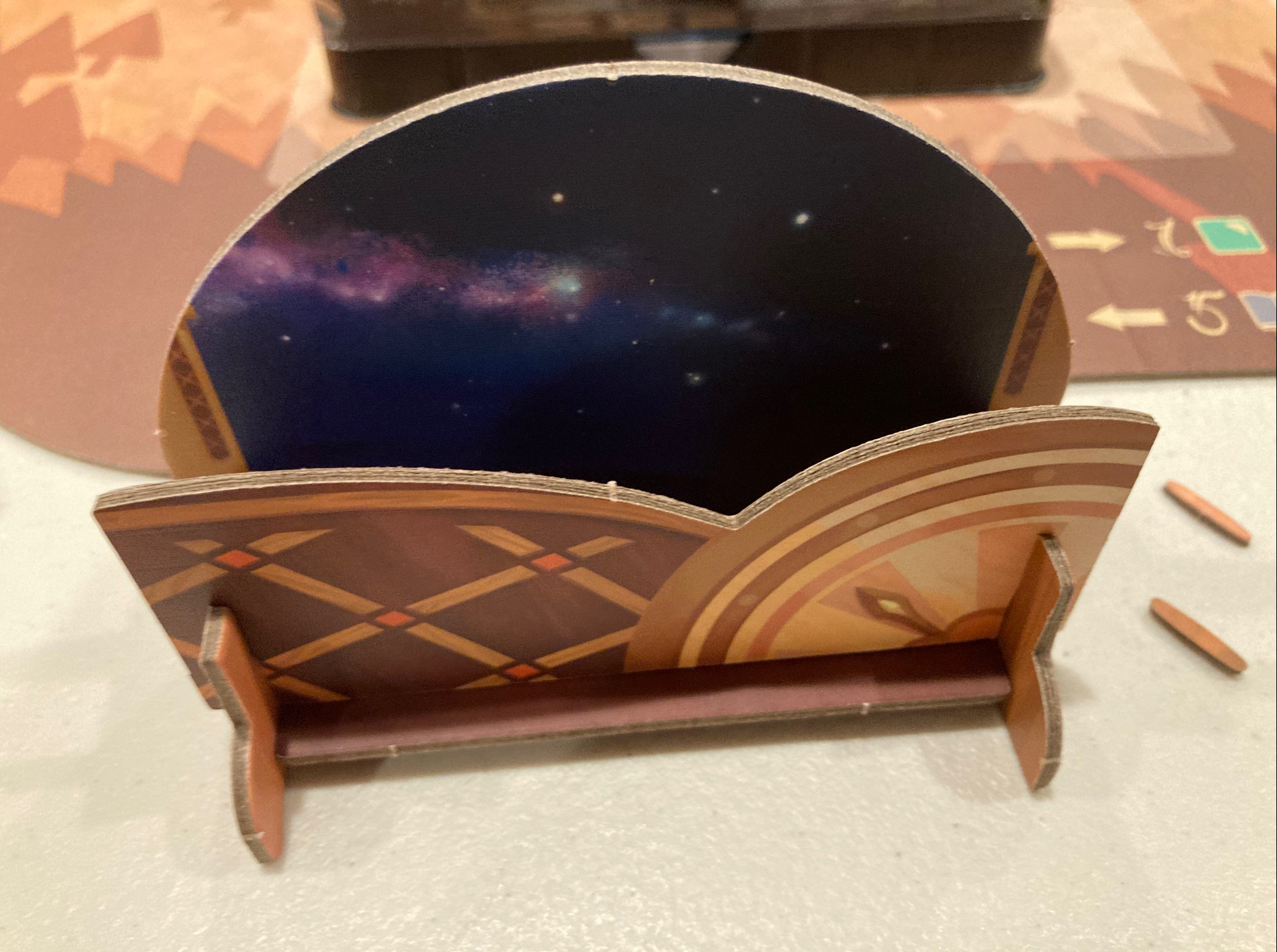
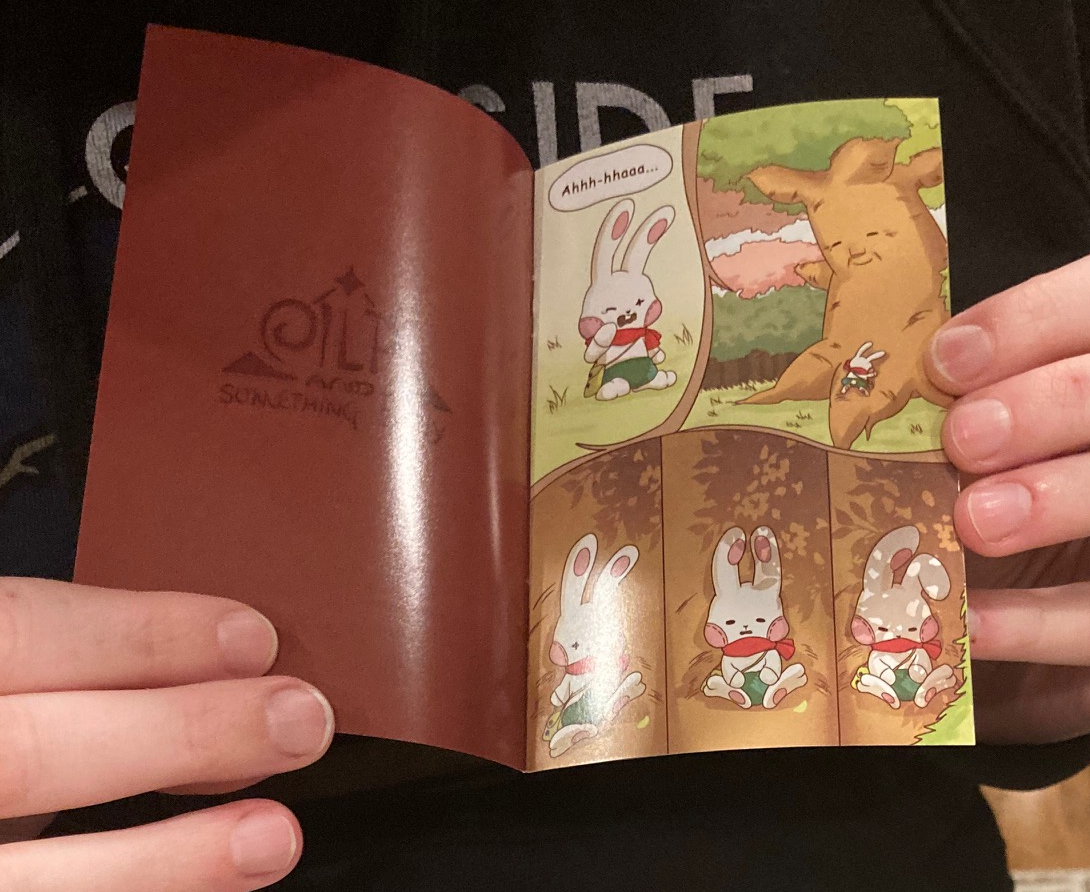
The age range is 8+ and the art style (above and below) tells you immediately if you might be interested in this game.  It’s clear that this is a “cute” game.  If you don’t like cute games, stop reading now!  This game isn’t for you if you don’t like “cute”, as this embraces the cute factor whole-heartedly.  See some more art below.

IMG_0009 (1)

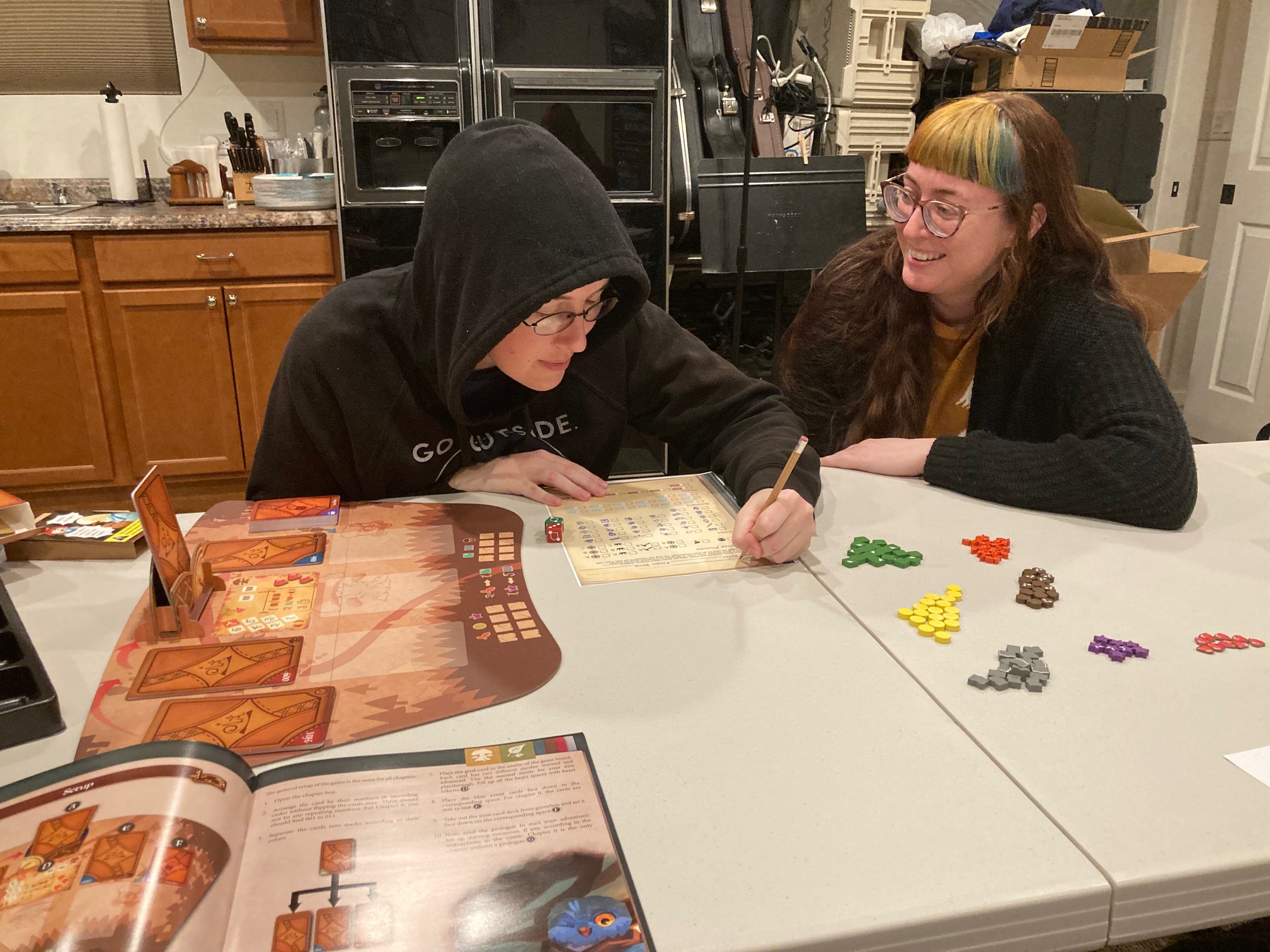
My friend Andrew was out of town, so we decided this would be a good game to play until Andrew returns.  (Andrew doesn’t necessarily like the cute game).  In the meantime, Teresa and Sara and myself threw ourselves into the game!

Unboxing and Components

IMG_9949

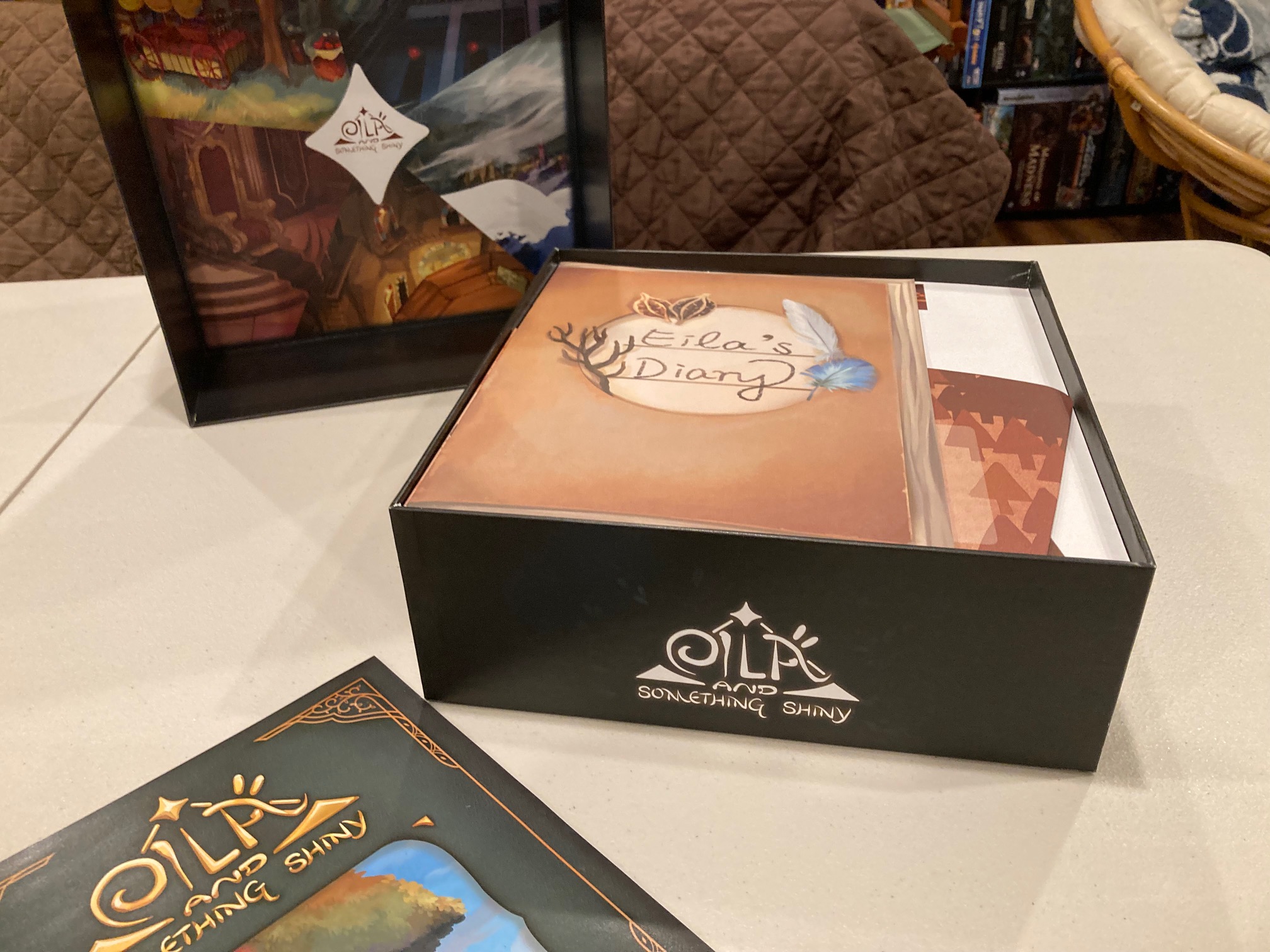
The Components for Eila are pretty first rate: the box was surprisingly big! See above.

IMG_9952

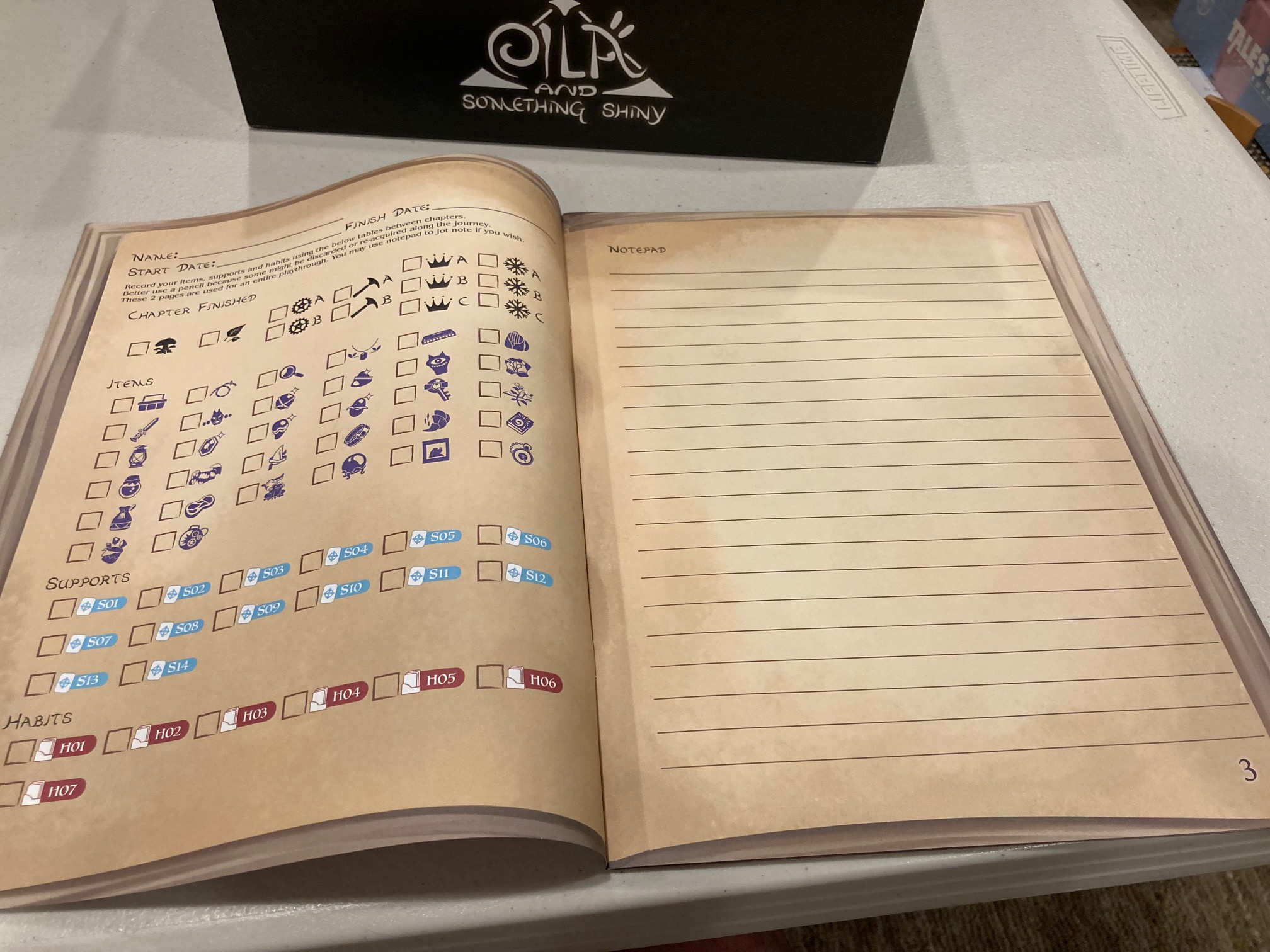
The rulebook looks like a kid’s storybook, and there’s even a little diary (see below) for keeping track of progress.  Elia and Something Shiny is a campaign game after all.

IMG_9971 (1)

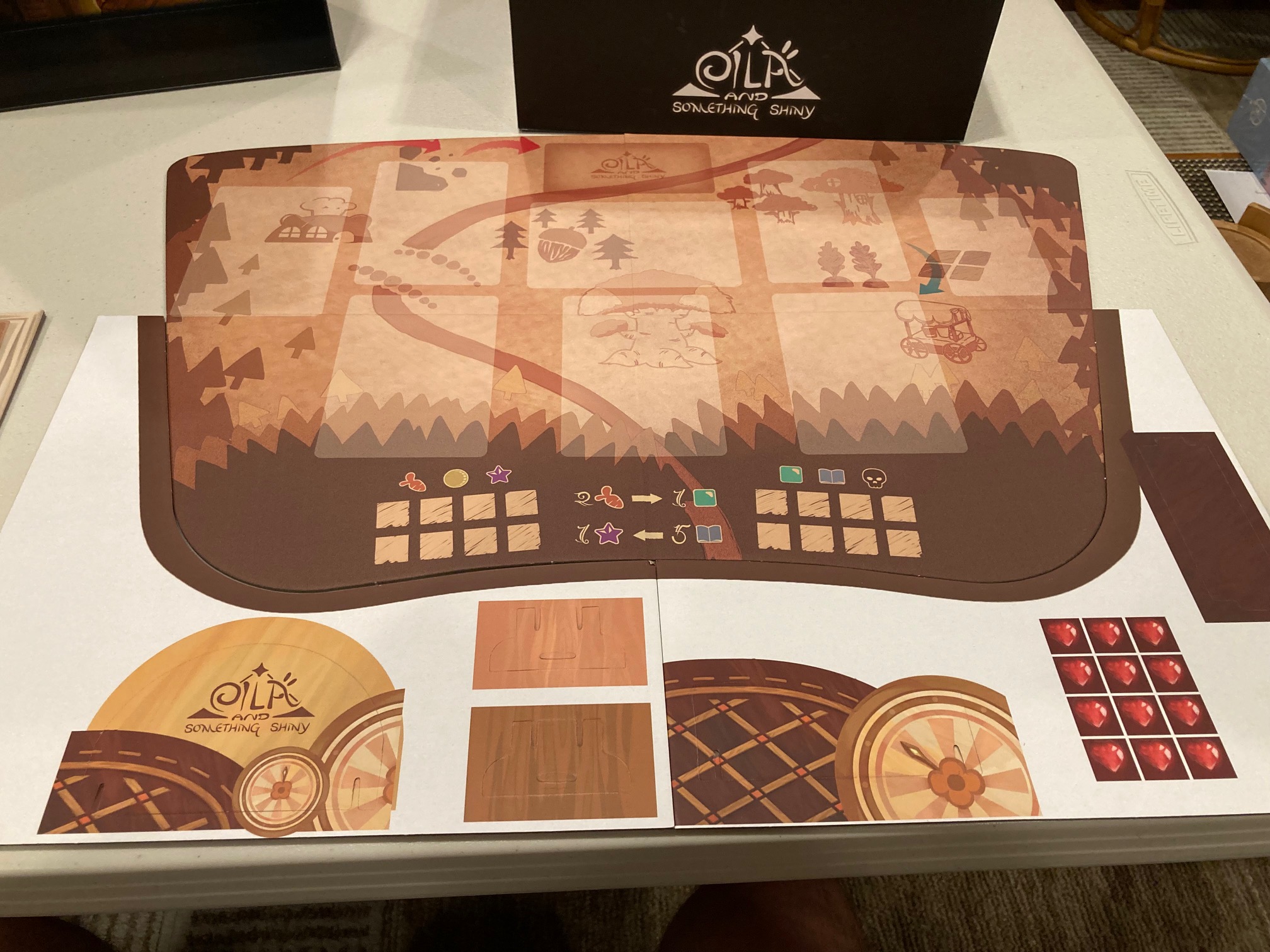
The main board is folded up at the top of the box.  My only real complaint about the components in this game is that this board is already tearing!  (Other Kickstarters had this complaint as well)

IMG_9982

But the board looks nice once folded out (see above).

Overall, the components for this game are fantastic: they are easy to read, they have cute little boxes for each of the chapters of the campaign, and everything is high quality.

IMG_9992

It even has little trays to make putting the game away easier!

Rulebook

IMG_9951

The rulebook almost looks like a kid’s book.

IMG_9953

It starts with a nice list of components with corresponding tokens (see above).

IMG_9954

Then it has some preliminary rules.  As you can see, the rulebook is very well made, the font is nice, and it looks very professional.

IMG_9956

The set-up is next, and the game does a really nice job of getting you into the game.

After the beginning few pages, a lot of the rulebook is dedicated to each of the remaining chapters, so we have to be careful not to show too much.  The pictures there are on their side on purpose: I really wanted to show off how good this rulebook looked!

IMG_9959

One of the more important pages is the list of symbols: see above.  I wish this had also been on the back cover.

IMG_9968

But, in general, this was a good rulebook.  The font was readable, the text was understandable, the organization was simple.  Overall, good rulebook.  We got in right away.

Cooperative or Solo?

IMG_9946

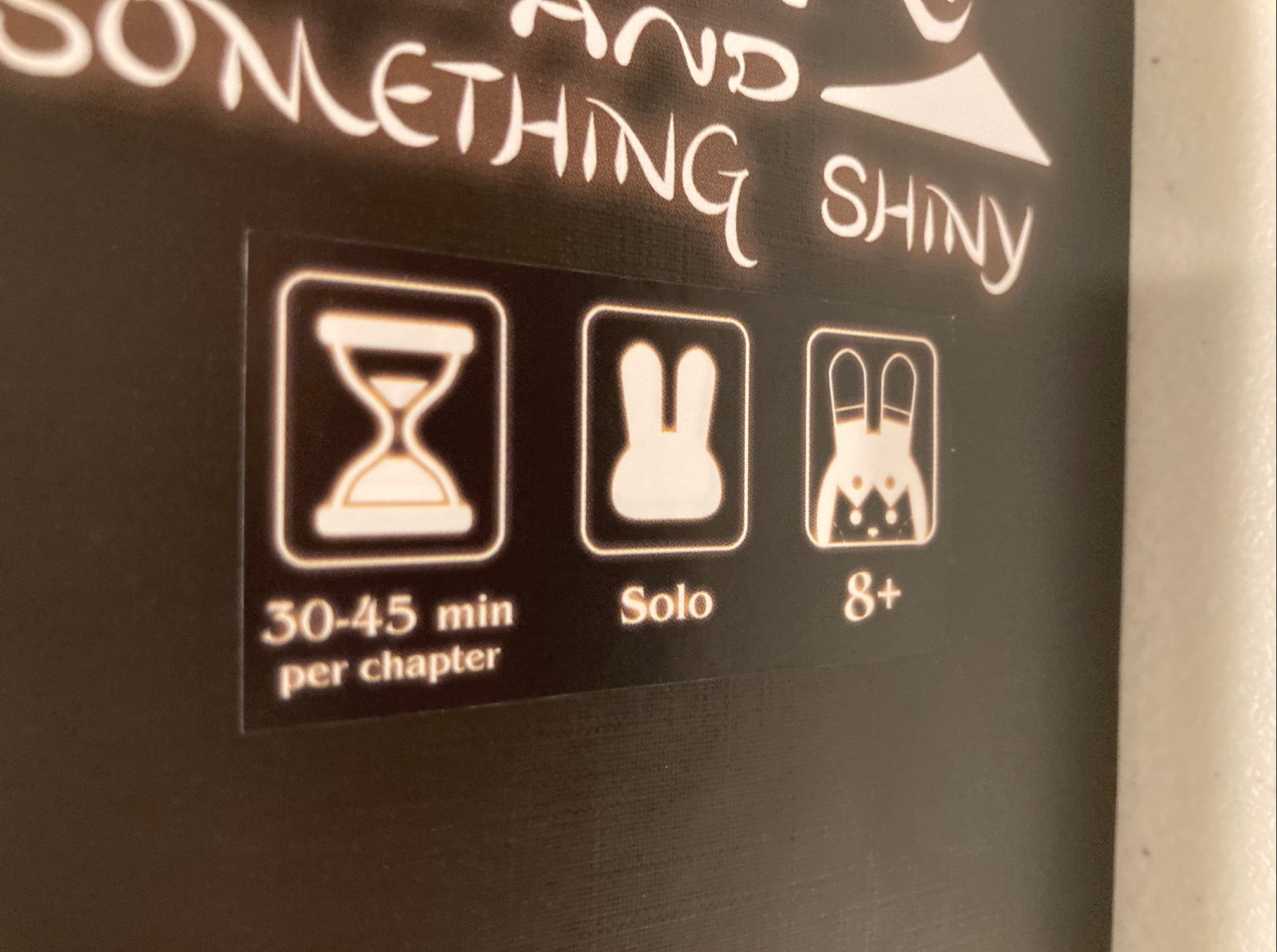
The original Kickstarter said this was a cooperative game for 1 to 3 people. During the course of development, it was remoded as a solo game: see below.

IMG_9948

You can even see the sticker on it with the rebranding! I didn’t want to peel off the sticker, but I’ll bet it said “1-3 Players” underneath. Kickstarter backers were notified of the change in this update:

https://www.kickstarter.com/projects/36768726/eila-and-something-shiny/posts/3315786

This essentially says:

So, we set the recommended number of players to 1-3. But then, some of the backers were confused by that. They questioned if there is a variant for 2-3 players. Therefore, we finally decided to define it as a solo game. Please be noted that the gameplay does not change. It remains the same as before. You can still play the game with friends and family.

IMG_9992

In other words, this is still a game that is “virtually” one player, but people can come together and play as a single player, making decisions as a group as they play. This is essentially what we did when we played: since this is a campaign (where story can get wrecked by revealing too much), I decided to just play “solo with my friends” once they came over. But, obviously I could have easily played “solo by myself”. Random thought: “solo with my friends” and “solo by myself” seem like different designations for ways to play many solo games?

Gameplay

IMG_0003 (1)

Since we are playing this “solo with my friends”, we had to try to figure out a way to have the board face everyone (so we could all see the cards), but keep the rulebook and components nearby.  We had to be careful because we wanted to make sure no one could see the cards coming out from the card holder:

IMG_9987

IMG_0005 (1)

We eventually set-up the game as above: the board facing out to everyone, but the card holder facing away from the board.  The rest of us looked upon the board from the left or right.

IMG_9989

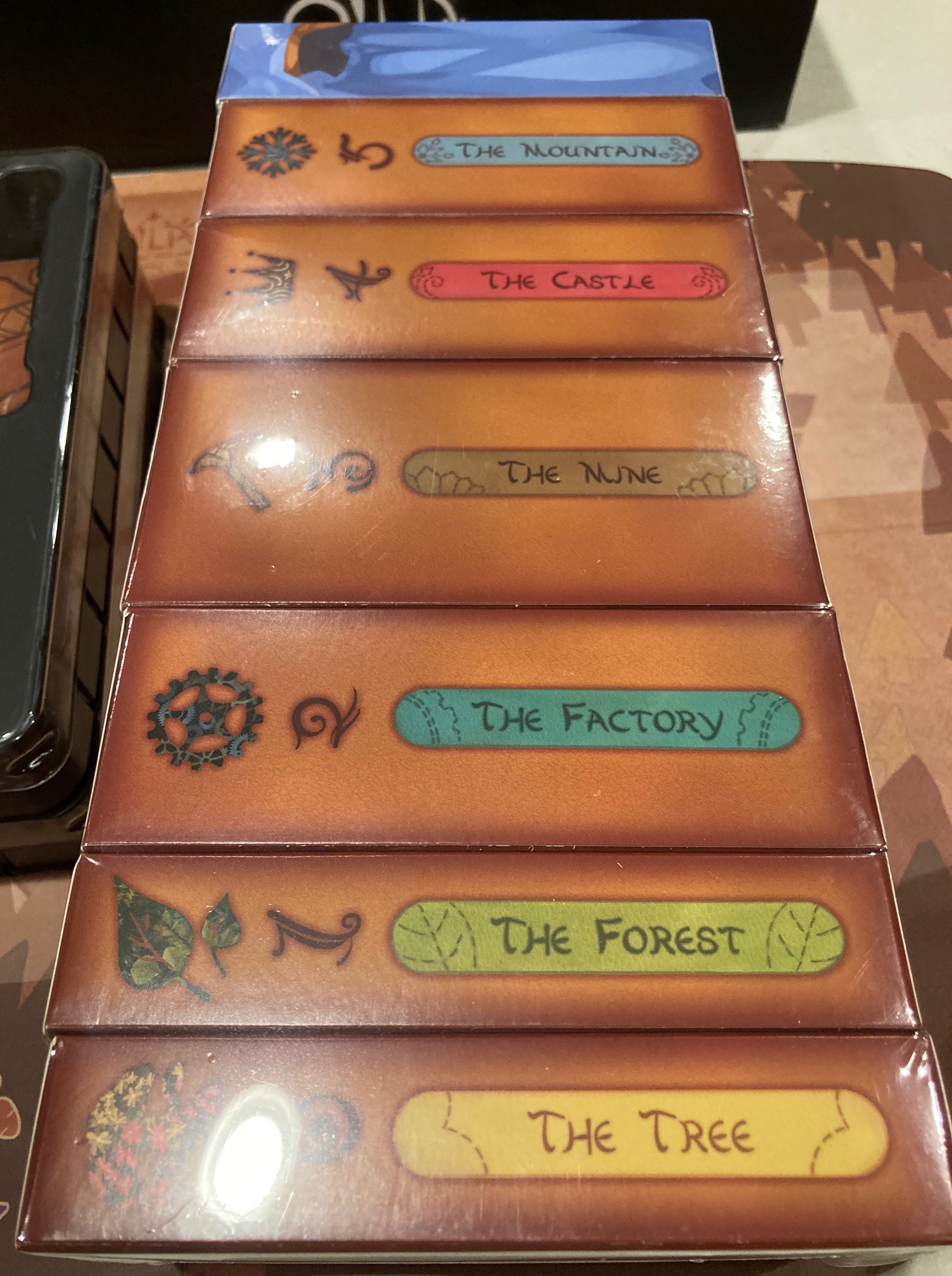
So, this game is all about the different chapters of the campaign.  You start with Chapter 0: The Tree.  Opening that box gives you the cards to play (plus some cards from the box that you always play with).

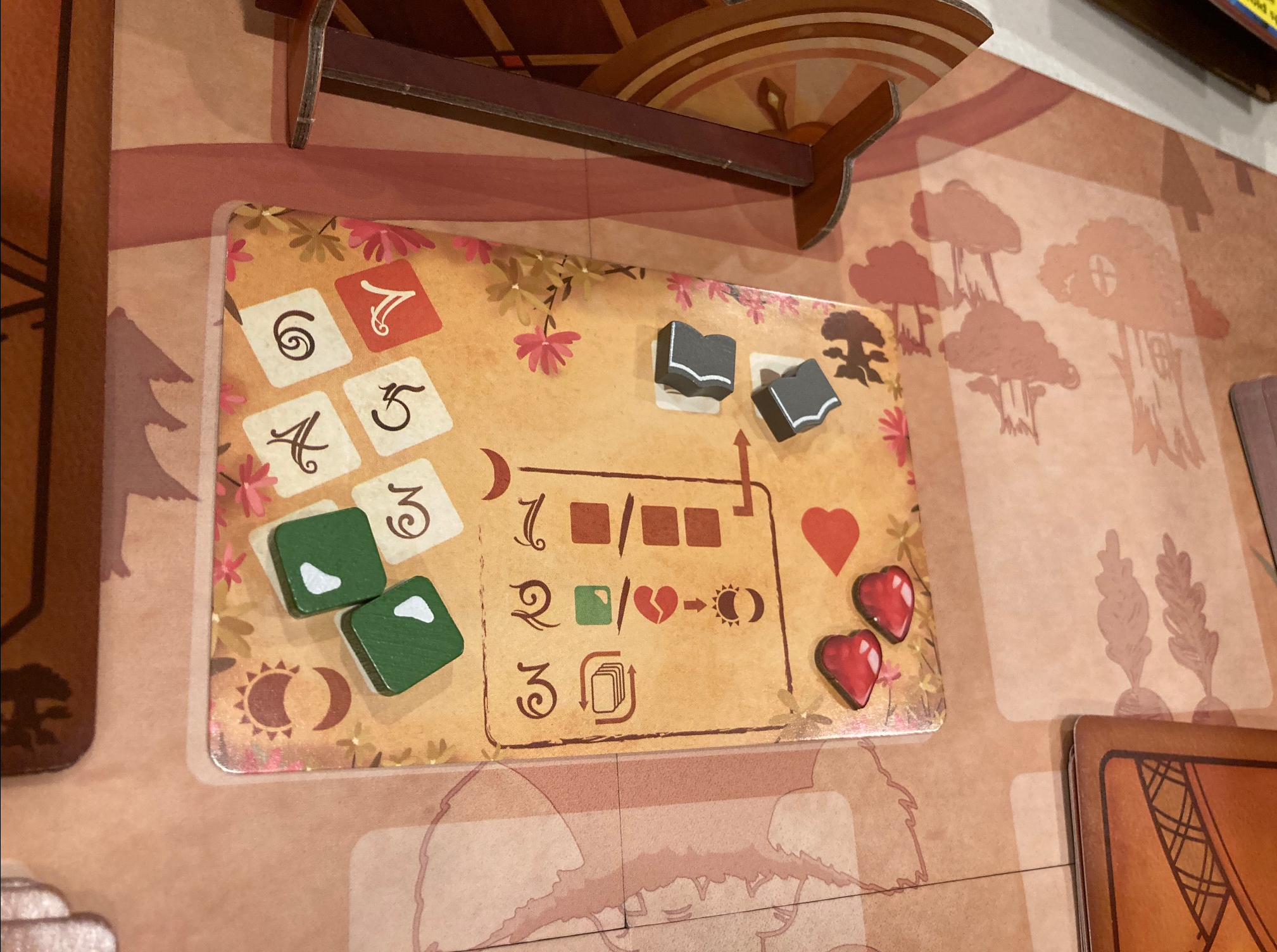
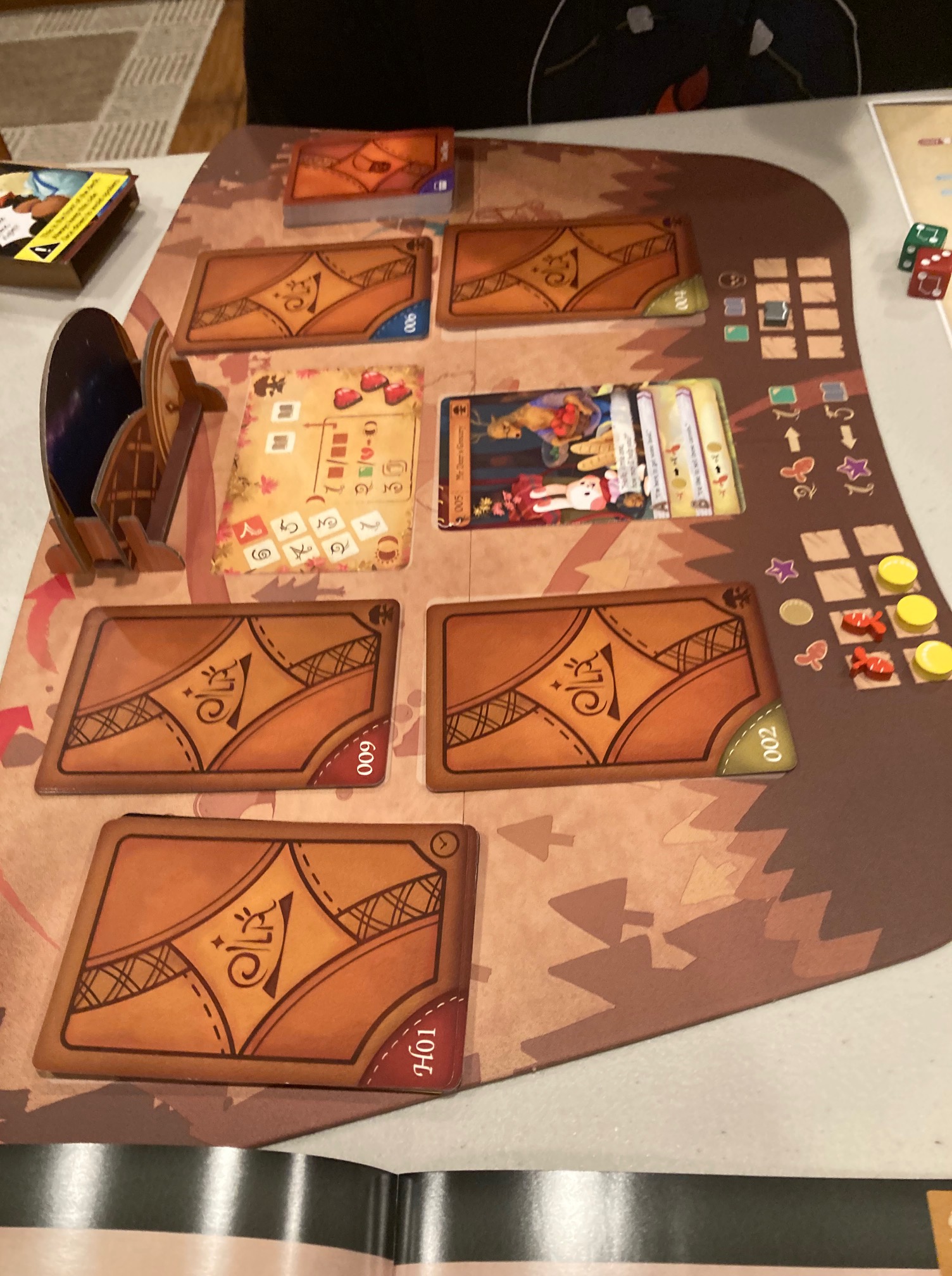
The board is set-up with 4 piles of cards, with the “goal” of the chapter in the middle of the board, just in front of the cad caddy.  See above for the board and below for a close-up of the goal card.

IMG_0011 (1)

The goal of the game is on the card above:  in this case, you have to try to get 2 books before time runs out.

The gameplay is pretty simple: basically, you take the top card from the card caddy and place it face up in the very middle of the board (below the goal card):

IMG_0009 (1)

This is essentially  a “Choose Your Own Adventure” game: Each card gives us decisions: depending on your decision, two things happen:

  1. You either bury the card in the future or past
  2. You usually pay, get, or lose “some kind of resource”  (carrot, coin, magic star, energy, book, or fear)

Cards going to the past (to the left) aren’t ever seen again.  Cards going to the future (both decisions on the card above) go to the right and will come out again.  When you run out of cards and reshuffle, all the future cards come out again.  The game ends when you either achieve your goal (a win!) or you go through the deck too many times (a loss!) or you run out of life (a loss!).

This is also a resource collection game: as the game proceeds, you will need resources to get stuff done.  For the first few chapters at least, your winning goal is to get a certain number of resources.  You saw above that getting 2 books was the goal.  As you play, you will have to decide how to use your resources to stay alive as well as progress towards your goal!


IMG_0013 (1)

If you win a chapter, a little comic book comes out which advances the story and take you to the next chapter.  See above. 

IMG_9971 (1)

You record your progress in Elia’s diary (see above).  Each chapter takes about 30-45 minutes. If you make it though all 8 chapters, you win!  

Impressions

IMG_9990

This is a light game.  The Choose Your Own Adventure mechanism is simple, but keeping track of the Past cards, Future cards, and resources might be a little daunting for 8-year olds.  I suspect the right way to play this with kids is for someone older to “shepherd” the younger kids through the game. Have an adult keep track of the Past, Future, resources, and rules, but allow the kids to make choices with everyone.  At some point, the kids can grok and start performing the mechanisms, but it’s probably just a bit out of reach at the very start.

IMG_0010 (1)

Even though this is a campaign game, it doesn’t seem like a lot of work keeping track of things between sessions.  Set-up and tear-down were pretty quick in this game.

Story and Comics

IMG_0012 (1)

So, we have played a LOT of Storybook games: See out Top 10 Cooperative Storytelling/Storybook Games!  And even though this is a kid’s game, the comics were absolutely fantastic.  The art was amazing, but the story they told was just … so good!  Without giving away too much, we were emotionally invested in this world after the first chapters! The story was so impactful that we wanted to continue.  The key phrase of my friends: “When are we playing this again?”

Conclusion

IMG_9992

If you made it this far, I am assuming you like the cuteness of the game.  If you don’t, then this game won’t be for you.  The game is pretty simple and fun, but it is so ensconced in the cute world of Elia, you won’t be able to separate the cute world from the gameplay.

IMG_0007 (1)

This game was described by my friends as “painfully cute” and “when do we play again”? The components (except for the board, which was already starting to tear) were first-rate. The boxes and cards and art were all just exceptional. The art was “painfully cute” like a kid’s storybook. The gameplay was a little bit more than a single 8-year old might handle, but it would be easy for a family with younger kids to play through this: The Mom or Dad can read the cards, direct gameplay, while the family all works together to make decisions about Eila’s fate. If you are looking for a cooperative family game to play with younger kids, I think is an amazing choice. I could see this replacing story-time! Since it’s a campaign, it would also be new every night! (for 8 nights at least).

Surprisingly, my older friends enjoyed this immensely as well. Like I said, they asked me repeatedly: “When Do We Play Again?” They even offered to bribe me with donuts so that we play again.

One more thing: the little comic books that come out between stories are some of the best little comic book transitions I have ever seen. The art was fantastic and the story was surprisingly gripping and emotional. After the first two scenarios, we were hooked.

Top 10 Anticipated Cooperative Games of 2022!

Last year, we discussed our Top 10 Anticipated Cooperative Games of 2021! Only 5 arrived, but we reviewed them here:

Of the 6 remaining, (we had one dishonorable mention), 3 are imminent (The Shivers, Hour of Need, Deck of Wonders), 2 are still is production (Isofarian Guard and Freedom Five), and the dishonorable mention (Onimaru) may still be the first kickstarter I have that has not delivered! When we get the rest of these games, we’ll try to get them reviewed here!

In the meantime, what are some other games we are looking forward to in 2022!  As last year, we’ll show the Kickstarter link, the original promised delivery, and a summary (straight from BoardGameGeek).

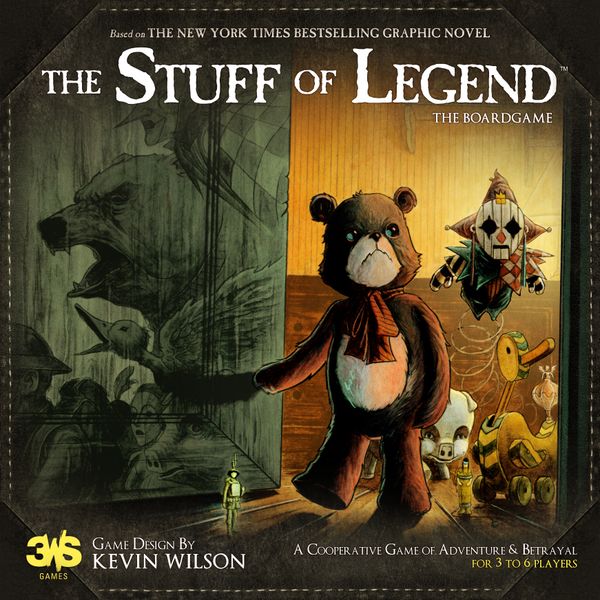
Honorable Mention: The Stuff of Legend (2022)

stuff

Kickstarter Link: https://www.kickstarter.com/projects/th3rdworldstudios/the-stuff-of-legend-the-boardgame
Promised Delivery: June 2022
Summary: In The Stuff of Legend, each player takes on the role of one of the boy’s loyal toys, each with their own unique abilities. Players work co-operatively, scouring the Dark in search of the Boy before the Boogeyman can escape with him. Players beware, through the course of the game your allegiance may change, and at any point one of your fellow players could be secretly working against you for the wicked Boogeyman.

I usually don’t like hidden traitor games, but this game sounds “mostly” cooperative, and I really do like the designs of Kevin Wilson. So, this makes the Honorable Mention category because it’s not quite fully cooperative.


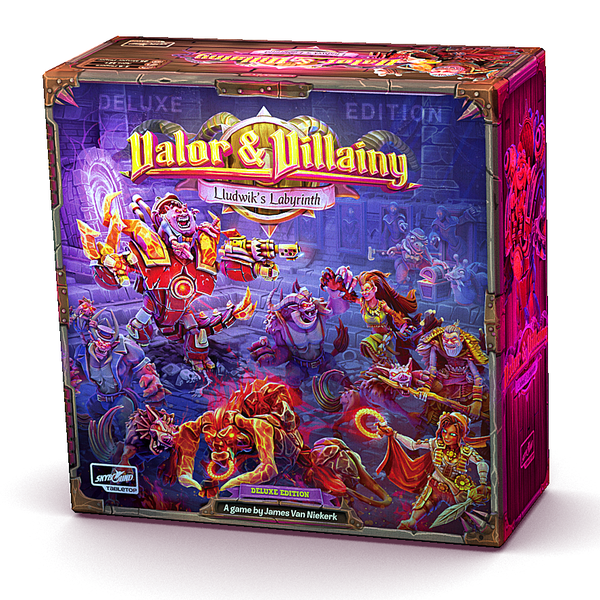
10. Valor & Villainy: Lludwik’s Labyrinth (2022)

vv

Kickstarter Link: https://www.kickstarter.com/projects/skyboundgames/valor-and-villainy-lludwiks-labyrinth
Promised Delivery: September 2022
Summary
: Valor & Villainy: Lludwik’s Labyrinth is a 1-6 player co-op adventure game, where a band of noble heroes from The Order Without Borders must pursue the Mad Imp Lludwik into his terrible Labyrinth to quell the threat of a demonic invasion. Lludwik’s Labyrinth is a both a stand alone full co-op game, and a fully cross compatible sequel to Valor & Villainy: Minions of Mordak.

This game looks like it has a sense of humor! The art is funny and original.  I bought the original game in anticipation of the cooperative version being great!  Let’s hope it is!

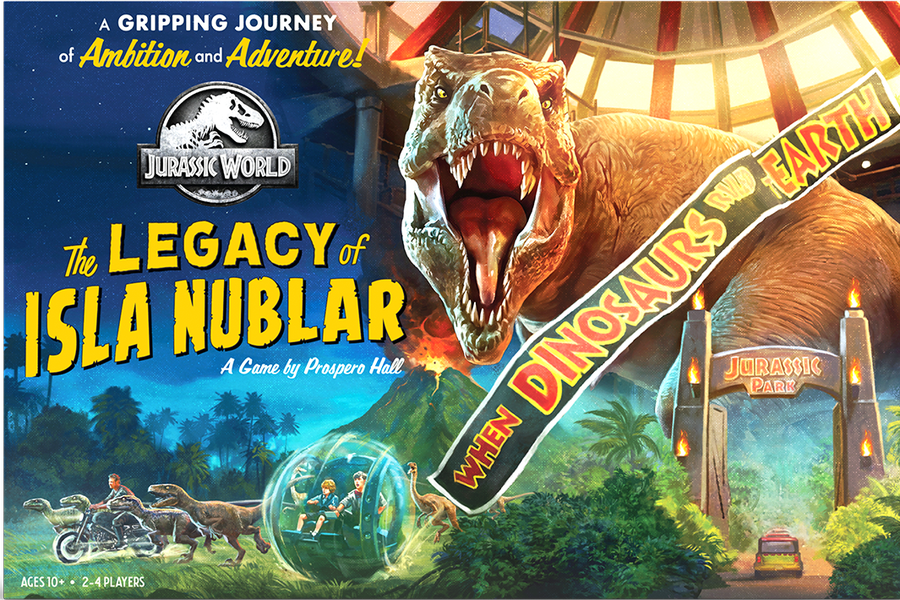
9. Jurassic World: The Legacy of Isla Nublar (2022)
jp

Kickstarter Link:  Not active yet! See here: https://funkogames.com/games/jurassic-legacy/
Promised Delivery: 2022?  Kickstarter Launches in March 2022 …
Summary: Together, you will transform Isla Nublar into an astonishing paradise where awe-struck visitors encounter creatures never before seen by human eyes. Decide where to build park facilities, dinosaur enclosures, and guest attractions — and keep employees and visitors safe from the mighty Tyrannosaurus Rex, colossal Brachiosaurus, clever Velociraptor, and other threats.  In Jurassic World: The Legacy of Isla Nublar, you play through twelve adventures in which you customize an entirely unique game board and breed new dinosaurs you cannot unmake. Your team’s fateful choices will have a lasting impact, creating your own Isla Nublar story. Your experience will culminate in an endlessly replayable game of your own creation.

Well, I may cheating on the one: the game may not even be available in 2022, but the Kickstarter goes up soon on March 2022!  This legacy game looks really fun!

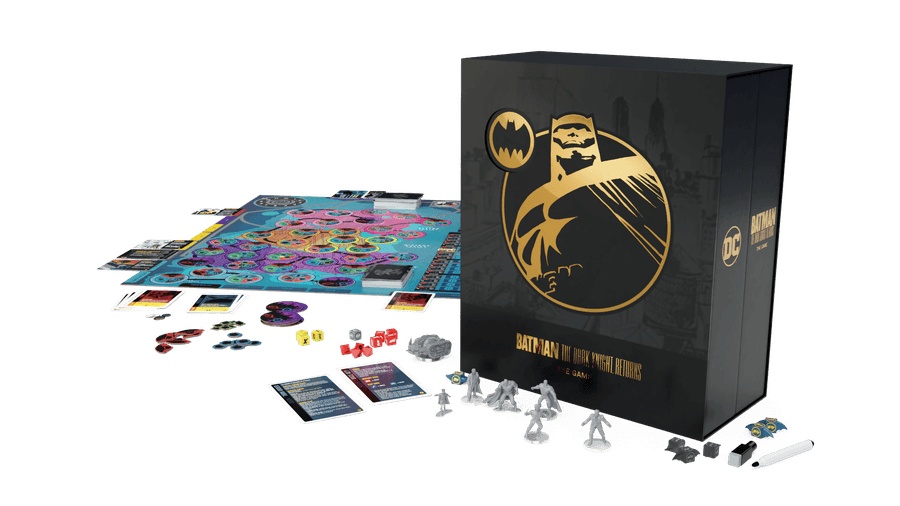
8. Batman: The Dark Knight Returns Board Game (2022)
bat

Kickstarter Link: https://www.kickstarter.com/projects/cze/the-dark-knight-returns-the-game
Promised Delivery: December 2021
Summary: In the solitaire Batman: The Dark Knight Returns Board Game, you play “The World’s Greatest Detective”, who’s been pulled back from retirement into a gritty Gotham. Do everything you can to beat back a relentless tide of ruthless mutants, cops, and press looking to bring you down. Instead of traditional leveling up, this is a game of attrition. An old Batman tries to survive one final gauntlet, facing old and new villains — such as Two Face, Billy Berserk, and The Joker — and even his most powerful ally, The Man of Steel himself.

The game is playable as standalone “missions” or one epic playthrough in which the results of each mission carry over to the next.

This game is about a year late, but it looks like a fun solo campaign.  I suspect I will play it cooperatively with my friends, even though this is a solo game.  The nice thing about solo games, you can play them cooperatively!

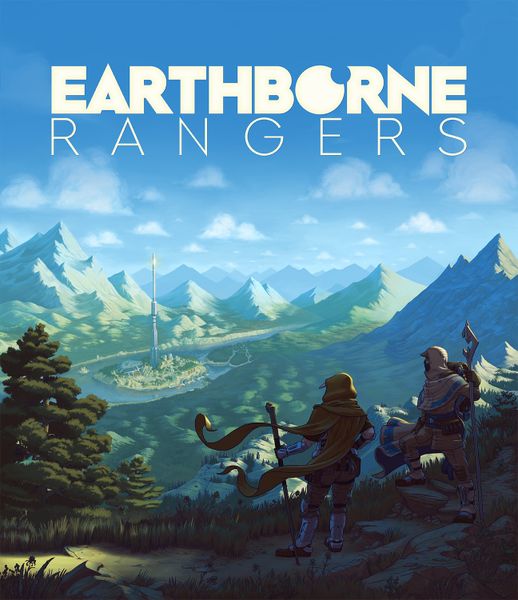
7. Earthborne Rangers (2022)
eh

Kickstarter Link: https://www.kickstarter.com/projects/earthbornegames/earthborne-rangers
Promised Delivery: July 2022
Summary: Earthborne Rangers is a customizable, co-operative card game set in the wilderness of the far future. You take on the role of a Ranger, a protector of the mountain valley you call home: a vast wilderness transformed by monumental feats of science and technology devised to save the Earth from destruction long ago.

The art on this game looks amazing, and the fellow in charge is one of the old guard from  Fantasy Flight Games (back when they were amazing).  This looks great, if a little generic.  I won’t know until I play it!

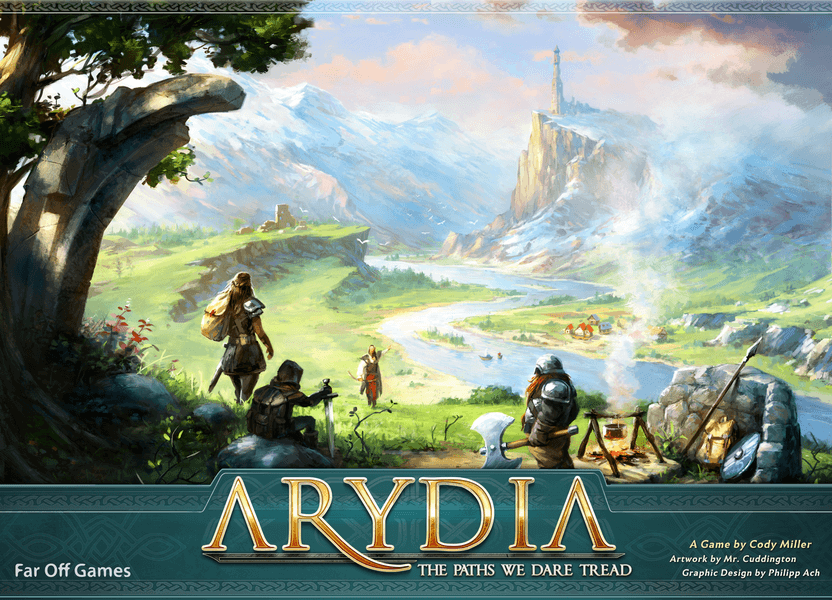
6. Arydia: The Paths We Dare Tread (2022)
aa

Kickstarter Link: https://www.kickstarter.com/projects/faroffgames/arydia-the-paths-we-dare-tread
Promised Delivery: December 2022
Summary: Arydia: The Paths We Dare Tread is an open world, campaign-based, co-operative, fantasy-based, “green legacy” role-playing board game. The game of Arydia is built on four design pillars: Exploration, Progression, Combat, and Role-playing.

I have a lot of dungeon crawlers, but this one looks different, and definitely worth a look.  I may be expecting too much for this to be out in 2022 though …

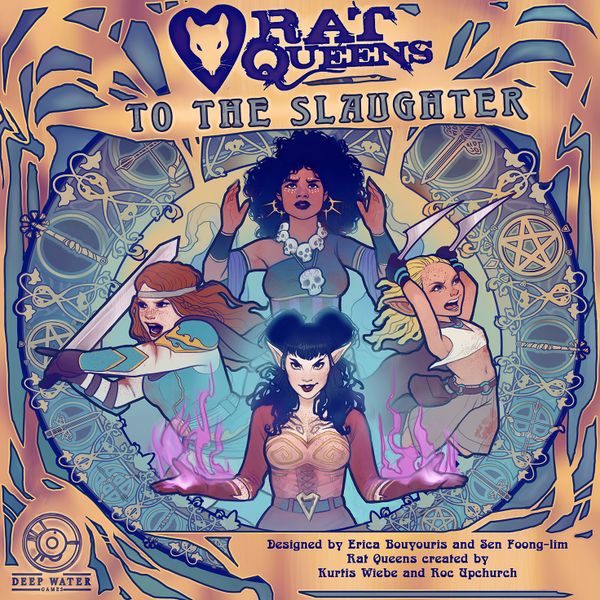
5. Rat Queens: To the Slaughter (2022)
rat

kickstarter Link: https://www.kickstarter.com/projects/deepwatergames/rat-queens-to-the-slaughter
Promised Delivery: May 2022
Summary: Forge friendships and find your family as you take on the role of the rat queens in Rat Queens: To the Slaughter. Choose from four rat queens, each with asymmetric and unique playstyles, in order to save Palisade from total destruction. Power up your queen with new abilities and friendship as you take on hordes of monsters. Each queen comes packed with upgradeable abilities you have to spend gold to learn, allowing you to customize your queen differently each game to fit what the party needs!

This game just looks weird and fun: I like the art!  And it just looks different than other cooperative games (from the art/graphic design).  I am hoping that will really bring out the weirdness here!

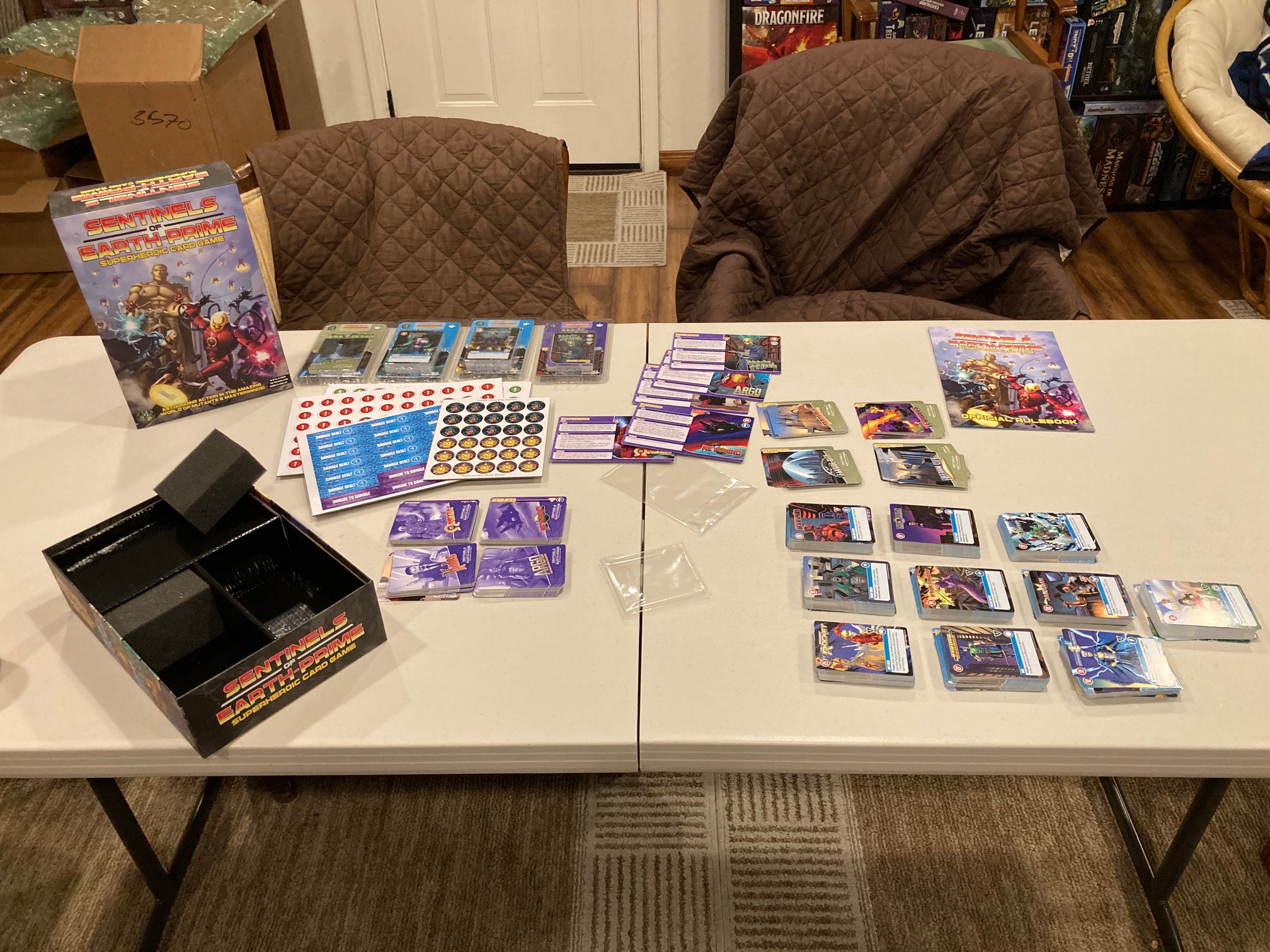
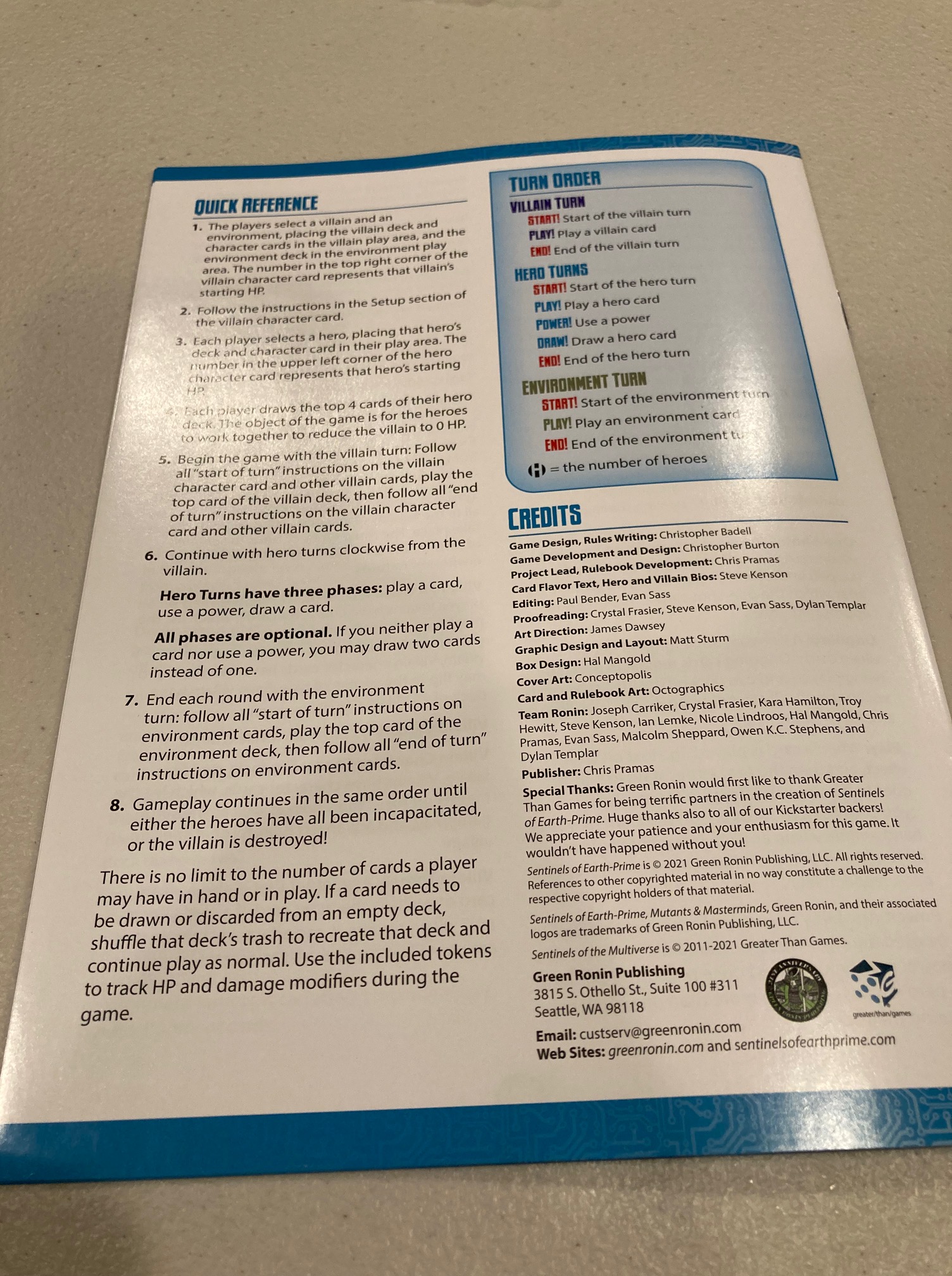
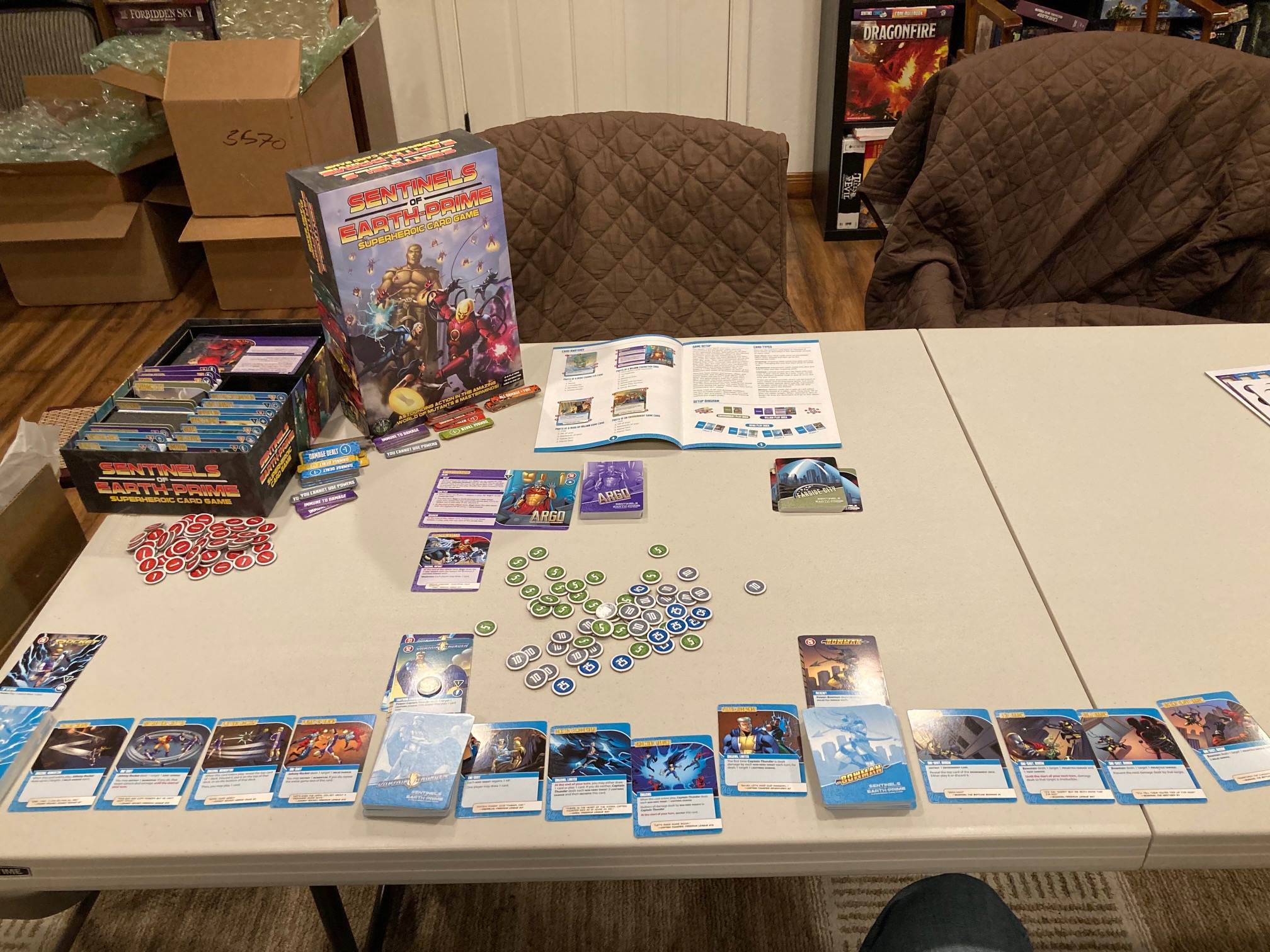
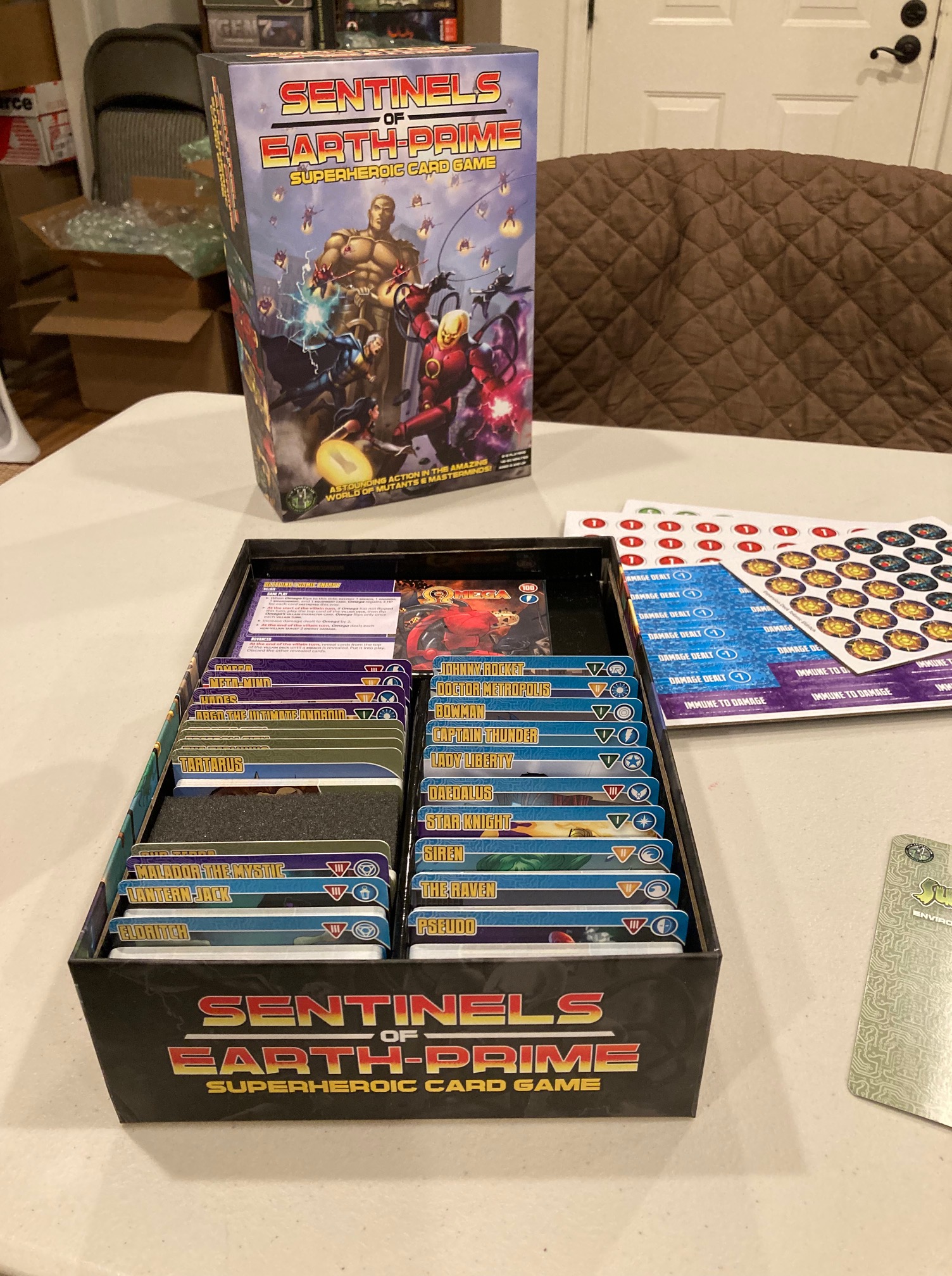
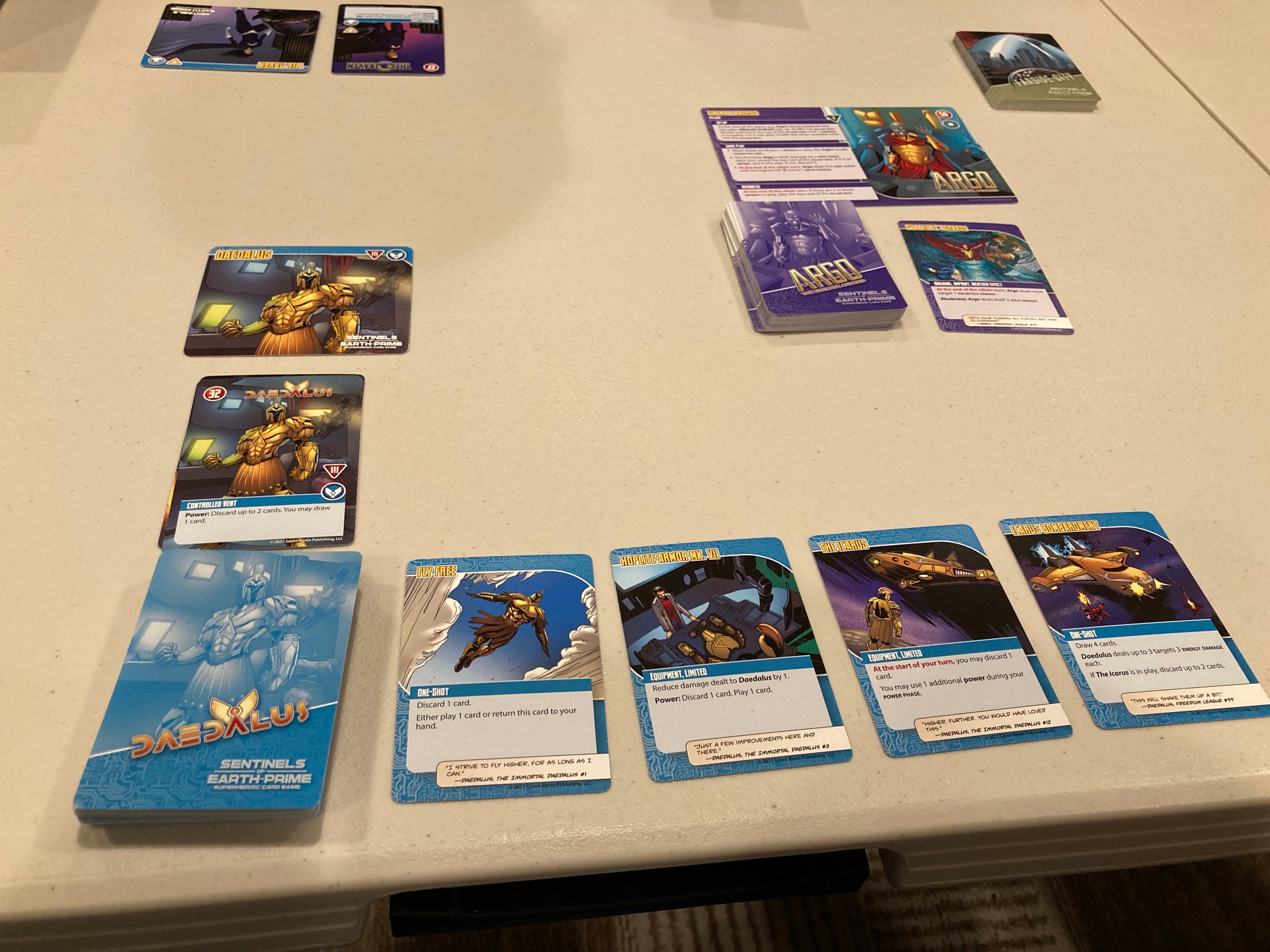
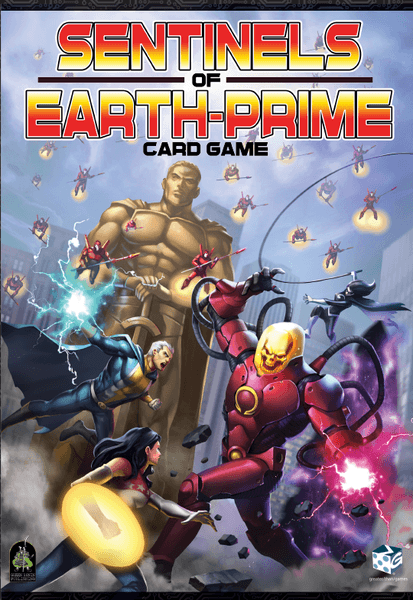
4. Sentinels of Earth-Prime (2021)

sen
Kickstarter Link: https://www.kickstarter.com/projects/1780208966/sentinels-of-earth-prime
Promised Delivery: April 2018 (yep, you read that right)
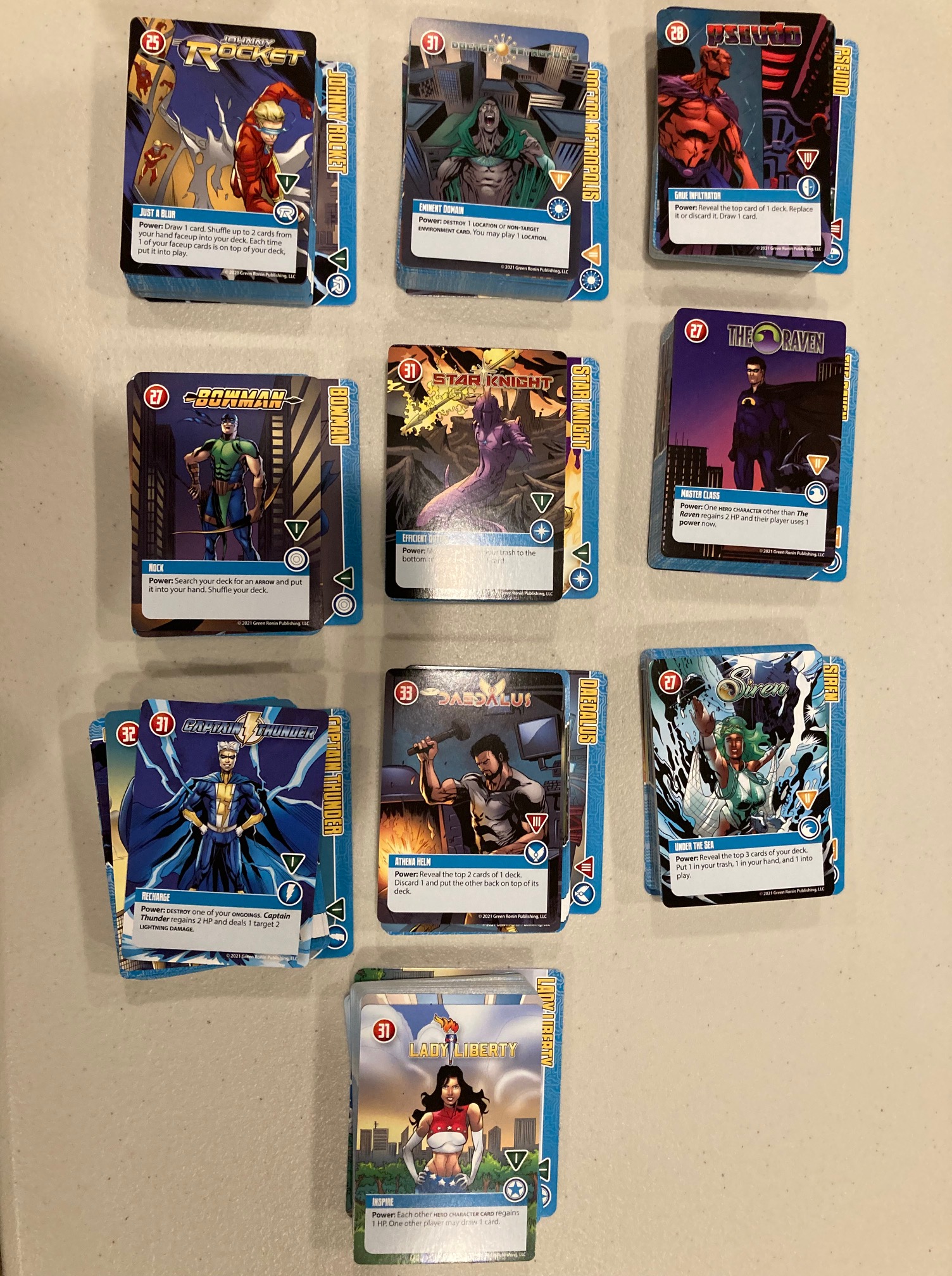
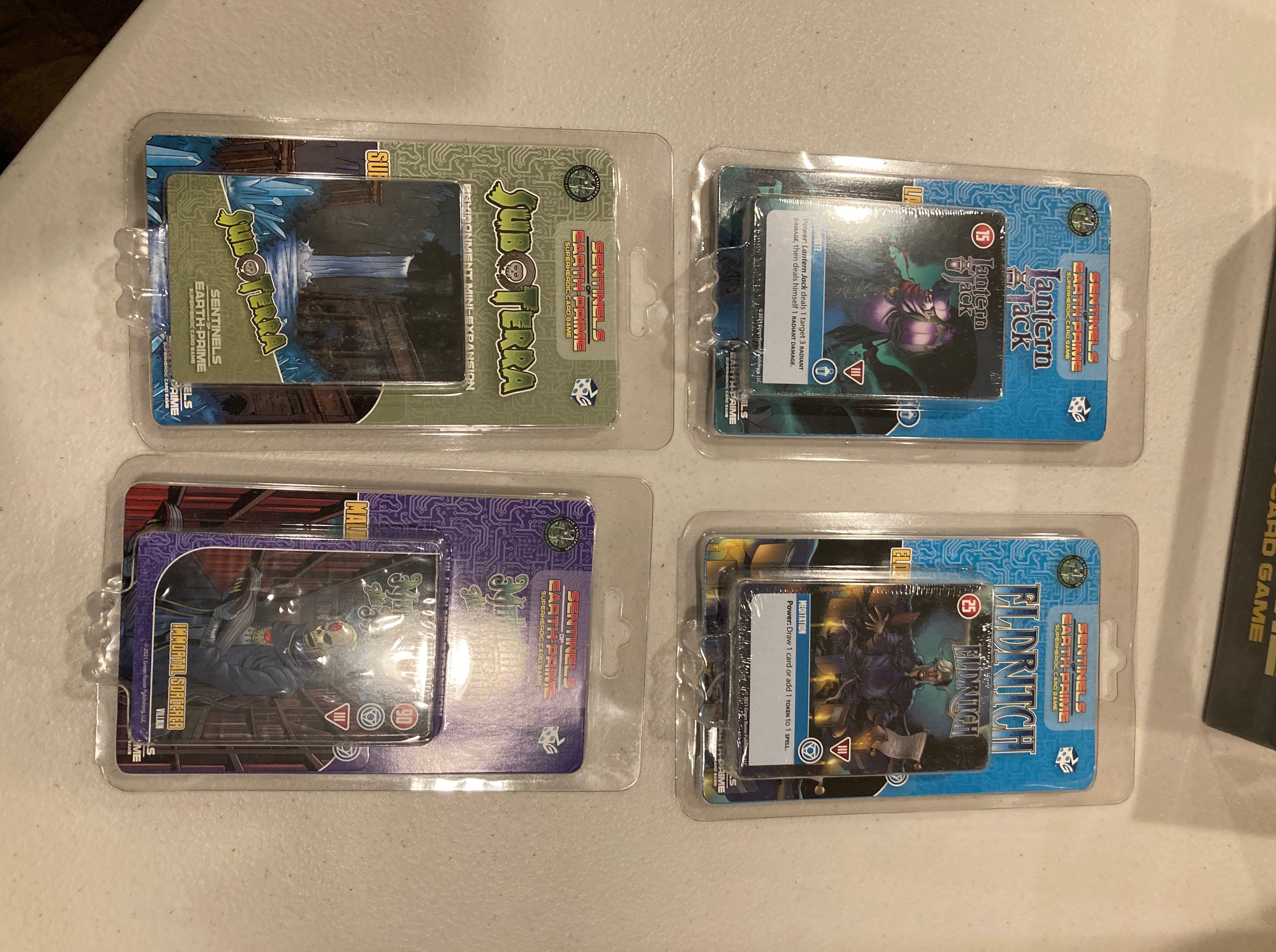
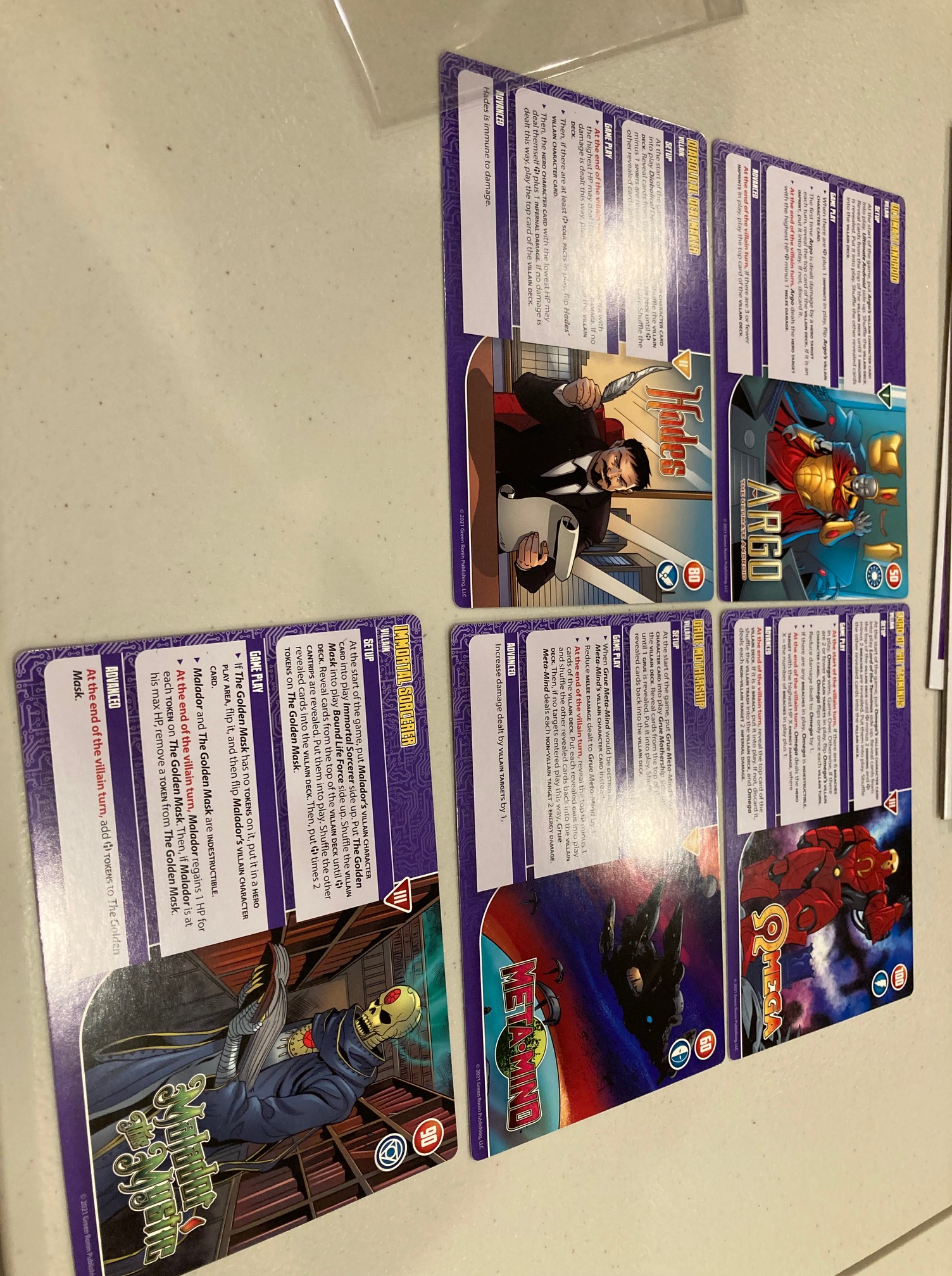
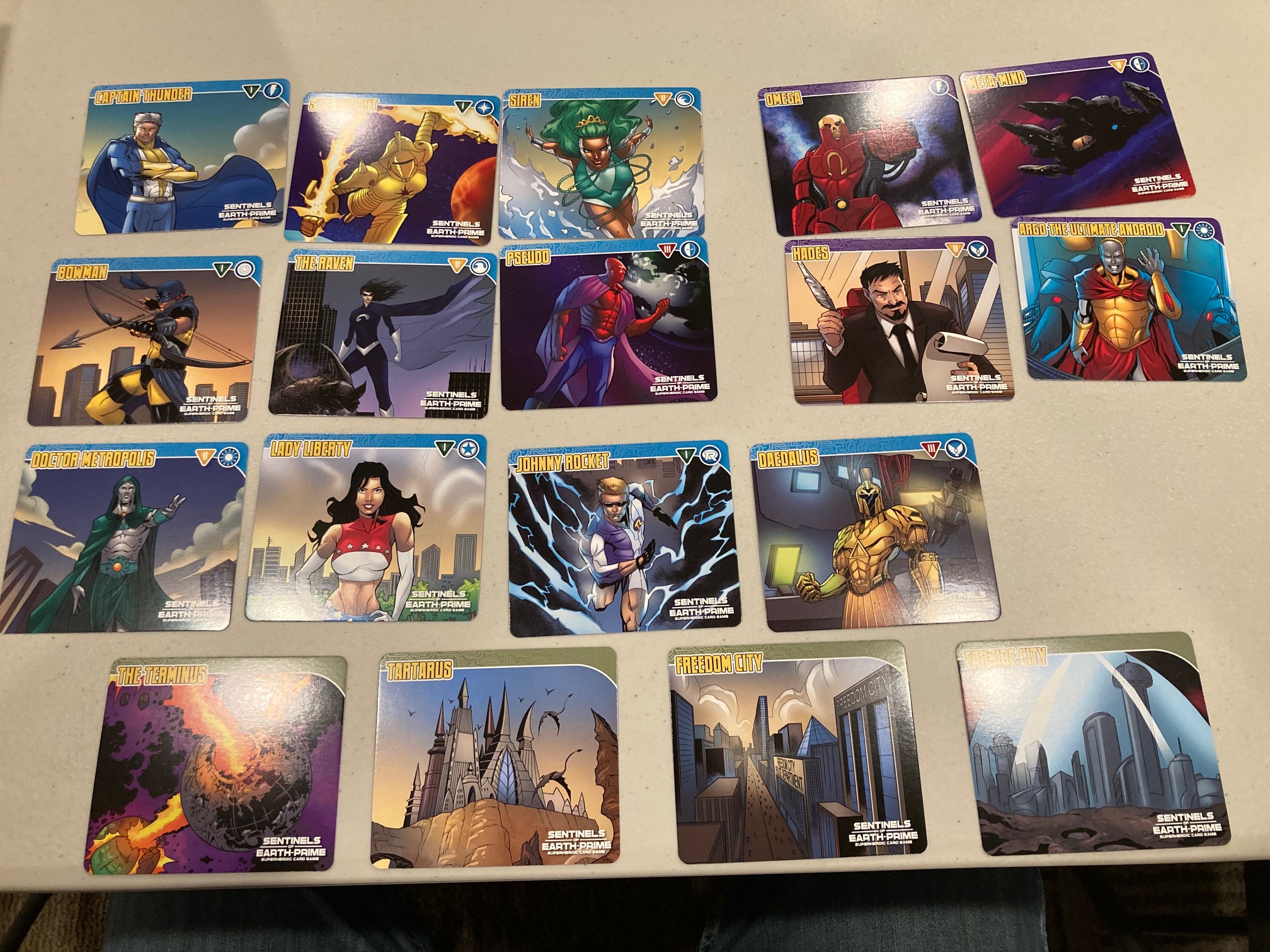
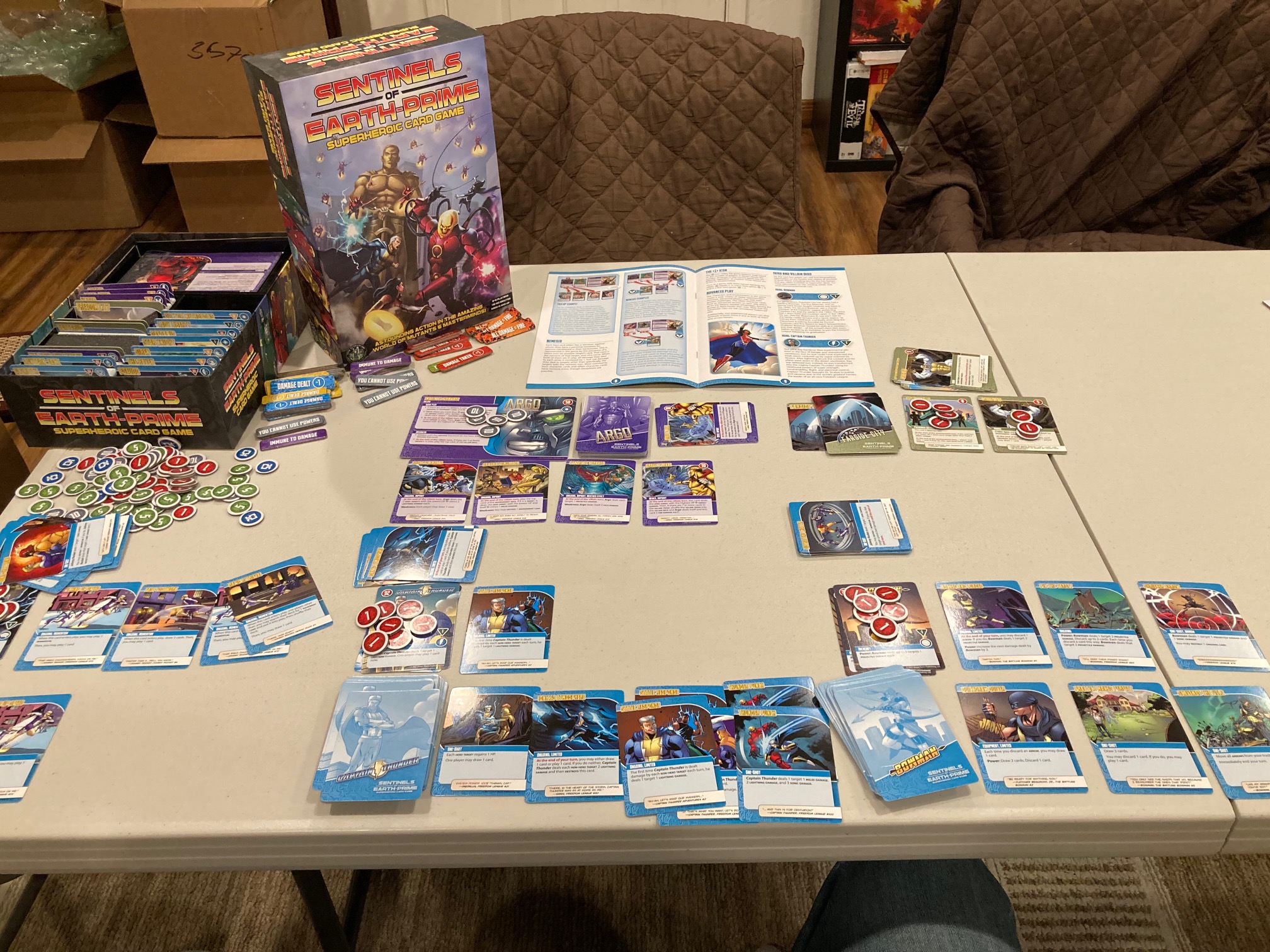
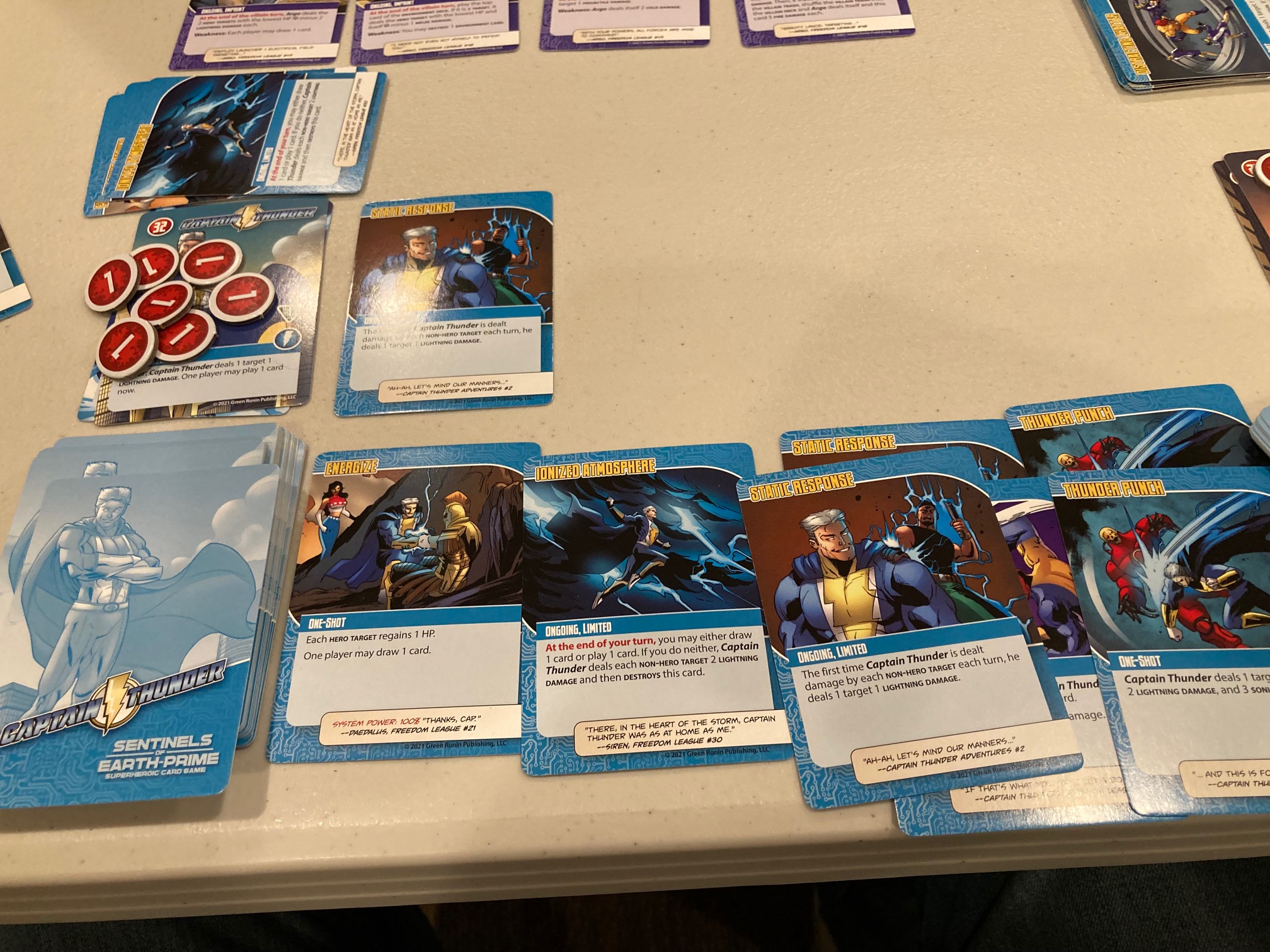
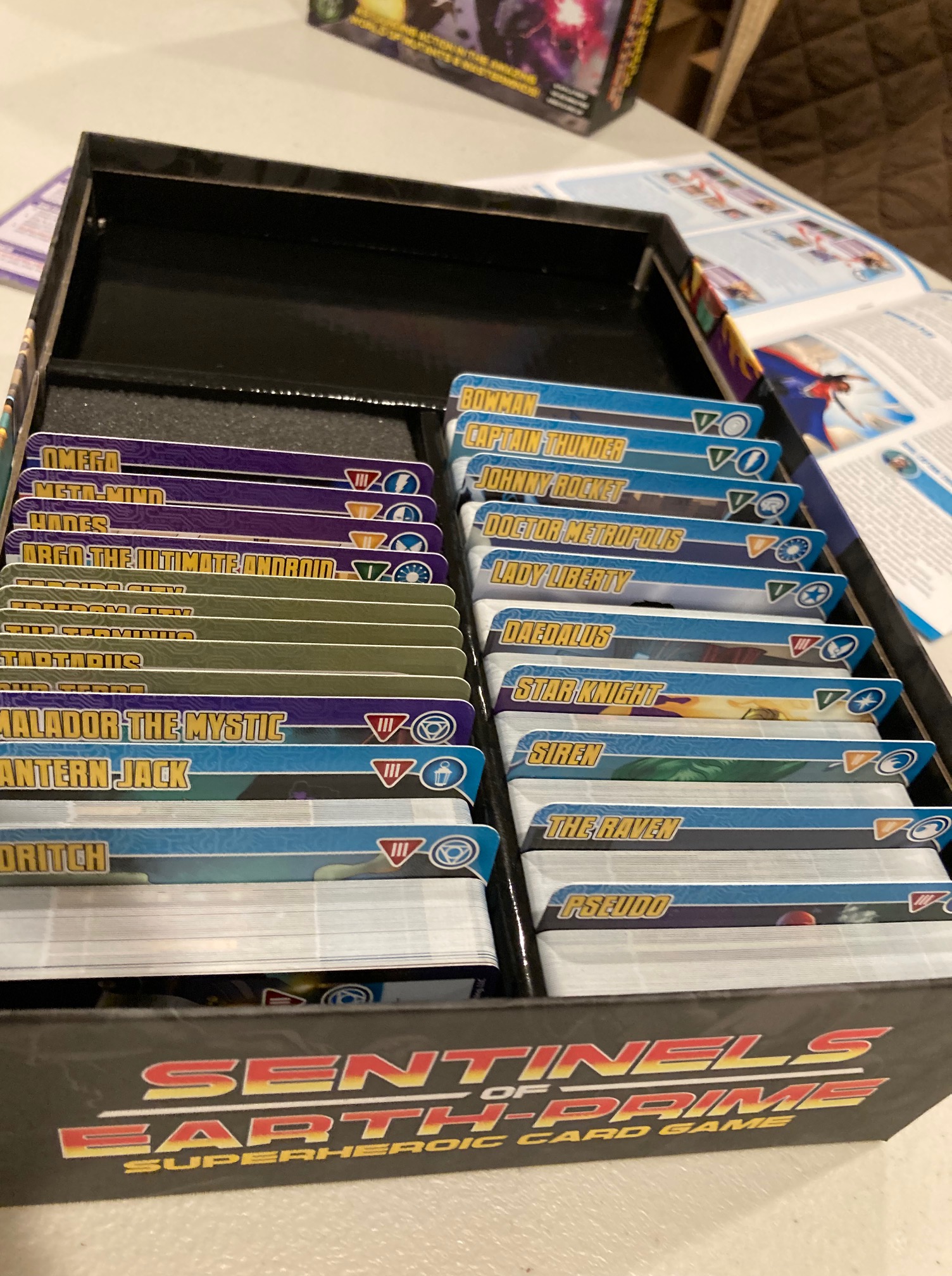
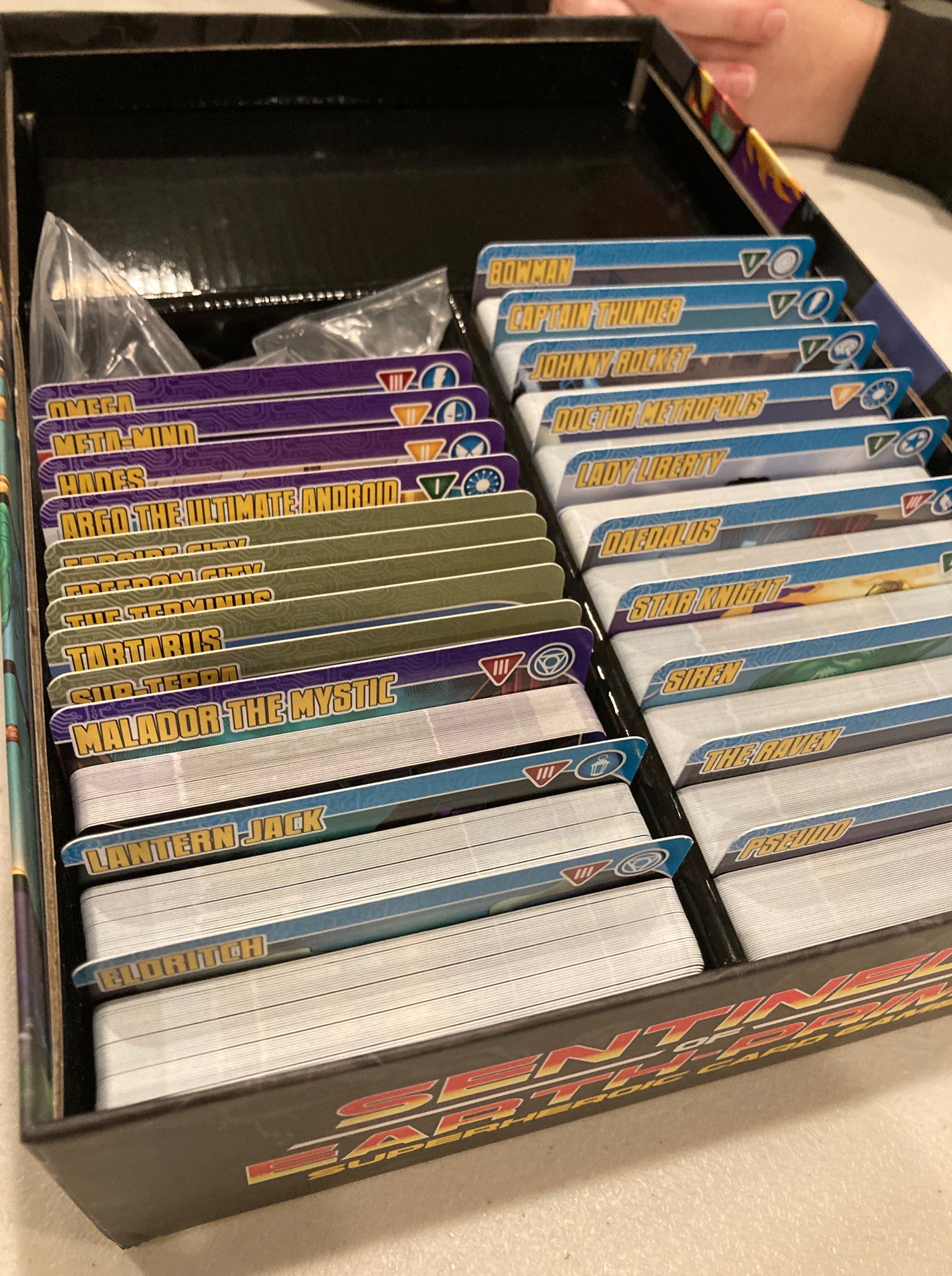
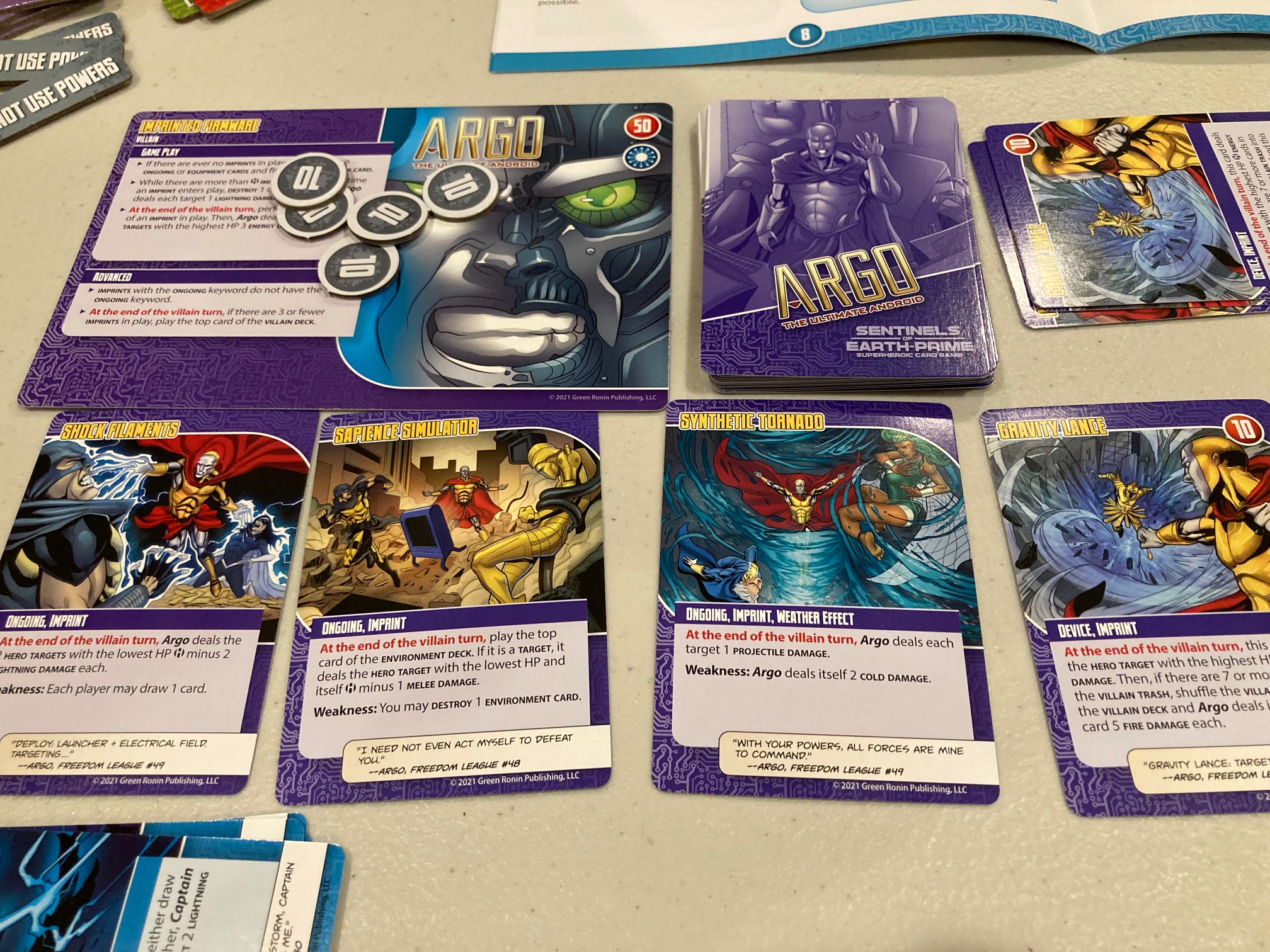
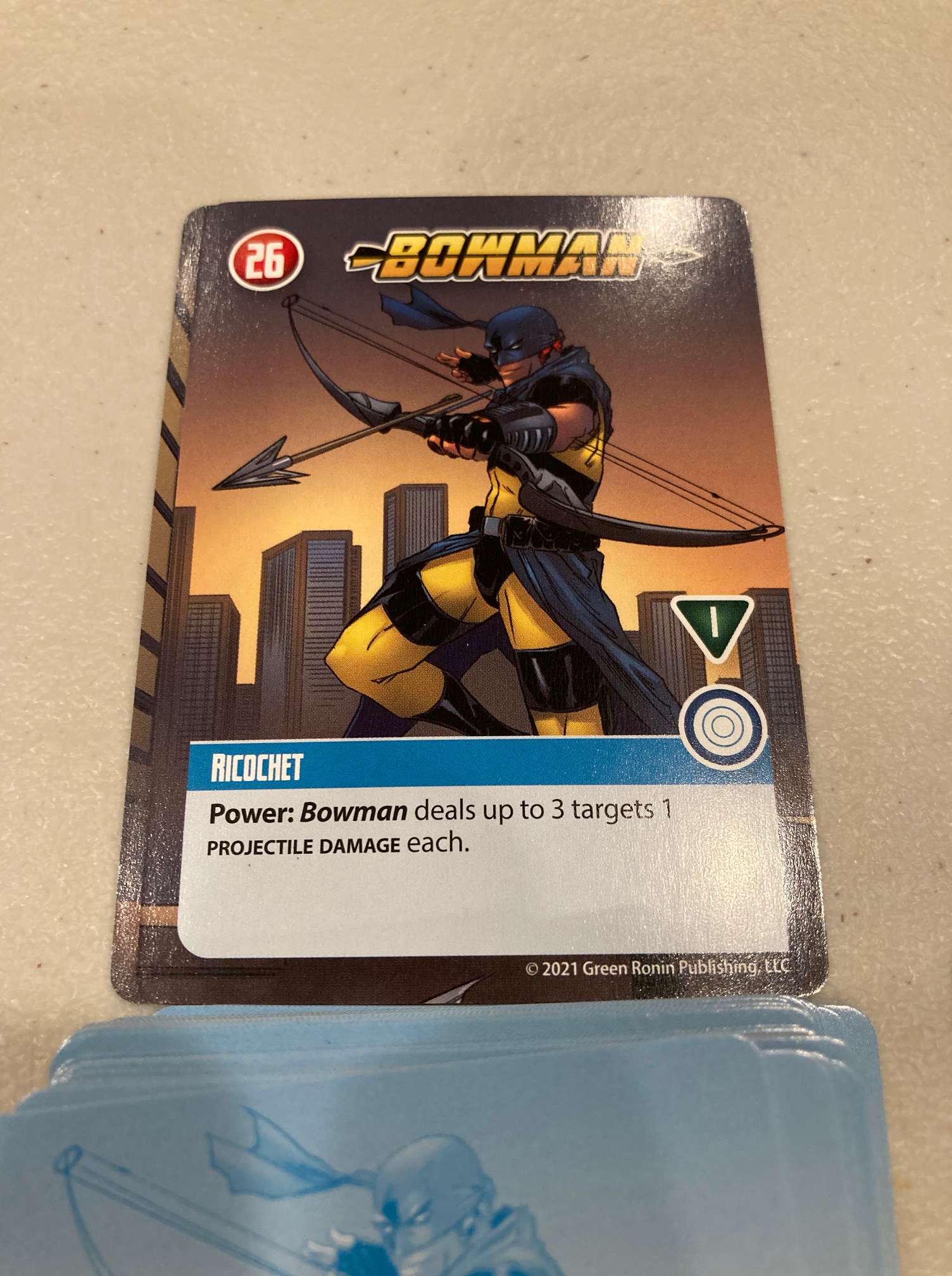
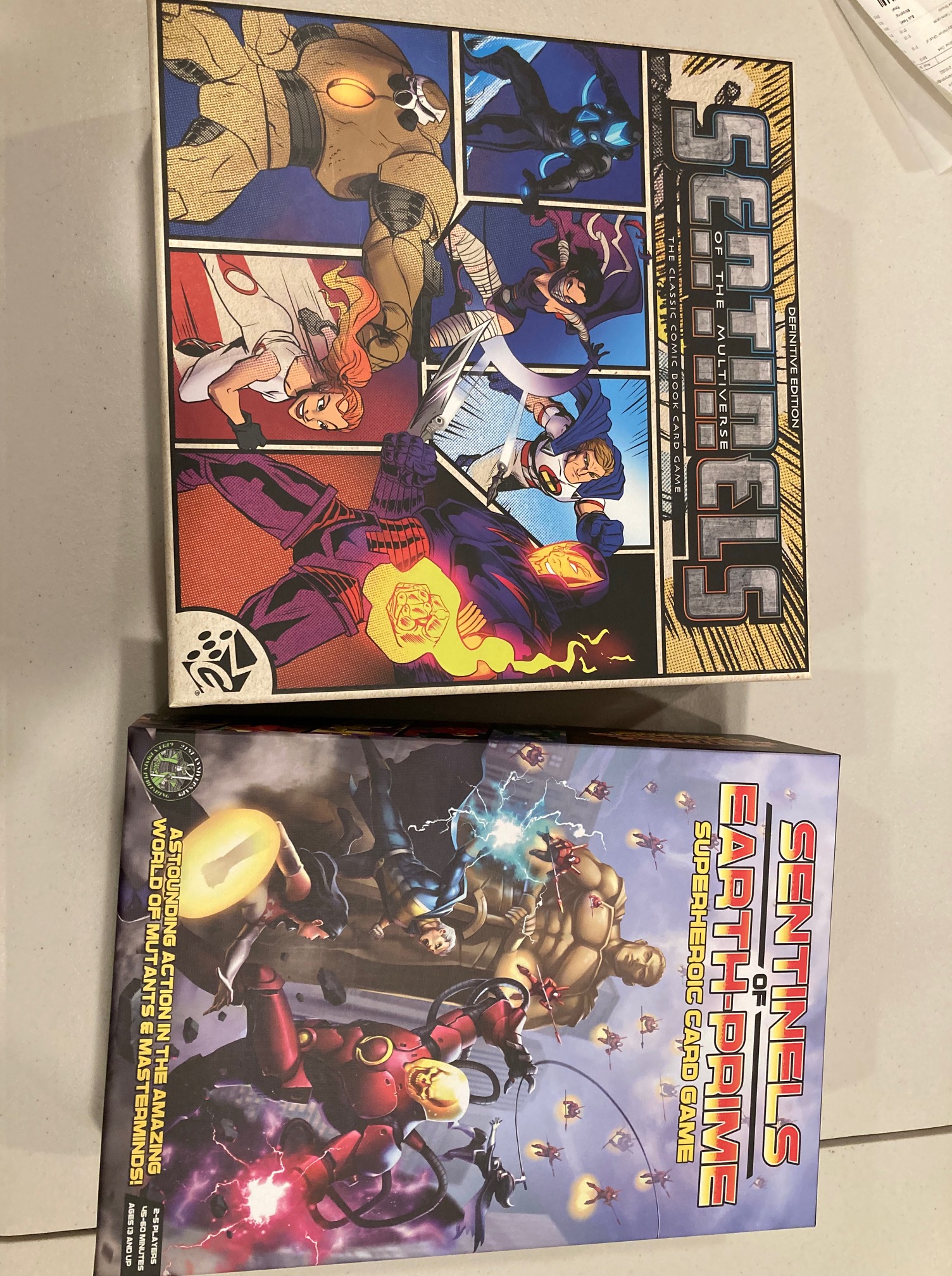
Summary: Sentinels of Earth-Prime is a standalone card game set in the Earth-Prime universe of the Mutants & Masterminds RPG that can also be played with the decks and characters from Sentinels of the Multiverse.

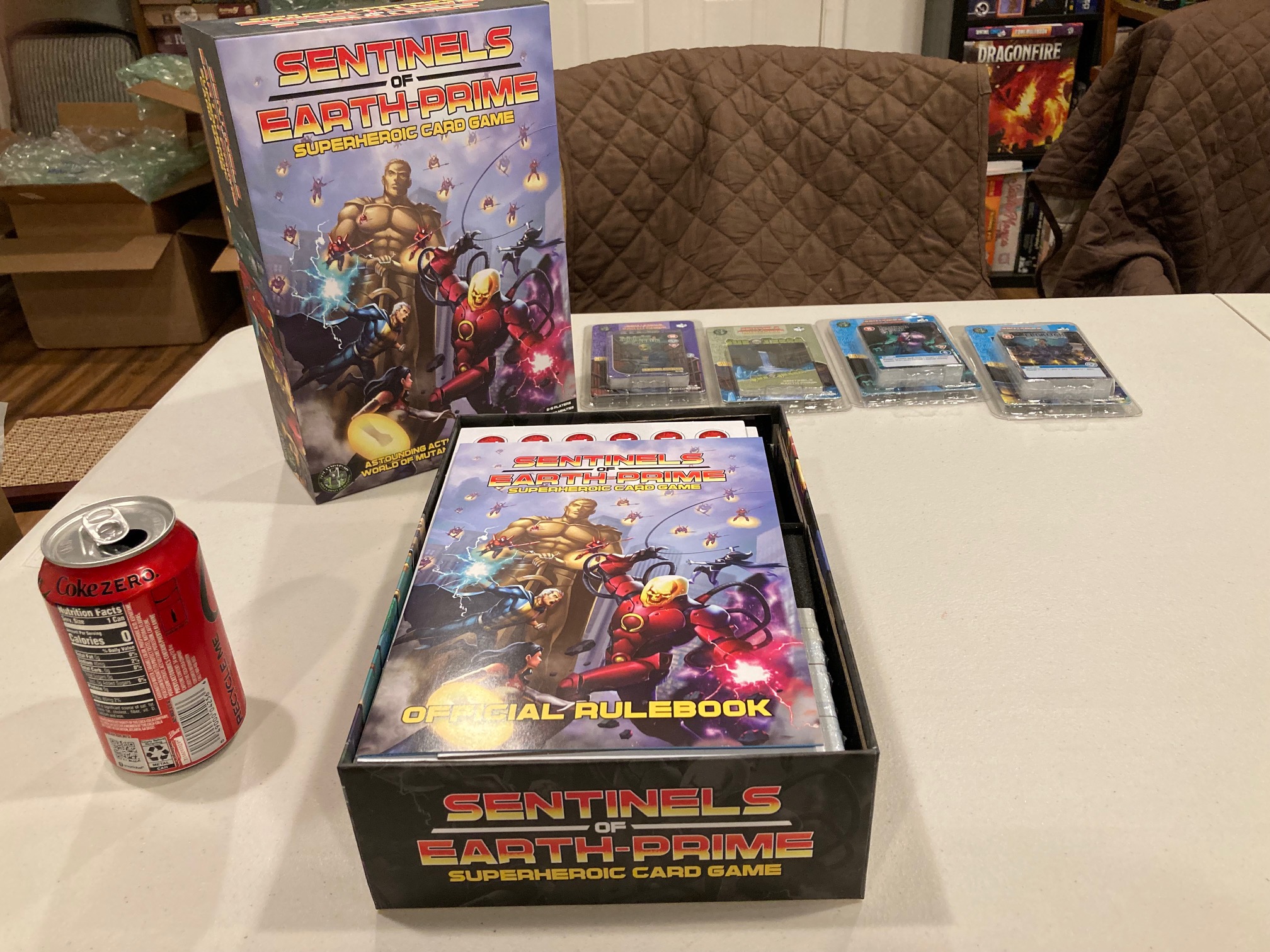
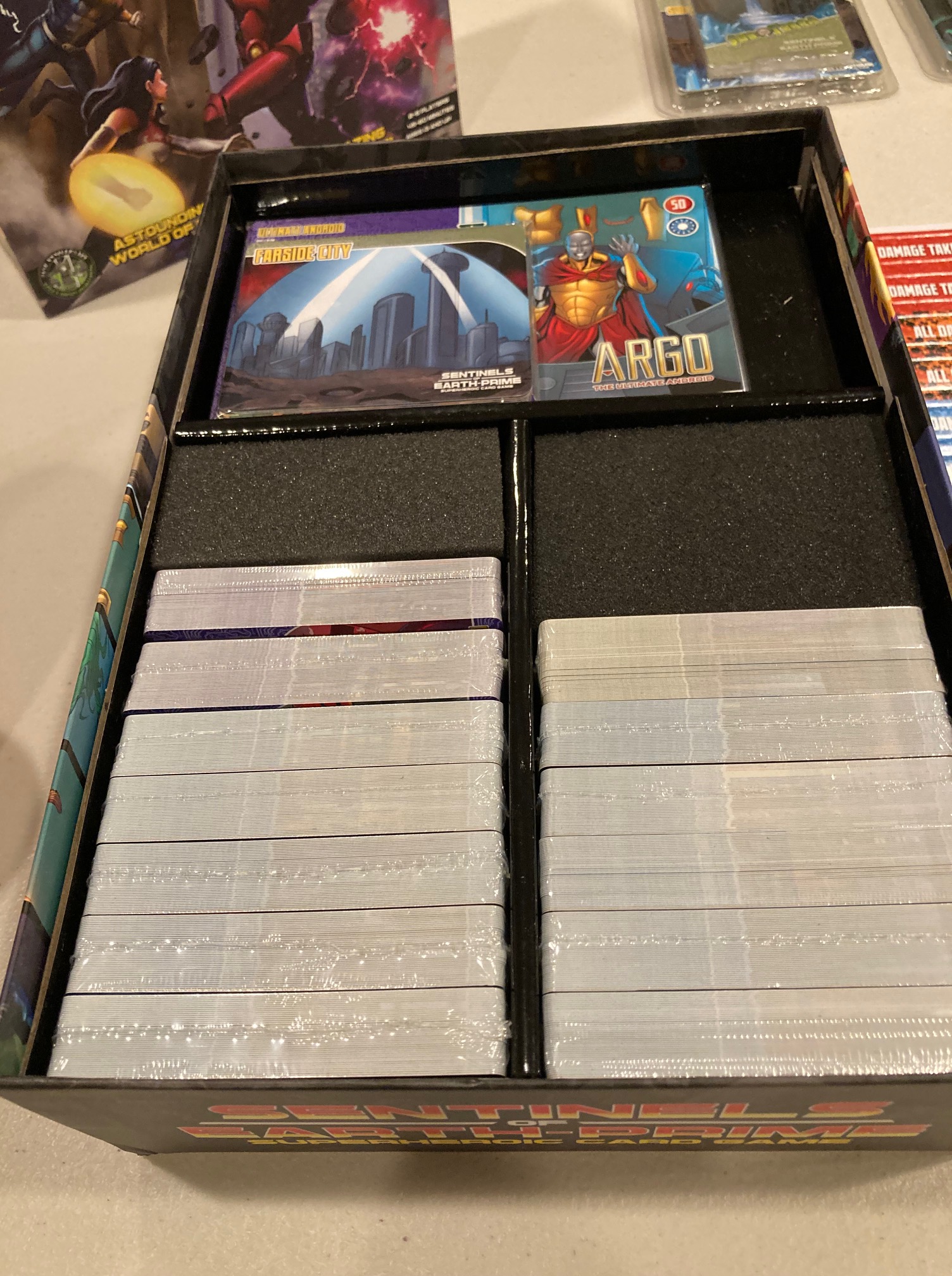
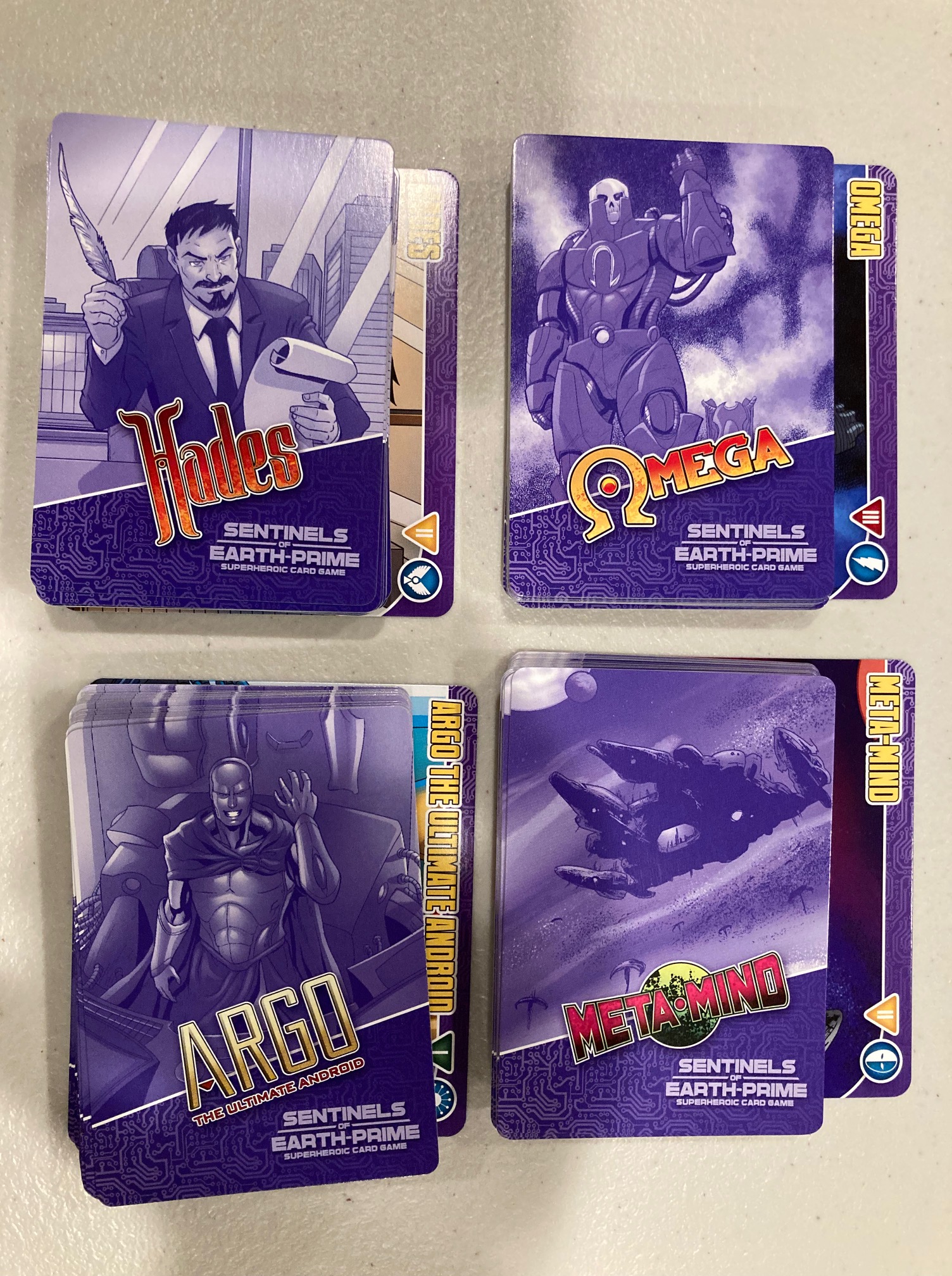
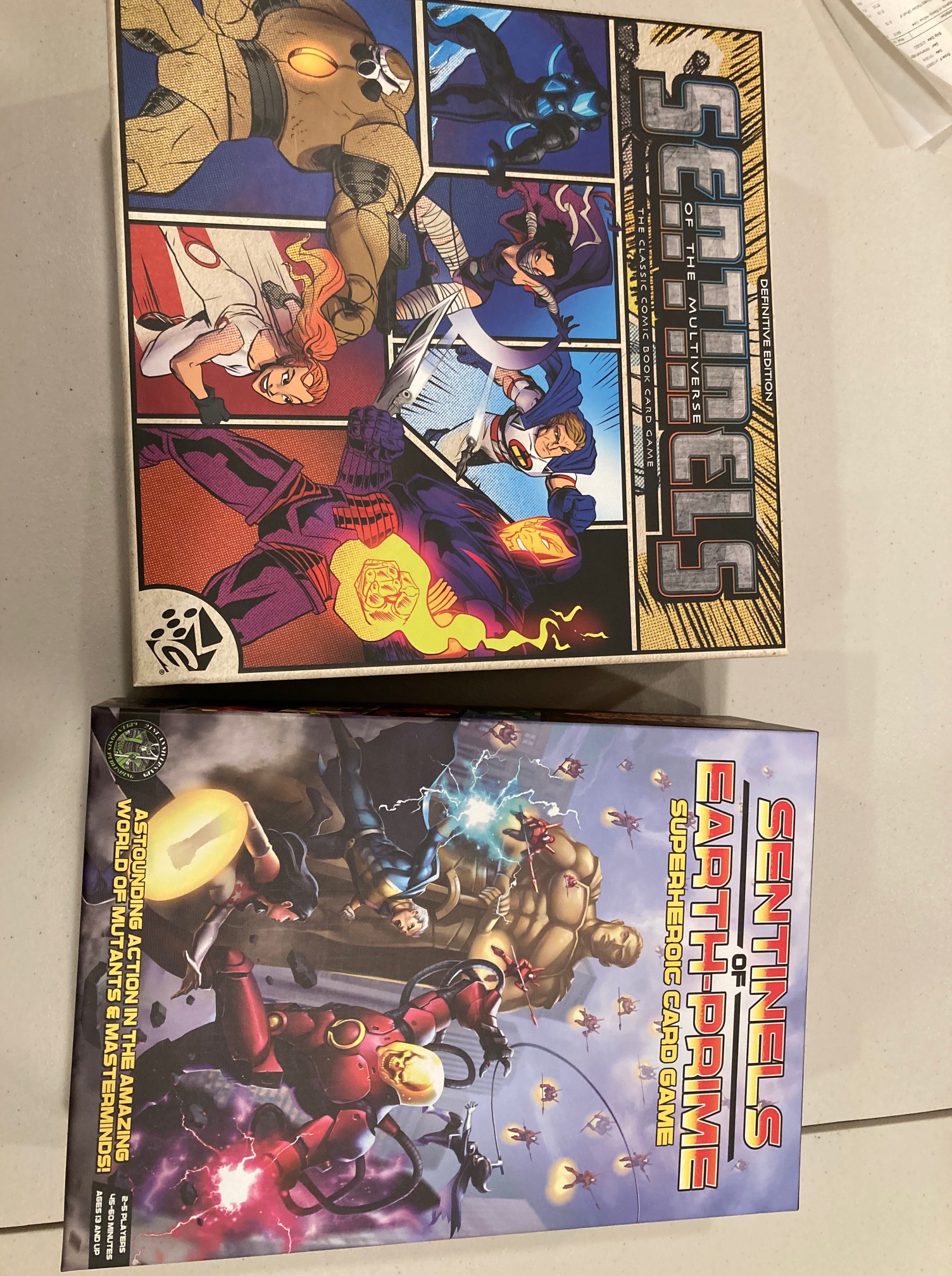
So, this is an interesting beast: this was an expansion for the Sentinels of the Multiverse, 2nd Edition.  Those of you paying attention will note that we reviewed the next edition last week!  See Sentinels of the Multiverse: Definitive Edition review last week.  Yup, in the time it took them to get this expansion out (about 5 years), Sentinels has moved on and made a new edition.  So, this expansion is for the old 2nd Edition.  I am looking forward to this and the art looks very promising, but I have to admit, it was hard to wait for this one … it took 5 years.

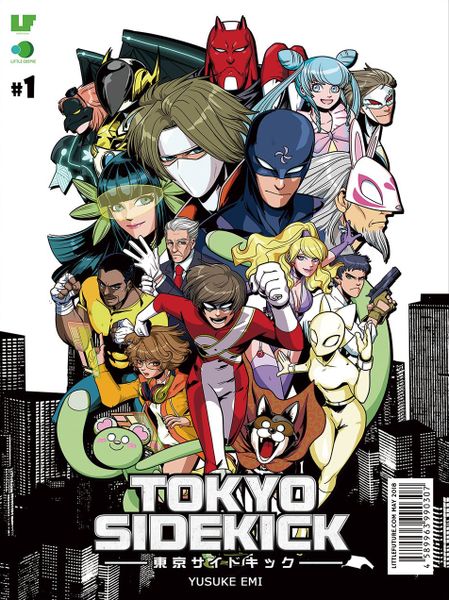
3. TOKYO SIDEKICK (2018)

ts

Kickstarter Link: https://www.kickstarter.com/projects/japanimegames/tokyo-sidekick-reassemble
Promised Delivery: March 2021
Summary: Tokyo Sidekick is a cooperative game for 2-4 players that draws inspiration from superhero comics and Japanese pop culture. Each player controls a hero and sidekick, complete with their own unique backstories and special abilities. Together, you must save Tokyo by fighting increasingly powerful villains as crime spreads across the city. As you play, you’ll unlock new items and stronger abilities while leveling up your characters. But if crime reaches dangerous levels, you take too much damage, or you can’t defeat the final boss, Tokyo will be plunged into chaos.

Can you defeat your adversaries in time to save the city?

This game is about a year late for delivery, but I believe delivery is pretty close: maybe by summer 2022.  I like the ideas of this game, and it sounds a little like Sidekick Saga, a personal favorite cooperative game, so this one is high up the list!

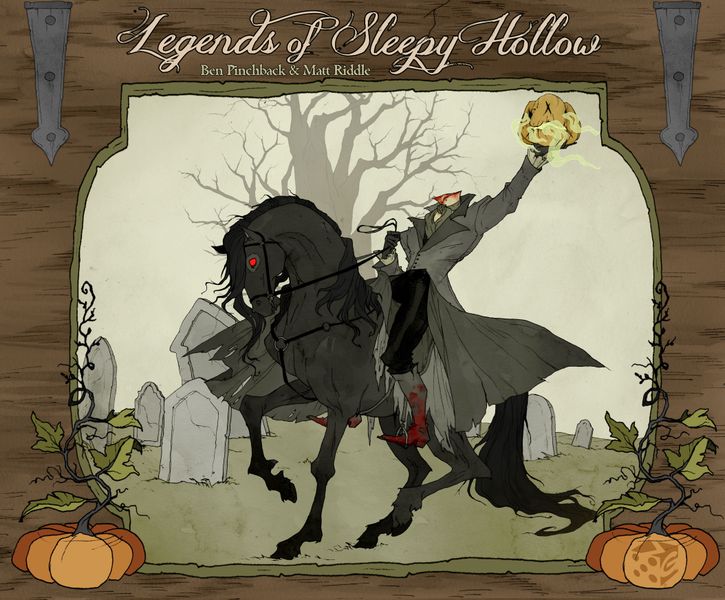
2. Legends of Sleepy Hollow (2022)
lege

Kickstarter Link: https://www.kickstarter.com/projects/dicehateme/legends-of-sleepy-hollow
Promised Delivery: December 2018 (yup, you read that right)
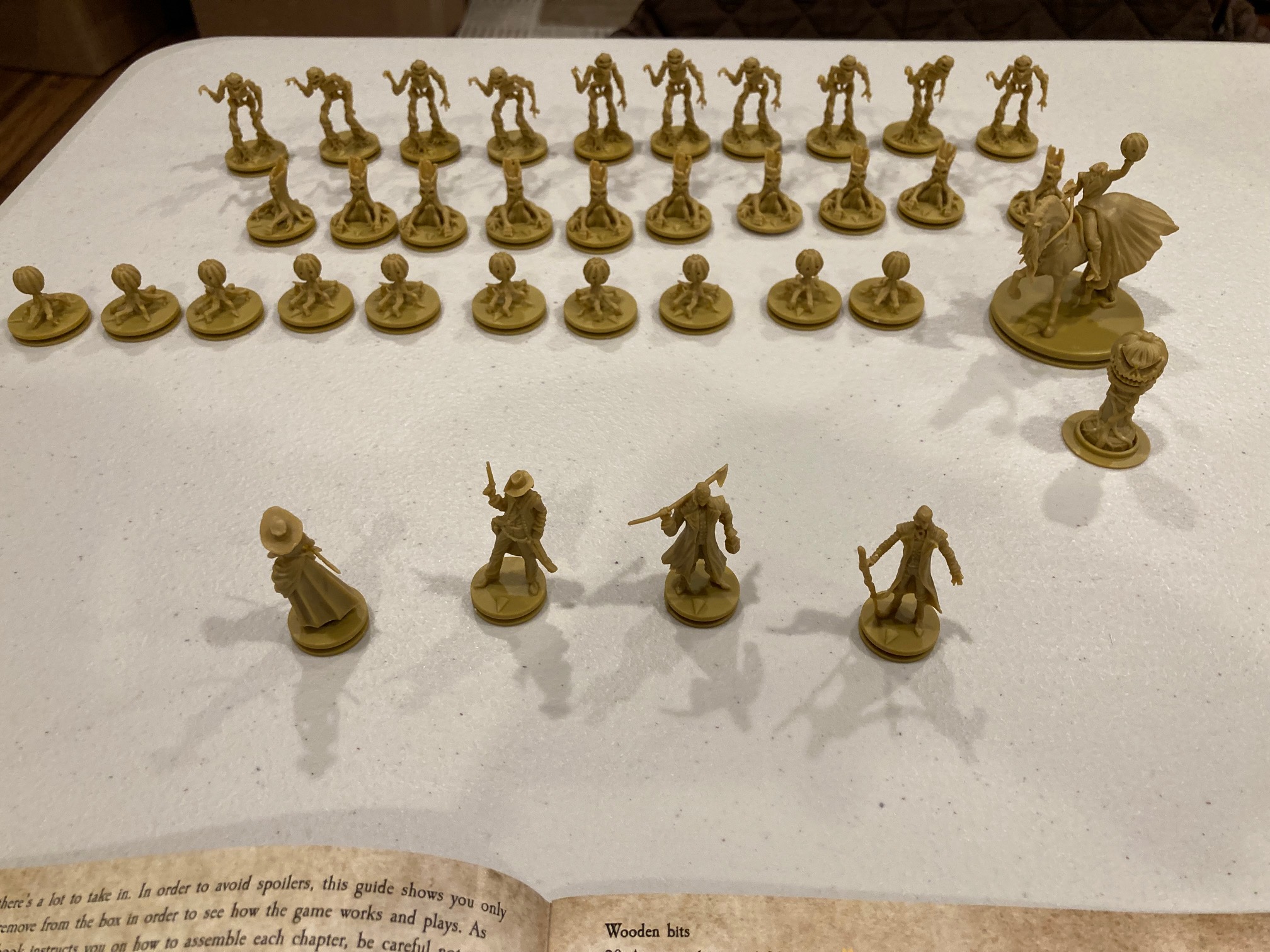
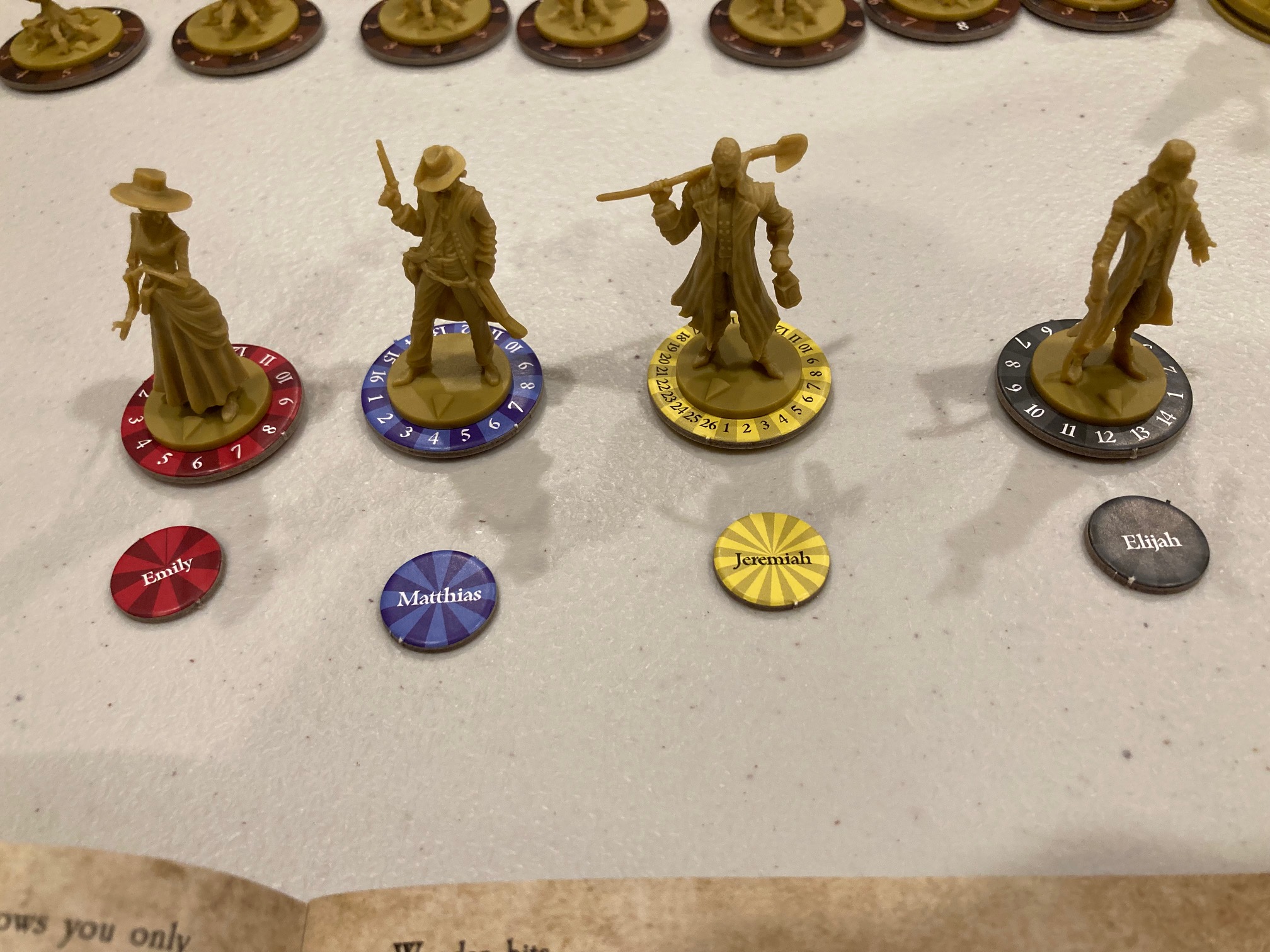
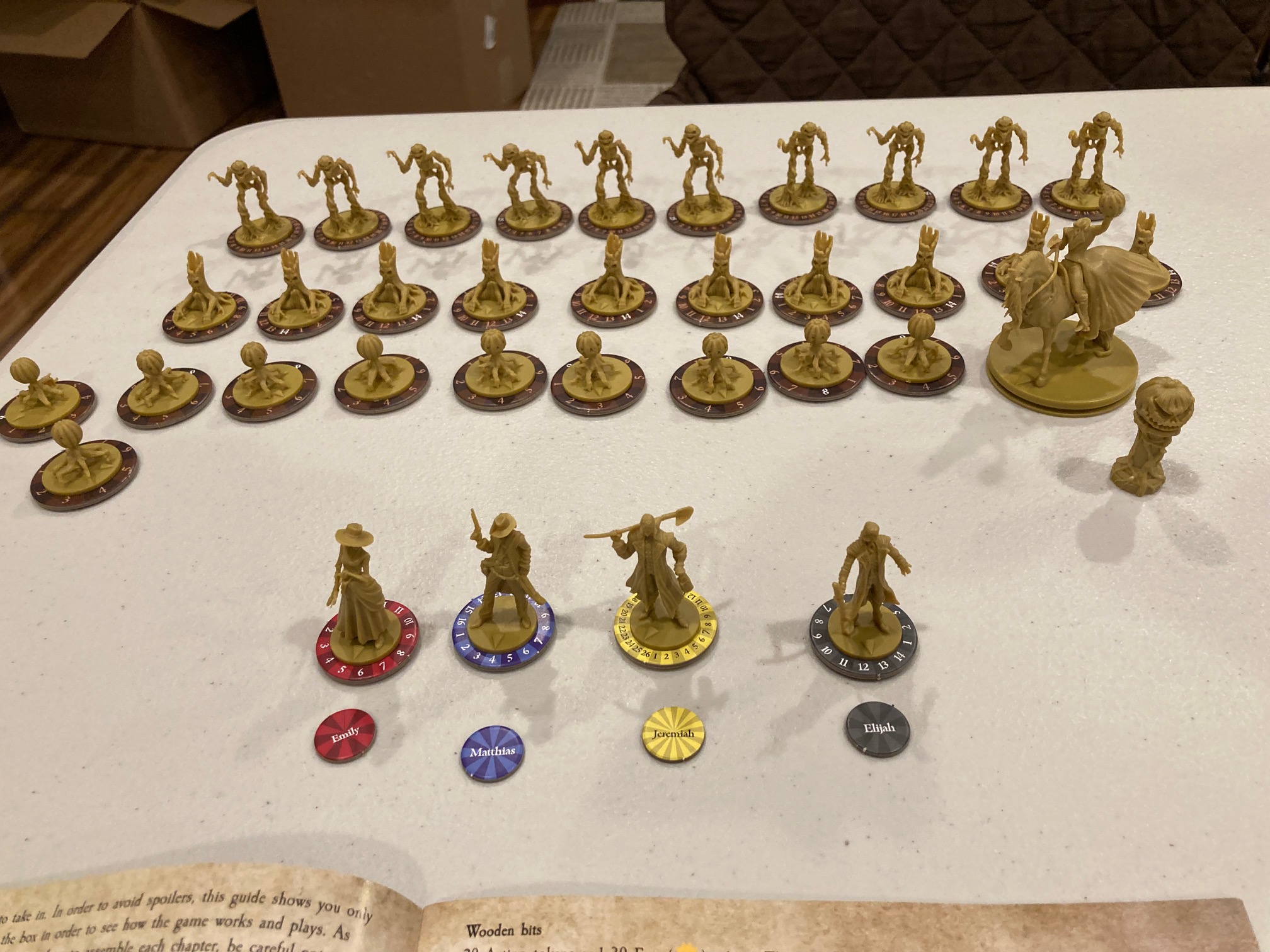
Summary: Three days after the disappearance of Ichabod Crane, four Tarrytown residents with strange ties to the supernatural venture into an ever-darkening Sleepy Hollow to uncover its mysteries.

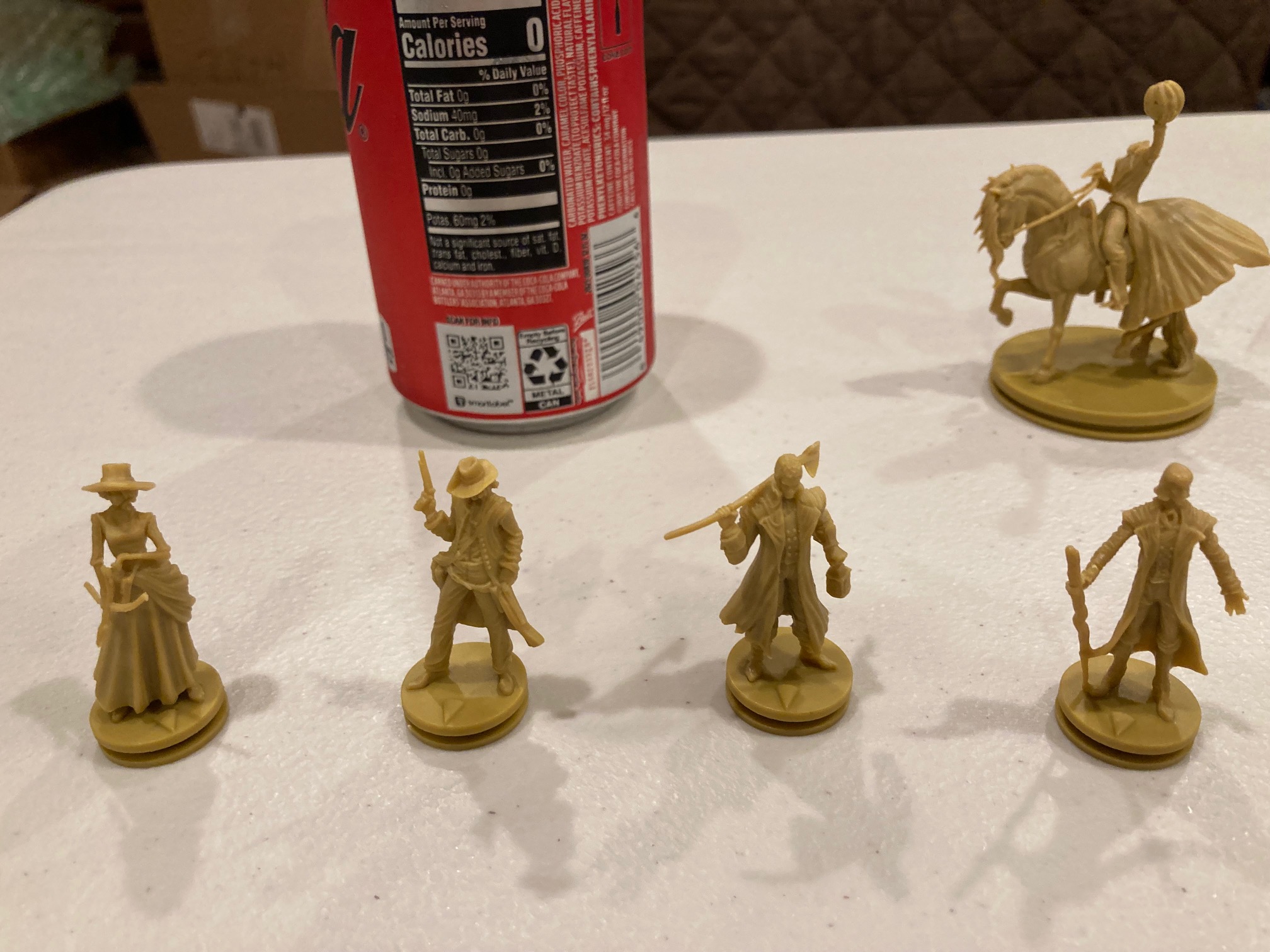
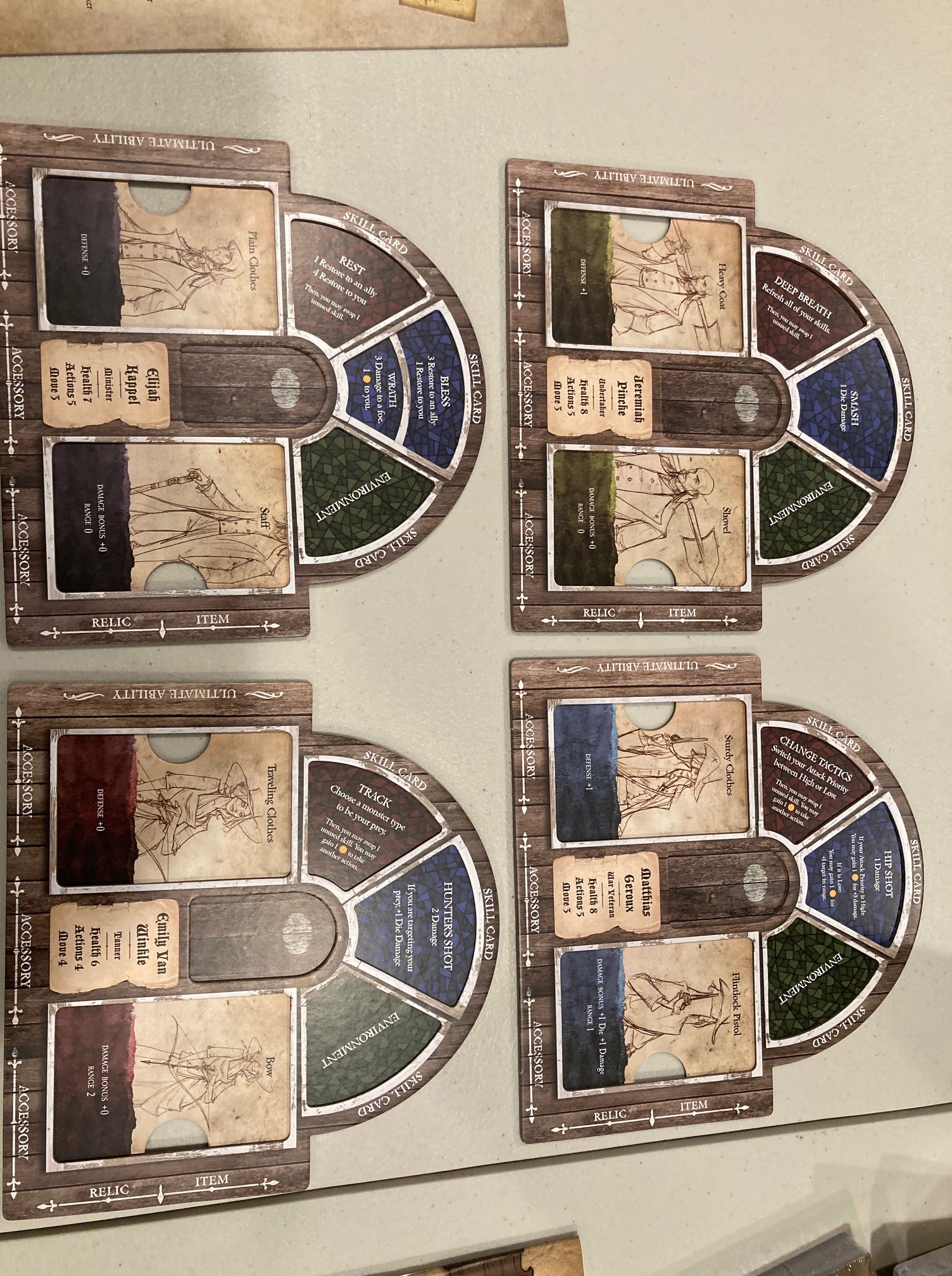
In Legends of Sleepy Hollow, players take on the roles of the four residents — undertaker Jeremiah Pincke, Revolutionary War veteran Matthias Geroux, minister Elijah Kappel, and tanner Emily Van Winkle — in a cooperative, miniatures-based campaign game full of secrets and twists. During the game, players will use an action pool to move about, investigate, interact with their environment, or unleash powerful attacks and abilities unique to each character. Once selected, however, these abilities will be unavailable until that character’s action pool has emptied — a process that becomes more complex as that character gains fear.

The players will have to work closely together to overcome their fear, unravel the mysteries of the glen, and become true Legends of Sleepy Hollow.

This game has had a bit of a tortured history:  They “reset” in the middle of playtesting to make it better, and that reset has delayed it a number of years.  I tend to like Greater Than Games: they are known for making good products, but they are also known for making late products.  If this were any other publisher, I’d be very annoyed at the delay, but I am sort of used to it with Greater Than Games.  I am really looking forward to this finally coming it!  It looks very thematic and maybe a game for Halloween!

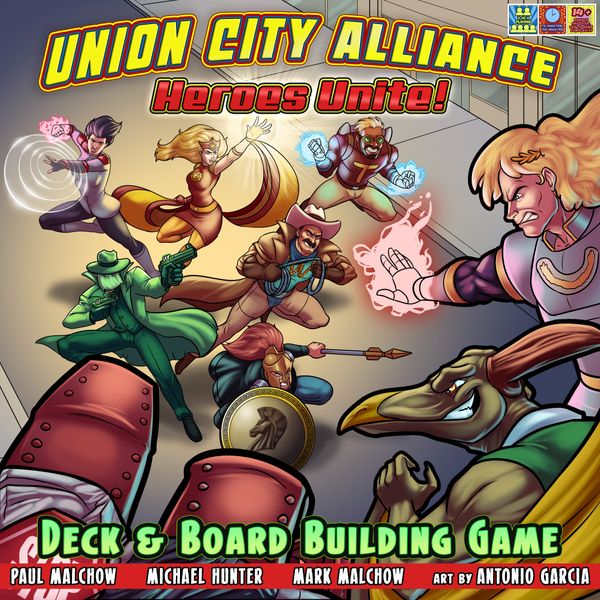
1. Union City Alliance (2021)

uc

Kickstarter Link: https://www.kickstarter.com/projects/paulmalchow/union-city-alliance-heroes-unite-deckbuilding-board-game-new
Promised Delivery: Oct 2021
Summary: A Cooperative Superhero Deck and Board Building game for a team of 2-4 Players. Each chooses an iconic champion to play as and work together to confront and defeat a central supervillain. Each hero has their own unique starter deck of Origin cards that highlight that character’s unique strengths and skills. Each Hero also comes with a Deck of super-powerful Solo Cards that only they have access to, featuring their most powerful abilities.

This game didn’t have a big kickstarter (it may the least funded on this list), but I am super excited for it. I like deck-builders, I like super-heroes, and I think the game looks real fun! It’s late on delivery, but hopefully it will deliver sometime here in 2022!

A Review of Sentinels of the Multiverse: Definitive Editions

IMG_9702

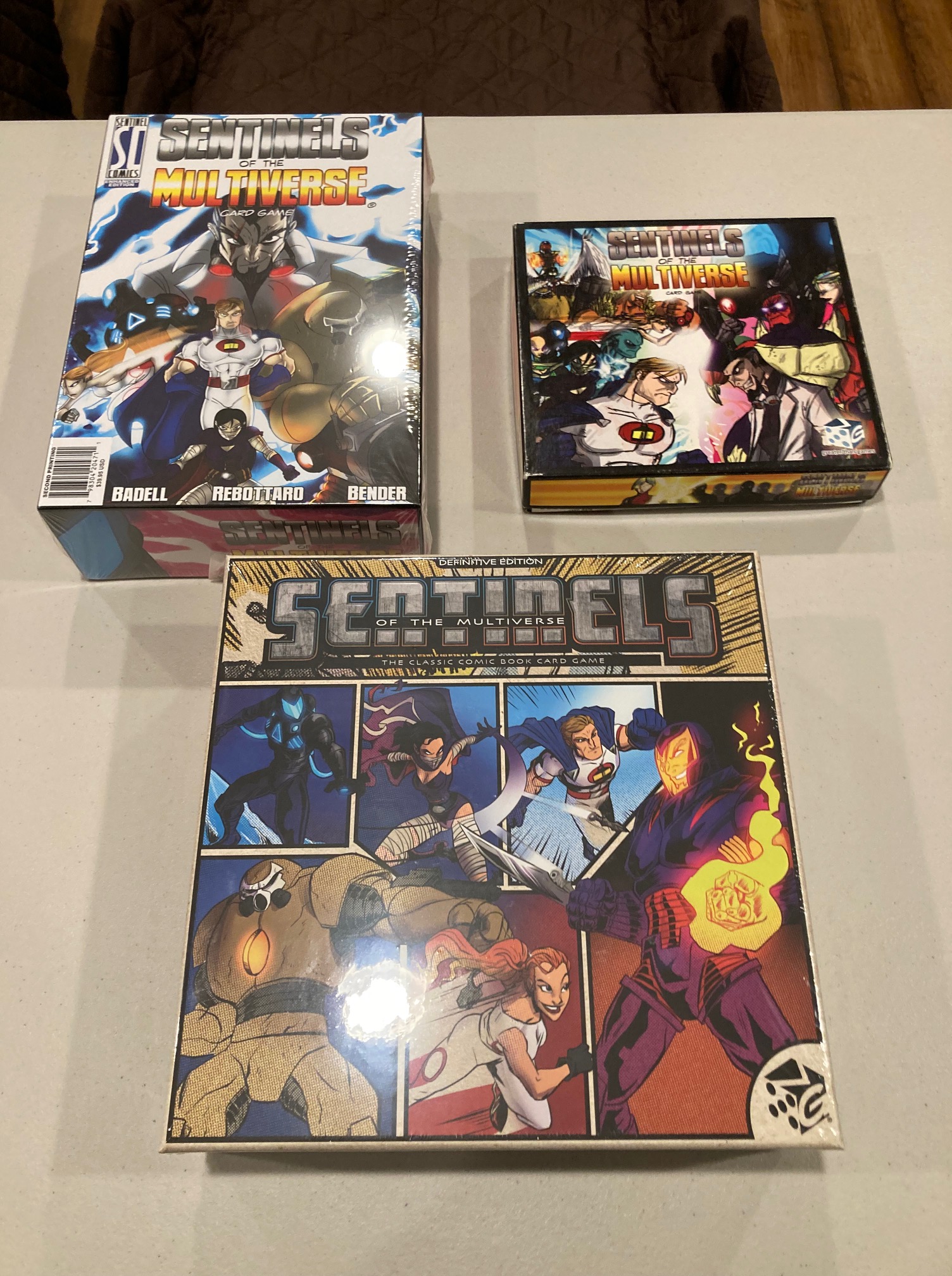
I bought the original 1st Edition of Sentinels of the Multiverse sight unseen from the Greater Than Games website back in 2012. Sentinels had been getting a lot of hits of BoardGameGeek in the “hotness”, and the idea of a cooperative superhero game seemed fantastic! I loved the cooperative games Arkham Horror 2nd Edition and Pandemic at the time, but I really wanted a thematic cooperative superhero game! Sentinels of the Multiverse 1st Edition arrived at my house sometime in 2012 and I never looked back. It very quickly became one of the favorite games of all time! Sentinels of the Multiverse makes me feel like I am playing a super hero on a team with my friends! Sure, it would have been better if I could have been an X-Man or an Avenger or a Teen Titan, but Sentinels of the Multiverse offered its own world of unique and different super heroes (probably because they didn’t want to get sued by Marvel and DC).

The original 1st Edition had a few problems:

IMG_9850

  • The cards were super thin
  • The art and coloring needed some clean-up
  • A few cards needed to be adjusted as they were a little unbalanced
  • The maximum Hit Points “changing all the time” was wonky 
  • The box was way too small and cheap

The 2nd Edition of the game fixed these problems and made the game a lot better.  The changes didn’t truly affect the flavor of the game that much, but the overhaul just made the game more appealing.  Anyone who had the 1st Edition easily could justify moving up to the 2nd Edition: you could get the new edition at a good price (I have found it on Amazon for $25).  And there wasn’t a lot of investment in the original 1st Edition … it was just one box.

Over the years, there have been a lot of expansions for the 2nd Edition, and I have bought them all.  Most of these expansions were a big hit, just adding new heroes, villains, and environments!  They gave the game so many choices! See above.

Definitive Edition

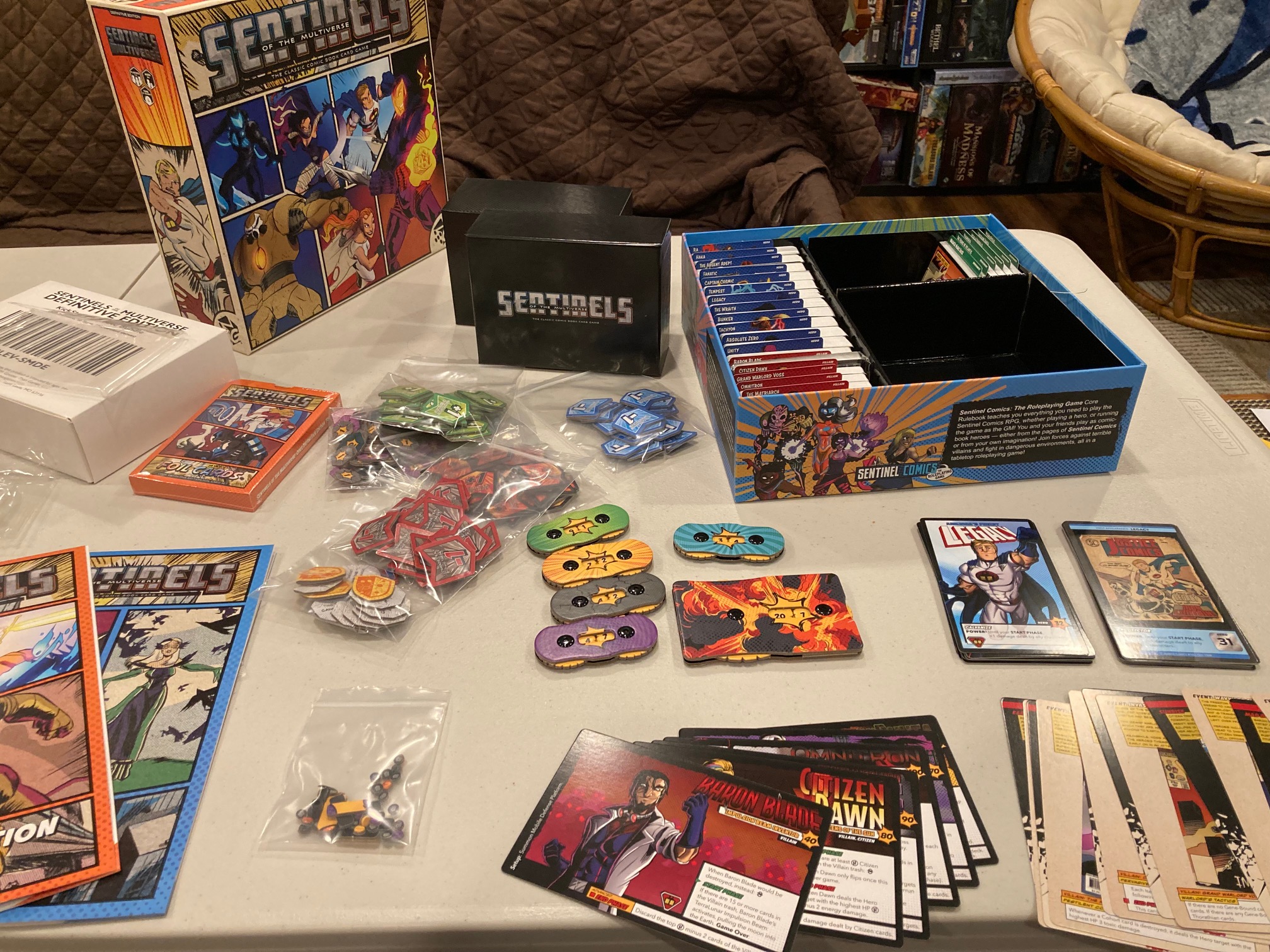
It’s been about 10 years since the original Sentinels of the Multiverse came out, and Greater Than Games decided it was time for an update. Greater Than Games put the Definitive Edition up on  Kickstarter back in April 2021 and it finally delivered to me about a week ago (Jan 24th, 2022).

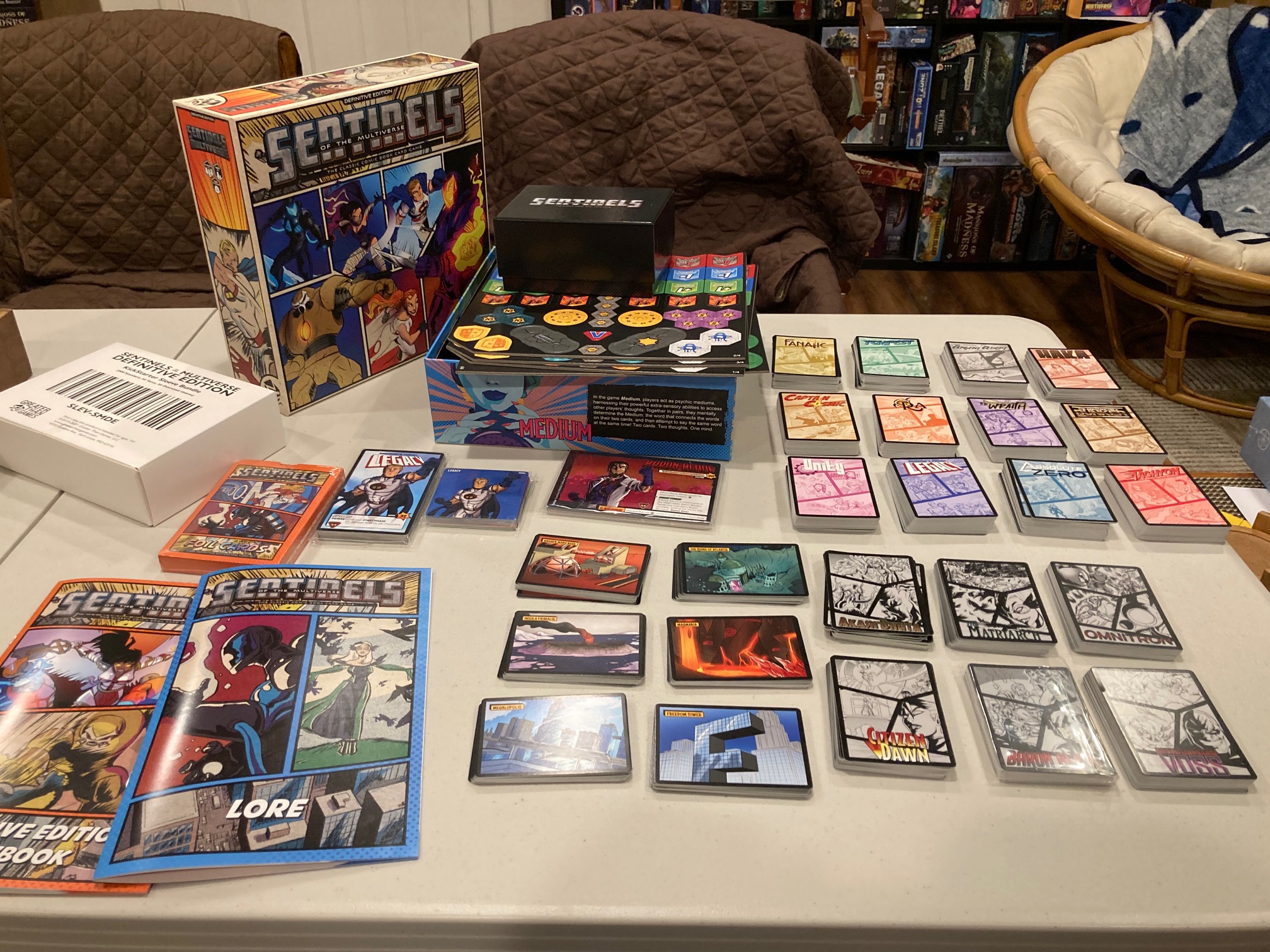
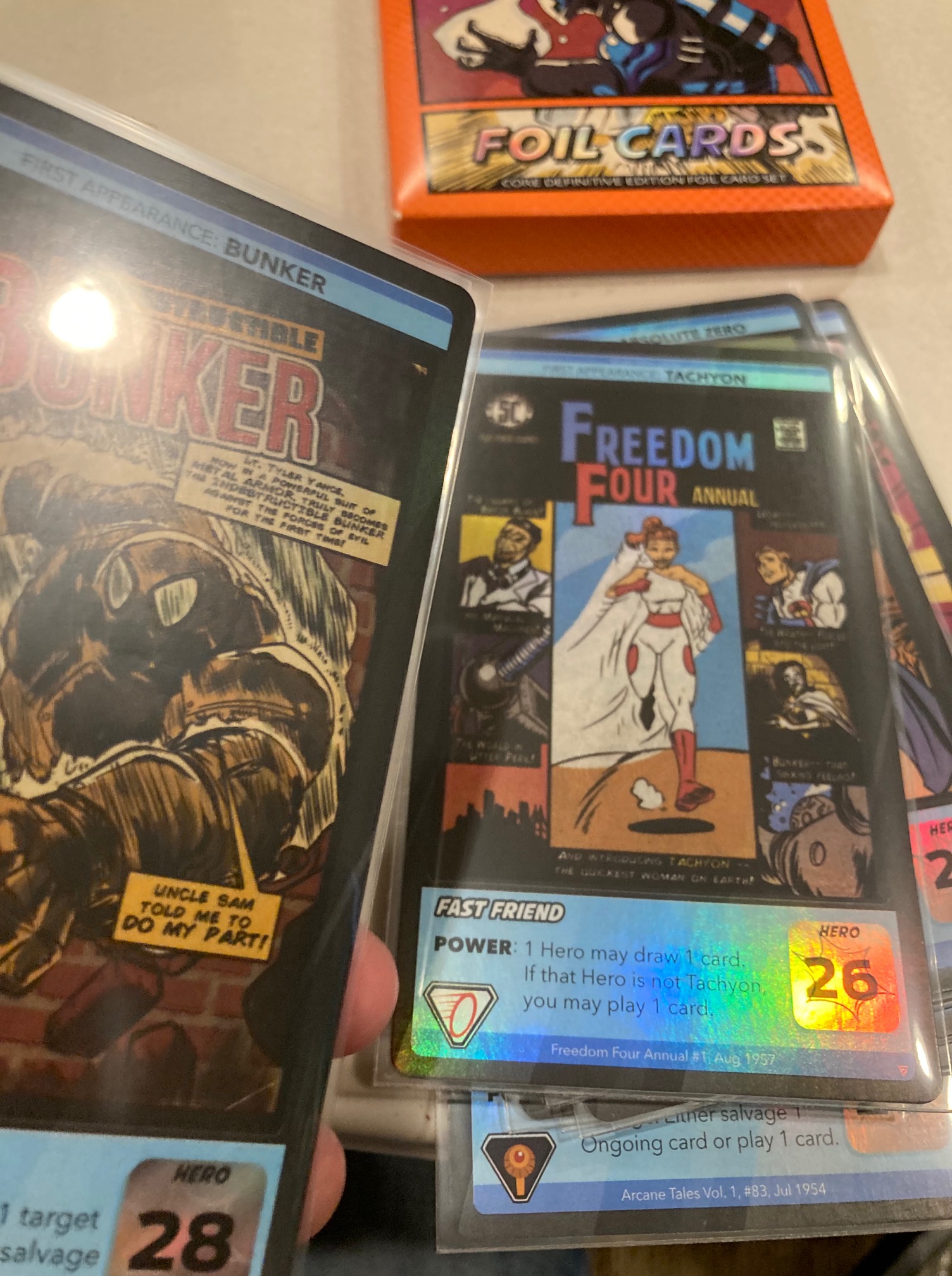
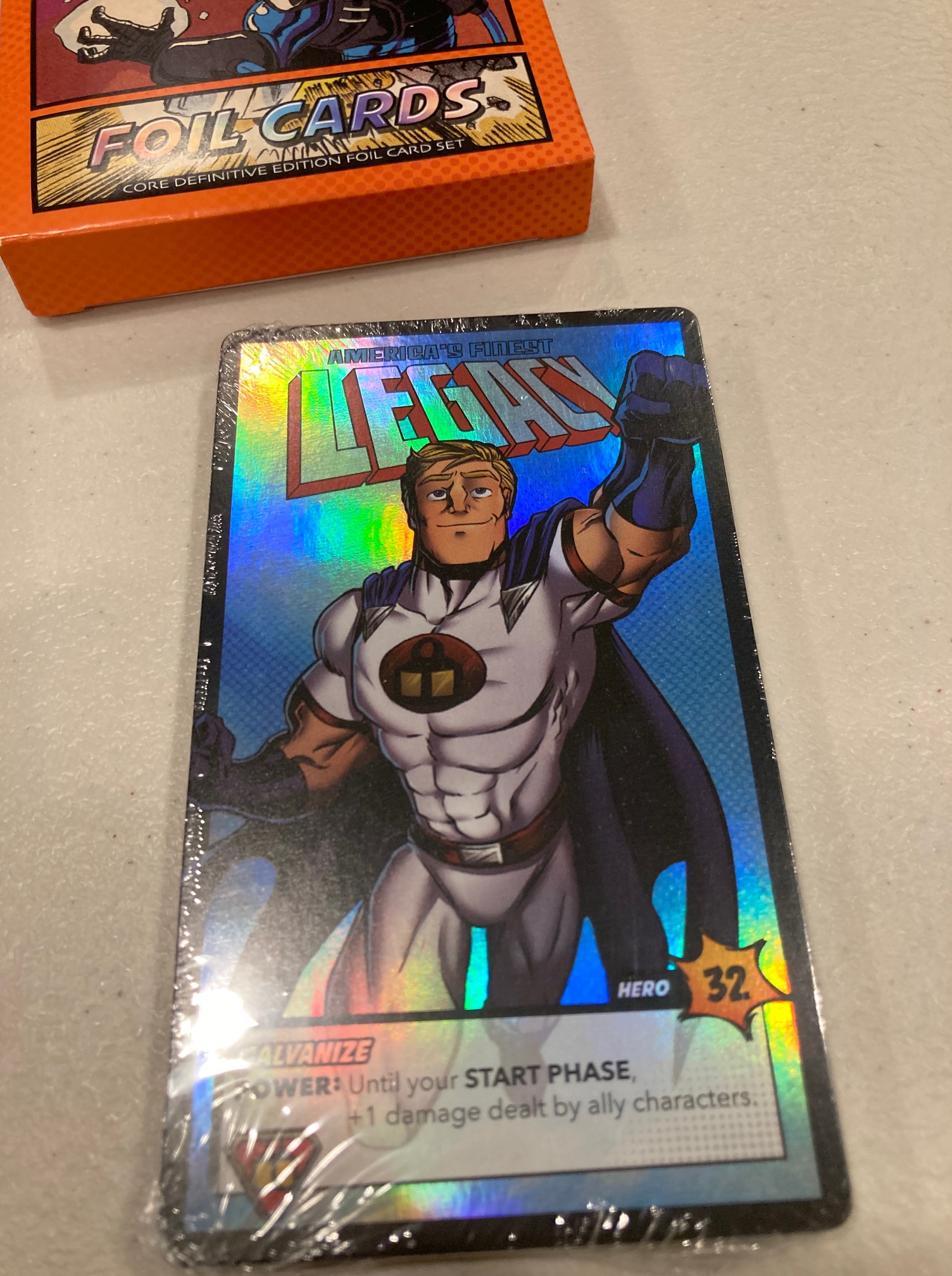
I went full-in for the sleeves and foil cards (see above).  One of my favorite ridiculous expansions for any game has been the foil cards for Sentinels!  I had the all the foil cards for the 2nd Edition, and I wanted them for the Definitive Edition!

Unboxing 

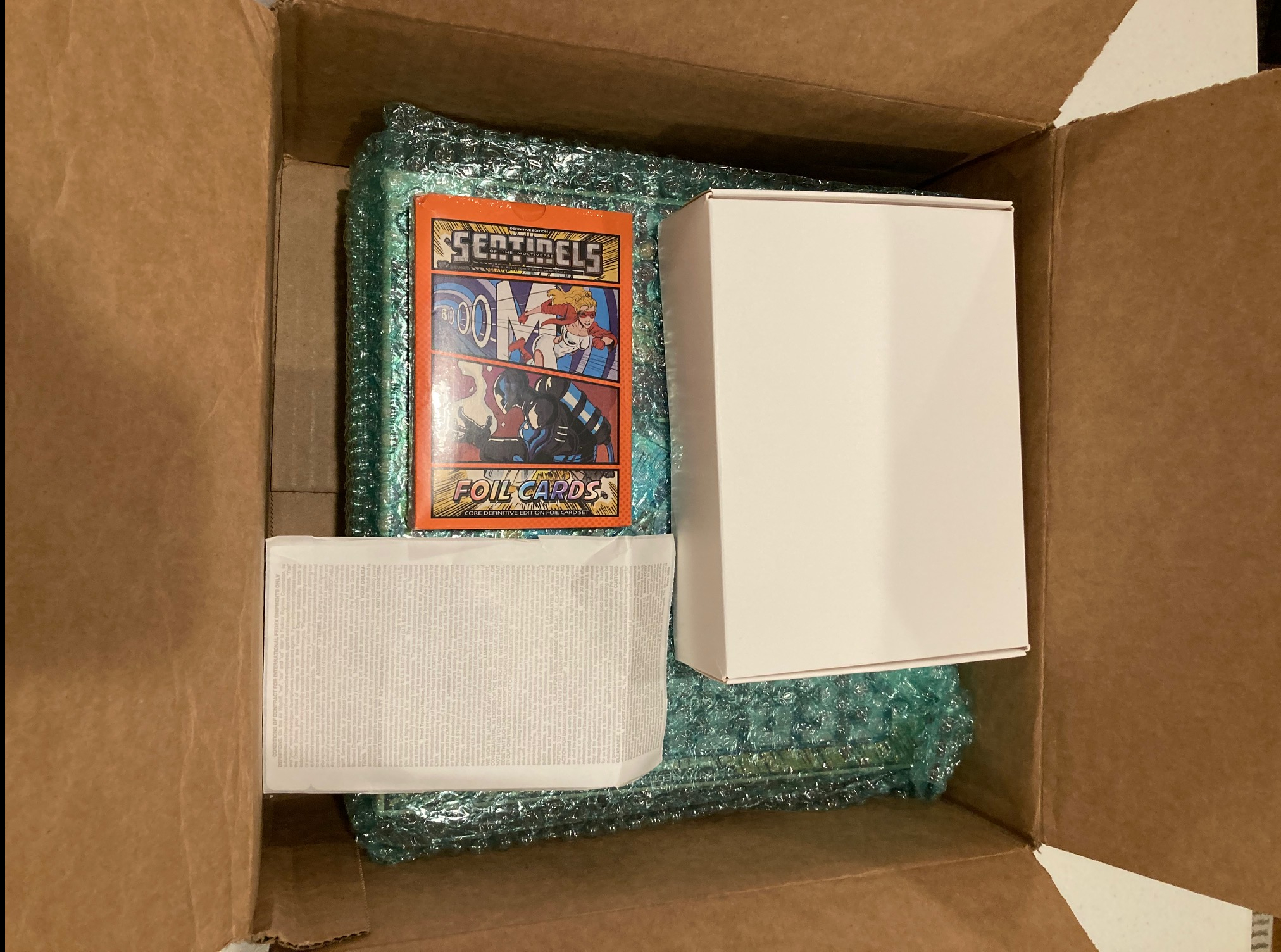
IMG_9696

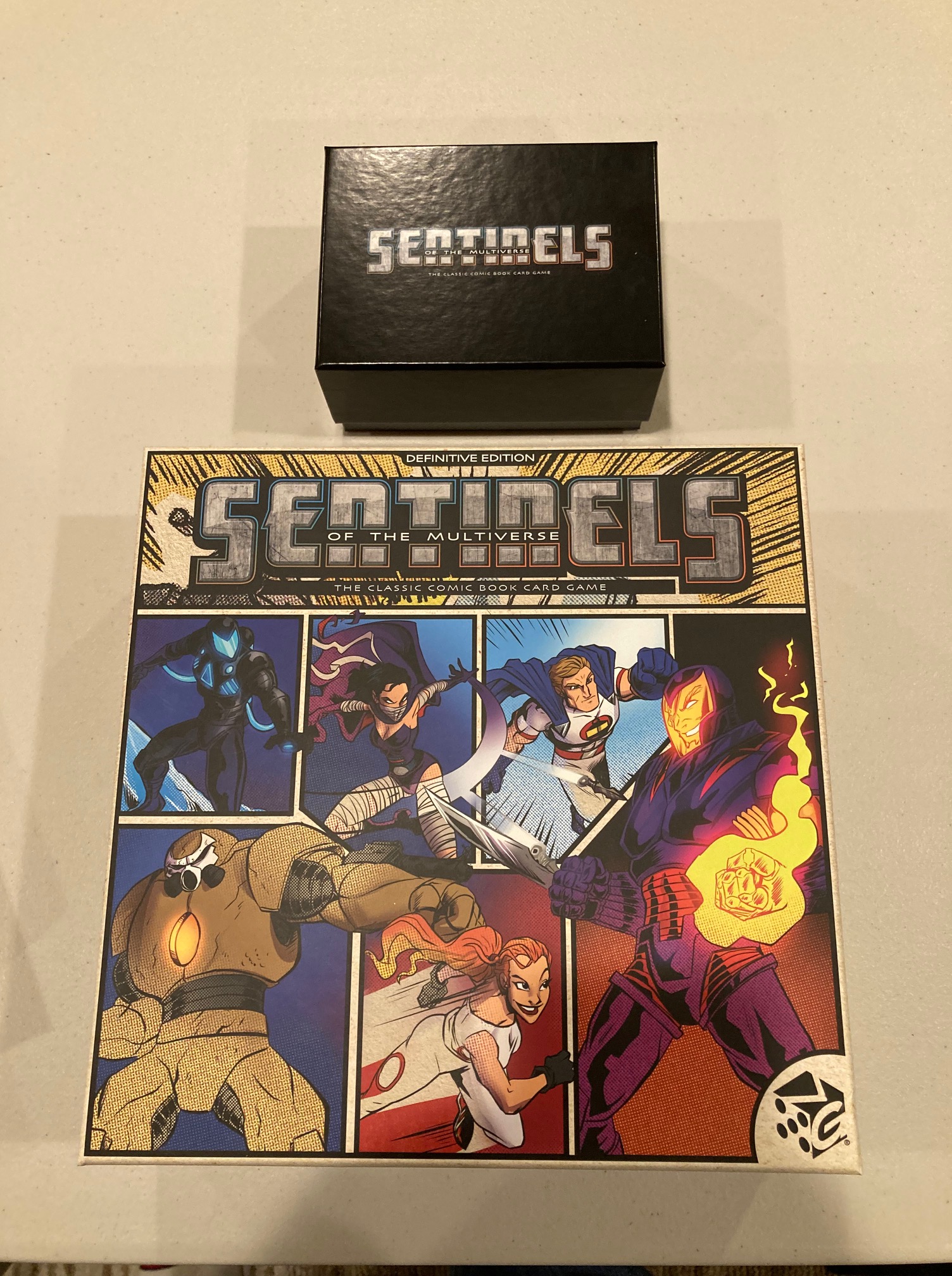
The “all-in” Kickstarter pledge came with sleeves and the foil cards.

IMG_9697

The sleeves fit EVERYTHING: the oversized cards and the extra oversized foil cards and there’s a few extra for “just in case”.

Honestly, the game looks great!

Sleeves

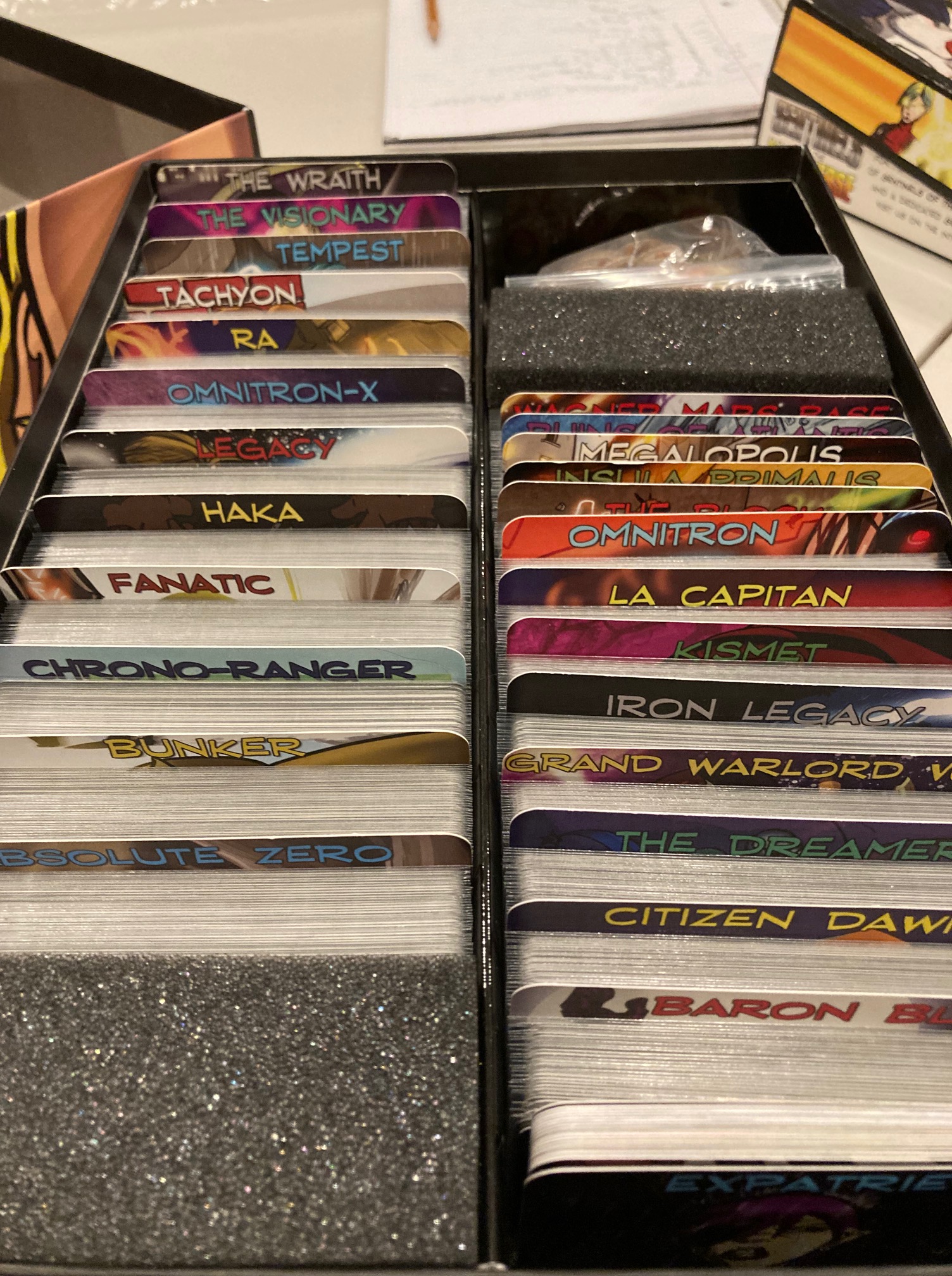
The game sleeves work fine and fit all the cards.  We remarked that the sleeves weren’t “extra great” quality: they felt like penny-sleeves.  Nonetheless, they worked fine.   There are two issues that come up: See above for problem one with the sleeves:  Notice how the sleeve obscure the name of the hero?  This was very much NOT the case in the 2nd Edition (see below).

IMG_9927

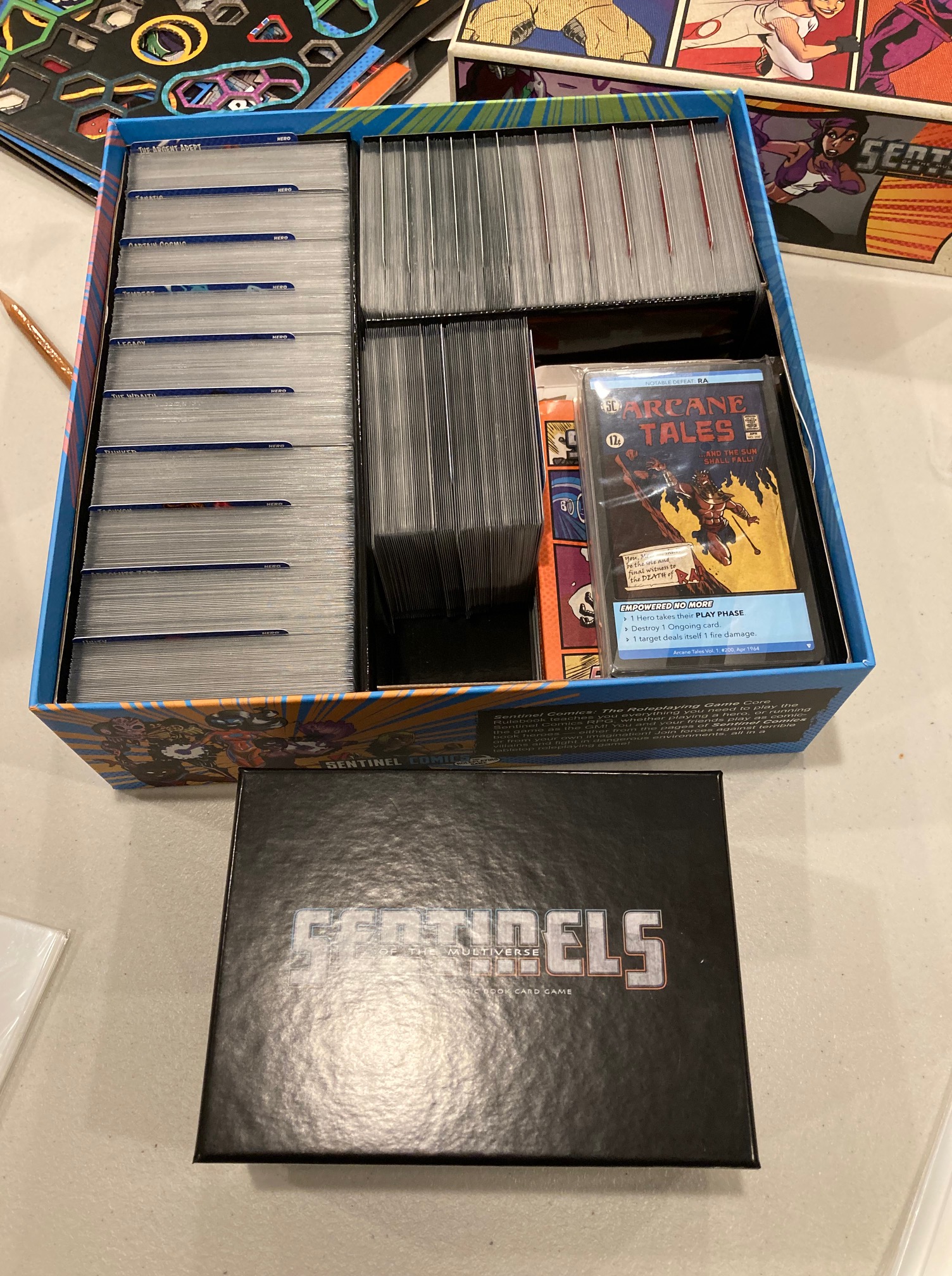
Another problem with the sleeves is that the “obvious way” to fit everything in the box, you can’t fit the black token box AND the sleeved cards together in the same box!  See below:

IMG_9846

With the oversized cards AND the sleeves AND the token box, everything won’t fit anymore.    I simply broke it up so that I have two boxes.

However, according to the Kickstarter Update #22, you CAN fit everything in the box, but you lose your token box if you do that.  See Update 22 link below.

https://www.kickstarter.com/projects/gtgames/sentinels-of-the-multiverse-definitive-edition/posts/3321299

I chose to keep the token box for tokens.  So, you CAN fit everything in the box, but it’s a bit of a tight squeeze.  I’d rather have the heroes be just a little less packed.

Solo Play

IMG_9705

Congratulations on following Saunders’ Law: Sentinels of the Multiverse Definitive Edition has solo play! See above.

The 1st and 2nd Edition didn’t have solo play indicated on the box: the Definitive Edition does (see above).  Solo play has the solo player taking the role of 3 Heroes.  See below for a solo game.

It’s funny because Sentinels of the Multiverse is what inspired Saunders’ Law in the first place!  (Saunders’ Law states that every cooperate game should have a viable solo mode). The original 2nd Edition of the game DID NOT have a solo mode, so I had to make up my own solo mode to play the game by myself.  In fact, the original blog post about solo mode has 3 different ways to play Sentinels of the Multiverse solo

  1. The solo player takes control of 3 Heroes.  This is a fine solo mode once you know the game, but it is very daunting for a newer player.
  2. The solo player takes control of 2 Heroes and alternates between them, essentially playing as-if it were a 4 Hero game.  This solo mode takes less mental overhead for the new player, but the rules for “alternating heroes” can be wonky: neither the 1st, 2nd, or Definitive Edition had any notion of rules for playing a hero “twice” on a turn.  I think with just a little tweaking, this might be the best way to learn the game as a solo player.
  3. Play the App with 3 Heroes.  The app handles a lot of the rule for you, so this is a great way to learn the game.  Seriously.

I am VERY GLAD that the Definitive Edition rules address how to solo play (see above), but I wish they had gone with solution 2 instead.  Ah well, at least they addressed in the rules!

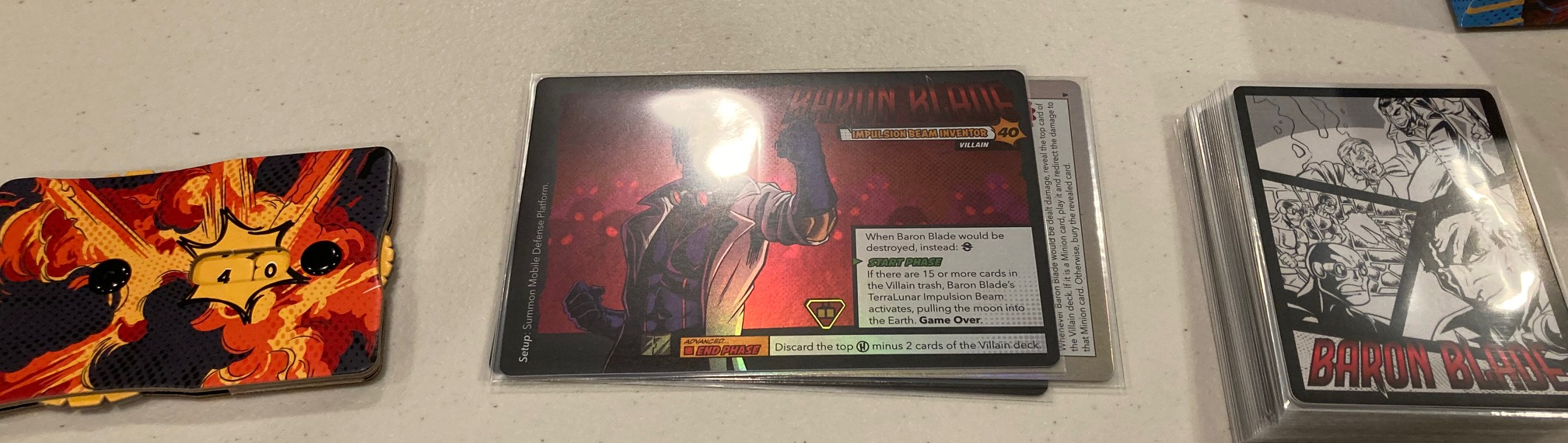
My first game was a solo game with the “dream team” (for me): Legacy, Tempest, and Wraith against Baron Blade.  One great thing that the Definitive Edition does: the first play of Baron Blade has already been “shuffled” to ensure a good experience for your first game!

This made it easy to jump right into the game!  Ares Expedition does something like this: the deck is “shuffled” when you get the same so you can just put the deck out and play!  I kind of wish EVERY game did something like this.  Anyway, kudos to the Definitive Edition to smoothing the first play.

I won my first game handily, but I am an experienced player.

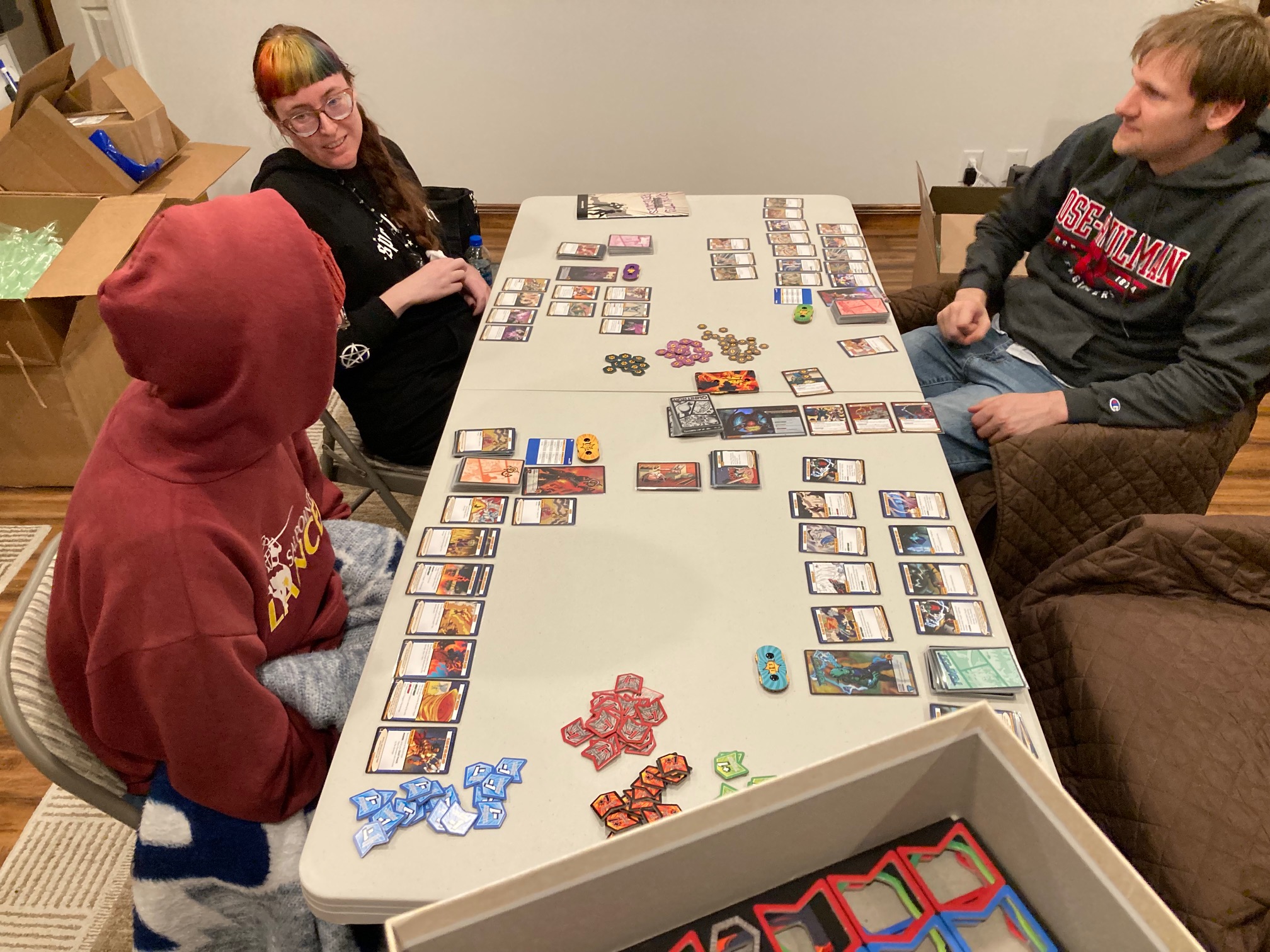
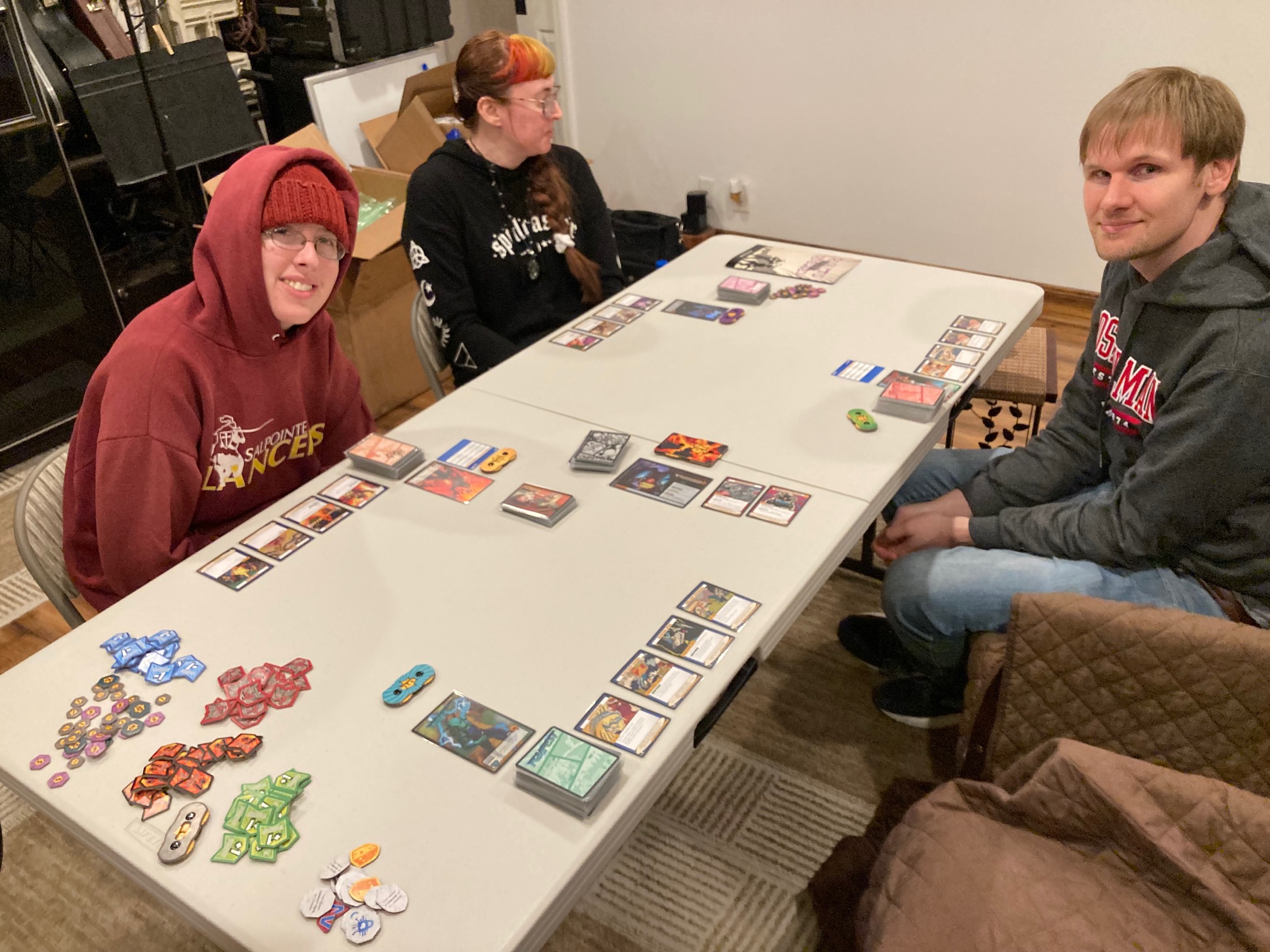
Cooperative PlayIMG_9941

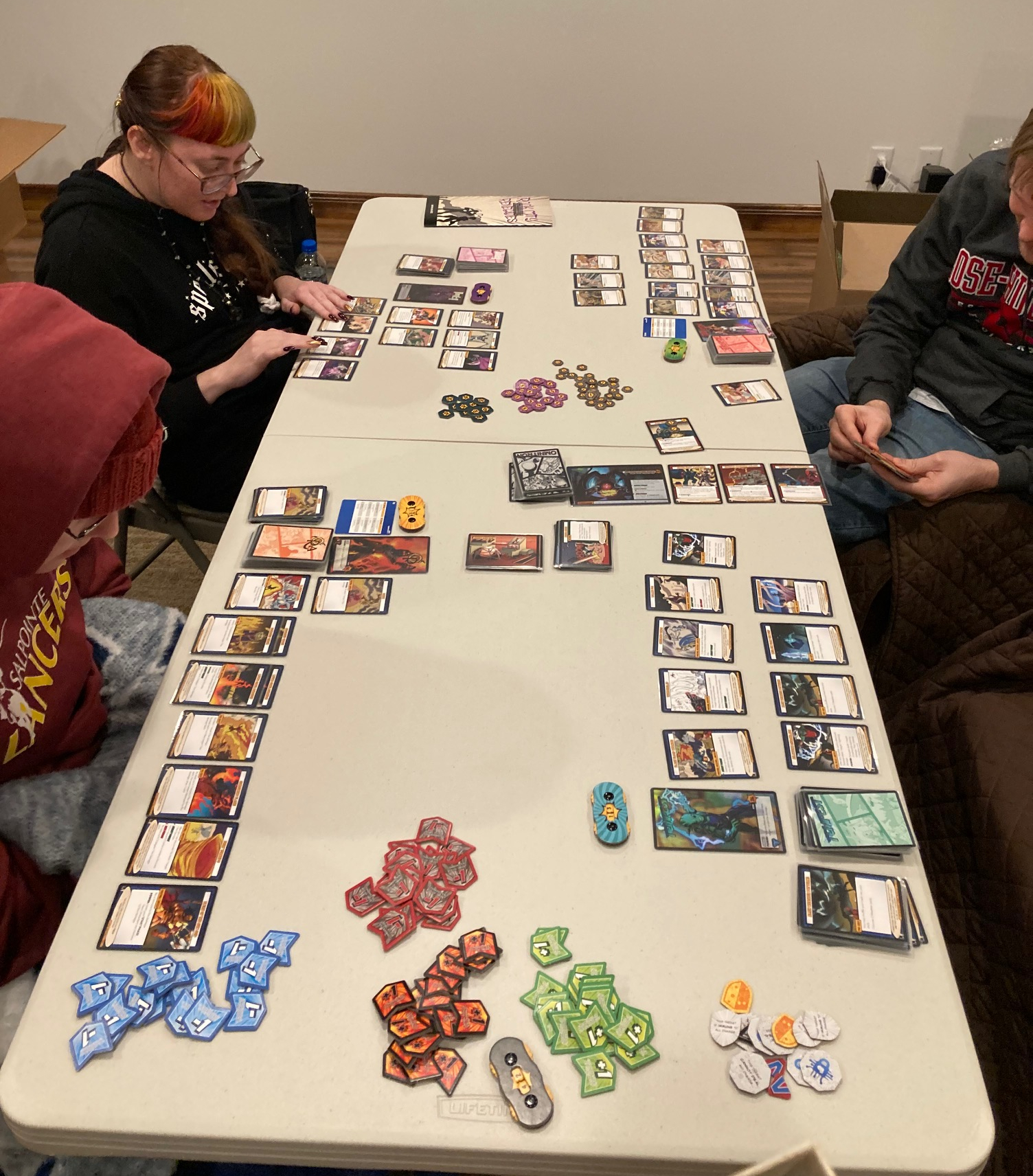
Sentinels works best at 3, 4  or 5 Players because each player gets to control one Super Hero. At 2, each player controls 2 heroes (which is less fun because you don’t feel like YOU are a Super Hero). If you want to be a Super Hero, play a 3,4, or 5 player game … see above for 4 players.

IMG_9841

As you get used to your hero, the first couple of cooperative multi-player games feel like a “multi-player solitaire”:  you are just trying to do the best you can with the hand you are given.   It’s harder to cooperate because you are too busy reading your own deck: There are a lot of rules on the cards, and you just have to be reading a lot to see what to do.

IMG_9933

As someone who has played all three editions, I can tell you the game shines once you know your hero’s deck.  The Definitive Edition is no different: once you know the strengths and weaknesses of a deck, the game becomes far more cooperative as you can predict what heroes you need, how to play your character, and how to work with other heroes (and combo).

To really enjoy Sentinels, you have to enjoy getting to that knowledge point: you have to enjoy just taking a new deck, playing it, and doing the best you can.  I honestly know that I’ve lost some players because they don’t enjoy the process of “just playing”.  When the hero decks becomes “second nature” is when Sentinels seems to being out “the best cooperation”.  

My group seemed to enjoy our first co-op play.  We beat Omnitron handily.

Modernization

So, when Sentinels of the Multiverse 1st Edition first came out in 2011, there were NO other cooperative super hero games around.  Period.  Now, there are so many cooperative super hero games!  Take a look at our Top 10 Cooperative Superhero Board and Card Games!   Each of these new games has brought something “new” to the field, and luckily, Sentinels of the Multiverse has embraced some of these new ideas!  

IMG_9778

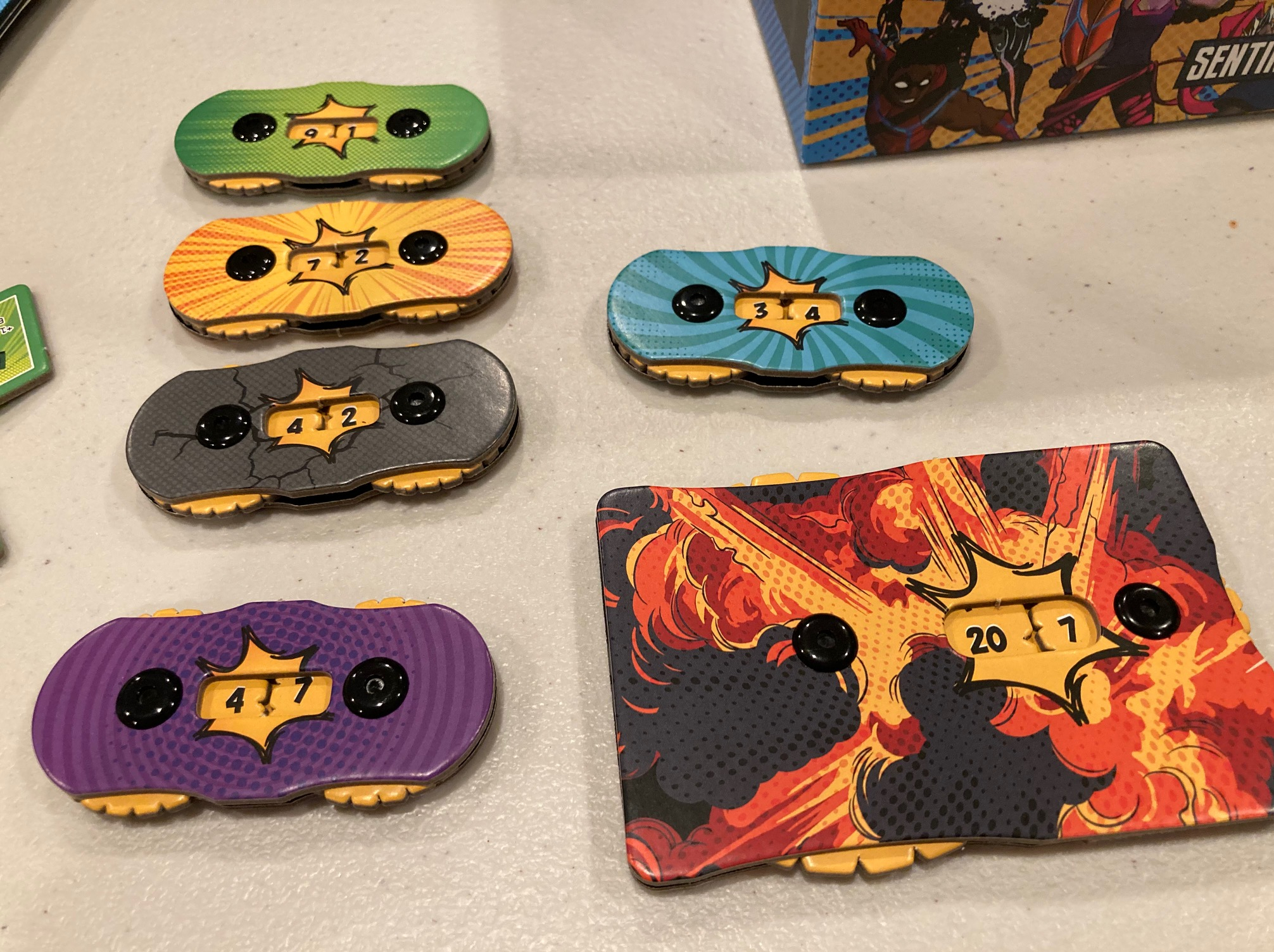
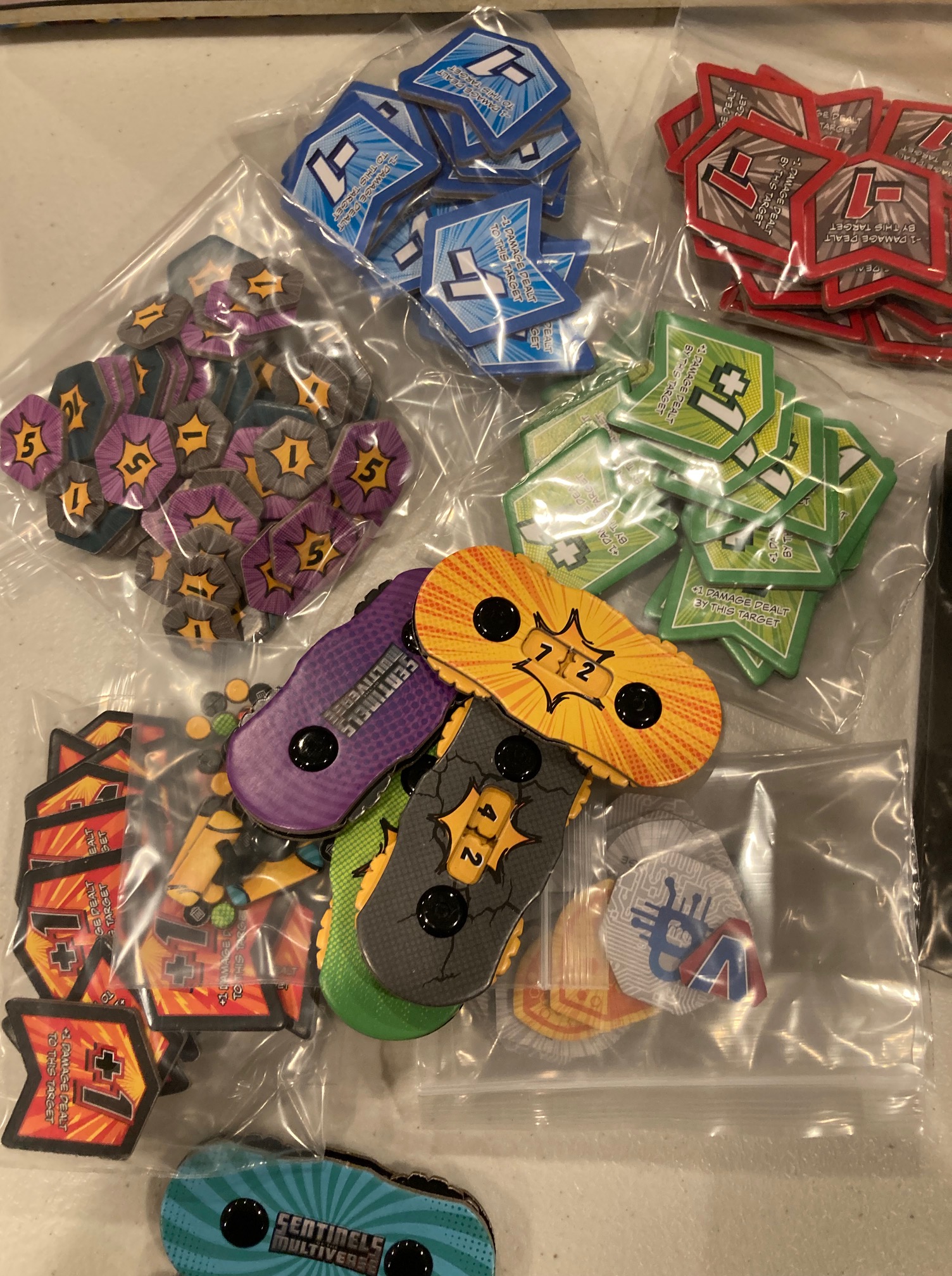
The main modern idea in the Definitive Edition are the spinner counters: see above.  Marvel Champions used them to great effect, so it’s good to see Sentinels modernizing and including 5 Hero spinner counters and 1 Villain spinner counter.  (One minor complaint: my Villain spinner counter had a hard time turning as the wheels rubbed against each other).

IMG_9931

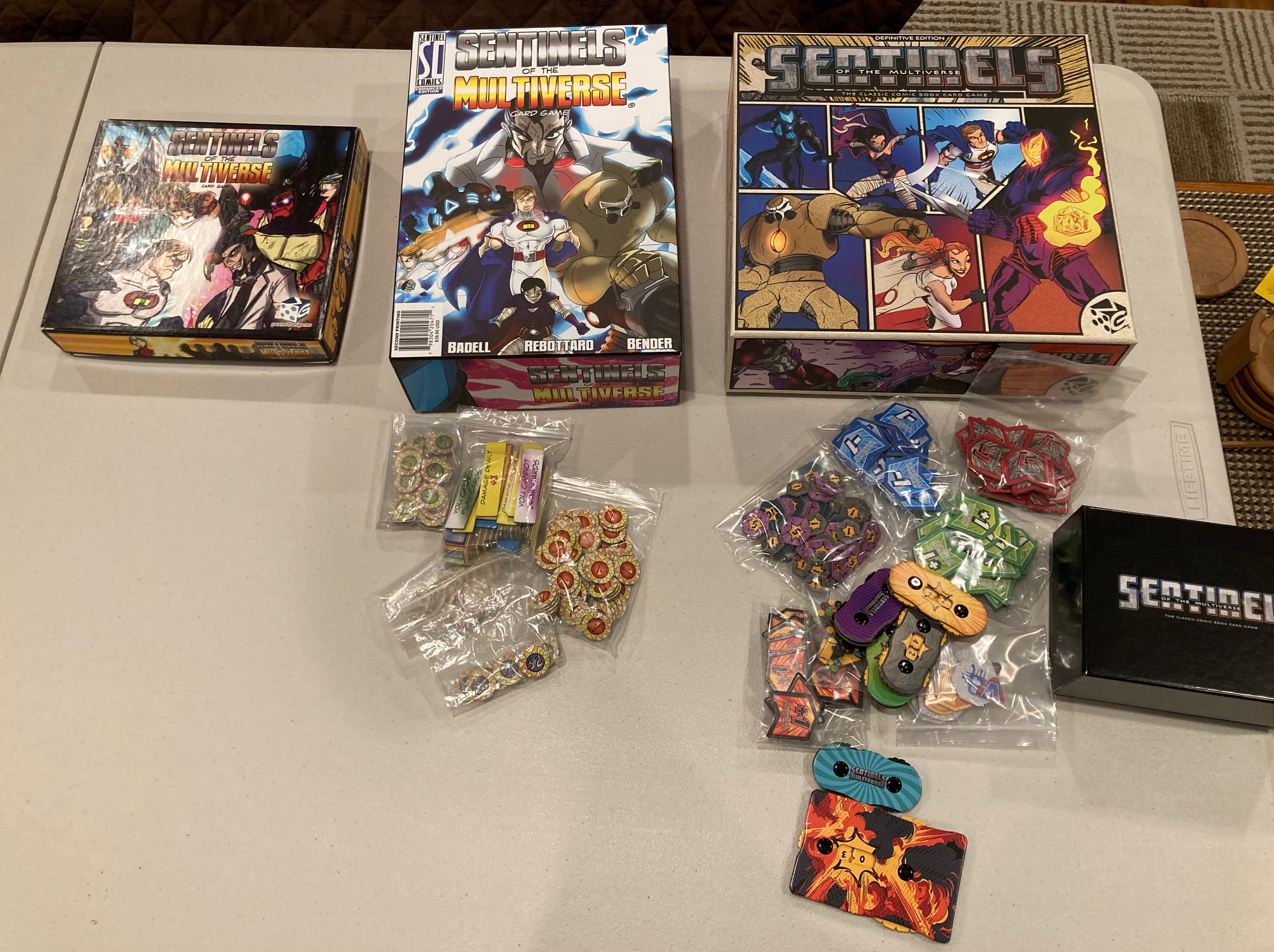
The other main idea is “better tokens”: see above. The 1st Edition of the Sentinels game had NO TOKENS WHATSOEVER: it was strictly a card game (I had to keep track of hit points on paper).  The 2nd Edition included tokens that were usable if not stunning.  See below.

IMG_9928

The Definitive Edition really has ratched up the art for the tokens: I think they look much more modern and dynamic!

If you compare the tokens and spinners to Marvel Champions, it feels like Marvel Champions were a major influence on the new components … and that’s a good thing!  The new tokens and spinners really help the usability of the game.  And let’s be honest, Marvel Champions is probably the biggest competitor to Sentinels.

Marvel Champions vs Sentinels of the Multiverse

IMG_9766

Let’s be frank: these two games are going to be compared! They are both cooperative superhero card games where you play a superhero!  If you want Marvel superheroes, well then, you only have one choice: Marvel Champions.  If you are willing to suspend your disbelief and join the Heroes in the Sentinels of the Multiverse Pantheon, there are very interesting choices! 

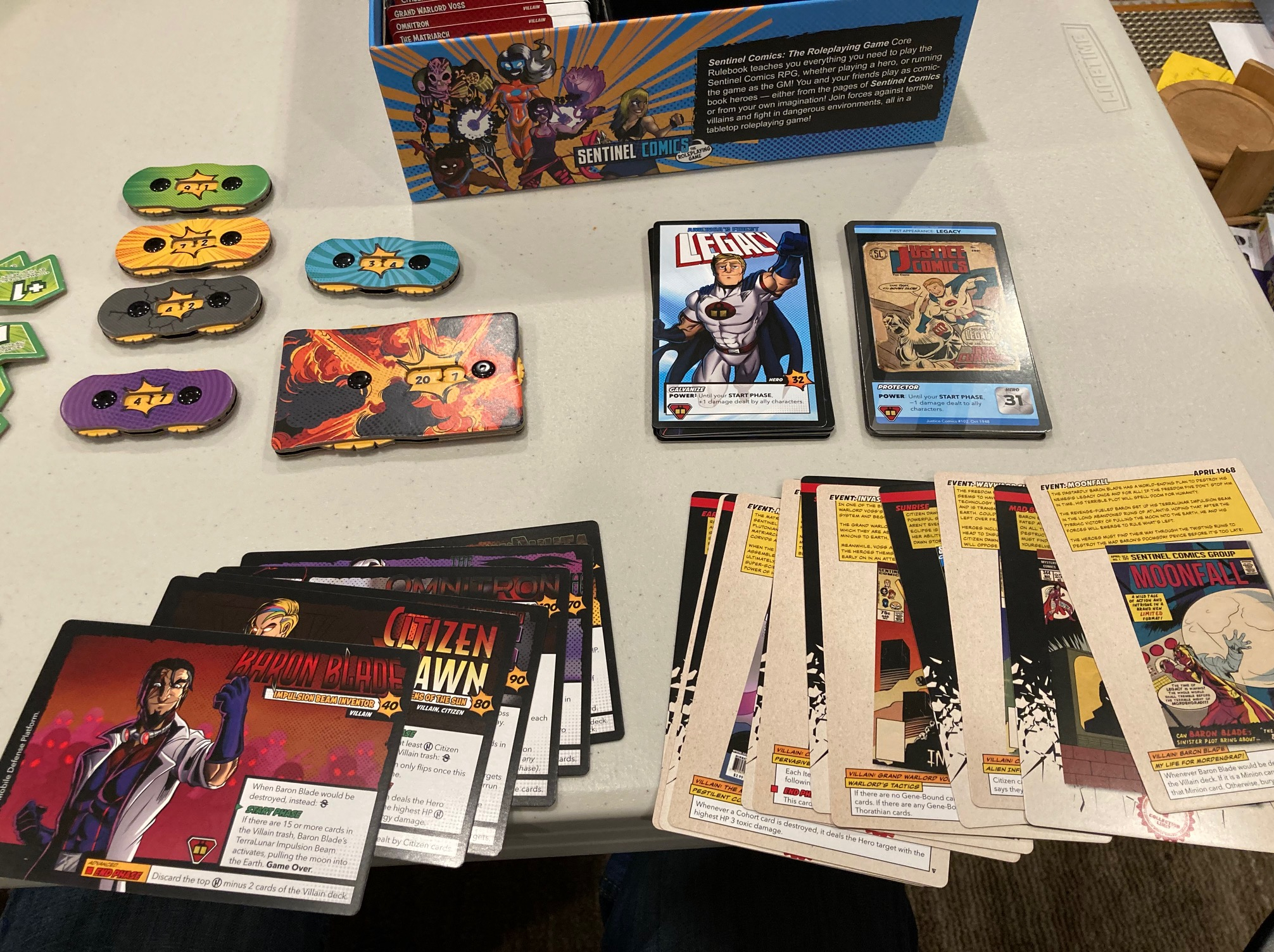
From a value proposition (see above), Sentinels of the Multiverse Definitive Edition beats Marvel Champions hands down! The new Definitive Edition has 12 Heroes, 5 Villains, 6 Environments normal-sized decks! Plus (see below) the large cards for the Heroes, Villains, Events, Critical Event, and First Appearances! And some amazing tokens! 

IMG_9787

Marvel Champions only has 5 Heroes and 3 Villains (and some of the heroes you can’t even play with each other because there aren’t enough “aspect” cards in the base game!)  From a value perspective, the Sentinels of the Multiverse Definitive Edition gives you a lot more content for the base game of Marvel Champions!  (Marvel Champions doesn’t even have dividers, which is a sore spot for a lot of people, including me: Sentinels of the Multiverse Definitive Edition definitely has dividers!!)

IMG_9865

One thing that I really think that Marvel Champions ought to do to up their game: add Large Hero and Villain cards like Sentinels: these looks SO much more thematic on the table (see above).

Hey, and Marvel Champions, where are my foil cards?  Foil cards are the greatest single expansion in the universe!  (See above) I adore the sheer silliness of the foil cards, especially for a comic book game!!  I think Marvel Champions could make a LOT of money if they offered oversized Hero/Villain cards and foil cards.

IMG_9843

In the meantime, if you want a cooperative superhero game with a lot of base content, I think Sentinels is far better than Marvel Champions.  But, I get it: sometimes it’s hard to argue with “I want to play Ant-Man” (hey, I love the Ant-Man Expansion: see here): Marvel Champions sometimes wins just because it’s Marvel. But I think you are short changing yourself if you don’t consider Sentinels.

IMG_9848

I’ll be honest, I like both games but I prefer Sentinels. I never understood the “fiddly” argument of Sentinels. My friends would say: “Sentinels is too fiddly!” … the people who say this are the same people with whom I play Dungeons and Dragons (arguably the most fiddly game on earth).  These same people like Marvel Champions (which has its own notion of fiddly), but they don’t like Sentinels.  I don’t get it, but whatever.  I like both of these cooperative superhero games!

Consistency and Art

IMG_9707

One of the things Sentinels of the Multiverse 2nd Edition got right was the art and the color palette.  I know a lot of people didn’t like the the art by Rebottaro (the main artist on editions of Sentinels), but I always thought his art worked really well for the game!  His art was very colorful, bright, had clean lines, and embraced the comic vibe.  His art reminded me of a cross of styles between Jack Kirby and Steve Ditko.  (If you don’t know who Jack Kirby and Steve Ditko are, I encourage you to check out their WIki pages: Stan Lee and those two helped usher in the Silver Age of Comics).  This is huge compliment: Kirby and Ditko and legendary artists.
IMG_9855

Take a look at some of the art and cards for from the 1st and 2nd Edition (they are mostly the same). This art style permeates Sentinels of the Multiverse 1st/2nd Edition and is pretty consistent across the entire game.  His art can be hit or miss, but in general, it works well.

IMG_9837

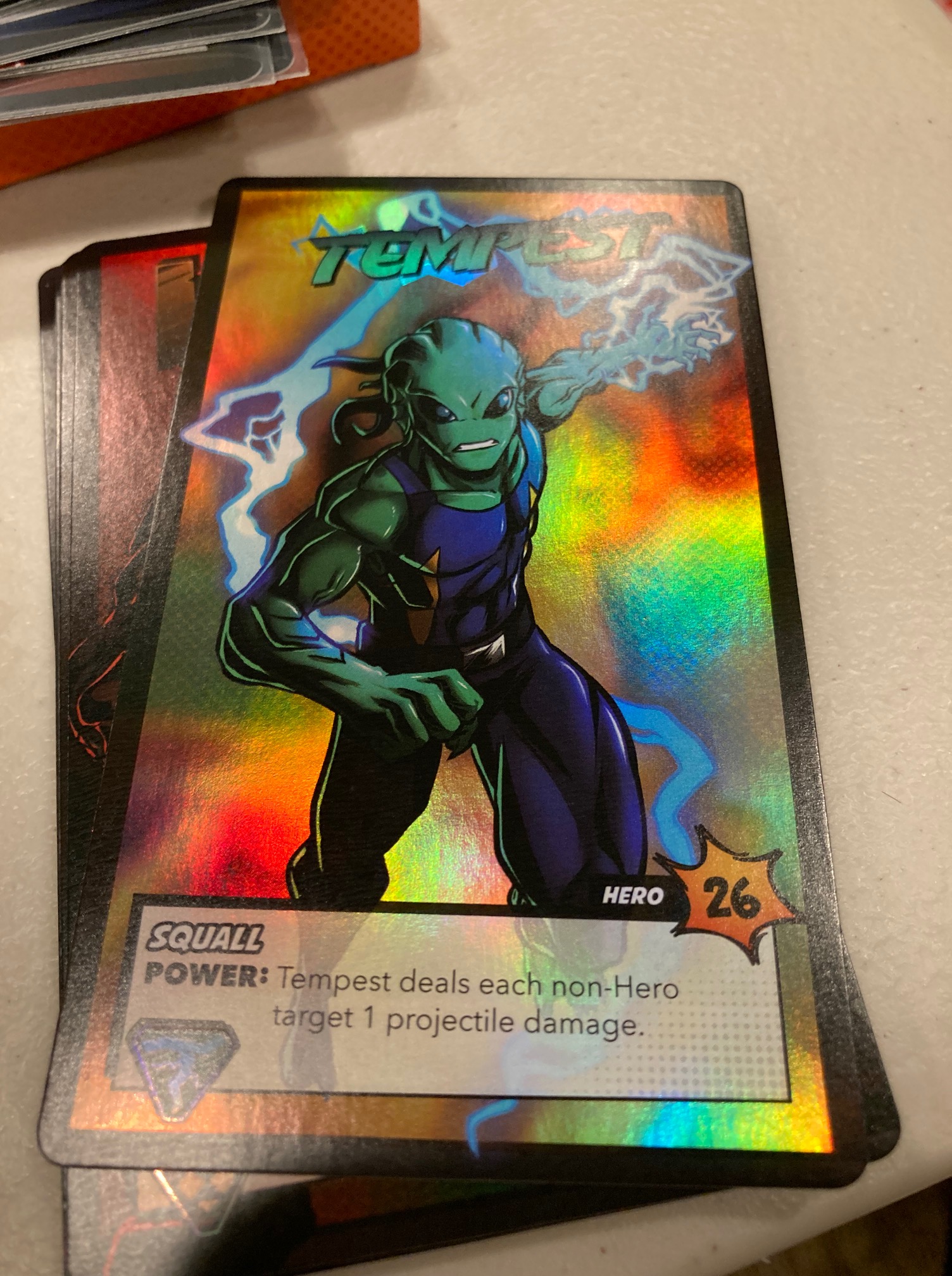
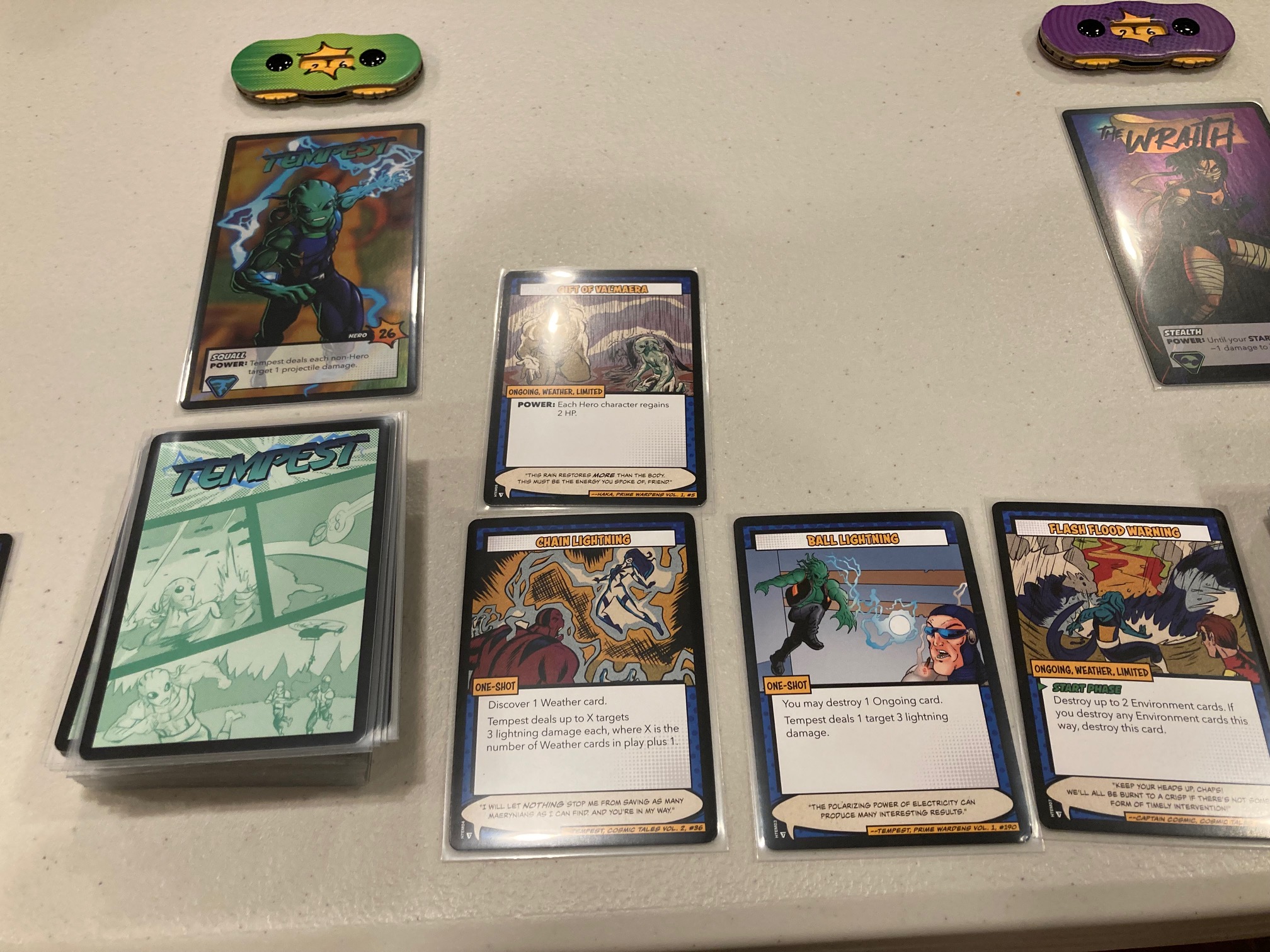
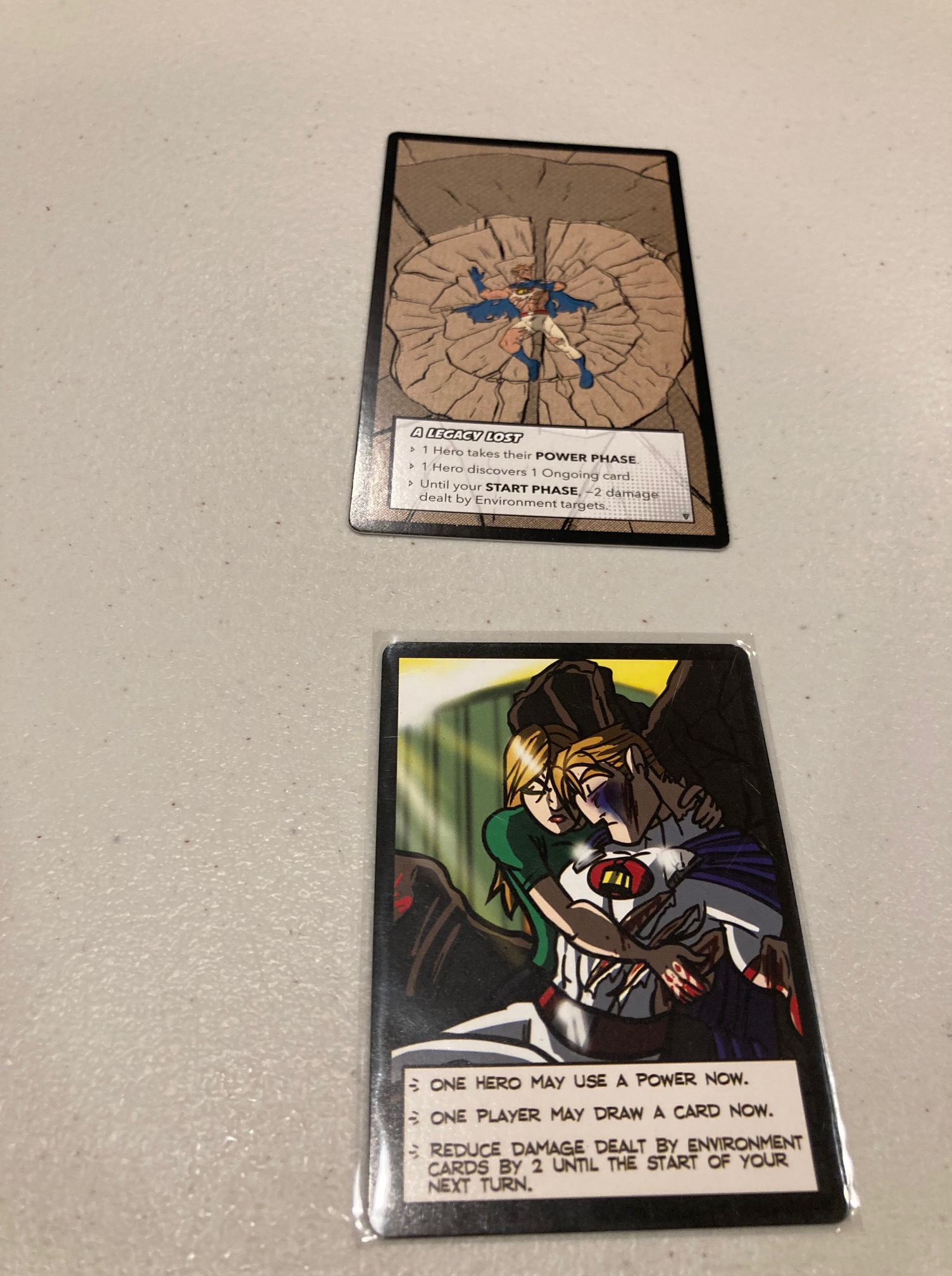
The Definitive Edition chose to make some different choices in the art.  One major choice was to make the Hero Character Cards larger and more dynamic and more modern!  I love the new Legacy card, as it’s a major improvement upon the original, but my absolute favorite piece of art in the game is the new Hero Card for Tempest!  So dynamic!  So cool!

The other choice that the Definitive Edition chose to do was to make the Hero Character  Cards use a retro art style for all (and I mean all) the character cards.  Notice that the style is reminiscent of early 1920s superman art: see below.
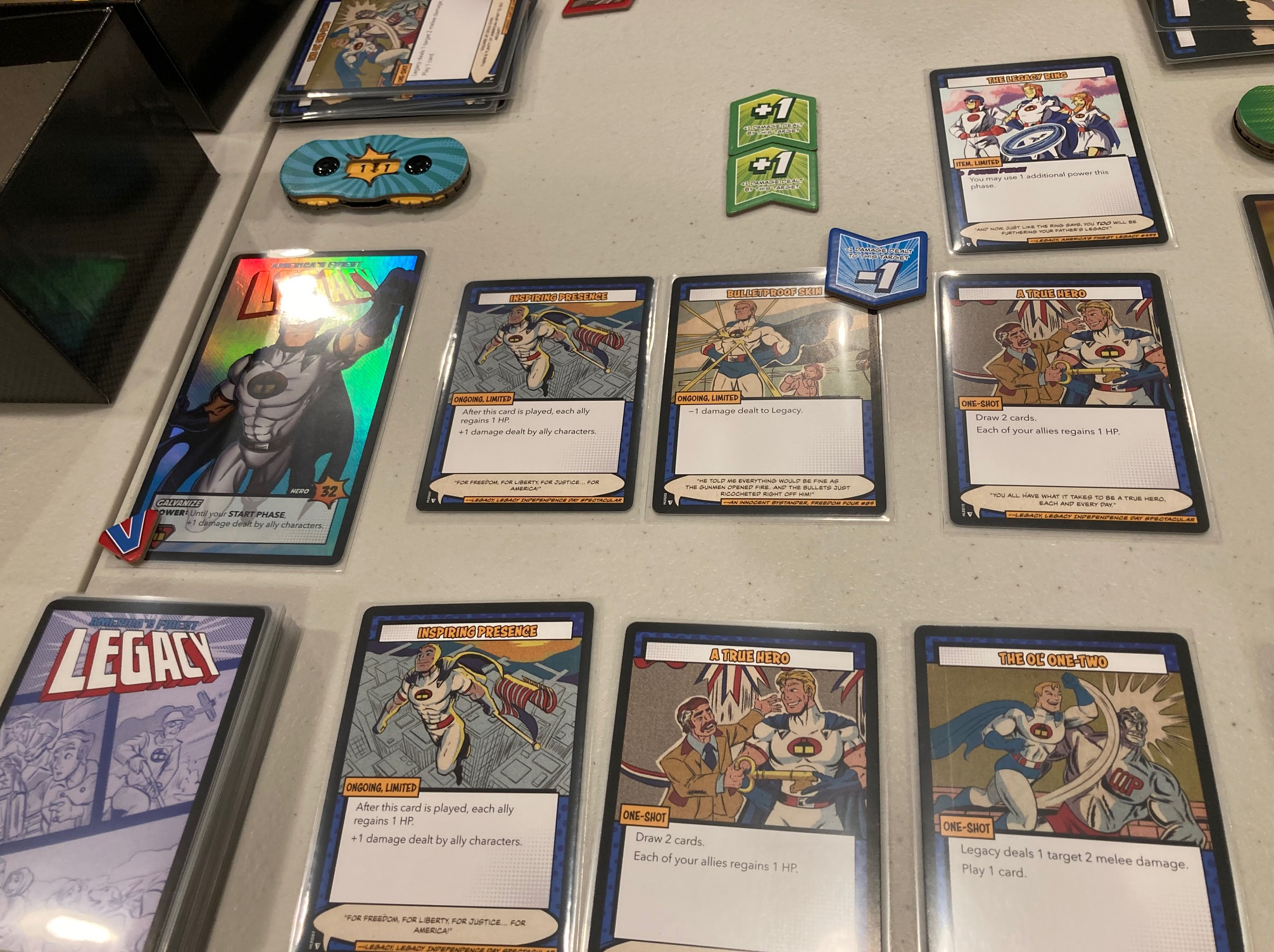
The color palette in the character cards is much more muted, more washed-out.  Now, this color palette and choice of colors seems to permeate all the card in the game (except the large Hero Character Cards).  Below is an example of how it looks on the table.

IMG_9901

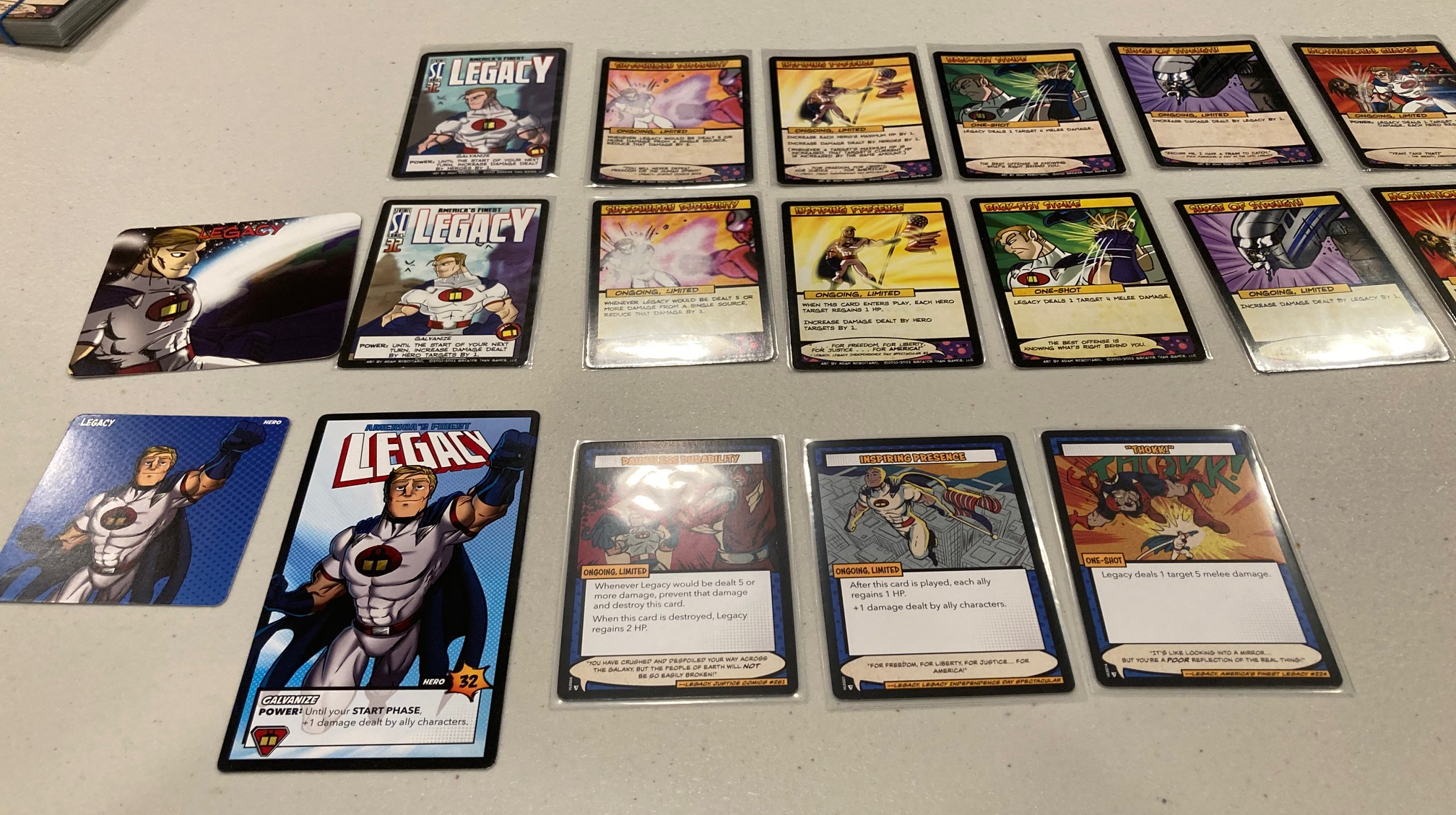
Compare how Legacy’s card looks the 2nd Edition (below).

IMG_9924

Here’s the thing: I don’t like the new color palette and art style.  This is a comic book game! It should be Dynamic!  Exciting! Fresh! Modern!  The choice to use retro  1920’s art is a strange decision to me!  And the color palette is just not for me.  Granted, the hero cards are more “consistent” across each other, but they all kind of look alike!!  One of the GREAT things about the original 1st and 2nd Edition is that the COLOR of the cards helped distinguish them!

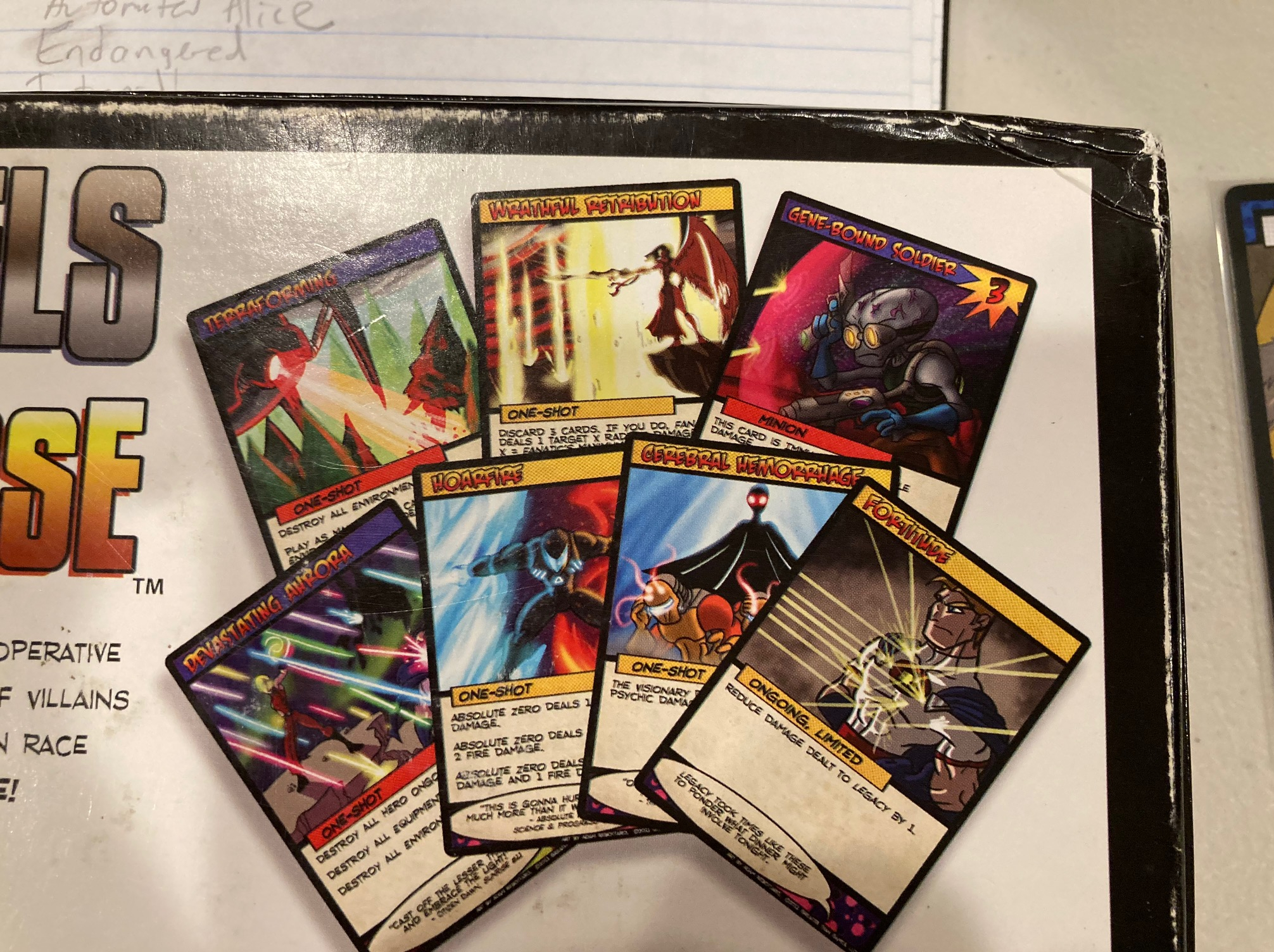
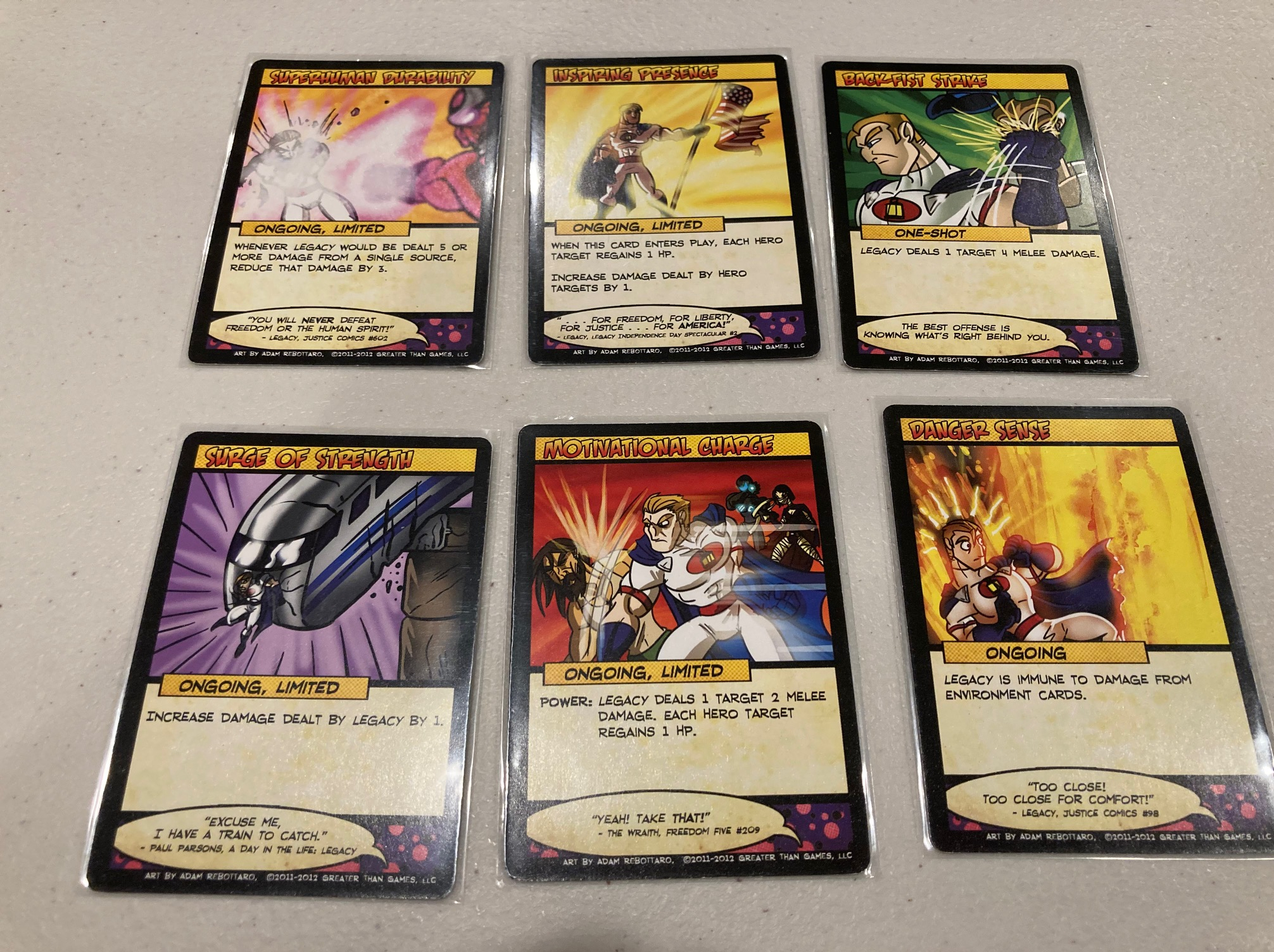
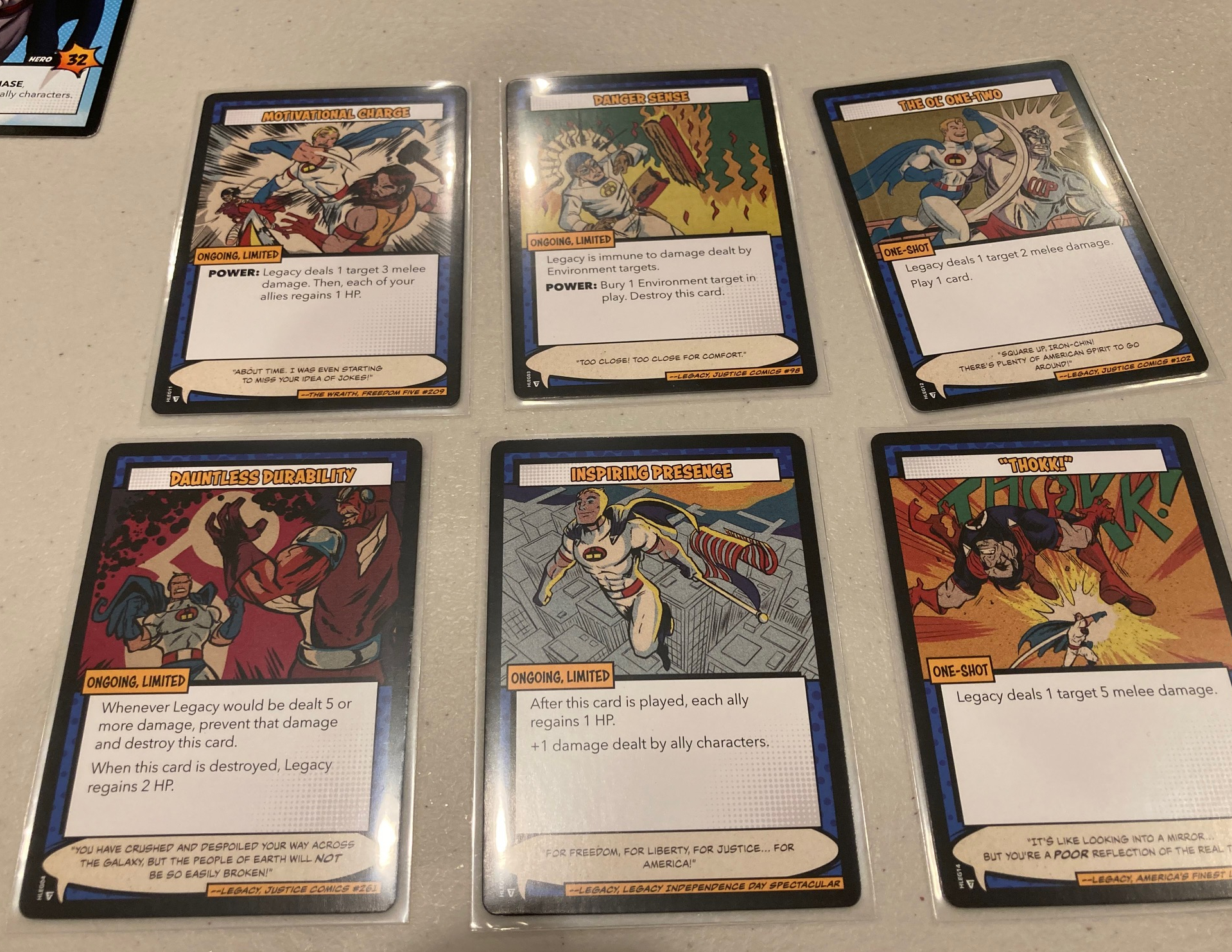
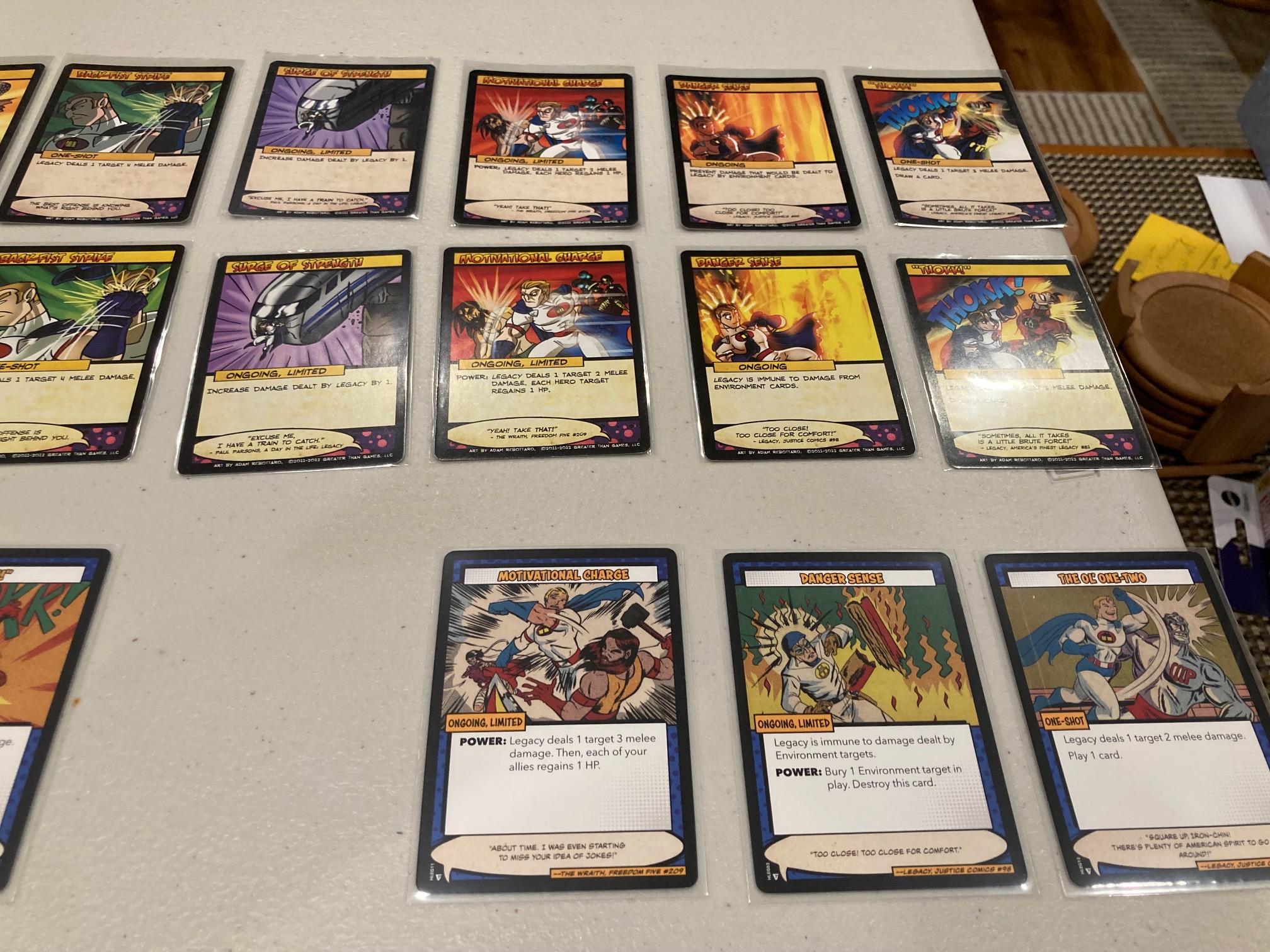
Consider the Legacy cards from the 2nd Edition: Superhuman Durability was very mostly orange and easy to recognize! Surge of Strength was mostly purple!  Danger Sense was bright yellow!  Motivational Charge was red!  These primary colors made the cards alive and stand out!  I could tell what a was just from the colors! AND I could tell what a card was across the table!

IMG_9921

The Definitive Edition versions of these cards just don’t seem to stand out.  They all kind of look the same to me.

IMG_9923

Some people may love the new retro art style and muted color palette. Some people may prefer the older more dynamic and bright palette.  I think I fall into the second category: I want the dynamic colors to help me distinguish the cards!  I like the Kirby/Dirko art of the 2nd Edition!  I just feel like the retro art style and palette is a mistake, especially at a time in modern board games where Sentinels is competing with a lot of beautiful modern comic book games like Marvel Champions!    But, art is subjective.  I’ll let you make your own choice: You may love the retro art and distinctive look it gives the Sentinels of the Multiverse: Definitive Edition: it definitely does set it apart from Marvel Champions.

IMG_9922

Let’s be clear: I AM IN THE MINORITY.  I showed the two different sets of cards to my friends, and they all prefer the new cards in the Definitive Edition!!!  Although my friends agree the color palette may be a little muted in the new Definitive Edition, they think the new art is better, the new card layout is better, the cards titles are easier to read, the font is easier to read, and the style is cool and retro.   So, judge for yourself!  

Smoothing Gameplay

IMG_9934

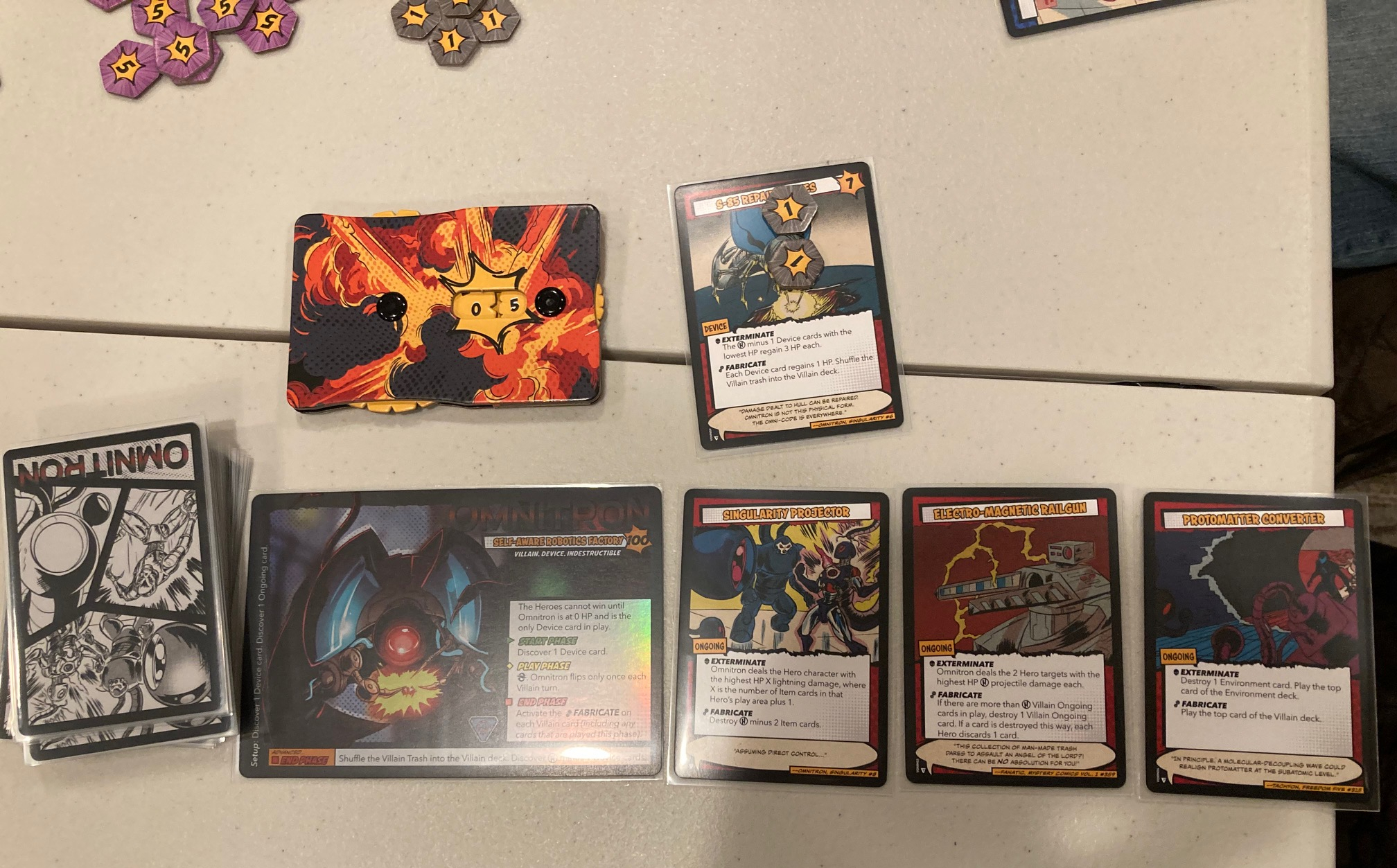
The Definitive Edition is a little smoother than the previous editions.  For example, Omnitron used to have some cards that would destroy ALL Ongoing cards in play (which was devastating), and Omnitron also had some cards which would destroy ALL items in play (which was devastating).  Both of these cards are now gone form the new edition, and I can see why.  If you played the original Omnitron, you could win easily if those cards never came out. Or you could lose very quickly after you built a few turns and lost everything!!!  But it was so demoralizing to build stuff up and have it wiped out.

IMG_9935

So, the new Omnitron is a more “consistent” threat: there are cards that will destroy some Ongoing cards and some Item cards, but never all cards.  Now, Citizen Dawn still has a devastating Aurora (which essentially cleans out all cards), but she now only has 1 of those instead of 2.  EDIT: Whoops!  It looks like they were stuck together, she still has 2 Devastating Auroras …

IMG_9868

Looking at the Villain and Environment decks, it feels like the decks are “smoothed out” so there are fewer devastating events, but the cards may be a little harder.  I think the idea is really to smooth out the play so that the truly demoralizing cards are gone.


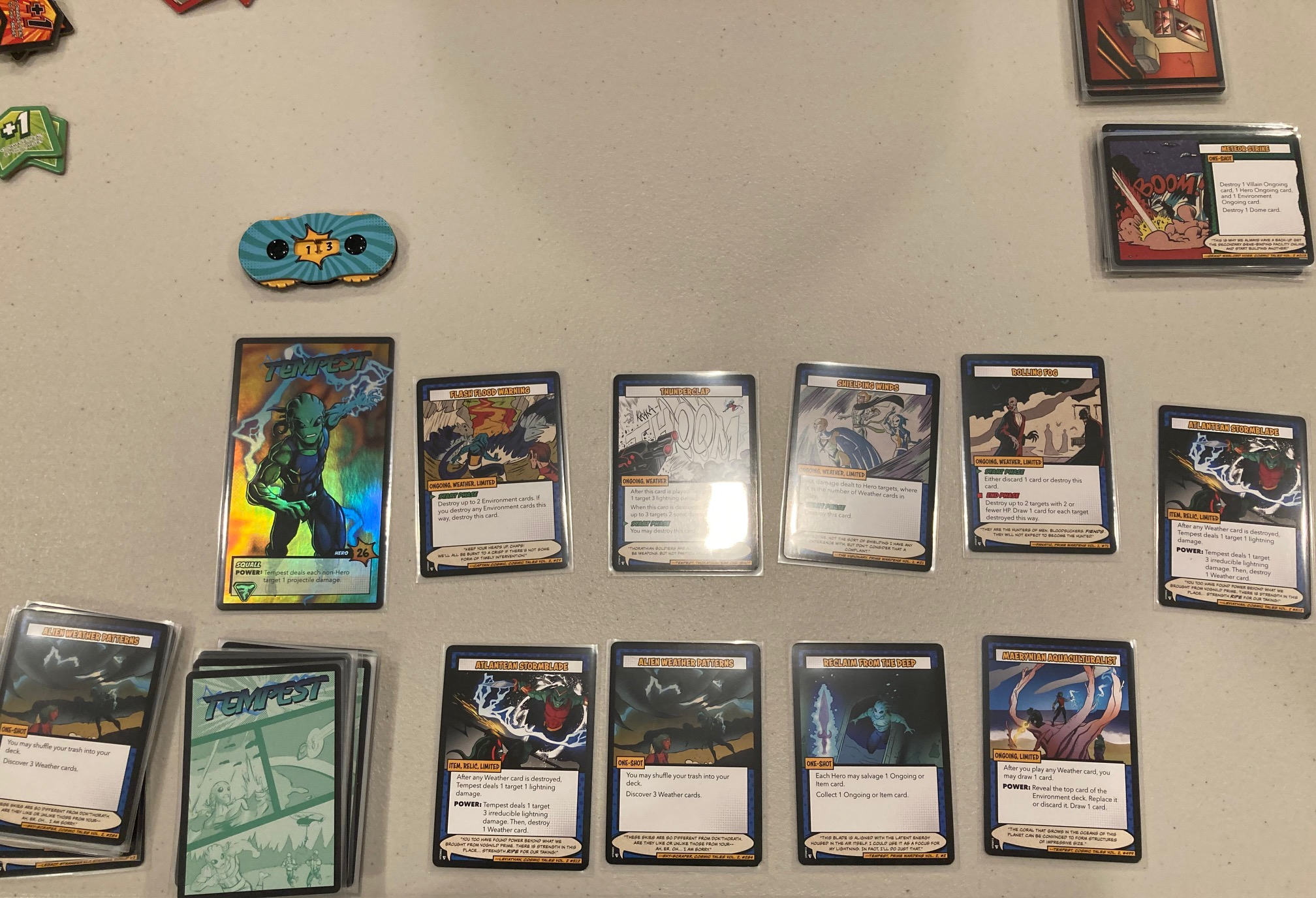
It’s harder to talk about the Heros because they have definitely changed.  My friend CC was telling me that Unity feels a lot easier to get stuff going that previously.  They have definitely gotten rid of some of the more unbalanced cards in the Hero decks as well.    Legacy’s Take Down used to be able to just stop the Villain deck for a turn, now it’s a little less powerful. Tempest’s deck has become much more complicated with Weather cards, but Ball Lightning is less powerful (only destroys 1 Ongoing card) and Reclaim From the Deep is less powerful.  And Tempest has lost his Into The Stratosphere Card which allowed Tempest to delay the Villain Deck: it’s gone.  These changes seem to be making the Hero Decks less powerful.

IMG_9926

You know what this reminds me of?  When they reboot a comic book series and “slightly change” the Hero’s powers!  I am currently very grumbly over the changing of the Hero Decks.  I used to know them inside and out, and now they are just different enough to be annoying.  The experiences are more “smoothed” out, which is a good thing for newer players, not so much for veterans of the game.  Bah, maybe I am just mad that I have to relearn everything.

Conclusion

IMG_9707

To be clear: Sentinels of the Multiverse is my favorite game of all time. It makes me feel like I am a superhero: I give it a rare 10/10.  So I recommend it heartily.  The new Definitive Edition is “essentially” the same game as the 1st Edition or 2nd edition (with some “smoothing”), so I can recommend it as well.  The Definitive Edition has also embraced a lot of new modern components (large cards, better tokens, spinner counters): these new modernizations which really augment the experience.

If you are interested in the game, however, you probably are wondering what edition to get.

IMG_9928

Is Sentinels of the Multiverse: Definitive Edition right for you? If you are new to the Sentinels of Multiverse system and all your friends are new as well, I can heartily recommend it. If you are going to be starting fresh, start with the supported game!  It’s clear that Greater Than Games will be supporting the new Definitive Edition moving forward (they are teasing the first expansion already), so that’s the one to get. 

IMG_9789

If you never liked Sentinels of the Multiverse, this new edition won’t change your mind.  My friends who don’t like Sentinels of the Multiverse claim its “fiddly”.  The Definitive Edition doesn’t really change that much, so they would still have the same problem with it.

IMG_9921

Choosing between the 2nd Edition and Definitive Edition is a little tougher if you already have some investment in the 2nd edition.  You need to honestly answer some questions for yourself:

  • Do you like the new art on the player cards?  It’s consistent throughout the game: it’s an art style consistent with older Superman comics, so it’s a retro art style.  The 2nd Edition art was a little less consistent but more modern.  (Well, 2nd Edition was more Kirby meets Ditko).
  • Do you like the color palette of the cards? The color palette of the player cards  is much more subtle than previous editions.  Again, it’s very consistent across the cards.  If you like that palette,  you might describe it as “subtle and less aggressive”.  If you don’t like that palette, you might describe it as “dreary and washed out”.  
  • How invested are you in the 1st and/or 2nd Edition?  This is both a money and time question.

IMG_9940

I personally like the art and dynamic colors of the 2nd Edition better than the new Definitive Edition. But remember, I am in the minority on the new art and cards: all my friends like the Definitive Edition much better! I also have invested quite a bit of money and time into the 2nd Edition, so it’s hard for me to justify a brand new edition, especially since I already like the game so much as it is.  So, I will keep my original 2nd Edition and play that edition with my friends who have already invested in the 2nd Edition.  I will, however, keep the Definitive Edition around so I can introduce new people to the Sentinels world.  

I will also be very careful about updating my Sentinels of the Multiverse App on my iPad: I want to stay in the old world! I don’t want to lose the 2nd Edition gameplay!

Appendix: Look For Used?

IMG_9942

As the Definitive Edition starts appearing in retail, a lot of stores will be cleaning out their old Sentinels 2nd Edition supplies for cheap. Also, a lot of gamers might be selling all their old Sentinels 2nd Edition used for cheap to make way for the new edition. I suspect, for the next year, that you could get almost all of the Sentinels 2nd Edition for super cheap. At some point, the old stuff will all disappear.

My guess would be that for the next year, Sentinels 2nd Edition will be very cheap both new and used.

A Review of Lost Ones: A Cooperative Interactive Adventure Game

IMG_9614 (1)

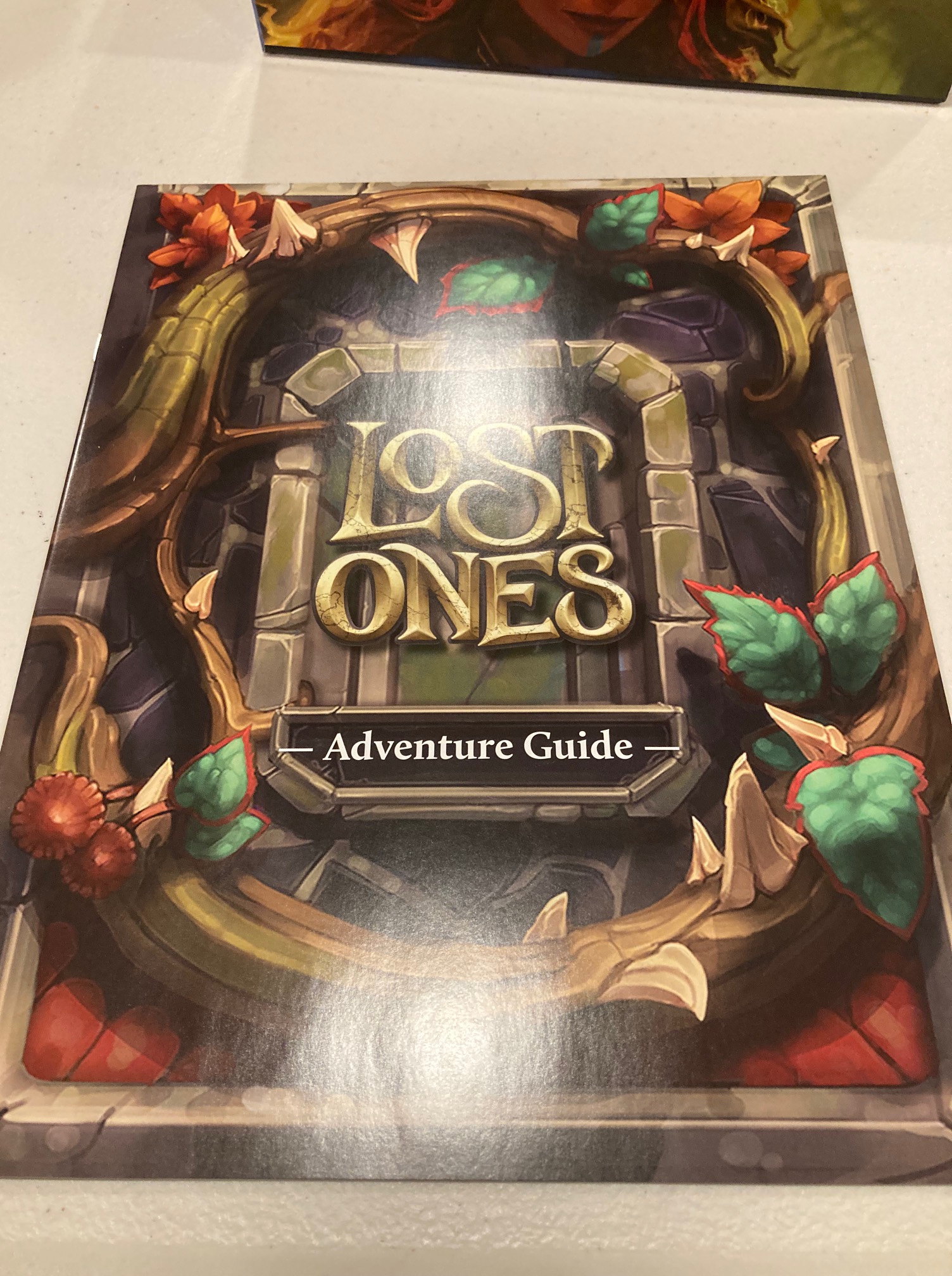
The Lost Ones was a cooperative game that was on Kickstarter back in November 2020. It just delivered to my house this week (January 22nd) after promising delivery in June 2021. I went in only on the base game, but there were also miniatures and an expansion for this game as well: we’ll just be looking at the base game here.

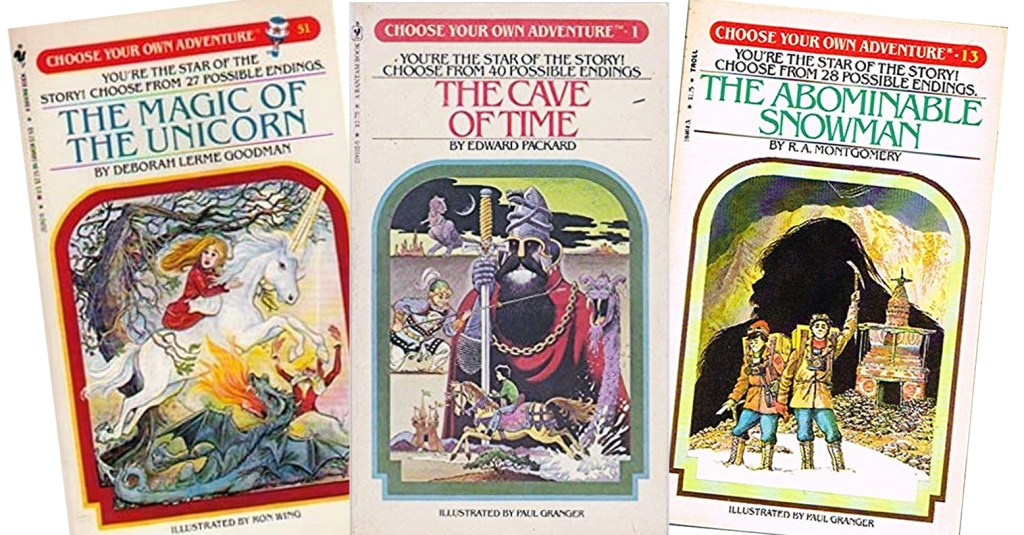
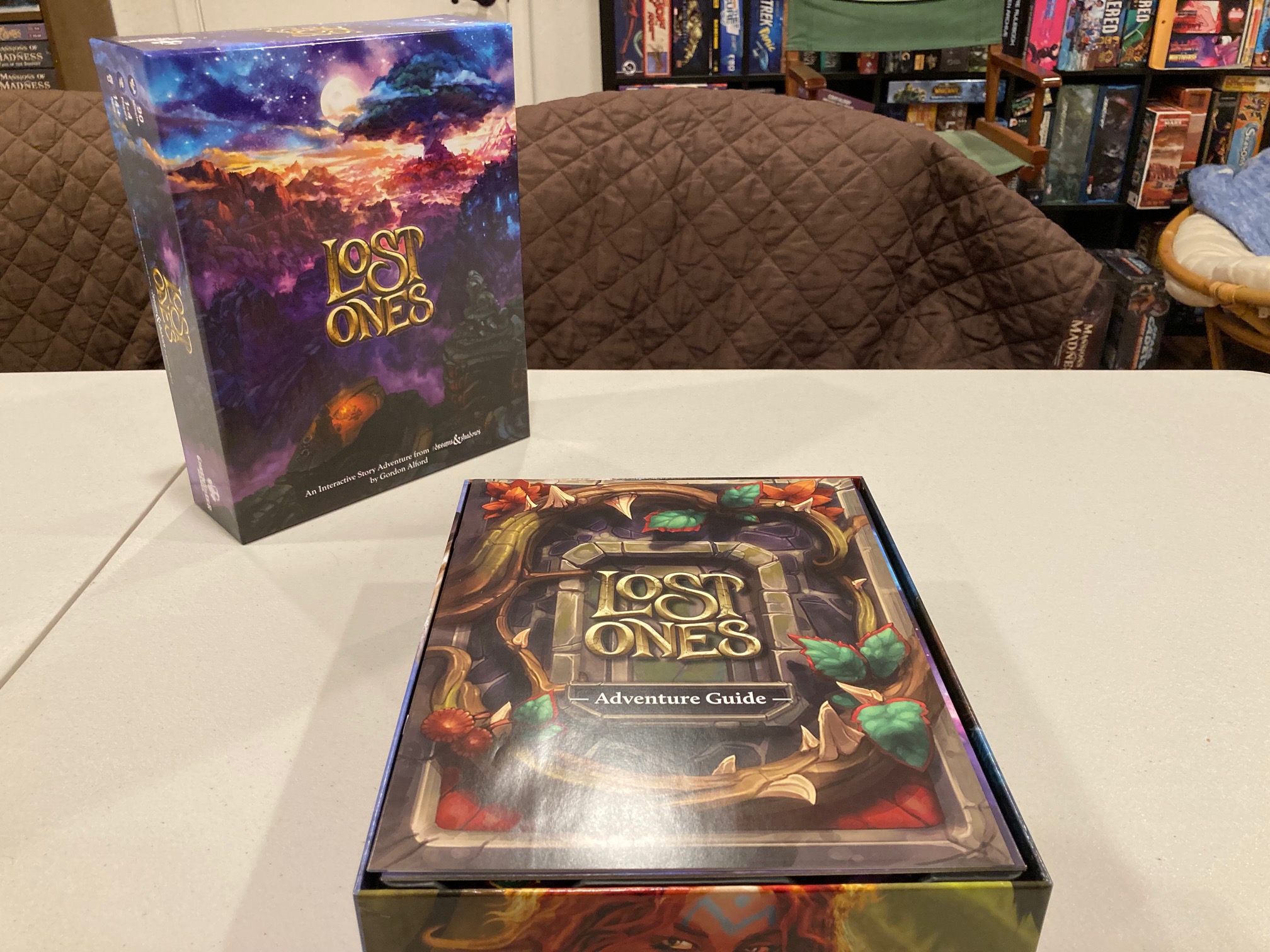
So, The Lost Ones bills itself as An Interactive Story Adventure from Dreams and Shadows (see above). What does that mean? The interactive story adventure part means this game fits into the cooperative Storybook Adventure games, as seen in our Top 10 Cooperative Storytelling/Storybook Games: these are games where a storybook (that comes with the game or app) helps guide the players through an adventure. The closest analogue would be The Choose Your Own Adventure books, where you read through a story and make choices, turning through pages in a book.

ChooseYourOwnAdventure-Featured

The world of The Lost Ones is the same as the Dreams and Shadows world:

IMG_9552

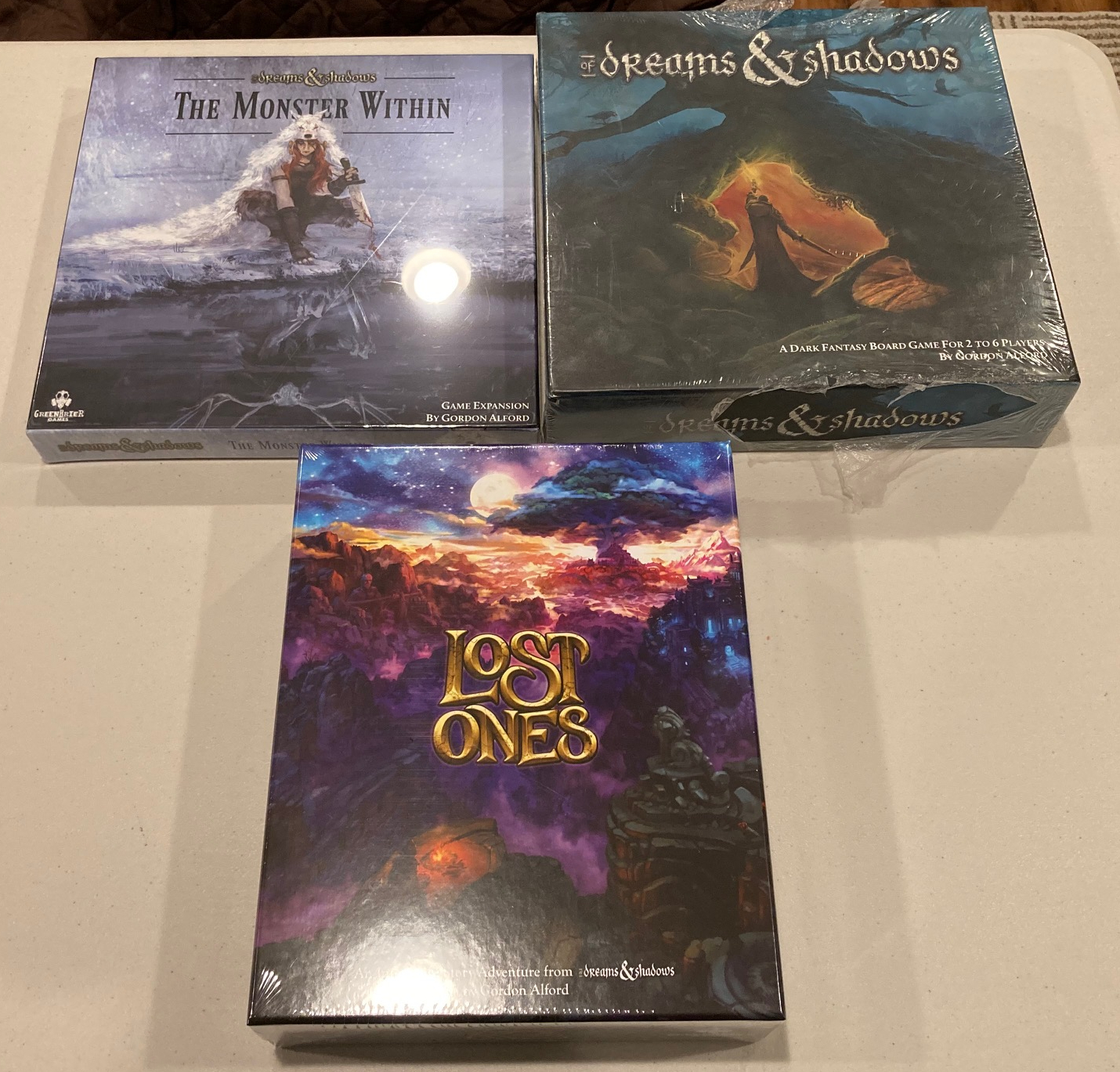
Gordon Alford designed The Lost Ones and a previous cooperative game, Dreams and Shadows (which I have yet to play, but I do want to: I mean, they still have their shrink wrap!), See above. The Lost Ones seems to take place in the Dreams and Shadows universe.

IMG_9554

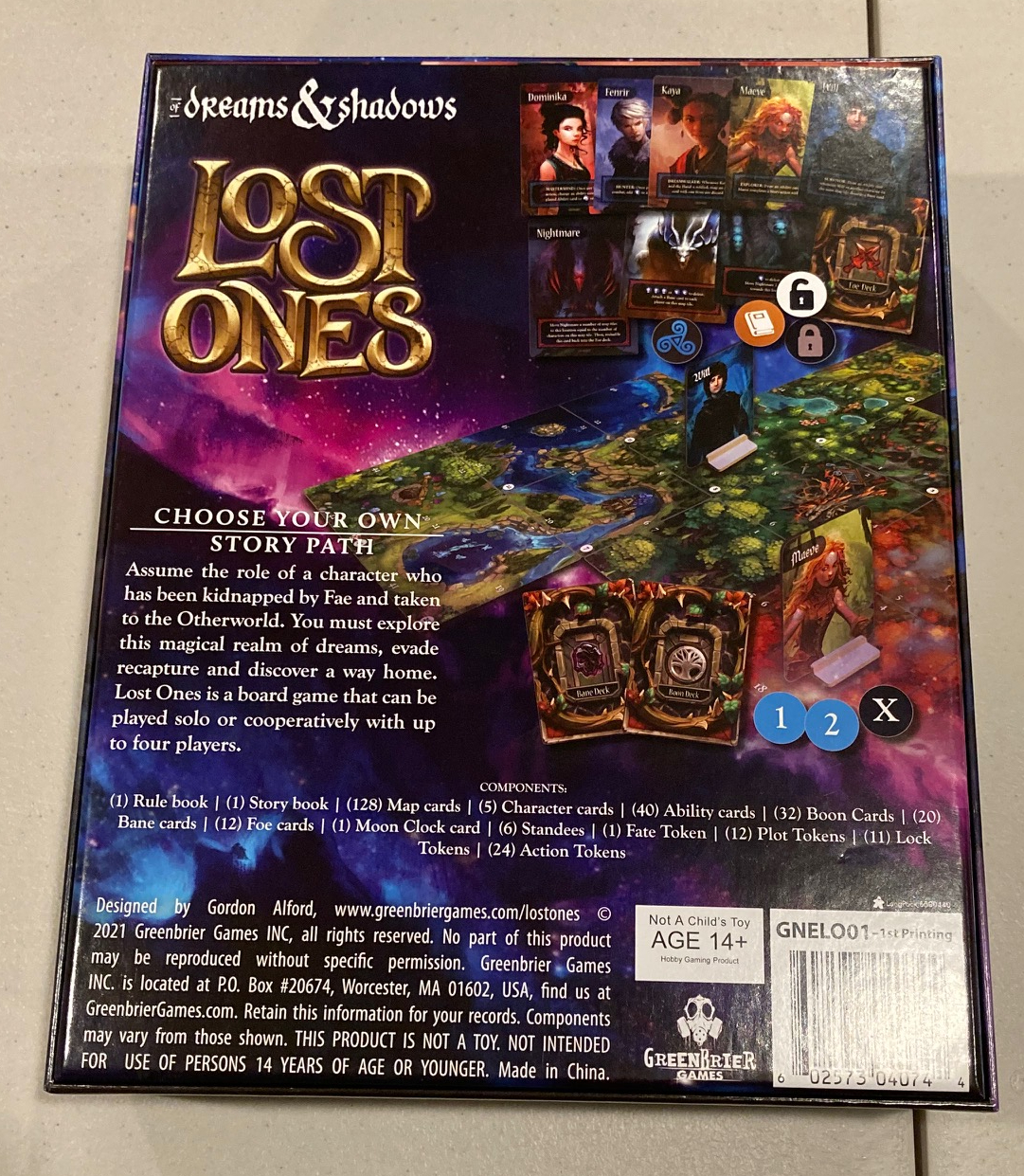
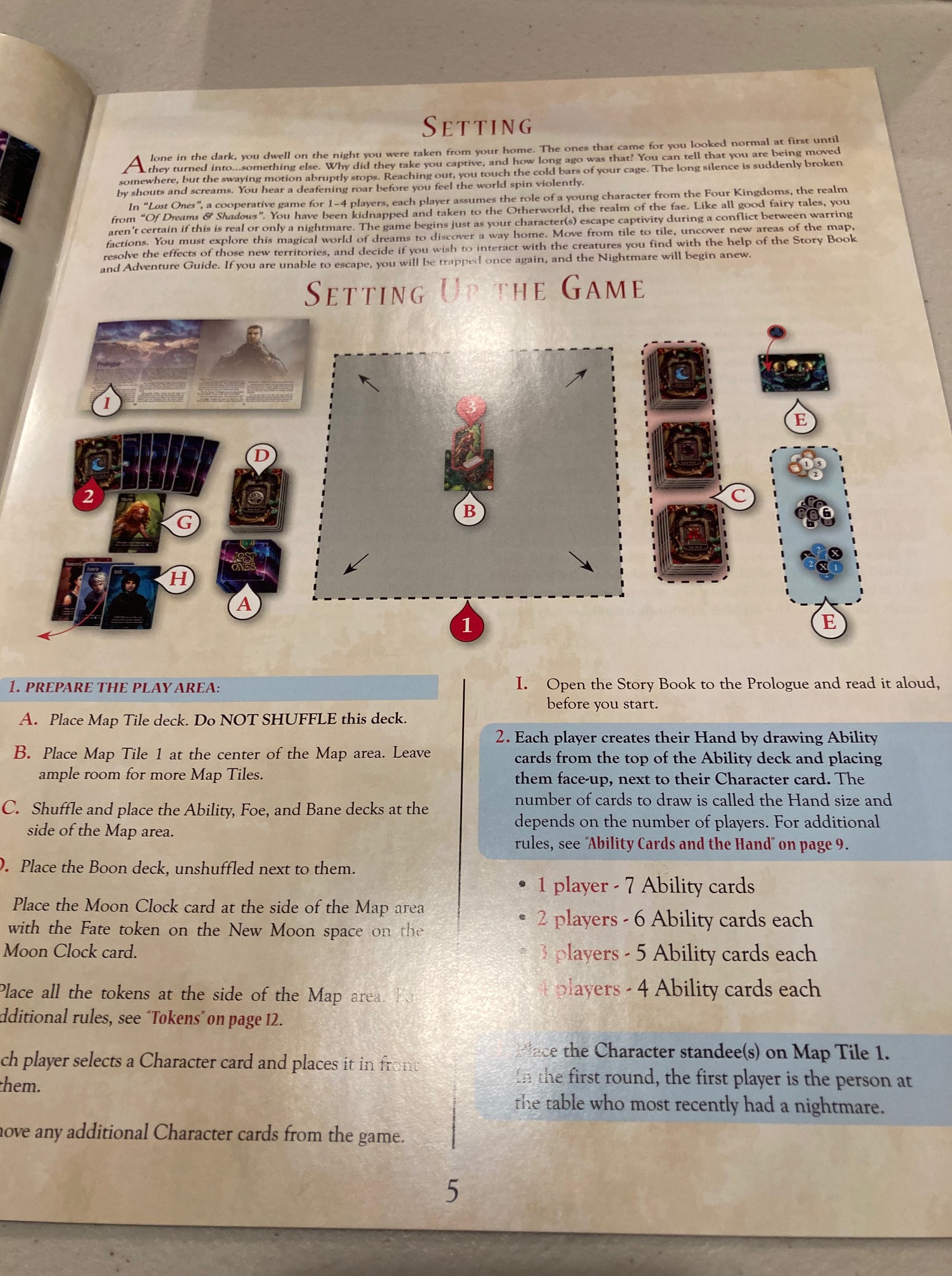
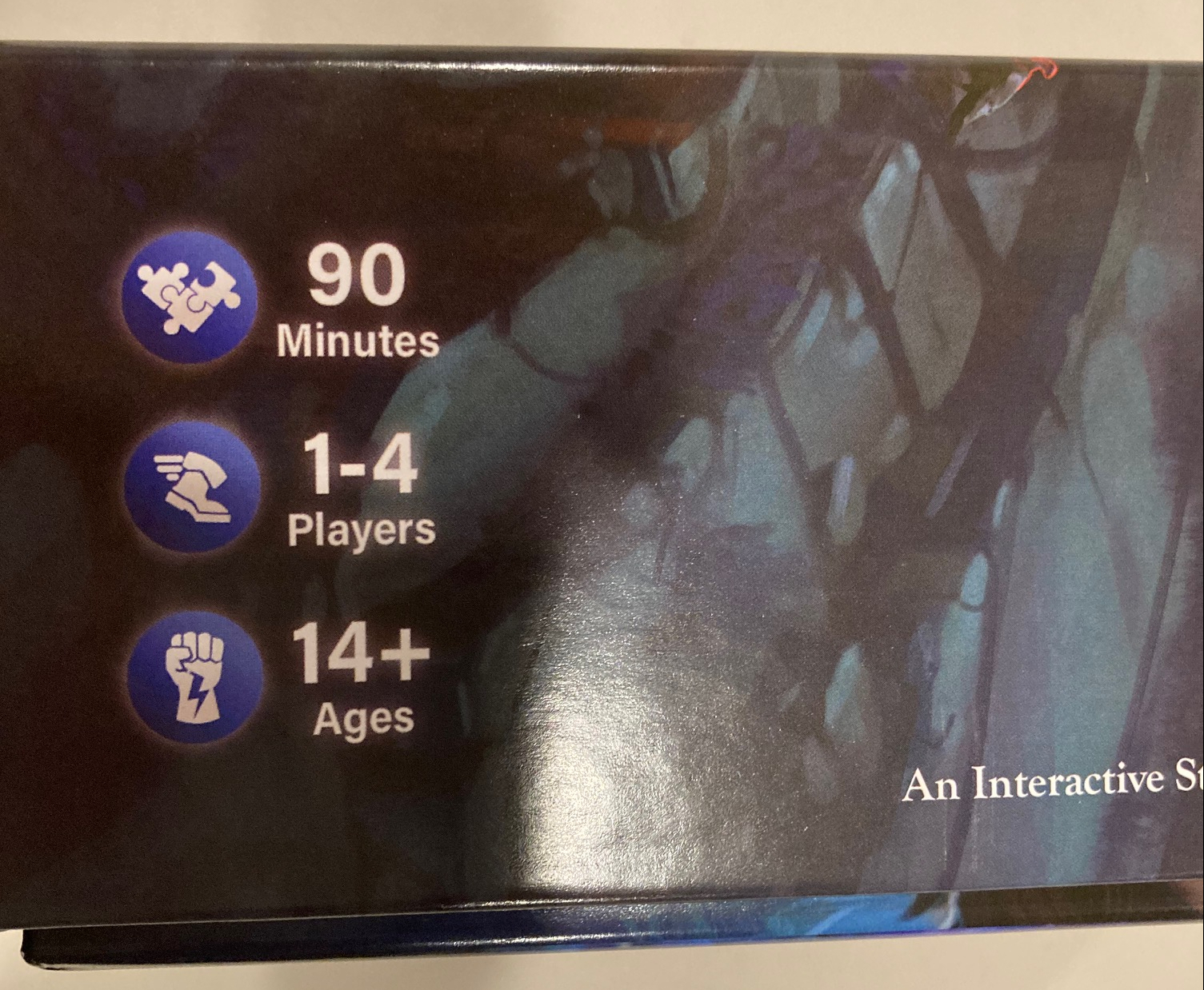
As should be obvious from the back of the box (above), The Lost Ones (and Dreams and Shadows) is a fantasy universe. The Lost Ones plays 1-4 players, ages 14+, in about 90 minutes. That 90 minute time is very squishy, depending on how you play. Let’s take a look below.

Unboxing and Discussion

IMG_9559

The Adventure Guide, the book at the top of the box when you open, is both a rulebook and a partial storybook.

IMG_9573 (1)

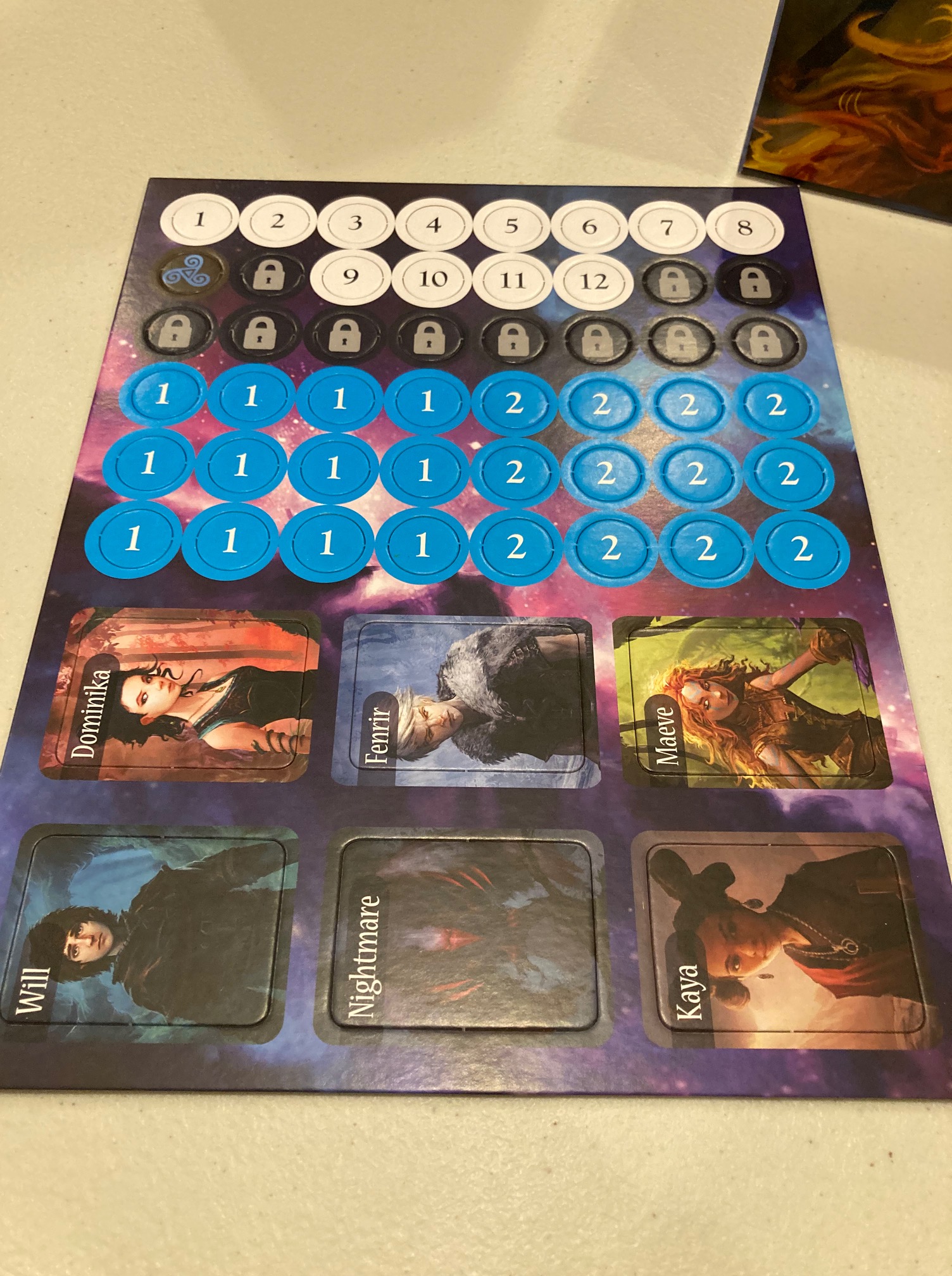
Next in the box come the standees and tokens: see above. The standees and tokens are nice enough (apparently, there were miniatures for the deluxe version): the art in this game seems to be very consistent with the same art from the cover, which is saying a lot: that cover is pretty amazing!

IMG_9574 (1)

Below all the books and tokens are the cards and the “little storybook”.

IMG_9576 (1)

I call it “the little story book” because it’s kind of small! See the Coke Can above for comparison. One of the things that’s a little confusing is that there are two “text books”: the story book above, and the text blocks from the Adventurer’s Guide. We’ll talk more about this split later!

IMG_9583 (1)

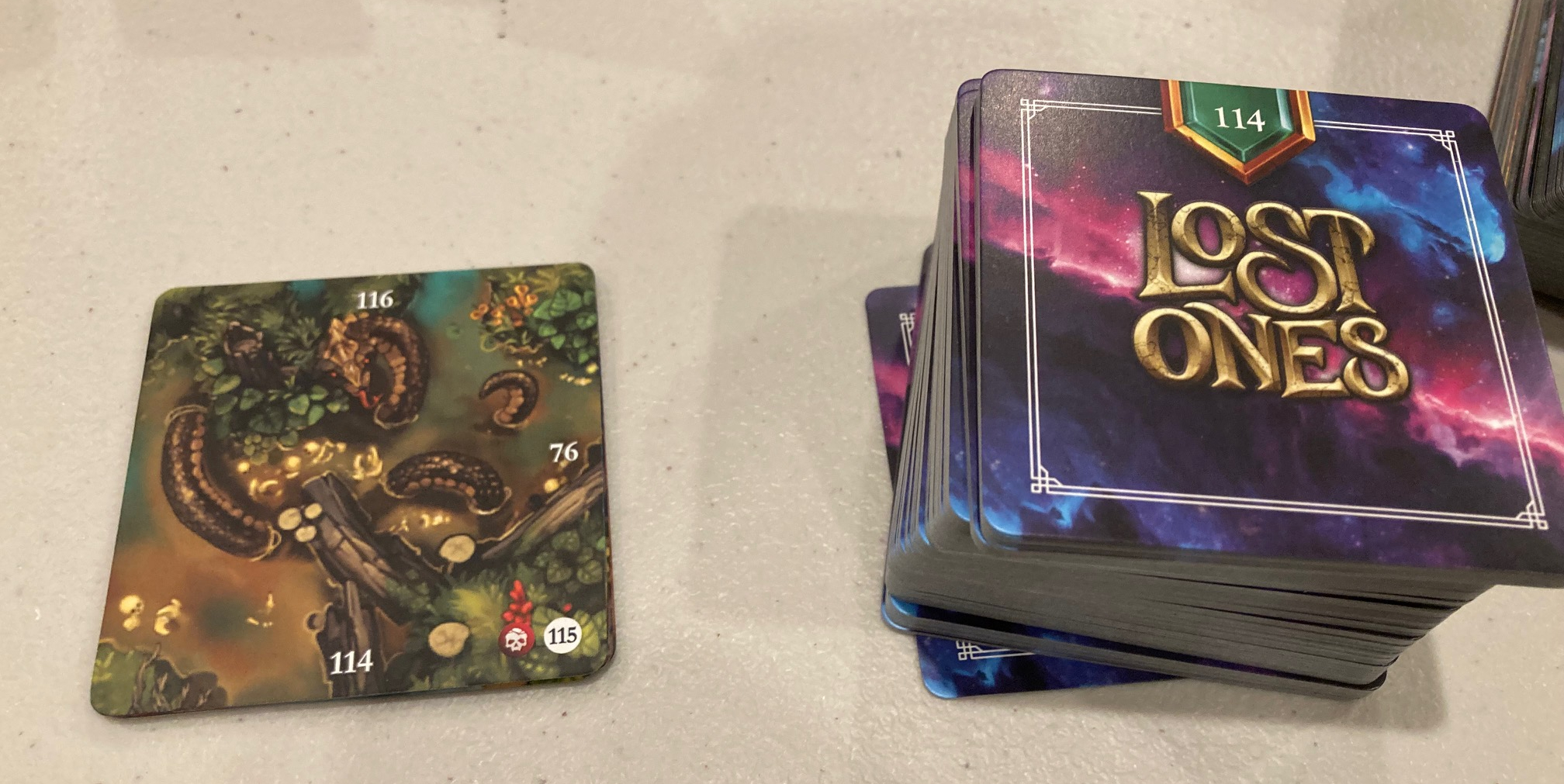
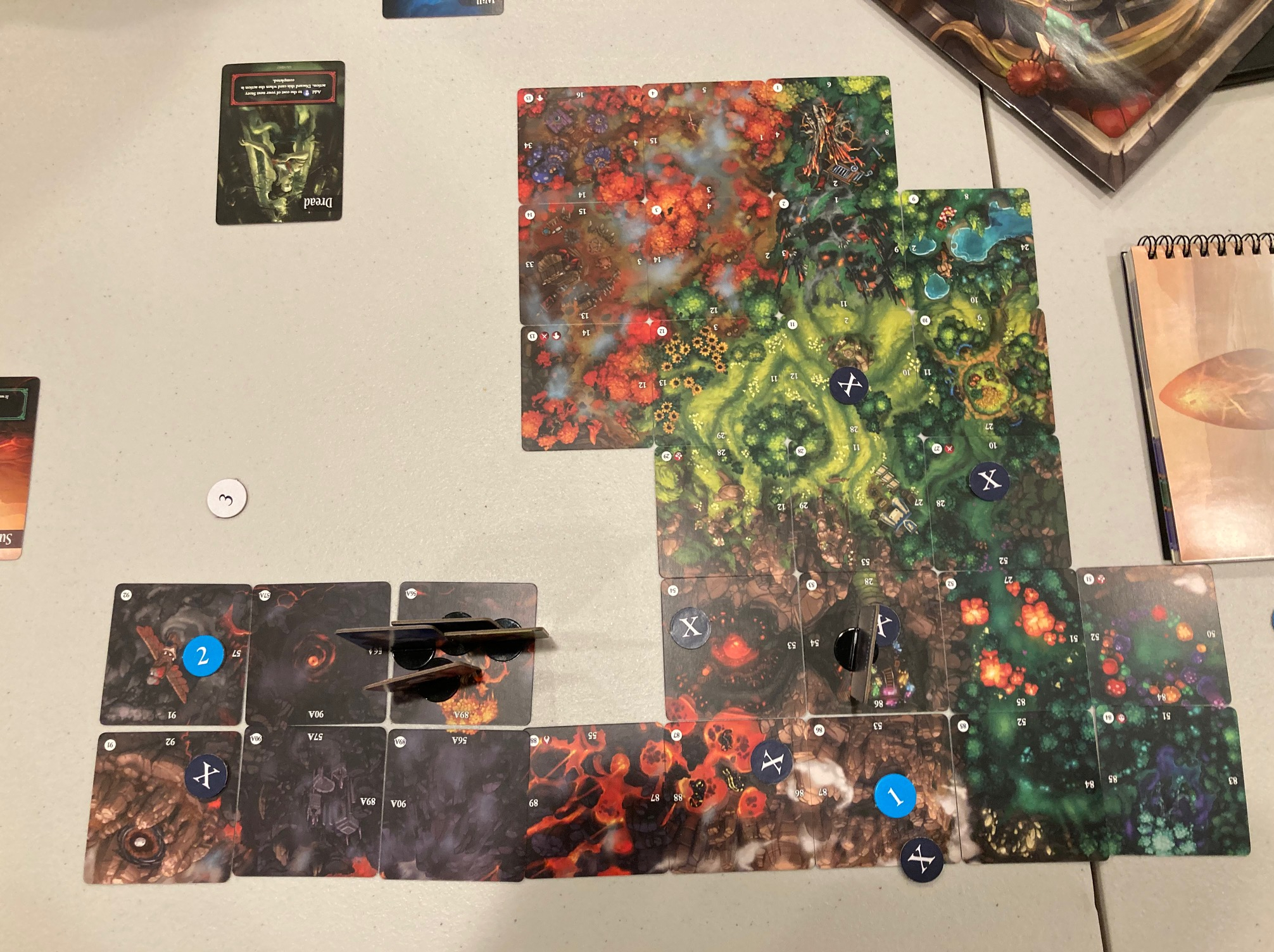
The square cards form the terrain of the game: this kind of reminds me of Tainted Grail (see Part I and Part II of our review) or The 7th Continent, with numbers on the edges refer to the adjacent tiles and form the map. Below is a partial preview (don’t look too close, or you might spoil some story): this map looks fantastic when set-up!

IMG_9624 (1)

Players take the role of a character with individual powers, and each have a special card: see below.

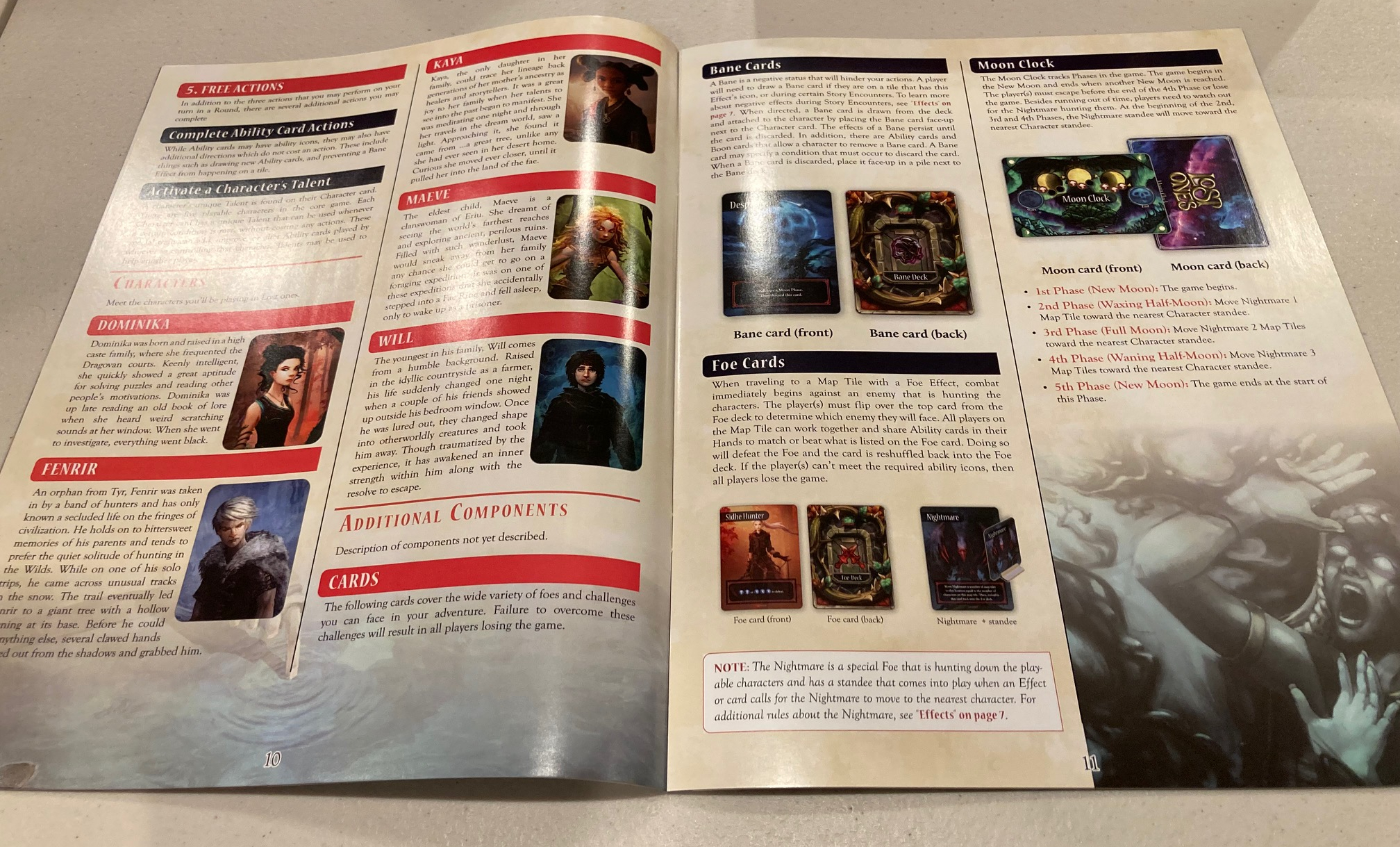
The Nightmare (the black standee and card) will be a creature that follows the characters around the map: if The NIghtmare ever reaches a character, the game is over!

IMG_9584 (1)

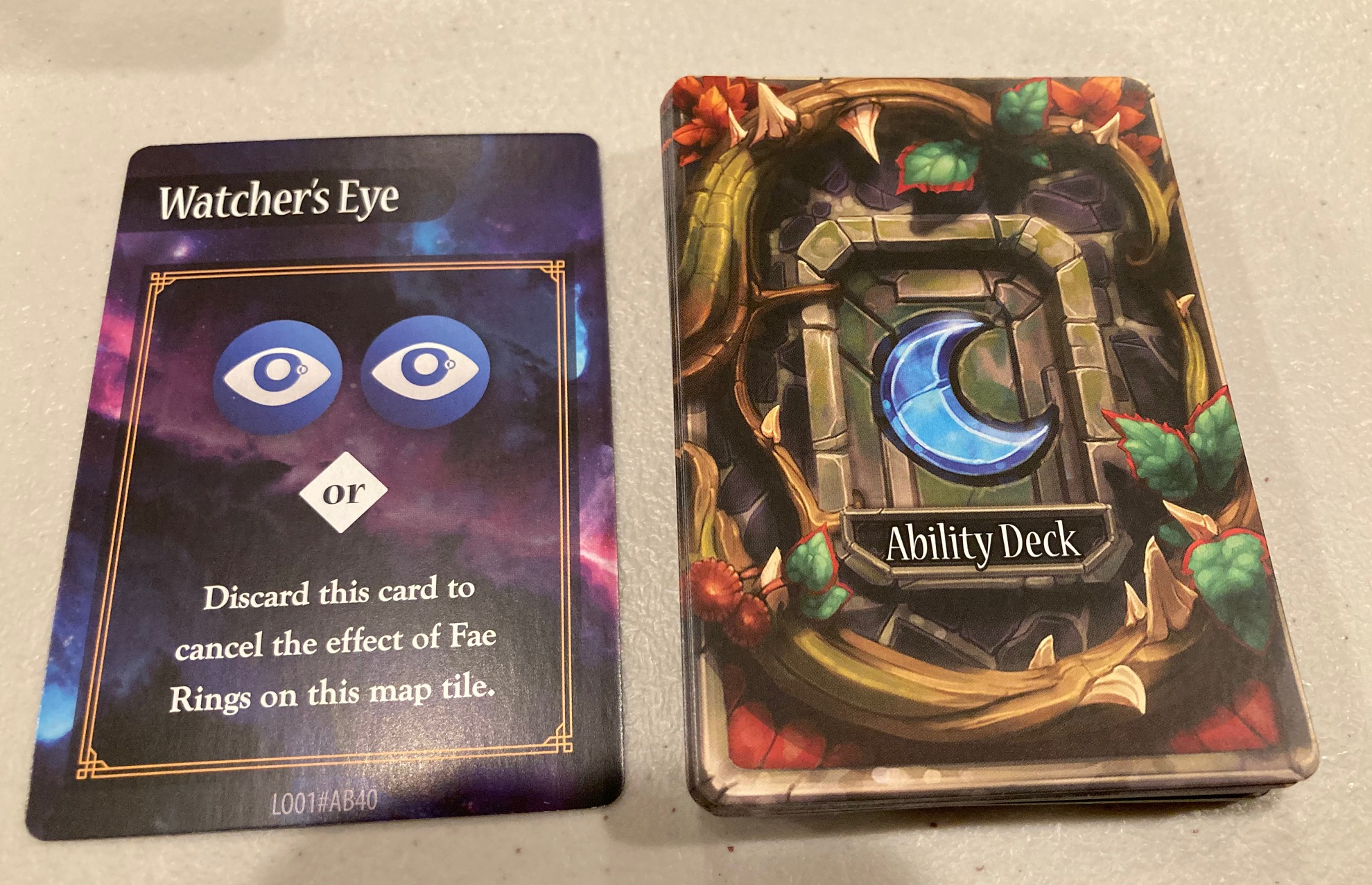
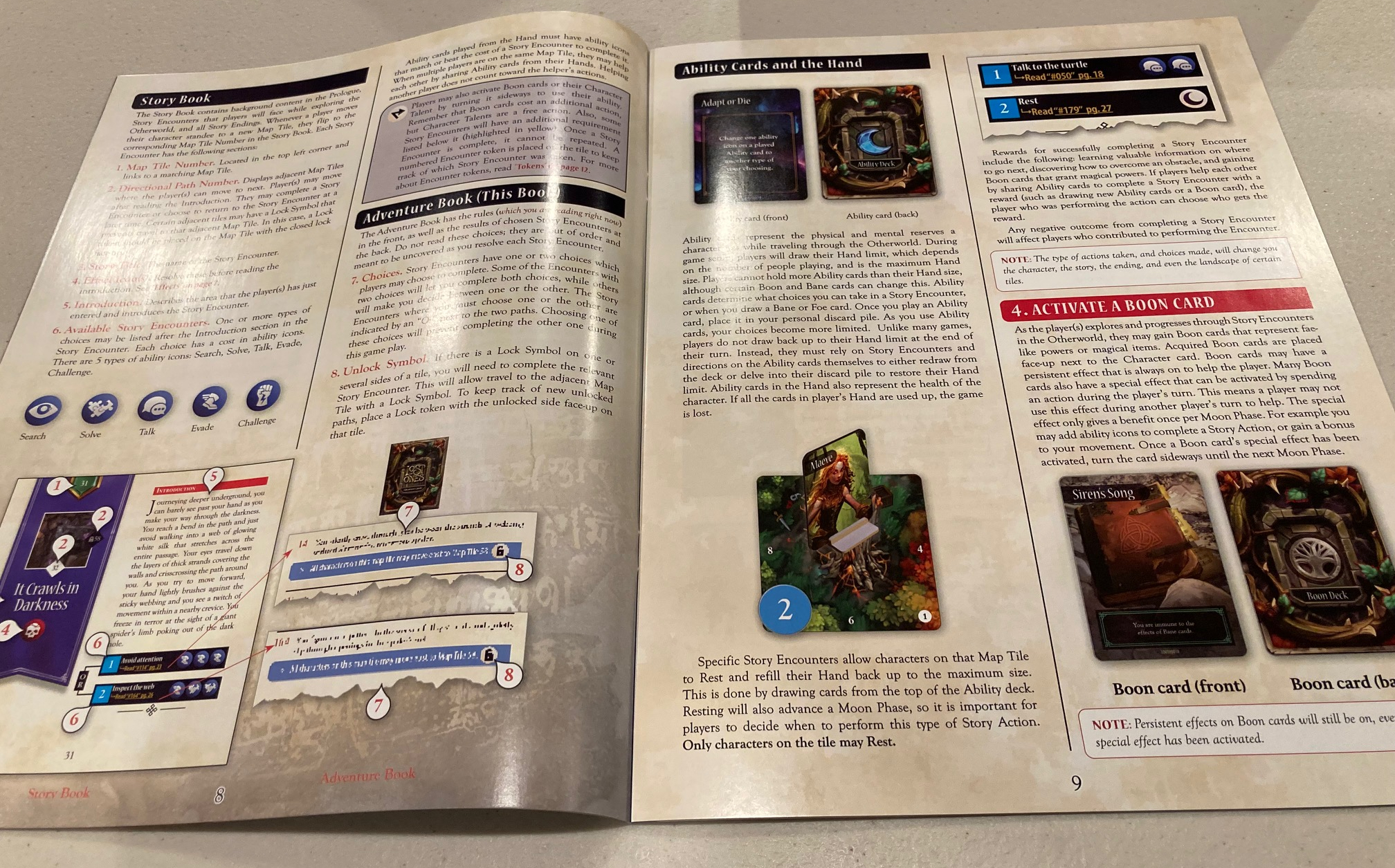
The core mechanism in the game for “getting stuff done” is the discarding of Ability cards: see a sample card (back and front) above. Through out the game, you will find challenges that need those icons to pass a challenge. For example, from the “little story book”:

In the storybook pages above, you can see two challenges, and a place to rest: in order to “pass a challenge”, you have to discard enough Ability Cards to read the text from the Adventure Guide. When you rest in the game, you can refill your hand of ability cards: there’s not a lot of other ways to get Ability Cards so they are a bit precious.

IMG_9569

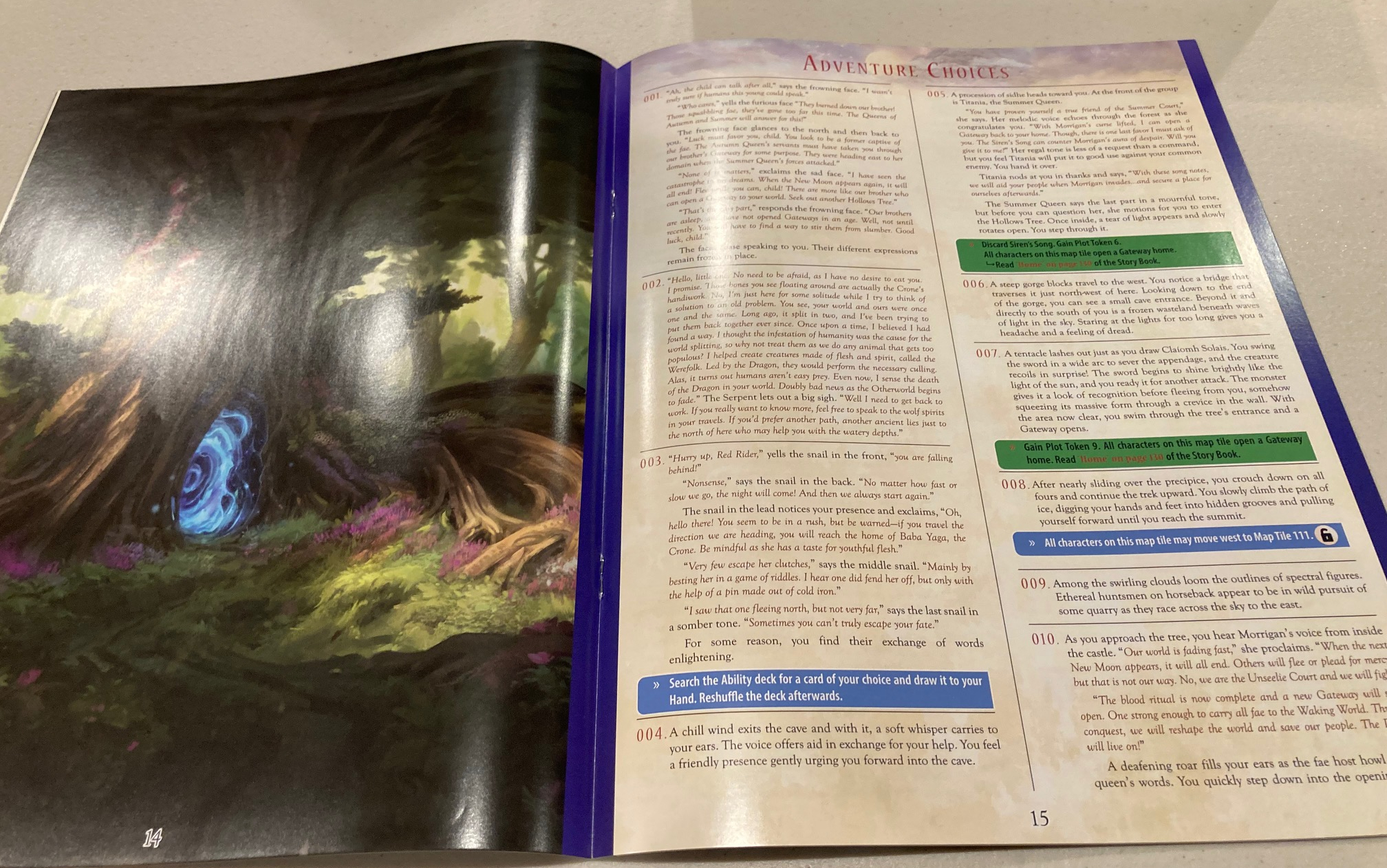
When do you actually pass a Challenge, you read from the guide: see some pages above. (The first half of the Adventurers’ Guide is rules, the second half is Adventure Choices). The choices you make are choosing which challenges to engage: these come from the Story Book. The results of your choices come from the Adventure Guide.

IMG_9585 (1)

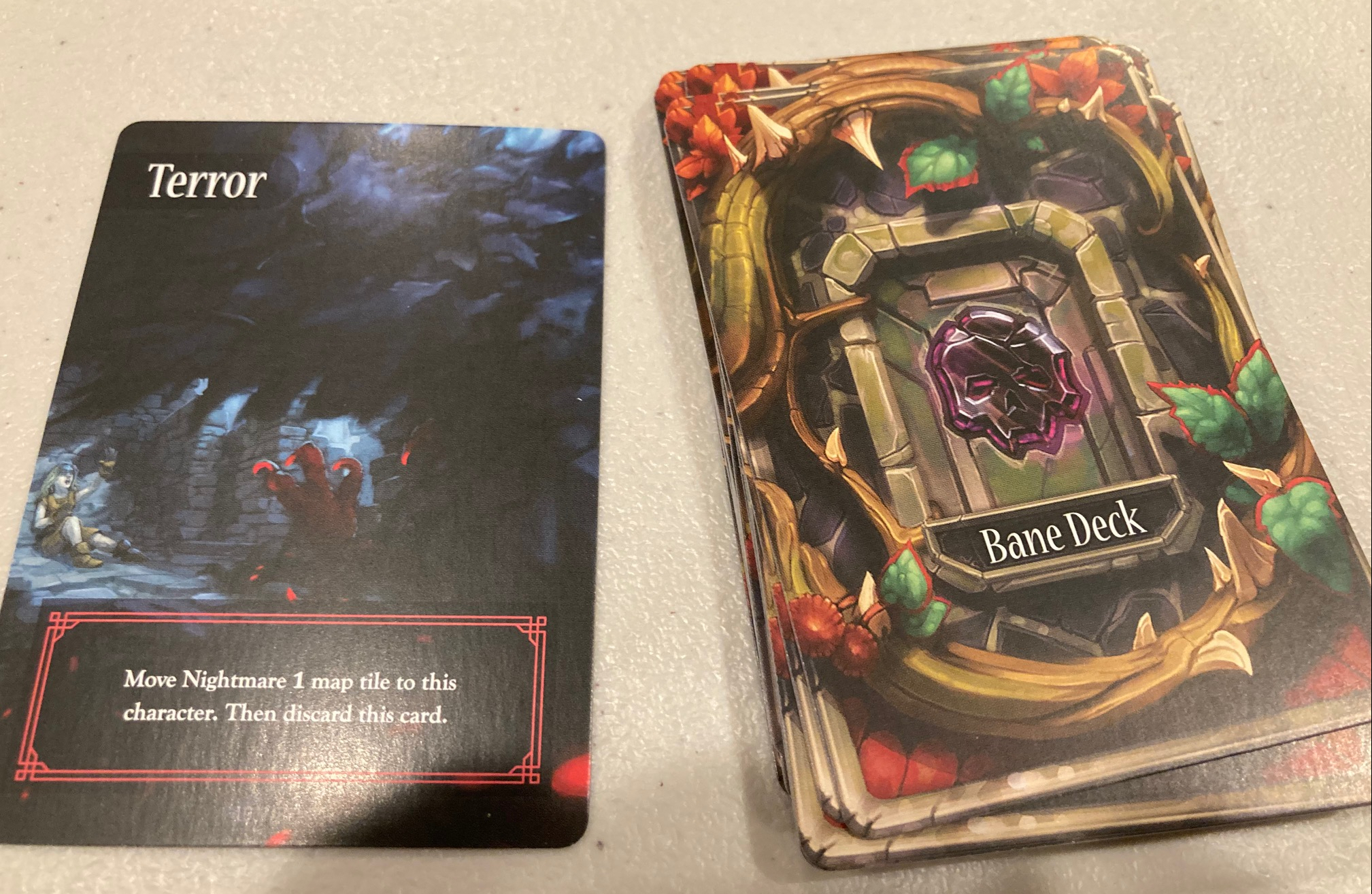
Of course, there are bad things that happen in the game: occasionally, you will explore a tile with a “Bane”: you flip a card from the Bane Deck and do what it says (always bad): See above!

IMG_9586 (1)

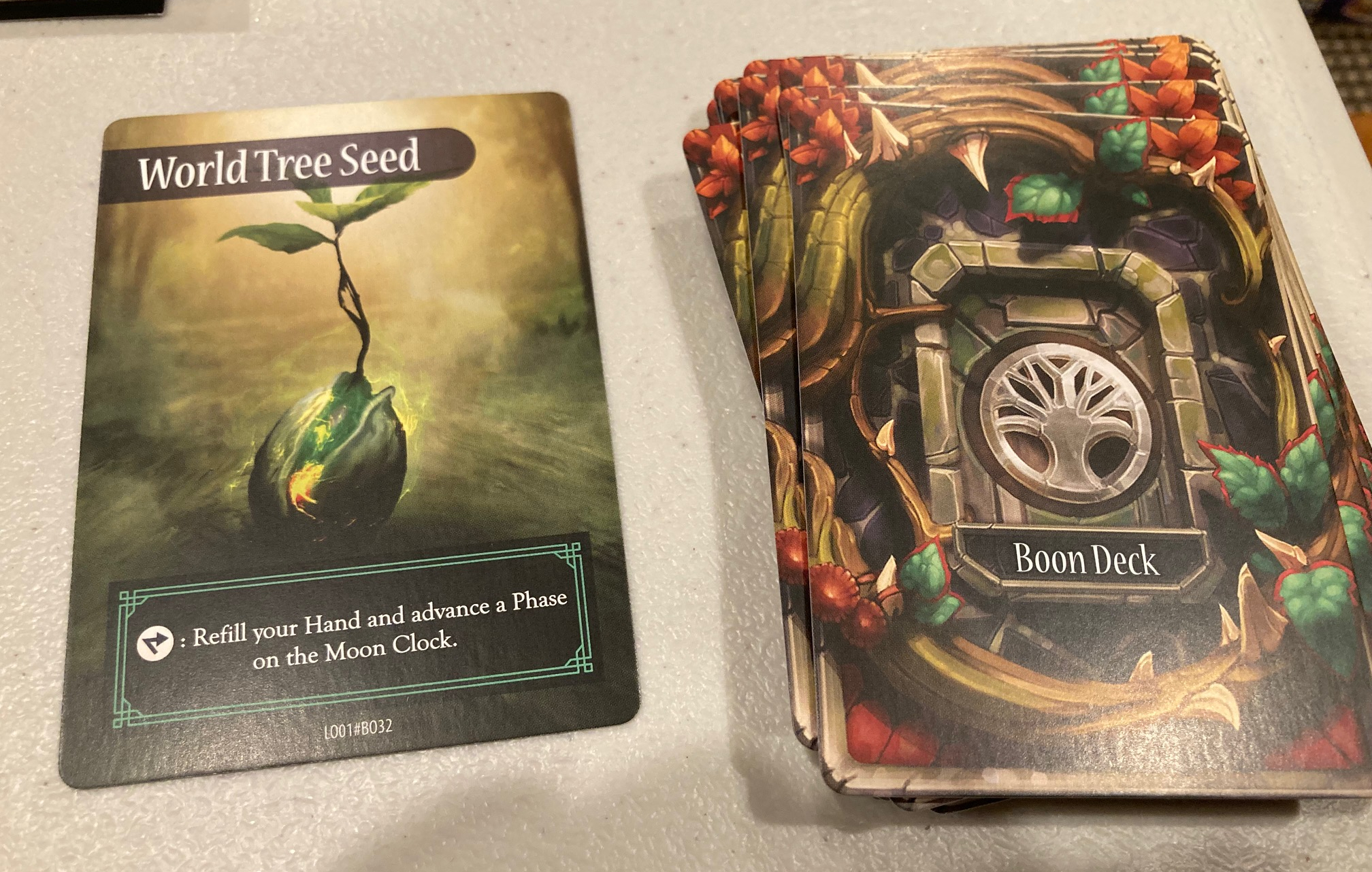
To balance the Banes are the Boons: you get these as permanent rewards during the game: see above for a sample.

IMG_9598

You also have to fight monsters/foes in the game: those come from yet another deck. Note that when my character explores the tile with the crossed swords, he has to immediately fight a monster! See Will hit card 27 with the crossed swords, so he gets to fight the Changeling! See above.

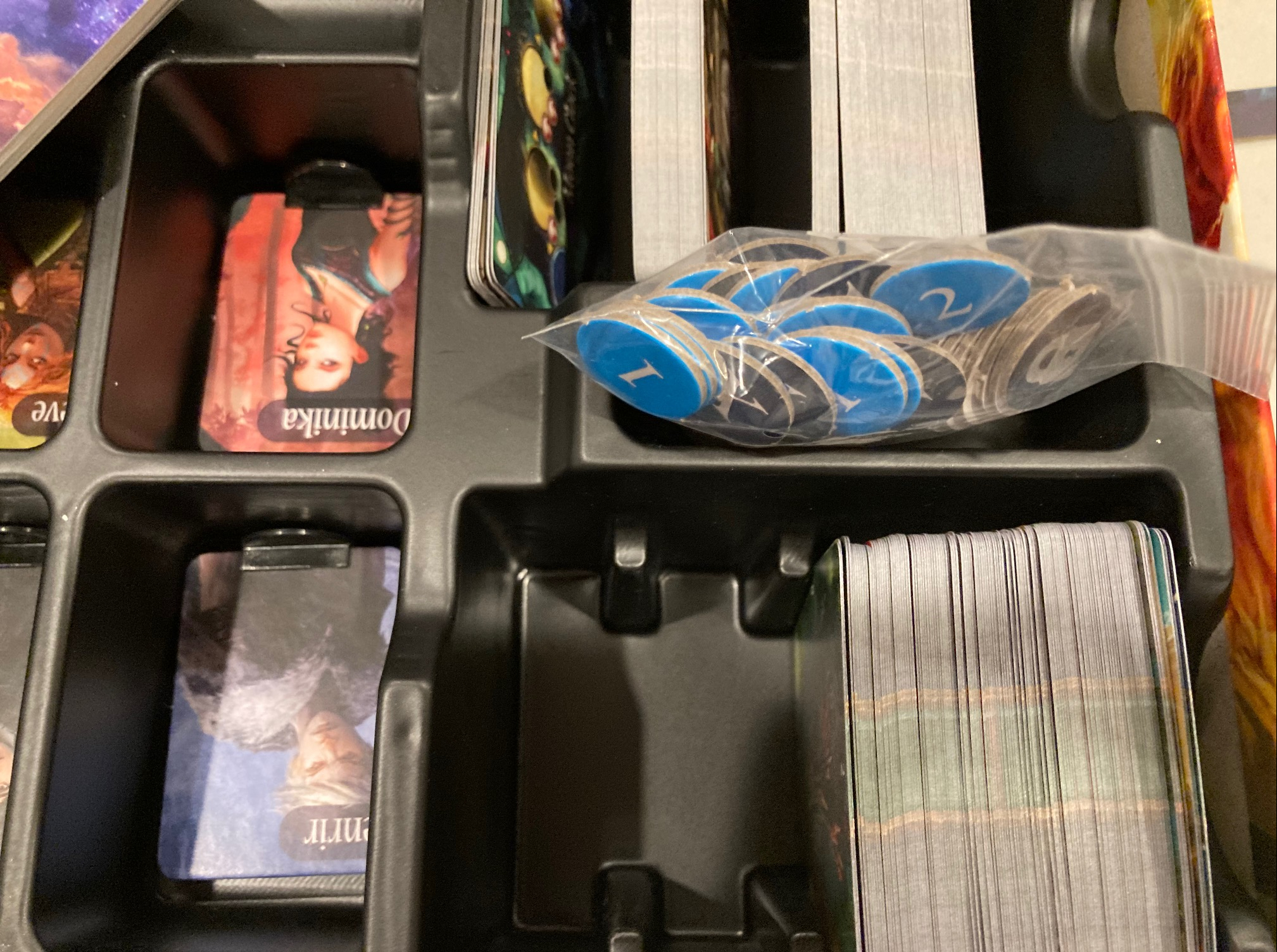
Overall, this game looks fantastic! A lot of the reason I backed this game was the art: the cover is just phenomenal, and all the art assets (especially the tiles when set-up) just look first rate. My only real complaint about the production is that the cards are NOT linen-finished. A stupid complaint (this is just me) is I that hate using the little “token notches” in the insert:

IMG_9628

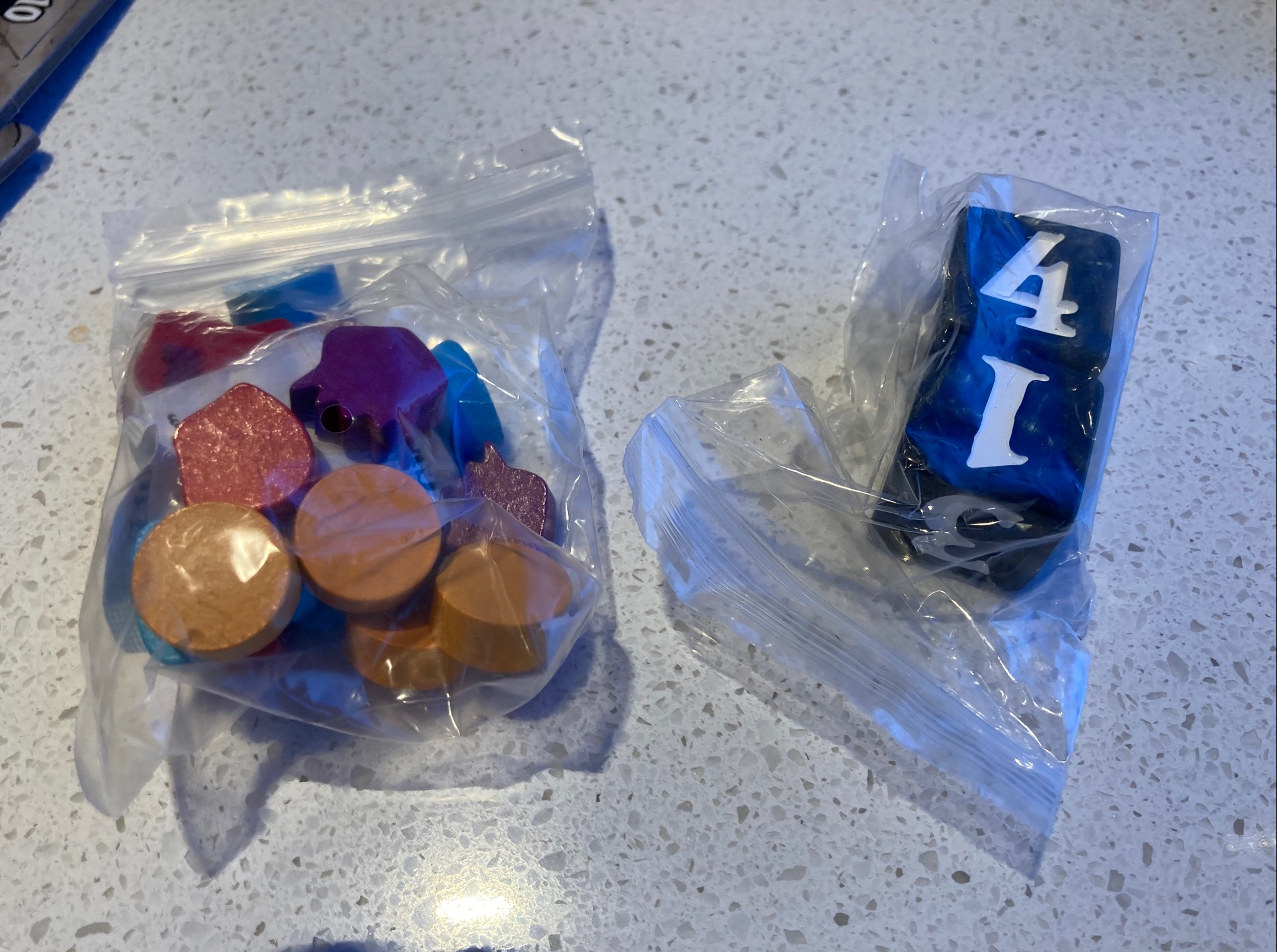
Recall that I had this problem is Disney Sidekicks as well: I find that token notches typically have the tokens come loose and cause them to wander in the box. Above, you can see I put all my tokens in a plastic bag so they won’t wander. This is probably just me.

IMG_9581 (1)

Lost Ones looks beautiful.

Rulebook?

IMG_9560

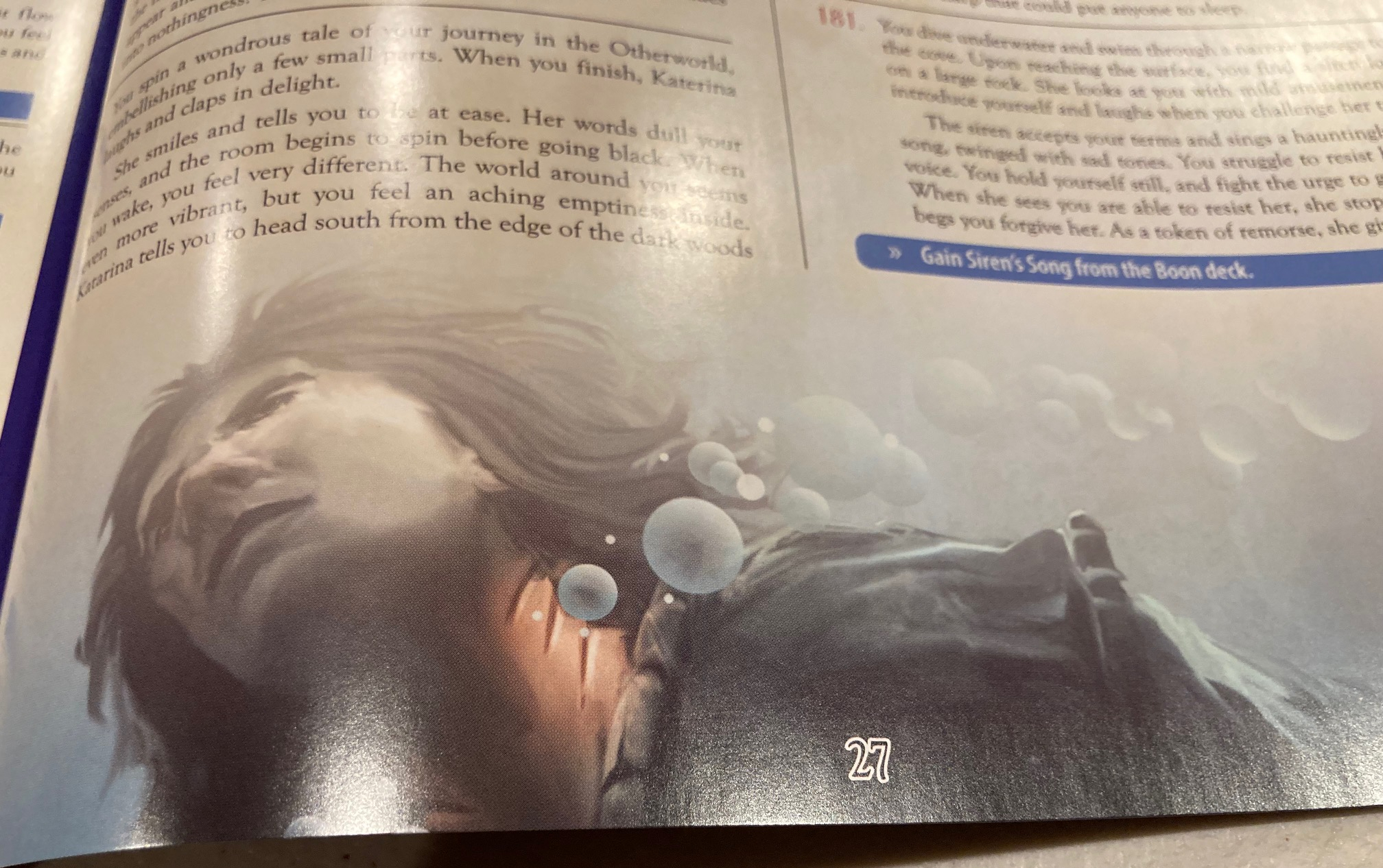
The Adventure Guide is an odd beast. You might be a little distressed when you see the length of the Adventure Guide: it’s 28 pages! See page 27 below (page 28, the back wasn’t marked).

IMG_9572 (1)

The first half of the guide summarizes the rules, like a rulebook. The second half of the guide presents Adventure Choices, like a Storybook guide. Once you realize that, the 28 pages aren’t quite as daunting.

IMG_9562

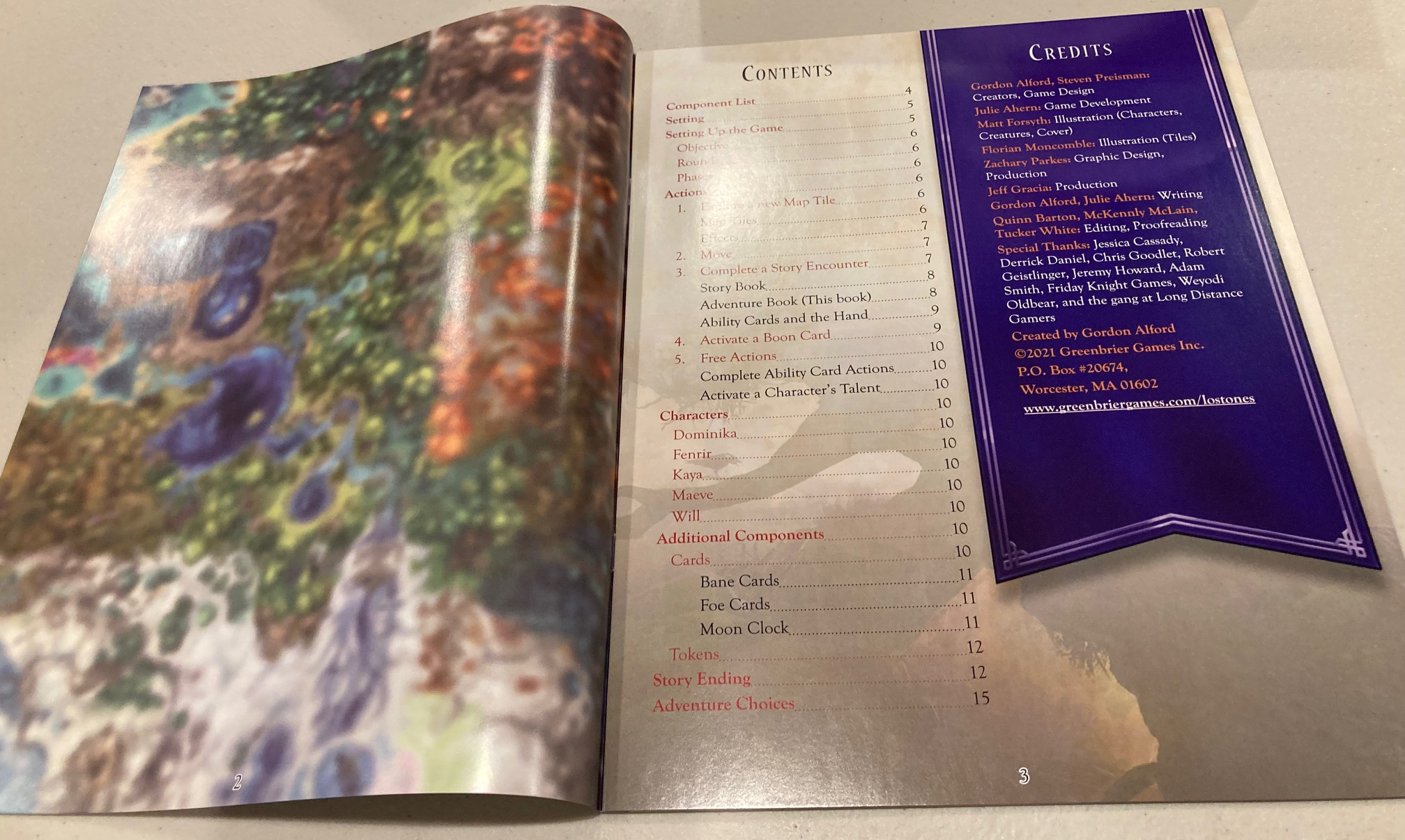
The game starts off with a table of contents. That’s nice, but I don’t think I ever looked at again after opening up the book. Honestly, I would rather have had an index to look up keywords: when we had questions when playing, certain indexed keywords would have more sense.

IMG_9563

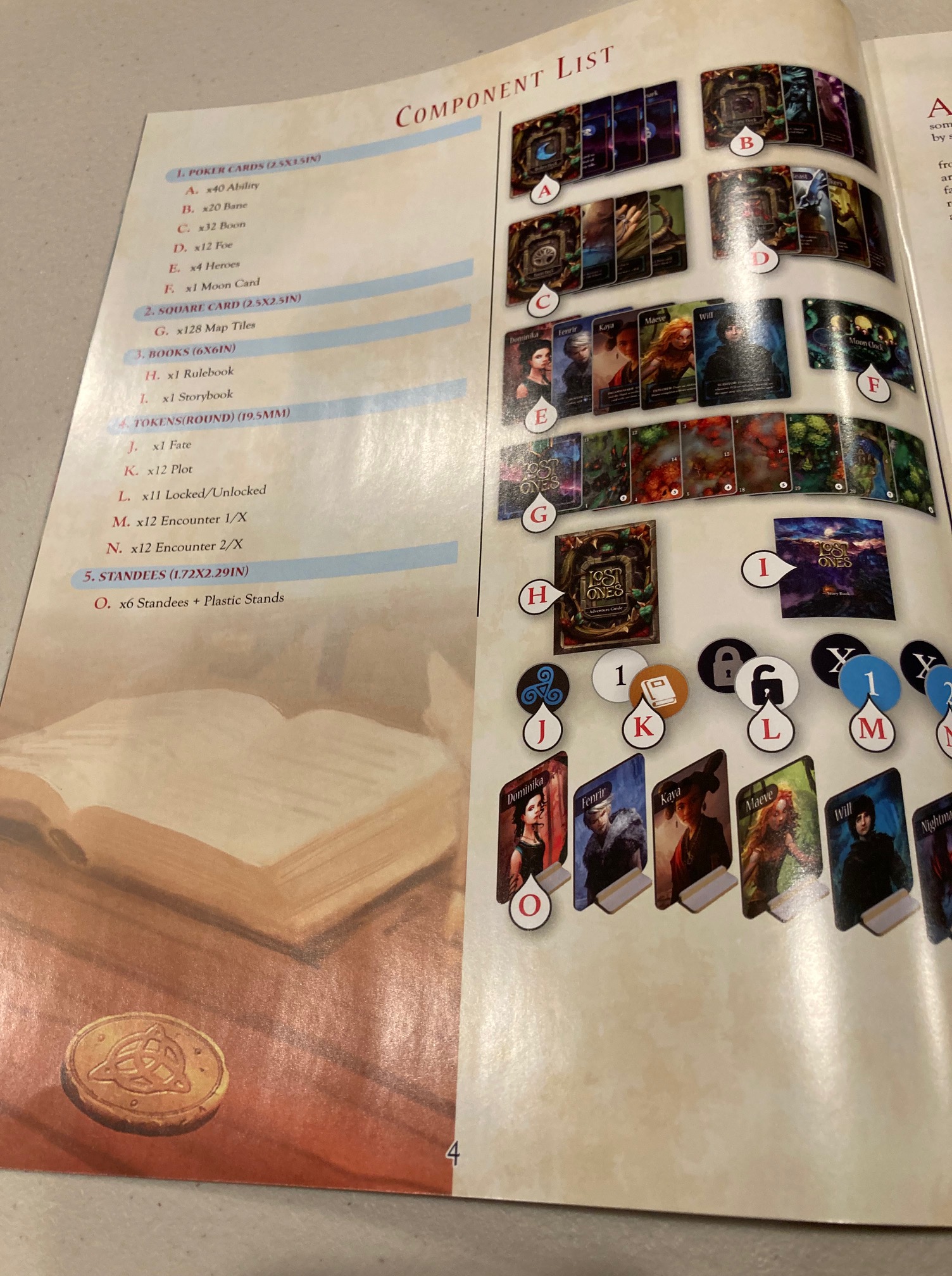
The Component List page (above) is nice: it let us easily correlate what we have. This worked great.

IMG_9564

The Set-up worked fine: see picture above.

IMG_9565IMG_9566

IMG_9567

The rest of the rulebook did a “pretty good” job of explaining how the game flows, what the options are, icons, etc. The font was a little small, and the lack of index got in the way when we were playing (we looked up about 10 different things), but otherwise it was a pretty good rulebook for getting going and starting. Unfortunately, It wasn’t great ay answering edge case questions.

IMG_9569

The Adventure Choice section was fine, but I thought the font was just a little small. Fine and easy to read otherwise.

Solo Play

IMG_9558

So, congratulations to Lost Ones for following Saunders’ Law! Yes, there is a viable solo game contained within! Just like the base game, each player takes control of a single character, so the solo character only has to operate the one character. The only real change to the game (based on number of players) is hand size and how many Ability Cards each character starts with:

IMG_9591 (1)

From there, the game play proceeds normally!

I really enjoyed Solo Play.  It felt like I was reading a book, but with some choices (like a Choose Your Own Adventure book).  And I just loved building and looking at the beautiful map.  The game had a real simple flow: Move, Explore, Take Challenges.  And it was just kinda fun to move through this world, as if I were moving through a book.

Cooperative Play

IMG_9643 (1)

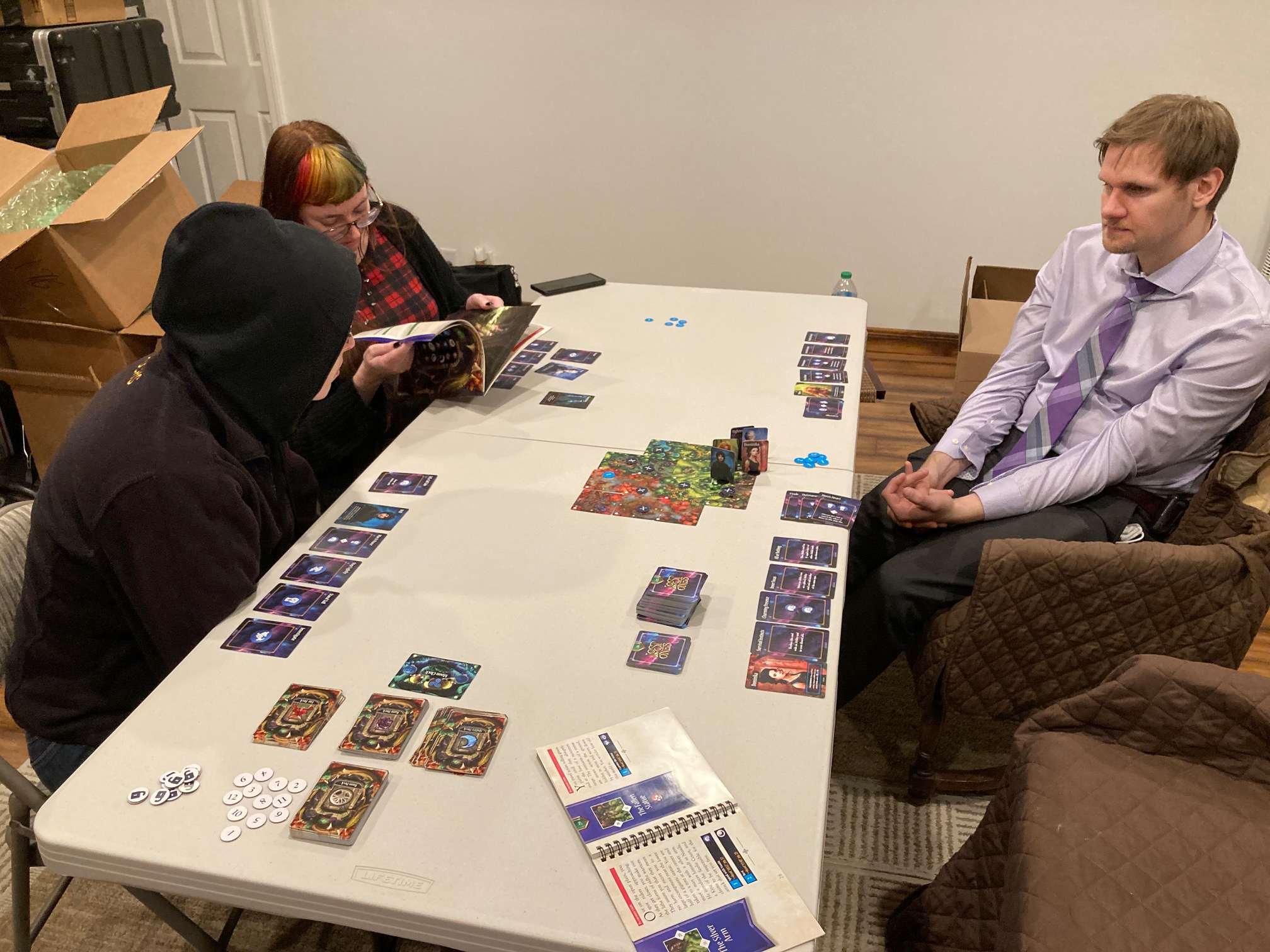
Cooperative play worked pretty well … at first.  The game seemed to go off the rails, especially after we reset (see below).  What happened was that a lot of the simplicity that seemed to shine playing solo didn’t quite translate to the cooperative game.  In a 4-Player game (see above), there seemed to be too long to wait for your turn, too little to do on your turn (you only have three action points), and since the decisions are sometimes a little “arbitrary” (this a Choose Your Own Adventure type choices, so not necessarily deep), coming to a quorum seemed harder?  Many times, it also wasn’t clear how the multiplayer rules interacted.  (See reset later).

IMG_9652 (1)

For example, poor Sara got stuck in the wilderness by herself and disengaged because she couldn’t leave the Fae Rings easily.  We had almost 12 turns where she did nothing: we were trying to avoid dying again!  If Sara moved, the Nightmare would activate and probably kill us.  So, Sara didn’t move and took one for the team.  But she didn’t have fun.  We won because of Sara’s sacrifice, but it seemed at the cost of her having fun!   We played “smart” and “munchkiny”, but at the cost of our friend’s enjoyment.  

Reset

IMG_9643 (1)

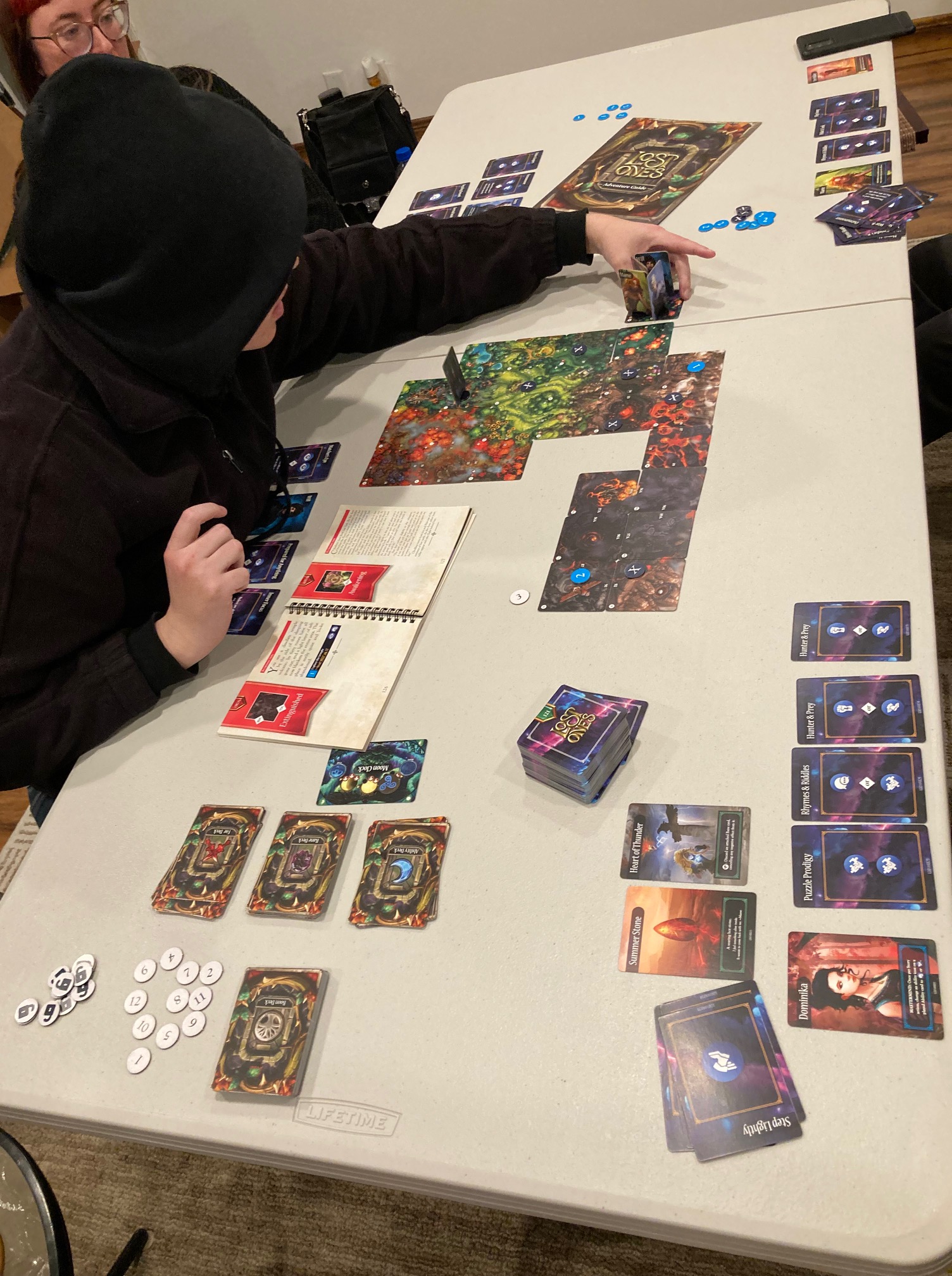
Without too much of a spoiler, you will probably die in your very first game.  And it’s honestly expected.  The game then directs you to reset and start again, retaining some of what your group has done/learned.  This is a very cool and thematic idea, especially since there is some notion that “this is just a dream”!  The problem is, what do you reset? See above as we reset from death!

After you die and have to reset, you have quite a bit of the map out!  Does reset mean put the whole map away?  And tokens?  And cards?  Strictly speaking, we interpreted the rules to mean “Yes, start the game completely from scratch!”  … which means putting away the map and tokens!  The problem is, that’s not fun.  You have to sort the tiles, put them back in order in the stack, pick up the tokens, and start over!  So, a ton of work.  We chose to leave the map out for our second game because … it was less work and more fun.  

IMG_9647 (1)

But then that changes the game!  With more tiles out, the Nightmare will move more slowly towards you, the rules about “Move vs. Explore” get fuzzy (All players can move together as a group, but the rules imply you can only explore as a single character), so we are cheating?  Strictly speaking, probably, but we wanted the game to be fun, so we chose to keep the map out but reset everything else.

The rules REALLY needed to have a discussion on “What it means to reset”.  The strict interpretation of reset is much less fun, but the more open interpretation of reset (“leave the map out”) way seemed unbalanced.  The rules were very unclear and this disparity bothered us.  Did we even play right after a reset?

Discussion

This game generated a LOT of discussion after we played.  And I mean a lot! Some discussion was admiration of the art, some was suggested improvements, and some was actual complaints.  Most of the complaints seemed to be about the ambiguity of the rules in the multiplayer game.

I originally sold my friends on Lost Ones as “this game was Tainted Grail with the story but without all the grind“.  Recall from our review of Tainted Grail we liked it at first quite a bit (Part I), but we found the game too grindy even though we liked the story (Part II). And I expected my friends to love Lost Ones, because my friends loved the story in Tainted Grail but hated the grind!  But, both me and my friends were surprised when we didn’t like it as much as we hoped.  Why?  We spent a fair amount of time talking about this: stuff we liked and stuff we didn’t:

  • A lot of times, we would explore and spend resources to just “portent tiles”: the story we would read would suggest/imply certain things to do but without necessarily helping?  In other words, we would “waste” resources to foreshadow what was on the next tile, which we visited next turn anyways.  We didn’t love that part.
  • We came to the conclusion that our group likes story with purpose: we really embraced Detective: City of Angels (see our review here) and Adventure Games: The Dungeon, both of which are on our Top 10 Cooperative Storytelling/Storybook Games.  Although there is some interesting stuff that happens along the way in Lost Ones, for some reason, it didn’t engage us.  And we think  the world was too open for us? “Escape home”.  That should have been a great purpose, right? Maybe it was too unguided?  Maybe your group will love the more open world concept of Lost Ones, but my group(s) seem to want more direction.
  • At first, we thought the world cards were too small.  But after building the world and seeing how big it was, we concluded they did a fine job on that!  Kudos!  We just wished our standees were smaller!
  • Edge Cases: this really killed us.  Between my solo plays and our cooperative plays, there were SO MANY places where we had questions.  The rulebook was decent to get into the game, but after we started playing, there seemed to be SO MANY QUESTIONS.  See Questions section below.  These questions kind of took us out of the scenario a little.  Maybe that was part of why we disengaged a little?
  • I liked the game more solo than cooperative.  Maybe there’s just too much reading for a larger group?
  • Why did we like Roll Player Adventures (RPA) so much more than Lost Ones?  (RPA made our Top 10 Cooperative Games of 2021 and See our initial review here).  We think it’s because the story in RPA was much more directed, but also RPA had a really good story!

We talked for some time after playing.  We liked talking about the game!  We thought it was okay, but we came to the conclusion it was probably best at a smaller player count.

Conclusion

IMG_9653 (1)

Lost Ones game surprised me, but in the wrong direction. I expected my friends to really like the story here, but the game just went over “okay” in my group. The art was fantastic, and the simplicity of the system was very appealing, but the group play wasn’t as engaging as we had hoped. Some of this was the ambiguity of the rules took us “out of the game” a few times as we played.

Having said that, If you want a lighter “world exploration” and “interactive story” to explore solo or with a friend, I think I can recommend Lost Ones. I enjoyed this as a solo game: it was a light, fun, “read and explore” game… it was almost like reading a book with a really cool map? The group agreed Lost Ones would probably be better in a small group of one or two people: Teresa talked about playing with her Mom for fun, Sara suggested we played as a two-player game the next time we have a small group, and I mentioned how much fun I had a solo game.

Lost Ones isn’t an unconditional recommendation, but we did enjoy it, just not as much as we expected. It just seems best at 1 or 2 players.

A Curious Review of Automated Alice (the Cooperative Dice Game)

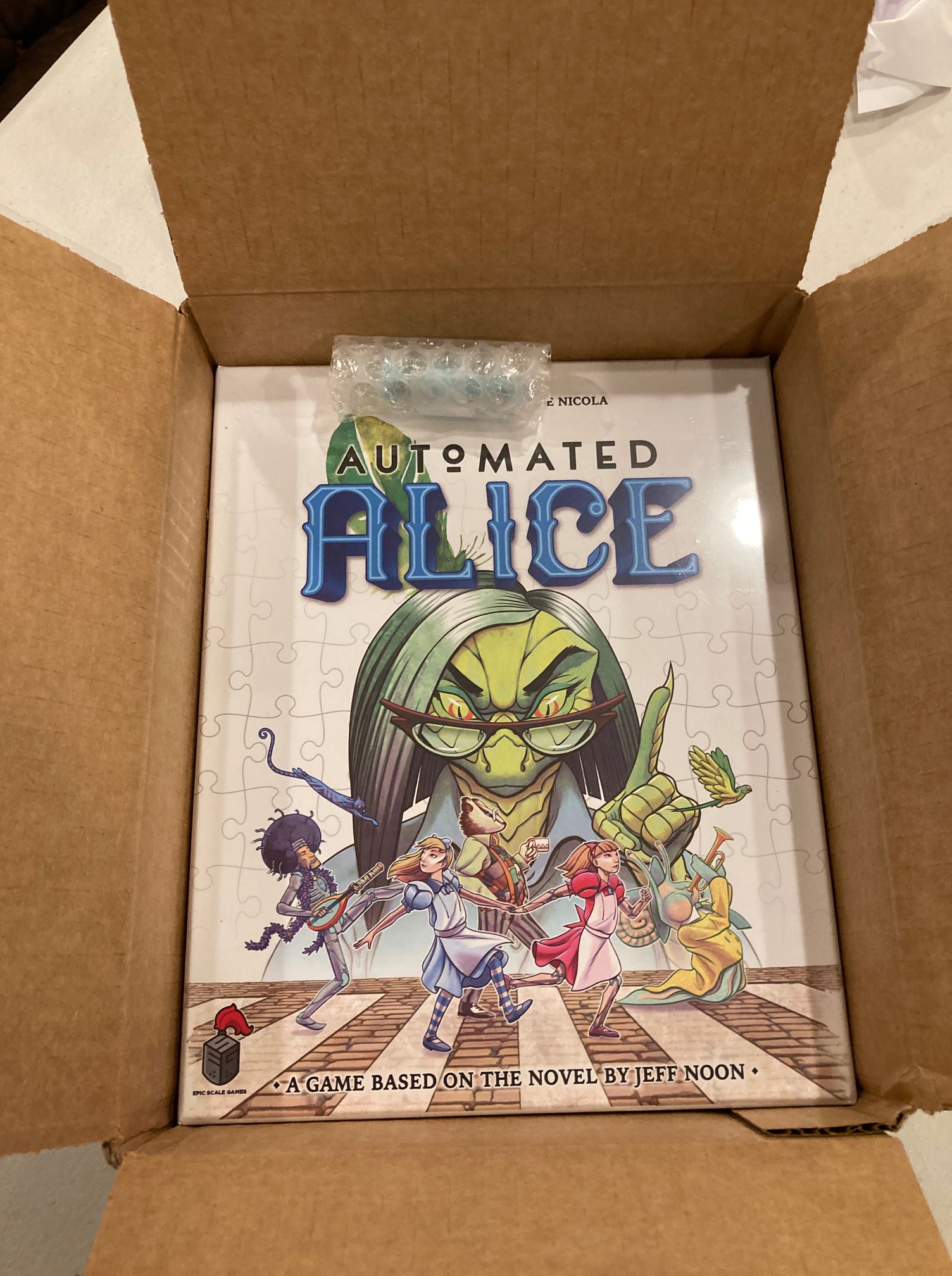
Automated Alice is a cooperative dice-placement game that was on Kickstarter back in October 2020. It just delivered to me a few days ago at the time of this writing (January 16th, 2022), so I guess it has to count as a 2022 game.

IMG_9399

Automated Alice is based on a novel by Jeff Noon … of which I know absolutely nothing, except that this has “something” to do with the Lewis Carroll Alice in Wonderland books.

I kind of blind-backed this cooperative game because I always like to try smaller games from smaller publishers. It turns out I really do like cooperative dice-placement as a mechanism (which is what Automated Alice is), as three of our Top 10 Cooperative Games of 2021 were cooperative dice-placement games! So, I was excited to get this little game to the table!

Unboxing

IMG_9398

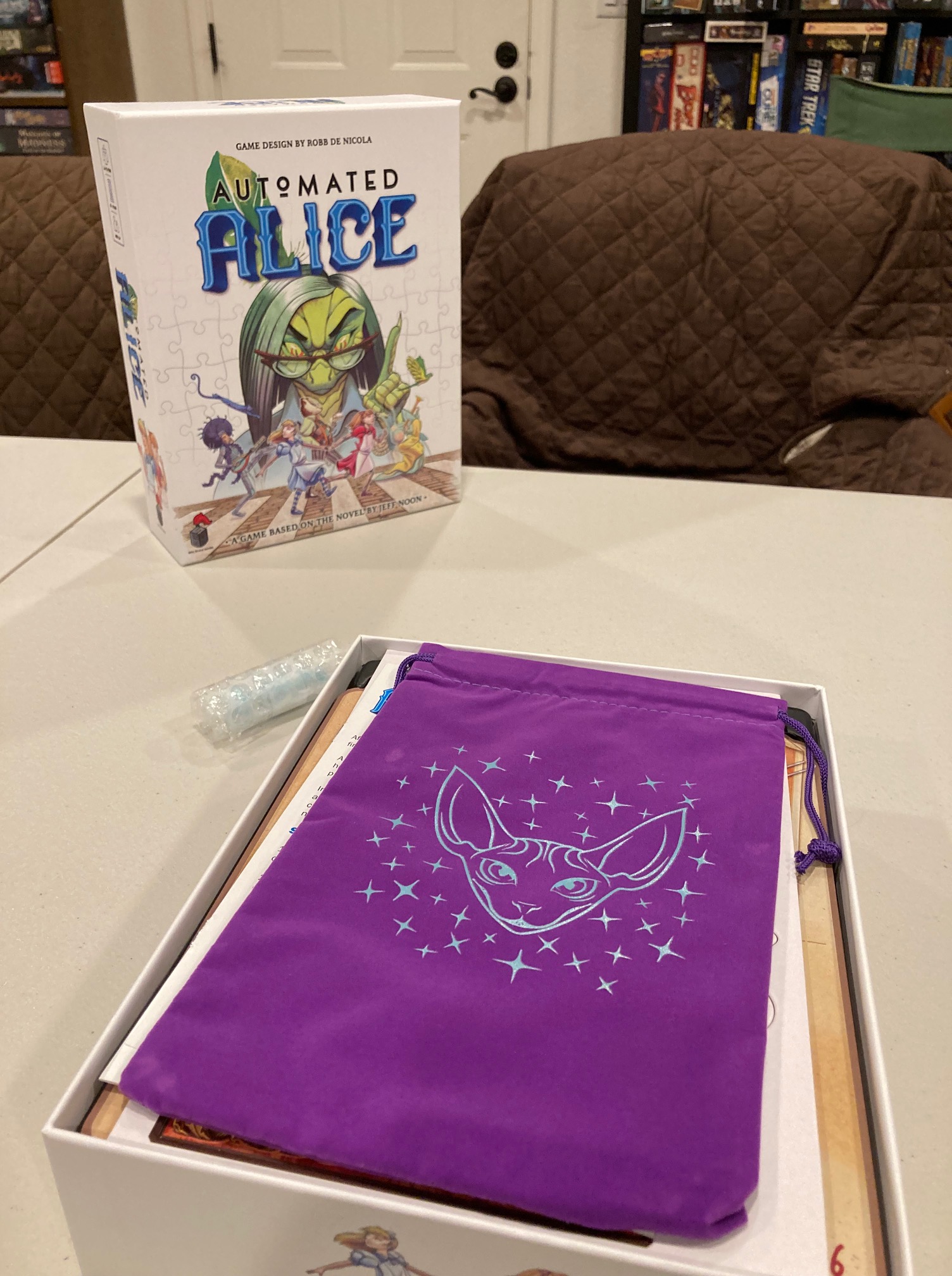
As a kickstarter backer, I got a little extra mini of Alice wrapped in bubble-wrap: see above and below.

IMG_9405

The first thing you notice upon unboxing is the really nice dice bag!

Next in the box is a letter from the author (Jeff Noon) of the book Automated Alice. It’s a nice little emotional journey through what Automated Alice means to him. To be clear, the designer of the Automated Alice dice game is another fellow: Robb De Nicola.

The rulebook is next: you can see (above) that it’s quite readable.

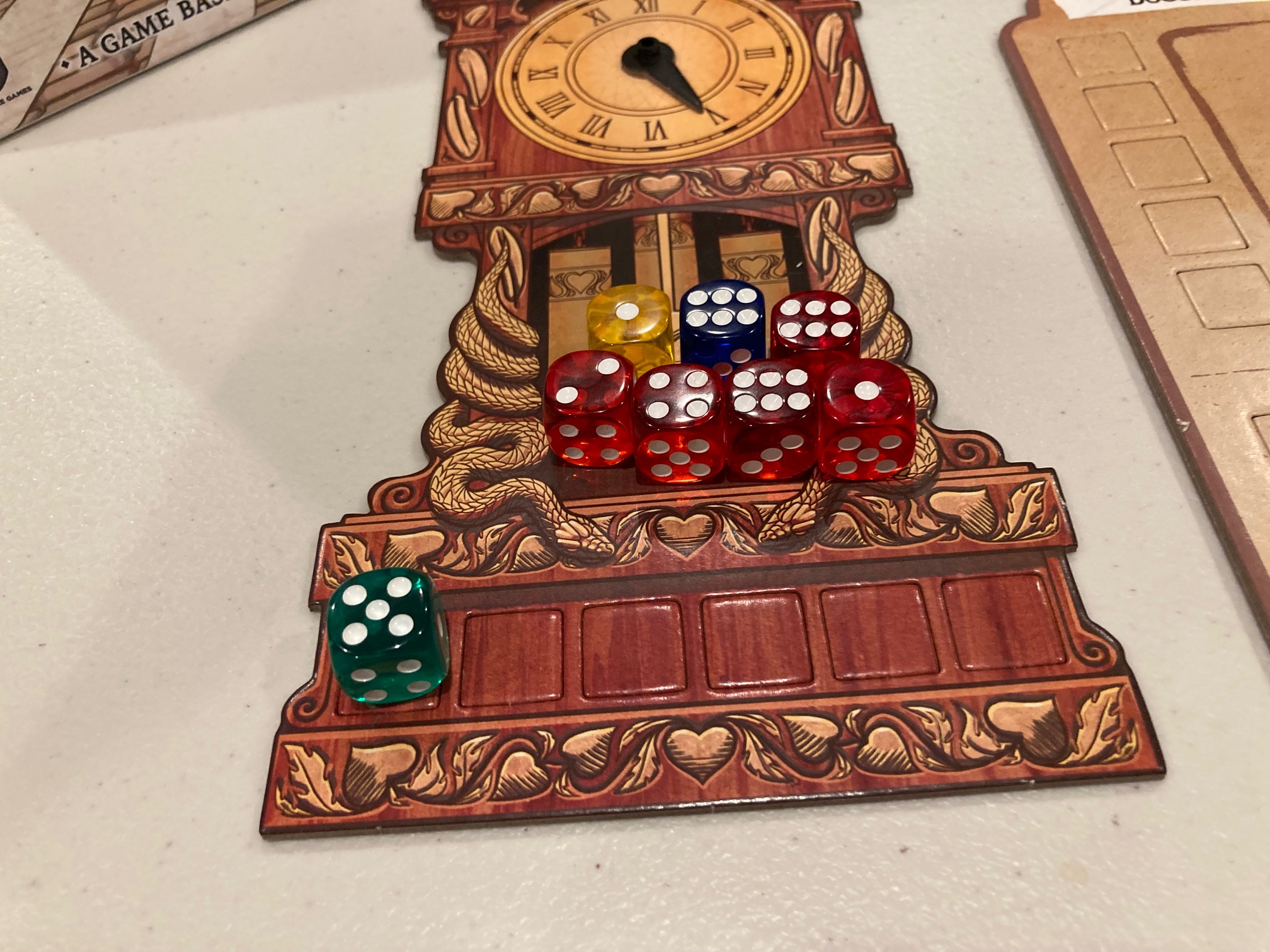
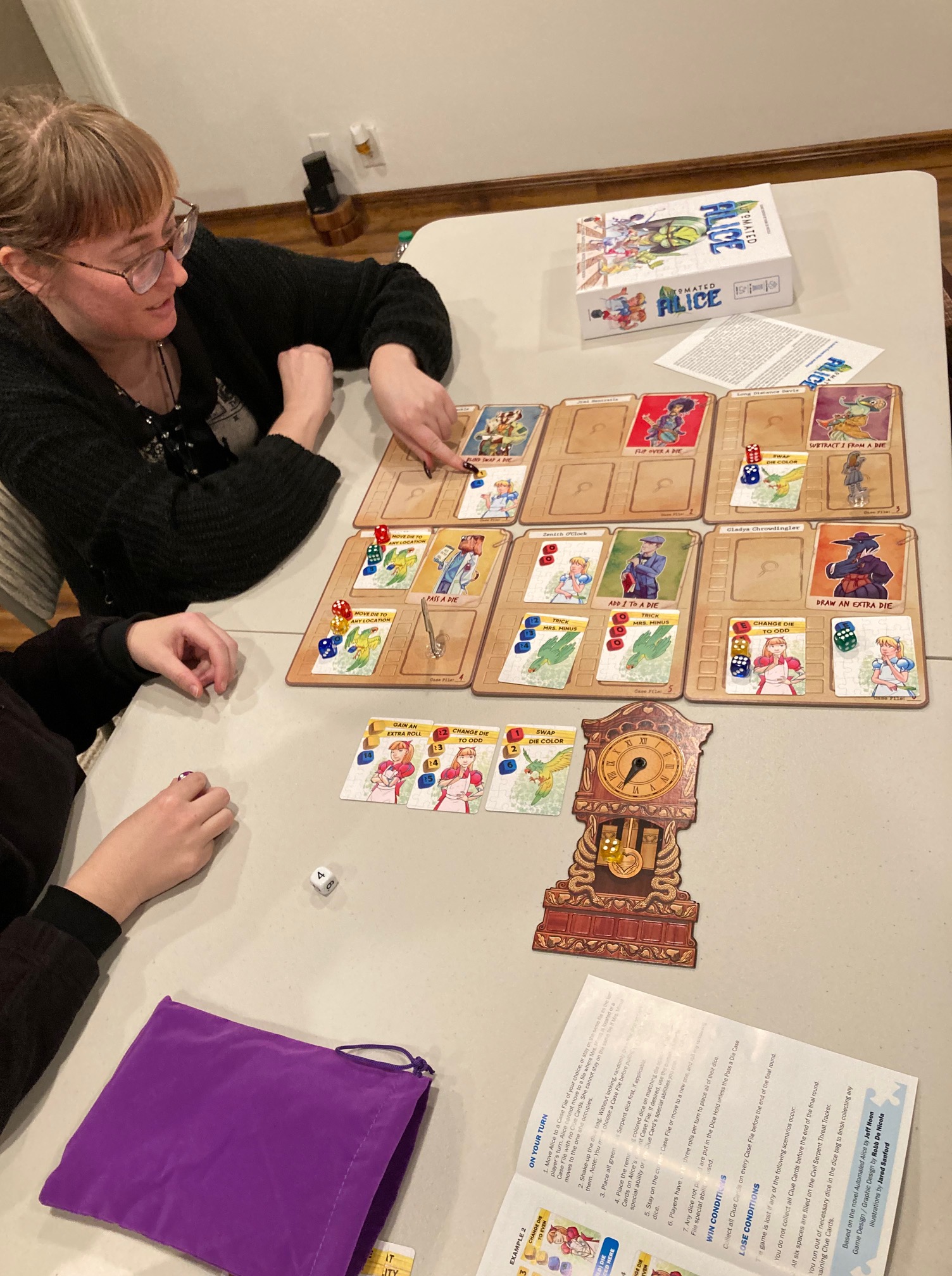
The punchouts come next: Alice represents where the players are on the board and the “snake lady” is the bad guy (Civil Serpent) chasing Alice around the board. The clock is used for multiple things: timer (not real-time timer, but “number of rounds until game is over” timer), “good dice” pool, and “bad dice” pool.

IMG_9419

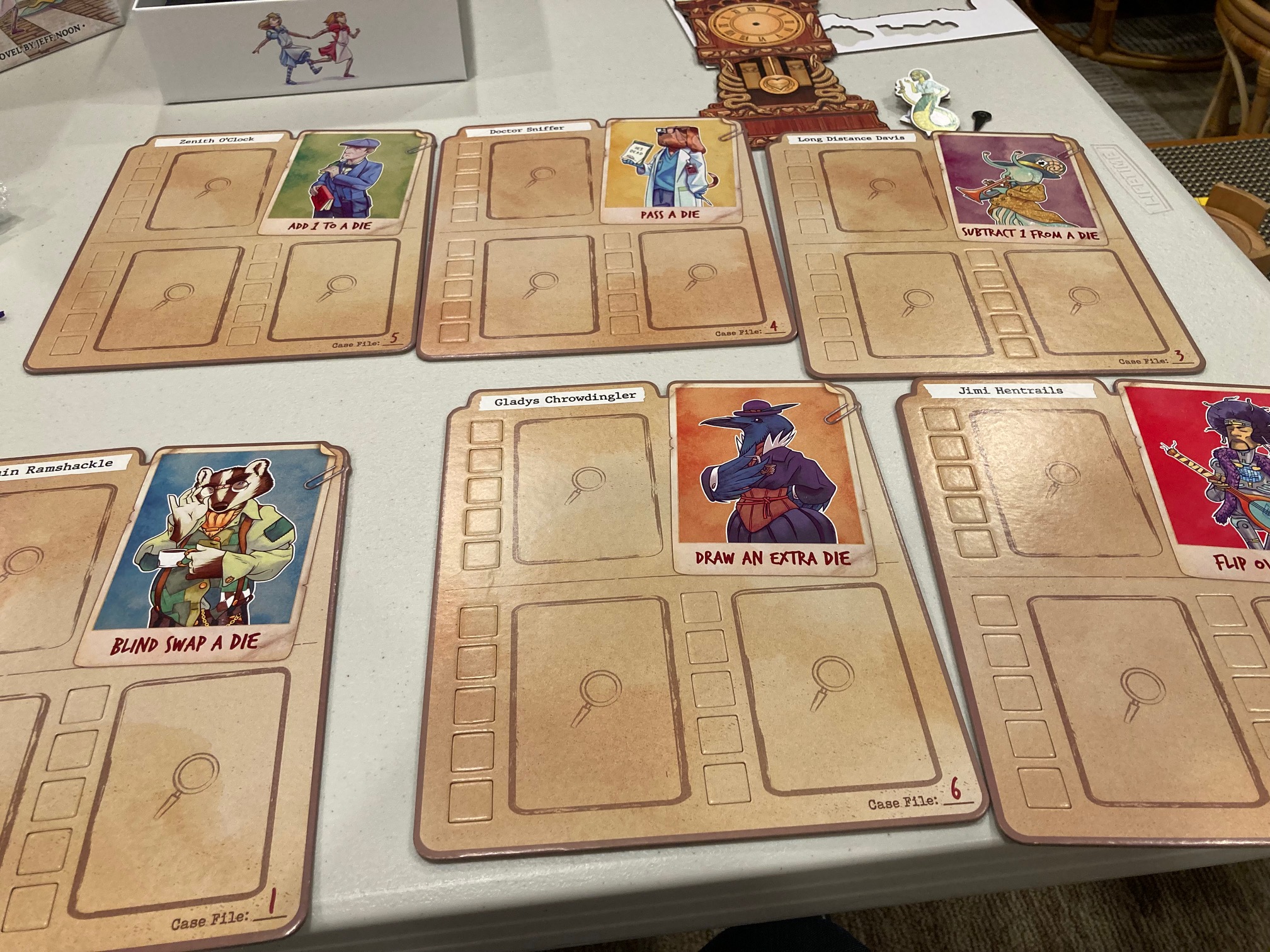
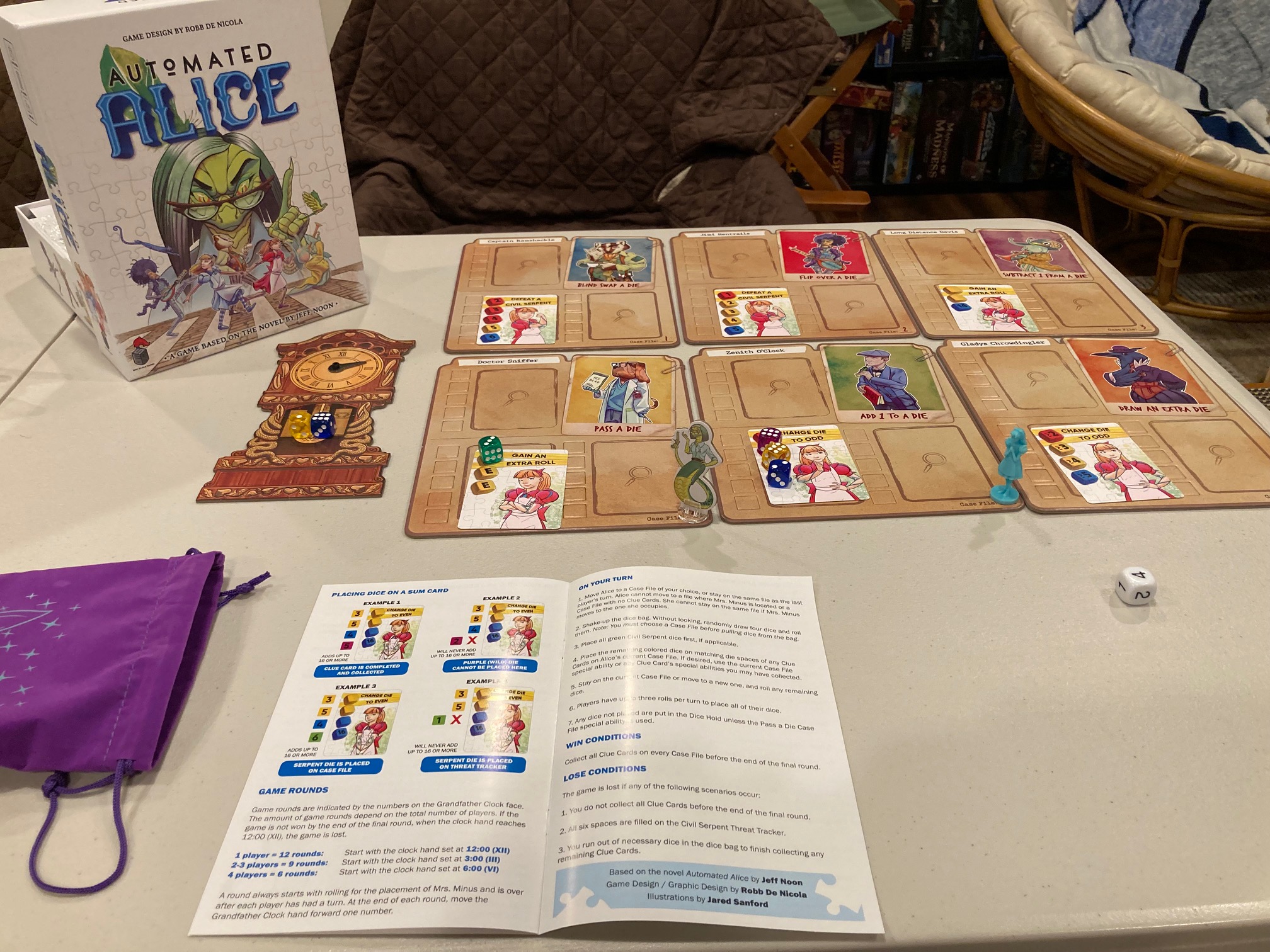
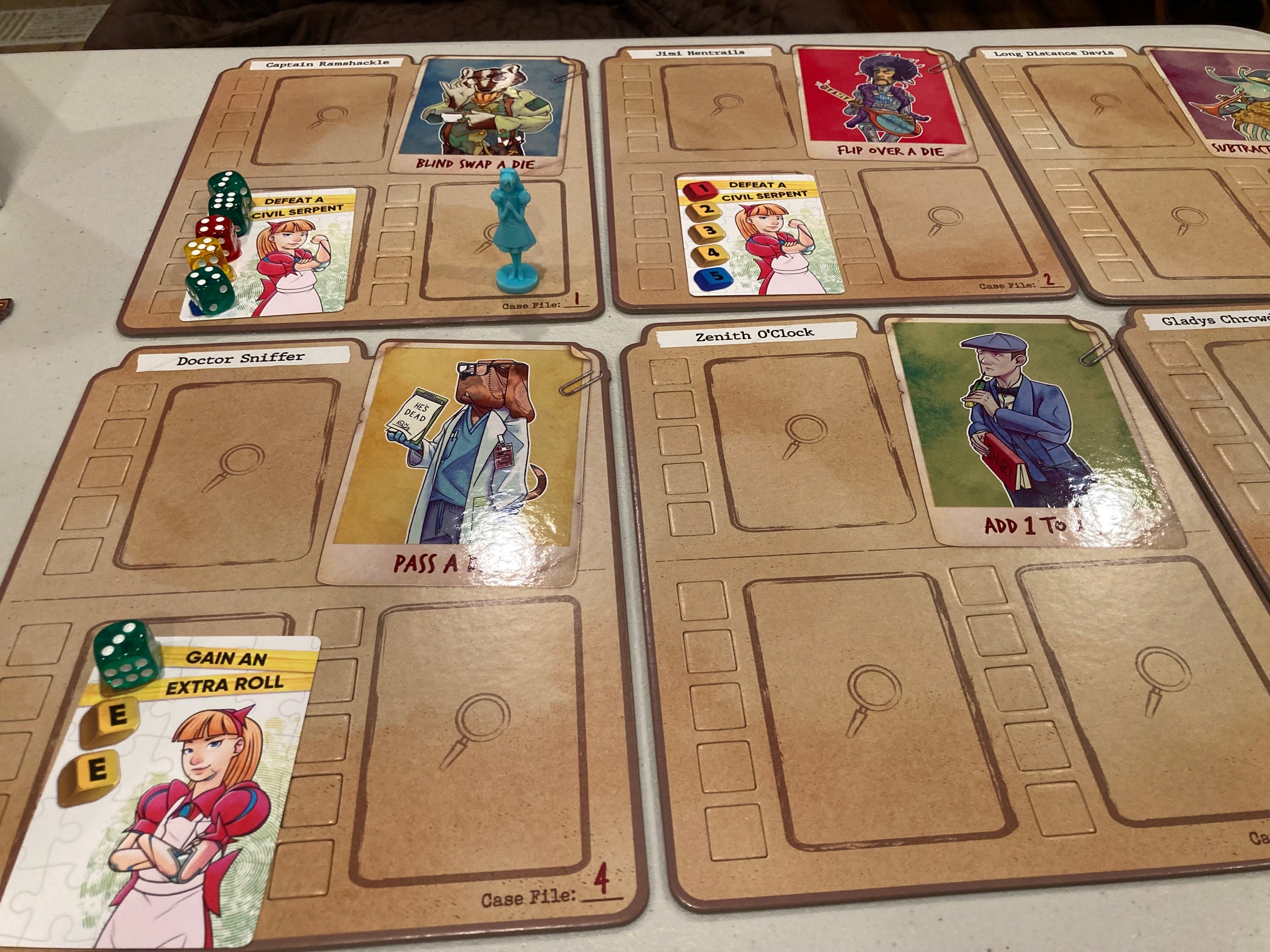
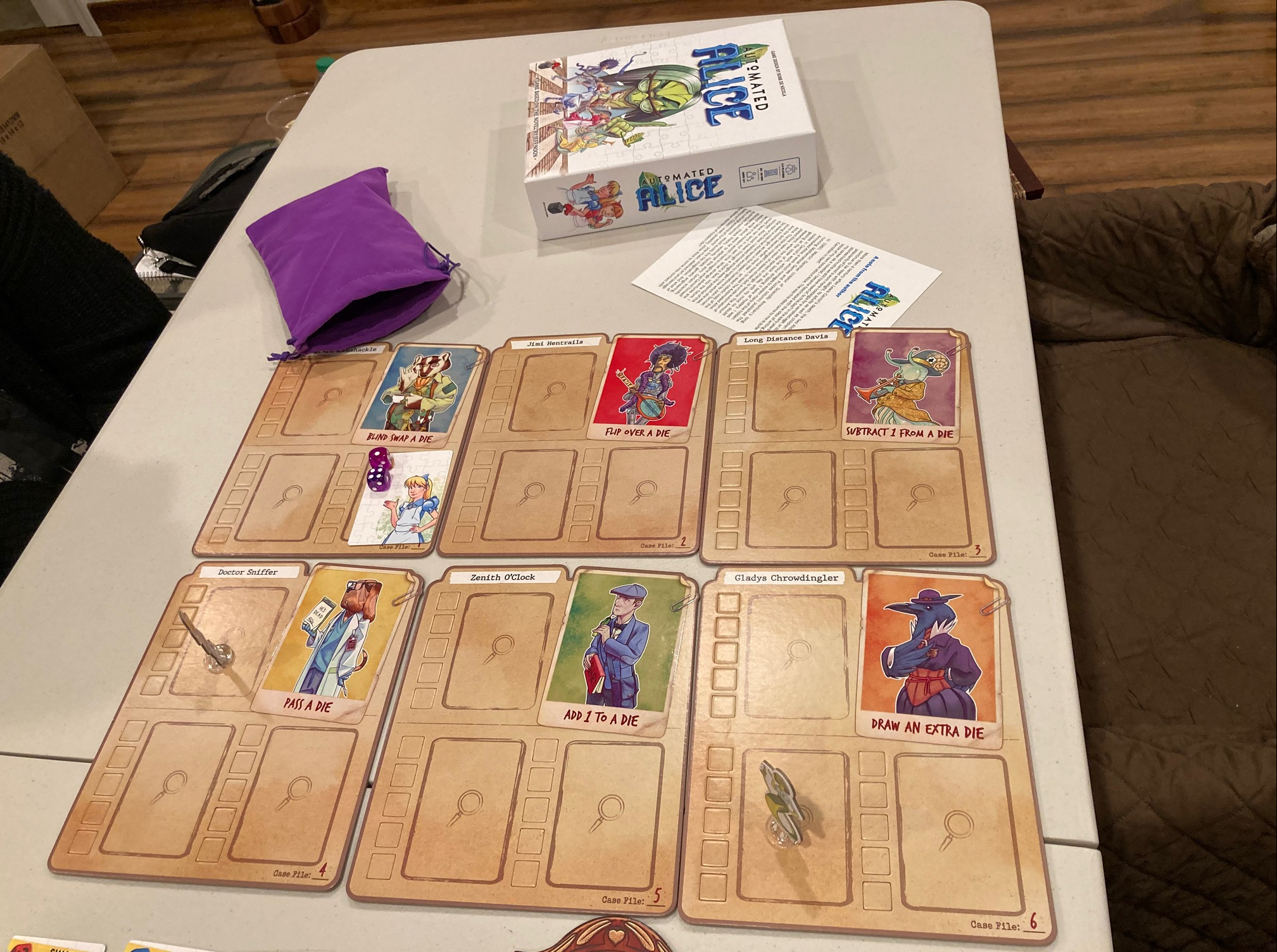
The majority of the action is around the 6 Case Files (I would have just called them boards)? These are the 6 boards that Alice will be exploring.

This is a cooperative dice-placement game, so there are a ton of pretty colored dice: these are the dice that go in the dice bag. There is also a single die (the MRS Minus die) that determines where the “bad snake lady” will go (you roll: she goes and blocks one of the 6 Case Files).

IMG_9428

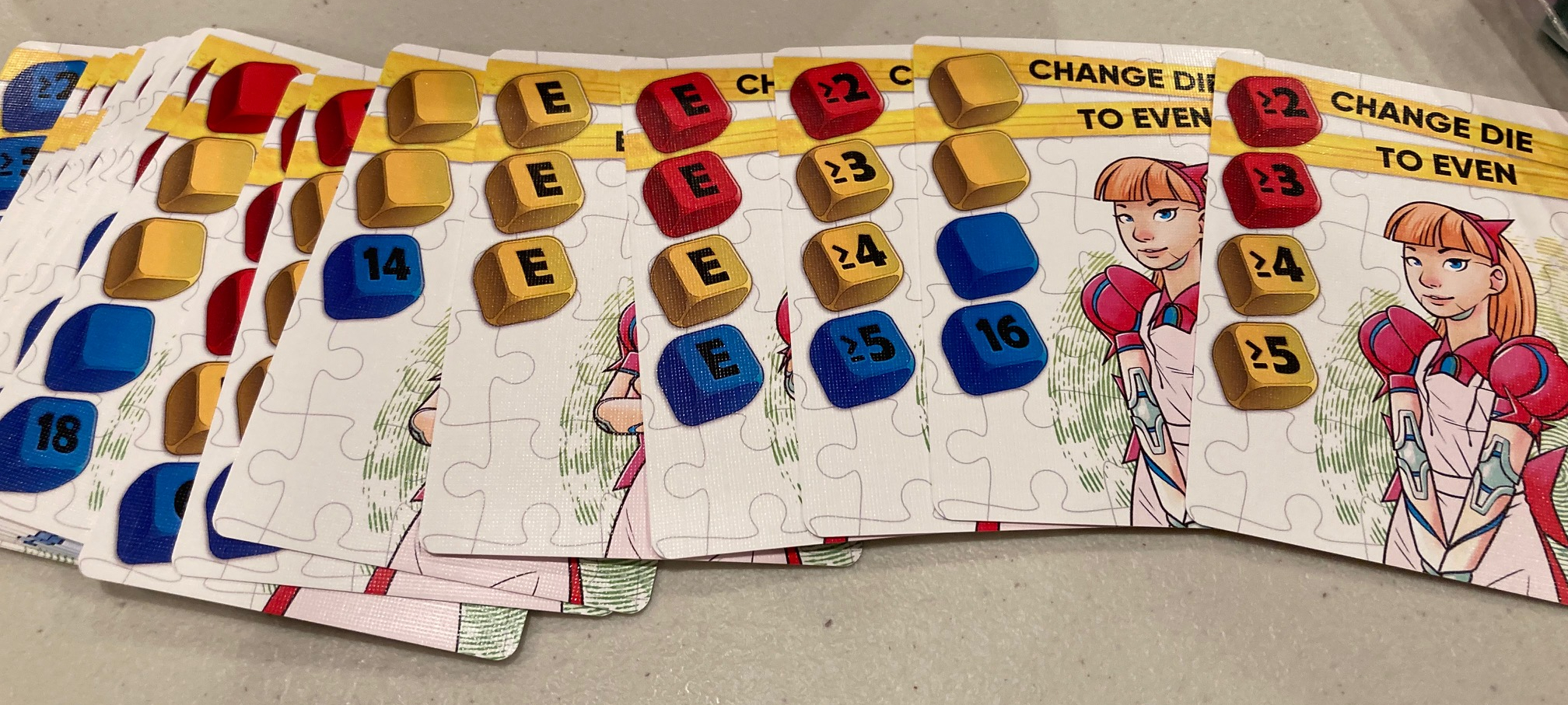
Last by not least are some really pretty linen-coated cards: there are the missions that Alice will go on! See above. The players (as Alice) will have to place dice on these cards matching the color, order, sum, even/odd, and/or other conditions. It’s a dice-placement game!

Overall, the game looks pretty decent: I really liked the linen-finished cards! I think one of the reasons I picked up this game is that I liked the comic-booky art. There’s not tons of art, but the art on the cards was a lot of the reason I backed this game.

IMG_9425

Overall, pretty decent components.  I still like the art.

Rulebook

IMG_9409

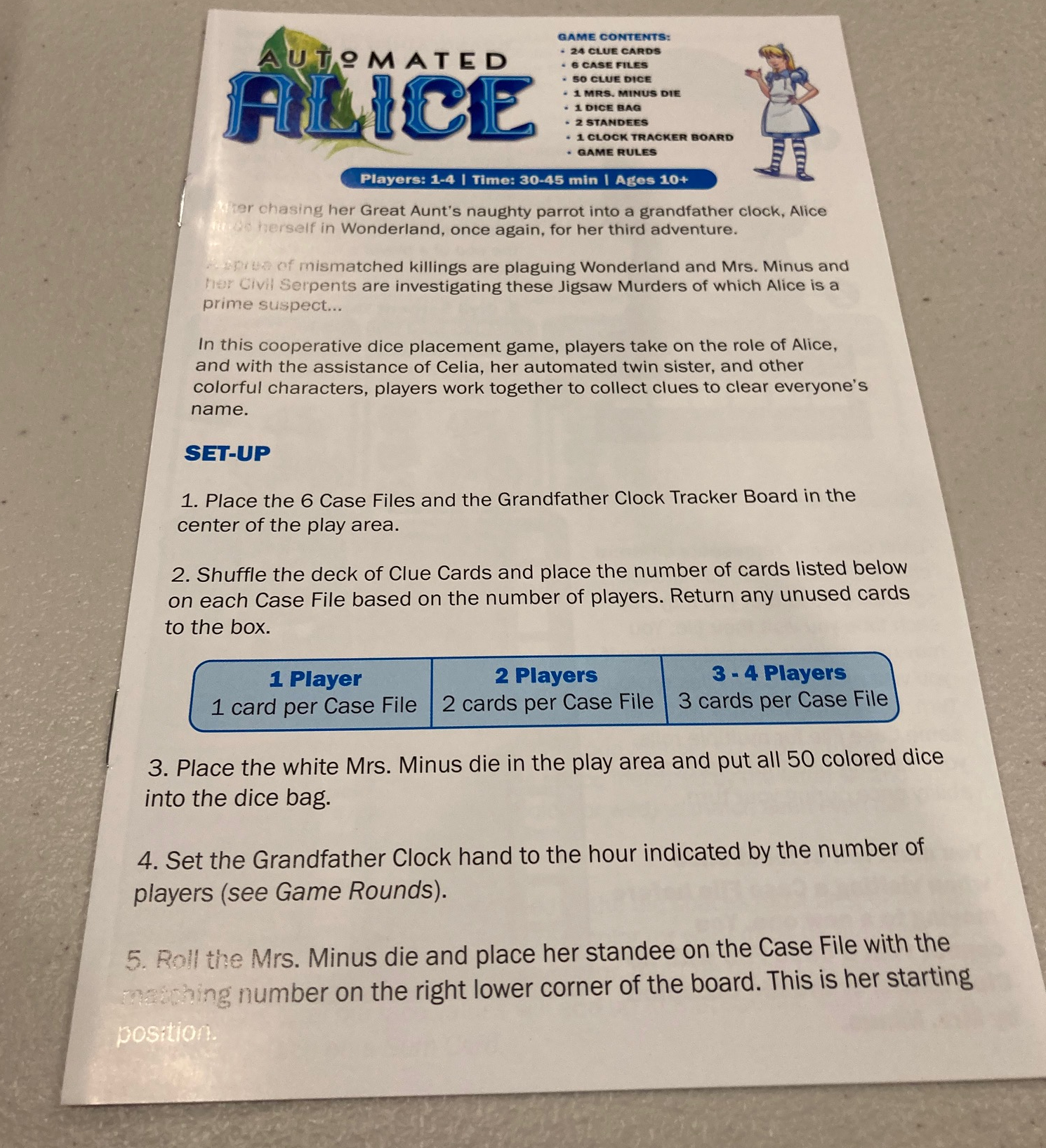
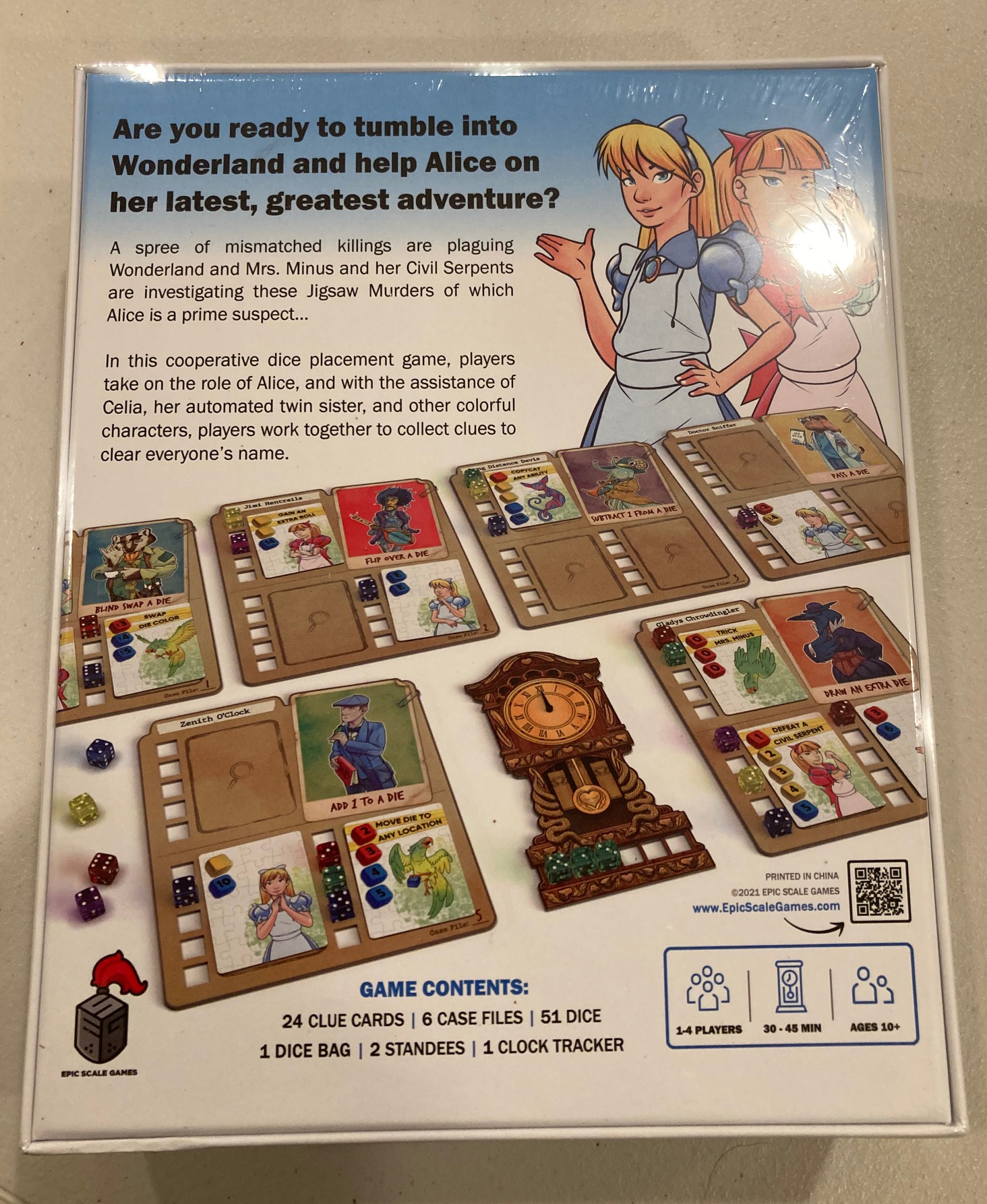
The first page set-up and components are okay: they don’t actually show a picture of set-up unless you look on the box. Sigh. I had this problem with Backwoods: the rulebook should ALWAYS show a picture of the game set-up! But, the back of the box shows the set-up: see below.

IMG_9401

IMG_9410

The rulebook is a little light on content: it doesn’t handle a lot of edge conditions.  I think there’s some things that need to be spelled out in the rulebook.   For instance:

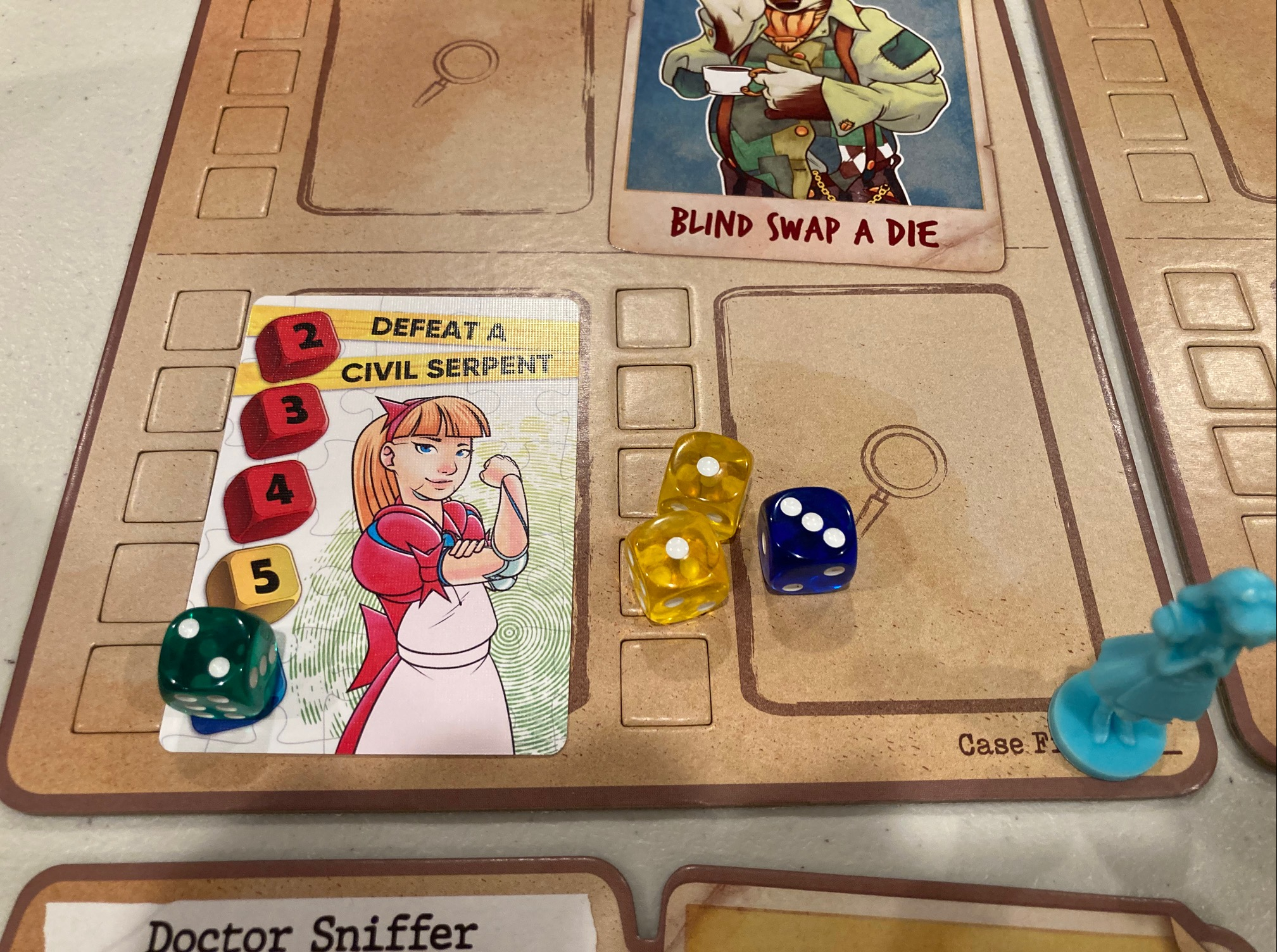
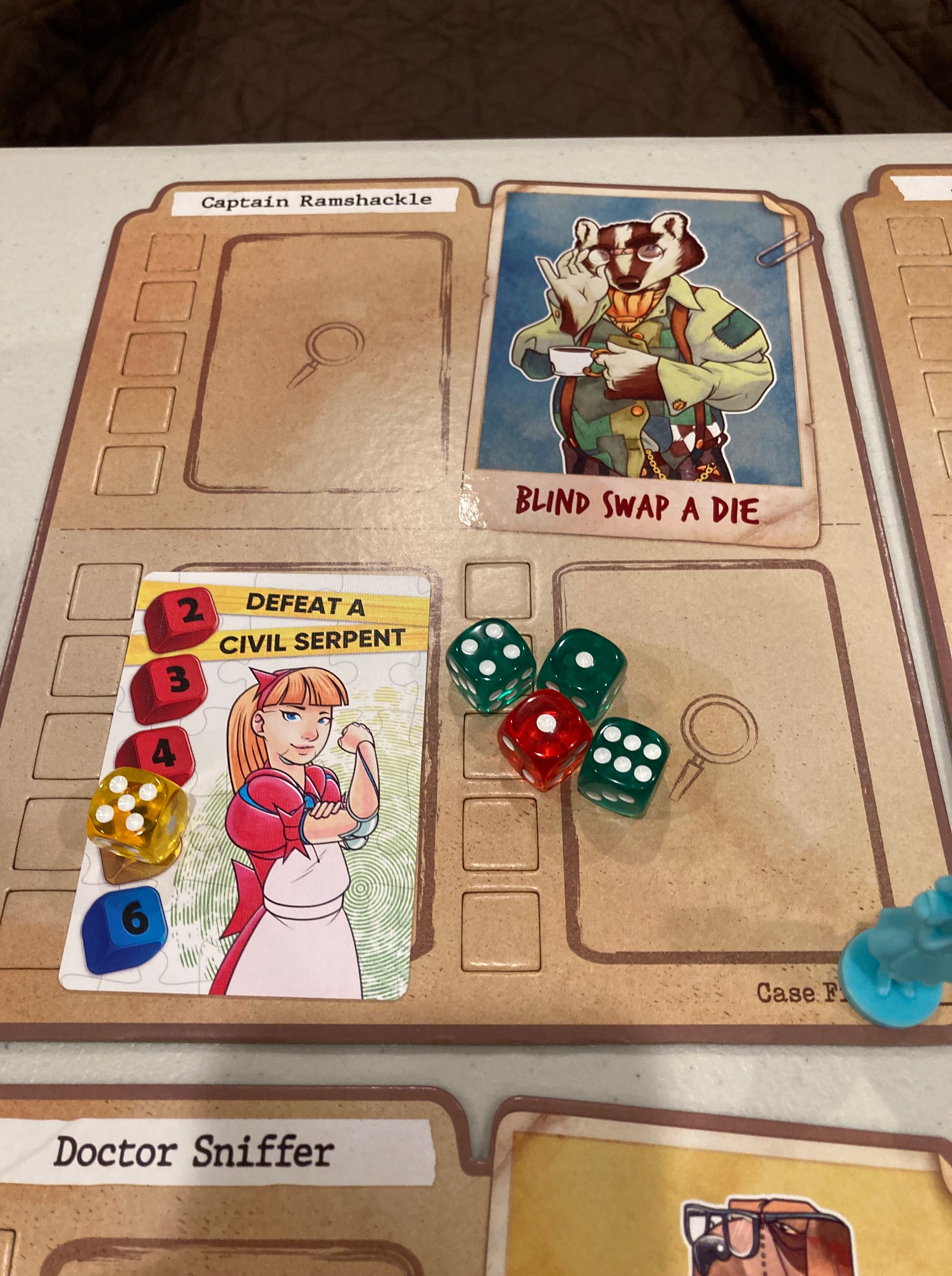
There should a page describing, in more detail, all the special powers of the each of the case files.  What does the above mean?  “Blind swap a dice”?  Any die?  Green die?  From the bag?  From other locations?  It probably means from the bag, but I don’t know if green dice (which are “place blockers”) are in the category.  Help?

This wasn’t a particularly good rulebook.  It was just barely enough to get me going and playing.  I guess that’s good enough?  We need to talk more about the rulebook, but first let’s take a look at the solo game.

Solo Play

IMG_9403

The rules seem to get this right: the box says 1-4 players and there are set-up rules for each player count: the game just really changes in (1) how many clue cards are out and (2) how long you have until the game is over (what the timer is set to).

IMG_9414

A solo player has 12 rounds with exactly 1 clue card on each case file: see below.

IMG_9436

To win, you have to “solve” all cards, which means putting the proper dice on it: this is a dice-placement game after all.

IMG_9439

On your turn, you draw 4 dice from the bag: if you can match the color and conditions, you can complete a card!  See above for a completed card!  If you complete all 6 before time runs out, you win!

IMG_9448

Part of the problem are green dice: they just are “blockers”! If you pull a green dice from the bag, you MUST block one of the spots on the card you are on! The only way (besides special cards) to get rid of these is to sacrifice a die of the needed color (and same or bigger number) to cancel it out.  

IMG_9443

Worse, as you go, the dice bag gets leaner and leaner as dice YOU COULDN’T USE go the Dice Hold (middle of the clock)!!! Above, you see a “mid-game” dice hold with lots of dice I couldn’t use!  Green dice are a little different: If you can’t place them (the evil awful bad green dice) because spaces are filled, they go to the Civil Servant Threat track.  At 6 spaces, you lose the game.

IMG_9454

Every turn, the Civil Servant (evil snake lady) moves to some location (rolls the white dice) : she is a blocker!! The player(s) can’t travel to the Case where she is.  So, Alice must choose an unblocked location and moves there.  She draws 4 dice.  She MUST place the green dice first, then she can try to place the rest. Anything she can’t place goes on the clock.  If she “solves” a card, she gets to keep it: each card has a special power!

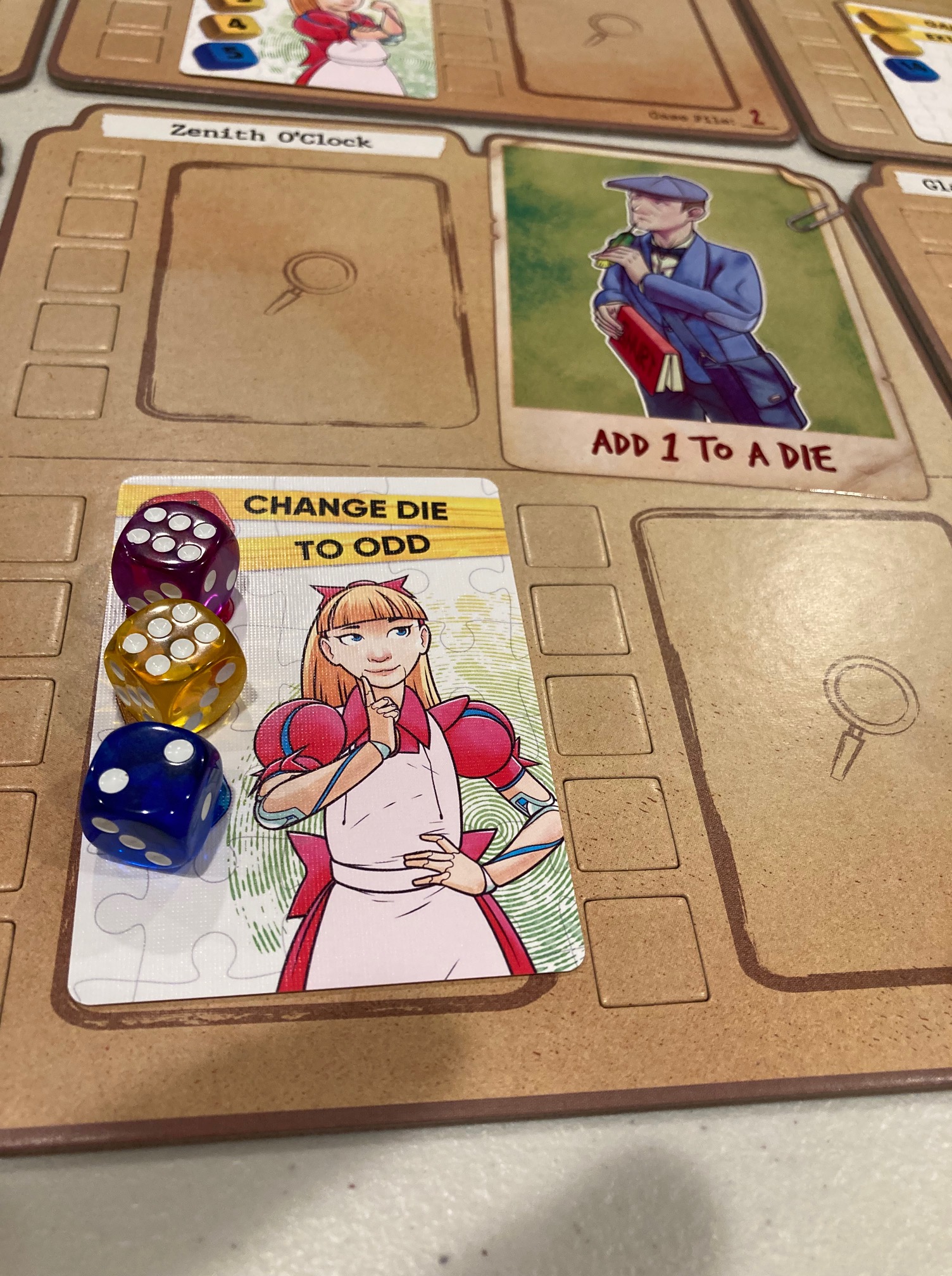
IMG_9441

In the picture above, Alice has solved the card so she can keep it! (Yes, purple dice are wild). Later in the game, she can discard the card to (in this case) turn any die to odd.

IMG_9453

The game continues until time runs out, the dice bag runs out, or all 6 spaces of the Threat Track are filled.

Cooperative Game

IMG_9537

The cooperative game is very similar to the solo game: you start with more clue cards (see above) and have less time on the clock.  The other difference is that the Civil Serpent only moves after everyone had had a turn.

IMG_9539

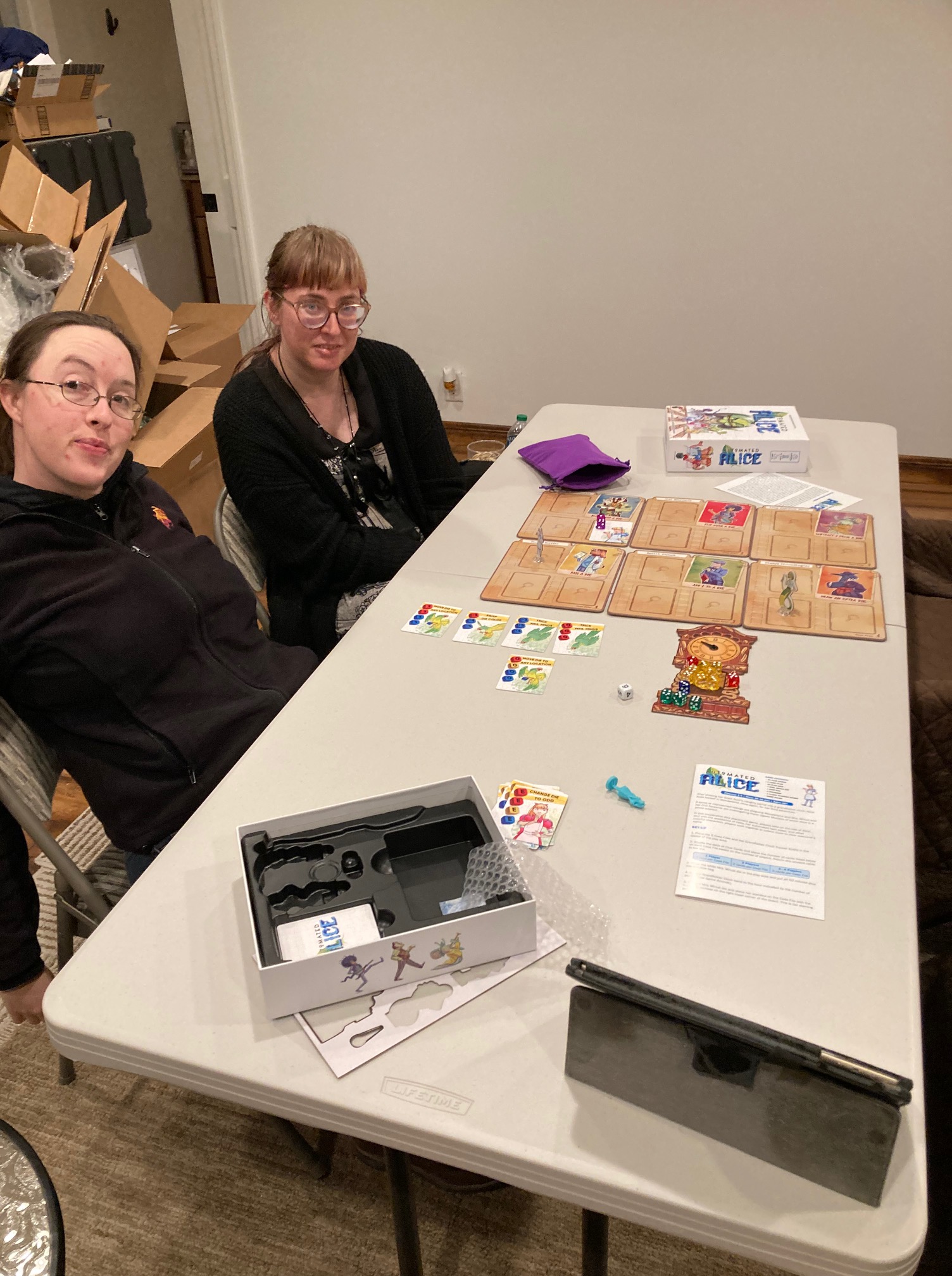
I’ll be honest here, without the cooperative game, I would have hated this game.  My friends and I re-read the rules and had an interpretation that “seems” inline with how we were supposed to play.  I liked the way we chatted, talked about where to move, and what to do with dice as a group.  We had fun with this game, but only AFTER we, as a group, figured out some poorly specified things. See “The Curious Case of the Comma” below.  Seriously, we had to cooperate to figure out the game!

The Curious Case of the Comma

IMG_9545

This rulebook isn’t very good: the basic game play is summarized on one of the last pages of the rulebook.  My first solo game went so badly, I almost threw this in a bin.  These rules are really poorly-written.  There are three main things that aren’t clear, and come from these 2 lines in the rulebook:

IMG_9544

Issues here:

  1. The comma on instruction 5 seems to imply you have to roll the dice you have moved or stayed.  Without the comma, it sounds like you can only re-roll if you move? 
  2. How many times are you allowed to move?  We think you can only move once, even though line 6 makes me think we can move up to 2 times and re-roll 2 or 3 times?
  3. But the total number of rolls is 3.  I wish they should have used the word “re-roll” instead, because line 6 almost implies you get 3 re-rolls “after” the initial roll?  We think they mean, like Yahtzee, you get 1 initial roll and 2 follow-up re-rolls.

Without further clarification, we misinterpreted these rules many times.  In my first solo game, I didn’t even think I could move after I rolled or re-rolled!  So I was completely slammed.  After me and my friends played cooperatively, we tried a few things and below “seems” like the right interpretation of these rules:

  1. You get your first roll.  Place dice (green must be placed first) as appropriate.
  2. You can (stay and re-roll) OR (move and re-roll).  This is second roll (1st re-roll).
  3. You can’t move again, but you can do a third roll (2nd re-roll).

With this interpretation, the game seemed playable and fun.

IMG_9541

I think Lewis Carrol and Jeff Noon might find it funny that a comma can make the difference between the game being fun or not! Lewis Carroll liked to play with language and meaning like that…

Where Are The Choices?

IMG_9439

The main choices in the game are the following:

  1. Use the Special Power on the Case Board you are on.  Above, Zenith o’Clock can add 1 to a die.
  2. Roll the dice up to 3 times.  Once you have pulled the dice from the game, you can re-roll them (like Yahtzee) up to two times
  3. Move.  You can go to any Case Board (except were Mrs. Minus is)
  4. Decide when to use special powers.  When you solve a case, you keep the card.  In the card above, you can discard the card to change a die to odd.
  5. Take a card from the Dice Hold, but advance time.  

In general, these are the main decisions.

First Impressions

IMG_9450

This game AT FIRST was just too random.  Notice above: I drew 4 dice and 3 of them were green!!! I have to place them on the card and block 3 spaces now!  Which will cost me at least 1 or 2 more turns to clear!  The solo game only gives you 12 turns to play, and if you have even 1 bad draw like above, you are almost certainly done!! You just won’t have time to clear the card and still satisfy the card conditions! Remember, you have to sacrifice a die AND it has to be greater AND it has to be the right color!  So, it may take 2 turns to just clear the space!

The “green snake lady” mechanic also adds more randomness: you roll a six-sided dice to see where she goes every turn!  She may stay out of your way completely, or she may block your progress at the worst possible time!

IMG_9441

I like the art, but this game AT FIRST was just way too random.  I never felt like I had any way to mitigate if I drew the wrong color!! 

IMG_9533

It turns out, moving AFTER your first roll of the dice allows you to mitigate what dice you pulled!  You pulled all yellow?  You can move to a Case File with some yellow dice!  AND THAT ONE CHANGE (which I had missed in the rules) MADE ALL THE DIFFERENCE.  I went from hating the game to having a nice time with my friends! 

IMG_9535

This became a light-hearted romp with dice as we moved around the board.  Granted, the randomness still hangs in the air a little (it’s a dice game after all), but the game opened up after that.  Should we leave a green dice to lower the green dice count in the bag?  What dice should we leave up? When do we use our special powers?  Where should we move so we don’t have to throw away a dice?  The game became a much lighter fare after that one rule: you can move after your first dice draw and placement! 

Conclusion

IMG_9454

This is a complete rewrite of my original conclusion: I originally thought this game was too random and couldn’t recommend it. After deciphering the rules with my friends, we came to the realization that this is a fun, light-hearted, dice-placement romp. There are some good decisions to make during the game, even if there is a bit of randomness. In fact, even though I liked the cooperative dice-placement games Intrepid, Roll Camera!, and Roll Player Adventures better than Automated Alice, that was not the case with my friends! They liked the simple (once you know the rules), quick (30 minutes), cooperative dice-placement of Automated Alice better! (To be fair, they still liked Roll Camera! and Roll Player Adventures better for in-depth cooperative dice placement games)

I do think this game needs a lot of clarifications, either in a rulebook rewrite, a player’s aid, or a FAQ: we had too many problems to gloss over this issue. Make sure you double-check our interpretations of the rules before you buy this! I’d hate to think recommend this game when I’m still not 100% sure we played it right.

If you like the Automated Alice world and just want to roll some dice in that world, this might be for you. Or if you want a light-hearted, quick, cooperative dice-placement game, Automated Alice might be for you. I liked the art. We had fun … after we figured out the rules.

If you are looking for some alternatives for cooperative dice-placement games, I urge you check out our Top 10 Cooperative Games of 2022! See our reviews here: Roll Camera! is a sillier cooperative dice-placement game about making a movie, Intrepid is a heavier cooperative dice-placement game about running a space station, and Roll Player Adventures is an adventure using dice-placement as its main mechanism.

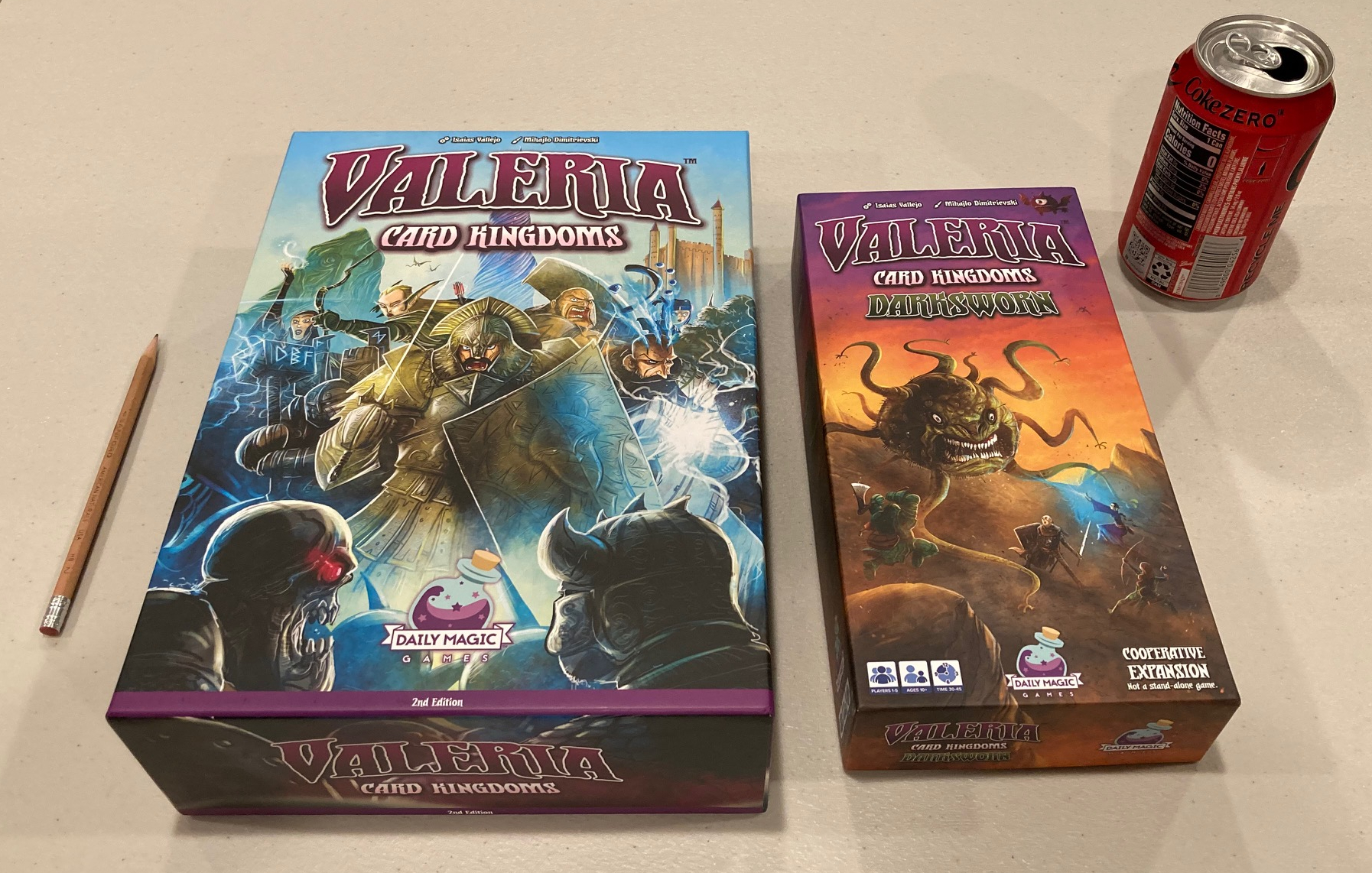
A Review of Valeria: Card Kingdoms and the Cooperative Expansion: Darksworn

IMG_9330 (1)

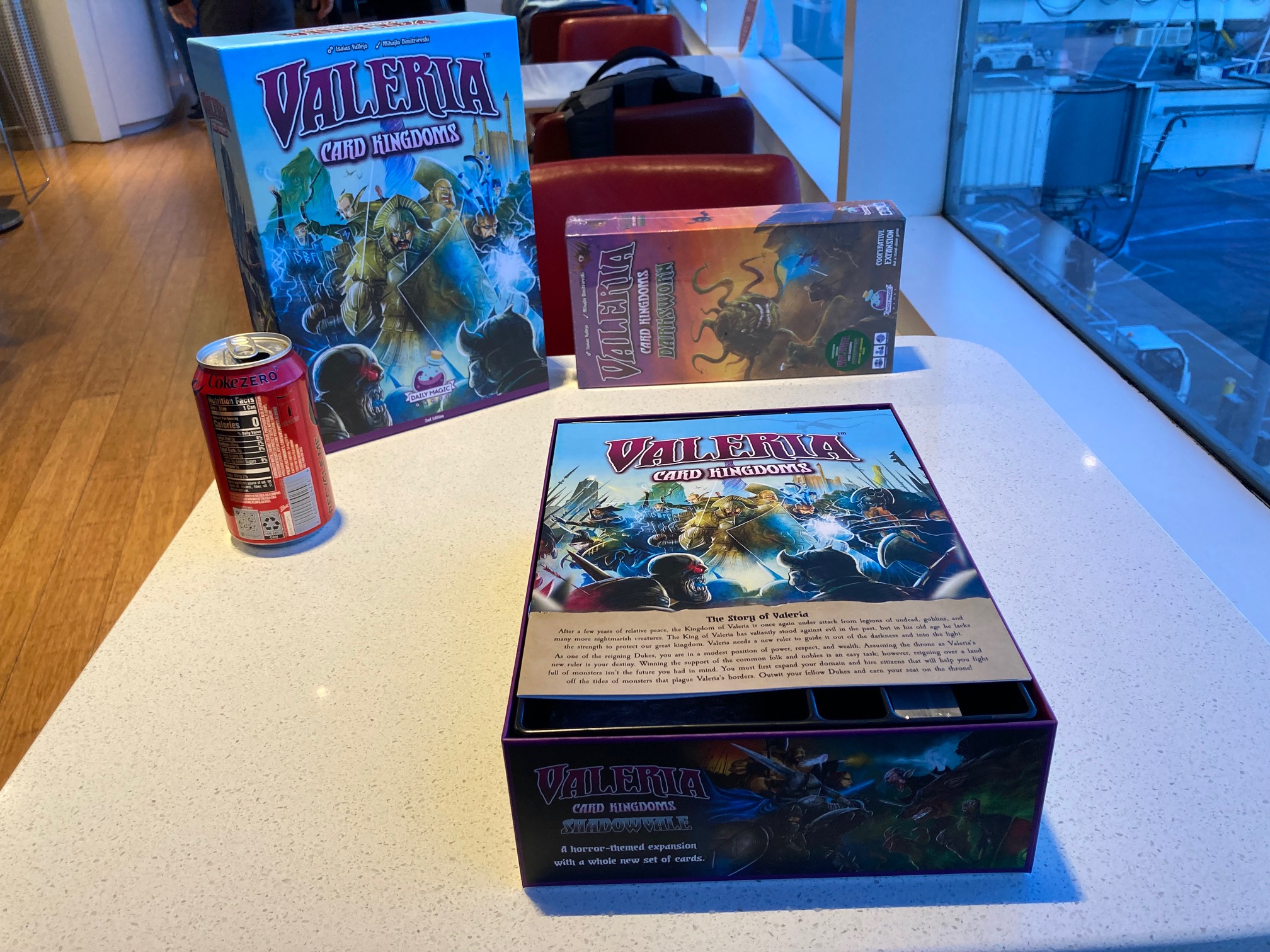
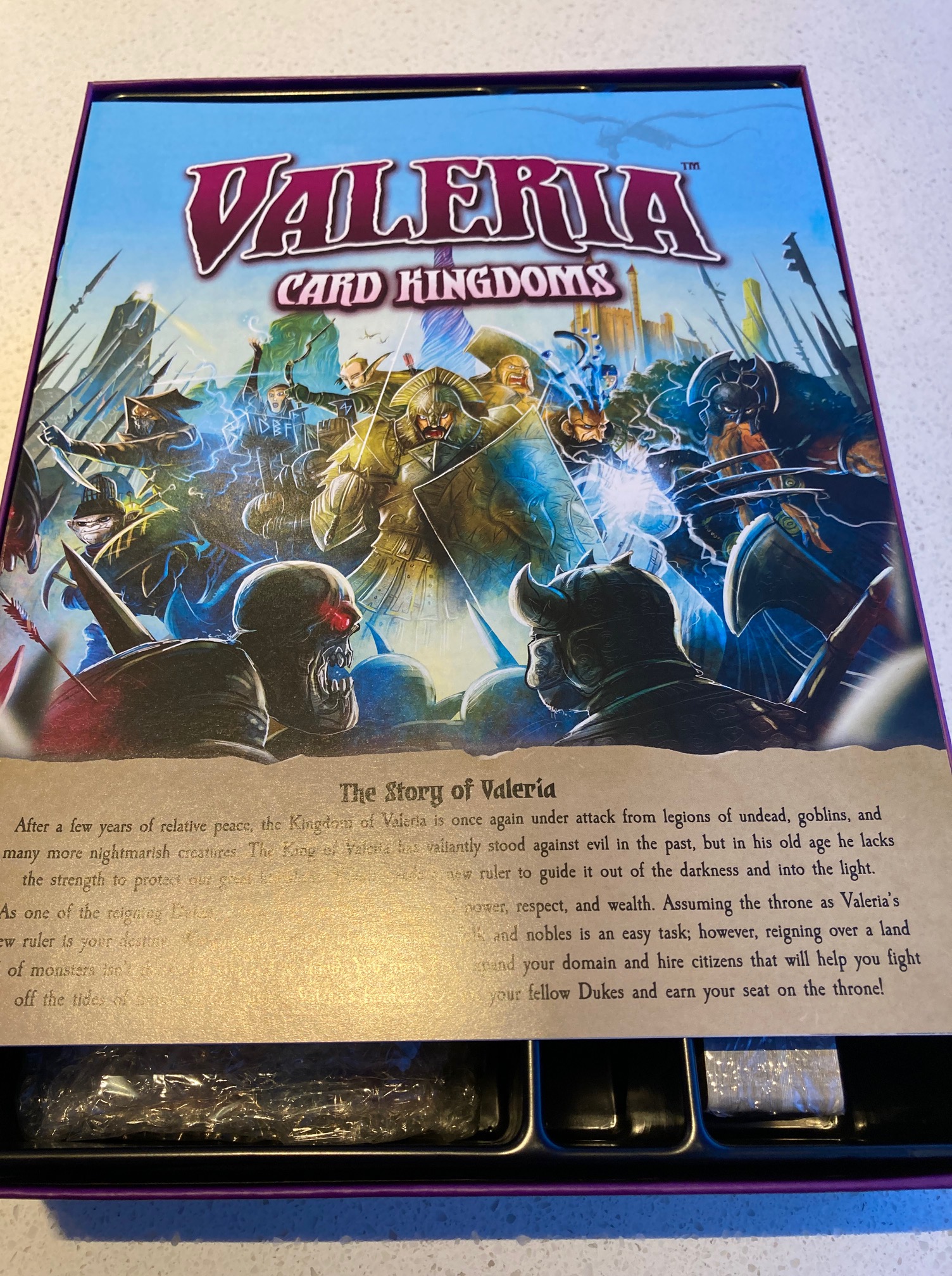
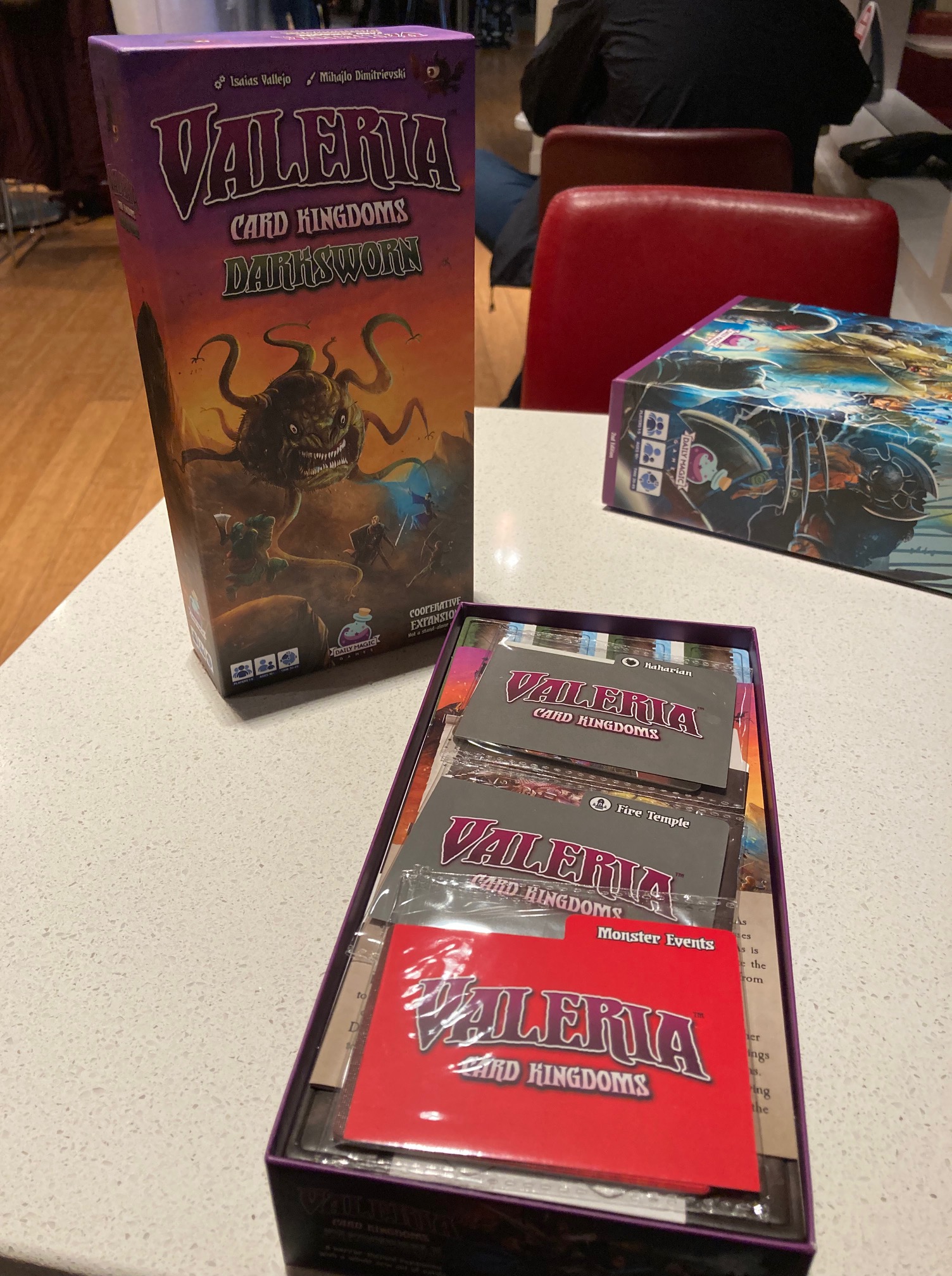
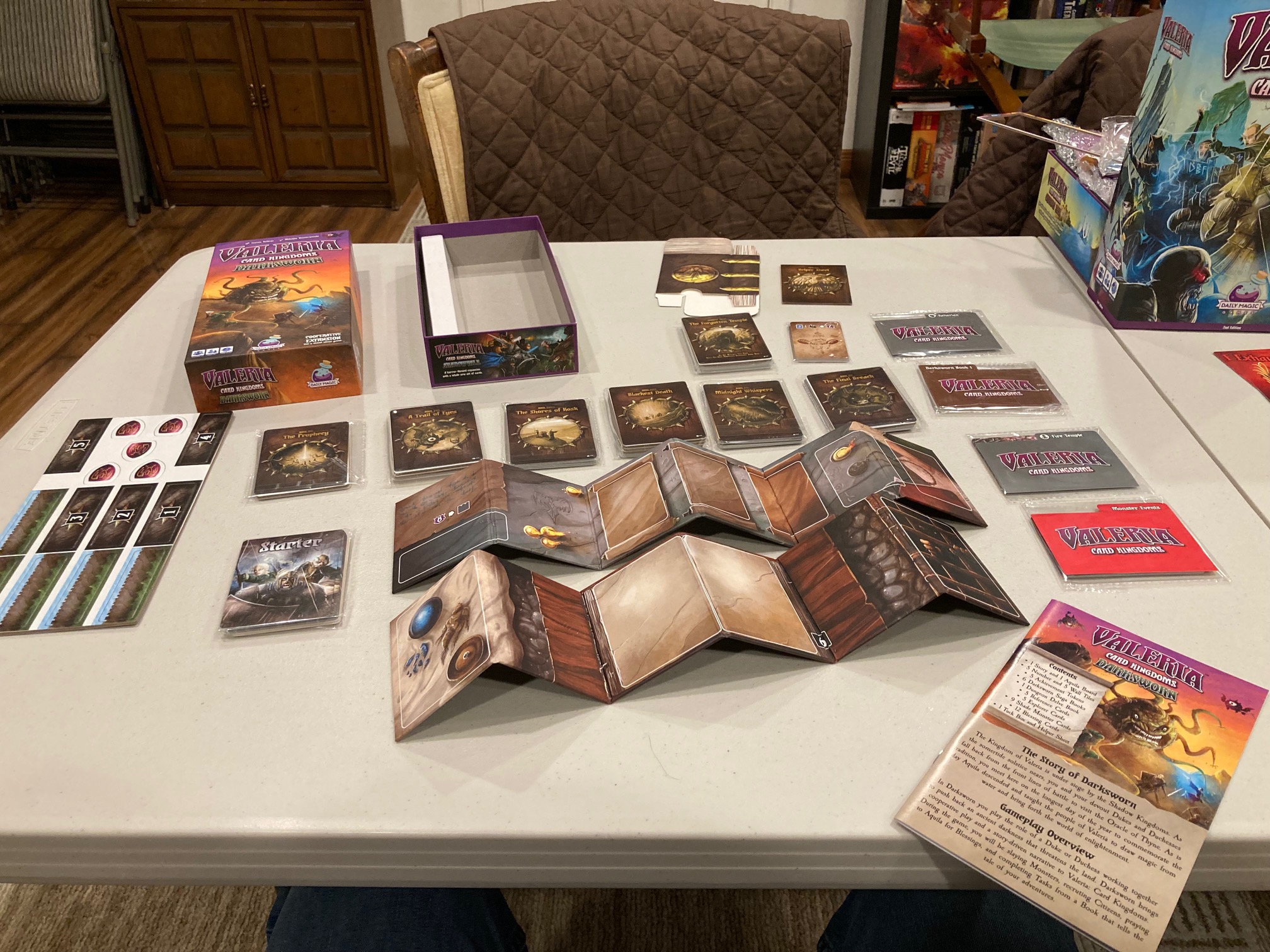
Valeria: Card Kingdoms is a competitive victory point card game that’s been out for some time (it original came out 2016). Back in 2021, Daily Magic (the publisher) put together an expansion called Darksworn that adds a cooperative mode to the game: they also made a 2nd Edition of the original game. So, Daily Magic put Valeria: Card Kingdoms (2nd Edition) and this new expansion Valeria: Card King Kingdoms, Darksworn (seriously, that’s it’s full name) on Kickstarter back in March 2021. They fulfilled fairly quickly and it arrived at my door in early December 2021, but it’s taken me a while to get the solo mode, the group mode, and the cooperative mode played to get a sense of this game!

This will be a fairly longish review: we need to get a sense of the base game Valeria: Card Kingdoms before we jump into the cooperative expansion! After playing all the many ways (base solo, cooperative solo, group competitive, group cooperative), it was pretty clear we needed a sense of the base game before jumping into the cooperative mode.  Luckily, it was pretty easy to do that.

Unboxing and Discussion of Valeria: Card Kingdoms

IMG_9044

So, when I kickstarted this, apparently I got the 2nd Edition of Valeria: Card Kingdoms. I have never played the original, so I have no sense of what’s changed (apologies). I can only offer a look at the current edition. At its core, Valeria: Card Kingdoms is a card game.

IMG_9069

The cards are all linen-finished and have the same art style: that consistency works in the games advantage as it looks really good on the table when it’s all set-up (see below).

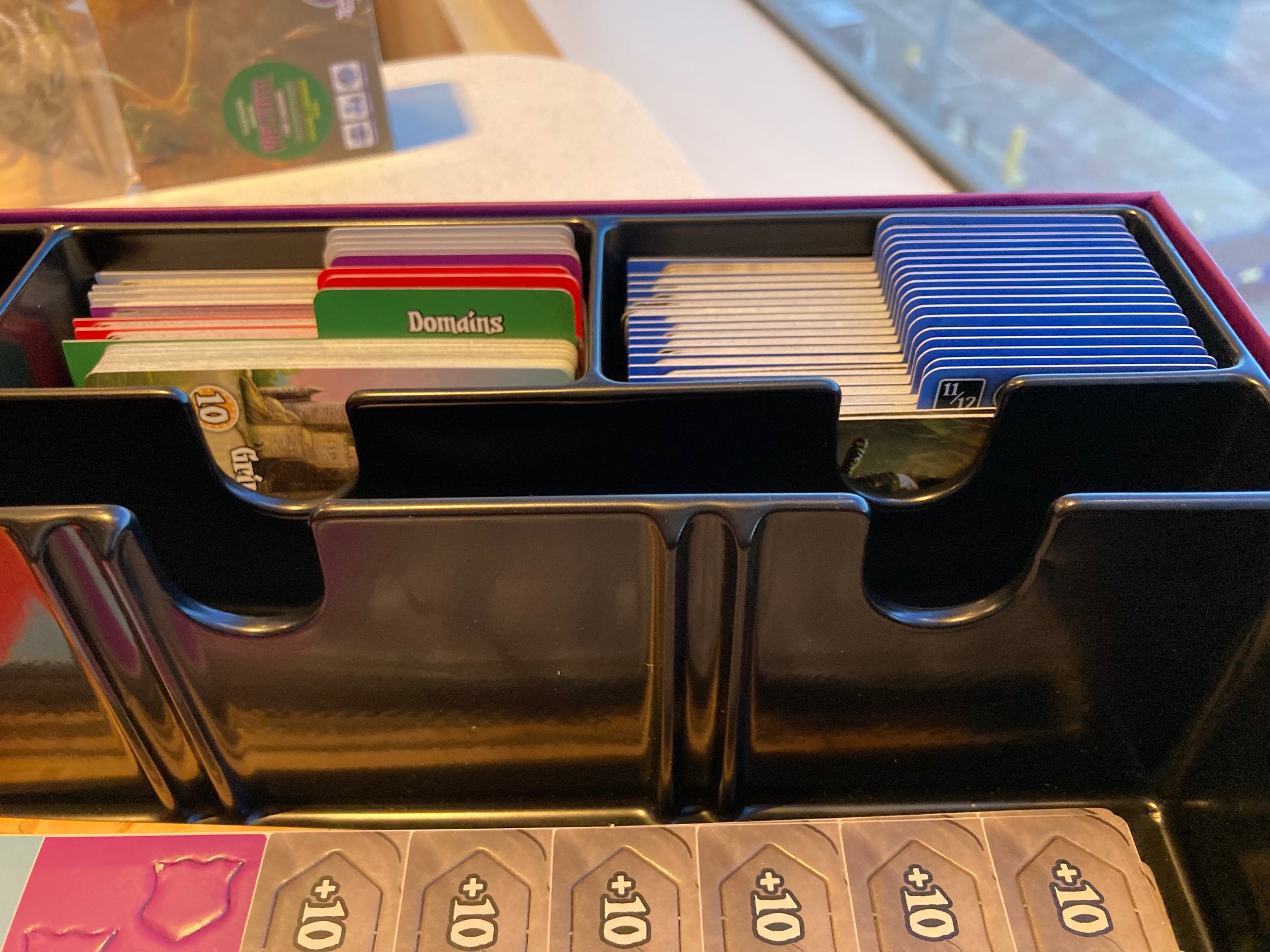
There’s some nice dividers to help “sort” the cards. Incidentally, there are a lot of cards in this game! Setting up and tearing down the game reminded me of many deck-builder games … so many cards to choose from and set-up!

IMG_9070

IMG_9053

But the cards organize pretty well into the box above. When it’s all put away, it looks like the below.

IMG_9088

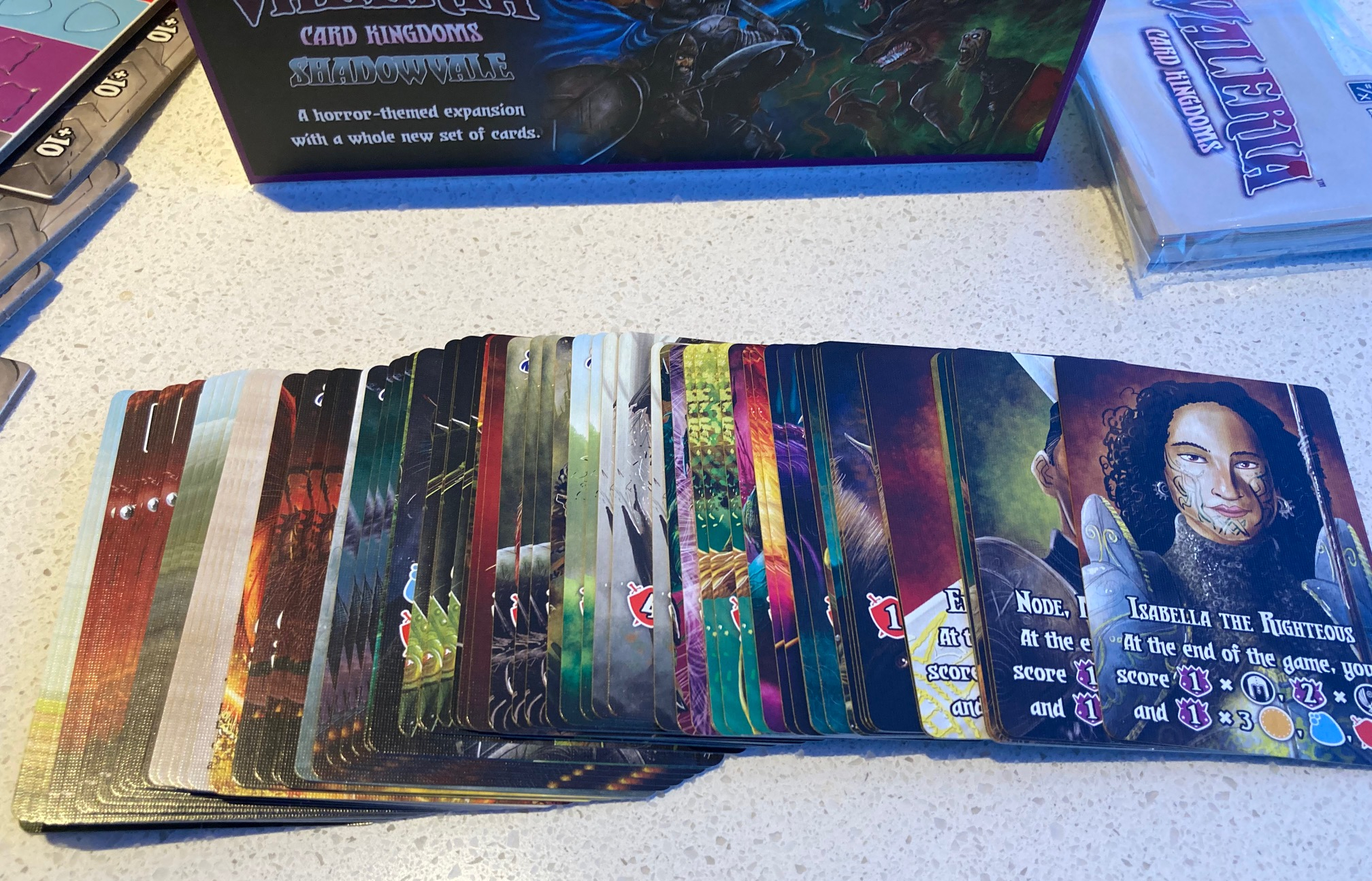
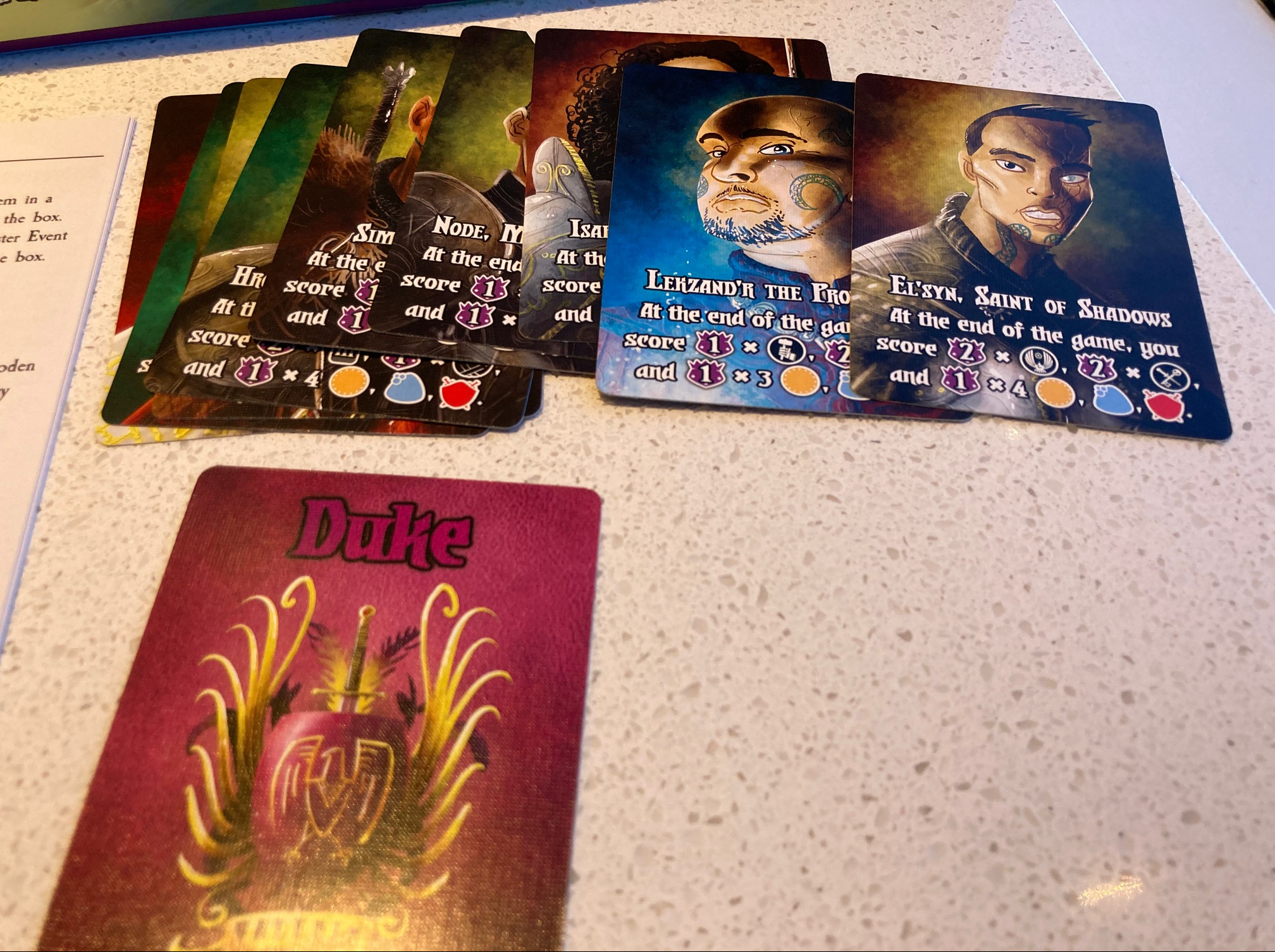
Here’s a bunch of the cards, starting with the Dukes! Each player takes on the role of a Duke in the game!

IMG_9082

IMG_9064

In the game, each player gets to choose between two dukes to play: I chose Isabella the Righteous. This card is hidden until the very end: basically, it may shape your play as you get “extra” victory points at the end of the game depending on your duke.

IMG_9083

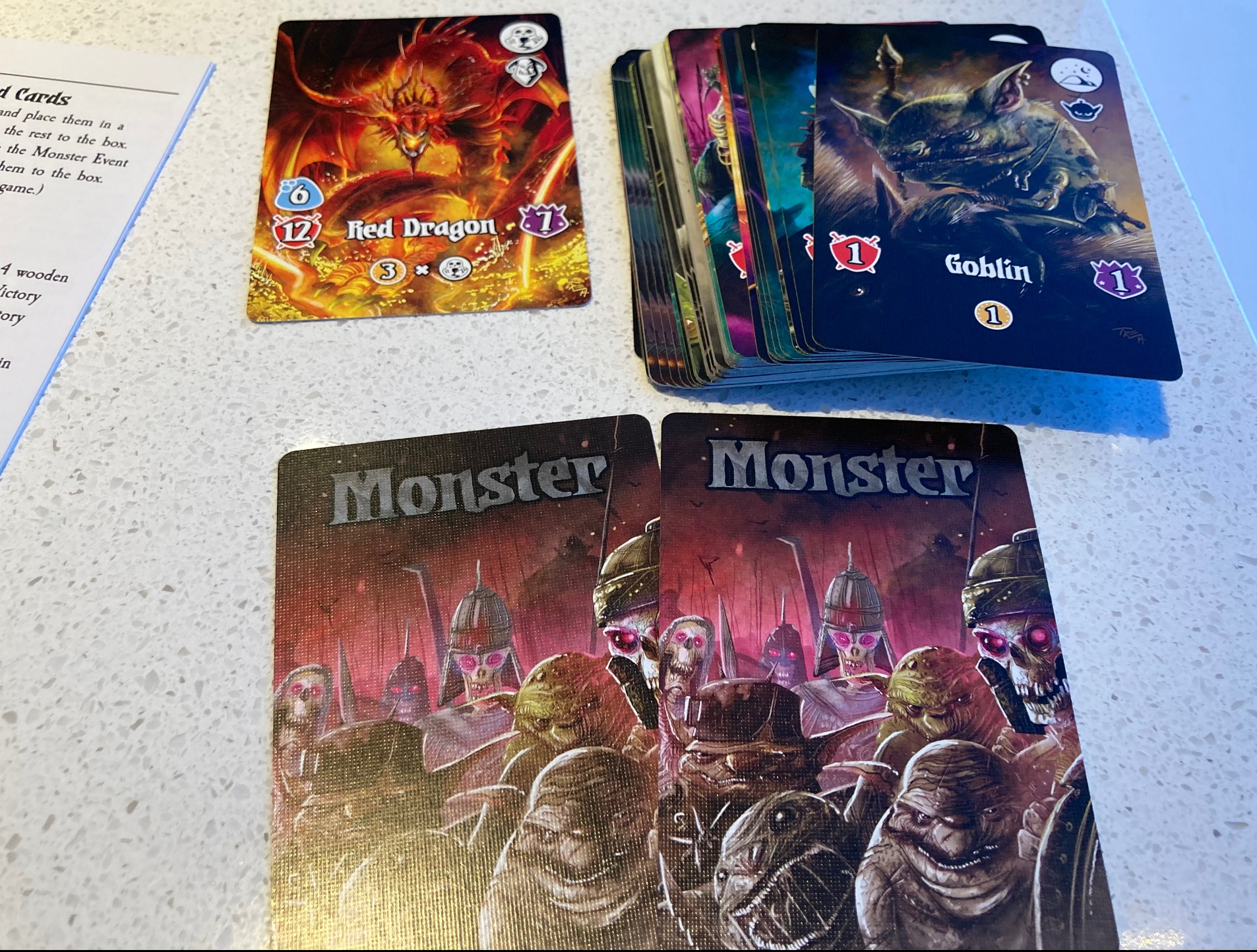
Throughout the game, the main goal is to fight Monsters: see some sample monsters above! You have to have enough strength and or magic to defeat a monster; For example: the goblin only requires 1 strength to defeat, but the dragon requires 6 magic AND 12 strength!). If you defeat the monster, you get the card and it will count as victory points (the purple badge: 1 victory point for the goblin and 7 for the dragon) at the end of the game. Whoever has the most victory points at the end wins!

IMG_9071

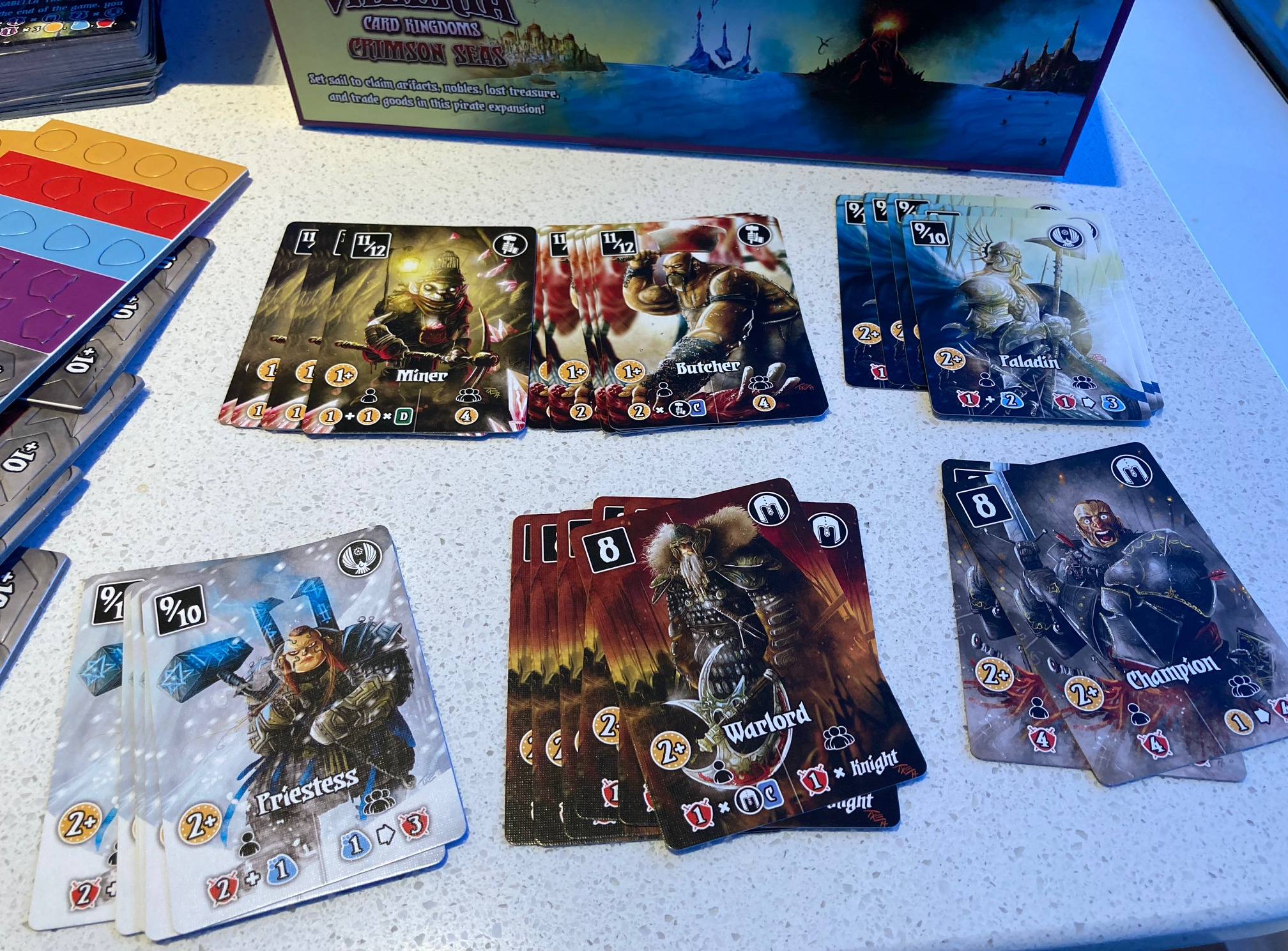
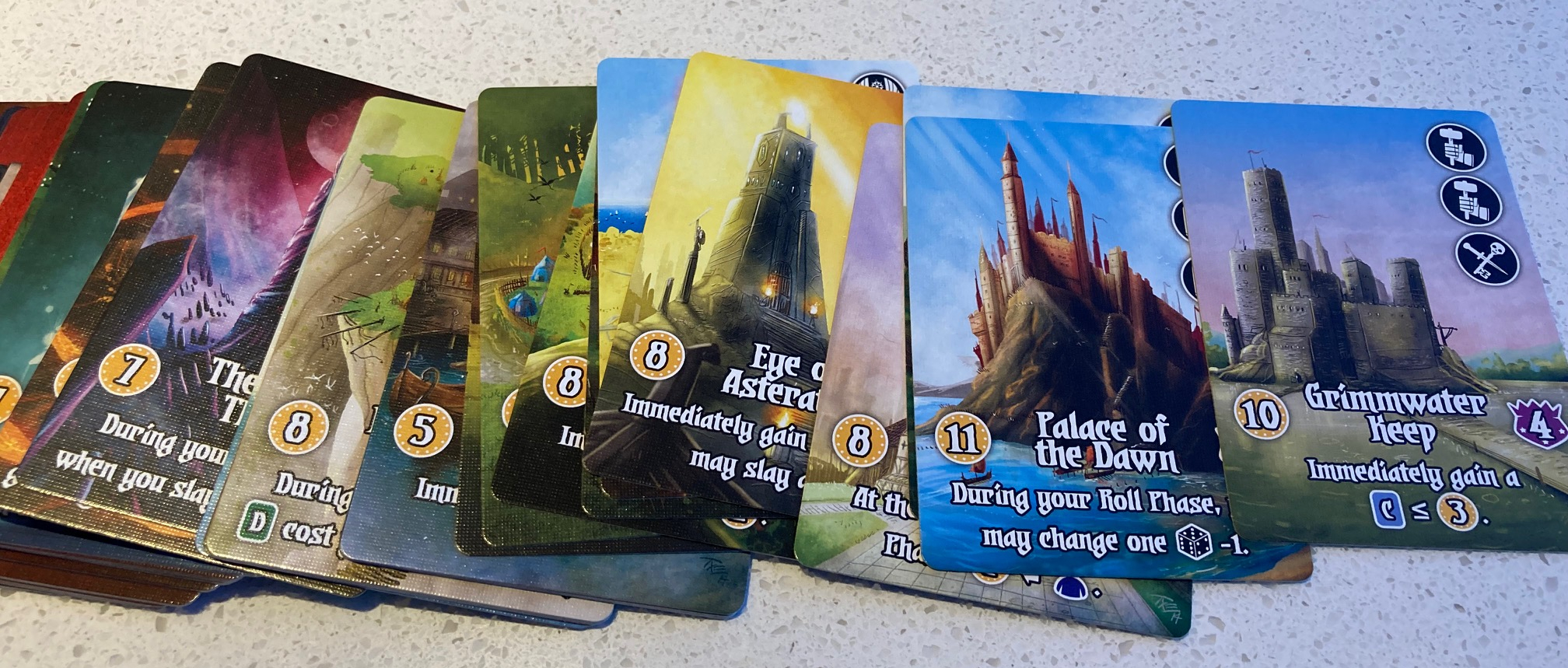
To help you gain strength and magic and gold, you must recruit citizens along the way! Each citizen costs gold (very much like a deck-builder) as you hire them. See a bunch of different citizens above,

IMG_9078

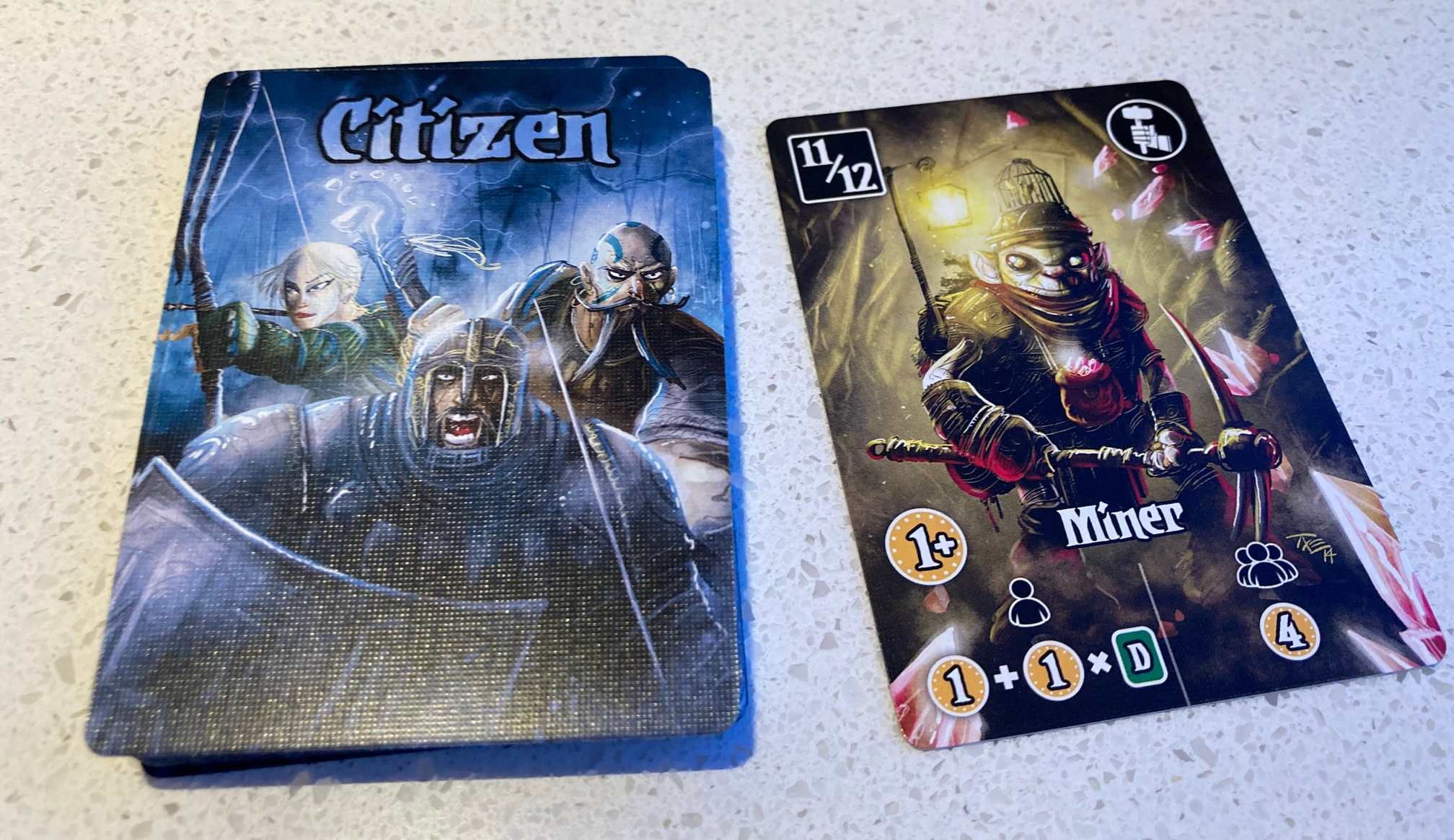
For example, the Miner citizen above costs 1 gold, but when he does an activate (on an 11 or 12: the activation number at the top left), he gets you one of two benefits, depending on whether you are primary player on not. Usually, being primary player gets you the better benefit (on the bottom left) or the alternate benefit (on the bottom right). In the citizen above, activating the Miner gives you all sorts of gold!

IMG_9072

Another way to get victory points is to buy domains: see above. They tend to cost a lot of gold.

IMG_9060

As the citizens get you more gold, magic, and strength, you have to keep track of your resources using the boards above (each player gets one). Note the +10 token which you drape along the right of the card to keep track of amounts above 10.

IMG_9092

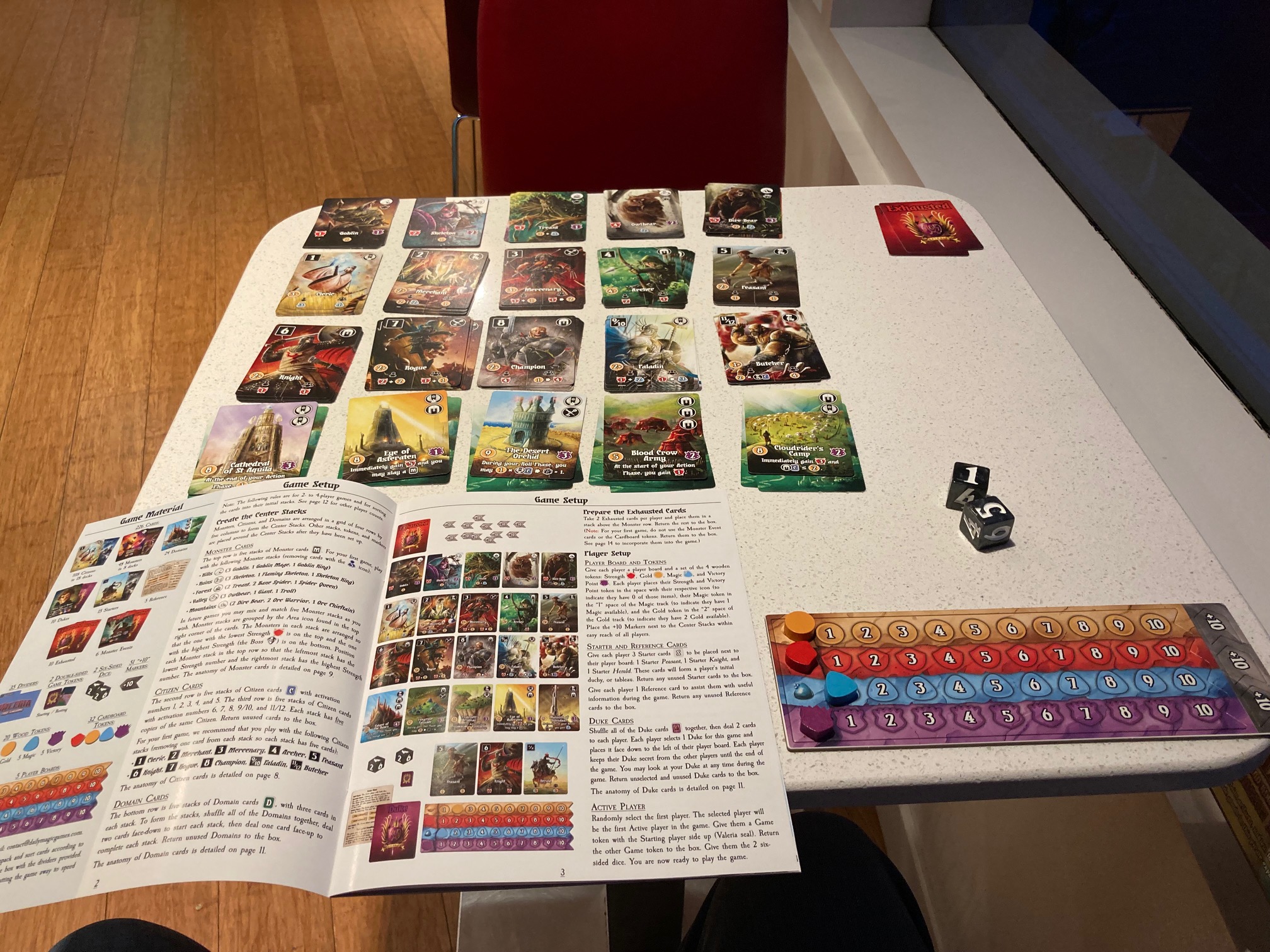
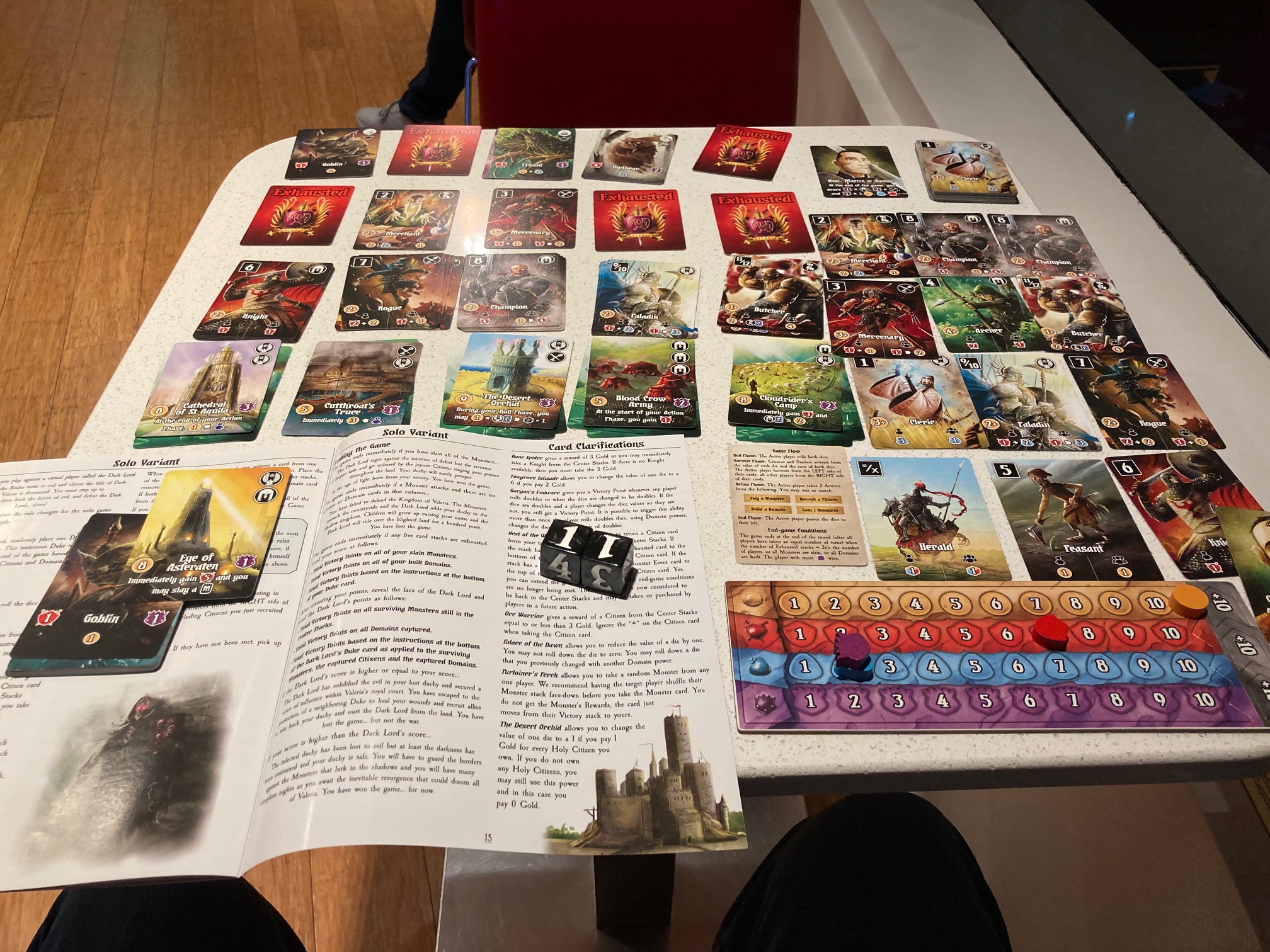
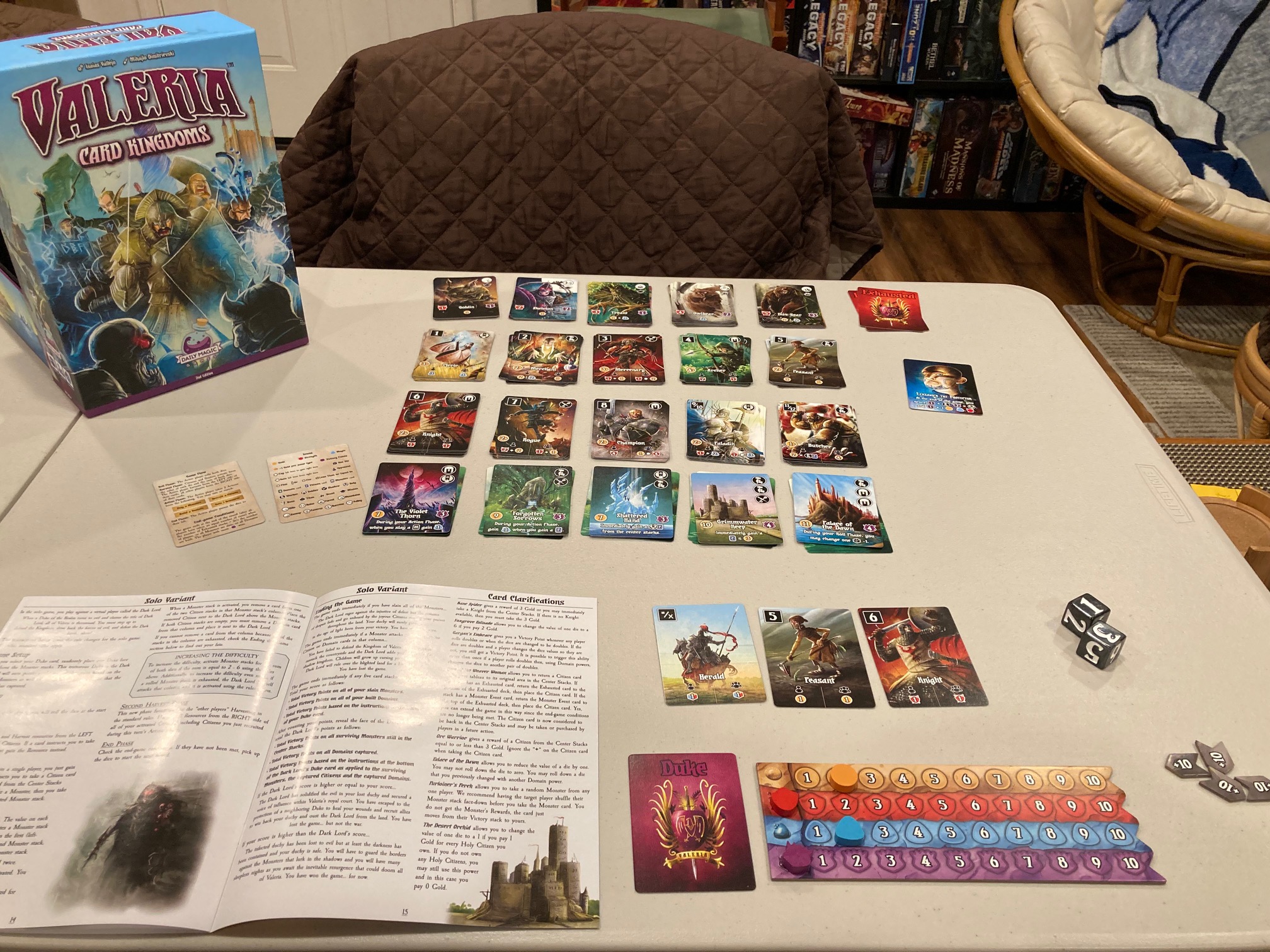
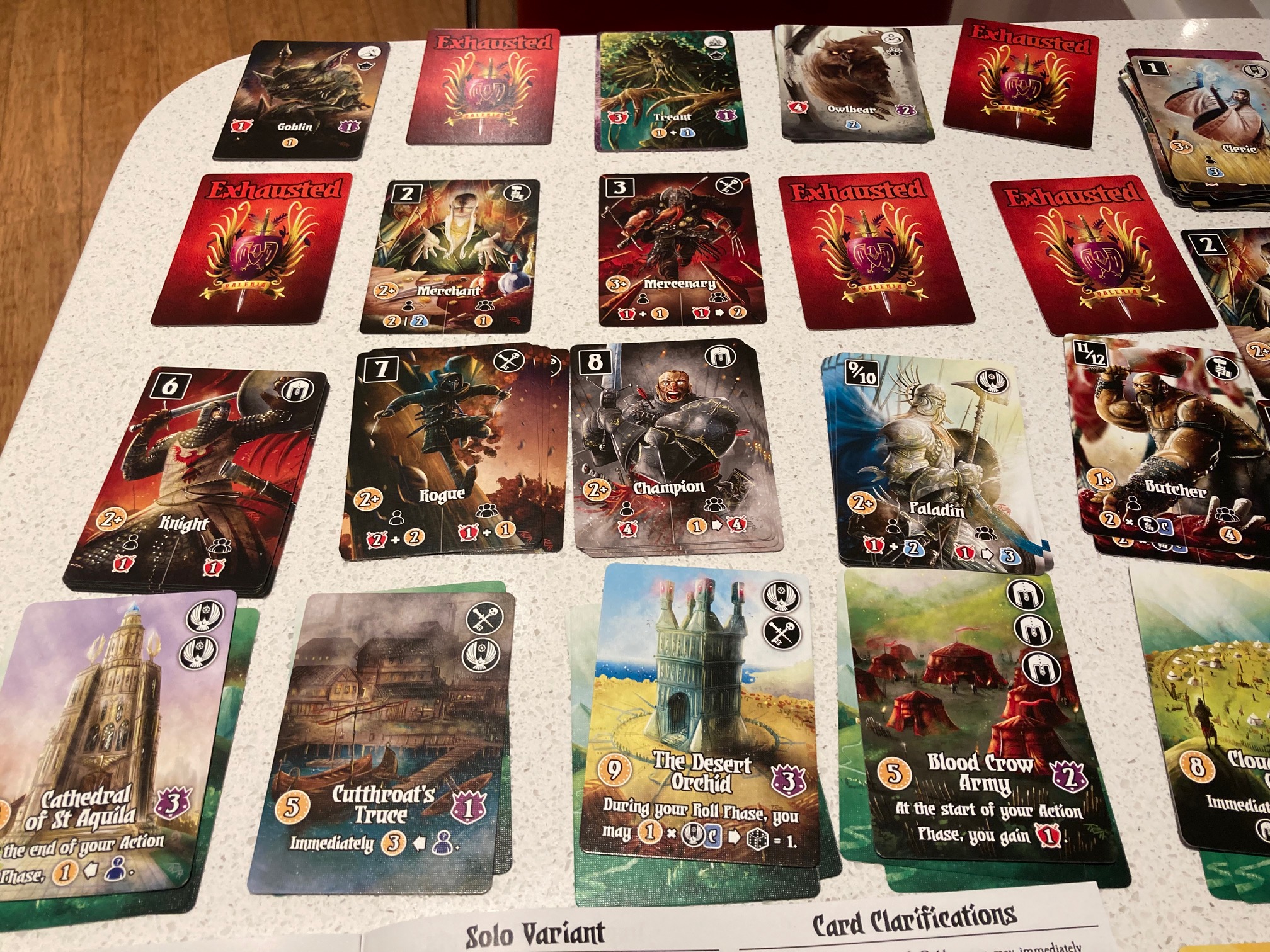
When everything is all set-up, there are 5 monsters at the top row, 10 citizens in the next 2 rows, and 5 domains in the last row. You recruit citizens to get resources (strength, gold, magic), you kill monsters for victory points, and you buy lands (domains) for victory points. See above.

IMG_9080

The markers for the boards are nice wood components (see above). The two dice are quite nice and chunky! They are also the main thing that dictates how resources flow in the game! When you roll the two dice, you activate every citizen that matches the exact number on the dice OR the sum!

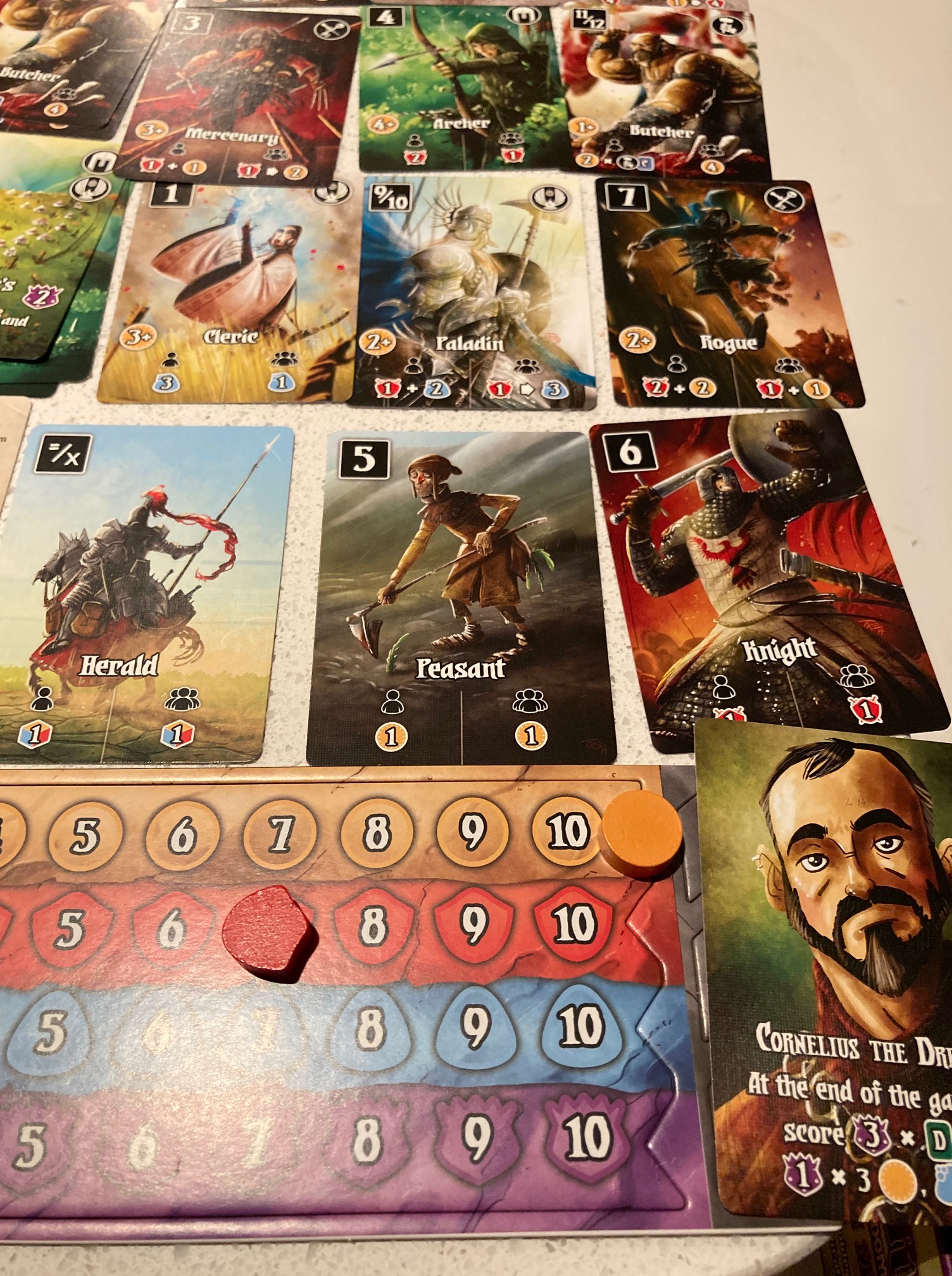
IMG_9096

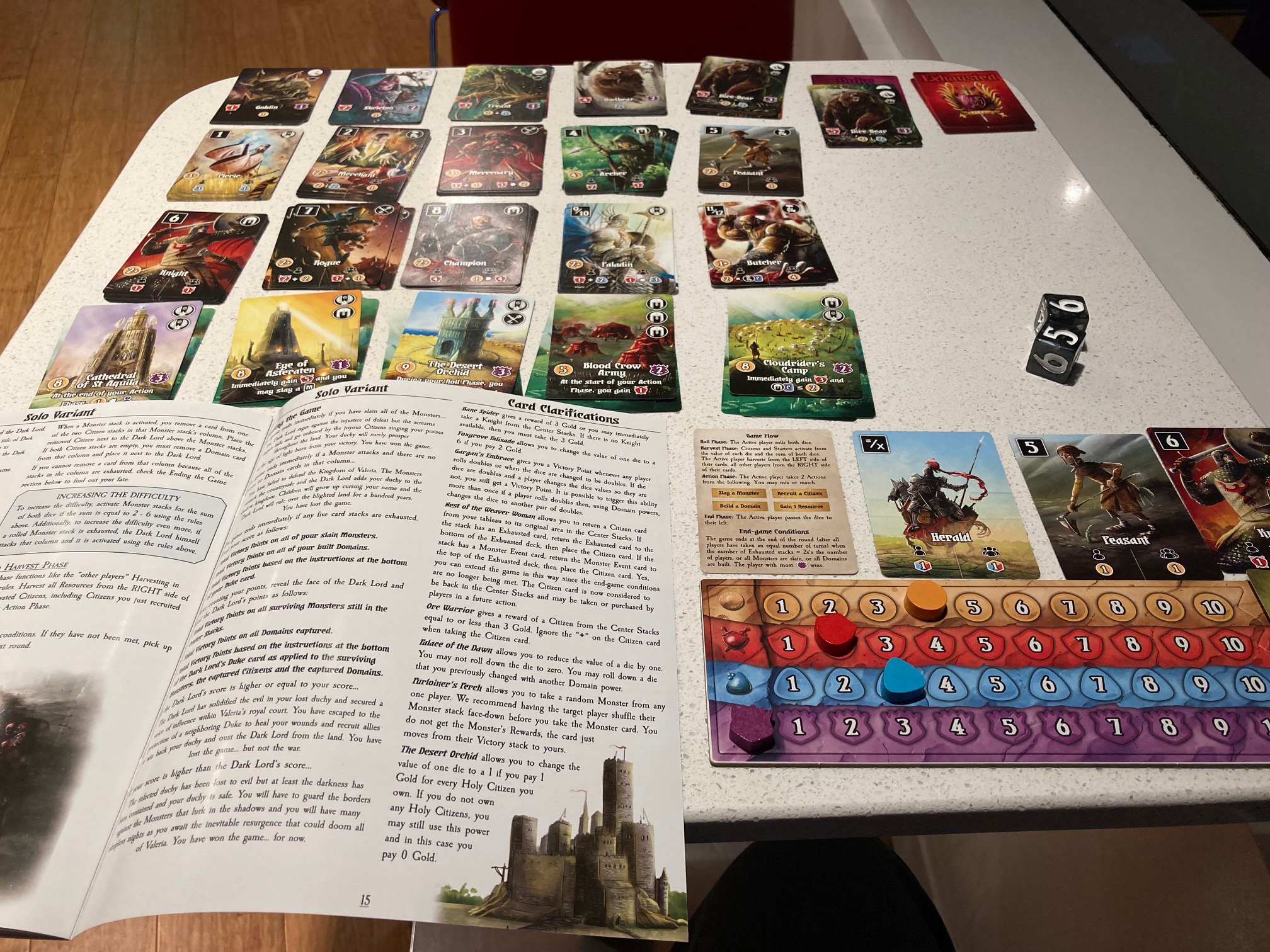
You always start with 3 citizens (Hearld, Peasant, Knight: see above). In my first turn, I rolled a 5 and 6, so the Peasant (5) activates and the Knight (6) activates. If I had already recruited the Miner (11/12 from above) he would also activate! The Peasant activates to give you 1 gold and the Knight activates gives 1 strength (bottom of card for benefits!). See below for a more focused look at the starter cards.

IMG_9105

One of the more interesting mechanisms of the game is that EVERYONE who has a citizen that matches the die roll activates! The primary player gets the benefit on the LEFT, everyone else gets the benefit on the RIGHT. For the starting citizens (Herald, Peasant, Knight), there’s no difference, but notice the Cleric! The primary player gets 3 magic while everyone else only gets 1 magic!

IMG_9093

The game flows pretty well: everyone stay involved as you play, but the primary character gets the better benefit.  Usually, people spend the first part of the game recruiting citizens and building their army so they can fight monsters and/or buy land in the later game.  Once a certain number of stacks are exhausted, the game is over and you count victory points!

IMG_9107

The game has real nice components (see below) and looks really fantastic all set-up (see above).

IMG_9086

Rulebook for Valeria: Card Kingdoms, 2nd Edition

IMG_9045

I spend at least a little time every review talking about the rulebook. This rulebook was pretty good.

There were lots of pictures for set-up, lots of annotations of the different cards, and the rules seemed fairly complete. There was even a elaboration section at the end.

IMG_9102

For some reason, I didn’t love this font: the font seemed to make this harder to read for me? I didn’t love the font, but it was readable: it just seemed to demand “more” from me as a reader. Maybe I’m crazy on this one. The rulebook was good enough for me, a complete newbie to this game, to learn it from scratch. It also seemed complete and handled a lot of edge cases (either as a quick sentence or sidebar). Except for the font, I was happy with it.

Solo Game from the Base Game

So, interestingly, there are two ways to play Valeria: Card Kingdoms solo! Thank you for following Saunders’ Law! The base game comes with one way to play solo, and with the Darksworn expansion, there’s another way to play solo! Since we knew nothing of the game before getting everything, we decided to start simple and play the solo game from the base game.

IMG_9054

The solo mode takes about 1.5 pages at the end of the book.  The game flow does change up a little: you still roll dice, recruit citizens and kills monsters, but there’s this new notion of a monster phase, and you also activate the secondary benefit on your citizens (after everything else happens that turn).  The premise is that you are fighting against a “bad” duke (The Dark Lord) who controls the monsters! You either have to kill all the monsters or have to get more victory points than he does to win.  When you roll, you still activate your characters like normal … but in the monster phase YOU USE THE SAME ROLL to activate some column(s) of monsters on the board!  If there’s a monster in a column, the monster either kills a citizen in that column or a domain if both citizens are dead!

IMG_9336 (1)

If the Dark Lord has completely decimated a column so there’s nothing left to take out, the Dark Lord wins unequivocably! If you, on the other hand, kill ALL Monsters before he can exhaust any cards, then you win! Otherwise, it becomes a victory point counting game: when 5 card stacks are exhausted, you compare victory points. The Dark Lord adds victory points from monsters in the monster stacks and captured lands, and you compute victory points as normal. If you beat the score, you have a minor win.

I really liked that (in my words) there is a major win (kill all monsters), minor win (more victory points), minor loss (fewer victory points), and major loss (column decimated) in the solo mode!!! Multiple win/loss modes really adds a lot more “flavor” to the game! See the text below:

The minor/major win/loss conditions were also an impetus to come back and do better! I had minor wins in my first few games, but I still kind of want to try for a major win!

IMG_9099

To be clear: the solo game is more complex than the base competitive game: the solo game has you keeping track of columns, capturing citizens, and adding some new rules. But, I don’t think the new rules were too much: they were pretty straight forward and made sense. There were always interesting decisions, much like the base competitive game (When do I recruit? When do I kill monsters? When do I buy lands?), but the added element of citizens dying was really interesting!!! I liked the included solo mode, and I look forward to playing it again. It’s “simple” enough that I feel like I could play this as a relaxing solo game, but just challenging enough to be interesting.

Unboxing and Discussion of Darksworn Expansion

IMG_9110

The second way to play Valeria: Card Kingdoms solo is to play using the Darksworn expansion. I chose to jump straight into Darksworn expansion without playing Valeria: Card Kingdoms competitive. When I would finally teach my friends the cooperative Darksworn expansion, I would teach them the base competitive mode THEN jump into the cooperative mode. But, for now, I am jumping straight in a solo player into the Darksworn world!

IMG_9347 (2)

That tiny little box hold a lot of content! See above!

IMG_9114

The rulebook uses the same font as the base game (so at least it’s consistent) and lists all the content: see above.

IMG_9110

There are new Monster Events, Domains, and Citizens that WEREN’T listed in the components list: see above. I think these are just new content you can add to the base or expansion if you like.

IMG_9115

The tuck box, above tells us one thing: this will be a game that requires “saving the game” after a session. (Note, if you build the tuck box, it doesn’t seem to fit back in the base game?)

IMG_9116

The tokens are for a few new mechanisms. First, the numbers are used to notate columns because monsters will be attacking columns in the game (sounds familiar?) In other words, just like the solo game, but now we notate the columns explicitly. Because monsters attack columns, there are the walls to hold off the Monster attacks for a few rounds! The first time a monster attacks a column, it flips it over, then is only destroyed next time. The walls defer the monsters destroying citizens right away.

IMG_9117

The tokens are for balance: depending on the number of players, you will need more or less of these!

But what’s the solo game all about? It’s a campaign! (It looks resettable, so it’s not legacy). There are 6 books (decks) to the campaign and one “side quest” for the heroes. Each book of the campaign is one leg of a “saga” the in which the player(s) collaborte! (And that’s why there was a tuck box, because you will have to “save status” at the end of each book: new cards, new tokens, etc.)

IMG_9350 (1)

Somehow, the expansion includes two boards! (Seriously, this barely fits in the box) You’ll notice that the boards have a hard time keeping flat. The bottom board is “where the book unfurls”: as the adventure described in your current book happens, you will keep the book on that board (along with citizens that will be captured). And like the base solo game, citizens will be captured. In Darksworn, however, you can bring some of the citizens back!

IMG_9360

The other board is to hold the current “blessings” you can use! Since this game is now cooperative, victory points have no meaning as a winning means, so they are instead used to power the “blessings”! For example, for the last blessing, you can spend two victory points to rescue a citizen that was captured by a monster. So, you still accumulate victory points (immediately when you defeat a monster) but you use them to power blessings in the game!

IMG_9359

Darksworn also comes with new monsters that “activate” when they replace monsters. These slowly come out over the campaign until all of them are out … they are more powerful monsters because they activate and do stuff to the players!

IMG_9355

There are now 2 new actions (and buying Domains is GONE): You can “pray” (which allows you spend victory points on a blessing) or “share resources” (which allows you give resources to another player in a 2 to 1 ratio).

IMG_9356

There’s also a new starter citizen (Explorer) which replaces the Herald citizen.

Putting this all together, the cooperative solo game looks pretty cool set-up with the boards! Just like before, we have 5 monsters on top, but these monsters are randomized (and replaced every turn from the monster deck to the side). The citizens are the same, but notice that there are no lands. Now, we have the “book board” at the top, keeping track of where we are in the book and the Aquila board at the bottom (where we keep track of blessings).

Gameplay of Cooperative Solo Mode

IMG_9368

So, playing the cooperative mode as a solo mode was a lot of work! We had to keep both rulebooks open as we played (see above) and try to keep the components fairly separate so we didn’t mix them up … see below.

IMG_9383

BUT, we did this right by playing the solo game of the base game first! The whole “basic framework” of the cooperative game in Darksworn is very much like the base solo game! Monsters attack columns (based on the die rolls) and you lose if too many citizens are killed! Unfortunately, there are no special powers in the game! This seems like a lost opportunity: shouldn’t each player take on the role of a Duke with a special power? The solo cooperative mode just has you play one player with one resource board (you DO NOT take on the persona of a Duke or anything special). The multiplayer mode has each player have a resource board. (The Darksworn solo mode has an extra rule, like the base solo, that you get secondary activations at the end of your turn).

IMG_9377

Even though the Darksworn expansion has the “basic framework” of the base solo game, there are still a lot of other new interesting things the expansion adds: “blessings”, the walls, the current book (and challenges it offers) and some other things we don’t want to spoil.

IMG_9364

So, I liked the cooperative Darksworn solo game … mostly. It was so much work to set-up and keep track of the campaign and the campaign rules, it sometimes felt like too much. It was, however, very important for me to play the Darksworn expansion solo first! I had to teach my friends Darksworn, and that teach was a lot easier once I had stumbled through the Darksworn expansion as a solo mode first: that was critical. I think I like the base solo game better, though! If I really want a campaign to play alone, I think that Darksworn can work, but I think having multiple players is better if no reason other than your friends can help with the shared maintenance of the new Darksworn rules!

Competitive ModeIMG_9386

I taught my friends the competitive game FIRST, then the cooperative expansion. Valeria: Card Kingdoms is a pretty simple game to teach: roll dice, gather citizens, kill monsters, add victory points. Even though this is a cooperative game blog, I have to give the base competitive game of Valeria: Card Kingdoms props! It’s easy to learn, quick to play (30 minutes?), and pretty fun. It doesn’t have huge depth, but we had a good time playing the competitive game, even though it was just a goalpost on the way to the cooperative game. (I think my friends would play the competitive game again if they wanted a light game).

Cooperative Game: Darksworn

IMG_9393

Like I said in the solo section, Darksworn adds a lot of rules to the base game, using the base solo game as a “basic framework” for the cooperative game.  Here’s the thing: we really enjoyed the game a cooperative game!

  1. The extra load/maintenance of new rules wasn’t so bad!  Because we had multiple players to “share the load” of extra rules and  maintenance, the extra load didn’t seem so bad.  In the solo game, that extra load bogged the game down a little as only one player has to deal with everything.  Now, you may enjoy that, and frankly I would too.  But I think it was better in the cooperative game.
  2. There’s no “Take That” in Darksworn: Even though we like the competitive version of Valeria: Card Kingdoms, later in the game, we got annoyed at some of the “take that” Domains you can buy. That wasn’t a problem at all in the cooperative game
  3.  The game encouraged cooperation: The “Shares Resources” action, which is new in Darksworn, can be very useful.  It allows players who are doing better in certain resources to help out their brethren when they really need it!  
  4. Using Victory Points for blessings: we really liked how Darksworn kept the victory points, but could still use them for blessings
  5. Follow Action: the fact that when another player rolls the dice, he still activates everyone else’s secondary action was great!  This action, still in the cooperative game, keeps everyone involved

IMG_9390

So the only reason not to love the Darksworn cooperative game is that you are tired on campaigns! There is no way to play this game cooperatively without the books, so you have to play the campaign. But, we really got into the story! See Teresa above really getting into the tales from the first book!

We liked it enough to want to continue playing through the campaign.

Conclusion

IMG_9389

Should you get both Valeria: Card Kingdoms and Darksworn if you just want cooperative play? I think you should try out the base game to see if you like it first. The solo game in the base game of Valeria: Card Kingdoms is actually quite good and almost worth it as a game by itself! Although the competitive game of Valeria: Card Kingdoms is fairly light, fun, and easy to play, some of the “take that” in the base game can be annoying. But, if you like the base game, especially the solo game, and you want a campaign, the Darksworn expansion is a good choice! Darksworn is good as a cooperative campaign game, but there might be too many rules to play it solo: Caveat Emptor.

We liked Valeria: Card Kingdoms and Darksworn enough that it probably could have made our
Top 10 Games You Can Play Fully Cooperatively, and Darksworn will definitely will make the Top 10 Cooperative Expansions of 2021!

A Review of Townsfolk Tussle (a cooperative game)

Townsfolk Tussle is a cooperative boss battle game that appeared on Kickstarter in November 2020 and promised delivery in September 2021. It appeared at my door “sometime” in the last week or so? (Today is January 4th, 2022) Strictly speaking, I think it made it to my door before 2021 was over! So, just a few months late? That’s fantastic!

IMG_9194

For the purposes of our Top 10 Anticipated Cooperative Games of 2021, we’ll count that Townsfolk Tussle made it in 2021 … barely! But, for the purposes of “good games of 2022”, we’ll probably count Townsfolk Tussle as a 2022 game. Oops! Did we spoil what we think of the game? Well, this is a good game, but there’s some nuances and issues you need to be aware of. Let’s dive in!

Unboxing

IMG_9188

What is Townfolk Tussle?  You’ll notice the art is very retro, kind of reminding us of 1920s Mickey Mouse Steamboat Willy, with a dash of Ren and Stimpy or Rick and Morty.  You’ll also notice how huge this game is!  See Coke can and #2 pencil for scale above.  

Townsfolk Tussle is a game for 2-5 players (but there is a notion of solo play, which we’ll see later).

Players work together to take down 4 bosses (called Ruffians).  See the 12 Ruffians boards below.

Some 4 Ruffians are chosen randomly at the start of the game, and you reveal them one after another as you play.

IMG_9314

Each Ruffian has their own card describing them.  Each Ruffian also has their own deck!  The decks are very different and make each boss battle very different.

The set-up for each Ruffian is on the back of the card: notice that each Ruffian has a very different board set-up for Terrain.

IMG_9318

Each piece of terrain (there are always 7 pieces of Terrain) has a card that describes the rules for the terrain: see below.

IMG_9301

In general, each boss battle plays very differently and looks very differently.  Those two things right there give this game an immense about of variety!

As the game goes on, players are allowed to shop to get upgrades and heal themselves:

IMG_9292

Note the little touches that the rules are described ON THE PLAY BOARD!

Each player takes the role of a Townsfolk with VERY different powers and abilities!

There’s a little story on the back:

IMG_9252

But that’s just flavor.  The front is dual-layered (!) and describes all your special abilities:

IMG_9254

Players set-up the board, each taking a Townfolk character to play! Then they work together to take down 4 Ruffians!

IMG_9323 (1)

Components

IMG_9320

The components are pretty fantastic.

Rulebook

IMG_9211

The rulebook was good and one of the better ones I’ve read in a while.

IMG_9212

The rulebook was a bit long, but don’t let that scare you! Part of the reason for the length was that 8 or so pages have some “story” you read out when you win or lose your epic final battle.  Also, the rulebook is “longer” because it uses lot of pictures and big fonts so it’s easy to read.  Really! I liked this rulebook!

The Tables of COntents was good, the components list was ok (there was a lot of stuff it punted on and didn’t show a picture), and the pages describing set-up were great!  See above.

Easy rulebook to read, easy to get to the table, easy to lookup stuff during gameplay.  Solid rulebook.

Miniatures

IMG_9197

Normally, I don’t take a whole section to discuss the miniatures, but holy cow!  I really liked these miniatures!  They are so … different from other miniatures!  And they look great!  They really contribute to the theming of the game as they are all done in that odd 1920s meets Ren and Stimpy look.

IMG_9199

The bosses are all the bigger miniatures on the outer sides (12 in total).  The good guys (7 of them) are in the middle of the box (see above).

These minis are just SO interesting and well done.  See above for some of the bosses (the bad guys) in isolation.

IMG_9203

The minis overall look great and have a lot of detail: they just don’t look like any other game, and I think that really contributes to how much more theme they give the game.  Really great minis.

IMG_9245 (1)

Interestingly, there is still a sheet of standees “just in case”?  I suspect a later retail version of the game WILL NOT have the miniature, and players will use the standees above.  As an aside, my friend Andrew said “Oh, let’s just play with the standees these are great!”  … until he saw the miniatures … “Wow, those are great miniatures.  Ok, let’s play with the minis”.

Solo Play

IMG_9191

So, according to the box, there is no solo play! See above. So, the game doesn’t follow Saunders’ Law?

IMG_9240

But according to the rulebook (see above), there is a solo mode!  Note that it wants you to play 3 characters! And … I played 2 characters instead: see below.

IMG_9287

The good news is that the only real difference between solo and cooperative mode is getting rid of the “Secret” Town Events cards, see below.

IMG_9282

I’ll be honest, I am kind of glad I didn’t have to deal with the Secret Town Events cards because they add yet an other element of randomness and upkeep to a game that teeters on the edge of too much randomness (see “Randomness” section below).

My only complaint about the solo game is that I do think 2 characters is the right choice for the solo game, not 3.  Why?  We’ve talked about this subject quite a bit in many blog posts: How To Play a Cooperative Game Solo? and my review of Marvel United and Solar Storm.  The basic idea: play with the simplest mode that has the least mental overhead.  Context switching between 3 characters is a lot harder than context switching between 2 characters.

If nothing else, we recommend 2 characters for your first solo game: I started my first play at 8am in the morning and ended at noon!  It took 4 hours to get through 4 boss battles!  I can’t imagine how long it would have taken had I had 3 characters to go between! There is a cost to context switching between characters in a solo game: that would have elongated the game.  Maybe once you know the game better, 3 characters  is better for solo. I just suggest you use 2 character solo mode to learn your first game.

IMG_9316

For the record, the solo game was fun!  I approached it as a puzzle and had a great time learning the game and interacting with the terrain.  If I only had to play it solo, I would probably give it a 7.5/10.0, because it felt like a neat (albeit long) puzzle.

Cooperative Play

IMG_9327 (1)

So cooperative play was good: my team and I worked together well and were able to beat the bosses/Ruffians.  But, there were a few things we didn’t like:

  1. You couldn’t share stuff!  There is an official variant in the rulebook that allows you to share gold and items, but it seemed like it was “frowned” upon AS IT’S NOT the default mode!  We played our first round without sharing, and it seemed less engaging to NOT share!  After the first rounds, we went ahead and shared, strategizing about what we needed.  The *absence* of sharing made the game seem less cooperative.  We strongly recommend you play with the sharing rules!
  2. Turns where nothing happens seems worse in cooperative mode! When I played solo, I had a number of turns where all I could do was move one character a few spaces and nothing else.  It didn’t matter as much, because I was controlling the 2 characters as a solo player, and usually one of the characters always did something (or at least set-up the other character). But I watched my friend Teresa do NOTHING but move the entire first battle … and then she died immediately on her first engagement.  Her first game would make most people walk away: “I couldn’t do anything: I hate this game”.  But Teresa persevered and we made sure she got gear that helped her movement next battle (with a little help, see above about sharing)!

So, there are definitely turns when all one character does is move: they can’t reach the Ruffian boss, they can’t fire, and if that happens too much, it can be frustrating.  Once you realize you can mitigate some of that by buying better equipment (with movement in Teresa’s case), it’s not as bad.  But I think the cooperative game is much more likely to have some characters have boring turns.

IMG_9328 (1)

But, with the sharing mode on, we had a great time playing cooperatively  We strategized about what all our characters could do, how to beat the bad guy, what to do.  Overall, it was a fun cooperative game.

What I liked

IMG_9308

There is a lot to like here.  The components, by themselves, contribute a lot to my liking of the game:

  • The cards: easy to read, nice little thematic pictures, linen-coated
  • Player Boards: dual layer, easy to read, cool thematic pictures
  • Game Board: Big and easy to read and set-up
  • The miniatures: so cool and thematic
  • The Rulebook: one of the better ones I’ve read lately

There’s a lot of variety in this game:

  • 12 bosses to fight, and each fight is very different!  Each boss has it’s own deck!  And it’s own terrain!
  • 7 characters to inhabit, again, each very different!
  • Terrain: Each boss fight really mixes up the terrain and each piece of terrain has its own rules

IMG_9281

 I think this was when I knew I’d like the game: when a boss comes out, 7 pieces of terrain come out and completely change the way the characters interact with the world!

IMG_9316

In the boss fight above, there’s 6 (supposed to be 7) pieces of terrain and each piece of terrain really changes how you think about the map.  This kind of reminded me of one of my favorite mechanisms in Agricola, where each player has 7 occupations to choose from.  The fact that each scenario has very different terrain which affects the game just gave the game a feeling of “wow, there’s a lot of variety here”.

IMG_9317

The game had a nice presence on the board: it looked creepy and kitschy at the same time: see above.

IMG_9297

The way the bad guys (Ruffians/bosses) were handled was very clean: each boss has its own deck, and you just draw 1 card and do what it says.  The boss turns were clear and clean and moved very quickly: see a sample boss card below.

IMG_9305

IMG_9296

Set-up also worked really well as the components were well-labelled with how to set-up the board!  See above for setting up terrain for Will Barlow!

In general, all components seemed to be well-labeled and easy to read.  

The rulebook taught the game well, and the components were well-labeled to help move through the game: a lot of documentation was on the components themselves.  Take a look at the player board below (dual-sided):

At the top of the player boards is a description of what you need to do in the appropriate phases.

Overall, the variety, the component quality, and the easy-flowing gameplay made this a game I really liked.

Game Length

IMG_9191

The game length on the box is really completely wrong! This is a VERY long game. There are 4 boss battles in the game, and I wanted to say each boss battle lasted 20-30 minutes per player. This is probably the furthest off I’ve ever seen an approximation of time! It’s probably off by 2x! For example: a two-player game took 3 – 4 hours (180 – 240minutes); that’s 90 minutes per player at best!

IMG_9289

There are 4 bosses per “full game”: See the 4 bosses ready to go above. It feels like the right way to play is to play 1 or 2 bosses in one sitting, and leave the game set-up for your next session, then continue the next boss(es) in the next sitting! This game is really long! BUT, even though the game is stupidly long, the game moves very quickly as you play: the boss moves are very quick with one card, and the player turns are quick. It’s just that the game just has a lot of moving parts you have to keep track of.

This is probably the biggest negative of the game: it’s just way too long. Some of that length goes away as you become familiar with the game, and the game turns move pretty quickly on your turns so it doesn’t necessarily drag or feel long. But the full 4 bosses battles seems too long.

We suggest a house rule to maybe mitigate the length: skip the 1st battle entirely, and just upgrade as if you had beaten the first Ruffian. This brings the game from 4 Ruffian boss battles down to 3.

Randomness

Another potential knock against the game is the randomness: the dice decide everything in the game.  If you roll poorly, you will die.  As you play more and more, you get bonuses to dice rolls via equipment, but you are still at the mercy of the dice at some level, even after upgrading.

IMG_9287

In my very first game, the bad guy took away a lot of movement and moxie quickly, so my characters had a number of turns where they couldn’t do much.  In my first cooperative game, the dice conspired against my compatriots in the first battle until I was the only one left!  We beat the boss and were able to get some supplies, but again, we were at the mercy of the dice for the whole first boss.   Advancement in this game seems to happen “pretty quickly”, so you can choose all sorts of supples to mitigate your dice rolls: either from the Peddlar (below: you get 10 cards, quite a variety when you are ready to buy!):

IMG_9292

… or from beating the Ruffian boss him/herself! (Each Ruffian has 3 random gear … see below).

IMG_9272

As you play, you get more and more things (equipment) to help your odds, and you get to choose what things you get (when you buy from the Peddler).  So, despite the randomness of everything being a dice roll, I think that the abundance of equipment and choices mitigated the randomness just enough so that the randomness didn’t feel overwhelming.   

IMG_9282

Another place where the randomness can be overwhelming is the Town Events cards: each player gets an event: some are good, some are bad, some just stink.  Like I said, I was happy in the solo game to get rid of the “Secrets” that come up in the Town Events, because it got rid another source of randomness/upkeep.

Your mileage may vary of course, but I usually don’t like too much randomness in games! And I think there was juuuuuust enough mitigation of randomness to make the game fun.  It’s something to be aware of: you may still find the game too random, but I think this is a case where the randomness makes the game interesting and not overwhelming.   Be aware.

Conclusion

IMG_9320

So, I liked Townsfolk Tussle quite a bit! It was very fun! I didn’t quite love it, but I almost did. I think the main problems were that the games were just a little too long and that there was just a touch too much randomness (from the die rolls). But overall, the quick moving gameplay, the constant feeling of upgrading, and the variety in settings/equipment made this a fun game to play! Weirdly, I enjoyed it solo slightly more than cooperatively! I would probably give it a 7.5/10.0 as a solo game and 7.0/10.0 as a cooperative game. The quality of the components (linen-finished cards, nice boards, nice dice, amazing miniatures) probably contributed to a lot of that score. Don’t discount the rulebook: the rulebook was pretty darn good and taught the game: I liked it.

My friends had similar ratings:

  • Andrew: 6.5/10
  • Sara: 6.5-7.0/10
  • Teresa: 7/10
  • Rich: 7.5/10 for solo, 7/10 for co-op

In general, we liked the game and had a fun time!

Why Are We Here?

“Because we’re here. Roll the Bones” – Rush

Co-op Gestalt was a blog we started back in April 10th, 2016. We say “we” because there’s a few of us who post here: myself, Junkerman, and CC (but mostly me). See here for our first post! The real purpose of Co-op Gestalt hasn’t changed over the years: we still like to talk about cooperative board and card games! Sometimes we do reviews (like Intrepid: a cooperative dice placement game), sometime we talk about changes to rules for cooperative games (like mods for solo rules for Incoming Transmission), sometimes we have Top 10 Lists (like our Top 10 Cooperative Games of 2021 or our Top 10 Cooperative Games with Apps). We even do weird things sometimes such as Top 5 Components for the Gameroom or Top 6 Cooperative Games from IDW (before they disappear!). Occasionally, we even offer a cooperative mode for competitive games! Here’s a post on how to make Lost Ruins of Arnak cooperative!

In general, if there’s something interesting about cooperative games, we hope to explore it here. Why? Because we still feel like cooperative games need more exposure! Recently, I visited my friend Paul and he confessed to me he didn’t like cooperative games very much! I think it’s because his only real exposure is Pandemic: I don’t know if he knows about the giant world of cooperative games! (Luckily, his son and wife seem to really like cooperative games: we were able to get a fun play of Sidekick Saga in while I was visiting).

Our plan is to keep doing this for a while! We love our cooperative games! We do this all for free! We have never accepted any donations or money or even free copies of games! We pay for all the games we buy ourselves, so our reviews are pretty honest (We didn’t really like Disney Sidekicks or the G.I. Joe Deck-building Games). Honestly, we enjoy playing cooperative games and just talking about them even if we didn’t like them! One of my favorite quotes from my friends this year was “We enjoyed complaining about Tainted Grail more than we did playing it!”

Happy New Year! Keep cooperating and having fun with your friends!

Top 10 Cooperative Board and Card Games of 2021!

2021 has been a great year for cooperative board and card games! We have so many games we want to share with you, we suspect there will be another list of Another Top 10 Great Cooperative Games of 2021! (Be on the lookout: we will update this link!) This current list gives our favorite games that came out in 2021 (at least from the USA perspective). You might also be surprised that some games don’t make this list … they might just be on our Top 10 Cooperative Expansions of 2021 (link to list will be updated when that list goes live: be on the lookout! EDIT: here it is!!)

Let’s take a look at some great games released in 2021! We will also note how well the game supports Saunders’ Law and gives a solo mode! Interestingly, three cooperative dice-placement games made our list this year! Is this the new trend in cooperative games? Let’s take a look at the list!

Honorable Mention: MicroMacro Crime City

IMG_7514

Supports Solo Play?  Yes. Works well.

MicroMacro Crime City is an Honorable Mention ONLY because of the official release date.  Strictly speaking, it was released in 2020, but it won the German game of the year (Spiel Des Jahres for 2021). I never saw it released in the USA until mid-July 2021!  So, we’ll give it a mention because the game was so good!  We reviewed it here and loved it!

IMG_7557

Basically, this is Where’s Waldo meets a Detective game!  Players look over the huge map above and look for clues in an ocean of pictures!

IMG_7578

Players work together to solve little mysteries that take no more than 15-20 minutes usually.  It’s fun, light, and still exciting when you find stuff.  This game really took my game group by storm!  If it weren’t for the “official” release date, this would be very high on our top 10!

10. The Loop

pic6034093

Supports Solo Play?  Yes

The LOOP has been available for some time for many reviewers, but poor schlubs like us have to wait for it to be released generally so we could buy it: this just came in the mail a month or so ago.  This is a hard but fun game for 1-4 players about stopping Dr Faux (pronounced “foe”: Dr. Foe, get it?  He’s your foe!) from dealing damage to past eras.   Players take the role of variable powered players and traverse through time trying to undo the damage Dr. Faux has done!  Clones of Dr. Faux clog up the timeline and accelerate his dastardly plan, but you can take out the clones by creating “paradoxes” that destroy them!

pic6167508

The art is quite “comic-booky” but very thematic.  If you stop to pay attention, you’ll notice a lot of funny items come in the game: this game has a sense of humor! This game might make our next Top 10 Cooperative Games With A Sense of Humor! 

9. The Phantom: The Card Game

Supports Solo Play?  Yes

The Phantom: The Card Game is an interesting card game for  only 1 to 2 players.  It probably could have been higher on my list if I could bring it out more with my friends, but the 1 to 2 player count kept it from coming out as much as I wanted. The Phantom: The Card Game feels like Marvel Champions could have been!  It’s a card game where you buy resources with cards and notate with tokens: it “feels” a lot like Marvel Champions. That’s a good thing!

IMG_9318

One of my favorite things about The Phantom was the way it brought out a story: you flipped through a story all the while trying to build up your character, spending resources as needed.  The story part was the thing I thought The Phantom did better than Marvel Champions: Wrath of the Red Skull (which we reviewed here).

IMG_9281

Overall, the game has an older comic-book feel (from an older generation of comics), but I found it very thematic.  Check out our review here to see if you’d like The Phantom: The Card Game!

8. Kim Joy’s Magic Bakery!

IMG_8269

Supports Solo Play? No, but you can fake it by playing two hands and having one less action

So, this probably shouldn’t have made the list, but this game just keeps coming out at my gaming tables!  It’s a fun “end-of-the-night” game or light and quick “waiting for Andrew” game.  Kim Joy’s Magic Bakery is listed as a Cooperative Baking Card Game: it’s a light game about building confections for customers that come into your shop.  It’s very light and fluffy!  In many ways!

IMG_8309

It looks really cute on the table and the art and components for baking (on the cards) are very cute.  This game is very charming and a surprisingly fun light-weight cooperative game in 15-30 minutes.

IMG_8303

See our review here to see if Kim Joy’s Magic Bakery! is for you!

7. World of Warcraft: Wrath of the Lich King

IMG_8845

Supports Solo Play?  Yes, pretty well!

This is yet another in a long line of “games in the Pandemic system“.  This particular version had a lot of great things going for it.  For one, the components are first rate: cards are linen-finished, minis are pretty nice for a fairly mass market game, every card has a unique piece of art, the board is gorgeous, etc etc…  When set-up on the table, it’s quite attractive! See below!

IMG_8929

In further refinement of the Pandemic games, it adds some dice, but dice that are not too lucky.  The “good” cards it gives you also allow you to choose to augment your actions when YOU want to: you always feel like you can do a little more when you really need to!

IMG_8898

This game works great cooperatively: this might have been rated a touch higher if the quests in the game were just a little less “abstract”, but otherwise this was a fun refinement on the Pandemic system.  I don’t know anything about World of Warcraft and I liked it: I assume World of Warcraft fans would love this! See our review here!

6. Intrepid

IMG_7774

Supports Solo Play?  Yes, but the rules need a lot of clarifications: Intrepid is much better with multiple players!

This is the first of many cooperative dice-placement games in this years top 10!  Intrepid is a cooperative dice-placement game for 1-4 Players about building and balancing resources on a space station!  See our review here!

IMG_7786

Intrepid is a huge game that takes up most of a game table, but once you figure out most of the mechanics, the game flows pretty easily.  This Kickstarter game came with a ton of content, and the components was all fantastic (except for some warped boards). 

IMG_7711

5. Roll Camera!

Supports Solo Play? Yes, pretty well!

Roll Camera! is a cooperative dice-placement game about making movies! (It’s our second cooperative dice placement game on this year’s list!)  It’s a silly game with lots of touches of humor, but it still a serious game with some serious mechanics.  We reviewed it here and played it with lots of groups of friends, and it just went over great!  

If your group of friends has a sense of humor (and won’t roll their eyes at the silly humor in the game) and enjoys a cooperative game with dice-placement mechanics, Roll Camera! is a hoot.  It probably should have made our Top 10 Cooperative Games with a Sense of Humor!

IMG_7932

One of the best mechanics of the game that encourages cooperation is the IDEA cards (see above)!  One player can call for a meeting and ask for everyone else to pitch an idea! Even though it’s not your turn, all players are still involved in pitching ideas outside of their turn!  This was one of my favorite cooperative mechanics I’ve played in a game this year!

4. Gascony’s Legacy

IMG_8895

Supports Solo Play? Yes, very well (with several modes)

Gascony’s Legacy is a cooperative adventure/fighting game taken from the pages of the Three Musketeers! It’s a game all about sword-fighting and working with your compatriots to rescue/save things! There is nominally an adventure that unfolds in the game, but the game is really about sword-fighting and getting through a scenario.

IMG_8991

Gascony’s Legacy was a bit of a surprise for me this year! This game was so great it made our Top 10 Cooperative Swashbuckling Games! The gameplay was fun, but what made Gascony’s Legacy really stand-out were all the little touches to make it feel like a real swashbuckling game: how to could fight two-handed and off-handed! The were special rules for barrels, chandeliers, braziers and other special “swashbuckling” elements that really made this shine as a game.

IMG_8913

3.Roll Player Adventures

IMG_8503

Support Solo Play?  Yes, but it plays so much better with multiple players

Roll Player Adventures is a dice-placement game in the middle of a giant sprawling adventure!  (And it’s our third cooperative dice-placement game in this year’s list!)  The game is all about doing skill checks and combat, using your skills, weapons, armor, and cards to help you mitigate the dice rolls.  Even though the dice placement mechanic is central to solving puzzles and advancing the game, the game is really about the adventure the players go on!  The storybooks unfold a fascinating adventure, but with lots of choices and branching! 

IMG_8538

This game got a bad rap in our first impression review: See Review here.  The game just doesn’t work great in solo mode, as there aren’t enough powers to mitigate the dice.  But, this game sings in multiplayer mode!  With multiple players, there are more powers/cards to help mitigate dice rolls. My group has been playing through the 12+ stories and there’s no question what we play when we get together.  We are still enjoying this immensely!  And the components are amazing.

IMG_8594

2. The Initiative

Supports Solo Play? Yes, but I can’t imagine playing this with one

We loved this cooperative game of codebreaking! My group and I couldn’t stop playing this story-driven game until we got to the finale! See our review here. This game was an absolute joy, reminding me of being a kid adventuring outside and breaking codes like in Alvin’s Secret Code.

IMG_8321

Some gamers think the base game is too simple, but I think they are missing the point! The point of the game is to solve codes: the simple base game is just a way to explore the state space of the code (while you physically explore a facility). This game is all about noticing things, exploring what’s important for solving codes, playing the odds, and making intelligent choices. We loved this game so much it almost made my top spot!

IMG_9344

1. Cantaloop

img_9161-e1623455483876

Supports Solo Play?  Yes and maybe the best way to play! But co-op play works well too

Cantaloop was our favorite game of the year! See our review here! It might be cheating to put this so high because it probably plays better as a solo game than a cooperative game, but it still works as a cooperative game too! As longtime blog readers know, we love the Monkey Island adventure games (it made our Top 10 Cooperative Swashbuckling Games even though Monkey Island is a computer game), and this game feels more like a point-and-click computer adventure game more than any other game we have played. Players read hidden text (using the read acetate) and explore a world on cards and in the main book:

IMG_9240

A great adventure unfolds as the players break into prison: this sounds like it might be a dark and depressing game, but it’s not! It’s one of the funniest games I have ever played, and it took the top spot on our Top 10 Cooperative Games With a Sense of Humor! This game just soared for me! I am very much looking forward to Part II of the adventure which picks up where this leaves off!

IMG_9195

A Review of World of Warcraft:Wrath of the Lich King (A Pandemic System Game)

The World of Warcraft: Wrath of the Lich King is a cooperative game in the Pandemic system.

IMG_8846

What that means is that “it feels like Pandemic, but they’ve put it in a World of Warcraft setting“! I had preordered it and it just arrived a few days ago (Friday, Dec 3rd, 2021). By ordering online at FunAgain, I was able to get the extra promo hero in the game: see below.

However, I saw that it was at Target a few days before I got my my copy! I almost picked it up because I was so excited to see it!

IMG_8848

In fact, it was even on sale the other day too! But, I waited a day or so and was able to get mine in the mail.

World of Warcraft: Wrath of the Lich King is a cooperative game for 1-5 players in the setting of World of Warcraft. Players work together to take down the Lich King (who we nick-named “Mitch”) by staying alive, making it through 4 “quests”, and keeping the lands free of Ghouls and Abominations. I know, with that description, it doesn’t really sound like Pandemic, does it? Let’s take a closer look!

Unboxing

IMG_8857

Let’s take a look inside the box!  The rulebook comes on top with some punchouts:

IMG_8871

Underneath the punchouts is the board (in plastic) and some cards and minis!

IMG_8874

The board is really gorgeous!  See above.

The cards are nice and linen-finished!  YOu can see the game summary cards, the Hero Cards, and the infection cards all above!

IMG_8912

The minis are pretty fantastic!  See the Players up front, the ghouls behind them, the Abominations, and finally the Lich King!  The Coke can is for scale (next to the board).

IMG_8909

The player minis are really nice… I wish they would have included a “colored” bottom to distinguish them.

IMG_8908

… and one had a broken axe.  Sad face.

IMG_8907

The ghouls are basically the “disease cubes” from the original Pandemic.

IMG_8905

The Abominations come out when an overrun happens and begin tracking the players!

IMG_8911

The Lich King is the final Bad Bass to fight!

IMG_8938

He comes in a little cardboard square (to keep him from breaking?).

IMG_8948
The dice: no bad outcomes! All good stuff!

The dice are used in combats to fight the Abominations, Ghouls, and the Lich King.

IMG_8917

This is a variable player powers game, so each player can take a specific character: See above.

IMG_8916
Quests from World of Warcraft: Wrath of the Lich King: more “abstract”

Nominally, players go on “quests”: See the quest cards above.

IMG_8915

The cards and components all look pretty amazing!  Below are some more pictures:

Rulebook

Oh, thank goodness this is a good rulebook!  After last week’s fiasco of a rulebook, I was glad to read one that was very well organized and easy to read.  (I don’t love the black background, but whatever).  It starts with  nice introduction and list of components (see above).

The set-up spans two pages, but notice they have a picture of the board set-up on the bottom of the righmost page.  There’s lots of pictures during set-up, and even a “FOR YOUR FIRST GAME” section, which I really appreciated.  I think they might have done better to label a picture for set-up, because the picture they have is small, but you know what?  This set-up worked okay.

I think one of the reasons I think highly of this rulebook was that I was able to read through it in real-time with my friends for our first play!  (That’s right, the first play was with a big group).  We were able to get through the rulebook and concepts pretty quickly.  

In general, when we had questions during our first play, it was pretty easy to go looking through the rulebook to find answers to questions.  They even have a finer points section which was very useful:

IMG_8867

Overall, we had no real problems with this rulebook and were able to jump quickly into the game.  The text was straight-forward, without being too wordy, and the rules seem to answer most questions we had (especially the Fine Points section).

This was a good rulebook.

Gameplay

IMG_8928

Each player takes the role of character from World of Warcraft (see two characters above).  Players work together to complete 4 quests, where the last quest is to take down the Lich King (“Mitch”) in his Icecrown citadel (see below).

IMG_8932

Although this game has lots of nice minis, it is NOT a minis game per se!  Questing is the main mechanic (you have to get all 4 quests done to win) (you still have to fight to keep ghouls and Abominations under control):

IMG_8916
Quests from World of Warcraft: Wrath of the Lich King: more “abstract”

Each quest involves revealing Hero Cards from your hand.  Heroes collect 2 new hero cards at the end of their turn.

IMG_8892

On a players turn, they have 4 actions they can do (Move, Fight, Quest, Rest, Flight Path).  The fighting and moving is necessary to keep the Ghouls and Abominations under control :

IMG_8906

If too many come out, the Despair Marker moves to the end of the track and the players lose.  So, part of the game is keeping those baddies under control!

IMG_8930

Ghouls come out at the end of every turn (see above left) and start “polluting” the board!  How many come out per turn?  See the Scourge Track at the top of the Board!

Occasionally, when you draw a Hero Card, you will get  Scourge car (there are a number of the scattered fairly evenly through the Hero deck) which causes a “surge” of Ghouls and summons an Abomination:

IMG_8931

Basically, move around, beat-up the baddies, and complete all 4 quests before time runs out (when the Despair Marker makes it to the end)!

This is a cooperative game, where each player has 4 actions on their turn, and play rotates.

Differences from Pandemic

IMG_8846

We’ve said this is a “Pandemic System” game, but what are the differences between Pandemic and World of Warcraft: Wrath of the Lich King?

The rulebooks has a nice section documenting one of the main differences:

IMG_8936

In the original Pandemic, the game would be over is you ever ran out of any of the components (disease cubes usually).  Interestingly, in WOWWOTLK, you simply move the Despair marker up.  Of course, the players lose if the Despair Marker gets all the way to the end, so running out of components will usually end the game quickly anyways!

Another major difference is the Hero Cards:

Instead of “the good cards” being plain Locations, the Hero Cards have very direct actions!  Fight, Travel, Heal, or Defend.  This allows the heroes to do “extra” stuff on their turns and CHOOSE when they need a little extra oomph in the game.  I really enjoyed this mechanism, because I thought it gave each player some extra stuff they could do on their turn IF THEY WANTED TO: it gave them more choice!  (In the original game, they just matched locations on the map and were used for collecting sets of colors).

IMG_8921

These Hero Cards serve double duty: they are also used for questing!  This leads nicely to discussing questing: So, instead of eradicating/curing 4 diseases like Pandemic, the players have to complete 4 quests.  Instead of simply collecting a hard of 5 or 6 colored cards, the World of Warcraft: Wrath of the Lich King quests involves revealing certain colors of cards to advance the quest marker!  See picture above! This is similar to curing because (a) you have to do it (quest) four times to win (just like Pandemic) and (b) you have to have “the right cards” in hand to make the questing worthwhile (they have to be the same color in Pandemic, here in WOW, you need a variety: again see picture above).  The questing mechanic “abstracts” the quest idea using a variant of the “cure diseases” idea.

Instead of different colored diseases coming out, now the ghouls are coming out.  Ghouls are easy to kill: you only need to do one damage.

IMG_8907

Another major difference: Instead of an overrun (adding a 4th ghoul to a location) causing all adjacent cities to infect (like Pandemic), an abomination comes out on that location instead!

IMG_8905

Abominations are much harder to defeat! It takes 3 fight to defeat (in one combat)!  They also “hunt” the players, always moving towards the closest player (doing 1 damage to a player character upon reaching).

IMG_8924

The fact that each player has damage is another big change: questing and ghouls and abominations can all harm you!  If you ever drop to zero, the game isn’t over, but it’s still pretty bad.  

IMG_8876

Since there’s no Locations on your cards, the notions of Direct Flights and Research Stations have no analogue in WOWWOTLK.  Instead, there are 3 Strongholds that just “come out” occasionally from the Hero Deck.  They serve a similar goal as the Research Stations.

In summary:

  1. Running out of components moves despair marker up (instead of losing immediately)
  2. Hero Cards have actions you can perform on your turn if you wish (instead of boring Location cards)
  3. Quests need cards revealed when questing (instead of discarding 5 cards of the same color)
  4. Ghouls are generic baddies (instead of colored diseases)
  5. Overruns cause an Abomination to appear (instead of infecting adjacent cites)
  6. There are Strongholds that just come out from the Hero Deck (instead of Research Stations and Direct Flights and stuff like that)
  7. Damage is a notion (players can’t “die” in original pandemic)

There are other differences, but those are some of the bigger differences.  And yet, even with those differences, this still “feels” like Pandemic!

Cooperative Play

IMG_8894

Although I usually prefer to play solo to learn the rules, then teach my friends, that’s not what happened this time!  We had to learn the rules out of the rulebook in real-time as a group: luckily the rules were good enough to do this!  Whew!

I think because we had all played Pandemic before, we didn’t struggle getting going.  This may be a false sense of how hard the game is: I don’t know how hard it would be to get into the game if you have never played Pandemic before!

IMG_8898

This as a fun cooperative experience, as everyone had different powers.  My fellow was good at Questing, Sara could teleport, other Andrew and Teresa could fight!  Everyone’s special ability gave them a leg-up in some part of the game, and we had to “talk it through” to figure out how to best deploy everyone!

Solo Play

Luckily, this game has solo mode (see rulebook page below and thank you for following Saunders’ Law). This time, I played a solo game AFTER playing in a group game.  I liked it, but I didn’t play the way they suggested:

IMG_8922 (1)

This game has the same problem as the Marvel United, Solar Storm, and bunch of other cooperative games:  the solo rules take add too much additional intellectual overhead to play!  There’s an entire half of page of rules describing exceptions and changes to the rules to play solo: See above.  We discussed this very issue in depth here: How To Play A Cooperative Game Solo.   Like Marvel United and Marvel United: X-Men, it’s significantly easier to play a solo game by simply controlling two characters and alternating between them: that’s what we did.  See Below:

IMG_8923

I had a very good time playing solo.  I was a little nervous in the endgame, as two Abominations were approaching me, but I was able to solve the final quest and win before they arrived!

IMG_8933

This mode of alternating characters for a solo game worked great: I don’t know why you would want to learn half a page of exceptions (and new rules) to play a game that’s fine with two players!  There’s no real hidden information (all hands are open information), so there’s no balance adjustments needed for  because the players have perfect information. 

Alternate between two characters for solo play and avoid the built-in solo mode.

Impressions

IMG_8934

This is a really nice reimplementation of Pandemic in a new setting.  If you “squint”, you can see the Pandemic underneath, but in general the game has made a lot of advancements in making the game more thematic and “feel different”.  The questing idea is interesting, but it does feel “abstract”: it’s not quite as thematic as I would hoped.  Moving around the map to fight ghouls and Abominations is much more thematic than “battling” disease cubes: it works really well!  

IMG_8892

The best new addition is the Hero Cards: in the old Pandemic, the “good” cards you collected were a bit more generic and you were “mostly” looking for colors on cards.  Here, the Hero Cards do something  and you get to CHOOSE when to use them!  All of the sudden, the decision space opens up for the player!  Not only do they get 4 actions on their turn, they can play the Hero cards to augment or even add actions!

The components are fantastic, the rulebook is good, the changes to the base game seem appropriate (for a World of Warcraft universe) and well done.  My only real “complaint” is that the questing mechanic felt a bit abstract.

A Comparison to Defenders of the Realm

IMG_8939

A game that’s very similar in a lot of ways to Wrath of the Lich King is Defenders of the Realm.  Defenders of the Realm is an older game which basically takes Pandemic and throws it into a Fantasy setting with dice and questing (sound familiar?)

IMG_8941

The components aren’t quite as nice as Wrath of the Lich King, but they are still quite nice with lots of minis, linen-coated cards, and dice.  The boards are both pretty darn big:

IMG_8946

But I actually prefer the Defenders of the Realm board.  Why?

IMG_8947

One of the things Defenders of the Realm did right was put a unique piece of art at every location in the kingdom: See above.  When “infection” cards come out, they have that piece of art that makes it feel unique and special and very fantastical. 

IMG_8882

The Wrath of the Lich King cards show “where” a Location is, but even after playing a number of times, the locations don’t feel “thematic”.  I think the Defenders of the Realm unique art is more evocative and immersive.

The quests are also a little more interesting in Defenders of the Realm: you roam the board looking for stuff … you actually quest!  (See sample quest above).  The quests on Wrath of the Lich King are  little more “abstract” as you show cards or roll successes on quest locations:

I think that World of Warcraft: Wrath of the Lich King is significantly better than Defenders of the Realm in one place: the dice!  Both in how they look and how they are used.  In DOTR, you can only get successes if you roll the appropriate thresholds on dice (usually 4-6), so it’s possible to get failures.  In WOWWOTLK, there’s only two dice BUT each side shows some kind of success in attack or defense, it’s just a matter of which you do better at!

You can see all 6 outcomes: 3 single hits, 1 double hit, 1 defend, and 1 defend/hit.  Every time you roll, SOMETHING good comes out in Wrath of the Lich King!!  Unfortunately,  in Defenders of the Realm, it’s possible to completely and miserably fail on your dice rolls (which is honestly one of the problems we had with G.I. Joe: Deckbuilding game from last week).  Wrath of the Lich King wins here!

Wrath of the Lich King also is significantly more streamlined: it plays in 45-0 minutes, whereas Defenders of the Realm plays in 60-90 minutes: See above.

I really like Defenders of the Realm, as it seems to feel like an epic adventure where you truly feel like you are questing to build enough resources to take on the baddies: it’s very thematic and gorgeous. But, it can be a little more random which can sometimes be more frustrating.  I think World of Warcraft: Wrath of the Lich King is a more streamlined version of Defenders of the Realm: WOWWOTLK loses a little bit of the questing feel and some theme, but it’s little less random and about half the length.  Both are good games: it just depends on what you want!

Conclusion

IMG_8902

World of Warcraft: Wrath of the Lich King (WOWWOTLK) is a worthy successor to the original Pandemic!  The original  Pandemic is one of my Top 5 Cooperative Games of All Time, and World of Warcraft: Wrath of the Lich King (or “Mitch” as his friends call him) is great as well!  WOWWOTLK is different enough  from the original Pandemic (with dice rolling, action cards, quest mechanics) to warrant inclusion in your collection even if you have the original game!  It’s similar enough, however, that’s it’s easy to jump right in and start playing!

IMG_8871

A lot of people probably won’t like the idea of a Pandemic theme (especially in a post and continuing COVID-19 world), so WOWWOTLK solves that problem by completely retheming the game to a World of Warcraft setting!  And you don’t have to “know” much about World of Warcraft: I don’t know that much about WOW, and I still have a great time playing.  The components, rulebook, minis, and art are all fantastic, especially for a more mass market game (I mean, it’s at Target)!  WOWWOTLK also solves one of the problems I have with Defenders of the Realm with too much randomness from the dice.

Overall, World of Warcraft: Wrath of the Lich King  is a great cooperative experience and will probably be in my Top 10 Cooperative Games of 2021.