
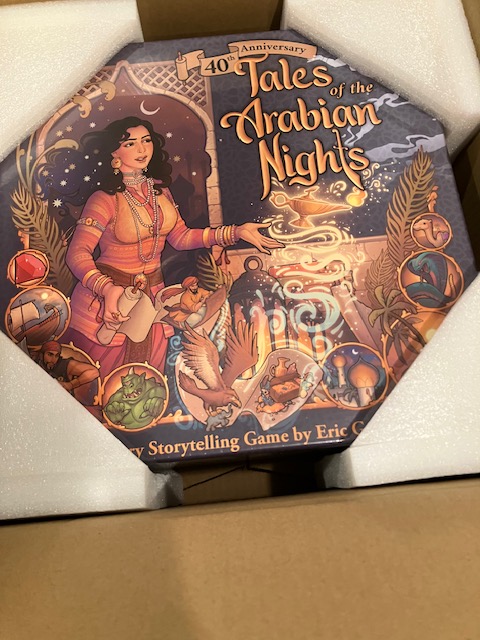
Tales of the The Arabian Nights is a game I both hate and love. When it’s at its worst, it’s random with banal crap happening to you that you have almost no control over; it’s long and tedious. At its best, it creates some of the most memorable stories (with laughter and tears) on game nights that you’ll remember forever. It’s the best of times that I remember, and so that’s why I chose to back the 40th edition on Gamefound (see above) when it came out.
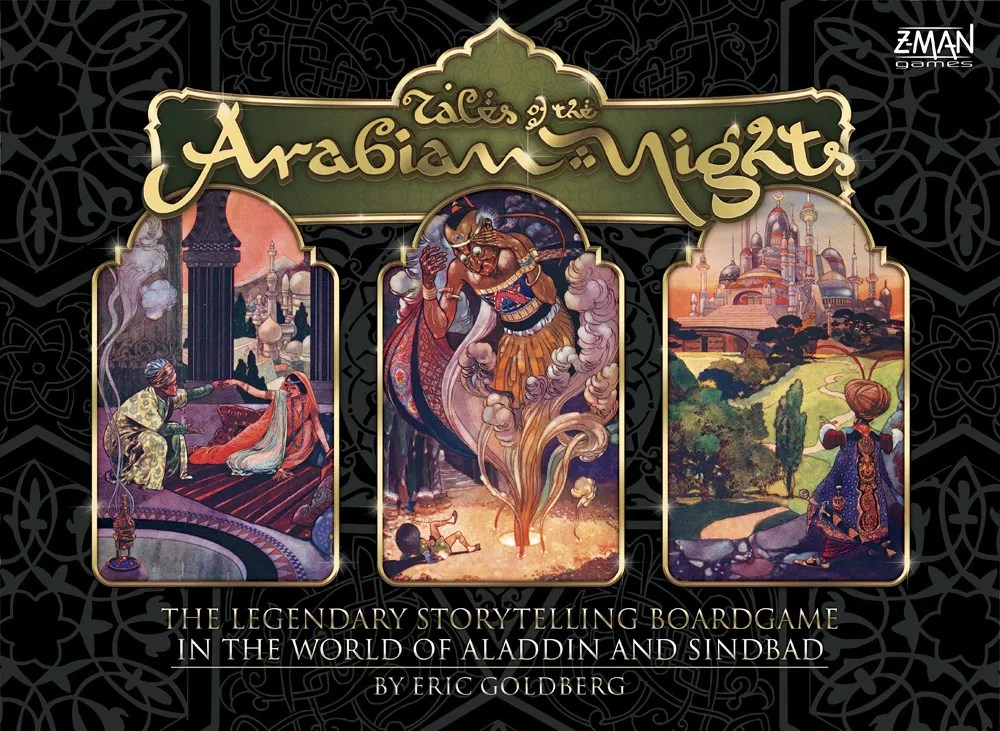
The original edition of Tales of the Arabian Nights (see above) got quite a bit of play back in my playgroups in Las Cruces. And at first, I hated it. It seemed so random; things would just happen to you!! If you were “lucky” (if you had the right skill at the right time), … things would just go your way. But, if you were unlucky, your entire story became a slog as you failed check after check. If, however, you just realize this is an adventure that “just happens to you”, and you just enjoy it for what it is, you can really have a good time. But ya, you could still have a very bad game. And it could still suck.
BUT in order for this to be a good experience, everyone has to know what they are getting into, and how random this, and how you just “gotta grin and bear it” sometimes. If you play with someone who is too serious, or who get aggravated by random stuff, or who just think “this is unfair” … you will not have a good time. Everyone has to be in on the joke. And you kinda have to be in the mood for it. That one person who doesn’t enjoy this will bring this game down very quickly. So, in some ways, this is a very brittle game because one player can easily ruin it. But if you get the right group, with the right frame of mind, with the right mood, with the right sense of humor, this can be a magical Arabian Night!
Does It Need An App?
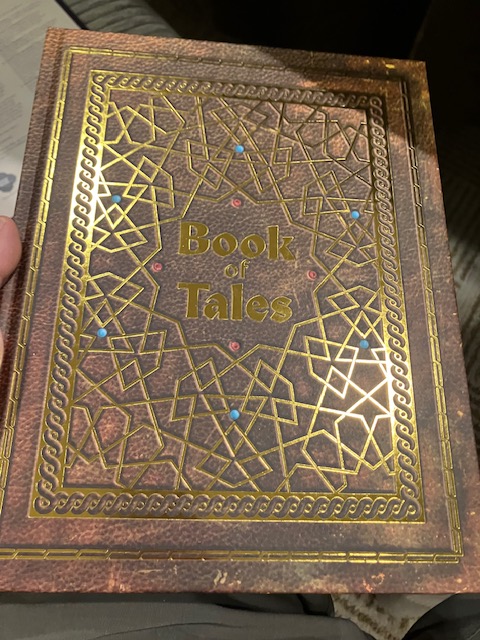
So, this is a storybook game with a great physical storybook (see above and below). You read lots and lots of flowery text to each other.
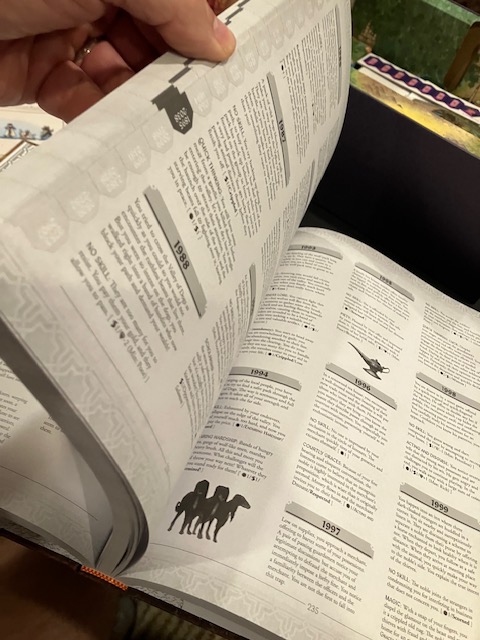
I remember when we used to play the original version of Tales of Arabian Nights, and we’d all say “Ah, I think this game would so much better if it had an App. These books are huge! It’s so hard to remember how to look stuff up! And there’s some fiddliness! It would be better as an App!” Sure, an App could make looking up the text simpler. Sure, an App could handle the fiddliness. Sure, an App might make this easier to haul around if there were no books. But now, after reflecting back to the original version and the new version: it’s better with the books.
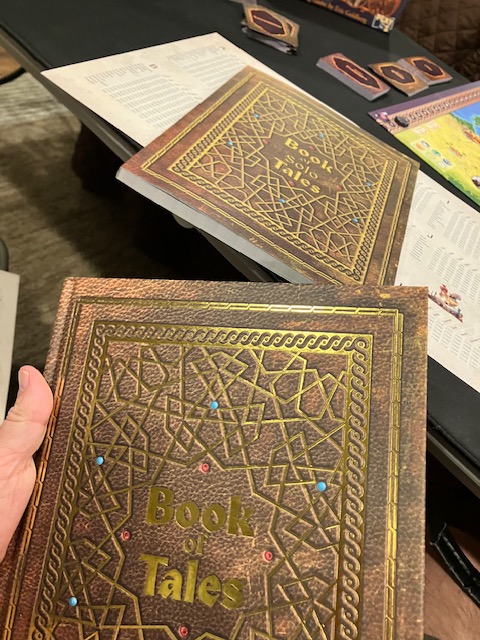
The books invest people into the game; people have to dig into the book and get involved! It’s a commitment to consult the grid and find the right entry! The person on your left and the person on your right are helping you look-up things in physical books! You make the choices, but everyone is staying involved! There’s a certain sweat equity in looking up and reading passages from a book;“This had better be good, darn it, because I am doing some work to make sure it moves forward!” You are invested because you are making the choices, and your neighbors are invested because they are consulting grids and charts! Everyone is invested in your ridiculous story!
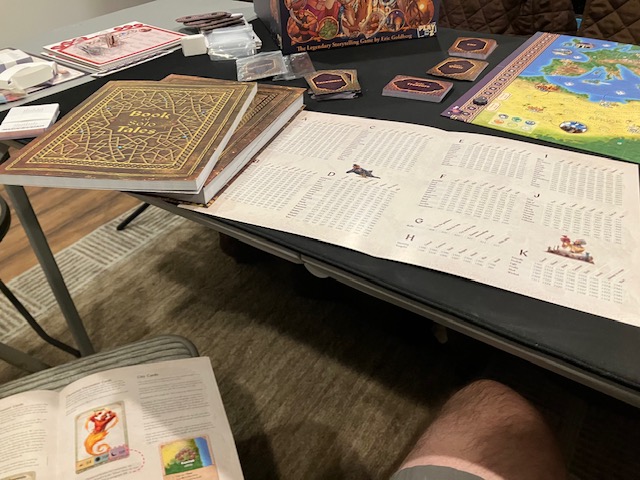
It’s the physical investment in books and charts that makes this game magic. That’s the magic word; invested. You are physically and mentally and emotionally invested.
Don’t get me wrong; some of my favorite storybook games have Apps: Forgotten Waters, Freelancers, Wandering Galaxy are all excellent storybook games that take great advantage of the electronic genre with voice acting, dynamically generated content, and constantly improving stories!
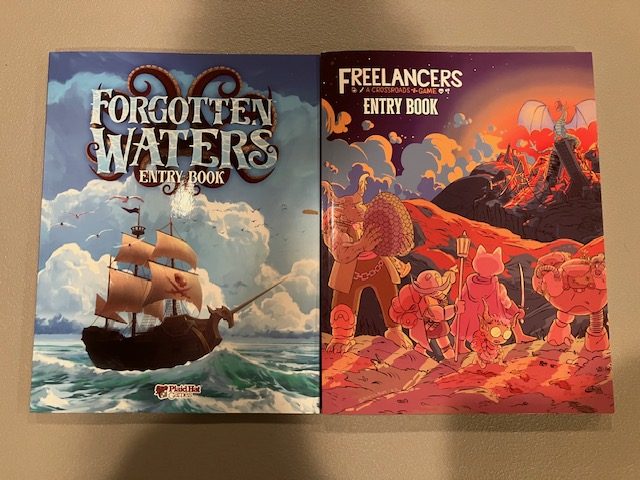
Yet, Plaid Hat games did go out of their way to make physical copies of their storybooks (see above). Why? Because there is a certain magic to the physical books.
Solo Mode
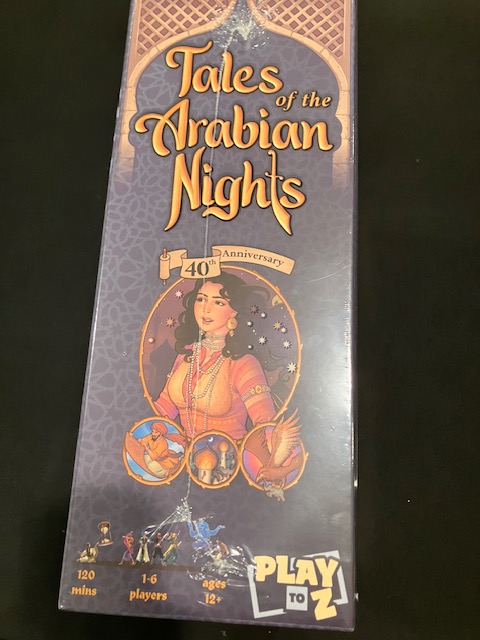
Crazily enough, they made a solo mode for this game. Whaaaaat? Let’s be 100% clear here: the original Tales of the Arabian Nights did not have a solo mode! And it seems weird to have a solo mode because the fun of the multi-player game is the shared reading and shared experiences in this world. But, I think the randomness of the base game is just too much for a solo player. In the multi-player game, we can laugh at the stupid and random things that happen to each other (“Remember the time that Efreet enslaved you? That was hilarious!” “Yes It was!” ), but somehow that seems less fun in a solo mode.
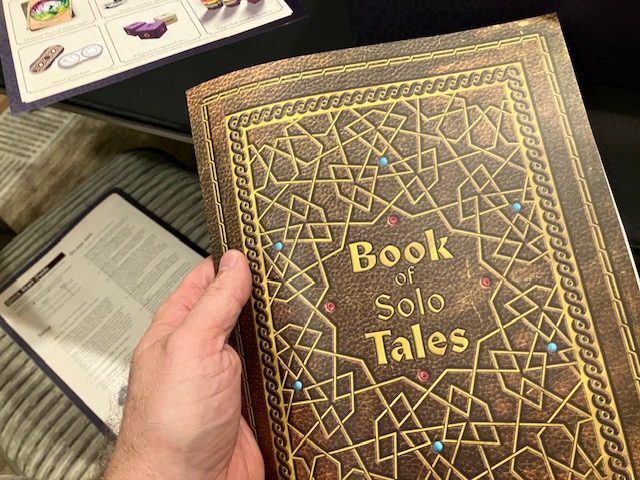
So, PlayToZ wrote some solo adventures and added it to the box! The solo adventures come in their own booklet (see above) with about 15+ directed adventures. Note my use of the word directed—you still explore this world, but there’s a real underlying and scripted story that unfolds for each adventure in the game. To be clear, there are still plenty of random moments (as you still take some turns like the original game), but about half of the game is a story that’s really unfolding (from the Solo Tales book) and the other half of the game are the silly and random stuff from the base game (from the main Storybook).
My first adventure felt like I was playing a novel! The writing seemed quite good and the story was engaging! This was more like a Choose Your Own Adventures tale with real story and real writing!
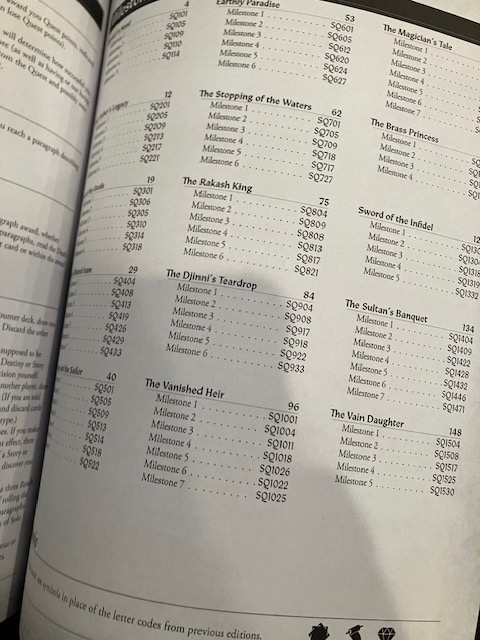
The only problem with the solo mode is that the stories are limited: there are only 15+ adventures in the Solo Storybook (see above). Sure, that’s probably enough for most people, but it can limit replayability. The good news is that the story path you take does change if you make different choices, so you can play an episode again and get a different story line, a different timeline. Anyways, after 15+ stories, I will probably forget them and so I could start over. If you have an eidetic memory, you won’t be able to play the stories over without some repeats.
I am shocked this has a solo mode. But it really works well.
Base Game
So, this is a cooperative games blog, but the base game, the game everyone knows and loves, is not cooperative; it’s competitive! Tales of the Arabian Nights is a competitive game about who can get the right glory and destiny (two kinds of victory points) and make it back to Baghdad! “But Rich, you can’t talk about games that aren’t cooperative! That’s off brand for you!! You only talk about cooperative games! And sometime solo games!”
Ah, but there’s two issues here I want to address;
- The game is cooperative in the sense in that you are having a shared experience and working together to read the adventures out of the book.
- With the advent of the solo adventures, you can make this game truly cooperative by playing team solo: play the solo mode as a group pretending to be the solo player!
Granted, the base game actually has a lot of take-that mechanisms (“Choose a reaction for your opponent!“ “If you have a disease, you can give it to others!”), so I have to admit it’s not really cooperative. Okay, you got me there. But the reading of the storybook gives you that shared experience which feels like a cooperative game.
But the team solo is truly cooperative! You can play through the solo adventures as a team! The solo mode is a little clunky, as the solo player has to choose reactions, look-up in the grid, find the storybook entry, read it to himself, then “pretend” not to see too much on the page (so he doesn’t cheat). With a group of friends playing team solo, all this maintenance (like the base game) can be shared.
So, ya. The team solo is totally a fake thing that’s not in the game; it’s a house rule we made up. But it really works as a cooperative game.
The Base Competitive Game
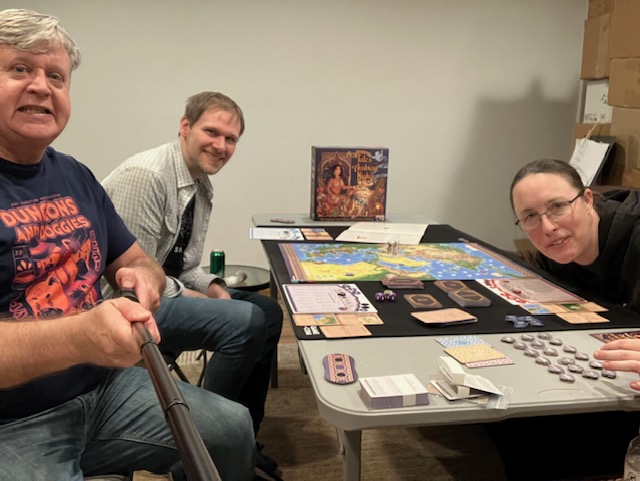
Like I said, I love and hate the base game. And me and my friends played a competitive game of Tales of Arabian Nights the way it should be played … and I loved it and hated it.
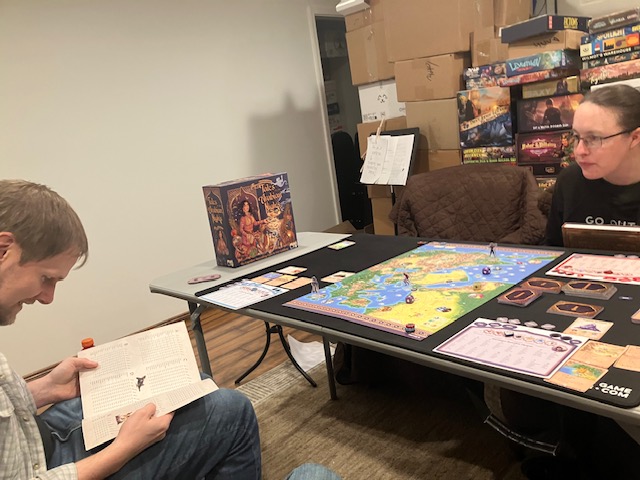
I love it because I loved all the shared mechanisms, the cooperation, the interaction as everyone stays involved. See a 3-Player game above: everyone is involved in reading , listening, and consulting.
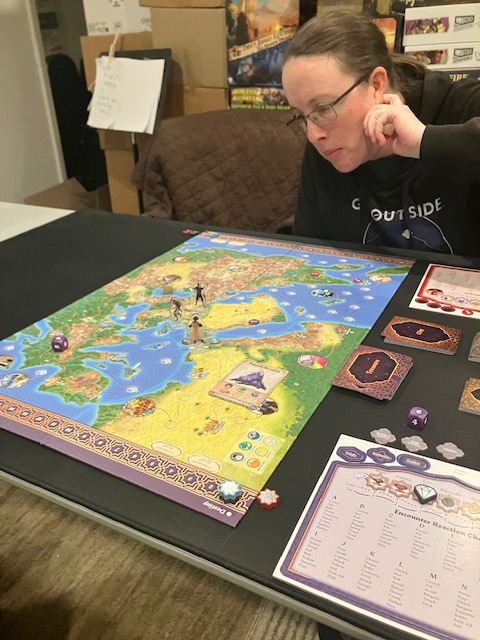
And yet, I still kinda hated it. The randomness from the original game is still there if you play the competitive game. It’s still goofy, it’s still fun, you still have to be in the right state of mind, and I still loved it, but I still kinda hated the randomness of the base game. I would maybe give the base competitive game a 6 or 7/10 … it’s very random. But still fun.
Team Solo!
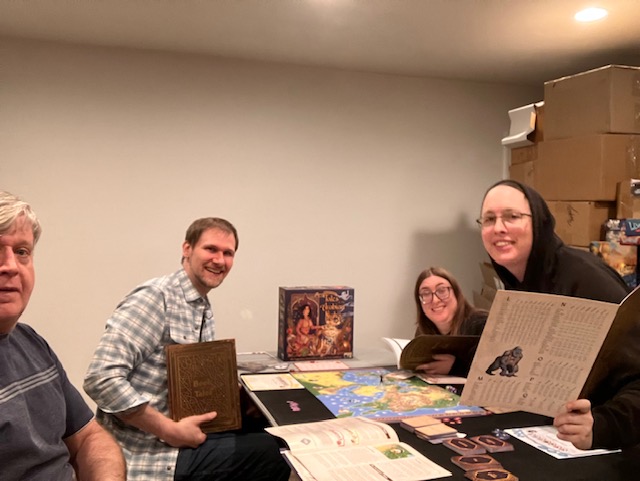
We played as Team Solo one night! All 4 of us playing the solo mode as a group! What happened was that we simply played the game like the solo game, but the books and active player would rotate through everybody. I thought the game would be more cooperative, but what ended up happening was more that the active player tended to make “the choice” and we’d just say “I don’t know if that’s a good idea …” or “That sounds great!”
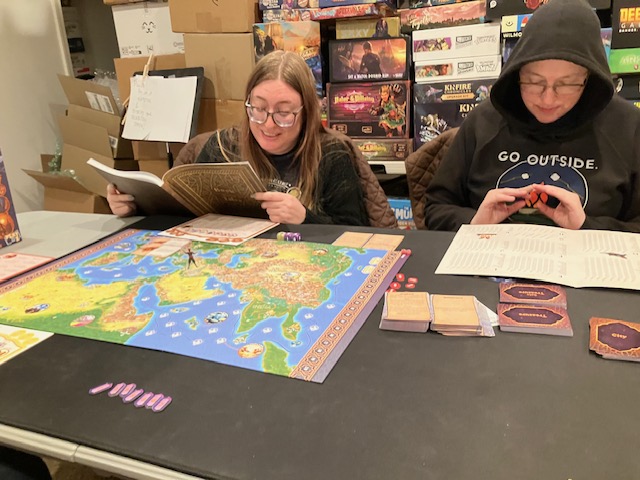
But, like I’ve said so many times in this review, just the act of consulting charts and reading books is very cooperative! So, instead of inflecting disease upon our fellows, we participate in the shared story … with one person being in the hot seat every turn “making decisions”.
I personally prefer Team Solo mode much more than the base competitive game, but some of my friends actually prefer the base competitive game (“because there are more choices”). So, I had more fun this week (Team Solo!) and Andrew and Teresa had more fun last week (competitive mode). In fact, Teresa likes Tales of Arthurian Knights better in the cooperative mode!
I think the team solo works for a cooperative mode (I liked it), but Tales of Arthurian Knights (see review here) is a stronger cooperative game.
Conclusion
So, this 40th edition of the game is really nice. The base game essentially feels the same as the original Tales of the Arabian Nights! If you play in the original mode, this still feels like the original game. Like I said, it’s a game I both love and hate. If you have a group in the right mood with the right sense of humor, the crazy and random things that happen to you can be hilarious! It can also be very brittle: a single player who isn’t getting it can bring down an entire game, or too many random events can just make the game feel unfun.
The solo mode is probably the most surprising addition to the game, partly because it works so well! It takes the base gameplay and adds direction and true story to the game, giving the solo player a very satisfying experience! I was also very impressed by the writing in the solo mode stories!
But, if you squint, you can also make this a cooperative game! The team solo idea works reasonably well; we tried it out one game and were happy with the gameplay. If you want Tales of Arabian Nights to be a truly cooperative game, you can do it!! Just play the solo mode as team solo … but it wasn’t everyone’s favorite way to play.
If you think you will hate the basic ideas (reading from storybooks to each other, suffering random effects as you play, even in the solo and cooperative mode), you will hate this; you know you. But if this idea of a storybook game with crazy things and lots of reading appeals to you, I think you can have some amazing experiences! And if your group is looking for a little more story, a little more cohesion, a little more cooperation, the solo mode can bring it … for both the solo player or team solo.
9 out of 10 for me for everything this does for solo! This is a fantastic production! I love it! Just be aware of what this is; you may hate it. I honestly would give this a 7/10 if it were only the original base game, but the new solo mode really expands the ways you can play the game! Solo! Cooperative! Competitive! And I liked the cooperative mode of team solo, but my friends still like the original competitive mode better.. as broken and random as that can be.
If you just want a good cooperative storybook game, Tales of Arthurian Knights is better. For a more directed solo game, Tales of Arabian Nights is better. For the competitive game, I think whichever theme appeals to you is probably better.
 coopgestalt