
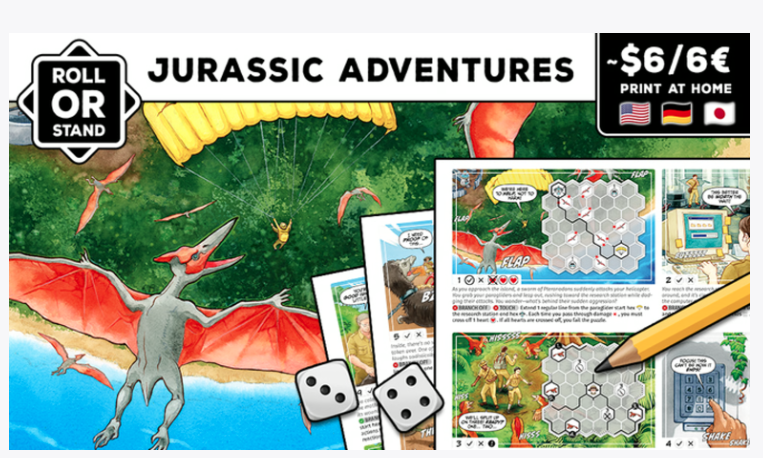
Roll or Stand: Jurassic Adventures is a print-and-play solo and cooperative roll-and-write game that was on Kickstarter back in March 2025, and it promised delivery in April 2025. That’s right! One month afterwards!! And it did it!!! How did they do that? Because there was no actual physical delivery; I was sent some PDFs in email after the Kickstarter fullfilled. It’s a print-and-play!
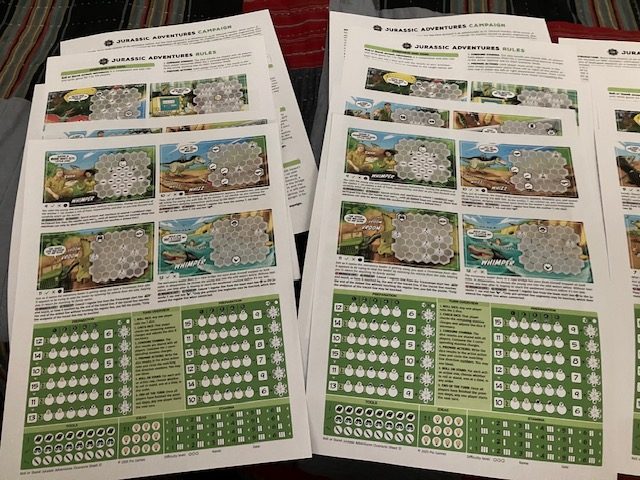
In order to play, you need to print 3 pages per player (if you want the full campaign). You also need just one copy of the rules (4 pages of rules) and one copy of the campaign rules (1 page). See above. For one person, you need to print 3+1+4 = 8 pages. For 4 people, you have to print 4*3 + 1 + 4 = 17 pages.
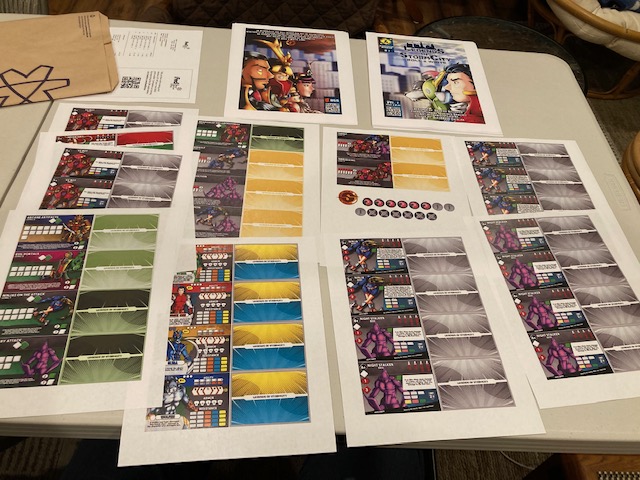
Ever since my first print-and-play was a little more work and money than I expected (see our review of Legends of Storm City), I picked up a newer printer that was was MUCH cheaper to print stuff on. I was able to print pages for one solo game and a 4-Player cooperative game without worrying too much about the cost. (But see our Legends of Storm City review if you want more discussion of how much it can cost to print print-and-play games!)
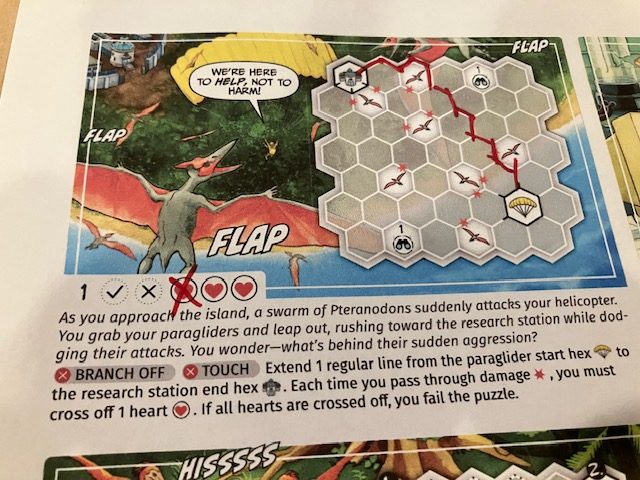
In case it isn’t instantly clear (see above): this is a roll-and-write with a Jurassic Park theme! The publisher probably won’t get sued for calling it Jurassic Adventures, but you never know!
Let’s take a look!
Printing
What are the pages you need to print?
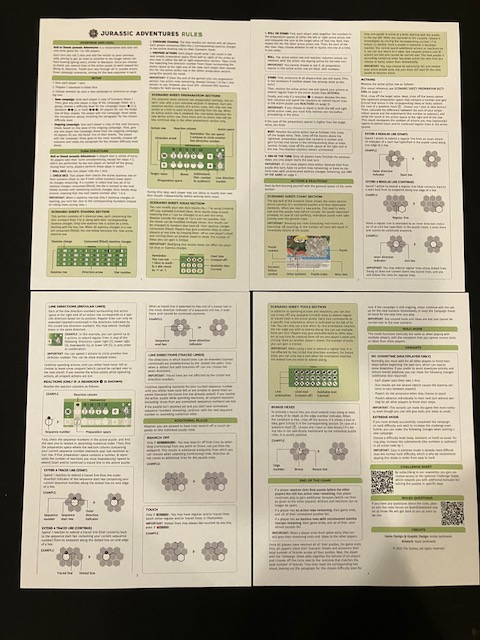
The rules: See above. The rules are very nicely done over 4 pages. The rules have lots of examples! The font, although is a little small, is very nice and, dare-I-say, pleasant to look at?
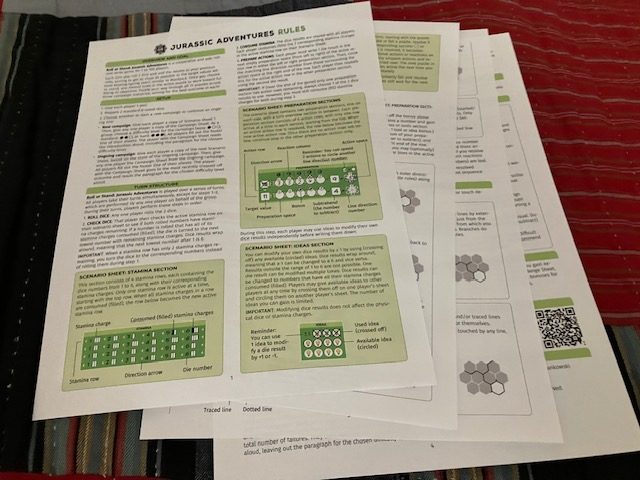
There were a few times when I wish the rules were a little better, but they do seem to specify everything: you might just have to look through them a little. Luckily, you can reuse these rules over and over after you print them.
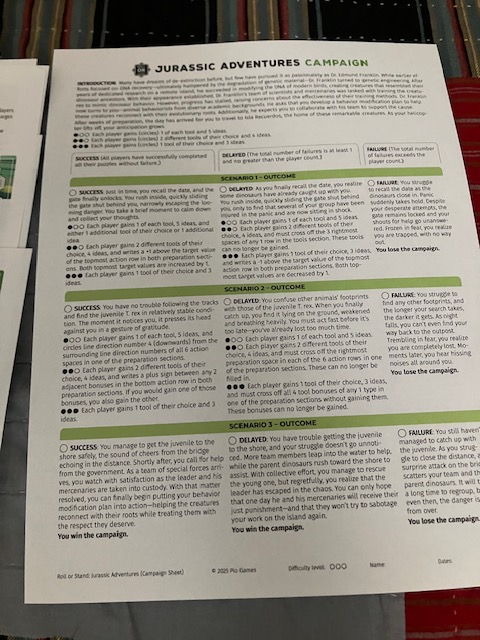
The Campaign Sheet: See above. This sheet gives bonuses and starting conditions for each game plus a little flavor text. You only need one of these for each group (arguably, you can reuse this over and over if you don’t put your name at the bottom).
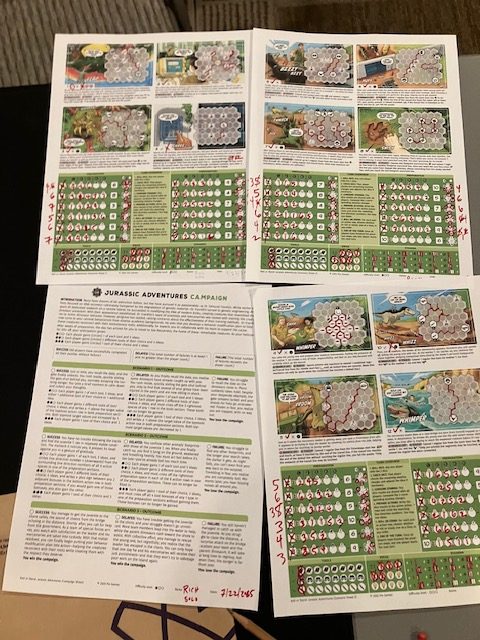
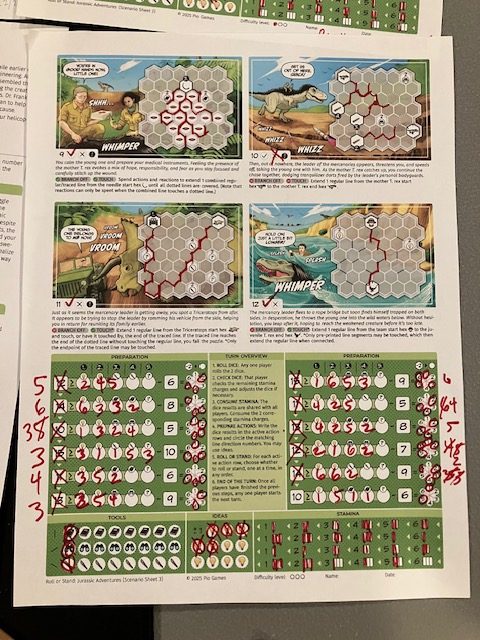
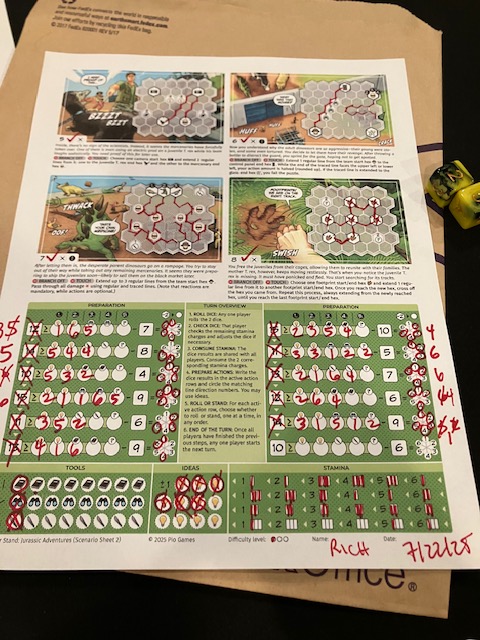
But the most important pages are the 3 Scenario Sheets (see them above). Each player will need their own copy of these Scenario Sheets to play: this is the one thing of which EVERYONE will have to have their own copy!
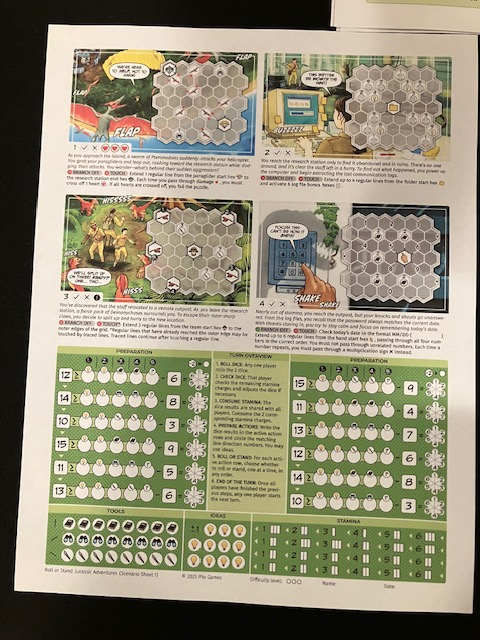
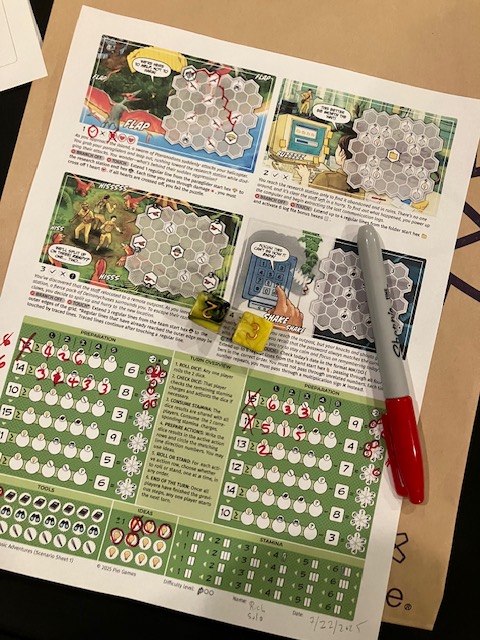
Each scenario sheet has four chapters (puzzles) at the top of the page (see above), and a shared preparation area at the bottom. The player will marking both the top part AND and bottom part up! See below!
Gameplay
Every turn, two dice are rolled (you have to supply your own dice). These two numbers are shared to everyone playing.
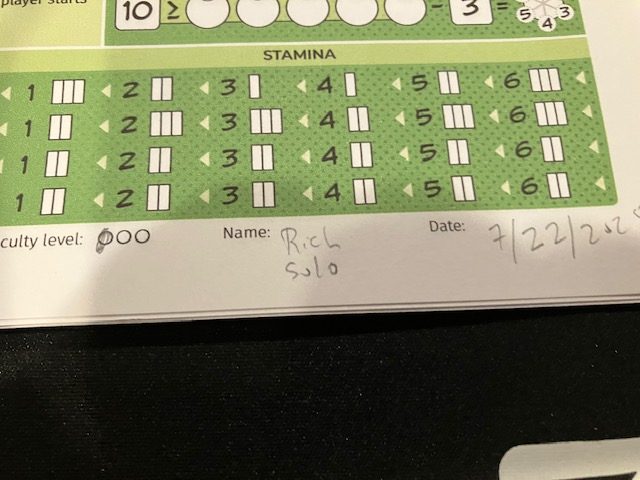
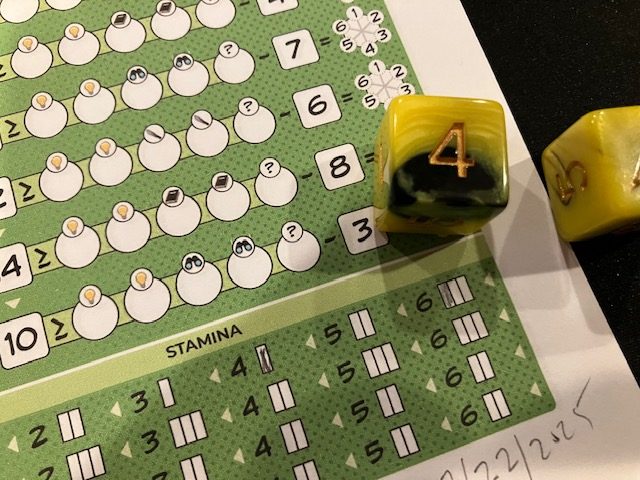
The stamina area “forces” dice to a certain regime; if there is no entry (“charge”) for one of the numbers you rolled, you must decrease that die until you find an empty charge (rolling over back to 6). Once a stamina line is “filled”, you move to the next line … and possibilities open up again. Let’s be clear; when the stamina line is almost filled, you have a very good idea what the next numbers will have to be! This really helps mitigate some of the randomness of rolling dice!
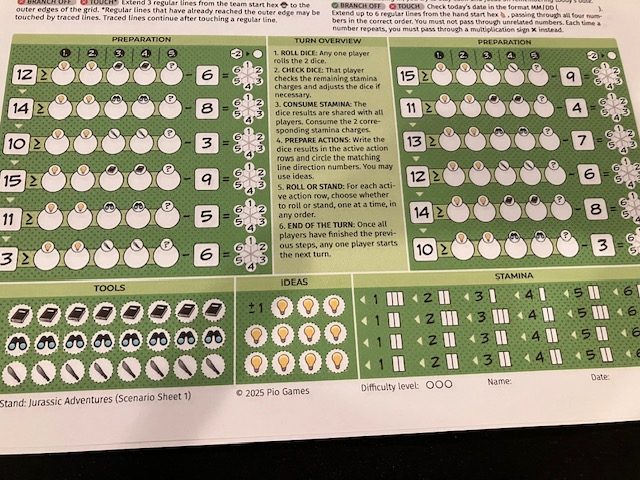
After you get your two numbers, you choose to record one number on the left Preparation side and one number to the right Preparation area. See above.
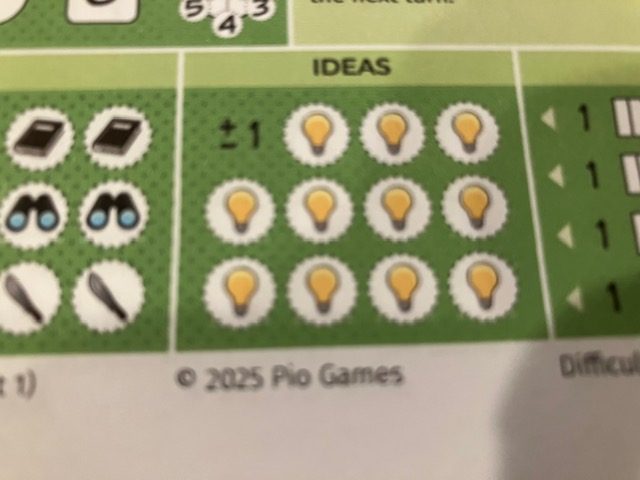
If you wish to “futz” with your two numbers, you can cross off “ideas” to add or subtract one to the numbers (for you only: this doesn’t affect anyone else).
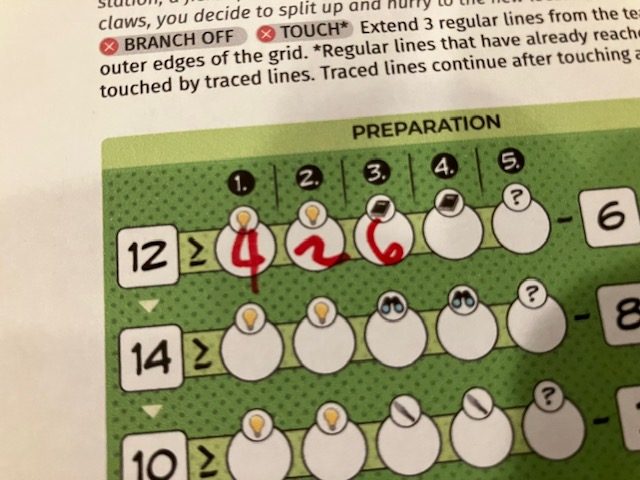
You record the number to the next empty box. If you want, you can push-your-luck and “roll”, hoping to add more numbers to you line on the next roll of the dice.
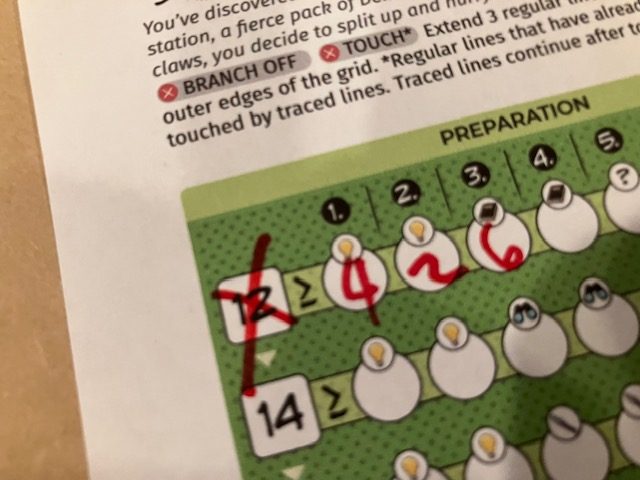
Or, if you want to, you can “Stand” (marking off the leftmost square with a cross) and activate your actions! You are now committed to act!
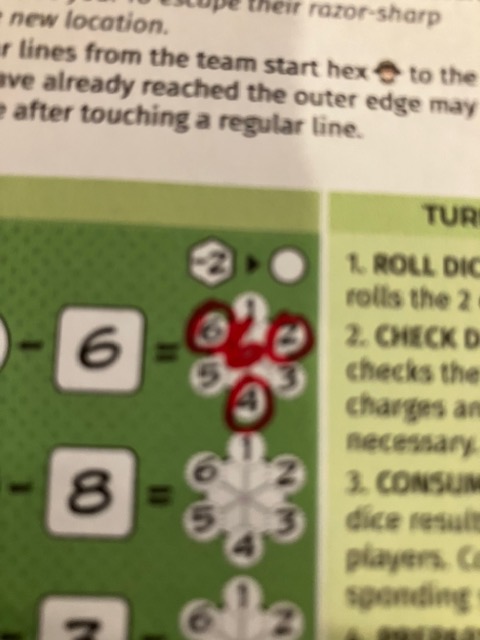
The number of actions you get is based on how far you pushed your luck: the longer you wait, the more actions you get. See above as I get 6 actions when I activate my line!
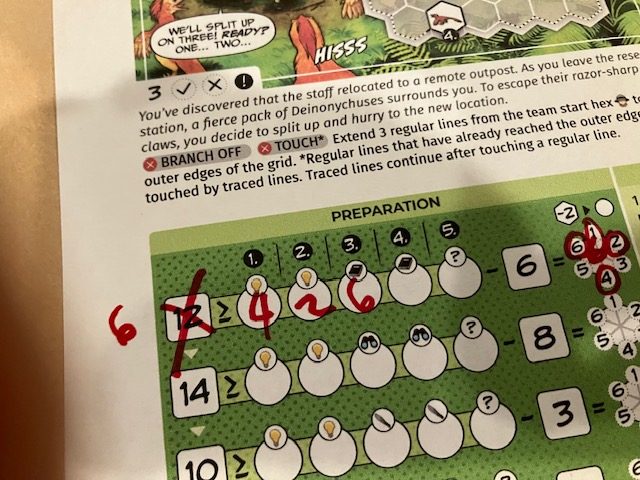
How many actions do you get? Your sum (4+2+6 = 12) – rightmost (6) = 6 actions!

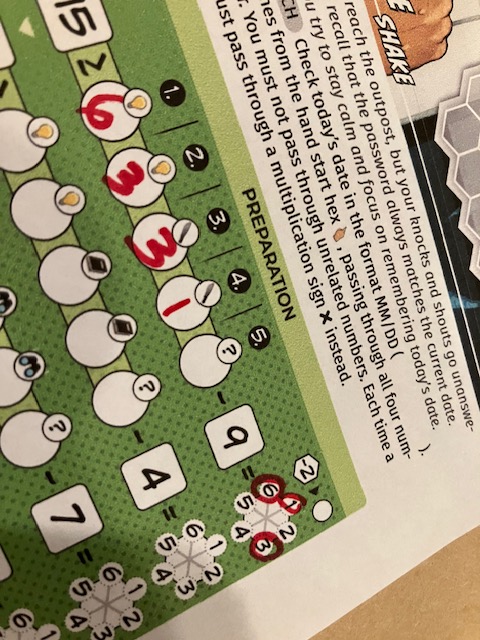
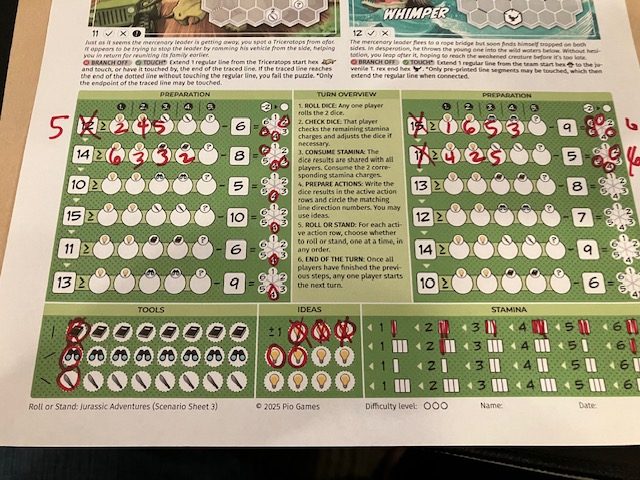
Note that you CAN BUST if you put too many numbers on a line! In the case above, I BUST because my numbers exceed the MAX (10) by being 2+3+1+6 = 12!! If you do BUST, you lose all the actions of that line BUT you get a booby prize of one of the tools (the rightmost symbol: the binoculars at the right under the 6).
So this is a game about pushing your luck, and knowing when to activate a line to get your actions! The Kickstarter called this a “blackjack-like” mechanism! Basically, push-your-luck so you don’t bust!
Once you have your actions, what do you do with them? Basically, you mark off lines on the current puzzle! With each action, you can mark a line!
Which lines? It depends on the numbers on the line! On the line above, I had a 2, 4, and 6 which means I can only draw upper left, upper right, and down lines!
That’s right! You are limited to what lines you can draw by the numbers you used to activate the line!
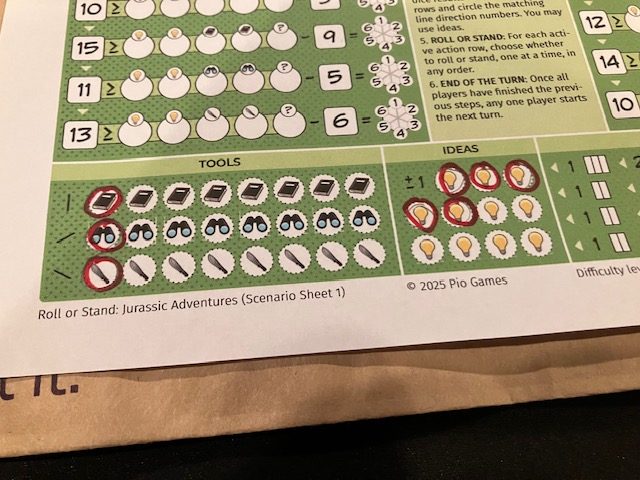
This is why ideas and Tools are so important! If you really need to up/down a dice, you can use ideas or tools to draw the line you need! Be careful! Ideas/Tools are a limited resource!
After you achieve the current puzzle, you immediately move to the next!
If you can get all 4 puzzles done before the stamina or preparation lines run out, you are done!
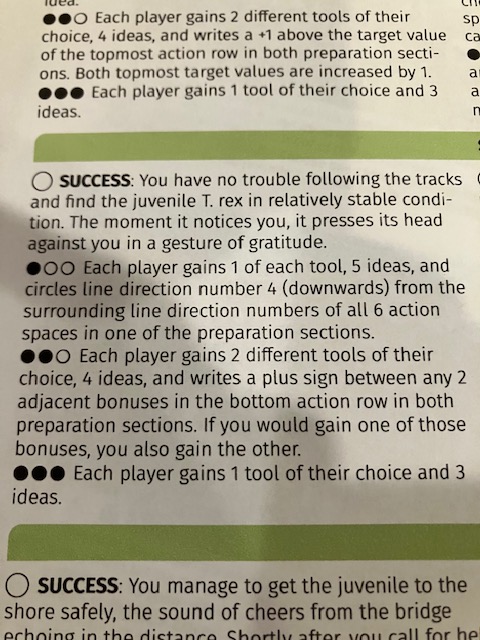
Whether or not you win depends on “how many puzzles you failed!” If you failed NO puzzles, you get the Success story!
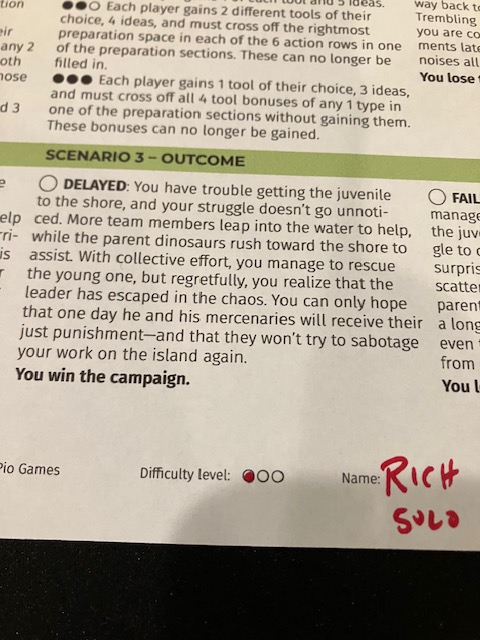
If you have under 1 failure per player, you get the Delayed outcome (which is usually still a success .. see above!)
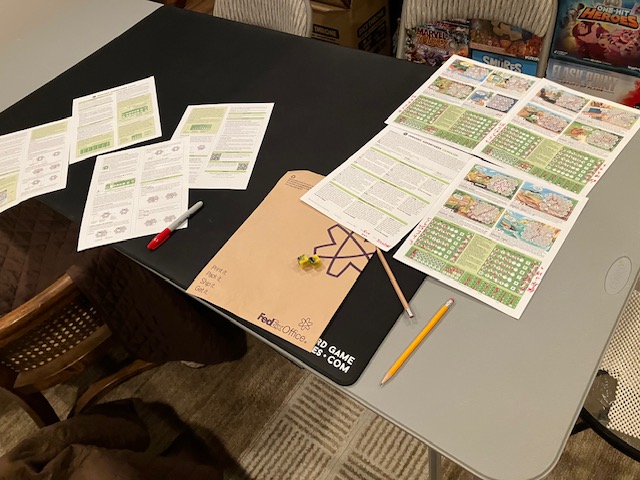
Play all 3 scenario sheets for a full campaign!
Solo Play
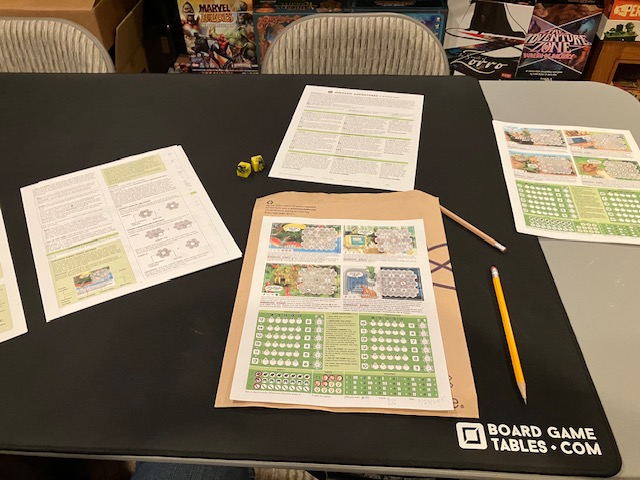
I had my solo copy ready since April 2025, but I just had never gotten around to playing it. It didn’t take too long to print out (3 months ago), but I was ready to go!
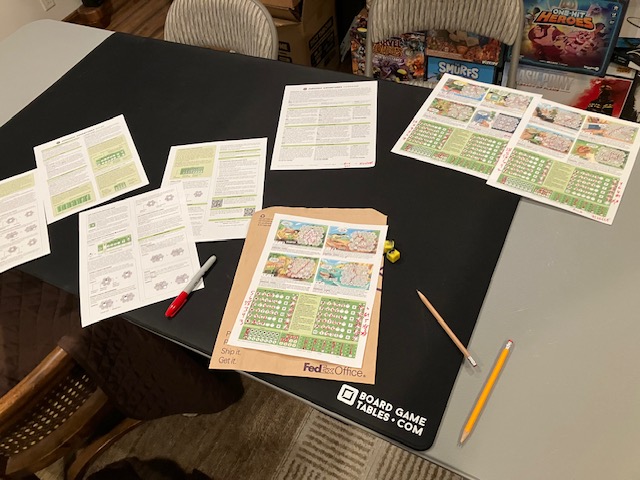
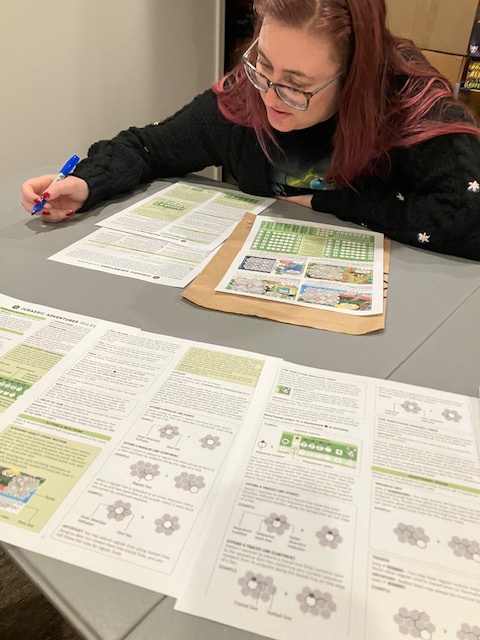
Over the course of one evening, I played through the entire 3-sheet campaign. I took a break after scenario 2 for dinner, but came back to it. All in all, it probably took about 2 hours to play all the way through, with about an extra 1.5 hours of reading and deciphering the rules.
The solo campaign is easy to get to the table; it has some interesting decisions as you have to decide when to use your limited ideas, limited tools, which dice to use in which area, when to stand and when to roll!
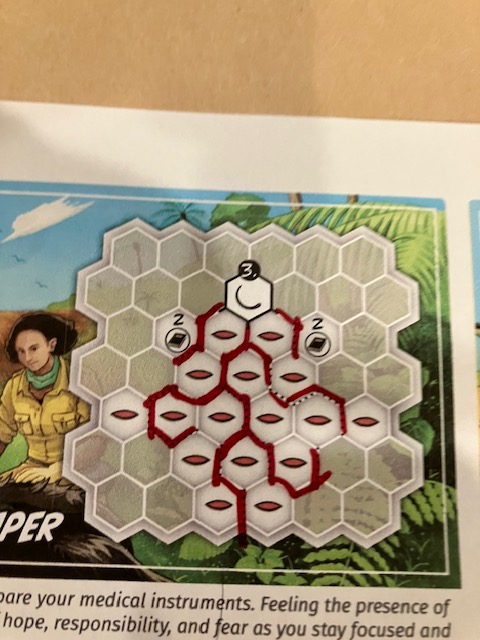
This is also a very spatial-oriented puzzle, as you have to make sure you have the right line segments to do what you need to on your current puzzle! The puzzle above starts at the top (3), and you want more “downwards” line segments to help!
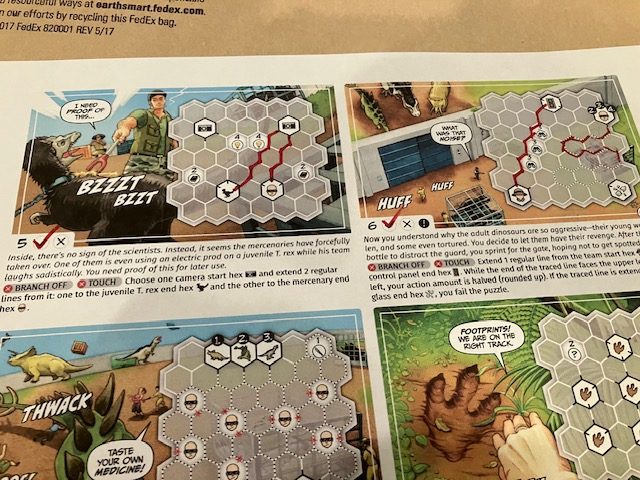
There’s a lot of great decisions, but the game moves along at a pretty good clip. You can have as much analysis paralysis as you want, but generally the game moved along. I freely admit that I stopped a few times and had some analysis paralysis …
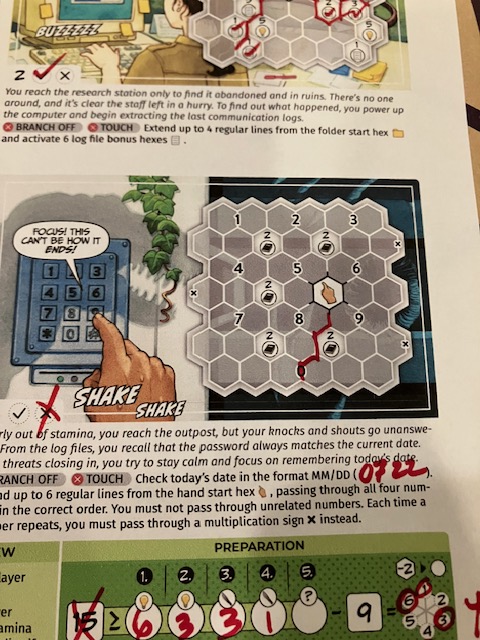
I had a fine time playing solo. Even though the puzzles are similar in some ways (just draw line segments), they were pretty thematic with the “Jurassic park”-like concept. There was a good variety over 12 puzzles in the campaign—I saw a neat little story unfold.
Fun solo.
Cooperative
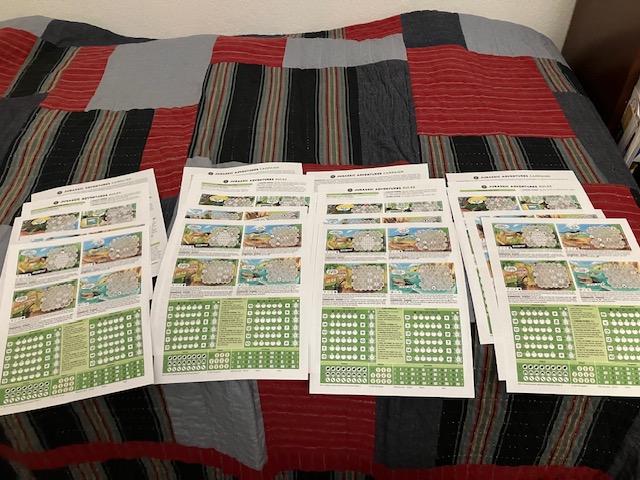
For my cooperative game, I readied myself for a 4-Player game. I may have overprinted the game; I probably didn’t have to print rules sheets for everyone, but in my group, people like to have their own copy of the rules!
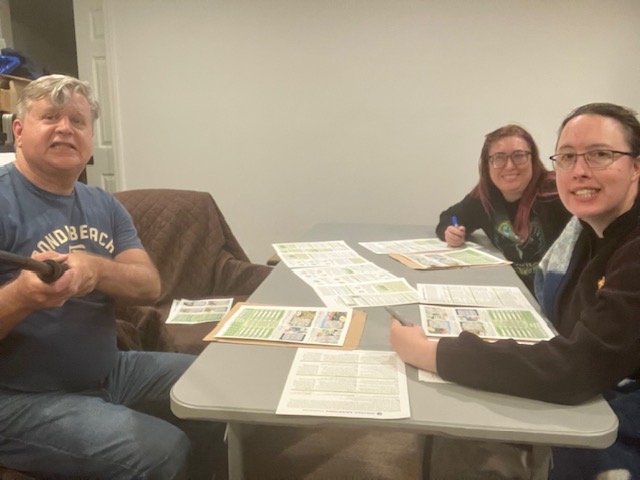
We ended up only playing a 3-Player cooperative game!
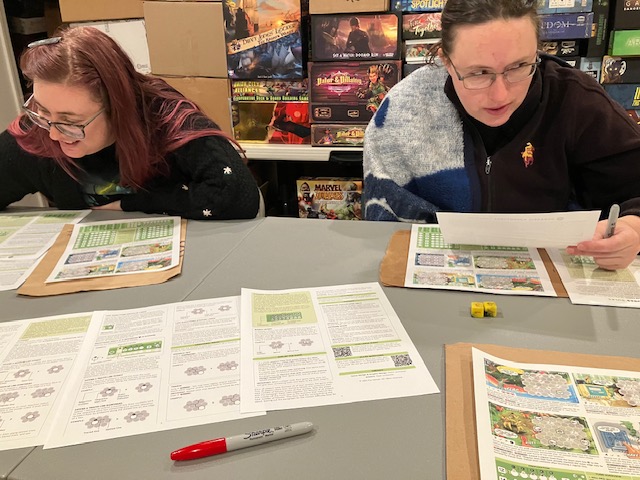
This went over … okay. The only real opportunities for cooperation are that you can share Ideas and/or Tools. Thematically, that made some sense! “Hey! I got an Idea I can share with you!” Unfortunately, we didn’t end up sharing at all! The resources are so limited in the game (you only have so many Ideas and Tools) that it never felt good to share them! Although the opportunity was there, we never availed ourselves of the “sharing”.
This game was mostly multi-player solitaire. But at least we weren’t getting in each others way.
Pen vs. Pencil
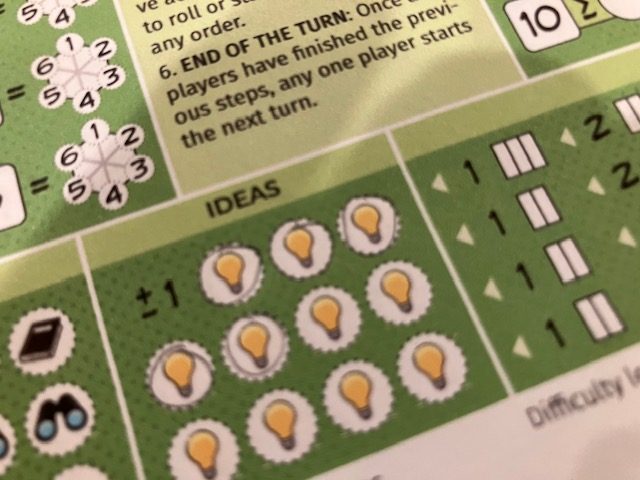
A pencil probably won’t work with this game. Can you tell I circled the first 5 Ideas above? No? Me neither!
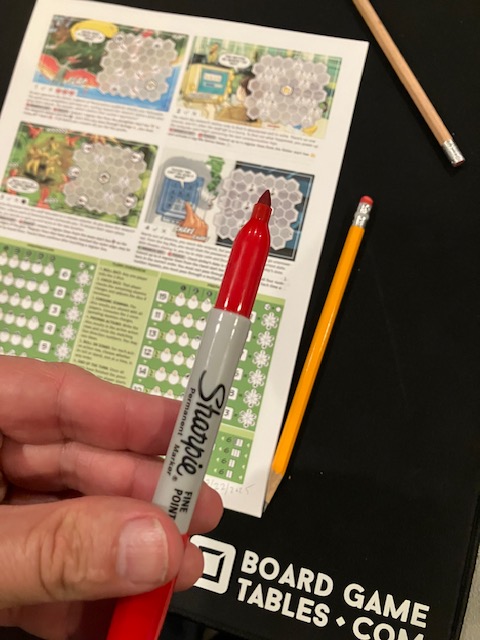
I ended up using a red sharpie so it was VERY clear when I noted something. See above.
Ah! Now you can tell I circled the Ideas!
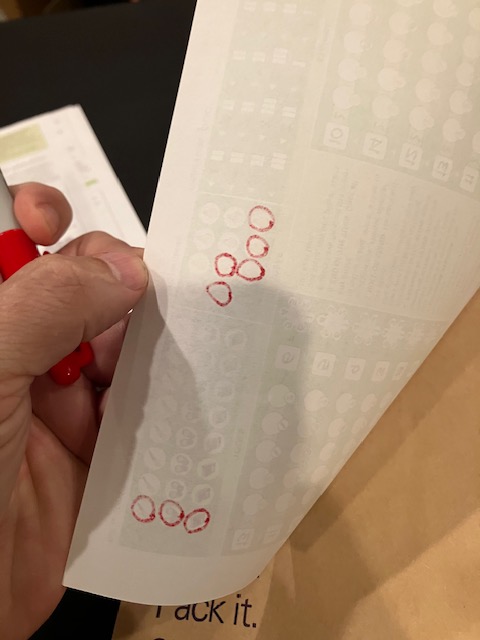
Of course, sharpies may bleed, so I got a paper bag on the back side to handle any bleed through.
The only problem with the Pen is you really can’t correct any mistakes. Remember my BUST example? Can you tell that was a 6 on the right? It was only a 6 after I “sorta” corrected it.
If you find yourself wanting to play more of this, consider laminating the Scenario sheets and using dry-erase (extra-thin!!) markers; then you can correct them and re-use the sheets over and over.
Small House Rule
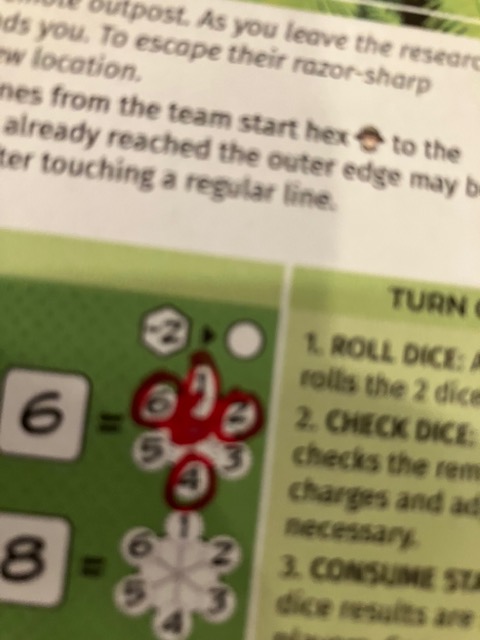
The rules specifically say to write the number of actions in the right most area: see above as I clumsily write a 6, and it obscures the direction wedges!
What I ended up doing is writing the number of actions off to the side! See above as the actions are on the LEFT for the left prep area, and the actions are on the RIGHT for the right prep area! And then it’s MUCH easier to see which wedges are available for your actions, since the action number isn’t obscuring the wedges!
Things I Liked
Theme: there’s a surprising amount of theme and story
Choices: I generally feel like I have a lot of choices, and I know what’s coming because of the stamina concept forging the dice. This had just enough randomness to be interesting, but not enough to infuriate me.
What I Didn’t Like
Too small: the sheets at times felt a little too small! Each scenario sheet feels like it should be two sheets; the top half should be its own sheet, and the bottom half should be its own sheet. I am surprised this wasn’t a printing option. The whole thing does fit on a page, which is nice, but I think if I wanted to laminate this and use dry-erase pens, I’d want bigger sheets. I wish a full-sized upper half and full-sized lower half had been PDFs included in my distribution.
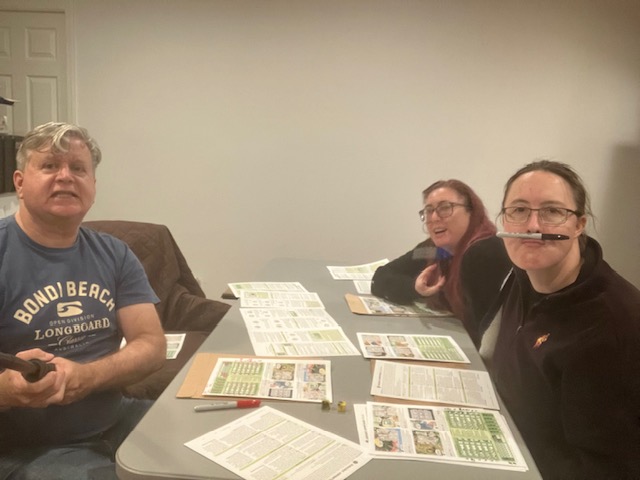
Cooperation: There wasn’t really any cooperation. Although the opportunities were there, we didn’t avail ourselves of them because the resources were so limited.
House Rule for More Cooperation
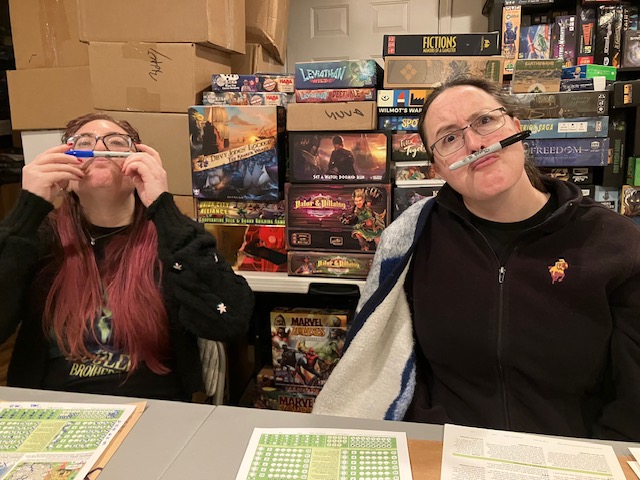
How can we cooperate more? One complaint is that the game really wasn’t that cooperative.
Looking back on our cooperative game, the one thing you can do is change the dice separately! The players have to take the dice as rolled, but then each player can spend Ideas “separately” to +- 1 the dice on their board. What if this were more cooperative? What if, as a group, we could decide to spend an Idea and have it change a dice for all of us? This would promote a lot of conversation and lots of interaction! “Well, I really need a 6!” “But we both need 5s!” “Hm, you can save an Idea if you change it once!”
This is just an idea for a House Rule, but it would make the game more cooperative and interactive.
Conclusion
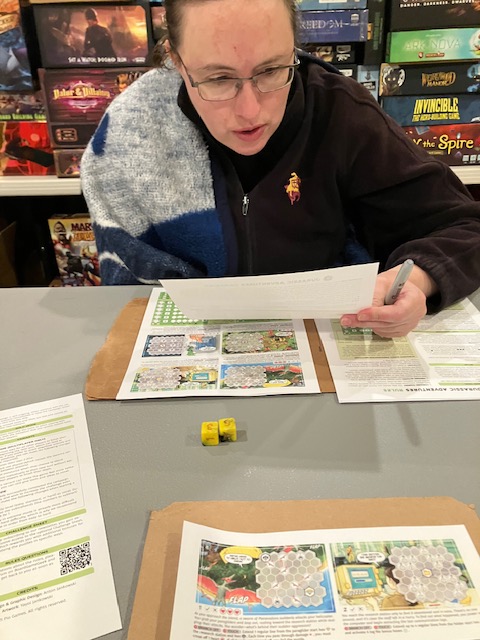
Jurassic Adventures was a mixed bag. I liked it solo and might play it again: the theme and gameplay was fun! It was a 6.5/10 or maybe 7/10. My friend Sara probably wouldn’t play it again cooperatively, (5/10) but my friend Teresa would (6/10). Although the game bills itself as cooperative, it felt much more multiplayer solitaire … mostly because the resources were so limited that it was too hard to share! We do propose a house rule that might make Jurassic Adventures more cooperative and more enjoyable, but you may like this “mostly” multiplayer solitaire game as it is.
If you do play this, make sure you play with a pen instead of a pencil; even though you can’t correct your pen without making a mess, you just can’t see the pencil marks!
 coopgestalt
One thought on “A Cooperative/Solo Print-And-Play Roll-and-Write Game! Roll or Stand: Jurassic Adventures! The Theme is EXACTLY What You Think It Is!”