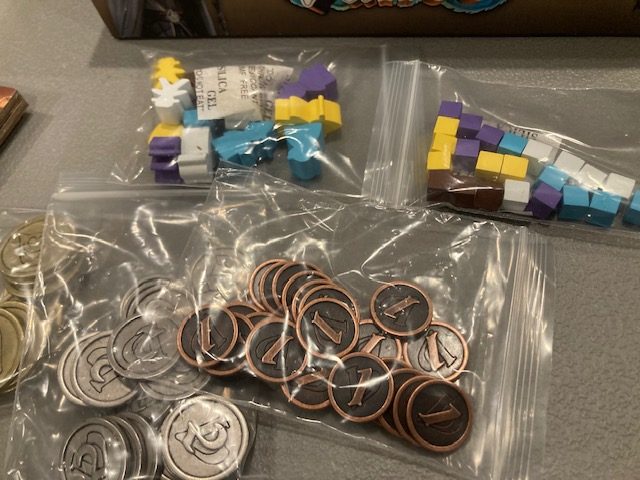
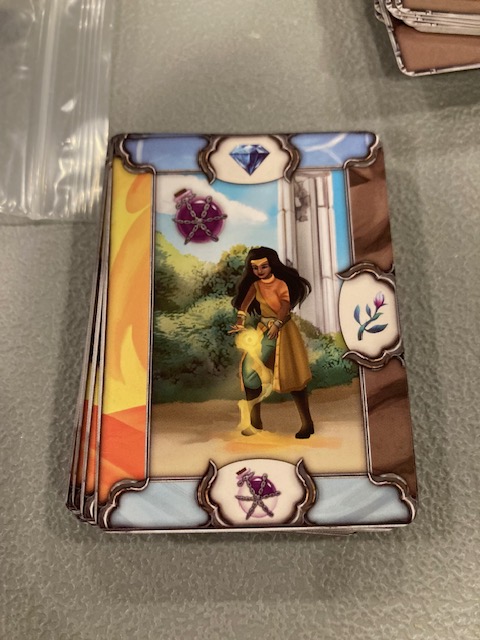
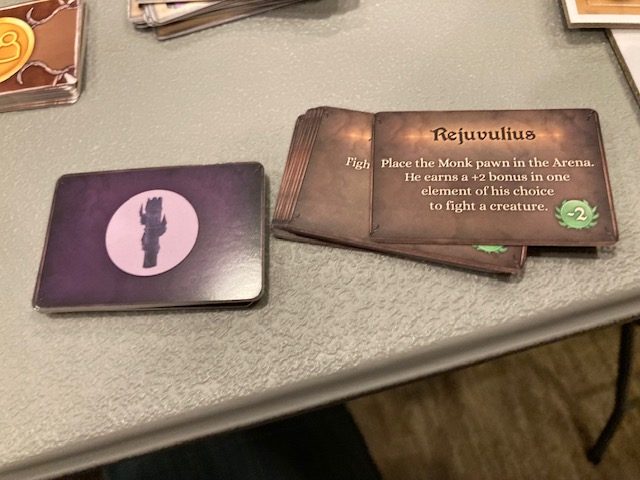
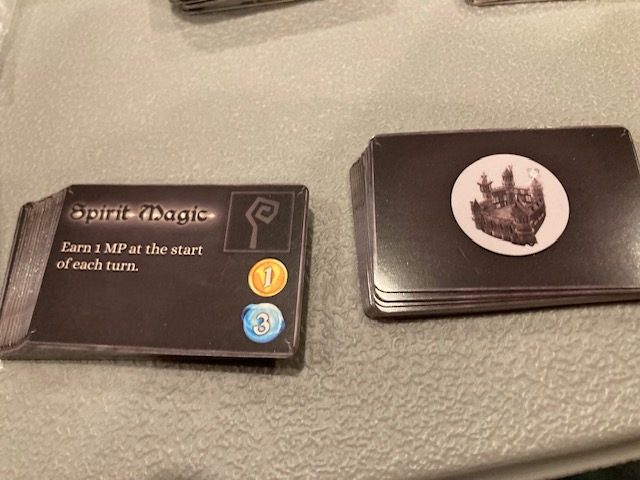
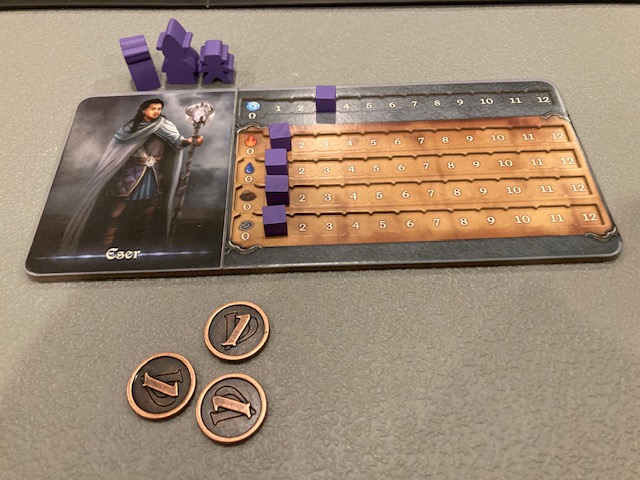
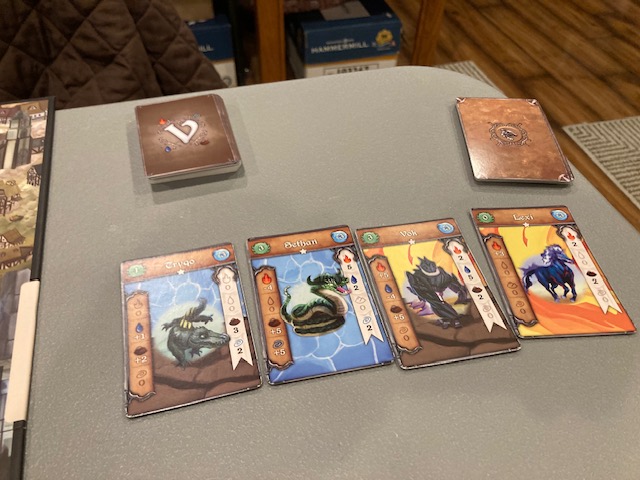
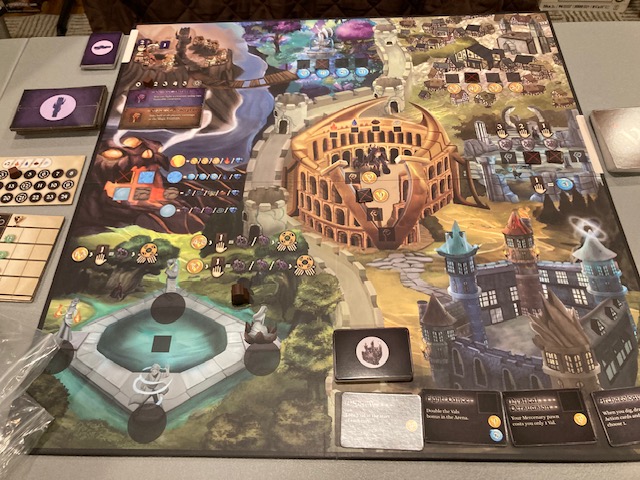
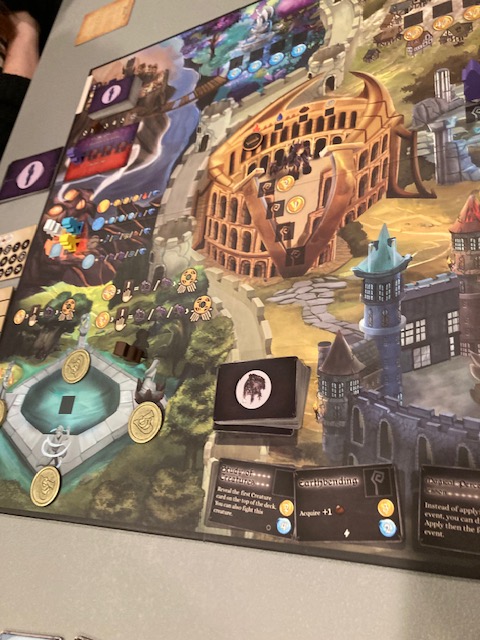
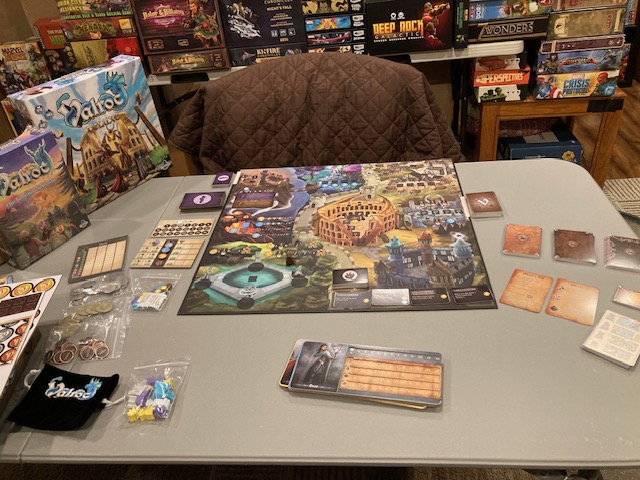
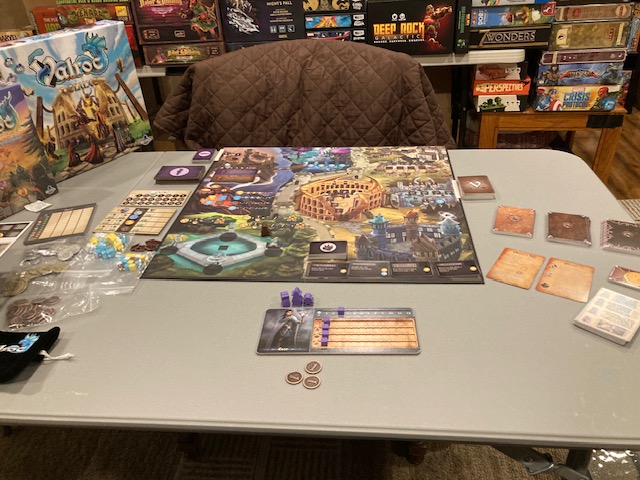
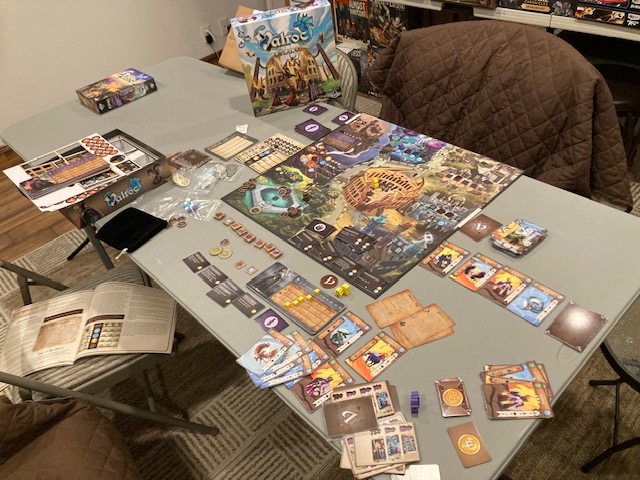
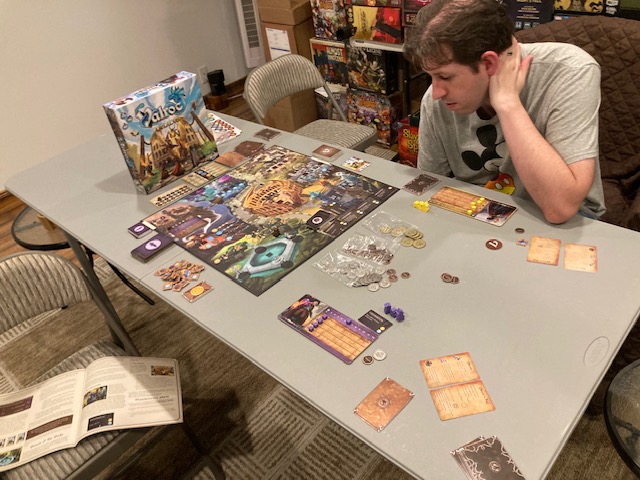
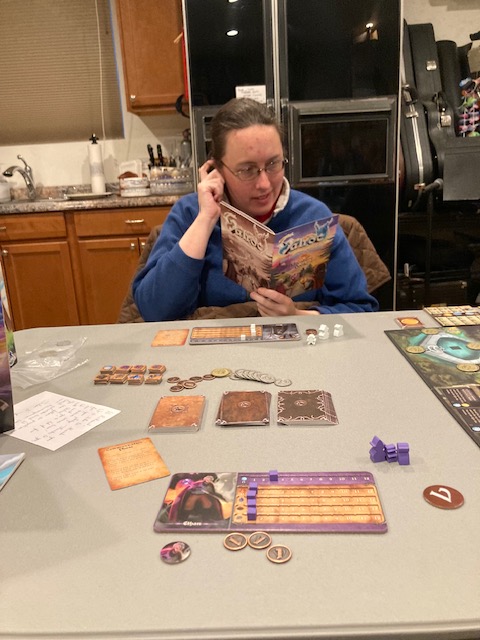
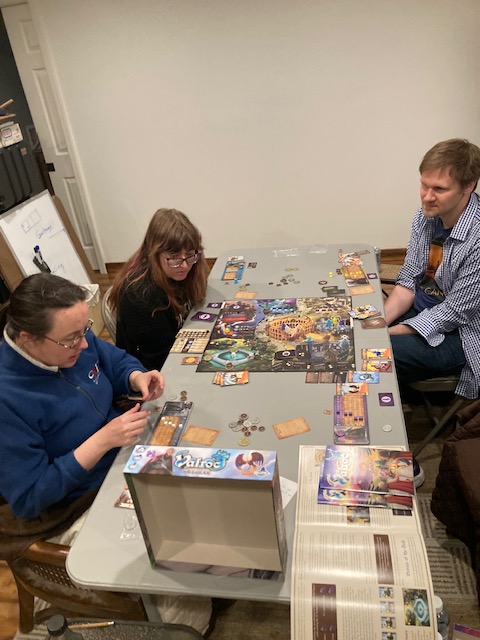
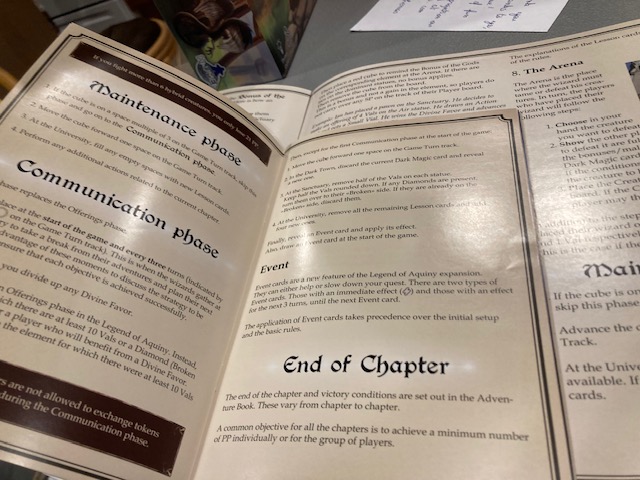
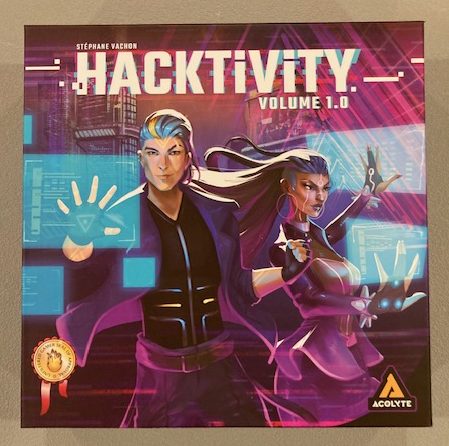
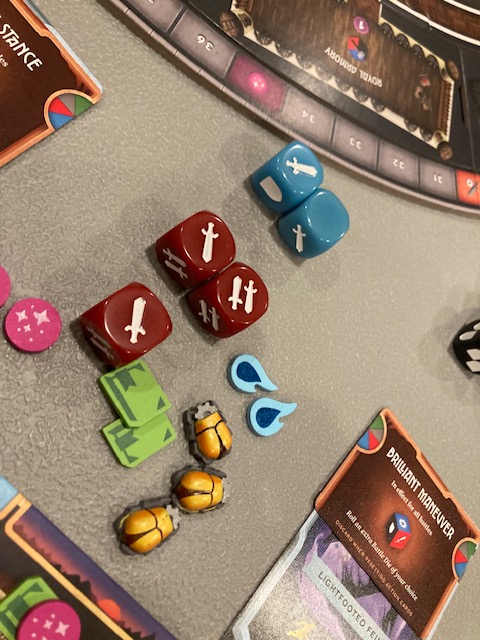
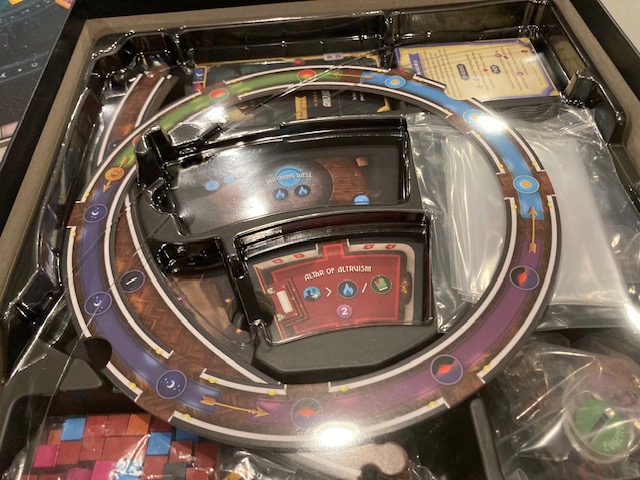
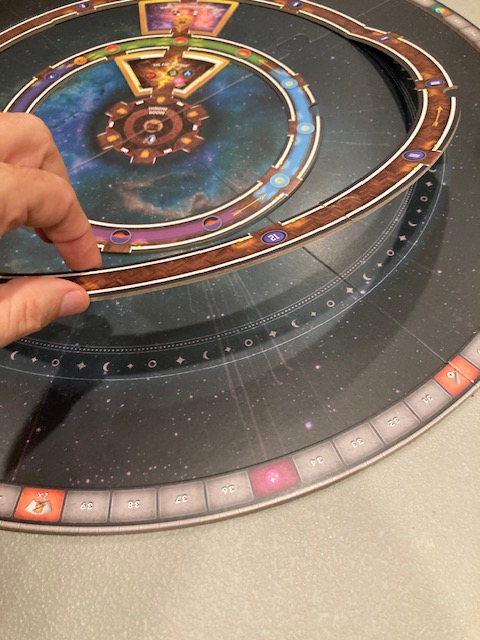
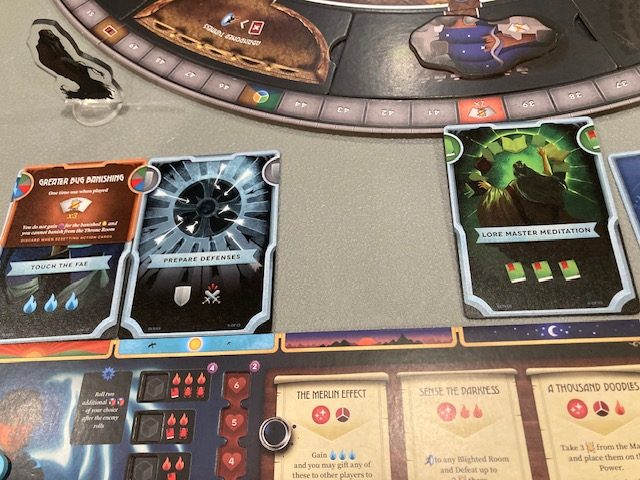
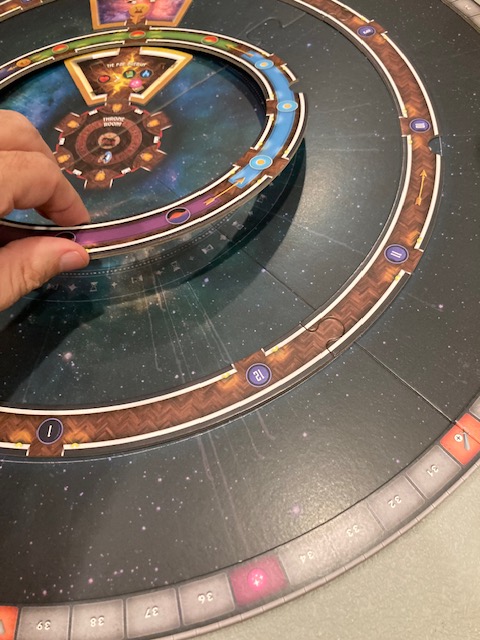
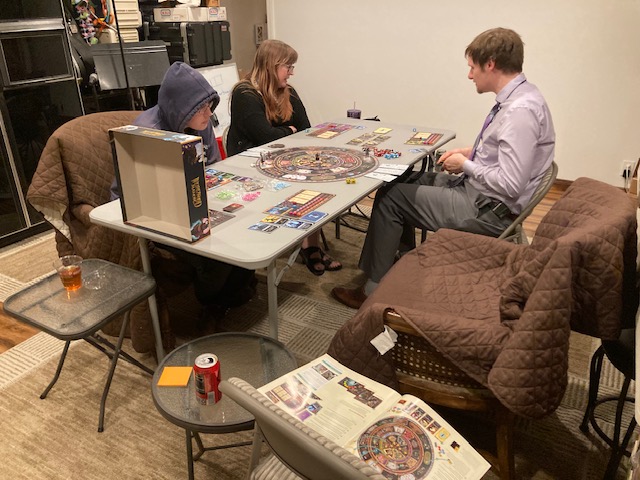
Kinfire Council + The Winds of Change Solo And Cooperative Expansion. A Journey and A Review!

No, this has nothing to do with the Scorpion’s song Winds of Change from 1990.
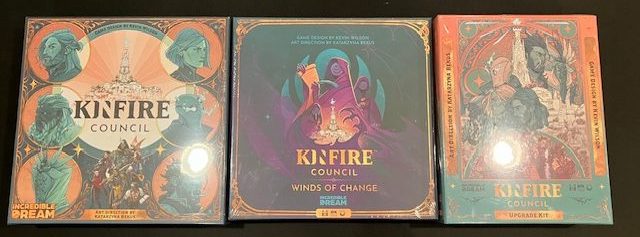
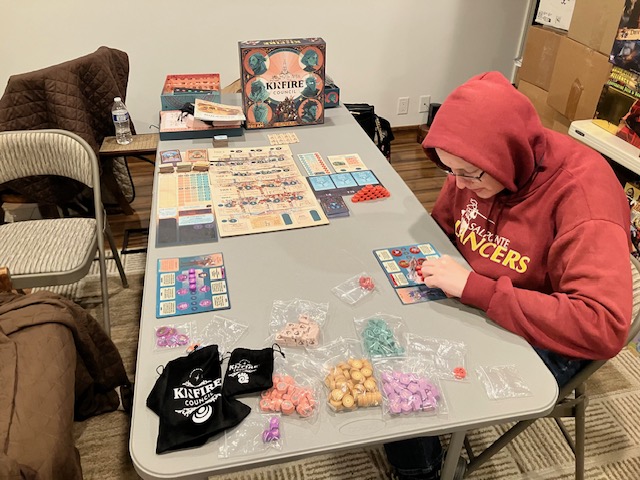
You guys are totally gonna laugh at me.  I didn’t back the original Kinfire Council when it back on Kickstarter! Despite it being a Kevin Wilson game! Why??? I usually really like Kevin Wilson games!  Between cooperative games like Arkham Horror (2nd Edition), Kinfire Chronicles (review here), and even traitor games (which I don’t usually like) like The Stuff Of Legend (review here), Kevin Wilson makes some great games!
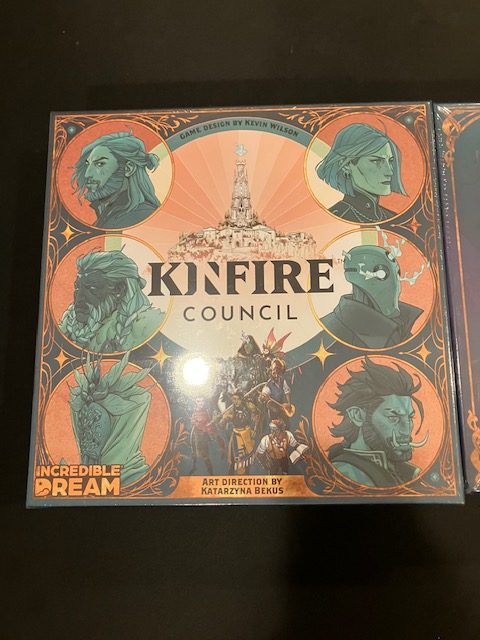
The base game Kinfire Council (see above) is a competitive worker-placement game, which looked pretty mean!  It has voting on resolutions (which may screw the town or other players), and cultists that players may join-up at any point!  It looked like someone put traitor mechanics and take-that mechanics into a worker placement game!  No thank you!  Me and my group like cooperative games; this just didn’t look like it was for me/us.
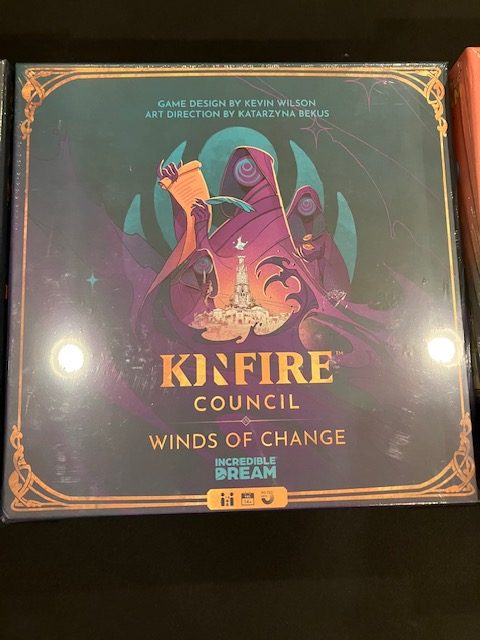
Somehow I missed the memo that Winds of Change (see above: an expansion that seemed to be part of the same Kickstarter) made the game solo and cooperative!  You have to forgive me on this; it’s buried a little bit in the Kickstarter page! In fact, if go searching the page within your browser, the word “cooperative” doesn’t even come up! (It’s hidden in the pictures of the page).
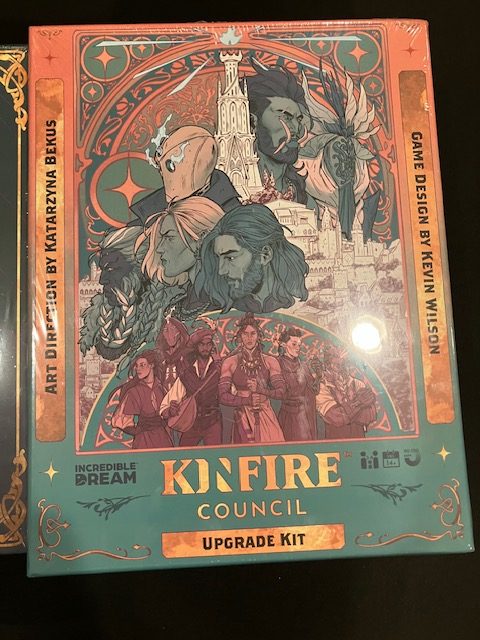
Also, I am always suspicious of games where the solo and cooperative game are obvious add-ons. 

But I did get it.  It took some effort.

So, is this any good? Is it worth getting both Kinsfire Council and the expansion Winds of Change JUST so you can play solo and cooperative?  The answer’s a little more subtle than you might think.

Unboxing And Base Gameplay
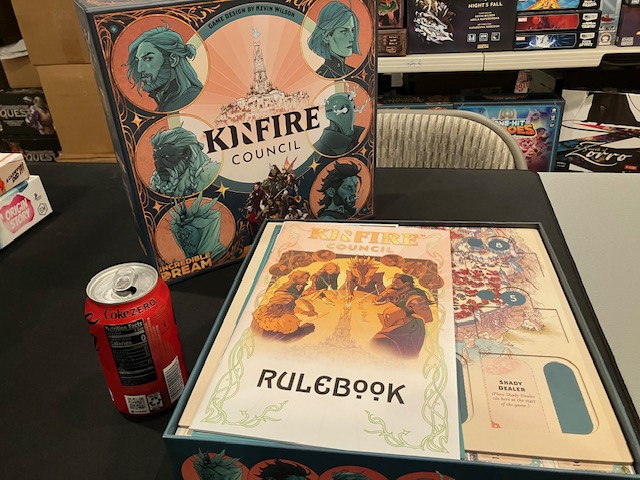
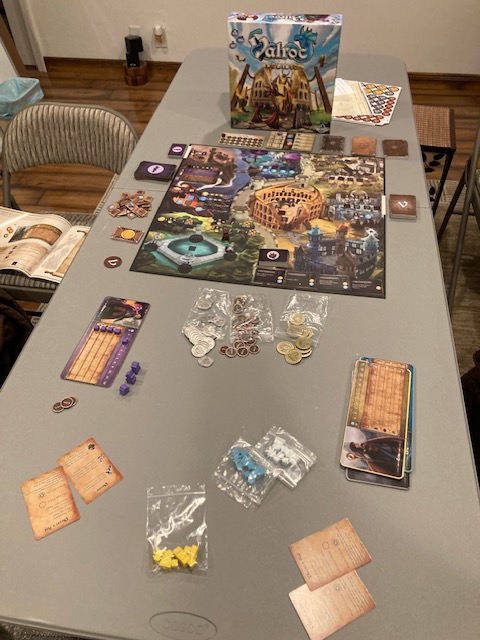
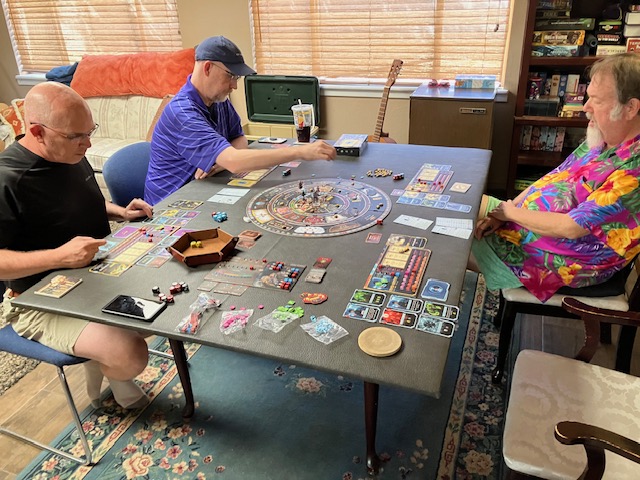
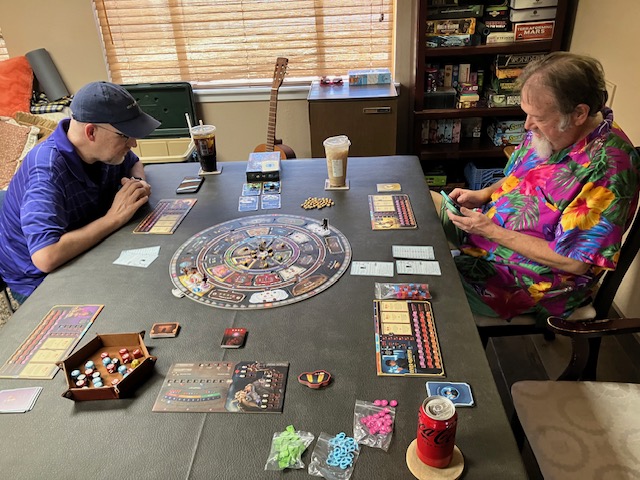
The base game is pretty standard sized box; see Coke Can for perspective.

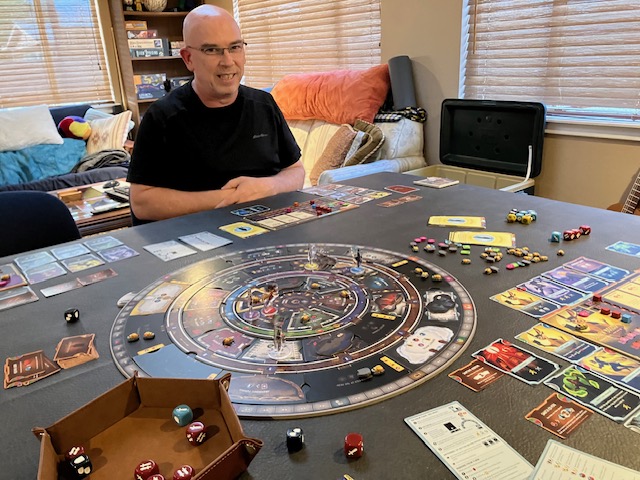
There is a LOT of stuff in this box! See above!
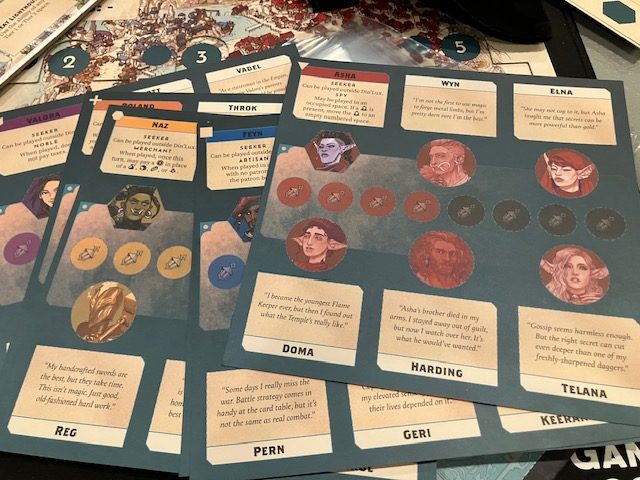
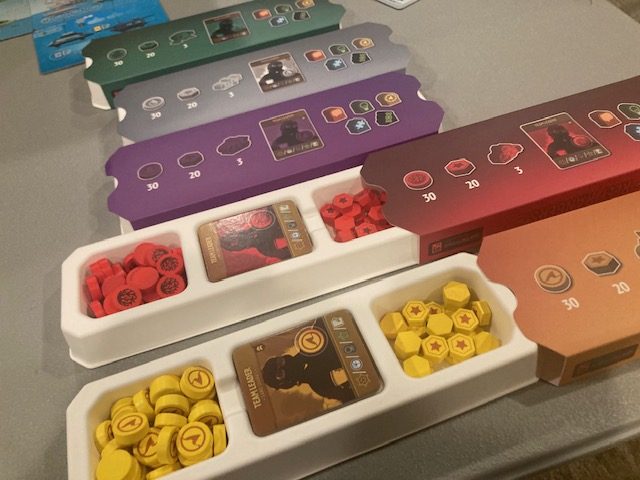
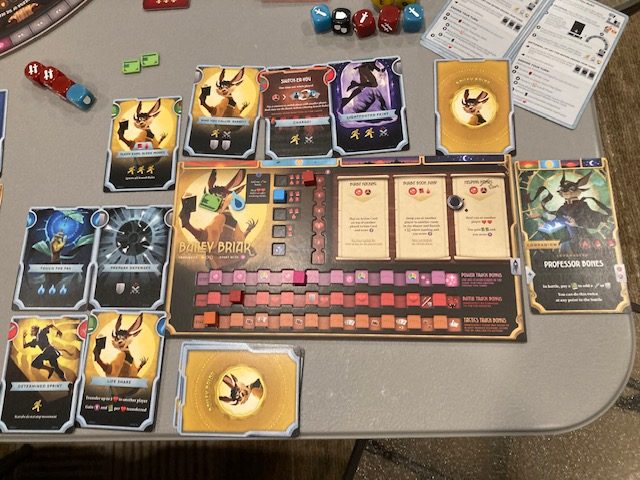
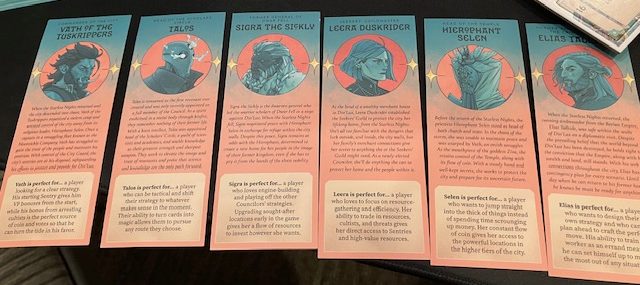
Each player chooses (or randomly gets) a Worker sheet … see above …
And a Councilor sheet! See above!
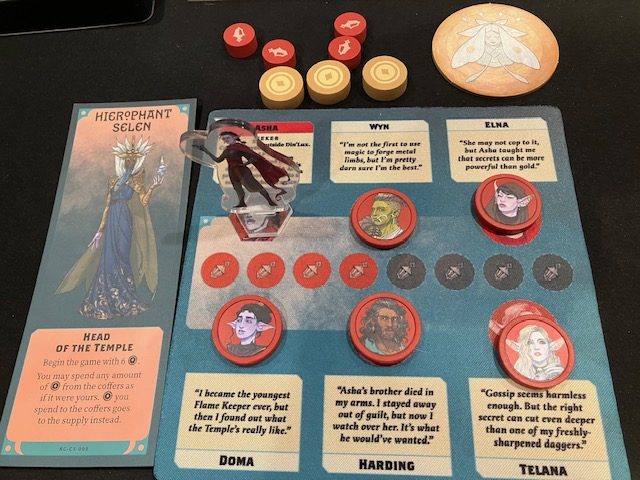
Together, the Councilor and worker sheet form your tribe!   See above!  (They don’t actually have an official name for this combination in the game, so I am using tribe to mean the combination of a worker sheet and a Councilor).  The Councilor is cool because it gives special asymmetric powers (see Head of the Temple above; she knows how to handle gold)!  Each player also gets a number of “generic” workers (see the 5 above).

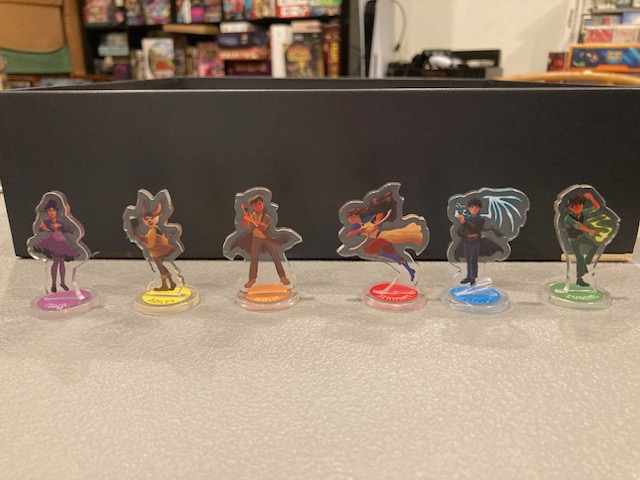
The acrylic standee is a special worker called “The Seeker” who can go outside the city and do other special things.
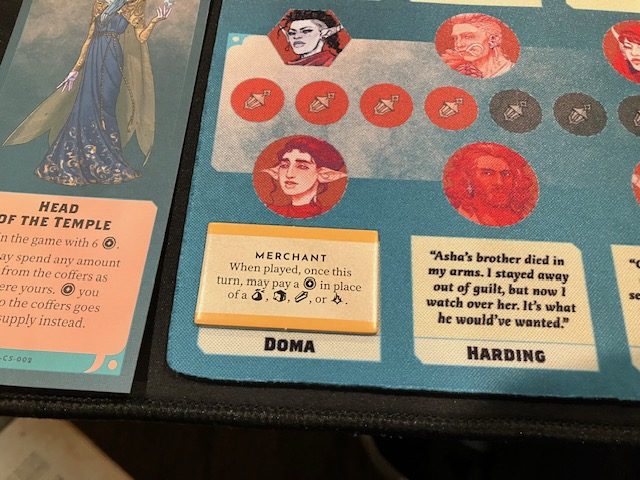
As the game unfolds, you can upgrade your workers!  See above as Doma gets to be a Merchant!
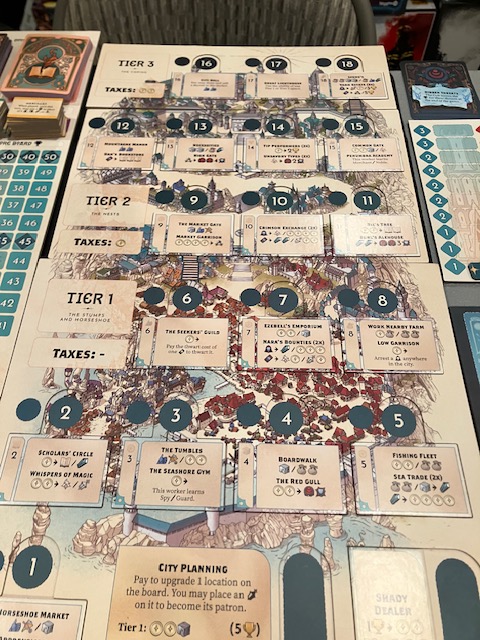
At the end of the day, this is mostly a worker placement game!  Your workers and Seeker can be placed throughout the city and activate Locations!  Only one per Location .. unless you have something special!

Many Locations have a choice: do you activate the top or bottom?  For example (see above): The top is a choice between EITHER getting 2 coin or 2 food.  The bottom action is trading; the worker can convert 2 food or 1 common into a moon stone (rare) OR one moon stone (rare) into 4 coin.  These are some of the main resources in the game!

It’s probably safe to say this game is a resource acquisition/conversion game too!  See a bunch of the resources (from the Upgrade pack) above.
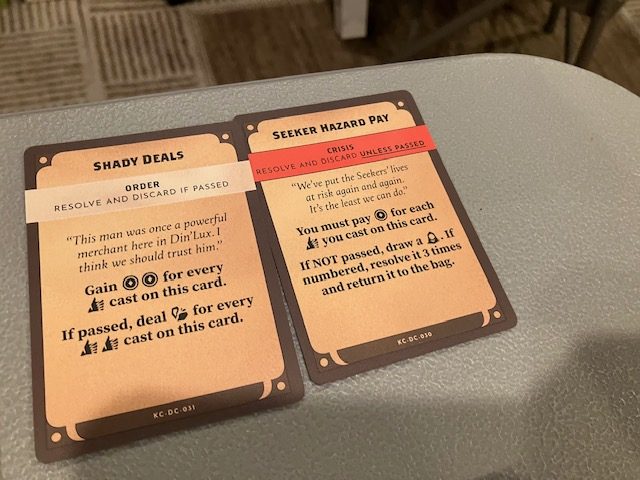
Kinsfire Council is also a voting game; you are members of a council for the city (I mean, it’s in the name for goodness sake).  Every turn, two Decree cards come out (see two examples above).  In order for these decrees to pass, they have to get a majority vote!  If you are in league with the Cultists, you may want to vote against them!  Or you may want to pass a decree that helps you but hurts the city!  Or you may not care at all and just ignore the decrees, preferring to spend resources on other things!  It DOES cost action/resources to vote!  So, you have to decide to vote or not!
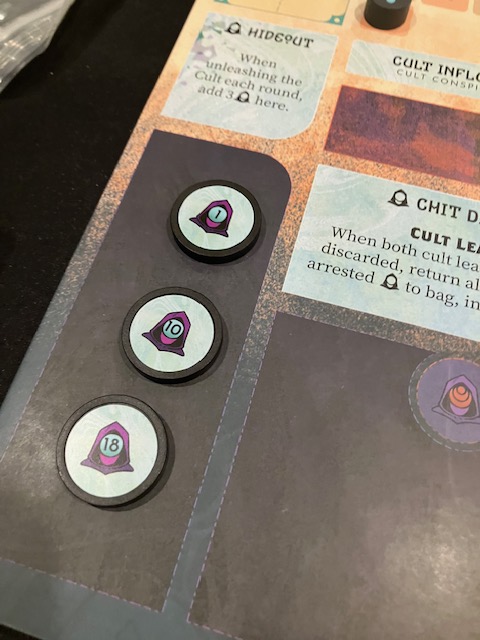
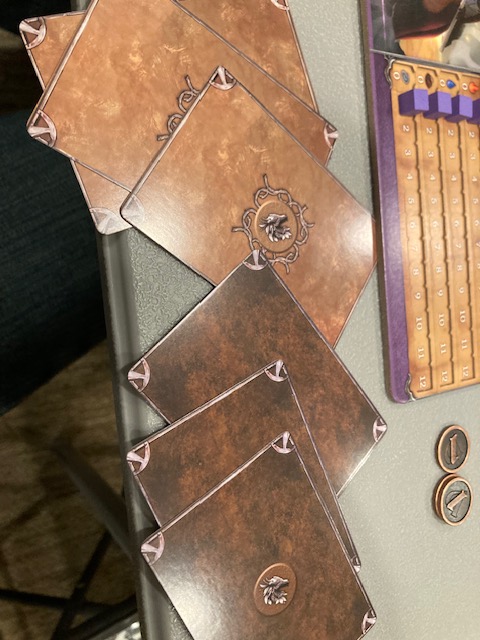
Another issue the players have to deal with … Cultists come out!  They clog the worker placement board  and make it so you can’t go there!
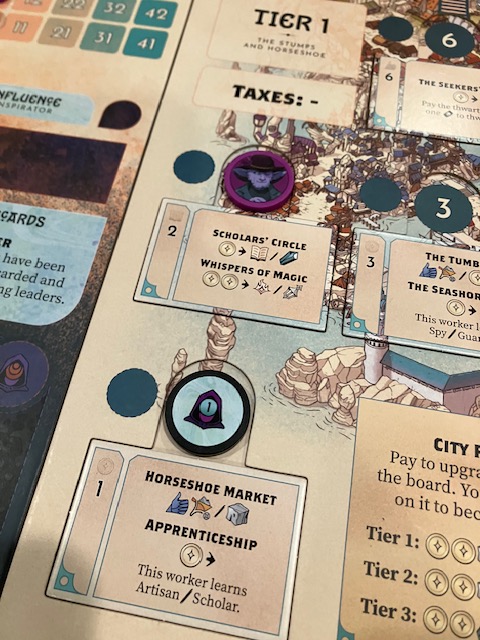
See above as the #1 Cultist clogs the #1 Action space!  Luckily, your workers can arrest Cultists, by being adjacent to them (but unfortunately, arresting a Cultist takes your action, unless you are a guard…).

The Cultists also cause threats to come out!  The threats don’t necessarily immediately trigger!  They usually only trigger when enough Trouble tokens gets placed! (Thing in the Tunnel above needs 2 Trouble to trigger). If you can discard the necessary resources (at the bottom left of the card), you can stop the threat before it comes out AND get victory points (bottom right)!
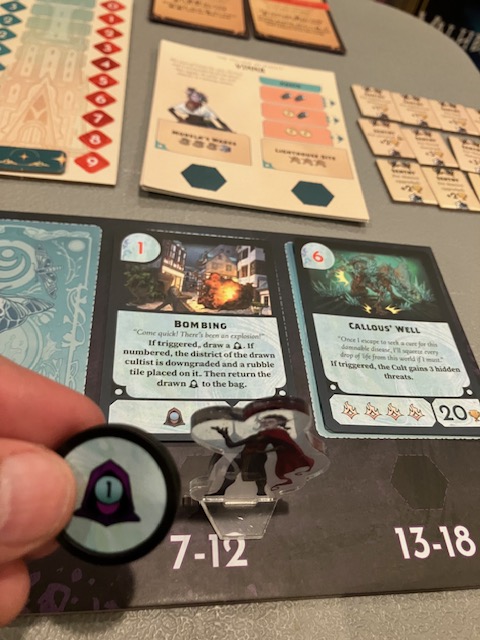
Every Cultist placed will either place a new threat or add a trouble, depending on its number (see the bottom of the threat board).

It sounds crazy, but Cultists are resources too!  Even after you arrest some, you can still use the Cultists (say, as hostages for taking out threats: see above!).
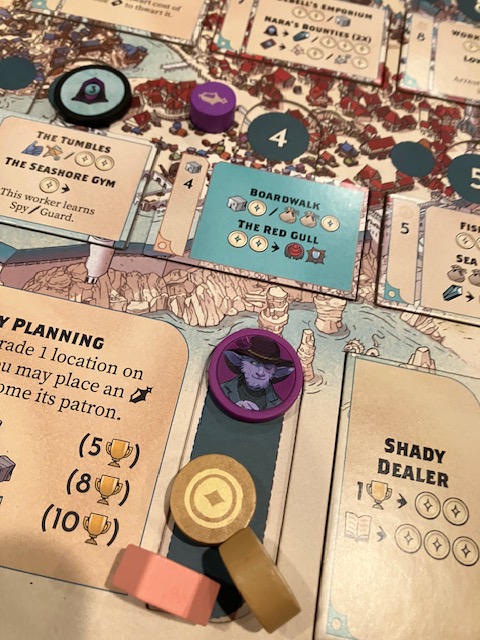
There’s lot of good stuff going on too; you can also upgrade spaces on the board by using the City Planning space!  See above as it flips the white space to the blue side making it better!
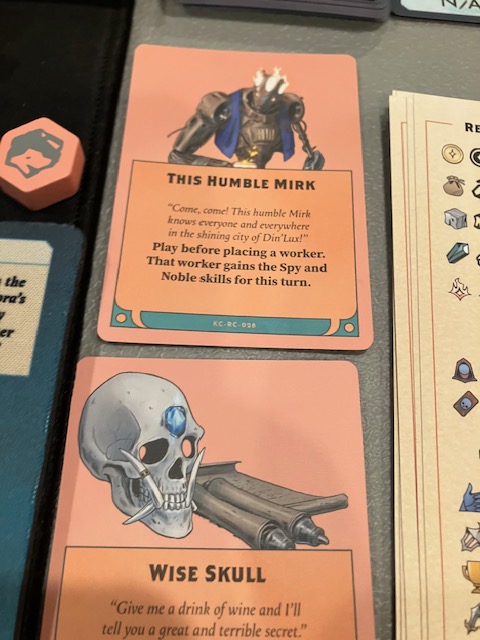
There’s also Research (which is like good news cards) which can be really helpful too.  Like everything in Kinsfire Council, the Research cards are ALSO resources that  may be traded in (besides doing the something useful).

Along the way, you have to keep the city healthy: the chart to the left are the resources you need to “feed the city” (3 food) and “keep it clean” (1 gold): this is called City Needs!!  If players don’t collectively keep the City Needs under control, the city get more Cultists!  Interestingly, you don’t have to use a full action to take care of the City Needs; this is just an errand … every action has a free errand you can run! (Thematically, it somehow makes sense that politicians see taking care of City Needs as a simple errand, not a full action).
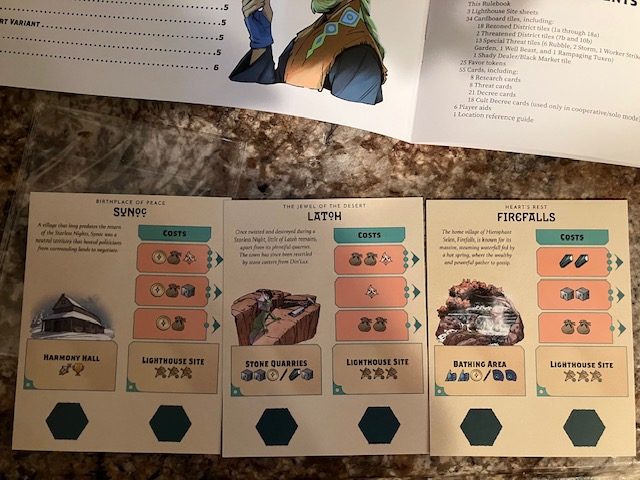
As part of the errand phase, you can also build the tower!  (See three such tower cards above!)  The Towers serve as inspiration to the city!  The Cultists hate the tower, because it provides inspiration and hope!  So, the less of the tower you build, the more Victory points the Cultists get!

To win, you need the most Victory Points: this is a Victory Point game! See the Victory Point track above!   You’ll  also notice that the Cultists have their own Victory Point marker!    It’s possible for the Cultists (to be clear, Cultists are NOT a player) to win the game!  If the Cultists win, whosoever has the most Cult Influence wins the game instead!
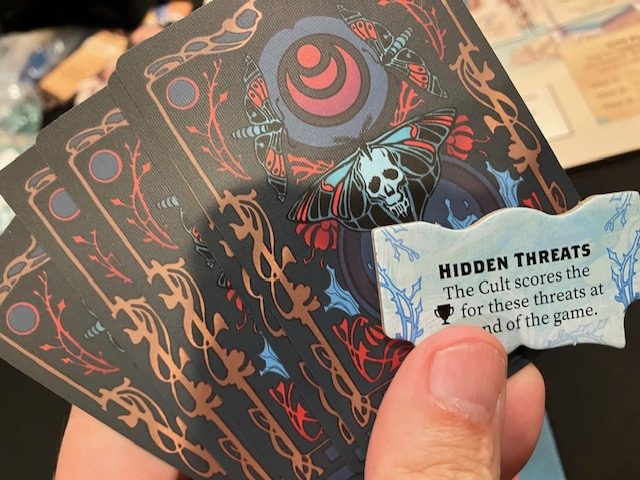
At the very end of the game, the Cultists reveal the Hidden Threat deck (created at the beginning of the game, and added to by certain decrees and threats) and add THOSE Victory Points to the Cultists!

The above 4 Hidden Threats would add 44 Victory Points to the Cultists!

This is a worker placement game, but with some really interesting ideas with voting, upgrading spaces, battling cultists, special workers, upgrading workers, collecting resources, doing research, building towers, and maybe … aligning with the Cultists behind the scenes!

Do you try to keep the city healthy or just let it go to hell and let the Cultists take over?  That’s all part of this competitive game!

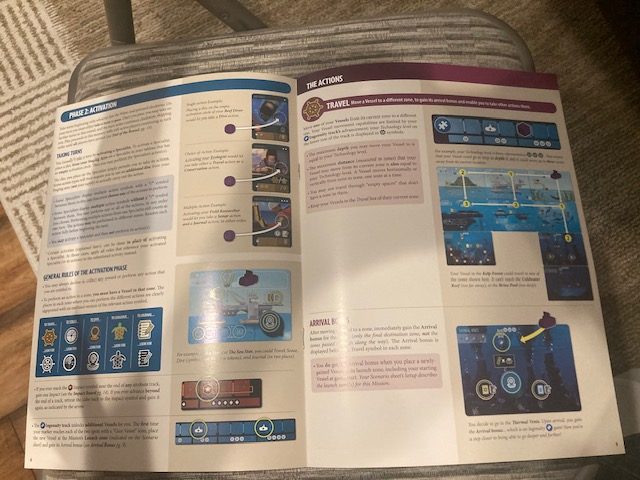
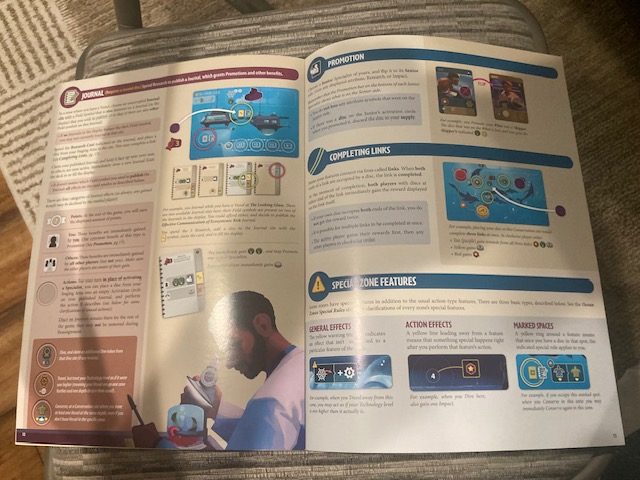
Rulebook
Good rulebook. 
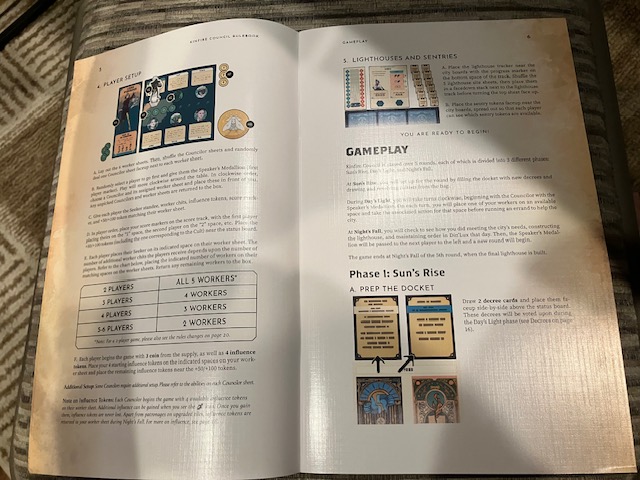
It gets a A- on The Chair Test (it could be an A, but the font could be a little bigger, especially seeing how much white space there is on the page).  BUT the rulebook has a great form factor, has some decent pictures, doesn’t droop down over the edges of the chair next to me, and it stays open to be easily consulted.  Great job guys!
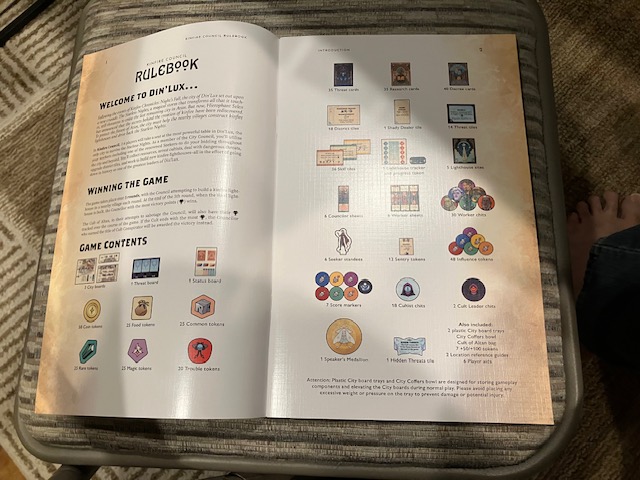
The components pages are good; pictures and correlating text is always a good thing.  See above.
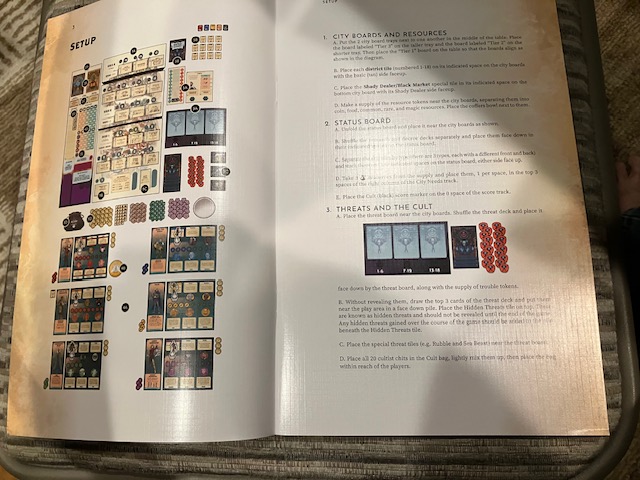
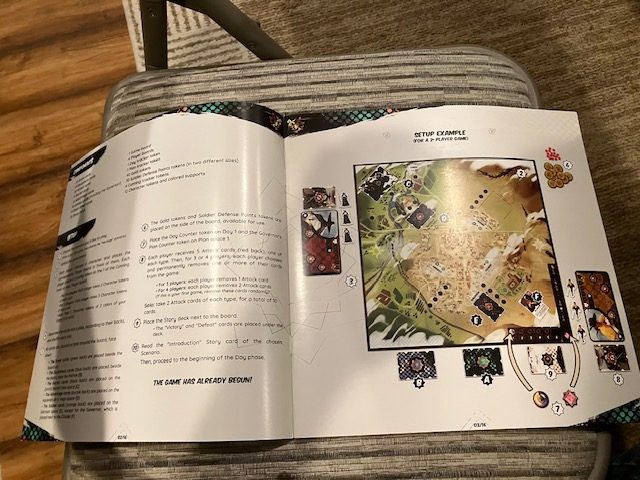
The set-up is also good; pictures and labels help!  See above.

Holy crap, there’s even an Index, and I used it multiple times! It was a useful Index!

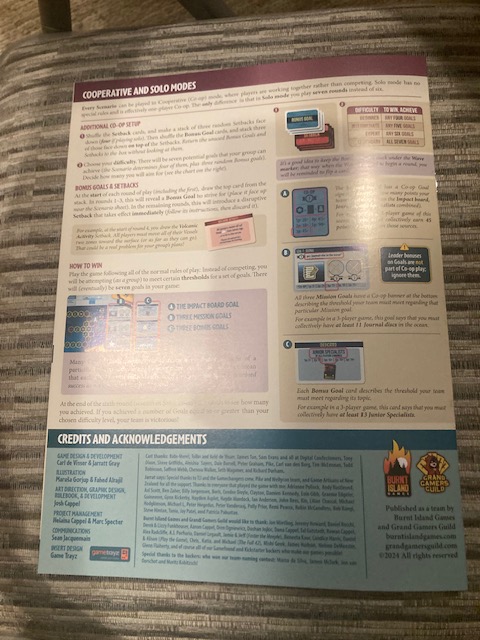
The rulebook even ends with something useful on the back; see above.

My only complaint was that there were a few things that were unclear in the rulebook.  I posted on BoardGameGeek and got some responses; I post the thread here so you can benefit from my questions!  (The Designer, Kevin Wilson even answered and tacitly approved the answers).

Other than that, very good rulebook.

Solo Game (Unofficial)

To be clear, the base game of Kinfire Council is for 2-6 Players and is a competitive worker placement game.   There is no solo game built-in to the base game!
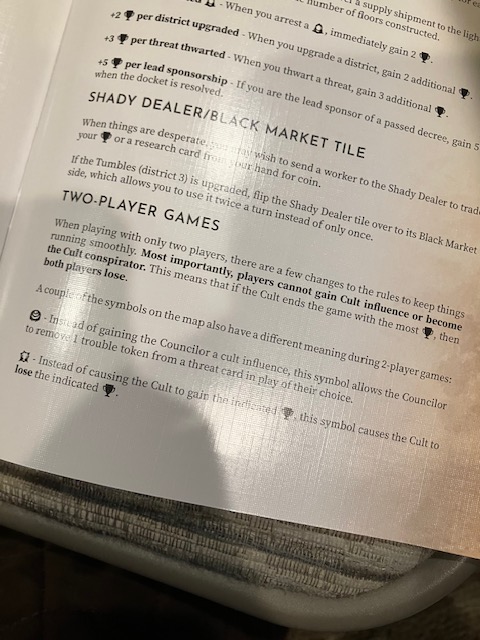
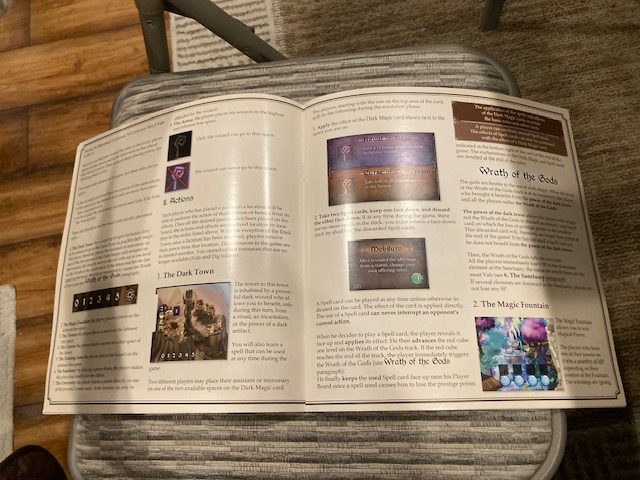
BUT, if you squint at the 2-Player rules a little (see page 20 from the base rulebook above) you can see the implications of a simple solo game!
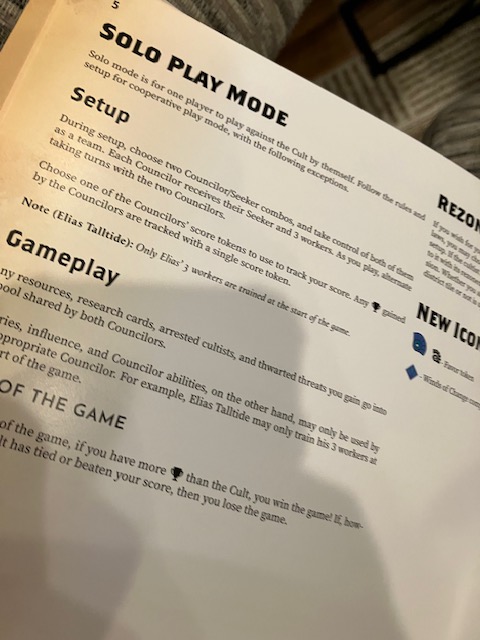
In fact, the solo mode from the Winds of Change expansion is ALMOST the 2-Player game from the base game!

Basically, the official solo game and 2-Player game doesn’t allow player(s) to go after Cult Influence.  To win, the player(s) must get more Victory Points than the Cultists!   Interestingly, the solo (and 2-Player mode) redefine the Cult influence action to eliminate Trouble tokens and SUBTRACT Cult VP (rather than add Cult Influence and ADD Cult VP).

So, you can play the base Kinfire Council solo … unofficially! It’s really just the 2-Player game where you MUST be against the Cultists!

To win the (unofficial) solo game, you play like normal, and BOTH players VP must surpass the Cultists!  See above as I lose my first unofficial solo game as the red tribe is still behind on VP!
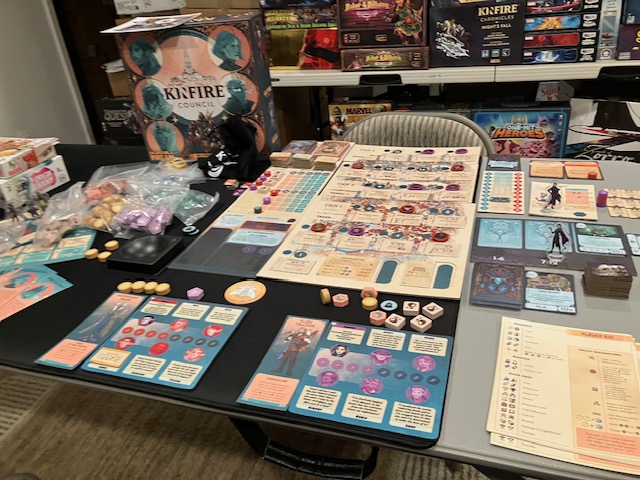
To be clear, this is an unofficial solo mode that is my own creation to just learn the game.  It’s not very hard, but it does teach how the game plays.  The solo player takes control of two tribes and plays the game normally, like a 2-Player game, but alternating between the tribes.
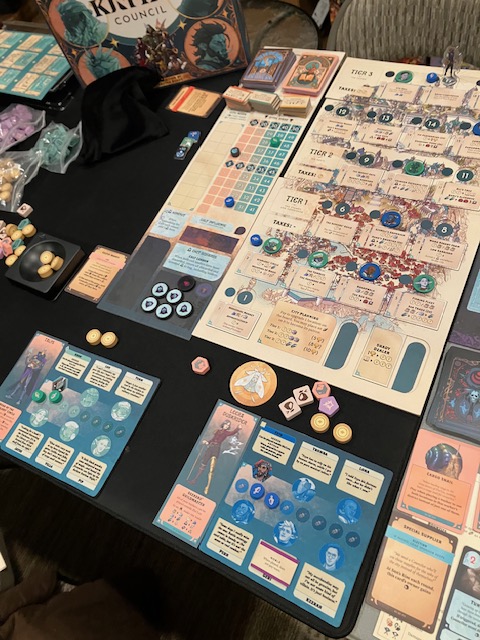
So, I played a couple of solo (unofficial) games to learn the game.  This is a great way to see all the rules and systems!  This (unofficial) solo game is MUCH EASIER than the official solo mode.   The official solo mode is WAY HARDER, but when you are learning the game, I think this (unofficial) solo mode is more approachable!  Basically, the official solo mode has more rules, more things to keep track, is a little oppressive (especially at the beginning), and may be a little too frustrating (in the beginning). 

I lost my first (unofficial) solo game and decisively won my second (unofficial) solo game.  But I learned the game.

If you have played The Captain’s Chair, you know that it has two official solo modes. The “simple” solo mode teaches most of the mechanics of the game without being too oppressive.  Once you know the basics, the “hard” solo mode is how you want to play.  I think that same idea applies here.  

Play the (unofficial) solo mode (which is basically just the solo player operating the 2-Player game by himself) to see how the game works; you only need the base game for that.  If you enjoy that, then you can decide if you want to move on the official (and much harder) solo mode from Winds of Change.

Winds Of Change Unboxing
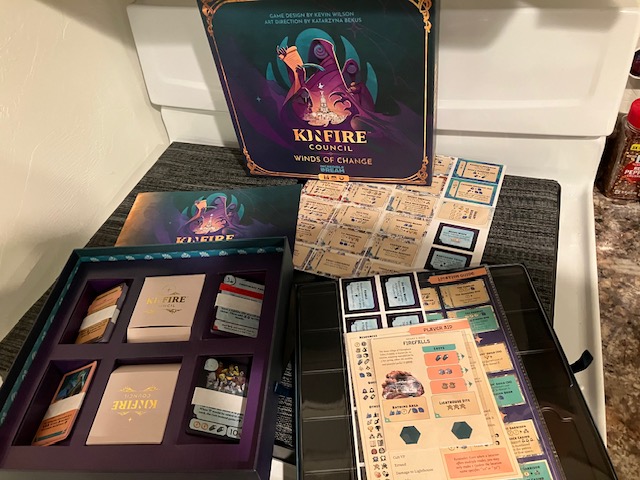
Winds of Change is the expansion that provides official solo and cooperative rules for base Kinfire Council. 
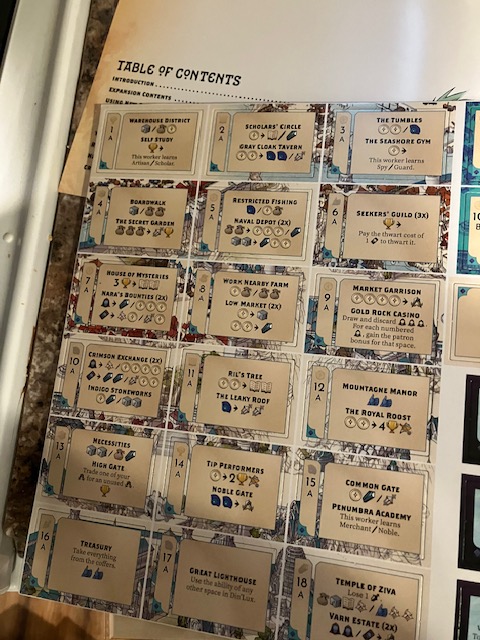
It adds a bunch of new Locations you can swap from the base City Locations.

It adds three new Towers to swap in.

A bunch of new cards.

And a new resource called Favor Tokens which is like Magic, but its use gives the Cultists Victory Points. (Honestly, in all my plays, I stayed away from these resources)

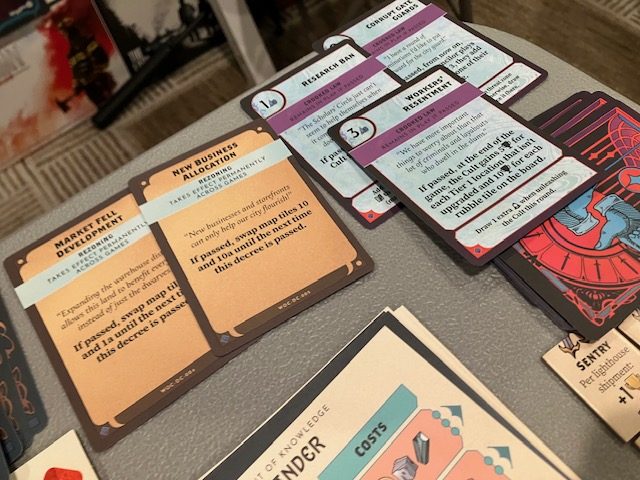
BUT the most important thing this adds is the new Cult Decree Cards (see above).  This is what makes the solo and cooperative games more challenging!  This is the new key ingredient!

Basically, every turn, when you normally get two decrees (which you may or may not want), you ALSO get a Cult Decree card at the same time!  Just like the Decrees, you have to get the votes on Cult Decrees to make sure they don’t take hold!

The Cult Decree cards are even worse than you think because they ALSO have an immediate bad news (look at the bottom of the card)!

Official Solo Mode (Winds of Change)
If the (unofficial) solo mode is too easy, it’s the Cult Decrees that make the official solo game in Winds of Change a LOT harder.

The official solo mode is very much like the 2-Player mode.  Two tribes must work together (see above) to make sure the city survives the Cultists!  The three real differences are:
1) Players must now deal with Cult Decrees (GULP!)
2) The two tribes share all resources in one pot
3) Each tribe only has three generic workers instead of five generic workers
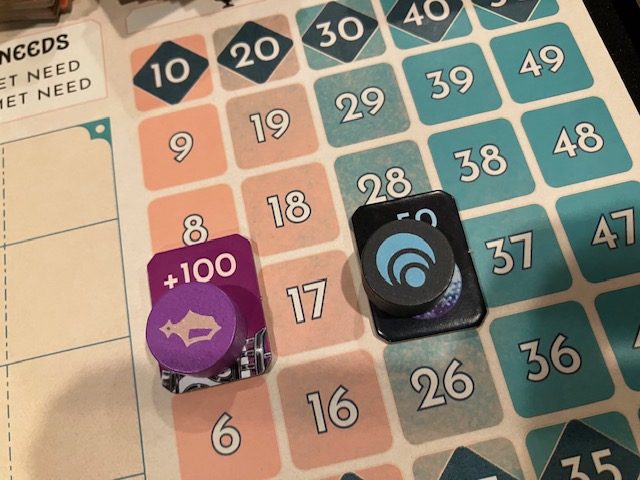
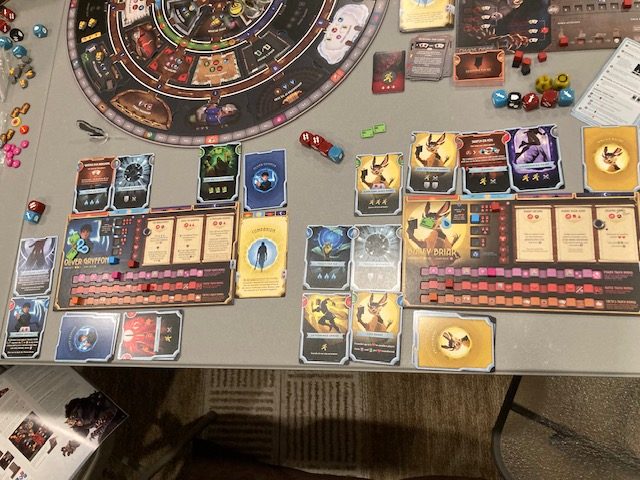
Since the two tribes now share all resources, there is only one Victory Point marker.  Both tribes move the same VP marker!  See above!  To win, the solo player must simply beat the Cultists!

The official solo mode is still basically the same game, but there’s no back-stabbing or bad councilors to worry about!  The two tribes cooperate!  The solo player alternates between the two tribes and plays normally.  The real difference is that all resources are shared between the two tribes AND they have to deal with the pesky Cult Decrees!

The official solo game definitely feels more oppressive!  Your first few turns feel like you can just barely hold back the tide of Cultists! It’s a little overwhelming!  I think I had some bad luck in my first official solo game, so I cheated a little just to make sure I moved forward to see the whole game!   

In my  second official solo game, I felt like I got it!  In the beginning of the official solo game, it’s HARD to keep the Cultists under control, but by the time you make it turn 5, you have a little bit of an engine going and you have enough resources to make a difference!  It feels  … inspiring … when you can wrest control of the city from the Cultists!  This is our city, darn it!

The official solo game is much harder that the (unofficial) solo mode (as we discussed earlier), but it is a good challenge and it will be a solo mode to keep you coming back.

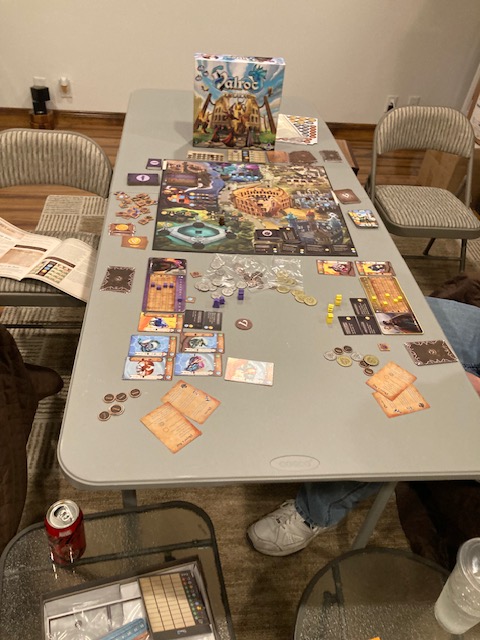
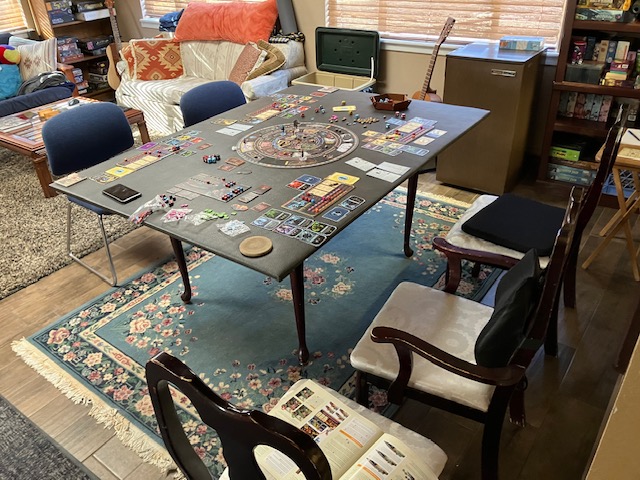
It’s just a little bit of work to keep the solo and cooperative components separate from the base box.  (I actually ran out of space on my table, and had to put the Winds of Change box on my stove!!! See above)  It’s actually kind of annoying to put everything away.

Cooperative Game
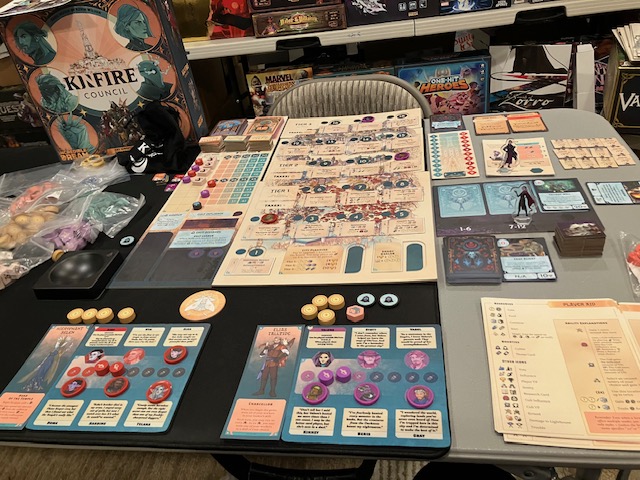
You could easily play the 2-Player mode from the base game cooperatively as a 2-Player game.  And frankly, except for the Cult Decree Cards, it’s pretty much the same game.  Again, the Cult Decree Cards make the game SO MUCH harder. 
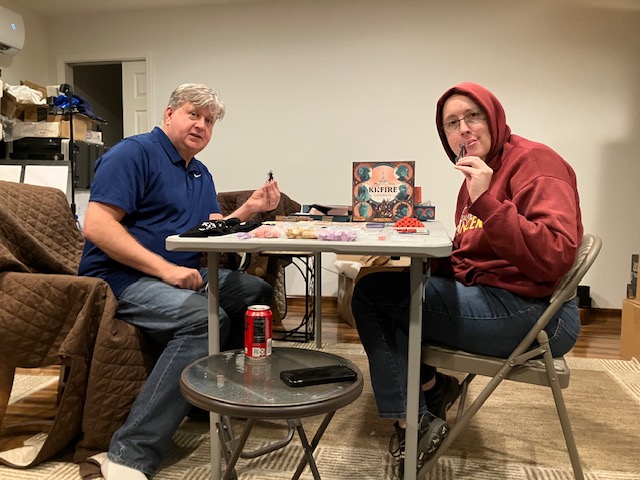
For one of our 2-Player cooperative games, we played with the official Winds of Change cooperative rules with the Cult Decree cards.  We wanted the challenge!
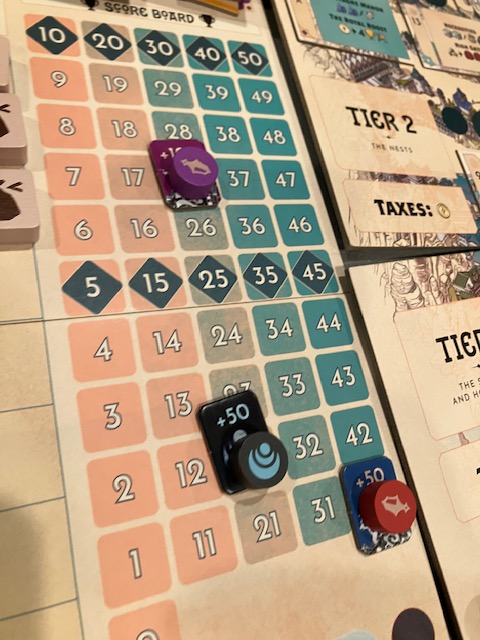
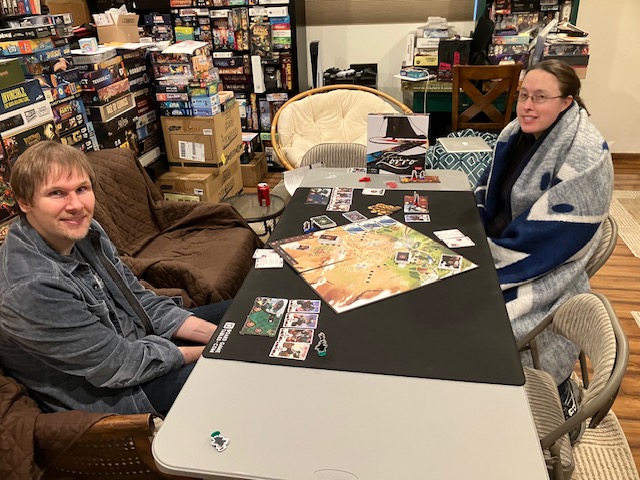
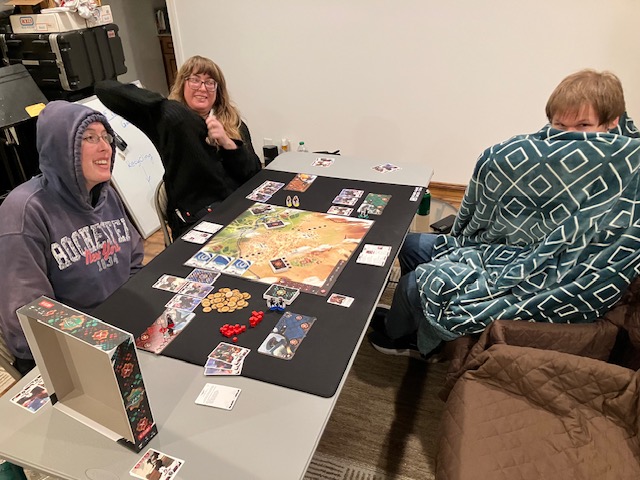
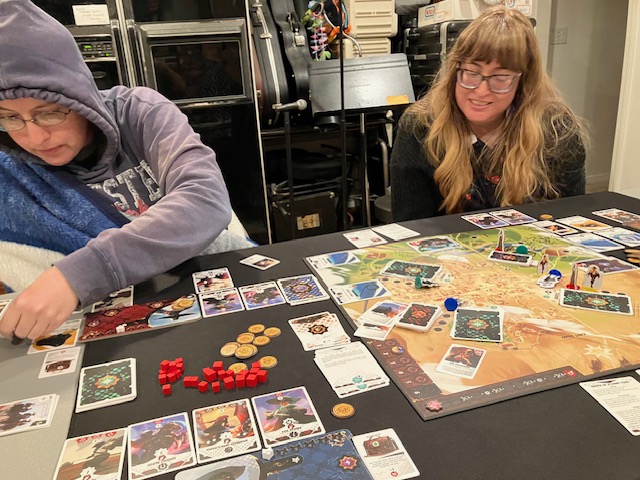
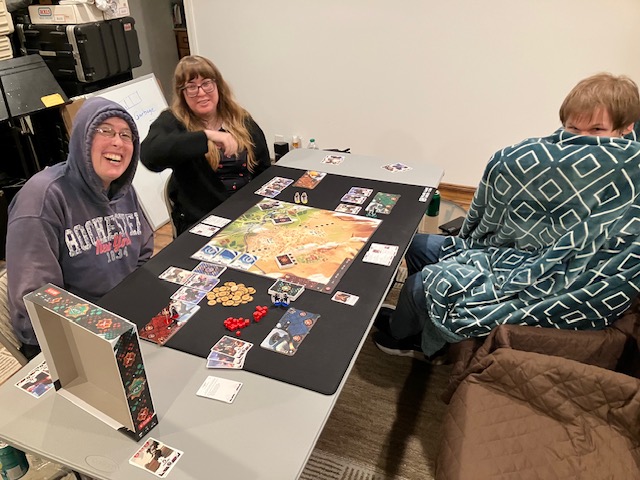
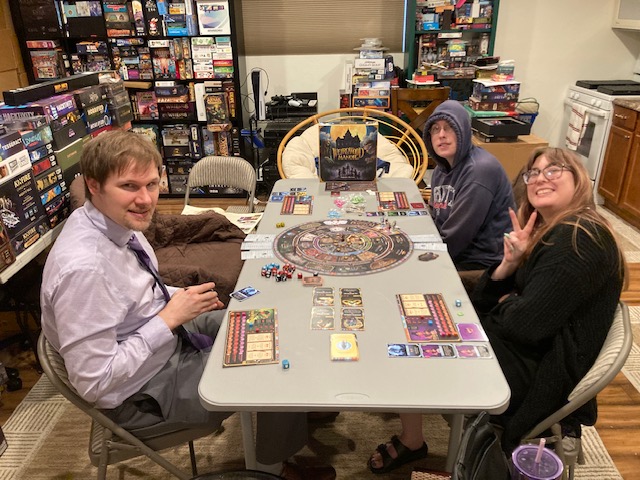
In the cooperative game, each player has their own VP marker.  Like before, ALL PLAYERS must have more VP than the Cult, or they lose!  See above as we win!  Both Teresa and I had more VP than the Cult!

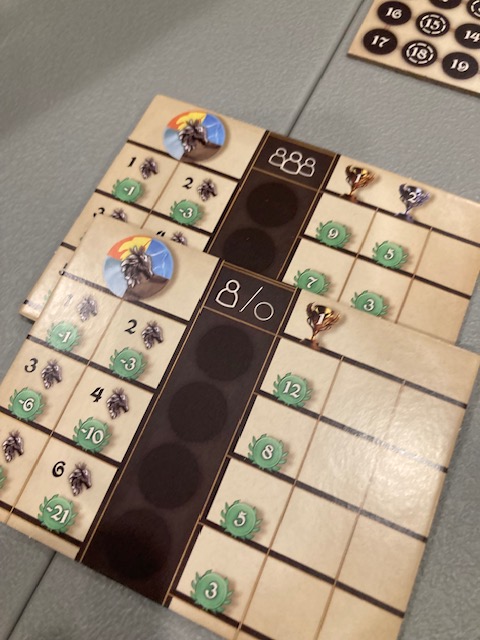
The Winds of Change also has new Player Aids (which are quite good: see above).
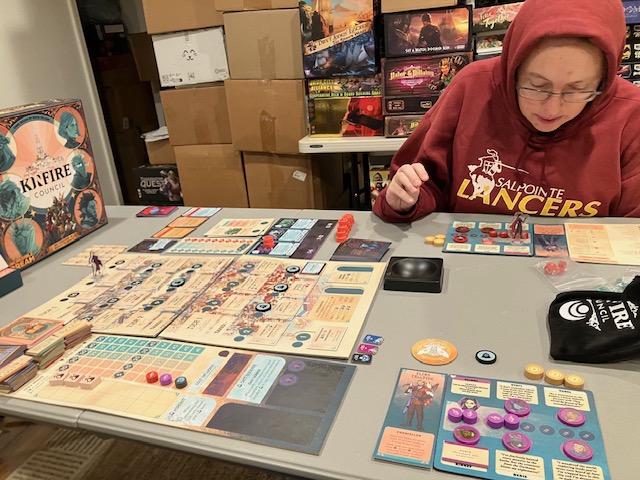
Basically, we had fun playing cooperatively!  There’s a lot of multiplayer solitaire, which means we both have agency on our turns.  But we still have to talk a LOT to make sure we arrest the Cultists and keep the Cult Decrees under control!   I think this game a really good balance of having solitaire agency but still requiring plenty of cooperation!  At the end of the day, YOU decide how to move your workers, but still work together to keep the Cultists down!

House Rules: Cooperative – Sharing

There was one thing that really surprised us in the cooperative game; there is no rule for sharing resources!
In the official solo game, the two tribes share all resources, so there’s no need for any sharing rules.  But, the cooperative game has no mechanism for sharing?

We came up with a House Rule that seemed to work fantastically!  You can use an errand to share any single resource!!!  It’s an easy place to add the sharing mechanism, and it’s very thematic!  “Oh, as an errand, I need to make sure my friend has some Magic to stop the threat on their turn!”

It’s not free, as it still takes up an errand to do it, but it made the game a LOT more cooperative!  “Can you deliver me a Cultist?”  If my friends just needed one resource and could save us an action, why not do it?

It was sort of funny to have all resources (including Cultists and Cards) being something you can share.  For the Cultists, it reminded us of doing prisoner transfers across town.

We STRONGLY recommend adding this House Rule: as one of the options for an errand, you may choose to share a single resource.  If you can’t build the tower, or resolve City Needs as your errand, maybe you can still do something useful with your errand and help your compatriots.

Sharing as an errand made the game more cooperative, more interactive, and more fun. 

House Rule: Solo – Don’t Require Alternating

In the official solo game, you MUST alternate between the two tribes as you play.  But, why?  Since all the resources are shared, it doesn’t matter as much!  In fact, sometimes you have more options if you can choose any order you want!  Maybe you want to use tribe 1’s three workers FIRST (because they are all guards) and THEN do all of tribe 2’s workers after the board has been cleaned of Cultists!  I found many times, when playing solo, I accidentally didn’t alternate ANYWAYS!  You sometimes forget to alternate … but it doesn’t really change the game.  In fact, it gives you more options!  If you can choose the order of the workers of the tribes, sometimes you can pull off something really clever that maybe you couldn’t if you were forced to alternate.

This isn’t a big deal for a House Rule, but I think it makes the solo game just a little more fun: give me more choice so I can feel clever. 

Thoughts
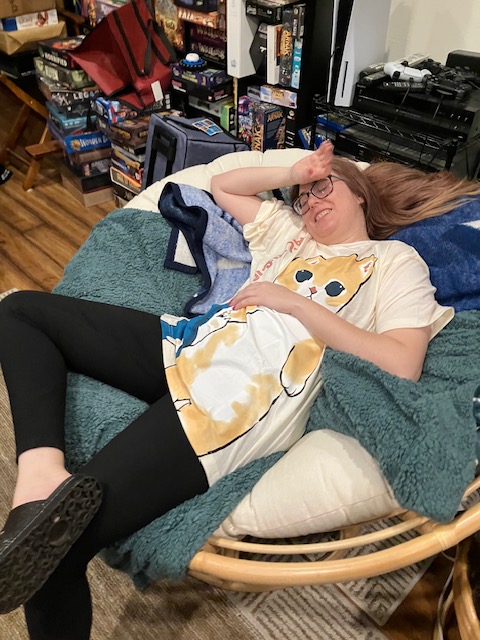
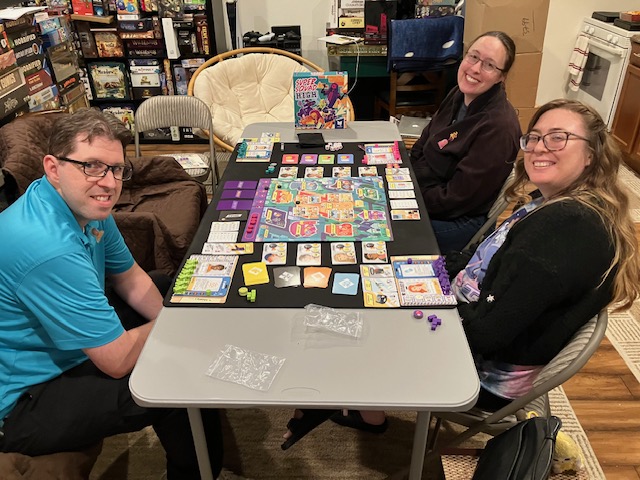
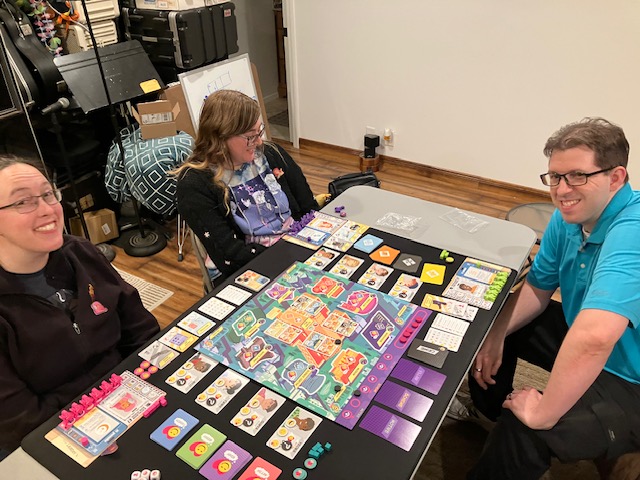
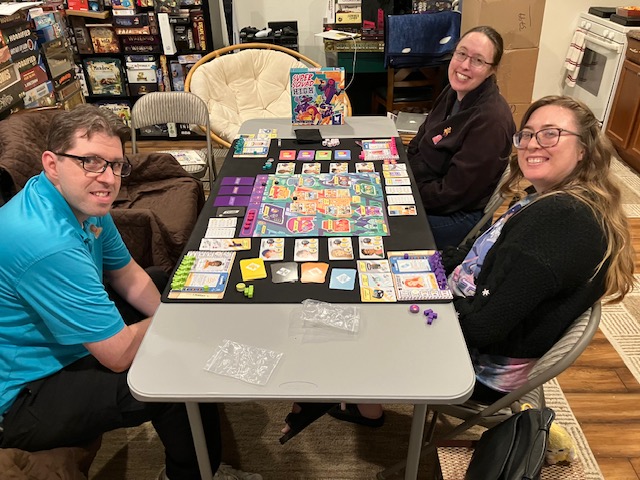
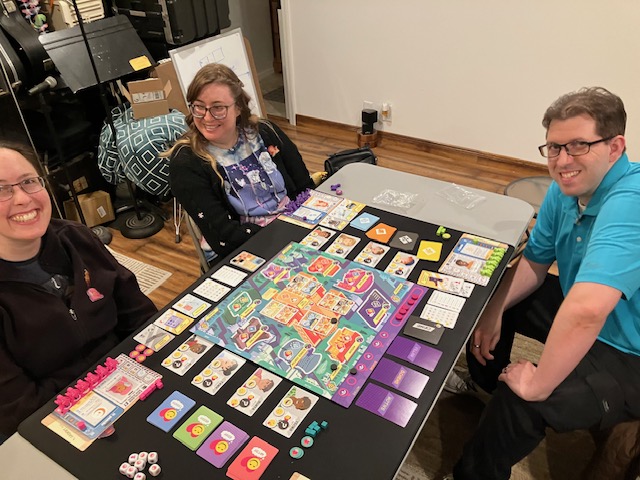
We were originally supposed to play a 3-Player cooperative game, but Sara fell sick and just wanted to listen to us.  Here’s the funny thing; just listening to us play and narrate our turns to her, Sara gave this game a 7.5/10! She said it sounded really fun!

Teresa really liked it.  About a 7.5/10 as well.

I liked both the solo and cooperative modes a lot.  The solo game was about a 8.0 as was the cooperative game.  With the house rules we proposed, both go up to an 8.5/10. In fact, the sharing as an errand rule was such a good house rule, it might even make it a 9/10.

Conclusion

You can play the base Kinfire Council game as a solo and cooperative game to see if you like it (using the unofficial rules we described).   These unofficial solo/cooperative modes are pretty easy, but they give a good sense of the game.  If you like the game, then the Winds of Change expansion makes the game much more challenging.

Is it worth getting both?? I personally think it’s worth getting both  Kinfire Council and the Winds of Change expansion to play this solo and cooperatively.  It’s a lot of work to get there, between learning the base game, cooperative game, set-up, combining games, and set-up, but the unofficial solo rules can make it a LOT easier to learn the systems of this game.

If you do get Kinfire Council and Winds of Change, I strongly suggest you play with the cooperative house rule sharing as errand, as it makes the game more cooperative, more interactive, and more fun; it brings the game to almost a 9/10 for me (cooperative mode).   Even without that rule, it’s still an 8 or 8.5/10.  It’s so cool that a cooperative worker placement works so well!

The official solo mode is great, but a minor house rule (for relaxing the alternation) makes it a little more fun, as it gives the solo player more choice.  Solo: 8 or 8.5/10.
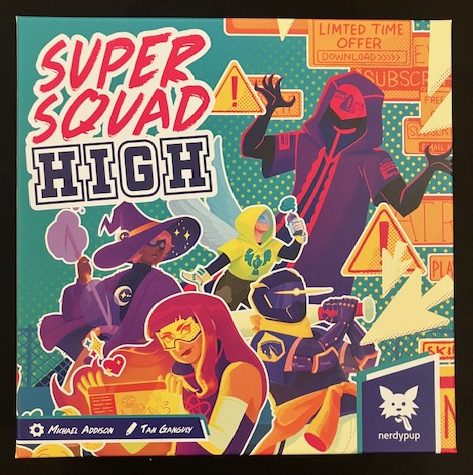
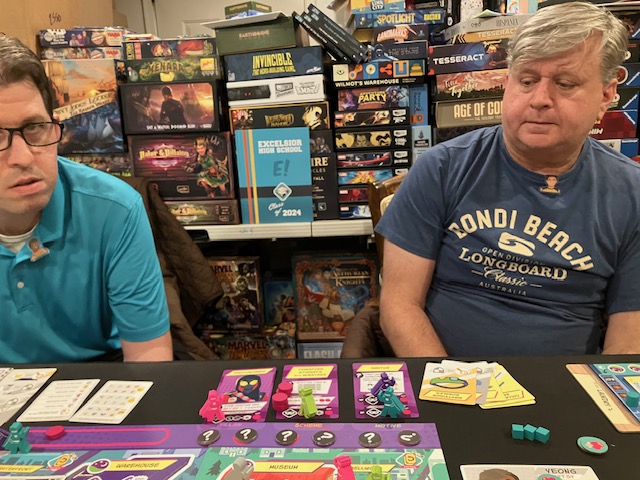
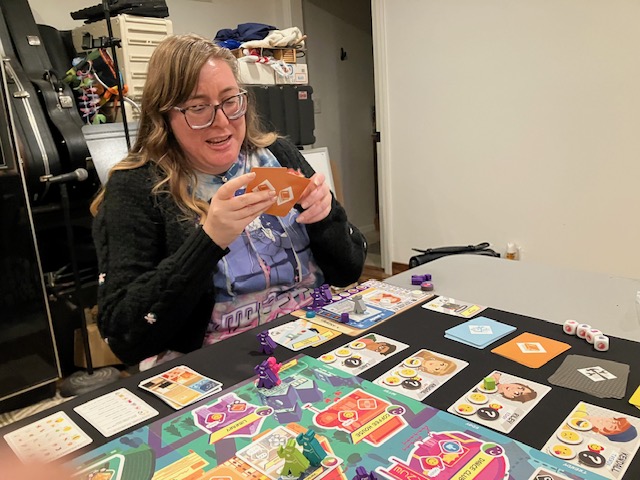
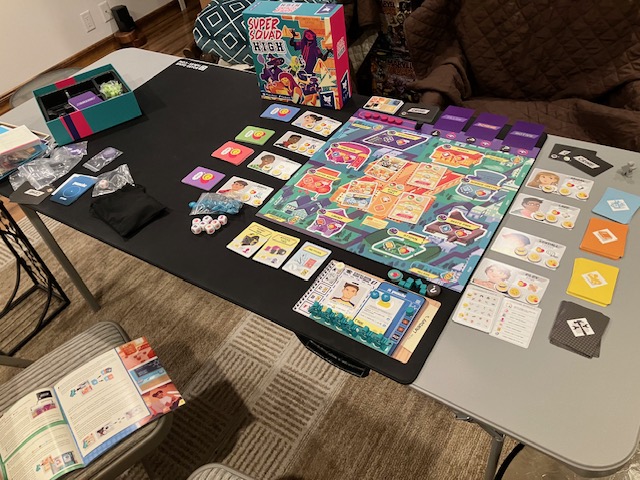
Super Squad High: A Solo and Cooperative Superhero-ish Game

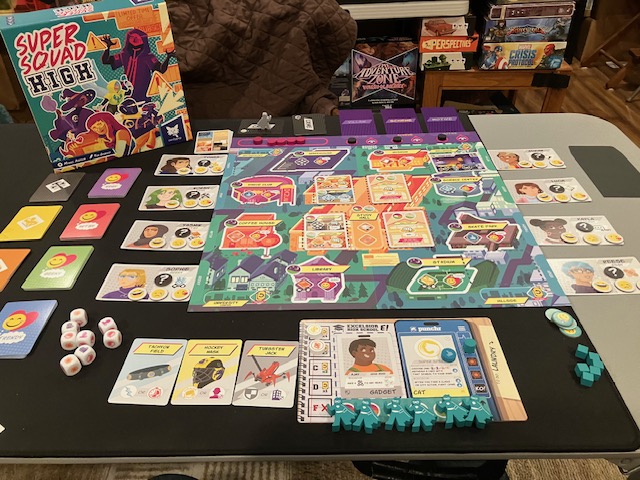
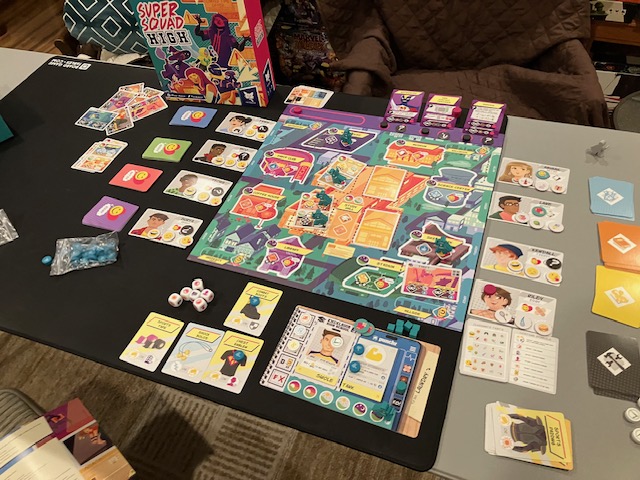
Super Squad High is a cooperative and solo Superhero game that was on Kickstarter in April 2024.  It promised delivery in March 2023, and it was just a month or two late (which is pretty good in Kickstarter terms).

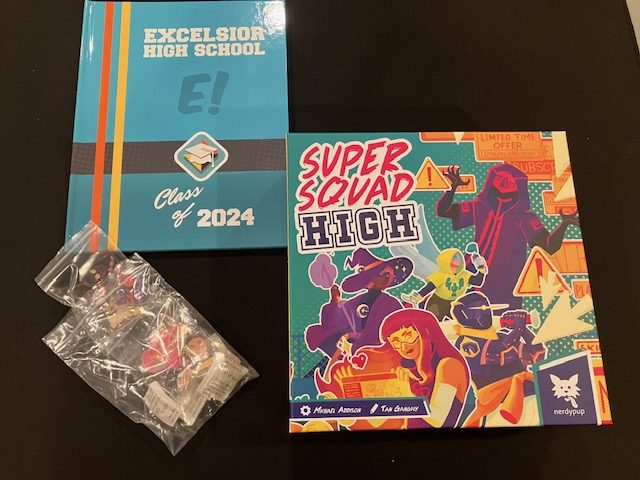
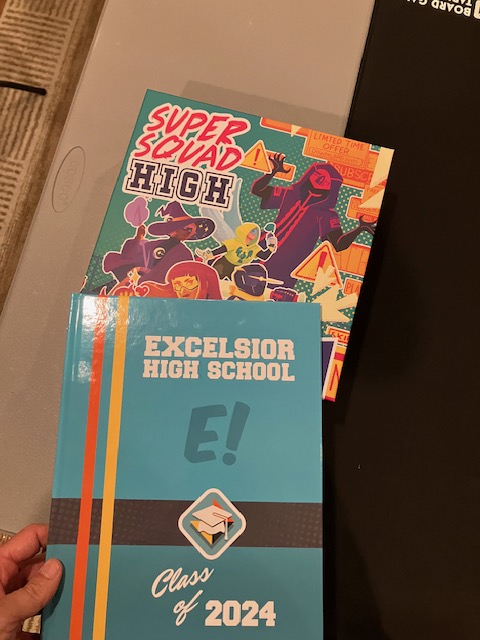
I went ahead and backed the high-end version and got the Arylic pins and Art Book: See above.

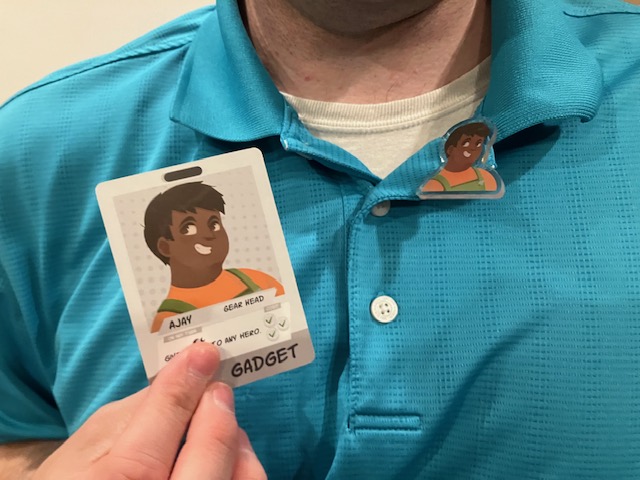
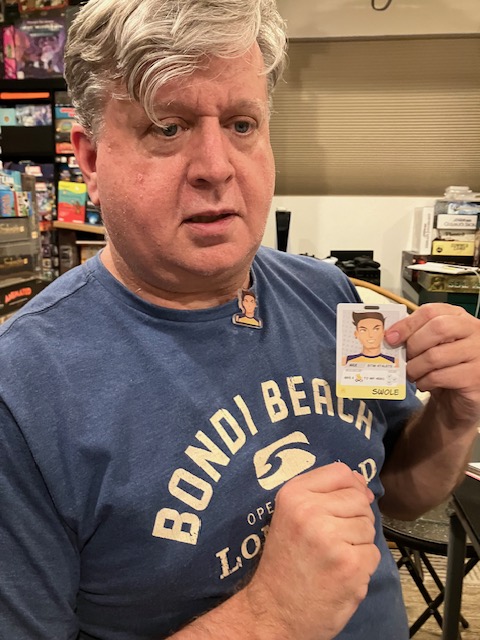
The Arylic pins are completely superfluous and you don’t need them, but we had fun picking our characters using the pins (and then wearing the pins): see above.

Let’s take a look!

The Rulebook

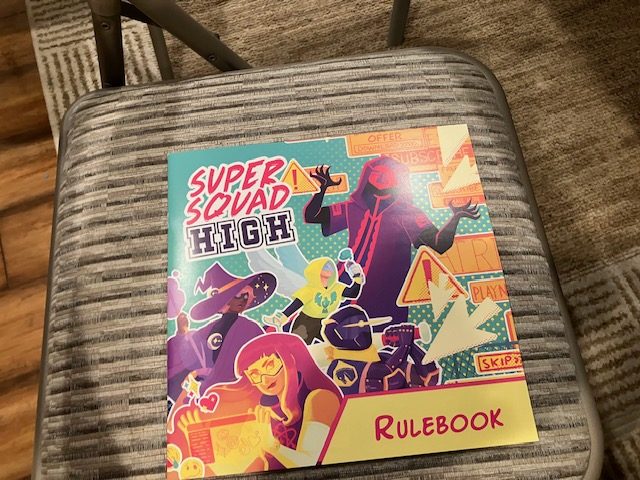
The rulebook was just okay.  

The rulebook ventured into low C territory for The Chair Test. It does kinda fit on the chair next to me, and it does stay open, but it does droop a little too much for my liking.

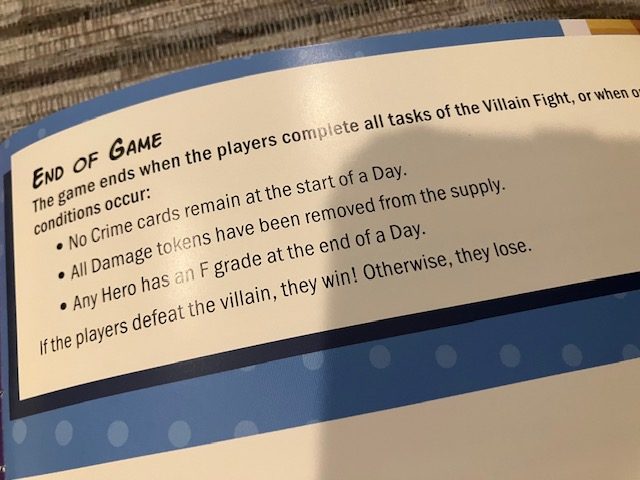
There tended to be a LOT of text without too many pictures.  Luckily, it seems like most of the rules are there (modulo one solo rule for Crime cards).  Also, the font was a little small.

There also seemed to be a lot of “space” around the edges that was just “flavor”, when I would have preferred more pictures and a larger font.

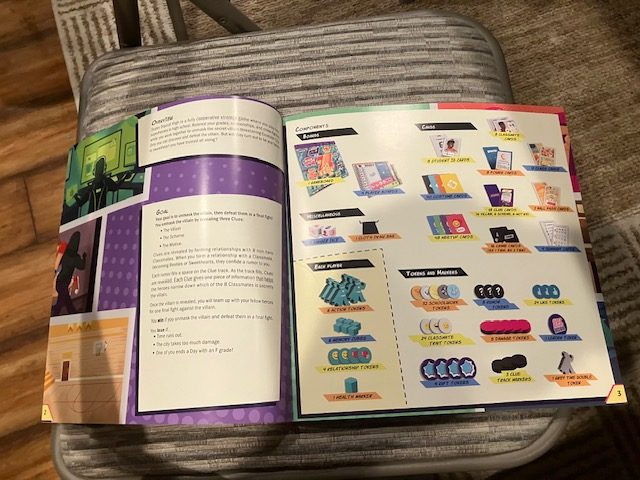
The components page was pretty good.

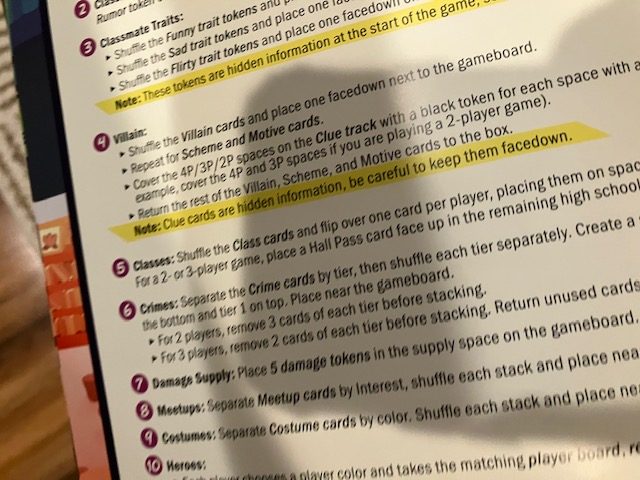
The Set-Up worked pretty well, especially since the directions were on one side, and a picture on the other.

I got through the rulebook, and most of the rules were in there in a logical place.  I think the rulebook could have been made better in a lot of ways, but the fact that it did seem to have all the rules goes a long way.  In the end of the day, it was fine, but it could have been better.

Unboxing, Components, and Gameplay

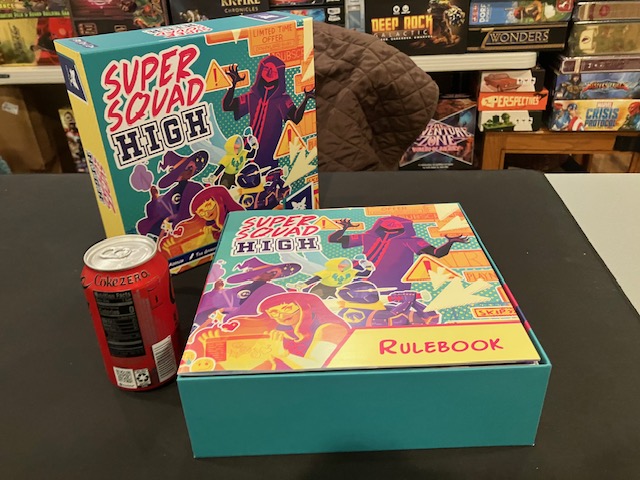
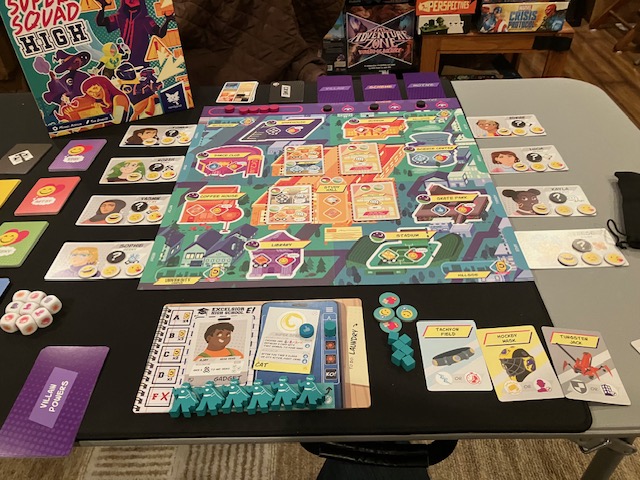
This is a pretty standard sized game box: see Coke Can above for scale.

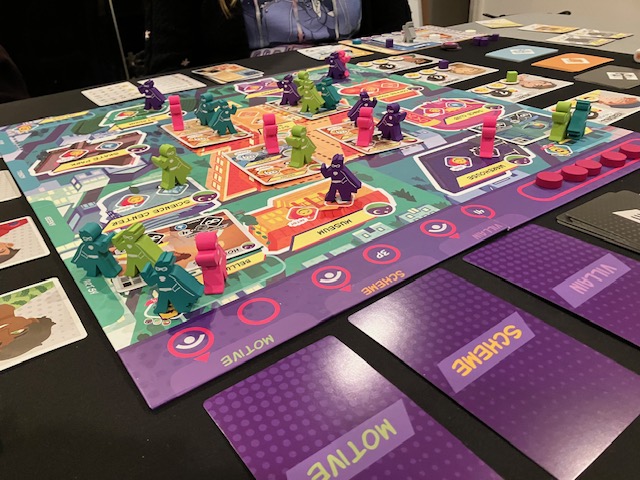
1-4 Players each take the role of a SuperHero in a High School!

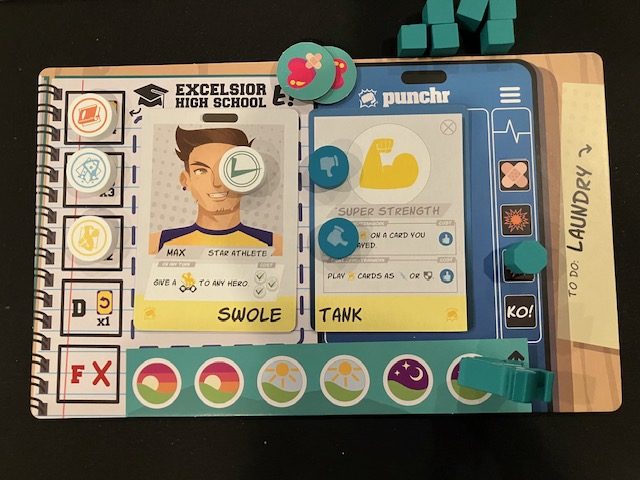
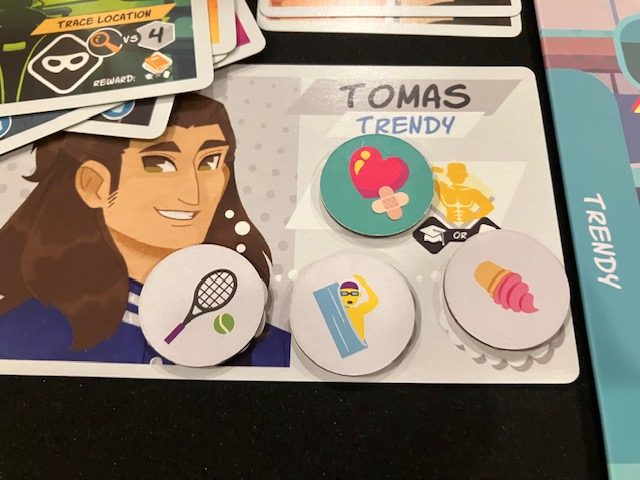
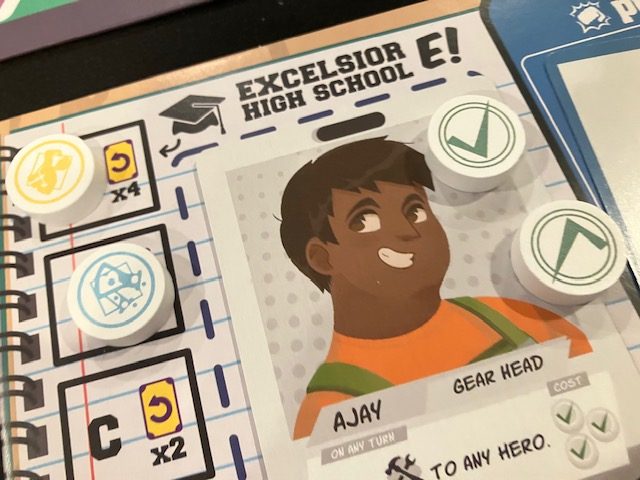
Each hero gets a Student ID and Power card: see above.  These two cards form your character!  My character was the “Swole Tank” and he has Super Strength!  See above!! Players get to choose from one of two Student IDs and one of two Powers at the start of the game, so there is some choice about who/what you get!

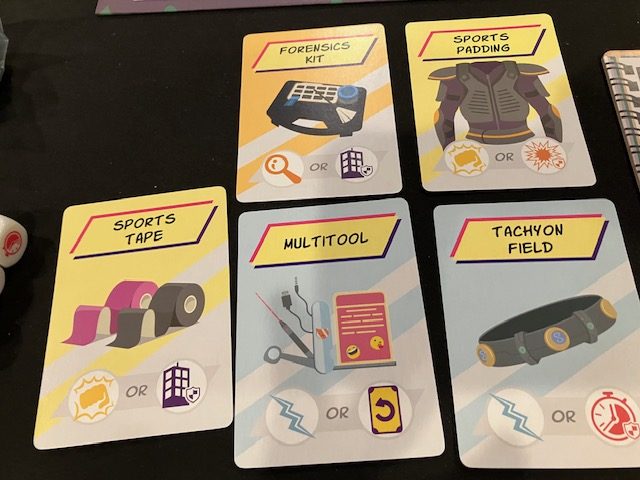
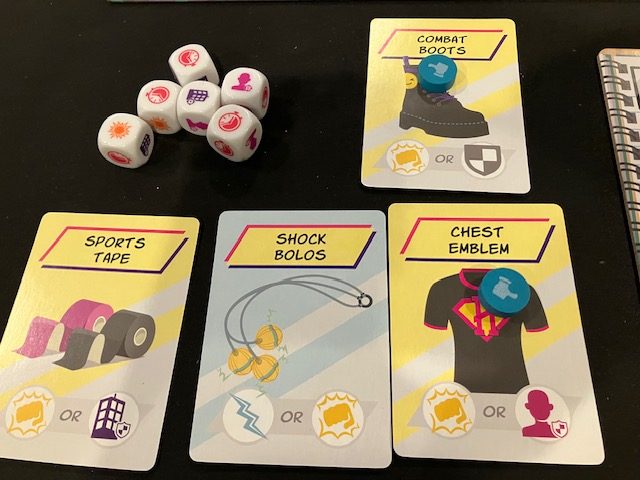
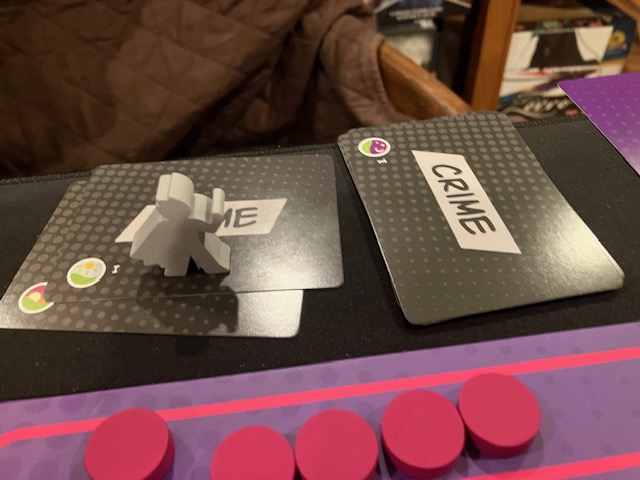
Players gets “Costumes” (cards above) throughout the game.  These cards are basically used to fight crime!

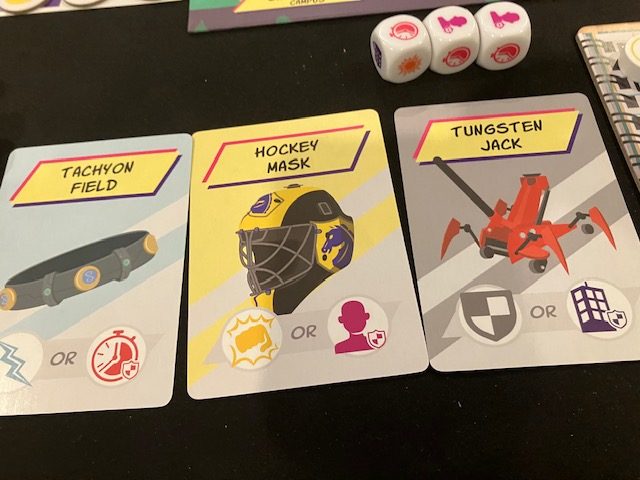
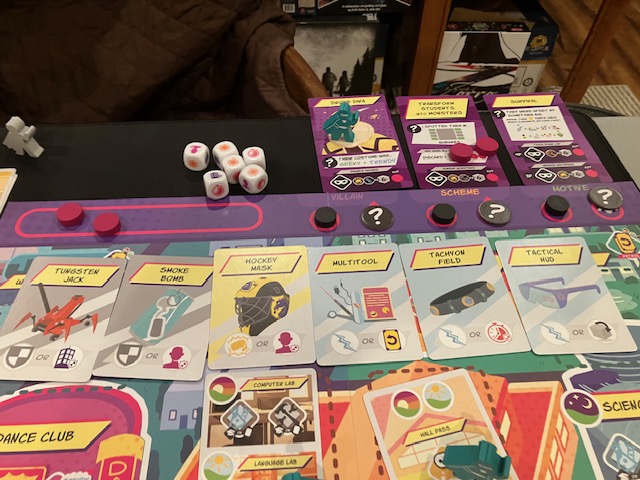
Generally, the Costume cards are used to the stop the elements of crime … that appears from the Danger Dice!  See  the Danger Dice above, and that the Costume cards correspond to some of the symbols.  Basically, if you can’t “block” all Danger Dice with your Costume Cards, then something takes damage (either the city, you, or an innocent bystander)!

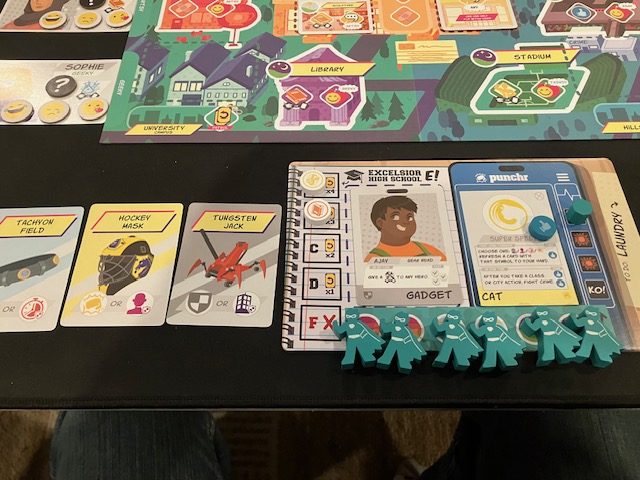
See above as the Tachyon Field, Hockey Mask, and Tungsten Jack block all bad effects from the crime!  And even though the Tungsten Jack doesn’t match exactly to block, this was a “grey” or Tools-related crime, so all Tools cards are wild and can stop anything!

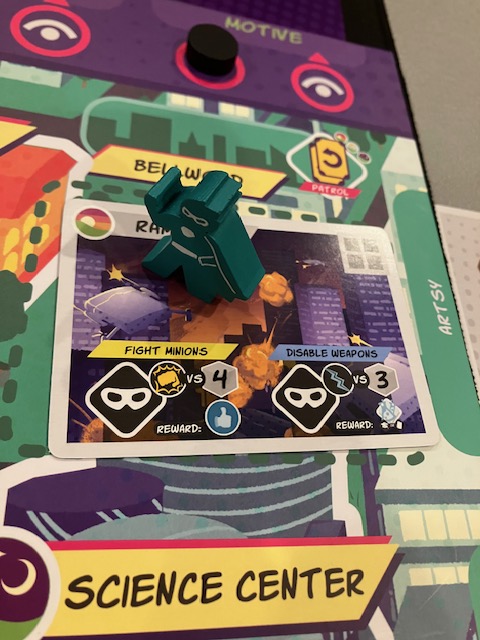
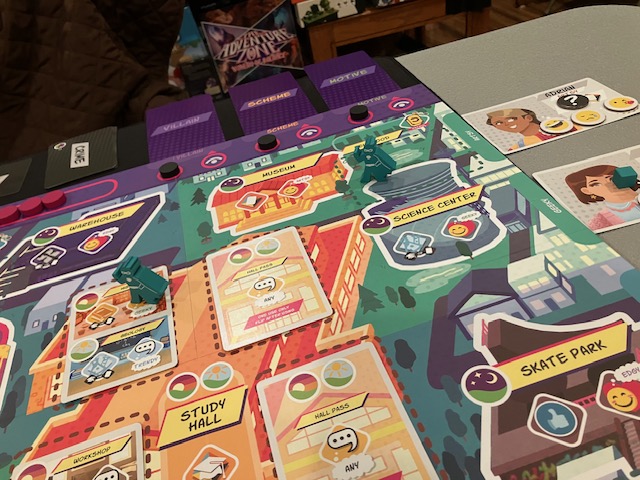
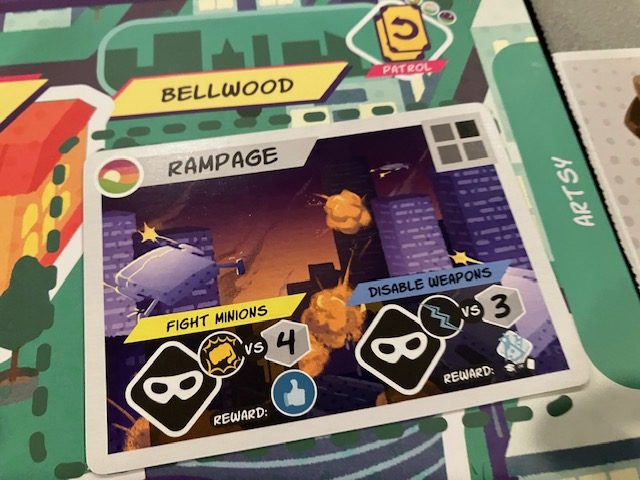
Crimes come out as the Heroes play!  See above as the Rampage hits the Science Center!  In order to take out that crime, you have take care of Minions AND Disable the Weapons!  If you fail, then some damage happens to the city!

At the top of the board are “damage tokens”: if there is ever too much damage (usually from letting crimes go), then the players lose!  The heroes MUST keep the crime at bay!

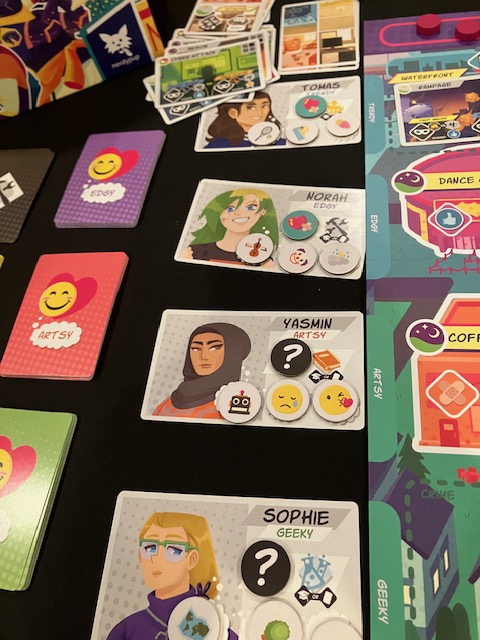
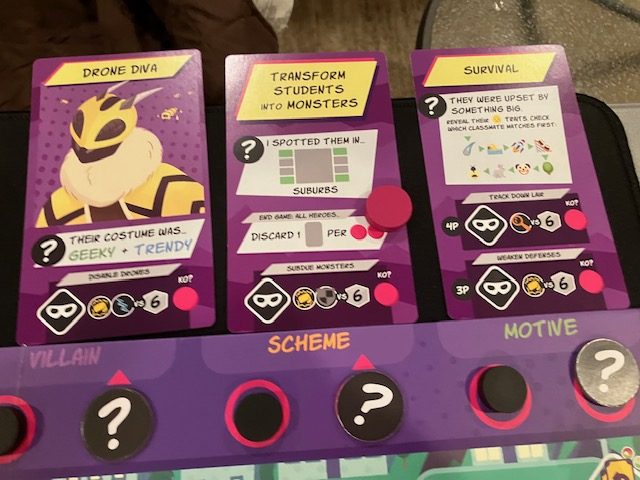
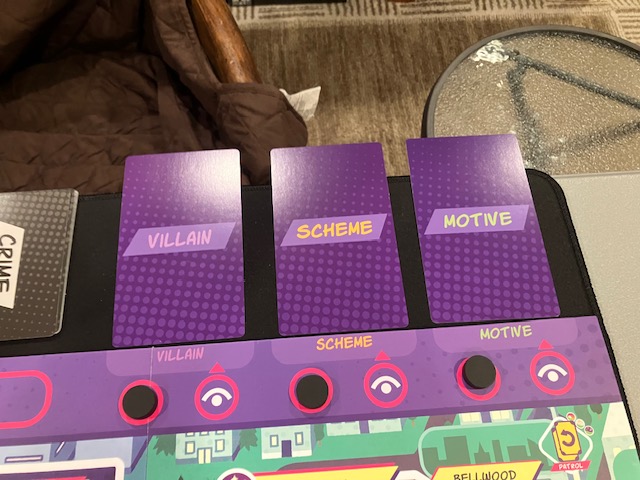
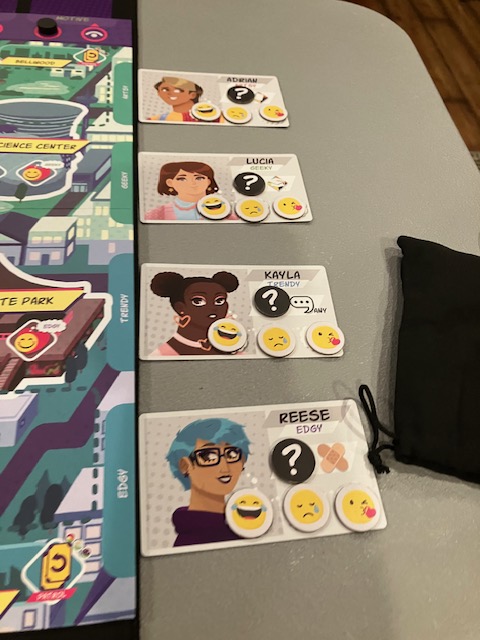
Although keeping crime at bay is important, it’s not how you win the game!  You have to talk to your schoolmates to try to deduce WHO is the big bad villain, what their scheme, and what is their motive! See schoolmates above!  

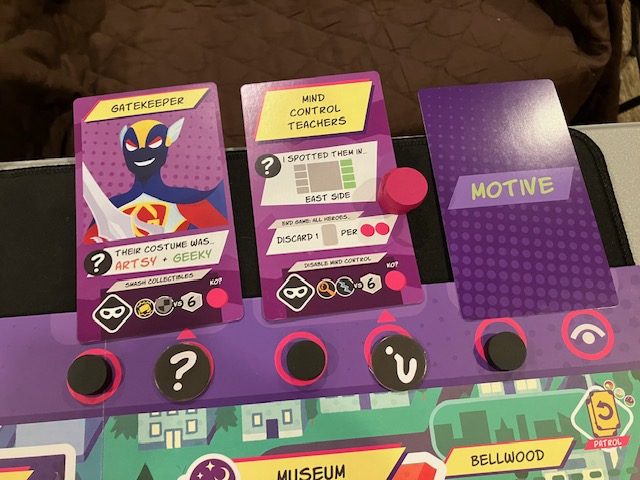
The more students you befriend and have successful “meetups”, the further you get!  To win the game, you must uncover all three: Villain, Scheme, and Motive (see above).  You must do this before the clock runs out!  (The clock is the Crime deck running out of cards).  Even after you unmask the Villain, you STILL have to have a final fight!

Students are befriended by finding out about them (their Flirty, Sad, and Funny interests).  In order to truly befriend someone, you must discover their interests and what makes them tick!

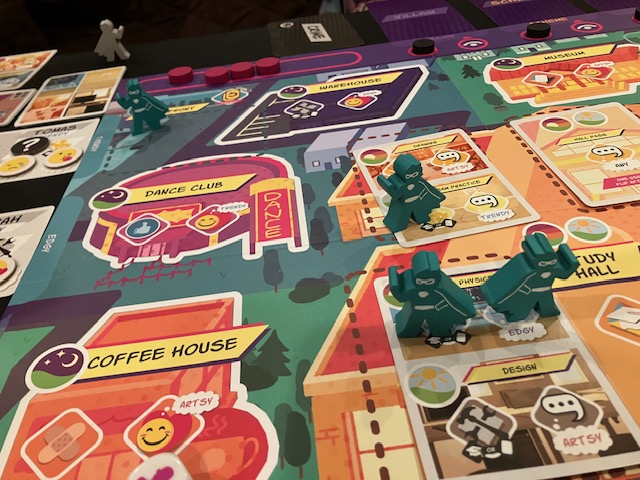
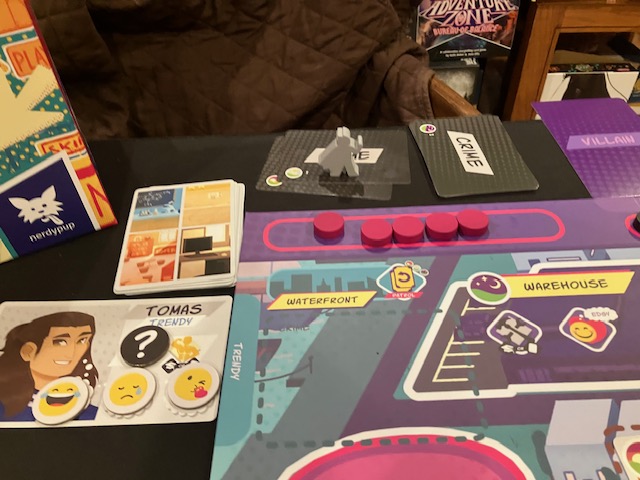
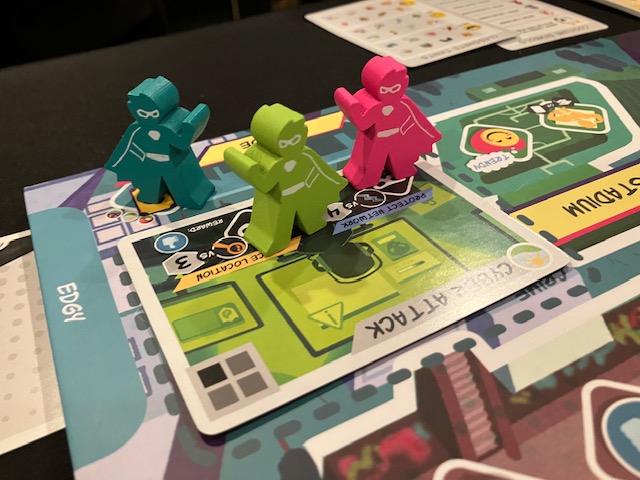
You move your tokens on the board to “talk” to people: see above as one token talks to some Edgy student (to uncover one of their traits).

Crazy enough, with all this going on, you still have to keep up with your homework!  Doing your homework won’t win the game, but if ANYONE is ever failing, all players lose the game!

If you can keep crime at bay, keep your homework under control, speak to your classmates, and do your laundry, maybe you can uncover the Villain, Motive, and Scheme!  After such a reveal, you have to win one final battle with the SuperVillain to win!

Worker Placement

This is nominally a Worker Placement game, as you have to put out your tokens out to do stuff.  Each player gets two tokens in the Morning, two in the afternoon, and two at Night.

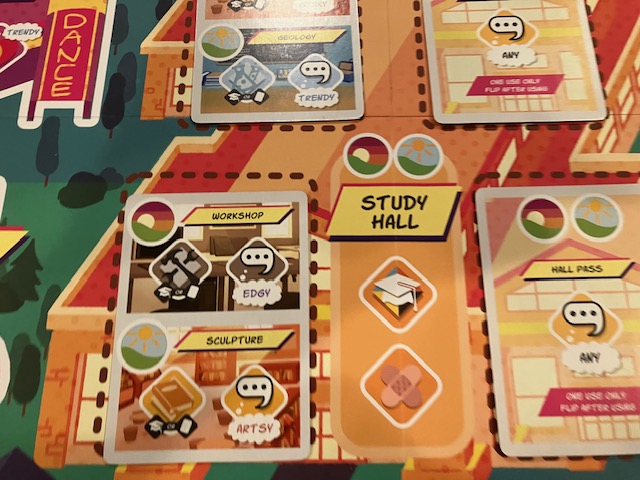
These tokens go on the board to do stuff! Notice above as a token goes on “Geeky” to talk to a Geeky schoolmate!  Also notice that the Locations can ONLY be visited at certain times of day.  In the morning and afternoon, you can usually only do things at school (like Homework or talk to schoolmates) or sometimes upgrade your Costume Deck!

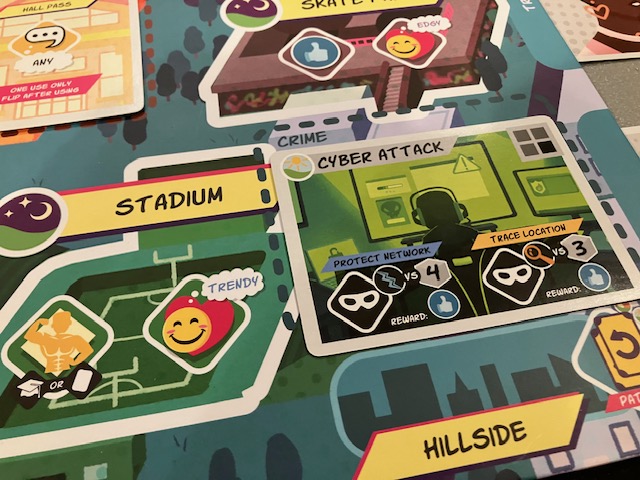
Usually, things are the city can only be activated at night!  See above as the Stadium can only be activated at night!

From a cooperative point of view, the rulebook was never “clear” on how to place your tokens.  The only rule seems to be “Starting with the Leader, players take turns taking actions”.  I think that probably means clockwise … but given the lack of clarity, we chose to simply use Player Selected Turn Order!  As a group, we can decide when to place our tokens.  Since this is a fully cooperative game, it doesn’t matter “too much” the order they are placed, as long as everyone agrees with basically where they go!  (This was probably a House Rule: we’d recommend it to you).

“I really need to do my Chemistry homework, or I fail and we lose!  You need to let me go there!”
“I really need to talk to that Geeky girl, is that okay, or do you need to talk the other Geeky guy?”
“We really need to deal with this crime!  I can do the punchy part, can someone else do the gadgety part? Or can you back me up nearby?”

These (above) are typical phrases that got uttered during our gameplay!

The Worker Placement as a mechanism to fight crime, do homework, talk to schoolmates, and upgrade our decks seemed to work pretty well.  It was intuitive and the icons worked pretty well.
It was also interesting to note that you could only use certain spaces at certain times of the day.  This made planning ahead more critical!

Deduction

This is nominally a deduction game … ish?  You have to uncover the Villain, Scheme, and Motive in order to win the game!

You can only move forward by talking to your class mates and befriending them!  Once you have truly befriended a classmate, you can get closer to revealing one of the Villain/Motive/Scheme cards!

This mechanism worked pretty well, but it wasn’t really “that” deductive. I was hoping for more deduction, but the mechanism worked.  It was just simpler and easier than I expected.  That’s not a bad thing, but this doesn’t “really” have that much deduction.

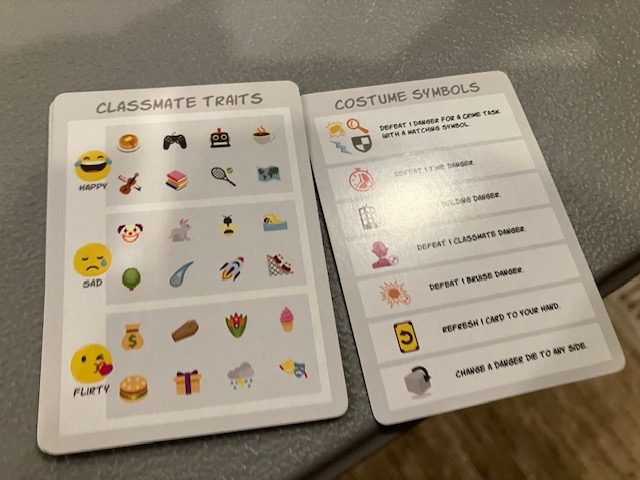
The Summary cards show what all the trait tokens can be, but unless you have uncovered “most” of them, guessing is a real shot in the dark.  You can try to befriend someone without knowing all their traits, but you have to guess the unknown traits! It might be easier to just talk to them ahead of time directly rather than wasting a turn and “maybe” befriending them.   I was hoping for a little more deduction … this just felt like you just had to spend your turns judiciously to make sure you talked to the person enough.  Befriending someone was more about proper use of time rather than deduction.

Crime

The Crime fighting part of the game seemed to work pretty well.  I was worried because so much of the Crime fighting is dice based, but since certain cards are wild when you fight crime (yellow cards are wild when fighting minions, and blue cards are wild when Disbabling Weapons: see above), you actually have a pretty good idea of if you will succeed or not.   If you engage the crime, YOU WILL DEFEAT IT, … but can you pay the cost?  Can you afford to damage to the city? Yourself? Innocent Bystanders?  I was really worried that the dice mechanism would be too random for me, but it really wasn’t.

Superhero?

Is this a Superhero game?  Yes … mostly.  The High School part makes this feel more like the movie Sky High than Avengers or Thunderbolts! Don’t get me wrong, I actually really liked the movie Sky High, but not everyone will love this “let’s be superheroes in High School” theme!   The Superhero theme does come through, but it is a little silly.   There’s a certain … silliness (?) to the game.   It’s more that this game doesn’t take itself too seriously, but it’s still pretty good.

I think the art style and sillyish costume cards contribute to that lighter feeling.  See some above.

If you even know what the movie Sky High is and you like said movie, I think you will like this game!  Even if you don’t, you may still like this game.  The theme may turn you off, but there’s still some fun to be had.  But, if that theme would just turn you off completely … I’d say “give it a try”. 

I don’t think this would make my Top 10 Cooperative Superhero Games, but that’s not because it’s bad or anything; it’s just that the high school theme detracts a little from the Superhero part.

Roleplay

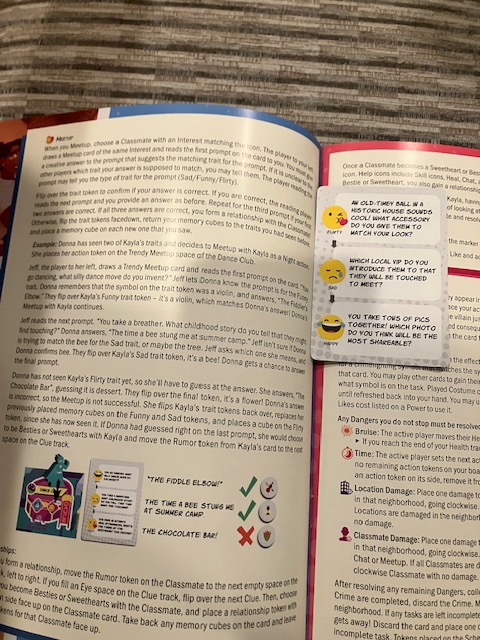
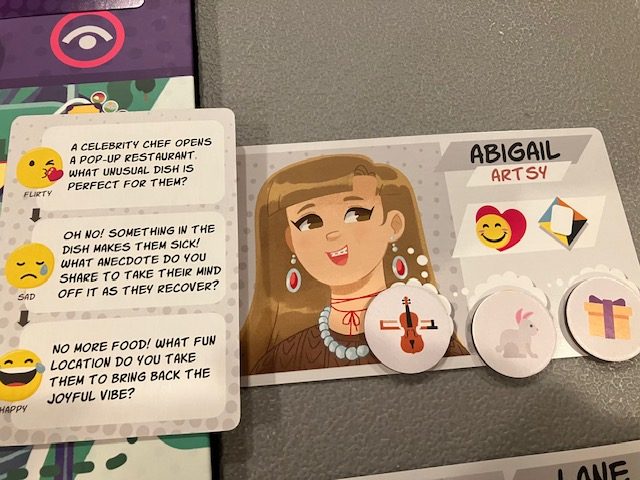
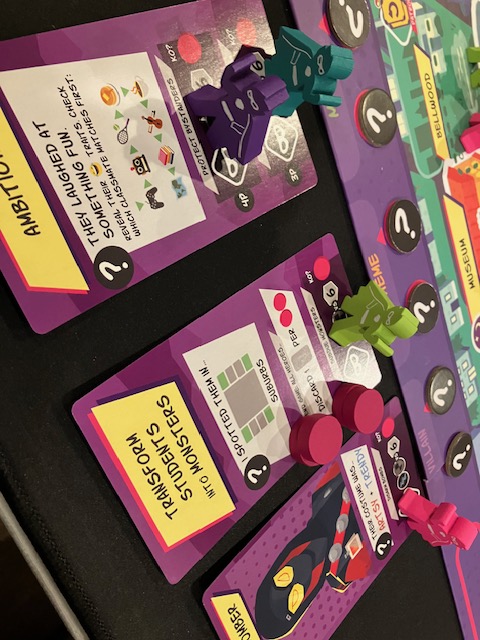
There is an element of this game that will make you love or hate this game.  When you are doing the “deduction” for the traits of your classmates, one player is reading the questions and seeing if you can answer correctly for the traits.  See above and below for examples of some questions!!!  For some people, this will be the funnest thing in the world as you answer questions for the traits to show you know them!  For some people, this will be the dumbest thing in the world and they will hate it.

You probably know which one you are.  If you hate this, the solution is simple: don’t play with it: just guess and ignore the question cards.   If you love this, the solution is simple: play with it.  The game will work both ways.

This one element may repel or attract you completely; don’t let it define the game for you, as you can play with it or without it easily.  And it won’t affect the gameplay.  I say this because there is a pretty good game here, and I’d hate for this one thing be the reason that you don’t play it.  

You know yourself and what you think of this question/answer roleplay. Take appropriate action if you play.

Solo Play

Luckily, this game does support solo play (congratulations for following Saunders’ Law)!  

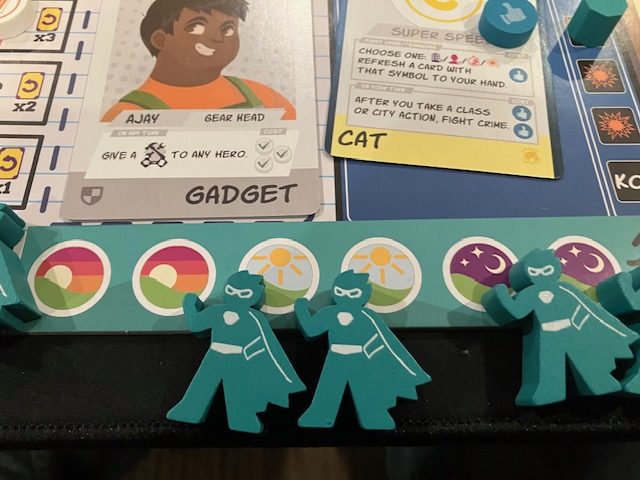
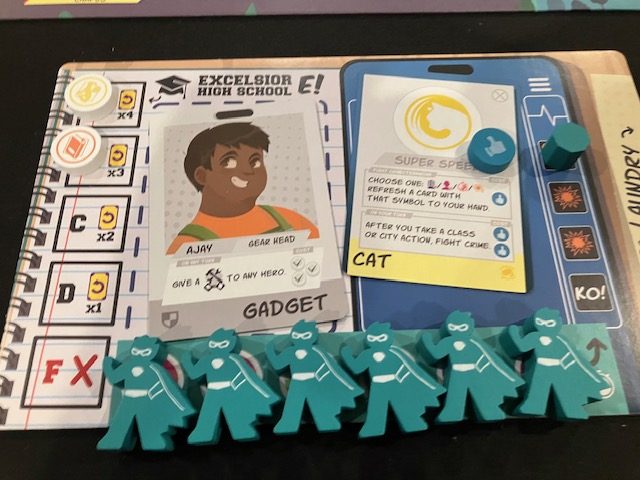
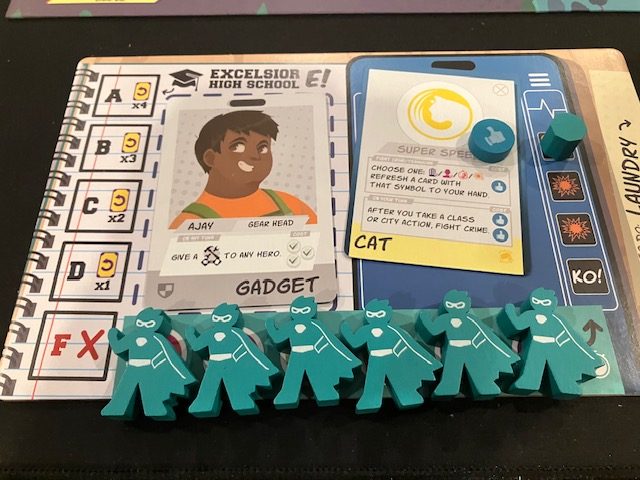
This is true solo play, as the solo  player takes control of one hero!  See above as the solo player becomes Gadget Cat!

It’s unfortunate that the rules for solo play are later in the rulebook after everything else.  I get that, but the set-up portion for solo rules could have EASILY been in the set-up section of the rulebook, and I was frustrated that I had to page back and forth between this section and the solo section, especially since solo play was my first few plays!

Even worse, one of the solo play rules was not well specified: how many Crime cards do you use?  I figured out the hard way (by just trying and seeing it it felt balanced) that the solo player uses the same number of cards as the 2-Player game.  This was mostly the only rule that wasn’t well-specified, I was able to figure everything else out.  

The solo game proceeds pretty much like the cooperative game, with only a few exceptions: there’s no teamwork, the Villain is easier to defeat, and the Crimes can be defeated with only one defeat (instead of both on the card).  

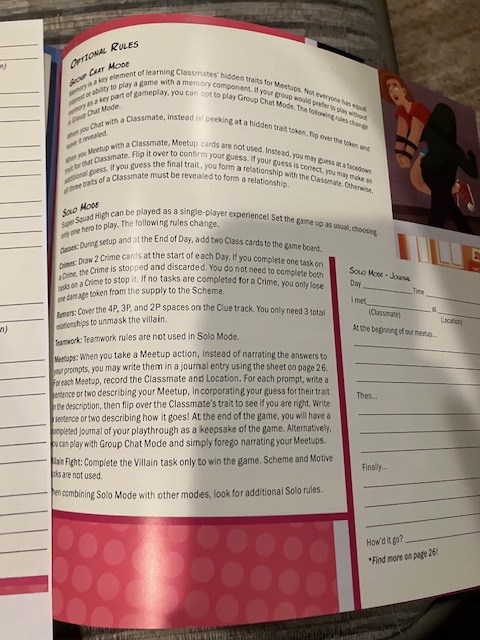
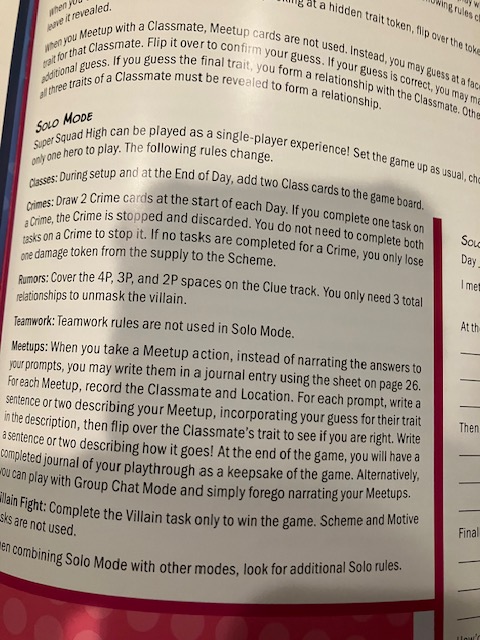
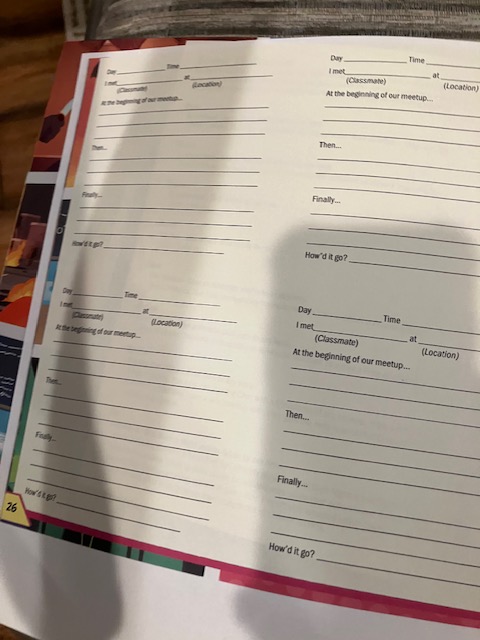
The question/answer roleplay rules we mentioned earlier (that you will love or hate) can be approximated in the solo game with writing stuff out: see a page above.  Meh, this felt like work and not fun, so I chose to bypass this part.  

The solo game worked pretty well: it was hard and I realized near the endgame that I had to concentrate on questioning students to figure out who did it!  The game could have gone either way at the end, but after I buckled-down … I was able to reveal the Villain, Scheme, and Motive just before the endgame!  That was exciting!

The final battle went pretty well as I was able to take down the final Villain! (In the solo game, you only have to fight the final as if it were a crime: you have to fight more in the cooperative game). See above.

I played a couple of solo games, and the game was pretty good: it was challenging and there were interesting decisions to make, but it wasn’t super hard.  I liked it, but I didn’t love it.  I think I didn’t love it because it felt like the game arc would be mostly the same every time. It didn’t feel like it would be that different between games.

The solo game (despite the Crimes deck rules flaw) taught the same pretty well.  I just don’t know if I’ll play it again solo, but I had fun.

Cooperative Game

I think this game shines better as a cooperative game.  

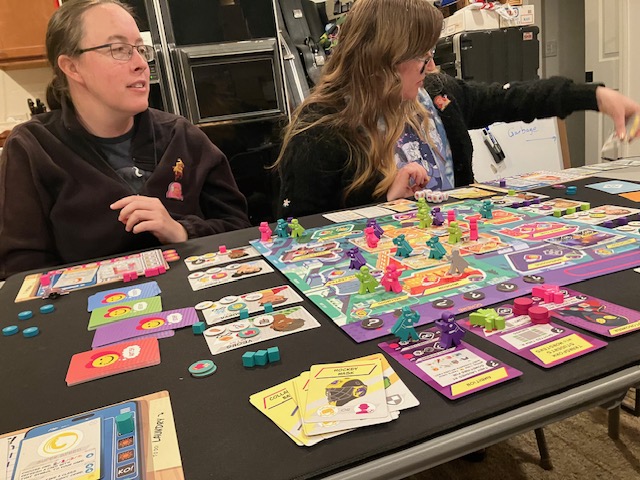
The fact that TEAMWORK was now a mechanic really helped push the game forward: if another player is in the same city neighborhood as other heroes, they can contribute cards towards fighting crime!  This leads to another level of strategy over the solo game, as players now can help each other!   See above as the three heroes work together to take out the CyberAttack!

“Man! I need some help taking out this CyberAttack!  Can you guys help me over by coming to my neighborhood?”

It felt very cooperative as we constantly consulted each other where to do, what to do, when to fight crime, when to help each other, when to do homework, and when to talk to classmates!

I think the best part of this game is the cooperation: you probably can’t win unless you really work together well.    The game arc feels less “samey” in the cooperative mode as play will vary a lot more as everyone tries to figure out the “smartest” way to do everything! Some turns will have you do all the fighting!  Some turns will have you talking!  Some turns will have you supporting!  It just depends on what’s best for the group, and that can change quite a bit more in the cooperative game.

My friends all liked this game and had fun.  They also liked the roleplay elements in meetups, which probably upped their score a little (most of my friends are also avoid RPGers).

We are looking at pretty much 7s across the board.

Campaign Modes

There is a campaign mode (Yearbook mode) for this game which … we didn’t play.  It sounds like it might be funnish, but I think this game feels more like a lighter game.  We all had fun and such, but the vibes from the game make this feel like a fun, light one-off game.  It doesn’t quite feel like a campaign game?  It just doesn’t look like the yearbook mode changes the game that much from game to game?

I think I am less likely to do Yearbook mode because I would do it solo, and I didn’t love solo mode.   

I don’t know, maybe the yearbook mode is great.  I just don’t think that’s the way my friends and I will play this.  We will probably play it again, but in one-off mode.

Conclusion

If you like the Superhero movie Sky High, with Superheroes in High School, there’s a good chance you will like this game.  Even if you don’t love that theme, there’s still a fun light game here that you might still enjoy. 

Be aware, if you do play Super Squad High, that you may or may not want the roleplay aspects of the game: make sure you figure this out beforehand, because if you hate the roleplaying/asking questions part of this game, you will hate this game!  But if you know you will hate this, you can completely ignore that part and still enjoy this game.

I didn’t love this game solo, mostly because it felt like it could be a bit samey from game to game.  It was still fun, and it taught the game well enough for me to teach my friends:  Solo game: 6/10.

The cooperative version of this game is probably the best version: the Teamwork and strategies and discussions that emerge as you play really bring out the cooperation: I think the emergent cooperation is the funnest part of this game.  All around, we gave this a 7/10 for cooperative play.

This is a pretty fun game that’s light and easy to bring to the table to have a light superhero experience. There’s a yearbook/campaign mode in the game (if you want it), but my group just liked this as an easy one-shot cooperative game.

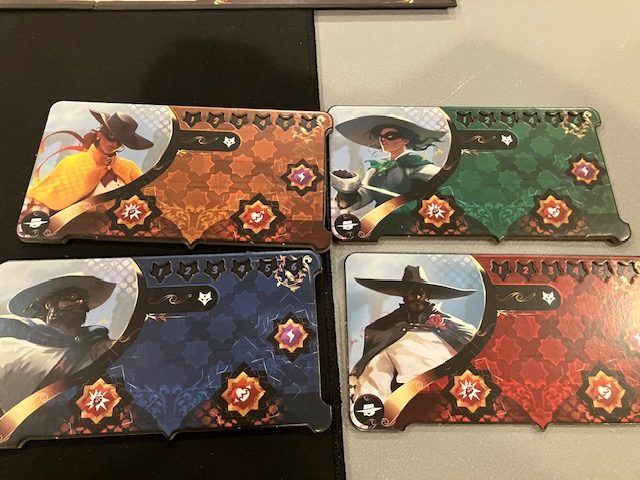
Review of Secrets of Zorro: Or “Where Do You Think YOU’RE Going, Señor Beaver?”

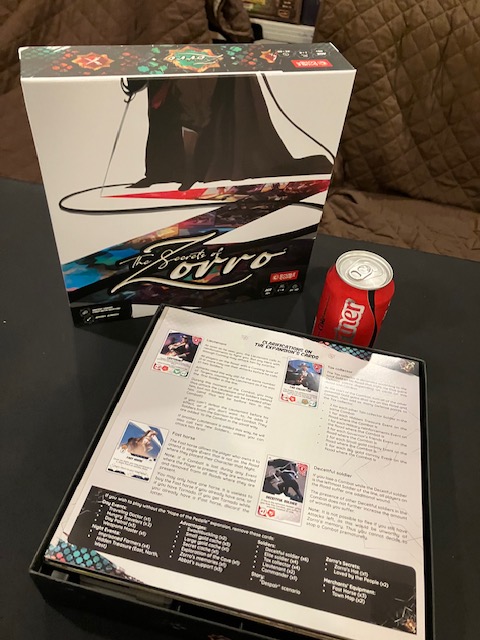
I freely admit that The Secrets of Zorro board game kinda sat around my house unplayed for a while.  I got it from Kickstarter, about 3 or so months ago … but it didn’t look great.  I mean, I did back it and I did pay real money for it (as I always do)!  So, I uncovered it one game day, and said, “Hey, let’s try this: I hope it doesn’t suck.”

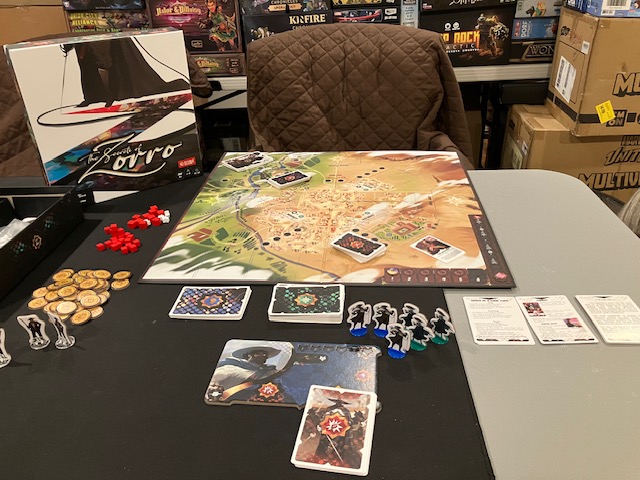
The Secrets of Zorro is a cooperative worker placement and boss-battler game for 1-4 players. It obviously lives smack dab in the middle in the Zorro universe … the Zorroverse? That’s right! Cooperative worker placement? Boss-battler? Zorroverse?

Let’s take a look!

Unboxing and Gameplay

Each player assumes the role of one of the children of Zorro!  The “real” Zorro has died, and it’s up to his children to assume the mantle of their father! They will fight for justice together! (There are no special asymmetric powers, you are just kids of Zorro!)

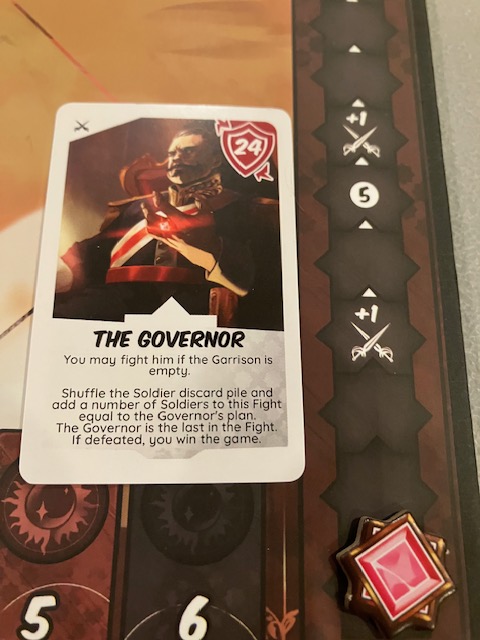
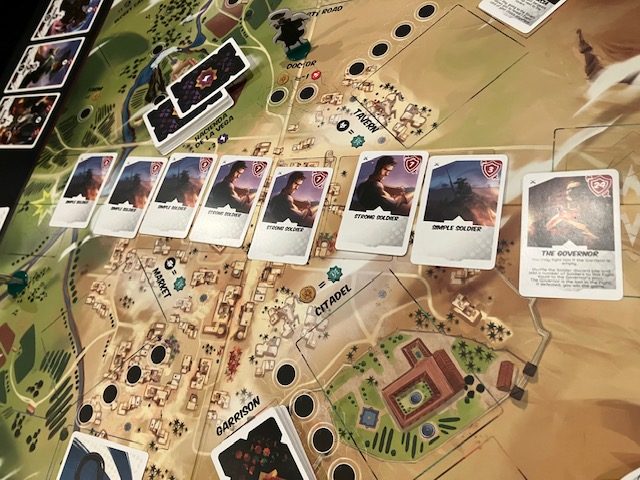
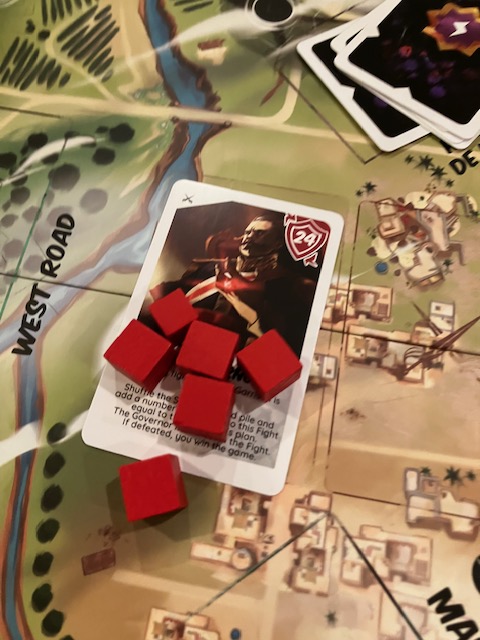
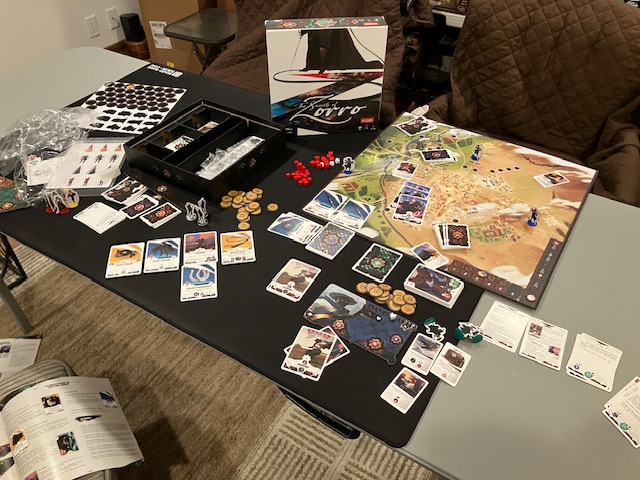
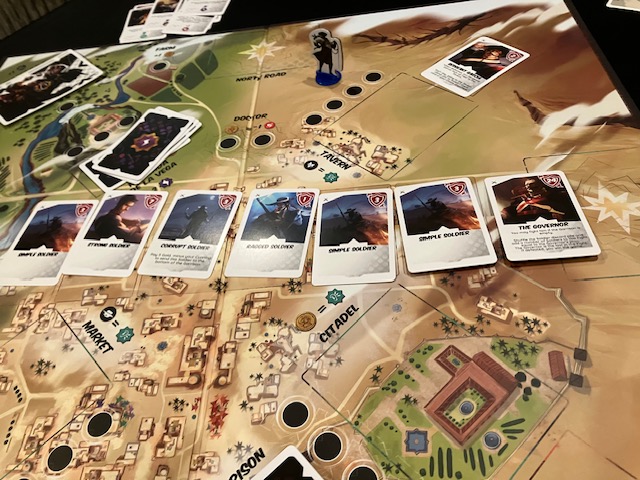
To fight for justice, you must defeat the evil Governor who is destroying the town!  This is a Boss-Battler after all!  See above!  We tended to refer to bad guy as the Governator (with thick Arnold accent), because this village is in California after all….

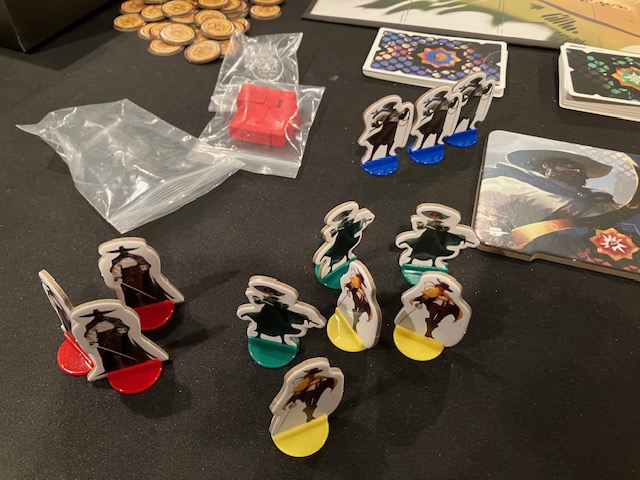
As part of the worker placement system, each player gets 3 worker placement tokens (only 2 at certain player counts).

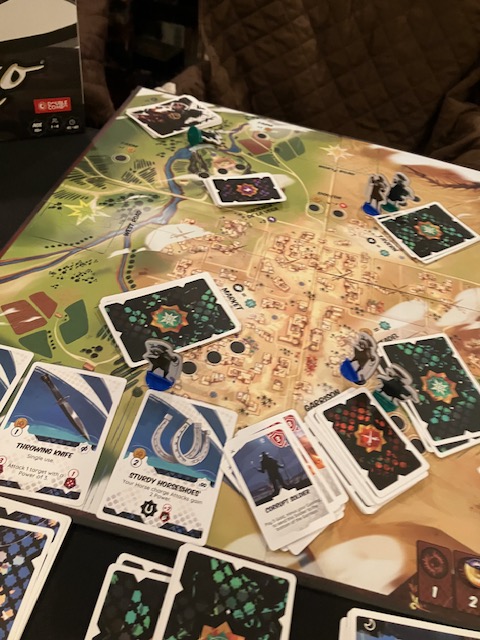
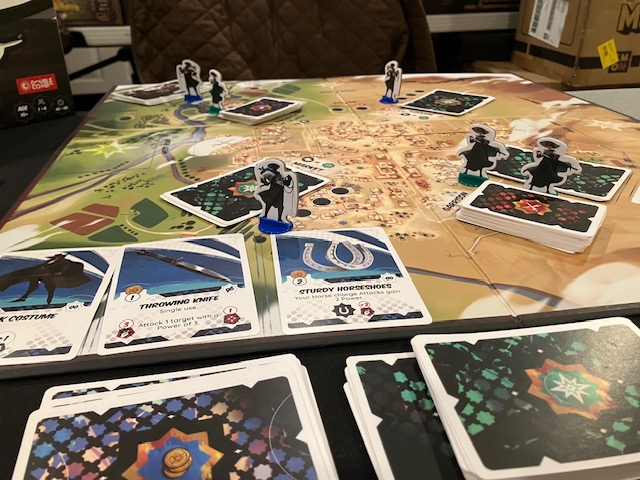
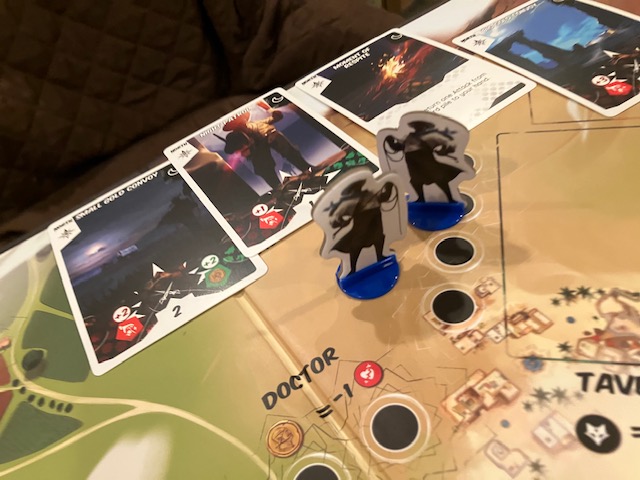
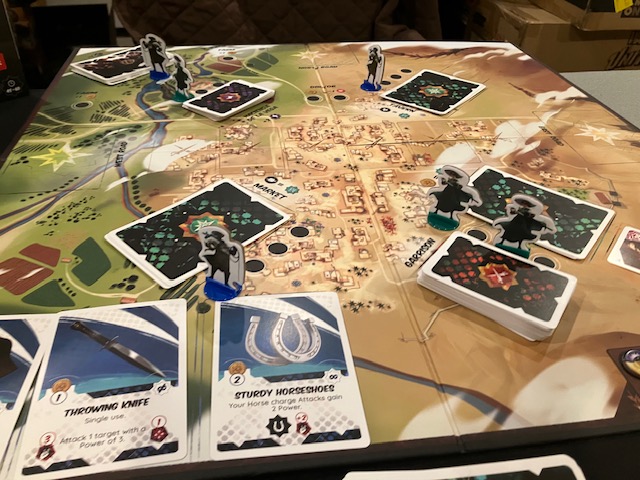
The tokens are placed around the village, doing different things at each Location!  See above as the tokens go on the black spots!

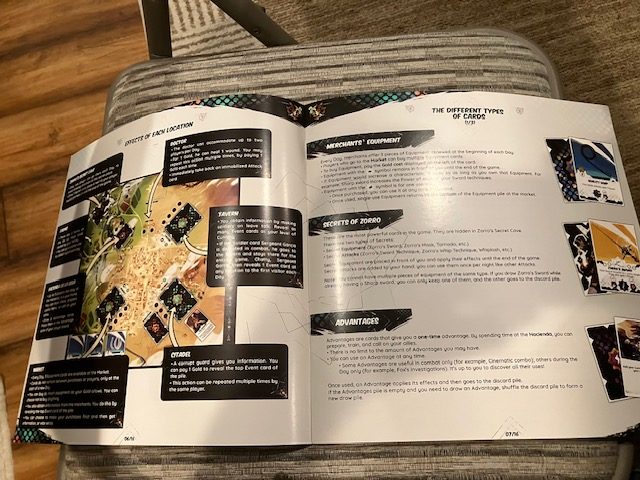
The function of each Location in the village is outlined in the rulebook (see above), but basically you can go to the Tavern to see “what’s going on” with the soldiers in town, you can go buy some cool new gear, you can heal yourself at the doctor, you can work the fields to get some money, and you can bribe some guards at the Citadel to get more info about the solider’s movement! 

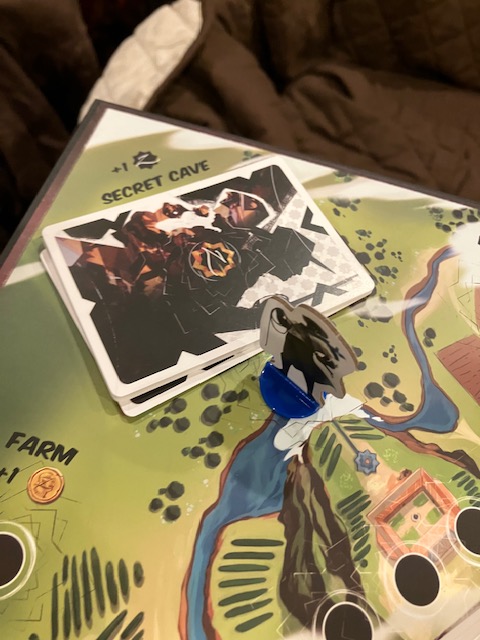
And last but not least, you can explore your father’s Secret cave to find some of his old stuff! See above! (Dad has some GREAT STUFF!)

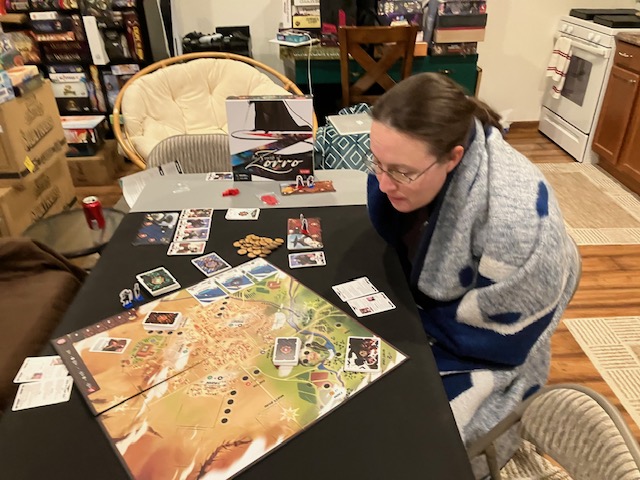
As a cooperative worker placement game, the group decides “together” the order in which to play and activate the locations!  That’s right! Player Selected Turn Order permeates this game! (See here for more discussion of Player Selected Turn Order). Players work together to figure out the best locations to populate as a group!

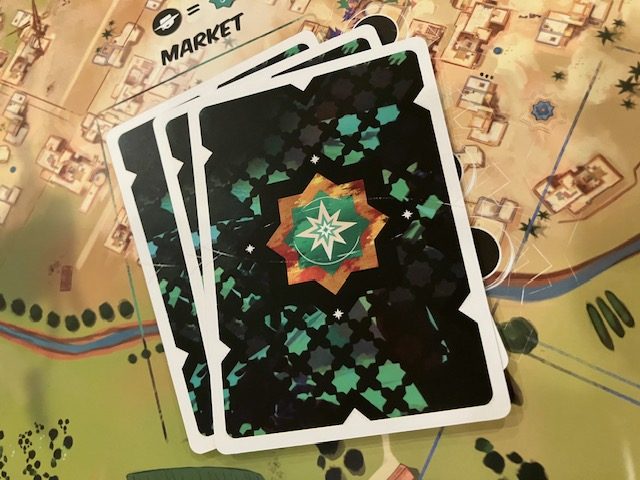
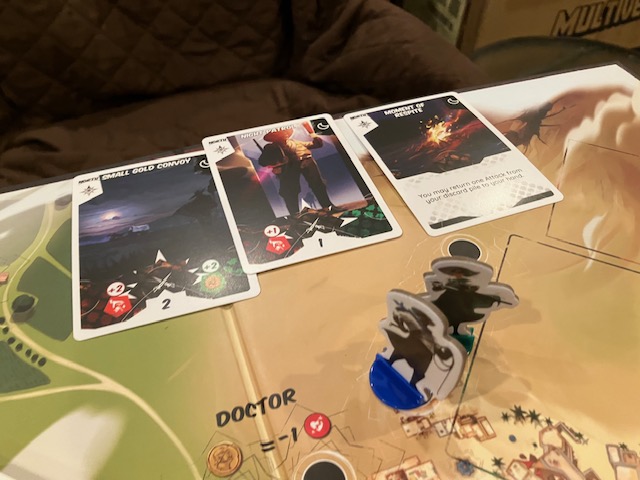
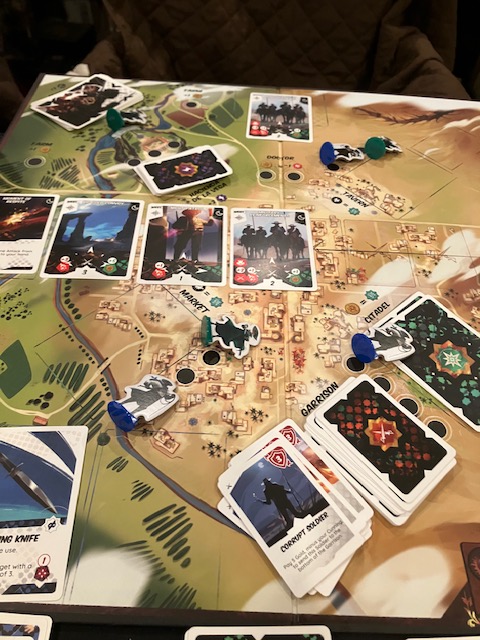
It’s important to go to the Market, The Tavern and other places around town because you NEED to reveal the Green cards (above)!  These cards contains “soldier movements” in the night, and will indicate how the soldiers will be doing bad stuff!

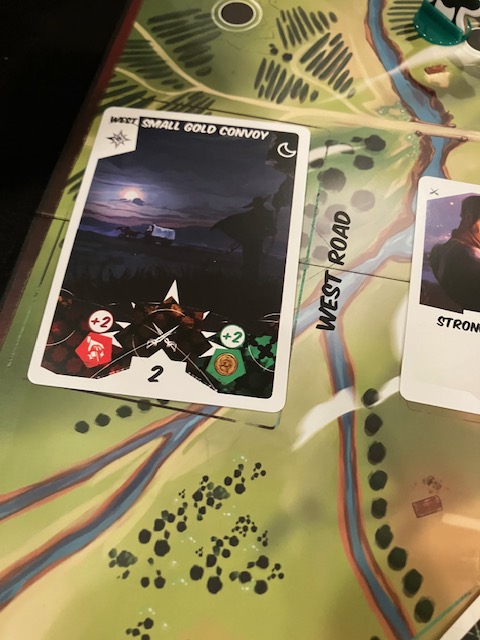
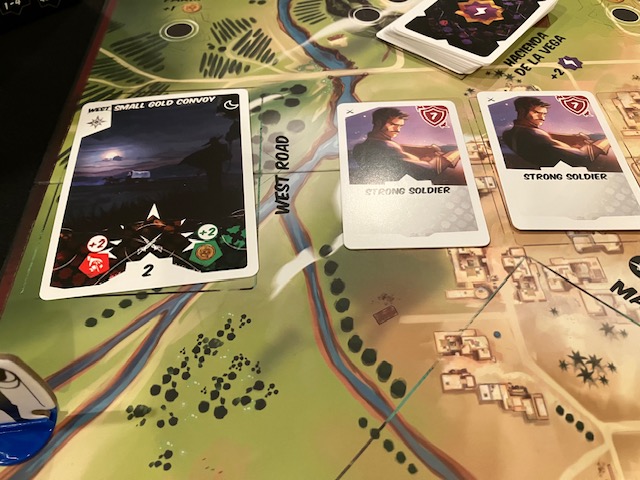
In the night phase, the Soldiers will go to the “outskirts of town” doing dastardly deeds for the Governator! See above!  Players, as the kids of Zorro, need to keep the soldiers in check!  If you don’t “deal” (ie., fight) with the Small Gold Convoy above (on the West side of town), they will cause the Governor’s plan to advance by 2!  (The red +2).  If you defeat the soldiers, you get 2 gold (the green +2) instead.

Players must choose where to go at night!  Sure, you are fighting cooperatively, but you only have limited resources, so the more you know about the soldiers movements (see above: we have three soldier groups going to the north), the better you can spread out to combat the governor’s forces!  In the day, you have to balance upgrading your kid of Zorro (buying new stuff, adding advantages, looting your Dad’s cave) with tracking the soldier movements (by bribing soldiers, drinking with some locals, or hanging out with the merchant!)  It’s actually quite thematic: you gotta hang out  in town to get intelligence!

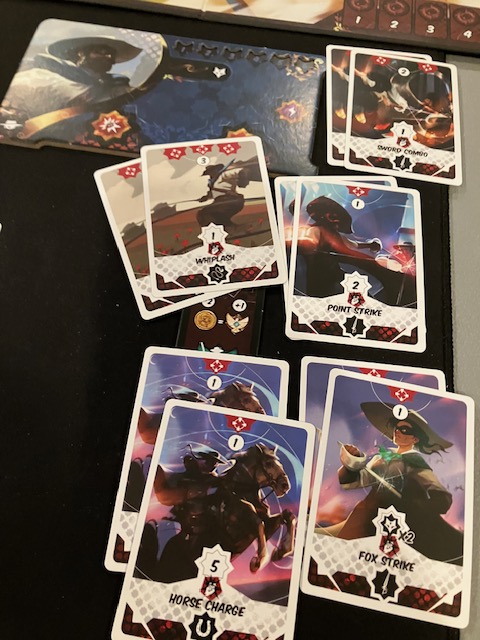
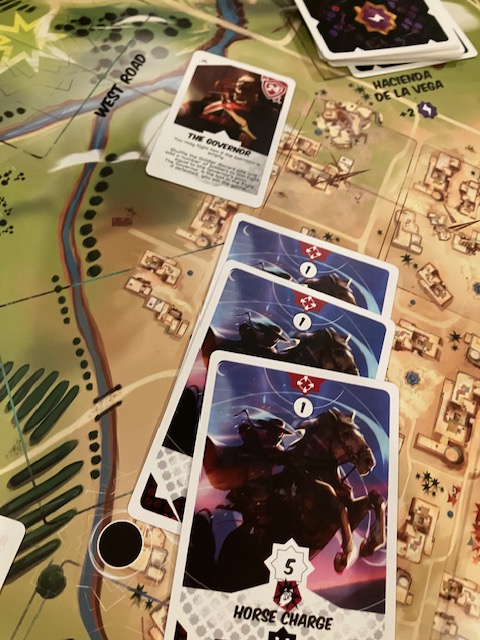
The fighting system is simple but interesting!  The players, as a group, get to choose how to attack, and in what order! (Again, more Player Selected Turn Order!) Each kid of Zorro has 5 such combat cards, 1 of each above. There are whip attacks (which can hit multiple soldiers), horse tramples, and some sword attacks!  They all feel very thematic!  See above!  

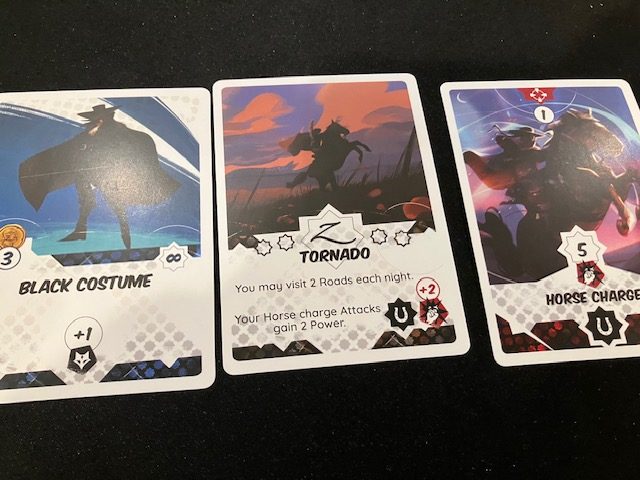
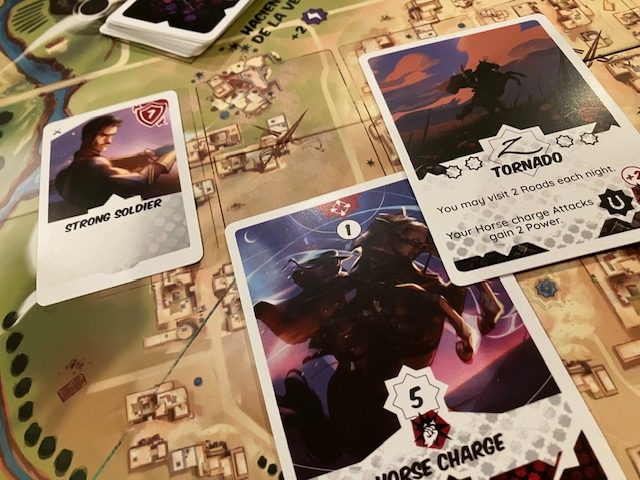
As you play, you can get more stuff to help you: Tornado (by far the best card in the game, coming from your Dad’s Secret cave) augments your Horse Charge AND allows you to be in two places at once during the night!  You can also buy gear like the Black Costume above (for 3 gold) from the Merchant!!

Once you decide to fight, you dedicate some of your fighting cards (in whatever order you please) to fighting the soldiers!  The Small Gold Convoy got two Strong Soldiers!  Gulp! 

Luckily, Tornado and the Horse Charge can take one of them down in a single hit! See above! You do have to fight the soldiers left to right …

Basically, you alternate day (worker placement) and night (battle soldiers) until you exhaust all the soldiers in the citadel and force the Governator into a final fight!  The better you do at keeping the soldiers (in the night phase) in check, the fewer the Governator will have in the final battle!

If you can beat the line of solider protecting the Governator and take him out (see above), you win! If you take too long or lose too many battles with solider at night, you lose!

It’s worth noting the wound mechanism is simple and clever; if you ever lose a fight, you have to place one of your fight cards in the wound section of your character, and you can’t get it back until you heal or see a doctor (normally, you get all your fight cards back every night).

Rulebook

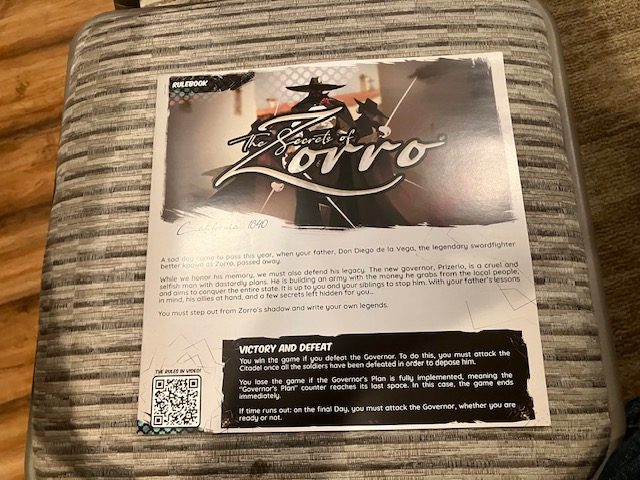
I didn’t love this rulebook.  It was missing some rules, and it could have been better in a few sections.  But because this is a very thematic game, some of the missing rules you can easily extrapolate.  For example: Where do the soldiers go if players lose a combat?  I had trouble finding the rule, but it seems thematic that they go back to the Garrison.  The lack of clarity in some rules wasn’t a deal-breaker (like it was in Corps of Discovery from a few weeks ago) because this game is pretty darn thematic!

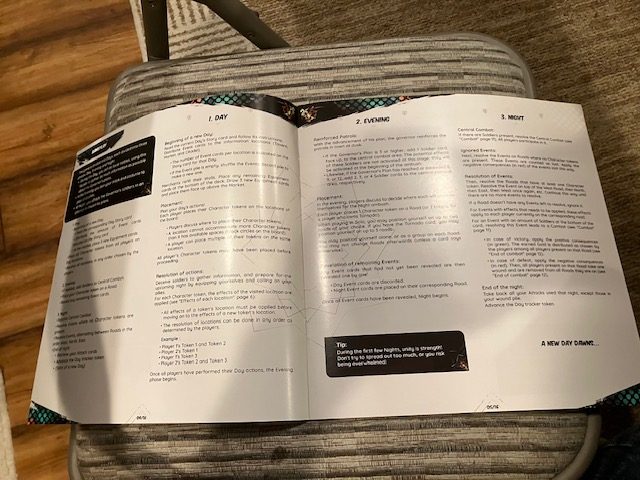
The rulebook gets about a B- on the Chair Test.  It can work on the chair next to me, as it stays open, but it could be slightly smaller and have a slightly bigger font.  B- is still pretty good.

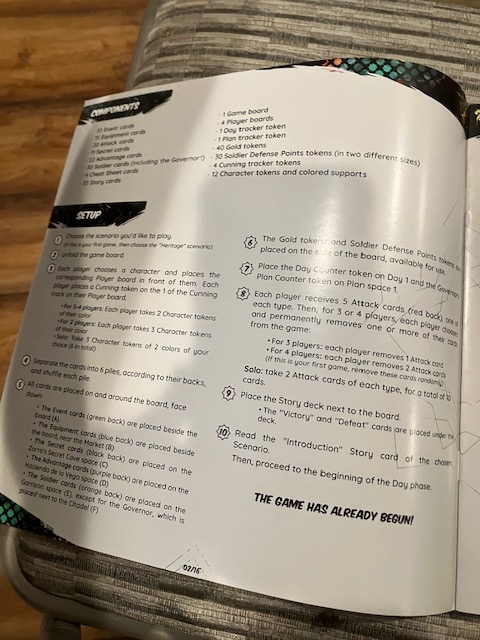
The Components list made me grumpy (see top of page) because there were no pictures! In fact, I had to count cards to make sure I understood what each type of card was! That’s not ideal.

The Set-Up (above) did help answer a lot of questions, and it even had a nice picture with the correlating instructions on the opposite page!  So, that helped alleviate some of the component issues.

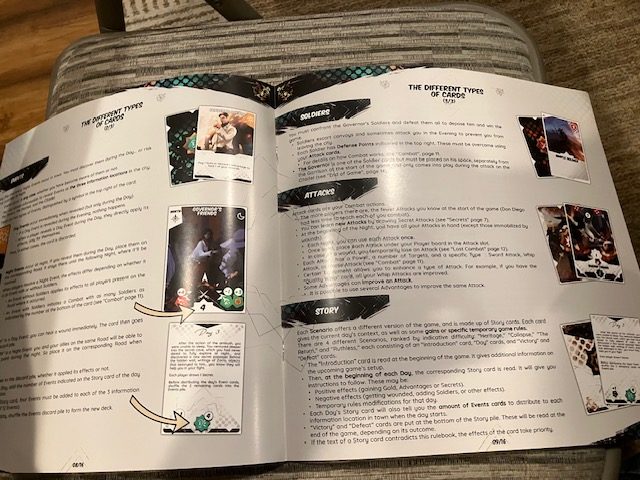
The rules were okay.  A few might have been clearer, but it taught the game.  See more pictures above.

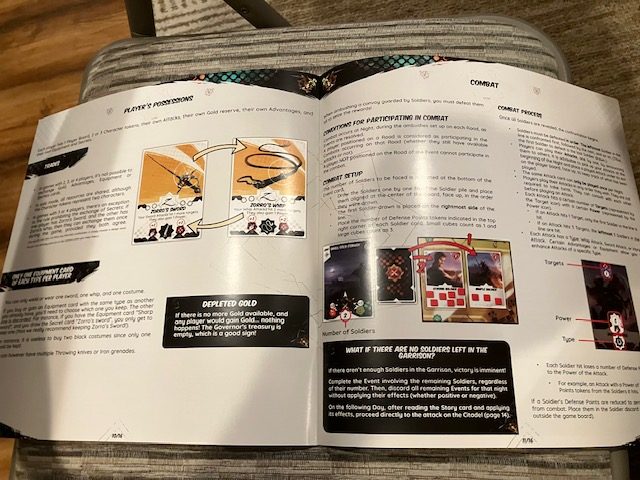
The picture (above) with list of actions at each Location was pivotal to playing the game!

Except for one major rule omission, the rule book was good enough. We moved forward with only a little bit of grumbling. It taught the game well enough. Let’s move on.

Solo Play

So, congratulations to The Secrets of Zorro for following Saunders’ Law and having solo rules! 

The solo mode is a true solo mode where the solo player inhabits a single kid of Zorro.  

Theres not too many changes for solo play: For balance purposes, the solo character gets 10 combat cards (see above) instead of the 5 or so.  

The solo player actually gets 6 worker placement tokens (see above for 3 of blue and 3 of green).

And when going out of town during the night phase, the solo player can go to TWO outskirts places by himself.  

Other than that, the game pretty is the same as the cooperative game.  In this case, the solo player is just operating a lot of workers and combats by himself!

The solo game works pretty well to teach the game: after one game, I felt like I had most of the rules down.  It was also pretty fun.  I could see playing solo again.  It was also pretty quick: the game box says the game takes 45-60 minutes and that is pretty accurate!  The game’s mechanism are straight forward, and as the solo player, I had lots of choices! It’s easy to learn.

Cooperative Play

Even though the solo mode was fun enough, the game really shines as a cooperative game!  Over two weeks, the game came out numerous times!  By request! Once as a 3-Player game with me, Teresa, and Andrew (see above) …

… and once as a 4-Player game with me, Sara, Teresa, and Andrew!  

The Player Selected Turn Order really keeps everyone involved all the time!  During the day phase, players have to decide when and where to place their tokens! Then during the night phase (when you fight the soldiers), that same Player Selected Turn Order is still in force as  players decide the order in which they attack!  It made everyone feel involved and active!

In fact, as the Kids of Zorro working together, a little bit of role-play even emerged! 

“Hey Sis, can you help me fight to the North?
“Okay, Bro, but you owe me!  Dad always liked you best!”

It was actually a little surprising that the role-play emerged! I wasn’t expecting it!  But, as Kids of Zorro, we all felt kinda connected!  That role-play was a major benefit I did not see when playing solo! That extra little silliness really ratcheted-up the cooperation!

This is not a heavy, plodding game: it has a light air to it, and was much more fun than I expected!

“Where Do You Think YOU’RE Going, Señor Beaver?”

A very very long time ago, when I was a kid in the 1980s, the same 10 or so movies showed on HBO all the time.  There was one such Zorro movie that me and my friends watched and quoted quite a bit! My friend’s CC and John watched the movie a lot more than I did, but one of the lines from the movie  still gets quoted today: “Where do you think YOU’RE going, Señor Beaver?”

I had to ask my friend CC: “Um what was that movie you and John always quoted?”  It was Zorro: The Gay Blade starring George Hamilton.  It was a silly movie according to CC!  It was a fun romp … it was funny and a little silly, but still had lots of action and great sword play! Just like you want from a Zorro movie!!  I bring up that movie because, somehow, the spirit of that movie seems to shine through this game!  This is a light game, but still enough interesting decisions and cool combat with swordplay, whips, and horses!  You fight bad soldiers to take out the Governator!  But it’s fun!  Not too heavy!

And no, I’m not going to tell you the context of the quote.  You have to watch the movie to find out for yourself.

House Rules

This game is really fun, but it needs some house rules.   The thing is, they are all thematic and make the game more cooperative and more fun!

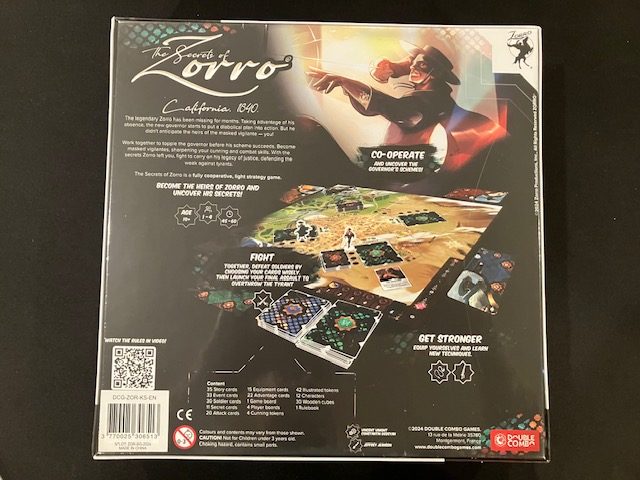
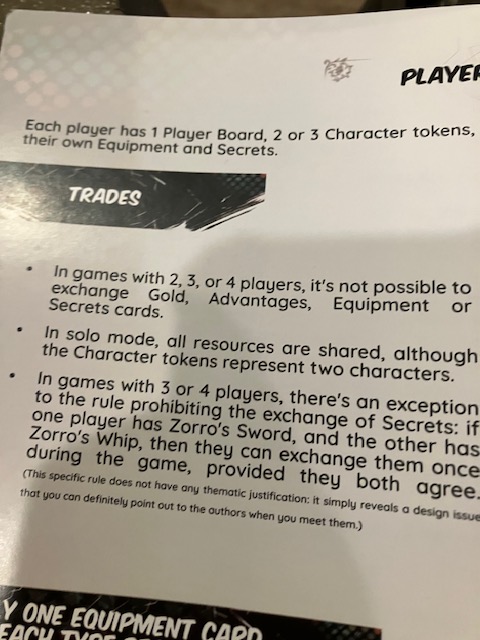
1) First of all, there is no trading!  See rules blurb above.  I get that it might be for balance, but it makes the game feel like “you just get what you get, you have no choice“: And that’s not fun.  It really came home to us how ANTI-THEMATIC this “no-trading” rule was when I was wounded and needed a gold to heal myself.

“Hey Sis, can I have a gold? I really need to go to the doctor!”
“NO!  I cant give you one!”
“But we all live in Dad’s house at the end of the day and come home to each other … you can’t give your wounded brother a single gold to help him heal?”
“NO!  Go work in the fields and get your own gold!”

We assume (maybe wrongly) that we all go back to Dad’s house at the end of the day.  It seems like we should be able to share at least gold and equipment at the end of the day (I get that Advantage cards can’t be shared) because we all sleep in the same house?  Like I said, add some trading at the end of the day makes the game feel more fun and more engaging and more strategic (as you feel like you don’t get STUCK with something).

2) Ride to other Outskirts!   The Horse Charge is the best base attack in the game!  But it seems very thematic that if you discard the Horse Charge during the night phase, you can ride to another “outskirts” Location and help your brothers and sisters!!!  The fact that Tornado already allows something like this speaks to this rule.    It’s not too damaging to balance, as it’s the best base attack in the game!

It was our experience that both of these house rules made the game more fun, more thematic, and more cooperative!  

Things I Liked

The Secrets of Zorro was: Easy to learn.  Easy to teach.   It had reasonably quick games.  The art on the cards was really nice.  I loved how the Player Selected Turn Order permeated the game in both worker placement and combat.  I was surprised and delighted by how much role-play emerged in the cooperative game!  The game was very cooperative and engaging at all times!

Things I Didn’t Like

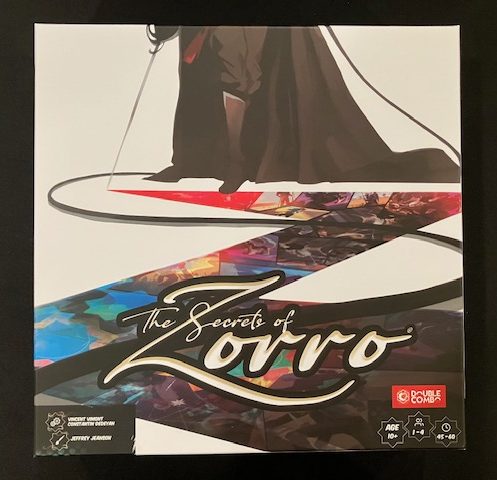
I love the art in the game, but I don’t love this cover.   There’s some great art in here and I feel like the “attract mode” of the cover might cause some people to pass it over. Don’t!  It’s a fun little game!

The rulebook could use a little sprucing up (better back cover, a few rules need to be clarified or elaborated, components description page needs to be much better).

Overall Reactions

We all liked this game enough to play it two weeks in a row!

Andrew: solid gameplay, 6.5 or 7. Probably 7 with house rules.
Sara: 7?
Teresa: 7? 7.5?
Rich: 6.5 or 7 for solo game.  7.5 for cooperative game, 8 with house rules.

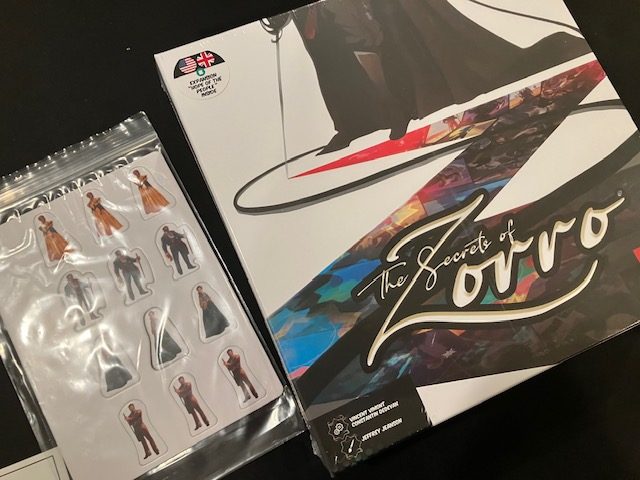
I think the only reason it didn’t get a higher score was that it is still pretty light and doesn’t have tons of replayability (they do, however, have an expansion which helps with some of that).   This was a keeper for my group: Probably 7.5/10 overall.

Conclusion

I didn’t expect to really like The Secrets of Zorro, but I really did, as did my group!  The cooperative experience was really engaging because of the Player Selected Turn Order and the role-play that emerged from being the kids of Zorro!  

We have a few house rules to suggest that make the game more fun (making it about a 7.5/10), but even the base game was still a 7/10!  The Secrets of Zorro was fun, quick to teach, quick to play, and a fun experience fighting for Justice!

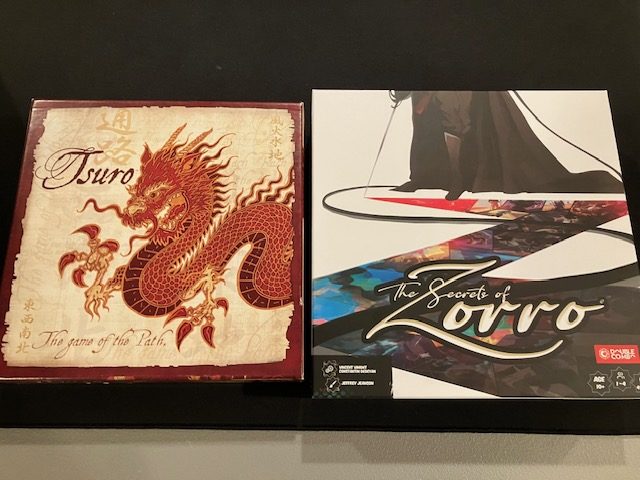
Just don’t accidentally pronounce Zorro like Tsuro with your friends!! For a few minutes, Andrew was confused why we were fighting bad guys in the Tsuro game???

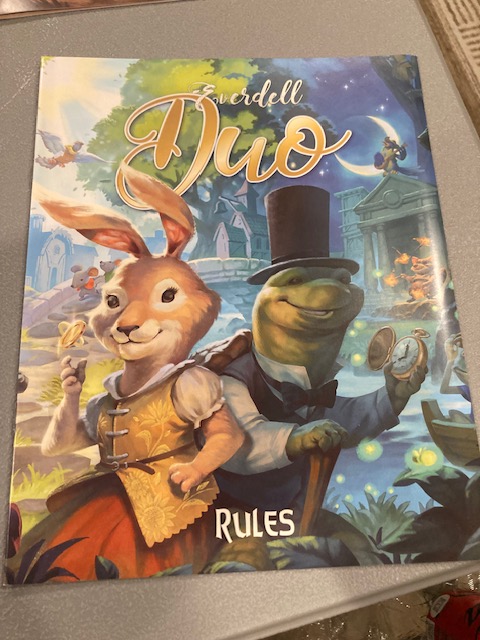
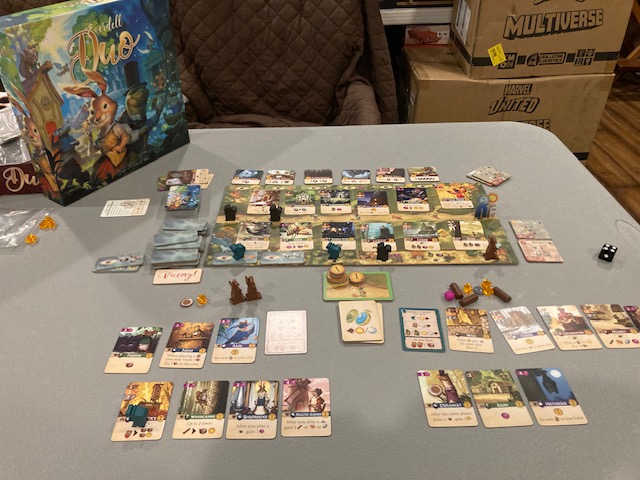
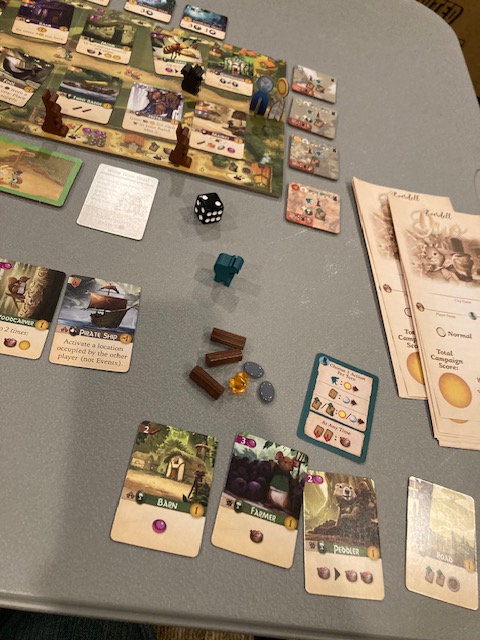
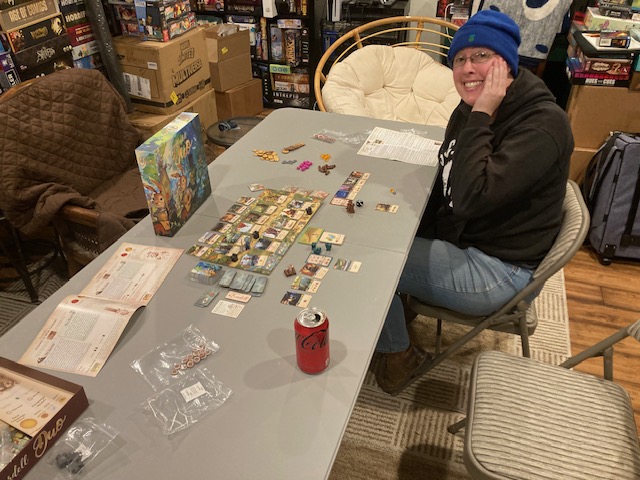
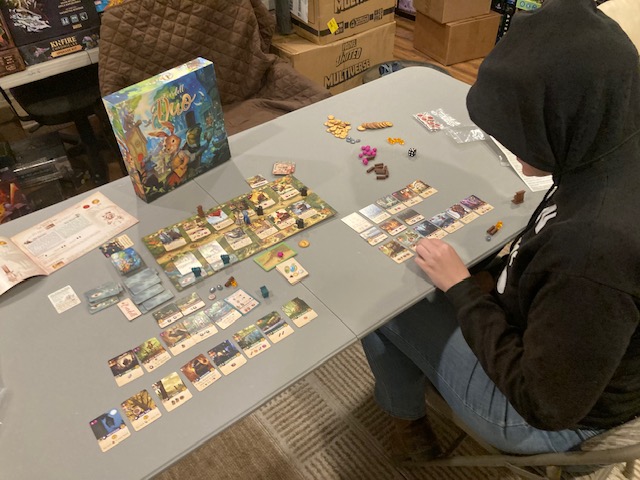
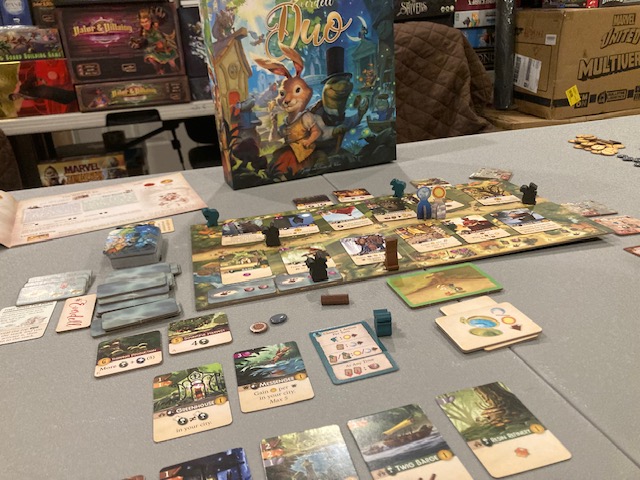
Over Hill Over Dale, Will Everdell: Duo Fail? A Review of the Solo and Cooperative Modes of Everdell: Duo

IMG_8763

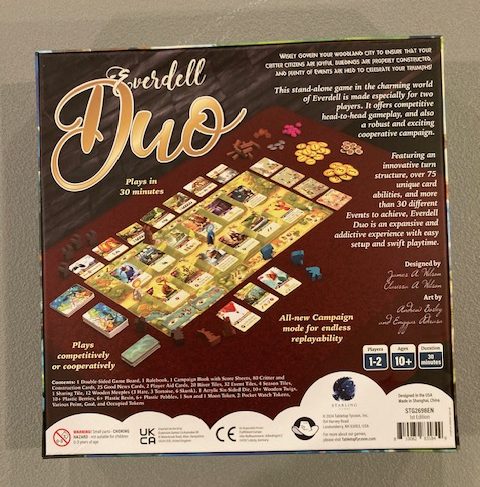
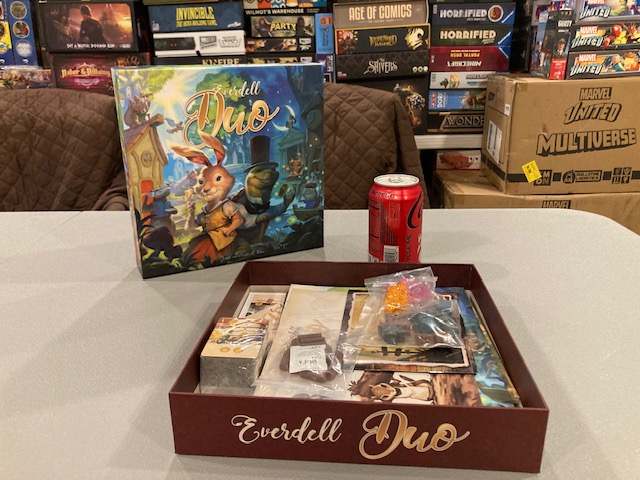
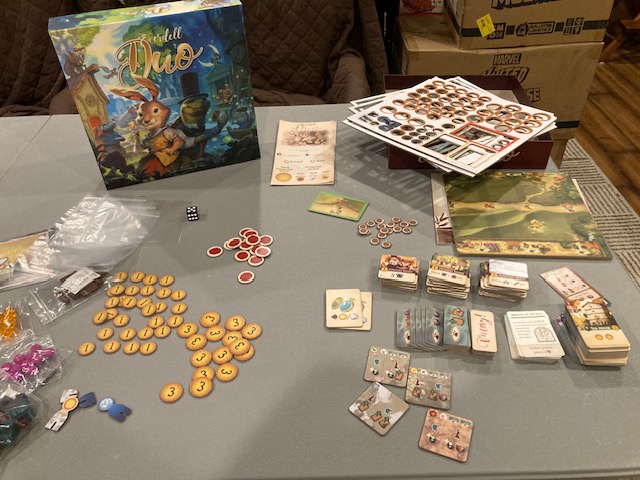
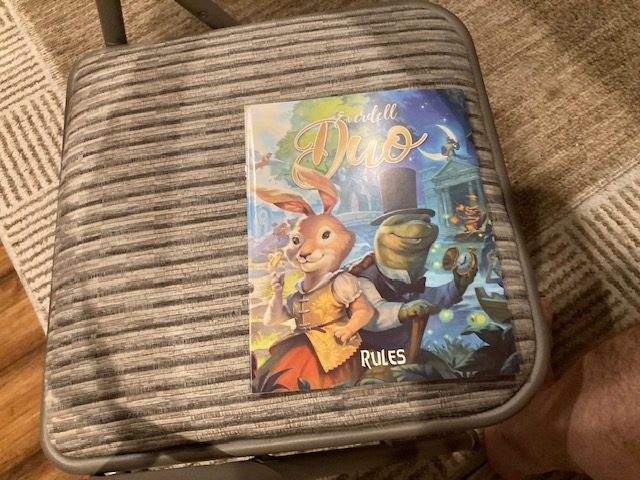
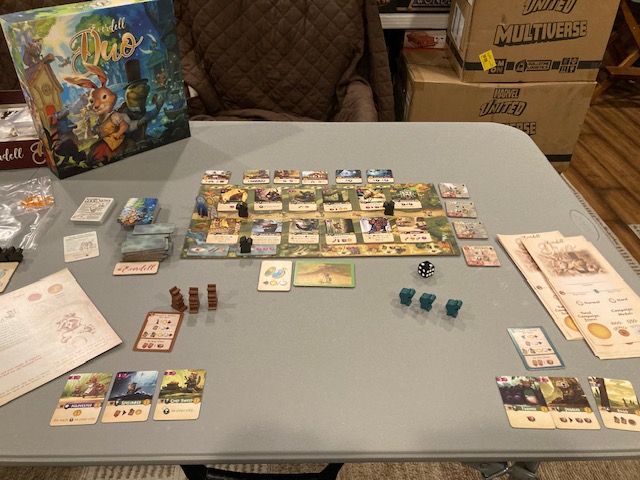
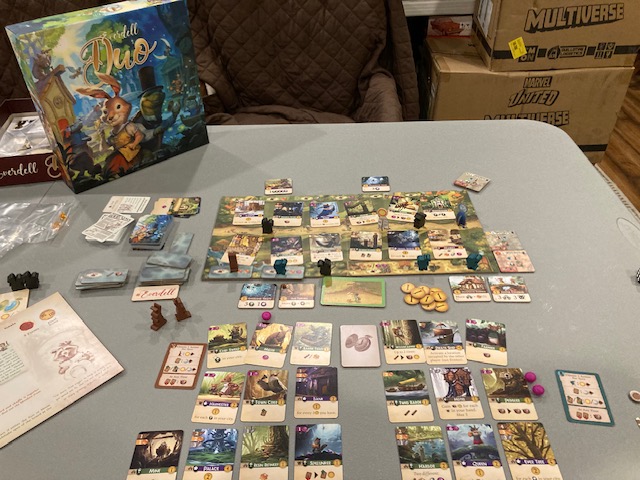
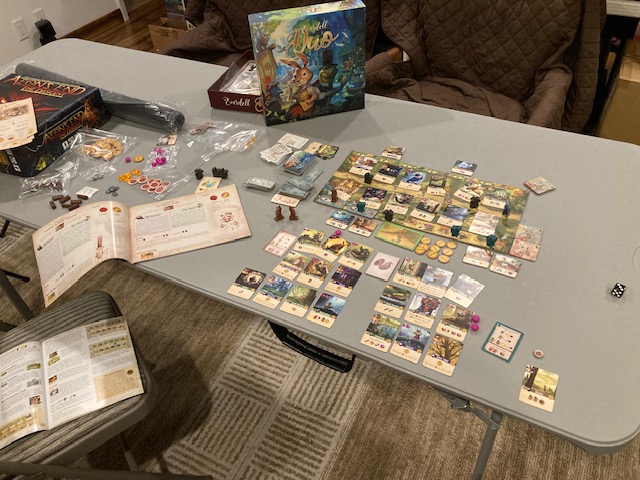
Everdell: Duo is a competitive or cooperative worker placement game for 1-2 players.  It was up on Kickstarter in Aug/Sept. 2024.  It promised delivery in March 2025, but it delivered to me on November 25th, 2024!  Yes, almost 4 months early!

IMG_8764

This is a worker placement game in the Everdell universe.  Strictly speaking, I have never played any of the Everdell games, but I was excited about the cooperative mode of this worker placement game!  It plays both solo and cooperatively with 2-Players!  We saw another cooperative worker placement game that went over quite well this year with Endeavour: Deep Sea.  Will Everdell: Duo find that same success?

Unboxing

IMG_8768

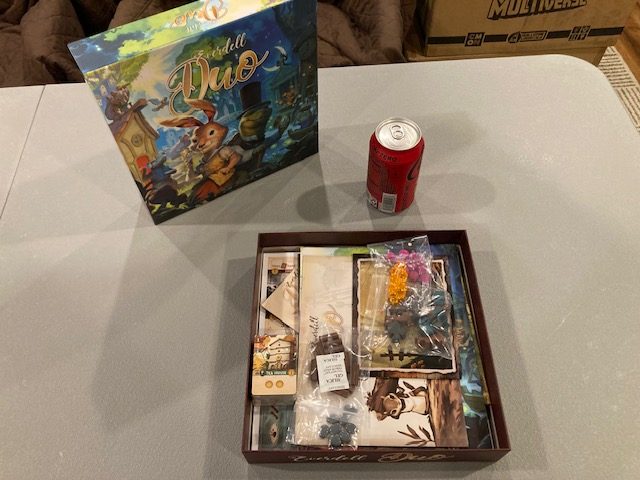
This is a smaller box: see Coke Can above for perspective. 

IMG_8865

I was slightly grumpy at the Kickstarter because they shipped it in a padded envelope, and my box got a little banged up!  See above.  There are some dents, and the top is squished a little, so it feels like I got a Ding-And-Dent day special for this.  So, I was already a little feisty when I opened this. 

IMG_8769

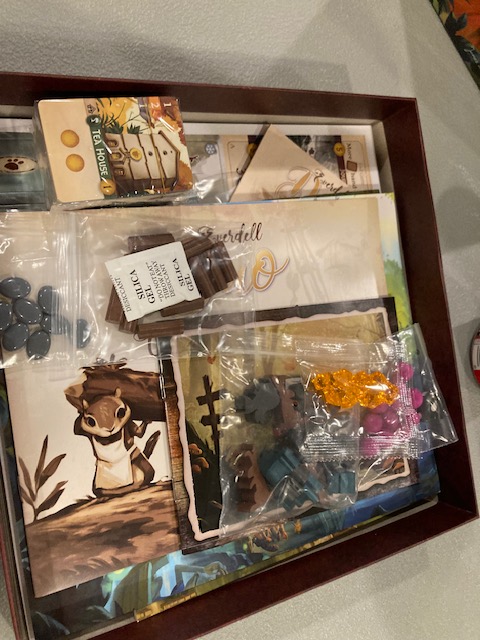
And there is really no insert to speak of.  Everything just flops around all willy-nilly in the box!

IMG_8773

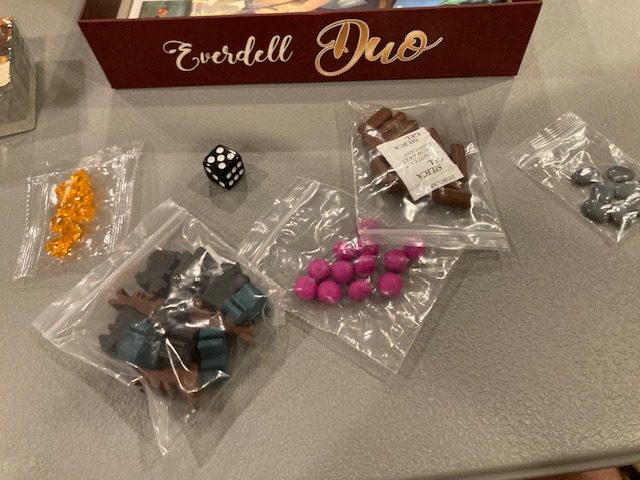
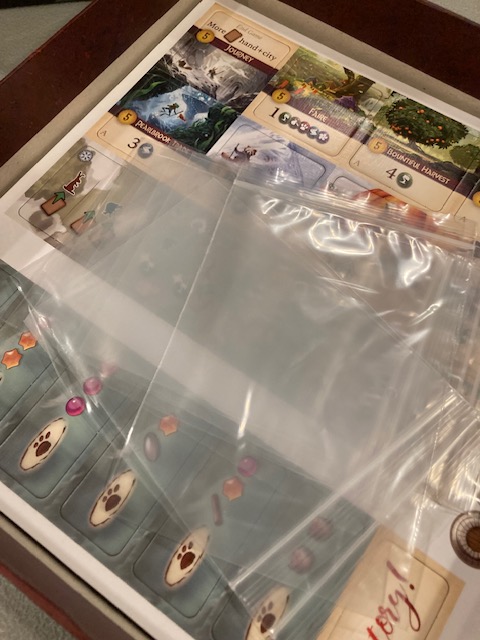
Luckily, they did include a lot of plastic bags (see above and below) so you organize it.

IMG_8792

IMG_8793

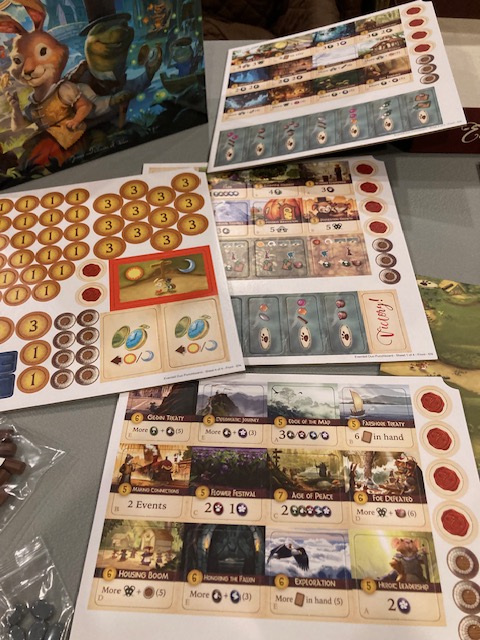
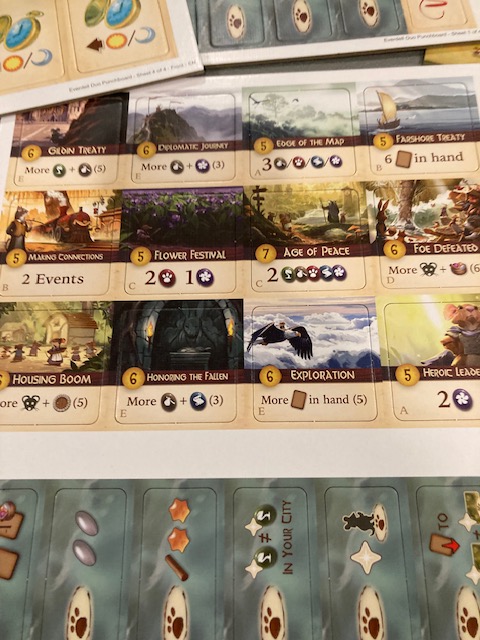
There’s 4 punchout sheets and the art is pretty groovy on them (see above and below).

IMG_8794

IMG_8803

Most of the game is on the cards; there’s quite a number of them.

IMG_8811

The game looks good: I love that Andrew Bosley art.  See above.

Rulebook 

IMG_8775

This rulebook is a mixed bag.

IMG_8776

It passes the Chair Test with flying colors! It’s an A! It’s just the right size so that it can fold over perfectly!

IMG_8782

See above as the rulebook lays flat and fits perfectly; it’s so easy to read!

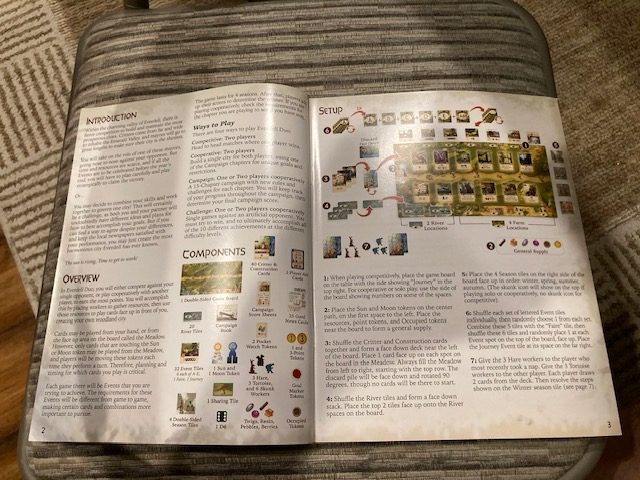
IMG_8777

The Components list is pretty minimal (lower right of 2nd page, see above), but it works well enough.  The set-up takes up all of page 3, works, pretty well, and is decently notated.  So, things are starting off on a good note.

IMG_8778

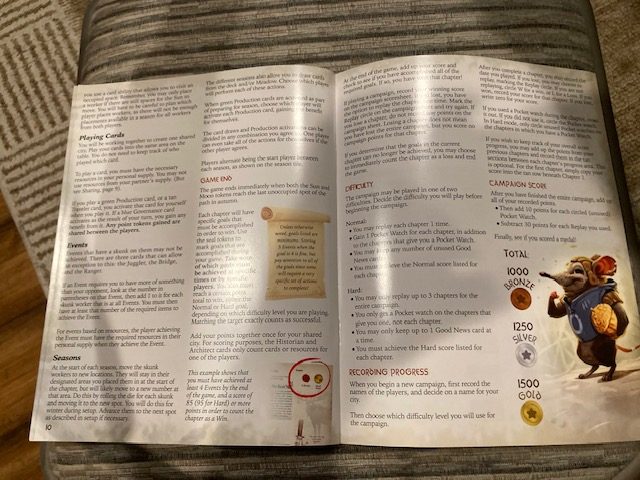
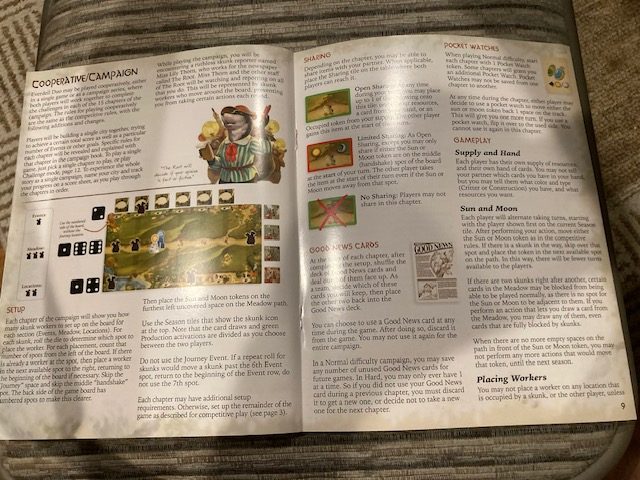
The Gameplay concentrates on the competitive mode, so the cooperative (and solo) mode take second fiddle a little bit.  For example, the rulebook fully lists/describes the Season card effects for competitive mode, but the cooperative mode Season effects (which are different enough to warrant some text) doesn’t get any explanation.  The game mechanisms are “generally” the same in either competitive or cooperative mode, but of course,  the players have to approach the game differently depending on the mode. 

IMG_8786

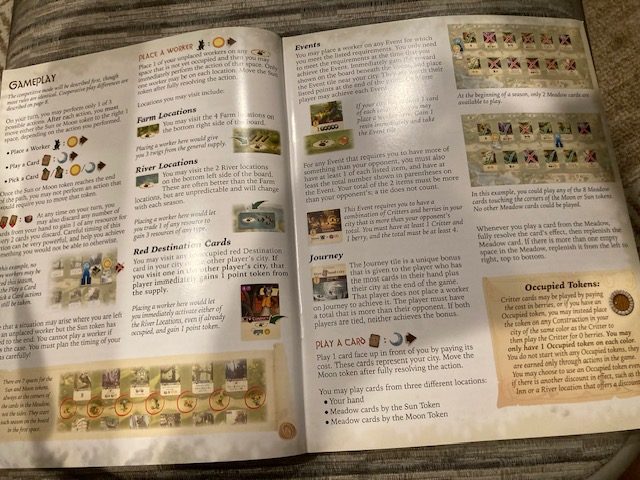
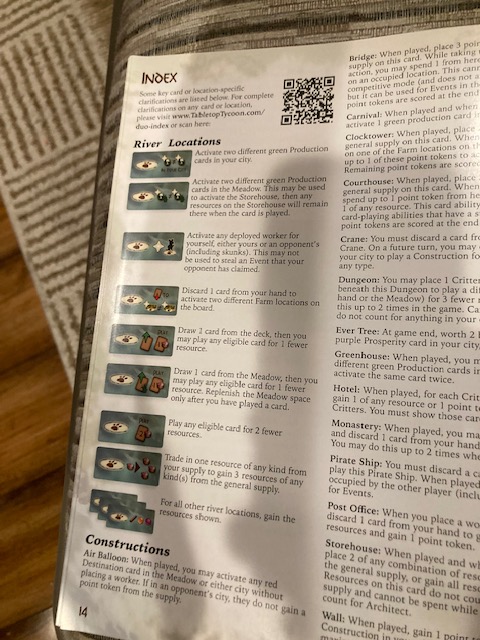
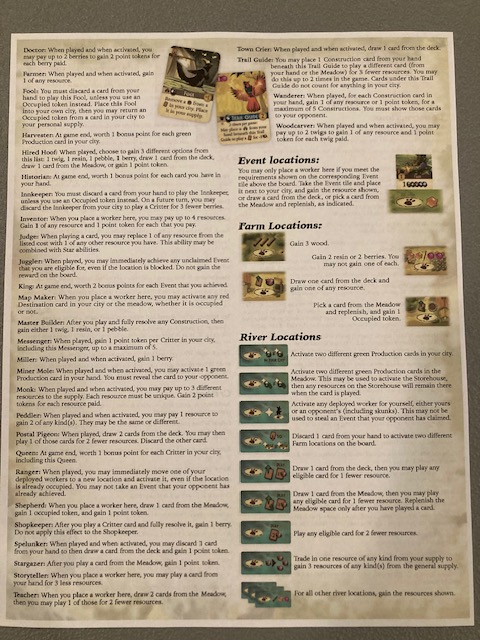
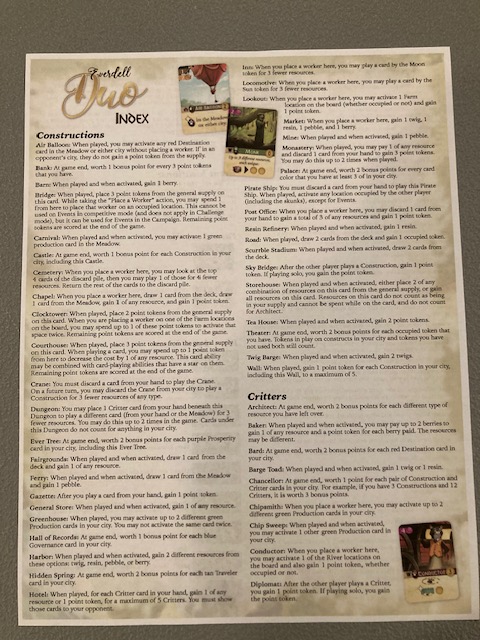
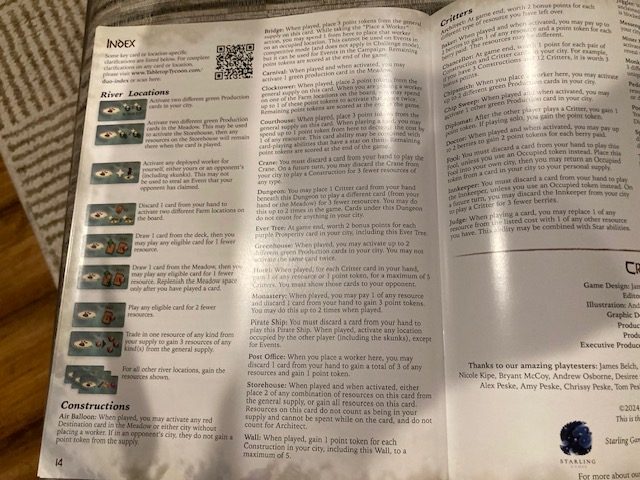
This also irked me:  they mislabelled the “Card Summary” as an Index! See above!!  An Index is a list of sorted “important” words, with page numbers following in a list: this is NOT an index!  This is a Summary!  Even worse, as a Summary, it’s incomplete!  You MUST print out the special sheet from the website to get all the rules.  I remember looking for the the Inn in the rulebook … it’s not there?

IMG_8850

IMG_8849

Ah, there it is … at the top of the page!  (NOT an Index).  Do yourself a favor, makes sure you print out a full copy of the (what they call) the Everdell Duo Index!  You need that to play or you will not be very unhappy.

IMG_8783

The rulebook taught the game, but I was constantly looking up stuff.  Also, there’s no real picture or great explanation of “town” or tableau.  I think you have to have played enough of these types of games to get that your “town” was the set of cards in front of you.  Again, this could have been clearer.

The rulebook taught the game.  Let’s just leave it at that.  Make sure you print out (what they call) the Everdell Duo Index, or you will be missing some important card descriptions!

Gameplay

IMG_8765

This is a worker placement game for 1-2 players.  You can play competitively or cooperatively (the solo mode is just the cooperative mode with one player operating both characters).

IMG_8830

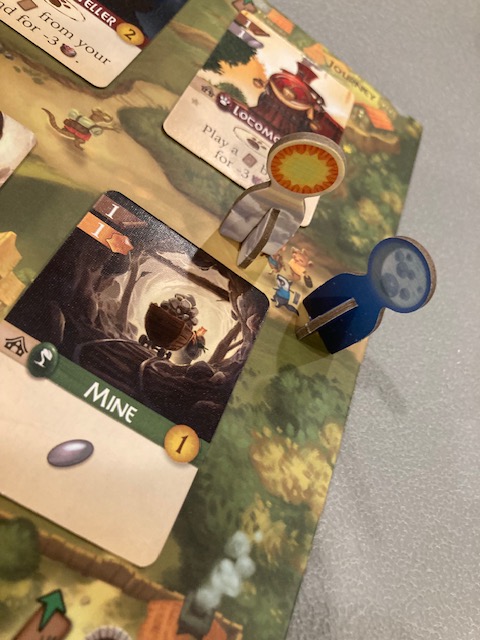
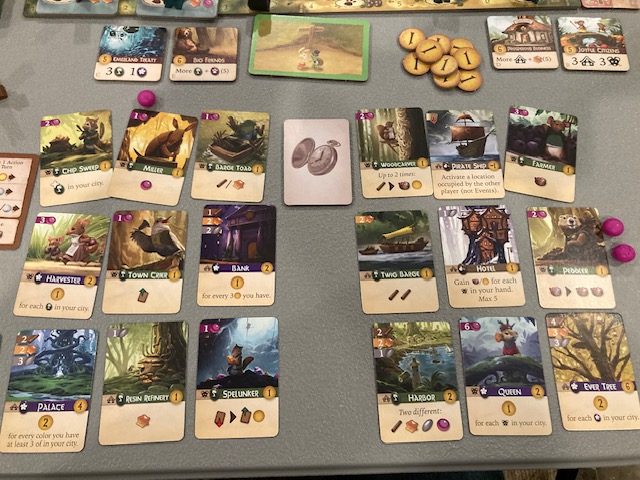
There are always two characters in play: the Hare and the Tortoise.  See above as the Hare is on the left hand side, and the Tortoise on the right.

IMG_8821

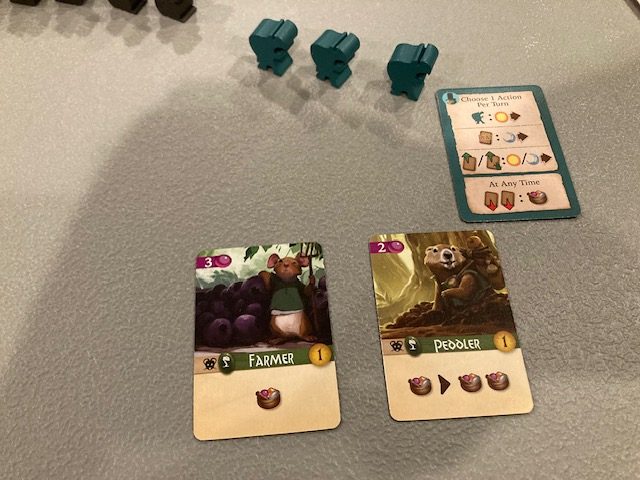
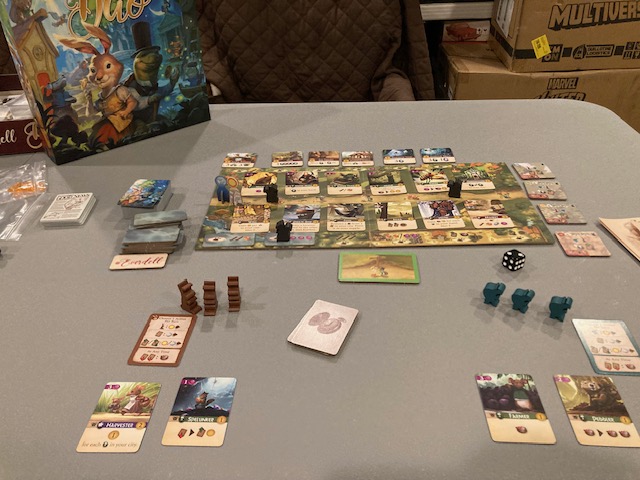
During the game players “usually” do one of two things on their turn; (1) place a worker placement token (see the 3 Tortoise tokens above) or (2) play a card from their hand into their “town” or tableau (see Farmer and Peddler as cards in their hand).

IMG_8789

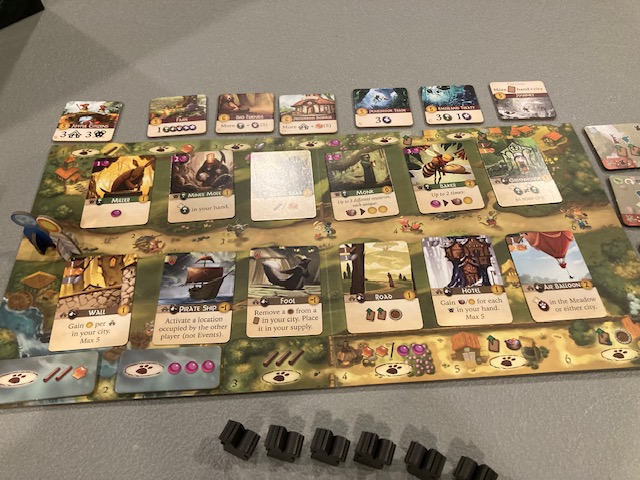
The top and bottom of the board is the worker placement zones. 

IMG_8872

The bottom part of the board are spaces that basically give resources (wood, berries, resin, or stone) to a player.  See above. 

IMG_8871

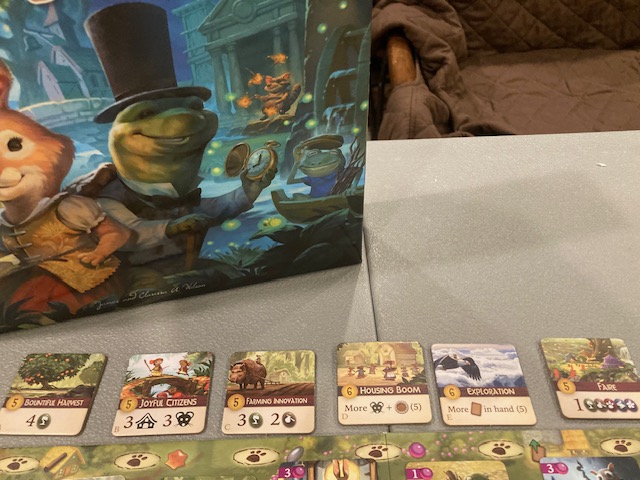
At the top of the board (accented by the big tiles) are the big rewards, but they have significant prerequisites.  The Bountiful Harvest (to the left) requires 4 green Production cards, but gives a whopping 5 victory points.

IMG_8827

This is generally a victory point game, even in the cooperative mode (but see more discussion below).  For the competitive games, players are competing to get the most victory points.  For the cooperative mode, players (at first at least) need a certain number of victory points as a group to win.

IMG_8835

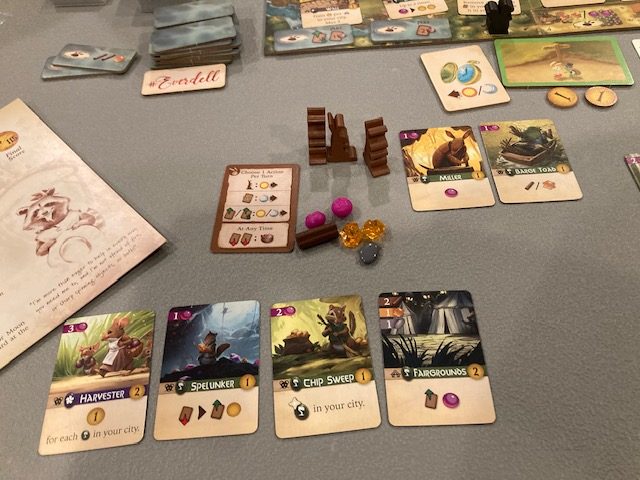
The second most common action is playing cards from your hand (or board) to your “town” or tableau.  It’s not clear from the instructions, but each character has a HAND of cards they can play on the board, and cards they HAVE played into their “town”.  See above as the Harvester, Spelunker, Chip Sweep, and Fairgrounds are in the Hare’s town (with Miller and Barge Toad in hand; they haven’t come out yet).

IMG_8802

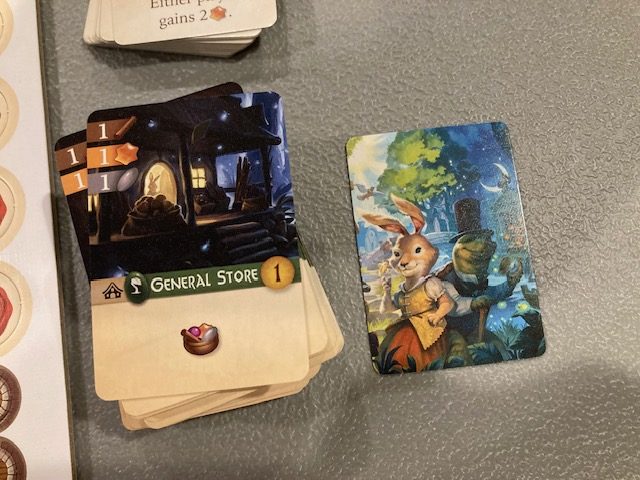
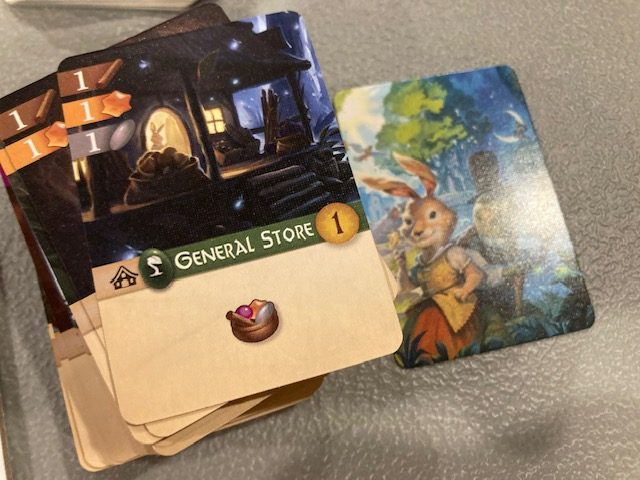
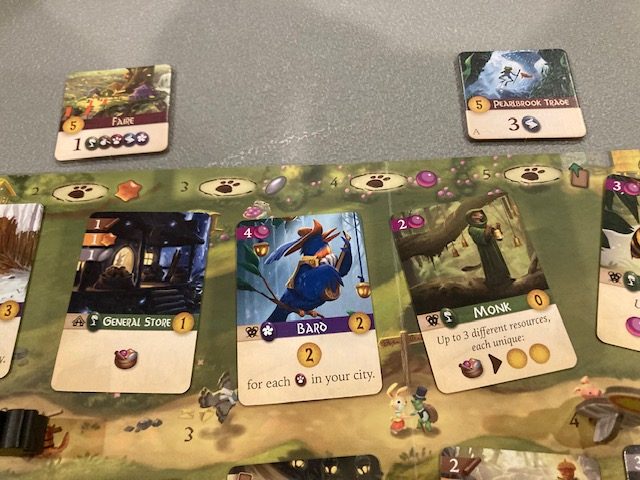
In order to play a card into your “town” or tableau, the player must pay the resources on the upper left of the card.  For the General Store (above), it’s one Wood, one Resin, and one Stone. If you don’t have the resources, you can’t play the card.

IMG_8840

Interestingly, you can also play cards from the board (the Meadow) into your “town”!  It really depends on where the Sun and the Moon are!!

IMG_8869

The Sun and Moon are tokens that move left to right on the board.  See above.  Once they have both reached the last space, that season is over!   There are 4 Seasons total: Winter, Spring, Summer, Autumn. Once all seasons are done, the game is over! Add up point to see who won!

IMG_8807

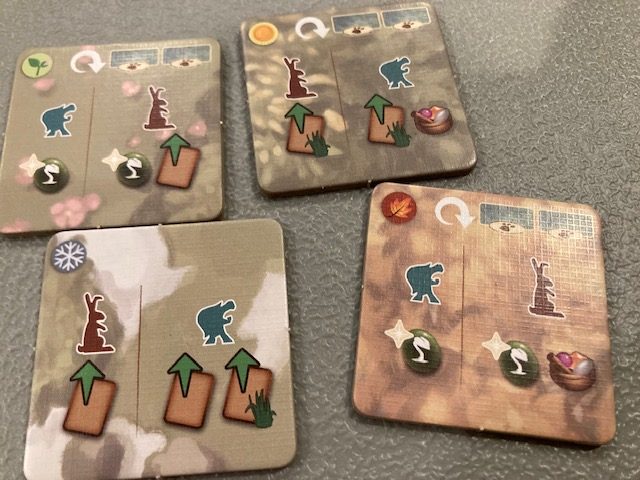
At the end of the season, each characters gets some special effects (draw a card from the meadow (the board), create resources from Green cards, get resources, etc).  The Season tiles above also specify who goes first!

IMG_8867

The Sun and Moon tokens add an unusual twist in the game.   The Sun token advances whenever any player plays a worker.  There are only 5-7 or so spaces for the sun (depending on the mode, campaign, etc), so that means that maybe a limited number of worker placement actions total; someone may likely get screwed out of a worker placement action!

IMG_8868

The Moon token advances whenever anyone buys a card from the board or their hand.  See above; if a character buys, they can instead buy any of the 4 adjacent cards to the moon!  That’s kind of different and interesting!

IMG_8847

The game is all about trying to get the right resources to get the right cards to get the right combos to get the most victory points!

Solo Play

IMG_8766

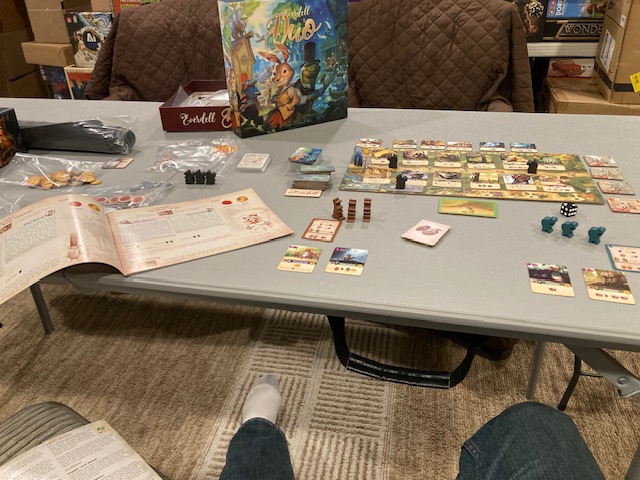
There are two solo modes (Congratulations on following Saunders’ Law)! One of two solo mode for this game is playing the cooperative mode (2-Player only), except that the solo player plays both the Hare and the Tortoise; this is the Campaign solo mode.   For 4 seasons, the solo player alternates between the Hare and Tortoise until the Sun and Moon reach the end of the track … then head to the next season!

IMG_8837

The solo mode (really, the two-handed cooperative mode) is, at least in the beginning, a victory point game.  The sum of the victory points of the Hare and the Tortoise need to exceed some threshold!

IMG_8825

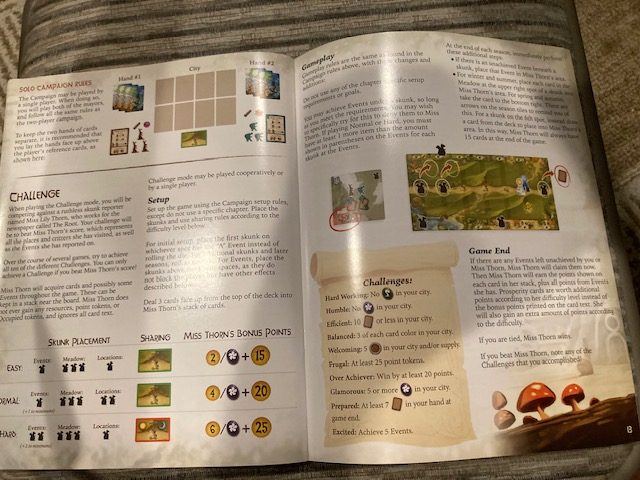
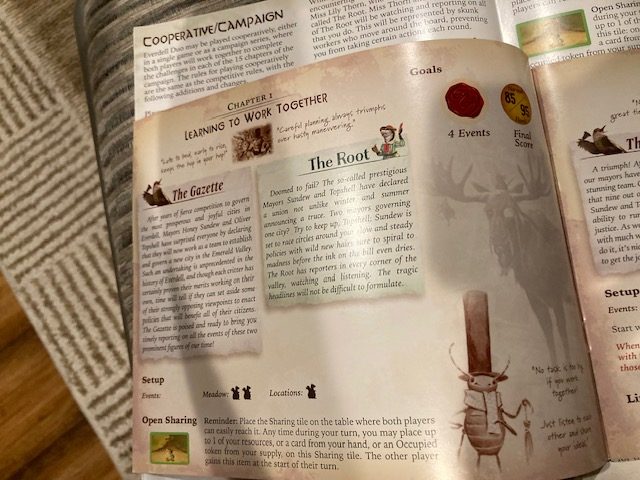
The cooperative mode is really is actually a campaign (sort of) of 15 ever harder chapters!  The first  game of the campaign (see above) is a simple start: get at least 85 Victory Points collectively and also get at least 4 Events (the big rewards)!  Luckily, you can play any campaign chapter you want as a one-shot: this is both Boon and Bane!  It’s Boon because you can play any of the 15 chapters of the campaign at any time, but it’s Bane because there’s really NO levelling up in this game.  It’s not really a campaign in the sense “your character gets better”; it’s just 15 scenarios that get harder.

IMG_8827

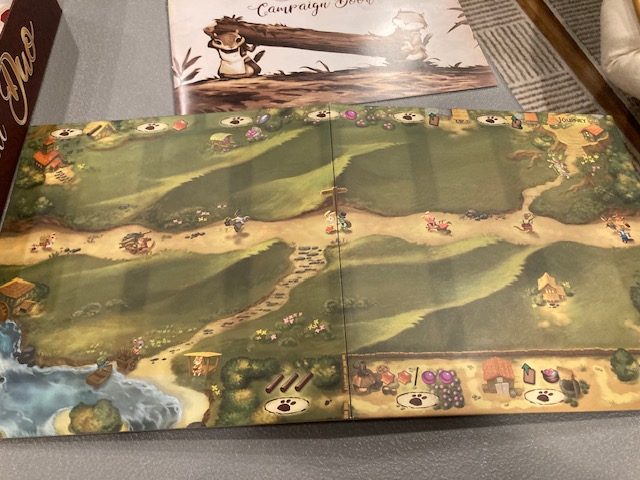
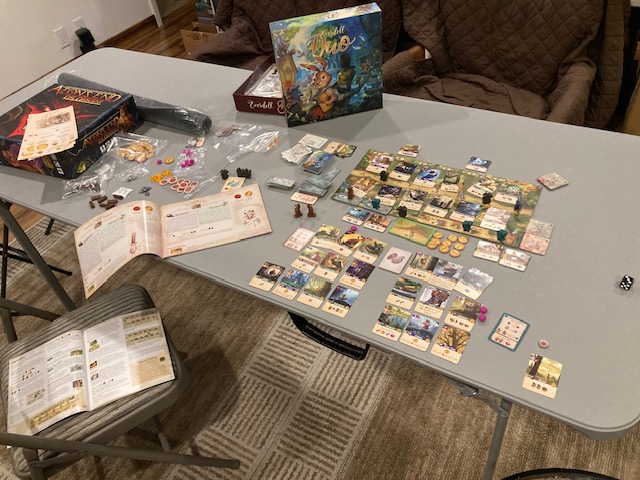
What’s different about the Campaign solo/co-op mode is that there are SKUNKS blocking certain locations on the board!  See above as two SKUNKS blocks two spots on the Sun/Moon path (thus reducing the number of actions) and one SKUNK on the Worker Placement part of the bottom (this blocking one action).  This is how the game “simulates” blocking; every turn the players roll the die and move the SKUNKS to block spaces. 

IMG_8843

I have to admit I struggled a little with the randomness of this game at first.  The cards in your hand or meadow are ENTIRELY random every game, and where the SKUNKS end up is ENTIRELY random.   I was very afraid I wouldn’t like the game because of this.  But, I think after getting through a bunch of games and getting the flow of the game, there always seemed to be ways to mitigate that randomness.  You can always top-deck a new card, you can usually play a card out of your hand if you can’t play from the Meadow, you can always choose to draw any card from the meadow, and you can always find SOME worker placement action to help you, even if it wasn’t exactly what you wanted.   Basically, you have to be able to pivot.   The game is more tactical than strategic, as you react to the current set-up of the game.

IMG_8839

But, this Campaign solo/co-op mode is much more strategic; since you can work together (with yourself as the Tortoise and Hare) and plan together, your actions be more far-reaching!  

Note there is a Challenge solo/co-op mode in the game where you play against an AI opponent. I feel like, with the rules as they are,  the Challenge mode is a much more tactical game.   I strongly prefer the Campaign solo/co-op mode, as it feels like you can mitigate the randomness of the game much more by having the Tortoise and Hare collaborate.

IMG_8833 

There are two related issues I want to discuss more below.  But for now, let me say that I do like the solo 2-handed Campaign mode as it’s more strategic.  The Challenge mode was less to to my liking, as it felt more tactical.

And for solo mode, I completely ignored the Limited Communication rules; It makes sense to ignore this in the solo mode (of course you can communicate with yourself).   More discussion below.

Cooperative Play

IMG_8851

Even after three solo games, I was still getting a few rules wrong.  As Teresa and I headed into a cooperative game (the campaign mode, not Challenge mode), she was the Hare and I was the Tortoise playing Chapter 1 of the Campaign.

IMG_8854

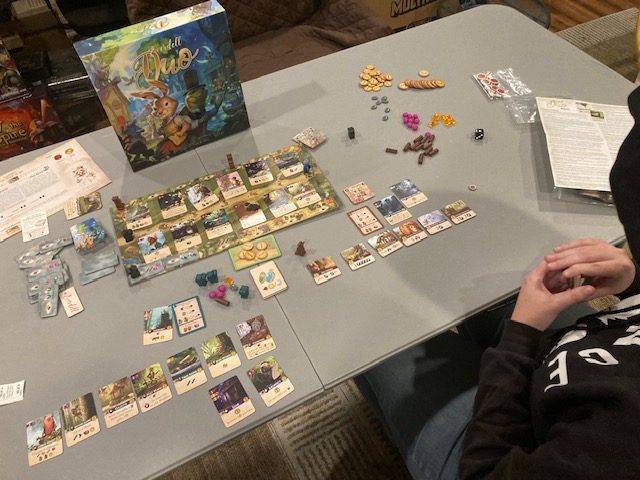
There are rules for Communications Restrictions … which we completely ignored.  There are some restrictions on what you can communicate: “You may not tell your partner which cards you have in your hand, but you may tell them what color and types (Critter or Construction) you have, and what resources you want”.  We generally adhered to these rules, but that’s because we respect each others space.   Sometimes we would share a little more, but that made the game more engaging: “Ugh! I am struggling! I can’t do anything, how can I help you?”   I understand why cooperative games like this have Communications Restrictions:  they don’t want the game ruined by The Alpha Player (a player who tells everyone what to do!).  If you are playing Everdell: Duo with a person you trust and respect, these rules are insulting and take away from the enjoyment of the game.  I prefer to encourage working with my friends rather than hamstringing them with arbitrary Communications Limitations. 

IMG_8852

That got more preachy than I wanted, but the game still seems to work even in you ignore the Communications Limitations. And it’s more fun.

IMG_8852

Over one night, Teresa and I played and lost our first game. Then, Teresa liked the game so much, she wanted to play again!!

And we lost the second game too.  But we had fun playing!

Sharing

IMG_8826

With the gameplay description I have given above, this game sounds very much multiplayer solitaire. And it mostly is, except for two things.  First of all, there is a “share” space!  At the end of every turn, each character can decide to share a single thing and put it on the tile above!  That thing can be a card, a resource, or an Occupied token.  

IMG_8780

Interestingly, different Chapters of the Campaign turn on/off this sharing space, or reduce its scope (so you can only use it in the middle).  I noticed that I didn’t win a solo game until I actively started using the Sharing space.  It’s there for a reason, as it does encourage cooperation and strategy!

It might seem, other than the Sharing space, this game is just multiplayer solitaire.  After all, each player just tries to do they best they can on their turn, right?   I think, after several plays, I would say that is not true!  Because of the Sun/Moon move mechanism, each Season is restricted by how many worker placement and card buys characters can do—in order to get a full robust turn, the players must discuss the best play to enact a plan to make best use of the Season!  And that makes the game very cooperative!

What I Liked

IMG_8767

The Components and Art:  The art of Andrew Bosley permeates this game, and it’s very striking.  The game is gorgeous and cute, and it looks nice on the table.

IMG_8817

Cooperative Worker Placement:  The cooperative worker placement works very well in this game.  Everdell: Duo uses the SKUNKS to help block spaces, and with the characters collaborating, this works far better than I expected it to!

IMG_8851

Duo: I really like playing this as a cooperative 2-Player game (in Campaign mode).  It seemed to work really well.  Of course, the solo mode was great too … because it is the same mode!

What I Didn’t Like

IMG_8787

The Rulebook:  There were some great things about the rulebook, and some not so great things.  I think this rulebook needs one more pass by an editor.  In the end, I was able to learn the game from it, but it seemed harder than it should have …maybe it’s because I never played the original Everdell?  Maybe they expected me to know more about the game?

IMG_8827

Randomness: I was worried about the randomness of the game; between the SKUNKS positions being decided by die rolls and the pure randomness of the Meadow, I was very worried the game might feel like too much. I will say, after playing a whole bunch of games solo and cooperatively, I haven’t seen this be a problem. I still worry about it.

Conclusion

IMG_8842

Everdell: Duo worked for me as a solo game and for my friend as a 2-Player cooperative game.  The Campaign mode (misnamed, because no state changes between games) offers lots of replayability for the future.  Although there is a Challenge solo/co-op mode, I feel like the Campaign is the better mode, as it allows the players to be more strategic in a game that is fairly tactical overall.  

IMG_8855

The games are  fairly short, but they offer a lot of interesting choices.  We found that, even if we lost, we wanted play again!  This was a testament to how much fun the game was.

IMG_8828

If I were to suggest one major revision, I would eliminate the Communication Restrictions.  Just let me and my friend have fun and play how we want; I play games with my friend because I want to work with them and cooperate.  Restricting the Communication takes too much away from the cooperation, to the point of being less fun.

IMG_8764

Overall, this is probably a 7.5 from both me and Teresa. It’s easy to pull out and play either solo or cooperatively, it’s gorgeous on the table, and it’s very cute. 

A Review of Valroc and The Cooperative Expansion: The Legend of Aquiny

IMG_5215

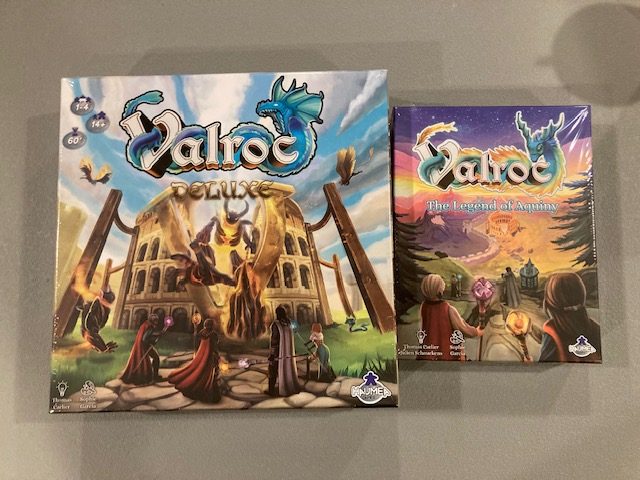
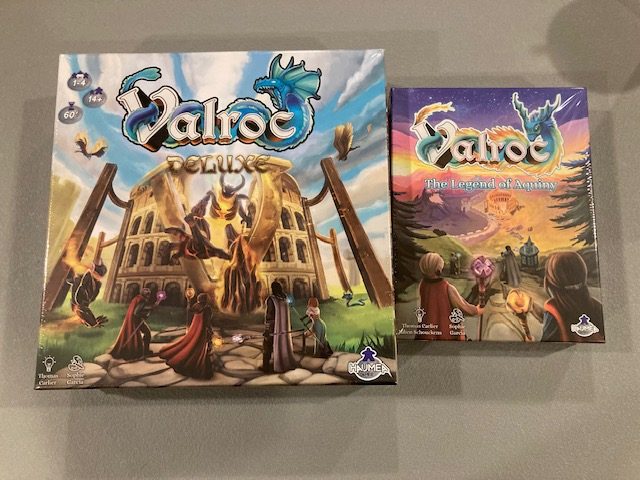
I wasn’t sure if I wanted to pick up Valroc.  It was on Kickstarter again in September 2022: see here.  This second Kickstarter offered the base game and a cooperative expansion called Valroc: The Legend of Aquiny

IMG_5217

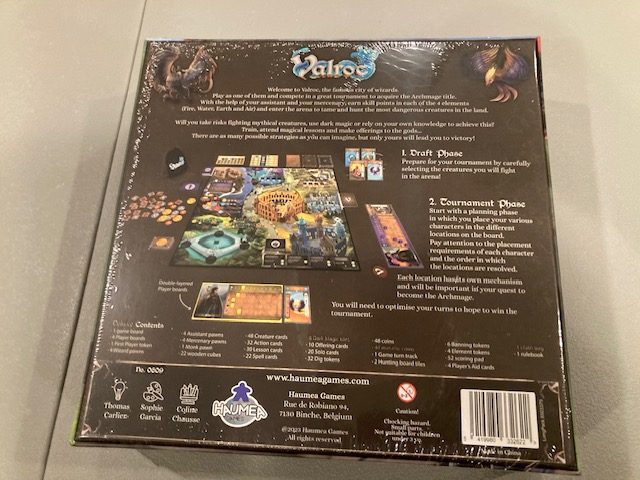
The base game is a fully competitive drafting and worker placement game (with a solo mode).  See back of the base game above.

IMG_5219

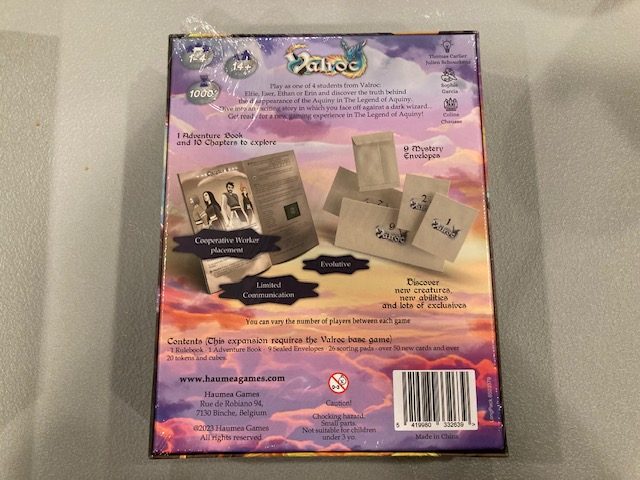
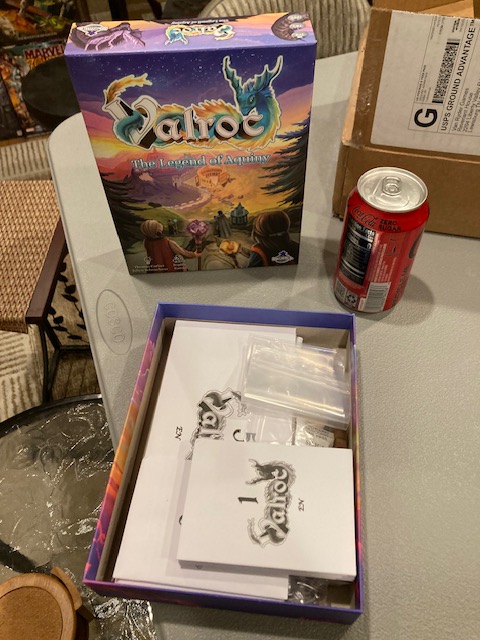
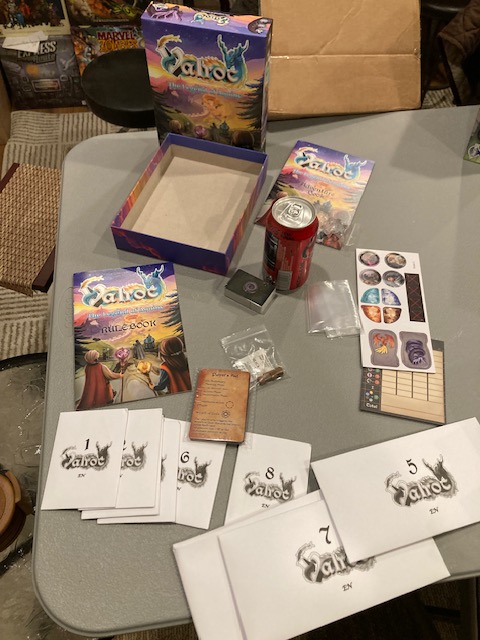
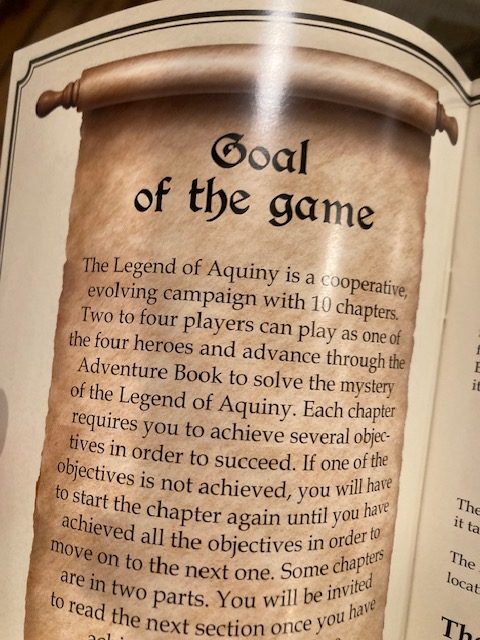
The expansion (The Legend of Aquiny) promises a fully cooperative mode with lots of envelopes to open!  Ooooh fun! See above.

IMG_5220

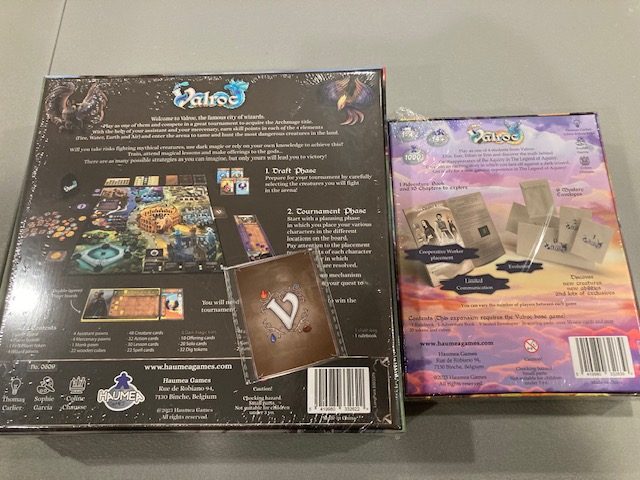
The Valroc Kickstarter promised delivery in September 2023, but it ended up delivering in April 2024 sometime. See above.  For a Kickstarter, 6 months late isn’t bad.

Let’s take a look at this game!

Unboxing The Base Game

IMG_5222

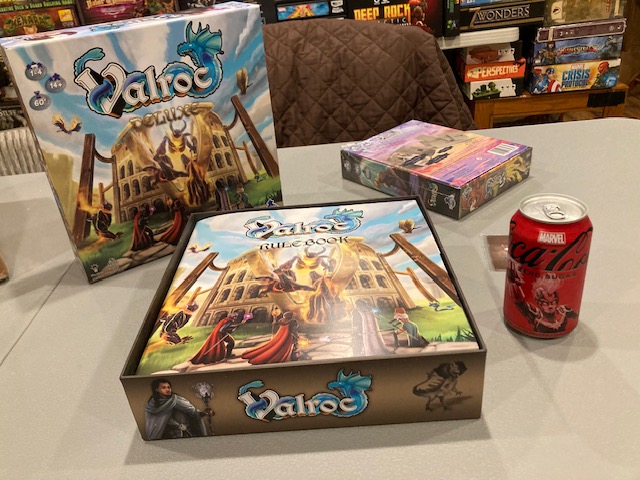
The base game is a fairly normal sized box: see Coke can above for perspective.

IMG_5242 (1)

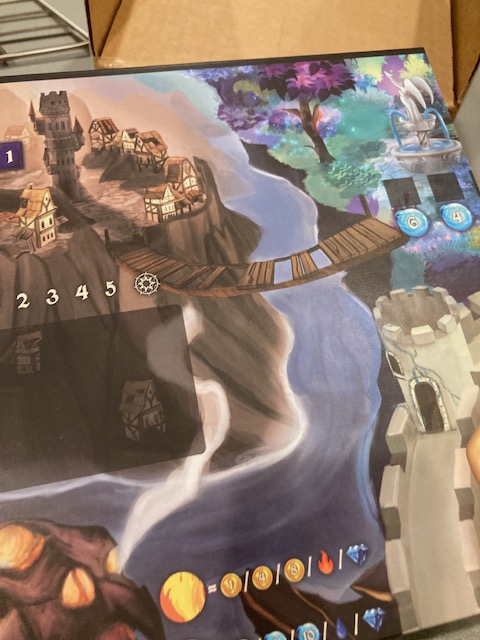
The game comes with a nice board: this board is for the worker placement part of the game.

IMG_5244

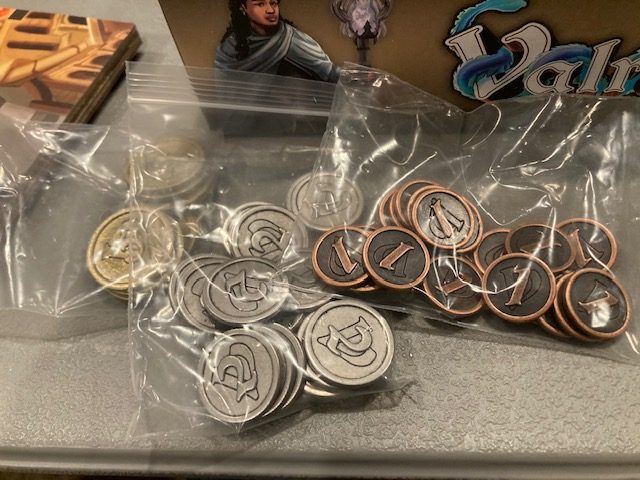
There’s a lot of buying of things and acquiring of money: I ended up getting the metal coins (called Vals) which are quite nice.  The money is used to help you stuff in your worker placement phase.

IMG_5267

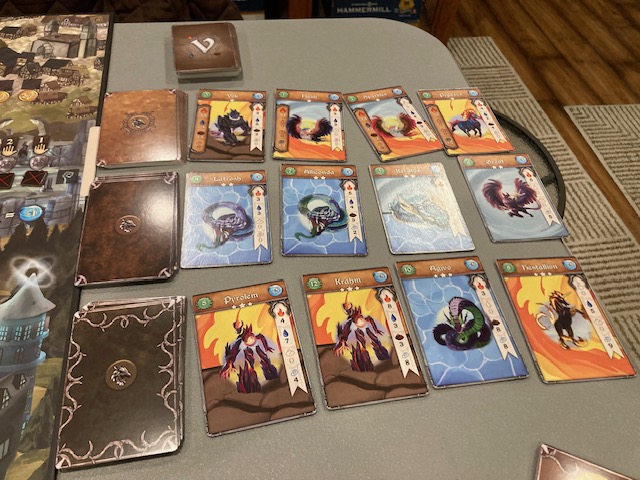
This game is all about buying of the creatures in the game: see a bunch above (You have to get 6 to invoke the competitive endgame).   The right hand side of the card are all the resource prerequisites needed to acquire the creature.

IMG_5246 (1)

There’s a lot of colored cubes and meeples: 4 colors for the 4 different players.

IMG_5252

There’s a bunch of multi-use Action cards: see above. These same cards are used for digging, offerings, and training.  The section of the card you use depends on the activity; the cards are nice enough. 

IMG_5254

IMG_5253

IMG_5241

IMG_5239 (1)

The components are all quite nice and consistent.  Probably my favorites pieces in the game are the dual-layer player boards: see above.

IMG_5247

In general, I think these guys did a great job with the production.  I thought the game looked really nice! See above!

Rulebook for Base Game

IMG_5223

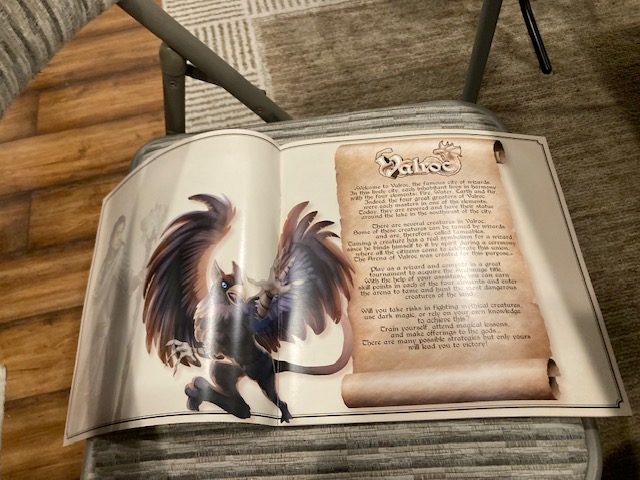
The rule book was okay.

IMG_5224

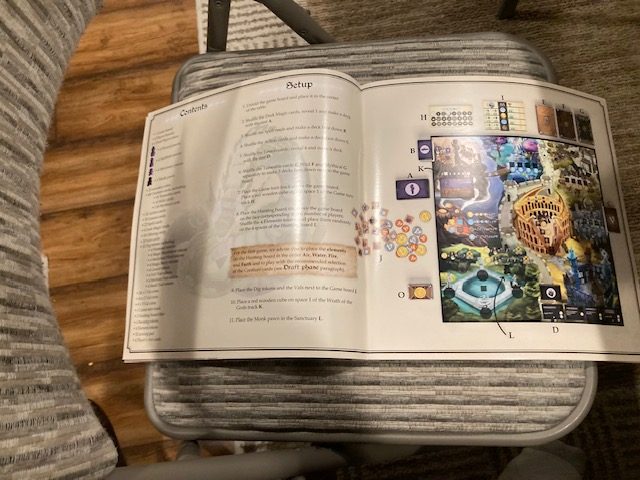
It’s a little too big of The Chair Test (maybe a C+), but I can still read it.  At least it stays open and the font is readable. There’s a lot of white space: this could have easily been a smaller form factor to fit better on the chair next to me.

IMG_5225

I was grumpy that there was no correlating pictures with the list of components.  The rulebook can “sorta” get away with that because there’s not too many components in the game.  I think, since this is a dual-language game (I think French and English), everything is labelled with abstract symbols, which was a little frustrating until you got used to it.

The set-up was decent, although they interspersed NUMBERS and LETTERS???  Each step should have been marked with one or the other: I found this unintuitive.  A couple of steps had multiple things exposed, which is why mixed NUMBERS for the steps and LETTERS for the items, but I felt like this would have been better served by having JUST numbers.  I think there were trying to do double duty and have the components list and set-up on only one pages.   I would have rather had the first 2 pages (which had ONLY a picture and some flavor test) list the components and then had the set-up steps be NUMBERS and labelled with NUMBERS.

Regardless, I was able to figure out what was going on.

IMG_5226

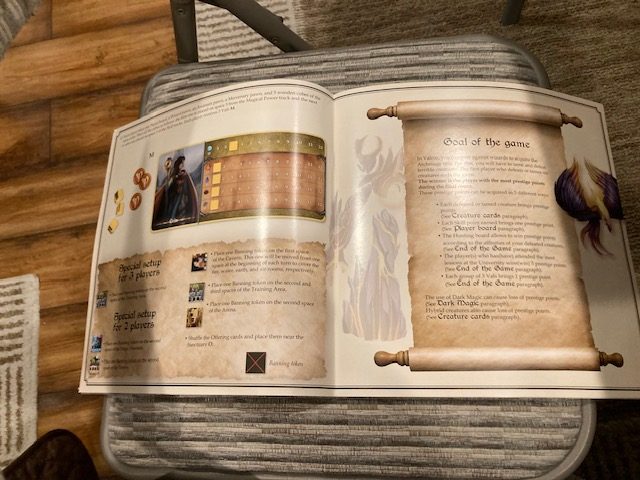
I was also grumpy because the rules specify special set-up for 2 and 3 players .. what about the solo game?  Nope, you gotta wait for that … (so I can’t set-up the solo game just yet?)

IMG_5228

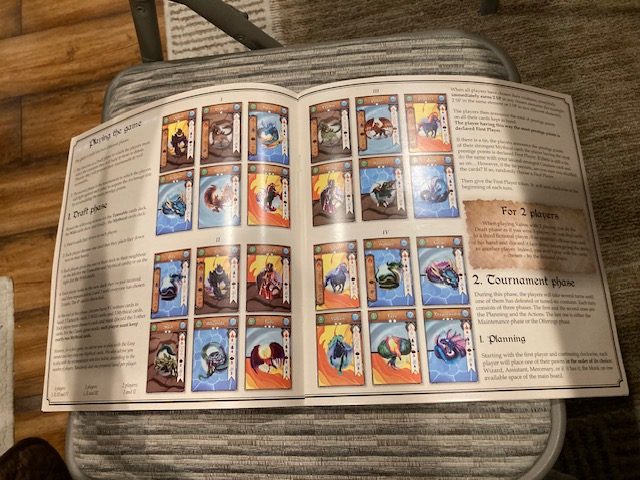
There’s a very very nice list of creature cards to se for your first game.  

IMG_5229

The rules were okay.  It’s very clear this game was originally a competitive game and the solo and cooperative modes were grafted on: Everything about this rulebook puts the competitive mode first and foremost. 

IMG_5230

IMG_5233

Later in the rulebook (why aren’t the pages numbered?) they finally have rules for the solo mode.  So, they are in there, but only after elaborating the competitive game.

IMG_5235

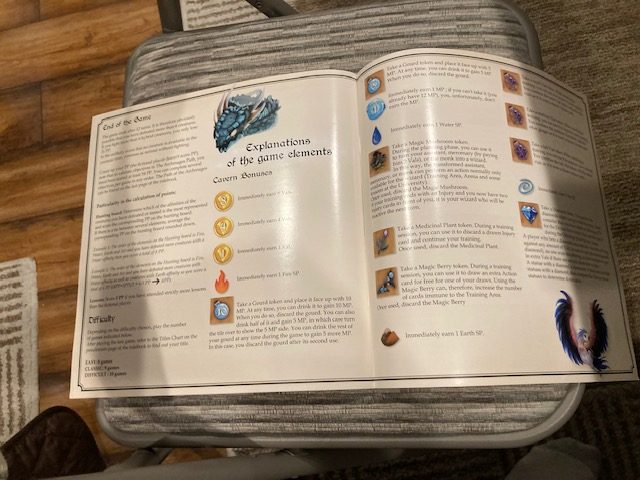
There’s some nice explanations of symbols: see above.

IMG_5238

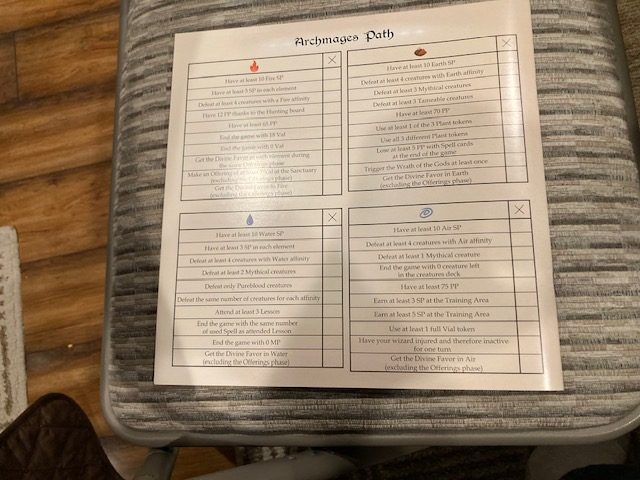
The back cover has something called the Archmages path … which is really only useful to the solo player (see solo discussion in a later section below).

IMG_5236

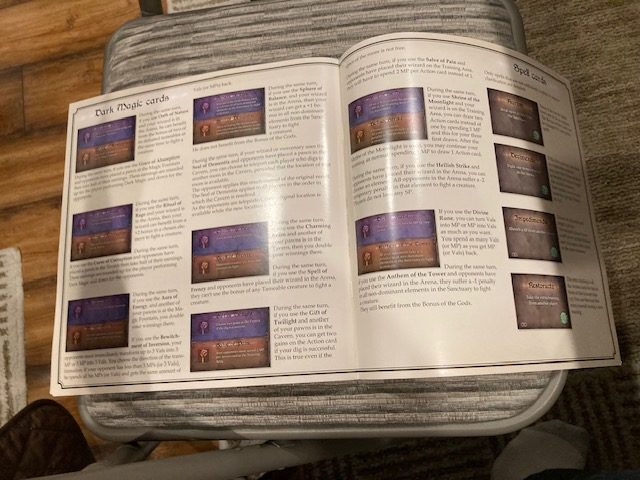
There is no index and this game really needs one!  Boo!  But there is a further elaboration of many of the cards later in the rulebook.

The rulebook was probably best for the competitive mode: first and foremost, this is a competitive game.    The lack of an index really hurt this game, because I was frequently trying to look up rules in the game, and I struggled to find things.  

The rulebook taught the game decently: I was able to learn the game from the rulebook.

Gameplay

IMG_5239

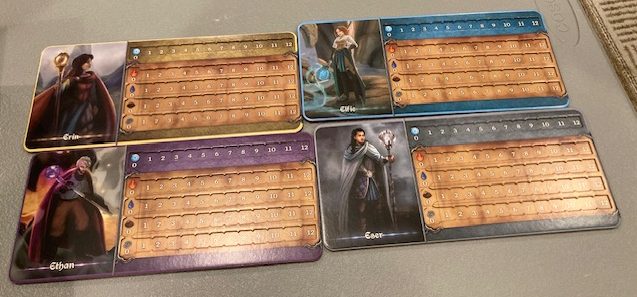
Each player takes the role of a mage in the game. There’s no different deck or asymmetric powers: the mage color is used only to disambiguate players.

IMG_5260

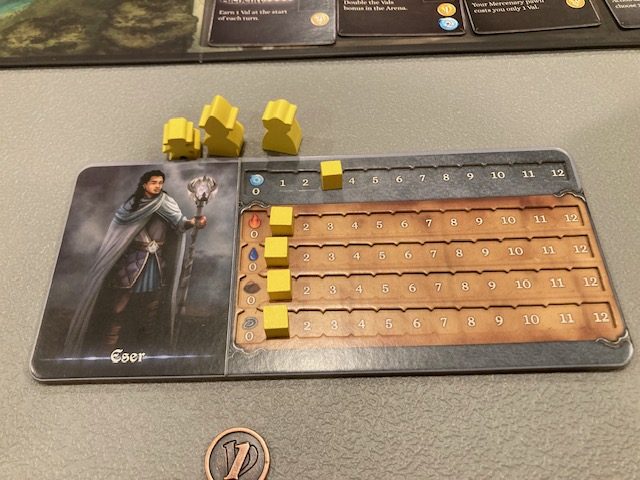
Each player starts the game with 3 worker placement tokens: left-to-right above: the assistant (tiny one), Wizard (hat), and Mercenary (nun hat?).   Each wizard also has resources: Fire, Water, Earth, and Air.   The mage himself slowly grows his resources in the game so he can acquire the creatures.

There’s also some MP (magic points in blue) that are used for many operations in the game.

IMG_5258

Money is also an important resource the game: each player starts with 3 Vals.  

IMG_5268

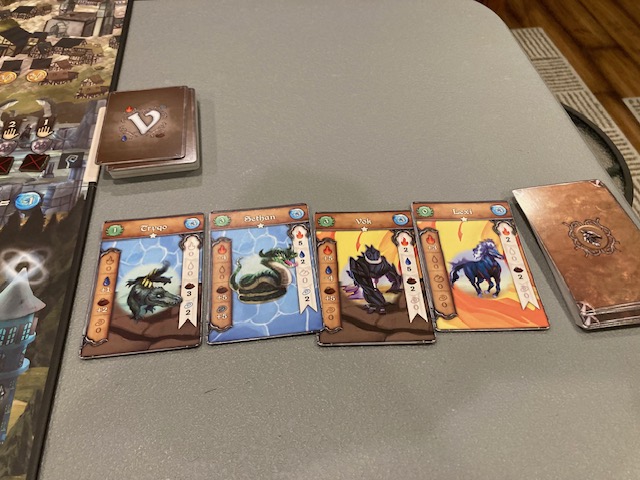
After you choose your Mage, you set-up for getting Creatures to acquire.  If you playing competitive, you draft (7 Wonders style) the creatures.  If you are playing solo or cooperative, you set-up a “river” of creatures (see above).

Either way, these represent the creature you can acquire: the resource prerequisites are on the right side of the creature cards.

IMG_5264

The rest of the game is Worker Placement!  Players place their workers at one of the 8 spaces on the board (see above).  Some spaces can ONLY be used by the Wizard, some spaces can only be used by NOT the Wizard!  If you make an offering, you can also get the Monk worker for one round.

IMG_5294

The players continue to play until they get to the endgame!   The solo, cooperative, and competitive games all have different ending conditions.  

But at its core, this is a worker placement game. Players manage money, MP, resources, creatures, their workers, and try to make the best tradeoffs they can.

Solo Game

IMG_5234

Valroc does have a solo mode (thank you for following Saunders’ Law)!  My first play of a new games is almost always a solo game, as I have to learn the game to teach my friends!

Unfortunately, the solo mode seems to be less well-described in the rulebook. 

IMG_5233

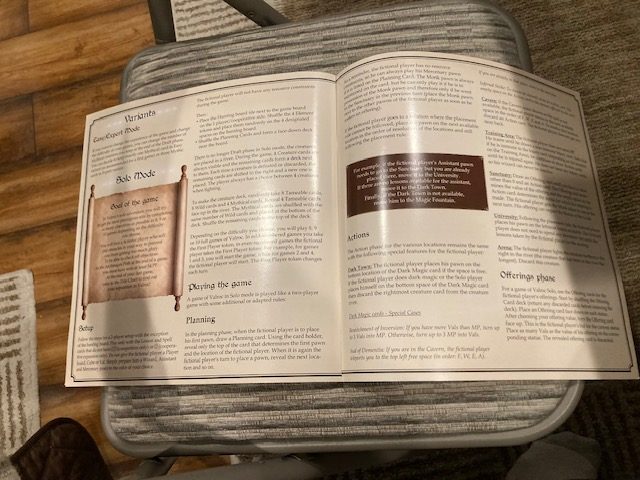
The pages describing the solo mode are full of text with almost no pictures (see above). I really struggled to get the solo mode going, especially the Offering phase.  There’s a LOT of rules changes for the solo mode, and I don’t think two pages was quite enough to cover everything.  Or at least, the solo rules needed some more elaborations.

IMG_5263

I was able to get through a solo game to see how everything worked.

IMG_5271

Instead of a drafting phase, creatures can only be acquired from the River (see above) … there is no drafting in the solo mode.

IMG_5270

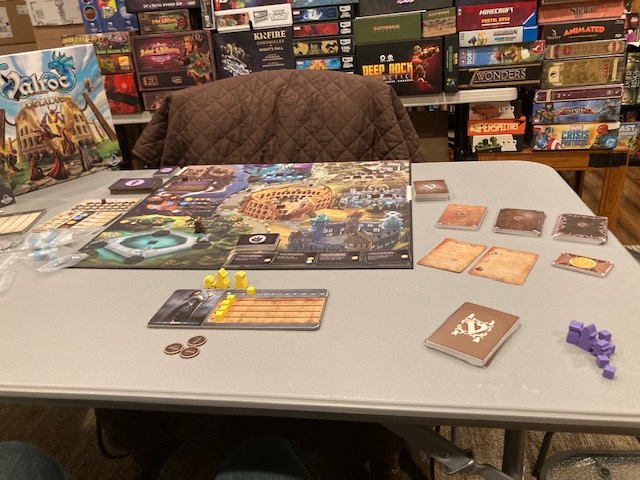
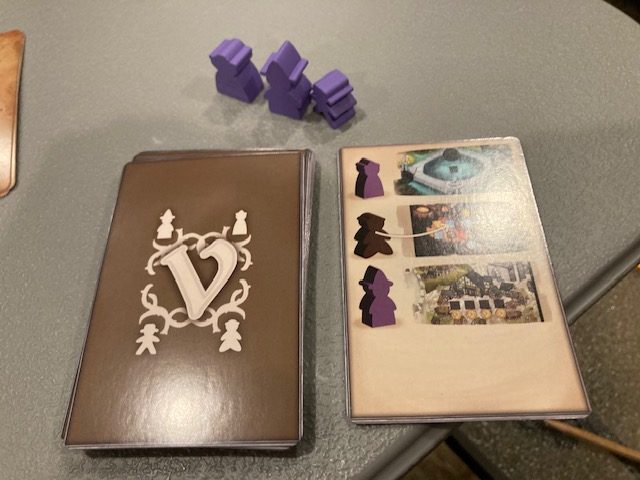
At it’s core the solo mode is basically the 2-Player mode, with a solo deck of cards controlling the second (opposing) player.  See above: the solo card tells you where to place the “opposing” players worker pawns. It’s basically an automata placing pawns to simulate “blocking” you.

IMG_5257

The solo mode did work: I was able to play a learning game to get most of the concepts in the game so I could teach my friends.

IMG_5259

I had three major problems with the solo mode.

IMG_5235

One, it’s not quite the same as the competitive mode.  What do I mean by that?  For my purposes, I learn the solo game to play that game with my friends. The more”different” the solo mode is from the base game, the less useful it is for me.  The solo mode, although it introduced a lot of ideas of Valroc, was different enough in rules to be frustrating.  A bunch of rules had to change to play solo, so it was harder to switch gears that to the base game.

IMG_5286

Two, the solo mode was exhausting: see above as it takes over the table!!  The solo player has to do everything, including playing the second opposing player! And the rules for the second opposing player are different than your rules.  So, I frequently had to stop and discern “What does it mean when the opposing player goes there versus when I go there?” I found the solo mode to be a lot of upkeep work, as I placed my workers, the opposing players workers, all the while trying to lookup rules differences.

IMG_5238

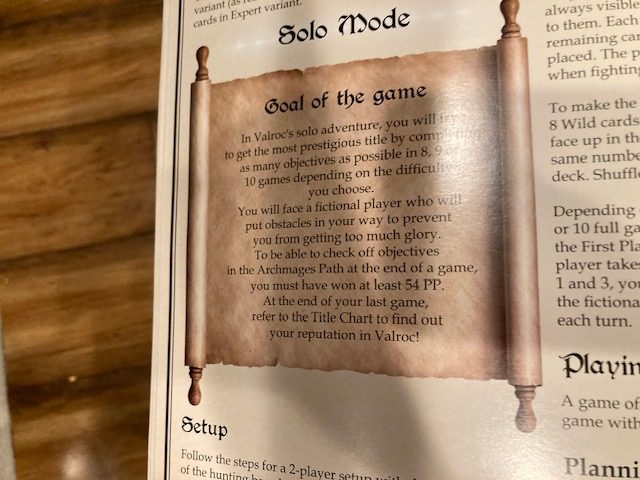
Third, the solo mode “win” condition is not very satisfying … it is not a win condition but a CAMPAIGN win condition?   You have to play 8 to 10 FULL GAMES and try to get as many checks on the Archmages path (the chart on the back of the rulebook: see above).  At first, I thought that was a misprint!  Surely, they can’t mean you need to play 8 to 10 FULL GAMES to “win”?  In other words, you can’t just play a single solo game for fun to see if you win … a win is described ONLY as a result of a 8 to 10 game campaign!!!  If there was a more meaningful “single solo play” win condition, I might like the solo game more, but I don’t want to feel like I am tethered to a 8 to 10 FULL GAME CAMPAIGN to enjoy this!   

I liked the solo mode well enough, and it taught me most of the game basics, but as an entry point into the Valroc universe, it could have been significantly better.

Competitive Mode

IMG_5322

At its core, I think Valroc is best as a competitive Worker Placement game.  The rulebook puts the Victory point/Worker Placement game first … because I suspect that’s how it was developed.

IMG_5319

The core drafting phase is kind of fun: this sort of reminds of many competitive games like Res Arcana or Seasons where players draft at the start of the game to get the initial game going.

IMG_5318

The competitive game isn’t too cut-throat: it tends to be more multi-player solo, where each player does his own thing (unless we get in each others way).  There were a few take-that cards and mechanisms in the game (mostly in the Dark Magic area, and the University area with the Lessons cards), but they only came out occasionally.  I would probably consider taking the take-that cards out of the game: none of my groups particularly like that aspect.

IMG_5255

The funnest part of this game is trying to balance all your resources (Vals, Fire/Earth/Water/Air, Magic Points, Creatures) to maximize your victory points at the end of the game. How do you place your workers to get the best results for yourself while steering your opponent(s) away? 

IMG_5326

I feel like this game is best for people who like Seven Wonders and Lords of Waterdeep: the drafting is fun to set-up the game, and the worker placement is fairly straight-forward like Lords of Waterdeep.

Sam texted me after we played through the competitive game: He said something like:

Valroc reminds me a lot of Res Arcana.  The drafting in the beginning, the resources, and such make me feel that people who like Res Arcana might like this game”.

The Legends of Aquiny Unboxing

IMG_5273

The cooperative mode was the reason I picked up this Kickstarter. It’s a full box with a “whole new game mode” for playing Valroc cooperatively!

IMG_5275

This is obviously a campaign cooperative mode.  Look at all those cool envelopes!  My group and I were excited for this … we were looking forward to opening the envelopes!  What do we get??

IMG_5277

The Adventure book (above) outlines the campaign and the rulebook (below) describes the changes.

IMG_5279

Basically, this is a campaign over 10 Chapters … see above.

IMG_5282

We look forward to these envelopes!

Cooperative Play

IMG_5291

We were all excited for the cooperative play!  The cooperative play appeared to be a real full expansion!   Remember when we got a cooperative expansion for Thunderstone Quest!? It was its own thing!

IMG_5298

Unfortunately, the cooperative game didn’t go well.  My friends did not enjoy this at all.

IMG_5280

First of all, my friends hated the Limited Communication.  You can only communicate in the Communications phases (see rules above).  You could be standing next to each other in the Arena or any place on the board, but you still can’t talk!   I might take a creature from the river that my friend wanted and he couldn’t say anything!

IMG_5293

There’s the notion of a Communication token (which you can use ONCE per game), but even that didn’t feel like enough communication.

IMG_5297

It just felt like we took our turns in silence as we played.  We even “narrated” our turns just to break the silence.  

IMG_5282

We also didn’t like how slow the upgrade path was.  Remember those cool envelopes?  Finishing a chapter in the campaign made it so we could open an envelope! COOL!  … but only one player could upgrade??? And you were told which character!!!   So, the next chapter would have one character being stronger … and no one else would be …  It wasn’t fun for the rest of the players.  I looked at a few more envelopes … it was more of the the same.  We all said the same thing: Lame.  We ALL want to upgraded every adventure!!

IMG_5295

The cooperative rules were okay.  They worked.  

Me and my friends didn’t like the cooperative rules.  The cooperative rules felt grafted on: they didn’t seem to enough of the fundamental change needed to make Valroc feel cooperative. 

Communications Limitations

IMG_3734

Recall that we just ended up “ignoring” a lot of the communication limitations in Hacktivity  weeks ago … because it didn’t seem like a big deal.  Hacktivity is a lighter game, and having real communication made the game more fun!!   Here in Legends of Aquiny … it felt like breaking this limitation would break the game.  I don’t know, we did NOT like this limitation.  Our turns were couched in silence.

IMG_5290

A lot of time, Communications Limitations feel like a “crutch” designers use:

“You can make a game cooperative by just adding Communications Limitations!!  Just play the game cooperatively but you can’t talk!” 

The typical justification is that, by limiting communications in cooperative games:

 1. You can get rid of the Alpha Player: the Alpha Player can’t tell you what to do if he can’t talk!

2. You can avoid analysis paralysis: If you can’t talk, you can’t talk with each other to over-analyze

3. You can shorten the game: the game is quicker if you can’t talk!

Here’s the thing: I want to talk to my friends!  If it means I am enjoying the game by discussing things with my friends, I am okay with that.  If my friends want to find a better and optimal path, sure, let’s over-analyze  a little!  At least I am engaged and talking with my friends as opposed to sitting in silence as we play!

IMG_5292

One of my friends (I forget who) made this brilliant observation:

Limited Communication may actually cause analysis paralysis as you try to guess and figure what each other player might do! If they can tell you what they can do, that gets rid of the extra analysis!”

I think they are onto something: Limited Communication can cause the same Analysis Paralysis they are trying to get rid of!

In the end, my friends and I prefer cooperative games without Limited Communication.  Limited Communication is just less fun.

Conclusion

IMG_5213

Valroc seems best as a competitive worker placement game for 2-4 players: it feels as that as how it was first designed and how it plays best.  If you like Res Arcana, Seven Wonders, or Lords of Waterdeep, this might be a good game for you. This is probably a 6.5/10 or 7/10.

IMG_5286

The solo mode is okay and works, but there’s too much upkeep per turn, the win condition is not satisfying (it requires a 8 to 10 game campaign), and the rules seem less well-described in the rulebook.  The solo mode is probably a 5.5/10.  With a few tweaks (give me better descriptions in the rulebook and a more satisfying single game win), this could get a better score: I would welcome a second edition for the solo mode.  The rulebook does teach most of the principles of the game if you want to try it solo.

IMG_5273

If you, like me, you picked up Valroc (and the expansion) for the cooperative game, I think you will be deeply unsatisfied.  Legends of Aquiny feels very much like a grafted-on cooperative mode: the limited communication feels stifling and the upgrade path in the envelopes is too slow.  I can’t recommend the cooperative game.  It worked as a game, but it wasn’t fun.  My group would probably give it a 4/10 overall: they did not have fun and they did not want to continue playing.  

IMG_5299

Valroc seems best as the base game: a competitive worker placement game.

Endeavor Deep Sea: A Review of the Solo and Cooperative Modes

IMG_7441

Endeavor Deep Sea is a worker placement game from Kickstarter: it was originally up for funding back in May 2023 and promised delivery in May 2024.

IMG_7437

My Kickstarter copy arrived October 1st, 2024 (see above) making it about 5 months late.  Meh, that’s not too late in the grand scheme of Kickstarters.

IMG_7442

I backed this because it is a worker placement game promising both solo and cooperative modes!  That’s right!  Cooperative worker placement games are a rare creature, so I was excited to see what this would bring! (How many can you think of?  Exactly!)

IMG_7444

Let’s take a look below!

Unboxing and Gameplay

IMG_7438

So, my version is the deluxe version (see above: I had to pay extra for that).  Anything you see here will be from the deluxe version: mostly, the deluxe version has nicer components and adds a 5th player.

IMG_7445

This is a pretty big mamba-jamba!  Look how the Coke can is dwarfed by the box!

IMG_7484

There is a LOT of stuff in this box!  See above!  The easiest way to take a look at it is to talk about gameplay and show the pieces as we do, so you can see how everything (so much stuff!) interacts!

IMG_7465

There’s 5 “teams” in the game: each player chooses one of them to operate.  (They are all the same except for the color: there’s no special powers or anything).  Each team has a whole bunch of tokens in their little trays.

IMG_7496

The circular tokens are the worker player disks: these go out to “do actions”.  The hexagonal tokens are special tokens that go on the Impact Board (we’ll discuss more below).  Each team also has a Specialist called the Team Leader … they are a Jack-Of-All-Trades: they can do any of the actions in the game!

IMG_7572

As the game progresses, you acquire more and more Specialists: see above.  Basically, you place a circular “worker placement” token (see above) on a Specialist to activate their ability!  Notice that each of the Specialists can only do certain things!  The Skipper can only MOVE!  The Underwater Photographer can either DIVE or JOURNAL!    So, your choice of Specialists is important, as it shapes what you can do!

IMG_7562

The Specialists come from a special tray (no pun intended).  It’s nice, because at the start of every turn, each player gets a Specialist, no matter what!  So, as the game progresses, players get more and more Specialists to activate with the “worker placement” tokens.

IMG_7514

There’s some real interesting things going on with worker placement in this game!  For example, the “worker placement” tokens tend to placed out in pairs!  Also, you can only do an operation (like DIVE or JOURNAL) if your sub is on a Deep Sea Zone with that action on that board!

IMG_7580

For example: Let’s say you want to JOURNAL!  See configuration above!
1) Your sub has to be on a zone with a JOURNAL action (it is: the sub is in the upper portion)
2) One of  your Specialists would have to have the JOURNAL action as something they can do (the Team Leader can do anything, so he can JOURNAL!)
3) You place one token on the Specialist AND one token on the JOURNAL action on the board! (We have enough tokens: one to activate the Specialist and one to put in the JOURNAL action on the board)

This is a little different than most worker placement games … it took me a game a few rounds to get the gist: some of your worker placement tokens go onto the board and never come back!   The idea is that your tokens on the sea boards score you victory points/achieve some goal.

IMG_7581

For example, in the cooperative solo game, you might need to get 5 JOURNALS on the board!  See GOAL 2 above!  So, that’s why one of your worker placement tokens stays on the board: to denote progress for those Goals!

IMG_7516

Now, lest you think you run out of these tokens quickly, never fear!!! These worker placement tokens are both created (from your supply) and reclaimed  (from your Specialists) every turn!  But it’s your player board determines the rate you get more tokens!

IMG_7517

Each player gets a board like above (all boards are the same except for color; there are no special abilities).  The 5 tracks above help determined the rate of many things!! The higher the track the better!

  1. Orange Bubble: How good a Specialist can you recruit? (Reputation track)
  2. Green Light Bulb: How many worker placement tokens do you create this round? (Inspiration Track)
  3. Yellow Arrow: How many worker placement tokens can you reclaim for specialists this round? (Coordination Track)
  4. Blue Puzzle Piece: How fast can your sub move/How many Subs do you have? (Ingenuity Track)
  5. Black DNA: Research Track … How much Research do you have so you can JOURNAL?

At the start of every turn, you will gain a Specialist, create some worker placement tokens, and reclaim some of them from your Specialists.  

IMG_7511

Once you have all tokens for this round, you put all your tokens in your Staging Area … and you are ready to go for your turn!  Players play an action one at a time, and play until they want to, are out of tokens, or out of Specialists!  Many times, you will find you have more tokens that Specialists that can use them …

IMG_7574

And that is the worker placement part of the game!  Using worker placement, New Zones come out, players explore, players journal, they dive, they conserve, they explore the deep sea! See above for what a completed game might look like, both with new Zones explored, worker placement tokens everywhere, and a bunch of journals!

IMG_7482

There’s significantly more to this game, but it’s got such a different worker placement feel, I wanted to go over that part a little!  I really do like the components! 

IMG_7560

When the seascape is all explored, it looks really cool! 

IMG_7499

Everything is very readable and the trays make it so easy to jump into a game!

Rulebook

IMG_7448

The rulebook has good points and bad points: generally, it’s pretty good.

IMG_7455

It’s does well enough on The Chair Test: it opens up without drooping too much, it stays open, the fonts are big enough, and there are plenty of pictures. It’s about a solid B+ on The Chair Test.

IMG_7448

The front page jumps right into the overall game: it does a nice job “introducing” you to concepts that will permeate the game!  I also like how it mentions there are several ways to play the game! (Play Against your friends, or With them, or without them!)

IMG_7449

The Components pages are pretty great: they show all the components and show the fronts and backs of cards and Specialists.  This is well done.  See above.

IMG_7450

The Set-Up is good.  See above: It shows pictures of everything and has easy-to-read annotations.  I had no trouble getting set-up!

IMG_7452

Generally, this rulebook is very concise.  This is both boon and bane: it keeps the rulebook shorter (which makes it easier to peruse and get through) and generally clear, but there are several places where a few sentences would go a long way.    My friend Sam actually knocked a full half-point of of the score because it was too concise in a few rules!

IMG_7456

One such example of this is the cooperative rules (the last page), where it’s not clear that little blue bubble is considered an optional one of the 7 goals you can achieve!  It clearly looks you must achieve it as well as the other goals … but the more you stare at the components, the rules, and the game, you have to conclude that it has to be optional, or the game is too hard.  A sentence saying “The Impact Mission Goal is one of the optional 7 goals” would have done wonders for my first few solo games.

IMG_7454

This is a pretty good rulebook overall, it just needs a few more edge cases defined and few more sentences for clarification.  Honestly, I really like this game, but this is one of my major complaints.  Concision and precision are worthwhile goals, but not at the cost of clarity.

There is also no index.  Or Table of Contents. You pretty much have to go searching linearly for rules when you need to find them.   This is a big enough game that I think a Glossary or Index would have helped a lot.  

IMG_7452

This is a generally pretty good rulebook, so I don’t want you to think I didn’t like it…. I did like it!!  It has lots of good examples, lots of good pictures, and it teaches the game pretty well.  But the lack of index and lack of some extra clarity were frustrating.   It was pretty good, but it could have easily been a great rulebook.

Solo Play

IMG_7443

Endeavor Deep Sea does support solo play!  Congratulations for following Saunders’ Law!

IMG_7458

All of the solo rules (and cooperative rules) are found on the last page of the rulebook. The rules SAY  there’s only one real change between Solo and Co-operative rules: The Solo player plays 7 rounds instead of 6 rounds… that’s it!!  That’s great!  … well, that’s what the rules SAY … but the solo and cooperative rules really do change the game more!  Instead of victory points, players are trying collectively complete some goals, (and must choose from 7 goals to complete).  The basic rules stay the same, but the victory conditions are VASTLY different!   The game feels very different in solo/cooperative mode, so I don’t 100% buy “only 1 change”. But generally, that’s true.

IMG_7455

Nominally, this is a competitive worker placement game FIRST (as the competitive rules come first), but there’s not too many changes to make the game solo/cooperative.  

IMG_7581

The competitive game is all about victory points on the goal cards (see above)!  But, the cooperative game (and solo) is all about working together to achieve (collectively) a certain number of Goals … 4-7 Goals, depending on your difficulty.  For example, for GOAL 2 (above) JOURNALing, the 1P needs to do 5+ JOURNALS to “achieve” the goal, but 2P need (collectively) 8+ JOURNALS!

IMG_7577

Each scenario you choose will have 3 unchanging goals (as per the scenario) …

IMG_7507

… and then bonus goals you draw (4 in the solo game) …

IMG_7519

.. and finally the Impact Sheet goal!!  (This was the goal we complained about in the rulebook section, which was unclear that it was one of the OPTIONAL goals!)

IMG_7546

You get to choose which of the Goals you want to try to achieve, but you can change you mind mid-game as the game evolves!

IMG_7576

I have currently played about 4+ solo games!  I played two with the starting Scenario, and a few others to get a sense of what other Scenarios do!  I had to play one full game to “get” the game, but after that, the game flows pretty quickly!

IMG_7466

I like this game!  There are about 10 Scenarios, so there is a lot of variability to extend the life of the game.  And the game plays fairly quickly: with only 7 rounds, you find yourself running out of time quickly!  So, your turns are fairly thinky as you try to take the best advantage of the Specialists you have, how to advance your tracks, when to explore, when to move, when to JOURNAL, when to dive, and what regions to explore! 

IMG_7575

This game has a really neat “explore” feel as you SONAR to find new regions of the sea to explore!  But, even cooler, you get to choose which of 2 regions to bring forth!  And each region has different bonuses when discovered! And different special abilities!  And different new Locations!  Remember, Locations get “filled” as you play, so you absolutely have the explore to open up new regions and new Worker Placement Locations!!!  So, you have to balance “Well, I like the bonus I get if I discover this region, but we need these spaces to win!  Which do I choose?”    Every thing you do involves some kind of choice which affects your game!

IMG_7542

I had a really nice time playing this solo.  The plays pretty well once you’ve played it solo.  And you can absolutely teach your friends the game quickly once you know it.

I would absolutely play this again solo.

Two Players

IMG_7554

Sam and I had a good time playing 2-Player.  Because of my solo experiences, I was able to teach the game quickly, and we jumped right in!

IMG_7558

There was a good balance of cooperation and solo agency in the game: every one did what they wanted on their turn, but there was discussion about what Zones to bring out, what Journals to do, what Specialists to focus on.  I don’t think there would be a lot of Alpha Player problems in this game, as each player still has agency.

Generally, the 2-Player game went … swimmingly (pun intended).

The only real problems were more with the rules: both Sam and I felt like the edge cases and some of the cooperative Goals needed more explanation.  Since this is a competitive game first, the co-op explanations get the lesser explanation.

3-4 Player Games

IMG_0918

The three and four player cooperative games went over quite well.

IMG_0912

The only real problems of the 3 and 4-Player game was the downtime between turns.  In the solo and 2-Player games, the game moves much more quickly as the turns bounce back and forth quickly.  In the 4-Player game especially, sometimes it felt you did have to wait a long time for your turn to come around.  There is some analysis paralysis in this game, as you try to find the right Specialists, right actions, and so on, so they gets multiplied out.   This isn’t as bad as you might think because the game is still cooperative—while your friends are thinking, you can be talking about strategies with others, plans on your turn, and generally communicate.   Luckily, there are no communication limitations in this game!  So, even when someone might be taking a longer turn, players can still talk!  

IMG_0914

Another possible negative was that the game was pretty multiplayer solitaire.  Sure, players could talk freely, but none of the actions of the game “really” help others … (some of the Journals help all the other players, but those are few and far-between); mostly, each player is trying to do the best they can on their turn, while trying to keep the cooperative goals in mind. I am not sure that’s too big of a negative, because the multi-player solitaire keeps everyone involved on their own turn.    Even when someone is taking a longer turn, there are still cooperativ things the other players can talk about.

IMG_0917

Generally, the balance of the multiplayer solitaire and the longer turns seemed to balance out: players were either thinking about their own turns or talking to each other about the cooperative goals.   There did seem to be less cooperation and more multiplayer solitaire in the 3 and 4-Player game than the 2-Player game.  Nevertheless, it still seemed to work fine.  Everyone had a good time.

What I Liked

IMG_7574

Exploration: I liked exploring the seas!  It’s a real interesting phenomena in a worker placement game that you have to explore to bring out more location because you keep using them up!  The exploration worked really well because you got to CHOOSE which of 2 tiles comes out!  That choice kept me more involved and interested in the game.

IMG_7548

Components: The components are generally very high quality and easy-to-read.  I liked that the tokens were in a token box … it was so easy to set-up!  I don’t think this game will win best components of the year or anything like that, but I liked what I saw and everything was easy to read. 

IMG_0919

Seas: I did like the look of the seas once you had explored a lot.

IMG_7580

Worker Placement Mechanism: The fact that the worker placement is so different in this game really elevated the play (you have to be in a Location with an open spot, and you have to have a Specialist that can do that action, and tokens are typically placed in pairs).  But it also felt very thematic to the game, with the Specialists!!! Also the fact that worker placement worked so well in a solo, and more impressively, in a cooperative game really made this stand out.

IMG_7484

Variability: There’s quite a bit of gameplay to be had between the variability of the Scenarios, the Zones, the expansions (which were included with our copy), the many Goals, and all the little touches in the game!    That really extends the life of the game.

Continue reading “Endeavor Deep Sea: A Review of the Solo and Cooperative Modes”

A Review of Weirdwood Manor: Putting a Weird Manner into a Cooperative Game!

IMG_5422

Weirdwood Manor was #7 on our Anticipated Cooperative Games of 2024!  This is a bit of a weird entry into the cooperative games space: it’s a cooperative boss-battler worker placement euro game with elements of Pandemic! Whew!

IMG_5424

I backed Weirdwood Manor when it was on Kickstarter in April 2023, and it promised delivery in April 2024.  My copy of the game arrived in June 2024, so it’s about 2 months late … which is actually quite good in Kickstarter terms.

IMG_5426

This is a cooperative game for 1-5 Players, Ages 13+.  I think the 90-120 minutes (as reported by the box above) is too short: It’s been more like 2 hours + 20 minutes per player in my plays.  All of my 4-Player games have been 3.5 hours or more!

Let’s take a look!

Unboxing

IMG_5429

This is a pretty big boy, but it still seems about standard box sizes: see above with Can of Coke for reference.

IMG_5483

IMG_5484

This is gorgeous production! See above!

Rulebook

IMG_5430

The rulebook is pretty good overall, but has two major flaws.

IMG_5431

First problem: Weirdwood Manor makes the fatal mistake of making the rulebook the same width and height as the box!  It’s a giant square!  It gets like a C+ on The Chair Test, as I can’t really lay it on the chair next to me! It flops over the edges and is harder to read.

IMG_5447

The second major problem: there is no index.  In many games, that’s not a huge deal, but Weirdwood Manor  is a very complicated game with many, many, many, many rules: it is in dire need of an Index!  

Other than those two flaws, this rulebook is pretty good.  

IMG_5451

The Components page is great, even differentiating between the deluxe and retail versions!

IMG_5432

The Set-Up was mostly really good.

IMG_5435

In general, this rulebook is pretty good: it’s just long!  This is a very very very very complicated game with lots of moving parts (both literally and figuratively)!  The rulebook does a pretty job of explaining most of the pieces and showing nice pictures/examples!  See above!

IMG_5449

I always feel like the rulebook is doing something right if the back cover contains a summary of rules/flow/icons, which Weirdwood Manor does. See above.

This rulebook is pretty good, besides the square form factor and lack of index.  It taught the game pretty well.   Just be aware: it’s a long rulebook because it’s a pretty complicated game.

Good Guys and Bad Guys

IMG_5453

Each player takes the role of one of 6 characters (see above) in the game: these characters are all magically oriented.  These are the good guys!  They have magic powers and spells! Note how nice those dual-layer boards are! 

IMG_5465

Each player takes the corresponding standee: I have the deluxe version which has the acrylic standees (they are just cardboard standees in the normal version of the game). See above.

IMG_5480

Each player gets their own very specific deck of cards.  Every turn, each player must play exactly one of their cards to “do something”! See the decks above!

IMG_5455

As a cooperative boss-battler game, players choose one of three bosses (see above) to fight.  Each one is very different!

IMG_5489

As a cooperative boss battler, there will be a lot of dice rolled when attacks and defenses happen! See above!

IMG_5467

The monsters (and Lady Weirdwood, off to the left above) are also acrylic standees!

IMG_5493

The good guys characters and the bad guy monsters are all very different!  The good guys each have a different deck of cards with different emphases!  See some above!

IMG_5454

Each character also has a different experience track! When you “do stuff” in the game, you get experience which you can immediately spend to upgrade your character!  With experience points, you choose which track to advance, and each character has different annotations (see above) on their three experience tracks!

Other things make the characters asymmetric:

  • when the character rolls a STAR, a special ability (for that character) only activates
  • each players has different start resources
  • each character has VERY different spells they can activate
  • each character has a different progression to get dice

In general, these characters are VERY different and will play very differently!

The Manor: Worker Placement Rooms!

IMG_5456

The core play of the game is in the Manor (mansion) above.  It’s a bit of chore to build!

IMG_5473

You place tiles in concentric rings: the outer ring (above)…

IMG_5472

The middle ring … (see above) …

IMG_5471

And the inner ring!  See above!

IMG_5497

Players place their standees on the entrance to begin: see above.  

IMG_5495

This game almost has a worker placement feel as well: when you end your turn in a room (see above), you activate the special ability of the room.   See above for two rooms!  The top one will allow you to get resources and the bottom one will allow you to rewind time!  Each room has a very different ability to activate in the game!

IMG_0516

When the Manor is all built (see above), it has a very daunting table presence! See above!

Resources

IMG_5513

There are a number of different resources in the game you get (usually from activating a room): Power (pink), Scarabs (yellow), flame (blue), or books (green).  See above!  These resources are spent for many different things in the game: activating spells, buying dice, buying Companions, and many more things!  

IMG_5512

The small twist here is that the Scarabs, even though they are resources you need (yellow, see above) are also the “Bad News” tokens and they spread “kind of like” the disease cubes of Pandemic!

IMG_5510

Scarabs in a room make it so you CANNOT activate the special ability there! You would have to go into the room and specifically fight them to get rid of them … and if you kill all the Scarabs on your room, you may still activate that room at the end of your turn.

IMG_5568

Scarabs advance from the inner rings to the outer rings when “The Scarab Phase” happens. It reminds me of Pandemic for two reasons: 1) the Scarabs will “blight” a room if there are ever two or more in them (not unlike losing a city in Pandemic Legacy). This blight causes you to lose the room as a worker placement spot! (Don’t despair, you can always repair a blighted room) 2) The progression as Scarabs are always coming out and spreading … just like the disease cubes in Pandemic are always coming out and spreading!

IMG_5488

Generally, flames and books are easy to get from rooms, Scarabs have to be obtained from fighting, but power is harder to get!

IMG_5622

There are limited rooms with power tokens, but most power tokens comes from advancing the Power track on your character (the pink track above).

IMG_5518

There’s a reason we call this a cooperative boss-battler worker placement euro (with elements of Pandemic)!  The worker placement and resource management aspects feel very euro.

Time

IMG_5457

Many cooperative games have some flavor of timer on it: you must win in so many turns, you must win before the Bad News deck runs out, and so on.  Time is handled very interestingly in this game!  In between the concentric circles of the rooms are two rotating rings that tell time!  The first ring (above) is like the hour clock: as you play, time advances from sunrise to morning, to afternoon, to night, and back around!  See above!

IMG_5460

The outer ring is like a day clock: it has numbers from 1-12 on it (see above)!  Every time the inner ring advances from night to sunrise, the outer ring spins!  If the outer ring ever moves from 12  to 1, players lose!  They have run out of time!

IMG_5611

How does time advance?  In two ways!  First, the Monster “bad news” card moves the inner hour circle; see above as the monster card will cause hour time to advance 4 spaces!

IMG_5581

The second way is that a player’s card is to be placed in one of the 4 positions above his character sheet: see above.   Each position is labelled with a time of day: The Lore Master Meditation card (above, far right) has been played above the Night symbol, which means the player MUST SPIN the inner circle to the next night phase symbol!  Every turn, the player MUST play a card to one of the spaces above.  Part of the choices are trying to advance time as little as possible.

This time advancement mechanism must be balanced against matching symbols on the top of the card: see above as Prepare Defenses shield matches the Touch the Fae card!  (Wild)  If these symbols match, the player gets that symbol’s effect (a shield gives one more defense in combat).  Sometimes you may choose to waste more time to get a better symbol match!

This is just one of the many choices players make when playing a card: Which card?  How does time advance?  How do symbols match?

Doors and Connectivity

IMG_5616

These spinning concentric circles of time also controls the connectivity between rooms! See above as the characters in the room with the Chaos Ogre can’t get out to the middle rings! There’s NO DOOR between the middle ring and outer ring! When the day counter spins, the doors will spin and an exit will emerge!

IMG_5576

These “moving” doors take a few turns for players to get: “Wait, playing my card will move the rings before I move my character?”  Most of the time, we would “pretend” to advance the ring to see what connections would open up and then if the connections looked right, … then we would commit.  I do admit, this is very daunting the first few times until you get a handle on it.

Spells

IMG_5573

Each player has three spells on their character board: see above (Upper right of the board). These spells vary tremendously between characters!  Some characters are more help-focused, some are more defense-focused, some are more combat-focused  Each character’s spells are very different. 

IMG_5514

The spells are activated by spending resources … with Power usually being one component.  See above! This is why Power is such an important resource in the game component!  The spells are incredibly powerful, many times making the difference between a winning and losing combat!

Companions

IMG_5579

Players can also recruit Companions to help them!  Companions cost resources (of course), but give two main abilities!  First, they usually give a nice little power you can use once (before you recharge).

IMG_5622

Possibly more important, the Companions give another position to play cards, so you reset time less often! (Every reset causes a Scarab phase!) See above as Oliver has two companions, so he can play two cards without resetting!

Solo Game: True Solo With One Character

IMG_5444

The game has rules for a solo variant (congratulations on following Saunders’ Law)! Basically, you can play as many characters as you want!  The game recommends playing two characters, to get some synergies between characters going!

IMG_5504

You might notice, I spent quite a bit of time describing the components and mechanisms of this game!  I don’t know about you, but playing two characters seemed a little much for my first solo game!  I ended up choosing to play my first solo game as a true solo game: one character.  See above.

IMG_5501

The game really  needs no changes to play  solo with one character: the main balancing mechanism of the game is advancing time for each play, so the total number of plays of the characters remains about the same.  Very approximately, a game is “about” 2 * 12 = 24 turns total.  Each character moves up the hour wheel by 1 or 2 spaces per turn, but the monster moves the hour wheel by 2-5 spaces per turn.  On average, it takes about 2 player turns to advance one day, so at 12 days, the games lasts about 24 turns.  So a true solo player will have about 24 turns, a 2-Player game would have each player take 12 turns, and so on.

IMG_5516

The point of all that is — Sure!  You can play this game true solo without any real rule changes!  I always love it when the solo game follows the main rules: it’s usually so much work to apply solo rule exceptions to a game!

IMG_5522

After playing a true solo game, let me say three things:

  1. This is a pretty fun game solo. 
  2. It is a bit long.  I think it took about 2 hours 30 minutes?  
  3. I absolutely would suggest your first game be a true solo game!  This game has SO MANY RULES!  And SO MANY INTERACTIONS!  Your first game will struggle with rules, discrepancies, and just getting the game.  The last thing you want to do is to context switch between two characters!  Remember, every character is very different and plays very differently!  Context Switching between two characters (as we’ll see below) is rough.

The true solo game works, and it works pretty well. 

Solo Play: Alternating Between Two Characters

IMG_5565

So, because the rulebook “suggests” that two character solo is the preferred way to play, I ended up playing a two character game that way by myself.  At this point, I had at least one true solo game under my belt, so I at least felt ready with a decent understanding of the rules.

IMG_5570

You can see above as the game table became even busier!   And I remember this solo mode working, but I felt like I just had to “get through” it. There was so much work context switching between characters that it was overwhelming.  I’ve emphasized this point quite a bit: the characters in this game are very distinct and very complicated to play!  Each character requires a lot of focus to play it well.  

IMG_5575

Maybe this is your favorite game of all time!  Maybe you want to explore all the characters and how they work together!  I remember in Set A Watch (a cooperative dice placement game we reviewed most recently here),  the 4-Character solo seemed daunting!  Over time, I came to love that 4-Character solo mode after I had totally absorbed the game! Maybe the same thing will happen here?

But, I think focusing on a single character is a lot more fun.   The 2-character solo play felt a little like a slog; don’t get me wrong, it worked, but I just felt like I was going through the motions.  But, maybe after I absorbed this game some more, maybe I will come back to the 2 character solo mode? Maybe?

Right now, I can only recommend the true solo game, especially if it’s your first game!

Cooperative Play

IMG_5607

I was able to get two big cooperative games together: both of 4 players.

IMG_0518

These game groups are very different, but two things seemed to remain the same between the groups.

IMG_0515

One: This game is very long: both 4-Player games took more than 3.5 hours.  Some of this time will go away since it’s a learning game, but all my friends are seasoned gamers and jumped right in (with my help: I taught the games knowing the rules pretty well by this point).  It feels like Weirdwood Manor is going to last at least 3 hours no matter what.   See above as we all go away to dinner, leaving the game set-up to finish later!!!

IMG_0514

Two: All the games I have played had the players “multi-player solo” in the beginning of the game, but engendered cooperation more in the later game.    Well, we strictly speaking, didn’t have to cooperate, but we would have lost if we hadn’t!  Many times, we had to figure out cooperatively how to engage the boss, but someone would have correct the topology (remember the rotating rings?), or defeat Scarabs protecting the boss, or any other issues …  someone had to “blaze a path” for the next player!     Or the next player had no chance!

IMG_5620

Early in my first 4-Player game, I had to “clean-up”the Scarabs in the middle of the board (to protect Lady Weirdwood), but it meant I had to “take one for the team” to do this!  It meant I had to lose a lot of resources and be behind the ball for leveling up my character!  But we ABSOLUTELY had to do this, or we would have lost! (If Lady Weirdwood dies, we lose!) So, I took one for the team … enabling my compatriots to continue!

IMG_5615

Generally, the game starts out very “multi-player solo” because everyone is in dire need of resources!  To get anything going in this game, players have to concentrate on themselves … then, as the game gets further along, it’s clear players HAVE to cooperate, or they will lose!

IMG_5609

Some characters had more abilities or spells that enticed cooperation, so the choice of characters also can affect how much cooperation there is!

IMG_0509

What I saw in my game groups was that the Alpha Player was kept at bay because (as we saw in the solo section) there’s just too much to keep track for a single character!  It’s much much harder to Alpha Player when you are busy concentrating on running your own complex character.  The cooperation happened more organically by people asking for help! 

“Hey, can you get rid of those Scarabs? I need to attack the boss!”

“Hey can you make sure time doesn’t advance too far? I need to make sure the boss isn’t angry yet!”  

IMG_0517

In general, there was a decent amount of cooperation, it just happened more in the later game.

Things I Liked

IMG_5565

The production is amazing.  The game pops on the table!

IMG_5611

The Bad News cards (the Monster cards) are labelled on the back with a “hint” of the basic operation of the card!  The Monster Card (see above) tells us that the Monster will “move somehow”!  You flip the card and find the monster moves!  This is a fantastic mechanism!  It allows players to try to play cards with some general knowledge of what the bad guy will do!   I remember seeing a variant of this mechanism in the cooperative game Paleo (see our review here) where the back of the wilderness cards was labelled with a generic icon as to what was coming!  (We think a mechanism like this could have helped my friends like Hacktivity, from a few weeks ago, more).

IMG_5464

I adore the acrylic standees.   These alone made the Deluxe version worth getting!  They are beautiful, well-labelled, and just pop on the table.  They even emphasize the color on the bottom!

IMG_5581

Playing cards into a slot to control the time advancement is really neat and interesting.

IMG_5461

The rotating rings being used for both TIME and TOPOLOGY is very different and interesting!  It took a little getting used, but it was cool.

IMG_5454

The experience point tracks work really well: you get to make choices and advance your character at the same time!  I think this one mechanism engages players more than might have expected: you become attached to your character as you care how he levels up!   And your character just gets better and better as the game goes on, so you feel like you are doing something!

What I Didn’t Like

IMG_0515

Probably the biggest detriment is the length of the game: several of my friends complained how long the game was. There’s that table (above) left set-up while we went to dinner because the game was so long …

IMG_5616

As cool as the rotating rings are, sometimes we struggled to rotate them: this is a physical issue!  We had to readjust the board on the table to avoid the crack in the middle!  Even when it lay flat on another table, sometimes it didn’t advance great?  It usually worked, but it just needs a slight tweak to make it easier to rotate the rings.

IMG_5611

Speaking of the rings, why does time advance COUNTER-CLOCKWISE in the game???? When time advances in the game,  you spin the rings COUNTER-CLOCKWISE!!  In real life, when a clock advances forwards, it’s CLOCKWISE … thus the name CLOCKWISE!  The rulebook even used the terms clockwise and counter-clockwise in descriptions!  It knows the terms!  This seems very counterintuitive to me!!  It really seems like time moving forward should have been CLOCKWISE (like clocks).  I dealt with it, but this little thing really bothered me!!

IMG_5604

Complexity: this is a very complicated game with lots of moving parts and a long rulebook.  It will take a while to absorb this, and some people may bounce off of it hard because of the complexity.

IMG_5563

Even though this game has a lot of euro elements (worker placement, resource acquisition) and a lot of predictable elements, there’s still enough randomness to that it might just frustrate you.  The game is, at its core, a boss-battler with lots of dice! You will be rolling dice and you might roll great and you might roll poorly!   My friend CC got completely screwed early in one game, and had trouble recovering: he got completely smashed by the boss, and spent the rest of the game trying to recover  … meanwhile watching while the rest of us were doing really well!

That element of randomness … might make one of your friends have a bad game.

Reactions

IMG_0513

The reactions to this game from my friends was generally positive, well, except for CC who got trounced.   CC’s reaction was probably the most nuanced:

I think I might have liked Weirdwood Manor more if I had gotten to play to the end. Sounds like my character got to be useful later on, which was a feeling the game had lacked for me in the turns I got to play. I liked the theme of that one and some of the mechanics were fun, but I got pretty frustrated when I kept getting shut down while watching other players advance. Nice table presence, though, and it felt like it was telling a story in a cool environment which I liked.

Kurt: He started at a 7.5, but upped his bid to 8 or 8.5/10. He really liked it!
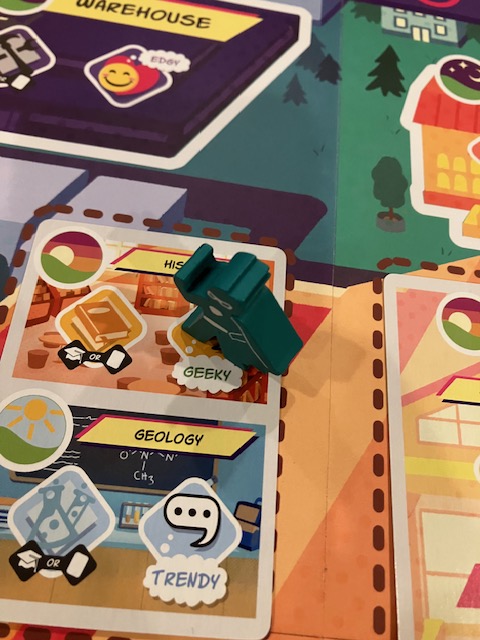
Joe: 7.5/10
Teresa: 7/10
Sara: 6-7/10, but want to play it again for more precision
Andrew: 6 -7/10, but wants to play it again for more precision
Me: Solo (true solo), 7.5/10, Solo (two character) 6.5/10, (Cooperative) 8.5/10

Conclusion

IMG_5559

Weirdwood Manor is a beautiful cooperative game with a beautiful production!  But you have to know what you are getting into!  This is a very long and complicated game with euro worker placement elements.  The game always seems to start “multiplayer-solo”, but evolves into more cooperation as the gameplay advances … if you don’t cooperate in the endgame, you will lose!
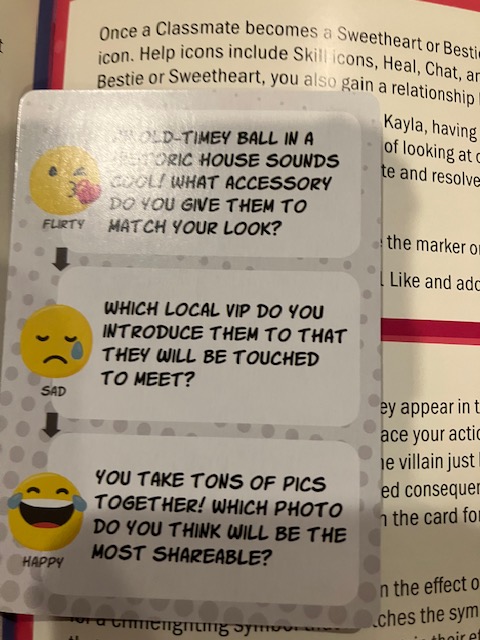
IMG_5605

I could easily see Weirdwood Manor being someone’s favorite game of 2024!  It has so many unique and quirky mechanisms, satisfying advancement, and engaging play!   Just be aware how complicated this game is!  The extra complexity does have the advantage of keeping the Alpha Player at bay!

IMG_5521

I recommend staying with true solo (take control of one character)  to learn the game, and only tackle solo with multiple characters if you want more challenge. 
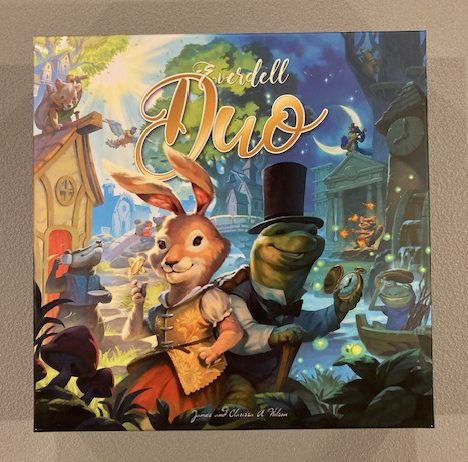
IMG_5607

My groups all like the game, with ratings between 6 and 8.5, with most people giving it at least a 7.

Hopefully this review helps you decide if Weirdwood Manor is for you!