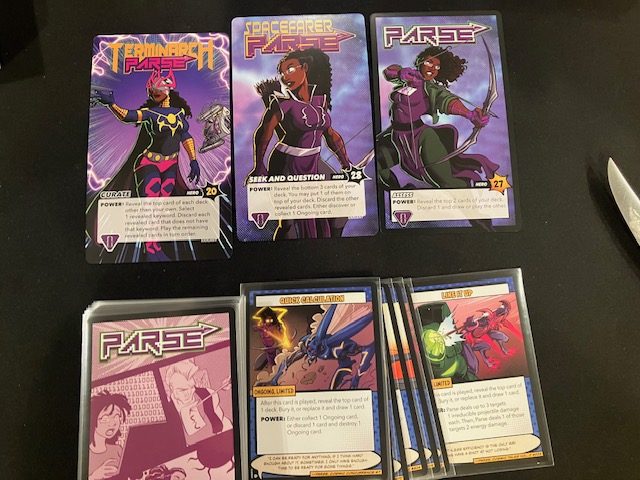
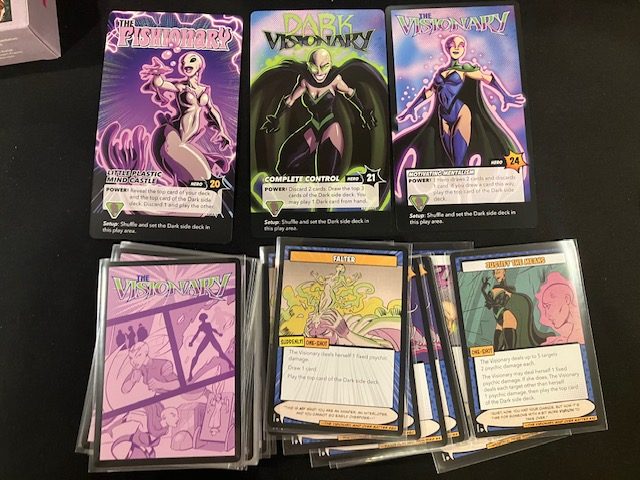
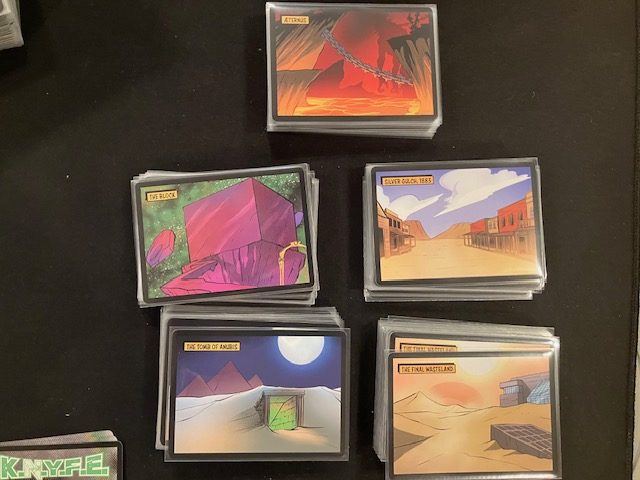
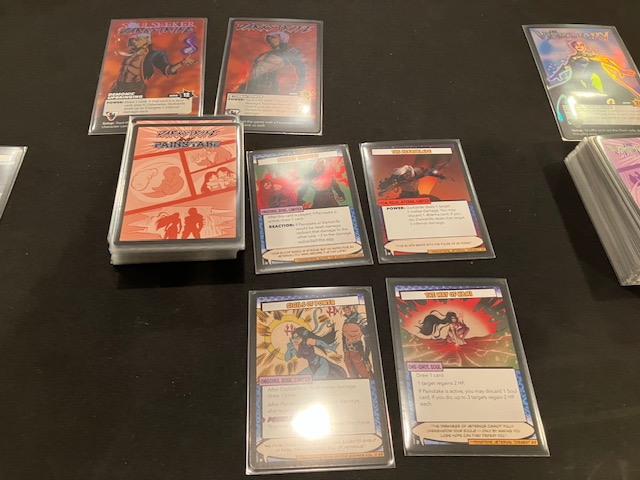
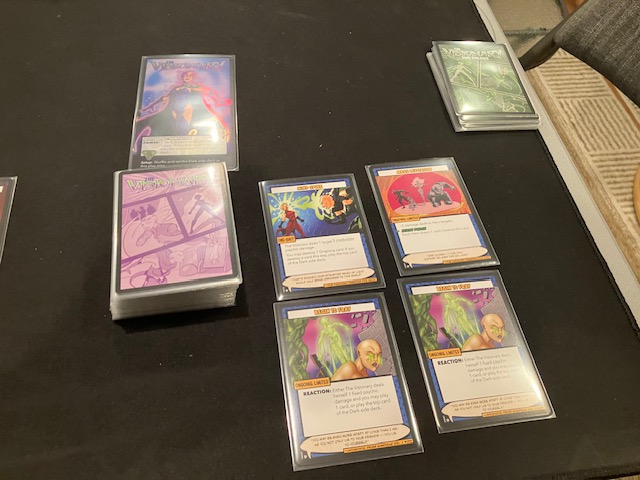
Top 10 Cooperative Things to Pick Up Before Greater Than Games Goes Away Forever

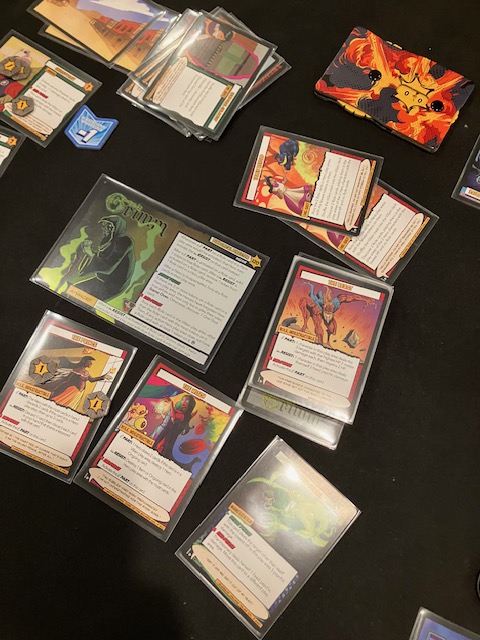
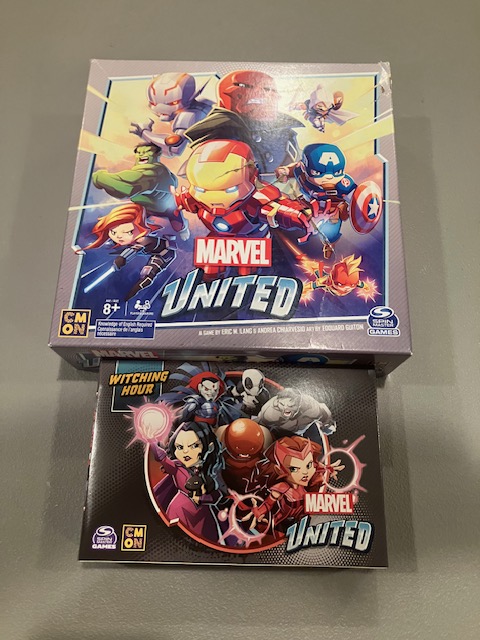
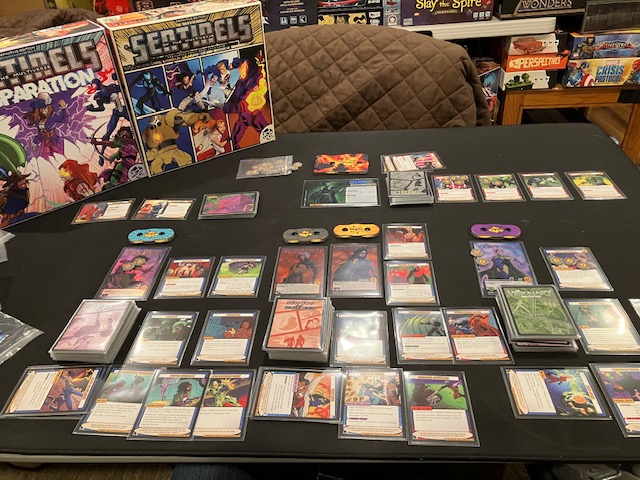
I have been buying a LOT of stuff from Greater Than Games over the past few weeks to get ready for GMing my first game of Sentinels Comics: The Roleplaying Game! I have played the game many times (with my friend CC GMing), but I have never GMed myself! So, I have been catching up on supplies. Unfortunately, because of the unpredictable tariffs, Greater Than Games has “shuttered” themselves to a large degree, laying off almost everyone, and is just liquidating stock. See news announcement here! (This was a while ago, but I am just buying stuff now)

https://www.greaterthangames.com/blogs/news/greater-than-games-team-reduced-in-response-to-tariff-crisis

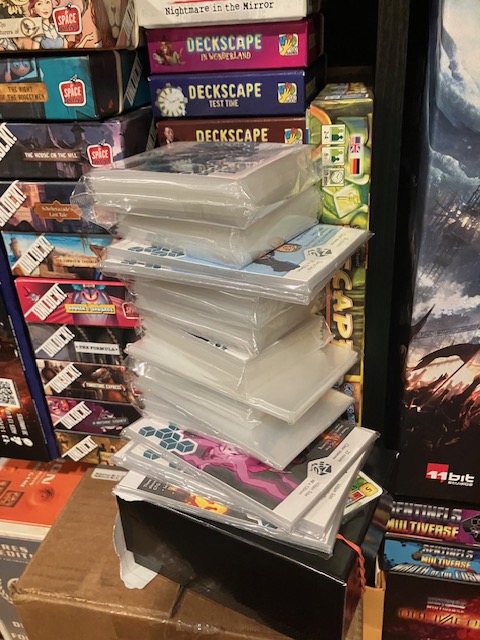
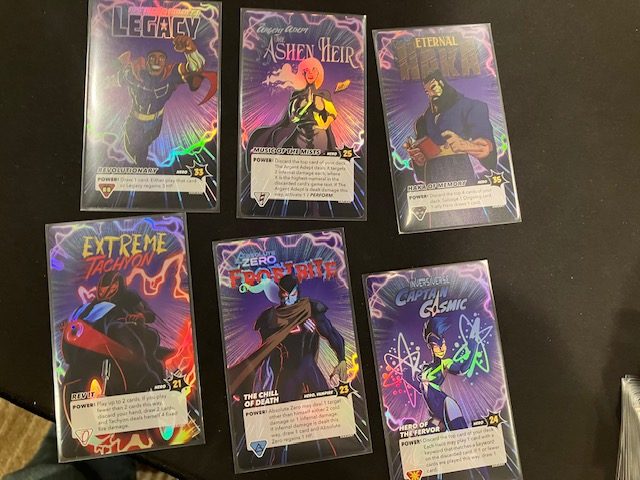
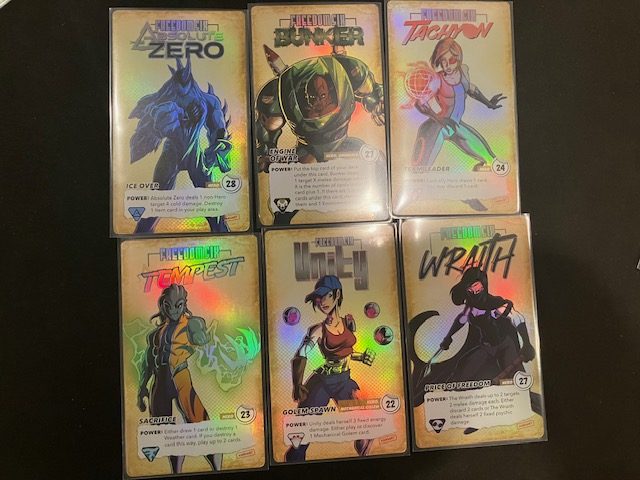
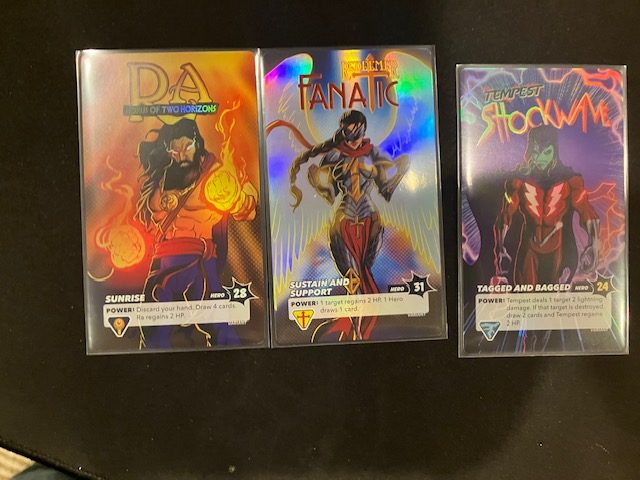
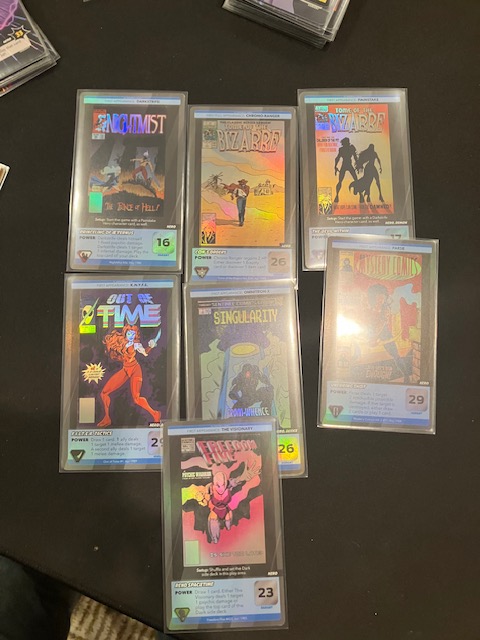
I really do hope they come back from this, but I have been trying to get everything I can in case they disappear forever! Here’s my Top 10 Cooperative Things (games, expansions, other) from Greater Than Games to get before they go away forever!

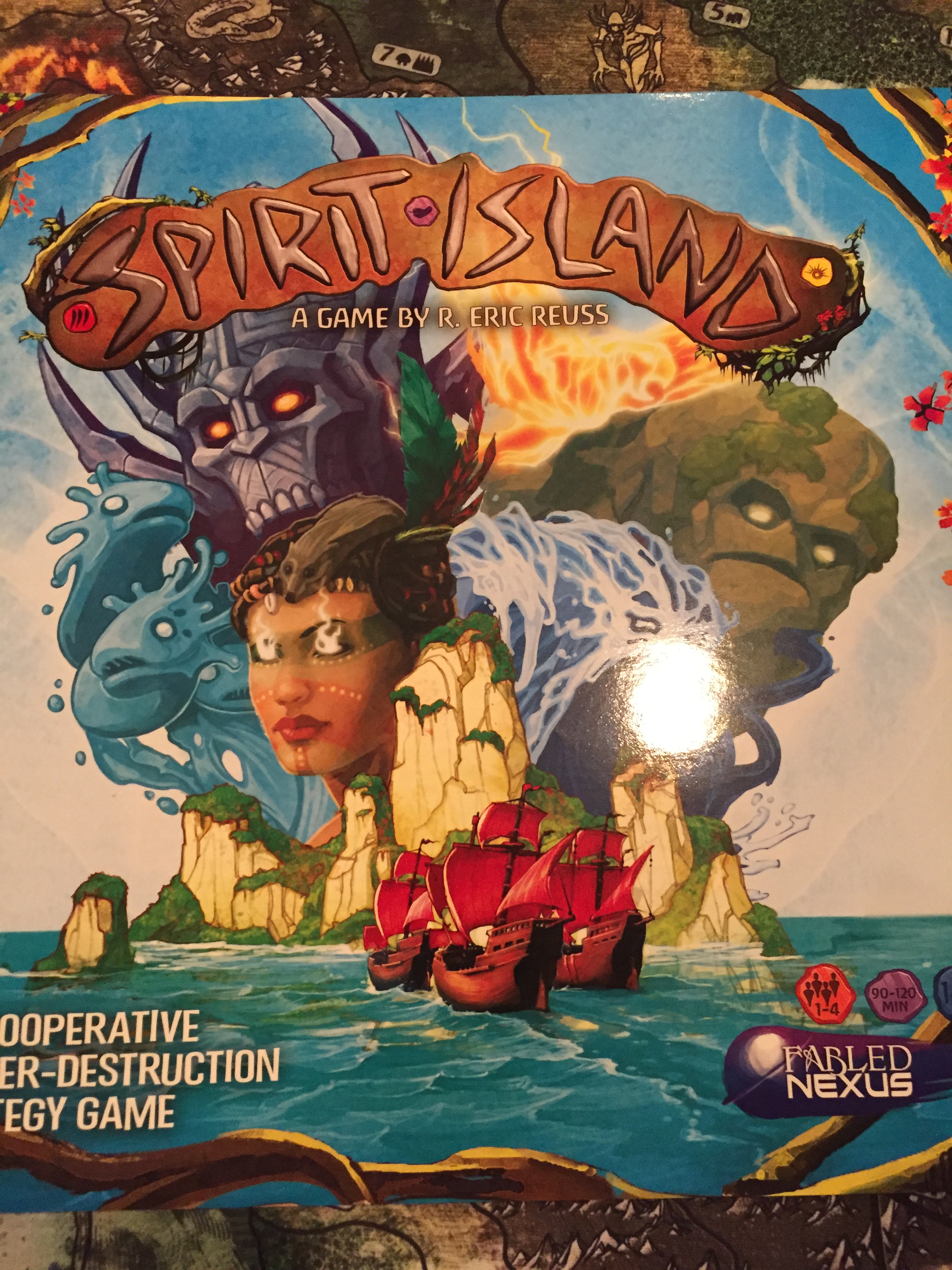
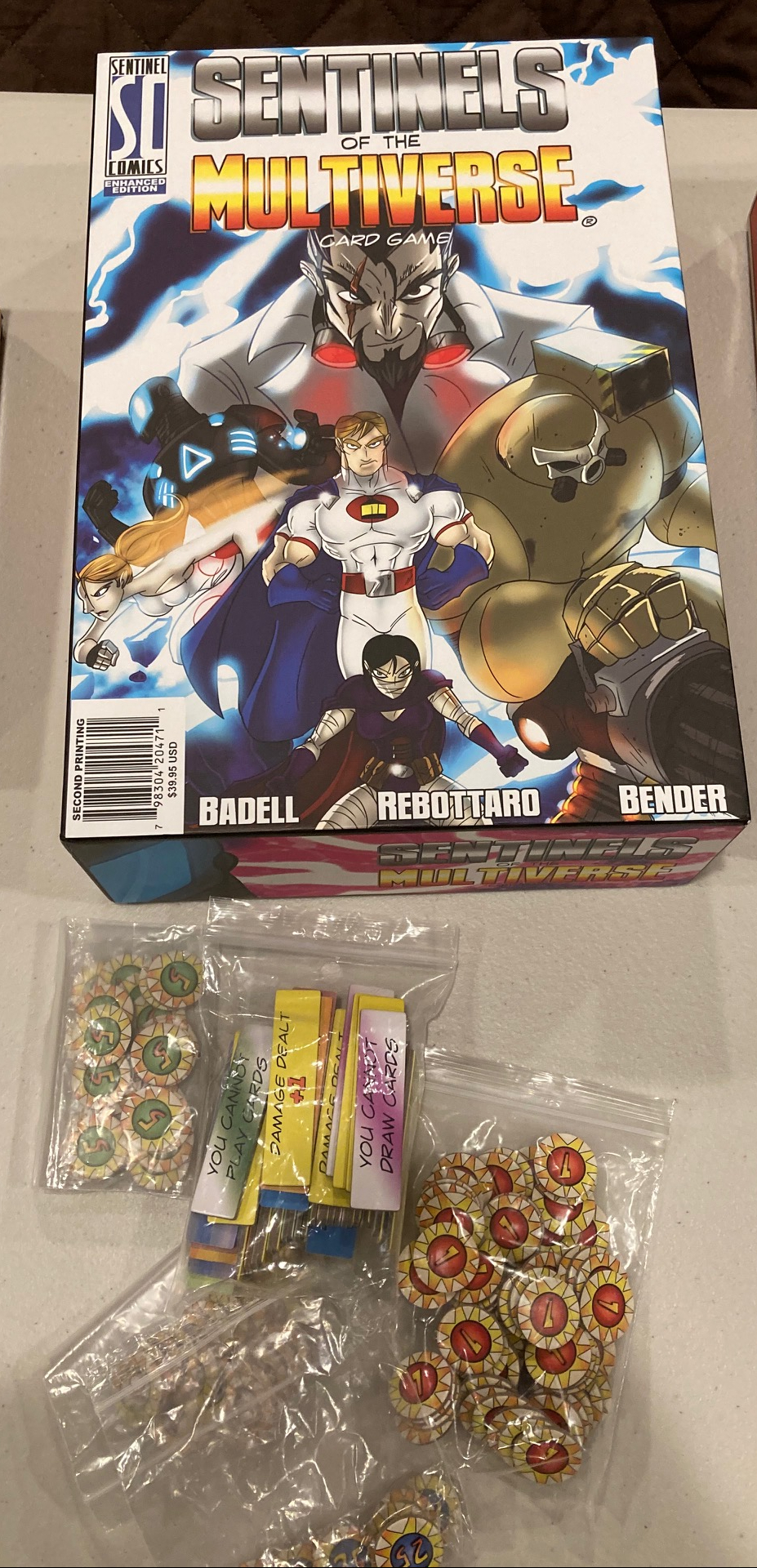
10. Spirit Island

Of all the games in the GTG lineup, I feel like  Spirit Island is the least likely to go away.  Even if Greater Than Games dies completely, I am very confident someone else will pick this up! At the time of this writing, Spirit Island is #11 OVERALL on BoardGameGeek!  I see Spirit Island in Top Solo Games lists all the time (and it made our Top 10 Cooperative Games of 2017 as well!).  I love this game, and if you’ve never tried it, it’s a great game! It’s almost a euro-cooperative game! I put this at #10 not because it’s my lowest rated game,  it’s just that I suspect this game will never go away; it’s too popular.   Someone will pick it up, even if Greater Than Games falters forever.

(And yes, there are a TON of expansions for Spirit Island, they are all fun, but I almost never play them.  I view all the expansions as Honorable Mentions for this list).

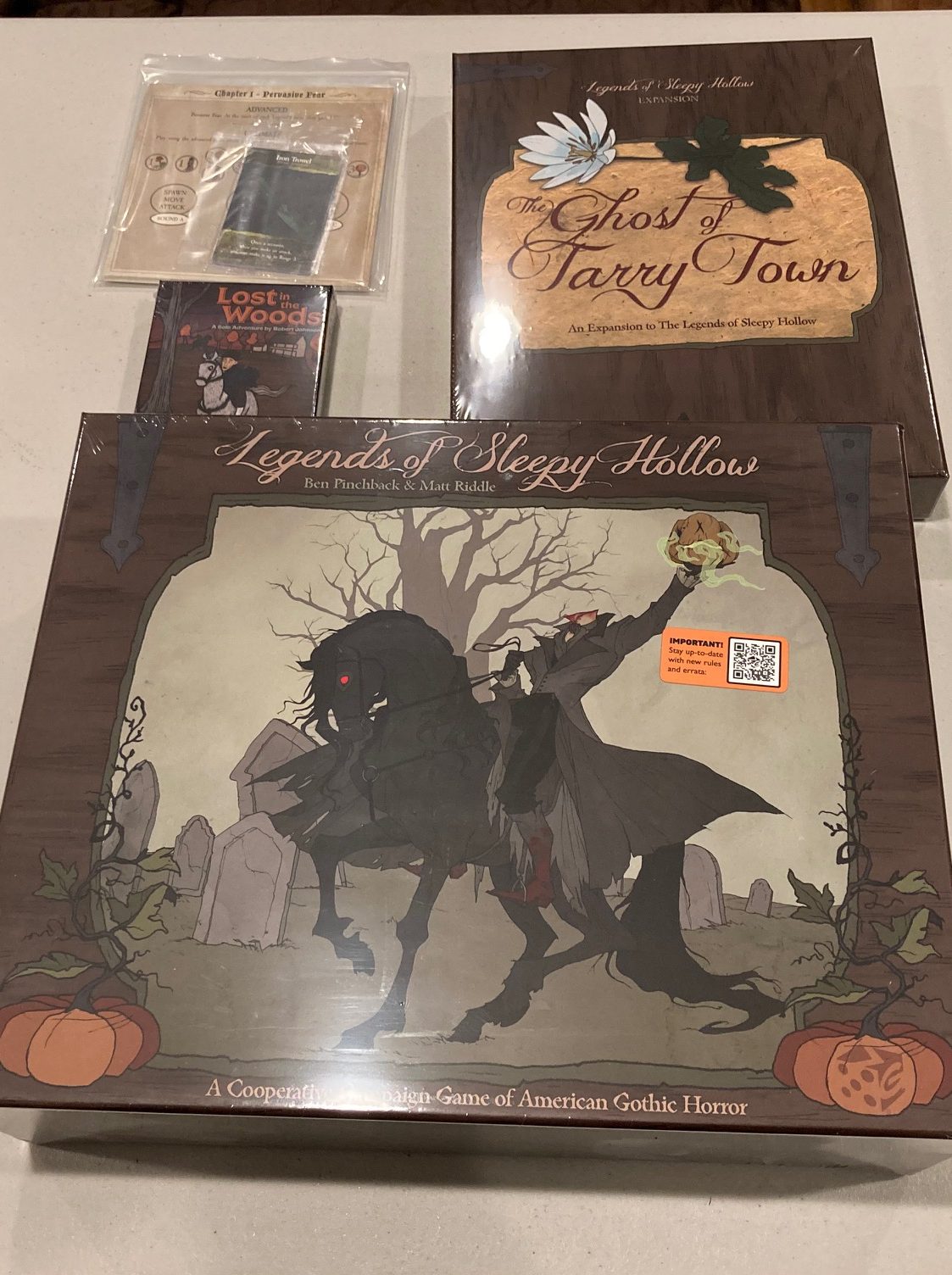
9. Legends of Sleepy Hollow

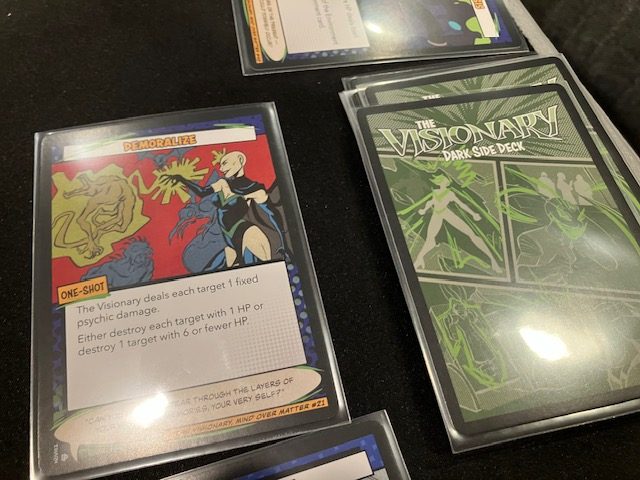
My group really liked this cooperative game, The Legends of Sleepy Hollow, but it has some wonkiness to it.  See our review here.  But they fixed some of that wonkiness with the Errata (see Errata review here).  If the idea of a cooperative game in the Sleepy Hollow universe sounds fun to you, check this out … and pick it up before it disappears forever!  Just make sure you get the Errata!

Sentinels of the Multiverse: Definitive Edition

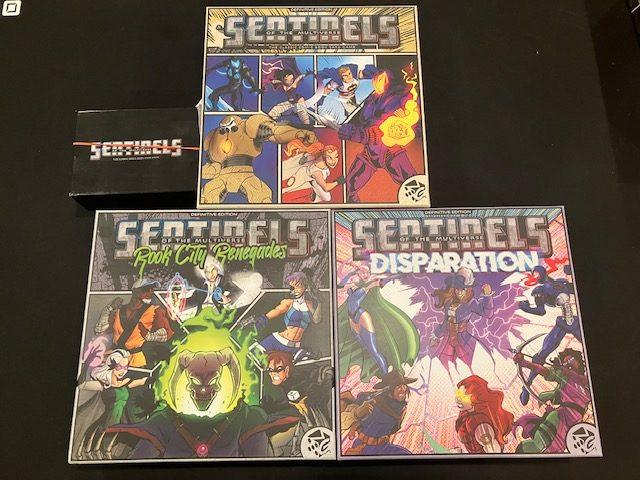
The next three entries all all related to the Sentinels of the Multiverse: Definitive Edition

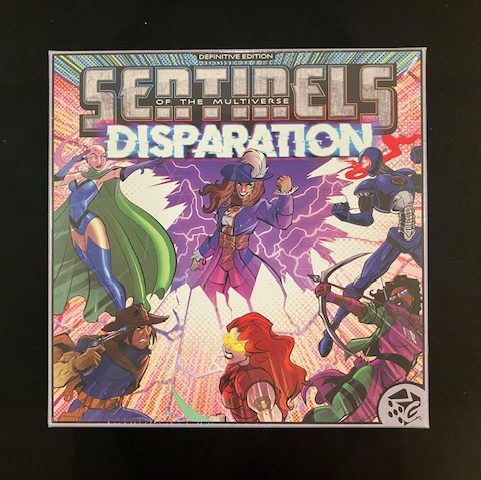
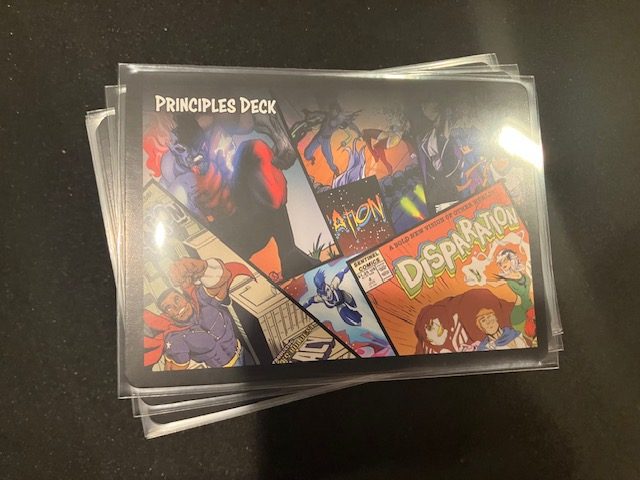
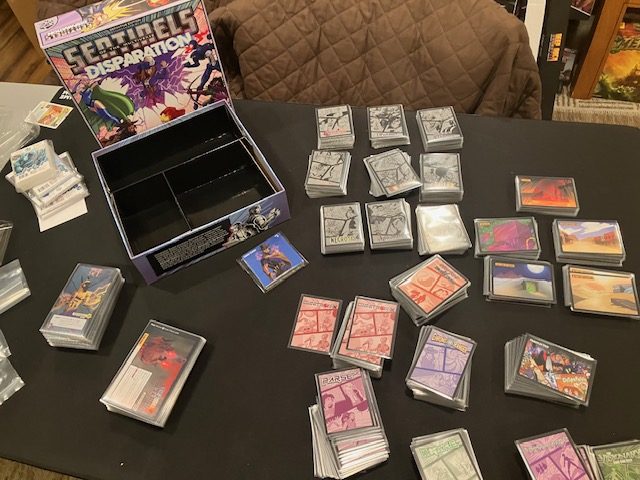
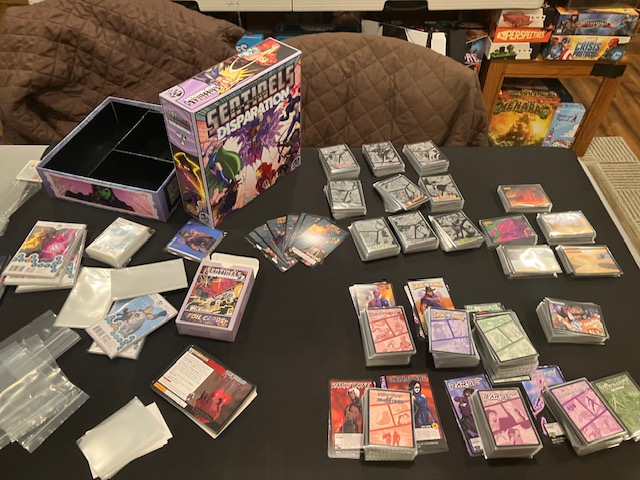
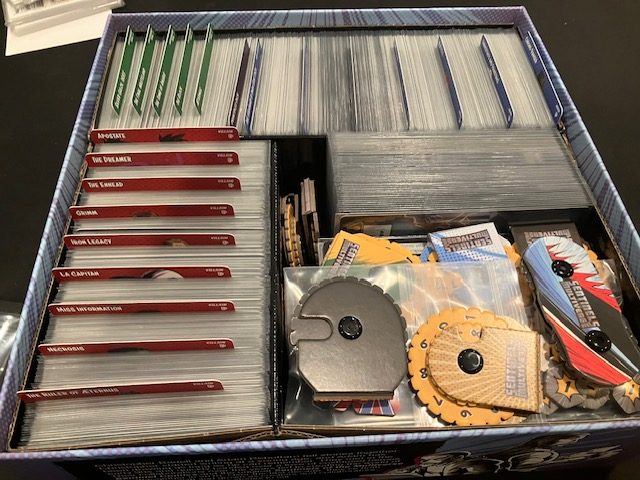
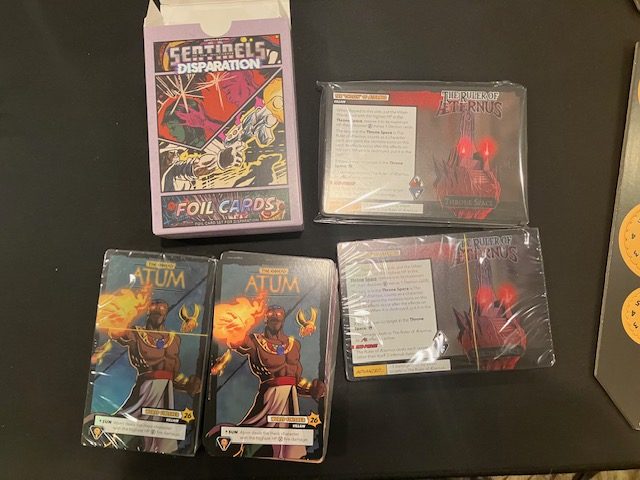
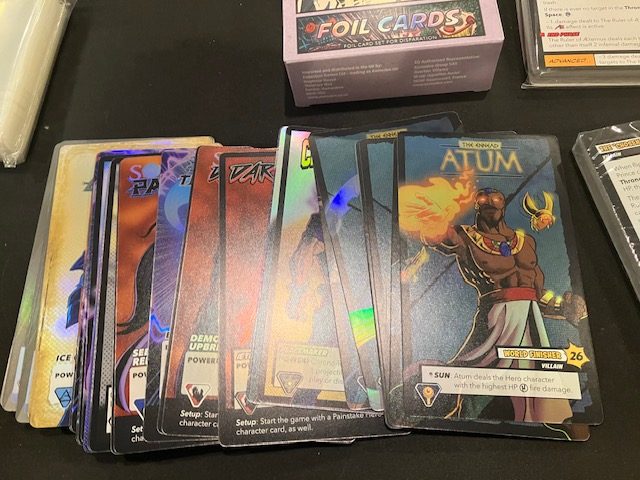
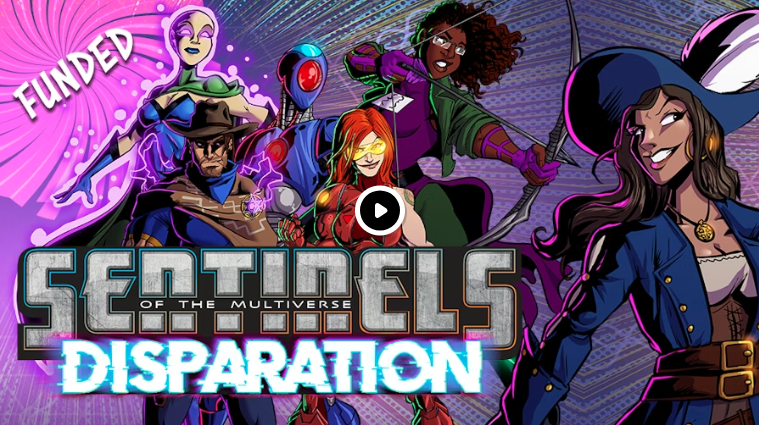
8. Disparation*

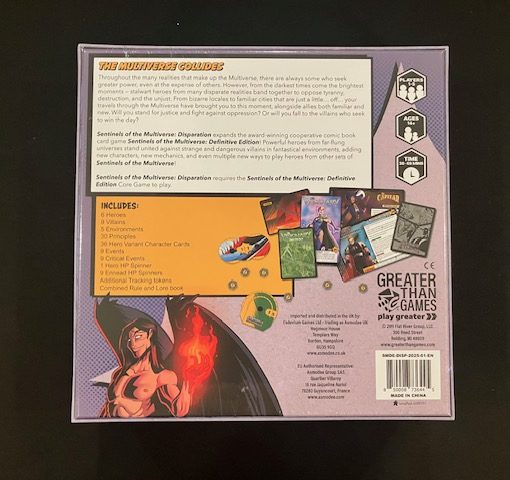
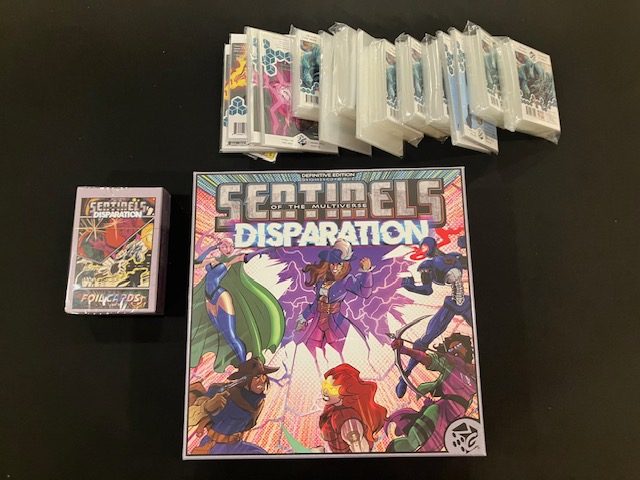
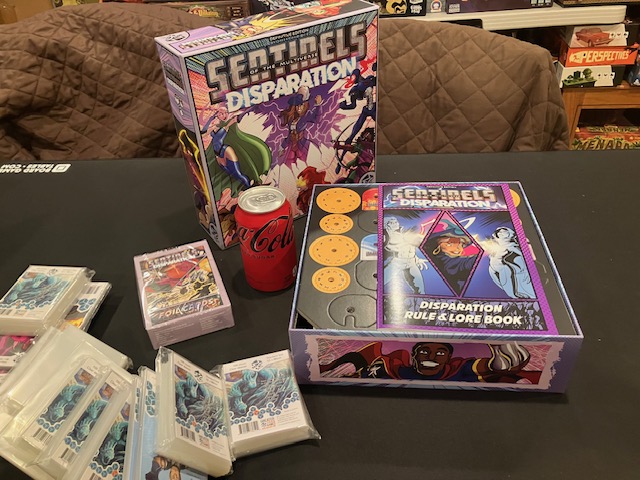
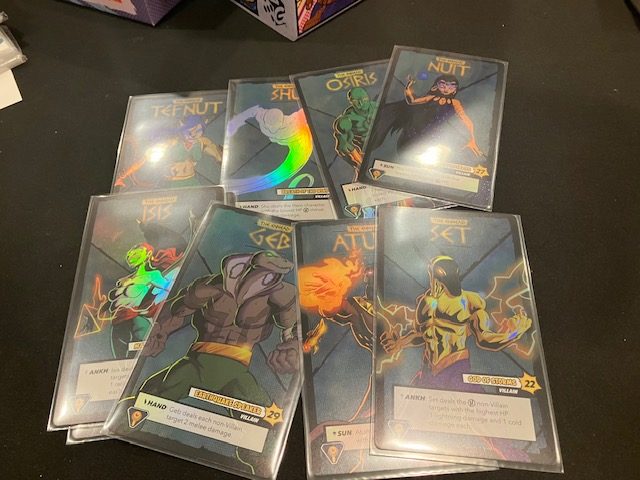
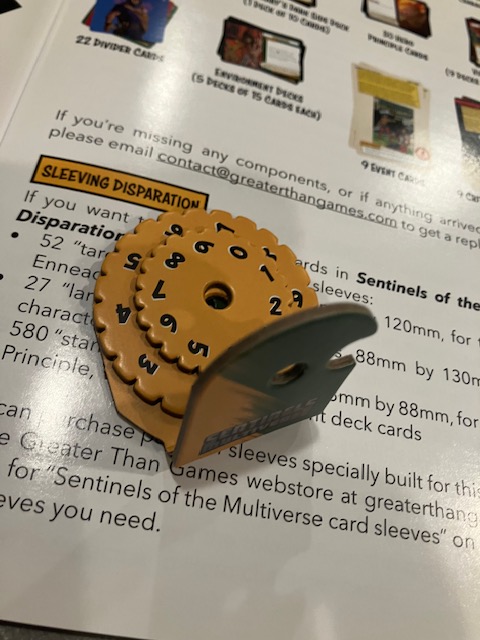
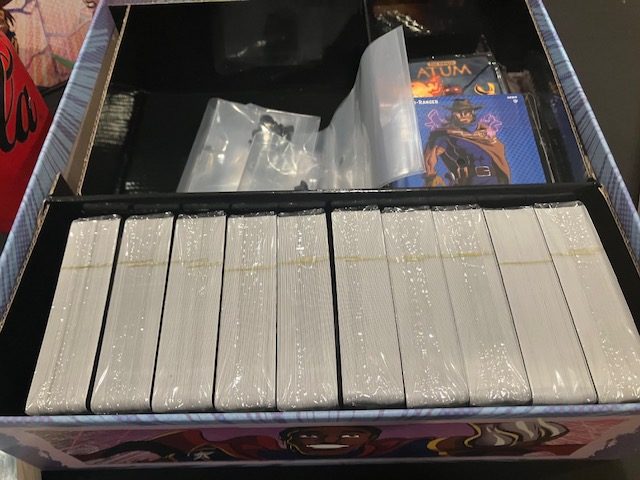
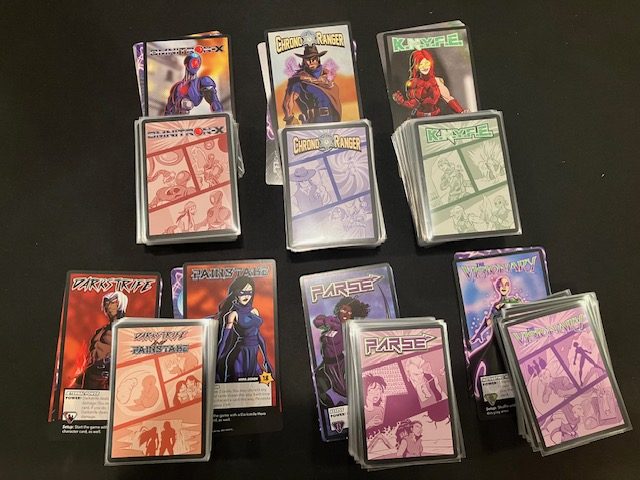
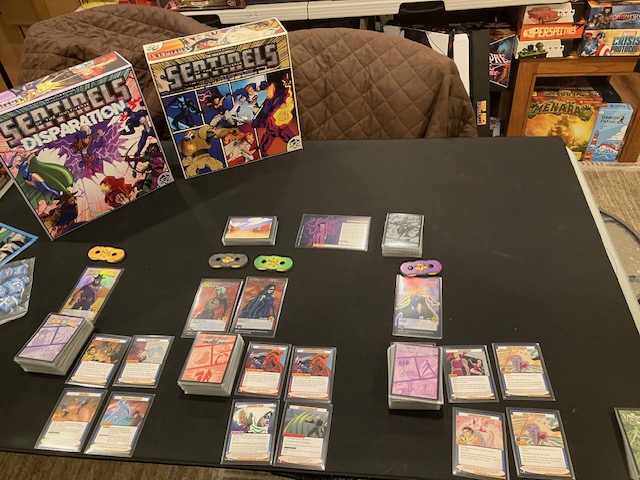
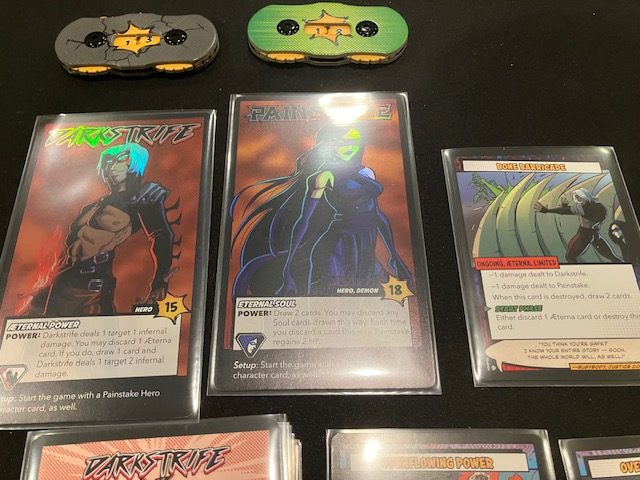
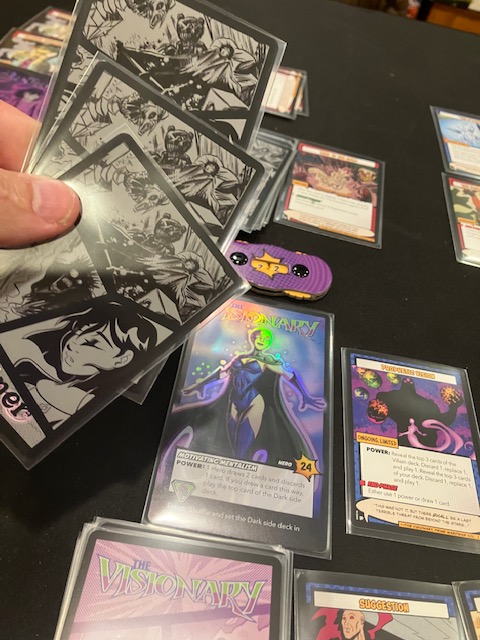
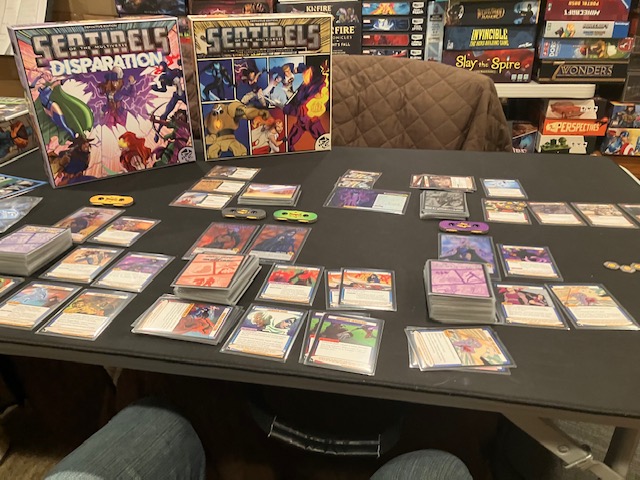
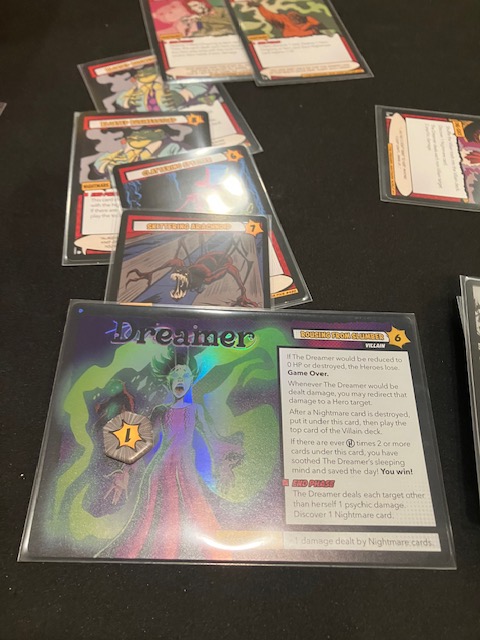
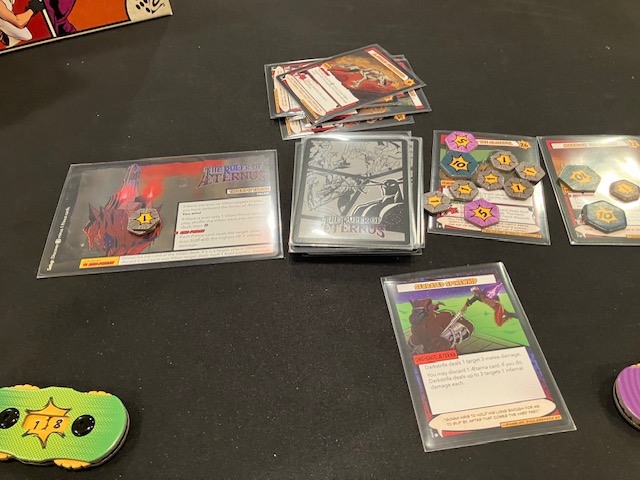
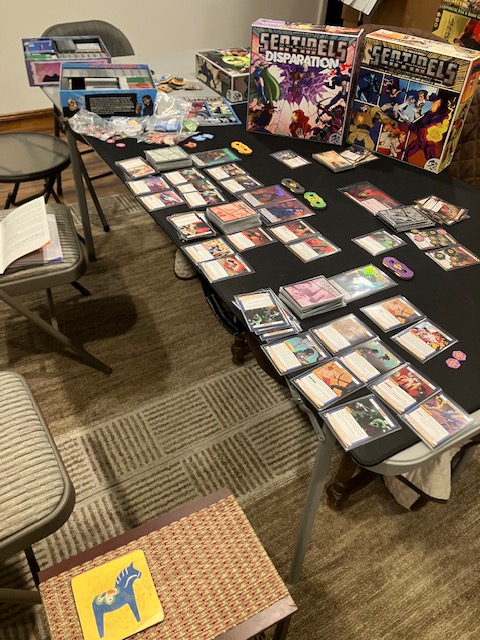
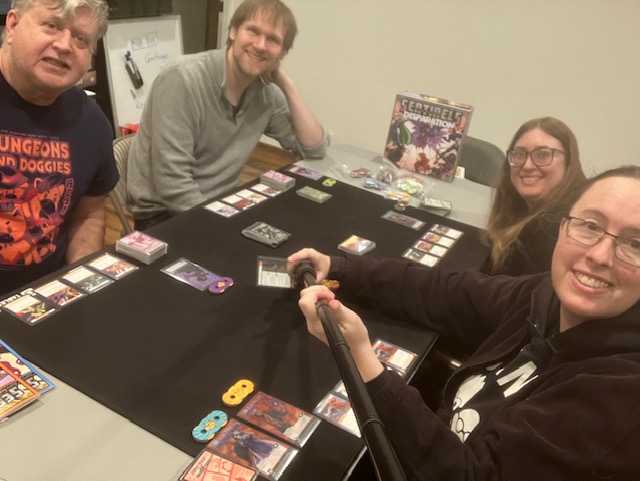
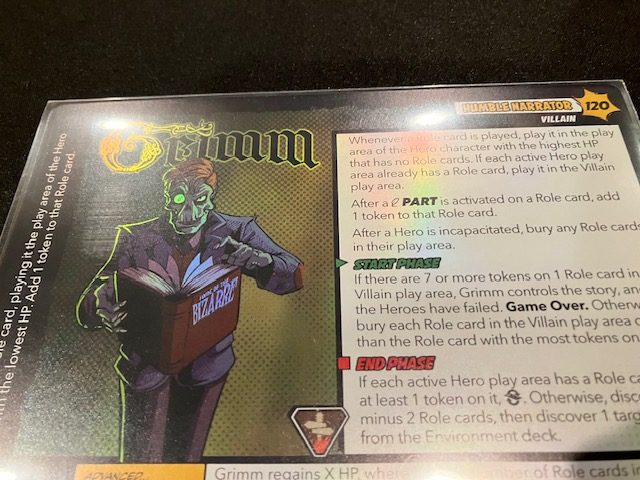
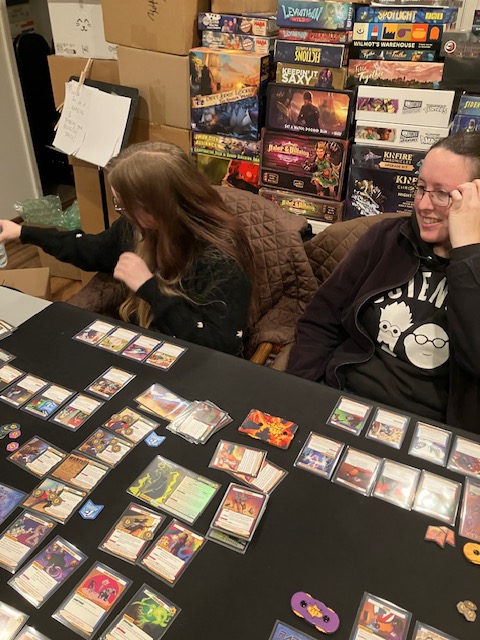
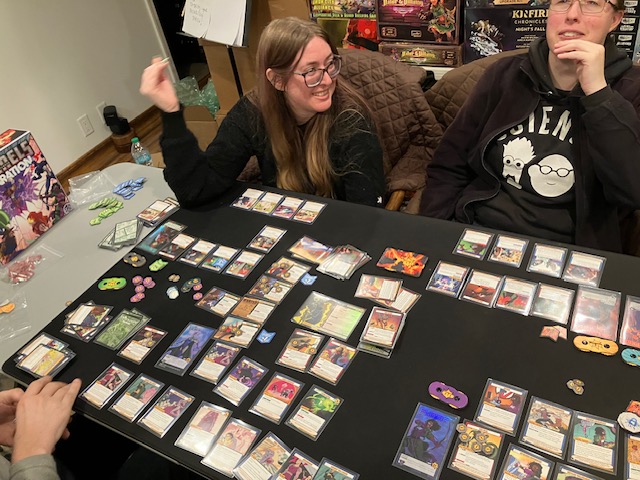
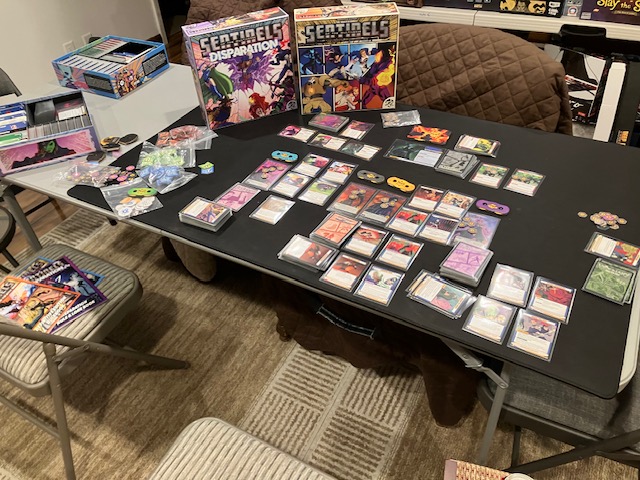
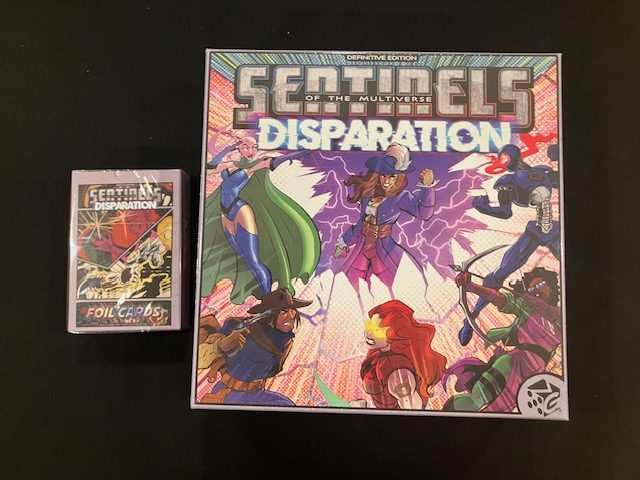
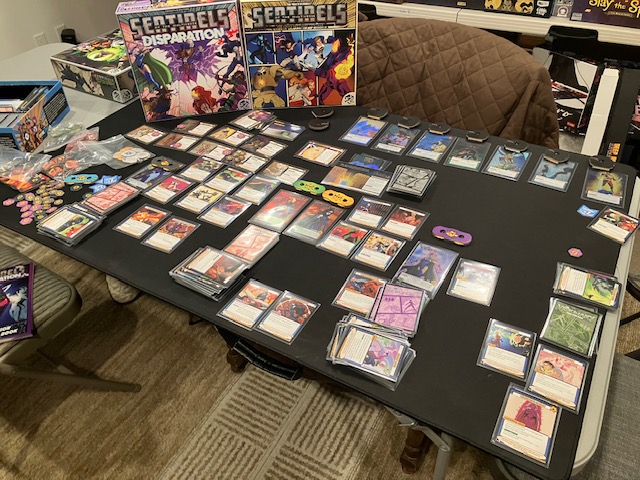
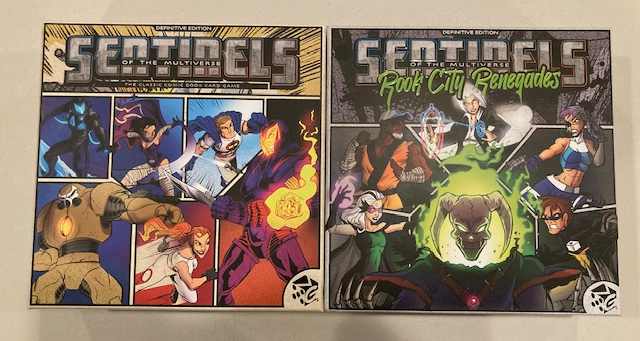
The Definitive edition of the Sentinels of the Multiverse is “essentially” the third edition of the game.  See our review here for more details.  The Disparation expansion for it … may or may happen.  When GTG first announced they were shuttering, it sounded like they shut down production of it, even though printing had already started!  Over the past 6 months, we had news that maybe it will print, maybe it won’t.  As of this writing, production has started back up again!  So, Disparation may still reach its Kickstarter (sorry, BackerKit) backers.  It’s unclear if this will ever see retail; if you see it, pick it up.  You may never see it again.

7. Rook City Renegades 

The first expansion to the Definitive Edition, Rook City Renegades, definitely did make it to retail, so you might still see it around.  See our review of it here.  If you end up getting and loving Sentinels of the Multiverse: Definitive Edition, you probably want to pick this expansion up before it disappears forever!

6. Sentinels of the Multiverse: Definitive Edition

This is the third edition of one of our favorite cooperative games of all time!  I feel like I am Superhero in a superhero’s world, battling villains and working together with my friends!  Take a look at our review and see if you might like this!  This is a rare 10/10 game for us, and you may be kicking yourself if you don’t pick this up before it goes out of print forever!

Sentinels of the Multiverse: Second Edition

The next few entries are related to the second edition of Sentinels of the Multiverse!

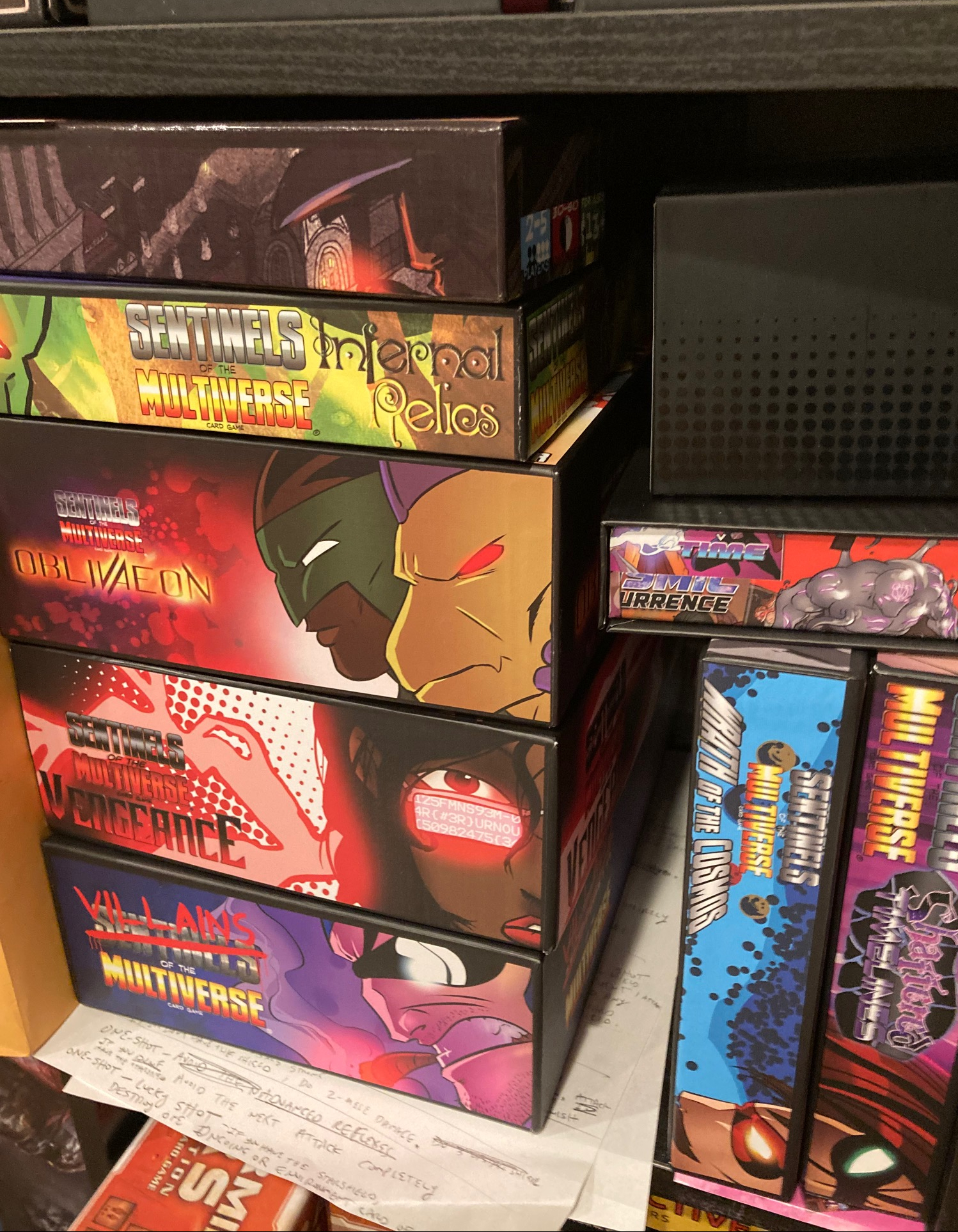
5. Any expansion, but especially Rook City!

There are a TON of expansions for the Second Edition of Sentinels of the Multiverse!  They are all good!

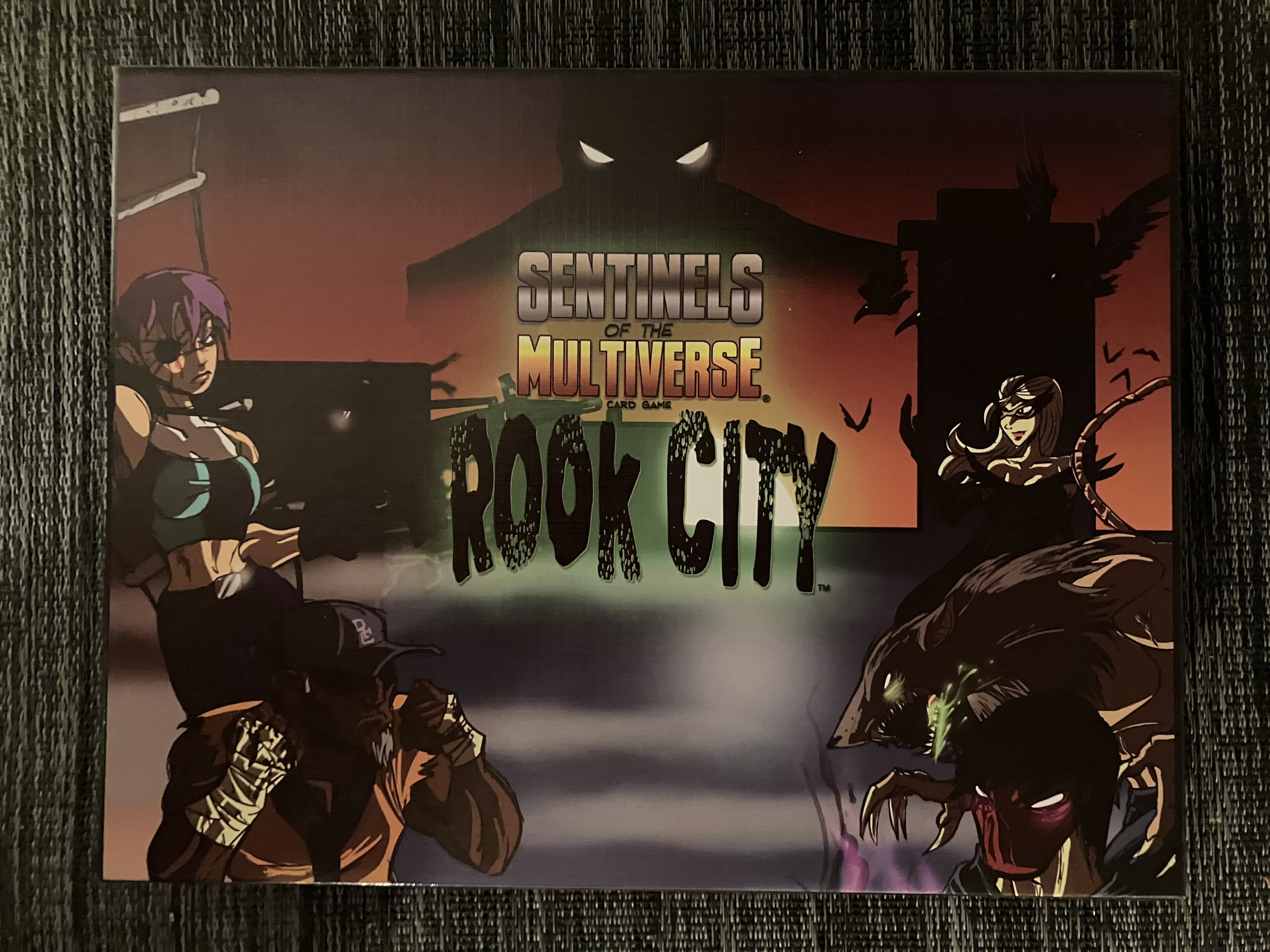
But, if I ever do a list of essential expansions for a game, Rook City (for the Second Edition) will be #1 on it!  This is one of my favorite expansions of all time!  The Villains and Environments in here are just so amazing!  This expansion really took the original (second edition) of Sentinels of the Multiverse to the next level!  (I think this is currently only offered as a bundle with Infernal Relics: I have the original).

4. Sentinels of the Multiverse: Second Edition

This is also called the “Enhanced Edition”.  You might wonder why the second edition is higher on the list than the definitive edition!  Well, to be frank, I like it better!  I think the coloring and art make it easier to see cards from across the room!  And even though the gameplay is “less smooth”, I am used to it.  Still, most of my friends liked the Definitive Edition better: See our review here!

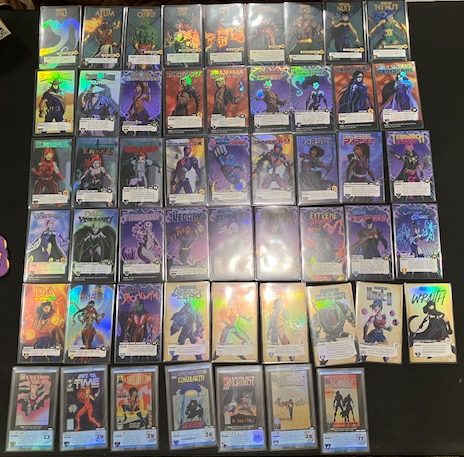
It’s possible you might find some great deals on the Second Edition in the used market, so be on the lookout!  Just be careful not to mix editions!  Luckily, the only things for Definitive Edition are the three we list (that and foil cards)!  Just about everything else should work with the second Edition!

Sentinels Comics: The Roleplaying Game

Our last three entries are exclusively for the Sentinels RPG!  And yes, we consider this RPG a cooperative game!  What can be more cooperative than heroes coming together to save humanity?

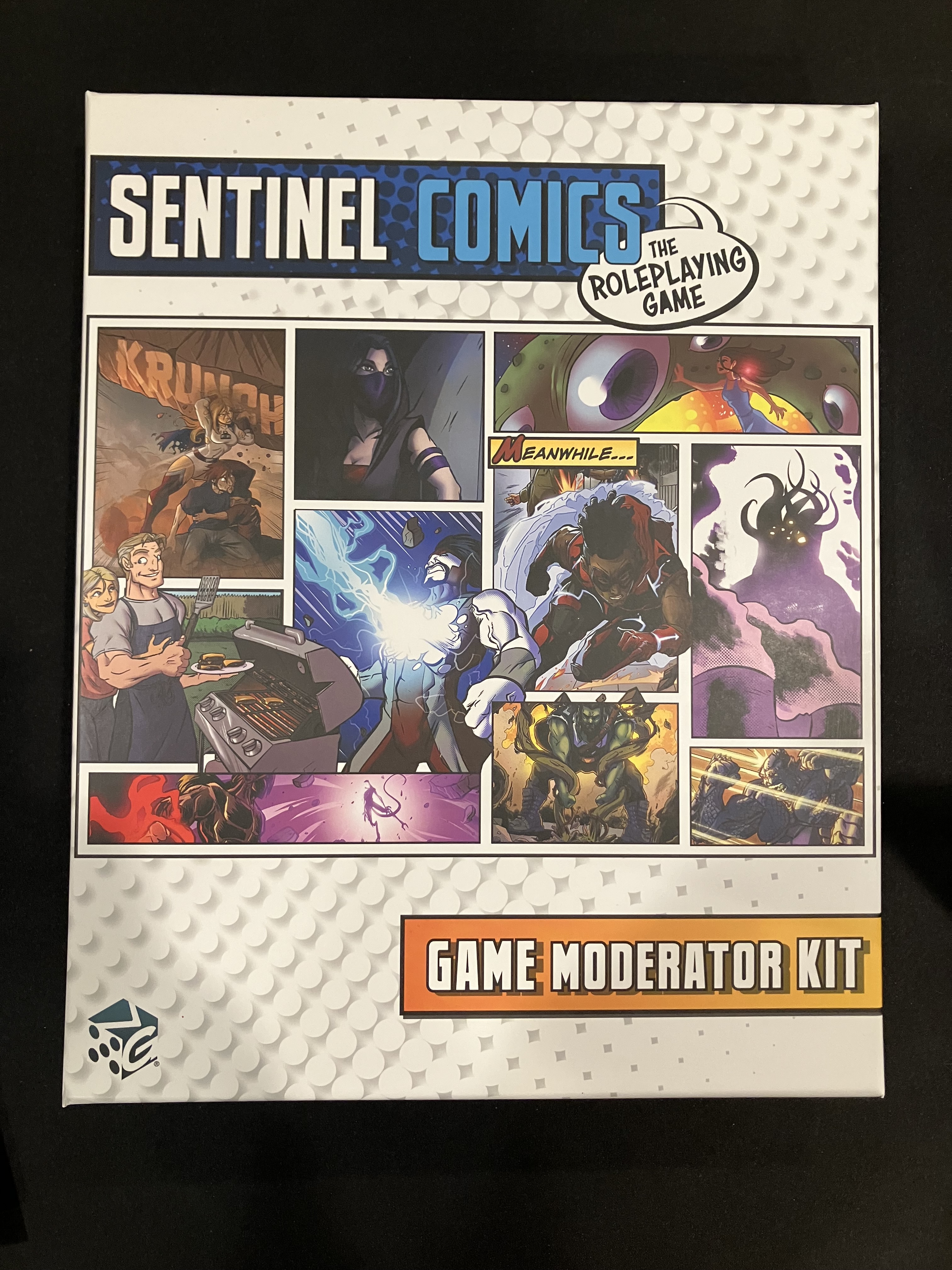
3. Game Moderator Kit

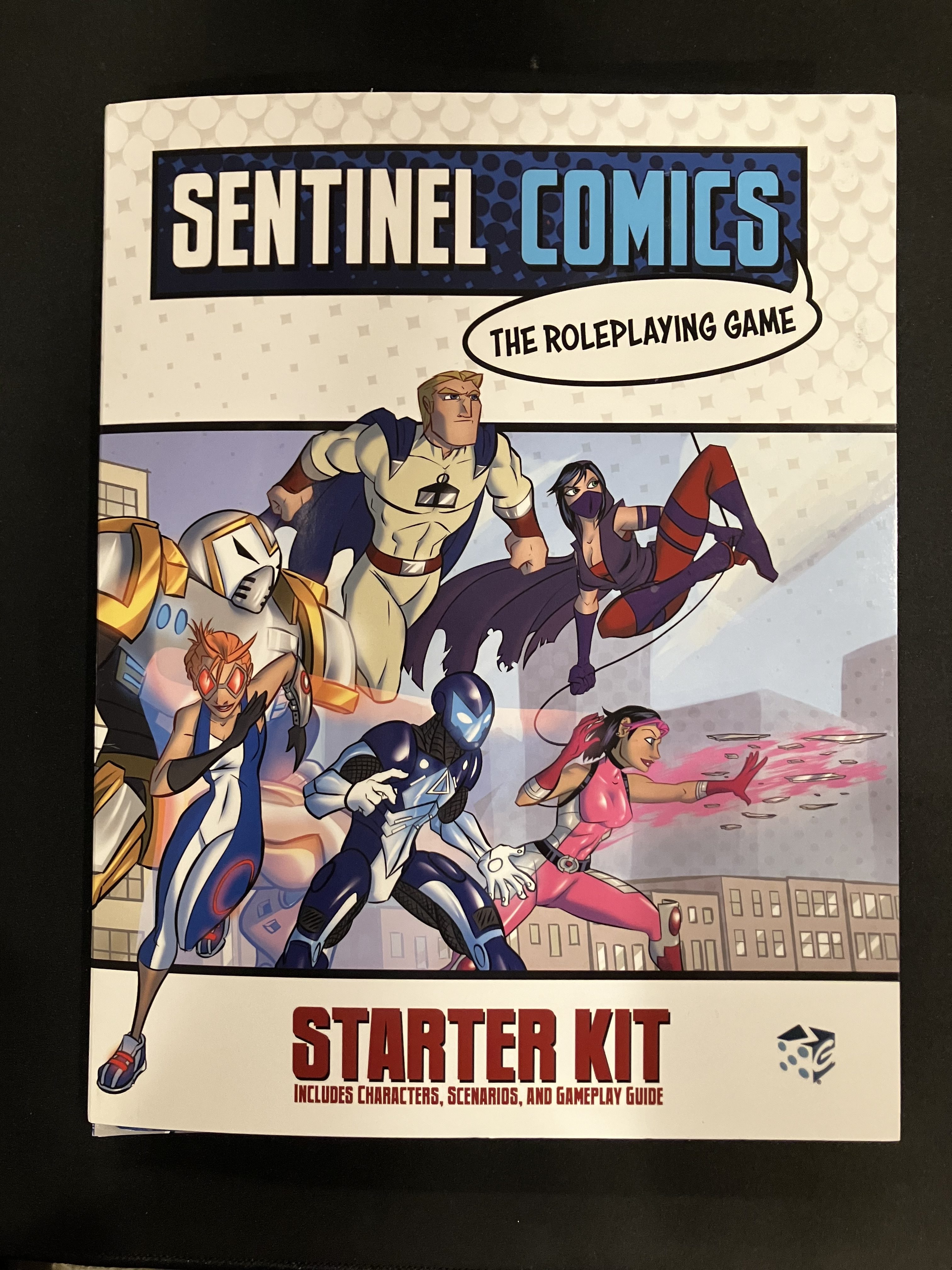
2. Starter Kit

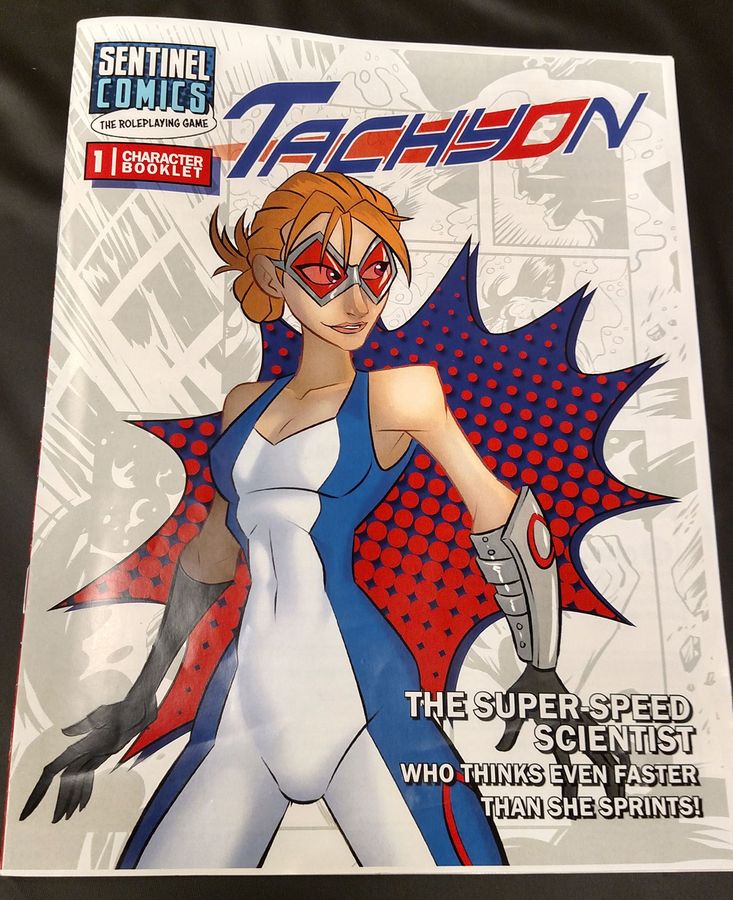
1. Core Rulebook 

You might wonder why Sentinels Comics: The Roleplaying Game stuff makes the top 3 spots on our list, despite the original card game(s) Sentinels of the Multiverse being some of our favorite games of all times! I think you’ll be able to find Sentinels of the Multiverse card games for some time, but I am not sure the Sentinels Comics stuff will be around! I think that the Sentinels Comics RPG didn’t get a lot of love, but it’s a pretty neat RPG system. My friend CC said it’s his favorite RPG to run! See our review here!

You can dip your toe in the water with The Starter Kit (#2) to see if you even like the game! The Starter Kit comes with pre-generated characters and pre-generated adventures so it’s easy to jump in!!

But of course, the funnest part of Superhero games is making up your own heroes, which the Core Rulebook allows you to do! The Game Moderator Kit is just icing on the cake if you decide you like this system!

Check out Greater Than Games Website (see here) to see if you can still pick up some of these things!

Invincible: The Card Game. Review After Full Playthrough!

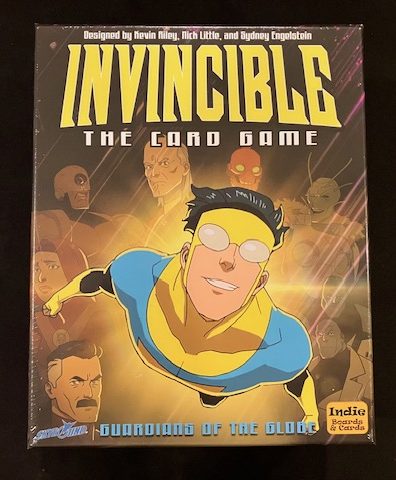
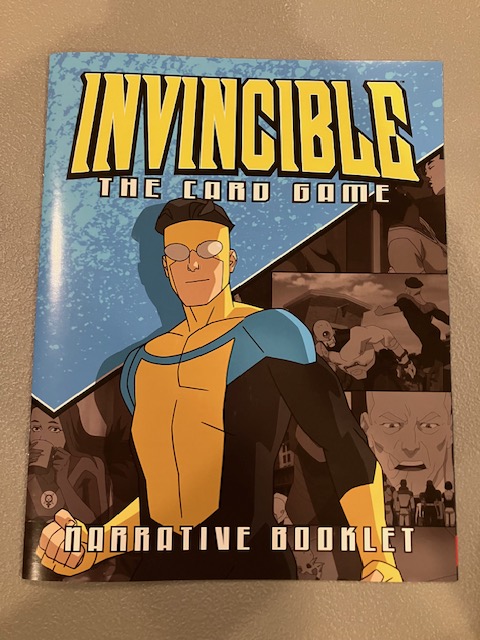
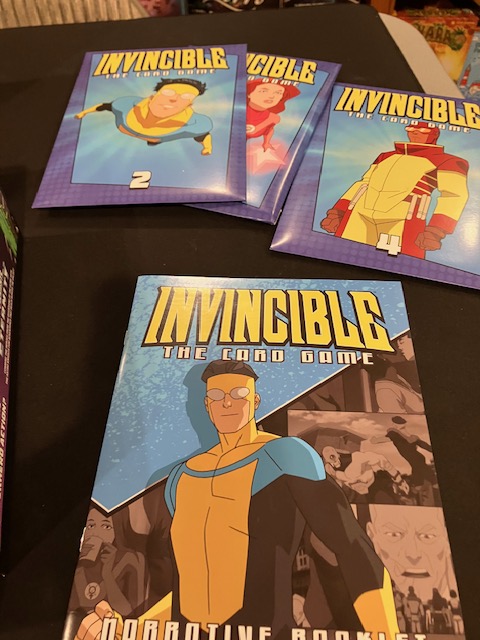
So, just so you know: we are talking about Invincible: The Card Game!  This is the one that has the subtitle Guardians of the Globe (see above).  You have to be careful!  There are at least 3 or 4 other Invincible games: some of them great (see our review of Invincible: The Hero-Building Game) and some of them … less so.  What about this one?

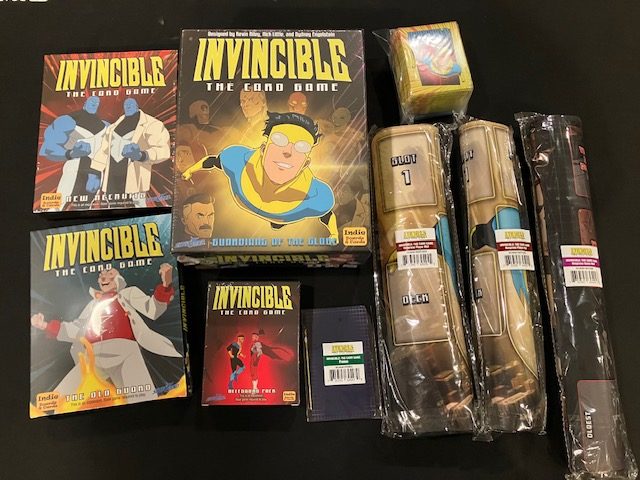
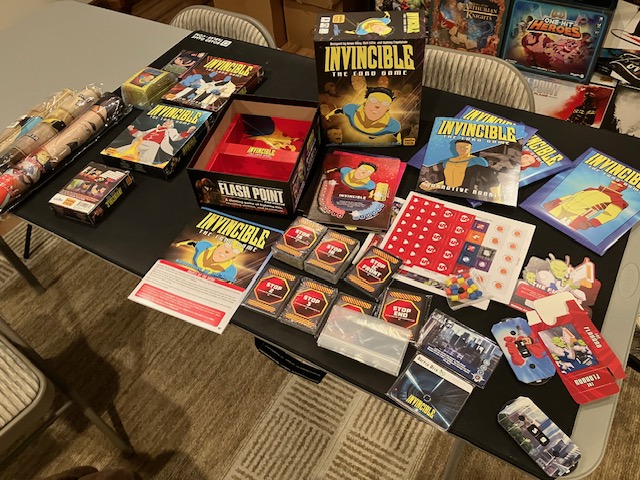
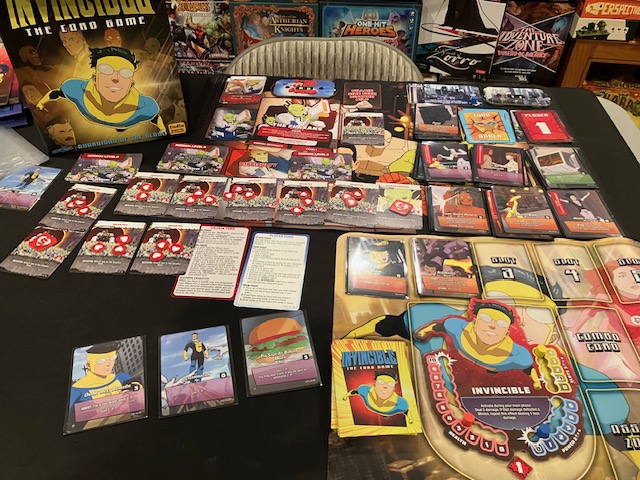
Invincible: The Card Game was up on Kickstarter back in October 2024: see link here.  I love the Invincible universe in the comic-book world, so I went all-in and backed the full Kickstarter and probably got waaaay too much: see above.

The Kickstarter had originally promised delivery in January 2025, but it didn’t arrive until the last week of September 2025.  It was about 9 months late, but given the state of the world and shipping, and it’s a Kickstarter, I guess that’s ok.

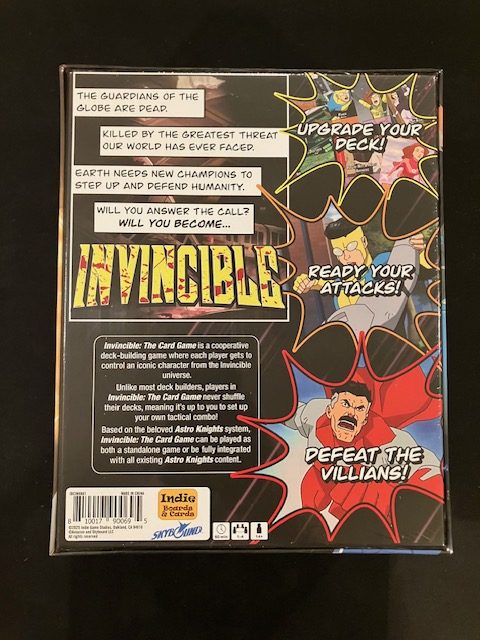
Invincible: The Card Game is a cooperative deck-building game for 1-4 Players.  It’s very very much like Astro Knights , a cooperative deck-building game we’ve reviewed here (Astro Knights) and here (Astro Knights: Eternity).  

In fact, Invincible: The Card Game is so similar to Astro Knights, you can combine them and play them together! 

Let’s take a look!

Kickstarter Extras: How Much Do You Need?

So, before we get going too much, we should have a quick discussion on “Should I get the Kickstarter extras?”

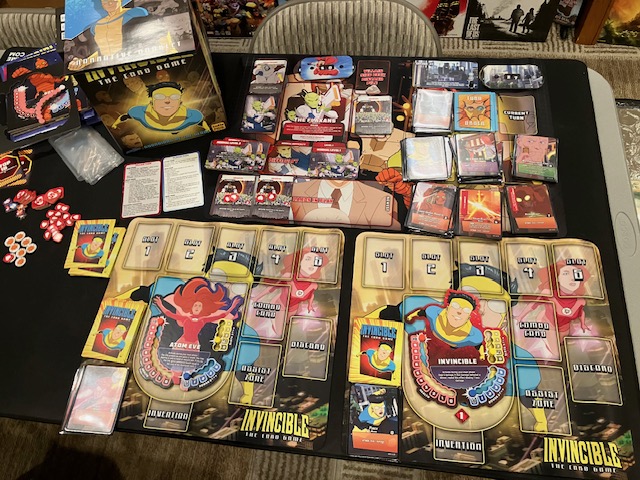
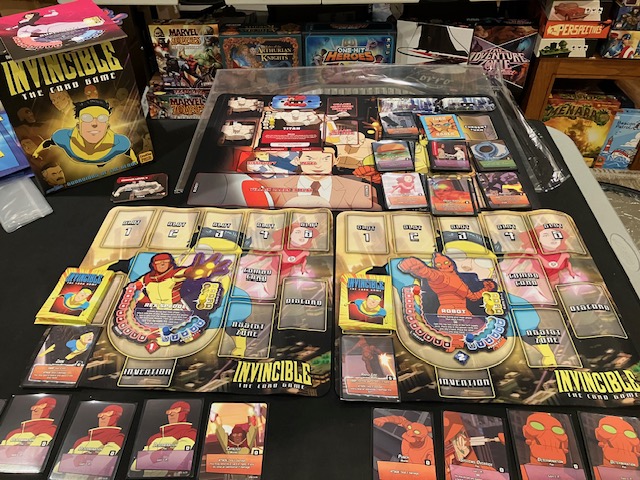
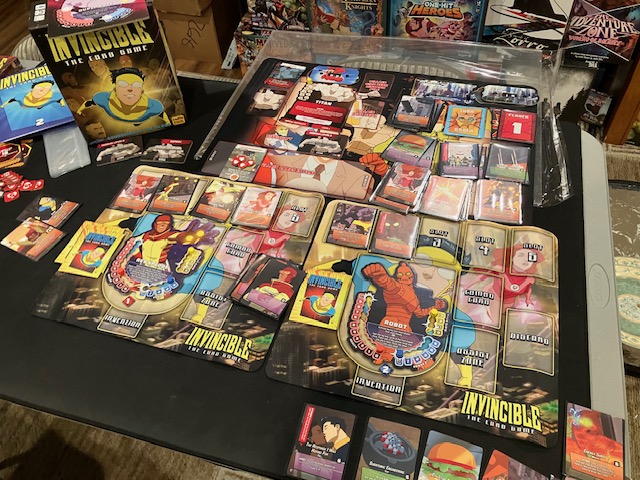
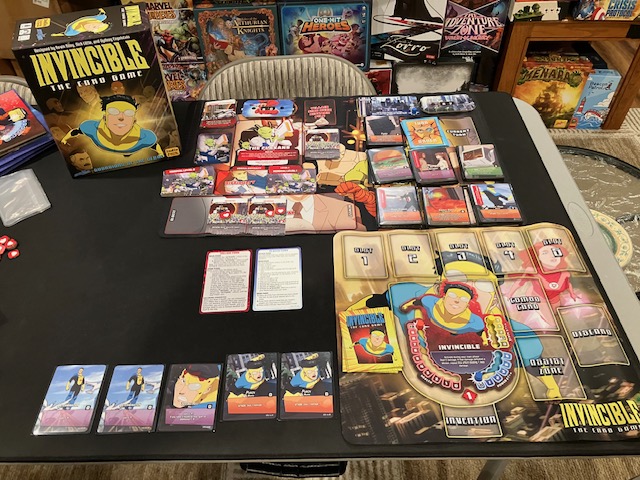
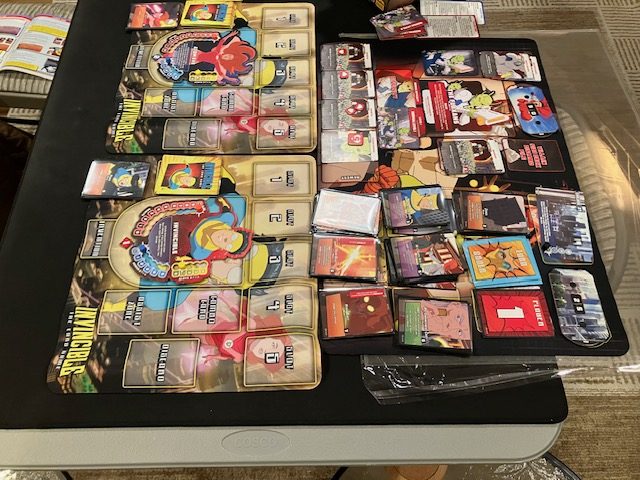
The “bad-guy” mat (see above) is probably worth getting.  It helps organize all the cards and where they go during play.  I don’t love how “busy” the art looks; I feel like it gets in the way of gameplay a little, as the art is distracting.

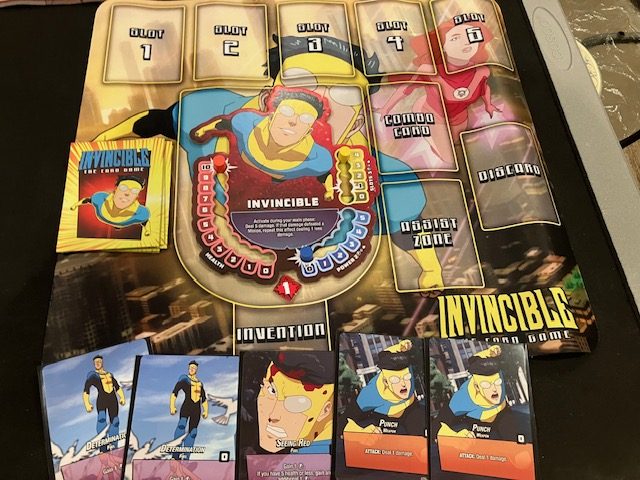
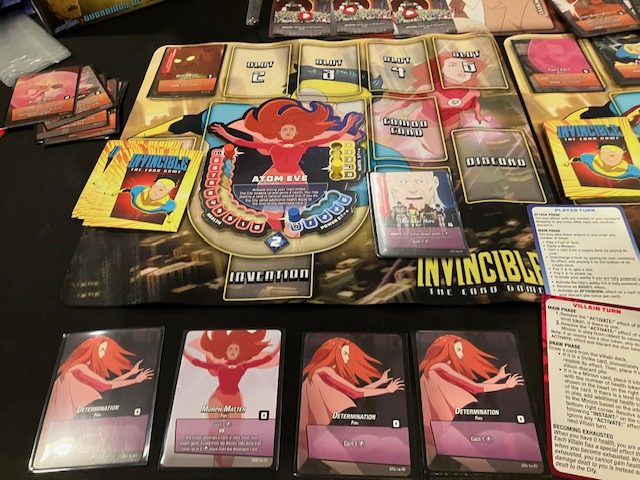
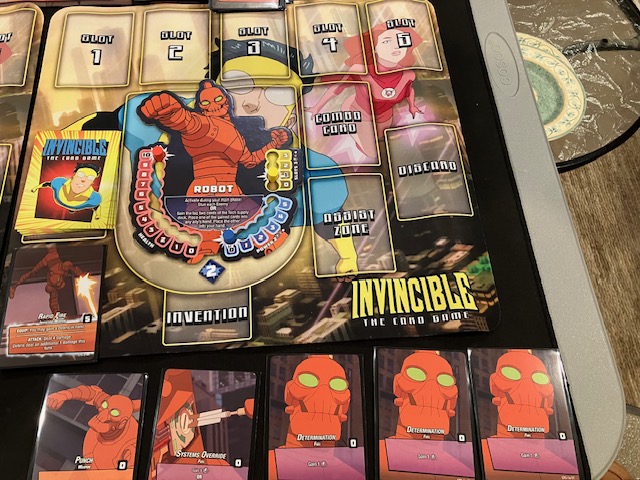
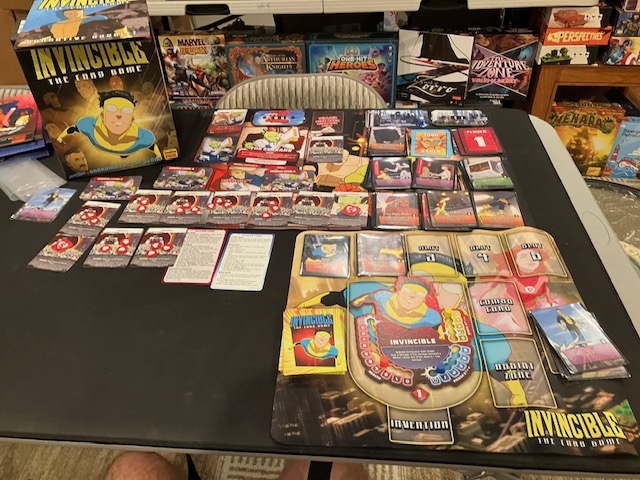
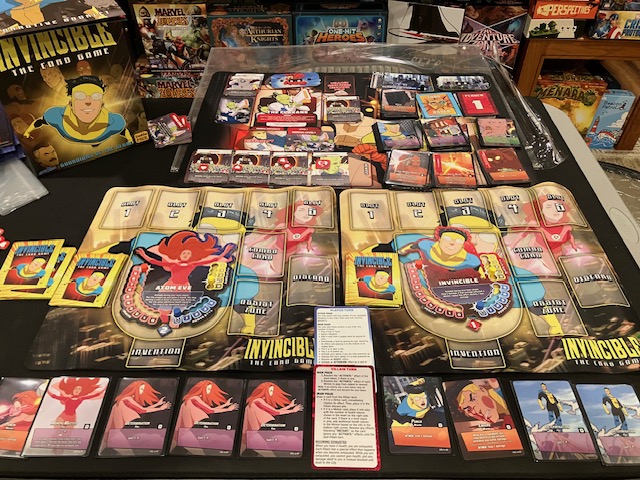
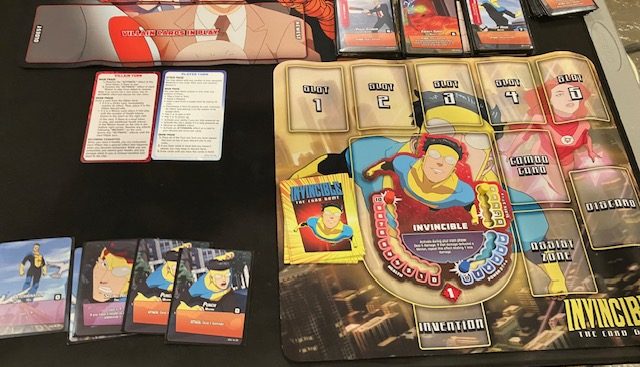
The “good guy” mat I was less in love with (I got four, one for each player).  See above!! I don’t love the layout for a bunch of reasons.  For one, I want to use the bottom space for “cards in hand”, but the “invention” space takes away from that, so that the whole bottom of the mat seems like wasted space.  I would have put the “invention” to the left or somewhere out of the way!  The “invention” is a very short-lived concept in the game (usually, you buy your invention in the first few turns), so I wouldn’t devote so much space (if any, esp. at the bottom) to such a short-lived card.

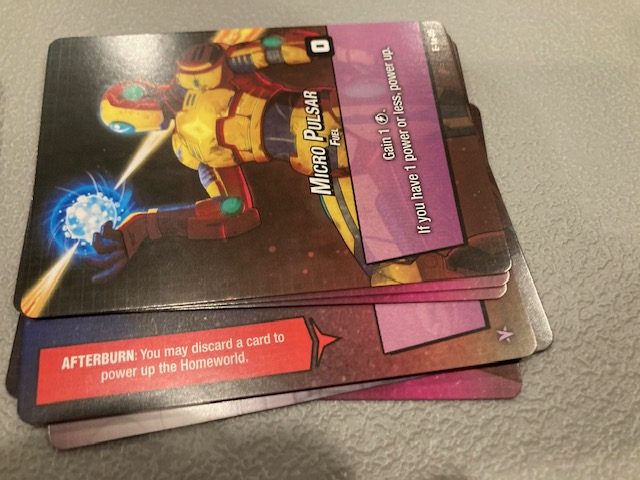
A bigger problem is the discard pile: it should be turned sideways!  For one, it’s clearer the cards are discarded (remember, the “Discard Pile” notation is under all those cards!).  Secondly, the Afterburn effects are harder to read when the discard is up right!  See above!!! What does that say?

The entire purpose of the Afterburn effects is that while a card is in your discard, you can use that ability!  So, it should be easier to read! 

We saw the Afterburn idea first in Astro Knights!  See how much easier it is to read those effects when your discard is sideways? See above!  (There was no player mat for Astro Knights, so we could do the right thing and have the discard sideways).

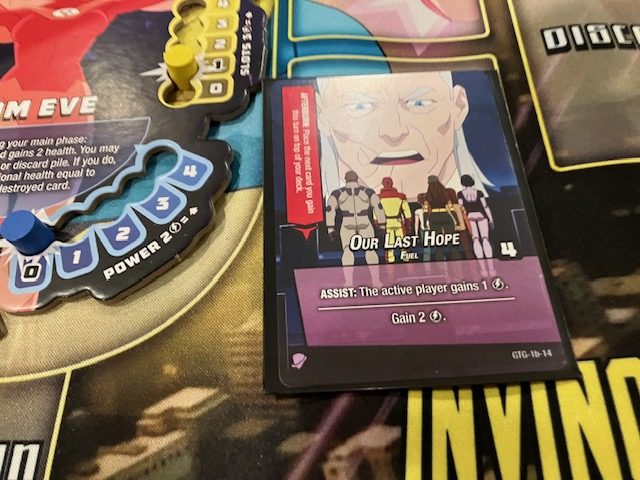
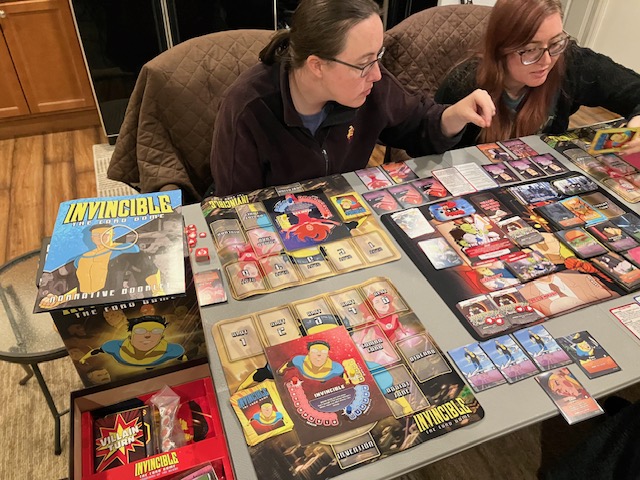
Another problem with the mats were the Assist Zone!  You are supposed to put cards in the Assist Zone when you Assist (a really great concept in the game), but there’s one main problem with that!  More than once, you “forget” about the card being in your hand because it’s in the Assist Zone and you take your turn “forgetting” to use the card!  It would be MUCH better if you just kept your hand of cards in front of you and “nudged” the Assisted cards up an inch to show you’ve used them for assist!  That way, they stay in your hand, but you have marked that it’s Assist has been used!  See above as Eve has a card in the Assist Zone, but it looks like she only has 4 cards in hand! It’s too easy to forget that card is still in your hand.  Just nudge the card up to show it has assisted. 

The rest of the player mat worked fine, but I think it should be thinner (for more space for “cards in hands” and moving inventions), and it should have the discard space sideways.

Of course, mats are always nice because they make cards easier to pick up and handle.

Another thing that came with the Kickstarter are sleeves! My “default position” is that you should usually get sleeves when you have a deck-builder.  And I think that’s still true here.

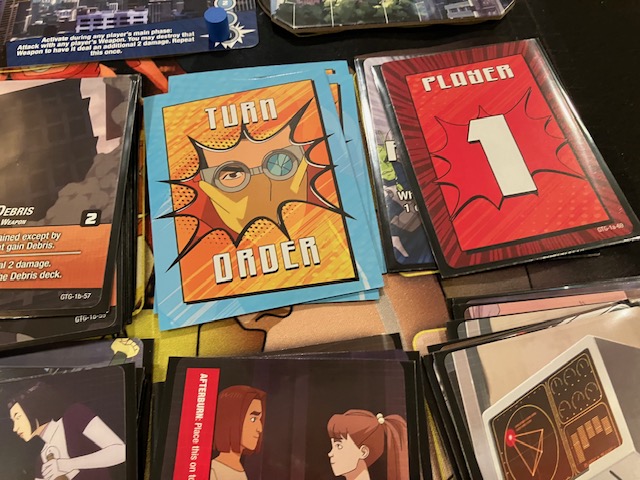
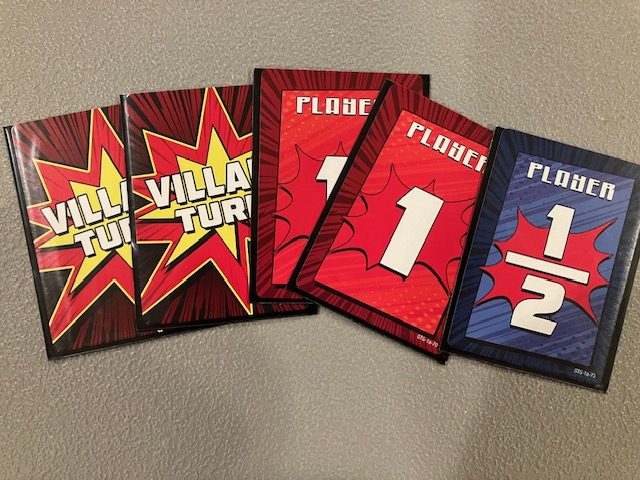
I am VERY HAPPY that the Turn Order deck has its own sleeves!  If you ONLY sleeve a few cards in the game, you MUST sleeve the Turn Order deck!  These cards are touched all the time!  After many games of Aeon’s End and Astro Knights, trust me on this!  My original Aeon’s End Turn Order deck is a little grody!! 

The sleeves are very nice for Hero cards (see above); these are the yellow sleeves with Invincible on back!  Unfortunately, there are no sleeves for the “bad guy” cards!  If you want to sleeve them, you’ll have to use different sleeves (as the “bad guys” cards have a different card back).  So, I went all-in to get all sleeves, and I was a little disappointed I couldn’t sleeve the entire game! I love the Hero card sleeves (they are very very nice), but I can’t sleeve the bad guys cards without having to use/buy a separate set of sleeves (I think I have some leftovers from Thunderstone Quest I can use).

There’s also two expansions that came with the Kickstarter; these are just more heroes and more villains.  We’ll (probably) review those separately later.

I admit I was a little underwhelmed by the extras.  The only thing I’d say you should probably get is the “bad guy” mat, but even then, I thought it was too busy (from an art perspective).   The sleeves were nice, but realize that they ONLY sleeve the Hero cards, and you’ll have to get more sleeves for “bad guy” cards!! The player mats were the biggest disappointment: they were too tall and needed some reorganization … I’d only get the player mats if you love this game. 

The only thing you HAVE to do is make sure you sleeve the Turn Order cards (either with the given cards or some others).  These cards get handled SO MUCH as you play.

Rulebook

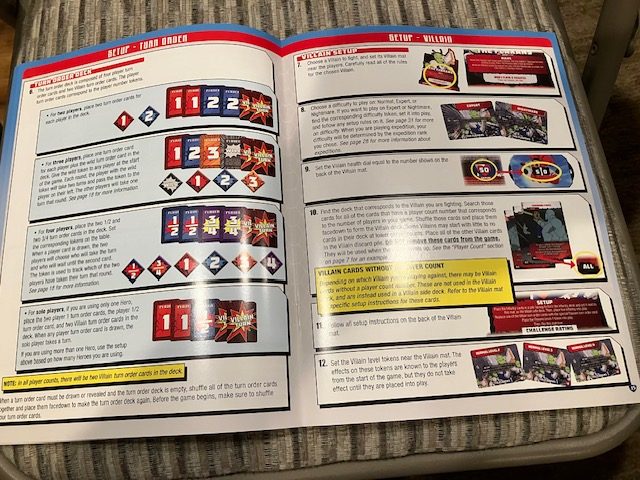
This is an excellent rulebook.  It’s “essentially”, in many ways, a copy of the Astro Knights: Eternity rulebook in turns of layout and progression.

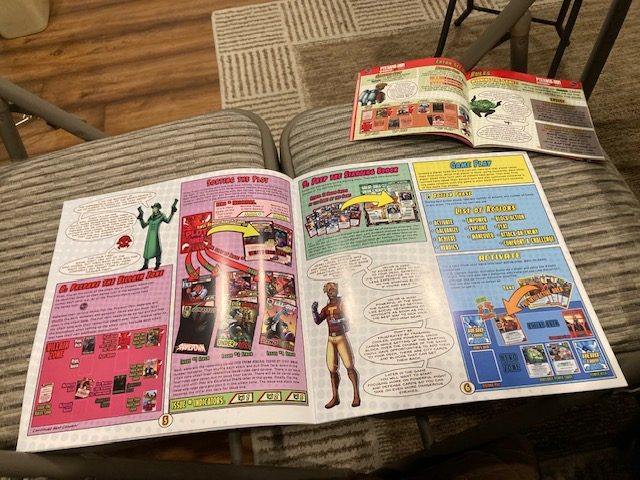
The rulebook gets an A- on the Chair Test.  It opens up and lays flat on the chair next to me, making it easy to consult.  It has big fonts, lots of pictures, and is easy to read.  It’s very easy to consult on the chair next to me. I wish the font were just a little bigger.

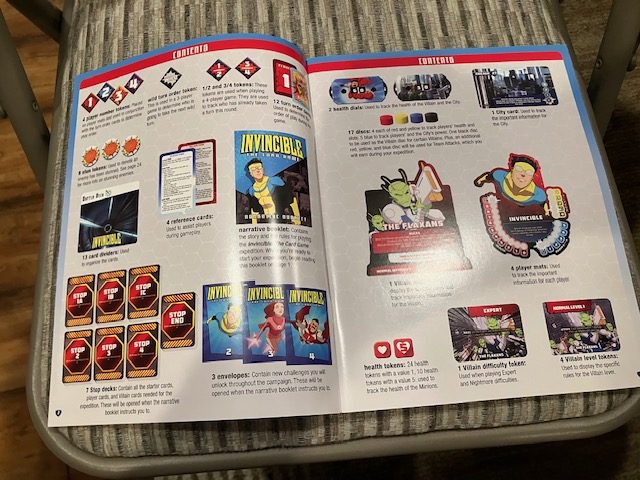
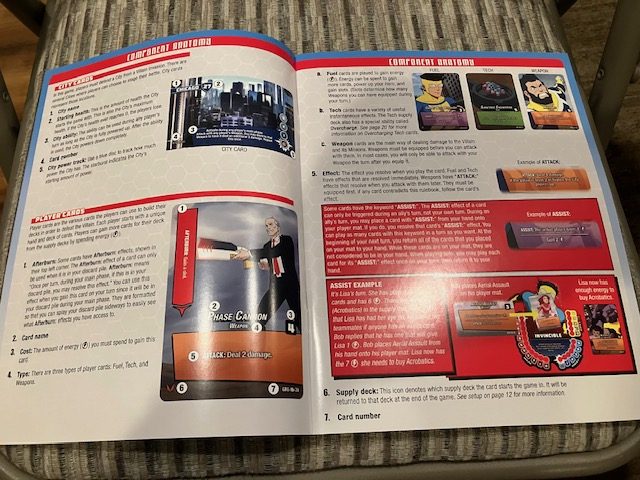
The Components page has pictures with annotating text.  

Even after pointing this out in the Astro Knights: Eternity review (see here), they still don’t note that the Turn Order cards are in deck 1A!!!!  I think this will still confuse some people, as they expect them in hand (before opening anything … remember: all decks say STOP! At the top, so you are reluctant to open anything right when you get the game).

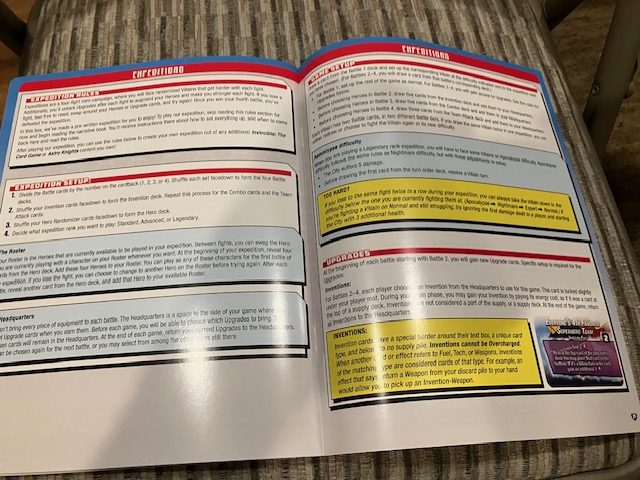
One huge mistake the rulebook still makes (and we had the same problem with Astro Knights: Eternity) is not addressing how to play for the first time UP FRONT!!!  See ON PAGE 28, there’s a small sentence that says: “To play our expedition, skip reading this rules section for now…” … however, in order to play the game you still kinda have to start opening decks up!    It would have been SIGNIFICANTLY BETTER if the rulebook, on page 2, said something like “To play and uncover all content in this game, you will need to play the pre-written expedition! See page 28!”  Since I had played Astro Knights: Eternity and had to suffer through this already, I knew how to do this.  New players may not. Caveat Emptor.

I like how the rulebook has summaries of the cards immediately after the Components page.  I also like how the “new rules” are emphasized in Red above … The Assist keyword is a new rule (but not if you know Astro Knights: Eternity … that was kinda/sorta/not really like the Bolster keyword … it’s still newish for some people).

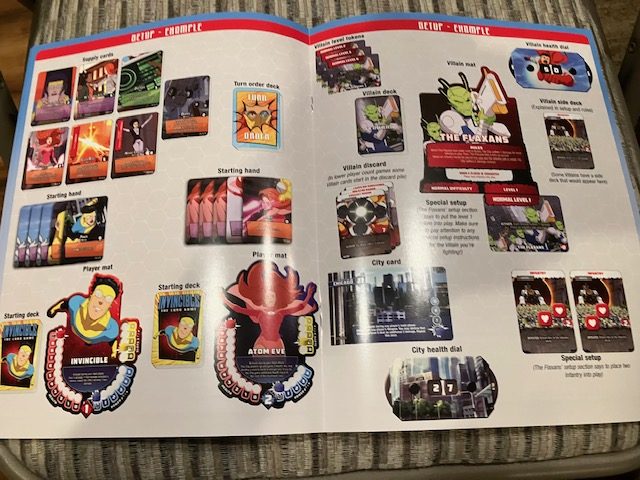
It is interesting how the set-up isn’t until halfway through the book … still, I think it works.  If you have the mats, like I do, this isn’t AT ALL what my table looked like.  Oh well.

The end of the book has keywords summaries: it’s not an Index, but it’s probably as good as we can hope.  I consulted the back of the book several times during gameplay. 

Overall, this was an excellent rulebook full of good examples.  I wish they had addressed the first play issue better.  Especially since I didn’t get the First Play Sheet (see later).

Unboxing and Gameplay

This is a actually a pretty thick box; see Can of Coke above for perspective.

It’s about half the width of a Ticket To Ride size box.

This is a cooperative deck-building game, so there are a lot of cards.  See above. 

The expedition book will tell you when to open the decks above.  The game has a campaign (called an Expedition) which will allow you to open up and see all the content in the game over 4 games.  This is a completely resettable campaign (as I did reset everything after playing it solo).

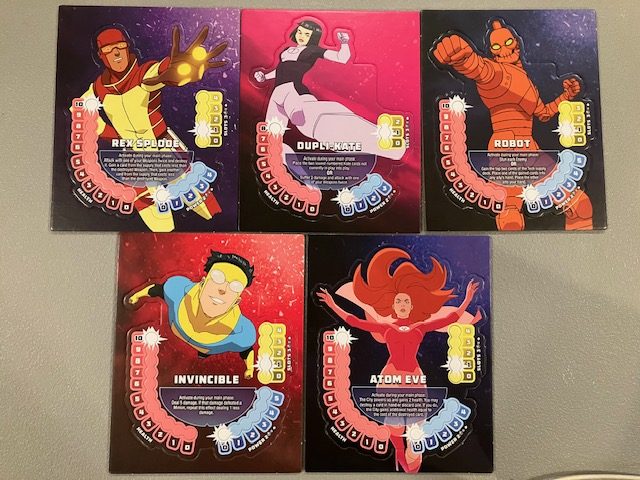
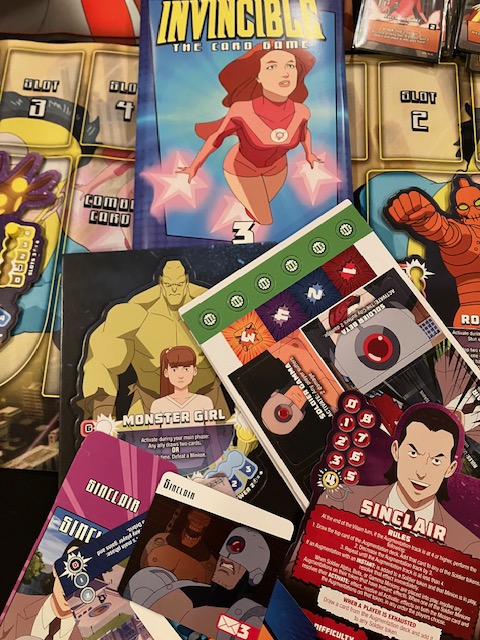
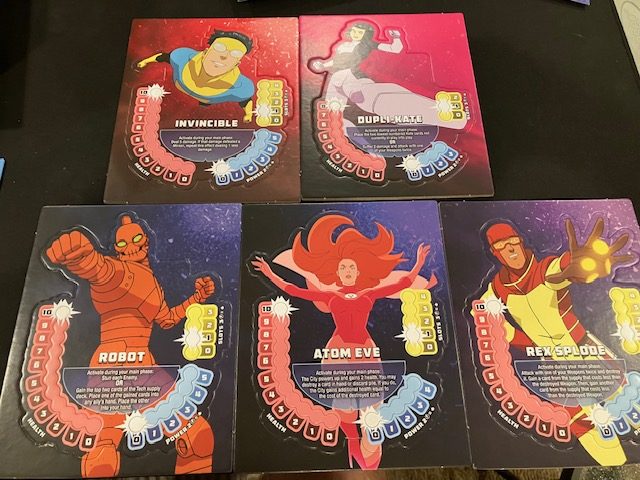
Each Player takes the role of a Hero from the Invincible universe.  If you don’t know the Invincible universe, you aren’t alone.  I know it from collecting comic books for years, and many people know it from the recent animated show.  None of my friends knew this universe.    Each character is kind of different (some have more slots, more hit points, faster power chart), but what distinguishes each character is their “special power”.

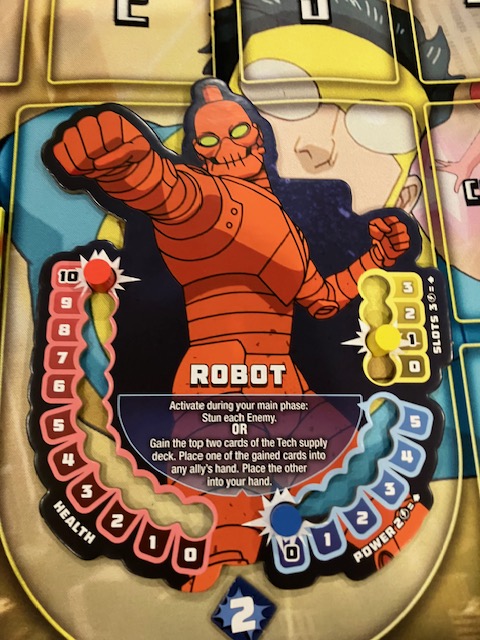
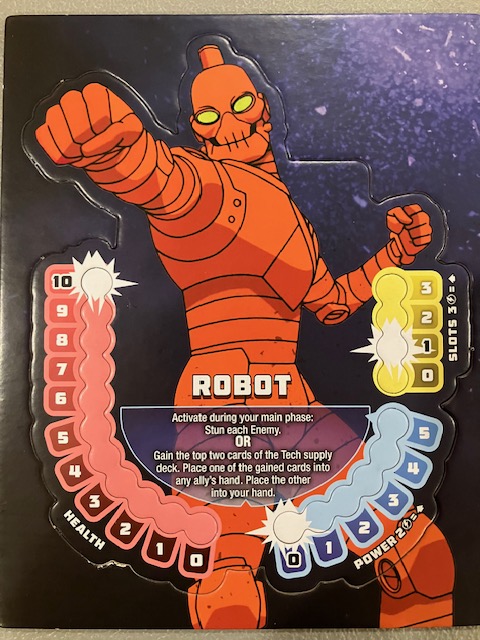
If, for example,  you look closely at Robot above (and yes, that’s his name in the comics), you’ll see written in blue (corresponding to the power chart) his special abilities: Stun each Enemy or Gain the top two Tech supply…

This is a deck-building game, so every player starts with a “crappy” hand of cards that they will upgrade and cull as the game goes.

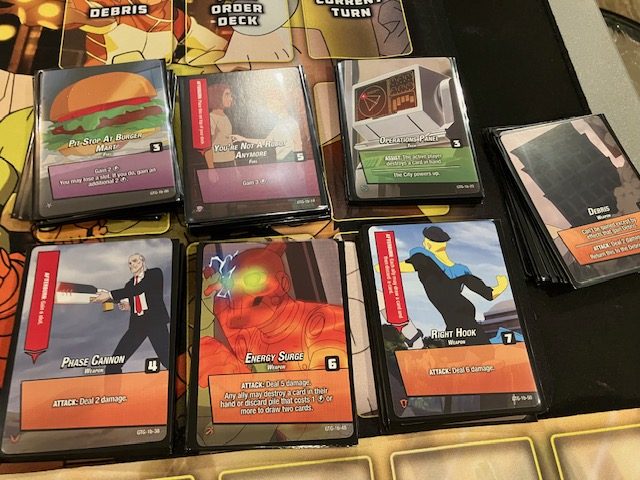
Like most deck-building games, you can buy cards with Fuel to get better FuelTech, or Weapons!!  The six piles above form the market; the top two piles get you better Fuel (purple) the bottom three piles give you better Weapons (orange) and the the upper right pile gives you Tech (green).

The interesting thing about this market is that every deck is full of different cards.  If you are used to Aeon’s End or Dominion, where every deck in the market has the same cards, that’s not what you get here! Each card in a deck has a similar cost and “flavor”, but they are all different.

Every game has a “bad guy”, the first is The Flaxans (see above).

Usually, you have to bring the “bad guy” to 0 hit points to win the game; this is denoted by a health dial.

At the same time, you are protecting the city!  You are a superhero after all! If the city ever goes to 0 health, or all heroes are reduced to 0 health, players lose!  

The expedition has four chapters (each a self-contained game), each with special cards and envelopes.

Overall, this game has a lot quality components!

Where’s My First Play?

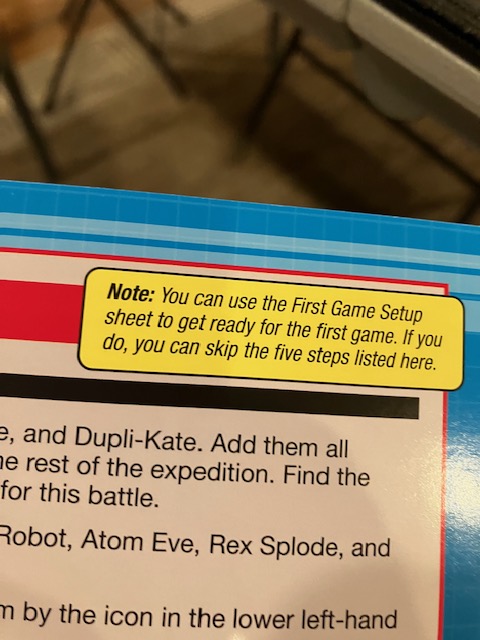
Where’s my First Game Setup sheet?  I did not get one!  I am VERY SURPRISED, because the Aeon’s End games (made by the same people) have amazing first play sheets! Am I the only one who didn’t get one?  Hopefully, if you get this game, they will have rectified this issue.

Art: Is This a Coloring Book?

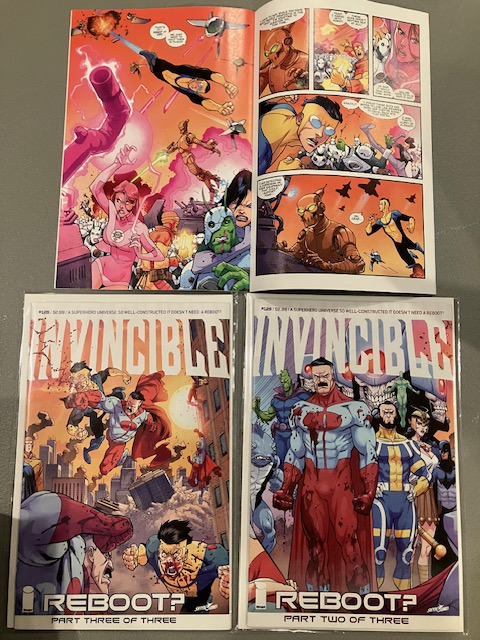
So, I love the art of the original Invincible comic:  It feels clean without being too messy.  That art really complements this universe.  See some covers and inner pages above.

Unfortunately, I feel the art in this game is more … anemic.  Compare the Atom Eve and Invincible characters (above) to covers from the comic!  The player art in the game just seem … lesser.  To the point that it bothered me.

And Robot feels so anemic (above), he feels like a page from a coloring book!

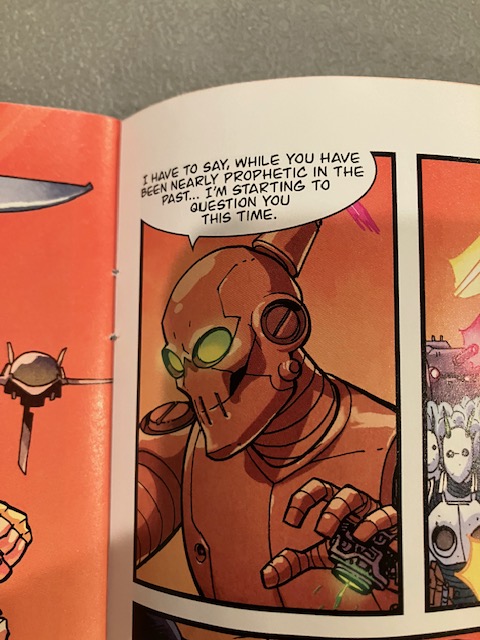
From just one frame in the comic, Robot looks great! But the character in the game made me cringe. “How could I explain this to my friends?  This looks like a coloring book!! Really, though, this is a great comic!!”

I was told by my friends to mellow out, as the game art is more consistent with an animated series anyways. So, the art we are seeing is more like the animated series. I guess.

Maybe this is just me, but I would have loved this game a lot more if the art had been … more like the comic book than the animated series.  (To be clear, even though Invincible: The Hero Building Game didn’t have art that quite as good as the comic, it was still significantly better: see review with lots of pictures here).

Decide for yourself.  To be clear, I like the game, but I don’t love the art.

Solo Play (true solo)

There are two ways to play solo (thank you for following Saunders’ Law)!  

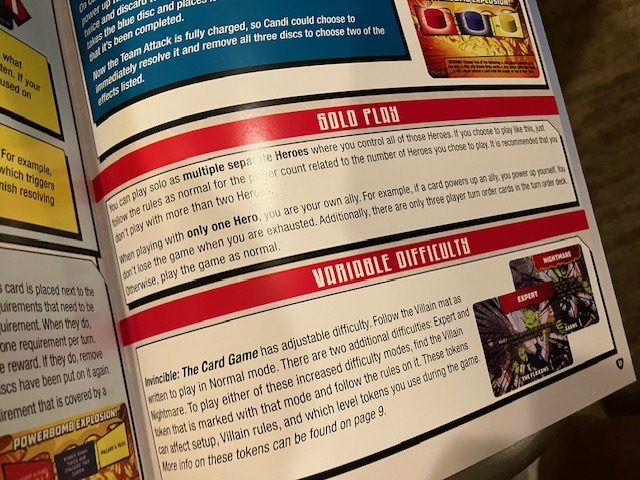
Our first play was true solo, where the solo player takes control of one character.  See above as Invincible battles the Flaxans alone.

There is a major difference in the true solo game: the Variable Turn Order deck is changed!  Instead of having 6 cards, there are only 5!  The Villain goes twice as normal, but the Hero only gets to go three times (as opposed to four turns in any normal game).  See above.

I think the idea is that the Hero gets a chance to refine his deck much more quickly, so that he has to be limited to three turns for balance.  The problem is, I think the solo mode is fundamentally more fragile.

My first true solo game was a massive bummer: I lost my being reduced to 0 hit points very quickly.  My second game was much better, and I think I just barely lost.  

The problem is,  the true solo game is very fragile.  In a 2 to 4 player game, there are multiple players with multiple hit points, so there are 20 to 40 hits points total distributed among the players!  In the solo game, the solo player has only 10 hit points (or less)! If the randomness of the game is too much, the true solo player will take that 10 hit points and die quickly!   And that’s what happened in my first solo game.   The other problem is that with multiple characters, one character can be reduced to zero hit points and still be useful as long as someone still has hit points! With one character, that will never happen.   

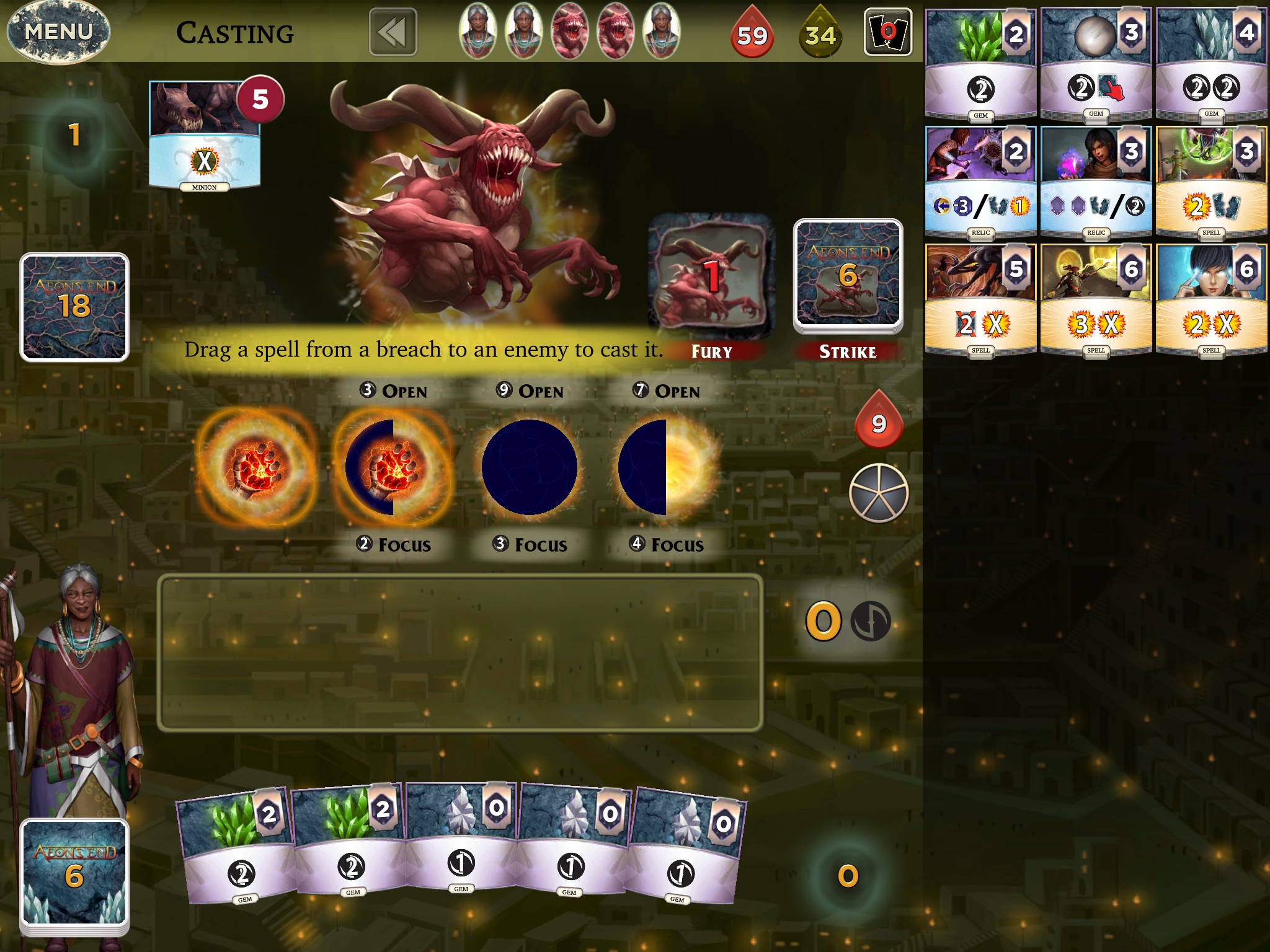
We saw this same problem in the app for Aeon’s End: the solo player gets fewer turns.  And frankly, I don’t play the app solo anymore because of this.  The true solo game is just too fragile and it’s too easy for the randomness inherent in the game to overwhelm you.

If you really want to try the true solo game, a simple house rule might be to allow the true solo character to double the number of hit points (have 20 hit points).   At least then it will allow the solo character to absorb more of the damage before dying (simulating multiple characters taking distributed damage).  I am surprised this isn’t built-in to Invincible: The Card Game; I know some games, like The Heroes of Terrinoth, where they balance the game by giving fewer players more hit points.

I probably won’t ever play this game true solo ever again.

Solo Play (Two-Handed)

Ah, but two-handed solo was much more fun!  The solo player alternates between two characters like a 2-Player game: this is the way this game was meant to be played!  Two characters who can assist!  Characters who can keep playing even after the other has been down to 0!  More hit points to take damage from the bad guys!  And four full turns for the heroes for every two turns of the bad guys!

This is the way I played the Expedition solo: Two-Handed Solo.   I recommend you play Two-Handed solo if you wish to play; it’s the way the game was meant to be played.  The only real downside to Two-Handed solo mode is there is more maintenance: you have to maintain two hero decks/stats as well as maintain the “bad guy” decks/stats.  There’s less maintenance in the true solo mode (as you only operate one hero), but (as you now know) that true solo game is much more fragile.

Solo Expedition

The Expedition is a series of 4 games (or more games if you lose) that you play in a row. (If you lose, you just play again with some adjustments).   New cards, new abilities, new heroes, new villains, and just new stuff comes out after every game of the Expedition and augment the next game!! By the time you get to the final game, you are playing with a lot of cool new stuff!

SPOILERS BELOW:  for the rest of this section, we’ll be discussing and showing pictures of the the chapters 1-4 of the Expedition.  Most of this won’t spoil too much, but if you want to be completely surprised, skip to the Cooperative Play section.

Chapter 1: Invincible and Atom Eve

The first Expedition game has us fight the Flaxans: it’s the only enemy you have when you first unbox your game!  I chose Invincible and Atom Eve to be partners in my first Two-Handed solo game of the Expedition!  They did great and were able to take down the Flaxans.  Atom Eve‘s special power seems very specialized, and I didn’t find myself using it at all (it’s very city based). Invincible‘s special power was more interesting and I used it at least once.  To be fair, I didn’t need to use the Special Powers too much, because the first game is simpler.

This is really just the base game with nothing special.

Chapter 2: Rexsplode and Robot

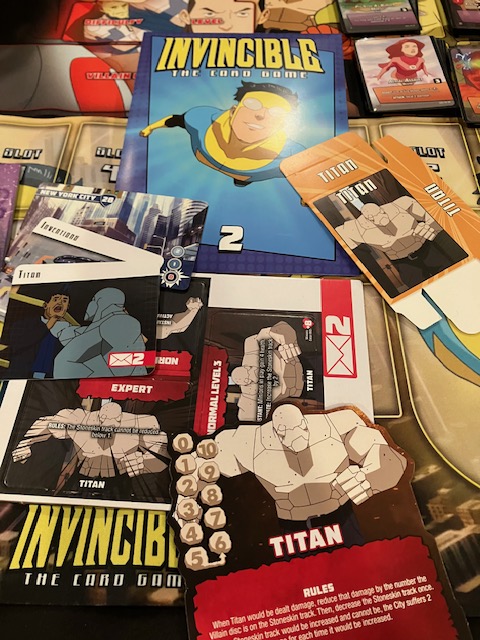
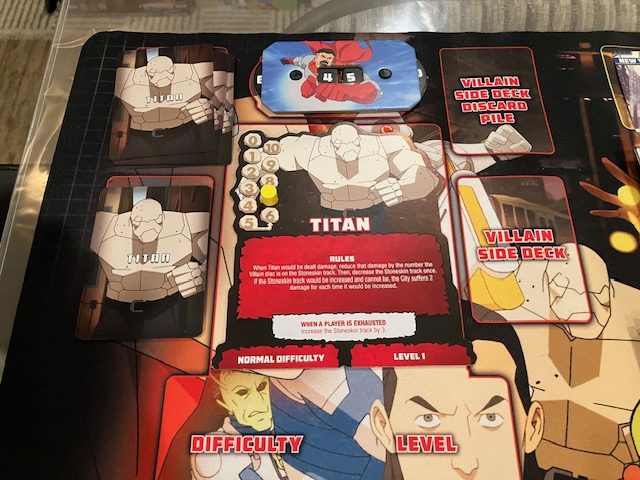
For Chapter 2, you fight the Titan!  He’s all about damage reduction!  And this Chapter also introduced something called Inventions!  Basically, Inventions are a card only you can buy, but you get to choose it at the start of the game; it allows players to strategize a little on what their characters may focus on.

Titan’s really hard to do damage to!

To change things up, I had Rexsplode and Robot fight the TitanRex has a very weird power (use a weapon twice, but blow it up), and so does Robot  (he grabs tech)

And we saw exactly the situation we discussed earlier in the True Solo section!  Robot was reduced to 0 hit points, but because Rexsplode was still alive, Robot kept fighting!  Even Rexsplode was down to 3 hit points, but they emerged victorious!   I think part of the issue that they didn’t do better was that I didn’t use their powers very well.  

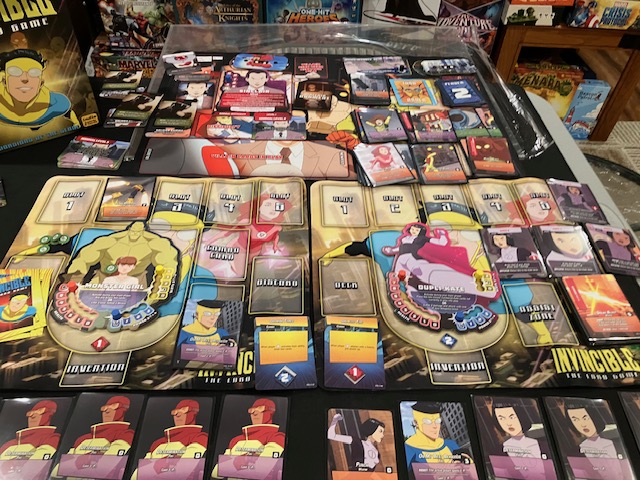
The Inventions were interesting, but not a real game-changer.  It’s just one more card you can buy.  It does give each hero some focus, though, and some chance for discussion/interaction when you choose, so that helps cooperation.  Note above that I put the Inventions on the LEFT of the mats (instead of under the character).  Again, the player mats could have been better.

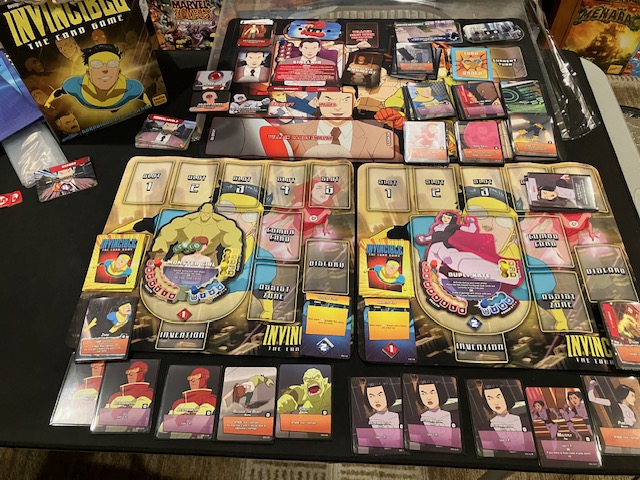
Chapter 3: Monster Girl and Duplikate

Chapter 3 introduces Monster Girl as a new player character.  The “bad guy” now is Sinclair!

Monster Girl and Duplikate went after Sinclair!  

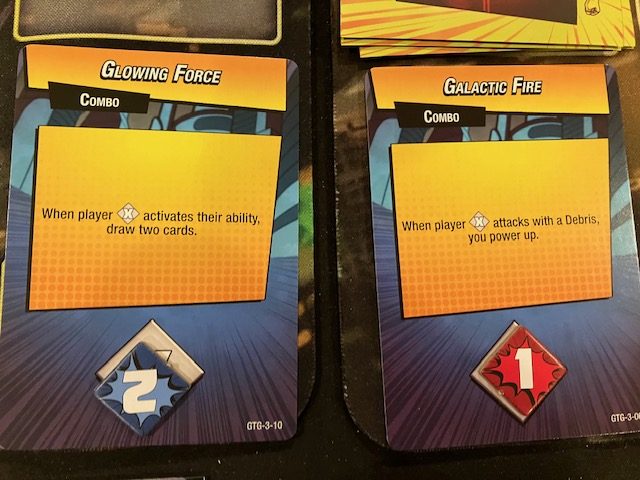
Something new from this chapter: The Combo Powers!  Each player gets to chose a Combo!  The Combo Powers are interesting because they allow your partner a special action whenever you do an action! For example, when player 2 activates their ability, player 1 gets to draw two cards!  And when player 1 attacks with debris, player 2 powers up!   

Monster Girl and Kate (with their Combos and Inventions) were a great pair! They handled Sinclair and all his crazy machinations!  And this was the first game when I really feel like I was very strategic and took great advantage of both the Special Powers and the Combo Powers!  Both Monster Girl and Duplikate did a great job of helping each other all the time! This was by far my favorite game of the Expedition.  It was just fun!

If Inventions were pretty good, I think The Combo Powers are a bit of game-changer (in a good way), especially if you can harmonize so that the characters combo powers really reinforce each other!

This was my favorite game of the Expedition.  The villain was still hard and interesting, but the Combo Powers stepped up the game for me!

Chapter 4: Monster Girl and Duplikate

By this point, I had tried all the heroes.  I had so much fun with Monster Girl and Duplikate, in my previous game, I took them for the final run against Omni-man!

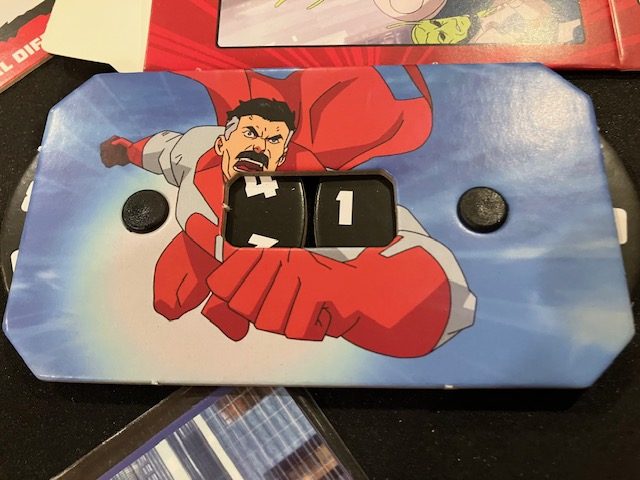
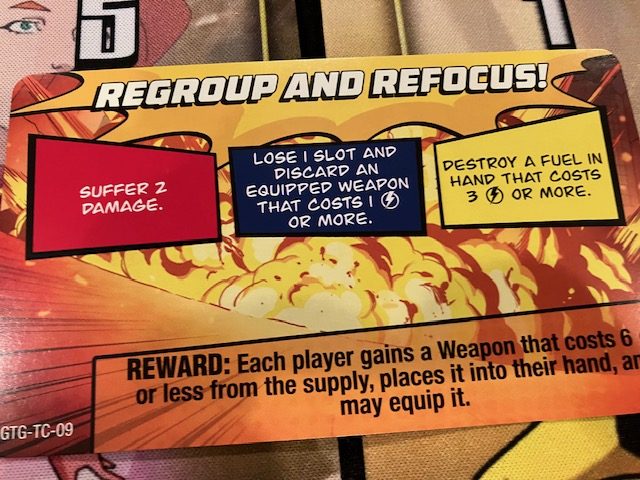
Chapter 4 introduced the Team Attacks.  You get to choose one of six (I think).  See one of them above.  Basically, your characters can choose to do one of these three sacrifices on their turn.  If, all three sacrifices have been done, players can choose, at any time, to get the reward!  The coolest part is that you can choose WHEN to get the reward so you can make sure the sacrifices are timely and not in vein!

Omni-Man is a VERY different villain, as you basically have to stop him from destroying earth with his catastrophes!  Basically, you have to make a TON of sacrifices as you play!

This was a super cool way to end the game.  Monster Girl and Duplikate did a great job making sacrifice after sacrifice to save the world!  And they did use the Team Attack, but it wasn’t as game changing as we had hoped.

It was fun to save the world!

Putting It All Back Together

After I was done with the solo campaign, the Expedition book gave us directions on how to put the game back to its pristine state;  I reset the campaign so I could play cooperatively with my friends.  Every card has a notation about which deck it came from (see above).

Cooperative Play

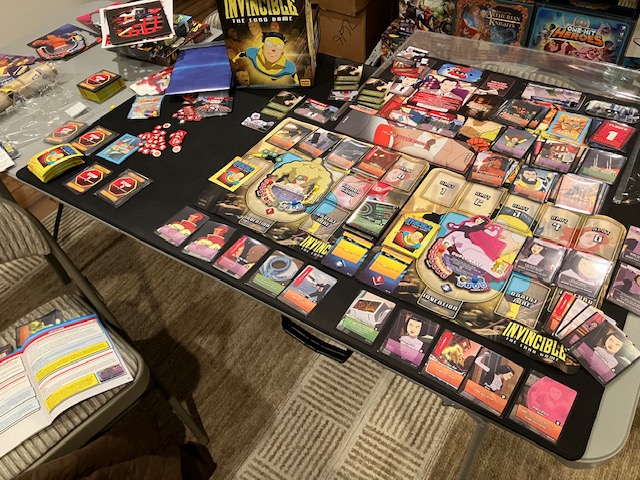
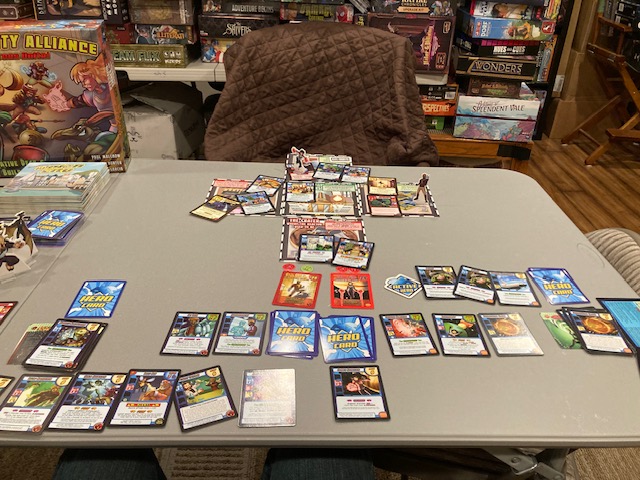
Invincible: The Card Game took over my game table for a cooperative game for a game night.  

The Assist keyword was the hit of the night!  Everyone loved the idea that they could help someone else out when it wasn’t their turn!  And the Afterburn effects were also a big hit!  (I didn’t talk about Afterburn too much, because we already saw in Astro Knights: Eternity,  but Afterburn was great in our solo games).

The cooperative game worked, even though we lost.  We had fun and would play again.

What I Liked

Universe.  I really do like this universe! Retheming Astro Knights to this universe really did work.

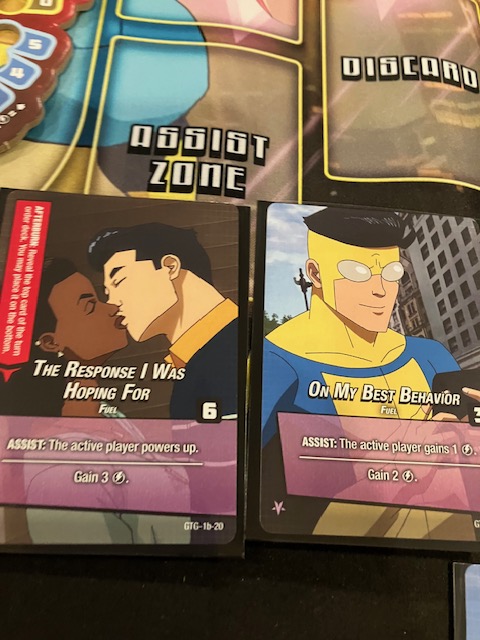
Assist:  I think Assist was what Bolster (from Astro Knights: Eternity) wanted to be. Assist is easy to explain and easy to play: when it’s not your turn, you can offer an ability/something to another player!  Take a look at some of the cards above. This one thing really boosted my assessment of Invincible: The Card Game!  It makes the game more cooperative, more interactive (as you pay more attention to other people’s turns), and generally makes the game more fun! (Bolster was the idea that when someone else had to discard, you could get something.  It was clumsy and harder to use.  Assist is what we wanted but didn’t know it).

If there were one thing that elevates Invincible: The Card Game above all the Astro Knights or Aeon’s Ends of the world, it’s this.   (Put Assist with Friends and Foes module from Aeon’s End: Descent, and you might have a Top 10 game!)

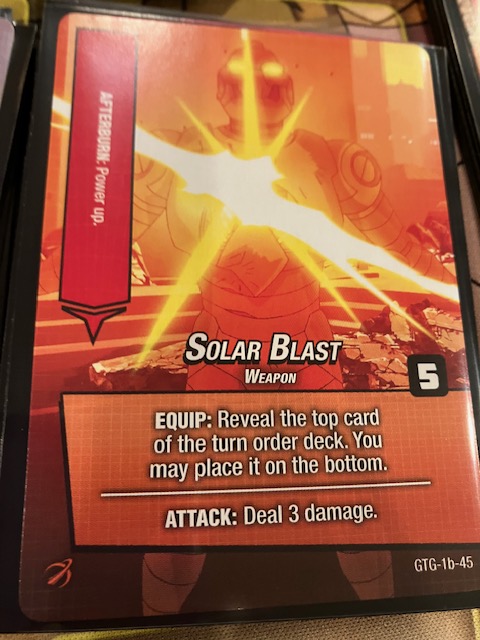
Afterburn: The Afterburn effects are really a neat thing.  Sure, we saw them in Astro Knights: Eternity, but they work great here too! It’s just another choice you have when buying a card to help future you!  

Things I Didn’t Like

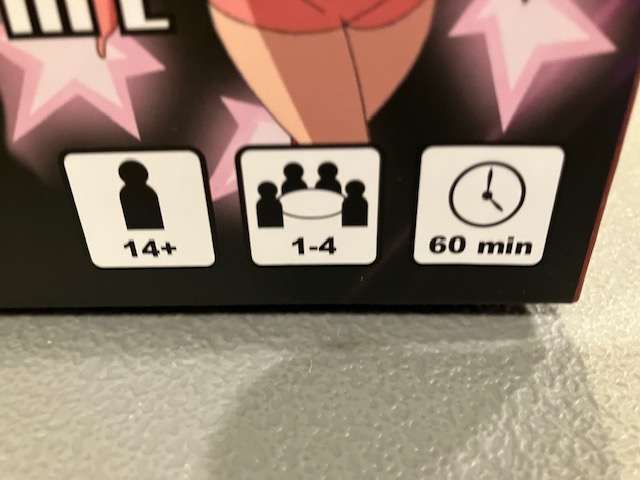
Time: I have played this game a LOT.  I don’t think I ever saw a game anywhere NEAR 60 minutes.  Except maybe that pure solo game when I lost so quickly! That 60 minutes for estimated time seems off by about 2x.  90-120 would have been better?  Maybe, maybe, after you have read all the cards and know everything in the villain and box you are playing, sure.  But a new game with new rules and a new Villains (which is what you want to keep the game fresh)?  No way for 60 minutes.  

Art.  I love Invincible and I love the art of the original comic book.  The art is in this game seems anemic and more like the coloring book version of the universe!  Maybe this is just me.  My friends told me to mellow out; it’s more like the animated version.

Player Mats:  I had so many problems with the Player Mats; I think they should be redesigned. (see our discussion in the section at the beginning). Another problem is that all mats have the be symmetric, but sometimes when I lay out cards next to my friends, I want the layouts to be mirror images!  For example, the Combo Cards should probably be NEXT to each other so that’s it’s easier to remember when to activate them! Bah, maybe I’m just grumpy and you’ll be perfectly fine with the mats.  But I think I struggled with almost every decision they made.

True solo: I think the True Solo mode is too fragile.  I think an easy fix might just be to give the solo character double the hit points. I am also reminded that Aeon’s End: Descent had a solo mode with that DIDN’T use fewer player actions, and it worked just fine (so fine that it made the #3 spot on our Top 10 Solo Games of 2024), so I really don’t think you need to only have 3 player action cards.  Ugh.  

Variable Turn Order: We’ve said it many times! There are problems with Variable Turn Order games!  See out discussion here:  A Discussion of Variable Turn Order and Ways To Mitigate Its Randomness! In all of our games, we did have to use our ad-hoc house rule of never letting the Nemesis have more than 2 turns in a row (at least twice).   (I did note that some of the Afterburn effects allow you to have some choice on the Variable Turn Order deck, so I appreciated there was some mechanisms in the game to affect that, but it’s still pretty random).

Conclusion

I’ve been grumpy a lot this review; I think that’s because I know this game and this system fairly well, so I have some experience with what seems to work.  But don’t get me wrong, this is an 8.5/10 game for me.   And the Assist keyword is probably my favorite new thing in this system!  It really facilitates cooperation!!!  (I am so glad they kind of “jettisoned” Bolster)

There are just some things that could have made this a 9/10 for me!  I just don’t think this will ever be a 10/10 for me because of Variable Turn Order issues (unless they find some way, like Fate Tokens, of mitigating it).

The Expedition is a fun way to reveal all the content of the game! And four chapters (games) seems just right as the length of a campaign! Any longer and it seems too much, any shorter and it leaves you wanting more.   

And the game says you CAN play this Astro Knights.  I guess I never got that far? I still have at least two expansions to play before I even get anywhere near that!

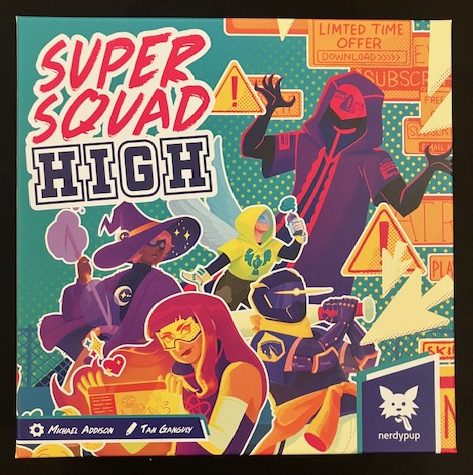
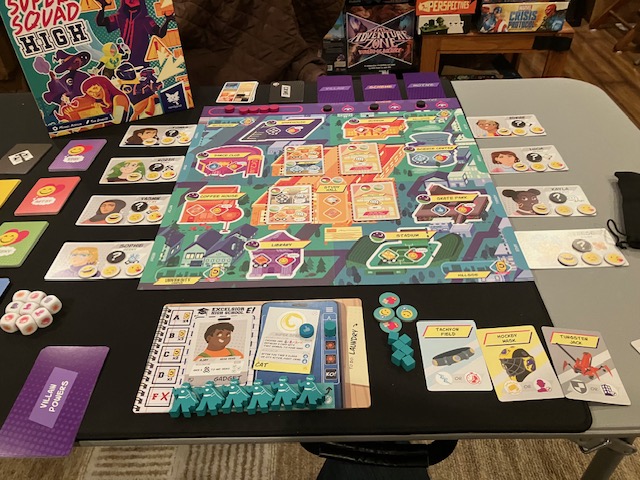
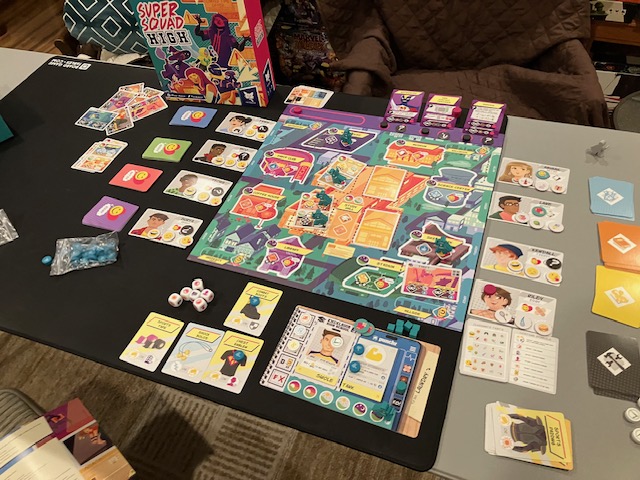
Super Squad High: A Solo and Cooperative Superhero-ish Game

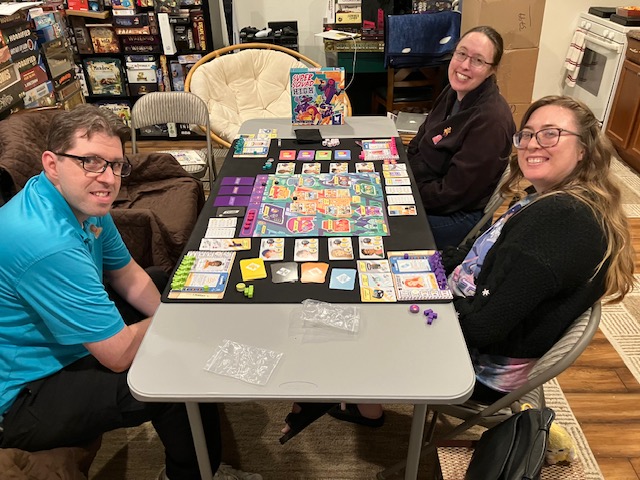
Super Squad High is a cooperative and solo Superhero game that was on Kickstarter in April 2024.  It promised delivery in March 2023, and it was just a month or two late (which is pretty good in Kickstarter terms).

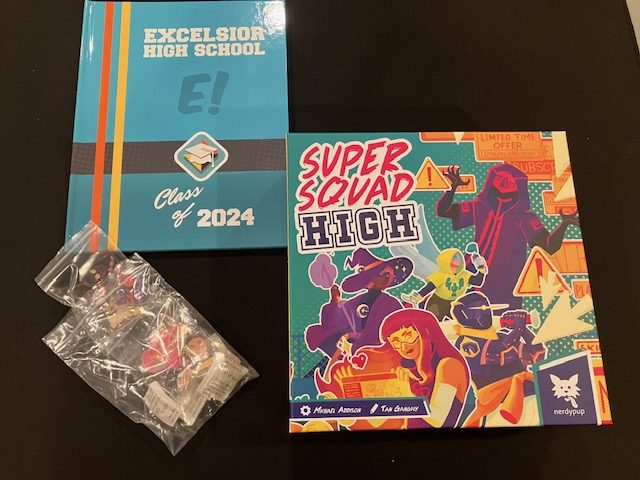
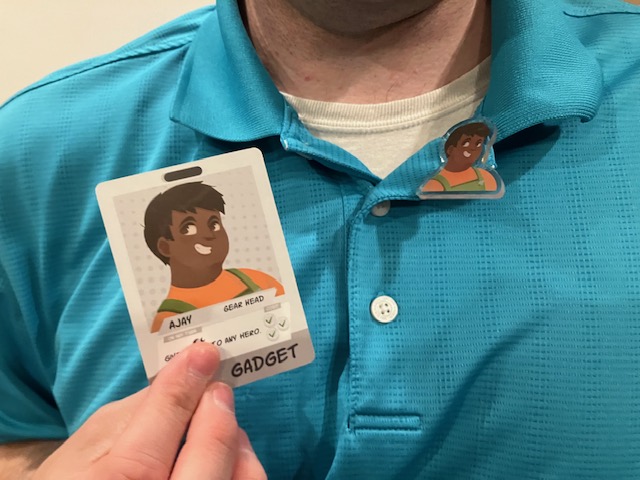
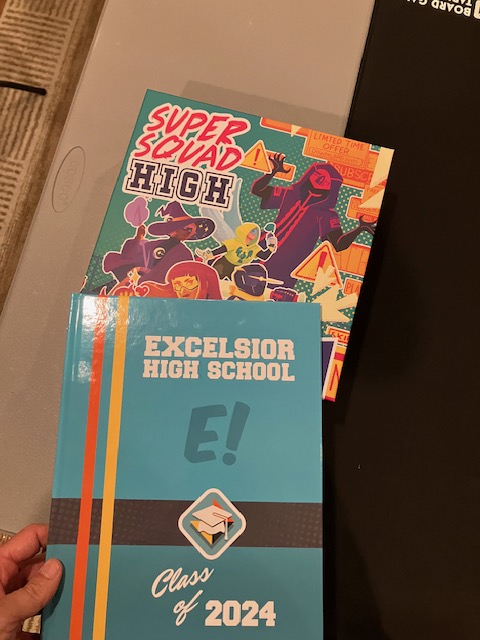
I went ahead and backed the high-end version and got the Arylic pins and Art Book: See above.

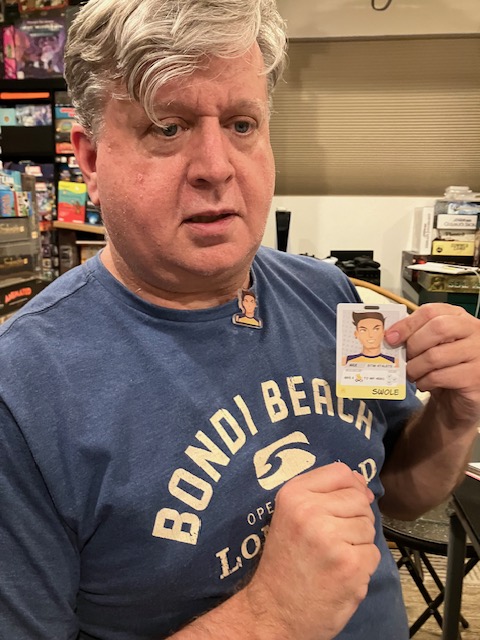
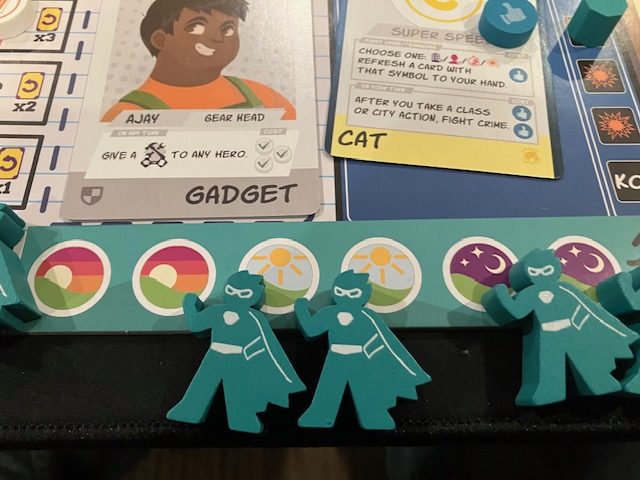
The Arylic pins are completely superfluous and you don’t need them, but we had fun picking our characters using the pins (and then wearing the pins): see above.

Let’s take a look!

The Rulebook

The rulebook was just okay.  

The rulebook ventured into low C territory for The Chair Test. It does kinda fit on the chair next to me, and it does stay open, but it does droop a little too much for my liking.

There tended to be a LOT of text without too many pictures.  Luckily, it seems like most of the rules are there (modulo one solo rule for Crime cards).  Also, the font was a little small.

There also seemed to be a lot of “space” around the edges that was just “flavor”, when I would have preferred more pictures and a larger font.

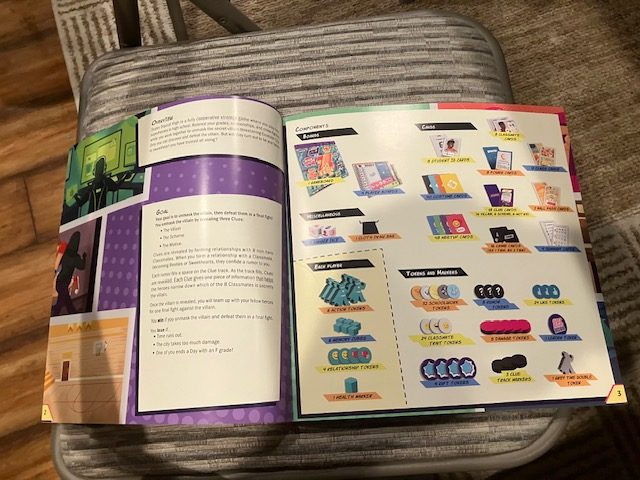
The components page was pretty good.

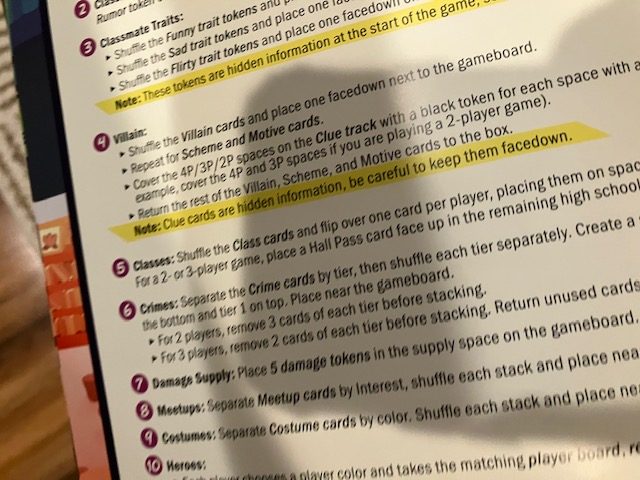
The Set-Up worked pretty well, especially since the directions were on one side, and a picture on the other.

I got through the rulebook, and most of the rules were in there in a logical place.  I think the rulebook could have been made better in a lot of ways, but the fact that it did seem to have all the rules goes a long way.  In the end of the day, it was fine, but it could have been better.

Unboxing, Components, and Gameplay

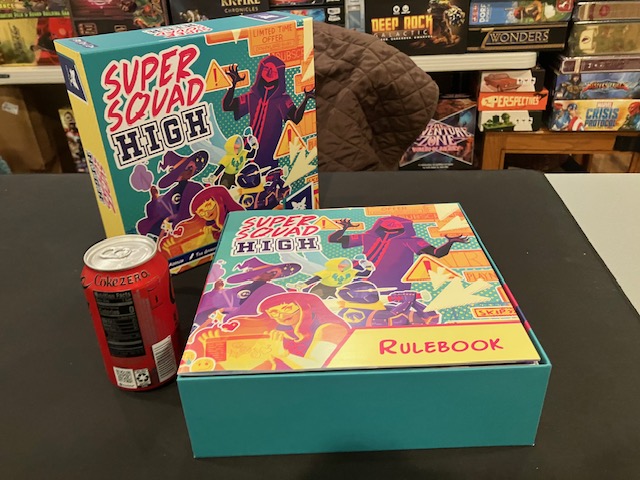
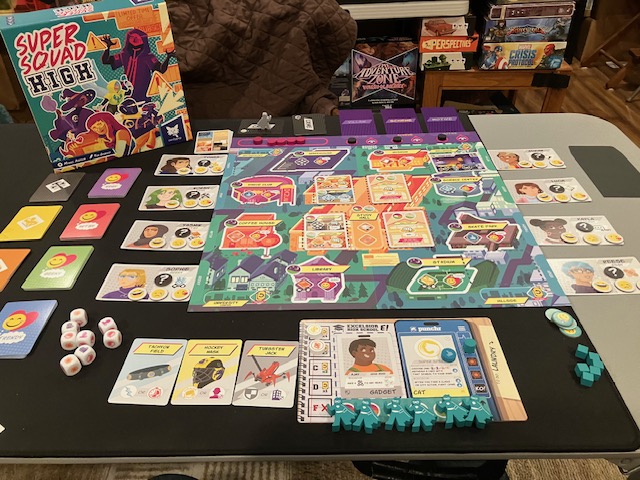
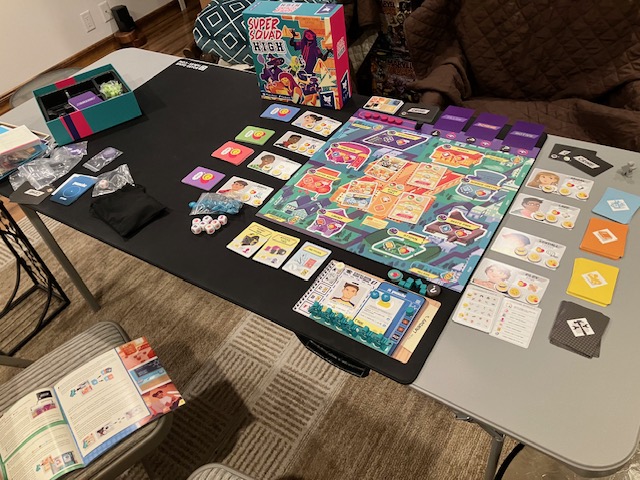
This is a pretty standard sized game box: see Coke Can above for scale.

1-4 Players each take the role of a SuperHero in a High School!

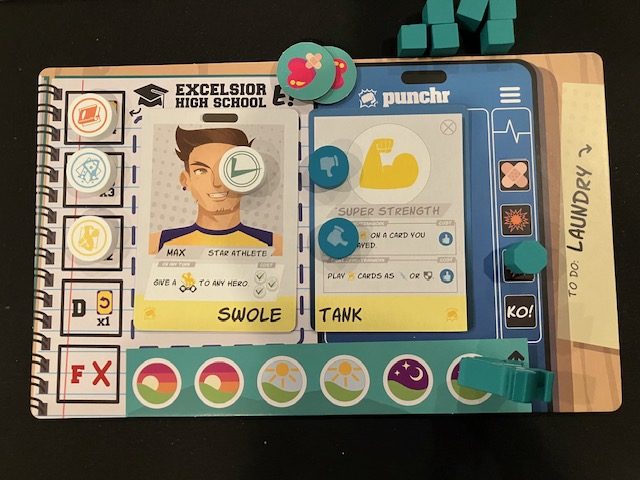
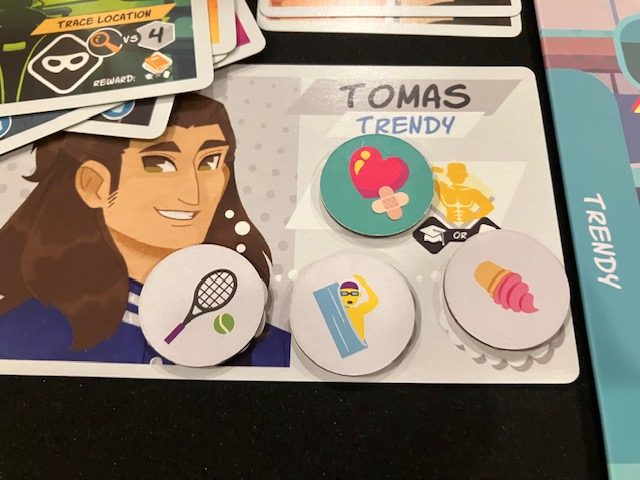
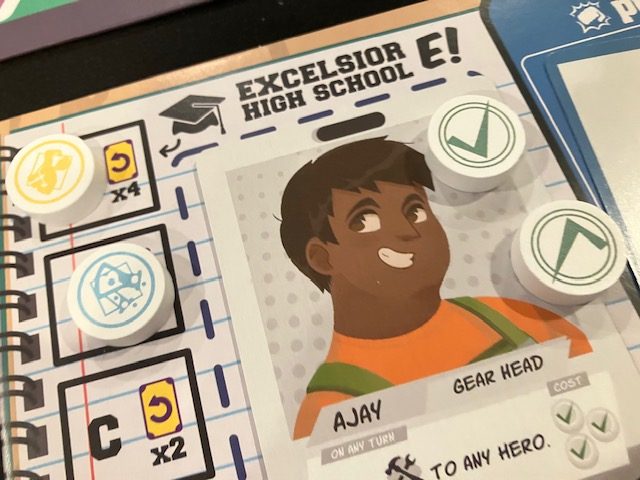
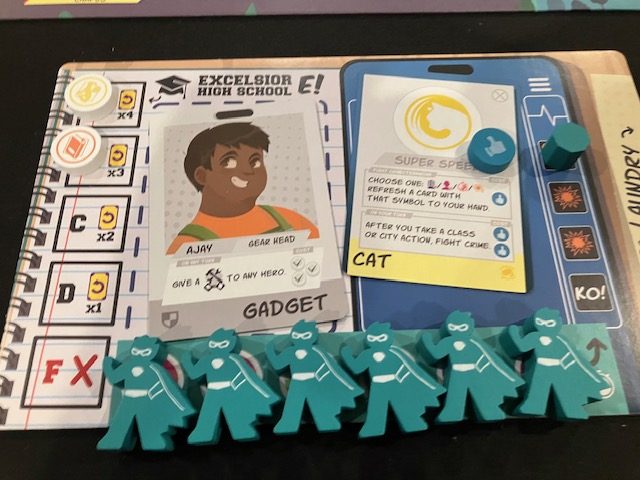
Each hero gets a Student ID and Power card: see above.  These two cards form your character!  My character was the “Swole Tank” and he has Super Strength!  See above!! Players get to choose from one of two Student IDs and one of two Powers at the start of the game, so there is some choice about who/what you get!

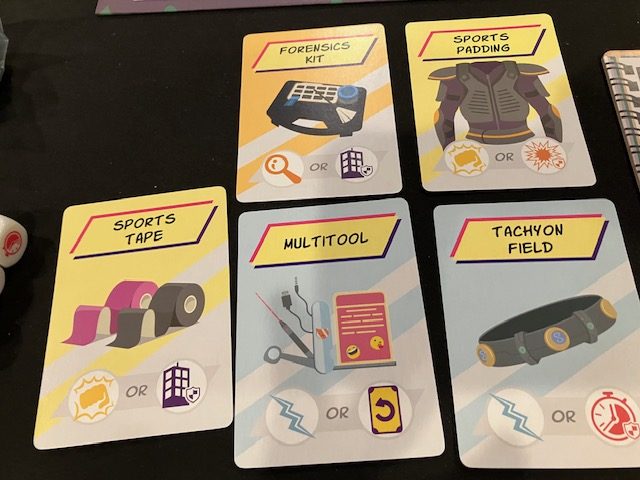
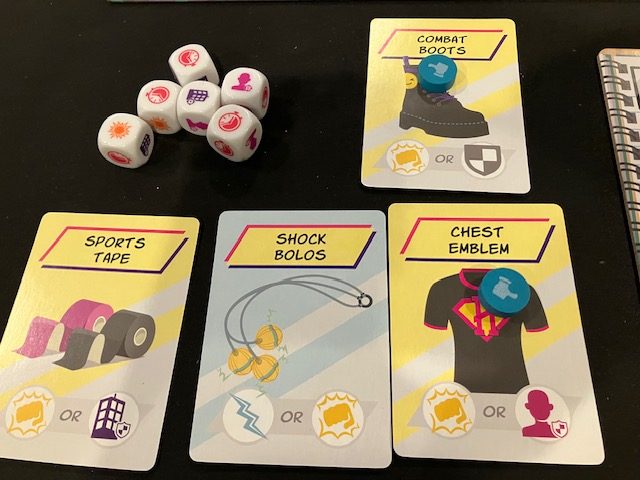
Players gets “Costumes” (cards above) throughout the game.  These cards are basically used to fight crime!

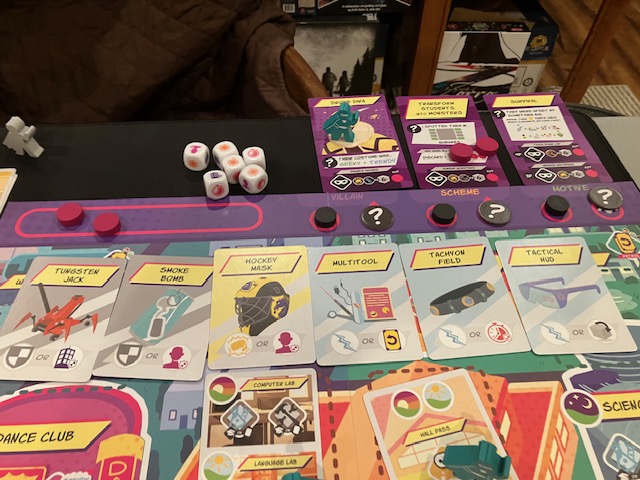
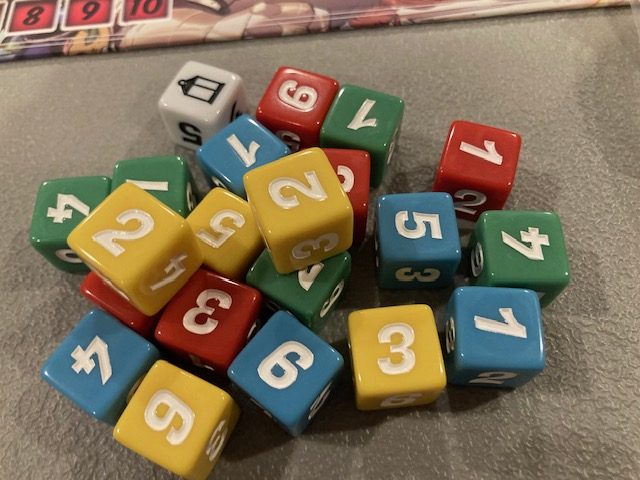
Generally, the Costume cards are used to the stop the elements of crime … that appears from the Danger Dice!  See  the Danger Dice above, and that the Costume cards correspond to some of the symbols.  Basically, if you can’t “block” all Danger Dice with your Costume Cards, then something takes damage (either the city, you, or an innocent bystander)!

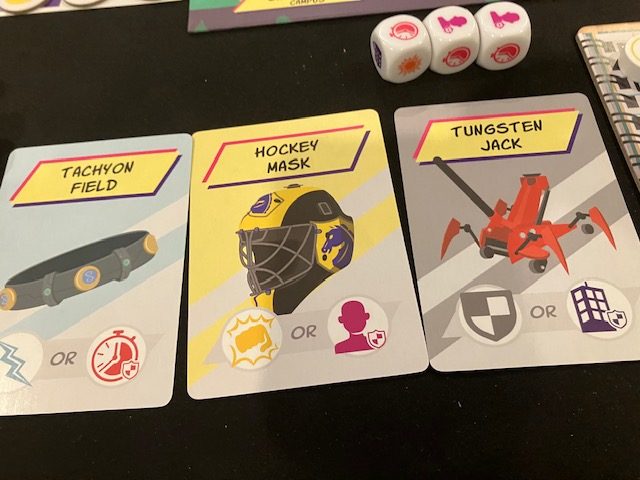
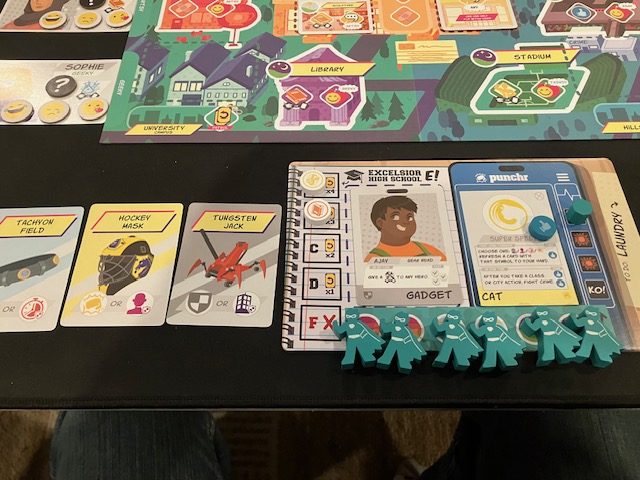
See above as the Tachyon Field, Hockey Mask, and Tungsten Jack block all bad effects from the crime!  And even though the Tungsten Jack doesn’t match exactly to block, this was a “grey” or Tools-related crime, so all Tools cards are wild and can stop anything!

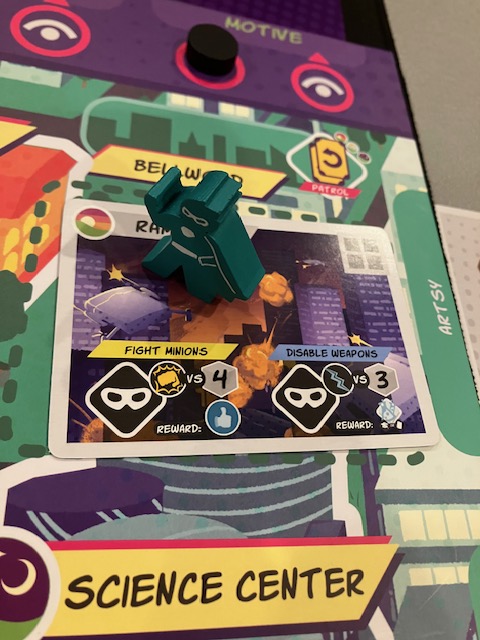
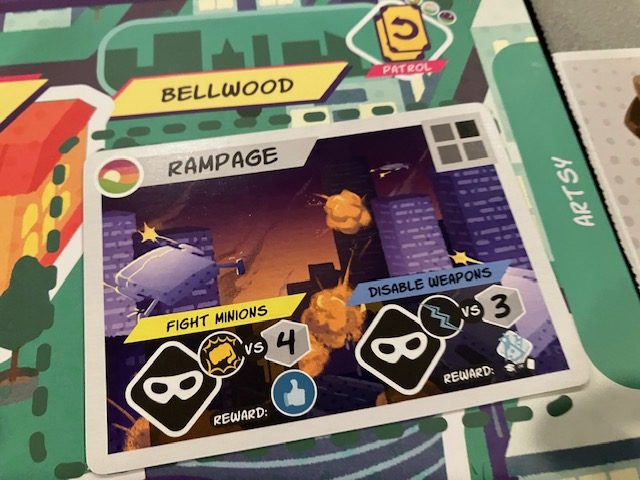
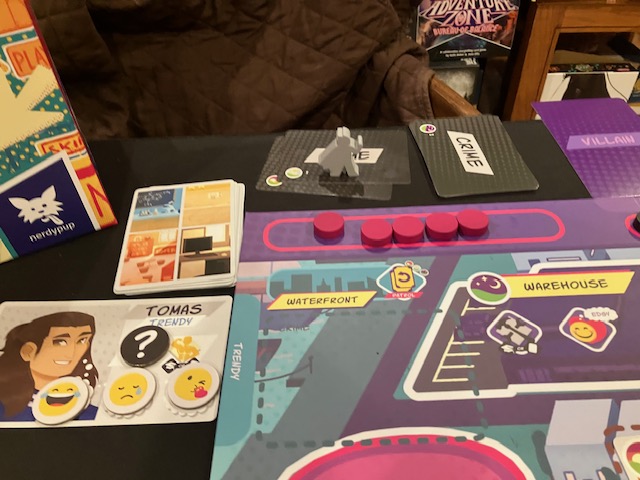
Crimes come out as the Heroes play!  See above as the Rampage hits the Science Center!  In order to take out that crime, you have take care of Minions AND Disable the Weapons!  If you fail, then some damage happens to the city!

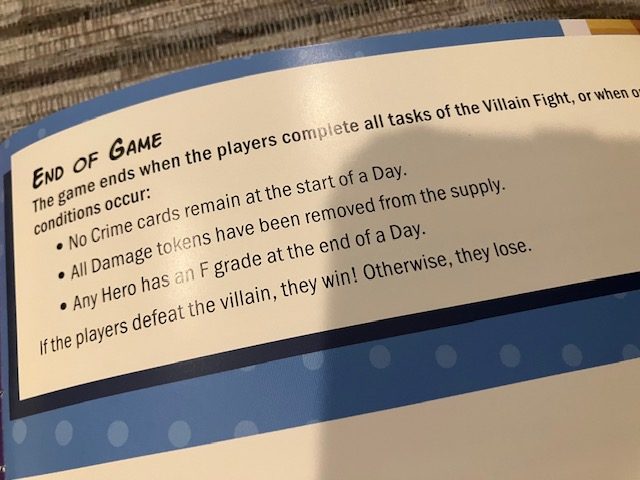
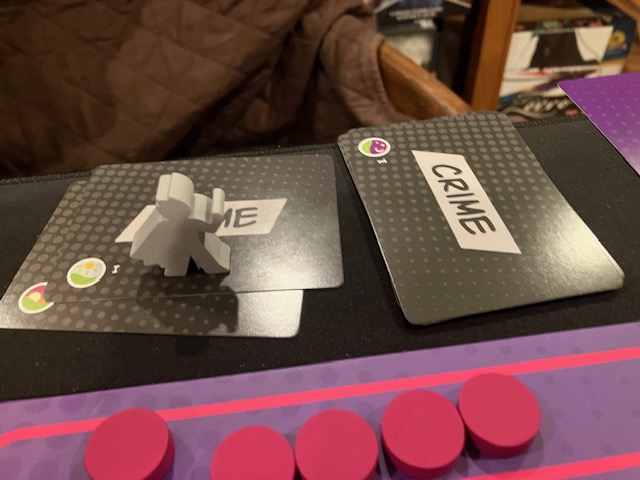
At the top of the board are “damage tokens”: if there is ever too much damage (usually from letting crimes go), then the players lose!  The heroes MUST keep the crime at bay!

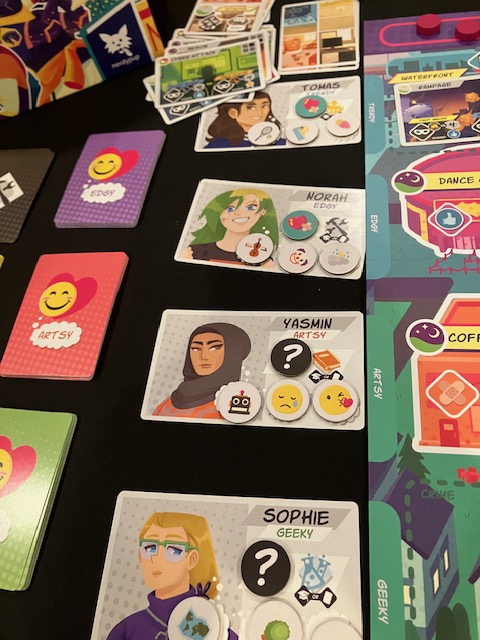
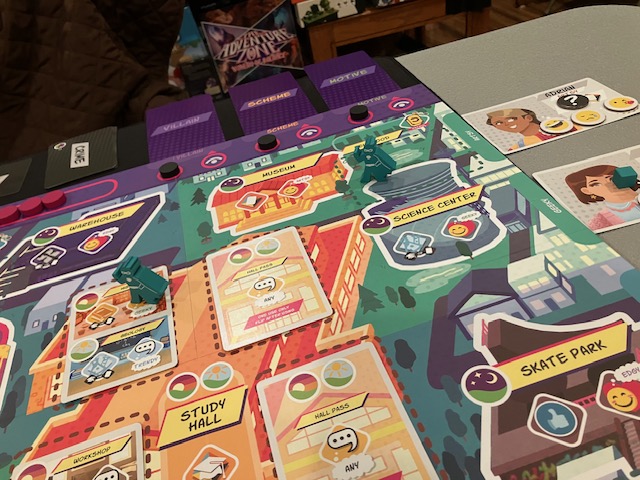
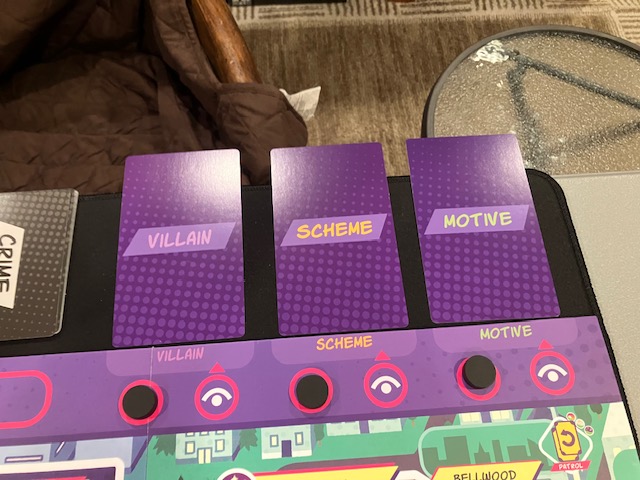
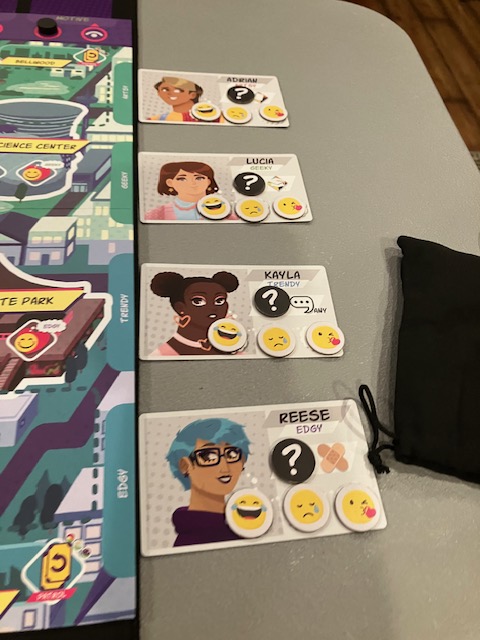
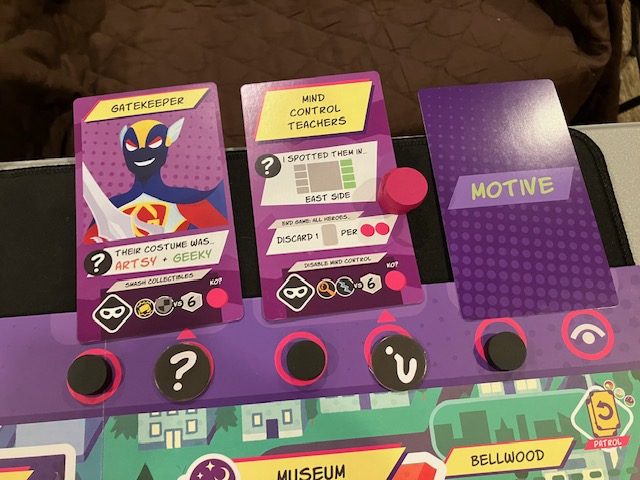
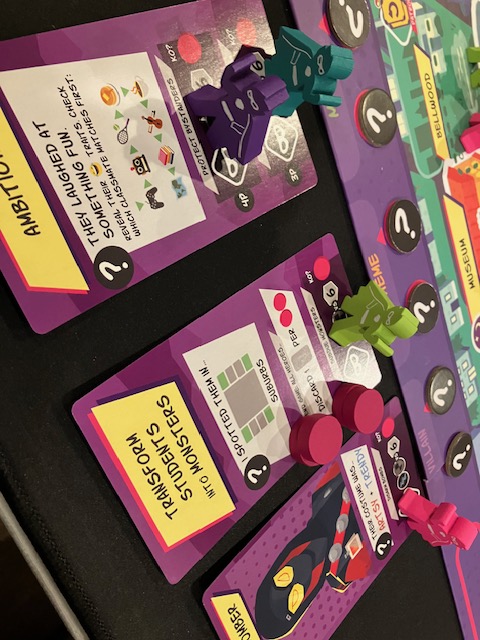
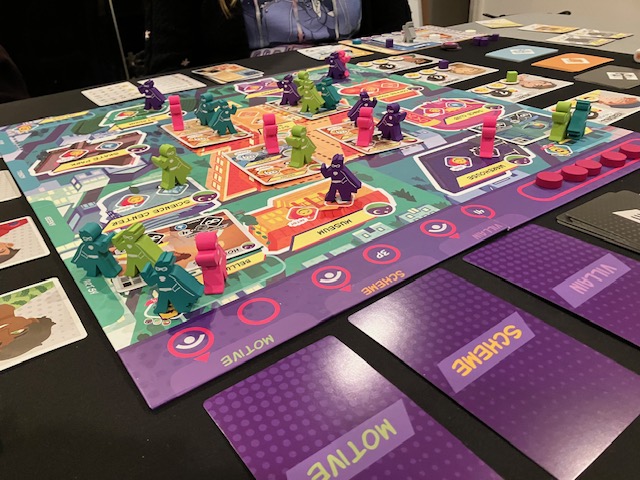
Although keeping crime at bay is important, it’s not how you win the game!  You have to talk to your schoolmates to try to deduce WHO is the big bad villain, what their scheme, and what is their motive! See schoolmates above!  

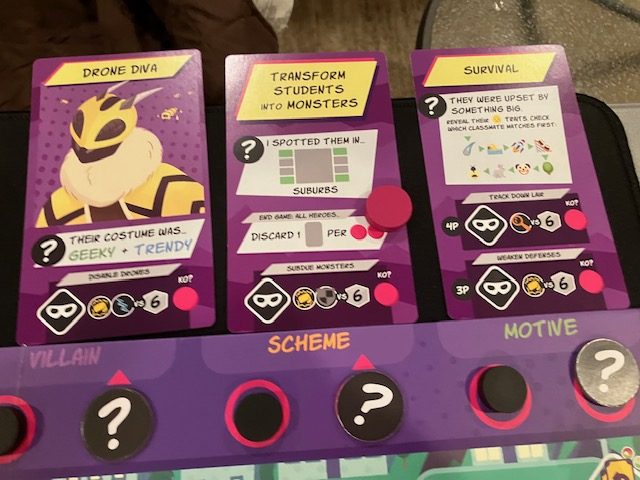
The more students you befriend and have successful “meetups”, the further you get!  To win the game, you must uncover all three: Villain, Scheme, and Motive (see above).  You must do this before the clock runs out!  (The clock is the Crime deck running out of cards).  Even after you unmask the Villain, you STILL have to have a final fight!

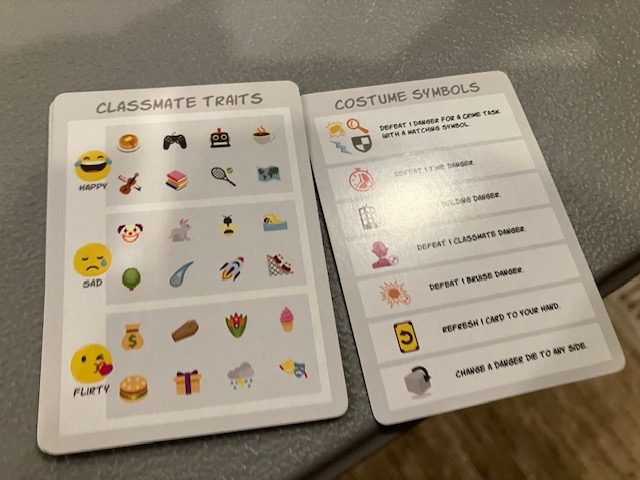
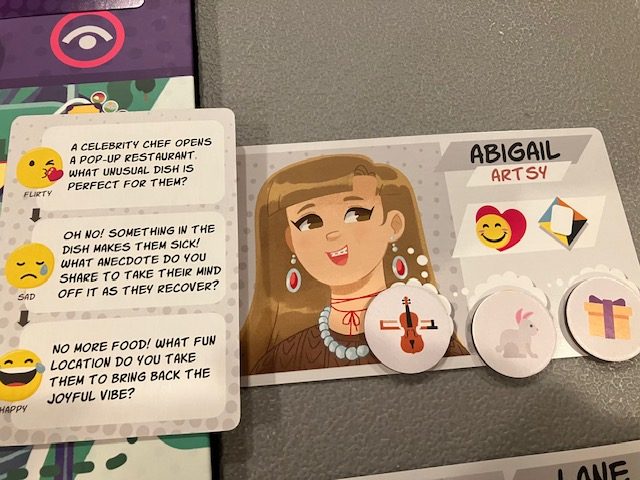
Students are befriended by finding out about them (their Flirty, Sad, and Funny interests).  In order to truly befriend someone, you must discover their interests and what makes them tick!

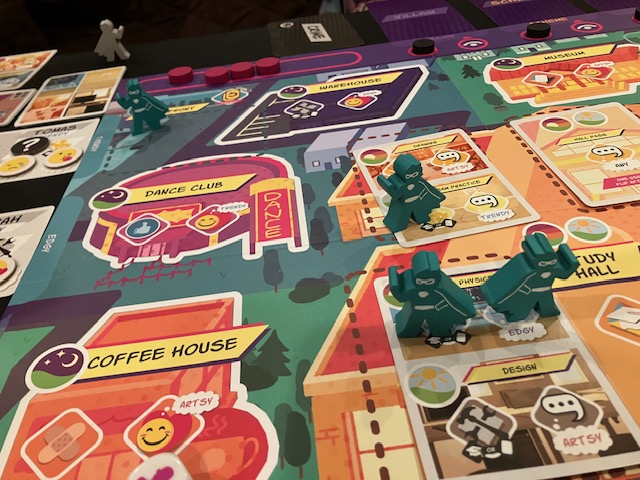
You move your tokens on the board to “talk” to people: see above as one token talks to some Edgy student (to uncover one of their traits).

Crazy enough, with all this going on, you still have to keep up with your homework!  Doing your homework won’t win the game, but if ANYONE is ever failing, all players lose the game!

If you can keep crime at bay, keep your homework under control, speak to your classmates, and do your laundry, maybe you can uncover the Villain, Motive, and Scheme!  After such a reveal, you have to win one final battle with the SuperVillain to win!

Worker Placement

This is nominally a Worker Placement game, as you have to put out your tokens out to do stuff.  Each player gets two tokens in the Morning, two in the afternoon, and two at Night.

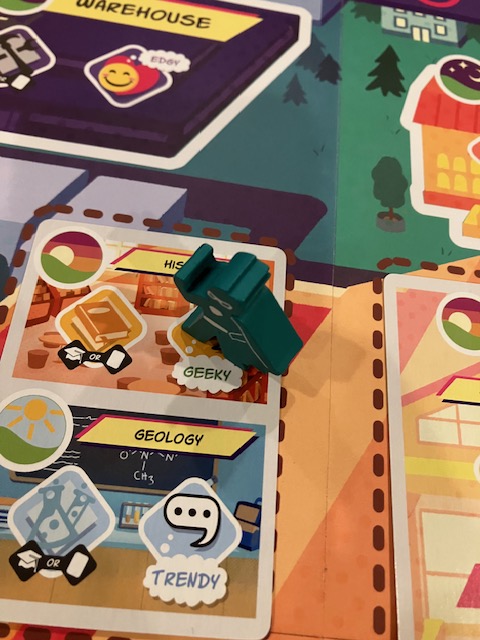
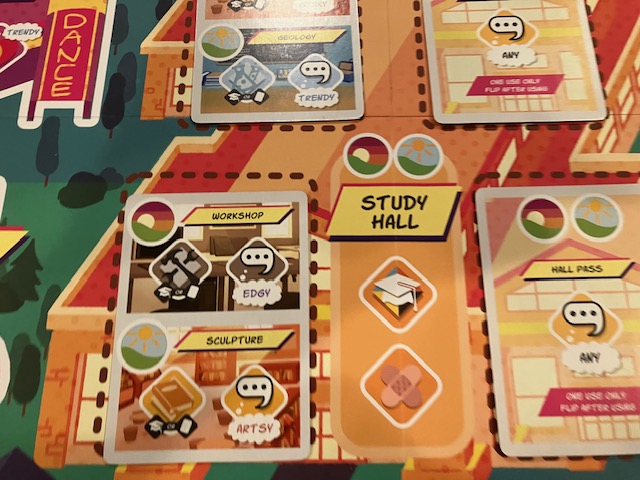
These tokens go on the board to do stuff! Notice above as a token goes on “Geeky” to talk to a Geeky schoolmate!  Also notice that the Locations can ONLY be visited at certain times of day.  In the morning and afternoon, you can usually only do things at school (like Homework or talk to schoolmates) or sometimes upgrade your Costume Deck!

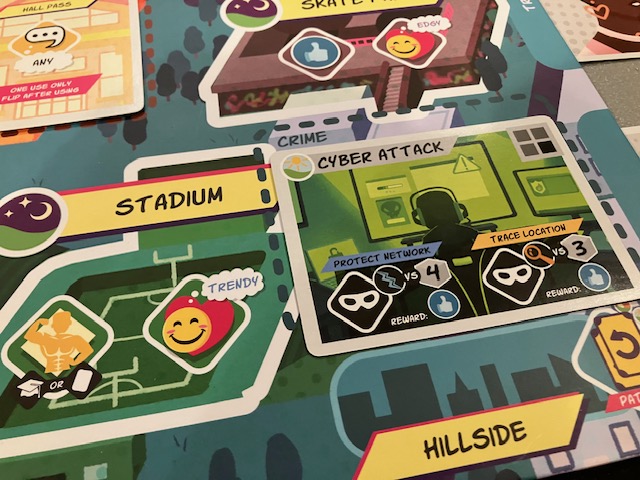
Usually, things are the city can only be activated at night!  See above as the Stadium can only be activated at night!

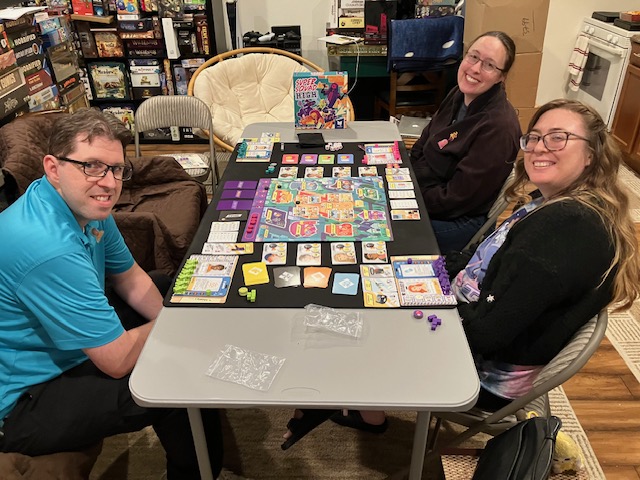
From a cooperative point of view, the rulebook was never “clear” on how to place your tokens.  The only rule seems to be “Starting with the Leader, players take turns taking actions”.  I think that probably means clockwise … but given the lack of clarity, we chose to simply use Player Selected Turn Order!  As a group, we can decide when to place our tokens.  Since this is a fully cooperative game, it doesn’t matter “too much” the order they are placed, as long as everyone agrees with basically where they go!  (This was probably a House Rule: we’d recommend it to you).

“I really need to do my Chemistry homework, or I fail and we lose!  You need to let me go there!”
“I really need to talk to that Geeky girl, is that okay, or do you need to talk the other Geeky guy?”
“We really need to deal with this crime!  I can do the punchy part, can someone else do the gadgety part? Or can you back me up nearby?”

These (above) are typical phrases that got uttered during our gameplay!

The Worker Placement as a mechanism to fight crime, do homework, talk to schoolmates, and upgrade our decks seemed to work pretty well.  It was intuitive and the icons worked pretty well.
It was also interesting to note that you could only use certain spaces at certain times of the day.  This made planning ahead more critical!

Deduction

This is nominally a deduction game … ish?  You have to uncover the Villain, Scheme, and Motive in order to win the game!

You can only move forward by talking to your class mates and befriending them!  Once you have truly befriended a classmate, you can get closer to revealing one of the Villain/Motive/Scheme cards!

This mechanism worked pretty well, but it wasn’t really “that” deductive. I was hoping for more deduction, but the mechanism worked.  It was just simpler and easier than I expected.  That’s not a bad thing, but this doesn’t “really” have that much deduction.

The Summary cards show what all the trait tokens can be, but unless you have uncovered “most” of them, guessing is a real shot in the dark.  You can try to befriend someone without knowing all their traits, but you have to guess the unknown traits! It might be easier to just talk to them ahead of time directly rather than wasting a turn and “maybe” befriending them.   I was hoping for a little more deduction … this just felt like you just had to spend your turns judiciously to make sure you talked to the person enough.  Befriending someone was more about proper use of time rather than deduction.

Crime

The Crime fighting part of the game seemed to work pretty well.  I was worried because so much of the Crime fighting is dice based, but since certain cards are wild when you fight crime (yellow cards are wild when fighting minions, and blue cards are wild when Disbabling Weapons: see above), you actually have a pretty good idea of if you will succeed or not.   If you engage the crime, YOU WILL DEFEAT IT, … but can you pay the cost?  Can you afford to damage to the city? Yourself? Innocent Bystanders?  I was really worried that the dice mechanism would be too random for me, but it really wasn’t.

Superhero?

Is this a Superhero game?  Yes … mostly.  The High School part makes this feel more like the movie Sky High than Avengers or Thunderbolts! Don’t get me wrong, I actually really liked the movie Sky High, but not everyone will love this “let’s be superheroes in High School” theme!   The Superhero theme does come through, but it is a little silly.   There’s a certain … silliness (?) to the game.   It’s more that this game doesn’t take itself too seriously, but it’s still pretty good.

I think the art style and sillyish costume cards contribute to that lighter feeling.  See some above.

If you even know what the movie Sky High is and you like said movie, I think you will like this game!  Even if you don’t, you may still like this game.  The theme may turn you off, but there’s still some fun to be had.  But, if that theme would just turn you off completely … I’d say “give it a try”. 

I don’t think this would make my Top 10 Cooperative Superhero Games, but that’s not because it’s bad or anything; it’s just that the high school theme detracts a little from the Superhero part.

Roleplay

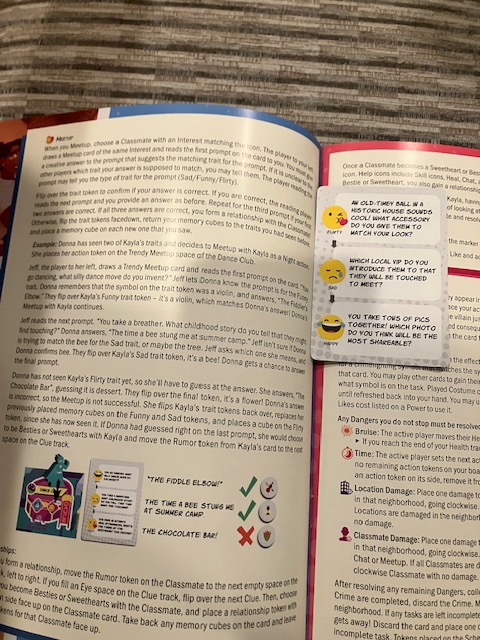
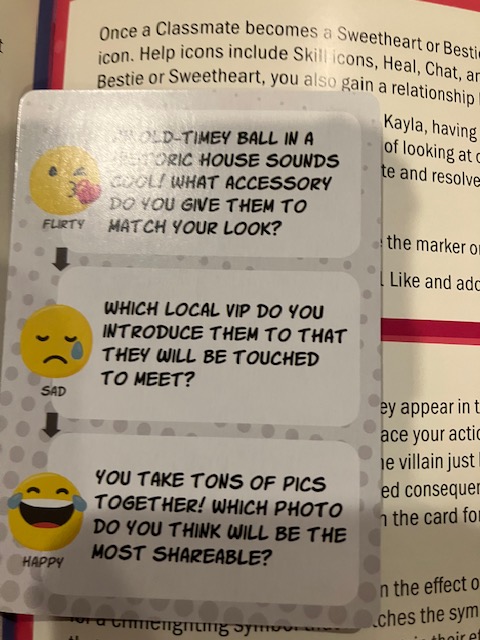
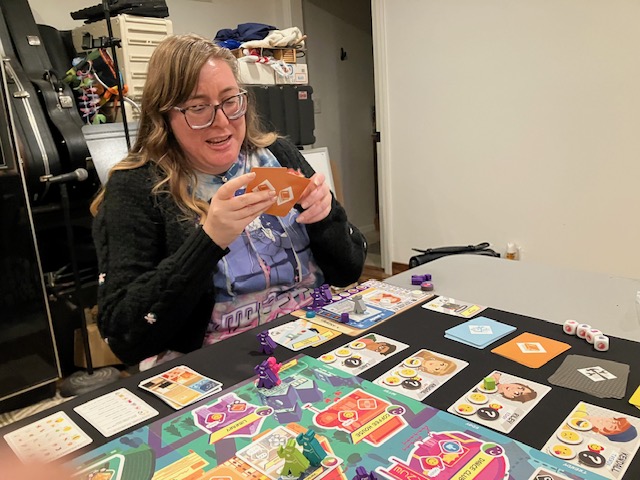
There is an element of this game that will make you love or hate this game.  When you are doing the “deduction” for the traits of your classmates, one player is reading the questions and seeing if you can answer correctly for the traits.  See above and below for examples of some questions!!!  For some people, this will be the funnest thing in the world as you answer questions for the traits to show you know them!  For some people, this will be the dumbest thing in the world and they will hate it.

You probably know which one you are.  If you hate this, the solution is simple: don’t play with it: just guess and ignore the question cards.   If you love this, the solution is simple: play with it.  The game will work both ways.

This one element may repel or attract you completely; don’t let it define the game for you, as you can play with it or without it easily.  And it won’t affect the gameplay.  I say this because there is a pretty good game here, and I’d hate for this one thing be the reason that you don’t play it.  

You know yourself and what you think of this question/answer roleplay. Take appropriate action if you play.

Solo Play

Luckily, this game does support solo play (congratulations for following Saunders’ Law)!  

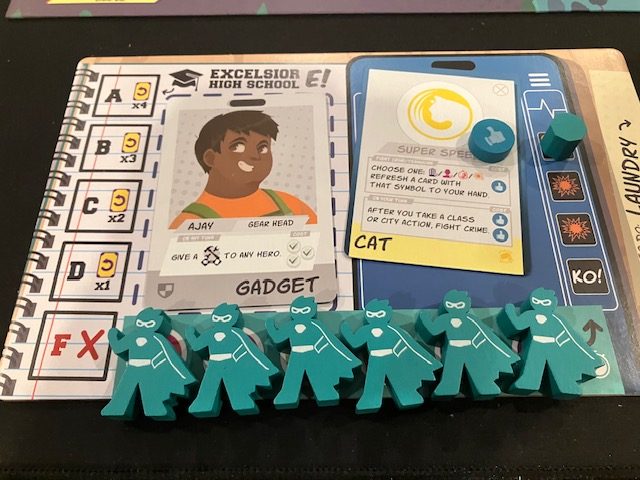
This is true solo play, as the solo  player takes control of one hero!  See above as the solo player becomes Gadget Cat!

It’s unfortunate that the rules for solo play are later in the rulebook after everything else.  I get that, but the set-up portion for solo rules could have EASILY been in the set-up section of the rulebook, and I was frustrated that I had to page back and forth between this section and the solo section, especially since solo play was my first few plays!

Even worse, one of the solo play rules was not well specified: how many Crime cards do you use?  I figured out the hard way (by just trying and seeing it it felt balanced) that the solo player uses the same number of cards as the 2-Player game.  This was mostly the only rule that wasn’t well-specified, I was able to figure everything else out.  

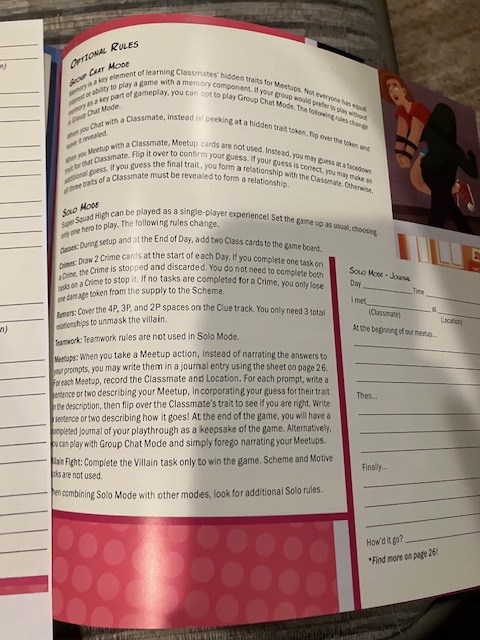
The solo game proceeds pretty much like the cooperative game, with only a few exceptions: there’s no teamwork, the Villain is easier to defeat, and the Crimes can be defeated with only one defeat (instead of both on the card).  

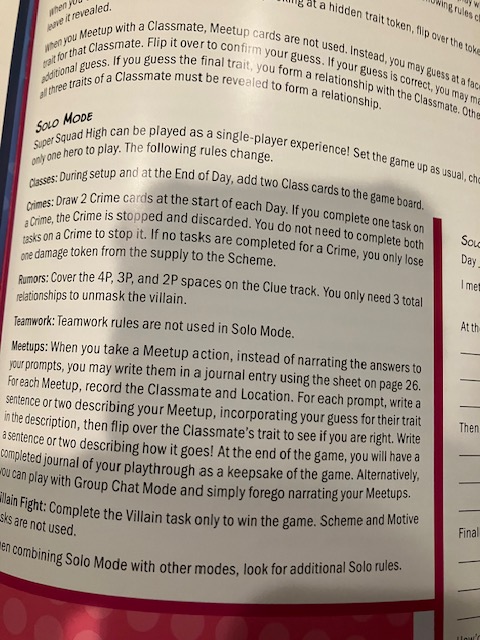
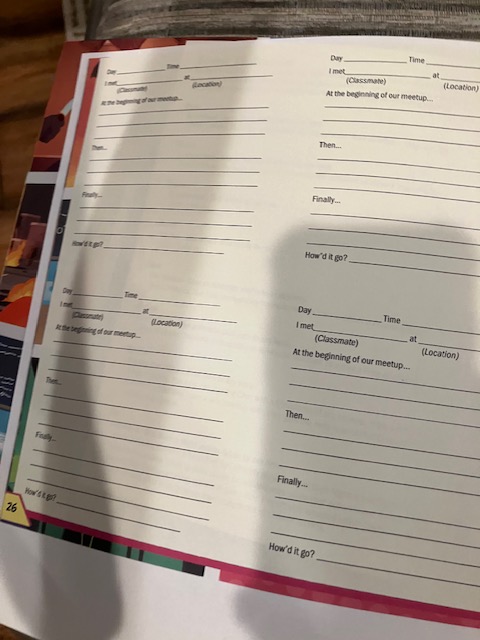
The question/answer roleplay rules we mentioned earlier (that you will love or hate) can be approximated in the solo game with writing stuff out: see a page above.  Meh, this felt like work and not fun, so I chose to bypass this part.  

The solo game worked pretty well: it was hard and I realized near the endgame that I had to concentrate on questioning students to figure out who did it!  The game could have gone either way at the end, but after I buckled-down … I was able to reveal the Villain, Scheme, and Motive just before the endgame!  That was exciting!

The final battle went pretty well as I was able to take down the final Villain! (In the solo game, you only have to fight the final as if it were a crime: you have to fight more in the cooperative game). See above.

I played a couple of solo games, and the game was pretty good: it was challenging and there were interesting decisions to make, but it wasn’t super hard.  I liked it, but I didn’t love it.  I think I didn’t love it because it felt like the game arc would be mostly the same every time. It didn’t feel like it would be that different between games.

The solo game (despite the Crimes deck rules flaw) taught the same pretty well.  I just don’t know if I’ll play it again solo, but I had fun.

Cooperative Game

I think this game shines better as a cooperative game.  

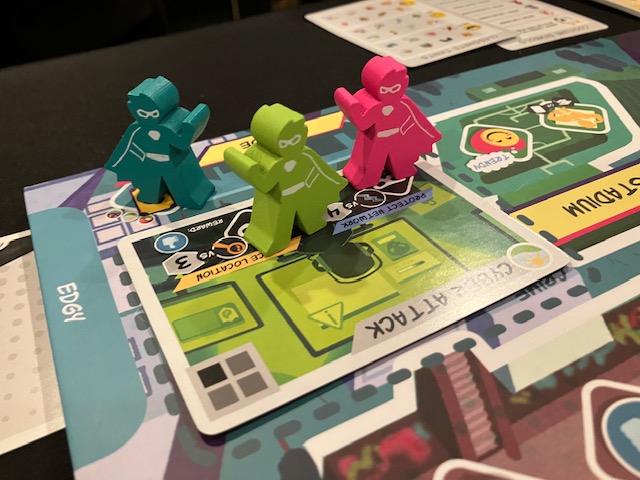
The fact that TEAMWORK was now a mechanic really helped push the game forward: if another player is in the same city neighborhood as other heroes, they can contribute cards towards fighting crime!  This leads to another level of strategy over the solo game, as players now can help each other!   See above as the three heroes work together to take out the CyberAttack!

“Man! I need some help taking out this CyberAttack!  Can you guys help me over by coming to my neighborhood?”

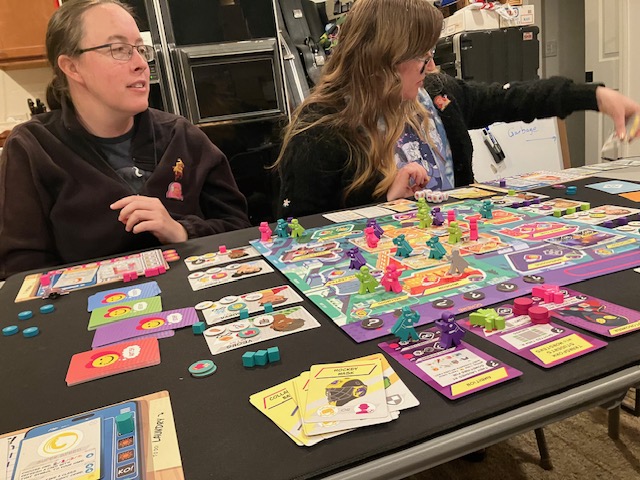
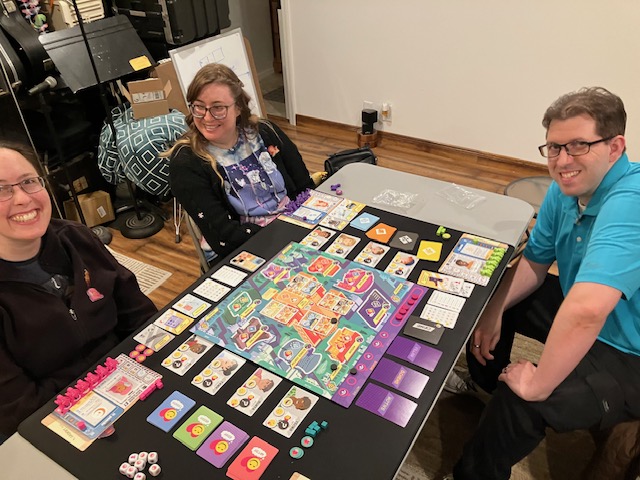
It felt very cooperative as we constantly consulted each other where to do, what to do, when to fight crime, when to help each other, when to do homework, and when to talk to classmates!

I think the best part of this game is the cooperation: you probably can’t win unless you really work together well.    The game arc feels less “samey” in the cooperative mode as play will vary a lot more as everyone tries to figure out the “smartest” way to do everything! Some turns will have you do all the fighting!  Some turns will have you talking!  Some turns will have you supporting!  It just depends on what’s best for the group, and that can change quite a bit more in the cooperative game.

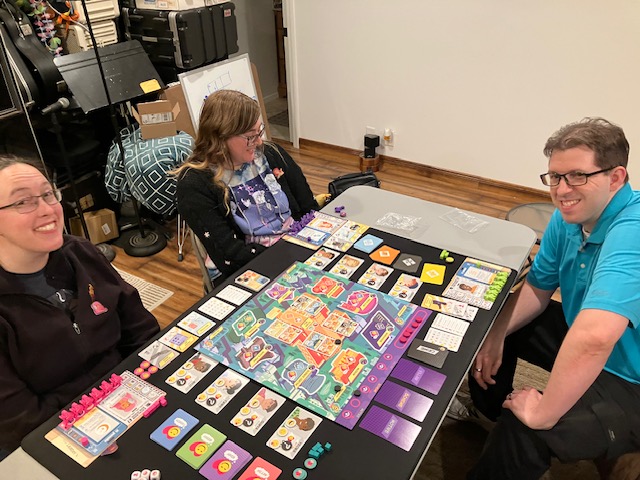
My friends all liked this game and had fun.  They also liked the roleplay elements in meetups, which probably upped their score a little (most of my friends are also avoid RPGers).

We are looking at pretty much 7s across the board.

Campaign Modes

There is a campaign mode (Yearbook mode) for this game which … we didn’t play.  It sounds like it might be funnish, but I think this game feels more like a lighter game.  We all had fun and such, but the vibes from the game make this feel like a fun, light one-off game.  It doesn’t quite feel like a campaign game?  It just doesn’t look like the yearbook mode changes the game that much from game to game?

I think I am less likely to do Yearbook mode because I would do it solo, and I didn’t love solo mode.   

I don’t know, maybe the yearbook mode is great.  I just don’t think that’s the way my friends and I will play this.  We will probably play it again, but in one-off mode.

Conclusion

If you like the Superhero movie Sky High, with Superheroes in High School, there’s a good chance you will like this game.  Even if you don’t love that theme, there’s still a fun light game here that you might still enjoy. 

Be aware, if you do play Super Squad High, that you may or may not want the roleplay aspects of the game: make sure you figure this out beforehand, because if you hate the roleplaying/asking questions part of this game, you will hate this game!  But if you know you will hate this, you can completely ignore that part and still enjoy this game.

I didn’t love this game solo, mostly because it felt like it could be a bit samey from game to game.  It was still fun, and it taught the game well enough for me to teach my friends:  Solo game: 6/10.

The cooperative version of this game is probably the best version: the Teamwork and strategies and discussions that emerge as you play really bring out the cooperation: I think the emergent cooperation is the funnest part of this game.  All around, we gave this a 7/10 for cooperative play.

This is a pretty fun game that’s light and easy to bring to the table to have a light superhero experience. There’s a yearbook/campaign mode in the game (if you want it), but my group just liked this as an easy one-shot cooperative game.

Sentinels of the Defenders of the Pandemic Realm of Multiverses: A Review of Freedom Five. Part I: Unboxing, Solo Play and First Impressions

IMG_8022

I am very depressed as I write this.  Freedom Five made the #2 spot on my Top 10 Anticipated Cooperative Games from 2021!  I was so looking forward to this!  But I find myself very disappointed by it.

IMG_8010

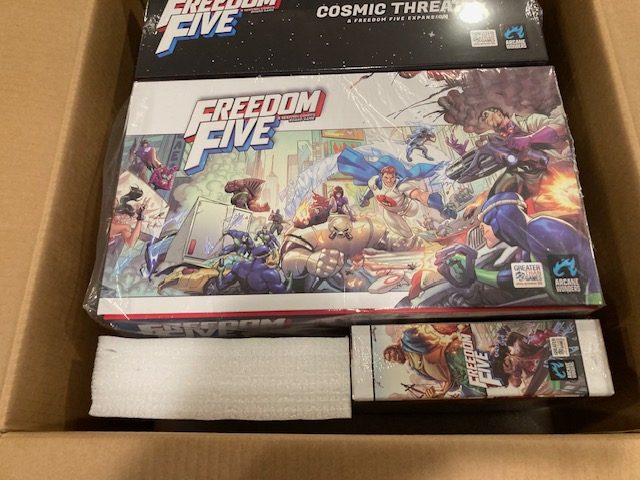
It’s not that I didn’t get a lot of stuff: I got so much!  The box arrived at my door October 26, 2024.  Freedom Five was on Kickstarter in Oct 2020, and it promised delivery in Nov. 2021.  So, it’s three years late. And it’s been four years since I Kickstarted it!

IMG_8016

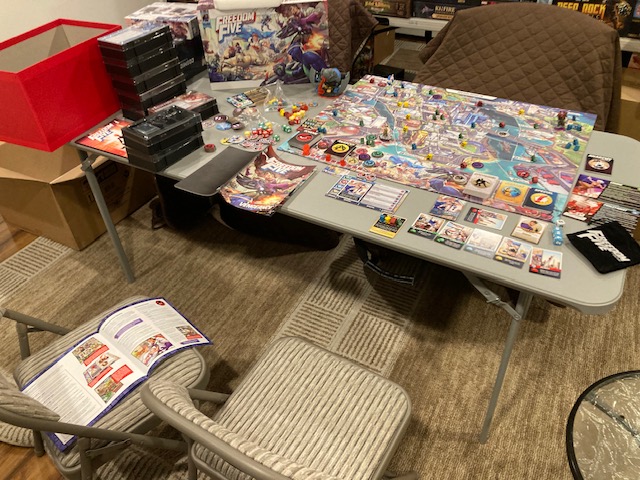
There’s so much stuff here: no, they delivered everything they promised.  Well, most of it.  I still seem to be missing some stuff … (A Dice Tower unboxing showed them getting more stuff…)

This is going to be a little different than most reviews I do.

What Is This?

IMG_8014

Freedom Five is a basically Defenders of the Realm with Sentinels of the Multiverse theming, i.e, it’s a superhero game!  And I love my Superhero games!

IMG_8939

Defenders of the Realm itself is just a gyration on the game system Pandemic: in very coarse terms, Defenders of the Realm is really just  Pandemic with dice.

IMG_8941

In Pandemic, you fight disease cubes, but the randomness is mostly in the decks of cards; most players turns are very deterministic and players can make progress against the badness.    In Defenders of the Realm, every fight or check is a dice roll.  Let me repeat that: every fight or check is a dice roll.

Freedom Five is the newest game in the Defenders of the Realm game system.  Every fight or check is a dice roll.

Too Random

IMG_8134

First and foremost: this game, Freedom Five, is simply too random.  Everything in the game is a dice check: 
1) Fighting Henchmen (like removing disease cubes in Pandemic: you have to roll dice to get rid of Henchmen! And you frequently can’t do anything else on a space until you get rid of all Henchmen!)
2) Skill Checks: roll appropriate dice
3) Anarchy Checks (which are arguably just Skill Checks)
4) Fighting Villains or Masterminds: roll dice based on how many cards you discard

IMG_8103

The problem is that the Defenders of the Realm system is simply too random and frankly it feels out-of-date.  If this game came out 10 or 20 years ago, Freedom Five would have had quite the “wow” factor.  But now, we have seen many games in the Pandemic with dice ilk that do the dice better!  Here’s four more recent games that improve the Pandemic with dice genre … two of them are actually Pandemic games!

IMG_8948
The dice: no bad outcomes! All good stuff!

1) World of Warcraft: A Pandemic System (see our review here).  This is Pandemic with dice, but the dice are much less random: essentially, all good outcomes!  See above! Some of the outcomes are just slightly better than others.  When you roll, you have a really really really good idea what you will get.  

IMG_3431

2) Star Wars: The Clone Wars (A Pandemic system) (see our review here).  The same idea happens here as in World of Warcraft, except the “dice” is one 12-sided die with essentially all good outcomes, again some are slightly better than others (sometimes the hero takes a damage).  See above.

IMG_1652
Exploding Dice!

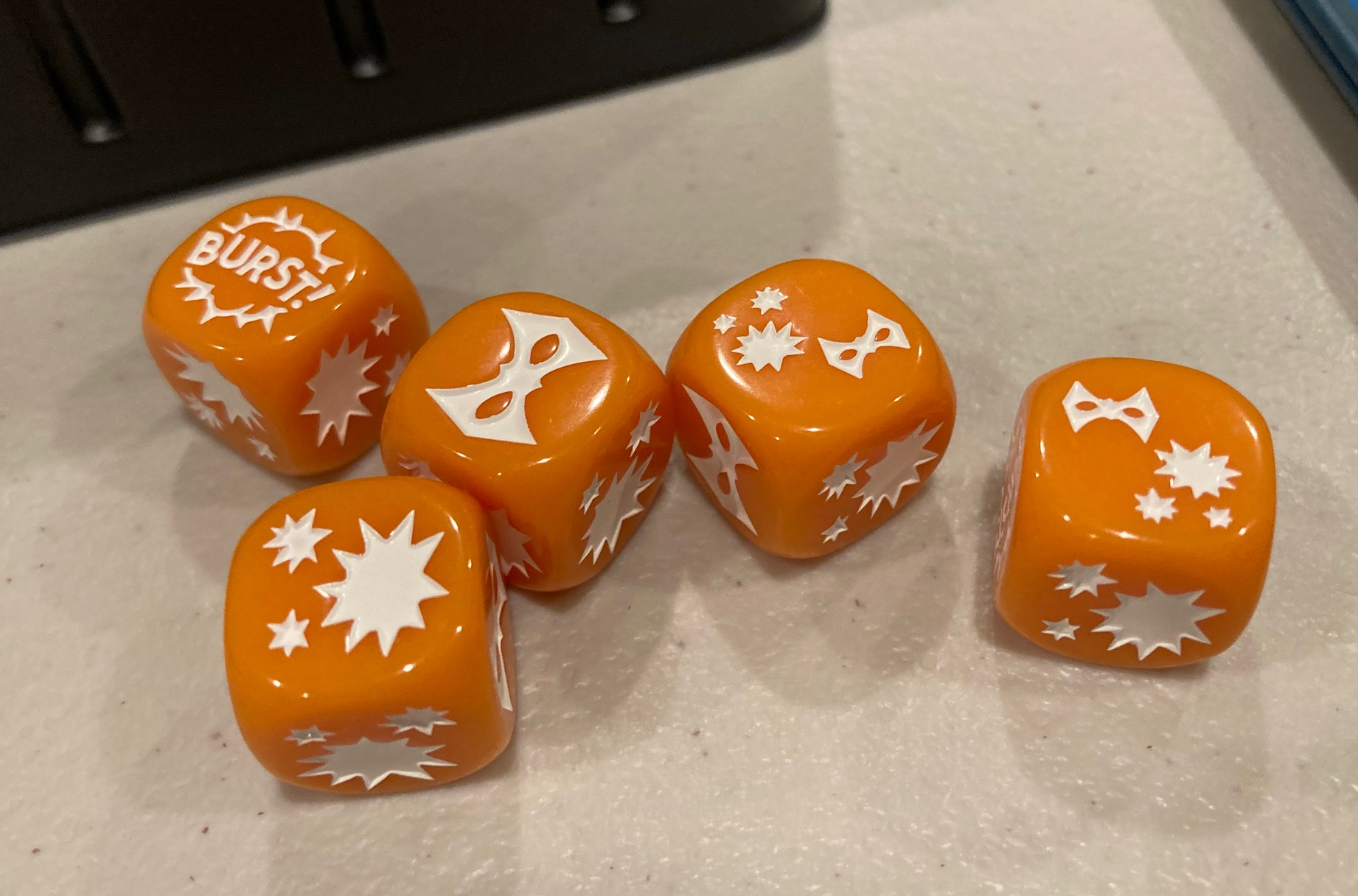
3) Hour of Need with it’s exploding dice! (see our review here). See above! This is one of my favorite dice systems: even if you fail (explosions are successes, masks are failures), you still get a FOCUS token for every failure … which you can turn a failure into a success at a later date! This feels intuitively like you are “learning from your mistakes”! It also makes it so you can still succeed even if you roll poorly! Even if you roll poorly, those FOCUS tokens turn failures into successes!

Given that Hour of Need is a Superhero game, this dice system is perhaps the most relevant here, and we will discuss it more later.

IMG_7880

4) Tidal Blades 2: Rise of the Unfolders (see our review here):  The dice here are similar to World of Warcraft; they almost always succeed, but if you are clever and have flanking or enough FOCUS, you can do better!  Let me repeat that: If you are clever, you can do better!

These four newer games all improve on the basic dice formula; they don’t feel very random and there seems to be a predictable baseline of success which allows you to be smart. Freedom Force feels much more random as you can fail on every die when you roll. You have to roll above a threshold to succeed (just like Defenders of the Realm). You cannot have any sense of how successes you will get, as you have to roll “above” a number, …. but, if you roll all 1s … you are screwed! (Yes, yes, there are dice mitigation methods, but they are limited).

IMG_8081

My problem with so many things dependent upon these dice (and almost everything in the game is a dice check) is that Freedom Five is a game that makes me feel impotent and unlucky; I can’t tell you how many turns I had where I simply lost an entire turn (5 actions) when I couldn’t roll anything good!!  In fact, in some turns, I actually caused more problems: many of the Anarchy checks cause problems when you fail!   How is this fun?  You are supposed to be a Superhero and you can’t even take down one henchman?????

IMG_8168

There is an old mantra: “I’d Rather Be Lucky Than Smart” … and that mantra applies wholesale to Freedom Five.  It doesn’t matter how “smart” I play, if I roll poorly (which is easy), I will lose.  And that’s the fundamental problem I have with this game: I can’t be smart.  I can just try my best and hope I’m lucky.  Even worse, though, this is NOT a short game.  A game with this much randomness needs to be short, but the first few games I have played have lasted 3 hours?

I don’t feel like I want to play this again because it feels sooooooooooo random.    Right now this is a 4/10 for me. You heard me.   A Superhero game with great components:  a 4/10.

However, there is hope.  See below.

Other Problems

There are other problems I had with the game.  Given that I waited four years for this, I am still frustrated at some of the issues that came up: these issues also contributed to my 4/10.

IMG_8115

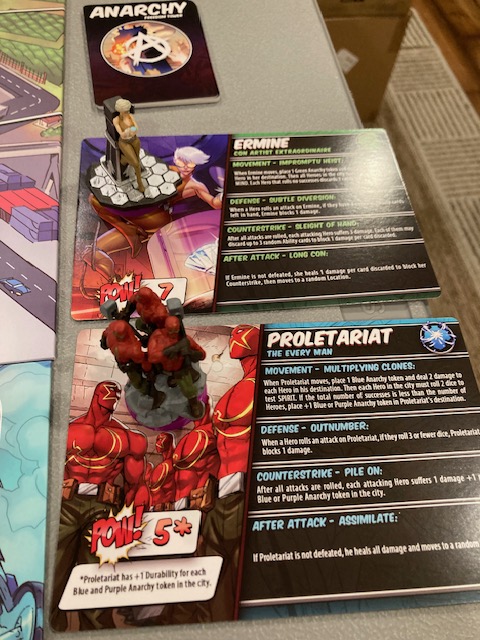
Bases: The bases of the miniatures should be the SAME COLOR as the type on the card!  And they are not!!! See above as Proletariat is BLUE type, but his base is purple?? Ermine is green and her base is not green!  Looking across the board, I’d like to be able to correlate the Villain to his relevant color!!  I don’t think the colors ever change for the Villains, so this is very frustrating visually.  This is especially hard after coming off of Tidal Blades 2: Rise of the Unfolders (see our review here) where the minis all had color-coded bases!

IMG_8135
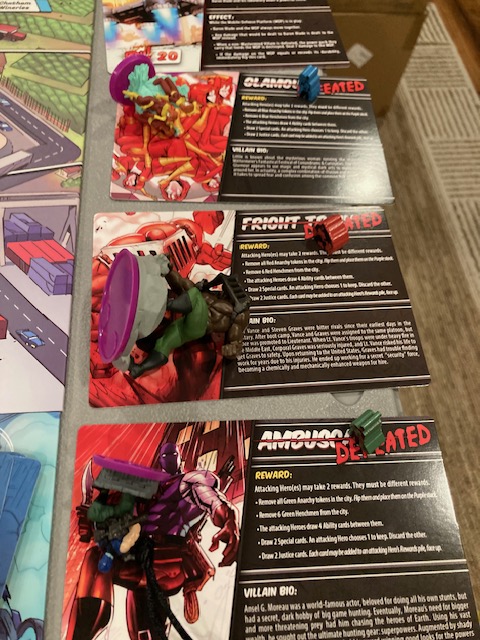
Backs of Villain cards need to be better:  When you defeat a villain, you flip his card to show he’s been defeated!  But, you have NO IDEA what color he was???  Why do you care?  Because the BLUE henchmen (who Proletariat was) are easier to defeat and it’s good to have a visual reminder!  But the back of the card has NO INDICATION of what the color of the villain was!  (If it had a color-code base … see previous point … that would work).

IMG_8177

Hint: I ended up putting a colored meeple on the DEFEATED side so I could remember which Villain was which color.   See above. (And get rid of the BIO: replace it with instructions what do when you battle a defeated HENCHMEN).

IMG_8040
Back of rulebook: There are no player help cards, or Turn Summary cards.  It might have been nice if they put the turn summary on the back of the rulebook. Or symbols or anything useful to gameplay.

IMG_8169
Upgrades: When you get an “upgrade” to your deck, THE NEW CARDS AREN’T LABELLED WHERE THEY CAME FROM!!!  The “better Flight” card (left) is from envelope #1.  From now on, I take pictures of my upgrades so I know where they came from.  That way I can reset my game.

IMG_8119

Bystanders:  There are 42 bystanders.  Note the Best Friends #1.  You know how unlikely we are to get all 3 best friends?  More untethered randomness.

IMG_8132

And some bystanders cause penalties.  Whee. That was fun. In a game where I have so much randomness, it’s good to know some bystanders will cause issues. It’s maybe thematic, but it’s not fun.

IMG_8114
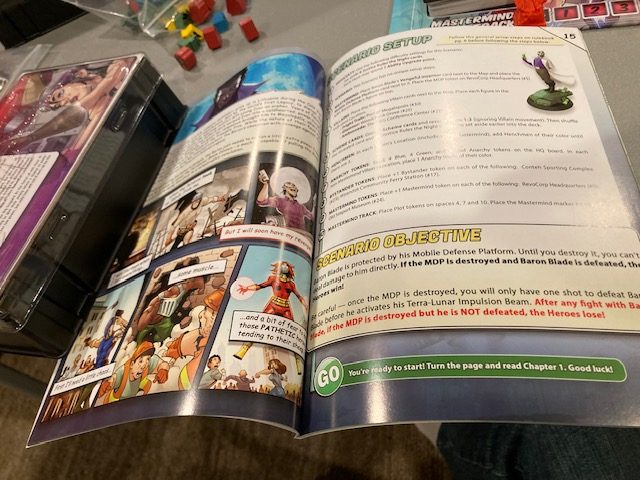
Binding:  This binding on the scenario books is UNFORGIVABLE.   You have to have the pages of the book open to see the rules, the end of turn actions, and it’s SO HARD TO KEEP OPEN without overfolding/destroying the binding.  See above.  We saw this WAAAAAY back when we reviewed The Forests of Admiron when we hated the binding on the rulebook.  I can’t keep the scenario book open (easily) to look up the rules.  This is unforgivable; the scenario book should have been a book that could lay flat.

IMG_8160

I ended up using one of the unused character boxes to hold it open.  That was a workaround: see above.

IMG_8067

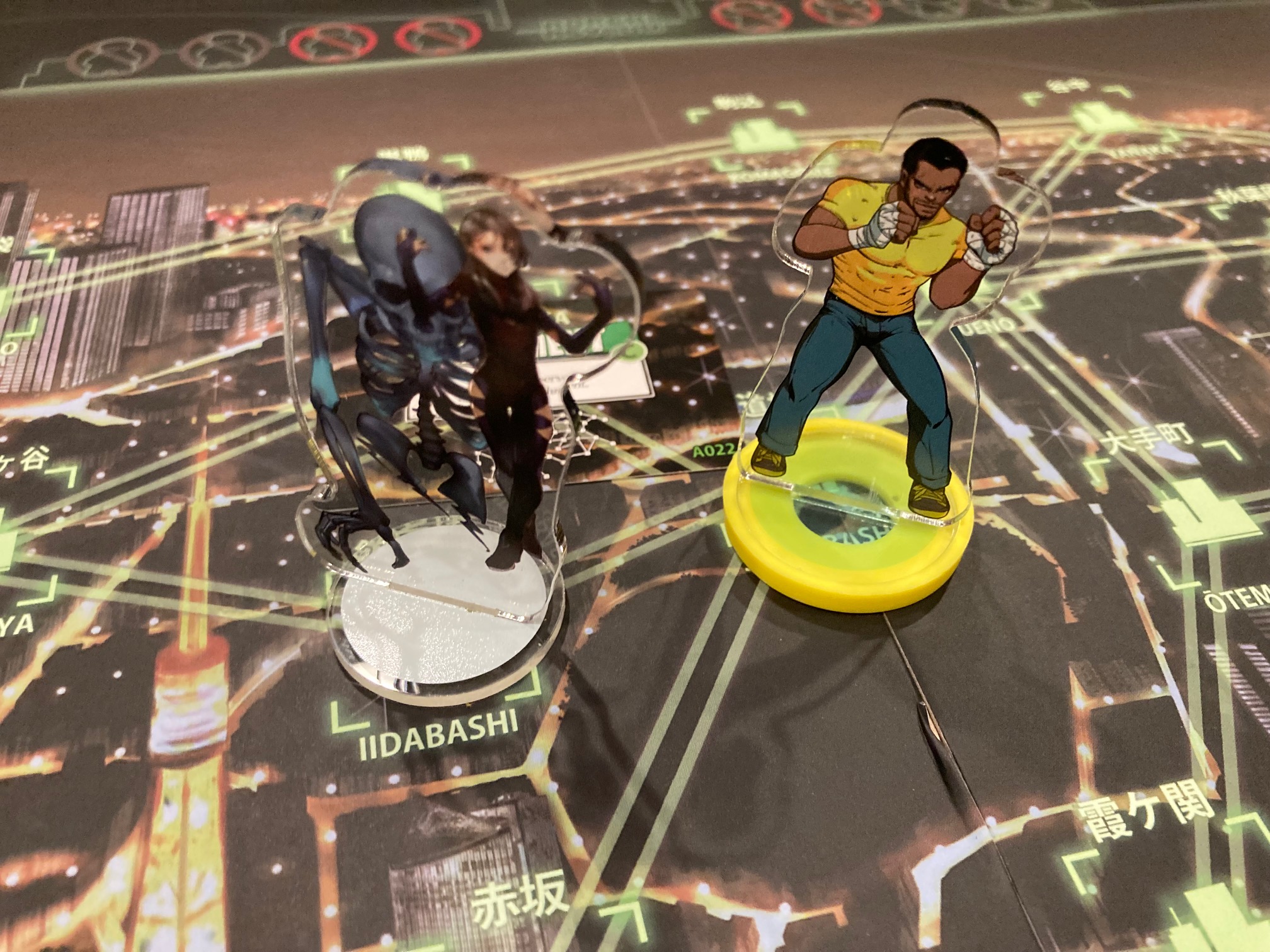
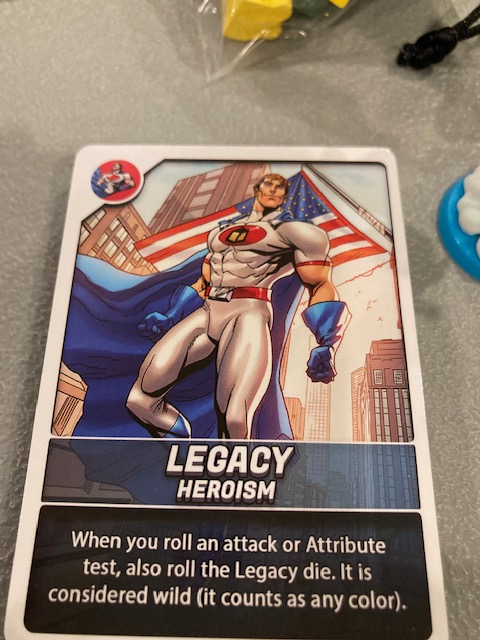
Minis:  The minis are just … okay?  I got the prepainted minis … and they look a little soul-less?  See Legacy above.  

IMG_0758

Compare the minis to acrylic standees in another superhero game: Tokyo Sidekick (see our review here).  See above.

IMG_8068

I kind of think Acrylic Standees with Legacy’s art (see above) would have been so much cooler.

IMG_8126

No Solo Rules: I played my first three or so games solo, but there is no acknowledgement of solo rules anywhere in the rulebook!?  I think you can play solo with one character, but I don’t know. In fact, Legacy has cards that affect “other heroes” … so do they affect no one?  Himself only?  Does the solo game change slightly so that they affect himself?  I think the game is “probably” better with 2-handed solo (the solo player playing two characters), but I wanted ONE SENTENCE in the rulebook:

“You can play Freedom Five solo with one hero: the only change is that any hero card that affects other heroes will instead affect the solo hero.”    

I am genuinely surprised there are no solo rules.  The only acknowledgement of any solo mode was a 1-5 Players notation on the bottom of the box.

IMG_8097

And the bottom of the box is so hard to read!

Conclusion

IMG_8173

Several of my friends have asked me “Are you going to sell the game?  Or can you come up with some House Rules to save it?”  Firstly, I have only played this game solo.  It’s possible the game will get better with more people, as they can maybe (maybe) help mitigate some of the randomness I hate so much. 

IMG_8171

At first I thought: “This game was irreparably random; there’s no way I can fix it“.  But all my friends encouraged me to try to come up with some house rules.  Given that I spent $375 on all this, maybe it’s worth a little extra time.   And after recovering from my depression about this game, I actually think I have some ideas that might help.

Right now, Freedom Five is a 4/10.  But that’s only from solo plays.   Come back in a few weeks after I get some cooperative plays, and maybe I try some house rules.  Maybe then I can recommend it?

I hope so. I really really really want to like this game.  As it is right now, I don’t.

UPDATE: I sold it. I couldn’t bring myself to play it anymore, and there’s too much negativity when you propose house rules. Those of you who are interested, I wanted to use the Hour of Need dice system (current failures become future successes) for all dice rolls EXCEPT the four villain rolls! There is a lot of fun when you roll 14 dice to see if you can take out the final Villain! But the piddly dice rolls for Henchmen and stuff, that wasn’t fun; that’s what I think needed the Hour of Need dice system.

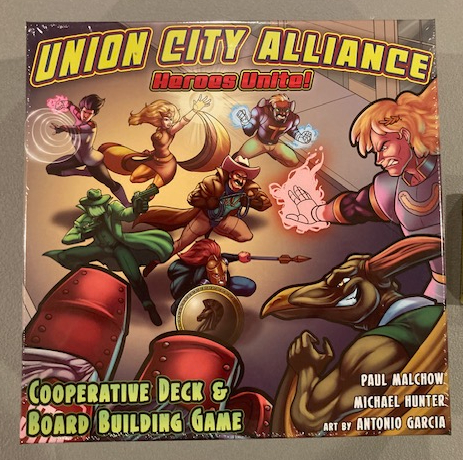
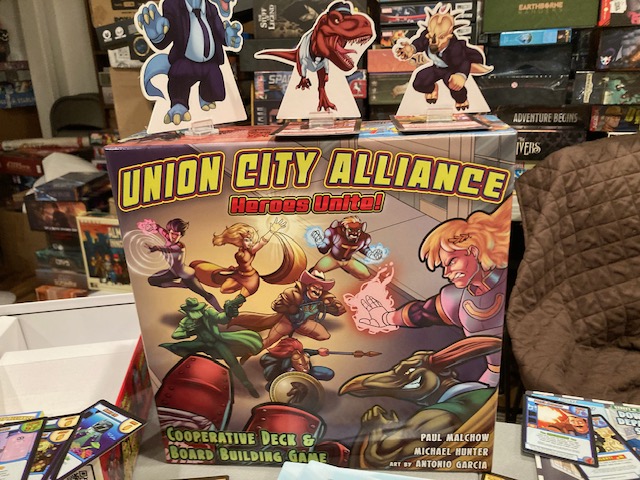
Union City Alliance: Heroes Unite! Like Marvel Legendary, but Now With More Theme! A Review

IMG_4178

Union City Alliance is a cooperative super-hero deck-building games that was originally on Kickstarter back in March 2021.  The game looked great and promised delivery in October 2021! I was so excited for this game that Union City Alliance made the #1 spot on my Top 10 Anticipated Cooperative Games of 2022!

IMG_4179

Unfortunately, the game is about 2.5 years late: The game arrived at my house April 30th, 2024! It’s basically been 3 long years since I backed the Kickstarter.

IMG_4180

Interestingly enough, I was never worried that this wouldn’t finally arrive.  The designer would do a pretty decent job of keeping us updated (with Kickstarter updates): he would offer full timelines of delivery and discussions of progress.  I was grumpy that Union City Alliance was 2.5 years late, but at the end of the day, the Kickstarter was well-run … and they delivered!

Let’s see what we got!

Unboxing

IMG_4185

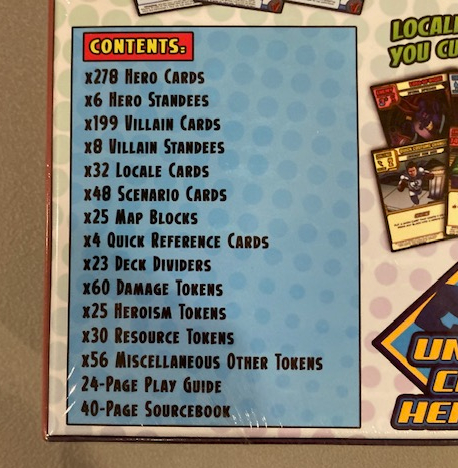
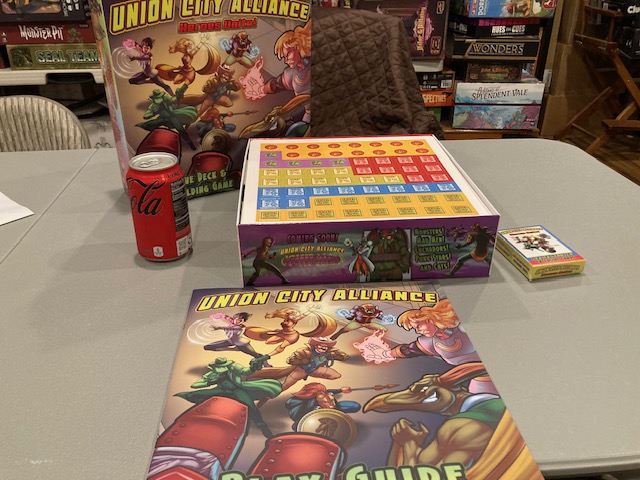
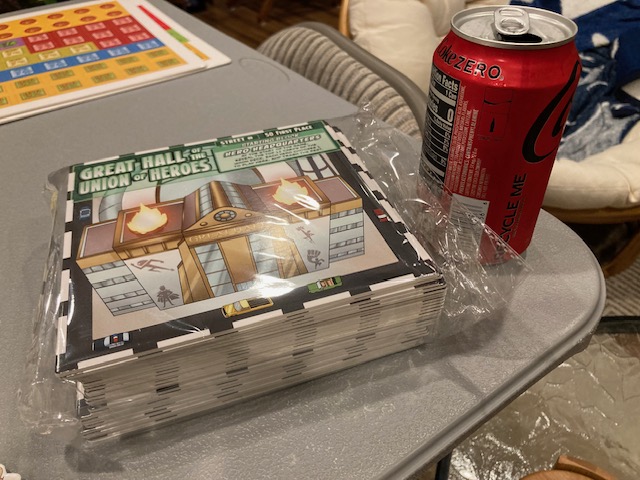
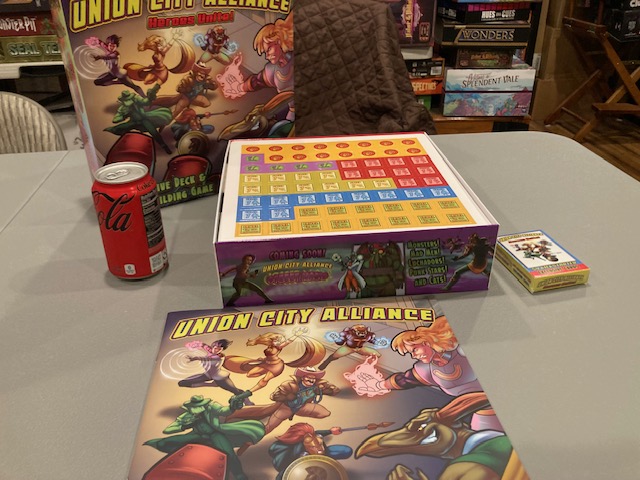
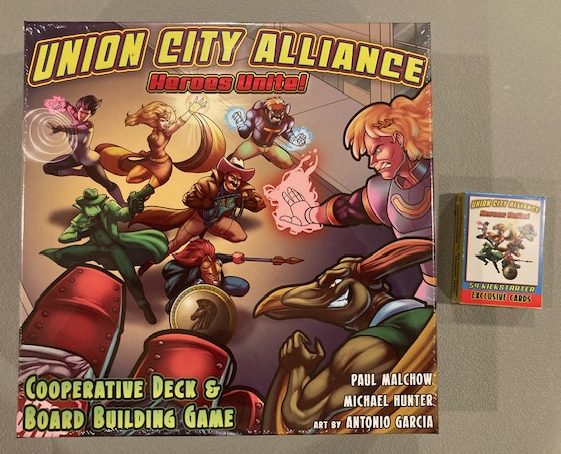
The base game is about the size of a Ticket to Ride sized box: see above with a Coke can for perspective.

IMG_4190

The rulebook is the full-size of the box on top!

IMG_4193

There’s a lot of punchouts; these are just handy tokens to keep track of Heroism and other resources (Valor, Speed, Might).  Interestingly, the Heroism and Damage tokens, which persist between rounds, are circular tokens.  The Valor, Speed, and Might tokens, which evaporate between rounds, are square tokens.   Even though the game never calls this out, that subtle consistency (persistent vs. ephemeral) was a nice touch.

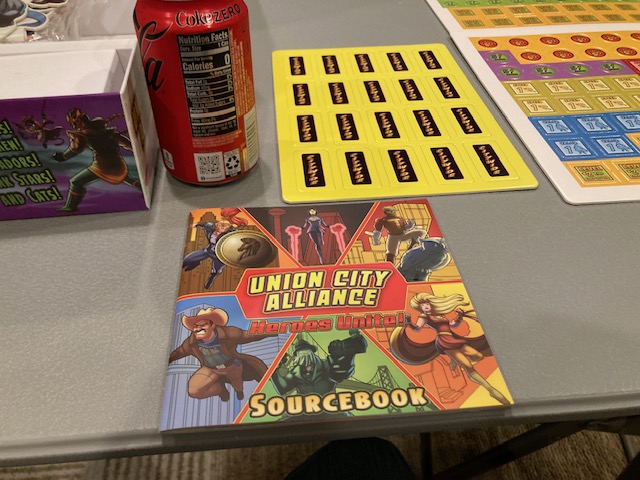
IMG_4195

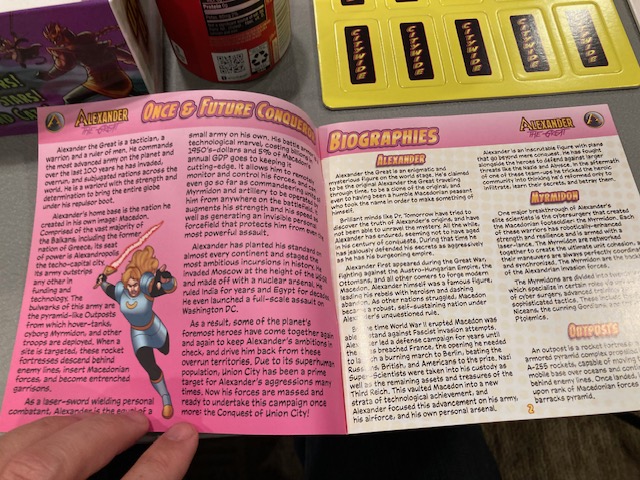
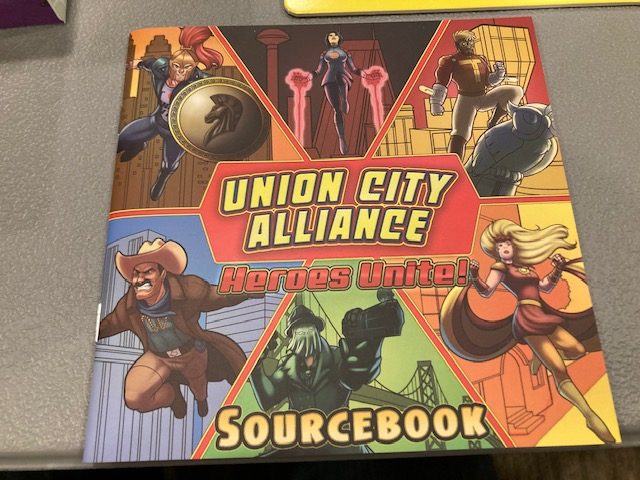
Also included is a source book;  It has both set-up for various scenarios and tons of flavor text and back story for the heroes and villains: see below.

IMG_4197

IMG_4204

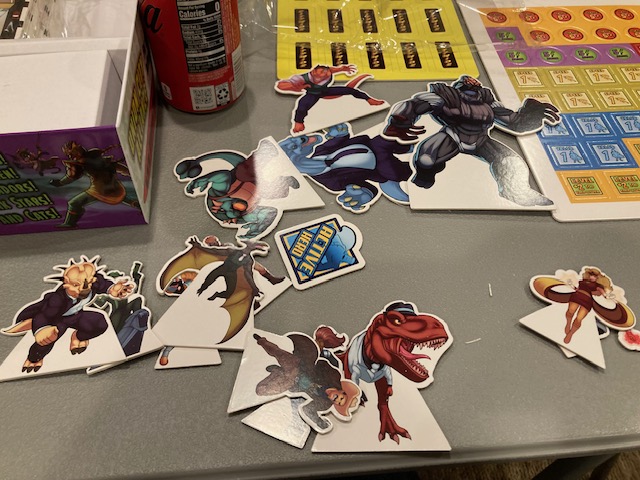
There are a TON of pre-punched standees that are both the Villain and Hero markers.   See above.

IMG_4205

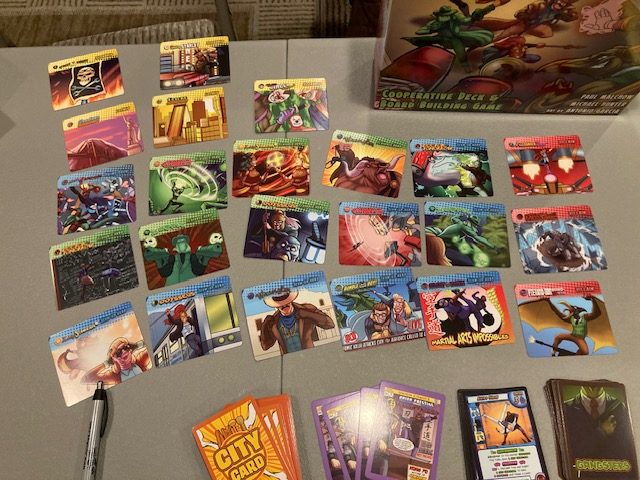
There’s also a GIANT (see can of Coke per perspective above) pile of Locations!  These Locations come out slowly as the Heroes explore the city!

IMG_4206

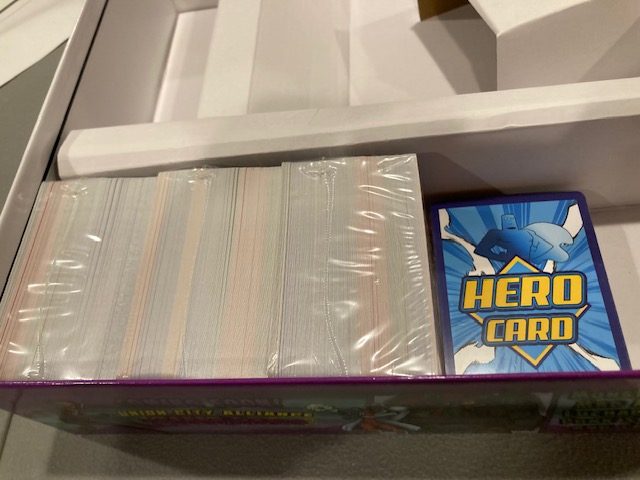
But, this is cooperative deck-building game.  So, at its core, this game is all about the cards. When you first open the box, it’s a little daunting to see so many cards!

IMG_4207

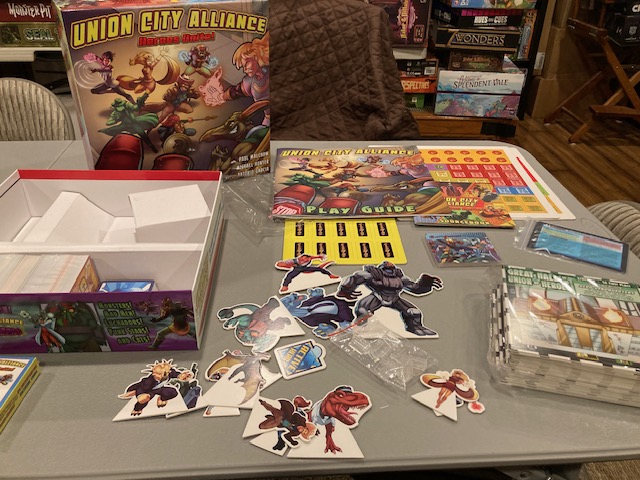
From an initial Unboxing perspective, this game looks great! 

Uncardening

IMG_4218

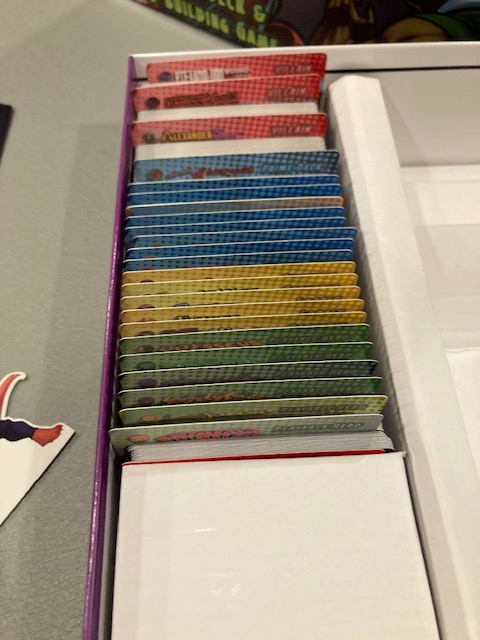
I feel like this needs to be a new phrase: uncardening.  It’s the event when you have take a lot of  cards out of a new game box and sort them appropriately.  But it’s not just sorting: it’s about collecting together “like” cards, figuring out where the cards go in the box, and making sure they are ready to go for play!

IMG_0689 (1)

Basically, we had to do the same thing in Earthborne Rangers: go through the cards, sort them, put like cards together (for some notion of “like”), and figure out where they go in the box.  See above.   Earthborne Rangers had a fairly grumpy uncardening (see our review of Earthborne Rangers here): the components page was misleading, and we spent far too much time trying to uncard the game.

IMG_4220

I almost think that the word uncardening (which is a word we coined for Earthborne Rangers) has a negative connotation: it implies you have to spend an extraordinary amount of time putting cards in order.  

IMG_4933

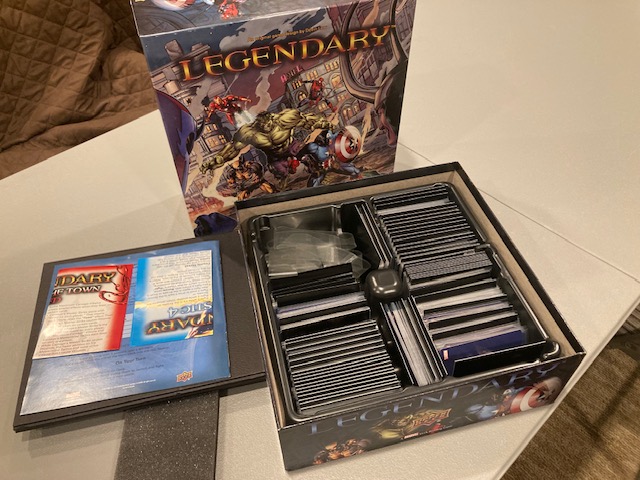
I remember when I first got Legendary: A Marvel Deck-Building game some 10 or so years ago.  It has the worst box opening experience I have ever had!  I just have tons of cards and no idea how to put cards together!  The rulebook is completely silent on how to sort!  As a gaming nubie at the time, I asked my friend John N. to help me (because he had Legendary), and with his help, I was able to put things together.  The phrase uncardening applied to Legendary, it applied to Earthborne Rangers, and unfortunately, it now applies now to Union City Alliance

If you think all deck-building games need a negative uncardening, I suggest you look at the Aeon’s End series of games! They do an amazing job of making the uncardening (in a good sense) easy.  See our review of Aeon’s End and Aeon’s End: War Eternal here, and Aeons’ End: Outcasts here!

IMG_4192

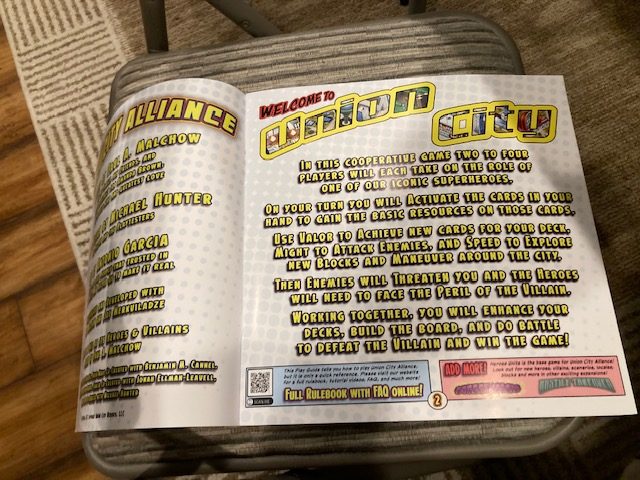
The first two pages of the rulebook … DO NOT address how to take the cards apart, sort them, put like cards together, and fit them back into the box.  I am actually annoyed by this: The Union City Alliance rulebook wasted two very large pages (see above) with huge fonts for credits and an introduction.  I am all for getting credit, but I was very annoyed at these designers because it was so hard to uncard their game!  They SHOULD HAVE used those two pages for something useful: how to uncard the game!

IMG_4223

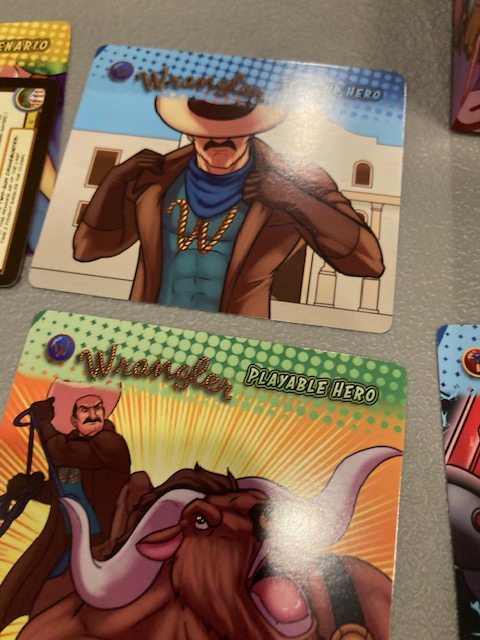
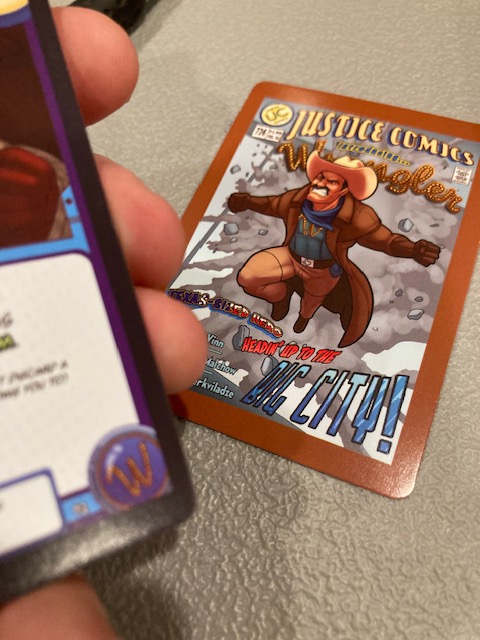
A simple question: why is there a Playable Hero and a Team-up Hero for Wrangler?  See above. Which cards for Wrangler go where? This is an easy concept (once you know it) that should have been presented on those first two pages.

IMG_4222

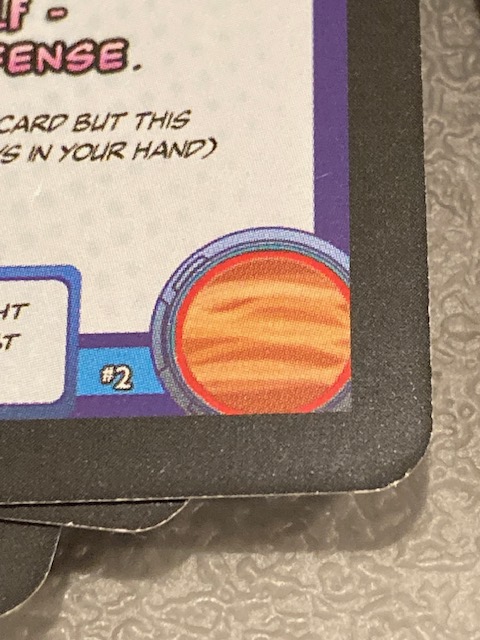
And it takes some knowledge of board games (and perception) to know to look in the lower right corner of the card: the Wrangler cards are the W!  See above!

IMG_4242

Once you start looking around some more, you’ll notice there is a manifest on the back of the dividers!  Yay!  They list both the number and the card title (good job!).  

IMG_4241

I am SO GLAD they have both the title and the card number on the manifest!  The card number on the cards are SO SMALL as to be almost unreadable!!  I had to zoom in pretty heavily with my phone in the picture above to see the #2 Captain Jupiter card!  But having the titles on the manifests helped.

IMG_4225

There’s just a lot of cards.   I probably spent about an hour and half, maybe two hours uncardening this game.  It really shouldn’t have been this much work, and it really shouldn’t have been so cumbersome.  The cards are well-labelled, but throwing someone at the game without any directions is a misstep.  I am an experienced gamer (now), so I was able to get through this, but I worry a newbie will just give up in disgust trying to uncard this.

IMG_4247

But, everything is labelled (once you know where to look: bottom right, and the divider manifests) so you can get there.  And once everything is back in the box, it’s very satisfying. See above.   This lack of uncardening direction may be the biggest misstep in the entire game: the uncardening just needed a little bit of discussion in the manual.

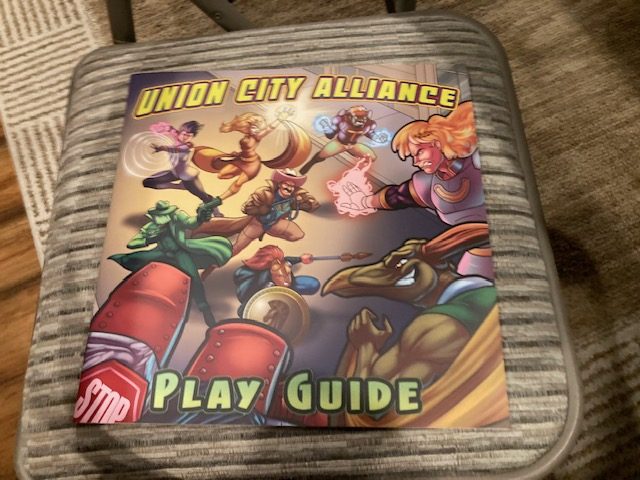
Rulebook, Er, Play Guide

IMG_4189 (1)

This rulebook is gigantic, being the same size as the box.

IMG_4191

How does this rulebook do on The Chair Test?  Unfortunately, it gets a D on the Chair Test.

IMG_4192

It is almost impossible to have this on the chair next to you spread open because it was so big!  It does have lots of good pictures and good font, but it was almost unusable on the chair next to me.

IMG_4396

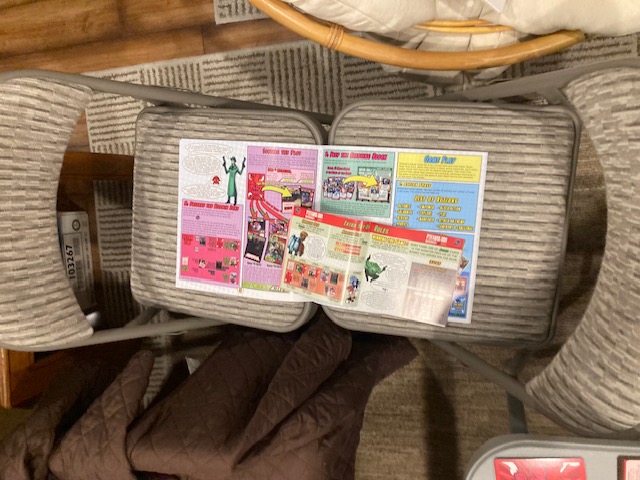
However, this game has spawned a new test: The Two-Chair Test.  If you put two chairs together (see picture above), you can have the rulebook open and readable without taking up valuable table space!  So, the rulebook gets a A in the Two-Chair Test (a second tier test) So, the rulebook lays flat, the fonts are big and readable, and I can read it easily from my chair.  In the end, The Chair Tests are all about keeping the rulebook(s) off to the side so I can look stuff easily and not take up valuable table space!

IMG_4213

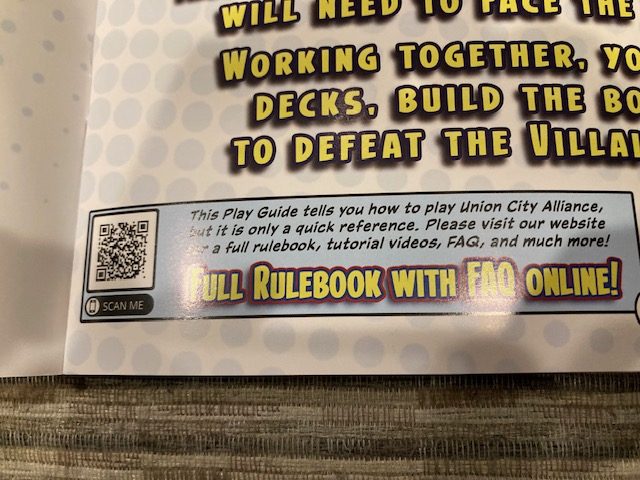
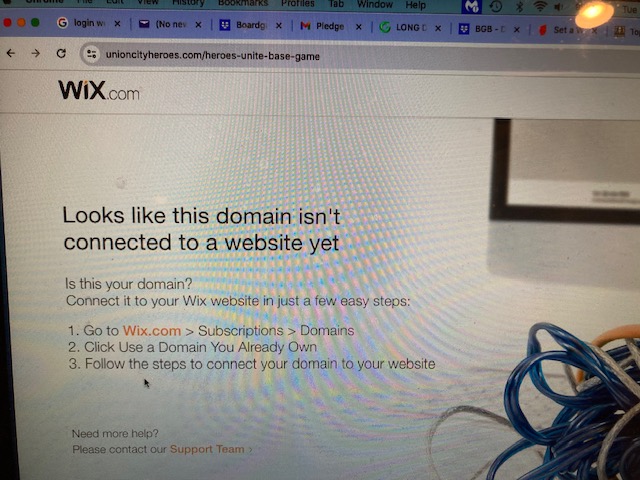
I have to admit, I was a little non-plussed to learn that this wasn’t the full rulebook! It was only the Play Guide!  See above: “… but it is only a quick reference...”. You have to go to the website for a full rulebook.  It’s cool they have all this on the website (FAQ, full rulebook, etc), but at the time I went there, the web site wasn’t up yet! See below.

IMG_4235 (1)

At the time of this writing, however, the web site is up.  But, I had to play using only the Play Guide!

IMG_4214

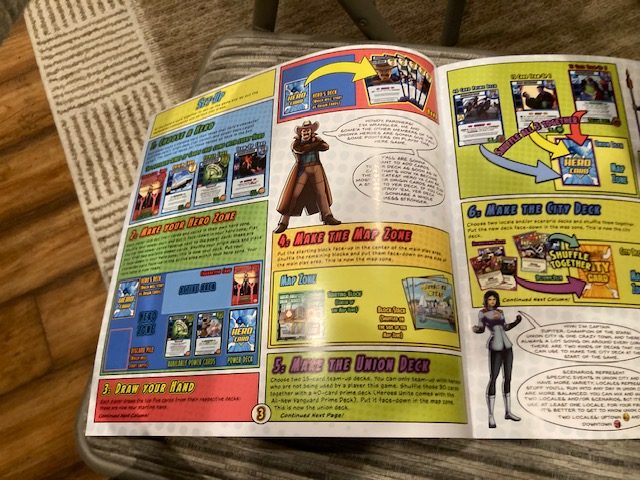
Once you get past how HUGE this rulebook, pardon me … Play Guide  … is, it’s pretty good at getting you into the game.  I don’t usually like thematic fonts for rules (see our review of Hour of Need here and Obliveaon here), but it works here.  I think I like it because it’s a very big font, and it’s peppered with a lot of supporting pictures and colors: see above.  

IMG_4291

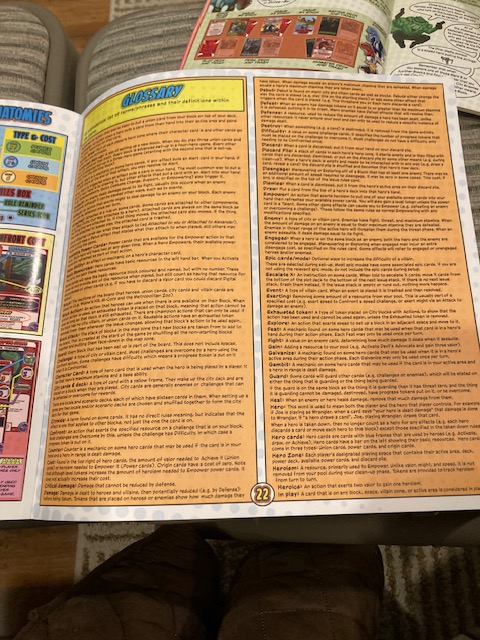
There’s no Index to the Play Guide (boo), but there is a Glossary (yay)!  See above, In fact, the Glossary seems very complete; it covered just about everything that came up when I played.

IMG_4290

Once we got going with the two chairs and through the uncardening, the Play Guide was pretty good at getting me set-up: there were lots of pictures, lots of flavorful text, lots of helpful annotations.

I am still annoyed I didn’t get the full rulebook.  I look at computers all day; the last thing I want to do is look online for full rulebook for a board game.  The Play Guide has been “good enough”, so I have been just pushing forward with that.  I haven’t needed the web site … yet.

Gameplay

IMG_4313

Union City Alliance is a cooperative super-hero deck-building game.  That tells you a lot about this game already!  See our Top 10 Cooperative Deck-Building Games for more discussion of deck-building games!

IMG_4258

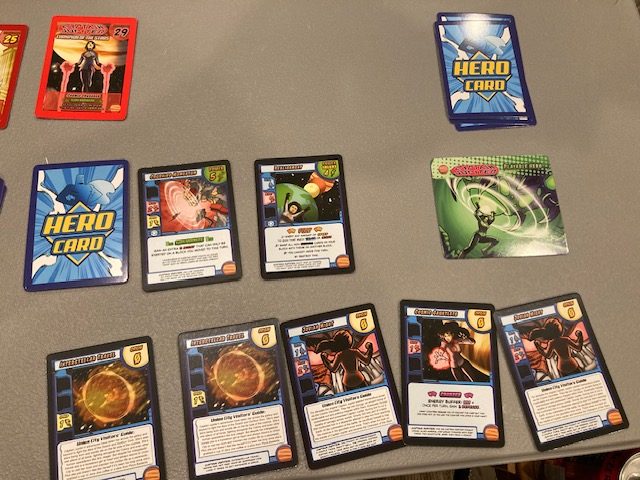
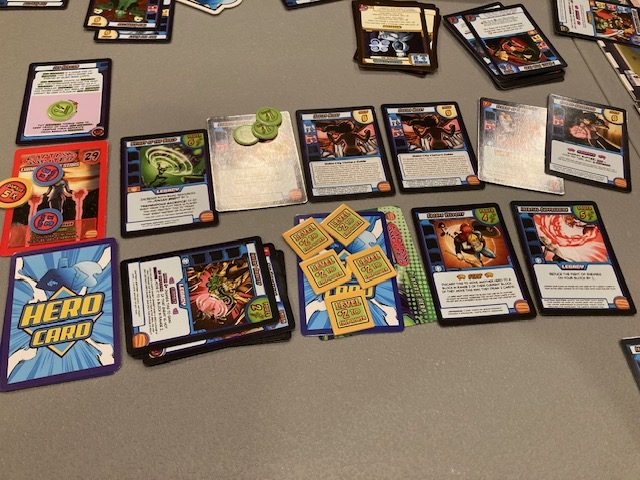
Each player chooses a hero to operate: that player gets the Playable Hero deck for that character: see above as Player One chooses Captain Jupiter.

IMG_4256

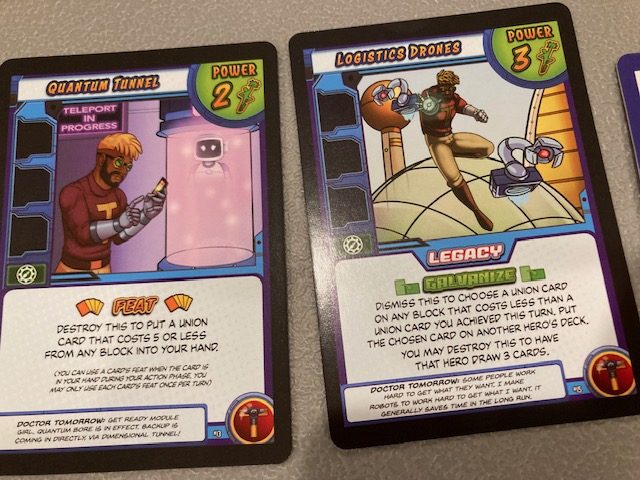
An interesting thing that Union City Alliance does is the cards are divided into two groups: your initial deck (with the 0 in the upper right corner) and the Power deck (with the green in the upper right corner).  See above.   Power cards are separated out, and only that player can buy those Power cards later in the game, using the (green) resource Heroism.  It’s a real neat way of keeping each character very distinct, as each character has their own set of Power cards!

IMG_4263

So, when you set up, you have your normal intro deck and your Power deck “tempting” you with some cards you can buy! See above as Captain Jupiter sets-up with two Power Cards available to buy, with her initial 5 card hand at the bottom.

IMG_4300

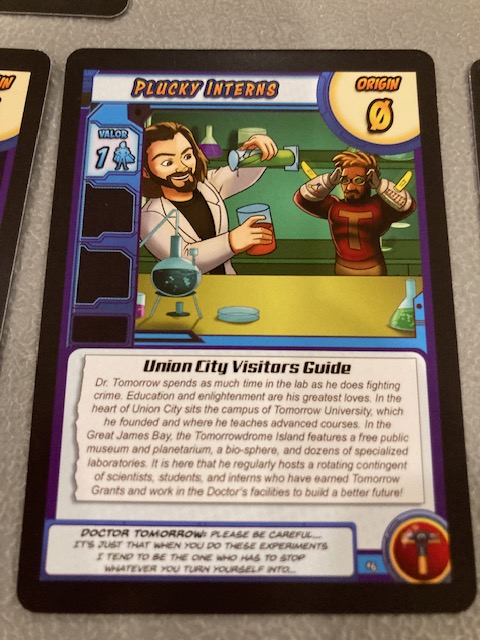
Each card can be played for Resources! The three main resources are Valor (blue), Speed (yellow) and Might (red).  See the Plucky Interns above giving 1 Valor! Valor is generally the resource used for buying Hero Upgrade cards!

IMG_4266

You need at 2-4 characters to play: see above as Doctor Tomorrow and Captain Jupiter are set-up!

IMG_4405

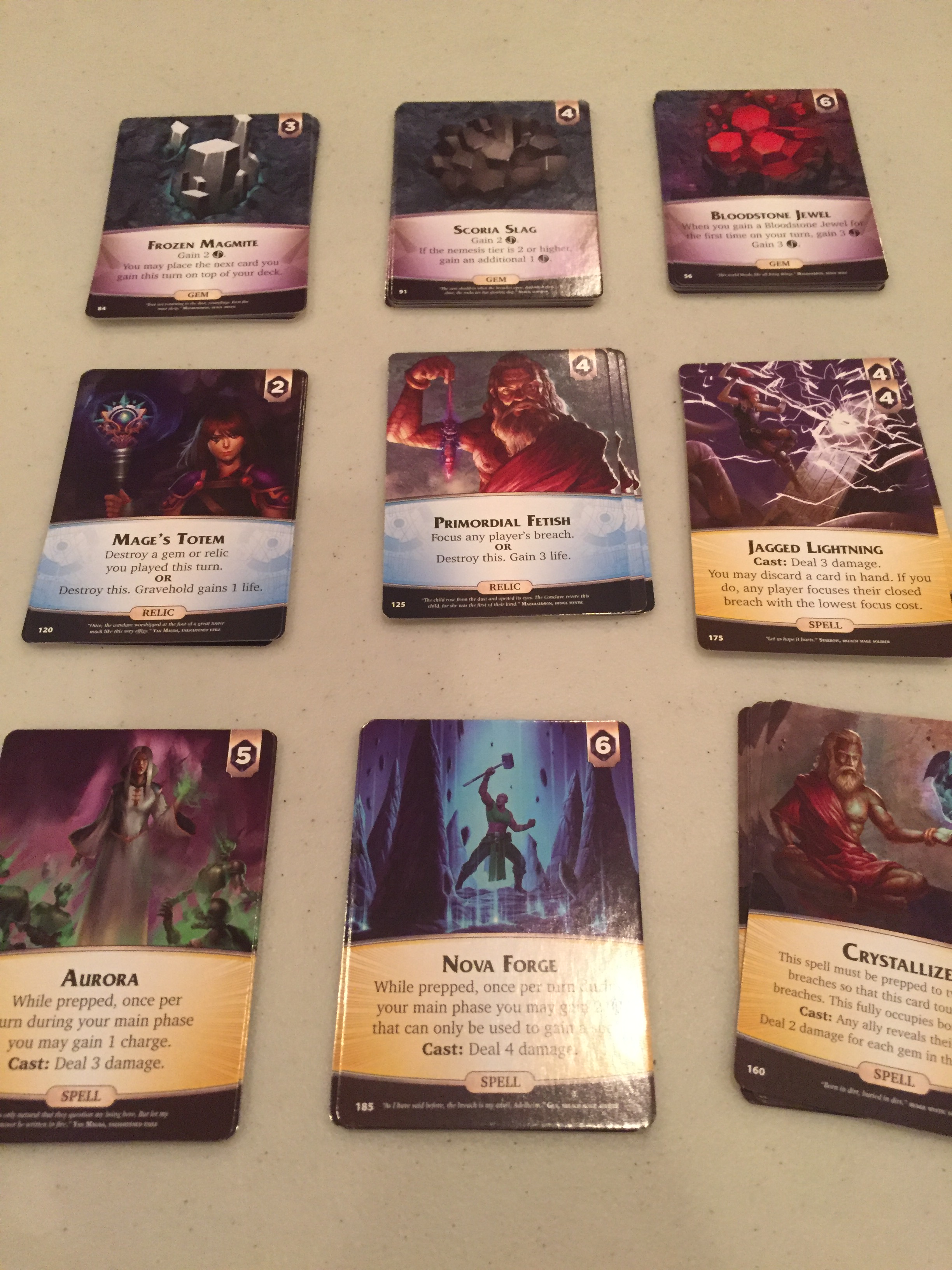
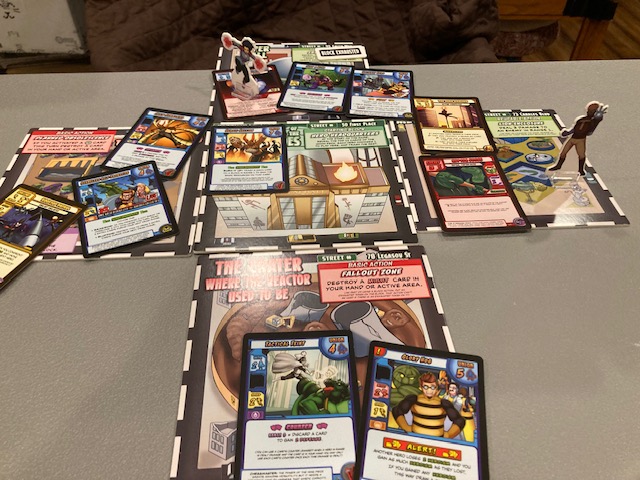
One of the curious things this does as a deck-builder: you don’t usually get upgrade cards you can buy unless you go exploring!  As you explore the city, more Hero cards come out that you can buy!  This is different from other deck-building games like Legendary and Dominion and Aeon’s End where there’s just “9 types of cards to buy!”.  See an example from Aeon’s End below.

IMG_3697

As you explore Union City, new cards come out: see below.

IMG_4312

Every time you explore a new Location, two new Hero cards come out! (And a City Card, which is typically Bad Newsish).

This is interesting, as it forces the player to explore and look around to get upgrades.  There’s no “set set” of upgrades: you get what you get as you explore!  And you can only buy (generally) Hero Cards from the Location you are on!  This is a nice and thematic twist on the deck-building genre.

IMG_4280

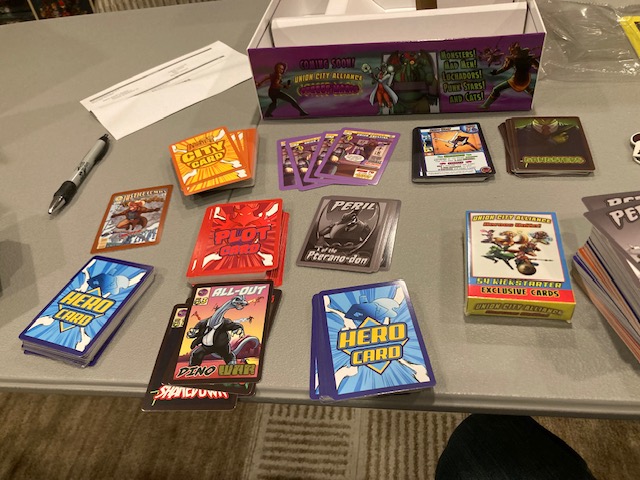
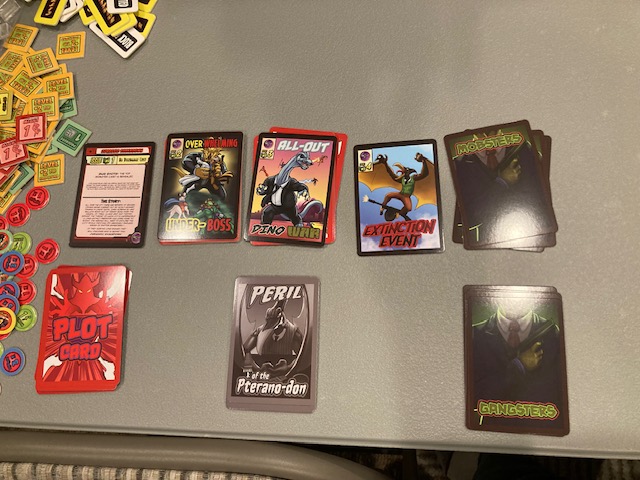
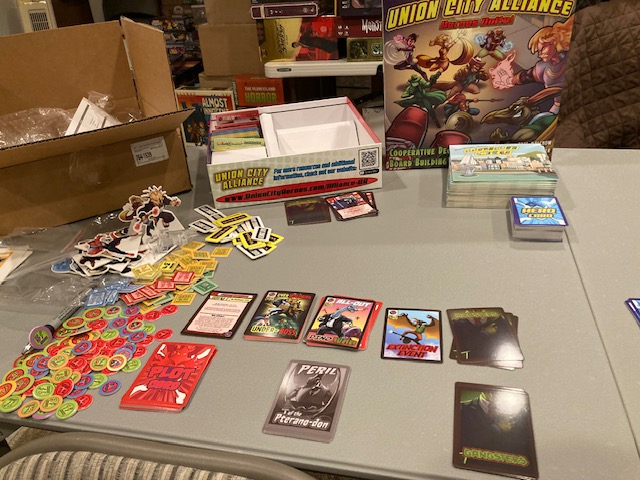
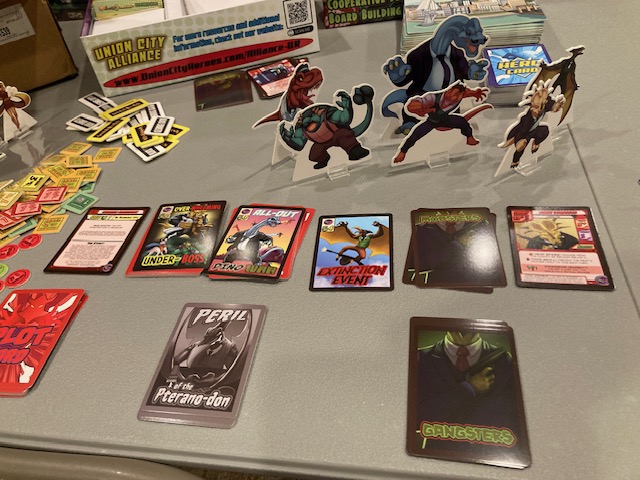
To win, players must take out the baddies!  See above which represents “the bad guys!’  The bad guys in Union City Alliance are pretty complicated to run: there’s a Peril deck, a Plot deck, issues #1-4 of the Plot Deck, and specialized baddies (Mobsters and Gangsters in this case).   To win with Pterano-Don and the Dino-Mafia, players must defeat all the Mobsters!

IMG_4326

It’s quite hard to take out the Mobsters!

IMG_4332

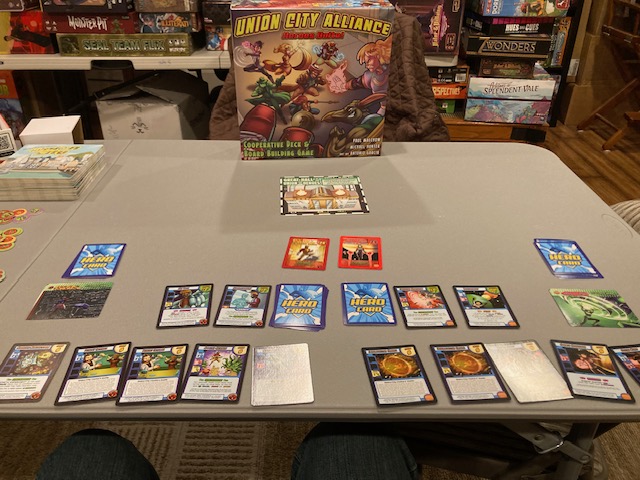
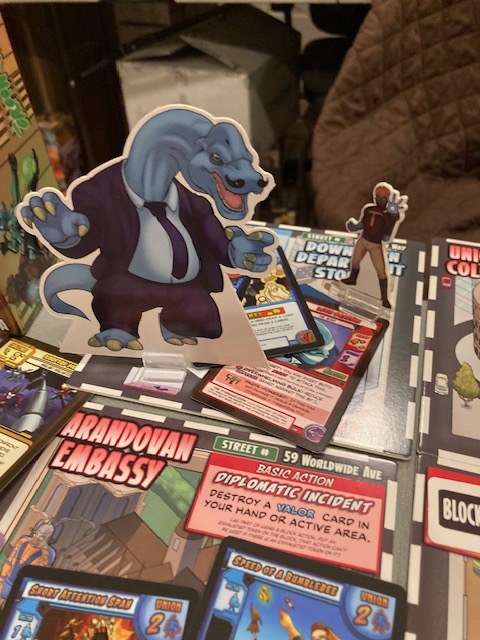
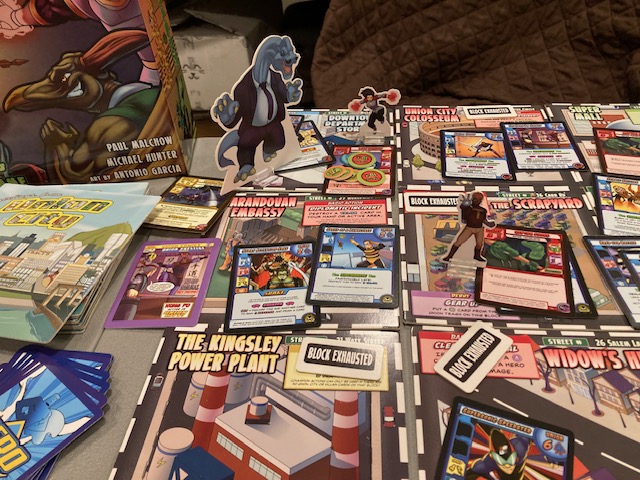
The city has to be big enough for the Mobsters to come out (a rule requires that), so that also forces the exploration aspect!  See above as the city is pretty huge with one of the Mobsters looming!

IMG_4333

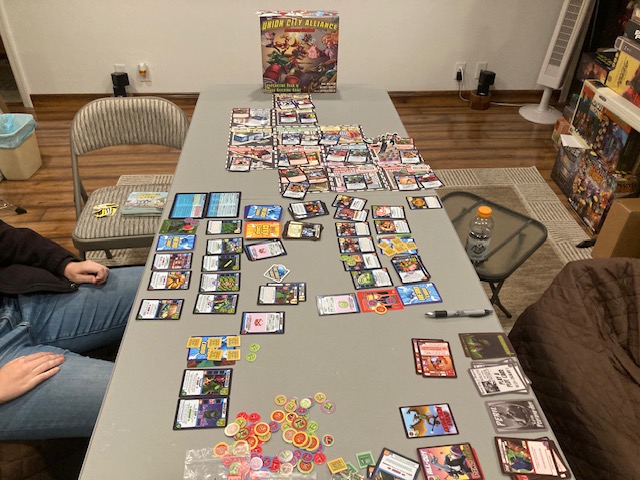
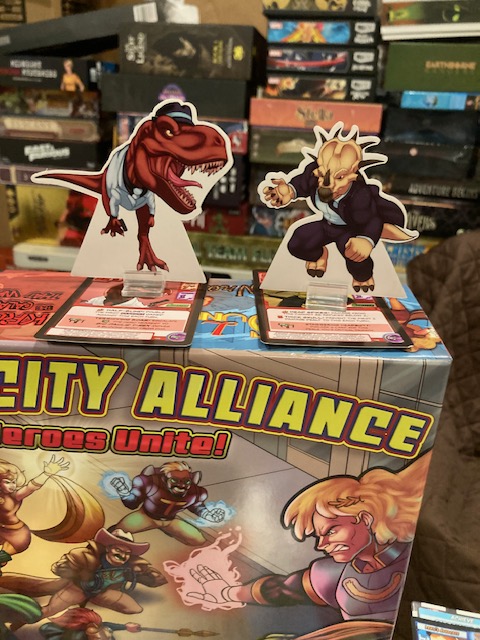
To win, take out all the Mobsters! As I took them out, I put them in “jail” on top of the box! See above!

Solo Play

IMG_4181

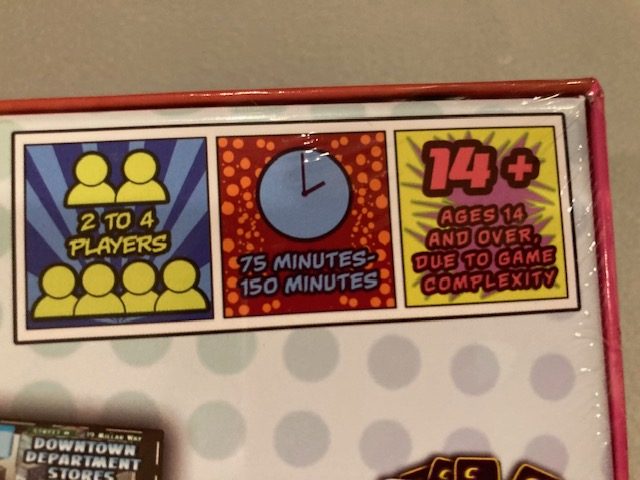
Unfortunately, there is no provided solo mode in the game!  See above, as the game is only listed for 2-4 Players.  

IMG_4266

It’s very discouraging that they didn’t follow Saunders’ Law here:  no solo mode!  So, I went ahead and played my first game two-handed solo.  That’s right, I operated Doctor Tomorrow and Captain Jupiter and just played this as if it were a 2 Player game, alternating between the two.

IMG_4339

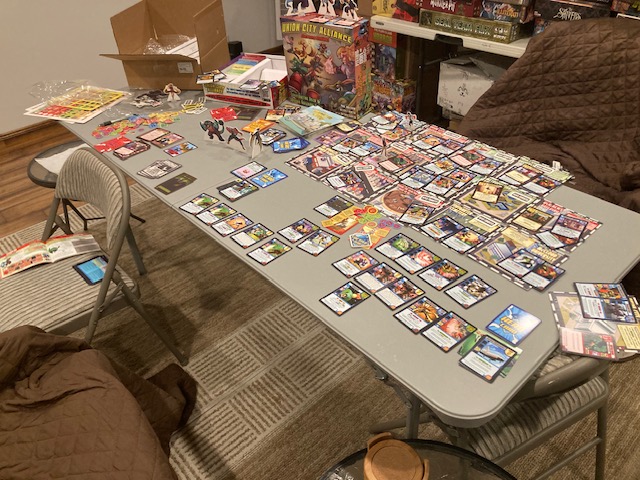
I think I know why they didn’t include the two-handed solo mode in the game: it’s pretty complicated.  I ended up playing my first game (granted, a learning game) in about three hours.  Each character in the game is very distinct with a very different play-style!  There is a lot of context switching between the characters, as each character has their own specific cards and Power deck that players need to be thinking about!  And the game can get pretty overwhelming as you play: see the picture above near the end of my solo game!  There are a lot of distinct Hero cards and distinct challenges and distinct Locations! 

IMG_4279

And the Villains are complicated to play too!  Plot card, Peril Cards, issues, distinct baddies! So, the solo player has to run two characters AND the Villain deck!

IMG_4340

See above at the end of my first solo game!  The board is a bit of a mess between two characters, the villains, the Locations, and all the cards!  

I can see why the Union City Alliance people chose to avoid the two-handed solo mode: this game is very overwhelming in solo mode!  My first solo game took about three hours to play! It probably wasn’t the best way to learn the game, but I believe in trial-by-fire for learning games: the only way to learn is to jump in!  So, I think, if you are determined, the two-handed solo mode will work. And once you learn the game, the basic flow is pretty straight-forward.

Cooperative Mode

IMG_4394

My second game was a two-player, two character game!  I learned quite a bit in my solo game: things to do and NOT to do!

IMG_4399

First, I learned to allocate signficantly more space for the Locations!  See above as I leave half the table for that!

IMG_4400

I also learned to be more methodical when placing Locations: each Location (when explored) adds Two Hero cards and one City Deck card.  Since space is at a premium, we tried to make sure the two City Cards are on the bottom half, and the City Card (whether a challange or a Bad guy) is on the top of the Location.  Since each Location also has a unique ability, we made sure that text was readable!  So, there are four things you need to see on a Location: let’s make sure they are consistent and readable as we place!  That makes the game … less messy … as the city gets explored!

IMG_4405

See above as the city is a little less daunting as we have more space and the layout is a little more consistent.

IMG_4414

Even though each player runs their own character, which tends to make the players more isolated turns, Union City Alliance still encourages cooperation.  Players have to work together figure out how to take out certain monsters and challenges to clear the way to take out the Mobsters!  The game ramps up in difficult pretty quickly, and some coordination between the heroes is necessary to keep the badness under control.

IMG_4403

I liked the solo game, but the game is better at two or more: there’s more people to share the responsibility!  Union City Alliance can be very overwhelming (there’s quite a bit of maintenance per round) as solo gamer, but the sharing of responsibilities made this much easier to get through.  Teresa was in charge of The Green Death (that was here hero) and the Locations, and I was responsible for Captain Jupiter (that was my hero) and the Villain decks.  Off-loading some of the maintenance to other players made the game much more fun!  I could play without worrying about keeping the game up!

IMG_4181

Solo was fun, but the game is just more fun with more players. I see why they chose NOT to put 1-4 Players on the box.  

Theme

IMG_4410

This game is dripping with theme!

IMG_4415

Each hero is very distinct and plays very differently, representing the sum of their powers!   

IMG_4300

There’s a ton of flavor text on the cards, which you can ignore if you like, but it really does draw you into your character.

IMG_4194

The Source Book just digs even deeper into each character!  You want back story? You got it!

IMG_4337

The Power Decks, which are unique to each character, also contribute to making each character just feel so different and flavorful! 

IMG_4286

The Villain deck is quite complicated to run, but is very thematic! The “harder” cards come out in later issues of the game!  There’s quite a it happening per round with the Villain deck, but it is all unique to the Villain .. again contributing to the theme.

IMG_4286

The larger than normal standees (especially for the dino-mob) makes the game feel thematic! They are so cool looking!

IMG_4415

If you haven’t noticed, just about every card has unique art on it! It’s all the consistent from the same artist and just draws you into the game!

IMG_4397

This game has so much theme to it: I’d give it a 10/10 for theme.  The events, the characters, the Locations, the heroes, the art, the standees, the vibe of the game: 10/10.
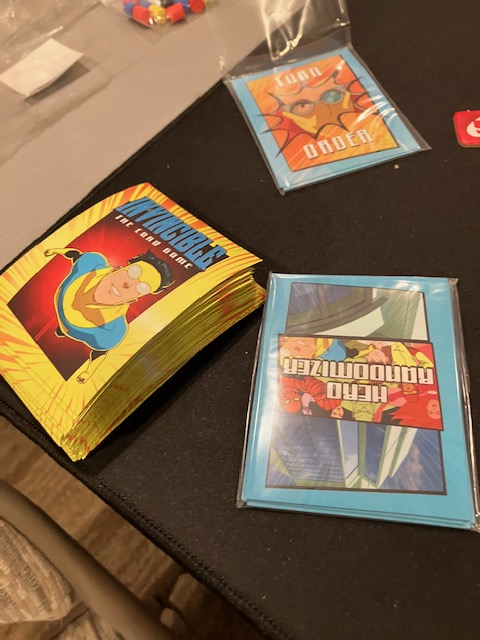
IMG_4411

You do pay a price for this theme, though: from minor costs like flavor text (“Oh man, there’s flavor text on the card I should read“), to annoying costs (“set up the next city Location“), intrinsic costs like understanding you Power cards, to major costs (like running the very distinct Villain decks).  My games of Union City Alliance have run about 2.5 to 3 hours.  Some of that time  is just the sheer maintenance of immersing yourself into this universe.
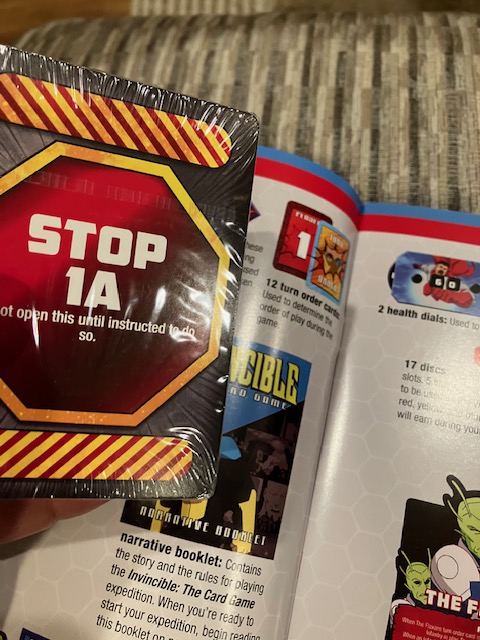
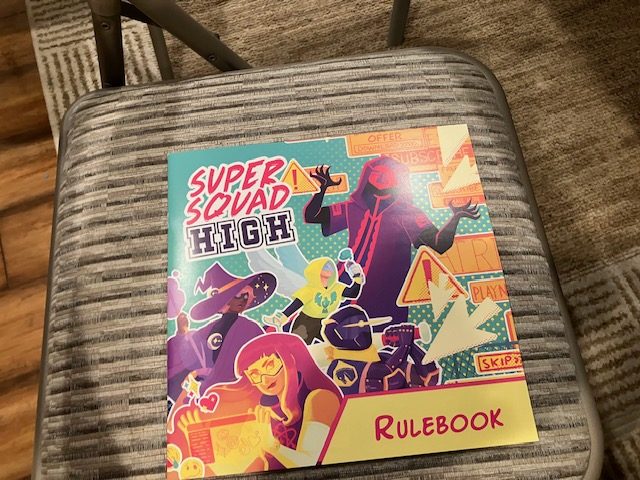
The Art

IMG_4319

I love the art in this game.  It’s pretty clear the art is mostly the product of one artist (Antonio Garica), and I think he just knocked it out of the park!  The art feels very comic-booky and super-heroey.  It’s so thematic and so good.

IMG_4329

My only complaint, and this is not even really a complaint …  is that his style might be thought of as too cartoony!  I don’t have any problem with that, but if you saw the game cover in a store, you might this this is a game for younger audiences.  While Union City Alliance is generally family friendly, this is a deep complex game that might be too much for younger audiences.

IMG_4181

The age limits of 14+ should absolutely be adhered to (see back of the box), as I think someone who’s just starting in games might think “Oh that game looks cartoony and kinda cute! Let’s get it!”  Union City Alliance is much heavier than the art belies. Caveat Emptor.

Conclusion

IMG_4340

If you want theme, you have to pay for it!  If you want a lighter super-hero deck-building game, you should bring out Marvel Legendary: It has your Marvel heroes and is pretty straight-forward to teach.  But honestly,  I always thought the theme was lacking in Marvel Legendary: “Wait, you are buying a team of heroes? What?”  

IMG_4395

Union City Alliance is a deck-building super-hero game that has the theme I always wanted in Marvel Legendary.   In Union City Alliance, characters have unique powers, Villains are distinct, exploration/upgrading is both natural and encouraged, upgrades are tailored to your hero, and the art is very consistent and thematic.  

IMG_4332

If you want theme, you have to pay for it: Union City Alliance takes longer than many games (2.5-3 hours), has more upkeep per turn, and has more complicated set-up and interactions.   You pay for this incredibly thematic game by having a game that’s more complex.

IMG_4177

I want that theme!  Union City Alliance would easily make my Top 10 Cooperative SuperHero Games with a 9/10 and it will probably be near the top spot of my Top 10 Cooperative Games of 2024.  It took about 3 years to get Union City Alliance, but I was totally right to make this my #1 on my Top 10 Anticipated Cooperative Games of 2022!