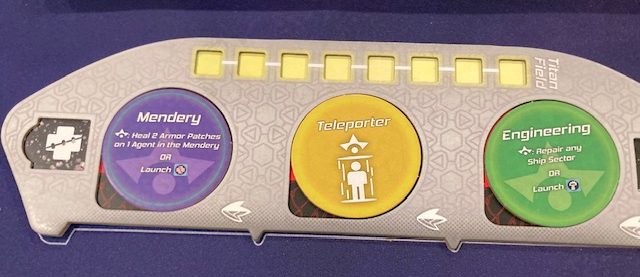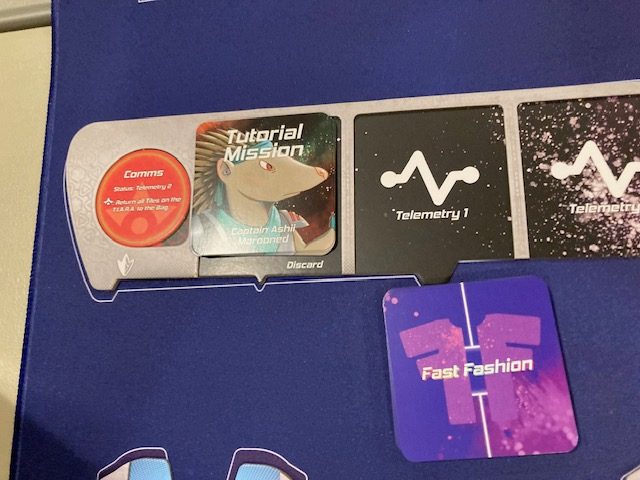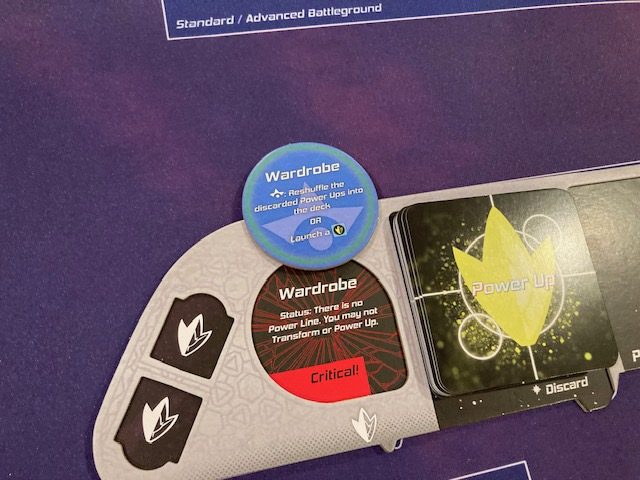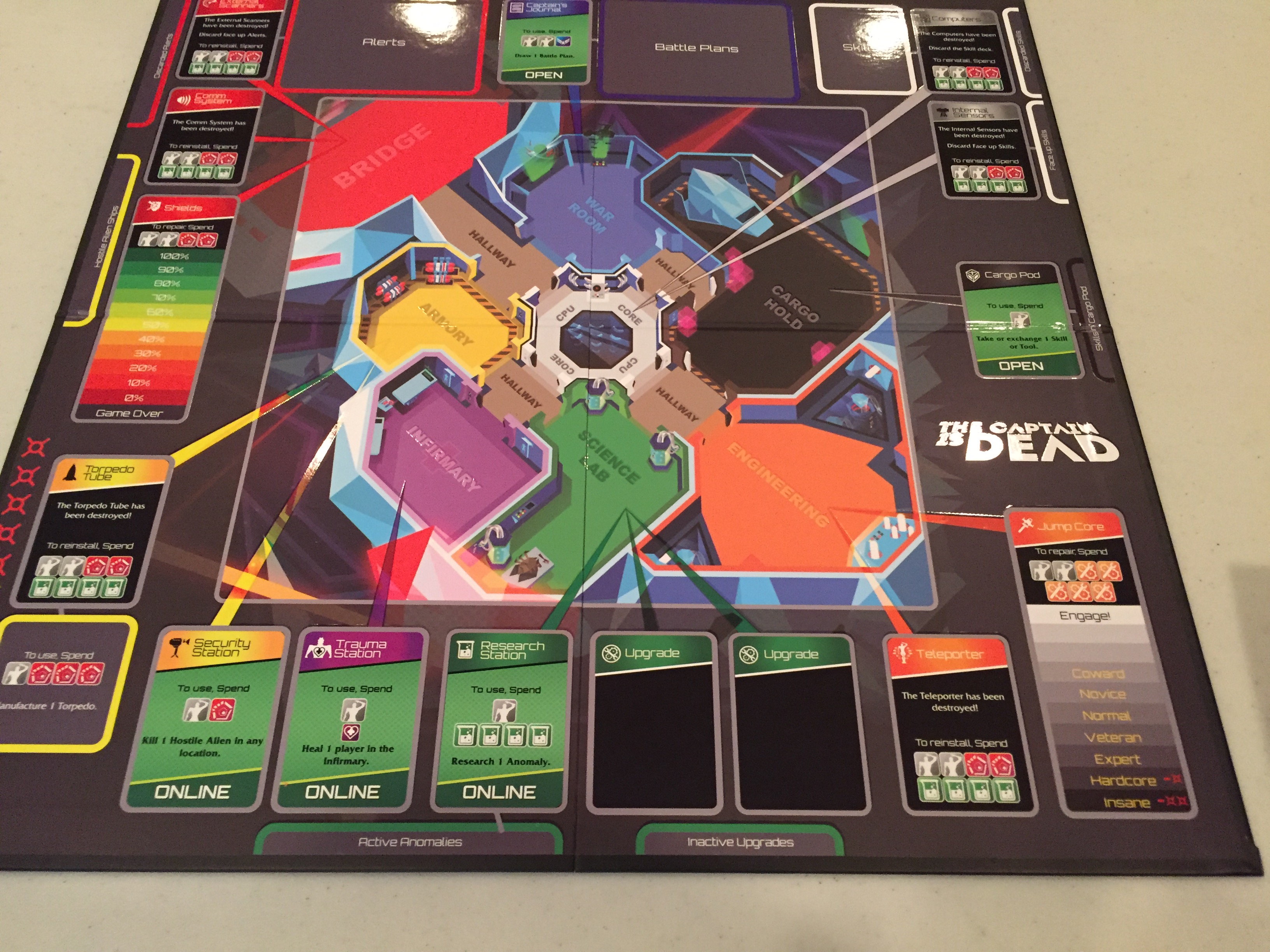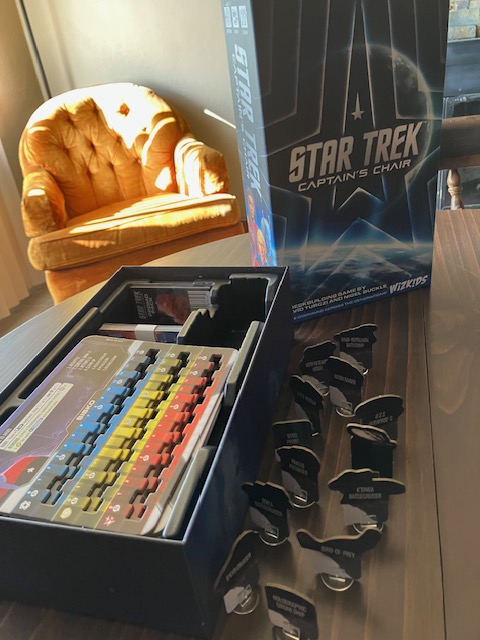
Star Trek: Captain’s Chair. My Solo Game of the Year.

Star Trek: Captain’s Chair is a solo and 2-Player head-to-head game in the Star Trek universe (from publisher Wizkids).  I bought my copy online sometime in early 2025 (I don’t even remember when; March? April?), but the game was so daunting that I was scared to open it up.
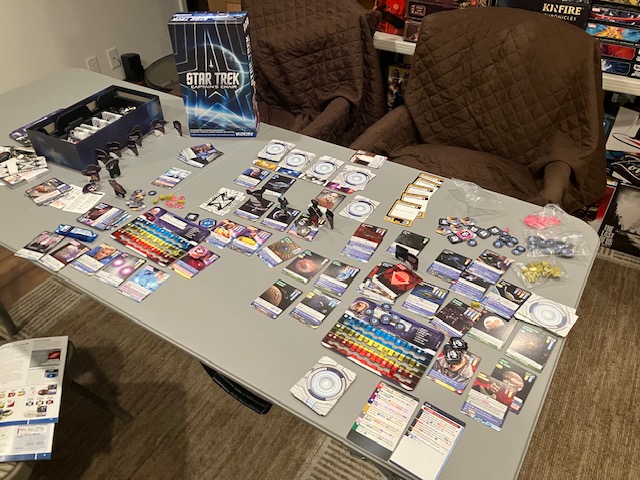
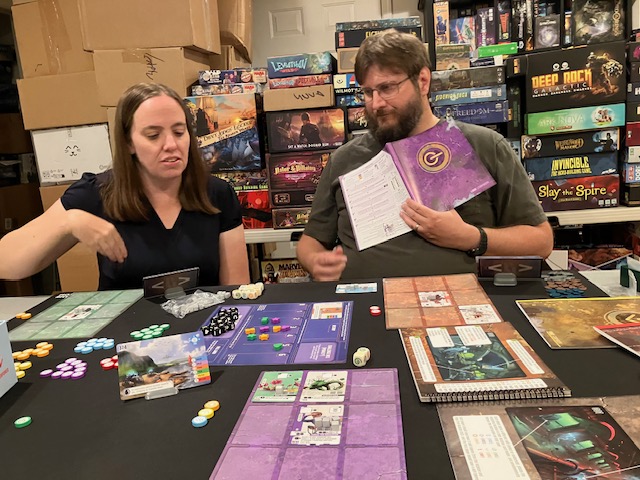
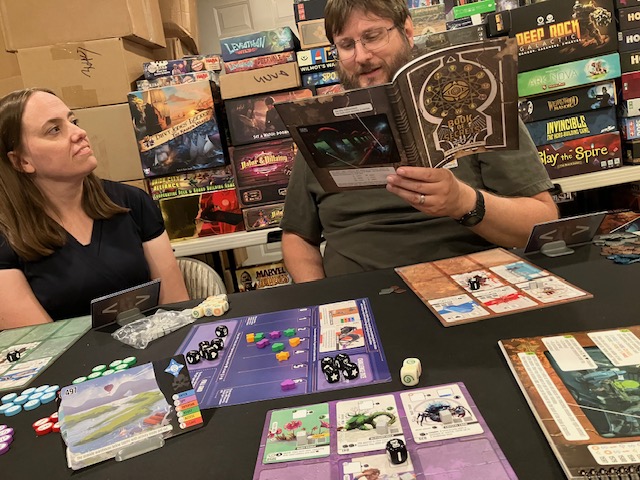
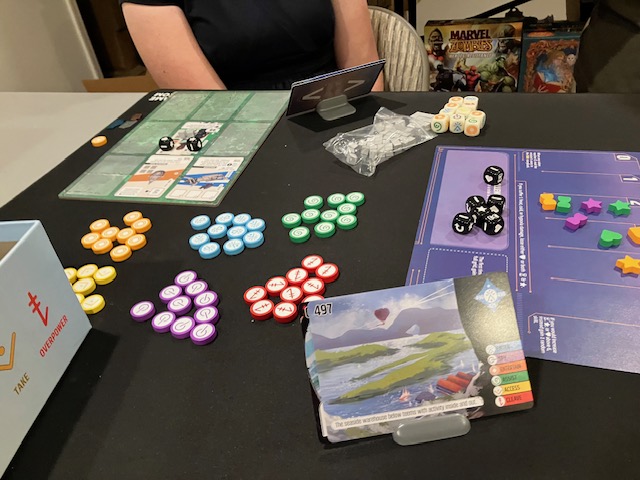
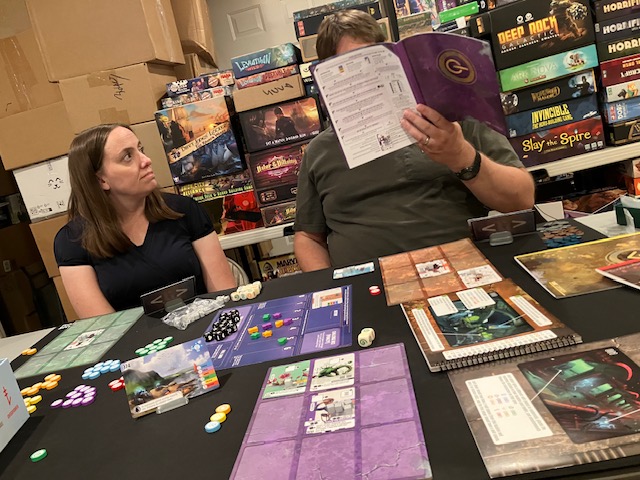
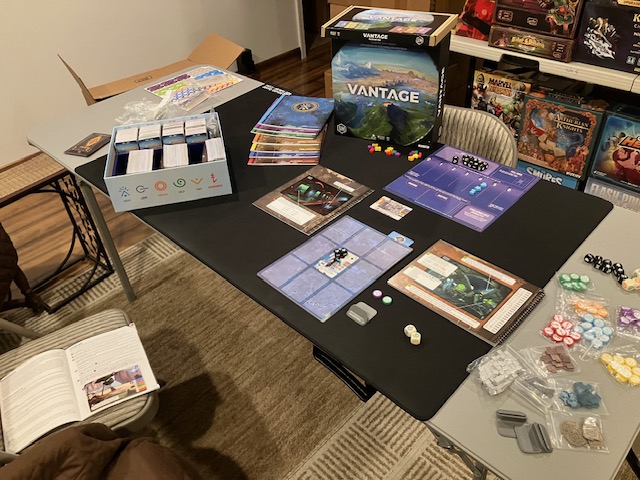
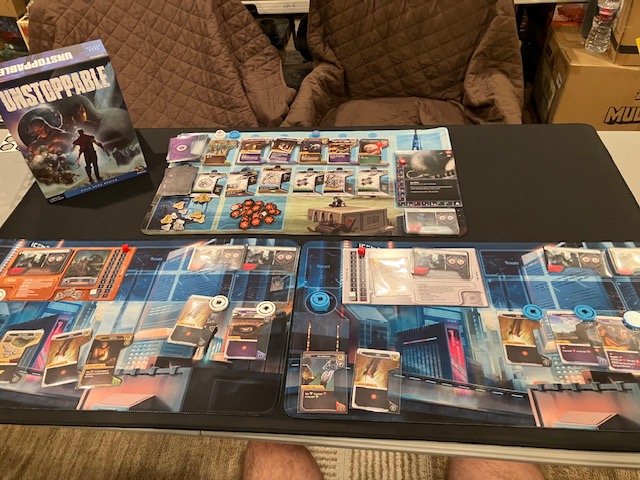
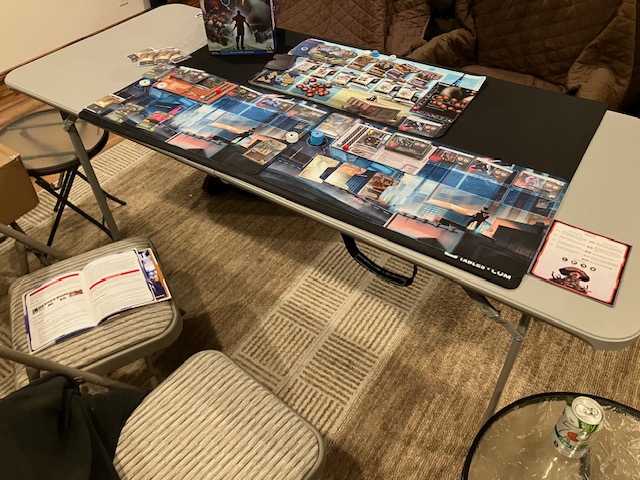
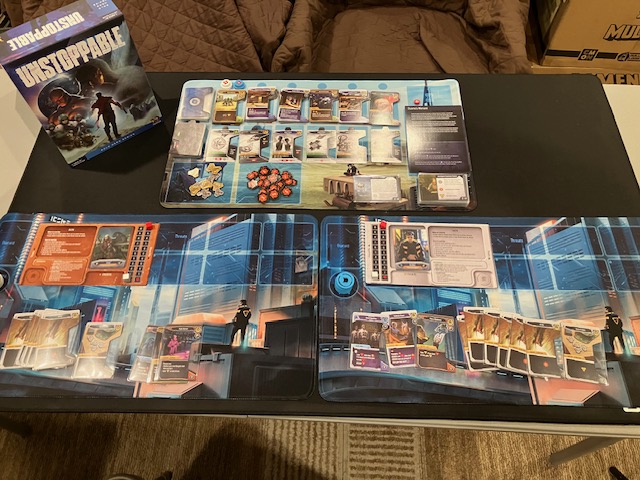
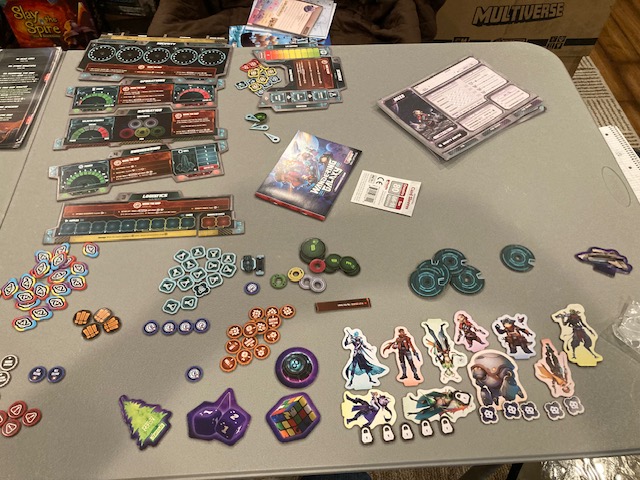
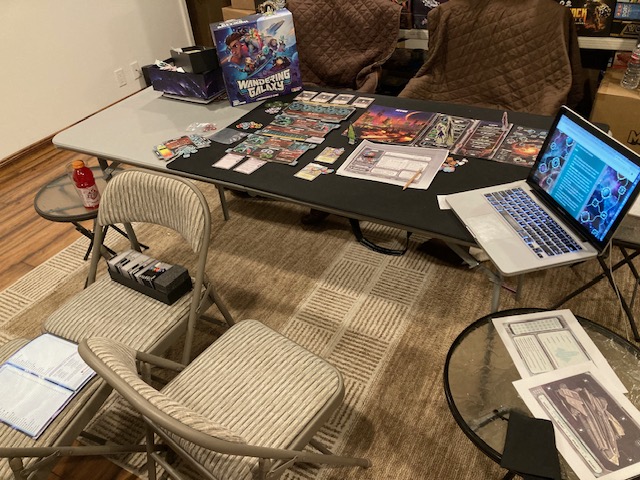
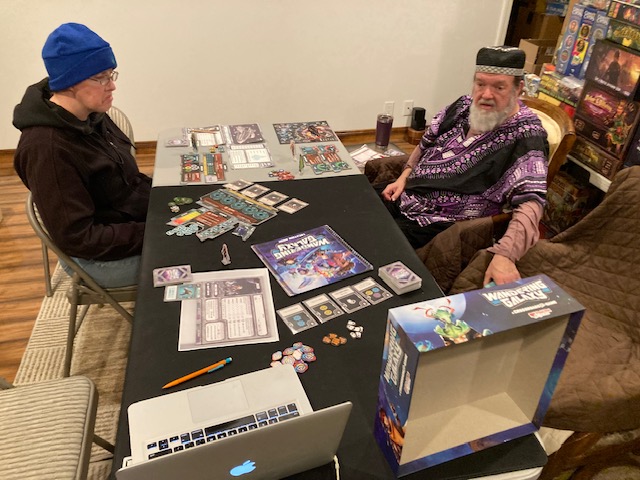
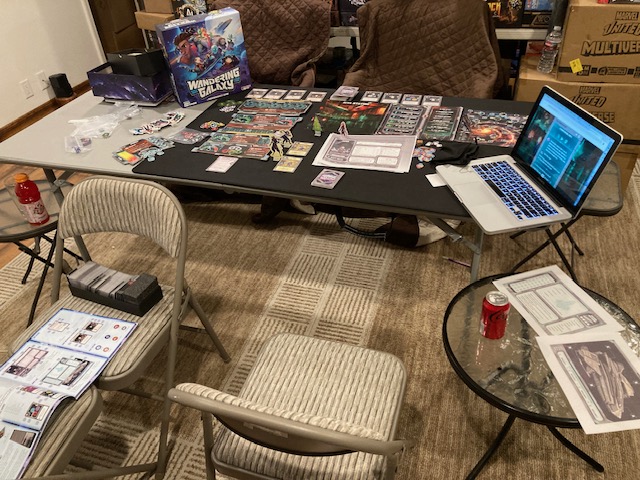
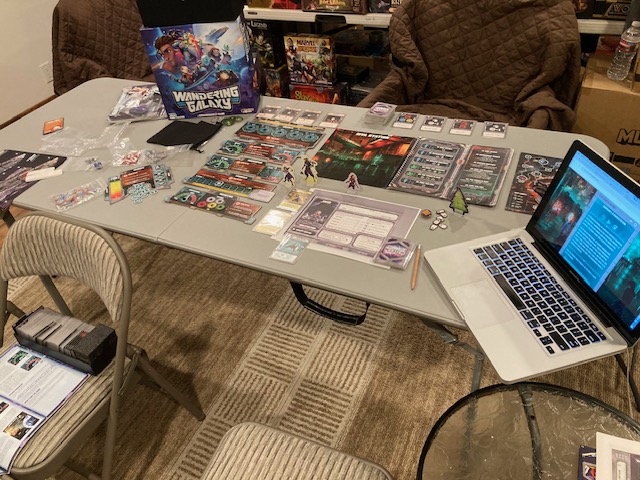
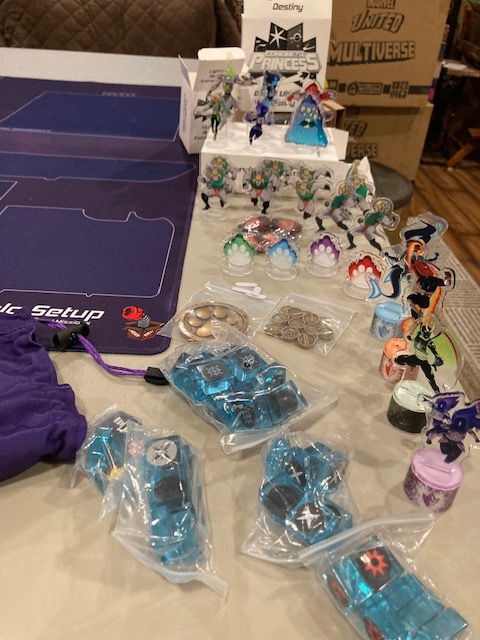
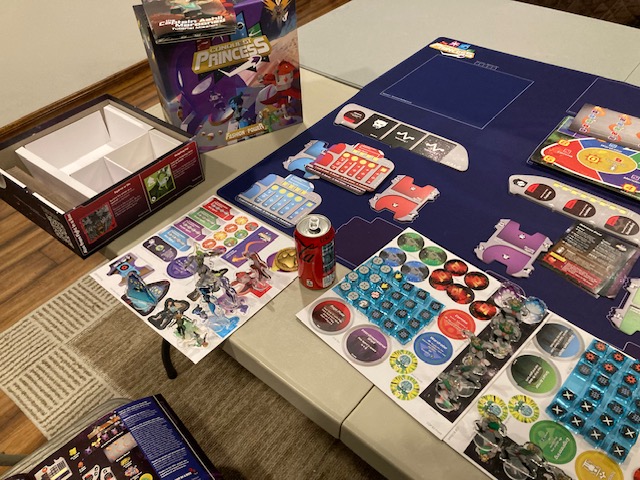
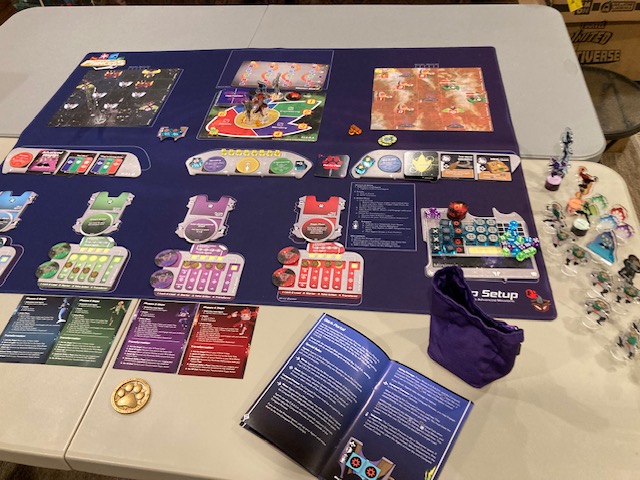
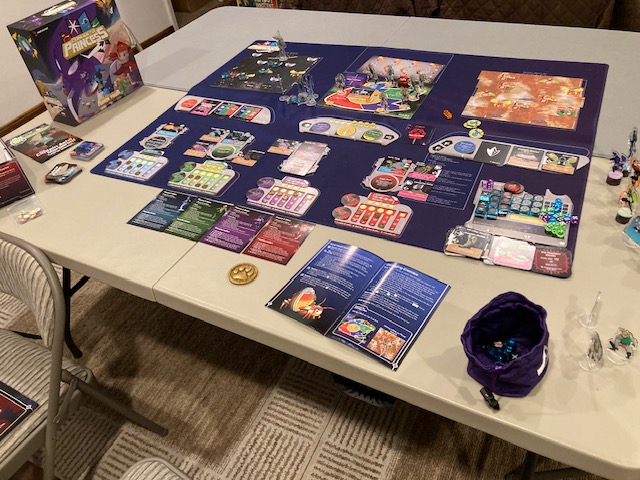
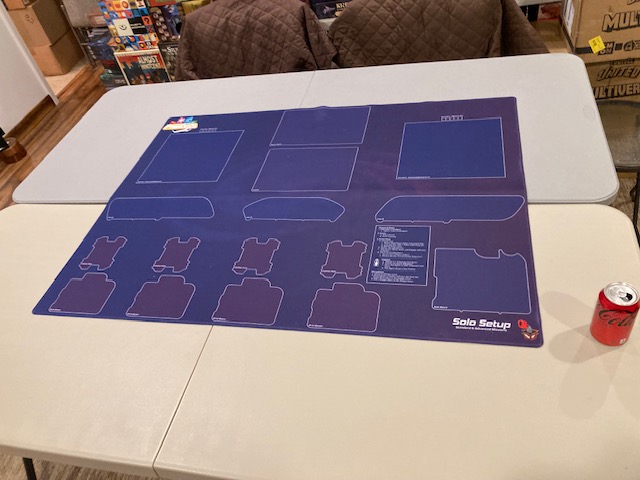
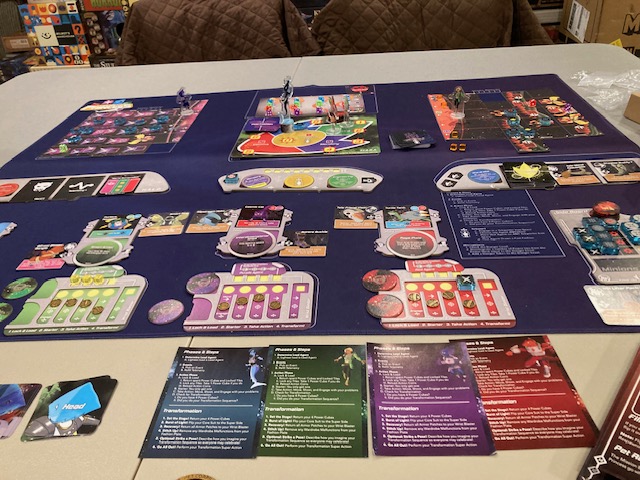
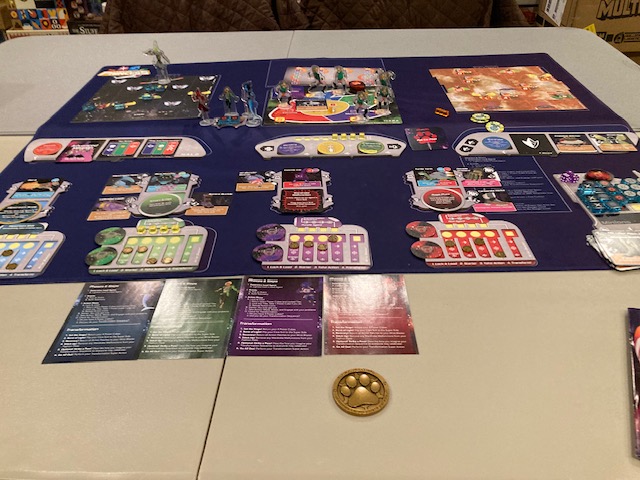
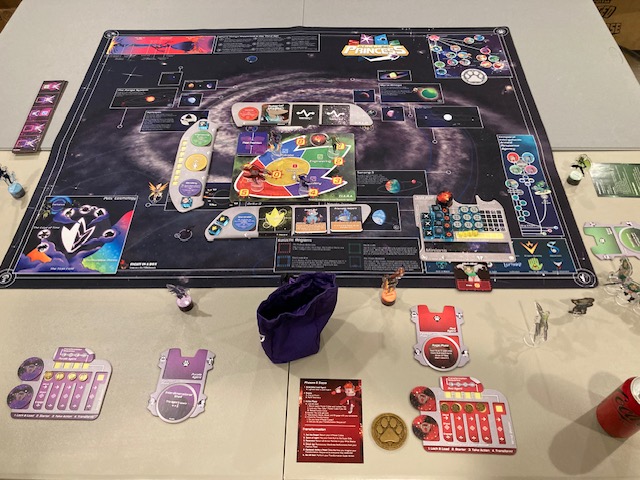
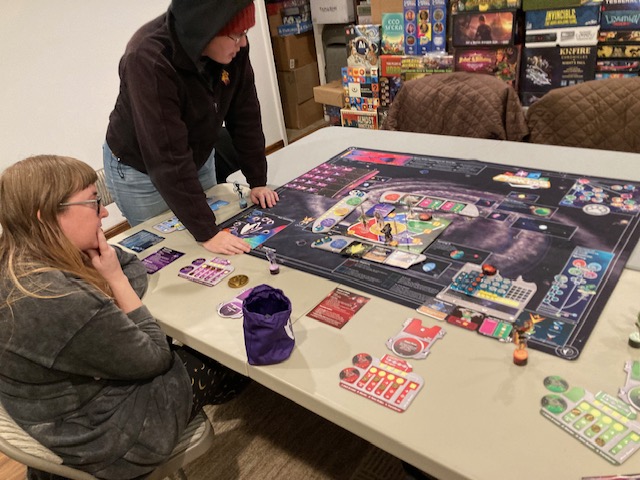
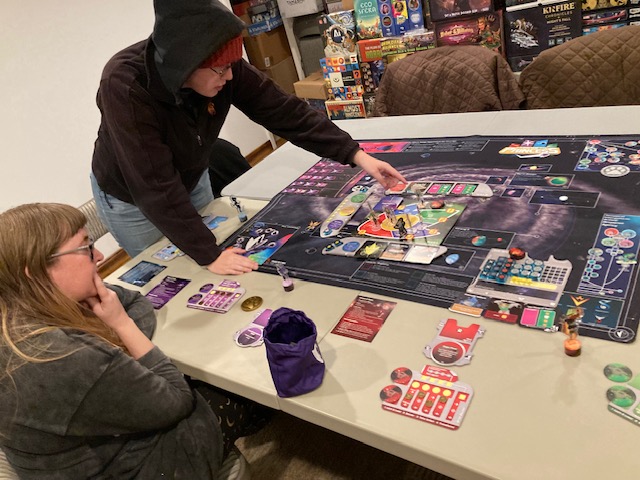
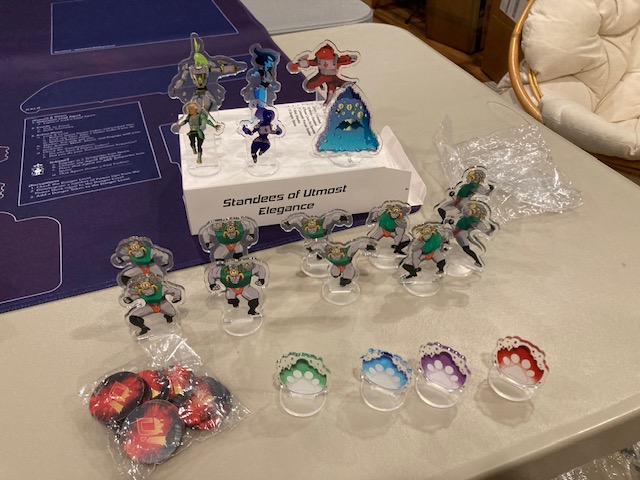
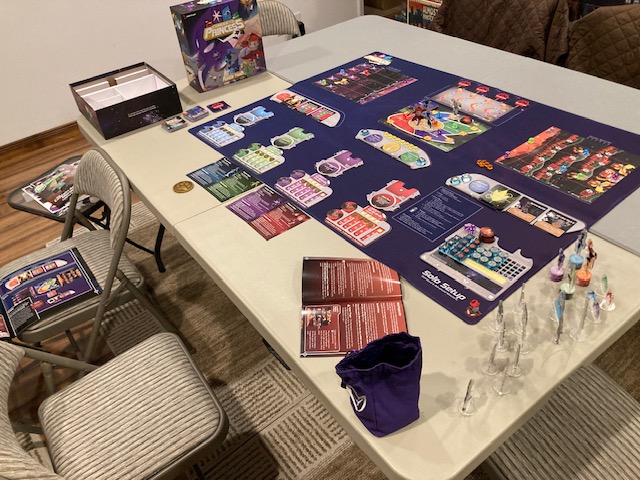
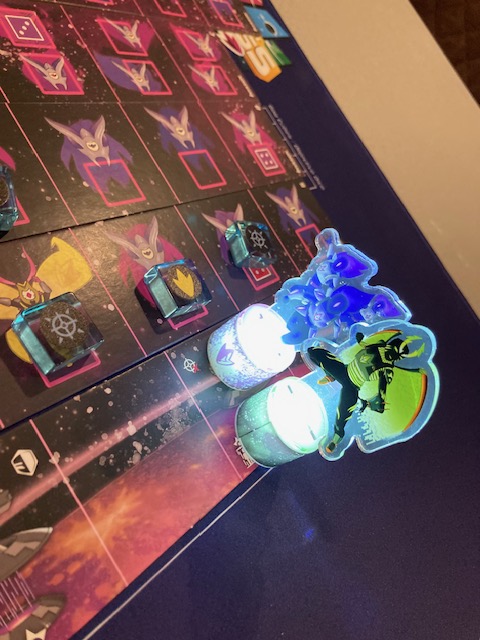
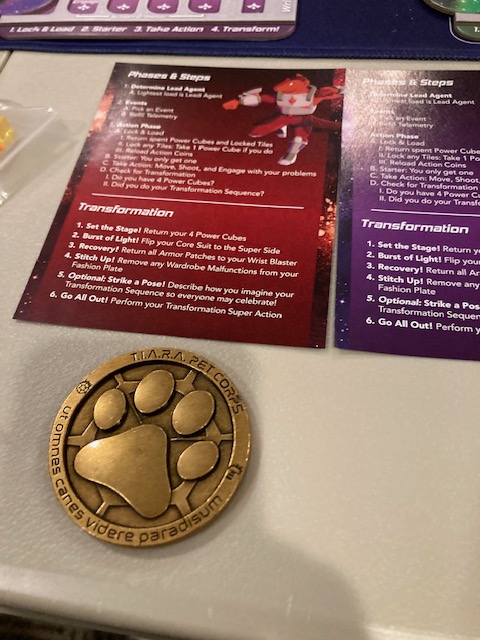
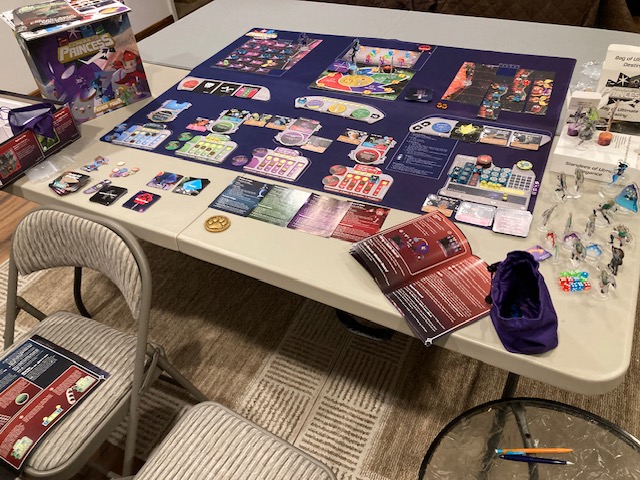
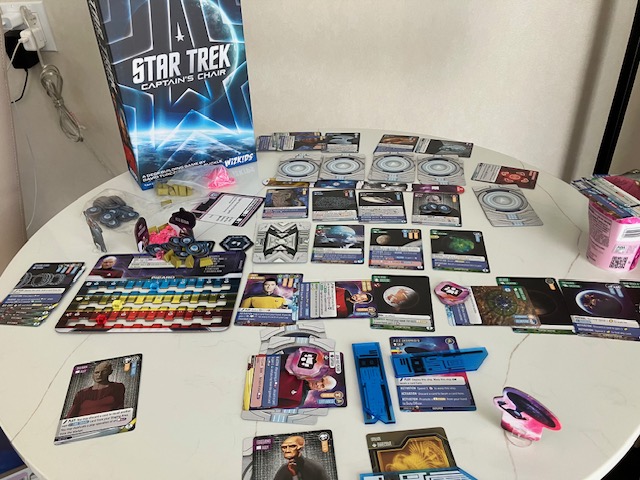
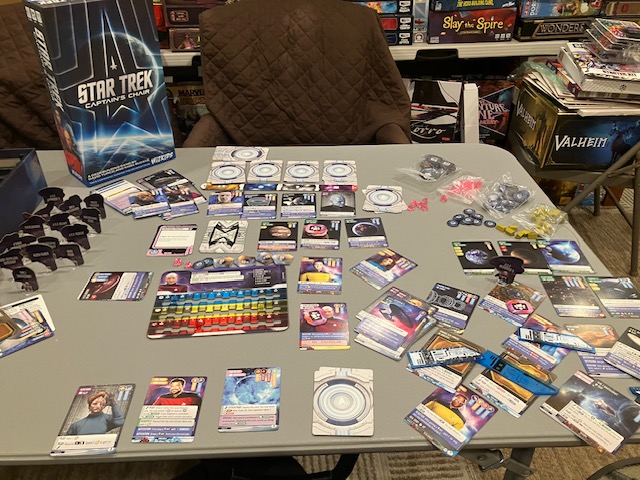
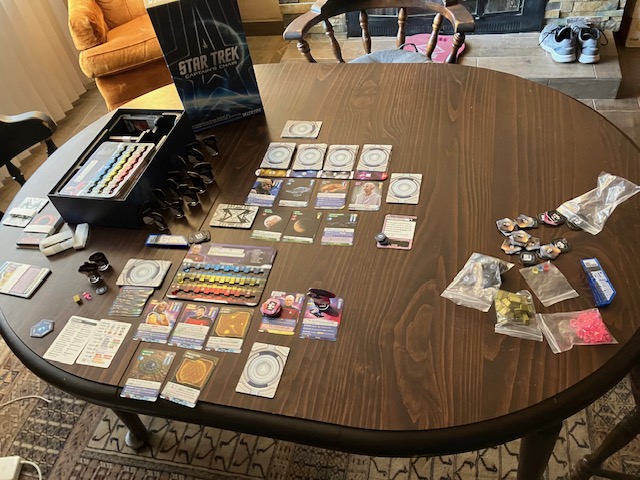
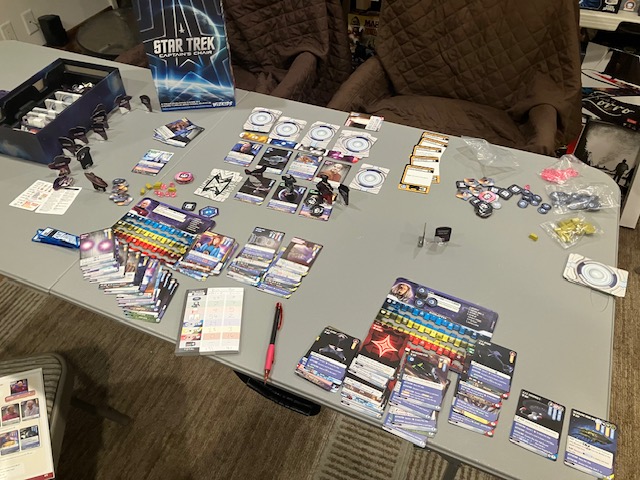
Look above to see a full solo game set-up!  Gulp!
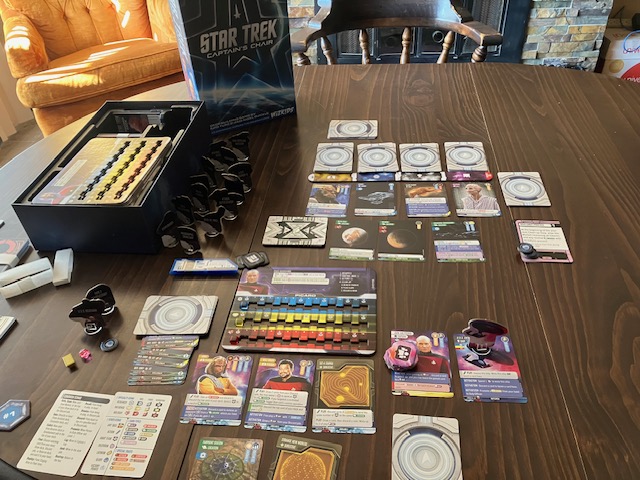
I literally spent almost a year learning this game!  See above as I JUST set-up the game, to get a sense of it!  I ran out of time, so I had to tear it down before I even played it!  In fact, I think I set-up the game at least three times before I actually played it!
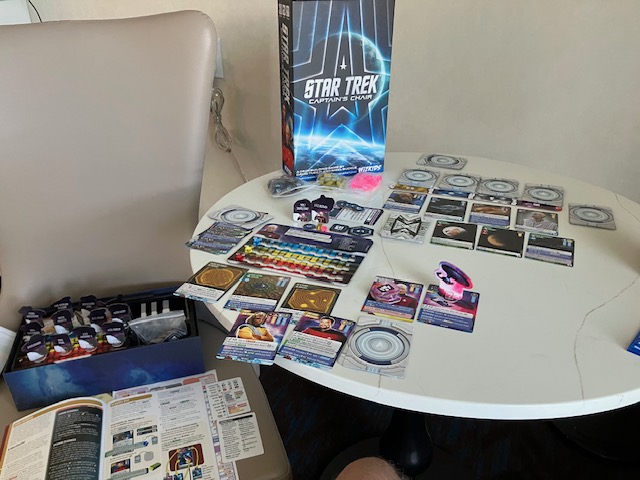
What is this thing and why is it so daunting?  To call it JUST a deck-building game with Victory Points seems to do the game an injustice, but at its core, it really is a deck-building game; if you get the highest score you “win”.
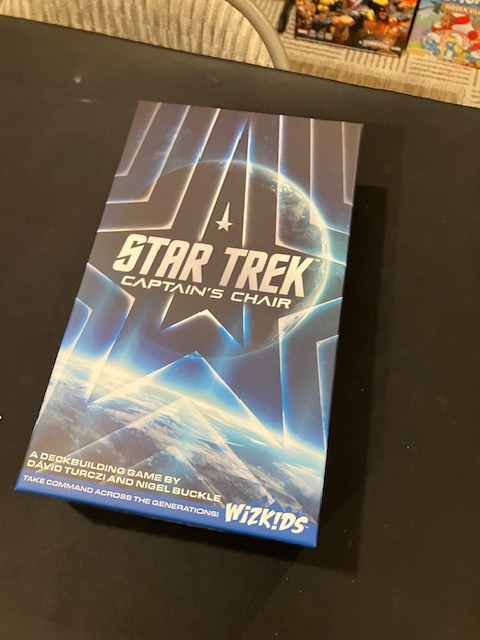
Let’s take a closer look.

Unboxing and Gameplay
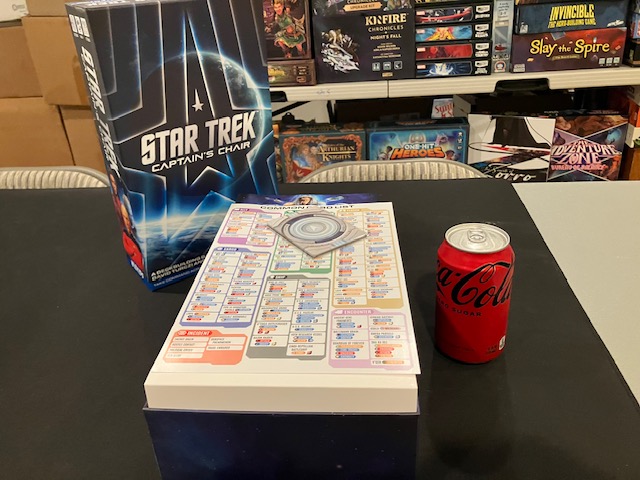
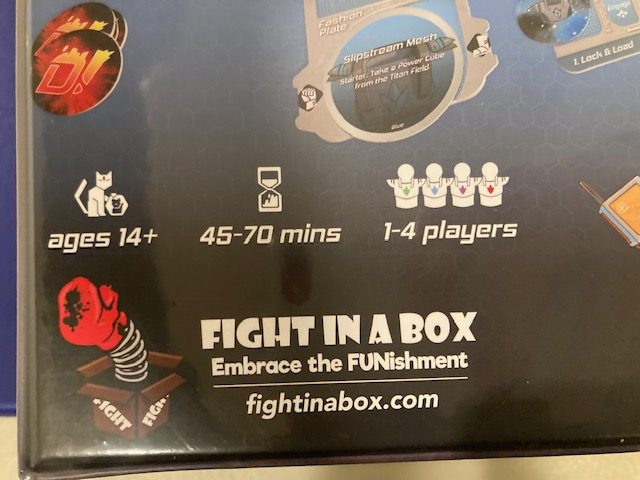
The Captain’s Chair is about a half-sized box. See can of Coke above for scale.
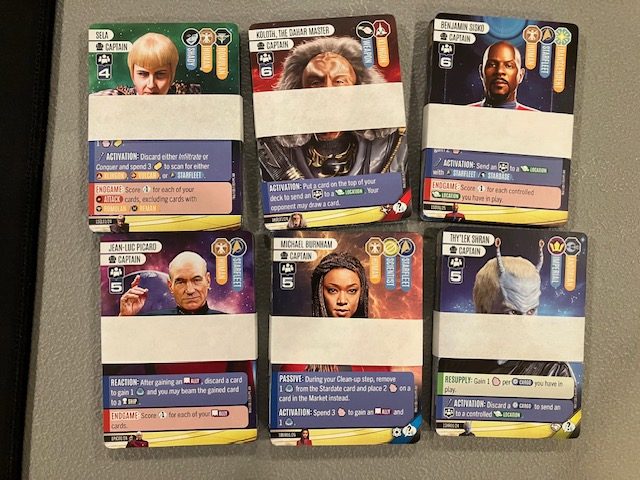
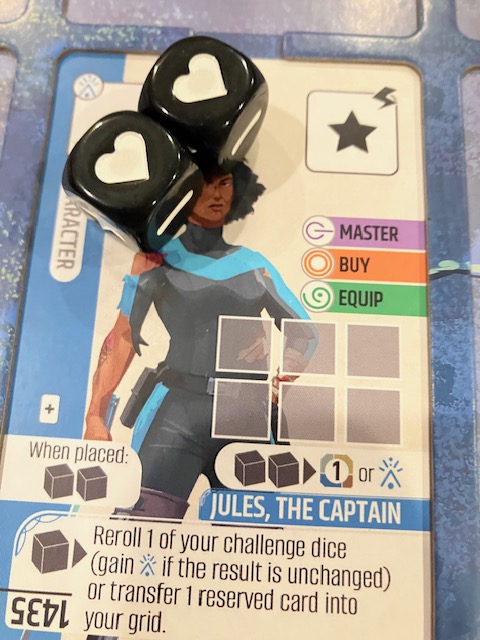
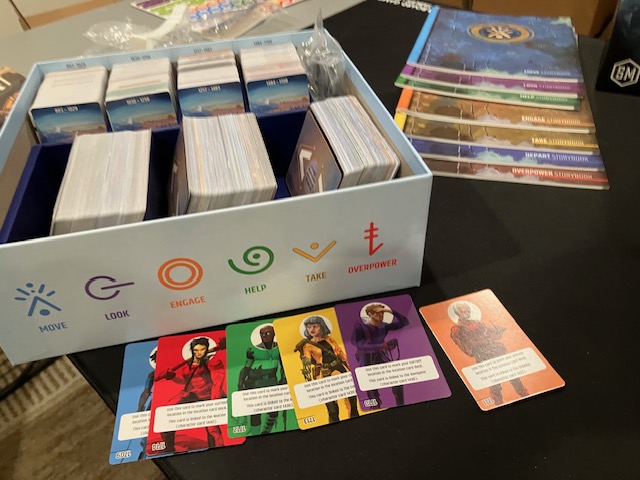
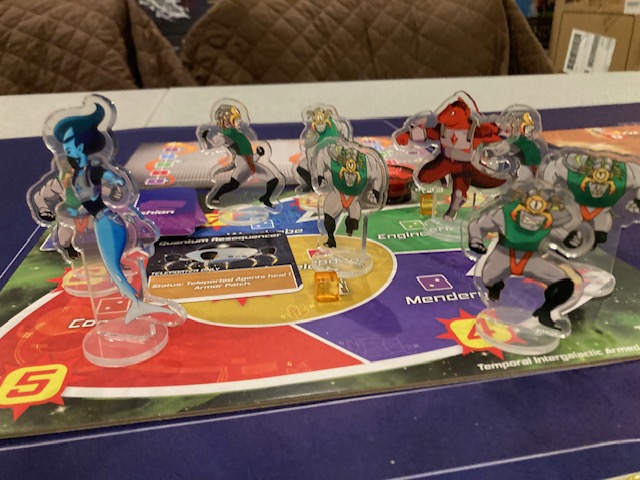
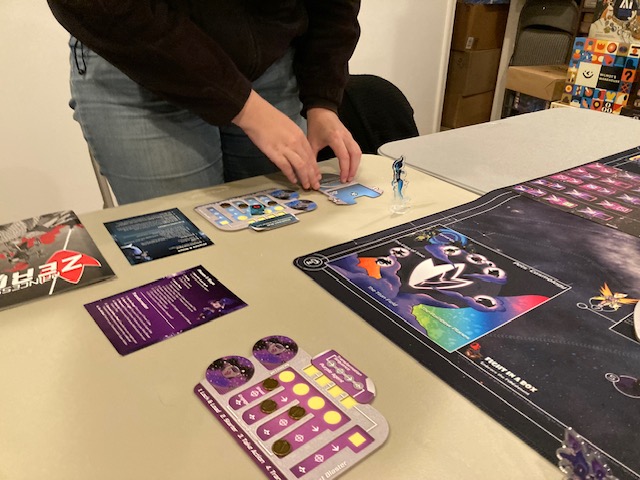
Each player takes the role of one of six Captains from Star Trek: see the Captains above.  And NO Captain Kirk is not in this set;  you have to get one of the Expansions (due out sometime in Q4 last time I looked).
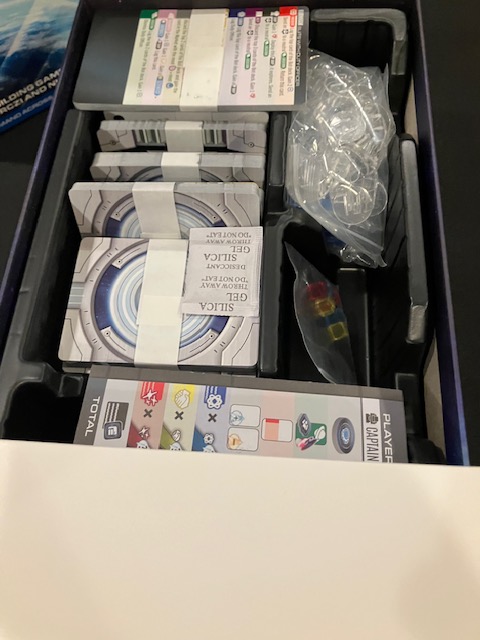
The Captains each have their own little deck hubby hole in the box.  See above.
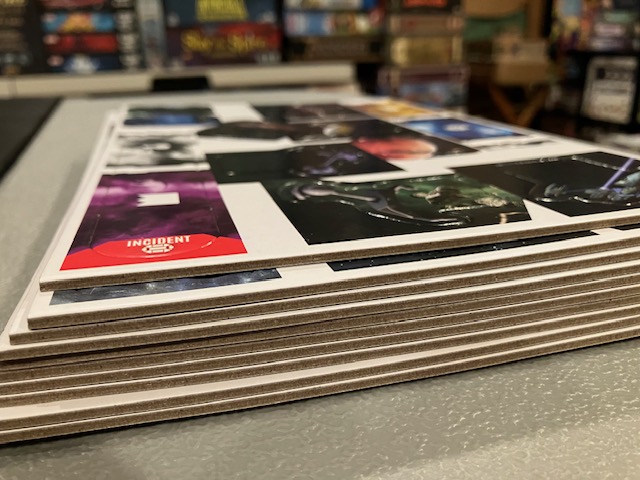
There is a metric ton of cardboard in this box.  
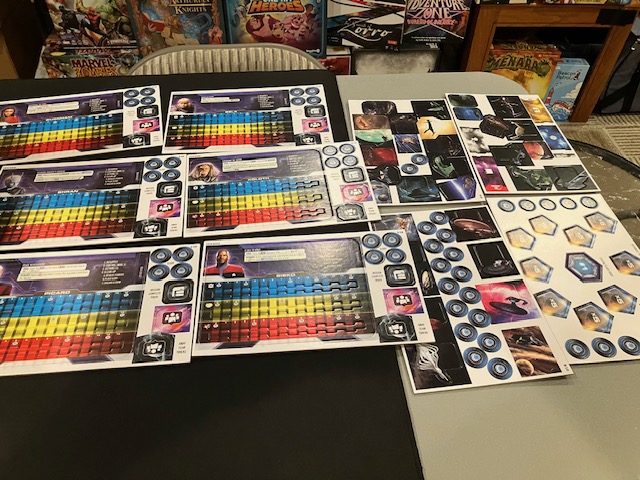
Most of the cardboard is is tokens and the 6 player boards for the 6 captains.  See above. 
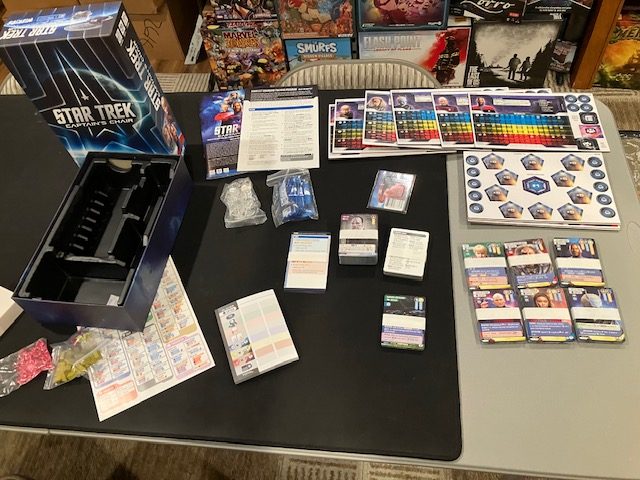
To be fair, I think you WILL have to throw away the Punchout Skeletons to fit everything in the box (what are Punchout SkeletonsSee here).  It hurt me a little to throw these away, but the game just barely fits in the box, and all the Punchout Skeletons do is puff up the box.  So, you will have to throw away them … see a video of me doing it here …

https://www.youtube.com/live/aMSZ3QDeQYM?si=4z8aaQzBlCOyjh8V&t=1073
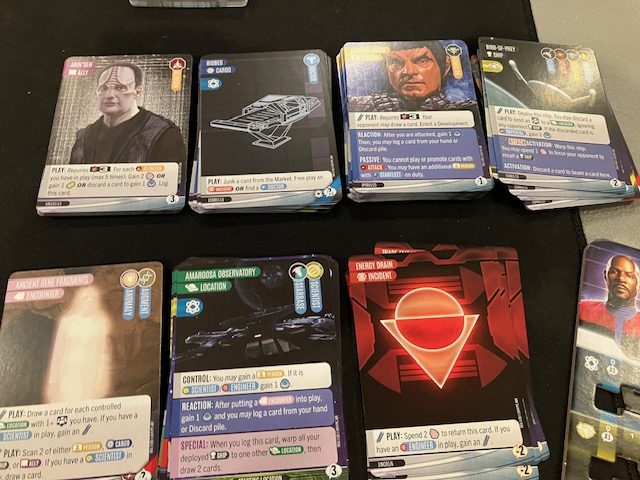
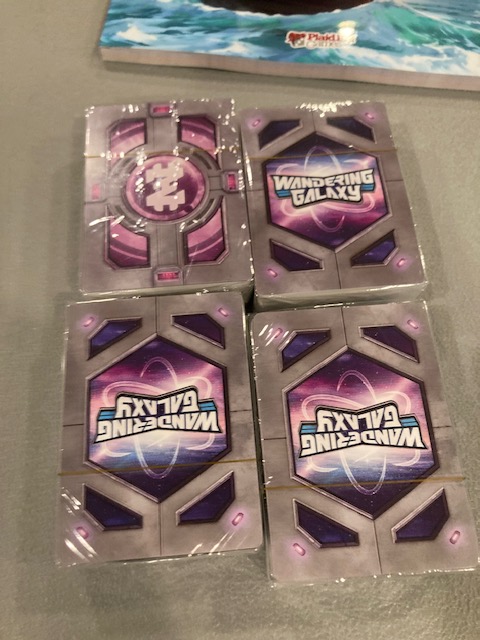
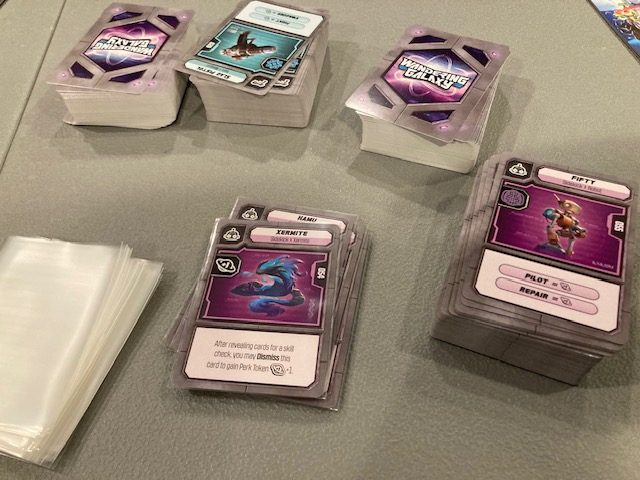
Like I said, this is, at its core, a deck-building game.  So, you have all sorts of cards that you can buy/accumulate into your deck!  See above all the Common cards: Allies, Cargo, Persons, Ships, Incidents, Locations, and Encounters!  These are “generally” the plain cards you will acquire to build your deck.
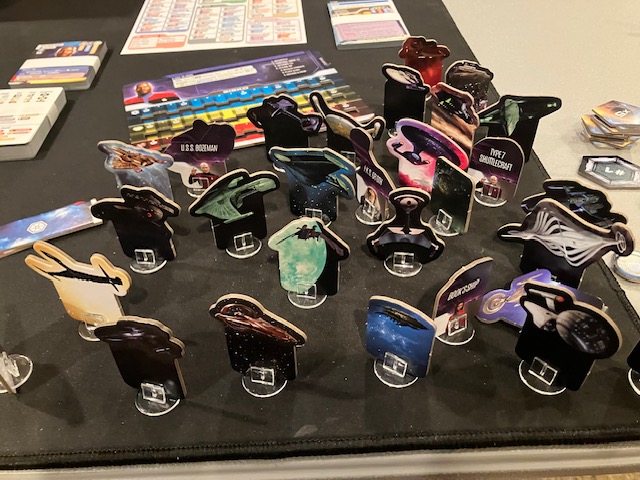
But there are lot more very thematic rules than just “build a deck!!” You can acquire ships, and warp them around!
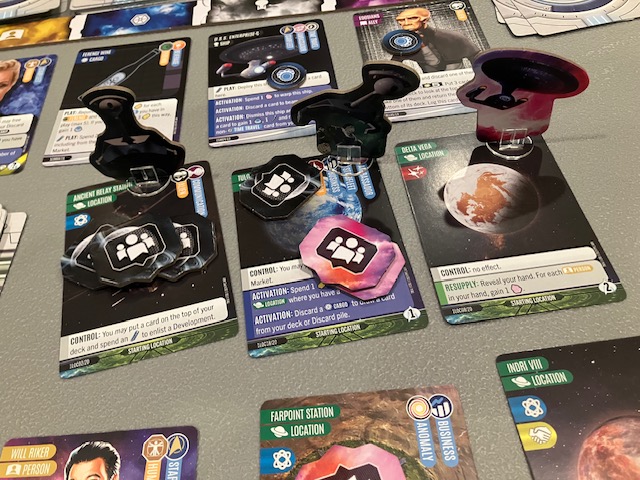
Very thematically, you take control of a Location if you have enough landing parties and/or ships there!
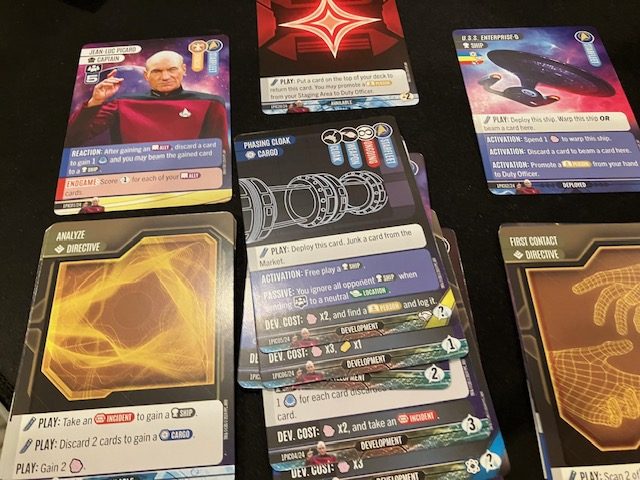
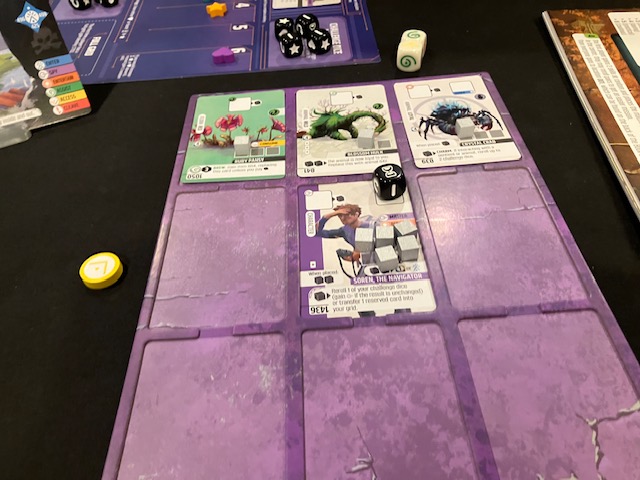
Each Captain has their own very special deck of cards, which only THEY may use!  These cards in the Captain’s deck represents their “style”.  So, even though a Captain can buy/acquire Common cards, a Captain’s deck is a thing unto itself; it slowly unveils itself.  The Captain’s deck (see above) start with Available cards, slowly adds Reserve cards (as the deck cycles), then you can develop Development cards as you see fit!   
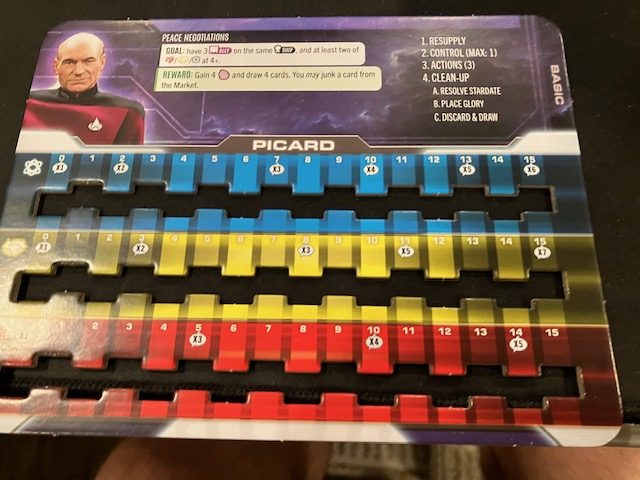
Captain Picard, for example, is all about getting Allies!  His Mission (each captain has a base mission which shapes his play-style) is to beam 3 Allies onto a ship!  See above.
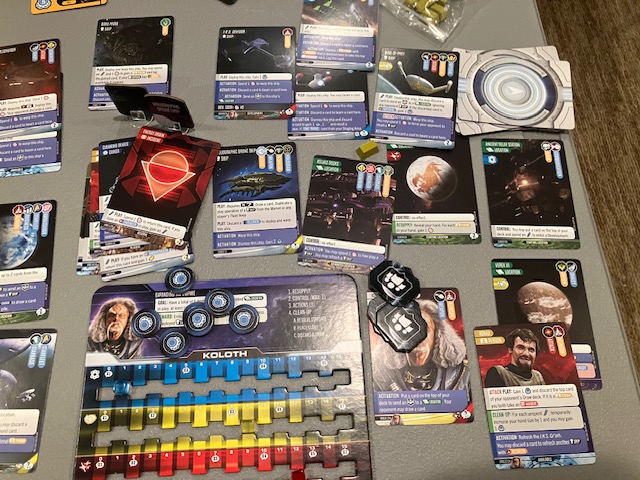
Koloth the Klingon has a very different play-style; he is all about getting Ships into play and controlling planets! 
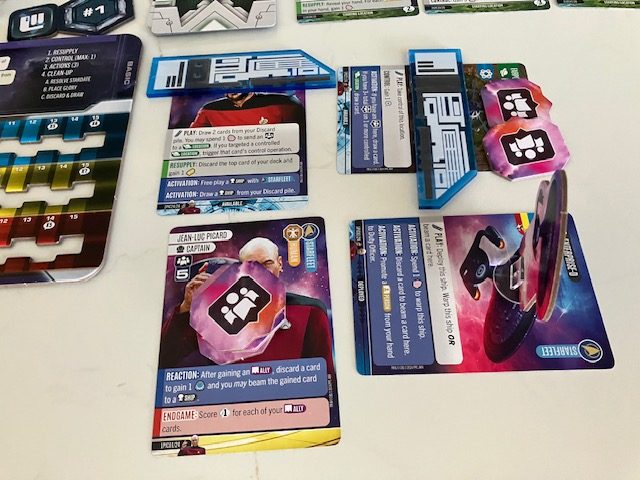
The game also has the notion of the Duty Officer; if you play one, it will allow you some extra activities.
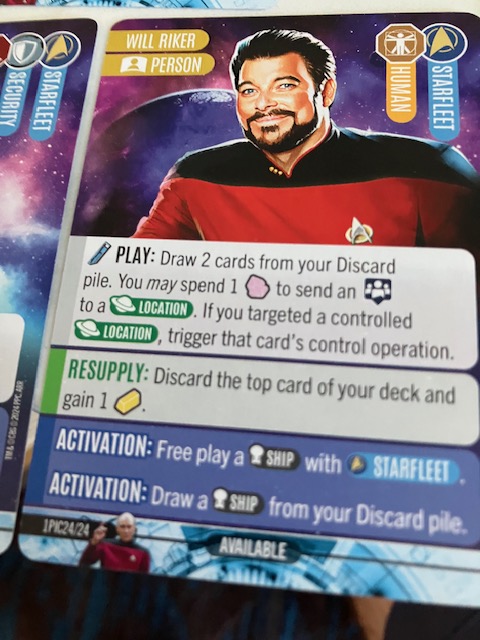
For example (see above), if Ryker is your Duty Officer, he can use one of his Activations (as well as his Play if needed).   There is this notion of “deploy” which allows you to put ships, duty personnel, and other things into play so you get that extra Activation possibility on your turn!
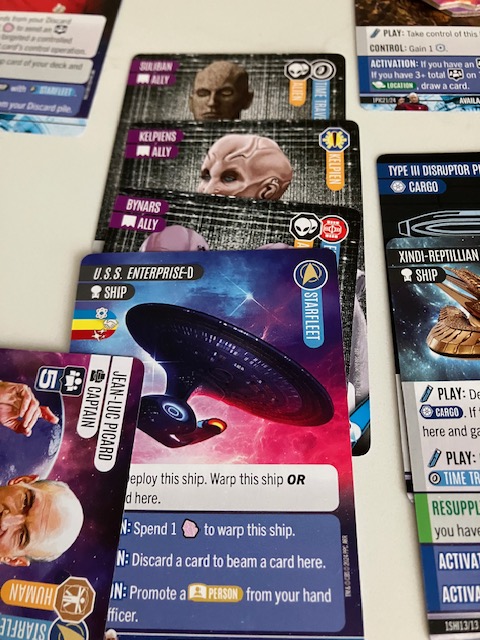
If you deploy the Enterprise-D above, you can use it’s Activations!  (Right now, Picard is fulfilling his Mission of getting 3 Allies beamed aboard!)
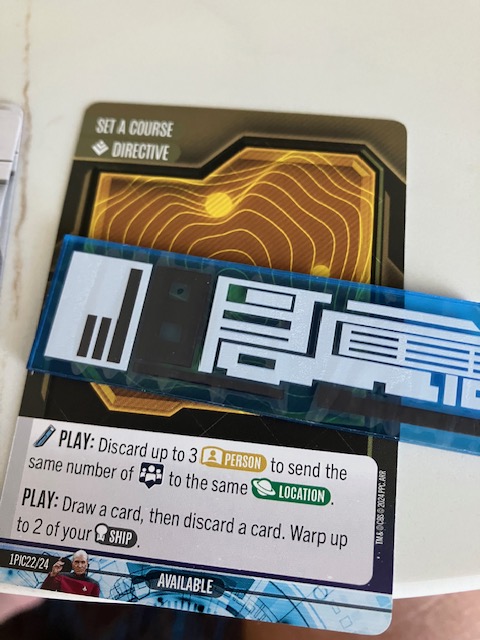
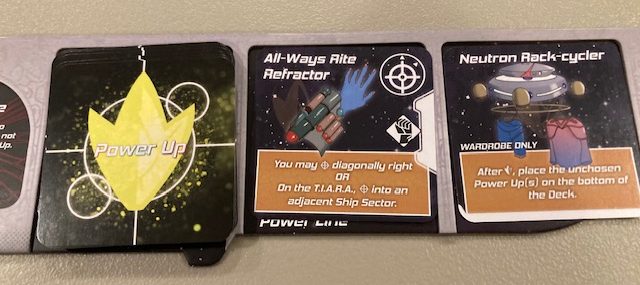
There’s also an interesting notion of “play”.  For example, the Set A Course card above has two choices for how to play; you can either use one of your 3 Actions (represented by the blue isolinear chips) to play for the “major” action, or you can just play the card as-is for the lesser play ability (but it doesn’t take one of your 3 Actions).
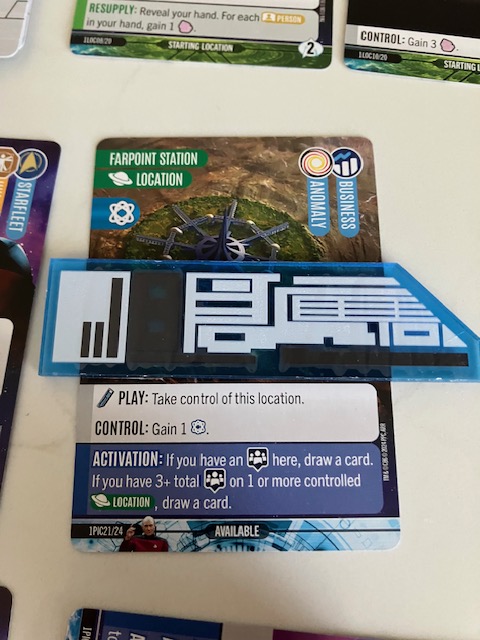
You can take Control of Locations (see above).
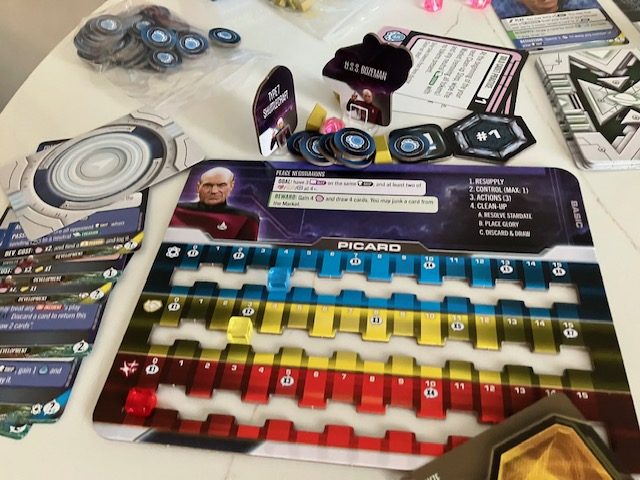
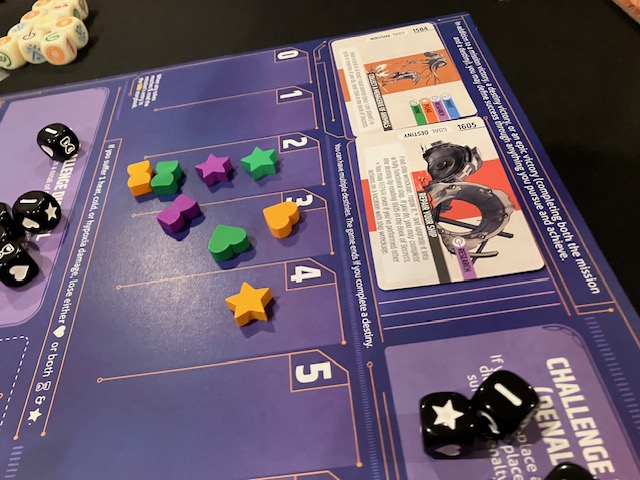
As you play, you need to advance your Specialty tracks.  There’s many ways to advance your Specialty track as you play (it’s all on the cards), but the higher the Tracks are, the bigger the multiples for end-scoring.  See above as Picard has advanced Research (blue) to space 4 (for a multiply of x2), Influence (yellow) to space 3 (for a multiple of x2), and Military to space 0 (for just x1).  
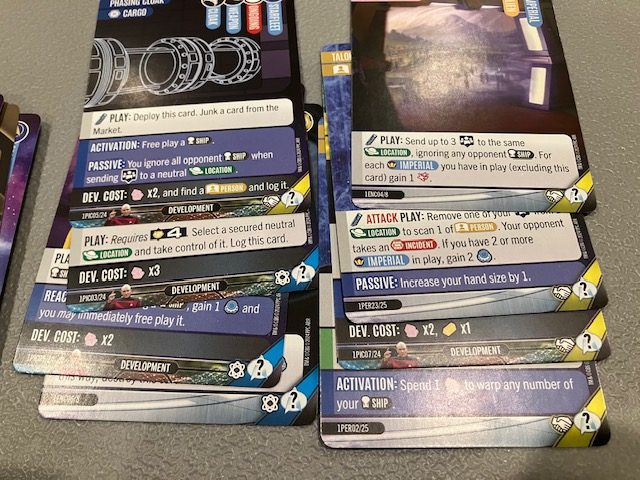
At the end of the game, you look at the bottom right of the cards and they will get you victory points! Right now, Picard would get 3 cards times 2 =6 Victory Points for the Research, and  5 cards times 2=10 Victory Points for Influence.
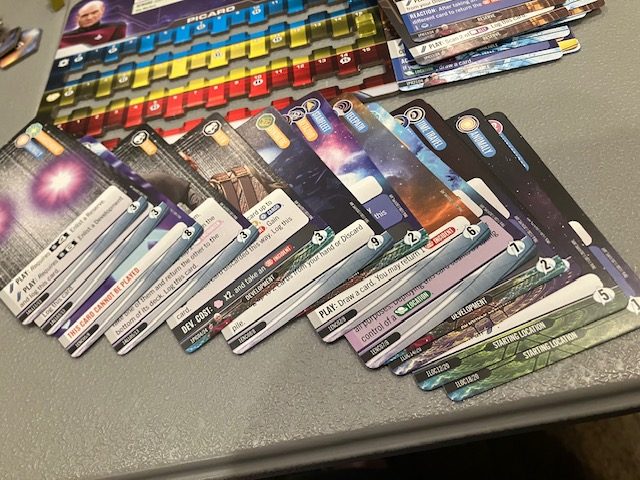
Of course, some cards just give straight Victory Points.  See above.
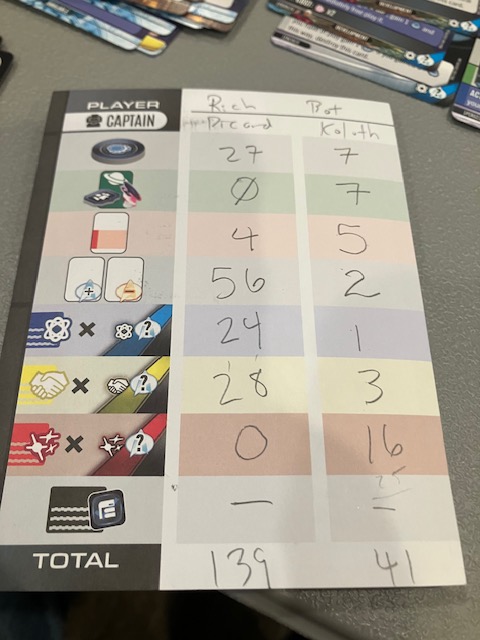
Whosoever has the most Victory Points wins!
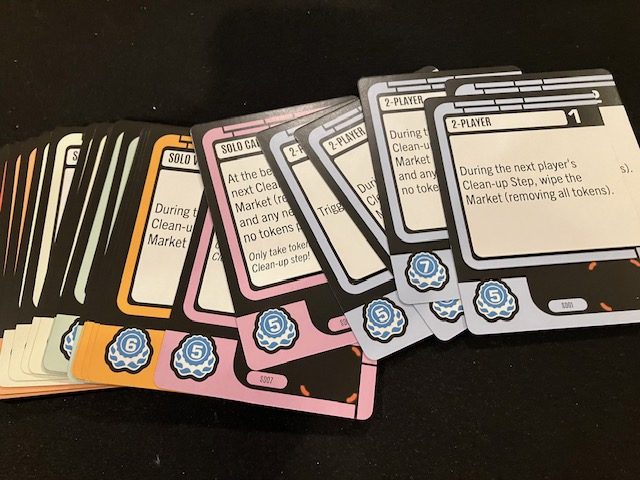
The gameflow is controlled by the 27 Stardate cards (see above).  Depending on what mode you play (solo easy, solo hard, 2-Player), these cards control how the game unfurls.  They usually just act as a timer (you put Victory Points on the card and when the Victory Points run out, you move to the next cards until the game is over), but they also keep the game flowing by wiping the market occasionally and wiping the Neutral Zone of uninteresting planets.
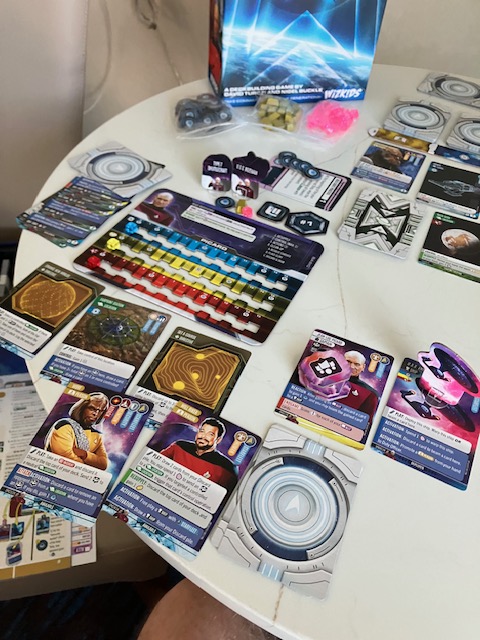
Over the course of the game, your Captain will warp ships, launch away parties, try to take control of Locations in the Neutral Zone, acquire Tech or Allies or People or Ships or Encounters to meet their Missions in an ultimate attempt to get the most Glory (what we have been calling Victory Points)!

Honestly, there are still plenty of subsystems and rules we didn’t talk about; there is so much to this game!  There is alternate way to lose via a “Burn” if you get too many incidents, there are special Encounters which feel like cool Star Trek vignettes, and many other cool things that if you know Star Trek, you’ll say “That’s very Thematic!”

Rulebook

This is one of the best rulebooks I have read in a while.
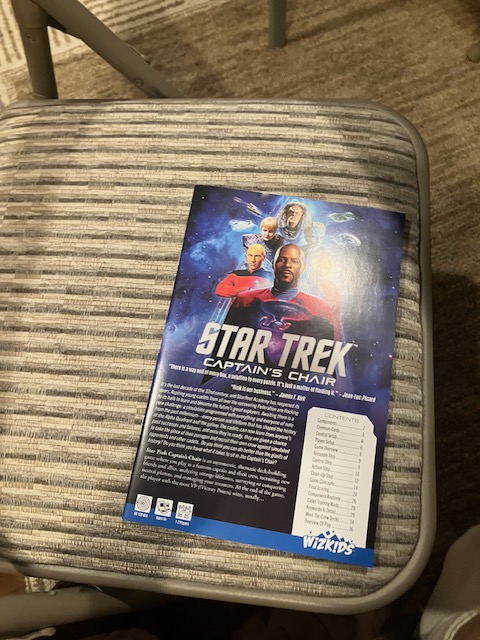
First of all, the rulebook gets an A on the Chair Test!
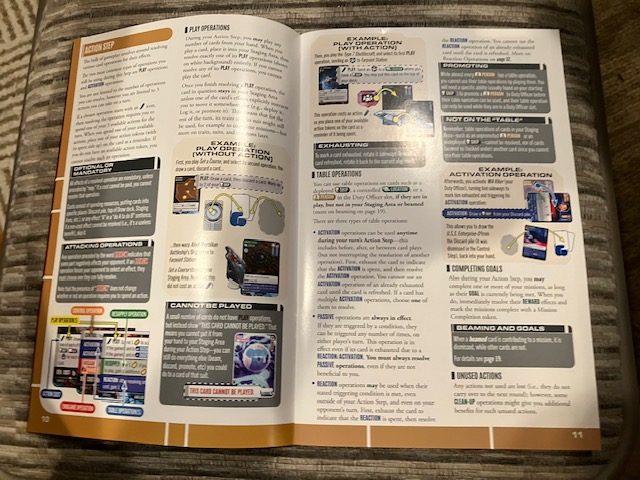
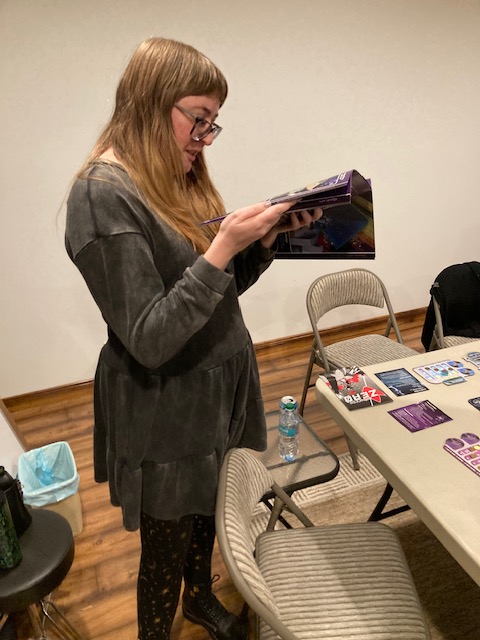
The rulebook opens up, stays flat, and is easy to consult.  The Font is very readable, but they somehow mix the thematic font of Star Trek for headings with a readable font for rule text, and it works.  There’s tons of pictures scattered in with the text, there’s tons of examples!  The rulebook also uses color and italics well!  Seriously, maybe this is an A+ on the Chair test!
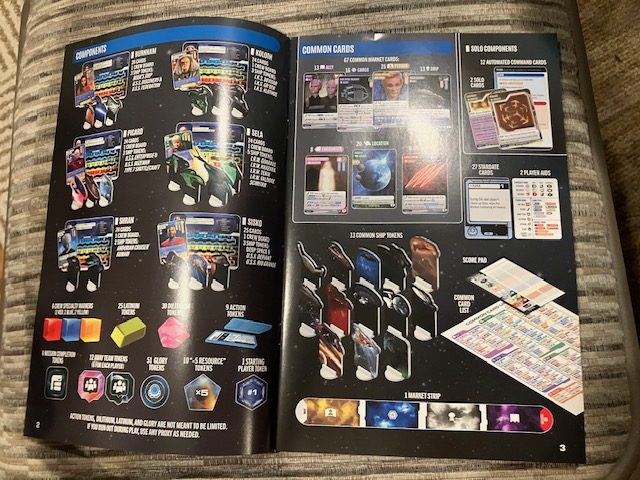
The Components pages are great; pictures are notated.
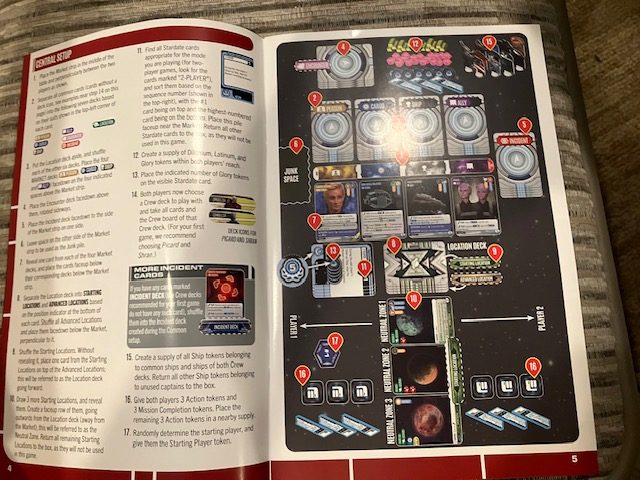
The Set-Up (even though it spans 4 pages) still is done well …

With both a Common Set-up (above above) and a per-player set-up (above).
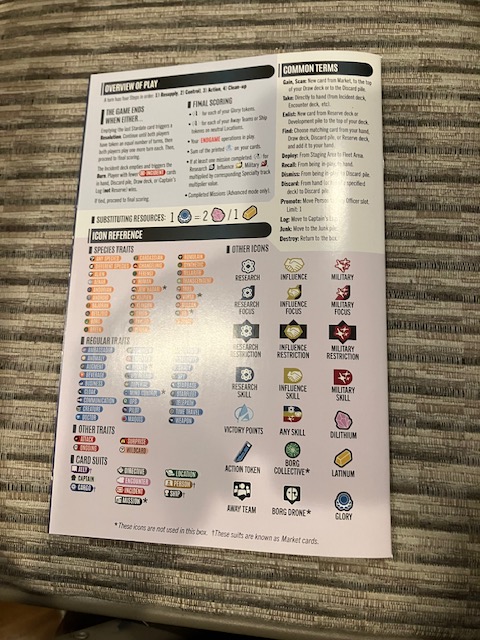
The rulebook ends with a good summary of symbols.
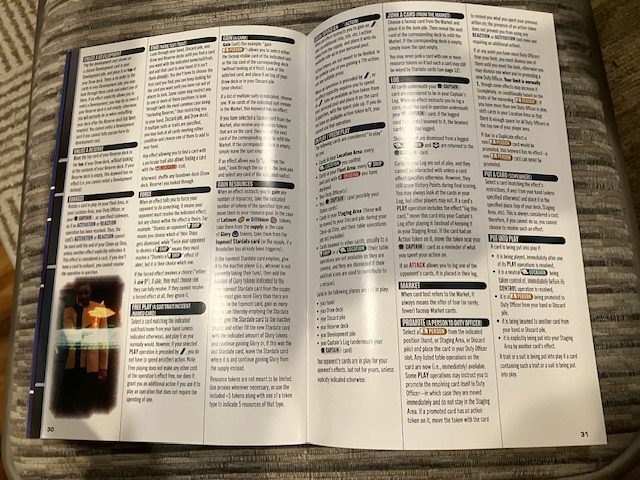
About the ONLY thing this rulebook does wrong is that it doesn’t have an index.  It has a table of contents and a Keywords in Detail section, but for a game this complicated, an Index is essential.

Other than the lack of an Index, this is almost a perfect rulebook.  I have to be honest, the rulebook almost reads like a legal document (because there are so many rules and systems), but everything is in there and well-explained.

Ways To Play
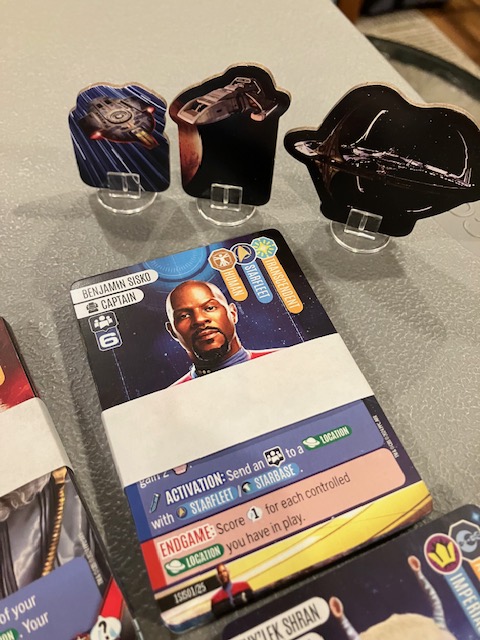
So, there are three major ways to play The Captain’s Chair (four if you count the unofficial cooperative mode, which we’ll discuss in the Appendix).  The “main mode” is the 2-Player head-to-head mode; this is the way Star Trek: The Captain’s Chair is meant to be played—Captain vs. Captain.   Even though this is a thinky and complex deck-building game with Victory Points, there is some take-that in the 2-Player game, as you can do things to mess up your opposing Captain.  Honestly, it really depends on the Captain(s) you choose; Koloth will have a very different play-style than Picard, who will have a different play-style than Sisko.

For solo play, there are two solo modes built-in:  The Cadet Training Mode, aka The Easy Mode and the Official Solo Mode aka the Hard Mode.   That’s what’s so great about this game; you can choose the mode that fits you!

The Cadet Training Mode
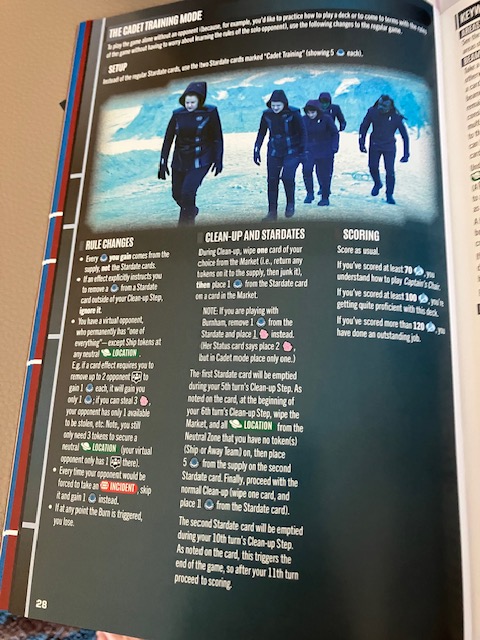
The Cadet Training Mode is probably the best way to learn the game!  Honestly, I can’t imagine jumping into the head-to-head game without learning the easy solo mode first.  See above for the rules for this mode on page 28 of the rulebook.
My first game (strictly my third game, since I set it up 2 times before I ever played!) was The Cadet Training Mode! See above.

The basic idea is that you are fighting an opponent that has “1 of everything”; you are fighting a faceless and nameless opponent.  
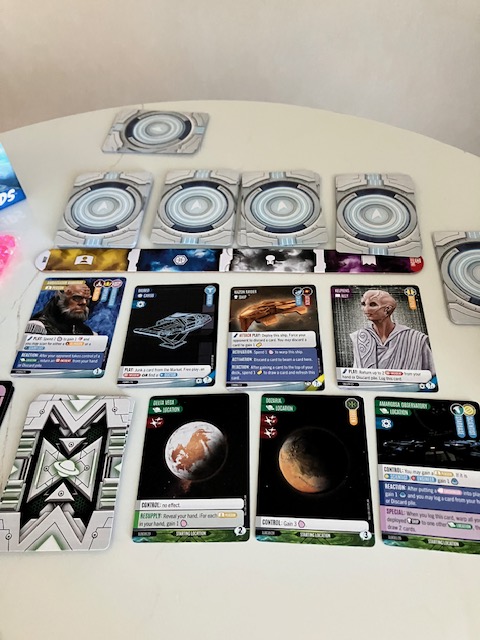
Basically, you are just playing turn after turn by yourself and trying to discover how all the mechanisms of the game work.    You don’t operate another Captain or anything like that.  There are enough systems in the game where you “affect” the other Captain, so when you would do that, it’s just a faceless, nameless opponent who has “one of everything”.   For example, how many landing parties does the faceless, nameless opponent have on the planets above?  One each!
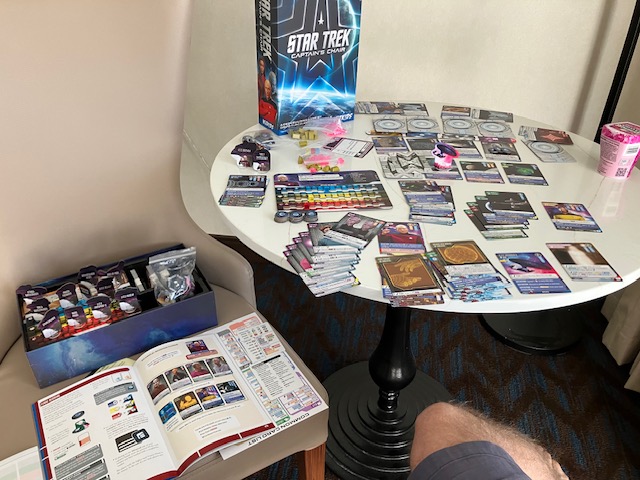
This solo mode flows pretty well.  You don’t feel the glaring stare of your opponent as you learn the game; you just try stuff out to see how everything works.
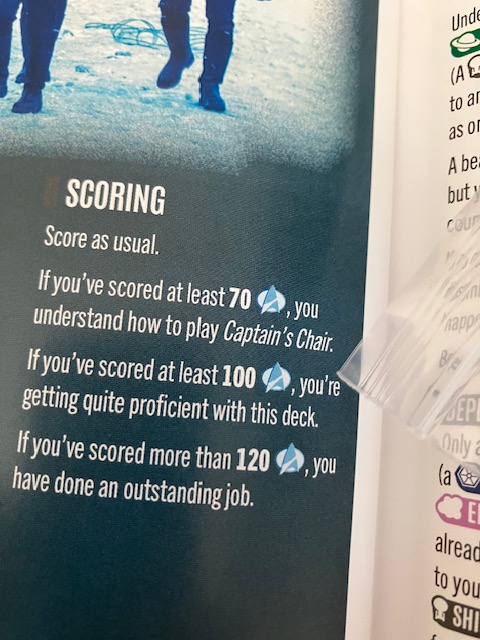
My first solo game scored 69, so apparently I didn’t know how to play just yet.
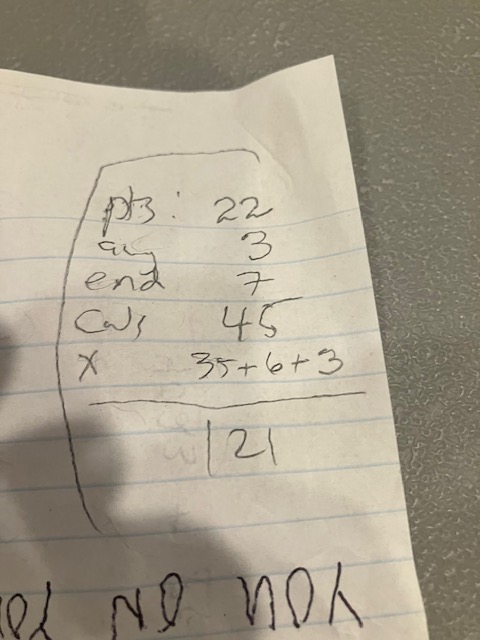
 My second solo game was much better as I got a 121.  
This solo mode is the way to learn the systems of the game without the immediacy of an overwhelming opponent.  Recall, we suggested that Kinfire Council + Winds of Change sorta has an easy solo mode and a complex solo mode!

The rulebook even suggests this is a great way to learn the deck of a new Captain!  Recall that each Captain has a VERY different play-style, so this is a great way to take the new deck through its paces!

As you can see from my two scores (69 then 121), after my second game on Cadet Training Mode, it was getting too easy.  This  solo mode is a great way to learn the game, but it wouldn’t be much of a challenge now that I know the deck.  I need a new challenge.

Starfleet Command Training Program
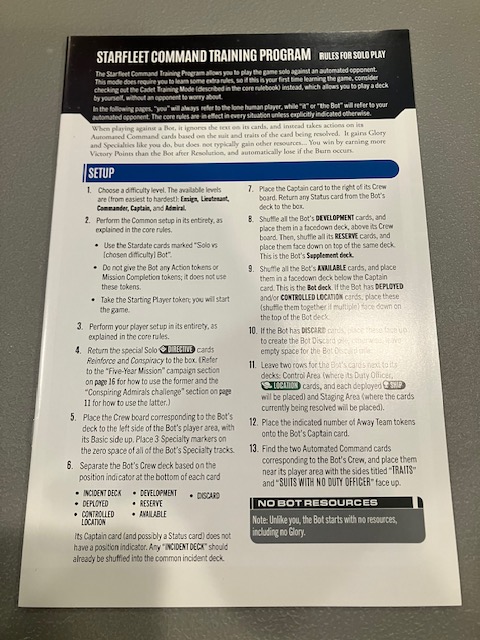
The Hard solo mode has its own rulebook!  See above!  This rulebook, called the Starfleet Command Training Program, outlines how to play Star Trek: The Captain’s Chair in a truly complex and challenging solo mode!  This rulebook is also very daunting (at 20 pages), but it’s really not that bad (the second half talks about different modes and a 5-year mission).
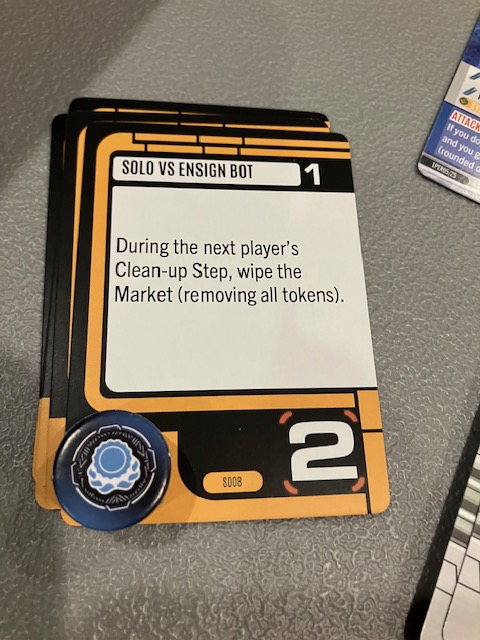
One major change is that you have a different set of Starfleet cards to control the pulse of the game. See above.  
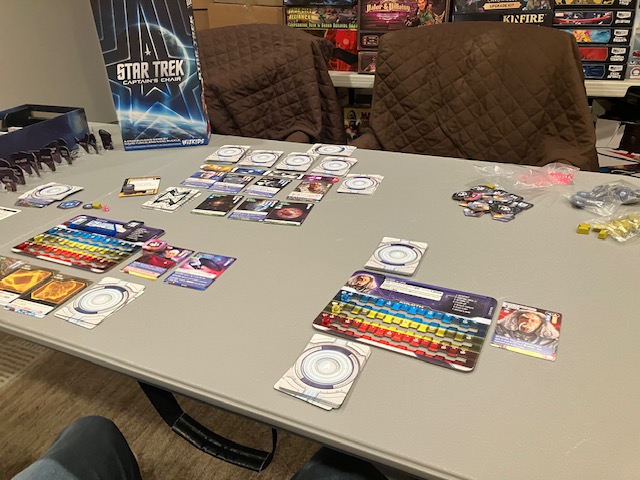
The real difference is that you are fighting a real Captain!  See above as Koloth and Picard battle!
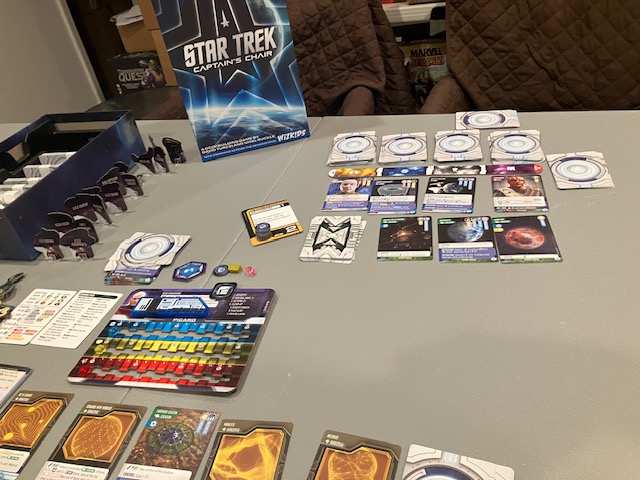
You operate one Captain “normally” like you did previously; see as Picard gets set-up normally.
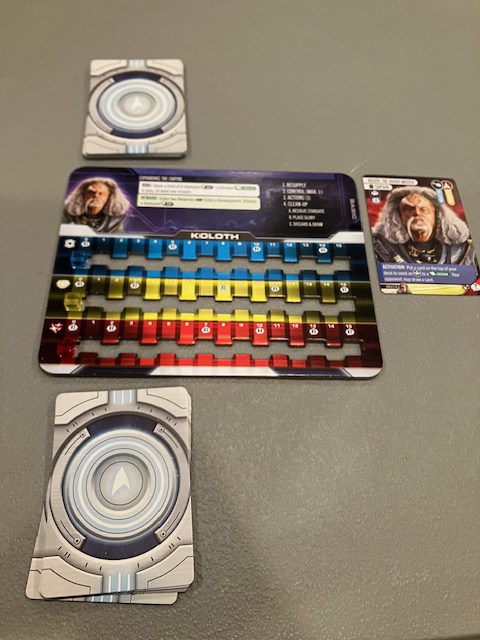
The Captain you are battling has a  very different set-up!  You still use the deck of the other Captain, but now an AI will control how that Captain operates!
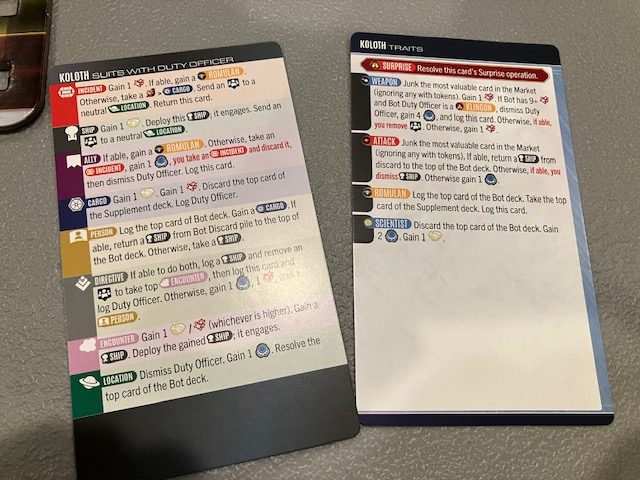
There are two Control cards for each AI Captain; these are the AI cards that control what the Captain does on his turn!  Depending on what card you draw, the directions on these AI cards tell you what to do!  (Things at the top of the card take precedence over things lower on the card if there’s any question).
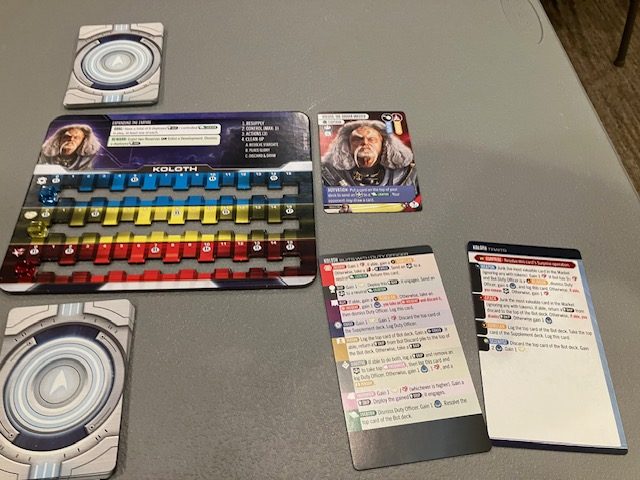
Basically, play alternates between the two captains; the solo player will take his turn normally, but then the solo players uses the AI to operate the other Captain!

See that big number 2 on the Starfleet card above?  That tells you how many cards the AI Captain will get to draw and resolve on his turn!
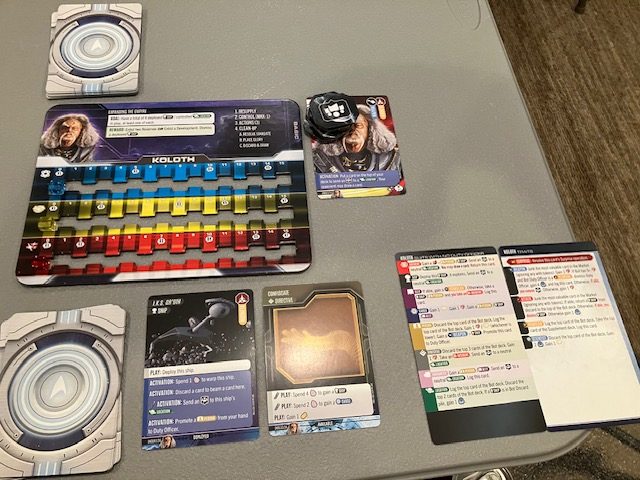
So, Koloth above draws two cards from his deck and consults the AI cards to see what those cards do!
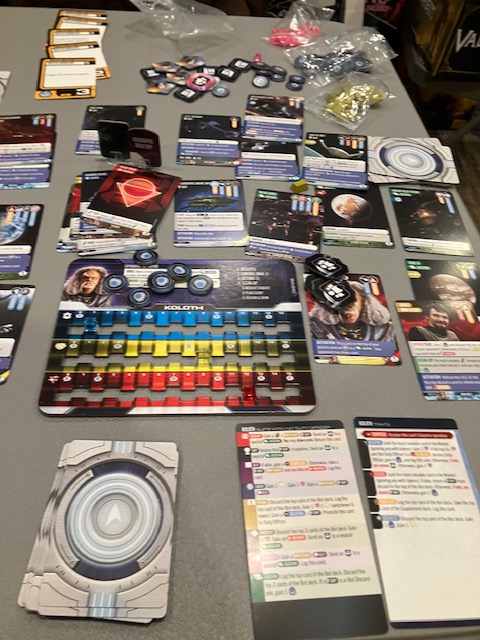
As the game goes on, it gets pretty complicated!  Koloth is all about getting ships out, and you can see that his AI respects that .. and (see above) as he has so many ships and worlds under control in the later game!

Solo Captain and AI Captain alternate until the game end is triggered by the Star Fleet cards! Whosoever has the most victory points, wins! (If you want to be funny: I Captain goes, then AI Captain goes!)
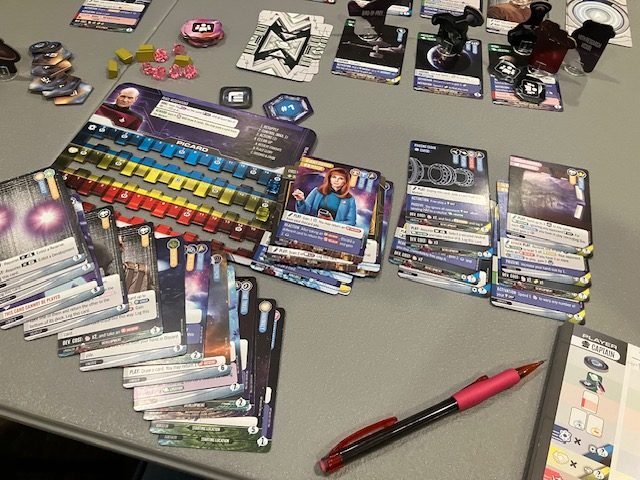
Just like before, you count the Victory Points to see who wins.

To be clear, this is a pretty complicated AI.   There’s lots of things you have to look up as you play! Where do you send ships? Landing parties?  There’s also a notion of most valuable to me and most valuable to you that controls preferences of cards.  Sometimes determining which cards the AI prefers is pretty exhausting.  I found that it feels like the solo rules do a pretty good job of covering all bases and preferences, but it can feel hairy the first few times you try it.
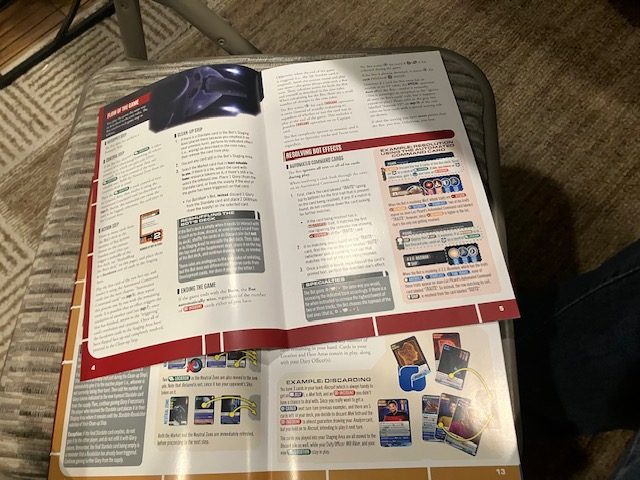
This is NOT a quick one hour solo game.  This is probably at least a 2 hour game, especially your first few times.    You will find your head buried in the solo rulebook as you try to remember/discover/rank what actions/cards the AI prefers.  It gets easier as you play, but it is very daunting.

I want to be clear that I like this solo mode, but it is not easy.  

Legalese
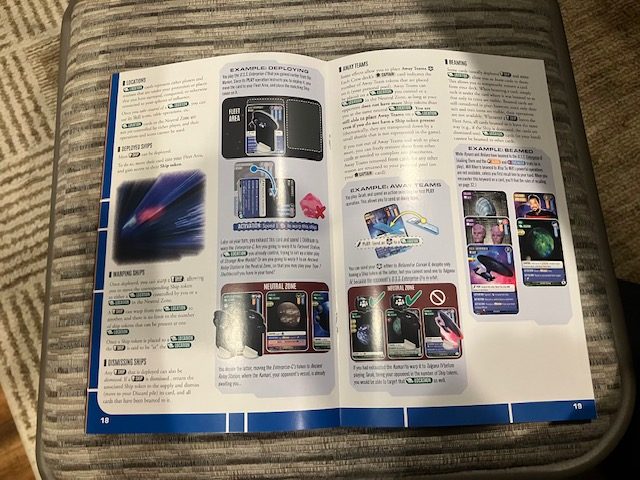
These rulebooks are very very very good, but I kind of feel like a lawyer when I am playing.  What do I mean by that?  I have to study the rulebook to make sure I have a handle on everything; I want to say I spent a good hour (or more!) reading the rulebook the first time!!!  There are very specific rules to handle just about every exceptional case, but you have to understand how to apply the rules like a lawyer might have to understand how to apply the law.

This might sound like a negative, and for some people it will absolutely be a negative; those people will hate this game: “it’s too complicated, it’s too much, there are too many rules”.  You know if that is true for you.

But if you like a system where things are very well-specified and you don’t mind burying your head in the rulebook a lot, then this is a great game.

Theme
This game feels very thematic.  If you like Star Trek, you will see and feel the theme in this game.  We’ve said that this is a deck-building game, but all the other supporting systems of this game make it feel like Star Trek: duty officers, warping ships, developing cards, acquiring Allies, Cargo, Ships, sending out landing parties, taking control of planets … it feels very Star Trek.   This is arguably the most thematic Star Trek game I have played?

Conclusion
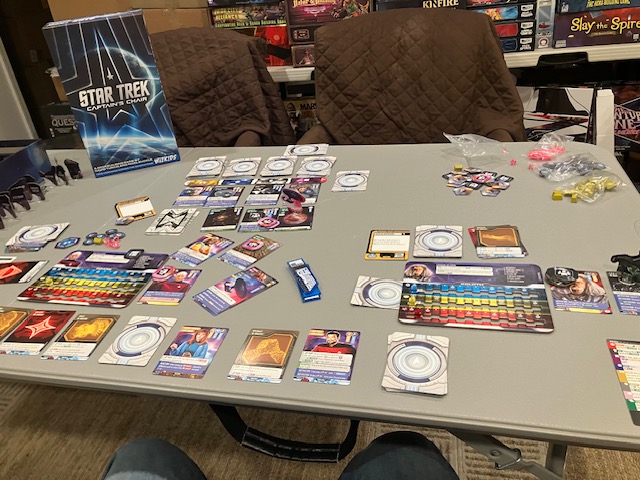
Star Trek: The Captain’s Chair is a daunting beast of a game.  The rulebook feels like legal document, there are many complex systems within the game, and the rules are complicated.  Yet, this is probably the most thematic Star Trek game I have played!  Each Captain’s deck matches their play-style, making them different and interesting to play!  The actions and cards feel like they are right out of Star Trek!  This feels like a love letter to Star Trek.
As a solo gamer, I love that there are two solo modes built in!  The easy solo mode provides an onramp to learn a new Captain’s deck (because they are all so different)!  The complex solo mode provides challenges for the future!  There are 30 different ways to permute the Captains in the complex solo mode (6*5=30 because order matters; which is the AI and which is the player). This gives plenty of ways to try different permutations for quite a bit of variety!  I also happen to know that at least 2 more expansions are planned, so there’s more content coming!

Sure, there’s a 2-Player head-to-head mode … which I may never play.  As a solo gamer, I am very happy with what this is. 

Be aware that this is big complex game with lots of rules and a legal document for  rulebook.  If that doesn’t scare you away and you love Star Trek, I think you will love this game.  I do. 9/10.  I think this would be a 10/10 if it had a good cooperative mode; I really want to be Picard and Sisko fighting the Borg! Or the Dominion!  So, the Appendix below …

Appendix
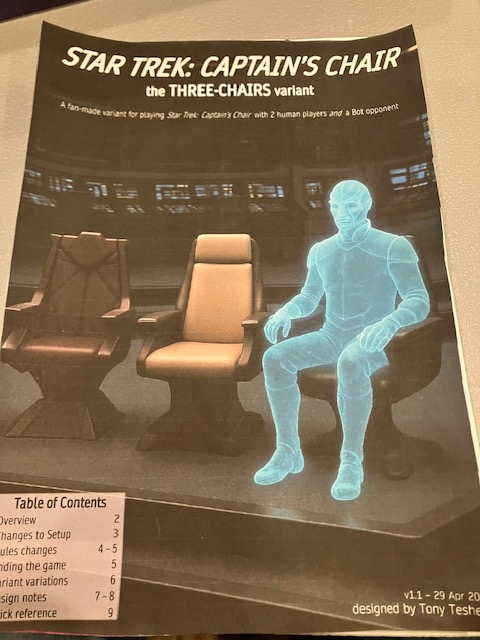
There is an unofficial cooperative mode: see link here.
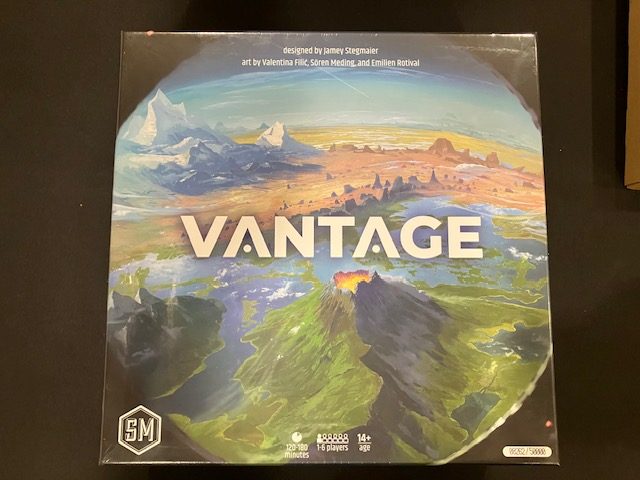
   

What Vantage Is and Isn’t: A Review of Vantage

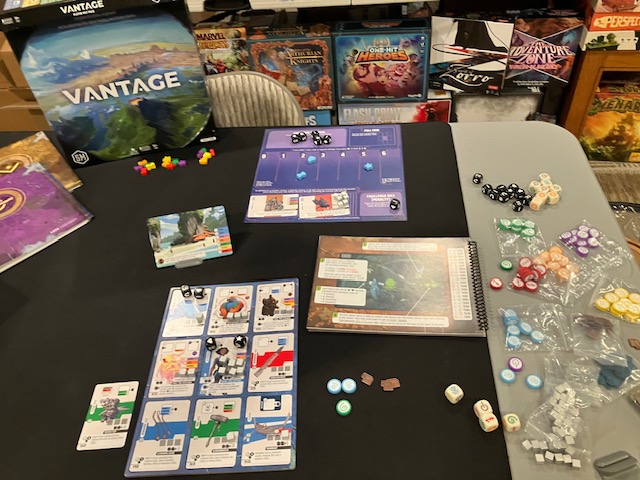
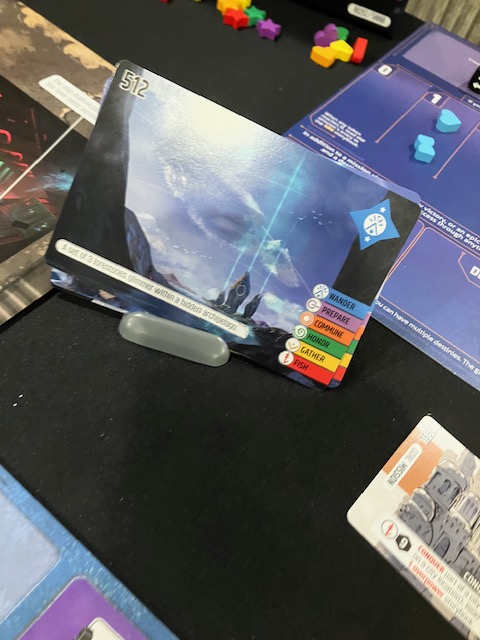
This week we take a look at a very hot game called Vantage: this is an open world game with thousands of cards! We show pictures of the game with some cards, and although they could be classified as spoilers, all of these pictures are out of context so I don’t think they are really spoilers. If you are really worried about spoilers, just jump to the Conclusion and avoid all the pictures!

There’s already been a ton of reviews of Vantage: reviewers who got it early for free and Stonemaier Champions (members of a club who get Stonemaier games early with a discount).   I am neither of these: I am a plain Jane game player who paid full price for my copy of Vantage! I pre-ordered it from the web site like any schlub and I just got my copy about 2 weeks ago.  I am not a rabid Stonemaier fan,  nor I am not a prepaid reviewer!  I am just a guy who like cooperative games who pays for every single game he gets and never gets ANY consideration from any publisher.  So, my review may sound a little different than the others.

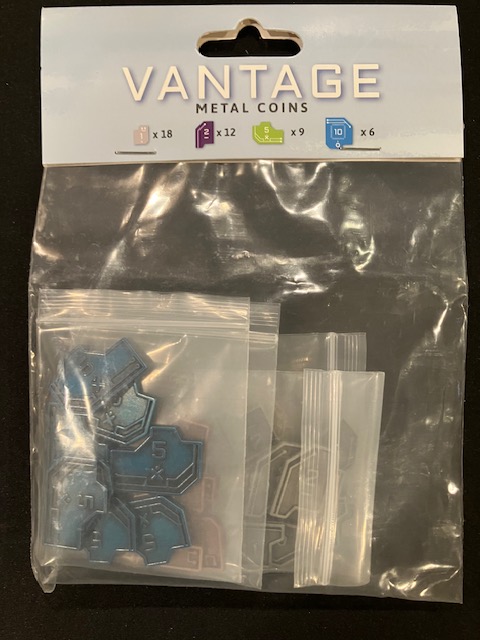
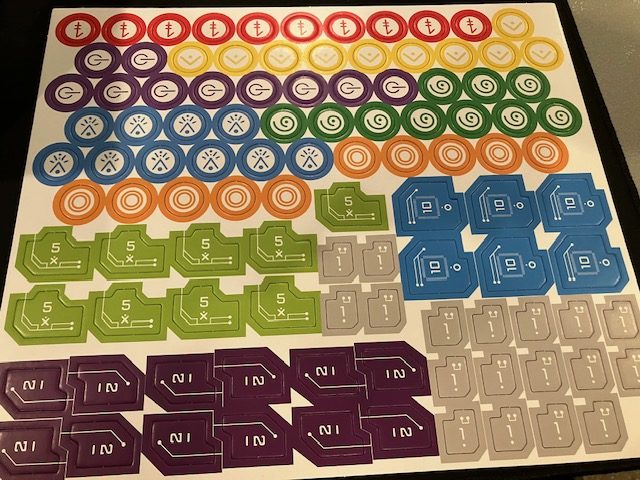
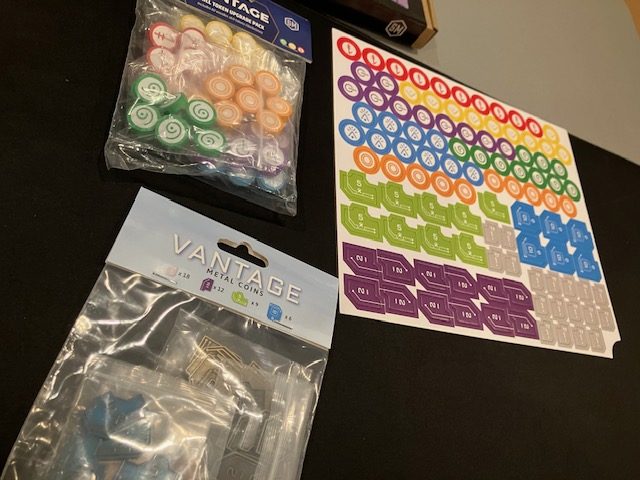
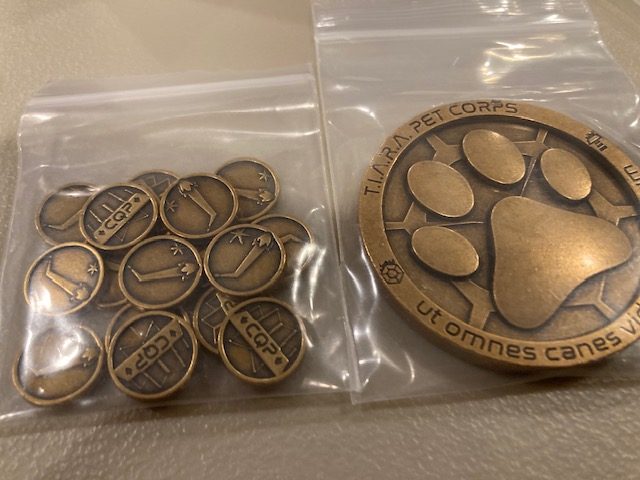
The funny thing is that I pre-ordered the Vantage coins about a year ago and they arrived a year ago.  Yes, they actually had the coins for the game a year ahead of the game itself!  That’s kinda funny.  The fact that I ordered these tells you, yes, I was interested in the game.

We are going to try something a little different: we are going to talk about what Vantage is and what Vantage isn’t.  Vantage doesn’t really fit directly into any mold of what other games are; it’s its own thing!  But, is it something you will want to play?  Is it something you will want to buy?  Let’s look more closely.

Unboxing

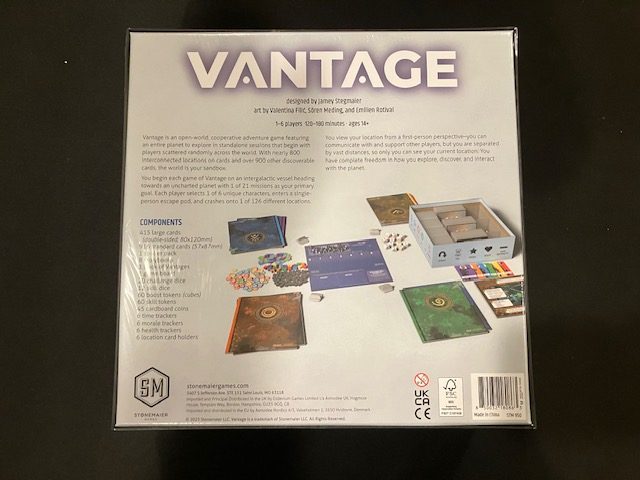
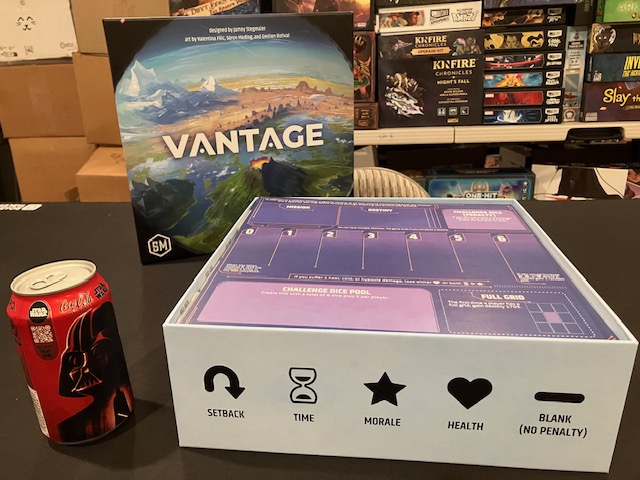
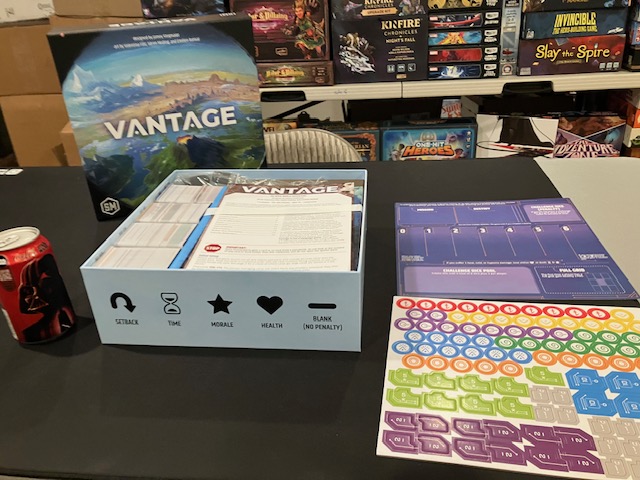
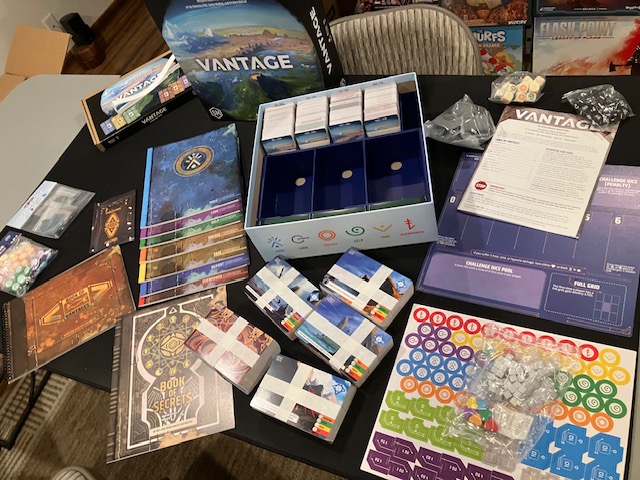
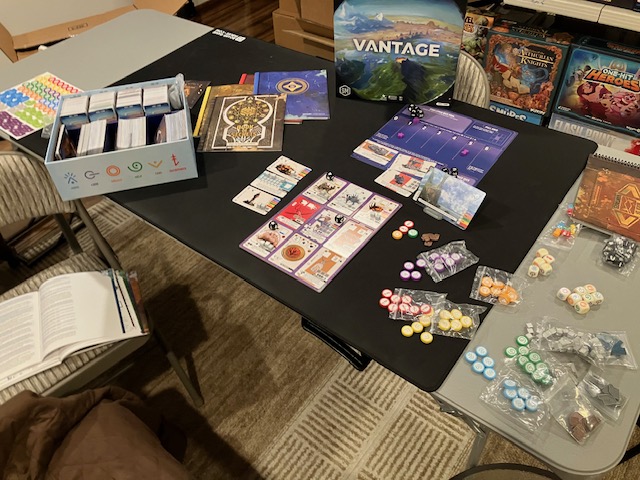
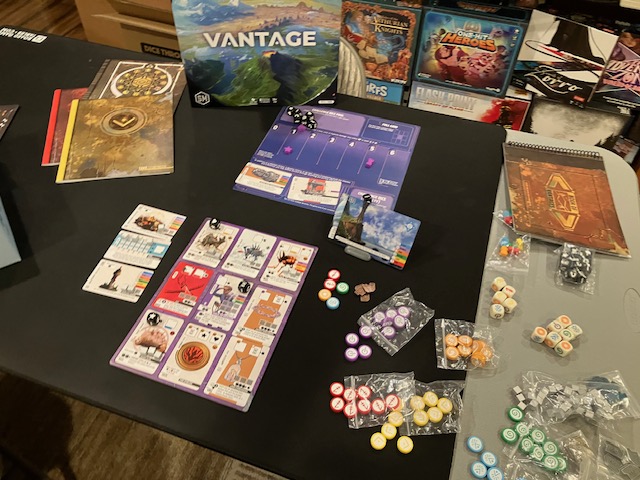
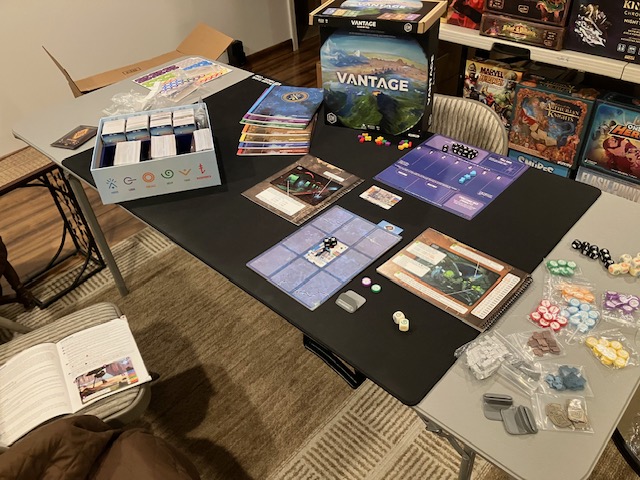
Vantage is a fairly standard sized box: see Coke Can above for scale.

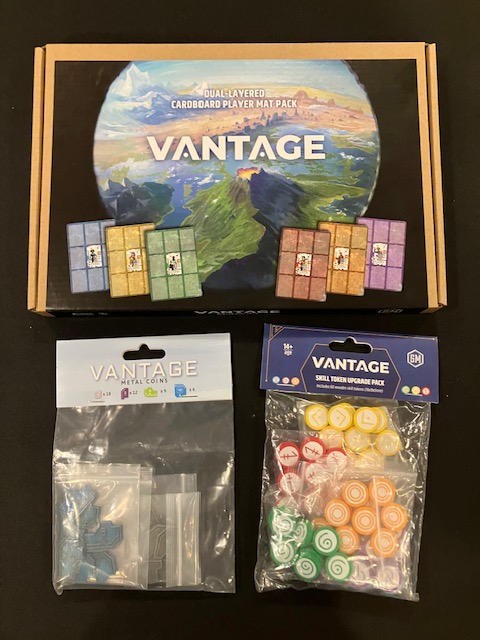
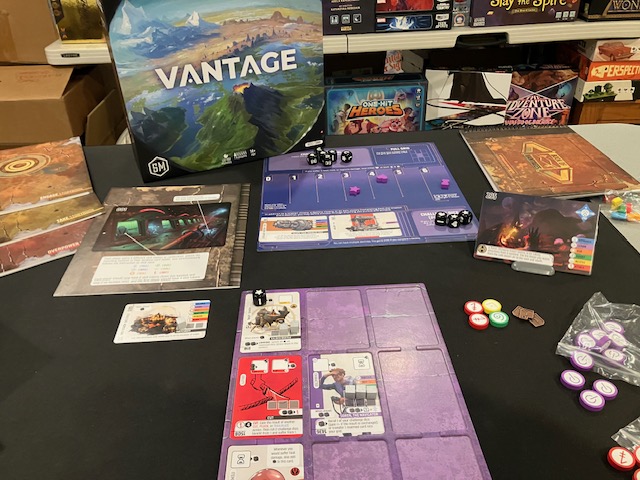
Let’s be clear: I bought ALL the extras for this game!  The wooden skill tokens, the metal coins, and the 2 layer player boards (see above).  I was very excited about this!

Because I bought all the extras, I didn’t need to punchout anything.  I just left this sheet untouched.

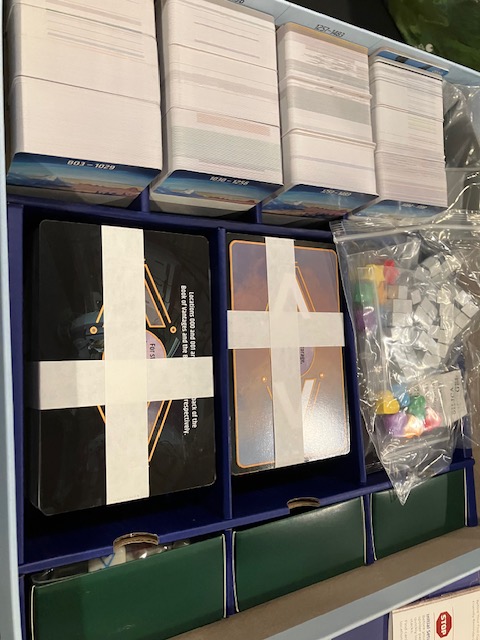
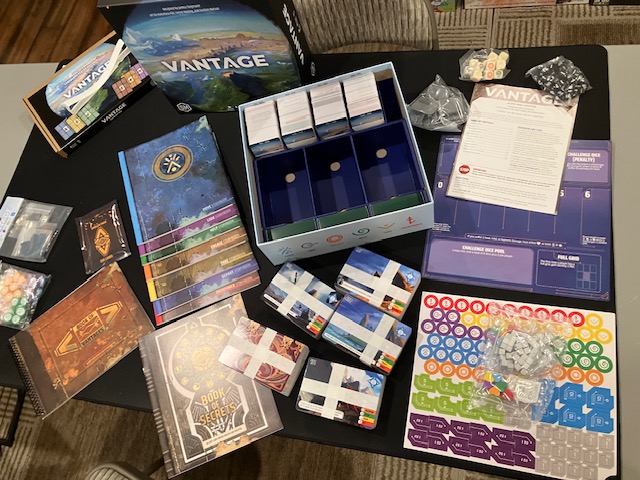
As you look at the box, you can see it’s got a lot of cards!  It’s actually pretty heavy!

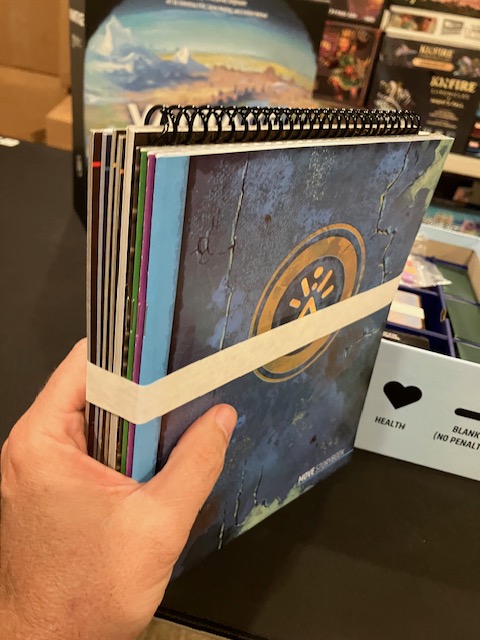
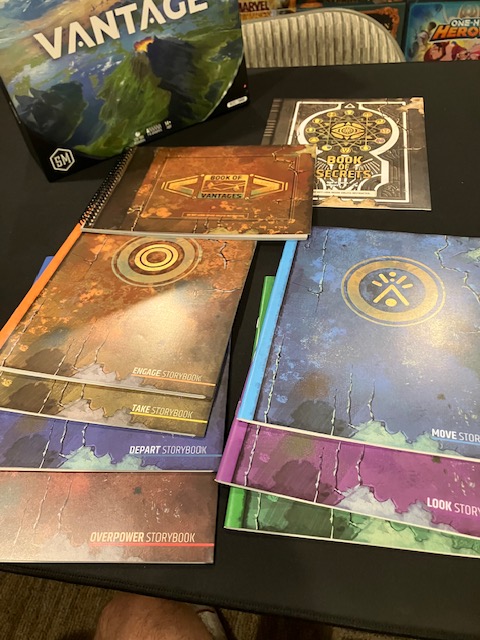
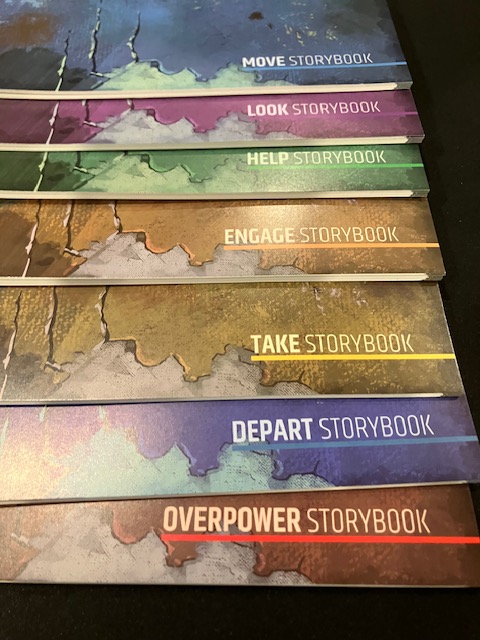
There are a LOT of books: see above.

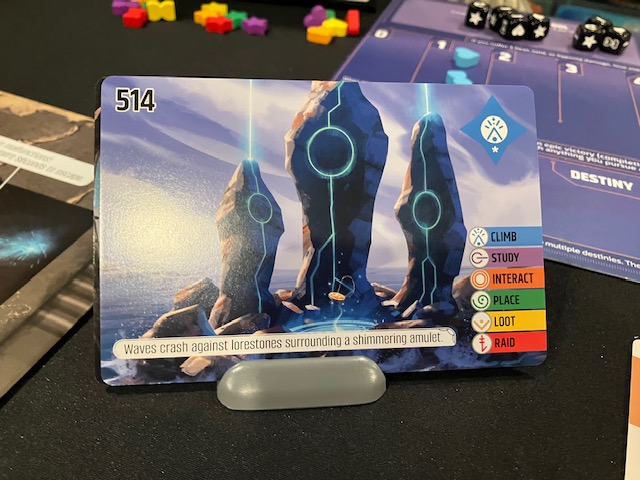
There are two flavors of cards: giant Location cards (see above) ..

And generic “little” cards which will come out as you play. Items, animals, … just different stuff that emerges with gameplay.

Notice just how many books there are!  They are called Storybooks: we’ll revisit that nomenclature later.

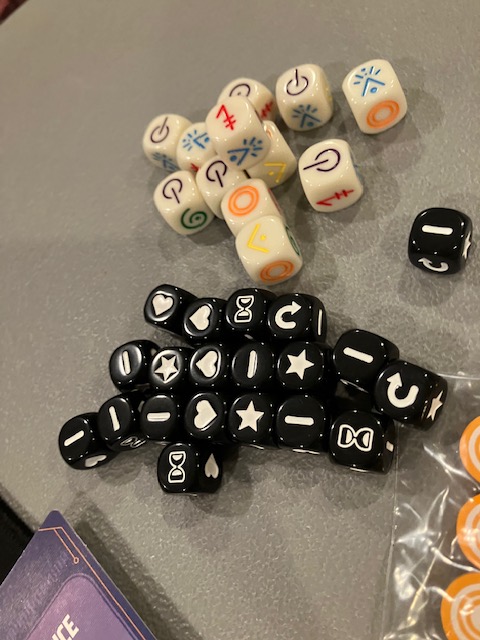
There’s two kinds of dice: Challege (black) and Skill (white) dice.

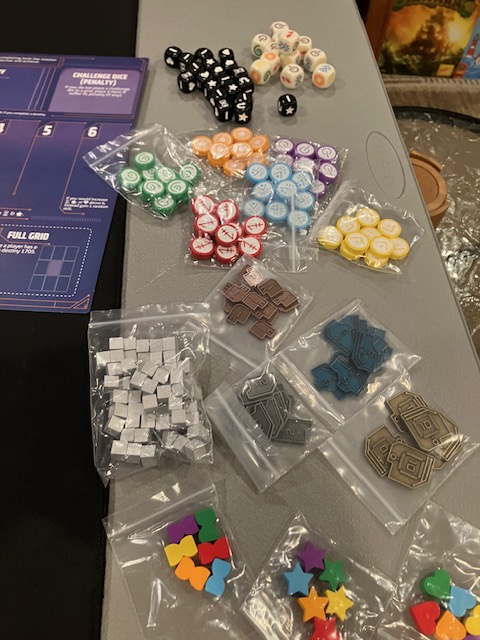
And there’s a ton of tokens!

Overall, there is a LOT that comes with this box!  It looks really nice!

Rulebook

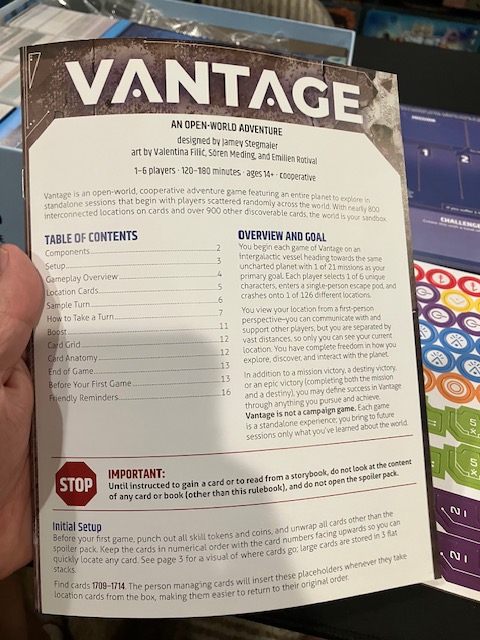
The rulebook is very good, modulo one or two issues.  The paper is a special “silky” paper that feels really nice.  Note! It has a Table of Contents!  Yay!  But no index!  Boo!

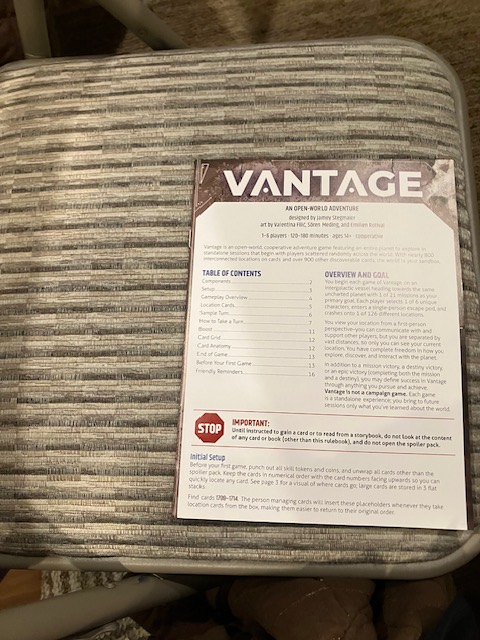
The rulebook gets a straight-up A on the Chair Test!

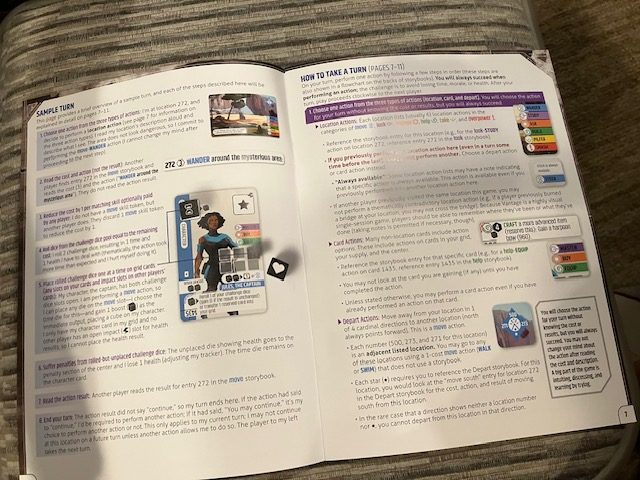
The rulebook fits PERFECTLY on the chair next to me, and it can lay open just right (see above).  The font is nice: it’s a good size (not too small, not too big) and it very readable.   It’s been a while since we’ve had a rulebook that gets a straight-up A on the Chair Test. Nice job!

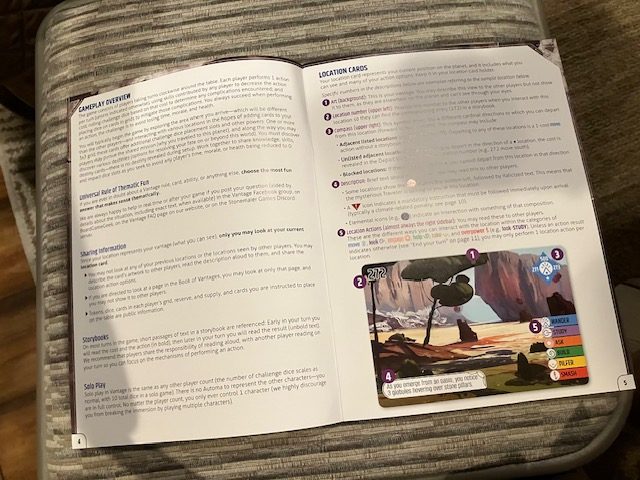
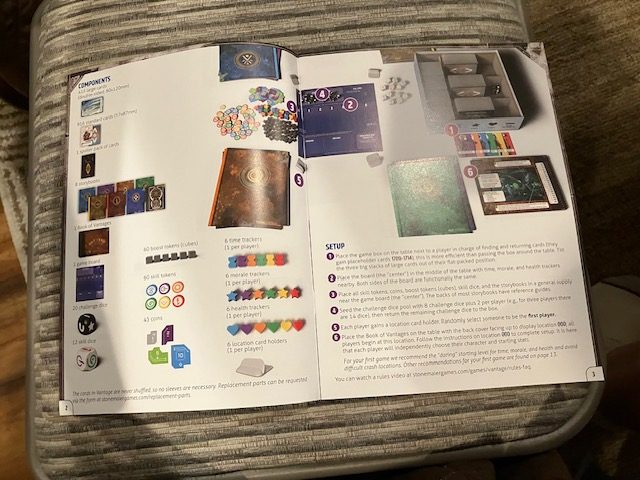
The Components and Set-Up are great: they are all on the same page, so it’s easy to correlate what things are and where they go!  Granted, Set-Up is pretty  “easy”, but this works really well. And the Components have pictures and are labelled.  Very nice!

The rest of the rulebook is good: lots of pictures, lots of color to help distinguish things, and sidebars that help explain an issue (without being the only reference to that rule!).

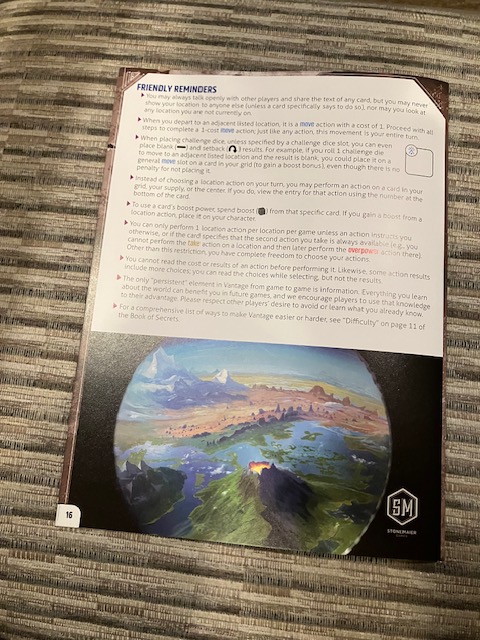
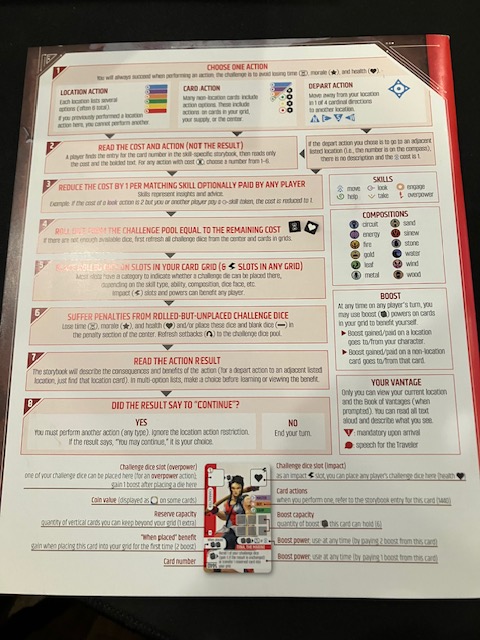
My only complaint is that the back of the rulebook doesn’t have a list of all Icons.  It has friendly reminders (see above), but I feel like that should inside the rulebook.

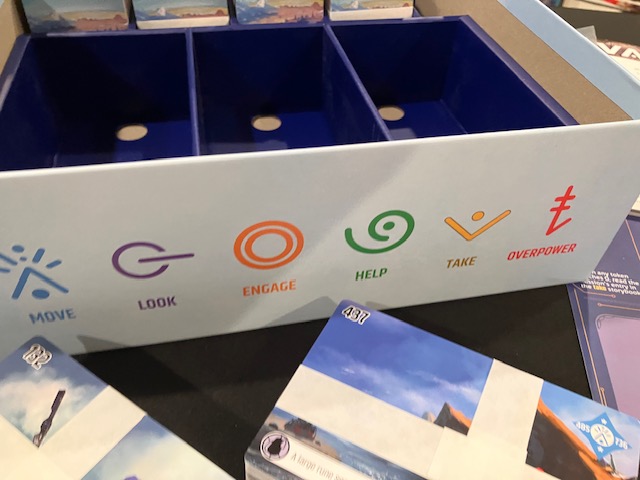
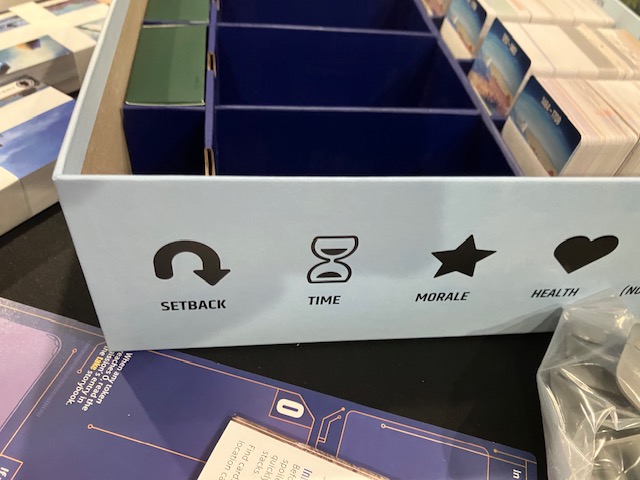
Now a lot of these Icons are on the side of the box (see above and below)

Or on the back of the books:

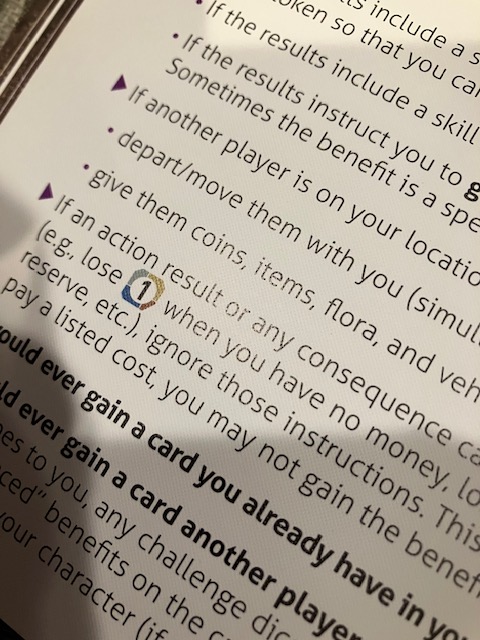
However, I was very annoyed that I couldn’t find what the little circle meant:

… until I just happened to find in the rulebook!  I think that means MONEY!  See, it frustrated me that I had to go searching for this.  It should have been on the back of the rulebook with a list of Icons!  I don’t know where this is defined except for the passing reference on page 10 where you have to infer the meaning!

That’s a pretty minor quibble, but it did slow me down for long enough that I was annoyed. And it really shouldn’t have been an issue, especially when the rest of the rulebook is so good!

But overall, the rulebook was very good.

What Is This?

The game bills itself as an Open-World Adventure (see the top of the page).  What does this mean?  We are going to explore this issue via what this game is … what this game isn’t !   If we hack away at the positive space of what the game IS and the negative space of what the game ISN’T, then hopefully that will be enough information for you to figure out if this is for you!

Is This a Storybook Game?

We’ve talked about Storybook games for years here at CO-OP Gestalt; we tend to love them! See our Top 10 Cooperative Storybook Games!

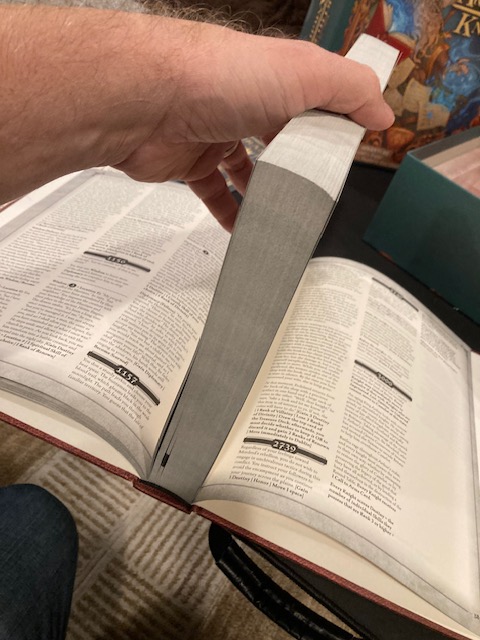
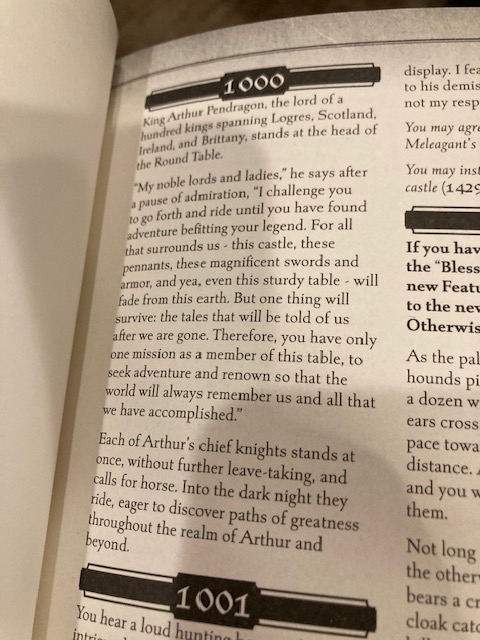
Recently, we reviewed and loved Tales of Arthurian Knights!  There is no question Tales of Arthurian Knights is a Storybook game with a beautiful hardbound book and tons of text! See above!

The text in the book flows and paints a picture of Arthur’s Knights! See how flavor exudes from the text above!

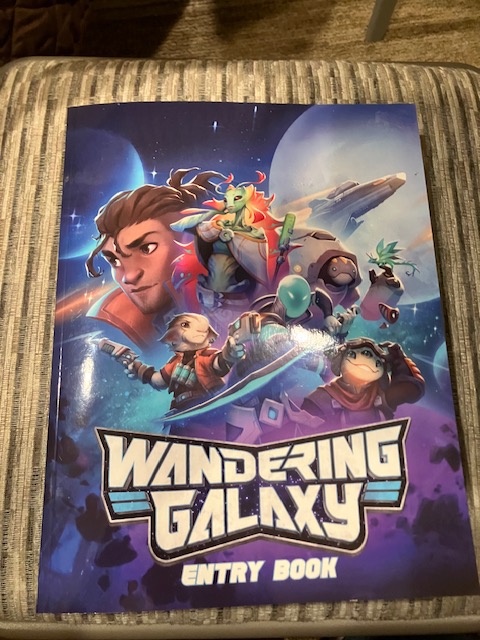
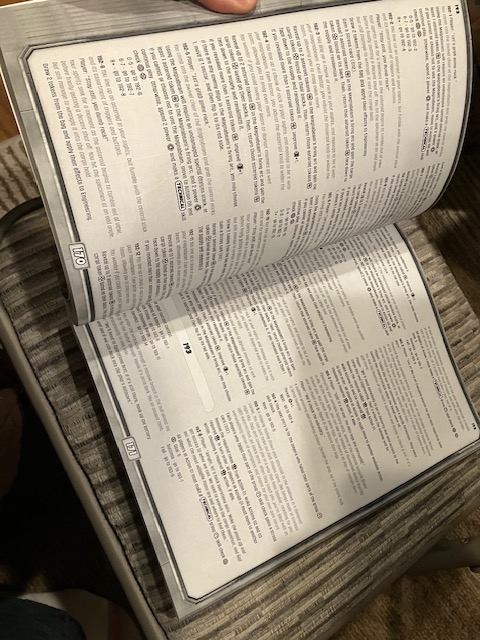
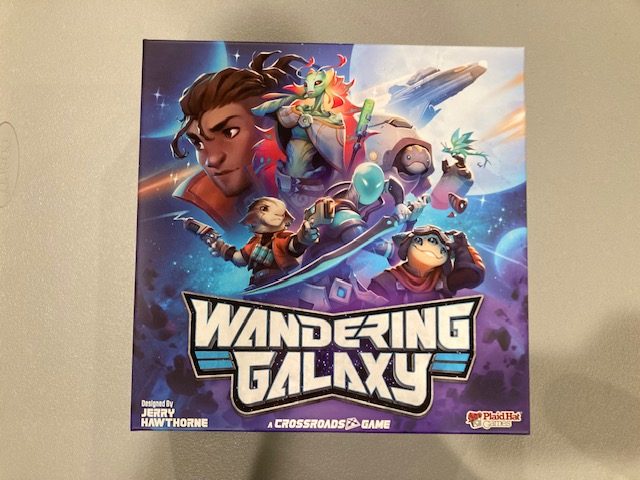
Another game that’s a Storybook game is Wandering Galaxy (see our review here).  In fact, the recent Kickstarter included two ways to enjoy this Story! On way is a full text experience from the entry book (above and below)!

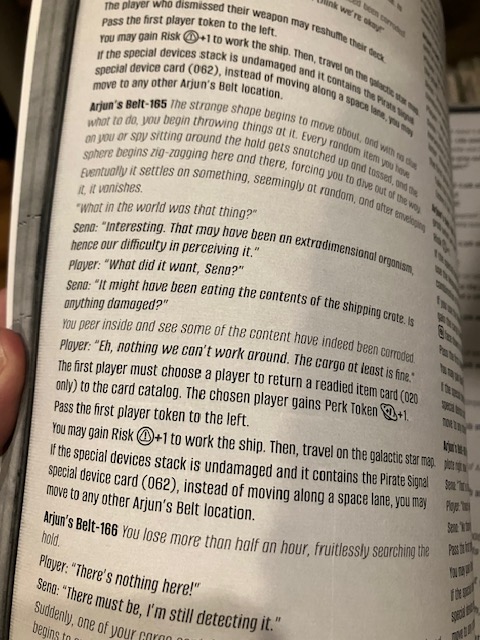
See more flavor exude from the text above!

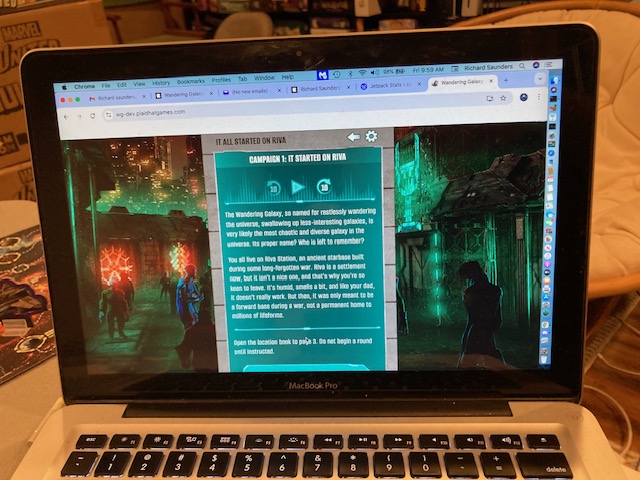
However, you can also enjoy the story text is from the app: it shows the story, but also has Voice Actors read out the text!  But there’s still a lot of flavor! (And silliness)  It’s very … flavorful!

Why am I going into so much detail about Storybook games?  Because I think Vantage is both a Storybook game and NOT a Storybook game!  It depends on how you look at it! What do I mean by this?

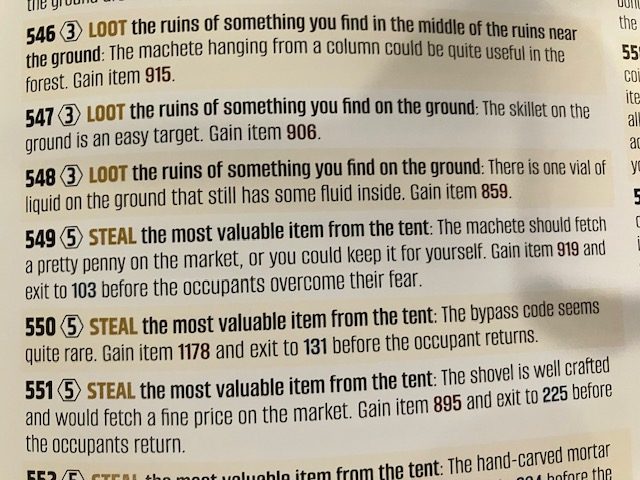
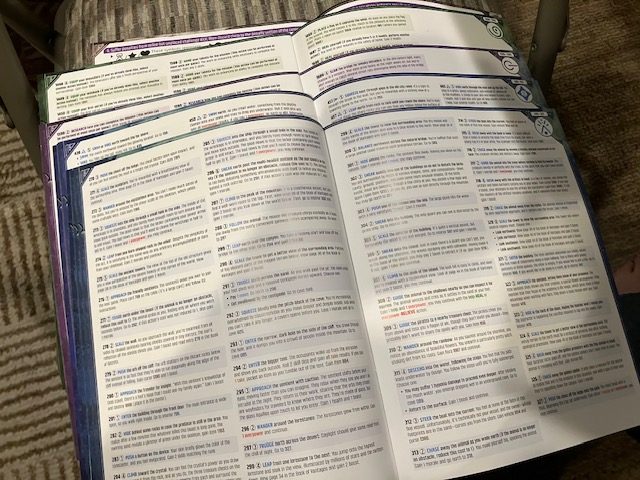
Many, if not most entries in the Storybook, are very very terse; almost like directions.  See above for examples. There’s not of flavor or story in this text!  Sure, there are entries with more flavor and story, but it feels like most of what’s in here is more directions than story.  I struggle a little with the appellation Storybook when that’s not much story.  That’s why I think this ISN’T a Storybook.

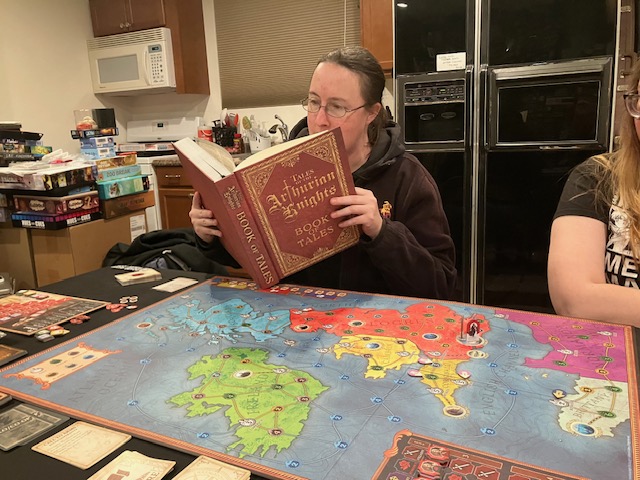
My friends LOVE Storybooks and text (see above), and Tales of Arthurian Knights is probably their favorite game of the year!  There is so much flavor, so much story, so much … flowery text in the storybook!  My friends LOVE this type of Storybook!

Before you go off and write me hate mail, I realize that a lot of people don’t like lots of flavor or Story text!  Some people prefer to just get to the game!  You could argue that this is just a very concise Storybook, but it’s still a Storybook!   That’s a very reasonable argument!

But I wanted to point out that some people would see the lack of flavor as a reason NOT to call this a Storybook game.  

It’s also worth pointing out that a lot of Story in Vantage comes from the Location cards!  As you explore the world of Vantage, these little scenes truly paint a picture of what you see!  There’s no need for flowery text in a Storybook because you have beautiful images to tell the story!  Who needs flowery text when a picture paints a thousand words?

The Location cards are, strictly speaking, distinct from the Storybook.  You could argue that because the Location cards are technically not part of the Storybook, that makes the argument that the-Storybooks-aren’t-Storybooks even stronger!  The story is REALLY on the Location cards, not the Storybooks themselves!

That’s a silly argument because Vantage as a full game includes lots of story.  But this is why I wanted to talk about why you could consider Vantage’s  Storybook NOT a Storybook!  These distinctions helps define what this game is.  There’s still story, but arguably it’s distributed among the cards and Storybook.  The Storybook is NOT the traditional Storybook of Tales of the Arabian NightsVantage’s Storybook is … different: it’s more like directions.

If you love flavor text and like reading flowery text aloud (like my friends do with Tales of Arthurian Nights or Wandering Galaxy), then Vantage maybe isn’t the game you are looking for.  But, you may still like the way the story comes out in Vantage (with the art and Storybook giving directional text).

Is This An Adventure Game?

On the surface, the obvious answer seems “Yes! Vantage is an adventure game! Players explore and go adventures and interact with the objects/stuff around them!”

This is basically the same definition we gave for Point-And-Click Adventure games in our Top 10 Cooperative Point-and-Click Adventure Games!  

“What makes a board game a point-and-click adventure game? For us, it breaks down into three fundamental elements:

  1. You move along in a story!  You are part of a story: this is interactive fiction!
  2. You explore a world!  The game is about exploration and discovery, as you “move” from location to location.  In the point-and-click video games, you could “point-and-click” to move around a map!
  3. You solve puzzles by combining objects!  You need to find objects and combine them in unique ways to solve puzzles. In the point-and-click video games, you would “point-and-click” on items/verbs to combine them!”

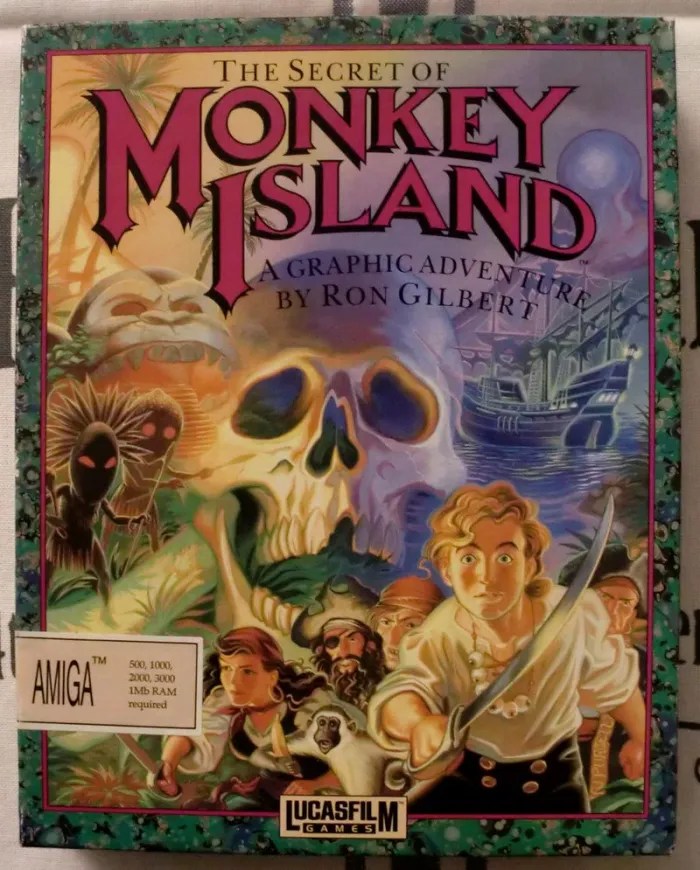
On the surface, it looks like Vantage meets these criteria … because it mostly does.  But let’s look deeper into the interactive fiction portion: although there are stories that emerge as you play Vantage, it’s not “quite” the same as interactive fiction where there is an overall story./puzzle you are completing.  This point can be countered by pointing out that there are many many stories in Vantage waiting to emerge!  That’s a fair point, but it’s worth pointing out that there’s not some overall story to this.  If you want a novel or plot to emerge (like The Secret of Monkey Island or Thimbleweed Park), Vantage is not the same thing.

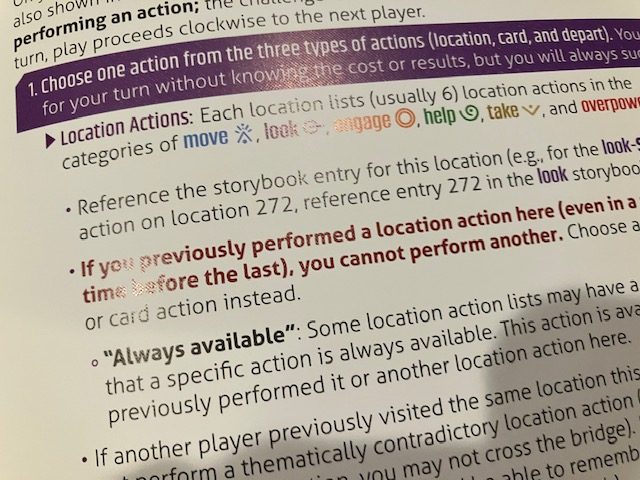
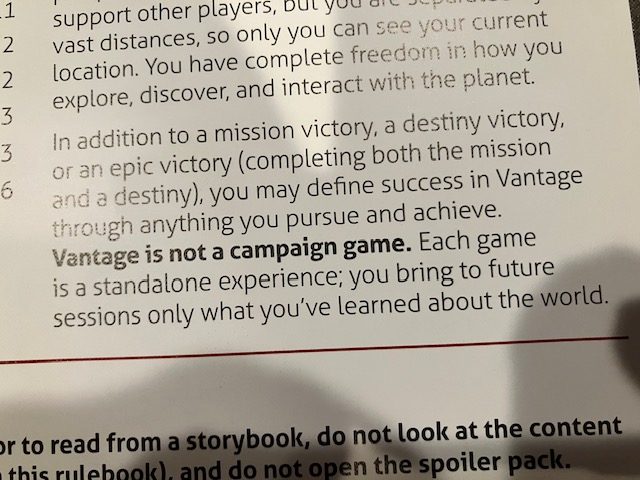
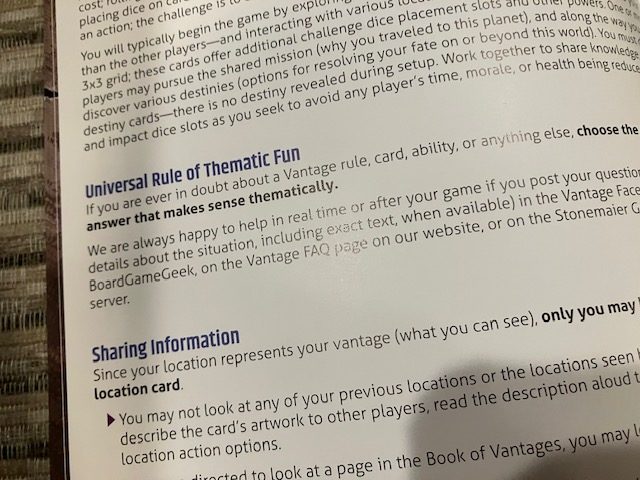
The more crucial thing is the rule that you can’t interact with a Location more than once!  See the rule from the Vantage rulebook above!  In most point-and-click adventures, it’s fundamental that you can go back and revisit a Location and interact in a different way or multiple times or just look everywhere!   This particular restriction seems … strange.  It’s one major reason I would call this NOT an Adventure game.  Or at least not a point-and-click Adventure game?  Maybe that’s the difference?  

Maybe we should revisit our definition of point-and-click Adventure games and add something like “You can generally interact with the environment over and over“.  (And to be fair, there are places in Vantage where you do get a few extra chances to interact with a Location, so don’t go sending me hate mail).

So, this is an Adventure game, but maybe not fully a point-and-click Adventure game?

One other thing also marks this down a little from the Adventure game for me: the exploration.

Is This An Exploration Game?

To say this isn’t an exploration game is crazy!  Players wander!  Players interact with new places!  How could you claim Vantage is not an exploration game?

Consider Earthborne Rangers: a prototypical cooperative exploration game where I joke it’s a 4x game: Explore, Explore, Explore, and Explore! See review here!

In Earthborne Rangers, you can play over and over and over … and come back to where you left off!  You have a map, and you get a feel for the world!  There’s a lot of adventures in this world … just like Vantage!  Like Vantage, you can keep coming back over and over and see more of the world!

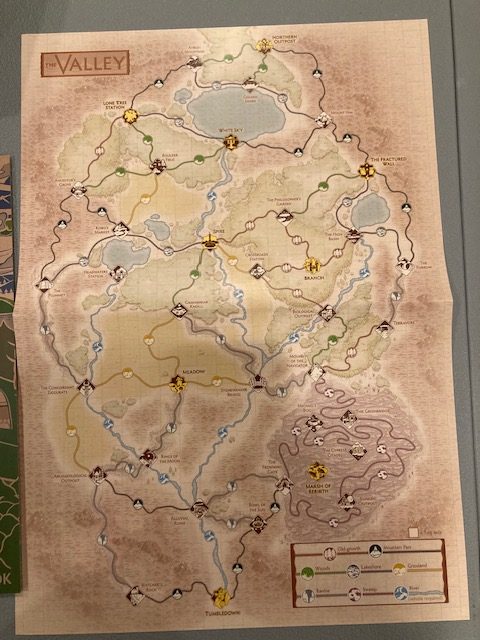
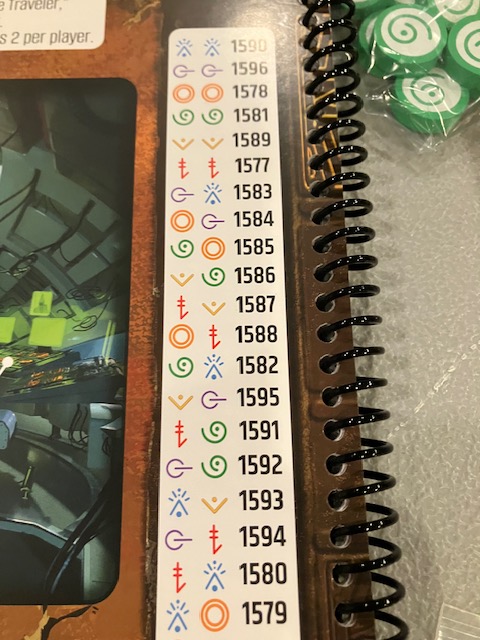
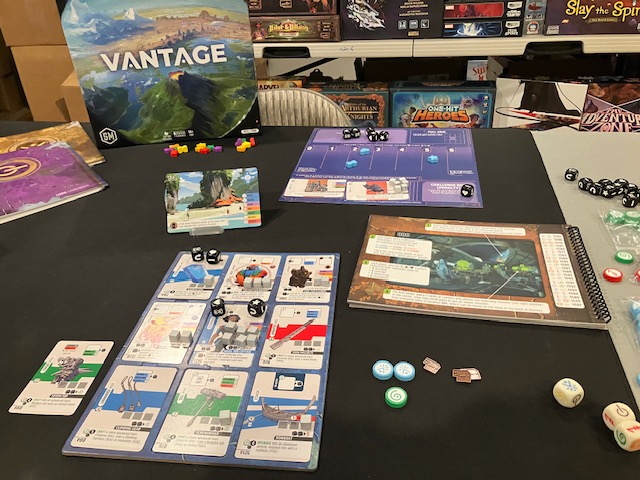
Vantage isn’t  a campaign.  You just crash land on the planet every time at a different place: see the chart above.   Every game is different, as seeded by the chart above.

So I finish a game of Vantage.  And it’s over.  My progress is essentially lost.  In Earthborne Rangers, I can continue where I left off and keep exploring.   That’s the difference; your exploration is lost in Vantage (but see below).

When I say I want to explore a topic, when I want to explore an issue, when I say I want to explore … I don’t want to lose all my progress!   Lack of progress can make the exploration feel pointless.   If I don’t have any vested interest, if I don’t have a desire to continue, it doesn’t feel like exploration, it just feels like random-stuff-happening-to-you.  And that (admittedly subtle point) is why the exploration in Vantage may not feel like exploration.

My first solo game of Vantage ended in a win… it was fine!  But it felt vaguely unsatisfying as “Well, I explored this world, but so what? I have no idea where I was or what I was going! I may never come back this way again, so who cares?”

This unease went away a little when I played my second solo game: if you just take the game for what it is, as a carpe diem game and just enjoy it for what it is, then it’s a lot more fun!  This isn’t a game about trying to explore and keeping track of this planet, you just make decisions and live with them!  

Of course you explore when you play Vantage, but it’s not the type of exploration that persists from game to game.   But see below.

Is This a Campaign?

The rules state very clearly that this is NOT a campaign game.  See rule above!

If you play this sporadically and infrequently, then this is absolutely not a campaign.  There’s no memory of previous games.

But what if you play just enough that you start to remember things?  Then is it a campaign game because you can take advantage of what’s you’ve seen before!   Stated in a more mathematical way, as the number of plays going to infinity, this becomes a campaign game!  

I don’t know if you remember Dollhouse; it was a TV show where dolls (people) were wiped of their memories and implanted with new ones weekly. Over time, some of the dolls started to remember what they did in previous runs … and that’s kind of what Vantage feels like over time.  You are a doll from Dollhouse, and some of those implanted memories … stick.  I don’t know of any other game like this;  It’s a very different way to look at a game.

Vantage isn’t a campaign game.  But over time, it can become one.  Sorta.

Starfleet Mode

After my first solo play, I was a little depressed.  I liked this world!  I liked the pictures in the game!  I liked the basic gameplay!  And yet, all the exploration I did was lost.  All that work, gone.  In a later game (I want to say it was my third game), I got to a place where I could keep exploring for a while … and that was cool!  I like being in this world!  But whenever I finish a game, I think “I’d really like to come back to where I was and continue exploring and get to know this world better!”  I get a little depressed when I did all that exploration … for no reason?  

What I want is a Starfleet Mode or Exploration Mode or … frankly, a Campaign mode.  I understand that the game is all about getting your nine cards in a grid, and once you do that, the game kind of ends.  Maybe there could be a way to “continue” the game; maybe you just lose some of your cards and continue?  

The rulebook is very “open” about how you play the game, from the Universal Rule of Thematic Fun (see above), to victory conditions even being kind of what you want!  It’s very open.  But I wanted a more systematic way to explore this world!  Every game starts fresh with you crash landing on a new place on the planet!    Sure, you can make up your own rules for a Starfleet Mode (My current set is: keep all but three cards and keep exploring, but get rid of your old destiny), but this feels like something we should more direction on (from the rulebook).

I want to continue exploring this planet in Starfleet Mode (my own term, it basically means  Campaign Mode) but it kind of bugs me off that I don’t have a systematic or defined way as defined by the rulebook.

Solo Mode

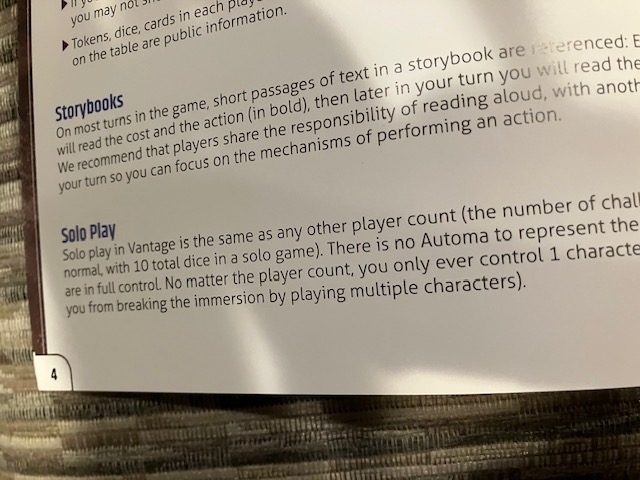
Vantage plays well solo: the rules are very well-defined at the bottom of page four.  (Thank you for following Saunders’ Law)!

My first three games were solo games; I think it’s very important to play solo before you teach others.  There’s just enough rules that it’s better to have a sense of the game before you bring this out to a group.  Luckily, the solo mode is easy to get into and learn the game.

My first solo play left me a little … depressed.  I wanted more exploration, but I felt a little unsatisfied that I lost all the exploration I had done.   After thinking about this for a few days, I came back and played my second game.  This time, I was in carpe diem mode: I just played, made decisions, and took the consequences of my actions without caring too much.  I know I probably won’t come back to this part of the world anytime soon, so I just enjoyed what I was doing.  And my second game was much more enjoyable.  But I feel like I almost had to get depressed in my first game to appreciate what this is and what this isn’t.

A third solo game had get to do a little exploration.  And after my third game, I realized that every single one of solo games was VERY DIFFERENT.  I explored more Locations in some games, I interacted in others, the items I got influenced more what I did in other games.  That’s quite an accomplishment for a game! 

To teach the game: absolutely play this solo first, then bring this out to your friends.  Do I like this game enough to continue playing it solo?  Maybe?  If you enjoy the carpe diem flavor of this, where you just enjoy this game for what it is, then I think you will love the solo mode!  But, if you are like me, and wanted more persistent exploration, then you may feel a little unsatisfied.

I think a Starfleet Mode would make me want to play this again solo MUCH MORE.  Sure, I can make my own rules for that, but why aren’t these in the rulebook?  NOTE: (For all I know, the Starfleet Rules are in hidden somewhere in the Secret pouch, or the Books of Secrets, or somewhere else.  But I can only tell you that after about 5 plays, I haven’t seen anything like that).

Cooperative Mode

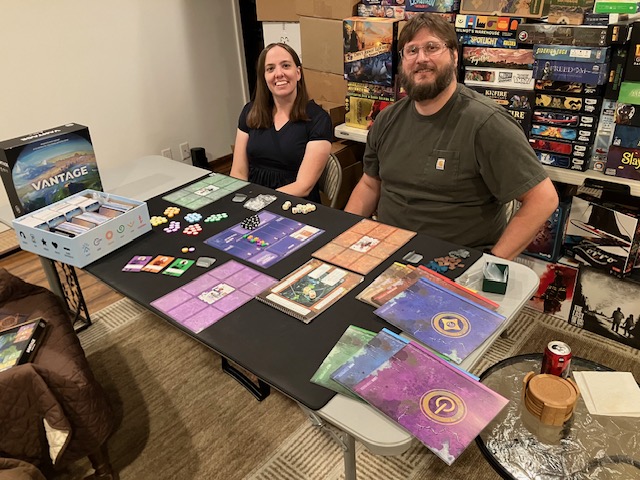
I invited my Escape Room buddies (Charlie and Allison) to play this with me.  

It was a hit!  We played a two-hour game and had a fun time exploring and reading to each other!  One of things you forget in Storybook games is that everyone stays involved as you read the Storybooks to each other!  

I asked Charlie and Allison what they thought? Would you play again?  Absolutely!  The vague sense of dissatisfaction I had in the solo game went away in the cooperative game, as we all stayed involved and just enjoyed the game for what it was.

The cooperation was .. interesting.    In the cooperative game, we have all crash-landed at different points on the planet, so we are “kind of” playing multiplayer solitaire.  We each have our own viewpoint or vantage (see what I did there?), and we don’t really interact with other (although you can if you end up on the same space, but that’s generally not what happens).

The cooperation comes in by either sharing skill tokens with each other (to mitigate die rolls), or sharing dice-placement locations with each other.  When you make Challenge rolls, you have to deal with the consequences;  you can mitigate the dice-rolls by doing dice-placement on appropriate spaces on characters.   See above as the Blue character can always mitigate a die for a Explore (blue) type roll.  Also, she has a “global” place for any character to mitigate Morale (the lightning bolt means “global: any character may use”).

Any dice you can’t mitigate are either Morale, Health, or Time losses.  See above as each character has their own Morale, Health, and Time.  If any of these go to zero, the game is “over”.

Thematically, it’s a little specious that we can share skill tokens and dice-placement spaces, because we aren’t on the same Locations (usually).   My own interpretation of this: I like to think that we are all in constant communication over some intercomm system, and we can share each other’s expertise!  So, the sharing skill tokens and dice-placement spaces, at least in my mind, is sharing expertise“Don’t eat that! Purple plants are generally dangerous!”  I kind of wish the rulebook had done more to explain this cooperation thematically.  But hopefully my explanation of sharing expertise works for you.

One more thing, I kind of think three or four is the best player count; With three, you are only “not involved” every third turn, and you can care about your friends stories … because there’s only three or four of them.  At higher player counts, I think you will “stop caring” and the game will become much more multiplayer solitaire (and you might get bored waiting for your turn).

Things We Were Unsure About

Locations: Charlie and Allison didn’t love that we couldn’t see each other’s Location pictures: but the rules are very clear about this.   I think the game would offer the explanation that it would “break immersion” if we could share pictures: you should only be experiencing your own story.  While I understand this explanation and maybe even might agree with it in theory, it’s so much more fun and cooperative to say “Look how cool this Location is!” .. and show it to everyone. It would actually make the game more cooperative, or at least more interactive.  In fact, if we go with premise that we have an intercomm system that we are communicating on, I’ve got to believe we have a camera on our phone!   🙂 Maybe the game should just allow you to share pictures every so often … the rules are a little draconian on this point, but maybe a little too much.

Bottleneck: The major bottleneck in the game was almost always waiting for Rich (me) to get the cards.  It was probably the most annoying part of the game.  The rulebook suggests that only one player should handle the cards … as it makes the game move faster …  but it feels there could be a better way to share the load on this. Me, as Rich, ALWAYS did all the work and it was annoying.  An easy easy thing would be to let one person handle the Location cards and one person handle the items.  At least then 2 people would be doing that in parallel and share the load!!   The decks can always easily be divided as well.  Maybe it’s too chaotic to split these decks, but I feel like there’s got to a better way to share the load: this is a cooperative game for goodness sakes.   

Conclusion

You might think, that after reading this, that I didn’t like this game.  But I did!  I just wanted to explore a lot of the issues so you understand what this game is and isn’t!  It’s not a campaign game, but it can be over the long haul.  It’s an exploration game, but it’s kind of not as you forget all the exploration you’ve done from game to game (usually).  It’s an adventure game, but it’s kind of isn’t as you can only interact with Locations once.  It’s a Storybook game, but it’s kind of not as the Storybook is more like directions (and the story exists in the Locations).  Vantage is just a little different, and I hope you got that from this review.

I liked the solo mode: it works well and it really teaches the game.  Be aware that you might feel vaguely dissatisfied in the solo game because you don’t get to continue your exploration from game to game.  If you go into the solo game with a carpe diem mindset, and just enjoy this for what it is, you will be much happier!   I’d probably give this a 7/10 for solo mode, but if there were a more systematic way to explore the Planet and keep the exploration going (especially in the solo mode), I’d probably bump this up to an 8 or a 9/10.  It’s a pretty neat world!

The cooperative mode was a hoot and we had a fun time playing!  The cooperation feels a little athematic unless you think of us all sharing an intercomm system!  Then the sharing of skills and dice-placement mitigation spaces is like sharing expertise amongst ourselves; that little premise really goes a long way towards making the game feel cooperative.  Of course, the Storybook reading to each other makes the game very interactive and fun too!  I’d give this 8/10 for cooperative play.  I’d probably never play with more than four players though.

If you are interested in Vantage, you should give this a try to see if you like it: It’s very different from other Storybook games like those in our Top 10 Cooperative Storybook Games!!  I freely admit I didn’t love my first play of Vantage that much; I had to play it a few times.  Maybe you want more flowery prose, maybe you want more story, then consider Wandering Galaxy or Tales of Arthurian Knights instead.   Maybe you want more persistent exploration, consider Earthborne Rangers instead.  But Vantage is such a different beast than many games out there, don’t judge it right away.  Give it  few times to see if you like it.  And it’s okay if you don’t like it.  It’s also okay if you do like it!


Unstoppable: A Solo and Two-Player Cooperative Deck-building/Crafting Game. A Review.

Unstoppable is a cooperative deck-building/card-crafting game! This was #4 on my Top 10 Anticipated Cooperative Board and Card Games of 2025! This was on Kickstarter back in June 2024, and delivered to me Saturday January 17th, 2025! I backed it, expecting it to arrive later in 2025, but it actually delivered early! (It originally promised February 2025). Amazing!

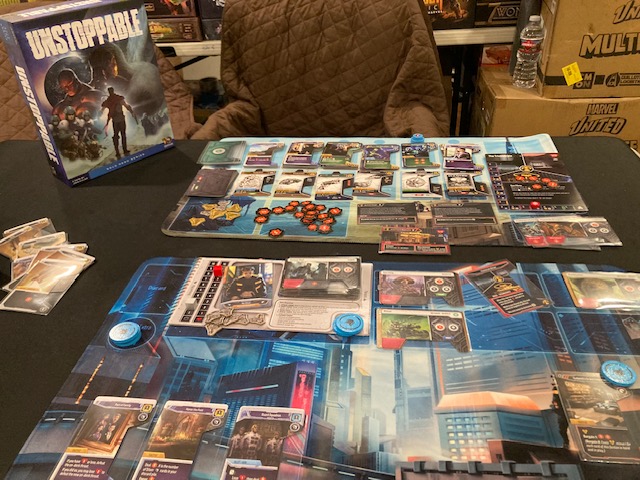
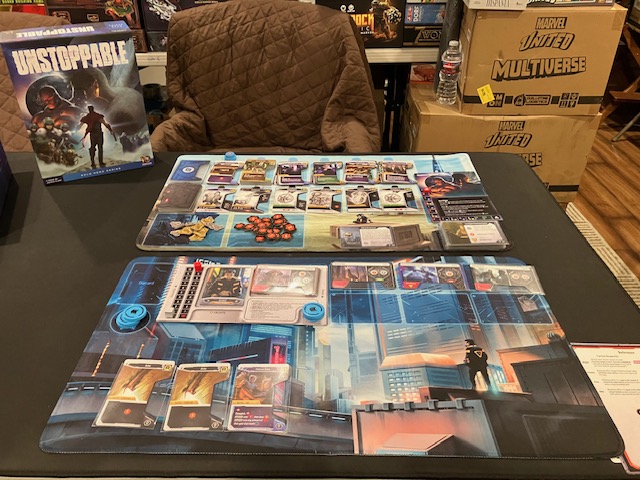
This delivered with three playmats, the Tyrant’s End expansion, and the base game: see above.

So what is Unstoppable? The game describes itself as a Roguelike Momentum Deckbuilder … meh, that’s an okay description, but I’d prefer to call it a deck-building/card-crafting boss-battler instead (I think it’s just “hot” to call games “roguelike” at the moment).

Be clear that this game ONLY supports 1 to 2 players before you get too excited; this game reminds me of a more tightly-coupled Astro Knights (see our review of Astro Knights here and here): Unstoppable still has that sci-fi  feel, that deck-building feel, and that boss-battling feel … just like Astro Knights, but it also has some really different ideas.  What do I mean by that? Let’s take a look below!

Unboxing

The Unstoppable base box is actually not that big; see Coke can for perspective above.

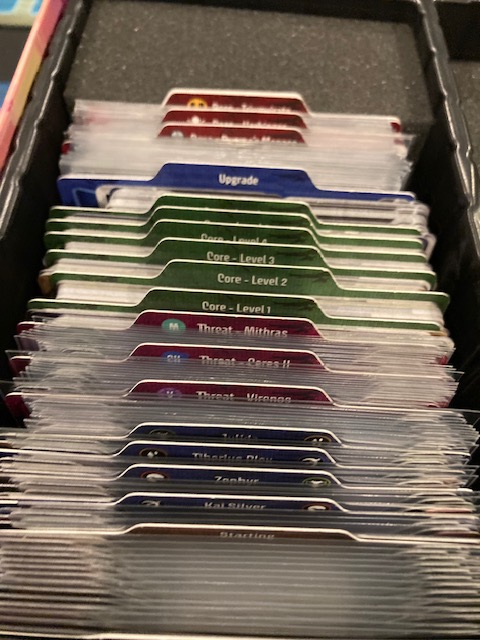
This is a deck-building game (and card-crafting: we’ll touch on that in a second) , so there are a ton of cards: See above.

There’s also some money tokens (credits, far right: I mean, this is a deck-building game, so you have to buy SOMETHING to upgrade your deck), hit point tokens (middle: you gotta do damage to take out minions on the way to the big bad boss), and some action point tokens (far left: yes, this game has action points too!).

There’s not THAT much in the base box; mostly cards and tokens and a few larger mats.

Playmats

I can hear some of you asking … “So Rich, why are there three playmats?” An excellent question.

The playmats are double-sided.

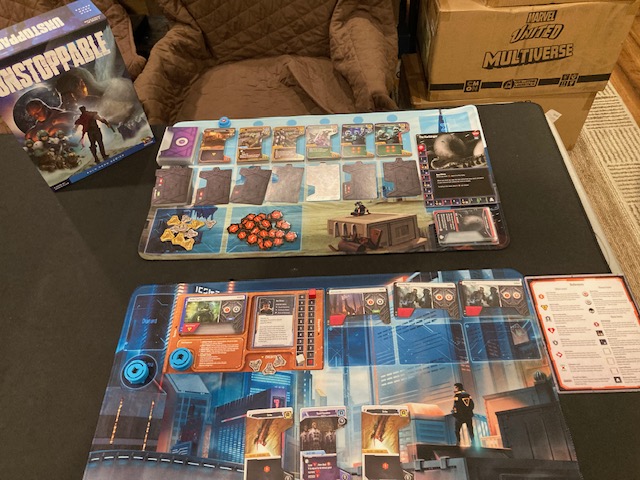
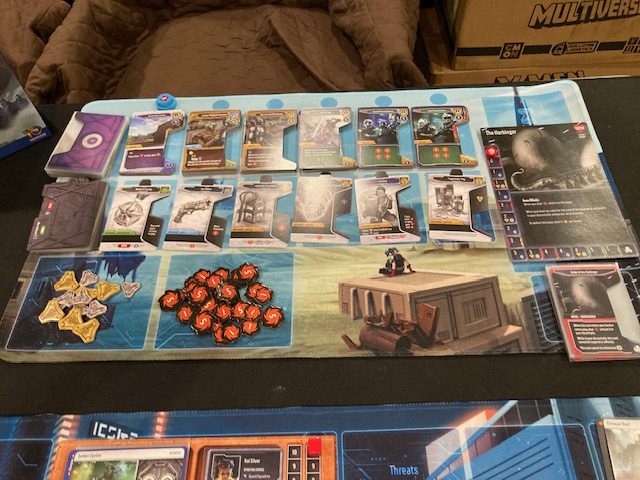
One side of the playmat is a single player mat. This is where one player’s cards, play board, threat, tokens, etc. goes. See above.

The other side of the playmat is where the main upgrades (this is a deck-building game, remember?), the core cards, and the big bad boss you battle lives. See above.

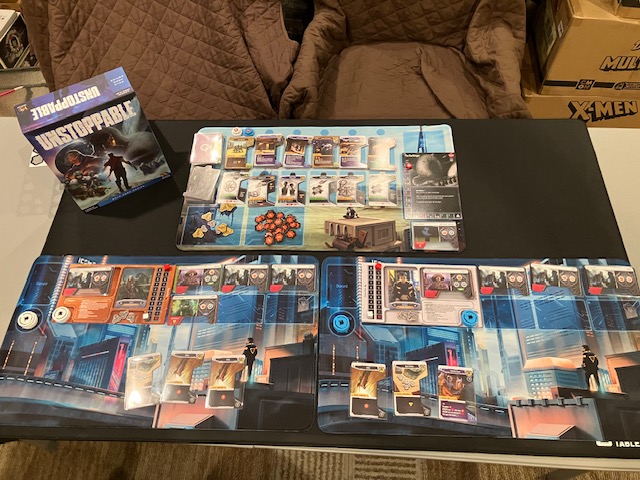
The reason there are three playmats is because the game is either 1-player or 2-players! Each player gets a mat (2 mats) and the big bad boss gets a mat (for up to 3 mats). See below for a 2-Player set-up:player 1 on left, player 2 on right, upgrades/boss on top.

So, to be clear, the playmats cost extra money; they don’t come with the game. Were they worth the extra money? So, I paid $100 for the base game, 3 mats, and one expansion. I like how they mats organize the game, but strictly speaking you don’t need them!

The rulebook DOES show how the game sets-up without the mats, so you don’t need them. But I liked them; much like the Aeon’s End: The Descent playmat was so useful, so too was the playmat for Unstoppable. But maybe you should see if you like the base game before you go investing all the $$$ for the playmats and expansion … keep reading …

Rulebook

I am a little grumbly with this rulebook. There are about 3 or 4 things that it could have EASILY done to make it SIGNIFICANTLY better.

The good news is that it gets an A- on the Chair Test.

It opens up and sits perfectly well on the chair next to me, making it easy to consult. So, they definitely did that right: see above.

The Components page (on the left above) is “okay”. The first real problem is … how do you set this up? There is a discussion (right side of the page) about “how you set-up and sleeve” the game, but THERE IS NOT A SINGLE PICTURE describing it! I was able to figure it out, but people who have no idea what card-crafting is or even deck-building will be completely lost with these directions (far right side of the page). A single picture might take this game from unplayable to playable for certain people. And a little picture would have made me happy; show me how the decks fit together. Please? I feel like the description above wasn’t quite enough.

The set-up was pretty good: see above.

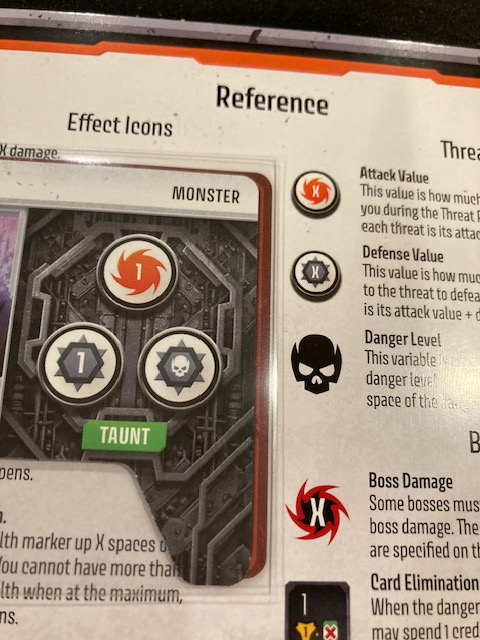
The next place I had problems was the card anatomy. Here, the Defense and Bonus areas on the Threat Cards were poorly described. The problem is that most Threat Cards use the SKULL symbol, and it’s not clear what that means (the skull on the Threat Cards is a different color and/or outline than the reference card: we discuss more below). A simple example describing one combat would have helped that.

The rest of the rulebook is pretty good.

I also really wanted a game summary on the back; I ended up paging through the gameplay pages over and over as I played; it would have been nice had those been summarized on the back.

This rulebook was … ok. I just wanted a few more examples, a few more discriminators, and a few more pictures in the rulebook to help me get into the game. After a little trek onto BGG (see thread here), I feel like I got my questions answered, but the rulebook could have been better.

It worked. Mostly. Except for set-up. It could have been significantly better with a few extra pictures.

Storybook

There is a storybook for the game.  You don’t need it to play the game.  It’s just flavor text.  I never read it, and I feel bad for not reading it?

Sleevening

Like I mentioned in the rulebook section, it was more work than I expected to get this game into playable shape. It took me about an hour or so? Basically, you have to “sleeven” the game and put a bunch of cards into sleeves.

Let’s be clear: the sleeves come with the game! Although this is “mostly” a deck-building game (you can build a deck, add better cards, and cull lesser cards: See our Top 10 Cooperative Deck-Building Games for more discussion of deck-building games), it is also a card-crafting game; this is a term that came into parlance with another of John D Clair’s Games: Mystic Vale (although this is a slightly different flavor of that idea). This game is built for you to put cards inside the sleeves, and have multiple cards together at the same time.

Once the cards get going, they will have two sides: a core side (above right: the GOOD side) and a Threat side (above left: the BAD side). There we actually two cards inside the sleeve! This basically allows the GOOD side and BAD side to vary independently.

The GOOD sides are what the characters can do in the game: deal damage, shield themselves, etc. See above.

The GOOD cards tell you which BAD cards they pair with; see the backs above (well, the intro cards do, once you start playing, you get random BAD cards).

The Threat cards (the other side) will be the bad guys that the players fight during the game. These cards, when defeated, will turn over and flow into the GOOD guys hand on the good side!

You might ask “Why do we have these weird rules and weird backs/fronts?” It’s to support UPGRADES (and allow the fronts and backs to vary independently, but that’s a complex discussion).

Probably the coolest part of Unstoppable is that you can UPGRADE a card: it stays attached to the card … in the sleeve! The reason these cards are so WEIRD-shaped is that the upgrades go into the right part of the card and basically stay attached/stay in the card sleeve so that card is better for the rest of the game!

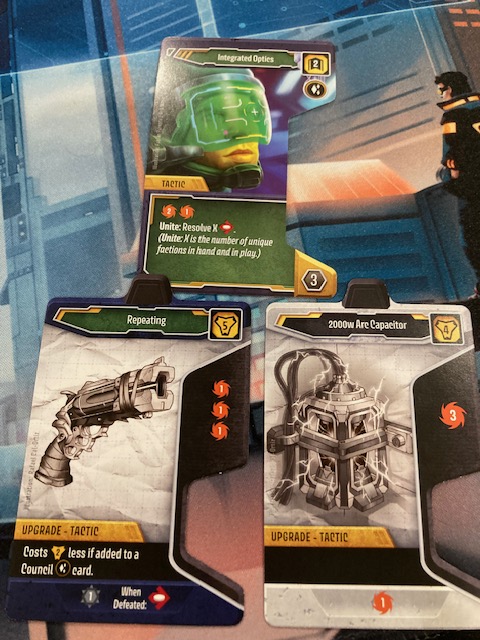
See above as we try to choose between two UPGRADES: Do I want to making it Repeating or add a 2000w Arc Capacitor? The repeater gives me three separate shots, but the capacitor gives me one big shot!! Which do I want?

I choose the capacitor! See as I slide it in …

… and see as it augments my card! Pretty cool!

This is the core crafting mechanic of the game; this is the cool gimmick.

Gameplay

Each player chooses one character to play: see above.

The back of your card indicates which specialized cards you start with (and a little flavor text).

The player sets-up with their starting deck: three special cards and 7 standard “starting” cards. They set-up on the player side.

Your deck goes on the character mat, with Armor and Hit points being tracked.

You also set-up three Threats you must deal with in your personal space. You start with three cards in hand, three action points, and three Threats to deal with.

To play a card, you need to be able to pay the Action point cost (in the upper right corner).  Playing Strike gives you a simple 1 hit point of damage.

You do damage to one of the three Threats: see above (more of them if they are FAST); if any of these Threats survive to the next round, they will do Damage to you!

If you take out a Threat, the card FLIPS to the GOOD side and comes into your hand! That’s right, you don’t really draw from your deck: the main way to get new cards in your hand is to take out Threats! That’s very interesting!

Of course, this is a deck-building game, so you have to get new cards somehow.  Basically, every turn, you get to choose one of three (you draft) the three cards where the BLUE LEVEL marker is (see above).  There are 6 levels of core cards, with higher levels being obviously better!

Every time you empty your deck, you level up and move the level marker up. (There are also ways to move the level marker up quicker, but only temporarily). Leveling-up is a fun time; you get to CULL a card, move the level marker up, and anticipate some new “better” cards!

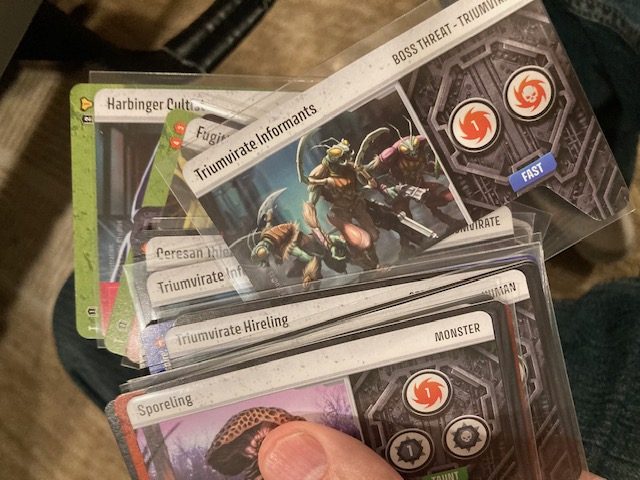
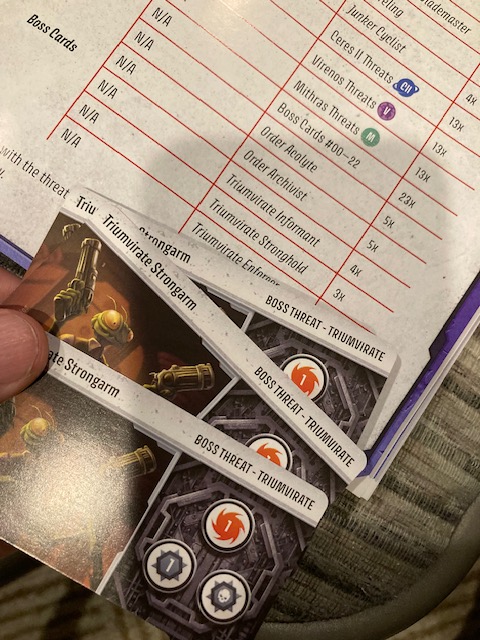
This is a boss-battler, so you have to take out the BIG BAD BOSS; depending on which one you choose. See above. Interestingly, you can only do “boss damage” (see it blurred below) when you kill certain threats from your deck. These special threats get added every time you level up (and you usually start with 2 of these “boss threats”: see Below.)

There’s actually quite a bit more to the game, but that’s the basics.

Build a better deck and craft better cards! Take out local Threats on the way to taking out the Big Bad!

Solo Play

So, this game is definitely built for solo (thanks for following Saunders’ Law), with 2-Player being the secondary mode. See above: even the font hints at that disparity (SOLO is all big)!

I ended up playing about 10 games of the solo game in the first few days after I got this game! There are three bosses that come with the game, and I was able to defeat each one … after I lost a few times. (There are ways to up the difficulty, and there are 4 characters to play with to give the game more replayability)

It takes a little while to get into the “flow” of the game. There are a lot of rules, there are a lot sections, but there are a lot of decisions (in a good way) to make too.

For example, there are 4 factions in the game that all play VERY differently! If you have multiple cards of a faction, they can “support” the other cards and make them more powerful! I tended to get the Silver faction (the little diagonal raven) in my first few games. But there is also worth in getting multiple factions, especially with the UNITE keyword which gives you special on how many different factions you have in play/in hand!

My favorite decisions in the game came when I was stuck; it was pretty clear that I was going to die and lose, but if I could upgrade my cards JUST RIGHT before I went into battle, I could stay alive! The UPGRADES, and the fact that you can do them anytime on your turn, really make it so you can pivot and be smart! I really appreciated that I could feel clever. Deck-building games tend to have some randomness in them, but the UPGRADE mechanism is what kept me from being too grumpy with that randomness.

I will say that the solo player doesn’t have to do too much work once the game is going, but the set-up and ESPECIALLY the tear-down is a lot of work! Going through your entire deck and separating the core cards and threat cards is so much work. Besides the “unsleevening” (which was a sub-optimal experience), the tear-down is one of the biggest “oofs: that’s a lot of work” in the game. See above as I tear apart the decks!

There are a lot of rules, a lot of Icons, a lot of factions. I appreciated that, by playing this solo, I could learn the game and take whatever time I wanted. I could then teach my friend. Not friends, because the cooperative mode is ONLY 2-Players.

Cooperative Mode

Yes! Thank you! Unstoppable has a cooperative mode with NO Communications Restrictions! I get so tired of having some obscure rules to obscure the communication when playing cooperatively with my friends! I said this in Everdell Duo (see review from a few weeks ago) and I’ll say it now: let me and my friend(s) talk! We play games to play, laugh, talk, strategize, and have fun together! I am so glad we don’t have to worry about any Communications Restrictions as we work together! Thank you Unstoppable for allowing full communication!

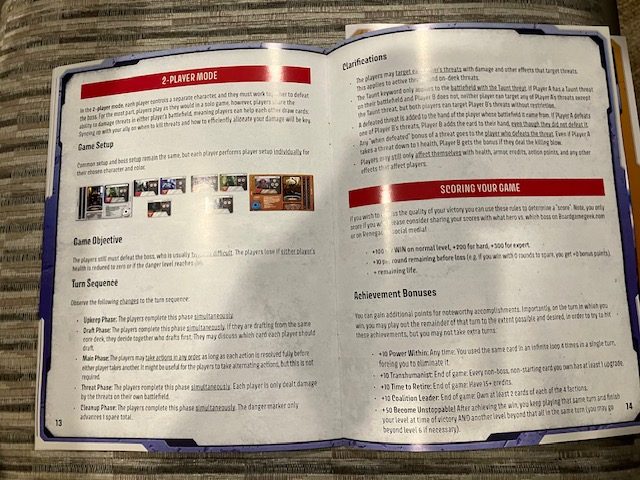
The rules for 2-Player are in 1.5 pages (pages 13 and 14: see above); the idea is pretty straight-forward: each player is playing multi-player solitaire for the most part. The BIG BAD BOSS has twice as many hit points (for scaling to 2 players), so both players still have to do “about” the same amount of damage and play “about” the same amount of game.

Most of the 2-Player cooperative game proceeds simultaneously, as both players play out their turns at the same time. (This helps keep the game flowing quickly). The only times where the two players must worry about the order they play is (1) when drafting the new card (players are allowed to choose who drafts first), and then (2) in the Main Phase, the game uses Player Selected Turn Order (one of our favorite mechanisms), where players can intersperse their plays however they want! This is fantastic! Me and my friend can decide the best way to take out Threats together! The only prerequisite is that the entire action must “finish” before the next one. (We found we could even do the Main Phase simulataneously many times as well!)

Although the players can talk through how to play together, the only way they can help each other is to eliminate Threats (by attacking their battlefield) for each other … and that’s it! There’s no sharing of any resources (credits, cards, armor) or anything else. So, this is very much multi-player solitaire.

In my first two-player game, I lost because my friend has a bad draw and couldn’t recover … if I just could have given him a few credits, he would have survived! So, although you can talk and strategize together, you can’t help each other out THAT much. The game is balanced pretty well for the solo player, so it’s rare you can actually “eliminate a threat” from your friend without screwing yourself, at least in my experience.

I liked the 2-Player cooperative mode, but I wish there was a little more cooperation: this is generally a multiplayer solitaire experience. Even sharing credits might have made this feel just a touch more cooperative without changing the gameplay too much … it’s even thematic! “I’ll wire you some credits!” This is a minor house rule that would I suggest to make the game just a little more cooperative.

Things To Look Out For

As I played a bunch of games, I ran into some issues that I feel I should point out; maybe I can make your experience better.

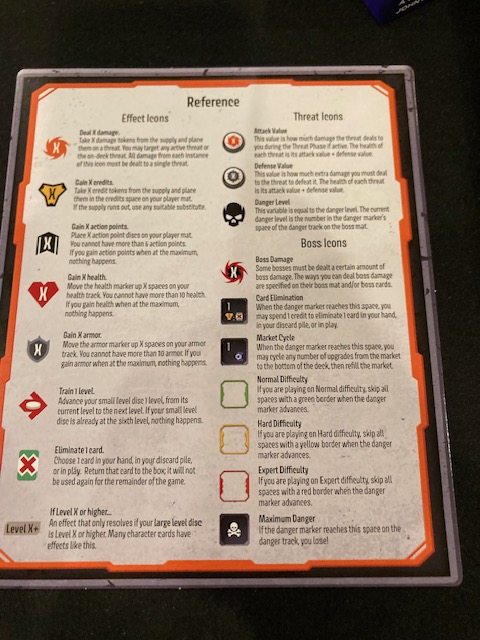
What does the Skull mean? When you see the SKULL on the Threat (MONSTER) card (see above), that means “use the current level number on the BIG BAD Boss card“. You might miss this the first time through because the Reference cards have the SKULL as a black on white, but every single Threat card has the SKULL as white on grey like the example above (or white on orange) … so you don’t correlate that they are the same symbol because the colors don’t match!

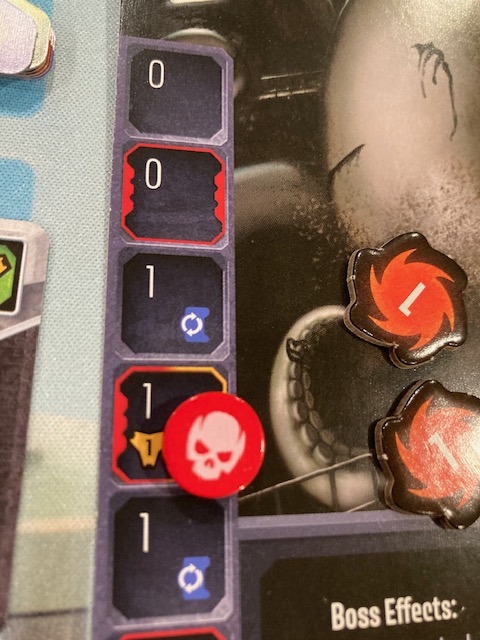
…Even more confusing, the marker on the BIG BAD BOSS map is red. So, these symbols don’t color-coordinate at all! When the RED token is on the 1, it means “1” (for the Defense of the Monster above). There was never a clear example of this in the Rulebook, and the lack of color-coordination can can be confusing, so just be aware of the issue. Once you know this, it’s easy.

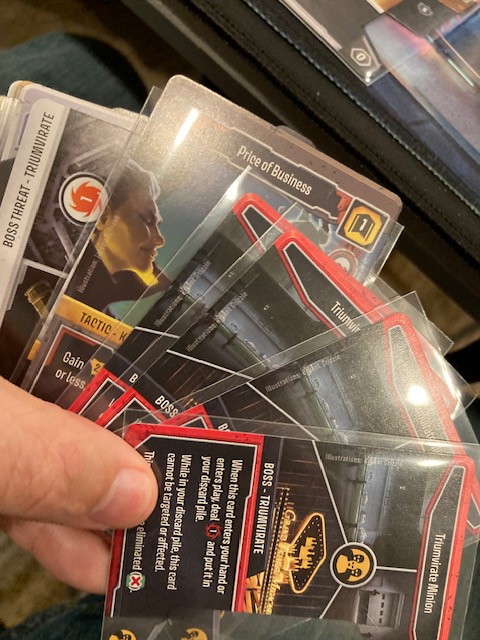
Boss Cards Shuffle Weirdly: Because the Boss Damage cards (see above) don’t ever have a Core (GOOD card) inserted in with it, they shuffle weirdly. I tended to get all the BIG BAD BOSS cards at the front or back of the deck because they are just “lighter” and shuffle differently in your deck. Go out of your way to make sure you shuffle your deck well (maybe a pile-shuffle) so that you don’t have all these cards clump together. (You DO NOT want these cards to clump together)

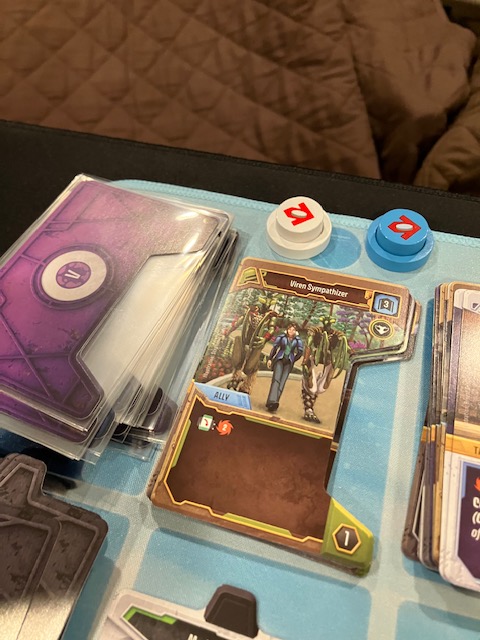
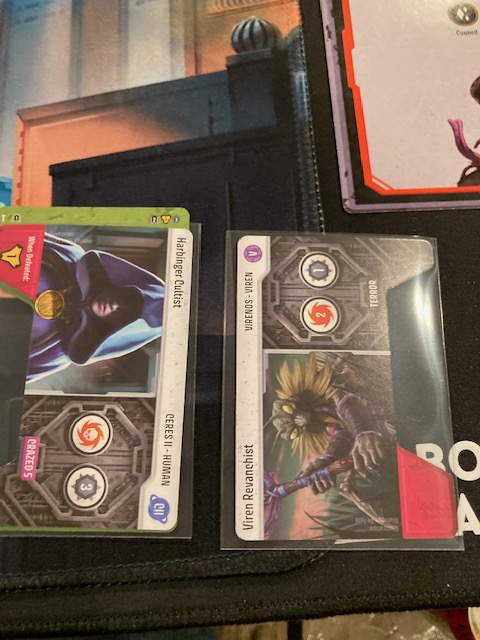
You can put the cards in backwards! See above as the Viren card is in the sleeve upside down. You know this because the card next to it is correct with the Core card extruding out the top. If you put a core card in here, it won’t line-up correctly.

…Have the opening on the Threat cards on the TOP so the Core cards can just slide in; see above.

Multiple Attacks vs. Adding: It’s still not clear if each Orange Swirl is considered a separate attack or just additive. If I add the Repeating, does each attack get the addition of the card it augments? Probably not? Also, since there is (currently) no notion of damage reduction in the game, 3 single attacks of 1 and 1 single attack of 3 will be the same against one opponent, but the Repeating will obviously be better IF if it really is 3 separate attacks (which is probably why it’s more expensive). I am using deduction (based on what I know about the game) to figure this out, rather than having the rules tell me. That frustrated me a little.

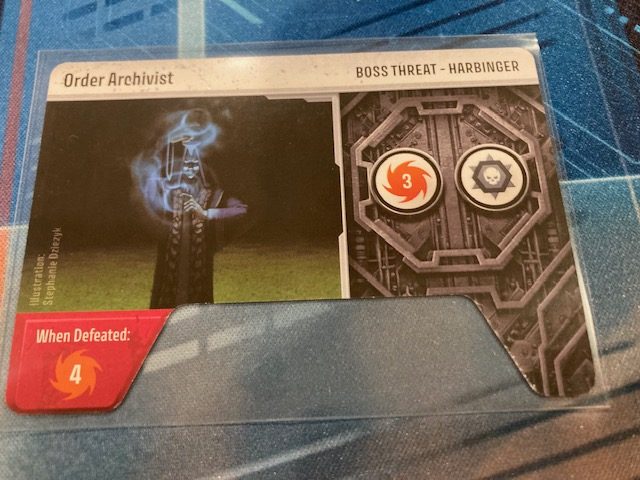
When Defeated: What does it mean when the “When Defeated” shows the Attack icon for the Boss Threat cards? See above! Does the Boss Threat have a Death Curse and do 4 Damage to you as it dies? Or do you get to do 4 Damage to another threat? It’s not clear. After playing about 10 games, I am pretty confident it’s a true bonus for the player: because the Boss Threats don’t come back into your hand (they do Boss Damage), they don’t help you with other threats, so you need the Bonus damage to be a HELPER! So, it’s a true bonus; you can do 4 damage to something else! If it were the other way around (with the Threat doing 4 damage to you), this game would be called Unbeatable instead of Unstoppable because it would be so hard!

What I Liked

Factions: The factions in this game really added a lot of flavor to the game. I mean, this is a deck-building game, which we’ve seen tons of. The four different factions really added some new flavor to this genre.

Threat and Core: The fact that the core cards and the Threat cards are tightly coupled was really interesting! Granted, this is the core gimmick (pun not intended) that makes this stand out (with the card-crafting), but it does work.

UPGRADES: At the end of the day, the UPGRADE system worked so well; this is the fundamental reason this game stands out. You can upgrade your cards independently, and that’s a really interesting decision! Adding the UPGRADES on an ad-hoc basis saved me many times, and it really makes you feel clever when you upgrade and turn a 3-Action Point card into 1-Action Point card!

Looks: The game looks good. And the playmats really do help.

What I Didn’t Like

The Introductory Experience: The introduction to this game and the “sleevening” weren’t great experiences. I am very worried they would turn off a less-experienced player to the point of abandoning the game. It reminded me a little of my first experience with Marvel Legendary many years ago … if a friend hadn’t helped me with my first game, I may have given up on it! Just a few more pictures and explanations, please? (Another game I really liked from last year, Union City Alliance (a co-op deck-builder) had this same problem: see here).

Tear-down: The game moves quickly as you play, but tear-down in this game is a lot of work: you have to separate many many cards from their sleeves.

Ambiguities: There were just enough ambiguities in the game that I was frustrated a few times.  Again, I wish the rulebook had a few more examples,  a few more pictures, a few more discussions, maybe even an index.   In this review, I tried to point out problem areas so hopefully they won’t trip you up.

Theme and Comparison to Astro Knights

How much theme is here?  There’s about as much theme here as in the base Astro Knights game; although I think I would give it to Astro Knights for feeling just slightly more thematic.  

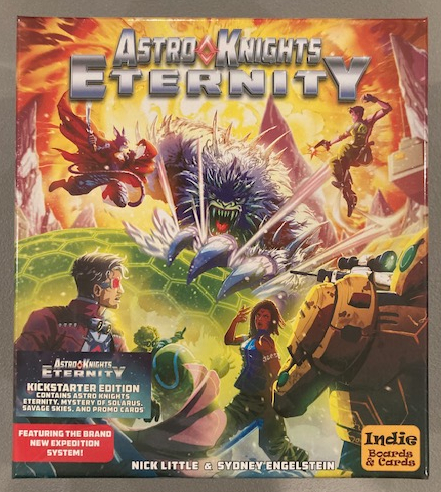
Although, If we were comparing it to Astro Knights: Eternity, I would definitely say Eternity is more thematic … mostly.

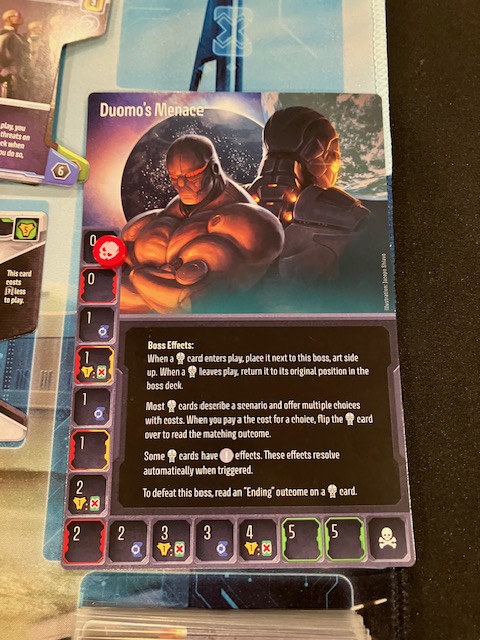
Although the thematic element depends on which BIG BAD BOSS you fight!  In your first few Unstoppable games, you should fight The Harbinger then The Triumvirate (in that order).  Those games teach you the technical mechanisms of the game.  The final boss (Duomo’s Menace: see above) actually has a little story and some choices! See below!!

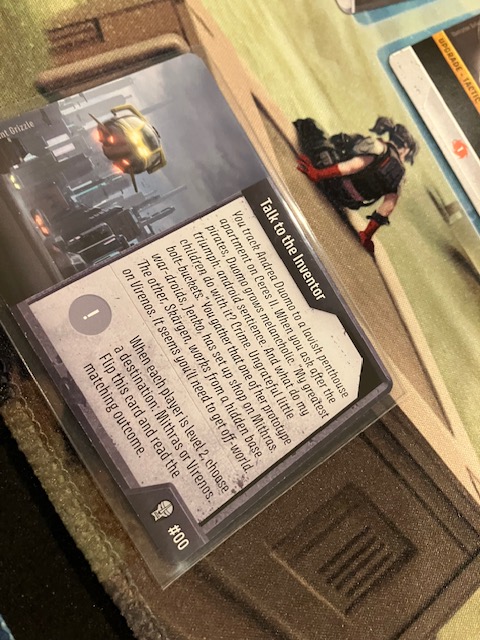
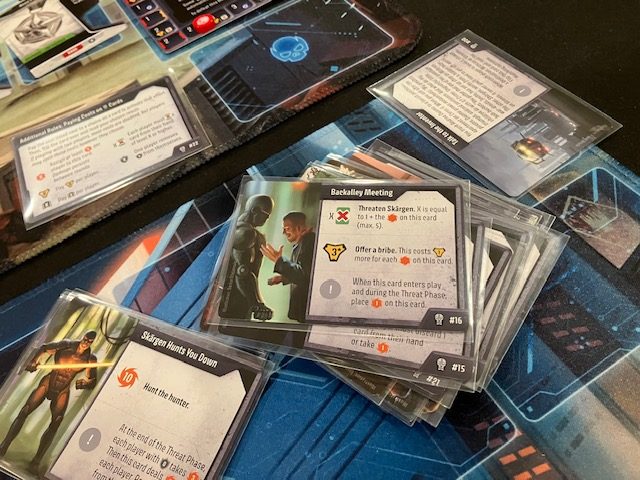
There is a deck of 21 cards (see above) and you make decisions (like a Choose Your Own Adventure story) as it takes you through different parts of the deck!

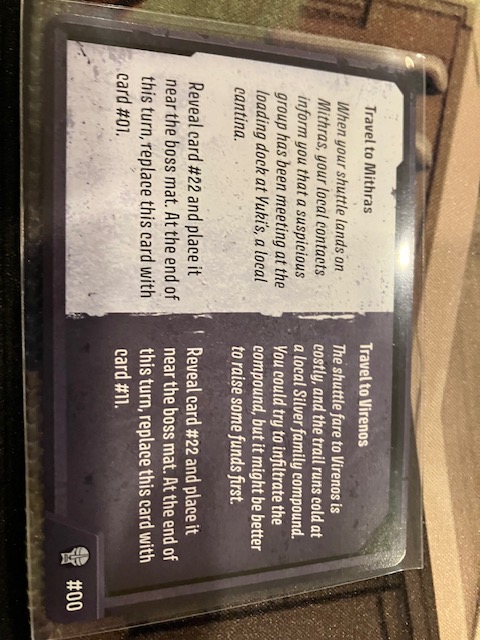
Minor spoiler above (that’s why it’s sideways), but it’s the first decision you would come to … see above.  These decisions take you through different parts of different stories!

There’s a bunch of different endings (don’t look too closely above) for that adventure!  The final boss Duomo’s Menace has quite a bit of theme and feels like a little adventure!

Would I recommend Astro Knights or Unstoppable? They are both great sci-fi cooperative deck-builders, but it depends on what you want!  Astro Knights is a little simpler and plays more people (at 1-4 players).  Unstoppable is more difficult and plays fewer people (1-2 players).  Astro Knights, especially if you are playing the Eternity expansion, feels more thematic, but, Unstoppable has slightly better gameplay with its card-crafting mechanic …and it does have a thematic adventure for the final boss!!  As a cooperative experience, I would give the edge to Astro Knights because it feels more interactive.  In the end, I have both and like both!

Conclusion

Yes, I liked Unstoppable! Quite a bit! It’s definitely staying in my collection for the solo game, but I can see it being ideal for playing 2-Player with my friend Joe!

The deck-building and card-crafting aspects of this game are unique and this brings some new ideas to that genre: upgrades, defeating cards to draw them, special boss damage … to name a few! To be clear, the main gimmick of this game (the card-crafting) DOES WORK and it works well.

I really did like the playmats and would recommend them, but they do make the game more expensive; strictly speaking, you don’t need them.

Overall, I’d have to give this a 8.5/10. I want to give it more, but the “unsleevening” experience and the rulebook could have been a little better.

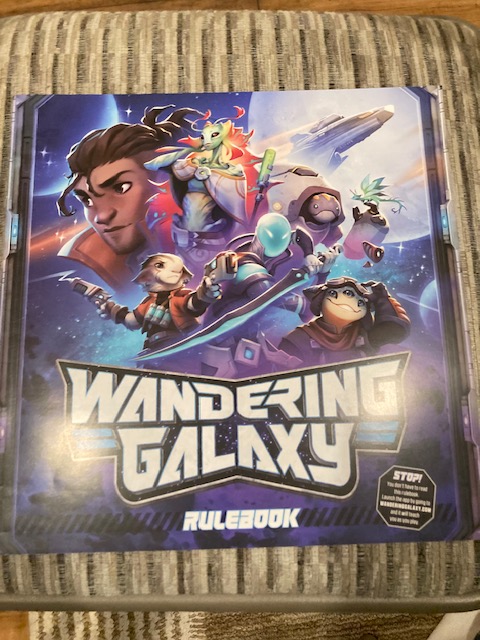
Wandering Galaxy Review: Who’s Wandering Here?

IMG_9059

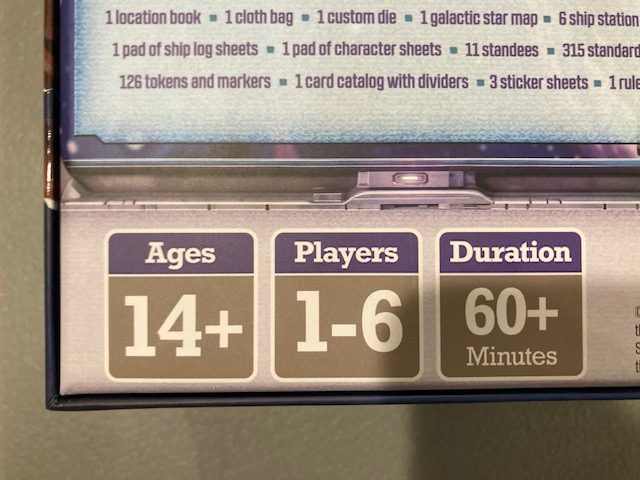
To be clear: you are wandering the Galaxy, but it turns out the Galaxy itself is wandering (if you believe the intro text)! Wandering Galaxy is a cooperative adventure game for 1-6+ players and it is set in spaaaaaaaaaace!  This is a silly cooperative game that kind of feels like Firefly if it were a comedy (with just a little bit of Star Trek thrown in). (I mean, Firefly is already kind-of a comedy, but I digress). (But this may be too many parenthesis).

IMG_9060

Wandering Galaxy was on Kickstarter back in July 2024, and promised delivery in December 2024.  And you know what?  They made it! My copy arrived about December 20th, 2024!  With some qualifiers … see below …

IMG_9056

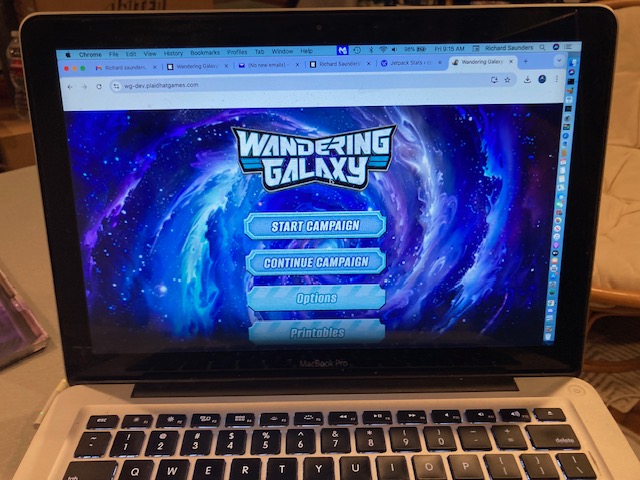
See above: So, the game wasn’t QUITE done, but the only thing left unfinished was the App. My physical copy arrived but the app still needed some work.  To be fair, I was able to play some of the game before the end of December, so it’s enough to say “Eh, close enough”.  I’ll call it on time.

IMG_9112

Let’s be clear!  Wandering Galaxy requires an App (or the Entry Book … more discussion later if you are violently opposed to an App).

IMG_9062

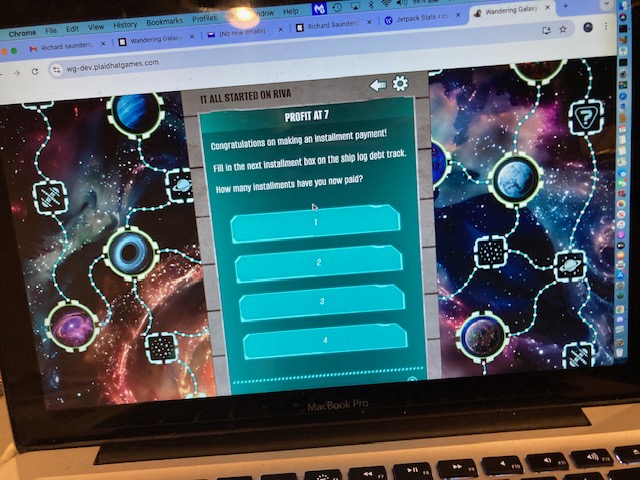
They say “App”, but it’s really more of a web portal situation: point your web browser at WanderingGalaxy.com and go!  It reads the text to you!!

IMG_9150

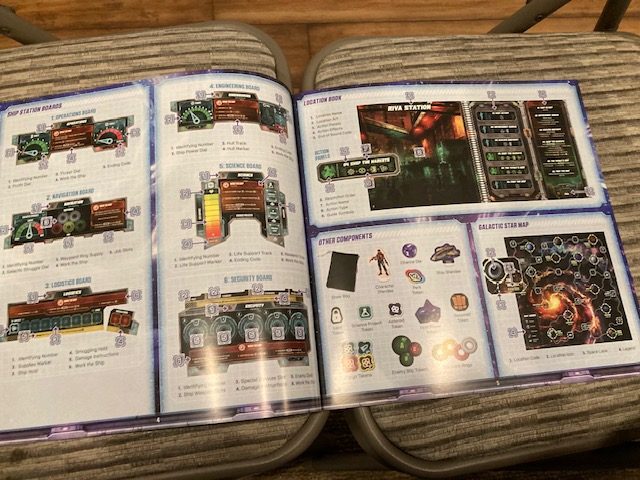
So, what is this?  Wandering Galaxy is a cooperative campaign game with many different mechanisms: story-telling, worker placement, bag-building, deck-building, pickup-and-deliver, and even a little bit of a real-time!   It is both paradoxically a lighter game and a heavier game!  The gameplay is light and fluffy and moves along quickly, but there’s a lot of stuff underneath the hood that keeps this from being “just” a dumb little game!

IMG_9113

What do I mean by this? Let’s take a look below!

Unboxing

IMG_9063

So, this is a pretty standard sized game box, about Ticket To Ride sized. See above with Coke can for perspective.

IMG_9079

There’s a decent amount of stuff in here! See above!  Lots to punch out!

IMG_9099

There’s a lot of tokens to punch out! Whew! Luckily the game includes some bags!

IMG_9081

There’s also a fair number of cards in the game: remember how I said this was a deck-building game? There are the cards for your decks!

IMG_9094

I got the sleeves for this: 9 times out of 10, if a game says it’s a deck-building game, you should probably sleeve it.  (This might be the 10th game).

IMG_9095

I spent WAY TOO Much time sleeving all the cards. See above!!!  This card-sleeving was one of the first things I did when I got the game.  I will say, after a few plays, I am not entirely convinced that this game needs sleeves.  If you didn’t get the sleeves, meh, don’t stress: I don’t think you needed them.  (I am addressing this to my friend Kurt who didn’t get the sleeves).

IMG_9096

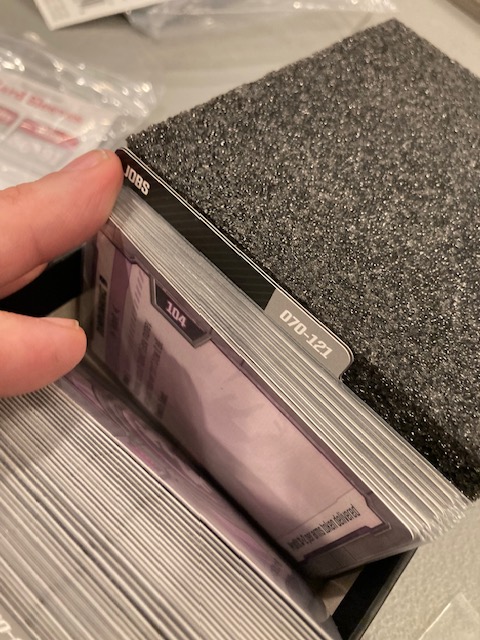
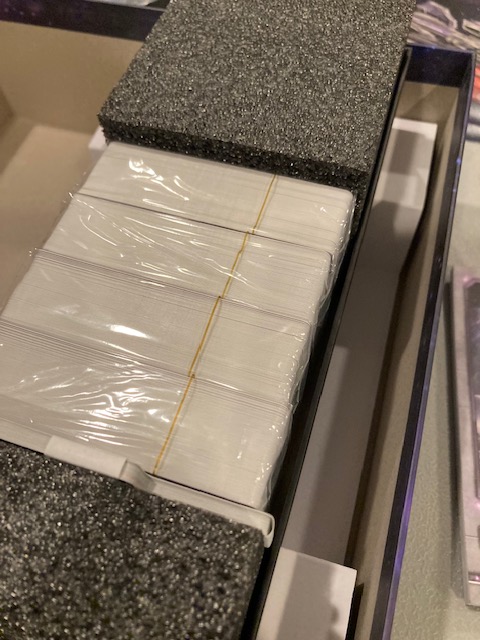
But there is a nice box for holding all the cards, with little dividers that clearly mark sections.  And it looks like it would fit WITH or WITHOUT sleeves just fine.  Little tip: it may look like some cards are missing (because of missing numbers), but probably not!  Some are missing for “future expansion”:  Check this BoardGameGeek thread for more details: Anyone missing cards?

IMG_9080

There’s a lot of other punch outs for the stations … see below.

IMG_9370

IMG_9107

There’s a lot here, but it is very cool looking!

Rulebook

IMG_9068

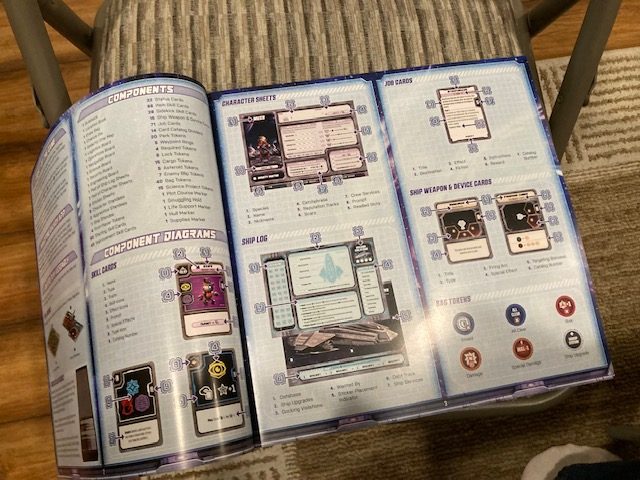
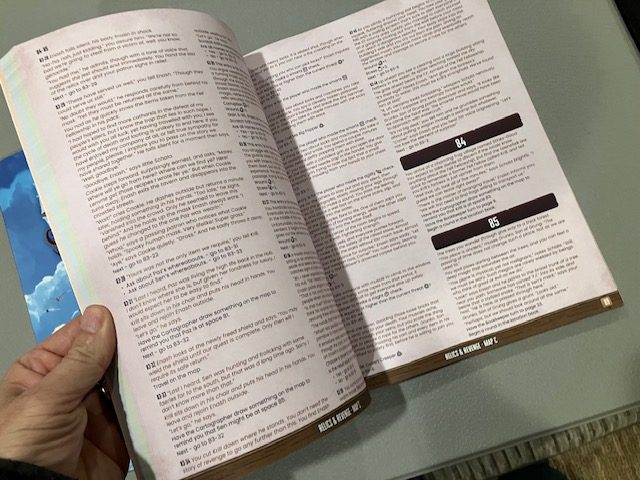
This rulebook … isn’t great.

IMG_9069

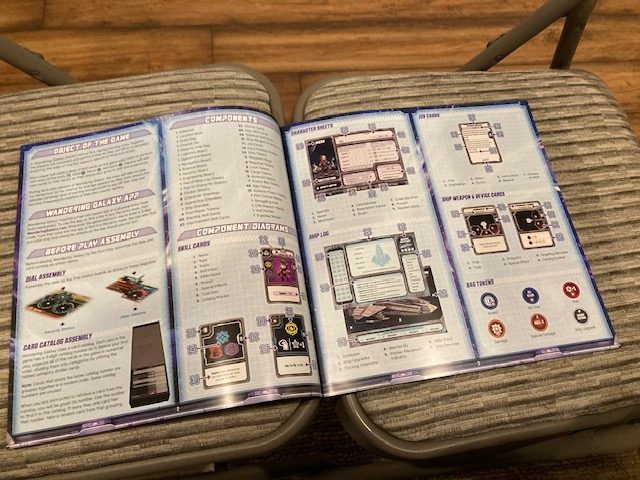
It flops over on the edges, probably get it a D on the Chair Test.

IMG_9084

In the end, I had to use the standard workaround of putting out two chairs with the spine in the middle.

IMG_9091

There’s a lot of stuff in here, but I also found there was a lot of stuff missing.  For example: The travel section discussions were unclear: Do you spend 3 power on each section? Do you have to stop in each section on your way to your destination?  The answer to both questions, according to this BoardGameGeek thread, is yes!!!  I think you will find yourself on BoardGameGeek a lot when you have questions!  Apparently the designer is very responsive on BoardGameGeek if you have questions, he answers quickly … so that’s good.  There is also a Discord channel (mentioned when you bring up the app).

IMG_9085

What I found is that the App is very good at helping you set everything up!  I tended to use the App for all my set-ups and only use the rulebook to look up a few rules.  In general, the App taught “most” stuff.  A lot of things were in the rulebook (and there’s even an index)!  But there was still a lot of stuff missing that you will have to look at BoardGameGeek for … Another example: What does a damage token do?  It’s unclear unless you read this BoardGameGeek thread!!

So, quick summary: use the App when you can, use the rulebook with the index if you have to, then use BoardGameGeek if things are still unclear.  You might go to BoardGameGeek more than you like. 

Story-Telling

IMG_9102

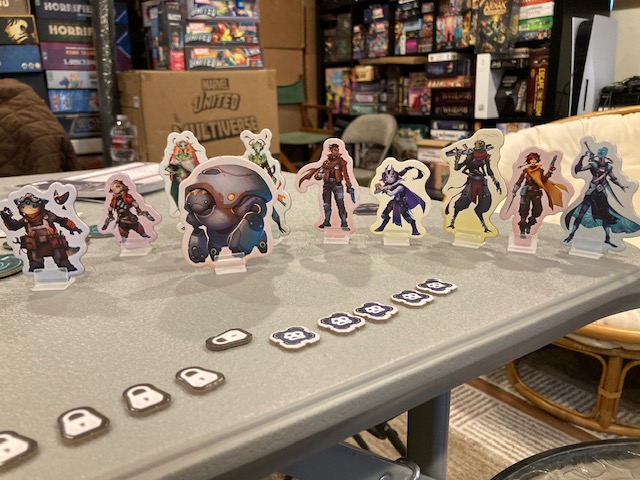
Everyone gets to play a different character in this game!  The art and style of the minis sets the tone for the game: see above!!  It’s very nice art, but with just a hint of silliness.

IMG_9074

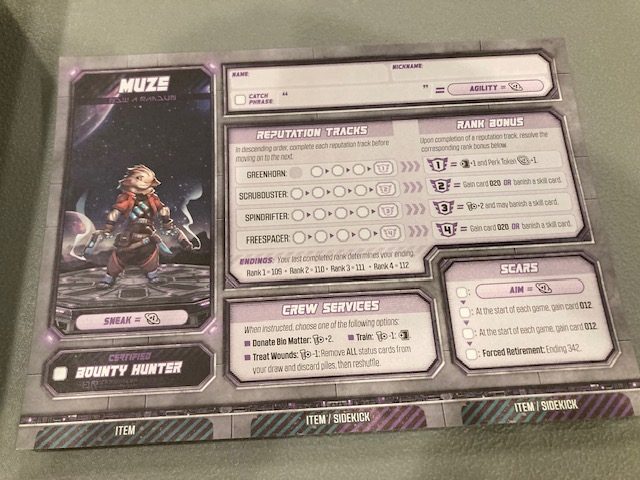
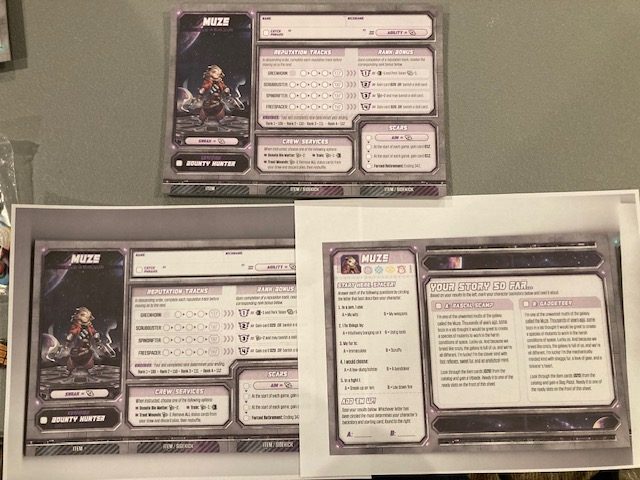
Each player chooses a character to play: there are quite a number of characters, and they each have their own special sheet.  See Muze above … that was my first character!!! I ended up making a copy of the character sheets (using my crappy home copier; it was good enough) so I didn’t mess up the original sheets that came with the game.  (There are a number of these sheets included with the game, but you can either print them yourself or just order more sheets from the web site if you don’t want to sully the sheets).

IMG_9076

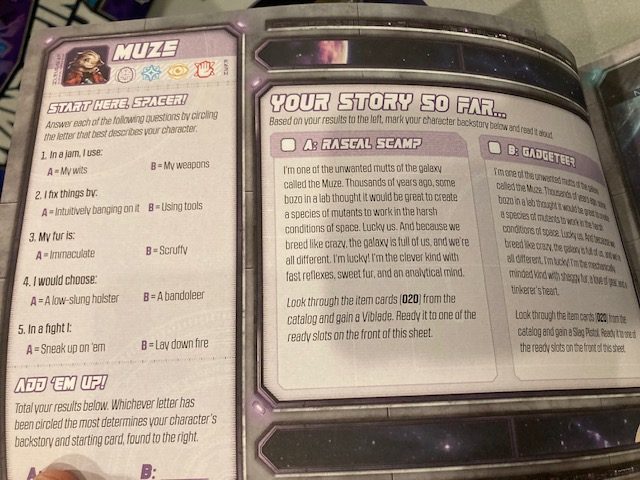
These character sheets are two-sided; the back has your “back-story” (no pun intended).  You fill out the little questionnaire on the left, and that informs your Story So Far… (on right side of the sheet).  This gives you some items and sets the tone for your hero!  This is part of the Story Telling aspect of the game.

IMG_9359

There’s also a sheet for the spaceship (I also made a copy as to not mess that up either).

IMG_9127

Of course, the App itself has most of the story!  It’s pretty cool; it’s narrated with different voices and is pretty funny.

I would say, first and foremost, this is a Story-Telling game.  All the other mechanisms in the game support that central tenet.  You are all characters being swept up in this space opera!

Worker Placement

IMG_9064

I’d say the next mechanism that you feel is the Worker Placement part of the game.  The Location book (above) has the location on the left and the Worker Placement spots on the right.

IMG_9358

Players look closely at the Icons on the worker placements places and place their dudes there.  This is cooperative worker placement, as you are all trying to work together to get certain things done.  To avoid too much “analysis paralysis” or “Alpha Playering” here, the players have 45 seconds to place their dudes!  (That’s the extent of the “real-time” part of this game.  if you were worried about me saying real-time, relax!  You can almost even ignore the real-time part … it’s really just to keep people from taking TOO LONG to play their dudes …)
IMG_9361

Once the dudes are placed, the right hand side of the page shows in detail what each action does.

IMG_9136

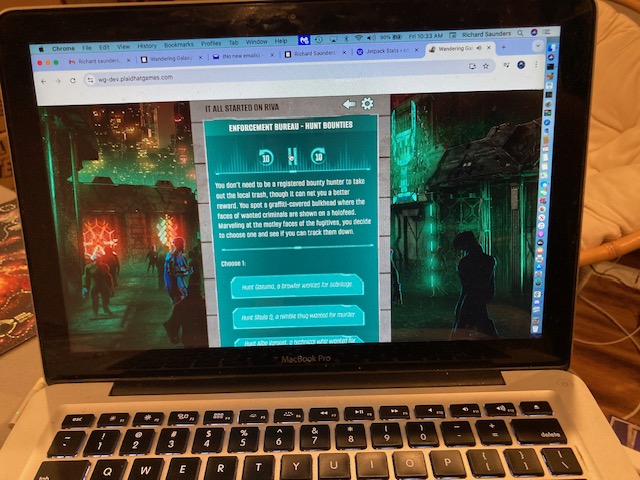
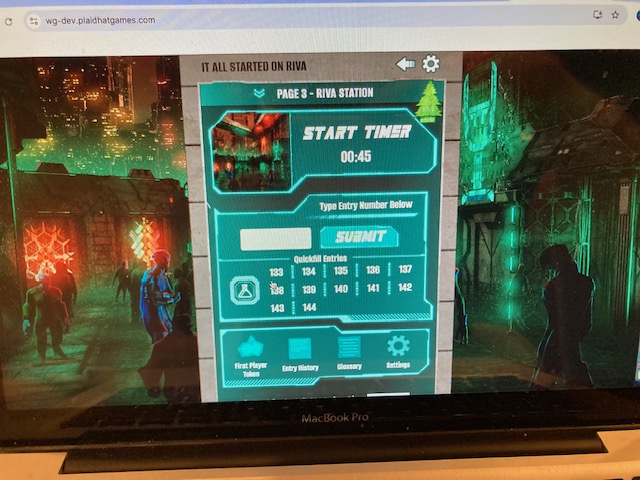
Sometimes your action triggers some text in the App; it gives a number (like 133, see below) and you lookup that entry in the App!

IMG_9129

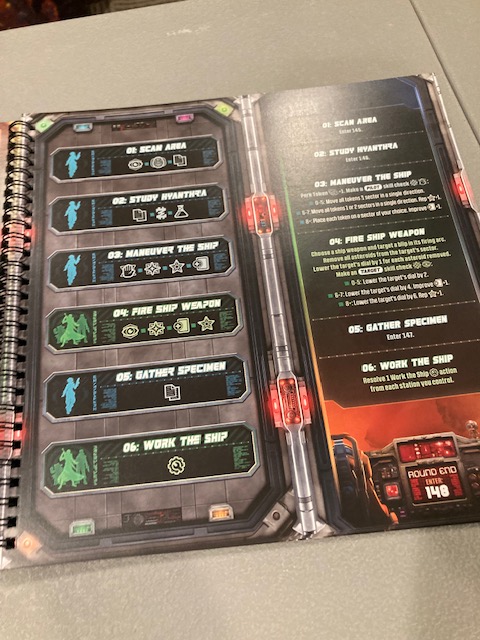
You spend a decent amount of time here on the Worker Placement pages. It wasn’t until my third game that I realized that the Combat also happens using the Worker Placement system …. what? Yep! You head to a special page where you are in “Combat!” Your actions move the ship (so enemies are in view), fire guns (port, starboard, ahead), or even work the ship to repair damage!

IMG_9065

This Worker Placement system seemed to work pretty well, and it’s cooperative.

Deck-Building

IMG_9131

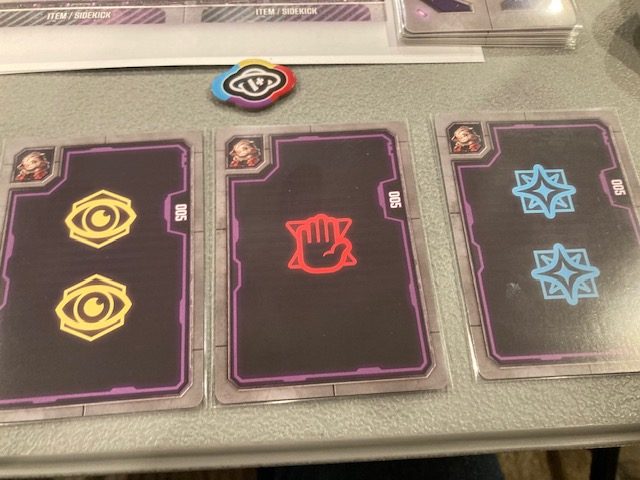
A lot of the game revolves around Skill checks … using your deck!  (I told you there was deck-building in here!)  When you need to make a Skill check (say Muze needs to SNEAK), you draw cards and add up the symbols that match that check!  SNEAK needs blue stars and red hands, so Muse has 3 above.   To be clear, the more symbols, the better!  (You can also use PERK tokens, the little Saturn token, for extra plusses, but you do have to discard those)

IMG_9151

There’s also Items you can “hold” between hands, which you can choose to “help” in your Skill check.  That’s kind of a neat gizmo in the deck-building mechanism.

IMG_9135

At certain times during the game, you have a chance to add cards (or cull) you deck based on the actions you take!  There’s a nice set of 4 improvement card (above the the book, see above and below) that you can choose from!  I mean, it’s deck-building: you have to be able to improve your deck!

IMG_9361

Campaign

IMG_9362

This is a campaign that can last … as long as you want it to!  There is also deck-advancement, as your deck build survives between games of the campaign (luckily, you lose things like Injuries that can clog your deck).

IMG_9113

So, when you finish your current game, you can just be done, or save off the game to play again later!  Nominally, your first full adventure (spanning many games) will be paying off the loan for your ship!

Bag-Building

IMG_9373

Even though there is deck-building in here (a deck for each character), there is also a bag-building portion! See the bag in the bottom right corner above!

IMG_9354

When you travel through space, you typically pull tokens from the bag to see “what happened” as you travel through space!!! (See the tokens you can pull above). Generally, travelling through space is tough on your ship as you take little bits of damage as you travel.

IMG_9365

You can take time at Space Ports and other places to “Work the Ship” to help fix it back up (putting tokens back in the bag).  It’s not a huge mechanism in the game, but it is important to be aware of what’s in the “travel bag” and try to keep it cleanish so that you don’t take too much damage as you travel.  The bag also controls threat, which is how the game can end … poorly.

Star Trek

IMG_9370

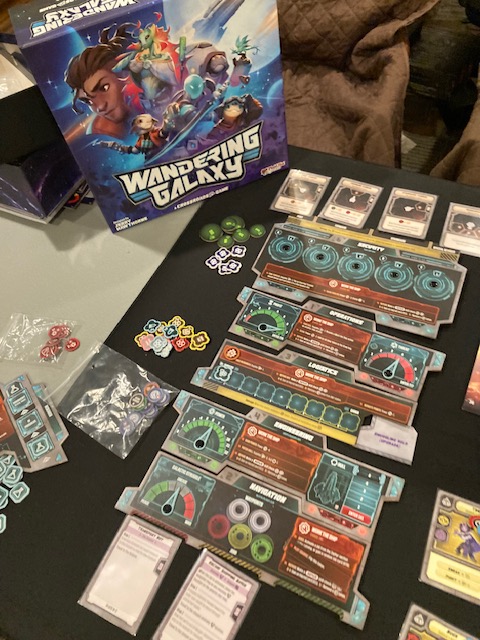
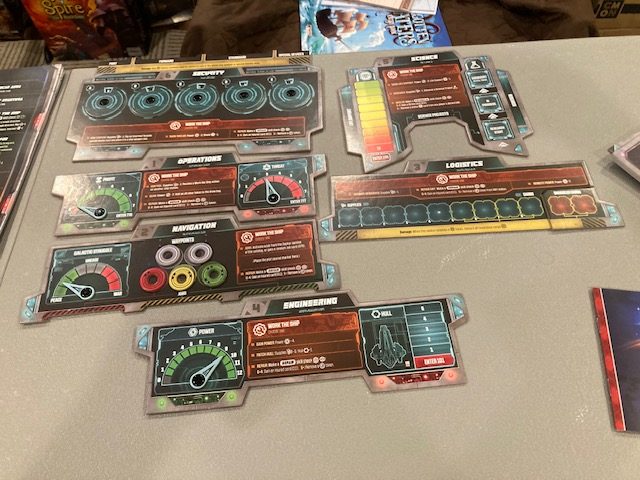
I said there was some Star Trek vibe in here as well … there is!  There are 6 “positions” of the ship that must be manned by the characters!   One player is the Engineer, one player handle Logistics, … Operations, Science, Navigation and Security!  In a game with fewer players, some players will have to man multiple stations!

IMG_9100

This reminds me of the characters sitting around the bridge of the Enterprise, with Spock manning the Science station, Worf manning the Security station, and Paris manning the Navigation station! (Look, I didn’t say WHICH Star Trek …)

IMG_5660
Cardboard!

We’ve already seen this “station” idea in Forgotten Waters (see our review here) and Freelancers (see our review here)! Thematically, it worked great in Forgotten Waters (as pirates worked together to man the “stations” of a ship), and less so in Freelancers.

IMG_9379

Thematically, it works really well here too.  Basically, the stations help keep everyone involved in running the ship and contribute to the theme: we are flying a space ship together!

Pickup And Deliver

IMG_9369

One of the main activities in this game is pickup-and-deliver: you are a space-faring crew wandering the stars, looking for adventure, but usually you are delivering stuff to make ends meet!

IMG_9152

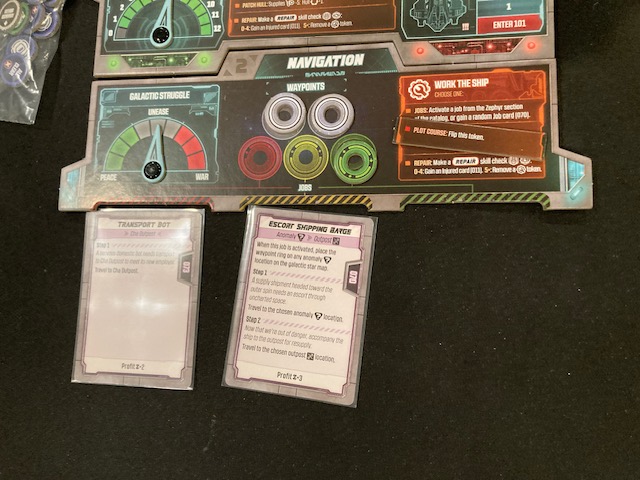
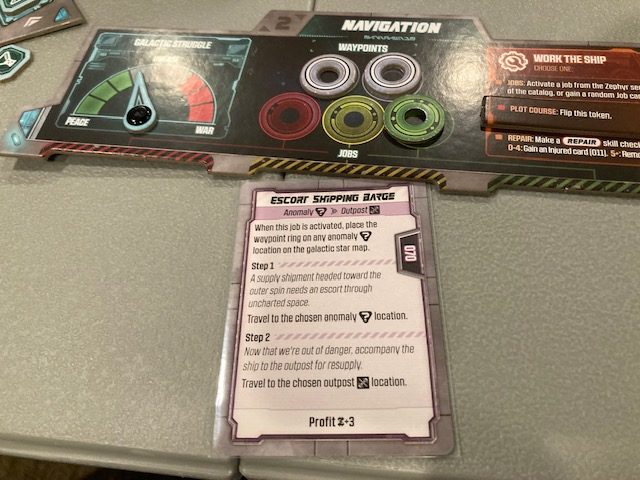
The Jobs you get (above) inform where you go on the star map (see below) by marking them with little waypoint markers.

IMG_9365

The yellow waypoint marker is the yellow job (Escort Shipping Barge).  This pickup-and-deliver mechanism sort of guides were you go in the game.  If you don’t like pickup-and-deliver, you might still like this game, as there are so many other mechanisms in the game.  If you do like pickup-and-deliver, then you will be happy.

Solo Play

IMG_9061

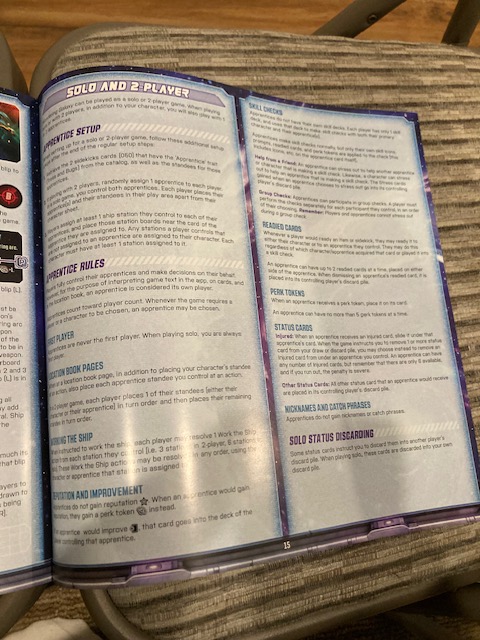
So, Wandering Galaxy embraces the solo player!  (Congratulations on following Saunders’ Law!).  I am surprised a little because the previous games in this series (Forgotten Waters and Freelancers) supported solo mode, but they were bastard step-children solo modes that were only supported by consulting the some arcane rules on the web site!  Okay, maybe I am exaggerating a little when I say that, but Wandering Galaxy really does embrace solo play.

IMG_9113

The rules and the App support solo play as a first-class mechanism!  The app asks you how many people are playing and helps you set-up the solo game in the normal flow! 

IMG_9114

The solo player still operates one the main characters: see above as I operate Muze … (notice I made a copy of the sheet…)

IMG_9120

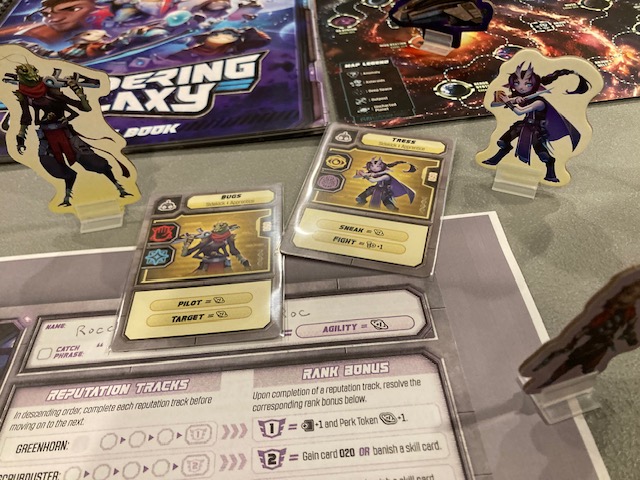
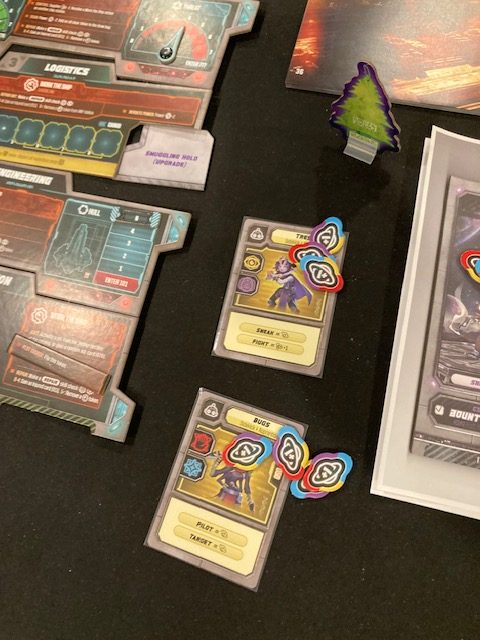
…. but the solo player gets to control two Sidekicks (see Bugs and Tress above).  These Sidekicks aren’t “full characters”, but they are much much easier to operate.  Normally, I don’t like solo rules that go too much outside the normal flow (I usually prefer to play multi-handed solo), but the app was so helpful in setting this up and getting to solo play that I didn’t mind!

IMG_9358

So, when the solo players does Worker Placement actions, the solo player plays his player, and the two Sidekicks as well.

IMG_9367

This means the solo player is also controlling all six stations!  Interestingly, you still have to assign one station for each of Bugs and Tress.  See above as Bugs and Tress each have a station (to their left).

IMG_9137

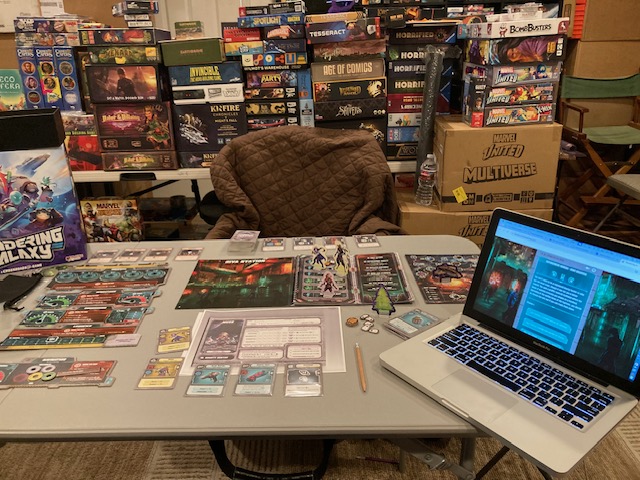
See above as I have the 6 stations, my character Muze, Bugs and Tress, the Worker Placement book, the map of the Galaxy and the App open!  Whew!

IMG_9355

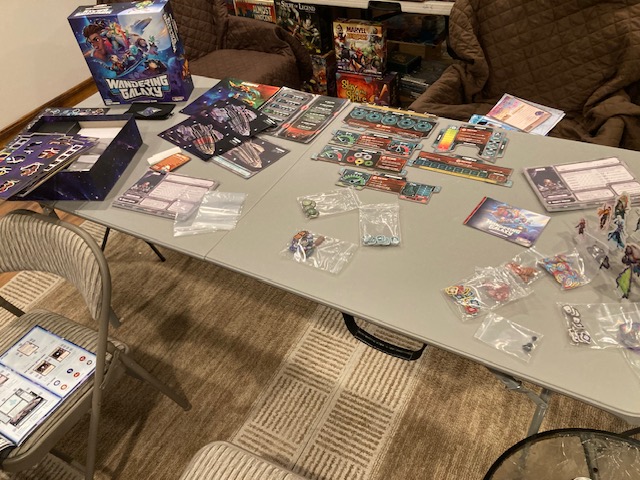
And then the solo player still has to manage the cards (see chair on the left with the card box) and the ship (see the table on the right with the ship)!  And, occasionally the solo player must still consult the rulebook!  See as the Rulebook sprawls across two chairs …Whew! 

IMG_9124

… and it’s actually not that bad.  Sure, there’s a lot of stuff to manage, but the App takes you through the game pretty darn well.   I played my first few games solo, and I had a good time.  I never felt like the ongoing maintenance (to keep the game moving forward) was too much work. 

IMG_9362

Setting up is a bit of work, as is tearing down (see above), but again, the App helps guide you through it.  I’ll be honest, the Rulebook for this game looks daunting (with set-up and rules), but let the App guide you and just use the rulebook when you “have to”!

IMG_9371

I thought the solo game worked well, even better than Forgottten Waters or Freelancers. I jumped right on and had a grand time. I would definitely play this again solo.  I honestly think the App made the solo play that much better.   

IMG_9121

What about the Sidekicks Bugs and Tress in the solo game?  They really are easy to operate: you just use your deck but get slightly different bonuses (depending on which character: Bugs is good at Piloting for example).  They kind of remind me of characters on Star Trek you see in the background all the time, but don’t get much development.  They aren’t full “main” characters who get their own story arcs … like “unnamed Corporal 2”.  For example, when Bugs or Tress would get REPUTATION (a fun way to move a character story forward), they just get a PERK token instead. Poor Bugs and Tress.  Maybe they’ll get higher billing in the next Star Trek show.  (We only have 13 shows, we need a 14th Star Trek show starring Bugs and Tress!!!) (And yes, I added extra exclamation points there, because that’s how strongly I feel about poor undeveloped Bugs and Tress!!!!)

Cooperative Game

IMG_9374

My crew showed up, ready to take the Galaxy by storm!  The crew was originally supposed to be a full complement of six, but space sickness and space madness and space baby-sitting caused us to winnow down to just three.  But what a great crew they were!!  Too bad the spaceship exploded on the pad.  But I digress … 

IMG_9377

Cooperative play worked really well.  Luckily, I had played the game solo enough to smooth out some of the rules (even still, there were ambiguities as we played which were frustrating).  Part of why this game works very well for a cooperative game is that each player owns their own station, which keeps them in involved as they play! And each player has their own character with their own worker placement token!  So, players are always involved (via the station and worker placement) as well as connecting (as they “bond”) with their character, and making shared decisions about the fate of the ship and crew!!! (More exclamation mark for you!!!)

IMG_9376

My friend Teresa liked her character so much that she took it home as a souvenir!

We ended up playing a one-off, but once my group regroups, I suspect we will settle in for a fuller campaign.  It is nice that you can play this as a full campaign or just a one off.

Sense Of Humor

IMG_9122

Just so you know: this game is kind of silly.  The story is silly, the voices are kind of silly, and even the first player token (I chose the Christmas Tree) is silly.    If you were looking for a grim-dark Star Trek game, that’s not this.

IMG_9097

The game has a sense of humor, but it’s not just ALL silliness.  You still have to build your deck, make smart decisions, deal with damage on your ship, pickup and deliver stuff, place workers, and generally make a lot of decisions.  But the undercurrents of the game … are a little silly.

IMG_9852

Even though Wandering Galaxy is silly, it’s still not quite as silly as Freelancers or Forgotten Waters: those games just seem to have sillier stories and sillier resolutions.  So, if you were just slightly annoyed by the silliness of Freelancers or Forgotten Waters, maybe Wandering Galaxy is a better choice for you … but it’s still silly.  Just not as silly.

IMG_9138

You know a game is silly when it brings out the silliness in you!  When we performed the Skill checks, we started singing the Lucky Charms cereal theme songs!  “Blue Stars, Yellow Eyes, Purple Brains!  Frosted Lucky Charms, they are magically delicious!”

Entry Book

IMG_1085

Some of you might have been very non-plussed by the necessity of the App in this game.  Well, if you like reading text from books, there are Entry Books available!   The Entry Book isn’t QUITE done at the time I received my copy, but it will be.  In the meantime, I did pickup the the Forgotten Waters and Freelancers Entry Books (those were part of the Kickstarter).

IMG_1086

Basically, all the reading and entries that the App does  is encapsulated in the Entry Book.  There’s something kind of nice about having a “backup” for this: I have had some games where the App goes dark (Rising 5, I am looking at you); with this Entry book, you can always still play the game if the App goes dark.

My friend Joe actually prefers the Entry Books: he uses these games for his English classes, as it encourages reading out loud!

What I Liked

IMG_9376

Supports Multiple Players Well: the game really works well with many player counts.  The station system helps keep everyone involved, even at higher player counts.   I am glad to see the Solo mode as a first class object.

IMG_9145

Story:  Really, this game is all about the story.  How do you want your adventure in space to proceed?  Life is what happens when you are making plans, especially in space!  Every player is involved as they explore, but generally the story just unfolds and everyone is along for the ride.  If you want to play a space opera rather than watch one, this is a good choice.

IMG_9143

The App:  Despite the app not being quite done (some of entries didn’t have full voice acting, and some entries were incomplete), the App worked quite well.  I think it’s really evolved and easy to use, especially for set-up and first play!  (I mean, they have had 2 iterations to get this right). It’s also good to know there is a backup Entry book in case the App ever goes dark …

IMG_9105

Sense of Humor:  I really like the silliness in this game.  It’s not quite as funny as Freelancers (which was much sillier) or Forgotten Waters, but it was funny.  Caveat Emptor: you may not like the silliness.

What I Didn’t Like

IMG_9085

Ambiguity: By far the biggest complaint is the ambiguity in the Rulebook.  There’s just too many places where things are NOT well specified. We’ve mentioned at least three things in this article alone where we had to go to BoardGameGeek to find the resolution!  The game still works, but it’s very unsettling to have just a few too many places where the rules are poorly specified.  Some of this is because maybe the game came out early; the App still needs some work, and maybe they will fix-up the ambiguity in the App. Unfortunately, the Rulebook can’t be amended (unless they put up a version 2.0).  Just prepare yourself to look stuff up on BoardGameGeek.

Conclusion

IMG_9374

I liked Wandering Galaxy and so did my friends!  It’s the next great game in the Crossroads games series (after Forgotten Waters and Freelancers).  It’s probably the most complicated of the three games, but it’s possibly the most thematic of the three.   Be aware that that there are a lot of mechanisms: deck-building, campaign, bag-building, pickup-and-deliver!  … but the game feels paradoxically both heavy and light!  The game glides along as you enjoy the story, with some heavier mechanisms behind the scenes.

IMG_1085

An App is required to play … unless you have the Entry book (at the time of this writing, the Entry Book for Wandering Galaxy is not out, but should be soon (the Forgotten Waters and Freelancers books are already out).  Despite the App not “quite” done at the time of this writing, it did a marvelous job bringing us into this world. It even embraced the solo player well!

IMG_9376

This is a great light-hearted cooperative adventure for you and your friends! It’s not “quite” as silly as Forgotten Waters and Freelancers, but it’s still pretty silly.

IMG_9112

This is probably an 8/10. The only real problem with the game was the ambiguities that kept coming up: If you are pick-up in this game, I suspect you will be looking up a lot of stuff on BoardGameGeek. But, since the App is a dynamic entity, hopefully they can address a lot of those issues within the App itself. Hopefully, by the time you read this, the App will have fixed all those problems and this will rise to a 8.5/10. It’s a really fun game.

A Fashionable Cooperative Space Game! A Review of Conquest Princess

IMG_8548

Hear me out; this game is better than it looks. I know, I know, I don’t love that cover either, but once you get inside, this game really does come alive.

IMG_8378

Conquest Princess is a cooperative bag-building game with elements of boss-battling and collection.  This game was on Gamefound back in June 2023.  It had a fairly small pledge group of about 668 people but it did succeed in being funded.  I went all in!  I got the base box, plus the mat, plus the acrylic tokens, and the bags!

IMG_8381

If I were to describe this game to you, I would describe it as The Captain is Dead (which is a cooperative space game we reviewed here, here, and here) meets a bag-builder like Invincible (a cooperative bag-builder we reviewed here).  

Let’s take a look!

Extra Specials

IMG_8378

I am very pleased I went all-in on this; I got some pretty great stuff.  Normally, I worry that a game with such a small crowdfunding presence won’t have great all-in stuff, but boy was I pleasantly surprised!  I am SO PLEASED with the extras!

IMG_8384

This is a bag-building game, remember?

IMG_8385

This upgraded “extra” bag is fantastic! 

IMG_8459

It can even stand-up on its own! See above!

IMG_8388

And the acrylic tiles that come with it are gorgeous! Bag of Destiny: totally worth it.

IMG_8389

Standees of Utmost Elegance?  Very good!  Anyone who know follows this blogs knows that I love the acrylic standees, even over miniatures! The acrylic standees from Tokyo Sidekick (see here) and from Kinfire Chronicles (see here) have convinced me that I prefer the acrylic standees!

IMG_8392

The Standees of Utmost Elegance box comes with a bunch of standees (right), bases (middle) and some acrylic danger tokens (left): see above.

IMG_8396

All assembled, those look pretty great! See above!  The art is a little cartoony, but I think that’s why the clear acrylic standees work so well in this game; they accent that comicy nature!  I am very very happy with The Standees of Utmost Elegance!  I wish the art was just a touch nicer, but I still liked it.

IMG_8402

Look at all that great acrylic standee stuff!

IMG_8403

The third and final box is the coolest: Lights Of Opulent Extravagence!  

IMG_8404

It includes metal first player token (right: above) and 16 action coins (left). Wow!

IMG_8405
More importantly, it includes the light-up standees.  You heard me.  Light-up standees!

IMG_8407

Each character can “transform” in the game, and when they do, they get the cool light-up standee! See above!

IMG_8410

The extra specials for this game gave me a WOW and put a giant smile on my face!  This is the feeling I wanted when I opened Freedom Five from a few weeks ago.  I got that WOW feeling from Conquest Princess instead!!

Totally worth getting the extras and all-in. 

Upgraded components are great, but what about the game?

Unboxing and Some* Unpunching Required

IMG_8550

The base box is fairly tall, but width and height is pretty standard. See Coke can above for perspective.

IMG_8451

I sort of had a weird dillema when I opened everything up!  A lot of the tokens are already acryclic, so which ones do I punch out?

IMG_8452

IMG_8453

IMG_8454

So, I ended up punching out about half  the cardboard punchouts; the other half were from the acrylic standees and metal tokens.

IMG_8455

IMG_8458

I mean, everything looks pretty cool, right?

Gameplay

IMG_8444

1 to 4 Players assume the roles of the 4 characters in the game: see above and below.

IMG_8537

This is an action point game; actions are notated on the Wrist Blaster board (bottom board in photo above). Each character gets 4 action points on their turn, denoted by the metal tokens.  The player will slide the token down to indicate a move, shoot, or engage action.  Occasionally, you can use energy to get an extra action (last column).   The armor on the side is armor to prevent damage.

The Fashion Plate board (above and below) is where you place special cards, pets, and powers. 

IMG_8542

This game is a space game with a large dollop of fashion in the theme!  You heard me, fashion!!! One of the catch phrases of the game is “Fashion is Power!!”  Generally, this is a space game, where some of the equipment you’d get in a pure space game is instead accented as fashion accessories.  

IMG_8540

You can see a little of that in the gear (I mean fashion accessories) above: Carbonite Kicks, Hsi Sniper Sleeves.  It’s more fashion accessories than gear, but it’s also gear.

I’ll say this: if you want to play Conquest Princess as a pure, straight-up space-theme game, you can almost ignore the fashion part and just pretend it’s a pure space-themed game. But if you really want to embrace the “Fashion is Power!” vibe, you can have a lot of fun with that.  This weird cross-pollination of space and fashion may seem like a turn-off, but it’s not; you can choose to embrace either side (or both sides!) of that theme and it still works.  I generally played it solo as a pure space game; whereas my cooperative games with my girl friends embraced the fashion part.

IMG_8480

The T.I.A.R.A (above) is generally the main ship and this is where I get a lot of The Captain is Dead vibe from! Players move around the ship taking out the Minions in orange thongs (yes, you heard me right, orange thongs) and keeping the ship clear of baddies.

IMG_8471

The ship has all sorts of different subsystems: Teleporter (above: for moving off ship), Engineering (above: for repairing subsystems), Mendenry (above: sick-bay), Comms (below: show upcoming bad news cards) and finally the Wardrobe (below: the weapons sills).

IMG_8473

IMG_8472

If the minions get attacks off while in the ship, they put those subsystems into disrepair.  See above as the Wardrobe has been critically damaged!    Keeping the ship healthy and in repair is a huge deal; it keeps your systems active.   Every single one of these subsystems is useful! Healing! Better gear (I mean fashion accessories)! Looking ahead at Bad News! Teleportation! 

IMG_3168

Those of you who have played The Captain is Dead (see board above) will find this subsystem stuff very familiar!

IMG_8526

If all you did was keep baddies off the ship, the game wouldn’t be very interesting! In the Standard Game, you have to worry about two planets where stuff is happening! On Planet 1  (standard game) is the Invasion! See above!

IMG_8546

On Planet 2 is the Mechapede!  

IMG_8593

These Planets do change: in the Advanced game, there is the Dark Portal (see above).

So, while you are keeping baddies off your ship, you are also teleporting to the planets to achieve your mission goals!  Sometimes your missions are to collect items, sometime your missions are to keep the chaos on planets under control, and sometimes your mission is to move to the Dark Portal! 

IMG_8466

What you do depends on which of 4 scenarios you are playing! See the four scenarios that come with the box above! For the record, you can play any of the scenarios, but it’s recommended you play them in order as a campaign from Tutorial, Standard Mission, Advanced Mission, to Boss Battle! The game just gets harder and harder!

IMG_8580

So, Conquest Princess is a balancing act of keeping the ship free of baddies, the planets under control, and staying alive!  

IMG_8599

This game has a peculiar, but consistent and interesting loss mechanic: you cannot lose unless you run out of power!  You only run out of power if the Power Up deck (above) is ever empty! It starts with 28 cards!

IMG_8598

But every time something goes bad that would immediately end the game (where a character takes a third damage, or too many minions overrun the ship, etc, etc) instead you take a disruption!  Your ship has a time-travel mechanism to prevent the bad thing, but the cost to stopping the badness is huge!  A disruption causes players to discards Power Up cards equal to the Danger Level (most games start with a Danger Level of 2: see above), and every disruption increases the Danger Level by 1!  If you ever can’t discards enough cards to handle a disruption, players immediately lose!

I like this loss mechanism, as it scales, it is simple to explain, and handles all endgame cases consistently.  There is only one loss mechanism; just don’t run out of of power!!!

IMG_8594

If players can collectively succeed in their quests before the power runs out, they win!

Comic/Tutorial/Scenario Book

IMG_8412

There’s quite a bit of reading material.

IMG_8441

The comic book is just flavor for the adventures; you don’t have to read it.

IMG_8442

I found the art inconsistent with the rest of the game (see above), so I thought it actually detracted from the experience.  My friends read it while I was making dinner and they said it offered some nice thematic basis; they liked it.   Read it if you want, you don’t have to.

IMG_8511

The Tutorial, on the other hand, was AMAZING!  See above!  It walks the players through the first 3 rounds of the game very explicitly!   You ABSOLUTELY must and should read the playthrough from the Tutorial!  This does what a great Tutorial does; explain what you can do, what you shouldn’t do, and make you feel like you can play without needing too much of the rulebook!  The Tutorial is a shining star in this game.

IMG_8513

Finally, the Scenario Book (not particularly well marked, above) has the directions for play and set-up for the other three scenarios in the game.   It was … okay.   There are a LOT of new rules in later scenarios, and it could have done a little better job explaining some stuff.  I think it just needed some more edge cases explained.    I think you will be going on BoardGameGeek a lot for these scenarios to look up rules.  In general, this scenario book was ok.

Rulebook

IMG_8456

This rulebook is generally okay.  It has some flaws but some nice features too.

IMG_8450

See above as it flops over the edges on the chair next:  it’s not great.  I’d give this a D in the Chair Test: the fonts are good, the pictures are good, but the rulebook is just too big and can’t sit on the chair next to me; it flops over the edges. See above!!

IMG_8468

We’ve seen this “rulebook-too-large” problem a lot lately (See our  Batman: Gotham City Chronicles and Tidal Blades 2 reviews): luckily, there’s a decent workaround! Put it on TWO chairs next to you (with the spine in the middle so it stays open). See above.

I wanted to like this rulebook; it has a good-sized font, lots of pictures, and even an Index! At the end of the day, I didn’t love it.  I feel like there were some edge cases missing, and I didn’t like the way the certain things were expressed.  But, they made a good faith effort to make a good rulebook, so I will say this was good enough.

In a Second Edition of the game, I want another pass by an editor please. And a smaller form factor, please.

Solo Play

IMG_8377

If you get the player Mat with the game, recognize that it is two-sided.  One side has the set-up for SOLO play: see above.  That’s the way I played.  For the record, this is THE BIGGEST player mat I have (even bigger than Robinson Crusoe: Collector’s Edition from a few months back!!).

IMG_8545

So there is a solo mode!  (Thanks for following Saunders’ Law!) Unfortunately, like Heroes’ Resistance, Set A Watch, or Cyber Pet Quest (from last week), the solo character must control all 4 characters!  In fact, no matter the player count, all 4 characters must be in play.

IMG_8580

Of course, a 4-character solo play isn’t ideal; there is context-switching overhead as you switch from character to character (you play one character at a time), there is extra maintenance as you play (as typically the maintenance scales linearly with the number of characters), and there is simple intellectual pressure to use all four characters well together.

I will say that Conquest Princess works well as a solo game if you like a longer solo game and if you embrace Player Selected Turn Order (we’ll discuss this down below).  Conquest Princess is  basically a puzzle to solve with spinning plates: you try to keep the bag in a good state (remember, this is a bag-building game), while keep the ship and planets under control.

IMG_8595

Solo, I have now played the Tutorial once, the Standard Games about 4 times, and the Advanced Game once.  The Tutorial was relatively quick, but the Standard and Advanced Games were pretty long games, taking about 2 to 2.5 hours each.  

IMG_8383

The extra context switching and maintenance overhead tends to elongate the solo game that much more! The box says 45-70 minutes? No way. It’s at least 2 to 2.5 hours for a solo game.  

IMG_8590

But, I feel like every step matters in this solo game: each character gets 4 actions (5 if you waste a power token), and each turn matters!  What’s the best way to keep the chaos under control AND keep the bag in good shape?

I liked the solo game.  A lot.  It was fun trying to figure out how to keep the characters working well together.   And the solo game did a really good job at teaching the game so I could teach my friends. Again, that Tutorial is phenomenal for the solo player (and the cooperative players).

Cooperative Play

IMG_8556

The other side of the Player Mat made the weird choice to have no set-up information or templates for the cooperative: it has only flavor text and pictures.   It wasn’t too bad, but I thought it was busy (from a graphic design perspective) and got in the way just a little bit.  It was fine, but the Mat for the solo mode was much more helpful. See above.

IMG_8557

Cooperative play at 2 and 4  players is ideal: in 2-Player mode, each player operates two characters. In 4-Player mode, each player gets their own character!

IMG_8559

Unfortunately, 3-Player mode makes one player operate two characters (which is usually me, since I have played the game more than anyone).  

IMG_8561

Whereas my solo plays embraced the pure space game, my cooperative plays embraced the fashion parts!  That is probably because I played with the two friends Sara and Teresa!

IMG_8566

There’s a decent amount of discussion going on as you play, as players need to figure out how to work together and share their fashion plates.

IMG_8542

For example, players WANT to be on the same space as the Green character because then they can do multiple ENGAGE actions (usually, a single ENGAGE ends your turn).  So, sometimes players may travel in packs to reuse their Fashion Plates!  But then, you can’t get enough done if you stay together, so sometimes they have to split up!  What’s the best thing to do?   The sharing of Fashion Plates and that discussion really does facilitate the cooperation in the game.

IMG_8557

The Tutorial also worked fantastically in the cooperative game! Players would read the parts of the tutorial relevant to their character and then act it out!  Again, this tutorial worked really well.

IMG_8560

And the cooperative game also moved along a little faster, as there was shared maintenance, and each character had the agency of a single player!   The game still feels a little longer than 45-70 minutes, but it was definitely shorter than the solo game.

IMG_8567

Generally, my friends had fun and want to play again.  One major complaint was that the rulebook wasn’t great for edge cases (a similar complaint we had initially: see as Sara tries to find a ruling and fails).

Player Order

IMG_8476

In the rulebook and rules (page 8 above), there is an entire page discussing player order and who is Lead Agent (first player).  The rules are complex and they depend on something called “LOAD” and how many players are playing.  If there is any question about LOAD then players select. What is LOAD? LOAD is a messy notion about the number of MISS tokens on your board.

IMG_8597

See above as the RED player has too much LOAD, so probably can’t go first.

IMG_8492

We need to get real for a second.  I like this game.  A lot.  but there is a LOT of randomness that can detract from me liking this game.  There is just enough mitigation between bag maintenance and special powers and so on to keep me involved.  But I am on the cusp.    The rules for first player need to be completely streamlined: it’s too much intellectual effort and it feels … random.  “Oh, I should go first, but I can’t because I drew poorly and got LOAD last turn??”  No no no no no no no.  

This game needs Player Selected Turn Order:  players simply should simply decide the order they play on their turn.  This will allow characters to support each other to feel like they have gigantic turns!  Get the RED character to help you so you shoot better; get the GREEN character to move to you so you can ENGAGE twice!  These are decisions the PLAYERS should make, not have some esoteric mechanism (Lock and Load and LOAD) deciding player order.

Blow away all the rules for player order (an entire page in the rulebook) and just let the players decide what order they want to go!  This makes the game that more cooperative as players will now discuss the order they should go!  It helps cooperation!!  Without Player Selected Turn Order, this game becomes too random for me and I would give it a 6 or 6.5/10.  With Player Selected Turn Order, I feel powerful, potent, cooperative, and engaged! And the game is much better, an 8/10 or 8.5/10.  It makes THAT big a different for me.

Yes, this is a House Rule.  Play with or without it, but I suspect you like the game that much more with Player Selected Turn Order.  Decide for yourself.

What I Liked

IMG_8401

Acrylic Standees: If you can get Acrylic Standees, I would recommend it. They really complement the comicy vibe of the game, and they just look great on the table.

IMG_8508

Transformation: It’s very cool when you transform!  If you have the light-up standees, that makes it even cooler, but it is such a cool moment in the game when a character transforms to their super!  The character gets an immediate power, becomes more powerful, and heals up!  It feels like a movie moment when a character becomes powerful just in time to save the crew!

IMG_8573

Components: Even if you just get the retail version of the components, the components are still nice. I am very glad I got all the premium upgrades, but that’s up to you.

IMG_8597

Bag Maintenance: This is a bag-building game, and you have to keep the bag in shape! If you have too many “MISS” tokens in the bag, you just won’t be able to do well you attack, so you have to make sure to keep as many “HIT” tokens in the bag as possible! You may to use the COMMS ENGAGE action to scoop up all the HOT tokens on the ship, or take out one line of the MECHAPEDE to put all those hit tokens in the bag! As you go around, you must keep the bag state in mind or you will lose! Even if you do draw MISS tokens (see above), you can trade them for POWER tokens in future turns! (You can use POWER tokens for future actions or to transform!). I love that!! Even if you fail, you can still do something good LATER in the game! I hated Freedom Five from a few weeks ago because all failures were independent … at least here, a Failure can bring you choice! (And putting a failure on your board keeps it out of the bag too! Maybe you keep it out of the bag just to help your friends!!)

There are just enough mechanisms in the game to help you keep the bag state under control that you feel like you have agency in how the bag is. I love that; It doesn’t feel too random.

IMG_8594

Star Trek Vibe: There is a Star Trek vibe here in Conquest Princess. Just like The Captain is Dead. Now, I love The Captain is Dead, but it was always centered on the ship only, and Star Trek is all about beaming down to the Planet. Here, in Conquest Princess, we can beam to TWO planets! And they are very different! I feel like Conquest Princess does a pretty good job of embracing that Star Trek vibe.

IMG_8588

Sense of Humor: This game has an sense of humor. Wardrobe Malfunction as a card name? Ha! It’s even thematic as you lose your core suit. There are little bits like this all over the game.

IMG_8458

Play How You Want: Play this as either a pure space game or embrace the fashion aspects, or both! If you don’t like the fashion aspect, don’t let it drive you away: this is a good space game.

What I Didn’t Like

IMG_8567

Rulebook: The rulebook and scenario book need some work; mostly edge cases need to be specified more.  There were just too many times when it wasn’t “clear” what needed to done or how to deal with something.  I’ll give the rulebook credit; they did a lot of things right.  It’s just that each scenario has SO MANY rules, it’s hard to get everything right.
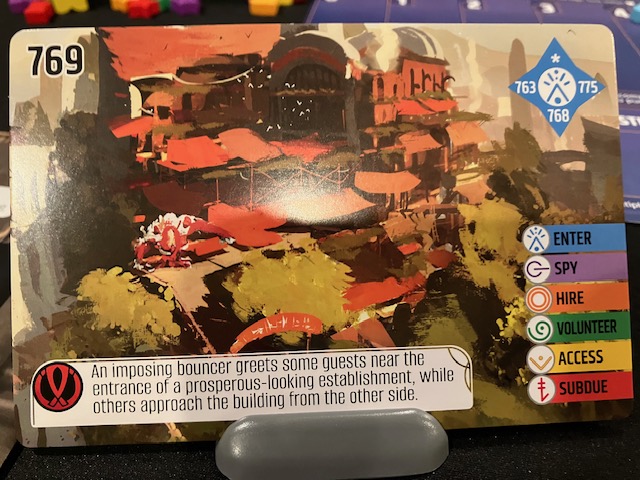
IMG_8475

Turn Order: Jettison the entire set of rules for player order and lead player (an entire page!) and just use Player Selected Turn order. It’s simpler to explain and makes the game more cooperative. The game even makes it easy to notate as you have to move the action tokens!
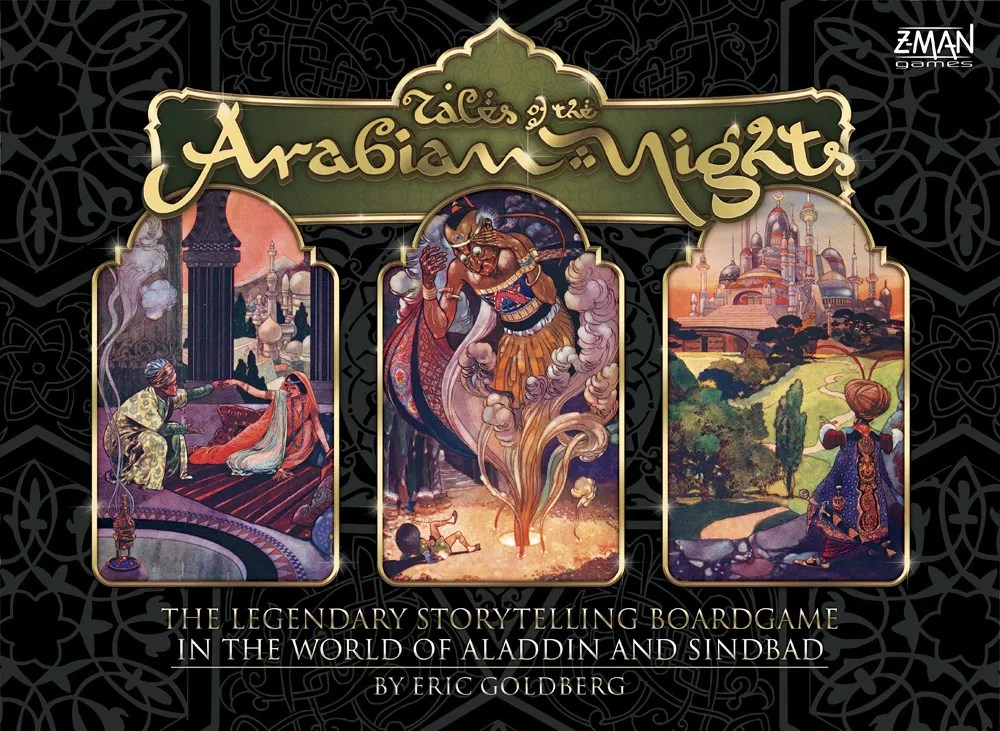
Conclusion

IMG_8569

Conquest Princess was a bit of surprise! I didn’t expect to like it as much as I did!  At first it looks like just a pure space  themed game, but it has a strange auxiliary fashion theme which you can choose to embrace or not!  So, don’t be turned off by some of the fashion references; you can play this as a pure space game and still really enjoy it!  Or you can embrace the fashion theme wholesale!

IMG_8529

There are so many great things about this game; from the Transformations, the bag-building, keeping the ship intact, keeping the bag well-seeded, helping each other, and communicating!  There are no communication limits in this game, thus players can work together well!

IMG_8474

I can’t recommend this game unless you jettison the turn-order and first-player rules; they are complicated, messy, full of exceptions, and take up an entire page (page 8) in the rulebook.  With the turn-order rules as-is, I would probably give this game a 6 or 6.5/10: those action rules are too complex and make the game too random so that players can’t support each other!  If, instead, you throw away page 8 of rules and instead embrace Player Selected Turn Order, this game moves to an 8 or 8.5/10!  When players support each other, the game feels more engaging! Players have more agency!  Players have more powerful turns!  Players communicate more!  Yes, this is a house rule, but I think it’s critical if you are considering this game.
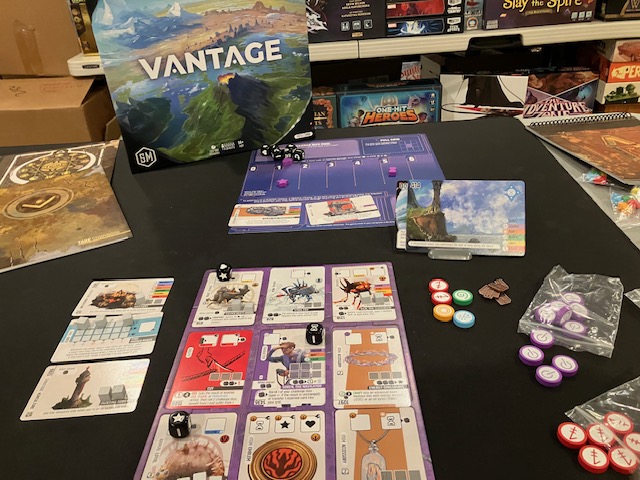
IMG_8595

I love all the upgrades they have for this game, and maybe you will too; just be aware it’s a fair chunk of change to get all the upgrades.

IMG_8547

Despite the 4-character solo mode, I had lots of fun playing this as a solo game.  This may make my Top 10 Solo Games of 2024!

So, there it is; I like this game and would recommend it but only if you embrace Player Selected Turn Order.  I guess it’s not a surprise I liked this game: it’s basically the Captain is Dead meets Invincible, and I love both of those games.