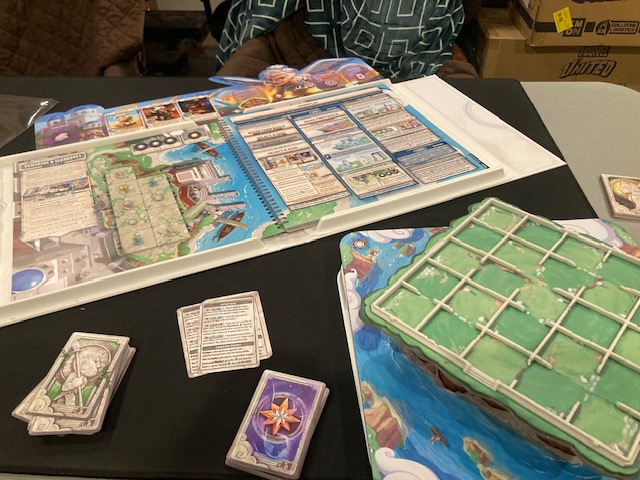
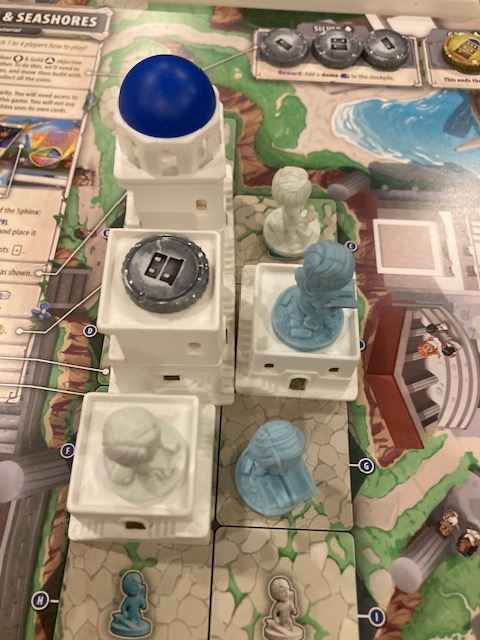
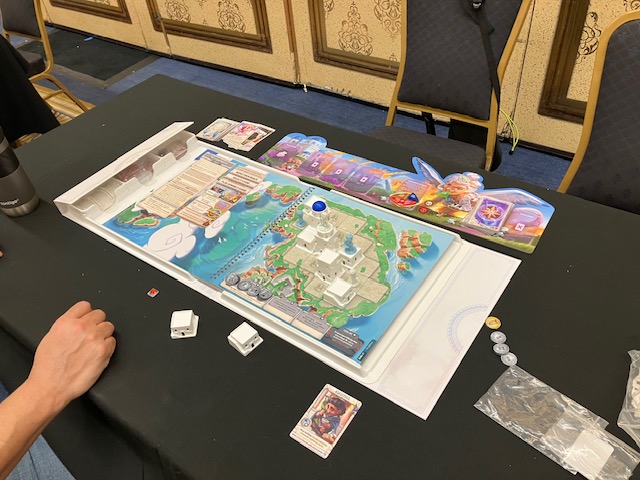
The Original Ikeans: Vikings Building Furniture! A Solo and Cooperative Review of Valheim

Follow us along as we enter the world of the Vikings! Explore lands, find resources, fight big-bads, and … build furniture? Valheim is a big game that I had to “absorb” over a month to crystalize my feelings. I have lots of thoughts … as do my friends! Did I like it solo? Did me and my friends like it cooperatively? Follow us on our journey!

Valheim is a cooperative boss-battling and furniture-building game (yes, you heard me right) that was on Gamefound back in October 2024.   It delivered in October 2025.

This is an exploration game where players play as Vikings exploring the world and looking for resources to build furniture and weapons!  Although some of my friends might see the furniture-building as the main goal of the game, the furniture-building is a secondary goal; the furniture is for upgrades so players can fight the big-bad at the end of the game!

Let’s a take a look!

Unboxing

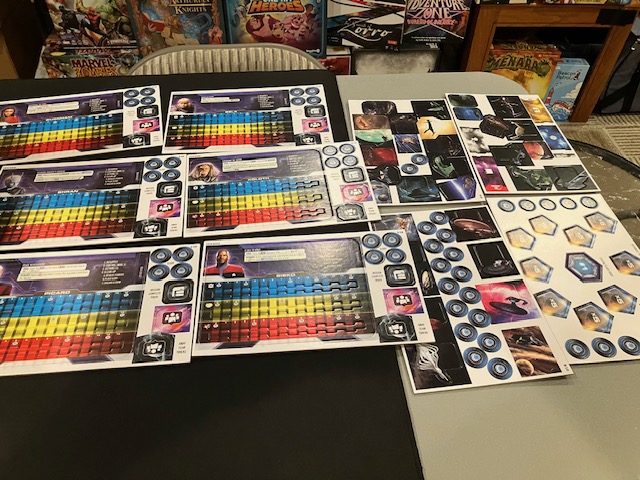
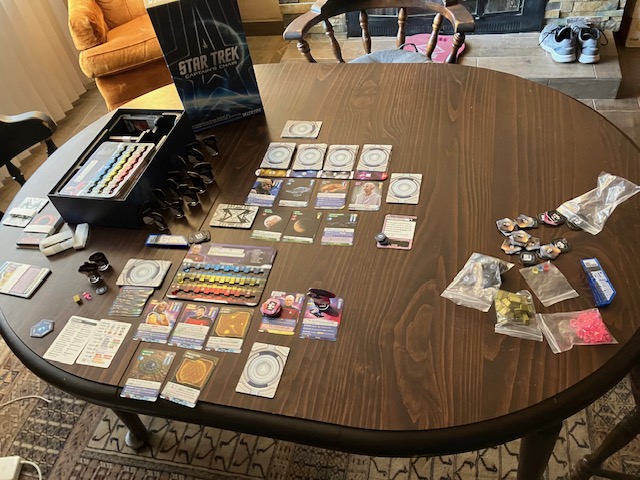
The first day I got Valheim, I spent 2 hours unboxing, punching out tokens, sleeving cards, and generally organizing the game.

The unboxing was a full two hours of work!  

Valheim is a big mama-jama of a game!  See above! I backed the full all-in package for this: SPOILER ALERT!! You don’t really need most the stuff from the deluxe kickstarter version.  The Dice Tower? Nah.  The Dice Tray? Nah.  The Playmat?  Nah (the board is better).  The card sleeves … there are issues (see later).  The Wooden Furniture is by far the best thing to get.  See below.

If I had to do this over again, I probably would have gotten the non-deluxe version. But I still would have somehow tried to get the wooden furniture….it’s awesome and thematic.

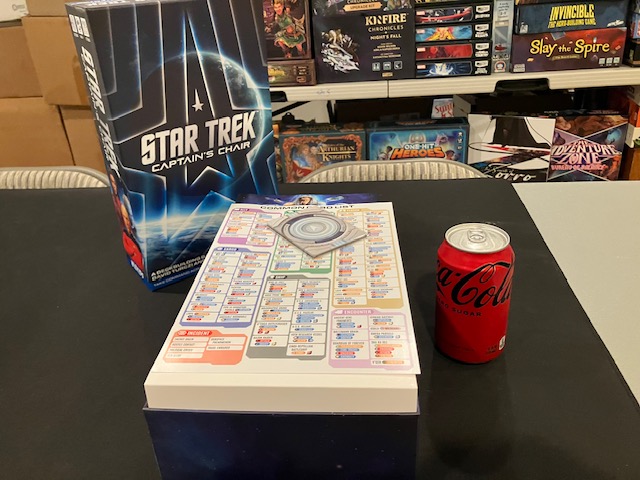
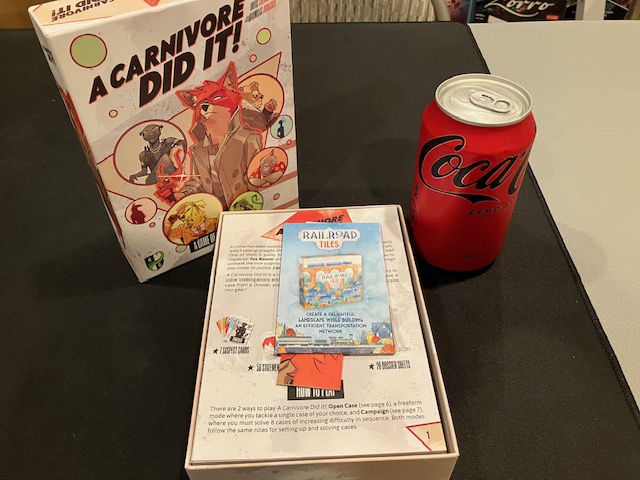
The deluxe box is huge: see the Coke can next to it.

This is just a big game.

It’s pretty fancy looking.

Like I said, it took a while to unbox/organize this; about 2 hours.

Gameplay

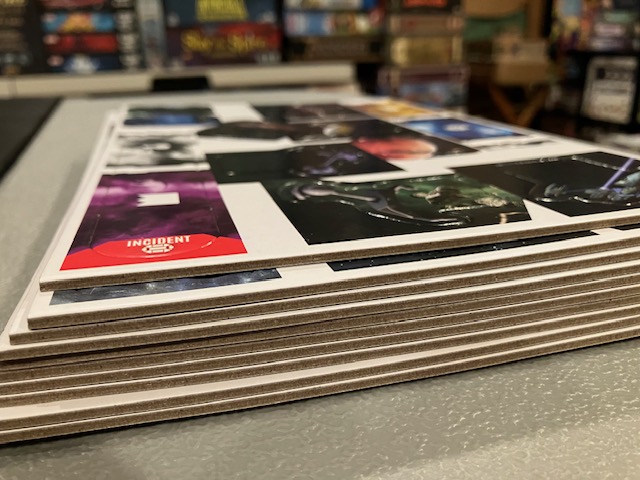
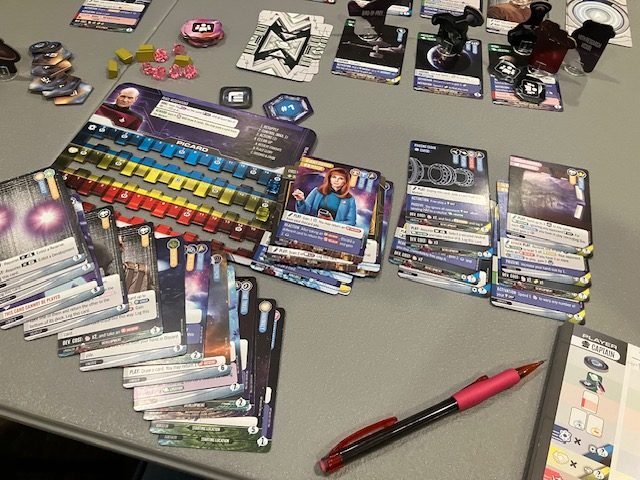
Each player takes control of one of the four characters.  These characters boards are really nice dual-layered boards: see above.  But the characters have no name or even designation (the archer? Maybe?)

Each character is just an empty template until you choose the skills; each player gets three skills! See above as the archer? (no name) gets Healthy, Carpenter, and extra move (lower right).

As you play, you can fill in the consumables area with all sorts of cool meads, potions, and things like honeycomb!  (You can actually build a beehive in the game!  That’s a type of furniture!)

As the game progresses, players can make or find weapons and armor to help in their quest.   See above as the yellow swordsman (seriously, no names for anyone?) gets a Hammer, Leather Tunic and Fire Wood Bow!

The cost of each items is in the lower left; you have to build your items too!

Players explore a world of hexes as defined by the scenario chosen!  See above!  Players are looking for resources from which they build their furniture and their weapons!

Resources generally are at particular Locations: see above, where blue archer can go exploring at the “rocky place” to get rock.

As the game unfolds, the players collectively collect more and more resources!  See above.

The resources in the environment are in a nice container (see above).

Another resource tray holds potions, consumables (like honeycomb) and other tokens.

The resource trays sit at the bottom of the board, right next to the house. 

The house is where you build furniture and keep resources.

Of course, this is a hostile work environment, and there are little monsters to fight along the way!  See the Greyling one space away.

The monsters are pretty well-defined on their cards.  The Greyling has 2 hits, rolls 1 black die during combat, and gives some resin as a treasure if you kill it.

But of course, the final thing is (usually) killing the big-bad!  See above!

In fact, fighting the final big-bad is a very different combat!  You “summon” the big bad, then fight them in a special arena!  See above!

If you can drop the big bad (Ekithyr above) to zero hit points, you win!   If you all die in the final arena, you lose! (You can also lose if you fail to summon the big bad before the event deck runs out)

Explore hexes, gather resources, build furniture, fight monsters, roll dice, and summon the big bad!  That’s Valheim in a nutshell!

Rulebook

The rulebook is ok, but it has three major major flaws.

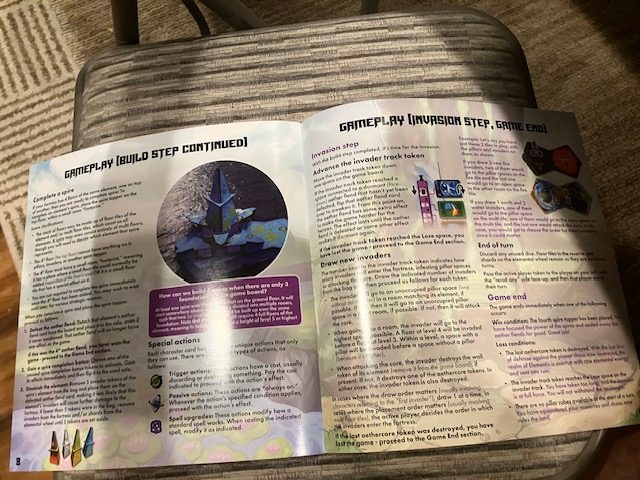
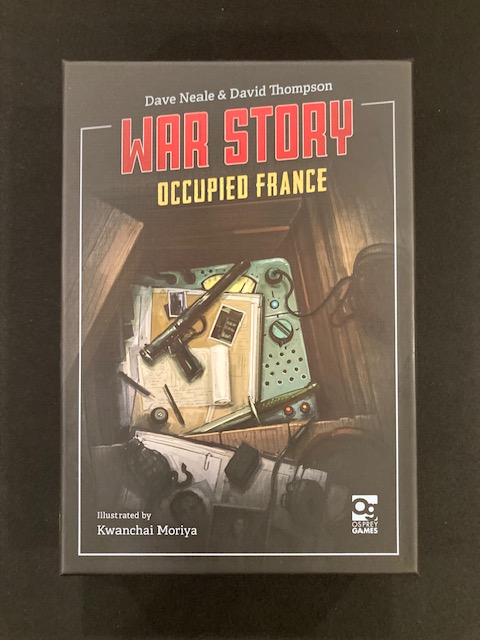
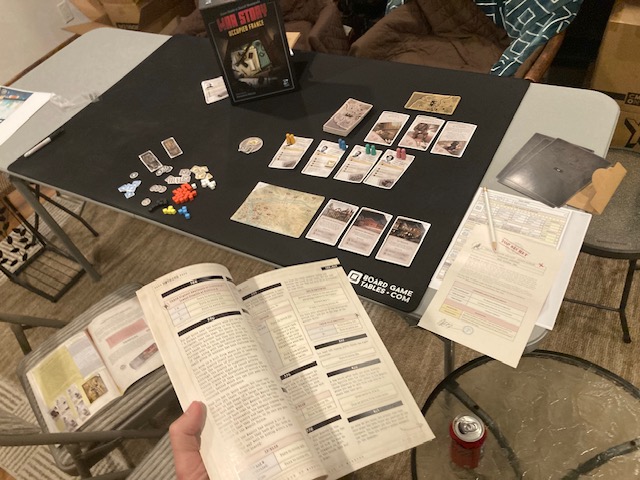
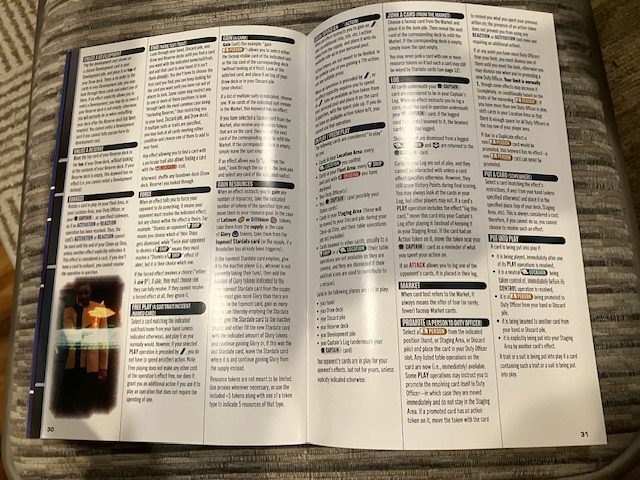
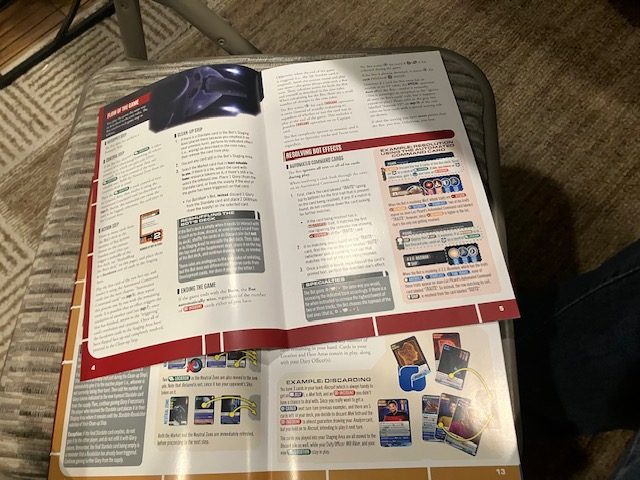
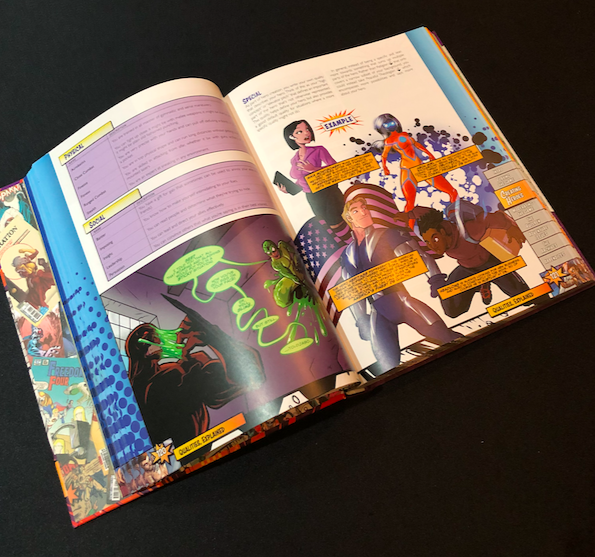
First: The binding for the rulebook is NOT stapled pages … so it has trouble laying flat and open!! It uses a glue binding (usually that’s what most graphic novels use):  see above! We saw this binding in many games over the years, and we are were just as appalled now as we were then (most recently in War Story: see review here, but also Freedom Five: see review here).

The problem with this kind of binding is that it may/may not stay open!  Notice above that I have my two fingers on it to hold it open!  You can always “break the spine”, or “bend it back” to hold it open, but that severely limits the life of the the rulebook!  The worst  part is simply that the rulebook does NOT lay flat so you can see it on the chair next to you!  This rulebook FAILS the Chair Test!

The thing is, this rulebook is like 52 pages long! I think they only used the glue binding because it’s so long … but then I remind myself that Gloomhaven’s original rulebook was 52 pages: and it used a stay-flat stapled rulebook!!! Why on earth did they use this binding?

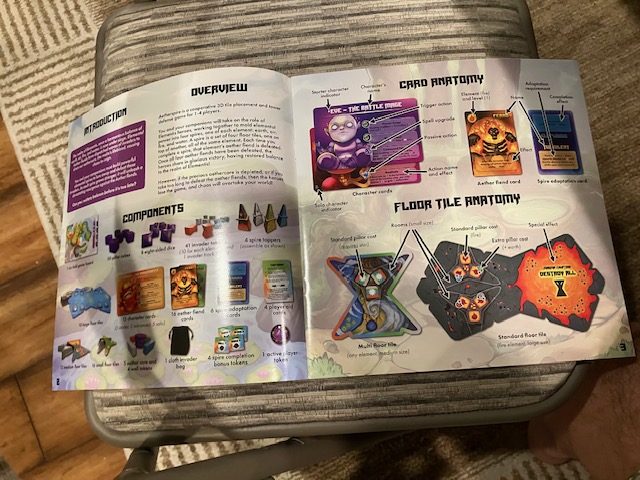
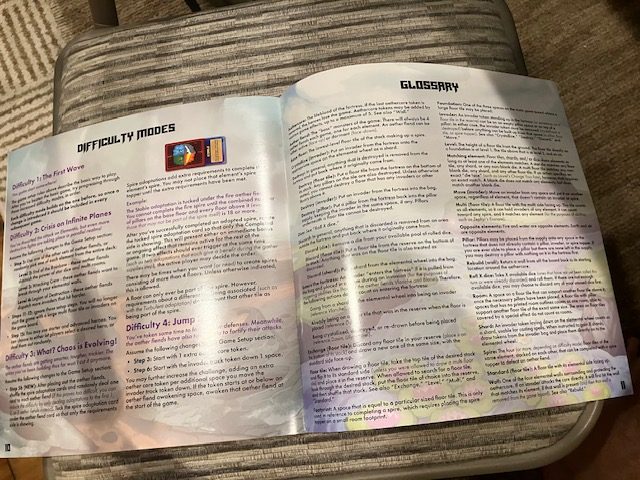
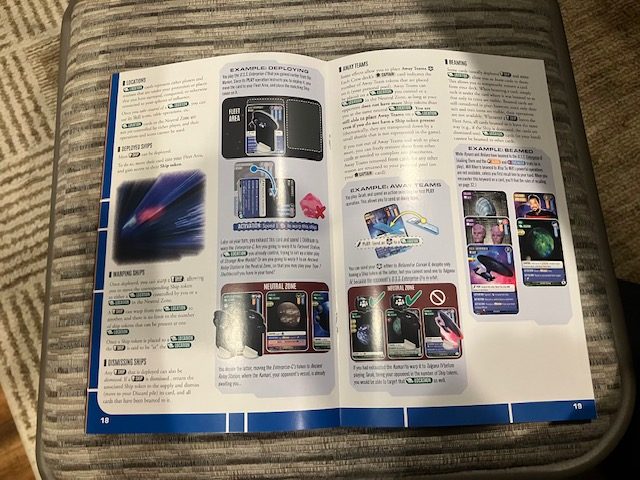
Second: Another problem with this rulebook is that it has two halves; the first 32 or so pages are the rules, but the last pages are all summaries and explanations of cards!  See above!  I think they should have SEPARATED the rulebook and summary book into TWO books!  That way, you could have had a separate stapled lay-flat rulebook and a separate stay-flat book describing all the cards and systems in the game.

(We’ll get to the third problem in a second). Let me say that this game has a great Table of Contents (yay: see above) but no Index (boo!).  I do think that this is a game that needed an Index!! Not all games need an Index:  we just recently saw that Ham Helsing has an Index, but it really wasn’t necessary.  But I think Valheim does need one …  but, this isn’t a deal-breaker.

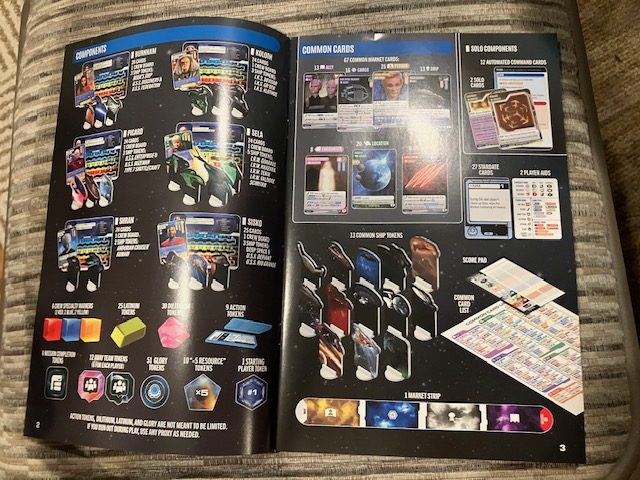
The components pages are great.

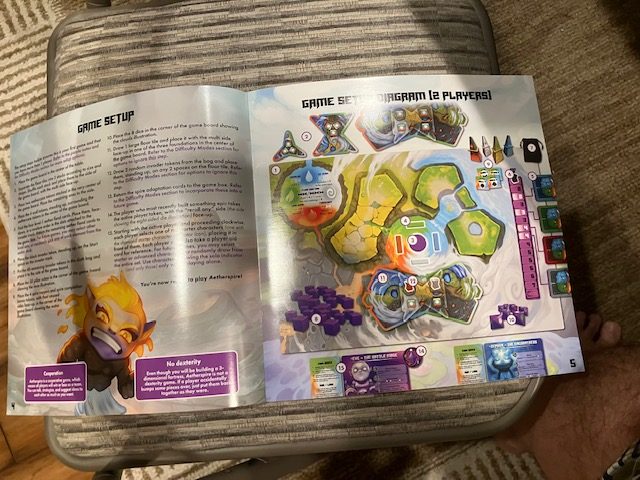
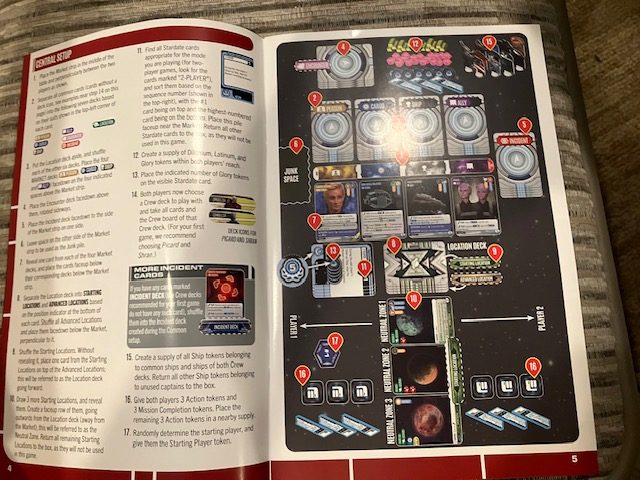
The set-up was pretty good for the generic game: see above with lots of pictures.

The font is big and easy to read.  There are also a hefty amount of pictures; maybe even too many flavor pictures? See above.

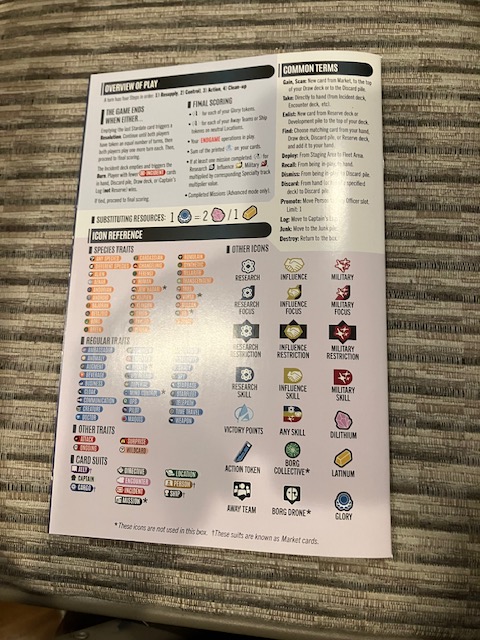
The book also ends with a summary of tokens which I appreciated (unfortunately, it didn’t cover Kickstarter extras; that had to come in a separate sheet).

The final problem with the rulebook is that I feel like it missed a lot of edge cases that seemed to come up again and again.  For example; in raids, does the ! summon the raiding party if you are close by it? Not clear?  In the final arena combat, what happens if you die when the big-bad does?  Do you lose? Win?  Tie?  It all depends on if the actions of the big-bad are “atomic” in one transaction, or not.   Can you run away from combat? Can your skills be used immediately again and again and again and again if you can power them? (I think that last one is you can).  When you get the honeycomb, do you get to see what it is when you put it in your character?

It feels like these edge cases came up as we played.  We were able to get through them, and most of the rules were well-defined, but there was just enough edge case ambiguity to be frustrating.

But, this is a beautiful rulebook with a readable font, a good set-up, components, table of contents, and fairly detailed rules.   I just hated the binding, I wish it had been separated into two books, and I wish it handled more edge cases.

I learned the game, and the rulebook was good enough for that.  But that was in spite of the rulebook … see below.

First Play: Solo Game Tutorial

So, my first game was a solo game using the tutorial: see above.

The tutorial takes you through the game; setting you up, and taking you through the game in about an hour: see set-up above.

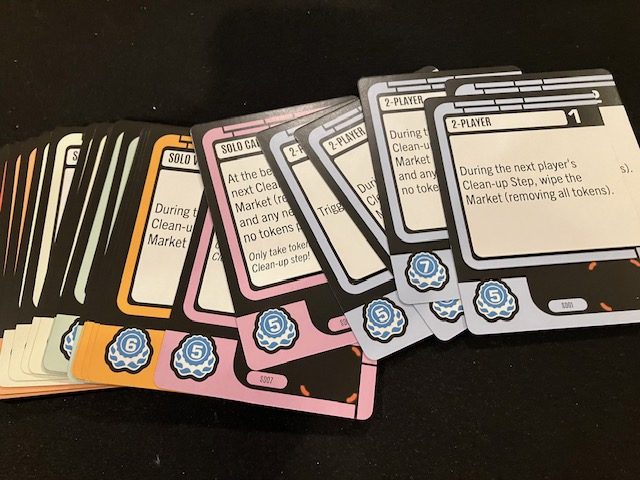
There is a deck of 50+ cards that holds your hand and takes you step-by-step through most of the systems of the game!  See the deck above.

The only problem with this tutorial is that you MUST have all 4 characters in play!  For the solo player, this is a LOT of work as he has to operate all 4 characters at once! GULP!

It was daunting, but you know what? It worked!  See some of the tutorial above!  This was a good tutorial.  There were a few places where it was a little unclear (and they actually made at least one mistake), but this method of walking the four characters through the game worked!

I would ALMOST say this is a great tutorial, but it just had a few problems.

At some point, you build some furniture … but it gets the cost wrong.  The cost to build the Fire Table is TWO resin and TWO wood, but the tutorial card shows ONE resin and TWO wood!  We assume that the summary (on the right) is correct?

The combat is pretty well-described, but  one card describing the combat with multiple participants was … poorly worded.

After all was said and done, this tutorial worked well,  Not great, but well.  I still had some questions, but I felt like I understood most of the systems of the game.

I was also exhausted, because operating four characters during the tutorial was a lot of work.  I was just a little disheartened by the few mistakes and a few poor wordings.

First Cooperative Play

A week later I was able to get a cooperative first play in!  It lasted about 1.5 hours from start to finish!

For our first cooperative play, we simply played through the Tutorial again.  We each played one character (there were three of us), and kind of “shared” control of the fourth character.

One of the great things about cooperative play is the sharing of the load. As a group, we set-up the game, as a group we ran the game, as a group we read the tutorial cards.  Remember how I was saying how exhausted I felt after my first solo play through this tutorial?  A lot of that went away when we played solo.  And I think this game really benefits from that sharing of the load, because there are a lot of systems to run.

As we played through the tutorial, it was good to get a refresher from the runthrough.  And it seemed to go well.

By the end of the night, the game Valheim had introduced itself to me and my friends. We did encounter the “poorly worded” multiple combat card and mistake of the fire table again, but we just moved through it.

My friends wanted to play again, after running through the runthrough.  I could call that a successful runthrough. 

True Solo

Strangely, I couldn’t find any reference in the rulebook to solo rules?  I even downloaded the PDF I could find and searched for the word solo.  No mention.  The only acknowledgement that you can play solo is the player count on the box!  See above.

My reading of the rules is that “each players selects a character”.  If you are playing solo, you only select one character, I guess?  Implicitly, this is a true solo game!  I just wish they had acknowledged that with a single sentence somewhere: “The solo player takes control of a single character and plays the game as-is”.  (And you almost always need to say “effects on another player in the solo game affect the solo player instead”; that wasn’t in here.  It should be).  Recall, last week we saw Fate: Defenders of Grimheim did exactly he right thing and made it clear how to play solo!  I wish Valheim had done this too.  Oh well.  Moving on, assuming true solo play …

My first solo game was the first scenario from the Scenario book (as recommended by the rulebook).  We have to deal with Ekythir again. Sigh.

The solo game is harder.  You get used to having a weapon in the Runthrough, but in the “real game”, you don’t start with any equipment!  You literally have to build EVERYTHING from resources!

And you find out right away that you CAN fight without weapons; you just get the yellow die WITHOUT any doubles!  Gulp!  So, you start the game feeling VEEERY weak!  

I start with nothing but the skills on my back!

This game is all about exploring the world so you can get resources!  You need resources for weapons and furniture!

As the game goes on, you had better be collecting resources so you can build some cool furniture back at home! See above as I build the rug, the fire table, the barrel, and the beehive!

Why do I build all this stuff??  Is the furniture even useful??  Absolutely!  The rug heals your stamina by 1, the beehive gives you consumables (see above), the barrel gives you mead, and the fire table allows you to have fire arrows!  See above for all the cool stuff I got!

And I need ALL of this as I go into my final combat!

Depending on how I played it, we either both lost, we both won, or I just lost?  In the final round, we both killed each other … maybe?   It’s not clear how much is simultaneous!    To be fair, with a very small retro motion, I was able to use my skills (powered by stamina) to kill him before the last round.  BUT I wish this would have been clearer.  

Generally, I had fun exploring the lands and gathering resources and building furniture!

Cooperative Play (Scenario 2)

A week after we played through the tutorial as a group, my friends were excited to build beehives together!

After learning the basics of the game through the good tutorial, we settled in for a real game Scenario 2.

In Scenario 2, we get to fight …

The ELDER!

Some good cooperation came out as we played.  Each of our skills requires all of us to “do something” to activate them (for example, I had to build 3 pieces of armor).   This game each player focus, and we all tried to activate all of our skills.

This meant working together to allow us to do stuff!  “Oh! You need to craft some armor three times? Okay! You need copper and I need to go kill monsters!”  Generally, this worked pretty well, as we all pursued our goals, and there was just enough serendipity that our goals helped each other.

Over the course of the night, we built tons of furniture to build our characters up.  In the end, we summoned the Elder and beat him up!

Good times.  I think my friends really enjoyed building the furniture building and world exploring … maybe even more than the combat (which can be a little random).  The combat almost seemed a necessary evil so that we HAD to build furniture.  I am telling you, I think my friends enjoyed the furniture making more than anything else in this game!  Just ask Sara how much Teresa talked about the beehive ALL WEEKEND LONG.

Issues

This game feels like an A game inside a B body.  There were so many places where a little extra thought/effort could have made things just a little better.

Raid Rules: these seem poorly specified.  They aren’t covered in the intro, so I had to go find the rules for Raids in the rulebook.   What happened to me: I was two away from the raiding party, so could I attract the raiders if I rolled a ! on the explore dice?  Thematically, it seems like they are trying to coalesce to attack, so they wouldn’t attack!  Pedantically, the rules say the raiders would move to me.  Which is it?

Sleeves for weapons/armor:  The sleeves fit on the cards just fine, but the sleeved cards DO NOT fit great into the dual-layered player boards.  They “sorta” work, see above.  But it feels nobody really tried the sleeves with the boards!  They boards should have slightly bigger or the sleeves slightly smaller … a small adjustment here would have made a huge difference!  

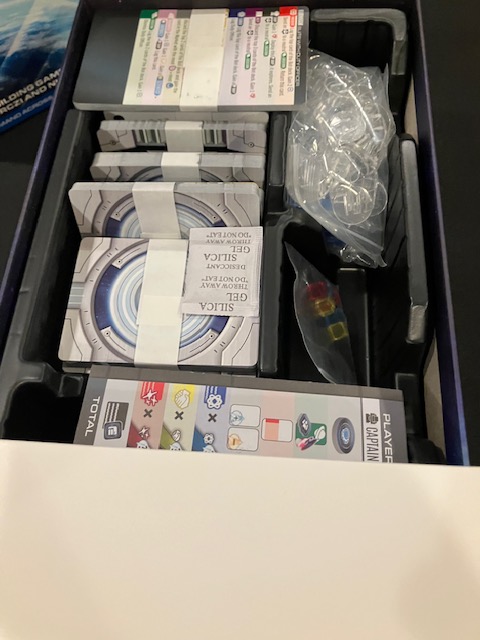
Sleeves for normal cards: The sleeved cards BARELY fit into the plastic insert.  You have to SQUASH THEM HARD to fit.  Even after you put on the cover, the cards slide around a little. See above.  Sigh.  The spaces for cards only had to be a touch taller and this wouldn’t have been an issue.  Well, at least the sleeved cards actually fit in the insert … barely, but not great.  See, they work, but it feels like a B work … not A work.


The house: This may just be a deluxe version, but the house doesn’t work.  Sorry, to be clear, the house stands up and can hold things, but it ends up obscuring the resources and furniture!  Although the cardboard house has a cool toy factor (see above), it is NOT useful for playing!  

In the end, we just took down the cardboard house so we could ALL see the insides of the house!! See above.  Again, cool thing, but interferes with gameplay.  Coolness gives it A, but then interference with gameplay drops it to a B.

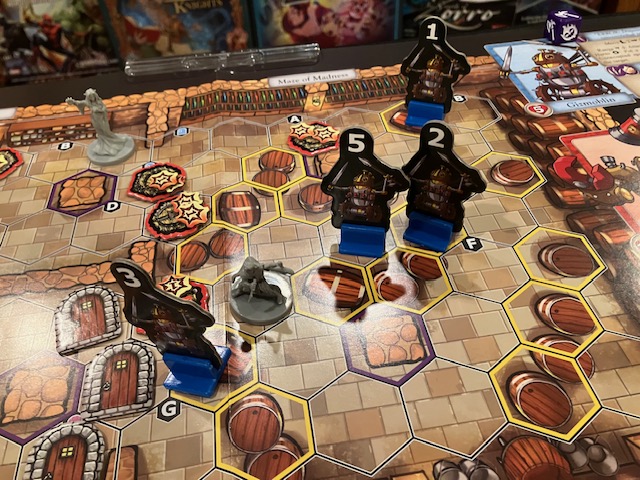
Hex Spaces Feel Crowded: The spaces on the board feel very crowded if there’s more than one thing on there.  See above!! What resources do the minis cover?  It almost feels like the hexes should be one size bigger?  The game is still usable, but this kind of made the game clumsier.

Better notation:  If there are multiple enemies, there’s no “clear” way to notate which guys have taken damage.  

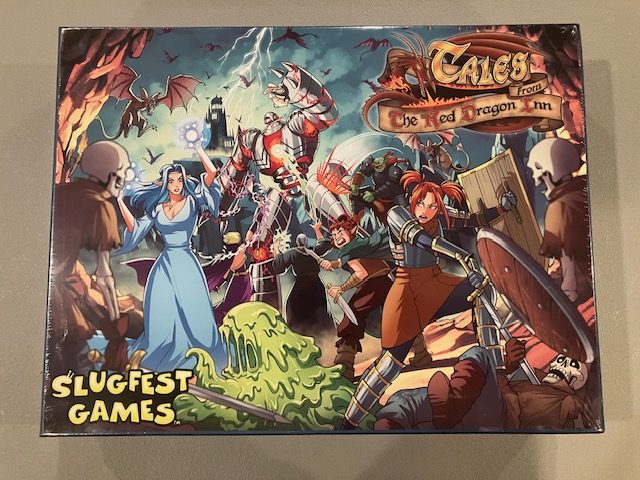
This immediately drew a comparison to Tales From Red Dragon Inn (see above), where each mini is CLEARLY marked with which has which hit points!  Sure, we can work around this, but it seemed … annoying they didn’t think of a better system for this.

Can’t Run?  If you get stuck in a combat you’d rather not, there’s no rules for escaping.  There are rules for others to come help you, but it seems strange there is no way to get out of combat once you are in!  If you character dies, it’s not the end of the world (you spawn back in the house), but … I think I wanted to run away from a Troll once and I couldn’t???

Odin Skills: The Odin Skills don’t fit great back into the insert.  You kinda clumsily plop them in.

Just Everywhere!  When you go to set-up the game, it’s a mess! I had to put boxes and box tops everywhere because this game is so big!

Table Space Constraints:  I feel like game REQUIRES you to turn your game longways.  The way the resource trays and home are set-up, there’s no way this would fit on my table any other way than the longways: see above.  So, I ended up sitting at the end of the table!  This just wouldn’t fit if  I used the prescribed layout!  I mean it looks cool (see above) but only one way.

What I Liked

Gorgeous:  This is a gorgeous game with great (modulo some issues) components.

Furniture:  Something about the furniture puts a smile on me andmy friends faces …  We are building furniture!  Cool theme.

Gameplay: Was generally straight-forward, once you got the hang of it.

Tutorial:  The tutorial was well done.  Not perfect, but good enough to get you into the systems of the game.

Conclusion

For Teresa, Valheim may be her game of the year!   She loved the theme so much, she was able to overlook all the issues we encountered along the way and just embrace Valheim!  I struggled a little more with the issues; I feel this could have been a great game, but the issues brought it down to a good game.   Maybe you’ll be like Teresa and absolutely love this game!  Maybe you’ll be like me and just like it.  That’s still a pretty good recommendation either way.  Hopefully our exploration of this game will help you decide what you might think.

Both Sara and I do worry a little about replayability; once you build all the furniture, what else is there to do?  Because of that and all the other issues I had, this is probably a 7/10 for me and Sara … just barely a recommendation, but we still liked it.  But Teresa will give this an 8.5/10 and point out that you can build a beehive!  That’s all that matters!

Fate: Defenders of Grimheim. A Solo and Cooperative Review of a Tower Defense Game

I didn’t know a thing about this game until I saw it on a BoardGameGeek advertisement!  Fate: Defenders of Grimheim is a cooperative tower defense game for 1-4 players.   A tower defense game is when monsters move towards a “tower” with the intent of wrecking it!  Your job, as the players, is to defend said “tower”!

This is a game from Fryx games; I ordered directly from the website (and had to pay some extra money because of Tariffs, so that was stinky).  This is the same Fryx games that gave us the enduring Terraforming Mars, the great Terraforming Mars: Ares Expedition (see our review here), and not-as-great Terraforming Mars: The Dice Game.  

Let’s take a look!

Unboxing and Gameplay

This is pretty standard sized box; see Coke can above for scale.

Players each assume the role of one warrior protecting the homestead! Bjorn, Alva, Embla, or Boldur.  See above.

The homestead is at the middle of the board!  See above.  Every time a bad guy makes it to the homestead, the players lose one (or more) of the homes there. Lose too many homes, and the players (collectively) lose the game!

At certain points during the game (including the start of the game), a bunch of bad guys are placed into the game at the edges of the board.  See the card (above) describing where the bad guys go …

… and see the same bad guys on the board!  Note that the arrows denote how they move during the move phase! (If they hit a trail, they start following the trails).

There’s three different flavors of enemy: the Dead (coming from the northwest part: see above).

The Trollkin, coming from the northwest (see above)

And the Fire Hordes, coming from the South.

This is a tower defense game!  You have to kill the bad guys before they make it to the center of the board!

Each player (hero) has a bunch of tools to help them stop the bad guys; these tools are all special to that hero!

There’s abilities (like above) which can help the player in many ways. These abilities are paid for with experience /gold.

There’s upgrades the players can get (if they do the quest at the top of the card).

Generally, each player has a starting main weapon and starting ability, plus a special ability.  See above.

As the game unfolds, the player quickly upgrades and gets new abilities and weapons!  See above!

If you can keep at least one structure left (the fountain is the last thing to go) before the timer runs outs and/or you kill all enemies, you win!

Rulebook

I liked this rulebook.  Except for one thing.

The rulebook is just too big; it almost fails the Chair Test.  See above as it droops heavily over the edges of the chair.  The only reason it doesn’t fail the Chair Test is that it stays open, and is easy to read.  I can barely use on the chair next to me: this gets like a D on the Chair Test.  Honestly, this rulebook could have easily gotten an A on the Chair Test if it hadn’t been so droopy.

The Components page is nice and well-labelled: see above.

The first few pages didn’t jump int set-up, they talked about the cards and components.  This worked well to get you familiar with the components of the game.

The Set-up is pretty good: the picture’s a little small, but it does work. See above.

Generally, though, this rulebook was really good.  I had no real grumpiness as I read it.

It’s only about 12 pages, but it’s pretty easy to read.  There’s no Index, but I think that’s okay for this game.  This game is pretty straight-forward and I don’t think it needs an Index.

Generally, good rulebook.  I just wish the form factor were smaller.

Solo Game

The solo game is very well-defined on page 11: see above. Basically, there’s no rule changes! This is a true solo game, where the player takes control of a single hero in the game.  The game is self-balancing: the number of monsters that come out are essentially a function of the number of players. This is a fantastic solo mode with no real changes to the rules!  Thank you for following Saunders’ Law!  This gives us a solo mode that scales to cooperative mode with NO CHANGES!

After the solo modes for so many games have left us underwhelmed lately (Lord of the Rings, I am looking at you), it’s great to see a simple and scalable solo mode.

I took control of Alva for my solo game.

Her cards and figure come from the Alva/Bjorn box.  It’s a little hard to find the starting cards, but once you know what you are looking for, it’s easy enough.

Basically, the solo game starts with fewer homes in the middle and only one set of enemies come out at first!

More enemies will come out when we hit the Axes (above) on the timer.  You draw one card of enemies for each player (that’s the scaling part).

Over the course of the shorter game, I had to go and kill some enemies before they reached the homestead!

One of the best parts of the game is how quickly you gain new abilities and new weapons and new upgrades!  Generally, you seem to be able to get something new every other round or so, which is great!  Your character really feels like they are progressing as you play!

Near my solo end game, I had at least 3 new weapons and new abilities (some of them upgraded!)

It was a pretty quick game; the box says 30 minutes per player, and my experience says that’s accurate.

It was very easy to jump into this game, a lot of fun to perform upgrades, and some strategy as I tried to figure out the best way to kill the bad guys before they invaded!

The solo game works great.  And it’s trivial to apply the lessons of the solo game to the cooperative game, since it’s essentially the same game!

Cooperative Game

My friend Teresa and I played the cooperative game!

We each took control of a separate hero.  Now, the monsters, scaling for the player count, come out twice as fast!

It was interesting to see how the cooperation unfolded.  Generally, each player is different enough and has very different cards that’s there’s not really much chance for Alpha Players.  The cooperation that happens in the beginning of the game is more coarse discussions about which sets of enemies to handle.  “I”ll go over there and deal with the enemies to the South, you deal with the enemies to the North”.

In the beginning stages of the game, the game is more multi-player solitaire as each player handles some part of the board.

As the bad guys get closer and closer to the homestead, some more cooperation unfolds as players may need to back each other up.  “Can you please get that stray bad guy for me?” “I suppose…Sure!”

There’s not tons of cooperation, but there is enough interaction as players talk and even lament the task ahead!

I got Grendel (one of the really big bads) later in the game, and it was good to have Teresa nearby so I could complain how hard he looks!

Generally, each player is very involved in their turn as they try to figure out how to activate all their abilities and cards and weapons.  It’s kind of cool in the later game just how many directions and how many options you have for killing bad guys!

In the end, the cooperative game was fun and engaging!  There was no real chance for the Alpha Player, but there was still some high-level cooperation (with a smidge of low-level cooperation in the later game).   Good times.

What I Liked

The shapes: The enemies of the same flavor are all the same shape (see above). This makes it VERY easy to see which types of enemies are which.  This is a small touch, but it really helps players quickly distinguish enemy types without having to squint.

Well-Labelled board:  In the same vein as the shapes, the board is well-labelled with a big font describing the enemies special abilities!  There’s no need to consult the rulebook … the rules are on the board!

Well-Labelled Enemies:  The enemies themselves are well-labelled: how much damage does the bad guy above do?  5 axes!  How many hit points?  6!  How many experience from killing it? 3!

The board is gorgeous:  I really like the art and how clean this board is.  It’s clear where mountains are, it’s clear where forests are, it’s clear where trails are, and the art just looks fabulous.

Upgrades Happen Quickly!  As you play, your hero very quickly gets new cards, upgraded abilities, and new weapons!   This allows the player to build something of an engine as they can use abilities to power other abilities to make stronger attacks!  The feeling of upgrade is strong and very fulfilling for a game that is only 30 minutes per player!
Easy to get to the table:  This game is very easy to get to the table.  There aren’t a ton of rules and the board is well-labelled, so it’s pretty easy to start into a game.

What I Didn’t Like

Dice and Randomness:  At the end of the day, all combat is decided by dice … and that can be frustrating when you are rolling badly.   There are some mitigation techniques, but generally you just hope you roll well enough.  I didn’t hate the dice, but I didn’t love them.  I guess they are a necessary evil to keep this game “interesting”.

The Character Art:  The Character art reminds us a lot of Red Dragon Inn … it has a cartoony vibe to it (see our review of Tales From Red Dragon Inn here).  My friend Teresa didn’t love the art; it wasn’t quite as good as Tales From Red Dragon Inn, and it was also a little inconsistent with the art on the board (which we loved).  I thought the art was ok, but the character art can be a little off-putting for some people?  Shrug?

Minis: I went out of my way to spend extra dollars to get the minis for the Legend monsters (see above) … and you almost never use them.  You may get a Legend monster in your game, or you may not.  I don’t think it was worth getting those extra minis, especially because I probably had to pay way too much for them because of the tariffs.

The Cover:  I didn’t love this cover.  I think if I saw this in a game store, I might pass it over.  But my friend Teresa said she liked it.  Art is in the eye of the beholder.

Conclusion

I liked Fate: Defenders of Grimheim.  The game is very easy to get out, very easy to explain, and very easy to play!  While playing, there are so many opportunities for upgrades and doing clever things with your weapons and abilities that make you feel smart!  The cooperation isn’t through the roof in this game, as most players are engaging in multi-player solitaire activities, but there is some interaction and cooperation (moreso in the later game).  I also don’t think you’ll really have to worry about the Alpha Player ruining your game, as each character is very different, causing each player to be very independent.

This game sits in a nice niche; it’s got enough meat-on-its-bones to be interesting, but easy enough to play quickly.  I think this would be a perfect cooperative game for a convention!  You can pull it out and quickly jump into it for engaging play!

I think the only reason I don’t adore this game is because the dice can be unforgiving … they can be a touch too random for me.  Still, I liked this solo: 7/10.  I’ll call the cooperative game 7.5/10, and I would point out that this would be great convention game where you can get strangers together and quickly playing a fun cooperative game!

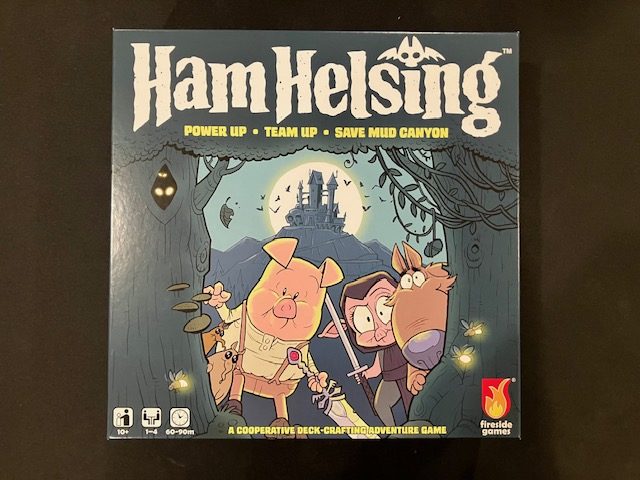
Ham Helsing! Pig Puns For The Win! A Really Great Cooperative and Solo Game!

Ham Helsing is a cooperative boss-battling board game from Fireside games.  I had heard about this game various places online, and I was excited for it!  I ended up ordering it off the Fireside games web site and had it shipped directly to my house: It delivered in the first week of October 2025.

So, this game is based on the Graphic Novel Ham Helsing by Rich Moyer.  I literally know nothing about the graphic novel!  Luckily, you can play the game without ever having read the Graphic Novel!  I am sure there are references and funny callbacks which would make the game more enjoyable, but you don’t need any of that to enjoy this game.  Spoiler Alert: I really liked this game, despite not knowing anything about this world.

What is this game?  This is a cooperative card-crafting and boss-battling game.

Let’s take a look below!

Unboxing and Gameplay

This feels like a little smaller game than a Ticket to Ride size box.  See Coke can for scale above.

The components are all very nice and cartoony.  They seem to fit this world … which I know nothing about.  But the art is all very consistent with the cover and the cartoon pigs.

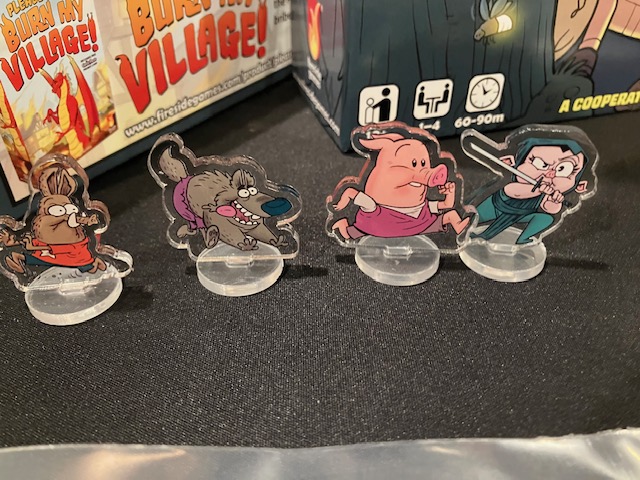
Each player takes the role of one of the main characters from the comic book (left-to-right): Malcolm, Lobos, Ham, or Ronin. See above. I LOVE the acrylic standees!!

The players choose one of the 4 bad guys in the game:  Hen, Chad, Robo-Knight, or Silk (with Silk being the hardest). See above.  The players must defeat that bad guy to win.

Players move around the world of Ham Helsing on the map above.

Little minions cover this world: you must keep these minions under control or they will “destroy” locations on the board!

Each Location has an upper limit of how many minions can be there: note the 3 above on Gigantovia … if more than 3 minions ever end up a Location, it is lost and much more expensive to deal with!

In an interesting twist, the minions come out (from a bag; see above… it’s quite nice and big) and attach to all Locations adjacent to the player!  This is an interesting way to have the minions overrun the board! You kind of control where the minions come out by the nature of where you end up at the end of your turn!

How do the heroes operate?  Each Hero (see Ham above) gets their own character board and their own unique deck of cards.  See above how Ham has his own deck of specialty cards!  (Yes, they are sleeved, yes, you need the sleeves, but yes, they do come with the game!)

See above as Lobos has slightly different cards!

Players each have  deck of cards that can do things like fight, move, get gold, and invoke Knuckles! See above!

Players play these cards to get stuff done: see above.  The icons on the left of the card are the actions you can do (attack a blue or yellow enemy above).

This is called a deck-crafting game (or you might hear card-crafting game if you have played Mystic Vale) where you can add little clear sleeves to improve the cards as you play!

The bad guys also does bad stuff … see his cards above.  This is a quick game; you only have 5 rounds to take out the bad guy!  This is a boss-battler game!  If you fail to take out the bad guy after 5 rounds, you lose!

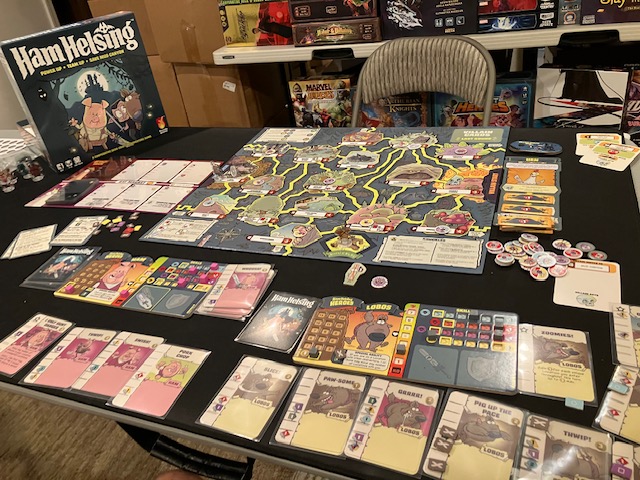
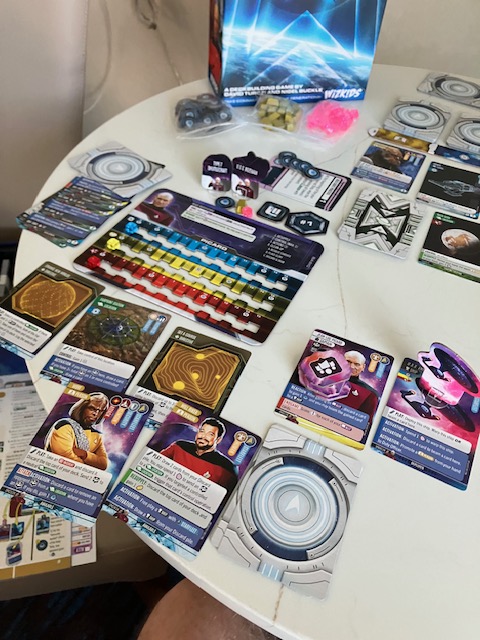
I really like the way this game looks.  See a 2-Player set-up above!

Rulebook

The rulebook was okay.

The form factor is a little off—it doesn’t fit well on the chair next to me.  This gets like a C+ on the Chair Test; you can use it on the chair next to you, but it could have been better.

The Components section made me very grumpy.  There is a little list of components at the bottom of page 1 (see above), but it has NO correlating pictures! I had to figure out what-was-what from context as I set it up!  That made me a bit grumpy.

The Set-up spanned 3 pages?  And you had to cross page boundaries?  I feel like this Set-Up could have been on two pages facing each other making it easier to read.  This rulebook feels very “crammed” in there, like there were trying to get page count as small as possible.  I appreciate not wasting space, but this rulebook feels very cramped.

I feel like all the rules were in here, but for some reason, the flow seemed “off” to me.  I found rules, but not always where I expected them.  But they were in there.

The rulebook does have an Index, but it’s not that useful?  I hate saying this, because I applaud Ham Helsing for having an Index!  … but I just didn’t find it useful?  I went looking for a few terms and found them in SO MANY PLACES (Health track pretty much lists all pages of the rulebook) that it was almost useless.   This index needed to be curated a little better, and use italics or bold to distinguish mentions vs definitions.  Sigh.   I really like that they tried using the Index.  It didn’t quite work.

I found all the rules, I was able to get the game played, but the rulebook “flow” seemed off; I think it just felt too cramped.

The rulebook was just okay, but it does teach the game, so I guess that’s all that matters.

Deck-Crafting

I think the reason I was so excited for this game was the deck-crafting (or card-crafting, since you are constructing a better card … I wonder if Fireside Games can’t use this term because Mystic Vale copyrighted it?).  This is where you upgrade the cards in your hand to make the cards better and better (by allowing each card to do more stuff).

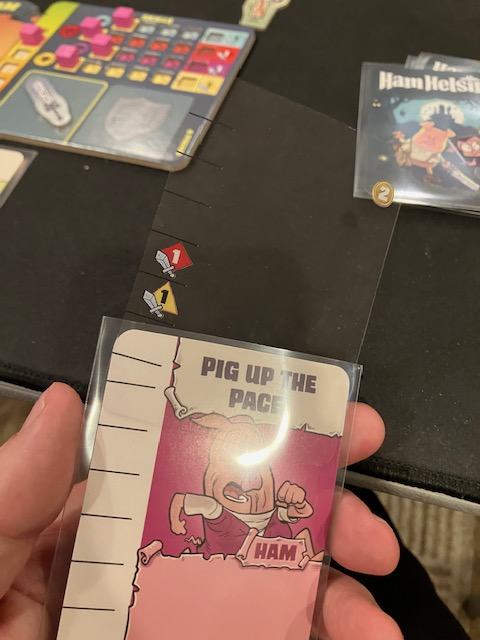
For example: Take a look at Pig Up The Pace above.  All the base card does is move 2.   (And yes, there are a LOT of pig puns in this game.  Get used to it).  Pig Up The Pace is a pretty minimal card. BUT!  I am about to card-craft!

By putting the clear upgrade into the sleeve, I can add more actions to the left side of the card! I can attack red +1, and attack a yellow for +1 now!

By the time I am done “upgrading” the card,  Pig Up The Pace not only moves Ham twice (the original action) but also can attack with +1 red and +1 yellow attacks!

Players can buy these upgrades every turn; the cost is on the upper right.  Players cooperatively figure out who should buy what when they buy … this is a cooperative game after all.

There are two types of upgrades: mostly attack (see above for that deck) …

… and specials (which have special text).  Usually, the specials are more powerful but more expensive.

You gotta upgrade the heck out of your cards if you want to win!  See Thwip above with 2 or 3 upgrades in it!

Solo Game

So congratulations to Ham Helsing for following Saunders’ Law and having solo rules!

Unfortunately, the built-in solo rules are half a page of exceptions.  And they aren’t even true solo play rules!  You still have to play two characters in the official solo mode; the only real savings of the built-in solo mode is that you have one deck to manage (instead of two).

Instead of the built-in solo mode, I recommend that you play 2-handed solo with all the normal rules: take control of two characters and alternate between them as if you were playing a 2-Player game!!  The 2-handed solo mode is much better than the built-in solo mode!  In the 2-handed solo mode, the game plays as it’s mean to be played, without any special exceptions.  See my 2-handed solo mode play above.

I really enjoyed my first solo play, but boy did I get crushed!  I even played the simplest Villain, Hen!  I just couldn’t do enough damage to Hen before the end of the game!

There’s quite a bit of strategy in how you handle the minions across the board!  See above! Get too many minions in a region, and you may lose the region or have have them bleed into your regions and do damage! You WANT to kill the minions yourself, because you get gold and experience … which keeps you upgrading as you play! But you also need to keep the minions on the board under control!

You can use Knuckles (see above) to help you keep the Locations clean of minions, but then you don’t get that much needed gold and experience!

My second game was MUCH better as I started to get the hang of how to balance all the different systems in the game!  See above as Ham and Lobos take out Hen!

I had a BLAST playing this game solo.  It was so much fun upgrading cards, figuring out strategies, keeping minions under control, but still trying to get enough gold to keep upgrades happening!  There were so many delicious decisions!

And the game is just adorable.  I think the look-and-feel made this solo game even a little more light-hearted and fun.

I could have done without all the pig puns, but it made it more fun.  EDIT: That’s not true.  I loved the pig puns, but I couldn’t admit it without some therapy.

Great decisions, great upgrades, great fun.

Cooperative Game

I may have actually done my friends a little disservice by discussing all the strategy up front! I didn’t give them a chance to discover all the repercussions themelves!!  Still, we had a full 4-Player game and has a great time!

The cooperation was great; we worked together to keep the minions under control, all the while getting gold for upgrades!   I didn’t use the trade action to any effect when I played solo, but I did see Madelyn and Andrew use it very well to make sure they had the right attacks and cards to deal with the minions!

Although ending up on the same Location at the end of your turn as another player allows the player to draw an extra card, sometimes that comes with a cost! At one point, we accidentally lost the Swamp `O Lies because we tended to congregate there!  And the minions swarmed up! GULP!  We saw yet another delicious trade-off … stay together to get more cards, but disperse to keep the minions away!  Neat tradeoff!

One thing that seems overlooked is the question: Can you share gold in the Market Phase?  Players are all together buying cards!   Can you share?  It’s not addressed in the rules!!! There is a trade action players can invoke during Play Cards phase which allows players to share gold, cards, shield, and katana. But the rule is very clear: only during your turn!   Since it’s not specifically addressed in the Market Phase rules, it seems clear: you can’t trade/share gold!!

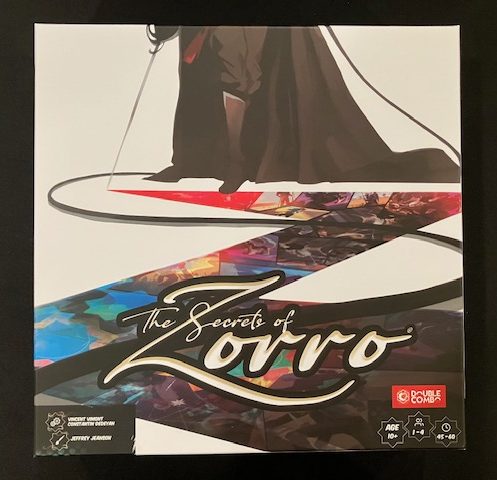
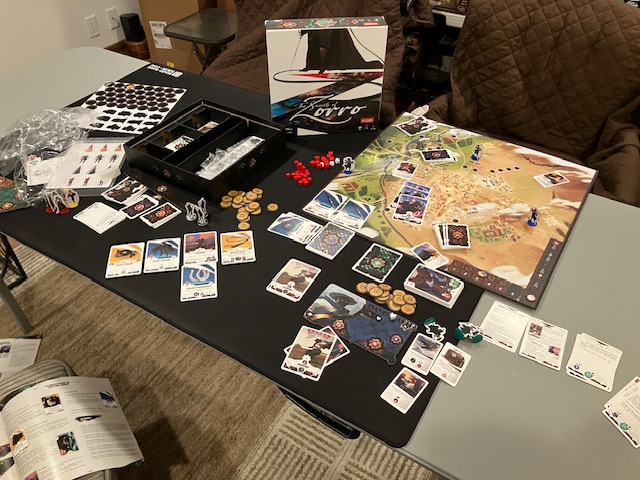
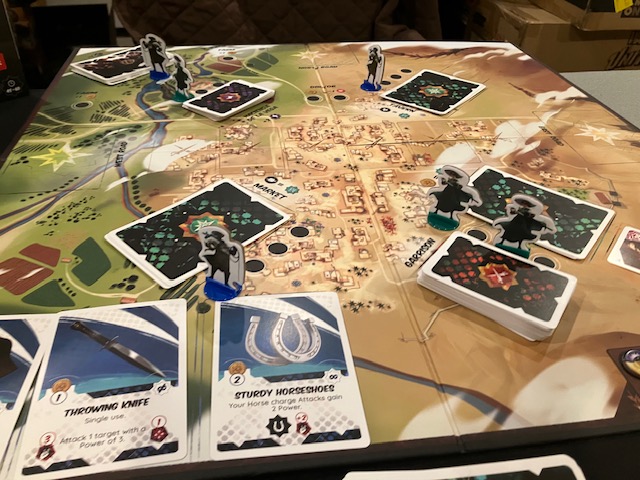
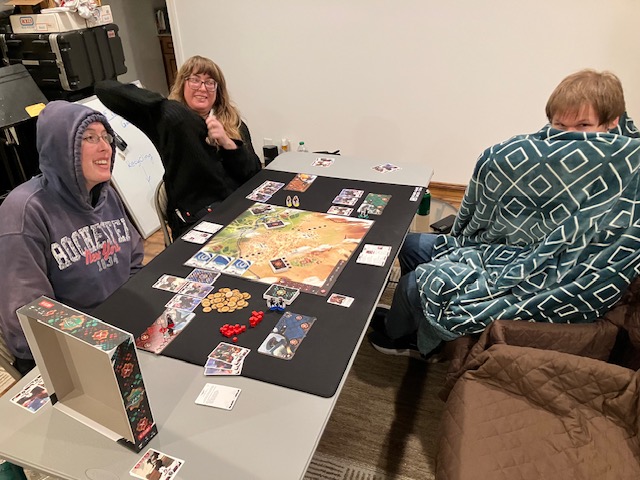
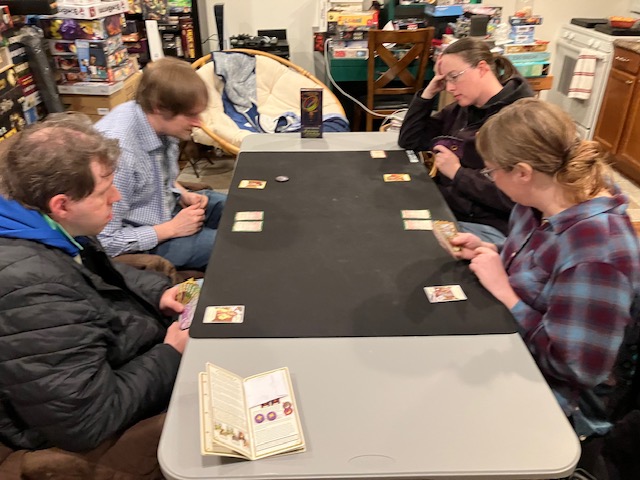
This problem reminded us a little of The Secrets of Zorro (see review here) when, even though we were all together in an end phase, we couldn’t share gold!  See above.  We house-ruled The Secrets of Zorro to allowing sharing then, and that little change made the game more cooperative and more fun!   So, we are house-ruling that here as well: you can share gold (or  cards or normally sharable stuff) in the Market Phase … and it even feels like it makes sense thematically!  We are all shopping together at the same time at the same Rat Store!  (Seriously, rats are selling us stuff.  I am not making that up).  It makes sense to say “Hey Lobos! Can I borrow 1 gold??”  And to allow it … “Sure!”

In the end, all of us took turns beating up the Hen together! So, we all participated and we all felt we mattered in the final rounds of the game!  And we won!

There was a lot of cooperation and a lot of fun.

Reactions

Positive reviews.

Andrew: 6.5/10 (which is actually high for him).  It was too easy, but we also only played the easiest of the villains AND I may have helped too much in getting strategy going!
Teresa: 8/10
Madeyln: green (doesn’t have numbers; she either likes it (green) or doesn’t (red))

Rich:  Wow.  I loved this game.  I would love to play it solo or cooperatively.  9/10 because there so many delicious decisions AND you get to card-craft!

A Worry

After two games (just TWO), you can already see fingerprints on the clear sleeves.  I worry that this might become a bigger problem the more you play.  At some point, I might have to go in an windex/clean all my cards?  That doesn’t sound like fun!

The Randomness

There are two dice that you roll occasionally; usually for when you fight the big bad guy.  The bad guy, in the final combat, BLOCKS the color of attack you roll.  With four colors of attack, you are guaranteed that at least 2 of your attack types will get through, maybe more?  So, you always have a sense of how much damage you will do.

The other major source of randomness is pulling the minions from the bag.  You can only take out minions you have matching attacks for, so you can get screwed if the wrong cards or wrong minions come out.

But, I never felt like the randomness was too much.  You had a lot of control on how many minions came out, based on where you ended your turn; this was a unique way of dealing with “where do the minions come out”!  It is completely deterministic where they come out!  I really liked that choice, as it gave us yet another delicious thing to think about!

And Knuckles was always an option to keep the minions under control too … couldn’t fight anything?  Let Knuckles go disperse those minions for you!

I always felt like I could do something on my turns.  I did not think the randomness was unhinged by any means.

Conclusion

Wow, Ham Helsing is a great game!  The toy factor is high with the card-crafting system and the super cute art!  The components are just great!  The solo and cooperative games were super fun with lots of delicious tensions about how/when to keep the minions under control, balanced with keeping gold coming in so you can perform upgrades!

My only concern is that this game may be too much for younger audiences; the game says 10+ (which is probably the age range of the graphic novel), but there are a lot of rules to keep track of, and a lot of subsystems to keep operational as you play.  I worry that a couple of 10 years olds trying to learn this game without anyone present might really bounce off this game.  Ham Helsing is a lot more complicated (there are a lot of rules and a lot of interaction) than it looks!  Maybe make sure you shepherd younger kids if you get this for them?

Other than that, I adored this game.  9/10 for both solo and cooperative for me.  So neat and so fun. I admit that my rating of Ham Helsing was higher than my friends, but they liked it a lot too!  And to be clear; you DO NOT need to know anything about the Graphic Novel to enjoy this game!  None of us knew this IP, and we still enjoyed the game tremendously.

Drop Bears: Drop A Little Horror in Your Life! A Review of Drop Bears

Drops Bears is a cooperative survival (horror) game that was on Kickstarter back in July 2022: see here.  This promised delivery in April 2023, and it just arrived ay my house a few weeks ago in late August 2025.  That’s right, it’s over 2.5 years late! Ooof.  Even for Kickstarter games, that’s not great.  But they did deliver!  So, kudos for that!

This game is sort of an odd duck; it calls itself a survival game.  I’d call it more of a horror game where survival is a big component!

Was this worth the wait? Let’s take a look!

Unboxing and Gameplay

This is a pretty thick game, but it has the Ticket To Ride box profile.  See above for scale.

The first thing you are met with is the “put the box back” and “build sheet”.

Why is there a “build sheet”? You have to build the little tower that holds the tiles.  Oh yes, this is definitely a tile-laying game. Sort of (see below).

Building the tower wasn’t too bad; it wasn’t nearly as hard as building Sauron’s Dice Tower from Lord of the Rings: Fate of the Fellowship from a few weeks ago!

It fits pretty well back into the box (but see below).

The Drop Bears are the horrific creatures you are fleeing from in this game!

These miniatures are utterly fantastic.  I love them so much!

The miniatures are by far the coolest thing in the box. I don’t even feel like you have to paint them; they are pretty terrifying as they are!

The players each take control some camper: see above and below.

There’s 10 total; 2 of them are for solo play (the companions).

Players run away from the Drop Bears; each bear has its own flavor/character.  And by flavor/character, I mean ways it eats you up!

Players have to keep track of health and heart-rate; lose too much health and you die!  Have your heart-rate go too high, and you panic/run away!  Luckily, you have equipment (like the very Australian Vegimite Toast) to help the players.

Players explore the tiles and have to survive the Drop Bears until Dawn.

There’s a little counter showing the progression of the game: see above! Campers act, bears act, campers act, bears act, etc etc … until Dawn (the end of the track).  If the players don’t die “too much” and they have enough survival points (to survive the Australian bush in the day), they win!  Otherwise, they lose!

It’s an interesting looking game!  See above!

Rulebook

This rulebook straight-up fails the Chair Test!  It’s waaaaay too big and droops over the edges!  There’s no way I can easily look stuff up on the chair next to me!

However, you can always use the “two chair” workaround; at least then it’s usable.

The Components page is very nice and shows all the components (except for the arm?)

The Set-Up page works well; it’s on two pages exactly, so I can set-up the game without having to turn the pages! Good job!

The “Index” on page 3 is NOT an Index; it’s a Table of Contents.  (An index is sorted alphabetically by keywords with references/page-numbers/hyperlinks to appropriate pages.  A Table of Contents is sorted by page numbers, listing the sections of the rulebook in order).  This mistake put a bad taste in my mouth, but it’s probably just me.

This rulebook was okay; it had big fonts and lots of pictures with some examples.  My biggest complaint about the rulebook was that it was too big; too many rules and the form factor was too big.

It does feel like like all the rules are here.

The rulebook also ends with a list of Icons!  Thank you!

There’s some good stuff to like in this rulebook; big font, good components and set-up, icons on the back, but the form factor and just general size of the rulebook was too big.

I learned the rules from the rulebook.  It seemed to work, but it is long and daunting.

Solo Mode

So, there is a solo mode (thank you for following Saunders’ Law)!  In fact, there’s multiple solo modes!  Huzzah!  The solo rules are presented on pages 26 and 27.

You can either play 2-handed solo (control two campers and just play the game as normal), or have one camper and a companion.  I am am gun shy about using “alternate” solo rules, (especially after Lord of the Rings: Fate of the Fellowship solo rules infuriated me), so I went ahead and played 2-handed solo.   Since my next activity is to teach the cooperative game, I prefer to learn the game WITHOUT too many exceptions!  Learning it 2-handed is the best way to learn how the game is meant to be played cooperatively.

I ended up playing the Hippie and the Cheerleader.

It was fine. It taught the game.  I survived the bears. And it was quick.

Cooperative

We played a 4-Player game.

It moved pretty quickly.

At the end of the day, it didn’t feel very cooperative.  A few times, we cooperated so that we’d end up on a search space so we all benefited, but generally, each player wants to be as far as possible from the others!  Multiple players on a single space will ALL get attacked, so it’s really in everyone’s best interest to be separated!  Many cooperative activities (sharing, swapping stuff) have to be on the same space … and it’s hard to stay close.  So, we can’t cooperate very much.  We kind of just did our own thing and stayed away from the others.

The game moved quickly though; we enjoyed how quickly the game does move.

Vibe

This is a horror movie.  It’s a horror movie with tile-laying and panic-ing!  But, everyone will get eaten by bears.  Seriously, you will get attacked by a bear almost every round or every other round.    You have to deal with it!  It feels like a horror movie!!! No matter what you do, YOU WILL GET ATTACKED.  And at least one person WILL PROBABLY DIE.  But’s that okay!  This is a horror movie!  And that’s what happens in horror movies.

So, you can’t play defensively and just run away.   The Drop Bears will drop on you and will attack you many many times.

This game really nails that horror movie vibe.

Randomness

There is a lot of randomness in this game.

Axis 1: Attack dice … when the bears attack you, you typically have to take 4 dice of rolling.  You may get light damage, or even nothing, or you may get ravaged!  You can reroll dice with survival points, but it’s just a reroll, not a guarantee.  And you need survival points to win!

Axis 2:  Search dice!  When you go looking for items at locations, you have no idea how long it will take to find something!  Maybe only two turns if you roll well!  Or never if you roll poorly! Let’s be clear, these items can make a huge difference in surviving.

Axis 3: The tiles you when you “Scout”.  If you go a direction with no tile, you randomly pull a tile and get a random tile!  You could get a Park Ranger’s Hut or something bad!   There is no “look” option without moving! If you want to expand the map, you must just move to a random tile and hope it’s good!

There’s only 3-axes of randomness (we saw arguably 5 axes in Lord of the Rings: Fate of the Fellowship), but the game just feels a little too random.  Maybe that’s okay because the game is short and it is very horror movie vibey!

What I Liked

The miniatures: The minis for the bears in this game are SO COOL.

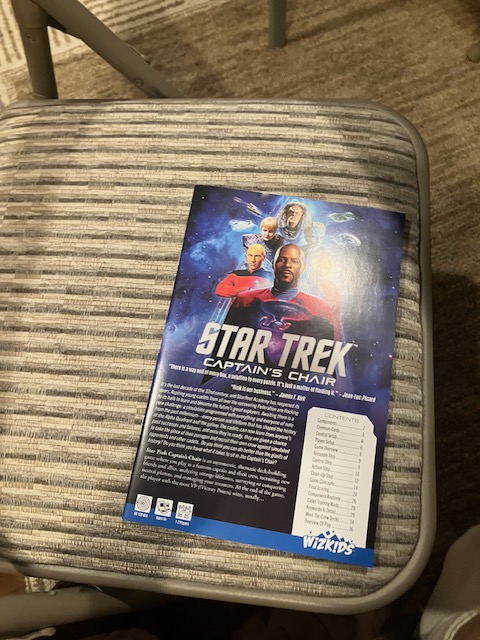
Art Vibe: I don’t necessarily love this art, but I think it fits the vibe of the game. That cover (see rulebook above) think presents an accurate “feel” for the game: This is a horror game!

Quick: Once you know the game, it’s pretty quick.  That 30-40 Minutes is pretty accurate.  And it doesn’t take “too long” to get the sense of the game.

Disambiguation:  The cards for each bear do an EXCEPTIONAL job of indicating who they will attack when they drop.  Me and my friends all liked that the rules were very clear on WHO got attacked!

Death: It’s sorta funny that “even if you die”, you can just re-spawn and keep playing.  The game “expects” death, and that’s sorta funny.  I mean, it’s a horror movie, right?

What I Didn’t Like

Set-Up: the set-up is a little clunky, especially at step J/K!  I had to kind of figure out what that meant, which meant kind of paging through the rulebook.  It felt like this could have been simplified.

Can’t Repeat Actions!  Eh?  You only have two actions per turn, and you can’t do the same one again?  YOU WILL FORGET THIS RULE because it doesn’t seem very thematic!!! Why can’t I search twice?  Why can’t I run twice?  Whaaaat?  This rule seemed … dumb and athematic.  Yet, I don’t think I can offer a house rule because I really do think this game was play-tested with this “no repeat” rule, so I feel like ignoring this might break the game.

Only 1 Actions Card???  WHY is there only one Camper’s Action card??? In a 4-Player game, this was very annoying.   The best thing I’ll say is that the Camper’s Action card became our first player token because we passed it around on players turns!!  It seems dumb there weren’t more of these.

Why Can’t You “not do anything”?  The rules are very clear; you MUST do two actions.  You can’t just “do nothing” on your turn.  And why the heck not?  That seems SO ATHEMATIC!!! How many horror movies have you seen where the chased just stops to let the bad guy run by? Or tries to hide?  We just worked around this by allowing a “Heal” or “Rest”, even when you were all full up. (This exception seems dumb).

The Tree doesn’t QUITE fit:  The tile-tree doesn’t QUITE git back in the box; see above. The edges of the hexes push up just a little and cause the top to jut out just a little.

Too many rules:  This, fundamentally, is a simple game about running from Drop Bears and getting beaten up.  Yet, the rules are 32 pages!  In a big rulebook!  There seem to be too many rules for what is essentially a very random game.

No Look?  This is a cooperative tile-laying game, but there is no notion of just “looking” ahead; you just get what you get!  I don’t love that; it doesn’t seem like it would be too hard to add a “look” action to the game so you can be a little more discreet when you move. This, I would argue, SHOULD be a house rule.

Reactions

Sam: 5.5/10 using the BoardGameGeek system.
Andrew: 6/10
Teresa: 5.5/10 or 6/10
Rich: 5.5/10 or 6/10
Basically, me and my friends had fun playing Drop Bears, and even though the game was a little random and messy, at least it was quick. None of us hated the game, but none of us loved it.  The general sense overall was that it was ok, but maybe it needs someone who really likes horror games … it does have a good vibe for a horror movie!  That’s just not our thing.

Conclusion

If you like Horror Movies and are looking for a game that really captures that vibe of a horror movie, I think you’ll really like this game.  Drop Bears really nails the horror movie vibe! The game is quick and thematic with amazing miniatures, and that may be enough for you to just love this game!

It really felt like there was a need for refinement of rules (can’t repeat actions, no empty action, can’t look) to make the game just a little more simple and streamlined.   There just felt like too many rules for what is fundamentally a pretty random game.  But, at least the game is quick.

I think Drop Bears really nails the vibe of the Horror Movie, but it just didn’t land for me and my group, but it might for yours.  We’d probably give it 5.5 or 6/10, but the horror movie vibe, quick play, and AMAZING miniatures may take this to a 7 or 8 for your group.

Firefighters on Duty: Real-Time Fun from Someone Who Never Played Project Elite!

Firefighters on Duty is a cooperative real-time game for 1-4 Player about being firefighters putting out fires and saving civilians!  This is a game all about rolling dice and moving firetrucks as fast as you can! This was on Kickstarter back in Nov/Dec 2023.  It promised delivery in November 2024, but it arrived at my house in late September 2025 … so it’s almost a year late.  Well, at least it made it.

Apparently, this is similar in many ways to the original real-time game Project EliteProject Elite (see BGG link here) was a real-time cooperative game where players moved around and rolled dice … but players killed aliens instead of fire!  Firefighters on Duty is by the same designers as Project Elite, but BGG does NOT list it is as a re-implementation … so it is different.  Unfortunately, I have never played Project Elite, nor do I have access to it, so we can only discuss the Firefighters on Duty by itself.

Let’s take a look!

Unboxing/Gameplay

See Coke can above for scale.  This is a pretty standard sized board game box.

Each player takes the control of one of four firetrucks: red, blue, green, orange.  And yes, everyone wants the red firetruck first!

Of course you need water to put out fires, and water in this game is represented by little blue dice!  See above! When you try to put out a fire, you roll the blue dice!

You carry water in your firetruck, and you decide (when you fight a fire) how many water dice to roll!

Each Location has a little blue water drop; in order to take out a fire at “this location”, you need to roll higher than this number!  See the 3+ and 4+ above … if there’s a fire there. you need to roll 3 and above (or 4 and above).

The game is controlled by action dice!  You can only do what the action dice tell you!  Each player has two dice (the solo player has three), and they are just constantly frantically re-rolling these dice for each 2 minute chunk (4-minute chunk for solo player).  What do these dice do?

Firetruck: move any vehicle one space.  Besides your firetruck, there is also a water truck (to bring more water to you) and an ambulance (for wounded civilians) that you can move
Water: Add one water to the fire station well
Fireman: Move one of your firemen (carrying one thing only)
Gear:  Do an action; usually try to put out fire, but sometimes chip with axe or turn off electricty.

The game lasts six rounds (the round marker is in the Hospital above).  During each round, you have a two minute spurt of activity where you roll-and-execute-as-fast-as-you-can!  A timer marks the time (on your cell phone, the game doesn’t include a timer).  After the real-time phase ends, you have to suffer the consequences of what you couldn’t get to (fires burning, fires exploding, people dying).

Fire is represented by little red wood markers on the board.  There is a little bit of a Pandemic element to the game as spaces with “too much fire” can spread to itself or adjacent spaces!

How are fires set-up initially?  There are 3 scenario booklets (see above), one for each of the player counts!

There are multiple scenarios per book for some variety.  Each Scenario (see one above) shows how to set-up the map and how to put out the people, fire, and hazards!

Guided by the scenario book, you set-up fires, fire hydrants, hurt civilians, hazards, trapped civilians, and the general map!  See above!

Your goal is to put out all fires (usually) and save civilians! You are “docked” points for things you don’t do, and as long as you have a positive score AND have put out all the fires, you win!

The game is all about getting your firetrucks and firemen to the dangerous places!  You can’t put out fires unless your firemen and connected hoses (back to your fire engine) are on fire spaces!

This game is about rolling as fast as you can to get your firemen and firetrucks to the right space!

The components are all very nice and very readable.  They have to be!  You are looking at stuff in real-time and can’t second guess yourself!

Rulebook

The rulebook is a little daunting at a 20-page large rulebook for a real-time game!

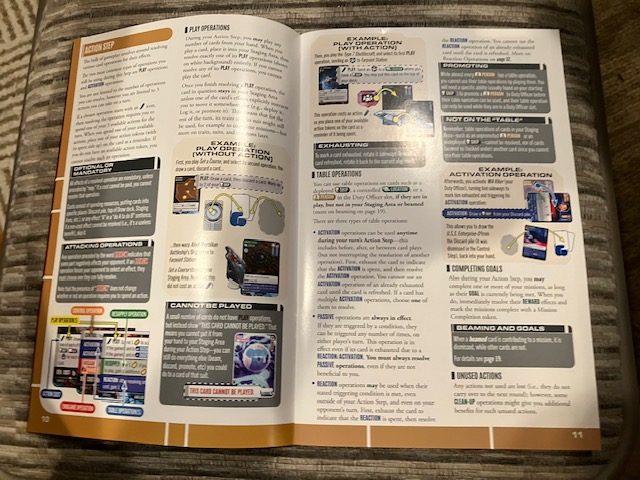
The game gets about a C on the Chair Test: see above as the pages droop over the edges when I try to put the rulebook on the chair next to me! Luckily, the font is pretty big and the pictures do a good job of describing things.

The components page up front is good. See above.

The game set-up starts …

.. and then goes to the next page!  Set-up is a little bit of a bear in this game.  Your first time through, it might take you a good 1 to 2 hours JUST to set-up!  Luckily, once you get going, it goes much quicker.

The rulebook is good enough.  The game does have a lot of rules for a real-time game, but don’t worry; it does sink in pretty quickly once you’ve played a game or two.

In general, this was a pretty good rulebook except for the form factor.

Solo Game

Perhaps a little surprisingly, the game does support solo play (thank you for following Saunders’ Law!).   The solo play is not true solo play; you will be taking control and operating two firetrucks.

The solo rules are outlines near the back of the rulebook (see above).  Basically, the solo player has to operate two firetrucks, but has twice as much time per round (4 minutes instead of 2 minutes).

The solo player also gets three action dice (instead of two); it makes it a little easier to roll what you need.  The solo player also gets one more scenario point, and “failures” by the solo player cause fewer deductions for scenario points.

The solo player gets twice as much time because he has two firetrucks!

Let me tell you right now; you will almost certainly lose your first game.  If there is ever fire on a space with wounded civilians at the end of a round, you just lose.  See above.

That first game is ALL ABOUT learning how the systems work;  you learn that trucks can block other trucks (the hard way: “MOVE THAT TRUCK! I gotta get up there!”), you learn how to put our fires, you learn how to move the firemen, you learn to think about how to stock the truck, when to use the water truck, etc, etc, etc.

In my first game, I would stop the clock a lot to look up rules. “Okay, I moved my firemen.  How do I put out a fire again?”   To be clear, there are a fair number of rules and you won’t get everything the first time you play.  I think it’s totally fair to stop and start the timer as you learn the game.

It’s sorta funny, when you lose …  you feel like the experienced Fire Chief is looking back at you and saying “Ok newbie, what did you do wrong?”  Then you realize all the things you did wrong.  There’s actually quite a bit of strategy in the game!  When do you bring out water trucks? When do you return? When do you bring out ambulances?  How do you deploy trucks so they don’t block each?  How do you deploy firemen so they can reach all the fires?  There’s quite a bit of strategy here that isn’t self-evident when you first hear “Oh, this is just a real-time game”.  Nope!

The biggest mistake I made in my first game is setting up the game on one side of the table. See above.  Nope nope nope nope nope.   The problem is that you need to kinda “move around” and “be flexible” as you roll, and place stuff!  Being constrained and squished behind my chair caused me to lose precious time.

In my second game (and believe me, after losing horribly in your first game, you WILL want to play a second game), I set-up around the edges of the table, making sure all chairs were clear so I could easily get to all sections of the board!  See above!  Much more mobile!

And all the stuff that you have to deal with “between real-time rounds”? I put out of the way, away from the action. You DO NOT want these cards and others tokens to get in the way while you are playing!

For the record, this scenario still didn’t “quite” fit around the table!  You need a LOT of space to play this game!  The fire stations (see above) are supposed to be longer, but then they don’t fit on the board!  You may find yourself adjusting the map slightly so it still fits on your table.  So, yes, this game takes a LOT of space!!  Both ON and AROUND the table!

In the end, I won my second solo game (after lots of readjustment), but I still remember stopping the timer at least once to look at the rules.  It’s gonna take at least two tries to get this game.

Let’s be clear; I wanted to play a second time to try to win!

Like usual, I think it’s important to play the game solo before teaching it.  There’s a lot of rules, and it’s better to have a sense of the game so you can teach it and run it.  A lot of questions come up when playing, and I think it’s ok to be able to “stop” the timer occasionally to explain the rules.

Cooperative Play

Teresa and I played a 2-Player game!

After learning my lesson in my solo games, I set-up the table so we could both people could stand easily around the table.  And yes, Teresa wanted the RED firetruck.  I think you need to prepare yourself for people fighting over the red firetruck in the cooperative game 🙂

After a few rounds, Teresa got the game!  Before each round, we’d discuss our strategy: “What am I doing?  What are you doing?  What are you concentrating on? ”  And then we’d start the real-time part of the round, and roll-roll-roll!  We’d deal with the consequences of our actions: watch fires consume stuff, and start with a new strategy for the next round!

We did lose our first round (the ambulance blocked the street and the firetruck couldn’t get through), so we had to learn from our mistakes!

To be clear, we played second game because we WANTED to!  It was fun, and we wanted to learn from our failure, and we wanted to set the course right!

The real-time phase tends to be a little more multiplayer solitaire, as each player concentrates on their region/responsibility, but later in the game, you both realize you need to coordinate in real-time phase to handle fires that are far away!  (One truck with two men isn’t quite enough for some of the faraway fires)  This seemed to work well; as we got our “sea-legs” for the game, then we started realizing: “We need to cooperate more”.

There is a quite a bit of cooperation in this game!  In between the real-time phases, players work together to come up with strategies to defeat the fires!  And players start being multiplayer solitaire in real-time phase, only to realize they have to cooperate in the real-time phase in the later game!

This is a game where cooperation really shines through!

Reactions

Teresa: I liked this! I wanted to play again!  I also liked this better than the other firefighter game we played (you can actually see the other game Teresa is referring to: Flashpoint: Legacy of Flame behind us above!)  Firefighters on Duty is probably a 7.5/10?

Rich:  This was different than any cooperative game I played in a while!  I think the game is much more fun cooperatively than solo, but the solo game worked!  6.5/10 for solo, maybe 8/10 for cooperative?

Conclusion

So I went full in and got EVERYTHING for the Firefighters on Duty Kickstarter: see above!  And you know what?  I don’t think I’ll ever play the extra stuff!  I am not even sure I needed the sleeves (and they didn’t even give me enough sleeves??!)!  The base game has more than enough content for quite a bit of replayability!  If you are thinking of getting this game and you are considering the extra content, I’d hold off!  If you play the pants-off this game, sure, you can pick up the extra stuff later, but I don’t think you need the extra stuff!

This game really invokes a lot of cooperation!  You start off only cooperating in the non real-time strategy phases, but then end up cooperating intently in the real-time phases too!  As a cooperative game, this is fantastic!

Firefighters on Duty is quite a unique event!    When you play it, I almost guarantee you will play twice!  You will lose the first game, then want to replay it to redeem yourselves!  I didn’t expect myself to like this so much (since it’s a real-time game), but it worked really well!   The game started multiplayer solitaire, but the cooperation unfolded as we played more and more!

This is a really neat game; the solo game works well, but it’s not my favorite … but you absolutely need to learn this game solo beforehand to teach it!  And the solo mode works really well for that teaching.   The cooperative mode is really neat; 2 to 3 players seems best (there might be TOO MUCH going on for 4 players?).  6.5/10 for solo game, 8/10 for cooperative game.

I don’t want to play this all the time (real-time games sometimes require me to be in the right mood), but when I want a real-time cooperative game, this is a fantastic choice.

Invincible: The Card Game. Review After Full Playthrough!

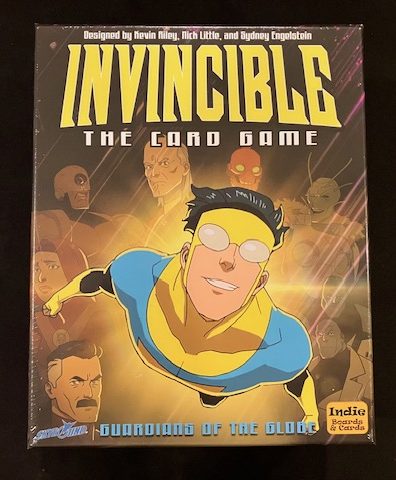
So, just so you know: we are talking about Invincible: The Card Game!  This is the one that has the subtitle Guardians of the Globe (see above).  You have to be careful!  There are at least 3 or 4 other Invincible games: some of them great (see our review of Invincible: The Hero-Building Game) and some of them … less so.  What about this one?

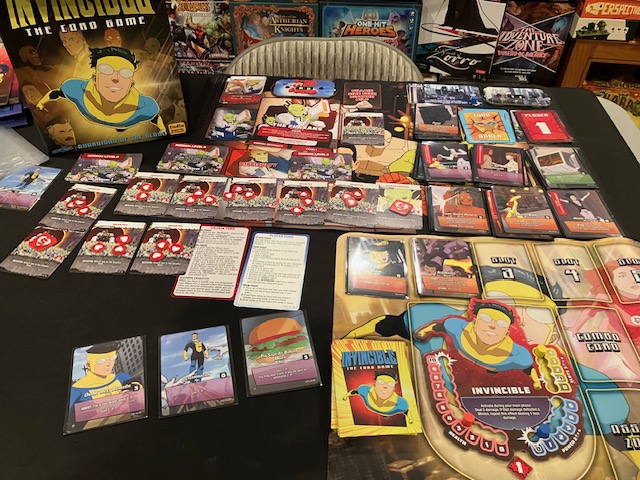
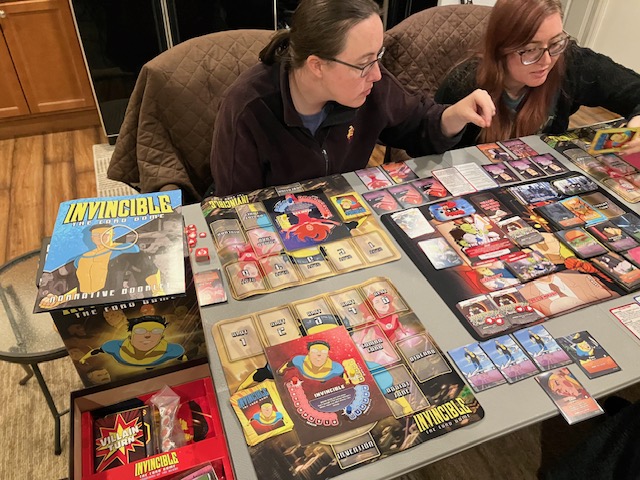
Invincible: The Card Game was up on Kickstarter back in October 2024: see link here.  I love the Invincible universe in the comic-book world, so I went all-in and backed the full Kickstarter and probably got waaaay too much: see above.

The Kickstarter had originally promised delivery in January 2025, but it didn’t arrive until the last week of September 2025.  It was about 9 months late, but given the state of the world and shipping, and it’s a Kickstarter, I guess that’s ok.

Invincible: The Card Game is a cooperative deck-building game for 1-4 Players.  It’s very very much like Astro Knights , a cooperative deck-building game we’ve reviewed here (Astro Knights) and here (Astro Knights: Eternity).  

In fact, Invincible: The Card Game is so similar to Astro Knights, you can combine them and play them together! 

Let’s take a look!

Kickstarter Extras: How Much Do You Need?

So, before we get going too much, we should have a quick discussion on “Should I get the Kickstarter extras?”

The “bad-guy” mat (see above) is probably worth getting.  It helps organize all the cards and where they go during play.  I don’t love how “busy” the art looks; I feel like it gets in the way of gameplay a little, as the art is distracting.

The “good guy” mat I was less in love with (I got four, one for each player).  See above!! I don’t love the layout for a bunch of reasons.  For one, I want to use the bottom space for “cards in hand”, but the “invention” space takes away from that, so that the whole bottom of the mat seems like wasted space.  I would have put the “invention” to the left or somewhere out of the way!  The “invention” is a very short-lived concept in the game (usually, you buy your invention in the first few turns), so I wouldn’t devote so much space (if any, esp. at the bottom) to such a short-lived card.

A bigger problem is the discard pile: it should be turned sideways!  For one, it’s clearer the cards are discarded (remember, the “Discard Pile” notation is under all those cards!).  Secondly, the Afterburn effects are harder to read when the discard is up right!  See above!!! What does that say?

The entire purpose of the Afterburn effects is that while a card is in your discard, you can use that ability!  So, it should be easier to read! 

We saw the Afterburn idea first in Astro Knights!  See how much easier it is to read those effects when your discard is sideways? See above!  (There was no player mat for Astro Knights, so we could do the right thing and have the discard sideways).

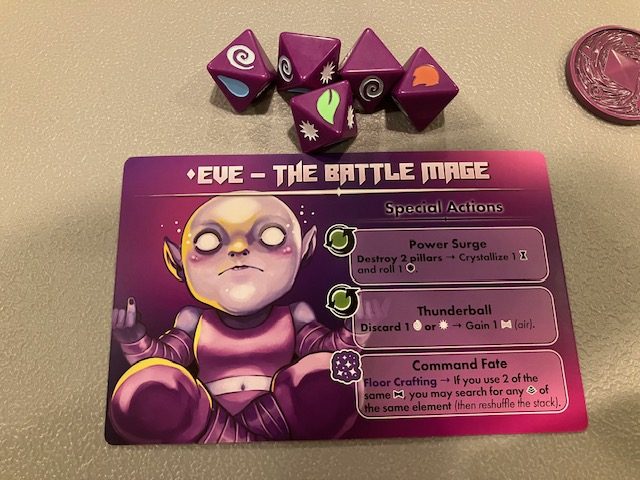
Another problem with the mats were the Assist Zone!  You are supposed to put cards in the Assist Zone when you Assist (a really great concept in the game), but there’s one main problem with that!  More than once, you “forget” about the card being in your hand because it’s in the Assist Zone and you take your turn “forgetting” to use the card!  It would be MUCH better if you just kept your hand of cards in front of you and “nudged” the Assisted cards up an inch to show you’ve used them for assist!  That way, they stay in your hand, but you have marked that it’s Assist has been used!  See above as Eve has a card in the Assist Zone, but it looks like she only has 4 cards in hand! It’s too easy to forget that card is still in your hand.  Just nudge the card up to show it has assisted. 

The rest of the player mat worked fine, but I think it should be thinner (for more space for “cards in hands” and moving inventions), and it should have the discard space sideways.

Of course, mats are always nice because they make cards easier to pick up and handle.

Another thing that came with the Kickstarter are sleeves! My “default position” is that you should usually get sleeves when you have a deck-builder.  And I think that’s still true here.

I am VERY HAPPY that the Turn Order deck has its own sleeves!  If you ONLY sleeve a few cards in the game, you MUST sleeve the Turn Order deck!  These cards are touched all the time!  After many games of Aeon’s End and Astro Knights, trust me on this!  My original Aeon’s End Turn Order deck is a little grody!! 

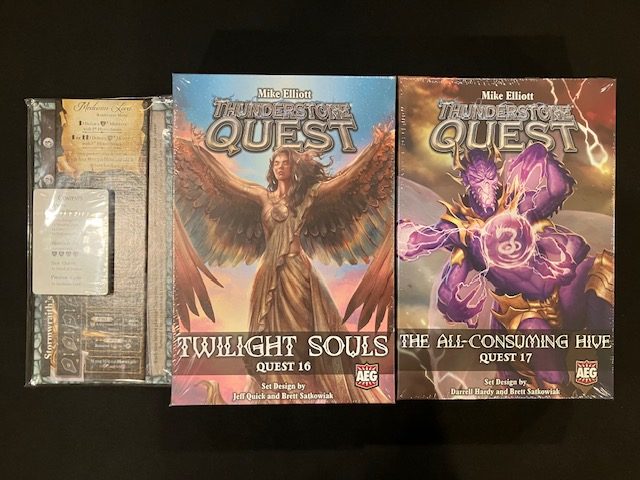
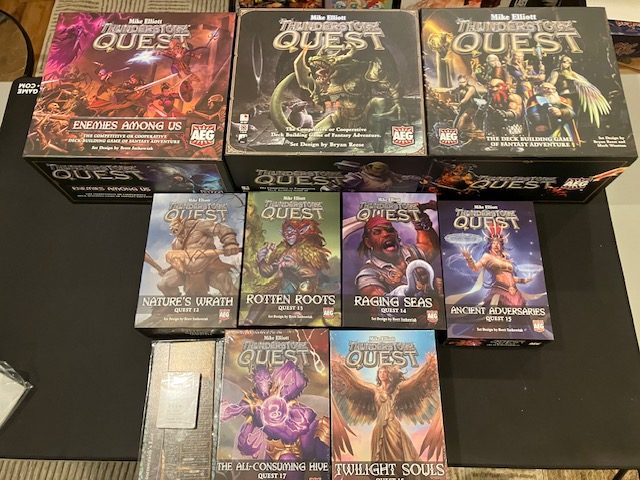
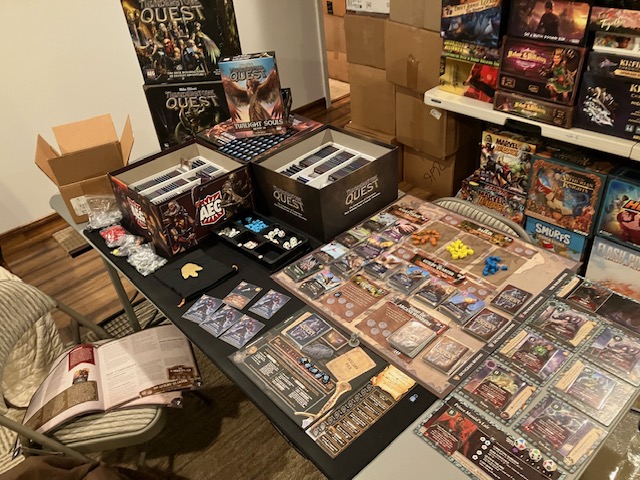
The sleeves are very nice for Hero cards (see above); these are the yellow sleeves with Invincible on back!  Unfortunately, there are no sleeves for the “bad guy” cards!  If you want to sleeve them, you’ll have to use different sleeves (as the “bad guys” cards have a different card back).  So, I went all-in to get all sleeves, and I was a little disappointed I couldn’t sleeve the entire game! I love the Hero card sleeves (they are very very nice), but I can’t sleeve the bad guys cards without having to use/buy a separate set of sleeves (I think I have some leftovers from Thunderstone Quest I can use).

There’s also two expansions that came with the Kickstarter; these are just more heroes and more villains.  We’ll (probably) review those separately later.

I admit I was a little underwhelmed by the extras.  The only thing I’d say you should probably get is the “bad guy” mat, but even then, I thought it was too busy (from an art perspective).   The sleeves were nice, but realize that they ONLY sleeve the Hero cards, and you’ll have to get more sleeves for “bad guy” cards!! The player mats were the biggest disappointment: they were too tall and needed some reorganization … I’d only get the player mats if you love this game. 

The only thing you HAVE to do is make sure you sleeve the Turn Order cards (either with the given cards or some others).  These cards get handled SO MUCH as you play.

Rulebook

This is an excellent rulebook.  It’s “essentially”, in many ways, a copy of the Astro Knights: Eternity rulebook in turns of layout and progression.

The rulebook gets an A- on the Chair Test.  It opens up and lays flat on the chair next to me, making it easy to consult.  It has big fonts, lots of pictures, and is easy to read.  It’s very easy to consult on the chair next to me. I wish the font were just a little bigger.

The Components page has pictures with annotating text.  

Even after pointing this out in the Astro Knights: Eternity review (see here), they still don’t note that the Turn Order cards are in deck 1A!!!!  I think this will still confuse some people, as they expect them in hand (before opening anything … remember: all decks say STOP! At the top, so you are reluctant to open anything right when you get the game).

One huge mistake the rulebook still makes (and we had the same problem with Astro Knights: Eternity) is not addressing how to play for the first time UP FRONT!!!  See ON PAGE 28, there’s a small sentence that says: “To play our expedition, skip reading this rules section for now…” … however, in order to play the game you still kinda have to start opening decks up!    It would have been SIGNIFICANTLY BETTER if the rulebook, on page 2, said something like “To play and uncover all content in this game, you will need to play the pre-written expedition! See page 28!”  Since I had played Astro Knights: Eternity and had to suffer through this already, I knew how to do this.  New players may not. Caveat Emptor.

I like how the rulebook has summaries of the cards immediately after the Components page.  I also like how the “new rules” are emphasized in Red above … The Assist keyword is a new rule (but not if you know Astro Knights: Eternity … that was kinda/sorta/not really like the Bolster keyword … it’s still newish for some people).

It is interesting how the set-up isn’t until halfway through the book … still, I think it works.  If you have the mats, like I do, this isn’t AT ALL what my table looked like.  Oh well.

The end of the book has keywords summaries: it’s not an Index, but it’s probably as good as we can hope.  I consulted the back of the book several times during gameplay. 

Overall, this was an excellent rulebook full of good examples.  I wish they had addressed the first play issue better.  Especially since I didn’t get the First Play Sheet (see later).

Unboxing and Gameplay

This is a actually a pretty thick box; see Can of Coke above for perspective.

It’s about half the width of a Ticket To Ride size box.

This is a cooperative deck-building game, so there are a lot of cards.  See above. 

The expedition book will tell you when to open the decks above.  The game has a campaign (called an Expedition) which will allow you to open up and see all the content in the game over 4 games.  This is a completely resettable campaign (as I did reset everything after playing it solo).

Each Player takes the role of a Hero from the Invincible universe.  If you don’t know the Invincible universe, you aren’t alone.  I know it from collecting comic books for years, and many people know it from the recent animated show.  None of my friends knew this universe.    Each character is kind of different (some have more slots, more hit points, faster power chart), but what distinguishes each character is their “special power”.

If, for example,  you look closely at Robot above (and yes, that’s his name in the comics), you’ll see written in blue (corresponding to the power chart) his special abilities: Stun each Enemy or Gain the top two Tech supply…

This is a deck-building game, so every player starts with a “crappy” hand of cards that they will upgrade and cull as the game goes.

Like most deck-building games, you can buy cards with Fuel to get better FuelTech, or Weapons!!  The six piles above form the market; the top two piles get you better Fuel (purple) the bottom three piles give you better Weapons (orange) and the the upper right pile gives you Tech (green).

The interesting thing about this market is that every deck is full of different cards.  If you are used to Aeon’s End or Dominion, where every deck in the market has the same cards, that’s not what you get here! Each card in a deck has a similar cost and “flavor”, but they are all different.

Every game has a “bad guy”, the first is The Flaxans (see above).

Usually, you have to bring the “bad guy” to 0 hit points to win the game; this is denoted by a health dial.

At the same time, you are protecting the city!  You are a superhero after all! If the city ever goes to 0 health, or all heroes are reduced to 0 health, players lose!  

The expedition has four chapters (each a self-contained game), each with special cards and envelopes.

Overall, this game has a lot quality components!

Where’s My First Play?

Where’s my First Game Setup sheet?  I did not get one!  I am VERY SURPRISED, because the Aeon’s End games (made by the same people) have amazing first play sheets! Am I the only one who didn’t get one?  Hopefully, if you get this game, they will have rectified this issue.

Art: Is This a Coloring Book?

So, I love the art of the original Invincible comic:  It feels clean without being too messy.  That art really complements this universe.  See some covers and inner pages above.

Unfortunately, I feel the art in this game is more … anemic.  Compare the Atom Eve and Invincible characters (above) to covers from the comic!  The player art in the game just seem … lesser.  To the point that it bothered me.

And Robot feels so anemic (above), he feels like a page from a coloring book!

From just one frame in the comic, Robot looks great! But the character in the game made me cringe. “How could I explain this to my friends?  This looks like a coloring book!! Really, though, this is a great comic!!”

I was told by my friends to mellow out, as the game art is more consistent with an animated series anyways. So, the art we are seeing is more like the animated series. I guess.

Maybe this is just me, but I would have loved this game a lot more if the art had been … more like the comic book than the animated series.  (To be clear, even though Invincible: The Hero Building Game didn’t have art that quite as good as the comic, it was still significantly better: see review with lots of pictures here).

Decide for yourself.  To be clear, I like the game, but I don’t love the art.

Solo Play (true solo)

There are two ways to play solo (thank you for following Saunders’ Law)!  

Our first play was true solo, where the solo player takes control of one character.  See above as Invincible battles the Flaxans alone.

There is a major difference in the true solo game: the Variable Turn Order deck is changed!  Instead of having 6 cards, there are only 5!  The Villain goes twice as normal, but the Hero only gets to go three times (as opposed to four turns in any normal game).  See above.

I think the idea is that the Hero gets a chance to refine his deck much more quickly, so that he has to be limited to three turns for balance.  The problem is, I think the solo mode is fundamentally more fragile.

My first true solo game was a massive bummer: I lost my being reduced to 0 hit points very quickly.  My second game was much better, and I think I just barely lost.  

The problem is,  the true solo game is very fragile.  In a 2 to 4 player game, there are multiple players with multiple hit points, so there are 20 to 40 hits points total distributed among the players!  In the solo game, the solo player has only 10 hit points (or less)! If the randomness of the game is too much, the true solo player will take that 10 hit points and die quickly!   And that’s what happened in my first solo game.   The other problem is that with multiple characters, one character can be reduced to zero hit points and still be useful as long as someone still has hit points! With one character, that will never happen.   

We saw this same problem in the app for Aeon’s End: the solo player gets fewer turns.  And frankly, I don’t play the app solo anymore because of this.  The true solo game is just too fragile and it’s too easy for the randomness inherent in the game to overwhelm you.

If you really want to try the true solo game, a simple house rule might be to allow the true solo character to double the number of hit points (have 20 hit points).   At least then it will allow the solo character to absorb more of the damage before dying (simulating multiple characters taking distributed damage).  I am surprised this isn’t built-in to Invincible: The Card Game; I know some games, like The Heroes of Terrinoth, where they balance the game by giving fewer players more hit points.

I probably won’t ever play this game true solo ever again.

Solo Play (Two-Handed)

Ah, but two-handed solo was much more fun!  The solo player alternates between two characters like a 2-Player game: this is the way this game was meant to be played!  Two characters who can assist!  Characters who can keep playing even after the other has been down to 0!  More hit points to take damage from the bad guys!  And four full turns for the heroes for every two turns of the bad guys!

This is the way I played the Expedition solo: Two-Handed Solo.   I recommend you play Two-Handed solo if you wish to play; it’s the way the game was meant to be played.  The only real downside to Two-Handed solo mode is there is more maintenance: you have to maintain two hero decks/stats as well as maintain the “bad guy” decks/stats.  There’s less maintenance in the true solo mode (as you only operate one hero), but (as you now know) that true solo game is much more fragile.

Solo Expedition

The Expedition is a series of 4 games (or more games if you lose) that you play in a row. (If you lose, you just play again with some adjustments).   New cards, new abilities, new heroes, new villains, and just new stuff comes out after every game of the Expedition and augment the next game!! By the time you get to the final game, you are playing with a lot of cool new stuff!

SPOILERS BELOW:  for the rest of this section, we’ll be discussing and showing pictures of the the chapters 1-4 of the Expedition.  Most of this won’t spoil too much, but if you want to be completely surprised, skip to the Cooperative Play section.

Chapter 1: Invincible and Atom Eve

The first Expedition game has us fight the Flaxans: it’s the only enemy you have when you first unbox your game!  I chose Invincible and Atom Eve to be partners in my first Two-Handed solo game of the Expedition!  They did great and were able to take down the Flaxans.  Atom Eve‘s special power seems very specialized, and I didn’t find myself using it at all (it’s very city based). Invincible‘s special power was more interesting and I used it at least once.  To be fair, I didn’t need to use the Special Powers too much, because the first game is simpler.

This is really just the base game with nothing special.

Chapter 2: Rexsplode and Robot

For Chapter 2, you fight the Titan!  He’s all about damage reduction!  And this Chapter also introduced something called Inventions!  Basically, Inventions are a card only you can buy, but you get to choose it at the start of the game; it allows players to strategize a little on what their characters may focus on.

Titan’s really hard to do damage to!

To change things up, I had Rexsplode and Robot fight the TitanRex has a very weird power (use a weapon twice, but blow it up), and so does Robot  (he grabs tech)

And we saw exactly the situation we discussed earlier in the True Solo section!  Robot was reduced to 0 hit points, but because Rexsplode was still alive, Robot kept fighting!  Even Rexsplode was down to 3 hit points, but they emerged victorious!   I think part of the issue that they didn’t do better was that I didn’t use their powers very well.  

The Inventions were interesting, but not a real game-changer.  It’s just one more card you can buy.  It does give each hero some focus, though, and some chance for discussion/interaction when you choose, so that helps cooperation.  Note above that I put the Inventions on the LEFT of the mats (instead of under the character).  Again, the player mats could have been better.

Chapter 3: Monster Girl and Duplikate

Chapter 3 introduces Monster Girl as a new player character.  The “bad guy” now is Sinclair!

Monster Girl and Duplikate went after Sinclair!  

Something new from this chapter: The Combo Powers!  Each player gets to chose a Combo!  The Combo Powers are interesting because they allow your partner a special action whenever you do an action! For example, when player 2 activates their ability, player 1 gets to draw two cards!  And when player 1 attacks with debris, player 2 powers up!   

Monster Girl and Kate (with their Combos and Inventions) were a great pair! They handled Sinclair and all his crazy machinations!  And this was the first game when I really feel like I was very strategic and took great advantage of both the Special Powers and the Combo Powers!  Both Monster Girl and Duplikate did a great job of helping each other all the time! This was by far my favorite game of the Expedition.  It was just fun!

If Inventions were pretty good, I think The Combo Powers are a bit of game-changer (in a good way), especially if you can harmonize so that the characters combo powers really reinforce each other!

This was my favorite game of the Expedition.  The villain was still hard and interesting, but the Combo Powers stepped up the game for me!

Chapter 4: Monster Girl and Duplikate

By this point, I had tried all the heroes.  I had so much fun with Monster Girl and Duplikate, in my previous game, I took them for the final run against Omni-man!

Chapter 4 introduced the Team Attacks.  You get to choose one of six (I think).  See one of them above.  Basically, your characters can choose to do one of these three sacrifices on their turn.  If, all three sacrifices have been done, players can choose, at any time, to get the reward!  The coolest part is that you can choose WHEN to get the reward so you can make sure the sacrifices are timely and not in vein!

Omni-Man is a VERY different villain, as you basically have to stop him from destroying earth with his catastrophes!  Basically, you have to make a TON of sacrifices as you play!

This was a super cool way to end the game.  Monster Girl and Duplikate did a great job making sacrifice after sacrifice to save the world!  And they did use the Team Attack, but it wasn’t as game changing as we had hoped.

It was fun to save the world!

Putting It All Back Together

After I was done with the solo campaign, the Expedition book gave us directions on how to put the game back to its pristine state;  I reset the campaign so I could play cooperatively with my friends.  Every card has a notation about which deck it came from (see above).

Cooperative Play

Invincible: The Card Game took over my game table for a cooperative game for a game night.  

The Assist keyword was the hit of the night!  Everyone loved the idea that they could help someone else out when it wasn’t their turn!  And the Afterburn effects were also a big hit!  (I didn’t talk about Afterburn too much, because we already saw in Astro Knights: Eternity,  but Afterburn was great in our solo games).

The cooperative game worked, even though we lost.  We had fun and would play again.

What I Liked

Universe.  I really do like this universe! Retheming Astro Knights to this universe really did work.

Assist:  I think Assist was what Bolster (from Astro Knights: Eternity) wanted to be. Assist is easy to explain and easy to play: when it’s not your turn, you can offer an ability/something to another player!  Take a look at some of the cards above. This one thing really boosted my assessment of Invincible: The Card Game!  It makes the game more cooperative, more interactive (as you pay more attention to other people’s turns), and generally makes the game more fun! (Bolster was the idea that when someone else had to discard, you could get something.  It was clumsy and harder to use.  Assist is what we wanted but didn’t know it).

If there were one thing that elevates Invincible: The Card Game above all the Astro Knights or Aeon’s Ends of the world, it’s this.   (Put Assist with Friends and Foes module from Aeon’s End: Descent, and you might have a Top 10 game!)

Afterburn: The Afterburn effects are really a neat thing.  Sure, we saw them in Astro Knights: Eternity, but they work great here too! It’s just another choice you have when buying a card to help future you!  

Things I Didn’t Like

Time: I have played this game a LOT.  I don’t think I ever saw a game anywhere NEAR 60 minutes.  Except maybe that pure solo game when I lost so quickly! That 60 minutes for estimated time seems off by about 2x.  90-120 would have been better?  Maybe, maybe, after you have read all the cards and know everything in the villain and box you are playing, sure.  But a new game with new rules and a new Villains (which is what you want to keep the game fresh)?  No way for 60 minutes.  

Art.  I love Invincible and I love the art of the original comic book.  The art is in this game seems anemic and more like the coloring book version of the universe!  Maybe this is just me.  My friends told me to mellow out; it’s more like the animated version.

Player Mats:  I had so many problems with the Player Mats; I think they should be redesigned. (see our discussion in the section at the beginning). Another problem is that all mats have the be symmetric, but sometimes when I lay out cards next to my friends, I want the layouts to be mirror images!  For example, the Combo Cards should probably be NEXT to each other so that’s it’s easier to remember when to activate them! Bah, maybe I’m just grumpy and you’ll be perfectly fine with the mats.  But I think I struggled with almost every decision they made.

True solo: I think the True Solo mode is too fragile.  I think an easy fix might just be to give the solo character double the hit points. I am also reminded that Aeon’s End: Descent had a solo mode with that DIDN’T use fewer player actions, and it worked just fine (so fine that it made the #3 spot on our Top 10 Solo Games of 2024), so I really don’t think you need to only have 3 player action cards.  Ugh.  

Variable Turn Order: We’ve said it many times! There are problems with Variable Turn Order games!  See out discussion here:  A Discussion of Variable Turn Order and Ways To Mitigate Its Randomness! In all of our games, we did have to use our ad-hoc house rule of never letting the Nemesis have more than 2 turns in a row (at least twice).   (I did note that some of the Afterburn effects allow you to have some choice on the Variable Turn Order deck, so I appreciated there was some mechanisms in the game to affect that, but it’s still pretty random).

Conclusion

I’ve been grumpy a lot this review; I think that’s because I know this game and this system fairly well, so I have some experience with what seems to work.  But don’t get me wrong, this is an 8.5/10 game for me.   And the Assist keyword is probably my favorite new thing in this system!  It really facilitates cooperation!!!  (I am so glad they kind of “jettisoned” Bolster)

There are just some things that could have made this a 9/10 for me!  I just don’t think this will ever be a 10/10 for me because of Variable Turn Order issues (unless they find some way, like Fate Tokens, of mitigating it).

The Expedition is a fun way to reveal all the content of the game! And four chapters (games) seems just right as the length of a campaign! Any longer and it seems too much, any shorter and it leaves you wanting more.   

And the game says you CAN play this Astro Knights.  I guess I never got that far? I still have at least two expansions to play before I even get anywhere near that!

Probably My Favorite Game of 2025! DC Super Heroes United: Batman Hush

While we wait for the full delivery of DC Super Heroes United (which has run into multiple issues; CMON money issues, tariff issues, and staffing issues), CMON did manage to release DC Super Heroes United: Batman Hush (which we’ll just call Hush from now on, thank you). See above!

This was a “surprise” release that was available from Amazon sometime in August 2025; I ordered it instantly as soon as a I found out about it.  No one really expected this?  EDIT: Well, I missed a some memos … I didn’t expect it.  I mean, we expected DC United (it was #1 on our Top 10 Anticipated Cooperative Games of 2025 list), but Hush was not part of the original Kickstarter!

This game arrived at my house September 10th, 2025.

What is this?

Hush

This game Hush is a standalone game in the Marvel/DC United series of games.  Yes, it is standalone; you don’t need any other sets to play this.  This is a cooperative superhero game where players take the role of your favorite DC Superheroes (Batman, Robin, Superman*, etc) and work together to defeat the villain!

Hush is loosely based on the Jeph Loeb/Jim Lee/Scott Williams/Alex Sinclar Batman series called Hush: see the 20th Anniversary Edition hardback above.

Surprisingly, I had never read Hush, which is weird because I love Batman and I love Jim Lee.  How have I never read this???  I texted my friends Bryan and Diana, who are huge Batman and Jim Lee fans about this!

They think Jim Lee’s Batman is the best Batman (see above).  I went ahead and devoured the story over about 3 hours (below).

Hush is a great story; I’d recommend reading it if you’ve never read it.  It gives much more depth to the Hush villain(s) in the box.

Strictly speaking, you do NOT to read the Hush graphic novel/series to play the game; it just helps flesh out the game.  So, if you are intimidated by the giant Hush graphic novel, don’t despair!  The game works fine without knowing the series, but be aware that there can be spoilers.  (Still, Hush was pretty cool; you should read it!)

Unboxing/Gameplay

See box above with can of Coke for scale.

Each player chooses a hero to operate: Batman (classic), Robin (Tim Drake), Catwoman, or Huntress.

There must be a villain to fight: Hush, Harley Quinn, The Joker, or Superman (controlled).  Superman (controlled) can also be played as a Hero.

I recommend taking a picture of how the minis fit into the insert (or use mine above).  If they all get out out-of-whack, you can’t put the plastic cover over the minis (see below).

Each Hero gets their own deck, and each Villain gets their own (Master Plan) deck and Threats deck.

There are 8 locations that come with the box; you will set 6 of them out in a circle representing the city.

Most of the characters have equipment; the equipment cards are “newish” to Marvel United: they were introduced in Spidergeddon, but we were found we loved them in Marvel United: Multiverse (see review here).   The equipment cards augment the heroes, and basically give them more choices on their turn; however, they will either be discarded or need a recharge to reuse them.  See above.

For heroes who don’t have equipment, there are also “generic” equipment cards any hero can use (see above).

The game also comes with Battle Plan cards; they are for the built-in solo mode called Commander Mode.

There is another way to play where one player can take control of the Villain and plays against all the heroes: this is a 1 vs. many mode using the Super-Hero and Super-Villain cards above.  We won’t be discussing this mode any more in this review; this is strictly a solo and cooperative mode review.

There are a tons of tokens for health, KOs, etc. See above.

Overall, this game looks consistent and great.  The artwork and minis in the game are consistent with the look-and-feel of all the previous Marvel United games (except this is DC instead of Marvel).  For previous looks at Marvel United games, see here, here, here, here, here, and here.

Rulebook

The rulebook is good (it had better be after so many iterations), except for the form factor.

This gets a C+ or B- on the Chair Test; it does stay open on the chair next to me, it has a good-sized and readable font, it has lots of pictures, and it’s easy to read.  Unfortunately, it hangs down just enough to be annoying.  It does work with only one chair, if you sorta fudge it diagonally.

The Components page is great: see above.

The Set-Up is across two pages, but they are in the same span, and the picture and labels work well.

Some, not all, icons are on the back.

In general, this is a good rulebook: good components, good set-up, good font, good pictures, good back. The only complaint is the form factor.

What’s New?

Most everything in Hush  we’ve seen in one of the previous Marvel Uniteds.  I have played a lot of Marvel United, but it’s hard to say you’ve played EVERYTHING across the massive amount of content in Seasons 1,2, and 3!  Here’s what was new to me:

Charged Effects: The little yellow area/flip card allows to flip a card in the Storyline once it’s up.  In the example above, you can flip Batman’s card (only if it’s in the Storyline) above to stop Robin from being KO’d!  This is kinda neat; it’s like a one-time only effect that can only be activated AFTER the card has been put into play.

Constant Effects: These cards keep an ability active always once they are in play in the storyline! See above as Superman’s Invulnerability keeps damage off him!

Mandatory Effects: These are mandatory things you MUST do on the card.  This Superman is controlled, and occasionally reverts to his controlled self … doing damage to Heroes around him.  See above.

To be fair, we did see Mandatory Effects on the Nightcrawler’s cards back when we did the Dark Phoenix Saga: see here.

Hush Deck: if you are playing Hush, the Hush Plan deck replaces the Clear Threats on the dashboard.

Generally, the DC Superheroes United: Hush Batman or Hush feels very much like  the newer Marvel Uniteds with equipment, Charged Effects, Constant Effects, and Mandatory Effects being the newer things.  Otherwise, it feels like Marvel United, but DC instead!

Solo Mode Discussion

There is a solo mode called Commander Solo Mode (thanks for following Saunders’ Law and giving us a solo mode) that spans two pages.  And it’s pretty complicated.  But it is a true solo mode; you only operate one hero.

I think we saw the Commander Solo Mode first back in Spidergeddon, and we kinda liked it better than the solo mode in the original Marvel United … but frankly it still just feels too complicated.  It’s almost two pages of exceptions, new rules, changes, and special rules!  Look closely at those two pages above!  There’s SO MANY RULES FOR COMMAND SOLO MODE!

Frankly, it’s so easy to just pull out two heroes and alternate between them and just play solo (operating two heroes); it’s the way the game was meant to be played.  This is the way we play solo, partly because it’s significantly easier, partly because it’s easier to jump in (so we concentrate on the new rules of the Villain), partly because it’s the way Marvel United was meant to be played: 2-4 Players, and partly because we have to teach the cooperative game to our friends (so it’s better to play without all the solo rules exceptions for a better learning to teaching game).

You can disagree with me if you like, but I feel very strongly about this! Every time someone tries to put a solo mode in, I find it’s usually better and easier to just play two-handed solo instead (Leviathan Wilds, Leviathan Wilds: Deepvale Expansion, Lord of the Rings Pandemic to name just a few).  Frankly, the built-in solo mode for Lord of the Rings Pandemic almost caused me to hate the game … it wasn’t until I played 2-Handed solo that I found joy in Lord of the Rings Pandemic.

Play solo operating two heroes.  You’ll thank me.

Game 1: Batman and Robin vs. The Joker and Harley Quinn

Solo game: two-handed solo (one player operating Batman and Robin independently)

Our first game was Batman and Robin vs. The Joker and Harley Quinn.  Note that Harley Quinn and The Joker are a “team” you are playing against!  You can’t win until they are BOTH down!

See Batman and Robin get ready to go!

The storyline for Joker/Harley Quinn got convoluted as many times we’d have to put Master Plans into the storyline … they can come up at a later time, or when a character gets KO’d!

In the end, Batman  and Robin prevailed.  Batman took out Harley Quinn …

… and Robin (Tim Drake) took out the Joker.

There are some neat ideas here, as the Joker kidnaps civilians (something he would SO DO in the comics),  Harley causes the Master Deck to dwindle, and “Jokes” appear in the Storyline!  This is a game about keeping the Master Plan deck under control by indirection!  Sometimes you do stuff to STOP the Master Deck from getting too small! If the Master Deck ever becomes empty … you lose!

The Joker and Harley Quinn scenario felt incredibly thematic: Joker kidnapping, Harley causing chaos, and Joker’s “jokes” in the storyline occasionally springing on the Heroes! (It also had roots back in the Hush series: see snapshot above).

Batman and Robin’s decks were also on point: they both had the ability to “be a detective” and look at the next Master Plan card coming!  This was both incredibly useful and very thematic.

Games 2, 3, and 4: Catwoman and Huntress vs. Superman (controlled)

Solo game: two-handed solo (one player operating Catwoman and Huntress independently)

So, Superman (controlled) is hard.  I guess he should be; he’s Superman!

Superman is bad guy here because Poison Ivy is controlling him! See a still from the comic above!

Superman is controlled by Poison Ivy (see above).   If Poison Ivy makes it around the board back to Kane Chemicals, the bad guys win!

Over 3 games, Huntress and Catwoman struggled! They lost three games in a row!  In this particular scenario, heroism is very important!  Unfortunately, Huntress and Catwoman seem to have more punch than heroism!

Huntress felt very thematic, as she could look at the top of the Master Plan deck (with espionage) and was very mobile and punchy.  Similarly with Catwoman, she had some disguise cards and was very punchy and mobile.  Unfortunately, they were a bad team against Superman (controlled). Honestly, this makes sense thematically: neither Catwoman or Huntress are known for their Heroism in the comic books … they tend to be more “self-interested” heroes!

Still, I thought the Superman (controlled) villain was pretty cool! It felt thematic … and you even had to have a Kryptonite ring to hurt him!

I have played SO MANY games of Sentinels of the Multiverse where you lose because you just have the wrong heroes.  And that feels very much like the comic book universes!  (Sometimes, Spidey has to go visit Doctor Strange to handle a mystic bad guy!)  In this case, Huntress and Catwoman are the wrong Heroes for Superman … or at least, it’s a LOT harder to play them.

Game 5: Batman and Robin vs Superman (controlled)

Batman and Robin did much better against Superman (controlled): they defeated him in one game.

Batman and Robin control the Master Control deck much better and have a lot more Heroism to deal with Threats and civilians.

This win felt very thematic: Batman and Robin use their detective skills and heroism to keep the bad guy (a Superman controlled by Poison Ivy) at bay.

Game 6: Batman and Robin vs Hush

Solo game: two-handed solo (one player operating Batman and Robin independently)

The Hush Villain is probably the most complicated to play.  You must complete all three Missions, but instead of Clear Threats, you have to clear six “Hush” threats (see below).

Like the comic book (very minor spoiler), the Hush Plan cards makes you “focus” on a particular Henchman on the board: you can only defeat them in a certain order.  This constrains how you have to defeat them!

The Hush villain is much more about taking down Henchmen a little at a time, while “defeating” them in a particular order.  Batman and Robin have to “balance” how they spend their resources.

Of course, lots of things (like KO’s, see above) get rid of Master Plan cards.  Do you defeat a Henchman this turn at the cost of losing a Master Plan card?  Or do you wait a turn?  Defeating Hush is all about balance for the Heroes.  Hush himself is sewing Chaos into the world and dwindling the Master Plan deck!

In the end, Robin had a good run and was able to move to Hush and take him down.

Even though it wasn’t a full saga like the comic, Hush felt like the story that unraveled in the comic.  Batman and Robin get “distracted” by Henchmen along the way as they try to uncover who Hush is … and that’s the last card of the Hush Plan deck!

Although you can play the Hush Villain without reading the story, I strongly recommend you do read it before playing!  There is a major spoiler at the end of the Hush Deck that will spoil the entire Hush comic book.  The other two Villains (Superman and Joker/Harley Quinn) you can play without reading, but I suggest you probably read Hush before playing he Hush villain.

Game 7: Superman (controlled) and Huntress vs. Joker and Harley Quinn

Don’t forget; you can play Superman (controlled) as a hero as well!

Supes deck is pretty strong.  And Huntress is great at punchy and movement.

Superman’s deck has a minor flaw that he might have to punch other Heroes (since he still has some residual control): see above.   That card kind of “balances” a very strong deck by giving him a “forced” card. Don’t you hate it when Poison Ivy asserts her control at exactly the wrong time?  That feels so comic booky!  I kind of enjoyed this!  Supes is great … except for the one time he isn’t!

And Huntress redeemed herself by helping out Superman.

Game 8: Catwoman and Huntress vs. Joker and Harley Quinn

Just to make sure Catwoman and Huntress are good decks, I took them for a run against Joker and Harley Quinn.

After losing to Superman three times, they acquitted themselves and beat Joker and Harley Quinn.

Cooperative Game

There weren’t any real surprises from the cooperative play; we’ve played this before as a team!

People discussed!  At one point, Andrew HAD to play a Controlled Superman card and he said “I suggest you all NOT be adjacent to me! I will punch you!”  So, Sara and Teresa made sure there was movement on previous cards.  Most of the discussion is “Oh! If you give me this … Oh!  What do you need?” and stuff like that.

My group had a fun time playing this cooperatively.  The new abilities and equipment made them enjoy it that much more.

Judging by my group’s responses, I think this is the best version of the Marvel/DC United system so far.

Core Game?

I am somewhat surprised that Hush is a core box!  That means this is a completely standalone game!  I loved what I saw, but this doesn’t feel like it should be a “core set”?  The heroes in this set are great for new players, but the villains are really complicated!  Superman (controlled) is probably the easiest Villain to operate, but maybe the hardest to defeat?!  And both Hush and Joker/Harley Quinn are very different than most base Marvel United villains! They are much more complicated than (say) Red Skull from Marvel United, or even Ghost Rider from the Multiverse set!

If I were to recommend someone start with a core set, I’d recommend the base Marvel United, Marvel United: X-Men, or Marvel United: Multiverse over DC SuperHeroes: Batman Hush… I think Hush is too much for a starting player.  Which is too bad, if you LOVE DC, this is the only set you can currently get! I am afraid Hush might accidentally turn off some intro players because of its extra complexity.

Plays Well With Marvel United?

Of course, I had to make sure this played well with Marvel United, so I had Batman and Robin take on Taskmaster (from the base Marvel United set)!

For funzies, I also used half of the Locations from Marvel United and half of the Locations from Hush!  See above.

I got SUCH a kick out of mixing universes! I started giggling to myself when I had Batman and Robin start the game on SHIELD Headquarters!

Then later in the game, Batman solved the Threat at Stark Labs!  I giggled even more thinking of Batman disassembling a Trap in Tony Stark’s lab!

For the record, Taskmaster posed little threat to Batman and Robin.  More like “Lamemaster”.

I will say that I think later Heroes and Villains are stronger than earlier Heroes and Villains in the Marvel United games.  This game demonstrated that a little … but I still had a grand time!

Conclusion

Currently, Hush is my game of the year for 2025!  I have played about 10 games of Hush and want to keep trying more and more!  I want to try Batman and Robin vs the Sentinels!  Will Superman do a great job against Galactus?  Can Batman and Spiderman team up?  How would Superman and Gladiator pair up as compatriots?  What about Superman vs. Gladiator?  There are SOOOO many cross universe games I want to try!

Even with all the fun things I can try combining Marvel United and DC Superheroes United, I still loved the Hush box by itself.  Each Villain presented a different puzzle to solve!  Each Hero has their own flavor and personality: Catwoman is more punchy than Robin, but Robin is more heroic!  And these differences are very flavorful!

This box also introduced me to the wonderful world of Jim Lee Batman (who is the best Batman according to Diana)! I am grateful that I got to experience Jim Lee’s Hush for the first time!

My only complaint is that the Villains in this box are all pretty complicated; I wish there had been a “simple” Villain (for newer players).  If you are an experienced Marvel United player, then this box is a no-brainer.  If you are a more introductory Marvel United player, I might recommend a different core box.

After all is said and done, Hush is a full up 10/10 for me.  I played so many games over a 2 week period and each one was a blast!  Even when I lost, it was fun to try to figure out “why I lost” and come back and revisit the game!

Even though Hush is an unexpected DC Superheroes United (this wasn’t part of the original announcements for DC United), there’s a reason DC Superheroes United  was #1 on my list of Top 10 Anticipated Cooperative Games For 2025!

What Eggactly Is In This Eggspansion? A Review of Birds of a Feather Eggspansion for Flock Together

Birds of a Feather is an expansion … pardon me … eggspansion for the cooperative boss-battler game Flock Together.  This eggspansion (be prepared for a lot more chicken puns) was on Kickstarter back in Novemeber 2024 and promised delivery in August 2025.  You know what?  They even delivered a little early!  I want to say  I got my copy in June 2025, so nice job!

Flock Together was pretty popular in my groups; it made the #8 spot on our Top 10 Cooperative Games of 2024!  Usually, extra kickstarters are like this a way to keep the flow going … if you hadn’t ordered the original Flock Together game, you could get that AND this new eggspansion!

So, what’s inside?  Let’s take a look!

Unboxing

This is a smaller box than the original, and pretty thin too: see the Coke can above for perspective.

There’s not that much new here.  There’s 6 new Predators!

With lots of new puns!  Chew BawkaSheriff of Rottingham?  Oi!

But this game is built on the bedrock of Chicken Puns!  There are 6 new Chickens you can play: J.R.R Yolkien, Broods Lee, Princess Layer, Chickira, Aracorn (Heir of Condor), Cluck Norris, … so … many … chicken … puns!

There’s only 3 new Weather cards …

And basically another player board so you can have up to 6 players.  This eggspansion also expands the game to 6 players!  (The original only played 1-5).

There’s a few new options for chicken color (see wooden … cheeples … above … yes, that’s right: cheeples are chicken meeples).

The game looks very consistent with the original, both of which have great art from Andrew Bosley!

How Is It?

I played a solo game with J.R.R. Yolkien (oi), and it’s pretty much the same game!

I used new Chickens and new Predators, and everything else (Bonus cards, board, counters, etc) comes from the original box!  See above!

The game plays the same; it’s still fun and silly.  (I did add the 3 new Weather cards in as well).  I just had a new Chicken and all new predators!

More Stuff

This expansion is pretty simple: more stuff.  6 new Predators, 6 new Chickens, more tokens so you can play 6-Players, and 3 new Weather cards.  That’s pretty much it!

The rulebook discusses how you can just mix this in with the original game and never see the expansion box ever again!

This eggspansion  just adds a little more. There’s no real game changers here.

Missed Opportunity

One of my complaints about the original game (see review of Flock Together here) was that the eggs and food were all different looking (see above and below) …

… for no reason.  I always thought that there should be some rules to take advantage of these differences!  Maybe different colored eggs have different bonuses/minuses for different seasons?  Maybe you can’t get certain food until you go to certain parts of the board?   I always thought it was weird that we have these very distinct food and eggs … and these differences means nothing in the game.

I was kind of hoping this expansion would expand the universe and give a reason these eggs and food were so different!!!  Make them mean something!!

Nope.

Conclusion

This is a fine expansion; it gives us more chicken puns and a little more life to the game.  But I think the publishers missed an opportunity to do something cool with the distinct eggs and food.

If you see the eggspansion Birds of a Feather in a store, and you like the original game Flock Together the base game, you can’t go wrong with this eggspansion; it doesn’t change the game AT ALL! It just adds a little life with new Predators, new Chickens, and a 6th player.

I am glad I got this; it’s an excuse to play Flock Together again!  But I think they could have done a little more, especially with the distinct eggs and food.

Forbidden Pandemic Island: The Card Game! A Review of The Four Doors

What do you get when you cross Pandemic with Forbidden Island and make a card game?  You get a cooperative card game named The Four Doors!

This cooperative card is designed by Matt Leacock (of Pandemic fame) and Matt Riddle and Ben Pinchback (of many games, but the one I know best is Legends of Sleepy Hollow: See our review here).  The Four Doors is a light little cooperative card game for 1-4 players and takes about 30 minutes to play.  If you have played Forbidden Island (a light little cooperative tile-laying game) or Pandemic (a heavier cooperative game), you might be saying … “Heeeeeeey, this kinda feels like those games a little…” … and you’d be right!

Let’s take a look!

Unboxing and Gameplay

I ordered this directly from the Happy Camper website (the publisher) about 2 weeks ago?  It arrived fairly quickly (late August).  See above!  It looks kinda neat, but it’s relatively small!  See Can of Coke for scale.

The object of the game is, as a a group, to retrieve the sacred relics above!  Yes, they looks shiny because they are foil covered cards.  They are pretty neat! And yes, this “gather 4 items” kinda feels like Forbidden Island or Forbidden Desert … you gotta collect some exactly 4 things and it’s an action point game!  (You only get 3 actions per turn!)

To win, you have to bring the 4 relics to the light house and turn it on to win!  (sarcasm mode on) This is COMPLETELY unlike Forbidden Island or Forbidden Desert where you have to return to the launch pad to win (sarcasm mode off).

And you have to turn the lighthouse with a special card! It is pretty cool with that foil.

… just like you need to activate the helicopter/flying machine to fly away in the Forbidden Games…

Players each take the role of one of the characters above, each with a special power (yes, like Pandemic or the Forbidden games). But the powers are pretty cool and a little different.

To retrieve a card, you have to have and discard 4 cards of the same color at a door.  (Yes, more Pandemic and Forbidden analogies).  These are in a deck that you get 2 cards from at the end of each turn.

There’s some special cards you can use (spells) which you can play at any time (not just your turn), but then they are not discarded but put in place (the Hollow) where they (usually) can’t be brought back!

The Four Doors (that’s the name of the game, remember?) are laid out in a column: see above.  Your pawns move up and down the column and you can only retrieve a colored relic at the appropriate door.

So where’s the Bad News?  This is a cooperative game after all!  Every turn, the same cards that help you also come out and hurt you!  The same deck is used for both good cards and bad cards!  It just depends on which phase you draw them!! When drawn and played as Bad News cards, these cards “further open” the rift which may seal the door forever!    If you ever get 4 of these Bad News cards attached on one side of the door, the  doors gets half-shut … then closed forever!  If you haven’t gotten the relic out before the door closes forever, you lose!

The cards attach at the sides, depending on what’s at the bottom of the card: see above and below.

Three cards attaching to the doors should feel reminiscent of Pandemic

Every time the good news/bad news deck recycles, the difficulty goes up: this chart (above) dictates how many of the colored cards attach to the doors in the bad news part of the turn!

If you retrieve all 4 relics and bring them to the lighthouse before the doors close forever, you win!

Solo Mode

Congratulations to having a solo mode!  (Thanks for following Saunders’ Law!)

The solo game is documented on page 9 of the rulebook.  This is a true solo game; the solo player operates one character (but see below).

The only real difference is that the solo player has another action they can take: Swap Adventurer!   This allows the solo player to invest in another character whose special power may help him accomplish a short turn goal easier!

So, I kinda put the adventurers off the side so I could see all their special powers.

I started my first solo game with The Summoner! See above! She makes it easier to get cards you need to get relics!

And I started at novice, and boy I crushed this game.  I didn’t need to start so easy!  I also never used the Swap Adventurer once because The Summoner was so good!  She just gets the cards I want from the discard, so I never needed another adventurer!!  I started thinking about “optimal ways” to use the Swap Adventurers to best effect, which I think might be fun once the game gets harder!

Luckily, it’s easy to adjust the difficulty level by simply getting more cards attached to doors per turn (see card above).  Instead of starting on Novice, I should start on Standard, or Heroic, or Epic…

I felt like the solo mode worked well.  I felt NO NEED to try this 2-handed solo (although it would be easy to); the solo mode seemed to work well. This is VERY UNLIKE the solo mode from Lord of the Rings: Fate of the Fellowship from a few weeks ago (see review here);  I did NOT like the built-in solo mode there! I do like the built-in solo mode here in The Four Doors.

I kind of dig that you can switch adventurers to really try some fascinating in-game power switches.  I am worried this may be overpowered, but hey, if it’s too easy, just adjust the difficulty!  It’s easy to do that!

Cooperative Game

The cooperative game went well.  We played as 4-Players.

The game is open-handed, which means all information is shared!  See rules above.  I love that shared information in cooperative games!  It makes it really easy to coordinate and talk.  “Ah man, I need a red card! Wait! I see you have one!! Maybe we should meet!” I personally think this shared-information type game is much more cooperative and interactive as players can talk strategy much easier if they can see everything!  Full information does have the downside that it can invite the Alpha Player to join you, but Alpha Player Syndrome is not a usual problem for my groups.  I suppose it is something to be wary of here.

The opportunities for sharing and doing clever card combos came up quite a bit!  Between the character’s special powers, the spells on cards, and special powers on relics, we were able to pull off some really cool combos!  And the discussion came from everybody; someone might see a special combo others didn’t see!  “We need to get that relic before the door closes!!! Help!”  “Oh! Use my TELEPORT!!”

There was quite a bit of discussion and cooperation; that was really fun for us. 

I was also pleased to see that everyone got a relic, which meant everyone had an “extra” special power.  These relics have pretty neat powers too … and they also help contribute to the conversations of combos!!

Overall, this was a hit cooperatively.  Everyone had fun, there was a lot of interaction and discussion, and the combos we pulled off made us all feel smart! 

Good times.

Reactions

Andrew: Fun, 6/10
Sam: Fun 7.5/10
Teresa: 7/10
Richie: 7.0/10 solo, 8.0/10 cooperatively

My rating was initially a 7.5/10 for cooperative play, but the more I look back on my experience with my friends, the more fun I realized I had as we played!

Which One?

Which game should I play?  The Four Doors is very much like Pandemic, Forbidden Island, and Forbidden Desert.  Where does it fit in with those?

I think it depends on what you are in the mood for.  From a complexity point of view, I think Pandemic is the most challenging and complex game, Forbidden Desert is next, The Four Doors, then finally Forbidden Island.  If you want a game that is little bit more than Forbidden Island, but not too much more, The Four Doors is a great choice.  To be fair, I think all of these games are great choices.

Conclusion

I should just called this review The Four Doors: The Forbidden Pandemic! It sounds like a forbidden dance of love! But it’s not; The Four Doors a cooperative card game that feels like Pandemic/Forbidden Island/Forbidden Desert. I do think it’s different enough from those games that you can buy it and not feel like “they are all the same game!”. I think The Four Doors is a nice cooperative game to bring out for someone who is just above Forbidden Island, but maybe not quite ready for Pandemic or Forbidden Desert.

This game is easy to learn, has a great table presence, and can be a jumping on point to learn cooperative games.  It’s a little more complex than Forbidden Island, but I think it can still be a pretty good starting point as a cooperative game.

Even though this is an “easier” cooperative game, the cooperation, interaction, and combos that emerge from the game will also appeal to more sophisticated gamers.  It’s a good cooperative game!

I’d say the solo game is good at 7.0/10, but the cooperative game is better! I’d personally give it a 8.0/10, but as a group, my friends probably average this at about a 7.5/10.  Still, that’s good!

An Epic Struggle! A Review of Lord of the Rings: Fate of the Fellowship

Over the course of a few weeks, I played Lord of the Rings: Fate of the Fellowship many many many times and different ways trying to find the joy and fun. I have to admit, it was an Epic Struggle! I gave this game way more chances than I should have because of its theme and designer, but I struggled with it. Follow me in my journey to see if I keep Lord of the Rings: Fate of the Fellowship in my collection or throw it into Mount Doom along with the Ring!

My journey to play Lord of the Rings: Fate of the Fellowship began back in January 24, 2025!  The game was up for pre-order on the Asmodee web site, and I pre-ordered with an expectation that it would arrive in late May or early June (as was the original promise).

Well, things changed (Asmodee had trouble shipping) and it didn’t deliver to me until Monday August 19th.  This was frustrating because I had seen SO MANY people put up reviews on BGG, and yet, as a paying customer who ordered early, I didn’t get mine until 7 or 8 months later.

I was very excited for this: this is a game in the Pandemic System (see above)!  What that means is that it’s not quite Pandemic, but if you squint, you can see the elements of Pandemic in the game!  I generally love Pandemic and its ilk (see reviews of Pandemic: Ibera, Star Wars : The Clone Wars Pandemic, and World of Warcraft Pandemic), but I have not loved all Pandemics (see our review of Freedom Five).  Will this be a good Pandemic or a bad Pandemic? (What a strange sentence)

Let’s follow this Journey!

Rulebook

The rulebook is very good and is the first thing you see when you unpack the game.  This rulebook gets an A on the Chair Test!

The rulebook opens up and stays open on the chair next to me.  The font is big, the pictures are well-annotated, and it’s easy to read on the chair next to me!

The Component page is well-labelled with pictures and text: see above.

The Game Board Features is really nice as you try to understand this world.

Generally, this was a good rulebook with a Table of contents (yay), but no Index (boo!).  The back of the rulebook shows useful info and icons.

There is one issue with solo rules that’s not well-specified (see below).

Generally, this was a good rulebook.

Unboxing and Set-Up: Building the Dice Tower!

Total time: it took me about 2 hours to unbox and set-up for my first game

See Box above with Can of Coke for scale.

The first part of the game unboxing was building the dice tower: this consumed about 20 minutes!  The directions are pretty good, but it was annoying.  Unfortunately, this was a little foreshadowing for the game itself.

In the end, the Dice Tower looks really cool (see above), but holy cow, this was kind of annoying to build.  Once you’ve built it, it does come apart easily and go back into the box (in 3 pieces: see below).

The board is a huge 6-fold board.  It’s very busy and very daunting at first glance: see above.  It does get better once you get to know the board, but, yes, it is very busy.

I was told by my friends who LOVE Lord of the Rings that this board is very accurate and consistent with the map at the front of the books. 

If you squint, you can see the Pandemic underneath!  The Region cards feel very similar to the player cards we’ve seen from Pandemic!

Just like Pandemic, there’s Events (of course, they are flavored for this universe).

The Skies Darken cards (above) are very much like the Epidemic cards from the original Pandemic!

Like the original Pandemic, you divide the deck into fourths and put one of these “bad news” into each part of the Region cards.  That way you get one Skies Darken at about every quarter of the game!

The true Bad News deck is the called the Shadow Cards; you get two (or more) per turn.  This is just like the Infection Deck from Pandemic.   There’s a big difference though!  If the Shadow Card to the left of the card you play is a red banner (see above), you activate the TOP part of card!

If the left card is a black Banner, you activate the BOTTOM part.  The bad news you get depends on the top card of the deck!  This can have wild swings to the game!

Like Pandemic, these Shadow Cards go to the top of the Shadow Deck and will come out again and again, whenever you draw a Skies Darken!  You seed the game with “troops” (not disease cubes) very much like the disease cubes.

If you’ve played Pandemic in any form, those Skies Darken cards will feel VERY familiar.

Every player will play TWO characters! Not just one! That’s different!

The characters should be very familiar to the LOTR fans! See above!

One characters gets 4 actions (like Pandemic), and other only gets 1 Action Point. That’s a little different.

With those 4 Actions (see documented above), you do things like Pandemic.  However, there are a lot of differences here!  This is where the game starts to drift from the original game a LOT more, as you can attack (with dice), capture Havens, Prepare, Fellowship!  There’s SOME Pandemic here, but the actions you get really are very different.  For example, you can trade in a card for token for hand-management reasons, but only at a Haven!

So I decided to start my journey using the Solo Rules/Set-up! See above as I operate 5 characters (well, 4 and 1).

Winning, as you might guess, is throwing the Ring into Mount Doom: see above, top right!  But before you can do that, you must fulfill the previous three missions!  Each of these missions (see above) is very different: Attain the Blessing of the Elves, Challenge Sauron, Sauraman Your Staff Is Broken!  This is reminiscent of Pandemic, where you had to stop 4 diseases!  Here, you have to fulfill 4 very different missions!  (There are actually a number of different missions to choose from, but you always have Destroy One Ring as the final mission!)

At the end of Day 0, I was pretty exhausted!  Putting together the Dice Tower and setting up the game took a lot of work!

The Set-up actually spans 5 pages!  That’s right, 5 pages! 

At the end of Day 0, I was too tired to move forward and play my first game.

It looks cool set-up on the table though!  See that Dice Tower!  That cool LOTR board!

Playing Solo Mode Using Two Kinds of Solo Rules

The solo rules are well documented on page 22.  See above! (And thank you for following Saunders’ Law!)  These rules are generally very good and very clear. One problem I had: it’s not quite clear if you can share the tokens between all 5 characters, … but you can sort of infer that you can (because when a single players plays two characters, they can share tokens); it should have been stated more explicitly. EDIT: Yes, the rule is there! I missed it, and I could have sworn I looked like 3 times. My mistake!!!

The solo player plays 5 characters … well 4 characters and (Frodo and Sam).   You choose 4 characters to play (although the rulebook suggests characters for your first few games), but you always get Frodo and Sam (since Frodo has to throw the Ring Into Mount Doom) as the fifth character.  Yes, Frodo and Sam is considered one character.

There is only one hand of cards for the solo player, so all the cards are shared among the 5 characters.  This is both boon and bane; you don’t have to worry about sharing cards (indeed, the Fellowship action which shares cards, is disabled in the solo game), but you also are stuck with the 7-Card hand limit for all characters.  

You move the little green solo token around (above) to show which character you are activating this turn; the character you activate gets 4 actions, and then Sam and Frodo get one action.  That’s right, Sam and Frodo always get one action and the other character gets four actions.

My first game ended in a loss after about 14 turns as my Hope went to zero.  That’s right!  If your Hope track ever goes to zero, you immediately lose!  There are MANY things that cause your Hope to suffer: Search Checks, Losing a Haven, running out of cards.   In other Pandemics , the end generally comes when the player cards runs out.  Every game of Fate of the Fellowship I have lost was because the Hope went to zero very early in the game.  It’s VERY EASY to lose via Hope in this game. You have to be very careful with Hope, and it’s generally hard to get Hope back (but not impossible).

It was very weird to me that I lose before I was even barely one-fourth through the game: I had only gotten one Skies Darken!

Although I lost because I lost Hope, generally my combats were terrible; I rolled poorly.

Nonetheless, I realized I had played a LOT of rules wrong.   You have to understand that there are lots and lots and lots and lots and lots and lots of little rules in this game that you have to keep track of.  As someone who has played many many many games of Pandemic, I think I expected something more akin to the original Pandemic.  Nope!  This game is very different and requires you to bend your brain a lot more.

I was grumpy how hard I lost (as I said, I have played lots of Pandemic), but I realized how many rules I got wrong and things I missed, so my first game just got me the “feel” of the game; I should expect to lose.

My next solo game was a win, but I realized I STILL got a bunch of rules wrong.  

My third game was a complete loss in 3 turns.  That’s right, 3 turns! I got two “Shift The Eye To Frodo’s Region” and the Eye was there.  I had 5 search dice to roll, twice.  I lost because I lost all hope.  In turn 3.  That’s right, 3 turns.

I was ready to throw this game into Mount Doom; this games feels so messy and random.   Sure, I’ve had games of Pandemic go bad, but never this bad. Lost. In. 3. Turns.

I played a fourth game and lost after about halfway through the deck. By losing Hope of course.

I took a break to think about this. I realized that one of my problems was that I sometimes felt like I couldn’t do anything because I ran out of cards quickly.  This is because all 5 characters share the (7-card limit) deck.  When you have turns where you maybe don’t want to move (or can’t move), then you can spend some actions turning cards into tokens at a Haven.  With all characters sharing this hand, this “sometimes” action causes your hand to go to zero cards quite a bit.

So, I decided to play the traditional solo game: play the cooperative game two-handed, alternating between two players. See above.  After playing this way, I don’t think I can go back to the solo mode as written.  With playing 2-handed solo, I felt like I had more options (“how should I activate my characters? 4 or 1 or 1 and 4? Who should move?  Do I need to share?”).  Basically, the Fellowship option is important, but you don’t use it that much in a game—it’s generally better to have more cards in the 2-Player mode.

After 7 solo games, I think that the two-handed solo game is superior way to play solo. The solo player simply feels like he has more choice in actions (to choose how to divvy actions), more cards work with (spread over two hands), more mobility around the board (to deal with bad news as it pops up). To be honest, I didn’t start having fun until I started playing 2-handed solo.

I felt like the built-in solo mode might actually do the game a disservice. I kind of hated my first five solo games; it wasn’t until I went to the two-handed solo mode that I actually started having fun. If you had caught me in my first 5 solo games, this game would be burning in Mount Doom right now. I am someone who loves Pandemic, I am someone who loves Matt Leacock designs, I am someone who has played a lot of Pandemic in his life. Yet, the built-in solo mode almost caused me to hate this game. Caveat Emptor.

I recommend the two-handed solo mode.

Two Player

One of the things that convinced me that the 2-Player solo game was superior to the built-in solo mode was playing two players!

Over one Sunday, my friend Don and I played a 2-Player game and had fun!  Now, be aware that I had played many many solo games my this point, so I had the rules down, I had the strategy down, I had the teach down.  

I think we lost, but I don’t care?  We had fun: Don definitely knows like LOTR better than me and he thought it was fun.  He also reminded me that several of his Pandemic games went south in a few turns.  

It felt like there were more options in a 2-Player game. This cemented, in my mind at least, that the 2-handed solo mode is superior.

4-Player Game

So, after teaching the 2-Player game, we went into the 4-Player game.

The game was fun, but we saw more of the randomness emerge  It was also frustrating that sometimes players couldn’t do anything.  The muster action can only be done on certain locations IF you have friendship cards.  The Prepare action can only be done on a Haven.  So, if you didn’t have friendship or weren’t on a Haven (because you were out fighting), sometimes turns felt a little anti-climactic (as you couldn’t do much).

I was reminded by friends Charlie and Allison (after they played Pandemic Legacy: Season 1), that 2-Player Pandemic is easier than 4-Player Pandemic.  Usually because 2-Players can deal with Bad News “quicker”, as you only have to alternate players.  In a 4-Player Pandemic, the only person who can deal with some “bad News” is 3 turns away.

I think we saw this in our game of Pandemic; we came close to winning, but needed just a few more turns.  We didn’t “quite” deal with the Bad News as efficiently as we should have.

Did we have fun? Yes.  Did we love it?  No?  We liked it.   We would play again, if only to wipe the shame from our faces for losing.

Randomness

There are 4 major axes of Randomness in this game.

Axis 1: The Search Dice.  These must be rolled whenever Frodo travels (if he can’t sneak), or if a Shadows card forces a Search roll.   The number of dice depend on the number of Nazguls in your region.  See above for all 6 faces.   If you roll an “evil tree” (see above), you lose Hope.  Remember, if your Hope goes to 0, you lose.  You can re-roll some dice, at the cost of some resources.  They are re-rolls, not guarantees.

Axis 2: Combat dice. See above for all 6 faces. The red faces mean the bad guys lose a troop. The white faces mean the good guys lose a troop. A particularly bad roll can wipe out all the good guy troops and completely screw you. You can re-roll if you have a character in the region, at the cost of a ring. You can use swords to eliminate bad guys if you still have anything left (if you have a character there).

Axis 3: Shadow Cards.  What bad news do you get?  Even though the Shadow cards go back to the top of the deck (like Pandemic), the bad news you suffer depends on the next card at the top of the deck.  That little difference almost adds an extra axis of randomness.

Axis 4: Cards.  Which cards do you get? In one game, I waited 10? 12? 14? turns and could not get a sword!  See above! This basically meant my mission to win Isengard was thwarted and wasted time/resources.

This 4-axes of randomness (5 axes if you count the extra randomness of Shadow cards) can be debilitating.   There are ways to mitigate this, of course, but sometimes you just get screwed.  Pandemic kind of only had the 2-axes of randomness, and it felt plenty hard.

Be aware.  This game is much more random than the original Pandemic.  It may be too random for you.

Conclusion

It’s hard to recommend Fate of the Fellowship.   The extra randomness (relative to base Pandemic) inherent in the game with the Search Dice and Combat Dice can really bring your game down.  I also think that the recommended solo mode is flawed; and I think it will do a disservice to players if they decide to start with that. If you do want to play solo, I recommend 2-handed solo: you will feel like you have more options and more choices.

The game also feels like you can’t do things sometimes; you can only muster at hubs, you may only prepare at Havens, you may not move Frodo unless you either sneak or roll search.  The game feels like there are a lot more constraints on “useful” things you can do you on your turn … because there are more constraints, I think part of this experience is just realizing how important Havens and hubs are and getting used to that.  But, it “feels like” you can do less and that can be frustrating.

It took me almost 6 plays before I started having fun and figuring out the game works.  There are a lot of complex systems, there is a lot more randomness, there are many more constraints on player actions.  It may take you a while to really get this game; it has a huge learning curve.

Having said all that, Fate of the Fellowship is incredibly thematic, with the map, the missions, the special powers, and the characters!   All of my friends who love Lord of the Rings really feel like they nailed the game.

So what’s my final recommendation?  If you love the theme, you can probably suffer through learning the rules and love this game.  If you are a Lord of the Rings fan, you will probably enjoy this world despite all the complexity and randomness.  Losing is just excuse to embrace this universe and game some more!

If you just like Lord of the Rings, be aware that this game has a huge learning curve, a lot of complexity, and a lot of randomness! Much more so than base Pandemic.  If you can get past all that and learn the game, you can come to like it, but be aware it may take quite a number of plays to get to that point.  However, if you have a good shepherd (someone who knows the game and strategies), those first few games can be much more fun: my friends all had fun playing right away because I had done all the painful prep work.

My final score is a range: 4 to 7 out of 10.  That’s a huge range because I hated the extra randomness (that’s the 4), but when it was fun, it was fun (that’s the 7).  So am I keeping it? Yes. 
Be aware this probably won’t work for you right out of the box; you may have to live with it.

Was this a good Pandemic or a bad Pandemic?  It was a Grey Pandemic.