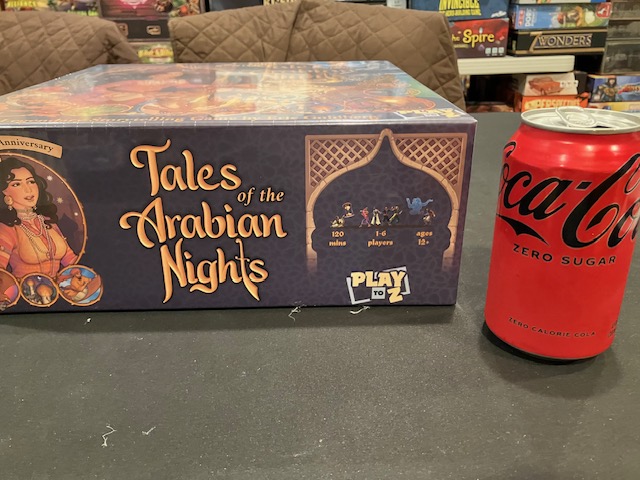
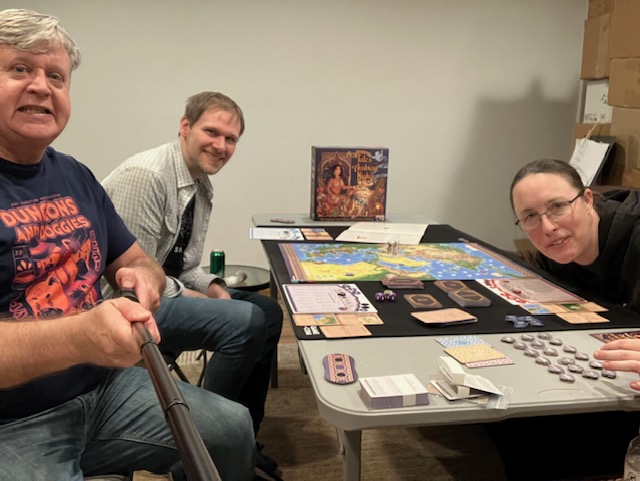
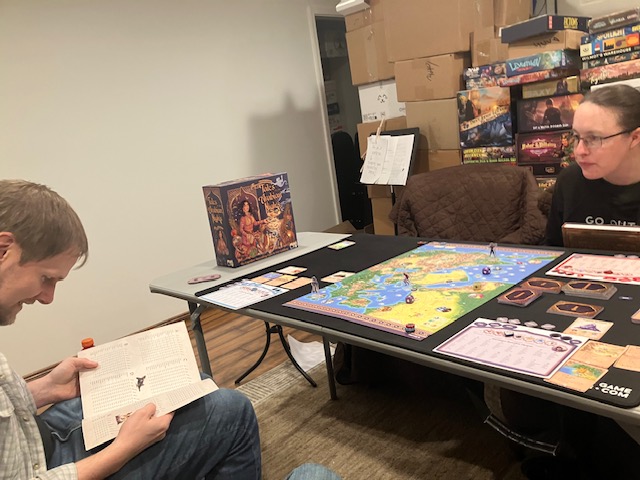
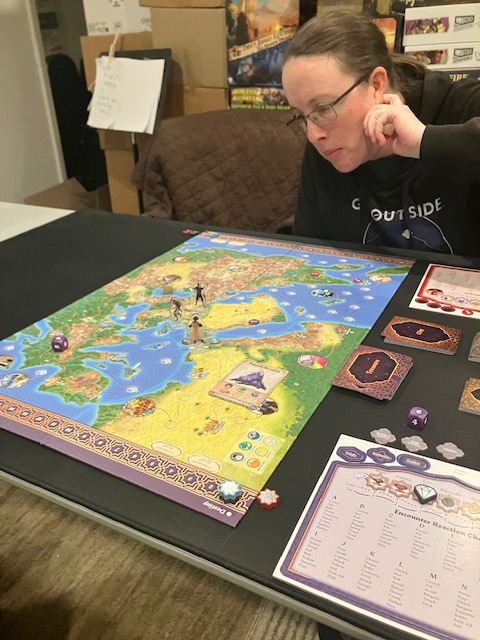
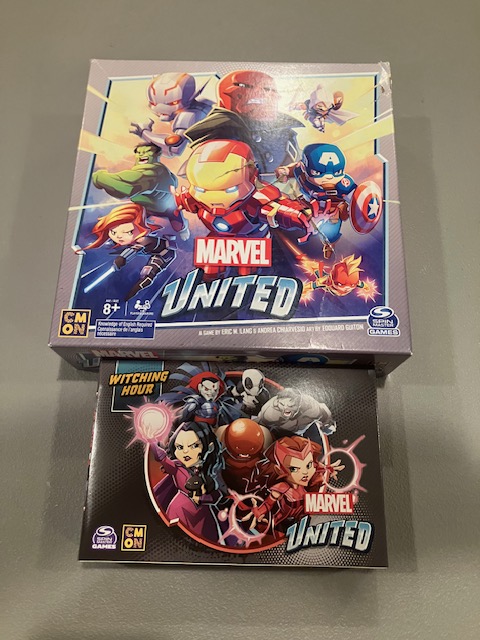
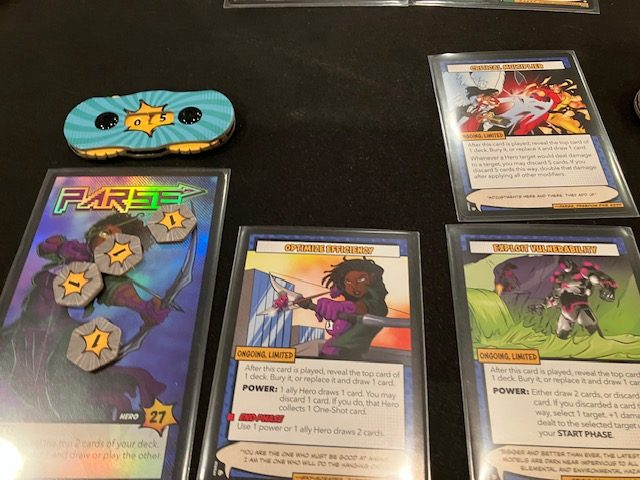
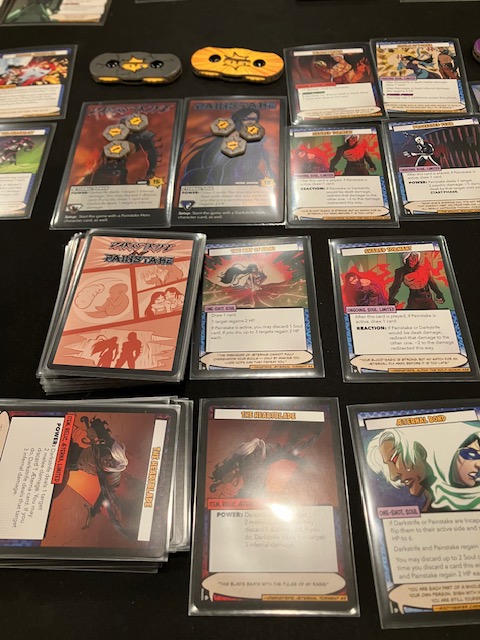
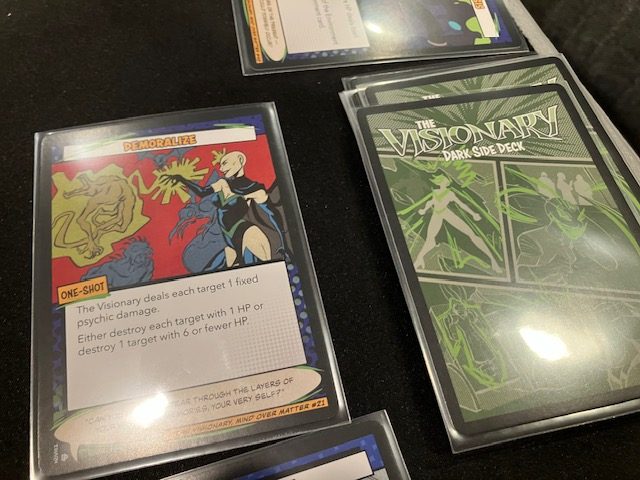
Top 10 Cooperative Board and Card Game Expansions of 2025!

Welcome to the end of 2025!  There were some great games that came out, but also some great expansions that really contributed to the world of cooperative games!  As usual, we qualify our expansions are one of three types:

  1. Stand-Alone Expansion: Some games you thought might be on the Top 10 Cooperative Board and Card Games of 2025 might have just ended up on this list because they are stand-alone games that can be played without a base game, but at the end of the day they also expand a base game!
  2. Makes The Game Cooperative: Some expansions take a competitive base game and make the game fully cooperative with the expansion! We saw a number of these type of expansions on the Top 10 Games That Can Be Played Fully Cooperatively!
  3. More Content: Some expansions just add more content (more cards, etc.) to the base cooperative game!

We also continue with the newer characterization: Does It Require Another Expansion

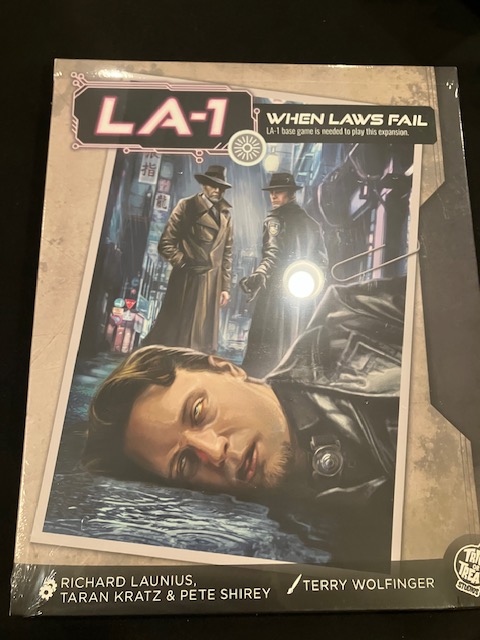
Honorable Mention: Origin Story

Expansion TypeMakes The Game Cooperative
Solo Mode: Well, you could play the 3-character co-op mode as a solo player, but there’s already a 3-character solo mode in there.
Requires Another Expansion?  No

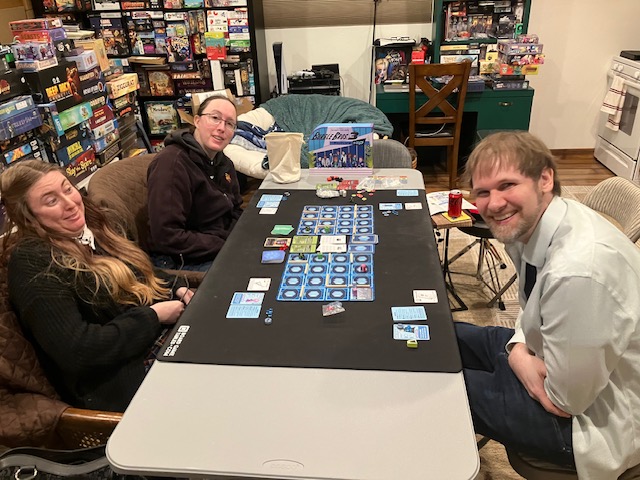
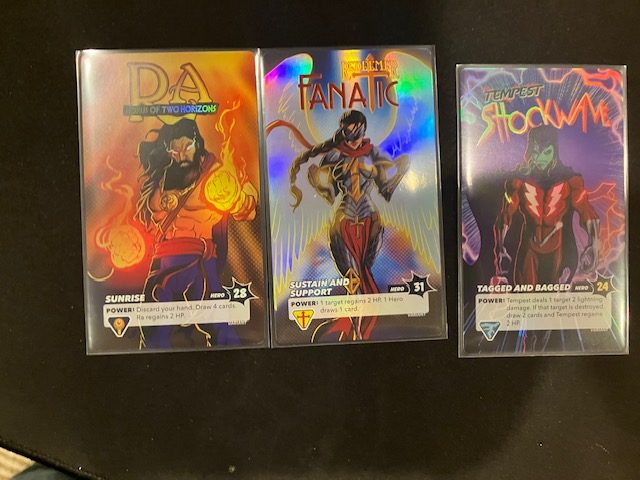
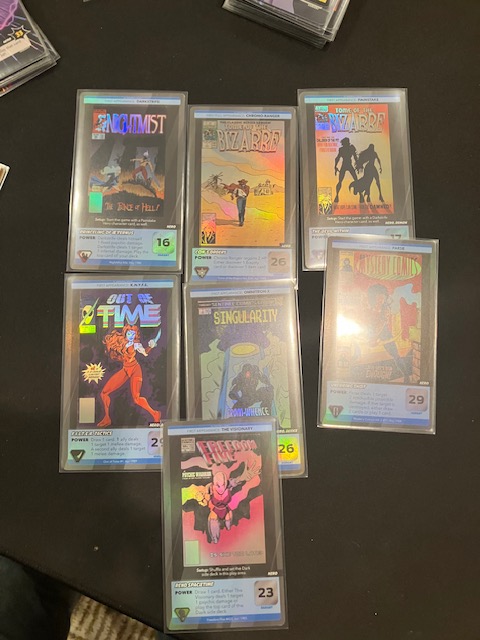
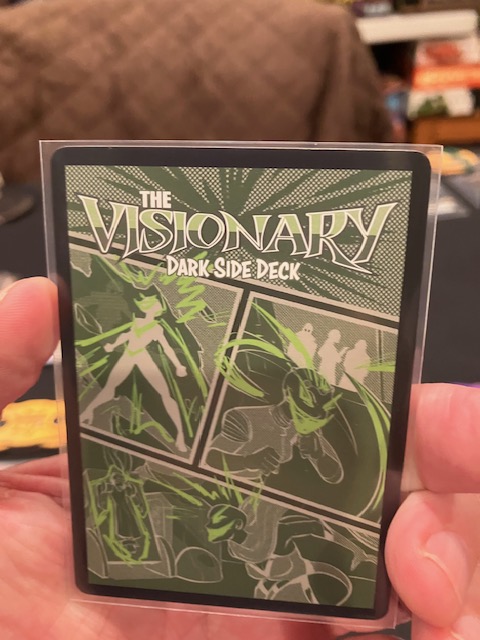
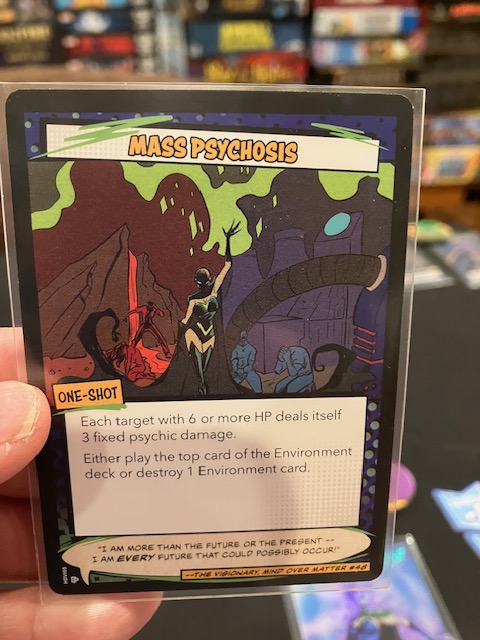
This is an odd duck … because it’s not a real “official” expansion.  This is a homebrew set of rules to make the really wonderful game Origin Story into a cooperative game!  See link here for rules.

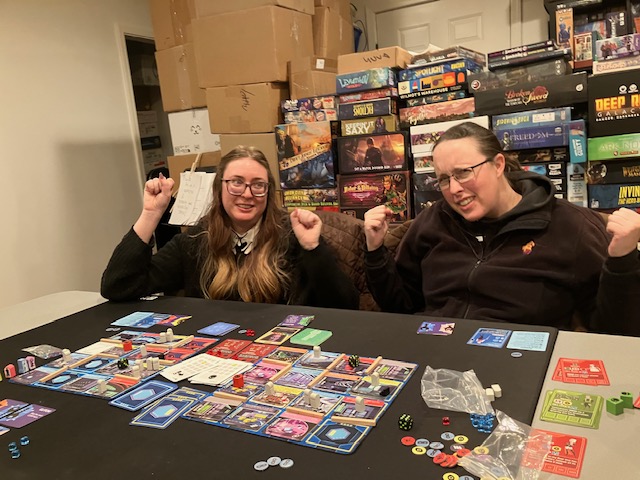
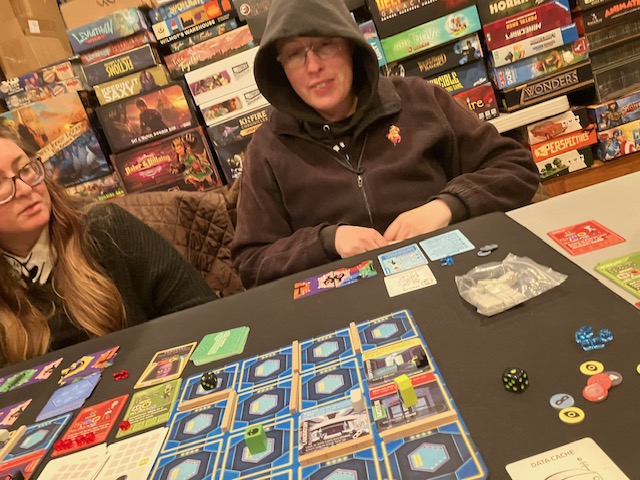
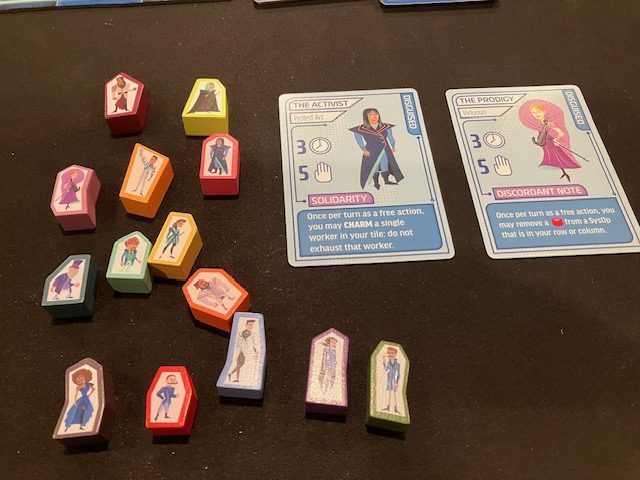
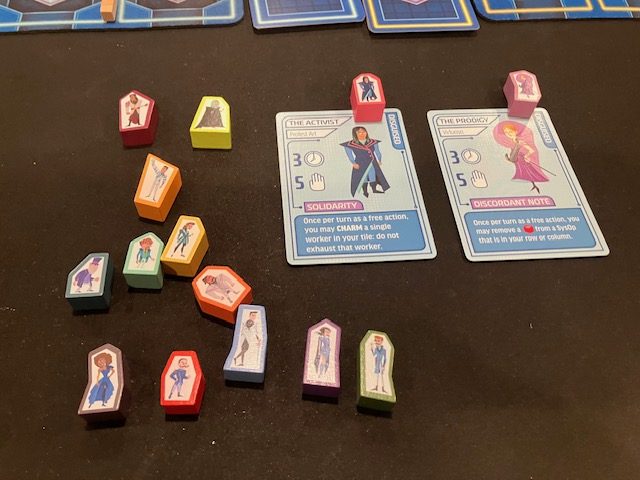
We played Origin Story, admired how well it works, especially with the powers, strategizing a limit of 5 rounds … and the artwork is amazing. While playing, we couldn’t help to think “Being a Super Hero game, is there a way to play cooperatively?” We fervently decided a new mode of gameplay should be added: a cooperative mode! Over a month or so, we developed some simple rules to make an optional cooperative mode for Origin Story. These rules probably need a little more play-testing, but frankly, we all enjoyed the game in a whole new way with this cooperative mode. Now, as well as playing the current mode to be the best Super Hero and win, all the Super Heroes can now work together to save the planet in a cooperative mode!
A Super Hero game should be cooperative: see this free set of rules here.
10. Marvel Champions: Agents of SHIELD

Expansion TypeMore Content
Solo Mode: No new solo mode, just the original
Requires Another Expansion?  No

More than any other game on this list, I play this with my buddy Junkerman (see above).   He loves Marvel Champions, even more than me!  (So much so, that he has his own blog about it: see Aspect Expressions Blog here!)   Marvel Champions is a game where you get the expansions because they offer you characters or some kind of adventure!

In this case, we get Maria Hill and Nick Fury as characters, running them through an adventure of 5 Scenarios as Agents of SHIELD!

I think what sold me more than anything else was the fact that Nick Fury gets a Flying Car!  Once I saw Nick Fury had that, you couldn’t stop me from playing him!  A Flying Car!! Agents of SHIELD is just more content in the Marvel Champions universe; good stuff.

9. Thunderstone Quest: Twilight Souls/The All-Consuming Horde

Expansion TypeMore Content
Solo Mode: Needs The Barricades Mode Expansion for solo
Requires Another Expansion?  Yes: To play solo or cooperatively, you need The Barricades Mode Expansion 

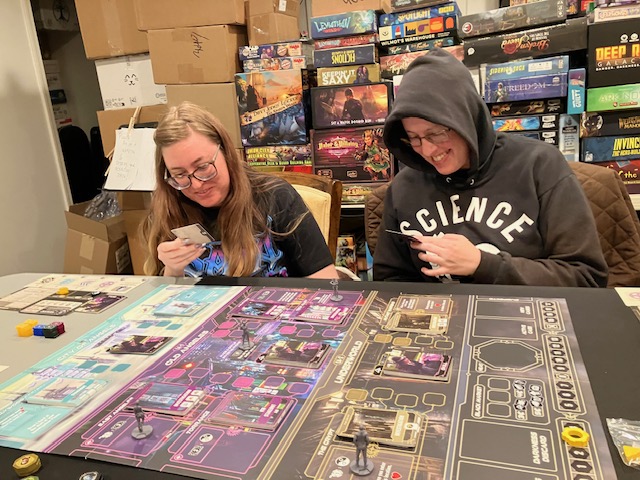
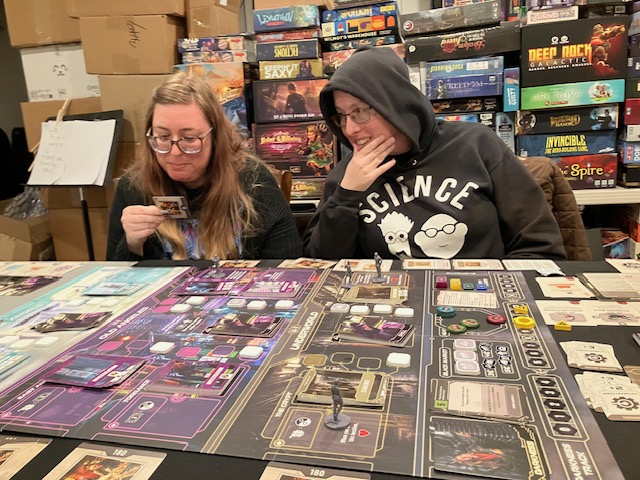
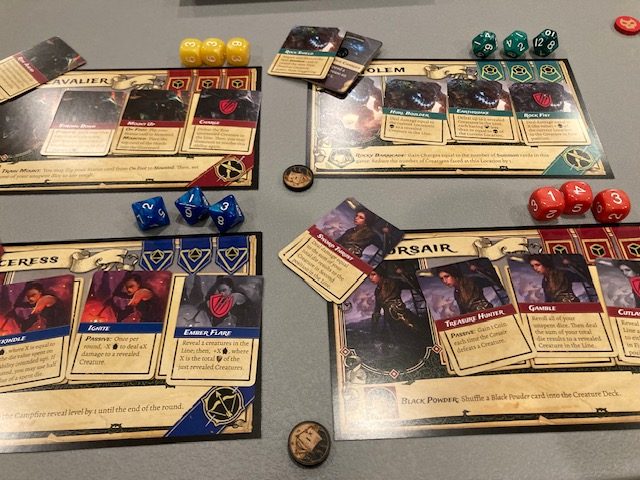
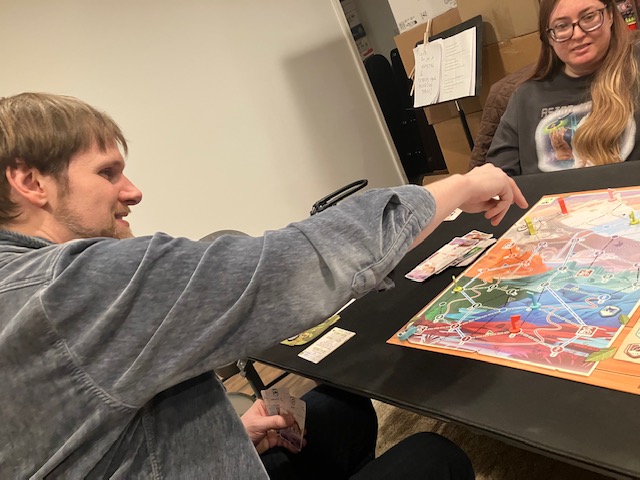
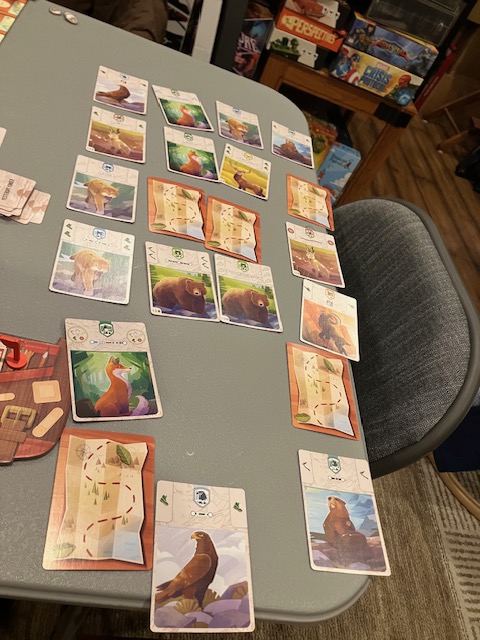
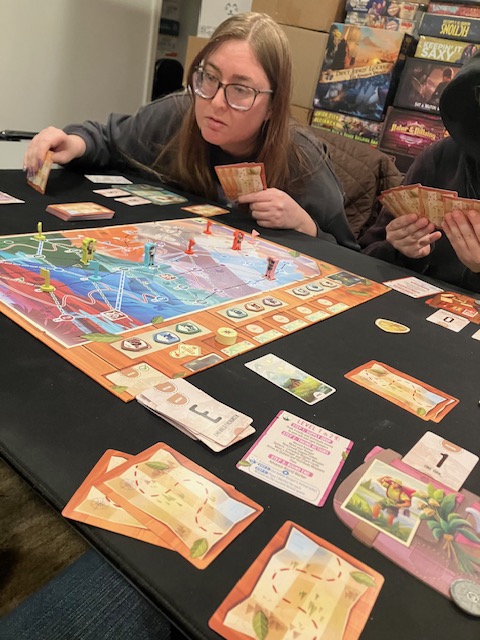
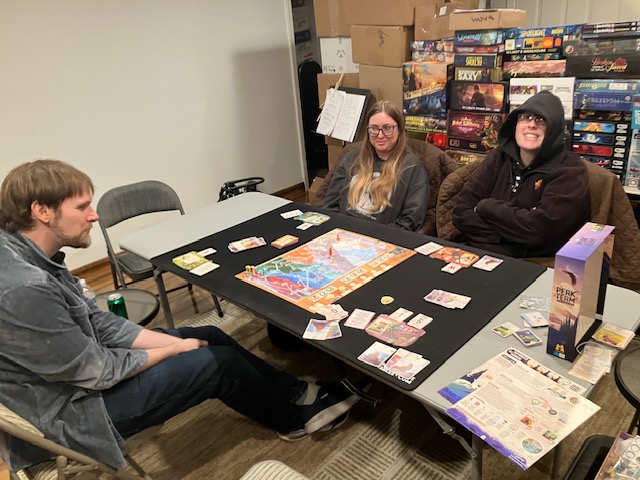
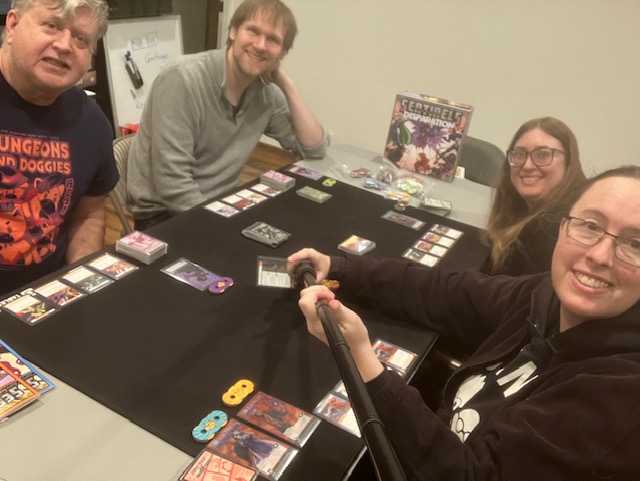
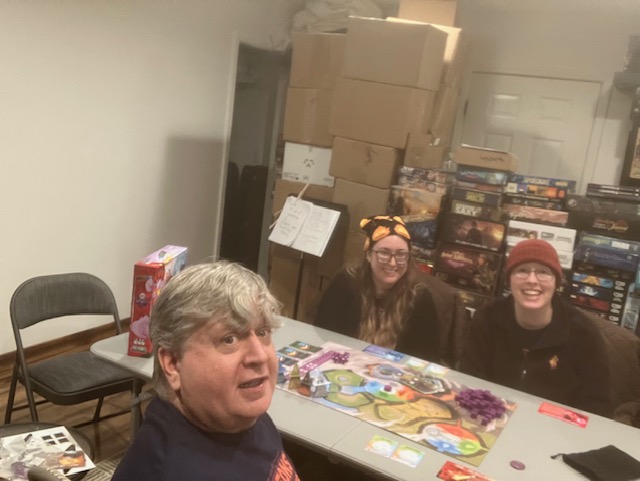
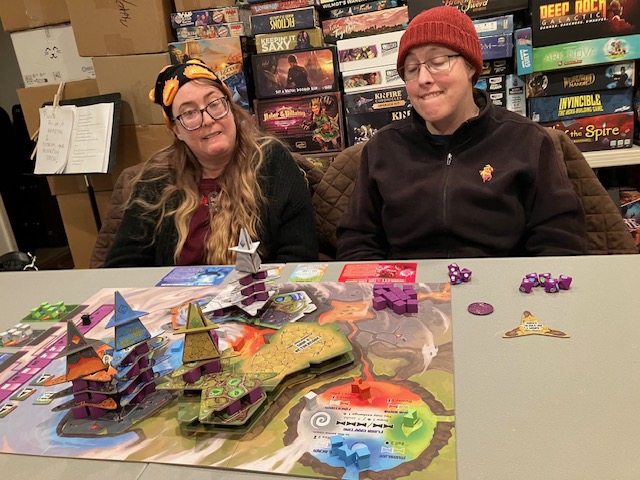
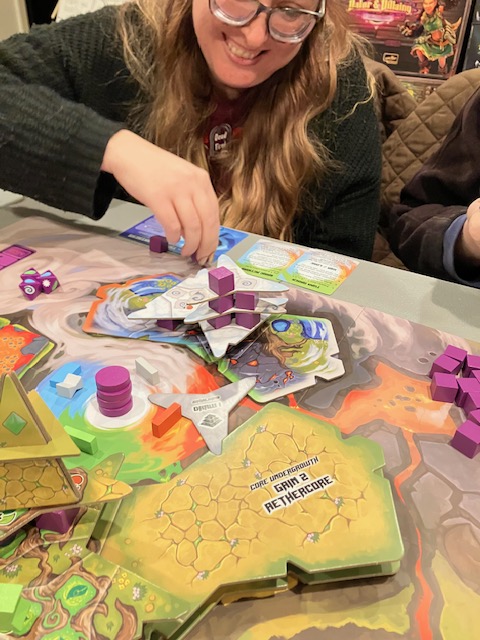
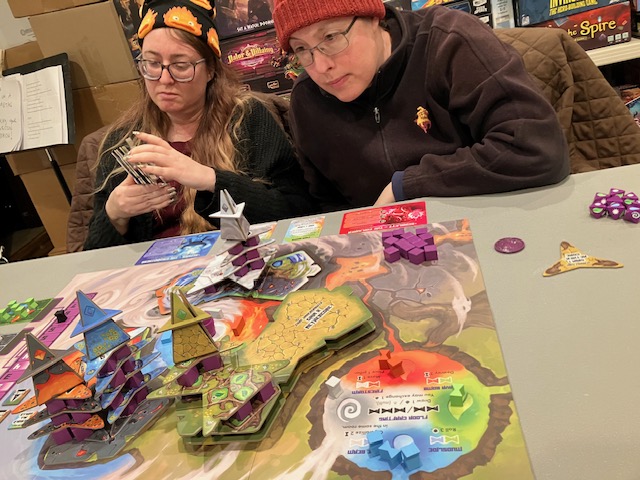
If Junkerman is my Marvel Champions buddy, then Nathan and Caroline are my Thunderstone Quest buddies!   I have played most of the recent Thunderstone Quest expansions with them!  See above as we finish The All-Consuming Hive, having rescued peoples from a living dungeon!

It’s kind of gotten ridiculous how many Quests there are (see above).  But, these expansions still offered something new and expanded the game and made it more fun!

It’s gotten a little ridiculous (I know I have already said that), but I still like to play Thunderstone Quest solo or cooperatively (see above as a I play Twilight Souls solo).  You can still use these two new expansions in the base competitive game, but if you want to play solo or cooperatively, don’t forget that you need the Barricades Mode expansion!

8. Flock Together: Birds of a Feather Eggspansion

Expansion TypeMore Content
Solo Mode: No new solo mode, just the original
Requires Another Expansion?  No

This is the easiest type of expansion to recommend; it just adds more of everything you already like to the game!  This eggspansion (be prepared for lots of Chicken puns) adds some new cards, some new players boards (so you can play up to 6) … but, most importantly, it adds 6 new predators with 6 new chicken puns (see above) … Chew Bawka?  Oi!

… and 6 new player chickens (with even more chicken puns)!  If you liked the base cooperative game Flock Together (see our original review here), this is just more stuff of the stuff you already like!  You like Chicken Puns, right?  See our review of the expansion here!

7. Skytear Horde: Campaigns

Expansion TypeMore Content, Standalone Expansion
Solo Mode: No new solo mode, just the original
Requires Another Expansion?  No

I never know whether this series should go on my Top 10 Solo Games of 2025 or my Top 10 Cooperative Expansions of 2025!  This year, because I was able to get it played cooperatively in a some good sessions, I am counting is a cooperative (standalone) expansion!

This expansion is mostly just new cards!  If you like Skytear Horde (see our original review here), this just gives you more cards … more content … for this cooperative tower defense game.  

There is a campaign book in here that is both good and bad.  It’s not particularly well-written, but once you get how the campaign modes work, I think they add a lot to the base Skytear Horde game!   See our review here where we discuss the good and bad of Skytear Horde: Campaigns!

In fact, I conjecture that this campaign mode could be a phenomenal way to teach the game!  I taught my friends the game using the campaign mode, and they really responded well to this!  Basically, the game comes out piecemeal in campaign mode, making it easier to digest.  For this to work, however, you really need someone who knows the game  to teach this mode.  Check out or review of Skytear Horde: Campaigns if you want more information!

6. Leviathan Wilds: Deepvale Expansion

Expansion TypeMore Content
Solo Mode: No new solo mode, just the original
Requires Another Expansion?  No

This really is just a more stuff you already like expansion!  If you liked the original game of Leviathan Wilds (see out review here of a game that made our #3 on Top 10 Cooperarive Games of 2024), this just gives you more of the stuff you like!

There’s 7 new Leviathans, and oof, they seem creepier than the original Leviathans! And of course, rage decks for each Leviathan.

We also get a new climber!  The Edge!  

This is really just more stuff for Leviathan Wilds! Nothing groundbreaking!  (Ha, pun intended).  See our review of Leviathan Wilds: Deepvale Expansion to see if you might want to pick up this expansion!

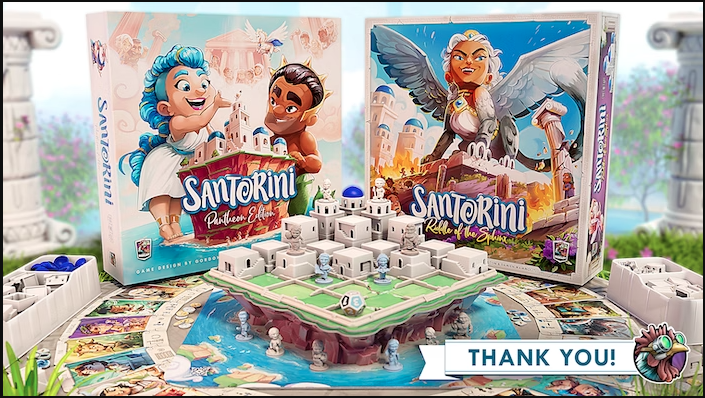
5. Santorini: Riddle of the Sphinx

Expansion TypeMakes The Game Cooperative
Solo Mode: Yes
Requires Another Expansion?  No 

More than any expansion that came out this year, this expansion is a puzzle.  It doesn’t even require THAT much from the base game Santorini; mostly just the building pieces and some minis!  It’s also a very different kind of game than the original Santorini!

I played it both solo and cooperatively.  It’s much easier to play this solo; each scenario is just a puzzle you are trying to solve!  The puzzles are about placing city pieces out, using god powers, and trying to get more city pieces (as city pieces are scarce)!

I was able to get some cooperative games played, and as long as everyone promises to NOT be an Alpha Player, they can work well!   This expansion isn’t for everyone, as not everyone is going to like the very puzzly scenarios The Riddle of the Sphinx presents!  But if a puzzle building game using the pieces of Santorini sounds fun to you, check out our review of Santorini: Riddle of the Sphinx to see if this might be an expansion you enjoy!

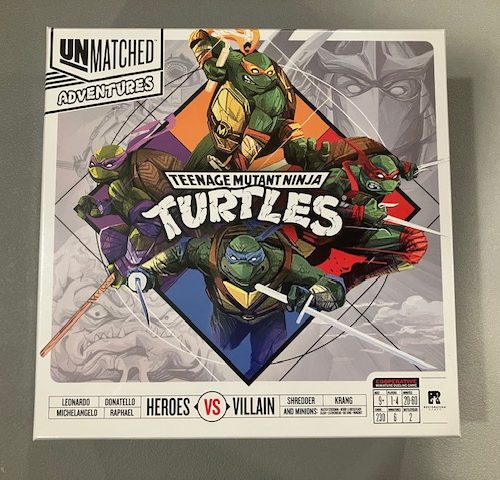
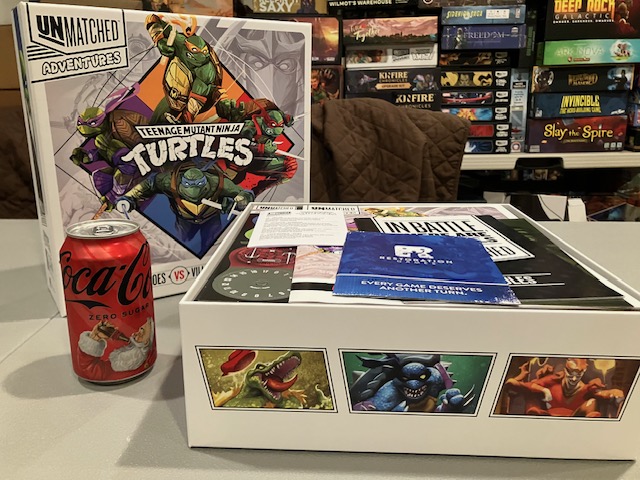
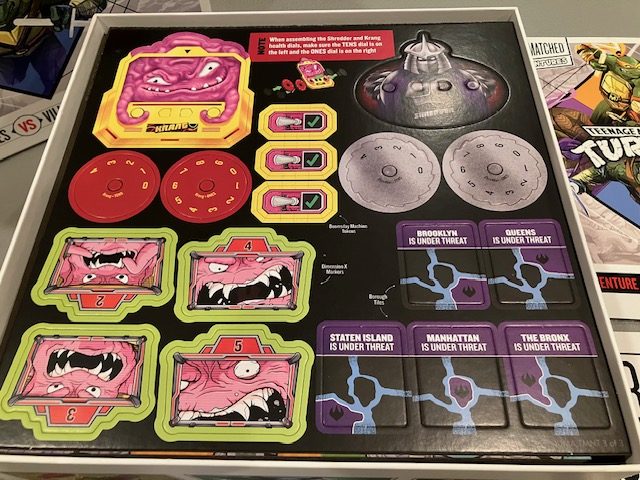
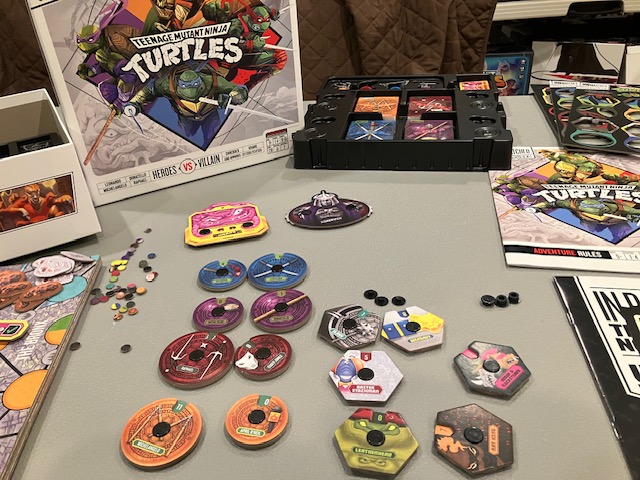
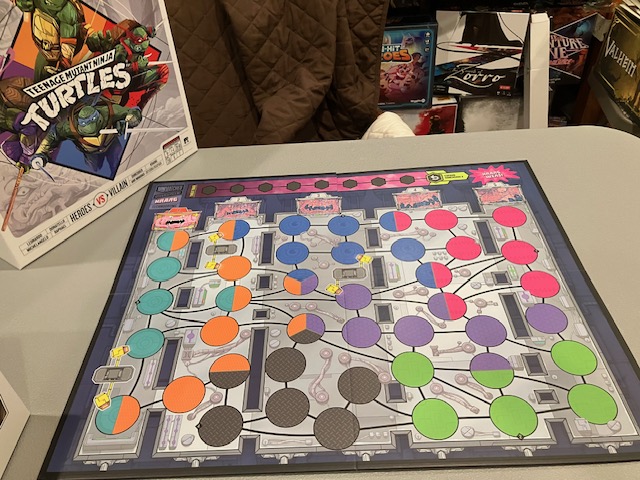
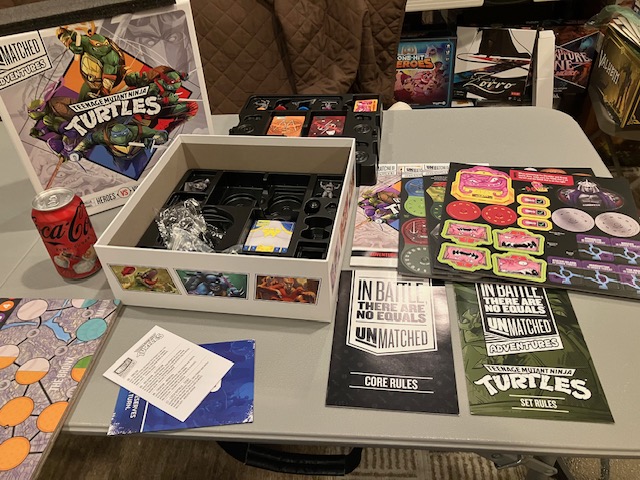
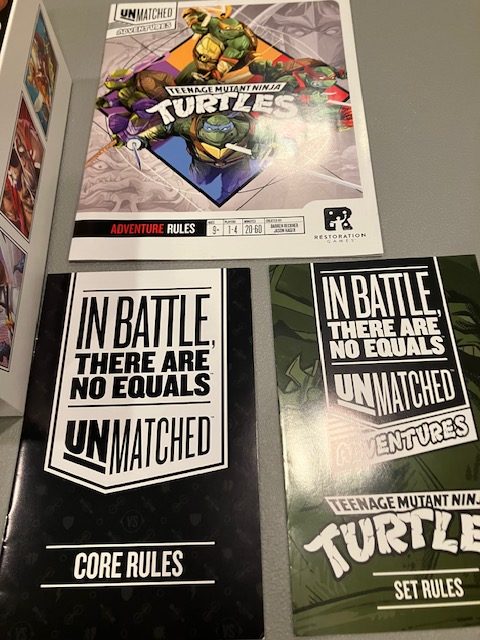
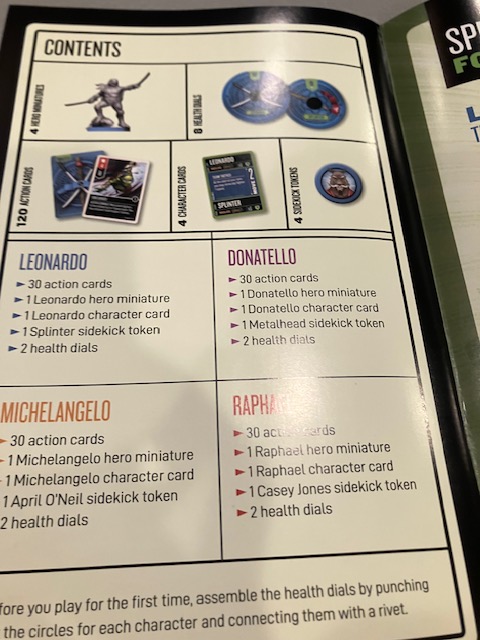
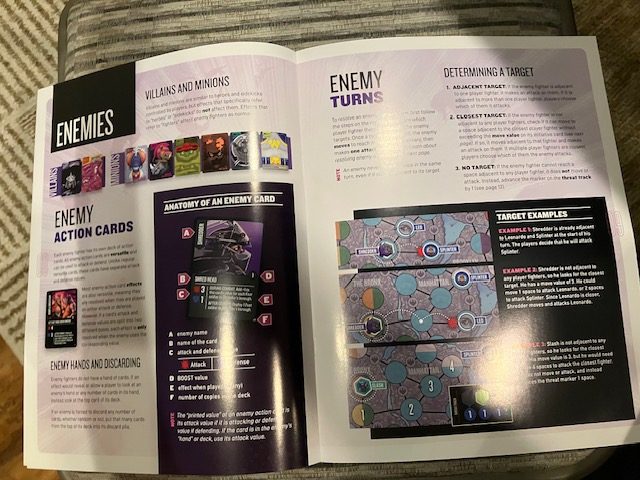
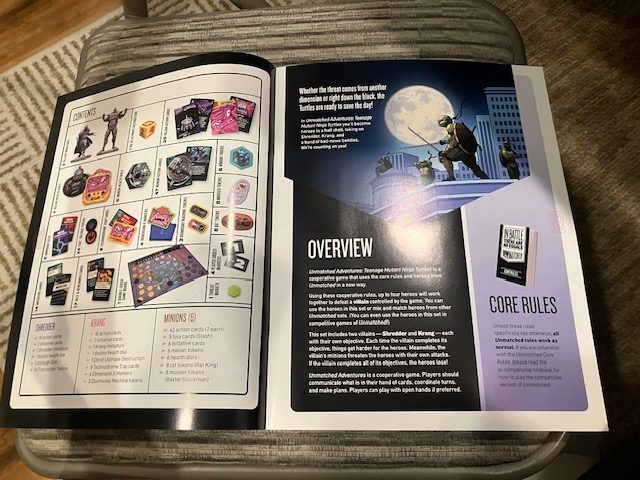
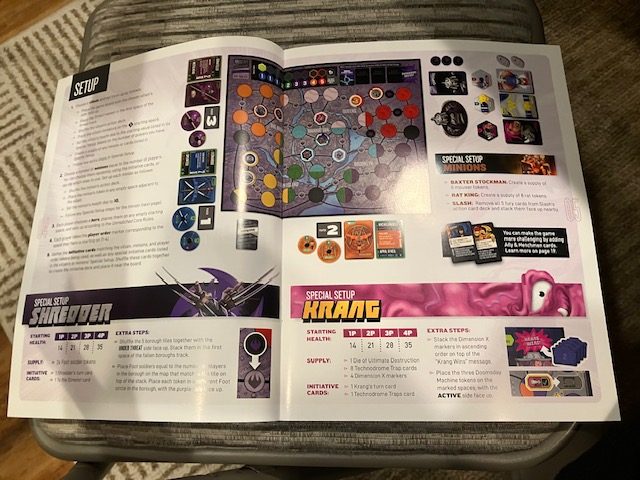
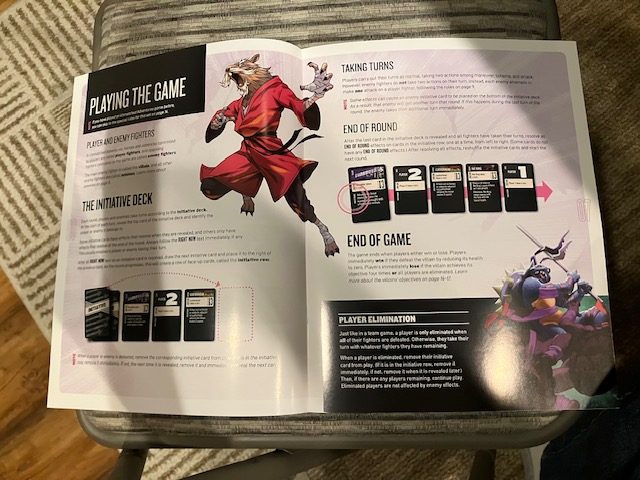
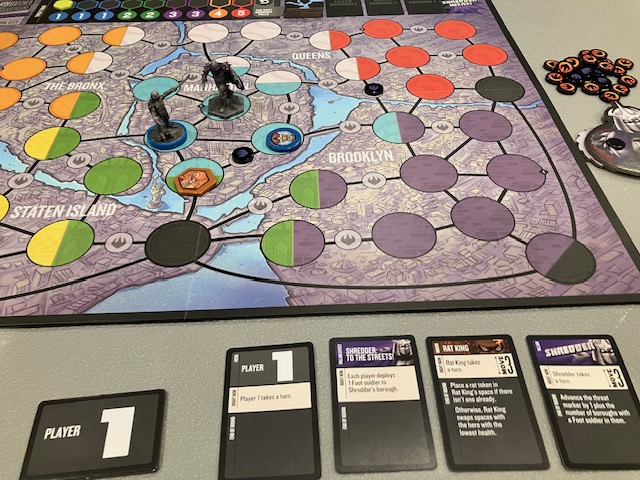
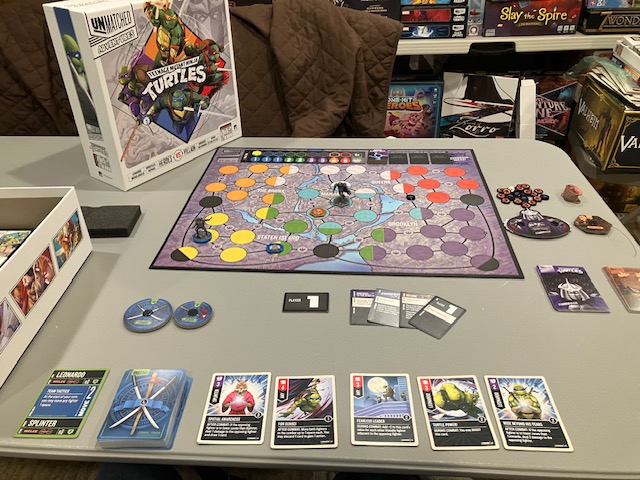
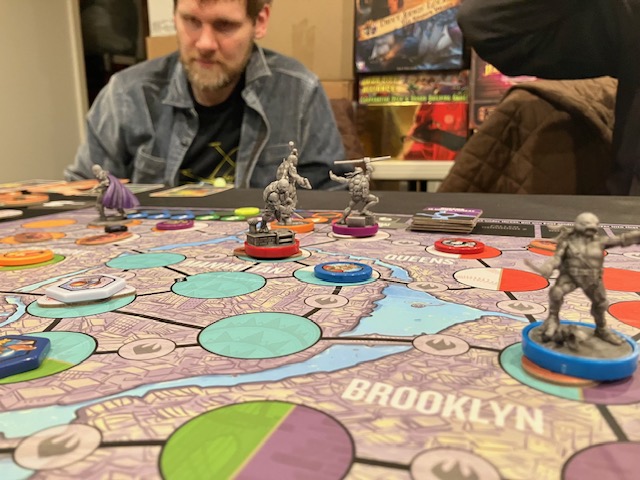
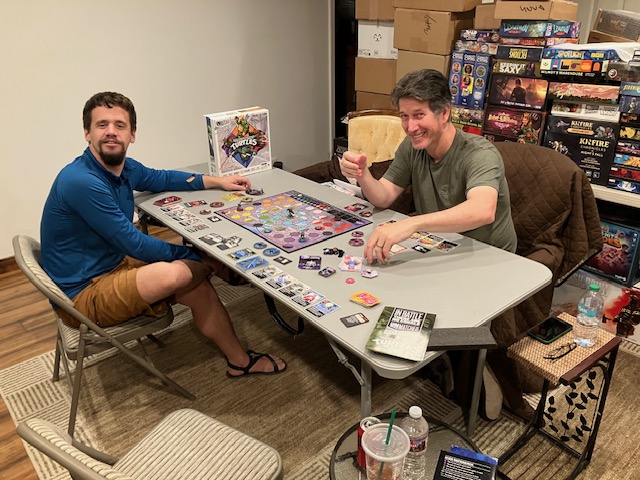
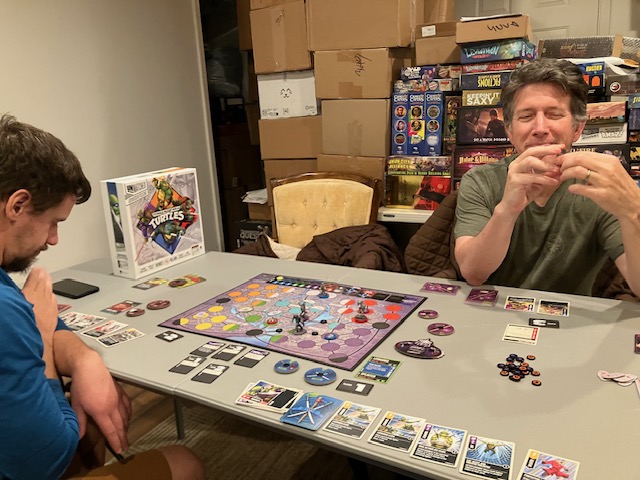
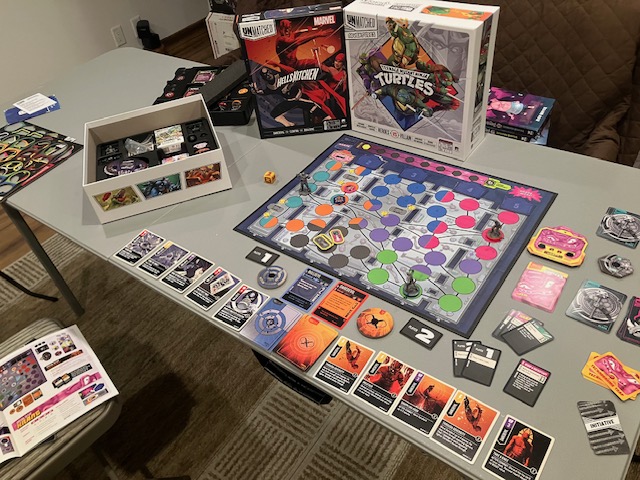
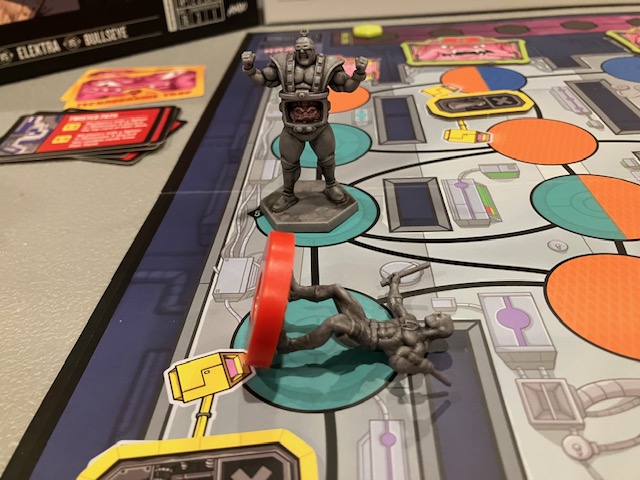
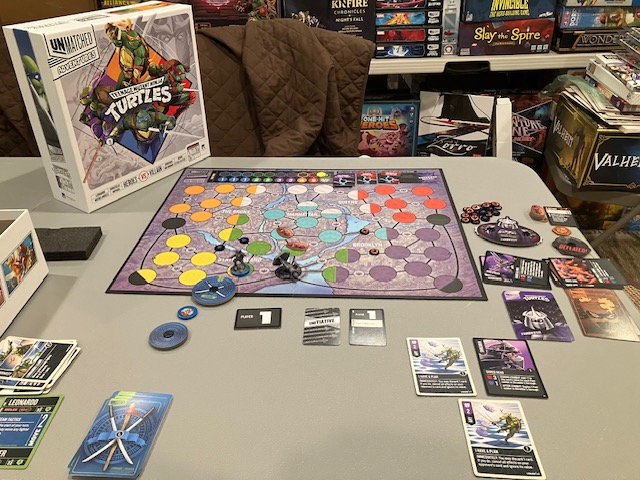
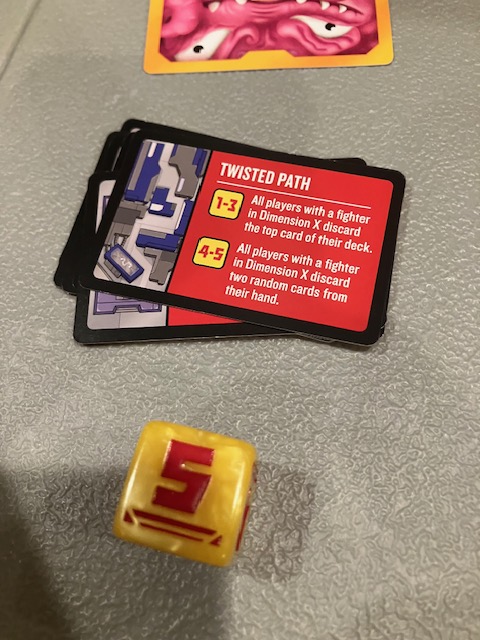
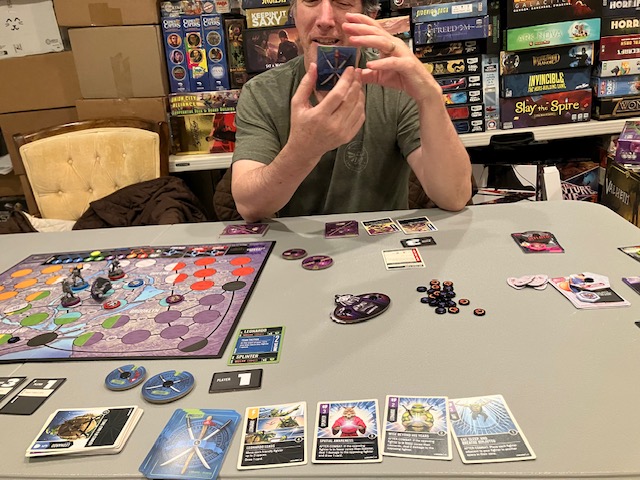
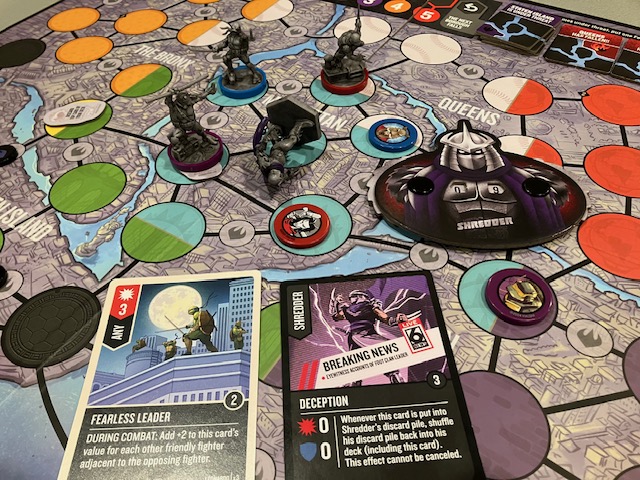
4. Unmatched Adventures: Teenage Mutant Ninja Turtles

Expansion Type: Stand-Alone Expansion, Makes The Game Cooperative
Solo Mode: Yes
Requires Another Expansion?  No, but you can play with any Unmatched set.

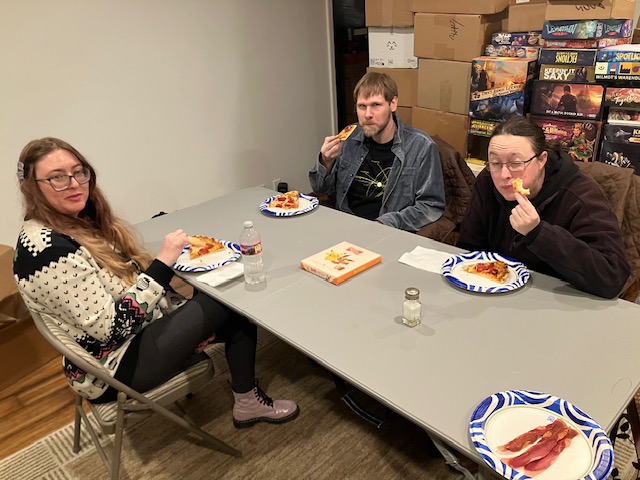
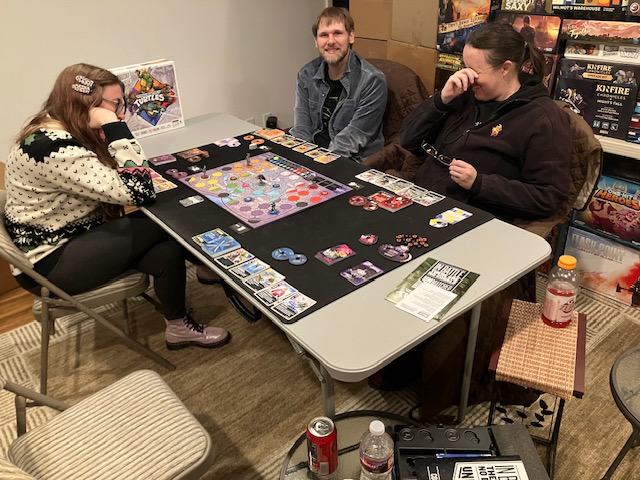
Of course, we had to eat pizza before we played Teenage Mutant Ninja Turtles: Unmatched Adventures.

Our favorite part of this expansion is that it adds two more scenarios to the Unmatched Adventures system!  Recall that we loved Unmatched Adventures (see review here), but our main complaint was that the box only came with two scenarios … now we have two more! 

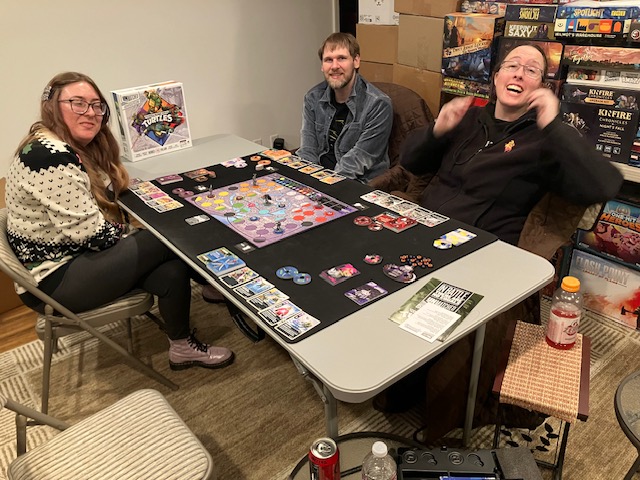
I am not personally a TMNT fan, but I really enjoyed the new heroes and villains.  My friend Jon (above), who is a huge TMNT fan, really liked the game.  I think knowing the IP might move this game to a 10/10 for some people: it really does capture a lot of TMNT feel (with the sewers being a fun way to travel around the city)!  See our review here to see if this is something you might like!

3. Dice Throne Adventures: Unchained

Expansion TypeMakes The Game Cooperative, More Content
Solo Mode: Yes (true solo)
Requires Another Expansion?  Yes: this is an expansion for Dice Throne Adventures (and I am also assuming  you have one of the base Dice Throne character boxes)

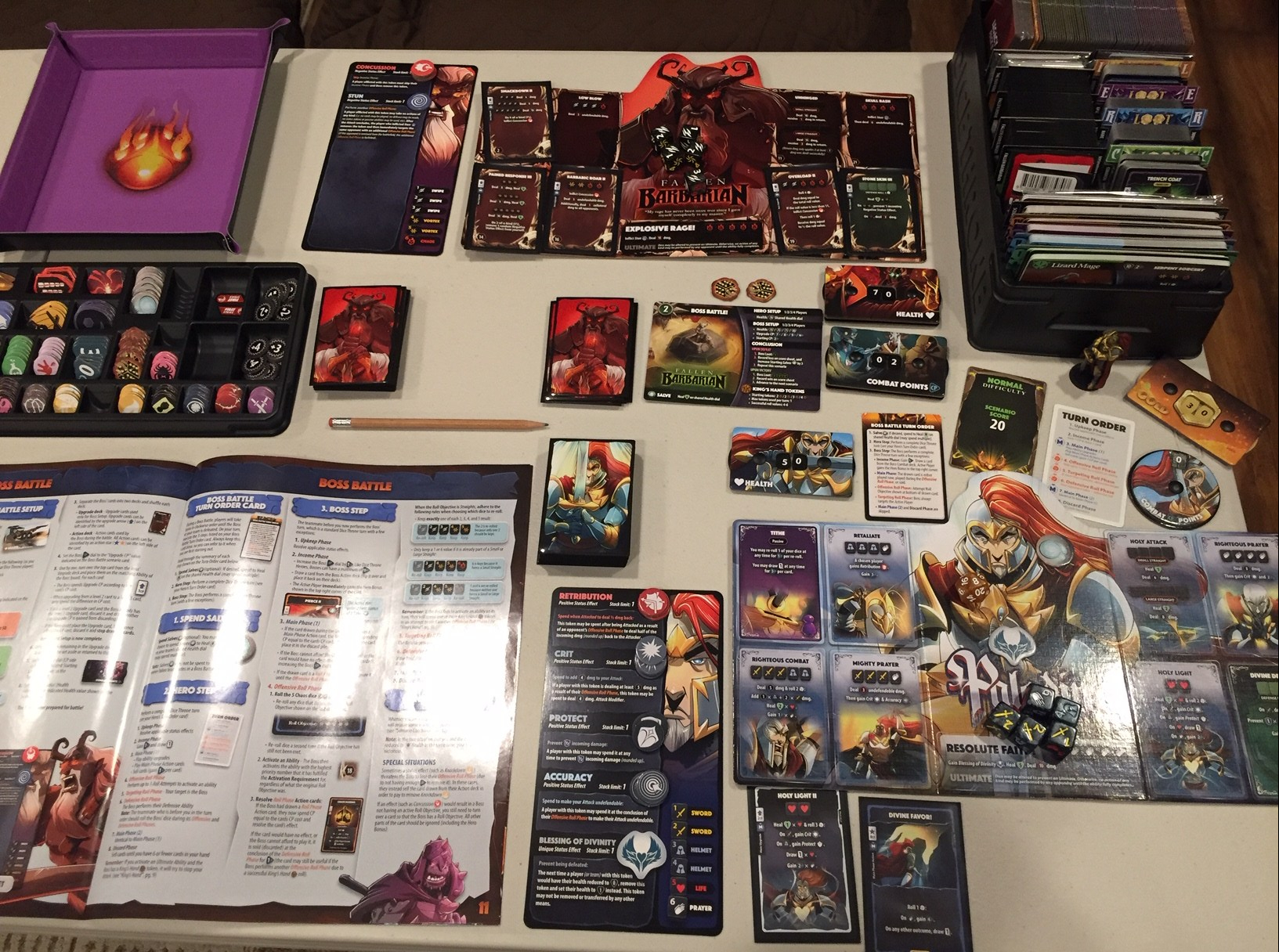
Firstly, this is an expansion that just adds more stuff: more Minions, more Loot, and another boss to fight in Dice Throne Adventures!  And yes, this is an expansion to an expansion!  The original Dice Throne Adventures (which Unchained expands) took the base Dice Throne game and made it solo and cooperative!

But this expansion fixes three major problems!  Firstly, there we no solo one-shots in the original Dice Throne AdventuresUnchained allows the solo player to play a one-off little solo Adventure!  Unchained adds the Minion Rush solo mode (see above), which allows the solo player to take a new character and try it out in a limited little adventure!

Secondly, Dice Throne Adventures had the problem that the adventure is way too long and too involved.  Unchained fixes Dice Throne Adventures by adding a one-shot cooperative adventure, which is a condensed little Minion dash/Boss battle!  There’s 6 new maps (see one above) that allow the cooperative players to go through a little adventure in one game session!

Finally, Unchained fixes the “slow upgrade” problem of Dice Throne Adventures! It seems to take forever to upgrade your cards in Dice Throne Adventures, but in the new Minion Rush and One-Shot Adventures, you get a new One-Shot Loot chart!  See above! And this time, Loot goes directly into your hand, so you feel the effects of upgrading quickly!

Overall, I think Unchained is an essential upgrade for Dice Throne AdventuresSee our review here to see if you agree!

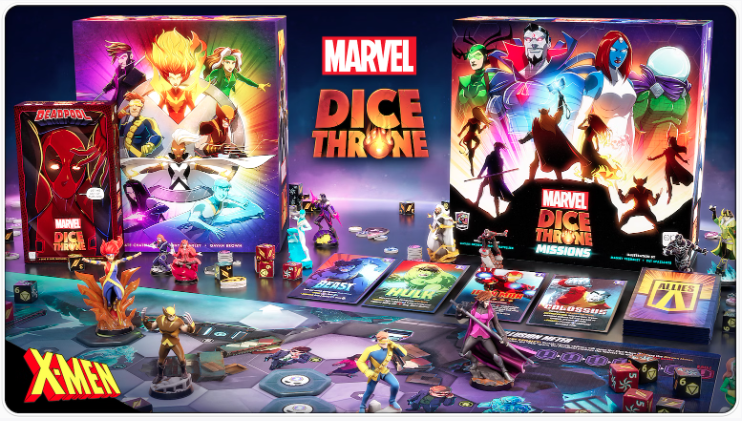
2. Marvel Dice Throne Missions

Expansion TypeMakes The Game Cooperative
Solo Mode: Yes (true solo)
Requires Another Expansion?  No (but I am assuming  you have one of the base Dice Throne character boxes)

This expansion takes the base Dice Throne and adds two-sided Missions to the game.   These missions are usually more exploration on first side (with mini fights against minions) and then fight the big bad boss on the other side (see Doctor Octopus).   You can also choose to do longer campaigns with a notion of experience points to help you upgrade.

This game supports true solo so you can take your favorite Dice Throne character through as many missions as you want!  You might have noticed that the Missions are VERY Marvel character specific (it is called Marvel Missions), but there’s no reason you couldn’t take any Dice Throne characters on these missions!

I enjoyed the heck out of this as a solo game (especially with Wolverine), but my friends bounced off the cooperative game! I think the mistake there was in NOT letting them  try out their hero in a quick head-to-head mode; I think that would have made all the difference!  See our review of Marvel Dice Throne Missions here! In the end, I personally loved it, so it had to made near the top of the list!!

1. Kinfire Council: Winds of Change

Expansion TypeMakes The Game Cooperative, More Content
Solo Mode: Yes (two-handed, with special rules*)
Requires Another Expansion?  No (but you might want the Kinfire Council upgrade kit with wooden bits, see far right)

Kinfire Council is a pretty cool worker placement game … that I would never want to play in its original form.  Wait, Why? It’s rife with back-stabbing, traitoring, and some indirect take-that!  The Councilors may side with the city or may side with the Cult trying to take over the city! The base game is all about intrigue within the city!   But, as part of the original Kickstarter, Kinfire Council also had the Winds of Change expansion which took out the base back-stabby/traitory traits, replacing them with both a solo and a cooperative mode!

With the Winds of Change expansion, players are city Councillors trying to stop the Cult from ruining their city!  Along the way, they vote, upgrade spaces, upgrade workers, arrest cultists, stop threats, build a tower for inspiration, and so many other things!  To be fair, the expansion doesn’t change the gameplay THAT much (there is a really neat base worker placement scheme here), but the cooperative mode made me and my friends feel that much more engaged!  “This is our city, darn it!  We’re not going to let the Cultists take over!! “

I was very surprised just how much I liked this game with the expansion!  Me and all my friends all liked it too!   We played over multiple game sessions over multiple game nights with multiple groups; it was so fun! We even added a little House Rule to make the game more fun, more cooperative, and more interactive!  See our review of Kinfire Council + Winds of Change to see what our House Rule is, and if this is something you might like!

I am kind of surprised this made my #1 expansion! It’s gone up in my estimation every time I have played it! It’s just that … I want to play it more! I am so excited by this, I am going to go out of my way to teach it at Dice Tower West this March! We’ll be playing the cooperative version with my House Rules if you want to play! I just loved how interactive the cooperative version was!!

Top 10 Solo Board and Card Games of 2025!

What makes a good solo game? I find them many times when I start playing solo games to learn games cooperatively for my friends. If a game starts to enchant me and I can’t stop playing it solo … there’s something to it! Most of the games on this list were games I played solo to teach my friends … but then I kept playing! Some of these games will end up on either my Top 10 Cooperative Games of 2025, but some of them may end up on my Top Cooperative Expansions of 2025, but one things for sure … they are all great solo!

My tastes are a little funny; see if you agree or disagree.

For more great solo games, see last year’s list: Top 10 Solo Games of 2024!

Honorable Mention. Broken Sword: Shadows of the Templar (Reforged)

This is a solo game I played quit a bit in 2025, but it can’t “officially” make this list for a number of reasons.  For one, it’s a video game!  Broken Sword: Shadows of the Templar is a point-and-click solo adventure video game … (See our discussion of point-and-click adventure games here in Top 10 Point-And-Click Adventure Board Games here)! This game is sometimes what I want when I want to play solo: it’s an all-consuming adventure game with story and exploration! 

My physical copy arrived about November 2025, so I can still count it as 2025 (even though my digital copy arrived in 2024, so that’s another reason).   I know, it doesn’t really belong on this list, but these point-and-click adventure video games totally scratch my solo game itch sometimes!  And I spent a fair amount of time playing it solo in 2025!

10. Wroth

What a strange journey Wroth was!  This is a solo, competitive, and cooperative area control/area majority game, which is a real interesting mix of game modes!   Unfortunately, the solo play is hard to get to because you have to learn the base competitive game BEFORE you can play the solo/cooperative mode!

Along the way, I discovered I actually liked the competitive game but disliked the cooperative game!   And somewhat paradoxically (because the solo game is the cooperative game), the solo game ended up being a really fun puzzle!  After almost selling the game (because I disliked the cooperative mode so much), it was the solo mode that prompted me to keep this game.

Wroth also has one of my favorite covers of the year!   Check out our journey with Wroth to see if this is a solo game you might like! 

9. Earthborne Rangers: Legacy of the Ancestors

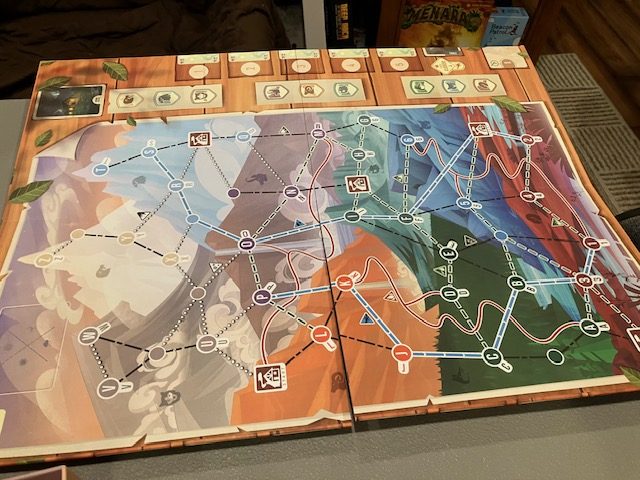
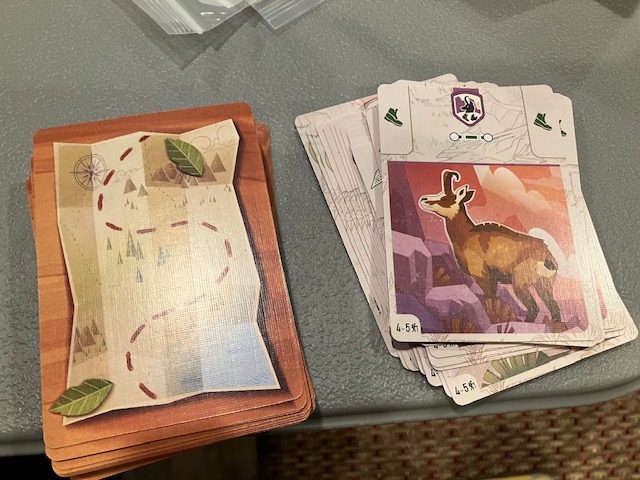
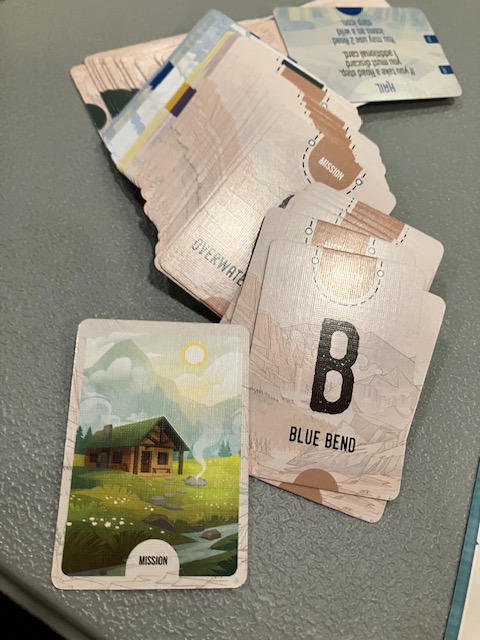
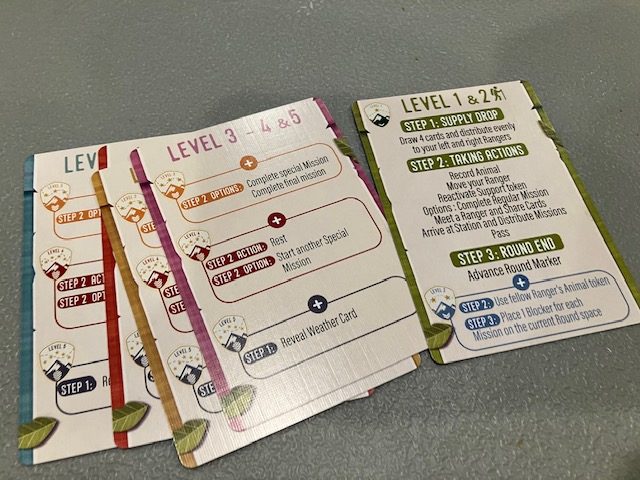
This is an odd entry for a few reasons!  Firstly, this was the expansion for the original Earthborne Rangers that was part of the first, original Kickstarter!  Even though I ordered this expansion many moons ago (from the first Kickstarter: see our review here), this expansion didn’t arrive until 2025 (and even BGG says it’s a 2025 release date)!

This probably should go in my Top 10 Cooperative Expansions of 2025, instead of here in my solo list … but the thing is, I only ever played it solo!  Even though you can play 1-4 players with Earthborne Rangers, I think one or two players is the best count for Earthborne Rangers! In this case, one player was best! 

In some ways, the abundance of storybook games (see our Top 10 Cooperative Games of 2025) just reminded me what a great exploration and storybook game this is!  I got to relive the fun of exploring in this system  in this exploration and story-filled game! I got the explore … The Arcology!

8. Storyfold: Wildwoods

Storyfold: Wildwoods is both a perfect entry and an odd entry to this list.  Why is that?

In name, this is a solo game only!  It’s about a little girl and her animal companion roaming and exploring a dark and depressing forest.  There is a little bit of worker placement, a little bit of dice, and little bit of story, and a lot of dark experience!  It’s a solo game!

I ended up playing this solo game as a two-player game, as team solo!  In other words, me an my friend Teresa operated the solo game as a team, with both of us working the solo position!  We would operate the single position, but discuss tactics and strategy together.  I argue that this is still a solo game, but you can just choose to be on team solo together!  See our review of Storyfold: Wildwoods to see if you agree!

7. Santorini + Riddle of the Sphinx

Riddle of the Sphinx is an expansion that makes the  Santorini base game solo and cooperative.  

Of all the games on our list this year, this is the most thinky puzzle-like game; you have to figure out how to build and acquire resources in an environment of scarcity.  The gods offer special bonuses and resources as you burn through them.  

This game stayed on my solo table until I had to go to Dice Tower West! Although I enjoyed the cooperative game as well, I think this really engaged my solo gamer brain, and I loved moving the characters around to try to solve the building puzzle in an optimal way!  Take a look at our review of Riddle of the Sphinx to see if this is something you might enjoy!

6. Unstoppable

Unstoppable is nominally a solo game or 2-player cooperative game … but almost all my plays were solo!  Honestly, it feels more like a solo game than a 2-Player game anyways?  Honestly, that co-operative mode does feel a little pasted on; I mean, you can’t even share money…

 This is a deck-building game with some card-crafting going on!  Cards slip into sleeves and upgrade your cards, all while you are still trying to build a deck!  

There’s some really interesting mechanisms going on in here, as the things you battle flip and give you good stuff!  Overall, I got to play through all the scenarios in the base box and really enjoyed this deck-builder.   One question you may want to ask yourself: would you prefer Unstoppable or Astro Knights (both deck-building games)?  See our review for more discussion!

5. War Story

This was such a unique adventure to play through solo.  This is all about being part of the French Resistance in World War II, and it’s pretty brutal.  You shoot Nazis, see most of your team die, and try to survive a wartime environment.

Even crazier, all of this happens in a Choose Your Own Adventure book situation!  This is a game where your choices really do matter; everything you do affects the final outcome and how well your team does!  Do you show mercy on the Nazi your captured?  How do you silence the little boy so he doesn’t alert the authorities?  Everything you do matters!

The game comes with 3 adventure books, as a full adventure unwinds over three big sessions (and each session affects the others)!  After playing all the way through solo, I was emotionally exhausted but strangely fulfilled!  Take a look at our review of War Story: Occupied France to see if this unique experience is up your alley!

(This is a game that has a 2024 release date on BGG, but try as hard as we could, we couldn’t get it until 2025, so we count it as 2025)

4. Lord of the Rings, The Fellowship of the Ring: Trick-Taking Game

I ended up enjoying the solo mode for this much more than I expected!  For a cooperative trick-taking game that has a lot of similarities to The Crew, its one big difference is that it has a solo mode!  And it’s very very good!   If you love Lord of the Rings, this is an easy recommendation.  Even if you only “like” Lord of the Rings, it’s still a great solo game!

Over the course of several weeks, I ended up playing solo through all 18 chapters!  Each chapter has a nominal play-time of 20 minutes … but if you fail a chapter, you have to keep playing it until you win!

The production on this game is amazing, the solo game is amazing, it’s quite thematic, and the 18-Chapter campaign was so much fun!  It’s easy to get this to the table … as even though I was a little sick, it was engaging enough to forget I was sick for a week.   I made it through all 18 chapters solo, and it was a blast.

See here for our review of Lord Of The Rings, The Fellowship of the Rings: The Trick-Taking Game to see if this something that might appeal to your inner solo gamer!

(This is a game that has a 2024 release date on BGG, but try as hard as we could, we couldn’t get it until 2025, so we count it as 2025)

3.  DC Super Heroes United: Batman Hush

DC Super Heroes United: Batman Hush is a great game for both cooperative and solo.  In the end, though, I probably played it a lot more solo than I did cooperatively!  In fact, I couldn’t stop playing it solo!

I ended playing just about every combination of heroes and villains from this base box, as a solo game!  Now, you have to understand that I strongly prefer playing Marvel and DC United solo as 2-Player multi-handed, where I operate two characters and alternate between them as if it were a 2-Player cooperative game.   I find the “official” solo mode of the United games just too contorted.

It was such a blast to play DC heroes like Batman and Robin together solo!  See above.

I couldn’t stop playing this solo!  I kept trying more and more!  I even started pulling out some Marvel United and combining DC United and Marvel United together!  See above at Batman hangs out in Stark Labs! I got such a giggle imagining Bruce Wayne critiquing Tony Stark’s tech!

See our review of DC Super Heroes: Batman Hush to see if this is something you might like as a solo player.    This probably would have been out #1 solo game of 2025, but the next two games offered such unique solo experiences, they had to be just above it!

2. Arydia

It was very hard to choose between #1 and #2 on this list; either of them could have been #1!  I also feel bad not putting Arydia  in our Top 10 Cooperative Games of 2025!  In the end though, I only played this solo, but I had a heck of a great time!

Arydia is a huge adventuring/dungeon crawler game with tons of content: maps and cards!  See above!  And the components are just fantastic!

This game, with its unique map(s) system(s) and combat stayed on my table for a straight week as I couldn’t stop playing playing!  I wanted to see what would come next in this world!

This is an adventure-laden dungeon crawl that reminded me a lot of the old computer game  Ultima IV: it had combat, little maps, big maps, and a big adventure!   I had such a wonderful time playing this solo!  Check out our solo review of Arydia to see if this is something you might like!

1. Star Trek: Captain’s Chair

At the end of the day, I slightly prefer space over fantasy, so I think that’s why Star Trek: The Captain’s Chair ended being the #1 solo game of 2025 for me!

This is such a neat deck-building game, but calling it JUST a deck-building game seems to be an insult!  There’s so much to this game that it actually almost took me the whole year to absorb it, get it to the table, and play it!  Make no mistake, this is a big and complicated game with lots of rules!  The rulebook is very very good, but I joke that it feels like a legal document!

One major feature of the game is that there are two solo modes: the Cadet Training Mode (see rules above) aka easy mode, and the normal solo game aka hard mode!    The easy mode gives you a chance to learn the systems of the game in a simplified scenario! 

The Cadet Training Mode also a great way to learn a new Captain’s Deck!  Another great feature of this game is that every Captain in the game (see above) has a unique play style that is encapsulated in a different Captain’s deck!  Sisko is different than Picard who is different from Koloth!  See the six different Captains above!

In the end, it’s the normal solo mode (which has its own rulebook!) that makes this game a wonderful challenge.  An AI runs another captain playing against you; see above as I play Picard facing off against AI Koloth!  This solo mode is challenging and interesting and has a ton of variety as each Captain is so different!

This is a large, sprawling, solo game with ships warping to planets, planets being taken over, landing parties landing, crew members beaming to ships, crew members on duty, drafting new people, cargo, allies, and ships on your way to being the better Captain!

It’s hard to recommend this game for many reasons: the base game is actually competitive (the solo modes are add-ons), the game is pretty complicated with a legalese rulebook, and apparently it’s sold out everywhere as I write this!  Despite all that, I had a heck of a time playing Star Trek: Captain’s Chair as a solo player! It was such a unique experience that it had to be my #1 solo game of 2025.  See our review here to see if this might be something you enjoy!

Top 10 Cooperative Board and Card Games of 2025!

Welcome to the end of 2025! This is our top 10 games that were from 2025*! The best of the best!

This was a slightly weird year for cooperative games, if only because it’s not 100% clear when some of our favorite games came out! Some of the games on our list were “officially” released in 2024, but as a real playing customer, we couldn’t get them until 2025. This is also a reminder that we here at CO-OP Gestalt pay for every single game we get as a real consumer! We receive absolutely no consideration of any kind from Publishers for free review copies of games or expedited delivery or anything like that! We just play cooperative games because we love them so much that we want to share them!

Some games you might think would be on this list might have made our Top 10 Solo Card and Board Games of 2025 or our Top 10 Cooperative Expansions of 2025!

There’s some great cooperative games that came out this year, let’s take a look!

Honorable Mention: Tales From The Red Dragon Inn

Plays Solo:  Yes (two-handed or with a special companion)
Player Count: 1 to 4
Ages: 13+
Length: 90-120 minutes

So, this is an example of game that we picked up on the second Kickstarter; it really did officially come out in 2023, but the second Kickstarter delivered to us in 2025.  So, we are counting this unofficially as a Honorable Mention for 2025 … because it’s so good!  

This is dungeon crawler game that is fun and quirky, but it has a well thought out combat system!  

Despite it having a Variable Turn Order system (we have so many opinions on Variable Turn Order), this game is a fun dungeon crawler.  We joked that this should be called Lighthaven!  It’s like Gloomhaven in many ways, but so much more light-hearted!  Take a look at our review to see if this is a game you might like!

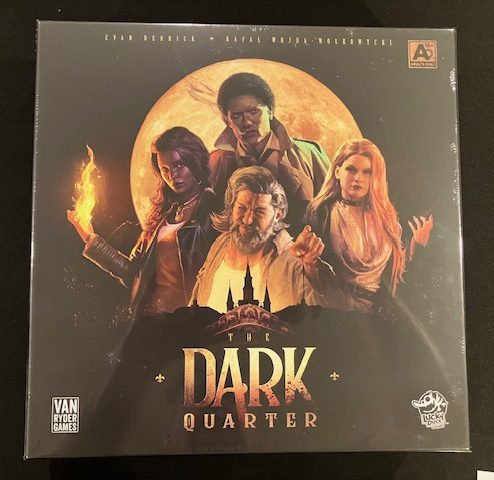
10. The Dark Quarter

Plays Solo:  Yes (operate two characters)
Player Count: 1 to 4
Ages: 18+
Length: 120+ minutes

This is more of a story than a game; I was originally hoping for more of a detective game set in voodoo-laden New Orleans, but this is more of an adult crime novel set in a voodoo-esque New Orleans. 

This is a game with lots of plot points that unfurl like an adult crime thriller on HBO or Netflix or Apple TV.  As you going through the game, you are enjoying the story as it happens, and you get to make some choices along the way.  Rather than watching an HBO crime drama, you are part of it!

An App runs this; this is one of four Storybook games in our Top 10 this year!  This is less interactive and more about coming along for the story!  The Dark Quarter  also very very 18+ with adult language and adult content.  If you want to immerse yourself in a crime story in New Orleans, there is nothing else like it! Just be aware that it’s very story-driven, but maybe not too much game. Take a look at our review to see if you might like it.  My friends and I enjoyed the experience, but others didn’t, which is why this is only #10.

9. Wandering Galaxy

Plays Solo:  Yes (very special mode: true solo, but has two sidekicks)
Player Count: 1 to 6
Ages: 14+
Length: 60+ minutes

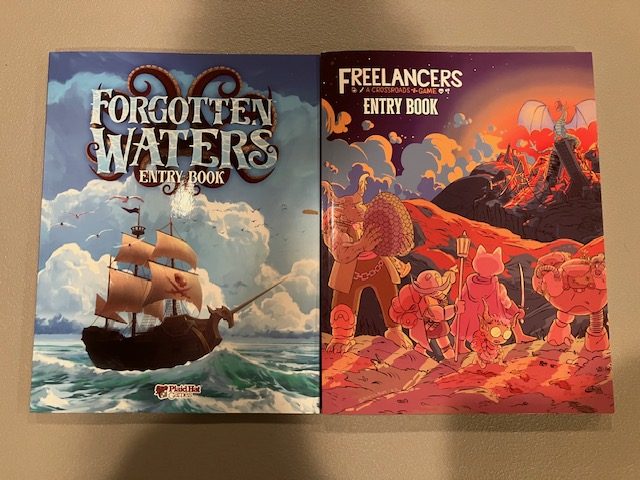
This is the third in the series of storybook app games from Plaid Hat: the first two being Forgotten Waters (which made #8 on our Top 10 Cooperative Games of 2020) and Freelancers (which made the #4 spot on our Top 10 Cooperative Games of 2022).  These are all silly games where players go through an adventure together!

This particular silly adventure is set in space!! An app (website) controls your progress through the story, as it offers voice-acting as it reads little vignettes aloud!  This is a space-based game where players roam the galaxy in search of adventure, using some worker placement and deck-building along the way.

This is a very cooperative game, as players must operate many positions of a star ship together (like the crew of the Star Trek Enterprise with helm, weapons, … etc!)   This is one of four Storybook games that made our Top 10 list this year!  This one concentrates on the humor and the voice-acting of the app to tell the story!  See our review to see if Wandering Galaxies is a game you might like!

(This was also a game where we got the physical copy very very late in December 2024, but the app didn’t “really” work until 2025, so we count this as a 2025 game)

8. Vantage

Plays Solo:  Yes (true solo)
Player Count: 1 to 6
Ages: 14+
Length: 120-180 minutes

Vantage is one of the four storybook games on our Top 10 this year!  It’s a very divisive game, which is why it’s lower on the list! Some people love it and some people hate it!! Why?  Vantage weaves in and out of different definitions: Is it a storybook game? Is it an exploration game? Is it an adventure game? Is it a campaign game?  Take a look at our review of Vantage here (What Vantage Is and Isn’t) to see if this is something you might like.

At the end of the day, me and my friends had fun exploring this game world with it’s beautiful art and very different worlds.   The solo experience is good, but I believe this is a better shared experience as a fully cooperative game, as players read to each other and explore with each other.  This is a gorgeous and well-produced game that you may love too!

7. One-Hit Heroes

Plays Solo:  Officially no (see the cover), but there are two solo modes in rulebook
Player Count: 2 to 4
Ages: 10+
Length: 20 minutes

This game made our list this year because it felt like I could bring it out to both gamers and non-gamers, and both sets seemed to enjoy it!   This is a simpler game that only last 20 minutes (but you can keep playing if you like the little campaign); it’s all about battling some bad guys together!  It’s major premise is that if you take one hit, you die (much like real life)!  So, you have to work together to keep out to harms way!

I was able to play the game with my nieces, and they had fun!  They aren’t really gamers, but they were good sports who enjoyed the experience!

This is a light, bright, fun and somewhat innovative cooperative game.   I am glad to have some lighter, simpler games to teach my gamer and non-gamer friends and family.  See our full review here of One-Hit Heroes to see if you might like it!

6. Secrets of Zorro

Plays Solo:  Yes (true solo)
Player Count: 1 to 4
Ages: 10+
Length: 45-60 minutes

The Secrets of Zorro is the surprise hit of the year for my groups!   We played it over several weeks of game nights because it was such a fun and thematic cooperative worker placement game!

The cooperative worker placement works so well in this game as you move to places for upgrades, visit the local tavern to get rumours and tactical info, visit the blacksmith for stuff, visit your home for “stuff our Dadleft us”, and just try to get ready for the craziness of the night mode!

This is a game that embraces Player Selected Turn Order (one of my favorite mechanisms)!  It is a thematic and interactive romp through the mythos of Zorro!  Check out our review of the Secrets of Zorro to see if this is a game you might like (we also suggest you have House Rule that makes the game more fun and more thematic and more cooperative).  This is a Hidden Gem!

5. The Lord of The Rings, Fellowship of the Ring: Trick-Taking Game

Plays Solo:  Yes (very different solo mode)
Player Count: 1 to 4
Ages: 10+
Length: 20 minutes (per episode)

As we head into the top 5 games, realize that any of these could have been our #1 game!

This little cooperative trick-taking game took all my gaming groups by storm!  My friends in Las Cruces played though the whole campaign!  Me and my friends played it over and over and over at Dice Tower West!  My friends in Tucson loved it!  Everybody who played this loved it!

Everyone seems to agree that this is a very thematic game, with characters from The Fellowship of the Rings having specific thematic goals to meet as you play.  The game unfolds over many episodes, and each episode is a piece of the story of The Fellowship of the Rings!  I was told by my friends (who love Lord of the Rings) how thematic the story and episodes were!

This made the #2 spot on our Top 10 Cooperative Trick-Taking Games, and it is a fantastic game!  It is very easy to get into and everyone I played this with seemed to love it!  Check out our review here to see if this is a game you might like!  

(This is also a game that BGG lists as 2024, as I think it was released in Germany first; but I tried like crazy to get a copy and could only get one delivered to me in 2025 in the USA!)

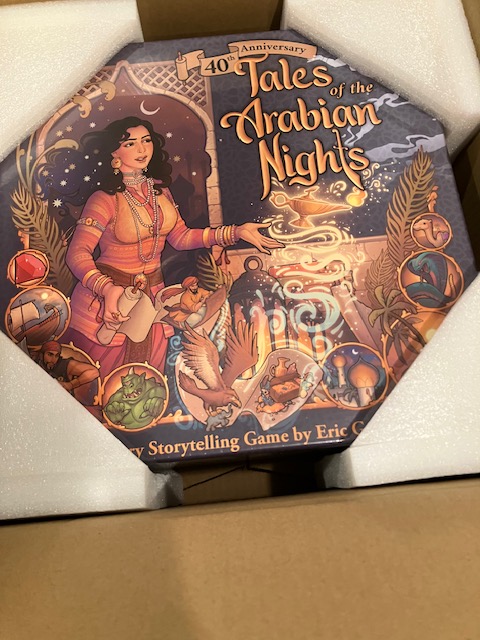
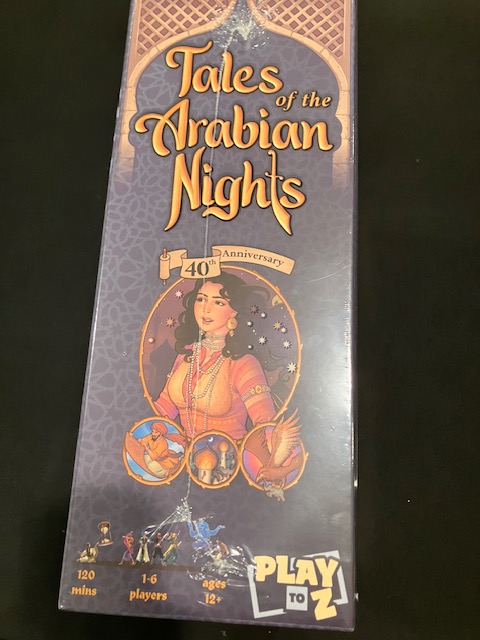
4. Tales of the Arthurian Knights 

Plays Solo:  Yes (very different solo mode)
Player Count: 1 to 4
Ages: 12+
Length: 45 minutes per player

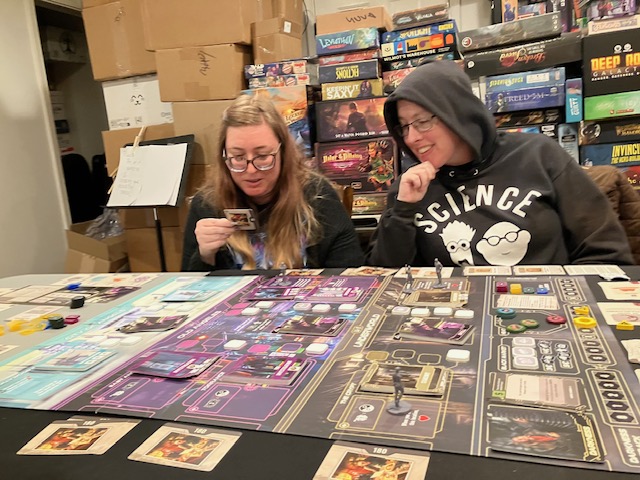
This is the fourth and final storybook game on this list.  This was far and away my friends’ favorite game of the year!  They liked it so much they went out and bought their own copy almost immediately!  

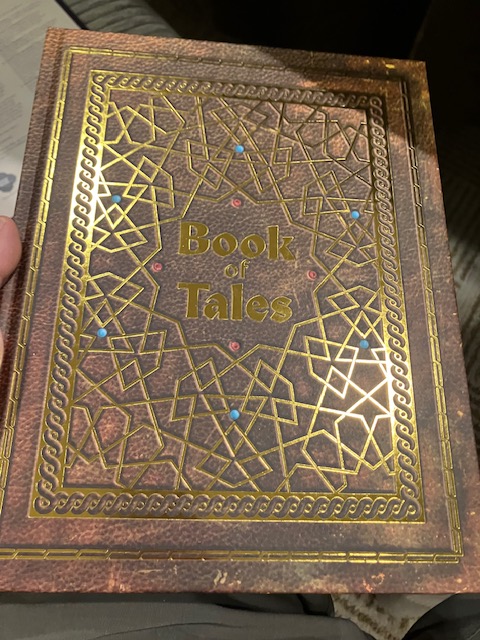
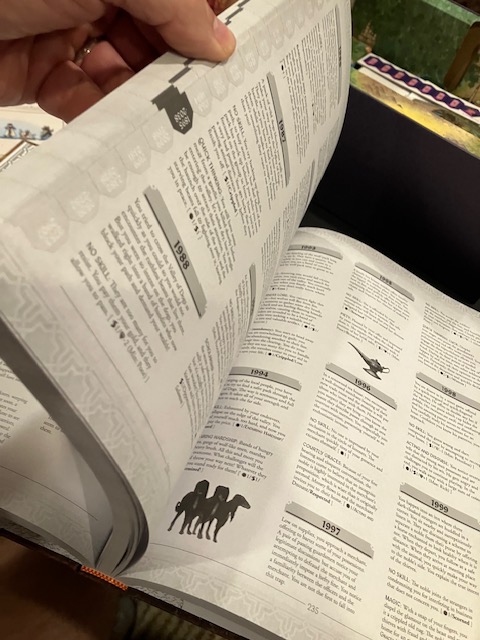
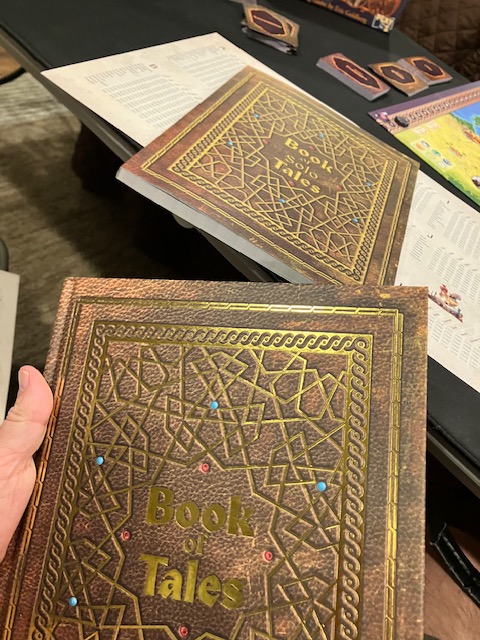
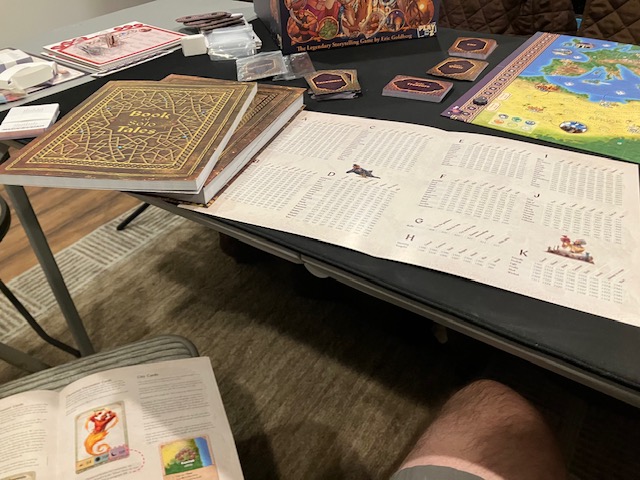
This is a game all about exploring the world of Camelot (and yes, it can be a silly place with lots of Monty Python references) while reading flowery text from the Book of Tales!  See above!  Of all the Storybooks on this list, this is the more prosy!  This would easily make our Top 10 Cooperative Storybook Games!

It’s hard to believe that this is actually a competitive game FIRST, and that the cooperative and solo modes are actually add-on modes!  Regardless, the only way me and my friends play this Storybook game is solo and cooperatively!  And it works so well!  My friend Teresa actually borrowed my copy to play at her Mom’s birthday party and they adored it!  Take a look at our review of Tales of Arthurian Knights to see if this is something you might like.

(This is also one of those games that BGG lists as 2024 but we tried like crazy to get a copy, and we could only get one delivered in 2025, so we call this a 2025 game!)

3. Invincible: The Card Game

Plays Solo:  Yes (true solo and two-handed solo)
Player Count: 1 to 4
Ages: 14+
Length: 60 minutes (well, it’s 2x that)

Invincible: The Card Game (not the confused with other Invincible games) is a re-implementation of Astro Knights (the cooperative Deck-Building game: see here and here).  Does this re-theming and re-implementation work?  Absolutely!

Cooperatively, everyone gets to take the role of a Superhero in this very thematic deck–building game!  This is also the best iteration of the Astro Knights system, partly because it add the Assist keyword which really brought out extra cooperation as we played!! 

See our review of Invincible: The Card Game to see if this is something you might like!  Oh yes!  And you can even mix this with Astro Knights if you wish! 

2. Ham Helsing

Plays Solo:  Yes (true solo and two-handed solo)
Player Count: 1 to 4
Ages: 10+
Length: 60-90 minutes 

I really did not expect Ham Helsing to be so high on my list, but this game was so much fun!  Ham Helsing is a comic-book universe (of which I knew nothing about until I played this game)!  The art and cards in this game follow the style of the original artist Rich Moyer, and I gotta say, it works!  This is basically a cooperative boss-battler game where each player takes the role of a character from Ham Helsing!

This is a card-crafting game where you can upgrade your cards by adding clear plastic to them!  See above!  This is definitely a gimmick, but it’s a gimmick that works!  It’s fun to upgrade and choose your little cards and slide them into the sleeves!

Between the clear cards, the cute art, and the acrylic standees, this game’s production is gorgeous!  There is also a sense of humor that underlies all of this, giving it an air of extra fun!  Take a look at our review of Ham Helsing to see if this is a game you might like!  We loved it!

1. DC Super Heroes United: Hush

Plays Solo:  Yes (so many ways, but just play two-handed)
Player Count: 1 to 4 (5, depending on the mode)
Ages: 14+
Length: 30 minutes (well, usually longer)

As I wait for my kickstarter of the original DC Super Heroes United (which was #1 on our Top 10 Anticipated Cooperative Games of 2025) to deliver (which looks like it won’t deliver until 2026), CMON gave us an early sneak peek of the system with DC Super Heroes United: Batman Rush.   Surprisingly, I had never read Batman: Hush (a well regarded Batman story by Jeph Loeb and Jim Lee), so this gave me a reason to finally pick up and read it!  It was great!  


DC United: Hush is a beautiful game; it is basically the next small evolution of the Marvel United system that we love so much!

The game contains equipment (one of the newer additions to the game system, which does make the game feel like you have a little more choice), plus a few new kinds of cards. It’s the next (and probably best) evolution of this system!

But most importantly, it add DC heroes like Batman and Robin and DC Villains like Hush and Joker and Harley Quinn!

This game was on my table for weeks as I played through all the combinations of heroes and villains both solo and cooperatively!  My friends and I played cooperatively, and this system just works so well as a group game!  People can choose the heroes they want!  And re-use symbols!

One of the best parts of this game is now you can play with DC and Marvel universes together!!  I got such a giggle when Batman and Robin were on SHIELD HQ battling Marvel’s Taskmaster! See above!

This game was on my table for weeks and I still want to keep playing it. I knew it when I got it, and I know it now as I write this: DC Super Heroes United: Batman Hush is my game of the year, not only for being a great game, but also introducing me to the Batman: Hush story!

Origin Story: Adding a Cooperative Mode

Origin Story is a competitive trick-taking game for 1-4 Players. It has a Super Hero theme, as people grow into their Hero forms over 5 rounds. At its core, it is a trick-taking game: Players gain tricks for victory points, gain powers for special abilities, and emerge slowly over time. The player with the most Victory Points after 5 rounds wins.

We played Origin Story, admired how well it works, especially with the powers, strategizing a limit of 5 rounds and the artwork is amazing. While playing, we couldn’t help to think “Being a Super Hero game, is there a way to play cooperatively?” We fervently decided a new mode of gameplay should be added; a cooperative mode! Over a month or so, we developed some simple rules to make an optional cooperative mode for Origin Story. These rules probably need a little more play-testing, but frankly, we all enjoyed the game in a whole new way with this cooperative mode. Now, as well as playing the current mode to be the best Super Hero and win, all the Super Heroes can now work together to save the planet in a cooperative mode!

Communication

We loved the cooperative trick-taking game  Lord of the Rings: The Fellowship of the Ring Trick-Taking Game! It inspired us to make these rules!  See our review here!   It just works so well as a cooperative trick-taking game!  Just like LOTR, the Origin Story cooperative game keeps the basic limited communication rules; you can’t ever talk about what’s in your hand.

About the only rule in LOTR that we didn’t like was that you couldn’t really consult each other about which characters to take; there’s not SUPPOSED to be any conversation about who takes which character, because it might give away info about your hand.  It doesn’t really give away that much, and we really enjoyed the discussions and interactions that happened, so we inserted a house rule saying we COULD discuss the characters in the LOTR trick-taking game.

So, in Origin Story Cooperative Rules, players are allowed to discuss who should go into Hero mode and Secret Identity mode; you may have full conversations.   The Origin Story cooperative game encourages a little more discussion than the competitive mode, but to be clear; you still can’t communicate what’s in your hand (unless you are forced to by a power).

Ruleset

We really liked the idea that a  Super Hero game should be cooperative.

See rules below. The current version is 1.0.0. As we get feedback, we may update this.

Version 1.0.1: Some disambiguation, added notion of notating travel with markers
Version 1.0.2: Added note, making sure each player takes control of a marker

Star Trek: Captain’s Chair. My Solo Game of the Year.

Star Trek: Captain’s Chair is a solo and 2-Player head-to-head game in the Star Trek universe (from publisher Wizkids).  I bought my copy online sometime in early 2025 (I don’t even remember when; March? April?), but the game was so daunting that I was scared to open it up.

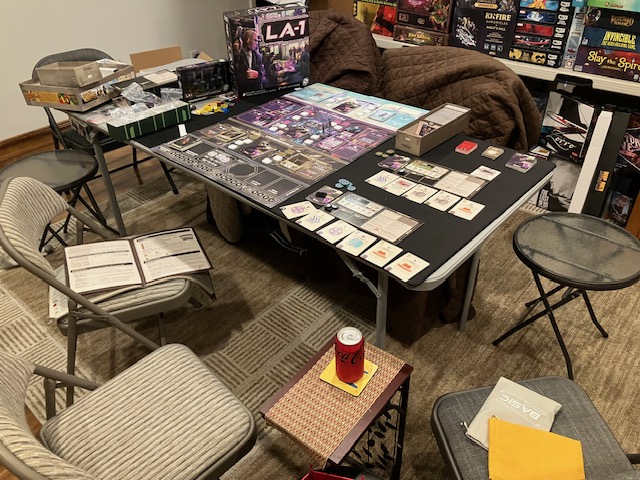
Look above to see a full solo game set-up!  Gulp!

I literally spent almost a year learning this game!  See above as I JUST set-up the game, to get a sense of it!  I ran out of time, so I had to tear it down before I even played it!  In fact, I think I set-up the game at least three times before I actually played it!

What is this thing and why is it so daunting?  To call it JUST a deck-building game with Victory Points seems to do the game an injustice, but at its core, it really is a deck-building game; if you get the highest score you “win”.

Let’s take a closer look.

Unboxing and Gameplay

The Captain’s Chair is about a half-sized box. See can of Coke above for scale.

Each player takes the role of one of six Captains from Star Trek: see the Captains above.  And NO Captain Kirk is not in this set;  you have to get one of the Expansions (due out sometime in Q4 last time I looked).

The Captains each have their own little deck hubby hole in the box.  See above.

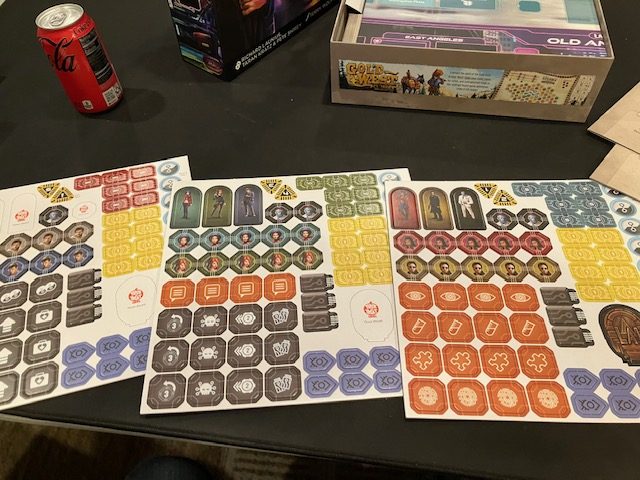
There is a metric ton of cardboard in this box.  

Most of the cardboard is is tokens and the 6 player boards for the 6 captains.  See above. 

To be fair, I think you WILL have to throw away the Punchout Skeletons to fit everything in the box (what are Punchout SkeletonsSee here).  It hurt me a little to throw these away, but the game just barely fits in the box, and all the Punchout Skeletons do is puff up the box.  So, you will have to throw away them … see a video of me doing it here …

https://www.youtube.com/live/aMSZ3QDeQYM?si=4z8aaQzBlCOyjh8V&t=1073

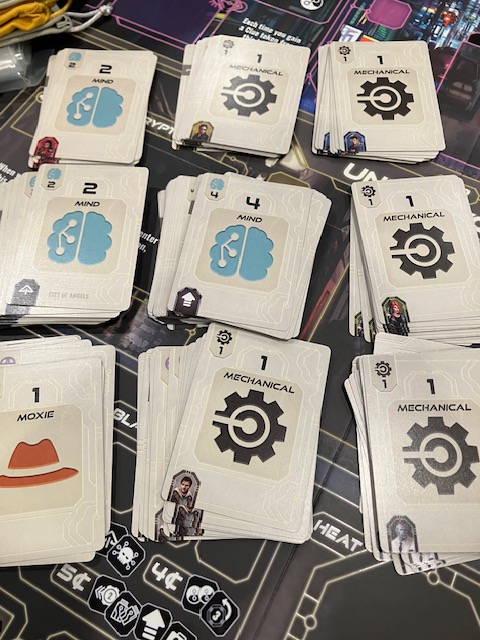
Like I said, this is, at its core, a deck-building game.  So, you have all sorts of cards that you can buy/accumulate into your deck!  See above all the Common cards: Allies, Cargo, Persons, Ships, Incidents, Locations, and Encounters!  These are “generally” the plain cards you will acquire to build your deck.

But there are lot more very thematic rules than just “build a deck!!” You can acquire ships, and warp them around!

Very thematically, you take control of a Location if you have enough landing parties and/or ships there!

Each Captain has their own very special deck of cards, which only THEY may use!  These cards in the Captain’s deck represents their “style”.  So, even though a Captain can buy/acquire Common cards, a Captain’s deck is a thing unto itself; it slowly unveils itself.  The Captain’s deck (see above) start with Available cards, slowly adds Reserve cards (as the deck cycles), then you can develop Development cards as you see fit!   

Captain Picard, for example, is all about getting Allies!  His Mission (each captain has a base mission which shapes his play-style) is to beam 3 Allies onto a ship!  See above.

Koloth the Klingon has a very different play-style; he is all about getting Ships into play and controlling planets! 

The game also has the notion of the Duty Officer; if you play one, it will allow you some extra activities.

For example (see above), if Ryker is your Duty Officer, he can use one of his Activations (as well as his Play if needed).   There is this notion of “deploy” which allows you to put ships, duty personnel, and other things into play so you get that extra Activation possibility on your turn!

If you deploy the Enterprise-D above, you can use it’s Activations!  (Right now, Picard is fulfilling his Mission of getting 3 Allies beamed aboard!)

There’s also an interesting notion of “play”.  For example, the Set A Course card above has two choices for how to play; you can either use one of your 3 Actions (represented by the blue isolinear chips) to play for the “major” action, or you can just play the card as-is for the lesser play ability (but it doesn’t take one of your 3 Actions).

You can take Control of Locations (see above).

As you play, you need to advance your Specialty tracks.  There’s many ways to advance your Specialty track as you play (it’s all on the cards), but the higher the Tracks are, the bigger the multiples for end-scoring.  See above as Picard has advanced Research (blue) to space 4 (for a multiply of x2), Influence (yellow) to space 3 (for a multiple of x2), and Military to space 0 (for just x1).  

At the end of the game, you look at the bottom right of the cards and they will get you victory points! Right now, Picard would get 3 cards times 2 =6 Victory Points for the Research, and  5 cards times 2=10 Victory Points for Influence.

Of course, some cards just give straight Victory Points.  See above.

Whosoever has the most Victory Points wins!

The gameflow is controlled by the 27 Stardate cards (see above).  Depending on what mode you play (solo easy, solo hard, 2-Player), these cards control how the game unfurls.  They usually just act as a timer (you put Victory Points on the card and when the Victory Points run out, you move to the next cards until the game is over), but they also keep the game flowing by wiping the market occasionally and wiping the Neutral Zone of uninteresting planets.

Over the course of the game, your Captain will warp ships, launch away parties, try to take control of Locations in the Neutral Zone, acquire Tech or Allies or People or Ships or Encounters to meet their Missions in an ultimate attempt to get the most Glory (what we have been calling Victory Points)!

Honestly, there are still plenty of subsystems and rules we didn’t talk about; there is so much to this game!  There is alternate way to lose via a “Burn” if you get too many incidents, there are special Encounters which feel like cool Star Trek vignettes, and many other cool things that if you know Star Trek, you’ll say “That’s very Thematic!”

Rulebook

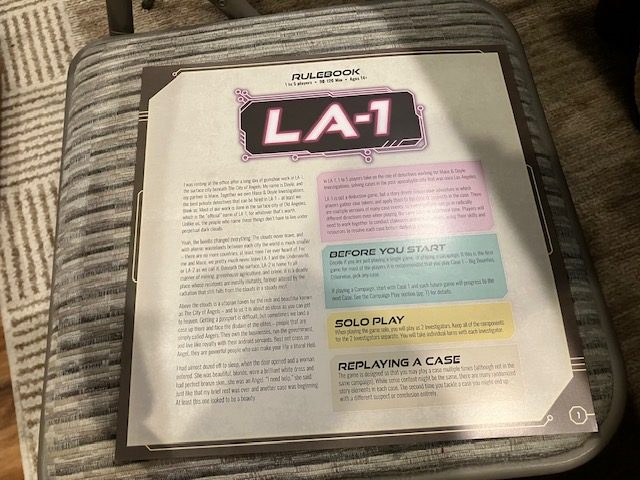
This is one of the best rulebooks I have read in a while.

First of all, the rulebook gets an A on the Chair Test!

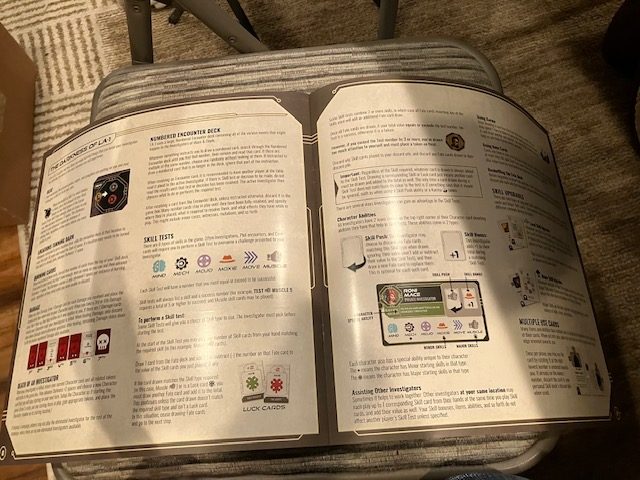
The rulebook opens up, stays flat, and is easy to consult.  The Font is very readable, but they somehow mix the thematic font of Star Trek for headings with a readable font for rule text, and it works.  There’s tons of pictures scattered in with the text, there’s tons of examples!  The rulebook also uses color and italics well!  Seriously, maybe this is an A+ on the Chair test!

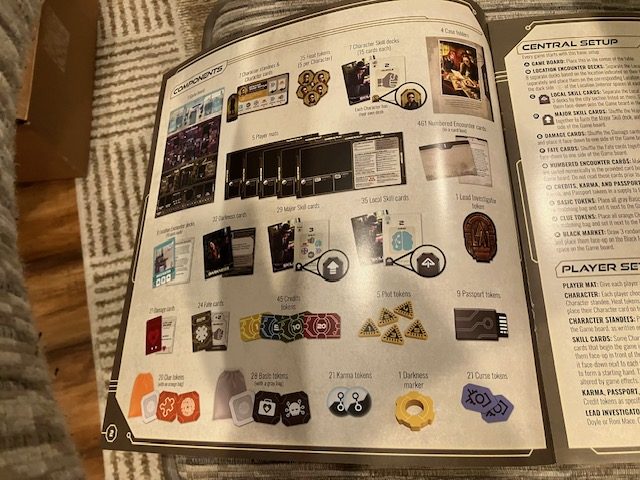
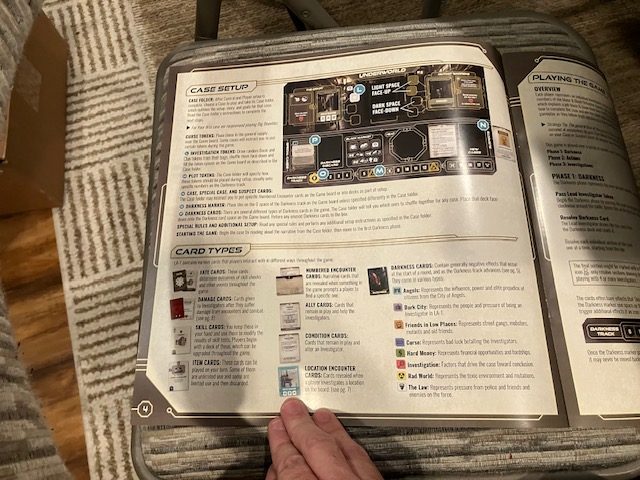
The Components pages are great; pictures are notated.

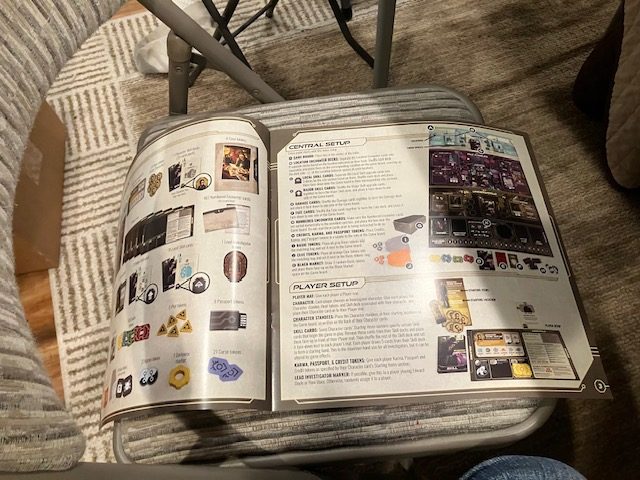
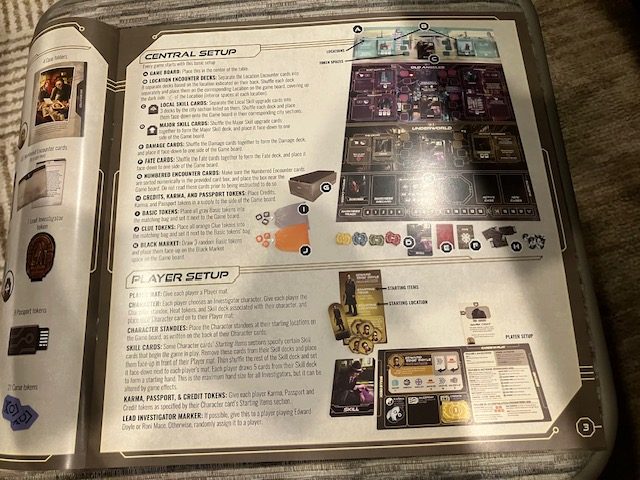
The Set-Up (even though it spans 4 pages) still is done well …

With both a Common Set-up (above above) and a per-player set-up (above).

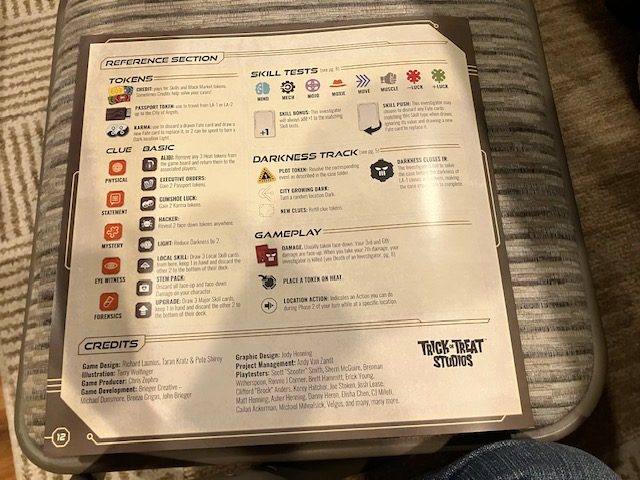
The rulebook ends with a good summary of symbols.

About the ONLY thing this rulebook does wrong is that it doesn’t have an index.  It has a table of contents and a Keywords in Detail section, but for a game this complicated, an Index is essential.

Other than the lack of an Index, this is almost a perfect rulebook.  I have to be honest, the rulebook almost reads like a legal document (because there are so many rules and systems), but everything is in there and well-explained.

Ways To Play

So, there are three major ways to play The Captain’s Chair (four if you count the unofficial cooperative mode, which we’ll discuss in the Appendix).  The “main mode” is the 2-Player head-to-head mode; this is the way Star Trek: The Captain’s Chair is meant to be played—Captain vs. Captain.   Even though this is a thinky and complex deck-building game with Victory Points, there is some take-that in the 2-Player game, as you can do things to mess up your opposing Captain.  Honestly, it really depends on the Captain(s) you choose; Koloth will have a very different play-style than Picard, who will have a different play-style than Sisko.

For solo play, there are two solo modes built-in:  The Cadet Training Mode, aka The Easy Mode and the Official Solo Mode aka the Hard Mode.   That’s what’s so great about this game; you can choose the mode that fits you!

The Cadet Training Mode

The Cadet Training Mode is probably the best way to learn the game!  Honestly, I can’t imagine jumping into the head-to-head game without learning the easy solo mode first.  See above for the rules for this mode on page 28 of the rulebook.

My first game (strictly my third game, since I set it up 2 times before I ever played!) was The Cadet Training Mode! See above.

The basic idea is that you are fighting an opponent that has “1 of everything”; you are fighting a faceless and nameless opponent.  

Basically, you are just playing turn after turn by yourself and trying to discover how all the mechanisms of the game work.    You don’t operate another Captain or anything like that.  There are enough systems in the game where you “affect” the other Captain, so when you would do that, it’s just a faceless, nameless opponent who has “one of everything”.   For example, how many landing parties does the faceless, nameless opponent have on the planets above?  One each!

This solo mode flows pretty well.  You don’t feel the glaring stare of your opponent as you learn the game; you just try stuff out to see how everything works.

My first solo game scored 69, so apparently I didn’t know how to play just yet.

 My second solo game was much better as I got a 121.  

This solo mode is the way to learn the systems of the game without the immediacy of an overwhelming opponent.  Recall, we suggested that Kinfire Council + Winds of Change sorta has an easy solo mode and a complex solo mode!

The rulebook even suggests this is a great way to learn the deck of a new Captain!  Recall that each Captain has a VERY different play-style, so this is a great way to take the new deck through its paces!

As you can see from my two scores (69 then 121), after my second game on Cadet Training Mode, it was getting too easy.  This  solo mode is a great way to learn the game, but it wouldn’t be much of a challenge now that I know the deck.  I need a new challenge.

Starfleet Command Training Program

The Hard solo mode has its own rulebook!  See above!  This rulebook, called the Starfleet Command Training Program, outlines how to play Star Trek: The Captain’s Chair in a truly complex and challenging solo mode!  This rulebook is also very daunting (at 20 pages), but it’s really not that bad (the second half talks about different modes and a 5-year mission).

One major change is that you have a different set of Starfleet cards to control the pulse of the game. See above.  

The real difference is that you are fighting a real Captain!  See above as Koloth and Picard battle!

You operate one Captain “normally” like you did previously; see as Picard gets set-up normally.

The Captain you are battling has a  very different set-up!  You still use the deck of the other Captain, but now an AI will control how that Captain operates!

There are two Control cards for each AI Captain; these are the AI cards that control what the Captain does on his turn!  Depending on what card you draw, the directions on these AI cards tell you what to do!  (Things at the top of the card take precedence over things lower on the card if there’s any question).

Basically, play alternates between the two captains; the solo player will take his turn normally, but then the solo players uses the AI to operate the other Captain!

See that big number 2 on the Starfleet card above?  That tells you how many cards the AI Captain will get to draw and resolve on his turn!

So, Koloth above draws two cards from his deck and consults the AI cards to see what those cards do!

As the game goes on, it gets pretty complicated!  Koloth is all about getting ships out, and you can see that his AI respects that .. and (see above) as he has so many ships and worlds under control in the later game!

Solo Captain and AI Captain alternate until the game end is triggered by the Star Fleet cards! Whosoever has the most victory points, wins! (If you want to be funny: I Captain goes, then AI Captain goes!)

Just like before, you count the Victory Points to see who wins.

To be clear, this is a pretty complicated AI.   There’s lots of things you have to look up as you play! Where do you send ships? Landing parties?  There’s also a notion of most valuable to me and most valuable to you that controls preferences of cards.  Sometimes determining which cards the AI prefers is pretty exhausting.  I found that it feels like the solo rules do a pretty good job of covering all bases and preferences, but it can feel hairy the first few times you try it.

This is NOT a quick one hour solo game.  This is probably at least a 2 hour game, especially your first few times.    You will find your head buried in the solo rulebook as you try to remember/discover/rank what actions/cards the AI prefers.  It gets easier as you play, but it is very daunting.

I want to be clear that I like this solo mode, but it is not easy.  

Legalese

These rulebooks are very very very good, but I kind of feel like a lawyer when I am playing.  What do I mean by that?  I have to study the rulebook to make sure I have a handle on everything; I want to say I spent a good hour (or more!) reading the rulebook the first time!!!  There are very specific rules to handle just about every exceptional case, but you have to understand how to apply the rules like a lawyer might have to understand how to apply the law.

This might sound like a negative, and for some people it will absolutely be a negative; those people will hate this game: “it’s too complicated, it’s too much, there are too many rules”.  You know if that is true for you.

But if you like a system where things are very well-specified and you don’t mind burying your head in the rulebook a lot, then this is a great game.

Theme

This game feels very thematic.  If you like Star Trek, you will see and feel the theme in this game.  We’ve said that this is a deck-building game, but all the other supporting systems of this game make it feel like Star Trek: duty officers, warping ships, developing cards, acquiring Allies, Cargo, Ships, sending out landing parties, taking control of planets … it feels very Star Trek.   This is arguably the most thematic Star Trek game I have played?

Conclusion

Star Trek: The Captain’s Chair is a daunting beast of a game.  The rulebook feels like legal document, there are many complex systems within the game, and the rules are complicated.  Yet, this is probably the most thematic Star Trek game I have played!  Each Captain’s deck matches their play-style, making them different and interesting to play!  The actions and cards feel like they are right out of Star Trek!  This feels like a love letter to Star Trek.

As a solo gamer, I love that there are two solo modes built in!  The easy solo mode provides an onramp to learn a new Captain’s deck (because they are all so different)!  The complex solo mode provides challenges for the future!  There are 30 different ways to permute the Captains in the complex solo mode (6*5=30 because order matters; which is the AI and which is the player). This gives plenty of ways to try different permutations for quite a bit of variety!  I also happen to know that at least 2 more expansions are planned, so there’s more content coming!

Sure, there’s a 2-Player head-to-head mode … which I may never play.  As a solo gamer, I am very happy with what this is. 

Be aware that this is big complex game with lots of rules and a legal document for  rulebook.  If that doesn’t scare you away and you love Star Trek, I think you will love this game.  I do. 9/10.  I think this would be a 10/10 if it had a good cooperative mode; I really want to be Picard and Sisko fighting the Borg! Or the Dominion!  So, the Appendix below …

Appendix

There is an unofficial cooperative mode: see link here.
   

Prepping for the Standardized Test: A Review of A Carnivore Did It!

A Carnivore Did It! is a cooperative and solo game of logical deduction where players only use logic to discover the solution  (as opposed to social deduction, where players deduce using very human tells).  I ordered this directly from the Horrible Guild website and it arrived late October 2025

Let’s take a look!

Unboxing and Gameplay

This is a pretty small package: see Can of Coke above for perspective.
This is a game where you have to deduce (via logic) “who is the culprit” (or in later games, “who are the culprits“)?   There are from 3 to 7 suspects, depending on the case. See above.
There are 2000 cases (!) in the game; see the cases on 20 cards above (100 cases per card).

Each card has 50 cases per side.

Using a little card overlay above,  you choose a case with its solution.

The line describes the “statements” needed for the case .. see above for case #1.  We need statements 31, 2 and 10.

There are 50 statement cards with different true/false statements: see above.

And the solution is in exposed by the red acetate on the back side (see above, slight spoiler, except its so hard to read, it doesn’t matter).

The case is specified by the numbers: the numbers choose “statements” each suspect will make.  See above for statements 31, 2, and 10.

These statement are attached to the suspects (in order) so that each statement has a statement which is either true or false.

At the top of the case card, it tells you How many suspects you need (3), how many Culprits are there (1 mask), and how many LIES are being told (the red X1).  All the cases on this card share these characteristics.

Then, using the fact that there is EXACTLY 1 lie (or 2 truths, or whatever the card says), you have to deduce who’s lying, and who’s telling the truth.  The statements veracity or falsehood will indicate who the culprit is!   Fun fact; the suspect lying MAY NOT be the actual suspect. People just lie sometimes!

This is a pretty compact little logical deduction game.  The components are fine, except for one thing: see below.

Solo Mode

This is a Solo Team type of game; all players must work together to come up with the final answer of who did it.  So the solo mode is implicit; the solo player works together with himself to solve the puzzle!

I gotta be honest; A Carnivore Did It!  feels like the logic puzzles you find on standardized tests like the GRE and PSAT and SAT (although it’s been a long time since I took those); you use logic to figure out the culprit.  So, playing this solo somehow gave me vibes of doing a standardized test, but without the #2 pencil and little bubbles.

To be fair, I LIKE the logic puzzle this presents.  But, if you don’t really like these logic puzzles because it DOES remind of standardized tests, you will hate this solo.  You may still like it cooperatively (see below).

Cooperative Play

The cooperative play went as expected.  Sometimes you get lost in each others thoughts, as they try to explain their reasoning.

It was VERY important to come up with a systematic system to eliminate/verify statements, especially in the cooperative game!  We ended up using the Trouble and Rare tokens from Kinfire Council to be False and True (respectively). See above.  Without these tokens, I think it’s too easy to get lost in each other’s logic.  Or just to get lost.  If we were sure of a statement’s veracity/falsehood, we would add the token to the RIGHT side of the card.  During hypothesis phase, we’d out a token on the LEFT side of the card to show “it’s just a hypothesis”.

Somehow, it’s a little less daunting to play with someone else, because it forces you to be more systematic.  Even better, If you are flailing, then you can defer to your friend.

Cooperative was a little more fun than solo, even if we had to argue/prove a little bit more.

Issues

Trouble Reading: I really had trouble reading the solution.  I had to zoom in with my phone (see above) and I still could barely read the answer.

In fact, we tried using the little red acetate from Cantaloop to see if it worked better!

It worked “a little better”, but it was still hard to read!

No Explanation:  So, I/We have been able to reason out all the puzzles we’ve have seen … so far.  But what if you are wrong?  You have no place to go to see a solution.  I wish they had a web page you could go to to see the solution for each one.  But there is NO explicit solution in the rulebook at all.  All you get is an answer … the game does not “show its work”.

Clumsy and Frail;  You have to slip the little decoder on the cards.  This felt fraught with peril; I was very afraid it might break over time or maybe you accidentally tear it when you slide it down the card.

Stuff I Liked

Lots of cases: Yes, 2000 cases!

Very Clear Presentation!  The rulebook even does a good job of discussing when things would still be true or false, to help answer some of the “well, what do they mean by THAT“.  The and/or questions … they have a little section to help discuss that. Still, the AND/OR stuff can be confusing.

Conclusion

You probably already know right away whether you will like this game or not.  If you love logic puzzles, I think this game will really resonate with you.  A Carnivore Did It! reminds us a lot of the simpler logic deduction game Cat Crimes (see our Top 10 Cooperative Cat Games here).

If you liked the simpler Cat Crimes, then A Carnivore Did It! is the next step up in complexity (especially when you have 7 suspects and multiple culprits)!  The later cases (see one above) can be pretty challenging (but still doable).

If you don’t like logic puzzles, you will probably hate this as a solo game; it probably feels too much like a standardized test.  Even if you don’t like logic puzzles, you may still like this cooperatively; sometimes it’s fun to be a fly on the wall and all of a sudden start participating and getting involved when you see the solution unfolding!  Or you may hate it and feel stupid and just draw away.  Only you know you.

This would probably get a higher rating if there weren’t a few component issues.  This should be probably be a solid 7.5/10 or even better, but the fact the little acetate reader is really hard to use, hard to read, and possibly fragile, I worry. I also wish they had they shown their work for solutions.  So, this might be a 6.5 or 7/10 instead.  Or maybe it won’t bother you, and this is exactly what you wanted: “I can read the solution, and I don’t need them to show their work … I can figure it out myself!”  If that’s the case, you may love this game and embrace it with aplomb …  for an 8/10 game.

Dice Throne Outcasts + Dice Throne Adventures Unchained. Part II of II.

Join us for the second part of our review as we look closer at the Dice Throne Adventures Unchained Expansion. Part I showed us the terrifyingly thematic Halloween characters of Dice Throne Outcasts, and now we look at the new solo and cooperative modes of Unchained!

If Dice Throne Outcasts provides the core characters for head-to-head play, then Dice Throne Adventures Unchained gives us more ways to play solo and cooperatively!

We have to 100% clear here; Dice Throne Adventures Unchained is an expansion for Dice Throne Adventures! See above! We really liked the Dice Throne Adventures Expansion (see review here), so when we saw there would be more content, we were excited!  So, in order to use this new Unchained expansion, unfortunately, you do need the Dice Throne Adventures box.  That’s right, Unchained is an expansion for an expansion! 

And to further muddy the waters, you need at least one of several boxes of characters to play.  We’ve been playing with Outcasts and have been loving it, but there’s also Marvel Dice Throne (see review here), X-Men Dice Throne (see review here), and Seasons I and II of Dice Throne (see review here).

In other words, to play Unchained, you also need a core box as well as the Dice Throne Adventures box!

So, if that hasn’t scared you to running away screaming  (“Really? Three boxes total?”), we can look objectively to see if it is worth getting the Unchained Expansion!  I will tempt you by saying that we have two new solo modes AND a new cooperative mode!

Unboxing

The Unchained box is small, but it has quite a bit of stuff.  See Can of Coke above for scale.

The coolest thing is the new Loot cards which can be mixed in with the original Dice Throne Adventures. Loot is just upgrades as you play! See above.  The Legendary cards are even foil! Oooooohh!!

The most fun new rule of the game is that Loot is added instantly to your hand when you get it!  So, there’s a new Loot table for instantly adding stuff! 

There’s also a whole bunch of new Minions (levels 1-4, sorry I-IV).

There’s a new Boss!  The Vault Witch!  

As a boss, she has her own deck (and sleeves)! See above!

In the base Dice Throne Adventures, you can choose to fight the Vault Witch instead of a normal boss, by collecting the Witch Keys: see above.  This allows you to vary the bosses a little in the original Dice Throne Adventures game.

There’s also 3 new sheets (double-sided) for 6 new one-shot scenarios!  

Overall, this looks great and totally fits the feel of Dice Throne, especially the Outcasts set!

Rulebook

The rulebook is a tiny thing.

This rulebook probably gets a B- on the Chair Test. It does stay open and stays flat, and the font is big and readable, and it has lots of good pictures and annotations … but it’s still just a little small.

The components page works well: see above.  

Like all Dice Throne rulebooks, they do a good job labeling pictures and having a good sized font.

Generally, this rulebook was fine.  It even finishes with some useful stuff on the back cover.

Solo Mode: Minion Rush

The game comes with a new solo mode called Minion Rush!  See rules above! 

As you might guess, you just go and fight a bunch of minions (no bosses allowed!).  These new rules span 2.5 pages in the rulebook: see above.

At the end of the Minion Rush (after you die, … and you will die), you get Points for every Minion you killed!  (Harder Minions are obviously worth more). See above as I get 27 points for killing all-but-one minion!

I tried to set-up a Minion Rush using only the new Minions  (see above)… but you don’t quite have enough Minions in the Unchained expansion to do this … you gotta get some from the main box.

I was actually incredibly disappointed you couldn’t JUST play Minion Rush with the Unchained expansion: you need 13 Minions, and the Unchained expansion only comes with 12 Minions!  D’oh!  It sounds stupid, but I thought it would have been nice to need almost nothing from Dice Throne Adventures.  To be clear; for Minion Rush, you STILL NEED Dice Throne Adventures

In the end, I played Minion Rush with mostly Unchained Minions!  See above!

It was reasonably fast and fun to play, like 1.5 hours?  You just beat-up Minions!

You have to choose a path to follow … once you start following a path to the left or right, you have to keep going on that path!

As you go, you get upgrades!  And these upgrades persist! See above!  Yay! But so does damage and poison!  Boo!  Basically, it feels like a Dungeon delve!

Minion Rush is a fun way to play solo without too much set-up.  This is another great way to learn the characters!  If you don’t want to me play the Me vs Me solo mode (like we saw in Part I of our review), then Minion Rush is a fun solo mode without too much commitment.  

I used to the solo mode Minion Rush to learn the Raveness character!  See above!

“But Rich!” … I hear you asking. “Why do I need special rules for the Minion Rush??  It feels like I could just play the Dice Throne Adventures and use these rules? Do I really need Unchained to do this?”  

You are ALMOST right.  You need two major things from Dice Throne Adventures: the status tokens (and the back of the Dice Throne Adventures rulebook), but arguably more important thing you need is … the new Loot Chart.

New Loot Zoot Suit

Arguably, the best new rule in Unchained is that you get IMMEDIATELY get Loot into your hand when kill a Minion!  See above for the One-Shot Loot chart!  One of the complaints of the original Dice Throne Adventures was that your deck upgrades went very slowly … you might only get a few Loot as you play per session.  And you might not see it very much!

The new One-Shot Loot chart (if you roll well) immediately puts Loot into your hand.  So, as you kill a bunch of Minions in Minion Rush, your hand is getting better, and better immediately!

So, the new One-Shot Loot chart is paramount to making this Minion Rush work! 

“But Rich”, I hear you say, “Can’t you just make a copy of the One-Shot Loot Chart and play Minion Rush without Unchained?”  No, because you still need the status tokens and rulebook from Dice Throne Adventures.  Why don’t you just support Roxley and quit trying to cheap-out?  They’ve made a great game for you to play … besides, Unchained comes also with new Minions, new Boss, new Loot, and … a new co-op mode!

New Cooperative Mode!

That’s right, people!  There’s a new cooperative mode in Unchained!  Whaaaat?

The One-Shot Adventure is a new cooperative Adventure!  See rules above. 

One-Shot Adventure: Solo Mode!

Technically, the One-Shot Adventure is also a new solo mode, as you can play that One-Shot Adventure by yourself!

This new One-Shot Adventure addresses the problem many people had with the original Dice Throne Adventures … it was too long!  Dice Throne Adventures required an investment in a long, on-going adventure, and there kinda wasn’t a way to just play a one-off!  Now you can!

There are three One-Shot maps (dual-sided), (see one above) and they basically represent a “condensed” Adventure where you fight some Minions on the way to fighting a BOSS!  The map above represents you “going through a dungeon”!  Along the way, you fight Minions, find treasure, find healing, and try to get to the BOSS  at the bottom!!

I played a One-Shot Adventure (see above) solo to see how it worked!    When you play the One-Shot Adventure, you have to embrace needing Dice Throne Adventures, some characters (from Outcasts, but really any), and the Unchained expansion! 

To help myself keep things separate, I actually physically separated the Dice Throne Adventure components on the left side of the table (see above) …

.. and the Unchained and Outcasts components to the right side of the table! 

This helped me keep track of what goes where!

I really enjoyed this solo; it felt like it took all the complexity of Dice Throne Adventures and compressed it into a bite-sized adventure I could play in about 1.5 to 2 hours!

With the One-Shot, you get to fight BOTH a lot of Minions AND a Boss in a smaller time frame.

I really enjoyed this “new” solo mode.  Of course, like we said in the Minion Rush, part of the reason the One-Shot Adventure works so well is that we have the One-Shot Loot chart and immediately get Loot so we immediately feel more powerful as we play!  See above as I already have some great Ghost Equipment out and upgrade cards to fight the new big bad!

The new boss is cool; I have to say I defeated her pretty readily in my One-Shot Adventure, but she was still fun to play.

Again, The One-Shot Loot chart makes this new cooperative work so well.

One-Shot Adventure: Cooperative Mode … Prequel

One big mistake I think we made in playing Dice Throne Missions was NOT playing a quick head-to-head game to learn the characters.  (You might remember my friends were frustrated when playing Missions: see review here).   When confronted with all the new rules of the cooperative modes, I think it’s too easy to get lost.  So, before we jumped into a cooperative game of Unchained (the One-Shot Adventure), I asked my friends to play a quick Head-to-head game.

I recommend this to you and your groups as well.  Don’t just jump into Unchained.  There’s a lot of rules.  Let your players get comfortable with the basic rules and characters they want to play BEFORE you jump in.

Playing a quick head-to-head game first was absolutely the right thing to do;  I know it from both the positive side (my friends above said they were very glad we did a quick pre-game) and the negative side (when my other friends felt frustrated in Missions).

One-Shot Adventures: Cooperative Mode!

So, I shepherded my players into a One-Shot  Adventure!  They generally had fun, although we saw a few problems: 
1) Four players may be too many.  Even though the game moved fast, some times you felt like it took too long to get to your turn.
2) Because it takes some turns to get some of the characters flowing, sometimes having the next player fight the minion slows down your progression.  Both Raveness and the Headless Horsemen suffered from that a little; both of them require a “commitment” to an opponent to see a result.  If the opponent is killed by another fellow player, you feel a little frustrated as you couldn’t “get your character going”.

Both of these problem are solved, I think, by simply limiting the number of players. My friends had fun playing cooperatively, but I think Robert (Headless Horseman) and Becca (Raveness) were a little frustrated getting their characters going.

The other thing to be aware of, (and note that I am not calling this a problem), is that the game isn’t particularly cooperative. It’s pretty much multi-player solitaire as you all just take your turn and try to kill Minions/Bosses. Occasionally, you might help each other with cards that give re-rolls, (“I really need a re-roll! Can someone get me a re-roll?” ), or you might get rid of a status (“Please get rid of this poison!”) If you like cooperative games that are mostly multi-player solitaire with a sprinkling of cooperation, this is a perfect game for you. If you are looking for a more cooperative experience, Dice Throne Mission might be a better choice? (I say this because characters like Cyclops are made for cooperation).

Conclusion

It’s hard to recommend  an expansion for an expansion (remember, Unchained is an expansion for Dice Throne Adventures), but I think Unchained crosses that threshold!  I actually think this is an essential expansion; Unchained fixes two major complaints about Dice Throne Adventures!   

The first complaint about Dice Throne Adventures was that the upgrade path was too slow; it took forever to see new Loot cards in your hand!  The major fix in Unchained is the new One-Shot Loot chart and rules that make you upgrade SO MUCH faster!   You feel powerful quickly, and that’s a great feeling!

The second major complaint about Dice Throne Adventures was that there was too much commitment needed to play it; it took too long  to play the long adventure! Now, with the One-Shot Adventures, you can play cooperatively in one session, fighting both Minions and a Boss!  No need for the long game!

There’s even a new solo mode with the Minion Rush, which makes it a little easier to learn characters!

There are few things to be cognizant of: you probably shouldn’t play the new cooperative mode with the full four players if you can help it.  My friends still enjoyed it, but I think it would have been more fun at a smaller player count.  Two, maybe three players is probably best.

You should also be aware that the new cooperative modes aren’t super-cooperative.  There are occasions for cooperation, but generally the game is multi-player solitaire. It’s not a bad thing, you just need to be aware of what this is.

I also STRONGLY suggest you make sure your players are familiar with the characters before they play; play a head-to-head 20 minute game before ramping up into the One-Shot Adventure, or your players might get mired in rules and frustration.

Finally, would I recommend Dice Throne Missions over Dice Throne Adventures + Unchained for the solo/cooperative game?  It depends on what you want!  Dice Throne Missions has short adventures (two sessions), and simultaneous dice-rolling which moves the game quicker.  Missions is much more super-heroey, and Unchained is more dungeon-delvey!  If you want the One-Shot Adventures so you can just jump in-and-out, then I think Dice Throne Adventures + Unchained is the better choice.  If you just want short-little adventures, the super-hero theme of Missions may call to you! Honestly, they are both good choices! 

I think Unchained is an essential expansion and makes Dice Throne Adventures that much better.  It adds new Minions, new Loot, new Boss, new solo modes, new cooperative modes, but most importantly, fixes some major problems of Dice Throne Adventures.  9/10.

Dice Throne Outcasts + Dice Throne Adventures Unchained. Part I of II.

Welcome to our two-part review of Dice Throne Outcasts and Dice Throne Adventures.  In Part I of this review, we’ll look closely at Dice Throne Outcasts and see what it has to offer.  In Part II of our review, we’ll take Dice Throne Outcasts and use it to play the solo and cooperative Dice Throne Adventures Unchained Expansion!  

The full Dice Throne Outcasts + Dice Throne Adventures Unchained set arrived at my house in mid November 2025!  See above! This was on Kickstarter back in Oct 2024 (about a year) ago.  It promised delivery in October 2025; I think they were trying VERY HARD to make Halloween, but they just missed by about two weeks.  Two weeks late in Kickstarter terms is still very good!

What Is This?

Dice Throne, by itself, is a head-to-head Yahtzee battle dice game.  Each player takes the role of some character, and goes into battle with another character/player!  The two characters battle it out with dice (using a Yahtzee-style mechanism to activate powers)!  It’s best played as a head-to-head game of character vs. character.   There’s a TON of characters in different sets!  We’ve seen the Marvel Dice Throne Set (which we discussed here), the X-Men Marvel Dice Thone Set (which we discussed here), and Dice Throne Seasons I and II (which we discussed here).

This set of Dice Throne is essentially the Halloween themed set: Dice Throne Outcasts!  It has four characters inside!  To be clear, you can JUST buy this and play the head-to-head game by itself; strictly speaking, you don’t need anything else to play Dice Throne if you just want this box!  (If you want to play solo or cooperatively, however, you will need some more stuff: that’s what Part II of our review will discuss).

This box is gorgeous with the art of Manny Trembley. See above and below.

The side lists the four characters in the box.

And the bottom talks about what this is.

I gotta be honest, this cover is a contender for best cover of the year, especially the raven side.

Unboxing

The box top is actually a magnetic wrap-around board! Inside, you get a little cartoon intro to the characters! See above!

The box itself contains four trays, each with different cards and fold outs.

There are also some cardboard tokens which are perfectly fine (see right).  You can also choose to get the acrylic tokens as an add-on; I really like how cool the Acrylic tokens are, but if you are on the fence on getting this game, the cardboard tokens in the box are JUST fine.

There is also a perfectly fine rulebook that comes with it.  The rulebook also has pointers to videos to teach the game.  I even referred to the rulebook a few times to remind myself how to play.  After years and years and years, they have the rulebook down.

There are four characters in the game; they are easy to take out with their game trayz.

And that’s really all that’s in the box.  The game is really contained in the characters, so let’s take a look at those.

The Characters

Over about a week, I was very excited to try this game, so I got a chance to play all the characters in various modes: head-to-head, solo, me vs. me, and cooperatively.

These characters are fantastically thematic.   Each one of these is unique and dripping with flavor!

The Necromancer

The Necromancer uses corpses to summon undead fight for him!

The funnest to play overall was definitely the Necromancer!  His components are just top notch, and the Undead that come out look so cool!  The best part is that he has an ability called (I am not making this up) Corpse Explosion!  When playing a big group, every time that ability was invoked, people either laughed or went “Ew!!” It was very funny.

The Raveness

The Raveness has a Raven which flies around and sucks energy from characters in slight attacks!

The Raveness feels more “subtle” than the other characters is some ways, as she has to get her Raven to the opponents! But the Raven simply “steals” life force and brings it back to her master!  This is interesting because the Raven’s life steal is not an attack that can be defended.  If played well, she can subtly funnel energy back to herself without provoking a Defense Roll!  It was also very thematic to summon the Raven with feathers … I had a picture in my mind of a Raven forming up from the feathers and summoning it …

I like the subtlety of the Raveness.

Headless Horseman

The Headless Horseman throws his big pumkin head on baddies and has tokens to terrorize!

The Headless Horseman was fun to play, as you throw your giant Pumpkin Head on your opponents!  It is a little harder to get the Headless Horseman going, but once he gets going, his pumpkin head is a sight to be seen!

His Terrorize tokens are really interesting, as they can be discarded to Terrorize your opponent with the pumpkin head!

I do think that the Headless Horseman may have my favorite art in this set.

Pale Lady

And finally the Pale Lady slips back-and-forth to lady and werewolf form!

My least favorite was the Pale Lady/Werewolf; not because she’s bad or anything.  She’s weird because she HAS NO UPGRADES. (Normally, most Dice Throne characters can upgrade their board).  I think the back-and-forth between the two sides (Pale Lady/Werewolf) was supposed to emulate some of the upgrades.  She’s definitely a butt-kicker, especially with the bleed tokens she just spews out, but she seemed the least subtle.  I guess that’s very thematic, since she is a werewolf!! GROWL!

The Characters Have Character

It might be trite to say, but the characters in Dice Throne Outcasts have character!  Thematic character!

I still liked every character!  The Necromancer might be the best one to give to newer players, not because he’s simplest, but because he’s so much fun!  The Necromancer might really bring new players into the game … they just might need a little help to operate him.

Solo Mode: Me vs. Me

The base Dice Throne games have no solo mode … BUT you can play in Me vs Me mode, which is just the solo player playing both characters!  I have done this Me vs Me mode for every single Dice Throne set I have gotten!  It’s a great way to learn the characters at your own pace!

The solo player just jumps from one side of the table to the other, alternating play of each character!  I recommend physically changing sides because it helps you “become” that character since it’s just in front of you!  Yes, it’s slightly annoying to get up and go to the other side of the table every turn, but it really does help immerse you into the characters!

If you are curious who won with the Necromancer vs. The Headless Horseman … it was close, but the Headless Horseman won!

If you don’t have anyone to play against, and you don’t have any of the solo/co-op expansions, the Me vs. Me solo mode is a fine way to learn the characters.   In fact, for this set, I played all the characters at least once so I could teach them.  The characters in this set are a little complex, so it’s nice to have seen how the characters work for when your friends have questions.

Conclusion to Part I.

Many of you are aware that I generally really like mostly solo and cooperative games.  Even though Dice Throne Outcasts is a base competitive game, I really liked it!  The art was fantastic, and the characters were dripping with theme!  In fact, I am a superhero guy, I and I think  Dice Throne Outcasts is better than X-Men or Marvel Dice Throne!  The characters are just so well-thought out and thematic!

If you just want a thematic horror-based battle game, Dice Throne Outcasts is fantastic: 9/10.

But if you want to play Dice Throne with a “real” solo mode or a cooperative mode, follow us in Part II as we explore Dice Throne Adventures Unchained

Appendix: Silly House Rule

I also picked up the Dice Throne Outcasts Hero Sculpts (see above).  These are for the cooperative game only.

They are just some neat little minis you can use on the board when you play Dice Throne Adventures.  They are completely useless in the base game.

Or are they?  We instituted a silly House Rule: the minis can be used as “worker placement” tokens to mark which ability you invoked with your dice!!  Sometimes, your dice can match multiple abilities on your mat, and thisis just a way to denote which one you chose!! See above as the Raveness mini marks us use the “small straight” option instead of a different match.

Or above as the Raveness marks that we used Murder of Crows II.

This is an absolutely silly way to use the minis. But, it helps you feel like you got more for your money if you DID get them.  Which I did.

Top 10 Cooperative Things to Pick Up Before Greater Than Games Goes Away Forever

I have been buying a LOT of stuff from Greater Than Games over the past few weeks to get ready for GMing my first game of Sentinels Comics: The Roleplaying Game! I have played the game many times (with my friend CC GMing), but I have never GMed myself! So, I have been catching up on supplies. Unfortunately, because of the unpredictable tariffs, Greater Than Games has “shuttered” themselves to a large degree, laying off almost everyone, and is just liquidating stock. See news announcement here! (This was a while ago, but I am just buying stuff now)

https://www.greaterthangames.com/blogs/news/greater-than-games-team-reduced-in-response-to-tariff-crisis

I really do hope they come back from this, but I have been trying to get everything I can in case they disappear forever! Here’s my Top 10 Cooperative Things (games, expansions, other) from Greater Than Games to get before they go away forever!

10. Spirit Island

Of all the games in the GTG lineup, I feel like  Spirit Island is the least likely to go away.  Even if Greater Than Games dies completely, I am very confident someone else will pick this up! At the time of this writing, Spirit Island is #11 OVERALL on BoardGameGeek!  I see Spirit Island in Top Solo Games lists all the time (and it made our Top 10 Cooperative Games of 2017 as well!).  I love this game, and if you’ve never tried it, it’s a great game! It’s almost a euro-cooperative game! I put this at #10 not because it’s my lowest rated game,  it’s just that I suspect this game will never go away; it’s too popular.   Someone will pick it up, even if Greater Than Games falters forever.

(And yes, there are a TON of expansions for Spirit Island, they are all fun, but I almost never play them.  I view all the expansions as Honorable Mentions for this list).

9. Legends of Sleepy Hollow

My group really liked this cooperative game, The Legends of Sleepy Hollow, but it has some wonkiness to it.  See our review here.  But they fixed some of that wonkiness with the Errata (see Errata review here).  If the idea of a cooperative game in the Sleepy Hollow universe sounds fun to you, check this out … and pick it up before it disappears forever!  Just make sure you get the Errata!

Sentinels of the Multiverse: Definitive Edition

The next three entries all all related to the Sentinels of the Multiverse: Definitive Edition

8. Disparation*

The Definitive edition of the Sentinels of the Multiverse is “essentially” the third edition of the game.  See our review here for more details.  The Disparation expansion for it … may or may happen.  When GTG first announced they were shuttering, it sounded like they shut down production of it, even though printing had already started!  Over the past 6 months, we had news that maybe it will print, maybe it won’t.  As of this writing, production has started back up again!  So, Disparation may still reach its Kickstarter (sorry, BackerKit) backers.  It’s unclear if this will ever see retail; if you see it, pick it up.  You may never see it again.

7. Rook City Renegades 

The first expansion to the Definitive Edition, Rook City Renegades, definitely did make it to retail, so you might still see it around.  See our review of it here.  If you end up getting and loving Sentinels of the Multiverse: Definitive Edition, you probably want to pick this expansion up before it disappears forever!

6. Sentinels of the Multiverse: Definitive Edition

This is the third edition of one of our favorite cooperative games of all time!  I feel like I am Superhero in a superhero’s world, battling villains and working together with my friends!  Take a look at our review and see if you might like this!  This is a rare 10/10 game for us, and you may be kicking yourself if you don’t pick this up before it goes out of print forever!

Sentinels of the Multiverse: Second Edition

The next few entries are related to the second edition of Sentinels of the Multiverse!

5. Any expansion, but especially Rook City!

There are a TON of expansions for the Second Edition of Sentinels of the Multiverse!  They are all good!

But, if I ever do a list of essential expansions for a game, Rook City (for the Second Edition) will be #1 on it!  This is one of my favorite expansions of all time!  The Villains and Environments in here are just so amazing!  This expansion really took the original (second edition) of Sentinels of the Multiverse to the next level!  (I think this is currently only offered as a bundle with Infernal Relics: I have the original).

4. Sentinels of the Multiverse: Second Edition

This is also called the “Enhanced Edition”.  You might wonder why the second edition is higher on the list than the definitive edition!  Well, to be frank, I like it better!  I think the coloring and art make it easier to see cards from across the room!  And even though the gameplay is “less smooth”, I am used to it.  Still, most of my friends liked the Definitive Edition better: See our review here!

It’s possible you might find some great deals on the Second Edition in the used market, so be on the lookout!  Just be careful not to mix editions!  Luckily, the only things for Definitive Edition are the three we list (that and foil cards)!  Just about everything else should work with the second Edition!

Sentinels Comics: The Roleplaying Game

Our last three entries are exclusively for the Sentinels RPG!  And yes, we consider this RPG a cooperative game!  What can be more cooperative than heroes coming together to save humanity?

3. Game Moderator Kit

2. Starter Kit

1. Core Rulebook 

You might wonder why Sentinels Comics: The Roleplaying Game stuff makes the top 3 spots on our list, despite the original card game(s) Sentinels of the Multiverse being some of our favorite games of all times! I think you’ll be able to find Sentinels of the Multiverse card games for some time, but I am not sure the Sentinels Comics stuff will be around! I think that the Sentinels Comics RPG didn’t get a lot of love, but it’s a pretty neat RPG system. My friend CC said it’s his favorite RPG to run! See our review here!

You can dip your toe in the water with The Starter Kit (#2) to see if you even like the game! The Starter Kit comes with pre-generated characters and pre-generated adventures so it’s easy to jump in!!

But of course, the funnest part of Superhero games is making up your own heroes, which the Core Rulebook allows you to do! The Game Moderator Kit is just icing on the cake if you decide you like this system!

Check out Greater Than Games Website (see here) to see if you can still pick up some of these things!

Kinfire Council + The Winds of Change Solo And Cooperative Expansion. A Journey and A Review!

No, this has nothing to do with the Scorpion’s song Winds of Change from 1990.

You guys are totally gonna laugh at me.  I didn’t back the original Kinfire Council when it back on Kickstarter! Despite it being a Kevin Wilson game! Why??? I usually really like Kevin Wilson games!  Between cooperative games like Arkham Horror (2nd Edition), Kinfire Chronicles (review here), and even traitor games (which I don’t usually like) like The Stuff Of Legend (review here), Kevin Wilson makes some great games!

The base game Kinfire Council (see above) is a competitive worker-placement game, which looked pretty mean!  It has voting on resolutions (which may screw the town or other players), and cultists that players may join-up at any point!  It looked like someone put traitor mechanics and take-that mechanics into a worker placement game!  No thank you!  Me and my group like cooperative games; this just didn’t look like it was for me/us.

Somehow I missed the memo that Winds of Change (see above: an expansion that seemed to be part of the same Kickstarter) made the game solo and cooperative!  You have to forgive me on this; it’s buried a little bit in the Kickstarter page! In fact, if go searching the page within your browser, the word “cooperative” doesn’t even come up! (It’s hidden in the pictures of the page).

Also, I am always suspicious of games where the solo and cooperative game are obvious add-ons. 

But I did get it.  It took some effort.

So, is this any good? Is it worth getting both Kinsfire Council and the expansion Winds of Change JUST so you can play solo and cooperative?  The answer’s a little more subtle than you might think.

Unboxing And Base Gameplay

The base game is pretty standard sized box; see Coke Can for perspective.

There is a LOT of stuff in this box! See above!

Each player chooses (or randomly gets) a Worker sheet … see above …

And a Councilor sheet! See above!

Together, the Councilor and worker sheet form your tribe!   See above!  (They don’t actually have an official name for this combination in the game, so I am using tribe to mean the combination of a worker sheet and a Councilor).  The Councilor is cool because it gives special asymmetric powers (see Head of the Temple above; she knows how to handle gold)!  Each player also gets a number of “generic” workers (see the 5 above).

The acrylic standee is a special worker called “The Seeker” who can go outside the city and do other special things.

As the game unfolds, you can upgrade your workers!  See above as Doma gets to be a Merchant!

At the end of the day, this is mostly a worker placement game!  Your workers and Seeker can be placed throughout the city and activate Locations!  Only one per Location .. unless you have something special!

Many Locations have a choice: do you activate the top or bottom?  For example (see above): The top is a choice between EITHER getting 2 coin or 2 food.  The bottom action is trading; the worker can convert 2 food or 1 common into a moon stone (rare) OR one moon stone (rare) into 4 coin.  These are some of the main resources in the game!

It’s probably safe to say this game is a resource acquisition/conversion game too!  See a bunch of the resources (from the Upgrade pack) above.

Kinsfire Council is also a voting game; you are members of a council for the city (I mean, it’s in the name for goodness sake).  Every turn, two Decree cards come out (see two examples above).  In order for these decrees to pass, they have to get a majority vote!  If you are in league with the Cultists, you may want to vote against them!  Or you may want to pass a decree that helps you but hurts the city!  Or you may not care at all and just ignore the decrees, preferring to spend resources on other things!  It DOES cost action/resources to vote!  So, you have to decide to vote or not!

Another issue the players have to deal with … Cultists come out!  They clog the worker placement board  and make it so you can’t go there!

See above as the #1 Cultist clogs the #1 Action space!  Luckily, your workers can arrest Cultists, by being adjacent to them (but unfortunately, arresting a Cultist takes your action, unless you are a guard…).

The Cultists also cause threats to come out!  The threats don’t necessarily immediately trigger!  They usually only trigger when enough Trouble tokens gets placed! (Thing in the Tunnel above needs 2 Trouble to trigger). If you can discard the necessary resources (at the bottom left of the card), you can stop the threat before it comes out AND get victory points (bottom right)!

Every Cultist placed will either place a new threat or add a trouble, depending on its number (see the bottom of the threat board).

It sounds crazy, but Cultists are resources too!  Even after you arrest some, you can still use the Cultists (say, as hostages for taking out threats: see above!).

There’s lot of good stuff going on too; you can also upgrade spaces on the board by using the City Planning space!  See above as it flips the white space to the blue side making it better!

There’s also Research (which is like good news cards) which can be really helpful too.  Like everything in Kinsfire Council, the Research cards are ALSO resources that  may be traded in (besides doing the something useful).

Along the way, you have to keep the city healthy: the chart to the left are the resources you need to “feed the city” (3 food) and “keep it clean” (1 gold): this is called City Needs!!  If players don’t collectively keep the City Needs under control, the city get more Cultists!  Interestingly, you don’t have to use a full action to take care of the City Needs; this is just an errand … every action has a free errand you can run! (Thematically, it somehow makes sense that politicians see taking care of City Needs as a simple errand, not a full action).

As part of the errand phase, you can also build the tower!  (See three such tower cards above!)  The Towers serve as inspiration to the city!  The Cultists hate the tower, because it provides inspiration and hope!  So, the less of the tower you build, the more Victory points the Cultists get!

To win, you need the most Victory Points: this is a Victory Point game! See the Victory Point track above!   You’ll  also notice that the Cultists have their own Victory Point marker!    It’s possible for the Cultists (to be clear, Cultists are NOT a player) to win the game!  If the Cultists win, whosoever has the most Cult Influence wins the game instead!

At the very end of the game, the Cultists reveal the Hidden Threat deck (created at the beginning of the game, and added to by certain decrees and threats) and add THOSE Victory Points to the Cultists!

The above 4 Hidden Threats would add 44 Victory Points to the Cultists!

This is a worker placement game, but with some really interesting ideas with voting, upgrading spaces, battling cultists, special workers, upgrading workers, collecting resources, doing research, building towers, and maybe … aligning with the Cultists behind the scenes!

Do you try to keep the city healthy or just let it go to hell and let the Cultists take over?  That’s all part of this competitive game!

Rulebook

Good rulebook. 

It gets a A- on The Chair Test (it could be an A, but the font could be a little bigger, especially seeing how much white space there is on the page).  BUT the rulebook has a great form factor, has some decent pictures, doesn’t droop down over the edges of the chair next to me, and it stays open to be easily consulted.  Great job guys!

The components pages are good; pictures and correlating text is always a good thing.  See above.

The set-up is also good; pictures and labels help!  See above.

Holy crap, there’s even an Index, and I used it multiple times! It was a useful Index!

The rulebook even ends with something useful on the back; see above.

My only complaint was that there were a few things that were unclear in the rulebook.  I posted on BoardGameGeek and got some responses; I post the thread here so you can benefit from my questions!  (The Designer, Kevin Wilson even answered and tacitly approved the answers).

Other than that, very good rulebook.

Solo Game (Unofficial)

To be clear, the base game of Kinfire Council is for 2-6 Players and is a competitive worker placement game.   There is no solo game built-in to the base game!

BUT, if you squint at the 2-Player rules a little (see page 20 from the base rulebook above) you can see the implications of a simple solo game!

In fact, the solo mode from the Winds of Change expansion is ALMOST the 2-Player game from the base game!

Basically, the official solo game and 2-Player game doesn’t allow player(s) to go after Cult Influence.  To win, the player(s) must get more Victory Points than the Cultists!   Interestingly, the solo (and 2-Player mode) redefine the Cult influence action to eliminate Trouble tokens and SUBTRACT Cult VP (rather than add Cult Influence and ADD Cult VP).

So, you can play the base Kinfire Council solo … unofficially! It’s really just the 2-Player game where you MUST be against the Cultists!

To win the (unofficial) solo game, you play like normal, and BOTH players VP must surpass the Cultists!  See above as I lose my first unofficial solo game as the red tribe is still behind on VP!

To be clear, this is an unofficial solo mode that is my own creation to just learn the game.  It’s not very hard, but it does teach how the game plays.  The solo player takes control of two tribes and plays the game normally, like a 2-Player game, but alternating between the tribes.

So, I played a couple of solo (unofficial) games to learn the game.  This is a great way to see all the rules and systems!  This (unofficial) solo game is MUCH EASIER than the official solo mode.   The official solo mode is WAY HARDER, but when you are learning the game, I think this (unofficial) solo mode is more approachable!  Basically, the official solo mode has more rules, more things to keep track, is a little oppressive (especially at the beginning), and may be a little too frustrating (in the beginning). 

I lost my first (unofficial) solo game and decisively won my second (unofficial) solo game.  But I learned the game.

If you have played The Captain’s Chair, you know that it has two official solo modes. The “simple” solo mode teaches most of the mechanics of the game without being too oppressive.  Once you know the basics, the “hard” solo mode is how you want to play.  I think that same idea applies here.  

Play the (unofficial) solo mode (which is basically just the solo player operating the 2-Player game by himself) to see how the game works; you only need the base game for that.  If you enjoy that, then you can decide if you want to move on the official (and much harder) solo mode from Winds of Change.

Winds Of Change Unboxing

Winds of Change is the expansion that provides official solo and cooperative rules for base Kinfire Council. 

It adds a bunch of new Locations you can swap from the base City Locations.

It adds three new Towers to swap in.

A bunch of new cards.

And a new resource called Favor Tokens which is like Magic, but its use gives the Cultists Victory Points. (Honestly, in all my plays, I stayed away from these resources)

BUT the most important thing this adds is the new Cult Decree Cards (see above).  This is what makes the solo and cooperative games more challenging!  This is the new key ingredient!

Basically, every turn, when you normally get two decrees (which you may or may not want), you ALSO get a Cult Decree card at the same time!  Just like the Decrees, you have to get the votes on Cult Decrees to make sure they don’t take hold!

The Cult Decree cards are even worse than you think because they ALSO have an immediate bad news (look at the bottom of the card)!

Official Solo Mode (Winds of Change)

If the (unofficial) solo mode is too easy, it’s the Cult Decrees that make the official solo game in Winds of Change a LOT harder.

The official solo mode is very much like the 2-Player mode.  Two tribes must work together (see above) to make sure the city survives the Cultists!  The three real differences are:
1) Players must now deal with Cult Decrees (GULP!)
2) The two tribes share all resources in one pot
3) Each tribe only has three generic workers instead of five generic workers

Since the two tribes now share all resources, there is only one Victory Point marker.  Both tribes move the same VP marker!  See above!  To win, the solo player must simply beat the Cultists!

The official solo mode is still basically the same game, but there’s no back-stabbing or bad councilors to worry about!  The two tribes cooperate!  The solo player alternates between the two tribes and plays normally.  The real difference is that all resources are shared between the two tribes AND they have to deal with the pesky Cult Decrees!

The official solo game definitely feels more oppressive!  Your first few turns feel like you can just barely hold back the tide of Cultists! It’s a little overwhelming!  I think I had some bad luck in my first official solo game, so I cheated a little just to make sure I moved forward to see the whole game!   

In my  second official solo game, I felt like I got it!  In the beginning of the official solo game, it’s HARD to keep the Cultists under control, but by the time you make it turn 5, you have a little bit of an engine going and you have enough resources to make a difference!  It feels  … inspiring … when you can wrest control of the city from the Cultists!  This is our city, darn it!

The official solo game is much harder that the (unofficial) solo mode (as we discussed earlier), but it is a good challenge and it will be a solo mode to keep you coming back.

It’s just a little bit of work to keep the solo and cooperative components separate from the base box.  (I actually ran out of space on my table, and had to put the Winds of Change box on my stove!!! See above)  It’s actually kind of annoying to put everything away.

Cooperative Game

You could easily play the 2-Player mode from the base game cooperatively as a 2-Player game.  And frankly, except for the Cult Decree Cards, it’s pretty much the same game.  Again, the Cult Decree Cards make the game SO MUCH harder. 

For one of our 2-Player cooperative games, we played with the official Winds of Change cooperative rules with the Cult Decree cards.  We wanted the challenge!

In the cooperative game, each player has their own VP marker.  Like before, ALL PLAYERS must have more VP than the Cult, or they lose!  See above as we win!  Both Teresa and I had more VP than the Cult!

The Winds of Change also has new Player Aids (which are quite good: see above).

Basically, we had fun playing cooperatively!  There’s a lot of multiplayer solitaire, which means we both have agency on our turns.  But we still have to talk a LOT to make sure we arrest the Cultists and keep the Cult Decrees under control!   I think this game a really good balance of having solitaire agency but still requiring plenty of cooperation!  At the end of the day, YOU decide how to move your workers, but still work together to keep the Cultists down!

House Rules: Cooperative – Sharing

There was one thing that really surprised us in the cooperative game; there is no rule for sharing resources!

In the official solo game, the two tribes share all resources, so there’s no need for any sharing rules.  But, the cooperative game has no mechanism for sharing?

We came up with a House Rule that seemed to work fantastically!  You can use an errand to share any single resource!!!  It’s an easy place to add the sharing mechanism, and it’s very thematic!  “Oh, as an errand, I need to make sure my friend has some Magic to stop the threat on their turn!”

It’s not free, as it still takes up an errand to do it, but it made the game a LOT more cooperative!  “Can you deliver me a Cultist?”  If my friends just needed one resource and could save us an action, why not do it?

It was sort of funny to have all resources (including Cultists and Cards) being something you can share.  For the Cultists, it reminded us of doing prisoner transfers across town.

We STRONGLY recommend adding this House Rule: as one of the options for an errand, you may choose to share a single resource.  If you can’t build the tower, or resolve City Needs as your errand, maybe you can still do something useful with your errand and help your compatriots.

Sharing as an errand made the game more cooperative, more interactive, and more fun. 

House Rule: Solo – Don’t Require Alternating

In the official solo game, you MUST alternate between the two tribes as you play.  But, why?  Since all the resources are shared, it doesn’t matter as much!  In fact, sometimes you have more options if you can choose any order you want!  Maybe you want to use tribe 1’s three workers FIRST (because they are all guards) and THEN do all of tribe 2’s workers after the board has been cleaned of Cultists!  I found many times, when playing solo, I accidentally didn’t alternate ANYWAYS!  You sometimes forget to alternate … but it doesn’t really change the game.  In fact, it gives you more options!  If you can choose the order of the workers of the tribes, sometimes you can pull off something really clever that maybe you couldn’t if you were forced to alternate.

This isn’t a big deal for a House Rule, but I think it makes the solo game just a little more fun: give me more choice so I can feel clever. 

Thoughts

We were originally supposed to play a 3-Player cooperative game, but Sara fell sick and just wanted to listen to us.  Here’s the funny thing; just listening to us play and narrate our turns to her, Sara gave this game a 7.5/10! She said it sounded really fun!

Teresa really liked it.  About a 7.5/10 as well.

I liked both the solo and cooperative modes a lot.  The solo game was about a 8.0 as was the cooperative game.  With the house rules we proposed, both go up to an 8.5/10. In fact, the sharing as an errand rule was such a good house rule, it might even make it a 9/10.

Conclusion

You can play the base Kinfire Council game as a solo and cooperative game to see if you like it (using the unofficial rules we described).   These unofficial solo/cooperative modes are pretty easy, but they give a good sense of the game.  If you like the game, then the Winds of Change expansion makes the game much more challenging.

Is it worth getting both?? I personally think it’s worth getting both  Kinfire Council and the Winds of Change expansion to play this solo and cooperatively.  It’s a lot of work to get there, between learning the base game, cooperative game, set-up, combining games, and set-up, but the unofficial solo rules can make it a LOT easier to learn the systems of this game.

If you do get Kinfire Council and Winds of Change, I strongly suggest you play with the cooperative house rule sharing as errand, as it makes the game more cooperative, more interactive, and more fun; it brings the game to almost a 9/10 for me (cooperative mode).   Even without that rule, it’s still an 8 or 8.5/10.  It’s so cool that a cooperative worker placement works so well!

The official solo mode is great, but a minor house rule (for relaxing the alternation) makes it a little more fun, as it gives the solo player more choice.  Solo: 8 or 8.5/10.