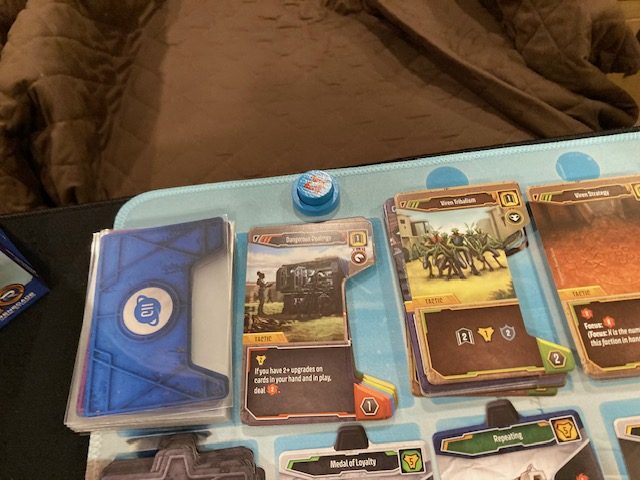
Star Trek: Captain’s Chair. My Solo Game of the Year.

Star Trek: Captain’s Chair is a solo and 2-Player head-to-head game in the Star Trek universe (from publisher Wizkids).  I bought my copy online sometime in early 2025 (I don’t even remember when; March? April?), but the game was so daunting that I was scared to open it up.
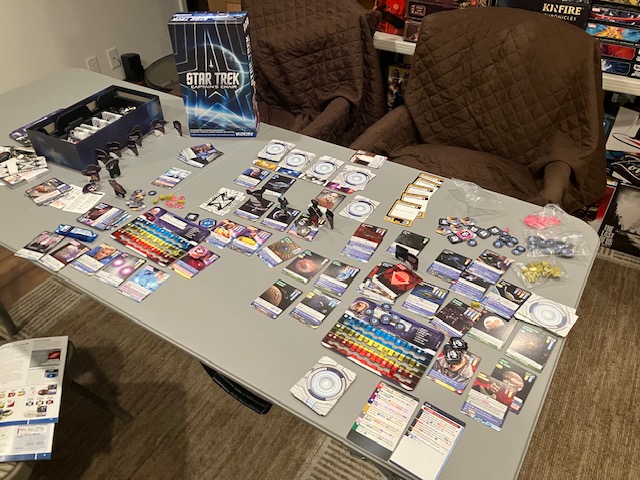
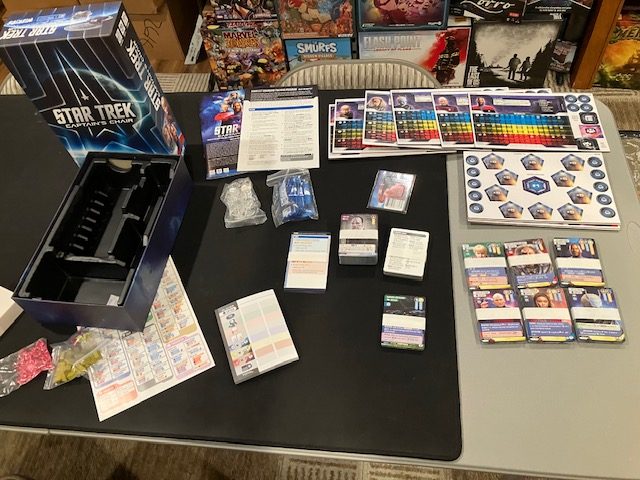
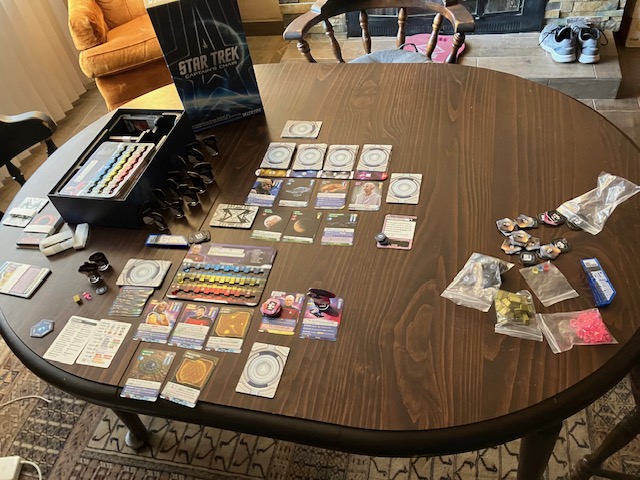
Look above to see a full solo game set-up!  Gulp!
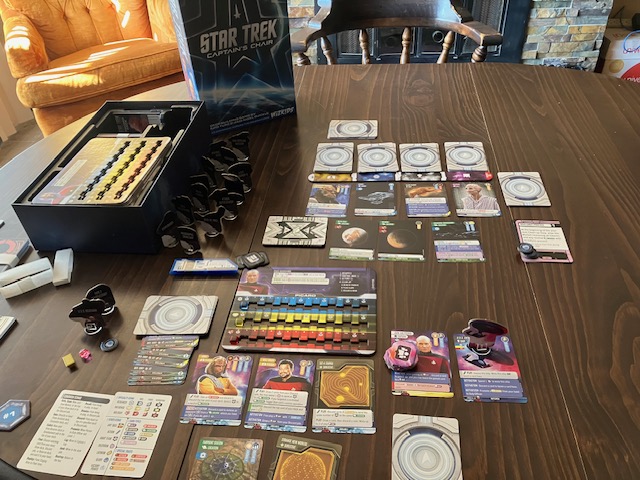
I literally spent almost a year learning this game!  See above as I JUST set-up the game, to get a sense of it!  I ran out of time, so I had to tear it down before I even played it!  In fact, I think I set-up the game at least three times before I actually played it!
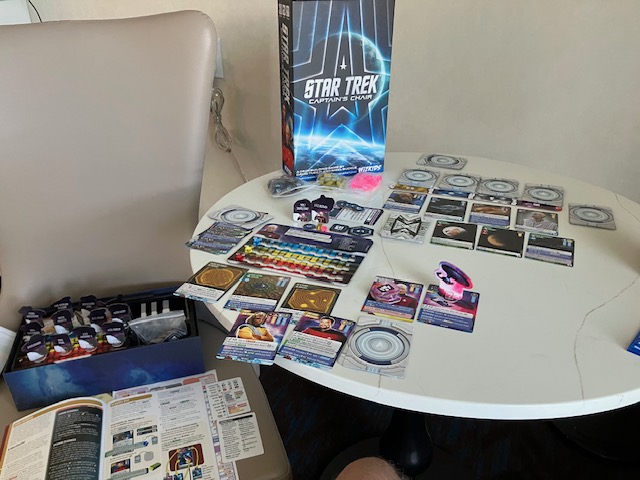
What is this thing and why is it so daunting?  To call it JUST a deck-building game with Victory Points seems to do the game an injustice, but at its core, it really is a deck-building game; if you get the highest score you “win”.
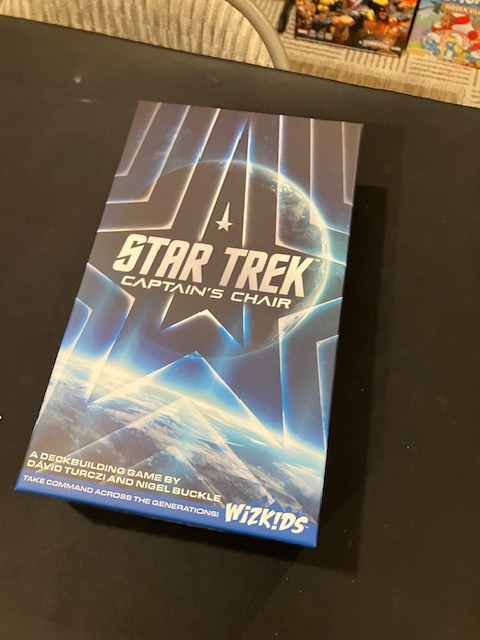
Let’s take a closer look.

Unboxing and Gameplay
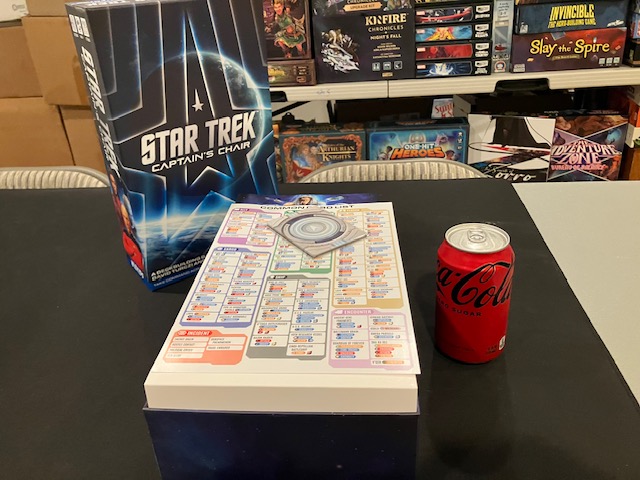
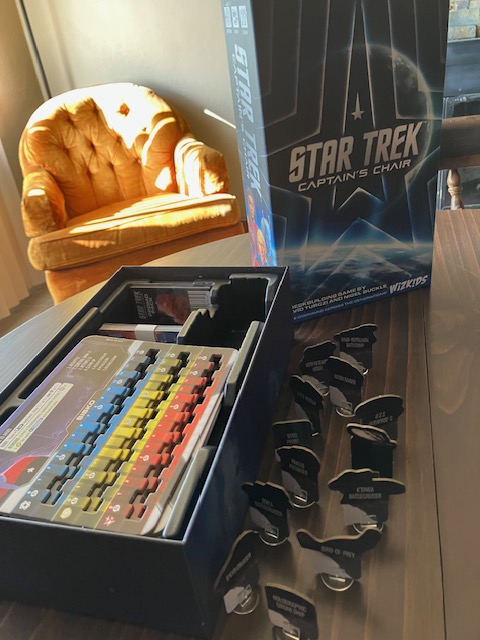
The Captain’s Chair is about a half-sized box. See can of Coke above for scale.
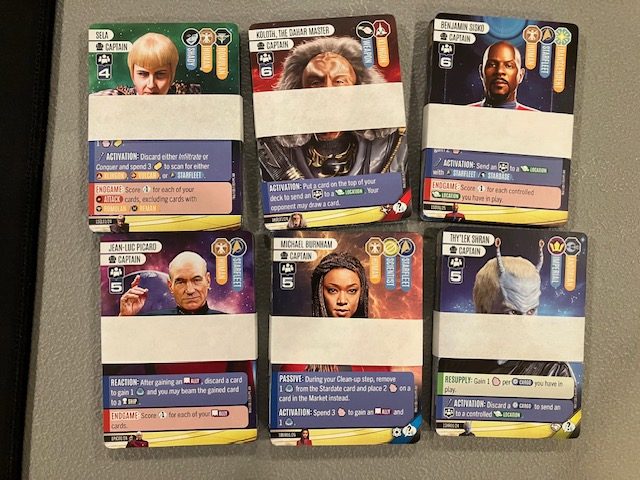
Each player takes the role of one of six Captains from Star Trek: see the Captains above.  And NO Captain Kirk is not in this set;  you have to get one of the Expansions (due out sometime in Q4 last time I looked).
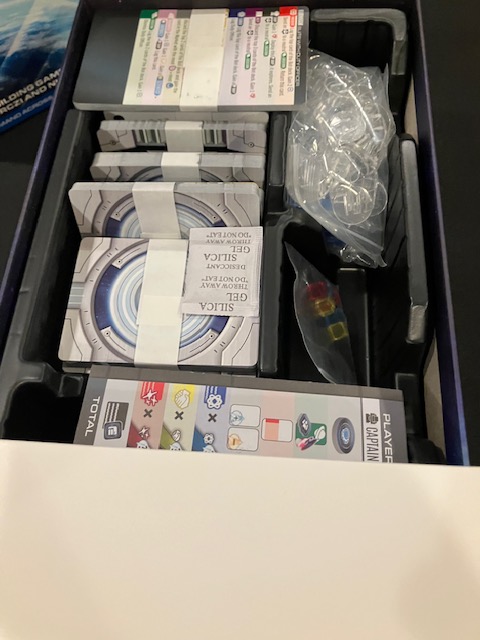
The Captains each have their own little deck hubby hole in the box.  See above.
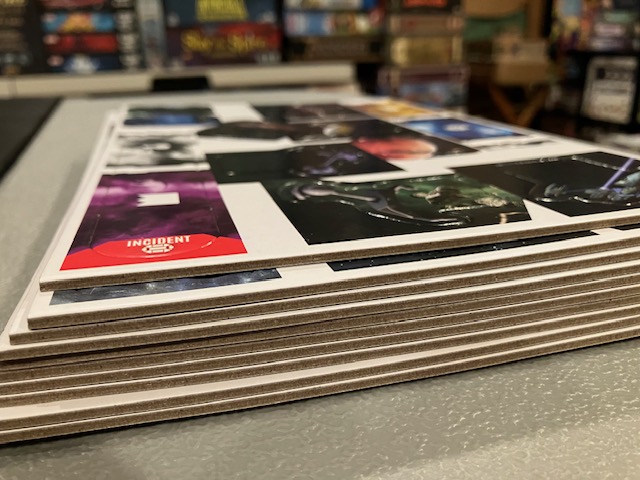
There is a metric ton of cardboard in this box.  
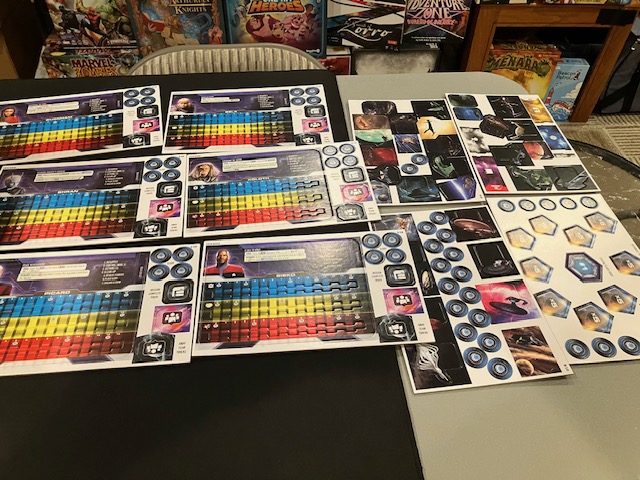
Most of the cardboard is is tokens and the 6 player boards for the 6 captains.  See above. 
To be fair, I think you WILL have to throw away the Punchout Skeletons to fit everything in the box (what are Punchout SkeletonsSee here).  It hurt me a little to throw these away, but the game just barely fits in the box, and all the Punchout Skeletons do is puff up the box.  So, you will have to throw away them … see a video of me doing it here …

https://www.youtube.com/live/aMSZ3QDeQYM?si=4z8aaQzBlCOyjh8V&t=1073
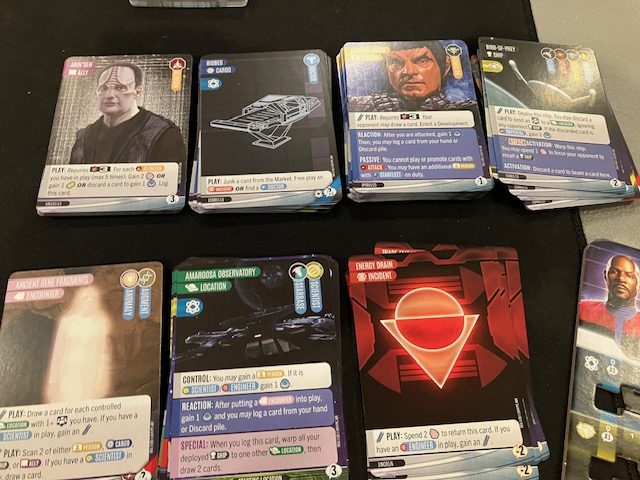
Like I said, this is, at its core, a deck-building game.  So, you have all sorts of cards that you can buy/accumulate into your deck!  See above all the Common cards: Allies, Cargo, Persons, Ships, Incidents, Locations, and Encounters!  These are “generally” the plain cards you will acquire to build your deck.
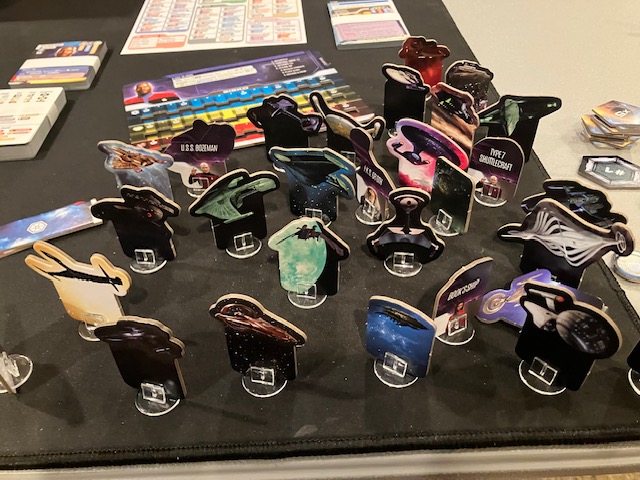
But there are lot more very thematic rules than just “build a deck!!” You can acquire ships, and warp them around!
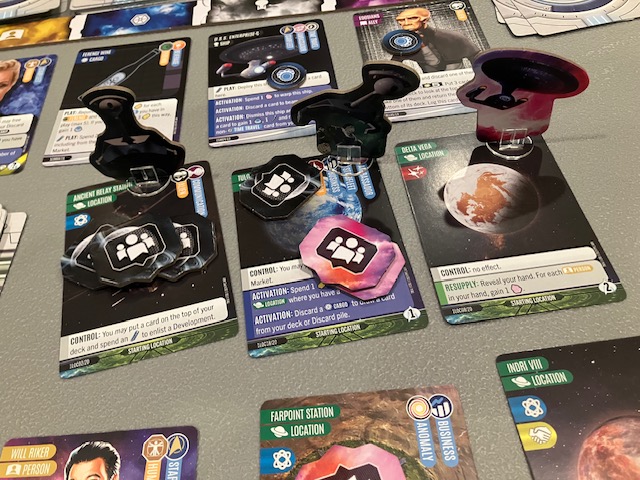
Very thematically, you take control of a Location if you have enough landing parties and/or ships there!
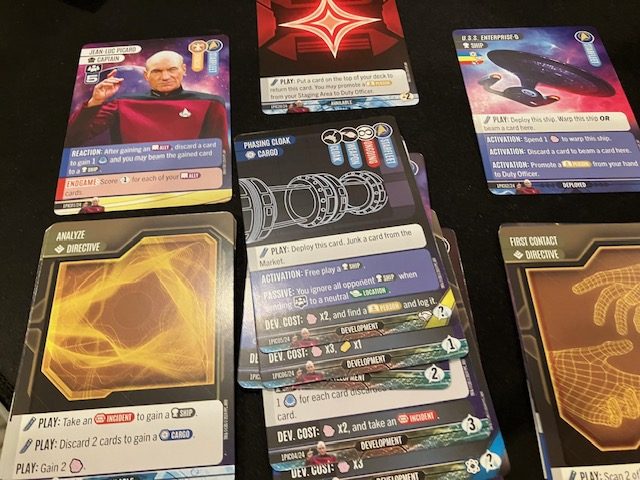
Each Captain has their own very special deck of cards, which only THEY may use!  These cards in the Captain’s deck represents their “style”.  So, even though a Captain can buy/acquire Common cards, a Captain’s deck is a thing unto itself; it slowly unveils itself.  The Captain’s deck (see above) start with Available cards, slowly adds Reserve cards (as the deck cycles), then you can develop Development cards as you see fit!   
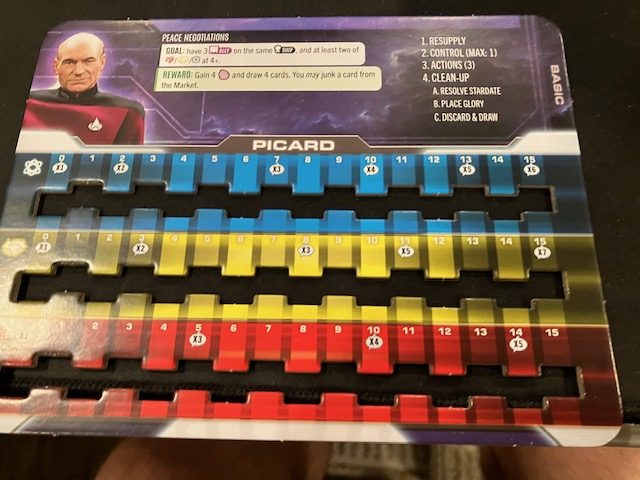
Captain Picard, for example, is all about getting Allies!  His Mission (each captain has a base mission which shapes his play-style) is to beam 3 Allies onto a ship!  See above.
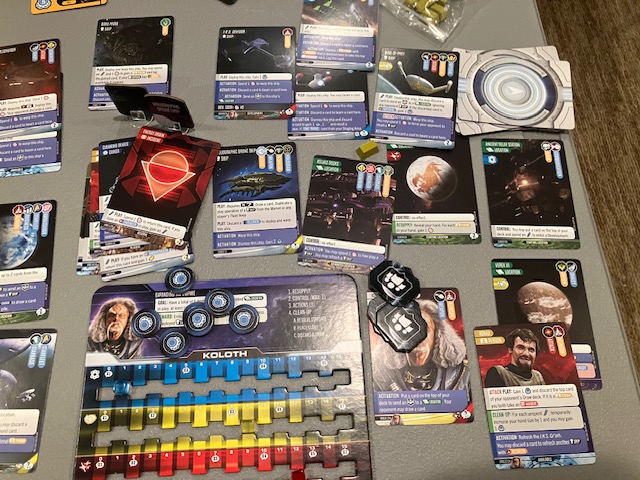
Koloth the Klingon has a very different play-style; he is all about getting Ships into play and controlling planets! 
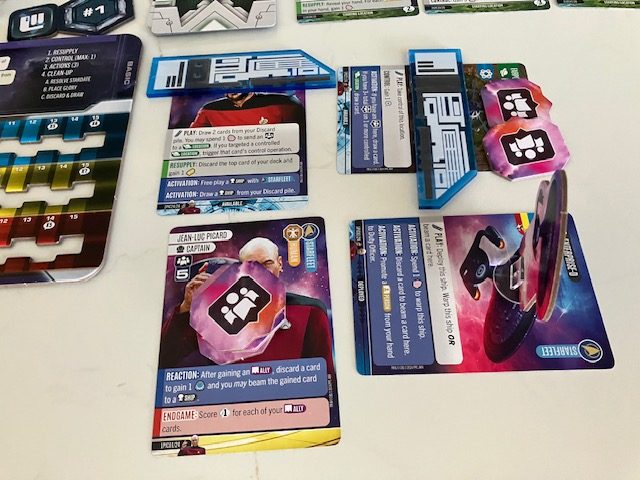
The game also has the notion of the Duty Officer; if you play one, it will allow you some extra activities.
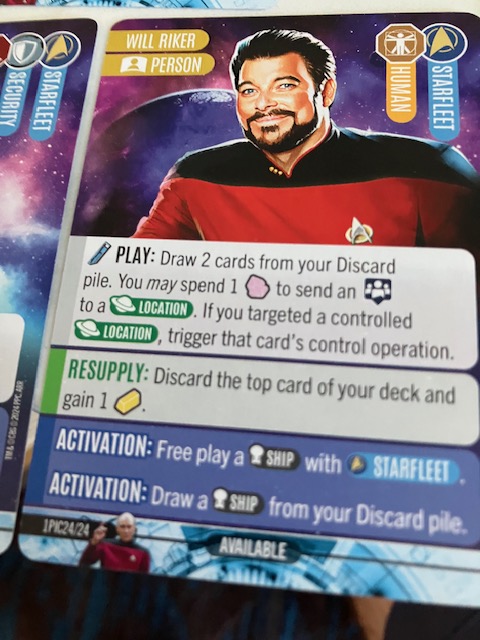
For example (see above), if Ryker is your Duty Officer, he can use one of his Activations (as well as his Play if needed).   There is this notion of “deploy” which allows you to put ships, duty personnel, and other things into play so you get that extra Activation possibility on your turn!
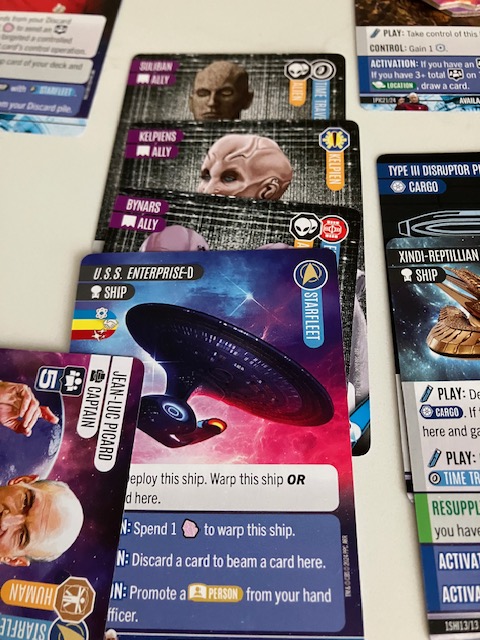
If you deploy the Enterprise-D above, you can use it’s Activations!  (Right now, Picard is fulfilling his Mission of getting 3 Allies beamed aboard!)
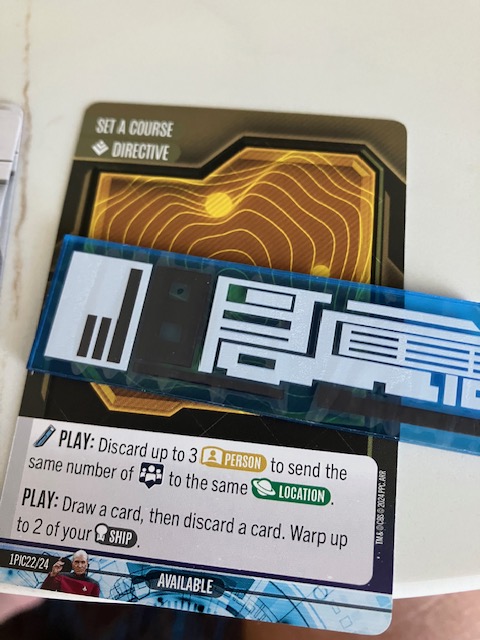
There’s also an interesting notion of “play”.  For example, the Set A Course card above has two choices for how to play; you can either use one of your 3 Actions (represented by the blue isolinear chips) to play for the “major” action, or you can just play the card as-is for the lesser play ability (but it doesn’t take one of your 3 Actions).
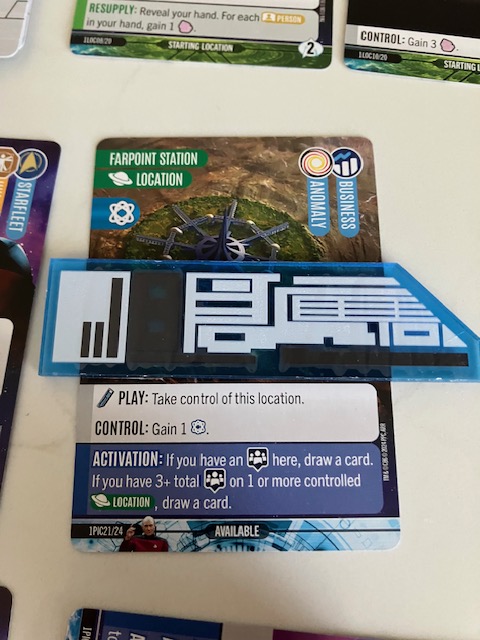
You can take Control of Locations (see above).
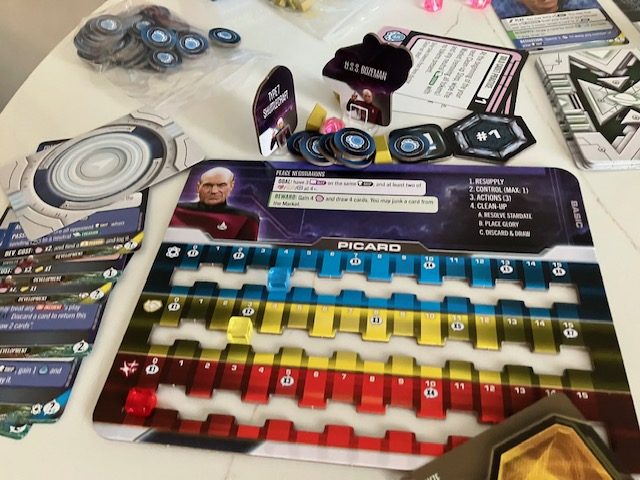
As you play, you need to advance your Specialty tracks.  There’s many ways to advance your Specialty track as you play (it’s all on the cards), but the higher the Tracks are, the bigger the multiples for end-scoring.  See above as Picard has advanced Research (blue) to space 4 (for a multiply of x2), Influence (yellow) to space 3 (for a multiple of x2), and Military to space 0 (for just x1).  
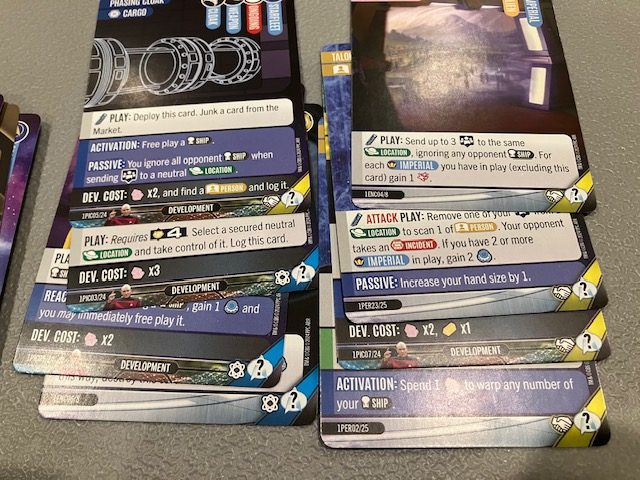
At the end of the game, you look at the bottom right of the cards and they will get you victory points! Right now, Picard would get 3 cards times 2 =6 Victory Points for the Research, and  5 cards times 2=10 Victory Points for Influence.
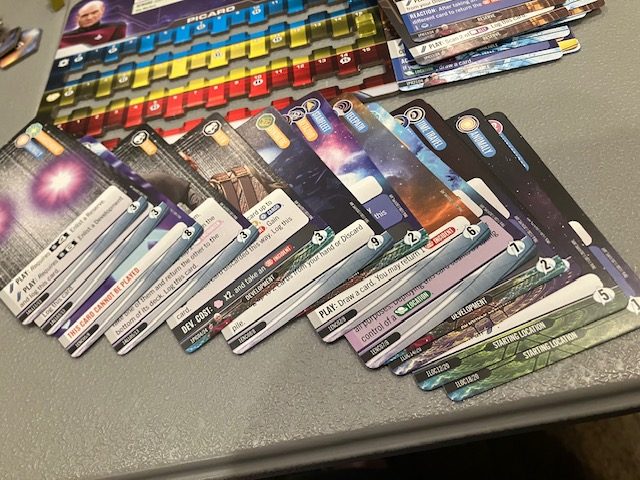
Of course, some cards just give straight Victory Points.  See above.
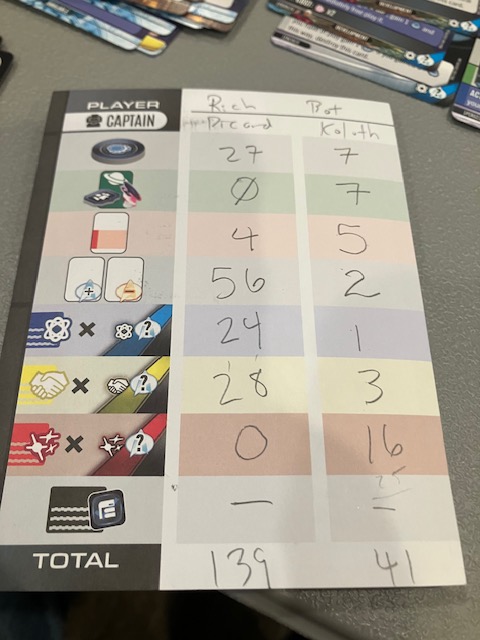
Whosoever has the most Victory Points wins!
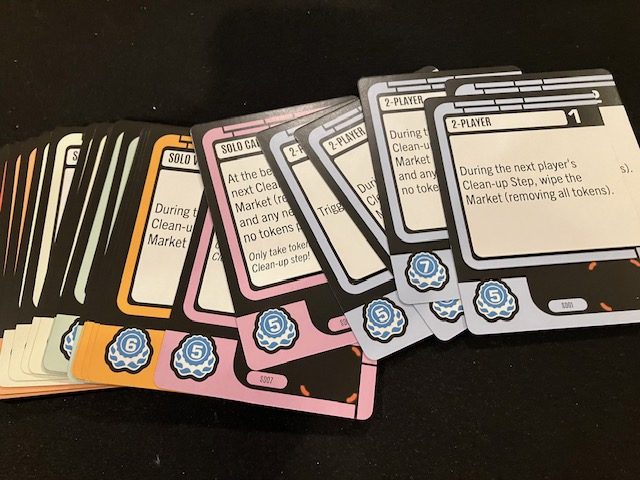
The gameflow is controlled by the 27 Stardate cards (see above).  Depending on what mode you play (solo easy, solo hard, 2-Player), these cards control how the game unfurls.  They usually just act as a timer (you put Victory Points on the card and when the Victory Points run out, you move to the next cards until the game is over), but they also keep the game flowing by wiping the market occasionally and wiping the Neutral Zone of uninteresting planets.
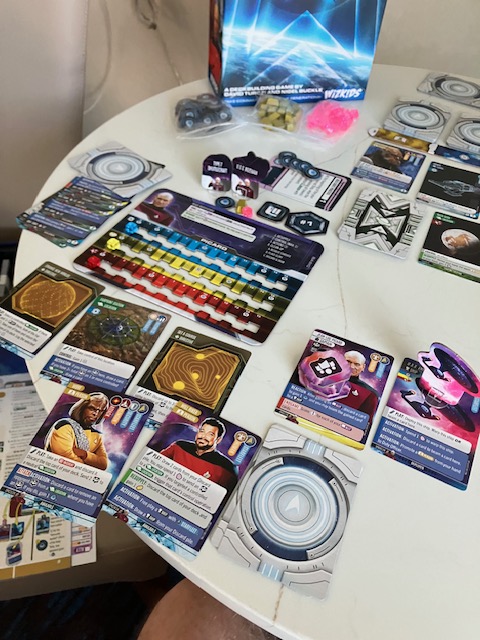
Over the course of the game, your Captain will warp ships, launch away parties, try to take control of Locations in the Neutral Zone, acquire Tech or Allies or People or Ships or Encounters to meet their Missions in an ultimate attempt to get the most Glory (what we have been calling Victory Points)!

Honestly, there are still plenty of subsystems and rules we didn’t talk about; there is so much to this game!  There is alternate way to lose via a “Burn” if you get too many incidents, there are special Encounters which feel like cool Star Trek vignettes, and many other cool things that if you know Star Trek, you’ll say “That’s very Thematic!”

Rulebook

This is one of the best rulebooks I have read in a while.
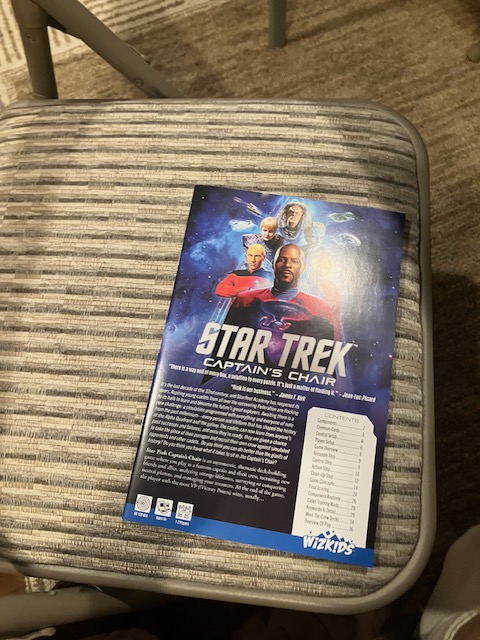
First of all, the rulebook gets an A on the Chair Test!
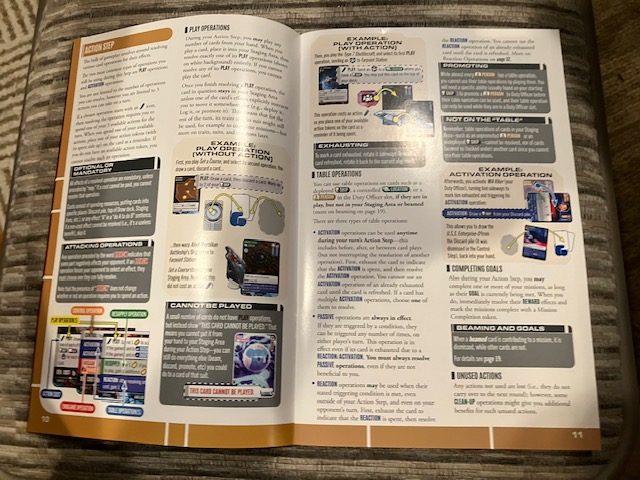
The rulebook opens up, stays flat, and is easy to consult.  The Font is very readable, but they somehow mix the thematic font of Star Trek for headings with a readable font for rule text, and it works.  There’s tons of pictures scattered in with the text, there’s tons of examples!  The rulebook also uses color and italics well!  Seriously, maybe this is an A+ on the Chair test!
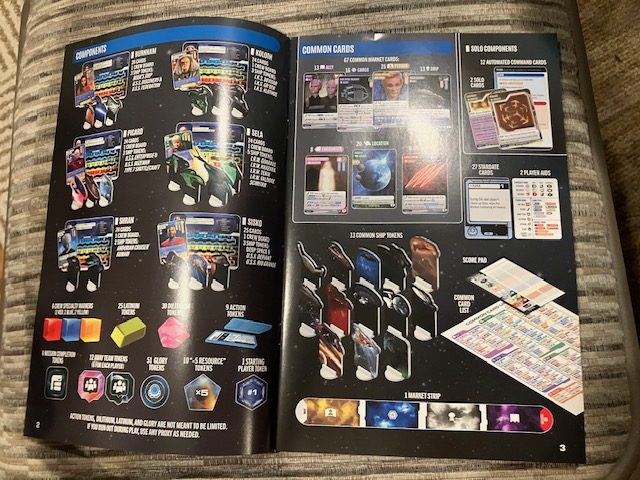
The Components pages are great; pictures are notated.
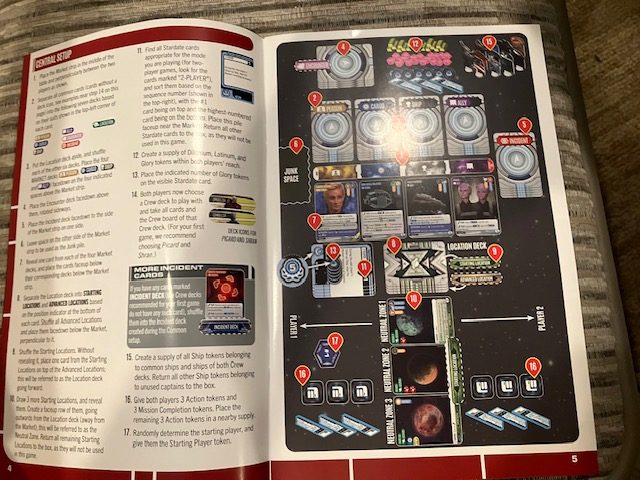
The Set-Up (even though it spans 4 pages) still is done well …

With both a Common Set-up (above above) and a per-player set-up (above).
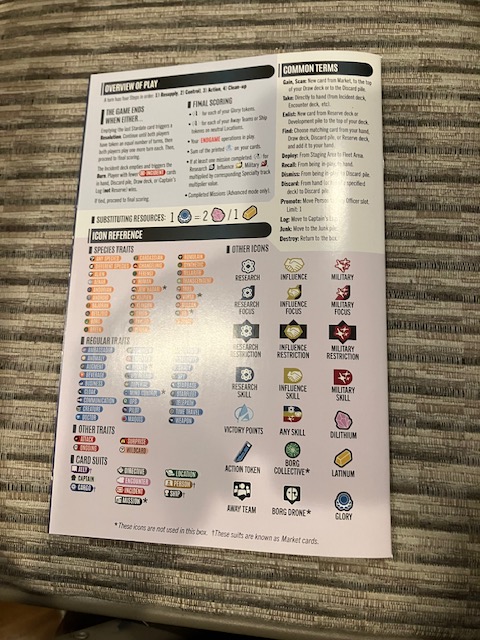
The rulebook ends with a good summary of symbols.
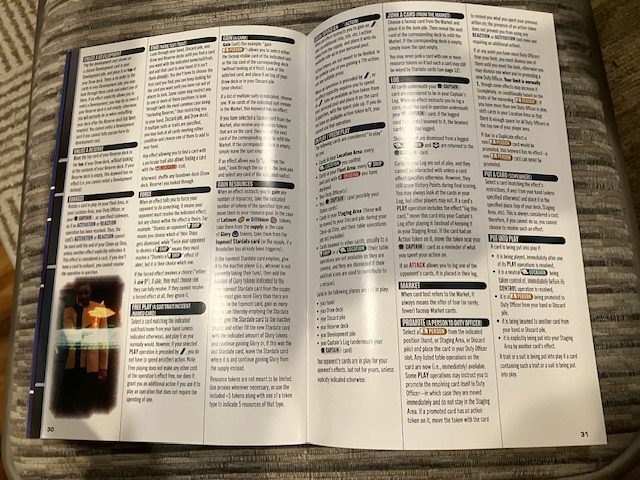
About the ONLY thing this rulebook does wrong is that it doesn’t have an index.  It has a table of contents and a Keywords in Detail section, but for a game this complicated, an Index is essential.

Other than the lack of an Index, this is almost a perfect rulebook.  I have to be honest, the rulebook almost reads like a legal document (because there are so many rules and systems), but everything is in there and well-explained.

Ways To Play
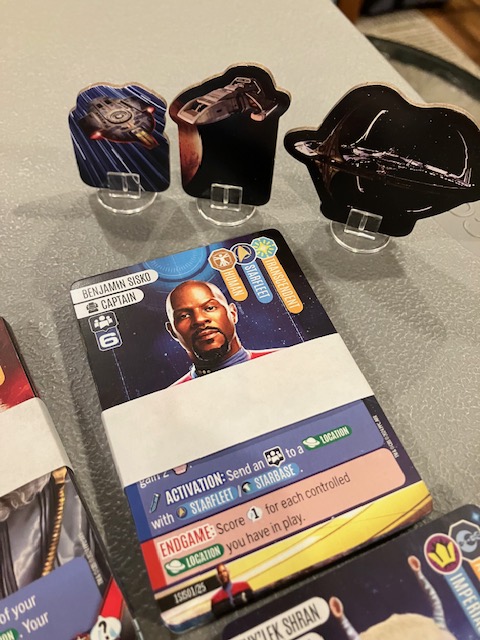
So, there are three major ways to play The Captain’s Chair (four if you count the unofficial cooperative mode, which we’ll discuss in the Appendix).  The “main mode” is the 2-Player head-to-head mode; this is the way Star Trek: The Captain’s Chair is meant to be played—Captain vs. Captain.   Even though this is a thinky and complex deck-building game with Victory Points, there is some take-that in the 2-Player game, as you can do things to mess up your opposing Captain.  Honestly, it really depends on the Captain(s) you choose; Koloth will have a very different play-style than Picard, who will have a different play-style than Sisko.

For solo play, there are two solo modes built-in:  The Cadet Training Mode, aka The Easy Mode and the Official Solo Mode aka the Hard Mode.   That’s what’s so great about this game; you can choose the mode that fits you!

The Cadet Training Mode
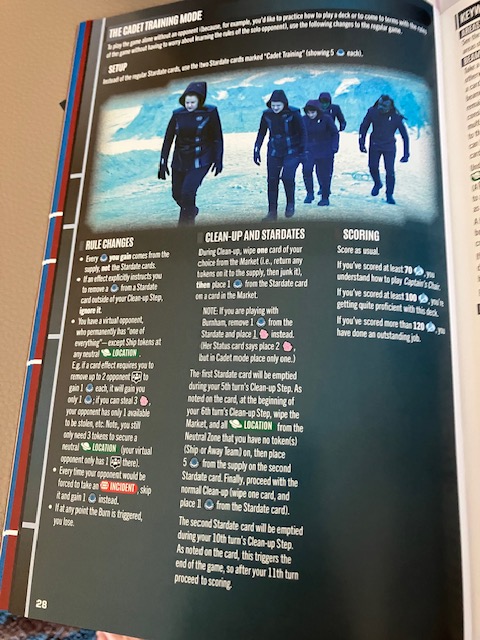
The Cadet Training Mode is probably the best way to learn the game!  Honestly, I can’t imagine jumping into the head-to-head game without learning the easy solo mode first.  See above for the rules for this mode on page 28 of the rulebook.
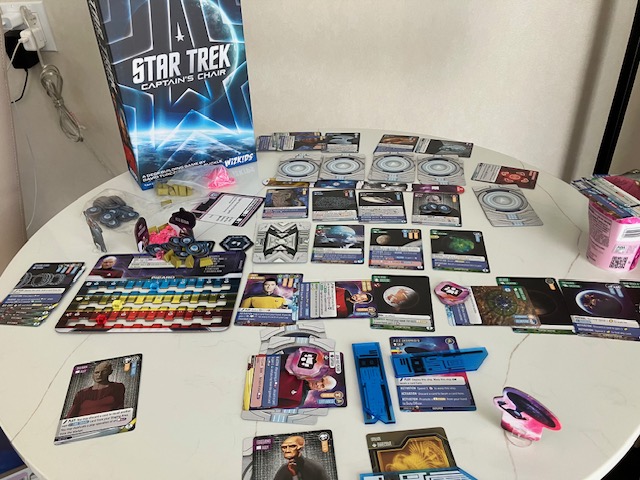
My first game (strictly my third game, since I set it up 2 times before I ever played!) was The Cadet Training Mode! See above.

The basic idea is that you are fighting an opponent that has “1 of everything”; you are fighting a faceless and nameless opponent.  
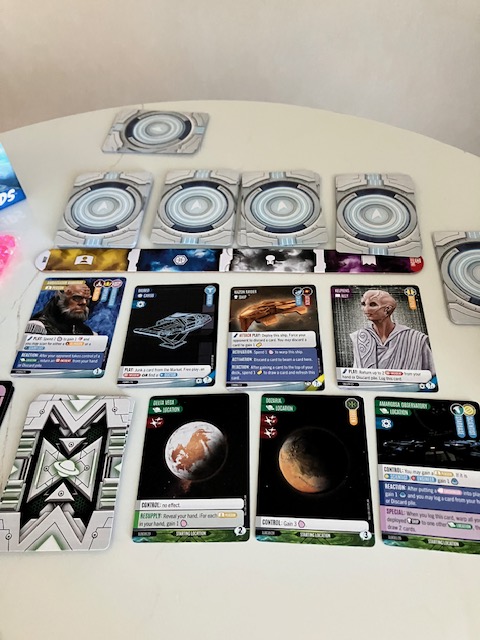
Basically, you are just playing turn after turn by yourself and trying to discover how all the mechanisms of the game work.    You don’t operate another Captain or anything like that.  There are enough systems in the game where you “affect” the other Captain, so when you would do that, it’s just a faceless, nameless opponent who has “one of everything”.   For example, how many landing parties does the faceless, nameless opponent have on the planets above?  One each!
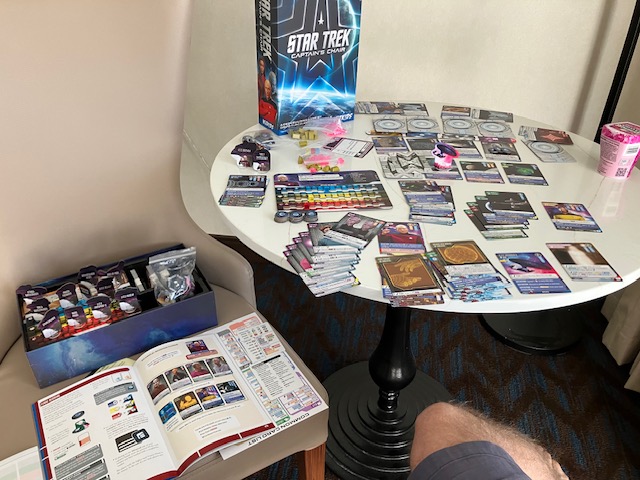
This solo mode flows pretty well.  You don’t feel the glaring stare of your opponent as you learn the game; you just try stuff out to see how everything works.
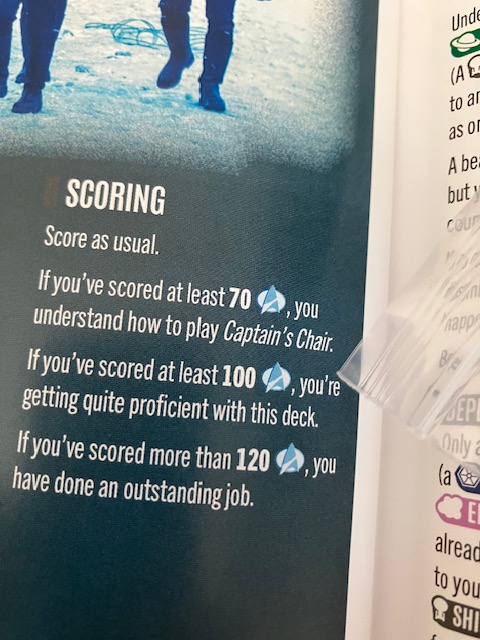
My first solo game scored 69, so apparently I didn’t know how to play just yet.
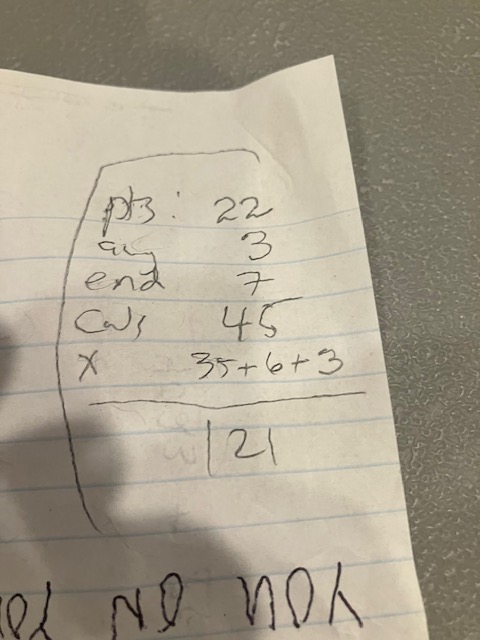
 My second solo game was much better as I got a 121.  
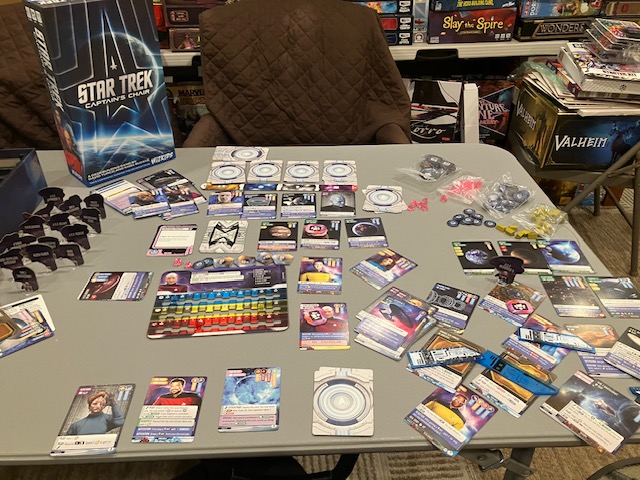
This solo mode is the way to learn the systems of the game without the immediacy of an overwhelming opponent.  Recall, we suggested that Kinfire Council + Winds of Change sorta has an easy solo mode and a complex solo mode!

The rulebook even suggests this is a great way to learn the deck of a new Captain!  Recall that each Captain has a VERY different play-style, so this is a great way to take the new deck through its paces!

As you can see from my two scores (69 then 121), after my second game on Cadet Training Mode, it was getting too easy.  This  solo mode is a great way to learn the game, but it wouldn’t be much of a challenge now that I know the deck.  I need a new challenge.

Starfleet Command Training Program
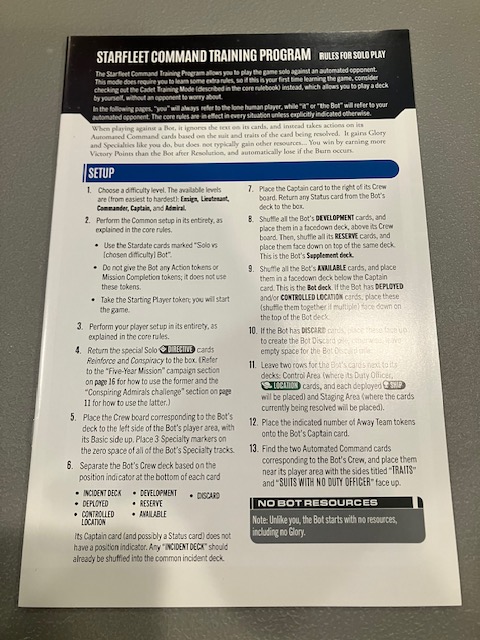
The Hard solo mode has its own rulebook!  See above!  This rulebook, called the Starfleet Command Training Program, outlines how to play Star Trek: The Captain’s Chair in a truly complex and challenging solo mode!  This rulebook is also very daunting (at 20 pages), but it’s really not that bad (the second half talks about different modes and a 5-year mission).
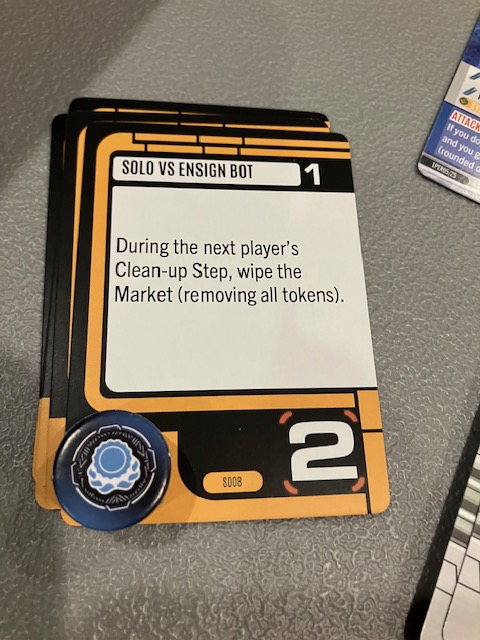
One major change is that you have a different set of Starfleet cards to control the pulse of the game. See above.  
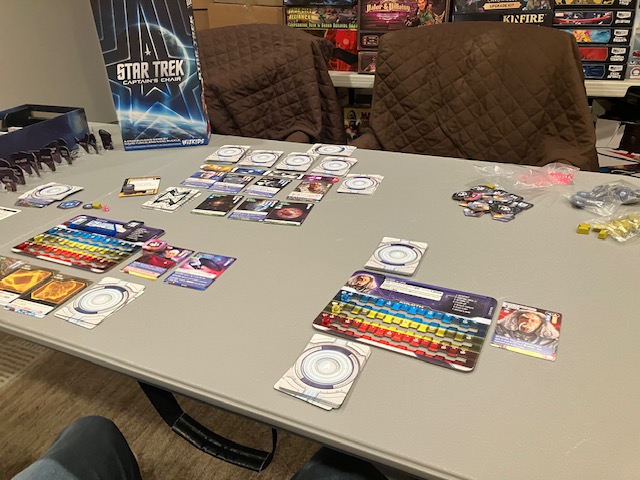
The real difference is that you are fighting a real Captain!  See above as Koloth and Picard battle!
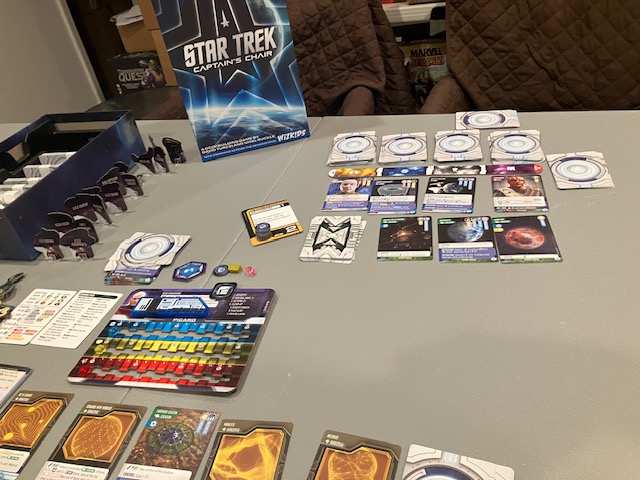
You operate one Captain “normally” like you did previously; see as Picard gets set-up normally.
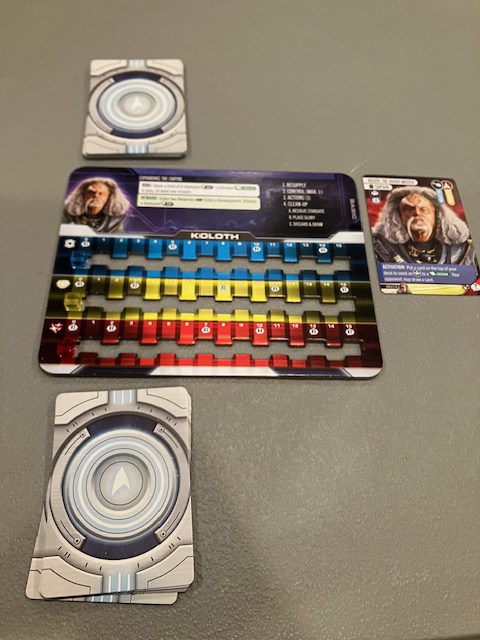
The Captain you are battling has a  very different set-up!  You still use the deck of the other Captain, but now an AI will control how that Captain operates!
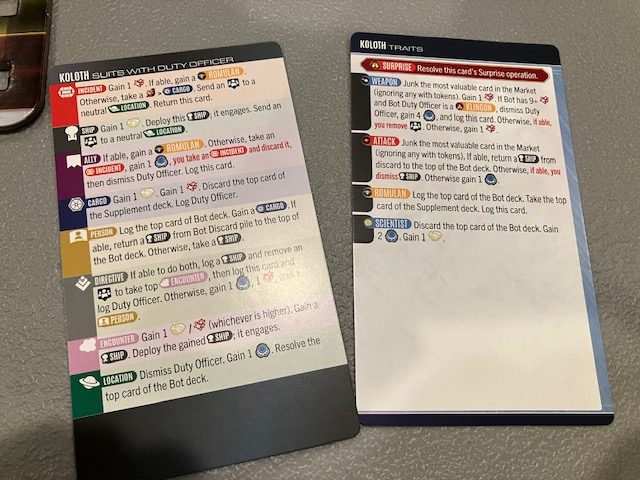
There are two Control cards for each AI Captain; these are the AI cards that control what the Captain does on his turn!  Depending on what card you draw, the directions on these AI cards tell you what to do!  (Things at the top of the card take precedence over things lower on the card if there’s any question).
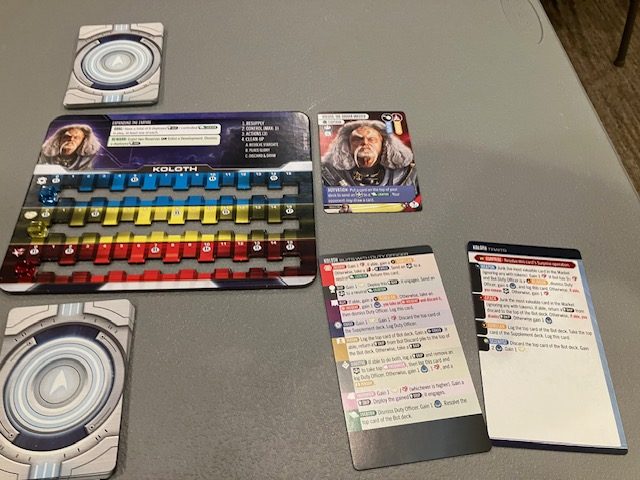
Basically, play alternates between the two captains; the solo player will take his turn normally, but then the solo players uses the AI to operate the other Captain!

See that big number 2 on the Starfleet card above?  That tells you how many cards the AI Captain will get to draw and resolve on his turn!
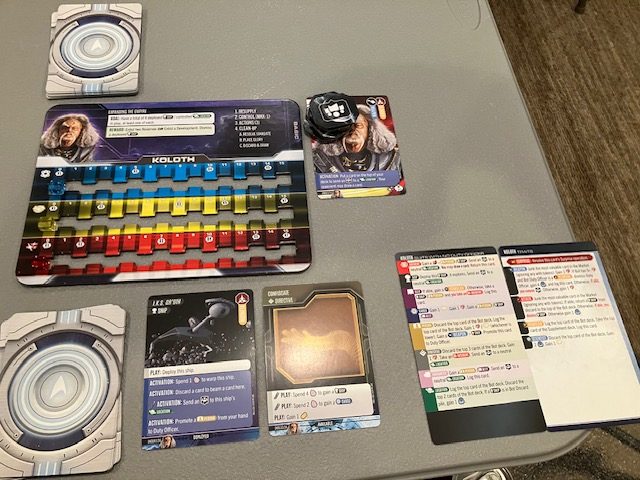
So, Koloth above draws two cards from his deck and consults the AI cards to see what those cards do!
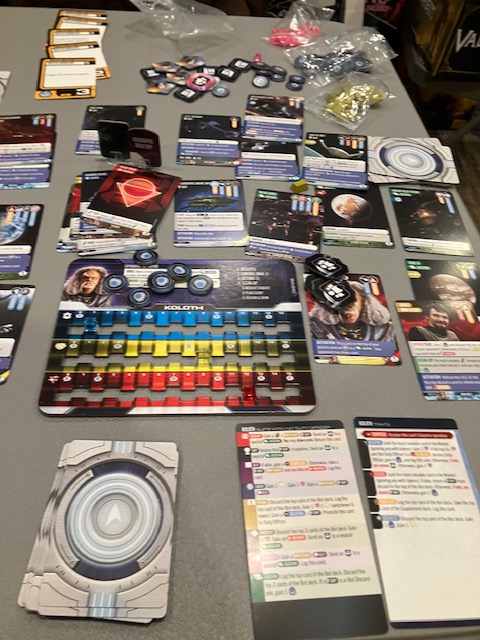
As the game goes on, it gets pretty complicated!  Koloth is all about getting ships out, and you can see that his AI respects that .. and (see above) as he has so many ships and worlds under control in the later game!

Solo Captain and AI Captain alternate until the game end is triggered by the Star Fleet cards! Whosoever has the most victory points, wins! (If you want to be funny: I Captain goes, then AI Captain goes!)
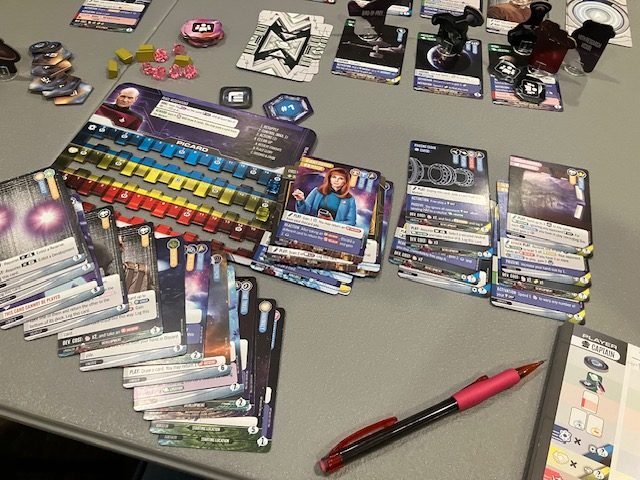
Just like before, you count the Victory Points to see who wins.

To be clear, this is a pretty complicated AI.   There’s lots of things you have to look up as you play! Where do you send ships? Landing parties?  There’s also a notion of most valuable to me and most valuable to you that controls preferences of cards.  Sometimes determining which cards the AI prefers is pretty exhausting.  I found that it feels like the solo rules do a pretty good job of covering all bases and preferences, but it can feel hairy the first few times you try it.
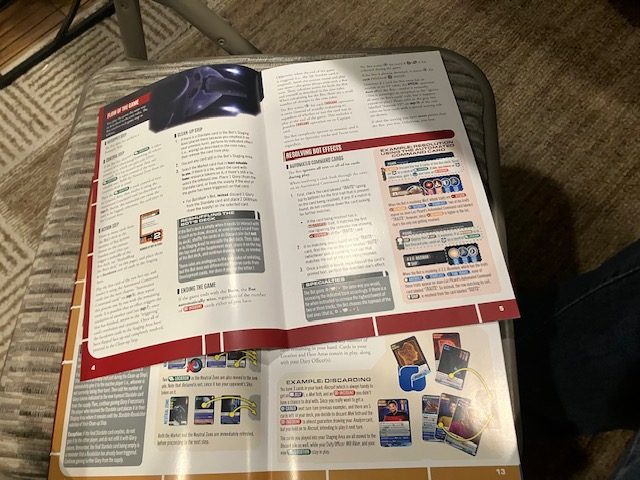
This is NOT a quick one hour solo game.  This is probably at least a 2 hour game, especially your first few times.    You will find your head buried in the solo rulebook as you try to remember/discover/rank what actions/cards the AI prefers.  It gets easier as you play, but it is very daunting.

I want to be clear that I like this solo mode, but it is not easy.  

Legalese
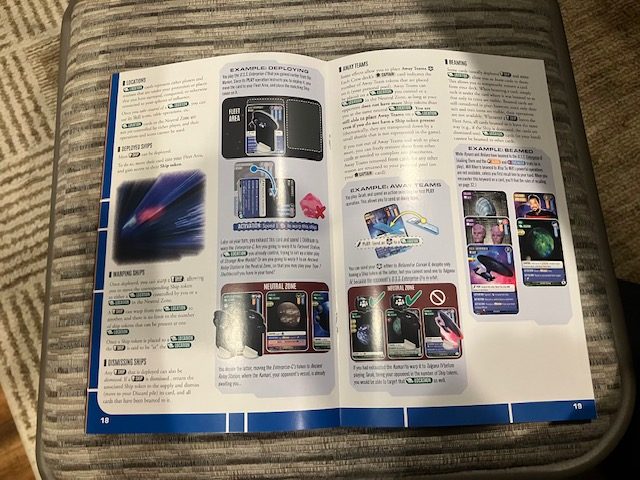
These rulebooks are very very very good, but I kind of feel like a lawyer when I am playing.  What do I mean by that?  I have to study the rulebook to make sure I have a handle on everything; I want to say I spent a good hour (or more!) reading the rulebook the first time!!!  There are very specific rules to handle just about every exceptional case, but you have to understand how to apply the rules like a lawyer might have to understand how to apply the law.

This might sound like a negative, and for some people it will absolutely be a negative; those people will hate this game: “it’s too complicated, it’s too much, there are too many rules”.  You know if that is true for you.

But if you like a system where things are very well-specified and you don’t mind burying your head in the rulebook a lot, then this is a great game.

Theme
This game feels very thematic.  If you like Star Trek, you will see and feel the theme in this game.  We’ve said that this is a deck-building game, but all the other supporting systems of this game make it feel like Star Trek: duty officers, warping ships, developing cards, acquiring Allies, Cargo, Ships, sending out landing parties, taking control of planets … it feels very Star Trek.   This is arguably the most thematic Star Trek game I have played?

Conclusion
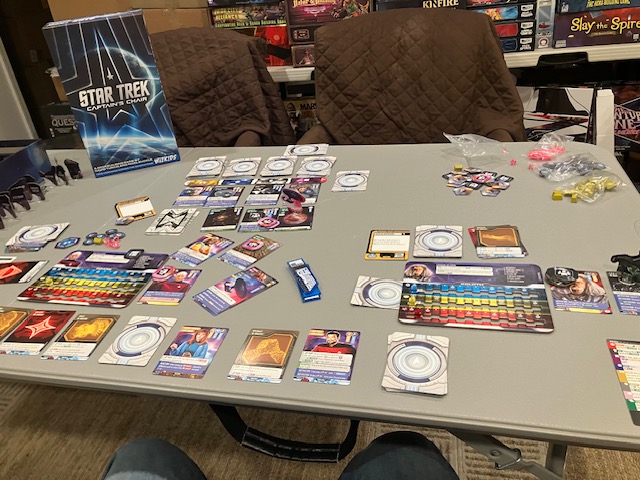
Star Trek: The Captain’s Chair is a daunting beast of a game.  The rulebook feels like legal document, there are many complex systems within the game, and the rules are complicated.  Yet, this is probably the most thematic Star Trek game I have played!  Each Captain’s deck matches their play-style, making them different and interesting to play!  The actions and cards feel like they are right out of Star Trek!  This feels like a love letter to Star Trek.
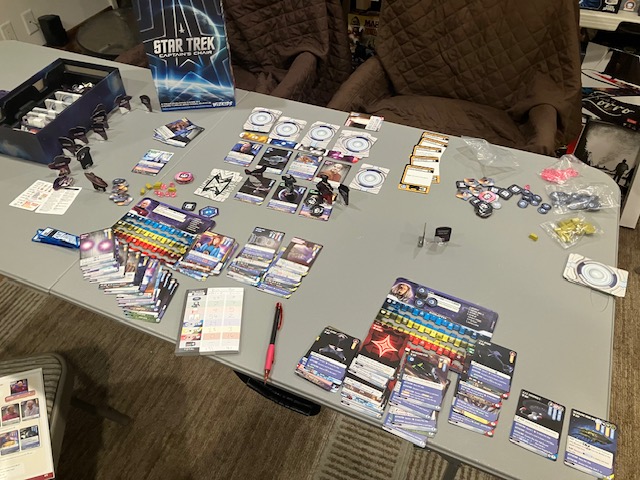
As a solo gamer, I love that there are two solo modes built in!  The easy solo mode provides an onramp to learn a new Captain’s deck (because they are all so different)!  The complex solo mode provides challenges for the future!  There are 30 different ways to permute the Captains in the complex solo mode (6*5=30 because order matters; which is the AI and which is the player). This gives plenty of ways to try different permutations for quite a bit of variety!  I also happen to know that at least 2 more expansions are planned, so there’s more content coming!

Sure, there’s a 2-Player head-to-head mode … which I may never play.  As a solo gamer, I am very happy with what this is. 

Be aware that this is big complex game with lots of rules and a legal document for  rulebook.  If that doesn’t scare you away and you love Star Trek, I think you will love this game.  I do. 9/10.  I think this would be a 10/10 if it had a good cooperative mode; I really want to be Picard and Sisko fighting the Borg! Or the Dominion!  So, the Appendix below …

Appendix
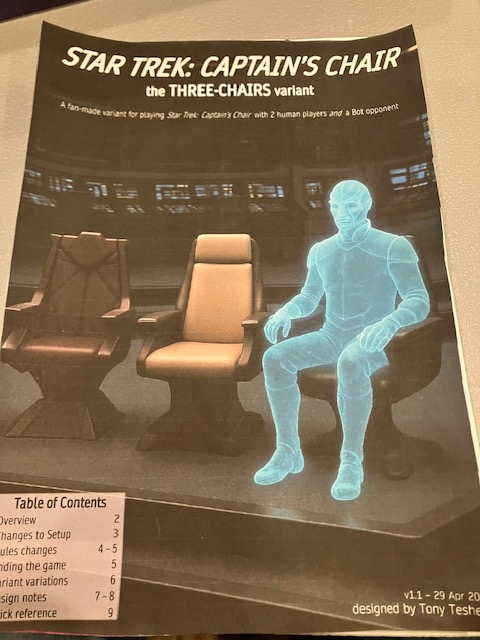
There is an unofficial cooperative mode: see link here.
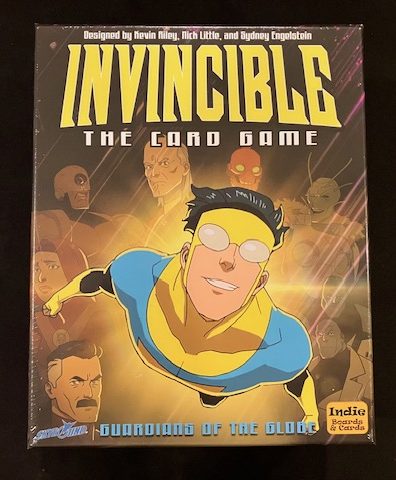
   

Invincible: The Card Game. Review After Full Playthrough!

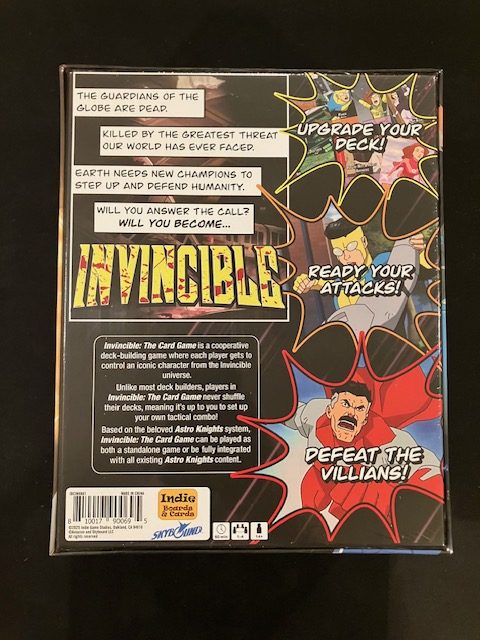
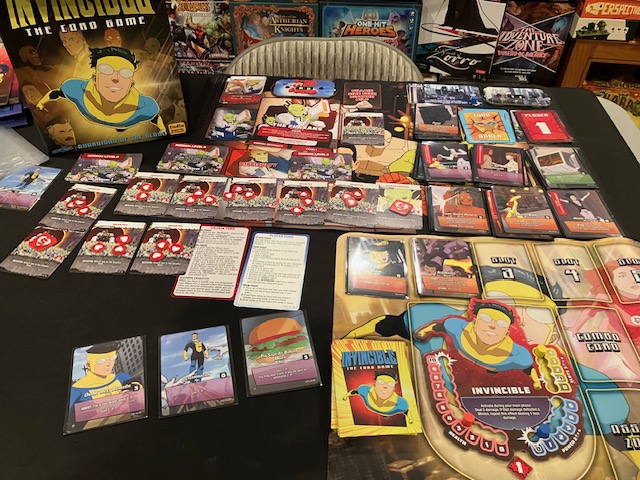
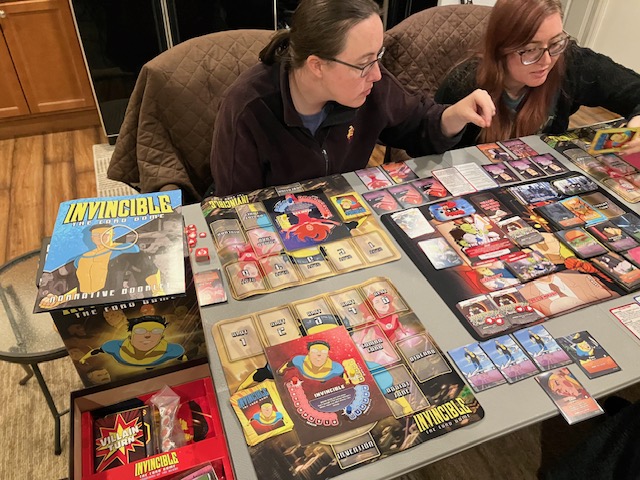
So, just so you know: we are talking about Invincible: The Card Game!  This is the one that has the subtitle Guardians of the Globe (see above).  You have to be careful!  There are at least 3 or 4 other Invincible games: some of them great (see our review of Invincible: The Hero-Building Game) and some of them … less so.  What about this one?

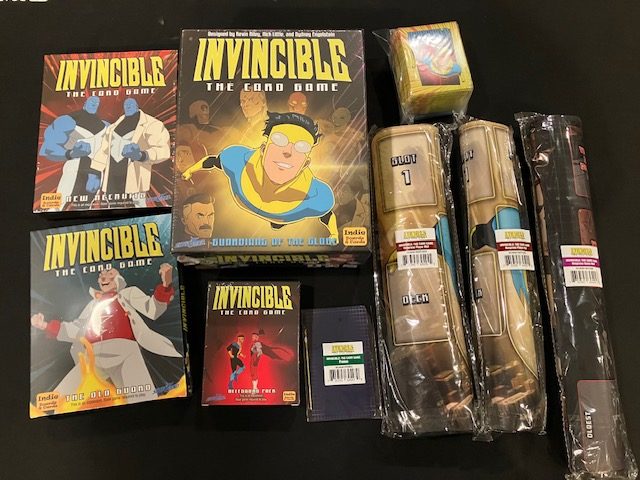
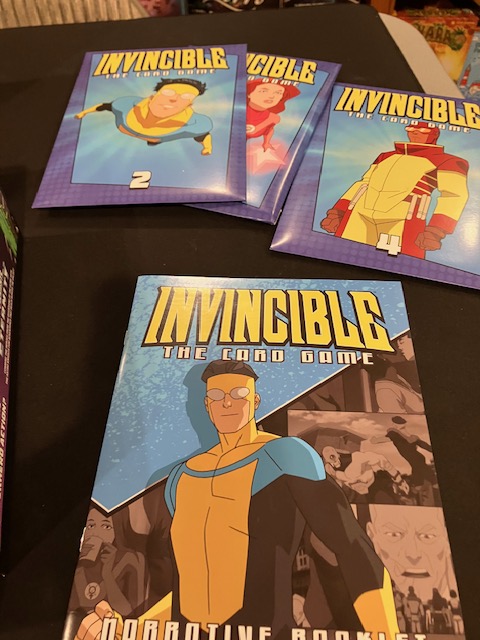
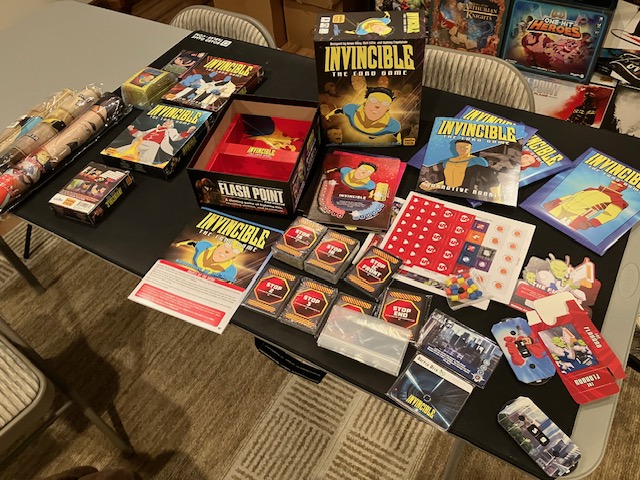
Invincible: The Card Game was up on Kickstarter back in October 2024: see link here.  I love the Invincible universe in the comic-book world, so I went all-in and backed the full Kickstarter and probably got waaaay too much: see above.

The Kickstarter had originally promised delivery in January 2025, but it didn’t arrive until the last week of September 2025.  It was about 9 months late, but given the state of the world and shipping, and it’s a Kickstarter, I guess that’s ok.

Invincible: The Card Game is a cooperative deck-building game for 1-4 Players.  It’s very very much like Astro Knights , a cooperative deck-building game we’ve reviewed here (Astro Knights) and here (Astro Knights: Eternity).  

In fact, Invincible: The Card Game is so similar to Astro Knights, you can combine them and play them together! 

Let’s take a look!

Kickstarter Extras: How Much Do You Need?

So, before we get going too much, we should have a quick discussion on “Should I get the Kickstarter extras?”

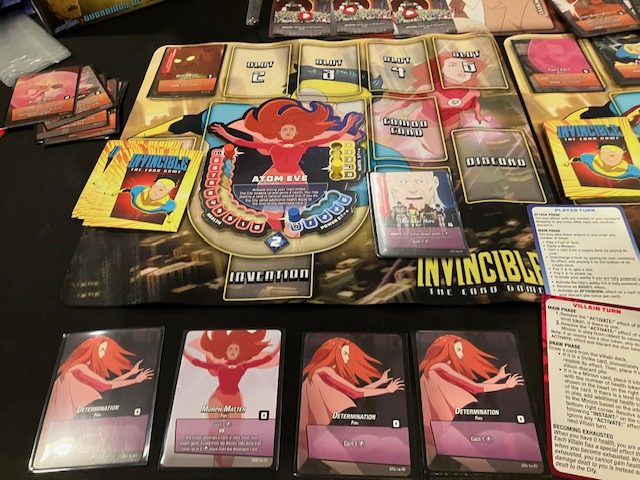
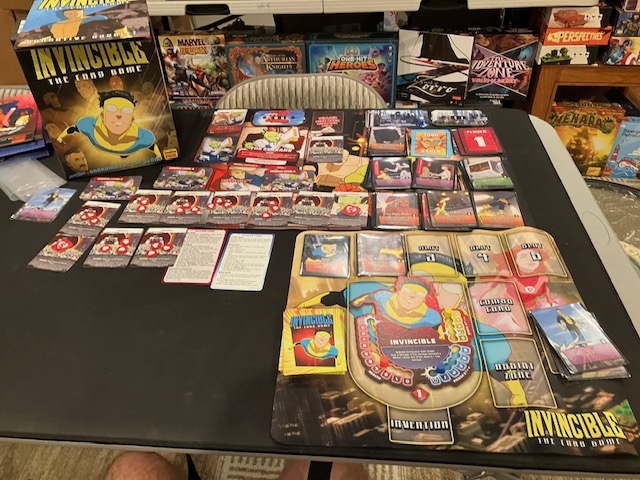
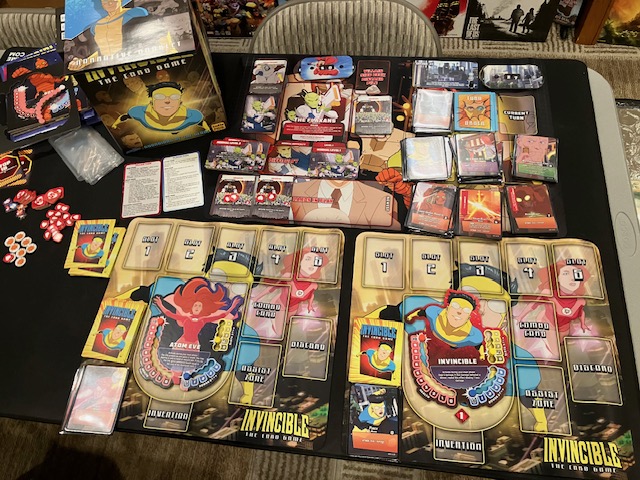
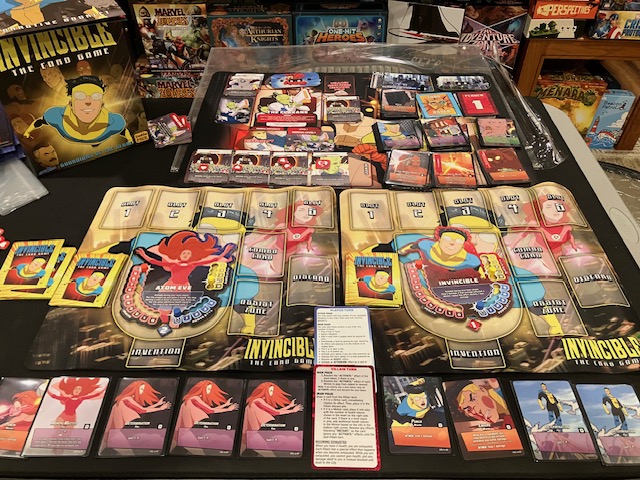
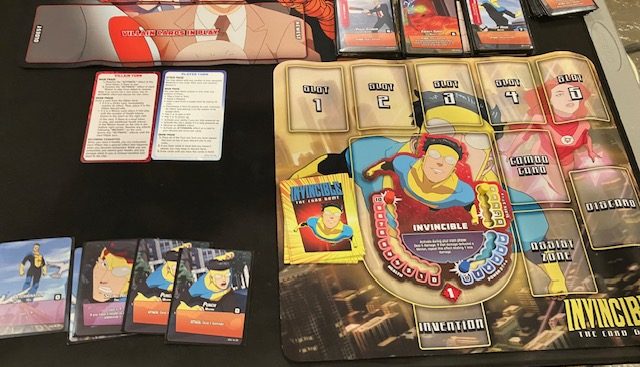
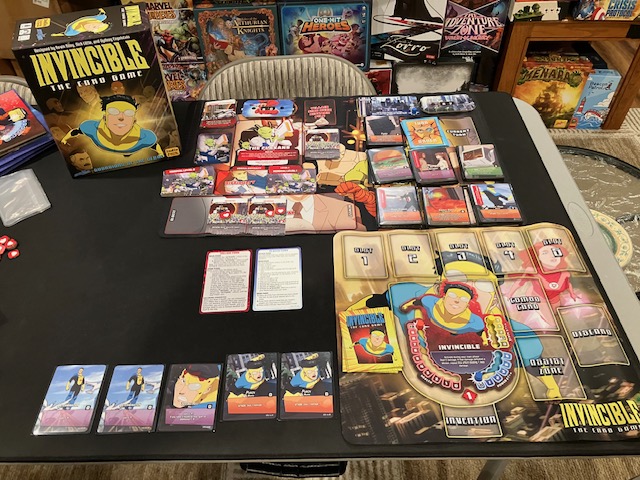
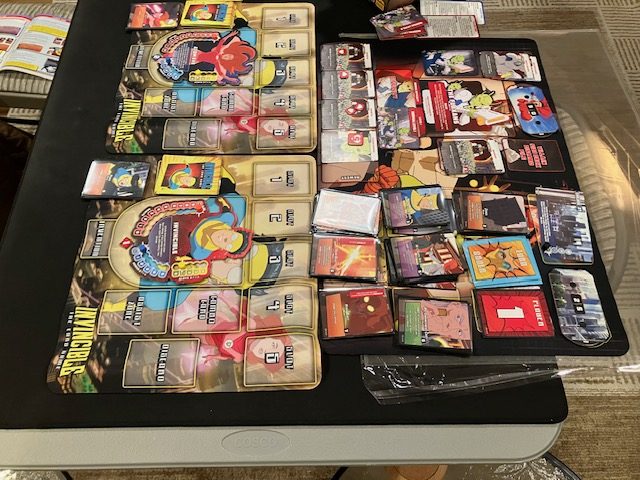
The “bad-guy” mat (see above) is probably worth getting.  It helps organize all the cards and where they go during play.  I don’t love how “busy” the art looks; I feel like it gets in the way of gameplay a little, as the art is distracting.

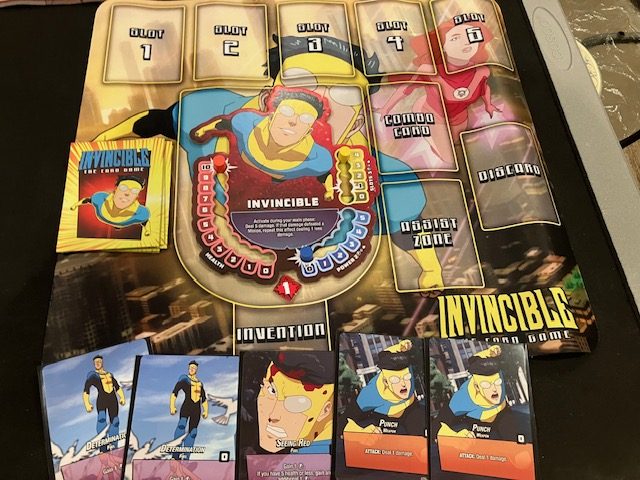
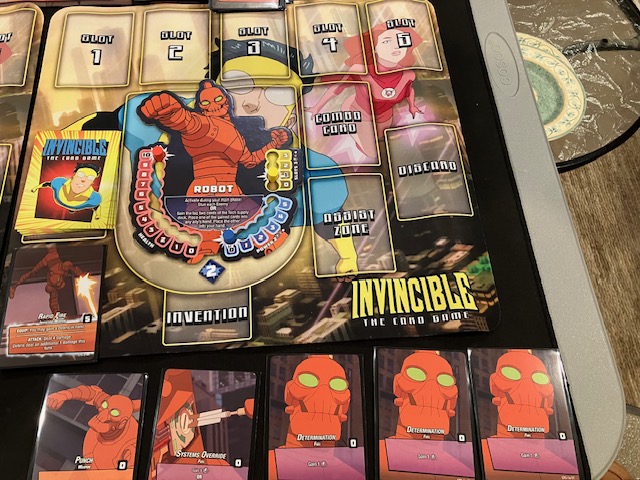
The “good guy” mat I was less in love with (I got four, one for each player).  See above!! I don’t love the layout for a bunch of reasons.  For one, I want to use the bottom space for “cards in hand”, but the “invention” space takes away from that, so that the whole bottom of the mat seems like wasted space.  I would have put the “invention” to the left or somewhere out of the way!  The “invention” is a very short-lived concept in the game (usually, you buy your invention in the first few turns), so I wouldn’t devote so much space (if any, esp. at the bottom) to such a short-lived card.

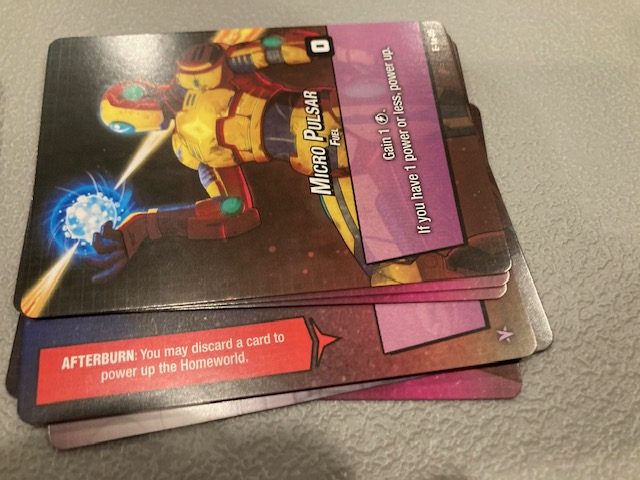
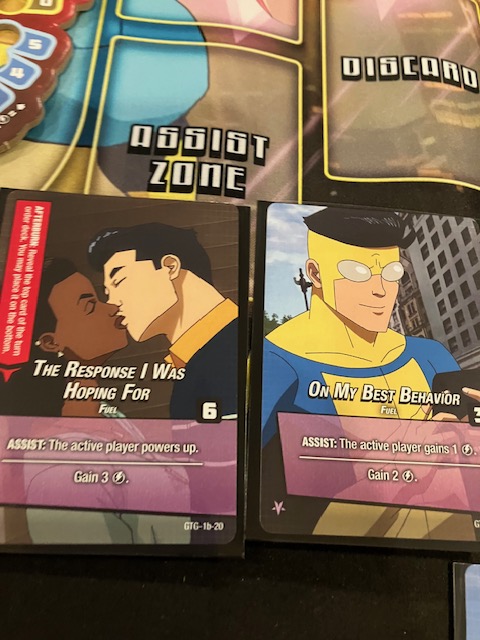
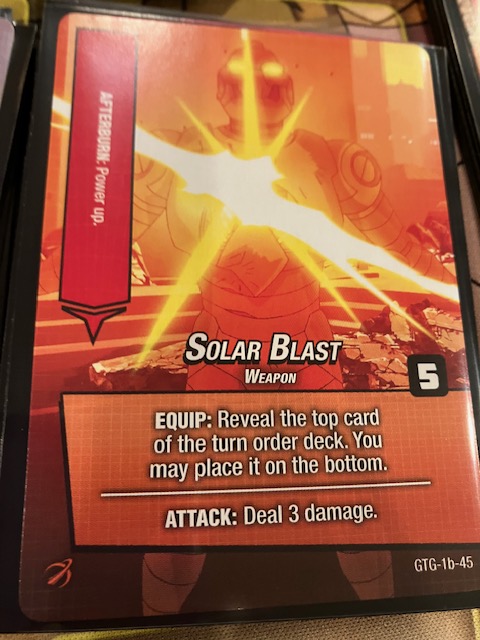
A bigger problem is the discard pile: it should be turned sideways!  For one, it’s clearer the cards are discarded (remember, the “Discard Pile” notation is under all those cards!).  Secondly, the Afterburn effects are harder to read when the discard is up right!  See above!!! What does that say?

The entire purpose of the Afterburn effects is that while a card is in your discard, you can use that ability!  So, it should be easier to read! 

We saw the Afterburn idea first in Astro Knights!  See how much easier it is to read those effects when your discard is sideways? See above!  (There was no player mat for Astro Knights, so we could do the right thing and have the discard sideways).

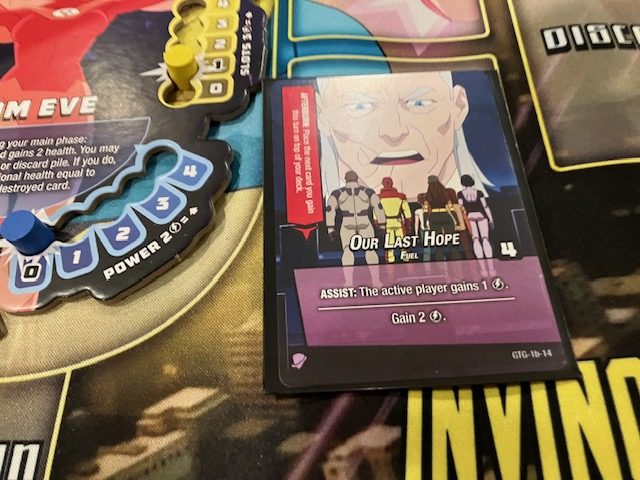
Another problem with the mats were the Assist Zone!  You are supposed to put cards in the Assist Zone when you Assist (a really great concept in the game), but there’s one main problem with that!  More than once, you “forget” about the card being in your hand because it’s in the Assist Zone and you take your turn “forgetting” to use the card!  It would be MUCH better if you just kept your hand of cards in front of you and “nudged” the Assisted cards up an inch to show you’ve used them for assist!  That way, they stay in your hand, but you have marked that it’s Assist has been used!  See above as Eve has a card in the Assist Zone, but it looks like she only has 4 cards in hand! It’s too easy to forget that card is still in your hand.  Just nudge the card up to show it has assisted. 

The rest of the player mat worked fine, but I think it should be thinner (for more space for “cards in hands” and moving inventions), and it should have the discard space sideways.

Of course, mats are always nice because they make cards easier to pick up and handle.

Another thing that came with the Kickstarter are sleeves! My “default position” is that you should usually get sleeves when you have a deck-builder.  And I think that’s still true here.
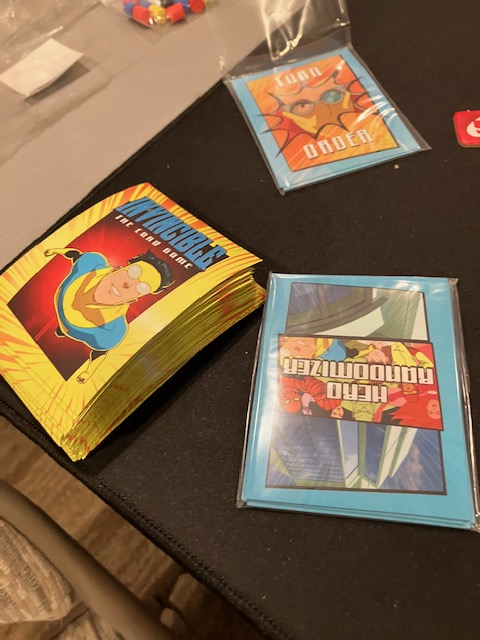
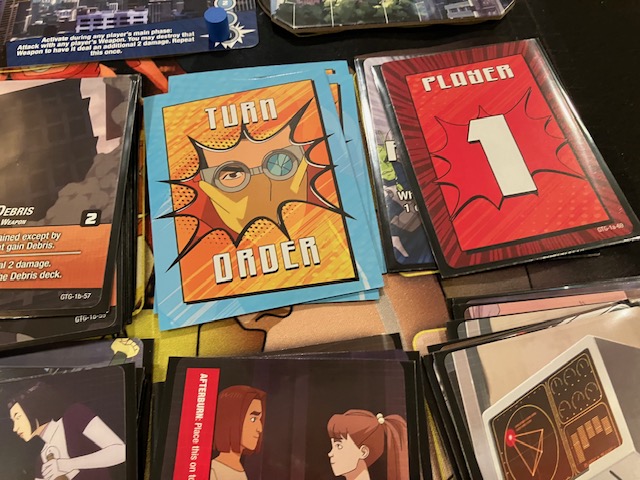
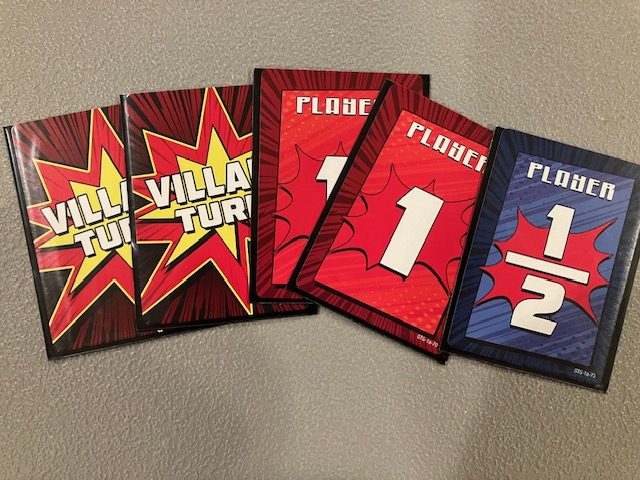
I am VERY HAPPY that the Turn Order deck has its own sleeves!  If you ONLY sleeve a few cards in the game, you MUST sleeve the Turn Order deck!  These cards are touched all the time!  After many games of Aeon’s End and Astro Knights, trust me on this!  My original Aeon’s End Turn Order deck is a little grody!! 

The sleeves are very nice for Hero cards (see above); these are the yellow sleeves with Invincible on back!  Unfortunately, there are no sleeves for the “bad guy” cards!  If you want to sleeve them, you’ll have to use different sleeves (as the “bad guys” cards have a different card back).  So, I went all-in to get all sleeves, and I was a little disappointed I couldn’t sleeve the entire game! I love the Hero card sleeves (they are very very nice), but I can’t sleeve the bad guys cards without having to use/buy a separate set of sleeves (I think I have some leftovers from Thunderstone Quest I can use).

There’s also two expansions that came with the Kickstarter; these are just more heroes and more villains.  We’ll (probably) review those separately later.

I admit I was a little underwhelmed by the extras.  The only thing I’d say you should probably get is the “bad guy” mat, but even then, I thought it was too busy (from an art perspective).   The sleeves were nice, but realize that they ONLY sleeve the Hero cards, and you’ll have to get more sleeves for “bad guy” cards!! The player mats were the biggest disappointment: they were too tall and needed some reorganization … I’d only get the player mats if you love this game. 

The only thing you HAVE to do is make sure you sleeve the Turn Order cards (either with the given cards or some others).  These cards get handled SO MUCH as you play.

Rulebook

This is an excellent rulebook.  It’s “essentially”, in many ways, a copy of the Astro Knights: Eternity rulebook in turns of layout and progression.

The rulebook gets an A- on the Chair Test.  It opens up and lays flat on the chair next to me, making it easy to consult.  It has big fonts, lots of pictures, and is easy to read.  It’s very easy to consult on the chair next to me. I wish the font were just a little bigger.

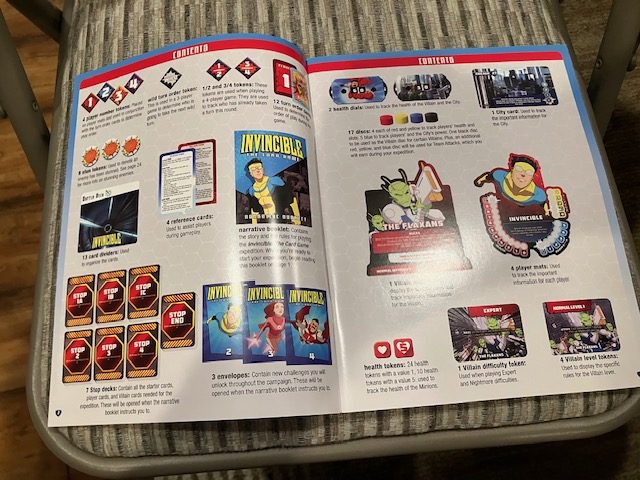
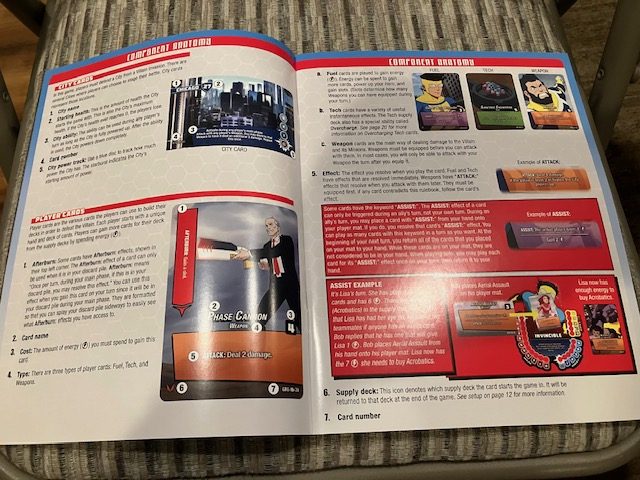
The Components page has pictures with annotating text.  

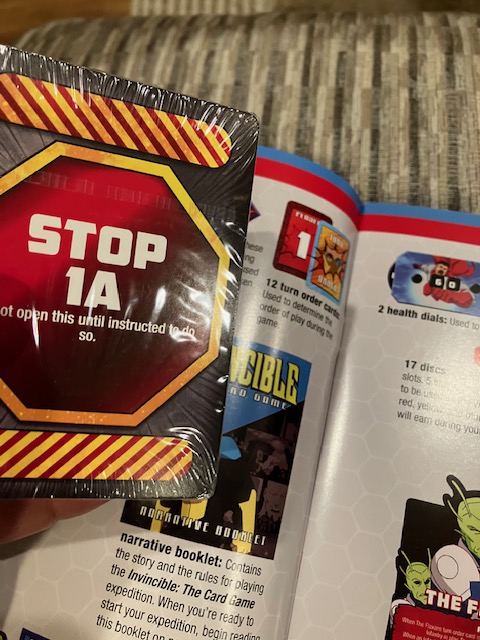
Even after pointing this out in the Astro Knights: Eternity review (see here), they still don’t note that the Turn Order cards are in deck 1A!!!!  I think this will still confuse some people, as they expect them in hand (before opening anything … remember: all decks say STOP! At the top, so you are reluctant to open anything right when you get the game).

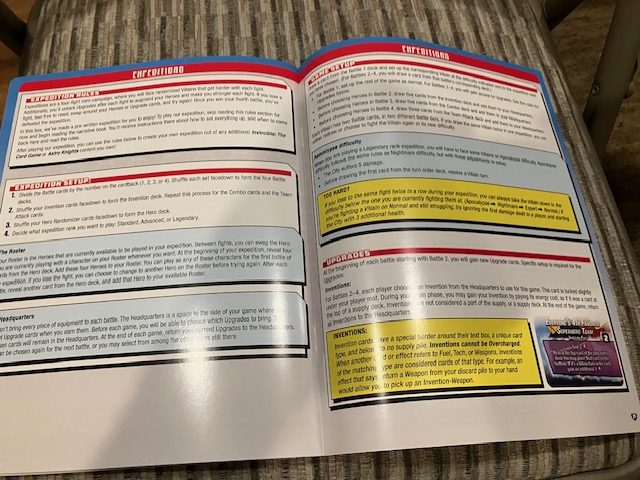
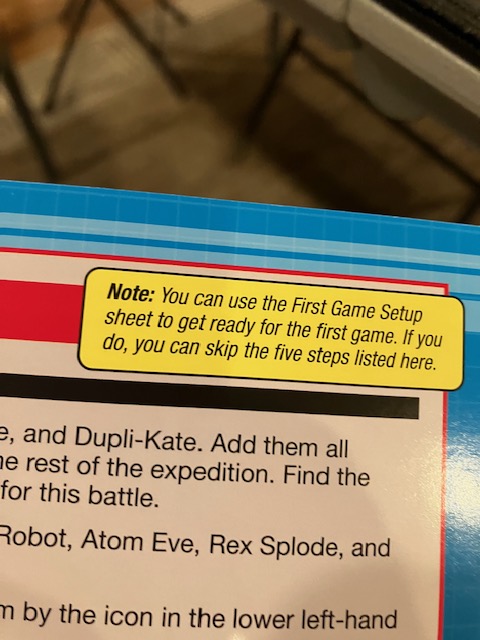
One huge mistake the rulebook still makes (and we had the same problem with Astro Knights: Eternity) is not addressing how to play for the first time UP FRONT!!!  See ON PAGE 28, there’s a small sentence that says: “To play our expedition, skip reading this rules section for now…” … however, in order to play the game you still kinda have to start opening decks up!    It would have been SIGNIFICANTLY BETTER if the rulebook, on page 2, said something like “To play and uncover all content in this game, you will need to play the pre-written expedition! See page 28!”  Since I had played Astro Knights: Eternity and had to suffer through this already, I knew how to do this.  New players may not. Caveat Emptor.

I like how the rulebook has summaries of the cards immediately after the Components page.  I also like how the “new rules” are emphasized in Red above … The Assist keyword is a new rule (but not if you know Astro Knights: Eternity … that was kinda/sorta/not really like the Bolster keyword … it’s still newish for some people).

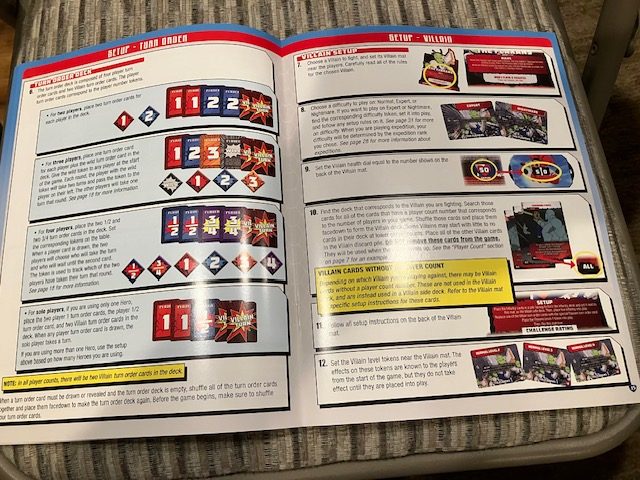
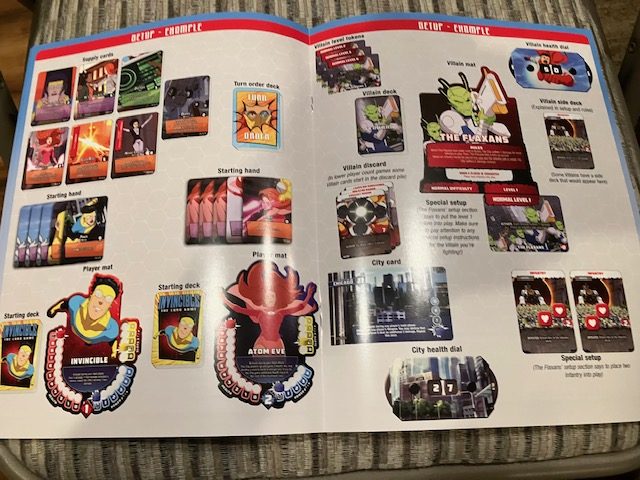
It is interesting how the set-up isn’t until halfway through the book … still, I think it works.  If you have the mats, like I do, this isn’t AT ALL what my table looked like.  Oh well.

The end of the book has keywords summaries: it’s not an Index, but it’s probably as good as we can hope.  I consulted the back of the book several times during gameplay. 

Overall, this was an excellent rulebook full of good examples.  I wish they had addressed the first play issue better.  Especially since I didn’t get the First Play Sheet (see later).

Unboxing and Gameplay

This is a actually a pretty thick box; see Can of Coke above for perspective.

It’s about half the width of a Ticket To Ride size box.

This is a cooperative deck-building game, so there are a lot of cards.  See above. 

The expedition book will tell you when to open the decks above.  The game has a campaign (called an Expedition) which will allow you to open up and see all the content in the game over 4 games.  This is a completely resettable campaign (as I did reset everything after playing it solo).

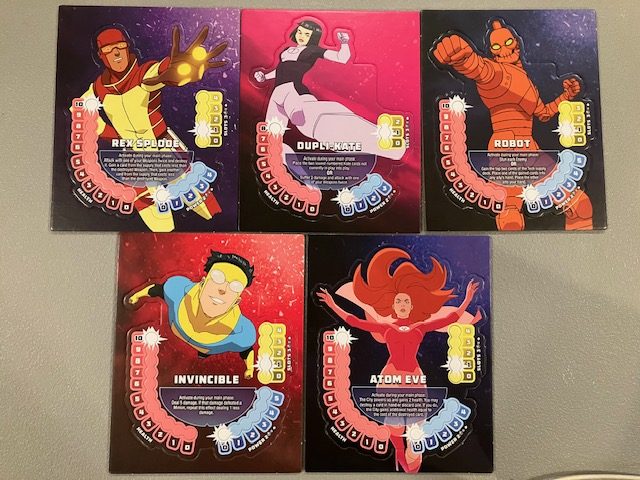
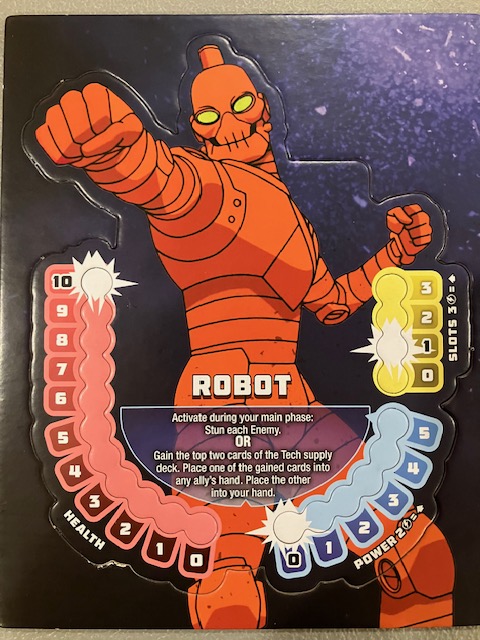
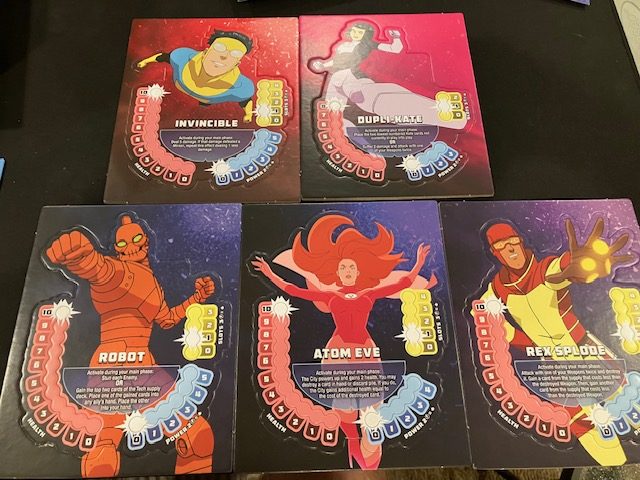
Each Player takes the role of a Hero from the Invincible universe.  If you don’t know the Invincible universe, you aren’t alone.  I know it from collecting comic books for years, and many people know it from the recent animated show.  None of my friends knew this universe.    Each character is kind of different (some have more slots, more hit points, faster power chart), but what distinguishes each character is their “special power”.

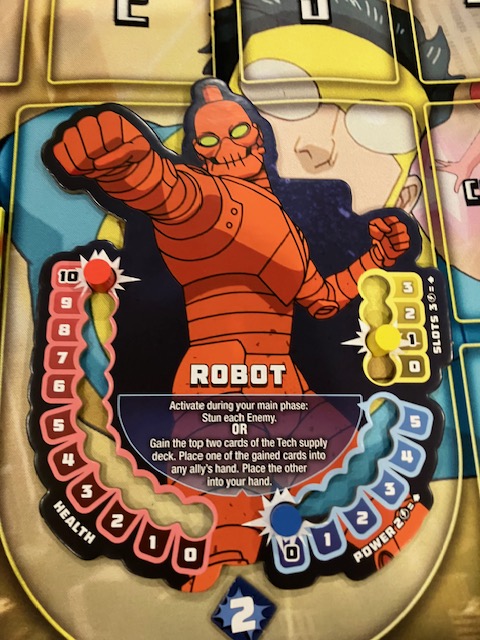
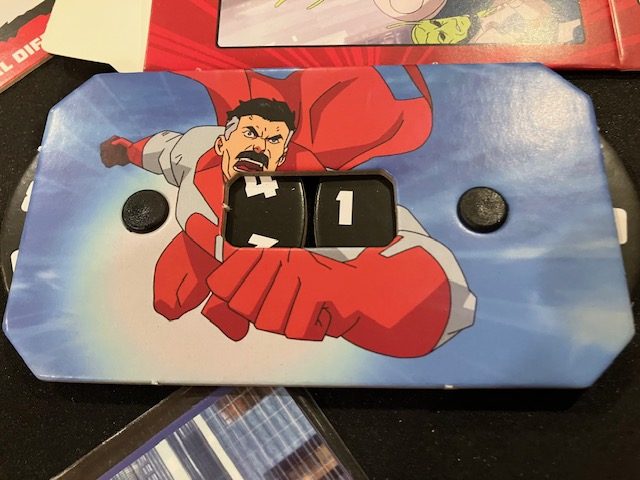
If, for example,  you look closely at Robot above (and yes, that’s his name in the comics), you’ll see written in blue (corresponding to the power chart) his special abilities: Stun each Enemy or Gain the top two Tech supply…

This is a deck-building game, so every player starts with a “crappy” hand of cards that they will upgrade and cull as the game goes.

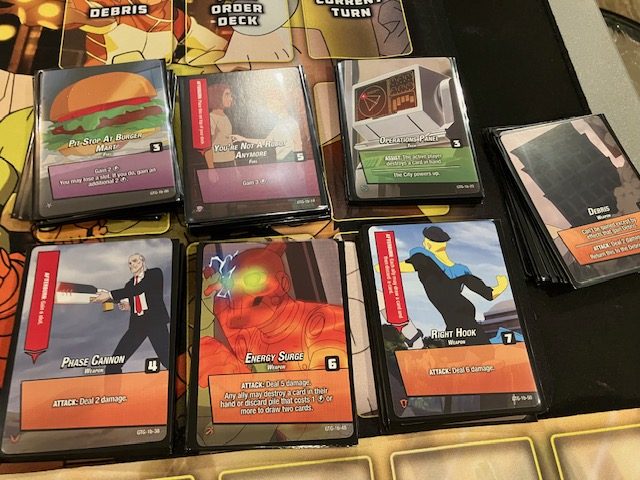
Like most deck-building games, you can buy cards with Fuel to get better FuelTech, or Weapons!!  The six piles above form the market; the top two piles get you better Fuel (purple) the bottom three piles give you better Weapons (orange) and the the upper right pile gives you Tech (green).

The interesting thing about this market is that every deck is full of different cards.  If you are used to Aeon’s End or Dominion, where every deck in the market has the same cards, that’s not what you get here! Each card in a deck has a similar cost and “flavor”, but they are all different.

Every game has a “bad guy”, the first is The Flaxans (see above).

Usually, you have to bring the “bad guy” to 0 hit points to win the game; this is denoted by a health dial.

At the same time, you are protecting the city!  You are a superhero after all! If the city ever goes to 0 health, or all heroes are reduced to 0 health, players lose!  

The expedition has four chapters (each a self-contained game), each with special cards and envelopes.

Overall, this game has a lot quality components!

Where’s My First Play?

Where’s my First Game Setup sheet?  I did not get one!  I am VERY SURPRISED, because the Aeon’s End games (made by the same people) have amazing first play sheets! Am I the only one who didn’t get one?  Hopefully, if you get this game, they will have rectified this issue.

Art: Is This a Coloring Book?

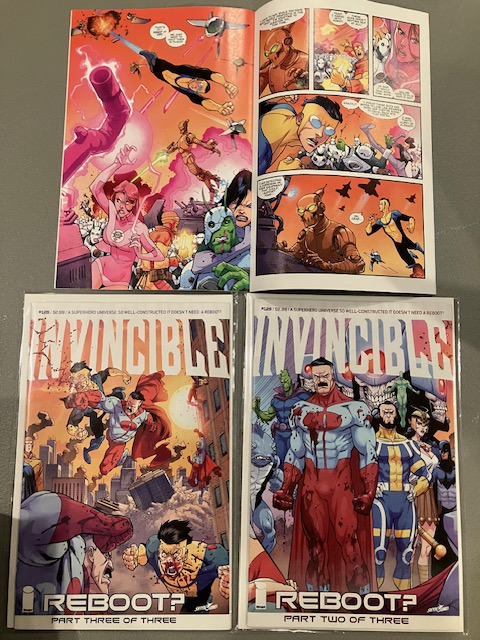
So, I love the art of the original Invincible comic:  It feels clean without being too messy.  That art really complements this universe.  See some covers and inner pages above.

Unfortunately, I feel the art in this game is more … anemic.  Compare the Atom Eve and Invincible characters (above) to covers from the comic!  The player art in the game just seem … lesser.  To the point that it bothered me.

And Robot feels so anemic (above), he feels like a page from a coloring book!

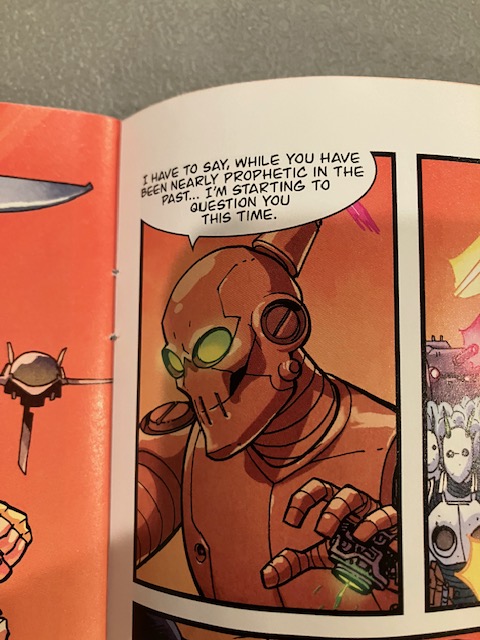
From just one frame in the comic, Robot looks great! But the character in the game made me cringe. “How could I explain this to my friends?  This looks like a coloring book!! Really, though, this is a great comic!!”

I was told by my friends to mellow out, as the game art is more consistent with an animated series anyways. So, the art we are seeing is more like the animated series. I guess.

Maybe this is just me, but I would have loved this game a lot more if the art had been … more like the comic book than the animated series.  (To be clear, even though Invincible: The Hero Building Game didn’t have art that quite as good as the comic, it was still significantly better: see review with lots of pictures here).

Decide for yourself.  To be clear, I like the game, but I don’t love the art.

Solo Play (true solo)

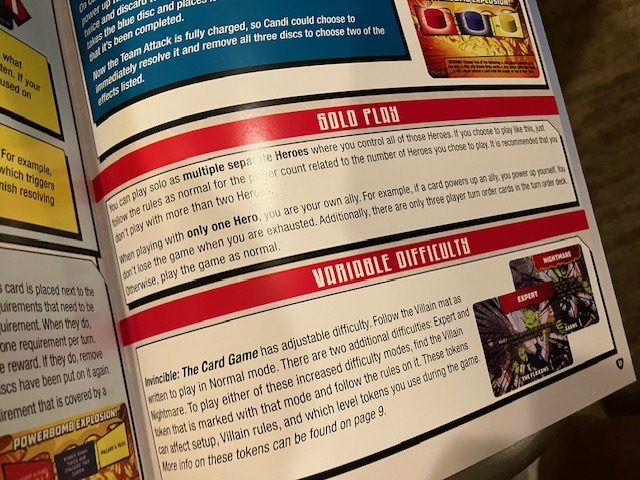
There are two ways to play solo (thank you for following Saunders’ Law)!  

Our first play was true solo, where the solo player takes control of one character.  See above as Invincible battles the Flaxans alone.

There is a major difference in the true solo game: the Variable Turn Order deck is changed!  Instead of having 6 cards, there are only 5!  The Villain goes twice as normal, but the Hero only gets to go three times (as opposed to four turns in any normal game).  See above.

I think the idea is that the Hero gets a chance to refine his deck much more quickly, so that he has to be limited to three turns for balance.  The problem is, I think the solo mode is fundamentally more fragile.

My first true solo game was a massive bummer: I lost my being reduced to 0 hit points very quickly.  My second game was much better, and I think I just barely lost.  

The problem is,  the true solo game is very fragile.  In a 2 to 4 player game, there are multiple players with multiple hit points, so there are 20 to 40 hits points total distributed among the players!  In the solo game, the solo player has only 10 hit points (or less)! If the randomness of the game is too much, the true solo player will take that 10 hit points and die quickly!   And that’s what happened in my first solo game.   The other problem is that with multiple characters, one character can be reduced to zero hit points and still be useful as long as someone still has hit points! With one character, that will never happen.   

We saw this same problem in the app for Aeon’s End: the solo player gets fewer turns.  And frankly, I don’t play the app solo anymore because of this.  The true solo game is just too fragile and it’s too easy for the randomness inherent in the game to overwhelm you.

If you really want to try the true solo game, a simple house rule might be to allow the true solo character to double the number of hit points (have 20 hit points).   At least then it will allow the solo character to absorb more of the damage before dying (simulating multiple characters taking distributed damage).  I am surprised this isn’t built-in to Invincible: The Card Game; I know some games, like The Heroes of Terrinoth, where they balance the game by giving fewer players more hit points.

I probably won’t ever play this game true solo ever again.

Solo Play (Two-Handed)

Ah, but two-handed solo was much more fun!  The solo player alternates between two characters like a 2-Player game: this is the way this game was meant to be played!  Two characters who can assist!  Characters who can keep playing even after the other has been down to 0!  More hit points to take damage from the bad guys!  And four full turns for the heroes for every two turns of the bad guys!

This is the way I played the Expedition solo: Two-Handed Solo.   I recommend you play Two-Handed solo if you wish to play; it’s the way the game was meant to be played.  The only real downside to Two-Handed solo mode is there is more maintenance: you have to maintain two hero decks/stats as well as maintain the “bad guy” decks/stats.  There’s less maintenance in the true solo mode (as you only operate one hero), but (as you now know) that true solo game is much more fragile.

Solo Expedition

The Expedition is a series of 4 games (or more games if you lose) that you play in a row. (If you lose, you just play again with some adjustments).   New cards, new abilities, new heroes, new villains, and just new stuff comes out after every game of the Expedition and augment the next game!! By the time you get to the final game, you are playing with a lot of cool new stuff!

SPOILERS BELOW:  for the rest of this section, we’ll be discussing and showing pictures of the the chapters 1-4 of the Expedition.  Most of this won’t spoil too much, but if you want to be completely surprised, skip to the Cooperative Play section.

Chapter 1: Invincible and Atom Eve

The first Expedition game has us fight the Flaxans: it’s the only enemy you have when you first unbox your game!  I chose Invincible and Atom Eve to be partners in my first Two-Handed solo game of the Expedition!  They did great and were able to take down the Flaxans.  Atom Eve‘s special power seems very specialized, and I didn’t find myself using it at all (it’s very city based). Invincible‘s special power was more interesting and I used it at least once.  To be fair, I didn’t need to use the Special Powers too much, because the first game is simpler.

This is really just the base game with nothing special.

Chapter 2: Rexsplode and Robot

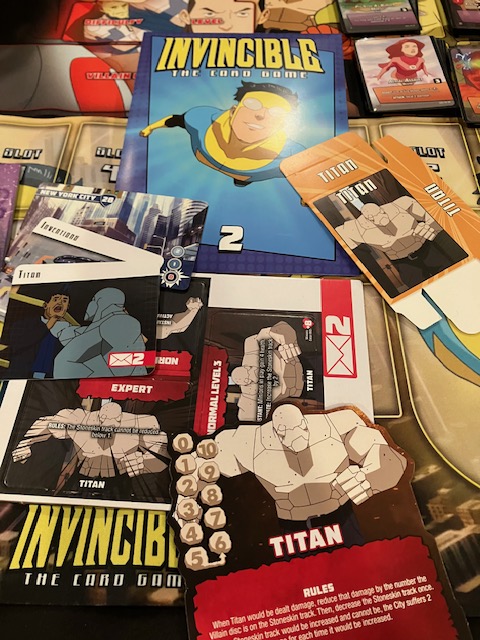
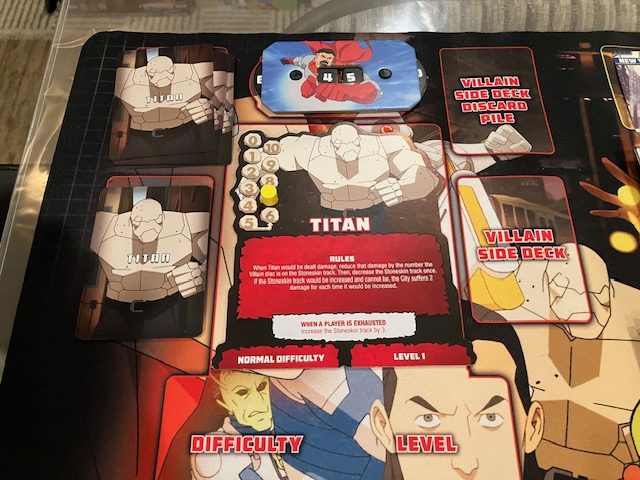
For Chapter 2, you fight the Titan!  He’s all about damage reduction!  And this Chapter also introduced something called Inventions!  Basically, Inventions are a card only you can buy, but you get to choose it at the start of the game; it allows players to strategize a little on what their characters may focus on.

Titan’s really hard to do damage to!

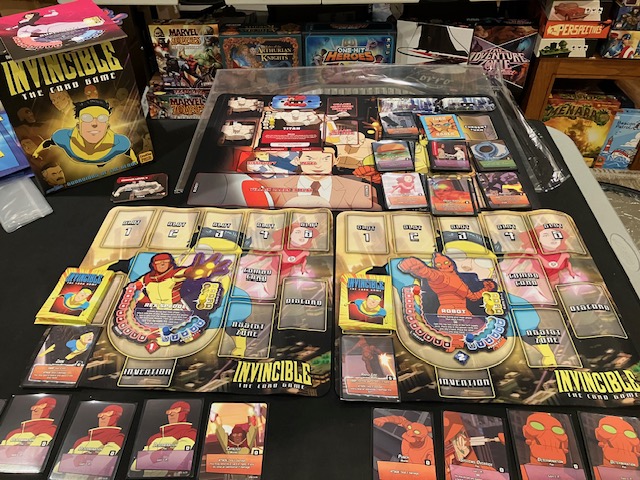
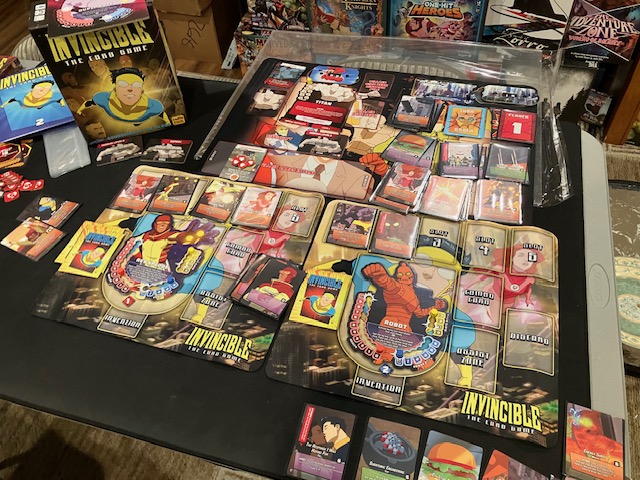
To change things up, I had Rexsplode and Robot fight the TitanRex has a very weird power (use a weapon twice, but blow it up), and so does Robot  (he grabs tech)

And we saw exactly the situation we discussed earlier in the True Solo section!  Robot was reduced to 0 hit points, but because Rexsplode was still alive, Robot kept fighting!  Even Rexsplode was down to 3 hit points, but they emerged victorious!   I think part of the issue that they didn’t do better was that I didn’t use their powers very well.  

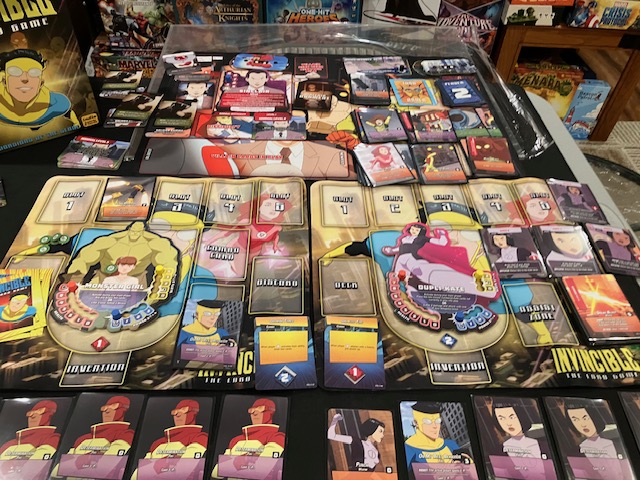
The Inventions were interesting, but not a real game-changer.  It’s just one more card you can buy.  It does give each hero some focus, though, and some chance for discussion/interaction when you choose, so that helps cooperation.  Note above that I put the Inventions on the LEFT of the mats (instead of under the character).  Again, the player mats could have been better.

Chapter 3: Monster Girl and Duplikate

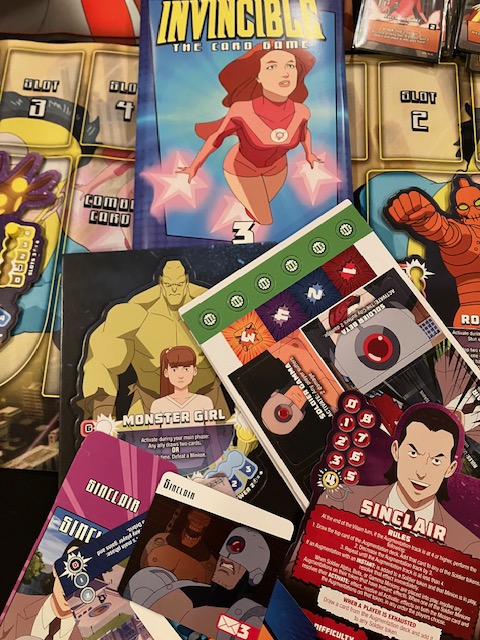
Chapter 3 introduces Monster Girl as a new player character.  The “bad guy” now is Sinclair!

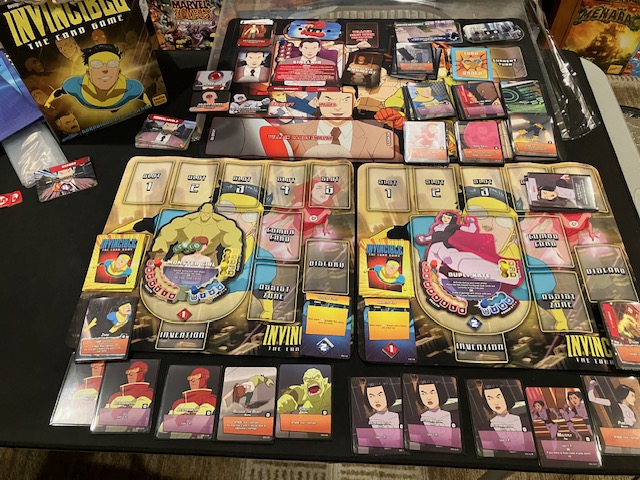
Monster Girl and Duplikate went after Sinclair!  

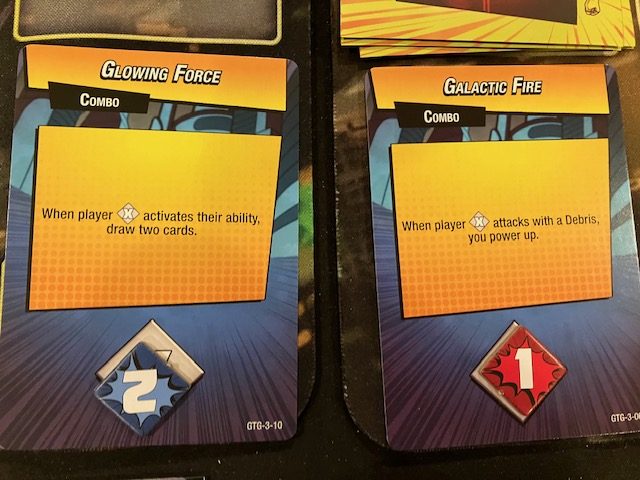
Something new from this chapter: The Combo Powers!  Each player gets to chose a Combo!  The Combo Powers are interesting because they allow your partner a special action whenever you do an action! For example, when player 2 activates their ability, player 1 gets to draw two cards!  And when player 1 attacks with debris, player 2 powers up!   

Monster Girl and Kate (with their Combos and Inventions) were a great pair! They handled Sinclair and all his crazy machinations!  And this was the first game when I really feel like I was very strategic and took great advantage of both the Special Powers and the Combo Powers!  Both Monster Girl and Duplikate did a great job of helping each other all the time! This was by far my favorite game of the Expedition.  It was just fun!

If Inventions were pretty good, I think The Combo Powers are a bit of game-changer (in a good way), especially if you can harmonize so that the characters combo powers really reinforce each other!

This was my favorite game of the Expedition.  The villain was still hard and interesting, but the Combo Powers stepped up the game for me!

Chapter 4: Monster Girl and Duplikate

By this point, I had tried all the heroes.  I had so much fun with Monster Girl and Duplikate, in my previous game, I took them for the final run against Omni-man!

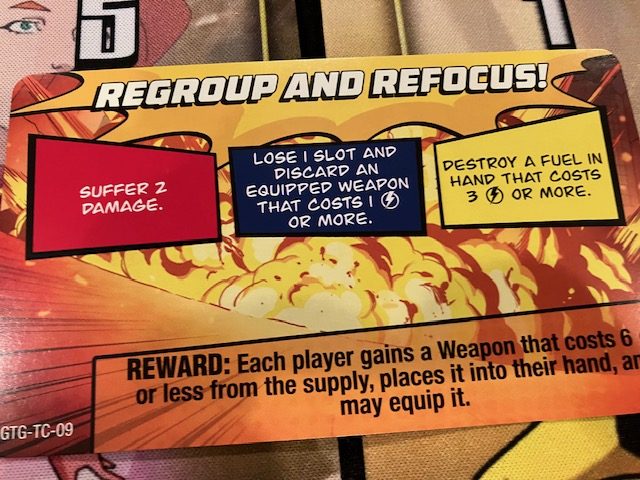
Chapter 4 introduced the Team Attacks.  You get to choose one of six (I think).  See one of them above.  Basically, your characters can choose to do one of these three sacrifices on their turn.  If, all three sacrifices have been done, players can choose, at any time, to get the reward!  The coolest part is that you can choose WHEN to get the reward so you can make sure the sacrifices are timely and not in vein!

Omni-Man is a VERY different villain, as you basically have to stop him from destroying earth with his catastrophes!  Basically, you have to make a TON of sacrifices as you play!

This was a super cool way to end the game.  Monster Girl and Duplikate did a great job making sacrifice after sacrifice to save the world!  And they did use the Team Attack, but it wasn’t as game changing as we had hoped.

It was fun to save the world!

Putting It All Back Together

After I was done with the solo campaign, the Expedition book gave us directions on how to put the game back to its pristine state;  I reset the campaign so I could play cooperatively with my friends.  Every card has a notation about which deck it came from (see above).

Cooperative Play

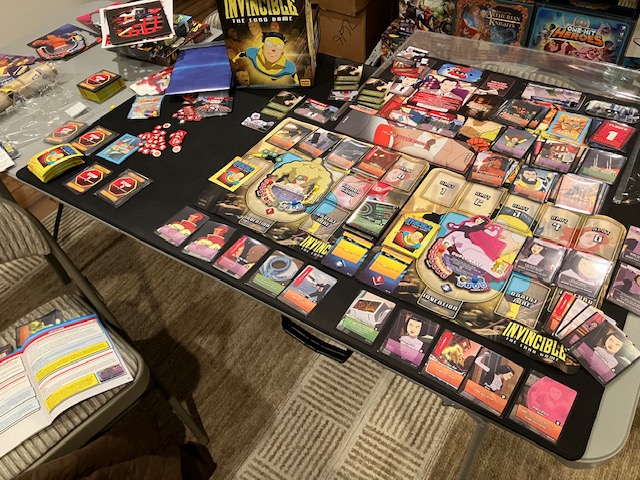
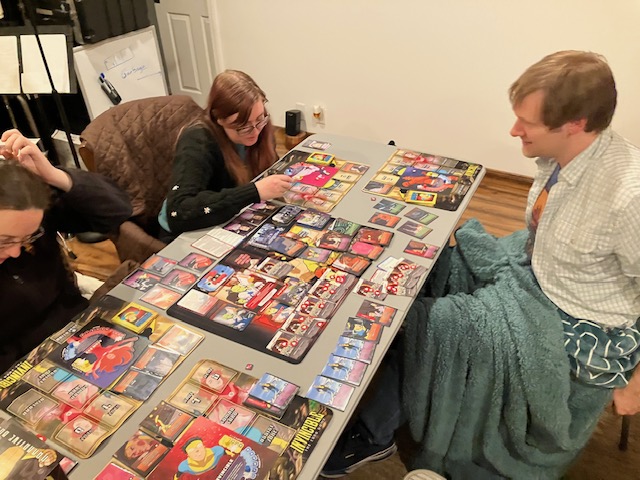
Invincible: The Card Game took over my game table for a cooperative game for a game night.  

The Assist keyword was the hit of the night!  Everyone loved the idea that they could help someone else out when it wasn’t their turn!  And the Afterburn effects were also a big hit!  (I didn’t talk about Afterburn too much, because we already saw in Astro Knights: Eternity,  but Afterburn was great in our solo games).

The cooperative game worked, even though we lost.  We had fun and would play again.

What I Liked

Universe.  I really do like this universe! Retheming Astro Knights to this universe really did work.

Assist:  I think Assist was what Bolster (from Astro Knights: Eternity) wanted to be. Assist is easy to explain and easy to play: when it’s not your turn, you can offer an ability/something to another player!  Take a look at some of the cards above. This one thing really boosted my assessment of Invincible: The Card Game!  It makes the game more cooperative, more interactive (as you pay more attention to other people’s turns), and generally makes the game more fun! (Bolster was the idea that when someone else had to discard, you could get something.  It was clumsy and harder to use.  Assist is what we wanted but didn’t know it).

If there were one thing that elevates Invincible: The Card Game above all the Astro Knights or Aeon’s Ends of the world, it’s this.   (Put Assist with Friends and Foes module from Aeon’s End: Descent, and you might have a Top 10 game!)

Afterburn: The Afterburn effects are really a neat thing.  Sure, we saw them in Astro Knights: Eternity, but they work great here too! It’s just another choice you have when buying a card to help future you!  

Things I Didn’t Like

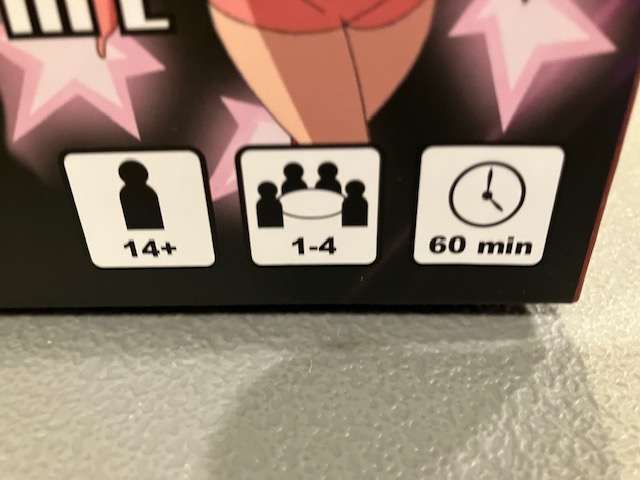
Time: I have played this game a LOT.  I don’t think I ever saw a game anywhere NEAR 60 minutes.  Except maybe that pure solo game when I lost so quickly! That 60 minutes for estimated time seems off by about 2x.  90-120 would have been better?  Maybe, maybe, after you have read all the cards and know everything in the villain and box you are playing, sure.  But a new game with new rules and a new Villains (which is what you want to keep the game fresh)?  No way for 60 minutes.  
Art.  I love Invincible and I love the art of the original comic book.  The art is in this game seems anemic and more like the coloring book version of the universe!  Maybe this is just me.  My friends told me to mellow out; it’s more like the animated version.
Player Mats:  I had so many problems with the Player Mats; I think they should be redesigned. (see our discussion in the section at the beginning). Another problem is that all mats have the be symmetric, but sometimes when I lay out cards next to my friends, I want the layouts to be mirror images!  For example, the Combo Cards should probably be NEXT to each other so that’s it’s easier to remember when to activate them! Bah, maybe I’m just grumpy and you’ll be perfectly fine with the mats.  But I think I struggled with almost every decision they made.

True solo: I think the True Solo mode is too fragile.  I think an easy fix might just be to give the solo character double the hit points. I am also reminded that Aeon’s End: Descent had a solo mode with that DIDN’T use fewer player actions, and it worked just fine (so fine that it made the #3 spot on our Top 10 Solo Games of 2024), so I really don’t think you need to only have 3 player action cards.  Ugh.  

Variable Turn Order: We’ve said it many times! There are problems with Variable Turn Order games!  See out discussion here:  A Discussion of Variable Turn Order and Ways To Mitigate Its Randomness! In all of our games, we did have to use our ad-hoc house rule of never letting the Nemesis have more than 2 turns in a row (at least twice).   (I did note that some of the Afterburn effects allow you to have some choice on the Variable Turn Order deck, so I appreciated there was some mechanisms in the game to affect that, but it’s still pretty random).

Conclusion

I’ve been grumpy a lot this review; I think that’s because I know this game and this system fairly well, so I have some experience with what seems to work.  But don’t get me wrong, this is an 8.5/10 game for me.   And the Assist keyword is probably my favorite new thing in this system!  It really facilitates cooperation!!!  (I am so glad they kind of “jettisoned” Bolster)

There are just some things that could have made this a 9/10 for me!  I just don’t think this will ever be a 10/10 for me because of Variable Turn Order issues (unless they find some way, like Fate Tokens, of mitigating it).

The Expedition is a fun way to reveal all the content of the game! And four chapters (games) seems just right as the length of a campaign! Any longer and it seems too much, any shorter and it leaves you wanting more.   

And the game says you CAN play this Astro Knights.  I guess I never got that far? I still have at least two expansions to play before I even get anywhere near that!

Unstoppable: A Solo and Two-Player Cooperative Deck-building/Crafting Game. A Review.

Unstoppable is a cooperative deck-building/card-crafting game! This was #4 on my Top 10 Anticipated Cooperative Board and Card Games of 2025! This was on Kickstarter back in June 2024, and delivered to me Saturday January 17th, 2025! I backed it, expecting it to arrive later in 2025, but it actually delivered early! (It originally promised February 2025). Amazing!

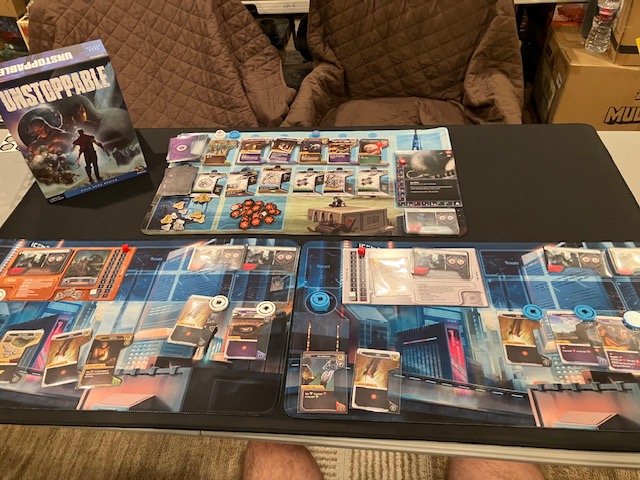
This delivered with three playmats, the Tyrant’s End expansion, and the base game: see above.

So what is Unstoppable? The game describes itself as a Roguelike Momentum Deckbuilder … meh, that’s an okay description, but I’d prefer to call it a deck-building/card-crafting boss-battler instead (I think it’s just “hot” to call games “roguelike” at the moment).

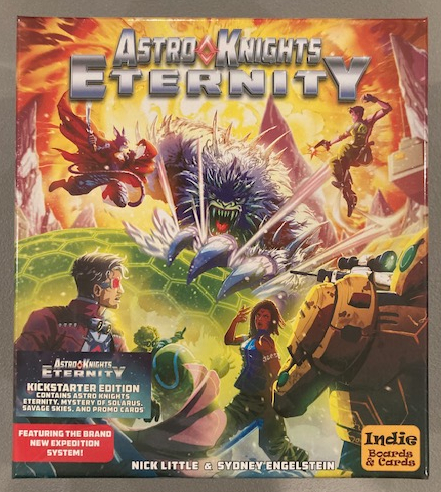
Be clear that this game ONLY supports 1 to 2 players before you get too excited; this game reminds me of a more tightly-coupled Astro Knights (see our review of Astro Knights here and here): Unstoppable still has that sci-fi  feel, that deck-building feel, and that boss-battling feel … just like Astro Knights, but it also has some really different ideas.  What do I mean by that? Let’s take a look below!

Unboxing

The Unstoppable base box is actually not that big; see Coke can for perspective above.

This is a deck-building game (and card-crafting: we’ll touch on that in a second) , so there are a ton of cards: See above.

There’s also some money tokens (credits, far right: I mean, this is a deck-building game, so you have to buy SOMETHING to upgrade your deck), hit point tokens (middle: you gotta do damage to take out minions on the way to the big bad boss), and some action point tokens (far left: yes, this game has action points too!).

There’s not THAT much in the base box; mostly cards and tokens and a few larger mats.

Playmats

I can hear some of you asking … “So Rich, why are there three playmats?” An excellent question.

The playmats are double-sided.

One side of the playmat is a single player mat. This is where one player’s cards, play board, threat, tokens, etc. goes. See above.

The other side of the playmat is where the main upgrades (this is a deck-building game, remember?), the core cards, and the big bad boss you battle lives. See above.

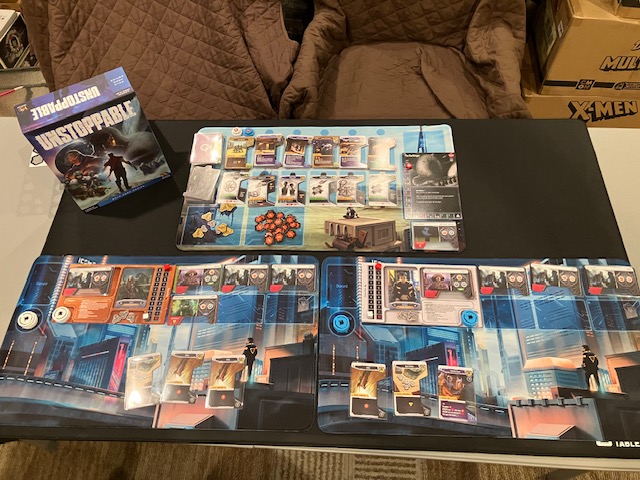
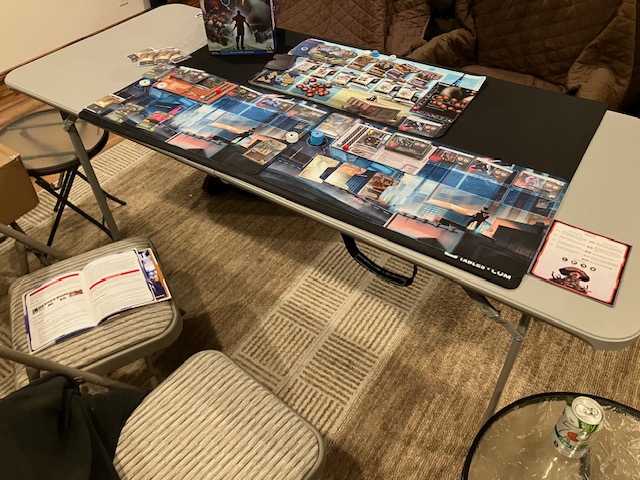
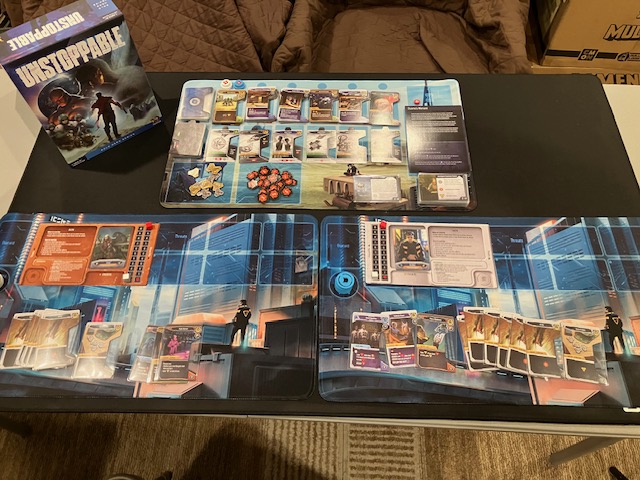
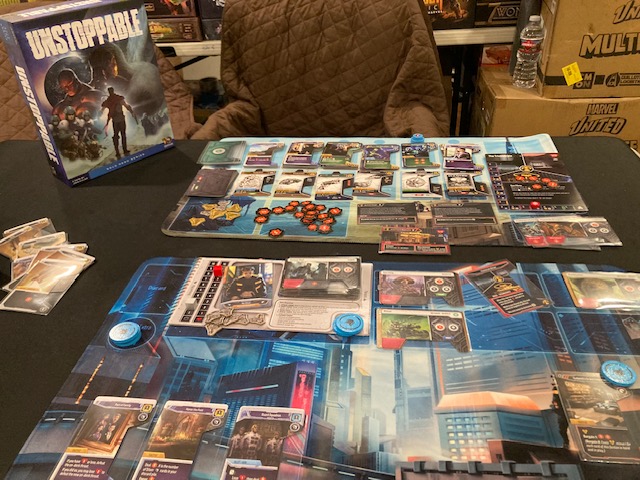
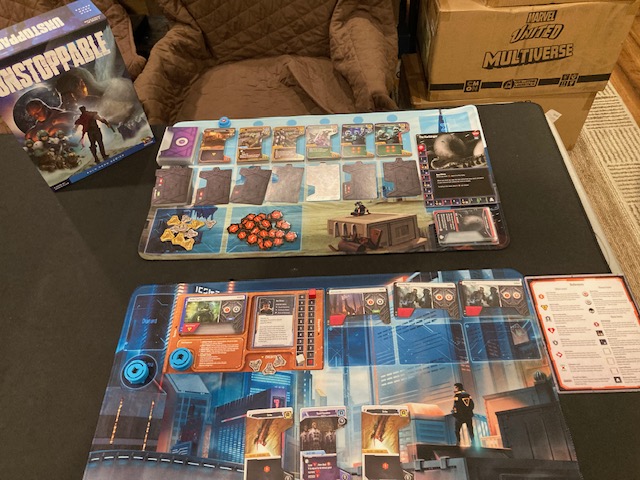
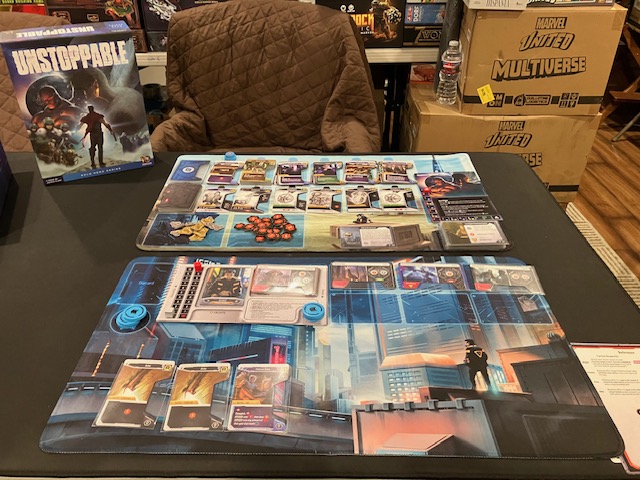
The reason there are three playmats is because the game is either 1-player or 2-players! Each player gets a mat (2 mats) and the big bad boss gets a mat (for up to 3 mats). See below for a 2-Player set-up:player 1 on left, player 2 on right, upgrades/boss on top.

So, to be clear, the playmats cost extra money; they don’t come with the game. Were they worth the extra money? So, I paid $100 for the base game, 3 mats, and one expansion. I like how they mats organize the game, but strictly speaking you don’t need them!

The rulebook DOES show how the game sets-up without the mats, so you don’t need them. But I liked them; much like the Aeon’s End: The Descent playmat was so useful, so too was the playmat for Unstoppable. But maybe you should see if you like the base game before you go investing all the $$$ for the playmats and expansion … keep reading …

Rulebook

I am a little grumbly with this rulebook. There are about 3 or 4 things that it could have EASILY done to make it SIGNIFICANTLY better.

The good news is that it gets an A- on the Chair Test.

It opens up and sits perfectly well on the chair next to me, making it easy to consult. So, they definitely did that right: see above.

The Components page (on the left above) is “okay”. The first real problem is … how do you set this up? There is a discussion (right side of the page) about “how you set-up and sleeve” the game, but THERE IS NOT A SINGLE PICTURE describing it! I was able to figure it out, but people who have no idea what card-crafting is or even deck-building will be completely lost with these directions (far right side of the page). A single picture might take this game from unplayable to playable for certain people. And a little picture would have made me happy; show me how the decks fit together. Please? I feel like the description above wasn’t quite enough.

The set-up was pretty good: see above.

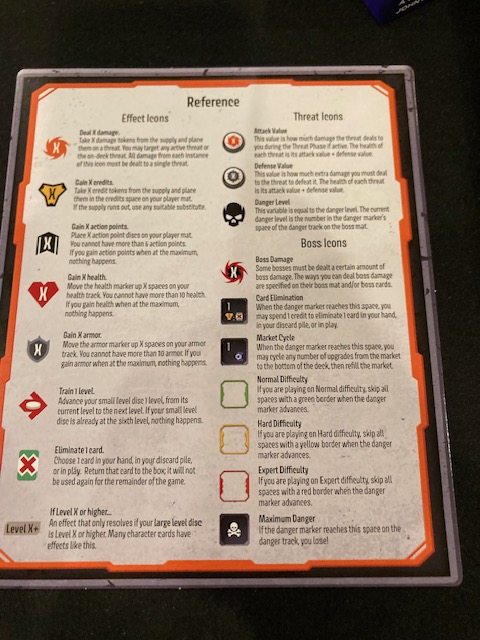
The next place I had problems was the card anatomy. Here, the Defense and Bonus areas on the Threat Cards were poorly described. The problem is that most Threat Cards use the SKULL symbol, and it’s not clear what that means (the skull on the Threat Cards is a different color and/or outline than the reference card: we discuss more below). A simple example describing one combat would have helped that.

The rest of the rulebook is pretty good.

I also really wanted a game summary on the back; I ended up paging through the gameplay pages over and over as I played; it would have been nice had those been summarized on the back.

This rulebook was … ok. I just wanted a few more examples, a few more discriminators, and a few more pictures in the rulebook to help me get into the game. After a little trek onto BGG (see thread here), I feel like I got my questions answered, but the rulebook could have been better.

It worked. Mostly. Except for set-up. It could have been significantly better with a few extra pictures.

Storybook

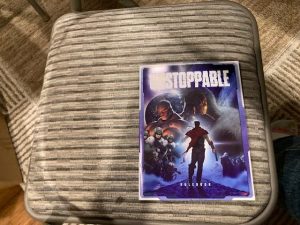
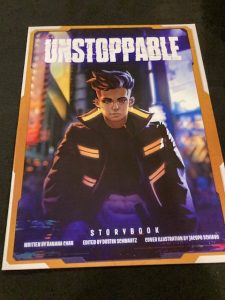
There is a storybook for the game.  You don’t need it to play the game.  It’s just flavor text.  I never read it, and I feel bad for not reading it?

Sleevening

Like I mentioned in the rulebook section, it was more work than I expected to get this game into playable shape. It took me about an hour or so? Basically, you have to “sleeven” the game and put a bunch of cards into sleeves.

Let’s be clear: the sleeves come with the game! Although this is “mostly” a deck-building game (you can build a deck, add better cards, and cull lesser cards: See our Top 10 Cooperative Deck-Building Games for more discussion of deck-building games), it is also a card-crafting game; this is a term that came into parlance with another of John D Clair’s Games: Mystic Vale (although this is a slightly different flavor of that idea). This game is built for you to put cards inside the sleeves, and have multiple cards together at the same time.

Once the cards get going, they will have two sides: a core side (above right: the GOOD side) and a Threat side (above left: the BAD side). There we actually two cards inside the sleeve! This basically allows the GOOD side and BAD side to vary independently.

The GOOD sides are what the characters can do in the game: deal damage, shield themselves, etc. See above.

The GOOD cards tell you which BAD cards they pair with; see the backs above (well, the intro cards do, once you start playing, you get random BAD cards).

The Threat cards (the other side) will be the bad guys that the players fight during the game. These cards, when defeated, will turn over and flow into the GOOD guys hand on the good side!

You might ask “Why do we have these weird rules and weird backs/fronts?” It’s to support UPGRADES (and allow the fronts and backs to vary independently, but that’s a complex discussion).

Probably the coolest part of Unstoppable is that you can UPGRADE a card: it stays attached to the card … in the sleeve! The reason these cards are so WEIRD-shaped is that the upgrades go into the right part of the card and basically stay attached/stay in the card sleeve so that card is better for the rest of the game!

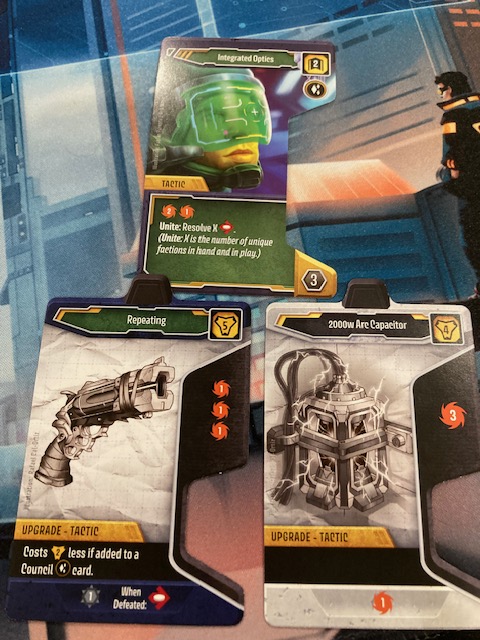
See above as we try to choose between two UPGRADES: Do I want to making it Repeating or add a 2000w Arc Capacitor? The repeater gives me three separate shots, but the capacitor gives me one big shot!! Which do I want?

I choose the capacitor! See as I slide it in …

… and see as it augments my card! Pretty cool!

This is the core crafting mechanic of the game; this is the cool gimmick.

Gameplay

Each player chooses one character to play: see above.

The back of your card indicates which specialized cards you start with (and a little flavor text).

The player sets-up with their starting deck: three special cards and 7 standard “starting” cards. They set-up on the player side.

Your deck goes on the character mat, with Armor and Hit points being tracked.

You also set-up three Threats you must deal with in your personal space. You start with three cards in hand, three action points, and three Threats to deal with.

To play a card, you need to be able to pay the Action point cost (in the upper right corner).  Playing Strike gives you a simple 1 hit point of damage.

You do damage to one of the three Threats: see above (more of them if they are FAST); if any of these Threats survive to the next round, they will do Damage to you!

If you take out a Threat, the card FLIPS to the GOOD side and comes into your hand! That’s right, you don’t really draw from your deck: the main way to get new cards in your hand is to take out Threats! That’s very interesting!

Of course, this is a deck-building game, so you have to get new cards somehow.  Basically, every turn, you get to choose one of three (you draft) the three cards where the BLUE LEVEL marker is (see above).  There are 6 levels of core cards, with higher levels being obviously better!

Every time you empty your deck, you level up and move the level marker up. (There are also ways to move the level marker up quicker, but only temporarily). Leveling-up is a fun time; you get to CULL a card, move the level marker up, and anticipate some new “better” cards!

This is a boss-battler, so you have to take out the BIG BAD BOSS; depending on which one you choose. See above. Interestingly, you can only do “boss damage” (see it blurred below) when you kill certain threats from your deck. These special threats get added every time you level up (and you usually start with 2 of these “boss threats”: see Below.)

There’s actually quite a bit more to the game, but that’s the basics.

Build a better deck and craft better cards! Take out local Threats on the way to taking out the Big Bad!

Solo Play

So, this game is definitely built for solo (thanks for following Saunders’ Law), with 2-Player being the secondary mode. See above: even the font hints at that disparity (SOLO is all big)!

I ended up playing about 10 games of the solo game in the first few days after I got this game! There are three bosses that come with the game, and I was able to defeat each one … after I lost a few times. (There are ways to up the difficulty, and there are 4 characters to play with to give the game more replayability)

It takes a little while to get into the “flow” of the game. There are a lot of rules, there are a lot sections, but there are a lot of decisions (in a good way) to make too.

For example, there are 4 factions in the game that all play VERY differently! If you have multiple cards of a faction, they can “support” the other cards and make them more powerful! I tended to get the Silver faction (the little diagonal raven) in my first few games. But there is also worth in getting multiple factions, especially with the UNITE keyword which gives you special on how many different factions you have in play/in hand!

My favorite decisions in the game came when I was stuck; it was pretty clear that I was going to die and lose, but if I could upgrade my cards JUST RIGHT before I went into battle, I could stay alive! The UPGRADES, and the fact that you can do them anytime on your turn, really make it so you can pivot and be smart! I really appreciated that I could feel clever. Deck-building games tend to have some randomness in them, but the UPGRADE mechanism is what kept me from being too grumpy with that randomness.

I will say that the solo player doesn’t have to do too much work once the game is going, but the set-up and ESPECIALLY the tear-down is a lot of work! Going through your entire deck and separating the core cards and threat cards is so much work. Besides the “unsleevening” (which was a sub-optimal experience), the tear-down is one of the biggest “oofs: that’s a lot of work” in the game. See above as I tear apart the decks!

There are a lot of rules, a lot of Icons, a lot of factions. I appreciated that, by playing this solo, I could learn the game and take whatever time I wanted. I could then teach my friend. Not friends, because the cooperative mode is ONLY 2-Players.

Cooperative Mode

Yes! Thank you! Unstoppable has a cooperative mode with NO Communications Restrictions! I get so tired of having some obscure rules to obscure the communication when playing cooperatively with my friends! I said this in Everdell Duo (see review from a few weeks ago) and I’ll say it now: let me and my friend(s) talk! We play games to play, laugh, talk, strategize, and have fun together! I am so glad we don’t have to worry about any Communications Restrictions as we work together! Thank you Unstoppable for allowing full communication!

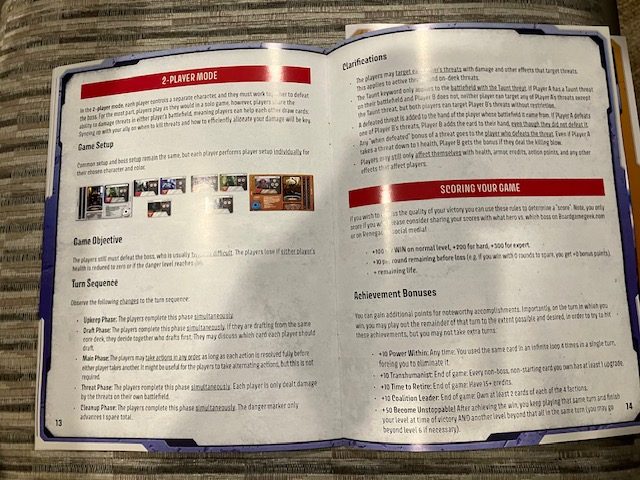
The rules for 2-Player are in 1.5 pages (pages 13 and 14: see above); the idea is pretty straight-forward: each player is playing multi-player solitaire for the most part. The BIG BAD BOSS has twice as many hit points (for scaling to 2 players), so both players still have to do “about” the same amount of damage and play “about” the same amount of game.

Most of the 2-Player cooperative game proceeds simultaneously, as both players play out their turns at the same time. (This helps keep the game flowing quickly). The only times where the two players must worry about the order they play is (1) when drafting the new card (players are allowed to choose who drafts first), and then (2) in the Main Phase, the game uses Player Selected Turn Order (one of our favorite mechanisms), where players can intersperse their plays however they want! This is fantastic! Me and my friend can decide the best way to take out Threats together! The only prerequisite is that the entire action must “finish” before the next one. (We found we could even do the Main Phase simulataneously many times as well!)

Although the players can talk through how to play together, the only way they can help each other is to eliminate Threats (by attacking their battlefield) for each other … and that’s it! There’s no sharing of any resources (credits, cards, armor) or anything else. So, this is very much multi-player solitaire.

In my first two-player game, I lost because my friend has a bad draw and couldn’t recover … if I just could have given him a few credits, he would have survived! So, although you can talk and strategize together, you can’t help each other out THAT much. The game is balanced pretty well for the solo player, so it’s rare you can actually “eliminate a threat” from your friend without screwing yourself, at least in my experience.

I liked the 2-Player cooperative mode, but I wish there was a little more cooperation: this is generally a multiplayer solitaire experience. Even sharing credits might have made this feel just a touch more cooperative without changing the gameplay too much … it’s even thematic! “I’ll wire you some credits!” This is a minor house rule that would I suggest to make the game just a little more cooperative.

Things To Look Out For

As I played a bunch of games, I ran into some issues that I feel I should point out; maybe I can make your experience better.

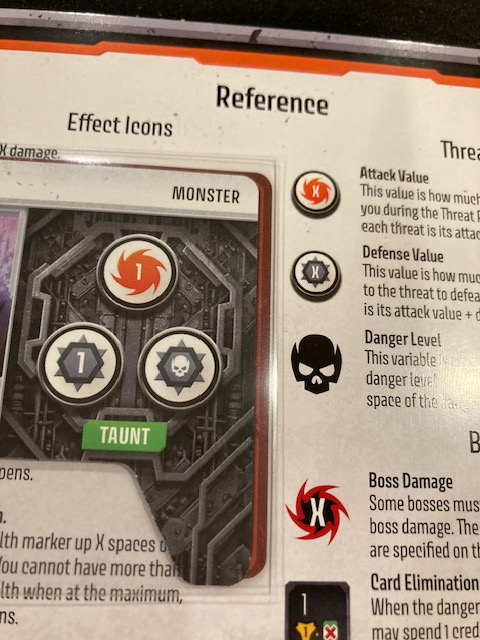
What does the Skull mean? When you see the SKULL on the Threat (MONSTER) card (see above), that means “use the current level number on the BIG BAD Boss card“. You might miss this the first time through because the Reference cards have the SKULL as a black on white, but every single Threat card has the SKULL as white on grey like the example above (or white on orange) … so you don’t correlate that they are the same symbol because the colors don’t match!

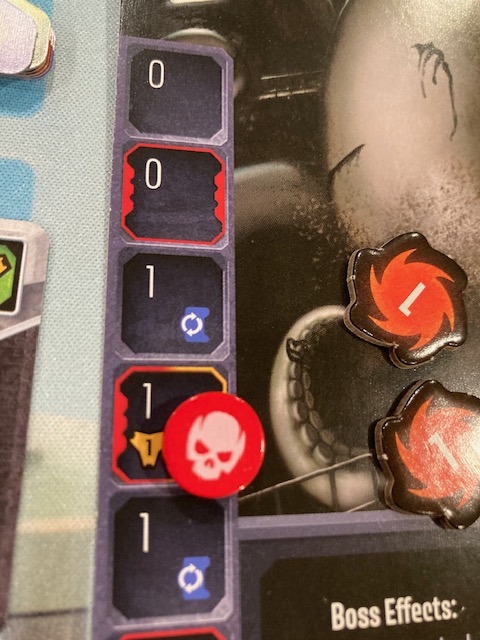
…Even more confusing, the marker on the BIG BAD BOSS map is red. So, these symbols don’t color-coordinate at all! When the RED token is on the 1, it means “1” (for the Defense of the Monster above). There was never a clear example of this in the Rulebook, and the lack of color-coordination can can be confusing, so just be aware of the issue. Once you know this, it’s easy.

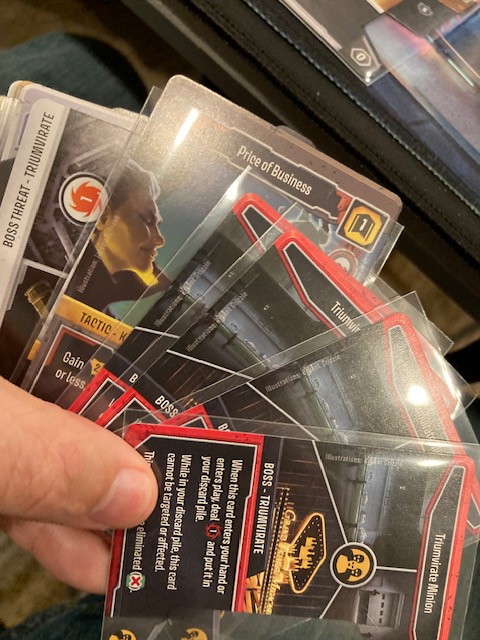
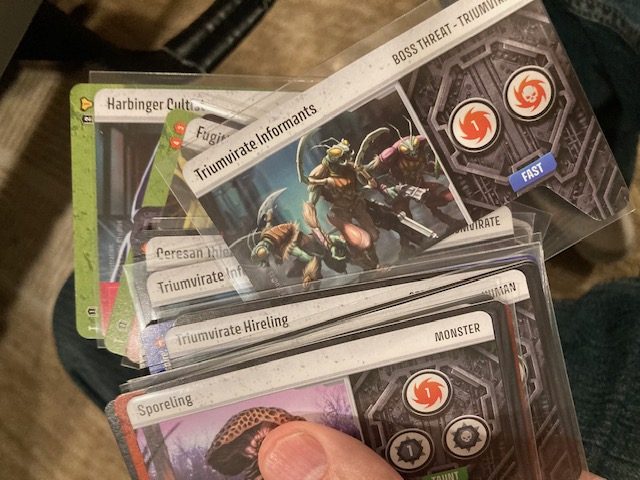
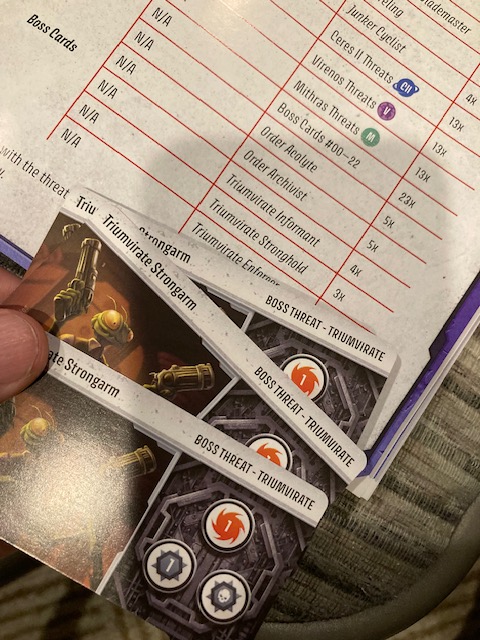
Boss Cards Shuffle Weirdly: Because the Boss Damage cards (see above) don’t ever have a Core (GOOD card) inserted in with it, they shuffle weirdly. I tended to get all the BIG BAD BOSS cards at the front or back of the deck because they are just “lighter” and shuffle differently in your deck. Go out of your way to make sure you shuffle your deck well (maybe a pile-shuffle) so that you don’t have all these cards clump together. (You DO NOT want these cards to clump together)

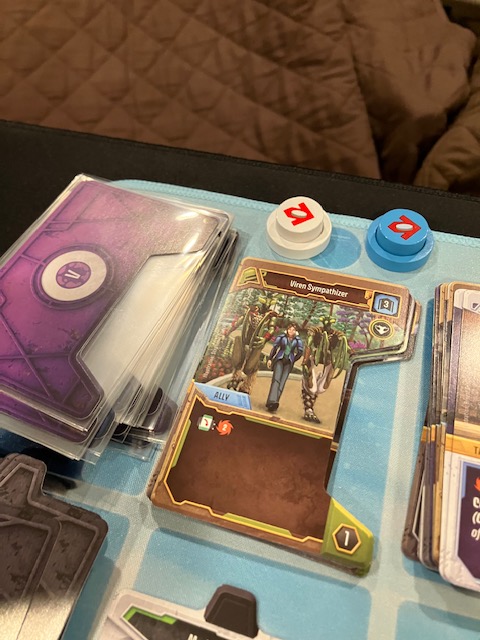
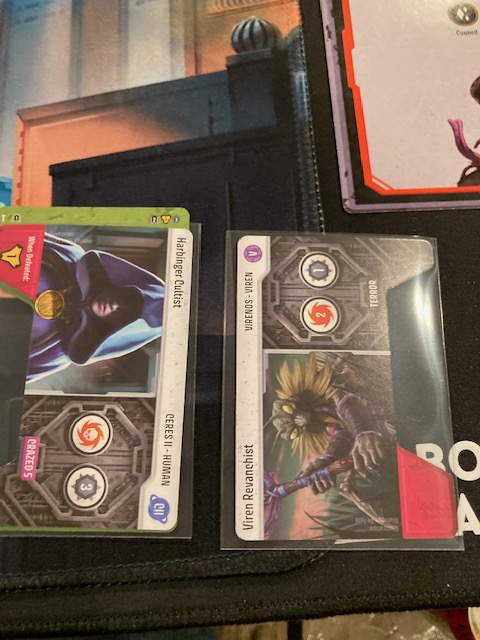
You can put the cards in backwards! See above as the Viren card is in the sleeve upside down. You know this because the card next to it is correct with the Core card extruding out the top. If you put a core card in here, it won’t line-up correctly.

…Have the opening on the Threat cards on the TOP so the Core cards can just slide in; see above.

Multiple Attacks vs. Adding: It’s still not clear if each Orange Swirl is considered a separate attack or just additive. If I add the Repeating, does each attack get the addition of the card it augments? Probably not? Also, since there is (currently) no notion of damage reduction in the game, 3 single attacks of 1 and 1 single attack of 3 will be the same against one opponent, but the Repeating will obviously be better IF if it really is 3 separate attacks (which is probably why it’s more expensive). I am using deduction (based on what I know about the game) to figure this out, rather than having the rules tell me. That frustrated me a little.

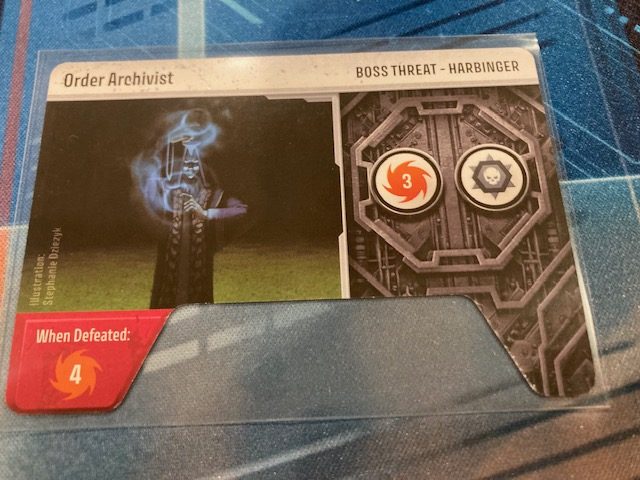
When Defeated: What does it mean when the “When Defeated” shows the Attack icon for the Boss Threat cards? See above! Does the Boss Threat have a Death Curse and do 4 Damage to you as it dies? Or do you get to do 4 Damage to another threat? It’s not clear. After playing about 10 games, I am pretty confident it’s a true bonus for the player: because the Boss Threats don’t come back into your hand (they do Boss Damage), they don’t help you with other threats, so you need the Bonus damage to be a HELPER! So, it’s a true bonus; you can do 4 damage to something else! If it were the other way around (with the Threat doing 4 damage to you), this game would be called Unbeatable instead of Unstoppable because it would be so hard!

What I Liked

Factions: The factions in this game really added a lot of flavor to the game. I mean, this is a deck-building game, which we’ve seen tons of. The four different factions really added some new flavor to this genre.

Threat and Core: The fact that the core cards and the Threat cards are tightly coupled was really interesting! Granted, this is the core gimmick (pun not intended) that makes this stand out (with the card-crafting), but it does work.

UPGRADES: At the end of the day, the UPGRADE system worked so well; this is the fundamental reason this game stands out. You can upgrade your cards independently, and that’s a really interesting decision! Adding the UPGRADES on an ad-hoc basis saved me many times, and it really makes you feel clever when you upgrade and turn a 3-Action Point card into 1-Action Point card!

Looks: The game looks good. And the playmats really do help.

What I Didn’t Like

The Introductory Experience: The introduction to this game and the “sleevening” weren’t great experiences. I am very worried they would turn off a less-experienced player to the point of abandoning the game. It reminded me a little of my first experience with Marvel Legendary many years ago … if a friend hadn’t helped me with my first game, I may have given up on it! Just a few more pictures and explanations, please? (Another game I really liked from last year, Union City Alliance (a co-op deck-builder) had this same problem: see here).

Tear-down: The game moves quickly as you play, but tear-down in this game is a lot of work: you have to separate many many cards from their sleeves.

Ambiguities: There were just enough ambiguities in the game that I was frustrated a few times.  Again, I wish the rulebook had a few more examples,  a few more pictures, a few more discussions, maybe even an index.   In this review, I tried to point out problem areas so hopefully they won’t trip you up.

Theme and Comparison to Astro Knights

How much theme is here?  There’s about as much theme here as in the base Astro Knights game; although I think I would give it to Astro Knights for feeling just slightly more thematic.  

Although, If we were comparing it to Astro Knights: Eternity, I would definitely say Eternity is more thematic … mostly.

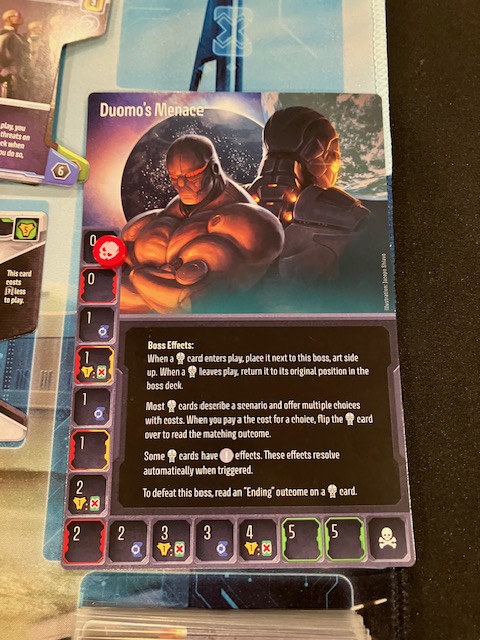
Although the thematic element depends on which BIG BAD BOSS you fight!  In your first few Unstoppable games, you should fight The Harbinger then The Triumvirate (in that order).  Those games teach you the technical mechanisms of the game.  The final boss (Duomo’s Menace: see above) actually has a little story and some choices! See below!!

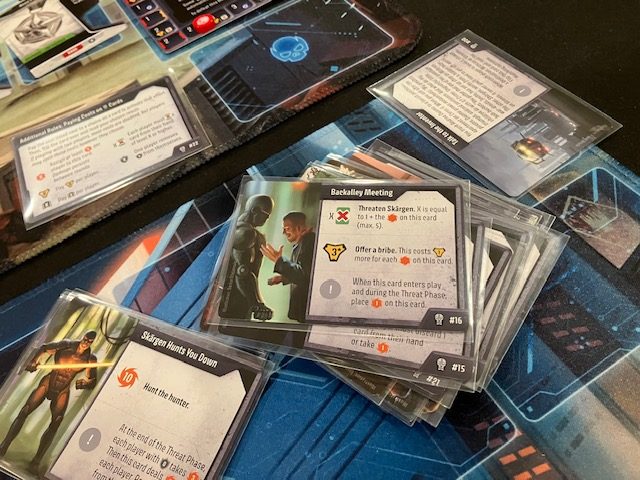
There is a deck of 21 cards (see above) and you make decisions (like a Choose Your Own Adventure story) as it takes you through different parts of the deck!

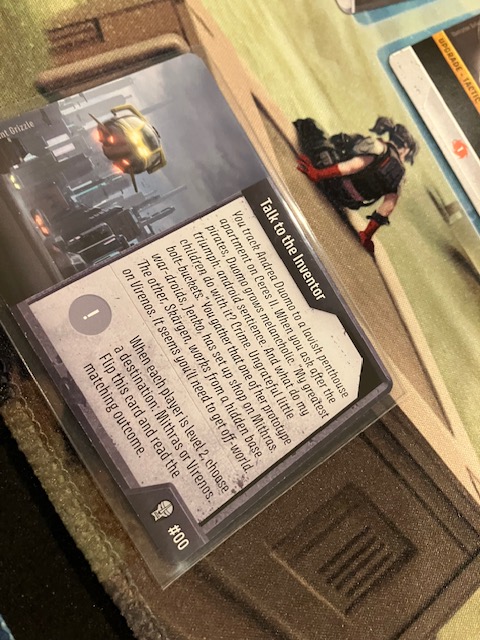
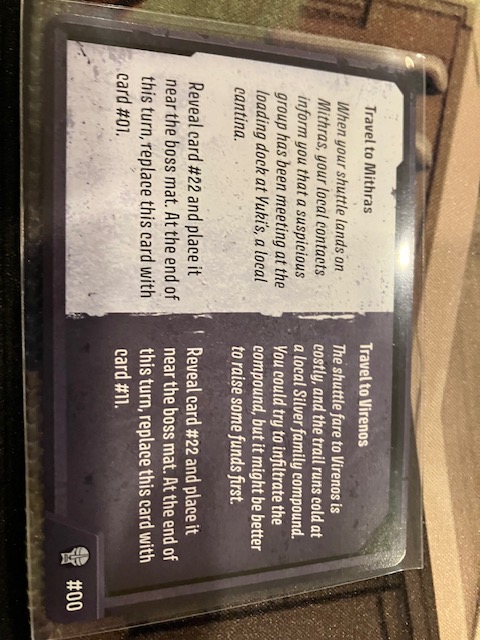
Minor spoiler above (that’s why it’s sideways), but it’s the first decision you would come to … see above.  These decisions take you through different parts of different stories!

There’s a bunch of different endings (don’t look too closely above) for that adventure!  The final boss Duomo’s Menace has quite a bit of theme and feels like a little adventure!

Would I recommend Astro Knights or Unstoppable? They are both great sci-fi cooperative deck-builders, but it depends on what you want!  Astro Knights is a little simpler and plays more people (at 1-4 players).  Unstoppable is more difficult and plays fewer people (1-2 players).  Astro Knights, especially if you are playing the Eternity expansion, feels more thematic, but, Unstoppable has slightly better gameplay with its card-crafting mechanic …and it does have a thematic adventure for the final boss!!  As a cooperative experience, I would give the edge to Astro Knights because it feels more interactive.  In the end, I have both and like both!

Conclusion

Yes, I liked Unstoppable! Quite a bit! It’s definitely staying in my collection for the solo game, but I can see it being ideal for playing 2-Player with my friend Joe!

The deck-building and card-crafting aspects of this game are unique and this brings some new ideas to that genre: upgrades, defeating cards to draw them, special boss damage … to name a few! To be clear, the main gimmick of this game (the card-crafting) DOES WORK and it works well.

I really did like the playmats and would recommend them, but they do make the game more expensive; strictly speaking, you don’t need them.

Overall, I’d have to give this a 8.5/10. I want to give it more, but the “unsleevening” experience and the rulebook could have been a little better.