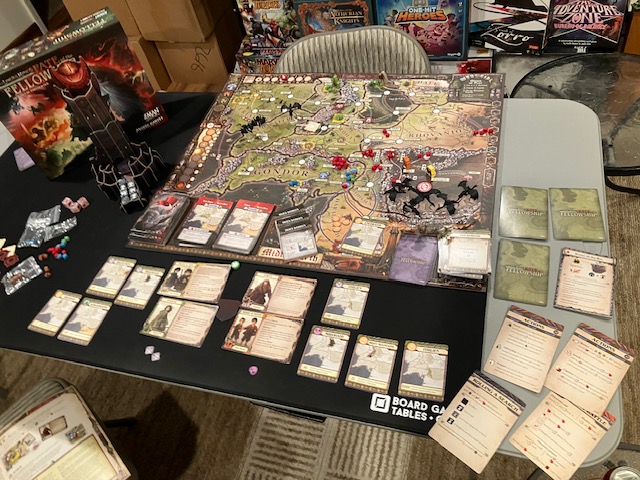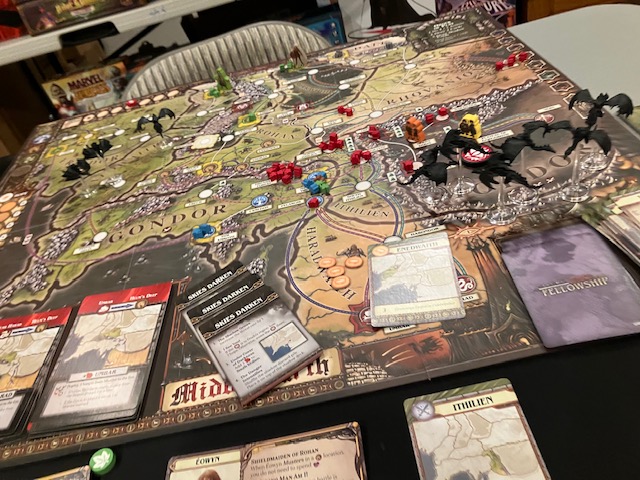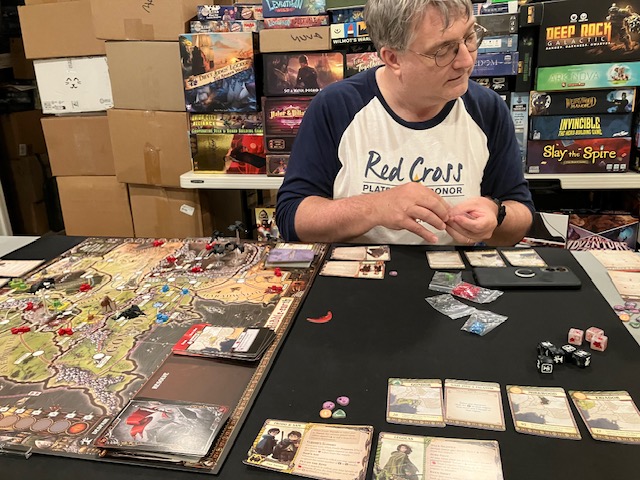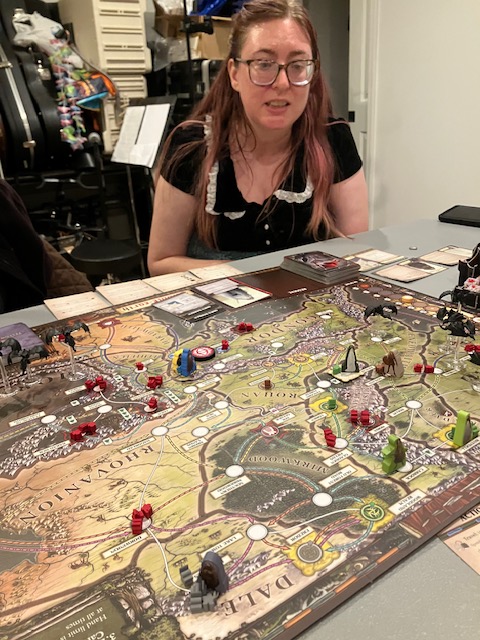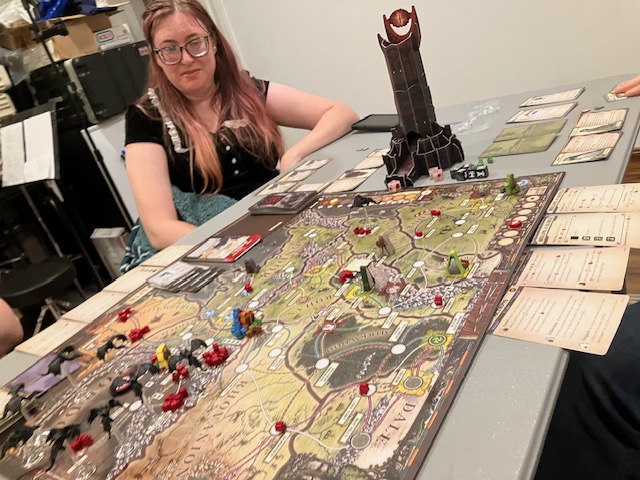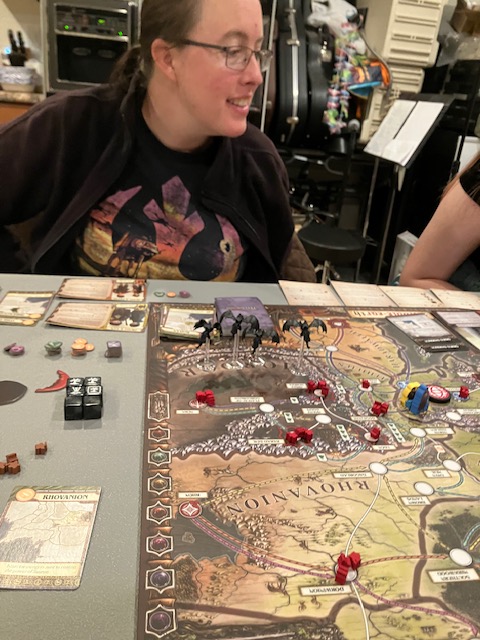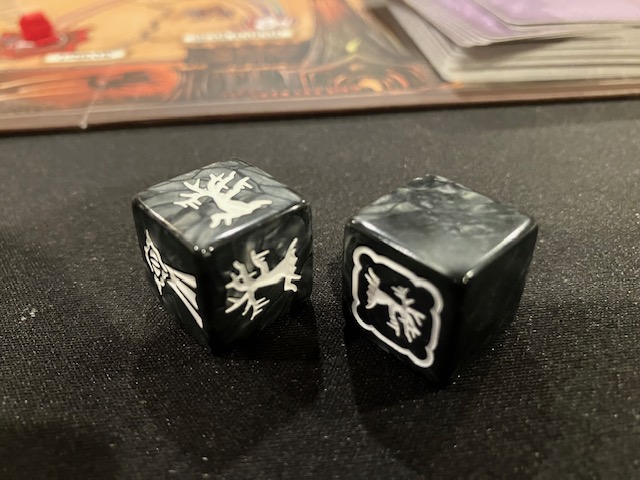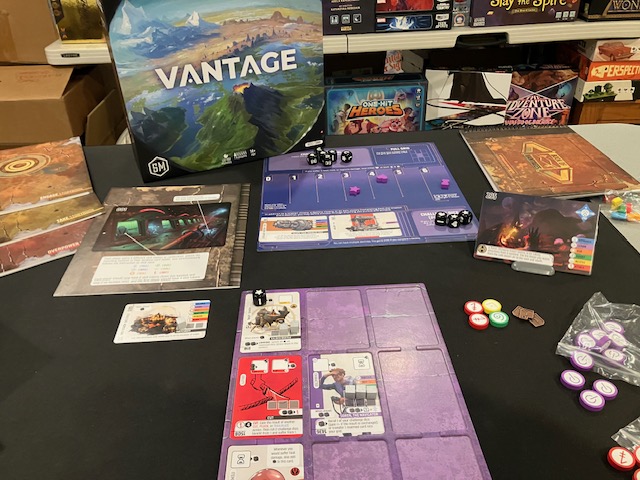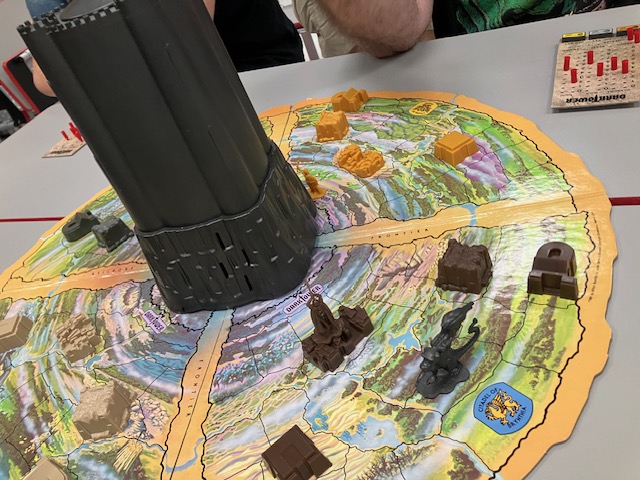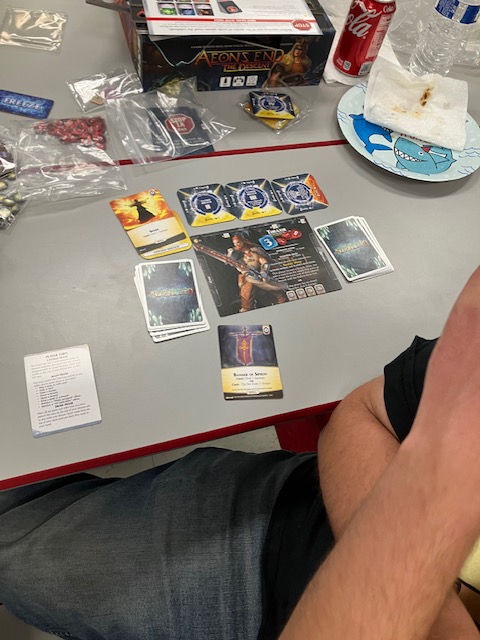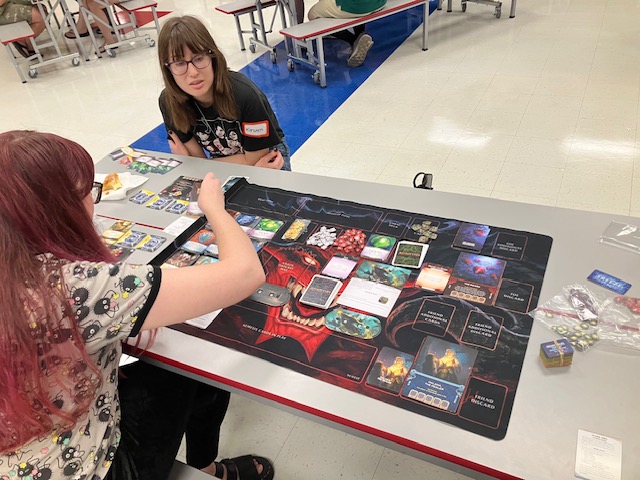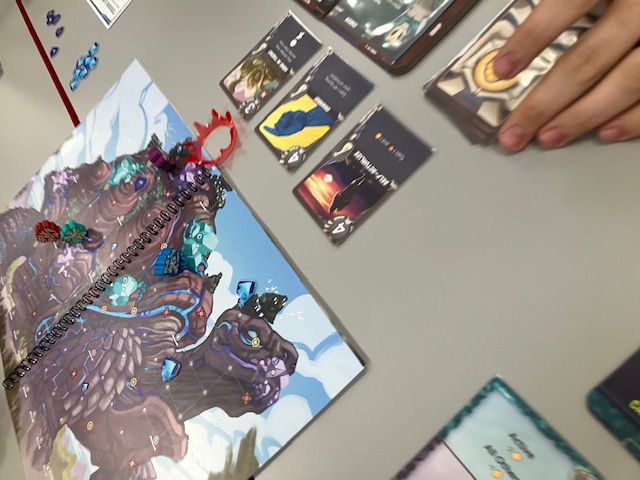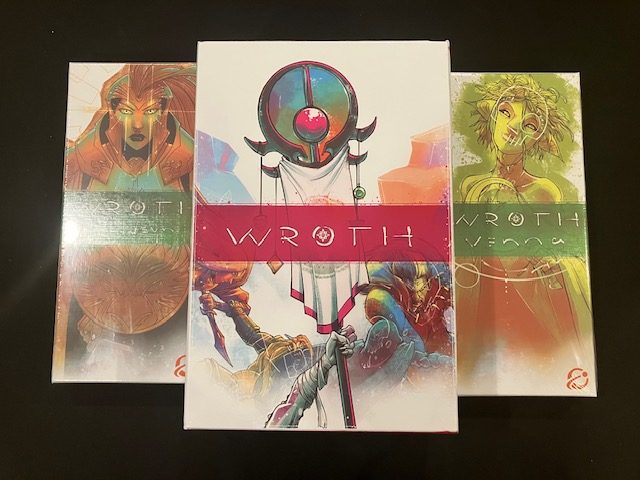
Wroth: Worth it or Throw it? A Review of the Competitive, Solo, and Cooperative Modes

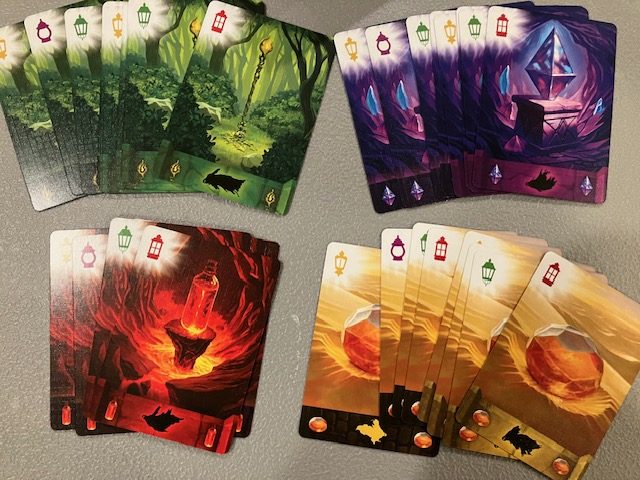
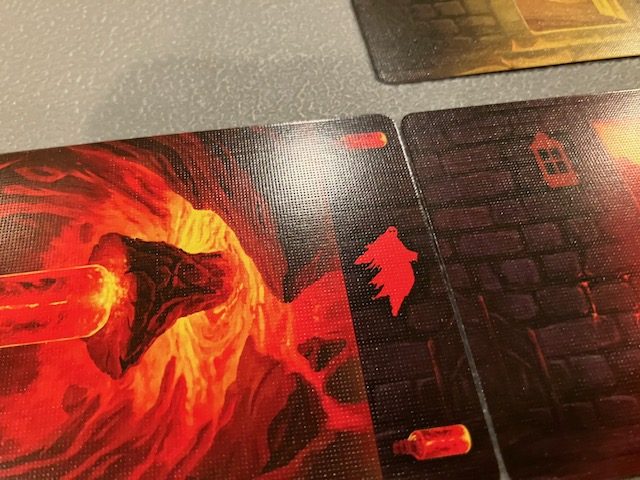
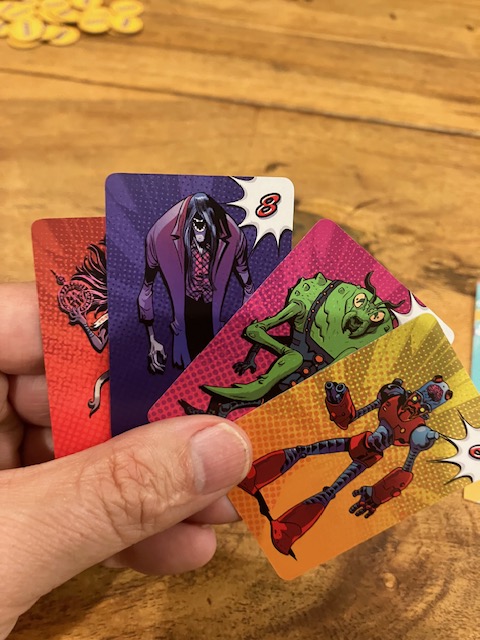
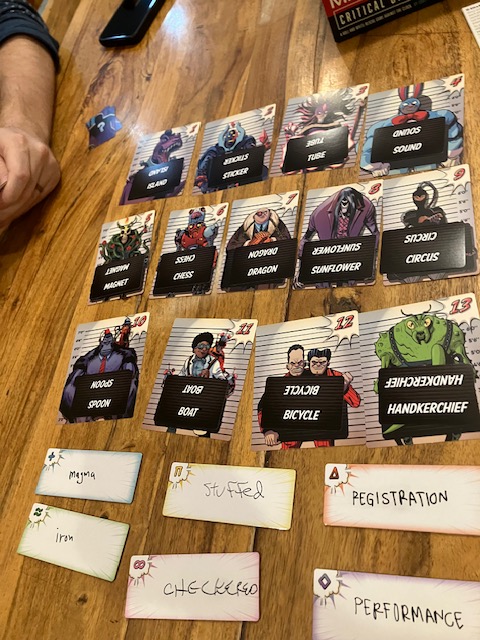
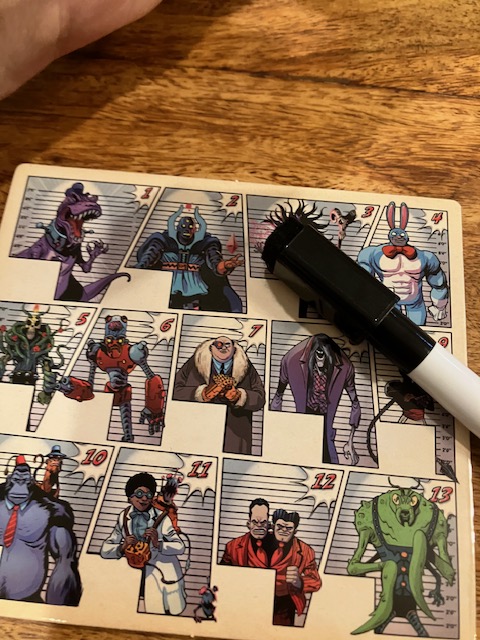
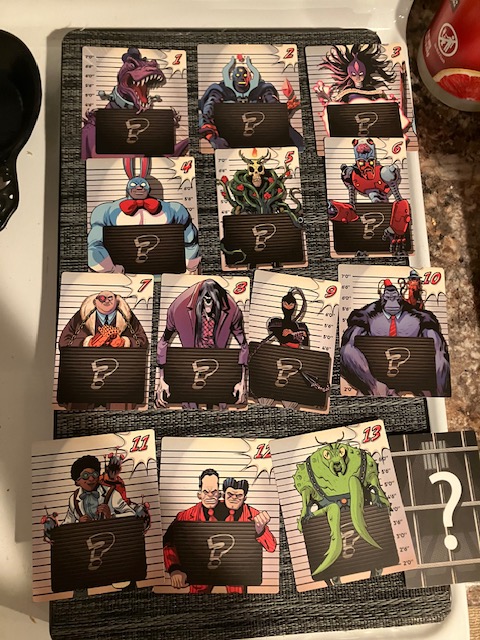
Wroth first attracted my attention because of the gorgeous art!  Manny Trembley, the same fellow who did all the wonderful Dice Throne stuff (see here, here, and here) is the artist and designer for Wroth!
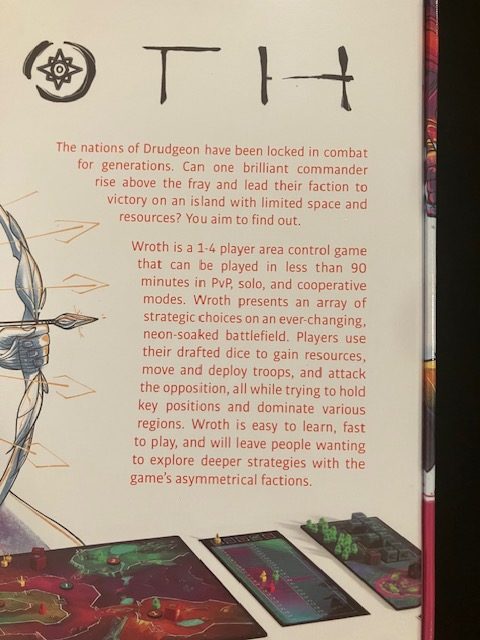
The next thing that attracted my attention was that this is an Area Control game (think of games like Risk), but it had a both a solo and cooperative mode?  That’s very interesting!  You never see Cooperative Area Control games!
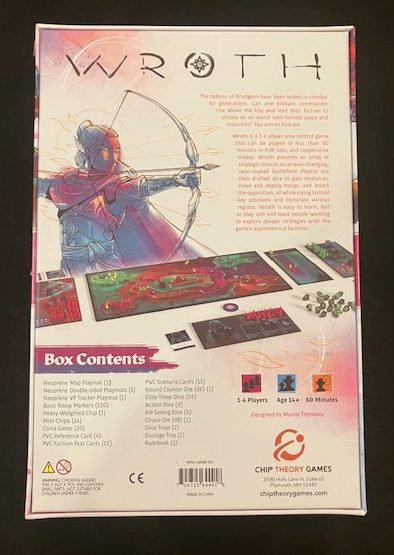
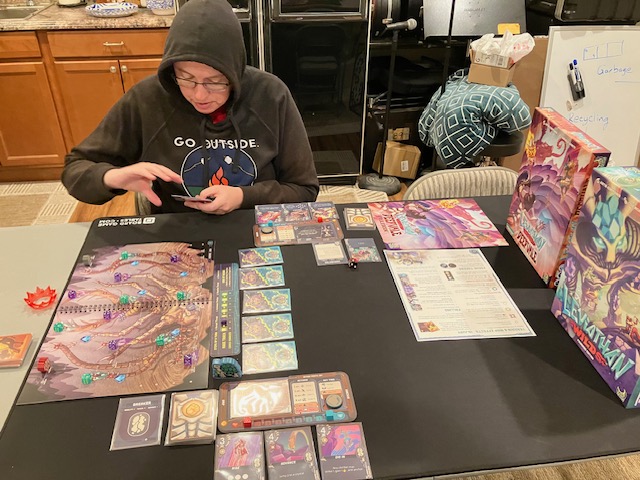
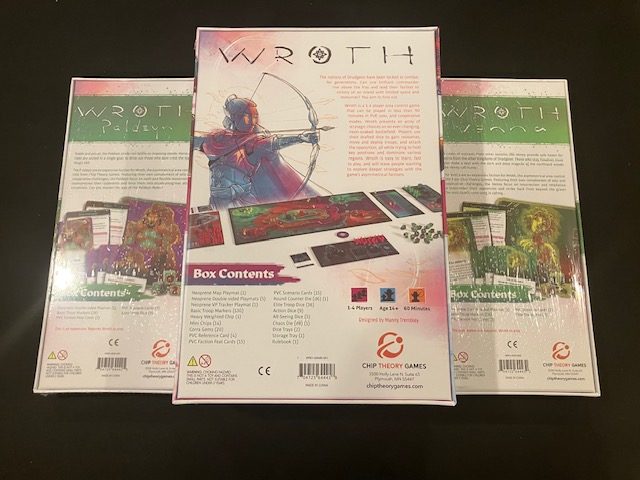
So, when Wroth was up on Gamefound (a Kickstarter-like site) back in March 2024, I went ahead and backed it!  There were plenty of pledge levels, but I chose to stay with the lesser pledge of the All Gameplay Bundle (with two faction expansions: see below).   I’ve become more jaded over the years and don’t go all-in like I used to: I just wanted to see if the game even worked!  What’s the point of getting everything if you maybe don’t even like the game?
Did I like this? That turns out to be a real interesting question, and I went on a little bit of a journey as I played Wroth! Let’s take a look!

Unboxing/Gameplay
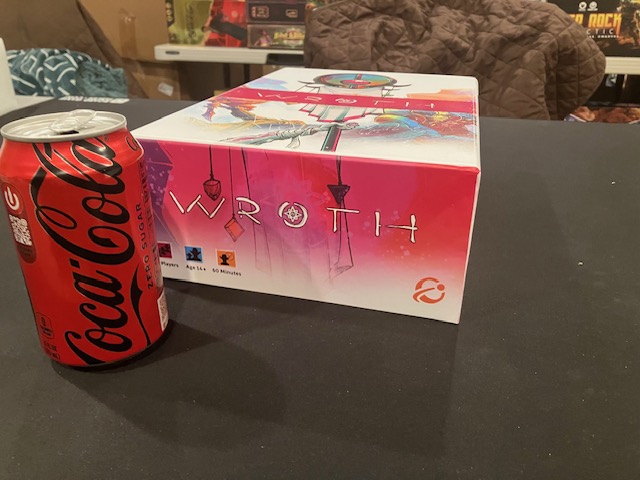
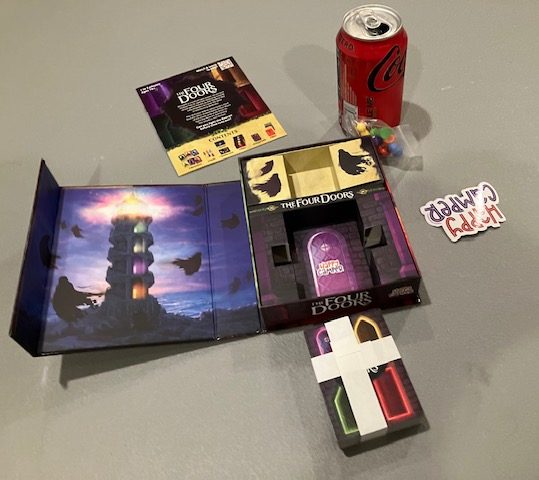
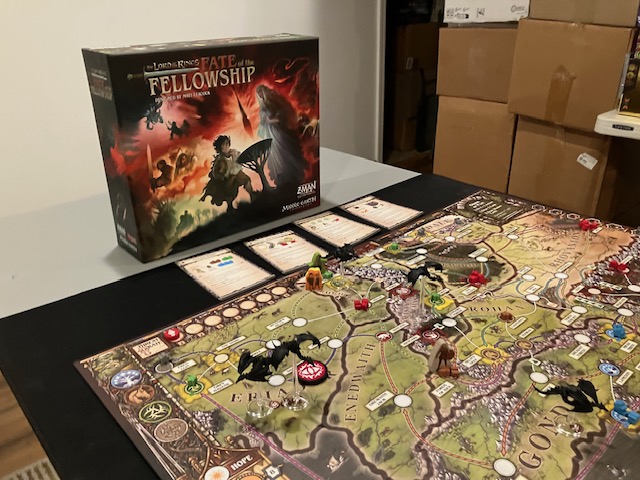
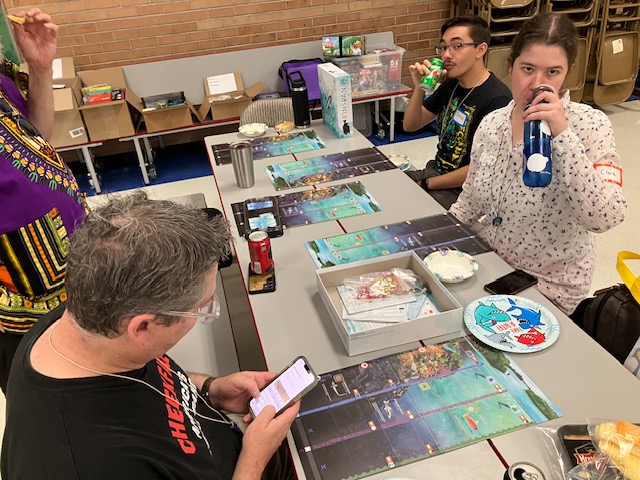
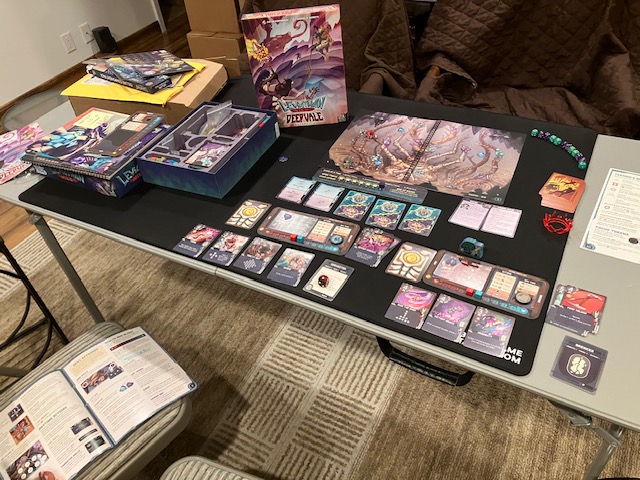
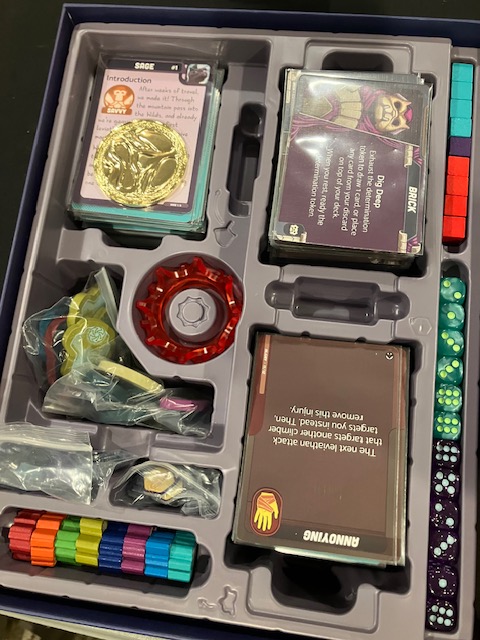
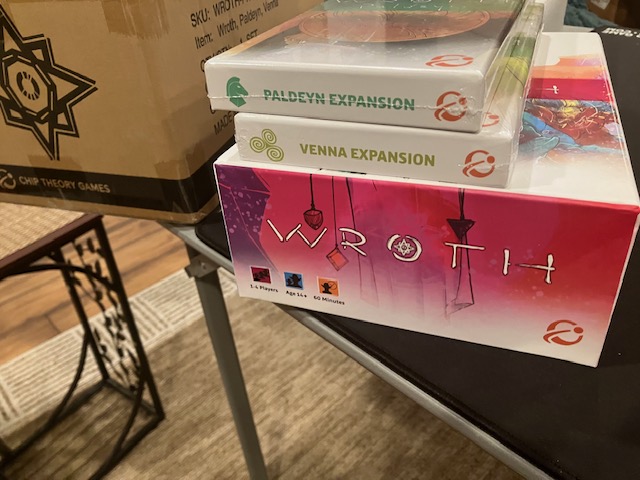
Wroth has a strange form factor; see above with a can of Coke for scale.
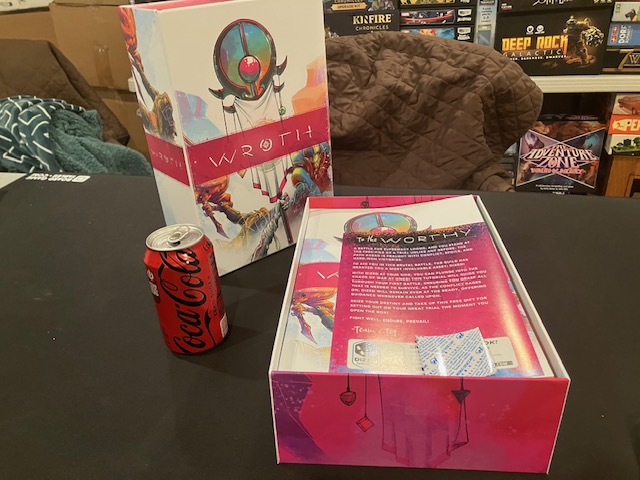
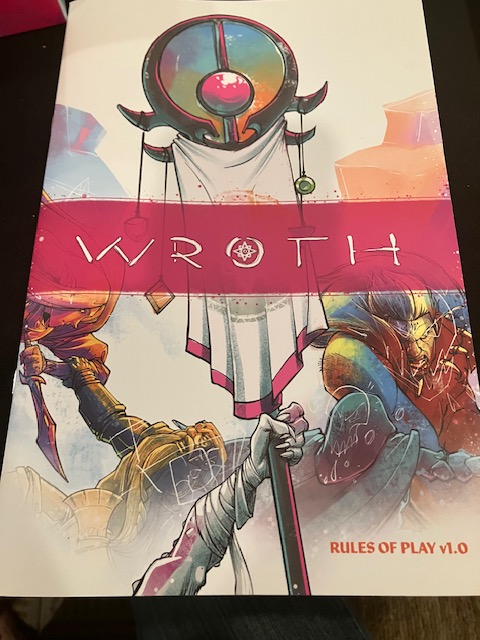
I will say that I think the cover for this game may be my favorite cover of the year.  I love this colorful yet minimalistic art of Manny Trembley.
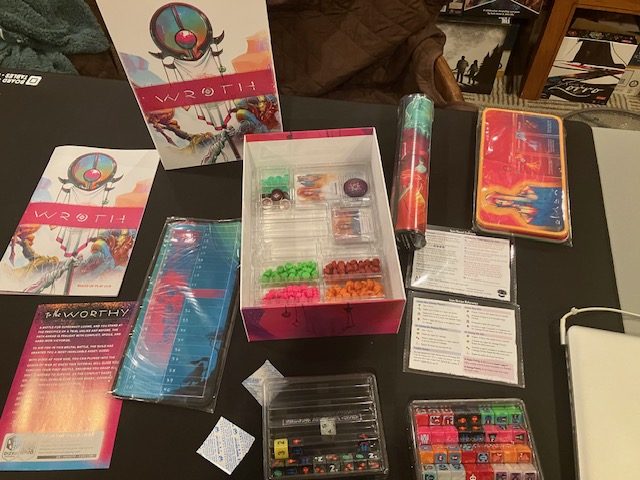
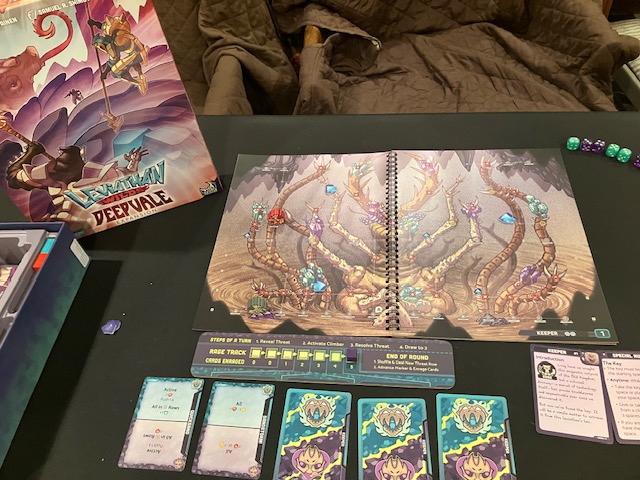
I think this a weird sized boxed mostly so the area mat fits in there when rolled up: see above as it’s rolled up and below as it’s opened up.
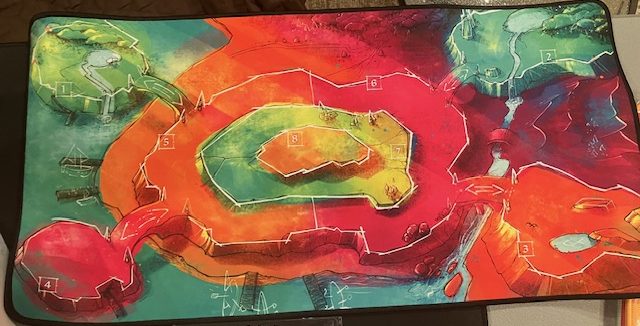
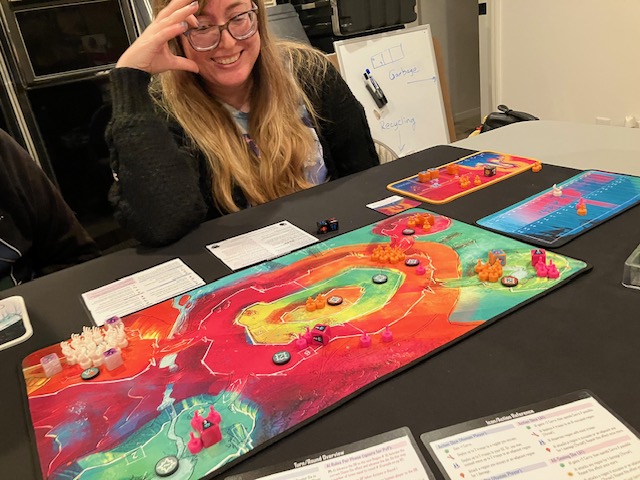
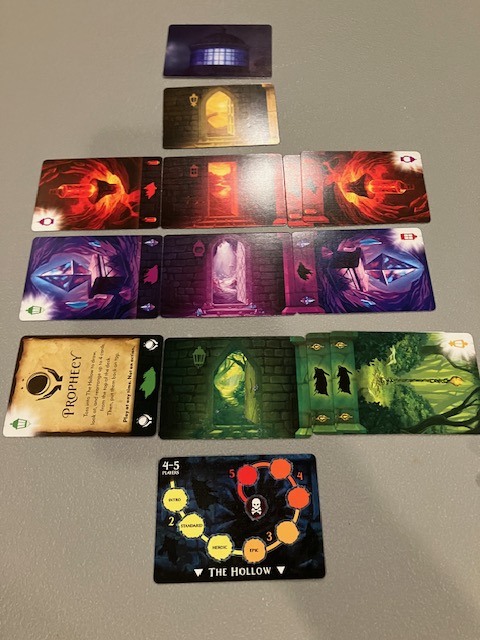
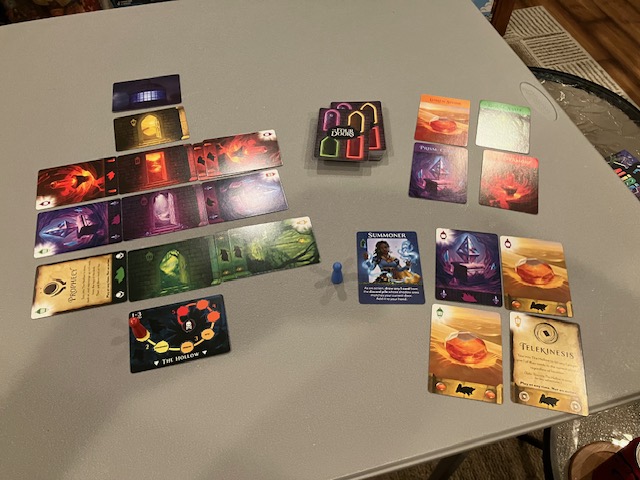
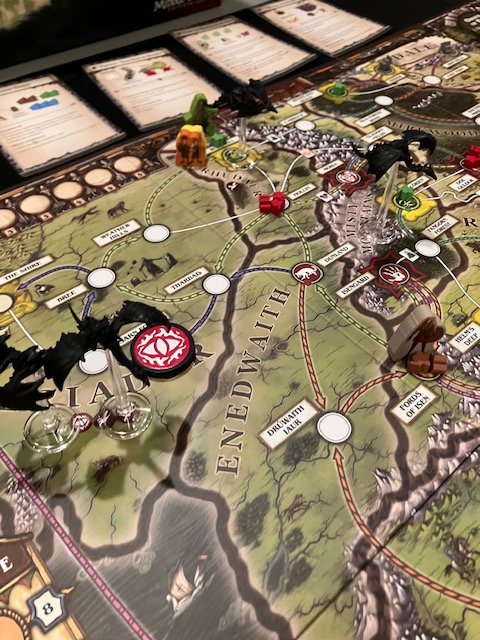
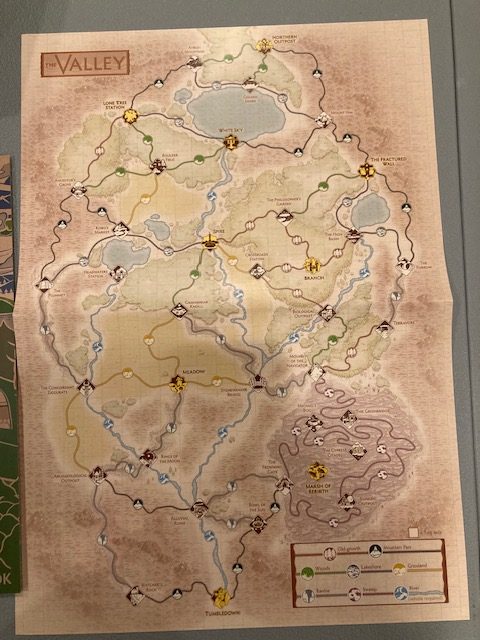
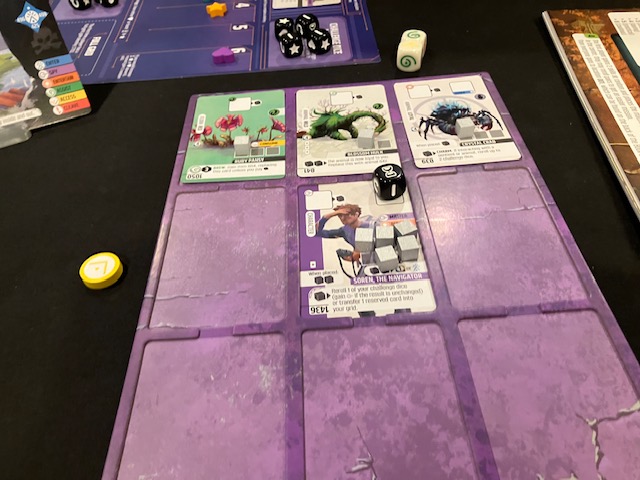
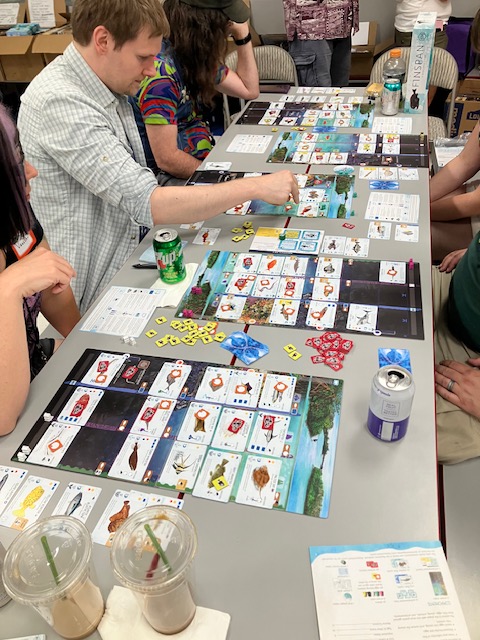
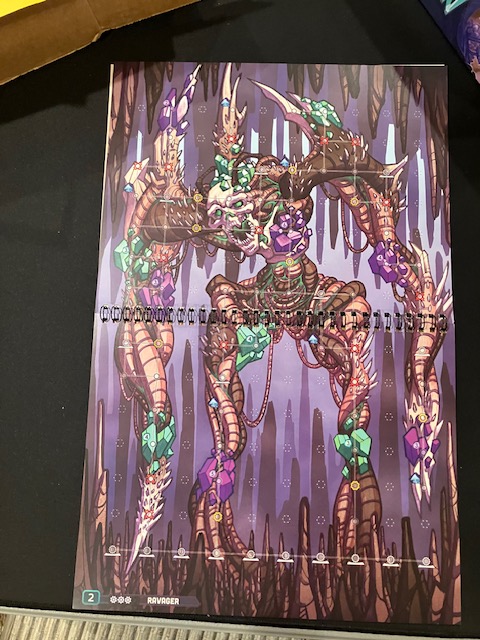
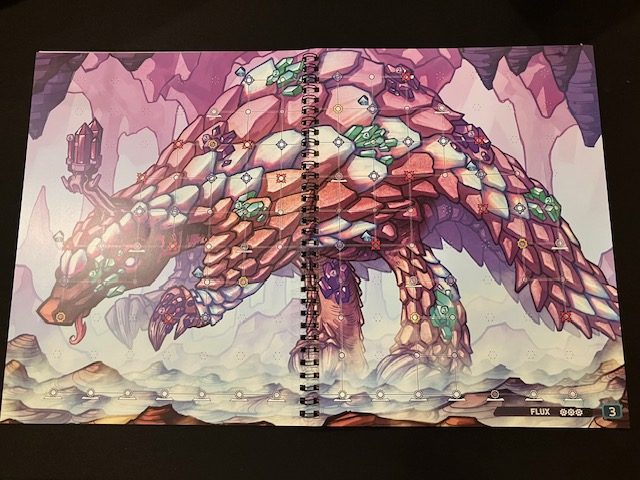
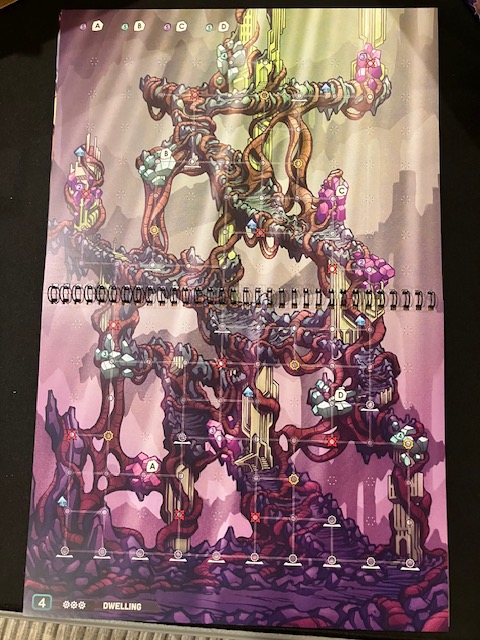
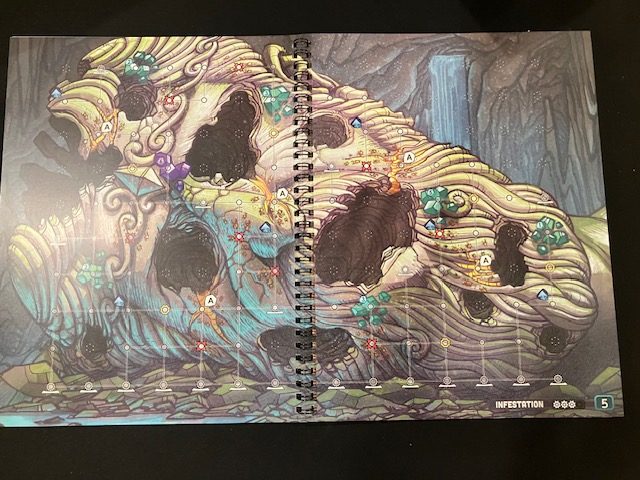
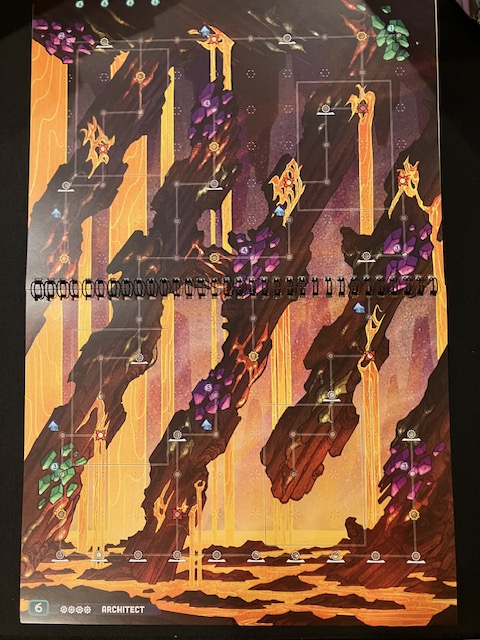
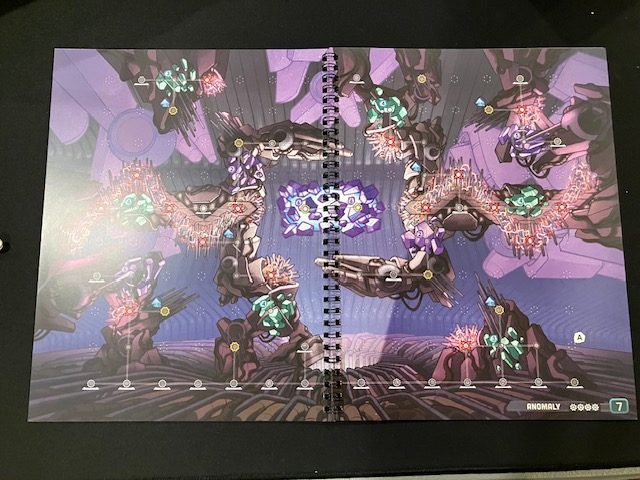
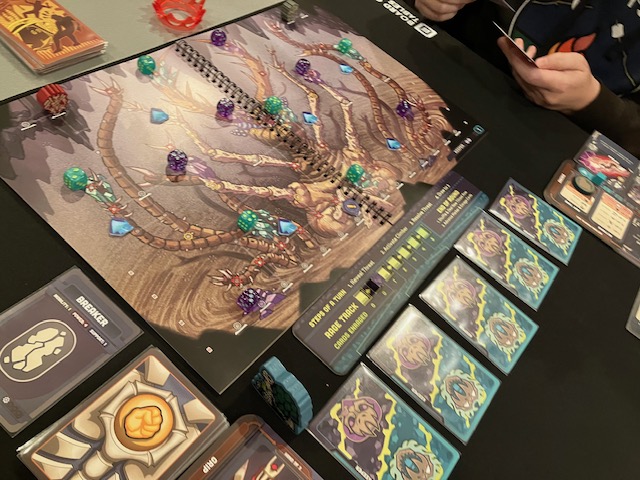
This is an area control/area majority game where players get victory points for controlling one of the eight areas on the map above.  
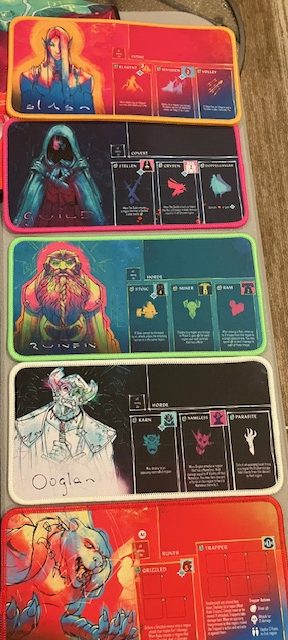
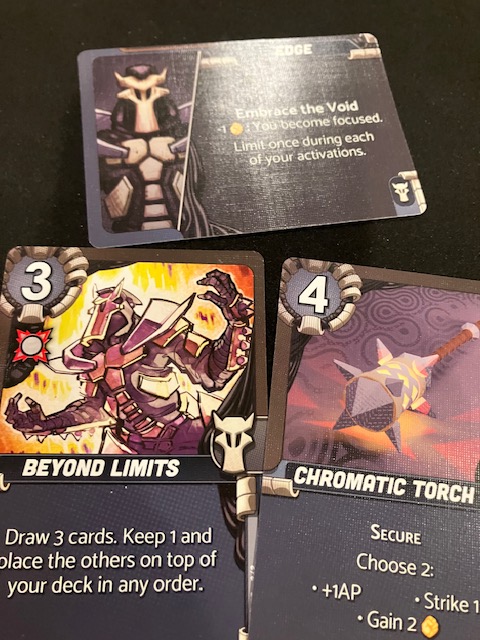
Each player takes control of one of 5 factions (see above), each with special powers and special dice (elite troops, we’ll see below)
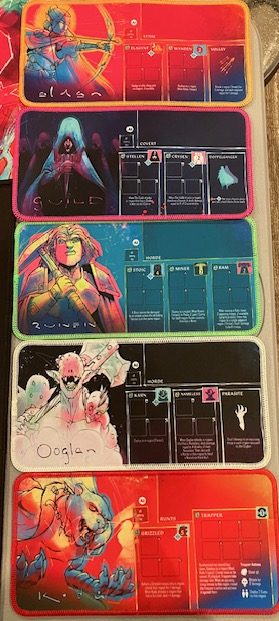
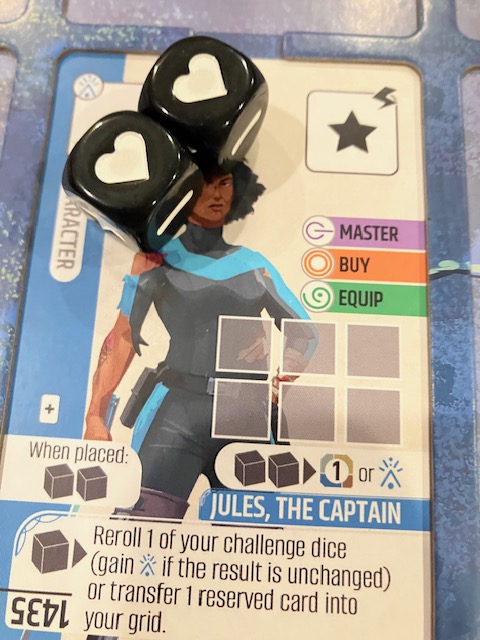
Be careful! There are actually two sides to each character! 
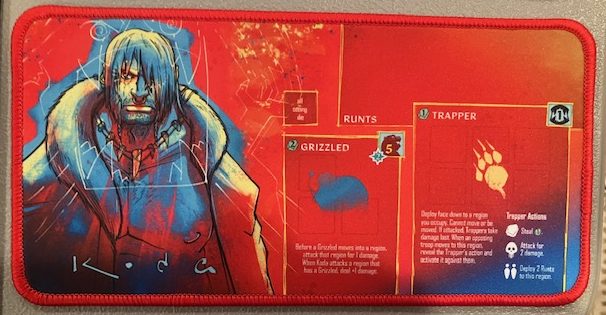
One side is the player side (see above): this is the side used by player characters.
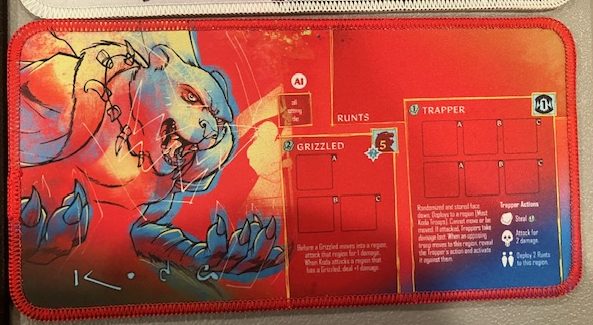
The other side is the AI side (see above) that gets used when you play co-op or solo.  If you play co-op or solo, one of these factions will be the bad guy the player(s) fight against.  How do you tell the difference between the two sides?  It’s a little hard to tell until someone tells you “look for the AI marker above the All-Seeing Dice space”.  It’s white, and a little hard to see. See above.
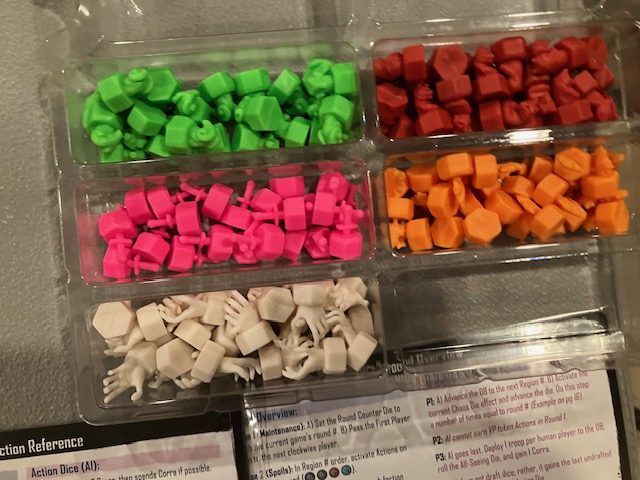
Each faction has their own basic troops, color-coded to the faction of interest.  The basic troops form the foundation of the armies that go out on the mat; these are used for combat and to show area majority.
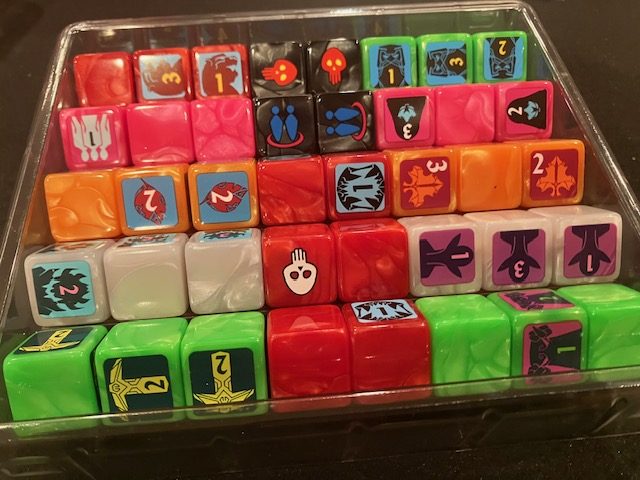
There’s a bunch of dice in the game, but THEY DON’T ALL GET ROLLED!  Many of them are used to mark elite troops for each faction.   The number on the die is how strong they are!  Again, all the elite troops are color-coded per faction.
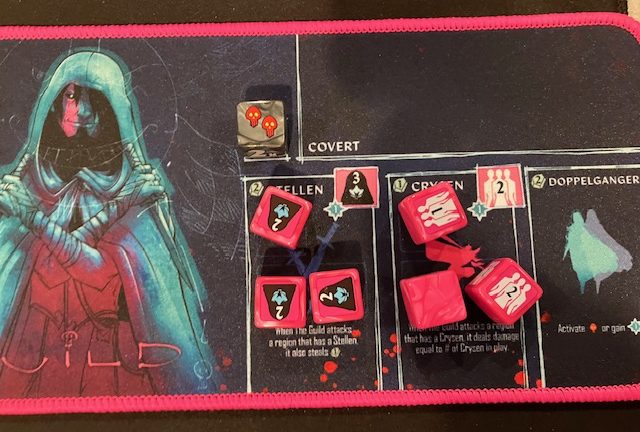
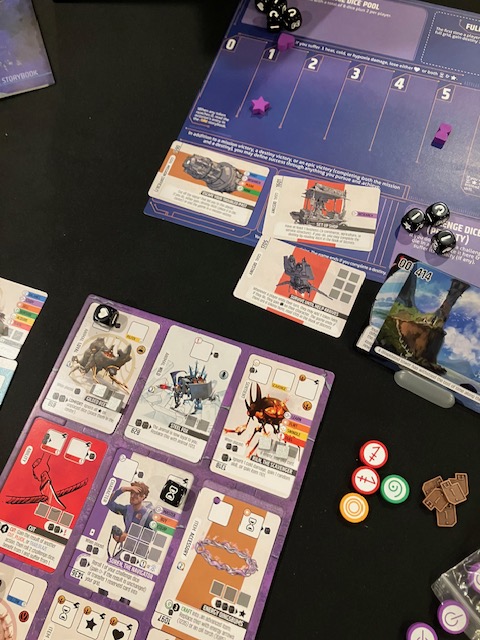
See above as the Guild faction gets his six elite troops: 3 Stellen and 3 Cryen.  You’ll note each elite troop type has some special powers notated on the player mat.
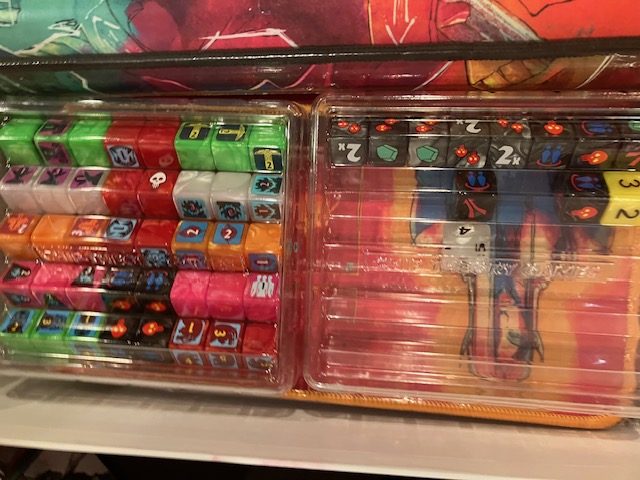
There are some dice that actually get rolled!
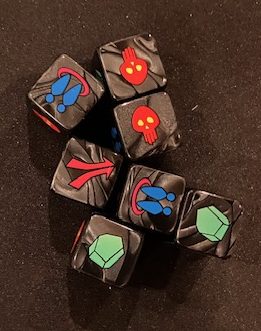
The action dice are rolled at the start of the turn, and each player will draft one action die in turn (multiple times).  This is a dice-drafting game.  After the dice are drafted, players will take turns “executing” the dice, depending on what’s on the face.  Move troops, disperse troops, do damage, or gain Corra (money) are the main actions.
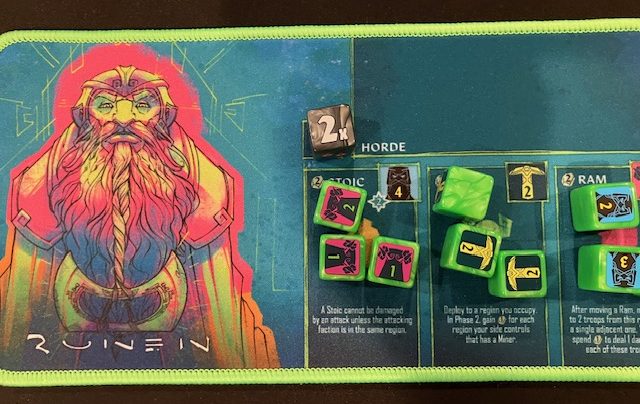
The All-Seeing Dice (next to the Horde) is a special die that’s rolled at the start of the turn: all players have a single All-Seeing Die. It’s a more powerful die that can be used anytime on your turn; it can augment your rolls, or give you more damage, or other things.  Every turn, you must play an Action die that you drafted, but the All-Seeing Die can be used (on your turn) when you want to, so you can choose when to use it.
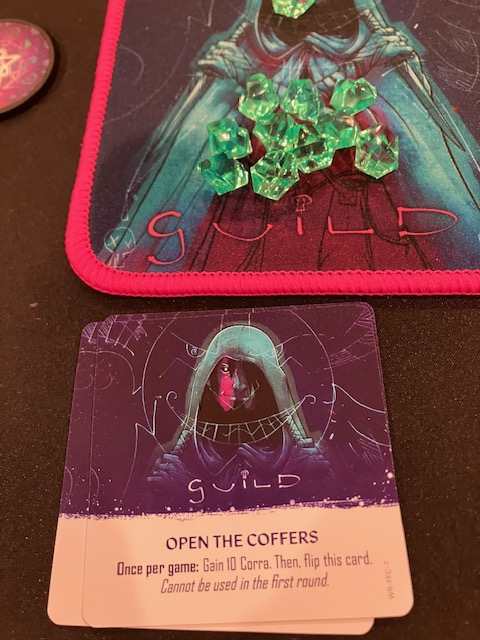
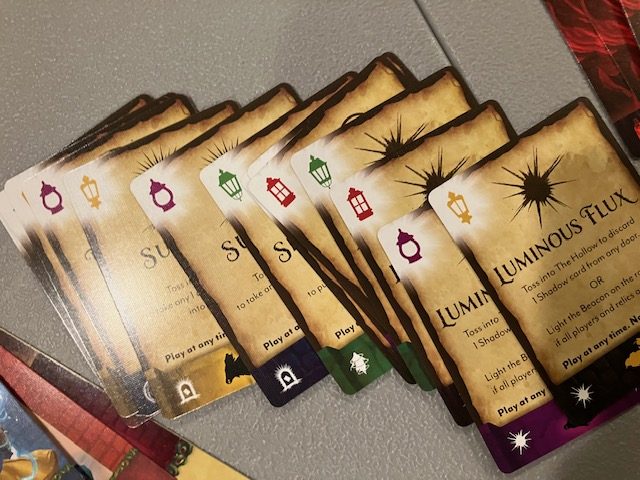
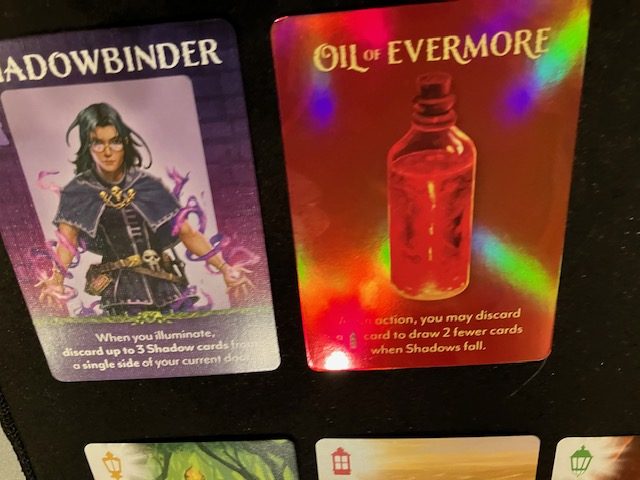
Each player has special abilities on the Faction Feat cards: see the three for The Guild above.  Players get to choose one Feat for the game.
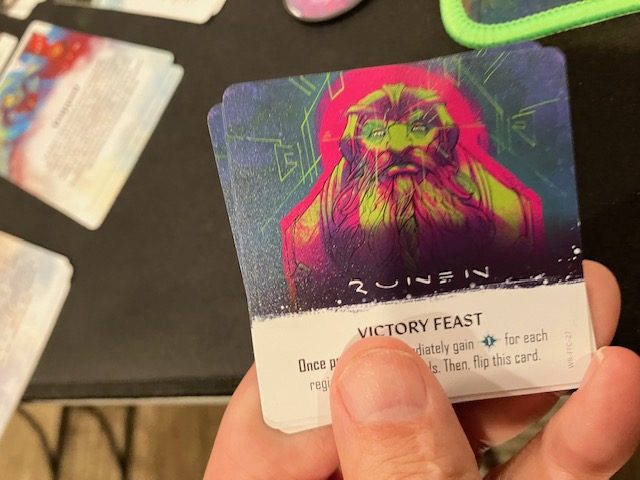
See three of the Ruinein feat cards above.  Each player gets to choose the power that matches their play style best!
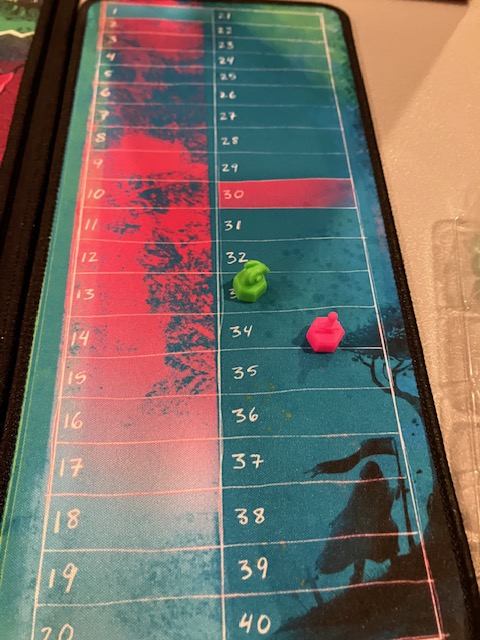
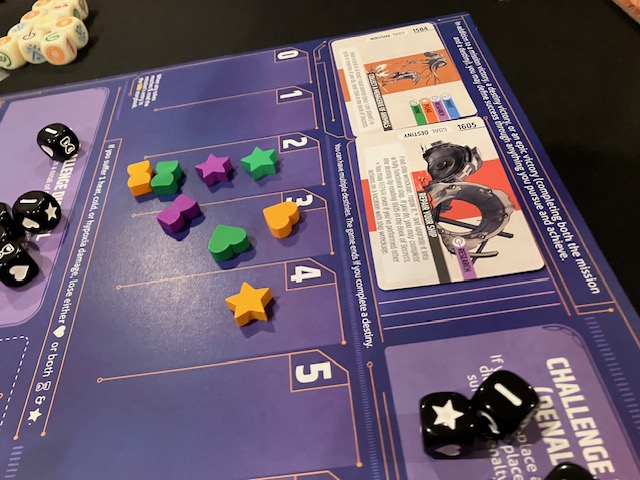
We’ve said that this is a victory point game, so there is a victory point mat for tracking said VPs!  In all the modes, the victory usually has something to do with having the most victory points!  A common winning condition is the player who gets to 30 VP first wins.
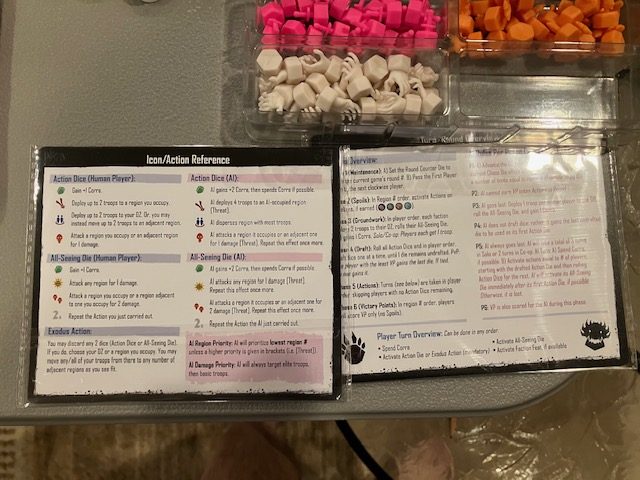
There are some player reference cards; 4 total.  Enough for everyone, but we shared two per side of the table (since the front and back are different).
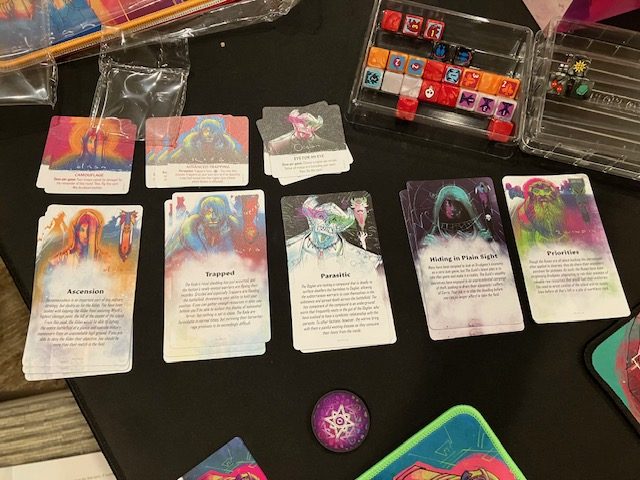
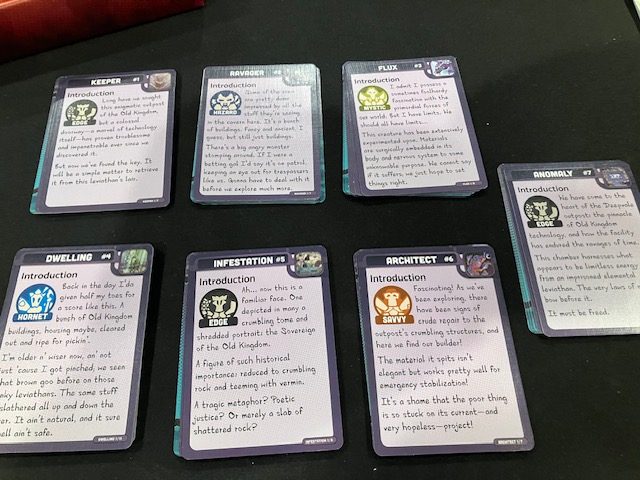
Finally, there are Solo/Cooperative scenario cards, 3 for each faction (see above).  As the name suggests, you only use them in the solo and co-op modes.
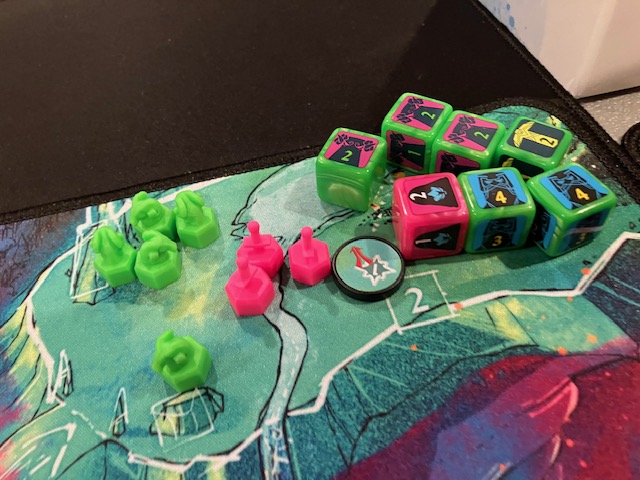
This is a game about getting troops (elite or basic) on the map and dominating regions!  If you dominate the region during the Victory Point round, you score the Victory Points for that region!  See above as green (Ruinen faction will dominate and get 1 VP for region 2.

This is an absolutely gorgeous game with beautiful components, graphic design, and art!  This is a game from Chip Theory games, which means that all of the components are water-proof!  The mats are all neoprene, the cards are all plastic, and the dice are plastic.  Of course, the box and rulebook are still cardboard/paper.   

Rulebook
The rulebook is pretty good, but has some issues.
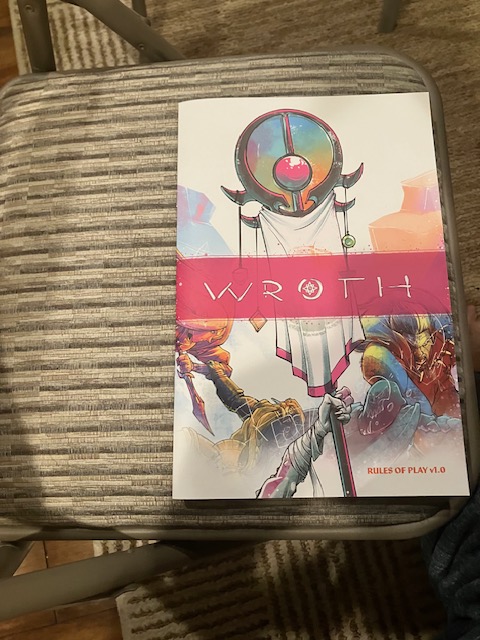
First of all, this gets an A on the Chair Test!  
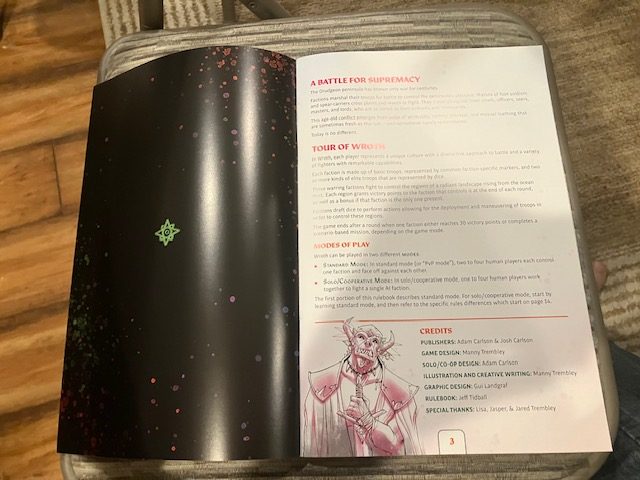
When opened on the chair next to me, the rulebook stays open flat, it has a nice big font, and doesn’t flop around over the edges.  It’s easy to consult this rulebook on the chair next to me!
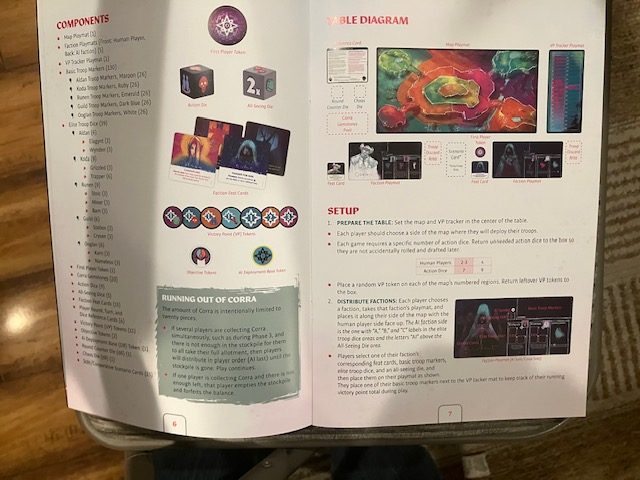
The Component page was a little frustrating; they list all the components, but don’t correlate them well with pictures.  See above: there are a few pictures, but given how much white space on that page, they could have easily made a better components page.
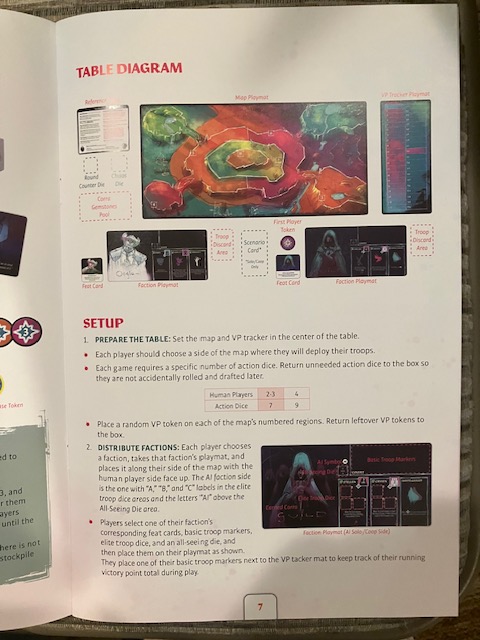
The set-up is ok; it actually spans two pages (7 and a little bit of 8) and the set-up crosses a physical page boundary (i.e., you have to turn the page): Boo!!!  The best set-ups are when all of the set-up is across two pages across from each other.  They also didn’t define some terms during the set-up (what is a “side“?) that made it harder to set-up.  The set-up was just ok.  It really should have been better.
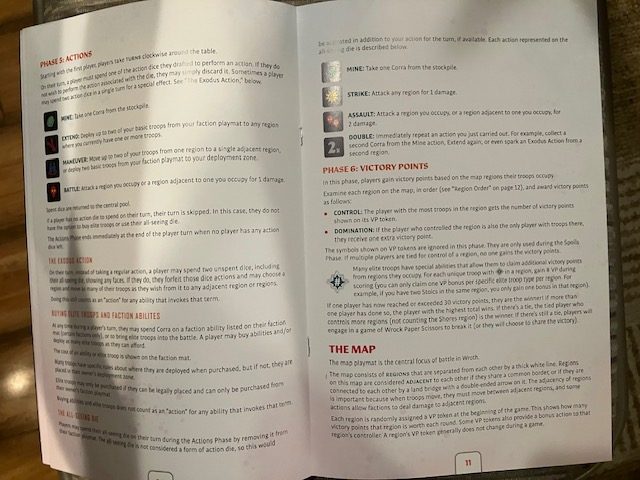
In general the rulebook was pretty good.  There was a lot of text!  There are were a number of pages where I think a bulleted list would have helped (esp. in the AI section for solo/co-o mode).
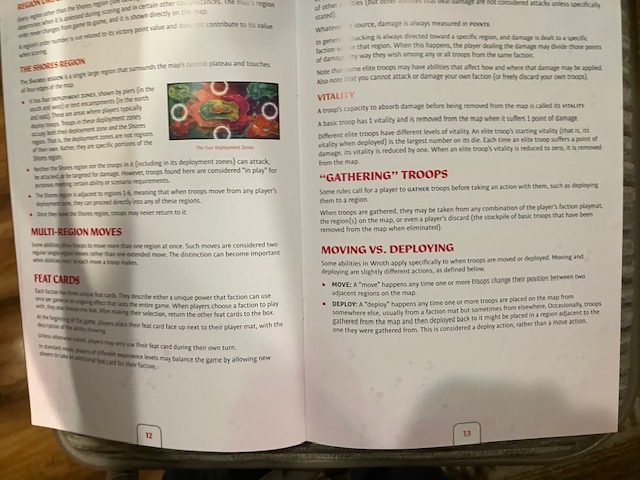
We’ll discuss more about the rulebook in the “When Is a House Rule Not a House Rule” section below, but basically there are a LOT of edge cases that aren’t well-specified.  In fact, there’s one rule for which the interpretation may make the difference between you liking and disliking the game!

But, I was able to learn the game and teach the game using the rulebook.  I also really liked the font and layout; it was easy to read physically the book.

A Strange Journey
I was very excited for this when it arrived!  A solo and cooperative area control game! So cool!
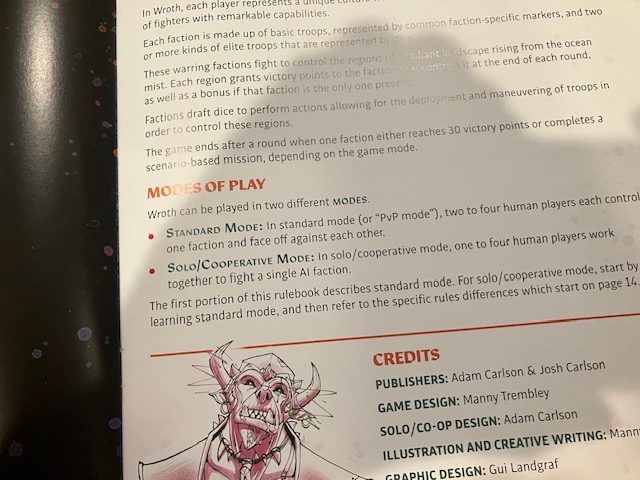
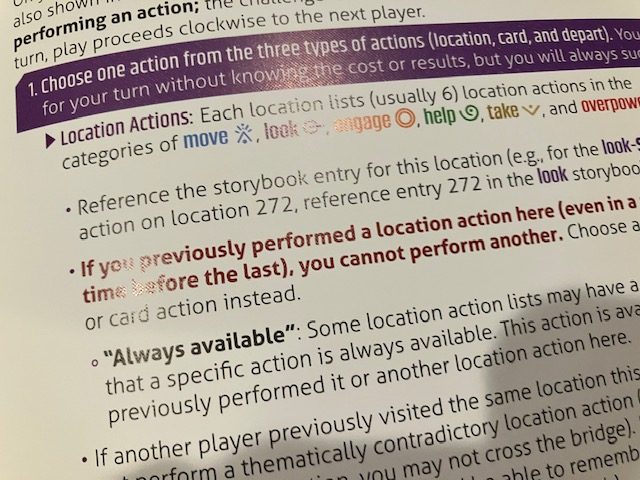
However, my bubble was burst a little when I read the Modes of Play (page 3 of the rulebook, see above).  In order to play the solo game, you MUST understand the Standard Mode!  In other words, you must play the competitive mode in order to push on to the solo mode!  That seems like a missed opportunity, because many people’s first play would probably WANT to be solo (so they can learn the basics) and then teach.  Nope.  You gotta learn competitive mode first!
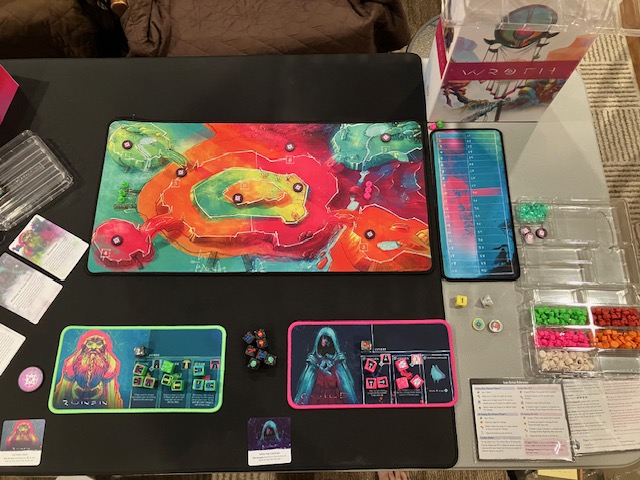
So, my first game was a Me vs. Me competitive game (Ruinein vs The Guild) in the Standard Mode!  I really wish the solo game had been the first game to play!  I guess, strictly speaking, Me vs. Me is a solo mode (as I play both factions myself), but it’s not normally how we define “solo play”.

Over the next few weeks, I ended up playing four different ways!!
(1) Me vs. Me Standard Mode (competitive)
(2) 3-Player Standard Mode (competitive)
(3) Solo Mode (cooperative)
(4) 2, 3-Player Cooperative Mode

Me vs. Me
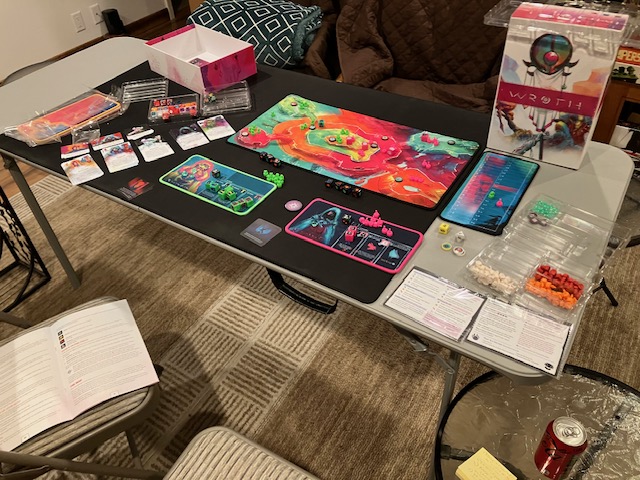
The Me. vs Me solo game (competitive) actually worked very well to teach the game.  I had to get over a bunch of rulebook issues (and I did), but I came to appreciate the competitive game! Look, this is a solo and cooperative games blog, but the competitive mode is quite elegant! It’s very simple to learn, it moves quickly, and it is very punchy!  My Me vs. Me game only lasted 45 minutes, and it never felt like it bogged down!  The turns were quick, the mechanisms were easy to get a handle on (mostly), and it was very punchy! (Pun intended!)
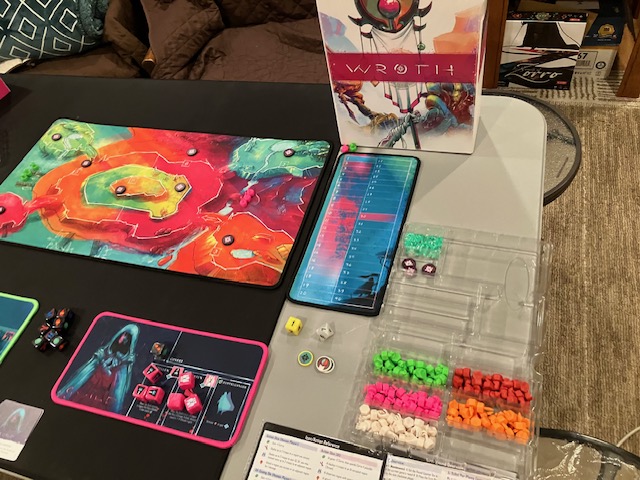
I was kind of shocked how much I liked the competitive game in the Me vs. Me mode; after all, this is a solo and cooperative blog!  I can’t like the competitive mode, can I?

Solo Mode (first game)
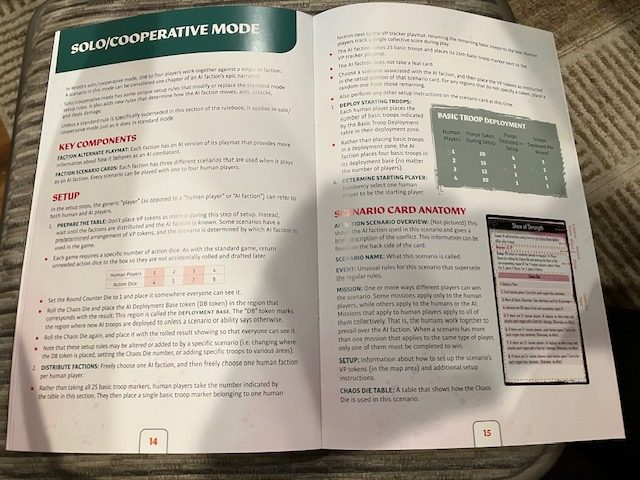
Remember, you can’t play the solo game until you learned the Standard Mode! So, after the Me vs Me game, I played solo mode.  (Thank you Wroth for following Saunders’ Law!).  These rules are described in six pages at the end of the rulebook.  Yes, that’s right, the solo/cooperative modes need six pages to describe the rules!!!  This is NOT an easy extension of the base rules!
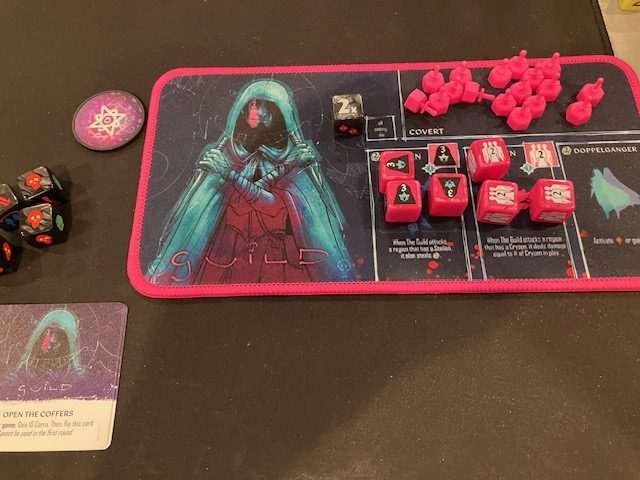
This solo mode is true solo mode, as you take control of one faction and then fight another AI-controlled faction.  I stayed with The Guild (see above), since I felt comfortable with that faction from my  Me Vs Me game.  Set-up was the same for my character in solo mode (modulo how many basic troops I get).
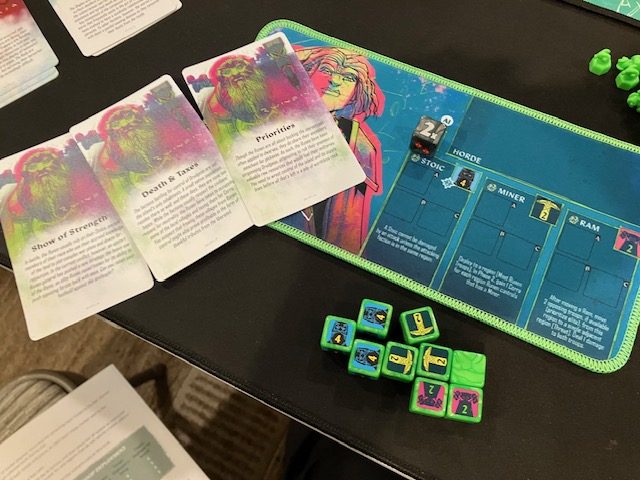
For the solo game, you fight one opponent; another faction!  To do that, you flip to the AI side (see above) and choose one of the three Scenario cards for that faction!  See above, I chose Priorities.  
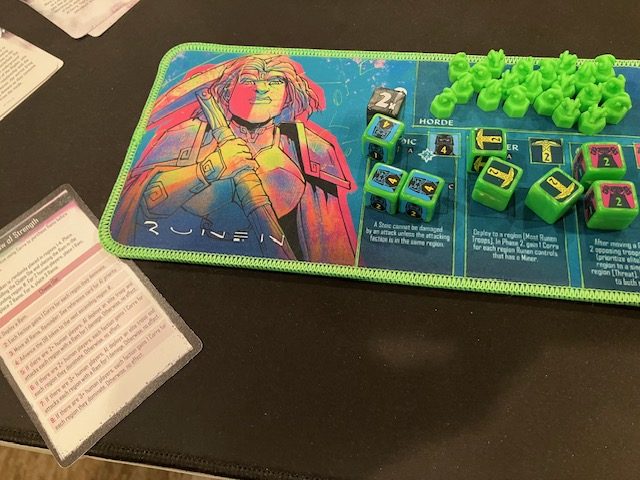
In the solo game, the opponent uses the flip side of the Scenario card; it gives bad news, depending on the turn number!
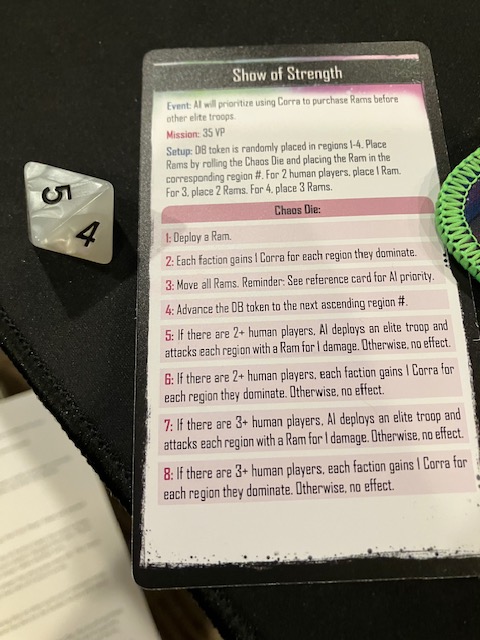
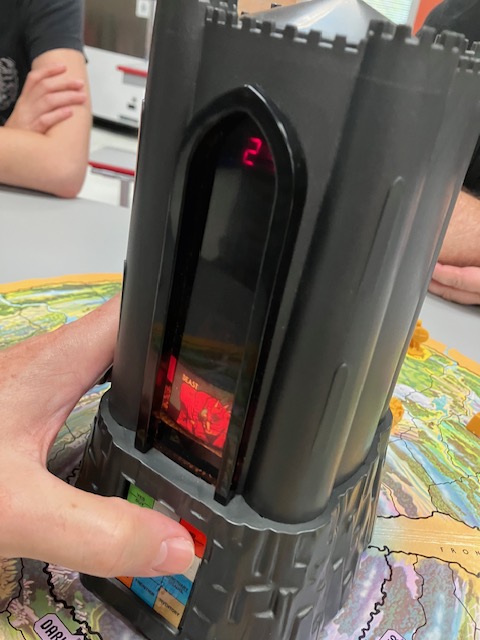
You always know what the bad news will be, as the Chaos Dice (8-sided die above) indicates which bad news will erupt! It’s even worse, as more bad news happens as the game proceeds! On turn 2, you will have 2 bad news events (in order from the card), 3 bad news events on turn 3 and so on!  The only good news here is that you know EXACTLY what the bad news will be, (as it just increments by 1 per turn) so you can plan for it.
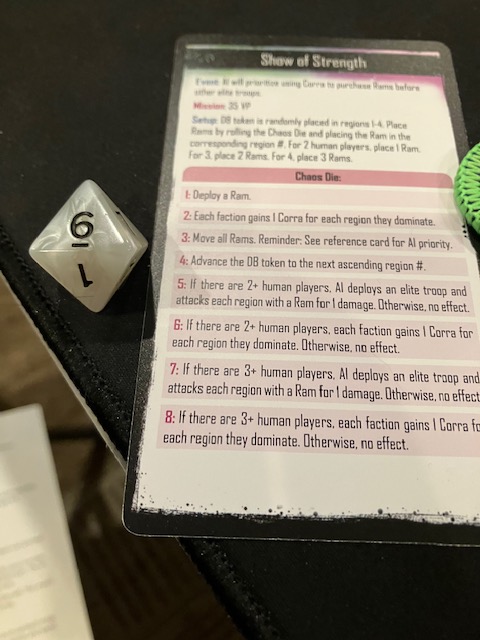
The set-up is also described on the card (see above).
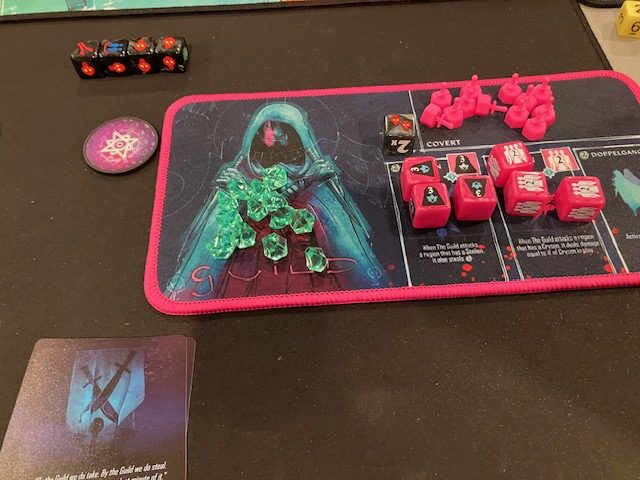
It’s still a dice drafting game, as you choose dice and the opponent gets the left over die.  You know what your three actions will be, and you know the opponent’s first action.
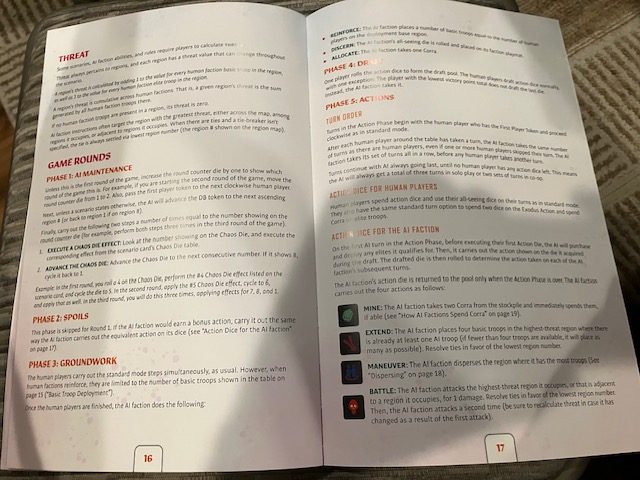
In the solo/co-op mode, however, the dice mean something different!  In general, the AI actions for the dice are about 2x as powerful! 

(1) the Mine action gives the AI twice the Corra
(2) the Extend action moves 4 troops to the mat (instead of just 2 for human players)
(3) the Maneuver action really allows the AI to spread out faster than a plain move
(4) The Battle action does twice the damage as a human battle

See (page 17) the descriptions of the dice for the AI faction above.  I think the idea is that, because the solo plauyer can see what’s coming (since the solo player drafts the action die for the AI), the action dice are “twice as powerful” for balance.  The solo player gets to choose the action dice (at least the first one), and so he has an advantage.  On  later turns, the AI simply rolls the die, so it’s not clear what’s coming.   So, for balance purposes, I think the action dice are more powerful for the AI.
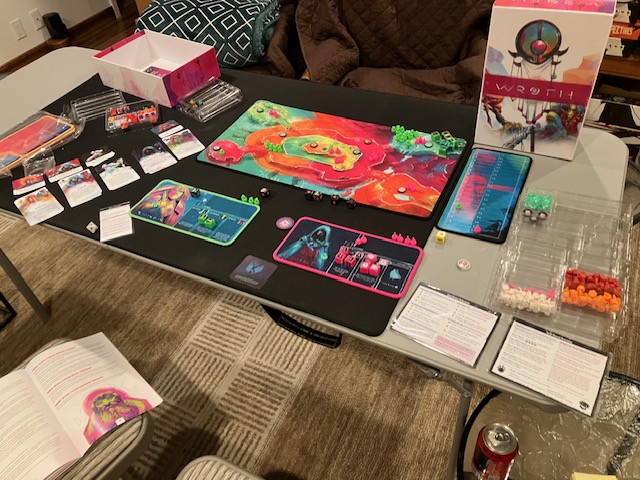
My first game ended in a win, as I beat the AI like 40 VPs to 16 VPs, but I look back now and realize that I played a lot of rules wrong.  Was it too easy?  Before I make any pronouncements on the solo game, I need to play solo a few more times.   But, playing the first solo game gave me to confidence to teach the cooperative game.

Competitive Mode (3-Player)
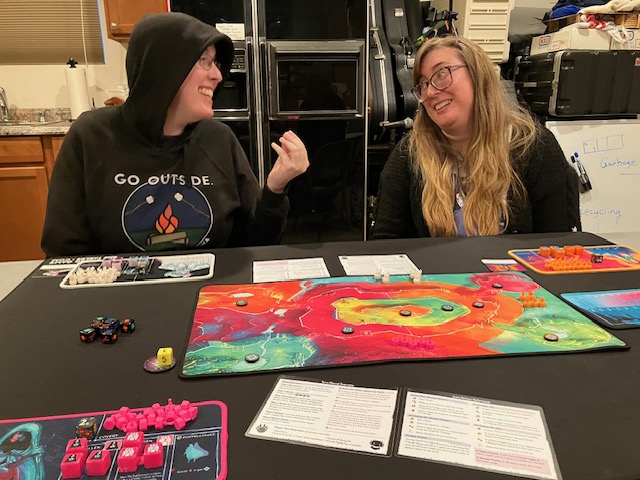
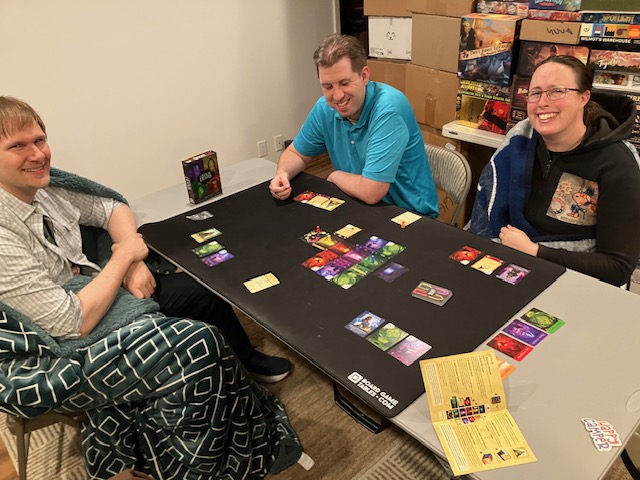
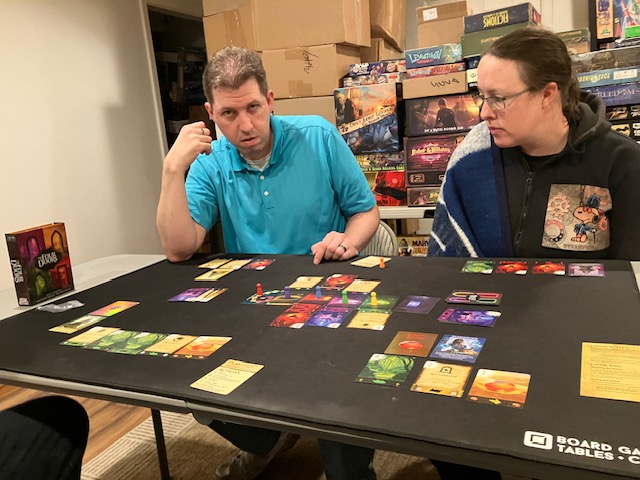
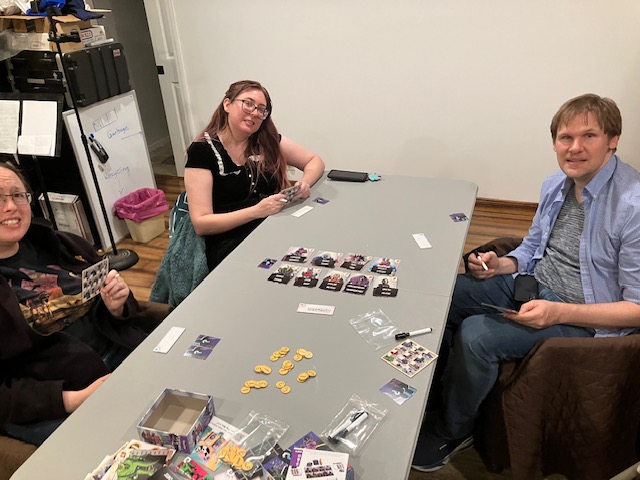
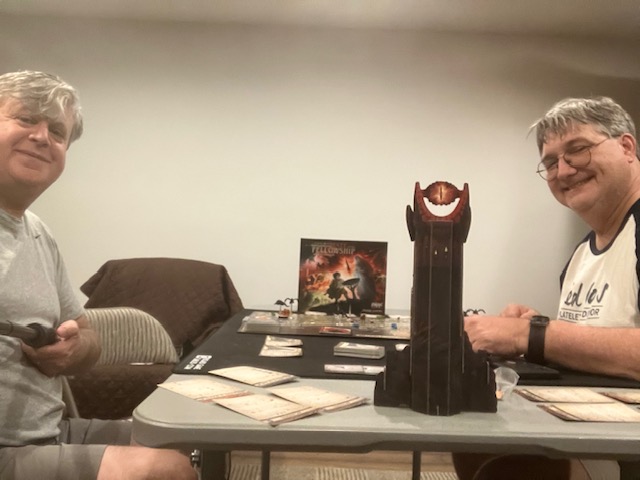
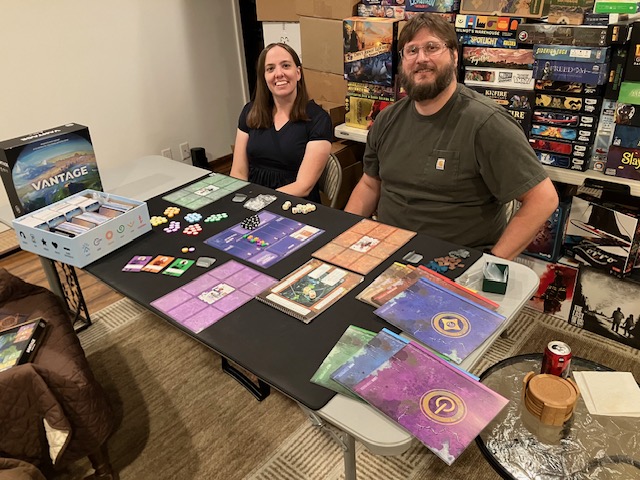
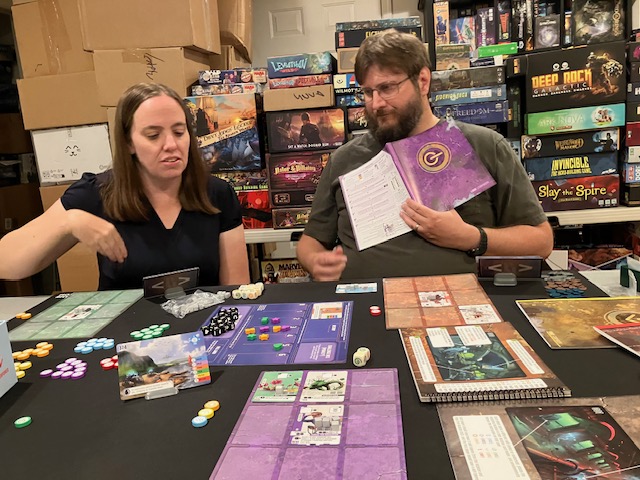
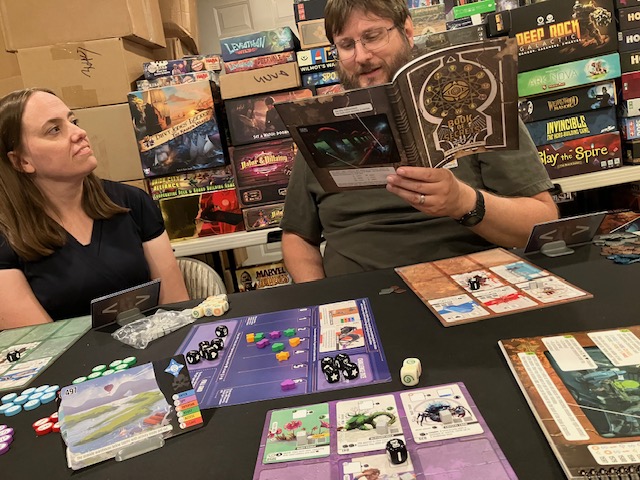
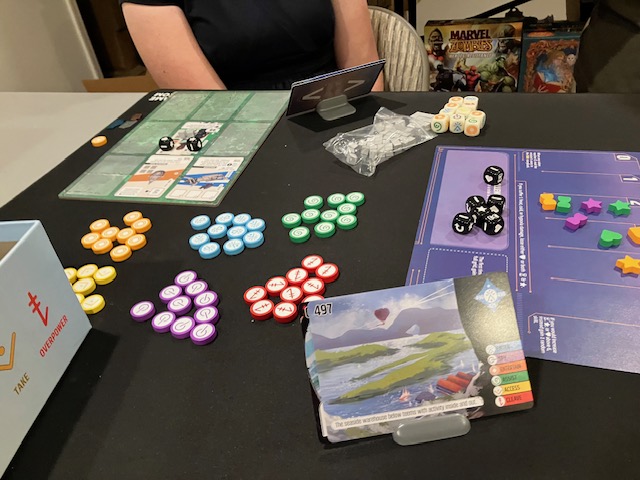
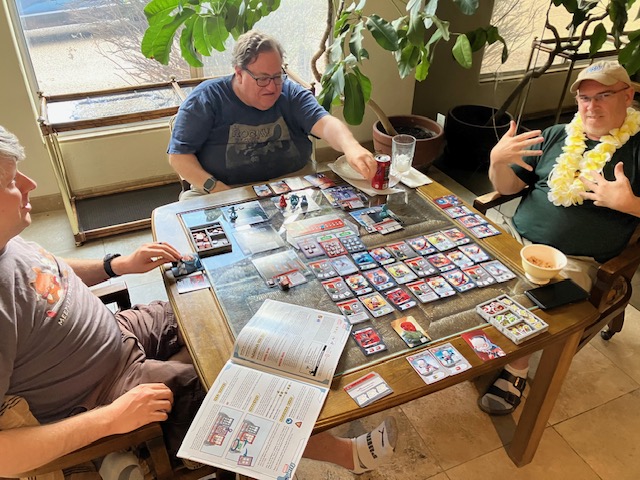
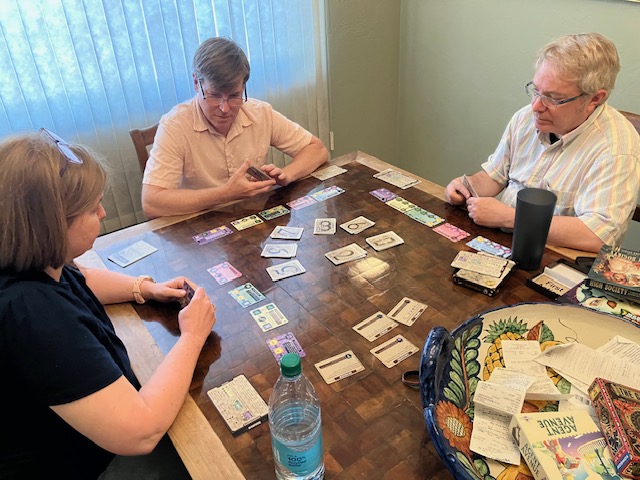
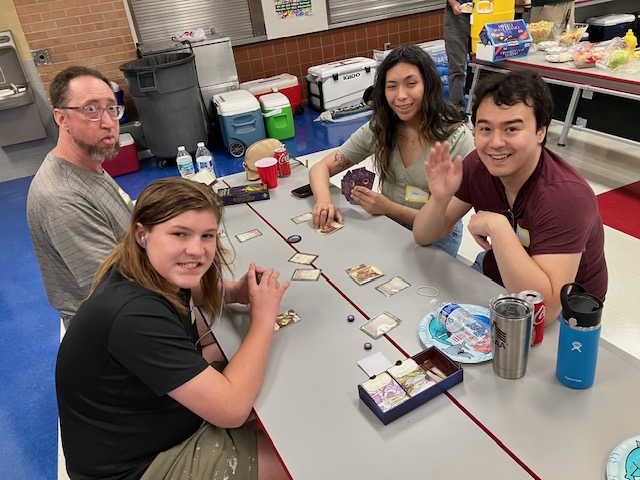
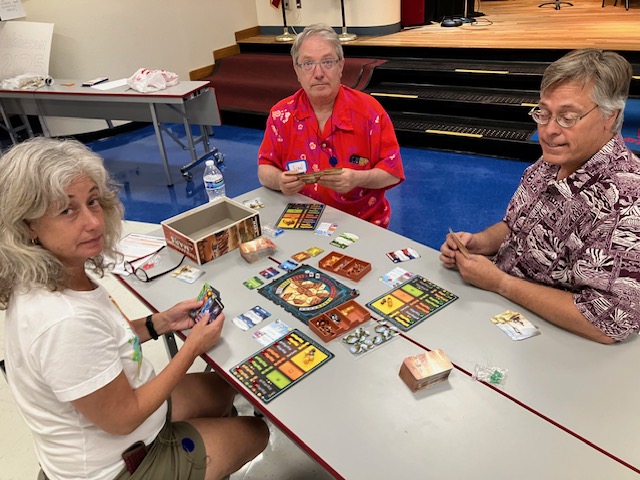
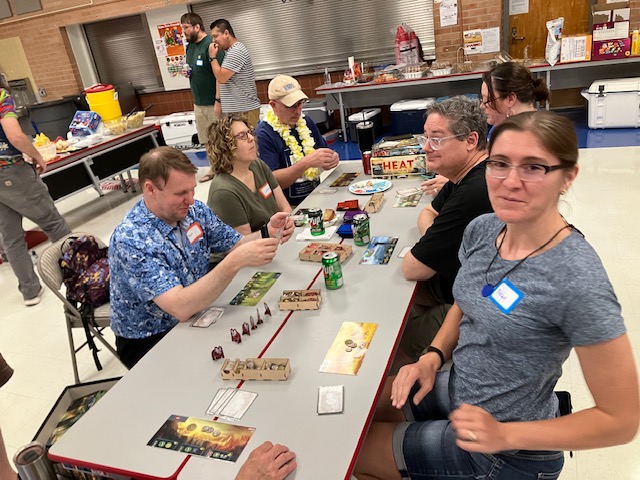
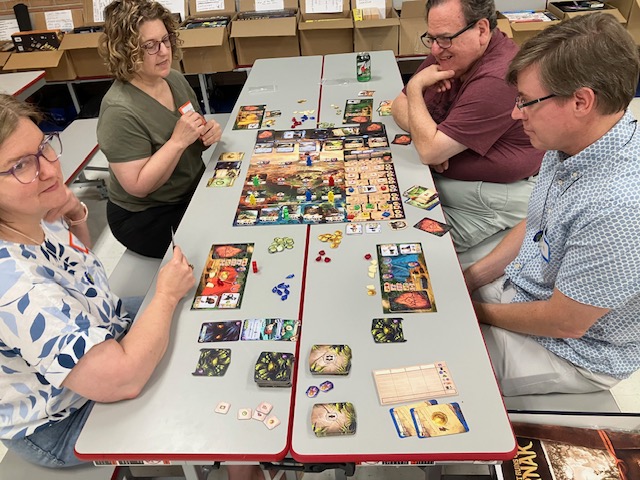
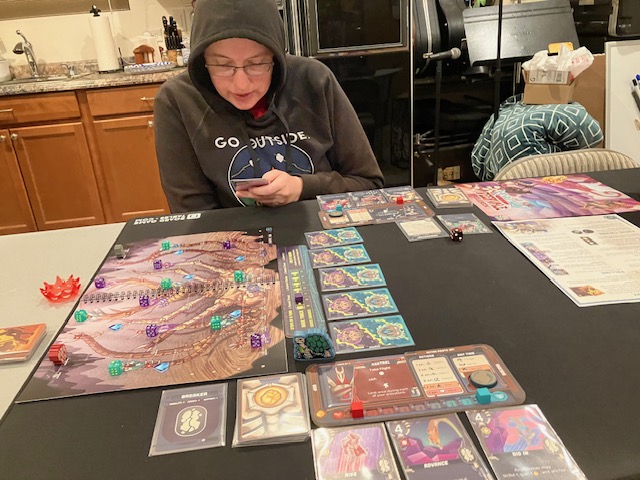
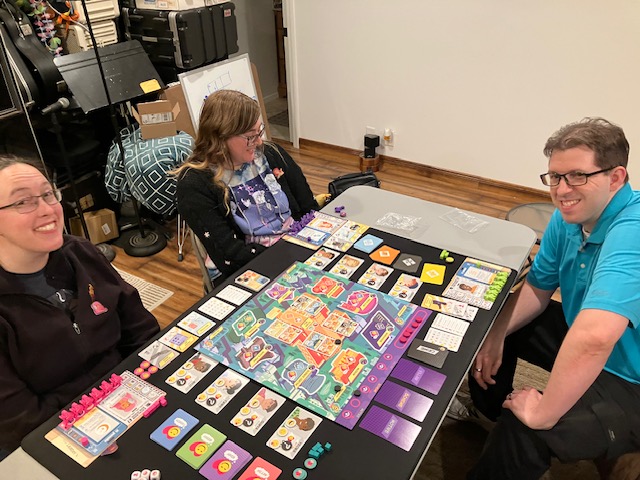
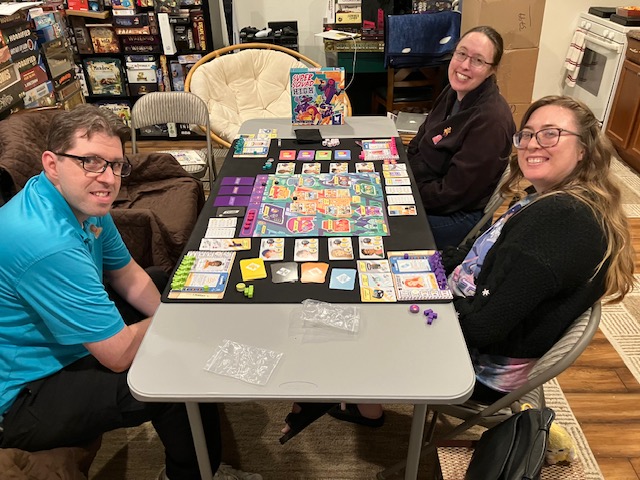
In order to teach my friends the cooperative game, they first had to learn the competitive game.  See us setting up above.
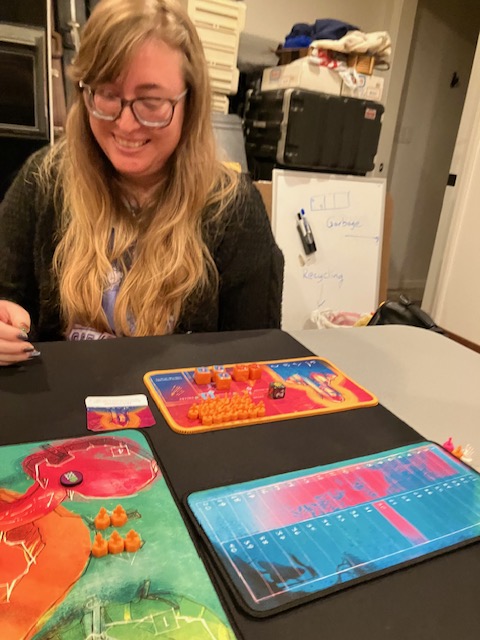
Just like the Me vs Me solo game, the competitive game was easy to teach!  Easy to learn! And it was punchy!  It was over in about an hour (just like the box says)!  I recommend teaching the competitive game first in just about all situations!
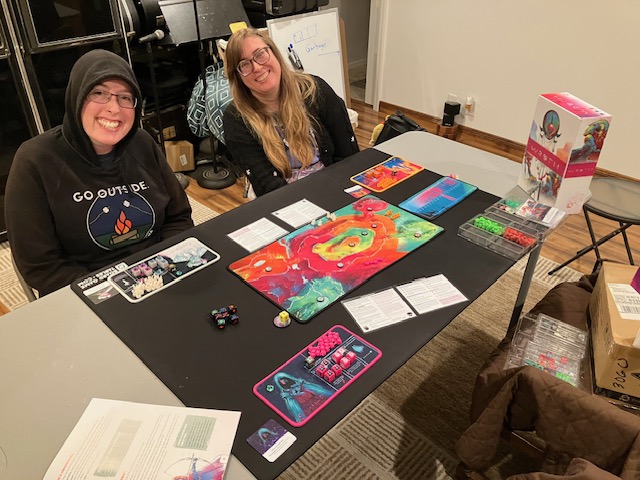
Sara absorbed the rules quickly and actually beat my one Victory point!   It was so easy to get the competitive game to the table!

After my Me vs Me game and my 3-Player competitive game, I can honestly say I am very impressed with the competitive game of Wroth!  I don’t like competitive games that much, and I really liked Wroth! The best word I can use to describe it (with pun intended as well) is punchy!
It just moves quickly and is easy to to get into! It really does take 60 minutes as the box says!  If someone ever wants to play a competitive Risk or some other competitive Area Control/Area Majority game, I’ll say “Can we play Wroth instead?

Cooperative Mode

If you thought this was going to be a rave review of Wroth, well, you’d be wrong.  After having a nice time playing the 3-Player competitive game of Wroth, we headed into a 3-Player cooperative version … and got decimated.
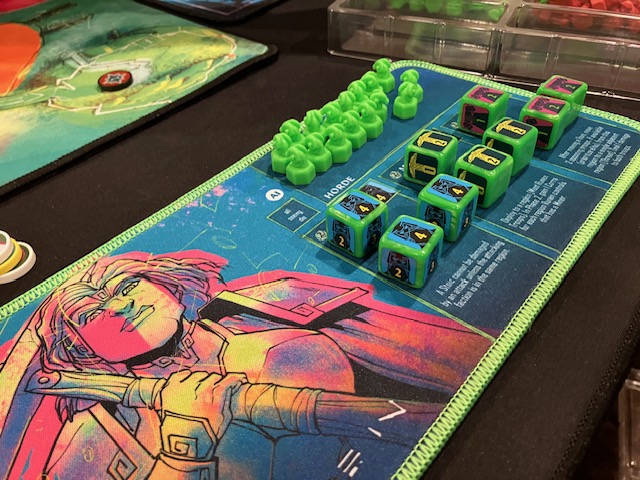
In the cooperative game, the players fight one AI faction, just like in the solo game.  Just like the solo game, the players choose a Scenario card “Death and Taxes” (see below) … We played against Ruinein (see above). 
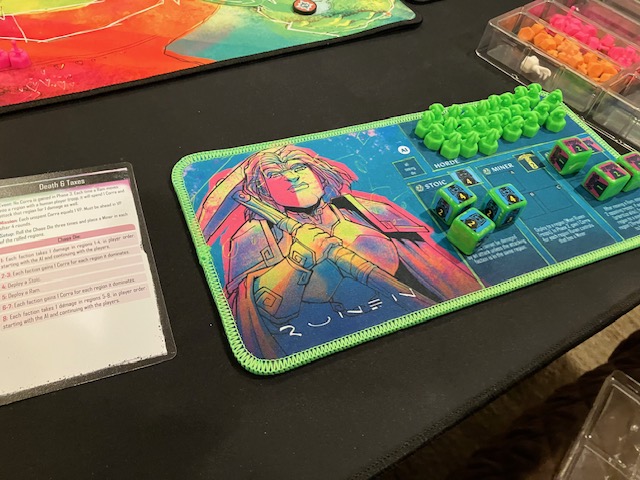
For balance, the AI player gets the same number of turns as the human players, but only after the  human players have gone.    Thus, after each human player activates on action die, the AI player gets that many unanswered turns in a row!  This is for balance; in a 3-Player game, the players do three things, then the AI gets three turns to answer!
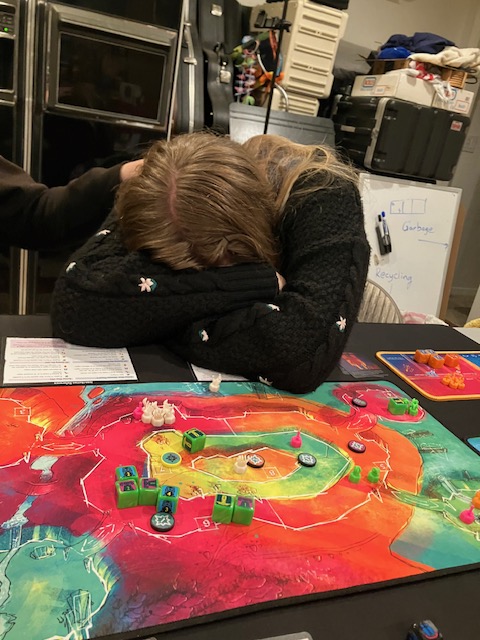
We lost our game like 3 to 43.  Yes, you read that right.  We had no good turns, and the AI kept us off the board so we couldn’t score any Victory Points.  It was literally the worst cooperative game I played in some time.   It felt so random and unbalanced as the AI opponent turns were twice as powerful!  And we couldn’t see what the AI would do because in his turn, he just rolled the dice, so we had no way of knowing!
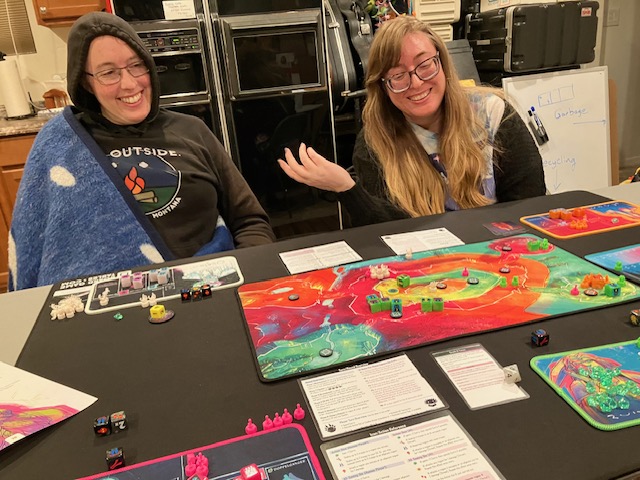
After this cooperative game, I put my game of Wroth on BoardGameGeek to sell it. I hated this play so much!   I am pretty sure we played it right, but there was so much randomness in the game, it wasn’t fun.  

Randomness
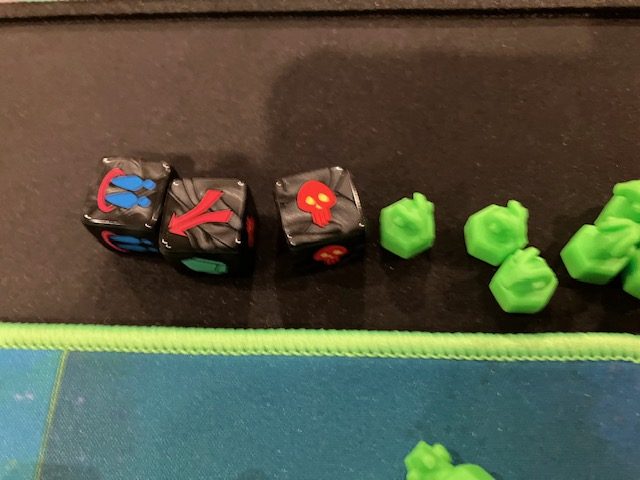
First, you don’t get to choose what you do on your turn, you can only draft the dice that get rolled into the pool.  I have phrased this: “You have to do what the dice say”.   In the competitive mode, this doesn’t feel like a big deal, because all players are equally stuck with this decision and you can see what everyone will be doing … so, you can feel more prepared.  In the cooperative mode, you have very little idea what the AI will do because he gets to roll the dice!  And you may not know what it is! (In the solo mode there is much less ambiguity).  And it’s even worse if there are more people playing!
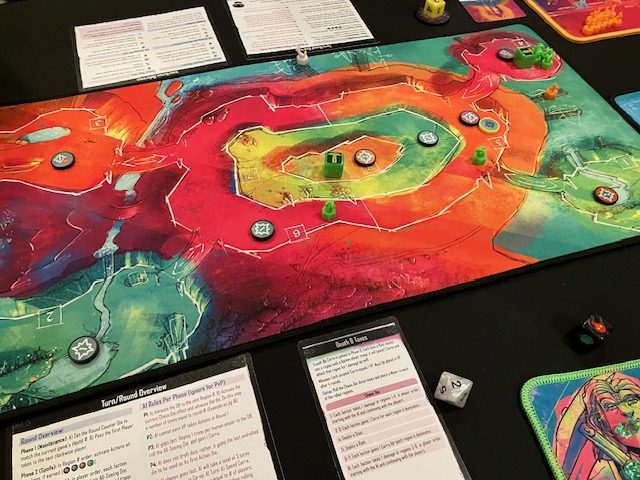
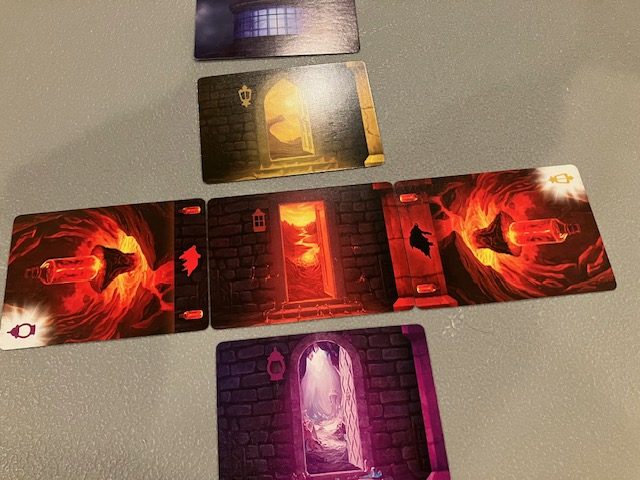
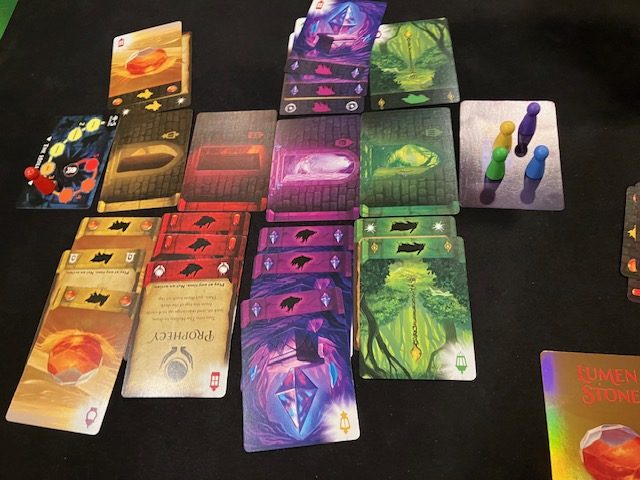
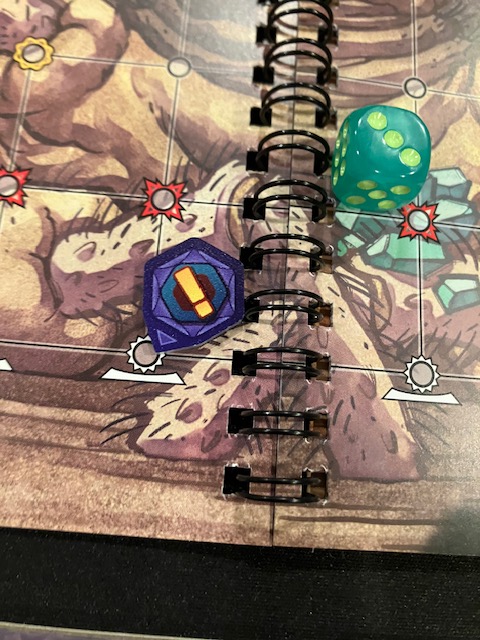
Second, in the cooperative game, where the AI starts can have big difference! You have to roll!  If the AI starts in section 5 or 6, they are adjacent to SO MANY more regions, and can keep you off the map because they can attack you more!  In our first game, the AI started on section 5 (see above), and because of that one position, the AI was able to decimate our troops off the map because he could reach almost all of us quickly! Remember when I said the AI’s action are about “twice as powerful”?  If the AI fights you in the first few rounds, he can easily knock you off the board.  

The solo game mitigates this randomness because you can see what the AI is going to do on his turn.   In the cooperative mode, the AI will roll dice and you have no idea what will happen! It’s even worse for more players!

I think the idea of the AI’s actions being “twice as powerful” is for balance; probably half of the time, the AI may roll an action which DOES NOTHING, so when the AI does roll something useful, it needs to compensate by making the useful actions twice as powerful!  The idea is that the AI gets, on average, as much efficacy as the human players (as the “do nothing” rolls get averaged out with useful rolls).

The only problem with this is that, if the AI rolls well for a good number of its rolls, it will simply decimate you. And that’s what we saw in our first cooperative game.  A  post-analysis of the game had us thinking we lost in round 1 as the AI rolled exactly what it needed to get us off the map, and we couldn’t get a foothold after that.

Solo Game Revisited
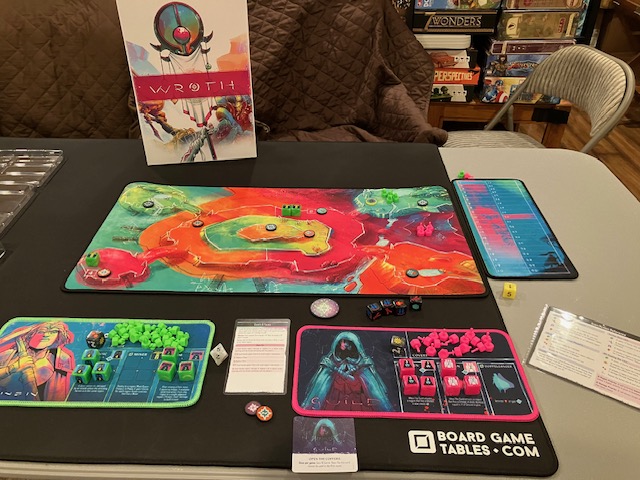
After such a horrible cooperative experience, I wanted to played the same horrible scenario solo.  Was this a fluke?  Was it something else?
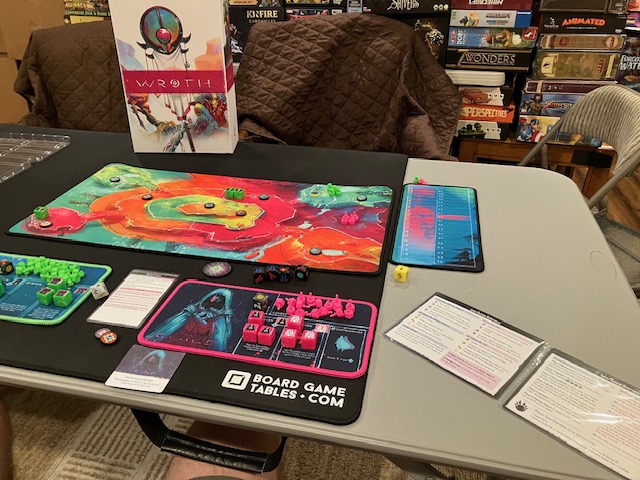
I ended up playing a very balanced game and was able to beat the same Scenario that crushed us in the 3-Player cooperative game.  Part of the reason was because I could see more what the AI was going to do, so I could try to be smart and work around it.   The randomness wasn’t nearly as pronounced because I could see what what the AI would do most and plan for it (but see below).  It’s only in the cooperative game that the randomness can run away, because the AI starts getting random, unanswered turns (in the 3-Player game, the AI gets three unanswered turns in a row).
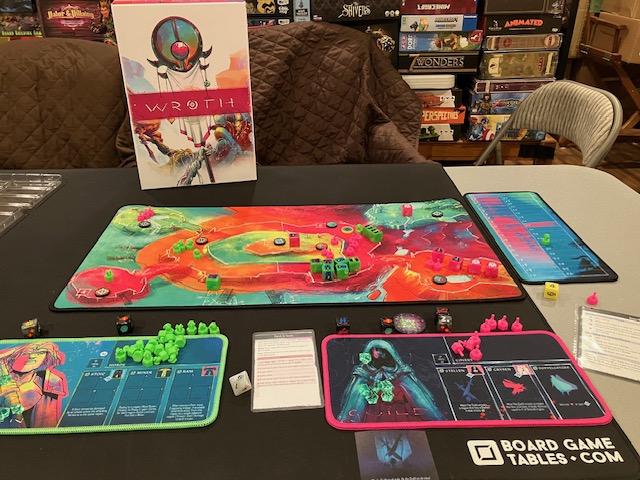
I really liked my solo game.  Now that I knew all the rules better, I could be smart.  I could outthink the AI.  The solo game is a puzzle. And I love that!

I had put my copy of Wroth up for sale on BGG after such a horrible cooperative game.  I would be okay if it didn’t sell, because I had like the competitive game so much.  I wasn’t sure about the solo game until I got a few more under my belt.  I like the solo game; it’s a puzzle.  I took my copy of Wroth down from BGG and have decided to keep it.

And after a few more solo games, I realized I made the right choice to keep Wroth.  This is a neat solo game.

When Is a House Rule Not a House Rule?
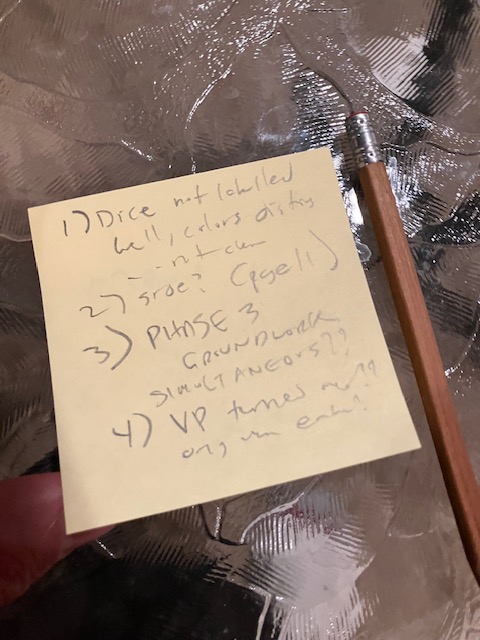
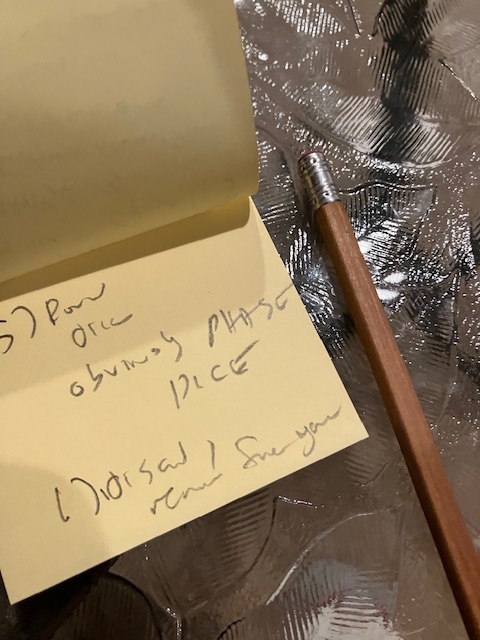
I have at least three or pages of questions about edge rule cases after playing numerous times: see my little stickies above.   Although the rulebook is pretty good, it really doesn’t address a lot of edge cases.  

In particular, the Solo/Co-OP Scenario cards have limited real estate (they are just cards), and all the rules have to be on the back!  There are no FAQs (yet: see this thread here on BGG), and each Scenario is very different and will need questions answered.   I love the plastic cards that Chip Theory uses, but this is a case where I think having a separate Scenario book would have been a better choice.  There are much fewer real estate issues (a page will have much more space than a single card) and further elaborations/FAQs could be placed in there.  

When is a House Rule not a House rule?  When we have to make a determination based only the information you have!   If the rules aren’t clear, we have to interpret the rules so we can move forward!  Maybe we interpreted it wrong, maybe we didn’t.  But we can’t call it a House Rule because a House Rule is usually when you choose a different direction when knowing the rules.  

Most of the rules made sense after I have played about 5 or 6 times.  There is one rule that’s very important, and may determine how much I like this.  I don’t consider this a House Rule because the text is unclear.
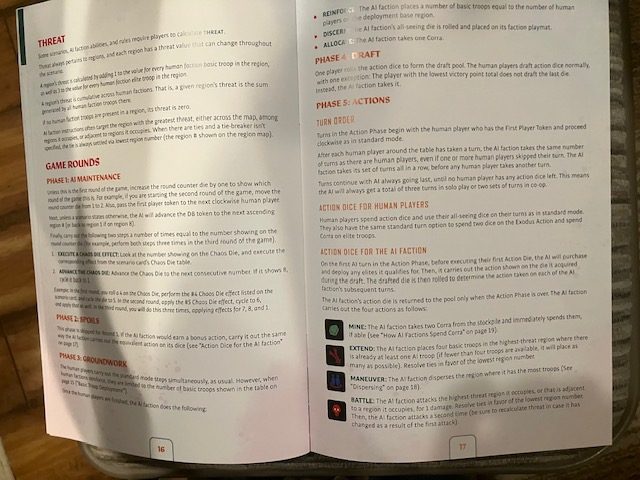
When the AI rolls an action die after he takes a turn, when does that roll happen?  On page 17, the text says:  “The drafted die is then rolled to determine the action taken by the AI faction’s subsequent turns”.   When is it rolled?  If it’s rolled at the START of the AI’s turn, then you don’t know what the AI will do!  If it’s rolled AFTER the AI has taken his action, then the players will know what the AI will do!  I think, by the phrasing above, that the AI die is rolled AFTER the the AI has taken his action.  This minor difference might be the difference between me liking the solo game or not! If I can be smart and see what the AI is up to, then I can plan ahead! Even if the AI turns are twice as powerful, I can still plan around them.

It’s not a House Rule if the interpretation is unclear.  I am going with the interpretation that makes me like the game more; AFTER.

Cooperative Play (revisited)
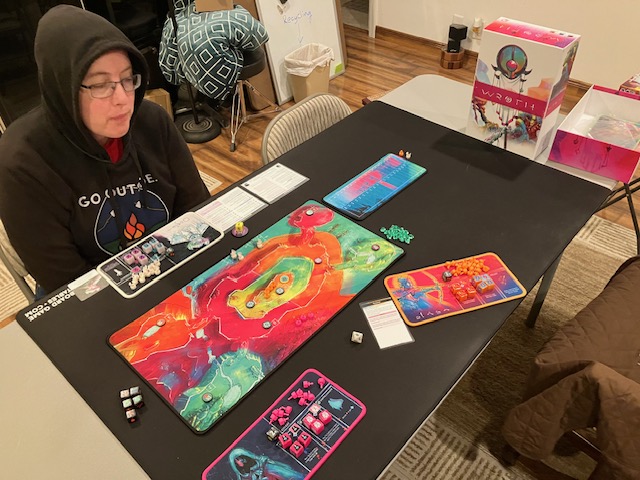
All right, I SOMEHOW convinced my friends to try to play cooperatively again. Well, at least one of them.
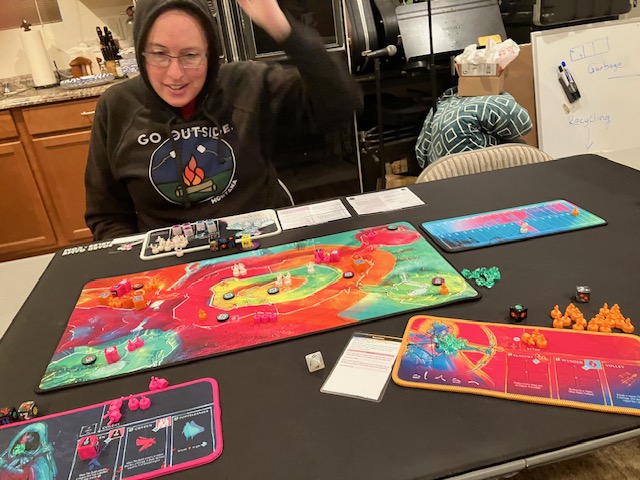
This time, we played a 2-Player game.  And it went a little better.
I think that when the opponent faction gets too many “unanswered turns” in a row, the game spiral out of control.  In our 2-Player game, there’s fewer of those unanswered turns (only 1 per).  I think we found that the 2-Player game is barely in the cusp of spinning out of control.  
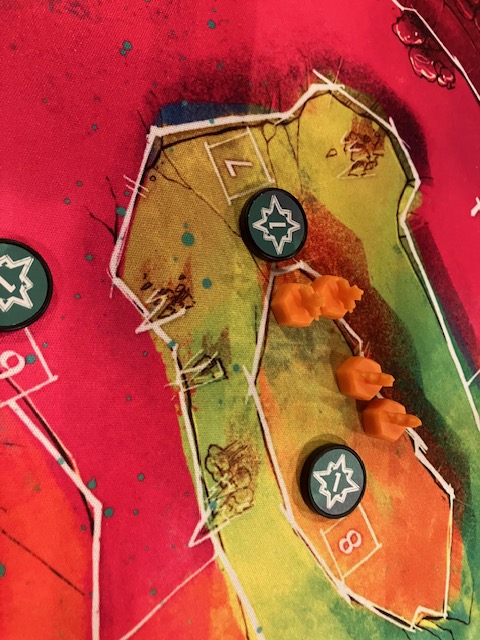
For the AI faction we played, we have to keep the opponent from CONTROL of the middle, and guess where the opponent “randomly” started?  We pretty much lost the game instantly, as we realized we couldn’t do enough movement to get us to the middle!  So, basically, we re-rolled the intro dice until we had a combo that we could “not lose” right away.   

This is the kind of randomness that kills us.  
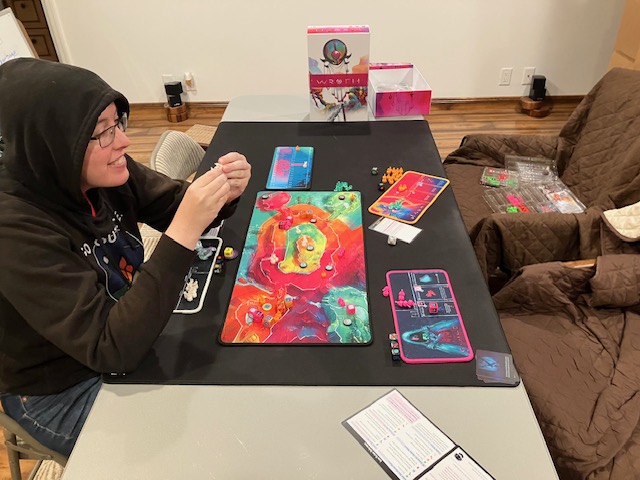
I think 2-Player cooperatively can work (barely); it feels like it’s just about to spin out of control so many times.

One of the reasons I think I hate the “unanswered turns” is that it reminds me of the problems with Variable Turn Order where the nemesis can get 3 to 4 unanswered turns in a row: see  our post here on that.  I think watching the nemesis do something without being able to do something makes me feel impotent.  I think the 3-Player and 4-Player cooperative game has this problem.   If you have a friend you can really work together well with, the 2-Player cooperative game might be okay for you.  Even at that count, the randomness can still trash your game.

Conclusion
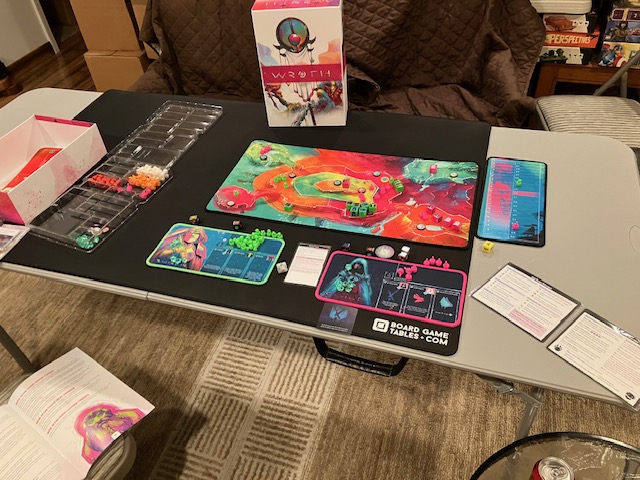
In a crazy turn of fate, I am going to recommend Wroth as a competitive game but not as a cooperative game! I know! That’s so weird for a solo/cooperative blog!
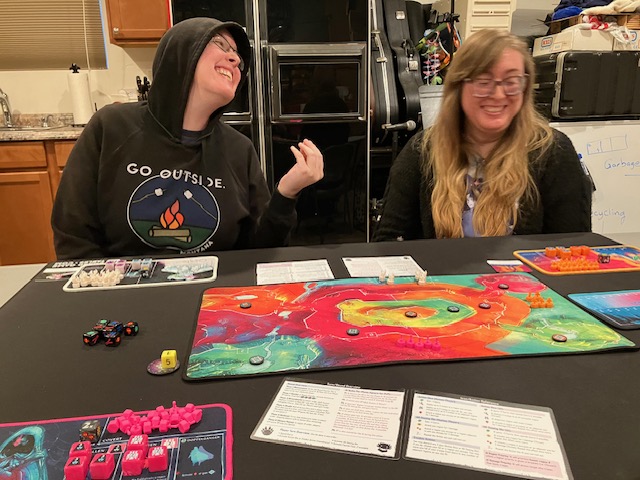
The competitive mode is punchy and quick!  It’s easy to teach! And it’s over quickly! You feel powerful and smart on your turn!  Objectively, the competitive game is probably like an 8.5/10.  Subjectively, since I don’t tend to like competitive games, I’d probably give it a 7/10.  I’d still play it!  I think I might give it a higher score if it didn’t have “the dice tell you what to do” mechanism.  I’ve never loved that.

Unfortunately, we found the cooperative mode too random.  We even gave it several chances, but it wasn’t fun.  There was too much unanswered randomness as the AI player slaughters you with actions that are twice as powerful.  I don’t want to play this again cooperatively: 4/10.  Maybe, maybe, the 2-Player co-op would work for you, but definitely not 3 or 4-Player cooperatively.

But the solo game was fun!  I liked the puzzle it presented! The untethered randomness we saw in the cooperative mode wasn’t there because the AI never got those unanswered random rolls.  I had a great time; maybe 8 or 8.5/10 for the solo game? Again, this might be higher if it didn’t have the “the dice tell you what to do” mechanism.

It’s weird, I almost sold my copy of Wroth  (it was up on BGG for 3 days) because I had one of the worst cooperative plays ever: I can’t recommend Wroth as a cooperative game.   But the solo and competitive games were both really good and saved the game for me; it’s staying in my collection.  

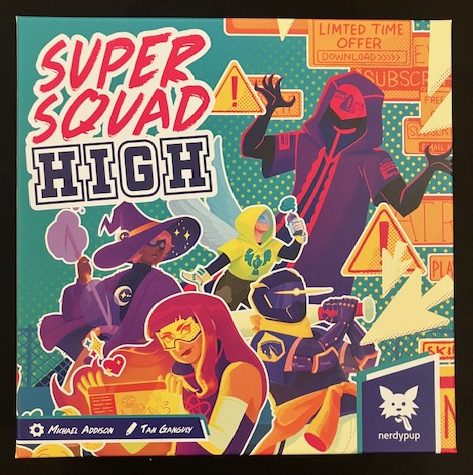
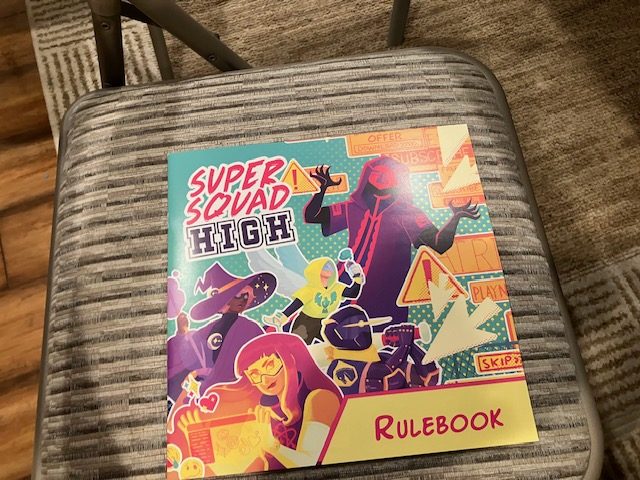
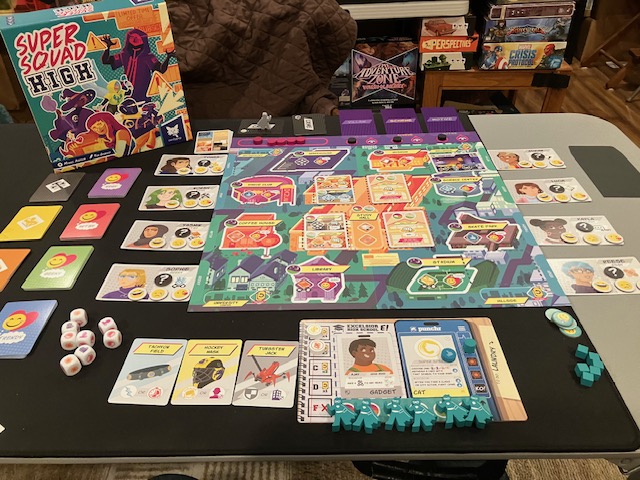
Super Squad High: A Solo and Cooperative Superhero-ish Game

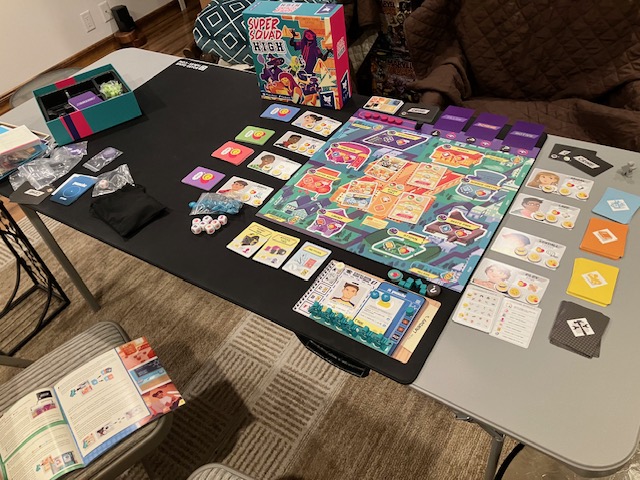
Super Squad High is a cooperative and solo Superhero game that was on Kickstarter in April 2024.  It promised delivery in March 2023, and it was just a month or two late (which is pretty good in Kickstarter terms).

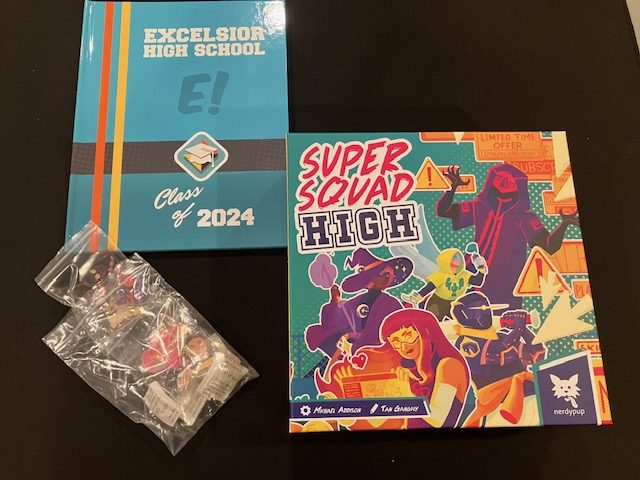
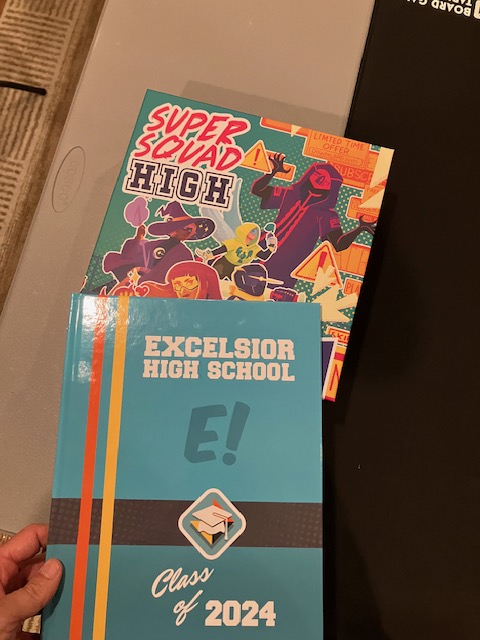
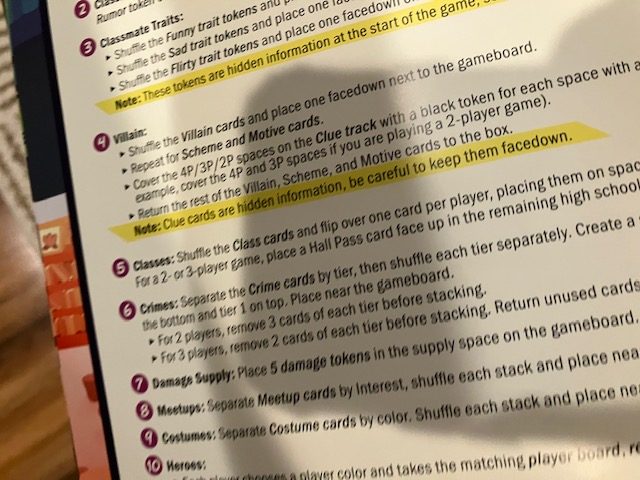
I went ahead and backed the high-end version and got the Arylic pins and Art Book: See above.

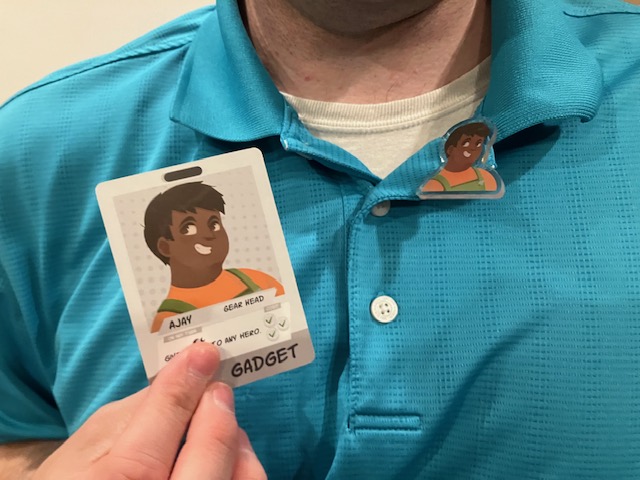
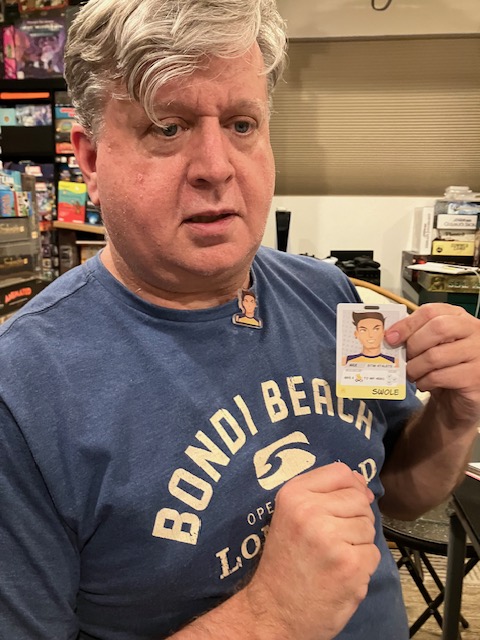
The Arylic pins are completely superfluous and you don’t need them, but we had fun picking our characters using the pins (and then wearing the pins): see above.

Let’s take a look!

The Rulebook

The rulebook was just okay.  

The rulebook ventured into low C territory for The Chair Test. It does kinda fit on the chair next to me, and it does stay open, but it does droop a little too much for my liking.

There tended to be a LOT of text without too many pictures.  Luckily, it seems like most of the rules are there (modulo one solo rule for Crime cards).  Also, the font was a little small.

There also seemed to be a lot of “space” around the edges that was just “flavor”, when I would have preferred more pictures and a larger font.

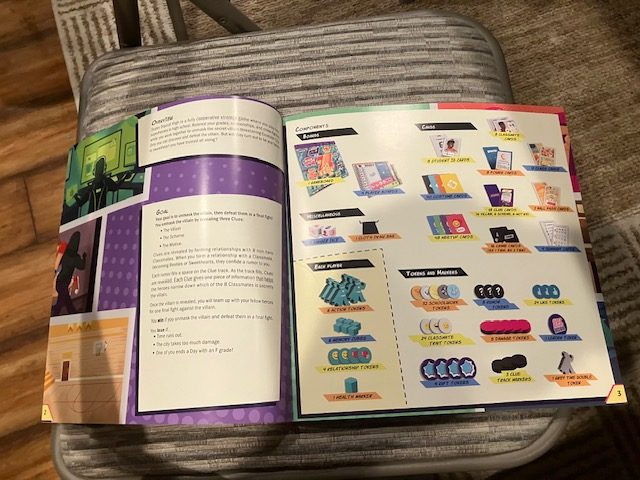
The components page was pretty good.

The Set-Up worked pretty well, especially since the directions were on one side, and a picture on the other.

I got through the rulebook, and most of the rules were in there in a logical place.  I think the rulebook could have been made better in a lot of ways, but the fact that it did seem to have all the rules goes a long way.  In the end of the day, it was fine, but it could have been better.

Unboxing, Components, and Gameplay

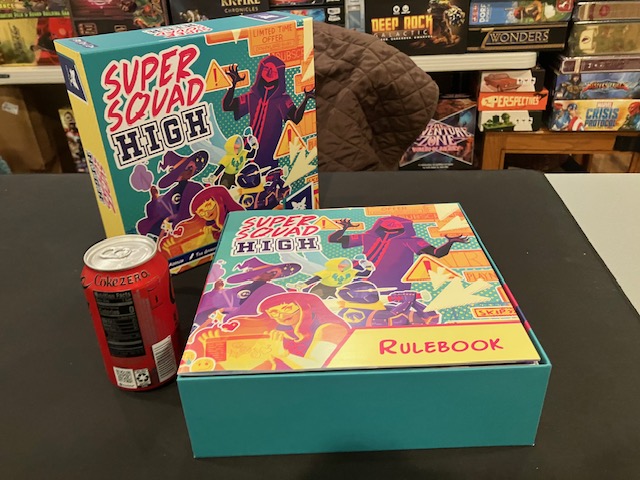
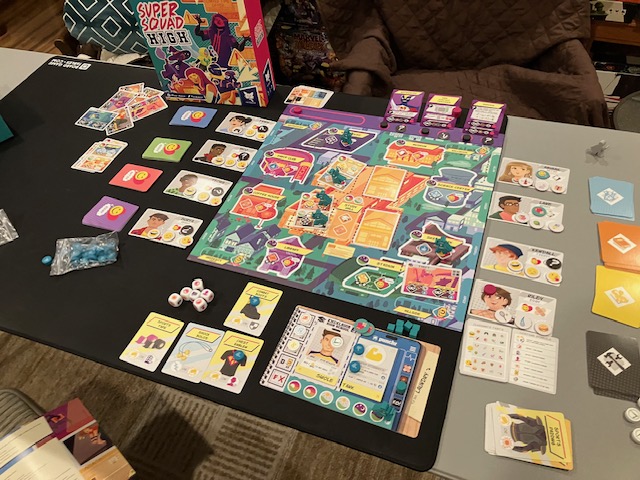
This is a pretty standard sized game box: see Coke Can above for scale.

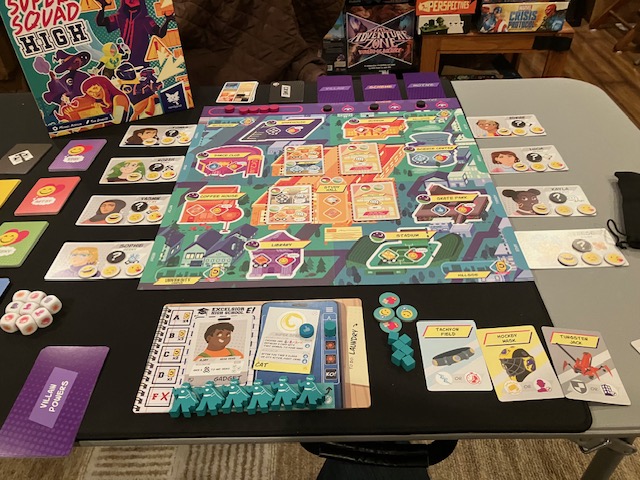
1-4 Players each take the role of a SuperHero in a High School!

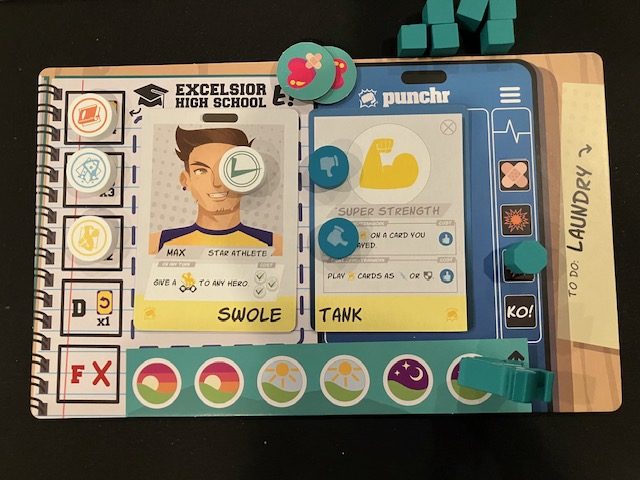
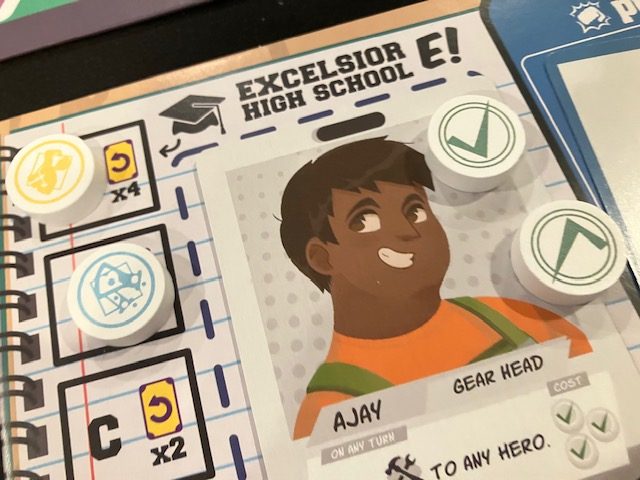
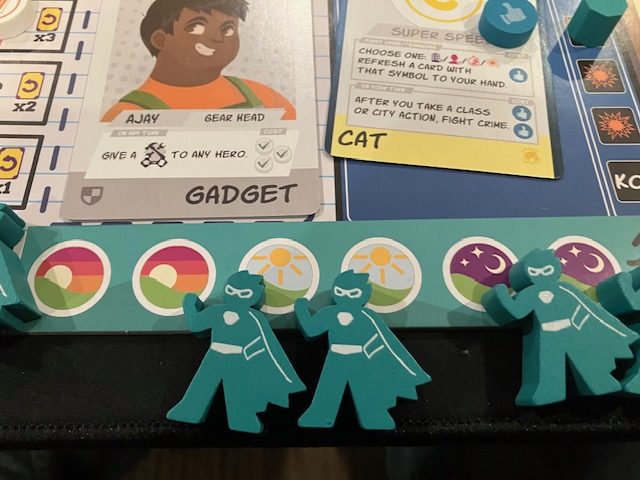
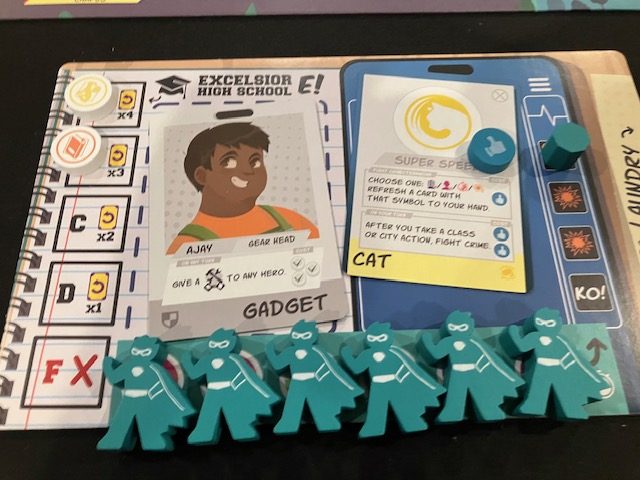
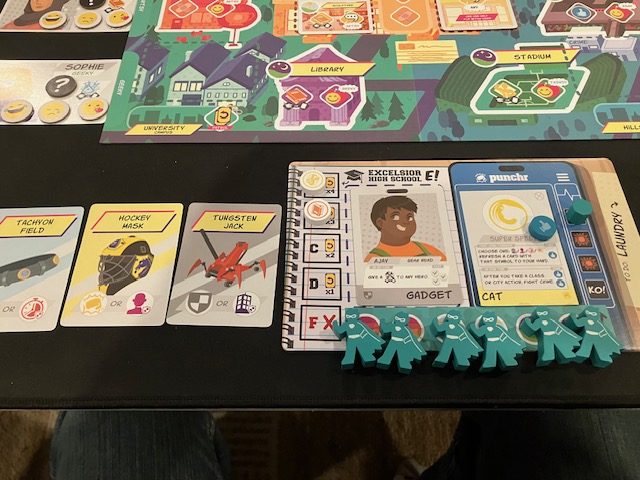
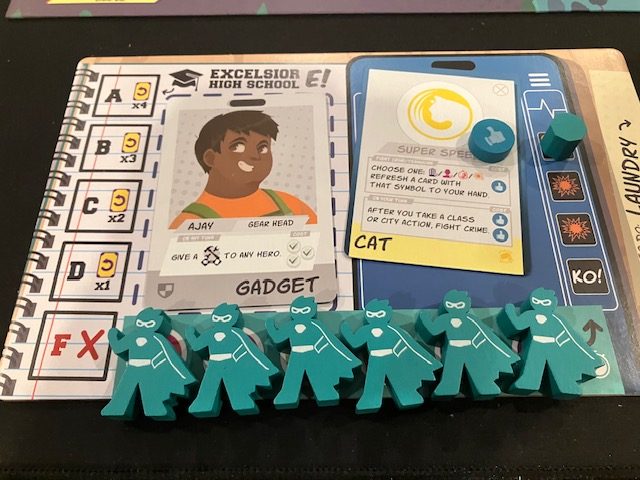
Each hero gets a Student ID and Power card: see above.  These two cards form your character!  My character was the “Swole Tank” and he has Super Strength!  See above!! Players get to choose from one of two Student IDs and one of two Powers at the start of the game, so there is some choice about who/what you get!

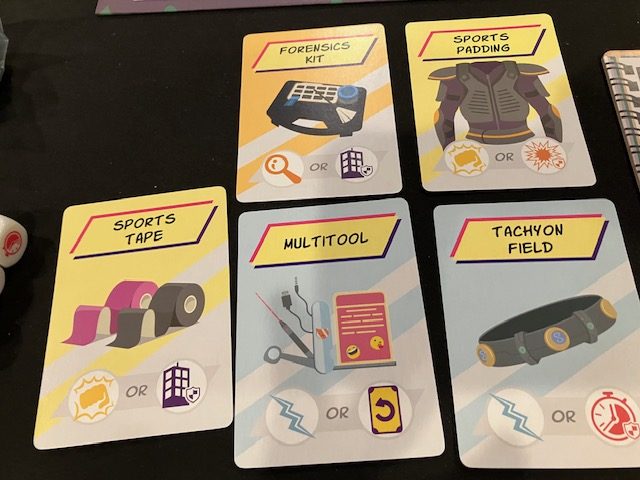
Players gets “Costumes” (cards above) throughout the game.  These cards are basically used to fight crime!

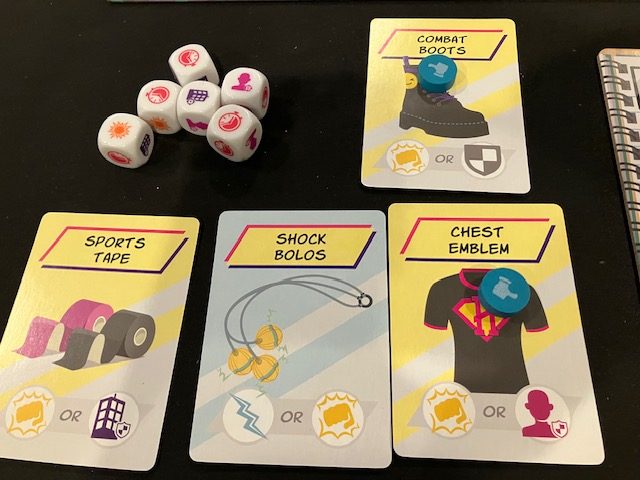
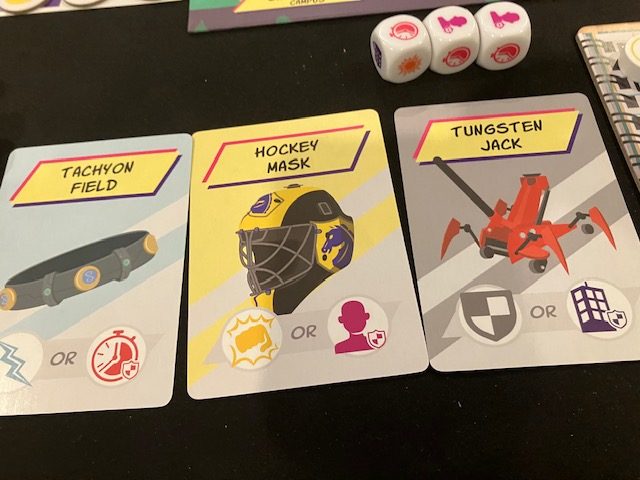
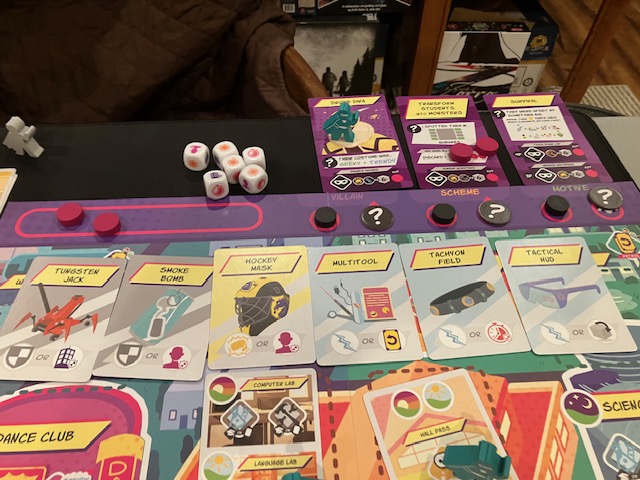
Generally, the Costume cards are used to the stop the elements of crime … that appears from the Danger Dice!  See  the Danger Dice above, and that the Costume cards correspond to some of the symbols.  Basically, if you can’t “block” all Danger Dice with your Costume Cards, then something takes damage (either the city, you, or an innocent bystander)!

See above as the Tachyon Field, Hockey Mask, and Tungsten Jack block all bad effects from the crime!  And even though the Tungsten Jack doesn’t match exactly to block, this was a “grey” or Tools-related crime, so all Tools cards are wild and can stop anything!

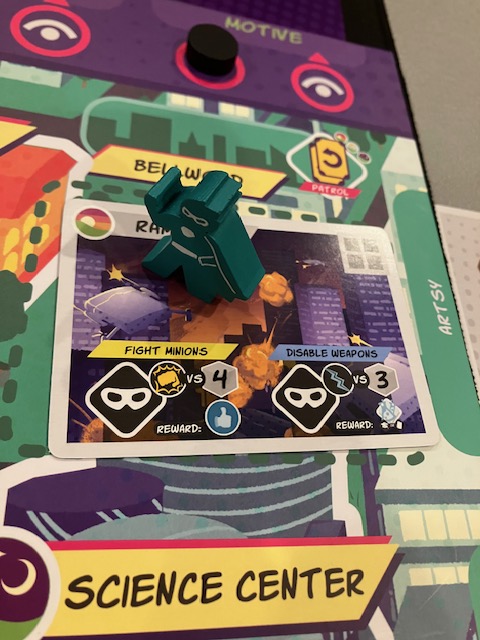
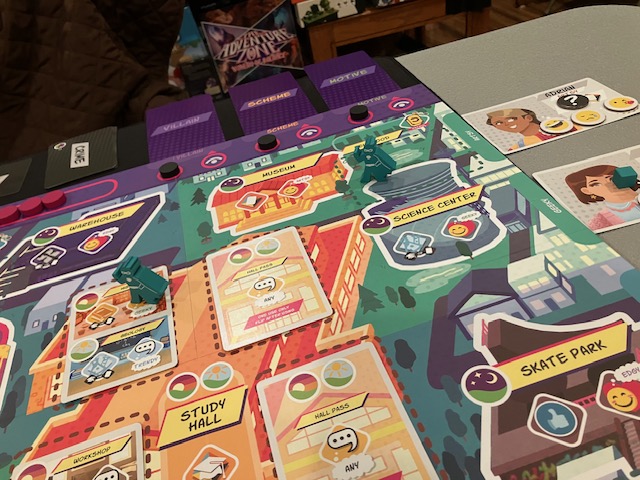
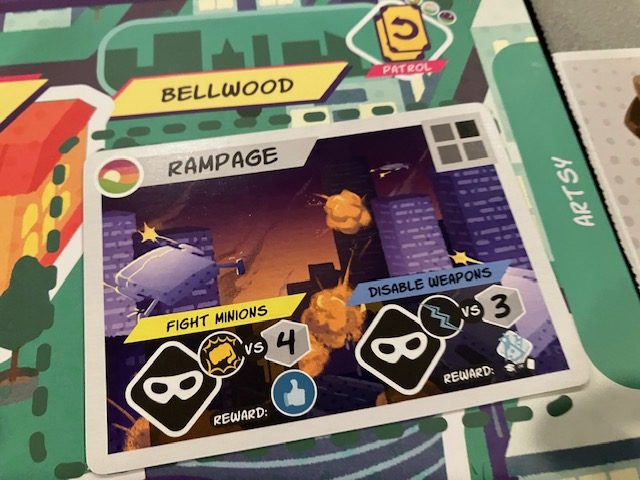
Crimes come out as the Heroes play!  See above as the Rampage hits the Science Center!  In order to take out that crime, you have take care of Minions AND Disable the Weapons!  If you fail, then some damage happens to the city!

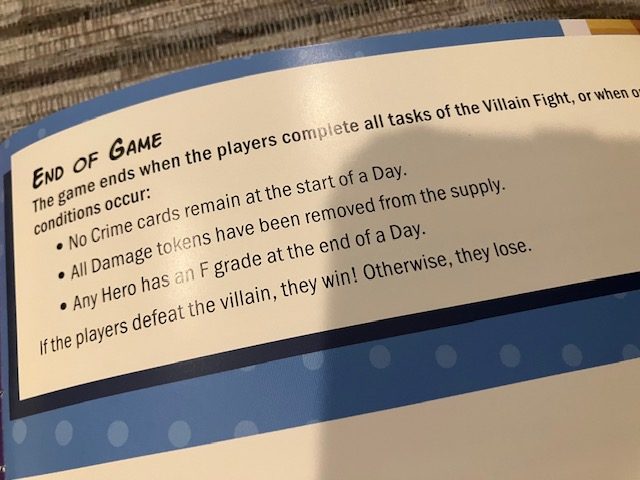
At the top of the board are “damage tokens”: if there is ever too much damage (usually from letting crimes go), then the players lose!  The heroes MUST keep the crime at bay!

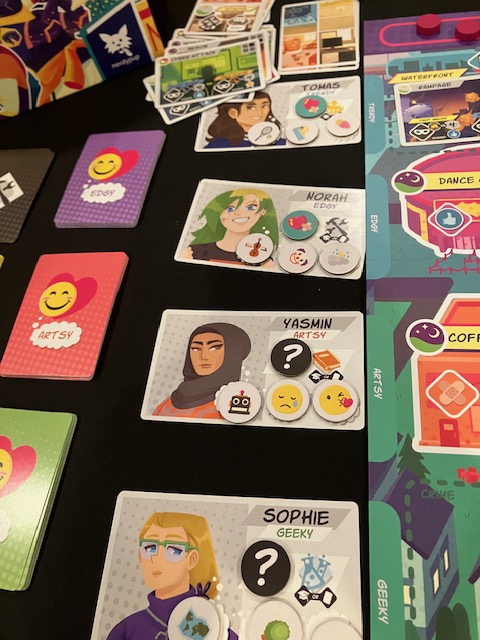
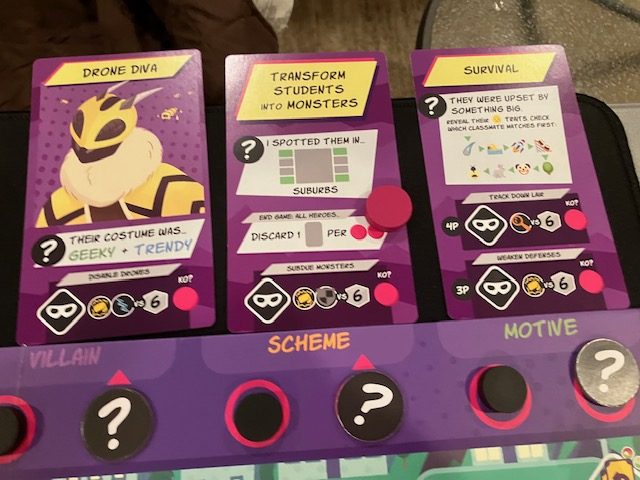
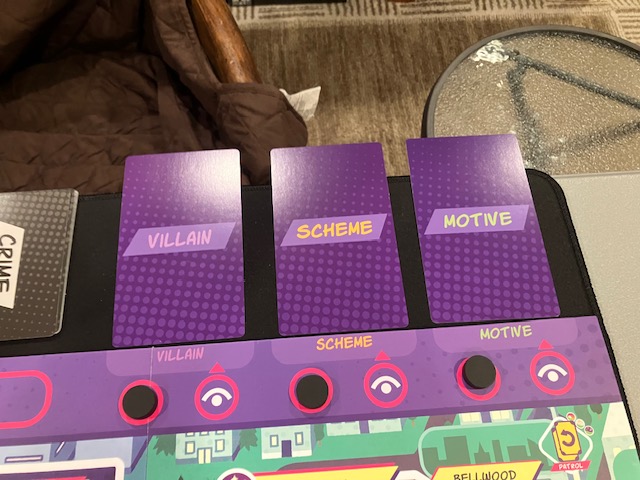
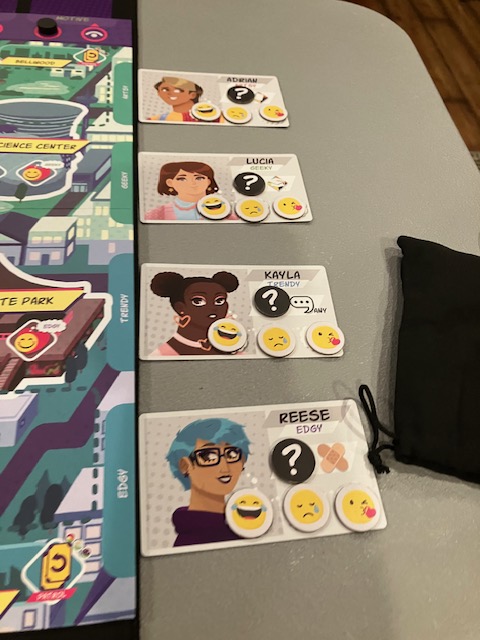
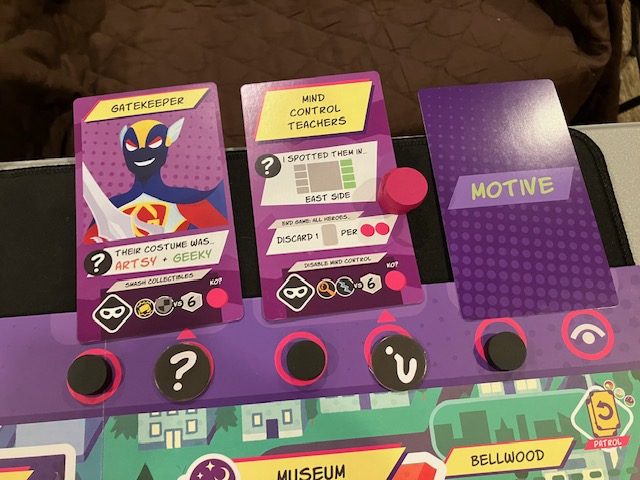
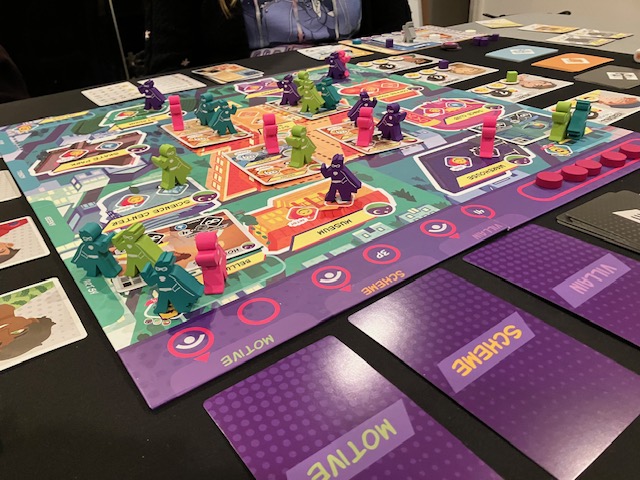
Although keeping crime at bay is important, it’s not how you win the game!  You have to talk to your schoolmates to try to deduce WHO is the big bad villain, what their scheme, and what is their motive! See schoolmates above!  

The more students you befriend and have successful “meetups”, the further you get!  To win the game, you must uncover all three: Villain, Scheme, and Motive (see above).  You must do this before the clock runs out!  (The clock is the Crime deck running out of cards).  Even after you unmask the Villain, you STILL have to have a final fight!

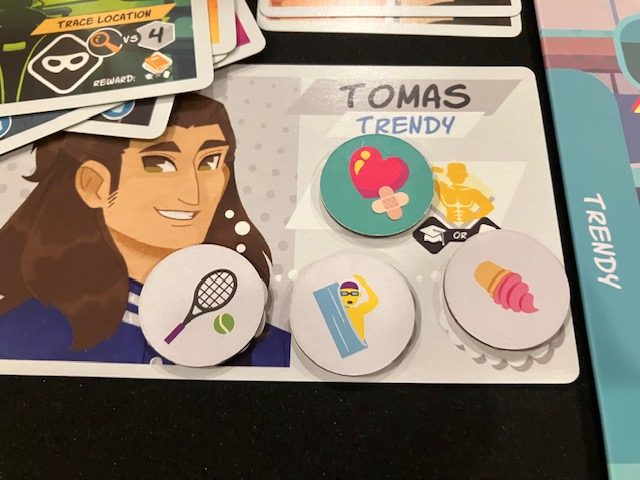
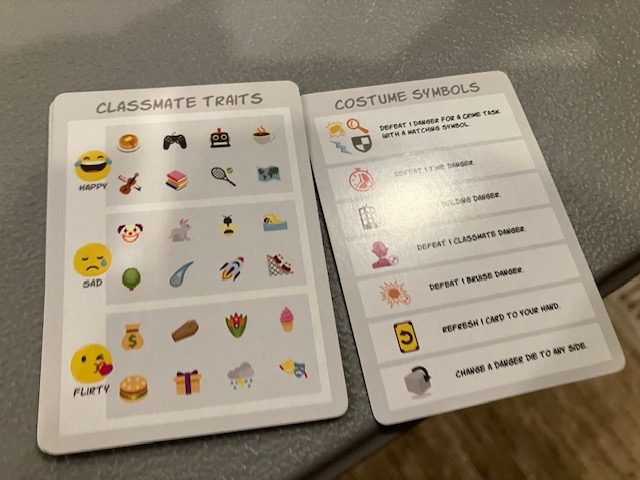
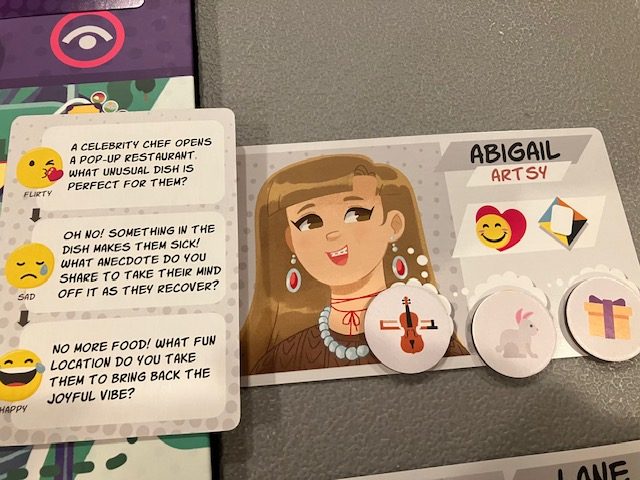
Students are befriended by finding out about them (their Flirty, Sad, and Funny interests).  In order to truly befriend someone, you must discover their interests and what makes them tick!

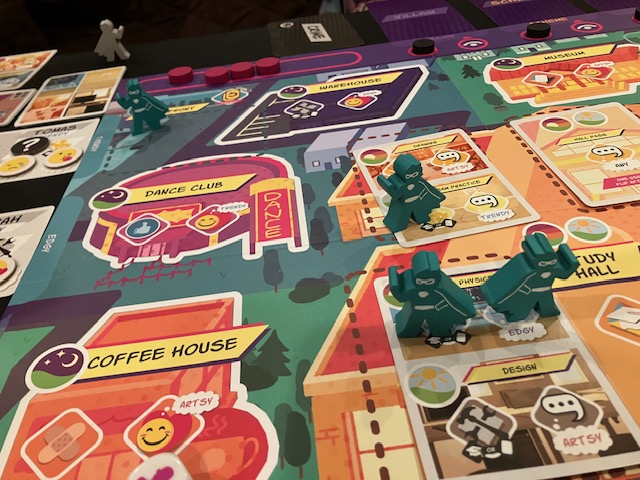
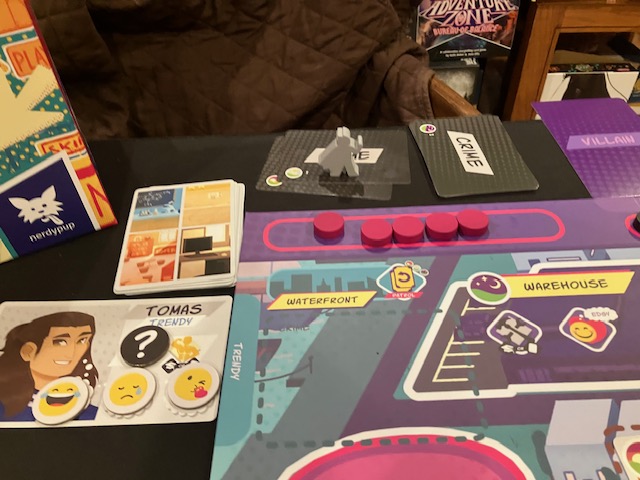
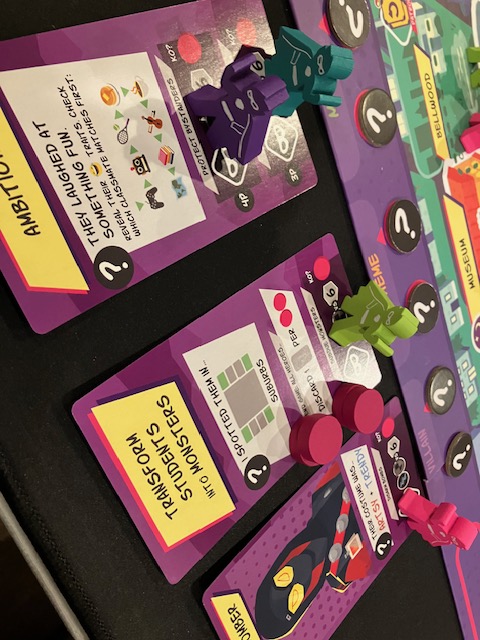
You move your tokens on the board to “talk” to people: see above as one token talks to some Edgy student (to uncover one of their traits).

Crazy enough, with all this going on, you still have to keep up with your homework!  Doing your homework won’t win the game, but if ANYONE is ever failing, all players lose the game!

If you can keep crime at bay, keep your homework under control, speak to your classmates, and do your laundry, maybe you can uncover the Villain, Motive, and Scheme!  After such a reveal, you have to win one final battle with the SuperVillain to win!

Worker Placement

This is nominally a Worker Placement game, as you have to put out your tokens out to do stuff.  Each player gets two tokens in the Morning, two in the afternoon, and two at Night.

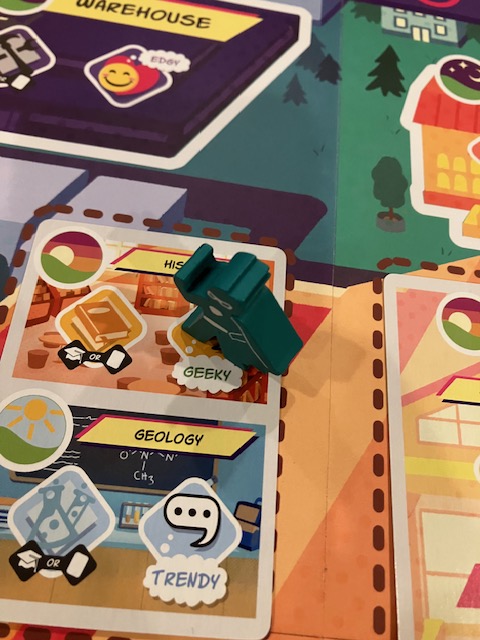
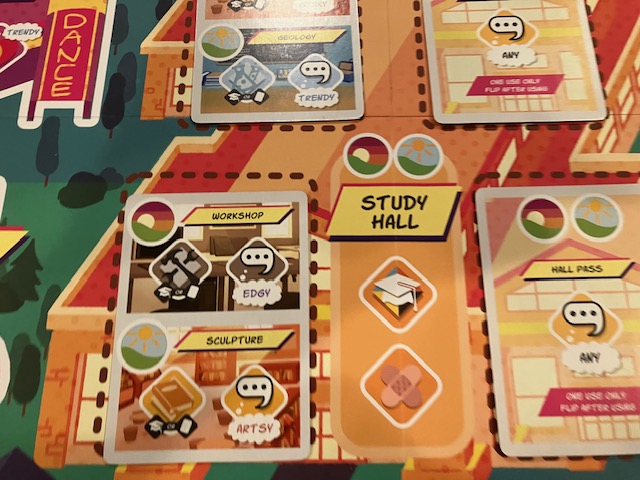
These tokens go on the board to do stuff! Notice above as a token goes on “Geeky” to talk to a Geeky schoolmate!  Also notice that the Locations can ONLY be visited at certain times of day.  In the morning and afternoon, you can usually only do things at school (like Homework or talk to schoolmates) or sometimes upgrade your Costume Deck!

Usually, things are the city can only be activated at night!  See above as the Stadium can only be activated at night!

From a cooperative point of view, the rulebook was never “clear” on how to place your tokens.  The only rule seems to be “Starting with the Leader, players take turns taking actions”.  I think that probably means clockwise … but given the lack of clarity, we chose to simply use Player Selected Turn Order!  As a group, we can decide when to place our tokens.  Since this is a fully cooperative game, it doesn’t matter “too much” the order they are placed, as long as everyone agrees with basically where they go!  (This was probably a House Rule: we’d recommend it to you).

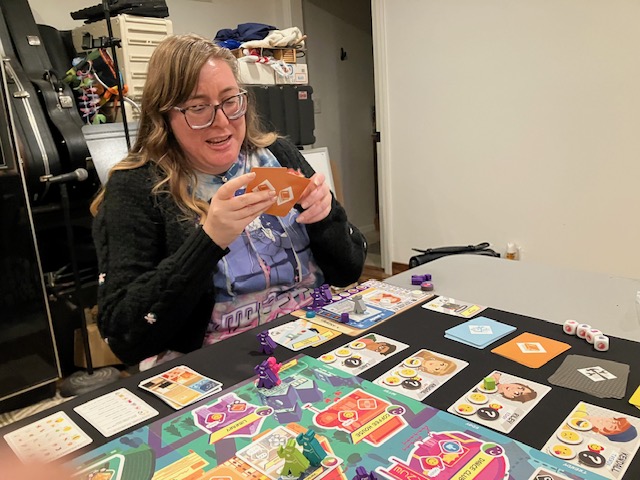
“I really need to do my Chemistry homework, or I fail and we lose!  You need to let me go there!”
“I really need to talk to that Geeky girl, is that okay, or do you need to talk the other Geeky guy?”
“We really need to deal with this crime!  I can do the punchy part, can someone else do the gadgety part? Or can you back me up nearby?”

These (above) are typical phrases that got uttered during our gameplay!

The Worker Placement as a mechanism to fight crime, do homework, talk to schoolmates, and upgrade our decks seemed to work pretty well.  It was intuitive and the icons worked pretty well.
It was also interesting to note that you could only use certain spaces at certain times of the day.  This made planning ahead more critical!

Deduction

This is nominally a deduction game … ish?  You have to uncover the Villain, Scheme, and Motive in order to win the game!

You can only move forward by talking to your class mates and befriending them!  Once you have truly befriended a classmate, you can get closer to revealing one of the Villain/Motive/Scheme cards!

This mechanism worked pretty well, but it wasn’t really “that” deductive. I was hoping for more deduction, but the mechanism worked.  It was just simpler and easier than I expected.  That’s not a bad thing, but this doesn’t “really” have that much deduction.

The Summary cards show what all the trait tokens can be, but unless you have uncovered “most” of them, guessing is a real shot in the dark.  You can try to befriend someone without knowing all their traits, but you have to guess the unknown traits! It might be easier to just talk to them ahead of time directly rather than wasting a turn and “maybe” befriending them.   I was hoping for a little more deduction … this just felt like you just had to spend your turns judiciously to make sure you talked to the person enough.  Befriending someone was more about proper use of time rather than deduction.

Crime

The Crime fighting part of the game seemed to work pretty well.  I was worried because so much of the Crime fighting is dice based, but since certain cards are wild when you fight crime (yellow cards are wild when fighting minions, and blue cards are wild when Disbabling Weapons: see above), you actually have a pretty good idea of if you will succeed or not.   If you engage the crime, YOU WILL DEFEAT IT, … but can you pay the cost?  Can you afford to damage to the city? Yourself? Innocent Bystanders?  I was really worried that the dice mechanism would be too random for me, but it really wasn’t.

Superhero?

Is this a Superhero game?  Yes … mostly.  The High School part makes this feel more like the movie Sky High than Avengers or Thunderbolts! Don’t get me wrong, I actually really liked the movie Sky High, but not everyone will love this “let’s be superheroes in High School” theme!   The Superhero theme does come through, but it is a little silly.   There’s a certain … silliness (?) to the game.   It’s more that this game doesn’t take itself too seriously, but it’s still pretty good.

I think the art style and sillyish costume cards contribute to that lighter feeling.  See some above.

If you even know what the movie Sky High is and you like said movie, I think you will like this game!  Even if you don’t, you may still like this game.  The theme may turn you off, but there’s still some fun to be had.  But, if that theme would just turn you off completely … I’d say “give it a try”. 

I don’t think this would make my Top 10 Cooperative Superhero Games, but that’s not because it’s bad or anything; it’s just that the high school theme detracts a little from the Superhero part.

Roleplay

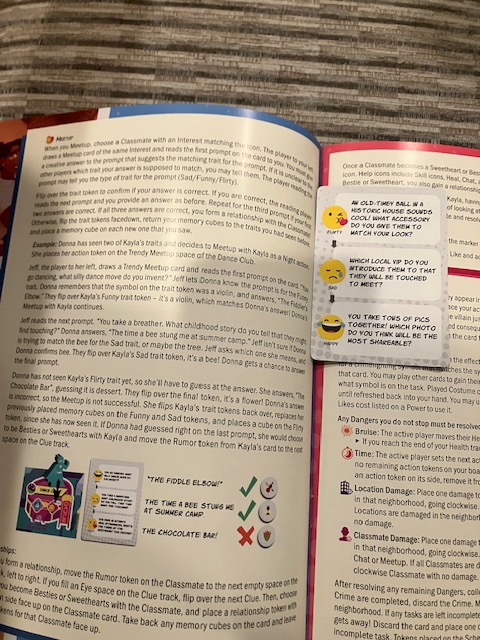
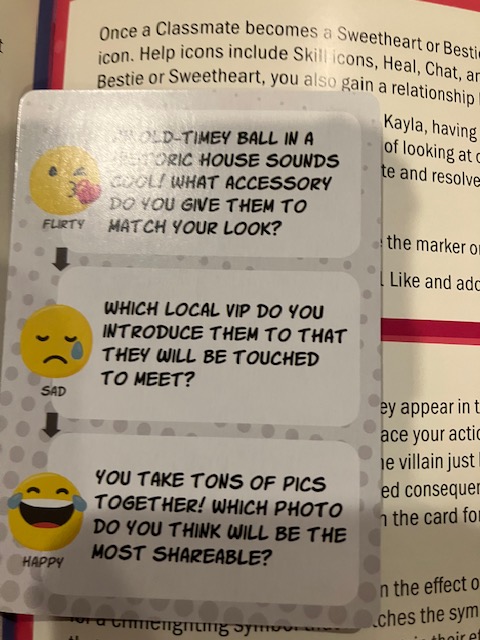
There is an element of this game that will make you love or hate this game.  When you are doing the “deduction” for the traits of your classmates, one player is reading the questions and seeing if you can answer correctly for the traits.  See above and below for examples of some questions!!!  For some people, this will be the funnest thing in the world as you answer questions for the traits to show you know them!  For some people, this will be the dumbest thing in the world and they will hate it.

You probably know which one you are.  If you hate this, the solution is simple: don’t play with it: just guess and ignore the question cards.   If you love this, the solution is simple: play with it.  The game will work both ways.

This one element may repel or attract you completely; don’t let it define the game for you, as you can play with it or without it easily.  And it won’t affect the gameplay.  I say this because there is a pretty good game here, and I’d hate for this one thing be the reason that you don’t play it.  

You know yourself and what you think of this question/answer roleplay. Take appropriate action if you play.

Solo Play

Luckily, this game does support solo play (congratulations for following Saunders’ Law)!  

This is true solo play, as the solo  player takes control of one hero!  See above as the solo player becomes Gadget Cat!

It’s unfortunate that the rules for solo play are later in the rulebook after everything else.  I get that, but the set-up portion for solo rules could have EASILY been in the set-up section of the rulebook, and I was frustrated that I had to page back and forth between this section and the solo section, especially since solo play was my first few plays!

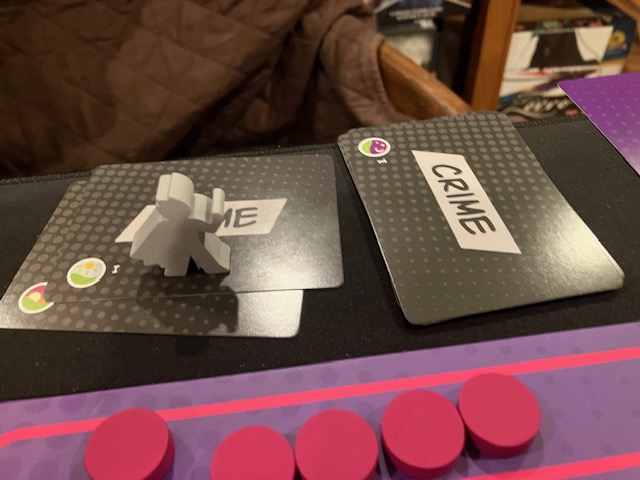
Even worse, one of the solo play rules was not well specified: how many Crime cards do you use?  I figured out the hard way (by just trying and seeing it it felt balanced) that the solo player uses the same number of cards as the 2-Player game.  This was mostly the only rule that wasn’t well-specified, I was able to figure everything else out.  

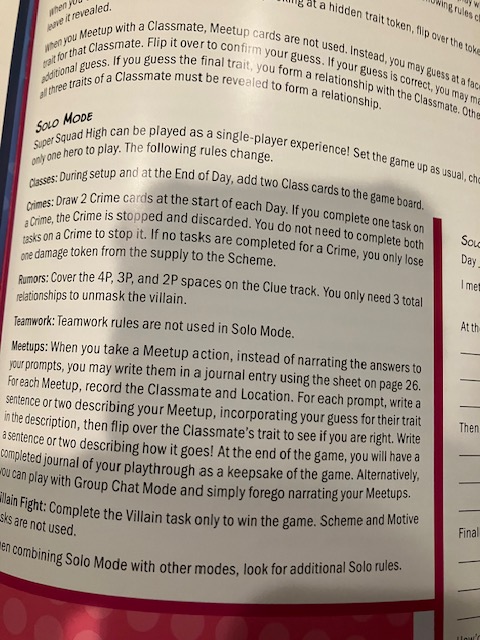
The solo game proceeds pretty much like the cooperative game, with only a few exceptions: there’s no teamwork, the Villain is easier to defeat, and the Crimes can be defeated with only one defeat (instead of both on the card).  

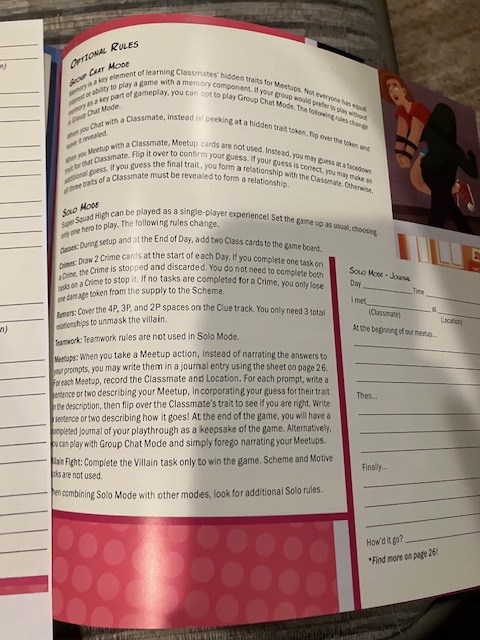
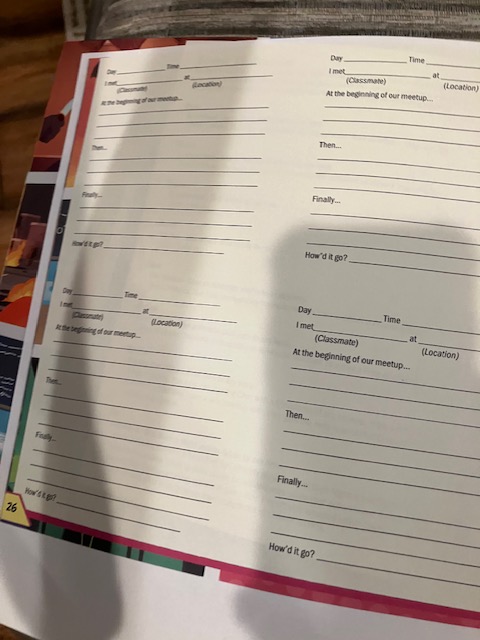
The question/answer roleplay rules we mentioned earlier (that you will love or hate) can be approximated in the solo game with writing stuff out: see a page above.  Meh, this felt like work and not fun, so I chose to bypass this part.  

The solo game worked pretty well: it was hard and I realized near the endgame that I had to concentrate on questioning students to figure out who did it!  The game could have gone either way at the end, but after I buckled-down … I was able to reveal the Villain, Scheme, and Motive just before the endgame!  That was exciting!

The final battle went pretty well as I was able to take down the final Villain! (In the solo game, you only have to fight the final as if it were a crime: you have to fight more in the cooperative game). See above.

I played a couple of solo games, and the game was pretty good: it was challenging and there were interesting decisions to make, but it wasn’t super hard.  I liked it, but I didn’t love it.  I think I didn’t love it because it felt like the game arc would be mostly the same every time. It didn’t feel like it would be that different between games.

The solo game (despite the Crimes deck rules flaw) taught the same pretty well.  I just don’t know if I’ll play it again solo, but I had fun.

Cooperative Game

I think this game shines better as a cooperative game.  

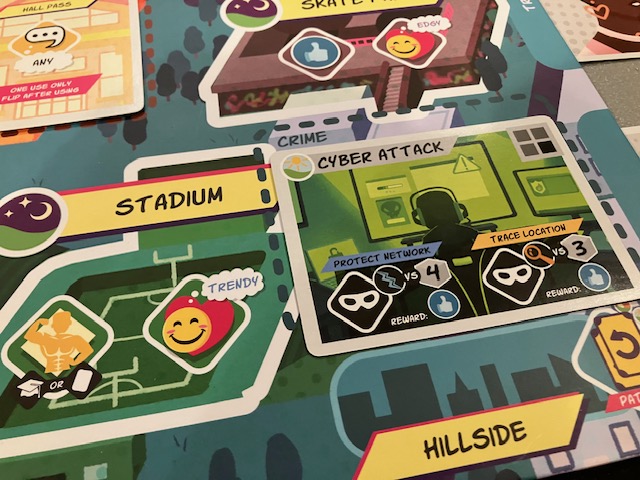
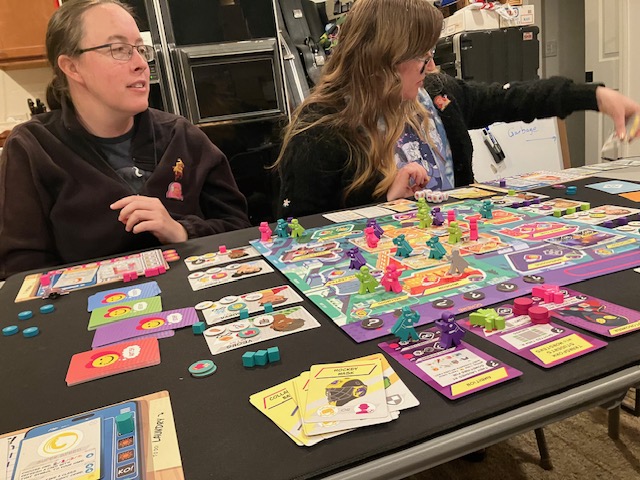
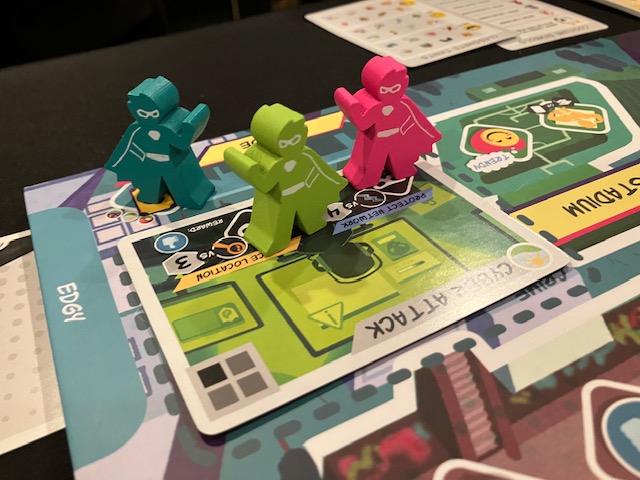
The fact that TEAMWORK was now a mechanic really helped push the game forward: if another player is in the same city neighborhood as other heroes, they can contribute cards towards fighting crime!  This leads to another level of strategy over the solo game, as players now can help each other!   See above as the three heroes work together to take out the CyberAttack!

“Man! I need some help taking out this CyberAttack!  Can you guys help me over by coming to my neighborhood?”

It felt very cooperative as we constantly consulted each other where to do, what to do, when to fight crime, when to help each other, when to do homework, and when to talk to classmates!

I think the best part of this game is the cooperation: you probably can’t win unless you really work together well.    The game arc feels less “samey” in the cooperative mode as play will vary a lot more as everyone tries to figure out the “smartest” way to do everything! Some turns will have you do all the fighting!  Some turns will have you talking!  Some turns will have you supporting!  It just depends on what’s best for the group, and that can change quite a bit more in the cooperative game.

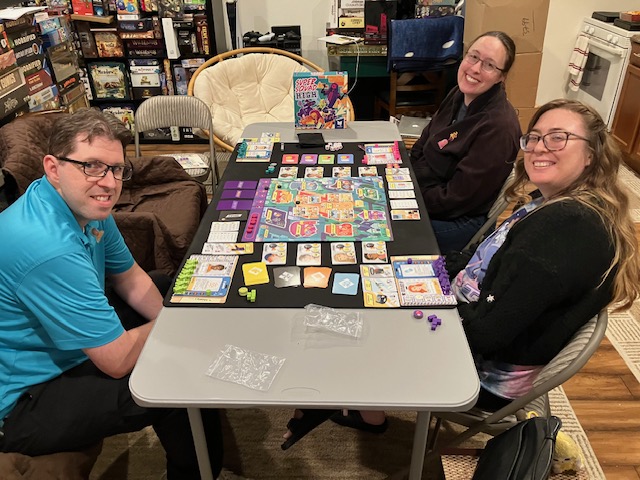
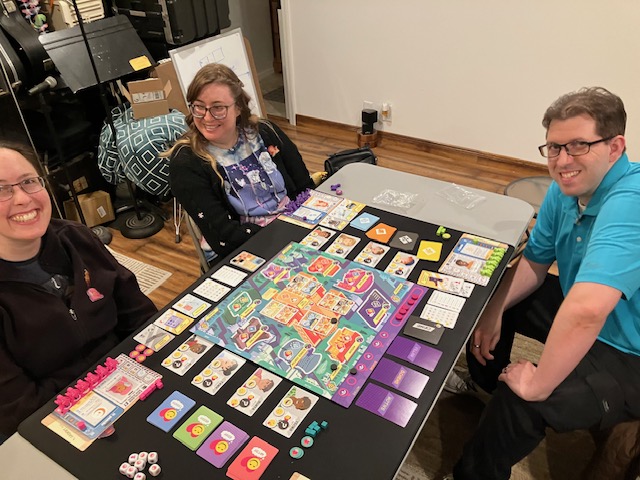
My friends all liked this game and had fun.  They also liked the roleplay elements in meetups, which probably upped their score a little (most of my friends are also avoid RPGers).

We are looking at pretty much 7s across the board.

Campaign Modes

There is a campaign mode (Yearbook mode) for this game which … we didn’t play.  It sounds like it might be funnish, but I think this game feels more like a lighter game.  We all had fun and such, but the vibes from the game make this feel like a fun, light one-off game.  It doesn’t quite feel like a campaign game?  It just doesn’t look like the yearbook mode changes the game that much from game to game?

I think I am less likely to do Yearbook mode because I would do it solo, and I didn’t love solo mode.   

I don’t know, maybe the yearbook mode is great.  I just don’t think that’s the way my friends and I will play this.  We will probably play it again, but in one-off mode.

Conclusion

If you like the Superhero movie Sky High, with Superheroes in High School, there’s a good chance you will like this game.  Even if you don’t love that theme, there’s still a fun light game here that you might still enjoy. 

Be aware, if you do play Super Squad High, that you may or may not want the roleplay aspects of the game: make sure you figure this out beforehand, because if you hate the roleplaying/asking questions part of this game, you will hate this game!  But if you know you will hate this, you can completely ignore that part and still enjoy this game.

I didn’t love this game solo, mostly because it felt like it could be a bit samey from game to game.  It was still fun, and it taught the game well enough for me to teach my friends:  Solo game: 6/10.

The cooperative version of this game is probably the best version: the Teamwork and strategies and discussions that emerge as you play really bring out the cooperation: I think the emergent cooperation is the funnest part of this game.  All around, we gave this a 7/10 for cooperative play.

This is a pretty fun game that’s light and easy to bring to the table to have a light superhero experience. There’s a yearbook/campaign mode in the game (if you want it), but my group just liked this as an easy one-shot cooperative game.

Skytear Horde: Campaigns. Does it put the Pain in Campaign?

I have to be honest: Skytear Horde: Campaigns does put a little pain into the campaign.  But, knowing what the issues are before you get this game make it so you can work around them and enjoy this game as-is.  Although this is mostly a “review” of the Skytear Horde: Campaigns, it’s also of a guide of how to get the most enjoyment out of this if do you end up getting it.  At the risk of spoiling my review, I did like it and am keeping my copy but ONLY after making a few major notes.

Skytear Horde: Campaigns is a standalone expansion in the Skytear Horde series; this series of games are solo and 2-Player cooperative tower defense games. (There is nominally a 3-Player competitive game that we won’t be discussing; in our experience, it seems to be the least likely way to play)

The original base game of Skytear Horde was on Kickstarter waaaay back in January 2022, and delivered to me and other Kickstarter backers in February 2023.  See our original review here.  We did like it: it made the #5 spot on our Top 10 Solo Games of 2023!

The first expansion, a standalone expansion (meaning you can play it without the original game) was on Gamefound back in May 2023 and delivered in about a year.  See our review of Skytear Horde: Monoliths here.  It also made our Top 10 Solo Games of 2024!

This second and newest expansion is the Skytear Horde: Campaigns box above. It’s also a standalone expansion from Gamefound. It delivered in April 2025 after promising delivery in June 2025 (it delivered early!). My box is a little lack-luster because I backed at the Returning Players Deluxe pledge, which “expects” me to merge this in with the other two.

Let’s take a closer look!

Generic Unboxing

See above for scale with a Coke can: my Returning Players Deluxe box isn’t the best box. Again, I think it’s expected for me to merge all my cards into the original game.

This is a game all about cards.  There’s a little unboxing video you might consider watching (see above).  I watched a little bit of it.

There are just a ton of cards, some token sheets, and two booklets: A rulebook and a campaign book.

The cards look pretty great and they are consistent with the cards from the previous releases.

The Rulebook

This rulebook is both blessing and curse.

This rulebook does great on The Chair Test, opening up easily across two pages, laying flat, being readable, and no real overhang over the edges.  This gets about an A- on the The Chair Test! It’s not an A because the font could be a little bigger, especially considering how much whitespace there is.  Still, great!

These Component pages are fantastic! I forgoed (forewent?) the card video because I wanted to handle and open all the cards myself.  These two pages where GREAT for describing how to open up and sort all the cards.   The card deck (types) even had little annotations, along with a little summary!  Very useful!

The set-up was good: it is on exactly two pages without needing going to cross to another page. See above.

The rest of the rulebook was pretty good; and it had better be.  This is the third Skytear Horde: they should know how to explain it by now!  They even note “new rules” with a sideline bar: great job!  To be fair, there’s not “that many” new rules in this set.  Note the bottom right of page 11 (above) has a new rule.

It doesn’t have an Index (boooo), but I’ll forgive it because it has a very good Glossary of keywords in the back.

It also ends with a bang and has some other common keywords on the back.

Seriously, for the base game, this is the best rulebook so far for this series.    Great Components, good Set-Up, good rules, good Glossary, good back cover.  This is why it’s a blessing.

But why is this rulebook a curse as well?  Be patient; we’ll get there.

Cards

I want to talk a little about the cards.   They do a really nice job in general.

The cards are labelled with what set they come from, even if it’s a little hard to read: see above!  The Campaigns cards are marked with CAM.  I suppose I appreciate that the labels are pretty well out of the way (so they don’t interfere with gameplay), but I  really struggled to read that text! I ended up getting my phone out and zooming in on these!  When I needed to sort the cards back into their respective decks, it was a challenge!   Here’s another blessing and curse: the labels being out of the way mean they don’t interfere with play! That’s a blessing!  But sorting them is a curse because it’s a little hard to read.

Maybe those teeny labels doesn’t bother you because you like to put everything in the main box and you don’t really care which set it came from.  I like to keep my sets separated, so it did bother me.  I suspect I am in the minority.

I mean, these cards look great.  The art on them is amazing: see above.  

Gameplay

This is a solo, 2-Player cooperative (or 3-Player competitive) tower defense/lane battling game.  Players play cards to the lane to fight the bad guys and protect their castle! 

There is a very nice description of win/lose conditions at front of the rulebook: see above.

There’s a lot more discussion about gameplay in many other sources, including our previous reviews. If you know what Skytear Horde is, the expansion part of this game should feel very familiar to you.

Solo Play: No Campaign (yet)

First and foremost, the Skytear Horde games are solo games.  There are some annotations in the rules (like one paragraph) describing how to play 2-Player cooperative.  Everything else about this game screams “I am a solo game!”

This is a true solo game: the solo player takes  control of a single Alliance faction (Two players would each take a different faction and play them separately).   See above as I take control of the Blue Order faction.

The rules suggest you DO NOT jump into this as a campaign!  The rules “recommend playing only after you have played a few one-off games”.   So, using only the content from this standalone expansion, I ended up playing about 4 one-off games to get back into the flow.  I am embarrassed how much I had to relearn to play again!

As a straight-up standalone expansion you can play, Skytear Horde: Campaigns did a great job.  Even if you never use the campaigns material, there are 4 new Alliance decks, 3 new Hordes (bad-guy decks), 6 new castles and some new Portals.  If you like Skytear Horde, this is just more stuff and you will like it.  If you didn’t like Skytear Horde, this probably won’t change your mind (but see below). The game still feels fun and I still had fun playing the new Alliance and Horde decks.  

As always, this game works great solo.  I fully expect this to make my Top 10 Solo Games of 2025!

The Campaign: The Curse

The campaign has many problems to work through.  To start off, there are two glaring errors that undermine the confidence of the campaign section right away. 

The first is that the page numbers are just wrong.  The Renegade campaign is supposed to be on page 6, but it’s on page 4.  Granted, this isn’t a big thing, but it really undermines the confidence if they can’t even get the page numbers right.

The second issue is the mislabelling of the new Blue Alliance cards.  

The rulebook calls the new Blue Alliance cards “Liothan Zealots” … 

… but the Campaign page labels them as Order?  I went spare trying to find the Order group, but then I think they just meant all the new Blue Alliance cards from Skytear Horde: Campaigns? I think?

It’s a little confusing because a lot of the new Alliance cards (see above) have different subtype: see above.  Some have Order, some don’t?  If I JUST go back and look at the directions for building your first campaign deck, I am supposed to have 18 cards, and that includes the 4 different subtypes above.   After putting this all together, I *think* that these are supposed to be the Liothan Zealots (as labelled in the rulebook), and the Order indicated by the campaign book is wrong: I think that’s supposed to Zealots.  I think.

These two mistakes really undermined my confidence in the campaigns as I started into them. I wasted too much time just trying to understand what Alliance deck I was supposed to use.

Understanding the Campaign Differences

I am going to tell you this right away because it took a while for me to figure out: there are TWO types of campaigns in this game, and they are not well distinguished.  

The first is what I’ll call Generic Campaign Mode: this is the type of campaign described on pages 20 and 21 of the main rulebook: see above.

The second type of campaign is the Thematic Campaign, as described on page 2 of the Campaign book (see above).

The rules as described by the Generic Campaign are different from the Thematic Campaign, and it’s very confusing.  But the Thematic Campaign still follows most of the rules of the Generic Campaign.  Confused? I was!

The Generic Campaign has you play 4 games, using 4 different Scenario cards.  See rules above … can you tell that all those scenario cards are different?

The Thematic Campaign has you use two Scenario cards twice!  It’s really hard to tell this difference!  Even though the pictures DO SHOW this difference (see above), they are so small it’s hard to tell unless you are looking at them with your phone (see below)!

See me noticing!  “Oh! We use the same 2 Scenario cards twice in the Thematic Campaign!”

See the Two Scenario cards I used for my first Thematic Campaign!

I really didn’t feel like this distinction was clear!  I think you probably want your first game to be one of the simpler and more flavorful Thematic Campaigns!  

Another thing that’s very confusing .. “What’s the text in the campaign book for the Thematic Campaigns?”  Is this a choose-your-own-adventure?  Is this a branching campaign?  Nope!  Everything in the campaign book for Thematic Campaign is JUST flavor text!  The text nodes are referenced by the campaign cards: see above. Honestly, you actually never have to even LOOK at the two pages of your campaign … it’s just flavor!  I was actually a little dejected by this … I was hoping for something more from the two pages! And I usually like flavor text!

Be aware that the rulebook describes the Generic Campaign, but the campaign book is for the Thematic Campaign, and it has slightly different rules! Most importantly, you only use 2 Scenario cards!

Sure, it’s all there, but I lost at least an hour of my life trying to rectify the rules of the Generic Campaign vs the rules of the Thematic Campaign.  The rules of page 20 and 21 describe the rules of the Generic Campaign, and the rules from the Campaign book describe some of the differences for the Thematic Campaign.

If I had done this rulebook, I would have done things differently: I would have described the rules for the Thematic Campaign first as the main type (pages 20 and 21), then added rules for the Generic Campaign afterwards:

THIS IS WHAT THEY SHOULD HAVE DONE:
Play the Thematic Campaigns first! There are tons in the Campaign book! They have tons of flavor text, if you like that!!! And even when you are all done, you can still keep playing!  The rules for the Generic Campaign are described on the next page!”

But that’s not what they did.  

Hopefully, this helps you get over the Campaign hump easier.  This is why I think the rulebook is also a curse: the campaigns are not described well. It’s all there, but you gotta work for it.  Maybe now it will be easier for you being forewarned?

Solo Thematic Campaign

I want to be clear, once I got over the hump of understanding the campaign rules, I had fun! Basically the campaign is 4 games: the first game is a simple game with only the introductory 20 Alliance cards (a simple deck) where you ONLY have to destroy the portal! Your first game in a campaign is pretty quick and simple.

Between games of campaigns, you can spend gold to buy more cards!   Well, there’s a little more to it than that (as you spend/lose gold based on the campaign cards) ..

Basically, you perform the actions on the Scenario card you are on (see above), including spending/getting gold: see above for two Scenario cards.

Games 2 and 3 of the Campaign, you fight the bad guys on the back of the Scenario cards! See above as the Devotee wins game 3 of the Campaign!

In Game 4, you fight the Outsider to win!  By the time you make it to Game 4, you have bought “pretty much” a full deck (mostly the same 40 cards as the normal one-shot games).  The difference is, you feel like you “earned” your deck!  You also feel like you know your deck that much better!  You’ve had to make choices of which cards to buy, and you just feel more invested in the campaign!

The Thematic Campaign might be my favorite way to play Skytear Horde!  Granted a Thematic Campaign game is about 4x longer than a normal … you’d think it’d be shorter, but the time you gain from the shorter games of 1, 2, and 3, you lose in set-up and between rounds doing card-buying. So, why do I like this way? You feel like you get to know your deck better, it’s fun to make choices about which cards you buy for the next game, and it’s neat to have some thematic text between games!  

I actually liked the Thematic Campaigns mode so much, I wanted to try an experiment: what if I TAUGHT my friends the game using the Campaign?

An Experiment: Teaching the Game Using The Campaign

So, even though the game suggests you only play the campaign AFTER you’ve played the one-shot game, I conducted an experiment: I taught the my friends the 2-Player cooperative game using the campaign; The Thematic Campaign!

Short answer: this worked fabulously.  I stayed out of the game, being “the rules guy” and just explained the game to them.  I set everything up (which is quite a bit of work for the Thematic Campaign), and explained the rules.

Why do I think this method worked so well as an intro game? Well, the first game is over quickly (you just have to destroy a portal), but the players get a taste of the system: they feel they understand just enough, as there are only 20 cards to learn.   Compare that to the full one-shot game of 40 cards you-don’t-know, and it’s a bit of a slog for newbies!  That first campaign game is quick and easy and gets you into the system!  

THEN, after your first game, you get to buy some new cards for you deck!  The players have to make choices, so they have to read “a few of their cards”. … but not all of them!  Just a few to buy for their next game!  So, this works great as it incrementally teaches the cards!  And players feel invested in their deck a little because THEY HAVE MADE THE BUY CHOICES.

And then the games get slower harder, building the confidence of the players, but still having deck advancement at the end of each game!

By the time the players have gotten to game 4 against “the big bad”, they are all in!  They have seen the game mechanisms in simplified form, they have built confidence in themselves and their deck, they have made choices about how their deck is built, and they have invested in the game!  THIS is the way to teach Skytear Horde!

But the method ONLY works because my friends had a “rules guy” (me) explain the game and mechanisms to them,  and set it up (the set-up is not trivial). I do NOT think the campaign would be a good way to teach someone coming in with no mentor; this method only works (currently) with a shepherd to guide the players.

Did this method work?  My friend Sara told me afterwords: “I don’t think I would liked this game if you just threw me into the one-shot game!  Slowly building my confidence really helped me enjoy the game!”

A Missed Opportunity

My experience with the teaching campaign has me thinking: this is a missed opportunity.   If the Skytear Horde: Campaigns had included a “First Play” book which CLEARLY guided the player(s) through a campaign with CLEAR instructions, this would be the Skytear Horde I would recommend to beginners!  (I emphasize CLEAR because it would be imperative for someone who really knows how to write and teach to do that “First Play” book: my confidence in the designers wavers after all my problems in the campaigns sections) .  For all the reasons I outlined in the section above, I think this should be the way to learn the game!

Unfortunately, I cannot recommend the Campaigns mode for the self-teachers until you get over the hump of learning the game and slogging though the terrible Campaigns documentation.  Which is sad, because the Campaigns mode SHOULD be the way to teach newbies the game.

Cooperative Mode

And, after all is said and done, teaching the game with the The Thematic Campaign had the side effect of helping us enjoy the 2-Player cooperative mode that much more (which we didn’t as much in the last iteration with Skytear Horde: Monolithssee review here).  Yes, it’s still fairly multiplayer solo, but my friends seems to enjoy the co-operation they did have (deciding which lanes to inhabit, which monsters to fight, etc).

What Have We Learned?

One) If you like Skytear Horde, you’ll like this.  As an expansion, it’s more of the same, in a good way.  See above.

Two) The rulebook for the base game in Skytear Horde: Campaigns is the best iteration  of the rulebook so far and it’s pretty darn good. See above.  Well, it’s good before we get to pages 20 and 21…

Three) The rule section for campaigns is terrible and you will struggle with it until you figure out there are two modes: Thematic Campaigns and Generic Campaigns.  See above.

Four) The text in the Campaign book is only for Thematic Campaigns, and it’s really only flavor text; there’s no branching narrative or anything.  You almost don’t need the campaign Book except for pages 2 and 3. See above for some flavor text for the first campaign.

Five) The Thematic Campaigns can be the best way to teach Skytear Horde, but only if you have a good shepherd who understands everything already.  There really should be a well-written and clear First Play Guide to teach newbies Skytear Horde using the Thematic Campaigns mode. This is a huge missed opportunity.

Six) I recommend putting a note in your Fight Phase page to remind yourself that you draw Alliance cards if you kill a non-token monster: see above as I did!!  The rule is documented on page 9, but you can easily miss it (because it’s not in the main flow: it’s in a parenthetical box: see below). And it’s such an important rule (and one I embarrassingly forgot in my first game), I think you need to re-emphasize it on the Fight Phase!  

Conclusion

I liked Skytear Horde: Campaigns, and it’s staying in my collection.  As a straight-up expansion to the Skytear Horde system, this is a fine expansion giving you more stuff.  The Campaigns mode has terrible documentation, but once you get through it, The Thematic Campaigns are my favorite way to play Skytear Horde now.

Just be aware of all the issues we discovered while playing; hopefully that will be enough to help you enjoy this more if you decide to get it.

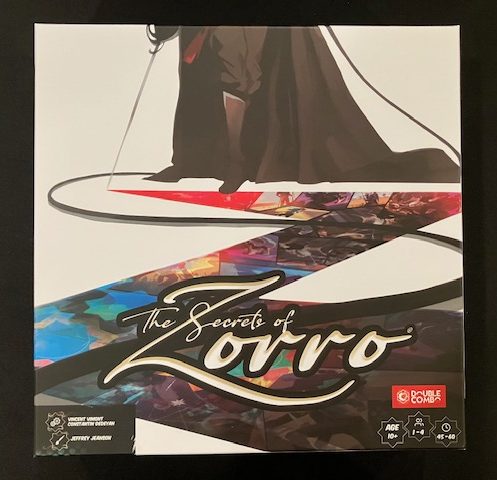
Review of Secrets of Zorro: Or “Where Do You Think YOU’RE Going, Señor Beaver?”

I freely admit that The Secrets of Zorro board game kinda sat around my house unplayed for a while.  I got it from Kickstarter, about 3 or so months ago … but it didn’t look great.  I mean, I did back it and I did pay real money for it (as I always do)!  So, I uncovered it one game day, and said, “Hey, let’s try this: I hope it doesn’t suck.”

The Secrets of Zorro is a cooperative worker placement and boss-battler game for 1-4 players. It obviously lives smack dab in the middle in the Zorro universe … the Zorroverse? That’s right! Cooperative worker placement? Boss-battler? Zorroverse?

Let’s take a look!

Unboxing and Gameplay

Each player assumes the role of one of the children of Zorro!  The “real” Zorro has died, and it’s up to his children to assume the mantle of their father! They will fight for justice together! (There are no special asymmetric powers, you are just kids of Zorro!)

To fight for justice, you must defeat the evil Governor who is destroying the town!  This is a Boss-Battler after all!  See above!  We tended to refer to bad guy as the Governator (with thick Arnold accent), because this village is in California after all….

As part of the worker placement system, each player gets 3 worker placement tokens (only 2 at certain player counts).

The tokens are placed around the village, doing different things at each Location!  See above as the tokens go on the black spots!

The function of each Location in the village is outlined in the rulebook (see above), but basically you can go to the Tavern to see “what’s going on” with the soldiers in town, you can go buy some cool new gear, you can heal yourself at the doctor, you can work the fields to get some money, and you can bribe some guards at the Citadel to get more info about the solider’s movement! 

And last but not least, you can explore your father’s Secret cave to find some of his old stuff! See above! (Dad has some GREAT STUFF!)

As a cooperative worker placement game, the group decides “together” the order in which to play and activate the locations!  That’s right! Player Selected Turn Order permeates this game! (See here for more discussion of Player Selected Turn Order). Players work together to figure out the best locations to populate as a group!

It’s important to go to the Market, The Tavern and other places around town because you NEED to reveal the Green cards (above)!  These cards contains “soldier movements” in the night, and will indicate how the soldiers will be doing bad stuff!

In the night phase, the Soldiers will go to the “outskirts of town” doing dastardly deeds for the Governator! See above!  Players, as the kids of Zorro, need to keep the soldiers in check!  If you don’t “deal” (ie., fight) with the Small Gold Convoy above (on the West side of town), they will cause the Governor’s plan to advance by 2!  (The red +2).  If you defeat the soldiers, you get 2 gold (the green +2) instead.

Players must choose where to go at night!  Sure, you are fighting cooperatively, but you only have limited resources, so the more you know about the soldiers movements (see above: we have three soldier groups going to the north), the better you can spread out to combat the governor’s forces!  In the day, you have to balance upgrading your kid of Zorro (buying new stuff, adding advantages, looting your Dad’s cave) with tracking the soldier movements (by bribing soldiers, drinking with some locals, or hanging out with the merchant!)  It’s actually quite thematic: you gotta hang out  in town to get intelligence!

The fighting system is simple but interesting!  The players, as a group, get to choose how to attack, and in what order! (Again, more Player Selected Turn Order!) Each kid of Zorro has 5 such combat cards, 1 of each above. There are whip attacks (which can hit multiple soldiers), horse tramples, and some sword attacks!  They all feel very thematic!  See above!  

As you play, you can get more stuff to help you: Tornado (by far the best card in the game, coming from your Dad’s Secret cave) augments your Horse Charge AND allows you to be in two places at once during the night!  You can also buy gear like the Black Costume above (for 3 gold) from the Merchant!!

Once you decide to fight, you dedicate some of your fighting cards (in whatever order you please) to fighting the soldiers!  The Small Gold Convoy got two Strong Soldiers!  Gulp! 

Luckily, Tornado and the Horse Charge can take one of them down in a single hit! See above! You do have to fight the soldiers left to right …

Basically, you alternate day (worker placement) and night (battle soldiers) until you exhaust all the soldiers in the citadel and force the Governator into a final fight!  The better you do at keeping the soldiers (in the night phase) in check, the fewer the Governator will have in the final battle!

If you can beat the line of solider protecting the Governator and take him out (see above), you win! If you take too long or lose too many battles with solider at night, you lose!

It’s worth noting the wound mechanism is simple and clever; if you ever lose a fight, you have to place one of your fight cards in the wound section of your character, and you can’t get it back until you heal or see a doctor (normally, you get all your fight cards back every night).

Rulebook

I didn’t love this rulebook.  It was missing some rules, and it could have been better in a few sections.  But because this is a very thematic game, some of the missing rules you can easily extrapolate.  For example: Where do the soldiers go if players lose a combat?  I had trouble finding the rule, but it seems thematic that they go back to the Garrison.  The lack of clarity in some rules wasn’t a deal-breaker (like it was in Corps of Discovery from a few weeks ago) because this game is pretty darn thematic!

The rulebook gets about a B- on the Chair Test.  It can work on the chair next to me, as it stays open, but it could be slightly smaller and have a slightly bigger font.  B- is still pretty good.

The Components list made me grumpy (see top of page) because there were no pictures! In fact, I had to count cards to make sure I understood what each type of card was! That’s not ideal.

The Set-Up (above) did help answer a lot of questions, and it even had a nice picture with the correlating instructions on the opposite page!  So, that helped alleviate some of the component issues.

The rules were okay.  A few might have been clearer, but it taught the game.  See more pictures above.

The picture (above) with list of actions at each Location was pivotal to playing the game!

Except for one major rule omission, the rule book was good enough. We moved forward with only a little bit of grumbling. It taught the game well enough. Let’s move on.

Solo Play

So, congratulations to The Secrets of Zorro for following Saunders’ Law and having solo rules! 

The solo mode is a true solo mode where the solo player inhabits a single kid of Zorro.  

Theres not too many changes for solo play: For balance purposes, the solo character gets 10 combat cards (see above) instead of the 5 or so.  

The solo player actually gets 6 worker placement tokens (see above for 3 of blue and 3 of green).

And when going out of town during the night phase, the solo player can go to TWO outskirts places by himself.  

Other than that, the game pretty is the same as the cooperative game.  In this case, the solo player is just operating a lot of workers and combats by himself!

The solo game works pretty well to teach the game: after one game, I felt like I had most of the rules down.  It was also pretty fun.  I could see playing solo again.  It was also pretty quick: the game box says the game takes 45-60 minutes and that is pretty accurate!  The game’s mechanism are straight forward, and as the solo player, I had lots of choices! It’s easy to learn.

Cooperative Play

Even though the solo mode was fun enough, the game really shines as a cooperative game!  Over two weeks, the game came out numerous times!  By request! Once as a 3-Player game with me, Teresa, and Andrew (see above) …

… and once as a 4-Player game with me, Sara, Teresa, and Andrew!  

The Player Selected Turn Order really keeps everyone involved all the time!  During the day phase, players have to decide when and where to place their tokens! Then during the night phase (when you fight the soldiers), that same Player Selected Turn Order is still in force as  players decide the order in which they attack!  It made everyone feel involved and active!

In fact, as the Kids of Zorro working together, a little bit of role-play even emerged! 

“Hey Sis, can you help me fight to the North?
“Okay, Bro, but you owe me!  Dad always liked you best!”

It was actually a little surprising that the role-play emerged! I wasn’t expecting it!  But, as Kids of Zorro, we all felt kinda connected!  That role-play was a major benefit I did not see when playing solo! That extra little silliness really ratcheted-up the cooperation!

This is not a heavy, plodding game: it has a light air to it, and was much more fun than I expected!

“Where Do You Think YOU’RE Going, Señor Beaver?”

A very very long time ago, when I was a kid in the 1980s, the same 10 or so movies showed on HBO all the time.  There was one such Zorro movie that me and my friends watched and quoted quite a bit! My friend’s CC and John watched the movie a lot more than I did, but one of the lines from the movie  still gets quoted today: “Where do you think YOU’RE going, Señor Beaver?”

I had to ask my friend CC: “Um what was that movie you and John always quoted?”  It was Zorro: The Gay Blade starring George Hamilton.  It was a silly movie according to CC!  It was a fun romp … it was funny and a little silly, but still had lots of action and great sword play! Just like you want from a Zorro movie!!  I bring up that movie because, somehow, the spirit of that movie seems to shine through this game!  This is a light game, but still enough interesting decisions and cool combat with swordplay, whips, and horses!  You fight bad soldiers to take out the Governator!  But it’s fun!  Not too heavy!

And no, I’m not going to tell you the context of the quote.  You have to watch the movie to find out for yourself.

House Rules

This game is really fun, but it needs some house rules.   The thing is, they are all thematic and make the game more cooperative and more fun!

1) First of all, there is no trading!  See rules blurb above.  I get that it might be for balance, but it makes the game feel like “you just get what you get, you have no choice“: And that’s not fun.  It really came home to us how ANTI-THEMATIC this “no-trading” rule was when I was wounded and needed a gold to heal myself.

“Hey Sis, can I have a gold? I really need to go to the doctor!”
“NO!  I cant give you one!”
“But we all live in Dad’s house at the end of the day and come home to each other … you can’t give your wounded brother a single gold to help him heal?”
“NO!  Go work in the fields and get your own gold!”

We assume (maybe wrongly) that we all go back to Dad’s house at the end of the day.  It seems like we should be able to share at least gold and equipment at the end of the day (I get that Advantage cards can’t be shared) because we all sleep in the same house?  Like I said, add some trading at the end of the day makes the game feel more fun and more engaging and more strategic (as you feel like you don’t get STUCK with something).

2) Ride to other Outskirts!   The Horse Charge is the best base attack in the game!  But it seems very thematic that if you discard the Horse Charge during the night phase, you can ride to another “outskirts” Location and help your brothers and sisters!!!  The fact that Tornado already allows something like this speaks to this rule.    It’s not too damaging to balance, as it’s the best base attack in the game!

It was our experience that both of these house rules made the game more fun, more thematic, and more cooperative!  

Things I Liked

The Secrets of Zorro was: Easy to learn.  Easy to teach.   It had reasonably quick games.  The art on the cards was really nice.  I loved how the Player Selected Turn Order permeated the game in both worker placement and combat.  I was surprised and delighted by how much role-play emerged in the cooperative game!  The game was very cooperative and engaging at all times!

Things I Didn’t Like

I love the art in the game, but I don’t love this cover.   There’s some great art in here and I feel like the “attract mode” of the cover might cause some people to pass it over. Don’t!  It’s a fun little game!

The rulebook could use a little sprucing up (better back cover, a few rules need to be clarified or elaborated, components description page needs to be much better).

Overall Reactions

We all liked this game enough to play it two weeks in a row!

Andrew: solid gameplay, 6.5 or 7. Probably 7 with house rules.
Sara: 7?
Teresa: 7? 7.5?
Rich: 6.5 or 7 for solo game.  7.5 for cooperative game, 8 with house rules.

I think the only reason it didn’t get a higher score was that it is still pretty light and doesn’t have tons of replayability (they do, however, have an expansion which helps with some of that).   This was a keeper for my group: Probably 7.5/10 overall.

Conclusion

I didn’t expect to really like The Secrets of Zorro, but I really did, as did my group!  The cooperative experience was really engaging because of the Player Selected Turn Order and the role-play that emerged from being the kids of Zorro!  

We have a few house rules to suggest that make the game more fun (making it about a 7.5/10), but even the base game was still a 7/10!  The Secrets of Zorro was fun, quick to teach, quick to play, and a fun experience fighting for Justice!

Just don’t accidentally pronounce Zorro like Tsuro with your friends!! For a few minutes, Andrew was confused why we were fighting bad guys in the Tsuro game???

Top 10 Solo/Cooperative Trick-Taking Games

Trick-taking games are a genre that’s been around for ages: Bridge, Hearts, and a more gamery games like Rage! We’ve now reached a point where there are a lot of solo and cooperative trick-taking games as well! To be cooperative, every single one of these games has a pretty severe notion of Limited Communication … if you could just communicate anything, most of these games would become trivial! So, most games on this list have very constrained notions of communication! Interestingly, most of these games also have a very constrictive player count, so we take note of that as well! Let’s take a look below!

(We also note that two of these are in German, which required me getting a translation, and a third was mostly German but luckily included English rules!)

10. Park Life

Player Count: 1-4

This cooperative Trick-Taking game is a little misleading because, depending on the version of Park Life you get, there’s a very different trick-taking game! 

The Deluxe Hedgehog version (above) has a different version of a trick-taking game …

.. than The Deluxe People Edition (above)! 

Both games have a solo game, but the game is a little better with more people.  These games are at the bottom of this list because they seem the least developed: they are very cute and have some interesting ideas for trick-taking games, but feels like they could use a little bit of either explanation or work.   

Still, you may play these and fall in love with them because of the cute art!

9. Lindyhop

Player Count: 2-Player Only

This game presents is an interesting theme, as a trick-taking game recreating a dance from 1928 (from the African American communities of New York City).  Two players “dance” with each other, with trick-taking simulating the back-and-forth/give-and-take as players try to “groove” together.

Players traverse a path together, picking up tokens if they land on exact spaces. See above.

Players play cards and the difference in card value is how far they move!  The art is gorgeous (see above) and very thematic: there are even special powers on some of the cards!

The only reason this is a little lower on the list is because there is really only one opportunity to strategize: at the beginning of the game!  But it’s a fun little romp that’s easy to bring out.

8. Claim with the Expansion Claim: Alliances

Player Count: 2-Player Only

Claim by itself is a 2-Player only competitive trick-taking game.

But, with the Claim: Alliances expansion (see above) this becomes a cooperative trick-taking experience!

This is one of the games that was originally in German, luckily I was able to find English rules online!

Since the way to play cooperatively is to use the Alliances expansion, you first have to learn the base game! The game proceeds in two phases, both powered by trick-taking! In the first phase, you play tricks to try and recruit cards for the next phase. The winner of each trick gets the named recruit, and the loser gets the “random” top-deck recruit! The second phase has the players trying to win factions (using trick-taking): whomever wins the most factions, wins!

In the cooperative game, some Alliance cards are added to the mix. During the recruit phase, the winner has to take an Alliance card, which includes bad guys and commanders, and at some point, both sides must have a commander whose factions they MUST win!

This is a little lower on the list because you have to get the base game under your belt before you can play the expansion. But there are some cool ideas in here, including the two phase system and some special powers on some factions!

7. The Fox in the Forest Duet

Player Count: 2-Player Only

This is a 2-Player trick-taking game where players play tricks to move around a forest map collecting gems.

The art is cute and the game is pretty light.  The Communication Limitations are fairly draconian once you have your cards (you can’t even discuss strategy), but you can discuss strategy between rounds. We had fun playing it; it’s a lighter game that isn’t crazy rule heavy.

6. Trick ‘n Trouble (Fangt Doc Crazy!)

Player Count: 3-Player Only

What???? A 3-Player only game???

This is a bit of a surprise as a 3-Player only cooperative game! It has kind of a spooky (silly spooky) theme!

Players try to fulfill tasks based on the cards from “won tricks”: The players have a tableau of tasks to fulfill (see above).

The “trick” in this game is that some of the cards are double-colored, and you can use them as you wish.

This was a surprisingly fun little game, even if the 3-Player only count is a little different.  Like most cooperative trick-taking games, the limited communication permeates and you can’t really talk about the cards in your hand.

5. Sail

Player Count: 2-Player Only

I’ve been able to get Sail to the table a number of times with Sam and Kurt over the past year!  It’s a fun theme as you use trick-taking to help move a ship towards its final destination! 

Winning a trick means “usually” moving the boat in your direction (towards you), but there are many different things that happen along the way! 

Can you avoid the Kraken?  Can you move forward when you really need to?

Using trick-taking as a means to move the ship forward is real interesting mechanism!  If you like Sail, be aware that Sail Legacy is coming to Kickstarter soon!

4. For Northwood

Player Count: 1-Player Only

Yes, that’s right, this is a solo trick-taking game! It sounds like this can’t work, but it works really well! The tricks are “conversations” with fiefs, and you try to make fiefs “friendly” to you by winning them over with conversation! It’s a pretty thin theme, but it works pretty well as a trick-taking schema.


This is a tiny little game with super cute art!

There are special powers you can activate!

Winning is a victory point threshold, as you count how many friendly fiefs you obtain (and count the stars)! Because this is a solo-only game, there is no notion of Limited Communication!  This is a really unique little game that I had to scour all the gameshops to find!  I think there were reprints, so I believe this is back in stock!

3. Jeckyl and Hyde vs. Scotland Yard

Player Count: 2-Player Only

The two players cooperatively play the two sides of Dr. Jeckyl and Mr. Hyde, vying for control! 

This is a fascinating idea, using trick-taking as a way to take control of the personality!   To keep ahead of Scotland Yard, the two players must win tricks in such a way as to keep Scotland Yard off their tail!

The two players each play a different side of the personality!

I, unfortunately, was unable to get the English version for some time, so I ended up using Google translate to translate the German text to English!  But this game was so cool, the art was so neat, and it had such neat ideas, I really liked it!  That’s why, despite only having a German copy, this made it all the way to #3!  (And I did finally get the English version: it is available more widespread now!)

2. The Lord of the Rings: The Fellowship of the Ring Trick-Taking Game

Player Count: 1-4 Players

This game has taken my game groups my storm: everyone loves it!  

I played it solo when I was sick, and had a wonderful time going through the whole campaign solo! 

My friends in Las Cruces have played through the entire campaign as a 3-Player game and love it!  See our review here!   I played a bunch 3 and 4-Player games at Dice Tower West with my friends Becca and Tricia and had a ball!

The reason this game is so high on the list is that everyone seems to really enjoy it!  The fact that it can play at so many player counts speaks volumes to the design team!  The solo game is very different from the 2-Player game, which is very different from the 3 and 4-Player game, and yet all the different modes seem to work, and work well!  The theme seems to come through fairly well! My friend Andrew was surprised this was #2 and  NOT #1 on my list!

1. The Crew: Either The Quest For Planet Nine or Mission Deep Sea

Player Count: 3-5 Players (sorta 2-Player)

There are two different versions of this game, but they are essentially the same kind of game. Like Fellowship of the Ring: Trick-Taking game, the game players differently depending on the player count. There is a 2-Player mode, but it’s very clumsy and probably not the way you should play.

Players play tricks, but have to fulfill missions in order to win the game!  The missions give the game focus, and change every game! 

Honestly, even though I have the physical copy of both games (which are arguably the same game), I have played this game SO MUCH on BoardGameArena! During the Pandemic, this was the goto game for me and my friends! It was so easy to just bring this out and play for hours. Something called The Crew brought us together; there is probably some deeper meaning there.

What makes this #1 on the list for me is the brilliant rule that you can communicate WHEN IT REALLY MATTERS! You have a token that allow you to communicate once during your turn, by sharing the lowest, highest, ot “only one” of your hand. This is so unique: all the other trick-taking game have very restricted communication, but essentially there’s none or high-level “strategy” communications. With this one mechanism, The Crew makes it feel like your CHOICES MATTER: It matters when you choose to communicate, it matters when you choose to hold off, it matters!

This is the #1 on my list because I have played it so much more than every other game, and it’s so easy to play online or in person, and you feel like your limited communiques matter.

Corps of Discovery: A Cooperative and Solo Game

Corps of Discovery is a cooperative game that was on Kickstarter back in May 2024. This promised delivery in Jan 2025, and it was about 3 month late, arriving in late April 2025.

This looks like a thematic adventure/exploration game set the in era of Manifest Destiny and Lewis and Clark!  And it is NOT!  This is a deduction game, with bare hints of theme.  The text on the back of the box even hints at this being a thematic game:

“Take command of Lewis and Clark’s Corps of Discovery and lead them on a cross-country mission to explore the land … and kill demonic monsters.”

Sounds like a thematic exploration adventure, huh? Nope nope nope nope nope nope nope! Corps of Discovery is a deduction game! A cooperative deduction game, but a deduction game nonetheless! You need to know that going in or you will be severely disappointed by that description.

Let’s take a look!

Unboxing

Corps of Discovery is a pretty standard sized Ticket To Ride style box.

Now, we are showing the Ultimate edition of the game, which has slightly nicer components and a few expansions (see above).

The unboxing starts poorly, as you have to “fix” some maps in the game.

See above: as I have to X (or notate) which maps are bad.  Now, they aren’t full maps, there are just partial maps, so one side of the maps is good and the other side is bad!!  So, you still have to keep your “bad” maps, because one side is ok.   This started me off a little grumpy, but at least they fixed the problem.

The main part of the game, the key part of the game is the map holder above: in the Ultimate Edition, this is a beautiful wooden map.

There are some resource tokens (and a holder, which got very badly shaken up in delivery).

Underneath all that are BUNCHES and BUNCHES of maps!

There are different “themes” of folders with different maps: see the training mission folder above.

See the Flora map pack above.

See the Insecta map pack above.

See Vameter map pack above.

Coupled with these folders of maps are missions and the goals. See above.

Underneath all the maps are holders for the tokens for each Map pack.  Note that mine got shaken up a little, so the components are a little wonky.  I wish there had been a discussion somewhere of what all these things were, but you will figure it out … it could have been easier.

Basically, under each hard card are some components for the necessary map pack.

See above for some core components under the Core Game hard card.

The components are pretty nice, but you have to like the comic-book art style of the game. I do, but others may not.

The quality of these maps is a little flimsy, which isn’t a big deal if you are careful.

I was a little underwhelmed by the quality of the components, especially because of the errors on the maps! I did like the variety of maps, the comic-booky art, the wooden resources, and the wooden map holder. My friend Lon texted me after he got his copy: he was less than thrilled with the quality:

I saw you posting about Corps of Discovery. I will say, I am not super happy with detail and packing quality. The manuals and the backs of the expansion tiles have different numbers of items (that is just bad), so I don’t know which is right. Also, I’m missing 8 tokens…at least I think so. Since I don’t have an actual list of the number of individual resources, but it looks like I’m missing several of those, plus I know I’m missing two water, and 1 Tipi. On top of that they had the errored maps and tokens, with I’ll say substandard ways to fix them (proxy the tokens, and to save a few pennies, we’ll have you “x” out the bad maps, so we can print 2 sheets instead of 4).

Lon is also talking about the components page: it doesn’t give an accurate count of the resource tokens, so we don’t know if we got them all!!

You saw how messed up they were.  So, are we missing some?  I don’t know! They aren’t clearly enumerated the rulebook!

The component quality left a little to be desired, but I think Lon was grumpier about the components than I was.  The rulebook, however, left me MUCH grumpier than Lon.

Rulebook

I have not been this frustrated with a rulebook in a very long time.  The rulebook looks like it might be okay (it actually gets an A- on the Chair Test),  but for a deduction game where every word matters, this rulebook struggles to specify the rules well.

A few weeks ago, I didn’t love Soul Raiders, but I even reprimanded the rulebook for too many examples.  Oh, if only that were the case this week!

There was essentially ONE example on page 9; and it didn’t do a great job: the example crossed page boundaries, so it made it it harder to correlate the rule with the example.  It also was too small!  I struggled to read the page because it was a little too small in the rulebook! Also, some of the rules we so small because they were hidden in the text of the box!  

See Coke can above for scale: it’s too small!

This is a game where a single resource can make the difference between winning and losing.  Yet, there are so many places where things are poorly specified.    Some examples:

What happens when you discard a Challenge? (see Bait and Trap card above) Are there rules about which one? Can you discard one in progress?  Do you keep the path tokens for the next challenge that replaces it?  This makes a HUGE difference!   The summary icon page at the back of the rulebook DOES NOT show this and offers no explanation in the rulebook.

What happens when you add a Challenge?  (see Pass/Fail on Sweltering Challenge above).  Can you specify where the challenge goes in the day?  Before? After?  Can you put it to the front?  Can you choose NOT to add a challenge?  (Usually, you want to, but sometimes you want to move to the end of the day to reset all your Gear).  Again, there’s no specification anywhere and these rules make all the difference in the world.

What does the ?/Water notation mean?  See above on the bottom of the Landslide card.  I went spare looking for it! 

It’s not on the back page with the summary of icons!! See above!! I figured it could maybe mean three things:
1) discard a water or some other token (I think this is the actual interpretation)
2) make it so the minotaur lines don’t require lossage
3) lose a water ONLY IF it’s on the ? side, or off the board (or remove a ? water from the board)
This is one place where the token iconography failed: the ? side is useful for the players to “mark” what they think resources are.  Corps of Discovery conflates the meaning of ? to be “any single resource” and also “notate where a resource might be”.  Which is it? 


The final meaning is not where you expect it on the rulebook: I expected an explanation on the last page with the icons: NOPE!  It’s hidden next to the path rules and Monster Threat Effect on page 10????  It’s not even clear if it’s supposed to be a token?   It sure looks like it from the picture, but I have none of these tokens in my game!!

Another problem: this page 9, which is arguably most important page in the rulebook, does not specify all the rules that appear in the Training Scenario!  It alludes to some of the rules, but isn’t clear.   See this posting over on BGG: With a little help from the internet, I figured out what was going on here.  But I feel like this page needs to explain a few more rules.

In a thematic game, I don’t mind making a few snap judgements for rules, but deduction is all about precision.  This game needs an Index, more examples, more clarifications, and some rules need to be actually specified.

Gameplay

If I said this played like Minesweeper, would you get mad at me?  Players uncover spots of the board grid using deductive rules (board sideways to maybe not give any spoilers; each map is unique).  What’s revealed leads to more clues about what’s around you!

These spots have resources which you use to overcome challenges and monsters.

It’s Minesweeper, with resources and a lot more deduction rules.

10 Plays

I gave myself 10 plays to play the game: I played two of the Training Scenario, six of the Fauna Scenario, and two of the Flora Scenario.  This took place over two weekends with pretty much my the last weekend being consumed by this game.

I was able to beat the Minotaurs reliably in the Fauna scenarios after about 5 plays.

The Flora Scenarios kicked me around.  I lost.  Hard. And I didn’t have fun.

By the end, I was tired of looking for the fun in this game.  After my 10th game, I was done.

Randomness

Like I said, I was able to defeat the Minotaurs reliably after 5 games. But I noticed that my score ranged from 3 to almost a perfect score (27)!  I got “lucky” and just happened to have the right cards come out and the right resources emerge so I was just able to trounce the minotaurs!  This was right after a game where I barely won, and I got 3 points.  The score was more of a representation of “how lucky” I was; one game, I got lucky and obtained almost a perfect score! One game, where I got trounced by my Misfortunes, I won … but barely.   The score meant nothing:  It just noted how lucky I was.  To be clear, I didn’t play THAT differently between games.

In the Fauna games, the game felt VERY lucky; how far you could advance, and when you get the Flora Terrain tokens, just felt very lucky.  (Uncovering Flora tokens means you don’t get the resource, and you have NO IDEA if you will uncover a plain resource or a Flora resource).

In a game where Deduction is such an important part of the strategy, there seemed to be too much luck for me to want to come back to this.

Conclusion

I wanted to like this game so much.  I was initially a little disappointed that it wasn’t particularly thematic, but I still really like Deduction Games, so I was still so happy to move forward with what it was. A deduction game needs tight, well-written, and well-documented rules; sadly, that was not the case with this game!  The rulebook was one of the most frustrating rulebooks I have encountered in sometime.  To add insult to injury, I felt like a lot of scenario-specific rule were also under-specified.  Even powering through the rules and making the “best I can” with the rules as given, I found the game just too random for a game that just leans so heavily on hard deduction.

I gave Corps of Discovery so many chances; I forced my way through ten games, hoping to “finally” overcome the hump of rules.   But I rarely had fun playing: I was always just so angry at the randomness and poorly specified rules.  I am selling my copy. 

Maybe you’ll like it if you can power through it; maybe being forewarned about the pitfalls will help you like it.  Corps of Discovery has a really original premise, and it has some great ideas, but it just never came together for me.  Maybe it will for you.

EDIT: My copy has been sold.

More Solitaire than Sherlock: A Review of Sherlock Solitaire (the Solo and Cooperative Game)

This review has been sitting in my hopper for over a year now; not sure why I didn’t get it out earlier!

IMG_3314

Sherlock Solitaire is a very small cooperative card game for 1-2 players.  This released early in 2024: I had heard about it from my friend Sam and so I quickly ordered it from Wise Wizard website about a month ago (early March 2024).  It delivered pretty quickly!  I got it to the table solo, but I didn’t want to finish my review until I tried it two-player cooperative .. Sam really wanted to play, but he was busy most of March.  

IMG_3318

This is a very small and thin package.   It plays 1-2 players, is about 20 minutes, and plays ages 12+.

Let’s take a look!

Unboxing

IMG_3316

Sherlock Solitaire is a teeny tiny box and very thin: see the Coke can above for perspective.

IMG_3319

Except for the instruction pamphlet, it’s all cards .. just 55 cards.

IMG_3335

The cards are pretty gorgeous.

IMG_3337

The game is very pretty on the table: see above.  

Rulesheet Not a Rulebook

IMG_3315

The rulebook is not a rulebook but a rulesheet: see above.  Sigh. It’s a pamphlet.

IMG_3320

Considering it’s a pamphlet, it actually does ok on the Chair Test!  It fits on the chair next to me and I can read it!  The font is a little small (because it’s a folded pamphlet), but it worked on the chair next to me, as I consulted it during gameplay.

IMG_3322

The set-up was pretty good: see the picture above.

IMG_3323

The rules are a little sparse, but they does work.

IMG_3324

It even does a decent job at showing examples and counter-examples of “what is a set”! I appreciated that set of pictures!

IMG_3328

Given the constraints of a pamphlet, this rulesheet worked pretty well.  The pictures were all informative.  There were a number of places where some clarifications could have been provided, but the ruleset was simple enough and consistent enough that we were able to extrapolate rules when needed.

This was a decent to pretty good rulesheet.  

Gameplay

IMG_3331

Choose a starting scenario: The Intro Case (The Valley of Fear) is just to get you into the game, so it has simpler win conditions.  The Final Problem has a much harder win condition.

IMG_3329

Each player (works for 1-2 players) takes either the Watson card or the Sherlock Holmes card.  See above.   The bottom of the card shows the special abilities of each player!

IMG_3334

Basically, each character gets 4 cards on their turn to play to one of two areas: the Crime Scene or the Office.   There are two types of cards: Investigator cards (labelled 1-4: see above) and Threat Cards (labelled A-D, see below).

IMG_3336

Over the course of the game, the player(s) must play two cards to the Crime Scene and two cards to the Office each turn.

IMG_3343

In the Office, you are trying to make sets of cards: you have to alternate investigator and threat cards  (numbers and letters … see above).  All investigators (numbers) must be in the same column, and all letters must be distinct in a column: these are the “sets” the players are making.  If you get 3 full sets (4 investigators), you win!

IMG_3344

However, you still have to play two cards to the Crime Scene as well: see above.  If you ever get 2 of any type of card, you immediately discard those two cards and “do something!”  

IMG_3347

Two threat cards?  You take a wound! See two threats above …

The wound card is a “timer” of sorts: if you ever get 3 wounds, you lose!

IMG_3649

If you get two investigators on the Crime Scene, you invoke your special powers!

IMG_3342

The rulesheet does a nice job of summarizing of how to use your special powers … see above.  

IMG_3346

If you get enough sets, you win!  If you get 3 wounds, you lose!  It all happens in about 20 minutes.

Solo Play

IMG_3323

A game called Sherlock Solitaire had better have a solo mode! It does (thank you for following Saunders’ Law): it’s the main way to play!

IMG_3349

Once I got past my first few games (after I had to decipher the rulesheet), the game moved pretty quickly.  

IMG_3342

The best part of the game was when I could be clever and play my special abilities in a clever way to move cards to/from the Crime Scene/Office.   The worst part was when I just played cards and didn’t feel like I had a lot of choice.  The game was a fairly engaging way to spend 20 minutes.  It really did feel like a game of Solitaire as I moved cards around.

More Solitaire Than Sherlock

IMG_3317

With a name like Sherlock Solitaire, you might be expecting something more like a mystery. No, this is a lot more Solitaire than Sherlock: you are just playing cards like a game of Solitaire.

IMG_3335

Don’t get me wrong: I love the art! The art that comes with this game is gorgeous and very evocative of the Sherlock Holmes stories!

IMG_3341

In the end, though, there is no mystery to solve. There isn’t really a lot of theme: this could have been a Cthulu game, a Zombie game, or a Smurf game. Or anything. Nothing about the gameplay really has to be in a Victorian Sherlock Universe.

IMG_3338

The art is really the only thing that makes you think of Sherlock Holmes: and it is phenomenal art!

Two Player Game

IMG_3656

I had to wait almost a whole month to play with Sam!! He was interested in the game, but was busy with family and work all March.

IMG_3643

There are two ways to play Sherlock Solitaire 2-Player: 

  1. Play as the solo game, but both players together make all the decisions
  2. Each player takes Sherlock and Watson, and alternates turns

We chose to alternate turns.  The solo game with 2 players making all the decisions seemed less fun … and at that point, it’s just the solo game anyways.

IMG_3646

What we found was that … the second player got a little bored.   There is no strategy in a 2-Player game, as you have no idea what cards you get until your turn.  What that means is that if you are waiting for you turn,  you can do nothing useful!!  You just sit there waiting for your turn.

IMG_3648

The two-player game was much less interesting, as someone was always “waiting” with nothing to do.

… until we tried a little house rule.

House Rule for Two Players

IMG_3649

When it’s not your turn, draw some cards! Instead of sitting there “doing nothing” during your friend’s turn, you can then “be thinking” about what you want to do when it’s your turn! To keep this from being too overpowering (from the game balance perspective), we choose to just draw two cards at the end of the turn and two at the beginning of the turn.

IMG_3648

That way, we were still playing four cards per turn, but had a hint of what we could on our turn.

Weirdly, me and Sam didn’t feel like this changed the game balance too much, and in fact didn’t change our turn too much, but it felt like it mattered!  With this simple rule, we both felt more engaged, even if it didn’t change the game too much!  We felt like we mattered more, even if it was just a small amount! And that made a big difference.

Conclusion

IMG_3321

If you were expecting something with a mystery of some sort, then Sherlock Solitaire may be a big disappointment.  There’s a lot more Solitaire than Sherlock in this game: it’s basically just a card game about making sets and moving cards.

IMG_3319

The special powers of the Sherlock and Watson characters make the game interesting, as you can make many moves in the game that make you feel clever. 

IMG_3337

And despite the lack of theme to this all card game, the art is still very nice and evocative.

IMG_3648

As a solo game, I’d probably give a 5.5 or 6/10.  I might play it again: it’s pretty straight forward and quick … and there are moments where I feel clever.  I freely admit that the art brings it up the score a little bit: the fantastic look makes this game stand out on the table.

IMG_3656

As a two-player game, I would give the unaltered game a 5/10: there was just too much downtime between turns. If, however, we played with our house rule (always having two cards in your hand), then I would bump this up to a 6.5/10! We felt much more engaged even if it was just our preception! My favorite way of playing Sherlock Solitaire was 2-Player with our house rule: that’s probably how I’d play it again.

Soul Raiders: A Solo and Cooperative Review

Soul Raiders is a cooperative fantasy adventure game that was on Kickstarter back in July 2021 and promised delivery in December 2022.  I backed the deluxe Grimoire Edition (above). Well, it finally arrived last month (March 2025), so it’s about 2.3 years late.  This wasn’t on my Top 10 Anticipated Cooperative Games of 2022, but it probably was my #11 or #12!

This sat unplayed in the box longer than it should have; I think I was scared of how big it was! Look how big it is!!!  Did I have the cycles to even try it?

Well, I finally got around to getting out and trying it … was it worth it?

Unboxing

Although this unboxing here is to show you what’s in the box, it’s also here to remind me how to put the box together!  So, it’s for me and you!

This is a BIG box.  This is the Grimoire Edition.

It’s got a lot of stuff packed in: see the character boxes above (this is a cooperative fantasy adventure game).

This game is so grandiose, it has it’s own lore book!

If you really want to get into a fantasy universe, this might be the right game for you!

This dual-layered board (above) keeps track of a lot of shared attributes and state of the game.

There’s lot of little boxes to store your game between sessions.

There’s some fabulous minis.


The campaign notebook allows to save the game between chapters.

There’s a bunch of cardboard tokens.

And boards for the characters.

Underneath all that, are the three main chapters of the game.

The cards of the game are in two boxes: see above.

Each of the chapter boxes has huge Location cards and little cards.

This game is GORGEOUS.  The production is GORGEOUS.

Consult the pictures above for when you need to repack your box!

Rulebook

The rulebook is good.  Well, ish.

It gets about a B+ on the Chair Test: it overhangs on the chair next to me just a little (see above), but it lays flat and open, it has a big readable fonts, and it has lot of pictures.

The components page is well-labelled and notated (see above).  It even breaks up the cards by chapters.

The set-up works pretty well, although it doesn’t show how the story cards will be laid out (which we need to discuss more).

This is a gorgeous rulebook that’s written pretty well, it has lots of examples and lots of pictures.

It even ends with a very useful summary of icons on the back!

Although I liked this rulebook a lot, it made the mistake of putting too much content into the examples.  I like it when rules have clear definitions, then maybe use the examples to help explain and/or clarify.  Unfortunately, I think this leaned a little too much into using the examples AS the rules a few times.    Don’t get me wrong, I am glad the examples are there, but I wanted clear succinct rules as well.  (I think the last time we noticed this “rules in examples” phenomena was back Sleeping Gods rules: see link here).

The rulebook was generally good, and it frankly looks gorgeous (like the rest of the game).

Gameplay

The best way to describe this game? It feels like it a video game: a  Point-And-Click (fantasy) Adventure game with lots of monster fighting.

Each player takes the role of one of six characters: see the character boxes above.

Each character has his own set of cards: there’s basic Action cards (above top) and Heroic Action cards (above bottom).  Notice the Heroic Action cards have a special foil on them so you can tell them apart!

These Heroic Action cards are earned (in order) by spending Heroism tokens (3 to earn a new Heroic Action card).  Cool fact; you can spend 3 Heroism tokens at ANY time to immediately earn a new card! Very useful when you need a card immediately!

You get Heroism tokens are various plot points in the story, but the most reliable way to getting Heroism Tokens is by defeating BIG BAD MONSTERS!  Defeating the one above opens Story Card 14, but also earns the player 2 Heroism tokens!

By the end of Chapter 1, I had been able to earn 6 new Heroic Actions cards! (Heroic Action Cards must be earned in order: note the numbers on far right).

The cards are you primary currency for “getting things done”.  Some cards are more attuned to movement (as you must explore) … see above …

… and some cards are more attuned to fighting!  See above.  Basically, you can always use the value on the card for whatever you want, but the card will have “bonuses” if you use it for the specific specialization!

For example, Heroic Action card #6 (the top one) has a basic value of 5, but if you use it for fighting, you get an extra +3!

Example above: Even though the cards I drew were all movement-centric, I can use the values on the cards for fighting: 4+4 = 8 takes out the first shield on the bad guy, and 4+2 = 6 takes out the second shield!  I used all my cards, and I didn’t get any advantages, but I was able to do what I needed!

Basically, your character explores the world, moves around, interacts with the world, and fights monsters!  All actions are based on the values on your cards!

Basically, you character(s) move around on the Location sheets and explore!

The Locations have arrows which tell you how much its cost to move between Locations: see above and below.

For example, to move to Location 2, I need to spend 4 points from my cards.

This is kind of a choose-your-own adventure tale!  You decide which paths to take, which monsters to fight, which puzzles to interact with!  It feels very much like a choose-your-own adventure!

What’s cool is that each Location has pretty great art (a little comic-booky, but I like it) which describes all the things you can do at that Location … kind of like a choose-your-own-adventure book does in each section.
See above as the character starts on the maps!

An interesting thing that happens is that there is a “clock” pushing the game forward.  At the end of every “turn” after you’ve played all your cards, the Vitae track moves down.  Basically, every time it “wraps around” back to 30, you drop the Action token one space (upper right).  If your threat or the action space ever get to the end, the game is over!

To win, you need to find the Red Stars on the story cards.  If you don’t find appropriate story cards, you lose!

Explore, fight monsters, interact with your world: this is an adventure game!  The way the movement works, it feels very much like a choose-your-adventure game (as the Locations could just be pages numbers in a book!)   This game also feels like a Point-And-Click Adventure game too!  See our Top 10 Point-And-Click Adventure Board Games for more discussion of this genre!

Solo Play

So, this game supports the solo player (thank you for following Saunders’ Law).  This is a true solo game: the solo player operates one character.

The only real change for solo play is on the Game board:

On the Game Board, the final space has a “3” marker on it (instead of 2).  This is the number of cards you draw every turn, so the solo player has that extra advantage that (on the last set of rounds) they get three Action cards instead of two.  And that’s the only change!

The solo player explores, fights, and interacts … but just by himself!  There’s no real balancing anywhere else.    It seems a little weird that there are no other balancing mechanisms, but basically what tends to happen is that more enemies come out as more people play, so that tends to balance the game.  We’ll address that a little more in the cooperative section.

Cooperative

The cooperative game brought up a lot of rules I didn’t have to deal with in the solo game!  When you explore new Locations, whether or not someone is already there “changes” how the Location works!

Unfortunately, the Icons were very confusing about this.  A slight change of color AND whether its on side A or B makes a big difference.  It actually took us almost half the game sessions to get this right!

Although the cooperative game has a sense of Player Selected Turn Order, there really is no turn order!  Players just play when they want and support each other if it made sense.  Although I love this idea, as it should make the game go faster, the game tended to serialize as each player waited to see what happened to see if they needed help.  “Let’s wait to see what Sam gets!”   I love this from a cooperative point of view, as it lets us support each other!! Unfortunately, what really happened more often than not is that the game really just slowed down behind one (the current active player).  To be fair, there were also plenty of times when concurrent play kept the game moving forward.  This system worked pretty well from a cooperative point of view.  From a length of game point of view, this was not optimal.

Although this game is a 1-4 Player game, I was the fifth player and “the rules guy”.  I just read the rules and taught the game and looked up clarifications.  Sadly, this was a very busy position for most of the game!  I would constantly be looking up rules clarifications, icon clarifications, and other things.  I had played the solo game for about 8 hours, and I was still struggling to find some rules!

There are good moments of cooperation as the players supported each other.  Me being the “rule guy” actually worked pretty well, although it was sort of depressing that I had to fill this role.

Urgency

This game has, essentially, a built-in clock.  Every time you have finished playing all your cards, you have to take “Vitae” damage (basically, a shared hit point pool) based on the the current.  The threat will go up occasionally as monsters or other things happen.   And you can’t “usually” just rest on a Location: almost all Locations force you to fight new monsters if you stay there.

So the game is just always pushing forward:   This is both good and bad.  If you are looking for a contemplative adventure/exploration game, this isn’t really it.  If you want an adventure game that doesn’t stand still, but presents a sense of “you have to keep moving“, this is the adventure game for you.   Here’s a very bad analogy; some sharks have to keep moving in water or they die.  That’s kind of what you feel like here: players always have to keep moving (exploring) or you die.

Whether you like that urgency or not is up to you.

Kind of a Big Mess

When you take out the Location cards, there’s no real rhyme or reason to them.  They don’t form a map (like Arydia Locations did: see that review here), they are more like “pages of a book”.  See my big mess after finishing chapter 1!

The problem is that you WANT to see the connections from previous Locations you visited!  So you try to keep a lot of Locations out as you play so you can see how you came here.  And you can see my big mess above as I try to keep some Locations out.  To be clear: the Locations DO NOT form a map! (The rulebook even emphasizes this point).

So, the Locations that come out are kind of a mess.  Shrug.  It feels like there should be a better way to deal with it?

Portals

There are some very cool minis for portals!  See above!

You can see above as I have built at least one early in the game!  I was hoping to make this spot an easy one to come back since there are no “monster spawners” there!

And yet, I don’t think I took full advantage of the portals.  At all. I don’t think I used them once.  Which is a real shame, because they are so nice!

This is where I feel like this is even more like a Video game … where you replay the level to get the highest score and use the portals to their best advantage.  I played Chapter One and got a few extras, but not enough.  I feel like what I would do in a video game is replay it until I got the perfect score for that level!  I think to do that, I think you’d almost have to use the portals.

Maybe the portals will become more useful later on.  I was … disappointed with them.  Given how you never really get to just “think” (see Urgency section above), the only time it feels like you might be able to take full advantage of them is to replay the level.  Remember how I said this feels like a video game?  That min-max feeling emphasizes that point even more …

Save Game

This is a campaign.  You will need to save you game between chapters.  Unless you can leave the game set-up (and it is a table hog), you will have to save your game.

You can either use the campaign book   (above) …

Or just take a picture of your game and extras at the end (see above).  The cards are pretty well marked.

Let’s be clear: this is a campaign you can reset!  I have a solo game going, but we are also playing a cooperative game at the same time.  Sure, I’ll have to “pick” the cards out I want, but it’s fairly easy to reset the campaign to replay it from scratch.  This is not a legacy game.

Too Many Rules?

For such a lavish game, it’s both really simple and really complicated.  The basic card play is really straight forward, but all the little rules for combat and especially movement feel very complicated.  If you enter a Location with someone else, it has a different effect depending on the Icon in there, which has subtle difference between other Icons.

The fact that my role as “The Rules Guy” (as the 5th player and NOT playing the game) was pretty active the entire game might be an indicator that maybe there’s a few too many rules.

Reactions

Oof, Soul Raiders did not go over well with my group. My friends compared this to Tainted Grail (see part I and part II here) where it was just a grind to explore.   Andrew even commented: “This doesn’t feel like an exploration game, even though it kind of looks like one!  I have no mental model for how the map lays out because it’s so clumsy!”  Sara commented that the “.. Exploration feels like Tainted Grail because you just keep getting monsters!  You don’t really feel like you advance!”

Andrew pointed out, “It’s not even really choose-your-own Adventure, because you don’t really have a lot of choices!  You left, right, or forward most of the time! And it feels randoms!”   

The reactions were ok to not great.

Sara and Andrew: 5/10.  “Don’t really want to play it again.  It didn’t feel like exploration. It felt too grindy like Tainted Grail.”
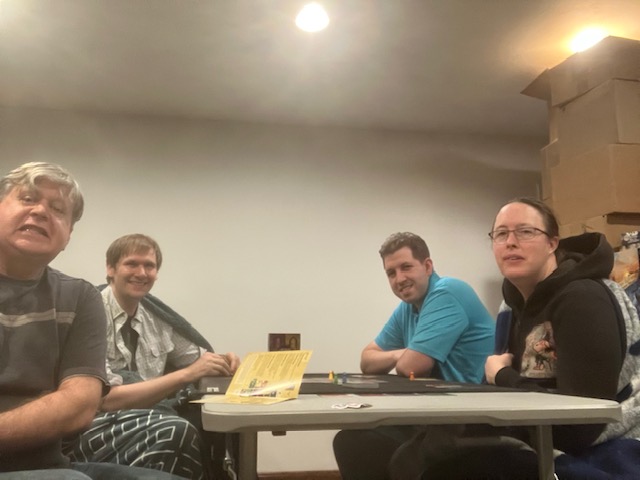
Sam: 5.5/10 “I’d play it again, but I really didn’t love it.  I thought Luddite from last week was more thematic than Soul Raiders!”

Teresa:  6.5/10 “I had okay fun and would play again.”

Rich: As a cooperative game, I definitely saw what my friends saw with the grindiness, and I could see why my friends didn’t love it.  As a solo game, I’m right on the fence of recommending it:  I’ll give it a 7/10 for the solo game, and maybe I could see it working as an intimate 2-Player game.  I think as a solo player, I became more invested in the story, but I still had some of the problems that my friends had. I love the art, and I really like the simplicity of the card system.  I also really like the upgrade system (where you can IMMEDIATELY grab a card with 3 Heroism).  I think there is some interesting stuff happening in the story, but the game does fall to the grind sometimes.

Conclusion

Soul Riders is a gorgeous cooperative adventure with a sense of urgency.  That urgency adds to it’s video game feel: it’s kind of a Point-And-Click Adventure in a board game, with exploring and interacting, but also lots of fighting!

Unfortunately, this game didn’t go over very well with my friends as a cooperative game, with scores ranging between 5/10 and 6.5/10.  Soul Raiders reminded my friends too much of the grindiness of the original Tainted Grail in both its exploration and fighting.  And that grindiness was a big turn off. Having said that, the system worked well from a cooperative perspective, because my friends seemed to cooperate well!

As a solo player, I become fairly invested in the story and I enjoyed it a little more.  I think the solo player can reflect a little more than a cooperative team, so maybe that urgency in the game is less intrusive for the solo player?  I do think that an intimate  2-Player game could go over well as the solo game.

Hopefully this review can tell you whether or not that Soul Raiders is right for you.

Luddite Can Be An Experience, If You Let It. A Review

Luddite arrived at my house about a month or more ago, but I have been afraid to open it.  Why?  I mean Luddite was the #5 entry on my Top 10 Anticipated Cooperative Games of 2024!  I paid money and Kickstarted it!! Why was I worried?

Luddite “looks” big because it has a graphic novel associated with it; there’s a lot of story here.  I was afraid I’d mentally have to prepare myself to embrace it.

I don’t know why I worried!  At the end of the day, this is “just” a roll-and-write game!   You roll 3 dice, mark off spaces on your sheet above (See above) and try to score points (aka damage)! The base game is pretty straight-forward!

The object is to do enough damage to move to the next level! You need 60 at easy difficulty; see above as I miss by 1!  Heart-breaking!

In order to inflict the damage, you have to “move” the metal token (left side above; from the START to the END): if you don’t move that token, you can’t do any damage at all!  So, while trying to get “points” (aka, damage), you also have to make sure the token above moves!

The game plays solo, cooperatively, and competitively.  The solo game is all about doing enough damage,  and the competitive game is “who can do the most damage to win”.   The cooperative game is really just multiplayer solitaire: take the scores of all players and average them to get a score; if that score is high enough, players collectively win!

To be clear, there is NO cooperation in the cooperative game; each player just takes their own book and plays completely independently.  Players can’t help each other, they can’t share anything, they can’t use a dice on another players board … nothing.  This is as multiplayer solitaire as you can get.   If you want an experience where you are working with your friends, chatting, strategizing, working together, … this isn’t the game for you.  BUT if you have friends who are “suspicious” of cooperative games, or people who don’t like the cooperative games, this can still work for you! 

No one will tell you what to do, as everyone’s head is down and looking at their own board! See above!  And no one gets in anyone else’s board in any way!

I made the mistake of getting 3 more “Additional Player Packs” (see above), but what this means is that 3 more people can play!    Basically, Luddite can scale to as many people as you want because there is no interaction between players!!  I am thinking of trying a 7-Player game of Luddite at RichieCon this year! (I have 4 packs in the base game and 3 packs from additional buys = 7 player boards!)

So, you can view this complete lack of player interaction as a good thing or bad thing, depending on the group you are playing with.

Solo Experience

If this was all there was to Luddite, there’s not much making it stand out, is there?  It’s a pretty good roll-and-write game for the solo player, and it’s a pretty good cooperative roll-and-write that scales to any number of players … even if there is no player interaction.
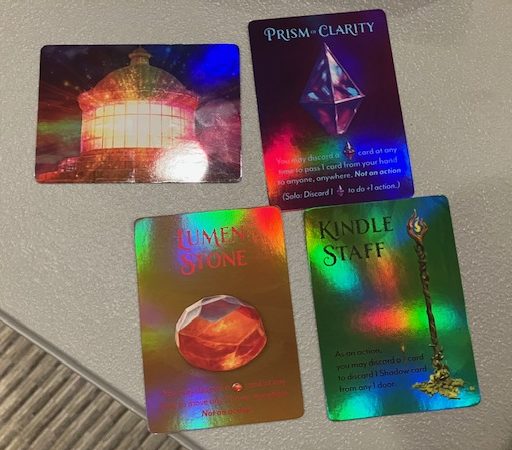
However, if you let it … this game can be an experience!  The Graphic Novel that comes with the game tells the story of some people who have been “made redundant” by AI and how they are fighting back!

The Graphic Novel gives you a back-story, then at certain places, tells you what chapter/pages to turn to! See above!

This was more immersive than I expected.  If you let it, this game can feel very immersive.  For my solo experience, I read the graphic novel that came with the game …

… and each new game is a progression of the story, even if the boards look very similar. See above as I win (solo) chapter 3!

Somehow, it seems for a game named Luddite (Luddite: someone who eschews technology) … that you HAVE to read the physical graphic novel, right?

Cooperative Experience

It turns out, the comic book is also online … in a video!  It has voice-acting, and shows the comic progressing!  See above!

For the cooperative game, it’s “harder” to enjoy the graphic novel in its physical form … you have to pass it around, or wait for others to read it, or read over people’s shoulders.  But, if you go to the Cotswold Group website, they have the entire graphic novel online! (And even a little tutorial)

So, even though it’s seem against the spirit of a gamed named Luddite, the cooperative experience is made so much better by watching the comics-turned-to-videos!  Arguably, that experience engulfs you and all your friends into the game!  It’s a shared story you are all experiencing!

To be fair, it helps the experience if you can show the video on a big screen or TV: see above. It feels more immersive that way.

House Rule/Hack (Get it? Hack? In a game about Hacking?)

The dice are a shared resource everyone shares in the cooperative game: they are rolled and placed in the middle for everyone to see!  But sometimes, in the heat of playing, you may forget which dice you used for which activity.  Surprisingly, there’s no place on the sheet to “notate” which dice we used !!

Since you don’t compute your damage until the very end of the game,  you can use the Damage section!  

This little house rule/hack made it easier to play the game cooperatively, as you could all independently note the dice rolled and how/when/where you used them.  

Conclusion

If you let Luddite be an experience that carries you along in its story (either as a graphic novel or comic-turned-video), I think this can be a really fun and immersive experience.

A reductionist might say “Luddite just a roll-and-write” …  but at least it’s a good one. I really enjoyed all my plays of this.   The base game is pretty straightforward and quick, and it has lots of meaningful decisions.

The cooperative game has literally no interaction between players, which can be a curse or a blessing, depending on the group you are playing with.   But, because of that lack of interaction, this game can scale to pretty much any number … as long as you have the boards!

This is a good solo roll-and-write (7/10), and a pretty good cooperative roll-and-write (6.5/10 or 7/10, depending on what you want), but it’s the story and experience that elevates this just enough that I would recommend you try this: 7.5/10.

I still think it’s hilarious that a game called Luddite has such a great online presence.  I mean, a game called Luddite should ONLY have the physical version, right?

Appendix: Binding

I normally despise this kind of binding, especially on something you need to hold open! See my review of War Story, Freedom Five, and Forests of Admiron if you don’t believe me!  For a graphic novel, it’s “okay” since you are just reading it and holding it open. See below.

Where this binding fails is when you have to read the directions in the back of the book!  See below as I try to wedge the book into the edge so it’ll stay open!  I hate this kind of binding for rulebooks!

See above as I attempt to hold it open!!!   Honestly, the rules should have been in a second standalone book that could be lain flat and open.  As a graphic novel, this kind of binding is “fine”.  But the rules portion of the graphic novel (in the same book, this really made me grumpy.  


One-Hit Heroes: A Solo and Cooperative Review. Insert Funny Phrase Here.

I know, I know. You really want me to make some kind of funny phrase like “One-Hit Heroes is a one-hit wonder” or “One-Hit and it’s out!” But those aren’t really apt descriptions, so insert your own funny phrase above! Let’s look below to see what it’s REALLY like!

One-Hit Heroes is  cooperative boss-battling game I backed on Kickstarter back in April 2024.  It promised delivery in March 2025, and lo-and-behold, it arrived March 29, 2025!  So, it made it! Barely!

I hav to admit I was a little spicy with the delivery, as they literally left it ON THE STREET!  See picture above!  The package is literally on the street in front of my mailbox! Oi!

Luckily, everything was fine: the box and everything was in perfect shape.  (I got two little upgrades with the box; a epilogue box and an extra hero pack: see above).

I was pretty excited for this! This was #6 on my Top 10 Anticipated Cooperative Games of 2025!

Let’s take a closer look!

Unboxing

This is a medium sized box; see above and below for perspective.

It does have a slightly weird shape; it’s not a Ticket To Ride sized box.  However, it’s not too bulky or too awkwardly shaped.

It contains some cards and tokens, as well as three separate “Episodes”.  See above.

The components are all pretty high-quality. The cards are NOT linen-finished and are all very shiny.  That’s actually my major complaint with the components of the game; when playing, the games seems very “shiny”: the cards, plastic trays, are all “shiny” and can be distracting.

Rulebook

The rulebook is good.

The rulebook feels like it has a weird form factor (look how loooooong and thin it is above) …

… but when you open it up, it fits PERFECTLY on the chair next to me! See above!! The rulebook stays open, it’s easy to read, and there is no pages drooping over the edges!  One-Hit Heroes gets an A on the Chair Test! See above!

The Component page is nice; it shows and adds correlative text to everything.

The Set-Up page looks good and is easy to follow, for both the Heroes and the Boss.  See above.

It does a great job explaining the player mats!

Overall, the text is big, easy to read, has a legible font, and is annotated with many pictures describing play.  There are also parenthetical phrases notated for “extra information”.

The back of the rulebook could have been a little better, but whatever, this was a good rulebook.  It explained the game, showed the components and set-up, and was fairly easy to read.

Gameplay

Players work together to take down a boss; a single boss battle takes about 20 minutes (the box is pretty accurate in its time).  An “Episode” in the game is 4 to 5 boss battles, which each boss getting harder and harder.

Each player takes and plays one character of the six above.  Each deck has 11 cards with very different personalities.  Take Sofia, for instance; her story is on the back of her card!

What do her cards look like?

See some of the cards from Sofia above.

Each player grabs a tray  (above) for their character and puts the cards into the tray (below).

As the game name implies (One-Hit Heroes), the Heroes can only take one hit before they die! Even more so, if any character dies, all players lose!  It’s up to the players to stop from getting hit!

Each character has two items slots for Items that “help” (see above), but arguably the Items are more important for stopping a hit!  Players can destroy an item to avoid a hit!  (Thematically, the item takes the hit instead of the character).

Items are a coarse way to stop hits; it’s usually better to stay out of way of hits if possible (since you only have two items)!  One-Hit Heroes uses a notion of an “Aggro track” for each hero.  See the track running left to right at the top of the tray? It’s empty for Will right now.

… but Edric (above) has a track almost full of Aggro!  Basically, the fuller the track, the more likely you are to incur the wrath of the boss and take a hit!

This is a boss-battler after all!  The Punch-Bot (the very first boss from the very first episode) only attacks when a Heroes’ Aggro is in the “red range”.  So, if the players can keep their Aggro low, Punch-Bot won’t even attack!

But, Aggro will go up.  Either from bad news cards  (like above) …

… or every Attack you do ups your own Aggro! If Sofia uses here Sidearm (above) to so one yellow damage, then does one damage to the Punch-Bot, but takes 1 Aggro!  Every attack you do that does damage causes Aggro back to yourself!

Luckily, each player has cards to manage Aggro; some cards (like Taunt above) will move Aggro around, and other cards will just discard it.    Every Hero has a different way of dealing with Aggro; some move it around, some discard it, some avoid it as much as possible, and some have cards that help others!  Each Hero has a different flavor of cards!

Interestingly, there are two different kinds of damage: yellow and orange (light and heavy damage, respectively).

To take out a boss, you have to do both all yellow and all orange damage.  Punch-Bot (above) needs to take 10 light damage and 5 heavy damage to take him out.

If players can defeat the Boss before said boss does one-hit to anyone, the players win! If the boss does one-hit to anyone (and it can’t be blocked or avoided), all players lose!  It’s a boss-battler!

Solo Play: Built-In Mode

The box is confusing; it implies there are no solo modes!  2-4 Players means no solo mode, right?  Nope!  There are actually two solo modes!

The first  solo mode is described in the Hero Set-up on page 3 (see above).  Basically, the solo mode is that the solo player has to alternate between two Heroes!  The solo description (above) is simple and very functional; it’s all you need.

For my first solo game, I played Will and Edric against Punch-Bot from Episode 1!  See above!

The game balance in this game is kept by having a Hero go, the Boss go, the next Hero go, and so on.  Basically, heroes and the boss alternate, so you can “kinda” have any number of heroes.
From a game balance perspective, I always worry that you need to adjust the hit points for the number of players … but since each Hero has exactly 1 hit point, that’s not really a problem here, is it?  Well, it didn’t seem to be: I was able to play all the way through Episode 1 (four boss battles) and I had a great time!  It was close; strictly speaking, as I lost a battle at one point, but it’s very easy to reset and play again since the game is only 20 minutes per boss.

This solo mode emphasizes that characters must work together to keep Aggro under control; in order to survive, both players will be doing things to move and discard Aggro.

Solo Mode 2: Do66-0 Pack

The second Solo mode does NOT come with the game; you must purchase the D066-0 Hero Pack (see above).

There is a little discussion of the DO66-0 pack (and a link) in the back of the instruction book.

Basically, the DO66-0 mode is a companion that you play in solo mode INSTEAD of a second Hero.

It’s much easier to play with DOGG-0:  DO66-0 gets a turn without having to provoke an extra Boss turn.    But, he also can’t do much, as he has no cards to play!  All he can really do is block and roll the damage dice … no cards.
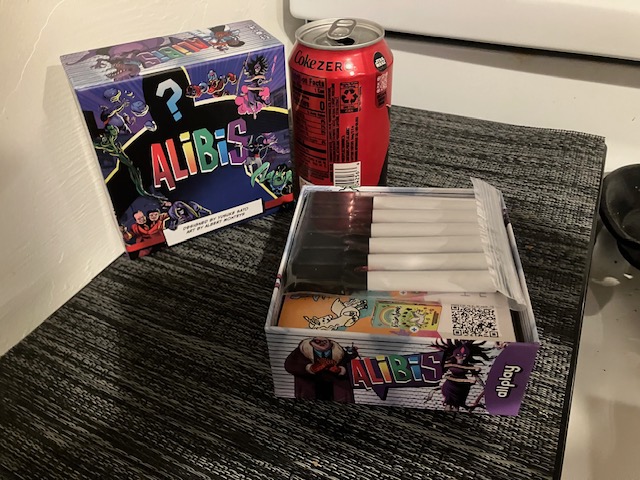
In fact, it’s so easy to play, you can give DOGG-0 to younger players and have them play with you (that’s what Beginner Mode is).

I got to be honest, I didn’t enjoy DO66-O solo mode that much.  DO66-0 does very little on his turn: “about” one damage per turn, depending on what you roll on the damage dice. (He does add new stuff once you start drafting, and that does make him a little better).

I actually think the better use of DO66-0 is to bring in younger kids so at least they can participate; he’s so simple to play and kids can feel like they are helping.

I prefer the base (original) solo mode; it’s two characters and is how the game as meant to be played.  The base solo mode emphasizes how important the sharing and cooperation is in the game, especially to mitigate Aggro problems.    This DO66-0 solo mode was “fine”, but I probably won’t come back to it.

Cooperative Mode: Casual Gamers

My first experience cooperatively was with some casual gamers: my nieces.  We just played through a single boss: a 20-minute game.

The game was easy to explain to non-gamers!  They got the gist of the game pretty quickly, but needed a few clarifications.

I think my nieces liked the game and appreciated how short it was.  They did want to play again, but we ran out of time (it was like, Spring Break or something).

What I found: One-Hit Heroes is a pretty simple game to explain, even to non-gamers.  The hardest part was explaining some of the text on the cards, but even that wasn’t so bad.  My nieces like the game and would play again.  They also appreciated how simple it was to learn and play.

Cooperative Play: Gamers


Me and a subset of my gaming group played through Episode 1 cooperatively.

One-Hit Heroes has a nice way of eliciting cooperation; you will lose if you don’t.  🙂 Maybe a better way to say that is that the game goes cause conversations to happen: “Uh oh! I am about to die!  Can anyone save me?  Should we do some stuff before the next villain?”

The cooperation seems to come out fairly organically; and thank goodness everything is open hand with full communications!  There’s no “oh, I can’t show you this because of limited communication“.  Nope!  People talk, people realize they might die, so people cooperate to block, steal Aggro (in a good way!), and try figure out the best way to move forward.

And the ability to see what’s coming ALSO helps!  By seeing the bad news coming up, but not actually here yet, seems to encourage discussion and cooperation.
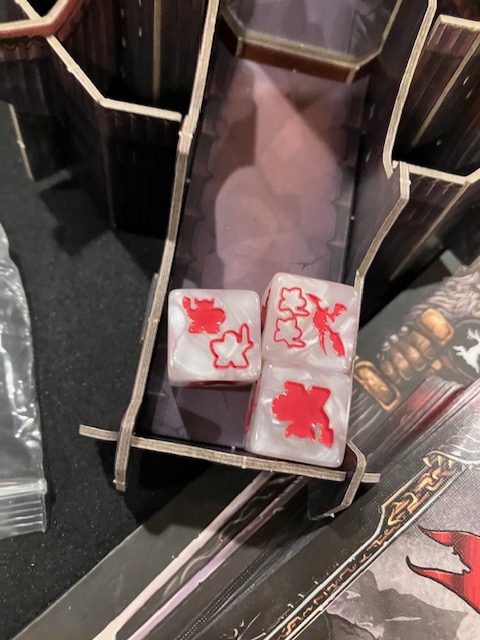
Overall, the Episode 1 went well; we cooperated, we discussed, we planned, we had a good time.

Teresa was a 7/10, Andrew was a 6.5/10 (which is actually quite high for him).

Episodes

A single Boss battle is about 20 minutes.  If that’s all this game were, I’d be a little down about it.  Luckily, the Episode really fills out the game.  An Episode is a series of 4-5 related bosses, with upgrading happening between bosses!

Episode 1 has four bosses: see above.  All the bosses are all very different, and have very different arcs as you fight them.

Arguably the best part of this game are the upgrade decks!  After you defeat each boss, players get a chance to draft and add two new cards to their deck!

Skip the next few pictures if you don’t want too many spoilers.

Basically, the players “draft” and each get two cards to upgrade their deck!  This is basically deck-advancement like we saw in Adventure Tactics (see here): your deck gets better and better between games!

The decks are also labelled at the bottom right so you can separate them back to their original decks.

And after every boss, you get another 2 cards until you finish the episode!

I will say this: the game says to “draft” until you get two cards, but I think it might be more cooperative to just ‘decide as a group’ what you get.  This is the House Rule we implemented: let me and my friends choose the paths we want our heroes to take!  I understand why “drafting” works, because then you don’t have to worry about arguing over cards, Alpha Players telling people what to take, and so on.  But, if you have anything of a reasonable group, I would suggest just choosing as a group the cards you each want.  Caveat Emptor.  If you have a slightly contentious group (or are playing at a convention where you don’t know anyone), maybe drafting is the better solution.
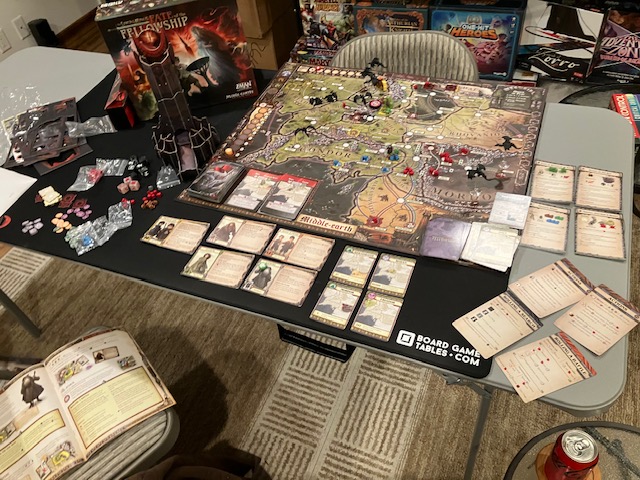
I’ll say this again: the upgrades are probably one of the funnest parts of the game.  Unfortunately, your upgrades don’t travel with you between Episodes: you have to start fresh to a new Episode.

Things I Liked

Upgrades: Upgrading your deck is one of the more satisfying and fun parts of the game!

Arcs:  Given how simple this game is, the arcs on the different types of Bosses are all very different! It’s actually quite impressive how differently each boss plays! And fun!

Components: The components are pretty nice and I like art. It’s comic-booky and attractive without being too “cute”.

Simple: This game is easy to teach and easy to learn.  I found even casual gamers got into it pretty quickly.
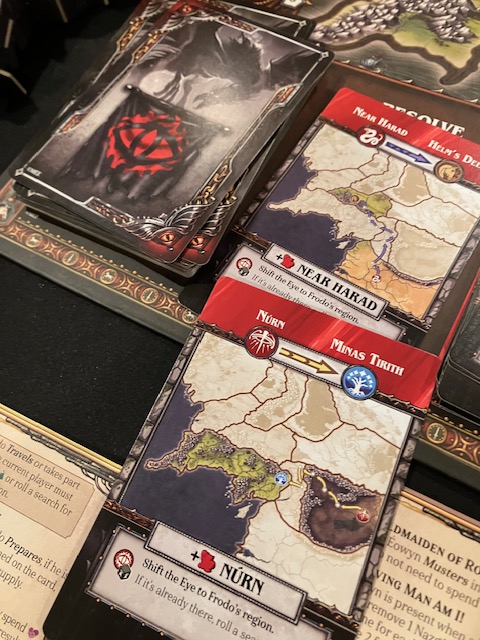
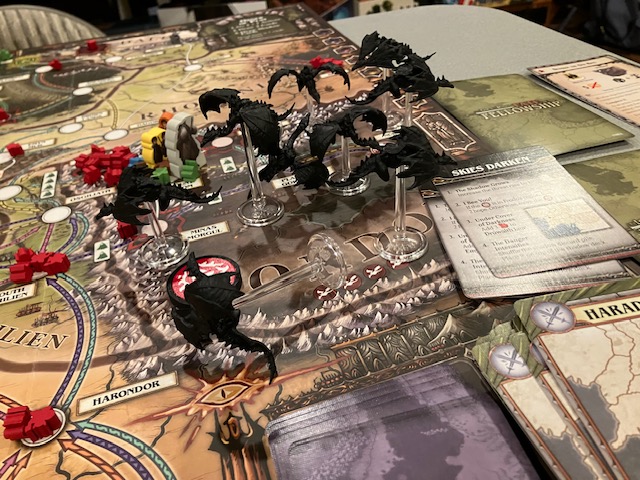
What I Didn’t Like

Too Random: The game can be too random.  I lost a few games because of one die roll.  It’s not too big of a deal because it’s just 20 minutes per game, but it is frustrating that an entire game can go amiss because of one die roll!

Too shiny: It’s too hard to capture in pictures, but the game is too shiny.  The cards aren’t linen-finished, so they tend to have glare, especially in harder light.  And the plastic trays also have a lot of glare: I tried to capture some of that in the picture above.  I think this game would be a lot better with duller, linen-finished cards and a tray that was less shiny.  The glare was distracting enough that we had to point it out.

No Continuations? As cool as the Episodes are, and even thematic within, the game game doesn’t feel super thematic.  While there is continuation within an episode as you keep getting upgrades, there’s no hook that keeps you vaulting into the next episode: remember, you lose ALL your upgrades between episodes, so you start fresh.  That actually feels a little debilitating!  I’d rather the episodes built on each other you felt the deck was YOUR CREATION … as it is, you start anew every episode.   There’s no “hook”: your deck resets and you start over.  Kind of a bummer? I just spent the episode building my deck … and now it’s gone.

Conclusion

One-Hit Heroes fits well into many groups; casual gamers, gamery gamers, and even solo gamers!  The base game is easy to teach and play at 20 minutes, which makes it easy to bring out.  My favorite part of the game, though, was upgrading my deck within an Episode!  It’s fun to figure out how you want to advance your character!

The game looks great on the table and has a fun table presence!

My only real complaint is that I feel that there’s a theme or overriding reason to keep playing after I finish an Episode. I really like the upgrading my deck between Bosses in an Episode, and it’s sort of frustrating that you just “throw it all away” at the end of an Episode!

As a solo player, I’d probably give this a 7.5 or 8/10.  The game is much more fun, I think, as a cooperative experience at an 8.5/10.  It would actually give it a little higher score if the dice rolls didn’t make or break so many games!  But, since the game is so quick at 20 minutes per game, it’s usually not a big deal. 

Neat game.  I think you’ll have fun with just about any group you bring it out to.