A Review of The Siege of Runedar

IMG_3237

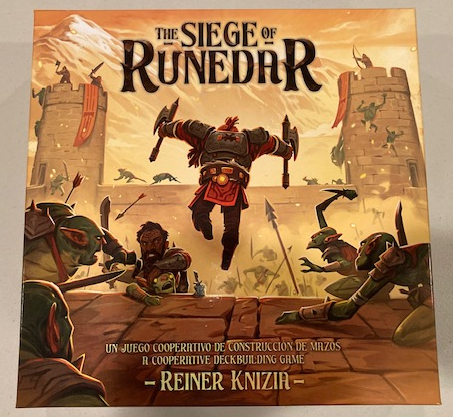
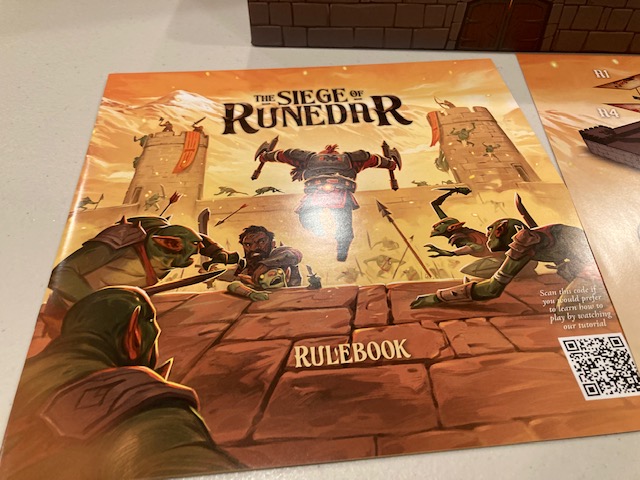
The Siege of Runedar is an odd duck of a game for many reasons. It was originally a German game that came out some time ago (2021), but it took a while to get the United States: I got my copy as soon as I could in the United States in mid 2022 (but I admit have been sitting on it for a few months … not literally). The theme (Dwarves trying to escape a fortress filled with gold) suggests that this would be what an Ameritrash game or thematic game. The game, however, is by Reiner Knizia, who tends to design games with a more euro tilt. And the main mechanisms of the game are stylistically at odds with each other: deck-building (typically Ameritrash), gather resources (typically euro), rolling dice for combat (Ameritrash), precise management of upgrades (euro), combat (Ameritrash), and Dwarves (maybe both).

IMG_3191

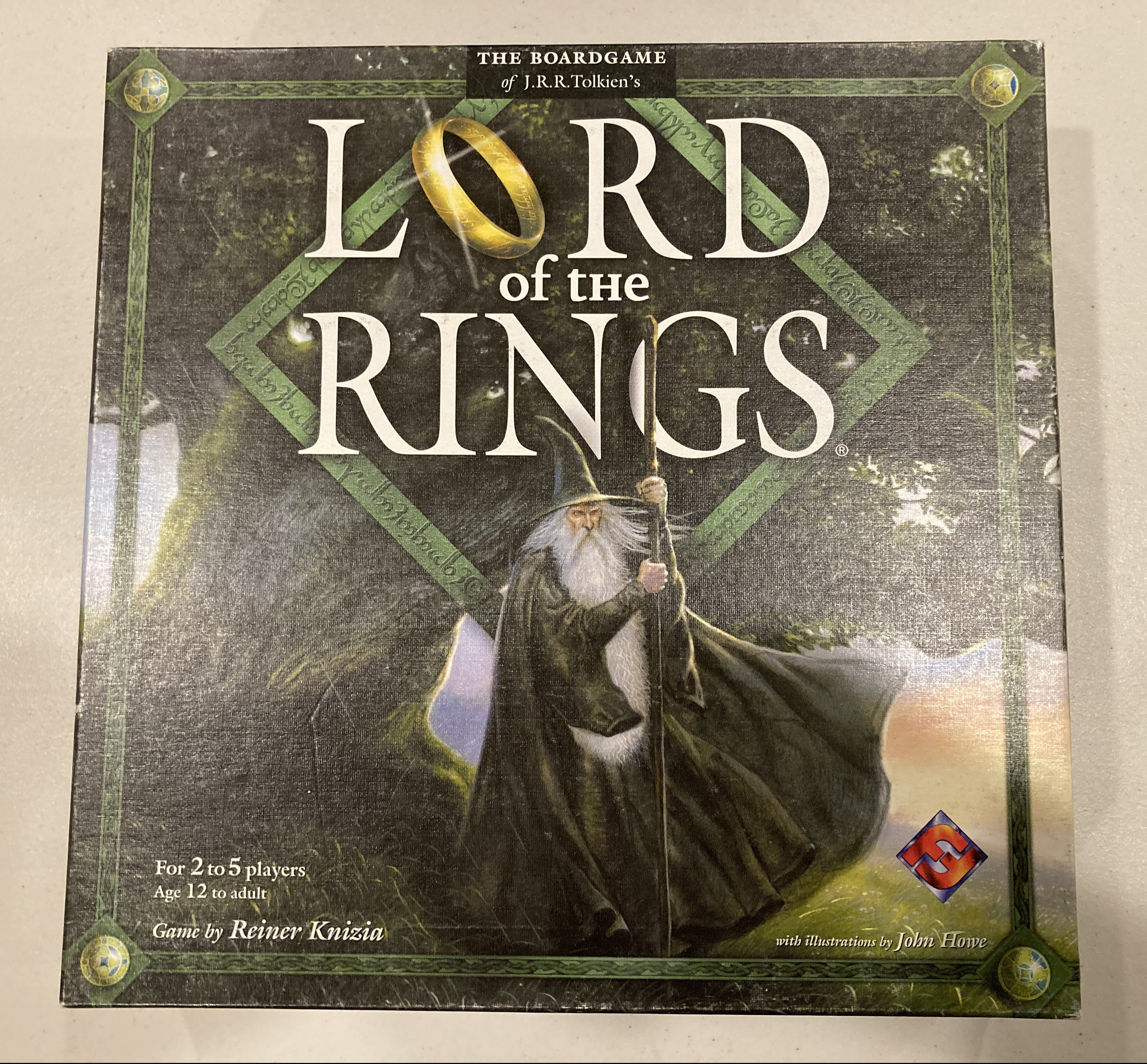
Even weirder, this is a cooperative game by Reiner Knizia. If you didn’t know, Reiner Knizia is known for designing hundreds of board and card games: cooperative games are only a very small portion of the games he has designed. Knizia hasn’t done very many cooperative games, but many people would argue his cooperative Lord of the Rings game was a watershed event in the history of cooperative games. Lord of the Rings (2000, my version is the Fantasy Flight edition) brought the notion of cooperative games to the forefront in the year 2000, using a respected IP and a respected designer.

IMG_3389

Let’s see what Reiner Knizia is up to in the cooperative sphere: will he revolutionize cooperative games again?

Unboxing and Gameplay

IMG_3175

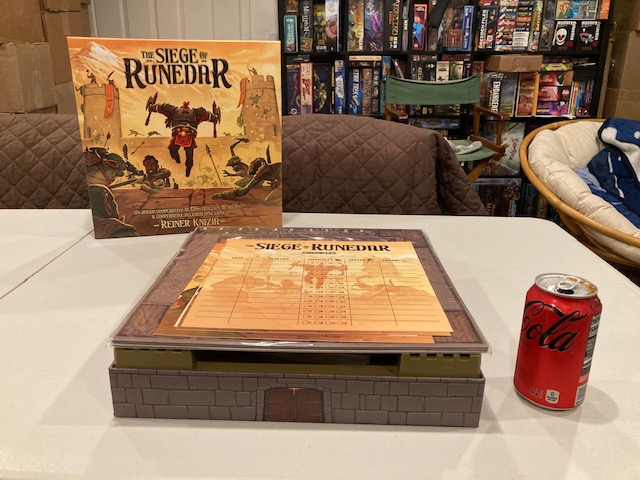
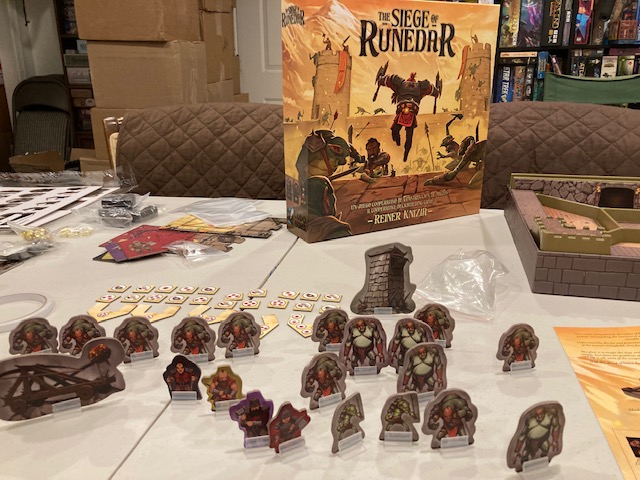
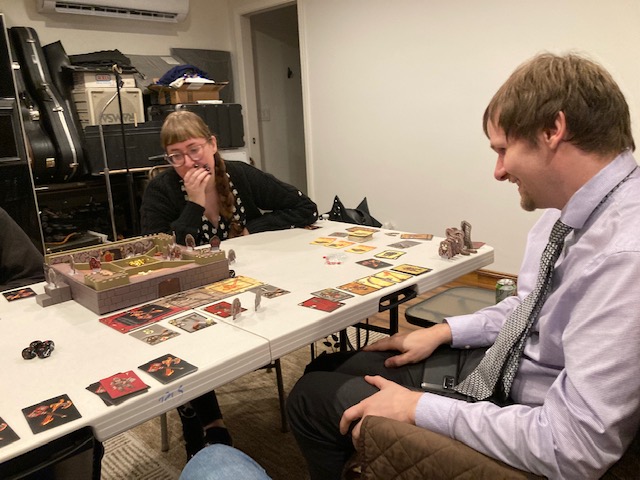
The box itself is part of the game!  Players cooperatively play dwarves defending a castle, and the box itself is the castle!  So, this box is a little bigger than most “standard” boxes (see the Coke can above).

IMG_3235

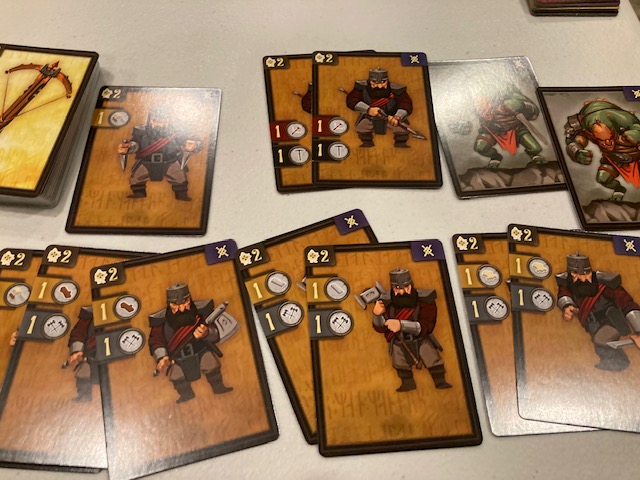
This game is a deck-builder game: each player plays a Dwarf with exactly 12 cards (and that count stays at 12 throughout the entire game): see below.

IMG_3203

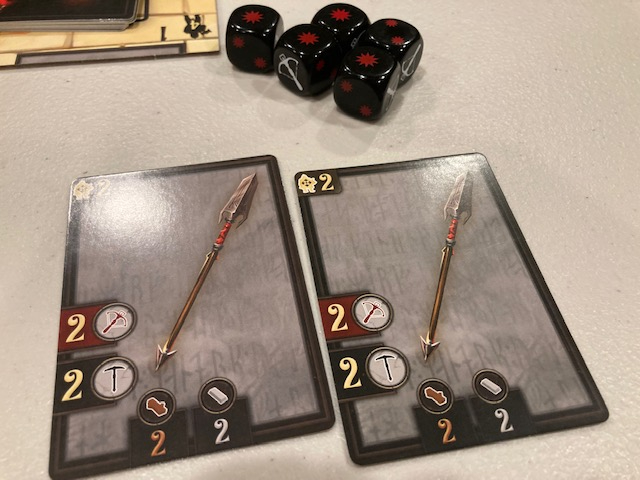
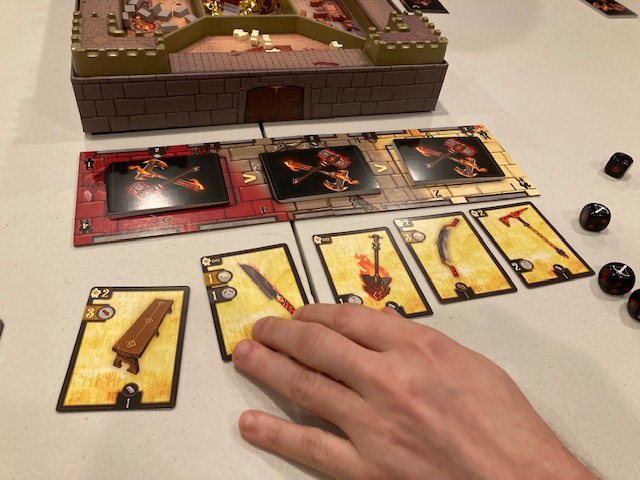
Each card in the deck allows at least 2 things, usually more: see above. Most cards can be used for movement (note the 2 in the upper left corner above for the base cards).  The other two symbols on the left side are other choices players can make instead of movement  Basically, the symbols dictate what you can do! You can either:

  1. Gather resources (bars, wood, leather) 
  2. Hand to hand combat (axe)
  3. Dig (pick symbol)
  4. Shoot Arrows (crossbow)

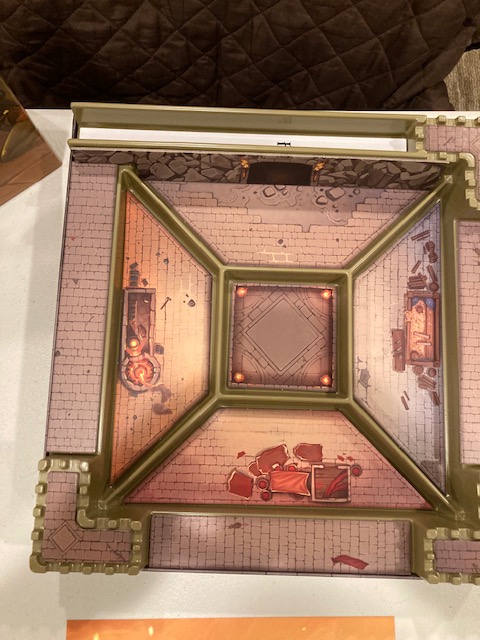
Every action has to be performed on the appropriate space to be relevant.  To gather the appropriate resource, you have to be in the appropriate place in the castle: one of the three workshops (see below).

IMG_3194

If you want to fight hand-to-hand, you have to be in a Location with an enemy: a troll, goblin, or orc. 

IMG_3199

To fight, you add up the number of the axes from your card(s) that you want to use, and that’s how dice you roll!  In hand-to-hand, you need 2 hits (red blops) to do one damage.   Orcs die from one damage, but trolls and goblins have different profiles (each different) to defeat.

IMG_3222

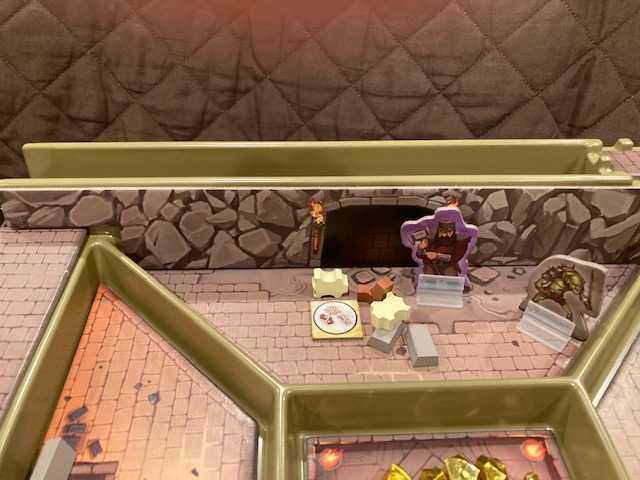
To use your crossbow (red crossbow), you have to be on one of the three towers on the board, and you can shoot things adjacent to the towers (but not inside the castle).   See below where the purple dwarf is on one of the towers (left): he can target the orcs at the front of the castle or the left of the castle (but not the right, as it’s not adjacent).

IMG_3223

You still need to roll the dice: you get one die for each crossbow symbol. Each arrow does one damage.

To win the game, you have to dig your way out of the back of the castle.  You have to “dig” a certain number of symbols to dig out one big block, and you have to do that five times.

IMG_3226

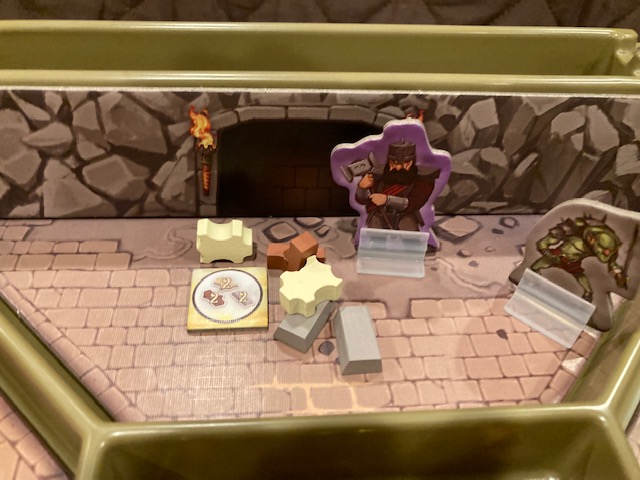
After you dig out one block, some goblins show up.  Each Goblin has very different  criteria “get rid of them”.  In the case above, you have to bribe the Goblin to go away with 2 of each resource.

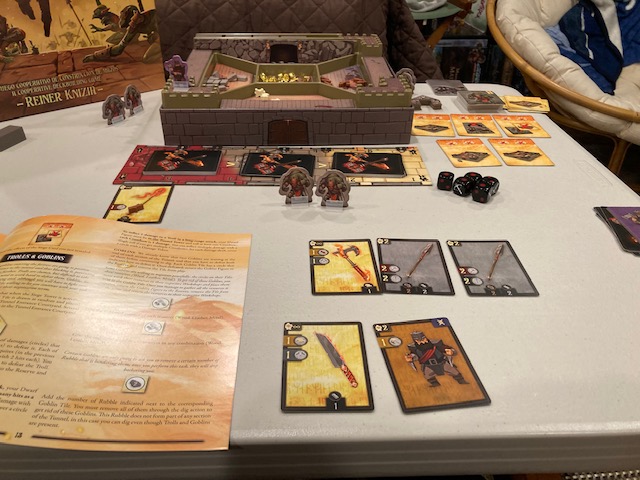
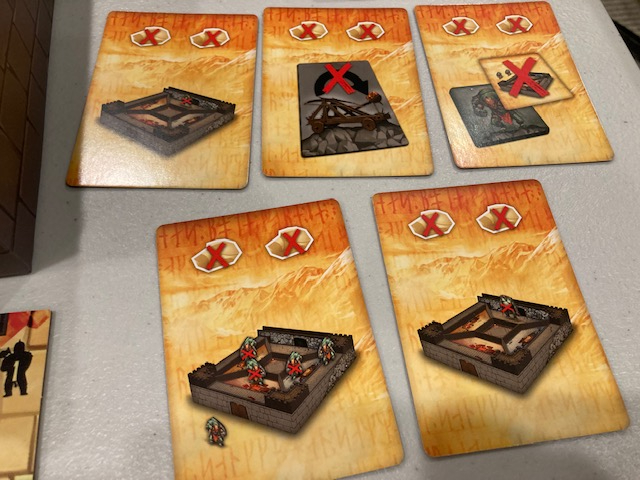
As this is a cooperative game, there are bad news cards: these are called Siege cards and essentially bring Orcs into play and move them (as well as Catapults and Siege Towers and other bad things). See the yellow Siege cards below (right).  The Siege card below puts an Orc at the front of the Castle .. and the little arrow in the upper left means ALL ORCS MOVE!!

IMG_3208

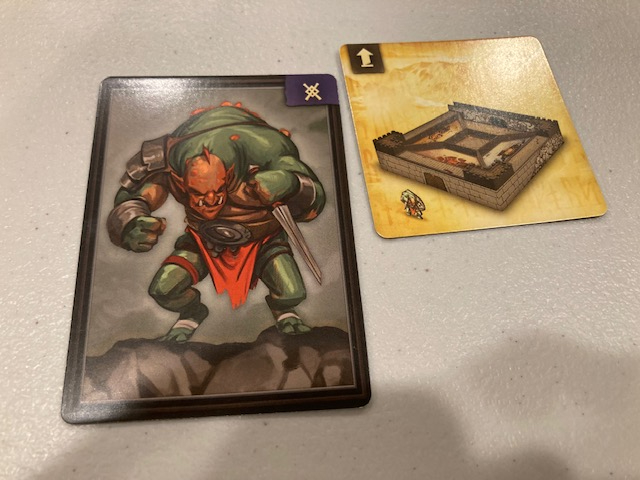
Interestingly, the Siege cards are only revealed if your deck reveals an Orc (grey card on left above)!  Every player must have exactly two Orcs in their deck, so you may, on your turn, reveal 0, 1, or 2 Orcs, which causes 0, 1, or 2 Siege cards!!  You can never cull the Orcs from your deck: they are just always part of your hand. On average, you get about one Siege (bad news card) per turn.

If you can dig your way out of the castle before the Orcs steal all your gold, you win!

IMG_3229

Your score at the end of the game is how much gold you end with (the gold is there in the middle).

IMG_3227

You lose essentially if you run out of any resources:

  • reveal the last Siege card (run out of bad news cards)
  • reveal the last Catapult card (run out of Catapult cards)
  • reveal the last troll tile (run out of trolls)
  • put the last Orc from the reserve into play (run out of orcs)
  • lose all the gold nuggets (run out of nuggets)

There are a few other rules to help the players:

IMG_3219

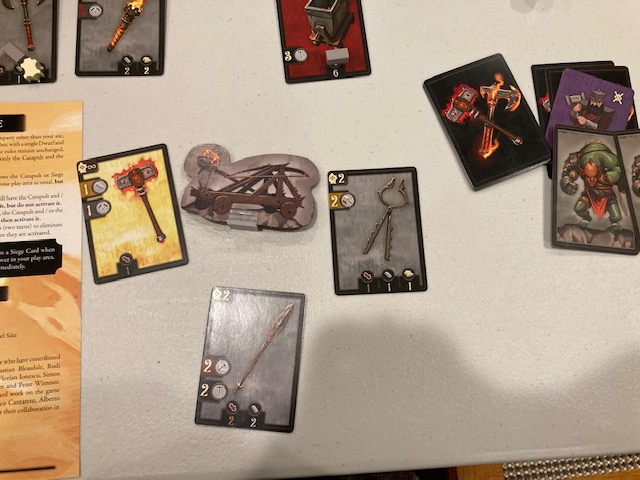
You can hire Mercenaries to help you “clean up the castle” (kill a troll, or kill all orcs inside, or kill a Catapult, etc) for two gold: each Mercenary cards is a little different, but you get to choose when you want to use them!!! It essentially costs you 2 victory points to call a Mercenary (and they are out of the game at that point), but sometimes it can make a big difference.

There are a few other rules (for the Catapults and Siege Engines and Trolls), but that’s the crux of the game.

IMG_3228

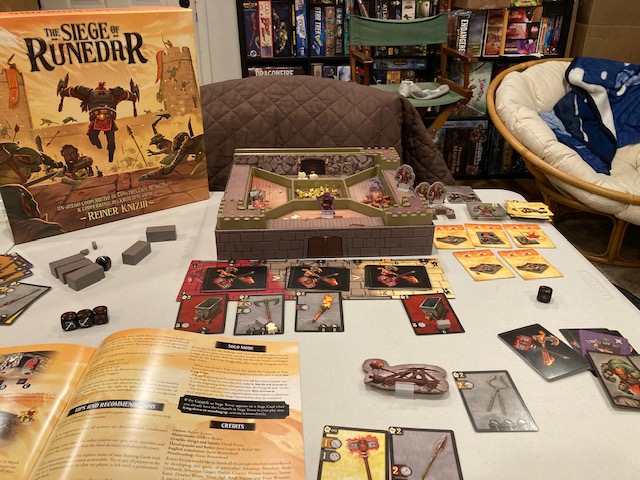
Overall, The Siege of Runedar has a great table presence and plays like a hybrid deck-builder/euro game.

Rulebook

IMG_3177

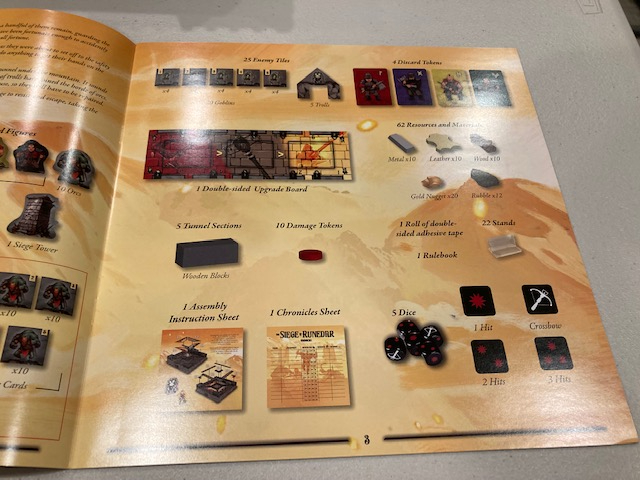
The rulebook was pretty good.  The word choice in a few places made me think that this is a translation (to be fair, we know this game was originally in German, and the game came with a Spanish rulebook).  If it was a translation, it was still pretty good.

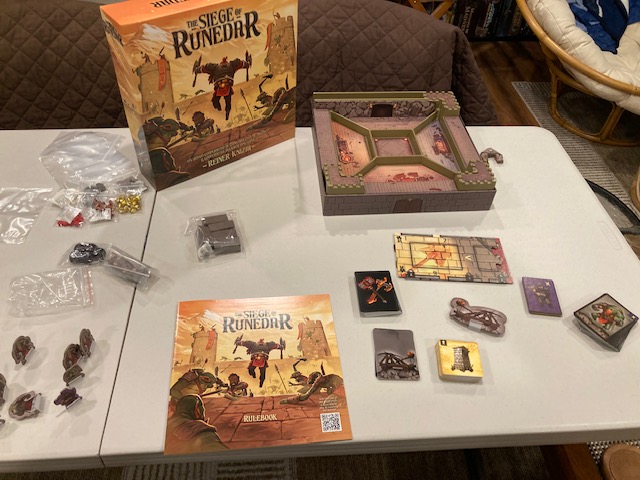
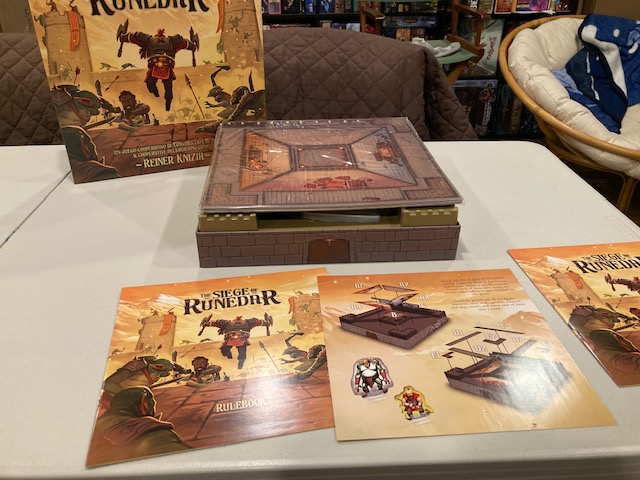
It starts with a list of components (see above and below).

IMG_3197

The next page(s) (below) shows a very good set-up! There’s a picture  of set-up to the left, and all the text to set-up is on the opposite page to the right.  Thank you for doing this!  It’s so much easier to set-up when you can see the picture AND the text is on the opposite page!!!

IMG_3202

The rulebook proceeds through rules and shows lots of nice, annotated pictures.

Overall, the rulebook was pretty good.

There were a few grumpiness moments:

(1) The special rules for the Goblins and Trolls tripped us a few times, as they have “more hits” and the distinguishing between hand-to-hand and long-distance  when dealing with Trolls and Goblins seemed to need a little more exposition.  It seemed like the gap of damage between arrows and hand-to-hand seemed too wide for the rules to be correct, but maybe they were.

IMG_3214

(2) The orientation of the Upgrade Board (see above) changes depending on the number of players. Basically, it costs more or fewer resources for some upgrades depending on the number of players.  The Upgrade Board orientation is VERY POORLY explained, and it makes a big difference in gameplay!  We wasted far too much time correlating the tiny picture in the set-up with the number of players.  A simple sentence or better picture would have gone a long way towards explaining this better.  (See the little number of players in the bottom corners of the Upgrade Board above?  Neither could we!!!)

In general, this a good translation, but it  still felt like it was a translation in a few places.  Generally, this was a pretty good rulebook.

Solo Play

IMG_3201
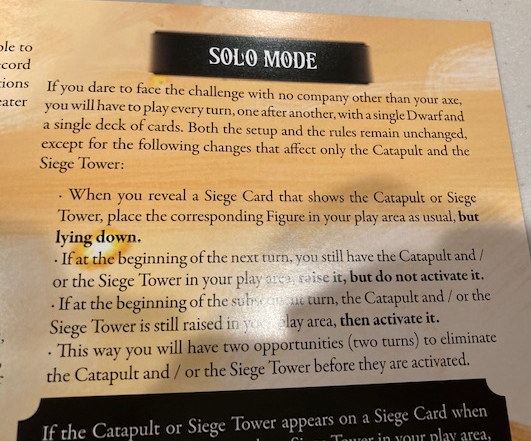
Solo rules on last page of rulebook

Luckily, The Siege of Runedar has a very simple set of solo rules on the very last page of the rulebook (thank you for following Saunders’ Law). Basically a solo player plays a single Dwarf playing the game with the normal rules and flow, but solo play make the Catapults or Siege Engines “lay fallow” for one round when they enter/activate.  This gives the solo player an extra round to deal with them.  Other than that, the game plays normally!

IMG_3221

As usual, I played a solo game first so I could teach my friends.  See a solo game set-up above.

As a solo game, the game flowed well. The very minor “extra rules” for Catapults and Siege Engines made perfect sense in the context of a solo game.  I was able to get through a solo game and learn all the mechanisms: I did have to look up a lot of clarifications (especially the Trolls).  In fact, I think I cheated in my first game because I think the Upgrade Board was oriented wrong and was “too easy” (see our discussion of the Rulebook above).

The solo rules present a good solo game.  It’s a good game.  I think solo is probably the best way to learn The Siege of Runedar, as you can lookup rules as you play solo without holding up a group: there are enough rules and complexity to bog-down a “group first play”.  However, once I played once solo, the game made perfect sense to teach.

But I didn’t “love” the solo game.  See my discussion of Issues in a few sections later as to why.

I would play The Siege of Runedar again solo, it just probably wouldn’t be my first choice.

IMG_3229

See a winning solo game above!

Cooperative Play

IMG_3383

I think this game shines best with cooperative play.  Although each player plays their turn separately (giving each player their own agency), players discuss what needs to be dealt with:  Should I take out the Orcs? Collect Resources?  Start Digging?  Spend some resources to help buy upgrades?

IMG_3381

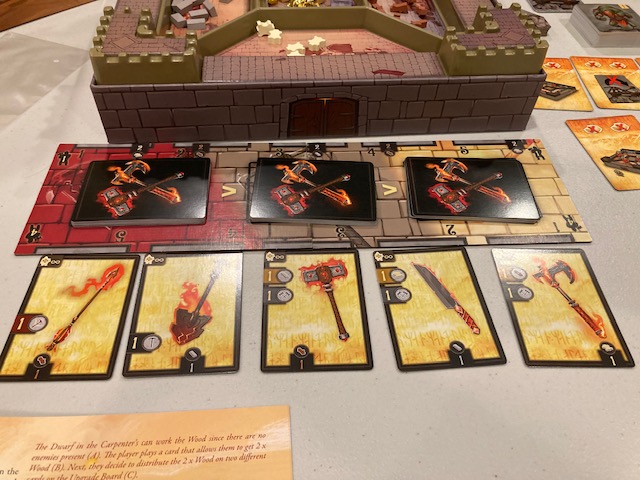
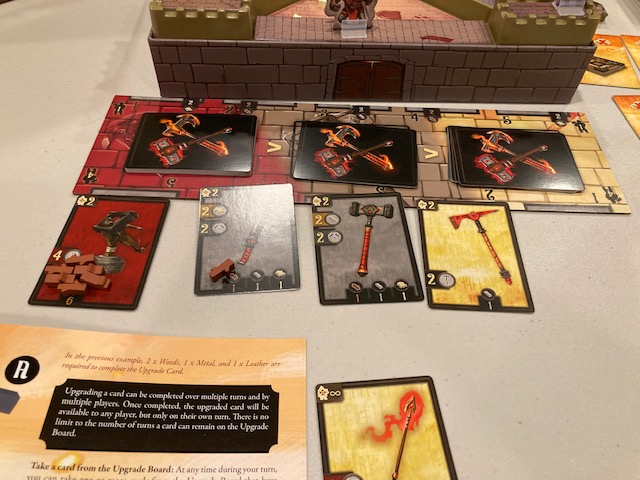
One of the best cooperative mechanisms in this game was that you can spend resources on your turn to help buy an upgrade for the next player!  See the upgrades above!!  And you can supply some of the needed resources so your compatriot can fill-in the rest!  This is so at odds with other Deck-Builders!  In most deck-building games, if you can’t buy something on your turn with your money, you just can’t get it.  Here, you can supply some resources for your compatriots and those resources stay (on the card) until the card can be obtained!!  This single mechanism really encouraged cooperation.

IMG_3380

But of course, the discussion of “what are we going to do” worked really well too. 

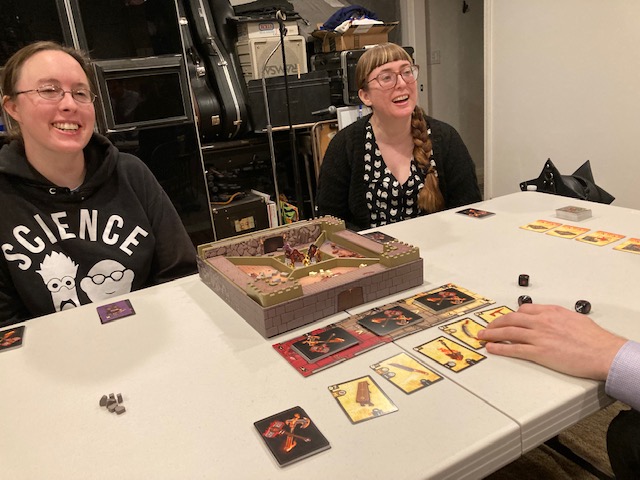
I think I prefer this game as a cooperative game over a solo game.  The sharing of resources and the gameplay discussion elevated the cooperative game for me, but each player still had agency to play what they wanted on their turn. We all felt engaged on other players turns, but still had agency on our own turn.

Cooperative Deck-building Games

IMG_3224

One of the primary mechanisms in this game is deck-building.  Currently, there are a ton of cooperative deck-building games: see our own Top 10 Cooperative Deck-Building Games here. What makes this different?

Interestingly, the buying of upgrade cards and the culling  of old cards are part of the same action: when you buy a new card, you immediately have to get rid of another card in your hand.  (You also immediately get the card in your hand so you can play it right away).  This might be my favorite new mechanism for a deck-builder: you always have exactly twelve cards, so your new upgraded cards will come out almost immediately!  One frustration with most deck-builders is that your may not see your new upgrade card for some time … not so here!  You immediately get to use the new upgraded card AND your hand is so small, it will come out right away as well as again soon. 

IMG_3225

As a cooperative deck-builder, another one of the better mechanisms is that you can directly help others buy upgrades: you can place resources on the cards for others!  (All cards must be bought with a combination of leather, wood and some other resources).  See above: a few of the upgrade  cards have resources from previous turns from previous players.  This also means that your buying power can extend from turn to turn, whereas most deck-builders your buying power is only what you have that turn.

IMG_3232

I think these are some major advances in deck-building fro The Siege of Runedar:

  1. A player’s deck size is small (and set at 12), so upgrades always come out quickly
  2. The culling and buying are part of the same action, so your deck upgrades quickly
  3. The upgrade effects are felt quickly as cards go directly to your hand (rather than the discard). Other games have done this, but it’s still not as common.
  4. The resources for buying upgrades are shared among all players, so players cooperatively share resources to help each other buy said upgrades
  5. To replenish upgrades supply, your character has to end movement in a certain location.  This mean that upgrades do NOT automatically refill! You have to go out of your way to make sure they refill!

I have to say, I think Knizia has done a nice job of moving cooperative deck-building mechanisms  forward.  This may not be a watershed moment like Lord of the Rings, but The Siege of Runedar  definitely advances the state-of-the-art.  I hope we see future deck-builders incorporate some of these advances.

See our Top 10 Cooperative Deck-Building Games for more discussion of deck-building with some of our favorite older cooperative deck-builders.

Issues

Interestingly, this is a hybrid dice and deck-building game.  The cards tell you how many dice you can roll to try to get successes/hits.  Honestly, the dice are my least favorite mechanism in the game.  The game’s success succumbs to the randomness of dice.  I can’t tell you how many times I rolled poorly and basically just wasted a turn.  It felt like I was at the whim of the gods of randomness. Either :

  • I had only one die (because of the randomness of the deck) so it’s better to try at least once, but the odds were very much against you.  You really have no control over how how many dice you get on a turn
  • I had many dice but rolled poorly.  (My worst example: I rolled 8 dice and could not roll a single arrow)

If you could save up cards to try to get better odds, I may like it better.  But there’s really no way to mitigate the randomness of the dice.   A suggestion:

Allow players to keep some cards for the next turn so they can have some form of dice mitigation (in the form of allowing more cards which can add dice to the roll)

You may not have a problem with this randomness and dice-rolling: you could argue it’s very thematic for a fighting game, and the luck of the dice keep the game interesting.  Most of the people in my group didn’t have the problem with the dice like I did: they liked it.   To each their own!

Conclusion

IMG_3181

The Siege of Runedar is a good game! It seems well-balanced, has lots of good decisions, and most turns feel like you can do something interesting. The game also has a real presence on the table. There is also some real strategy in the game. I also think that Reiner Knizia has really pushed the state-of-the-forward for cooperative deck-builders. I’d love other cooperative deck-builders to use some of the mechanisms of the Siege of Runedar: they make deck-building more fun, more satisfying, more immediate.

In the end, The Siege of Runedar was just a touch too random for me. I think I would give this game a 7.5/10 objectively because it is a good game! Unfortunately for me, the randomness of the dice coupled with the randomness of the bad news deck and the randomness of the upgrade decks and the randomness of the deck-building drops it to a 6.5 or 7/10. I think if there were a way to mitigate dice rolls (using our suggestion), this game would be a solid 7.5 or maybe even 8. I got a little frustrated a few too many times because of the dice. It wasn’t a major problem, but just enough of an issue to make me drop my score a tad.

Let me clear, my group enjoyed our plays of this game, and we would definitely play this again! Heck, I might even play it solo again! But I think it is better as a cooperative game than a solo game.

The Siege of Runedar is a deck-building and dice game, much like the G.I. Joe Deck-building Game, but it is so much better than the G.I. Joe Deck-building Game! (See our review of the GI Joe Deckbuilding Game here). I am actively trying to get rid of my G.I. Joe Deck-building Game (you want to buy it? It’s on the Geek Store on BGG) but I will be keeping my Siege of Runedar.

A Review of Agents of Smersh: Epic Edition (and a Comparison to the Original 2012 First Edition)

IMG_3658

This week we take a look at the Epic Edition of the Storybook game: Agents of SMERSH!
IMG_3651

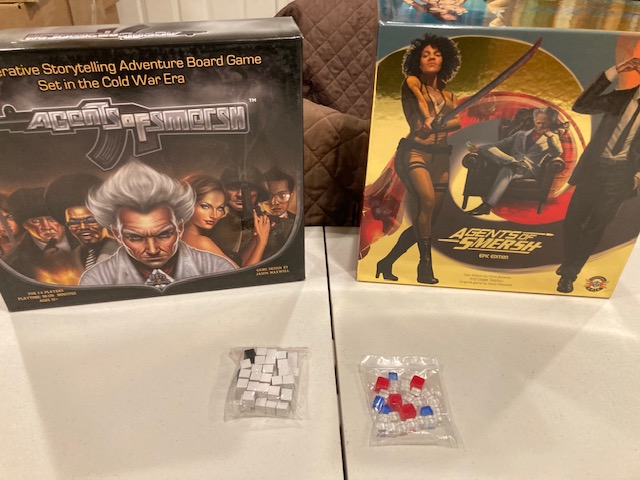
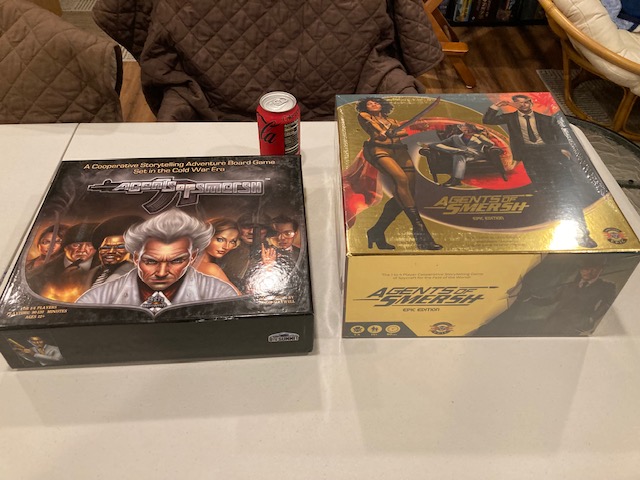
The original Agents of SMERSH was on Kickstarter back in 2012 from 8th Summit Games: I backed it. The original first Edition (see above on the left) became one of our favorite games here at Co-op Gestalt!! The original made our Top 10 Cooperative Games Off The Beaten Path as well as our Top 10 Cooperative Storytelling/Story Book Games! Agents of SMERSH is cooperative storytelling game where each players take the role of a wacky “James Bond like” spy from the era of the 70s: players work together try to stop Dr. Lobo from conquering the earth! Yes, Dr. Lobo is the “James Bond” Bad Guy! Massively Evil!

IMG_3658

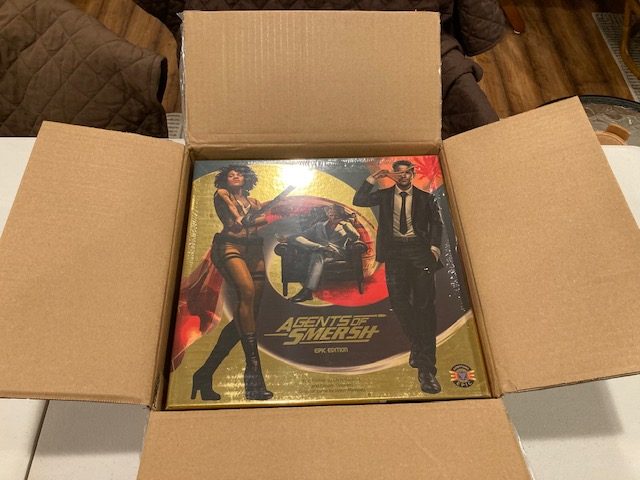
Unfortunately, 8th Summit went out of business a few years ago, and it appears Dr. Lobo has beaten our spies!! Luckily Everything Epic Games resurrected the Agents of SMERSH title and put it on Kickstarter in May 2021 and was able to reprint it! Not only was Everything Epic able to reprint the game, they also streamlined the gameplay, upgraded the art, cleaned-up the graphic design, and revamped the playing pieces! I received my copy of the “Epic Edition” (see above and below) in early October 2022.

IMG_3655

Was it worth upgrading a game I already love? After all, I still prefer the original 2nd Edition of Sentinels of the Multiverse over the newest Definitive Edition (see our review of the Definitive Edition here). Sometimes just because someone tells you “they’ve made the game better”, they haven’t. We’ll take a look at the newest Epic Edition of Agents of SMERSH below and make the judgment!

Unboxing
IMG_3650

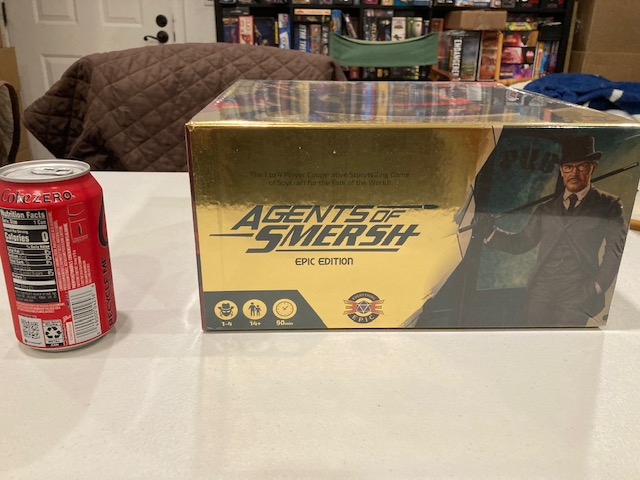
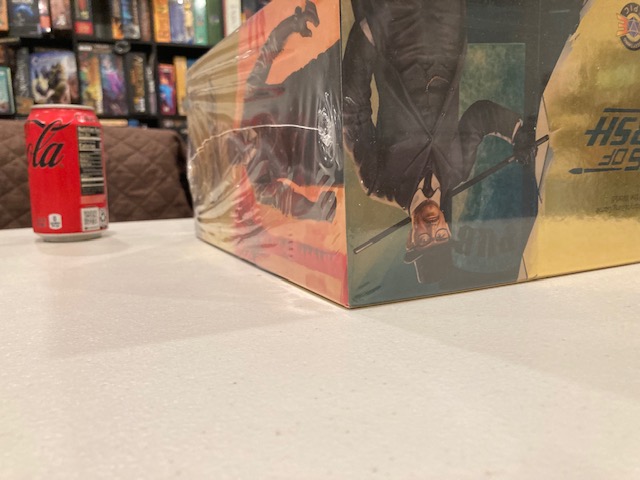
The Coke Can is there for perspective: this is a big box!

IMG_3651

The newer version is also significantly taller than the original printing.
IMG_3659

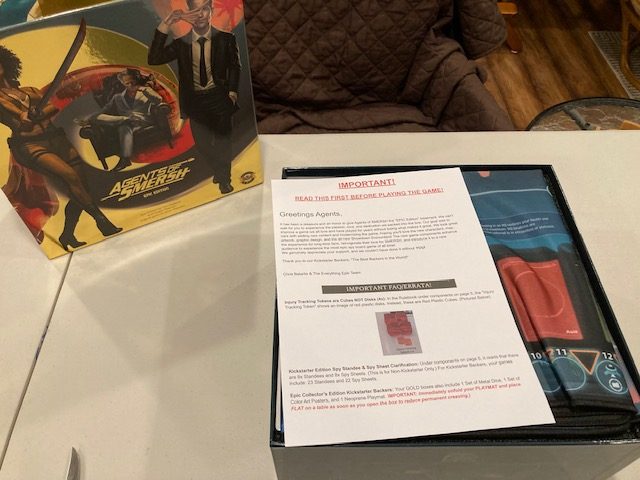
Upon opening the box, you are greeted with a paper with the some errata. This is great! You immediately know what problems to be on the lookout for.
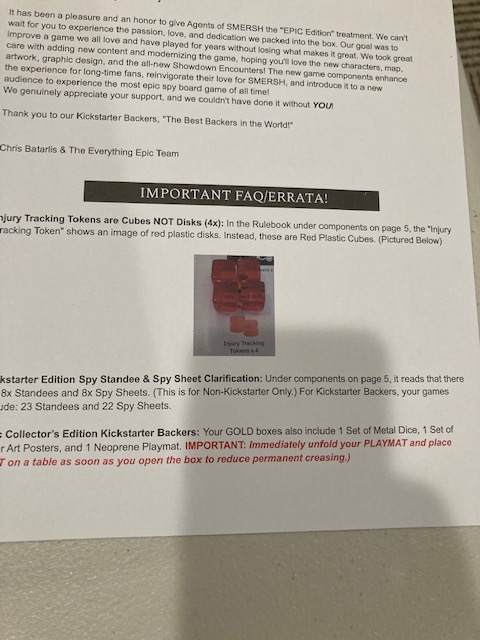
IMG_3660

One of my favorite parts of the little sheet is that it tells you the difference between the different versions. The Collector’s Edition (which we have) has more standees and other stuff. This is great! So many times, a Kickstarter edition has “new stuff” but it’s never noted. Now we know the differences between the base game and the Kickstarter version.

IMG_3661

The gold version comes with Neoprene mat. It looks real nice! (It also comes with a board with the same map). Typically Neoprene mats are nicer because it’s easier to grab components off the mat. But, they are harder to store.

IMG_3662

Next comes some art prints:

IMG_3664

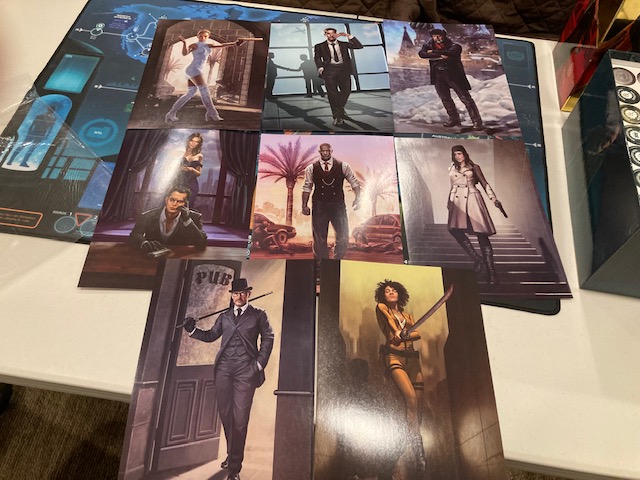
They are cool and all (see above), but I usually don’t get the art prints… what do you do with them??? They just happened to come with the version I got.

IMG_3665

There are a number of boards with punchout tokens … (see above). These are nice thick cardboard.

IMG_3666

And a corresponding board (in case you didn’t get the neoprene mat).

IMG_3667

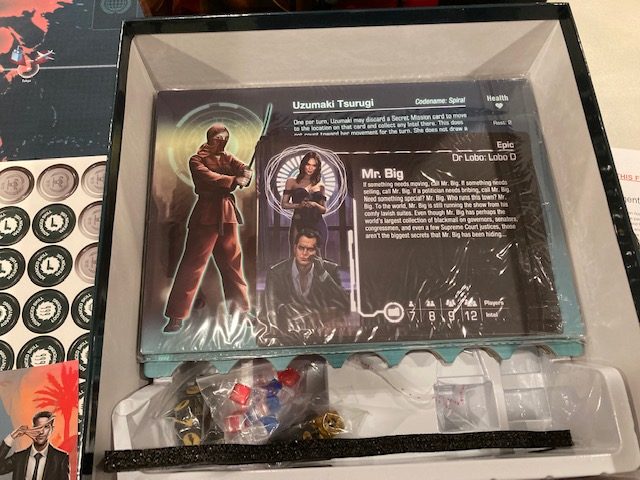
Under all that are the player boards and player sheets. The player sheets are cool because you can slot them into the dual layered boards! See below:

IMG_3719

IMG_3668

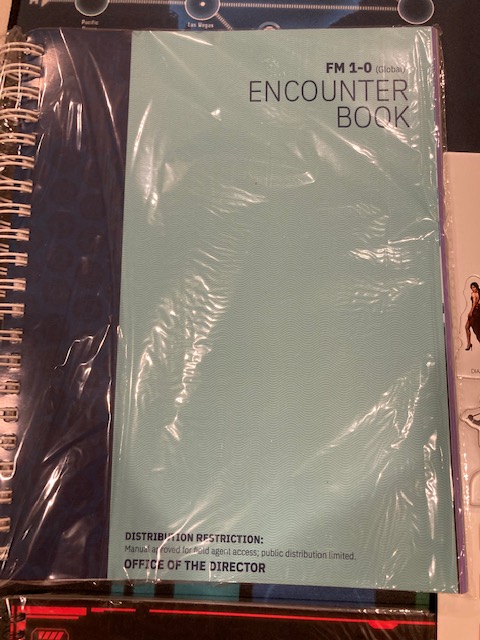
But the most important components in the game are the Storybook (Encounter Book)… see below …
IMG_3670

.. and the Epic Showdown book … (see below).

IMG_3669

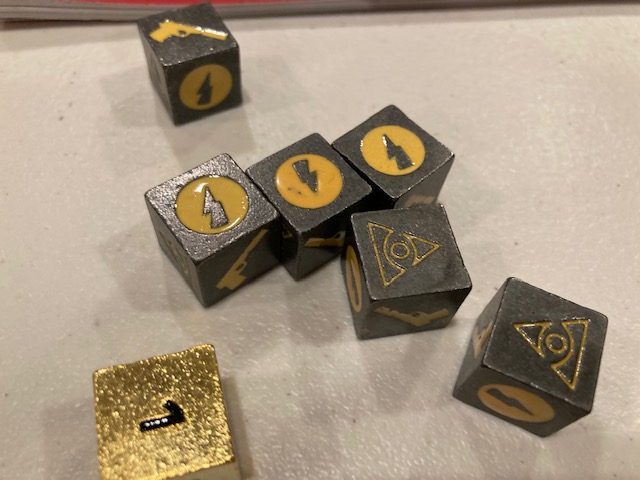
This is a storybook game where you roll dice to overcome challenges presented to you by the Encounter book (during normal gameplay) and the Epic Showdown (during the finale). The dice are super nice if you get the metal ones, but the normal plastic dice are great too.
IMG_3718

IMG_3716

You roll against your abilities on your character sheet:

IMG_3671

Successes give you upgrades and all sorts of good stuff. Failures smack you down.
IMG_3672

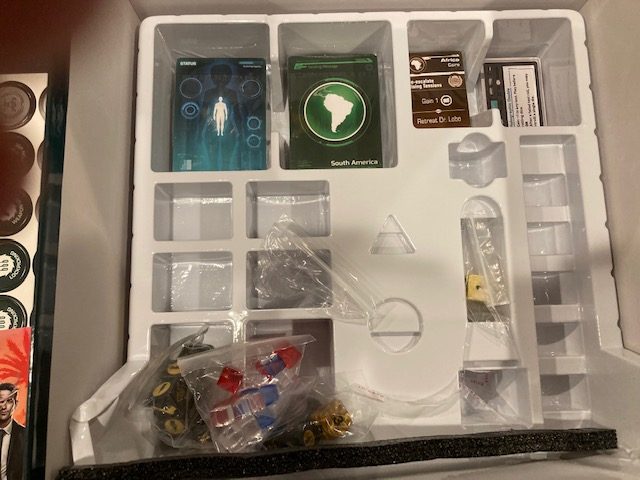
The insert is pretty good: notice that mine has already been crushed a little bit above (from shipping). But everything does fit back in the box pretty well.

IMG_3673

IMG_3676

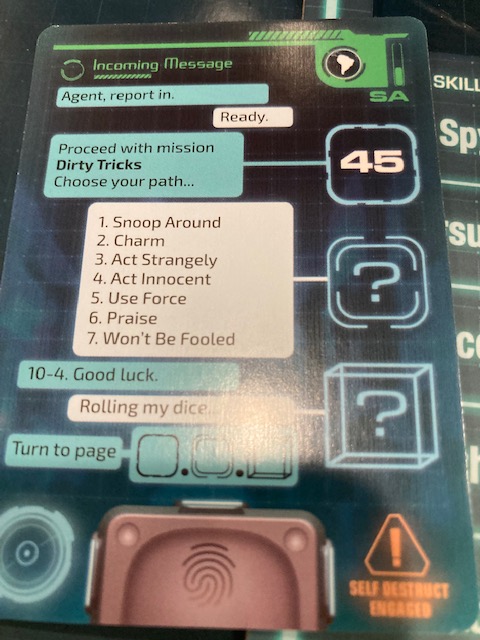
As you explore the map, you get encounters in different regions: see the regions above. Note that they color does a good job of distinguishing the region. Each region card looks “something” like below:
IMG_3677

Above is an encounter card that tells you what you are going to look up in the encounter book, depending on what you do. All of the region encounter cards look like the above.
IMG_3675

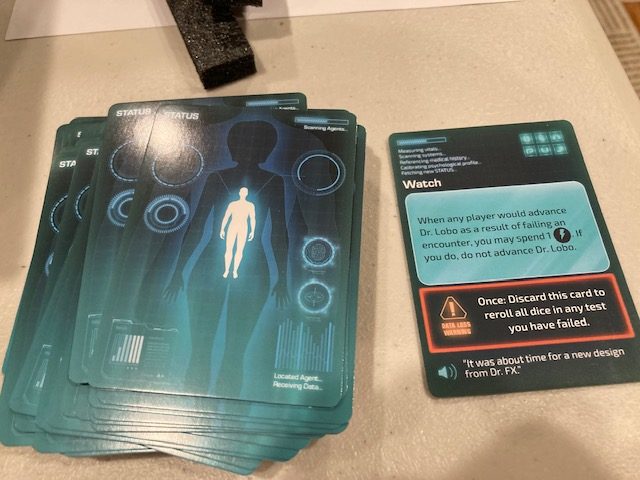
Frequently when you succeed at a region encounter, you get a status card.  If you fail, you ca get a bad status card: Watch above is  good status which helps you tamp down Dr. Lobo’s progress.

IMG_3689

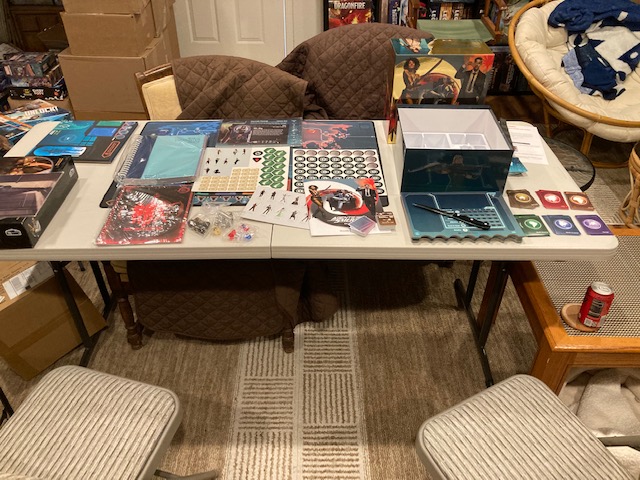
The tokens are all pretty nice.  The game even comes with plastic bags for storing some of them.
IMG_3678

Overall, the components for this version of Agents of SMERSH are quite nice. They are solid and awesome components.

Comparison To The First Edition

Ignore this section if you don’t care about the original edition.

IMG_3792

The original version of the game (left) had two major expansions: Swagman’s Hope (a well-known expansion) and the Showdown book (a lesser-known expansion).  Both of those elements have been incorporated into the the Epic Edition, either directly or indirectly.  In fact, it says that in the Epic Edition rulebook on the first few pages.

IMG_3682

Let’s take a look at some differences between the original and Epic Edition!

IMG_3740

The Epic Edition box (right) is much bigger that the original printing (left).

IMG_3741

The map is significantly bigger in the Epic Edition and perhaps a more readable and easier to look at? The Epic edition’s board is a giant 6-fold board vs the original 4-fold board. See above.

IMG_3742

The Epic Edition also comes with a neoprene map: it’s essentially the same size as the board (see above as it covers the 6-fold board almost perfectly): see above.

IMG_3745

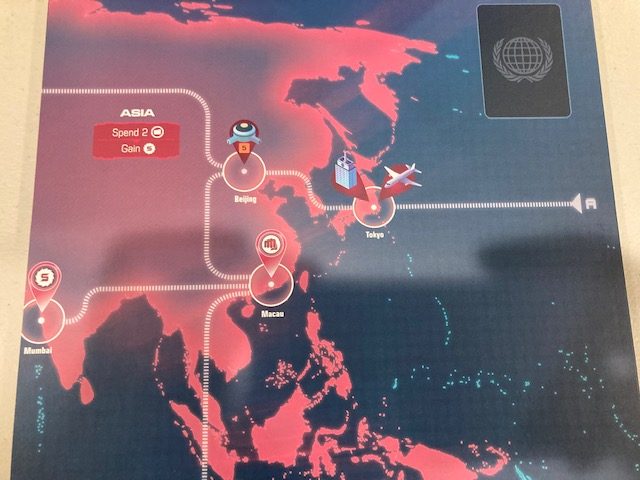
The old board (above) looks more like an old style map, notating the different regions with colors at the cities.
IMG_3746

The new map (above) is much more “tech-cool” looking, and notates the different regions with more “emphasizing” color. Note that each regions has some “special” things that apply to it … above, in Asia, you can spend two info to gain an Advanced Skill.

IMG_3747

Which map you like better may be personal choice, but I like the cool tech look of the new one.

IMG_3748

The manuals/rulebooks are … about the same size. Inside, the newer manually is substantially easier to read: see below. We’ll look closer at the rulebooks below.

IMG_3749

IMG_3751

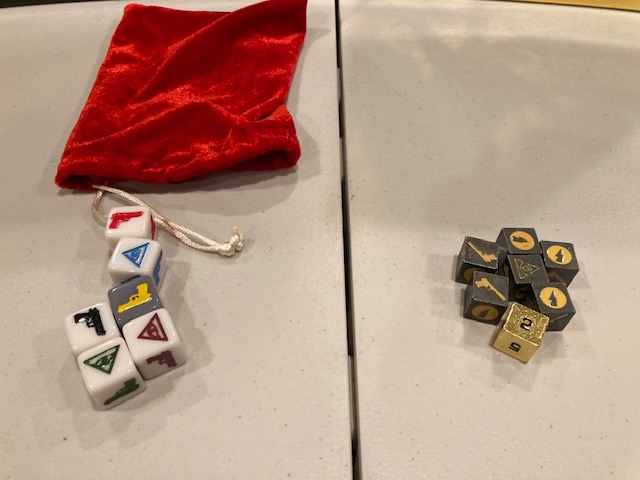
Remember that dice are rolled to overcome challenges in the game: the Epic edition dice (left) look cooler. The older dice (left) had different distributions of successes and failure, depending on the color of the die. The newer dice (right) are more uniform: gone are the days of counting “how many successes” are on which dice. The new dice rolling is simpler.
IMG_3752

Oh ya, the newer edition DOES NOT have a dice bag. Sure, a dice bag was cool, but I don’t think it was necessary.

IMG_3753

The graphic design has definitely changed: the older game has a well-labelled, but perhaps slightly dated graphic design. The newer edition has a slicker (but arguably not quite as well-labelled) modern look-and-feel. I like the newer cards better, but I wish the labels were more pronounced.
IMG_3754

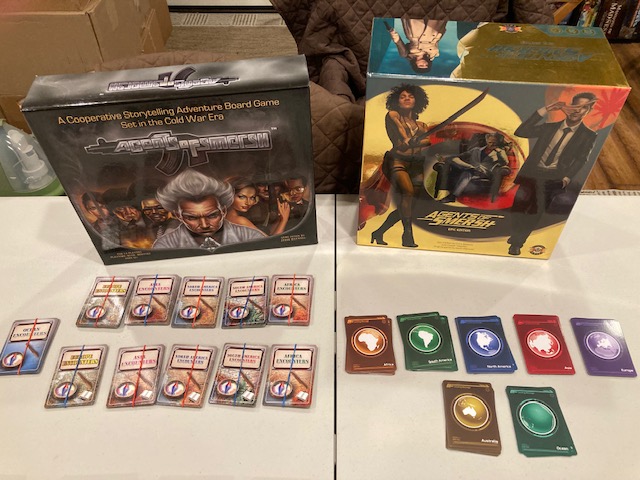
An interesting curiosity from the original edition (left) is that you could play WITHOUT the storybook! If you used the top row of cards, all the encounters were on the cards instead othe book!!! In the newer edition, I think they wisely got rid of that mode and just made people use the storybooks.

IMG_3755

See above for a closer look at the status cards: original edition (left), Epic edition (right).

IMG_3756

At the start of the game, each player gets two Top Secret cards which give the characters a mission (and a direction to go).

The newer edition mission cards looks a little more modern.
IMG_3757

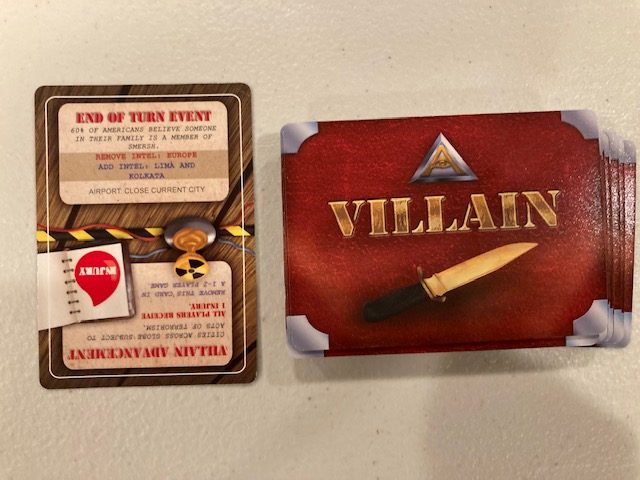
The villain cards from the original edition are … pretty complicated: see above. They had a Pandemic like element, as well as some other things. These are completely gone from the Epic version of the game.

IMG_3758

The older edition has player summary cards. The new edition doesn’t …I wish it did.

IMG_3760

The newer edition cards (right) look more modern overall.

IMG_3762

Another major change: all the player choices for encounters are ON THE ENCOUNTER CARDS in the Epic Edition (see above right), whereas the original edition had a piece of cardboard listing them (above left). I understand why the original edition had this: it was a mirror of the game Tales of Arabian Knights. I think getting rid of that sheet made the game easier to deal with: everything you need is on the card itself! See above and below.

IMG_3765

At the end of the day, the most important component is the storybook (Book of Encounters). There is a ton of content in both, but the newer edition has slightly more content. See below.

IMG_3766

Note that both kept the ring binding: I think that’s a good thing. This is a huge book and the spiral binding makes it easier the page through the book and still keep the book in good shape.
IMG_3771

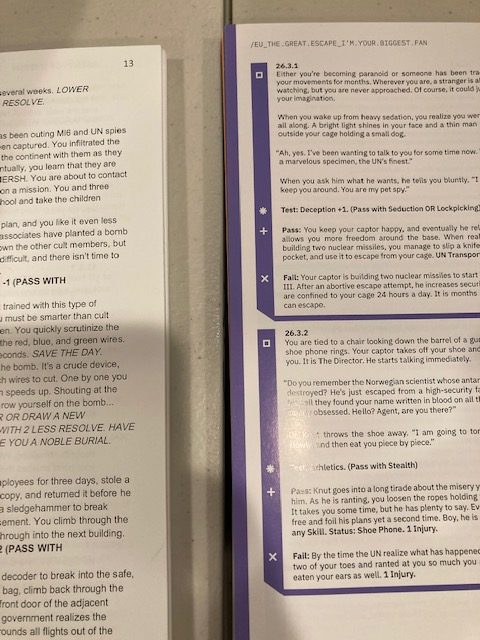
The newer book (right) is slightly better organized. Note the color (right) helps remind you which region you are in, as well as better notated SUCCESS and FAILURE sections (+ and X above right). See some more pictures below.

IMG_3768

IMG_3770

IMG_3769

IMG_3772

You still use little cubes to notate your abilities: The Epic edition uses clear plastic cubes, the original uses wood cubes. See above.
IMG_3773

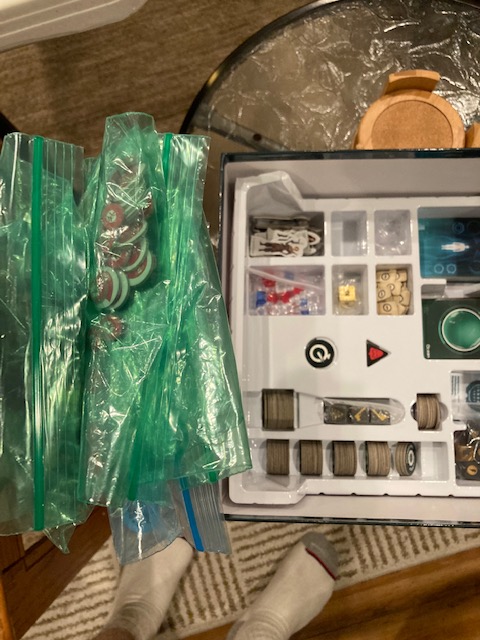
Tokens have special spaces in the Epic Edition insert (right) but I had to use bags (left) for the original edition.
IMG_3774

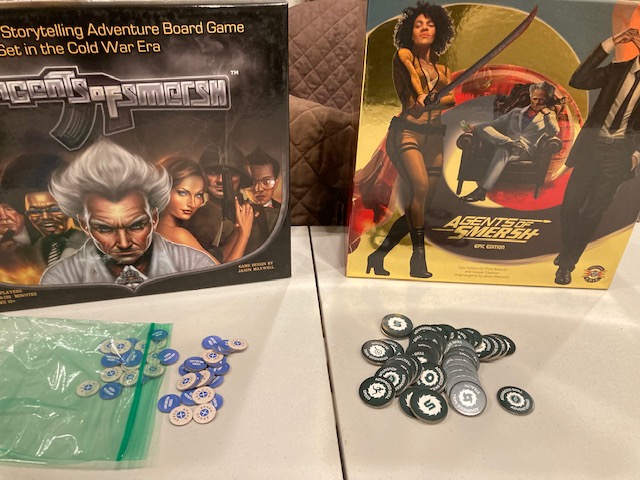
The newer Advanced Skill tokens are larger and easier to read.

IMG_3776

The info tokens (right) are more identifiable as square folders than plain circles (left). The newer UN Tokens are larger to see and easier to hold (right) than the original edition (left).

IMG_3778

No need for injury tokens (left) in the Epic edition: it’s just one of the markers on the character mat as Health (see below).

IMG_3721

IMG_3779

I think I like the standees from the original edition better (left). They are more distinguishable than the Epic Edition, where the characters only have white outlines (right).

IMG_3781

The original Dr. Lobo was hard to get to: you had to get different types of intel and mark them on the Dr. Lobo chart (see left). This mechanic is completely gone in the new one. They’ve replaced it with the Epic Showdown book!
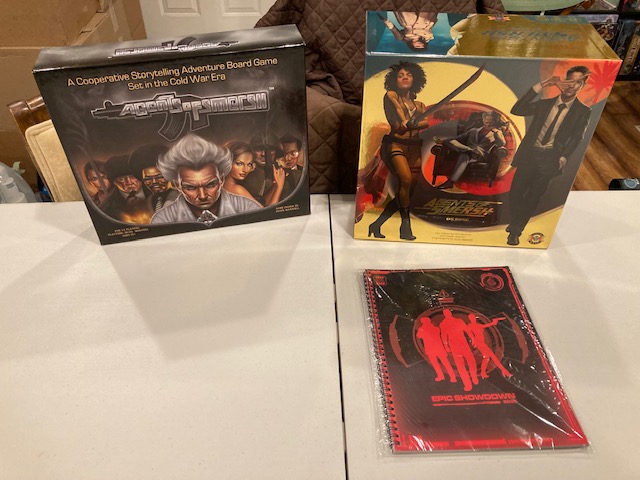
IMG_3790

A lot of ideas from the Epic Showndown came from the the Showdown expansion from the original expansion:

IMG_3791

IMG_3782

The Henchman idea is still in the game, but again, the idea of how to fight them has changed. You used to have to find them and fight them before you could ever bring out Dr. Lobo. Now, the henchmen are very different: to fight them, you simply discard an appropriate number of intel and then consult the Epic Showdown book! It’s much simpler than before!! If you defeat them, it’s easier to defeat Dr. Lobo in HIS final showdown!!! If you don’t, the final showdown with Dr. Lobo gets complicated with appearances by the Henchmen!

The Henchmen mechanic has changed significantly: it’s become an Epic Showndown rather than some baroque rules.
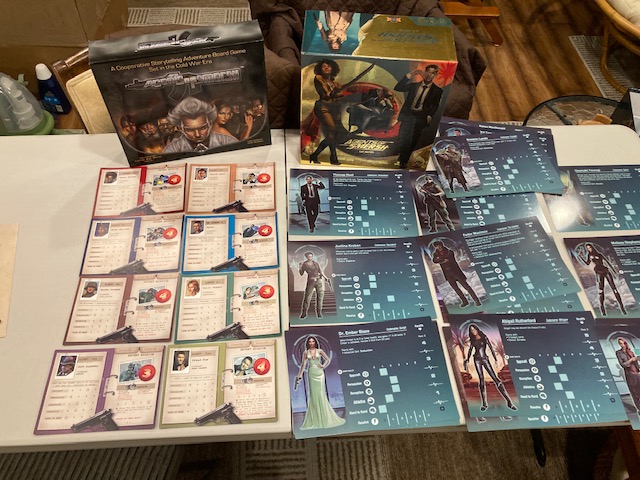
IMG_3786

There are SIGNIFICANTLY more characters in the EPIC edition vs. the original edition: 23 vs. 8!

IMG_3787

Essentially the same info is on both cards, but the newer cards are larger and more readable. See above.

IMG_3789

Finally, the Epic edition has the cool neoprene map, art clips, and dual-layer boards for the character sheets.

IMG_3792

Overall, the Epic Edition of Agents of SMERSH is more modern looking, easier to use, and simpler.

Rulebook

IMG_3681

The rulebook is pretty good.  The font is big and legible: see above.
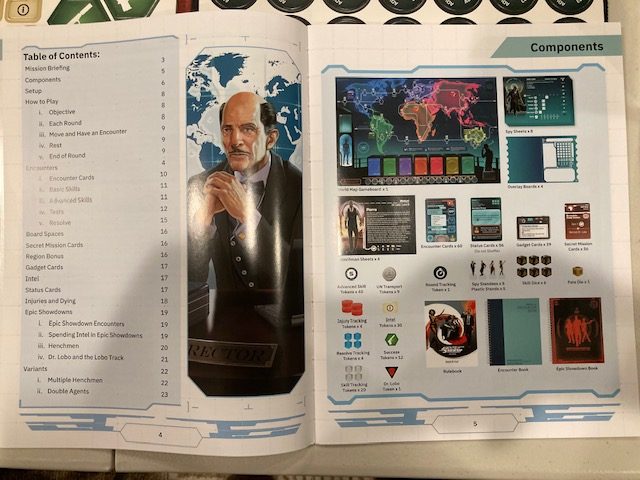
IMG_3684 (1)

There’s a nice little table of contents and a great annotated components page with pictures. Very helpful and useful for correlating components.

IMG_3702

The set-up page is great: a picture with labels and corresponding directions on the facing page. This is how set-up should be.
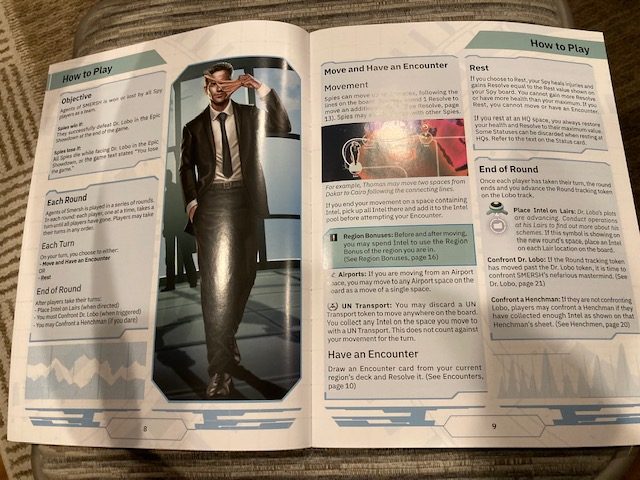
IMG_3703

In general, the rest of the rulebook is “pretty good”. You can find all the rules, but sometimes the organization felt a little of and I had to do more hunting. For example, the Henchmen and Dr. Lobo showdown are both handled similarly, but they way they were described felt disjoint, despite the similarities.

IMG_3704

And a few places, some rules should have been notated differently (For example: using intel for the Showdowns needed to be emphasized).

IMG_3705

I shouldn’t nitpick too much. I learned the rules, the rulebook was readable, and it was pretty easy to look stuff up. I generally liked the rulebook.
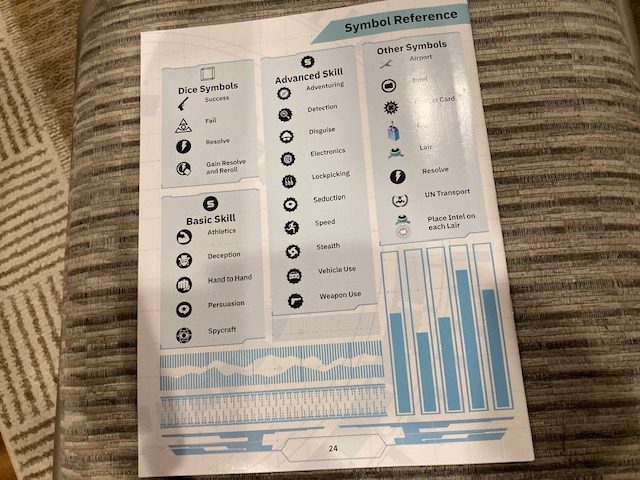
IMG_3712

And, most importantly, the rulebook ends with an Icon summary. Thank you for using that last page for something useful!

Streamlined Play

IMG_3783

I usually blanche when someone says “This game is better because it has streamlined play!” Streamlining, although it can mean simplifying, it can also mean dumbing-down. I will admit, for what it was, the original Agents of SMERSH had too many rules. At the end of the day, the fun part of Agents of AMERSH is reading silly dumb encounters from the encounter book and rolling dice! The core fun of Agents of SMERSH is the reading and dice-rolling. All the other weird rules of the original edition seemed to be a distraction: So, I am okay with some streamlining here. I admit that I want some game in there because Tales of Arabian Nights (another storybook game) was always a little too random for me. There is some strategy and some choice in Agents of SMERSH, but it’s still a storybook game where the storybook dictates some randomness (but excitement) in your play. Agents of SMERSH should be a fun game not hampered by too many baroque rules.

The original edition had quite a number of extra and mechanisms that are now gone.

  1. The dice are now uniform.  The original edition had different distributions of successes and failures on dice, and you rolled different dice depending on different rules.  That was complex and added too many rules: it’s gone.
  2. The Henchmen rules are simpler.  There were some strange set of rules for bringing out the henchmen, and you had to measure the success to bring them out.  Nope: all that’s gone, and the henchmen are handled in Epic Showdown book just like Dr. Lobo.  In other words, the Henchmen rules are not a weird bunch of rules tacked on.
  3. Dr. Lobo and different types of Intel are gone.  Dr. Lobo used to have to find a certain number of type of different intel tokens.  Nope: all that’s gone.  Intel is a generic resource that helps you roll better.
  4. Dr Lobo final encounters are in the storybook!  Now, Dr. Lobo final encounters feel more “epic” as you read from the Epic Showdown book.  It feels like the Storybook parts of the game we like, not a different set of rules.

There were also some rules that made the game “Pandemic-like” as cards shutdown airports and removed intel from the map.  That’s been simplified in the intel rules: the Epic Edition doesn’t have many rules for removing intel, it simply must be found.  I admit I liked the old rules for intel, but I understand the new way Intel is handled does make it simpler.

IMG_3760

The Epic Edition has streamlined the rules appropriately. The game is simpler and easier to teach without taking away from the fun.

Solo Play

IMG_3657

So, congratulations to Agents of SMERSH for following Saunders’ Law and having viable solo rules! Interestingly, there is no discussion of solo rules in the rulebook. The game “simply scales” to the number of players. I wish there had been at least a sentence discussing it, because solo rules almost always have exceptions or modifications. Not seeing a sentence abut the solo play makes me think it was an afterthought: BUT, it was not.

Basically, the solo play is fairly balanced because the one character gets all the good stuff happening to him, so all the bonuses and stats upgrades all get applied to exactly one character, which turns that solo character into a bit of a Superman. With more characters, those bonuses are divvied up over multiple characters. Now, multiple players have more Health collectively (Four players have 4 Health each for 16 hit points total, one player has 4 Health for 4 Health total), but since all the specials, re-rolls, status upgrades, bonuses and the like are applied to one character, that character usually has a better shot of surviving. That said, the solo game can be more swingy since there are dice and the superman solo can die if there are some bad turns.

IMG_3736

I really enjoyed my first solo play of Epic Edition of Agents of SMERSH. I lost because I missed a major rule: during the Henchmen encounter with Darling, I forgot I could use info tokens for extra dice!!! (Which is why I wished the rulebook had emphasized that more: my fault though).
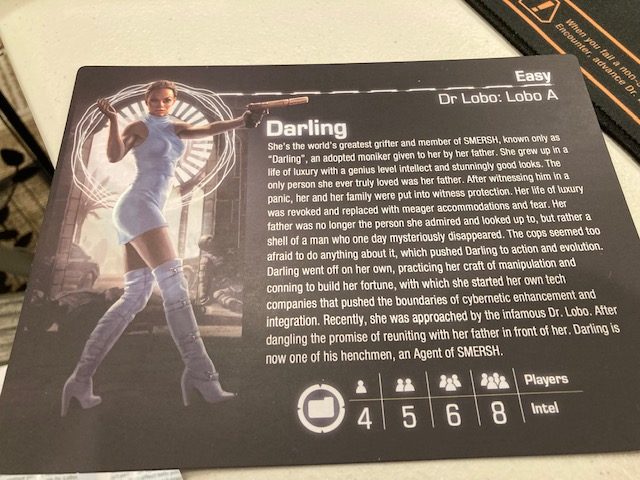
IMG_3730

If I had defeated the Darling Henchman, I might have survived my final battle with Dr. Lobo!
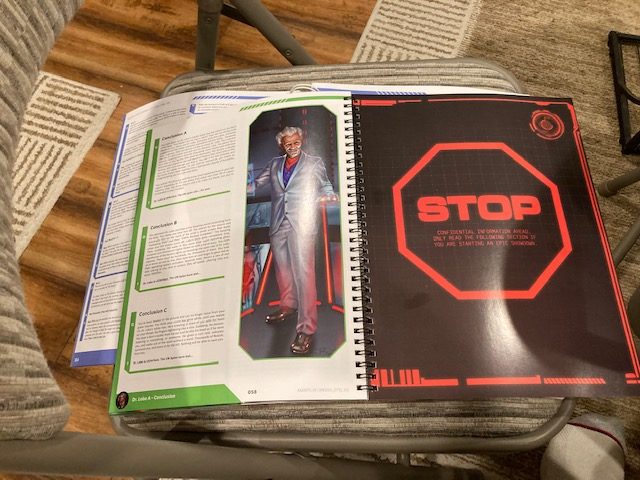
IMG_3733

It’s good to lose your first play: it usually means you want to play again.

IMG_3729

One other thought: I usually prefer Storybook games with multiple people-maybe it’s because the theme comes through more with multiple people reading aloud.  This is one case where I think the game works just as well solo: I think it’s because there are enough decisions for the solo player since this is not “just” a storybook game.  The theme is everywhere, there are many decisions.  I think I like this as much as a solo game as a multiplayer game.

Cooperative Game

IMG_3924

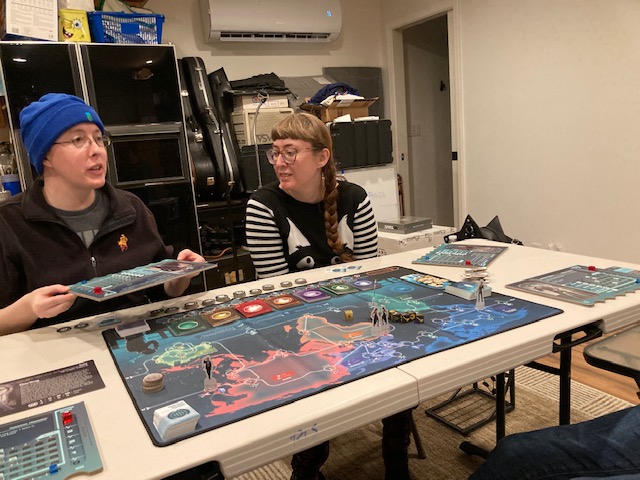
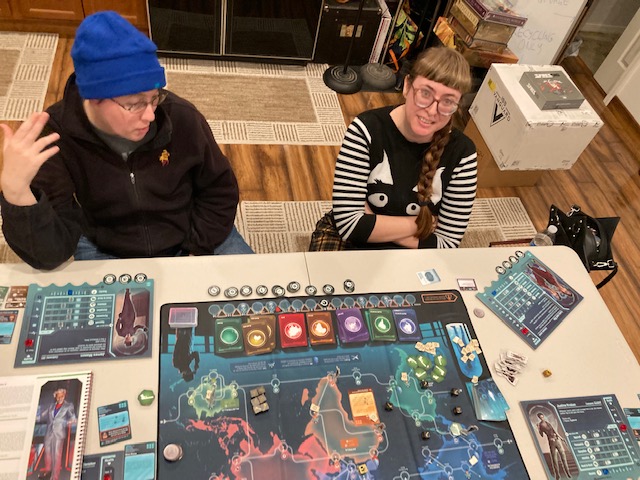
As a cooperative game, the game moved around, with us reading out loud to each other. We got into a groove where the book would be passed, the “region” pages would be opened as we waited for the player to read the card and make a choice about “how will I respond to this encounter”.  This worked pretty well, as everyone got to read to everyone else: it was a shared responsibility. See above as Sara picks a choice and Andrew reads what happens from the choice!!

IMG_3922

The cooperation, in terms of gameplay, wasn’t as pronounced as other cooperative games we have played.  People generally did what they wanted on their turn to improve their characters to get ready for the final battle. There was some discussion, but in general, people just moved forward and did their own thing: the major pieces of collaboration were “When should we all rest for a showdown?” and “When should we start the showdown?”.
IMG_3921

It isn’t a bad thing, as lots of people like cooperative games but prefer to just cooperate when needed.  Just be aware the cooperation isn’t as pronounced here as it is in other games.

But Is This A Good Game?
IMG_3654

If you know nothing about the original game, then you are probably wondering: “Is This A Good Game?” I absolutely think this is a GREAT game, but it really depends on what you are looking for.

IMG_3664

In Agents of SMERSH, each player takes the role of a wacky 70s spy! This game has a sense of humor—so, you gotta enjoy some goofiness (see above with silly portraits: is that Sean Connery? Is that from Kill Bill?). But each of the characters is different and has different powers: a lot of people like asymmetric powers, and this game has that in spades.

IMG_3734

Players are working together cooperatively to vanquish the evil Dr. Lobo and the SMERSH organization. The spies roam the world (below) looking for intel on Dr. Lobo, his Henchmen, and the SMERSH organization: there is exploration!!

IMG_3722

At its core, Agents of SMERSH is a storybook game. Every turn other players will be reading from a giant book of Encounters (storybook) describing some situation for the current player.

IMG_3696

If your idea of fun is reading from a storybook to other players and then making die rolls, then you will love this game! Since the game embraces the cheesiness of the Bond era spies, you can read with crazy accents, yell, make sound effects, and be as dramatic as you want! If you hate reading aloud, you will hate this game. This game is all about reading to each other and being silly with the text.

If you hate reading aloud, but still like the idea of a story being read aloud to you, then there are number of games that use an APP to read to you: Forgotten Waters (see our review here) and The Grand Hotel Abaddon (see our review here) are two such games.

This is a great game IF you like reading aloud from a storybook and hamming it up. If you don’t like that, this is not the game for you.

Variety
IMG_3927

There are a few things to be aware of.

The Epic Showdowns are cool, but they are limited.  There’s only 4 Henchmen and only 4 Dr. Lobo Endings.   Each Henchmen and Dr. Lobo has an entire section, and there are a few branching points in the text: this gives each Henchman some variety.  And the final text with Dr. Lobo changes depending on whether the Henchmen is alive or not.  So, that also add some variety into the game.  But, be aware that you probably want to rotate through the Henchmen each time you play, to keep the story different.

IMG_3920

If you look at the limited Henchmen too closely, you might think “This games sucks!! I can only play it 4 times before it repeats???” And strictly speaking, you would be right. But, between the branching inside each Henchmen and some variety with the endings, your endings will be different.
IMG_3926

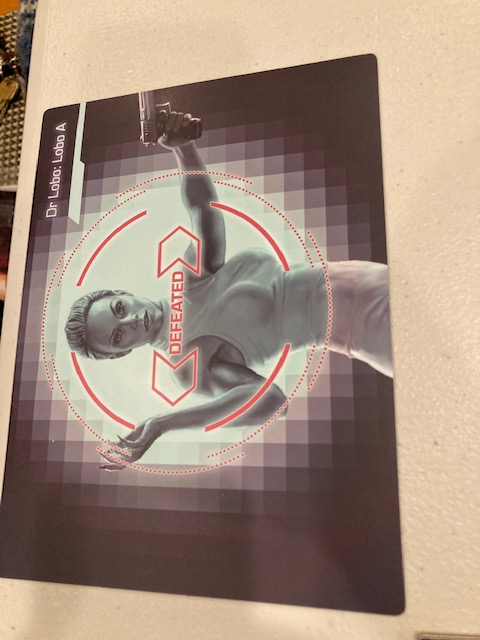
A better way to look at this situation is to compare it to many other adventure games with a Storybook. For example: Adventure Games The Grand Hotel Abaddon (which we reviewed here) has a limited life already! Once you’ve played that game, you know all its secrets and it really only has one ending!!! So, with the Epic Edition of Agents of SMERSH, you don’t have just one ending but 4 major endings! And within each ending are a number of paths for more variety.

IMG_3929

I personally prefer games with a more directed story, so I am okay with this limitation. But you should be aware there might be less variety here that you expect.

Conclusion

IMG_3743

I was a supporter of the original Kickstarter for Agents of SMERSH back in 2012. My name is even on the book inside! (Kickstarters used to list all the supporters somewhere in the game: they don’t really do that anymore). My game groups loved this game: Charlie and Allison picked up their own copy! Joe picked up a copy to use in his English classes (he loves the reading)! And yet, I always felt a tinge in the back of my neck when I had to teach this game: it was just a little bit clunky and it had a few too many rules.
IMG_3648

Fast forward to 2021: Agents of SMERSH Epic Edition has gotten rid a lot of the weird rules, updated the components, simplified the gameplay, and added the Epic Showdowns! I can honestly say that I will only play the Epic Edition going forward! The new game is better looking, more fun, and easier to teach!
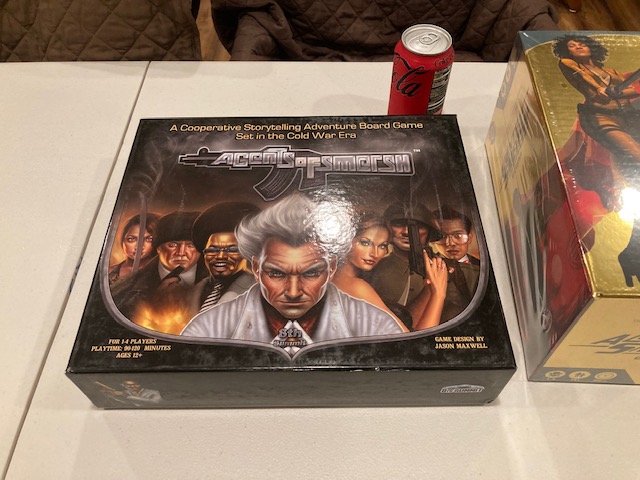
IMG_3652

Having said that, if you ever find the original edition used for a good price, it’s still worth picking up! The story is still all there in that giant Storybook! And all the silliness and zaniness that we loved is still there. It’s just that the newest Epic Edition really does streamline the game and make it easier to teach and funner to play.

IMG_3647

The original game used to be an 8/10 for me, but the newest Epic Edition is probably a 8.5/10 for me now: it should probably be higher on our Top 10 Cooperative Storytelling/Storybook games! I strongly recommend Agents of SMERSH Epic Edition!

  • Me: 8.5/10 might prefer it slightly better for solo play. 
  • Teresa: 7.5/10, would suggest it and would play it again
  • Sara: 6.5-7.0/10 would definitely play it again, but not reach for it or suggest it
  • Andrew: 6.5/10, enjoyed my play, would play again but wouldn’t probably suggest it

Appendix
IMG_8113

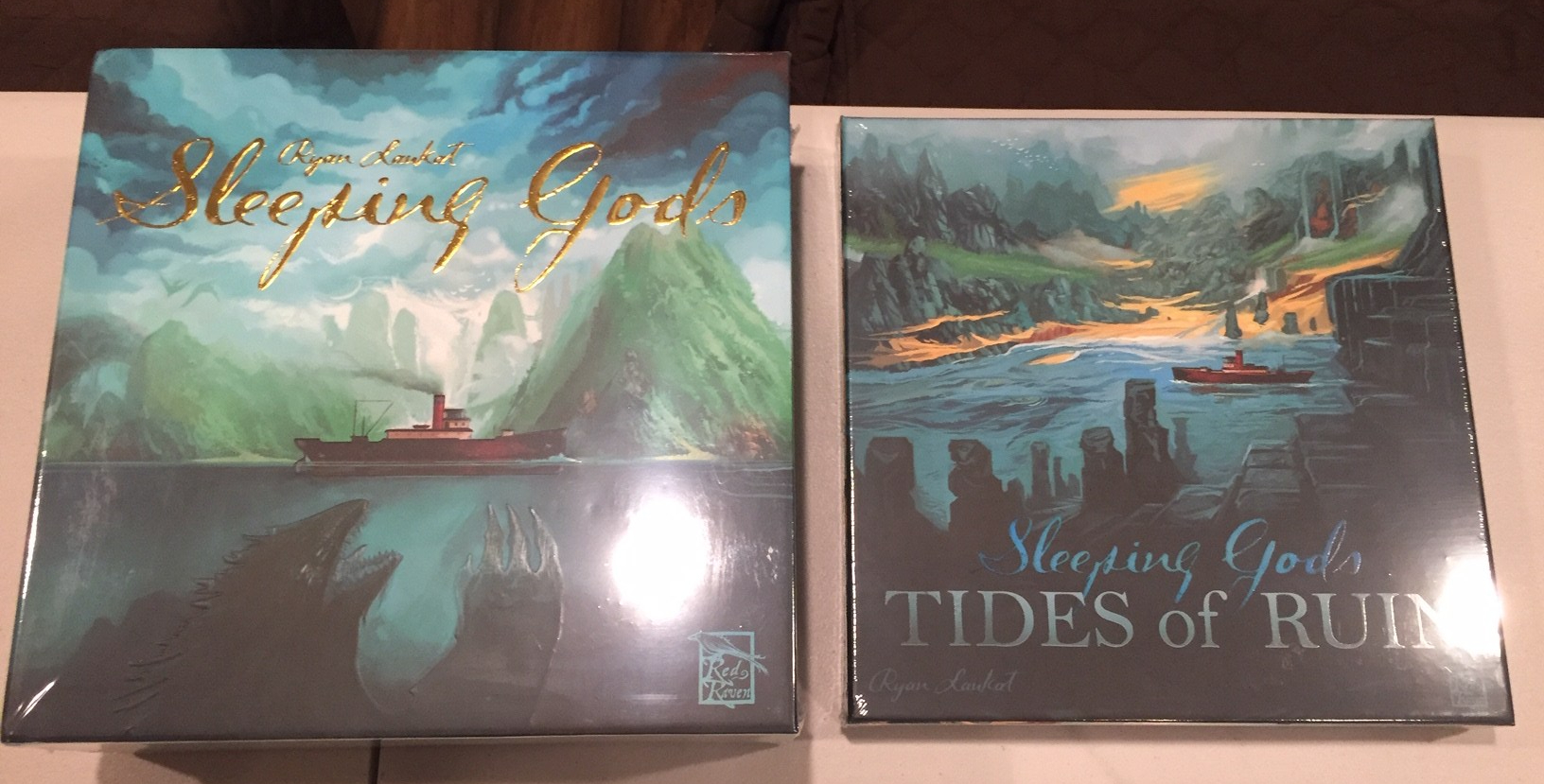
My friend CC texted me just today: he told me that he and some other friends will be playing through Sleeping Gods soon. Sleeping Gods is another Storybook game in the same genre as Agents of SMERSH: See our review here.  I am in the minority that I didn’t like Sleeping Gods  (most people do: I am the weirdo).  It strikes me that the main problem I had with the first Edition of Agents of SMERSH is the same problem I had with Sleeping Gods: There are too many rules for a game with significant randomness.   The other side of the coin is Tales of Arabian Nights.  See our Top 10 Cooperative Storybook/Storytelling Games for more discussion of Tales of Arabian Nights: it’s just random storybook with no other real rules.  Tales of Arabian Night is too random and feels more like an activity.  I think Agents of SMERSH Epic Edition strikes the right balance of “some randomness from storybook” coupled with “decisions that make some difference” coupled with “streamlined gameplay”.  Said another way, the gameplay of Agents of SMERSH Epic Edition is appropriate to the level of randomness. 

A Mini-Review of Clue: Treachery at Tudor Mansion (An Escape and Solve Mystery Game)

This week, we’ll be taking a look at another cooperative game we got at Target! A lot of our games have recently come from there: Minecraft: Portal Dash (which we are cautiously but optimistically recommending: see here), Star Wars: The Clone Wars Pandemic (which we really liked: see here) and Horizons of Spirit Island (which is basically a cheaper vector into Spirit Island: if you like Spirit Island, you’ll like this). Target has become somewhat of a Mecca for cooperative games for us: everything we’ve gotten (so far) has been quite good! Will this weird Clue game be any good? Let’s take a look!

Is This Clue?

IMG_3806

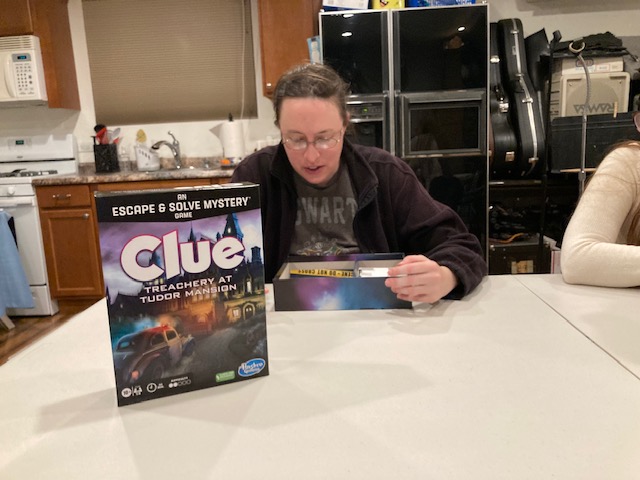
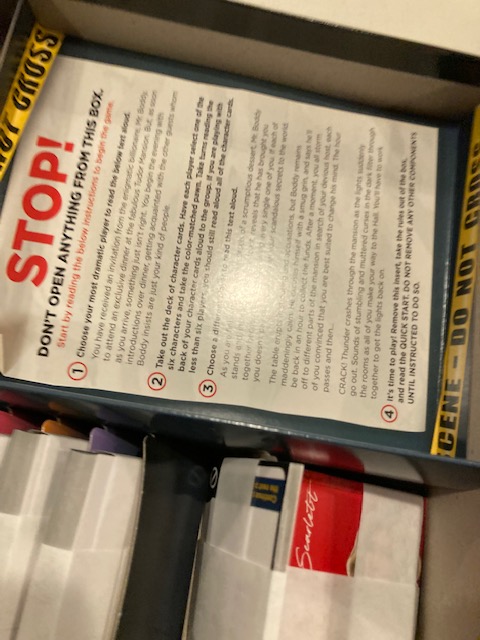
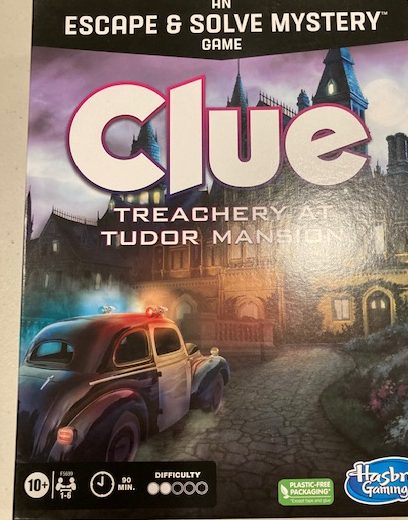
NO! Clue: Treachery at Tudor Mansion is is not Clue! That’s why (I think) the games emphasizes the “Escape and Solve Mystery” on the front of the box!! See above. This is a combination Escape room/Detective/Adventure game set in the Clue universe. Yes, there’s a Clue universe. Yes, I know, that sounds weird.

This game reminds us a little of The Adventure Games The Gand Hotel Abaddon which we reviewed a few weeks ago. Clue: Treachery at Tudor Mansion is a game of exploring the Tudor Mansion (which looks surprisingly like the Mansion from the original board game Clue): See below. (This picture below is a little bit of a spoiler, as you will be slowly exploring the mansion to reveal the map as you play, so just glance at it quickly)

IMG_3817

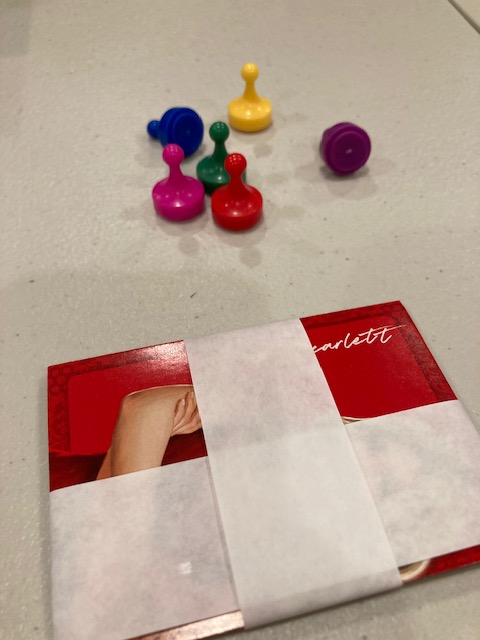
If there was ever any doubt you were in the Clue Universe (Cluniverse?): take a look at the characters below. Each player plays one of the fabled Clue characters:

IMG_3809

I haven’t played the original Clue in quite some time, so I remember there used to be a Ms. White: I guess she’s gone.

IMG_3804

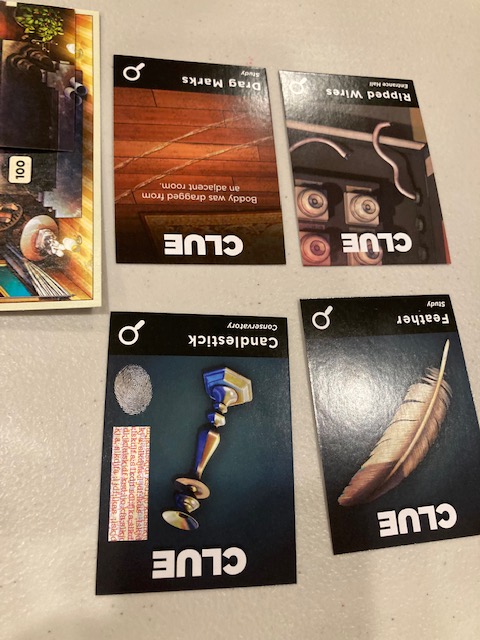
And there’s not too much we can show! This is a one-shot mystery game: once you have played through the mystery of the game, you know the solution! And the game slowly adds cards and map pieces to the game as you play, so we can’t really show too much of that other than what you see when you open the box: see above and below.

IMG_3805

Mystery

IMG_3810

Clue: Treachery at Tudor Mansion is a mystery game. Over time, players cooperatively explore the Tudor mansion and find objects, they find new rooms, they find new clues! It’s got a little bit of a “point-and-click” adventure game feel, as you have to combine objects to get stuff done.

IMG_3815

As a group, you work together to find out who killed Mr. Boddy: It’s a cooperative detective game. This game would fit very well into our Top 10 Cooperative Detective Games.

Play

IMG_3803

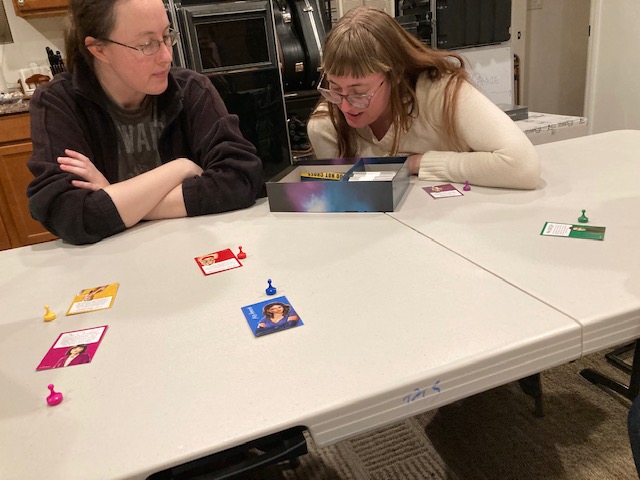
Clue: Treachery at Tudor Mansion says that it plays 1-6 characters and takes 90 minutes. That seems fairly accurate: we cruised through the game, but we can imagine a more ponderous group taking 2 hours if they wanted. We ended up playing 4 characters, which felt just about right. Too many characters can cause conflict as competing detectives strive to be heard, but too few characters can miss some obvious clues in the game. 3-4 Players seems the best player count, but I could see playing this 1-2 fairly well too.

IMG_3811

One of the best elements of this game is that the game made sure to keep everyone involved: play rotated through the players, forcing everyone to read cards on their turn. The mystery is in the text of the cards: reading more cards exposes more and more of the mystery!!. The game forced everyone to read something on their turn to the group. It always felt like everyone was involved in the mystery.

IMG_3808

As we played, we’d ALWAYS reveal more and cards from the box on our turn. So, it always felt like we were making some kind of progress!

It really did feel like something happened on everyone’s turn! There was never a dull moment!

The final mystery was pretty straight forward: you have to solve the who killed Mr. Boddy, where, and with what … okay, that does kind of sound like Clue. But in this case, there is a well-constructed mystery story already written! And it’s cooperative! And there’s exploration! And Reading! And object manipulation!! So, those things make it very different from Clue.

This wasn’t a hard mystery, but it was still challenging.

Silly Things

IMG_3813

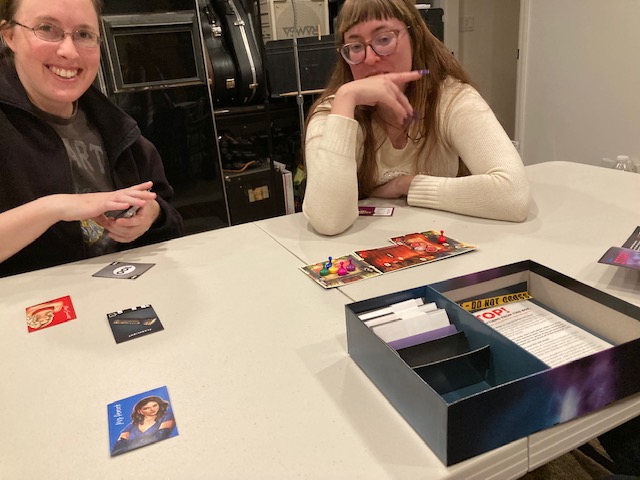
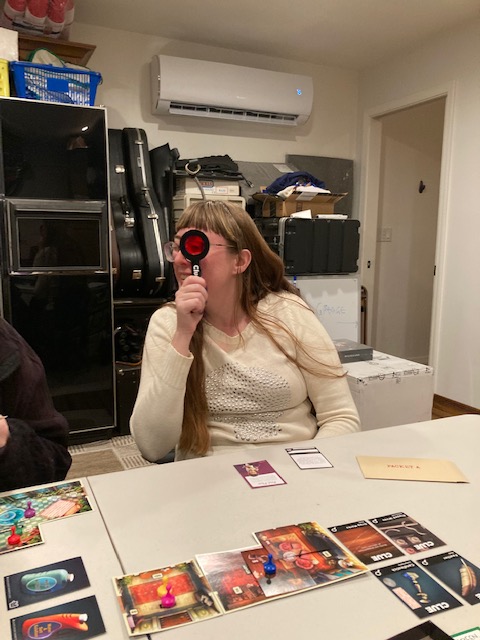
There were somethings you should be aware of: the game makes you do silly things. For example, “something happened” on my turn, poking me in the eye (in the game, not real life), so I had to put my hand over my eye for one full turn. A couple of things “like this” happen over the game. You can completely ignore this if you like, but as a group, you should make a determination as to whether you are playing “fully serious” (and ignoring the silly things like that) or “silly” (and embracing the silly things in the game). We ended playing silly and embracing it: it’s up to you. This is a simple enough mystery that you don’t have to be fully serious.

Just be aware: there is some silliness in this game.

IMG_3816

Conclusion

IMG_3818

I can’t call this a full review because:

  1. We didn’t play it solo first.  I think you could play this solo if you liked, but then the mystery is solved!
  2. We can’t show too much.  There would be too many spoilers!

But, we can share overall thoughts after playing through it.

IMG_3819

This one-shot mystery was fun!   It was only $15 I think.  The Adventure games (like The Grand Hotel Abaddon from a few weeks ago) are a little bit better deal from a gameplay  perspective, because you get three 90-minute sessions out of those games for the same price as a single 90 minute session from Clue: Treachery at Tudor Mansion.  But, Clue: Treachery at Tudor Mansion is a better “light” mystery, as you are always engaged because you are always doing something: the game always seems to be moving forward.  Some mystery or adventure games can be more plodding as you “think more” to solve the mystery: this game doesn’t quite have that vibe.  You still have to think and solve the mystery, but the game reveals itself quite quickly.

I liked this and my game group liked this.  We reset the game (nothing is torn up, so you can completely reset the game back to its original state) and I will be passing it on to Charlie and Allison: they like mystery games!

Top 10 Cooperative Dexterity Games

Now that cooperative games have become mainstream, it’s easier to make many more directed Top 10 lists! This Top 10 list is for Cooperative Dexterity Games! Dexterity Games usually involve a silly physical challenge. There’s 4 main flavors of dexterity games on this list:

  1. Flicking (where you flick items using your finger and thumb)
  2. Stacking/Building (where you build structures of interest)
  3. Balance (where you balance things while you move them around)
  4. Other (which is anything else)

Let’s take a look at our Top 10 Cooperative Dexterity Games! The order of the games here doesn’t matter as much as other Top 10 lists: you know right away if you like flicking, stacking, balance, or other. The order here is more influenced by the opinions of my normal game groups and the game groups from RIchieCon 2022.

10. Seal Team Flix

IMG_2019

Ages: 14+
Players: 1-4
Time: 60 minutes
Type: Flicking

IMG_2020

This is a war game that’s a flicking game.  You know what it is when you see it!  

IMG_3147

There’s a LOT of stuff in this box, but there’s also a lot of work to set things up for a simple flicking game. And there are a lot of rules for a flicking game.

IMG_3150

Despite all the work for set-up and rules (which is why it is #10), the game was thematic (“be quiet or else all heck breaks loose!”) and fun! We had a lot of fun with the flicking side games as well!

9. Space Cadets

scf

Ages: 8+
Players: 3-6
Time: 60-120 minutes
Type: Other (mix of flicking and other stuff)

scb

Space Cadets is an amalgam of a lot of different games: each player plays a position on a starship (like the Star Trek Enterprise).  Each position has a different challenge, and some of them are physical challenges:  There’s a flicking position, reaching into a bag to “feel components” position, make dominoes, and some other odd things.  This is a fairly strategic game, despite all the silly challenges (and thus the 60-120 minutes playing time). We found this game to be love/hate in general: you either loved it or hated it (which is why it’s #9 on our list). But it was definitely fun to watch!  You should definitely try it at least once to make sure you like it before you buy it.

8. Flick ‘Em Up: Dead of Winter

IMG_2031

Ages: 14+
Players: 2-10
Time: 45 minutes
Type: Flicking

IMG_2032

Flick ‘Em Up: Dead of Winter is a pure flicking game: that’s both bone and bane for the game.  If you are terrible at flicking (which we were for some of the game), you will lose pretty badly!  Even playing cooperatively!  But, this game has an amazing presence and looks great on table: you can’t go wrong! See below!

There were a lot of rules for the different types of things to flick (guns, knives, shotguns, etc), so again that was boon and bane: it was cool to have  all the variety, but it added a lot of complexity to a pure flicking game … this is why this is a little lower (#8) on our list.

7. For Science!IMG_2023

Ages: 14+
Players: 1-6
Time: 30 minutes
Type: Stacking/Building

IMG_2024

For Science is a box filled with lots and lots of wood building blocks!  There is a game here about building molecules for science, but really the game is just about playing with blocks.  My game groups loved the blocks, but didn’t like the real-time part of the game (which is why it’s only #7).  There are probably just a few too many rules too, but it’s just so much fun to play with the blocks!

This was an Interesting game from the designer of Spirit Island (a cooperative game we love here).

6. Dungeon Fighter

IMG_2033

Ages: 8+
Players: 1-6
Time: 45 minutes
Type: Other: throwing stuff

IMG_2035

So Dungeon Fighters has a name that SOUNDS LIKE it’s a generic Dungeon crawler.  Nope!  Well, there is some dungeon exploring, but at it’s core, it’s a “throw dice” (and I mean “throw dice”)!!! It’s a wacky “physically throw dice at a board” while doing all sorts of silly physical challenges. Throw dice beneath your legs, off-handed, under your arm, and laugh the whole time.  This is NOT a serious game. 

IMG_2862

Our first play of this game is a huge ongoing joke: my air conditioner was on the fritz, so we choose to play this (probably the most physically active game on the list) without A/C! We were huffing and puffing and downing water afterwards! Learn from our mistake, don’t play this of your A/C was on the fritz. But the game was still such a hoot!

5. Slide Quest

IMG_2021

Ages: 7+
Players: 1-4
Time: 15-45 minutes
Type: Balance

IMG_2022

This game is interesting because the box itself is a component of the physical puzzle!  Each player moves a lever on each side of the box (see picture above and below) to help move some markers through a maze landscape into a hole. It reminds me quite a bit of those old wooden maze labyrinths where you would try to manipulate a metal ball through a hole.  

4. Ghost Adventure

IMG_2029

Ages: 8-99
Players: 1-4
Time: 20 minutes
Type: Balance

IMG_2030

Ghost Adventures is a really odd duck: you have to cooperatively move a top around a bunch of boards!  Each player (usually) takes one board, shepherds the top (physically adjusting the board) through his/her board, then passes the top to another board! Passing the top from your board to your compatriot’s board is probably the hardest part!  It sort of reminds us of Slide Quest (#5), but Ghost Adventures uses tops instead of a little roller ball dude.  It was fun and goofy and the component quality was very good!

3. Space Invaders

IMG_2025

Ages: 8+
Players: 1-4
Time: 30-45 minutes
Type: Flicking

IMG_2026

This is a light silly game where you flip “firepower” at the space invaders who are slowly descending down upon you !  This is a very lightweight flicking game that you can get from Target (currently) for pretty cheap! It’s silly fun.

IMG_2303

Even though this is essentially a cheaper Flipships (see the next entry) with generally worse components, the little flipper is pretty cool! See red/white/blue plastic flipper above.

2. Flipships

IMG_2027

Ages: 8+
Players: 1-4
Time: 30-45 minutes
Type: Flicking

IMG_2028

This is a silly flicking game, but the special powers on the ships that you flick give the game some interesting twists.  Even though we were terrible flickers in general, the game was fun and silly and we were laughing the entire time.  The ambigram (words with symmetry) on the cover also enchanted us.  We also liked saying Flipship.  Flipships.  Flipships.  

Sam surprised us at RichieCon 2022 by saying it was favorite game that he learned in the past year!  He then he proceeded to teach it to everyone he could at RIchieCon 2022!  This is a surprise hit which is why it’s so high on the list at #2!!!

1. Menara

IMG_2017

Ages: 8+
Players: 1-4
Time: 45 minutes
Type: Stacking/Building

IMG_2018

Menara was described very aptly as “reverse-Jenga” by my game groups! Players cooperatively build a structure together, using the patterns and rules described on cards as they come out. There’s a surprising amount of strategy in this cooperative dexterity game, as you have to choose when-and-where to build, and when-and-where NOT to build! This is probably the “thinkiest” of all the games on this list, and is probably why we put it at #1. It was fun! And it was hugely popular at RichieCon 2022!

A Review of Minecraft: Portal Dash (A Cooperative Game), Part I: Unboxing, Solo Play, and First Impressions

Wait, what just happened? When did Target become my primary store for cooperative games?

IMG_3540

Two weeks ago, we picked up and reviewed Horizons of Spirit Island (which we got from Target), then one week ago we picked up and reviewed Star Wars: The Clone Wars Pandemic (which we got at Target). We just happened to pick up two brand new cooperative games at Target today (October 16th 2022)! One we’ll review today (Minecraft: Portal Dash) and the other next week!

What Is Minecraft: Portal Dash?

IMG_3542

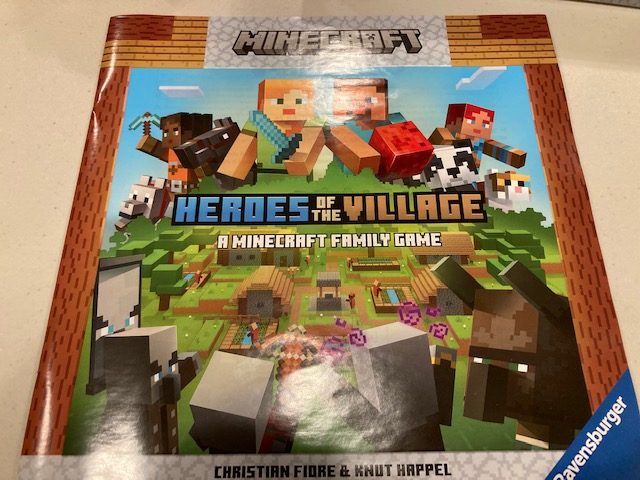
Minecraft: Portal Dash is a cooperative game set in the Minecraft universe. Minecraft is a phenemonally popular video game for most platforms: PCs, Macs, and video game consoles. This game is obviously trying to capitalize on the Minecraft Intellectual Property (much like Star Wars: The Clone Wars did last week but for Star Wars).

IMG_3544

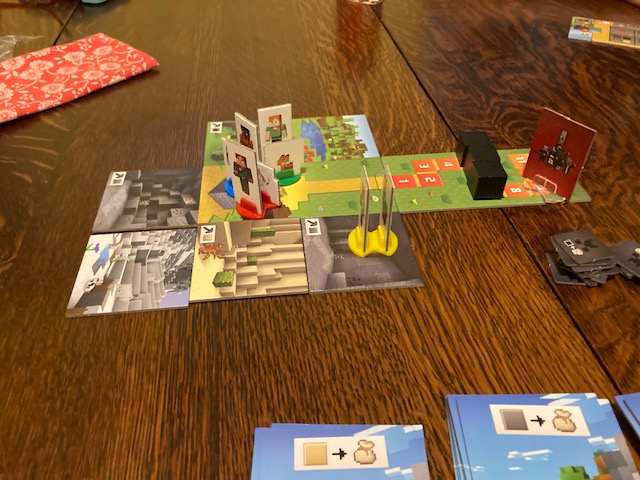
In Minecraft: Portal Dash, 1-4 players cooperatively play as Minecraft miners running towards the portal trying to escape. All players must survive and escape together or everyone loses! It’s a cooperative game! Along the way, players mine, fight, move, upgrade, and uncover new areas. When players uncover the last room with the portal, they must fight the big boss! As soon as the big boss is dead, players win!

Mostly, this game is about fighting and mining, while trying to move to the portal at the end to fight the boss.

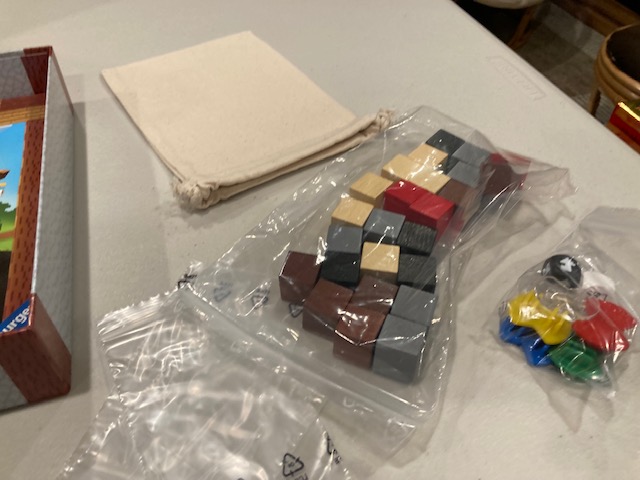
Unboxing , Components, and GameplayIMG_3545

Minecraft: Portal Dash is pretty standard sized: see the game and components relative to the Coke Can.

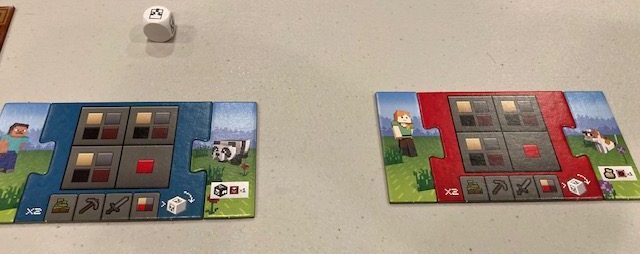
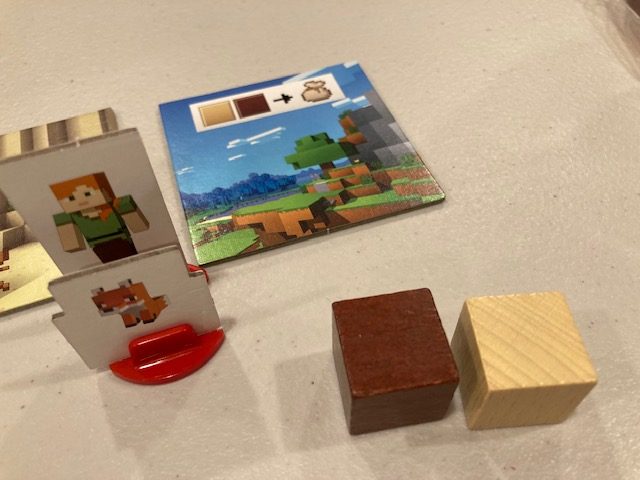
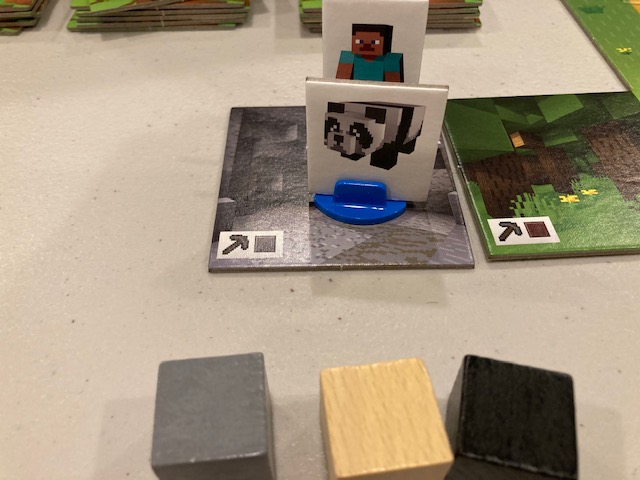
Each player takes a token with a colored bottom and corresponding colored board and colored items.

IMG_3589

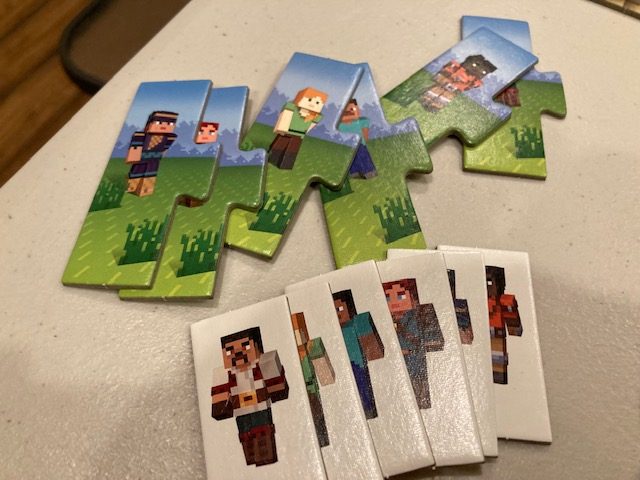
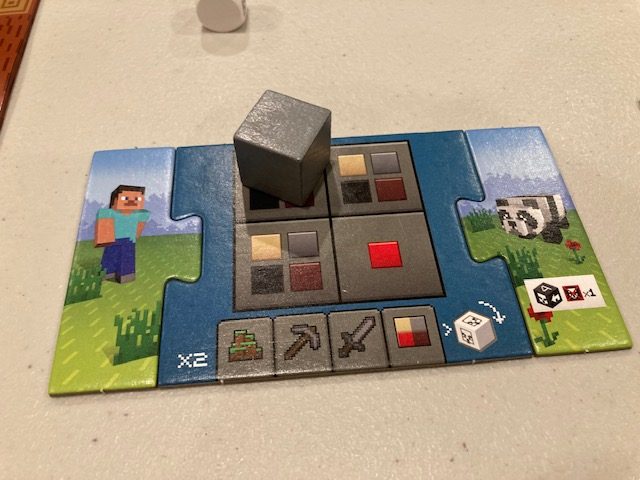
I played my solo game with blue. Note that the character you choose has no special powers: there are no variable player powers here. (You only get better and different through the upgrades you get).

IMG_3596

All players start with all of their items on the top row: they haven’t been used yet: See above. Once an item is used, it goes to the bottom row and has to be “repaired” to be used again. See below.

IMG_3622

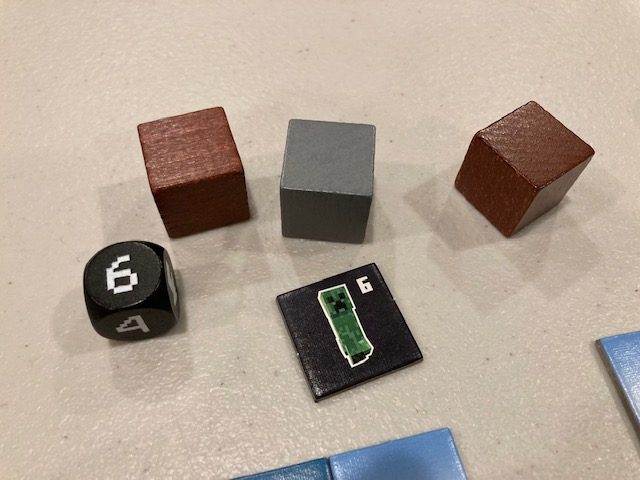
Every round of the game starts with rolling the Bad News dice (the white dice): there are two. (I personally call them the Bad News dice to note that they are advancing the chaos and badness in the game: Minecraft: Portal Dash just calls them the white dice, or the block die and MOB die).

IMG_3603

The first Bad News die (left) strips a block from the Resource Cube. Which block? Whatever the die tells you! See below!

IMG_3610
The bad news die force the players to remove one cube, their choice of color

This is Bad News because the game ends when The Resource Cube (above) run out of blocks … either completely out of blocks or blocks at the appropriate level.  So, stripping blocks from the Resource Cube is slowly bringing the game to an end.

IMG_3609

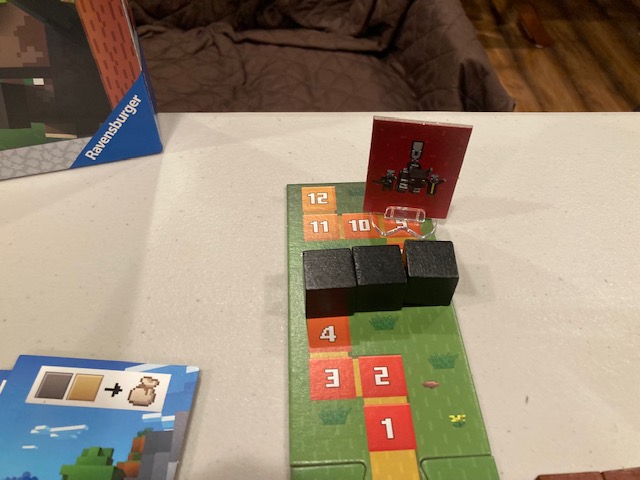
The other Bad News die (the MOB die) activates the MOBS (the Bad Guys) in the game. Above, we can see two of them are activated! The upper right corner of each MOB character has a number from 1 to 3: you activate all MOBS with that number, which causes them to move towards the characters.

IMG_3588

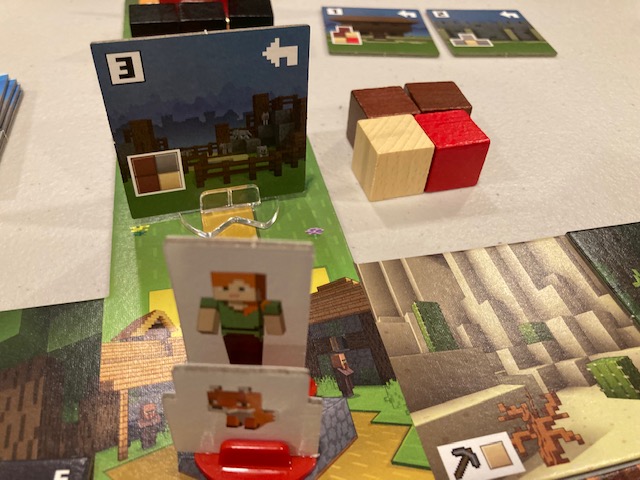
If there are no matching MOBS, you spawn a new MOB at the closest spawn point to a character on the board. The MOB at the front of the queue (see queue above) is what gets spawned.  You can always see what’s coming next in the queue!

IMG_3611

After the MOB move, they may attack!  If the MOB bad guys do reach you, they do damage: above, the magma cube is adjacent and hits me for 2 (-2 on bottom right of the MOB) damage.  The ghast is not adjacent, but has range (2 square) and does 2 damage!  Above was the very first turn of my game and I lost 4 hit points!!

IMG_3613

Hit points are at the top of your character sheet: I only took 3 damage because I had armor that absorbed the first hit.

After the Bad News is done, the active player (who rolled the Bad News dice) gets two actions of their choice:

  • Basic Actions: move 1 space, repair 1 item, mine 1 block
  • Use One Item: move item from active part to lower part, invoking its upgraded action

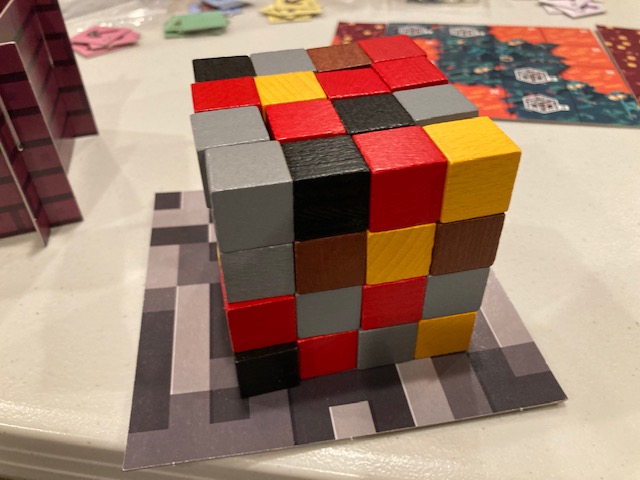
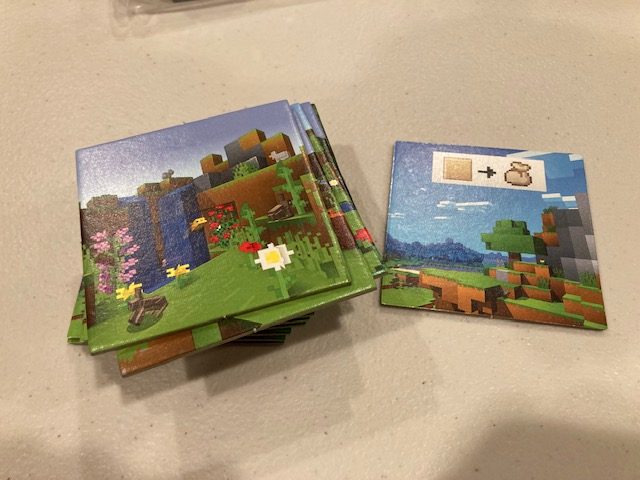
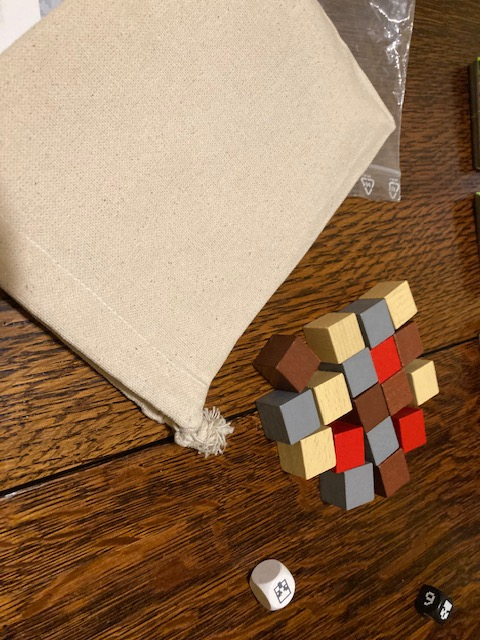
It doesn’t sounds like a lot, but the mine 1 block is quite interesting. First of all, you can only mine blocks that are exposed: A block is exposed only if its top is visible and at least two other sides are visible.  And then you can do cool things with the block!!! Geometry is important here!

 You can use the mined block to help complete the piglin task (see below):

IMG_3634

Recall that you can’t open the final portal until the piglin board is complete! And you can’t win if you can’t fight the boss by the portal!  So, it is necessary to mine as you play to fill the piglin board.

IMG_3642

The other thing you can do with the blocks: use a special power! See above!  These special powers can be game-changing!  Repair all items!  Heal full hit points!  Of course, mining a cube has a cost: remember that the game ends when you run out of cubes.

Using an item usually gives you an upgraded basic action, but at the cost of “breaking” the item so you can’t use it until its repaired.

IMG_3623

For example, using the pickaxe would allow you to mine TWO blocks (instead of one).

Note that the sword and the bow are the only way to engage in combat with the MOBS!  To take out a MOB, you have to be in range (swords can attack adjacent only, bows have further range: upto 3 spaces away for the bow above).  When you engage in combat, you roll the number of dice as per the weapon:

IMG_3601

Every X is a hit: MOBS need to be taken out in one shot: damage does not persist.

IMG_3624

When you defeat a MOB, you get two upgrades: you keep one and discard the other.  

IMG_3621

IMG_3628

If you can move to the final board with the portal (after completing the piglin board), you fight the boss: if you can defeat the boss, you win!  If you run out of blocks at any point, or if anyone dies, everyone loses!

IMG_3631

Rulebook

IMG_3641

This is both simultaneously a good rulebook and bad rulebook.  It’s a good rulebook because it is complete (all rules are here) and it teaches the game.  It’s a bad rulebook because of poor organization and some glaring deficiencies (the inclusion of a few things would really flatten the learning curve).

IMG_3546

First off, the rulebook is very daunting: when you first open the box and grab the rulebook, it’s very heavy!  It’s 48 pages long and very big!  Internally, I thought “Oh No! What have I gotten myself into??  This looks big and complex!!”

IMG_3548

Well, the rulebook is large because it holds three translations of the rules: English, French, and Dutch (see above).  So, that drops the “relevant rules” to 16 pages.  Not nearly as bad, but it does seem long for a game aimed at ages 10+.

So, the first major deficiency was the lack of a components page: the game basically just “jumps straight in” assuming you kind of know what everything is.  I don’t!  This was one of the things that contributed to me calling this a “bad rulebook”.  There are a lot of components in this game, and I don’t know “what-is-what”.

IMG_3542

If you look VERY CLOSELY at bottom of each translation column on the back of the box, you can see a list of components. It’s tiny, almost imperceptible, and it doesn’t help you figure out “what-is-what” in the component sphere. It is NOT a good components list.

My next problem was perhaps more of a preference thing: I strongly prefer set-up on two pages with a giant picture showing the board and some correlating numbers/letters. This rulebook prefers to add components to the set-up incrementally without ever showing the final picture.

IMG_3551

I think this is an okay method for set-up (incrementally vs. seeing the whole picture), but I still wanted a final picture showing everything. Again, this may just be personal preference. Included below is my final picture for set-up for your enlightenment.

IMG_3594

The rest of the rulebook has the rules, but the Icons and special rules for a lot of items (The Netherite items, the Enchantments) are scattered through out the text.  It’s hard to find some of the rules/icons: they are there, and you can find them, but it feels harder to look up rules/cons than it should be.

IMG_3552

The summary in Part IV was pretty good.

The rules showed helpful pictures and examples (see above). That makes this a good rulebook. All the rules were there: that also makes this a good rulebook.

The lack of an Icon summary, the lack of components page, the approach to set-up, the lack of some other exposition, and some of the organization really made me grumpy. However, at the end of the day, I learned the rules. I just wish the rules had been easier to learn (especially for younger audiences).

Solo Play

So, the game box says that the game plays 1-4 players.  Interestingly, there is no real discussion of solo rules anywhere in the rulebook.  This is mostly because you don’t anything special for solo play, except  for choosing which side of the piglin task board to use.  One side is 1-2 players, the other side is 3-4 players: See below for the 1-2 player side.  

IMG_3618

Still, the lack of any discussion of solo rules seems weird. A single sentence would have gone far:

The solo game proceeds just like the base game except that you use the 1-2 Player side of the Piglin task board and the solo player only operates one character.

However, this was consistent with our issues with the rulebook:  The game doesn’t strictly need to tell us about solo rules, but a single sentence would have clarified that. So, Minecraft: Portal Dash does follow Saunders’ Law, but it’s just not 100% clear that it does.

IMG_3636

How did Solo Play go? Very well! I was initially annoyed that the game used the white Bad News dice to mark your two actions, but I came to understand why. The game flows so quickly once you get into it, you forget sometimes if you are in the middle of your turn or the Bad News turn! “Wait, have I taken both of my actions?” So, even though the description in the rulebook is terrible about describing how to use the white dice for notating the actions, using the two white dice to notate your two actions per turn worked pretty well.

IMG_3638

I kept the rulebook off to the side in a chair because I had to look up rules all the time … but the rulebook was just a little too big to keep on the table.

IMG_3639

I won my first game, handily defeating the Wildfire (see above). My basic strategy was to get all the Piglin task board filled, then sprint to the end. It worked great!

IMG_3627

I worry a little that all games will have this arc: solve the Piglin tasks then sprint to the final board. That strategy worked great for me and I am sure I would do that again.

One of the funner elements of the game is that you are always getting upgrades in the form of new items: every time you beat a bad guy (a MOB), you get two Items from the top of the Item deck: you choose one and discard the other.  So, you are constantly moving new items onto your character board: See below.

IMG_3622

I didn’t like one mechanism the game used at first: whenever you use an item, you “damage it”, moving it to the bottom row. See above. You have to “repair it” before you can use it again! I didn’t like this at first, but because there were so many ways to work with this, it became fun! You can:

  1. Repair it with a basic action
  2. Fix all broken items using a mine “grey” cube
  3. Change out an item when you upgrade: the new item starts refreshed
  4. Upgrade an item with an enchantment: that forces it repaired gain

There always seemed to be a lot of ways to do things: I felt like I had a lot of agency throughout my game.  The solo game was good and absolutely essential to teaching me the game so I can teach my friends.  Now that I have the rules internalized, I think the teach will go well: it just took a lot of work to get there.

Frustrations

IMG_3637

This is a weird game.  I am annoyed by the low quality of some components (the rulebook, the standees, some super thin boards), but fascinated by a lot of the mechanisms, especially the Resource Cube.

IMG_3641

The rulebook is pretty off-putting, but it does teach the game.  It’s possible that the three simultaneous translations (English, French, Dutch) contributed to that. If you put the effort into reading this rulebook, you can find all the rules you need, but it will require some work.  That was frustrating.

Another major frustration was the lack of an icon reference.  The game is pretty icon heavy, especially because it is for English, French, and Dutch players!  So, the game leans pretty heavily into those icons, but the definition of those icons is spread throughout the rulebook: you have to go hunting.  You can eventually find the definitions, but these searches can be cumbersome paging through the entire rulebook!  A one-page icon summary would have gone a long way, especially since this rulebook has a lot of whitespace (and the back of the rulebook is so sparse).

IMG_3636

Another frustration: I also don’t know who this game is for.  The rules say 10+ on the box: I can’t imagine a 10-year old kid fighting through these rules unless he is really into Minecraft.  To be fair, a lot of kids are really into Minecraft, but I feel both the rulebook and the complexity of the game will turn-off a lot of kids.  

IMG_3639

That’s not to say kids couldn’t learn the game: if you can get an older sibling or parent or relative to shepherd the kids through a game or two, then I think that kids could easily get into the game!  Once you internalize the rules to this game, Minecraft: Portal Dash does flow pretty well: for kids or anyone!  I just wonder how much work it will take to get to that point: this game may be too much for many people without having  a shepherd.

IMG_3634

My biggest concern for the Minecraft: Portal Dash is the game arc.  I feel like most successful games will take a similar arc: fight a few combats, get the ABC pidlin task board done all at once, then sprint to the end.  It makes the most sense to do the pidlin board  done up front when there are fewer bad guys trying to get destroy you!  It’s possible this strategy is a function of the boards that come out: perhaps different combinations of boards will help vary this game arc.   We’ll have to see: my biggest worry is that the game arc will have no variety.

What I Really Liked

IMG_3582

Once I got into the game, the game flowed pretty well.  It was pretty simple: roll two dice for bad news, then take two actions.  Repeat!  There were a lot of little things to look-up (icons mostly), but the basic gameplay was straight-forward: I liked that.

IMG_3619

What fascinated about the game was the dual-use blocks you mine from the Resource Cube!  See above!  One use of the blocks is as a resource to advance the Piglin tasks.  In that case, you have to worry about having enough cubes available (in that color) because of the mining rules.  See below for all three complete Piglin tasks and an almost depleted Resource Cube!

IMG_3634

But you can also mine a block for a special power: see below.

IMG_3642

The mining of a blocks is essential, because you have to mine to win the game (for piglin tasks). But every cube you mine brings you closer to the end of the game: if all 64 cubes are mined, you lose! Or if you can’t finish a Piglin task because you ran out of colors or cubes on a level, you lose! 

And you will lose a cube (usually) every turn because of the bad news die! See below.

So, the Resource Cube becomes a 3-D representation of the game’s state space!  What choices are available?  What choices can you reach?   Which blocks do you want for Piglin tasks? What blocks do you want for special powers?  What blocks can you afford to lose?  What blocks can you not access because of the geometry?

This Resource Cube is fascinating and probably the best part of this game. It’s new and different and I haven’t seen it in any other game.  I really want to explore this mechanism further: I find myself still thinking about it …

Conclusion

IMG_3627

I know what Horizons of Spirit Island is and I know who should play it . Similarly, I know what Star Wars: The Clone Wars is even after just a few plays. I feel comfortable knowing what those games are: we may not need a Part II for those reviews because all my initial thoughts stand. But, I still don’t know what I think of MInecraft: Portal Dash.

Like Disney Sidekicks, I think Minecraft: Portal Dash might be too complex (especially the rulebook) for its suggested lower ages. Also like Disney Sidekicks, I think a shepherd could make this game much more accessible: if someone can just teach the game, I think younger kids can learn and play the game, but I think that shepherd is fairly essential. So, I can’t quite recommend it for lower ages.

But then the component quality is pretty substandard for a lot of pieces. See above. It’s hard to imagine hard core gamers wanting to play this: it looks like an old 80s board game.

IMG_3582

Having said all that, the Resource Cube concept is so fascinating and deep, I think this one mechanism might make Minecraft: Portal Dash one of my favorite games of the year!? Or maybe it’s not nearly as deep as I think and I will become disillusioned with the Resource Cube? I don’t know, but I find myself wanting to play again and again to try out the Resource Cube! It fascinates me!!

As you can see, I am all over the place. I got the game for $39.99 at Target, so it wasn’t cheap, but it wasn’t expensive. It feels like the components should be better for the price (especially after seeing Horizons of Spirit Island for $29.99), but that Resource Cube stands out as one of the better components.

I can say that, right now, I like Minecraft: Portal Dash, despite the rulebook and poor components, but I feel like I need some more time with this game before I can wholeheartedly recommend it. Currently, I would cautiously optimistically recommend it.

Never has one of my reviews been in such dire need of a Part II.

A Review of Star Wars: The Clone Wars (A Cooperative Game from the Pandemic System): Part I: Unboxing, Solo Play, Differences From Other Pandemics, and First Impressions

Didn’t we just go to Target last week to get Horizons of Spirit Island? Yes, we did: see here! While we were at Target picking up Horizons of Spirit Island, we asked about Star Wars: The Clone Wars. They said they had it in back, but it was under some palettes so I needed to come back. That was fine with me: I was too busy playing Horizons of Spirit Island! … see last week.

IMG_3392

Well, a week went by and they still hadn’t put out the Star Wars: The Clone Wars game, so I had to hunt around Tucson and I found it at another Target across town: see above!

IMG_3396

Horizons of Spirit Island was a cheap game from Target ($29.99), whereas Star Wars: The Clone Wars was significantly more expensive at $59.99! Target “usually” has some kind of sale for board games: in this case, I got it for $10 off (any Toy purchase over $50 was $10 cheaper). And then the Target card gets you another 5% off, so it ended up being about $47.99 of so: that price is significant, because GameNerdz and other discount online game shops have the game listed for $47.99 as well!

IMG_3476

So, if you do a little bit of work (waiting for sale or looking online), you can probably pick this up for about $48. Interestingly, Star Wars: The Clone Wars is obviously NOT a Target exclusive, because I can order it now from online shops. GameNerdz has it on pre-order as coming out on October 7th, so you can either order it there or go to your local Target (as opposed to Horizons of Spirit Island, which is absolutely a Target exclusive).

What is Star Wars: The Clone Wars?

IMG_3393

Star Wars: The Clone Wars is a cooperative game for 1-5 players in the Pandemic System (see the little Pandemic logo in the lower left corner?). This means that Star Wars: The Clone Wars shares a lot of DNA with the original Pandemic. In this case, though, I think a better comparison would be to compare this to World of Warcraft: Wrath of the Lich King, another game in the Pandemic System: see our full review here.

IMG_8849

I originally thought that the Star Wars: The Clone Wars Pandemic game would just be a “slight re-skin” on the World of Warcraft Pandemic game. Although these two are probably the “closest” relatives of all the games in Pandemic world, there are still enough changes to differentiate the two.

Unboxing and Components

IMG_3397

The box is an odd shape: it feels thick and thin at the same time.

But in general, the components look really nice, especially since this is a mass market game! The miniatures are especially nice!

Gameplay

IMG_3476

To play, each player takes the role of the one of the main Heroes from Star Wars: see below.

IMG_3421

Note that each player has a special power that’s unique to their Star Wars hero!

To win, the Heroes have to take down of one four Villains:

IMG_3418

Players choose a Villain at the start of the game, and each Villain comes with their own Villain deck!

IMG_3411
Each Villain has its own special deck!

That means each Villain has a unique play style!! The game recommends starting with Asajj Ventress:

IMG_3442

Like Pandemic, “bad things” come out on the board as the game progresses. In this case, it’s Droids! Droids are invading the system!

IMG_3434

Like Pandemic, they slowly accrete on the planets, as a few Droids get added to the board at the end of each player’s turn:

If a fourth Droid would hit a planet, you get a Blockade there: There’s no spill out to adjacent planets. (The Blockades are more like the Abominations in Wrath of the Lich King than disease cubes from base Pandemic).

IMG_3431

A Blockade on a Location means you must fight the Blockages before you fight anything else on the space!

IMG_3452

To get rid of enemies on a planet (Droids, Villain, or Blockades), you have to roll the big 12-sided die! Every circle/star is a success and does 1 damage to the enemies. Blockades need two damage to take them out, Droids need one damage to take them out, and Villains vary. The explosions are how many hits the Hero takes!

Continue reading “A Review of Star Wars: The Clone Wars (A Cooperative Game from the Pandemic System): Part I: Unboxing, Solo Play, Differences From Other Pandemics, and First Impressions”

A Mini-Review of The Grand Hotel Abaddon

IMG_2495

About a week ago, we reviewed and discussed The Return To Monkey Island, a point-and-click adventure video game for Steam and the Switch. During our discussions, we lamented the lack of point-and-click adventure type games in board/card game form! There are, however, some out there … like The Grand Hotel Abaddon, which we review this week.

IMG_2496

The Grand Hotel Abaddon is the fourth in the Adventure Games series from Kosmos Games: Yes, that’s right! There are at least 3 more adventure point-and-click card adventures!!! This particular adventure is for 1-4 players and plays over 3 sessions of 90 minutes each. To be clear, this is a “one-and-done” game: once you’ve played it, you’ve seen all the puzzles and solved them. You can still easily pass this box on to some friends to play (you can still reuse the game, as you don’t destroy any components). You can also come back to it in a year or two when you’ve forgotten all the puzzles. I frequently replay my old point-and-click adventure video games (The Monkey Island games, Thimbleweek Park, to name a few), so I am in the category of re-enjoying and re-playing games.

So, Is The Grand Hotel Abaddon good enough to replay in a few years?

Components and Gameplay

IMG_2497

The game is mostly cards and an Adventure Book: see above. The Adventure Book (above right) has the story and and interactions all baked in … and lots and lots and lots of text!! The big cards (labelled A) are Locations you travel to in the game, the numbered cards are objects to interact with, and the tokens are for noting things. Below, you can see all the objects the character Yu Heng Zhu holds (a bunch of cards).

IMG_2507

The Big Cards sit out and form the map you explore:

IMG_2500

Each player takes the roll of one of four adventurers in the game.

IMG_2509

I ended up playing the Dr. Susan Pendergast. Throughout the game, each character has a minor subplot that unfolds within the main plot. You actually get pretty invested in your character as you play! We ended up playing 3 different sessions over about 2 months. We always enjoyed coming back to the character we previously played.

IMG_2497

The Adventure Book is the most important piece in the game. If you want to explore, put two objects together, try something in a Location, or generally “do anything”, the adventure book tells you “what happens”. Generally, the game works by combining two numbers: objects have a 2 digit number and Locations have a 3 digit number. You quine the numbers together (the smaller number first then the bigger) and lookup that number in the Adventure Book. If an entry with that number is there, you read it and “something happens!’ If there is no entry, that means that interaction doesn’t do anything.

Players basically work together to explore the map and try to figure out what’s going on! The story is quite interesting! Play proceeds clockwise, as each character “tries something” (explore, combine, other) to see what happens.

Why a Mini-Review?

IMG_2499

Why are we doing a mini-review and not a full review?

  1. We didn’t get a chance to play this solo: the game gives you rules to play it solo by operating two characters (yay, thanks for following Saunders’ Law), but we didn’t play this way. We played the game with a full complement of 4 people. And we think this is the best way to play: each player then gets to play their own character and feel ownership/kinship with that character and the backstory. You also get to see all the arcs of the game that way.
  2. It’s difficult to avoid spoilers. It’s hard to talk too much of the game without giving away too many spoilers. This particular game also has a lot of spoilers: it’s much more fun to see what happens as you play.

App vs. Text

IMG_2505

So, you can play this game with an app or without an app. We played the original Adventure Game: The Dungeon without an app because it didn’t exist yet when we played! In that play, the Adventure Book was passed around a lot as each player would read out of the book on their turn. We had a lot of fun reading out loud and talking in silly voices when we played the first one!

You can also play The Grand Hotel Abaddon without an app as well. That’s very satisfying: if the company ever goes belly-up and stop supporting the app, you know you can still play this.

IMG_2501

In the end, though, we ended up using the app to read the text. Partly because it was less work, and partly because it was less tiring: we could all concentrate on what was being said and just solve the puzzles.

We preferred using the app to read. But we would have had just about as much fun reading from the Adventure Book ourselves.

Discussion

IMG_2510

We has a grand old time playing this (no pun intended). We played the three different sessions over three different nights: the game seemed to be just the right length each time: not too long, not too short. We were able to explore, tease further plot points, do interesting things, and generally have fun.

I think we also enjoyed the game that much more because we each played a different character with different goals and backstories: we bonded with our characters. I feel like we didn’t get this as much in the previous Adventure games.

IMG_3171

Overall, the Dungeon is still our favorite, but The Grand Hotel Abaddon is a very close second. The other two are still good, but arguably not as good. Some people didn’t like The Volcanic Island very much (it does have some weird things happening), but we did.

Conclusion

If you want a point-and-click adventure board game like the video game Return To Monkey Island, then The Grand Hotel Abaddon is a great choice: it gives you that exploration and puzzle-solving experience like The Monkey Island games, but in board game form.

And yes, this game is good enough to replay: I suspect we will replay this again in a few years.

A Review of The Horizons of Spirit Island. Part I: Unboxing, Solo Play, Initial Impressions and Comparison to the Original Spirit Island

Horizons of Spirit Island is a cooperative board game from Greater Than Games for 1-3 Players. It just came out today (October 1st, 2022).

IMG_3275

I had to ask my Target associate to find the game in back because it wasn’t on the shelves yet.

Horizons of Spirit Island is one of those Target exclusive games: I believe it is “exclusive” to Target for a time (1-6 months?) and then can be found elsewhere. 

IMG_3243

Horizons of Spirit Island is a lighter stand-alone version of the original heavier game Spirit Island (see below). Spirit Island is a very complicated game of spirits cooperating to keeping explorers off your island: many people call this game a “cooperative euro” game because of its complexity. Despite the heaviness of this game, it has become very popular due to its unique gameplay and highly asymmetric powers. See the original version below.

Horizons of Spirit Island is an attempt to make a more “friendly” version of Spirit Island to widen its audience. It is only $29.99 at Target, as opposed to $62.99 for the original from Amazon. It’s cheaper for a variety of reason: it’s smaller (see below), supports fewer players (1-3 instead of 1-4), has crummier components (punchouts instead of wood or plastic), and the board is a more traditional static board than the weird shaped island boards of the original. See below.

IMG_3288

Even though this is a cheaper version, you can use the spirits in this game as an expansion for the original: it just requires you have the original game.

Let’s take a look at this cheaper version of Spirit Island and see what we are getting!

Comparison of Components

You can skip this section if you don’t care about the original Spirit Island game.

IMG_3288

Let’s compare the new game to the old game: they are essentially the same game! The newer Horizons is cheaper and has lesser components (the newer box is smaller, see above).

IMG_3305

But the newer game has a Quick Start guide that will help newer players get into sooner: the original does not have anything like that.

IMG_3306

The rulebooks are fairly equivalent: the Horizons rulebook is a few pages shorter, but the original rulebook is longer because it has some extra rules for some in-game expansions.

IMG_3307

The newer Horizons has only 5 spirits you can play, whereas the original has 8 spirits …

IMG_3308

… and the newer Horizons uses much thinner cardboard (left), whereas the original has thick, sturdy spirit cards (right).

IMG_3309

The maps are very interesting: the newer Horizons (left) has a two-sided map: one side is for 1-2 players, and the other side is for a 3-player game. The original game has one sturdy but weird-shaped map for each player. It’s easy to scale from 1-4 players in the original game because that’s how many map pieces you take: it’s more modular. However, the dual-sided board of horizons has the advantage that it gives hints to layout and card placement, etc.

IMG_3319

The newer Horizons does NOT need an extra board for fear and blight because it’s on the main board . The original needs an extra side board for those same fear and blight tokens.

IMG_3310

Interestingly, the Horizons game makes the tokens compatible with the tokens from the original game by having different colors. See above: Horizons has three sets of different colors (orange, cyan, dark purple than the original player colors (yellow, blue, red, light purple). One of the goals of Horizons of Spirit Island is that it is compatible with the original game: if you find you like the simpler Horizons of Spirit Island, you can pick up the original game and use the spirits from Horizons with the higher quality components of the original Spirit Island!

IMG_3311

The blight tokens are just cardboard punchouts in Horizons (left) and weirdly thematic plastic goops in the original (right).

IMG_3312

The Dahan and the Settlers are all cardboard punchouts in the newer Horizons (left). The original (right) has the Dahan being wood tokens to represent a “natural” token, whereas the settlers and plastic to represent a more “unnatural” or “foreign” token. Furthermore, there is a system with the plastic tokens for notating hit points that I thought worked pretty well.

IMG_3313

I think the fear tokens are EXACTLY the same in both: see above and below.

IMG_3314

IMG_3315

There are fewer cards in Horizons (partly because there are fewer spirits), but they are essentially compatible with the original. You might notice the fear cards are a slightly different color of purple (just different enough to be noticeable), but the power cards seem very compatible.

IMG_3316

If you look closely (above), the Horizon’s cards (left) are ever so slightly lighter and have an ever slightly lesser sheen. I don’t think that’s noticeable. They look like they will work together very well.

IMG_3320

Can you tell the difference on the other side? Not really, and that’s a good thing! But you can always separate the Horizons cards from the original cards by noticing the little Horizon’s emblem on the lower right corner: see picture below for a closer look.

IMG_3321
The card on the left is from the original game (no emblem), and the card on the right is from Horizons (note the little white emblem on bottom right).

The components of Horizons of Spirit Island are definitely of lesser quality and quantity than the original Spirit Island, but they are still pretty nice! And for the price point of $29.99 from Target, it makes it much easier to jump in and try the game out! I mean $62.99 from Amazon is more than twice as much!

Solo Play

IMG_3322

So, Horizons of Spirit Island supports solo play (thank you for following Saunders’ Law)! Unfortunately, the Quick Start Guide only discusses quick start for a 3-Player game, NOT a solo game!  See more discussion in the Quick Start Guide section below.

Playing solo is relatively easy: you use the 2-Player side of the board and use the Fear markers to cordon off one side of the island: see above and below.

IMG_3324
Unused part

There’s some scaling for Fear and Blight tokens just for set-up (only 4 Fear and 6 blight), and some powers can’t be used in solo mode, but in general, the base rules for solo are exactly like the base game.  This is great, because there are almost no exceptional things to keep track as you learn the game: all the rules you learn for the solo game apply to the multiplayer game.

IMG_3327

I’ll be honest, the original Spirit Island is one of my favorite solo games.  It is such a fun puzzle to solve solo!  And each spirit in the game plays so differently!  In my first solo game (above), I played the Eyes from the Trees, which are a creepy spirit!!  Their main strategy is to scare the pants off the Settlers!! I almost felt like I was playing a horror movie as I played!  I generated so much fear that I scared all the settlers back to the main city!

And then on my last turn, I played the Jungle Hungers  (see above) and pretty much decimated the main city location.  It was so cool and thematic as I scared the settlers back to the coast and then reached out from the Jungle to completely trounce them!

IMG_3334

To be fair, it was a very close game: I almost ran out of blight.  Had I not complete devastated the coastal town, the Settlers would have polluted my island and I would have lost!  It was a close, fun, thematic game.  And SO MUCH FUN!!!  

IMG_3330

Let me be very clear: it took me two hours to get through this game.  This is a very thinky game and prone to Analysis Paralysis … even this newer “simpler” version .. because this game is still Spirit Island.   I took my time and thought long and hard about my decisions.  I like playing solo games like this, and I don’t mind doing this by myself. But if I were with a group, I would make sure I moved much faster.  

IMG_3335

In the end, this was everything I loved in the original solo game (and that still applies to the multiplayer game as well).  Horizons of Spirit Island gameplay is still Spirit Island  gameplay: it was fun but thinky.

Quick Start Guide

IMG_3245

The Quick Start Guide is .. okay.  We were expecting something more like the onboarding experience we saw in Gloomhaven: Jaws of the Lion: Gloomhaven (see our review here).  Jaws of the Lion was another very similar product to Horizons of Spirit Island.  The original Gloomhaven is a giant, complicated, expensive game and Jaws of the Lion was an attempt by Target to bring the Gloomhaven experience to the mass market.  Similarly, Spirit Island is a giant, complicated, expensive game and Horizons of Sprit Island was an attempt to bring the Spirit Island experience to the mass market.

IMG_3246

Although the Quick Start Guide does a great job guiding a 3-Player game through the first few turns, it’s not really an extensive onboarding guide: it just discusses set-up and play over a few turns.  Jaws of the Lion was a lot of more extensive: it would start simple and slowly introduce more and more rules (over the first few games), to slowly onboard players into the game. 

For example, my first play of Horizons of Spirit Island was a solo game (see previous section), not a 3-Player game.  I know how to play Spirit Island, but it’s been a while since I played, so it was nice to go through the rules from the Quick Start Guide. The problem was that I had to scale everything for a solo game.  In the end, the Quick Start Guide was an okay help, but not nearly as helpful as the equivalent Quick Start Guide in Jaws of the Lion.

IMG_3247

I always recommend learning a game solo, especially a big complicated one like Horizons of Spirit Island, so you can you can teach your friends and facilitate their plays. I would have preferred a solo Quick Start Guide rather than a 3-Player guide (or at least one that covered both).

Discussion

IMG_3315

Horizons of Spirit Island is still the same game as Spirit Island, but it has a cheaper entry price,  cheaper components, and fewer components (fewer spirits, fewer cards).  Horizons of Spirit Island also doesn’t have some of the in-game expansions that Spirit Island has: I assume they were elided to keep the price down.  The Quick Start Guide in Horizons is useful to help new players, but it’s not as helpful as I was expecting or hoping; it works okay.

IMG_3285

In the end, even though Horizons of Spirit Island is pretty much the same game as Spirit Island, it does feel easier to get to the table!  The original Spirit Island has a pretty big box chock full of components and is rather daunting.  

IMG_3286

The smaller Horizons of Spirit Island just “feels” smaller (and strictly speaking, it is) and that seems to make it easier to get to the table.

Conclusion

IMG_3337

If you ever wanted to try Spirit Island, but were afraid of the price or the daunting box or the complex rules, Horizons of Spirit Island is a good entry point.  Horizons is pretty cheap at $29.99 at Target, but even with the lesser components, the game still looks really good: see above.

IMG_3245

The Quick Start Guide (see above), although not great, is still pretty good and it will help you get into this fairly complicated game.

IMG_3288

If you decide you like Horizons of Spirit Island, you can still purchase the original Spirit Island (with the exceptional components) and use the Horizons of Spirit Island game as an expansion!  All of the spirits and cards from Horizons of Spirit Island can be used in the original game as extra content!  More spirits!

IMG_3286

Horizons of Spirit Island makes it easy to tryout Spirit Island. Horizons is pretty cheap, and you can decide if you like it before spending money on the bigger Spirit Island and it’s myriad of expansions.

I like it.  I will keep Horizons of Spirit Island to introduce new players to the Spirit Island experience!  And also for the extra spirits!


“I Know The Secret of Monkey Island!” or Discussion of What Makes a Solo Game Fun

About a week ago, on September 19th 2022, the final game in the Monkey Island series (Return to Monkey Island) was published on Nintendo Switch and Steam. The Monkey Island series is a a bunch of point-and-click adventure video games starting with The Secret of Monkey Island. To my mind, the original game, The Secret of Monkey Island, is one of the greatest video games ever made, and the other five in the series are just as good (well, mostly). The games are funny, they have interesting puzzles, they are well-crafted, and they are well-written.

To be clear: these are not lot a lot of games like these in the current marketplace: there’s no “shoot-em-up”, there’s no “online multiplayer”, there’s no “do stuff in realtime” (mostly). These are adventures where you go explore your own pace solving puzzles in the islands of the carribbean. There’s a story.

the-secret-of-monkey-island-commodore-amiga

I make the bold claim that the original Secret of Monkey Island (see above) is so thoughtful and tightly crafted, I would say it approaches the status of literature, telling an amazing acompelling story regardless of what Steve Jobs thinks: See Ron Gilbert’s post on meeting Steve Jobs here.

IMG_3164

We have frequently discussed Monkey Island here: it was exciting when Monkey Island I and II were ported to iOS (that’s good), but depressing when Disney let the app lapse on new releases of the operating system (that’s bad). We did find that GOG (Good Old Games) had made the first 4 games available. That’s good! Ron GIlbert had even famously texted Disney to sell him the rights to Monkey Island so he could make a new game. They didn’t “seem” to respond (that’s bad), but after his initial contact, we see that Ron Gilbert and Dave Grosssman have teamed up once again and “somehow” gotten the rights to make the final chapter of the Monkey Island saga. That’s good! That’s where we finally find … the secret of Monkey Island in Return To Monkey Island.

Quick Review

If you liked any of the Monkey Island games, you will like this one. It has all the qualities of the original games: funny, well-crafted puzzles, and a sense of exploration. I wish they had stayed with the art style from Monkey Island 3 (with the animated style), but I mostly like the new art style here: see below.

IMG_3159

My only complaint was that the right stick (I played on Switch) was always supposed to move around to “hot spots” on the screen, but if you sat for even a second, it would just disappear. I had to move the left stick then the right stick just to jump around. It wasn’t a big deal, but it was annoying.

IMG_3161

I don’t really want to share too much more, because this is a game about discovery (in so many ways). One major joke throughout the series (and indeed, Ron Gilbert’s other games) is that even though the original game in the series was called The Secret of Monkey Island, you never find out what the secret is in the game itself! In Deathspank (another Ron Gilbert game), one character even proclaims to know the secret, but declines to follow up on it.

In this game, we do find the secret.

There’s a moment of silence in the very last frame of the game where Guybrush Threepwood just sits there, reflecting. For a few moments. And you find yourself reflecting too, almost as if you were sitting there with Guybrush as well. It was one of the most poignant moments in a video game I have ever played.

This is a great game and a great representation of the series: by all means pick up The Return to Monkey Island if you like the series. To be clear: this is a go-at-your-own pace adventure, with lots of puzzles to solve as you explore: This is not a shoot-em-up or MMORPG. This is a solitaire adventure.

Solo Games

mi2

“Hey! Wait a minute! Isn’t this a cooperative board and card games blog? Why are you yammering so much about a video game?”

Yes, yes, you are right! Why are we talking so much about Monkey Island? In many ways, my expectations of a solo game come from my experiences with adventure games, text and graphical. The text-only adventure games of the late 1970s and the point-and-click adventure games of LucasArts (like Monkey Island) of the 1980s were my first solo gaming experiences. They set the bar pretty high for what I wanted in solo game:

  1. Not too much maintenance.  By having the video game engine keeping track of a lot of stuff, you just get to play the “fun parts”.   You stay engaged.  If you are doing too much maintenance per turn to keep a solo board game going, it takes you out of the world.  I think the solo game of Deep Space D6: Armada suffered from too much maintenance per turn: see our review here.  A better example would be Legends of Sleepy Hollow: it’s great as a cooperative game, but it has way too much context switching and maintenance to be a fun solo game. See our review here.
  2. A sense of humor.  It’s hard to expect a sense of humor in a lot of solo/cooperative board and card games, because typically you are trying to save the world!  “Save the world or we all die!! AhHHH!”  The Monkey Island series showed that you can still have fun and laugh even when trying complicated puzzles. It’s rare that solo games have  sense of humor.  Maybe that’s why I liked the Cantaloop series so much! See reviews here and here. The Cantaloop solo board game adventures have a sense of humor, but still present a real interesting game.  See out Top 10 Cooperative Games with a Sense of Humor.
  3. Well-crafted text and puzzles. I find myself drawn to “one-and-done” games (like Exit, Unlock, Detective: City of Angels) because they have well-crafted puzzles and mysteries.  Solo games where some puzzle is just “randomly combined to make a puzzle” are less fun to me.  I like the narrative to keep me involved,  and I like to feel like the puzzles make sense in a context. See our Top 10 Cooperative Detective Games and Top 10 Cooperative Spooky Games.
  4. Exploration/ Engaging Environment. Even if a game fails the first three criteria, as long as a game embraces a theme and won’t let go, I can still love it as a solo game.  The Robinson Crusoe solo game breaks all three of the previous criteria, but I still like it because it really does feel like I am stuck on an Island trying to get off: I think the exploration aspect keeps me engaged.
  5. Play At My Own Pace.  I am generally not a fan of real-time games.  In the Monkey Island series, there are very few true realtime puzzles: most of the time, you can solve a puzzle at your own pace.   I find that I prefer solo games where I DO NOT have a realtime clock or timer.

IMG_1095

I hate to say this, but solo games have a hard time competing against video games sometimes.  I think there are a lot of great solo board and card games out there (see Cantaloop above), but it seems to be harder for me to find solo games I really like because of the bar that the Monkey Island games set.

Conclusion

Return-to-Monkey-Island

If you like ponderous exploration games with a sense-of-humor, and you’ve never tried any of the Monkey Island games, check out the very first one to see if you might like this series!  Basically, if you like the Unlock games and Exit games or Cantaloop, (or frankly any Escape Room board games), you might really enjoy the Monkey Island series.  I play the original The Secret of Monkey Island on my PS3 (I bought the actual physical disk), but you can still get The Secret of Monkey Island from Good Old Games (http://www.gog.com).  I promise this isn’t an ad … I just don’t know where to get it otherwise.  I have the Amiga 3000 version, but I don’t think the disks even work anymore.  EDIT: You can also get the Monkey Island games on Steam.

If you find that you love the first Monkey Island game, you need to play Money Island II and Monkey Island III!!  Only play the final installment, The Return to Monkey Island (on Steam and Switch) after you’ve absorbed (at least) the first three.  Monkey Island IV and V are still good games, but not as essential as the first three.  

You want a new solo game series to keep you busy and laughing for a while? Try the Monkey Island series. They are my favorite solo games of all time.

A Review of Platypus: A Cooperative Party Game

Platypus is a cooperative word game meant for larger groups of 3-8 people: it’s a party game!

IMG_2530

I picked this up from GameNerdz during one of my online orders.  It came out probably about mid 2022.

Unboxing

IMG_2532

Um, this is a party word game. There’s not much to unbox here: there is a little board to put word cards on, and a bunch of word cards.

IMG_2533

There are some numbered cards which describe the 8 positions on the board.

Mostly, there are word cards. There are two types of word cards: adjective cards (see above) and noun cards (see below).

IMG_2535

If you are starting to get a Apples to Apples vibe from the game, don’t ignore that vibe! I really think this is striving to be the cooperative Apples to Apples in many ways.

IMG_2538

Overall, the game has a cute cartoony platypus vibe. The cards are easy to read and the orange blue color palette is very distinctive without being too annoying.

Solo Play

IMG_2531

Solo play? What are you talking about? This is a party game!”

Oh yes, Platypus definitely needs at least 3 people to play! But, I always try to play every game solo at first, so I can teach my friends how to play. This game does not follow Saunders’ Law: it doesn’t have any solo mode, and it really can’t have such a mode. Even with something like the Changing Perspectives idea, you can’t really play this solo! Too much of the hidden information can only be gleaned from contextual implications: you can’t really just look at the board to make pure logical deductions.

Without a lot of work, you really can’t play this solo. But that doesn’t mean you can’t set it up to teach it to yourself! That’s what I did!

Gameplay

IMG_2539

The players divide into two groups: Guides and Explorers: basically, the Explorers (1 or 2 people, depending on the number of players) are trying to guess which of the eight noun cards is “the Platypus” (the hidden word) and the Guides (which are everybody else) are trying to help the Explorers find “the Platypus” using only the adjective cards they have.

IMG_2543

For example, one Guide might have the 7 adjective cards above as clues. After the Guide shows an adjective, the Explorers will need to eliminate one or two Nouns on the board: you can see the board below where the Explorers have been able to whittle down the board to only 3 Nouns!! Which is the final answer? What noun is “the Platypus”?

IMG_2618

IMG_2616

There is a little strategy in being a Guide because you are always discarding cards, and you only draw back up when you get below 4 cards. So, you may want to reserve some better adjectives to when the noun is almost chosen.

Again, it feels a little like cooperative Apples to Apples: Guides play adjective cards to help Explorers guess noun cards.

Discussion

IMG_2617

Apples to Apples is a very apt comparison to Platypus. In Apples to Apples, a single Judge (like the Explorer) tries to choose the best match for the noun from the adjectives he gets (from many Guides): it’s a very subjective silly assessment! But, in Apples to Apples, if you have crappy words, you can just say “these suck” and just throw out a crappy card to the judge: sometimes complaining about how bad your cards are was the funnest part of the game! Or you can go for the funniest implications with the crappy cards you have! In Apples to Apples, you can still have fun with crappy cards!

And that’s the problem with Platypus: you can’t have fun with crappy cards! You are too constrained! Platypus is fun as long as The Guides have relevant adjectives to use. I remember being shocked that Guides started with eight adjective cards (“Wow, that’s a lot!”), but then I saw why: frequently, Guides get adjectives that are not really apropos! And Guides don’t get to draw back up to eight adjectives: they have to shrink down to three adjectives before they can draw more! Basically, if you get crappy cards, you are stuck with crappy cards! And then Platypus is NOT fun! It’s frustrating!

sc2

Compare this to Codenames or So Clover or Just One where the players gets to choose words as clues! Any word they want!! Even when players get to choose any word in the English language, sometimes those games are still hard! But at least you feel like you have agency and choice. Now imagine you only have 4-8 words and they all suck! No fun. In a word, it was … Frustrating.


IMG_2619

House Rules

IMG_2545

I think some House Rules could help fix this game up a little.

A very simple rule to help: allow the Guides to always draw back up to 8 adjectives after they play an adjective card!! That way, the Guides always have 8 adjective cards! I feel like the game was the least fun when I had fewer adjective cards.

An addition of a some reset tokens would be useful: a Guide could discard one of the reset tokens to draw a brand new hand of adjectives!! You could make an “egg” be the one-time reset token, and turning it over would be a cracked egg! It would fit with the theme of the game! I guess each player would have one “egg” token which would allow them a one-time “redraw all my adjectives”. Heck, even Mysterium allows up to 3 clue redraws for the ghost … why can’t Platypus?

Conclusion

IMG_2615

Platypus is an okay cooperative party game: it’s not bad, but it’s not good. I’d recommend any of the Top 10 Cooperative Party Games on this list before Platypus. It just doesn’t feel like players have enough choice or agency for this to be fun.

I can’t recommend Platypus as it stands, because there’s so many other great cooperative party games which are better! BUT, having said that, I think with just a few tweaks (using some House Rules like we described previously), Platypus can be a lot more fun! Give the game a try with our House Rules: you may love Platypus with those changes applied!