A Review of Chainsomnia

Welcome back to Cooperative Surprise Month! Last month we looked at the brand new game (Sammu-ramat) which was so surprisingly good! This week, we surprised ourselves by finding an old review which we never published! This is a review for the cooperative game Chainsomnia by Seiji Kanai! Let’s take a look!

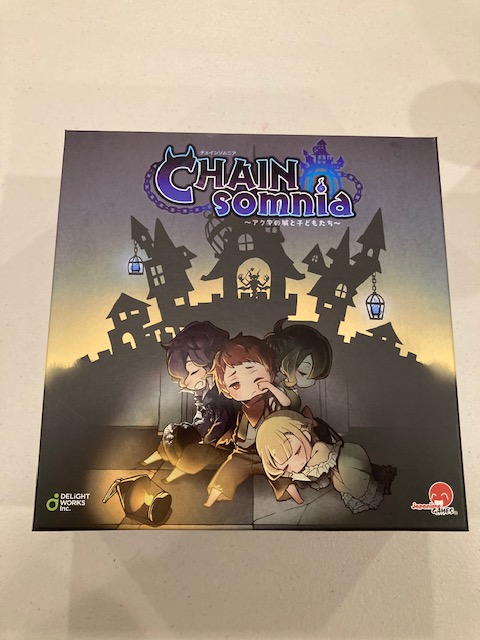
Chainsomnia was a cooperative game I picked up from GameNerdz fairly recently (EDITOR: at the time this was written, it was June 2023 .. ahem).  It was a Kickstarter game, but I didn’t know that when I ordered it from GameNerdz (I guess I missed the Kickstarter).  Chainsomnia was appealing to me because it looks like a light cooperative game from the designer (Seiji Kanai) of Unicornus Knights!  I think that Unicornus Knights is something of a hidden gem (see Part I and Part II of our review), as it made our Top 10 Cooperative Games of 2017!

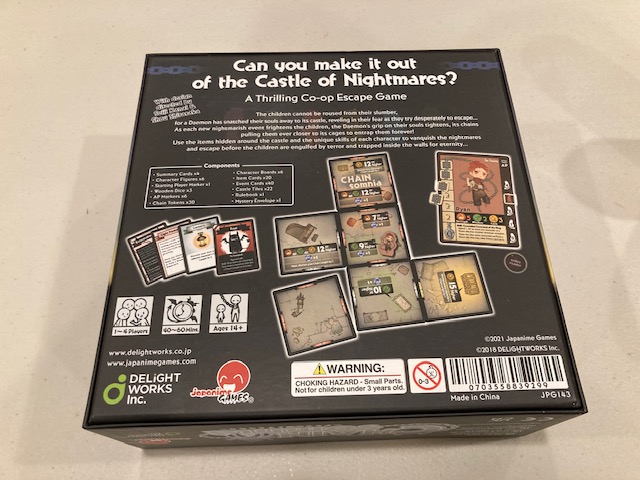
IMG_6696

This game is about a bunch of nightmare-ridden little kids trying to get out of a castle of nightmares! It’s for 1-4 players, 40-60 minutes, and ages 14+. Let’s take a look.

Unboxing and Gameplay

IMG_6697

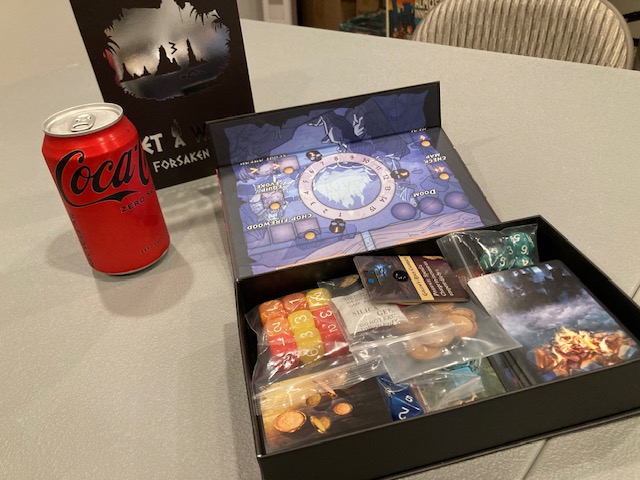
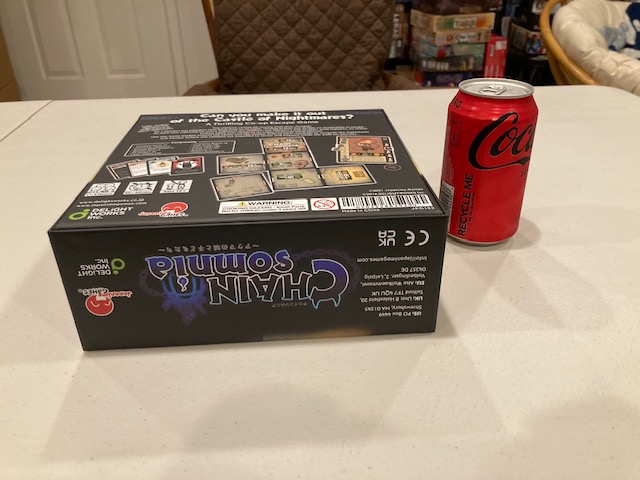
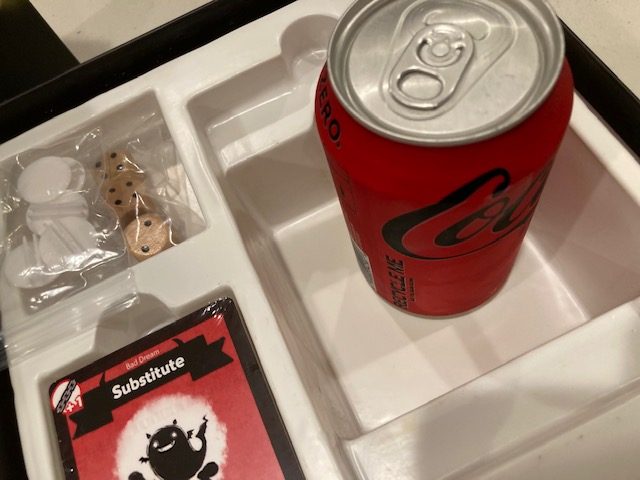
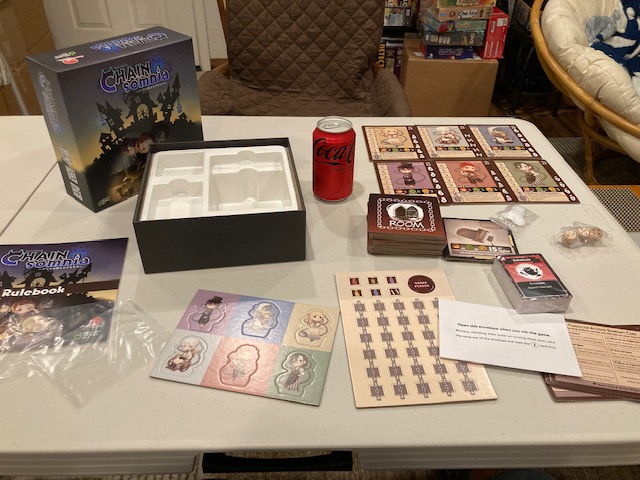
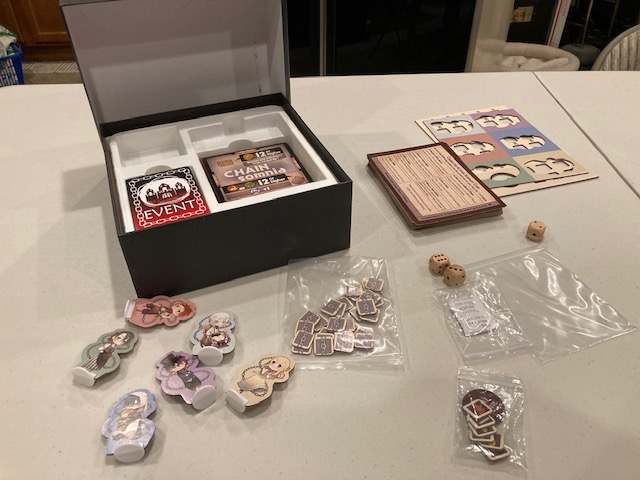
This is a pretty deep box.  The Coke Can actually fits inside it pretty well!

IMG_6720

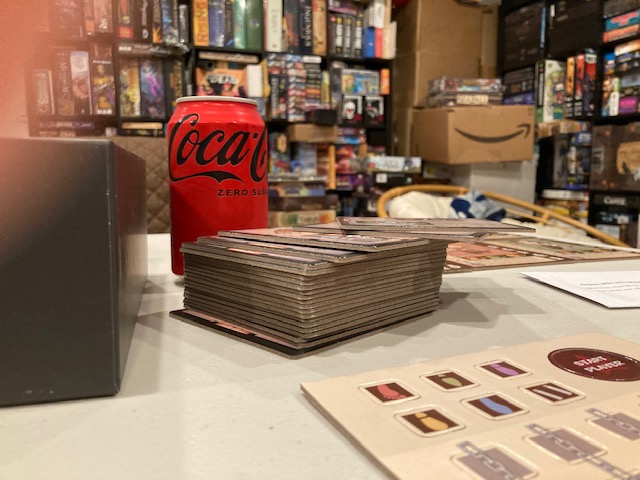
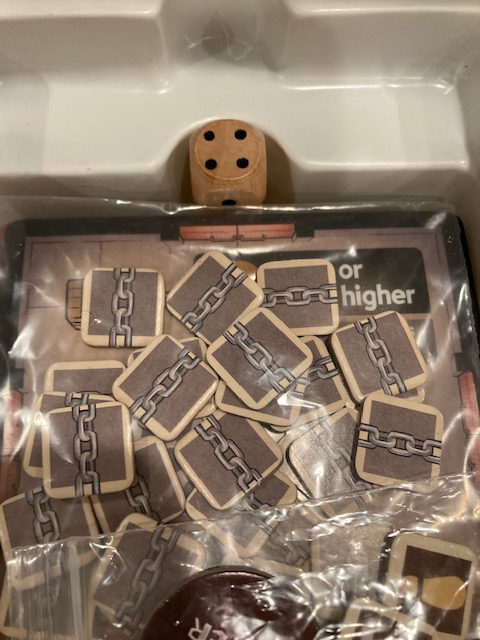
Seriously, this is a pretty deep box: mostly for the tiles.

IMG_6721

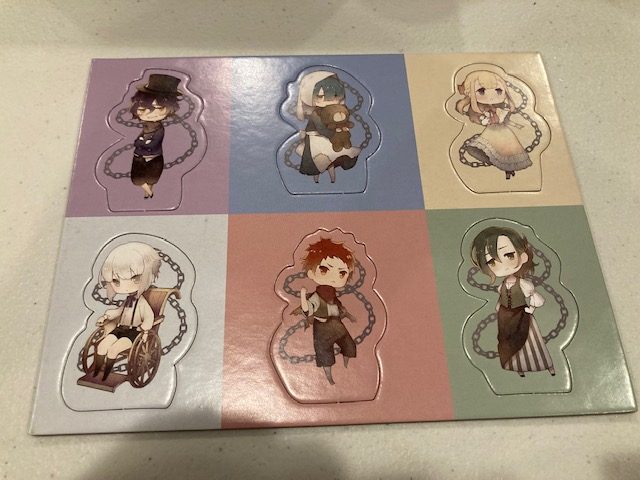
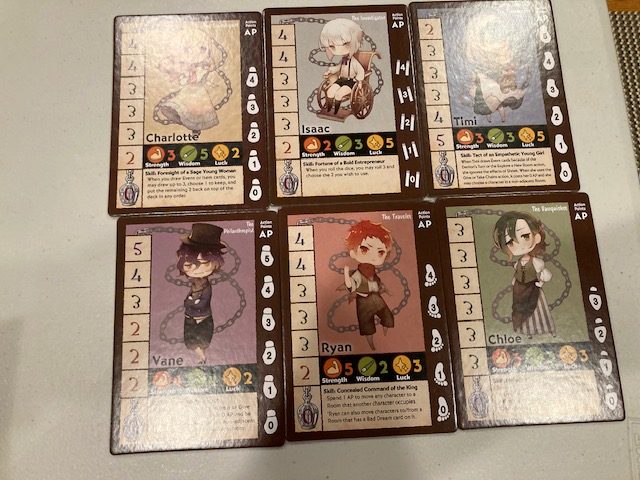
Each character takes the role of a child trapped in the castle:

IMG_6716

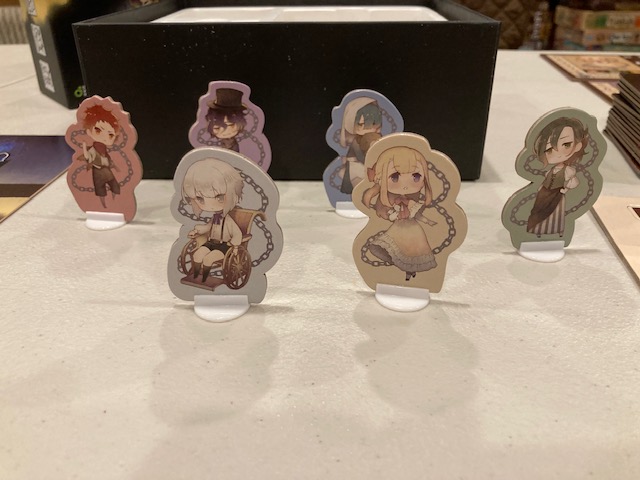
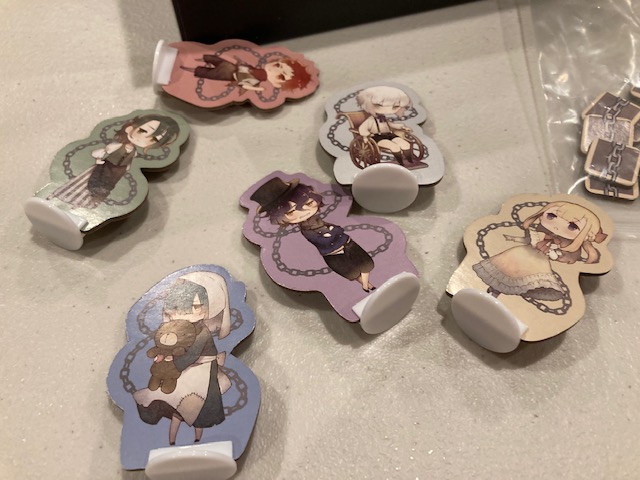
Each character has a standee and a character sheet.

IMG_6717

IMG_6725

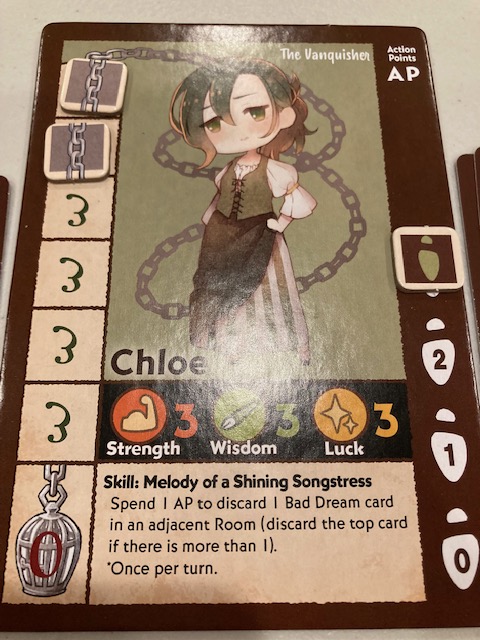
Each character has some abilities (Strength, Luck, and Wisdom) which will form the the basis of a two-dice ability role.

IMG_6747

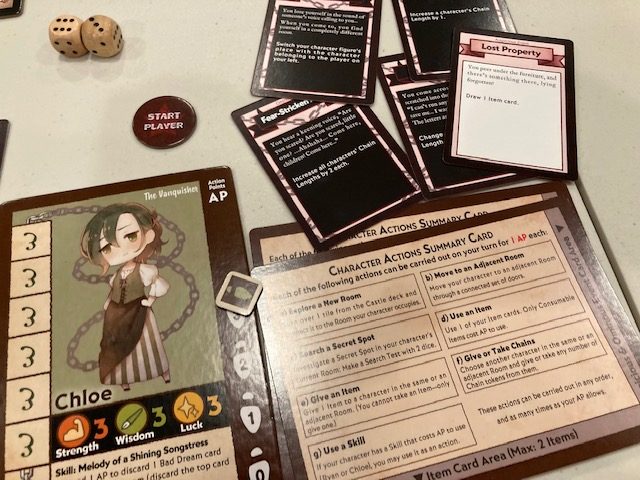
For example, Chloe above has 3 Strength, 3 Wisdom and 3 Luck.  She can also get rid of Bad Dream easily with an AP (Action Point).

IMG_6748

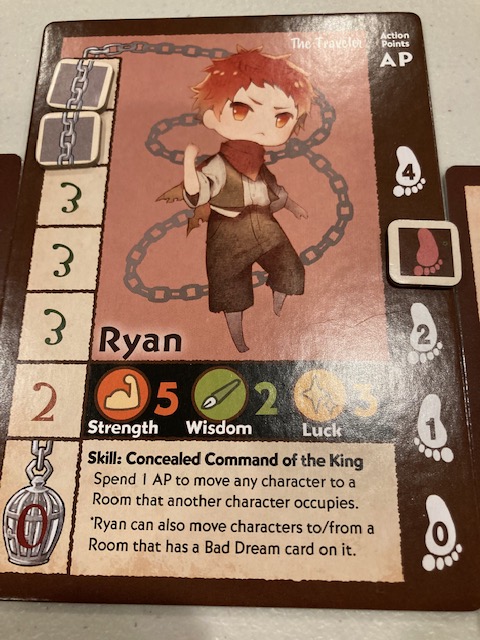
AP stands for Action Point.  The little chart to the left shows you how many AP you have per turn.  As you get Chains in the game (Ryan above has 2 chains), it reduces the number of AP you have per turn.

IMG_6718

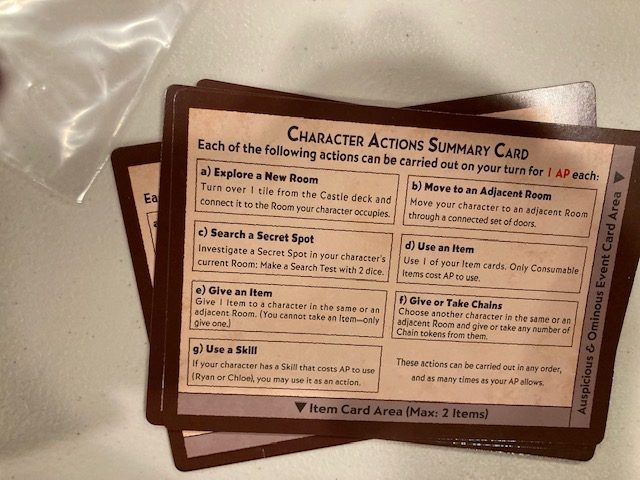
The Summary Cards summarize what you can do, but basically explore, search, give, skill, move, use or take.

IMG_6755

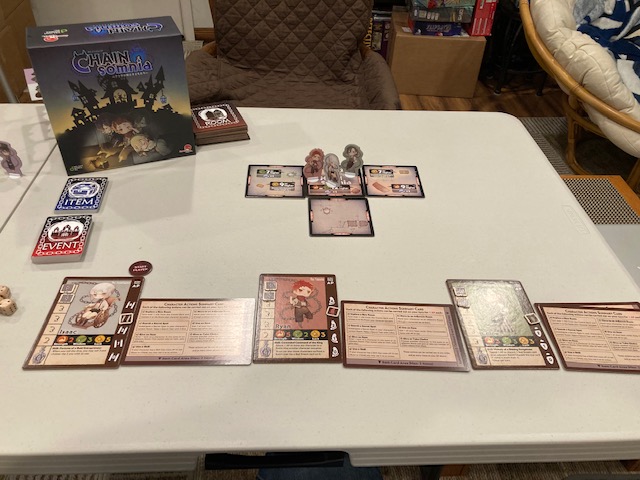
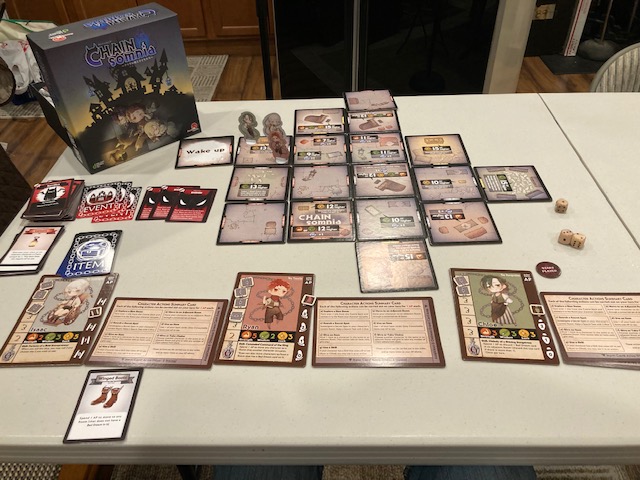
In order to win, the characters must cooperatively explore the Castle to find the way out: the Way Out is the last card in the tile deck.  See Chloe winning the game for everyone by finding the Way Out … when there are no Bad Dreams on the board.

IMG_6728

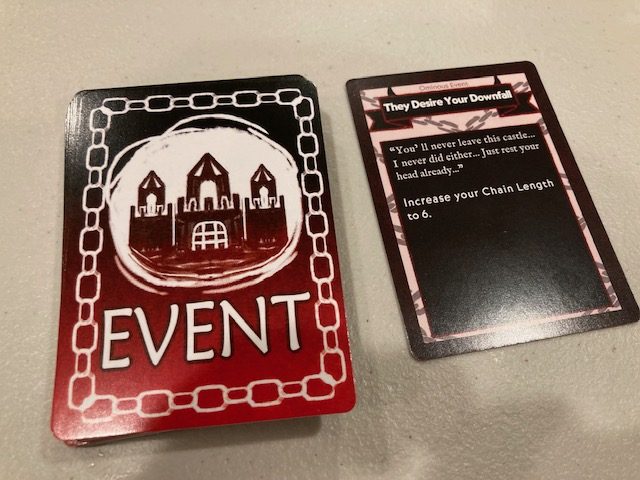
Like most cooperative games, there are “Bad News” cards that come out.  In this case, the Bad News cards are called “Events” and come out every time you explore and discover a new Room.

IMG_6753

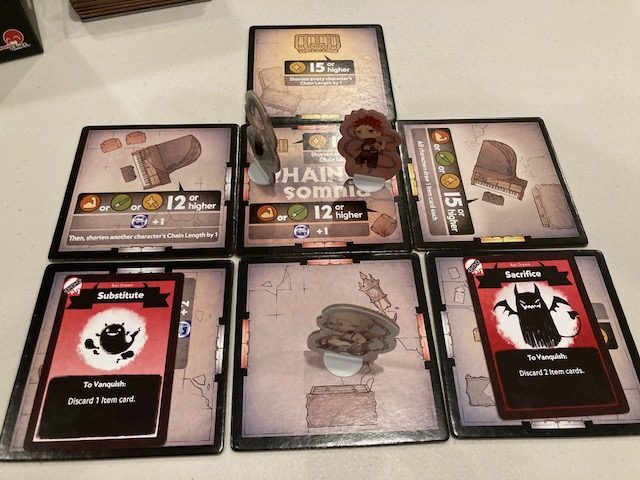
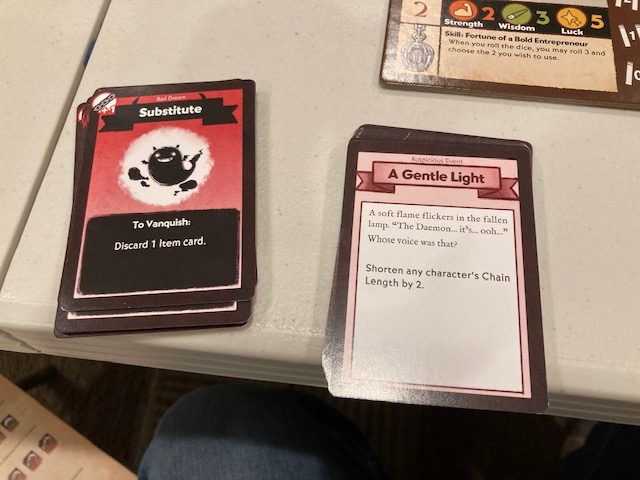
Generally speaking, the Event cards are full of nightmares that clog up the rooms.  You can’t enter a room with a nightmare until you take it out.  How do you take it out?

IMG_6735

Each Bad Dream is different (for example, above you have to discard an Item), but generally you have to make a skill check on 2 dice, and roll higher than your skill.  If Ryan’s Strength is 5 and requires a 11+ Strength to Vanquish, then Ryan will need to roll a 6 or more (6+5 >= 11) on two dice to succeed in the Skill check.

IMG_6727

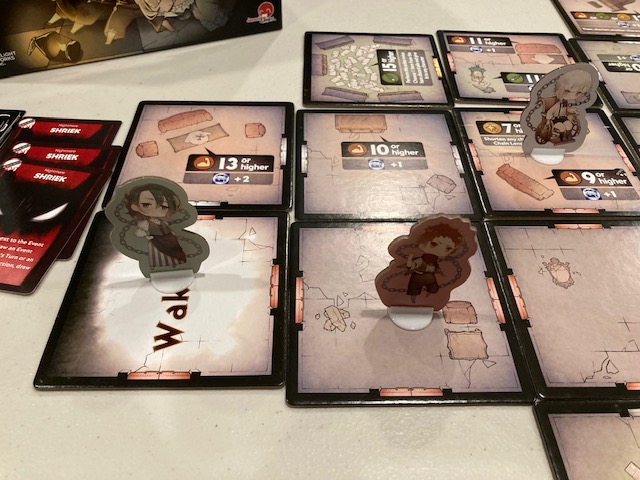
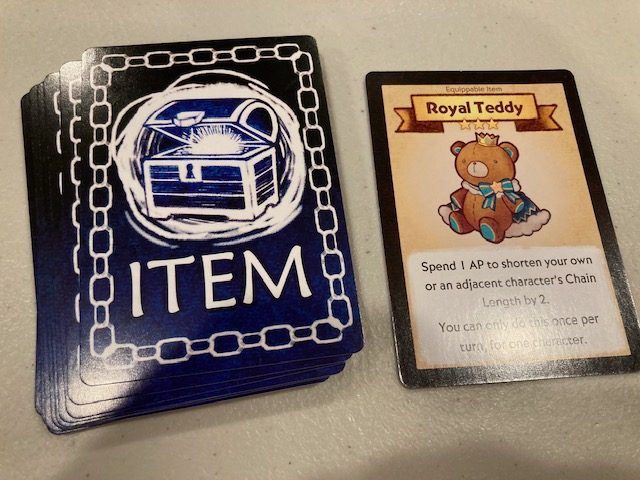
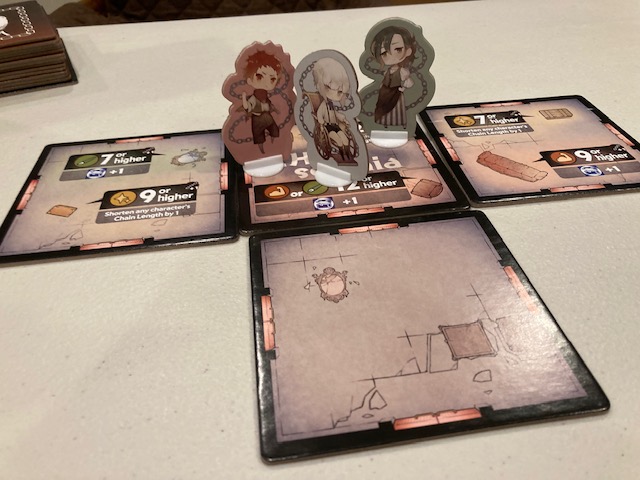
Incidentally, skill checks are how you get Items (very useful tools): generally, each room will tell you what you need to roll to get one.  In the first room (see below), if you roll a 12 or higher on any skill check, you get an item.

IMG_6739

IMG_6759

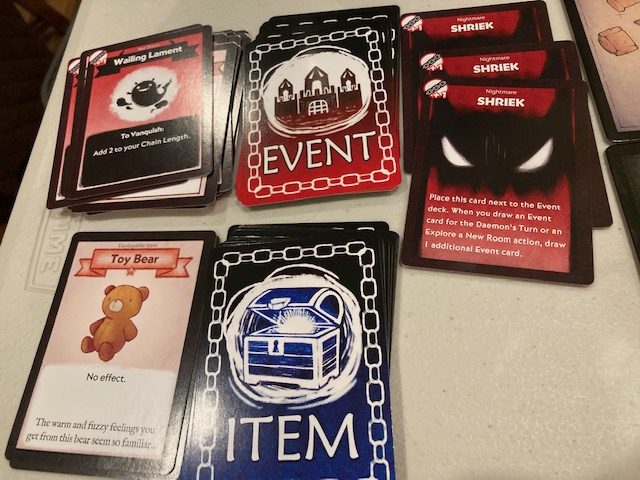
There are other very bad cards that modify the Event Deck (see Shriek above) but if you make it through all Event cards without finding the Way Out you lose.  If you can get to the Way Out and defeat all Bad Dreams on the board you Win!

IMG_6724

The components are quite cute, if a little minimal.  The cards are not linen finished.

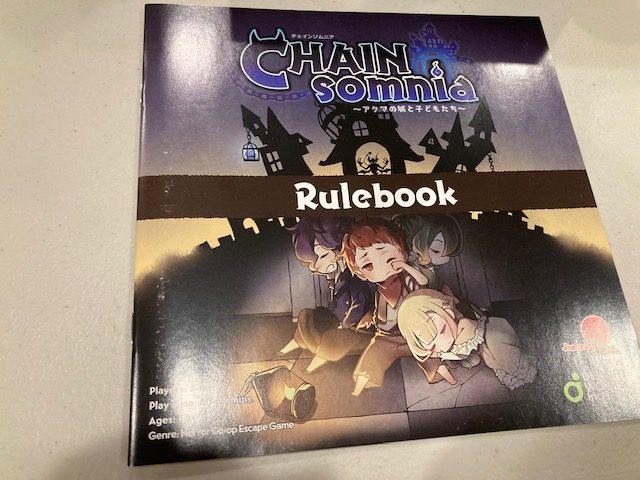
Rulebook

IMG_6700

The rulebook is good, except that it doesn’t talk a lot about edge conditions.  As we played the game, a bunch of questions came up (“Are Action Points dynamic?  Do you immediately lose/gain an AP as a result of a chain change?”).  There was a FAQ, but it didn’t answer the questions that seem to come up with us.

IMG_6701

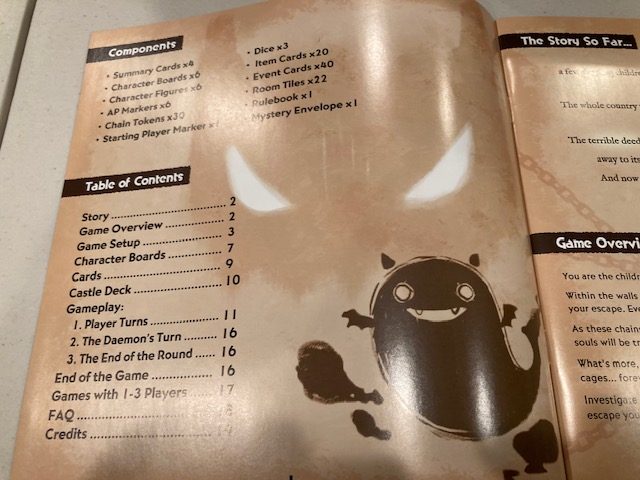
The components list had no pictures, but the Set-up was well-labelled to counteract that.   In general, there were appropriate pictures and the game was explained well-enough.  I even like that it had a FAQ, it just didn’t seem to address the questions we had.  I’ll call the rulebook good enough.

Solo Mode

IMG_6738

Congratulations to Chainsomnia for following Saunders’ Law and having a solo mode!

IMG_6713

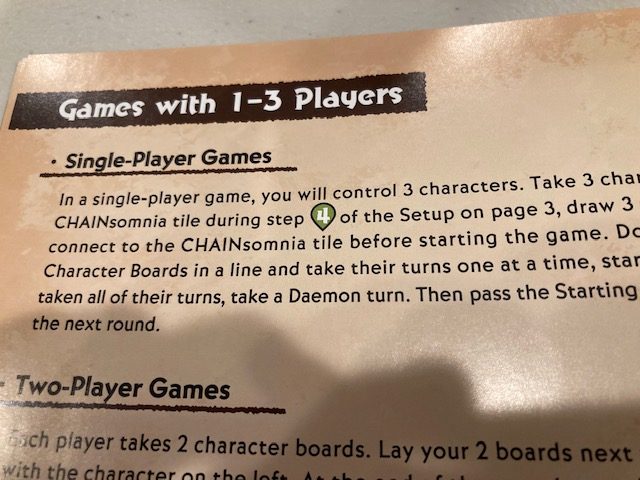
Unfortunately, the solo player must take control of 3 characters.  Similarly, a 2-Player game would have each player take control of 2 characters.  Basically, there must always be 3 or 4 characters in the game.  This isn’t ideal for the solo because there’s always the context switch issue as you jump from character to character, playing each one separately.

IMG_6748

Luckily for the solo mode, the context switch issue is not too problematic: each character has a pretty simple character with one “major” power.   For example, if one of your characters were Ryan (see above), it’s easy to remember he’s strong (strength of 5) and can also eliminate one monster for one AP.   There’s not too much to remember for each character, so context switching from character to character isn’t a big deal. Contrast this to the characters from Marvel Zombies: Heroes Resistance where each context switch becomes heavier and heavier as the characters get more and more abilities in the game (see our review here).  While the extra abilities in Marvel Zombies: Heroes Resistance are cool, it makes it significantly harder to play multiple characters.

IMG_6752

It took me two solo games to get a win.  I remember losing my first game and saying, “Nope! I wanna play again! I know what to do now!”   I think your strategy really depends on the characters you choose, so my second game was with the same 3 characters.

IMG_6765

I made one major mistake in both solo games: I forgot to save my Ominous Event cards and my Auspicious event cards.  In most every other cooperative game, you throw away events when you are done … Nope!  Here, they are a measure oh how well you did.

IMG_6719

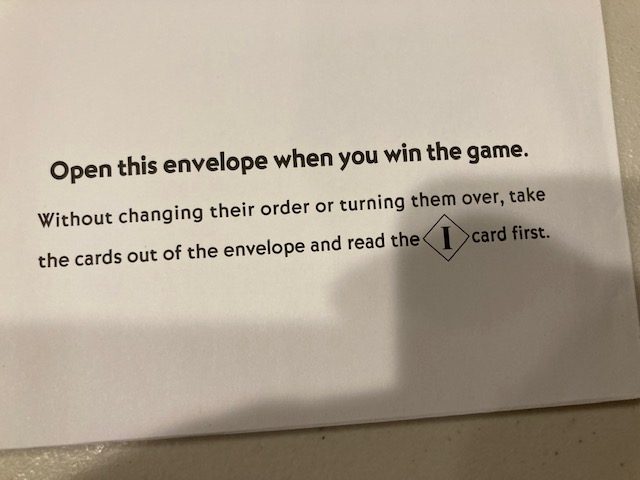
When you open the secret envelope, you need those cards.  I didn’t realize this until after my second game! 

(Picture deleted from review to avoid spoilers)

Minor Spoiler: Basically, you measure your victory (in the event of a win) by how many Auspicious Events and Ominous Events you got.    That was kind of cool: it’s a hidden and secret way to measure success, and gives you a reason to play again to try for a “better” win.

IMG_6755

I didn’t love solo mode (mostly because of the 3 character issue), but it was fun enough to play again.  It also gave me enough insight to teach to my friends.

Cooperative Mode

IMG_6862

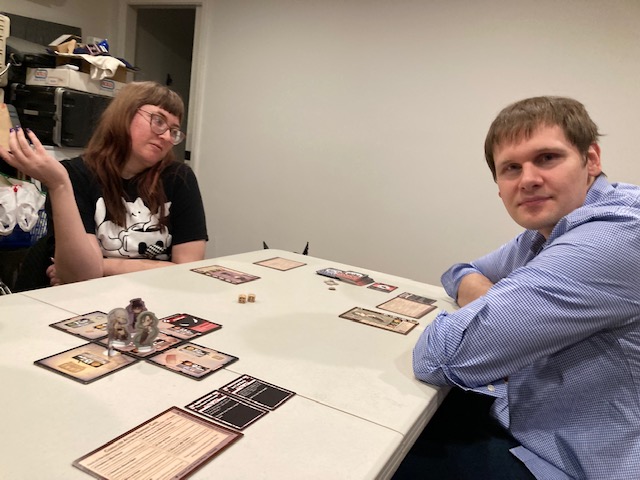
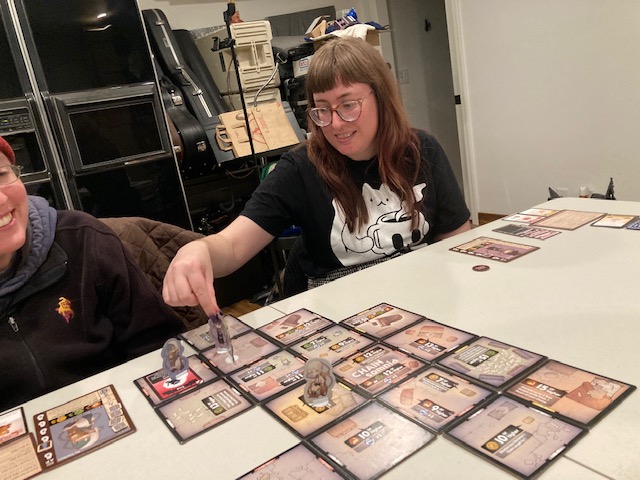
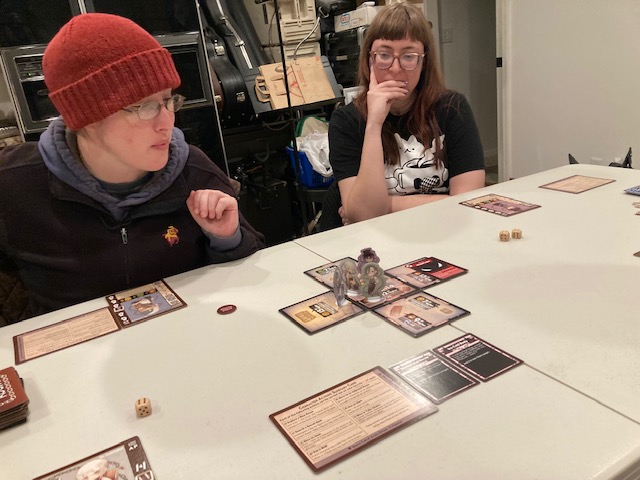
This game went over pretty well as a cooperative game: probably better than I expected.  Since you always need at least 3 or 4 characters in play (this totally reminds me of Unicornus Knights), a 3 or 4-player game is probably ideal: that way every player gets exactly one character to operate, and it’s easier to inhabit and connect with the game if you are “that character”.

IMG_6864

I noticed that, as we were playing, we really did consult each other a lot … and console each other a lot.  “Hey, don’t worry: I can take care of that nightmare!”  “Hey, don’t worry, I can get you an item!”  Sara’s character’s power allowed here to give items to other people anywhere on the board … this was huge! It allowed us to power up!  Even if we had a bad role, the game evoked a pathos: “It’s all right, we’ll get you out of that mess.”  Maybe there’s something about being a little kid that brings out the best in people, and makes them want to help each other?

IMG_6861

There were a lot of fun little moments playing cooperatively.  I knew the game had gone well when we spent the post-game talking about all sorts of other ways we could have won/lost, been more strategic, etc.  People cared enough to keep thinking about the game, even when it was over!

Repacking

IMG_6766

What’s going on with this box?  It has a huge insert, but the game doesn’t fit back into the box unless you do one of two things:

  1. Always remove the plastic bases
    OR
  2. Pack the dice into the fingerholes!

IMG_6767

Those of you who have played GloomHaven know the problem with constantly removing/adding the plastic bases!  Basically, the bottom tears!  So, I chose to leave the plastic bases on.  Which means the game box WHICH IS HUGE doesn’t fit the game!  I had to be clever … and put the dice in the fingerholes.

IMG_6770

Yup, not ideal, but then the game fits. See below for pictures of how I fit the game in.

Conclusion

IMG_6694

Chainsomnia was pretty fun.  Although the rules were missing a lot of edge cases, the game was still pretty easy to teach and play.  The group liked it, but didn’t love it:

  • Teresa, Rich: 7/10, liked it, would suggest it
  • Sara: 6.5/10 liked it, would happily play, maybe wouldn’t suggest it as first choice
  • Andrew: 6/10 Liked it well enough, would play again

The biggest issue with the game was that it felt a little “samey” after a few plays.  You could mitigate that by switching up the characters to have different strategies.  It was also maybe a little too lucky with so much emphasis being placed on the dice.

Chainsomnia was fun enough.  We actually would not recommend this for kids: even though this game is cute, the nightmares attacking kids might not go over well with younger players.  This game is more for older kids who like light cooperative games with an anime look.

EDITOR: At the time Our Top 10 Cooperative Tile-Laying/Placement games was written, Chainsomnia just barely squeaked onto the list as #10. I hate to say it, but I think Race for The Raft came along, moved to the top of the list, and pushed everything down one space (see our review here: it’s that good)! So that means Chainsomnia is #11 now …

Wait, A Cooperative Euro Wargame? A Review of Sammu-ramat The Board Game

Welcome to the Start of Cooperative Surprise Month!  This month, we take a look at some of the surprises we have encountered recently in our cooperative game journeys! We start this month with a cooperative game called Sammu-ramat, which ended up being a huge surprise!

Wait, what just happened?  I just spent five days straight playing Sammu-ramat! This was a cooperative game on Gamefound back in November 2021, and it finally delivered to my  house just a few days ago (Wednesday, February 15th, 2024).  I have been playing it non-stop since it arrived at my door!
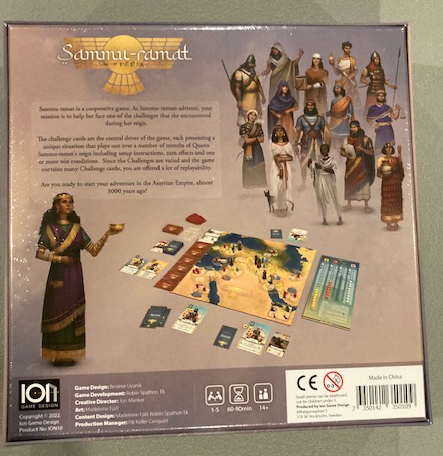
IMG_2698

This obsession is really weird, because I was on the fence for Sammu-ramat when it was on Gamefound. The game didn’t look “great”, but the idea of this cooperative resource-driven war game looked interesting, so I backed it.
IMG_2700

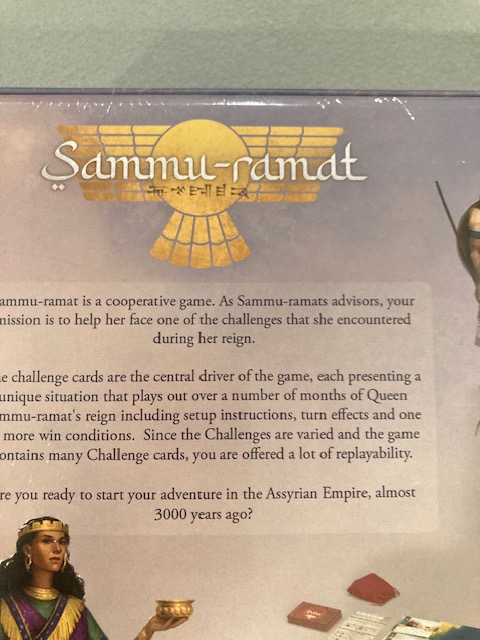
I have to admit: I wasn’t wowed by the production.  The cover isn’t great and this box was just okay.  If I were to see Summu-rammat at a game store, I might pass right over it.  It doesn’t look like anything special.
IMG_2855

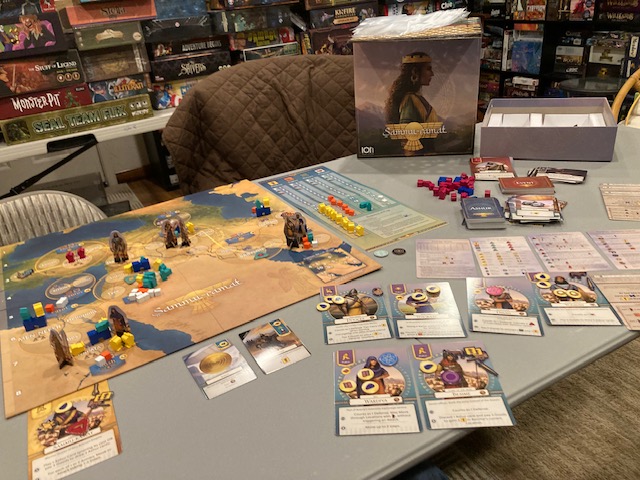
But at the risk of giving away my thoughts early, it would be a crime to pass up this game!  Despite a lot of issues with components, production, and the rulebook, this is a very good game!  I adored it and couldn’t stop playing it for five days!

Let’s take a closer look!

Unboxing and Plutorial
IMG_2705

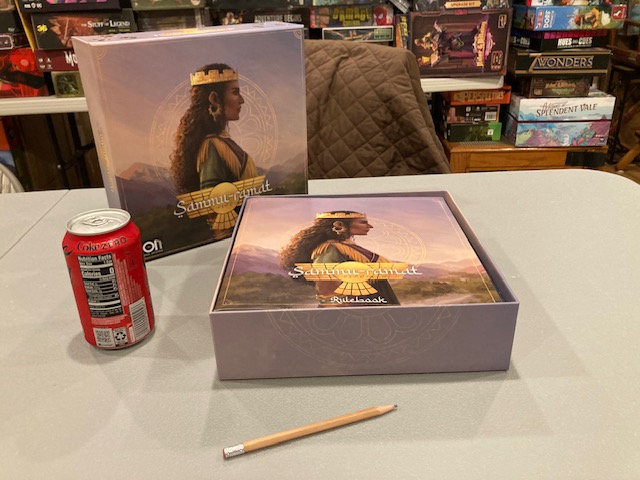
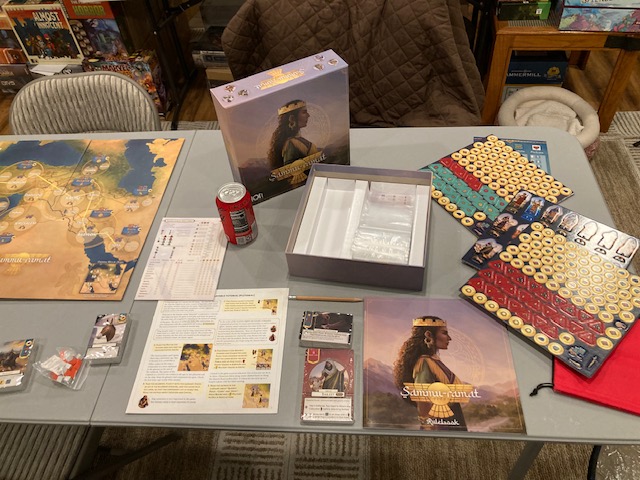
The first day the game came in, I unboxed it.  It’s a little smaller than a Ticket To Ride style box.  See the Coke can and #2 pencil for perspective (see above).

IMG_2706

Just under the rulebook is the Summu-ramat Plutorial. What’s a Plutorial you may wonder? A playable tutorial!

IMG_2707

The Empire Board is a way to track resources.
IMG_2708

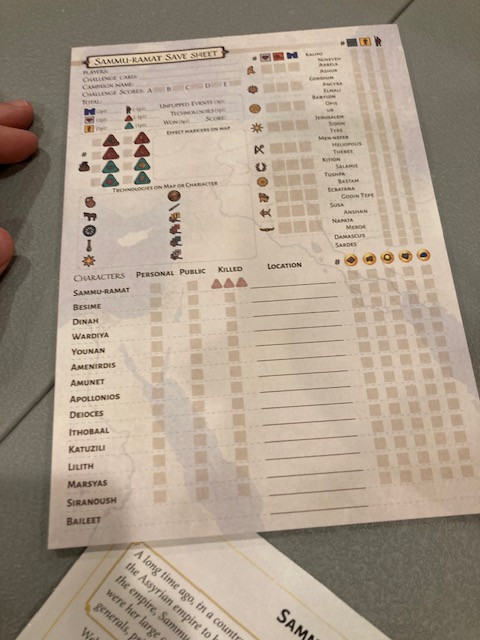
The “save state” pad is useful for the campaign mode: Spoiler! The game comes with many campaigns!  But don’t worry, you can still easily play one-off games.

IMG_2710

There are quite a number of punchouts.  Most of the tokens are Goods tokens (yellow resources), good (green) tokens, or bad (red) tokens for the token bag,
IMG_2765

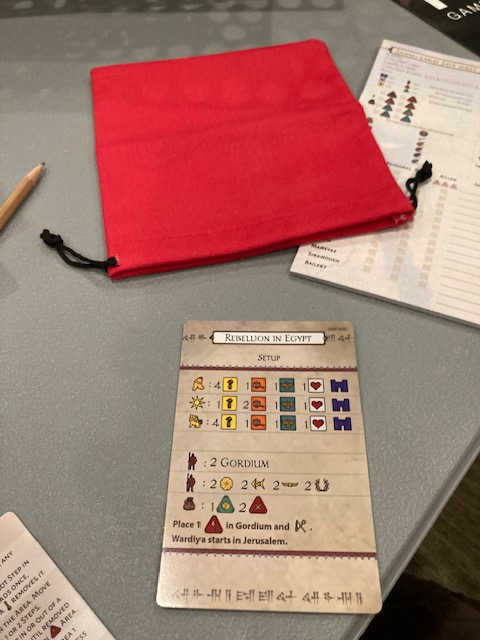
There is a pretty nice token bag: it’s not a main mechanic in the game, but there are times throughout the game when you will put/pull tokens (good green or bad red).
IMG_2711

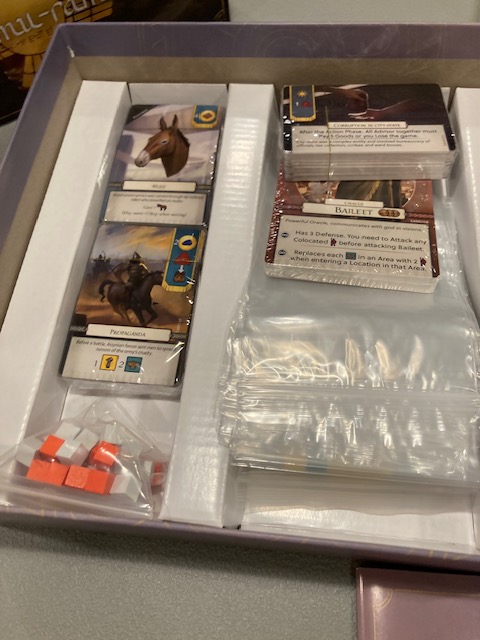
There are a ton of plastic bags (for bagging the game up later), and some cards.  We’ll see these cards later!
IMG_2763

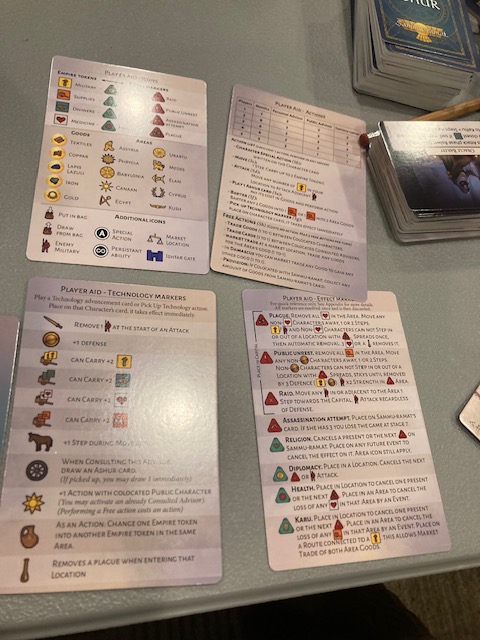
It’s important to point out that the game has a fairly extensive set of player aid cards for all players! See above.

.IMG_2740
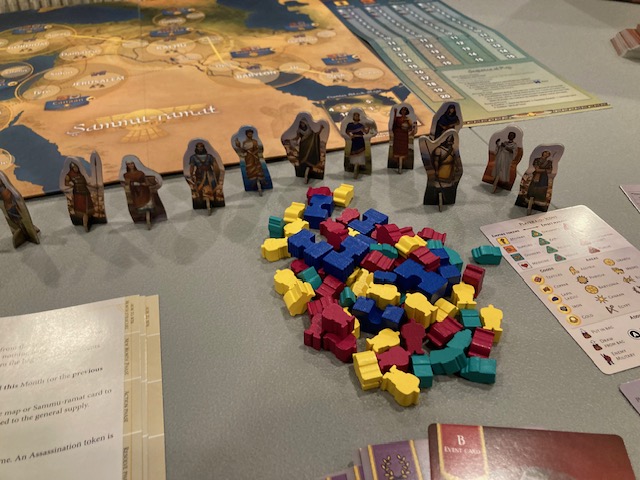
A lot of the punchouts are also characters you can play.  See above.   The meeples are generally military (red bad guys, yellow good guys). 
IMG_2713

Overall, the game production looks pretty good. There are a few issues we’ll point out later.


Plutorial: Playthrough and Tutorial

IMG_2706

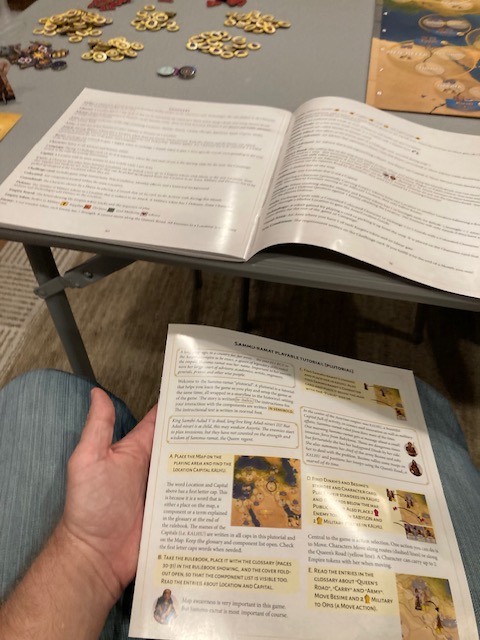
This introduction shows the first few turns of a game, as it teaches you some of the core rules.  The Plutorial is well-notated and clear (modulo a few sections) as it takes you through some of the major pieces of the game: combat, characters, gathering resources, the Empire Board, the player aids, the maps, Areas vs Locations, and even reading the Glossary at the end of the rulebook!
IMG_2748

This Plutorial is absolutely essential to starting the game off on the right foot.  There are a lot of rules to Sammu-ramat, and I could have very easily lost interest in the game if I didn’t have this to guide me into the game.   
IMG_2751

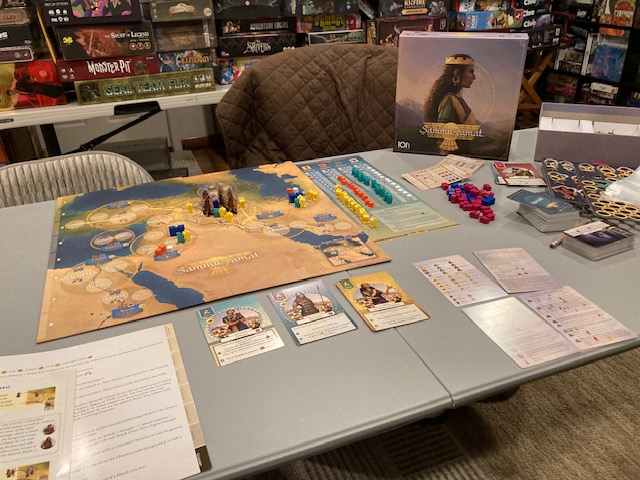
The game is just complex enough that just reading the rulebook might turn off a lot of people (the rulebook of 32 pages and fairly technical).
IMG_2774

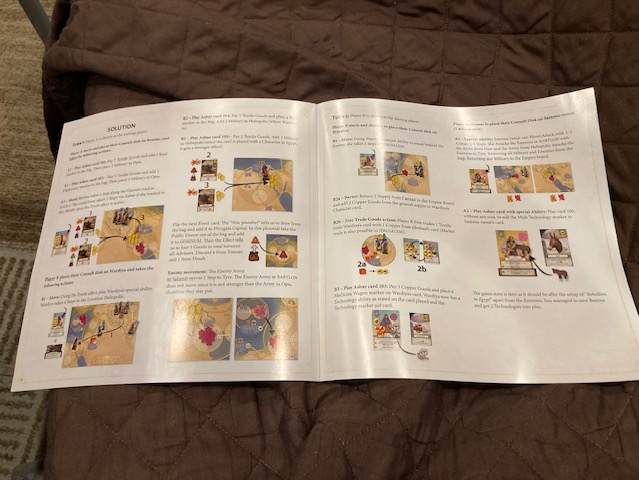
The Plutorial very clearly notates why things happen in the game, and even sets-up a little “puzzle” for you to solve (with a clear solution at the end). I think after I finished the Plutorial, I felt like I knew enough to jump into Sammu-ramat feet first. This Plutorial made me feel like I could understand enough to start playing the game … and that’s a win for a game this complex.

Rulebook
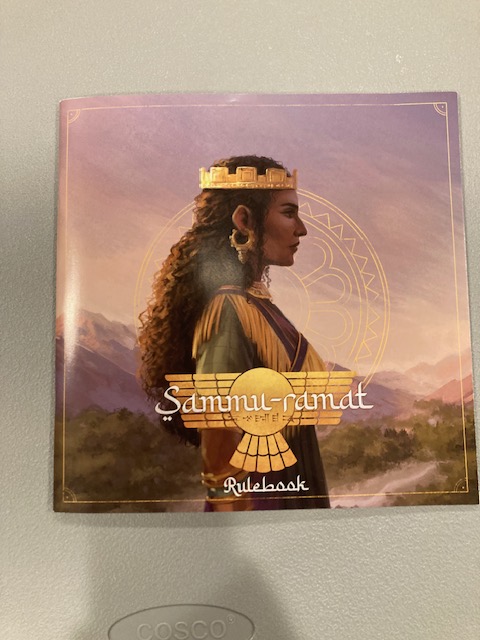
IMG_2884

This rulebook is okay.  It taught the rules, but it had a few problems.
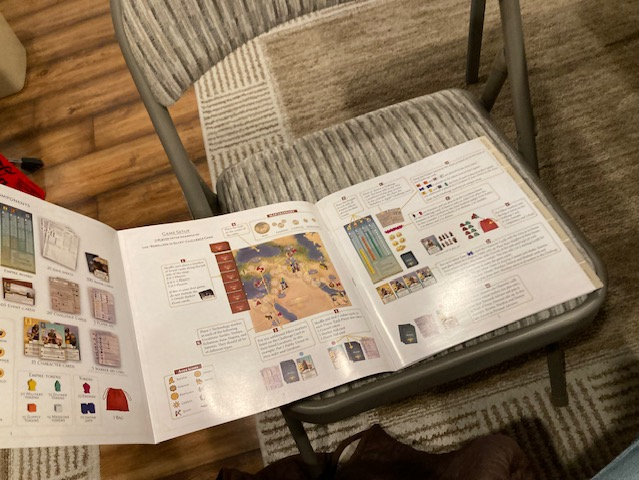
IMG_2734

The first was the trifold nature in the first few pages.  I think this might be a clever way to have the components page always available while reading the rest of the rulebook, but it’s simply too unwieldy in real life.  I applaud them trying something new: I really like the basis of the idea!  I really like having the components page always available.  In the end, they would have been better served having the components list of a separate sheet that wasn’t awkwardly attached to the rulebook.
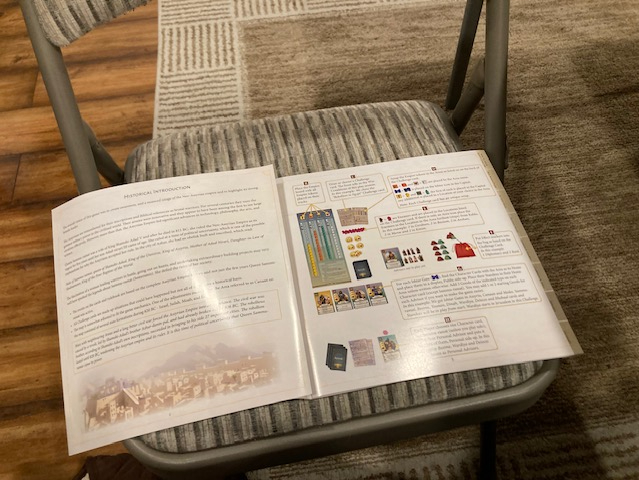
IMG_2718

The rulebook would probably get a B or B- on the Chair Test.  It doesn’t quite fit on the chair next to me.  In the end, it ended up on the table the entire time I played, taking up valuable table space.  I really wish the form factor had been a little smaller.
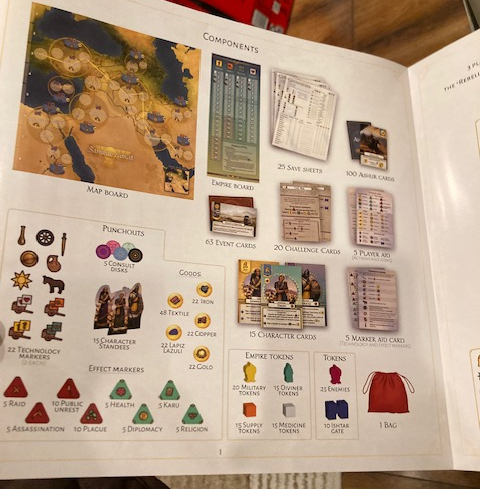
IMG_2721

The game had a nice components page, despite the form factor.

The set-up was also very well notated: see above.
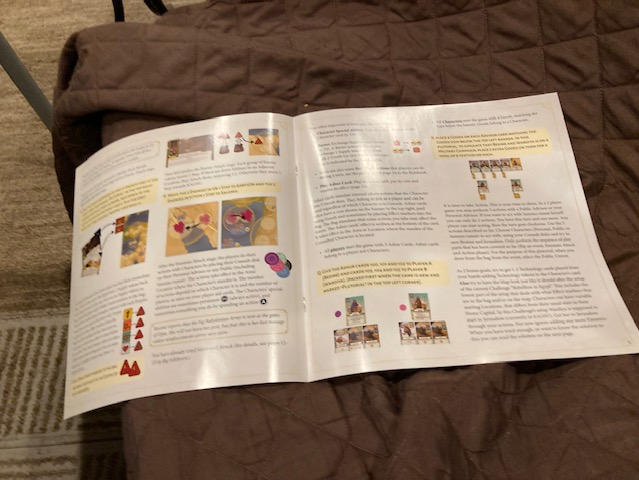
IMG_2768

In general, the rulebook was okay, but it did read like a technical manual.  Without the Plutorial, this rulebook would have been much more difficult to get through.

IMG_2736

I think the rulebook must be also a translation: there were several points where the verbs seem misconjugated (that’s usually a dead giveaway of a translation) in number and/or tense. 
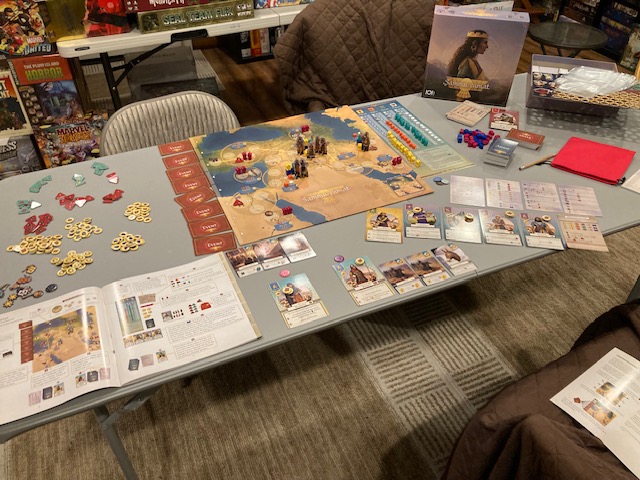
IMG_2782

The fact that the rulebook had a glossary was a major plus!  I just wish it had an index.

The back of the rulebook was used for something kind of useful: I wish it had been an icon summary, but at least it was something kind of useful.
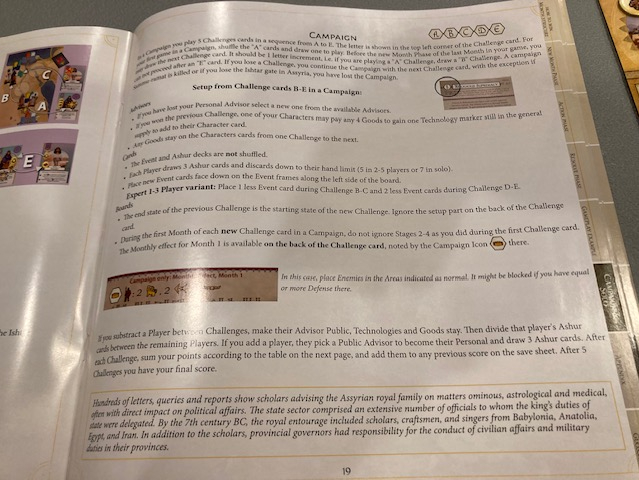
IMG_2827

Overall, this rulebook needed just a few points of clarification, a better form factor, an index, and another pass by an editor.  Having said that, it was decent at presenting the rules.
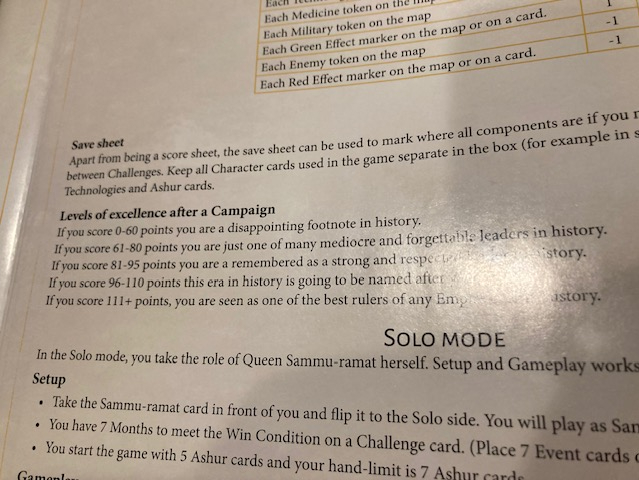
IMG_2867

You can learn the game from the rulebook.  Just be aware that you will have to hunt for rules a few times.  I have played the game probably 10 times by the time you read this, and I still find myself searching the rulebooks for clarifications.
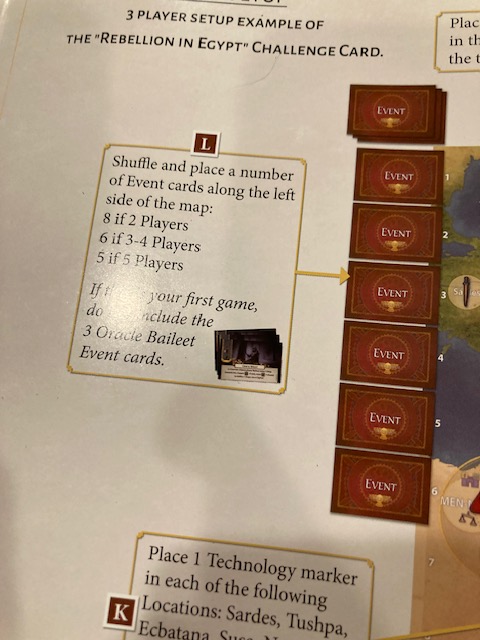
IMG_2737

But, the rulebook worked.

What Is This Game?
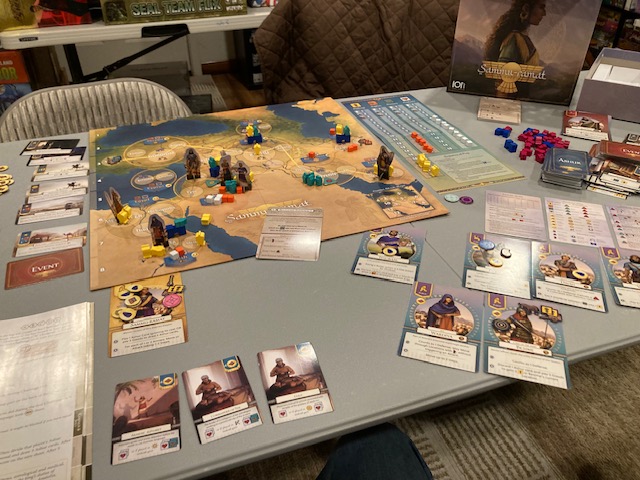
IMG_2841

At the end of the day, Sammu-ramat is a puzzle.
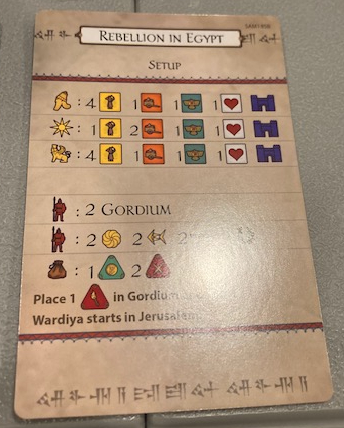
IMG_2757

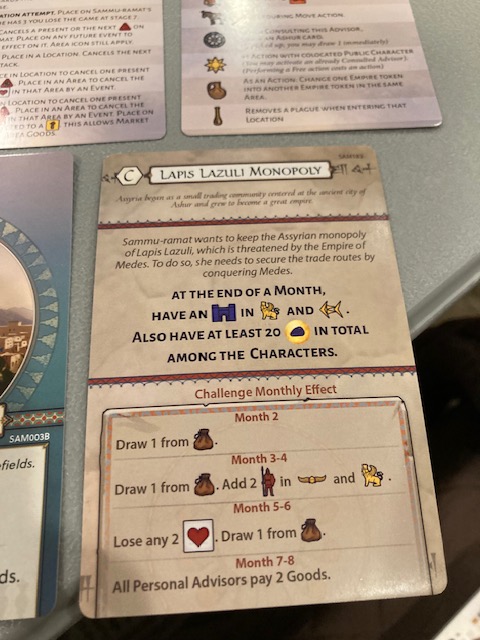
The Challenge Cards (see above) define the puzzle for you.  The front side tell you how to set-up the puzzle: where to put Goods and Empire pieces for the players, as well as starting locations for the bad guys and “bad tokens” in the game.
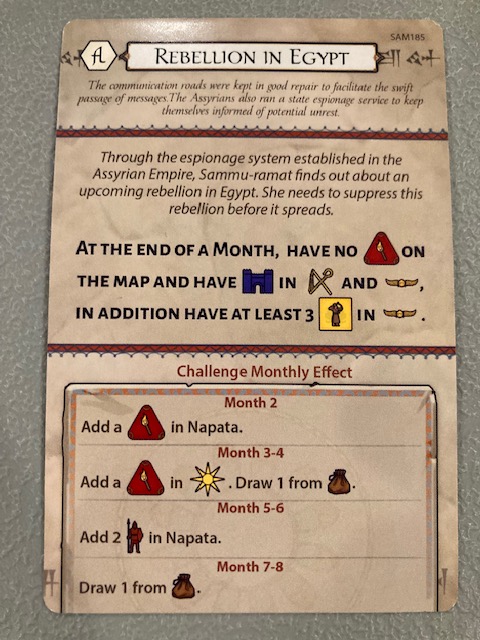
IMG_2882

The back side of the Challenge Card then tells you what to do to win, as well as the bad things that will happen as you play!  To be clear, you know what some of the bad news that will happen before you play!
IMG_2797

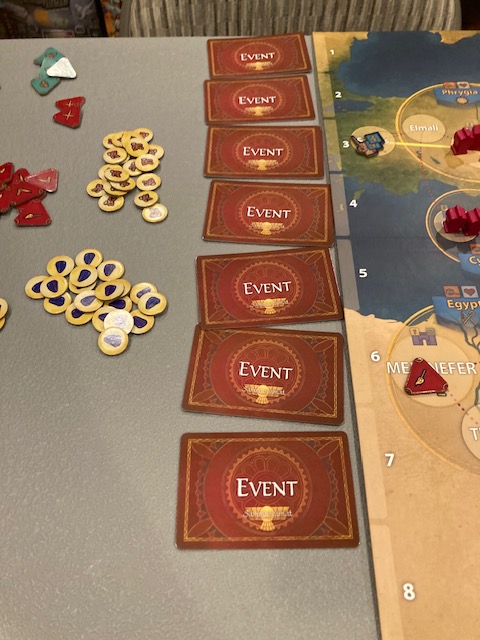
The game proceeds over 8 rounds (7 for solo and other adjustments for different player counts).  The event cards usually are usually bad things, but occasionally helpful.   Most of the game, you know what’s coming, but the events are probably the most random part of the game.  (It has been my experience over about 10 games that there is usually one event that usually completely messes you up, but the rest are manageable).
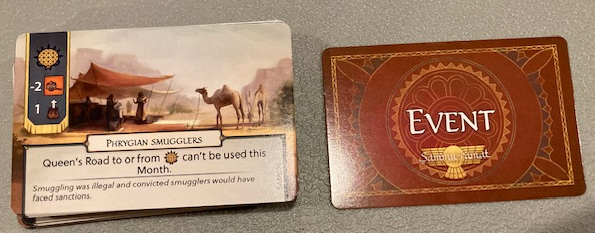
IMG_2738

The event cards effects are notated in the upper left.  For example, for the event card above, the effects are localized to Phrygia (the spiky ball at the stop left), losing 2 Supplies in that area (orange cart), and drawing one token the bag (1 and arrow up from bag).
IMG_2761

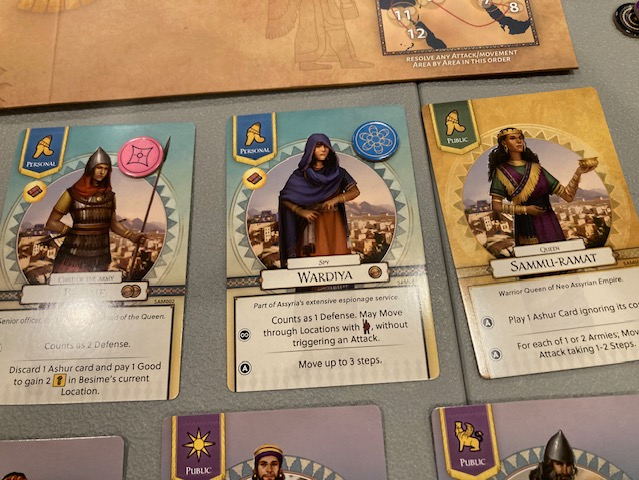
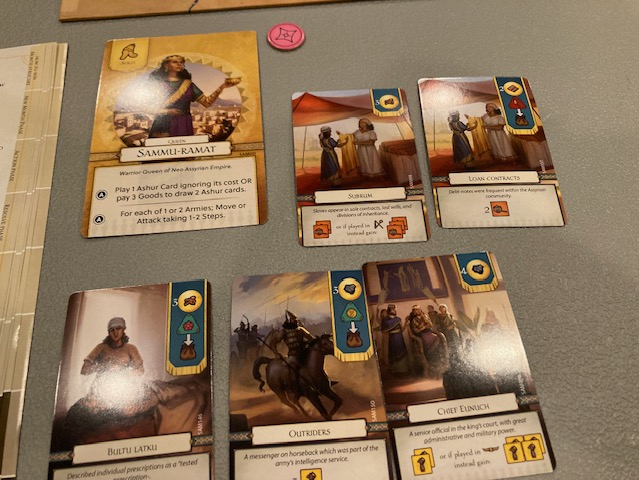
Each player assumes the role of a single advisor (putting the personal side up), and then other advisors are revealed (based on where Ishtar Gates are at the start), who will be helpful as well.  Only the solo player may play Sammu-ramat directly.   Note that each advisor has their own powers: one that’s always on (infinity symbol) and an action only that advisor can take (A).  
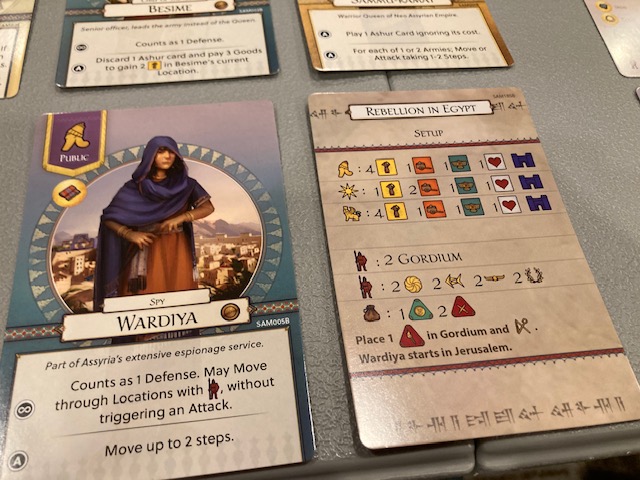
IMG_2756

Interestingly, you don’t always have to play your character on your turn: you may choose to activate a different advisor (maybe they are closer to a problem that needs solving), but usually it’s in your best interesting to activate your personal character, as they typically have an exra action per turn.
IMG_2739

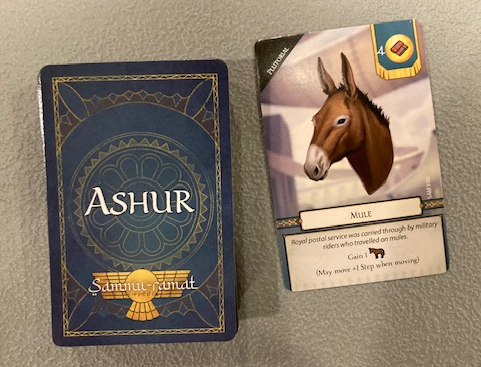
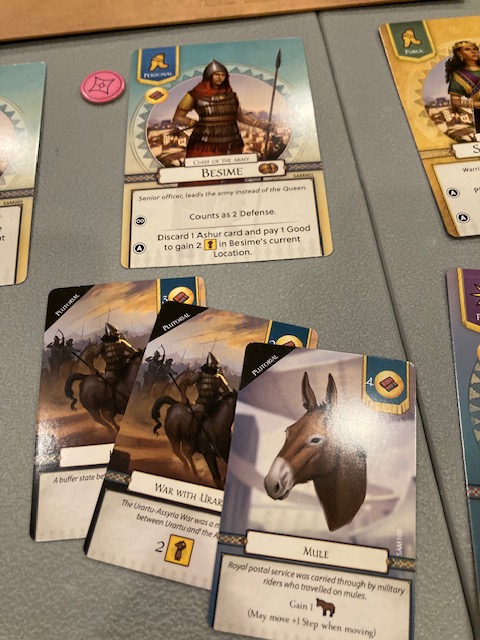
To help the players, they have Ashur card, which are all good news cards.  They all have a resource prerequisite on the upper right.  For example, the mule above needs 4 textiles in order to be bought.   The Ashur cards are key to the game: they help you do special actions, get resources, move further, get technology and so many other things!  
IMG_2844

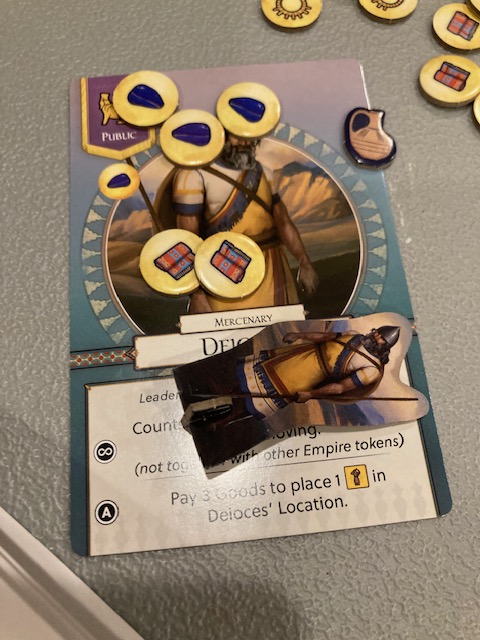
This game is a euro because a major theme to the game is getting Goods (resources) to power your actions.   By playing a Ashur card, or activating a special action, or trading goods, or bartering, the players need to assimilate Goods!  The Goods power so many important actions in the game: For example, you need 4 Goods (the Textiles) to buy the Mule (Ashur Card from above)!  Sammu-ramat is a Euro because it’s all about turning Goods into other Goods for the problem at hand!  
IMG_2777

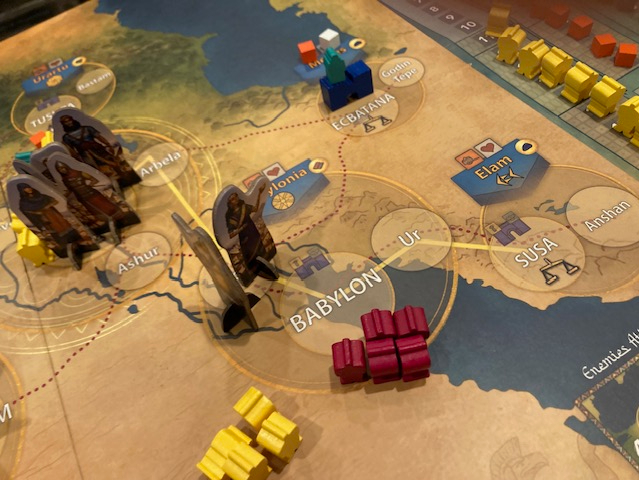
This game is a wargame because you need to make sure you stop the advancing troops that all heading to seat of power: Assyria!  The red meeples (above) are the bad guy troops, or the enemies: when they appear on the map, their job is to take over Capitols along the way, but head to Kalhu!  You can only stop the enemies with the military (the yellow meeples).   There is no randomness to the fighting in this game: when you initiate a fight, it’s a 1:1 battle: each side loses 1 enemy/1 military until one side wins!!   Before you head into a fight, you should know if you will win or not!!  Military is one of the resources you buy with special actions, Goods, or Ashur cards!
IMG_2846

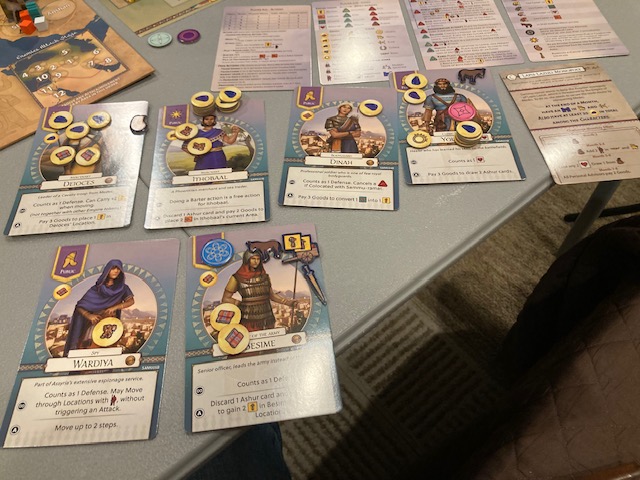
This is a cooperative game: all players work together to decide on the best actions to win the puzzle! 
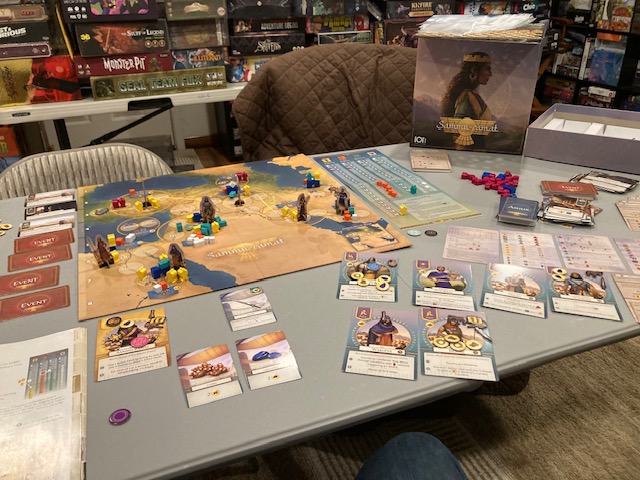
IMG_2863

Putting all this together: Sammu-ramat is a cooperative, euro, wargame!  But it’s really a puzzle: how can you work together to solve the objective on the Challenge Card?

Solo Mode
IMG_2881

So, the game comes with a built-in solo mode (thank you for following Saunders’ Law).  
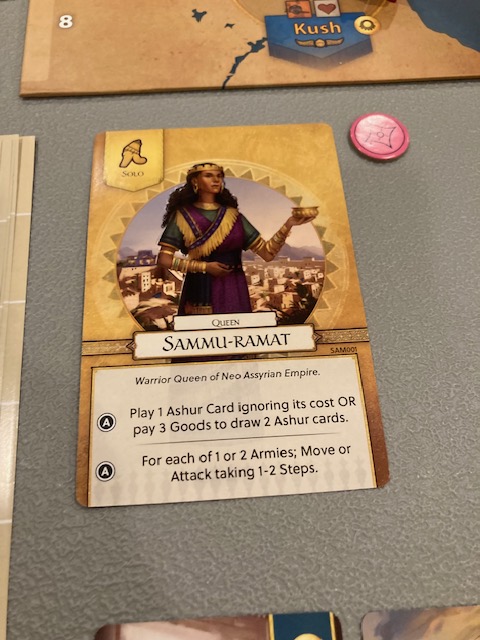
IMG_2798

In the solo mode, the solo player takes  Sammu-ramat card as their player card and flips it to the solo side.
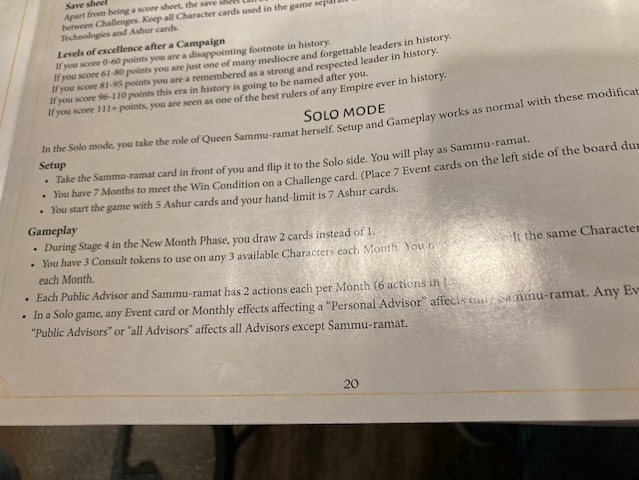
IMG_2796

There is about a half a page description on page 20 of the rulebook.  There are a couple of changes, mostly pretty straight-forward.   The one change I forgot multiple times was that Stage 4 draws 2 cards instead of 1: you will forget this rule! The only place it’s notated in the entire game is on page 20.   It’s way too easy to forget this rule, and I wish there had been a way to notate that (maybe on the Sammu-Rammut solo card).
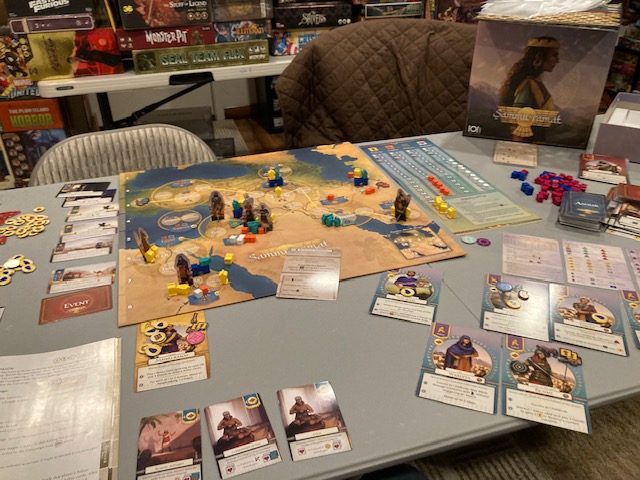
IMG_2842

Most of the of games of Sammu-ramat I have played were solo … and they were excellent.  There is so much thought and consideration that goes into every action!  Everything you do matters!  That’s what makes this solo game so great: you feel like your choices really do matter.  It’s also great as a solo game because you can spend as much time as you want considering and reconsidering your choices.   Many times, I would start out a few actions, but then realized I had to do it a different way, so I would rewind … I would only rewind in Phase 5 and redo the player actions.  I don’t consider this cheating because I was only “trying” my actions to see what the effects were … I never let a rewind cross out of Phase 5 to use information I didn’t have.  And that’s the great thing about the solo mode: you can just try stuff out.  It’s a puzzle!
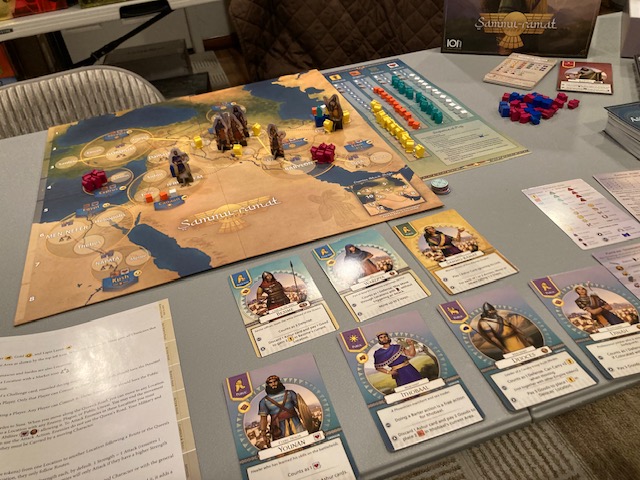
IMG_2759

Now, there is another way to play so: pretend you are playing a two player cooperative game and operate two characters!  Even though I have played most of my solo games with the official solo rules (playing Sammu-ramat), I think the two-handed solo game might be better … why?  Why, you ask?  Because there’s no exceptions! The official solo mode described on page 20 of the rulebook has about a third of a page of “new rules” (with the 4th stage extra card being the most persnickety).  If you play two-handed solo, you are just playing the base game with no exceptional rules: the game is as it was meant to be played. 
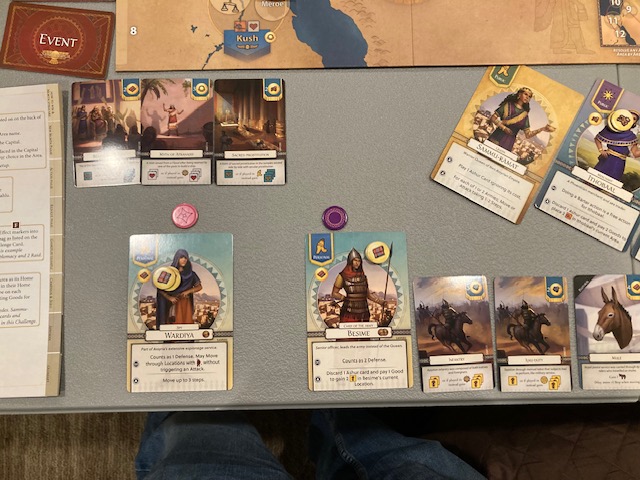
IMG_2784 

The two-handed solo definitely feels different, mostly because each character usually has about 3 actions per phase, whereas the solo player in the offficial solo game has 2 actions for three characters. Both essentially get 6 actions per turn, but there’s something more satisfying about getting to do three actions on your turn: you feel like you can “complete” things you need to do.

Two-handed solo also has to worry more about card management, as there’s more work to manage two hands of Ashur cards.  So there’s that: it’s a little more maintenance.   But, if you are just going to learn Sammu-ramat solo just to teach the game to others to play cooperatively, I recommend using the two-handed solo mode: it feels more like how the game will flow cooperatively.  
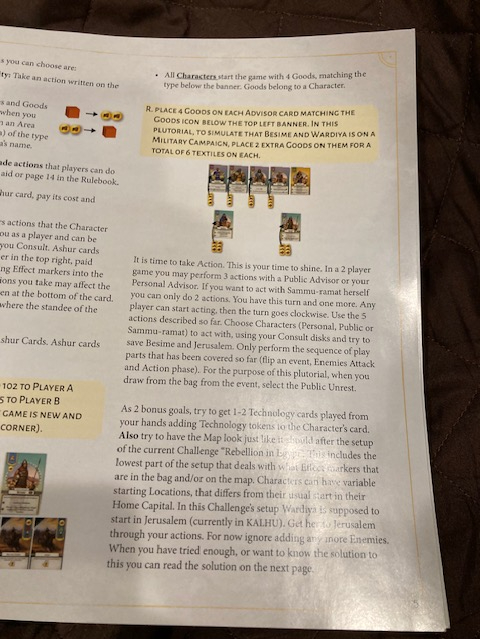
IMG_2773

It might also be easier to learn the solo game two-handed because that’s what the Plutorial teaches!   My first game was two-handed solo to learn the game, and then I went to the official solo mode for my first campaign (as there is slightly less maintenance in the official solo mode).

It’s up to you: both solo modes work well!  Two-handed solo reflects more what the game feels like cooperatively, at cost of a little more maintenance.  The official solo mode has less maintenance per turn, but has enough exceptional rules to occasionally throw you for a loop.

Campaign
IMG_2877

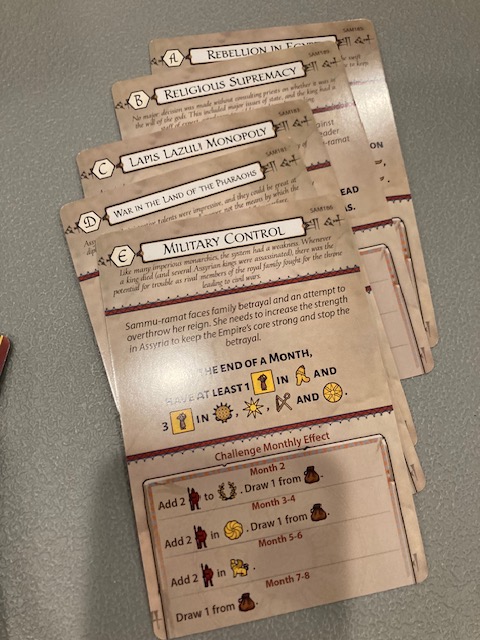
Although you can play just a one-off game of Sammu-ramat, there’s a lot of fun to trying one of the campaigns.  Basically, the campaign is 5 games in a rows from Challenge Cards labelled A,B,C,D,E (there are multiple of each letter to give the campaign some variety).  
IMG_2820

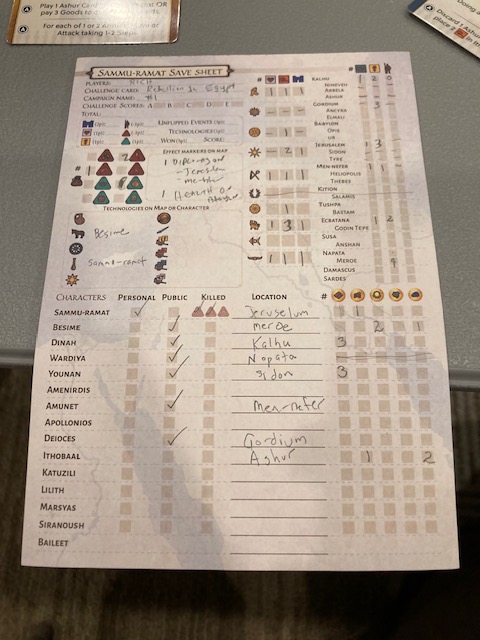
What’s different is that you save state between games!  See above as I record the state of the my game at the end of Challenge A.  To start the next game, you start in “whatever state you left the game in”, and continue!

IMG_2867

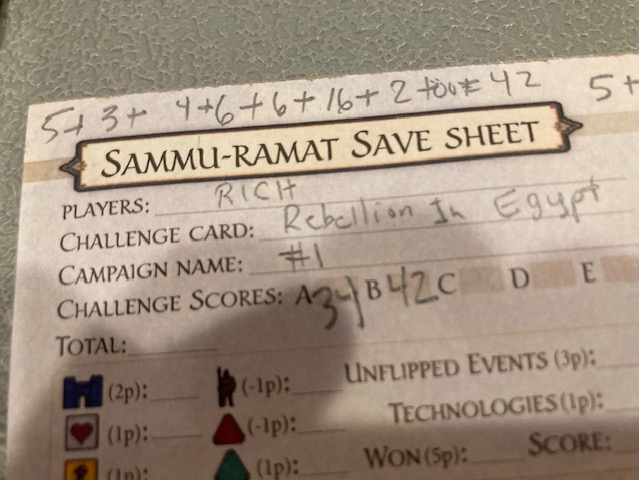
After each Challenge card is complete, you score that gives you a sense of how well you did: yes, this is a “score-based” assesment.  
IMG_2837

I didn’t do great, but I did make it to mediocrity at the end of my full campaign.  I guess it’s better than being a forgotten ruler.
IMG_2850

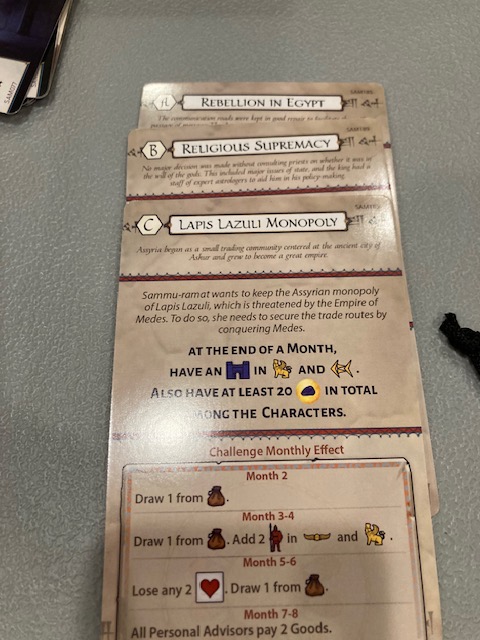
What’s great about the campaign is that it’s only 5 puzzles (5 challenges), but what you do matters even more, as you set yourself up for he next game!  Maybe you’ll spend an extra turn to win so you can set-up something great in the next game!  
IMG_2869

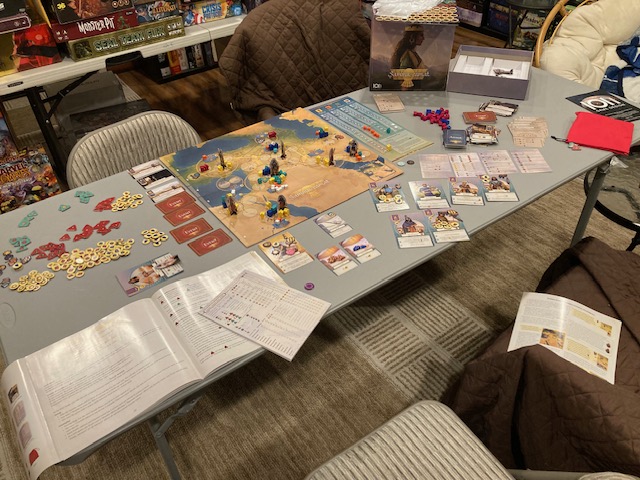
I spent the entire weekend playing through the campaign as a solo player (official mode), and I had a blast.

Cooperative Play
IMG_2905

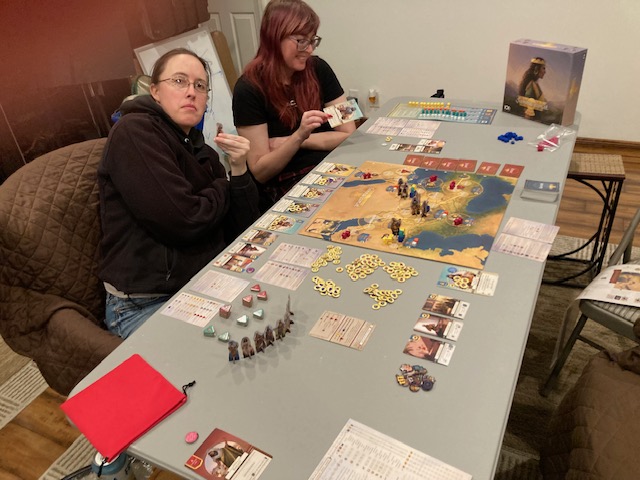
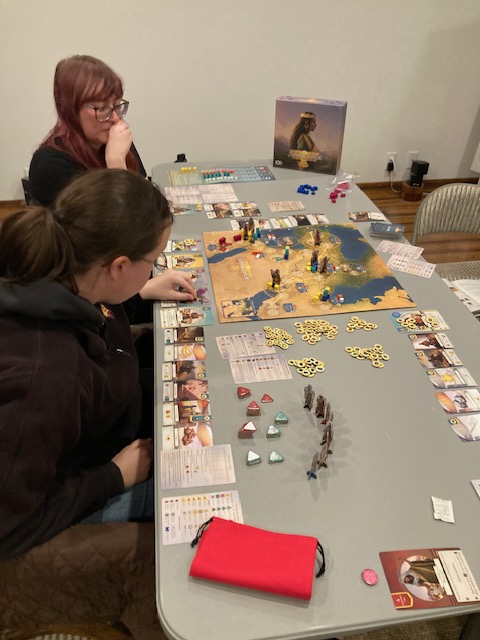
Although most of my plays have been solo and/or the campaign, I was able to get the game to the table with game group: we got a 3 player game going and had a good time.
IMG_2910

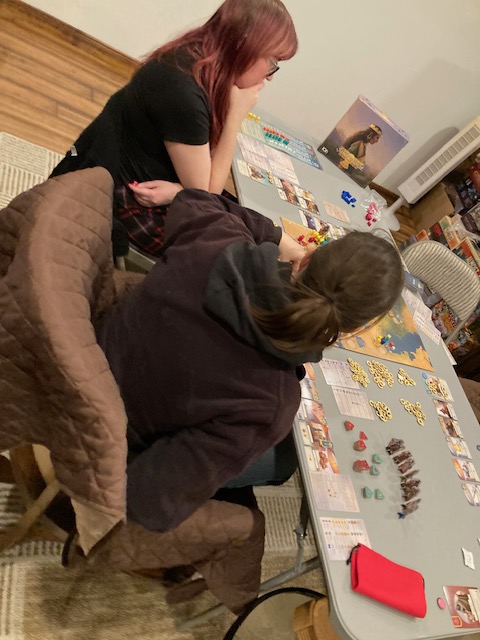
We did play with full Player Selected Turn Order (see below for more discussion), as Sara pointed out that it makes you feel more involved: each player chooses a character, and by allowing us to go in whatever order we want, we are more engaged and invested in our character (“I chose this character, and I can’t play it in the right order??!!?”)
IMG_2909

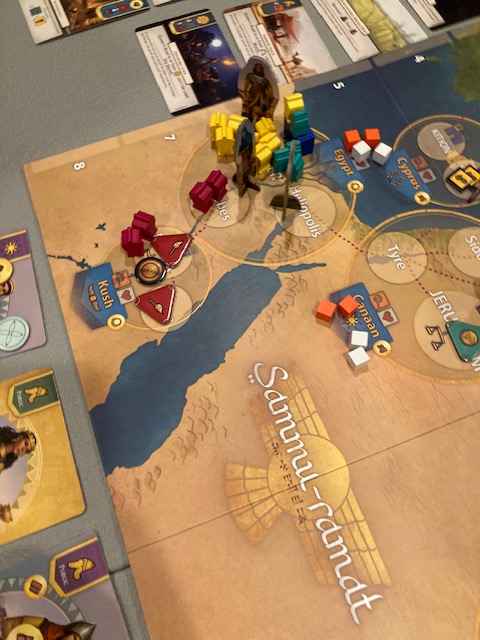
Unfortunately, we did lose, but it was because we were too concerned for keeping all the Ishtar Gates, as opposed to the servicing the goals!  I think the plan is to try again. 
IMG_2908

We had fun playing even though we lost!  We talked, discussed what we needed to do, and executed our plans!  This game could easily go sideways with an Alpha Player, if someone really knows the game.  Luckily, there are so many moving systems, it does mitigate that a little. 

IMG_2905

It was a good, engaging, cooperative game.  It’s clear, this game needs a good teacher though: I think going into this game without someone knowing the game is a recipe for disaster.  There’s too many systems to lean this game “on-the-fly”.   if you do want to play this game cooperatively, make sure someone shepherds you into the game for the best experience.

Randomness
IMG_2843

There isn’t much randomness in this game.  Combat is predictable: there’s no dice.  The “bad news” that comes from the Challenge Cards is completely known to you at the start of a Challenge: you know what’s coming.

IMG_2797

The greatest source of randomness was the Event Cards. There is no way (that I’ve seen at least) to predict what Event will come out, so you just have to deal with it.  In general, the events were’t devastating, but they did cause things to be dealt with.  It did seem, once per game, one event would just completely screw you!  But, it always felt you could come back from it!  The randomness did NOT seem debilitating by any means. 
IMG_2771

The other source of randomness was the Ashur Cards, as you didn’t know what you would get from turn to turn. But, the randomness there was usually not an issue: you could either use a Ashur card to power an ability, or you could draw extra Ashur Cards if you really needed something.  In general, the Ashur cards were more of a resource that was sometimes more or less useful, but it didn’t seem too random.

IMG_2863

All of this goes to say: I don’t think the randomness of this game is untethered.  Most of the actions have known outcomes (combat, Challenge Card bad news, actions), but there’s just enough randomness to keep the game spicy (between the random Events and the much less random Ashur cards).   Sammu-ramat is not a wargame with lots of dice and randomness; it is a fairly explicit puzzle.

Some House Rules To Consider
IMG_2799

This game uses a stilted version of Player Selected Turn Order (PSTO) (see our discussion of PSTO here to learn more).  On the first turn of each month, players talk and figure out which player goes first: hurray!  Players select the order for the first player … but then, play rotates clockwise!!   So, the players only get Player Selected Turn Order for the beginning of the turn!

IMG_2798

This is a strange decision to limit the PSTO because the (official) solo game has full selected Player Turn Order: the solo player gets to activate three characters in whatever order he wants every turn!  So, this seems a strange decision to limit the PSTO. Usually, it’s because many people aren’t used to PSTO and it can sometimes be harder to notate (see more discussion here).  I suspect adding full PSTO to the cooperative game would be more fun, as it would make the players feel like they have more choice?  It’s already been play-tested in the solo mode, so why not add it to the cooperative mode?
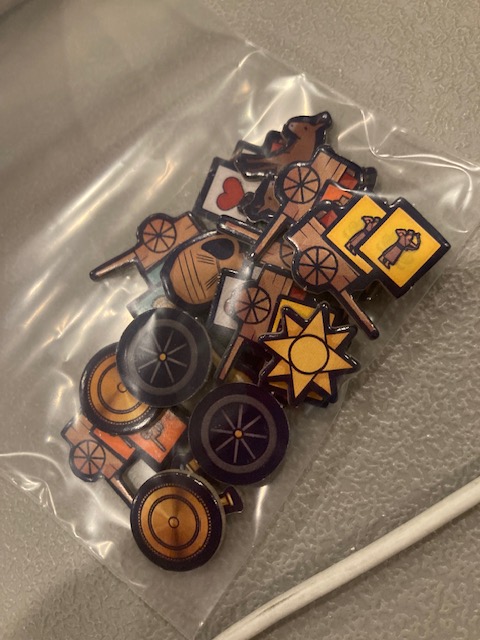
IMG_2883

One tool the players have to help them is technology.  The technology tokens are lain around the board, and players can pick them up as they explore the map. See a bunch above of technology above: the shield gives +1 defense, the mule gives +1 movement, etc.

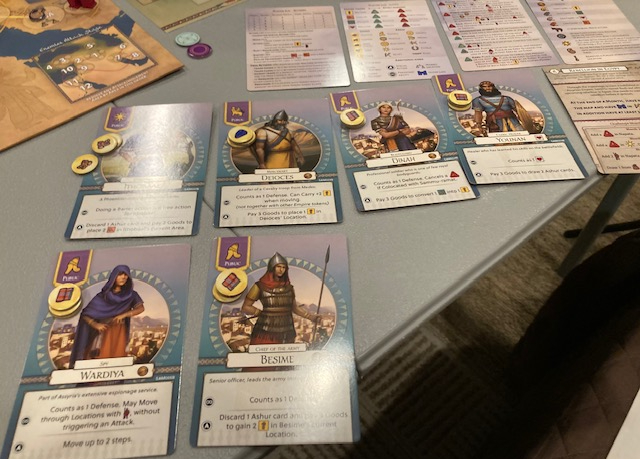
IMG_2844

You can see Deoices has picked up the Amphora (vase) above (with 5 Goods as well) and it’s on his character card!  He can now use it!  It’s got a cool ability … but it can’t be traded.  Almost everything else can be traded (Ashur cards,  goods) …why not technology?  From a game perspective, all the technology pieces are physical things that should be able to traded (sword, vial, shield, etc), so it makes sense from that perspective that they can be traded.  BUT, by not mentioning explicitly that you can trade technology, it’s clear that the rules don’t allow it.   The physical nature makes me think they should be, so thematically it makes sense. In fact, you might accidentally trade if you don’t look too closely at the rules!  
IMG_2803

I would suggest two minor house rules to make the game more consistent:

  1. Allow trading of technology as Goods and Ashur cards (so it’s more consistent with other trading rules).  If you are worried about balance with this rule, you can make a trade of technology a full action rather than a free action.
  2. Allow full Player Selected Turn Order (so it’s more consistent with the solo game)

Of course, caveat emptor: both of these rules might change playtesting and balance.  The game is pretty hard as it is, so I don’t think these minor changes will do anything except make the game more fun: it’s a more consistent application of rules and gives the players more choice!

What I Loved
IMG_2838

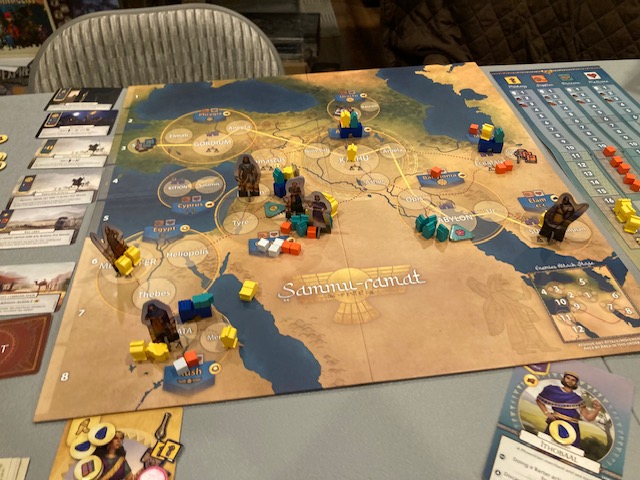
I loved the puzzle of this game.  There were always enough options (between Ashur cards and special abilities) that I always felt I could solve the puzzle.  
IMG_2851

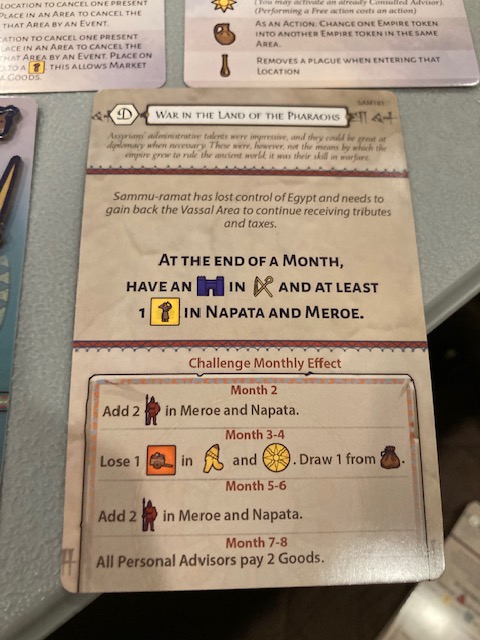
There’s quite a bit of variety in here on the Challenge cards!  There’s always a different kind of puzzle to solve even if you master one Challenge!

IMG_2877

The campaign is a really good way to extend the replayability of the game.  I love that you can start from scratch and play a game, but it’s such an interesting puzzle to see what happens if you leave the game state between Challenges!  The Campaign will be very different every time!
IMG_2865

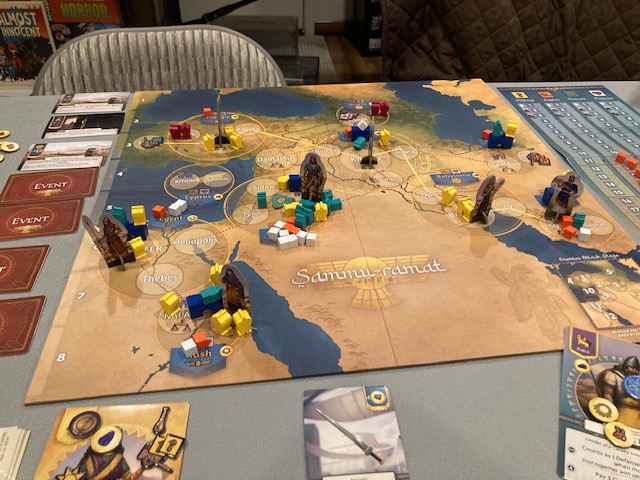
I love this game as a solo game.  The fact that you can play solo two ways is also great, depending on what you are in the mood for.
IMG_2749

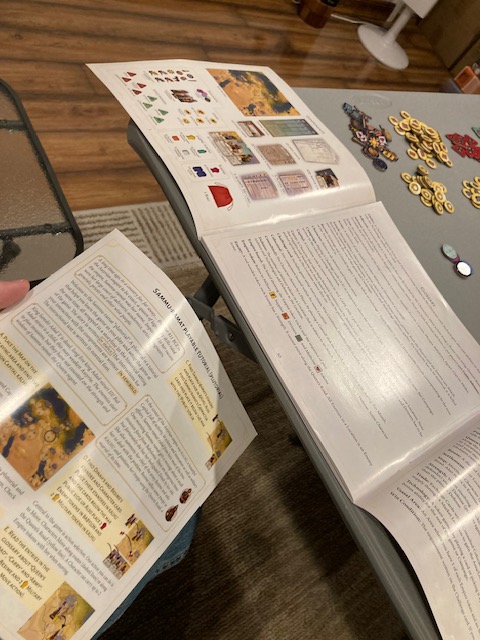
The Plutorial (Playthough and Tutorial) really drew me into the game.  I am very worried I would not have suffered through the rulebook without the Plutorial.  I love that this exists, and I wish more heavy games would have very explicit set-up and playthroughs like this!

Component Issues
IMG_2879

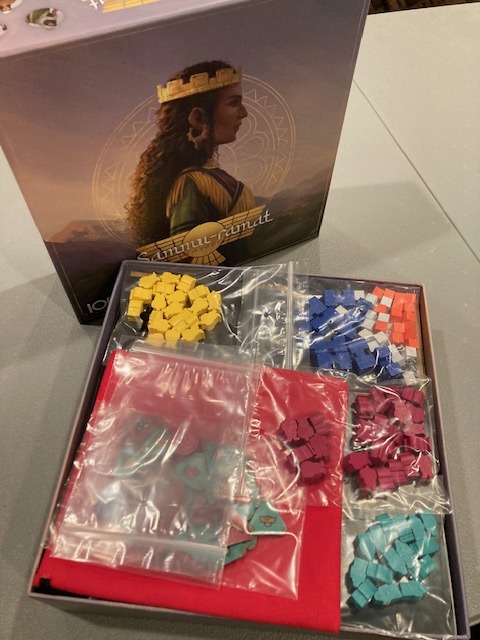
As much as I like this game, there were a number of physical component issues.
IMG_2795

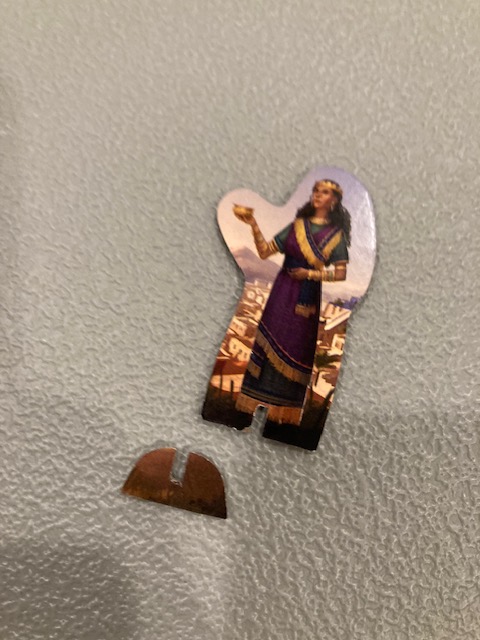
A very minor component issue is that the little cardboard stands fell off all the time: the cardboard bases really needed to be plastic bases.
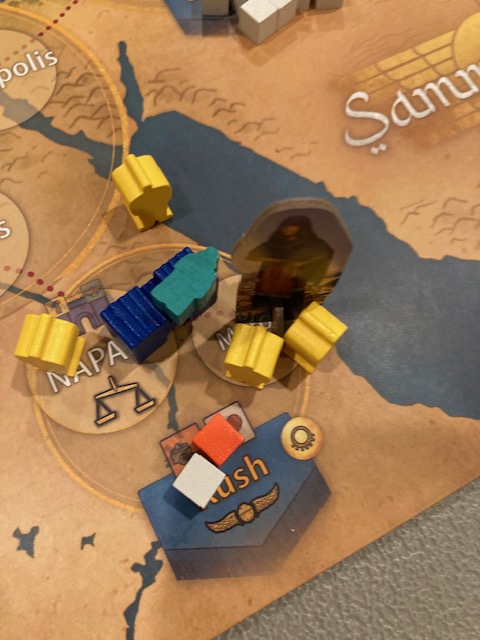
IMG_2872

You are supposed to put a military and a diviner on top of the Ishtar Gate, but they frequently fell off, especially when you were moving around other tokens near it (see above). The corrugated tops of the Ishtar Gates was a nice effect, but it made the tops even more precarious.

IMG_2865

The board is reasonably sized and looks decent, but it doesn’t take good advantage of space! The is a ton of “empty space” near the top and the bottom (middle) that is never used for anything! There are two obvious things it could have been used for: One would be useful charts and info (technology descriptions for instance). A second, better use, would have to have made each area and location bigger! I can’t tell you how many times I would move or knock over tokens because there were so many in one area! See above as Canaan was just overrun and had too many tokens.
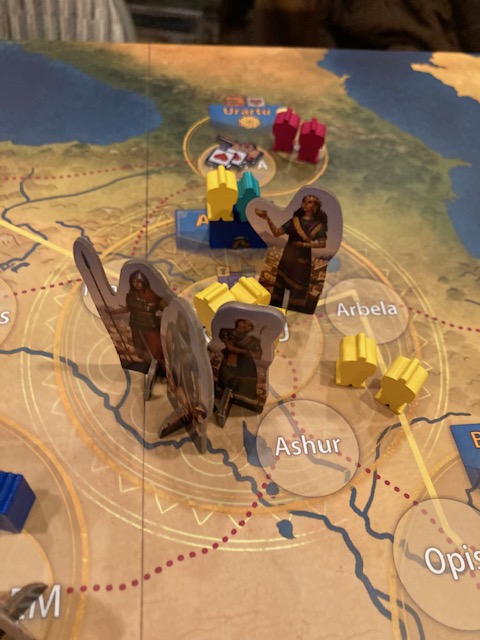
IMG_2809

For example, at the start of the game especially, you might have 4 characters in Kahlu (see above) and they just barely fit! I would have loved to somehow made the areas and location on the board bigger to take advantage of the unused space at the top and bottom of the board. I suspect part of the issue was trying to make the area more geographically correct, which makes sense since this game a educational bent as well. Games like Pandemic: World of Warcraft, however, have solved the map issue by simply having an expanding magnifying glass view expanded “away” from the location. Take a look at the map from Pandemic: World of Warcraft below:
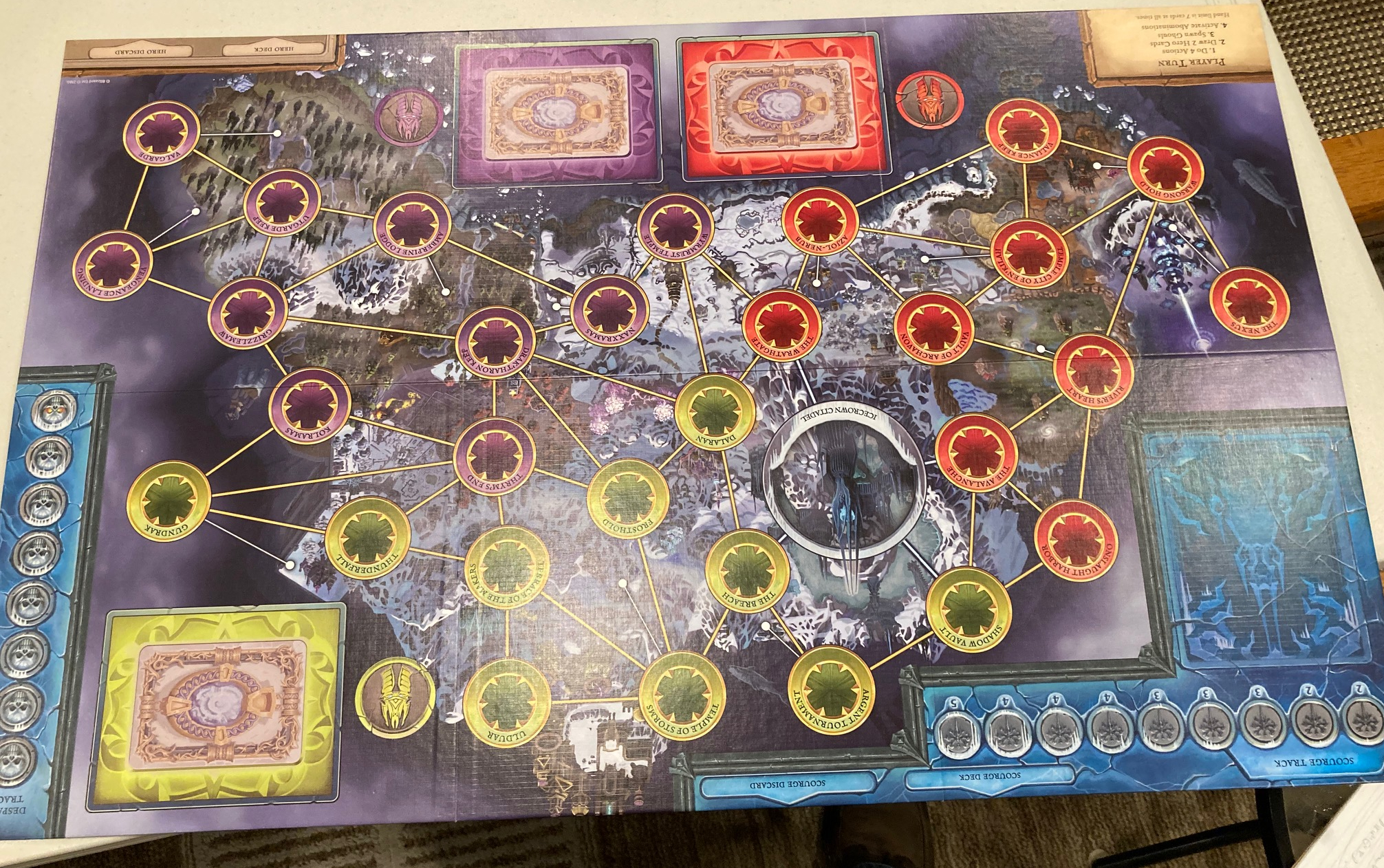
IMG_8874

Notice how the boards spaces the Locations fairly consistently, even if the actual map location is pointed to by the area? I suspect the usability of the Sammu-ramat map could have been helped by some technique like this.

IMG_2809

Related to that, sometimes you couldn’t see what Goods were produced by a Area because of the labelling as behind all the tokens!  What Goods does Assyria produce?  You can’t see, but it’s Textiles!

Honestly, the smaller areas/locations is my biggest problem with the game: Sammu-ramat could have played so much smoother if the areas/locations were even bigger! There’s a lot of rules to absorb in this game, and anything that helps facilitate that play experience makes it easier to absorb those rules.

Theme

IMG_2700

So, this game has an educational bent: it immerses the players into Queen Sammu-ramat’s rule of Assyria in 9th century BC, as guided by her advisors.

IMG_2805

Near the end of the rulebook are backstories for each of the advisors.
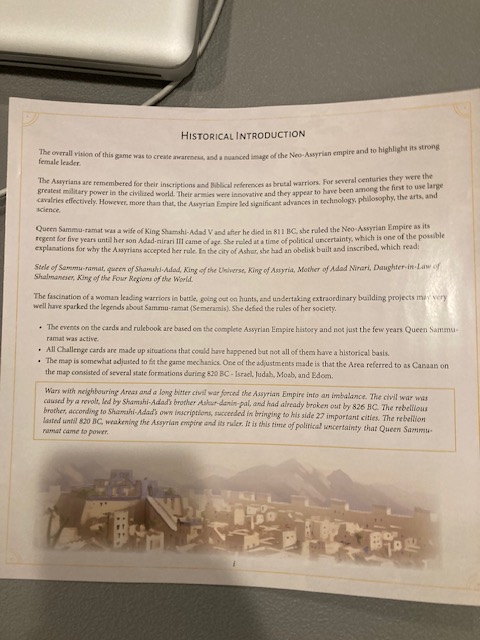
IMG_2885

Also, the Historical introduction (at the very front of the rulebook) gives a quick discussion of this world.

For me, the theme does nothing. Let’s be clear: the research and historical basis in this game is to be commended! I suspect a lot of time was put into the research and history of this game: that’s very clear and impressive.

I feel like I did learn a little geography and some history from the characters of the time. In general, I probably wouldn’t have picked this up if something didn’t grab me on Gamefound originally. I am really glad I picked it up, but I think I would have preferred a re-theming:
bp2

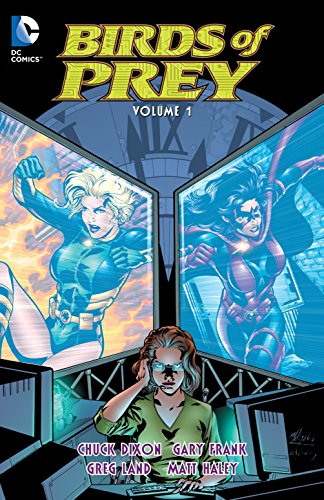
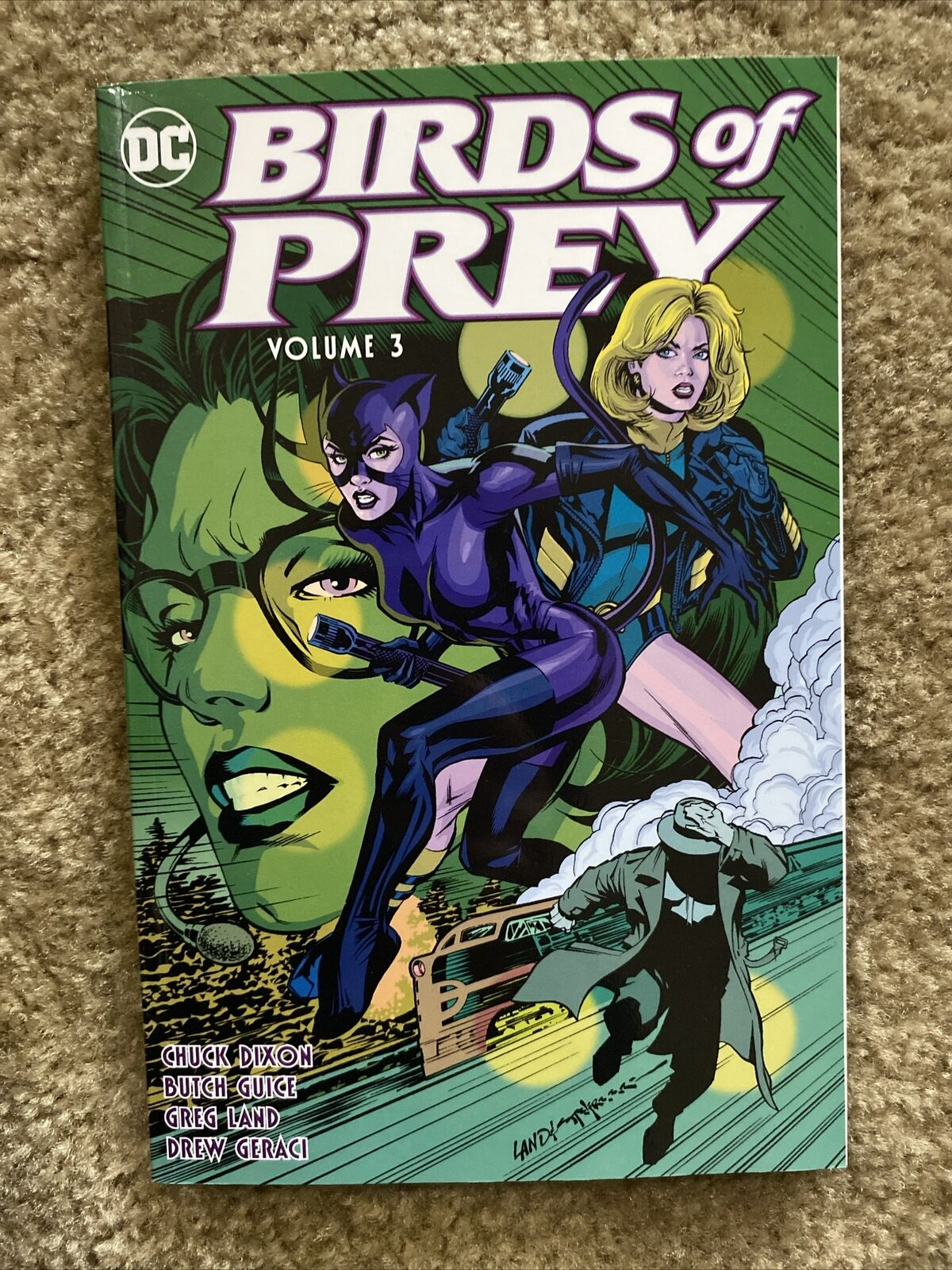
I would have loved for this to be a Superhero game based in the DC Universe! Instead of Assyria, have the setting be the streets of Arkham! Imagine if this were a Birds of Prey series! It would still preserve the role of the women being in charge, but perhaps the DC theme would be more engaging for more people! Oracle would be Sammu-ramut, trying to orchestrate the heroes to keep the streets of Arkham under control! The advisers would be the heroes: Black Canary as Dinah (her secret identity is even Dinah in the comic books), Commissioner Gordon as Deoices, Nightwing as Wardiya, … just to name a few! Getting an Ishtar Gate would be like cleaning up a neighborhood: getting a hospital (medical), food (supplies), protection (police), and good samaritans (diviners) makes a neighborhood safe again!
birdsofprey

I’m telling you, it would be so easy to re-theme this game, and I’ll bet you Kickstarter would go crazy for this game if it were called Birds of Prey: Arkham Nights! There is a fantastic core game with the base of Sammu-ramat. I’m not trying to be disrespectful of all the amazing work here, I am just saying a theme that would perhaps be more accesible: I’d love to see a version of this emerge called Birds of Prey: Arkham Nights (A Sammu-ramat game)!

Conclusion
IMG_2870

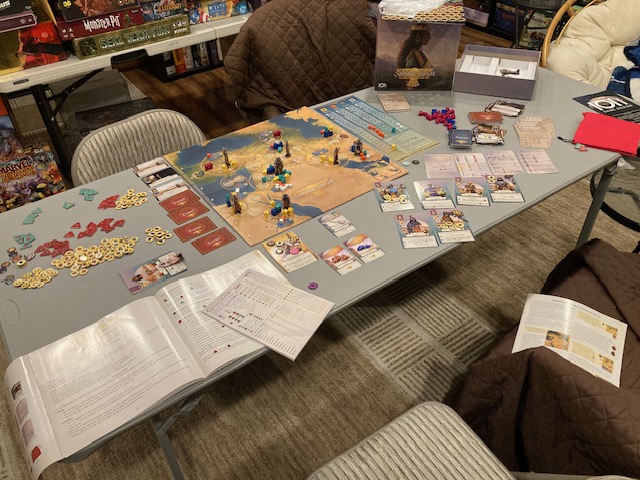
Despite my having no connection to the theme, there being some component quality issues, and some issues relating to clarity in the rulebook, I could see this being one of my top games of the year! Sammu-ramat is a fantastic puzzle! It somehow manages to be a cooperative euro game (gathering scarce resources) while also being a cooperative wargame (keeping bad guys under control)! The puzzles set-up by Sammu-ramat with its Challenges cards offer endless variety to keep me coming back for more!
IMG_2907

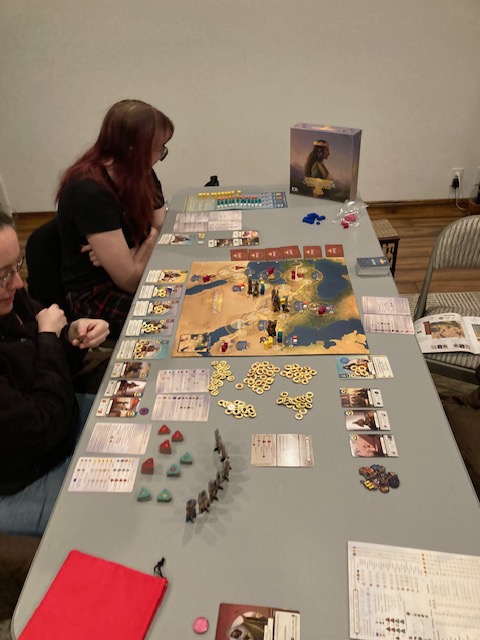
The cooperative game is good: my friends gave it a 6.5 or 7/10: we had fun.  We definitely recommend embracing full PSTO for the cooperative game.  The more important thing is to make sure someone shepherds you into the cooperative game: there’s too much game to learn this “on the fly”.
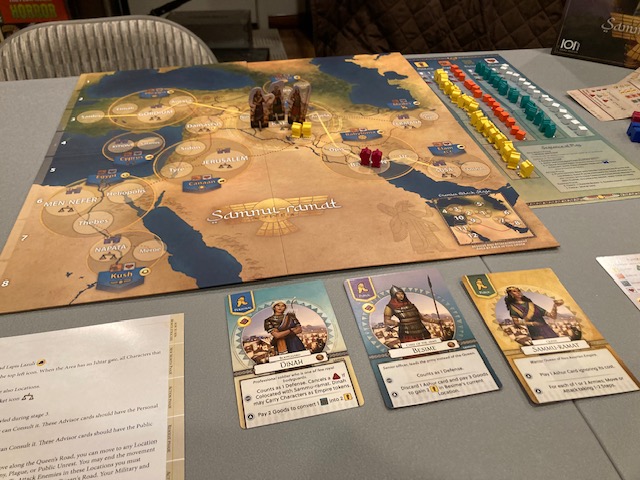
IMG_2752

As a solo game, this is either a 8.5/10 or even 9/10 for me! I think I would like this game even more if they fixed the production issues and had a retheming to Birds of Prey: Arhkham Nights: I think that would bump this to a 9.5 or even 10/10 for me. This game is that good.
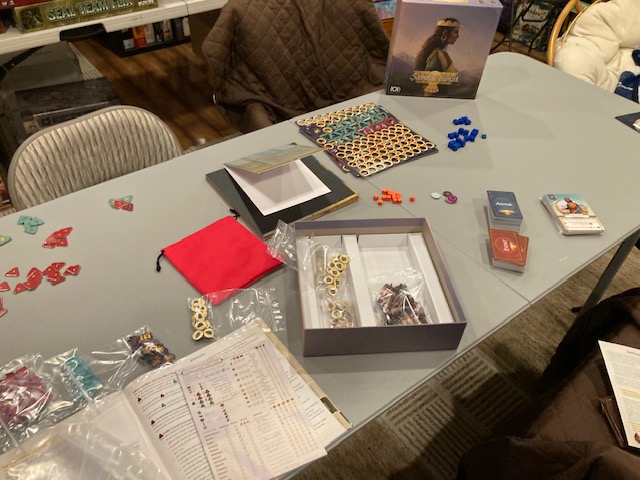
IMG_2878

The game had a very small Gamefound campaign: $12,461 crowdfunded by 235 backers. This game is fantastic and deserves a much bigger release!

Review of Marvel Zombies: X-Men Resistance and Differences to Marvel Zombies: Heroes’ Resistance

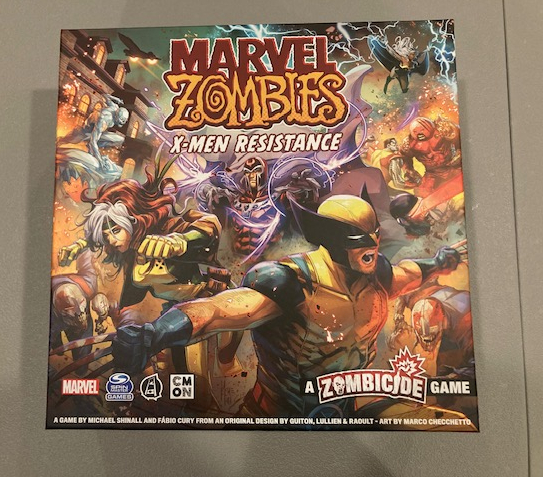
Welcome back to Cooperative Adventure Month! This month, we take on the role of the X-Men exploring the world to take out the Zombies!

IMG_1879

You might remember we discussed Marvel Zombies: Heroes’ Resistance about a year ago: see our review here. In that discussion, we mentioned how we weren’t interested in Marvel Zombies (where the players assume the roles of Zombified Heroes), but we were interested in Marvel Zombies: Heroes’ Resistance (where the players assume the role of Marvel Superheroes fighting the zombies)!

resist

In fact, the Marvel Zombies: X-Men Resistance was part of the original Marvel Zombies kickstarter, but that kickstarter required you to get stuff you might not want: like $240 to get all this stuff unrelated to Resistance mode! See above!

IMG_1880

In the end, I was able to get just the Marvel Zombies: X-Men Resistance from GameNerdz.com for about $103 (with free shipping, since it’s over $79: I have also seen it on Amazon for the same price). So, now I have the two Resistance titles in the Marvel Zombies line and didn’t have to get anything else from Marvel Zombies that I didn’t want!

Unboxing

IMG_1876

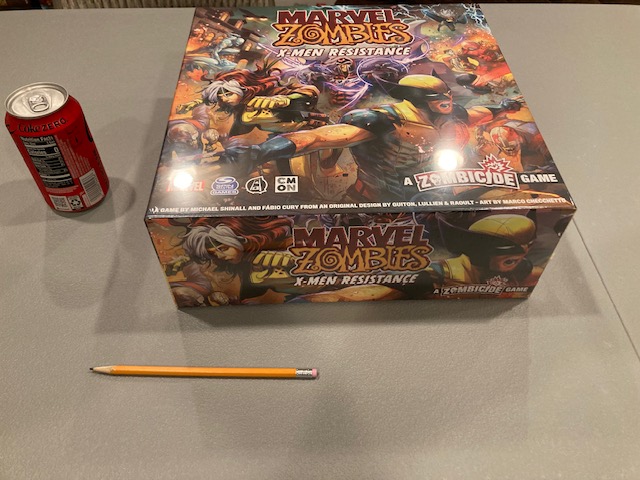
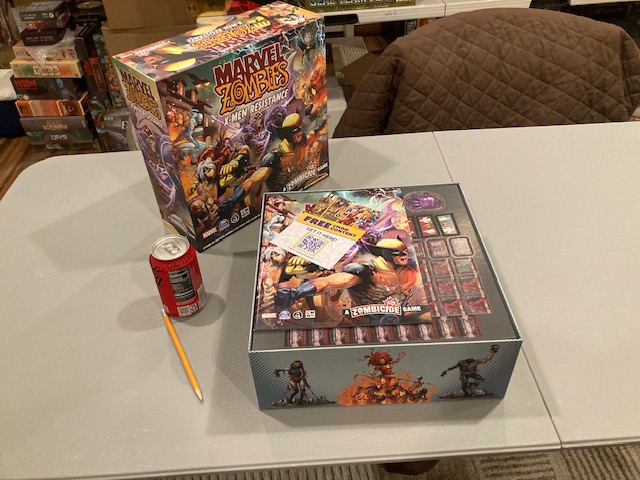
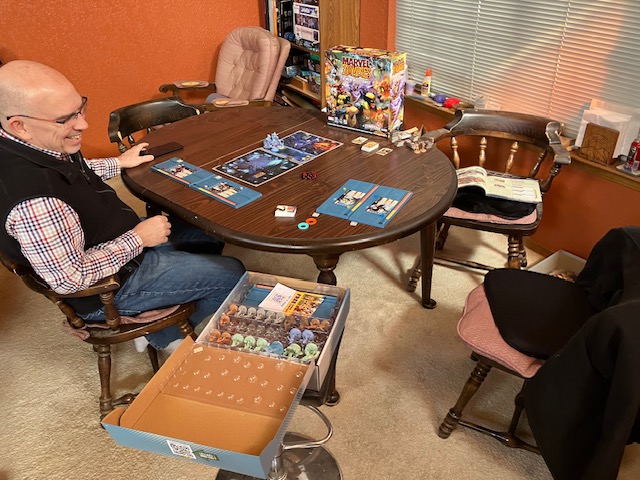
This is a bigger box than the original Marvel Zombies: Heroes’ Resistance! See the Coke can and number 2 pencil for scale.

IMG_1877

IMG_1881

It turns out that most of the box is miniatures.

IMG_1913

Underneath the rulebook and a few cardboard cutout sheets are a large box chock full of zombies, heroes, and bystanders!

IMG_1917

Also in the box are some deluxe character card holders (we’ll see more of them later).

IMG_1930

Just lots of zombies.

IMG_1918

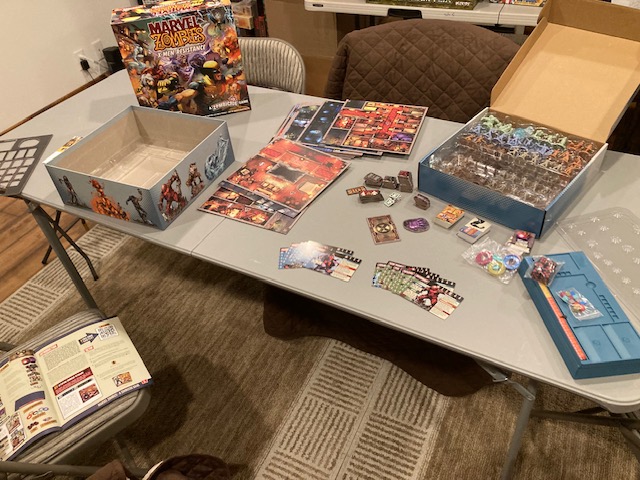
Below the zombie box  (see above) are the rest of the components: cards, and a bunch of large cardboard rooms, some dice, some colored plastic blocks, and plastic stands.

IMG_1919

Everything from the box looks really cool!

Components: Mostly The Miniatures

IMG_1916

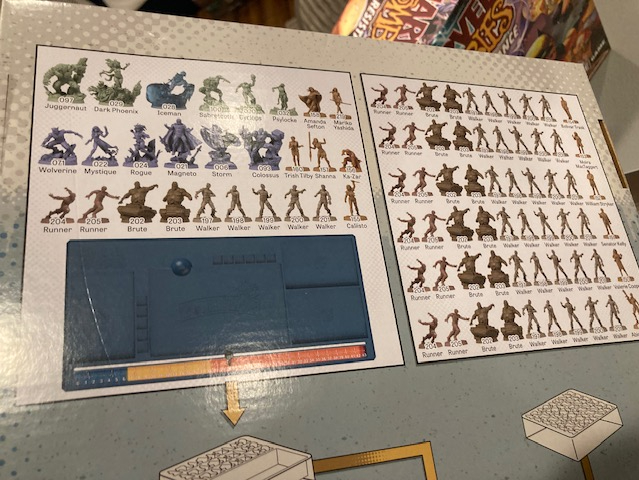
Admit it: you just want to see the miniatures!  The bottom side of the miniature box does a good job of labeling how everything fits back into the box. Thank goodness the minis are labelled!  We struggled with Tamashii’s miniatures when they weren’t well-labelled!  

The walkers (5 varieties, see above) are the most basic zombie (and easiest to kill). See above.

The Runners and Brutes (2 shown each, left-to-right) are slightly more buff zombies. See above.

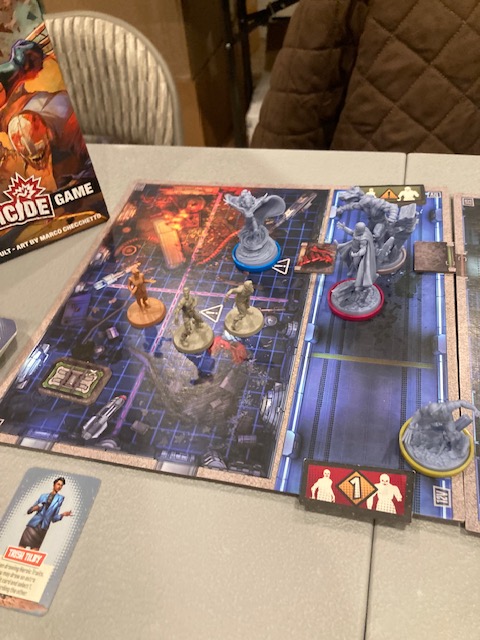
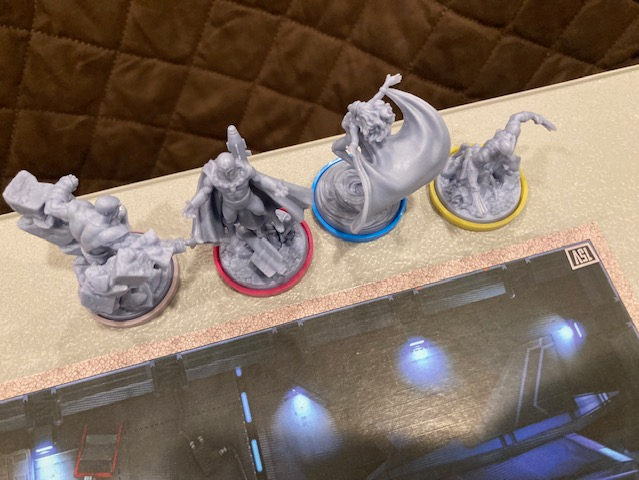
The hardest zombies to kill are the zombified heroes (that you may or may not fight against) in puke green (except for Ice-Man who is clear blue)! You have Abomination, Dark Phoenix, Ice-Man, Sabretooth, Cyclops, and Psylocke (resp., left to right). See above.

The Superheroes that the players play are some X-Men in grey: Wolverine, Mystique, Magneto, Storm, Colossus, or Rogue! See above.

Part of the Marvel Zombies game is about rescuing Bystanders: there are 12 Bystanders (brown minis) in the game (6 shown above).

IMG_1930

The total number of zombies is pretty daunting….

IMG_1935

Each hero will have an ID Card with powers and tracking health and power level.

IMG_1936

This game is also compatible with Marvel Zombies, so there are also “hero” cards for the 6 zombified heroes. We won’t see these again this review: we are only reviewing the Resistance version of the game (where players play the real Superheroes, not zombified heroes).

IMG_1933

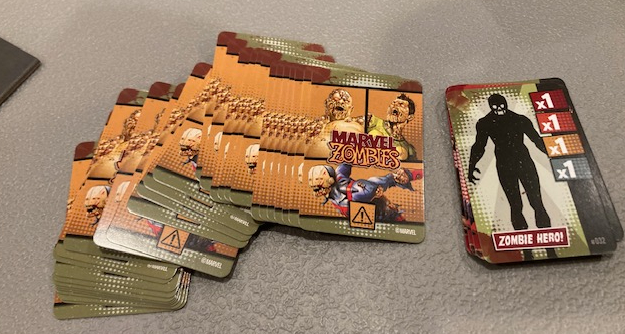
There are also two versions of the Hero/Zombie Hero/Zombie Bystander, depending on which mode you are playing.

IMG_1934

The spawn cards bring out the zombies: see above.

IMG_1932

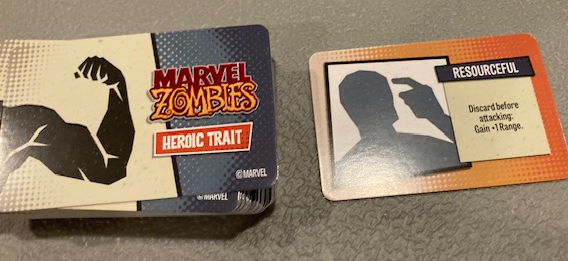
The Heroic Traits are one-time powers you can get as an action.

IMG_1938

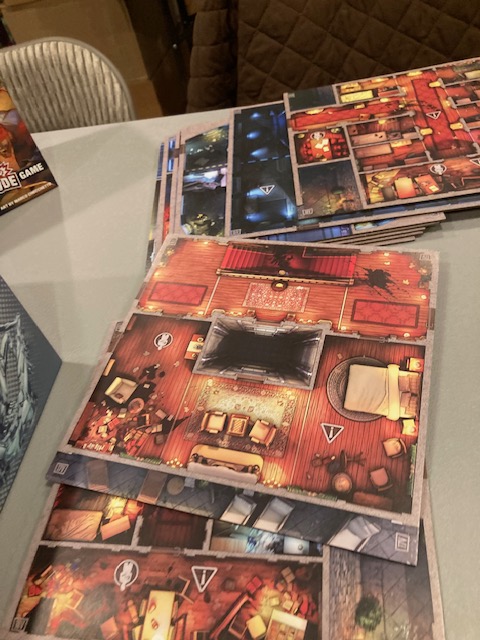
The cardboard tiles are quite nice, as set scenes from the X-Men world!

IMG_1947

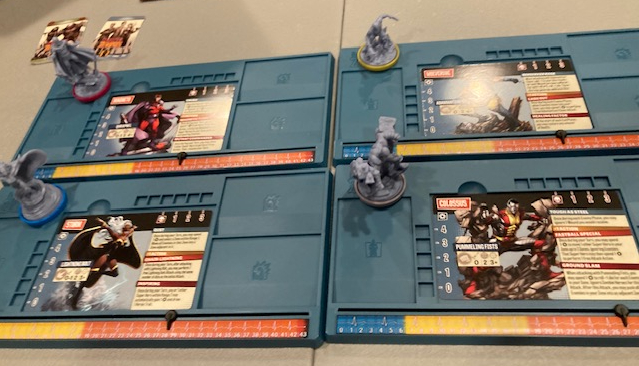
One of the coolest features of this box is the plastic tray for holding all the hero information!  The tray has a space for 1 bystander (because you can have at most 1 bystander) and 2 Heroic Traits (because you can have at most 2 Heroic Traits) and a little plastic indicator for your power (very bottom) as well as plastic cube spots.

IMG_1939

Overall, everything looks really nice in the components.

Rulebook

IMG_1885

This rulebook is better than the one for Marvel Zombies: Heroes’ Resistance! That makes sense, since they’ve had a whole year to clean it up and make it better.

IMG_1886

It gets about a B+ or A- on the Chair test: it flops around a little, but the fonts and big and the pictures well labelled. It also starts with a decent Table of Contents.

The Components pages are well-presented and well-labelled.

The Set-Up pages are next. It’s unfortunate that they span a page boundary: I wish the two Set-Up pages were on opposite pages. Nonetheless, it still worked pretty well.

And everything is very well-labelled and notated. There are tons of examples of play/combat that are all well-described! This is a very good rulebook!

IMG_1945

It’s still a little daunting as a rulebook, as it has 48 pages, but the last half of the rulebook is Hero Mode and Zombie Mode Scenarios, so only about half of the rulebook (24 pages) is “rules”; the last half is just scenarios. 

The rulebook even has an index!

IMG_1959

And the rulebook ends with a very nice summary.

This is a very good rulebook. It’s better than the previous version … even the paper is nicer! And that all makes sense: they’ve had plenty of time to fix it up. But it is very satisfying to have such a good rulebook: Table of Contents, well-labelled Components, Good Set-Up pictures, good rules explanations with example, index, and finally a nice summary at the end.

Good job guys: very good rulebook.

Gameplay

IMG_1961

This essentially plays like Marvel Zombies: Heroes’ Resistance. 

IMG_1955

There are some rules additions (rules for stairs and 3D structures mostly: see above), but it seems very very much like Heroes’ Resistance. Take a look at our review of Marvel Zombies: Heroes’ Resistance if you want more details on gameplay of this system.

Solo Play

IMG_1956

Marvel Zombies: X-Men Resistance has a solo mode just like the solo mode of Marvel Zombies: Heroes’ Resistance (thank you for following Saunders’ Law). As with the previous solo mode, the solo player plays four Heroes, alternating between them. 

IMG_1947

Basically, everything we said before (about Marvel Zombies: Heroes’ Resistance) applies here: the solo mode is a little daunting, as the solo player has to run four heroes! It works fine in the beginning, as the hero powers are simple. But, as each hero levels up and gets more powers, it becomes harder and harder to run everything well: it takes increasingly more time to context switch between characters! 

IMG_1962

The game is still quite fun as a solo game. Just be aware of potential for heavy context switching (as the heroes get more powers) as the heroes advance levels.

IMG_1974

In the end, despite the context switching issue, it’s still fun. You just have to be aware that context switching between four characters may be a problem for some people.  I think since the component quality is slightly nicer and I like the X-Men a little better, I think I had just a little more fun than Marvel Zombies: Heroes’ Resistance. I will play this solo again!

Cooperative Play

IMG_0162

Cooperative play is great!  I adore that Marvel Zombies: X-Men Resistance has Player Selected Turn Order (PTSO) (See description here)!   This means that players decide the order in which their Heroes activate! Do we want to have Storm go last so she can wind-sweep the room (moving the unkilled zombies into the next room), or do we want her to go first to do a ranged Lightning Attack to make it so Wolverine doesn’t have to waste turns moving?  The choice is yours!  You choose the order!  (Technical note: this is coarse-grained PSTO, as you must wait until players use all their actions before deciding who the next player is.  Fine-grained PSTO, like The Reckoners allows order to change after every single single action).

IMG_0166

Much like we saw in Marvel Zombies: Heroes’ Resistance, a little bit of role-play seems to emerge as you play: 

“SNIKT!  I gotcha darling.  That zombie won’t bother you anymore!”
“Logan, don’t call me darlin!  (Whoosh!) And you’re welcome for me swishing all 12 zombies into the next room!”

Everywhere we said about Marvel Zombies: Heroes’ Resistance is true here: PTSO is great, a little role-play seems to emerge as you play, and there is a nice amount of discussion.  This is a good cooperative game.

Differences Between Heroes’ Resistance and X-Men Resistance

IMG_4305

What are the main differences between these two Resistance games? Price springs to mind first: $34.99 on Amazon for Heroes’ Resistance and $103.99 on Amazon/GameNerdz for X-Men Resistance. If you are unsure whether you might like this game and just want to try it out first, I would absolutely recommend buying the cheaper (3x cheaper) version of the game. It is still very good, the components just aren’t as nice.

The real major difference in price is because the X-Men version has tons of plastic zombie and bystander miniatures (right) whereas the Heroes’ Resistance has only cardboard standees (left). 

Luckily, both versions still have all the heroes (zombies and unzombified) as miniatures, so they still look good.

The X-Men rulebook is much better, both in content and quality of rules. But the original rulebook was still pretty good.

IMG_1975

Of course, the X-Men version has nice plastic trays, and the original doesn’t.

IMG_4373

And the X-Men version doesn’t have the dials for level, it has the little track at the bottom of the little trays. 

IMG_4370

Probably the worst thing about the original Heroes’ Resistance is the little plastic “paperclips” that attach to the Hero card for Health and Power Level: these paperclips are a pain to move, and I am always worried I’ll tear the card. See above.

IMG_1960

The X-Men version has little cubes instead in the tray: it’s much easier to notate. See above and below.

IMG_1957

I have the read the rules of both, but I haven’t really found any major differences: they both still have Target Priority, Coarse-Grained Player Selected Turn Order, Power, Dice for Combat, Line of Sight … and they all feel about the same. The only major addition seems to be rules for when you are on stairs and/or moving between levels.

IMG_1955

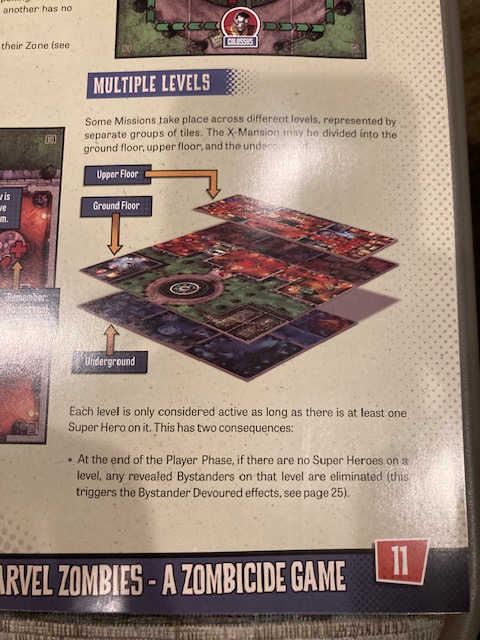
Basically, if no hero is on a level, those zombies won’t activate.

So, which one do you want? Once you note the price and component difference, it’s sorta up to you: do you want X-Men and lots of minis and amazing components? Or do you want mainstream Marvel heroes with a few nice minis (mostly cardboard standees) but for a very good price?

Why not both? You can play them both together you know … was that not clear? You can combine them! Play Storm, Wolverine, Spider-Man, and Hulk on a secret mission!!

Target Priority and Directed Assault

IMG_1958

I still don’t like the Target Priority rule (see above from p23 of the rulebook): it takes away choice, and it doesn’t feel particularly thematic. I may have stumbled on a good compromise: Per combat, you can decide for yourself if you want to use Target Priority or Directed Assault. What’s Directed Assault? ONLY target any one bad guy! See, with Target Priority, your “hits” spill over to other zombies on the same space, so you can kill multiple zombies with one dice roll! That’s cool! But what if you choose to ignore Target Priority and focus on one bad guy? Then you can choose to NOT have your damage spill over at the cost of choosing just one bad guy! I like this so much better! I feel that’s much more thematic!!!

Storm chooses wild lightning this turn, trying to take out as many zombies as she can on one space (use Target Priority and have hits spill over).”
Storm now needs to stop a runner from overtaking a Bystander, so she uses directed lightning to target exactly one runner Zombie (ignore Target Priority using Directed Assault, but no hits spill over).” 

Look, this might just be me with this problem;  I just hate it when games take away my choice.  I feel like this could be a good compromise to the issue: it actually adds choice to the Hero and makes him feel that much more powerful!  I want to feel like a Hero and feel like my choices matter!  I hate it when I have to do “what the dice say”.

Caveat Emptor.  This game system has been out for a long time with 1000s of hours of playtesting, so the reasons for Target Priority are almost certainlly for balance of some kind.  I am not trying to undercut that: I get it.  I am personally trying to come to terms with a rule I don’t like and don’t find thematic: feel free to ignore the Directed Assault, but it’s a good compromise for me.

Conclusion

IMG_1956

If you liked Marvel Zombies: Heroes’ Resistance, you will like Marvel Zombie: X-Men Resistance: they are essentially the same gameplay but in a different Marvel universe. Of course, you can always buy both and combine them! The nice thing about having both of these available is that you can choose whichever one speaks to you (“Avengers or X-Men?”) or which one speaks to your wallet (“$34 for Spidey or $103 for Wolverine?”). The choice is yours.

Having never really liked Zombie games, I am surprised how much I liked this. This is a good cooperative game system. I think I am overcoming my dislike of Target Priority by having a Directed Assault rule: this may just be a me thing, but maybe it’s something that will help you get into the game.

More Cooperative Crime-Solving: A Review of Detective: Saints and Sinners

Welcome back to Cooperative Adventure Month! Last week, we took a look at the “Adventure In a Box“: Starlings! This week, we take a look at the expansion  Saints and Sinners for the wonderful cooperative (and more) Detective: City of Angels!   This expansion offers more mystery, adventure, and discovery with more cases in the seedy world of noir LA!

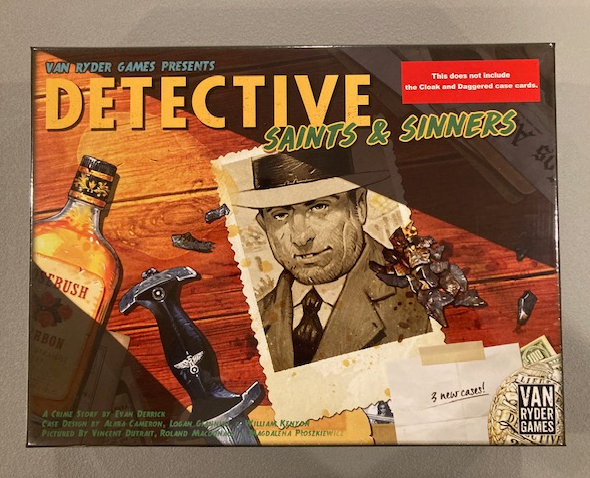
IMG_2544

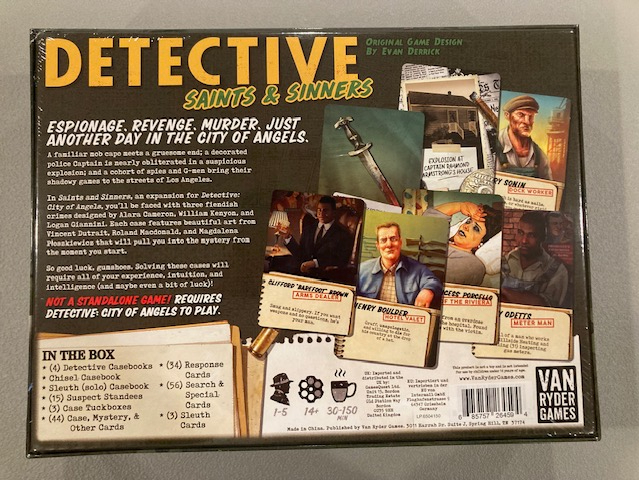
Detective: Saints and Sinners was on Gamefound back in May 2023. This is an expansion for the wonderful game Detective: City of Angels (not to be confused with Detective series from CGE which is a very different set of games). Detective: City of Angels is a mystery solving game for 1-5 players (1-4 if playing cooperatively), with age rating 14+ and games taking anywhere from 30 minutes to 150 minutes, depending on the case and the number of players. We love this game so much, it made the #1 spot on our Top 10 Cooperative Games of 2019! It also made our Top 10 Cooperative Detective and Mystery Games!

IMG_4689
Detective: City of Angels Box Lid

There are multiple ways to play Detective: City of Angels, but we prefer the cooperative way (aka Sleuth mode): See our review here for more discussion of the game and different ways to play. 

IMG_2547

This expansion arrived at my house late January 2024. Saints and Sinners is a “new content” expansion for Detective: City of Angels: it’s a bunch of new mysteries to solve! Since Detective: City of Angels cases are “play-once” entities (once you know the solution, it doesn’t make sense to play it again), expansions like this are the way to keep the game invigorated! 

Let’s take a look!

Unboxing

IMG_2551

This is a box full of either 2 or 3 cases for the Detective: City of Angels game.

IMG_2546

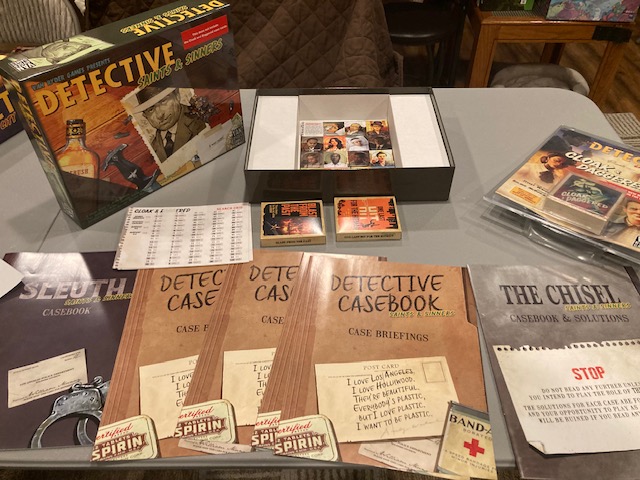
Those of you paying attention may have noticed the little red sticker on the top right of the cover. That’s right! My version doesn’t contain the “Clock and Daggered” case cards? I only have two cases in my box!! What’s going on?

IMG_2549

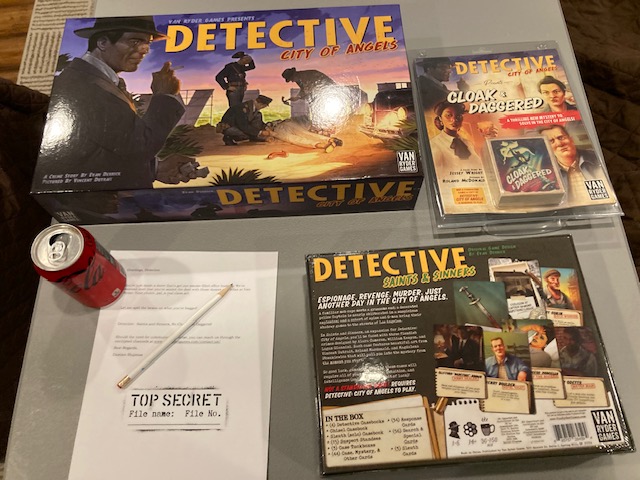
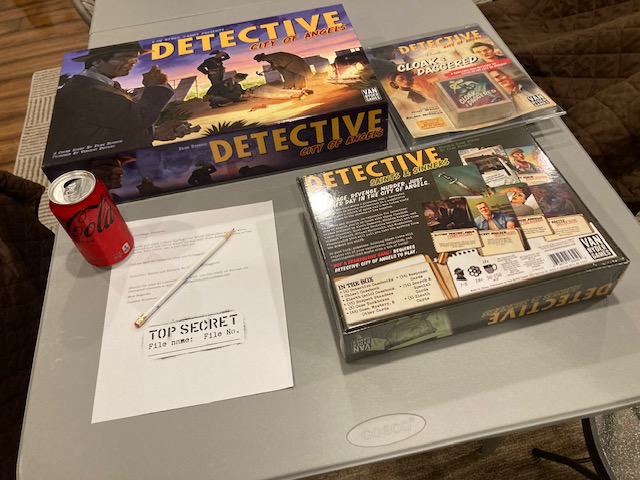
It turns out Detective: City of Angels tried a different way of marketing new cases: one case at a time … and I guess it didn’t do very well. So, Saints and Sinners is an expansion is packing of 3 cases into one purchase. We actually did buy the single case Cloak & Daggered blister pack! See above! In fact, Cloak & Daggered made our Top 10 Cooperative Expansions back in 2021!

IMG_2550

And for those people who HAD bought the Cloak & Daggered pack, Gamefound allowed you to back Saints and Sinners with only two cases, so you wouldn’t buy the same case again!

IMG_2553

The box comes with only what you need for new cases: A new Chisel book for the 2/3 cases, A new Sleuth book for cooperative mode, 4 new briefing notes, boxes containing cards for each case, matrices for entries lookups, and finally the standees.

IMG_2555

Weirdly, the standees are very inconsistent: the first five standees are obviously Vincent Dutrait art, the next five are a different style, and the last 5 are an even different style! This is very jarring as previous standees have been Vincent Dutrait art! 

IMG_2543

However, I am here for the mysteries, so the mixing of art styles isn’t that big a deal. It’s the stories and mysteries that matter!

Solo Play

IMG_2563

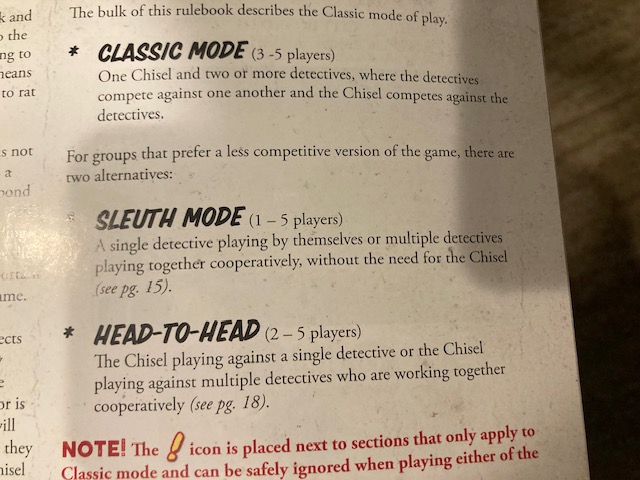
To play solo or cooperatively, you have to play Sleuth mode: see an excerpt from the main rulebook above.

IMG_2564

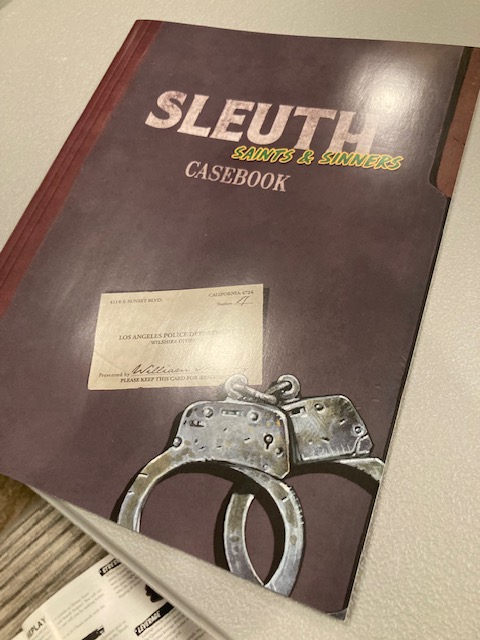
Luckily, this new expansion supports the solo and cooperative modes: it comes with both the Sleuth book (see above) and matrix cards you need in order to play these mysteries solo/cooperatively!  (In other words, they didn’t just support the main game in Classic mode: they supported all modes!)

IMG_2562

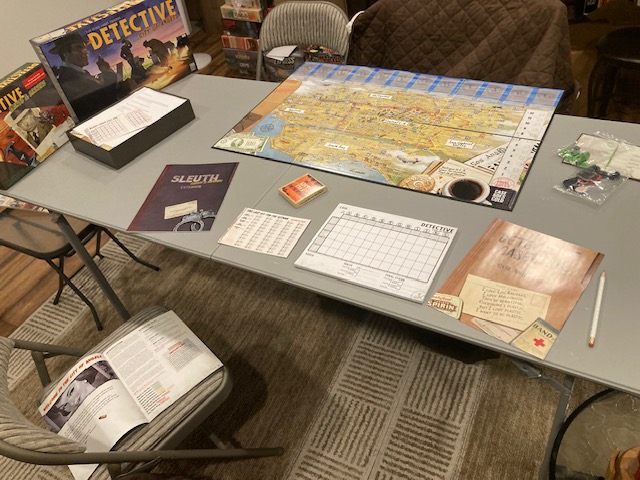
If you know how to play Detective: City of Angels, you can just jump right in to this expansion. There are no new “mechanics” added to the game: it’s just new cases! So, I jumped right in, solo, for the first case (for me), One Last Hit For the Hit Man!

IMG_2572

Solo mode works great!  I went around the board trying to figure out when to choose moving to new locations vs searching  locations vs questioning people!  I only had a limited numbers of actions, and I had to make the best of them!   The mysteries are very much non-linear: sometimes you question a suspect and they reveal something that you need  … which means you have to move back to question someone you’ve already interrogated previously!

IMG_2573

I had this little monologue going in my head that sounded like a bad noir narrator:

“I figured, while I was on this side of town, I’d question the dames.  I couldn’t get anything out of Laney, but at least Brenda was just a short stop away.  At some point, I knew I’d have to bite the bullet and slough myself across town to the murder scene.  It’s quite inconvenient that the murder scene was so far away.  But I guess it was a lot more inconvenient for the corpse.

IMG_2579

I’ve said this already in my reviews of Suspects (see here and here): Why watch a murder mystery on TV when you can be part of one?   This new expansion is like a new season of your favorite noir detective show!  It still works great as a solo game.

Cooperative Play

IMG_2666

I was a little nervous playing the next game in the pack: Blast From the Past is labelled as a Veteran level case!

IMG_2665

Sara is a new gamer to our group: she hasn’t played quite as many modern board games, so I was afraid it would be too much.

IMG_2666

I don’t know why I worried: Sara handled it like a pro.  We had a fantastic time playing this case cooperatively! It seemed a little easier than we expected, but maybe we just made some really good hits at the start of the game.

IMG_2667

Overall, this still plays great cooperatively and this was a really fun case with interesting turns.  

Conclusion

IMG_2562

If you have finished all the cases for Detective: City of Angels, Van Ryder games has your back!  Saints and Sinners offers more cases in this noir world, and they are just as good as the original!  Of course, if you are still working through the original 12 cases in Detective: City of Angels, this expansion may seem silly.

Think of Saints and Sinners as a new season of your favorite Detective show.  You haven’t gotten around to watching all the seasons yet, but just knowing that there are more seasons of the show is heartening, since that demonstrates that people are liking this!  This show must be good if there are so many seasons!

IMG_2585

  1. Detective: City of Angels original cases (Season 1)
  2. Smoke And Mirrors (Season 2)
  3. Bullets Over Hollywood (Season 3)
  4. One-off Standalone Special: Cloak & Daggered!
  5. Saints and Sinners (Season 4: one episode was teased as a standalone)

Of course, this must be British TV since later seasons only have 3 or 4 episodes each …

A Review of Starlings Box One: The Most Fun I’ve Had Since Video Comics

Welcome to the start of Cooperative Adventure Month!  This month, we’ll talk about cooperative board games with a sense of adventure and discovery!  We begin this month with a game literally labelled with “An Adventure In A Box“: Starlings Box One!  Take a look below!

IMG_2409

Starlings was a cooperative game on Kickstarter back in January 2023. It was advertised as The Starlings: A Graphic Novel Escape Room. I backed this, but it got lost in the mail! It probably should have arrived at my house in November 2023 (see kickstarter update #10): at that point it would have been about 3 months late. Anyways, I contacted the publisher: they were very understanding and sent me the box above!

IMG_2410

Interestingly, there’s no player count, suggested, or time/length anywhere on the box or even inside. Just so you know, this is a light-hearted Escape Room aimed at a younger crowd with its “cute vibe”. The cover should be a good indication of whether or not you will like this game. In the end, I think Starlings is probably best for families, but if you don’t mind a lot of silliness, this light Escape Room game might be right up your alley.

Unboxing

IMG_2411

This is mostly a box full of very bulky envelopes and a few leaflets.

IMG_2413

The instruction leaflet sets the tone for this: this will be very silly! If you find yourself enjoying the the text of the intro leaflet (and the silliness and puns therein), I think you will love this game! Otherwise, you might want to bail now … it only gets sillier …

IMG_2416

The coolest part of this game is the Graphic Novel!! It tells the story as you go through!

IMG_2417

It’s definitely a kid’s comic book inside. See above. The art is nice and the word balloons quite readable. 

IMG_2414

Since this is an Escape Room, you may get stuck on some puzzles, so there is a hint book. We only used it once (as we always seem to get stuck on (slight SPOILER) folding puzzles).

IMG_2422

The bulk of the game is black envelopes with little symbols. When you get to a new chapter in the Graphic Novel, it will tell you to open one of these envelopes: the envelopes contain Escape Room puzzles!

IMG_2420

This is a pretty neat looking game.

Gameplay

IMG_2423

So, it’s hard to talk too much about this game without revealing too many spoilers. We will show some pictures of the game which might reveal something if you look too close, so don’t look too close!

IMG_2418

The Graphic Novel controls the flow of the game (but see below).  The story comes out very linearly: there is no branching or “Choose Your Own Adventure” here.  You just read the Graphic Novel, get to the end of a chapter, open a envelope, solve the puzzle.  Repeat until you get to the end of the game!

IMG_2426

There’s about 10 envelopes in here, and each envelope has a typical Escape Room puzzle … sort of. Most of the puzzles are simpler so a younger audience can enjoy them. We still had fun doing these puzzles even though we are all older. It’s an Escape Room! For a younger Audience! 

The main selling point is the Graphic Novel … at first. (We’re being enigmatic on purpose).

Legacy or Campaign Game?

IMG_2455

Is this a Legacy or Campaign game?

Overall, it took about 2.5 hours to go through the whole game, so you can play it all in one sitting if you like (as long as you are using the video, see below). You can also just stop the game, and just restart from where you left of at a later date: it’s probably best to stop at chapter boundaries.

From a replayability perspective, you can put Starlings back together to a pristine state after you;ve played it all the way through, but you just have to be a little careful (as you play) to note which pieces came from which envelopes: there are no instructions on how how to reassemble this! So, it’s “kind of” a legacy game if you don’t take good notes! This is a resettable campaign as long as you take good notes: be aware before you play!!

Video Comics

Video Comics was a television series that aired on Nickelodeon from 1979 to 1981. The show would feature stories from various comic books, mainly DC Comics, narrated and with voices. – Nickelodeon Fandom Wiki

I used to watch this show (Video Comics) as a kid: they would show comic books, panel by panel, with voice narration.  I was introduced to Adam Strange, Green Lantern, Swamp Thing, and a whole raft of DC comics.  See what it was like above: watch a sample episode!

I loved this show!  But I haven’t seen anything like this since 1981 … until now.

Starlings Video

IMG_2413

It’s very very very important (when you play) that you follow the link on the upper right side of the “ATTENTION” page! It takes you to a very long YouTube video … which is basically just Video Comics of the Starlings Graphic Novel!

IMG_2428

All the text and panels that appear in the Starlings Graphic Novel are presented here in this very long video!

IMG_2430

Just like Video Comics, this YouTube video takes you panel by panel through the graphic novel … with voice acting! The voice acting was actually pretty good! We all commented how well done this video was!

IMG_2419

The game is “meant” for you to follow along with the Graphic Novel, but we absolutely loved and preferred following along with the the YouTube video instead!  We think the game would been twice as long had we just read the Graphic Novel as a group!  Even worse, we’d all have to crowd around the Graphic Novel as we read. No, this game is meant to be enjoyed using the Video Comics of the Starlings Graphic Novel!

IMG_2429

By far the best way to enjoy this game is by watching the video and pausing it when you get to parts where you “do the puzzle!” 

IMG_2440

We would watch the video, pause it to open an envelope, solve the puzzles, then unpause it to move on! We were lucky enough to watch the video on a big screen: we recommend that for you!

Solo Game

IMG_2415

Intent on learning the rules, I sat down with the Starlings game, opened the box, read the first chapter of the Graphic Novel, … then stopped before the first puzzle. Theres no need to try this solo before showing your friends: Starlings is very straight-forward and you and your friends can just jump in. In fact, I think the game is much much more fun as a shared experience.

IMG_2417

I think you can play this solo, and in fact it might be more fun to play solo if you don’t want the video!   If you are interested in consuming the Graphic Novel as a physical book in your hands, then solo is probably the best way to play!  With multiple people, it would be harder to share the experience of reading/consuming the physical Graphic Novel, as you all have to sit physically together behind the book! Unless that’s what you want: it’s more chummy to snuggle around the book and read it together … but I think you have to be close as a family or friends to do that.

Although you can play Starlings solo (which might be best for consuming the physical Graphic Novel), this game really is much more fun as a group.

Spoilers?

IMG_2438

Here’s some pictures of us playing: they don’t necessarily reveal anything unless you look to closely, but they show the game a little bit.

Conclusion

IMG_2432

This silly, made-for-younger-audiences, Escape Room game was one of the funnest nights we’ve had in a while! We were enchanted watching the Video Comics of the Starlings Graphic Novel! We laughed at the silly jokes and puns! We had fun with the puzzles when they came out (none were too hard)! Sara commented this was almost an activity since we were watching the Video and only had 10 puzzles.

IMG_2409

Calling Starlings “just an activity” does it an injustice: the phrase on the cover captures the spirit of the game more than anything! This is An Adventure in A Box! Assuming you like the youngish silly vibe, we think you will absolutely love this journeying through this adventure. This is the funnest time we’ve had in a while!

If we had received Starlings in 2023, it should have made our Top 10 Cooperative Games of 2023! It was so much fun. This is probably a 9/10 for everyone involved!

The cover says Box One: I hope they do more!

Appendix

Below is a video we took for one of the puzzles.  It gives away a lot about that puzzle, but it also shows how much fun we were having! So, only watch this if you are on the fence and want to see more about the game!

A Discussion of Variable Turn Order and How To Mitigate Its Randomness

Welcome to the end of Variable Turn Order Month! This month we saw Astro Knights: Expeditions with its card-based Variable Turn Order, then we saw The Plum Island Horror and its token and bag-based Variable Turn Order! We conclude this month with a discussion of some of the problems with Variable Turn Order and some ideas for fixing these issues!

IMG_3654
Kickstarter Edition of Aeon’s End and Aeon’s End: War Eternal (with update since I was an original Kickstarter)

Over the past few years, we’ve seen the Variable Turn Order mechanism show its face in quite a number of games! This is a mechanism that directs the order of players and “bad news components” in cooperative games. The first place I really saw Variable Turn Order was in Aeon’s End! Aeon’s End is a cooperative deck-builder and boss-battler game. I Kickstarted the original Aeon’s End and the War Eternal versions back in something like 2017: see our reviews here.

IMG_3703

At that time, I was still enamored with the entire cooperative deck-building experience, and I didn’t quite understand the full-reaching effects of the Turn Order Deck (see above), which controls the Variable Turn Order in Aeon’s End and War Eternal.

What Is Fixed Turn Order and Variable Turn Order?

Screenshot from 2020-04-07 20-52-26

Many many many cooperative games have a simple order of play: the Bad News happens then the players go in (something like) clockwise order.  The Bad News happens, then each player gets a turn. This would be a Fixed Player Order game.   Some examples of this would be Arkham Horror 2nd Edition (see snippet from rulebook above), Sentinels of the Multiverse, and Marvel Champions: Fixed Player Order (as the name implies) dictates that play unfolds in the same order every turn (modulo the First Player marker moving).  We discuss this in greater detail in a few places: Arkham Horror and Sequential play, Marvel Champions and Sentinels of the Multiverse on entry #7.

screenshot-2020-09-05-at-8.21.20-am

Variable Turn Order is random system in which the game controls the order of the players and the order of the “Big Bad”.  In most cooperative games, players are playing against the game; that’s usually expressed as a major villain (the “Big Bad”) the players are fighting against (See RageBorne from Aeon’s End above: he’s the major villain)! So, when the “Big Bad” takes a turn, it’s the game controlling some way for the game to attack/inhibit the players. When a player plays, he usually attacks the “Big Bad” or helps himself or compatriots in some way.  

IMG_2496

In Aeon’s End, the Variable Turn Order is expressed through The Turn Order Deck. The Turn Order Deck is a small deck of 6 cards which controls the order in which the players can take a turn or the Big Bad (the Nemesis, controlled by the game) can take a turn. There are 4 player cards and 2 Nemesis cards (see above). You shuffle the deck and draw the next card: that card tells you who goes! So, the players get 4 turns, and the Nemesis gets 2 turns, and then you start again. This is a card-based system.

IMG_2276

In The Plum Island Horror (which we just reviewed last week), the Variable Turn Order is expressed through drawing tokens from a bag (see tokens above).  The players get 4 turns (2 green and 2 blue tokens) and the game “Big Bad” gets 4 turns (3 red and 1 black tokens).  This is token-based system.

Some Cooperative Games With Variable Turn Order

Here’s an (incomplete) list of cooperative games we know of with Variable Turn Order.  All of these games here are standalone games, but some of them also expand a base game.

A common theme is cooperative deck-builders, but we also see in this list in a tower defense game and some dungeon crawlers!

The Problems

The problems with Variable Turn Order games are two-fold, but related.

  1. Lack of Mitigation: Most (if not all) Variable Turn Order order games don’t have any mechanisms for mitigating or affecting the Variable Turn Order.   It’s much more difficult  to make tactical/strategic decisions based on who will or “might” go next.
  2. Pathologically Bad Turn Order: Variable Turn Order can go pathologically bad and shut-out players for far too many turns.  This is usually expressed by the Nemesis taking all of his turns at the end of the round, and then all of his turns at the start of the next round!

As an example of Pathologically Bad Turn Order, consider The Plum Island Horror: if all 4 “Big Bad” tokens are drawn at the end of the phase, and then bad luck brings all 4 “Big Bad” tokens out at the start of the next phase, that shuts the players out of the game for 8 full turns!  This will frequently cause an immediate loss, especially in the late game.

IMG_3715

I have personally witnessed losses in Aeon’s End many times from The Variable Turn Order giving the Nemesis 3 or 4 turns in row: in the late Aeon’s End game, this is devastating as a Nemesis turns are very powerful.  It’s very frustrating to watch 3 or 4 turns go the players can do nothing .. and just lose!  

IMG_2318

At least Aeon’s End is only a 60-90 minute game: if players get screwed by randomness, it’s okay because it’s a shorter game.  I am more worried about being screwed in the game of Plum Island Horror because it’s a significantly longer game: imagine being three hours into a game then watching it be destroyed because the game takes 8 unanswered turns in a row!

External Solutions

So, if the game has no mitigation techniques built-in, you hope not destroying the game balance . We’ll explore an external mechanism: a mechanism outside of the game and rules.

IMG_3656

Back in Seven House Rules for Cooperative Games (see link here), under entry #1, we proposed a simple solution for Aeon’s End: The nemesis is never allowed more than 2 turns in a row.  In other words, if you ever would draw a third nemesis card, you stick it back in the deck and draw until you get a player card.  (For token based schemes, you’d do the same kind of thing, but with tokens).   This has the effect of preventing the Pathologically Bad Order by simply never allowing it to happen.

IMG_2301

A slight refinement of this idea came up in our Plum Island Horror review (last week’s review):

There are no mechanisms to mitigate Variable Turn Order—that’s the problem with it. Our stock suggestion is to make it so the Horrors can never have more than X turns in a row (where X=2 or X=3 depending on your tolerance) . One easy way to do this: if he players have two turns in a row, they must draw a horror token. If the horrors have two turns in a row, the players must draw a player token. This is more of a balancing mechanism, but simple enough.

This slight adjustment makes the game a little more regular as no entity can ever have “too many” turns in a row.  Although it’s almost always the “Big Bad” having Pathologically Bad Turn Order that’s frustrating, if the players have too many turns in a row (especially in the end game), the game becomes too easy!!  Let’s be clear: Variable Turn Order strikes two ways: too easy or too hard.  This slight adjustment (by disallowing the players AND the “Big Bad” more than a few turns in a row) keeps the game a little more fair.

Let’s be clear: the entire purpose of this external mechanism is to prevent the Pathologically Bad Turn Order.   It’s a simple enough technique that you can adjust it to your own preference.  For example, I can see allowing Pathologically Bad Turn Order early in a Aeon’s End game (because it’s not devastating), but maybe controlling turn order a little more in the end game where it matters more.   

We’ll call this the External Prevention technique.

Internal Mechanisms

A number of newer games do have some mechanisms built-in to the game to effect the turn order. 

IMG_9629

Adventure Tactics: Adventures in Alchemy is an expansion to the base Adventure Tactics game.  This expansion adds some new content but fixes a lot of issues with the game (it also made  the #7 on our Top 10 Cooperative Expansions of 2023). 

IMG_2497

On Page 5 of the Expansion Rulebook lists several ways to deal with Variable Turn Order! That’s right, the expansion addresses this issue directly! 

  1. Fate Counter: The first way is to have a limited resource (The Fate Counter: see column 1 above) which you can discard to swap the order of two initiative tokens.  This is a simple mitigation technique,  but it gives the users some agency when it really matters
  2. Static Initiative Invariant: The second way is to simply get rid of Variable Turn Order and use “The Static Initiative Variant” (see column 2).  You’ll see this is a much more constrained version of the External Prevention Technique: It simply becomes Fixed Turn Order.  For example, for  a 4-Player game, the game prescribes Hero, Boss, Hero, Hero, Box, Hero, Hero as the order.  It’s interesting to read Note 2: “With a predictable initiative turn order, you might find the game a bit easier”.

This expansion should be giving designers ideas! I like the idea of the Fate Counter: you can stop the randomness of Variable Turn Order … once. If you think the Prevention Technique we discussed earlier is too “ad-hoc”, then maybe you’d prefer a more formal technique like having a token (or two) you can discard to stop the randomness.

IMG_9118

Kinfire Chronicles (which we reviewed here) is a bag and token based Variable Turn Order game.

IMG_8995

Although Kinfire Chronicles can suffer from the Pathologically Bad Turn Orders, it does have a (limited) mitigation technique called (interestingly similar) Fate Tokens.

IMG_2498

The players start the game with 2 Fate Tokens.

IMG_2499

Players may then spend a Fate Token before drawing from the bag: if you do so, you get to draw 4 tokens out of the bag and choose which one you want!

So, Kinfire Chronicles gives you a limited resource which you can use to mitigate the Pathologically Bad Turn Order issue! I like how you get to draw 4 tokens and choose which token to keep! This make it even more powerful, as you get more choice in who might go next!

It’s interesting that both Adventures in Alchemy: Adventure Tactics and Kinfire Chronicles call this more formal token a Fate Counter/Token. Perhaps that’s what this should called? 

The Fate Token is a mitigation technique in Variable Turn Order games: it’s a limited resource which players must discard to affect the turn order (either by re-arrangement, or redrawing). By limiting its uses, players only use it when it’s absolutely essential to prevent Pathologically Bad Turn Order.

Summary

We’ve seen three ways to deal with the Pathologically Bad Turn Order issues:

  1. External Prevention: Players, on an ad-hoc basis, limit the draw tokens/cards to prevent “too many” of any one type coming out.  This prevents both the players and the “Big Bad” from running away with the game.
  2. Static Initiative Variant: As coined by Adventure Tactics: Adventures In Alchemy, players have a static chart which basically enforces a strict order, preventing any randomness in the system.
  3. Fate Tokens: As coined by Adventure Tactics: Adventures in Alchemy, but further perfected in Kinfire Chronicles, players have a limited number of tokens they can use to either re-arrange or re-draw cards/tokens to prevent Pathologically Bad Turn Order.

A Case Study: Using Fate Tokens in UnMatched Adventures in the Solo Game

IMG_0970

In our review of UnMatched Adventures: Tales To Amaze, we saw the Variable Turn Order was card-based.

IMG_1115

In that review, we found that the Variable Turn Order of the 4-Player game must less intrusive than the Variable Turn Order of the 1-Player game! The issue here was more of statistics: you are far less likely the get a Pathologically Bad Turn Order in a 4-Player game, as there’s more cards (8 cards total = 4 player card, 4 “Big Bad” cards). 

IMG_1058

Compare this to the 1-Player game, which only has three cards in the Initiative Deck: Hero, Villain, and Minion.  The odds of the solo player being shut-out for 4 turns is much more likely (2 bad guys at the end of a turn, 2 bad guys at the start of the next turn) just because there are so few cards!

IMG_2500

Our plan: play the solo game with two Fate Tokens.  Since there are so few cards in the deck, we’ll simply make it so that discarding the fate token allows you to choose the next card from what remains in the Initiative deck.  You might notice that these are the Fate Tokens from Kinsfire Chronicles: this was on purpose.

IMG_2502

For our UnMatched Adventures test play, we’ll play Daredevil in a solo game. 

IMG_2503

You can see all the influencing games above!

IMG_2506

Now, after our first game with just 2 Fate Tokens, it was clear that Pathologically Bad Turn Order comes out a lot more than we expected! We were trounced pretty quickly.

IMG_2507

In our next game, we borrowed another token from Kinsfire Chronicles as a third Fate Token.

IMG_2509

Even during that game, I cheated and added a fourth Fate token. It’s pretty clear that the Pathologically Bad Turn Order can really run you over.

IMG_2514

IMG_2513

In my final game, I was barely able to pull of a win with 4 Fate Tokens. I am leaning towards: 4 tokens for a solo game, 3 for a 2-Player game, 2 for a 3-Player Games, and 1 for the 4-Player game. That may be too much: you may want to reduce it by 1.

Case Study 2: Using Fate Tokens in a 3-Player UnMatched Adventures Games

IMG_2519

For this play-through, we used two Fate Tokens for a 3-Player game. We played with the power of the Fate Tokens: we allowed us to draw any Initiative card we wanted when we use the Fate Token. In our case, we used it both times to keep Cloak from dying in the early game. (We played Daredevil, Cloak and Dagger, and Black Window vs Mothman).

IMG_2530

In our case, we still lost, but part of that was misplaying Cloak and Dagger, and realizing the abilities of Cloak and Dagger don’t work quite as well: they can make a foe discard cards … which isn’t as useful in the cooperative version.

IMG_2520

It was clear the 2 Fate Tokens were very useful: we used them to save Cloak early in the game! Cloak might have died a lot earlier in the game, and the game would have been much less fun. As it was, we still lost, but it was a “satisfying loss”: we felt that we got close. The randomness that shows up from Variable Turn Order was kept under control.

We did wonder if maybe 3 Fate Tokens might have been better, but we felt like that may be too powerful.

Conclusion

IMG_2500

Hopefully, you have a better understanding of Variable Turn Order and ways to mitigate it so its inherent randomness doesn’t destroy your games. There are a lot of cooperative games with Variable Turn Order, so it’s nice to know they are some standard mays to mitigate that randomness:

  • External Prevention: This is an ad-hoc mechanism you can use in most Variable Turn Order Games: Don’t let the “Big Bad” have more than X turns in a row (where X=2 or 3 usually).  A more balanced approach is to also not let the players have more than X turns in a row.  Basically, you balance the game as you go.
  • Static Initiative Invariant: Eschew all randomness of the Variable Turn Order and have a static order for the initiative tokens/cards to come out: see how Adventure Tactics: Adventures in Alchemy operates for more info.
  • Fate Tokens:  For a more formal mechanism, games like Kinsfire Chronicles suggest using a limited number of Fate Tokens to help mitigate the randomness.  You can either use it to draw the exact cards/token you want (like we did on our UnMatched Adventures case studies), or draw a bunch of tokens/cards to give you more choices (the latter method only works well in Kinsfire Chronicles because there are so many tokens in the bag).

Don’t feel afraid to add a mitigation mechanism to your cooperative Variable Turn Order games: They are your games! For me and my groups, these mechanisms make the game more fun!

One final story: my friend Joe, Kurt, and I were playing UnMatched Adventures a few weeks ago:  Joe was coming over to have Dr. Strange heal my Daredevil, but nope, Variable Turn Order had the exact wrong bad guy come out and murder poor old Daredevil.  It was depressing, and made Joe dislike UnMatched Adventures because it appeared too random too him: I think with one of the mitigation techniques above, we might change Joe’s mind!

When Is A Zombie Not a Zombie? A Review of The Plum Island Horror! A Cooperative Game by GMT

Welcome Back to Variable Turn Order Month! Last week we looked at Astro Knights: Eternity with its card-based Variable Turn Order System!This week, we discuss the game Plum Island Horror with its bag-based Variable Turn Order system!

The Plum Island Horror is a cooperative tower-defense game for 1-4 players from GMT. This arrived at my house the first week of January 2024.

IMG_2207

That’s right! I said a cooperative game from GMT! For those of you who don’t know, GMT usually focuses on very complex wargames. I was intrigued when they said they had a cooperative game!

IMG_2208

Interestingly, GMT rates the complexity of their games, and they give The Plum Island Horror a Low to Medium score (see above). We’ll examine this claim later. They also claim the game is 45 minutes per player: we’ll examine that as well.

GMT P500

IMG_2309

This game came of interest to me back in June 29th, 2021: that was when I “pre-ordered” my copy. See, The Plum Island Horror was part of GMT’s P500 program (see link here). Basically, GMT won’t print a game until they have at least 500 people express interest with a credit card! Once they hit that magic number of 500 people, they hit the print button! I was actually getting worried because I hadn’t heard anything in a while, so I sent GMT an email back in Oct 2023, and they told me the game was at the printers! Huzzah! My copy finally arrived January 11th 2024! That was quite a wait!

IMG_2210

At the time of this writing, it looks like you can order a copy of this game if you are interested: see here. At this time, it’s $95. I only paid $64, but that’s because I was willing to wait and be part of the P500 program. Let’s see if this is worth it!

Unboxing

IMG_2213

This is a fairly normal sized box, if a little tall. See the Coke Can above for perspective.

IMG_2215

There’s quite a bit in this box: there’s two rulebooks (a base rulebook and a reference guide: reminds me of Marvel Champions and other FFG games where they have two rulebooks!)

IMG_2243

There’s 6 factions in the game, so you have a board for each of those, as well as some mutations (bad guys) and NPCs (they help you)

There’s quite a number of punchouts. One you take those out, you find a BIG board, and I mean BIG! It’s an 8-fold board!

IMG_2246

On my table, it actually won’t fit in one direction! It’s huge!

IMG_2252

See above as the board drapes off of BOTH ends of my table.  Luckily, it’s still playable like this!  (You can lay it the other way without it draping, but for my first solo game, the above layout was best).

IMG_2250 (1)

One complaint about this board is that it didn’t really lay flat very well. Even after being set up for about 10 hours (spoilers), it still wasn’t “flat”.  I suppose I should have put some heavy books on it.

IMG_2247

Underneath the board are the rest of the components: some cubes, some dice, and 3 decks of cards. 

IMG_2248

Overall, the components were surprisingly good for a GMT game. I only say that because GMT has (historically) been more into wargames where the aesthetic matters less. This one looks pretty good, if not great. I am happy with the components. Lots to punch out, though!

Rulebook

IMG_2216 (1)

From The Chair Test, I wanted to give it an A-, but it droops over just enough to earn it a B+.  But the font is good and big, and … the pages aren’t shiny!  I think I liked unshiny pages: almost every other rulebook in the world is “glossy”, but that glossy glare can sometimes get in the way of reading.  I think I prefer more “dull” paper like in this rulebook.  It just seems easier to read in heavy light. 

IMG_2218

From a content perspective, this might be one of the best rulebooks I have encountered. The rules were well-specified and well-notated. It has a Table of Contents!

Continue reading “When Is A Zombie Not a Zombie? A Review of The Plum Island Horror! A Cooperative Game by GMT”

Astro Knights Ride Again! A Review of Astro Knights Eternity, The Standalone Expansion

Welcome to Variable Turn Order Month! This month, we take a look at a bunch of cooperative games using some evolution of a Variable Turn Order System! These are games that rotate through the players and bad guys in some random fashion, allowing the turns to happen in some random order (instead of clockwise or something else). At the end of the month, we will conclude with a discussion and some ideas how to work with Variable Turn Order in cooperative games! We start Variable Turn Order Month with Astro Knights: Eternity!

I almost didn’t back this on Kickstarter! Although I liked the original Astro Knights game (see our review of the original Astro Knights here), I saw what happened with Aeon’s End (another cooperative deck-builder from the same publisher): I got lots of content … that I never seemed to use. I was worried I would get more content and just never play it.

But, there’s the other side of the coin … for one thing, this is a stand-alone expansion to the Astro Knights game! That’s right, if you didn’t pick up the first Astro Knights, you could still play this version without anything else. So that was appealing. And, to be fair, one of my main complaints about the original Astro Knights was that there weren’t “that many cards”, so new content would reinvigorate the game. After much internal debate with myself, I ended up Kickstarting it May 2023. Astro Knights: Eternity arrived at my house December 31, 2023 … after promising a January 2024 delivery; that’s right, it delivered one day early!!! (I am still counting it is as a 2024 release though).

IMG_2122

Astro Knights Eternity is a cooperative deck-building game in the Astro Knights universe. It plays 1-4 players in about 60 minutes for players 14+. Players work together to try to take down the “big boss” in the game, bringing it to 0 hit points. I guess that means this is a cooperative boss battler game as well as a cooperative deck-builder?

Let’s take a look!

Unboxing

IMG_1996

The unboxing was a bit of a mess because the Kickstarter version includes 2 expansions in the box … and they were very poorly notated! 

IMG_1998

I had to go back to the original Kickstarter to try and sort out “what’s what”. I found a nice thread on BoardGameGeek that had a nice picture of what’s in each version. See that thread here, and the pictures replicated below:

Without these pictures, I would have been a whole grumpier. Even as it was, I was grumpy because the components list in the first few pages of the rulebook is wrong!

IMG_2035

See how the components page lists the 12 Turn Order cards? I went spare looking for those 12 Turn Order cards! Was I missing a deck? Was I missing something? No! As it turns out, these 12 cards are in Deck 1A … and you only discover if you start going through the campaign!!! You are told very specifically “DO NOT OPEN THESE DECKS UNTIL TOLD!”, so why would you open them earlier?

IMG_2043

The fix is easy; either get rid of the Turn Order cards listing from the Components Page, or notate that same page with some text that says “The Turn Order cards will be available once you open Deck 1A!”

IMG_2072

There’s a lot of cool stuff in here, but my unboxing took about two hours to try figure out where everything was and how it all fit together.

Rulebook

IMG_2007

The rulebook is actually quite good, except for one major glaring issue.

IMG_2008

It gets an A- on The Chair Test, as it fits just about perfectly on the chair next to me. It has nice annotations  and pictures, and it’s pretty easy to read (I would have preferred a slightly bigger font, but that’s a minor complaint).  This rulebook worked really well putting the rulebook on the chair next to me!

IMG_2009

My complaint with the rulebook is really how it addresses playing this game for the first time. I think most people who pick this up already know how to play Astro Knights (I did like how they put all new rules in pink to point those out: like I said, this is still a good rulebook), so I wanted some directions how to “break this all up”. This issue goes along with a bad unboxing; how do I play this? I think this game needed a single page RIGHT UP FRONT (even separate from the rulebook) saying “To expose all the content of Astro Knights Eternity, you need to play through the 4-chapter campaign! You can’t play the game without at least starting the campaign!!!“ They do say something like that, but not until page 28! ”To play the expedition, skip reading the rules section for now …” and that’s buried on page 28 in the Expeditions rules.

This is the major flaw of the rulebook: it needs to be upfront that the expedition must be played first to expose all the content. I guess you could play the game without the expedition, but then you’d be opening up all the card that say “DO NOT OPEN”. Once you know this, this organization is fine. “Cool! I get to play an expedition!” But if you just come into thinking “Where’s all the cards? I don’t want to play the campaign, I just want to play right away!!!“ …. you can’t. Caveat Emptor.

Other than that, this was a good rulebook: good components page, good set-up, lots of text (not too small) with annotations. 

Gameplay

IMG_2058

Gameplay is pretty much the same as Astro Knights: each players picks a character, builds a deck, spends energy to buy new cards or power-ups, and fights with weapons at the top of the turn. See our review of Astro Knights for more discussion of basic Astro Knights gameplay.

An Expedition!

IMG_2054

So, Astro Knights Eternity comes with what’s called an Expedition: It’s really a campaign over four chapters for exposing all the new content in the game: the new monsters, the new cards, the new mechanisms. As we stated earlier, you pretty much have to play the full Expedition right our of the box to unlock all the content.

IMG_2001

The campaign … err, Expedition is contained in the STOP card decks (see above) …

IMG_2120

…and also the envelopes: note there’s one for each later chapter. (The first chapter’s components are mostly already out at the start of the game … yes that’s confusing too … where’s the Roman Numeral I envelope? There’s not one!!!). The card packs hold the new cards for the Expedition, and the envelopes hold everything else. Don’t worry, you don’t have to destroy or rip-up anything as you play the campaign: you can easily reset the Expedition back to it’s base state to start over! This is pretty much what I did: I played through the full campaign as a solo player, then reset it to play cooperatively with my friends. 

So, you play each chapter once or twice (only once if you win the first time, only twice if you lose the first game … you are still required to move on even if you lose) and then move to the next Chapter. Each Chapter basically introduces some new mechanic to the game! This is nice: we essentially get “5 new major ideas (and 4 new minor ides)” inserted into the Astro Knights system, but piecemeal, so we can enjoy the new mechanics one or two at a time.

We got through the new ideas below: they are slightly spolilerishy, but because the rulebook talks about all these new ideas (without a spoiler qualifications), we don’t feel we are spoiling anything.

Chapter I: Afterburn and Bolster

For chapter I, you don’t have to open any envelopes, but you do have to open three decks: 1A, 1B, and 1C.  Chapter I starts everything off with two cool new ideas in the deck-building genre!

IMG_2060

Afterburn is a fantastic idea where the cards in your discard pile can do something! The cards with the special Afterburn tag in red (see above) can be used when they are in your discard. From the rulebook: Afterburn means: Once per turn, during the main phase, if this is in your discard pile, you may resolve this effect”. What a cool idea! I also like how this mechanic canonicalizes the discard cards as being sideways: if you want to read the Afterburn text, it makes sense that all players now keep the discard sideways!

This is a great idea: it works pretty well, but you typically move through your discard deck pretty quickly in the game, so it’s not game-breaking, but it’s cool that you have another option on your turn!

IMG_2046

The other mechanic is BOLSTER: see the Quasar Cell card above with a BOLSTER ability. Many times in gameplay, the Bad News cards of the game will tell someone to discard a card as a punishment. If the chosen card to discard has the BOLSTER keyword on it, the card is still discarded BUT the player gets the ability listed! In the example of the Quasar Cell, you get to Power Up! 

This mechanic is clever, because it makes people want to discard! “Oh! Let me do the discard! I can BOLSTER!” Who’d ever think there’d be a mechanic where people want to discard cards?

These two ideas are really fresh ideas in the cooperative deck-builder genre! I have never seen them (or if I have, I don’t remember). The Afterburn ability gives you a new power, perhaps even multiple times in the discard! That’s a really fresh and new idea! And then the BOLSTER idea actually encourages players to cooperate as they vie to discard cards when required! 

I really liked these new ideas.

UPDATE: Someone pointed out to me that I ways playing BOLSTER wrong. You can only use BOLSTER when an ally effect causes you to discard a card. From the rulebook, page 5:

“Some cards have the keyword BOLSTER:. The BOLSTER: effect if a card can only be triggered during an ally’s turn, not your own main phase. During an ally’s turn, if that ally plays a card or activates an effect that causes you to discard a card, and if the card you choose to discard has a BOLSTER: effect, you immediately gain the listed BOLSTER: efect. The discarded card is placed in your discard pile before its BOLSTER: effect activates You cannot choose to discard a card on an ally’s turn without a trigger.”

I suspect the reason you can’t you use it “anytime” is for balance. But this feels like one of those rules that might be better if it were simpler “You can discard a BOLSTER: whenever you are called to discard a card.” I think the precondition about the ally makes it unnecessarily complex; again, it’s probably about balance from playtesting.

So I “inadventantly” had a house rule about BOLSTER! 

Chapter II: Inventions and Villains in the Supply

IMG_2078

Chapter 2 has the VOLT FUSION villain and the Inventions idea and a new Character you can play!

IMG_2081

The card pack (2) for Chapter 2 give you a new character card, 5 new Inventions and the rest are the VOLT FUSION villain cards.

IMG_2088

Chapter II introduces the Inventions idea (see above). Rather than being in the Supply, each player has a special card only they can buy! (This reminds me a little of Splendor when you reserve a card and only you can buy it later). Basically, you put the card to the side, and if you want to buy it … you can … but only you! The Invention for Caleb was so fantastic, so I tried to get it into play as soon as I could! The Invention idea is a very minor idea, but it still left like a little jolt of “that’s kinda cool”. Everyone still gets to pick something only they can have !

IMG_2085

Another unique idea I’ve never seen is having the bad guy cards come out from the supply!  You can only damage the main villain if you reveal enough minions (see above), but those minions are hidden in the supply decks!

IMG_2093

As you play, the Villain has Bad News cards that discard cards from the top of the supply decks, further exposing the minions! This is really cool idea, but it was perhaps a bit more random than I expected. It’s a lot harder to fight if the card you were saving up gets destroyed by the Bad Guy! Although this is a cool idea, I think it only “mostly worked”. It was just so random: my first game in Chapter II was a miserable loss. I won my second game of Chapter II, but I am not sure if I played that much better … still, it was a cool and interesting idea.

Chapter III: Combo Cards and “Lifeless” Villain

IMG_2104

Chapter III introduces another new character to play (bringing the total playable characters to six), a new “villain” (which is just a stellar event), and the new Combo cards.

IMG_2107

With the Combo cards, everyone chooses a Combo card before starting, as well as choosing another player: when that other player “does something”, the Combo holder gets a benefit! See the Dual Inferno Combo card above where “when player x gains a slot, you may destroy a card in your hand”. This was an interesting way to force two players to talk! “Hey! I got crappy cards in my hand , can you get a slot this turn so I can cull?” This was a neat idea: we didn’t use it too much, but it was a mechanism that furthered discussion and encouraged some cooperation.

IMG_2105

The “villain” was actually a stellar event, and players had to keep the stellar event under control.

IMG_2116

There were cards you could buy to lower the Solar Collision track: that was cool! This Solar Collision was very thematic: I really liked how this “villain” worked.

Combo cards were pretty neat, but not game-changing. I still enjoyed that they seemed to bring some more cooperation.

Chapter 4: Team Attacks and Dilemmas

IMG_2179

IMG_2129

Team Attacks are a way to “slowly” build up to a devastating attack, if you can satisfy all the pre-conditions!  Every time a players satisfies one of the pre-conditions on their turn, they place a token on it.  At some future point, a player can activate it to get a cool, big reward!  The example in the rulebook is Bolster Your Spirits:  

  1. Red Blob: Suffer Two Damage
  2. Blue Blob: Lose Two Slots
  3. Yellow Blob: Discard a Weapon that costs 5 energy or more

If players do the necessary things (“ok, I’ll take 2 damage to get the red token if you lose slots on your turn for the yellow token!“), then they get the cool reward.  For Bolster Your Spirits:

IMG_2192

Reward: Any player gains up to 3 cards from supply with a total cost of 11 energy or less and places them in their hand!

IMG_1026

This doesn’t necessarily feel innovative, as we’ve seen something like this before: for example, In the Fantastic Four Marvel United set (see our review of that here), there’s Teamwork cards that allow you to put tokens on the Fantastic Four card (see above).  This mechanism, while not exactly the same, has a similar feel and purpose: rather than do direct good on your turn, do indirect good with hope to build a deferred reward!

This Team Attack mechanism definitely encourages cooperation and discussion.  I like it!

IMG_2188

Dilemmas are another interesting way to add more choices to the game: I don’t want to say too more other than they were a very different way to play.

IMG_2195

Solo Play

IMG_1987

So, there are multiple solo modes (congratulations for following Saunders’ Law!) for Astro Knights Eternity!! The solo mode is a choice. One way to play solo: the solo player can choose to play multiple knights, alternating between them “as-if” there were that many characters. The solo player may also play just the single solo knight (just one character, which is his own ally), but only gets three player Turn Order cards! So, the Bad Guy comes out more often in the “truly” solo game. I played just the 2-handed way. (We did play “truly” solo game in the original Astro Knights: see our review for more info about that mode to see if that’s the way you would enjoy).

IMG_2061

As a solo player with Caleb and ZAK, I played through the entire campaign! I really enjoyed the story that unfurled, and I looked forward to my next chapter! (You can change characters as you play, but I knew what these two did, so I stayed with them).

IMG_2100

Basically, over about 4 nights, I played through all the campaign so I could reveal all the unlocks and cards!

IMG_2119

Here’s the thing, after I was done, I reset the entire campaign! I liked the story that unfurled and I could see playing it again solo. I really liked the each chapter introduced some really neat ideas and unlocks. My only complaint was that Chapter II was probably too random.

Overall, I really liked playing this solo. This Expedition idea, which presents all the content over a campaign really enticed me to keep playing. 

Expedition

IMG_2120

We never talk about this in other campaign games, but “How many chapters is too many and how many is too few?” In this case, four chapters seemed just about right! It was just enough new content to encourage replay, but at the same time four chapters didn’t seem too daunting! ”Ya, I can get through 4 chapters! 6, I don’t know … and 3 is too few”.

IMG_2079

The fact that the campaign is pretty easy to reset and short made me want to play all the way through! I really like what they did here! The Expedition is a way to see all the content of the game with a directed story! This worked so well! 

pic5182494

We saw this same story system for unveiling content in the Aeon’s End Outcasts, and it worked really well there too! This is my favorite way to play this genre of games: a directed story, doling out just a few ideas and content every game.

IMG_2199

Cooperative Play

IMG_2125

Cooperative play was very smooth.  Once I explained the new ideas (Afterburn and BOLSTER), the game flowed really well.  Like I said, the BOLSTER had the effect of encouraging people to volunteer to discard cards, which was great! 

IMG_2126

We had a great time talking, discussing, and figuring out how to proceed. There was also a surprising amount of cooperation in game maintenance: if Teresa was busy finishing her turn, I would handle the bad guy cards, or Sam usually did the Turn Order cards, unless he was busy … then I did it. There was a really nice flow to the game: everything was so smooth. We had a ball playing. See the big smiles above!

IMG_2039

Oh, even though the amount of flavor text is longish (three pages for Chapter 1), we ended up sharing the burden for that: I read the first page, Teresa the second page, and Sam the third page. That worked well!  We shared the “reading out loud” burden … I recommend you do the same!

What I Liked

IMG_2067

I’ve always liked the art for this game: it has a comic book feeling that I really identify with.

IMG_2001

I really liked the way the content came out in the context of the Expedition story: there was just enough new content (cards, things in the envelopes) per Chapter to entice us to playing, but not so much that it was overwhelming!

IMG_2118

The rulebook (once you’ve gotten over the hump of getting your unboxing and first play going) is quite good.

IMG_2080

The story that comes out is a little cheesy, but it’s fun! It has a Firefly vibe to it: Caleb really looks like Mal from Firefly

IMG_2185

IMG_2120

I like that you can choose to reset the Expedition OR just play “what you want” from this box (after you’ve unlocked everything) with the original Astro Knights!

What I Don’t Like

IMG_2007

The mess that I got from the original unboxing could have been totally avoided if they just had a “First Play” or “Start Here” guide. And a sheet describing Kickstarter extras would have nice so I could keep those separate.

IMG_2090

I still don’t love the Variable Turn Order deck: it can have too much randomness and destroy a game. I won’t dwell on it, but I have talked about it many times here, here, here, and here! I suggest a solution here. (We’ll talk more about Variable Turn Order at the end of the month!)

IMG_2201

If you sleeve nothing else in this game, make sure you sleeve the Turn Order cards.  You touch these cards more than any other cards in the game!  Trust someone who did not sleeve one of their Aeon’s End games and saw how grody the Turn Order cards got … so you have to go out and get at least 12 sleeves.  It’s a deck-building game, so you may want to sleeve the whole thing.

IMG_1992

I like the playmat, but it’s probably too busy. It’s thematic, it looks cool, it helps organize the game but I think there’s too much “art” on it, and it can be distracting.

Conclusion

IMG_2124

The original Astro Knights is the “simpler” version of Aeon’s End, and something I’d recommend to someone just trying out cooperative deck-builders (rather than Aeon’s End as your first). Here’s the thing, there’s so much new complexity here in Astro Knights Eternity (with the Expedition, the Afterburn, Bolster, Inventions, Combo Cards, Team Attacks, etc.), I can’t recommend Astro Knights Eternity as your first game into this field! Even though it’s standalone, Astro Knights Eternity really should NOT be your first foray into the cooperative deck-building genre!

IMG_2122

BUT once you know Astro Knights and start yearning for more content in this game system, this is a phenomenal standalone expansion! Heck, I think I’d recommend this over most of the Aeon’s End games if you are an experienced gamer! There so many neat ideas in here for cooperative and deck-building games: Afterburn is a really innovative new deck-building idea, Bolster encourages cooperation, Inventions are just cool, Combo Cards really help bring teams of two together, and Team Attacks encourage overall discussion, tactics, and cooperation! And the Expeditions idea is just enough story to entice to play more! And it’s resettable!

IMG_1998

This probably gets an 8.5/10 for me (but only if you fix the Variable Turn Order somehow….); I really liked it both solo and cooperatively. I played through all the Expedition solo and really enjoyed it. I also found cooperative play to be so very smooth and fun. Great game: Astro Knights Eternity is a great standalone game (as well as an expansion to Astro Knights), but it probably shouldn’t be your first cooperative deck-builder.

Top 10 Anticipated Cooperative Board and Card Games of 2024!

Before we head into the top anticipated cooperative games of 2024, let’s take a look at the anticipated cooperative games from previous years and see how those games have been doing!

We started doing this in 2021 with the Top 10 Anticipated Cooperative Games of 2021, and believe it or no, there’s still a few there we were waiting for and/or processing games in 2023 from that list of 2021!!

  • Onimaru.  Promised Delivery Sept 2019. We don’t think we’ll ever see this.
  • Isofarian Guard.  Promised Delivery Dec. 2020.  It finally arrived here in 2023 … and we didn’t like it.  Those of you who blinked may have seen a review here, but we took it down when we realized we may have played it slightly wrong.  We ended up selling it to someone else: It had amazing components, but we just didn’t like it.
  • Freedom Five.  Promised Delivery in Nov 2021.  It is pretty late, but we have been seeing some regular updates: this will probably deliver in 2024.

There’s still quite a bit of stuff happening here in 2023 from our Top 10 Anticipated Cooperative Games of 2022!

  • The Stuff of Legend: This finally arrived in 2023 and we liked it!  See our Review of The Stuff of Legend here!
  • Valor and Villainy: Lludwick’s Labyrinth: This arrived in early 2023 and my game group really liked it!  We liked it so much, it made the #4 spot on our Top 10 Cooperative Games of 2023!!  See our review of Valor and Villainy: Lludwick’s Labyrinth here!
  • Earthborne Rangers:  This arrived later in 2023, but we still did get a chance to play it.  Cooperatively, it was pretty good, but I think this is a better game solo: it made the #2 position on our Top 10 Solo Board and Card Games of 2023!! See our full review here to see if Earthborne Rangers is something you might like!
  • Arydia: The Paths We Dare Tread: Promised Delivery Dec 2022.  We have been seeing regular updates.  Hopefully this delivers in 2024. UPDATE: The Kickstarter is showing mayyyyybe December 2024.  Probably 2025.
  • Rat Queens To The Slaughter: Promised Delivery  May 2022.  There have been some very worrying messages from the publisher about this game and squandered opportunity.  We are not convinced we’ll ever see this made, but we think they are making some progress.  Who knows when we’ll see this, if we do.  We remain hopeful.
  • Union City Alliance: Promised Delivery Oct 2021.  Yes, this one is taking a really long time, but the publisher does a pretty good job of keeping us up to date.  We really do believe this is imminent and will be delivered in 2024.

Interestingly, the majority of things from our Top 10 Anticipated Cooperative Games from 2023 actually delivered in 2023!  (This is especially weird when you consider how much we have in the backlog from 2021 and 2022!)

  • Gathering Gloom: This delivered late late 2023.  The rulebook really frustrated us to the point that we stopped reading.   We hope we can still get a review up of this, because it looks like a neat game, but that rulebook is daunting and long!
  • Tamashii: Chronicle of the Ascend:   This arrived later in 2023. The game is pretty good and just a little shy of being  a great game!  Check out our review of Tamashii: Chronicle Of The Ascend here!
  • Kinfire Chronicles: Delivered late 2023.  We liked it, but want to play more of it!  See our first impressions here!  This game has a lot of potential, we just wished we could have played it more!  So, we made it our Honorable Mention on our Top 10 Cooperative Games of 2023!
  • Daybreak. Delivered later 2023. Played it a few times.  We hated how random it was: the four orthogonal sources of randomness can destroy this very very tight game.  We can’t recommend it currently, but maybe we haven’t given it a full chance.  We want to try it again and see if we are missing something, because we feel like we are the only ones who didn’t like this.  
  • Doomensions: Pop-Up Mystery Manor: It arrived right at the very end of 2023.  Man oh man, did we like this! See our review of Doomensions: Pop-Up Mystery Manor here! This made the #7 position on our Top 10 Cooperative Games of 2023!
  • The Dark Quarter: Promised Oct 2023.  This is from Lucky Duck, so we  pretty sure it will be delivered in 2024 or maybe early 2025. We are not worried that this one is late.
  • Hacktivity:  Promised Feb 2023. This publisher has been very open about his problems, and how his printer went out of business!  Yet, his perseverance makes us think we’ll still see this in 2024.   We are cautiously optimistic we will still these, despite all of the problems.
  • Set A Watch. Promised Delivery in Feb 2024.  When we listed this game, we didn’t have a promised delivery date.  I am 100% confident this will deliver in 2024: these guys have done a great job on the Set A Watch series: see our reviews of  Set A Watch and Set A Watch: Sword of the Coin here!
  • Legends of Storm City: This delivered (PDF) early 2023.  I kinda liked it, but my game group didn’t like it at all.  See our full discussion of the roll-and-write Legends of Storm City here!
  • Tesseract.  This delivered mid 2023.  This met all the hype and ended up being the #2 game on our Top 10 Cooperative Games of 2023! The components are fantastic! See our review of Tesseract here!

Okay, let’s see what our Top 10 Anticipated Cooperative Games of 2024 look like! As we have done in previous year, we give a link to its website, a promised delivery date, and a summary of the game from BoardGameGeek!

10. Cyberpunk Unfoldscyberpunkun

Platform: Kickstarter Cyberpunk Unfolds: Immersive Sci-Fi Pop-Up Escape Game
Promised Delivery: Jan 2024
Summary: Pop-Up Escape Game that unfolds and make a 3d paper structure. Find clues, solve puzzles & explore a city full of hidden secrets.

cyberpunkun2

We had such a good time with Doomensions this year (see our review here), another pop-up Escape Room game sounded great! We thought we’d give this Sci-Fi Pop-Up Escape Room a chance! There are a surprising number of Pop-Up Escape rooms available at the time of this writing! Hopefully this one will be good!

9. Defenders of the Wild

def1

Platform: Kickstarter Defenders of the Wild
Promised Delivery: Aug 2024
Summary: Defenders of the Wild is a cooperative board game of animals against machines. Play as one of four unique factions and assemble your crew of defenders from a wide range of animal characters to resist the machines across a modular map that changes with each game.

War has come to the Wild. For millennia, animals have weathered shifting alliances and the cycle of the seasons—but they’ve never faced an enemy like this. An army of machines powered by corrupted magic is rampaging across the woodlands, enclosing everything in its path and exploiting the warmth of the world. Across the marshes, plains, mountains, and forests, scrappy crews of defenders rise up to resist the machine occupation. The partisans hail from four factions, each determined to fight back in their own way: the Council with its fortitude and bread, the Order with its wisdom of the flame, the Sect with its ingenious inventions, and the Coven with its spells and subterfuge.

def2

This game looks kinda cute, but fairly strategic.  I like the art and the promised gameplay description!

8. Santorini: Deluxe Edition and Co-op Expansion

san1

Platform: Kickstarter Santorini Co-op & Deluxe Pantheon Edition
Promised Delivery: May 2024
Summary: Santorini: The Riddle of the Sphinx is a co-operative expansion for Santorini that adapts the competitive experience into an ongoing adventure that players navigate together.

In this expansion comprised of a series of scenarios called “riddles”, players will seek to complete tactical objectives to solve the riddles. However, if players exhaust their supply of Santorini tower pieces before an objective is completed, the riddle remains unsolved and must be played again.

Each successfully solved riddle allows players to progress on the adventure map and unlock new gods to add into future riddles.

san2

This kickstarter is a combination of a deluxe edition of Santorini and a co-op expansion for Santorini called Riddle of the Sphinx.  The components for the deluxe version look amazing, and coupling this with a cooperative mode make this something we are very much looking forward to!

7. Weirdwood Manor

ww1

Platform: Kickstarter Weirdwood Manor
Promised Delivery: Apr 2024
Summary: You will assume the role of one of six asymmetrically designed characters as you battle against one of the three different Fae Monsters, each with their own unique mechanics and loss conditions. You’ll make use of dice drafting, card play, resource management, and location actions as you move through the ever-shifting Manor in pursuit of the Fae Monster and his minions. You can also recruit additional companions to aid you and you will improve your character’s abilities as you earn experience.

ww2

My friend Kurt played a prototype of this at Dice Tower West; he said he really liked it and it would be right in our wheelhouse! A cooperative game with asymmetric powers in a spooky universe sounds like a lot of fun!

6. Flock Together

ft1

Platform: Kickstarter Flock Together – An Asymmetric Cooperative Game
Promised Delivery: June 2024
Summary: Flock Together is a beautifully immersive cooperative experience for 1-5 players. During the game, each player takes on the role of a unique chicken with asymmetric abilities and works together to drive off the invading predators before the third season ends.

Every turn, players choose their own strategy to progress their cause by selecting two of their eight available actions. Along the way, players will also have to manage leveling up, predator loot drops, traveling grubs, and adverse weather conditions. However, players must plan carefully, because as the seasons change, every predator that is still alive grows stronger and gains new abilities.

With eleven asymmetric characters to play and ten unique predators to defeat, Flock Together offers immense replayability that can be enjoyed with quick turns and an experience that lasts 25 minutes per player.

ft2

Beautiful art by Andrew Bosley? An interesting woodland theme and asymmetric powers? Yes please! This production looks gorgeous … hopefully it will play well too! I mean, who doesn’t want to play a chicken?
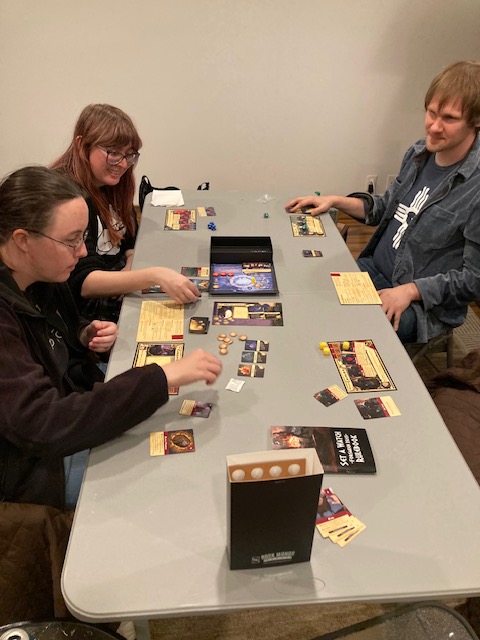
5. Luddite

lud1

Platform: Kickstarter Luddite
Promised Delivery: Dec 2024
Description:Luddite is a roll and write style game with a fully integrated graphic novel. In Luddite, one to an unlimited number of players will progress along the story of the novel whilst competing to destroy ever more complex automata. Creating a full campaign style game.

As a Luddite you will be hacking into the neural networks of the NED automata. These bionic, dog-like creatures are capable of performing almost any complex task to which they are assigned and, as such, have begun to replace vast swathes of the human population. As a Luddite, you will work to destroy these infernal machines.

lud2

This cooperative roll-and-write campaign looks interesting, but what makes it stand out is the graphic novel that comes with it! I am really looking forward to seeing what this one does! One fun fact: Luddite (which basically means a type of person adverse to technology) can be delivered electronically! As a true luddite, I got the physical version. 🙂

4. Once Upon a Line: The Butterfly’s Breath

bb1

Platform: Kickstarter Once Upon a Line – The Butterfly’s Breath
Promised Delivery: May 2024
Description: Once Upon a Line is a narrative game played out in chapters. Embody heroes and use their actions to play on a board of scratch off ink. Uncover hidden words and take their corresponding cards. This will reveal the next part of the story as well as new words to find in order to accomplish your mission.

  • Fully immerse yourself in a personalized adventure.
  • Elude traps (riddles, anagrams, palindromes, etc.).
  • Complete your Quest before scratching off the last square on the Line of Tragedy.

bb2

This is strange one: it’s a word game, in a campaign! The main hook is that letters are “scratched off” the sheets (so they are one-time use). There’s some discussion about how the arrows direct your progress, but this just sounds like a fun cooperative campaign!

3. Leviathan Wilds

lw1

Platform: Kickstarter Leviathan Wilds
Promised Delivery: Feb 2024
Description: Long ago, the once-gentle leviathans lost their minds and tore the world apart. After generations of hiding and struggle, humanity discovered that the frenzied leviathans can be restored. Climbers willing to take the risk must explore the wilds and work together to remove a series of binding crystals to heal the leviathans roaming the world.

In Leviathan Wilds, 1-4 players will confront these colossal beings, with each creature being depicted across the spread of a spiral-bound storybook that makes up the game’s board. The book also forms the basis of a connected campaign mode built around the game’s story, with each of twenty included scenarios estimated to last around 45 minutes. Tougher difficulty levels are also available for added replayability.

lw2

This basically looks like Shadow of The Colossus, the board game! Players climb on the creature of interest, doing damage sort of like that old PS2 game Shadow Of The Collossus! This looks really different and interesting.  It had a relatively small Kickstarter (after trying a second time and succeeding), which is unexpected given the design pedigree of this game: Justin Kemppainen, (who worked at FFG and Z-Man for years)! I am expecting this to be great!

2. Marvel Dice Throne: X-Men and Co-op Missions

mdt1

Platform: Kickstarter Dice Throne | X-Men • Marvel Missions Co-op • Deadpool
Promised Delivery: Aug 2024
Description: In Marvel Dice Throne: X-Men, you become one of eight of Marvel’s iconic X-Men, including Wolverine, Storm, Cyclops, Rogue, Gambit, Psylocke, Iceman, and Jean Grey!

Every Marvel Dice Throne hero is painstakingly designed and balanced to provide the most thematic experience possible, allowing you to truly embody your favorite heroes like no other game. Featuring all-new mechanisms and asymmetrical designs, these are some of our most innovative and exciting heroes yet!

Marvel Dice Throne: X-Men is a heart-pumping, fast-playing game of skilled card play and dice manipulation supporting multiple modes of play, including 1v1, 2v2, 3v3, 2v2v2, or free-for-all.

mdt2

We have played Dice Throne (see here), Dice Throne Adventures (see here), and Marvel Dice Throne with Dice Throne Adventures (see here) We really do like this simple, yahtzee-esque combat system! It’s so cool to be able to get X-Men in the Marvel Dice Throne universe, but what I am looking forward to the most is the Dice Throne Missions! This will make it easier to play Dice Throne X-Men/Marvel cooperatively! We love the Dice Throne Adventures, but it requires a little more of a commitment to the campaign: The Dice Throne Missions promises single cooperative scenarios! The quality of the Dice Throne has been phenomenal, so we are really looking forward to this! That’s why it’s #2 on this list!

1. Marvel United: Multiverse

mmm1

Platform: Kickstarter Marvel United: Multiverse
Promised Delivery: March 2024
Description: In Marvel United: Multiverse, you take the role of iconic Marvel Heroes cooperating to stop the master plan of a powerful Villain controlled by the game. Each Villain unveils their unique master plan, with cards that trigger different effects, and threats that pose challenges across the locations. Heroes must choose carefully the cards to play from their unique decks, that not only offer different actions and superpowers to use, but also combine with the actions of other Heroes to do the impossible. Build your storyline, unite your powers, save the day!

mmm2

It’s hard to separate just the one Marvel United: Multiverse game from this kickstarter! There’s so much content coming from this Kickstarter!! Galactus: Herald Expansion, The Wrecking Crew, and so much more! The Omniverse pledge has: Marvel United: Multiverse, Exclusive Wrecking Crew Villain Team, The Coming of Galactus Expansion+19 More
And this doesn’t include the stretch goals! I came into Marvel United later, but I have absolutely loved it! See our review of Marvel United (Parts I and II), Marvel United: X-Men (Parts I and II), Days of Future Past (see here), Fantastic Four (see here), and First Class (see here) ! In fact, Marvel United: Days of Future Past was so good, it made the #1 spot on our Top 10 Cooperative Expansions of 2022! I can’t wait to see all the stuff that comes with this! The king-sized Galactus is probably my most anticipated component!

Top 10 Cooperative Board and Card Games of 2023!

IMG_8881

Happy New Year! We finish writing this list on December 31, 2023 and reflect on what a great year it has been for cooperative games! This list is a culmination of the very full year of 2023 playing cooperative game with our friends!

IMG_8873

We played about 52 brand new cooperative games over the past year! Whew! There were even more solo and cooperative and expansions in there! This year was an especially good year for expansions and solo games, so if you are surprised a game didn’t make this Top 10 Cooperative Games of 2023 this year, make sure you check out our Top 10 Cooperative Solo Board and Card Games of 2023 or our Top 10 Cooperative Expansions of 2023 to see if it maybe made one of those lists!

IMG_8880

As we reflect back on the New Year, we remind everyone that we don’t take any money or promotions or advertising of any kind here at Co-op Gestalt: we buy all the games here with our own money! All of our opinions are our own! You may not like our opinions, but at least you know they are our own. We love cooperative games and just want to share those gestalt experiences with everyone!

Honorable Mention: Kinfire Chronicles

IMG_9118

Plays Solo:  Yes (but you have to play two characters, and it’s better cooperative)
Player Count: 1 to 4
Ages: 14+
Length: 45-60 minutes per chapter, 20+ chapters 

IMG_9091

Kinfire Chronicles is a wonderful game, of which I played far too little. It works okay as a solo game, but you must play two characters to play.  Some of the mechanisms (the Boost idea in particular) work better in a cooperative game, and I think this game is really meant to be played with you and your friends going through a bit of a dungeon crawl.

IMG_9069

The best thing about this Dungeon Crawler is how quickly you can learn the rules.  Games like Gloomhaven have 56 page rulebooks; in this dungeon crawler, the rules come out piecemeal, making it easy for everyone to learn as you go.

IMG_9112

The reason this makes the Honorable Mention is simple: we didn’t get to play nearly enough of this!  It’s got a long campaign, and my friends were tired of campaigns … even though this one is easy to get into.  What we did see what great: we look forward to playing more!  Given what we’ve seen, this may well shoot to the top of the charts the more we play!

IMG_9010

One of my favorite parts of this game were the acrylic standees from the Upgrade Kit! See above!  If you find yourself drawn to this game, I think I would strongly suggest getting the Upgrade Kit for the standees and some other amazing upgrades!

Take a look at our review of Kinfire Chronicles here to see if this is a game you and your friends might really enjoy!

10. The Lord of the Rings Adventure Book Game

IMG_6262

Plays Solo:  Yes (but you have to play a phantom hand)
Player Count: 1 to 4
Ages: 10+
Length: 20 minutes per chapter, 8 chapters total

IMG_6302

This game is part of the Adventure Book Series of games, which is a system on which can play different Intellectual Properties. We saw the first one of these games with The Princess Bride Adventure Book Game and really liked that (see here)! This new one, based on Lord of the Rings, is probably the best evolution of this system! It’s a light (ish) campaign in the world of Lord of the Rings!

IMG_6416

My solo play was quite fun, but my cooperative play with Sara was one of my favorite experiences of the year! Players work together to make decisions and control the fate of the entire party (not just one character)! Every chapter has many tense decisions! The best part of this system is that rings are fantastic wild cards, but each use of a ring causes corruption for the entire campaign! So, all throughout the game, you are have to decide: “Do I use the ring to progress but take the corruption?”

IMG_6383

Many of my friends have bought and played and loved this game too: it’s been quite the hit in my gaming circles. The simplicity and the theme both just shine through!

See our review of the Lord Of The Rings Adventure Book Game here to see if this is something you might like!

9. Deep Rock Galactic

IMG_5436

Plays Solo:  Yes (either the solo player alternates between two dwarves or plays a single dwarf with the BOSCO robot)
Player Count: 1 to 4
Ages: 12+
Length: 60-150 minutes (it really depends on the mission you go on)

IMG_5535

Deep Rock Galactic was okay to pretty good in our first few sessions, but it seemed to get better the more we played it! This was mostly due to the documentation: when this first came out, the rules that came with the game weren’t “quite” enough to play through. But, as the game became more mainstream, you could get updated rules, questions answered, and just more documentation. Once you had that, the game became a lot more fun because the rules were better/understandable!

IMG_5546

This minis are great! And even if this game is a little uneven and random, it’s still fun romp in this universe with dwarves blasting monsters and caverns! If the theme speaks to you, or if you know the video game well, I think you will enjoy this game that much more!

IMG_5559

Deep Rock Galactic was also a suprising hit at RichieCon 2023 this year!  It’s surprising because it’s a big and daunting game, but the fans of the video game seemed really interested in this game!

Take a look at our review here of Deep Rock Galactic The Board Game to see if this is something you might enjoy!

8. Marvel D.A.G.G.E.R. (or Marvel DAGGER)

IMG_1786

Plays Solo:  Yes (the solo player alternates between two heroes)
Player Count: 1 to 5 (but best at lower player counts)
Ages: 12+
Length: 3-4 hours (yep, you read that right)

IMG_1813

In this game, each player plays a Marvel super-hero working in a team! Players travel the world together to take out the bad guy! This is all about playing a super-hero team banding together to save the world! This is an action point game, as each player gets a certain number of actions each turn to move, attack, and do good!

IMG_1814

Each player plays a hero of their choice, but since there is some randomness in the game (dice get rolled for combat), it is possible to get destroyed early on. To combat that randomness, each player really plays a Hero Pair: the other side of the hero card becomes a hero you assume if the first hero dies! This is a really nice way to allow players to keep playing without complete hero elimination!

IMG_1805

This is a real long game (3-4 hours), and the turns can be very long; it’s probably better at lower player counts. 

IMG_1825

I have been told Marvel DAGGER is basically Eldritch Horror rethemed to a Marvel game, but having never played Eldritch Horror, I have no means of comparison! I just know that I had fun playing, and it’s a fun (if long) Marvel game! Just be aware of what you are getting into if you want to try it out! Avengers Assemble!

7. Doomensions: A Pop-Up Mystery Manor

IMG_1441

Plays Solo:  Yes (but like most escape room games, it’s better with more brains)
Player Count: 1 to 4 (we were also able to play with 5)
Ages: 14+
Length: 10-15 hours, 90 – 120 minutes per chapter, 5 chapters total (including finale)

IMG_1491

This is a cooperative escape room with a pop-up manor! It is so cool looking when you see it all set up: see the picture above!

IMG_1696

The game plays over 4 chapters (5 if you count the finale), and each chapter takes about 90 to 120 minutes to play.  This is a quite a commitment: we ended up playing over a month at a rate of about 2 chapters per session.

IMG_1465

The components are absolutely amazing, probably one of the best productions of the year!  But of course, the centerpiece of the game is a pop-up manor: See below.  Just be aware that, even though the cover looks kinda “kid-like”, this is absolutely a game for adults because of the complexity and subject matter.

IMG_1493

Take a look at our review of Doomensions: Pop-Up Mystery Manor here to see if this is something you might enjoy!

6. Valor and Villainy: Lludwick’s Labyrinth

IMG_7519

Plays Solo:  Yes (the solo player alternates between two heroes)
Player Count: 1 to 6
Ages: 14+
Length: 25 minutes per player (but really more like 50 minutes per player)

IMG_7587

Lludwick’s Labyrinth went over really well for our group! This is a standalone cooperative dungeon crawler game in the Valor and Villainy universe where players pursue a campaign to save the pizza maker (I kid you not!).  This game has a sense of humor with its art and presentation that I really appreciate.  

IMG_7522

This is a dungeon crawler with dice, but it has lots of cooperation and good decisions! It also has probably the best tutorial I have ever seen in a board game!  That first tutorial game makes it clear what you can and cannot do during a game!

IMG_7557

In the end, it might be a little long and a little complex, but it was a fun romp!  We even were able to bring in a 5th player a few times, so even though it was a campaign, it was easy to add/subtract people!

Take a look at our review of Lludwick’s Labyrinth to see if this is something you might like!

5. Suspects: Eternal Detective Claire Harper and Adele & Neville, Investigative Reporters

IMG_1872

Plays Solo:  Yes (and plays solo well)
Player Count: 1 to 6
Ages: 10+
Length: 90 minutes per mystery, 3 per box

This is actually a two-way tie, belying the weird release schedules of some games worldwide.  These are both two games in the same series of the Suspects Murder Mystery games (and would fit well on our Top 10 Cooperative Detective Games).  We reviewed the original orange box version of Suspects: Claire Harper Takes The Stage here back in 2022 and came to love it! That game made the #4 position of our Top 10 Cooperative Games of 2022!  These new Suspects games are just more detective games in that same series!  They all present mysteries in a pack of about 54 oversized cards (where each box comes with 3 mysteries)!

IMG_0609

Suspects: Eternal Detective Claire Harper was officially released in 2022 (if you believe BGG), but it wasn’t available in the USA until late 2023, so I count it as a 2023 game.  We loved this game: see our review of Suspects: Eternal Detective Claire Harper here to see if you would like this version!  This is just more mysteries in the world of Claire Harper like the original Suspects!

IMG_1873

Suspects: Adele & Neville, Investigative Reporters official release was 2023, so it can qualify for this list! In fact, we received both Suspects copies at the same time! We haven’t officially reviewed the Adele & Neville version, but we have played it and loved it almost as much as the original Suspects games!  This still feels like the same world, but instead of playing Claire Harper (who loves Agatha Christie), you play as reporters Adele and Neville (who feel very much like Tommy and Tuppence from the Agatha Christie novels) solving crimes!

IMG_1874

All the Suspects boxes have 3 mysteries, wherein the mysteries is all on cards!  These are fantastic mysteries that make you feel like an investigator in this world!

I liked the Suspects series solo so much that the Suspects: Eternal Detective Claire Harper made the #1 spot on the Top 10 Solo Board and Card Games of 2023!

4. Freelancers

IMG_9823

Plays Solo:  Officially from the box, no, but the website (where you run the app) has official rules for solo.
Player Count: 3 to 7 (1 or 2 player rules on the website)
Ages: 14+ (in NSFW mode, it’s probably a 18+)
Length: 90+ minutes

IMG_9861

Freelancers is the next great game in the Crossroads line, the most recent being Forgotten Waters!  Forgotten Waters was such a great game, it made many of our Top 10 lists: Top 10 Cooperative Games of 2020, Top 10 Cooperative Swashbuckling Games, and Top 10 Cooperative Storybook/Storytelling Games!  Freelancers is the next evolution of this system: it’s a cooperative, funny, storybook game in the a wacky post-apocalyptic universe!
IMG_9895

Both Forgotten Waters and Freelancers require an App (actually, a website you visit): the story is contained on the website! There’s plenty of interactions and lots of great writing and voice acting! This universe really comes alive and makes you laugh! This game is so much fun!
IMG_9896

One of the many great things about this game is that there are bunch of positions that need to be crewed, so everyone always stays involved! And the game works well, maybe even better, at higher player counts! We played a 5-Player game and it just worked so well!

IMG_9885

My first game session of Freelancers was one of my favorite gaming moments of the year: it was so much fun, and so easy to get into, and everyone was involved the whole time! This was a great game! The story is great! The voice-acting is great! The App is great!

Take a look at our review of Freelancers to see if this is something you might enjoy!

3. Race To The Raft

IMG_8571

Plays Solo:  Yes (slight mods to rules)
Player Count: 1 to 4
Ages: 8+ 
Length: Anywhere from 40-60 minutes

IMG_8766

Race To The Raft could have easily been the #1 spot on our list!  Honestly, it only ended at #3 because the components are slightly better for #2 and #1!  And the components for this game were great! 

IMG_8752

This cooperative tile-laying game is a puzzle-solvers dream!  Players have to figure out how collectively to move a group of cats to the raft!  Every tile you place has so many choices: which stack do you draw from? What orientation do you use? Where on the map?  Do I move my cat? Where do I put the fire tiles?  Everything you do is a choice: if you get hoisted by your own petard, it feels like your own fault!

IMG_8735

This game was quite a hit at RichieCon 2023!  Even if players didn’t love cats or the theme, this game still went over quite well!  And people who loved cats were fighting to play this!  This game has just gone over like gangbusters in my play groups!  This cooperative tile-laying game should have  took the #1 spot on our Top 10 Cooperative Tile Laying/Placement Games!

Take a look at our review of Race To The Raft!

2. Tesseract

IMG_9927

Plays Solo:  Yes (solo players operates two characters)
Player Count: 1 to 4
Ages: 14+ 
Length: 60 minutes

IMG_9941

Tesseract is a cooperative cube game that was #1 on our Top 10 Anticipated Cooperative Games of 2023! Players cooperatively deconstruct a cube, pulling dice off of it!

IMG_9963

And the plastic cubes that come with this game are just some of the amazing components that come with this game! There’s a lazy susan for spinning the cube and optional metal dice!

IMG_0014 (1)

The toy factor is quite high in this game, especially with the metal dice, but my friends and I had a blast playing this! The components are amazing (especially the metal dice)!

IMG_0012 (1)

With all the emphasis on the components, it’s good to note we also really enjoyed the cooperative game, pulling dice off the cube to save the universe from imploding! This is a fun game with a major toy factor issue to reel you in!

Take a look at our review of Tesseract to see if this is something you might enjoy!

1. The Arkham Asylum Files: Panic in Gotham City

IMG_8411

Plays Solo:  Yes (but you really want more than 1 player: like most Escape Room gams, more brains is better!)
Player Count: 1 to 6
Ages: 13+ 
Length: 5-6 Hours totals, “about” 50 minutes per chapter (for 7 chapters)

IMG_8495

When you look at the components of #2, you might what wonder “How could #1 have better components than metal dice?” You do when you get an augmented reality escape room in the Batman universe!

IMG_20230705_190207463

This is a weird one: you set up some really great components, but still look at the city through your augmented reality app! As you stare at the city through the app, things appears and disappear! It hard to describe how cool this experience was!

IMG_8425

This is an escape room game: players cooperative solve puzzles in the Gotham City universe. This universe lives physically on the table and virtually in your app! In between the escape room puzzles, the augmented reality, and the really cool components that came in the game (besides the augmented reality), this was my favorite experience of the year!

IMG_8499

The game is campaign game over 7 chapters, which we ended up doing in 3 separate sessions. After I was done, I packed it back up and gave to Charlie and Allison (my escape room buddies) so they could play it! (Charlie and Allison just gave it back to me the other night, saying they had a great time playing it!)

This cooperative escape room with augmented reality was easily my favorite experience of the year! Take a look our experience with the game in our review of The Arkham Asylum Files: Panic in Gotham City!