
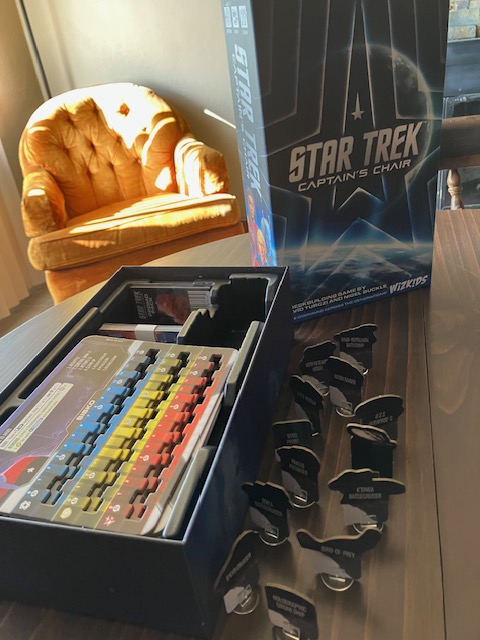
Star Trek: Captain’s Chair is a solo and 2-Player head-to-head game in the Star Trek universe (from publisher Wizkids). I bought my copy online sometime in early 2025 (I don’t even remember when; March? April?), but the game was so daunting that I was scared to open it up.
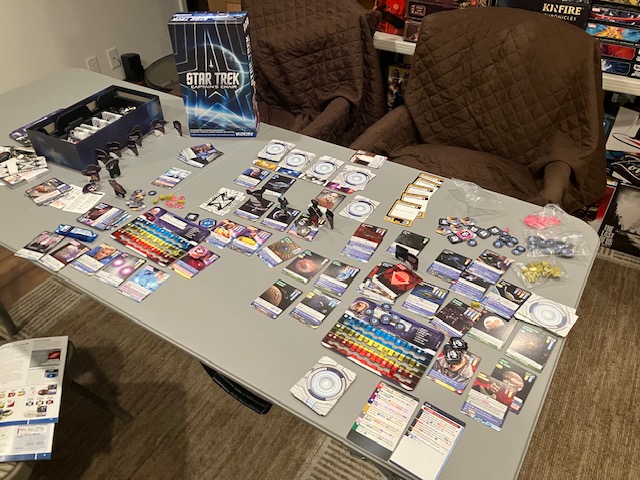
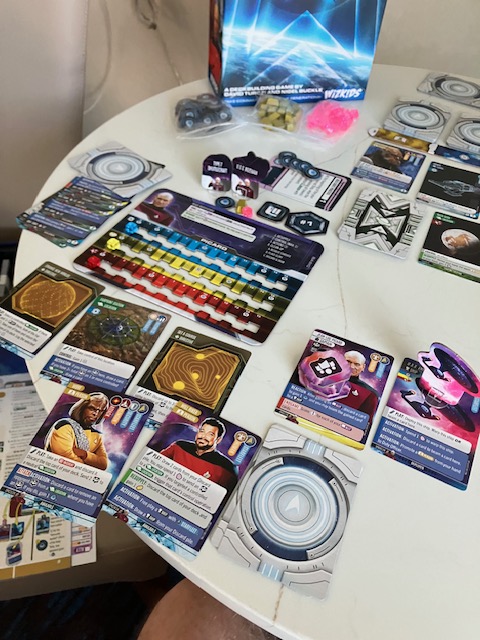
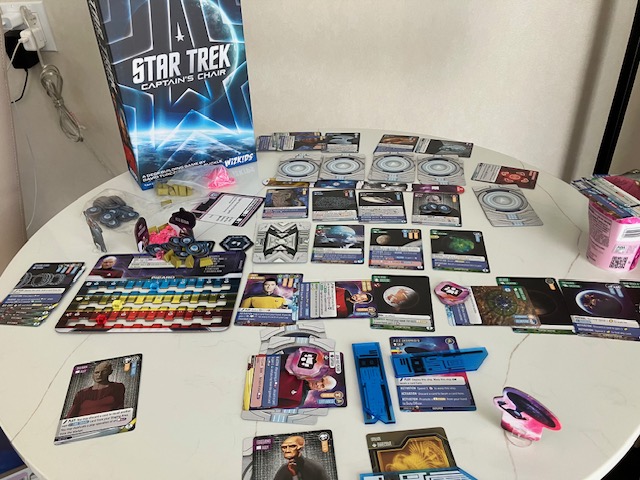
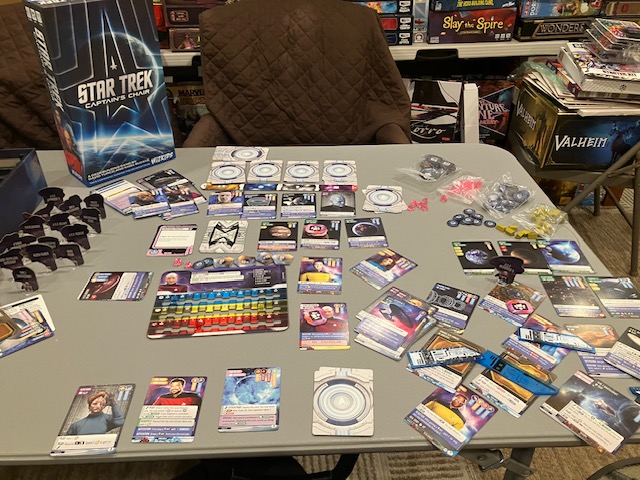
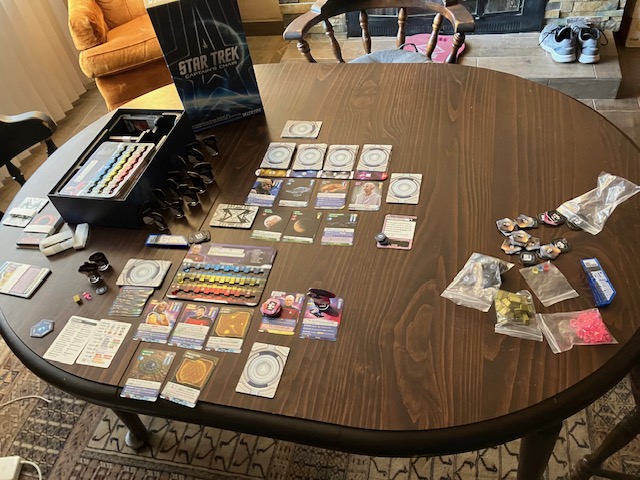
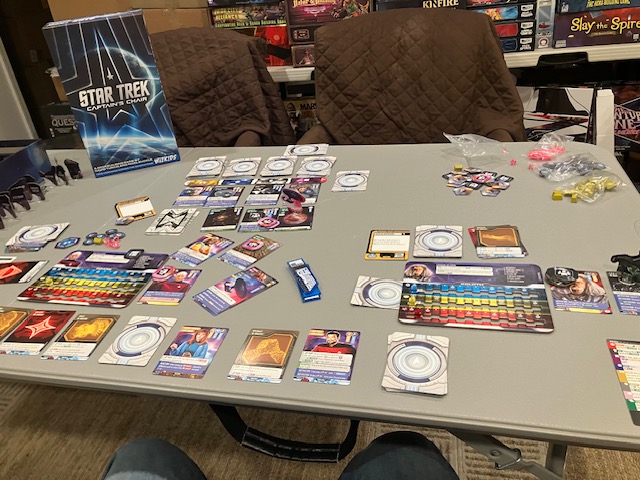
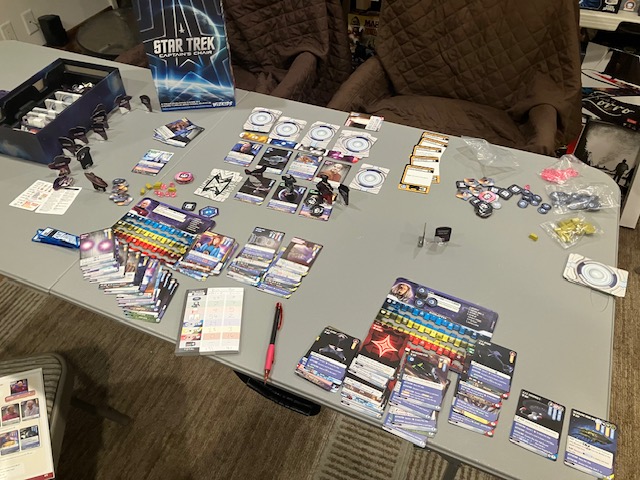
Look above to see a full solo game set-up! Gulp!
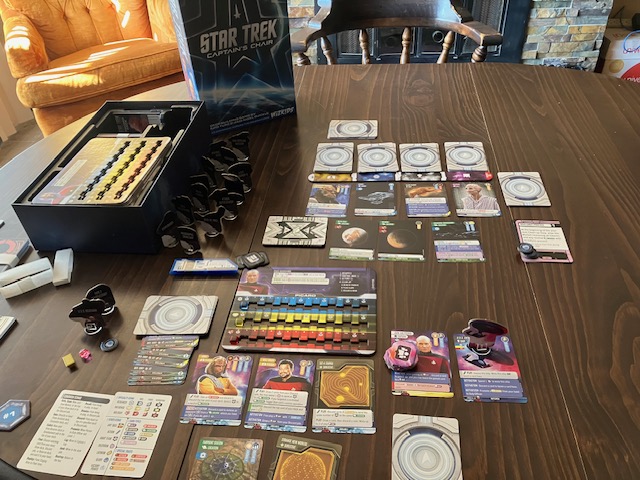
I literally spent almost a year learning this game! See above as I JUST set-up the game, to get a sense of it! I ran out of time, so I had to tear it down before I even played it! In fact, I think I set-up the game at least three times before I actually played it!
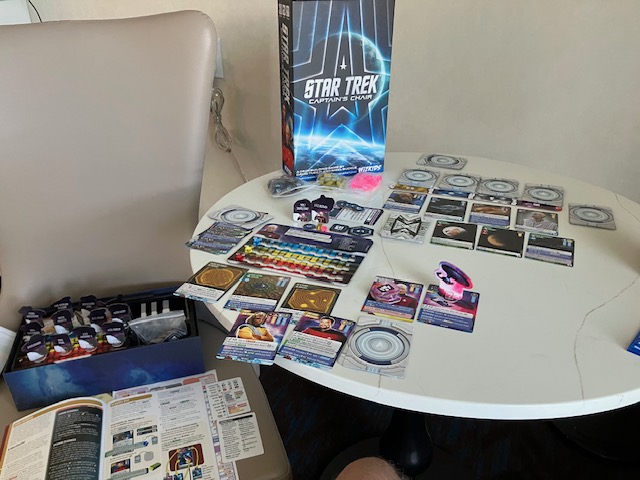
What is this thing and why is it so daunting? To call it JUST a deck-building game with Victory Points seems to do the game an injustice, but at its core, it really is a deck-building game; if you get the highest score you “win”.
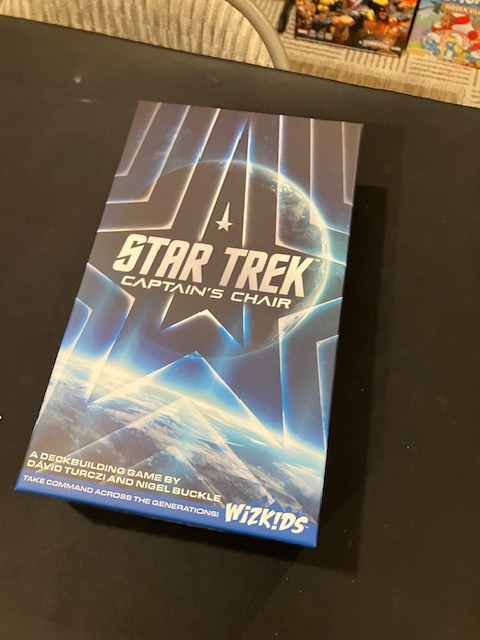
Let’s take a closer look.
Unboxing and Gameplay
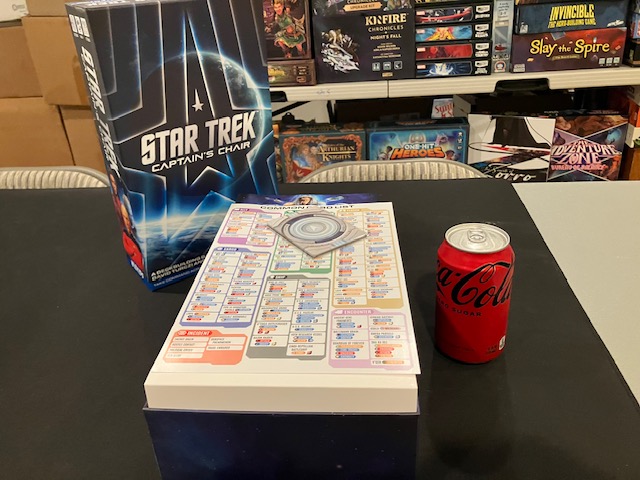
The Captain’s Chair is about a half-sized box. See can of Coke above for scale.
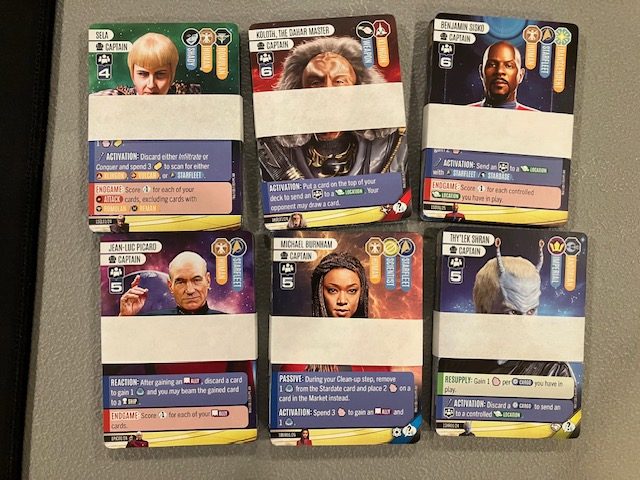
Each player takes the role of one of six Captains from Star Trek: see the Captains above. And NO Captain Kirk is not in this set; you have to get one of the Expansions (due out sometime in Q4 last time I looked).
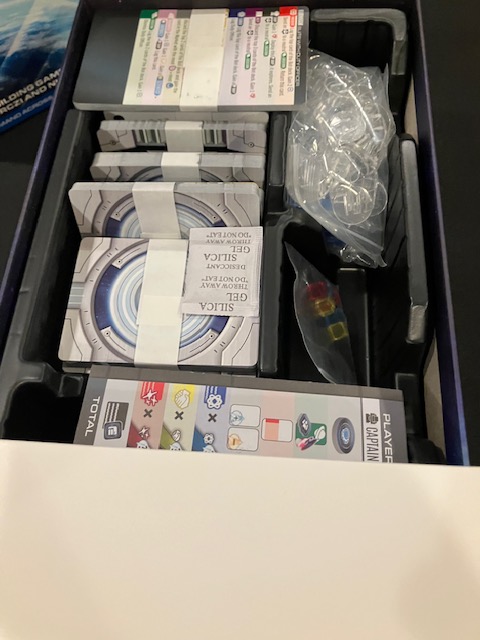
The Captains each have their own little deck hubby hole in the box. See above.
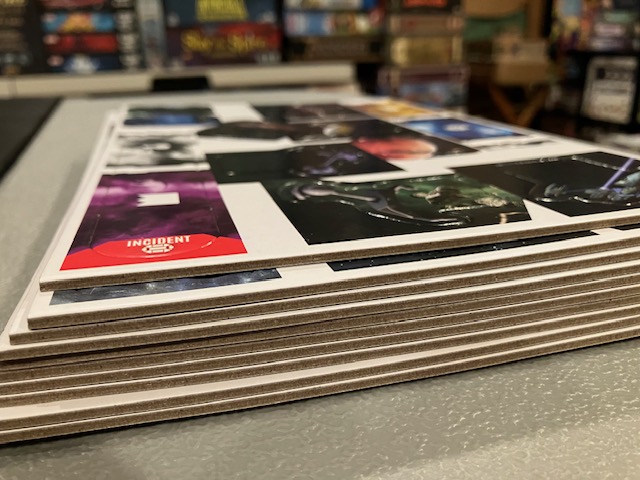
There is a metric ton of cardboard in this box.
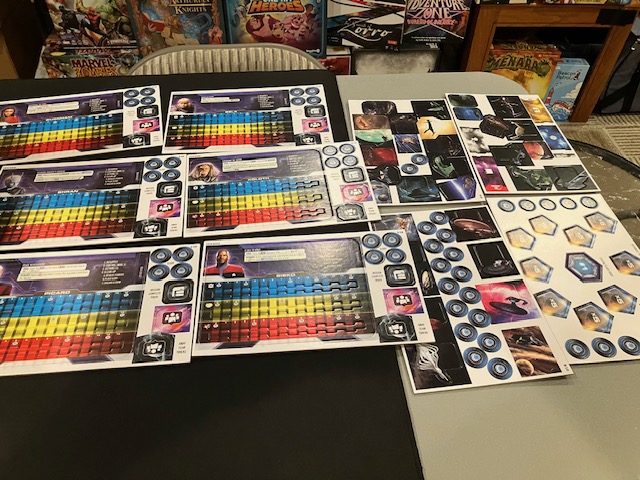
Most of the cardboard is is tokens and the 6 player boards for the 6 captains. See above.
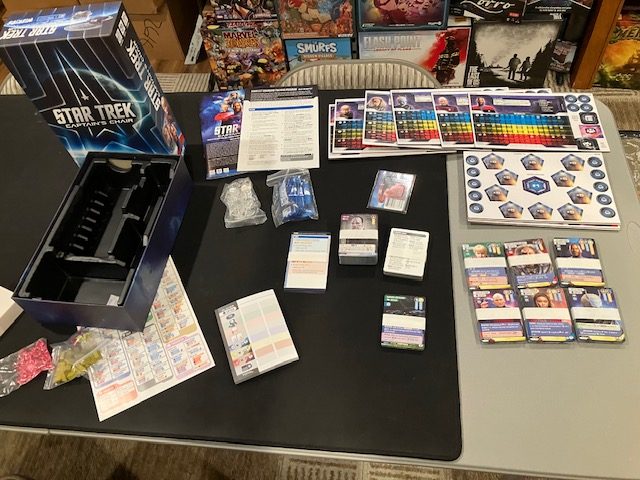
To be fair, I think you WILL have to throw away the Punchout Skeletons to fit everything in the box (what are Punchout Skeletons? See here). It hurt me a little to throw these away, but the game just barely fits in the box, and all the Punchout Skeletons do is puff up the box. So, you will have to throw away them … see a video of me doing it here …
https://www.youtube.com/live/aMSZ3QDeQYM?si=4z8aaQzBlCOyjh8V&t=1073
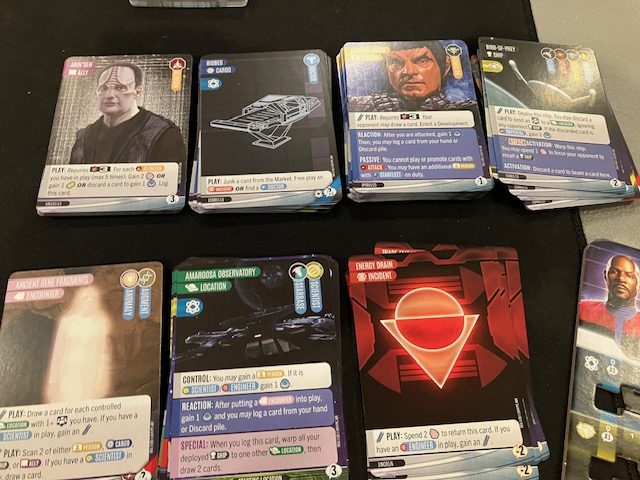
Like I said, this is, at its core, a deck-building game. So, you have all sorts of cards that you can buy/accumulate into your deck! See above all the Common cards: Allies, Cargo, Persons, Ships, Incidents, Locations, and Encounters! These are “generally” the plain cards you will acquire to build your deck.
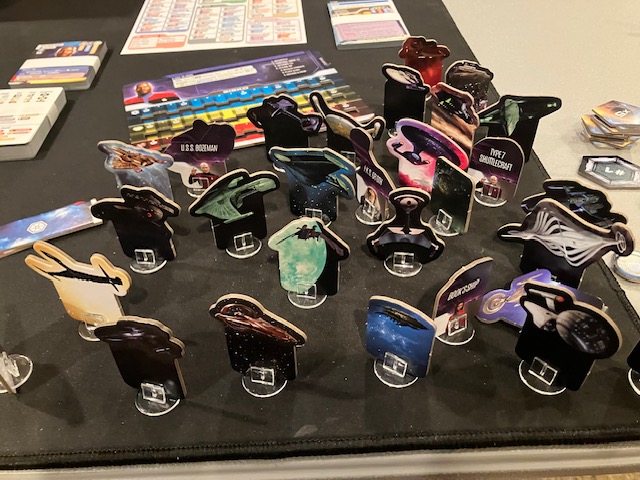
But there are lot more very thematic rules than just “build a deck!!” You can acquire ships, and warp them around!
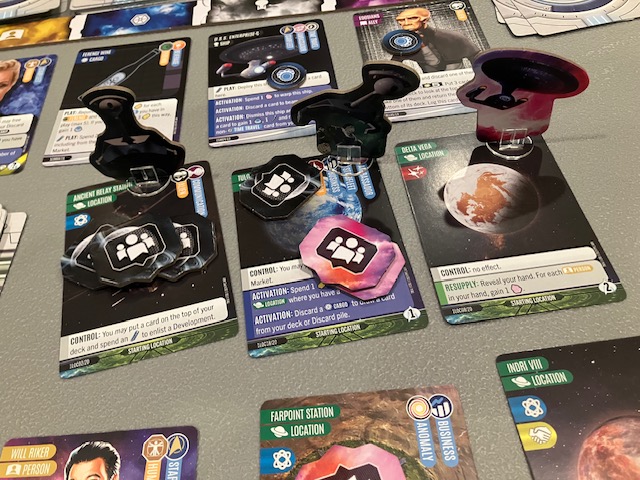
Very thematically, you take control of a Location if you have enough landing parties and/or ships there!
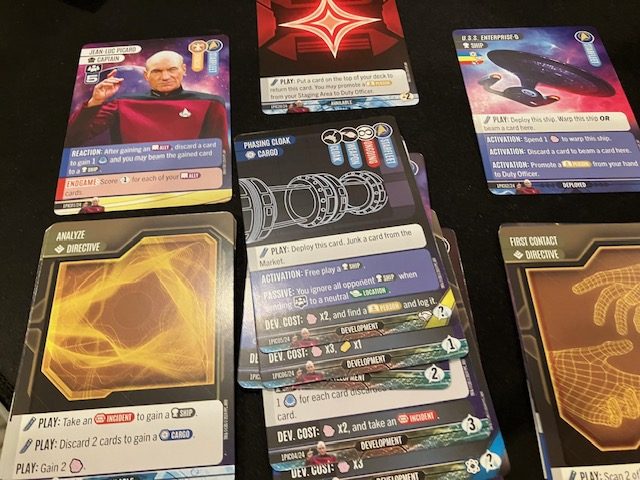
Each Captain has their own very special deck of cards, which only THEY may use! These cards in the Captain’s deck represents their “style”. So, even though a Captain can buy/acquire Common cards, a Captain’s deck is a thing unto itself; it slowly unveils itself. The Captain’s deck (see above) start with Available cards, slowly adds Reserve cards (as the deck cycles), then you can develop Development cards as you see fit!
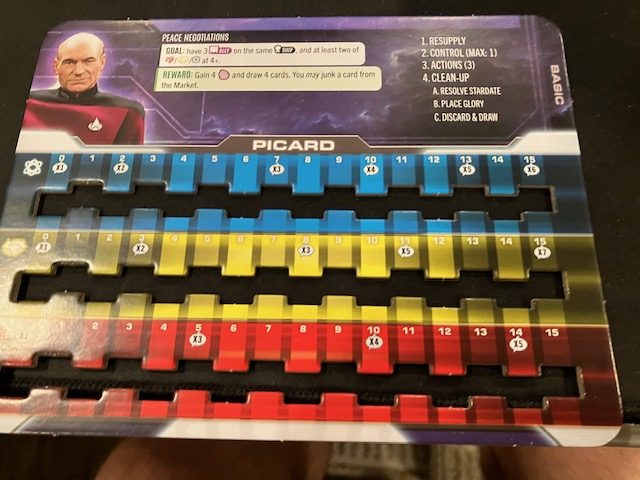
Captain Picard, for example, is all about getting Allies! His Mission (each captain has a base mission which shapes his play-style) is to beam 3 Allies onto a ship! See above.
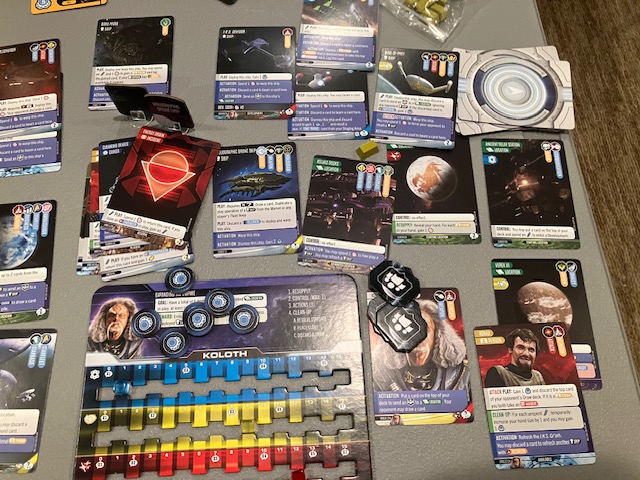
Koloth the Klingon has a very different play-style; he is all about getting Ships into play and controlling planets!
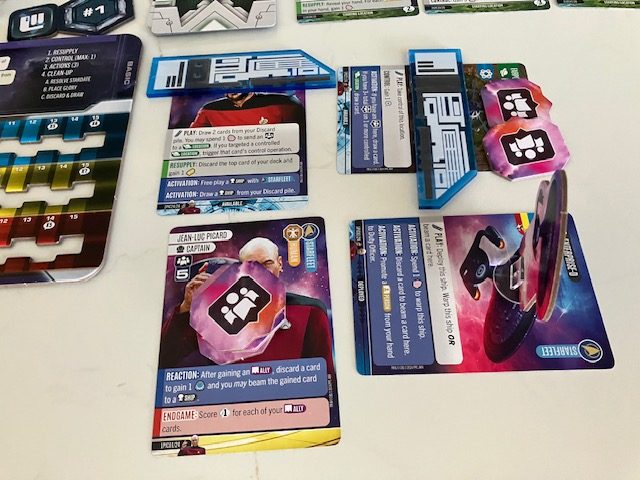
The game also has the notion of the Duty Officer; if you play one, it will allow you some extra activities.
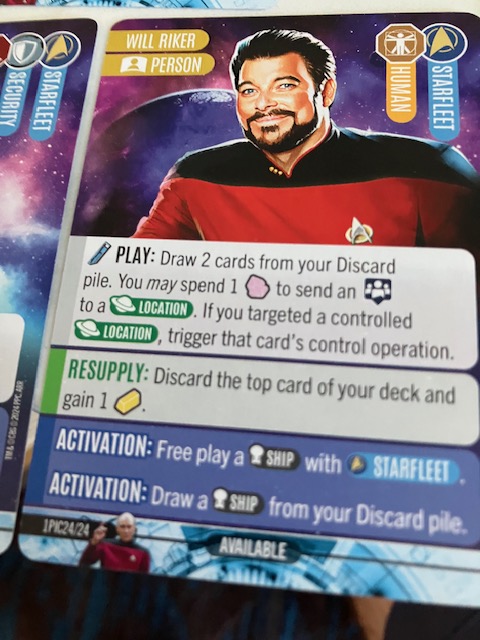
For example (see above), if Ryker is your Duty Officer, he can use one of his Activations (as well as his Play if needed). There is this notion of “deploy” which allows you to put ships, duty personnel, and other things into play so you get that extra Activation possibility on your turn!
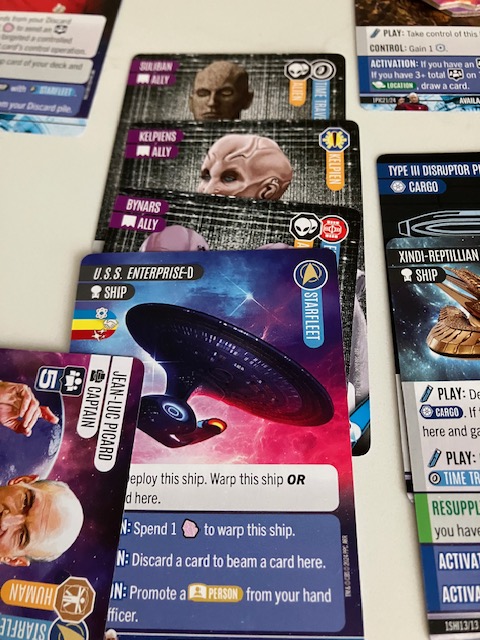
If you deploy the Enterprise-D above, you can use it’s Activations! (Right now, Picard is fulfilling his Mission of getting 3 Allies beamed aboard!)
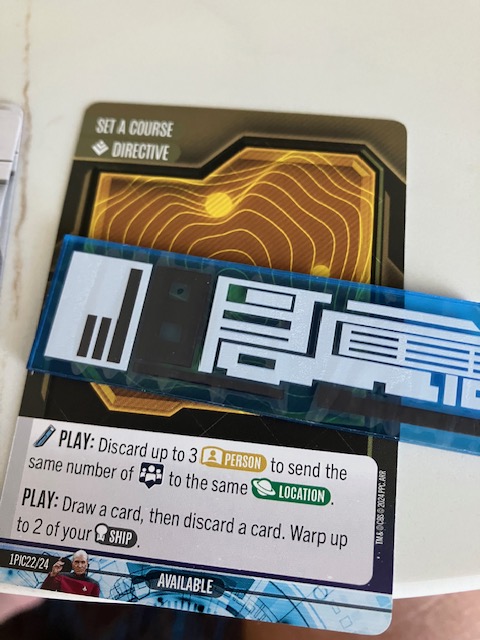
There’s also an interesting notion of “play”. For example, the Set A Course card above has two choices for how to play; you can either use one of your 3 Actions (represented by the blue isolinear chips) to play for the “major” action, or you can just play the card as-is for the lesser play ability (but it doesn’t take one of your 3 Actions).
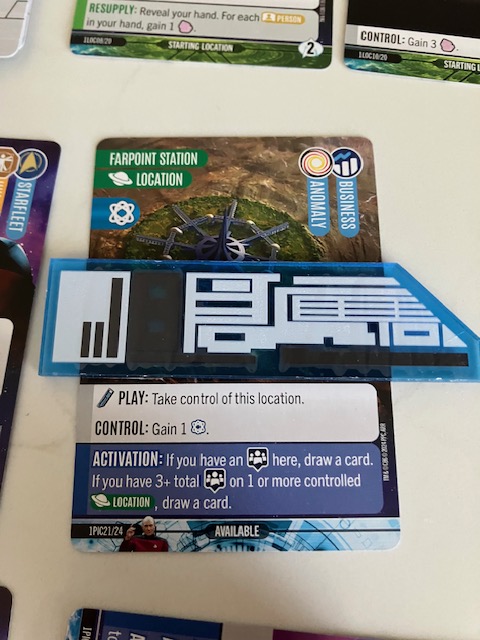
You can take Control of Locations (see above).
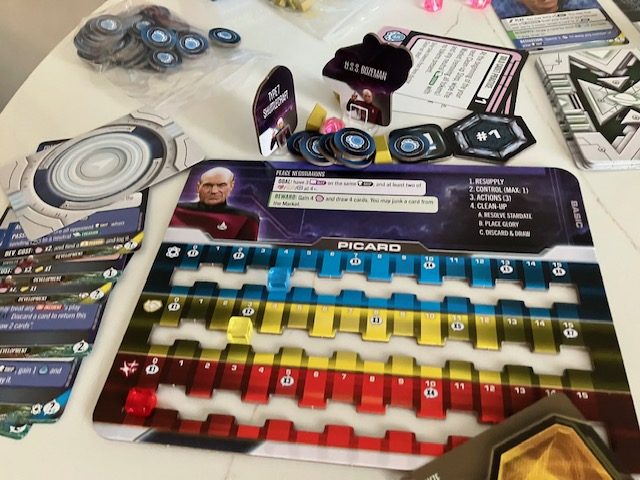
As you play, you need to advance your Specialty tracks. There’s many ways to advance your Specialty track as you play (it’s all on the cards), but the higher the Tracks are, the bigger the multiples for end-scoring. See above as Picard has advanced Research (blue) to space 4 (for a multiply of x2), Influence (yellow) to space 3 (for a multiple of x2), and Military to space 0 (for just x1).
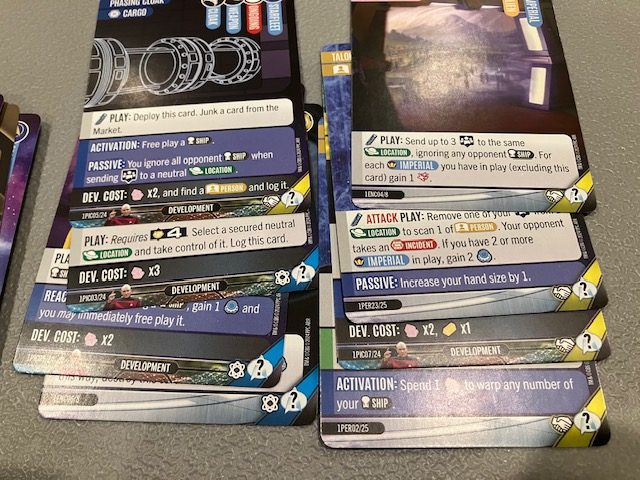
At the end of the game, you look at the bottom right of the cards and they will get you victory points! Right now, Picard would get 3 cards times 2 =6 Victory Points for the Research, and 5 cards times 2=10 Victory Points for Influence.
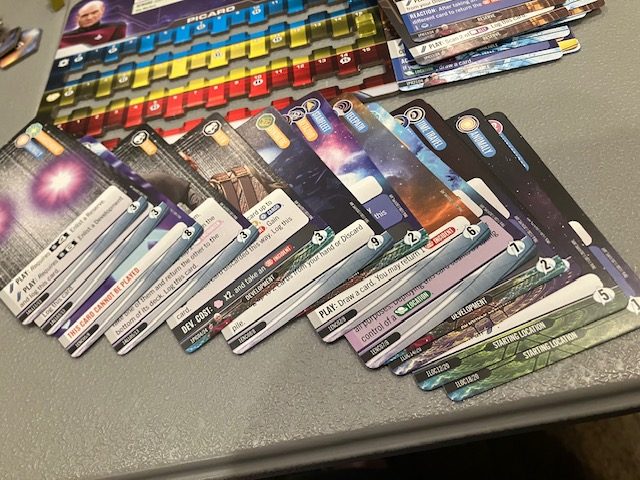
Of course, some cards just give straight Victory Points. See above.
Whosoever has the most Victory Points wins!
The gameflow is controlled by the 27 Stardate cards (see above). Depending on what mode you play (solo easy, solo hard, 2-Player), these cards control how the game unfurls. They usually just act as a timer (you put Victory Points on the card and when the Victory Points run out, you move to the next cards until the game is over), but they also keep the game flowing by wiping the market occasionally and wiping the Neutral Zone of uninteresting planets.
Over the course of the game, your Captain will warp ships, launch away parties, try to take control of Locations in the Neutral Zone, acquire Tech or Allies or People or Ships or Encounters to meet their Missions in an ultimate attempt to get the most Glory (what we have been calling Victory Points)!
Honestly, there are still plenty of subsystems and rules we didn’t talk about; there is so much to this game! There is alternate way to lose via a “Burn” if you get too many incidents, there are special Encounters which feel like cool Star Trek vignettes, and many other cool things that if you know Star Trek, you’ll say “That’s very Thematic!”
Rulebook
This is one of the best rulebooks I have read in a while.
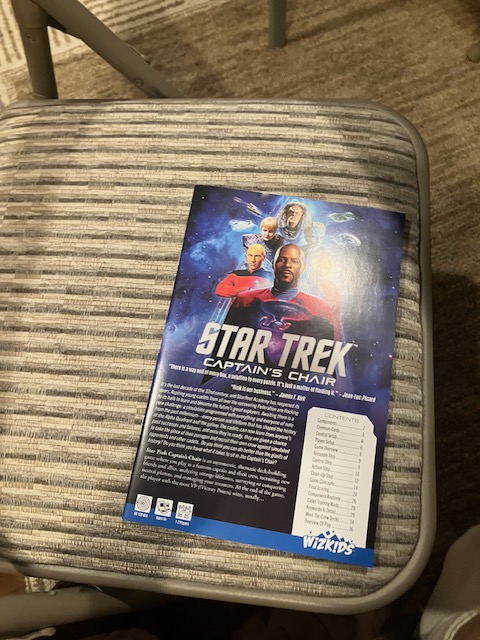
First of all, the rulebook gets an A on the Chair Test!
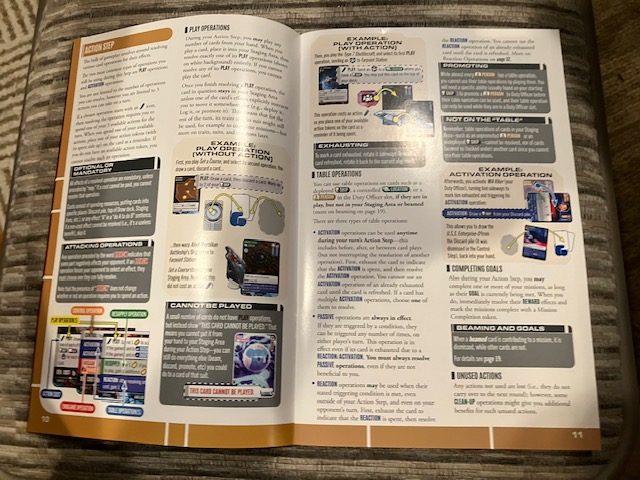
The rulebook opens up, stays flat, and is easy to consult. The Font is very readable, but they somehow mix the thematic font of Star Trek for headings with a readable font for rule text, and it works. There’s tons of pictures scattered in with the text, there’s tons of examples! The rulebook also uses color and italics well! Seriously, maybe this is an A+ on the Chair test!
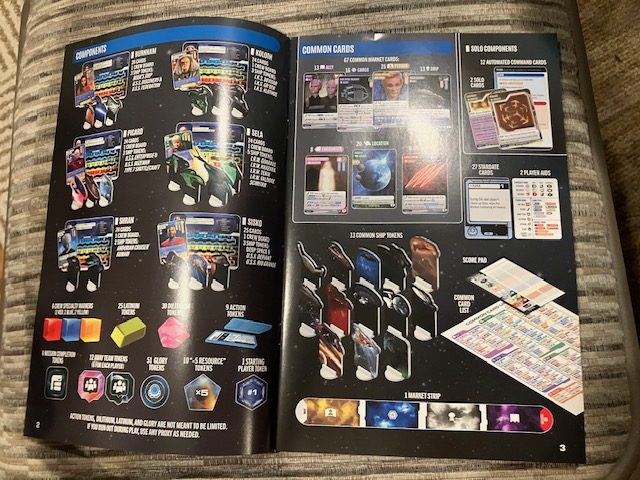
The Components pages are great; pictures are notated.
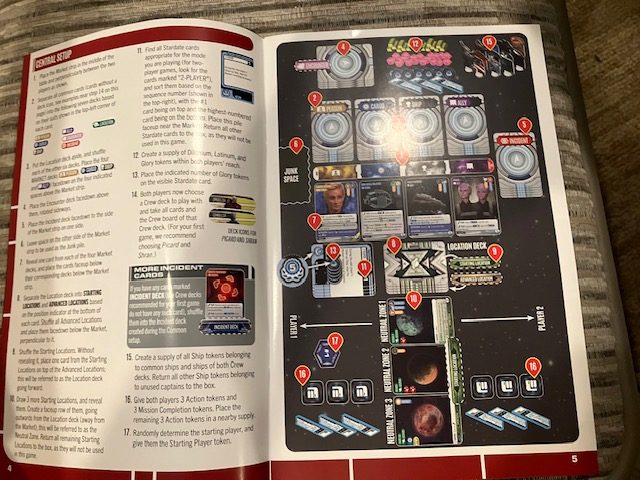
The Set-Up (even though it spans 4 pages) still is done well …
With both a Common Set-up (above above) and a per-player set-up (above).
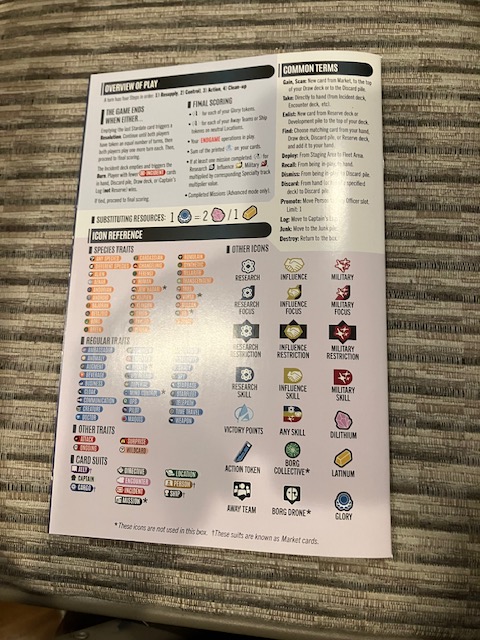
The rulebook ends with a good summary of symbols.
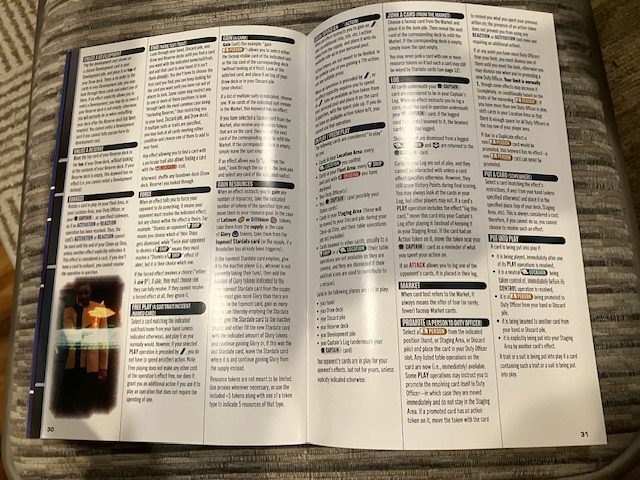
About the ONLY thing this rulebook does wrong is that it doesn’t have an index. It has a table of contents and a Keywords in Detail section, but for a game this complicated, an Index is essential.
Other than the lack of an Index, this is almost a perfect rulebook. I have to be honest, the rulebook almost reads like a legal document (because there are so many rules and systems), but everything is in there and well-explained.
Ways To Play
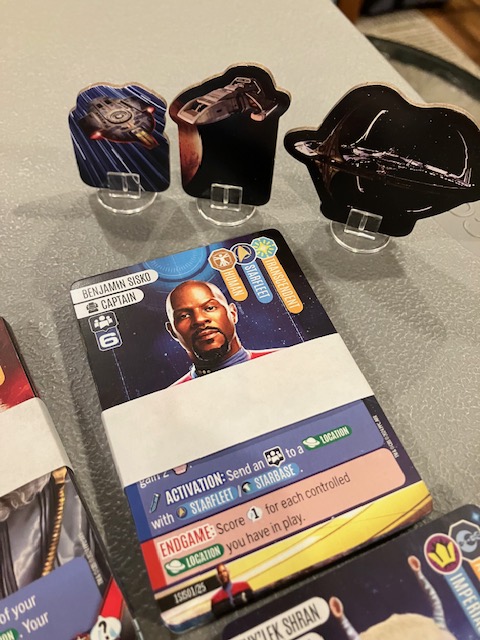
So, there are three major ways to play The Captain’s Chair (four if you count the unofficial cooperative mode, which we’ll discuss in the Appendix). The “main mode” is the 2-Player head-to-head mode; this is the way Star Trek: The Captain’s Chair is meant to be played—Captain vs. Captain. Even though this is a thinky and complex deck-building game with Victory Points, there is some take-that in the 2-Player game, as you can do things to mess up your opposing Captain. Honestly, it really depends on the Captain(s) you choose; Koloth will have a very different play-style than Picard, who will have a different play-style than Sisko.
For solo play, there are two solo modes built-in: The Cadet Training Mode, aka The Easy Mode and the Official Solo Mode aka the Hard Mode. That’s what’s so great about this game; you can choose the mode that fits you!
The Cadet Training Mode
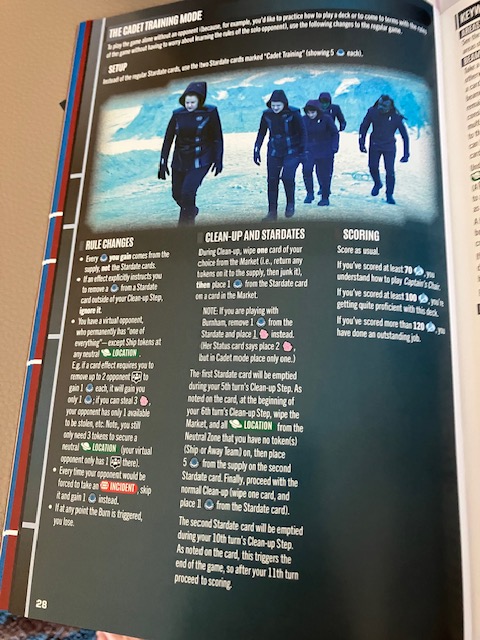
The Cadet Training Mode is probably the best way to learn the game! Honestly, I can’t imagine jumping into the head-to-head game without learning the easy solo mode first. See above for the rules for this mode on page 28 of the rulebook.
My first game (strictly my third game, since I set it up 2 times before I ever played!) was The Cadet Training Mode! See above.
The basic idea is that you are fighting an opponent that has “1 of everything”; you are fighting a faceless and nameless opponent.
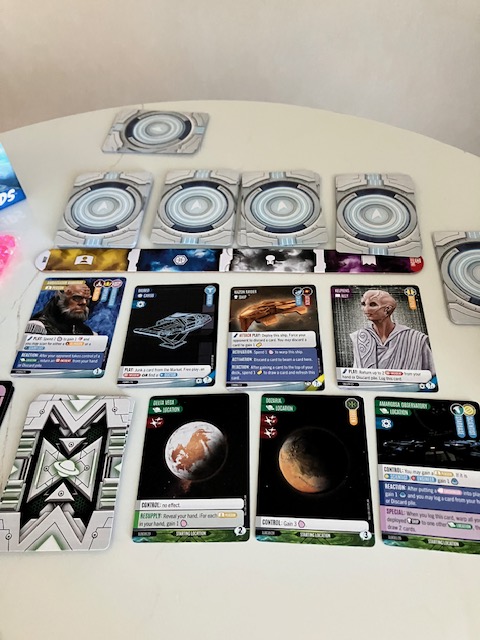
Basically, you are just playing turn after turn by yourself and trying to discover how all the mechanisms of the game work. You don’t operate another Captain or anything like that. There are enough systems in the game where you “affect” the other Captain, so when you would do that, it’s just a faceless, nameless opponent who has “one of everything”. For example, how many landing parties does the faceless, nameless opponent have on the planets above? One each!
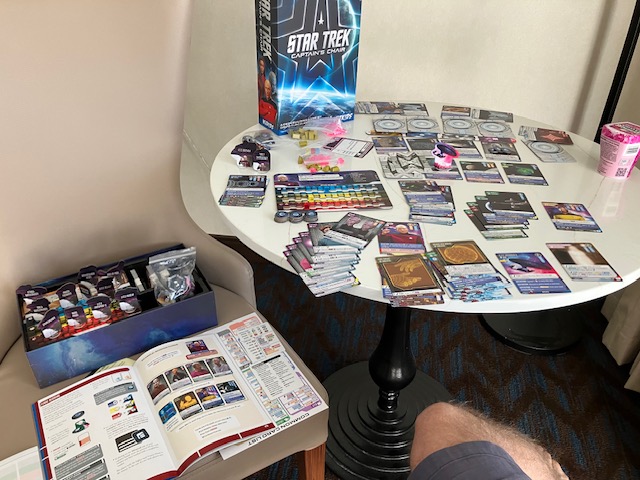
This solo mode flows pretty well. You don’t feel the glaring stare of your opponent as you learn the game; you just try stuff out to see how everything works.
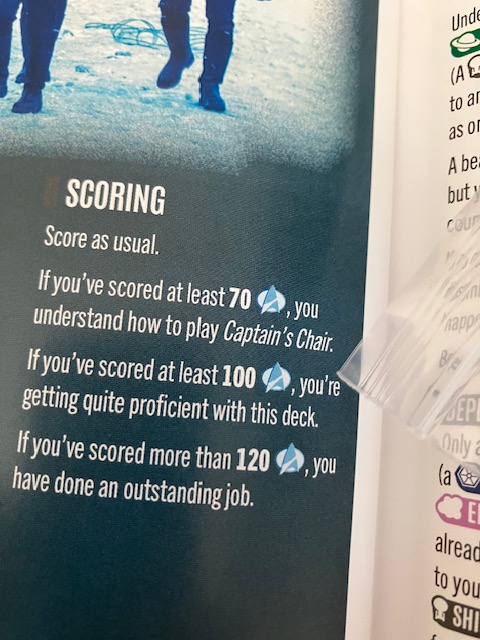
My first solo game scored 69, so apparently I didn’t know how to play just yet.
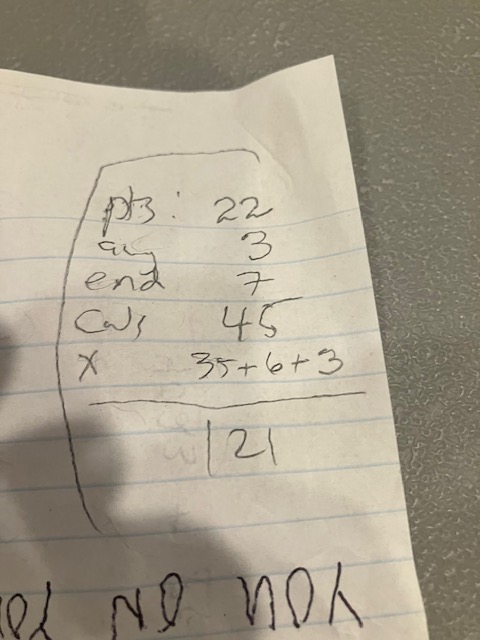
My second solo game was much better as I got a 121.
This solo mode is the way to learn the systems of the game without the immediacy of an overwhelming opponent. Recall, we suggested that Kinfire Council + Winds of Change sorta has an easy solo mode and a complex solo mode!
The rulebook even suggests this is a great way to learn the deck of a new Captain! Recall that each Captain has a VERY different play-style, so this is a great way to take the new deck through its paces!
As you can see from my two scores (69 then 121), after my second game on Cadet Training Mode, it was getting too easy. This solo mode is a great way to learn the game, but it wouldn’t be much of a challenge now that I know the deck. I need a new challenge.
Starfleet Command Training Program
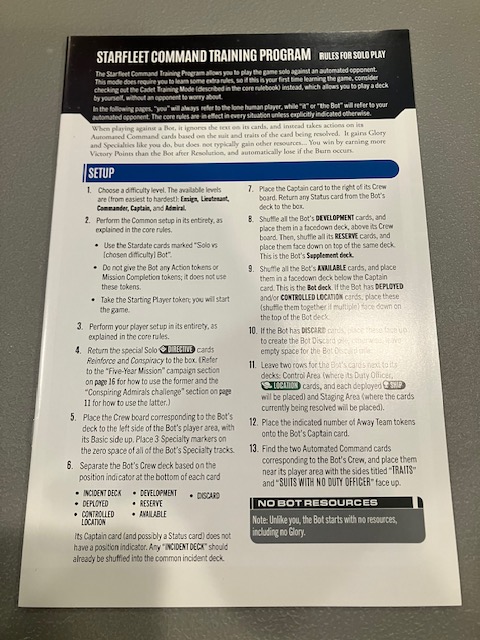
The Hard solo mode has its own rulebook! See above! This rulebook, called the Starfleet Command Training Program, outlines how to play Star Trek: The Captain’s Chair in a truly complex and challenging solo mode! This rulebook is also very daunting (at 20 pages), but it’s really not that bad (the second half talks about different modes and a 5-year mission).
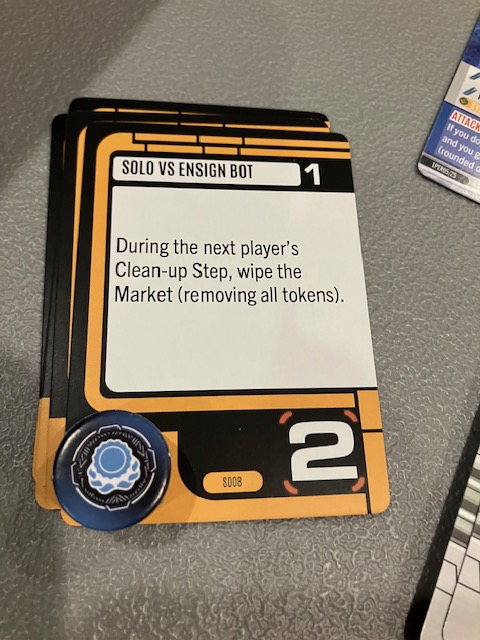
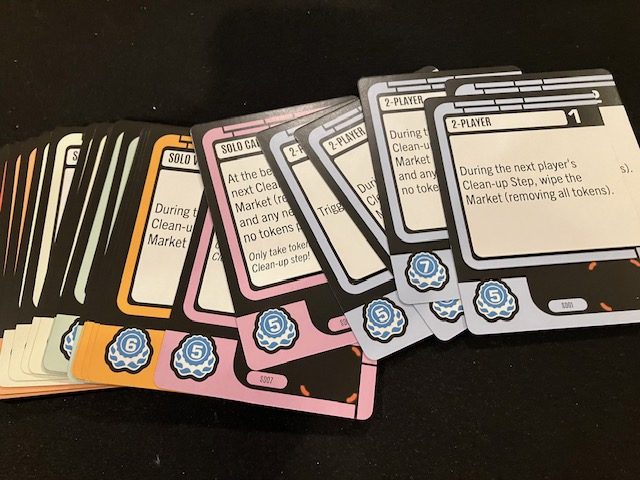
One major change is that you have a different set of Starfleet cards to control the pulse of the game. See above.
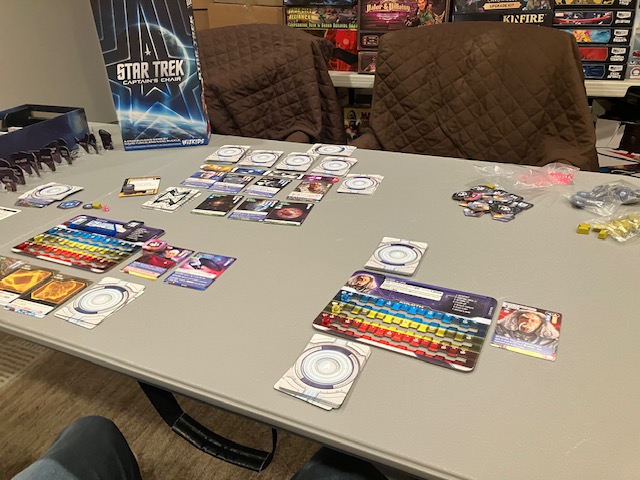
The real difference is that you are fighting a real Captain! See above as Koloth and Picard battle!
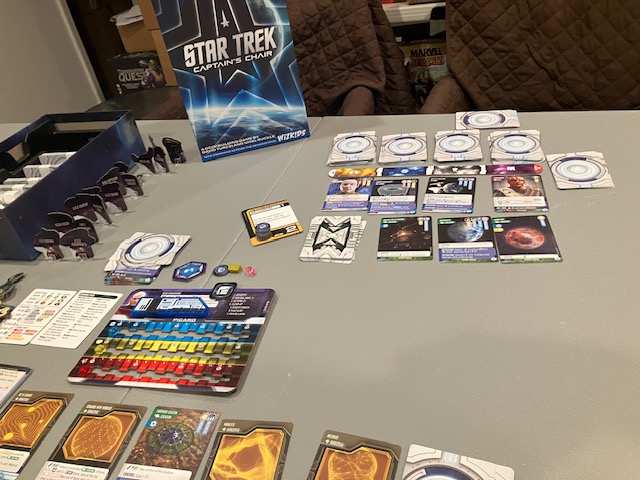
You operate one Captain “normally” like you did previously; see as Picard gets set-up normally.
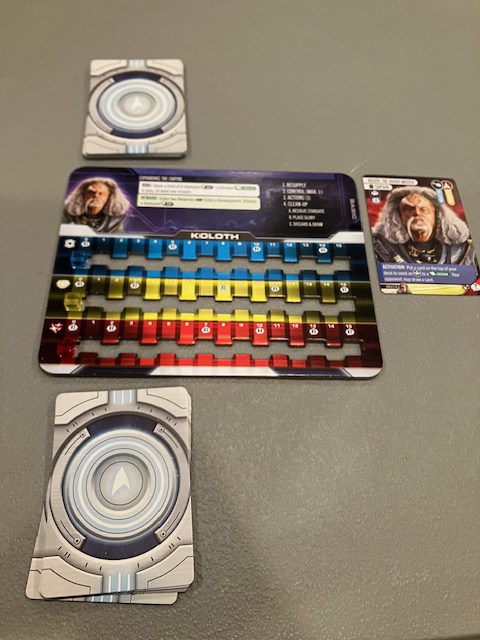
The Captain you are battling has a very different set-up! You still use the deck of the other Captain, but now an AI will control how that Captain operates!
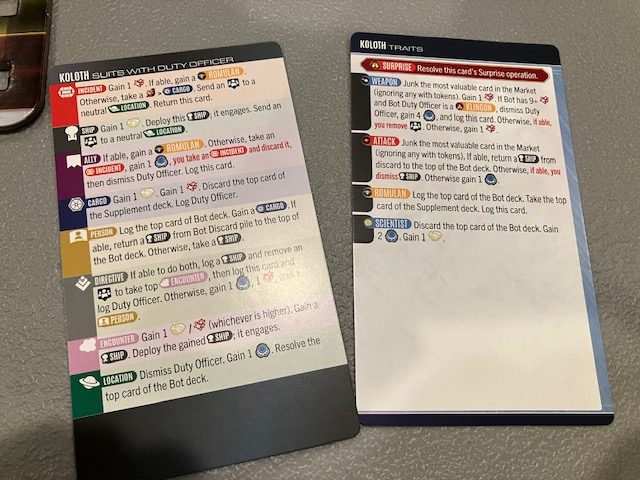
There are two Control cards for each AI Captain; these are the AI cards that control what the Captain does on his turn! Depending on what card you draw, the directions on these AI cards tell you what to do! (Things at the top of the card take precedence over things lower on the card if there’s any question).
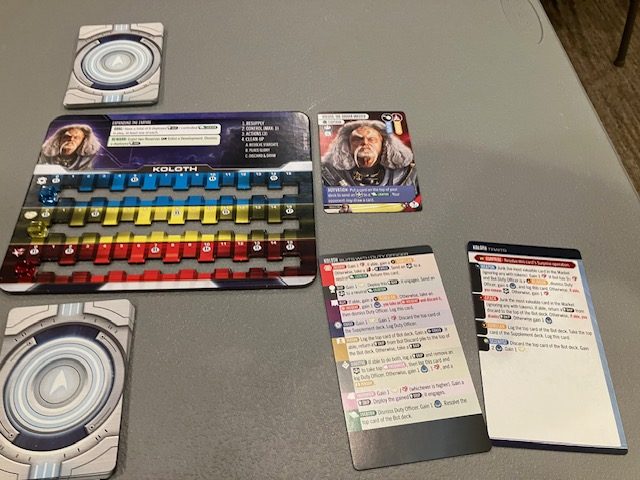
Basically, play alternates between the two captains; the solo player will take his turn normally, but then the solo players uses the AI to operate the other Captain!
See that big number 2 on the Starfleet card above? That tells you how many cards the AI Captain will get to draw and resolve on his turn!
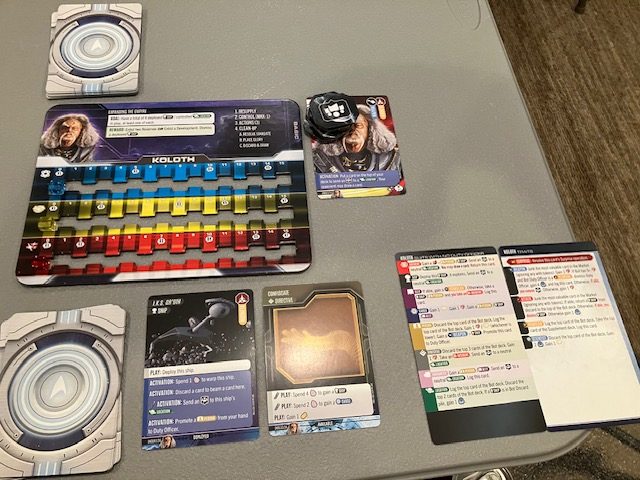
So, Koloth above draws two cards from his deck and consults the AI cards to see what those cards do!
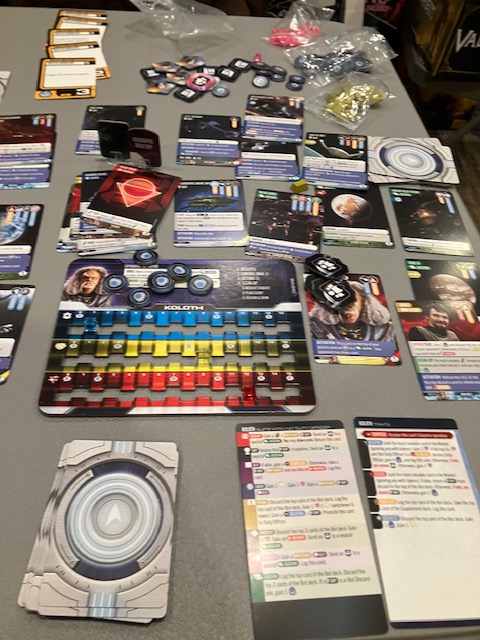
As the game goes on, it gets pretty complicated! Koloth is all about getting ships out, and you can see that his AI respects that .. and (see above) as he has so many ships and worlds under control in the later game!
Solo Captain and AI Captain alternate until the game end is triggered by the Star Fleet cards! Whosoever has the most victory points, wins! (If you want to be funny: I Captain goes, then AI Captain goes!)
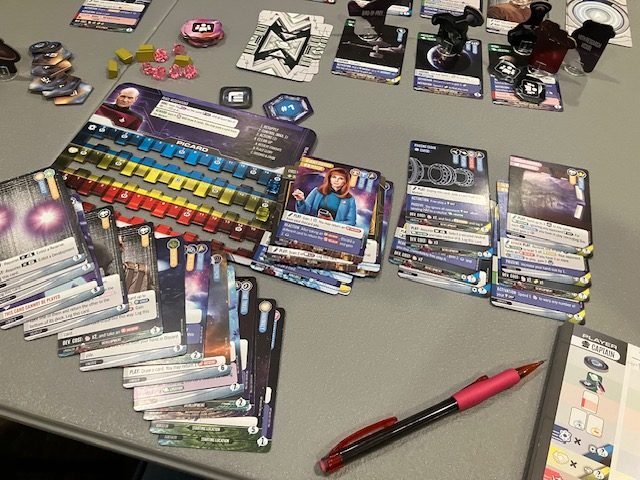
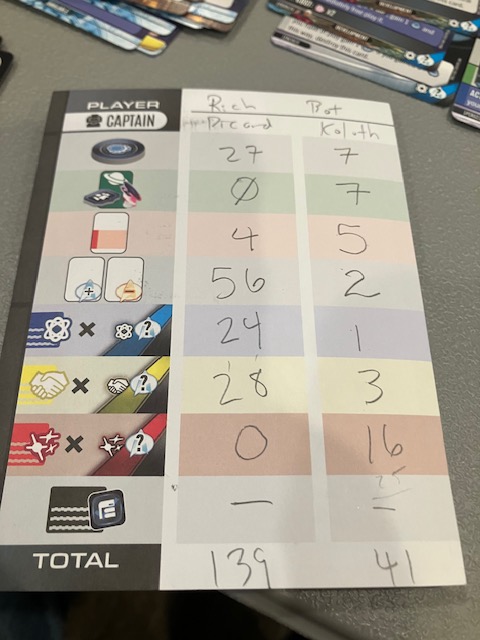
Just like before, you count the Victory Points to see who wins.
To be clear, this is a pretty complicated AI. There’s lots of things you have to look up as you play! Where do you send ships? Landing parties? There’s also a notion of most valuable to me and most valuable to you that controls preferences of cards. Sometimes determining which cards the AI prefers is pretty exhausting. I found that it feels like the solo rules do a pretty good job of covering all bases and preferences, but it can feel hairy the first few times you try it.
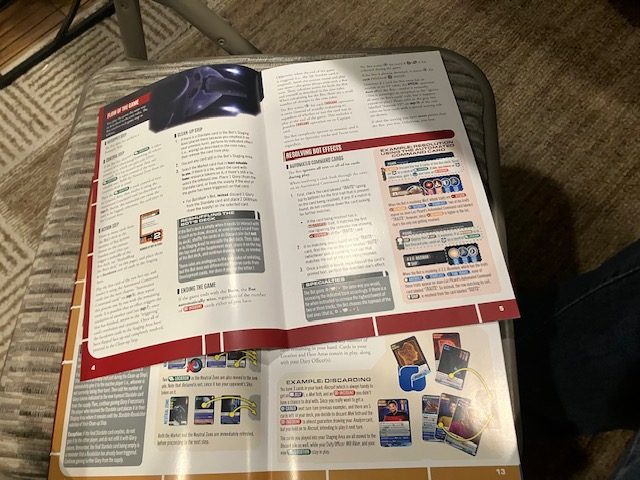
This is NOT a quick one hour solo game. This is probably at least a 2 hour game, especially your first few times. You will find your head buried in the solo rulebook as you try to remember/discover/rank what actions/cards the AI prefers. It gets easier as you play, but it is very daunting.
I want to be clear that I like this solo mode, but it is not easy.
Legalese
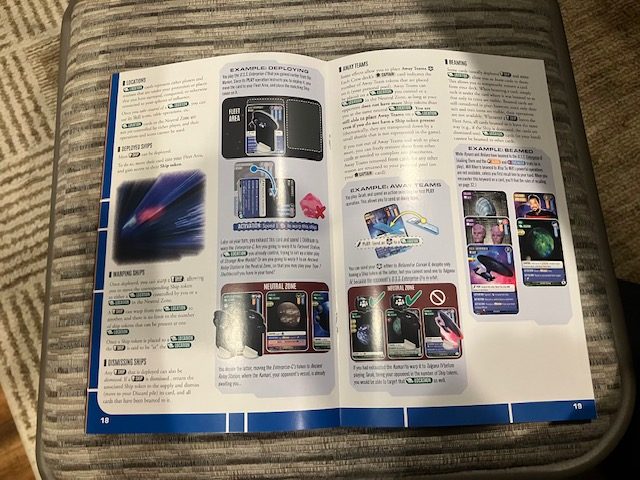
These rulebooks are very very very good, but I kind of feel like a lawyer when I am playing. What do I mean by that? I have to study the rulebook to make sure I have a handle on everything; I want to say I spent a good hour (or more!) reading the rulebook the first time!!! There are very specific rules to handle just about every exceptional case, but you have to understand how to apply the rules like a lawyer might have to understand how to apply the law.
This might sound like a negative, and for some people it will absolutely be a negative; those people will hate this game: “it’s too complicated, it’s too much, there are too many rules”. You know if that is true for you.
But if you like a system where things are very well-specified and you don’t mind burying your head in the rulebook a lot, then this is a great game.
Theme
This game feels very thematic. If you like Star Trek, you will see and feel the theme in this game. We’ve said that this is a deck-building game, but all the other supporting systems of this game make it feel like Star Trek: duty officers, warping ships, developing cards, acquiring Allies, Cargo, Ships, sending out landing parties, taking control of planets … it feels very Star Trek. This is arguably the most thematic Star Trek game I have played?
Conclusion
Star Trek: The Captain’s Chair is a daunting beast of a game. The rulebook feels like legal document, there are many complex systems within the game, and the rules are complicated. Yet, this is probably the most thematic Star Trek game I have played! Each Captain’s deck matches their play-style, making them different and interesting to play! The actions and cards feel like they are right out of Star Trek! This feels like a love letter to Star Trek.
As a solo gamer, I love that there are two solo modes built in! The easy solo mode provides an onramp to learn a new Captain’s deck (because they are all so different)! The complex solo mode provides challenges for the future! There are 30 different ways to permute the Captains in the complex solo mode (6*5=30 because order matters; which is the AI and which is the player). This gives plenty of ways to try different permutations for quite a bit of variety! I also happen to know that at least 2 more expansions are planned, so there’s more content coming!
Sure, there’s a 2-Player head-to-head mode … which I may never play. As a solo gamer, I am very happy with what this is.
Be aware that this is big complex game with lots of rules and a legal document for rulebook. If that doesn’t scare you away and you love Star Trek, I think you will love this game. I do. 9/10. I think this would be a 10/10 if it had a good cooperative mode; I really want to be Picard and Sisko fighting the Borg! Or the Dominion! So, the Appendix below …
Appendix
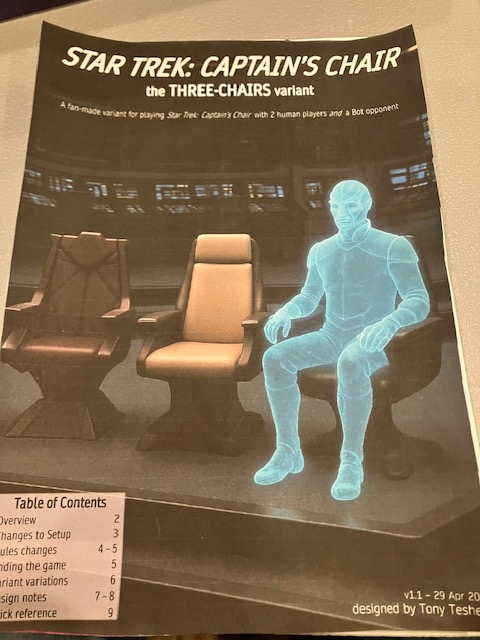
There is an unofficial cooperative mode: see link here.
 coopgestalt
One thought on “Star Trek: Captain’s Chair. My Solo Game of the Year.”