
Welcome back to Cooperative Surprise Month! Last month we looked at the brand new game (Sammu-ramat) which was so surprisingly good! This week, we surprised ourselves by finding an old review which we never published! This is a review for the cooperative game Chainsomnia by Seiji Kanai! Let’s take a look!

Chainsomnia was a cooperative game I picked up from GameNerdz fairly recently (EDITOR: at the time this was written, it was June 2023 .. ahem). It was a Kickstarter game, but I didn’t know that when I ordered it from GameNerdz (I guess I missed the Kickstarter). Chainsomnia was appealing to me because it looks like a light cooperative game from the designer (Seiji Kanai) of Unicornus Knights! I think that Unicornus Knights is something of a hidden gem (see Part I and Part II of our review), as it made our Top 10 Cooperative Games of 2017!
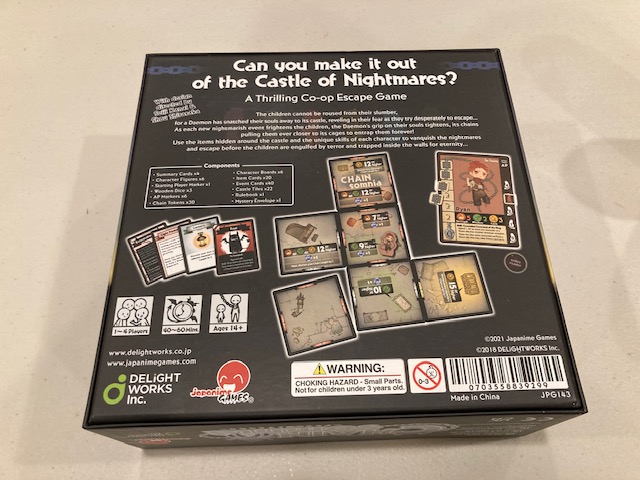
This game is about a bunch of nightmare-ridden little kids trying to get out of a castle of nightmares! It’s for 1-4 players, 40-60 minutes, and ages 14+. Let’s take a look.
Unboxing and Gameplay
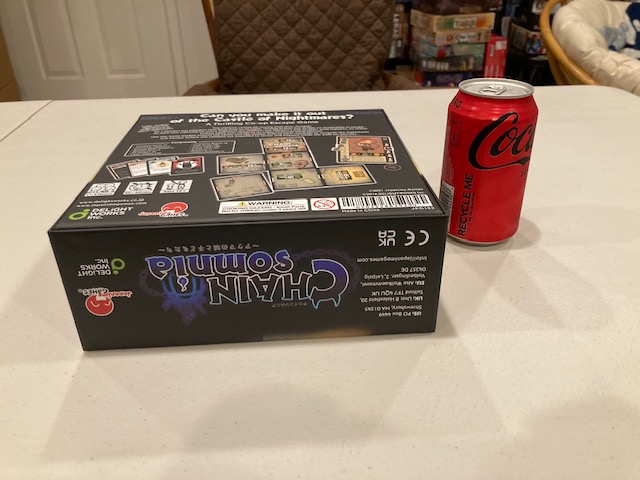
This is a pretty deep box. The Coke Can actually fits inside it pretty well!
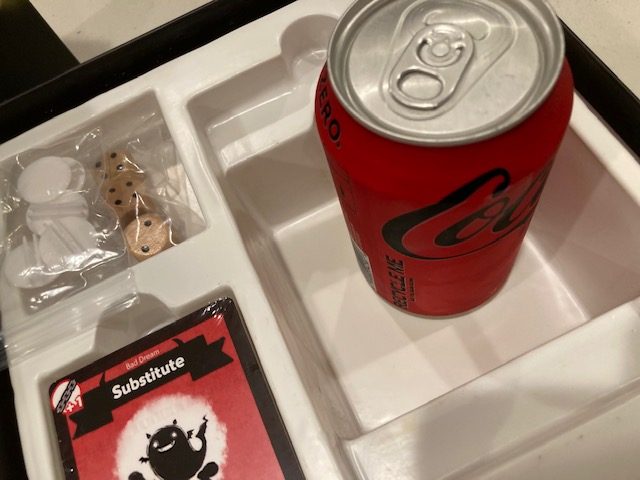
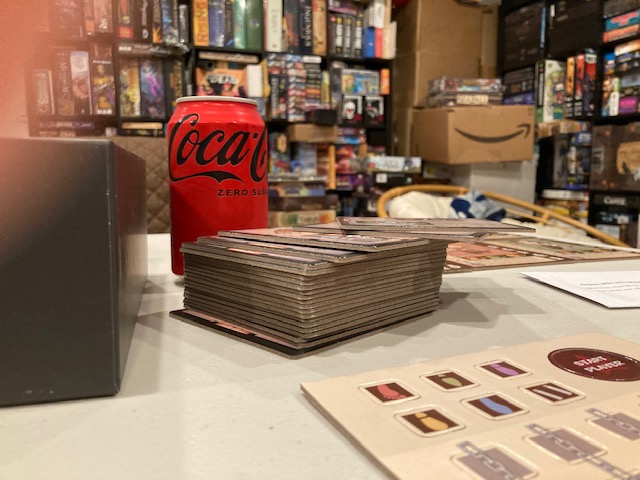
Seriously, this is a pretty deep box: mostly for the tiles.
Each character takes the role of a child trapped in the castle:
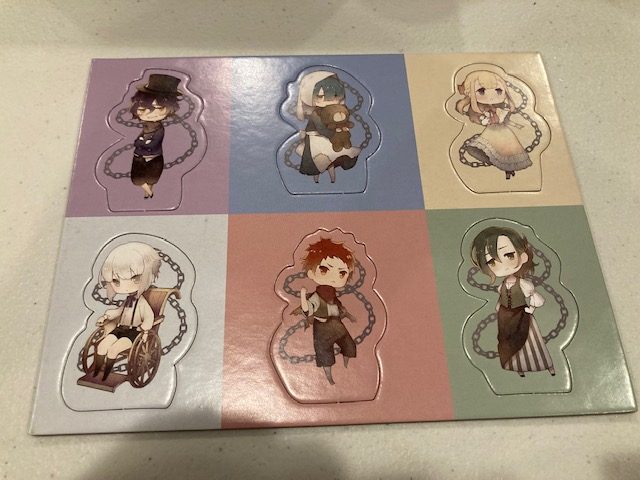
Each character has a standee and a character sheet.
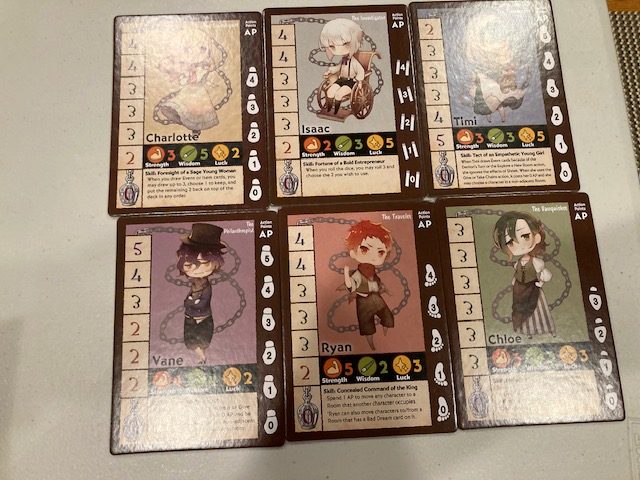
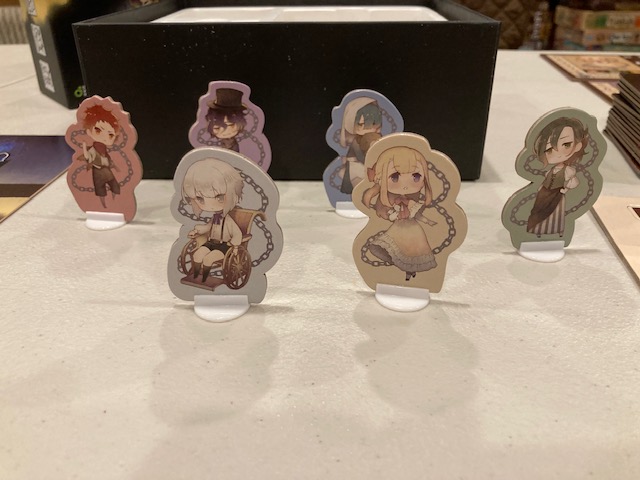
Each character has some abilities (Strength, Luck, and Wisdom) which will form the the basis of a two-dice ability role.
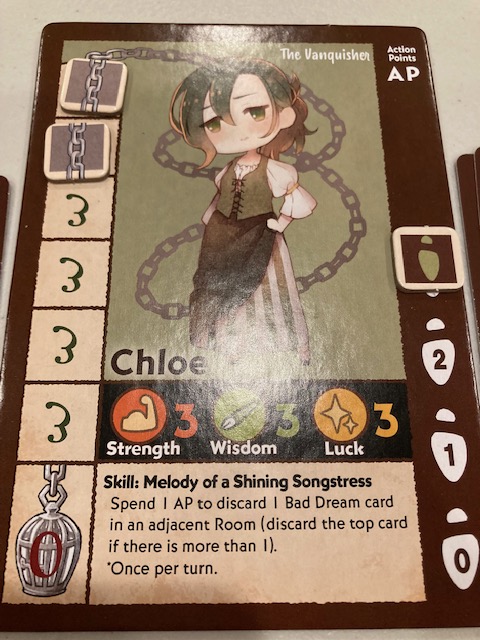
For example, Chloe above has 3 Strength, 3 Wisdom and 3 Luck. She can also get rid of Bad Dream easily with an AP (Action Point).
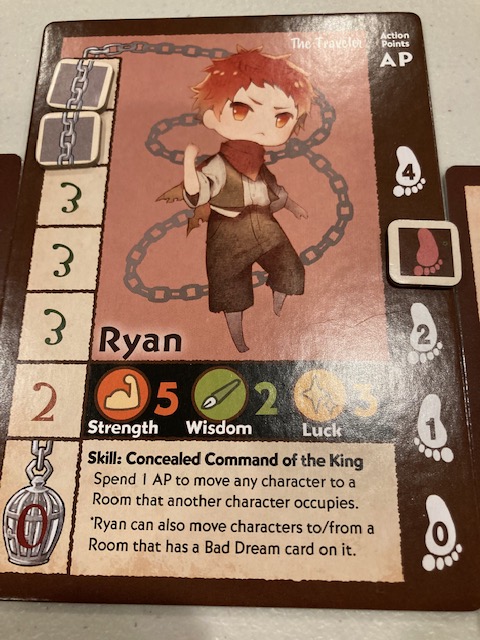
AP stands for Action Point. The little chart to the left shows you how many AP you have per turn. As you get Chains in the game (Ryan above has 2 chains), it reduces the number of AP you have per turn.
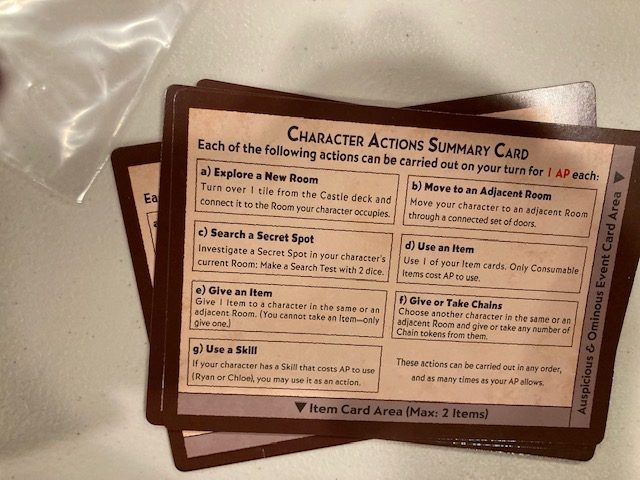
The Summary Cards summarize what you can do, but basically explore, search, give, skill, move, use or take.
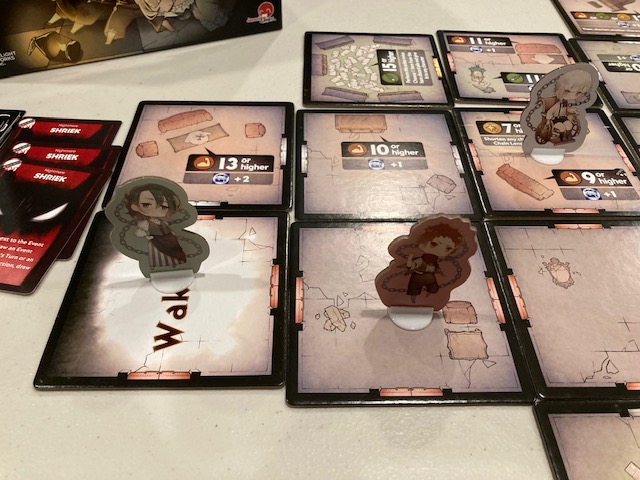
In order to win, the characters must cooperatively explore the Castle to find the way out: the Way Out is the last card in the tile deck. See Chloe winning the game for everyone by finding the Way Out … when there are no Bad Dreams on the board.
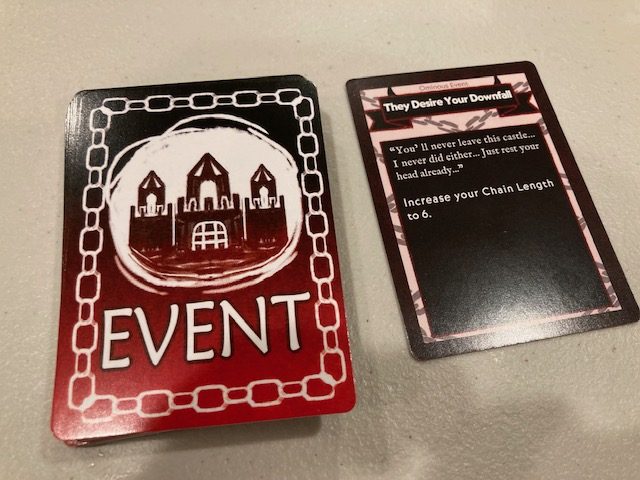
Like most cooperative games, there are “Bad News” cards that come out. In this case, the Bad News cards are called “Events” and come out every time you explore and discover a new Room.
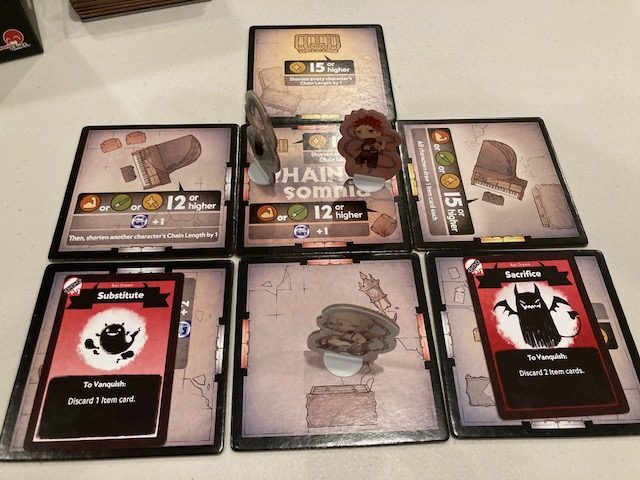
Generally speaking, the Event cards are full of nightmares that clog up the rooms. You can’t enter a room with a nightmare until you take it out. How do you take it out?
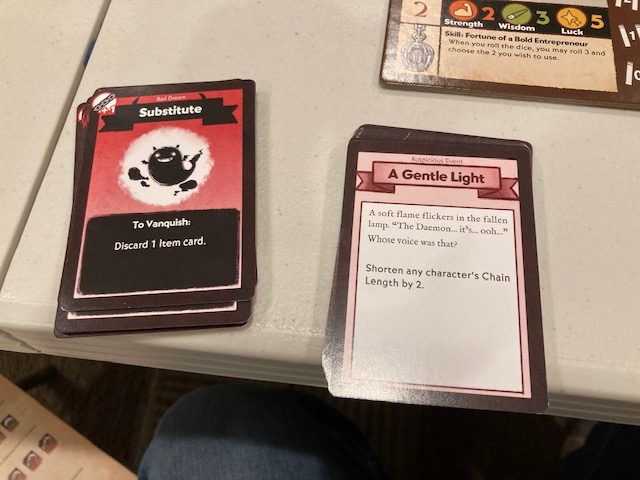
Each Bad Dream is different (for example, above you have to discard an Item), but generally you have to make a skill check on 2 dice, and roll higher than your skill. If Ryan’s Strength is 5 and requires a 11+ Strength to Vanquish, then Ryan will need to roll a 6 or more (6+5 >= 11) on two dice to succeed in the Skill check.
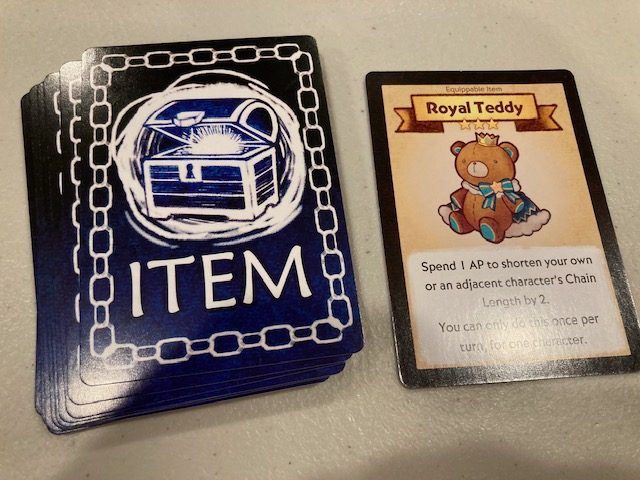
Incidentally, skill checks are how you get Items (very useful tools): generally, each room will tell you what you need to roll to get one. In the first room (see below), if you roll a 12 or higher on any skill check, you get an item.
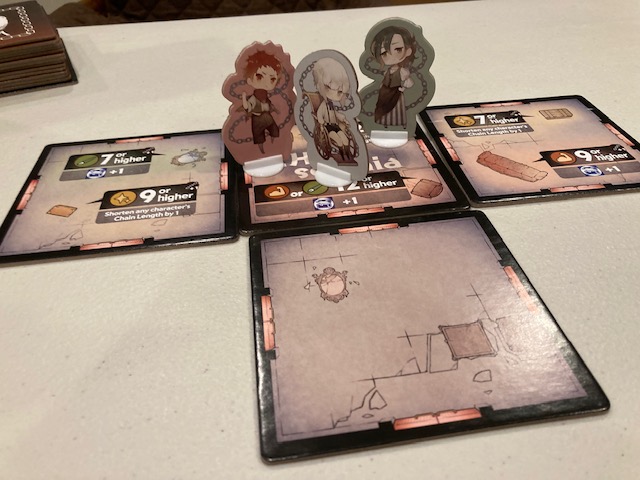
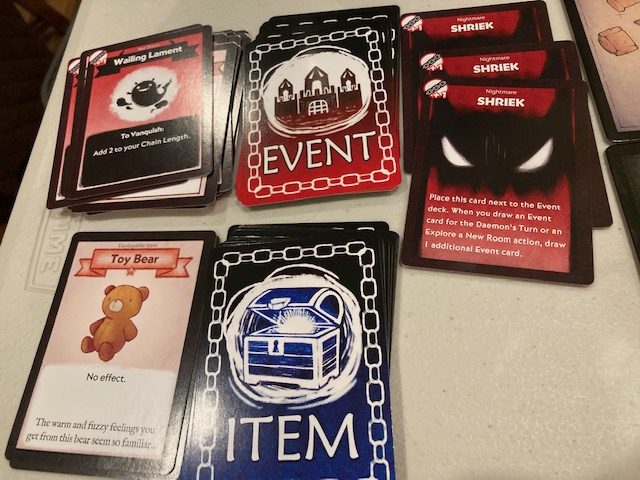
There are other very bad cards that modify the Event Deck (see Shriek above) but if you make it through all Event cards without finding the Way Out you lose. If you can get to the Way Out and defeat all Bad Dreams on the board you Win!
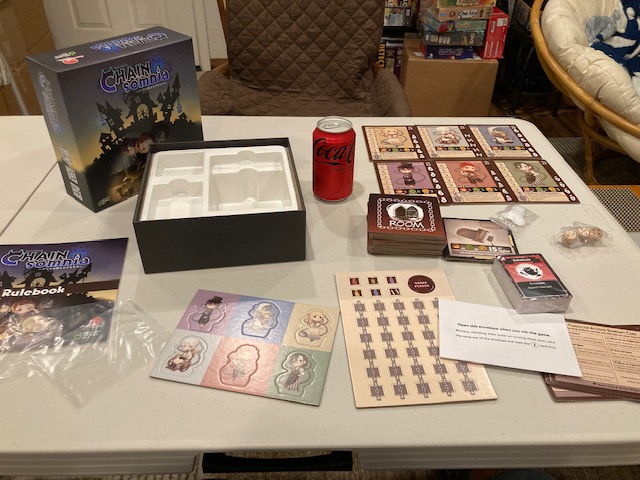
The components are quite cute, if a little minimal. The cards are not linen finished.
Rulebook
The rulebook is good, except that it doesn’t talk a lot about edge conditions. As we played the game, a bunch of questions came up (“Are Action Points dynamic? Do you immediately lose/gain an AP as a result of a chain change?”). There was a FAQ, but it didn’t answer the questions that seem to come up with us.
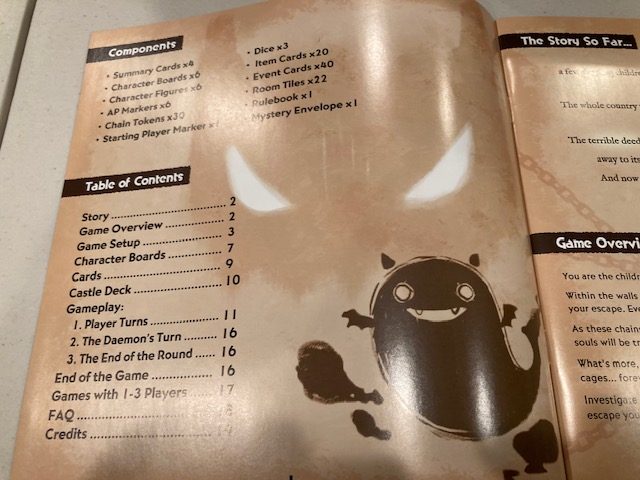


The components list had no pictures, but the Set-up was well-labelled to counteract that. In general, there were appropriate pictures and the game was explained well-enough. I even like that it had a FAQ, it just didn’t seem to address the questions we had. I’ll call the rulebook good enough.
Solo Mode
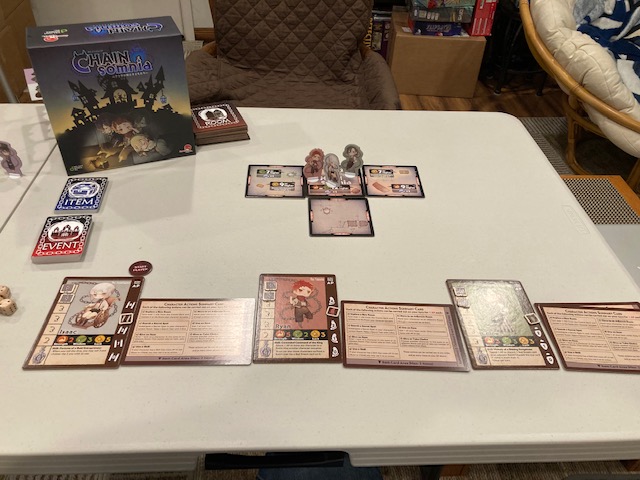
Congratulations to Chainsomnia for following Saunders’ Law and having a solo mode!
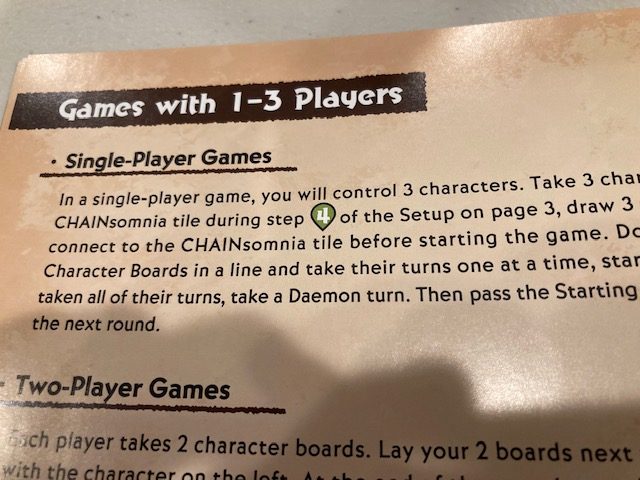
Unfortunately, the solo player must take control of 3 characters. Similarly, a 2-Player game would have each player take control of 2 characters. Basically, there must always be 3 or 4 characters in the game. This isn’t ideal for the solo because there’s always the context switch issue as you jump from character to character, playing each one separately.
Luckily for the solo mode, the context switch issue is not too problematic: each character has a pretty simple character with one “major” power. For example, if one of your characters were Ryan (see above), it’s easy to remember he’s strong (strength of 5) and can also eliminate one monster for one AP. There’s not too much to remember for each character, so context switching from character to character isn’t a big deal. Contrast this to the characters from Marvel Zombies: Heroes Resistance where each context switch becomes heavier and heavier as the characters get more and more abilities in the game (see our review here). While the extra abilities in Marvel Zombies: Heroes Resistance are cool, it makes it significantly harder to play multiple characters.
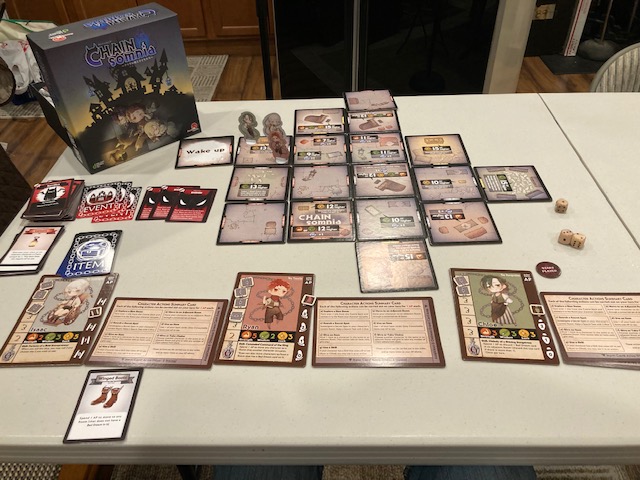
It took me two solo games to get a win. I remember losing my first game and saying, “Nope! I wanna play again! I know what to do now!” I think your strategy really depends on the characters you choose, so my second game was with the same 3 characters.
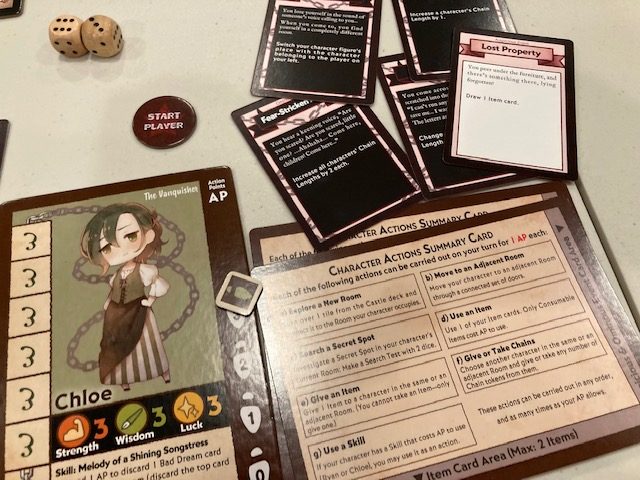
I made one major mistake in both solo games: I forgot to save my Ominous Event cards and my Auspicious event cards. In most every other cooperative game, you throw away events when you are done … Nope! Here, they are a measure oh how well you did.
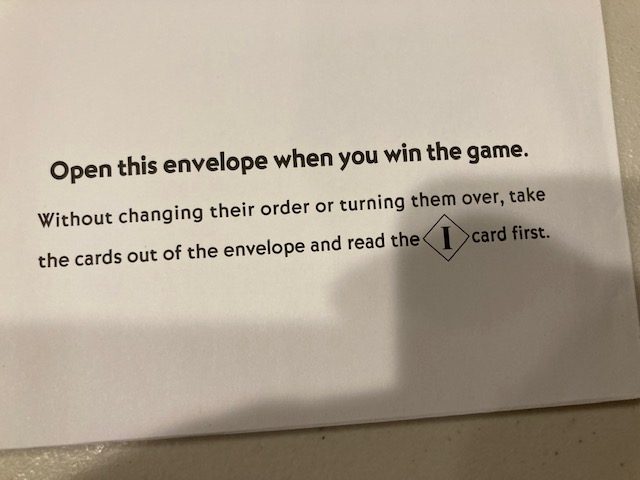
When you open the secret envelope, you need those cards. I didn’t realize this until after my second game!
(Picture deleted from review to avoid spoilers)
Minor Spoiler: Basically, you measure your victory (in the event of a win) by how many Auspicious Events and Ominous Events you got. That was kind of cool: it’s a hidden and secret way to measure success, and gives you a reason to play again to try for a “better” win.
I didn’t love solo mode (mostly because of the 3 character issue), but it was fun enough to play again. It also gave me enough insight to teach to my friends.
Cooperative Mode
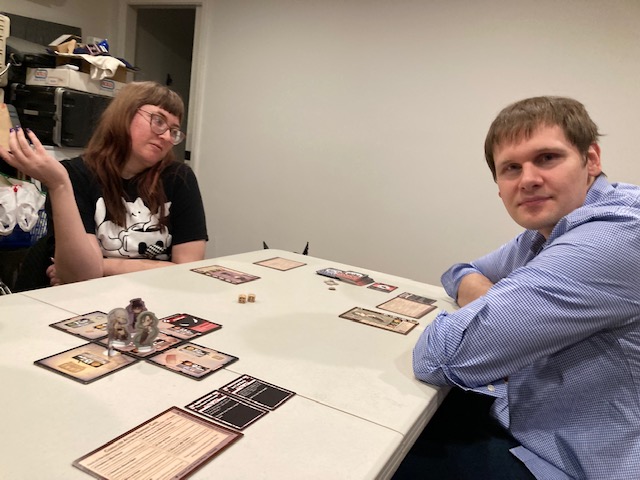
This game went over pretty well as a cooperative game: probably better than I expected. Since you always need at least 3 or 4 characters in play (this totally reminds me of Unicornus Knights), a 3 or 4-player game is probably ideal: that way every player gets exactly one character to operate, and it’s easier to inhabit and connect with the game if you are “that character”.
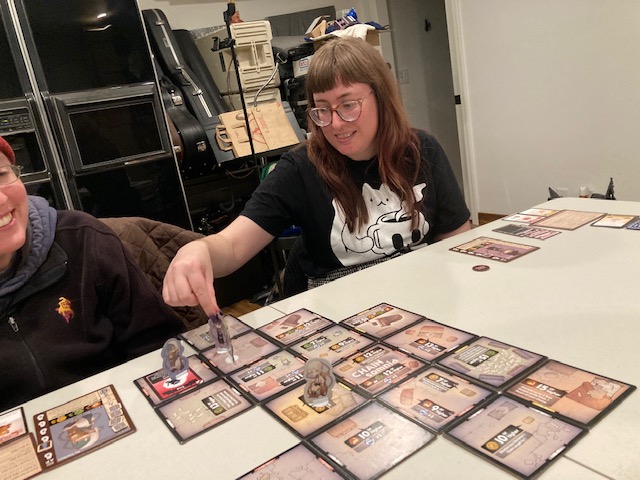
I noticed that, as we were playing, we really did consult each other a lot … and console each other a lot. “Hey, don’t worry: I can take care of that nightmare!” “Hey, don’t worry, I can get you an item!” Sara’s character’s power allowed here to give items to other people anywhere on the board … this was huge! It allowed us to power up! Even if we had a bad role, the game evoked a pathos: “It’s all right, we’ll get you out of that mess.” Maybe there’s something about being a little kid that brings out the best in people, and makes them want to help each other?
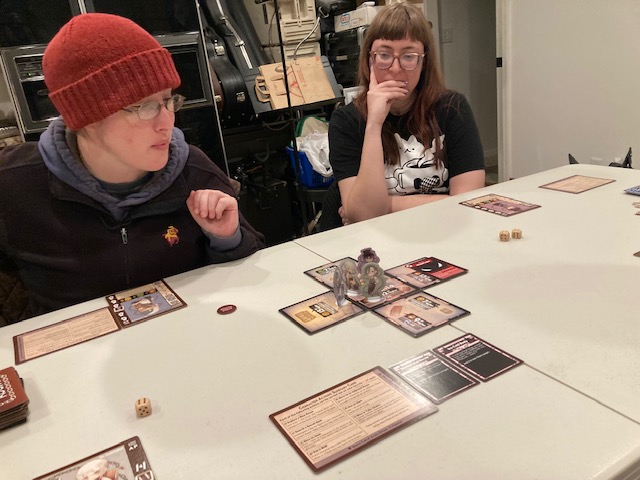
There were a lot of fun little moments playing cooperatively. I knew the game had gone well when we spent the post-game talking about all sorts of other ways we could have won/lost, been more strategic, etc. People cared enough to keep thinking about the game, even when it was over!
Repacking
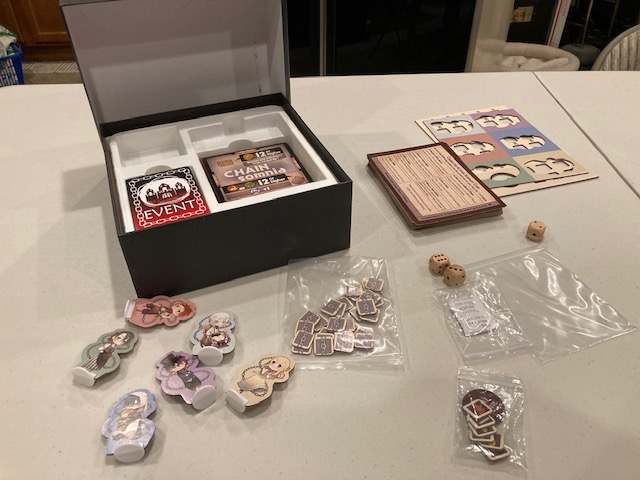
What’s going on with this box? It has a huge insert, but the game doesn’t fit back into the box unless you do one of two things:
- Always remove the plastic bases
OR - Pack the dice into the fingerholes!
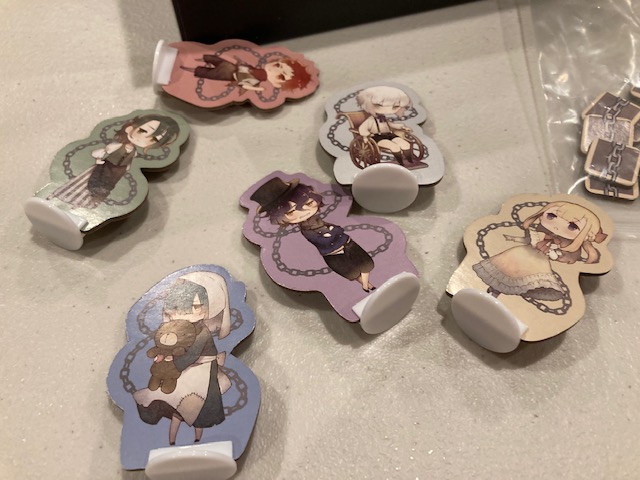
Those of you who have played GloomHaven know the problem with constantly removing/adding the plastic bases! Basically, the bottom tears! So, I chose to leave the plastic bases on. Which means the game box WHICH IS HUGE doesn’t fit the game! I had to be clever … and put the dice in the fingerholes.
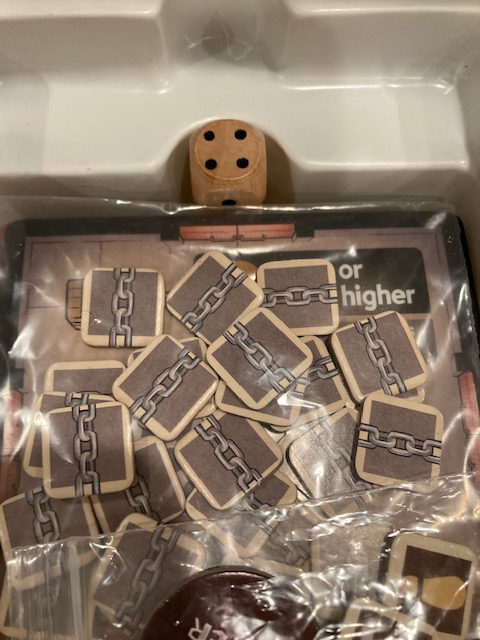
Yup, not ideal, but then the game fits. See below for pictures of how I fit the game in.


Conclusion
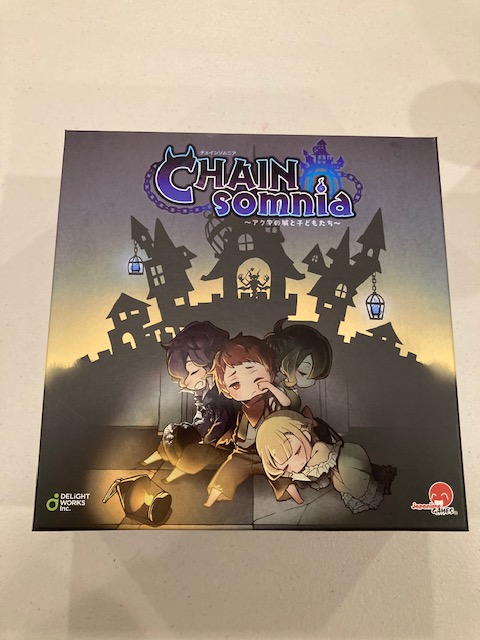
Chainsomnia was pretty fun. Although the rules were missing a lot of edge cases, the game was still pretty easy to teach and play. The group liked it, but didn’t love it:
- Teresa, Rich: 7/10, liked it, would suggest it
- Sara: 6.5/10 liked it, would happily play, maybe wouldn’t suggest it as first choice
- Andrew: 6/10 Liked it well enough, would play again
The biggest issue with the game was that it felt a little “samey” after a few plays. You could mitigate that by switching up the characters to have different strategies. It was also maybe a little too lucky with so much emphasis being placed on the dice.
Chainsomnia was fun enough. We actually would not recommend this for kids: even though this game is cute, the nightmares attacking kids might not go over well with younger players. This game is more for older kids who like light cooperative games with an anime look.
EDITOR: At the time Our Top 10 Cooperative Tile-Laying/Placement games was written, Chainsomnia just barely squeaked onto the list as #10. I hate to say it, but I think Race for The Raft came along, moved to the top of the list, and pushed everything down one space (see our review here: it’s that good)! So that means Chainsomnia is #11 now …
 coopgestalt
2 thoughts on “A Review of Chainsomnia”