Point-And-Click Adventure for Families! A Review of Eppi: An Interactive Adventure Book

IMG_2581

Eppi is the second series of games in the Paper Point-and-Click line of games from Lookout Games.

img_9161-e1623455483876

The first game in this series was Cantaloop by Friedemann Findeisen: see our review here! We loved Cantaloop so much that it made the #1 spot on our Top 10 Cooperative Games of 2021! This was a series of three games: we liked all three of them! See here, here, and here!

IMG_2587

What makes these games so interesting is that they are the paper book equivalent of the old “point-and-click” video games! 

IMG_7336

Think of the Secret of Monkey Island, King’s Quest, or the more recent Thimbleweed Park. Players “point-and-click” at objects in their world (on the computer screen), combining objects to solve puzzles! Players also move around, exploring the world they play in!

underwater

These games are all about combining objects and exploring the world, trying to solve the puzzles in the story you uncover along the way.

IMG_2634

However, instead of a computer screen, these Paper point-and-click games have book and cards! You combine cards, solve puzzles, and flip through the book exploring the story therein!

IMG_2583

Let’s take a look at Eppi!

Unbooking

We can’t have an unboxing, as this is mostly a book. So this is an unbooking.

IMG_2589

Eppi is a book first and foremost: everything else is contained in the front pouches at the front of the book.

IMG_2590

The big bottom pouch contains the inventory page, the play sheet, a postcard map, but most importantly … the red decoder!

IMG_2596

This little red decoder is the main gimmick of the game! Hidden text in the book waits for you to unearth via the red decoder! The red decoder reveals important text in the adventure! See above as you encounter Eppi for the first time in the hall! 

IMG_2599

Most of the “objects” you will interact with come from the three card pockets. As you reveal text in the game, you will uncover more cards which you can combine!

IMG_2620

One thing that’s differentiates Eppi from the original Cantaloop series is that about a third of the cards are stickers rather than cards: see above That’s right, this is a legacy game (but see below)! As you explore, you will put stickers on locations to reveal new options or hide old options that are no longer relevant!

IMG_2607

The map tells you where you can go in the house, and the corresponding pages of the book. Note that you can’t get into certain rooms until there are unlocked via triggers! (You can’t get to Saira’s Study until you hit trigger D4!)

IMG_2616

The play sheet comes with a little matrix of “triggers”: as you explore and combine objects, you will mark triggers on the sheet to show you’ve “accomplished certain things”. 

IMG_2612

This same Play Sheet also has your “TODO” list: in order to win the game you have to accomplish 5 goals! See above. (Why are there two Play Sheets above? Keep reading!!).

IMG_2621

The rest of this game is the book! 

  • The introduction and tutorial is fabulous and tells you how to explore and combine objects!
  • The next section has the 12 Locations (2 pages each) in the game
  • The next section are Cut-Scenes (further expansion of the plot as you move forward)
  • Finally, the last section is a Help Section

IMG_2614

This game looks great! It has a very family-friendly and welcoming vibe to its art. It’s very clear this is aimed at younger kinds and families! I mean, it says that on the cover, but the art choices reinforce that.

Legacy or Campaign Game?

IMG_2634

Since you are supposed to put down stickers as you play, this is pretty much a legacy game! You won’t be able to replay it again … or will you? You really can’t remove the stickers (they are very sticky), and you also mark up the Play Sheet with the triggers. So, this is a legacy game (but see below)! And honestly, what kid doesn’t like putting on stickers? For some families, the stickers may the best part of the game.

IMG_2627

Having said that … If you are very careful, you can reset the game: you can use little pieces of tape to “tape” the stickers in the book rather than stick them.

IMG_2664

I was able to play the entire game all the way through, using just little bits of tape on the edges to hold the stickers down (see above). After I was all done, I was able to reset the entire game by just carefully pulling off the tape! If you use small, little pieces of tape, you can keep the stickers down without too much work to remove it later. The bigger the piece of tape, the harder it will be to remove!

IMG_2612

The only thing other thing you need to do to reset it: make a copy of the trigger sheet! That’s why I have two copies of the Play Sheet above: one is a copy!

IMG_2644

So, with those two “tricks” (tape and a copy of Play Sheet), I was able to reset the back to pristine condition after full playthrough (it did take a little bit of time to undo the tape).

IMG_2631

It’s a little fiddly to keep making little pieces of tape, but I suppose no more fiddly than trying to stick the sticker on and aligning it just so. However, I suspect the best way to play is to just put the stickers in: the best part of being a kid is playing with stickers!

IMG_2586

The only reason you may not want to put stickers in your game is that this is a 3-Part series (I think): this is Part I after all.  The next Eppi book is “probably” a year away, so you may want to replay this game again just before the next one comes?

In general, it’s probably more fun to put the stickers in (it’s a legacy game)! If you are just a little careful, you can get by and make it resettable (making it a campaign game). It’s up to you!

The World

IMG_2597

Most locations in this world look like the above: the left side of the page has a lot of hidden text (to decode with the red acetate) and the right side of the page is a picture of the room you are currently in (with objects you can combine with). As you explore the room, you will combine objects and read some of the text on the left!

IMG_2608

The typical way to combine objects is to align the left side of a card with either a location or the right side of another card. If the two letter code (u6w6 from the picture above) corresponding to the arrows shows up on the appropriate sheet, you can read it with the red decoder! Otherwise, if there’s no such code, nothing happens! (It’s like trying to combine a bowling ball and a feather, it doesn’t make sense, so nothing happens).

IMG_2635

Sometimes, the little red decoder will tell you to read a cut-scene: it looks like the above, where characters talk to each and further push the plot and character development.

IMG_2655

This game is all about “trying” things in this world: Do these objects combine? Do this object combine with this location? Nothing here? Let’s look around at a new Location! You try stuff, go to new Locations, and just keep exploring this world.

Flow

IMG_2654

This is an adventure game: you will start off making tons of progress, then slowly and slowly start making less and less progress until you hit a wall. Eppi has the same ebb and flow as most adventure games: sometimes, when you are stuck, you just have to go around and just “try stuff”! Arguably, the least exciting thing about adventure games is the brute force approach is sometimes needed: it can be boring and soul-crushing to just try stuff that makes no sense. Even worse, it’s harder in this game because you physically have to do a lot more work to just “try stuff” (turn pages, combine items, look up text, see if it decodes: Lather, rinse, repeat). But once you break through that wall, it’s so exciting! The story picks up again, and things make sense again!

565435-the-secret-of-monkey-island-special-edition-playstation-3

Eppi is an adventure game! Every point-and-click adventure game I have ever played has this same flow: lots of cool stuff then some frustration, then excitement, some more frustration, then more excitement!

Help

IMG_2640

If you do get stuck, there is a Help Section in the back of the book (see above). In this case, you lookup help sections by seeing what trigger conditions you are missing! You correlate your Play Sheet and find the lowest trigger you are missing! This is usually where the problem is! 

IMG_2639

A few times, I had to look up some help, but I had to look at more than one trigger to find what I needed. But it was there! It’s a little confusing the first few times you try to use the help. One of my biggest problems was that I sometimes forgot to mark off a trigger, so that prevented me from moving forward!

This isn’t the best Help system, but it seemed to work for me once I kept at it.

Story: Solo vs Cooperative

IMG_2586

So, Eppi is a family friendly story! In fact, the main characters of the game are a family! Mom and Dad and some kids of all ages!  As you explore this game, a story moves forward.   But, why read a story when you can play it?  

IMG_2657

The two main ways to play Eppi are solo or cooperative.  Cantaloop (the first of this kind of games) definitely felt like more of a solo game, although arguably you could play it cooperatively.  Eppi feels like it is better at being both solo and cooperative: it absolutely works solo (that’s the way I played it), and then it absolutely works in a family environment (a 7-year old girl and her family gave us some feedback).

Solo

IMG_2584

I ended up playing the entire game solo one Sunday: it took about 5 hours (the box says 5-8 hours, so that’s accurate). 

IMG_2643

I definitely stopped and took a break at some points when I was getting frustrated, so wall-clock time was probably more like 7 hours, with 5 hours of play and 2 hours of taking a break.

IMG_2631

This would be easy to reset if you needed to: you just take a picture of the cards you have, and put everything away. If possible, it’s probably just a little easier to keep everything set-up between sessions, but you may not have that luxury.

IMG_2654

The solo game worked pretty well. I got stuck a few times and had to consult the Help. In general, it was pretty fun.

Cooperative Family Mode

123_1 (4)

What I Liked

IMG_2621

Turning pages to explore and move through Locations worked great: the binding is good for that, and the pages are high quality: they definitely learned from the Cantaloop experience! The very first Cantaloop game had lesser quality paper, and it actually made a difference, as you were much more careful turning pages (afraid to tear them)! With the higher quality paper and binding, it’s easy to make your way through the book.

IMG_2623

The stickers are cool. In Cantaloop, they “new scenes” were on cards, and if you turned the page, you would have to reset the scenes. By putting the “new scenes” on stickers, you can work through the book quicker, as you don’t have to worry about “new scenes” flopping around! Besides, stickers are cool … especially for kids! (And, like we said, if you are careful you can get the equivalent experience with taping the cards, but you should use the stickers!!!)

IMG_2586

By making the Eppi game more “family-friendly” (to be clear, Cantaloop was NOT family-friendly), it opens the door to cooperative play more than the original Cantaloop: the story and art is very inviting in Eppi! It’s just something the whole family can be immersed in. This definitely feels the cooperative mode is much more accessible. I loved Cantaloop, but it really is best as a solo game. I think this might Eppi might be more fun as a cooperative game.

IMG_2587

I adore this genre: the Point-And-Click Adventure game is fairly rare! I am so glad Cantaloop did well enough to spawn further games in this genre. I love this genre so much! More games like this please!

IMG_2598

The tutorial was very good: it showed what you can and can’t do when you combine objects.

What I Didn’t Like

IMG_2645

In the original Cantaloop, when you combined cards, the lowest number card ALWAYS had to be on the right: this reduced the number of ways you could try to “combine” two objects. Why didn’t Eppi adopt this rule?  You effective may double the amount of work you have to do to combine objects, as you may have to combine the cards twice! 

IMG_2636

I liked the story here, I did.  But, the wit of the original Cantaloop isn’t in here … which makes the game seem like a little more work.  Even if you got a puzzle wrong in Cantaloop, frequently there were funny jokes or amusing turns-of-phrase!  So, every time you worked for clue, you got rewarded by either advancing the plot or some joke!  I didn’t realize until I played Eppi that the jokes in Cantaloop distracted me from all the physical work you have to do to move the story forward!  Let’s be clear: there is a lot of physical activity of moving cards, combining objects, reading red text, turning pages, marking triggers, turning to cut scenes!  Whew!  All physical activities!  

I think some of this will go away if you play cooperatively, as the game is more about the cooperative experience with your family.  But I think the “work” to move the game forward is a little more prevalent in Eppi if you solo it.

IMG_2661

The final puzzle was pretty hard.  I feel like it was almost out-of-scope/too hard for a family game: I suspect you will have to use the Help System to finish the game.  That last puzzle seemed a little too much, even with a whole family looking at it.

Conclusion

IMG_2659

I am so happy there are more Interactive Adventures like Cantaloop! Eppi is a fun game solo or cooperatively, but I think the best place for it is the cooperative game with the family …

IMG_2582

… and that’s what the cover says! It doesn’t lie!

I like Cantaloop better overall, partly because of the non-stop humor, but I had a lot of fun with Eppi. This is a solid 7.5 solo, maybe 8 cooperatively with your family.

Union City Alliance: Heroes Unite! Like Marvel Legendary, but Now With More Theme! A Review

IMG_4178

Union City Alliance is a cooperative super-hero deck-building games that was originally on Kickstarter back in March 2021.  The game looked great and promised delivery in October 2021! I was so excited for this game that Union City Alliance made the #1 spot on my Top 10 Anticipated Cooperative Games of 2022!

IMG_4179

Unfortunately, the game is about 2.5 years late: The game arrived at my house April 30th, 2024! It’s basically been 3 long years since I backed the Kickstarter.

IMG_4180

Interestingly enough, I was never worried that this wouldn’t finally arrive.  The designer would do a pretty decent job of keeping us updated (with Kickstarter updates): he would offer full timelines of delivery and discussions of progress.  I was grumpy that Union City Alliance was 2.5 years late, but at the end of the day, the Kickstarter was well-run … and they delivered!

Let’s see what we got!

Unboxing

IMG_4185

The base game is about the size of a Ticket to Ride sized box: see above with a Coke can for perspective.

IMG_4190

The rulebook is the full-size of the box on top!

IMG_4193

There’s a lot of punchouts; these are just handy tokens to keep track of Heroism and other resources (Valor, Speed, Might).  Interestingly, the Heroism and Damage tokens, which persist between rounds, are circular tokens.  The Valor, Speed, and Might tokens, which evaporate between rounds, are square tokens.   Even though the game never calls this out, that subtle consistency (persistent vs. ephemeral) was a nice touch.

IMG_4195

Also included is a source book;  It has both set-up for various scenarios and tons of flavor text and back story for the heroes and villains: see below.

IMG_4197

IMG_4204

There are a TON of pre-punched standees that are both the Villain and Hero markers.   See above.

IMG_4205

There’s also a GIANT (see can of Coke per perspective above) pile of Locations!  These Locations come out slowly as the Heroes explore the city!

IMG_4206

But, this is cooperative deck-building game.  So, at its core, this game is all about the cards. When you first open the box, it’s a little daunting to see so many cards!

IMG_4207

From an initial Unboxing perspective, this game looks great! 

Uncardening

IMG_4218

I feel like this needs to be a new phrase: uncardening.  It’s the event when you have take a lot of  cards out of a new game box and sort them appropriately.  But it’s not just sorting: it’s about collecting together “like” cards, figuring out where the cards go in the box, and making sure they are ready to go for play!

IMG_0689 (1)

Basically, we had to do the same thing in Earthborne Rangers: go through the cards, sort them, put like cards together (for some notion of “like”), and figure out where they go in the box.  See above.   Earthborne Rangers had a fairly grumpy uncardening (see our review of Earthborne Rangers here): the components page was misleading, and we spent far too much time trying to uncard the game.

IMG_4220

I almost think that the word uncardening (which is a word we coined for Earthborne Rangers) has a negative connotation: it implies you have to spend an extraordinary amount of time putting cards in order.  

IMG_4933

I remember when I first got Legendary: A Marvel Deck-Building game some 10 or so years ago.  It has the worst box opening experience I have ever had!  I just have tons of cards and no idea how to put cards together!  The rulebook is completely silent on how to sort!  As a gaming nubie at the time, I asked my friend John N. to help me (because he had Legendary), and with his help, I was able to put things together.  The phrase uncardening applied to Legendary, it applied to Earthborne Rangers, and unfortunately, it now applies now to Union City Alliance

If you think all deck-building games need a negative uncardening, I suggest you look at the Aeon’s End series of games! They do an amazing job of making the uncardening (in a good sense) easy.  See our review of Aeon’s End and Aeon’s End: War Eternal here, and Aeons’ End: Outcasts here!

IMG_4192

The first two pages of the rulebook … DO NOT address how to take the cards apart, sort them, put like cards together, and fit them back into the box.  I am actually annoyed by this: The Union City Alliance rulebook wasted two very large pages (see above) with huge fonts for credits and an introduction.  I am all for getting credit, but I was very annoyed at these designers because it was so hard to uncard their game!  They SHOULD HAVE used those two pages for something useful: how to uncard the game!

IMG_4223

A simple question: why is there a Playable Hero and a Team-up Hero for Wrangler?  See above. Which cards for Wrangler go where? This is an easy concept (once you know it) that should have been presented on those first two pages.

IMG_4222

And it takes some knowledge of board games (and perception) to know to look in the lower right corner of the card: the Wrangler cards are the W!  See above!

IMG_4242

Once you start looking around some more, you’ll notice there is a manifest on the back of the dividers!  Yay!  They list both the number and the card title (good job!).  

IMG_4241

I am SO GLAD they have both the title and the card number on the manifest!  The card number on the cards are SO SMALL as to be almost unreadable!!  I had to zoom in pretty heavily with my phone in the picture above to see the #2 Captain Jupiter card!  But having the titles on the manifests helped.

IMG_4225

There’s just a lot of cards.   I probably spent about an hour and half, maybe two hours uncardening this game.  It really shouldn’t have been this much work, and it really shouldn’t have been so cumbersome.  The cards are well-labelled, but throwing someone at the game without any directions is a misstep.  I am an experienced gamer (now), so I was able to get through this, but I worry a newbie will just give up in disgust trying to uncard this.

IMG_4247

But, everything is labelled (once you know where to look: bottom right, and the divider manifests) so you can get there.  And once everything is back in the box, it’s very satisfying. See above.   This lack of uncardening direction may be the biggest misstep in the entire game: the uncardening just needed a little bit of discussion in the manual.

Rulebook, Er, Play Guide

IMG_4189 (1)

This rulebook is gigantic, being the same size as the box.

IMG_4191

How does this rulebook do on The Chair Test?  Unfortunately, it gets a D on the Chair Test.

IMG_4192

It is almost impossible to have this on the chair next to you spread open because it was so big!  It does have lots of good pictures and good font, but it was almost unusable on the chair next to me.

IMG_4396

However, this game has spawned a new test: The Two-Chair Test.  If you put two chairs together (see picture above), you can have the rulebook open and readable without taking up valuable table space!  So, the rulebook gets a A in the Two-Chair Test (a second tier test) So, the rulebook lays flat, the fonts are big and readable, and I can read it easily from my chair.  In the end, The Chair Tests are all about keeping the rulebook(s) off to the side so I can look stuff easily and not take up valuable table space!

IMG_4213

I have to admit, I was a little non-plussed to learn that this wasn’t the full rulebook! It was only the Play Guide!  See above: “… but it is only a quick reference...”. You have to go to the website for a full rulebook.  It’s cool they have all this on the website (FAQ, full rulebook, etc), but at the time I went there, the web site wasn’t up yet! See below.

IMG_4235 (1)

At the time of this writing, however, the web site is up.  But, I had to play using only the Play Guide!

IMG_4214

Once you get past how HUGE this rulebook, pardon me … Play Guide  … is, it’s pretty good at getting you into the game.  I don’t usually like thematic fonts for rules (see our review of Hour of Need here and Obliveaon here), but it works here.  I think I like it because it’s a very big font, and it’s peppered with a lot of supporting pictures and colors: see above.  

IMG_4291

There’s no Index to the Play Guide (boo), but there is a Glossary (yay)!  See above, In fact, the Glossary seems very complete; it covered just about everything that came up when I played.

IMG_4290

Once we got going with the two chairs and through the uncardening, the Play Guide was pretty good at getting me set-up: there were lots of pictures, lots of flavorful text, lots of helpful annotations.

I am still annoyed I didn’t get the full rulebook.  I look at computers all day; the last thing I want to do is look online for full rulebook for a board game.  The Play Guide has been “good enough”, so I have been just pushing forward with that.  I haven’t needed the web site … yet.

Gameplay

IMG_4313

Union City Alliance is a cooperative super-hero deck-building game.  That tells you a lot about this game already!  See our Top 10 Cooperative Deck-Building Games for more discussion of deck-building games!

IMG_4258

Each player chooses a hero to operate: that player gets the Playable Hero deck for that character: see above as Player One chooses Captain Jupiter.

IMG_4256

An interesting thing that Union City Alliance does is the cards are divided into two groups: your initial deck (with the 0 in the upper right corner) and the Power deck (with the green in the upper right corner).  See above.   Power cards are separated out, and only that player can buy those Power cards later in the game, using the (green) resource Heroism.  It’s a real neat way of keeping each character very distinct, as each character has their own set of Power cards!

IMG_4263

So, when you set up, you have your normal intro deck and your Power deck “tempting” you with some cards you can buy! See above as Captain Jupiter sets-up with two Power Cards available to buy, with her initial 5 card hand at the bottom.

IMG_4300

Each card can be played for Resources! The three main resources are Valor (blue), Speed (yellow) and Might (red).  See the Plucky Interns above giving 1 Valor! Valor is generally the resource used for buying Hero Upgrade cards!

IMG_4266

You need at 2-4 characters to play: see above as Doctor Tomorrow and Captain Jupiter are set-up!

IMG_4405

One of the curious things this does as a deck-builder: you don’t usually get upgrade cards you can buy unless you go exploring!  As you explore the city, more Hero cards come out that you can buy!  This is different from other deck-building games like Legendary and Dominion and Aeon’s End where there’s just “9 types of cards to buy!”.  See an example from Aeon’s End below.

IMG_3697

As you explore Union City, new cards come out: see below.

IMG_4312

Every time you explore a new Location, two new Hero cards come out! (And a City Card, which is typically Bad Newsish).

This is interesting, as it forces the player to explore and look around to get upgrades.  There’s no “set set” of upgrades: you get what you get as you explore!  And you can only buy (generally) Hero Cards from the Location you are on!  This is a nice and thematic twist on the deck-building genre.

IMG_4280

To win, players must take out the baddies!  See above which represents “the bad guys!’  The bad guys in Union City Alliance are pretty complicated to run: there’s a Peril deck, a Plot deck, issues #1-4 of the Plot Deck, and specialized baddies (Mobsters and Gangsters in this case).   To win with Pterano-Don and the Dino-Mafia, players must defeat all the Mobsters!

IMG_4326

It’s quite hard to take out the Mobsters!

IMG_4332

The city has to be big enough for the Mobsters to come out (a rule requires that), so that also forces the exploration aspect!  See above as the city is pretty huge with one of the Mobsters looming!

IMG_4333

To win, take out all the Mobsters! As I took them out, I put them in “jail” on top of the box! See above!

Solo Play

IMG_4181

Unfortunately, there is no provided solo mode in the game!  See above, as the game is only listed for 2-4 Players.  

IMG_4266

It’s very discouraging that they didn’t follow Saunders’ Law here:  no solo mode!  So, I went ahead and played my first game two-handed solo.  That’s right, I operated Doctor Tomorrow and Captain Jupiter and just played this as if it were a 2 Player game, alternating between the two.

IMG_4339

I think I know why they didn’t include the two-handed solo mode in the game: it’s pretty complicated.  I ended up playing my first game (granted, a learning game) in about three hours.  Each character in the game is very distinct with a very different play-style!  There is a lot of context switching between the characters, as each character has their own specific cards and Power deck that players need to be thinking about!  And the game can get pretty overwhelming as you play: see the picture above near the end of my solo game!  There are a lot of distinct Hero cards and distinct challenges and distinct Locations! 

IMG_4279

And the Villains are complicated to play too!  Plot card, Peril Cards, issues, distinct baddies! So, the solo player has to run two characters AND the Villain deck!

IMG_4340

See above at the end of my first solo game!  The board is a bit of a mess between two characters, the villains, the Locations, and all the cards!  

I can see why the Union City Alliance people chose to avoid the two-handed solo mode: this game is very overwhelming in solo mode!  My first solo game took about three hours to play! It probably wasn’t the best way to learn the game, but I believe in trial-by-fire for learning games: the only way to learn is to jump in!  So, I think, if you are determined, the two-handed solo mode will work. And once you learn the game, the basic flow is pretty straight-forward.

Cooperative Mode

IMG_4394

My second game was a two-player, two character game!  I learned quite a bit in my solo game: things to do and NOT to do!

IMG_4399

First, I learned to allocate signficantly more space for the Locations!  See above as I leave half the table for that!

IMG_4400

I also learned to be more methodical when placing Locations: each Location (when explored) adds Two Hero cards and one City Deck card.  Since space is at a premium, we tried to make sure the two City Cards are on the bottom half, and the City Card (whether a challange or a Bad guy) is on the top of the Location.  Since each Location also has a unique ability, we made sure that text was readable!  So, there are four things you need to see on a Location: let’s make sure they are consistent and readable as we place!  That makes the game … less messy … as the city gets explored!

IMG_4405

See above as the city is a little less daunting as we have more space and the layout is a little more consistent.

IMG_4414

Even though each player runs their own character, which tends to make the players more isolated turns, Union City Alliance still encourages cooperation.  Players have to work together figure out how to take out certain monsters and challenges to clear the way to take out the Mobsters!  The game ramps up in difficult pretty quickly, and some coordination between the heroes is necessary to keep the badness under control.

IMG_4403

I liked the solo game, but the game is better at two or more: there’s more people to share the responsibility!  Union City Alliance can be very overwhelming (there’s quite a bit of maintenance per round) as solo gamer, but the sharing of responsibilities made this much easier to get through.  Teresa was in charge of The Green Death (that was here hero) and the Locations, and I was responsible for Captain Jupiter (that was my hero) and the Villain decks.  Off-loading some of the maintenance to other players made the game much more fun!  I could play without worrying about keeping the game up!

IMG_4181

Solo was fun, but the game is just more fun with more players. I see why they chose NOT to put 1-4 Players on the box.  

Theme

IMG_4410

This game is dripping with theme!

IMG_4415

Each hero is very distinct and plays very differently, representing the sum of their powers!   

IMG_4300

There’s a ton of flavor text on the cards, which you can ignore if you like, but it really does draw you into your character.

IMG_4194

The Source Book just digs even deeper into each character!  You want back story? You got it!

IMG_4337

The Power Decks, which are unique to each character, also contribute to making each character just feel so different and flavorful! 

IMG_4286

The Villain deck is quite complicated to run, but is very thematic! The “harder” cards come out in later issues of the game!  There’s quite a it happening per round with the Villain deck, but it is all unique to the Villain .. again contributing to the theme.

IMG_4286

The larger than normal standees (especially for the dino-mob) makes the game feel thematic! They are so cool looking!

IMG_4415

If you haven’t noticed, just about every card has unique art on it! It’s all the consistent from the same artist and just draws you into the game!

IMG_4397

This game has so much theme to it: I’d give it a 10/10 for theme.  The events, the characters, the Locations, the heroes, the art, the standees, the vibe of the game: 10/10.

IMG_4411

You do pay a price for this theme, though: from minor costs like flavor text (“Oh man, there’s flavor text on the card I should read“), to annoying costs (“set up the next city Location“), intrinsic costs like understanding you Power cards, to major costs (like running the very distinct Villain decks).  My games of Union City Alliance have run about 2.5 to 3 hours.  Some of that time  is just the sheer maintenance of immersing yourself into this universe.

The Art

IMG_4319

I love the art in this game.  It’s pretty clear the art is mostly the product of one artist (Antonio Garica), and I think he just knocked it out of the park!  The art feels very comic-booky and super-heroey.  It’s so thematic and so good.

IMG_4329

My only complaint, and this is not even really a complaint …  is that his style might be thought of as too cartoony!  I don’t have any problem with that, but if you saw the game cover in a store, you might this this is a game for younger audiences.  While Union City Alliance is generally family friendly, this is a deep complex game that might be too much for younger audiences.

IMG_4181

The age limits of 14+ should absolutely be adhered to (see back of the box), as I think someone who’s just starting in games might think “Oh that game looks cartoony and kinda cute! Let’s get it!”  Union City Alliance is much heavier than the art belies. Caveat Emptor.

Conclusion

IMG_4340

If you want theme, you have to pay for it!  If you want a lighter super-hero deck-building game, you should bring out Marvel Legendary: It has your Marvel heroes and is pretty straight-forward to teach.  But honestly,  I always thought the theme was lacking in Marvel Legendary: “Wait, you are buying a team of heroes? What?”  

IMG_4395

Union City Alliance is a deck-building super-hero game that has the theme I always wanted in Marvel Legendary.   In Union City Alliance, characters have unique powers, Villains are distinct, exploration/upgrading is both natural and encouraged, upgrades are tailored to your hero, and the art is very consistent and thematic.  

IMG_4332

If you want theme, you have to pay for it: Union City Alliance takes longer than many games (2.5-3 hours), has more upkeep per turn, and has more complicated set-up and interactions.   You pay for this incredibly thematic game by having a game that’s more complex.

IMG_4177

I want that theme!  Union City Alliance would easily make my Top 10 Cooperative SuperHero Games with a 9/10 and it will probably be near the top spot of my Top 10 Cooperative Games of 2024.  It took about 3 years to get Union City Alliance, but I was totally right to make this my #1 on my Top 10 Anticipated Cooperative Games of 2022!

Shadow of the Colossus Lives Again (in Board Game Form)! A Review of Leviathan Wilds

Leviathan Wilds was on Kickstarter first in July 2022, but then they pulled it down and re-tooled it: they were on again on May 2023 (see Kickstarter link here) and ended funding at a pretty good level at about $208K. This cooperative boss-battler game was on my Top 10 Anticipated Cooperative Games of 2024 and finally delivered to me in early May 2024 (about 2 weeks ago).

This game has a very interesting theme: it’s basically the old PS2 game Shadow Of The Colossus!

The board game plays 1-4 players, but the original PS2 game was a solo game! In the original PS2 game, players have to take down very large creatures by climbing their huge bodies and attacking certain points, all the while with the Colossus attacking them! It’s a very interesting theme!

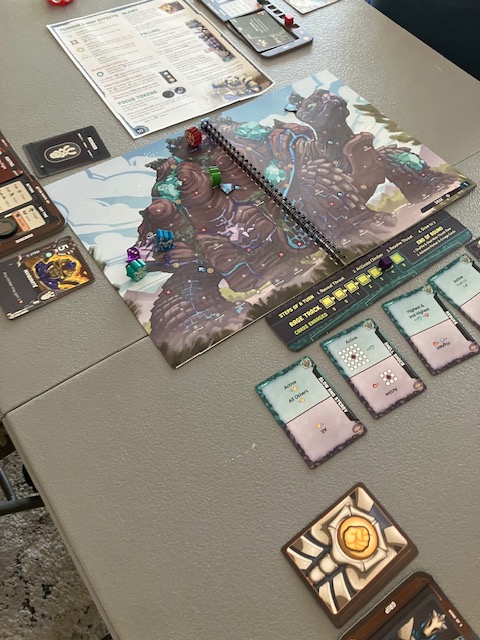
IMG_4444

In this board game (see sample above), you fight one of 17 Leviathans (you can’t call them Colossus … you wanna get sued?) and win if you can free the Leviathan of its constraints! Leviathan Wilds has a friendlier theme than the original Shadows Of the Colossus: rather than attacking the Leviathan, you are healing the Leviathan by taking out the Binding Crystals. So, when you and your friends cooperatively win … you have freed the Leviathan, rather than killing it!

IMG_4422

Let’s take a look!

IMG_4424

Unboxing and Gameplay

IMG_4440

Players choose a Leviathan to help from the Book of Leviathans

IMG_4501

Each Leviathan is a massive 2-page spread from the book! Sage, above, is the suggested first Leviathan to help.

IMG_4494

Each Leviathan has its own small deck of Threat cards (5) and some story cards.  See the Introduction above.

IMG_4540

The 5 Threat Cards (just below the Leviathan) control what the Leviathan does at the end of the turn(s).   

IMG_4538

Some Threat Cards attack the current player with an area of effect!  

IMG_4528

See above as the area of effect above on the Threat Card (it’s just the orthogonally adjacent to the original site).  If your climber can get out of the area by the time your activation is complete, you can avoid the attack completely!

IMG_4510

At the end of 5 turns, the Threat deck is reshuffled and comes out again.  To escalate the game’s difficulty, each Threat Card has two rotations:  blue and purple, with the blue rotation being the “harder” challenge!  See above!! As the game progresses, more and more of the blue sides are revealed, making the game harder!  

IMG_4500

To win, players cooperatively must take out all the Binding Crystals (represented by dice) at various points around the Leviathan.   See one such Binding Crystal above.  You spend Action Points (or cards) to reduce the value of the die, until it is zero, at which point you remove it!

IMG_4522

There are quite a number of Binding Crystals set-up at the start of the game (purple and blue: purple Binding Points are straight-forward, blue Binding Points have side-effects). See above.

IMG_4455

Each player takes control of one of eight Climbers! These Climbers climb (duh) the Leviathan to take out the Binding Crystals! See the eight different Climbers above and below.

IMG_4570

Each climber has a personality and special unique ability: see above.  Each climber also has a small hand of cards.

IMG_4572

Climbers then choose a Class (one of eight) to play:  See above.  Each class also adds a number of cards to your deck.

IMG_4574

Combined together, the Climber and Class form your personality and your deck! See above as Kestrel the Breaker takes form and becomes a character in the game!

IMG_4518

The deck is what powers your character!  You have three multi-use cards (in hand) every turn that you can use for Actions Points or their Special Abilities!  See above and below.

IMG_4529

Players have a certain number of Action Points per turn, depending on which card they play to start their turn.  Like we said, the cards are all multi-use cards: you can either play them to get Action Points (upper left corner), or as-is to get its effect (bottom of the card).  

IMG_4513

There are basic Actions (see above for a list of actions on your character board) that each cost a number of Action Points.  Some Climbers (like Kestrel) have special Actions only they can perform with their Action Points.

IMG_4540

Every turn, a Threat card comes out, specifying what the Leviathan does.  You may/will take that effect after you activate … sometimes you can avoid the effect completely if you play smartly (by either blocking or moving out of the way).  The player takes his full activation and DOES STUFF: moving around, playing cards, and trying to take out the Binding Points.  Threat cards take effect after the activation, and play moves to the next Climber.  

IMG_4551

Repeat until players take out all Binding Crystals or lose (by dying)!  See above for a winning game with two Climbers!

Cool Things

IMG_4539

The number of cards in your deck represents your grip: if your deck (left) is ever empty, you immediately fall until you hit a platform!  This deck sort of reminds of Gloomhaven, but rather than the deck being your hit points, the deck represents how “well” you are holding on!  It’s a cool ballet in the game, knowing when to rest (to recoup your grip) and when to push ahead (to get stuff done).

IMG_4554

The multi-use cards are quite clever: you HAVE to choose a card to play for its Action Points at the start of your turn, but that means you can’t use the special ability on it!  It’s a very clever way to make players really think about what they want to do with the cards they have!

IMG_4471

The components are pretty top notch in this game.  

IMG_4492

There’s a lot of variety in this game: there are 64 combinations of Climber/Class, each with their own unique deck!  There’s also 17 Leviathans, each with a very different Threat Deck!   Some of the fun in this game is exploring the best combos for the different Leviathans!  I expect to lose many games as I learn some of the later Leviathans … but with loss comes knowledge on how to win!

IMG_4591

It’s also clever that the Threats don’t take effect until AFTER you have activated your turn: this sort of represents the interplay in a Video Game! You see what the Leviathan is about to do, and you can react! Sometimes you can mitigate the effect and sometimes you can’t, but it’s a clever way to that Video Game interplay.

IMG_4529

One other multi-use card thing that’s cool is some cards that you play as Action Points have a “blocking” icon underneath the Action Points!  If you play Hidden Paths above for 4 Actions Points, that also means you can’t lose any “grip” (cards from your deck) during your activation!

So that means you can using the cards for Action Points as well as possible blocking!  That makes the choices even more delicious!   The multi-use cards are just fantastic in this game.

Solo Play: Two Modes

IMG_4423

So, Congratulations on offering an official solo mode!  (Thank you for following Saunders’ Law!)  The official solo mode has the solo player operate two characters with a combined deck.
IMG_4437

The Solo Play is described on page 11 of the rulebook (see above).  

IMG_4576

The solo player chooses two Climber and one Class deck, and  then combines them to form “the solo deck”: both characters use this same deck for their play.  Play alternates between the two Climbers, using that same deck for both characters.  The idea, I think, is to reduce management overhead by only having one deck.

IMG_4587

This is the official solo mode (above).  It is fine. I played and was able to win with the second Leviathan.

IMG_4551

However, I think the better solo mode is simply to take complete control of two Climbers, each with their own deck!  (Like above)! I like the “solo player takes control of two Climbers with separate decks” rule better than the official solo mode.  Why?

  1. The official solo mode has “exceptional” rules you have to remember (only get 7 cards when you rest, both chars fall when the grip runs out, etc).
  2. The solo player with two characters with separate decks is more like the cooperative game; I have to teach my friends this game, so I’d rather just learn the cooperative game as it is!

Basically, the official solo mode has exceptions to the base rules which I have to remember.  I’d much rather just play the game in “normal” mode without any exceptions: it makes it that much easier to teach!

IMG_4594

Both solo modes are very fine and very fun and very playable.  The official solo mode has less management and takes up less space (see above).  The unofficial solo mode with two Climbers and two decks requires operating more cards and takes up more space, but it feels more like the normal game (see below). I personally prefer the latter: play as if it were a 2-Player game, just alternating between the characters.  Decide for yourself! They both work!

IMG_4552

Cooperative Mode

IMG_4606

Cooperative mode works great!  Sara had a chance to watch a rules playthrough earlier, so we were able to jump right in!

IMG_4609

We tended to mostly play our own characters, with a little bit of coordination about which Binding Crystals to go after.   I think each player felt very different: my Climber/Class had a lot of blocking power, and Sara’s never saw a single blocking card!

IMG_4473

Sara also reminded of a rule that tends to evoke more cooperation … you can throw Mushrooms to each other!  The maps have some Mushrooms (see above) scattered about!  And Mushrooms all do good things! You can throw a mushroom to help your compatriot … if you are close enough!  

Generally, this game went over very well ! The theme really impressed by friends, they loved the art, and they loved the quick 60-minute game!

IMG_4506

I think the amount of cooperation depends a little on the Climber/Class pairs you choose. The “Saavy” Climber (see above) tends to be very useful at helping everyone in the game at some point, so playing “Saavy” will elicit more cooperation! “Fix” (above), on the other hand, is just focused on “Hit It Harder”, so he will tend to just do his own thing.

The amount of cooperation will depend on a lot of things: the Climbers, the Classes, the Mushrooms, and the topology of the Leviathan! The game may feel multi-player solitaire in some games, and incredibly cooperative in other games!

Conclusion

IMG_4611

Leviathan Wilds was, luckily, a good game! I was a little nervous about it, because frankly I hadn’t heard too much about it from any other source.  But I think this game is great! It has some really unique ideas that make it feel almost like a video game: deferring Threat activation until after the player finishes, player cards that can be played instantly, multi-use cards, Threat Cards that rotate to get harder (levelling up!), and a Leviathan topology to maneuver!  

IMG_4479

I am a big fan of this game: the official solo mode works well enough (although I prefer the unofficial solo mode), but the cooperative mode works even better.  There’s not too many rules, the game is a short 60 minutes, and yet it feels like this is a deep game with lots of replayability!  The Climber/Class combination system works great for keeping the game interesting! The 17 Leviathans give the players lost of creatures to help!

This is a fun, fun game.  Right now it sits at an 8.5/10 for me, but this could easily go up to a 9 or 9.5. This totally deserved to be on my Top 10 Anticipated Cooperative Games of 2024! It’s a blast!

Full Campaign Playthough: A Review of Set A Watch: Doomed Run

IMG_3848

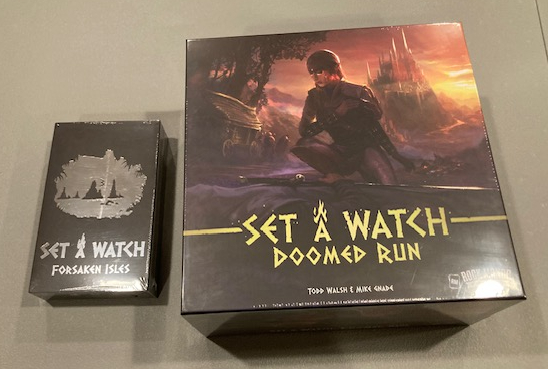
Set A Watch: Doomed Run (see above) took over my life and my game table (see below) for 10 days in late April 2024.

IMG_4034

For those of you who don’t know, Set A Watch: Doomed Run is a campaign game set in the Set A Watch universe from Rock Manor games.   If you don’t know what Set A Watch is, check out our reviews of the three standalone games: Set A Watch (see link here), Set A Watch: Swords of the Coin (see link here), and Set A Watch: Forbidden Isles  (see link here).  The summary: Set A Watch is a cooperative dice-placement game set in a fantasy universe.  Four characters work together to travel home, fighting monsters along the way.

IMG_4527
Set A Watch: a cooperative fighting game: protect the campfire!

The original Kickstarter that introduced us to the Set A Watch universe was way back in September of 2018: See above.

IMG_3541

The most recent Kickstarter (above) introduced us to two products: the standalone expansion Set A Watch: Forbidden Isles and the campaign version of this game called Set A Watch: Doomed Run.  We reviewed Set A Watch: Forbidden Isles about a month ago (see our review here).

IMG_3853

After a very long (but fun) 10 days, we were able to play through all of the entire campaign of Set A Watch: Doomed Run.  Let’s take a look below!

Unboxing

IMG_3849

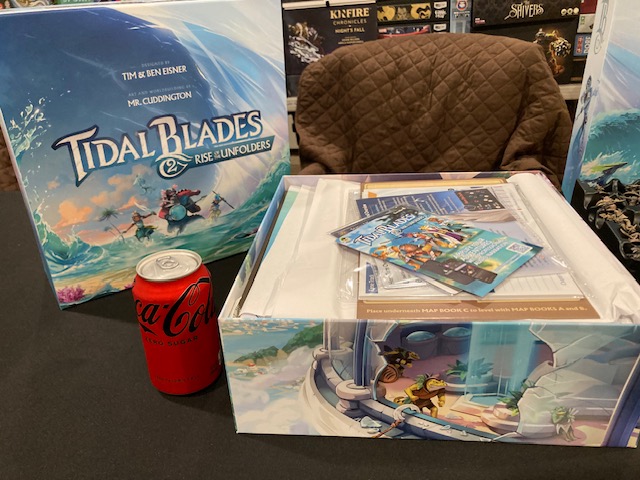
Set A Watch: Doomed Run is a pretty big box: see Coke can above for scale. The box is definitely taller than the soda can!

IMG_3852

Right when you open the box, there’s a little pamphlet telling you how to organize everything: we’ll come back this later …

IMG_3853

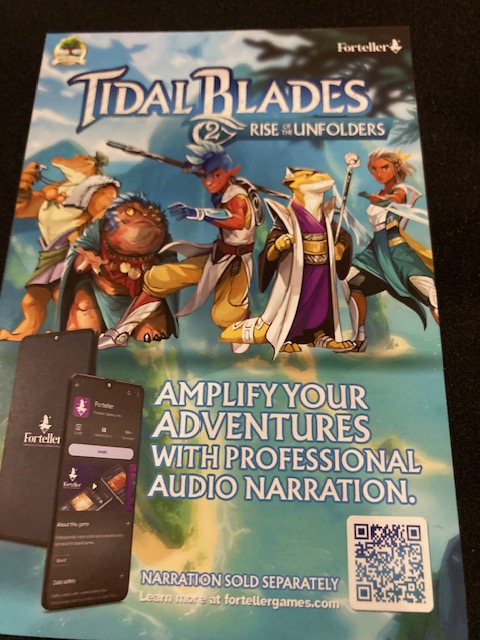
In the top section of the box is the game board, the rulebook, the board, some extra characters, and a Foreteller: Doomed Run advertisement.  Foreteller is an app that will use professional actors to read parts of the story to you … but you must buy it separately!

IMG_3579

The original Set A Watch game(s) are self-contained with fairly small boxes where the board is the wrap-around board: see above.  

The box here for Doomed Run is huge, so there’s no wrap-around board! The board just comes in the box: see below.  But basically, the board is the same: it’s the dice placement board where the player who “stays back” chooses his actions.

IMG_3855

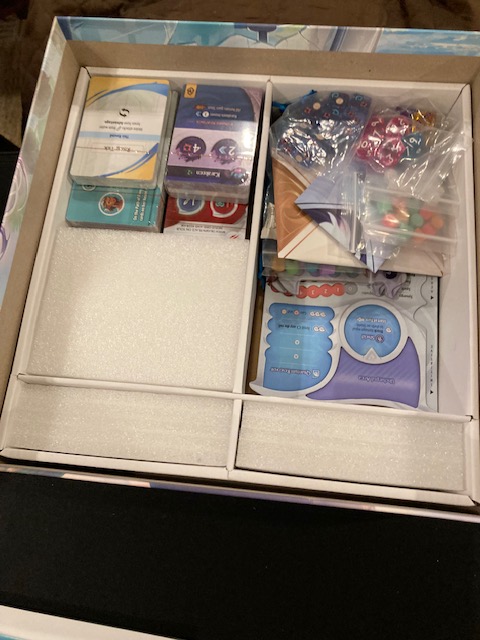
Most of the box is surprisingly empty:

IMG_3631

Wait, how much did I just pay for an almost empty box???”  Well, there’s two answers to that question …

IMG_3860

First, there’s some content hidden under the top plastic divider!

IMG_3900

This is a campaign game!  Each stage of the campaign has extra cards packed into the appropriate Realm envelope: see above.

IMG_4174

There’s some new locations, some new creatures, some new Unhallowed, some new ability cards, a few new summons, some new dice, and some dividers: see above!  There’s more than you think in here … and at the same time, there’s not.  What do we mean by that?

The Elephant In The Room

IMG_3859

The elephant in the room is that you need to own all three standalone games Set A Watch, Set A Watch: Swords of the Coin, and Set A Watch: Forsaken Isles (and the Outriders small expansion) in order to play Doomed Run!  See above. That’s right, you have to love this game enough to have bought all the content available!

IMG_3927

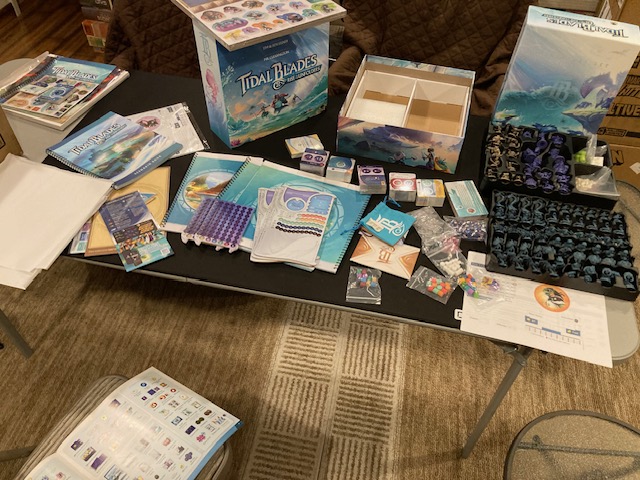
The Doomed Run campaign pulls content from every single expansion over the course of the campaign!! See above: I have each expansion separated out so I can pull the appropriate cards.

IMG_3872

For example: take a look at the rulebook above! It describes all the cards you need for Realm 1 (the first act of the campaign).  The cards needed for Realm 1 are taken from the four expansions AND the Doomed Run box!

IMG_3633

That’s why the Doomed Run box is so empty! They want you to store ALL OF YOUR EXPANSIONS in it!!  Again, we will discuss this more later …

Rulebook

IMG_3854

The Doomed Run rulebook is good.

IMG_3862

I think the Doomed Run rulebook may get the best score on The Chair Test we’ve seen in some time!  It’s an A!!! It fits perfectly on the chair next to me, the rulebook stays open, the font is big enough to read, and it’s a good font!   It would probably get an A+ on the Chair Test if there were a few more pictures and it had a slightly bigger font!

IMG_3863

The components page is well-marked: it does suffer from a lot of the cards being the envelopes, so you can’t pull all the cards out and “correlate them”! But the label at the top of the page clearly says “..some components listed here are separated and stored within the Realm envelopes in the box….”  At least they show what the components look like!

IMG_3866

The Set-Up spans 4 pages (!), but it does show a nice picture you can use.  Part of the extra pages are needed because … this is a campaign game!  This is significantly harder to set-up Doomed Run than the plain vanilla version of Set A Watch.

IMG_3869

There’s discussions about winning and losing and saving the game …

Some save sheets:

IMG_3881

But the most important thing is that the rulebook has the list of the cards needed for each of the 7 Realms (each Realm is an act of the campaign): See an example of Realm 7 list below. Note that each Realm has some flavor text on the left, with the cards needed on the right.

IMG_3878

IMG_3880

There is a no index (boo), but there is a Glossary (yay: see above).

IMG_3882

The rulebook ends with a record of how you did in each Realm!

IMG_3879

Overall, this rulebook was pretty good: A solid A on the Chair Test, good components, good set-up, readable font, and fair number of pictures. 

My only complaints are more rules themselves: they could have been a little better!  For example, I know that I read that Mythic Items don’t get discarded between realms, but I went absolutely spare trying to find the rule!  You’d think it would be listed under Mythic Items section, yes? Or under the Set-Up?  Only in Ending A Realm, a sentence says “Any Adventures not selected as the Warden must discard all their non-Mythic items”.   I would have tried to be clearer! It’s okay to repeat yourself to make rules clearer! I would have:

  • (a) said this in a positive way: “Adventurers keep all Mythic Items between Realms, but return all non-Mythic items to the Items deck
  • (b) reiterated this rule in the Mythic Items section
  • (c) made space on the Doomed Run historical record as a place to record each character’s Mythic Items (as they have space for all the Warden’s items).    To be fair, the Mythic Items are listed on the Save Sheet  Expeditions page, but it’s not clear that you keep them … and in fact, I never used the Save Sheet Expeditions page! I played through each Realm in one sitting, so I never used them!
  • (d) put this in a FAQ (see below)

As the campaign went on, there were several times when we had questions:  a FAQ (that we’ve seen in the previous Set A Watch rulebooks) might have been nice.  

So, the rulebook could have used a little more work.  A FAQ and a few reiterations would have been helpful.  So, the rulebook was good … it could have been great.

New Idea: Side Quests

IMG_3907 (1)

There’s now Side Quests: at the start of every Expedition, players choose of one of 3 Side Quests to take!  See above for three samples Side Quests!  Basically, player take one, trash one, and put the third away.  Now, these Side Quests aren’t little adventures that take time away from the game: they are just cards with a cost and a reward!  The cost is pretty varied, but the reward is almost always either (a) a new Character to add to the party (b) a Mythic Item.

IMG_3939

For example: if you want to get the Healing Staff (above) for the Cleric (so worth it!), you have to exhaust 3 ability cards!  This is another place where the rulebook doesn’t do a good job explaining!  Do you pay the cost immediately?  Do you pay it as you play?  Do you get the reward immediately after you pay the cost?  Or do you get the reward at the end?  This was poorly specified in the rulebook.  We played so that we “generally” payed the cost at the start of the Expedition and got the Reward at the end;  it was unclear.

IMG_4139

Still, the Side Quest idea was cool: it made the players talk and strategize about the directions of the party: what do they want to focus on?  The new characters are important, as they shape the direction of your campaign: you need diversity for new Wardens!  You also really need new characters for sheer numbers: your characters can die the campaign, so you need to always have four characters available or you immediately lose!

New Idea: Wardens

IMG_3903

At the start of every Realm (after the first), the players can choose one character to become a Warden and watch the Kingdom!  There are two major benefits to choosing a character to be a Warden

  1. Each Warden offers a special good effect at the start of the Realm
  2. A Warden keeps all of his items (both Mythic and non-Mythic) between Realms, whereas most characters can only keep the Mythic items (the non-Mythics go back to the item deck).  (See what I did there?  I repeated information to make it clearer).

IMG_3962

For example, the Cleric (above), when he becomes a Warden makes it so the characters start with all abilities refreshed!  (Usually, each player starts the Realm with one ability exhausted).  IMG_3969

You can see on the Record above that the Cleric got the Healing Staff (so good!), as well as two other items.  In my campaign, the Cleric was the Warden for Realm 2, which allowed the players to start fully healed!  See below.

IMG_3956

The only problem is that the character who is currently stands as a Warden CANNOT PLAY the current Realm!  They can play later Realms (and come back with all their stuff), and indeed, the Cleric came back in my final Realm (spoiler alert!).

The Warden idea was really nice: it forced players to have a new character sit out every Realm and add a new character in!  New characters were slowly cycled in and out over the whole campaign!  It kept the campaign fresh!!! Over the coarse of 7 Realms, I got to play 4 + (7-1) = 10 characters! I’d keep three of the same characters as I moved from Realm to Realm (for consistency, since I had just played them and wanted to keep their play style active in  my cache), but I would add a new character in at every Realm!  

I really liked how the Warden system gave you a reason to keep cycling in new characters into the campaign!  This was a very cool mechanism to force new blood!

New Idea: Nemesis

IMG_3962

You might also notice the Cleric has a Nemesis notated on his Warden card: the Sewer Ghoul!  See above.  What does that mean?

IMG_3956

This means that, whenever the Cleric is one of the four characters in play (not a Warden), the Sewer Ghoul must be shuffled into the Creature deck!  In other words, it makes the game a little harder by having more creatures! The Nemesis seems to specifically targeted to the character and his powers!  For example, the Cleric has can simply Cleanse Undead to get rid of the Sewer Ghouls if they show up …

The Nemesis idea worked okay: I think they are mostly to help balance the game a little.  For example:  The Warrior Nemesis is needed to keep the big dice of the Warrior under control … see below.

IMG_3958

The Enraged Farmer Nemesis (above) is pretty hefty! But the Warrior is a heavy-hitting character, so it helps balance out the Creatures so they are more balanced with the characters.

The Nemesis idea worked, but the idea made the game slightly more fiddly; I had to go hunting for the cards many times (“Oops! I forgot the Nemesis!“)! Since each character has a unique Nemesis, there is some looking around.

IMG_3962

At least the Warden card tells you which game the Nemesis comes from!  The little scarab next to the Nemesis name means Doomed Run: see above.

The Nemesis idea was slightly annoying to remember to seed the Creature deck, but it did seem to work.

New Idea: Mythic Items

IMG_3939

We’ve mentioned Mythic Items several times previously during this review: they can only be obtained as a Reward from a Side Quest: see above.

As we said, Mythic Items persist between Realms, so it’s really great to get them if you can!  Unfortunately, only the character listed on the Item can use it!  The Healing Staff? Only the Cleric can use it!  

IMG_3897

There’s exactly one Mythic Item for each character.  But, I think Mythic Items are probably my favorite new part of the game?!?!  They felt so cool! When a character finally got their Mythic Item, they felt so cool and powerful!!

The only problem with Mythic Items: It was a bit of a crapshoot when choosing Side Quests though: Don’t you always want the Mythic Item?  Only if you had or had a chance of getting the character who can use it!  If you have already “thrown away” the Ranger, you don’t want to Side Quest for the Multiplying Arrow … no one can ever use it! (Although, every Mythic Item counts for points towards your final score).    The Side Quest mechanism really did make these Mythic Items feel precious … and when you got them!  Wowiee!!! So cool!  

Mythic Items were very thematic and fun: they were my favorite part of the game.  The Mythic Items reminded me of old games of Dungeons and Dragons when your Paladin got the +5 Holy Sword!  It felt so cool!

New Idea: Game Break

IMG_3894

The base game of Set A Watch is about an hour of playtime: players have 9 Locations to get through, and it moves along quickly.  In Doomed Watch, however, each Realm is a little longer than the base game! Each Doomed Watch Realm has about 12-15 Locations (depending on where you are in the campaign), with later Realms being longer.  The new notion of a Game Break comes after 4 Locations!

IMG_3938

The Game Break seemed to do a bunch of things: 

  1. Keep the coins from accumulating too much
  2. Cycle Side Quests in and out quickly so you see more of them
  3. Keep the Creature deck “fresh”

 The Game Break is also a natural save point for the game: since the Realms are longer runs, this gives the players a natural place to save the game if needed.  The rulebook has some pages for saving (see below), or you can download some sheets from the Rock Manor website.

IMG_3881

I never used the Save Sheet (above) because I always saved games between Realms, never at a Game Break.

IMG_4153

To be clear: each Realm in the Doomed Watch campaign is longer than a base game of Set A Watch.  Over the course of the campaign, I saw Realms take about 2 to 3 hours.  The Game Break helps add more “save points” to the game.

Doomed Run Campaign

IMG_4173

My Doomed Run campaign took place over 10 days.  I played about one Realm a day (skipping a few days here and because of work): the earlier Realms were about 2 hours apiece, but the later Realms became longer and longer.  I think the final Realm (Realm 7) was 3 hours of playtime.

IMG_3932

To emphasize, that’s 2-3 hours of playtime!  The set-up and tear-down for each Realm was also pretty hefty! I think it’d take upwards of 45 minutes to set-up and 20 minutes to tear-down.  The issue is that you have to put cards back in the appropriate place!  

IMG_3953

Each card in the game is marked with where it comes from on the lower right of the card, mostly.  Each Realm tells you where to get the cards from: see below for Realm 2.

IMG_3873

After the game was over, I would spend some time putting cards back where they belong during tear-down so I could find them again.

To summarize, each Realm was about 30-40 minutes of Set-Up, 2-3 hours of gameplay, and 20 minutes of teardown.  I think my final Realm was a 4 hour game: 40 minutes of set-up, 3 hours of play, and 20 minutes of tear-down.  Whew!  There was a lot of overhead in setting up and tearing down games.

But Was It Fun?

IMG_4152

Yes! It was fun!  I love the Set A Watch system!  The newer ideas of Wardens, Side Quests, Mythic Items really helped evolve the game! There were new things to think about, new ways to strategize, and just more decisions.  I don’t think I would played through all 7 Realms unless I was having fun!  I really do like this game!  I really feel involved at every step of the game, and the strategies of choosing Side Quests, characters to play, Items to buy, who to watch the fire, when to cull the Horde, when to cull the Unhallowed, and so many other things … keep the game from just being a “roll dice and kill things” game.   

I’ve said it before: I like that dice can be used for their value AND/OR to activate character abilities!  If you have a good roll, you can straight up do great damage! But, even bad rolls can be useful when you activate abilities!

Solo And Cooperative

IMG_4073

The majority of the Doomed Run I played solo: this means I ran four characters at the same time.  I admit, when I first encountered that “you must play four characters” for the solo game back in the original Set A Watch, I was a little turned off!  The typical problems of context switching and game elongation rear their ugly head, but I’ve since grown to love the solo game.  I love to think and contemplate, so even if the solo game takes twice as long as the multi-player cooperative game, that’s okay! I like the puzzle it presents!  What’s the best way to use the three characters on watch?  It’s so much fun to reason that out!

IMG_4049

However, I was able to slot in two 2-Player games during the campaign!  Teresa filled in for Realm 4 (see above) and did a great job!

IMG_4122

And Sam filled in for Realm 6!  See above.  The two-player games just mean we play 2 characters each, but we still have fun communicating and strategizing together!  In fact, I was worried Sam wouldn’t have fun with the Merchant character (see above), but he ended up having a great time!

It was VERY EASY to put new players in and out of the game!  If some player doesn’t make it one week, or someone else comes, it’s still really easy to just slot them in to the game!  Since new characters are cycling in and out all the times (partly because of the Warden idea), it’s much easier to slide new players in and out!  Honestly, that makes this an easier campaign game to get to the table!  Your group can change every week during a campaign of Doomed Run, and everyone would still have fun playing!  

So, Doomed Run is a campaign where you can play both solo and cooperatively, changing the player makeup every game!  

Theme or No Theme?

IMG_3874

Is there a lot of theme here? Yes and no.  When you are playing a Realm, it feels very thematic! This Realm has been built to have Goblins, or Undead, or some other theme to it.  The game, when you are playing, feels very thematic as monsters come out and you have to deal with them!  

BUT … the Doomed Run campaign itself, wasn’t particularly thematic.  There’s some flavor text at the start of the Realm that sets the stage … and that’s about it.  It doesn’t feel like the Reams are particularly connected.   The Doomed Run idea is great: it’s an excuse to play all the Set A Watch content!  But did I ever feel like I was playing through an integrated campaign with twists and turns? Nah. 

The upside of the campaign being less-than-thematic means that it’s easier to bring in cycle in new players and characters (see the Solo and Cooperative section above).  It also means you don’t really need to buy the Foreteller text for this: really, it doesn’t look worth it!  The only thing it will do is read is the little blurb at the start of each Realm … which you can do in 2 minutes. And like I said, eh, it wasn’t that thematic.

When you are playing, the game is thematic and fun! But the theme and integration of the campaign is a whole isn’t really there.  If you are looking for a campaign with lots of play twists, theme, decisions, branching narrative … Doomed Run is not the game for you.  It’s still a fun game, but it’s just not particularly thematic overall.

Mixing and Matching

I really like Set A Watch: Doomed Run. But there are some things to be aware of.

IMG_3573

First, you need to buy absolutely everything Rock Manor has made for Set A Watch to play the Doomed Run campaign: Set A Watch, Swords of the Coin, Forsaken Isles, The Outriders and Doomed Run itself!  That will be a non-starter for most people.

IMG_4017

It’s hard to reset the campaign!  The Doomed Watch does NOT tell you what’s in each envelope! I think each envelope should have had a manifest, or at least labelled them!   

IMG_4132

Bizzarely, the Side Quests were labelled appropriately! I could immediately tell the Poison Recipe Side Quest belonged back in envelope for Realm 7 because of the R7!!

IMG_4168

Luckily, I was taking pictures (for this review) as I went, so I was able to piece what was in the envelopes, but the cards were not labelled!   It have been nice if the lower right of the card said DR1, for Doomed Run Realm, and DR2 for Doomed Run Realm 2, etc  … (just like they did for the Side Quests!!)  As you play, make sure you take pictures of what’s in the envelopes!

IMG_4021

Although the Creatures, Unhallowed, and Locations are marked with which game they come from, it’s not clear some times!  There was no legend in the Doomed Run rulebook which explained all the symbols!  The flower symbol (on the Locations) above means Doomed Run, but which deck?  I don’t know!!

IMG_3612

Even worse, the Items cards are completely unlabelled! I want to be able to separate all my decks out when I am done, but I can’t resort the items!  So, for my entire game, I only used the items from the Swords of the Coin deck!!! At least then, I knew which deck they went back to when I was done!  

IMG_3890

The ability cards are unlabelled as well, but it’s not as big a deal as you can always figure out which box (or envelope … if you take pictures) the cards came from, as each Set A Watch lists the characters that come with it.

This seems like a big deal: I wish that Rock Manor had labelled the cards better.  It made it very difficult to reset your game.  I did it, but the pictures I took helped me.  If you decide to take the plunge, make sure you take pictures of what’s in each envelope!

Storage

IMG_3852

The first thing in the pamphlet is the recommended storage: they want you to unpack all of your Set A Watch games and combine them in the Doomed Run box! Nope nope nope nope nope.

IMG_3571

I want to keep my games separate!  The base game is so easy to pull out and play!  If you, all of a sudden, mix everything in one box, it muddies the experience!  When Set A Watch should be a quick game to set-up, play, and tear-down, putting everything in the Doomed Watch will make this so much harder to bring to the table.  The base game is small and approachable.  The Doomed Run box is daunting. If I ever want my friends to play Set A Watch again … the games have to stay separated!!
IMG_3932

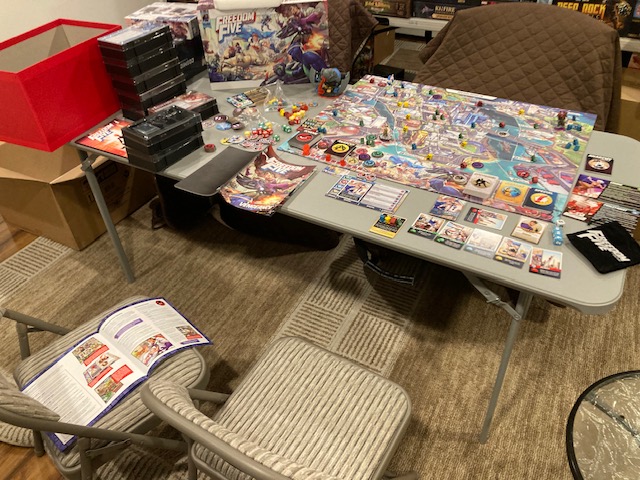
In the end, I opened up and placed all the Set A Watch games on my table, visually separated so I could easily correlate which games held which content!  See above!! I hated the idea of combining all my games into one box (especially since cards like the Items are unseparable and unlabelled)!  So, I played with one half of my table taken up.  It worked for me, but you may not have the space to try this solution.

IMG_4175

It turns out you can have your cake and eat it too … you can actually store all 3 Set A Watch boxes (and the Outriders expansion) in the Doomed Run box without separating the games out! See above!  Basically, the games slotted into the big bay on the left (see above).

IMG_3858

So, I can store all my Set A Watch together, but not have the terrible terrible consequences of combining everything!  That’s a win in my book. 

My recommendation: do not separate the games out.

Conclusion

IMG_3572

It’s hard to recommend Set A Watch: Doomed Run.  You have to buy four expansions and the Doomed Run box to even play this!  Yet, over 10 days in April 2024, I had a blast playing through this campaign!  It’s rare that I get so excited that I want to play a campaign this long, but I love the Set A Watch cooperative dice-placement system so much that I couldn’t stop playing!

IMG_4128

This campaign is unique because you can easily combine solo and cooperative play through out the campaign!  The Warden system encourages cycling characters in and out, which makes it easy to cycle in new players as well!   Although this cycling is a great feature, it partly comes from the overall campaign being fairly athematic: it’s easy to cycle in new players and characters partly because there is no theme connecting the acts of the campaign.  Be aware: Doomed Run isn’t a deep, thoughtful campaign with lots of twists and turns!  Doomed Run is really just an excuse to play through all the content of this game system.

IMG_4149

If you find yourself intrigued by this campaign, pick up any of the Set A Watch base games and make sure you like it! If you find yourself wanting more, you can always get more expansions … and if, like me, you find yourself loving the Set A Watch gameplay, maybe the Doomed Run campaign makes sense to get. You just gotta get all the content!!

IMG_3542

Doomed Run made my Top 10 Anticipated Cooperative Games of 2024!  And I am happy that I got it!  It will probably make my Top 10 Cooperative Expansions of 2024 this year! I had a blast playing it this year, and I expect I will play through it again in the future.  

Groundhog Day Meets Murder? A Review of The Revenant Society

Screenshot from 2024-04-21 13-15-26

I picked up The Revenant Society from Kickstarter from March 2023, just about a year ago (it is late April 2024 at the time of this writing): see link here. This game seemed to be the unholy fusion of both a board game and a Role Playing Game (RPG). It has a core rules book, but also many supporting cards and tokens: see below.

IMG_3972

What you see above is the pledge level The Revenant Society: Deluxe Box  Set (for $75). There was also the option to just get just the core book in physical form ($40) or electronic PDF ($20).  Anyone who has been following my blog for a while knows I prefer the physical copies, so I got the Deluxe Box Set (the exact one in the picture above).

IMG_3974

What is The Revenant Society?  The basic premise is that you have been murdered, but you are given a chance to come back as an undead creature to solve your murder!   It many ways, it’s like Groundhog Day (the movie), as you repeat the same day over and over, hoping to find clues to lead you to your murderer!  If you fail to solve your mystery after four days, you are stuck in the loop of your last day forever!

What a great premise!  I was immediately drawn in and backed this. 

IMG_3673

The PDF delivered in late March 2024 (I have the PDF labelled as March 29th) from Drive Thru RPG.  It has my name and my order number smeared on a number of pages, so don’t ask me to share this with you!

IMG_3971

The physical copy of the box delivered in mid April 2024 (about April 16th).

IMG_3710

This review is going to take a weird arc: we ended up playing the PDF version of the game in our first session, and then the physical version of the game in our second session!  So, we’ll discuss how each sessions went: electronic PDF version vs physical version!

RPG or Board Game?

IMG_3998

Is this more of an RPG or more of a board game?  The little minis (above) and the cards (below) that come with the game offer some suggestion this has more than a little board game DNA.

IMG_3983

After reading the rules and playing a few times, I can tell you this is 95% an RPG and 5% a board game!  The boards that you use are “nice” for helping you keep track of events in the game, and the cards and tokens are useful like a board game, but at the end of the day, this is really an RPG!

IMG_0287

The biggest clue that this is an RPG is that one player has to be the Dungeon Master  (or DM) or Game Master (or GM): they are called the Fate Weaver! The Fate Weaver has to run the game for the other players, just like a GM would.  A further clue is that this system is based on an RPG system called the Apocalypse: a lot of modern RPGs are “Powered by the Apocalypse“!  So, this is really an RPG with just a touch of board game elements to keep track of a few things.

If you find yourself interested in this, be aware!  This is really an RPG where one player (The Fate Weaver) will have to invest a lot of time learning and setting-up an adventure for this friends: this is not really a board game.

Session 0: Getting Ready

IMG_3665

So, I ended up being the Fate Weaver and picking an adventure to run: this means I had to do a lot of reading and set-up to get ready!  The core Revenant Society rulebook comes with six scenarios, and another expansion PDF (that comes with the deluxe version) another four scenarios.  The game is set in either Paris France 1910s or New York City USA 1920s: about half the scenarios are in Paris (see map below), and the other half in New York.

IMG_0280

Since the deluxe version hadn’t arrived yet, I made due with using the PDF version.  This means I had to print out a lot of stuff to hand out to my players! See below all the stuff I have to print out!

IMG_0279

Probably half the stuff I printed you didn’t need: some of it I wasn’t sure, so I printed it, and the other half you can just show the players some pages from the rulebook on your PDF.  But you still need to print a awful lot of stuff!  Luckily, this is ALL IN THE PDF RULEBOOK!!  You just have to print the appropriate pages (near the end of the book).

IMG_3666

Over the course of about four days, I read the rulebook a couple of times (it’s like 284 pages, but most of that page count is scenarios at the back of the book/print-outs); I tried to figure out what I needed to print. 

IMG_3711

I ended up using a paper cutter (see above) to help with some of that. 

After reading the rules, re-reading the rules, choosing a scenario, and printing everything I needed, I felt ready to run the game.

Session 1: Paris Scenario: The Petals of Belladona

IMG_3667

Like most RPGS, each player needs to create a character to run through the scenario.  There are six  basic archetypes in the game (one is “The Glamorous”: see above): each player chooses one and expounds on that basic framework to create a more personalized character.

So, my friends and I met for the first session.  I had planned to “just” create the characters and explain the game!  I “expected” that to last 2 hours, but it went very quickly!  We got the characters created and got the the gist of the game in 45 minutes.  So, GULP! We just jumped right in!

IMG_0286

I think the reason it went so well was because I had spent a lot of time preparing, so I didn’t have to lookup too much stuff as we played!  Don’t get me wrong: I still had to make up a lot of stuff as we played … which is typical:  most Dungeon Master/Game Master have to be creative and make up stuff to respond to their players.

  IMG_0289

In the end, we made it through Loop 1 (where we uncovered a lot of the story) and ended with a dramatic reveal!  This was all by the seat of my pants, but I think it went well.

IMG_0288

Even though we had cheesy cut-out components, it actually worked pretty well.  Again, it was probably because I over-prepared so I think I knew everything we would need.

IMG_0287

We liked the game enough to want to play again! So, we looked at our schedules and decided to try again in two weeks!

Meanwhile …

IMG_3971

While we were waiting to meet again, the physical copy came in the mail!

IMG_3972

Instead of cheesy cut-outs, we now have real tokens! Real cards! Real boards! Real dice! And dry-erase boards to boot! 
IMG_3974

Probably the most exciting piece was the physical copy of the core book!  See above and below!

IMG_3973

I took a picture with a can of Coke to show how thick the book actually was! It’s a big boy!

IMG_4006

In fact, I was worried about stripping the binding, so I made sure to open it and slowly open parts of the book so the binding would get some equal wear and tear as I opened it.  We used to do this to all our AD&D books growing up … it keeps the binding fit!

IMG_3995

So rather than a sheet of memories (used to generate content) like above from the PDF …

IMG_3983

We get a full deck of cards from the physical edition! See above.

IMG_3994

Instead of cheesy cut-outs (like above) …

IMG_3998

We get plastic minis!

IMG_4002

On the left, you see all the things I printed from the PDF … and on the right, you see the physical components.

IMG_3980

A bit of a surprise was the character sheets in the deluxe version are dry-erase!
IMG_3977

The deluxe version even comes with dry-erase pens!
IMG_4003

The map is much nicer too.  See the map of Paris above.

IMG_3985

Besides the book, probably the nicest component was the Fate Weaver screen!

IMG_3987

So, basically, everything now has “deluxe” pieces: the next time we play, we’ll move to the new pieces!

IMG_3972

Session 2: Playing Loop 2 With The Deluxe Components

IMG_0295

So, in our second Loop of the game, we embraced all the deluxe components.  We decided quickly that the dry-erase boards are terrible for writing lots of text (upper left uses pencil-and-paper), but good for writing simple adjustments and damage (upper right uses dry-erase board).

IMG_0296

We also put some ultra-fine dry erase pens on standby, but we didn’t need them (because we didn’t write any text on the dry-erase boards, just simple marks).  See above as I have the Fate Weaver Screen and the  big old Revenant Society core book in front of me.

IMG_0297

I ended up putting some markers in the book to remind myself where certain sections were: I found out very quickly that this beautiful book DOES NOT have an index!

IMG_0298

Sara ended up using a notebook to take notes through the adventure: she was never tempted to use the dry-erase boards.   I will say that the map looks a lot better (see above) and the Fate Loop board is much easier to use with the dry-erase boards.

IMG_0299

In the end, we had fun playing.  I think we took the game a little less seriously in the second game …

IMG_0301

We ended up bringing a very saucy NPC named “Skully” into the mystery … see Teresa cradle Skully in her arm.  (They had to wrap Skully in something to shut him up … Skully liked to talk a little too much!)

IMG_0302

We went ahead and finished our story that night, completing the second Loop and solving the mystery of the deaths!

IMG_0303

We had fun.

IMG_0300

Probably the place where the Deluxe Component shone most brightly was the One-Shot Loop dry-erase board with the little Watchers: that seemed to work the best of all the deluxe components. See above.

Well-Crafted Murder Mystery?

IMG_3974

After getting through the game, I realized this was not what I expected: the game labels itself with the byline ‘Solve the mystery of your own death in this role playing game‘ (see the cover above).  What I thought this meant was that The Revenant Society would provide several well-crafted mysteries for the players to solve. No no no no no no.  That’s not at ALL what this game was!   This a game where the players make-up-what-they-want about their character and most of the story and the Fate Weaver simply “responds” and tries to push the game in certain directions.

IMG_4001

For example, take a look at the clue above: this is something the Fate Weaver is required to physically pass to the player at some point during the game.  But this is not a clue about this mystery, this is the player making-up whatever-the-heck-they-want to answer the question!

IMG_3979

Another example: at the beginning of every Loop, there are “questions” the Fate Weaver asks the players!  (See above) And the players answer whatever-the-heck-they-want!

IMG_4689
Detective: City of Angels Box Lid

If you were expecting something like Detective: City of Angels, or Sherlock Holmes: Consulting Detective (or many games on our Top 10 Cooperative Detective Games) with well-crafted mysteries, thoughtful clues, and meaningful timelines, that IS NOT what The Revenant Society is! This is a game about the Fate Weaver and the players collaboratively making up whatever-the-heck-they-want. (Well, the timelines are actually fairly well-defined, so I take that part back).

IMG_3989

I’ll be honest, I am very disappointed in what The Revenant Society is: I admit that I prefer my mysteries to be well-crafted and thoughtful!  I was hoping to be a GM that slowly guided the players to the final solution, by dropping clues and hints as they played.  What I got was a game where players do whatever-the-heck-they-want, and I, as the Fate Weaver have to somehow rectify that with the world and mystery they inhabit.

IMG_3988

You might say “Well, play the way you want to then! Make up a well-crafted mystery and present that to the players!”  I thought about that, but the mechanisms already in the game keep prodding the players to make-up whatever-the-heck-they-want: unless you alter the game drastically, this is a terrible framework RPG for well-crafted mysteries.  

IMG_3981

This isn’t what I wanted: I usually hate these kind of games, because they remind me of the TV Show: LOST.  Things just happen with no cohesion or thought, and frequently things just don’t make sense or get resolved.  I really hate shows like that: I want my shows (and my games) to be thoughtful.

Despite

IMG_0286

Despite this NOT being a well-crafted mystery, I still had fun running it. Once I set my expectations for what this game is, I did the best I could to stay in the moment.

IMG_0304

IMG_3713

My friends loved the setting and the idea of a Groundhog Day meets Murder game!

IMG_0283

I also did get some enjoyment trying to take my friends’ crazy ideas and turn them into a well-crafted mystery as much as I could!  I have seen so many murder mystery shows, read so many books, played so many murder games, that I feel like I do have a chance to turn my player’s crazy actions into a well-crafted mystery.    So I did enjoy it, once I got into it.

IMG_0301

And Skully ended up being an unexpected fun NPC, even though he hit on Sara the entire night … but that’s just what Skully does.

A Comparison To Spirit of 77

IMG_4005

My major compliant with the Revenant Society is that it really doesn’t have well-crafted mysteries: players just make up stuff as they go, and the DM/GM has to rectify what they do.

IMG_5227
Spirit of 77: Get the Funk Out!

Another RPG I played that has this same “make-up-stuff-as-you-go” style is Spirit of ’77 … and I loved that style there!! See out review of Spirit of ’77 here! What’s the difference? Why do I love this in Spirit of ’77 and hate this is The Revenant Society? At the end of the day, the purpose of Spirit of ’77 is to make each other laugh! So, anything that takes the game in a weird direction is welcome! To me, the purpose of The Revenant Society is to solve a mystery (and it even says that on the cover of the book), so the “make-up-stuff-as-you-go” style doesn’t lend itself to any kind of well-crafted mystery.

Maybe if you love this setting in 1910’s Paris or 1920’s New York, you don’t care as much about the well-crafted mystery as I do.

The Book

IMG_3974

We have to stay something great about the book: it’s very beautiful production.  It’s very readable! It has a lot of (it looks like) well-researched history around the two eras of interest (Paris 1910s and New York 1920s)!  The font is good sized!  In general, it looks fantastic and is almost a piece of art. 

Physical vs. Electronic

IMG_3973

If you are interested in this game, should you get a Physical version (the Deluxe Components or just the book) or the Electronic version (PDF)?

IMG_3710

Those of you know who know me would expect me to say “Get the Physical Product!” And you’d be wrong.

IMG_3991

First, let’s talk about the Deluxe version.

IMG_3980

Using dry-erase markers is a terrible idea for any meaningful amount of text!!!  We saw this waaaay back in our review of The Forests of Admiron (see link here).   First of all, the deluxe game comes with fat dry-erase markers … and they are hard to read! See below.

IMG_3982

If you really want dry-erase markers, you need ultra-fine to have any chance of them working well.

IMG_4005

In the end, Sara’s pen and paper system worked SO MUCH better: See above.  We tried it both ways (pen-and paper in Session 1 and dry-erase boards in Session 2):  pen-and-paper worked so much better.  You really don’t want the dry-erase boards: they are clumsy, messy, and harder to read/write.

IMG_4003

I do admit the map looks better (see above), but everything still works fine in PDF printed version (see below).

IMG_3671

I am really not convinced the Deluxe version is worth all the extra money, and in fact, makes the game worse with the dry-erase markers!

IMG_3974

Should you just get the physical book then?  I mean, it it gorgeous and a beautiful production.  That’s up to you: left to my own devices, I would just get the PDF.  Why? For one, the PDF is electronically searchable, and the physical book DOES NOT HAVE AN INDEX!!  For a book with 280+ pages, I am very surprised there is no index: how do you look up stuff in the physical version???  Answer, you can’t without a lot of searching.  The only way to really look stuff up quickly is electronically to search the PDF.

Another reason: A lot of the stuff I want to print out comes from the PDF only!  I had trouble finding the PDF pages I wanted online … I could only print them from the PDF I owned (to be fair: if you get the Physical version, I think you also get the PDF as well).

IMG_4004

The most important thing to print for the players in the Basic Moves!  See above!! Players consult this sheet ALL THE TIME: why was it not one of the things printed in the deluxe version?  I went out of my way to make sure each one of my players had a copy of the Basic Moves (they could have maybe gotten away with this by putting the Basic Moves on the outside of the Fate Weaver screen, but the Fate Weaver screen has no useful info on the outside).

IMG_4001

In the end, you the Fate Weaver still has to print the clues from the scenario (see the Hopeful clue #1), so what’s printing a few more sheets?

IMG_0286

In the end, the pen-and-paper approach worked best, with my searchable PDF being preferable to the physical copy of the book (which has no index???).  And my laptop also served as a Fate Weaver screen as well: see above.  Overall, I strongly preferred the electronic PDF version of this: the dry-erase player boards of the deluxe version just didn’t work that well. I needed to print quite a bit from the PDF anyways, so even though the deluxe version has some nice components, it wasn’t worth the extra money.

Conclusion

IMG_3974(1)

Would I get The Revenant Society again?  Even though I did enjoy my plays of this once I set my expectations, it wasn’t really what I wanted … but I would still play again.  I wanted a murder mystery game with well-crafted mysteries: that’s not what this is.  If you like the idea of playing in this thematic world with your friends, I think you can have a great time: we actually had a great time after setting our expectations!!  If the game does sound interesting to you, I strongly suggest you get just the PDF version of the game: you find yourself having to print stuff from the PDF anyways, so you might as well print everything you need at once.  We found the dry-erase boards experience from the Deluxe version lesser than a pen-and-paper experience, so even with all the cool stuff from the Deluxe version, it just didn’t seem worth it.

I did enjoy trying to turn the crazy ideas of my players into a well-crafted mystery as much as I could.  But the game mechanisms in The Revenant Society don’t really lend itself to any thoughtful crafting: said mechanisms are too ingrained as a “make-stuff-up-you-go” style.   This game is  just antithetical to any thoughtful mystery crafting .  I enjoyed my plays of The Revenant Society, I might even GM a few more games,  but I wouldn’t pick it up again. 

Maybe you would enjoy living in this world and having fun collaboratively putting together a mystery: decide for yourself! Just be aware, this is not a game with well-crafted mysteries.

A Review of Robinson Crusoe Collector’s Edition: from the Perspective of the First Edition

IMG_3020

Can you say a game is one of your favorite games of all time if you haven’t played it in five years?

IMG_3023

Is it even worse if you have all the expansions and have never even opened them? See the shrink wrap still on my expansions above and below!

IMG_3022

Although some might answer differently, I am going to answer with a resounding .. YES! Robinson Crusoe can still be one of my favorite games of all time even though I have all these unopened expansions and I haven’t played it in a while!  It reminds me of a favorite musical album I haven’t heard in years: when I hear it again, it just evokes all the feelings of joy and happiness … even if I haven’t heard it in a while. I still love it!   When I play Robinson Crusoe after five years, I still love it!

IMG_2965

Robinson Crusoe Collector’s Edition was on Gamefound a VERY LONG TIME AGO …  and it finally delivered to me in February 2024.   I backed the campaign on March 24, 2021, so it took three years for this to deliver!!!  I know a lot of people who were very very upset with Ignacy (the designer and publisher) over this lateness.   I guess I wasn’t as upset as others, but I also had to wait five years for Sentinels of Earth Prime to deliver, so three years feels like a breeze!

IMG_2975

This is a deluxe version/expansion for the game.  If you have the original first edition game (which I do), this is just an deluxified expansion for the game.  Now, the Gamefound claims that this expansion works with the first edition of the game (which I have).  And it …. mostly does.  We’ll discuss that more later.

IMG_2971

The expansion box adds some great minis, as well as some deluxified components.  

IMG_2968

However, since this was a Gamefound event, they also offered a lot more stuff to expand the game. See above!  We’ll take a look at a little of this below.

Unboxing of the The Big Box

IMG_2950

A big box arrived outside my door February 2024.  What’s this?

IMG_2951

Still not sure even after opening it … is that a playmat?

IMG_2953

Oh ya!  It’s Robinson Crusoe Collector’s Edition! Holy Cow! I forgot that I also ordered the playmat as an extra!  This is literally THE BIGGEST playmat I now currently own!  It takes up more than half the table and is huge … see the pencil and Coke can for perspective.

IMG_2955

Inside are also a lot of deluxe additions and expansions to the game. Note: these components do NOT come by default with the Collector’s Edition!  They are stretch goals and just generic add-ons from the original Gamefound event.

IMG_2957

I also got upgraded components for the food, wood, and other resources.

IMG_2958

There’s some very nice wood dice to replace the plastic dice in the game.

IMG_2959

There’s some more cards??? What are these??? See above.

IMG_2961

There’s some more minis to expand the already crazy minis we’ll see in second.

IMG_2962

And a few other expansions.  To be clear, the Coke and the pencil are there for perspective, they dot no come with the game!

IMG_2982

It might be easy to get lost with all this content (I did), but there’s a nice booklet in the box that explains what everything is!

Those cards we didn’t know what they were .. they are described in detail.

IMG_2985

In general, everything is described, in some detail! This is something this deluxe edition got right: within the book, they make sure to describe everything that comes in the box … even the Gamefound expansions! It’s too easy to let that stuff lag and say “just look at the Gamefound site” … nope! This explains everything that comes with the game!

IMG_2960

One final thing I want to mention: I got the Book of Adventures.  This is one of the nicest spiral bound notebooks I have ever seen.  It essentially collects together all (?) adventures and scenarios we’ve seen for Robinson Crusoe over the year into one volume. This is gorgeous.

IMG_2968

This is just all the extra stuff from the Gamefound event! See above.  But, what actually comes in the box: Robinson Crusoe Collector’s Edition?

Unboxing of Robinson Crusoe: Collector’s Edition

IMG_2964

The actual box is pretty large!  This is the box you can buy in stores …

IMG_2979

It’s taller than my can of Coke!

IMG_2978

At the top is the Introductory Campaign Guide!  

IMG_2980

This guide looks amazing, but it gets only a C on the Chair Test: Why? Because it hopelessly flops over the edges of the chair next to me… see below.

IMG_2981

Underneath that is the content guide we saw earlier … 

IMG_2982

Under that is some cardboard pieces: the volcano and some tokens.

IMG_2998 (1)

But what everyone wants to see are the minis!!

IMG_2999

These are the sundrop minis … that I paid way too much for.  But they look cool.

IMG_3001

IMG_3002

Most of the minis replace the two worker placement tokens.

IMG_3003

Underneath the minis are some space.

IMG_3005

The players boards in the box replace the original player boards: they are 3 level boards and look fantastic!

IMG_3007

The rest of the box is pretty empty … it holds a few mini expansions and cards.

IMG_3013

Basically, this box is supposed to replace and hold all of your original Robinson Crusoe content.

IMG_3016

You can see everything in (and not in) the box above!  This is a really nice expansion.

The Case of the Missing Monkey

IMG_2998 (1)

Those of you paying attention might notice the missing mini in the upper right of the mini box.  Did I lose a mini when I unpacked it?  Did the publisher forget a mini?

Turns out the missing mini is a Monkey … that I had to specially order.  I didn’t just get it.  Supposedly, they publisher will offer the mini on the website after the fulfillment is done.

See this Board Game Geek thread here about the Case of the Missing Monkey!

First Edition

IMG_3020

To be clear, I have the original first edition of Robinson Crusoe which came out in October 2012. See above and below: it’s not exactly the best organized. But I played the heck out of this solo over the years!

The rulebook for the first edition worked for me, but a lot of people complained about it .. they also wanted to upgrade the game as well. So, the second edition of Robinson Crusoe came out: it had a much better rulebook as well as numbered the cards on certain decks and other things.

IMG_3373

Now, I backed the Collector’s Edition because the publisher said “it does support the first edition!”  And they are mostly right.   The real issues come up when playing the Introductory Campaign; These issues are three-fold:

  1. The cards in the original First Edition are NOT numbered: a lot of the set-up instructions refer to cards numbered xxx-yyy.  Luckily, they also list all the cards, so this isn’t a deal breaker.
  2. Some cards are missing.  A few cards that the tutorial refers to are simply not in the first edition.
  3. Some cards are relabelledThe Cure is labelled something else … the card is there but has a different name in the First Edition.

We’ll address each of these in more detail when we discuss the tutorial, but other than that, the Collector’s Edition did work with the First Edition. To be fair, none of these issues made the game unplayable, but you do have to be flexible.

The Introductory Campaign

IMG_2995

The most interesting thing to come in the Collector’s Edition (besides the minis) is the Introductory Campaign Scenario Book.   This is basically a 4-scenario long campaign that slowly brings you into all the rules of this big complex game called Robinson Crusoe!  It’s basically a very guided tutorial to get people playing.

The campaign starts very simple, showing off some of the base rules.  Every new scenario in the campaign builds on the previous rules until the last game is a “full” game of Robinson Crusoe!

Over the course of March 2024, I played through one scenario a week (solo) until the end of March 2024.

Scenario 1: Warm Welcome To Tamatoa

IMG_3035

Scenario 1: Warm Welcome to Tamatoa from the campaign doesn’t use the main map.   It uses the actual campaign book: see above and below.

IMG_3031

This particular scenario is a very very abbreviated version of the rules. I figured since I was an experienced player that I’d walk right through this: nope!  it’s actually a nice little puzzle.  I had to play it twice to win!

IMG_3040 (1)

You’ll also note that I forgot to use the minis for the workers in my first game: I used the original wood disks.  I know, how did I miss that???

IMG_0242

In my second game (after losing the first), I did use the minis.  Look how nice they look!

IMG_0234

This is a real nice way to ease people into the Robinson Crusoe game.  This first scenario was a fun little puzzle.  

IMG_0234

My only real complaint was the that I had to go looking for cards #1-#3 for the Event Deck .. but remember that the First Edition doesn’t have the Event deck cards numbered! Luckily, the card names  were listed so I could just hunt for the right cards: Vertigo, Fight, Memories of the Cruise.

But in general, this first scenario is a great way to get people into Robinson Cruose.

Scenario 2: Which Way The Wind Blows?

IMG_3270

My second game didn’t start off great. Why?  You build the Event Deck with cards #5-#8 (Loss of Hope, Bear, Body on the Beach, and Despondency) … and there is no Despondency card in the First Edition!!! See this Board Game Geek thread for more details.

IMG_0235

In the end, I just picked a random card from the Event Deck (Fight) and moved forward. 

IMG_3271

You’ll note, of course, that I put a sticky note in my scenario book describing the issue (so I don’t have the “rediscover this issue” in the future).  

After getting through this rather aggravating issue, I was able to play the second Scenario: Which Way the Wind Blows without any further issue. 

The second scenario also uses the map in the scenario book and just builds on the rules from Scenario 1.  It worked well, despite sometimes having to page through both the rules for Scenario 1 and 2 (as the rules from Scenario 2 build on the rules for Scenario 1).

Scenario 3: Looking For Answers

IMG_3278

Unfortunately, we also ran into set-up issues for Scenario 3: Looking for Answers.  The Medicine Invention card is called Cure in the first edition … so it’s there, but if you don’t see that right away, you could be looking around for quite some time!  Also, there are no Poisonous Spores card: I just used Poison.  Again, I noted the issues on stickies so I could replay this again without issue.

IMG_3276

Again, because the cards aren’t numbered, I had to go searching for Mystery Cards …

IMG_3277

And Adventure cards.  Luckily, everything was labelled but remember … there are no numbers on the cards in first Edition!!

IMG_3284 (1)

It’s here at Scenario 3 when then full map comes out!  That’s right, the game starts to really flesh out and start to feel like a true Robinson Crusoe game: Inventions are out, Risky Actions are out, and Mystery cards are out!

IMG_3288

I ended up keep the instructions on the right, with the full mat on the right.

IMG_3301

The game really starts coming alive in this Scenario as you are exploring and look for Treasure Chests!

IMG_3305

Scenario 4: Lords Of Fog

IMG_3358

Finally, by Scenario 4: Lord of Fog, you are playing the full game!   There’s no special set-up of the cards (thank Goodness!) so no issues from the First Edition come up!

IMG_3359

In game 4, you add hunting mechanics and the weather dice back into the game.  By this point, you are fully invested in this adventure and want to see it through!

IMG_3354

It’s a bit of  table hog at this point, as I need to have the mat and rules and original box on the box (for components).

IMG_3366

I will also say that this game really tested me: I should have lost.

IMG_3367

My last round needed two build actions to win … “I have this in the bag…” until the Strong Winds Event came out!  “What??? I can’t build because I don’t have enough actions???? I’m screwed!!”

IMG_3368

I needed to get some characters on Brew to win, but I also needed to build some things!  

IMG_3369

In the end, I figured out a very clever way to get what I needed!  It was such a trying moment to feel I had come all that way just to lose because of Strong Winds!  

IMG_3370

I think this is just a testament to how strong this game is: there’s so much choice you can usually do something interesting and useful in response to bad news.

IMG_3371

What a blast! 

Set-Up

IMG_3372

By far, the worst thing about the Introductory Scenario was the set-up: between First Edition problems and just so many components and books, I was struggling to keep everything in reach and organized as I set everything up.

IMG_3374

The reason this took me a month to play was that each Scenario really took it’s time to set-up and tear-down.  I mean, I guess Robinson Crusoe has always had that problem to a certain extent, but it seemed more pronounced this time.

IMG_3307

Other than that issue, I think this Introductory Campaign is a great way to get people into Robinson Crusoe! I am … or I used to be … an experienced Robinson Crusoe player, and I had fun playing the abbreviated versions of the game.

Conclusion

IMG_2956

Do you really need the Collector’s Edition of Robinson Crusoe?  Nah, not really.

IMG_3022

There is so much content out there for Robinson Crusoe that you probably would want to get first: both Mystery Tales and Voyage of the Beagle have tons of stuff for you to do.

IMG_3373

But if you love the ideas of amazing minis (especially as your worker pieces) and a really well-designed intro, then maybe this is for you!  I feel like the introductory scenario(s) got me to fall in love with Robinson Crusoe again.  

IMG_2966

It’s hard to recommend the full Collector’s Edition (which has the base game and minis and intro) because it’s a lot of money, especially if you don’t know if you like the game!  But if you know you like the game and want to jump into this world, it’s a very cool place to start!

IMG_3354

 If you are like me (with the First Edition) and like the game, there is a way to get the “minimal” Collector’s Edition which just has the new stuff.  Although First Edition has its own problems, I am still happy I got this.   It’s breathed new life into my Robinson Crusoe and reminded me how much I like the game … and isn’t that the purpose of an expansion?

Set A Watch: Forsaken Isles Review

IMG_3576

I love Set A Watch! The Set A Watch system is a cooperative dice-placement/selection system for 1-4 players and plays pretty quickly in 60 minutes. The original Set A Watch came out in 2019 (see our original review here) from a Kickstarter: see the box cover below.

IMG_4527
Set A Watch: a cooperative fighting game: protect the campfire!

We loved the original Set A Watch so much it made the Top 10 Cooperative Games of 2019 and our Top 10 Cooperative Dice Games! This is a cooperative game we could bring to game groups … and both lighter and harder gamers seemed to like it! See box above.

IMG_8385

Then, the Set A Watch people (Rock Manor Games) had another Kickstarter for Set A Watch: Swords of the Coin. See above. It arrived at my house in 2021 and was in my Top 10 Cooperative Expansions of 2021! Set A Watch: Swords of the Coin is a standalone expansion which you can combine with the original Set A Watch or play by itself! It makes the game slighly more complex (but with slightly more options) by offering a coin system that allows you to buy items! See below.

IMG_8438

Now, what we’re talking about is the latest in this line! Set A Watch: Forsaken Isles is the latest standalone expansion in the Set A Watch world! This was on Kickstarter and our Top 10 Anticipated Cooperative Games of 2024! It arrived at my house very early April 2024 and I was so excited!

IMG_3540

This Kickstarter actually had two things it delivered: the standalone Set A Watch: Forsaken Isles and Set A Watch: Doomed Run.  We hope to talk about Doomed Run in a few weeks: it’s a big campaign!

IMG_3575

Let’s see what comes in the Deluxe Edition of Set A Watch: Forsaken Isles!

Unboxing and Gameplay

IMG_3727

Set A Watch: Forsaken Isles is a pretty small game box: see Coke can above for reference.

IMG_3729

There’s a surprising amount of stuff that fits in the box, considering how small it is!

To be clear, the cover/magnetic clasp of the box is part of the board used in the game.

IMG_3674

This is first and foremost a cooperative dice placement/action selection game: the dice take center stage in this game   The dice are well-labelled and easy to read (especially compared to the first edition where the dice weren’t quite as nice).

IMG_3615

There must always be four characters in play: the players select four from the six above.

IMG_3606

Each character gets 3 dice: which ones?  These are clearly notated on the top of the character! Note that the Golem gets the 3 12-sided dice (see above and below).

IMG_3687

Each character also starts with 3 of the 5 ability cards in play (with 1 starting disabled).  During the game, players can swap out their abilities for different ones.

IMG_3686

Like we said, there must always be 4 characters in play!  See above as each character has their dice and abilities (with the extra abilities in the wings).

IMG_3675

This game has an interesting decision to be made every turn: one player must stay back and watch the fire while the rest of the group ventures out to fight the baddies!  Each character must stay back twice, as indicated by the little camp tokens above (1 for first time, 2 for second time).

IMG_3709

So, one character will do “campfire duty”, stoking the fire, checking the maps and a variety of actions: basically the board serves as the dice placement portion in the campfire phase (see below).

IMG_3579

IMG_3690

The rest of the characters go out and fight the line of creatures!

IMG_3697

The dice can be used for their value to straight-up defeat a monster, or a dice can be placed on an ability to invoke it.  See as the Sorceress uses a d8 for Rekindle ability above.

IMG_3704

Note you can only see a few of the monsters in line: it depends on the level of the fire.

IMG_3691

After you (hopefully) defeat all the monsters in line, you travel to the next location!

To win, you need to make it to the final location!  There are 9 locations in total, where the very last location has everyone fighting the final line of monsters!

IMG_3709

Rulebook

IMG_3582

The rulebook is pretty good.

IMG_3583

It gets about a B on the chair test: the font is pretty good sized, and I can see it on the chair next to me, but I have to either hold it open (see above) or I have to bend it back so it stays (see below).

IMG_3584

I don’t love having to break the spine of the rulebook to keep it open: it feels “wrong” to have manually fold so hard!

IMG_3585

In general, this rulebook is pretty good.  They have pictures when needed for set-up and components.

IMG_3685

And I used the back of the rulebook for the Round Overview quite a bit.

Good rulebook, but I should hope so: they’ve had three chances to perfect it!

Other Touches

IMG_3701

There’s a lot of other nice touches in the game: like Set A Watch: Swords of the Coin, players (as a group) can accumulate coin to allow them to buy useful stuff.  Take a look at our review of Set A Watch: Swords of the Coin for more info about the coin/merchant mechanism!  It’s basically the same idea here.

IMG_3699

The new idea in this version of the game is the Doom Tokens: they sound more complicated than they are! If you get 4 Doom Tokens, you really just put stuff into the Horde and bring out Unhallowed a little quicker.  It’s just slightly more fiddly.

Solo Play

IMG_3706

Just like Set A Watch (the original) and Set A Watch: Swords of the Coin, in order to play solo, the solo character must play 4 characters!  See above! (So it does follow Saunders’ Law: there is a viable solo mode)

IMG_3693

I think I was more cautious about the solo game having four characters in my earlier reviews, but after playing through this game for years, I think it is a great way to play.

IMG_3692

Although nominally the game takes 60 minutes to play, I found myself taking 90 – 120 minutes to play solo!  Why? Because each character is complicated and has a complicated set of abilities.  So, if you enjoy thinking a lot, trying to asses the situation with no one breathing down your neck, I think this is a great solo game!  Just be aware that the solo game will probably take 1.5-2x longer to play because there’s so much context switching between characters and abilties.

I think I have really warmed up the solo mode with 4 characters here in Set A Watch. But you have to understand that I have a lot of familiarity with the game after three iterations of it!  I still think the solo mode might be too much for the novice player coming into this … especially since Forsaken Isles is probably the most complex of the three Set A Watch games.

Cooperative Play

IMG_3719

My group played the best way to play this cooperatively: 4 players, each with one character.  Honestly, that’s by the far the best way to play this cooperatively.  Each player plays their own character!! That’s usually the funnest way !

IMG_3723

I will say that 3 players isn’t that bad in this game because one player must always stay behind to tend the fire anyways … that makes it so the three players can all fight the monsters together, each with their own character!  It does “rotate” the characters a little more, but it’s still very doable.

And it’s not  big deal to have two players operate two characters each.  After all, the solo player has to do four characters … what’s two after that???

IMG_3718

There’s many ways this game promotes cooperation:

  • The coin is shared, so player must decide as a group what to buy from the Merchant
  • This game use Player Selected Turn Order (fine grained, see discussion of PSTO here) so that players must work together to discover the best order to use their actions!  “If Teresa goes first, she can take out the baddie at the front of the line! Then I can go!”  These decisions permeate every moment of the game and keep the players talking and engaged
  • Players must decide, every turn, who stays back.  The game forces everyone to stay back twice, so everyone has stay back and mind the fire: who makes the most sense?  That’s an interesting discussion every turn!

Overall, this is a fantastic cooperative game.

Which One?

IMG_3571

There are literally three standalone sets of Set A Watch: if I am interested in the game, which one do I get?  

  • If you are a newer gamer, the original Set A Watch is probably the simplest, as it doesn’t have any of the newer mechanisms (like coin/merchant or doom tokens). 
  • If you are a seasoned gamer, you can’t go wrong with either Swords of the Coin or Forsaken Isles: they both have a more mechanisms in the game (both have the coin/merchant), but nothing too overwhelming.  
  • The latest, Forsaken Isles, is probably the most complex of the lot (because it has the Doom tokens), but honestly, it’s not really that much more.

Honestly, you can’t go wrong with any of them.

Conclusion

IMG_3679

I love Set A Watch, and I am glad to see this new standalone expansion Set A Watch: Forsaken Isles!  It stands alone as a great game, or you can use the monsters and/or characters in here to expand any of your previous Set A Watch games!

IMG_3697

The dice placement mechanism is unique and simple!  It’s easy to explain and tends to suffer less from randomness as the dice can be used for their number or to activate an ability!  Which is better: the number or the ability? You choose!

IMG_3684

Even though I have grown to love the solo mode, I understand that a 4 character solo mode can be very daunting.  Once you embrace it (and double the length of the game), this can be a very satisfying puzzle for the solo player!

IMG_3721

But I think Set A Watch: Forsaken Isles really shines as a 4-Player cooperative game (and to a lesser extent, 2 and 3 player).  The fine-grained Player Selected Turn Order, the decisions when to stay back, and the decisions when to buy all keep the players engaged as they play.

IMG_3728

Set A Watch: Forsaken Isles gets 8.5/10.  I love this game: I’ll play it solo anytime! And I have had great luck with this game in my game groups!  People seem to enjoy the simplicity of the dice placement here.

Play An Episode of House! A Review of NYC: Emergency Room (A Medical Mystery)!

Welcome back to Cooperative Surprise Month! This month has seen a surprisingly good cooperative game set in 700 BC called Sammu-Ramat, a “lost” review of Chainsomnia, and a light-and-fun cooperative game called Hissy Fit with the surprisingly weird theme of taking cats to the vet! This week, we take a look at another game with a surprisingly weird theme: NYC: Emergency Room!

NYC: Emergency Room is billed as “A Cooperative Medical Mystery Game” for 1-4 players, Ages 14+. That lower bound of age may seem low or high, depending on who you are, as there are discussions you would want “mature” adults discussing (birth control, the human reproductive system, death, pain, diarrhea). So, be aware that this medical mystery game requires an adult attitude!

NYC was a game I picked up at Target a few weeks ago (early February): I was on the fence about it. On one hand, I love murder mystery games (see our Top 10 Cooperative Detective Games) and escape room games. On the other hand, I generally don’t like medically themed games (too depresssing). Should I pick it up?

IMG_3154

Then I remembered how the TV show House was originally billed as a a medical mysteries show. If you don’t know the TV show House, it is basically Sherlock Holmes as a doctor solving strange mysteries, but in the medical field (Get it? “House” & “Holmes” … “Wilson” & “Watson”). The show, while pretty dark, is quite interesting!

IMG_3151

In the end, that’s why I picked up the game: “a fun medical mystery like House”. Or at least, that was my hope!

Unboxing

IMG_2914

NYC: Emergency Room is a pretty standard sized box. See the Coke Can and #2 pencil for perspective.

IMG_2916

The game is really just a bunch of envelopes!  All the components are in one of six envelopes.  

IMG_2917

Four of the envelopes are cases for four different patients.  Each one of these is a different case.

IMG_2919

There is one envelope that has components every game needs: that’s the Code/Research/Rules envelope. See above.

IMG_2918

The first patient, though, is not one of the four envelopes… there’s a tutorial that walks you through your first case: Nurse Judy recognizes you are just starting out, and tries to help you through the process!

IMG_2922

It’s kinda cool is that every envelope tells you exactly what’s inside (see above)! I can totally see passing this game onto other people after I am done, so it’s good to make sure each case has everything you need to do it!

IMG_2923

Considering this is a game from Target, the quality is actually pretty good for everything (see above for some contents of the first envelope).   It’s surprisingly good how good these components are!

Rulebook

IMG_2925

There is a rulebook, but you don’t even start with it.  You start with Nurse Judy’s tutorial pamphlet.  It walks you through your first game, and honestly, it does a fantastic job.

IMG_2941

By the time I got through the Tutorial, I don’t think I ever looked at the rulebook!  (It comes in the black Codes envelope).  Seriously, I can’t complain or laud the rulebook because I never needed it.   The pure joy of the Tutorial made the rulebook almost unnecessary.  I may have looked it at once later for a rules clarification, but I’m not sure how much you’ll use it.  Listen to Nurse Judy, and you’ll be fine!

The Tutorial

IMG_2926

The tutorial takes you quickly through a simple case with Luana Kapule: see above. IMG_2927

This was very easy to set-up and a very quick game.  I think I got through the Tutorial in about 20 minutes.

IMG_2929

Seriously, this is one the best tutorials I have seen in a while.  You see all the things you should do, the things you shouldn’t do, and the game walks you through the playthrough very precisely.  

You know that a Tutorial is good when you don’t think you need the rulebook anymore:  20 minutes in, and I think I know the game.  I call that a successful tutorial!

Gameplay

The game is all about what tests and consultations and medications to administer to a patient over a night (a timeline).  You are measured by, frankly, if the patient survives the night.  You have a sheet that you keep track of everything you do and what time you do it: see above.

IMG_2928

As you run tests on your patient, you will get codes to look up in the code book: they tell you what happens: frequently, this means you draw a card from a deck of “how the patient is doing”.  Note: the results of the tests do change as time marches forward!  Gulp! Make sure you run that test at the right time!!

IMG_2940

What tests do you run?  Holy cow, all the things you can do or know is presented in about 5 pamphlets brimming with medical information!  See above.  This particular mechanic kind of reminds of Sherlock Holmes: Consulting Detective. 

pic2564759

Not directly, but the sheer volume of medical information in the game reminds me of the sheer volume of materials in Sherlock Holmes: Consulting Detective: the maps, the phonebook, the newspapers.  This is a good thing: it really feels like medical mystery! You just have to look in the right place to solve the mystery!

IMG_2929

If you can keep the patient alive by running the right tests (remember, tests can be invasive in many ways) and finding the right thing to do (which may be medication or something else), you win!

It goes without saying, but if your patient dies, you lose!

Solo Game: Patient 1

IMG_2926

Strictly speaking, my first solo patient was from the Tutorial: but Nurse Judy basically kept me out of trouble, so I don’t know if that counts.

IMG_2937

Before I began, I made a copy of the timeline sheet (see above) and left room for notes on the left.  I strongly recommend you do this as well!  First, by making a copy, you can reuse the first case later.  More importantly, I think, is that having the extra space to make notes was a big deal.

IMG_2932

You never forget your first patient: mine was Shyla Patel.   

IMG_2935

I had to make sure I interviewed her to make sure I knew what was going on.

IMG_2946

I was able to do the proper tests and figure out what was going wrong with her.  Along the way, there were places where I could have done “something bad”, but in the end, I kept Shyla alive.

IMG_2947

She left the Emergency Room alive and in good health. It was a good day.

IMG_2940

Shyla never saw me looking, but my head was buried in these medical pamphlets the entire time.  This is a game about research, it’s a game about following up, it’s a game about what it’s like being a doctor.  (I always wonder if doctor’s do the same thing when we aren’t looking … “What the heck was that?  I gotta look in my pamphlets!”)

IMG_2945

It was incredibly engaging, but there was a lot of research, a lot of taking notes (see above) and a lot of reading.  I love that stuff, but some people don’t.  

Why watch an episode of the TV show House when you can just play it? I really enjoyed this game solo.

Cooperative Game

IMG_3153

It’s Charlie’s fault I started watching the TV show “House”, so I felt it was apropos that he and Allison play this with me!

IMG_3146

Rather than try to explain the game to them, I simply had Charlie and Allison go through the Tutorial.  This was interesting: I am so used to explaining games to people, but I realized this game is just complicated enough that it makes sense to use the Tutorial again!  Rather than teach the game, just play the Tutorial! It really is that good!

IMG_3149

After they finished the Tutorial, we encountered Patient 2: Adrian Alexopolous.

IMG_3150

The cooperative game was very much like the solo game, but now we have a group of “other doctors” we could bounce ideas off of!  I like this shared responsibility: it’s a little scary to take full responsibility for a patient yourself, and this shared burden made it a little easier to endure.

IMG_3152

The burden of taking notes, reading cards, consulting pamphlets also made the game move a little more quickly than the solo game.

IMG_3147

Although I liked the solo game, and didn’t have any problem taking the full responsibility of a patient myself, I can see many people bouncing off this!  By having a team of doctors helping each other to help the patient, I can see many people preferring the cooperative mode over the solo mode.  

What I Liked

IMG_2920

The Tutorial is fantastic.  It just gets you into the game right way: it’s the best way to teach new players, even if you already know the game!

IMG_2940

I like all the medical information available.  I wish the medical pamphlets were bigger books written in a bigger font. I did a lot of reading and research with these!  It felt like the world was large, something to explore, even though I was only reading medical texts.

IMG_2917

The mysteries are interesting and engaging.  And the components are great too, especially for a Target game.

What I Didn’t Like

IMG_2940

I already said this in the What I Liked Section, but I wish the medical pamphlets were bigger with bigger fonts.  In fact, a lot of these pamphlets had two or three different things in them! I wish they had been broken up a little better … I am sure this is a “it costs money to make big pamphlets” issue, but they would have made it a little easier to use.

IMG_2945

In the end, I made copies of the charts/timeline, but it bugged me a little that there weren’t multiple copies of these little sheets: there was only one for each patient!  For multiple reasons (extra space for notes, enabling this patient to be re-used), I strongly advise you to make a copy like I did above!

Conclusion

IMG_2923

I really enjoyed NYC Emergency Room and so did my friends.  As long as you don’t have trouble with the theme, mature situations, and potentially life-or-death situations, this is a great mystery game! 

IMG_3151

In fact, you could argue that the theme is very engaging because you are making “real” life-and-death situations for a person you meet in the Emergency Room!  Those tense situations may be too much for some people, but if you can handle it, I think it is fantastically riveting!

IMG_2924

Allison gives this a 8/10, Charlie says it’s a “Solid Game” (I couldn’t get a number out of him).  I think I am right with Allison: this a 7.5/10 or 8/10 for me.  My hesitancy comes only the theme being potentially being very divisive: “I don’t want to be a doctor right now, that sounds too stressful!“.  I get it, sometimes it might not be as appealing to be a doctor in a stressful situation! Having said that, in the cooperative game, that burden is shared making the game a little more palatable. 

IMG_3154

Why watch an episode of House when you can play it?  Just remember when doing patient interviews: “Everybody Lies.”

Taking Cats To The Vet: Really? This is the Theme? A Review of Hissy Fit!

Welcome back to Cooperative Surprise Month! After being surprised (in a good way) by Sammu-Ramat a few weeks ago (see our review here), and finding an old review of Chainsomnia (see our review last week), we take a look at a quirky cooperative game with a surprisingly unique theme! Let’s take a look at Hissy Fit!

Really, the theme of this game, Hissy Fit!, is taking cats to the veterinarian. I am not making this up!

Hissy Fit! is a cooperative card game for 1-4 players that plays in about 20 minutes. Hissy Fit! was on Kickstarter back in January 2023; it promised delivery in November 2023, but it didn’t deliver to me until late February 2024. So it was about 3-4 months late; that’s not a big deal in Kickstarter land.

IMG_3073

I picked Hissy Fit! up because it looked cute, and it was cheap: it was only $20 on Kickstarter (plus shipping).  Did I get my money’s worth?

Unboxing

IMG_3074

Hissy Fit! is a small cooperative card game in smallish box: see the Coke Can for  perspective above.

IMG_3096

There are 58 cards in this game (see many above) and some supporting tokens and sheets (see below).

IMG_3144

IMG_3088

If you are a cat fan (which is probably why you are here), you have a myriad of choices for “what cat sticker” goes on the cat meeple: see above.

IMG_3078

This game is cute, everything is very readable, and it’s very cute (I know, I said that already).  If you like cats, you will probably like this game.  If you don’t like cats … you may still like this game: keep reading!

Rulebook … I mean … Pamphlet.

IMG_3073

The rulebook is a pamphlet. Sigh.

IMG_3075

It folds out, and it’s quite readable, despite it’s largish footprint.

IMG_3118

It even gets a decent grade on the Chair Test (maybe a B): it basically fits and has a good size font with a lot of good pictures and examples.

IMG_3090

The set-up is good: it has a picture (with annotations! see above) and is very well done.

IMG_3078

This rulebook is better than I expected.  It teaches the rules pretty well and it’s pretty easy to read.  Its major sin is  that “it’s just a pamphlet”, but it surprisingly good.  (There’s no index or chapters, but it doesn’t need one: this is a relatively simple game).

Gameplay

IMG_3099

The humans need to get the cat to the vet, but of course, the cat uses all its wiles to not go! The Cat Tracker card (see above) show how much you need to do to get the cat to the vet! Basically, this is a race! You are trying to move the cat meeple from the start to the cat carrier (see above)! If players can cooperatively move the cat meeple to the end, they win! Huzzah!
IMG_3081

There are 4 difficulties to the game, depending on how hard you want the game! There’s  Kitten mode, Cat mode, Fierce Mode, and Feral mode! See two Cat Tracker cards above for Cat mode and Feral Mode!!
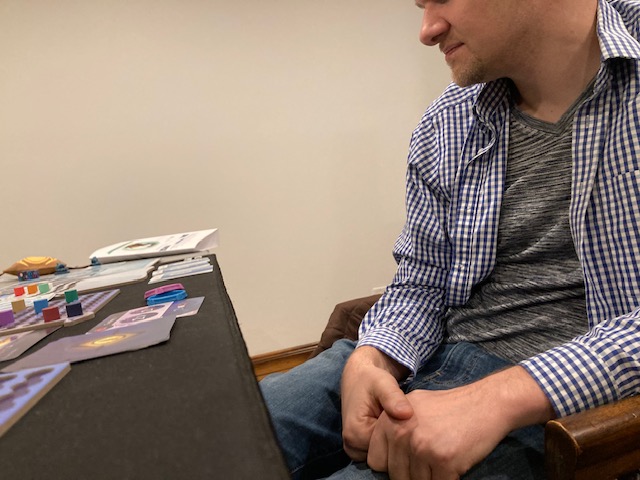
Feral mode (above right) is the hardest mode, as you have fewer scratches you can can endure and further to go!

IMG_3115

Players win if they get the cat meeple to the end, but if the players ever get too many scratches (the red cube at the maximum number of scratches), they lose!

IMG_3083

Players also lose if the cat has three hissy fits! 

IMG_3113

Every hissy fit icon on the cards will advance the hissy fit card … if you ever get three tokens on the card, the hissy fit happens!

The game has a fairly typical cooperative game arc: “bad news” cards start the round, and players play “good news” cards to help. The “bad news” cards are the Cat Cards (see above). As these cards come out, they cause continual bad stuff to happen! For example: In the white panel above is a backward paw: it causes the cat meeple to go backwards unless you get rid of that Zoomies card!

The players play Human Cards to help deal withe Cat Cards.  When you play a Human Card, you choose one of the good effects (in the white strip) on the card.  The rightmost effect (see above) would move the cat meeple forward three spaces!  The leftmost effect would give two resources of each type of Cat Attitudes: you place cubes on the Cat Cards appropriately.

IMG_3145

If you get enough Cat Attitude resources, you can get rid of the Cat Card!  For example, when we play the Tuna Can card to stop the Zoomies (see above), we only have 2 Angry Cat resources (brown), so we can only partly stop the Zoomies: we need to play another human card with the Angry cat (brown) symbol: we use the clear cubes to note what we have already played.  Unfortunately, the Zoomies stays out another turn.

IMG_3096

Turns are pretty quick and easy: the current player draws a Cat Card and suffers its bad effects, then that current player gets to do 2 things: play a Human Card or draw a Human card!  You can choose any Human Card in the display, or you can blindly draw the top.   Once you are done, move left to the next player! Play continues until the cats win or the humans win!

IMG_3094

One of the most important rules in the game is playing combos: when any player plays a card, another player can follow and play a card with the same symbol!  See the example above (from the rules) with the yarn ball symbol allowing the players to play three cards!  

This combo rule is critical to winning the game: it allows you to play many cards in one shot if you really need to!

Solo Game

IMG_3091

The solo game is well-specified and very simple (thank you for following Saunders’ Law): there is only one player, but he starts the game with 5 Human Cards.  The solo player simply keeps taking his turn over and over, basically rotating back to himself.  Cat Card, Two Actions, Cat Card, Two Actions, repeat!

IMG_3095

The victory and loss conditions are exactly the same: the only thing that really changes depending on the number of players is how many cards the player(s) starts with! 

IMG_3117

I was able to learn, then play the game twice in the same night as my friends came over!   I lost my first solo game and won my second (on Kitten Mode).  I started groking it pretty quickly.

IMG_3119

I lost my first game because I didn’t take the rulebook/pamphlet seriously!  The game is all about playing combos to win!  See above as I play three Human Cards that all have the mouse icon! Yep, you gotta play combos to win!

IMG_3123

This is a light solo game that plays in 20 minutes.  It’s pretty fun. If I am waiting for someone and just want to kill 20 minutes, this would be a fun and easy game to play: it’s not too thinky, but it’s still very engaging.

Cooperative Game

IMG_3133

The cooperative game flowed well.  After I learned the game, I was able to teach everyone the game fairly quickly: part of that is because the solo game is still the main game!  It’s really easy to get into it!

IMG_3137

This game is smooth and easy to play cooperatively.  There’s a lot of engagement as players realize “we need to play this combo!!!” See above as Sara and Andrew try to figure out how to combo to take out the 3 Cat Cards!

IMG_3136

The game was still about 20-25 minutes and moved quickly.  This game was easy to learn and pretty fun to play.

What I Liked

IMG_3108

The art is adorable.  And the cards are easy to read.

IMG_3104

The game is super easy to set-up and understand.

IMG_3134

It worked well as both a cooperative game and a solo game.

IMG_3138

In the end, the gameplay was just so smoooooth and easy. Anyone can play this.

IMG_3119

The combo mechanism is fantastic: it reminds of the “follow” mechanism that so enchanted us from the Plum Island Horror (see our review here).  By allowing ANY player to play a Human Card that matches the current symbol, everyone can stay engaged even when it’s not their turn!  This one mechanism made this fairly standard cooperative game stand out for me: it kept everyone engaged!

What I Didn’t Like

IMG_3120

There aren’t enough Human Cards. You will see all of them in your first game! There needs to be quite a bit more for better variety.

IMG_3114

I don’t love the cover, but I was absolutely in the minority on this. I think the art is so cute in the game (see the Ball With Bell above), but I don’t think the cover captured just how cute this game is! Again, I am in the minority: all my friends disagree with me on this.

IMG_3138

I don’t love the pamphlet form factor. Whatever, it’s still a pretty good set of rules.

IMG_3100

It’s not super deep. You’ll get it pretty quickly: that may limit its replayability.

Conclusion

IMG_3105

Hissy Fit! is surprisingly fun! It’s a light game that’s easy to teach: you can teach and start playing right away! This is a quick solo and cooperative game that plays in about 20 minutes! Are you looking for a light and quick solo/cooperative game? Hissy Fit! might be right for you!

IMG_3112

And you don’t have to love cats to like this game: the gameplay is solid, especially with the combo mechanism keeping everyone engaged as they play!   The gameplay is just smooth.

IMG_3097

I give this a solid 7.5/10 and Teresa gives this a 7/10. Andrew and Sara would give it a 7, but the small number of Human Cards reduces some of the replayability for them, so they give it a 6.5/10. I think an expansion which added a lot more Human Cards would move this to a 7/10 for them.

IMG_3107

This small game has a sense of humor and a wacky theme, but it plays so smoothly.  It’s a surprise to me how much I liked Hissy Fit! given how weird and quirky it is.  Yes, I got my money’s worth for $20.

A Review of Chainsomnia

Welcome back to Cooperative Surprise Month! Last month we looked at the brand new game (Sammu-ramat) which was so surprisingly good! This week, we surprised ourselves by finding an old review which we never published! This is a review for the cooperative game Chainsomnia by Seiji Kanai! Let’s take a look!

Chainsomnia was a cooperative game I picked up from GameNerdz fairly recently (EDITOR: at the time this was written, it was June 2023 .. ahem).  It was a Kickstarter game, but I didn’t know that when I ordered it from GameNerdz (I guess I missed the Kickstarter).  Chainsomnia was appealing to me because it looks like a light cooperative game from the designer (Seiji Kanai) of Unicornus Knights!  I think that Unicornus Knights is something of a hidden gem (see Part I and Part II of our review), as it made our Top 10 Cooperative Games of 2017!

IMG_6696

This game is about a bunch of nightmare-ridden little kids trying to get out of a castle of nightmares! It’s for 1-4 players, 40-60 minutes, and ages 14+. Let’s take a look.

Unboxing and Gameplay

IMG_6697

This is a pretty deep box.  The Coke Can actually fits inside it pretty well!

IMG_6720

Seriously, this is a pretty deep box: mostly for the tiles.

IMG_6721

Each character takes the role of a child trapped in the castle:

IMG_6716

Each character has a standee and a character sheet.

IMG_6717

IMG_6725

Each character has some abilities (Strength, Luck, and Wisdom) which will form the the basis of a two-dice ability role.

IMG_6747

For example, Chloe above has 3 Strength, 3 Wisdom and 3 Luck.  She can also get rid of Bad Dream easily with an AP (Action Point).

IMG_6748

AP stands for Action Point.  The little chart to the left shows you how many AP you have per turn.  As you get Chains in the game (Ryan above has 2 chains), it reduces the number of AP you have per turn.

IMG_6718

The Summary Cards summarize what you can do, but basically explore, search, give, skill, move, use or take.

IMG_6755

In order to win, the characters must cooperatively explore the Castle to find the way out: the Way Out is the last card in the tile deck.  See Chloe winning the game for everyone by finding the Way Out … when there are no Bad Dreams on the board.

IMG_6728

Like most cooperative games, there are “Bad News” cards that come out.  In this case, the Bad News cards are called “Events” and come out every time you explore and discover a new Room.

IMG_6753

Generally speaking, the Event cards are full of nightmares that clog up the rooms.  You can’t enter a room with a nightmare until you take it out.  How do you take it out?

IMG_6735

Each Bad Dream is different (for example, above you have to discard an Item), but generally you have to make a skill check on 2 dice, and roll higher than your skill.  If Ryan’s Strength is 5 and requires a 11+ Strength to Vanquish, then Ryan will need to roll a 6 or more (6+5 >= 11) on two dice to succeed in the Skill check.

IMG_6727

Incidentally, skill checks are how you get Items (very useful tools): generally, each room will tell you what you need to roll to get one.  In the first room (see below), if you roll a 12 or higher on any skill check, you get an item.

IMG_6739

IMG_6759

There are other very bad cards that modify the Event Deck (see Shriek above) but if you make it through all Event cards without finding the Way Out you lose.  If you can get to the Way Out and defeat all Bad Dreams on the board you Win!

IMG_6724

The components are quite cute, if a little minimal.  The cards are not linen finished.

Rulebook

IMG_6700

The rulebook is good, except that it doesn’t talk a lot about edge conditions.  As we played the game, a bunch of questions came up (“Are Action Points dynamic?  Do you immediately lose/gain an AP as a result of a chain change?”).  There was a FAQ, but it didn’t answer the questions that seem to come up with us.

IMG_6701

The components list had no pictures, but the Set-up was well-labelled to counteract that.   In general, there were appropriate pictures and the game was explained well-enough.  I even like that it had a FAQ, it just didn’t seem to address the questions we had.  I’ll call the rulebook good enough.

Solo Mode

IMG_6738

Congratulations to Chainsomnia for following Saunders’ Law and having a solo mode!

IMG_6713

Unfortunately, the solo player must take control of 3 characters.  Similarly, a 2-Player game would have each player take control of 2 characters.  Basically, there must always be 3 or 4 characters in the game.  This isn’t ideal for the solo because there’s always the context switch issue as you jump from character to character, playing each one separately.

IMG_6748

Luckily for the solo mode, the context switch issue is not too problematic: each character has a pretty simple character with one “major” power.   For example, if one of your characters were Ryan (see above), it’s easy to remember he’s strong (strength of 5) and can also eliminate one monster for one AP.   There’s not too much to remember for each character, so context switching from character to character isn’t a big deal. Contrast this to the characters from Marvel Zombies: Heroes Resistance where each context switch becomes heavier and heavier as the characters get more and more abilities in the game (see our review here).  While the extra abilities in Marvel Zombies: Heroes Resistance are cool, it makes it significantly harder to play multiple characters.

IMG_6752

It took me two solo games to get a win.  I remember losing my first game and saying, “Nope! I wanna play again! I know what to do now!”   I think your strategy really depends on the characters you choose, so my second game was with the same 3 characters.

IMG_6765

I made one major mistake in both solo games: I forgot to save my Ominous Event cards and my Auspicious event cards.  In most every other cooperative game, you throw away events when you are done … Nope!  Here, they are a measure oh how well you did.

IMG_6719

When you open the secret envelope, you need those cards.  I didn’t realize this until after my second game! 

(Picture deleted from review to avoid spoilers)

Minor Spoiler: Basically, you measure your victory (in the event of a win) by how many Auspicious Events and Ominous Events you got.    That was kind of cool: it’s a hidden and secret way to measure success, and gives you a reason to play again to try for a “better” win.

IMG_6755

I didn’t love solo mode (mostly because of the 3 character issue), but it was fun enough to play again.  It also gave me enough insight to teach to my friends.

Cooperative Mode

IMG_6862

This game went over pretty well as a cooperative game: probably better than I expected.  Since you always need at least 3 or 4 characters in play (this totally reminds me of Unicornus Knights), a 3 or 4-player game is probably ideal: that way every player gets exactly one character to operate, and it’s easier to inhabit and connect with the game if you are “that character”.

IMG_6864

I noticed that, as we were playing, we really did consult each other a lot … and console each other a lot.  “Hey, don’t worry: I can take care of that nightmare!”  “Hey, don’t worry, I can get you an item!”  Sara’s character’s power allowed here to give items to other people anywhere on the board … this was huge! It allowed us to power up!  Even if we had a bad role, the game evoked a pathos: “It’s all right, we’ll get you out of that mess.”  Maybe there’s something about being a little kid that brings out the best in people, and makes them want to help each other?

IMG_6861

There were a lot of fun little moments playing cooperatively.  I knew the game had gone well when we spent the post-game talking about all sorts of other ways we could have won/lost, been more strategic, etc.  People cared enough to keep thinking about the game, even when it was over!

Repacking

IMG_6766

What’s going on with this box?  It has a huge insert, but the game doesn’t fit back into the box unless you do one of two things:

  1. Always remove the plastic bases
    OR
  2. Pack the dice into the fingerholes!

IMG_6767

Those of you who have played GloomHaven know the problem with constantly removing/adding the plastic bases!  Basically, the bottom tears!  So, I chose to leave the plastic bases on.  Which means the game box WHICH IS HUGE doesn’t fit the game!  I had to be clever … and put the dice in the fingerholes.

IMG_6770

Yup, not ideal, but then the game fits. See below for pictures of how I fit the game in.

Conclusion

IMG_6694

Chainsomnia was pretty fun.  Although the rules were missing a lot of edge cases, the game was still pretty easy to teach and play.  The group liked it, but didn’t love it:

  • Teresa, Rich: 7/10, liked it, would suggest it
  • Sara: 6.5/10 liked it, would happily play, maybe wouldn’t suggest it as first choice
  • Andrew: 6/10 Liked it well enough, would play again

The biggest issue with the game was that it felt a little “samey” after a few plays.  You could mitigate that by switching up the characters to have different strategies.  It was also maybe a little too lucky with so much emphasis being placed on the dice.

Chainsomnia was fun enough.  We actually would not recommend this for kids: even though this game is cute, the nightmares attacking kids might not go over well with younger players.  This game is more for older kids who like light cooperative games with an anime look.

EDITOR: At the time Our Top 10 Cooperative Tile-Laying/Placement games was written, Chainsomnia just barely squeaked onto the list as #10. I hate to say it, but I think Race for The Raft came along, moved to the top of the list, and pushed everything down one space (see our review here: it’s that good)! So that means Chainsomnia is #11 now …